/










































































Author: Cronquist A Takhtajan A.
Tags: biology flowering plants classification
ISBN: 0-231-03880-1
Year: 1992



Text
                    AN INTEGRATED SYSTEM OF
CLASSIFICATION OF FLOWERING PLANTS

Frontispiece. Drimys winteri). R. & G. Forster, a South American member of the archaic
family Winteraceae. Photograph courtesy of R. M. Schuster.

AN INTEGRATED SYSTEM
OF CLASSIFICATION
OF FLOWERING PLANTS
ARTHUR CRONQUIST
THE NEW YORK BOTANICAL GARDEN
COLUMBIA UNIVERSITY PRESS
NEW YORK 1981

Library of Congress Cataloging in Publication Data
Cronquist, Arthur.
An integrated system of classification of flowering plants.
Includes bibliographical references and index.
1. Angiosperms—Classification. I. Title.
QK495.A1C76 582.13'012 80-39556
ISBN 0-231-03880-1
Columbia University Press
New York Guildford, Surrey
Copyright © 1981 The New York Botanical Garden
All rights reserved
Printed in the United States of America
Printed on permanent and durable acid-free paper.

This book is dedicated to the many botanists,
past and present, whose studies have made it possible.

CONTENTS
Introduction
Outline of Classification of Magnoliophyta
Division Magnoliophyta
Class Magnoliopsida
Subclass I. Magnoliidae
Hamamelidae
Caryophyllidae
Dilleniidae
Rosidae
Asteridae
Subclass II.
Subclass III.
Subclass IV.
Subclass V.
Subclass VI.
Class Liliopsida
Subclass I. Alismatidae
Subclass II.
Subclass III
Subclass IV.
Subclass V.
Index
Arecidae
Commelinidae
Zingiberidae
Liliidae
IX
xiii
1
17
23
151
231
287
521
851
1031
1039
1077
1101
1157
1189

INTRODUCTION
The system of classification of flowering plants here presented is in the
philosophical tradition of A. P. de Candolle, Bentham and Hooker,
Hallier, and Bessey. It follows what is known as the strobilar theory of
angiosperm evolution, as do most of the systems that have been
presented in the past several decades.
I have tried to use all the available data, from whatever source; hence
the perhaps overly ambitious title, an integrated system. At the same
time, I have tried to avoid undue optimism about the present importance
of data that reflect a very sparse sampling. I can hope that the classical
morphological features are presented with reasonable accuracy in the
following descriptions, but surprises will inevitably result from
continuing expansion of the data-base for chemical and micromorphological
features.
The fossil record has only recently begun to be useful to students of
the evolution and classification of angiosperms. It is still not possible to
put primary reliance on the fossils, but the record does begin to impose
some constraints on the systems that can be seriously considered. I
believe that the system here presented is fully compatible with the fossil
record as presently understood, and that the fossils indeed provide
significant support for some of the pillars of the system.
A detailed exposition of my views on evolutionary trends in the
angiosperms was presented in my earlier book, The Evolution and
Classification of Flowering Plants. My ideas have undergone some
relatively minor changes since that time, and it is my hope and intent
to present a revised version in the near future. Perhaps the most
significant changes are that I am now more receptive to the view that
the earliest angiosperms were shrubs rather than trees, that I now
regard stipules as having originated among primitive angiosperms as
petiolar flanges, that I now regard the paracytic stomatotype as probably
primitive within the angiosperms, and that I now consider that perigyny
can be of receptacular as well as appendicular origin. Fortunately, these
changes have had only minimal impact on the system itself; indeed they
promote the harmony between the principles and the system.
The system here presented is conservative in that I prefer to follow
historical tradition when it is reasonably possible, and in that I am
reluctant to assign the rank of family to small satellite groups if these

X
INTRODUCTION
can be comfortably accommodated within a larger group. On the other
hand, there is no virtue in retaining a traditional arrangement that
obstructs understanding. Thus it becomes necessary to recognize a
number of small families whose members have been quietly hiding in
large families where they do not belong.
Perhaps the most important thing that sets the present system apart
from others is that I have consistently tried to prepare synoptical
arrangements of the families within the orders, the orders within the
subclasses, etc. This procedure has profoundly influenced my thinking.
The pervasive parallelism within the angiosperms confounds all efforts
to prepare a natural key that is consistently useful for the identification
of families and higher groups, but if one cannot prepare a synoptical
arrangement that will provide for most members of each group, it is
time to stop and reconsider. The distinction between the Rosidae and
Dilleniidae is recalcitrant to such an approach, but otherwise I have
found the method very useful.
The system most nearly comparable to my own is that of Armen
Takhtajan. This similarity reflects a community of interest and outlook,
bolstered by frequent correspondence and personal conversation over
a period of more than twenty years. We believe that the similarity
reflects the requirements of the present state of knowledge and taxo-
nomic theory.
The differences that persist between our systems have several causes.
He is more likely than I to recognize small families and orders, in
pursuit of sharp definition of groups. He places a little more reliance
on serology, and a little less on other chemical characters, than I. He
is more suspicious than I of the major significance of characters that
can readily be interpreted in terms of survival value. Even with access
to similar herbaria and essentially the same body of literature, no two
people work with exactly the same set of data, or are exposed to exactly
the same influences from their colleagues. Although we agree on the
main outlines of angiosperm evolution, there remain many doubtful
cases and close decisions at the present state of knowledge, and any two
people will inevitably make some of these decisions differently.
The mass of literature that bears on the general system of classification
of flowering plants is formidable indeed. My degree of success in
encompassing and understanding it will have to be judged by my
colleagues. I have examined every book and paper cited in the
bibliographies, as well as others not cited. Some of the items are included
merely to indicate that I have seen them, even though I disagree with

INTRODUCTION
XI
the conclusions presented. The bibliographies reflect a bias against
citation of unpublished theses and of works more than half a century
old, the latter because they have by now had time to be incorporated
into the general body of taxonomic. knowledge. I have also been
reluctant to cite floras and encyclopedias, although I have obtained
useful information from some of them. The more significant such
works are well known to botanists generally. The numerous papers
directed toward a generic flora of southeastern United States are
included, however, because of their comprehensive bibliographies. I
regret that I do not read any Oriental language.
Daily access to the herbarium and library of the New York Botanical
Garden has been a tremendous asset in the preparation of this work,
and the living collection has also been of great value. Botanists and
botanical institutions around the world have been uniformly helpful,
and I have sought out a number of otherwise not readily available
publications in the library of the Komarov Botanical Institute in
Leningrad and in the library of the United States Department of
Agriculture in Beltsville.
Many people have helped me in one way or another during the
preparation of the manuscript and while my thoughts were developing.
A complete list would probably have to include nearly all of my
professional colleagues, beginning with Ray J. Davis, from whom I took
my first botany course. My file of reprints continues to grow. I can not
now recall to what extent some of my ideas are original, and to what
extent they spring from seeds planted in my mind by others.
I owe especial thanks to my wife, Mabel, who has provided the
domestic milieu conducive to my work, and who has maintained and
typed the bibliography and served as a consultant on writing style; to
my secretary, Lucy F. Kluska, who has skillfully typed preliminary
versions and the final draft of the basic manuscript; to Armen Takh-
tajan, whose contribution to my thinking has already been noted; and
to Margarita Baranova, who has helped me with the Russian botanical
literature and with other aspects of my work in Leningrad. Most of the
illustrations have been prepared by William S. Moye, a smaller number
by Robin Jess, Bobbi Angell, and others.
A partial list of other botanists who have helped me follows. Many of
them have reviewed some segment of the manuscript. V. Sh. Agababyan,
William R. Anderson, Edward S. Ayensu, T. M. Barkley, Rupert C.
Barneby, Bruce Bayer, Igor Belolipov, C. C. Berg, Barbara G. Briggs,
James E. Canright, Sherwin Carlquist, Robert T. Clausen, Lincoln

Xll
INTRODUCTION
Constance, David F. Cutler, Rolf Dahlgren, Thomas J. Delendick,
Bernard de Winter, David Dilcher, James A. Doyle, Richard H. Eyde,
Andrey Fedorov, Alvaro Fernandez Perez, Alexander Floyd, Dietrich
Frohne, Eleonora Gabrielian, Alwyn H. Gentry, David E. Giannasi,
Arthur C. Gibson, William T. Gillis, Peter S. Goldblatt, I. A. Grudzin-
skaja, Zaira Gvinianidze, Ray M. Harley, Leo J. Hickey, Noel H.
Holmgren, Richard A. Howard, B. P. M. Hyland, Charles Jeffrey, Uwe
Jensen, Laurie A. S. Johnson, Joseph H. Kirkbride, Tetsuo Koyama,
Robert Krai, Klaus Kubitzki, Jean-F. Leroy, Richard N. Lester, Harlan
Lewis, Walter H. Lewis, Eduardo Lleras, James Luteyn, Tom Mabry,
Bassett Maguire, John McNeill, Rogers McVaugh, C. R. Metcalfe,
Phillipe Morat, H. E. Moore, Scott A. Mori, Jan Muller, Dan H.
Nicolson, Joan W. Nowicke, P. N. Ovczinnikov, Barbara F. Palser, D.
Philcox, William R. Phillipson, James E. Piechura, Ghillean T. Prance,
Peter H. Raven, James L. Reveal, Reed C. Rollins, Irwin Rosenblum,
John P. Rourke, Rolf Sattler, T. V. Shulkina, Beryl Simpson, Hermann
O. Sleumer, Natalia Snigirevskaja, Thomas R. Soderstrom, Clive A.
Stace, Margaret Y. Stant, W. Douglas Stevens, Benjamin C. Stone,
Donald E. Stone, M. Tamura, Leonard B. Thien, Robert F. Thorne,
Clifford Townsend, I. T. Vassilczenko, J. M. Veillon, Tom Wendt,
Molly Ann Whalen, Del Wiens, I. J. M. Williams, Carl L. Withner, John
J. Wurdack, David A. Young.
The phylogenetic diagrams in this book are specifically released from
copyright.

OUTLINE OF CLASSIFICATION OF
MAGNOLIOPHYTA
Class MAGNOLIOPSIDA
Subclass I. Magnoliidae
Order 1. Magnoliales
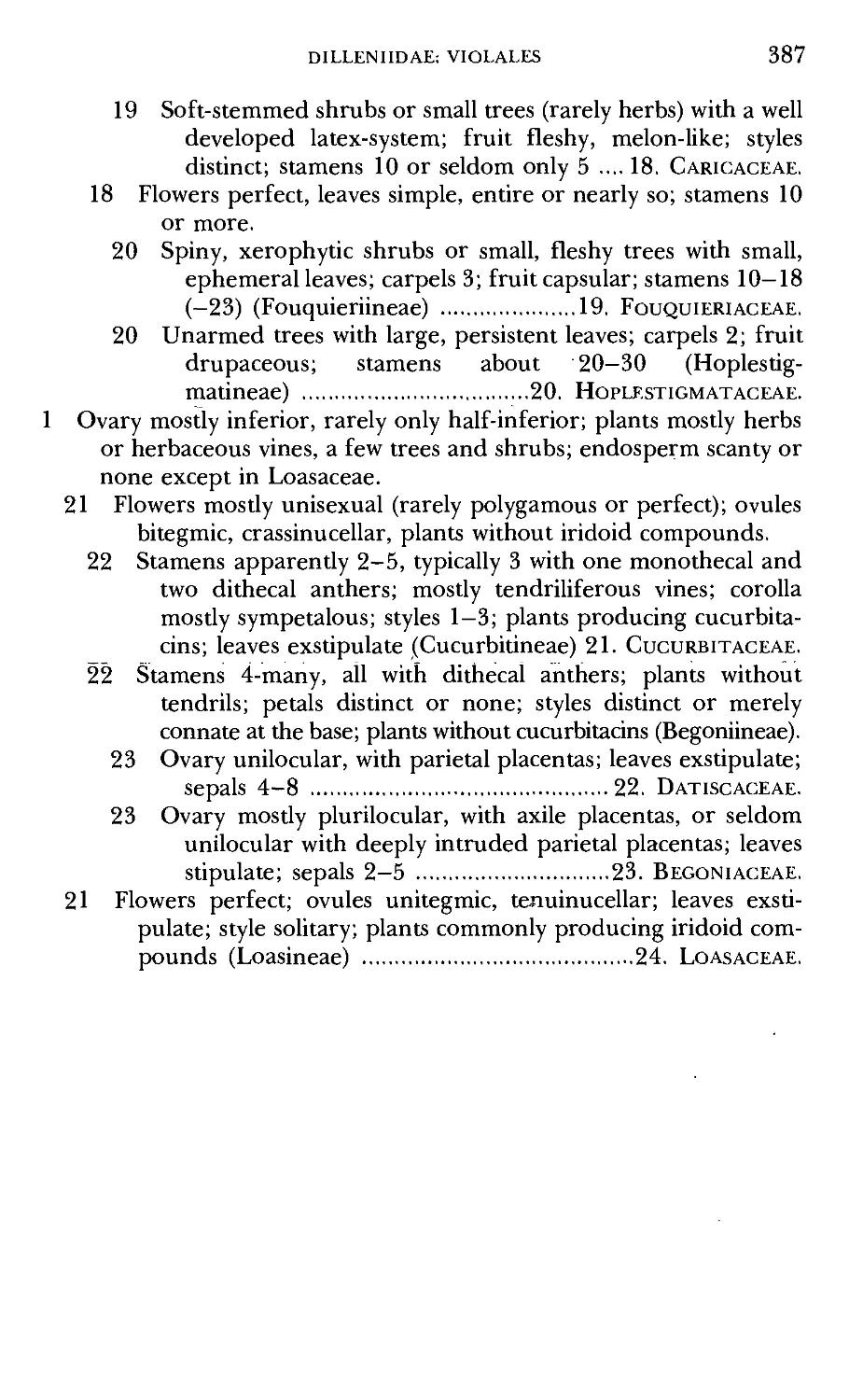
Family 1. Winteraceae
2. Degeneriaceae
3. Himantandraceae
4. Eupomatiaceae
5. Austrobaileyaceae
6. Magnoliaceae
7. Lactoridaceae
8. Annonaceae
9. Myristacaceae
10. Canellaceae
Order 2. Laurales
Family 1. Amborellaceae
2. Trimeniaceae
3. Monimiaceae
4. Gomortegaceae
5. Calycanthaceae
6. Idiospermaceae
7. Lauraceae
8. Hernandiaceae
Order 3. Piperales
Family 1. Chloranthaceae
2. Saururaceae
3. Piperaceae
Order 4. Aristolochiales
Family 1. Aristolochiaceae
Order 5. Illiciales
Family 1. Illiciaceae
2. Schisandraceae
Order 6. Nymphaeales
Family 1. Nelumbonaceae
2. Nymphaeaceae
3. Barclayaceae
4. Cabombaceae
5. Ceratophyllaceae
Order 7. Ranunculales
Family 1. Ranunculaceae
2. Circaeasteraceae
3. Berberidaceae
4. Sargentodoxaceae
5. Lardizabalaceae
6. Menispermaceae
7. Coriariaceae
8. Sabiaceae
Order 8. Papaverales
Family 1. Papaveraceae
2- Fumariaceae
Subclass II. Hamamelidae
Order 1. Trochodendrales
Family 1. Tetracentraceae
2. Trochodendraceae
Order 2. Hamamelidales
Family 1. Cercidiphyllaceae
2. Eupteliaceae
3. Platanaceae
4. Hamamelidaceae
5. Myrothamnaceae
Order 3. Daphniphyllales
Family 1. Daphniphyllaceae
Order 4. Didymelales
Family 1. Didymelaceae
Order 5. Eucommiales
Family 1. Eucommiaceae
Order 6. Urticales
Family 1. Barbeyaceae
2. Ulmaceae
3. Cannabaceae

XIV
CLASSIFICATION OF MAGNOLIOPHYTA
4. Moraceae
5. Cecropiaceae
6. Urticaceae
Order 7. Leitneriales
Family 1. Leitneriaceae
Order 8. Juglandales
Family 1. Rhoipteleaceae
2. Juglandaceae
Order 9. Myricales
Family 1. Myricaceae
Order 10. Fagales
Family 1. Balanopaceae
2. Fagaceae
3. Betulaceae
Order 11. Casuarinales
Family 1. Casuarinaceae
Subclass III. Caryophyllidae
Order 1. Caryophyllales
Family 1. Phytolaccaceae
2. Achatocarpaceae
3. Nyctaginaceae
4. Aizoaceae
5. Didiereaceae
6. Cactaceae
7. Chenopodiaceae
8. Amaranthaceae
9. Portulacaceae
10. Basellaceae
11. Molluginaceae
12. Caryophyllaceae
Order 2. Polygonales
Family 1. Polygonaceae
Order 3. Plumbaginales
Family 1. Plumbaginaceae
Subclass IV. Dilleniidae
Order 1. Dilleniales
Family 1. Dilleniaceae
2. Paeoniaceae
Order 2. Theales
Family 1. Ochnaceae
2- Sphaerosepalaceae
3. Sarcolaenaceae
4. Dipterocarpaceae
Order 3.
Family
Order 4.
Family
Order 5.
Family
Order 6.
Family
5. Caryocaraceae
6. Theaceae
7. Actinidiaceae
8. Scytopetalaceae
9. Pentaphylacaceae
10. Tetrameristaceae
11. Pellicieraceae
12. Oncothecaceae
13. Marcgraviaceae
14. Quiinaceae
15. Elatinaceae
16. Paracryphiaceae
17. Medusagynaceae
18. Clusiaceae
Malvales
1. Elaeocarpaceae
2. Tiliaceae
3. Sterculiaceae
4. Bombacaceae
5. Malvaceae
Lecythidales
1. Lecythidaceae
Nepenthales
1. Sarraceniaceae
2. Nepenthaceae
3. Droseraceae
Violales
1. Flacourtiaceae
2. Peridiscaceae
3. Bixaceae
4. Cistaceae
5. Huaceae
6. Lacistemataceae
7. Scyphostegiaceae
8. Stachyuraceae
9. Violaceae
10. Tamaricaceae
11. Frankeniaceae
12. Dioncophyllaceae
13. Ancistrocladaceae
14. Turneraceae
15. Malesherbiaceae
16. Passifloraceae

CLASSIFICATION OF MAGNOLIOPHYTA
XV
17. Achariaceae
18. Caricaceae
19. Fouquieriaceae
20. Hoplestigmataceae
21. Cucurbitaceae
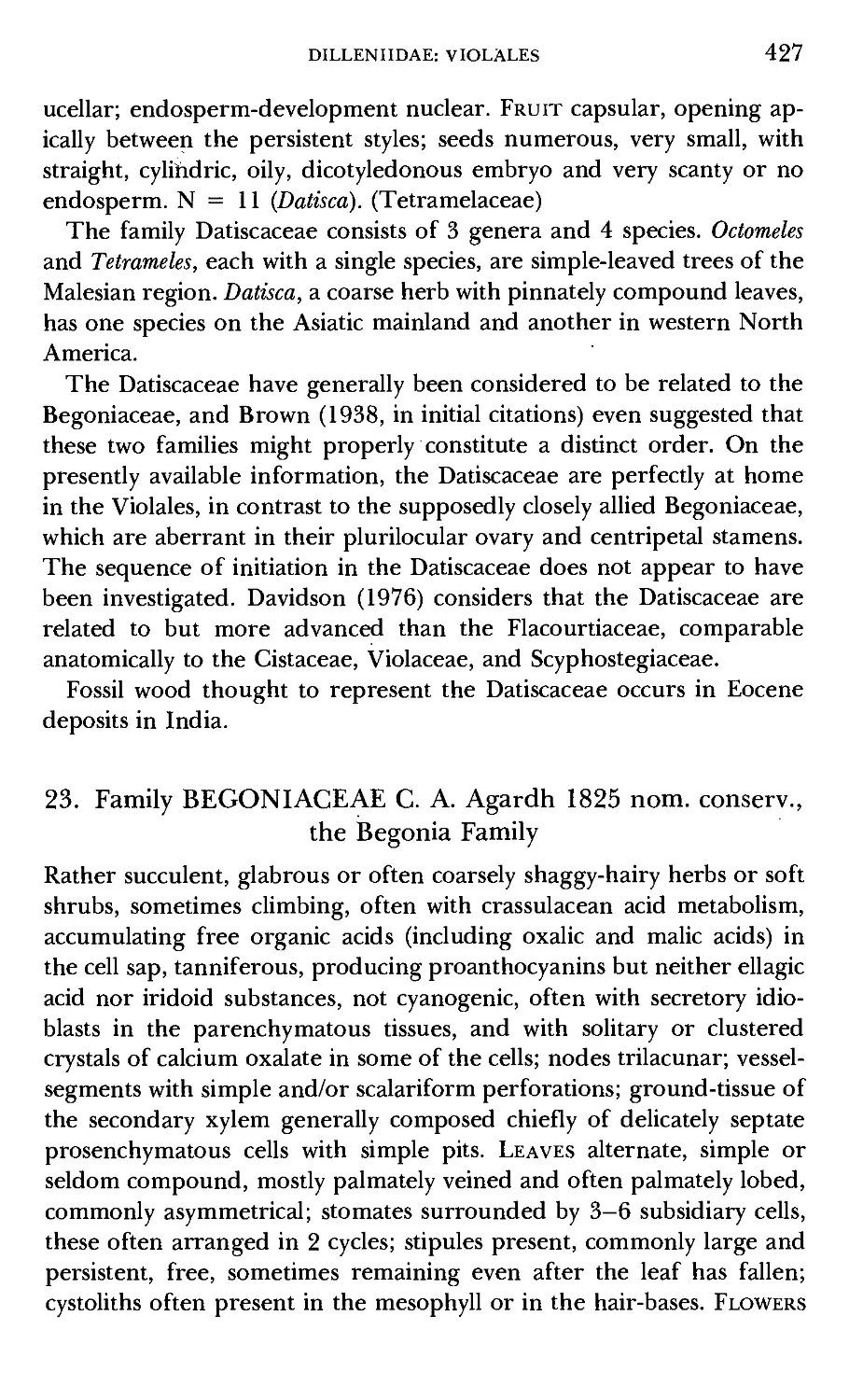
22. Datiscaceae
23. Begoniaceae
24. Loasaceae
Order 7. Salicales
Family 1. Salicaceae
Order 8. Capparales
Family 1. Tovariaceae
2. Capparaceae
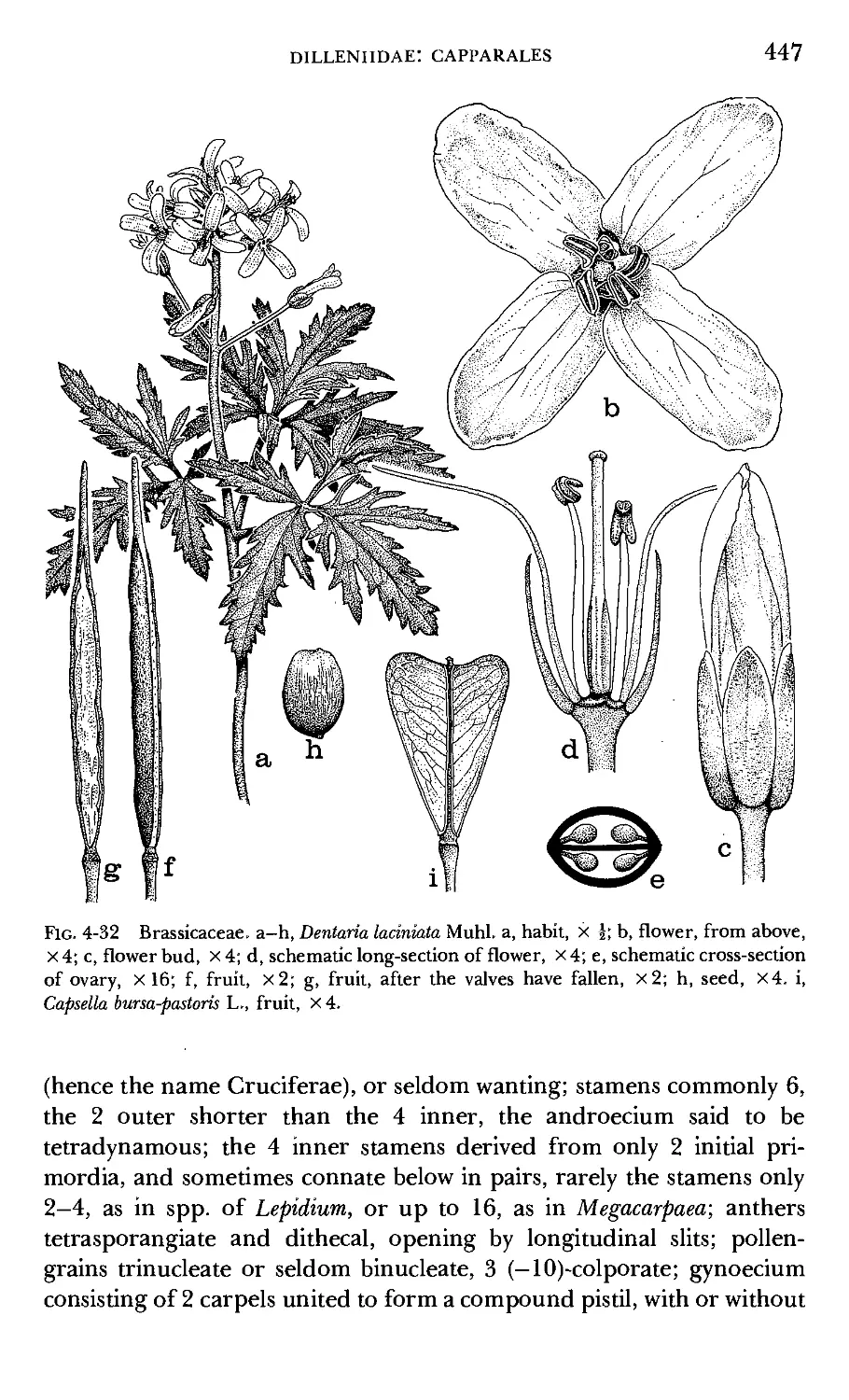
3. Brassicaceae
4. Moringaceae
5. Resedaceae
Order 9. Batales
Family 1. Gyrostemonaceae
2. Bataceae
Order 10. Ericales
Family 1. Cyrillaceae
2. Clethraceae
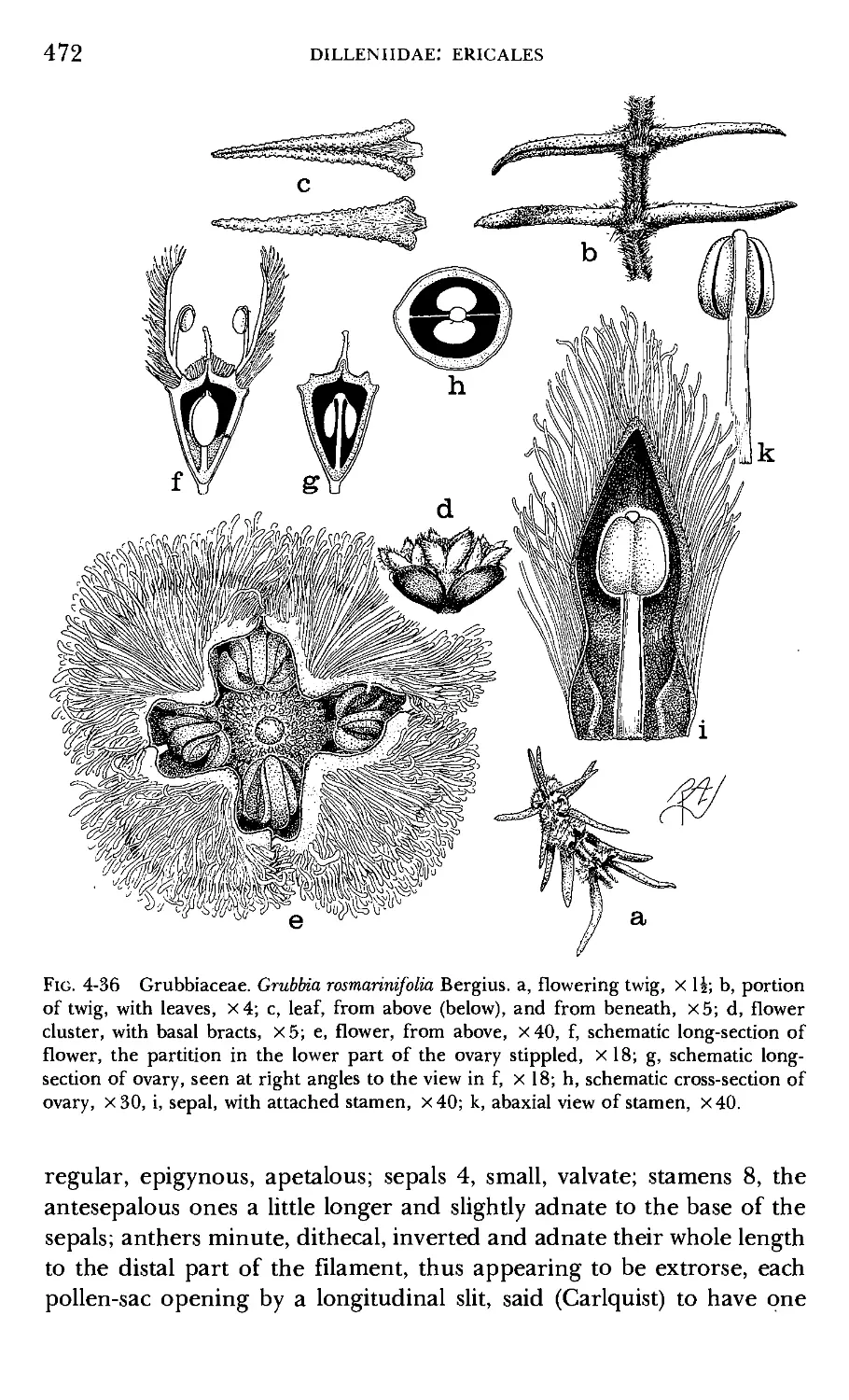
3. Grubbiaceae
4. Empetraceae
5. Epacridaceae
6. Ericaceae
7. Pyrolaceae
8. Monotropaceae
Order 11. Diapensiales
Family 1. Diapensiaceae
Order 12. Ebenales
Family 1. Sapotaceae
2- Ebenaceae
3. Styracaceae
4. Lissocarpaceae
5. Symplocaceae
Order 13. Primulales
Family 1. Theophrastaceae
2. Myrsinaceae
3. Primulaceae
Subclass V. Rosidae
Order 1. Rosales
Family 1. Brunelliaceae
2. Connaraceae
3. Eucryphiaceae
4. Cunoniaceae
5. Davidsoniaceae
6. Dialypetalanthaceae
7. Pittosporaceae
8. Byblidaceae
9. Hydrangeaceae
10. Columelliaceae
11. Grossulariaceae
12- Greyiaceae
13. Bruniaceae
14. Anisophylleaceae
15. Alseuosmiaceae
16. Crassulaceae
17. Cephalotaceae
18. Saxifragaceae
19. Rosaceae
20. Neuradaceae
21. Crossosomataceae
22. Chrysobalanaceae
23. Surianaceae
24. Rhabdodendraceae
Order 2- Fabales
Family 1. Mimosaceae
2. Caesalpiniaceae
3. Fabaceae
Order 3. Proteales
Family 1. Elaeagnaceae
2. Proteaceae
Order 4. Podostemales
Family 1. Podostemaceae
Order 5. Haloragales
Family 1. Haloragaceae
2. Gunneraceae
Order 6. Myrtales
Family 1. Sonneratiaceae
2- Lythraceae
3. Penaeaceae
4. Crypteroniaceae
5. Thymelaeaceae
6. Trapaceae
7. Myrtaceae

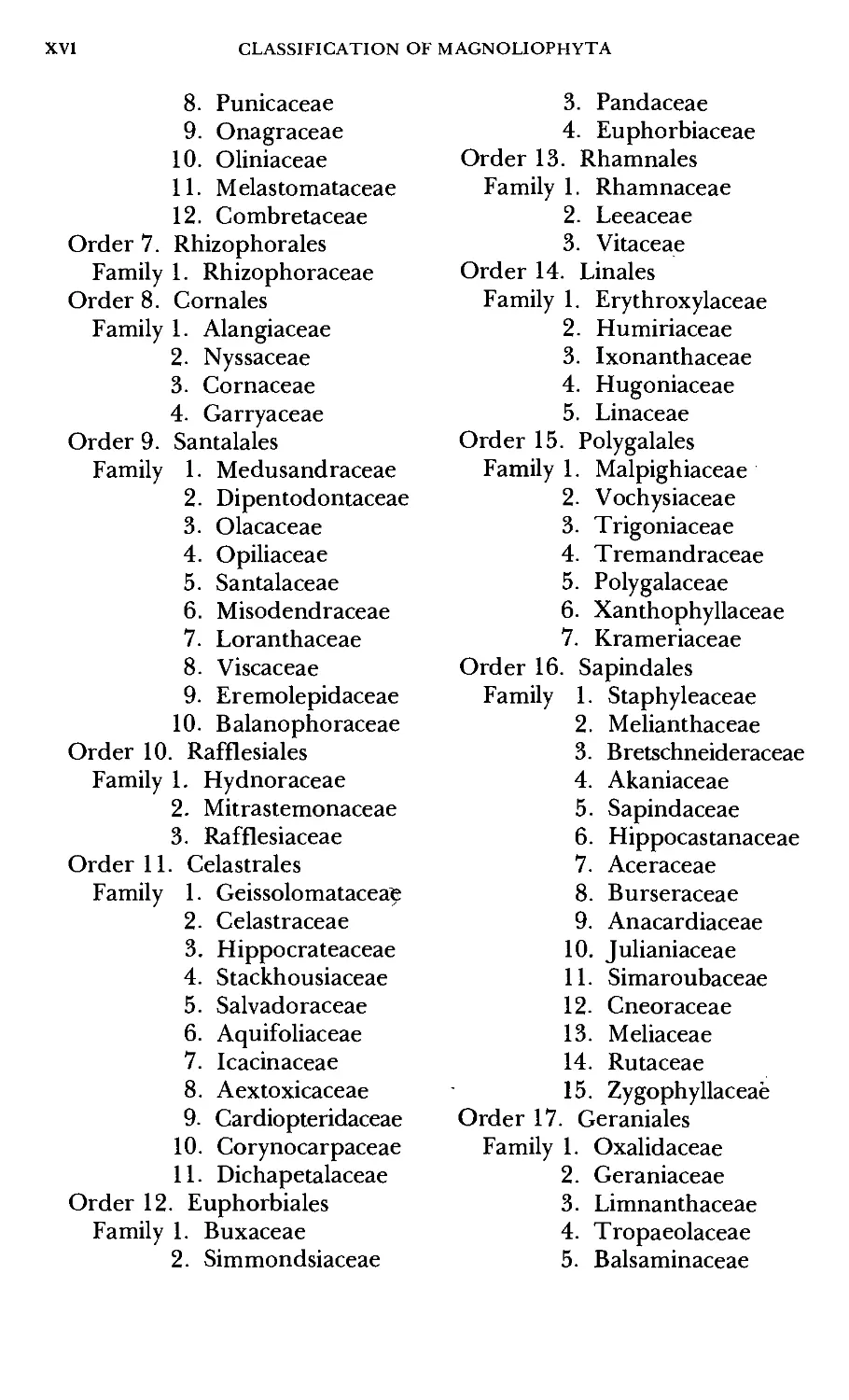
XVI
CLASSIFICATION OF MAGNOLIOPHYTA
8. Punicaceae
9. Onagraceae
10. Oliniaceae
11. Melastomataceae
12. Combretaceae
Order 7. Rhizophorales
Family 1. Rhizophoraceae
Order 8. Cornales
Family 1. Alangiaceae
2. Nyssaceae
3. Cornaceae
4. Garryaceae
Order 9. Santalales
Family 1. Medusandraceae
2. Dipentodontaceae
3. Olacaceae
4. Opiliaceae
5. Santalaceae
6. Misodendraceae
7. Loranthaceae
8. Viscaceae
9. Eremolepidaceae
10. Balanophoraceae
Order 10. Rafflesiales
Family 1. Hydnoraceae
2. Mitrastemonaceae
3. Rafflesiaceae
Order 11. Celastrales
Family 1. Geissolomatacea^
2. Celastraceae
3. Hippocrateaceae
4. Stackhousiaceae
5. Salvadoraceae
6. Aquifoliaceae
7. Icacinaceae
8. Aextoxicaceae
9. Cardiopteridaceae
10. Corynocarpaceae
11. Dichapetalaceae
Order 12. Euphorbiales
Family 1. Buxaceae
2. Simmondsiaceae
3. Pandaceae
4. Euphorbiaceae
Order 13. Rhamnales
Family 1. Rhamnaceae
2. Leeaceae
3. Vitaceae
Order 14. Linales
Family 1. Erythroxylaceae
2. Humiriaceae
3. Ixonanthaceae
4. Hugoniaceae
5. Linaceae
Order 15. Polygalales
Family 1. Malpighiaceae
2. Vochysiaceae
3. Trigoniaceae
4. Tremandraceae
5. Polygalaceae
6. Xanthophyllaceae
7. Krameriaceae
Order 16. Sapindales
Family 1. Staphyleaceae
2. Melianthaceae
3. Bretschneideraceae
4. Akaniaceae
5. Sapindaceae
6. Hippocastanaceae
7. Aceraceae
8. Burseraceae
9. Anacardiaceae
10. Julianiaceae
11. Simaroubaceae
12. Cneoraceae
13. Meliaceae
14. Rutaceae
15. Zygophyllaceae
Order 17. Geraniales
Family 1. Oxalidaceae
2. Geraniaceae
3. Limnanthaceae
4. Tropaeolaceae
5. Balsaminaceae

CLASSIFICATION OF MAGNOLIOPHYTA
XV11
Order 18. Apiales
Family 1. Araliaceae
2. Apiaceae
Subclass VI. Asteridae
Order 1. Gentianales
Family 1. Loganiaceae
2. Retziaceae
3. Gentianaceae
4. Saccifoliaceae
5. Apocynaceae
6. Asclepiadaceae
Order 2. Solanales
Family 1. Duckeodendraceae
2. Nolanaceae
3. Solanaceae
4. Convolvulaceae
5. Cuscutaceae
6. Menyanthaceae
7. Polemoniaceae
8. Hydrophyllaceae
Order 3. Lamiales
Family 1. Lennoaceae
2. Boraginaceae
3. Verbenaceae
4. Lamiaceae
Order 4. Callitrichales
Family 1. Hippuridaceae
2. Callitrichaceae
3. Hydrostachyaceae
Order 5. Plantaginales
Family 1. Plantaginaceae
Order 6. Scrophulariales
Family 1. Buddlejaceae
2. Oleaceae
3. Scrophulariaceae
4. Globujariaceae
5. Myoporaceae
6. Orobanchaceae
7. Gesneriaceae
8. Acanthaceae
9. Pedaliaceae
10. Bignoniaceae
11. Mendonciaceae
12. Lentibulariaceae
Order 7. Campanulales
Family 1. Pentaphragmataceae
2. Sphenocleaceae
3. Campanulaceae
4. Stylidiaceae
5. Donatiaceae
6. Brunoniaceae
7. Goodeniaceae
Order 8. Rubiales
Family 1. Rubiaceae
2. Theligonaceae
Order 9. Dipsacales
Family 1. Caprifoliaceae
2. Adoxaceae
3. Valerianaceae
4. Dipsacaceae
Order 10. Calycerales
Family 1. Calyceraceae
Order 11. Asterales
Family 1. Asteraceae
Class LILIOPSIDA
Subclass I. Alismatidae
Order 1. Alismatales
Family 1. Butomaceae
2. Limnocharitaceae
3. Alismataceae
Order 2. Hydrocharitales
Family 1. Hydrocharitaceae
Order 3. Najadales
Family 1. Aponogetonaceae
2- Scheuchzeriaceae
3. Juncaginaceae
4. Potamogetonaceae
5. Ruppiaceae
6. Najadaceae

XV111
CLASSIFICATION OF MAGNOLIOPHYTA
7. Zannichelliaceae
8. Posidoniaceae
9, Cymodoceaceae
10. Zosteraceae
Order 4. Triuridales
Family 1. Petrosaviaceae
2. Triuridaceae
Subclass II. Arecidae
Order 1. Arecales
Family 1. Arecaceae
Order 2. Cyclanthales
Family 1. Cyclanthaceae
Order 3. Pandanales
Family 1. Pandanaceae
Order 4. Arales
Family 1. Araceae
2. Lemnaceae
Subclass III. Commelinidae
Order 1. Commelinales
Family 1. Rapateaceae
2. Xyridaceae
3. Mayacaceae
4. Commelinaceae
Order 2. Eriocaulales
Family 1. Eriocaulaceae
Order 3. Restionales
Family 1. Flagellariaceae
2. Joinvilleaceae
3. Restionaceae
4. Centrolepidaceae
Order 4. Juncales
Family 1. Juncaceae
2. Thurniaceae
Order 5. Cyperales
Family 1. Cyperaceae
2. Poaceae
Order 6. Hydatellales
Family 1. Hydatellaceae
Order 7. Typhales
Family 1. Sparganiaceae
2. Typhaceae
Subclass IV. Zingiberidae
Order 1. Bromeliales
Family 1. Bromeliaceae
Order 2. Zingiberales
Family 1. Strelitziaceae
2. Heliconiaceae
3. Musaceae
4. Lowiaceae
5. Zingiberaceae
6. Costaceae
7. Cannaceae
8. Marantaceae
Subclass V. Liliidae
Order 1. Liliales
Family 1. Philydraceae
2. Pontederiaceae
) 3. Haemodoraceae
4. Cyanastraceae
5. Liliaceae
6. Iridaceae
7. Velloziaceae
8. Aloeaceae
9. Agavaceae
10. Xanthorrhoeaceae
11. Hanguanaceae
12. Taccaceae
13. Stemonaceae
14. Smilacaceae
15. Dioscoreaceae
Order 2. Orchidales
Family 1. Geosiridaceae
2. Burmanniaceae
3. Corsiaceae
4. Orchidaceae

Division MAGNOLIOPHYTA
Cronquist, Takhtajan & Zimmermann 1966
the Angiosperms or Flowering Plants
Vascular plants, ordinarily with roots, stems, and leaves, the central
cylinder of the stem with leaf-gaps or with scattered vascular bundles;
xylem usually but not always consisting in part of vessels, at least in the
roots; phloem with definite sieve-tubes and companion-cells. Sexual
reproductive structures characteristically aggregated and associated with
specialized leaves to form flowers; flowers, in the most typical form,
with an outer set of perianth-members, the sepals, forming a calyx, an
inner set of perianth-members, the petals, forming a corolla, an
androecium consisting of one to many stamens (microsporophylls), and
in the center a gynoecium consisting of one to many carpels (megas-
porophylls); carpels distinct and individually closed (rarely merely
folded and unsealed) to form separate pistils, or all more or less fully
connate to form a compound pistil; pistil (whether composed of one
carpel or more than one) composed of an ovary, topped by one or
more stigmas that are usually elevated above the ovary on a style; one
or more ovules (modified megasporangia) enclosed in the ovary; each
ovule containing a female gametophyte consisting of a few-nucleate
(typically 8-nucleate) embryo-sac without an archegonium; stamens
(microsporophylls) laminar in some archaic groups, but otherwise
generally consisting of a filament and an anther, the anther most
commonly with two bisporangiate pollen-sacs (thecae) joined by
connective tissue; pollen-grains germinating on the stigma, each producing
a pollen-tube that grows down through the pistil toward an ovule;
mature male gametophyte (pollen-grain and -tube) containing 3 nuclei
(the tube nucleus and two sperm nuclei); pollen-tube at maturity
penetrating the embryo-sac and delivering the two naked sperms, one
of which fuses with the egg to form a zygote, the other of which
ordinarily fuses with two nuclei (or the product of fusion of two nuclei)
of the embryo-sac to form a triple-fusion nucleus that is typically the
forerunner of the endosperm in the seed; ovary (and sometimes some
associated structures) maturing to form a dehiscent or indehiscent fruit
containing one or more seeds. (Angiospermae)

2
MAGNOLIOPHYTA
The division Magnoliophyta consists of two classes of unequal size,
the Magnoliopsida (dicotyledons) and Liliopsida (monocotyledons). The
Magnoliopsida as here treated consist of 64 orders, 318 families, and
about 165,000 species. The Liliopsida as here treated consist of 19
orders, 65 families, and about 50,000 species.
Angiosperms enter the fossil record in the Barremian stage of the
Lower Cretaceous period, some 130 million years ago, give or take a
few million years. These earliest known angiosperms had monosulcate
pollen and rather small, simple leaves with a poorly organized, irregular
sort of pinnate net-venation (Hickey & Doyle, 1977). Their other
characters are inferred rather than established. The combination of
pollen and leaf characters is compatible with only one sub-class of
modern angiosperms, the Magnoliidae.
Based on the fossil pollen record, the earliest significant dichotomy
in the evolutionary diversification of the angiosperms is that between
the Magnoliopsida and Liliopsida (Doyle, 1973; Cronquist, 1974). The
two classes are now sharply distinct, in spite of the fact that all the
differences between them are subject to exception. Only one small
order, the Nymphaeales, excites any present controversy over the
delimitation of these two major groups.
The hypothesis of Doyle & Hickey (1976) that the early angiosperms
may have been shrubs of unstable, riparian habitats provides a logical
basis for considering the initial diversification of the group. This outlook
is especially helpful with regard to the origin of the monocotyledons as
an herbaceous, probably aquatic phylad. The Doyle & Hickey hypothesis
takes as a starting point the earlier view of Stebbins (1965) that the
angiosperms may have originated from the gymnosperms as a group
of relatively small-leaved shrubs of arid or semi-arid habitats. Of this
hypothetical transitional group, however, we have no direct evidence.
No direct connection of the angiosperms to any other group is known
from the fossil record. On compelling theoretical grounds it is widely
believed that the ancestry of the angiosperms must be sought among
the cycadophyte group of gymnosperms, presumably among the seed
ferns, sensu latissimo (Takhtajan, 1954; Cronquist, 1968). The Ben-
nettitales and Cycadales are too specialized to be likely ancestors. The
Caytoniales may stand near to the ancestry of the angiosperms, but
they are probably not in the direct line of descent.
The cupule of the Caytoniales is plausibly considered to represent a
possible evolutionary precursor of the ovule (not the carpel) of modern
angiosperms (Gaussen, 1946; Stebbins, 1976). In this view the wall of

MAGNOLIOPHYTA
3
the Caytonialean cupule is considered to be homologous with the outer
integument of the angiosperm ovule, and the zigzag micropyle of some
modern angiosperms is considered to reflect the asymmetrical placement
of the remaining ovule in the cupule.
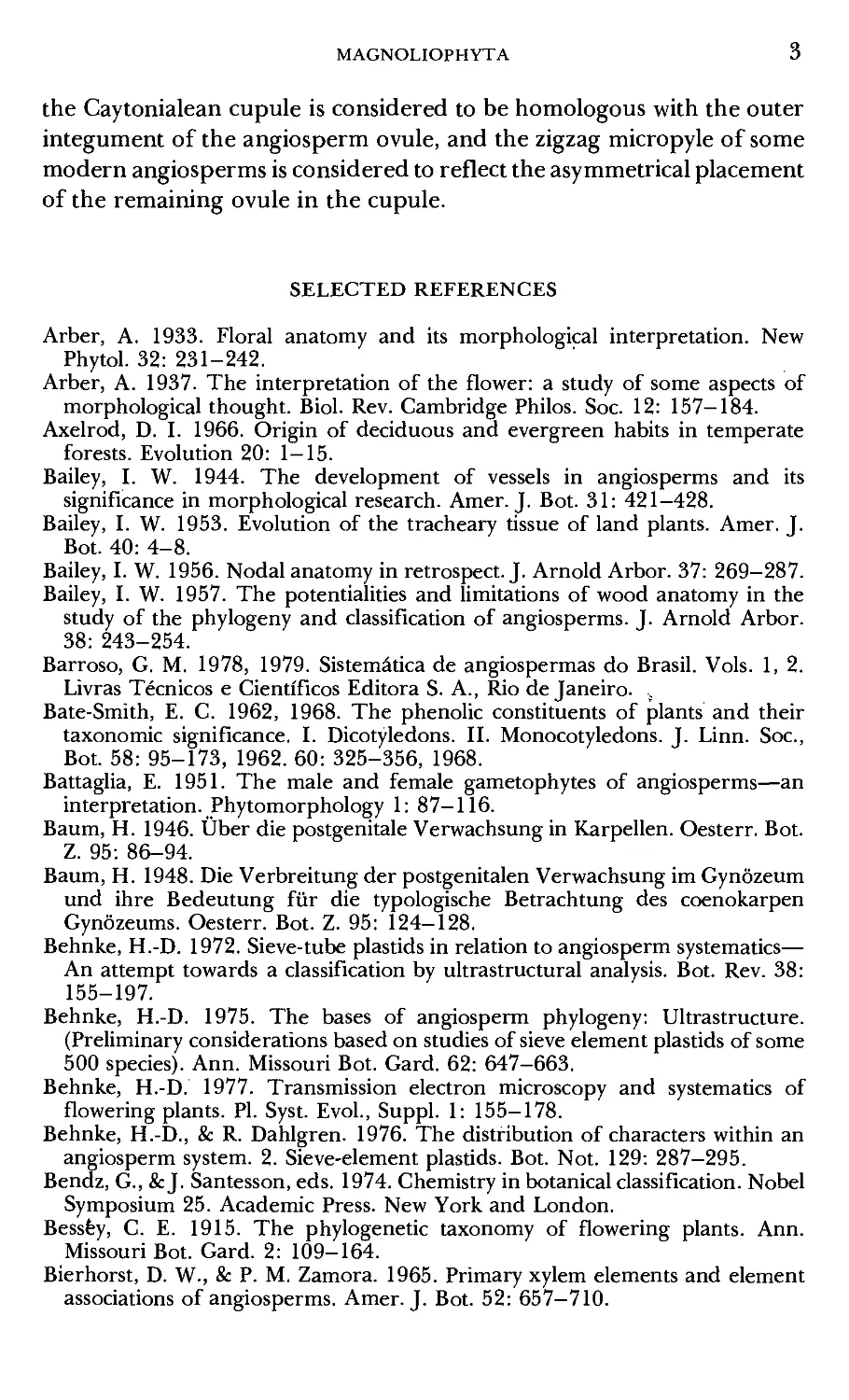
SELECTED REFERENCES
Arber, A. 1933. Floral anatomy and its morphological interpretation. New
Phytol. 32: 231-242.
Arber, A. 1937. The interpretation of the flower: a study of some aspects of
morphological thought. Biol. Rev. Cambridge Philos. Soc. 12: 157-184.
Axelrod, D. I. 1966. Origin of deciduous and evergreen habits in temperate
forests. Evolution 20: 1-15.
Bailey, I. W. 1944. The development of vessels in angiosperms and its
significance in morphological research. Amer. J. Bot. 31: 421-428.
Bailey, I. W. 1953. Evolution of the tracheary tissue of land plants. Amer. J.
Bot. 40: 4-8.
Bailey, I. W. 1956. Nodal anatomy in retrospect. J. Arnold Arbor. 37: 269-287.
Bailey, I. W. 1957. The potentialities and limitations of wood anatomy in the
study of the phylogeny and classification of angiosperms. J. Arnold Arbor.
38: 243-254.
Barroso, G. M. 1978, 1979. Sistematica de angiospermas do Brasil. Vols. 1, 2.
Livras Tecnicos e Cientificos Editora S. A., Rio de Janeiro. .
Bate-Smith, E. C. 1962, 1968. The phenolic constituents of plants and their
taxonomic significance. I. Dicotyledons. II. Monocotyledons. J. Linn. Soc,
Bot. 58: 95-173, 1962. 60: 325-356, 1968.
Battaglia, E. 1951. The male and female gametophytes of angiosperms—an
interpretation. Phytomorphology 1: 87-116.
Baum, H. 1946. Uber die postgenitale Verwachsung in Karpellen. Oesterr. Bot.
Z. 95: 86-94.
Baum, H. 1948. Die Verbreitung der postgenitalen Verwachsung im Gynozeum
und ihre Bedeutung fur die typologische Betrachtung des coenokarpen
Gynozeums. Oesterr. Bot. Z. 95: 124-128.
Behnke, H.-D. 1972. Sieve-tube plastids in relation to angiosperm systematics—
An attempt towards a classification by ultrastructural analysis. Bot. Rev. 38:
155-197.
Behnke, H.-D. 1975. The bases of angiosperm phylogeny: Ultrastructure.
(Preliminary considerations based on studies of sieve element plastids of some
500 species). Ann. Missouri Bot. Gard. 62: 647-663.
Behnke, H.-D. 1977. Transmission electron microscopy and systematics of
flowering plants. PI. Syst. Evol., Suppl. 1: 155-178.
Behnke, H.-D., & R. Dahlgren. 1976. The distribution of characters within an
angiosperm system. 2. Sieve-element plastids. Bot. Not. 129: 287-295.
Bendz, G., & J. Santesson, eds. 1974. Chemistry in botanical classification. Nobel
Symposium 25. Academic Press. New York and London.
Bessfey, C. E. 1915. The phylogenetic taxonomy of flowering plants. Ann.
Missouri Bot. Gard. 2: 109-164.
Bierhorst, D. W., & P. M. Zamora. 1965. Primary xylem elements and element
associations of angiosperms. Amer. J. Bot. 52: 657-710.

4
MAGNOLIOPHYTA
Bocquet, G. 1959 (1960). The campylotropous ovule. Phytomorphology 9:
222-227.
Bond, G. 1976. The results of the IBP survey of root-nodule formation in non-
leguminous angiosperms. In: P. S. Nutman, ed., Symbiotic nitrogen fixation
in plants, pp. 443-474. Intern. Biol. Programme 7. Cambridge Univ. Press.
London.
Bouman, F. 1971. The application of tegumentary studies to taxonomic and
phylogenetic problems. Ber. Deutsch. Bot. Ges. 84: 169-177.
Brenner, G. J. 1967. Early angiosperm pollen differentiation in the Albian to
Cenomanian deposits of Delaware (U.S.A.). Rev. Palaeobot. Palynol. 1:
219-227.
Brenner, G. J. 1976. Middle Cretaceous floral provinces and early migrations
of angiosperms. In: C. B. Beck, ed., Origin and early evolution of angiosperms,
pp. 23-47. Columbia Univ. Press. New York.
Brewbaker, J. 1967. The distribution and phylogenetic significance of binucleate
and trinucleate pollen grains in angiosperms. Amer. J. Bot. 54: 1069-1083.
Brown, W. H. 1938. The bearing of nectaries on the phylogeny of flowering
plants. Proc. Amer. Philos. Soc. 79: 549-595.
Cagnin, M. A. H., C. M. R. Gomes, O. R. Gottlieb, M. C. Marx, A. I. da Rocha,
M. F. das G. F. da Silva, & J. A. Temperini. 1977. Biochemical systematics:
Methods and principles. PI. Syst. Evol., Suppl. 1: 53-76.
Carlquist, S. 1969 (1970). Toward acceptable evolutionary interpretations of
floral anatomy. Phytomorphology 19: 332-362.
Carlquist, S. 1975. Ecological Strategies of Xylem Evolution. Univ. Calif. Press,
Berkeley.
Carlquist,. S. 1977. Ecological factors in wood evolution: A floristic approach.
Amer. J. Bot. 64: 887-896.
Carr, S. G. M., & D. J. Carr. 1961. The functional significance of syncarpy.
Phytomorphology 11: 249-256.
Chandler, M. E. J. 1954. Some Upper Cretaceous and Eocene fruits from
Egypt. Bull. Brit. Mus. (Nat. Hist.) Geol. 2(4): 147-187.
Chenery, E. M., & K. R. Sporne. 1976. A note on the evolutionary status of
aluminium-accumulators among dicotyledons. New Phytol. 76: 551—554.
Constance, L. 1964. Systematic botany—an unending synthesis. Taxon 13:
257-273.
Corner, E.J. H. 1946. Centrifugal stamens. J. Arnold Arbor. 27: 423-437.
Corner, E. J. H. 1949. The durian theory or the origin of the modern tree.
Ann. Bot. (London) II. 13: 367-414.
Corner, E. J. H. 1953, 1954. The durian theory extended. I, II, III.
Phytomorphology 3: 465-476, 1953. 4: 152-165, 263-274, 1954.
Crepet, W. L. 1979. Insect pollination: A paleontological perspective. BioScience
29: 102-108.
Crepet, W. L. 1979. Some aspects of the pollination biology of Middle Eocene
angiosperms. Rev. Palaeobot. Palynol. 27: 213-238.
Crete, P. 1964. L'embryogenie et son role dans les essais de classification
phylogenetique. Phytomorphology 14: 70-78.
Cronquist, A. 1963. The taxonomic significance of evolutionary parallelism.
Sida 1: 109-116.
Cronquist, A. 1965. The status of the general system of classification of
flowering plants. Ann. Missouri Bot. Gard. 52: 281-303.
Cronquist, A. 1969. On the relationship between taxonomy and evolution.
Taxon 18: 177-187.

MAGNOLIOPHYTA
5
Cronquist, A. 1975. Some thoughts on angiosperm phylogeny and taxonomy.
Ann. Missouri Bot. Gard. 62: 517-520.
Cronquist, A. 1977. On the taxonomic significance of secondary metabolites in
angiosperms. PI. Syst. Evol., Suppl. 1: 179-189.
Cronquist, A., A. Takhtajan, & W. Zimmermann. 1966. On the higher taxa of
Embryobionta. Taxon 15: 129-134.
Czaja, A. T. 1978. Starke und Starkespeicherung bei Gefasspflanzen. Versuch
einer Amylo-Taxonomie. Gustav Fischer Verlag. Stuttgart & New York.
Czaja, A. T. 1978. Structure of starch grains and classification of vascular plant
families. Taxon 27: 463-470.
Dahlgren, R. 1975. A system of classification of the angiosperms to be used to
demonstrate the distribution of characters. Bot. Not. 128: 119—147.
Dahlgren, R. 1975. The distribution of characters within an angiosperm system.
I. Some embryological characters. Bot. Not. 128: 181-197.
Dahlgren, R. 1977. A commentary on a diagrammatic presentation of the
angiosperms in relation to the distribution of character states. PI. Syst. Evol.
Suppl. 1: 253-283.
Dahlgren, R. M. T. 1980. A revised system of classification of the angiosperms.
J. Linn. Soc, Bot. 80: 91-124.
Davis, G. L. 1966. Systematic embryology of the angiosperms. Wiley & Sons.
New York.
Davis, P. H., & V. H. Heywood. 1963. Principles of angiosperm taxonomy.
Oliver & Boyd. Edinburgh & London.
Dickison, W. C. 1975. The bases of angiosperm phylogeny: Vegetative anatomy.
Ann. Missouri Bot. Gard. 62: 590-620.
Dilcher, D. L. 1971. A revision of the Eocene flora of southeastern North
America. Palaeobotanist 20: 7-18.
Dilcher, D. L. 1979. Early angiosperm reproduction: An introductory report.
Rev. Palaeobot. Palynol. 27: 291-328.
Douglas, G. 1944, 1957. The inferior ovary. I & II. Bot. Rev. 10: 125-186,
1944. 23: 1-46, 1957.
Doyle, J. A. 1969. Cretaceous angiosperm pollen of the Atlantic coastal plain
and its evolutionary significance. J. Arnold Arbor. 50: 1-35.
Doyle, J. A. 1978. Origin of angiosperms. Ann. Rev. Ecol. Syst. 9: 365-392.
Doyle, J. A., & L. J. Hickey. 1976. Pollen and leaves from the Mid-Cretaceous
Potomac Group and their bearing on early angiosperm evolution. In: C. B.
Beck, ed., Origin and early evolution of angiosperms, pp. 139-206. Columbia
Univ. Press. New York.
Doyle, J. A., M. Van Campo, & B. Lugardon. 1975. Observations on exine
structure of Eucommiidites and Lower Cretaceous angiosperm pollen. Pollen
& Spores 17: 429-486.
Dunn, B. D., G. K. Sharma, & C. C. Campbell. 1965. Structural patterns of
dicotyledons and monocotyledons. Amer. Midi. Naturalist 74: 185-195.
Eames, A. J. 1931. The vascular anatomy of the flower with refutation of the
theory of carpel polymorphism. Amer. J. Bot. 18: 147-188.
Eames, A.J. 1951. Again: "The new morphology." New Phytol. 50: 17-35.
Eames, A. J. 1961. Morphology of the angiosperms. McGraw-Hill. New
York.
Eckardt, Th. 1957. Vergleichende Studien fiber die morphologischen Bezie-
hungen zwischen Fruchtblatt, Samenanlage und Bliitenachse bei einigen
Angiospermen, zugleich als kritische Beleuchtung der "New Morphology."
Neue Hefte Morphol. 3: 1-91.

6
MAGNOLIOPHYTA
Eckardt, Th. 1963. Zum Bliltenbau der Angiospermen im Zusammenhang mit
ihrer Systematik. Ber. Deutsch. Bot. Ges. 76: (38)-(49).
Eckardt, Th. 1964. Das Homologierproblem und Falle strittiger Homologien.
Phytomorphology 14: 79-92.
Eckert, G. 1966. Entwicklungsgeschichtliche und bliltenanatomische Untersu-
chungen zum Problem der Obdiplostemonie. Bot. Jahrb. Syst. 85: 523-604.
Ehrendorfer, F. 1970. Chromosomen, Verwandtschaft und Evolution tropischer
Holzpflanzen, I. Allgemeine Hinweise. Oesterr. Bot. Z. 118: 30-37.
Ehrendorfer, F. 1977. New ideas about the early differentiation of angiosperms.
PI. Syst. Evol., Suppl. 1: 227-234.
Ehrlich, P. R., & P. H. Raven. 1964. Butterflies and plants: a study in
coevolution. Evolution 18: 586-608.
Erdtman, G. 1952. Pollen morphology and plant taxonomy. An introduction to
palynology. I. Angiosperms. Almqvist & Wiksell. Stockholm-
Esau, K., V. I. Cheadle, & E. M. Gifford. 1953. Comparative structure and
possible trends of specialization of the phloem. Amer. J. Bot. 40: 9-19.
Eyde, R. H. 1971. Evolutionary morphology: distinguishing ancestral structure
from derived structure in flowering plants. Taxon 20: 63—73.
Eyde, R. H. 1975. The bases of angiosperm phylogeny: Floral anatomy. Ann.
Missouri Bot. Gard. 62: 521-537.
Fahn, A. 1952. On the structure of floral nectaries. Bot. Gaz. 113: 464-470.
Fahn, A. 1953. The topography of the nectary in the flower and its phyloge-
netical trend. Phytomorphology 3: 424-426.
Fairbrothers, D. E. 1977. Perspectives in plant serotaxonomy. Ann. Missouri
Bot. Gard. 64: 147-160.
Fraenkel, G. 1959. The raison d'etre of secondary plant substances. Science
129: 1466-1470.
Fraenkel, G. 1969. Evaluation of our thoughts on secondary plant substances.
Entomol. Exp. Appl. 12: 473-486.
Frohne, D., & U.Jensen. 1973. Systematik des Pflanzenreichs. Gustav Fischer
Verlag. Jena. Ed. 2 in 1979.
Gaussen, H. 1946. Les gymnospermes actuelles et fossiles. Fascicule III. Chapitre
V. Les autres Cycadophytes. L'origine cycadophytique des Angiospermes. pp.
1-26. [= Tom II, Vol. 1, Fasc. Ill of Trav. Lab. Forest. Toulouse.]
Gerassimova-Navashina, H. 1961. Fertilization and events leading up to
fertilization, and their bearing on the origin of angiosperms. Phytomorphology
11: 139-146.
Gibbs, R. D. 1974. Chemotaxonomy of flowering plants. 4 volumes. McGill-
Queen's Univ. Press. Montreal & London.
Gilmour, J. S. L., & S. M. Walters. 1963. Philosophy and classification. Vistas
Bot. 4: 1-22.
Gornall, R. J., B. A. Bohm, & R. Dahlgren. 1979. The distribution of flavonoids
in the angiosperms. Bot. Not. 132: 1-30.
Gottsberger, G. 1974. The structure and function of the primitive angiosperm
flower—a discussion. Acta Bot. Neerl. 23: 461-471.
Gottsberger, G. 1977. Some aspects of beetle pollination in the evolution of
flowering plants. PI. Syst. Evol., Suppl. 1: 211-226.
Grant, V. 1950. The protection of ovules in flowering plants. Evolution 4:
179-201.
Gray, J. 1960. Temperate pollen genera in the Eocene (Claiborne) flora,
Alabama. Science 132: 808-810.
Hallier, H. 1901. Uber die Verwandtschaftsverhaltnisse der Tubifloren und

MAGNOLIOPHYTA
7
Ebenalen, den polyphyletischen Ursprung der Sympetalen und Apetalen und
die Anordnung der Angiospermen ilberhaupt. Abh. Naturwiss. Naturwiss.
Verein Hamburg 16(2,2): 3-112.
Hallier, H. 1908. Uber Juliania, eine Terebinthaceen-Gattung mit Cupula, und
die wahren Stammeltern der Katzchenbliltler. Neue Beitrage zur Stammes-
geschichte der Dicotyledonen. Beih. Bot. Centralbl. 23(2): 81-265.
Hallier, H. 1912. L'origine et le systeme phyletique des angiospermes exposes
a l'aide de leur arbre genealogique. Arch. Neerl. Sci. Exact. Nat., Ser. 3, B.
1: 146-234.
Hamann, U, 1977. Uber Konvergenzen bei embryologischen Merkmalen der
Angiospermen. Ber. Deutsch. Bot. Ges. 90: 369-384^
Harborne, J. B. 1977. Flavonoids and the evolution of the angiosperms.
Biochem. Syst. Ecol. 5: 7-22.
Hardin, G. 1960. The competitive exclusion principle. Science 131: 1292-1297.
Hard, D. 1962. Die morphologische Natur und die Verbreitung des Apicalsep-
tums. Analyse einer bisher unbekannten Gestaltungsmoglichkeit des Gynoe-
ceums. Beitr. Biol. Pflanzen 37: 241-330.
Hegnauer, R. 1963-1973. Chemotaxonomie der Pflanzen. 2. Monocotyledo-
neae, 1963. 3. Dicotyledoneae: Acanthaceae-Cyrillaceae, 1964. 4. Dicotyle-
doneae: Daphniphyllaceae-Lythraceae, 1966. 5. Dicotyledoneae: Magnoli-
aceae-Quiinaceae, 1969. 6. Dicotyledoneae: Rafflesiaceae-Zygophyllaceae,
1973. Birkhouser. Basel & Stuttgart.
Hegnauer, R. 1969. Chemical evidence for the classification of some plant taxa.
In: Harborne, J. B., & T. Swain, eds., Perspectives in Phytochemistry, pp.
121-138. Academic Press. London & New York.
Hegnauer, R. 1971. Pflanzenstoffe und Pflanzensystematik. Naturwissenschaf-
ten 58: 585-598.
Hegnauer, R. 1973. Die cyanogenen Verbindungen der Liliatae und Magnolia-
tae-Magnoliidae: Zur systematischen Bedeutung des Merkmals der Cyano-
genese. Biochem. Syst. 1: 191-197.
Hegnauer, R. 1977. Cyanogenic compounds as systematic markers in Trach-
eophyta. PI. Syst. Evol., Suppl. 1: 191-210.
Heslop-Harrison, Y., & K. R. Shivanna. 1977. The receptive surface of the
angiosperm stigma. Ann. Bot. (London) II. 41: 1233-1258.
Hickey, L. J., & J. A. Doyle. 1977. Early Cretaceous fossil evidence for
angiosperm evolution. Bot. Rev. 43: 3-104.
Howard, R. A. 1962. The vascular structure of the petiole as a taxonomic
character. In: Advances in horticultural sciences and their applications, 3:
7-13. Pergamon Press. New York.
Howard, R. A. 1970. Some observations on the nodes of woody plants with
special reference to the problem of the 'split-lateral' versus the 'common gap.'
In: N. K. B. Robson, D. F. Cutler, & M. Gregory, eds., New research in plant
anatomy, pp. 195-214. Suppl. 1, J. Linn. Soc, Bot. 63. Academic Press.
London & New York.
Hughes, N. F. 1976. Cretaceous paleobotanic problems. In: C. B. Beck, ed.,
Origin and early evolution of angiosperms, pp. 11-22. Columbia Univ. Press.
New York.
Hughes, N. F. 1977. Palaeo-succession of earliest angiosperm evolution. Bot.
Rev. 43: 105-127.
Hutchinson, J. 1973. The families of flowering plants arranged according to a
new system based on their probable phylogeny. 3rd ed. Clarendon Press.
Oxford.

8
MAGNOLIOPHYTA
Jager, I. 1961. Vergleichend-morphologische Untersuchungen des Gefassbilndel-
systems peltater Nektar- und Kronblatter sowie verbildeter Staubblatter.
Oesterr. Bot. Z. 108: 433-504.
Jarzen, D. M., & G. Norris. 1975. Evolutionary significance and botanical
relationships of Cretaceous angiosperm pollen in the western Canadian
interior. Geoscience & Man 11: 47-60.
Jeffrey, C. 1968. An introduction to plant taxonomy. J. & A. Churchill Ltd.
London. J
Jensen, S. R., B. J. Nielsen, & R. Dahlgren. 1975. Iridoid compounds, their
occurrence and systematic importance in the angiosperms. Bot. Not. 128:
148-180.
Joshi, A. C. 1938. Systematic distribution of the Fritillaria type of embryo sac
and the mono- and polyphyletic origin of angiosperms. Chron. Bot. 4:
507-508.
Kaussmann, B. 1941. Vergleichende Untersuchungen fiber die Blattnatur der
Kelch-, Blumen- und Staubblatter. Bot. Arch. 42: 503-572.
Kelley, A. P. 1972. Mycotrophic nutrition. Instant Print, Henkel Press.
Woodstock, Virginia.
Krassilov, V. 1973. Mesozoic plants and the problem of angiosperm ancestry.
Lethaia6: 163-178.
Krassilov, V. 1975. Dirhopalostachyaceae—A new family of proangiosperms
and its bearing on the problem of angiosperm ancestry. Palaeontographica,
Abt. B, 153: 100-110.
Krassilov, V. A. 1977. The origin of angiosperms. Bot. Rev. 43: 143-176.
Kubitzki, K. 1972. Probleme der Grossystematik der Bliltenpflanzen. Ber.
Deutsch. Bot. Ges. 85: 259-277.
Kubitzki, K. 1977. Some aspects of the classification and evolution of higher
taxa. PI. Syst. Evol, Suppl. 1: 21-31.
Kuprianova, L. A. 1967. Apertures of pollen grains and their evolution in
angiosperms. Rev. Palaeobot. Palynol. 3: 73-80.
Kuprianova, L. A. 1969. On the evolutionary levels in the morphology of pollen
grains and spores. Pollen & Spores 11: 333-351.
Leinfellner, W. 1950. Der Bauplan des synkarpen Gynozeums. Oesterr. Bot. Z.
97: 403-436.
Leinfellner, W. 1954. Die petaloiden Staubblatter und ihre Beziehungen zu
den Kronblattern. Oesterr. Bot. Z. 101: 373-406.
Leins, P. 1964. Das zentripetale und zentrifugale Androeceum. Ber. Deutsch
Bot. Ges. 77: (22)-(26).
Leins, P. 1975. Die Beziehungen zwischen multistaminaten und einfachen
Androeceen. Bot. Jahrb. Syst. 96: 231-237.
Leppik, E. E. 1956. The form and function of numeral patterns in flowers.
Amer. J. Bot. 43: 445-455.
Levin, D. A. 1971. Plant phenolics: an ecological perspective. Amer. Naturalist
105: 157-181.
Levin, D. A. 1973. The role of trichomes in plant defense. Quart. Rev. Biol. 48:
3-15.
Lewis, W. H. 1977. Pollen exine morphology and its adaptive significance. Sida
7: 95-102.
Li, H. L., & J. J. Willaman. 1968. Distribution of alkaloids in angiosperm
phylogeny. Econ. Bot. 22: 239-252.
Lloyd, F. E. 1942. The carnivorous plants. Chronica Botanica 9. Waltham, Mass.

MAGNOLIOPHYTA
9
McNair, J. B. 1934. The evolutionary status of plant families in relation to some
chemical properties. Amer. J. Bot. 21: 427-452.
Maheshwari, P. 1950. An introduction to the embryology of the angiosperms.
McGraw-Hill. New York.
Maheshwari, P., & R. N. Kapil. 1966. Some Indian contributions to the
embryology of angiosperms. Phytomorphology 16: 239-291.
Malloch, D. W., K. A. Pirozynski, & P. H. Raven. 1980. Ecological and
evolutionary significance of mycorrhizal symbioses in vascular plants. Proc.
Natl. Acad. Sci. 77: 2113-2118.
Martin, A. C. 1946. The comparative internal morphology of seeds. Amer.
Midi. Naturalist 36: 513-660.
Martin, H. A. 1978. Evolution of the Australian flora and vegetation through
the Tertiary: evidence from the pollen. Alcheringa 2: 181-202.
Mata Rezende, M. A., & O. R. Gottlieb. 1973. Xanthones as systematic markers.
Biochem. Syst. 1: 111-118.
Melchior, H., ed. 1964. A. Engler's Syllabus der Pflanzenfamilien, Zwolfte
Auflage. II Band. Angiospermen. Gebriider Borntraeger. Berlin.
Merxmuller, H. 1967. Chemotaxonomie? Ber. Deutsch. Bot. Ges. 80: 608-620.
Merxmuller, H. 1972. Systematic botany—an unachieved synthesis. J. Linn.
Soc, Biol. 4: 311-321.
Metcalfe, C. R. 1954. An anatomist's views on angiosperm classification. Kew
Bull. 1954: 427-440.
Metcalfe, C. R. 1967. Distribution of latex in the plant kingdom. Econ. Bot. 21:
115-127.
Mulcahy, D. L. 1979. The rise of the angiosperms: a genecological factor.
Science 206: 20-23.
Muller, J. 1970. Palynological evidence on early differentiation of angiosperms.
Biol. Rev. Cambridge Philos. Soc. 45: 417-450.
Muller, J. 1979 (1980). Form and function in angiosperm pollen. Ann. Missouri
Bot. Gard. 66: 593-632.
Muller, J. 1981. Fossil pollen records of extant angiosperms. Bot. Rev. 48: in press.
Nair, P. K. K. 1968. A concept on pollen evolution in the "primitive"
angiosperms. J. Palyn. (Lucknow) 4: 15-20.
Nemejc, F. 1956. On the problem of the origin and phylogenetic development
of the angiosperms. Acta Mus. Natl. Prag. 12B: 65-144.
Novak, F. A. 1961. Vy§§i rostliny. Ceskoslovenska Academie v6d. Praha.
Nowicke, J. W., & J. J. Skvarla. 1979 (1980). Pollen morphology: The potential
influence in higher order systematics. Ann. Missouri Bot. Gard. 66: 633-700.
Pacltova, B. 1977. Cretaceous angiosperms of Bohemia—Central Europe. Bot.
Rev. 43: 128-142.
Page, V. M. 1967, 1968, 1970. Angiosperm wood from the Upper Cretaceous
of central Calif. Parts I, II, III. Amer. J. Bot. 54: 510-514, 1967. 55: 168-172,
1968. 57: 1139-1144, 1970.
Palser, B. F. 1975. The bases of angiosperm phylogeny: Embryology. Ann.
Missouri Bot. Gard. 62: 621-646.
Pant, D. D., & B. Mehra. 1964. Nodal anatomy in retrospect. Phytomorphology
14: 384-387.
Parkin, J. 1951. The protrusion of the connective beyond the anther and its
bearing on the evolution of the stamen. Phytomorphology 1: 1-8.
Parkin, J. 1952. The unisexual flower—a criticism. Phytomorphology 2: 75-79.
Parkin, J. 1953. The durian theory—a criticism. Phytomorphology 3: 80-88.

10
MAGNOLIOPHYTA
Parkin, J. 1955. A plea for a simpler gynoecium. Phytomorphology 5: 46-57.
Parkin, J. 1957. The unisexual flower again—a criticism. Phytomorphology 7:
7-9.
Percival, M. S. 1961. Types of nectar in the angiosperms. New Phytol. 60:
235-281.
Pijl, L. van der. 1955. Sarcotesta, aril, pulpa and the evolution of the angiosperm
fruit. I/I I. Proc. K. Nederl. Akad. Wetens., Amsterdam, C, 58: 154-171;
307-312. C
Pijl, L. van der. 1960, 1961. Ecological aspects of flower evolution. I. Phyletic
evolution. II. Zoophilous flower classes. Evolution 14: 403-416, 1960. 15:
44-59, 1961.
Pijl, L. van der. 1966. Ecological aspects of fruit evolution. A functional study
of dispersal organs. Proc. K. Nederl. Akad. Wetens. Amsterdam, C, 69:
597-640.
Plouvier, V., & J. Favre-Bonvin. 1971. Les irido'ides et seco-irido'ides: Repartition,
structure, proprietes, biosynthese. Phytochemistry 10: 1697-1722.
Puri, V. 1951. The role of floral anatomy in the solution of morphological
problems. Bot. Rev. 17: 471-553.
Puri, V. 1952. Floral anatomy and inferior ovary. Phytomorphology 2: 122-129.
Puri, V. 1952. Placentation in angiosperms. Bot. Rev. 18: 603-651.
Puri, V. 1961. The classical concept of angiosperm carpel: a reassessment. J.
Indian Bot. Soc. 40: 511-524.
Puri, V. 1970. Anther sacs and pollen grains: some aspects of their structure
and function. J. Palyn. (Lucknow) 6: 1-17.
Raven, P. H. 1975- The bases of angiosperm phylogeny: Cytology. Ann.
Missouri Bot. Gard. 62: 724-764.
Raven, P. H., & D. I. Axelrod. 1974. Angiosperm biogeography and past
continental movements. Ann. Missouri Bot. Gard. 61: 539-673.
Rickett, H. W. 1944. The classification of inflorescences. Bot. Rev. 10: 187-231.
Rohweder, O. 1973. Angiospermen-Morphologie—Ergebnis oder Ausgang-
spunkt phylogenetischer Hypothesen? Bot. Jahrb. Syst. 93: 372-403.
Romeike, A. 1978. Tropane alkaloids—occurrence and systematic importance
in angiosperms. Bot. Not. 131: 85-96.
Samylina, V. A. 1968. Early Cretaceous angiosperms of the Soviet Union based
on leaf and fruit remains. J. Linn. Soc, Bot. 61: 207-218.
Sattler, R. 1974. A new approach to gynoecial morphology. Phytomorphology
24: 22-34.
Sattler, R. 1975. Organogenesis of flowers. A photographic text-atlas. Univ.
Toronto Press.
Sattler, R. 1978. "Fusion" and "continuity" in floral morphology. Notes Roy.
Bot. Gard. Edinburgh 36: 397-405.
Savile, D. B. O. 1979. Fungi as aids in higher plant classification. Bot. Rev. 45:
377-503.
Schmid, R. 1972. Floral bundle fusion and vascular conservatism. Taxon 21:
429-446.
Schoonhover, L. M. 1972. Secondary plant substances and insects. In: V. C.
Runeckles & T. C. Tso, eds., Recent advances in phytochemistry 5: 197-224.
Academic Press. New York.
Schultes, R. E. 1976. Indole alkaloids in plant hallucinogens. PI. Med. 29:
330-342.
Schuster, R. M. 1972. Continental movements, "Wallace's Line" and Indoma-

MAGNOLIOPHYTA
11
layan-Australasian dispersal of land plants: Some eclectic concepts. Bot. Rev.
HH: 3-86.
Schuster, R. M. 1976. Plate tectonics and its bearing on the geographical origin
and dispersal of angiosperms. In: C. B. Beck, ed., Origin and early evolution
of angiosperms, pp. 48-138. Columbia Univ. Press. New York.
Sell, Y. Tendances evolutives parmi les complexes inflorescentiels. Rev. Gen.
Bot. 83: 247-267.
Smith, A. C. 1967. The presence of primitive angiosperms in the Amazon Basin
and its significance in indicating migrational routes. Atas do Simposio sobre
a Biota Amazonica, vol. 4 (Botanica): 37-59.
Smith, D. L. 1964. The evolution of the ovule. Biol. Rev. 39: 137-159.
Solbrig, O. T. 1966. Rol de polinizacion zoofila en la evolution de las angios-
permas. Bol. Soc. Argent. Bot. 11: 1-18.
Sporne, K. R. 1949. A new approach to the problem of the primitive flower.
New Phytol. 48: 259-276.
Sporne, K. R. 1954. A note on nuclear endosperm as a primitive character
among dicotyledons. Phytomorphology 4: 275-278.
Sporne, K. R. 1954. Statistics and the evolution of dicotyledons. Evolution 8:
55-65.
Sporne, K. R. 1956. The phylogenetic classification of the angiosperms. Biol.
Rev. Cambridge Philos. Soc. 31: 1-29.
Sporne, K. R. 1958. Some aspects of floral vascular systems. Proc. Linn. Soc.
London 169: 75-84.
Sporne, K. R. 1969. The ovule as an indicator of evolutionary status in
angiosperms. New Phytol. 68: 555-566.
Sporne, K. R. 1976. Character correlations among angiosperms and the
importance of fossil evidence in assessing their significance. In: C. B. Beck,
ed., Origin and early evolution of angiosperms, pp. 312-329. Columbia Univ.
Press. New York.
Sporne, K. R. 1977. Some problems associated with character correlations. PI.
Syst. Evol., Suppl. 1: 33-51.
Stace, C. A. 1965. Cuticular studies as an aid to plant taxonomy. Bull. Brit.
Mus. (Nat. Hist.), Bot. 4(1): 1-78.
Stebbins, G. L. 1951. Natural selection and differentiation of angiosperm
families. Evolution 5: 299-324.
Stebbins, G. L. 1965. The probable growth habit of the earliest flowering plants.
Ann. Missouri Bot. Gard. 52: 457-468.
Stebbins, G. L. 1970. Transference of function as a factor in the evolution of
seeds and their accessory structures. Israel J. Bot. 19: 59-70.
Stebbins, G. L. 1973. Evolutionary trends in the inflorescence of angiosperms.
Flora 162: 501-528.
Stebbins, G. L. 1974. Flowering plants: Evolution above the species level.
Belknap Press of Harvard Univ. Press. Cambridge, Mass.
Stebbins, G. L. 1976. Seeds, seedlings, and the origin of angiosperms. In: C. B.
Beck, ed., Origin and early evolution of angiosperms, pp. 300—311. Columbia
Univ. Press. New York.
Swain, T. 1978. Plant-animal coevolution: a synoptic view of the Paleozoic and
Mesozoic. In: J. B. Harborne, ed., Biochemical aspects of plant-animal
coevolution, pp. 3-19. Academic Press. London.
Swamy, B. G. L., & K. Periasamy. 1964. The concept of the conduplicate carpel.
Phytomorphology 14: 319-327.

12
MAGNOLIOPHYTA
J
Takhtajan, A. L., 1958 (1954). Origins of the angiospermous plants. Translated
by Olga Gankin. Amer. Inst. Biol. Sci. Washington, 1958. (Original in Russian
published by Soviet Sciences Press, 1954.)
Takhtajan, A. 1959. Die Evolution der Angiospermen. Transl. to German by
W. Hoppner. Gustav Fischer Verlag. Jena.
Takhtajan, A. 1968. Classification and phylogeny, with special reference to the
flowering plants. Proc. Linn. Soc. London 179: 221-227.
Takhtajan, A. 1969. Flowering plants: Origin and dispersal. Transl. from the
Russian by C. Jeffrey, Kew. Oliver & Boyd. Edinburgh.
Takhtajan, A. 1972. Patterns of ontogenetic alterations in the evolution of
higher plants. Phytomorphology 22: 164-171.
Takhtajan, A. 1973. Evolution und Ausbreitung der Bliitenpflanzen. Gustav
Fischer Verlag. Jena.
Takhtajan, A. 1976. Neoteny and the origin of flowering plants. In: C. B. Beck,
ed., Origin and early evolution of angiosperms, pp. 207-219. Columbia Univ.
Press. New York.
Takhtajan, A. 1980. Outline of the classification of flowering plants (Magno-
liophyta). Bot. Rev. 46: 225-359.
ter Welle, J. H. 1976. Silica grains in woody plants of the neotropics, especially
Surinam. Leiden Bot. Ser. 3: 107-142.
Thorne, R. F. 1958. Some guiding principles in angiosperm phylogeny. Brittonia
10: 72-77.
Thorne, R. F. 1963. Some problems and guiding principles of angiosperm
phylogeny. Amer. Naturalist 97: 287-305.
Thorne, R. F. 1968. Synopsis of a putatively phylogenetic classification of the
flowering plants. Aliso 6(4): 57-66.
Thorne, R. F. 1973. Major disjunctions in the geographic ranges of seed plants.
Quart. Rev. Biol. 47: 365-411.
Thorne, R. F. 1975. Angiosperm phylogeny and geography. Ann. Missouri Bot.
Gard. 62: 362-367.
Thorne, R. F. 1976. A phylogenetic classification of the Angiospermae. In: M.
K. Hecht, W. C. Steere, & B. Wallace, eds., Evolutionary biology, vol. 9, pp.
35-106. Plenum Press. New York & London.
Thorne, R. F. 1977. Some realignments in the Angiospermae. PI. Syst. Evol.,
Suppl. 1: 299-319.
Thorne, R. F. 1978. Plate tectonics and angiosperm distribution. Notes Roy.
Bot. Gard. Edinburgh 36: 297-315.
Tippo, O. 1946. The role of wood anatomy in phylogeny. Amer. Midi. Naturalist
36: 362-372.
Troll, W. 1932. Morphologie der schildformigen Blatter. Planta 17: 153-314.
Van Campo, M. 1976. Patterns of pollen morphological variation within taxa.
In: I. K. Ferguson & J. Muller, eds., The evolutionary significance of the
exine, pp. 125-137. (Linn. Soc. Symp. Ser. No. 1). Academic Press. London
& New York.
Vavilov, N. I. 1922. The law of homologous series in variation. J. Genetics 12:
47-89.
Vuilleumier, B. S. 1967. The origin and evolutionary development of heterostyly
in the angiosperms. Evolution 21: 210-226.
Wagenitz, G. 1975. Bliltenreduktion als ein zentrales Problem der Angiosper-
men-Systematik. Bot. Jahrb. Syst. 96: 448-470.
Walker, J. W. 1976. Evolutionary significance of the exine in the pollen of

MAGNOLIOPHYTA
13
primitive angiosperms. In: I. K. Ferguson & J. Muller, eds., The evolutionary
Niffiiilkance of the exine, pp. 481-498. (Linn. Soc. Symp. Ser. No. 1).
Academic Press. London & New York.
Walker, J. W., & J. A. Doyle. 1975. The bases of angiosperm phylogeny:
l'alynology. Ann. Missouri Bot. Gard. 62: 664-723.
Weberling, F. 1958. Die Bedeutung blattmorphologischer Untersuchungen fur
die Systematik (dargestellt am Beispiel der Unterblattbildungen). Bot. Jahrb.
Syst. 77: 458-468.
Weberling, F. 1965. Typology of inflorescences. J. Linn. Soc, Bot. 59: 215—221.
Weberling, F. 1975. Uber die Beziehungen zwischen Scheidenlappen und
Stipeln. Bot. Jahrb. Syst. 96: 471-491.
Wernham, H. F. 1912. Floral evolution: with particular reference to the
sympetalous dicotyledons. New Phytol. 11: 373-397.
Whitehead, D. R. 1969. Wind pollination in the angiosperms: evolutionary and
environmental considerations. Evolution 23: 28-35.
Willaman, J. J., & B. G. Schubert. 1961. Alkaloid-bearing plants and their
contained alkaloids. Techn. Bull. U.S.D.A. 1234: 1-287.
Willis, J. C. 1973. A dictionary of the flowering plants and ferns. 8th ed. Rev.
by H. K. Airy Shaw. Univ. Press. Cambridge.
Wilson, C. L., & T. Just. 1939. The morphology of the flower. Bot. Rev. 5:
97-131.
Wunderlich, R. 1959. Zur Frage der Phylogenie der Endospermtypen bei den
Angiospermen. Oesterr. Bot. Z. 106: 203-293.
Ara6a6«H, B. III. 1973. IlajmHOJiorHfl h npoHCxoxmeinie noKpuroceMeHHUx. B
c6.: Mopepojionui iiijjimjm h cnop coBpeMeHHbix pacreHHH. Tpyflbi III
Me»myHapoflHoH IlaJiHHOjiorHHecKOH KoiHpepeimHH. CCCP, Hoboch6hpck,
1971: 7-10 H3fl. Hayica, JlemiHrpaflCKoe OTflejiemie. JlemiHrpafl.
Eyiii, H. A. 1935. CncTeMaTHKa bmchihx pacTemiH. H3flainie Tperbe. 1959.
TocyflapcTBeHHoe yHe6Ho-neflarorHHecicoe H3fl. MnHHcrepcTBa IIpocBein-
emm P.C.*.C.P. MocKBa.
BaxpaMeeB, B. A., & B. A. KpacmioB. 1979. PenpoflyKTHBHbie opram>i
i^BeTKOBbix H3 Ajn>6a Ka3axcTaHa. IlajieoHTOji. >K. 1979: 121-128.
BHHorpa^oB, H. C. 1958. CoicpameHHoeMjioaceHHechctcmij noKpuToceMeHHMx.
IIpo6ji. Bot., MocKBa-JIeHHHrpafl 3: 9-66.
KapTauioBa, H. H. 1961. O bo3hhkhobchhh HeicrapiDiKOB b npoqecce
ojiHroMepH3ai(HH nacreS ijBeTica. B c6.: Mop(poreHe3 pacreHHH 2: 511-515.
Hafl. MocKOBCKoro Yhhb.
Ko3o-IIojmhckhh, B. M. 1922. BBeflemie b (pHjioreHeTHHecicyio CHCTeMaTHKy
bmchihx pacreHHH. BopoHeac.
KopfliOM, E. JI. 1978. SBojiioqHOHHaa qHTo3M6pHOjioraa noKpbrroceMeHHMx
pacTeHHH. KneB "HayKora JJyMica."
KynpaaHOBa, JI. A. 1966. AnepTypbi nujibueBbix 3epeH h hx 3Bojik>uh» y
noKpbiToceMeHHbix pacTeHHH. B c6.: 3HaneHHe nanHHOjiorHHecicoro aHaJiH3a
ftjia CTpaTHrpa4)HH h naneo(pjiopHCTHKH: 7-14 H3fl. Hayica. MocKBa.
IlepByxHHa, H. B. 1967. OnbDiemie nepBHHHMx noKpbiToceMeHHbix h 3Bojik>l(hh
cnoco6oB onwjieHHa. Bot. >K. 52: 157-188.
IlepByxHHa, H. B. 1970. IIpo6jieMM Mopepojionra h 6HOJiorHH ijBeTKa. H3fl.
Hayica, JlemiHrpaflCKoe OTfleJiemie. JlemiHrpafl.

14
MAGNOLIOPHYTA
IIoftKySHaa-ApHojibflH, B. A. 1958. 3HaneHHe 3M6pH0jioraHecKHx HCCJiefloBaHHH
ftjia nocTpoemra (pHjioreHeTHHecKoii chctcmm noKpMToceMeHHbix pacTemiH.
B c6.: IIpo6jieMM BoTaHHKH. III. 196-247. H3«. AH CCCP, MocKBa—JleH-
HHrpafl.
IIoflflySHaa-ApHOjibflH, B. A. 1964. 06maa 3M6pHojionra noKpMToceMeHHbix
pacTeHHH. H3fl. Hayica. MocKBa.
TaxTajpKHH, A. JI. 1946. 06 sbojhoibiohhoh reTepoxpoHHH npH3HaKoB. floo.
AH Apmhhckoh CCP, 5: 79-86.
TaxTafl5KHH, A. JI. 1964. Ochobm sbojiiohhohhoh Mopepojionni noKpMTo-
ceMeHHbix. H3fl. HayKa, MocKBa—JlemiHrpafl.
TaxTafl^KHH, A. JI. 1966. CncTeMa h (pHJioremra i^bctkopmx pacTeHHH. H3fl.
HayKa, MocKBa—JlemiHrpafl.
TepexHH, 3. C. 1975. O cnoco6ax, HanpaBjieinoix h 3bojhoibiohhom 3HaneHHH
peflyKqHH 6HojiorHHecKHX cTpyKTyp. Eot. >K. 60: 1401-1412.
TpyTHBHipcH, H. B. 1965. IIpo6jieMa Prephanerogamae h Bonpoc 06 sbojhoibih
ceMeH. B c6.: IIpo6jieMM 3>HJioremiH PacTeHHH. Tpyflu Mockobck. o6m. ncn.
npnp. 13: 43-51.
4>eflopoB, Ah. A., peflaicrop. 1969. XpoMocoMHbie nncjia HBeTKoBbix pacTeHHH.
H3fl. HayKa, JlemiHrpaflCKoe OrnejieHHe. Jlemmrpafl.
flKOBJieB, M. C. 1958. IIpHHqHm.1 BMflejieHHH OCHOBHMX 3M6pHOHaJIbHMX THnoB
h hx 3HaneHne ftjia (pHJioremra noKpMToceMeHHbix. IIpo6ji. Bot. 3: 168-195.
HqeHKo-XMejieBCKHH, A. A. 1958. IIpoHcxoxmeHHe noKpMToceMeHHbix no
flaHHbiM BHyipeHHen Mopepojionra hx BereTaTHBHux opraHOB. Bot. >K. 43:
365-380.

CLASS MAGNOLIOPSIDA

Class MAGNOLIOPSIDA
Cronquist, Takhtajan & Zimmermann,
1966,
the Dicotyledons
Plants woody or herbaceous, the woody forms and many of the
herbaceous ones with typical secondary growth in the stems and roots
(the cambium producing xylem toward the inside and phloem toward
the outside); mature root-system either primary, or adventitious, or
both; vascular bundles of the stem, in herbaceous forms, open (i.e.,
with a cambial layer between the xylem and phloem) or less often
closed, typically arranged in a ring that encloses a pith, seldom in 2 or
more rings or scattered; vessels commonly well developed in the roots,
stems, and leaves, but wanting in some archaic families and in some
reduced ones; plastids of the sieve tubes without proteinaceous
inclusions, or less often with proteinaceous inclusions that are not cuneate.
Leaves typically net-veined, most commonly with a petiole and an
expanded blade, only seldom with a well defined basal sheath; blade
typically.developing from the distal portion of the leaf-primordium and
expanding more or less simultaneously throughout its length. Flowers
with various sorts of nectaries, but without septal nectaries, or altogether
without nectaries; floral parts, when of definite number, typically borne
in sets of 5, less often 4, seldom 3 or other numbers (the carpels often
fewer); pollen-grains typically triaperturate or of triaperturate-derived
type, except in some of the more archaic families, which are uniaper-
turate; derived pollen-types include biaperturate, multiaperturate, and
inaperturate (or holoaperturate) forms; cotyledons 2, rarely 1, 3, or 4,
or rarely (some highly mycotrophic or parasitic forms) the embryo not
differentiated into parts.

18 MAGNOLIOPSIDA
Fig. 1.1 Flowering branch of Magnolia grandiflora, an evergreen species of the
southeastern United States. U.S. Forest Service photograph by W. D. Brush.
SELECTED REFERENCES
Balfour, E. E., & W. R. Philipson. 1962. The development of the primary
vascular system of certain dicots. Phytomorphology 12:110—143.
Barghoorn, E. S. 1940, 1941. The ontogenetic development and phylogenetic
specialization of rays in the xylem of dicotyledons. I. The primitive ray
structure. II. Modification of the multiseriate and uniseriate rays. Amer. J.
Bot. 27: 918-928, 1940. 28: 273-282, 1941. III. The elimination of rays.
Bull. Torrey Bot. Club 68: 317-325, 1941.
Bate-Smith, E. C, & C. R. Metcalfe. 1957. Leuco-anthocyanins. 3. The nature
and systematic distribution of tannins in dicotyledonous plants. J. Linn. Soc,
Bot. 55: 669-705.
Bonneman, J.-L. 1969. Le phloeme interne et le phloeme inclus des dicotyledones:
Leur histogenese et leur physiologic Rev. Gen. Bot. 76: 5-36.
Carlquist, S. 1962. A theory of paedomorphosis in dicotyledonous woods.
Phytomorphology 12: 30-45.

MAGNOLIOPSIDA
19
(!<>|)(i;iiid, H. F. 1957. Forecast of a system of the dicotyledons. Madrono 14:
1 -<).
Corner, E. J. H. 1976. The seeds of dicotyledons. 2 vols. Cambridge Univ.
l'rcss. Cambridge, England.
(Ironquist, A. 1957. Outline of a new system of families and orders of
dicotyledons. Bull. Jard, Bot. Etat 27: 13-40.
Fddliofen, E. 1933. Beitrage zur physiologischen Anatomie der nuptialen
Nektarien aus den Reihen der Dikotylen. Beih. Bot. Centralbl. 50(1): 459-634.
l'rci, E. 1955. Die Innervierung der floralen Nektarien dikotyler Pflanzen-
I'amilien. Ber. Schweiz. Bot. Ges. 65: 60-114.
l'Vost, F. H. 1930, 1931. Specialization in secondary xylem of dicotyledons. I.
()rigin of vessel. II. Evolution of end wall of vessel segment. III. Specialization
of'lateral wall of vessel segment. Bot. Gaz. 89: 67-94; 90: 198-212, 1930. 91:
88-96, 1931.
Gardner, R. O. 1977. Systematic distribution and ecological function of the
secondary metabolites of the Rosidae-Asteridae. Biochem. Syst. Ecol. 5:
29-35.
(lottwald, H. 1977. The anatomy of secondary xylem and the classification of
ancient dicotyledons. PI. Syst. Evol., Suppl. 1: 111-121.
Gundersen, A. 1950. Families of dicotyledons. Chronica Botanica Co. Waltham,
Mass.
Hess, R. W. 1950. Classification of wood parenchyma in dicotyledons. Trop.
Woods 96: 1-20.
Mickey, L. J. 1973. Classification of the architecture of dicotyledonous leaves.
Amer.J. Bot. 60: 17-33.
Kribs, D. A. 1935. Salient lines of structural specialization in the wood rays of
dicotyledons. Bot. Gaz. 96: 547-557.
Kribs, D. A. 1937. Salient lines of structural specialization in the wood
parenchyma of dicotyledons. Bull. Torrey Bot. Club 64: 177-187.
Kubitzki, K. 1969. Chemosystematische Betrachtungen zur Grossgleiderung
der Dicotylen. Taxon 18: 360-368.
Lebegue, A. 1952. Recherches embryogeniques sur quelques dicotyledones
dialypetales. Ann. Sci. Nat. Bot. ser. 11. 13: 1-160.
Leins, P. 1971. Das Androecium der Dikotylen. Ber. Deutsch. Bot. Ges. 84:
191-193.
Metcalfe, C. R., & L. Chalk. 1950. Anatomy of the dicotyledons; leaves, stem,
and wood in relation to taxonomy, with notes on economic uses. 2 vols.
Clarendon Press. Oxford.
Philipson, W. R. 1975. Evolutionary lines within the dicotyledons. New Zealand
J. Bot. 13: 73-91.
Philipson, W. R. 1977. Ovular morphology and the classification of dicotyledons.
PI. Syst. Evol., Suppl. 1: 123-140.
Sporne, K. R. 1975. A note on ellagitannins as indicators of evolutionary status
in dicotyledons. New Phytol. 75: 613-618.
Tiffney, B. H. 1977. Dicotyledonous angiosperm flower from the Upper
Cretaceous of Martha's Vineyard, Massachusetts. Nature 265: 136-137.
Weberling, F. 1953/55. Morphologische und entwicklungsgeschichtliche Unter-
suchungen fiber die Ausbildung des Unterblattes bei dikotylen Gewachsen.
Beitr. Biol. Pflanzen 32: 27-105.
Wheeler, E., R. A. Scott, & E. S. Barghoorn. 1977, 1978. Fossil dicotyledonous
woods from Yellowstone National Park. J. Arnold Arbor. 58: 280-306, 1977.
59: 1-25, 1978.

20
MAGNOLIOPSIDA
Young, D. J., & L. Watson. 1970. The classification of dicotyledons: a study of
the upper levels of the hierarchy. Austral. J. Bot. 18: 387-433.
SYNOPTICAL ARRANGEMENT OF THE SUBCLASSES OF MAGNOLIOPSIDA1
1 Plants relatively archaic, the flowers typically apocarpous, always
polypetalous or apetalous (but sometimes synsepalous) and
generally with an evident perianth, usually with numerous (sometimes
laminar or ribbon-shaped) stamens initiated in centripetal
sequence, the pollen-grains mostly binucleate and often
uniaperturate or of a uniaperturate-derived type;2 ovules bitegmic and
crassinucellar; seeds very often with a tiny embryo and copious
endosperm, but sometimes with a larger embryo and reduced or
no endosperm; cotyledons occasionally more than 2; plants very
often accumulating benzyl-isoquinoline or aporphine alkaloids,
but without betalains, iridoid compounds, or mustard oils, and
only seldom strongly tanniferous I. Magnoliidae.
1 Plants more advanced in one or more respects than the Magnoliidae;
pollen-grains triaperturate or of a triaperturate-derived type-
cotyledons not more than 2; stamens not laminar, generally with
well defined filament and anther; plants only rarely producing
benzyl-isoquinoline or aporphine alkaloids, but often with other
kinds of alkaloids, or tannins, or betalains, or mustard oils, or
iridoid compounds.
2 Flowers more or less strongly reduced and often unisexual, the
perianth poorly developed or wanting, the flowers often borne
in catkins, but never forming bisexual pseudanthia, and never
with numerous seeds on parietal placentas; pollen-grains often
porate and with a granular rather than columellar infratectal
structure, but also often of ordinary type ....II. Hamamelidae.
2 Flowers usually more or less well developed and with an evident
perianth, but if not so, then usually either grouped into bisexual
pseudanthia or with numerous seeds on parietal placentas, only
rarely with all of the characters of the Hamamelidae as listed
above; pollen-grains of various architecture, but rarely if ever
both porate and with a granular infratectal structure.
i
It should be clearly understood that the synoptical arrangements presented in this
book are intended primarily as conceptual aids rather than as a means of identification.
Characters that are difficult to observe are frequently used, and many of the numerous
exceptions are necessarily minimized or ignored.
2 By established convention, the term uniaperturate-derived is interpreted to exclude
triaperturate pollen, even though the uniaperturate type is phyletically antecedent to the
triaperturate type.

MAGNOLIOPSIDA
21
1.2 Putative evolutionary relationships among the subclasses of dicotyledons. The
of the balloons is proportional to the number of species in each group.
3 Flowers polypetalous or less often apetalous or sympetalous, if
sympetalous then usually either with more stamens than
corolla-lobes, or with the stamens opposite the corolla-lobes,
or with bitegmic or crassinucellar ovules; ovules only rather
seldom with an integumentary tapetum; carpels 1-many,
distinct or more often united to form a compound pistil;
plants often tanniferous or with betalains or mustard oils.
4 Stamens, when numerous, usually initiated in centrifugal
(seldom centripetal) sequence; placentation various, often
parietal or free-central or basal, but also often axile; species
with few stamens and axile placentation usually either
bearing several or many ovules per locule, or with a
sympetalous corolla, or both.
5 Plants usually either with betalains, or with free-central to
basal placentation (in a compound ovary), or both, but
lacking both mustard-oils and iridoid compounds, and
tanniferous only in the two smaller orders; pollen-grains
trinucleate or seldom binucleate; ovules bitegmic,
crassinucellar, most often campylotropous or amphitropous;
plants most commonly herbaceous or nearly so, the woody
species usually with anomalous secondary growth or
otherwise anomalous stem-structure; petals distinct or
wanting, except in the Plumbaginales; in the largest order
(Caryophyllales) the sieve-tubes with a unique sort of P-

MAGNOLIOPSIDA
type plastid, and the seeds usually with perisperm instead
of endosperm III. Caryophyllidae.
5 Plants without betalains, and the placentation only rarely
(except in the Primulales) free-central or basal; plants
often with mustard-oils or iridoid compounds or tannins;
pollen-grains usually binucleate (notable exception: Bras-
sicaceae); ovules various, but seldom campylotropous or
amphitropous except in the Capparales; plants variously
woody or herbaceous, many species ordinary trees; petals
distinct or less often connate to form a sympetalous
corolla, seldom wanting; seeds only seldom with
perisperm; plastids of the sieve-tubes usually of S-type, but in
any case not as in the Caryophyllales ..IV. Dilleniidae.
Stamens, when numerous, usually initiated in centripetal
(seldom centrifugal) sequence; flowers seldom with parietal
placentation (notable exception: many Saxifragaceae) and
also seldom (except in parasitic species) with free-central or
basal placentation in a unilocular, compound ovary, but
very often (especially in species with few stamens) with 2-
several locules that have only 1 or 2 ovules of each; flowers
polypetalous or less often apetalous, only rarely
sympetalous; plants often tanniferous, and sometimes with iridoid
compounds, but only rarely with mustard-oils, and never
with betalains V. Rosidae.
Flowers sympetalous (rarely polypetalous or apetalous); stamens
generally isomerous with the corolla-lobes or fewer, never
opposite the lobes; ovules unitegmic and tenuinucellar, very
often with an integumentary tapetum; carpels most commonly
2, occasionally 3-5 or more; plants only seldom tanniferous,
and never with betalains or mustard-oils, but often with
iridoid compounds or various other sorts of repellants
VI. Asteridae.

I. Subclass MAGNOLIIDAE Takhtajan 1966
Woody or herbaceous dicotyledons, very often producing benzyl-iso-
quinoline or aporphine alkaloids, less commonly other sorts of alkaloids,
sometimes somewhat tanniferous, but only rarely (Nymphaeaceae,
Coriariaceae) with ellagic acid, sometimes cyanogenic (based on
tyrosine), but wholly without iridoid compounds; parenchymatous tissues
often containing scattered spherical ethereal oil cells; vessel-segments
with scalariform or simple perforations, or vessels sometimes wanting;
wood-rays often with elongate ends; sieve-tube plastids usually
containing protein crystalloids or filaments of one or another form, often also
starch grains, less often only starch, without protein. Flowers regular or
much less often irregular, hypogynous to less often perigynous or
epigynous; tepals usually distinct, often not well differentiated into
sepals and petals, or only the sepals present, seldom all the tepals
connate, or rarely (Barclayaceae) the petals connate below to form a
sympetalous corolla, or the flowers sometimes much-reduced and
without perianth; stamens most commonly numerous and initiated in
centripetal sequence, less often few and cyclic, not infrequently ribbon-
shaped or laminar and without clearly differentiated filament and
anther, or with an evidently prolonged connective, but sometimes of
very ordinary form, with well defined filament and anther; pollen-
grains binucleate or less often trinucleate, often uniaperturate or of
uniaperturate-derived type, but in some families triaperturate or of a
triaperturate-derived type; gynoecium most commonly apocarpous (or
monocarpous), less often syncarpous; placentation in apocarpous and
monocarpous types marginal, or sometimes laminar or laminar-lateral,
or apical or basal, in syncarpous types variously parietal or axile; ovules
bitegmic or much less often unitegmic, crassinucellar or much less often
tenuinucellar; endosperm present or less often absent, sometimes
accompanied or largely replaced by perisperm; embryo often very
small, but sometimes larger and even filling the seed; cotyledons
typically 2, but occasionally 3 or 4 (Degeneriaceae, Idiospermaceae),
rarely 1 by suppression of one member of the pair.
The subclass Magnoliidae as here defined consists of 8 orders, 39
families, and about 12,000 species. Three of the orders (Magnoliales,
Laurales, Ranunculales) make up more than two-thirds of the species.

24
MAGNOLIIDAE
Every order that is here referred to the Magnoliidae now seems securely
placed there.
The Magnoliidae consist principally of those dicotyledons that have
retained one or more features of a syndrome of primitive characters,
and that are not obviously closely allied to some more advanced group.
The most important items in the syndrome are uniaperturate (or
uniaperturate-derived) pollen, an apocarpous (or monocarpous)
gynoecium, and numerous stamens that originate in centripetal sequence.
All of the dicotyledons that have uniaperturate or uniaperturate-derived
pollen belong to the Magnoliidae, but about one third of the species of
the subclass have triaperturate or triaperturate-derived pollen. More
than nine-tenths of the species of Magnoliidae have an apocarpous or
monocarpous gynoecium, but in some of the less advanced members of
the Hamamelidae, Caryophyllidae, Dilleniidae, and Rosidae the
gynoecium is apocarpous as in most of the Magnoliidae. These apocarpous
members of other subclasses are obviously related to syncarpous
members of their respective groups. Something more than half of the
Magnoliidae have numerous stamens that are initiated in centripetal
sequence, but in a considerable number of the Rosidae the stamens are
also numerous and centripetal. With the single debatable exception of
Barclaya (Nymphaeales), the Magnoliidae do not have a sympetalous
corolla, but this feature sets them apart only from the Asteridae and
more advanced Dilleniidae. The vast majority of the Magnoliidae have
bitegmic, crassinucellar ovules, but these features are also widespread
in other subclasses except for the Asteridae. Variously other putatively
primitive features, such as vesselless wood, laminar stamens, laminar
placentation, and the presence of more than 2 cotyledons, are largely
or wholly restricted to the Magnoliidae, but are not standard features
even within the subclass.
Finally, the Magnoliidae have their own set of chemical defenses. A
great many of them have isoquinoline alkaloids and related compounds,
especially benzyl-isoquinoline and aporphine types. These are rare
(though not unknown) in other groups of angiosperms. The various
other sorts of alkaloids found in other angiosperms are largely or wholly
wanting from the Magnoliidae. Many of the Magnoliidae have
characteristic volatile oils, often in specialized spherical idioblasts, but some of
these same oils occur in other groups, such as for example the Apiaceae.
Cyanogenic members of the Magnoliidae use a tyrosine-based pathway,
so far as known. Most of the cyanogenic monocotyledons resemble the
Magnoliidae in this regard. Other subclasses of dicotyledons have

MAGNOLIIDAE
25
developed other pathways of cyanogenesis, while retaining the tyrosine-
hased pathway in some members. Iridoid compounds and mustard oils
are unknown in the Magnoliidae. I have elsewhere (1977, in general
citations) expounded the view that chemical defenses of plants tend to
evolve in successive waves as old weapons become less effective. Under
this concept, the chemical arsenal of the Magnoliidae may consist largely
of weapons that have been superseded in more advanced groups.
Within the Magnoliidae, it is clear that the Magnoliales are the most
archaic order and should come first in the linear sequence. One can
reasonably suppose that if the common ancestor of all the families in
any other order of the subclass were alive today, it would be referred
to the Magnoliales, or to another order that can be traced back to the
Magnoliales.
The position and status of the other orders of Magnoliidae in the
system are to a considerable extent measured by how much they have
differentiated from the Magnoliales. It seems reasonable to put the
Laurales next after the Magnoliales in the sequence, since it is the
Laurales that are most difficult to distinguish clearly from the
Magnoliales. It is equally clear that the Papaverales are derived from the
Ranunculales, and that these are the two most advanced orders of the
subclass. They therefore terminate the linear sequence.
The Piperales, Aristolochiales, Illiciales, and Nymphaeales appear to
be derived directly and individually from the Magnoliales. The sequence
among these four is therefore more a matter of convenience than of
necessity. I have chosen to arrange them in the sequence of my
synoptical key. There is some further logic in this arrangement in that
the Piperales, which are connected to the Magnoliales by the somewhat
transitional family Chloranthaceae, come first among the group, and
that the Nymphaeales, which are the most divergent from the
Magnoliales, come last. A case might be made, however, for putting the
4. Aristolochiales
3. Piperales
5. Illiciales
8. Papaverales
7. Ranunculales
Fig. 1.3 Putative evolutionary relationships among the orders of Magnoliidae.

26
MAGNOLIIDAE
Illiciales immediately before the Ranunculales, inasmuch as the Ran-
unculales appear to take their origin in or near this group.
SELECTED REFERENCES
Bailey, I. W., & B. G. L. Swamy. 1951. The conduplicate carpel of dicotyledons
and its initial trends of specialization. Amer. J. Bot. 38: 373-379.
Behnke, H.-D. 1971. Sieve-tube plastids of Magnoliidae and Ranunculidae in
relation to systematics. Taxon 20: 723-730.
Benzing, D. H. 1967. Developmental patterns in stem primary xylem of woody
Ranales. I. Species with unilacunar nodes. II. Species with trilacunar and
multilacunar nodes. Amer. J. Bot. 54: 805-813; 813-820.
Canright, J. E. 1963. Contributions of pollen morphology to the phylogeny of
some ranalean families. Grana Palynol. 4: 64-72.
Dilcher, D. L., W. L. Crepet, & C. D. Beeker. 1976. Reproductive and vegetative
morphology of a Cretaceous angiosperm. Science 191: 854—856.
Ehrendorfer, F. 1976. Evolutionary significance of chromosomal differentiation
patterns in gymnosperms and primitive angiosperms. In: C. B. Beck, ed.,
Origin and early evolution of angiosperms, pp. 220-240. Columbia Univ.
Press. New York.
Ehrendorfer, F., F. Krendl, E. Habeler, & W. Sauer. 1968. Chromosome
numbers and evolution in primitive angiosperms. Taxon 17: 337-353.
Endress, P. K. 1973. Arils and aril-like structures in woody Ranales. New Phytol.
72: 1159-1171.
Hiepko, P. 1965. Vergleichend-morphologische und entwicklungsgeschichtliche
Untersuchungen iiber das Perianth bei den Polycarpicae. Bot. Jahrb. Syst.
84: 359-508.
Kubitzki, K., & H. Reznik. 1966. Flavonoid-Muster der Polycarpicae als syste-
matisches Merkmal. I. Ubersicht iiber die Familien. Beitr. Biol. Pflanzen 42:
445-470.
Lemesle, R. 1955. Contribution a l'etude de quelques families de dicotyl6dones
considerees comme primitives. Phytomorphology 5: 11-45.
Lemesle, R. 1956. Les elements du xyleme dans les Angiospermes a caracteres
primitifs. Bull. Soc. Bot. France 103: 629-677.
Leonhardt, R. 1951. Phylogenetisch-systematische Betrachtungen. II. Gedanken
zur systematischen Stellung, bzw. Gliederung einiger Familien der Choripe-
talen. Oesterr. Bot. Z. 98: 1-43.
Okada, H. 1975. Karyomorphological studies of woody Polycarpicae. J. Sci.
Hiroshima Univ. Ser. B, Div. 2, Bot. 15: 115-200.
Ozenda, P. 1949. Recherches sur les dicotyl^dones apocarpiques. Publ. Lab.
Biol. Ecole Norm. Super., Paris.
Ratter, J. A., & C. Milne. 1973. Chromosome numbers of some primitive
angiosperms. Notes Roy. Bot. Gard. Edinburgh 32: 423-428.
Raven, P. H., & D. W. Kyhos. 1965. New evidence concerning the original basic
chromosome number of angiosperms. Evolution 19: 244—248.
Raven, P. H., D. W. Kyhos, & M. S. Cave. 1971. Chromosome numbers and
relationships in Annoniflorae. Taxon 20: 479-483.
Sastri, R. L. N. 1959. The vascularization of the carpel in some Ranales. New
Phytol. 58: 306-309.

MAGNOLIIDAE
27
Sa.stii, R. L. N. 1969. Comparative morphology and phylogeny of the Ranales.
Biol. Rev. Cambridge Philos. Soc. 44: 291-319.
Smith, A. C. 1971 (1972). An appraisal of the orders and families of primitive
extant angiosperms. J. Indian Bot. Soc. Golden Jubilee Vol. 50A: 215-226.
'I'hicn, L. B. 1980. Patterns of pollination in primitive angiosperms. Biotropica
12: 1-13.
Thorne, R. F. 1974. A phylogenetic classification of the Annoniflorae. Aliso 8:
147-209.
Valen, F. van. 1978. Contribution to the knowledge of cyanogenesis in
angiosperms. 6. Communication. Cyanogenesis in some Magnoliidae. Proc. Kon.
Nederl. Akad. Wetensch. ser. C. 81: 355-362.
Walker, J. W. 1974. Aperture evolution in the pollen of primitive angiosperms.
Amer.J. Bot. 61: 1112-1137.
Walker, J. W. 1974. Evolution of exine structure in the pollen of primitive
angiosperms. Amer.J. Bot. 61: 891-902.
Walker, J. W. 1976. Comparative pollen morphology and phylogeny of the
Ranalean complex. In: C. B. Beck, ed., Origin and early evolution of
angiosperms, pp. 241-299. Columbia Univ. Press, New York.
West, W. C. 1969. Ontogeny of oil cells in the woody Ranales. Bull. Torrey Bot.
Club 96: 329-344.
Wood, C. E. 1958. The genera of the woody Ranales in the southeastern United
States. J. Arnold Arbor. 39: 296-346.
Ara6a6«H, B. III. 1973. ITi>ijn,i;a npHMHTHBHbix noKpwTOceMeHHbix. H3,n. AH
Apivmhckoh CCP. EpeBaH, 1973.
SYNOPTICAL ARRANGEMENT OF THE ORDERS OF MAGNOLIIDAE
1 Plants ordinarily with ethereal oil cells in the parenchymatous
tissues; pollen (except Illiciales) uniaperturate or derived from a
uniaperturate type, not triaperturate; petals, when present,
homologous with the sepals and bracts, and very often with 3 or
more vascular traces.
2 Pollen variously uniaperturate, biaperturate, multiaperturate, or
inaperturate, but not triaperturate.
3 Plants distinctly woody (except Cassytha, of the Lauraceae);
flowers normally developed, usually with an evident perianth
of separate tepals that may or may not be differentiated into
sepals and petals (in Eupomatiaceae the tepals all connate to
form a deciduous calyptra).
4 Flowers mostly hypogynous (somewhat perigynous in the
Eupomatiaceae, these with numerous ovules); pollen
typically uniaperturate or sometimes inaperturate (biaperturate
in Eupomatiaceae and some Annonaceae); stamens often
laminar, or with a prolonged and enlarged connective, but
sometimes of more ordinary type; nodes most commonly
trilacunar, sometimes multilacunar or unilacunar; stipules
present or absent; flowers mostly solitary or in open, few-

MAGNOLIIDAE
flowered inflorescences, in most families rather large; seeds
with small embryo and copious endosperm
1. Magnoliales.
4 Flowers usually perigynous or epigynous (hypogynous in the
small families Amborellaceae and Trimeniaceae, and in a
few Monimiaceae); pollen mostly inaperturate or biaper-
turate, less often uniaperturate or multiaperturate; stamens
usually of fairly ordinary type, but sometimes more or less
laminar and with prolonged connective; ovule solitary (or
2, but only one maturing); nodes unilacunar; stipules
wanting; flowers typically smaller and in more numerously
flowered inflorescences than in most Magnoliales; seeds as
in Magnoliales, or often with a large embryo and little or
no endosperm 2. Laurales.
3 Plants otherwise, most species herbaceous or only secondarily
woody.
5 Flowers with much-reduced or no perianth, often crowded
into a spadix-like inflorescence, ovules mostly orthotropous;
plants without aristolochic acid; seeds often with
perisperm 3. Piperales.
5 Flowers with a well developed perianth, often consisting of a
gamosepalous, more or less corolloid calyx, not crowded
into a spadix; ovules mostly anatropous; plants commonly
accumulating aristolochic acid; seeds with endosperm but
not perisperm 4. Aristolochiales.
Pollen triaperturate or sexaperturate; flowers hypogynous; woody
plants with unilacunar nodes and without stipules
5. Illiciales.
Plants without ethereal oil cells; pollen (except most Nymphaeales)
triaperturate or derived from a triaperturate type; petals, when
present, mostly apparently staminodial in origin, very often with
only a single vascular trace; plants herbaceous, less often woody,
and then probably with an herbaceous ancestry.
Plants aquatic, lacking vessels (except in the roots of Nelumbo);
placentation mostly laminar (apical in Nelumbo); pollen
uniaperturate or inaperturate, or {Nelumbo) triaperturate
6. Nymphaeales.
Plants terrestrial or occasionally aquatic, with vessels; placentation
marginal or parietal to sometimes laminar or axile; pollen
triaperturate, or derived from a triaperturate type.
7 Gynoecium mostly apocarpous or seemingly or actually unicar-
pellate, seldom evidently syncarpous and then with more than

MAGNOLIIDAE
29
2 carpels; sepals usually more than 2; plants nearly always
without protopine ,7. Ranunculales.
7 Gynoecium syncarpous, usually of 2 carpels (carpels more
numerous in Papaver and some other Papaveraceae,
numerous and only weakly united in Platystemori); sepals mostly 2,
occasionally 3, seldom 4; plants commonly producing
protopine (an isoquinoline alkaloid) 8. Papaverales.

1. Order MAGNOLIALES Bromhead 1838
Trees, shrubs, or woody vines with ethereal oil cells in the
parenchymatous tissues at least of the leaves, and very often producing benzyl-
isoquinoline or aporphine alkaloids; nodes most commonly trilacunar,
less often multilacunar, seldom unilacunar; xylem vesselless (Wintera-
ceae) or with well developed vessels, these with scalariform (or reticulate)
perforation plates or simply perforate. Leaves opposite or alternate,
simple, entire or seldom (Liriodendron in Magnoliaceae) somewhat lobed;
stomates paracytic or occasionally anomocytic; stipules present or absent.
Flowers mostly entomophilous, often cantharophilous, hypogynous,
large or small, solitary (either terminal or axillary) or in open and few-
flowered or more definitely cymose or racemose inflorescences; perianth
well developed, with mostly free and distinct tepals, these variously
cyclic (often trimerous) or spirally arranged, often not clearly
differentiated into sepals and petals, sometimes in more than two series, the
perianth represented or replaced in the Eupomatiaceae by a deciduous
calyptra; stamens (3) 6-many, cyclic or spirally arranged, often more or
less laminar or with prolonged and expanded connective, sometimes
with the filaments united into a tube or column; pollen grains uniaper-
turate or inaperturate (many Annonaceae) or biaperturate
(Eupomatiaceae and some Annonaceae), binucleate so far as known; gynoecium
of 1-many separate or seldom connate (but sometimes spirally concres-
cent) carpels, these sometimes unsealed, with more or less decurrent
stigma, varying to fully sealed and with the stigma elevated on a style;
ovary superior, with l^many laminar or marginal or nearly basal ovules,
or with united carpels and distinctly parietal placentation in Canellaceae
and some Annonaceae; ovules anatropous or hemitropous, bitegmic
and crassinucellar so far as known. Fruits of various types, often
follicular; seeds with small embryo and copious, often ruminate
endosperm, often with an aril or sarcotesta; cotyledons 2 (3-4 in Degeneri-
aceae). Perhaps originally X = 7.
The order Magnoliales as here defined consists of 10 families and
nearly 3000 species. One family, the Annonaceae, has about 2300
species and makes up about three-fourths of the order. Most of the
remaining fraction is made up by only three families, the Myristicaceae
(300), Magnoliaceae (220), and Winteraceae (100). The other six families
of the order add up to scarcely 30 species in all. Aside from the highly
diversified and successful family Annonaceae, the order consists of a
series of isolated end-lines. The vast majority of species of the order

32
MAGNOLIIDAE: MAGNOLIALES
occur in tropical or warm-temperate regions, most of them in places
with a moist, equable climate. Otherwise they occupy no particular
ecological niche in contrast to other woody angiosperms, at least so far
as present knowledge indicates.
Based on the comparative morphology of modern species, and on
early Cretaceous fossil pollen and leaves, the Magnoliales must be
considered to be the most archaic existing order of flowering plants.
The fossil record clearly shows the earliest angiosperm pollen grains
were monosulcate, and that simple, entire leaves with relatively
unorganized pinnate venation are the ancestral archetype.
The name Annonales Lindley (1833) antedates Magnoliales, but I
maintain the latter name because of its wide acceptance in recent works.
SELECTED REFERENCES
Agababian, V. Sh. 1972. Pollen morphology of the family Magnoliaceae. Grana
12: 166-176.
Armstrong, J. E., & T. K. Wilson. 1978. Floral morphology of Horsfieldia
(Myristicaceae). Amer. J. Bot.65: 441-449.
Bailey, I. W., & C. G. Nast. 1943, 1944, 1945. The comparative morphology of
the Winteraceae. I-VII. J. Arnold Arbor. 24: 340-346; 472-481, 1943. 25:
97-103; 215-221; 342-348; 454-466, 1944. 26: 37-47, 1945.
Bailey, I. W., C. G. Nast, & A. C. Smith. 1943. The family Himantandraceae.
J. Arnold Arbor. 24: 190-206.
Bailey, I. W., & A. C. Smith. 1942. Degeneriaceae, a new family of flowering
plants from Fiji. J. Arnold Arbor. 23: 356-365.
Bailey, I. W., & B. G. L. Swamy. 1949. The morphology and relationships of
Austrobaileya. J. Arnold Arbor. 30: 211-226.
Baranova, M. 1972. Systematic anatomy of the leaf epidermis in the
Magnoliaceae and some related families. Taxon 21: 447—469.
Bhandari, N. N. 1971. Embryology of the Magnoliales and comments on their
relationships. J. Arnold Arbor. 52: 1-39; 285-304.
Bongers, J. M. 1973. Epidermal leaf characters of the Winteraceae. Blumea 21:
381-411.
Buchheim, G. 1962. Beobachtungen fiber den Bau der Frucht der Familie
Himantandraceae. Sitzungsber. Ges. Naturf. Freunde Berlin (N. F.) 2: 78^92.
Canright, J. E. 1952, 1953, 1955, 1960. The comparative morphology and
relationships of the Magnoliaceae. I. Trends of specialization in the stamens.
Amer. J. Bot. 39: 484-497, 1952. II. Significance of the pollen. Phytomor-
phology 3: 355-365, 1953. III. Carpels. Amer. J. Bot. 47: 145-155, 1960.
IV. Wood and nodal anatomy. J. Arnold Arbor. 36: 119-140, 1955.
Carlquist, S. 1964. Morphology and relationships of Lactoridaceae. Aliso 5:
421-435.
Croizat, L. 1940. Notes on the Dilleniaceae and their allies: Austrobaileyeae
subfam. nov. J. Arnold Arbor. 21: 397-404.
Dahl, A. O., & J. R. Rowley. 1965. Pollen of Degeneria vitiensis. J. Arnold Arbor.
46: 308-323.

MAGNOLIIDAE: MAGNOLIALES
33
Dandy, J. E. 1927. The genera of Magnolieae. Kew Bull. Misc. Inform. 1927:
257-264.
Diels, L. 1932. Die Gliederung der Anonsceen und ihre Phylogenie. Sitzungsber.
Preuss. Akad. Wiss.: 1932: 77-85.
Endress, P. K. 1977. Uber Bliitenbau und Verwandtschaft der Eupomatiaceae
und Himantandraceae (Magnoliales). Ber. Deutsch. Bot. Ges. 90: 83-103.
Garratt, G. A. 1933. Bearing of wood anatomy on the relationships of the
Myristicaceae. Trop. Woods 36: 20-44.
Goldblatt, P. A. 1974. A contribution to the knowledge of cytology in
Magnoliales. J. Arnold Arbor. 55: 453-457.
Gottsberger, G. 1970. Beitrage zur Biologie von Annonaceen-Bliiten. Oesterr.
Bot. Z. 118: 237-279. .
Hayashi, Y. 1965. The comparative embryology of the Magnoliaceae (s.l.) in
relation to the systematic consideration of the family. Sci. Rep. Tohoku Imp.
Univ., Ser. 4, Biol. 31: 29-44.
Hiepko, P. 1966. Das Blutendiagramm von Drimys winteri J. R. et G. Forst.
(Winteraceae). Willdenowia 4: 221-226.
Hotchkiss, A. T. 1955. Chromosome numbers and pollen tetrad size in the
Winteraceae. Proc. Linn. Soc. New South Wales 80: 47-53.
Hotchkiss, A. T. 1958. Pollen and pollination in the Eupomatiaceae. Proc. Linn.
Soc. New South Wales 83: 86-91.
Huynh, K.-L. 1976. L'arrangement du pollen du genre Schisandra (Schisandra-
ceae) et sa signification phylogenique chez les Angiospermes. Beitr. Biol.
Pflanzen 52: 227-253.
Johnson, M. A., & D. E. Fairbrothers. 1965. Comparison and interpretation of
serological data in the Magnoliaceae. Bot. Gaz. 126: 260-269.
Joshi, A. C. 1946. A note on the development of pollen of Myristica fragrans
Van Houtten and the affinities of the family Myristicaceae. J. Indian Bot.
Soc. 25: 139-143.
Kapil, R. N., & N. N. Bhandari. 1964. Morphology and embryology of Magnolia.
Proc. Natl. Inst. Sci. India 30B: 245-262.
Kavathekar, K. Y., & A. Pillai. 1976. Studies on the developmental anatomy of
Ranales. II. Nodal anatomy of certain members of Annonaceae, Magnoliaceae,
Menispermaceae and Ranunculaceae. Flora 165: 481-488.
Kubitzki, K., & W. Vink. 1967. Flavonoid-Muster der Polycarpicae als syste-
matisches Merkmal. II. Untersuchungen an der Gattung Drimys. Bot. Jahrb.
Syst. 87: 1-16.
Leinfellner, W. 1969. Uber die Karpelle verschiedener Magnoliales. VIII.
Uberblick fiber alle Familien der Ordnung. Oesterr. Bot. Z. 117: 107-127.
Lemesle, R. 1936. Les vaisseaux a perforations scalariformes de YEupomatia et
leur importance dans la phylogenie des Polycarpes. Compt. Rend. Hebd.
Seances Acad. Sci. 203: 1538-1540.
Lemesle, R. 1938. Contribution a l'6tude du genre Eupomatia R. Br. Rev. Gen.
Bot. 50: 693-712.
Lemesle, R. 1953. Les caracteres histologiques du bois secondaire des
Magnoliales. Phytomorphology 3: 430-446.
Lemesle, R. 1953. Nature des elements sclerenchymateaux de la tige du Lactoris
fernandeziana Philippi. Rev. G6n. Bot. 60: 15—21.
Lemesle, R., & A. Duchaigne. 1955. Contribution a l'etude histologique et
phylog6n6tique du Degeneria vitiensis I. W. Bailey et A. C. Sm. Rev. G6n. Bot.
62: 708-719.

34
MAGNOLIIDAE: MAGNOLIALES
Leroy, J.-F. 1977. A compound ovary with open carpels in Winteraceae
(Magnoliales): Evolutionary implications. Science 196: 977—978.
Leroy, J.-F. 1978. Une sous-famille monotypique de Winteraceae endemique a
Madagascar: Les Takhtajanioideae. Adansonia, Ser. 2, 17: 383-395.
Le Thomas, A., & B. Lugardon. 1976. Structure exinique chez quelques genres
d'Annonac6es. In: I. K. Ferguson and J. Muller, eds., The evolutionary
significance of the exine, pp., 309—325. Linnean Society Symposium Series
No. 1, 1976.
Le Thomas, A., & B. Lugardon. 1976. De la structure grenue a la structure
columellaire dans le pollen des Annonac6es. Adansonia, Ser. 2, 15: 543—572.
Lobreau-Callen, D. 1977. Le pollen du Bubbia perrieri R. Cap. Rapports paly-
nologiques avec les autres genres de Winteracees. Adansonia Ser. 2, 16:
445-460.
McLaughlin, R. P. 1933. Systematic anatomy of the woods of the Magnoliales.
Trop. Woods 34: 3-39.
Nair, N. C, & P. N. Bahl. 1956. Vascular anatomy of the flower of Myristica
malabarica Lamk. Phytomorphology 6: 127—134.
Occhioni, P. 1948. Contribuicao ao estudo do familia "Canellaceae." Arq. Jard.
Bot. Rio de Janeiro 8: 3-20.
Padmanabhan, D. 1960. A contribution to the embryology of Michelia champaca.
J. Madras Univ. 30B: 155-165.
Parameswaran, N. 1961. Foliar vascularization and histology in the Canellaceae.
Proc. Indian Acad. Sci. 54: 306-317.
Parameswaran, N. 1961. Ruminate endosperm in the Canellaceae. Curr. Sci.
30: 344-345.
Parameswaran, N. 1962. Floral morphology and embryology in some taxa of
the Canellaceae. Proc. Indian Acad. Sci. B, 55: 167-182.
Periasamy, K. 1961. Studies on seeds with ruminate endosperm. I. Morphology
of ruminating tissue in Myristica fragrans. J. Madras Univ. 31B: 53—58.
Periasamy, K., & B. G. L. Swamy. 1959 (1960), 1961. Studies in the Annonaceae.
I. Microsporogenesis in Canaga odorata and Miliusa wightiana.
Phytomorphology 9: 251—263. II. The development of ovule and seed in Canaga odorata
and Miliusa wightiana. J. Indian Bot. Soc. 40: 206—216, 1961.
Royen, P. van. 1962. Sertulum papuanum. 6. Himantandraceae. Nova Guinea
Bot. 9: 127-135.
Riidenberg, L. 1967. The chromosomes of Austrobaileya. J. Arnold Arbor. 48:
241-244.
Sampson, F. B. 1963. The floral morphology of Pseudowintera, the New Zealand
member of the vesselless Winteraceae. Phytomorphology 13: 403—423.
Sampson, F. B., & S. C. Tucker. 1978. Placentation in Exospermum stipitatum
(Winteraceae). Bot. Gaz. 139: 215-222.
Sastri, R. L. N. 1955. Structure and development of nutmeg seed. Curr. Sci. 24:
172.
Sastri, R. L. N. 1959. Vascularization of the carpel of Myristica fragrans. Bot.
Gaz. 121: 92-95.
Sauer, W., & F. Ehrendorfer. 1970. Chromosomen, Verwandtschaft und
Evolution tropischer Holzpflanzen. II. Himantandraceae. Oesterr. Bot. Z.
118: 38-54.
Skipworth, J. P. 1970 (1971). Development of floral vasculature in the Mag-
noliaceae. Phytomorphology 20: 228-236.
Smith, A. C. 1942. A nomenclatural note on the Himantandraceae. J. Arnold
Arbor. 23: 366-368.

MAGNOLIIDAE: MAGNOLIALES
35
Smith, A. C. 1943. Taxonomic notes on the Old World species of Winteraceae.
J. Arnold Arbor. 24: 119-164.
Smith, A. C. 1945. Geographical distribution of the Winteraceae. J. Arnold
Arbor. 26:48-59.
Smith,A. C. 1949. Additional notes on Degeneria vitiensis. J. Arnold Arbor. 30:
1-9.
Smith, A. C, & R. P. Wodehouse. 1938. The American species of Myristicaceae.
Brittonia 2: 393-510.
Srivastava, L. M. 1970. The secondary phloem of Austrobaileya scandens. Canad.
J. Bot. 48: 341-359.
Sugiyaina, M. 1976. Comparative studies of the vascular system of node-leaf
continuum in woody Ranales. II. Node-leaf vascular system of Eupomatia
laurina R. Br. J. Jap. Bot. 51: 169-174.
Swamy, B. G. L. 1949. Further contributions to the morphology of the
Degeneriaceae. J. Arnold Arbor. 30: 10-38.
Swamy, B. G. L. 1952. Some aspects in the embryology of Zygogynum bailloni V.
Tiegh. Proc. Natl. Inst. Sci. India 18: 399-406.
Thien, L. B. 1974. Floral biology of Magnolia. Amer. J. Bot. 61: 1037-1045.
Tiffney, B. H. 1977. Fruits and seeds of the Brandon Lignite: Magnoliaceae.
J. Linn. Soc, Bot. 75: 299-323.
Tucker, S. C. 1959. Ontogeny of the inflorescence and the flower in Drimys
winteri var. chilensis. Univ. Calif. Publ. Bot. 30: 257-336.
Tucker, S. C. 1960. Ontogeny of the floral apex of Michelia fuscata. Amer. J.
Bot. 47: 266-277.
Tucker, S. C. 1961. Phyllotaxis and vascular organization of the carpels in
Michelia fuscata. Amer. J. Bot. 48: 60-71.
Tucker, S C. 1963. Development and phyllotaxis of the vegetative axillary bud
of Michelia fuscata. Amer. J. Bot. 50: 661-668.
Tucker, S. C. 1975. Carpellary vasculature and the ovular vascular supply in
Drimys. Amer. J. Bot. 62: 191-197.
Tucker, S. C. 1977. Foliar sclereids in the Magnoliaceae. J. Linn. Soc, Bot. 75:
325-356.
Ueda, K. 1978. Vasculature in the carpels of Belliolum pancheri (Winteraceae).
Acta Phytotax. Geobot. 29: 119-125.
Vander Wyk, R. W., & J. E. Canright. 1956. The anatomy and relationships of
the Annonaceae. Trop. Woods 104: 1-24.
Vink, W. 1970, 1977, 1978. The Winteraceae of the Old World. I. Pseudowintera
and Drimys—morphology and taxonomy. II. Zygogynum—morphology and
taxonomy. III. Notes on the ovary of Takhtajania, Blumea 18: 225-354, 1970.
23:e219-250, 1977. 24: 521-525, 1978
Walker, J. W. 1971. Pollen morphology, phytogeography, and phylogeny of
the Annonaceae. Contr. Gray Herb. 202: 1-131.
Walker, J. W. 1972. Chromosome numbers, phylogeny, phytogeography of the
Annonaceae and their bearing on the (original) basic chromosome number
of angiosperms. Taxon 21: 57—65.
Whitaker, T. W. 1933. Chromosome number and relationship in the Magno-
liales. J. Arnold Arbor. 14: 376-385.
Wilson, T. K. 1960, 1965, 1964, 1966. The comparative morphology of the
Canellaceae. I. Synopsis of genera and wood anatomy. Trop. Woods 112:
1-27, 1960. II. Anatomy of the young stem and node. Amer. J. Bot. 52:
369-378, 1965. III. Pollen. Bot. Gaz. 125: 192-197, 1964. IV. Floral
morphology and conclusions. Amer. J. Bot. 53: 336-343, 1966.

36
MAGNOLIIDAE: MAGNOLIALES
Wilson, T. K., & L. M. Maculans. 1967. The morphology of the Myristicaceae.
I. Flowers of Myristica fragrans and M. malabarica. Amer. J. Bot. 54: 214-220.
BapaHOBa, M. A. 1962. CTpoeirae ycxbHi; h annflepMaJibHux KJiexoK jnicxa y
MarHojiHH b cb«3h c cHcxeMaTHKOH po,na Magnolia- L. Box. JK. 47: 1108-1115.
3a5KypHjio, K. K. 1940. K aHaxoMHH ceMeHHux o6ojioneK Magnoliaceae (Liriod-
endron tulipifera L.). Biojiji. 06ui. ecxecxBOHcn. BopoHeJKCK. Tocyfl. Yhhb.,
4: 32-40.
CKBopqoBa, H. T. 1958. K aHaxoMHH qBenca Magnolia grandiflora L. Box. JK. 43:
401-408.
Taxxa,n>KHH, A. JI., & H. P. Meiiep. 1976. HeKoxopbie .nonojiHHxejibHbie flaHHbie
o MopcpojiorHH uhiJihUfJ. Degmeria vitiensis (Degeneriaceae). Box. JK. 61: 1531-
1535.
SYNOPTICAL ARRANGEMENT OF THE FAMILIES OF MAGNOLIALES
1 Stamens distinct (rarely with the filaments connate below into a
short tube in some Annonaceae).
2 Leaves without stipules.
3 Vessels wanting; pollen-grains uniporate, usually in tetrads;
stomates more or less occluded by cutin; flowers seldom
trimerous 1. Winteraceae.
3 Vessels present in the secondary wood; pollen-grains variously
monosulcate or bisulcate or inaperturate, but not uniporate,
usually in monads; stomates not occluded; flowers often
trimerous, at least as to the perianth.
4 Carpel solitary, conduplicate, unsealed, the stigma running
the length of the apposed margins; cotyledons 3 or 4;
stamens laminar; ovules numerous; nodes pentalacunar
2. Degeneriaceae.
4 Carpels either more than one, or sealed (with a terminal style
and stigma), or often both; cotyledons 2.
5 Stamens more or less laminar or ribbon-shaped, not clearly
divided into filament and anther.
6 Trees or shrubs with alternate leaves; perianth (or
apparent perianth) calyptrate in whole or in part.
7 Each of the 2 sepals calyptrate (the outer one enclosing
the inner), but the petals distinct and not calyptrate;
carpels closed, distinct, uniovulate; nodes trilacunar;
pollen-grains monosulcate; endosperm not
ruminate 3. Himantandraceae.
7 Perianth represented or replaced by a single calyptra;
carpels individually unsealed, but all closely crowded
and more or less connate, thus appearing to be
deeply sunken into the broad, flat receptacle; ovules

MAGNOLIIDAE: MAGNOLIALES
37
several or many; nodes multilacunar; pollen-grains
with 2 (3) parallel equatorial sulci
4. EUPOMATIACEAE.
6 Woody vines with opposite or subopposite leaves;
perianth not at all calyptrate 5. Austrobaileyaceae.
5 Stamens usually with a short, thick filament and a well
defined anther, the connective surpassing the anther and
commonly enlarged above it, or seldom the stamens more
or less laminar; perianth not calyptrate; carpels closed,
each with 1-many ovules; leaves alternate
8. Annonaceae.
Leaves with evident, deciduous stipules.
8 Stamens numerous, spirally arranged; carpels usually more than
3, spirally arranged; ovules most commonly 2, but sometimes
more numerous; nodes multilacunar; pollen-grains in
monads 6. Magnoliaceae.
8 Stamens 6, in 2 whorls of 3; carpels 3, in one whorl; ovules 4-
8; nodes unilacunar; pollen-grains in tetrads
, 7. Lactoridaceae.
Stamens with the filaments united at the base into a tube or column
(connate only at the base in Brochoneura, of the Myristicaceae).
Flowers unisexual; carpel solitary; ovule solitary, nearly basal;
filaments united into a solid column (except as noted in
Brochoneura) 9. Myristicaceae.
Flowers perfect; carpels 2-6, united into a compound, unilocular
pistil with 2-6 parietal placentas; filaments united into a tube
around the ovary 10. Canellaceae.

38
MAGNOLIIDAE: MAGNOLIALES
1. Family WINTERACEAE Lindley 1830 nom. conserv., the
Wintera Family
Trees or shrubs, generally glabrous except for the carpels, producing
proanthocyanins and at least sometimes aporphine alkaloids, and
regularly with spherical ethereal oil cells in the parenchymatous tissues,
especially of the leaves; crystals seldom present; nodes trilacunar; vessels
wanting; imperforate tracheary elements consisting mainly of elongate,
slender tracheids but also some vascular tracheids, both types with
bordered pits; woody-parenchyma scanty, commonly diffuse, sometimes
in lines; wood-rays Kribs type I, heterocellular, mixed uniseriate and
pluriseriate, the latter up to 10 cells wide, with elongate ends; sieve-
tubes with S-type plastids. Leaves alternate, simple, entire, finely
pellucid-dotted, often pale beneath, the venation pinnate but relatively
unorganized, with irregularly distributed primary lateral veins of
unequal size; stomates mostly paracytic (anomocytic in Takhtajania), more
or less occluded by the cuticle; stipules wanting. Flowers solitary and
terminal, or often in terminal or axillary cymose inflorescences, variously
entomophilous (pollinated by Coleoptera in spp. of Drimys, by Coleop-
tera and Lepidoptera in Zygogynum, by Thysanoptera in Belliolum, by
Diptera in spp. of Tasmannia) or more or less anemophilous (as in other
spp. of Tasmannia), or sometimes autogamous (as in Pseudowintera),
regular or rarely somewhat irregular, perfect or sometimes {Tasmannia)
unisexual (the plants then dioecious or polygamo-dioecious), hypogyn-
ous, the receptacle short; sepals 2-4 (-6), valvate, often distinct or
connate only at the base, but initially calyptrate in Zygogynum, and in
Drimys and Tasmannia sometimes fully connate into a deciduous calyptra;
petals (2-) 5-many, commonly in 2 or more whorls, free and distinct,
sometimes small and chaffy, sometimes larger and petaloid; stamens
numerous, initiated in centripetal sequence, but maturing centrifugally,
free and distinct, commonly more or less ribbon-shaped or laminar,
tetrasporangiate, commonly with terminal or subterminal bisporangiate
pollen sacs (the blade conspicuously prolonged beyond the pollen sacs
only in Belliolum), or especially in spp. of Tasmannia the stamen
sometimes more clearly differentiated into filament and latrorse or
weakly extrorse, dithecal anther; pollen grains in tetrads or rarely in
monads, binucleate, uniporate, with a distal aperture (anaulcerate),
coarsely reticulate, the exine semitectate; carpels (1-) several or more
or less numerous, in a single whorl, distinct or lightly connate (more
especially so in fruit), conduplicate and often unsealed, with the stigma

MAGNOLIIDAE: MAGNOLIALES
39
Fig. 1.4 Winteraceae. Drimys winteri). R. & G. Forster. a, habit, xj; b, flower bud, x4;
c, flower, X 2; d, flower, with stamens and petals removed, showing spirally arranged
stamen-scars, x4; e, carpel, x8; f, carpel in long-section, X8; g, carpel in cross-section,
x 16; h, two stamens, x8; i, fruiting carpels, x2; k, seed, X5.

40
MAGNOLIIDAE: MAGNOLIALES
decurrent along the apposed margins, varying to fully sealed and with
a terminal style and stigma; ovules 1-several, marginal (i.e., along the
ventral suture), or laminar near the margin, anatropous, bitegmic,
crassinucellar; endosperm development cellular or nuclear. Carpels
ripening into indehiscent, berry-like fruits, or into follicles, or these
sometimes more or less connate or concrescent to form a multilocular
capsule or a syncarp; seeds with very small, dicotyledonous embryo and
abundant, oily endosperm. X= 13, 43.
The family Winteraceae consists of 9 genera and about a hundred
species. Tasmannia (40, often considered a section of Drimys) and Bubbia
(30) are the largest genera. The other genera are Belliolum (8), Zygogynum
(6), Drimys (4), Pseudowintera (3), Exospermum (2), Tetrathalamus (1), and
Takhtajania (1). The principal center of distribution lies in the islands
of the southwestern Pacific (and adjacent Australia) but Drimys occurs
from Mexico to the Straits of Magellan, and Takhtajania is confined to
Madagascar. Winter's bark, from the South-Andean species Drimys
winteri]. R. & G. Forst., was used in the past as a tonic and antiscorbutic,
but has no present importance.
Exospermum is unusual in the family in having the ovules apparently
scattered over the inner surface of the carpel, but this is an ontogenetic
development. The ovules are initiated in a single row on each of the
two placentas, as in other Winteraceae.
Leroy and (independently) Vink interpret the gynoecium of
Takhtajania as a bicarpellate ovary composed of 2 connate open carpels with
2 parietal, subapical placentas and 2 sessile, more or less connate
terminal stigmas. This interpretation may however be subject to challenge.
The Winteraceae are one of the most archaic families of angiosperms,
and many botanists now consider that they come nearer than any other
modern family to the hypothetical ancestral prototype of the division.
Like the other families of the order, however, they present their own
combination of primitive and more advanced characters. The pollen,
in particular, does not appear to be primitive in comparison with that
of other members of the Magnoliales.
The relatively unorganized venation of the leaves of Winteraceae is
evidently a primitive feature, found also in many of the earliest fossil
angiosperm leaves. It would be perilous, however, to identify these
fossils with the Winteraceae, inasmuch as the floral structure and wood-
anatomy of the plants that bore the leaves are unknown. Furthermore,
a similar venation is found here and there in more advanced groups.
Compare, for example, Meryta (Araliaceae) from New Caledonia.

MAGNOLIIDAE: MAGNOLIALES
41
The fact that the stomates of the Winteraceae are more or less
occluded with cutin is probably related to the absence of vessels. As
Baranova (1972) has pointed out, there must be a delicate balance in
such vesselless woody plants between the need to exchange gases for
photosynthesis and the need to restrict transpiration. If one takes the
generally accepted view that the absence of vessels in the Winteraceae
is a primitive feature, it seems reasonable to further suppose that the
occlusion of the stomates evolved in relation to the increased size of the
plant and the uncertainty of the water-supply to the leaves. This brings
us to the Doyle & Hickey hypothesis that the angiosperms originated
as relatively small (though woody) gymnosperms in tropical riparian
habitats. Under such conditions small, broad-leaved plants without
vessels could probably function adequately with ordinary, non-occluded
stomates. Other explanations may perhaps be possible, but this one is
at least plausible and internally consistent.
Pollen considered to represent the Winteraceae is known from
Maestrichtian and more recent deposits. Clearly recognizable fossils of
other parts of the plant date only from the early Oligocene.
2. Family DEGENERIACEAE I. W. Bailey & A. C Smith 1942
nom. conserv., the Degeneria Family
Large trees with spherical or often axially elongate ethereal oil cells in
the parenchymatous tissues; nodes pentalacunar; vessel-segments with
scalariform perforations and numerous cross-bars, the side-walls sca-
lariform-pitted; imperforate tracheary elements with bordered pits;
wood-parenchyma mainly apotracheal, banded; wood-rays heterocel-
lular, mixed uniseriate and pluriseriate, the latter up to 5 cells wide;
phloem tangentially stratified into alternating fibrous and nonfibrous
layers, and with wedge-shaped rays. Leaves alternate, simple, entire,
pinnately veined; stomates paracytic; petiole with a ring of vascular
bundles; stipules wanting. Flowers rather large, solitary, pendulous on
long, supra-axillary peduncles, probably cantharophilous, perfect,
regular, hypogynous, the receptacle short; perianth differentiated into a
calyx of 3 sepals in one whorl and a larger corolla of mostly 12-18
distinct petals in 3—5 whorls; stamens numerous, commonly 20—30 in
3-4 series, laminar, 3-nerved, the 4 microsporangia paired, embedded
between the midnerve and the lateral nerves on the abaxial side; some
staminodia with abortive microsporangia present between the functional
stamens and the pistil; pollen-grains large, boat-shaped, monosulcate

42 MAGNOLIIDAE: MAGNOUALES
(i.e., anasulcate), nearly smooth, the exine solid and virtually
structureless; gynoecium of a single conduplicate carpel that is largely unsealed
at anthesis, the glandular-hairy stigmatic surfaces running along the
apposed margins; ovules numerous, ca 20-32, laminar, in a single row
toward each margin of the carpel, anatropous, bitegmic, crassinucellar,
Fig. 1.5 Degeneriaceae. Degeneria vitiensis A. C. Smith. Above, in flower, nearly 1$ times
natural size; below, in fruit, about natural size. Photographs coirtesy of Armen Takhtajan.

MAGNOLIIDAE: MAGNOLIALES
43
with a conspicuous funicular obturator; endosperm-development
cellular. Fruit thick and more or less fleshy but with a hard exocarp,
possibly dehiscent at maturity; seeds numerous, with an orange-red
sarcotesta, some of them on a slender, elongate funiculus as in the
Magnoliaceae, others sessile; endosperm copious, oily, ruminate;
embryo very small, with 3 or less often 4 cotyledons. 2n = 24.
The family Degeneriaceae consists of a single genus and species,
Degeneria vitiensis A. C. Smith, of Fiji. Degeneria has attracted much
attention as an archaic angiosperm because of its laminar stamens,
merely folded, unsealed carpel, laminal-lateral placentation, and 3 or
sometimes 4 cotyledons. Nevertheless it is more advanced than the
Winteraceae in having vessels, and more advanced than both the
Winteraceae and Magnoliaceae in having only a single carpel. Like the
other families of Magnoliales, it represents an isolated end-line with its
own combination of primitive and more advanced characters.
3. Family HIMANTANDRACEAE Diels 1917 nom. conserv.,
the Himantandra Family
Large, aromatic trees with spherical ethereal oil cells in the
parenchymatous tissues, and producing himandrin and related alkaloids (a
special group of pyridine alkaloids) but not isoquinoline alkaloids;
solitary or clustered crystals of calcium oxalate present in some of the
cells; sclereids scattered in the parenchymatous tissues of the stem and
to some extent also the leaves; nodes trilacunar; pith with more or less
well developed sclerenchymatous diaphragms; vessel-segments
elongate, with simple perforations, or some of those in young stems with
saihiriform perforation-plates; imperforate tracheary elements with
bordered pits, considered by different authors to be tracheids or fiber-
tracheids; wood-parenchyma apotracheal, crystalliferous, in concentric
bands; wood-rays heterocellular, or nearly homocellular in later wood,
mostly (1) 2-3 (4)-seriate; secondary phloem tangentially stratified into
fibrous and nonfibrous layers, and with wedge-shaped rays. Leaves
alternate, simple, entire, pellucid-punctate, pinnately veined, the lower
surface (as also the young twigs) covered with characteristic peltate
tridiomes; stomates paracytic, grouped in a circle of several under the
shelter of each trichome; petiole with a ring of separate vascular
bundles; stipules wanting. Flowers rather large, solitary (seldom 2-3)
on axillary branches, perfect, hypogynous; sepals 2, caducous, calyptri-
fonii, one enclosing the other, the caducous outer one sometimes

44
MAGNOLIIDAE: MAGNOLIALES
interpreted as being derived from 2 connate sepals, and the inner one
from 4 connate petals, or sometimes both considered to be bracts (as by
Endress); corolla of several (ca 7—9) spirally arranged lance-linear
petals, these doubtless of staminodial origin, and interpreted as stami-
nodes when the inner calyptrate organ is interpreted as a modified
corolla; stamens numerous (ca 25-30), spirally arranged, very much
like the petals in appearance, not differentiated into filament and
anther, the 4 microsporangia relatively short, more or less embedded
in the abaxial side of the stamen-blade below the middle, paired between
the midvein and the lateral veins, each pair dehiscing by a single slit;
several (ca 8-10) spirally arranged staminodes present between the
functional stamens and the carpels; pollen-grains subglobose, mono-
sulcate (i.e., anasulcate), with a more or less solid and homogeneous
exine; gynoecium of ca (6) 7-10 or numerous (up to ca 28) spirally
arranged, closed carpels, each clearly differentiated into an ovary and
a short style with decurrent stigma, the carpels weakly connate at the
base in flower, more fully connate laterally in fruit; a single (rarely 2)
pendulous, laminar-lateral, anatropous ovule in each carpel. Fruit
globose, gall-like, fleshy, plurilocular by coalescence of the carpels;
seeds with small, dicotyledonous embryo and abundant, oily, nonru-
minate endosperm. 2n = 24.
The family Himantandraceae consists of the single genus Galbulimima
(Himantandra), confined to New Guinea, the Molucca Islands, and
northeastern Australia. According to one interpretation each of these
3 areas harbors its own species. According to another interpretation
there is only one species, G. belgraveana (F. Muell.) Sprague.
The Himantandraceae are generally considered to be allied to the
Magnoliaceae, Degeneriaceae, and Annonaceae. Thus they belong to
the order Magnoliales even under the stricter definitions of the group.
Nevertheless the Himantandraceae are aberrant in the Magnoliales (and
resemble the Laurales) in usually having only a single ovule per carpel.
Like the other families of the Magnoliales, they represent an isolated
end-line, not really closely linked to any other family.
4. Family EUPOMATIACEAE Endlicher 1841 nom. conserv.,
the Eupomatia Family
Small trees or rhizomatous, slender, wiry, woody herbs, producing
benzyl-isoquinoline alkaloids; parenchymatous tissues with small clus-

Fig. 1.6 Eupomatiaceae. Eupomatia laurina R. Br. a, habit, xj; b, diagrammatic cross-
section of anther, x 10; c, filament, x5; d, e, two views of stamen, x5; f, long-section of
carpel, x 10; g, cross-section of carpel, x 10; h, flower bud, with calyptra intact, x 1; i,
flower, after the calyptra has fallen, x 1.5; j. long-section of flower, x 1.5.

46
MAGNOLIIDAE: MAGNOLIALES
tered crystals in some of the cells, and with scattered spherical ethereal
oil cells and more or less elongate idioblasts (or files of idioblasts)
containing both mucilage and tannin (proanthocyanin), the tanniferous
idioblasts especially evident in the pith; nodes multilacunar, with 7
(-11) traces; vessel-segments long and slender, with slanting end-walls
and scalariform perforation plates that have numerous (20-150)
crossbars; imperforate tracheary elements with simple or slightly bordered
pits, sometimes septate; wood-parenchyma rather sparse, diffuse or
scanty-paratracheal; wood-rays heterocellular, mixed uniseriate and
pluriseriate, the uniseriate ones few, the pluriseriate ones up to 8 (-15)
cells wide, with elongate ends; phloem not stratified, its rays only slightly
flaring; sieve-tube plastids of P-type. Leaves alternate, simple, entire,
pinnately veined; stomates paracytic; stipules wanting. Flowers rather
large, cantharophilous, without nectar, solitary or 2 or 3 together in the
axils, covered when young by a deciduous calyptra attached to the rim
of an enlarged, somewhat concave, hypanthium-like receptacle; calyptra
(interpreted by Endress as a bract) showing no external evidence of
tepalar structure, containing masses of sclerenchymatous, Trochodendron-
like idioblasts; stamens numerous (ca 70), attached to the receptacle
near its rim, the outer ones ribbon-shaped in the manner of many
Magnoliaceae, with a short, broad, laminar base and a well defined,
latrorse-introrse, tetrasporangiate and dithecal anther with slightly
separated pollen-sacs and prolonged, thickened connective, the inner
ones sterile, somewhat fleshy, conspicuous and more or less petaloid;
stamens and staminodia forming a continuous spiral; pollen grains
globose-oblate, with two parallel sulci in the equatorial region, and with
a solid, amorphous exine as in Degeneria; gynoecium of numerous (ca
13-68) carpels spirally arranged on the enlarged receptacle, all more
or less connate by their margins into a sort of compound pistil, but each
carpel unsealed, without a style, and with a feathery stigma across the
nearly flat top; each carpel with 2-several (up to ca 11) laminar-lateral
ovules, these anatropous, bitegmic, and crassinucellar. Fruit aggregate,
berry-like, subglobose but more or less truncate at the tip and bearing
a rim left by abscission of the calyptra, the carpels laterally coalescent
so as to appear to be sunken in a fleshy receptacle; seeds 1-2 in each
carpel, with very small, dicotyledonous embryo and abundant, oily,
ruminate endosperm. 2n = 20.
The family consists of the single genus Eupomatia, with 2 species,
confined to New Guinea and eastern Australia.

MAGNOLIIDAE: MAGNOLIALES
47
The Eupomatiaceae are a distinctive, highly isolated family, with their
own special combination of primitive and specialized features. The
unsealed carpels with laminar-lateral ovules might perhaps best be
compared (in these respects) with those of the Degeneriaceae, but these
two families are obviously different in a number of other features. The
disulcate pollen of Eupomatia is nearly unique in the order, being
comparable only to that of some Annonaceae. Pollen considered to
represent Eupomatia is known from Maestrichtian (late Upper
Cretaceous) and more recent deposits.
5. Family AUSTROBAILEYACEAE Croizat 1943 nom.
conserv., the Austrobaileya Family
Evergreen woody vines with loosely twining main stem and straight,
leafy lateral branches, with spherical ethereal oil cells in the
parenchymatous tissues, at least of the cortex, and with calcium oxalate crystals
in the form of crystal sand in some of the cells; alkaloids apparently
wanting; nodes unilacunar, with 2 traces; pith lignified; vessel segments
with scalariform perforation plates; most of the imperforate tracheary
elements with evidently bordered pits and considered to be thick-walled
tracheids, but some of them septate, persistently several-nucleate, and
with scarcely to evidently bordered pits; wood-parenchyma paratra-
cheal; wood-rays heterocellular, mixed uniseriate and pluriseriate, the
latter up to 8 cells wide, with elongate ends; phloem of a relatively
primitive type, the companion cells not all bearing a close ontogenetic
relationship to the sieve elements; sieve-elements with plastids of S-type.
Leaves opposite or subopposite, glabrous, leathery, simple, entire,
pinnately veined; stomates both paracytic and anomocytic; petiole short,
stout, curved; stipules wanting. Flowers rather large, solitary in the
axils of the leaves, with a putrescent odor, probably pollinated by flies,
perfect, hypogynous; perianth of ca 12 light green, free and distinct
members in a compact spiral, gradually larger from the outer, more
sepaloid ones to the inner, more petaloid ones; stamens densely purple-
dotted, 12-25, spirally arranged, the outer 6-9 fertile, the inner
gradually reduced and sterile; fertile stamens light green, laminar,
petaloid, not differentiated into filament and anther, tetrasporangiate,
the elongate microsporangia borne in 2 juxtaposed pairs on the adaxial
side; pollen grains binucleate, spherical, monosulcate (i.e., anasulcate);
gynoecium of (6-) 9 (-14) free and distinct, more or less spirally

48
MAGNOLIIDAE: MAGNOLIALES
arranged, stipitate carpels, each with an elongate, 2-lobed style and
decurrent stigmas; ovules 8-14, laminal-lateral, anatropous, bitegmic,
crassinucellar. Fruit bright orange-yellow, ellipsoid-globose, juicy,
berry-like; seeds large, with a leathery coat, the outer layer forming a
sarcotesta; embryo very small, dicotyledonous; endosperm abundant,
ruminate. 2n = 44.
The family Austrobaileyaceae consists of the single genus Austrobaileya,
with a single species in northeastern Australia. Although Austrobaileya
clearly belongs to the Magnoliidae, its position within the subclass is not
so obvious. On the basis of the pollen, Agababyan (1973, cited under
Magnoliidae, in Russian) thinks that Austrobaileya is closely allied to the
subfamily Atherospermatoideae in the family Monimiaceae of the
Laurales. Bailey and Swamy (1949) also consider that it is related to the
Monimiaceae. Hutchinson (1973) includes the Austrobaileyaceae in the
Laurales, following the Monimiaceae, "for want of a better place."
Takhtajan (1966) considers the Austrobaileyaceae to be one of the most
primitive families of the Laurales, which indeed must be true if they
are referred to that order.
The laminar stamens, hypogynous flowers, monosulcate pollen, and
pluriovulate carpels of Austrobaileya would all be aberrant, primitive
features in the Laurales, but are perfectly compatible with the Mag-
noliales. On the other hand, Austrobaileya is aberrant in the Magnoliales
in its unilacunar nodes, opposite leaves, and climbing habit. The first
two of these features, at least, are fully compatible with the Laurales.
Thus we have an isolated small group, not wholly compatible with the
bulk of either the Laurales or Magnoliales, but not sufficiently distinctive
to constitute an order of its own.
In addition to the Austrobaileyaceae, several families of this general
alliance stand apart from both the clearly Magnolialean and the clearly
Lauralean families, and from each other. These are the Lactoridaceae,
Eupomatiaceae, and to a lesser extent the Myristicaceae and Canellaceae.
In trying to formulate a conceptually valid arrangement of the
Magnoliid families I have found it useful to define the order Laurales
narrowly, so as to form a fairly homogeneous group more advanced
than the Magnoliales. The Magnoliales are then defined more loosely,
to take in several isolated end-line families as well as the core of families
that are agreed by nearly all to be fairly closely related (Winteraceae,
Degeneriaceae, Himantandraceae, Magnoliaceae, Annonaceae). In such
a scheme, the Austrobaileyaceae necessarily go with the Magnoliales.

MAGNOLIIDAE: MAGNOLIALES
49
6. Family MAGNOLIACEAE A. L. de Jussieu 1789 nom.
conserv., the Magnolia Family
Evergreen to more often deciduous trees or shrubs, producing pro-
anthocyanins and usually alkaloids (especially of the benzyl-isoquinoline
or aporphine-type), often accumulating silica, especially in the cell walls
of the epidermis of the leaves, sometimes (as in Liriodendron) cyanogenic
through a tyrosine-based pathway, and regularly with spherical ethereal
oil cells in the parenchymatous tissues, especially of the leaves, the oil
cells sometimes lysing into mucilage-cavities; small crystals of calcium
oxalate often present in the parenchymatous tissues; nodes multilacu-
nar; vessels tending to be in radial groups, their segments usually with
scalariform perforation-plates and few to numerous cross-bars, less
often with simple perforations; imperforate tracheary elements with
bordered pits and commonly with tyloses, exclusively fiber-tracheids, or
some of them true tracheids; wood-parenchyma abundant, apotracheal,
in terminal bands; wood-rays Kribs type IIA or IIB, heterocellular or
rarely homocellular, mixed uniseriate and pluriseriate, the pluriseriate
ones mostly 3-4 (7) cells wide, with short or elongate ends; phloem
commonly stratified tangentially into fibrous and non-fibrous layers,
and with wedge-shaped rays; sieve-tube plastids of S-type or P-type.
Leaves alternate, simple, pinnately veined, entire or seldom
{Liriodendron) lobed, commonly with the epidermis or the hypodermis or the
spongy mesophyll or the bundle-sheaths sclerified, or with idioblastic
sclereids; stomates mostly paracytic (anomocytic in Liriodendron); stipules
large, enfolding the terminal bud, often forming an ochrea, deciduous.
Flowers large, entomophilous, often cantharophilous, terminal or
seldom axillary, generally solitary, perfect or (Kmeria) unisexual, regular,
hypogynous, very often with an elongate receptacle; perianth variously
spiral to cyclic in 3 or more series, often in 3 sets of 3, the tepals 6-18,
free and distinct, often more or less similar and all petaloid, less often
clearly differentiated into sepals and petals; stamens numerous, free
aiid distinct, spirally arranged, originating in centripetal sequence,
tending to be more or less ribbon-shaped rather than clearly
differentiated into filament and anther, the 4 microsporangia paired, often
more or less embedded in the adaxial (abaxial in Liriodendron) surface
of the narrow lamina of the microsporophyll, the connective often
prolonged into a more or less distinct appendage; staminodes none;
pollen grains binucleate, mostly boat-shaped, distally monosulcate (i.e.,

Fig. 1.7 Magnoliaceae. Magnolia grandiflora L. a, habit, x^; b, new leaves and stipules,
x £; c, flower, from above, x £; d, stamens and carpels of flower, showing spirally arranged
stamen-scars below, x 1; e, carpel, in partial long-section, x4; f, stamen, x4; g, fruiting
head of carpels, x £.

MAGNOLIIDAE: MAGNOLIALES
51
anasulcate), smooth to variously ornamented, often relatively large, the
exine varying from solid and virtually structureless to granular or more
often tectate-granular, or sometimes tectate-columellate; carpels (2)
several to commonly more or less numerous, sometimes somewhat
nectariferous, usually free and distinct at anthesis, conduplicate and
sometimes not fully sealed, but typically sealed and with a more or less
well developed style and terminal or terminal-decurrent stigma; ovules
most commonly 2, but sometimes several or more or less numerous,
borne on a marginal placenta, anatropous, bitegmic, crassinucellar, with
a funicular obturator at least in Liriodendron; endosperm-development
cellular. Fruit variously follicular (often opening on the dorsal suture)
or indehiscent and berry-like, or (Liriodendron) samaroid, the carpels
often laterally more or less concrescent at maturity, sometimes forming
a fleshy syncarp; seeds mostly large, commonly (except in Liriodendron)
with a sarcotesta, with abundant, oily and proteinaceous endosperm
and very small (somewhat larger and linear in Liriodendron),
dicotyledonous embryo with a prominent suspensor, in species with dehiscent
fruits the seed suspended on an elongate, slender funiculus. X= 19.
The family Magnoliaceae as currently defined (following Dandy in
Hutchinson, 1964) is a coherent, well defined group of 12 genera and
about 220 species. The largest genera are Magnolia (80), Michelia (40),
and Talauma (50). Liriodendron (2) stands somewhat apart from the other
genera in a series of features ranging from anthers and pollen grains
to leaf-form, stomatal type, chemical constituents, and samaroid fruit.
It is often considered to constitute a separate subfamily, but its
relationship to the rest of the family is not in dispute. The bicentric
distribution of Liriodendron (one species in China, one in eastern United
States) is in conformity with a well known pattern reflecting an earlier
more continuous Arcto-Tertiary distribution.
The Magnoliaceae are widespread in tropical or subtropical and
warm-temperate regions of both the Old and the New World, especially
in the Northern Hemisphere, but they are seldom abundant.
The Magnoliaceae are clearly one of the most archaic families of
flowering plants. Like the other members of the order, however, they
present their own combination of primitive and advanced features, and
they cannot be considered directly ancestral to any other family.
Fossil wood compatible with the Magnoliaceae (and with several other
dicotyledonous families as well) occurs in Maestrichtian (late Upper
Cretaceous) deposits in California, and other fossil wood considered to
represent the Magnoliaceae occurs in Eocene deposits in New York.

52
MAGNOLIIDAE: MAGNOLIALES
Seeds considered to represent the Magnoliaceae are found in late Upper
Cretaceous and more recent deposits, and seeds of Magnolia and
Talauma date from the Eocene epoch. Fossil pollen of Magnolia dates
from the middle Eocene, and that of Liriodendron from the Oligocene.
Thus in spite of its constellation of putatively primitive features, the
family cannot yet be affirmed to be of any great age, on the basis of the
known fossils.
7. Family LACTORIDACEAE Engler in Engler & Prantl 1888
nom. conserv., the Lactoris Family
Shrubs with spherical ethereal oil cells in the parenchymatous tissues;
nodes unilacunar, with 2 traces; vessel-segments very short, simply
perforate; imperforate tracheary elements with simple pits; wood-
parenchyma diffuse, or partly paratracheal in older wood; wood-rays
present only in the nodal regions, broad, mainly of straight, vertical
cells; pith with tannin-sacs, many of them arranged in longitudinal
rows. Leaves alternate, simple, small, obovate, entire, emarginate,
pellucid-punctate; stomates anomocytic; stipules large, adnate to the
petiole. Plants polygamo-dioecious, the flowers small, solitary in the
axils or in 2-4 flowered axillary monochasia; sepals 3; petals none;
stamens 6, in 2 sets of 3, short, narrowly laminar, tetrasporangiate, with
abaxial, well separated, nearly marginal bisporangiate pollen sacs nearly
as long as the blade, the connective only shortly prolonged; inner
stamens reduced to staminodia in some flowers; pollen grains in tetrads,
tectate, monosulcate (i.e., anasulcate), with a single poorly defined
aperture and a granular exine; carpels 3, in a single whorl, medially
more or less connate at the base, otherwise distinct; ovary narrowed
above to a short style with a decurrent stigma; ovules 4-8 in each ovary
on an intruded marginal placenta, anatropous, bitegmic, weakly cras-
sinucellar, on a long funiculus; endosperm-development nuclear. Fruit
follicular, beaked; seeds with abundant, oily endosperm and very small,
dicotyledonous embryo. 2n = 40 (or 42?).
The family Lactoridaceae consists of a single genus and species,
Lactoris fernandeziana Phil., endemic to Masatierra, of the Juan
Fernandez Islands, off the coast of Chile. The family is by all accounts
taxonomicaly isolated. Takhtajan includes it in the order Laurales, and
Carlquist leans in that direction as to its affinities. Agababyan (1973,
cited under Magnoliidae, in Russian) on the other hand, maintains that
on the basis of pollen structure the relationship of Lactoris is with Drimys,
of the Winteraceae.

MAGNOLIIDAE: MAGNOLIALES
53
I consider it best to include the family within the rather loosely
defined order Magnoliales, in which it is aberrant (and resembles the
Laurales) mainly in having unilacunar nodes. In the Laurales, on the
other hand, Lactoris would be aberrant in its stipulate leaves, hypogynous
flowers, monosulcate pollen, and several (rather than only 1 or 2)
ovules.
8. Family ANNONACEAE A. L. de Jussieu 1789 nom.
conserv., the Custard-Apple Family
Trees, shrubs, or lianas, usually producing alkaloids, often of the benzyl-
isoquinoline group, sometimes accumulating silica, especially in the cell
walls, often tanniferous, at least sometimes with proanthocyanins;
parenchymatous tissues with scattered spherical ethereal oil cells that
occasionally lyse into mucilage cavities, also with separate or clustered
crystals of calcium oxalate in some of the cells, and often with scattered
sclereids; trichomes mostly simple, unicellular to uniseriate, but
sometimes stellate or peltate; nodes trilacunar; pith generally septate, or
sometimes sclerified more or less throughout; vessel segments with
simple perforations; imperforate tracheary elements commonly with
minute, bordered pits; wood-parenchyma mainly apotracheal, in
numerous closely spaced fine lines mostly 1-2 cells wide, sometimes also
partly paratracheal; wood-rays homocellular or slightly heterocellular,
of Kribs types I and II, a few of them uniseriate, the others typically
4-10 (-14) cells wide, some even wider medullary rays commonly
present; phloem commonly stratified tangentially into alternating
fibrous and soft bands, and with wedge-shaped rays; sieve-tubes with P-
type plastids. Leaves simple, alternate, entire, pinnately veined, typically
distichous, often pellucid-dotted with secretory cells or sclereids; sto-
mates nearly always paracytic; petiole commonly with an arc of widely
spaced vascular bundles; stipules wanting. Flowers solitary or in various
sorts of mostly basically cymose inflorescences, mostly entomophilous,
often cantharophilous, or sometimes autogamous, perfect or rarely
unisexual, hypogynous, with cyclic and commonly trimerous perianth;
sepals (2) 3 (4), distinct or more or less connate, valvate or imbricate;
petals commonly 6 in 2 series of 3, rarely 3, 4, 8, or even 12, distinct or
very rarely connate, valvate or imbricate in each series; stamens
commonly numerous and spirally arranged (rarely only 3 or 6 and cyclic),
generally distinct, rarely with the filaments connate below into a short
tube, the filament short and stout, provided with a single vascular trace,
the connective notably prolonged and often expanded above the anther

54
MAGNOLIIDAE: MAGNOLIALES
Fig. 1.8 Annonaceae. Asimina triloba (L.) Dunal. a, habit, x 1; b, c, flower, from above and
in long-section, x2; d, pistil, the ovary in long-section, x8; e, receptacle, showing
gynoecium and spirally arranged stamen-scars, X4; f, cross-section of ovary, x 16; g,
stamen, x 16; h, habit and fruit, x{; i, seed, x 1,
so that the stamen appears to be peltate, varying to rarely essentially
laminar with abaxial microsporangia (Anaxagorea); anthers tetraspor-
angiate and dithecal, the pollen-sacs extrorse or latrorse, very rarely
introrse, opening by longitudinal slits; staminodes wanting; pollen-
grains binucleate, in monads or sometimes in tetrads or even polyads,
diverse in structure, mostly uniaperturate with a distal sulcus (anasul-

MAGNOLIIDAE: MAGNOLIALES
55
cate), varying to inaperturate, or anaulcerate or cataulcerate, or with a
proximal sulcus (catasulcate), or even bisulcate, the exine variously solid
and virtually structureless, or granular-tectate, or tectate-columellate;
gynoecium of (1—) more or less numerous conduplicate carpels on a flat
or conic receptacle, the carpels distinct or rarely {Monodora and Isolona)
connate to form a compound ovary with free styles and intruded
parietal placentas; style short and thick; ovules 1-many, on marginal
(rarely laminar-lateral or parietal) placentas, ana.tropous or sometimes
campylotropous, bitegmic (seldom tritegmic), crassinucellar; endosperm
development cellular. Fruit commonly of separate, stipitate, fleshy,
indehiscent, berry-like carpels, varying to sometimes dry and dehiscent
(Anaxagorea) or indehiscent, or the carpels sometimes coalescent to form
an aggregate fruit; seeds with small, basal to axile, dicotyledonous
embryo and abundant, firm, ruminate, oily (sometimes also starchy)
endosperm, often arillate. X = 7, 8, 9.
The Annonaceae, with about 130 genera and 2300 species, are by far
the largest family of Magnoliales; the other families collectively add up
to only about 600 species. About a third of the species belong to only
5 genera, Guatteria (250), Uvaria (175), Xylopia (160), Polyalthia (150),
and Annona (120). The family is well developed in both the Old and the
New World, and very largely confined to tropical regions. Asimina (ca
10 spp.) is a notable exception, centering in southeastern United States
and extending north as far as New York and Michigan. Several species
of Annona are cultivated for their edible fruits. Notable among these is
the tropical American A. reticulata L., the custard-apple.
The Annonaceae are generally considered to be an integral member
of the group of families that is here treated as the order Magnoliales.
Within that group the Myristicaceae, Canellaceae, and Eupomatiaceae
are often cited as their nearest relatives. I concur.
Macrofossils considered to represent the Annonaceae are known
from Eocene and later deposits, but annonaceous pollen dates only
from the Oligocene.
9. Family MYRISTICACEAE R. Brown 1810 nom. conserv.,
the Nutmeg Family
Trees (rarely shrubs) with spherical ethereal oil cells in the
parenchymatous tissues, often very aromatic, characteristically producing the
psychotrophic phenolic compound myristicin, and sometimes (spp. of
Virola) producing indole alkaloids, notably of the f$-carboline and

56 MAGNOLIIDAE: MAGNOLIALES
tryptamine subgroups, consistently tanniferous (at least sometimes with
proanthocyanins), the tannin commonly in special sacs with yellow or
red or clear contents, especially in some of the wood-rays; small,
needlelike or clustered crystals of calcium oxalate commonly present in some
of the parenchyma cells; nodes trilacunar; pith septate; vessel-segments
usually with both simple and scalariform perforation-plates, the latter
with 1-10 (-20) cross-bars, a few reticulate perforation plates sometimes
also present; imperforate tracheary elements with small, inconspicuously
bordered (seldom simple) pits, the elements adjoining the vessels
commonly septate; wood-parenchyma paratracheal, or often apotra-
cheal and banded or diffuse; wood-rays heterocellular, mixed uniseriate
and pluriseriate, the latter 2-3 cells wide; bark commonly exuding a
colored sap when slashed; phloem tangentially stratified into alternating
fibrous and nonfibrous layers, and with wedge-shaped rays; sieve-tubes
with S-type plastids. Leaves alternate, simple, entire, pinnately veined,
often pellucid-punctate; stomates paracytic; stipules wanting. Flowers
in axilllary or rarely terminal, cymose to racemose inflorescences, rather
small, hypogynous, unisexual, the plants commonly dioecious; calyx
cupulate or campanulate, (2) 3 (-5)-lobed, the lobes valvate; petals
none; staminate flowers lacking even a vestigial gynoecium; stamens 2-
many, the filaments wholly united into a more or less solid column, or
rarely {Brochoneura) connate only at the base; anthers distinct or more
often laterally connate, extrorse, bisporangiate, unithecal, dehiscing by
a single longitudinal slit; or, by a different interpretation, a pair of such
bisporangiate pollen-sacs considered to form a tetrasporangiate, dithecal
anther; pollen-grains globose to boat-shaped, monosulcate (anasulcate)
to inaperturate, mostly tectate-columellate, varying to intectate; pistillate
flowers without staminodes, the gynoecium of a single conduplicate,
unsealed carpel with a small, simple or bilobed, sessile or subsessile
stigma, or rarely {Brochoneura) the stigma on a long style; ovule solitary,
nearly basal, more or less anatropous, bitegmic, crassinucellar;
endosperm-development nuclear. Fruit more or less leathery, generally
dehiscent along two sutures; seeds with abundant, oily (sometimes also
starchy) ruminate or less often non-ruminate endosperm, generally
with a well developed aril that arises from the outer integument; embryo
very small, dicotyledonous, the cotyledons sometimes connate at the
base. X= 9, 21, 25.
The family Myristicaceae consists of some 15 genera and about 300
species, widespread in tropical regions of both the Old and the New
World. The largest genera are Myristica (100), Horsfieldia (70), and

MAGNOLIIDAE: MAGNOLIALES
57
Knema (40) in the Paleotropics, and Virola (50) in the Neotropics.
Myristica fragrans Houtt. is the source of nutmeg and mace. Species of
Virola are the source of a hallucinogenic snuff (the dried and powdered
exudate from the bark) used by certain Amazonian Indians. Virola
surinamensis (Roland ex Rottb.) Warb. is a valuable timber-tree, used
especially in making plywood.
It is now generally agreed that the Myristicaceae are related to the
Canellaceae and Annonaceae, with which they are here associated.
Armstrong & Wilson (1978) consider that the family originated in West
Gondwanaland, perhaps in South America.
10. Family CANELLACEAE Martius 1832 nom. conserv., the
Canella Family
Glabrous, aromatic trees (rarely shrubs) with spherical ethereal oil cells
in the parenchymatous tissues (the oil consisting mainly of myrcene, a
terpene), at least sometimes (Cinnamosma) producing benzyl-isoquinoline
alkaloids, and sometimes cyanogenic; clustered crystals of calcium
oxalate commonly present in some of the parenchyma-cells; nodes
trilacunar; pith not septate; vessel-segments mostly very elongate, with
oblique ends and mixed scalariform and reticulate perforation-plates,
the scalariform plates with 10-20 or even {Gnnamodendron) 50-100
cross-bars; imperforate tracheary elements with evidently bordered pits,
considered to be true tracheids; wood-parenchyma apotracheal or
paratracheal, or both; wood-rays mostly Kribs type I or III, mixed
uniseriate and pluriseriate, the former homocellular, the latter mostly
2-3 (4) cells wide and heterocellular; phloem not stratified, but the rays
slightly flaring; sieve-tubes with P-type plastids. Leaves alternate,
simple, entire, pinnately veined, commonly pellucid-dotted; stomates par-
acytic or seldom anomocytic; stipules wanting. Flowers in terminal or
axillary cymes or racemes or solitary in the axils, perfect, regular,
hypogynous; sepals 3, thick, leathery, imbricate (these sometimes
interpreted as bracts); petals (4) 5-12, in one or 2 (-4) whorls and/or spirals
(the outer whorl sometimes interpreted as sepals), slender, imbricate,
distinct in most genera, but connate toward the base in Canella and up
to the middle in Cinnamosma; stamens mostly 6-12, or in Gnnamodendron
up to 35 or 40, connate into a tube, to the outside of which are attached
the elongate, extrorse anthers, each anther tetrasporangiate with two
juxtaposed bisporangiate thecae; pollen-grains binucleate, globose to
boat-shaped, tectate-columellate or tectate-perforate, monosulcate (an-

58
MAGNOLIIDAE: MAGNOLIALES
asulcate), or the aperture sometimes v-shaped or trichotomous in some
grains; gynoecium of 2-6 carpels united to form a compound, unilocular
pistil with a short, thick style and usually 2-6-lobed stigma; placentas
2-6, parietal, with a single or double row of 2-many ovules on each
placenta; ovules hemitropous, crassinucellar, and bitegmic, with a zigzag
micropyle. Fruit a berry with 2 or more seeds; seeds with abundant,
oily endosperm, this ruminate in Cinnamosma only; embryo small,
dicotyledonous. 2n = 22, 26, 28.
The family Canellaceae consists of 6 genera and about 20 species,
found in tropical Africa (Warburgia), Madagascar (Cinnamosma), and
tropical America {Capsicodendron and Cinnamodendron in South America,
Canella and Pleodendron in the Caribbean). Wilson considered the South
American genera to be the most archaic.
The Canellaceae have often in the past been referred to the vicinity
of the Violales, in what is here treated as the subclass Dilleniidae. It is
now generally agreed, however, that they belong with the Magnoliales,
in spite of the syncarpous ovary. My own description of an order
Canellales in 1957 reflected an attempt to dissociate the Canellaceae
from the Violales and put them alongside the Magnoliales. It now seems
more useful to recognize this relationship by including the Canellaceae
within the Magnoliales. It may be significant that two genera of
Annonaceae resemble the Canellaceae in having a syncarpous ovary
with parietal placentation.
Recent authors such as Wilson mostly see the Myristicaceae as the
nearest relatives of the Canellaceae. I concur, but the relationship is not
linear. A putative common ancestor of the two families would have to
bear perfect flowers with several distinct carpels that have several or
many ovules. Such a combination of characters would remove the plant
from both families. Takhtajan (1966) thinks the Canellaceae may have
arisen from some very primitive, now extinct member of the Magnoliaceae.

2. Order LAURALES Lindley 1833
Trees, shrubs, or woody vines {Cassytha, in the Lauraceae, a twining,
parasitic herb), ordinarily with spherical ethereal oil cells in the
parenchymatous tissues at least of the leaves, commonly tanniferous,
producing proanthocyanins but not ellagic acid, and very often with
alkaloids of the benzyl-isoquinoline or aporphine group; nodes unila-
cunar; xylem vesselless (Amborellaceae) or with well developed vessels,
these with scalariform perforation plates or simply perforate. Leaves
opposite or alternate, simple or seldom compound, entire or rarely
toothed or lobed; stomates paracytic or less often anomocytic; stipules
wanting. Flowers mostly entomophilous, often cantharophilous, hy-
pogynous in Amborellaceae and Trimeniaceae, otherwise mostly peri-
gynous (the hypanthium of receptacular origin) or epigynous, often in
distinctly cymose or racemose inflorescences; perianth usually well
developed, with mostly free and distinct tepals, these variously cyciic
(often trimerous) or spirally arranged, sometimes in more than 2 series,
generally not clearly differentiated into sepals and petals, but the petals
when present homologous with the sepals and bracts; stamens (3-) 5-
many, cyclic or spirally arranged, ribbon-shaped to much more often
organized into a more or less well defined filament and anther; anthers
dehiscing by valves, or less often by longitudinal slits, rarely by pores;
pollen-grains mostly inaperturate or biaperturate, seldom uniaperturate
or multiaperturate, binucleate so far as known; gynoecium of 1-many
carpels, fully sealed and with a definite stigma that may be borne on a
distinct style or seldom (Gomortegaceae) of 2-3 united carpels, the
ovary superior or much less often inferior; ovule solitary (or 2, but only
one maturing), anatropous, bitegmic or seldom unitegmic, crassinucel-
lar. Fruits of various types, often fleshy; seeds with or without
endosperm, the embryo accordingly small or large; cotyledons 2 (3-4
in Idiospermaceae).
The order Laurales as here defined consists of 8 families and about
2500 species. The Lauraceae, with about 2000 species, are by far the
largest family, and the Monimiaceae, with about 450, are next. The
remaining families have fewer than a hundred species in all, and three
of them have only a single species each. The vast majority of the species
occur in tropical or warm-temperate regions, most of them in places
with a moist, equable climate. Otherwise they occupy no particular
ecological niche in contrast to other woody angiosperms, at least so far
as present knowledge indicates.

60
MAGNOLIIDAE: LAURALES
The Laurales are obviously allied to the Magnoliales. Several families
have been shifted back and forth from one order to the other by various
authors. As noted in the discussion under the Austrobaileyaceae
(Magnoliales), the Laurales are here rather strictly defined so as to form a
relatively homogeneous group. The doubtful or intermediate families
are retained in the more heterogeneous order Magnoliales.
The Laurales are more advanced in several respects than the bulk of
the Magnoliales. The mostly perigynous (or even epigynous) flowers,
inaperturate or biaperturate pollen, solitary functional ovule, and
usually fairly conventional stamens of the Laurales are all advanced, as
compared to many or most of the Magnoliales. The unilacunar nodes
of the Laurales, on the other hand, might be more primitive than the
more often trilacunar or multilacunar nodes of the Magnoliales; the
matter is debatable.
The status of the glandular appendages at the base of the stamens in
many Lauraceae and some other families of Laurales as staminodia or
mere enations has been inconclusively debated.
SELECTED REFERENCES
Bailey, I. W. 1957. Additional notes on the vesselless dicotyledon, Amborella
trkhopoda Baill. J. Arnold Arbor. 38: 374-380.
Bailey, I. W., & B. G. L. Swamy. 1948. Amborella trkhopoda Baill, a new
morphological type of vesselless dicotyledon. J. Arnold Arbor. 29: 245-254.
Blake, S. T. 1972. Idiospermum (Idiospermaceae), a new genus and family for
Calycanthus australiensis. Contr. Queensland Herb. 12: 1—37.
Boyle, E. M. 1980. Vascular anatomy of the flower, seed and fruit of Lindera
Benzoin. Bull. Torrey Bot. Club 107: 409-417.
Brizicky, G. K. 1959. Variability in the floral parts ofGomortega (Gomortegaceae).
Willdenowia 2: 200-207.
Cheadle, V. I., & K. Esau. 1958. Secondary phloem of Calycanthaceae. Univ.
Calif. Publ. Bot. 29: 397-510.
Cheng, W.-C, & S.-Y. Chang. 1964. Genus novum calycanthacearum Chinae
orientalis. Acta Phytotax. Sin. 9: 137-139.
Daumann, E. 1930. Das Bliltennektarium von Magnolia und die Futterkorper
in der Blute von Calycanthus. Planta 11: 108-116.
Dengler, N. G. 1972. Ontogeny of the vegetative and floral apex of Calycanthus
occidentalis. Canad. J. Bot. 50: 1349-1356.
Endress, P. K. 1972. Zur vergleichenden Entwicklungsmorphologie, Embryol-
ogie und Systematik bei Laurales. Bot. Jahrb. Syst. 92: 331-428.
Endress, P. K. 1979. Noncarpellary pollination and 'hyperstigma' in an angios-
perm (Tambourissa religiosa, Monimiaceae). Experientia 35: 45.
Endress, P. K. 1980. Floral structure and relationships of Hortonia
(Monimiaceae). PI. Syst. Evol. 133: 199-221.
Endress, P. K. 1980. Ontogeny, function and evolution of extreme floral
construction in Monimiaceae. PI. Syst. Evol. 134: 79-120.

MAGNOLIIDAEv LAURALES
61
Fahn, A., & I. W. Bailey. 1957. The nodal anatomy and the primary vascular
cylinder of the Calycanthaceae.). Arnold Arbor. 38: 107-117.
Garratt, G. A. 1934. Systematic anatomy of the woods of the Monimiaceae.
Trop. Woods 39: 18-44.
Goldblatt, P. 1976. Chromosome number in Gomortega keule. Ann. Missouri Bot.
Gard. 63: 207-208.
Gottlieb, O. R. 1972. Chemosystematics of the Lauraceae. Phytochemistry 11:
1537-1570.
Grant, V. 1950. The pollination of Calycanthus occidentalis. Amer. J. Bot. 37:
294-297.
Kasapligil, B. 1951. Morphological and ontogenetic, studies of Umbellularia
californica Nutt. and Laurus nobilis L. Univ. Calif. Publ. Bot. 25: 115-239.
Kostermans, A.J. G. H. 1957. Lauraceae. Reinwardtia 4: 193-256.
Kubitzki, K. 1969. Monographic der Hernandiaceen. Bot. Jahrb. Syst: 89:
78-209.
Leinfellner, W. 1966, 1968. Uber die Karpelle verschiedener Magnoliales. II.
Xymalos, Hedycarya und Siparuna (Monimiaceae). VI. Gomortega keule (Gomor-
tegaceae). Oesterr. Bot. Z. 113: 448-458, 1966. 115: 113-119, 1968.
Lemesle, R., & Y. Pichard. 1954. Les caracteres histologiques du bois des
Monimiacees. Rev. Gen. Bot. 61: 69-95.
Mathur, S. N. 1968. Development of the male and female gametophytes of
Calycanthus fertilis Walt. Proc. Natl. Inst. Sci. India, 34B: 323-329.
Money, L. L., I. W. Bailey, & B. G. L. Swamy. 1950. The morphology and
relationships of the Monimiaceae. J. Arnold Arbor. 31: 372-404.
Morat, P., & H. S. MacKee. 1977. Quelques precisions sur le Trimenia neocale-
donica Bak.f. et la famille des Trimeniacees en Nouvelle-Caledonie. Adansonia
ser. 2, 17: 205-213.
Nicely, K. A. 1965. A monographic study of the Calycanthaceae. Castanea 30:
38-81.
Pichon, P. 1948. Les Monimiacees, famille h£t£rogene. Bull. Mus. Hist. Nat.
(Paris) II. 20: 383-384.
Record, S. J., & R. W. Hess. 1942- American timbers of the family Lauraceae.
Trop. Woods 69: 7-35.
Rickson, F. R. 1979. Ultrastructural development of the beetle food tissue of
Calycanthus flowers. Amer. J. Bot. 66: 80—86.
Rodenburg, W. F. 1971. A revision of the genus Trimenia (Trimeniaceae).
Blumea 19: 3-15.
Sampson, F. B. 1969. Studies on the Monimiaceae. I. Floral morphology and
gametophyte development of Hedycarya arborea J. R. et G. Forst. (subfamily
Monimioideae). Austral. J. Bot. 17: 403-424. II. Floral morphology of
Luarelia novae-zelandiae A. Cunn. (subfamily Atherospermoideae). New
Zealand J. Bot. 7: 214-240. III. Gametophyte development of Laurelia novae-
zelandiae A. Cunn. (subfamily Atherospermoideae). Austral. J. Bot. 17:
425-439.
Sastri, R. L. N. 1952, 1958, 1962, 1963, 1965. Studies in Lauraceae. I. Floral
anatomy of Cinnamomum iners Reinw. and Cassytha filiformis Linn. II.
Embryology of Cinnamomum and Litsea. J. Indian Bot. Soc. 31: 240-246, 1952. 37:
266-278, 1958. III. Embryology of Cassytha. Bot. Gaz. 123: 197-206, 1962-
IV. Comparative embryology and phylogeny. Ann. Bot. (London) II. 27:
425-433, 1963. V. Comparative morphology of the flower. Ann. Bot.
(London) II. 29: 39-44, 1965.

62
MAGNOLIIDAE: LAURALES
Schaeppi, H. 1953. Morphologische Untersuchungen an den Karpellen der
Calycanthaceae. Phytomorphology 3: 112-118.
Schodde, R. 1970. Two new suprageneric taxa in the Monimiaceae alliance
(Laurales). Taxon 19: 324-328.
Schroeder, C. A. 1952. Floral development, sporogenesis, and embryology in
the avocado, Persea americana. Bot. Gaz. 113: 270—278.
Shutts, C. F. 1960. Wood anatomy of Hernandiaceae and Gyrocarpaceae. Trop.
Woods 113: 85-123.
Stern, W. L. 1954. Comparative anatomy of xylem and phylogeny of Lauraceae.
Trop. Woods 100: 1-72.
Stern, W. L. 1955. Xylem anatomy and relationships of Gomortegaceae. Amer.
J. Bot. 42: 874-885.
Tiagi, Y. D. 1963. Vascular anatomy of the flower of certain species of the
Calycanthaceae. Proc. Indian Acad. Sci. B. 58: 224-234.
Wilson, C. L. 1976. Floral anatomy of Idiospermum australiense (Idiospermaceae).
Amer. J. Bot. 63: 987-996.
Ahcjih, H. A. 1956. 06 aHaTOMHHecKOM poflCTBe pacTeHHH JiaBpoBUx h
HeKOTopux flpyrax ceMeiicTB. Becra. T6hjihcck. Bot. Cafla 63: 85-102.
SYNOPTICAL ARRANGEMENT OF THE FAMILIES OF LAURALES
1 Seeds with well developed endosperm and small to medium-sized
embryo.
2 Leaves alternate; wood without vessels; flowers unisexual; stamens
numerous, opening by longitudinal slits; pollen inaperturate or
obscurely uniaperturate; carpels 5—8 1. Amborellaceae.
2 Leaves opposite or occasionally subopposite; wood with vessels;
flowers various.
3 Ovary superior; flowers unisexual or less often perfect.
4 Receptacle hardly differentiated from the pedicel, the 5-25
pairs of opposite, decussate appendages passing without
demarcation from the bracteoles of the pedicel to the tepals
of the flower; flowers hypogynous, carpel 1 (2); pollen with
2 or 8-12 poorly marked apertures; anthers opening by
longitudinal slits 2. Trimeniaceae.
4 Receptacle well differentiated from the pedicel, the bracts not
passing into the tepals; flowers mostly perigynous (varying
to essentially hypogynous in Hortonia and Xymalos); carpels
usually several to many (solitary in Xymalos); pollen
inaperturate or rarely uniaperturate or biaperturate; anthers
opening by slits or valves 3. Monimiaceae.
3 Ovary inferior; flowers perfect; carpels 2-3, united; pollen
inaperturate; anthers opening by valves 4. Gomortegaceae.
1 Seeds without endosperm and with large embryo.
5 Leaves opposite; pollen biaperturate; anthers opening by
longitudinal slits.

MAGNOLIIDAE: LAURALES
63
6 Carpels 5-35; cotyledons 2 5. Calycanthaceae.
6 Carpels 1-2 (3); cotyledons 3 or 4 6. Idiospermaceae.
5 Leaves alternate, very rarely opposite or whoried; pollen inaper-
turate; anthers nearly always opening by valves; carpel 1;
cotyledons 2.
7 Ovary superior, or very rarely inferior; fruit a 1-seeded berry
or a drupe, only rarely dry and indehiscent .. 7. Lauraceae.
7 Ovary inferior; fruit dry, indehiscent 8. Hernandiaceae.

64
MAGNOLIIDAE: LAURALES
1. Family AMBORELLACEAE Pichon 1948 nom. conserv., the
Amborella Family
Dioecious, evergreen, arborescent shrubs, accumulating aluminum,
nearly or quite without the characteristic ethereal oil cells of the order,
and also lacking mucilage cells; nodes unilacunar, with a single broad
trace; pericycle of young stems containing characteristic sclereids with
u-shaped thickenings; wood without vessels; tracheids elongate, with
scalariform to circular bordered pits; wood-parenchyma scanty, diffuse;
wood-rays Kribs type I, narrow, heterocellular, some 3-5-seriate and
composed of more or less square cells; others 1-2-seriate and composed
of upright cells; fibers wanting from the phloem and cortex. Leaves
alternate (spiral in early years, distichous later), simple, pinnately
veined, entire or lobed; stomates paracytic to anomocytic; petiole with
a single vascular arc; stipules wanting. Flowers in axillary, cymose
inflorescences, unisexual, hypogynous or slightly perigynous; perianth
of 5-8 spirally arranged tepals, these weakly united at the base;
staminate flowers with more or less numerous stamens in several cycles
on a slightly convex receptacle, the outer stamens basally adnate to the
tepals; stamens more or less laminar, tetrasporangiate, the two pollen
sacs somewhat separated, introrsely marginal just below the summit,
opening by longitudinal slits; pollen-grains globose, tectate-granular,
inaperturate or with an irregular distal unthickened area in the exine;
pistillate flowers with 1 or 2 staminodes, and 5 or 6 separate carpels in
a single whorl on a slightly concave receptacle; carpels unsealed at the
tip, the stigma sessile, with 2 expanded flanges; ovule solitary, marginal,
anatropous. Fruit of separate, drupe-like carpels, these oblique, with
ventro-apical stigma; seeds with abundant endosperm and a minute,
basal, dicotyledonous embryo. 2n = 26.
The family Amborellaceae consists of a single genus and species,
Amborella trichopoda BailL, native to New Caledonia. Although it was
originally included in the Monimiaceae, Amborella appears to be amply
distinct and has been considered in most recent systems of classification
to form a monotypic family. It is clearly a member of the Laurales, in
which its primitively vesselless wood, alternate leaves, essentially
hypogynous flowers, several carpels, abundant endosperm, and stamens
dehiscent by longitudinal slits mark it as an archaic type. The virtual
absence of ethereal oil cells is anomalous in the group, but it is uncertain
whether this feature is primitive or secondary.

MAGNOLIIDAE: LAURALES
65
2. Family TRIMENIACEAE Gibbs 1917 nom. conserv., the
Trimenia Family
Trees or scandent shrubs with ethereal oil cells in the parenchymatous
tissues, and also with specialized mucilage.cells, commonly accumulating
aluminum, at least sometimes without alkaloids; stem without specialized
Fig. 1.9 Trimeniaceae. Trimenia neocaledonica Baker f. 1, habit; 2, portion of lower surface
of leaf; 3, inflorescence; 4, perfect flower, with some of the tepals removed; 5, inner face
of a tepal; 6, cross-section of a tepal; 7, stamen, from ventral side; 8, long-section of
ovary; 9, fruit, in partial long-section; 10, at the left, detail of endocarp; 10, at the right,
long-section of stone, showing embryo and endosperm. (From Quelques precisions sur le
Trimenia neocaledonica Bak. f. et la famille des Trimeniacees en Nouvelle-Caledonie.
Adansonia ser. 2. 17: 205—213. 1977. Courtesy of Philippe Morat and the directors of
Adansonia.)

66
MAGNOLIIDAE: LAURALES
sclereids; nodes unilacunar, with 2 traces; vessel-segments elongate,
with scalariform perforation-plates that have more than 20 cross-bars;
imperforate tracheary elements septate, with vestigially bordered pits;
wood-parenchyma largely replaced by the septate fibers; wood-rays
heterocellular, some uniseriate, others pluriseriate and up to 5 or 6
cells wide. Leaves opposite or subopposite, simple, entire or toothed,
pinnately veined; stomates paracytic; stipules wanting. Flowers small,
in more or less pyramidal to cylindric, cymose inflorescences, hypogyn-
ous, polygamous, with perfect, unisexual, and transitional types;
receptacle with flat or slightly concave tip, hardly differentiated from the
pedicel, the 5-25 pairs of opposite appendages passing without clear
demarcation from the bracteoles of the pedicel to the tepals of the flat
or slightly convex receptacle, all deciduous at or before anthesis; stamens
ca 7-23, in (1) 2-3 rows; rather broad, spirally inserted on the receptacle,
without basal glands; anthers elongate, basifixed, tetrasporangiate and
dithecal, latrorse or weakly extrorse, opening by longitudinal slits;
connective shortly prolonged; staminodes wanting; pollen-grains
globose to more or less ellipsoid, imperfectly tectate-columellate, with 2
(Piptocalyx) or 8—12 (Trimenia) slightly irregular porate apertures in the
exine; gynoecium of a single carpel or seldom of 2 distinct carpels, with
a broad, somewhat feathery, sessile stigma; a single anatropous ovule
pendulous from the summit of the locule. Fruit drupaceous, with
rather thin, juicy, mucilaginous flesh; endosperm copious, gelatinous;
embryo small, basal (next to the micropyle), short, with 2 cotyledons.
2n=16.
The family Trimeniaceae as here defined, following Money et al.
(1950), has 2 genera and 5 species, limited to New Guinea, New
Caledonia, Fiji, and southeastern Australia. Botanists are agreed that
the Trimeniaceae are allied to the Monimiaceae. Xymalos, of tropical
and southern Africa, resembles the Trimeniaceae in having hypogynous
flowers with only a single carpel, but Money et al. conclude that "a
summation of other morphological and anatomical data indicates that
the genus belongs in the florally variable subfamily Monimioideae [of
the family Monimiaceae]."
3. Family MONIMIACEAE A. L. de Jussieu 1809 nom.
conserv., the Monimia Family
Trees or shrubs, or occasionally woody vines, tanniferous, producing
proanthocyanins, often accumulating aluminum, commonly with benzyl-

MAGNOLIIDAE: LAURALES
67
isoquinoline and/or aporphine alkaloids, and with spherical ethereal oil
cells in the parenchymatous tissues; raphides or small, needle-like
crystals commonly present in some of the cells (often specialized sacs)
of the parenchyma; pericycle of young stems commonly containing
sclereids with U-shaped thickenings (except in subfamily Siparun-
Fig. 1.10 Monimiaceae. Peumus boUus Molina, a, habit, x£; b, staminate flower, x3; c,
stamen and staminodes, x 9; d, pistillate flower, x 3; e, staminode from pistillate flower,
x 9; f, g, gynoecium from above and from the side, x 9; h, carpel, in partial long-section,
x 12; i, fruit, x3; k, seed, X3.

68
MAGNOLIIDAE: LAURALES
oideae); twigs commonly somewhat flattened at the nodes; nodes unila-
cunar, with 3-several traces or a single broad trace; vessel-segments
elongate, commonly with very oblique perforation-plates that have more
than 10 cross-bars (these sometimes anastomosing), varying to rarely
simply perforate; imperforate tracheary elements with bordered or
simple pits, ranging from tracheids through fiber-tracheids to libriform
fibers, often many of them septate; wood-rays heterocellular, usually
mixed uniseriate and pluriseriate, the latter up to 16 cells wide; wood-
parenchyma highly variable, most commonly sparse and diffuse,
sometimes wanting; sieve-tubes with P-type plastids. Leaves opposite (rarely
subopposite, alternate, or whorled), simple, with entire or toothed
margins, pinnately veined, often pellucid-punctate, the cell-walls of the
epidermis often silicified; stomates anomocytic; stipules wanting.
Flowers in axillary or seldom terminal, cymose inflorescences, rarely solitary,
relatively small and inconspicuous, perfect or more often unisexual,
regular or rarely somewhat oblique, from essentially hypogynous {Xy-
malos, Hortonia) to more often definitely perigynous, with a concave to
cupulate or urceolate hypanthium, the inner surface of the hypanthium
often nectariferous; perianth sometimes of 2 decussate pairs of fleshy
sepals and 7—20 or more petals, more often more or less reduced, often
not differentiated into sepals and petals, or sometimes wholly wanting;
stamens mostly numerous in 1—2 series, with short filaments, sometimes
provided with a pair of basilateral, nectariferous appendages that are
considered to be staminodial in origin; more ordinary staminodia
sometimes present between the fertile stamens and the carpels; anthers
bisporangiate or tetrasporangiate, opening by longitudinal slits or from
the base upwards by valves; pollen-grains in monads or sometimes in
tetrads, globose to broadly ellipsoid, binucleate, commonly inaperturate
and with more or less reduced exine, but sometimes monosulcate or
bisulcate and tectate; gynoecium of 1 {Xymalos) or more often several or
many separate carpels with short or elongate style and terminal stigma,
the carpels sometimes sunken in the receptacle; ovule solitary, apical
and pendulous (Hortonioideae, Monimioideae) or basal and erect
(Atherospermatoideae, Siparunoideae), anatropous, crassinucellar, bi-
tegmic or (Siparunoideae) unitegmic; endosperm-development cellular.
Fruit of separate nuts or drupes, these often collectively enclosed in
the hypanthium; seeds with abundant, oily endosperm and small to
medium-sized, dicotyledonous embryo, in Siparuna with an aril. x= 18-22,
39, 43. (Atherospermataceae, Hortoniaceae, Siparunaceae)

MAGNOLI1DAE: LAURALES
69
The Monimiaceae are a somewhat heterogeneous group of some
30-35 genera and 450 species, native to tropical and subtropical regions,
especially of the Southern Hemisphere, in both the Old and the New
World. The largest genera are Siparuna (165) and Mollinedia (95) in the
New World, and Kibara (40), Steganthera (30), Tambourissa (25), Hedycarya
(20), and Palmeria (20) in the Old. The type genus, Monimia, has only
4 species and is restricted to Madagascar.
The Amborellaceae and Trimeniaceae, which were in the past
included in the Monimiaceae, seem sufficiently distinct. A little further
splitting would permit the segregation of each of the 4 generally
recognized subfamilies of Monimiaceae (Monimioideae, Atherosper-
matoideae, Hortonioideae, Siparunoideae) as a separate family. That
would still leave the Monimiaceae as a heterogeneous group, with more
than half of the species from the more broadly defined family. It
therefore seems fruitless to pursue the course of breaking up the
traditional family Monimiaceae into smaller, more homogeneous, and
more sharply defined families.
Although they are not the largest family of the order, the Monimiaceae
are critical to an understanding of the Laurales. Search for relatives of
each of the other families leads into one or another part of the
Monimiaceae. Only the Calycanthaceae and Idiospermaceae form a
pair collectively somewhat set off from the rest of the order.
The taxonomic identity of the several Upper Cretaceous fossil woods
and leaves that have been referred to the Monimiaceae is subject to
reconsideration. Pollen referrable to the family is known only from
Oligocene and more recent deposits.
Endress (1979, 1980) reports that in Tambourissa, Kibara, Hennecartia,
and Wilkiea the pollen germinates on a mucilaginous plug closing the
small distal opening in the globular or discoid, hollow receptacle-
hypanthium.
4. Family GOMORTEGACEAE Reiche 1896 nom. conserv., the
Queule Family
Aromatic evergreen trees with spherical ethereal oil cells in the
parenchymatous tissues of the leaves and young stems, and with small
needles or prisms of calcium oxalate in some of the parenchyma-cells;
nodes unilacunar, with two traces or a single broad trace; pericycle of
the stem containing some sclereids with U-shaped thickenings; vessel-

70
MAGNOUIDAE: LAURALES
segments elongate, slender, with scalariform perforation-plates that
commonly have 9-19 cross-bars; imperforate tracheary elements with
circular bordered pits, some considered to be tracheids, others fiber-
tracheids; wood-rays heterocellular, Kribs type IIB, 1-3-seriate, most
of them 2-seriate; wood-parenchyma apotracheal. Leaves opposite,
simple, entire, pinnately veined; stomates paracytic; stipules wanting.
Flowers in axillary and terminal racemes, rather small, perfect, epi-
gynous; perianth of 5-9 (often 7) spirally arranged tepals, these
progressively smaller centripetally; stamens 7-13, spirally arranged, the
outer 1-3 (4) tepaloid, laminar, often with imperfectly developed
anthers, the next 5-10 (often 8) differentiated into filament and anther,
the filament provided with pair of short-stalked glands at the base
(homologous with those of the Monimiaceae), the anther dehiscing
from the base upwards by 2 valves; 1-4 (usually 3) reduced sterile
stamens commonly present between the fertile stamens and the style;
pollen globose, tectate, inaperturate; gynoecium of 2 or less often 3
carpels united to form a compound, inferior ovary with 2-3 locules, the
short style with as many branches; each locule with a single anatropous
ovule pendulous from the apex. Fruit yellow, edible, drupaceous,
commonly unilocular and single-seeded; seed with well deveoped, oily
endosperm and rather large, dicotyledonous embryo. 2n = 42.
The family Gomortegaceae consists of a single species, Gomortega keule
(Molina) I. M. Johnston (G. nitida Ruiz & Pavon), native to central Chile.
Recent authors are agreed that Gomortega is allied to the Monimiaceae.
5. Family CALYCANTHACEAE Lindley 1819 nom. conserv.,
the Strawberry-shrub Family
Shrubs or small trees with aromatic bark and with spherical ethereal oil
cells in the parenchymatous tissues, only slightly tanniferous, lacking
proanthocyanins as well as ellagic acid, sometimes cyanogenic through
a pathway based on tyrosine, and regularly producing the indole-related
alkaloids calycanthine, calycanthidine, and folicanthine; calcium oxalate
crystals present only as small prisms, or none; hairs always unicellular;
young stem with 4 inverted vascular bundles in the cortex or pericycle,
the xylem external; nodes unilacunar, with 2 traces; vessel-segments
small, with oblique simple perforations; imperforate tracheary elements
consisting of both tracheids, with bordered pits, and libriform fibers,
with simple pits; wood-rays heterocellular, mixed uniseriate and plur-
iseriate, the latter 2-3 (4) cells wide; wood-parenchyma very scanty,

MAGNOLIIDAE: LAURALES
71
Fig. 1.11 Calycanthaceae. Calycanthus floridus L. a, habit, x£; b, fruiting hypanthium,
xl; c, flower, from above, x2; d, e, stamens, x4; f, g, staminodes, x4; h, pistil, in
partial long-section, x8; i, long-section of flower, x4; k, long-section of achene, x2; m,
achene, x 2; n, cross-section of embryo, x 2; o, top view of embryo, x 2.

72
MAGNOLIIDAE: LAURALES
paratracheal; phloem soft, not fibrous; sieve-tubes with P-type plastids.
Leaves opposite, simple, entire; epidermal hairs surrounded by cells
with silicified walls, stomates paracytic; stipules wanting. Flowers
solitary at the ends of specialized short leafy branches, cantharophilous,
rather large; perfect, perigynous, the hypanthium mostly urceolate,
with a narrow mouth (campanulate and with a wider mouth in Sinoca-
lycanthus), receptacular; perianth of 15-30 slender (broad in Sinocaly-
canthus), more or less petaloid tepals (each with 3-4 vascular traces)
spirally arranged on the outside of the hypanthium; stamens 5-30,
spirally arranged at the top of the hypanthium, more or less ribbon-
shaped (least so in Sinocalycanthus), with short or no filament, abaxial,
extrorse pollen-sacs that open by longitudinal slits, and broad connective
that is prolonged beyond the pollen-sacs; 10-25 staminodes present
internal to the fertile stamens, usually nectariferous; pollen-grains
binucleate, more or less globose, tectate-columellate, bisulcate; gynoe-
cium of 5-35 distinct, spirally arranged carpels seated within the
hypanthial cup; style elongate, filiform, with a dry, decurrent stigma;
ovules 2 in each carpel, the lower one anatropous, bitegmic, and
crassinucellar, the upper one abortive; endosperm development cellular.
Fruit of numerous achenes enclosed in the enlarged, fleshy, oily and
proteinaceous hypanthium; seeds poisonous; embryo with 2 spirally
twisted cotyledons; endosperm none. X= 11, 12.
The family Calycanthaceae consists of 3 genera and 5 species, confined
to China and temperate North America. Calycanthus (2) is confined to
North America, and Chimonanthus (2) and Sinocalycanthus (1) to China.
Although the family has sometimes in the past been referred to the
Rosales, modern authors are agreed that its relationship is with the
Lau rales.
q. Family IDIOSPERMACEAE S. T. Blake 1972, the
Idiospermum Family
Evergreen trees with ethereal oil cells in the parenchymatous tissues at
least of the leaves; young stems with 4 inverted vascular bundles in the
pericycle or cortex, the xylem external; nodes unilacunar, with a single
trace; vessel-segments with scalariform perforation-plates; wood-rays
heterocellular, 1-2 (3) cells wide; wood-parenchyma abundant, vasicen-
tric and paratracheal. Leaves opposite, simple, entire, pinnately veined;
stomates paracytic; stipules wanting. Flowers rather large, solitary (3)
on bracteate, axillary peduncles, or in few-flowered terminal infloresc-

MAGNOLIIDAE: LAURALES
73
Fig. 1.12 Idiospermaceae. Idiospermum australiense (Diels) S. T. Blake, a, habit, x{; b
flower, from above, x 3; c, side view of flower after most of the tepals have fallen, x 3
d, stamen, X6; e, flower in long-section, X3; f, germinating embryo, xi.

74
MAGNOLIIDAE: LAURALES
ences, probably entomophilous, perfect, strongly perigynous, with a
cup-shaped hypanthium; perianth of numerous (ca 30-40) spirally
arranged, somewhat petaloid tepals covering the outside of the
hypanthium, the outer ones the largest, the others progressively reduced, the
inner ones (ca 15-18) persistent, the others deciduous; stamens ca
13-15 at the rim of the hypanthium, inflexed and covering the opening,
not clearly divided into filament and anther, thick and firm, rather
narrowly triangular in surface-view, tetrasporangiate, the bisporangiate
pollen sacs embedded in the outer side toward the base, the inflexed tip
of the stamen-blade projecting well beyond them; staminodes fleshy-
thickened, more or less numerous, lining the inner surface of the
hypanthium but more numerous toward the top; pollen-grains small,
globose-oblate, virtually smooth, tectate, disulcate; gynoecium of one or
2 (3) distinct carpels with a subsessile, broad, fleshy, obliquely terminal
stigma; ovule solitary (2), basal, anatropous, bitegmic. Fruit large,
globose or depressed-globose, indehiscent, the hypanthium becoming
somewhat fleshy within a thin, hard outer layer, essentially closed at the
top by the persistent stamens and upper tepals, the pericarp itself
relatively thin and appressed to (but distinct from) the hypanthial wall.
Seed solitary (2), poisonous, the embryo with 3 or more often 4 massive,
fleshy-firm, peltate cotyledons; endosperm none; seed eventually freed
from the fruit by decay of the pericarp and hypanthial wall, germinating
at the surface of the ground, the hypocotyl not elongating. 2n = 22.
The family Idiospermaceae consists of a single genus and species.
Idiospermum australiense (Diels) S. T. Blake, native to rain-forests in
northern Queensland, Australia. The species was at first referred on
the basis of fragmentary material to Calycanthus, which indeed appears
to be its nearest relative. Subsequent study of more complete specimens
by S. T. Blake disclosed the numerous differences that support the
establishment of a new genus and family. Idiospermum is reminiscent of
Degeneria in having 3 or 4 cotyledons, but the two genera otherwise
have little in common beyond the features that put them into the
subclass Magnoliidae.
7. Family LAURACEAE A. L. de Jussieu 1789 nom. conserv.,
the Laurel Family
Aromatic evergreen trees or shrubs (Cassytha a twining, virtually leafless,
pale green parasitic herb with little chlorophyll), sometimes storing
carbohydrate as inulin, tanniferous, producing proanthocyanins and

MAGNOLIIDAE: LAURALES
75
Fig. 1.13 Lauraceae. Sassafras albidum (Nutt.) Nees. a, habit, xi; b, pistillate flower, x8;
c, pistillate flower in partial long-section, x 8; d, pistillate inflorescence, X 1; e, staminate
inflorescence, x 1; f, outer stamen, before dehiscence, x8; g, inner stamen, after
dehiscence, with basal staminodes. x8: h. staminate flower. x8.

76
MAGNOLIIDAE: LAURALES
commonly benzyl-isoquinoline and/or aporphine alkaloids, generally
with spherical ethereal oil cells (containing monoterpenes and/or
sesquiterpenes) or mucilage cells in the parenchymatous tissues, or often
with both oil cells and mucilage cells in the same tissue; small crystals
of calcium oxalate sometimes present in some of the parenchyma cells;
nodes unilacunar, with 2 traces; vessel-segments with simple
perforations, or with scalariform perforation-plates that have up to 15 or more
cross-bars, commonly both types occurring together; imperforate tra-
cheary elements often septate, consisting mainly or wholly of libriform
fibers or fiber-tracheids with simple or seldom somewhat bordered pits,
but some vasicentric tracheids with clearly bordered pits sometimes also
present; wood-rays heterocellular, Kribs type II B, or sometimes hom-
ocellular and type I, often containing silica-bodies or crystals of calcium
oxalate, mixed uniseriate and pluriseriate, the former generally few,
the latter more numerous and mostly 2-3 (-8) cells wide; wood-
parenchyma sparse to abundant, largely paratracheal; sieve-tubes with
S-type or P-type plastids. Leaves alternate or rarely opposite or whorled,
simple and usually entire, but sometimes (Sassafras) few-lobed, reduced
to mere scales in Cassytha; venation pinnate or rarely palmate; stomates
paracytic; vascular tissue of the petiole commonly forming an arc in
cross-section; stipules wanting. Flowers in axillary, cymose to racemose
inflorescences or rarely solitary, generally rather small, greenish or
yellowish or white, perfect or sometimes unisexual (the plants then
variously polygamous to dioecious), distinctly perigynous, with a well
developed hypanthium resembling a calyx-tube, or rarely (Hypodaphnis)
epigynous, regular, most often trimerous; tepals sepaloid, commonly 6
(4), in a single whorl or more often in 2 similar whorls, or the inner
whorl sometimes (as in Umbellularia) slightly differentiated from the
outer but scarcely petaloid, rarely the tepals 9 in 3 whorls (Phyllostemon-
odaphne and Dicypellium); stamens 3—12 (rarely more in Litsea), most
often 9, the filament often with a pair of nectariferous basilateral
appendages that are often considered (as by Boyle, 1980) to be stami-
nodial in origin (each appendiculate stamen thus considered to be
derived from a stamen-cluster), the innermost set of 3 stamens often
reduced to staminodes; anthers primitively tetrasporangiate and te-
trathecal, commonly with 2 superposed pairs of microsporangia, or
sometimes with a single arc of microsporangia, or bisporangiate and
dithecal by suppression of one set (at least sometimes the upper set) of
microsporangia, monosporangiate and monothecal in spp. of Potameia,
opening by (1) 2 or 4 valves from the base upwards, or rarely by valves

MAGNOLIIDAE: LAURALES
77
from the outside to the inside {Mezilaurus) or by small pores (Micropora);
pollen-grains globose, binucleate or rarely trinucleate, inaperturate;
tectum reduced to separate spinules; gynoecium of a single carpel, or
apparently so, the style topped by a capitate to disciform or lobed
stigma, or the stigma sessile or decurrent on the style; ovary unilocular,
superior or very rarely inferior, with a single large, pendulous, apical
or subapical, anatropous, bitegmic, crassinucellar ovule; endosperm-
development nuclear or (Cassytha) cellular. Fruit a 1-seeded berry or
a drupe, or rarely dry and indehiscent, often cupped or almost enclosed
by a persistent, accrescent, fleshy or woody hypanthium; seeds with
large, straight, oily (sometimes also starchy, as in Lauras and Persea),
dicotyledonous embryo with a very short radicle, and without
endosperm; lauric acid often a major constituent of the seed-fats. X=12.
(Cassythaceae)
The family Lauraceae consists of some 30 to 50 genera (depending
on the author) and about 2000 or more species, widespread in tropical
and subtropical regions throughout the world. The two greatest centers
for the group are in southeast Asia and in Brasil. About two-thirds of
the species belong to only 6 genera: Ocotea (400 +), Litsea (250 +), Persea
(200), Cinnamomum (200), Cryptocarya (200), and Beilschmiedia (150).
Laurus nobilis L. is the classical laurel. Cinnamon is made from the bark
of Cinnamomum zeylanicum Nees, and camphor is extracted from the
wood of C. camphora (L.) T. Nees & Eberm. Avocado is the fruit of
Persea americana Miller. Oil of sassafras comes from Sassafras albidum
(Nutt.) Nees, an eastern American species well known for variation in
leaf-form.
Cassytha, with about 20 species mainly of Australia and South Africa,
is very distinctive in its parasitic, twining, herbaceous, dodder-like habit.
It has sometimes been considered to form a separate family
Cassythaceae, but it is so similar to typical Lauraceae in other features, and its
relationships are so clear, that most authors keep it in the Lauraceae.
Unlike many other parasitic groups, Cassytha has a normal, well
developed embryo.
Some Upper Cretaceous (Maestrichtian) wood from California falls
well within the range of variation of the Lauraceae, and Eocene wood
from Yellowstone National Park is considered to be lauraceous.
There is a long-standing disagreement as to whether the gynoecium
of the Lauraceae is truly monomerous, as it appears to be, or only
pseudomonomerous and derived eventually from 3 carpels. It seems
reasonable to suppose that the Lauraceae originated from primitive

78
MAGNOLIIDAE: LAURALES
members of the Monimiaceae that had several separate carpels, as
Takhtajan has postulated. The question then becomes, did the
evolutionary reduction from several separate carpels to a single carpel occur
without the formation of a compound pistil at any stage along the way,
or did the reduction to a single carpel occur only after a compound
pistil had been evolved in some unknown intermediate ancestor? It may
be significant, as Sastri (1958, 1962, 1965) has pointed out, that
ontogenetically the gynoecium develops in the manner of a single
conduplicate carpel, and that the appressed carpellary margins do not
join until a relatively late stage in development. The occurrence of
occasional flowers of Umbellularia with 2 distinct carpels (Kasapligil,
1951) may also be significant, although phyletic arguments from
teratology are inherently dangerous. After reviewing the evidence, Endress
(1972) firmly adopted the position that the gynoecium is truly mon-
omerous, but the argument is probably not ended.
8. Family HERNANDIACEAE Blume 1826 nom. conserv., the
Hernandia Family
Trees, shrubs, or woody vines, commonly producing benzyl-isoquinoline
and/or aporphine alkaloids; parenchymatous tissues with scattered
spherical ethereal oil cells that may lyse into mucilage cavities; proan-
thocyanin commonly produced in Hernandia and IUigera, but wanting
from tested species of Sparattanthelium and Gyrocarpus; crystals of calcium
oxalate commonly present as small needles in some of the parenchyma-
cells, and cystoliths present in the leaves (and often also the stems) of
Gyrocarpus and Sparattanthelium; nodes unilacunar; vessel-segments with
simple perforations; imperforate tracheary elements with simple or
bordered pits, not septate; wood-rays homocellular or rarely heterocel-
lular, mixed uniseriate and pluriseriate, the latter mostly 2-3 (4) cells
wide, or all pluriseriate; wood-parenchyma paratracheal; sieve tubes
with P-type plastids. Leaves alternate, simple (sometimes trilobed) or
palmately compound, pinnately or palmately veined; stipules wanting.
Flowers in cymose inflorescences, small, epigynous, regular, perfect or
unisexual, in the latter case the plants polygamous or monoecious or
rarely dioecious; tepals 4-8 in a single whorl or more often 3-5 in each
of 2 more or less similar whorls, mostly imbricate; stamens 3-5 (-7), in
a single whorl, opposite the outer tepals when the tepals are in 2 cycles,
alternate with the tepals when these are in a single cycle; filament
commonly with a pair of basilateral or dorsobasal, nectariferous appen-

MAGNOLIIDAE: LAURALES
79
dages comparable to those of many Lauraceae; anthers opening
longitudinally by 2 valves; pollen-grains basically similar to those of
Lauraceae, globose, inaperturate, echinate, the tectum reduced to
separate spinules; ovary inferior, the gynoecium of a single carpel with
a short or elongate style and terminal stigma; ovule solitary, pendulous,
anatropous, bitegmic, crassinucellar; endosperm-development cellular.
Fruit one-seeded, dry, often with lateral or terminal wings, sometimes
more or less enclosed in an accrescent cupulate or subglobose involucre
derived from 2-3 connate bracteoles; seeds without endosperm; embryo
with 2 large, oily, folded or wrinkled or lobed cotyledons. X=15, 20.
(Gyrocarpaceae)
The family Hernandiaceae consists of 4 genera {Hernandia and 1lligera
in the Hernandioideae, Gyrocarpus and Sparattanthelium in the Gyrocar-
poideae) and about 60 species, widespread in tropical regions of both
the Old and the New World. Hernandia ovigera L. is grown as a tropical
street-tree. The relationships of the family are clearly with the Lauraceae
and Monimiaceae.

3. Order PIPERALES Lindley 1833
Herbs, half-shrubs, or less often shrubs or trees, sometimes climbing,
with spherical ethereal oil cells in the parenchymatous tissues (and
sometimes elsewhere); nodes variously unilacunar to multilacunar;
xylem vesselless (Sarvandra) or more often with well developed vessels,
these with scalariform or simple perforations; sieve-tubes with S-type
plastids. Leaves opposite, alternate, or rarely whorled, simple, with or
without stipules; stomates paracytic to anisocytic, laterocytic, tetracytic,
or encyclocytic. Flowers much-reduced, nearly or quite without perianth,
perfect or unisexual, borne in dense, often somewhat fleshy spikes or
racemes, less often in heads or panicles; stamens 1-10, distinct or
sometimes connate; pollen binucleate, tectate, variously inaperturate,
uniaperturate, or less often multiporate; ovary unilocular, superior to
inferior, composed of 1-several united carpels, or the gynoecium seldom
of several largely distinct carpels; styles or stigmas distinct; ovules
orthotropous or sometimes hemitropous, crassinucellar, bitegmic or
sometimes unitegmic. Fruit a berry, drupe, or fleshy capsule; seed with
a tiny, dicotyledonous or undifferentiated embryo and abundant, more
or less starchy perisperm or endosperm, the starch-grains clustered.
The order Piperales as here defined consists of 3 families and perhaps
as many as 2000 species. The Chloranthaceae and Saururaceae
collectively have fewer than a hundred species; the remainder belong to the
Piperaceae. The close relationship of the Saururaceae to the Piperaceae
is not in dispute. The position of the Chloranthaceae is more debatable
and is discussed under that family.
The ancestry of the Piperales must be sought in the Magnoliales.
Within the Magnoliales only the family Lactoridaceae shows some
tendency toward the special features of the Piperales, having small
flowers with 3 sepals, no petals, and 3 + 3 stamens. On the other hand,
the wood of Lactoris is already much too advanced for a possible ancestor
of the Piperales, having very short, simply perforate vessel-segments.
Melchior (1964, general citations) has included the Lactoridaceae in the
Piperales, but the well developed (though small) sepals, anatropous
ovules, and follicular fruits are much more compatible with the
Magnoliales. Inclusion of the Lactoridaceae in the Piperales would vitiate
the characters by which the order is distinguished from the Magnoliales.

MAGNOLIIDAE: PIPERALES
81
SELECTED REFERENCES
lliill'our, E. 1957, 1958. The development of the vascular systems in Macropiper
t:\rrlsum Forst. I. The embryo and seedling. II. The mature stem. Phytomor-
phology 7: 354-364, 1957. 8: 224-233, 1958.
Mini, |. 1960. Contribution a l'etude cytologique du genrePeperomia. Rev. Gen.
Ilni. 67: 522-535.
DiiNKiipta, A., & P. C. Datta. 1976. Cytotaxonomy of Piperaceae. Cytologia 41:
li(.)7-706.
I >:i 11:i„ P. C, & A. Dasgupta. 1977. Comparison of vegetative anatomy of
I'ipcrales. I, II. Acta Biol. Acad. Sci. Hung. 28: 81-96; 97-110.
I'ikIicss, P. K. 1971. Bau der weiblichen Bltiten von Hedyosmum mexicanwn
Cordemoy (Chloranthaceae). Bot. Jahrb. Syst. 91: 39-60.
Kiinlii, K. 1962. Morphology and embryology of Piper nigrum L. Phytomor-
phology 12: 207-221.
Kupiianova, L. A. 1967. Palynological data for the history of the Chloranthaceae.
Pollen & Spores 9: 95-100.
Muily, Y. S. 1958, 1959, 1960. Studies in the order Piperales. I. A contribution
In I he study of vegetative anatomy of some species of Peperomia. Phytomor-
phology 10: 50-59, 1960. II. A contribution to the study of vascular anatomy
of the flower of Peperomia. J. Indian Bot. Soc. 37: 474-491, 1958. III. A
coiltribution to the study of floral morphology of some species of Peperomia.
|. Indian Bot. Soc. 38: 120-139, 1959. V. A contribution to the study of
lloral morphology of some species of Piper. VI. A contribution to the study
of floral anatomy of Pothomorphe umbellata (L.) Miq. Proc. Indian Acad. Sci.
M 49: 52-65; 82-85, 1959. VII. A contribution to the study of morphology
of Saururus cernuus L. J. Indian Bot. Soc. 38: 195-203, 1959. VIII. A
contribution to the morphology of Houttuynia cordata Thunb. Phytomorphol-
otfy 10: 329-341, 1960.
I'linl, D. D., & R. Banerji. 1965. Structure and ontogeny of stomata in some
Piperaceae. J. Linn. Soc, Bot. 59: 223-228.
Quibell, C. H. 1941. Floral anatomy and morphology of Anemopsis californica.
Hot. Gaz. 102: 749-758.
Haju, M. V. S. 1961. Morphology and anatomy of the Saururaceae. I. Floral
;uiatomy and embryology. Ann. Missouri Bot. Gard. 48: 107-124.
Koliweder, O., & E. Treu-Koene. 1971. Bau und morphologische Bedeutung
dcr Infloreszenz von Houttuynia cordata Thunb. (Saururaceae). Viertel-
julirsschr. Naturf. Ges. Zurich 116(2): 195-212.
Sasl rapradja, S. 1968. On the morphology of the flower in Peperomia (Piperaceae)
species. Ann. Bogor. 4: 235-244.
Scniple, K. S. 1974. Pollination in Piperaceae. Ann. Missouri Bot. Gard. 61:
H08-871.
Swainy, B. G. L. 1953. Sarcandra irvingbaileyi, a new species of vesselless
dicotyledon from South India. Proc. Natl. Inst. Sci. India 19: 301-306.
Swainy, B. G. L. 1953. The morphology and relationships of the Chloranthaceae.
J. Arnold Arbor. 34: 375-408.
Swamy, B. G. L., & I. W. Bailey. 1950. Sarcandra, a vesselless genus of the
Chloranthaceae. J. Arnold Arbor. 31: 117-129.
Tucker, S. C. 1976. Floral development in Saururus cernuus (Saururaceae). 2.
Carpel initiation and floral vasculature. Amer. J. Bot. 63: 289-301.

82
MAGNOLIIDAE: PIPERALES
Tucker, S. C. 1980. Inflorescence and flower development in the Piperaceae.
I. Peperomia. Amer. J. Bot. 67: 686-702.
Vijayaraghavan, M. R. 1964. Morphology and embryology of a vesselless
dicotyledon—Sarcandra irvingbaileyi Swamy, and systematic position of the
Chloranthaceae. Phytomorphology 14: 429-441.
Weberling, F. 1970. Weitere Untersuchungen zur Morphologie des Unterblattes
bei den Dikotylen. V. Piperales. Beitr. Biol. Pflanzen 46: 403-434.
Wood, C. E. 1971. The Saururaceae in the southeastern United States. J. Arnold
Arbor. 52:479-485.
Yoshida, O. 1957, 1959, 1960, 1961. Embryologische Studien aber die Ordung
Piperales. I-V. J. Coll. Arts Chiba Univ. 2: 172-178, 1957; 295-303, 1959.
3: 55-60, 155-162, 1960; 311-316, 1961.
Yuncker, T. G. 1958. The Piperaceae—a family profile. Brittonia 10: 1^7.
SYNOPTICAL ARRANGEMENT OF THE FAMILIES OF PIPERALES
1 Leaves opposite, with interpetiolar stipules; ovary half to fully
inferior (or nude), unicarpellate, with a single pendulous ovule;
seed with copious, oily endosperm and no perisperm
1. Chloranthaceae.
1 Leaves alternate, or rarely opposite or whorled; stipules adnate to
the petiole, or wanting; ovary superior to occasionally inferior (or
nude); seed with copious, starchy perisperm and no endosperm.
2 Ovules (1) 2-10 per carpel; carpels several, distinct above the base
or united to form a compound, unilocular ovary with parietal
placentation 2. Saururaceae.
2 Ovule solitary and basal or nearly so in the single locule of the
compound or monomerous ovary 3. Piperaceae.

MAGNOLIIDAE: PIPERALES
83
I. Family CHLORANTHACEAE R. Brown ex Lindley 1821
nom. conserv., the Chloranthus Family
Plants woody or herbaceous (sometimes even annual), not tanniferous,
lull with spherical ethereal oil cells in the parenchymatous tissues, and
.sometimes with mucilage canals as well; calcium oxalate crystals few
and small, or none; nodes unilacunar, with 2 traces, or transitional to
Ililacunar; vessels wanting {Sarcandra) or with very oblique, scalariform
| )<• if oration-plates that have up to about 200 cross-bars; imperforate
liacheary elements with bordered pits, sometimes septate, considered
lo he tracheids (at least in Sarcandra); wood-rays heterocellular, Kribs
lype I, mixed uniseriate and pluriseriate, the latter up to 8 (or even as
many as 22) cells wide; wood-parenchyma scanty, usually apotracheal;
sieve-tube plastids of S-type. Leaves opposite, simple, pinnately veined,
loolhed or entire; stomates paracytic to encyclocytic or laterocytic;
petioles more or less connate at the base; stipules interpetiolar. Flowers
in axillary or terminal compound spikes, panicles, or heads, much-
reduced, perfect or more often unisexual, epigynous or hemi-epigynous,
or nude, sometimes so closely crowded as to be coalescent; perianth
wanting, or of a vestigial, sometimes weakly 3-toothed calyx or rim atop
I lie ovary; stamens 1-3, in perfect flowers seeming to grow out of the
ovary near midlength, usually more or less connate laterally into a
lamina, the lateral ones usually with only bisporangiate half-anthers, in
Sarcandra the solitary stamen laminar, with 2 well separated, introrsely
marginal, bisporangiate pollen-sacs; anthers opening by longitudinal
.slits; pollen-grains medium-sized to small, globose to boat-shaped,
l)inucleate, tectate-columellate (or semitectate), monosulcate (anasulcate)
In multiaperturate; gynoecium of a single carpel, the stigma sessile or
on a short style; ovule solitary, pendulous from the tip of the single
Incule, orthotropous, bitegmic, crassinucellar; endosperm-development
cellular. Fruit a drupe; seeds with well developed, oily and starchy
endosperm (with clustered starch-grains), no perisperm, and a very
small embryo with 2 tiny cotyledons, or the cotyledons scarcely
differentiated. X = 8, 14, 15.
The Chloranthaceae are a taxonomically isolated family of 5 genera
and about 75 species, widespread in tropical and subtropical parts of
I lie world. The largest genus is Hedyosmum, with about 45 species,
followed by Chloranthus, with about 15. Ascarina has about 11 species,
Sarcandra 3, and Ascarinopsis only one. Chloranthus officinalis Blume, of
I lie southwestern Pacific region, has been used in the past as a febrifuge,

84
MAGNOLIIDAE: PIPERALES
and Sarcandra glabra (Thunb.) Nakai, another southwestern Pacific
species, is occasionally planted in mild climates as an ornamental.
It has been customary to associate the Chloranthaceae with the
Piperales, but this viewpoint has not been unanimous, and recent
opinion has emphasized the differences from the Piperales rather than
the similarities. Takhtajan (1966) thinks the Chloranthaceae are closest
to the Austrobaileyaceae and Trimeniaceae, both of which he includes
in the Laurales. In the present treatment, in contrast, the
Austrobaileyaceae are referred to the Magnoliales while the Trimeniaceae remain
in the Laurales. The strongly reduced flowers, orthotropous ovules,
and stipulate leaves of the Chloranthaceae would all be out of place in
the Laurales as here defined, and the herbaceous habit of many
Chloranthaceae is paralleled in the Laurales only by the anomalous
genus Cassytha (Lauraceae). Aside from the stipulate leaves, these
features would be equally out of harmony with the Magnoliales as here
defined, but they are all perfectly compatible with the Piperales.
Although Swamy (1953) emphasizes the differences between the
Chloranthaceae on one hand and the Piperaceae and Saururaceae on the
other, Thierry (cited by Metcalfe, 1950, in general citations) concludes
that on anatomical grounds the Chloranthaceae are closer to the
Saururaceae than either family is to the Piperaceae. Even while
maintaining the Chloranthaceae in the Laurales, Takhtajan suggests that the
2 families of Piperales (in his definition) might have a common origin
with the Chloranthaceae.
All told, it seems that the Chloranthaceae are not sufficiently
distinctive within the Magnoliidae to constitute an order of their own, and the
Piperales are the only order in which they can be accommodated without
undue strain. Although the Chloranthaceae do differ in some respects
from the Piperaceae and Saururaceae taken collectively, it is still possible
to put all 3 families together in a distinctive and well characterized
order. We should always be so lucky.
Fossil pollen that appears to be securely identified as representing
the Chloranthaceae occurs in Maestrichtian and more recent deposits.
Other pollen of much greater age, dating back even to the Barremian
stage of the Lower Cretaceous, is rather closely comparable to that of
the modern genus Ascarina. This ancient fossil pollen has been called
Clavatipollenites. If it does in fact represent the Chloranthaceae, then
this family antedates all other modern families in the known fossil
record. On the other hand, there are several features in which the
flowers of Chloranthaceae are obviously not primitive. In spite of their

MAGNOLIIDAE: PIPERALES
85
apparently ancient lineage, the Chloranthaceae are not among the most
archaic members of the Magnoliidae. It is perfectly possible that some
of the now characteristic morphological features of the Chloranthaceae
did not evolve until long after the characteristic features of the pollen.
2. Family SAURURACEAE E. Meyer 1827 nom. conserv., the
Lizard's-tail Family
Aromatic, perennial, rhizomatous herbs with spherical ethereal oil cells
in the parenchymatous tissues, tanniferous, producing proanthocyanins
but not ellagic acid, lacking alkaloids in the one species tested; cluster-
crystals of calcium oxalate commonly present in some of the
parenchyma-cells; vascular bundles of the stem rather widely spaced, arranged
in one or sometimes 2 concentric rings; vessel-segments with scalariform
perforation-plates and numerous cross-bars; sieve-tubes with S-type
plastids. Leaves alternate, simple; stipules adnate to the petiole. Flowers
individually small, borne in dense, terminal, bracteate spikes or racemes
(the lower bracts sometimes enlarged and petaloid, so that the whole
inflorescence simulates a single flower), perfect, hypogynous to epigyn-
ous, without perianth; stamens 6 or 8 in 2 alternating whorls, or 3 in
a single whorl, free or adnate to the base or to the whole length of the
ovary, filaments slender; anthers large, tetrasporangiate and dithecal,
opening by longitudinal slits; pollen-grains small to minute, globose to
boat-shaped, binucleate, monosulcate (anasulcate), tectate-columellate;
gynoecium of 3-5 carpels, these conduplicate and distinct above the
connate base in Saururus, united into a unilocular compound ovary with
parietal placentation in the other genera, the ovary sunken in the axis
of the inflorescence in Anemopsis; styles distinct, not wholly closed, with
decurrent stigma; ovules hemitropous to orthotropous, bitegmic, cras-
sinucellar or tenuinucellar, (1) 2-4 and laminal-lateral in Saururus, 6-10
on each placenta in the other genera; embryo-sac monosporic;
endosperm-development cellular or helobial. Fruit somewhat fleshy, in
Saururus of indehiscent, 1-seeded carpels, in the other genera an apically
dehiscent capsule; seeds with minute embryo, scanty endosperm, and
abundant perisperm with clustered starch-grains. X = 11, 12(?).
The family Saururaceae consists of 5 genera and only 7 species, with
an interrupted distribution in eastern Asia and on both sides of North
America. The genera are Anemopsis (1), Circaeocarpus (1), Gymnotheca (2),
Houttuynia (1), and Saururus (2). Authors are agreed that the family is
closely related to the Piperaceae.

86
MAGNOLIIDAE: PIPERALES
Fig. 1.14 Saururaceae. Saururus cernuus L. a, habit, x%; b, ventral view of mature carpel,
x 16; c, mature carpel in partial long-section, x 16; d, lateral view of mature carpel, x 16;
e, portion of leaf, x 2; f, lateral view of postmature flower with submature fruit, x 8; g,
flower, x 8; h, stamen, x 16.
3. Family PIPERACEAE C. A. Agardh 1825 nom. conserv., the
Pepper Family
Aromatic herbs or half-shrubs or less often shrubs or even small trees,
sometimes vines or epiphytes, generally with spherical ethereal oil cells
in the parenchymatous tissues, often producing alkaloidal amines or

MAGNOLIIDAE: PIPERALES
87
aporphine alkaloids, or alkaloids of the pyridine group, and sometimes
accumulating aluminum, but usually not tanniferous; solitary or
clustered crystals of calcium oxalate often present in some of the
parenchyma cells; nodes trilacunar or multilacunar; vascular bundles
characteristically in more than one ring or wholly scattered in the fashion
of monocotyledons, but with an intrafascicular cambium, the outer ring
of bundles often becoming continuous by cambial growth, while the
I'Ki. 1.15 Piperaceae. Peperomia polybotrya H.B.K. a, habit, xi; b, c, flower with its
Niibtending bract, front and side views, x 16; d, flower, x 16; e, pistil, in partial long-
Ncction, x 16.

88
MAGNOLIIDAE: PIPERALES
interior bundles are scattered; vessel-segments with simple perforations,
or the perforation-plates sometimeswith a few cross-bars; imperforate
tracheary elements with simple pits; wood-parenchyma paratracheal;
sieve-tubes with S-type plastids. Leaves simple, alternate, rarely opposite
or whorled; epidermis often more or less silicified; stomates mostly
tetracytic or anisocytic; stipules adnate to the petiole, or wanting.
Flowers in dense, fleshy spikes, tiny, axillary to rather small, peltate
bracts, perfect or unisexual, without perianth, at least sometimes
entomophilous; stamens 1-10, often 3 + 3, the filaments commonly
free; anthers bisporangiate and monothecal (Peperomia) or tetraspor-
angiate and dithecal (Piper), opening accordingly by one or two
longitudinal slits; pollen-grains small to minute, globose, tectate, binucleate,
monosulcate (anasulcate) or inaperturate, with transitional forms; ovary
superior, unilocular, with 1-4 short stigmas, in Piper consisting of 3 or
4 carpels arising from initially distinct primordia, but in Peperomia
consisting of a single carpel arising from a single primordium; ovule
solitary, orthotropous, erect, basal or nearly so, crassinucellar, bitegmic
or sometimes (Peperomia) unitegmic; embryo-sac tetrasporic;
endosperm-development nuclear or (Peperomia) cellular. Fruit baccate or
drupaceous; seed solitary, with scanty endosperm and copious, starchy
perisperm the starch-grains commonly clustered; embryo very small,
scarcely or not at all differentiated into parts when the seed is first ripe.
2n = 8-ca 128; perhaps basically x = 11 in Peperomia 12 in Piper.
(Peperomiaceae)
The family Piperaceae consists of about 10 genera and a large but
highly uncertain number of species variously estimated to be from
about 1400 to more than 2000. The great bulk of the species belongs
to only two genera, Piper and Peperomia, but Piper in particular has been
subjected to such an excessive and unwarranted multiplication of
specific names that estimates of the true number of species are more
than usually subjective. The Piperaceae are widespread in tropical
regions of both the Old and the New World, often occupying mesic,
shady habitats.
The Piperaceae are notable for their strong tendency toward a
scattered arrangement of vascular bundles, as in monocotyledons. The
bundles are open, however, rather than closed as in monocotyledons.
The Piperaceae have sometimes figured in speculation about the origin
of monocotyledons, but I do not find the outlook promising.
The most familiar commercial product of the Piperaceae is pepper,
a condiment made from the pulverized fruits of Piper nigrum L. Other

MAGNOLIIDAE: PIPERALES
89
species oi Piper, such as P. betle L., P. methysticum G. Forst, and P. cubeba
L.f., are the source of other well known spices or masticatories. Some
species of Piper have diverse local medicinal uses. Species of Peperomia
are often cultivated as house-plants, being favored for their neat, fleshy-
firm, shining, often patterned leaves and their ability to grow in filtered
or indirect light.

4. Order ARISTOLOCHIALES Lindley 1833
The order consists of the single family Aristolochiaceae.
SELECTED REFERENCES
Daumann, E. 1959. Zur Kenntnis der Bliitennektarien von Aristolochia. Preslia
31: 359-372.
Gregory, M. P. 1956. A phyletic rearrangement in the Aristolochiaceae. Amer.
J. Bot. 43: 110-122.
Guedes, M. 1968. La feuille vegetative et le perianthe de quelques Aristoloches.
Flora B, 158: 167-179.
Hegnauer, R. 1960. Chemotaxonomische Betrachtungen. 11. Phytochemische
Hinweise fur die Stellung der Aristolochiaceae in System der Dicotyledonen.
Die Pharmazie 15: 634-642-
Johri, B. M., & S. P. Bhatnagar. 1955. A contribution to the morphology and
life history of Aristolochia. Phytomorphology 5: 123-137.
Nair, N. C, & K. R. Narayanan. 1962. Studies on the Aristolochiaceae. I. Nodal
and floral anatomy. Proc. Natl. Inst. Sci. India 28B: 211-227.
Wyatt, R. L. 1955. An embryological study of four species of Asarum. J. Elisha
Mitchell Sci. Soc. 71: 64-82.
1. Family ARISTOLOCHIACEAE A. L. de Jussieu 1789 nom.
conserv., the Birthwort Family
Aromatic woody vines, or less often perennial herbs or small to large,
erect shrubs, with spherical ethereal oil cells (containing phenylpropane
derivatives, terpenes, and sesquiterpenes) in the parenchymatous
tissues, commonly accumulating aristolochic acid (a series of bitter, yellow,
nitrogenous compounds related to the aporphine group of isoquinoline
alkaloids), or sometimes with aporphine alkaloids instead, but not
tanniferous, lacking proanthocyanins as well as ellagic acid; various
sorts of calcium oxalate crystals frequently present in some of the
parenchyma-cells; nodes trilacunar; vascular bundles in a ring,
separated by broad medullary rays, often becoming deeply and dichoto-
mously fissured in age by the insertion of additional broad rays during
the course of secondary growth; vessel-segments with simple
perforations, often very large, especially in the climbing species; imperforate
tracheary elements with bordered pits; wood-parenchyma usually par-
atracheal and rather scanty, sometimes in apotracheal bands; sieve-tube
plastids of P—type, in Asarum with cuneate protein crystalloids as in
monocots. Leaves alternate, simple and mostly entire, but sometimes
trilobed, sometimes pellucid-punctate; some of the cells of the epidermis

MAGNOLIIDAE: ARISTOLOCHIALES
91
Fig. 1.16 Aristolochiaceae. Aristolochia macrophylla Lam. a, habit, xi; b, flower, x2; c,
flowef in partial long-section, x 2; d, e, style, with adnate anthers, from the side and from
the top, x4; f, cross-section of ovary, x 12; g, fruit, xi; h, seed, x2.
or even of the mesophyll often with silicified walls or containing silica
bodies; stomates anomocytic; stipules ordinarily wanting. Flowers
solitary, or in terminal or lateral racemes or cymes, perfect, regular or
irregular, epigynous or sometimes only hemi-epigynous or perigynous,
often smelling of carrion; calyx synsepalous, tubular at least below,

92
MAGNOLIIDAE: ARISTOLOCHIALES
regular and 3-lobed to more often distinctly irregular (often S-shaped
or pipe-shaped) and then 3-lobed to 1-lobed or lobeless, often large
and corolloid; petals wanting or much reduced, well developed and
alternate with the 3 calyx-lobes only in the monotypic Chinese genus
Saruma; nectaries, at least in Aristolochia, consisting of 2 (or more)
patches of secretory hairs within the perianth-tube; stamens 4-many,
most commonly 6 (in one or less often 2 cycles), or not infrequently 12,
free, or with the filaments (or both filaments and anthers) joined to the
style to form a gynostemium; anthers tetrasporangiate and dithecal,
extrorse; pollen-grains more or less globose, large to medium-sized,
binucleate, tectate, inaperturate or rarely monosulcate (Saruma) or even
multiaperturate; gynoecium of 4-6 carpels, these in Saruma distinct
above the base and free from the hypanthium above the middle, in
Hexastylis joined to form a compound, superior to half-inferior ovary
with separate styles, in the other genera joined to form a compound,
half to more often fully inferior ovary with short, stout style and
spreading stigmas; ovary 4- to 6-locular, or with 4—6 incomplete
partitions, the placentation accordingly axile or parietal on intruded
placentas; ovules numerous in each locule or on each placenta, bitegmic
and crassinucellar, mostly anatropous; endosperm-development
cellular. Fruit usually capsular (though sometimes with a fleshy endocarp)
and many-seeded, rarely follicular (Saruma) or indehiscent and 1-
seeded; seeds with abundant, oily (sometimes also starchy) endosperm,
sometimes with a thickened or winged raphe; embryo very small, basal,
weakly dicotyledonous, or sometimes globular and undifferentiated. X
= 4-7, 12, 13, perhaps originally 7.
The family Aristolochiaceae consists of some 8 to 10 genera and
about 600 species, 500 of them belonging to the genus Aristolochia, and
most of the rest to Asarum. The family is mainly tropical, but a few
species occur well within temperate regions. Several species of Aristolochia
are grown as porch-vines. Both the English name (birthwort) and the
scientific name of Aristolochia reflect the traditional use of some species
in folk-medicine. The calyx of Aristolochia has sometimes been
interpreted on ontogenetic and teratological grounds as a false calyx, derived
from the bracts beneath the flower, or from a single subtending leaf.
The flower is then considered to lack a true perianth. Although this
interpretation may conceivably prove to be phylogenetically correct, I
see nothing to be gained by altering the formal floral description to
conform to it. In its less modified forms the calyx of Aristolochia has
every external appearance of being homologous with the admitted calyx

MAGNOLIIDAE: ARISTOLOCHIALES
93
of Asarum, and may well actually be so in spite of its somewhat modified
ontogeny. The relationship oi Aristolochia to the rest of the family is not
in dispute, and the traditional interpretation of the floral morphology
is in no way misleading about the affinities of Aristolochia or its family.
Here, as in some other groups, a functional and topographic approach
to descriptive floral morphology is more useful than a phylogenetic
one, the more so because the phylogenetic interpretation is uncertain.
The affinities of the Aristolochiaceae have been much debated, but
modern opinion is crystallizing in the view that the family is derived
directly from the Magnoliales. The archaic genus Saruma, forming what
Thorne has called a nonmissing link, is particularly instructive in this
regard. Saruma has several carpels that are united only at the base, and
which ripen into follicles. It has well developed petals, and monosulcate
pollen. These features, together with the ethereal oil cells and numerous
ovules of the family as a whole, would seem to exclude all groups but
the Magnoliales as possible ancestors. Even the characteristic aristolochic
acids of the family are chemically allied to the aporphine alkaloids
found in many members of the Magnoliales.

5. Order ILLICIALES Hu 19501
Small trees or erect to scandent shrubs or woody vines; parenchymatous
tissues with scattered ethereal oil cells, usually also mucilage-cells, and
very often some branching sclereids; nodes unilacunar; vessel-segments
simply perforate or with scalariform or mixed scalariform and reticulate
perforation-plates; sieve-tube plastids of S-type. Leaves alternate,
simple; stomates paracytic or sometimes anomocytic; stipules wanting.
Flowers solitary or few together, most commonly axillary or supra-
axillary, perfect or unisexual, regular, hypogynous; perianth of 5-many
members spirally arranged in one or more often 2-several series, not
clearly differentiated into sepals and petals, or the outer smaller and
sepaloid and the inner larger and petaloid; stamens (4-) many, more or
less spirally aranged, sometimes in more than one series, the filaments
distinct or more or less connate, sometimes collectively forming a fleshy
mass; anthers basifixed, tetrasporangiate and dithecal, opening by
longitudinal slits; pollen-grains binucleate, semitectate-columellate, tria-
perturate or sexaperturate, the latter condition considered to be derived
from a triaperturate one; gynoecium of (5-) 7-many distinct carpels,
these spirally arranged or in a single cycle; at least the upper (stylar)
portion of the carpel unsealed and with a decurrent stigma; each carpel
with 1-several marginal or nearly basal, anatropous to sometimes
campylotropous, bitegmic, crassinucellar ovules;
endosperm-development cellular or sometimes nuclear. Fruit of follicles or berries; seeds
with copious, oily endosperm and minute, dicotyledonous embryo. 2n
= 28.
The order Illiciales consist of two closely related families, the Illici-
aceae and Schisandraceae, with about 90 species in all. It is generally
agreed that the Illiciales are related to and derived from the Magnoliales.
Indeed the only character that sets the Illiciales apart from the
Magnoliales as a whole is the fundamentally triaperturate pollen, clearly an
advanced feature. If they had uniaperturate pollen, the Illiciaceae and
Schisandraceae would be better referred to the Magnoliales, even
though their syndrome of other features would set them apart
collectively from any other one family of the order.
1 A Latin diagnosis, not given by Hu, is provided here:
Plantae ligneae, cellulis oleum aromaticum continentibus per parenchymatis texturam
dispersis; folia alterna simplicia exstipulata; flores hypogyni; pollinis grana tri-vel sexap-
erturata; carpella (5—) 7-numerosa distincta, saltern parte supera aperta, stigmate decur-
renti; embryo parvulus, cotyledonibus 2. Type: Illiciaceae A. C. Smith, Sargentia 7: 8.
1947.
94

MAGNOLIIDAE: ILLICIALES
95
SELECTED REFERENCES
Bailey, I. W., & C. G. Nast. 1948. Morphology and relationships of Illicium,
Schisandra and Kadsura. I. Stem and leaf. J. Arnold Arbor. 29: 77-89.
Hayashi, Y. 1960. On the microsporogenesis and pollen morphology in the
family Magnoliaceae. Sci. Rep. Tohoku Imp. Univ. Ser. 4, Biol. 26: 45—52.
Hayashi, Y. 1963. The embryology of the family Magnoliaceae sens. lat. I.
Megasporogenesis, female gametophyte and embryogeny of Illicium anisatum
L.; II. Megasporogenesis, female gametophyte and embryogeny of Schisandra
repanda Radlkofer and Kadsura japonica Dunal. Sci. Rep. Tohoku Imp. Univ.,
Ser. 4, Biol. 29: 27-33; 403-411.
Jalan, S. 1962. The ontogeny of the stomata in Schisandra grandiflora Hook.f.
& Thorns. Phytomorphology 12: 239-242.
Jalan, S. 1968. Contribution to the nodal structure of Schisandra Michaux. Bot.
Jahrb. Syst. 88: 311-316.
Jalan, S., & R. N. Kapil. 1964. Pollen grains of Schisandra Michx. Grana Palyn.
5: 216-221.
Kapil, R. N., & S. Jalan. 1964. Schisandra Michaux—its embryology and
systematic position. Bot. Not. 117: 285-306.
Keng, H. 1965. Observations on the flowers of Illicium. Bot. Bull. Acad. Sin.
Ser. II. 6: 61-73.
Robertson, R. E., & S. C. Tucker. 1979. Floral ontogeny of Illicium floridanum,
with emphasis on stamen and carpel development. Amer. J. Bot. 66: 605—617.
Smith, A. C. 1947. The families Illiciaceae and Schisandraceae. Sargentia 7:
1-224.
Vijayaraghavan, M. K., & U. Dhar. 1975. Kadsura heteroclita—Microsporangium
and pollen. J. Arnold Arbor. 56: 176-182.
Yoshida, O. 1962. Embryologische Studien ilber Schisandra chinensis Baillon. J.
Coll. Arts Chiba Univ. 3: 459-462.
KoJi6acHHa, 3. H. 1967. OpraHoreHe3 qBeTica jniMoHHHKa Schizandra chinensis
(Turcz.) Baill. Bot. )K. 52: 377-378.
SYNOPTICAL ARRANGEMENT OF THE FAMILIES OF ILLICIALES
1 Flowers perfect; trees or shrubs, not climbing; carpels in a single
whorl; fruits follicular 1. Illiciaceae.
1 Flowers unisexual; scrambling or twining woody vines; carpels
spirally arranged; fruits fleshy, indehiscent . 2. Schisandraceae.

96
MAGNOLIIDAE; ILLICIALES
1. Family ILLICIACEAE A. C. Smith 1947 nom. conserv., the
Star-anise Family
Glabrous, aromatic, evergreen shrubs or small trees with scattered
ethereal oil cells, mucilage cells, and branching sclereids in the
parenchymatous tissues (the sclereids notably in the mesophyll), accumulating
anisatin (a toxic lactone) and commonly somewhat tanniferous,
producing proanthocyanins but not ellagic acid; nodes unilacunar, with a
single trace; vessel-segments very elongate and slender, with mixed
reticulate and scalariform perforation-plates, the latter with numerous
(30-150) cross-bars; imperforate tracheary elements with numerous
large, evidently bordered pits, considered to be tracheids; wood-rays
heterocellular, 1-2 (3) cells wide; wood-parenchyma scanty and para-
tracheal or partly diffuse; sieve-tubes with S-type plastids. Leaves
alternate (sometimes so closely crowded toward the tips of the twigs as
to appear almost whorled), simple, leathery, entire, pinnately veined;
stomates paracytic; petiole with a single vascular arc; stipules wanting.
Flowers small, solitary or sometimes 2 or 3 together, mostly axillary or
supra-axillary, perfect, regular, hypogynous; perianth of more or less
numerous (7-33) members, these often not clearly differentiated into
sepals and petals, commonly arranged in several series (spiral within
each series), those of the outermost series small and bract-like or
sepallike, the others commonly larger and more petaloid, or the innermost
ones reduced and sometimes transitional to the stamens; stamens (4-)
numerous (up to ca 50), distinct, spirally arranged in each of (1-)
several series; filaments short and thick; anthers basifixed, tetraspor-
angiate and dithecal, opening by longitudinal slits; connective
prolonged; pollen-grains medium-sized, more or less ellipsoid, binucleate,
semitectate, tricolporate; gynoecium of (5-) 7-15 (-21) distinct carpels
in a single cycle (ontogenetically a tight helix), these obliquely attached
to the receptacle, often strongly compressed, gradually narrowed to the
conduplicate, unsealed style with dry, nonpapillate, decurrent stigma,
each carpel with a solitary, ventrally near-basal, anatropous, bitegmic,
crassinucellar ovule; endosperm-development cellular or sometimes
(fide Corner) nuclear. Fruit of 1-seeded follicles, these often radially
spreading in a stellate pattern; seed with copious, oily endosperm;
embryo very small, dicotyledonous. X = 13, 14.
The family Illiciaceae consist of the single genus Illicium, with about
40 species. The genus is native to southeastern Asia (as far north as
Korea) and some of the adjacent islands, and to southeastern United
States, Cuba, Hispaniola, and Veracruz, Mexico.

MAGNOLIIDAE: ILLICIALES
97
Fig. LI7 Illiciaceae. Illicium floridanum Ellis, a, habit, xi; b, portion of twig with leaf-
bases, x 1; c, flower, from above, x li; d, flower, with perianth and some stamens
removed, x3; e, pistil, x 12; f, stamens, internal (left) and external view, x 14; g, whorl
of opened fruits, x li; h, seed, x 5.

98
MAGNOLIIDAE: ILLICIALES
Some species of Illicium, notably /. verum Hook, f (star-anise) and /.
anisatum L. (Japanese star-anise) are traditional sources of anethole
(anise oil), along with Pimpinella anisum L. of the Apiaceae, Anethole is
used in perfumes, dentifrices, and flavoring, in the synthesis of
industrial chemicals, and medically as an expectorant and carminative. Here
we have a striking demonstration of the fact that the ethereal oils of the
Magnoliales and their relatives are not confined to this group. Similar
or sometimes identical oils are widely scattered in other groups, although
seldom in spherical idioblasts like those of the Magnoliidae.
Illicium has often in the past been included in the Winteraceae, or
considered to be of uncertain affinities. Since the work of Smith (1947)
and of Bailey & Nast (1948), most botanists have accepted the view that
Illicium should form a family of its own, associated with the Schisandraceae.
Pollen considered to represent Illicium is known from Maestrichtian
and more recent deposits.
2. Family SCHISANDRACEAE Blume 1830 nom. conserv., the
Schisandra Family
Glabrous, aromatic, evergreen or decidous, scrambling or twining
woody vines with scattered ethereal oil cells, usually also mucilage cells,
and sometimes some,branching sclereids in the parenchymatous tissues,
commonly somewhat tanniferous, producing proanthocyanins but not
ellagic acid; nodes unilacunar, with 3 traces; vessel-segments with
scalariform perforation-plates that have 1-15 cross-bars, or simply
perforate; imperforate tracheary elements with evidently bordered pits,
considered to be tracheids; wood-rays heterocellular, 1-3 cells wide;
wood-parenchyma scanty, diffuse or paratracheal; sieve-tubes with S-
type plastids. Leaves alternate, simple, entire or more often toothed,
pinnately veined, often pellucid-dotted; stomates mixed paracytic and
laterocytic; petiole generally with 3 vascular bundles; stipules wanting.
Flowers small, solitary in the axils or occasionally paired or in few-
flowered axillary inflorescences, unisexual (the plants monoecious or
dioecious), regular, hypogynous, with a somewhat elongate (conic to
cylindric or obovoid) receptacle; perianth of 5-24 members spirally
arranged in 2-several series, all more or less similar, or the outer smaller
and sepaloid and the inner larger and petaloid; androecium of 4-80
more or less spirally arranged stamens; filaments short, from connate
only at the base to often wholly connate in a globular, fleshy mass;
anthers basifixed, tetrasporangiate and dithecal, free or partly embed-

MAGNOLIIDAE: ILLICIALES
99
ded in the filament-mass, opening lengthwise, the connective somewhat
expanded; pollen-grains medium-sized, more or less ellipsoid, binu-
cleate, semitectate-columellate (the exine reticulate), typically with 6
colpi, 3 shorter ones alternating with 3 long ones that meet at one pole,
seldom merely tricolpate; gynoecium of numerous (12-300) separate,
spirally arranged carpels, these conduplicate, unsealed with wet,
papillate, decurrent stigma; each carpel with 2-5 (-11) marginal, anatropous
to campylotropous, bitegmic, crassinucellar ovules;
endosperm-development cellular. Fruit of berry-like carpels, these on a somewhat
elongate axis (Schisandra) or in a dense head {Kadsura); seeds typically
2, with copious, oily and starchy endosperm; embryo minute,
dicotyledonous. X = 13, 14.
The family Schisandraceae consists of 2 genera and about 50 species,
found in tropical and temperate regions of eastern Asia and some of
the nearby islands, and represented by a single species [Schisandra glabra
(Brickell) Rehder] in the southeastern United States.
Pollen considered to represent the Schisandraceae is known from
Maestrichtian and more recent deposits.

6. Order NYMPHAEALES J. H. Schaffner 1929
Aquatic herbs, without secondary growth and (except for the roots of
Nelumbonaceae) without vessels; vascular bundles of the stem closed,
scattered or less commonly in one or more rings, or (Ceratophyllaceae)
the stem with only a single reduced central vascular strand; tracheids
elongate, with annular, spiral, or scalariform secondary thickening, or
(Ceratophyllaceae) modified into unlignified starch-containing cells;
parenchymatous tissues with conspicuous schizogenous air-passages,
and (except in Ceratophyllaceae) with articulated laticifers; root-hairs
originating from specialized cells, as in many monocotyledons (roots
wanting in Ceratophyllum). Leaves either long-petiolate, with peltate to
cordate or hastate, usually floating or emergent blade, or some or all
of them submersed, short-petiolate or sessile, and dissected into slender
segments; stomates anomocytic or (Ceratophyllaceae) wanting. Flowers
axillary or extra-axillary, solitary, perfect or (Ceratophyllaceae)
unisexual, regular, hypogynous to epigynous; perianth conspicuous and more
or less differentiated into sepals and petals, or without petals and then
usually small and inconspicuous; stamens variously numerous and
spirally arranged, or fewer and cyclic, often more or less laminar or
ribbon-shaped and not well differentiated into filament and anther,
sometimes passing into the petals; pollen-grains variously uniaperturate,
triaperturate, or inaperturate; carpels 1-many, distinct or united into
a compound, superior to inferior ovary; placentation laminar or
(Nelumbonaceae) essentially apical; ovules 1-many, anatropous or less
commonly (Barclayaceae, Ceratophyllaceae) orthotropous, bitegmic or
(Ceratophyllaceae) unitegmic, crassinucellar; endosperm-development
variously nuclear, cellular, or helobial. Fruit spongy, berry-like, and
indehiscent or irregularly dehiscent, or of separate achenes or nuts;
seeds often operculate, sometimes arillate; cotyledons 2, arising from
an annular common primordium, distinct or often more or less connate
below into a ring or a bilobed tube, each lobe separately vasculated;
germination hypogeous.
The order Nymphaeales as here defined consists of 5 families and
about 65 species. The Nymphaeaceae, with about 50 species, are by far
the largest family.
Unlike most of the orders of angiosperms, the Nymphaeales have an
obvious ecologic niche. They inhabit still waters, and many of their
characteristics reflect adaptation to the habitat. On the other hand, they
do not occupy this habitat to the exclusion of other groups. Nymphoides,

MAGNOLIIDAE: NYMPHAEALES
101
in the Menyanthaceae, in very nymphaeaceous in aspect and habitat,
and Myriophyllum, in the Haloragaceae, likewise recalls Ceratophyllum.
The plants here referred to the Nymphaeales have been variously
treated in the past. At one extreme, all members except Ceratophyllum
have been included in the Nymphaeaceae; the Nymphaeaceae and
Ceratophyllaceae were then referred to a broadly defined order Ranales.
This is the traditional Englerian treatment. At the other extreme, Li
(1955) recognized a total of 5 families in 3 orders to provide for the
traditional Nymphaeaceae.
The primitive, uniaperturate pollen of the Nymphaeaceae (as here
defined) and Cabombaceae foredooms any attempt to derive these
families from anything like the basically triaperturate Ranunculaceae
or Berberidaceae, although such an alliance has appealed to some
authors in the past. Melikyan (1964, in Russian) considers that the
inaperturate pollen of Ceratophyllum is probably derived from a
uniaperturate ancestry, and Agababyan (1973, under Magnoliidae, in
Russian) would seem to concur. Thus the Ceratophyllaceae go with the
Nymphaeaceae and Cabombaceae in this regard.
Another feature that distinguishes the Nymphaeaceae, Cabombaceae,
Barclayaceae, and Ceratophyllaceae from the modern herbaceous
groups with which they have been compared is the laminar placentation.
The status of laminar placentation as a possibly primitive feature in
angiosperms is debatable, but it is found only in otherwise relatively
archaic groups and must surely be very ancient. If laminar placentation
is not itself primitive, it must be derived from laminar-lateral
placentation, which is likewise confined to archaic groups. There is no direct
phyletic or morphologic connection between laminar placentation and
the marginal placentation that provided the phyletic foundation for the
common types of placentation in compound ovaries. Laminar-lateral
placentation must provide the link.
In the light of these and other similarities among the Nymphaeaceae,
Cabombaceae, Barclayaceae, and Ceratophyllaceae, it seems reasonable
to suppose that they represent branches from a common stock that
originated very early in the history of the angiosperms. The hypothesis
of Doyle & Hickey (1976, in general citations) that the early angiosperms
were riparian shrubs rather than (as commonly postulated) forest trees
is highly pertinent here.
The position of the Nelumbonaceae is perhaps a little less secure.
They stand apart from the other families of Nymphaeales in several
features, including serological reactions, although the anomalous cross-

102
MAGNOLIIDAE: NYMPHAEALES
reaction of Nelumbo with such a distantly related genus as Agave (Simon,
1971) casts some doubt on the significance of serology in this instance.
More importantly, Nelumbo is distinctive in the Nymphaeales in having
triaperturate pollen.
It might be argued that the similarities between Nelumbo and other
Nymphaeales reflect convergence caused by the action of similar
selective forces in similar habitats. This argument overlooks the fact
that both groups must have originated a long time ago, probably very
early in the history of the angiosperms, from things that must have
been initially rather similar. Based on its morphological features,
Nelumbo, no less than the other Nymphaeales, must be considered a
highly archaic genus.
The fossil record is also compatible with and gives some support to
the evolutionary interpretation here presented. Some Cretaceous fossil
leaves are closely comparable to leaves of the modern genus Brasenia
(Moseley, 1974). Peltate, Nelumbo-like fossil leaves occur in Lower
Cretaceous (Albian, at least in part) deposits in both the United States
and the Soviet Union. I have seen some of these fossils. Although I
would be reluctant to assert that they must belong to the nelumbonoid
evolutionary line, there is no obvious reason why they should not, even
when features of venation are taken into account, in accord with modern
paleobotanical practice. The generalized nymphaealean and possibly
more specifically nelumbonoid affinity of some of these Lower
Cretaceous fossil leaves is at least tentatively accepted even by paleobotanists
who are skeptical of most identifications of Cretaceous fossils with
modern families. These Albian fossil leaves, whose form and venation
suggest an aquatic habitat, are coming to be called Nymphaeaphylls in
the paleobotanical literature.
The most reasonable interpretation of the evidence, in my opinion,
is that the modern Nymphaeales all descend from a group of primitive
dicotyledons that took to an aquatic habitat and became herbaceous
very early in the history of the angiosperms. There was a subsequent
early dichotomy into a line leading to the modern Nelumbonaceae and
a line leading eventually to the other 4 families. The modern members
of the order thus represent a series of isolated end-lines, comparable
on a smaller scale to the series of isolated end-lines that comprise the
families of the modern orders Magnoliales and Laurales.
There has been much fruitless discussion of whether the
Nymphaeales are primitively vesselless or only secondarily so. Recently,
Kosakai, Moseley & Cheadle (1970) have reported very primitive,

MAGNOLIIDAE; NYMPHAEALES
103
elongate, scalariform vessels in the roots of Nelumbo. They suggest that
the Nymphaeaceae were originally vesselless, and that vessels in Nelumbo
"have either arisen recently, or their evolution in other organs was
arrested shortly after their origin in the roots, when Nymphaeaceae
became aquatic." The question of course holds a certain philosophic
interest, but it makes very little practical taxonomic or even phyletic
difference. We have seen that the evidence suggests a very early origin
of the Nymphaeales from primitive angiosperms with uniaperturate
pollen. It is possible that these ancestors of the Nymphaeales were also
primitively vesselless, and that the vessels in Nelumbo represent a later
development not shared by other Nymphaeales. It is at least equally
possible that the ancestors of the Nymphaeales had scalariform vessels
in the secondary wood, that these vessels were lost through the
evolutionary loss of cambium in association with the aquatic habit, and that
the vessels in the roots of Nelumbo are relictual.
For whatever it may be worth, we may note that members of the
archaic subfamily Erirhininae of the coleopterous family Curculionidae
feed chiefly on various aquatic or semiaquatic monocots, ferns, and
Equisetum. Two genera are terrestrial and confined to mosses, and one
genus (Argentinorhynchus) feeds on Nymphaea (Kuschel, 1971, and
personal communication).
SELECTED REFERENCES
Chassat, J.-F. 1962. Recherches sur la ramification chez les Nymphaeacees. Bull.
Soc. Bot. France, Mem. 1962: 72-95.
Cutter, E. G. 1957, 1958, 1959 (1960). Studies of morphogenesis in the
Nymphaeaceae. I. Introduction: some aspects of the morphology of Nuphar
lutea (L.) Sm. and Nymphaea alba L. II. Floral development in Nuphar and
Nymphaea: Bracts and calyx. III. Surgical experiments on leaf and bud
formation. IV. Early floral development in species of Nuphar. Phytomor-
phology 7: 45-46; 57-73, 1957. 8: 74-95, 1958. 9: 263-275, 1959 (1960).
Cutter, E. G. 1961. The inception and distribution of flowers in the
Nymphaeaceae. Proc. Linn. Soc. London 172: 93-100.
Earle, T. T. 1938. Embryology of certain Ranales. Bot. Gaz. 100: 257-275.
Esau, K., & H. Kosakai. 1975. Laticifers in Nelumbo nucifera Gaertn.: Distribution
and structure. Ann. Bot. (London) II. 39: 713-719.
Esau, K., & H. Kosakai. 1975. Leaf arrangement in Nelumbo nucifera: A
reexamination of a unique phyllotaxy. Phytomorphology 25: 100-112.
Fassett, N. C. 1953. A monograph of Cabomba. Castanea 18: 116-128.
Guttenberg, H. V., & R. Muller-Schroder. 1958. Untersuchungen tiber die
Entwicklung des Embryos und der Keimpflanze von Nuphar lutea. Planta 51:
481-510.
Haines, R. W., & K. A. Lye. 1975. Seedlings of Nymphaeaceae. J. Linn. Soc,
Bot. 70: 255-265.

104
MAGNOLIIDAE: NYMPHAEALES
Hartog, C. den. 1970. Ondinea, a new genus of Nymphaeaceae. Blumea 18:
413-416.
Jones, E. N. 1931. The morphology and biologv of Ceratophyllum demersum. Stud.
Nat. Hist. Iowa Univ. 13(3): 11-55.
Khanna, P. 1964, 1965, 1967. Morphological and embryological studies in
Nymphaeaceae. I. Euryale ferox. Proc. Indian Acad. Sci. B 59: 237-243, 1964.
II. Brasenia schreberi Gmel. and Nelumbo nucifera Gaertn. Austral. J. Bot. 13:
379-387, 1965. III. Victoria cruziana D'Orb. and Nymphaea stellata Willd. Bot.
Mag. (Tokyo) 80: 305-312.
Kosakai, H., M. F. Moseley, & V. I. Cheadle. 1970. Morphological studies of
the Nymphaeaceae. V. Does Nelumbo have vessels? Amer. J. Bot. 57: 487—494.
Leeuwen, W. A. M. van. 1963. A study of the structure of the gynoecium of
Nelumbo lutea (Willd.) Pers. Acta Bot. Neerl. 12: 84-97.
Li, H.-L. 1955. Classification and phylogeny of Nymphaeaceae and allied
families. Amer. Midi. Naturalist 54: 33-41.
Lowden, R. M. 1978. Studies on the submerged genus Ceratophyllum L. in the
neotropics. Aquatic Bot. 4: 127-142.
Moseley, M. F. 1958, 1961, 1965, 1971 (1972). Morphological studies of the
Nymphaeaceae. I. The nature of the stamens. Phytomorphology 8: 1-29,
1958. II. The flower of Nymphaea. Bot. Gaz. 122: 233-259, 1961. III. The
floral anatomy of Nuphar. VI. Development of flower of Nuphar.
Phytomorphology 15: 54-84, 1965. 21: 253-283, 1971 (1972).
Muenscher, W. C. 1940. Fruits and seedlings of Ceratophyllum. Amer. J. Bot. 27:
231-233.
Prance, G. T., & A. B. Anderson. 1976. Studies of the floral biology of
neotropical Nymphaeaceae. 3. Acta Amazonica 6: 163-170.
Prance, G. T., & J. R. Arias. 1975. A study of the floral biology of Victoria
amazonica (Poepp.) Sowerby (Nymphaeaceae). Acta Amazonica 5: 109-139.
Richardson, F. C. 1969. Morphological studies of the Nymphaeaceae. IV.
Structure and development of the flower of Brasenia schreberi Gmel. Univ.
Calif. Publ. Bot. 47: 1-101.
Richardson, F. C, & M. F. Moseley. 1967. The vegetative morphology and
nodal structure of Brasenia schreberi. Amer. J. Bot. 54: 645.
Sastri, R. L. N. 1955. The embryology of Ceratophyllum demersum L. Proc. 42nd
Indian Sci. Congr. Assoc. 3: 226.
Schneider, E. L. 1976. The floral anatomy of Victoria Schomb. (Nymphaeaceae).
J. Linn. Soc, Bot. 72: 115-148.
Schneider, E. L. 1978. Morphological studies of the Nymphaeaceae. IX. The
seed of Barclaya longifolia Wall. Bot. Gaz. 139:223-230.
Schneider, E. L., & J. D. Buchanan. 1980. Morphological studies of the
Nymphaeaceae. XI. The floral biology of Nelumbo pentapetala. Amer. J. Bot.
67: 182-193.
Schneider, E. L., & E. G. Ford. 1978. Morphological studies of the
Nymphaeaceae. X. The seed of Ondinea purpurea Den Hartog. Bull. Torrey Bot. Club
105: 192-200.
Schneider, E. L., & L. A. Moore. 1977. Morphological studies of the
Nymphaeaceae. VII. The floral biology of Nuphar lutea subsp. macrophylla. Brittonia
29: 88-99.
Simon, J.-P. 1971. Comparative serology of the order Nymphaeales. II.
Relationships of Nymphaeaceae and Nelumbonaceae. Aliso 7: 325-350.
Troll, W. 1933. Beitrage zur Morphologie des Gynaeceums. IV. Uber das
Gynaeceum der Nymphaeaceen. Planta 21: 447-485.

MAGNOLIIDAE: NYMPHAEALES
105
Van Heel, W. A. 1977. The pattern of vascular bundles in the stamens of
Nymphaea lotus L. and its bearing on stamen morphology. Blumea 23: 345-348.
Weidlich, W. H. 1976, 1980. The organization of the vascular system in the
stems of Nymphaeaceae. I. Nymphaea subgenera Castalia and Hydrocallis. II.
Nymphaea subgenera Anecphya, Lotos, and Brachyceras. III. Victoria and
Euryale. Amer. J. Bot. 63: 499-509, 1365-1379. 1976. 67: 790-803. 1980.
Wood, C. E. 1959. The genera of the Nymphaeaceae and Ceratophyllaceae in
the southeastern United States. J. Arnold Arbor. 40: 94-112.
BajiMjeBa, O. B., & E. H. CaBHH. 1965. O pa3BHTHH 3apoflbiuia y Nymphaea
Candida Presl h N. tetragona Georgi. Bot. >K. 50: 1323-1326.
BaxpaMeeB, B. A. 1952. PerHoHajibHaa CTpaTHrpaepoa CCCP. Tom I.
CTpaTHrpaepHji h HCKonaeMaa (pjiopa mcjiobmx otjiohcchhh 3ana«Horo Ka3ax-
CTaHa. c.181-185, Nelumbites. H3fl. Aicafl. HayK C.C.C.P. MocKBa.
BopoHKHHa, H. B. 1974. AflaTOMHHecKoe CTpoeHHe aneKca Kopiw Nymphaeales
J. Schaffner. Bot. 7K. 59: 1417-1424.
Meiiep, K. H. 1960. K 3M6pHojiorHH Nuphar luteum Sm. Biojiji. Mockobck. 06ui.
hciimt. npnp., Ot^. Bhoji. h. c. 65 (6): 48-58.
Meiiep, H. P. 1964. IlajiHHojiorHHecKHe HccjiefloBamui ceMeficTBa HHM(peiiHMX.
Bot. )K. 49: 1421-1429.
MejiHKHH, A. II. 1964. rnCToreHe3 cnepMoflepMbi y Brasenia schreberi Gmel. h
Nymphaea capensis Thunb. BecTH. JleirarpaflCK, yHHB., Cep. Bhoji. 9(2): 121—
125.
MejiHKHH, A. II. 1964. CpaBHHTejibHaH aHaTOMHH cnepMOflepMM HeKOTopux
npeflCTaBHTejieii ceMeftcTBa Nymphaeaceae. Bot. >K. 49: 432-436.
MejiHKHH, A. II. 1964. CpaBHHTejibHaH aHaToMHH cnepMoflepMM npeflCTaBHTejieii
nopaflKa Nymphaeales. ABTope^)- Ahcc, JleHHHrpafl-
MejiHKHH, A. IT. 1967. HeKoTopue KoppejwqHH b CTpoeHHH 3apoflMiua h
ceMeHHoii Koacypbi y HHM(peHHMX. YneH. 3an. EpeBaHCKHH Tocyfl. Yhhb.
EcTecTB. HayKH. 1(105): 87-92.
CHHrnpeBCKaH, H. C. 1955. K Mop(pojiorHH nMJibqM Nymphaeales. Bot. ^. 40:
108-115.
CHHrnpeBCKaH, H. C. 1964. MaTepnajiM k Mop^ojiornn h CHCTeMaraKe pofla
Nelumbo Adans. Tpyflbi Bot. Hhct. AH CCCP, cep, 1, 13: 104-172.
SYNOPTICAL ARRANGEMENT OF THE FAMILIES OF NYMPHAEALES
1 Plants rooted to the substrate; flowers typically long-pedunculate
and reaching or exserted from the surface of the water (seldom
wholly submersed), perfect, usually with evident petals; carpels
(1) 2-many; ovules bitegmic, anatropous except in Barclayaceae;
leaves in most genera alternate (or apparently so), long-petiolate,
with floating or emergent, cordate or peltate blade, but some or
all of the leaves sometimes submersed, and in Cabomba these
submersed leaves opposite or whorled, short-petiolate, and strongly
dissected.
2 Carpels individually embedded in the enlarged, obconic
receptacle; ovule 1 (2); seeds with large embryo, no perisperm, and
virtually no endosperm; pollen triaperturate
1. Nelumbonaceae.

106
MAGNOLIIDAE: NYMPHAEALES
2 Carpels not embedded in the receptacle; ovules 2-many; seeds
with small embryo, some endosperm, and abundant perisperm;
pollen uniaperturate or inaperturate.
3 Plants acaulescent, the leaves all simple and rising directly from
the rhizome, usually with floating blade; petals 8-numerous
(rarely none); carpels more or less firmly united to form a
compound, plurilocular, superior to inferior ovary that ripens
into a somewhat spongy, berry-like, irregularly (or scarcely)
dehiscent fruit; ovules and seeds numerous.
4 Petals distinct (or none); stamens free from the petals; ovules
anatropous; pollen uniaperturate 2. Nymphaeaceae.
4 Petals connate into a lobed tube to which the stamens are
attached, the corolla-tube epigynous, arising around the
top of the ovary, but the sepals hypogynous; ovules ortho-
tropous; pollen inaperturate 3. Barclayaceae.
3 Plants with long, slender, leafy, distally floating stems in addition
to the rhizomes, with or without floating leaf-blades, often
with some or all of the leaves submersed and dissected; petals
(2) 3 (4); carpels distinct, ripening into leathery, indehiscent
fruits; ovules and seeds 2 or 3 4. Cabombaceae.
1 Plants rootless, free-floating, submersed; flowers inconspicuous,
sessile, unisexual, apetalous; carpel 1; ovule solitary, unitegmic,
orthotropous; pollen inaperturate; leaves all sessile, whorled,
dissected 5. Ceratophyllaceae.

MAGNOLIIDAE: NYMPHAEALES
107
1. Family NELUMBONACEAE Dumortier 1828 nom.
conserv., the Lotus-lily Family
Aquatic, acaulescent, rhizomatous and tuberiferous herbs, producing
benzyl-isoquinoline and aporphine alkaloids, somewhat tanniferous,
with proanthocyanins but not ellagic acid; parenchymatous tissues with
conspicuous schizogenous air-passages and with clustered crystals of
calcium oxalate in some of the cells; articulated laticifers present
especially in the vascular bundles and also to some extent in the
parenchymatous tissues, which otherwise lack idioblasts; vessels present
in the roots only, the end-walls elongate and very oblique, with scalar-
iform perforation-plates and numerous cross-bars; vascular bundles of
the stem scattered, closed, without cambium; tracheids elongate, with
scalariform bordered pits; sieve-tubes with S-type plastids. Leaves
simple, long-petiolate, arising directly from the rhizome; phyllotaxy
unique, the phyllomes distributed in sets of 3 (one foliage-leaf, 2
cataphylls) along the rhizome, one cataphyll on the lower side, one on
the upper side and immediately subtending the foliage-leaf, the foliage-
leaves thus all arising from the upper side of the rhizome; lower
cataphyll sheathing, with overlapping margins, curved upwards distally,
initially wrapped around the petiole and the terminal bud, but ruptured
by continued growth of the rhizome; upper cataphyll wrapped around
only the petiole of the subtended foliage-leaf; petiole with a 2-keeled,
axillary, distally free stipule, this ochrea-like but not anatomically closed,
initally forming an open sheath around the terminal bud and within
the lower cataphyll; leaf-blades mostly large, circular, and centrally
peltate, some floating, others distinctly raised above the water; some
shorter, submerged, parallel-veined, more or less lanceolate leaves also
present; stomates anomocytic. Flowers solitary, axillary,
long-pedunculate, elevated above the water, large and showy, entomophilous (often
cantharophilous), perfect, hypogynous; tepals numerous, ca 22-30,
distinct, spirally arranged, the 2 outermost ones greenish and sepaloid,
the others petaloid but more or less in 2 series, the 5—8 outer members
smaller and less showy than the more numerous inner ones; stamens
numerous (ca 200-400), spirally arranged, with slender, elongate
filament and tetrasporangiate, dithecal anther, the 4 pollen-sacs introrse-
latrorse on the narrowly laminar connective, which is conspicuously
prolonged beyond them; staminodes none; pollen-grains tectate-colu-
mellate, tricolpate; gynoecium of numerous (ca 12-40) distinct carpels
arranged in 2—4 more or less distinct cycles, individually sunken in (but

108
MAGNOLIIDAE: NYMPHAEALES
Fig. 1.18 Nelumbonaceae. Nelumbo nucifera Gaertn. a, habit, xj; b, flower, xi; c,
stamens, x li; d, fruiting receptacle, xi; e, fruit, x li.
free from) the enlarged, obconic, spongy, receptacle, only the sessile
stigmas protruding; ovule solitary (2), ventral-apical, pendulous, anatro-
pous, bitegmic, crassinucellar; endosperm-development nuclear. Fruit
of separate, hard-walled nuts loose in the cavities of the strongly
accrescent receptacle, each nut with a small respiratory pore at the top;
seed solitary, filled by the edible embryo, without perisperm and

MAGNOLIIDAE: NYMPHAEALES
109
CNNcnlially without endosperm; cotyledons 2, originating as separately
Viini nlated lobes of an annular (initially crescentric) primordium,
belt lining large and strongly thickened, connate by their margins for most
dl their length, forming a thick sheath around the well developed green
plumule. 2n = 16.
The family Nelumbonaceae consists of the single genus Nelumbo, with
',! species. Nelumbo nucifera Gaertn., the Oriental lotus-lily, or sacred
loins, is native to the warmer parts of Asia and Australia. Nelumbo lutea
(Willd.) Pers., the American lotus-lily, is native to eastern United States.
Ndumbo nucifera is famous for the longevity of its seeds, almost certainly
dl least 3000 years under favorable conditions of storage.
I'ollen of Nelumbo is known from Eocene and more recent deposits.
Z Family NYMPHAEACEAE Salisbury 1805 nom. conserv.,
the Water-lily Family
Aquatic, rhizomatous herbs (or the rhizome shortened into an erect
t uiidex), often with sesquiterpene alkaloids, and sometimes tanniferous,
Willi ellagic and gallic acid and/or leuco-anthocyanins; parenchymatous
llNNiies with conspicuous schizogenous air-passages, commonly also with
articulated laticifers, and often with branching sclereids especially in
tlic leaves; root-hairs originating from specialized cells, as in many
monocotyledons; vessels wanting; vascular bundles of the stem scattered
or in a single ring, closed, without cambium, often of unusual structure;
11 iicheids elongate, with spiral or annular thickenings; sieve-tube plastids
of S-type. Leaves arising directly from the rhizome, alternate, long-
pel iolate, with cordate or hastate to peltate, usually floating blade (but
Nome leaves sometimes emergent or wholly submerged); stomates an-
omocytic; stipules median-axillary or wanting. Flowers solitary, axillary
or extra-axillary, sometimes (Nymphaea) occupying leaf-sites in the
inorphogenetic spiral, long-pedunculate, generally rather large, aerial
mid commonly entomophilous (often or usually cantharophilous), per-
I'cct, regular, hypogynous to epigynous; sepals 4-6 (—14), sometimes
(Nuphar) more or less petaloid; petals 8-many, staminodial in origin,
distinct, larger or smaller than the sepals, often passing into the stamens,
in rely (Ondinea) absent; stamens numerous, spirally arranged, mostly
laminar and 3-nerved, with elongate microsporangia more or less
sunken into the adaxial side of the blade, less commonly transitional
iow;ird the familiar staminal type with well developed filament and
am her, free and distinct, sometimes some of the inner or outer ones

Fig. 1.19 Nymphaeaceae. Nymphaea odorata Aiton. a, habit, xj; b, flower, xl; c, pistil
from above, showing radiating, distally distinct and incurved stigmas, x2; d, stamens of
varying sizes, the largest ones outermost, x 2; e, cross-section of ovary, x 2; f, fruit, x 1;
g, seed, with aril, x 6; h, seed, the aril removed, x 6.

MAGNOLIIDAE: NYMPHAEALES
111
Miiiiiiiiodial; pollen-grains binucleate (trinucleate in Euryale), with a
^iiiiiular or nearly homogeneous exine, monosulcate (sometimes zoni-
lulcalc); gynoecium of (3) 5-35 carpels more or less firmly united into
.1 (oiii pound, plurilocular, superior to inferior ovary that is apically
i unsliicted beneath an expanded disk bearing radiate stigmatic lines
las in Nuphar), or the stigma a broad, radially grooved and marginally
lulled disk surrounding a knob that appears to be a prolongation of the
Mural axis (the lobes only 3-5 in Ondinea, more numerous inNymphaea);
iii^mas dry, papillate; ovules numerous, laminar (scattered on the
partitions), bitegmic, crassinucellar, anatropous;
endosperm-development cellular or nuclear or helobial. Fruit spongy, at least below,
berrylike, indehiscent or irregularly dehiscent; seeds small, commonly
open ulate, often arillate, with rather scanty endosperm and copious
peiisperm with clustered starch-grains; cotyledons 2, wholly distinct, or
developing as separately vasculated lobes from an annular (initially
i rescentic) common primoridum. X = 12-29 + . (Euryalaceae)
The family Nymphaeaceae as here defined consists of 5 genera
(Nymphaea, Nuphar, Euryale, Victoria, and Ondinea) and about 50 species,
til cosmopolitan distribution. Nymphaea and Nuphar are familiar in quiet
wuiers in North Temperate regions, and the South American Victoria
(luyal water-lily) is often grown in conservatories.
The recently described monotypic Australian genus Ondinea stands
apart, from the other genera and is in some ways reminiscent of Barclaya.
Although the sepals of Ondinea are hypogynous, the stamens are
iilliiehed to the upper part of the ovary, and there are no petals. The
pollen is monosulcate and similar to that of some species of Nymphaea,
and the seeds are also much like those of Nymphaea.
3. Family BARCLAYACEAE Kozo-Poljansky 1922,1 the
Barclaya Family
Aquatic, rhizomatous herbs; parenchymatous tissues with conspicuous
aii-passages, and with articulated laticifers; vessels wanting; vascular
Iuindles scattered, closed, without cambium. Leaves arising directly
I nun the short to elongate rhizome, alternate, long-petiolate, with
III Kiting, rounded-cordate to often much elongate and only basally
' I'liis name was implied by Kozo-Poljansky in a diagram in his BBefleHHe b <I>HJioreHeTHHe-
i Kyio CHcreMaTHKy BhcuiHx pacTeHHH in 1922, but it does not appear to have been formally
i'.ilid:itcd until now. It is based on and includes only the genus Barclaya Wall. Trans.
I.Imuran Soc. London 15: 442-448. 1827

112
MAGNOLIIDAE: NYMPHAEALES
cordate blade; stipules wanting. Flowers solitary, extra-axillary, long-
pedunculate but often not reaching the surface of the water, perfect,
regular, at least sometimes cleistogamous; sepals 5, distinct, borne
beneath the ovary; corolla-tube arising from around the top of the
ovary, with 12-many lobes more or less distinctly in 3-4 series; stamens
numerous, adnate to the corolla-tube in several series of about 10 each,
the upper 2 series staminodial; filaments short; anthers basifixed,
tetrasporangiate and dithecal, opening by longitudinal slits; pollen-
grains inaperturate, with reduced exine; gynoecium of 8—14 carpels
united to form a compound ovary with as many locules, capped by a
short, conic style and a depressed-umblicate, obscurely radiate stigma;
ovules orthotropous, bitegmic, crassinucellar, rather numerous,
scattered over the surfaces of the partitions (laminar placentation);
endosperm-development cellular. Fruit globose, fleshy, crowned by the
persistent corolla; seeds densely but rather softly spinulose, obscurely
operculate, not arillate; embryo minute, dicotyledonous; endosperm
and perisperm well developed. 2n = 34, 36.
The family Barclayaceae consist of the single genus Barclaya, with
about 4 species native from tropical southeastern Asia to New Guinea.
Barclaya has often been included in the Nymphaeaceae, but it differs
from the other genera in so many ways as to require a separate
description. It therefore seems useful to follow Kozo-Poljansky, Li,
Takhtajan, and others in treating it as a distinct family. Here, as in the
Magnoliales and Laurales, we are evidently dealing with an ancient
group, which diversified during the Lower Cretaceous period, at the
dawn of angiosperm history. The recognition of a number of presently
small families may therefore be harmonious with the actual evolutionary
relationships. Certainly the differences among the several families of
Nymphaeales here recognized are comparable to the differences among
much larger families in other groups of angiosperms.
The phyllomes at the base of the ovary of Barclaya, here described as
sepals, are considered by some authors to be bracts. The flower is then
considered to be epigynous with a prolonged hypanthium, and the
outer series of petals (as here described) is treated as a set of sepals.
The choice between the two interpretations is of little consequence.
Barclaya is in either case a taxonomically isolated member of the
Nymphaeales. The terms bract, sepal, and petal were developed for use
in more advanced groups of angiosperms, and are as much functional
and topographic as phylogenetic. I prefer the interpretation here

MAGNOLIIDAE: NYMPHAEALES
113
presented because the outer phyllomes of the flower look like sepals,
mid because the peduncles of other members of the Nymphaeales do
not have bracts.
4. Family CABOMBACEAE A. Richard 1828 nom. conserv.,
the Water-shield Family
Aquatic herbs with creeping rhizomes anchored in the substrate and
with elongate, distally floating, leafy stems, commonly producing
alkaloids (of undetermined nature) and at least sometimes gallic acid;
parenchymatous tissues with conspicuous schizogenous air-passages and
commonly also with articulate laticifers, but without sclereids; small
crystals of calcium oxalate commonly present along the walls of some
of the parenchyma-cells; vessels wanting; vascular bundles of the stem
scattered, closed, without cambium; tracheids elongate, with spiral or
annular thickenings; sieve-tubes with S-type plastids; young vegetative
organs beset with mucilaginous hairs. Leaves of 2 types, in Brasenia all
alternate and long-petiolate, with floating, elongate to broadly elliptic,
peltate blade, but in Cabomba many or all opposite or whorled,
submersed, short-petiolate, and strongly dissected; stipules wanting. Flow-
krs solitary, long-pedunculate from the upper nodes, rather small, but
aerial and entomophilous, perfect, hypogynous, regular; sepals (2) 3
(4), free and distinct or nearly so; stamens 3-6 (Cabomba) or 12-18 or
more {Brasenia) cyclic, differentiated into a slightly flattened filament
and a fairly conventional, tetrasporangiate and dithecal anther;
connective not prolonged; staminodes none; pollen-grains large to very
large, more or less boat-shaped, tectate-granular, monosulcate (anasul-
cate) or sometimes trichotomosulcate; gynoecium of (1) 2-18 distinct
carpels (commonly 3 in Cabomba, 12-18 in Brasenia), each tapering into
a short style with a terminal (Cabomba) or decurrent (Brasenia) stigma;
ovules (1) 2-3, laminar along or near the dorsal suture, anatropous,
bitegmic, crassinucellar; endosperm-development helobial or cellular.
Kruits coriaceous, indehiscent, achene-like or follicle-like; seeds small,
operculate, with scanty endosperm and copious perisperm; embryo
small, dicotyledonous. 2n = 24, 80, 104.
The family Cabombaceae consists of 2 genera: Cabomba, with 7 species
of tropical and warm-temperate parts of the New World; and Brasenia,
with a single species found in tropical and warm-temperate parts of
both the Old and the New World.

114
MAGNOLIIDAE: NYMPHAEALES
Fig. 1.20 Cabombaceae. Brasenia schreberi Gmelin. a, habit, xi; b, flower, from above,
x4; c, stamen, x4; d, e, carpel, x4; f, carpel, the ovary in long-section, x6; g, fruit,
x4; h, leaf, x 1; i, seed, x4; k, achenes surrounded by persistent perianth, x2.
5. Family CERATOPHYLLACEAE S. F. Gray 1821 nom.
conserv., the Hornwort Family
Submersed, aquatic, rootless, perennial herbs with branching stems and
without secondary growth; stem with a single vascular strand, this with
a central air-canal surrounded by elongate, starch-bearing cells
representing the modified, unlignified xylem; tanniferous secretory cells

MAGNOLIIDAE: NYMPHAEALES
115
present in the stem and leaves. Leaves whorled, sessile, somewhat
i urtilaginous, dichotomously dissected into slender, often serrulate
segments, without stomates, exstipulate. Flowers small and inconspi-
(nous, axillary, hydrogamous, hypogynous, unisexual, the male and
female ordinarily solitary at different nodes on the same plant, the male
often above the female; sepals (often interpreted as bracts) 8-15 in a
•tingle whorl, connate at the base; petals none; stamens (5-) 10-20 (-27),
distinct, spirally arranged on the flat receptacle, not clearly
differentiated into filament and anther, the "filament" short and broad, the
|»ollen-sacs extrorse on the thickened, somewhat laminar connective,
whieh is prolonged into a pair of prominent points; pollen-grains
liinucleate, globose, smooth, thin-walled, with reduced or no exine,
iiutperturate; gynoecium of a single carpel tapering into a terminal style
with decurrent stigma; ovule solitary, pendulous, laminar-medial from
near the tip of the locule, orthotropous, unitegmic, crassinucellar;
endosperm-development cellular. Fruit an achene; seed with a thin
testa, lacking both perisperm and endosperm; cotyledons 2, arising
from an annular common primordium but essentially distinct,
thickened, more or less linear; plumule well developed, with several
embryonic leaves; radicle vestigial. X mostly = 12.
The family Ceratophyllaceae consists of the single genus Ceratophyllum,
with about 6 species, of cosmopolitan distribution. The Ceratophyllaceae
lire the most reduced and specialized family of the Nymphaeales, but
I here is no doubt about their relationship. Cabomba, in the Cabombaceae,
provides a sort of link to the rest of the order in its elongate, leafy
Ntems, with the submerged leaves opposite or whorled and finely
dissected.

7. Order RANUNCULALES Lindley 1833
Herbs, herbaceous or woody vines, shrubs, or seldom small trees, the
woody forms commonly with broad medullary rays and sometimes also
with anomalous secondary growth; plants very often producing benzyl-
isoquinoline and/or aporphine alkaloids, sometimes with various other
sorts of repellents or poisons in addition or instead; nodes mostly
trilacunar or multilacunar, but sometimes unilacunar; vessel-segments
simply perforate, or sometimes with reticulate or scalariform
perforation-plates and few cross-bars; sieve-tubes with S-type plastids, so far as
known. Leaves alternate or less commonly opposite, simple or
compound; stomates most commonly anomocytic, less often paracytic or
encyclocytic; stipules wanting, or sometimes present but small and
inconspicuous (and then often caducous). Flowers borne in various
sorts of inflorescences, mostly entomophilous, but sometimes ornitho-
philous or autogamous or more or less anemophilous, regular or less
often irregular, perfect or unisexual, large or small, hypogynous, often
with a large receptacle, not infrequently trimerous; perianth mostly of
separate and distinct, more or less well distinguished sepals and petals,
or both the sepals and the petals petaloid, or the petals wanting and the
sepals then often petaloid, the sepals typically with 3 or more traces and
gaps, the petals more often homologous with the stamens and with only
a single trace, often nectariferous; rarely the perianth completely
wanting; stamens (1-) 6—many, often spirally arranged, when few and
cyclic commonly opposite the petals, generally with well differentiated
filament and anther, but sometimes (notably in the Lardizabalaceae)
with a laminar-expanded connective, sometimes some of them stami-
nodial; pollen-grains binucleate or seldom trinucleate, most commonly
triaperturate, less often multiaperturate or biaperturate; gynoecium of
1-many separate carpels, or less often of 2—3 (rarely more) more or less
united carpels, and then sometimes with only one locule fully developed
and ovuliferous; placentation marginal to laminar or axile, or sometimes
essentially apical or basal; ovules 1-many, anatropous to sometimes
hemitropous, campylotropous, or orthotropous, bitegmic or seldom
unitegmic, crassinucellar or seldom tenuinucellar. Fruits of various
types, commonly of follicles, achenes, berries, or drupes; seeds with
small embryo and copious endosperm, or less often with large embryo
and little or no endosperm, sometimes arillate; cotyledons 2, seldom
only one (by supression of one).

MAGNOLIIDAE: RANUNCULALES
117
The order Ranunculales as here defined consists of 8 families and
nl»Mil 3200 species. More than half of the species belong to the single
Ihi'H'c family Ranunculaceae, and most of the others belong to only two
luinilies, the Berberidaceae (650) and Menispermaceae (400). Six of the
Imiiilies (Ranunculaceae, Circaeasteraceae, Berberidaceae,
Sargentodoxaceae, Lardizabalaceae, and Menispermaceae), including the three
largest ones, clearly belong to the same circle of affinity. The other two
luinilies (Coriariaceae and Sabiaceae) are less securely placed.
It is widely believed that the Ranunculales originated from the
Mittfnoliales through something like the Illiciales, which differ from the
Mittfnoliales most notably in having more advanced, triaperturate pollen.
Members of the Ranunculales cover a wide range of habitats, from
tropical to arctic, and from strictly terrestrial to aquatic. They also
embrace a wide array of growth-forms, from annual or perennial herbs
to woody or herbaceous vines or erect shrubs or even small trees. Many
ol the Ranunculales have retained isoquinoline alkaloids from their
liuttfnolialean heritage, but other sorts of chemical defenses are also
extensively exploited. One cannot even begin to characterize the order
ecologically in terms that would not include a great many members of
various other orders as well.
With the partial exception of the Sabiaceae (which are only doubtfully
placed here), woody members of the Ranunculaceae have broad
medullary rays, and the Menispermaceae also have anomalous secondary
thickening. The Berberidaceae, which have many woody members, are
in most respects more advanced than the more consistently herbaceous
Uniiunculaceae, and the genera that tend to connect these two families
are herbaceous. Thus it seems likely that the order as a whole is
primitively herbaceous, and that all of its woody members are only
Nccondarily woody.
The Illiciales, on the other hand, have much more primitive xylem
and appear to be primitively woody. The Sargentodoxaceae, with clearly
advanced stem-anatomy, may therefore not be so closely allied to the
Illiciales as has been suggested. It is plain enough that the Ranunculales
must be derived from the Magnoliales through some woody group with
triaperturate pollen, and the Illiciales are the only known candidates to
provide such a connection. It is only the closeness of the connection
that is here questioned.
My choice of the name Ranunculales rather than Berberidales for
this order is purely pragmatic. Ordinal names are not now subject to

118
MAGNOLIIDAE: RANUNCULALES
priority under the Rules of Nomenclature, but they may become so in
the future. Thus it is well to pay some attention to priority. As Thorne
(1974, under Magnoliidae) has pointed out, the names Ranunculales
and Berberidales both take their origin in Lindley's Nixus Plantarum.
Lindley called his groups alliances rather than orders, and he. used the
spelling Ranales rather than Ranunculales, but his intent is clear enough
for nomenclatural purposes. In later works the name Ranunculales
(often in the form Ranales) has much more commonly been used than
Berberidales, when the two are combined. Both Takhtajan (1966) and
Buchheim (in the 12th edition of the Engler Syllabus, 1964) use the
name Ranunculales in preference to Berberidales. It seems more useful
to continue the tradition than to break with it.
The rationale for using the spelling Ranunculales instead of the more
familiar form Ranales is simple. The name is based on Ranunculus, not
on Rana, which is a frog.
SELECTED REFERENCES
Arnott, H. J., & S. C. Tucker. 1963. Analysis of petal variation in Ranunculus,
I. Anastomoses in R. repens v. pleniflorus. Amer. J. Bot. 50: 821-830.
Barneby, R. C, & B. A. Krukoff. 1971. Supplementary notes on American
Menispermaceae. VIII. A generic survey of the American Triclisieae and
Anomospermeae. Mem. New York Bot. Gard. 22(2): 1-89.
Bhatnagar, S. P. 1965. Some observations on the embryology of Holboellia
latifolia Wall. Curr. Sci. 34: 28-29.
Brouland, M. 1935. Recherches sur l'anatomie florale des Renonculac6es.
Botaniste 27: 1-278.
Chapman, M. 1936. Carpel anatomy of the Berberidaceae. Amer. J. Bot. 23:
340-348.
Diels, L. 1932. Circaeaster, eine hochgradig reduzierte Ranunculacee. Beih. Bot.
Centralbl. 49 (Erg.-bd): 55-60.
Dormer, K. J. 1954. The acacian type of vascular system and some of its
derivatives. I. Introduction, Menispermaceae, Lardizabalaceae,
Berberidaceae. New Phytol. 53: 301-311.
Ernst, W. R. 1964. The genera of Berberidaceae, Lardizabalaceae, and
Menispermaceae in the southeastern United States. J. Arnold Arbor. 45: 1-35.
Ezelarab, G. E., & K.J. Dormer. 1963. The organization of the primary vascular
system in Ranunculaceae. Ann. Bot. (London) II. 27: 23-38.
Ferguson, I. K. 1975. Pollen morphology of the tribe Triclisieae of the
Menispermaceae in relation to its taxonomy. Kew Bull. 30: 49-75.
Foster, A. S. 1961. The floral morphology and relationships of Kingdonia
uniflora.]. Arnold Arbor. 42: 397-415.
Foster, A. S. 1963. The morphology and relationships of Circaeaster. J. Arnold
Arbor. 44: 299-327.
Foster, A. S., & H. J. Arnott. 1960. Morphology and dichotomous vasculature
of the leaf of Kingdonia uniflora. Amer. j. Bot. 47: 684-698.

MAGNOLIIDAE: RANUNCULALES'
119
iregory, W. C. 1941. Phylogenetic and cytological studies in the Ranunculaceae.
Trans. Amer. Philos. Soc. II, 31: 443-521.
hiccius, B., & E. Fischer. 1959. Embryologische und histogenetische Studien
;in "monokotylen Dikotylen." III. Anemone appenina L. Oesterr. Bot. Z. 106:
373-389.
lammond, H. D. 1955. Systematic serological studies in Ranunculaceae. Serol.
Mus. Bull. 14: 1-3.
lenderson, E. M. 1924. The stem structure of Sargentodoxa cuneata Rehd. et
Wils. Trans. & Proc. Bot. Soc. Edinburgh 29: 57-62.
michen, E. 1949. Die systematische Gliederung der Ranunculaceen und Ber-
beridaceen. Osterr. Akad. Wiss., Math.-Naturwiss. Kl.; Denkschr. 108 (4):l-82.
cnsen, U. 1966 (1967). Die Verwandtschaftsverhaltnisse innerhalb der
Ranunculaceae aus serologischer Sicht. Ber. Deutsch. Bot. Ges. 79: 407-412.
cnsen, U. 1968. Serologische Beitrage zur Systematik der Ranunculaceae. Bot.
Jahrb. Syst. 88: 204-268; 269-310.
cnsen, U. 1973. The interpretation of comparative serological results. In: G.
Bendz and J. Santesson, eds., Chemistry in botanical classification, pp.
217-227. Nobel Symposium 25. Academic Press. New York and London,
oshi, A. C. 1939. Morphology of Tinospora cordifolia, with some observations on
the origin of the single integument, nature of synergidae, and affinities of
the Menispermaceae. Amer. J. Bot. 26: 433-439.
iinell, S. 1931. Die Entwicklungsgeschichte von Circaeaster agrestis. Svensk Bot.
Tidskr. 25: 238-270.
Ciute, U. 1963. Beitrage zur Morphologie des Gynoeceums der Berberidaceen
init einem Anhang iiber die Rhizomknospe von Plagiorhegma dubium.
Inaugural-Dissertation zur Erlangung der Doktorwurde der Mathematisch-Na-
lurwissenschaftlichen Fakultat der Freien Universitat Berlin. Dissertations-
Druckstelle. Berlin,
(ordyum, E. L. 1959. Comparative embryological investigation of the family
Ranunculaceae DC. Ukrajins'k. Bot. Zhurn. 16: 32-43. (In Ukrainian, with
Russian and English summaries.)
(rukoff, B. A., & H. N. Moldenke. 1938. Studies of American Menispermaceae,
with special reference to species used in preparations of arrow-poisons.
Brittonia 3: 1-74.
uimazawa, M. 1930. Morphology and biology of Glaucidium pahnatum Sieb. et
Zucc. with notes on affinities to the allied genera Hydrastis, Podophyllum and
Diphylkia. J. Fac. Sci. Univ. Tokyo, Sect. 3, Bot. 2: 345-380.
uimazawa, M. 1930. Structure and affinities of Glaucidium and its allied genera.
(In Japanese.) Bot. Mag. (Tokyo) 44: 479-490.
(nmazawa, M. 1936. Pollen grain morphology in Ranunculaceae, Lardizaba-
hiceae and Berberidaceae. Jap. J. Bot. 8: 19-46.
tnmazawa, M. 1938. On the ovular structure in the Ranunculaceae and
Berberidaceae. J. Jap. Bot. 14: 10-25.
(uinazawa. M. 1938. Systematic and phylogenetic consideration of the
Ranunculaceae and Berberidaceae. Bot. Mag. (Tokyo) 52: 9-15.
.einfellner, W. 1955. Beitrage zur Kronblattmorphologie. VI. Die Nektarblatter
von Berberis. Oesterr. Bot. Z. 102: 186-194.
,i'infellner, W. 1956. Zur Morphologie des Gynozeums von Berberis. Oesterr.
Bot. Z. 103: 600-612.
.cinesle, R. 1943. Les tracheldes a ponctuations ar£ol£es de Sargentodoxa cuneata
Rehd. et Wils. et leur importance dans la phylogenie des Sargentodoxacees.
Bull. Soc. Bot. France 90: 104-107.

120
MAGNOLIIDAE: RANUNCULALES
Leppik, E. E. 1964. Floral evolution in the Ranunculaceae. Iowa State Coll. J.
Sci. 39: 1-101.
Lobreau-Callen, D. 1977. Nouvelle interpretation de T'ordre" des Celastrales a
l'aide de la palynologie. Compt. Rend. Hebd. Stances Acad. Sci. 284D:
915-918.
Mauritzon, J. 1936. Zur Embryologie der Berberidaceen. Acta Horti Gothob.
11: 1-18.
Metcalfe, C. R. 1936. An interpretation of the single cotyledon of Ranunculus
Ficaria based on embryology and seedling anatomy. Ann. Bot. (London) 50:
103-120.
Pant, D. D., & B. Mehra. 1964. Ontogeny of stomata in some Ranunculaceae.
Flora 155: 179-188.
Payne, W. W., & J. L. Seago. 1968. The open conduplicate carpel of Akebia
quinata (Berberidales: Lardizabalaceae). Amer. J. Bot. 55: 575-581.
Praglowski, J. 1970. Coriariaceae. World Pollen Flora 1: 17-31.
Raju, M. V. S. 1952. Embryology of Sabiaceae. Curr. Sci. 21: 107-108.
Rohweder, O. 1967. Karpellbau und Synkarpie bei Ranunculaceen. Ber.
Schweiz. Bot. Ges. 77: 376-432.
Ruijgrok, H. W. L. 1963. Chemotaxonomische Untersuchungen bei den
Ranunculaceae: I. Ranunculin. Naturwissenschaften 50: 620-621. II. Uber Ran-
unculin und verwandte Stoffe. PI. Med. 11: 338-347.
Ruijgrok, H. W. L. 1967. Over de Verspreiding van Ranunculine en Cyanogene
Verbindingen bij de Ranunculaceae. Een Bijdrage tot de Chemotaxonomie
van de familie. Thesis. Leiden.
Sastri, R. L. N. 1969. Floral morphology, embryology, and relationships of the
Berberidaceae. Austral. J. Bot. 17: 69-79.
Schaeppi, H:, & K. Frank. 1962. Vergleichend-morphologische Untersuchungen
uber die Karpellgestaltung, insbesondere die Plazentation bei Anemoneen.
Bot. Jahrb. Syst. 81: 337-357.
Schoffel, K. 1932. Untersuchungen fiber den Blutenbau der Ranunculaceen.
Planta 17: 315-371.
Sharma, V. K. 1968. Floral morphology, anatomy and embryology of Coriaria
nepalensis Wall, with a discussion on the inter-relationships of the family
Coriariaceae. Phytomorphology 18: 143-153.
Shen, Y.-F. 1954. Phylogeny and wood anatomy of Nandina. Taiwania 5: 85-92.
Skog, L. E. 1972. The genus Coriaria (Coriariaceae) in the western hemisphere.
Rhodora 74: 242-253.
Stapf, O. 1926. Sargentodoxa cuneata. Curtis's Bot. Mag. 151: pis. 9111, 9112.
Swamy, B. G. L. 1953. Some observations on the embryology of Decaisnea
insignis Hook, et Thorns. Proc. Natl. Inst. Sci. India 19B: 307-310.
Tamura, M. 1963-68. Morphology, ecology and phylogeny of the
Ranunculaceae. Parts 1-8. Sci. Rep. S. Coll. N. Coll. Osaka Univ. 11: 115-126; 12:
141-156; 13: 25-35; 14(1): 53-71; 14(2): 27-48; 15(1): 13-35; 16(2): 21-43;
17(1): 41-56.
Tamura, M. 1972. Morphology and phyletic relationship of the Glaucidiaceae.
Bot. Mag. (Tokyo) 85: 29-41.
Tamura, M., & Y. Mizumoto. 1972. Stages of embryo development in ripe seeds
or achenes of the Ranunculaceae. J. Jap. Bot. 47: 225-236.
Tamura, M., Y. Mizumoto, & H, Kubotia. 1977. Observations on seedlings of
the Ranunculaceae. J. Jap. Bot. 52: 293-304. (In Japanese, with English
summary.)
Tepfer, S. S. 1953. Floral anatomy and ontogeny in Aquilegia formosa var.
truncata and Ranunculus repens. Univ. Calif. Publ. Bot. 25: 513-647.

MAGNOLIIDAE: RANUNCULALES
121
Terabayashi, S. 1977, 1978. Studies in morphology and systematics of Berber-
idaceae. I. Floral anatomy of Ranzania japonica. II. Floral anatomy of Mahonia
japonica (Thunb.) DC. and Berberis thunbergii DC. Acta Phytotax. Geobot. 28:
45-57, 1977. 29: 106-118, 1978.
Thanikaimoni, G. 1968. Morphologie des pollens des Menispermacees. Inst.
Franc. Pondichery, Trav. Sect. Sci. Techn. 5(4): 1-56.
Troll, W. 1933. Beitrage zur Morphologie des Gynaeceums. III. Uber das
Gynaeceum von Nigella und einiger anderer Helleboreen. Planta 21: 266-291.
Troupin, G. 1962. Monographic des Menispermaceae africaines. Mem. Acad.
Sci. Outre-Mer, CI. Sci. Nat. Med. 13(2): 1-312.
Tucker, S. C. 1966. The gynoecial vascular supply in Caltha. Phytomorphology
16: 339-342.
van Beusekom, C. F. 1971. Revision of Metiosma (Sabiaceae), section Lorenzanea
excepted, living and fossil, geography and phylogeny. Blumea 19: 355-529.
Werth, E. 1941. Die Blutennektarien der Ranunculaceen und ihre phylogene-
tische Bedeutung. Ber. Deutsch. Bot. Ges. 59: 246-256.
Yoshida, O., & A. Michikawa. 1973. Embryological studies of genus Akebia
Decaisne. J. Coll. Arts Chiba Univ. B-6: 25-37.
Yoshida, O., & Y. Nakajima. 1978. Embryological study on Stauntonia hexaphylla
Decne. J. Coll. Arts Chiba Univ. B-ll: 45-57. (In Japanese; English abstract.)
Abcthcjih, E. M. 1955. O Mop(pojiorHH MHKpocnop pofla Adonis L. H3B. Ehoji.
AH Apmjihck CCP, 8(6): 101-104.
ApxaHrejibCKHfl JT. B. 1973. IlajiHHoTaKcoHoMHJi ceMeflcTBa Berberidaceae. B
c6.: Mopepojioraji iimjimjm h cnop coBpeMeHHMX pacTeHHfl. TpyflM III
MexmyHapoflHofi IlajiHHojiorHHecKofi KoH(pepeHuHH. CCCP, Hoboch6hpck,
1971: 18-21. Il3fl HayKa, JleHHHrpaflCKoe OTflejieHHe. JleHHHrpafl.
ApxapoBa, K. B., & H. r. 3y6KOBa. 1969. AHaToMHHecKoe CTpoemie Hepeunca
b ceMeflcTBe Berberidaceae Juss. Bot. JK. 54: 98-103.
BjiaroBemeHCKHfl, A. B., A. B. flaBMfloBa, & M. A. LTpecHJiKoBa. 1952. K
6noxHMHHecKofl xapaKTepncTHKe ceMeflcTBa jiiothkobmx. Eiojiji. TjiaBH. Bot.
Cafla, 14: 29-33.
JKyKoBa, H. A. 1958. Oiimt nocTpoeHna CHCTeMbi ceMeflcTBa Ranunculaceae Ha
ocHoBe aHajffl3a MopcpojiornnecKoro CTpoa. IIpo6ji. Bot., (MocKBa-JIeH-
HHrpafl), 3: 97-107.
KeMyflapHa-HaTafl3e, JI, M. 1%3. K Bonpocy 06 o6beMe ceMeflcTBa jiiothkobmx.
3aMeTKH no CncTeMaTHKe h TeorpaepHH PacTeHHfl, T6hjihcck. Bot. Hhct. 23:
44-53.
KopfliOM, E. JI., 1961. CpaBHHTejibHo-3M6pHojiorHHecKoe HCCjiefloBaHHe
ceMeflcTBa jiiothkobmx. B c6.: Mop$oreHe3 pacTeHHfl 2: 473-477. H3fl.
MocKOBCKoro Yhhb. MocKBa.
OraHe3oBa, T. T. 1974. AHaToMHHecKoe CTpoeHHe jiHCTa y Berberidaceae s.l. b
cb«3h c CHCTeMaTHKoft ceMeflcTBa. Bot. 7K. 59: 1780-1794.
OraHe3oBa, T. T. 1975. 06 SBojiionHH 3KH3HeHHMX $opM b ceMeflcTBe
Berberidaceae s.l. Bot. 7K. 60: 1665-1675.
SYNOPTICAL ARRANGEMENT OF THE FAMILIES OF RANUNCULALES
Gynoecium mostly of separate carpels, or seemingly or actually of
a single carpel, rarely (a few Ranunculaceae) of several more or
less connate carpels; flowers often with nectariferous petals, but
without an intrastaminal nectary disk; endosperm copious to

MAGNOLIIDAE: RANUNCULALES
scanty or none; herbs and herbaceous or woody vines, less often
shrubs or small trees.
Leaves mostly alternate (opposite notably in Clematis, of the
Ranunculaceae); petals not becoming fleshy; flowers variously
organized, often trimerous in part or with numerous stamens
and carpels, never pentamerous throughout; plants without
ellagic acid.
Flowers mostly perfect; herbs or less often woody plants;
endosperm well developed; plants mostly of temperate or
boreal regions, or of tropical mountains.
4 Leaves with dichotomous, free venation; nodes unilacunar;
ovules orthotropous, unitegmic, tenuinucellar; endosperm-
development cellular; flowers reduced, without petals or
petaloid nectaries 2. Circaeasteraceae.
4 Leaves with net venation, or at least not with dichotomous,
free venation; nodes mostly or always trilacunar to multi-
lacunar; ovules anatropous to seldom hemitropous, bi-
tegmic or seldom unitegmic; endosperm-development
nuclear; flowers usually well developed, often with nectariferous
petals or with petaloid sepals, but sometimes much reduced
and without perianth.
5 Carpels usually 2 or more and distinct, seldom solitary or
weakly united; stamens usually numerous, spirally
arranged; anthers opening by longitudinal slits; herbs,
rarely woody vines or low shrubs ... 1. Ranunculaceae.
5 Carpel solitary, or apparently so; stamens 4-18, most often
6, generally of the same number as the nectariferous
petals and opposite them (opposite nectarless petals when
the flowers do not have nectariferous petals); anthers
usually opening by 2 uplifting valves; herbs or more often
shrubs or even small trees 3. Berberidaceae.
Flowers nearly always unisexual; nearly all woody plants, mostly
vines; endosperm present or absent; plants mostly of tropical
or warm temperate regions.
6 Leaves compound; fruit of berries or fleshy follicles; embryo
small, straight; endosperm copious; flowers racemose;
petals, when present, nectariferous.
7 Carpels numerous, spirally arranged; ovule solitary
4. Sargentodoxaceae.
7 Carpels 3 in a single whorl, rarely 6-15 in 2-5 whorls;
ovules usually more or less numerous, seldom few
5. Lardizabalaceae.
6 Leaves simple, rarely compound; fruit drupaceous or seldom
of nutlets; embryo rather large, very often curved or even

MAGNOLIIDAE: RANUNCULALES
123
coiled; endosperm copious to often scanty or none; flowers
cymose or cymose-paniculate, or seldom solitary; petals,
when present, not nectariferous; ovules 2, one generally
abortive 6. Menispermaceae.
2 Leaves opposite or whorled; petals persistent, enlarging in fruit,
becoming fleshy and more or less enveloping the achenes;
flowers ordinarily wholly pentamerous; plants with ellagic
acid 7. Coriariaceae.
I Gynoecium evidently of 2 (or 3) carpels united to form a compound
ovary; flowers with an intrastaminal nectary-disk surrounding the
base of the ovary, but without nectariferous petals; endosperm
scanty or none; trees, shrubs, or woody vines 8. Sabiaceae.

124
MAGNOLIIDAE: RANUNCULALES
1. Family RANUNCULACEAE A. L. de Jussieu 1789, nom.
conserv., the Buttercup Family
Terrestrial or sometimes aquatic herbs or seldom low shrubs, or in a
few genera (notably Clematis) more or less woody vines, but the woody
forms with broad medullary rays and probably derived from an
herbaceous ancestry; plants very often with benzyl-isoquinoline or
aporphine alkaloids, or alternatively with ranunculin (a lactone
glycoside), and not infrequently with triterpenoid saponins, or with various
other sorts of repellents, sometimes (as in Thalictrum) cyanogenic
through a tyrosine-based pathway, but without ellagic acid and at least
usually without proanthocyanins; ethereal-oil cells wanting; calcium
oxalate crystals only seldom present; nodes trilacunar or more often
multilacunar, only seldom unilacunar; vascular bundles usually closed
(not in Clematis), often in concentric rings or more or less scattered,
typically v-shaped in cross-section, with the point of the v inward;
interfascicular cambium sometimes well developed, as in Clematis; vessel-
segments simply perforate (scalariform with several cross-bars in
Hydrastis); imperforate tracheary elements with simple or bordered pits;
sieve-tubes with S-type plastids. Leaves alternate or seldom (notably
Clematis) opposite, simple or variously compound or dissected, net-
veined, or at least not with dichotomous, free venation; stomates
anomocytic; stipules wanting, or seldom present but vestigial. Flowers
large to small, in more or less cymose, often racemiform or paniculiform
inflorescences, or occasionally solitary, perfect or rarely unisexual,
entomophilous or rarely (Thalictrum) anemophilous, hypogynous,
generally with a more or less elongate receptacle; perianth-members spirally
or cyclically arranged; sepals (3-) 5-8 or more, often petaloid, especially
in apetalous genera, often caducous; petals few to rather numerous (or
wanting), mostly staminodial in origin, commonly nectariferous toward
the base (frequently called honey-leaves); stamens generally numerous,
mostly spirally arranged and centripetal (centrifugal in Glaucidium), free
and distinct, with slender filament and well defined anther (seldom
whorled in sets of 5; 6—10 such sets in Aquilegia, 1—2 sets inXanthorhiza);
anthers tetrasporangiate and dithecal; connective not prolonged; pollen-
sacs opening by longitudinal slits; pollen-grains binucleate or seldom
trinucleate, tricolpate to variously multiaperturate, but without endo-
apertures; carpels (1-) several or many, distinct or rarely (but notably
in Nigella) more or less connate into a compound ovary with axile
placentation, generally each carpel with an evident style, the stigma dry,
often bilobed; ovules several or numerous and marginal, or solitary

MAGNOLIIDAE: RANUNCULALES
125
I''kj. 1.21 Ranunculaceae. Ranunculus hisptdus Michx. a, habit, xi; b, base, of petal,
showing nectary-scale, X9; c, flower, from above, x3; d, head of achenes, x3; e, carpel,
partly in long-section, x 12; f, stamen, x6; g, flower, in long section, x3.

126
MAGNOLIIDAE: RANUNCULALES
and pendulous or nearly basal, anatropous or sometimes hemitropous,
bitegmic or sometimes unitegmic, crassinucellar or pseudocrassinucellar,
but the nucellus commonly resorbed before fertilization; endosperm-
development nuclear. Fruit usually of follicles, achenes, or berries
(dehiscent along both sutures in Glaucidium, capsular in Nigella); seeds
with abundant, oily and proteinaceous (sometimes also starchy)
endosperm; embryo very small, often not fully formed when the seeds first
appear ripe, or sometimes linear and more elongate, the 2 cotyledons
often basally connate to form a tube, or seldom one cotyledon
suppressed; germination usually epigaeous. X = 6-10, 13. (Glaucidiaceae,
Hydrastidaceae, Helleboraceae)
The Ranunculaceae form a large and diversified but natural family
of some 50 genera and 2000 species, widespread especially in temperate
and boreal regions of both the Old and the New World. Tamura
recognizes 6 subfamilies, the Helleboroideae, Ranunculoideae, Isopy-
roideae, Thalictroideae, Hydrastidoideae, and Coptidoideae. Paeonia,
which has often in the past been included in the Ranunculaceae, is here
treated as forming a family Paeoniceae in the order Dilleniales.
The Ranunculaceae provide many familiar garden-ornamentals,
including species of Adonis, Anemone, Aquilegia, Clematis, Consolida,
Delphinium, Eranthis, Helleborus, and Ranunculus.
The small genera Glaucidium, Hydrastis, and Podophyllum are more or
less transitional between the Ranunculaceae and Berberidaceae.
Glaucidium and Hydrastis lack the v-shaped bundles of the Ranunculaceae,
and all three genera lack the specialized anthers of the Berberidaceae.
These three genera, together with Diphylleia, are habitally much alike
and have sometimes been considered to form a family lying between
the Ranunculaceae and Berberidaceae. Alternatively, Hydrastis and
Glaucidium have been collectively separated as a family Glaucidiaceae,
or both Glaucidium and Hydrastis have been considered to form mono-
typic families, or only Glaucidium is considered to form a distinct family.
I see nothing to be gained by such treatments. Diphylleia has valvate
anthers and is reasonably at home in the Berberidaceae. Its close relative
Podophyllum must go with it, even though it brings into the Berberidaceae
the aberrant feature of anthers that open by longitudinal slits. Glaucidum
and Hydrastis have distinct carpels; in this respect they would be highly
anomalous in the Berberidaceae. Furthermore, Hydrastis is serologically
more concordant with the Ranunculaceae than with the Berberidaceae
(Jensen, 1968), whereas Podophyllum goes with Diphylleia and other

MAGNOLIIDAE: RANUNCULALES
127
Iterheridaceae on serological grounds. Thus it seems better to include
Hydrastis and probably also Glaucidium in the variable family Ranuncu-
laeeae, within which they do not stand out so sharply as they would in
llu: more unified family Berberidaceae. It is possible, on the other
I mud, that Glaucidium should be associated in some way with Paeonia,
us Tamura proposes.
2. Family CIRCAEASTERACEAE Hutchinson 1926 nom.
conserv., the Circaeaster Family
I Icrbs; nodes unilacunar; vessels simply perforate, at least in Circaeaster.
I,haves alternate and arising directly from the rhizome in Kingdonia,
more or less opposite and closely clustered at the summit of an elongate,
slem-like hypocotyl in Circaeaster, simple {Circaeaster) or palmately cleft
{Kingdonia), dichotomously veined, without anastomoses; stomates an-
omocytic; stipules wanting. Flowers perfect, regular, hypogynous;
sepals 2 in Circaeaster, 5 (-7) and petaloid in Kingdonia; petals none; an
outer series of 8-12 apically nectariferous staminodes present
{Kingdonia) or absent {Circaeaster); stamens (1) 2-6; anthers opening by
longitudinal slits, bisporangiate and dithecal in Circaeaster, tetraspor-
inigiate and dithecal in Kingdonia; pollen-grains binucleate (at least in
Circaeaster), tricolpate or tricolporate; gynoecium of (1) 2-9 distinct
cupels, each with one or two subapical ovules pendulous from the
ventral margin of the carpel; ovules orthotropous, unitegmic, tenuin-
ncellar, only one maturing; endosperm-development cellular. Fruit of
iichenes; seed with abundant endosperm and a small, dicotyledonous
embryo. 2n = 30 {Circaeaster). (Kingdoniaceae)
The family Circaeasteraceae consists of two monotypic genera from
southeastern Asia that collectively differ from the Ranunculaceae in
several features as indicated in the synoptical arrangement of families.
II le two genera are habitally rather different, and it is not certain that
11 icy should be associated in the same family. If Kingdonia is kept in the
Kiniunculaceae, as some authors do, then there is hardly any valid
reason to maintain Circaeaster as a separate family. It is possible that
I'nrther study will call for a different disposition of these two genera
than that here provided.
It may be of some interest that the venation of the petals of some
species of Ranunculus is openly dichotomous, as in the leaves of
(lircaeasteraceae.

128
MAGNOLIIDAE: RANUNCULALES
3. Family BERBERIDACEAE A. L. de Jussieu 1789 nom.
conserv., the Barberry Family
Perennial herbs, or more often evergreen or deciduous (often spiny)
shrubs or even small trees, but the woody forms with broad medullary
rays that suggest an herbaceous ancestry; plants mostly glabrous, only
seldom somewhat tanniferous (from proanthocyanins), but commonly
with various sorts of benzyl-isoquinoline and aporphine alkaloids, the
tissues often colored yellow by berberine (an isoquinoline), sometimes
with quinolizidine alkaloids in addition to or instead of the isoquinolines;
calcium oxalate often present as single or clustered crystals in some of
Fig. 1.22 Berberidaceae. Berberis thunbergii DC. a, b, habit, x 1; c, seed, in long-section,
x 6; d, articulated leaf-base, x 6; e, flower, from above, x 6; f, stamen, with valves
uplifted, x6; g, nectariferous petal, x6; h, flower, from beneath, x6; i, stamens and
pistil, x6; k, pistil, x6; m, pistil, in partial long-section, x6.

MAGNOLIIDAE: RANUNCULALES
129
the parenchyma cells; nodes trilacunar or multilacunar; vascular bundles
in the herbaceous species commonly closed, often more or less scattered;
vessel-segments with simple perforations, or sometimes with scalariform
perforation-plates and few cross bars; imperforate tracheary elements
with simple pits (bordered in Nandina); rays broad, homocellular (Kribs
type II) or nearly so (heterocellular and mixed uniseriate and pluris-
eriate in Nandina); sieve-tubes with S-type plastids. Leaves alternate
(opposite in Podophyllum) or sometimes all basal, simple (but sometimes
deeply cleft) to pinnately or ternately compound or decompound
(simple-leaved species of Berberis, with an articulation at the base of the
blade, may properly be unifoliolate); stomates at least sometimes (as in
Leontice) anomocydc; petiole with 3-many vascular bundles (as many as
40 in Diphylleia), forming an arc or 2 rings; stipules wanting or vestigial,
but the petiole often flared toward the base. Flowers commonly (not
always) small, solitary or more often in racemes, spikes, typical or mixed
panicles, or cymes, perfect, regular, entomophilous, hypogynous with
a short receptacle, mostly trimerous, but occasionally dimerous or
tetramerous; perianth (lacking in Achlys) usually of 6 or 7 (-9) series of
distinct members, typically the outer 2 series (here called sepals, but
often interpreted as bracts) relatively small and sepaloid, often caducous,
the next 2 series (here called nectarless petals, but often interpreted as
petaloid sepals) larger and more petaloid, but lacking nectaries, and the
inner 2 (or 3) series (here called nectariferous petals, but often
interpreted as staminodes) usually also petaloid but nectariferous at the base
(nectaries subapical on staminodes in Nandina, wanting in Podophyllum
and Diphylleia); stamens 4-18, most often 6, generally of the same
number as the nectariferous petals and opposite them (or opposite the
nectarless petals when the flowers do not have nectariferous petals) but
sometimes twice as many; filaments short; anthers tetrasporangiate and
dithecal, usually opening by 2 valves that lift up from the base (opening
by longitudinal slits in Podophyllum and Nandina); pollen-grains binu-
cleate, tricolpate or spiral-aperturate, or 6-12-colpate; gynoecium
seemingly of a single carpel, but often interpreted as pseudomonomerous
and representing 2 or 3 carpels; stigma wet or dry, sessile or on a short
style, often 3-lobed; ovules anatropous or hemitropous, bitegmic, and
crassinucellar, commonly numerous on a thickened marginal placenta,
or the ovules only 2 or even (as in Achlys) solitary and basal; endosperm-
development nuclear. Fruit commonly a berry, seldom dry and inde-
hiscent or irregularly dehiscent; seeds often arillate; embryo
dicotyledonous, small and basal or slender, elongate, and axile; endosperm

130
MAGNOLIIDAE: RANUNCULALES
abundant, fleshy to horny, with reserves of oil, protein, and sometimes
also hemicellulose. X = 6, 7, 8, 10, 14. (Leonticaceae, Nandinaceae,
Podophyllaceae)
The family Berberidaceae consists of about 13 genera and 650 species,
widespread especially in temperate regions of the Northern
Hemisphere. Berberis also extends south through the Andes of South America
to the Straits of Magellan. Berberis is by far the largest genus, with some
500 species even if Mahonia (about 100 species) is not included in it.
The remaining genera are mostly herbaceous and have scarcely more
than 50 species in all. Berberis provides many ornamental shrubs; B.
vulgaris L., the common barberry, is the alternate host of the stem rust
of wheat.
Authors are agreed that the Berberidaceae are closely related to but
more advanced than the Ranunculaceae. Serological and chemical
studies help to support this conclusion, which was reached earlier on
classical morphological grounds. The characteristic alkaloid berberine
occurs in several genera of Ranunculaceae, and also in some members
of the Menispermaceae and Papaveraceae, as well as in most
Berberidaceae. Its occurrence in other groups is much more restricted. Some
genera that link the Berberidaceae and Ranunculaceae are discussed
under the latter family.
The monotypic Chinese and Japanese shrub Nandina stands somewhat
apart from the rest of the Berberidaceae and has sometimes been
treated as a separate family Nandinaceae. The relationship of Nandina
is not in dispute; the quesion is the taxonomic rank at which to recognize
the admitted differences. Recent serological studies and studies of seed-
coat anatomy strengthen its connection with the Berberidaceae.
The truly monomerous or pseudomonomerous nature of the gyn-
oecium of the Berberidaceae has been hotly but inconclusively debated.
Teratological examples with two separate, simple pistils and with a
single, clearly dimerous compound pistil are known. I myself see no
need to interpret the pistil as anything other than the single carpel it
appears to be.
4. Family SARGENTODOXACEAE Stapf ex Hutchinson 1926
nom. conserv., the Sargentodoxa Family
Twining woody vines; young stems with 4 large vascular bundles and
8 outer smaller ones, the bundles separated by well developed medullary
rays; nodes trilacunar; tanniferous secretory cells present, especially in

MAGNOLIIDAE: RANUNCULALES
131
association with the vascular bundles; vessel-segments with simple
perforations; imperforate tracheary elements with bordered pits,
considered to be tracheids; cork arising in the innermost layer of the
pericycle. Leaves alternate, trifoliolate, exstipulate. Flowers small, in
drooping racemes from scaly axillary buds, regular, hypogynous,
unisexual, the plants dioecious; sepals 6 in 2 sets of 3, imbricate, green but
petaloid in texture; petals 6, very small and scale-like, green,
nectariferous; staminate flowers with 6 distinct stamens opposite the petals,
and with vestigial carpels; filaments short; anthers dithecal, with a broad
connective that is prolonged into a short, terminal appendage; pollen-
sacs extrorse, opening by longitudinal slits; pollen-grains tricolporate,
said to be similar to those of Lardizabalaceae; pistillate flowers with 6
staminodes and numerous distinct, spirally arranged carpels on an
enlarged receptacle; each carpel with a solitary, pendulous, subapical,
hemitropous to almost anatropous ovule. Receptacle enlarged and fleshy
in fruit, bearing the numerous stipitate, one-seeded berries, the
endocarp not hardened; seeds with minute, straight, excentric,
dicotyledonous embryo; endosperm abundant, fleshy, with reserves of starch
and oil.
The family Sargentodoxaceae consists of the single species
Sargentodoxa cuneata Rehder & Wilson, native to China, Laos, and Vietnam.
Authors are agreed that Sargentodoxa is allied to the Lardizabalaceae, to
which it was originally referred, but it is so aberrant in that family that
it has become customary in recent decades to accept the monotypic
family Sargentodoxaceae. Sargentodoxa is more primitive than the
Lardizabalaceae in having numerous, spirally arranged carpels (a feature
that recalls the Illiciales), and more advanced in having the carpels
nniovulate. The fleshy fruiting receptacle of Sargentodoxa is obviously
a specialization, and the deep-seated cork is another distinctive feature.
5. Family LARDIZABALACEAE Decaisne 1838 nom. conserv.,
the Lardizabala Family
Twining woody vines, or sometimes (Decaisnea) straight-stemmed
arborescent shrubs, commonly accumulating triterpenoid saponins, and
usually strongly tanniferous, sometimes with proanthocyanins; young
ftlcms with a ring of vascular bundles separated by well developed,
usually lignified medullary rays; nodes trilacunar; solitary (rarely
clustered) crystals of calcium oxalate commonly present in some of the
|>arenchyma-cells; vessel-segments with simple perforations, or seldom

132 MAGNOLIIDAE: RANUNCULALES
Fig. 1.23 Lardizabalaceae. Akebia trifoliata (Thunb.) Koidz. a, habit, x|; b, c, staminate
flower, from above and from the side, x 6; e, stamens and pistillodes, x 6; f, pistillate
flower, x6; g, carpel, x 12; h, carpel, in long-section, x 12; i, carpel, in cross-section,
x 12; k, staminodes from; pistillate flower, x 12.
(mainly Decaisnea) with scalariform perforation-plates and few
crossbars; imperforate tracheary elements with bordered pits (considered to
be tracheids), or rarely {Holboellia) with simple pits; wood-parenchyma
sparse or none; cork arising superficially; sieve-tubes with S-type
plastids. Leaves alternate, palmately or seldom {Decaisnea) pinnately
compound, or trifoliolate; stomates anomocytic; stipules usually want-

MAGNOLIIDAE: RANUNCULALES
133
iii^. Flowers small, in racemes (these often drooping) originating from
Nr;ily axillary buds, regular, hypogynous, unisexual (the plants
monoecious or dioecious), or seldom (Decaisnea) polygamous, trimerous, with
ii small receptacle; sepals 6-many, or rarely (Akebia) 3, commonly
pclaloid (but small), imbricate or the outer valvate; petals 6, smaller
thini the sepals, nectariferous, or wanting; staminate flowers with 6
Nliiinens, opposite the petals (when these are present); filaments distinct
or more often connate; anthers tetrasporangiate and dithecal, extrorse,
opening by longitudinal slits, the pollen-sacs commonly more or less
embedded in a laminar-thickened connective, which is shortly prolonged
into a terminal appendage; pollen-grains binucleate, tectate-columellate,
(2) 3-colpate or 3-colporate; pistillodes sometimes present in the stam-
iniile flowers; pistillate flowers with 3 (or 6-15) distinct, soon divergent
< iirpels in 1-5 whorls of 3, with or without 6 small staminodes; carpels
with a terminal, often oblique, sessile or subsessile stigma, at least
sometimes (Akebia) conduplicate and unsealed; stigma wet, not papillate;
ovules numerous (seldom few) and laminar or laminar-lateral, anatro-
pous or campylotropous to orthotropous, bitegmic, crassinucellar;
endosperm-development cellular. Fruit wholly fleshy, often edible, in-
dehiscent, or dehiscent along the ventral suture (i.e., a berry or a fleshy
I'ollicle), the pericarp (at least in Decaisnea) with a laticiferous cavity-
system; seeds with small, short, straight, basal-axile, dicotyledonous
embryo and abundant, usually softly fleshy endosperm with reserves of
oil and sometimes also starch or hemicellulose. 2n = 28, 30, 32.
The family Lardizabalaceae consists of 8 genera and about 30 species,
occurring from the Himalaya Mts. to Vietnam, southeastern China,
Korea, Japan, and Taiwan, and disjunct in central Chile. The most
urchaic genus appears to be Decaisnea, which has erect stems, scalariform
vessel-perforations, and polygamous flowers. The two Chilean genera
(I ,ardizabala and Boquila), on the other hand, are dioecious climbers and
iippear to be fairly advanced members of the family. The largest genus
is Stauntonia, with about a dozen species. Akebia quinata (Thunb.)
Dccaisne is grown as a porch-vine in eastern United States, and has
become more or less naturalized.
(5. Family MENISPERMACEAE A. L. de Jussieu 1789 nom.
conserv., the Moonseed Family
Woody or herbaceous twining vines or scandent shrubs, or rarely
snaight-stemmed shrubs or small trees or even perennial herbs,
commonly containing very bitter, poisonous sesquiterpenoids (such as

134
MAGNOLIIDAE: RANUNCULALES
Fig. 1.24 Menispermaceae. Menispermum canadense L. a, habit, xi; b, pistil, the ovary in
long-section, x 12; c, seed, x2; d, mature fruit, x2; e, staminate flower, x 12; f,
gynoecium of pistillate flower, x 12; g, petal, x 12; h, staminode of pistillate flower, x 12;
i, pistillate flower, x 12.
picrotoxin) and diterpenoids, and usually with benzyl-isoquinoline
alkaloids (often including berberine) and/or aporphine alkaloids; young
stem with a ring of vascular bundles separated by broad medullary rays,
later often with anomalous secondary thickening by one or more
extrafascicular cambia that produce additional rings or arcs of bundles,
the stem then commonly becoming strongly flattened through vigorous

MAGNOLIIDAE: RANUNCULALES
135
expansion at the 2 margins only; nodes trilacunar; secretory sacs with
diverse sorts of contents often associated with the vascular bundles or
in the parenchymatous tissues of the stem and leaves; calcium oxalate
crystals of various forms (sometimes raphides) commonly present in
some of the cells of the parenchymatous tissues and in the epidermis
ol the leaves; vessel-segments with simple perforations; imperforate
uacheary elements mostly with rather indistinctly bordered pits, but
some vasicentric tracheids sometimes also present; sieve-tubes with S-
lype plastids. Leaves alternate, simple or rarely (as in the African genus
Syntriandrum) trifoliolate, mostly entire, often palmately veined but only
rarely lobed; inner walls of the epidermal cells often mucilaginous, or
masses of mucilage present just beneath the upper epidermis; stomates
ol various types, most commonly paracytic or encyclocytic; stipules
nearly always wanting. Flowers small, mostly in axillary or supra-
axillary cymes or cymose panicles or pseudoracemes (the flowers
fascicled at the nodes of the axis) or rarely solitary or borne on old
wood, inconspicuously colored, regular or nearly so, hypogynous,
ordinarily unisexual (the plants commonly dioecious), generally trimerous,
commonly with 2 whorls each of sepals, petals, and stamens; sepals
usually distinct (connate about half-length in Disciphania), imbricate or
valvate, commonly 6 but sometimes only 3 or even only 2 or 1, or up
lo 12 or more; petals generally distinct, often biseriate, commonly 6 but
sometimes more numerous or fewer or even wanting, in any case
without nectaries; staminate flowers with 6 (seldom more numerous,
up to about 40, or reduced to only 3 or even only 1) stamens, these
commonly opposite the petals, distinct or the filaments more or less
connate, sometimes forming a column; anthers tetrasporangiate and
dithecal, short, opening by longitudinal or rarely transverse slits, introrse
or less often extrorse, sometimes sunken into a laminar-thickened
connective; pollen grains binucleate, tricolpate or tricolporate, or
sometimes triporate or even tetraporate, or rarely inaperturate; pistillate
llowers with (1) 3 or less often 6 (rarely up to ca 30) separate carpels
in one or more whorls, often on a gynophore; stigma sessile or on a
very short style; ovules in each carpel initially 2 (but one soon abortive),
sttbmarginal, pendulous, hemitropous to amphitropous (the micropyle
directed upwards), bitegmic or unitegmic, crassinucellar; endosperm-
development nuclear. Fruit of drupes or sometimes nuts, in any case
with a hard or bony endocarp, commonly more or less falcate-curved,
the style often appearing nearly basal because of asymmetrical growth
ol' the maturing carpel; seeds often horseshoe-shaped; embryo dicoty-

136
MAGNOLIIDAE: RANUNCULALES
ledonous, variously small to large, curved (sometimes even coiled) or
rarely straight, with a very small radicle; endosperm ruminate or not,
with reserves of oil and protein, or often scanty or none. X = 11, 12,
13, 19, 25.
The family Menispermaceae consists of some 70 genera and about
400 species, widespread in tropical and subtropical countries, with
relatively few species in temperate climates. Nearly half of the species
belong to the six largest genera; Stephania (40), Tinospora (35), Abuta
(30), Cissampelos (30), Tiliacora (30), and Cyclea (25). Menispermum, the
most familar genus in temperate regions, has only 2 species. Various
species of several genera are used in the preparation of curare.
The Menispermaceae are generally admitted to be related to the
other core families of the Ranunculales, i.e., the Lardizabalaceae,
Sargentodoxaceae, Berberidaceae, and Ranunculaceae. An eventual
relationship to the Illiciales is also widely assumed, but the affinity may
not be so close as it at first seems. The Illiciales appear to be primitively
woody, whereas the anatomy of the Menispermaceae and indeed all the
woody members of the Ranunculales suggests that they are only
secondarily woody. As the only clearly archaic woody Magnoliales with
triaperturate pollen, the Illiciales form a sort of stepping-stone from
the Magnoliales toward the Ranunculales, but there is still a gap to be
crossed.
Wood resembling that of Cocculus, a widespread and familiar genus
of Menispermaceae, occurs in Maestrichtian (late Upper Cretaceous)
deposits in California. Other fossils thought to represent the
Menispermaceae occur in Eocene and more recent deposits. Some endocarps
from the London Clay (Eocene) are said to be unmistakably of this
family.
7. Family CORIARIACEAE A. P. de Candolle 1824 nom.
conserv., the Coriaria Family
Mostly shrubs, varying to suffrutescent perennial herbs or small trees,
strongly tanniferous, with ellagic and often gallic acid but not proan-
thocyanin, containing poisonous bitter sesquiterpenoid substances
resembling the picrotoxin of Menispermaceae, and commonly harboring
nitrogen-fixing bacteria in nodules on the roots; leaves and branches
commonly arranged so as to form flattened, frond-like sprays; twigs
angular, with numerous corky lendcels; calcium oxalate crystals of
various form commonly present in some of the cells of the parenchy-

MAGNOLIIDAE: RANUNCULALES
137
I'Ki. 1.25 Coriariaceae. Coriaria thymifolia Humb. & Bonpl. a, habit, x£; b, detail of leafy
Iwijr, x 1; c, detail of leaves and leaf-base, showing stipules, X8; d, flower, x8; e, flower,
wilh the sepals removed, showing stamens in 2 series, x8; f, carpels, x8; g, stamen, x 16;
h, petal, X16; i, carpel, x 16; k, carpel, the ovary in long-section, x 16; m, flower at
Iiiiiting stage, showing persistent sepals and persistent, accrescent petals, x4; n, inner
surface of petal at fruiting time, x 8; o, achene, in long-section, x8.

138
MAGNOLIIDAE: RANUNCULALES
matous tissues; young stem with large pith, a ring of vascular bundles,
and lignified medullary rays; secondary wood with broad, nearly or
quite homocellular rays up to 15 cells wide, without uniseriates; vessel-
segments with simple perforations; imperforate tracheary elements with
simple pits. Leaves small, opposite or sometimes whorled, copiously
tanniferous, simple, entire, palmately veined, with minute, often
caducous stipules, stomates paracytic. Flowers in terminal or axillary
racemes, small, regular or nearly so, hypogynous, pentamerous, perfect
or sometimes some of them unisexual (the plants then polygamous);
sepals 5, imbricate; petals 5, distinct, shorter than the sepals, keeled on
the inner surface (in the 5:carpellate species), accrescent in fruit and
becoming more or less fleshy; stamens 10, in 2 whorls, the short
filaments free, or those of the antepetalous stamens adnate to the keel
of the petal; anthers tetrasporangiate and dithecal, the pollen-sacs
opening by longitudinal slits; pollen-grains binucleate or trinucleate,
with (2) 3 (4) pores or short colpi; carpels 5 and alternate with the
petals, or seldom about 10 and apparently in a single whorl, distinct or
united at the base, adnate to the shortly columnar receptacle, each with
a long slender, distinct style that is stigmatic all around for most of its
length; stigma dry; each carpel containing a solitary, pendulous, ana-
tropous, bitegmic, crassinucellar ovule with the micropyle directed
upwards; endosperm-development nuclear. Fruit of separate, laterally
compressed, hard-walled achenes, these collectively cupped or more or
less enclosed by the fleshy-accrescent petals, each achene typically
subtended on each side by a half of the adjoining petal; seed somewhat
compressed; embryo straight, oily, dicotyledonous; endosperm scanty
or none. X probably = 10.
The family Coriariaceae consists of the single genus Coriaria, with 5
species forming an interrupted geographical pattern: Mexico to Chile;
western Mediterranean region; Himalaya Mts. to Japan and New
Guinea; New Zealand and some of the South Pacific islands.
Coriaria is a taxonomically isolated genus. It has most often been
associated in one way or another with the order Sapindales as here
defined, but it has no close allies there. Its wood anatomy is out of
harmony with that of other families of the Sapindales (see Heimsch,
1942, under Sapindales). The pollen is also unlike that of the Sapindales,
according to Praglowski (1970). The distinct carpels would also be
aberrant (though not unique) in the Sapindales,
The combination of hypogynous, cyclic flowers, separate petals,
bicyclic stamens, triaperturate pollen, separate carpels with the stigma

MAGNOLIIDAE: RANUNCULALES 139
running the whole length of the style, and bitegmic, crassinucellar
ovules seems more compatible with the Ranunculales than with any
other order. Furthermore, the anatomy of the stem, with thick pith and
broad medullary rays, suggests that the plants may be secondarily
woody, in accord with other woody members of the Ranunculaceae,
and the small-flowered, racemose inflorescences are reminiscent of
Berberis. The sesquiterpenoid bitter principles of Cariaria are similar to
some of those in the Menispermaceae, and Corner (1976) considers
that the structure of the seed coat resembles that of the Ranunculaceae,
On the other hand, the accumulation of ellagic acid by Coriaria is out
of harmony not only with the Ranunculales but with the Magnoliidae
as a whole, A case could be made for establishing a monotypic order
Coriariales, as Hutchinson has done, but the position of the order in
the general system would still have to be determined. At the present
state of our knowledge, I think the most reasonable position for the
Coriariaceae is in the Ranunculales,
8. Family SABIACEAE Blume 1851 nom. conserv., the Sabia
Family
Trees, shrubs, or woody vines, tanniferous, at least sometimes with
proanthocyanins; clustered crystals of calcium oxalate commonly
present in some of the parenchymatous tissues; vessel-segments with simple
perforations, or with scalariform or reticulate perforation-plates;
imperforate tracheary elements with simple or bordered pits, sometimes
septate; wood-rays heterocellular to nearly homocellular, sometimes
wholly uniseriate, more often mixed uniseriate and pluriseriate, the
latter up to 3-9 cells wide; wood-parenchyma scanty and paratracheal
or vasicentric, or wanting. Leaves alternate, simple or pinnately
compound; stomates anomocytic or paracytic; stipules wanting. Flowers in
terminal or axillary panicles (or mixed panicles), small, perfect or some
of them unisexual (the plants then polygamo-dioecious); sepals (3-) 5,
unequal, imbricate, distinct or connate at the base; petals (4-) 5, opposite
or alternate with the sepals, the 2 inner ones often distinctly smaller
than the others; stamens (including staminodes) as many as and opposite
the petals, all polliniferous (Sabia) or only the 2 inner ones (opposite
the reduced petals) polliniferous and the others staminodial; pollen-
grains binucleate, tricolporate; nectary-disk small, annular, surrounding
the base of the ovary; gynoecium of 2 (3) carpels united to form a
compound, superior ovary, the styles more or less connate; locules 2

140
MAGNOLIIDAE: RANUNCULALES
(3), each with 1 or 2 pendulous or horizontal, axile, hemitropous,
unitegmic, crassinucellar ovules; endosperm-development helobial. Fruit
unilocular or sometimes more or less dicoccous, drupaceous or dry and
indehiscent; seeds with very scanty or no endosperm and a large oily
embryo with a curved radicle and 2 folded or coiled cotyledons. 2n =
24 (Sabia), 32 (Meliosma). (Meliosmaceae)
The family Sabiaceae consists of 3 genera and about 60 species,
occurring mainly in southeastern Asia (north to Korea and Japan) and
in tropical America (north to Mexico). Sabia has about 30 species,
Meliosma about 25, and Ophiocaryon about 7. The embryo of Ophiocaryon
paradoxum Schomb. ex Hook, has the aspect of a coiled snake, and the
seeds have been imported from South America to Europe as a novelty
under the name snake-seed or snake-nut.
The position of the Sabiaceae has been inconclusively debated. Some
authors associate them with the Menispermaceae, others with one or
another family of the Sapindales as here defined. Pollen morphology
(Erdtman, 1952) and embryology (Mauritzon, 1936) have been
interpreted to favor a relationship with the Menispermaceae. Heimsch (1942,
under Sapindales) considered that the wood anatomy would permit a
relationship to some members of the Anacardiaceae, even though the
wood is distinctly more primitive than that of the bulk of the
Anacardiaceae and other members of the Sapindales. Jack Wolfe tells me that
the leaf-venation of Sabia is highly compatible with a position near the
Menispermaceae, but that Meliosma is more similar in this regard to some
members of the Rosidae. The assignment of the Sabiaceae to the order
Ranunculales in the present work must be regarded as tentative.
Leaves considered to represent the modern genus Meliosma have been
found in late Paleocene deposits in North Dakota, and from the Eocene
to the present in both Asia and North America. Some endocarps from the
London Clay (Eocene) are confidently referred to the Sabiaceae.

8. Order PAP AVER ALES1
Herbs or seldom half-shrubs, shrubs, or even arborescent (but soft-
wooded) shrubs, producing diverse sorts of isoquinoline alkaloids
(including benzyl-isoquinoline and aporphine types, and most notably
protopine) in laticifers or elongate secretory idioblasts; plants not
tanniferous, lacking both proanthocya'nins and ellagic acid; vascular
bundles in one or sometimes 2 or more rings, separated by broad,
multiseriate medullary rays even in woody species; vessel-segments with
simple perforations; imperforate tracheary elements very short, with
small, simple pits; sieve-tube plastids of S-type. Leaves alternate
(sometimes all basal), or sometimes (especially the distal ones) subopposite or
almost whorled, entire to more often lobed, compound, or dissected;
stomates anomocytic; stipules none. Flowers solitary or in variously
cymose, racemose, or paniculiform inflorescences, often large and
showy, perfect, regular to strongly irregular, hypogynous or seldom
perigynous; sepals 2 or less often 3 or even 4, commonly caducous;
petals usually twice as many as the sepals and bicyclic, most commonly
4 or 6, but sometimes 8-12 or even 16, distinct or apically connate or
connivent, or rarely wanting; stamens 4-many, distinct or diadelphous,
when numerous originating in centripetal sequence; pollen-grains bi-
nucleate or trinucleate, triaperturate to multiaperturate, seldom biaper-
turate, only rarely with endo-apertures; gynoecium of 2 or less often 3
or more carpels united to form a compound, typically unilocular ovary
with or without a style and with as many stigmas or stigma-lobes as
carpels, or the stigma several-lobed above a bicarpellate ovary in some
Fumariaceae; ovules (1) 2-many, anatropous to often amphitropous or
campylotropous, bitegmic, crassinucellar, commonly on parietal
placentas, but the placentas sometimes intruded as partial partitions or even
meeting and joined in the center so that the ovary is fully plurilocular
with axile placentation; endosperm-development nuclear. Fruit
typically capsular and longitudinally (but often incompletely) dehiscent by
valves alternating with the placentas, or the openings sometimes reduced
to pores, seldom opening by separation of the mature carpels, or nutlike
and indehiscent or breaking transversely into 1-seeded segments; seeds
with small to linear and elongate, axile, dicotyledonous embryo and
abundant, oily endosperm, very often arillate.
The order Papaverales as here defined consists of 2 families of
1 I am not sure to whom this name should be attributed, nor even whether it has yet
been properly validated, in spite of its widespread recent use. It is here validated by a
reference to Papaveraceae A. L. de Jussieu, Gen. Pi. 235. 1789.

142
MAGNOLIIDAE: PAPAVERALES
somewhat unequal size, the Papaveraceae and Fumariaceae, with 600
or more species in all. Both families have often been included in a
single more broadly defined family Papaveraceae. It is generally agreed
that, aside from the genera Hypecoum and Pteridophyllum, the genera of
the Papaverales fall into two sharply defined, readily recognizable
groups.
Hypecoum and Pteridophyllum, although unlike in aspect, share several
features in common. They differ from the remainder of the order, and
are alike inter se, in having only 4 stamens (these free), and in having
biaperturate pollen, but the pollen of the two genera differs in some
other details. Hypecoum and Pteridophyllum resemble the Fumariaceae in
lacking latex and laticifers, in having nectaries at the base of the
stamens, and in having small sepals that do not enclose the developing
bud. They are more like the Papaveraceae in having nearly regular
flowers, the two sets of petals differing only slightly from each other.
The small number of stamens is more readily compatible with the
Fumariaceae, which have 6 stamens, but the further complex
specialization of the androecium that marks the Fumariaceae is absent in these
two genera.
Hypecoum and Pteridophyllum have variously been referred to the
Papaveraceae (or Papaveroideae) or Fumariaceae (or Fumarioideae), or
grouped together as a distinct family Hypecoaceae (or subfamily Hy-
pecoideae), or recognized as two separate families Hypercoaceae and
Pteridophyllaceae. All of these treatments can be defended.
Here as elsewhere I am reluctant to recognize small segregate families
when other reasonable choices are available. Hypecoum and Pteridophyllum
are aberrant in either the Papaveraceae or Fumariaceae, but in the
context of the order as a whole I do not think they are so distinctive as
to demand familial segregation. I choose to include them in the
Fumariaceae and define and describe the families accordingly, but at
the present state of our knowledge their inclusion in the Papaveraceae
instead would be almost equally acceptable. Based on a comparison of
modern members of the order, it seems reasonable to suppose that
there was an early evolutionary dichotomy of the Papaverales into a
papaveraceous and fumariaceous evolutionary line, and that Hypecoum
and Pteridophyllum represent branchlets of an early side-branch from
the fumariaceous line. I am well aware that such a phylogeny would be
compatible with more than one taxonomic interpretation.
For many years it was customary to include the Papaverales and
Capparales as here defined in a single large order, usually under the
name Rhoeadales. Evidence that has accumulated in the past several

MAGNOLIIDAE: PAPAVERALES
143
decades has led most students to separate the two groups, and to
associate the Papaverales with the Ranunculales. The Papaverales are
rich in the benzyl-isoquinoline and aporphine-isoquinoline alkaloids
that characterize the Ranunculales and other Magnoliidae, and diverse
species have particular alkaloids, such as berberine, in common with
members of the Ranunculales. The Capparales are poor in alkaloids,
and lack isoquinoline alkaloids entirely. The Papaverales have laticifers
or elongate secretory cells in which the alkaloids are borne. These are
wanting from the Capparales. The Capparales, on the other hand, have
scattered cells that produce myrosin, an enzyme involved in the
formation of mustard oil. Myrosin cells and mustard oil are largely (though
not quite entirely) confined to the Capparales, and are wholly wanting
from the Papaverales. Takhtajan (1966) concludes that "biochemically
they [Capparales and Papaverales] have nothing in common" (my
translation). Serological studies (Jensen, 1967) also indicate a
relationship of the Papaverales to the Ranunculales, and the isolation of the
Capparales from both of these orders. The stamens of the Papaverales
originate centripetally, when a sequence can be determined, whereas
those of the Capparales originate centrifugally. The pollen of the
Papaverales is considered by palynologists to be similar to and probably
derived from that of the Ranunculales, and different from that of the
Capparales. Significant embryological differences have also been
observed. There no longer seems to be any reason to doubt that the
Papaverales should be dissociated from the Capparales and associated
with the Ranunculales.
SELECTED REFERENCES
Arber, A. 1931, 1932, Studies in floral morphology. III. On the Fumarioideae,
with special reference to the androecium, IV. On the Hypecoideae, with
special reference to the androecium. New Phytol, 30: 317-354, 1931. 31:
145-173, 1932,
Arber, A. 1938. Studies in flower structure. IV, On the gynaeceum of Papaver
and related genera. Ann. Bot. (London) II. 2: 649-663.
Berg, R. Y. 1969, Adaptation and evolution in Dicentra (Fumariaceae) with
special reference to seed, fruit, and dispersal mechanism. Nytt Mag. Bot. 16:
49-75.
Bersillon, G. 1955, Recherches sur les Papaveracees; contribution a l'etude du
developpement des dicotyledones herbacees. Ann. Sci. Nat. Bot. ser. 11. 16:
225-447.
Dickson, J. 1935. Studies in floral anatomy, II. The floral anatomy of Glaucium
flavum with reference to other members of the Papaveraceae, J, Linn. Soc,
Bot. 50: 175-224.
Ernst, W, R, 1962, The genera of Papaveraceae and Fumariaceae in the
southeastern United States, J. Arnold Arbor. 43: 315-343.

144
MAGNOLIIDAE: PAPAVERALES
Ernst, W. R. 1967. Floral morphology and systematics of Plaiystemon and its
allies Hesperomecon and Meconella (Papaveraceae: Platystemonoideae). Univ.
Kansas Sci. Bull. 47: 25-70.
Frohne, D. 1962. Das Verhaltnis von vergleichender Serobotanik zu verglei-
chender Phytochemie, dargestallt an serologischen Untersuchungen im Ber-
eich der "Rhoeadales". PI. Med. 10: 283-297.
Gflnther, K.-F. 1975. Beitrage zur Morphologie und Verbreitung der
Papaveraceae. Flora 164: 185-234; 393-436.
Hegnauer, R. 1961. Die Gliederung der Rhoeadales sensu Wettstein in Lichte
der Inhaltstoffe. PL Med. 9: 37-46.
Jensen, U. 1967 (1968). Serologische Beitrage zur Frage der Verwandtschaft
zwischen Ranunculaceen und Papaveraceen. Ber. Deutsch. Bot. Ges. 80:
621-624.
Norris, T. 1941. Torus anatomy and nectary characteristics as phylogenetic
criteria in the Rhoeadales. Amer. J. Bot. 28: 101-113.
Roder, I. 1958. Anatomische und fluoreszenzoptische Untersuchungen an
Samen von Papaveraceen. Oesterr. Bot. Z, 104: 370-381.
Ryberg, M. 1960, A morphological study of the Fumariaceae and the taxonomic
significance of the characters examined. Acta Horti Berg. 19: 122-248.
Sachar, R. C., & H. Y. Mohan Ram. 1958. The embryology of Eschscholzia
californica Cham. Phytomorphology 8: 114-124,
Saksena, H. B. 1954. Floral morphology and embryology of Fumaria parviflora
Lamk. Phytomorphology 4: 409-417.
Soueges, R. 1943. Embryogenie des Fumariacees. La differentiation des regions
fondamentales du corpe chez YHypecoum procumbens L. Compt. Rend. Hebd.
Seances Acad. Sci. 216: 354-356.
Sugiura, T. 1940. Chromosome studies on Papaveraceae with special reference
to the phylogeny, Cytologia 10: 558-576,
IIonoB, M, T. 1957. O B3aHMooTHoiueHHflx h HcropHH poflOB Papaver h Roemeria.
Bot. >K. 42: 1389-1397.
CapflyjiaeBa, A. JI. 1959. Mop(j>oJiornH nwjibiibi ceMeficTBa MaKoBbix
(Papaveraceae). IIpo6jieMH BoTaHHKH 4: 11-50.
ILaTypHH, T. T. 1951. O nbijibqe KaBKa3CKHx npeflcraBHTejieft ceMetfcTBa
MaKoBbix (Papaveraceae), HayHH. Tpyflbi EpeBaHCK. Toe. Yhhb., XXXIII,
Bhoji. cep., 2: 63-75.
SYNOPTICAL ARRANGEMENT OF THE FAMILIES OF.PAPAVERALES
1 Sepals fully enclosing the bud before anthesis; flowers regular;
stamens distinct, numerous (only 4-6 in spp. of Meconella);
nectaries wanting; plants producing milky or colored latex, often in
articulated laticifers 1. Papaveraceae.
1 Sepals small, not enclosing the developing bud; flowers strongly
irregular, except in Hypecoum and Pteridophyllum; stamens 6 and
diadelphous, or (in Hypecoum and Pteridophyllum) 4 and distinct;
plants without latex or laticifers, but commonly with elongate
secretory cells 2. Fumariaceae.

MAGNOLIIDAE: PAPAVERALES
145
1. Family PAPAVERACEAE A. L. de Jussieu 1789 nom.
conserv., the Poppy Family
Herbs, or less commonly half-shrubs or even arborescent (but soft-
wooded) shrubs, bearing diverse sorts of isoquinoline alkaloids
(including benzyl-isoquinoline and aporphine types, and most notably proto-
pine) in articulated, anastomosing or non-anastomosing laticifers or less
commonly in elongate latex-cells that are solitary or arranged in
longitudinal rows; plants sometimes cyanogenic through a tyrosine-
based pathway, but not tanniferous, lacking both proanthocyanins and
ellagic acid; nodes unilacunar or trilacunar; vascular bundles in one or
sometimes 2 or more rings, separated by broad, multiseriate, hetero-
cellular rays even in woody species; vessels with simple perforations;
imperforate tracheary elements very short, with small, simple pits; sieve-
tube plastids of S-type. Leaves entire to more often lobed or dissected,
basically alternate, but the distal ones sometimes subopposite or almost
whorled; stomates anomocytic; stipules none. Flowers solitary or less
often in cymose or umbelliform or seldom paniculiform inflorescences,
generally rather large, perfect, regular, hypogynous or seldom {Es-
chscholzia) perigynous; sepals 2 or less often 3 or even 4, distinct or
seldom more or less connate, tending to be asymmetrical, and with
specialized margins, fully enclosing the bud before anthesis, commonly
caducous; petals usually twice as many as the sepals and bicyclic, most
commonly 4 or 6, but sometimes 8-12 or even 16, distinct, in bud
imbricate and often crumpled, or rarely {Macleaya) wanting; stamens
more or less numerous (only 4-6 in spp. of Meconella), originating in
centripetal sequence, distinct, often in multiples of 2 (when the perianth
is dimerous) or 3 (when the perianth is trimerous); anthers tetraspor-
angiate and dithecal; pollen-grains binucleate or trinucleate, tricolporate
to pantoporate; nectaries wanting; gynoecium of 2 or more carpels
united to form a superior, typically unilocular ovary with or without a
style, and with the stigmas (as many as the carpels) commonly connate
laterally to form a more or less discoid, often lobed structure, but in
Platystemonoideae (only 5 spp.) the stigmas discrete, and in Platystemon
(1 sp.) the carpels more or less numerous in a single whorl, conduplicate
and lightly connate by their margins around a central cavity; stigmas
dry, papillate; ovules usually numerous (rarely solitary), anatropous to
amphitropous or more or less campylotropous, bitegmic, crassinucellar,
commonly on parietal placentas, but the placentas sometimes intruded
as partial partitions or even meeting and joined in the center so that the

146
MAGNOLIIDAE: PAPAVERALES
Fig. 1.26 Papaveraceae. a-i, Chelidonium majus L. a, habit, xi; b, fruit, after dehiscence,
showing valves and persistent replum, x 1; c, flower bud, X4; d, e, opening flower bud,
X4; f, flower, x4; g, pistil, x4; h, fruit, before dehiscence, x 1; i, flower, with perianth
removed, x4; k, m, Papaver orientate L.; k, fruit, x 1; m, cross-section of ovary, x4.

MAGNOLIIDAE: PAPAVERALES
147
ovary is fully plurilocular with axile placentation;
endosperm-development nuclear. Fruit a capsule, longitudinally (but often incompletely)
dehiscent by valves alternating with the placentas (which may form a
replum), or the openings sometimes reduced to pores, or in the small
subfamily Platystemonoideae the carpels separating at maturity, and in
Platystemon the carpels fragmenting transversely into 1-seeded nutlets;
seeds with small to linear and elongate, axile, dicotyledonous embryo
and abundant, oily endosperm, sometimes arillate. X most commonly
= 6 or 7, less often 5, 8-11, or 19. (Chelidoniaceae, Eschscholziaceae,
Platy stemo naceae)
The family Papaveraceae as here defined consists of some 25 genera
and about 200 species, occurring mainly in temperate and tropical parts
of the Northern Hemisphere. About half of the species belong to the
genus Papaver. The large number of species sometimes attributed to
the Pacific North American genus Eschscholzia reflects excessive splitting
rather than inherent taxonomic complexity. The family provides a
number of showy garden ornamentals, especially of the genus Papaver,
but its greatest economic importance comes from the fact that Papaver
somniferum L. is the source of opium.
2. Family FUMARIACEAE A. P. de Candolle 1821 nom.
conserv., the Fumitory Family
Perennial herbs, commonly transporting nitrogen-compounds as acetyl-
ornithine, producing diverse sorts of isoquinoline alkaloids (including
benzyl-isoquinoline and aporphine types, and most notably protopine)
in secretory, generally elongate idioblasts, but without latex; plants not
tanniferous, lacking both proanthocyanins and ellagic acid; nodes
unilacunar or less often trilacunar; vessel-segments with simple
perforations; imperforate tracheary elements very short, with small, simple
pits; sieve tube plastids of S-type. Leaves alternate (sometimes all basal)
or sometimes subopposite, usually more or less disserted; stomates
anomocytic; stipules wanting. Flowers (1) few-several in cymose or
racemose inflorescences, perfect, hypogynous, strongly irregular or
sometimes nearly regular (Hypecoum, Pteridophyllum); sepals 2, small,
symmetrical, bract-like, often more or less peltate, not enclosing the
developing bud, commonly caducous; petals 4, in 2 series of 2 each, in
Hypecoum and Pteridophyllum nearly alike, the inner a little smaller and/
or less deeply trilobed than the outer, in the other genera one or both
of the outer petals with a prominent basal spur or pouch, and the inner

148
MAGNOLIIDAE: PAPAVERALES
Fig, 1.27 Fumariaceae. Dicentra cucullaria (L.) Bernh. a, habit, xi; b, flower, x4; c,
stamens, x4; d, e, inner petals, x4; f, outer petal, with 3 associated stamens, x4; g, pistil,
with connivent stamens, x4; h, pistil, with stamens removed, x4; i, pistil, the ovary in
partial section, x8.
petals generally more or less connate or sticky-connivent over the
stigmas at the tip; stamens in most genera 6 and diadelphous into a
pair of lateral phalanges opposite the outer petals, but 4 and distinct in
Hypecoum and Pteridophyllum; anthers (except in Hypecoum and Pterido-
phyllum) dimorphic, the middle one of each phalanx fully developed,
extrorse, with 4 microsporangia and 2 pollen-sacs, and the lateral ones

MAGNOLIIDAE: PAPAVERALES
149
with only 2 microsporangia and a single pollen-sac; one or more
nectaries, often spur-like in form, commonly present at the base of the
androecium; pollen-grains binucleate, dicolpate (in Hypecoum and Pter-
idophyllum) or more often tricolpate to pantoporate; gynoecium of 2
carpels united to form a compound, unilocular ovary with a usually
slender (sometimes short) style and 2 stigmas or a 2- to several-lobed
stigma; stigmas wet, not papillate; ovules 2-many, on parietal placentas,
anatropous to campylotropous, bitegmic, crassinucellar; endosperm-
development nuclear. Fruit usually capsular, often with a replum,
longitudinally (often incompletely) dehiscent, or seldom nutlike and
indehiscent or breaking transversely into one-seeded joints; seeds
generally arillate, with small, dicotyledonous embryo and abundant,
soft, oily endosperm. X most commonly 8, seldom 6, 7, or other
numbers. (Hypecoaceae, Pteridophyllaceae)
The family Fumariaceae as here defined consists of about 19 genera
and 400 or more species, occurring mainly in North Temperate regions,
but also in South Africa. The largest genus by far is Corydalis, which has
nearly 300 species. The next largest genus, Fumaria, has about 50.
Several members of the family are familiar garden ornamentals, most
notably Dicentra spectabilis (L.) Lemaire, bleeding heart, and D. cucullaria
(L.) Bernh., Dutchman's breeches.

II. Subclass HAMAMELIDAE1 Takhtajan 1966
Woody or herbaceous dicotyledons, generally more or less strongly
tanniferous, commonly with proanthocyanins and often with ellagic and
gallic acids as well, but only seldom with alkaloids or iridoid compounds;
vessel-segments with scalariform or simple perforations, or vessels
sometimes wanting; sieve-tubes with S-type plastids. Leaves simple or
less often pinnately or palmately compound. Flowers typically ane-
mophilous, but not infrequently (presumably only secondarily) ento-
mophilous, mostly small and inconspicuous (considered to be reduced),
commonly apetalous and often wholly without perianth, the sepals when
present small and often scale-like, the petals when present distinct,
small and inconspicuous except in some of the Hamamelidaceae, never
very large and showy; stamens (1) 2-several or sometimes more or less
numerous, often with a prolonged connective, but not laminar; pollen-
grains binucleate or trinucleate, (2) 3-many-aperturate (colpate to often
porate), the amentiferous orders mostly porate and often with a granular
rather than columellar infratectal structure; gynoecium of 1-several
distinct carpels or more often the carpels more or less firmly united to
form a compound ovary, or the ovary seemingly of a single carpel but
actually pseudomonomerous; placentation marginal or laminar-lateral
to more often axile or apical or basal; ovules anatropous to orthotropous,
more or less distinctly crassinucellar, bitegmic or less often unitegmic;
fertilization porogamous, or in the amentiferous orders often chalazo-
gamous; endosperm present or absent; embryo sometimes very small
and with 2 poorly differentiated cotyledons, but more often well
developed and evidently dicotyledonous.
The subclass Hamamelidae as here defined consists of 11 orders, 24
families, and about 3400 species. Nearly two-thirds of the species belong
to the order Urticales, and another quarter to the Fagales. The other
9 orders have less than 300 species together. Like the Magnoliidae, the
Hamamelidae have a large proportion of small, taxonomically isolated,
presumably relictual families.
The Hamamelidae can be traced back through the platanoid line to
near the middle of the Albian (final) stage of the Lower Cretaceous
1 I am well aware that the pleonastic spelling Hamamelididae would be orthographically
preferable.

152
HAMAMELIDAE
6. Urticales
5. Eucommiales
4. Didymelales
3. Daphniphyllales 2. Hamamelidales
8. Juglandales
9. Myricales
\s
7. Leitneriales
10. Fagales
H.Casuarinales
LTrochodendrales
Fig. 2.1 Putative evolutionary relationships among the orders of Hamamelidae.
period, more than 100 million years ago. While the platanoids were
differentiating from the ancestral magnoliids (or pre-magnoliids), a
sister-group marked by pinnatifid and eventually pinnately compound
leaves was differentiating as the probable ancestors of the modern
Rosidae (fide Hickey & Doyle, 1977). As here interpreted, the two
emerging subclasses did not become clearly distinct from each other
until the appearance of the Normapolles pollen-complex near the middle
of the Cenomanian (earliest) stage of the Upper Cretaceous.
The small size, smooth surface, and porate apertures of Normapolles
and its allies indicate that the group was adapted to wind-pollination.
Anemophily in this group was evidently an evolutionary reversion, since
the pollen of the earliest angiosperms was adapted to transfer by insects
rather than by wind. The immediate ancestry of the Normapolles group
is not clearly specified. On the still scanty (or incompletely understood)
fossil record it could just as well have been from pre-rosids as from
distinctive pre-hamamelids.
The Normapolles group was evidently diversified and successful in the
early part of the Upper Cretaceous. It included a wide range of
subtypes, some of which do and others of which do not appear to have
modern descendants. The ancestry of the modern amentiferous orders
of Hamamelidae appears to be firmly fixed in the Normapolles group.
By the Maestrichtian (latest) stage of the Upper Cretaceous, 65 to 70
million years ago, pollen had evolved that appears to be referrable to
the modern orders Fagales and Juglandales.

HAMAMELIDAE
153
The interpretation here presented is that the Hamamelidae originated
in the Albian stage as a group characterized by wind-pollination and
floral reduction, possibly in a climate with alternating wet and dry
seasons. The deciduous habit that would be adaptively useful in such
a climate would also be compatible with the evolution of anemophily.
The combination of deciduous habit and wind-pollination might pre-
adapt the early Hamamelidae to invasion of temperate regions, before
these had become fully occupied by other groups of angiosperms. With
the evolution of pollen more specifically adapted to transfer by wind,
the group proliferated and diversified, as shown in the fossil record of
the Normapolles complex. Later in the Upper Cretaceous the group
declined, possibly as a result of increasing adaptation of insect-pollinated
Rosidae (and Dilleniidae?) to similar habitats. The continuing
co-evolution of insects and entomophilous angiosperms might reasonably be
expected to reduce and eventually overcome any initial advantage that
the anemophilous Hamamelidae had acquired in the early part of the
Upper Cretaceous. Whatever the balance may be among the controlling
factors, the result is that the modern Hamamelidae consist of a few still
highly successful groups, plus a series of isolated end-lines.
I am receptive to current speculation that the origin and early
expansion of the Hamamelidae took place in Laurasia rather than
Gondwanaland.
This interpretation of the early evolutionary history of the
Hamamelidae is not entirely new. It draws heavily on the work of Hickey and
Doyle (e.g., 1977, in general citations), Wolfe (1973), Whitehead (1969),
Axelrod (1966), Schuster (personal conversation), and others, and part
of it was presented in my 1968 book. None of these botanists is to be
held responsible for the use I have made of their data and ideas.
At some stage in their evolution the Hamamelidae and the Rosidae
began to exploit tannins, notably hydrolyzable tannins such as ellagic
acid, as an important defense against predators. Only a few of the
modern Magnoliidae are significantly tanniferous, and almost none of
them produces ellagic acid. In the modern Rosidae tannins are much
more important among the archaic families than among the more
advanced ones. One may reasonably suppose that the Hamamelidae
and Rosidae took up hydrolyzable tannins as a defense when the two
groups were still in the nascent stage of differentiation, and that the
new weapon had something to do with their rise at the expense of their
magnoliid precursors. The possible evolutionary history of the Dillen-

154
HAMAMELIDAE
iidae cannot yet be integrated into this speculative account because of
our still insufficient understanding of the fossil record.
SELECTED REFERENCES
Abbe, E. C. 1974. Flowers and inflorescences of the "Amentiferae". Bot. Rev.
40: 159-261.
Axelrod, D. I. 1966. Origin of deciduous and evergreen habits in temperate
forests. Evolution 20: 1-15.
Endress, P. K. 1977. Evolutionary trends in the Hamamelidales-Fagales-group.
PI. Syst. Evol. Suppl. 1: 321-347.
Hjelmqvist, H. 1948. Studies on the floral morphology and phylogeny of the
Amentiferae. Bot. Not., Suppl. 2 (No. 1): 1-171.
Janchen, E. 1950. Die Herkunft der Angiospermen-Bliite und die systematische
Stellung der Apetalen. Oesterr. Bot. Z. 97: 129-167.
Mears, J. A. 1973 (1974). Chemical constituents and systematics of Amentiferae.
Brittonia 25: 385-394.
Moseley, M. F. 1973 (1974). Vegetative anatomy and morphology of
Amentiferae. Brittonia 25: 356-370.
Petersen, A. E. 1953. A comparison of the secondary xylem elements of certain
species of the Amentiferae and Ranales. Bull. Torrey Bot. Club 80: 365-384.
Stern, W. L. 1973 (1974). Development of the amentiferous concept. Brittonia
25: 316-333.
Stone, D. E. 1973 (1974). Patterns in the evolution of amentiferous fruits.
Brittonia 25: 371-384.
Thorne, R. F. 1973 (1974). The "Amentiferae" or Hamamelidae as an artificial
group: a summary statement. Brittonia 25: 395-405.
Wolfe, J. 1973 (1974). Fossil forms of Amentiferae. Brittonia 25: 334-355.
Kojio6KOBa, E. B. 1972. CpaBHTejibHoe myneHHe anb6yMHHOB h rjio6yjiHHOB
ceMHH cepeacicoijBeTHMx. B c6.: Ehoxhmhh h (pHJioremra pacTemM, E. B.
Kojio6KOBa, Peflaicrop.: 37-48. H3fl. Hayica, MocKBa 1972.
KynpHHHOBa, JI. A. 1962. IlajiHHojiorHHecKHe ^aHHbie k CHcreMaTHice nopaflKOB
Fagales h Urticales. B c6.: K IlepBOH MexmyHapoflHOH IlajiHHOJiorHHecKOH
KoiHpepeHqHH (TaiccoH, CIIIA). flomi. CoBCr. IlajiHHojioroB.: 17-25 H3fl.
AicaneMHH Hayic CCCP. MocKBa.
KynpHHHOBa, JI. A. 1965. IlajiHHOJiorHH cepeacicouBeTHMx. H3fl. Hayica.
M ocKBa-JleHHHrpafl.
HynoB, B. C. 1978. CpaBHTejimoe HMMyHoajieicrpoepopeTHHecKoe HCCJieflOBamie
6ejncoB nHJibHM HeKOTopbix cepexcKouBeTHMx. Bot. )K. 63: 1579-1585.
SYNOPTICAL ARRANGEMENT OF THE ORDERS OF HAMAMELIDAE
1 Pistillate (or perfect) flowers either producing more than one fruit,
or producing a single dehiscent fruit; ovules 1-many per carpel.
2 Vessels wanting; leaves with unique, elongate (often branched)
idioblasts; flowers, or some of them, perfect; carpels 4 or more,
laterally coherent, collectively ripening into a follicetum; ovules

HAMAMELIDAE
155
several to many in each carpel; stipules wanting or represented
only by a pair of flanges on the petiole . 1. Trochodendrales.
2 Vessels present; no conspicuous, elongate idioblasts; flowers
perfect to more often unisexual; carpels 2-several, distinct or more
or less united to form a compound pistil, ripening into a capsule
or into several separate fruits; ovules 1-many; stipules present
or less commonly absent 2. Hamamelidales.
1 Pistillate (or perfect) flowers producing a single indehiscent fruit;
ovules not more than 2 per carpel.
3 Embryo minute; endosperm copious; ovary bilocular, with 2
ovules in each locule 3. Daphniphyllales.
3 Embryo well developed, of normal proportions; endosperm
fairly abundant to often wanting; ovary various.
4 Flowers not in aments; ovary unilocular or rarely bilocular;
calyx often present; plants woody or herbaceous,
endosperm well developed to wanting.
5 Staminate flowers with 2 stamens and very short, connate
filaments; vessel-segments with scalariform perforations;
stipules none; ovule solitary 4. Didymelales.
5 Staminate (or perfect) flowers with distinct stamens, these
usually but not always more than 2; vessel-segments with
simple perforations.
6 Ovules in the single locule 2, unitegmic; stipules wanting;
flowers solitary, without a perianth . 5. Eucommiales.
6 Ovule solitary (or solitary in each of the 2 locules),
bitegmic; stipules usually present; flowers clustered
into inflorescences, usually with a vestigial perianth
6. Urticales.
4 Flowers, or at least the staminate flowers, usually in aments
(except some Fagaceae); ovary with 1-several locules; calyx
mostly wanting or very much reduced; plants woody;
endosperm scanty or none.
7 Pistil apparently of a single carpel, with a single style and
locule; ovule solitary, pendulous; plants with well
developed secretory canals in the pith, petioles, and leaf-
veins 7. Leitneriales.
7 Pistil composed of more than one carpel, as shown by the
presence of more than one style and often also more than
one locule; plants without secretory canals.
8 Leaves opposite or alternate, seldom whorled, always
more or less well developed; ovules each with a single
embryo-sac.

HAMAMELIDAE
9 Ovule solitary, orthotropous to less often hemitropous;
aromatic plants with resinous-dotted leaves.
10 Leaves pinnately compound (unique in the
subclass); ovary bilocular (seldom trilocular or
seemingly quadrilocular) below but unilocular above,
the partition not reaching the summit of the
cavity, the ovule borne at the summit of the
partial partition 8. Juglandales.
10 Leaves simple (sometimes pinnately lobed); ovary
fully unilocular, with a basal ovule 9. Myricales.
9 Ovules 2 or more, anatropous; plants not aromatic, or
not strongly so, the leaves not resinous-dotted; ovary
2- to several-locular at least below, often unilocular
above 10. Fagales.
Leaves whorled, reduced to scales; ovules with multiple
embryo-sacs 11. Casuarinales.

1. Order TROCHODENDRALES Takhtajan 19661
Trees with primitively vesselless wood, and with elongate, sometimes
branched, secretory or nonsecretory (and then sclerified) idioblasts in
the leaves and some of the parenchymatous tissues at least of the stem;
wood-rays heterocellular, mixed uniseriate and pluriseriate;
wood-parenchyma diffuse, the cells scattered and in short tangential lines; sieve-
tubes with S-type plastids (at least in Trochodendron). Leaves alternate,
simple, toothed, exstipulate or with stipular flanges on the petiole;
stomates laterocytic. Flowers anemophilous or secondarily entomo-
philous, in terminal inflorescences, individually small and
inconspicuous, perfect or some of them unisexual; sepals 4 and distinct, or
none, petals none; stamens 4 and opposite the sepals, or numerous;
pollen-grains tricolpate or weakly tricolporate; gynoecium of 4 or more
carpels in a single whorl, these laterally coherent but scarcely forming
a compound pistil, ovules 5-many in each carpel, pendulous, anatropous,
bitegmic, crassinucellar; endosperm-development cellular. Fruit a fol-
licetum, of laterally coherent follicles; seeds with thin testa and copious,
oily and proteinaceous endosperm; embryo minute, undifferentiated
or with 2 rudimentary cotyledons.
The order Trochodendrales consists of 2 monotypic families, the
Trochodendraceae and Tetracentraceae. The order is the most archaic
surviving group of Hamamelidae. On the basis of general floral
morphology, structure of the pollen, and structure of the seed coat it
is evidently linked to the Hamamelidales. On the other hand, its
component families have often been associated with the "Ranalian
complex," which is substantially equivalent to the Magnoliidae as here
defined. If only the structure of the wood were considered, the
Trochodendrales would surely be assigned to the Magnoliidae.
1 A Latin diagnosis, not given by Takhtajan, is provided here:
Arbores ligno primitive sine vasibus, idioblastis elongatis secretoriis vel nonsecretoriis
interdum ramosis in parenchymals textura instructis; folia alterna simplicia, exstipulata
vel petiolo alis stipulaceis instructo; flores parvi inconspicui, nonnulli vel omnes herma-
phroditi; sepala 4 vel 0; petala 0; pollinis grana triaperturata; carpella 4 vel magis
numerosiora, unicycla, lateraliter inter se cohaerentia sed vix pistillum verum compon-
ientia; ovule per carpellum pauca vel numerosa; fructus ex folliceto constans; semina
albuminosa, embryone minimo simplici vel cotyledonibus 2. Type: Trochodendraceae
Prantl in Engler & Prantl, Nat. Pflanzenfam. II. 2: 21. 1888.

158
hamamelidae: trochodendrales
SELECTED REFERENCES
Bailey, I. W., & C. G. Nast. 1945. Morphology and relationships of Trochodendron
and Tetracentron. I. Stem, root, and leaf. J. Arnold Arbor. 26: 143—154.
Bondeson, W. 1952. Entwicklungsgeschichte und Bau der Spaltoffnungen bei
den Gattungen Trochodendron Sieb. et Zucc, Tetracentron Oliv. und Drimys R.
et G. Forst. Acta Horti Berg. 16: 169-218.
Croizat, L. 1947. Trochodendron, Tetracentron and their meaning in phylogeny.
Bull. Torrey Bot. Club 74: 60-76.
Foster, A. S. 1945. The foliar sclereids of Trochodendron aralioides Sieb. & Zucc.
J. Arnold Arbor. 26: 155-162.
J0rgensen, L. B., J. D. M0ller, & P. Wagner. 1975. Secondary phloem of
Trochodendron aralioides. Bot. Tidsskr. 69: 217—238.
Keng, H. 1959. Androdioecism in the flowers of Trochodendron aralioides. J.
Arnold Arbor. 40: 158-160.
Nast, C. G., & I. W. Bailey. 1945. Morphology and relationships of Trochodendron
and Tetracentron. II. Inflorescence, flower, and fruit. J. Arnold Arbor. 26:
267-276.
Praglowski, J. 1974. The pollen morphology of the Trochodendraceae, Tetra-
centraceae, Cercidiphyllaceae and Eupteliaceae with reference to taxonomy.
Pollen & Spores 16: 449-467.
Smith, A. C. 1945. A taxonomic review of Trochodendron and Tetracentron. J.
Arnold Arbor. 26: 123-142.
Valen, F. van. 1978. Contribution to the knowledge of cyanogenesis in
angiosperms. 4. Communication. Cyanogenesis in Trochodendron aralioides Sieb. &
Zucc. Proc. Kon. Nederl. Akad. Wetensch. ser. C. 81: 198-203.
Whitehead, D. R. 1969. Wind pollination in the angiosperms: evolutionary and
environmental considerations. Evolution 23: 28-35.
Ho(p(pe, M. J\. 1962. K 3M6pHOjiorHH Trochodendron aralioides Sieb. et Zucc.
(Pa3BHTHe nujibuu h 3apoflHiueBoro Meimca). Tpyflbi Bot. Hhct. AH CCCP,
cep, VII, 5: 250-259.
Ho(p(pe, M. J\. 1965. K 3M6pHojiorHH Trochodendron aralioides Sieb. et Zucc.
(Pa3BHTHe 3apoflbiina h aHflocnepMa). B c6.: MopepojiorHH nBeTKa h
penpoflyKTHBHMH npoqecc y noKpMToceMeHHbix pacTemiH, M. C. Hkobjicb,
pefl.: 177-189. H3fl. Hayica, MocKBa-JIemiHrpan.
IlepByxHHa, H. B. 1962. 06 oflHoii HHTepecHoii oco6eHHocrH 3aBH3H TpoxofleH-
flpoHa, Bot. >K. 47: 993-995.
IlepByxHHa, H. B. 1963. K nojioacemno TpoxofleHflpoHa b (pHjioreHeTHnecKOH
CHTeMe noKpMToceMeHHMx. Bot. >K. 48: 939-948.
IlepByxHHa, H. B., & M. J\. Ho(p(pe. 1962. MopepojiorHH nBexKa TpoxofleH-
flpoHa. Bot. >K. 47: 1709-1730.
SYNOPTICAL ARRANGEMENT OF THE FAMILIES OF TROCHODENDRALES
1 Perianth present, of 4 sepals; stamens 4, opposite the sepals; leaves
palmately veined; petiole with stipular flanges; elongate idioblasts
simple or branched, secretory, not sclerified
1. Tetracentraceae.
1 Perianth none; stamens numerous; leaves pinnately veined; stipules
wanting; elongate idioblasts branched and sclerified, not
secretory 2. Trochodendraceae.

hamamelidae: trochodendrales
159
1. Family TETRACENTRACEAE Van Tieghem 1900 (and A.
C. Smith 1945) nom. conserv., the Tetracentron Family
Deciduous trees with primitively vesselless wood, trilacunar nodes, and
elongate, simple or branched secretory idioblasts in the parenchymatous
tissues of both the root and the shoot, somewhat tanniferous, with
proanthocyanins but not ellagic acid; twigs of two types, long shoots
and short shoots; ground-tissues of the xylem consisting of intermingled
fiber-tracheids and vascular tracheids, both types with bordered pits;
vascular tracheids arranged in longitudinal series, wider and shorter
than the fiber-tracheids, vessel-like but imperforate; wood-rays heter-
ocellular, mixed uniseriate and pluriseriate, the latter 2-4 (-7) cells
wide; wood-parenchyma restricted to the late wood, where abundant
and diffuse, the cells scattered and in interrupted, irregular, uniseriate
lines. Short shoots alternately arranged, each bearing a single leaf each
year; leaves simple, serrate, palmately veined, with stipular flanges at
the base of the petiole; stomates laterocytic; petiole with a single arcuate
or almost cylindrical vascular strand. Flowers anemophilous, small,
perfect, hypogynous, sessile in many-flowered pendulous spikes sub-
terminal on the short shoots; sepals 4, imbricate; petals none; stamens
4, opposite the sepals and alternate with the carpels; filaments slender;
anthers basifixed, erect, tetrasporangiate and dithecal, the stout
connective not prolonged; pollen-sacs latrorse, opening by longitudinal
slits; pollen-grains small, more or less globose, tectate, tricolpate;
gynoecium a whorl of 4 conduplicate, laterally connate but distally
distinct carpels, the backs of the carpels protruding and nectariferous;
styles short, ventrally terminal, with a decurrent stigma; carpels soon
becoming deformed by growth on the ventral side, so that at maturity
the style is reflexed and nearly basal on the abaxial side; ovules 5-6 in
each carpel on a marginal placenta, pendulous, anatropous, bitegmic,
crassinucellar; endosperm-development cellular. Fruit a follicetum,
consisting of laterally coherent, distally distinct follicles, seeds pendulous
from near the summit of the locule, with thin testa and copious, oily
and proteinaceous endosperm; embryo minute, undifferentiated, or
with 2 rudimentary cotyledons. 2n = (46 or) 48.
The family Tetracentraceae consists of the single genus and species
Tetracentron sinense Oliv., native to Nepal, central and southwestern
China, and northern Burma.
On the basis of the structure of the seed coat, Melikyan (1973, under
Hamamelidales) believes that Tetracentron and Trochodendron must be

160 hamamelidae: trochodendrales
allied to Altingia and Liquidambar, genera which are here referred to the
Hamamelidaceae. Likewise Corner (1976, in initial citations) considers
that the seed coats of Tetracentron, Trochodendron, and Euptelea are
"remarkably similar" and "may point to the early ancestry of the
Hamamelidaceae."
According to Wolfe (1973, under Hamamelidae), Tetracentron can be
traced back at least to the earliest Eocene, based on fossil leaves
originally assigned to Cercidiphyllum. Some late Cretaceous leaves may
also belong here, and some late Cretaceous (latest Campanian) wood
may well represent either Tetracentron or Trochodendron.
2. Family TROCHODENDRACEAE Prantl in Engler & Prantl
1888 nom. conserv., the Yama-Kuruma Family
Glabrous, evergreen small trees with primitively vesselless wood, mul-
tilacunar to unilacunar nodes (depending on the size of the leaves) and
elongate, branched, sclerified, nonsecretory idioblasts in the cortex,
pith, and mesophyll, somewhat tanniferous, with proanthocyanins but
not ellagic acid; winter-buds and inflorescences cyanogenic through a
tyrosine-based pathway; twigs forming long shoots only; ground-tissue
of the xylem consisting of long tracheids with scalariform-bordered pits
in the early wood and circular bordered pits in the late wood; wood-
rays heterocellular, many of them uniseriate, others up to 6-13 cells
wide; wood-parenchyma diffuse, the cells scattered and in short,
tangential, uniseriate lines in the late wood, not abundant; sieve-tubes with
S-type plastids. Leaves alternate, but closely clustered near the branch-
tips in pseudowhorls, simple, serrulate, pinnately veined; stomates
laterocytic; petiole with an arc of 3 vascular bundles; stipules wanting.
Plants secondarily entomophilous, apparently andro-dioecious, with
small, perfect or staminate, long-pedicellate flowers in short, initially
terminal, raceme-like cymes; perianth wanting but the flower commonly
subtended by several tiny, adnate-decurrent, unvasculated scales at the
top of the swollen pedicel; stamens numerous, commonly ca 70, spirally
arranged, initiated in centripetal sequence; anthers basifixed, tetra-
sporangiate and dithecal, latrorse, opening by longitudinal slits;
connective stout, not prolonged; pollen-grains more or less globose, tectate-
columellate, tricolpate, with weakly developed endo-apertures; gynoe-
cium a whorl of 4-11 (-17) conduplicate, laterally connate but distally
distinct carpels, the backs of the carpels protruding and nectariferous;
styles short, soon becoming outcurved, with dry, papillate, ventrally

hamamelidae: trochodendrales
161
Fig. 2.2 Trochodendraceae. Trochodendron aralioides Sieb. & Zucc. a, habit, xi; b, flower,
x 4; c, gynoecium, from above, x 5; d, long-section of carpel, x 5; e, maturing fruit, x 3;
f, mature fruit, after dehiscence, x3; g, submature stamen, x 10; h, i, side and front
views of mature stamen, x 10.

162
hamamelidae: trochodendrales
decurrent stigma; ovules 25-30 per carpel, marginal, pendulous from
the broad, oblique summit of the locule (the lower part of the carpellary
margins sterile), anatropous, bitegmic, crassinucellar;
endosperm-development cellular. Fruit a follicetum, consisting of laterally coherent,
distally distinct and outcurved follicles with persistent, spreading, short
styles; seeds with thin testa and copious, oily and proteinaceous
endosperm; embryo minute, with 2 rudimentary cotyledons. 2n = 40.
The family Trochodendraceae consists of the single genus and species
Trochodendron aralioides Sieb. & Zucc, native from Korea and Japan to
Taiwan.
According to Wolfe (1973, under Hamamelidae), the leaf-venation of
Trochodendron is the most primitive in the Hamamelidae, reminiscent of
the Magnoliidae, and that of Tetracentron is a little more advanced.
Cercidiphyllum, in the Hamamelidales, is still a bit more advanced in this
respect.
Fossil pollen of Trochodendron is known from Upper Eocene and more
recent deposits. Macrofossils considered to belong here date from the
Paleocene.

2. Order HAMAMELIDALES Wettstein 1907
Trees, shrubs, or undershrubs; vessel-segments with oblique end-walls
and scalariform (or partly reticulate) perforation-plates with few to
numerous cross-bars, or seldom some of them with simple perforations;
sieve-tubes with S-type plastids. Leaves alternate or less commonly
opposite, simple, entire or toothed to palmately lobed; stomates an-
omocytic or of various other types; stipules present or less often
absent. Flowers anemophilous or (probably only secondarily) entomo-
philous, small, perfect or often unisexual, mostly in small inflorescences
of often complex structure, sometimes (some Hamamelidaceae) so much
reduced and crowded that what appears to be a flower may actually be
a partial inflorescence; perianth present or absent, the petals when
present generally small or narrow and not very showy; stamens 2-many
in a single whorl, sometimes alternating with staminodes, latrorse,
commonly with a more or less prolonged connective; pollen-grains
triaperturate or sometimes multiaperturate; gynoecium of 1-several
separate or united carpels with separate styles and very often decurrent
stigmas, or (Eupteleaceae) without a style and with a marginal-decurrent
stigma; ovary superior to inferior, with as many locules as carpels, and
with 1-many ovules per carpel; ovules mostly anatropous (orthotropous
in Platanaceae), bitegmic and crassinucellar. Fruits dry, dehiscent or
indehiscent; seeds with scanty to copious, oily and proteinaceous
endosperm; embryo tiny to large, more or less evidently dicotyledonous.
The order Hamamelidales as here defined consists of 5 families. The
vast majority of the species belong to the Hamamelidaceae (100 + ). The
Platanaceae have 6 or 7 species, and the Cercidiphyllaceae, Eupteleaceae
and Myrothamnaceae each have 2 species. There is a growing consensus
that these 5 families are allied inter se, and that collectively they are
also allied to the Tetracentraceae and Trochodendraceae. The
imperfectly sealed carpels of Platanus and especially Euptelea must direct our
search for the ancestry of the order back toward the Magnoliidae rather
than toward anything in the modern Rosidae. The platanoid line can
be traced to the middle Albian stage of the Lower Cretaceous, about
115 million years ago. It is only at this level that the ancestors of the
modern Hamamelidales merge with the ancestors of the modern
Rosidae and Magnoliidae.
Aside from the fact that they are all woody plants, the members of
the Hamamelidales have little in common ecologically. Even the floral
reduction that permeates the group has not restricted them to wind-

164
HAMAMELIDAE: HAMAMELIDALES
pollination. A number of members of the Hamamelidaceae are
pollinated by insects. Hamamelis itself appears to be adapted to insect-
pollination, although it blooms at a time when few insects are about.
SELECTED REFERENCES
Baas, P. 1969. Comparative anatomy of Platanus kerrii Gagnep. J. Linn. Soc,
Bot. 62: 413-421.
Bogle, A. L. 1970. Floral morphology and vascular anatomy of the
Hamamelidaceae: The apetalous genera of Hamamelidoideae. J. Arnold Arbor. 51:
310-366.
Boothroyd, L. E. 1930. The morphology and anatomy of the inflorescence and
flower of the Platanaceae. Amer. J. Bot. 17: 678-693.
Brett, D. W. 1979. Ontogeny and classification of the stomatal complex of
Platanus L. Ann. Bot. 44: 249-251.
Carlquist, S. 1976. Wood anatomy of Myrothamnus flabellifolia (Myrothamnaceae)
and the problem of multiperforate perforation plates. J. Arnold Arbor. 57:
119-126.
Endress, P. 1967. Systematische Studie fiber die verwandtschafdichen Bezie-
hungen zwischen den Hamamelidaceen und Betulaceen. Bot. Jahrb. Syst. 87:
431-525.
Endress, P. 1969 (1970). Gesichtspunkte zur systematischen Stellung der Eup-
teleaceen (Magnoliales). Untersuchungen uber Bau und Entwicklung der
generativen Region bei Euptelea polyandra (Sieb. et Zucc). Ber. Schweiz. Bot.
Ges. 79: 229-278.
Endress, P. K. 1970. Die Infloreszenzen der apetalen Hamamelidaceen, ihre
grundsatzliche morphologische und systematische Bedeutung. Bot. Jahrb.
Syst. 90: 1-54.
Endress, P. K. 1971. Bliitenstande und morphologische Interpretation der
Bliiten bei apetalen Hamamelidaceen. Ber. Deutsch. Bot. Ges. 84: 183-185.
Endress, P. K. 1976. Die Androeciumanlage bei polyandrischen
Hamamelidaceen und ihre systematische Bedeutung. Bot. Jahrb. Syst. 97: 436-457.
Endress, P. K. 1978. Blutenontogenese, Blutenabgrenzung und systematische
Stellung der perianthlosen Hamamelidoideae. Bot. Jahrb. Syst. 100: 249-317.
Endress, P. K. 1978. Stipules in Rhodoleia (Hamamelidaceae). PI. Syst. Evol.
130: 157-160.
Ernst, W. R. 1963. The genera of Hamamelidaceae and Platanaceae in the
southeastern United States. J. Arnold Arbor. 44: 193-210.
Goldblatt, P., & P. K. Endress. 1977. Cytology and evolution in Hamamelidaceae.
J. Arnold Arbor. 58: 67-71.
Jager-Zurn, I. 1966. Infloreszenz- und blutenmorphologische, sowie embryol-
ogische Untersuchungen an Myrothamnus Welw. Beitr. Biol. Pflanzen 42:
241-271.
Jay, M. 1968. Distribution des flavonoides chez les Hamam61idac6es et families
affines. Taxon. 17: 136-147.
Jha, U. N. 1978. Chemotaxonomy of the Hamamelidaceae. J. Indian Bot. Soc.
56: 44-48.
Leinfellner, W. 1969. Uber die Karpelle verschiedener Magnoliales. VII.
Euptelea (Eupteleaceae). Oesterr. Bot. Z. 116: 159-166.

hamamelidae: hamamelidales
165
Lemesle, R. 1946. Contribution a l'etude morphologique et phylog6netique des
Eupteleacees, Cercidiphyllacees, Eucommiac6es (ex-Trochodendracees). Ann.
Sci. Nat. Bot. Ser. 11. 7: 41-52.
Leroy. J.-F. 1980. D6veloppement et organogenese chez le Cercidiphyllum japon-
icum; un cas semblant unique chez les Angiospermes. Compt. Rend. Hebd.
Seances Acad. Sci. 10D: 679-682.
Mohana Rao, P. R. 1974. Seed anatomy in some Hamamelidaceae and phylo-
geny. Phytomorphology 24: 113-139.
Nast, C. G., & I. W. Bailey. 1946. Morphology of Eupteka and comparison with
Trochodendron. J. Arnold Arbor. 27: 186-192.
Puff, C. 1978. Zur Biologie von Myrothamnus flabellifolius Welw. (Myrothamna-
ceae). Dinteria 14: 1-20.
Smith, A. C. 1946. A taxonomic review of Euptelea. J. Arnold Arbor. 27:
175-185.
Swamy, B. G. L., & I. W. Bailey. 1949. The morphology and relationships of
Cercidiphyllum. J. Arnold Arbor. 30: 187-210.
Tong, K. 1931. Studien fiber die Familie der Hamamelidaceae mit besonderer
Berficksichtigung der Systematik und Entwicklungsgeschichte von Corylopsis.
Bull. Dept. Biol. Sun Yatsen Univ. 2: 1-72.
MeJiHKHH, A. II. 1973. Thiim ceMeHHoii Koacypbi Hamamelidaceae h 6jih3khx
ceMeiicTB b cba3h c hx CHCTeMaraHecKHMH B3aHMooTHomeHnflMii. Eot. >K. 58
: 350-359.
QcBopqoBa, H. T. 1960. OrpoeHHe airaflepMHCOB y npeflCTaBHTejieii ceM,
Hamamelidaceae. Bot. >K. 45: 712-717.
QcBopqoBa, H. T. 1960. AHaTOMHHecicoe CTpoeirae npoBO^Hmeii chctcmm
nepeniKOB y jmcrbeB npeflCTaBHTejieii ceMeiicTB Hamamelidaceae h Altingi-
aceae. Aokji. AKa«. HayK CCCP 133: 1231-1234.
CKBopqoBa, H. T. 1960. O THnax aauiKOBamw jmcTbeB npeflCTaBHTeJieii
ceMeftcTBa Hamamelidaceae. TpyflM JleHHHrp. XHMHKO-4>apM. Hhct., 12: 75-
83.
CKBopqoBa, H. T. 1965. K MopepojiorHH pofla Hamamelis L. Bot. >K. 50: 1143-
1148.
HacaH I|3HHb-TaHb. 1964. Mbp4)OJiorH« nMJibqbi ceMeiicTB Hamamelidaceae &
Altingiaceae. Tpy«M Bot. Hhct. AH CCCP, cep, 1, 13: 173-232.
SYNOPTICAL ARRANGEMENT OF THE FAMILIES OF HAMAMELIDALES
1 Carpels distinct, or carpel solitary.
2 Ovules numerous; fruits follicular; plants dioecious; leaves
stipulate, palmately to pinnipalmately veined
1. Cercidiphyllaceae.
2 Ovules 1—4; fruits indehiscent; plants monoecious, or with perfect
flowers; leaves various.
3 Stamens relatively numerous, commonly 7-20; flowers mostly
perfect; connective prolonged, but not apically enlarged and
peltate; ovules anatropous; leaves exstipulate, pinnately veined,
merely toothed; embryo tiny, with poorly differentiated
cotyledons 2. Eupteleaceae.

166
HAMAMELIDAE: HAMAMELIDALES
3 Stamens 3-4 (-7); flowers unisexual, the plants monoecious;
connective apically enlarged and peltate; ovules orthotropous
or nearly so; leaves stipulate, palmately lobed and veined;
embryo of normal proportions 3. Platanaceae.
1 Carpels united (at least below) into a compound pistil.
4 Carpels 2 (3); leaves alternate (rarely opposite); pollen monadi-
nous; flowers perfect or unisexual, often with an evident
perianth; ovules 1-many, shrubs or trees 4. Hamamelidaceae.
4 Carpels 3 or 4; leaves opposite; pollen tetradinous; flowers
unisexual, the plants dioecious; perianth none; ovules many; low
shrubs 5. Myrothamnaceae.

hamamelidae: hamamelidales
167
1. Family CERCIDIPHYLLACEAE Engler 1909 nom. conserv.,
the Katsura-tree Family
Dioecious trees with long and short shoots and trilacunar nodes,
tanniferous, producing both proanthocyanins and ellagic acid; some of
the cells of the parenchymatous tissues containing solitary or clustered
crystals of calcium oxalate; vessel-segments very small, angular, with
oblique, scalariform perforation-plates that have numerous (commonly
25-50) cross-bars; imperforate tracheary elements with conspicuously
bordered pits, considered to be tracheids; wood-rays heterocellular, 1-2
cells wide; wood-parenchyma scanty, apotracheal, diffuse and in
irregular, uniseriate, terminal lines; sieve-tubes with S-type plastids. Leaves
deciduous, simple, palmately or pinnipalmately veined, those on long
shoots elliptic or cruciform and opposite, those on short shoots cordate
and alternate; stomates anomocytic; stipules deciduous. Flowers ane-
mophilous, unisexual, the inflorescences terminal on the sympodial
short shoots, appearing with or before the leaves; staminate flowers
several in a very short, condensed raceme, the 4 lower (outer) ones
each subtended by a 4-lobed bract, the inner ones apparently bractless,
all without perianth; stamens 8-13, with slender, elongate filament and
elongate, tetrasporangiate, dithecal, latrorse anther, the connective
shortly prolonged; pollen-sacs opening by longitudinal slits; pollen-
grains medium-sized, more or less globose, tectate and granular-colu-
mellate, binucleate, tricolpate, the colpi only weakly developed; pistillate
inflorescences so condensed as to form pseudanthia, each pseudanthium
with (2-) 4 (-6) small, sepal-like bracts, each bract subtending a naked
pistillate flower consisting of a single carpel; ovary with an abaxial
suture (facing the subtending bract), gradually narrowed to a slender
style with a decurrent, 2-ridged stigma; ovules numerous, in 2 rows,
laminar-lateral, anatropous, bitegmic, crassinucellar;
endosperm-development cellular. Fruit of separate follicles; seeds flattened, winged,
with scanty, oily endosperm and large, spatulate, dicotyledonous embryo
with a well developed hypocotyl; epidermis of the seed-coat tanniferous.
2n = 38.
The family Cercidiphyllaceae consists of a single genus, Cercidiphyllum,
with two species, native to China and Japan. Cercidiphyllum is generally
regarded as related on the one hand to the Hamamelidaceae (especially
Disanthus) and on the other to the Trochodendrales and Magnoliales.
Megafossils of Cercidiphyllum can be traced with some assurance to
the Paleocene. Fossil pollen goes back certainly to the Miocene. Pollen

168
hamamelidae: hamamelidales
Fig. 2.3 Cercidiphyllaceae. Cercidiphyllumjaponicum Sieb. & Zucc. a, habit, x£; b, pistillate
pseudanthium, X4; c, carpel, the ovary in long-section, x8; d, fruits, x4; e, staminate
inflorescence, X4: f. stamen. x8.

hamamelidae: hamamelidales
169
as old as the Maestrichtian or even the Campanian is probably of this
alliance.
2. Family EUPTELEACEAE Wilhelm 1910 nom. conserv., the
Euptelea Family
Rather small trees or shrubs with unicellular or uniseriate hairs and
modified unilacunar nodes that have 7-9 traces; secretory (tanniferous?)
cells scattered in the ground-tissue of the stem and leaf; plants producing
some proanthocyanin, but not ellagic acid; vessel-segments with oblique,
scalariform (or in part reticulate) perforation-plates that have 20-90
cross-bars; imperforate tracheary elements with rather small, mostly
bordered pits, considered to be fiber-tracheids; wood-rays heterocel-
lular, Kribs type II (type I in twigs), mixed uniseriate and pluriseriate,
Fig. 2.4 Eupteleaceae, Euptelea polyandra Sieb. & Zucc. a, flowering twig, x 1; b, leafy
twig with developing fruits,, xi; c, flower, x3; d, anther, x6; e, carpel, x9; f, carpel in
partial long-section, X9; g, fruiting carpel in partial long-section, x2.

170
hamamelidae: hamamelidales
the pluriseriate ones up to 3 cells wide in young stems, up to 10 or
more cells wide in older ones, with thin ends; wood-parenchyma diffuse
or in short, tangentially oriented aggregates; multiseriate phloem-rays
strongly sclerified; sieve-tubes with S-type plastids. Leaves deciduous,
alternate, simple, serrate or coarsely and irregularly dentate, pinnately
veined; stomates anomocytic; stipules wanting. Flowers anemophilous
or partly entomophilous, long-pedicellate, solitary in the axils of 6-12
closely crowded early bracts of vegetative shoots of the season, perfect
or sometimes some of them staminate, proterandrous, without perianth;
stamens more or less numerous (commonly 7-20) in a single whorl;
filaments short, slender or slightly expanded; anthers elongate, red,
tetrasporangiate and dithecal, latrorse, with a prolonged connective;
pollen-grains tectate and granular-columellate, binucleate, tricolpate or
5-7-colpate or polycolpate; gynoecium a single cycle of 6-18 distinct,
long-stipitate carpels, these conduplicate, incompletely sealed, with
decurrent stigma and no style, becoming deformed by asymmetric
growth after anthesis, so that the stigmatic surface does not reach the
hooded summit; ovules 1-3 (4), marginal or submarginal, anatropous,
bitegmic, crassinucellar, endosperm-development cellular. Fruit of
small samaras or winged nutlets with a papery pericarp; seeds with
copious, oily and proteinaceous endosperm; embryo tiny, with 2 poorly
differentiated cotyledons. 2n = 28.
The family Eupteleaceae consists of the single genus Euptelea, with 2
species, one in Japan, the other in China and Assam. Authors have
variously associated the family with the Cercidiphyllaceae, Hamameli-
daceae, Platanaceae, Trochodendraceae, or Schisandraceae. The
position here assigned to the family in the Hamamelidales is thus consonant
with most past opinion. Wolfe (1973, under Hamamelidae) notes that
the leaf-venation suggests that of Platanus. He considers that leaves of
Euptelea can be traced back at least to the early Oligocene in the fossil
record.
3. Family PLATANACEAE Dumortier 1829 nom. conserv., the
Plane-tree Family
Trees with branching hairs and multilacunar nodes, cyanogenic (through
a tyrosine-based pathway) and producing triterpenes, somewhat tan-
niferous, with proanthocyanins but not ellagic acid, and transporting
nitrogen as allantoin; solitary or clustered crystals of calcium oxalate
present in some of the parenchyma-cells; nodes multilacunar; vessel-

Fig, 2,5 Platanaceae, a-d, Platanus acerifolia (Aiton) Willd, a, habit, x i; b, base of petiole,
x 2; c, axillary bud, after removal of mitriform petiole, x 2; d, stipules, x 2. e-m, Platanus
occidentalis L. e, pistillate inflorescence, x2; f, pistil, the ovary in long-section, x 16; g,
pistil, x 16; h, pistillate flower, x8; i, staminate inflorescence, X2; k, staminate flower,
x8: m, stamen, x8.

172
hamamelidae: hamamelidales
segments with mixed simple and scalariform perforation-plates, these
with relatively few (ca 12-20) cross-bars; imperforate tracheary elements
with bordered pits; wood-rays homocellular, Kribs type II, all or nearly
all of them pluriseriate, up to 10-20 cells wide; wood-parenchyma
rather sparse, apotracheal, diffuse or in uniseriate bands; bark scaling
off in large, irregular sheets, leaving a patchy, nearly smooth surface;
larger phloem-rays strongly sclerified; sieve tubes with S-type plastids.
Leaves deciduous, alternate, simple, palmately lobed and veined, the
petiole mitriform at the base and enclosing the axillary bud; stomates
laterocytic, or some of them paracytic or anomocytic; stipules mostly
large and conspicuous, united around the stem. Plants monoecious,
anemophilous, the flowers small, inconspicuous, hypogynous, regular,
unisexual, clustered in dense, unisexual heads; perianth commonly 3-4
(-7)-merous, the sepals distinct or basally connate, not vasculated; tiny
or vestigial petals alternating with the sepals in the staminate flowers,
usually wanting from the pistillate flowers; stamens (in staminate
flowers) as many as and opposite the sepals; filaments very short or
almost obsolete; anthers tetrasporangiate and dithecal, latrorse, opening
by longitudinal slits, the connective prolonged into a peltate appendage;
staminate flowers sometimes with vestigial carpels; pollen-grains tricol-
porate, with weakly developed endo-apertures; pistillate flowers
commonly with 3-4 staminodia and (3-) 5-8 (9) separate carpels in 2-3
whorls; carpels imperfectly sealed distally, the dry, papillate stigma
decurrent along the linear style and encroaching on the top of the
ovary; ovule solitary (2), pendulous, orthotropous or slightly hemitro-
pous, bitegmic, crassinucellar. Fruit of small, densely hairy achenes or
nutlets in a globose head; seeds with thin testa, scanty, oily and
proteinaceous endosperm, and slender, straight, dicotyledonous
embryo. X = 7. Note inserted in proof*. The leaves in Platanus kerrii
Gagnep., of Laos, are pinnately veined and merely toothed.
The family Platanaceae consists of a single genus, Platanus, with 6 or
7 species. The genus occurs from the eastern Mediterranean region to
the Himalaya Mts., and from Mexico to Canada.
The relationship of the Platanaceae to the Hamamelidaceae is
generally conceded, but neither family can be derived from the other. The
flowers of Platanus are more primitive than those of the
Hamamelidaceae in having separate, imperfectly sealed carpels, but according to
Tippo (1938, under Urticales) the wood of Platanus is somewhat more
advanced than that of the Hamamelidaceae.

hamamelidae: hamamelidales
173
The platanoid phylad can be traced with reasonable certainty in the
fossil record back to the middle Albian stage of the Lower Cretaceous.
Leaves of very platanoid aspect and venation occur in the Albian, and
platanoid wood in the latest part of the Campanian stage of the Upper
Cretaceous. Platanus itself can be traced back at least to the Maestrich-
tian, on the basis of leaves and associated pollen. The Albian proto-
platanoids appear to have inhabited stream-banks and flood-plains,
even as modern Platanus,
4. Family HAMAMELIDACEAE R. Brown in Abel 1818 nom.
conserv., the Witch-hazel Family
Shrubs or trees, often with stellate hairs, tanniferous, commonly with
proanthocyanins and gallic acid, sometimes with ellagic acid as well,
often with scattered idioblasts containing tannin and/or mucilage at
least in the stem and petioles, and sometimes (Liquidambar) producing
iridoid compounds; nodes trilacunar; secretory canals sometimes (Al-
tingioideae) present in the bark, wood, and leaves; solitary or clustered
crystals of calcium oxalate commonly present in some of the cells of the
parenchymatous tissues; vessel-segments slender and often
much-elongate, with slanting end-walls and scalariform (or partly reticulate)
perforation-plates that have 5-50 or more cross-bars; imperforate
tracheary elements large, with large, distinctly bordered pits; wood-rays
heterocellular, Kribs types IIA, IIB, and III, rarely I, variously all
uniseriate, or mixed uniseriate and pluriseriate, or all pluriseriate, the
pluriseriate ones mostly 2-4 cells wide, often with elongate ends; wood-
parenchyma apotracheal and typically diffuse, sometimes banded; sieve-
tubes with S-type plastids. Leaves alternate or rarely opposite, simple,
often palmately lobed, often with sclereids in the mesophyll; sto-
mates of various types; petiole with a trough-shaped or cylindrical
vascular strand, or (Altingioideae) with 3-5 vascular bundles; stipules
nearly always present. Flowers typically borne in a spike or system of
spikes, seldom in a raceme or panicle, variously anemophilous or
entomophilous, perfect or unisexual, regular or seldom irregular,
usually partly or wholly epigynous, seldom hypogynous or merely
perigynous, sometimes closely crowded and possibly even pseudanthial;
sepals commonly 4-5 (-10), small, distinct or largely connate, sometimes
much-reduced or wanting; petals commonly 4-5, usually small or

174
hamamelidae: hamamelidales
Fig. 2.6 Hamamelidaceae. Hamamelis virginiana L. a, flowering twig, x|; b, vegetative
twig, Xj; c, staminode, attached to a petal (left) and detached (right), x8; d, flowers,
X4; e, stamens before (above) and after (below) dehiscence, x8; f, seed, top and side
view, X4; g, fruits, X4; h, pistil, external (left) and in partial long-section (right), x 12.
narrow, or wanting (in Exbucklandia the petals present but the sepals
obsolete); stamens commonly 4-5 (-10) in a single series alternate with
the petals, sometimes alternating with as many staminodia, or more
numerous, up to ca 32, and then initiated in centripetal (Matudaea) or
centrifugal (Fothergilla) sequence; staminodes or inner basal surface of

hamameijdae: hamamelidales
175
the petals sometimes nectariferous; anthers tetrasporangiate or
(Hamamelis) bisporangiate, dithecal, latrorse, opening by valves or
longitudinal slits; connective often more or less prolonged (but not in
Hamamelis); pollen-grains binucleate, tricolpate to sometimes (especially in
Altingioideae) multiporate; gynoecium of 2 (3) carpels united at least
below to form a compound ovary with axile (rarely parietal) placentation,
the styles distinct, commonly persistent and indurate, the stigma dry,
decurrent; each locule with one or less often 2-sevefal more or less
pendulous ovules (ovules more numerous in Altingioideae), these
anatropous (orthotropous in Altingioideae), bitegmic, crassinucellar,
often all but one in each locule abortive; fertilization often delayed until
long after pollination; endosperm-development nuclear or (Parrotiopsis)
cellular. Fruit woody, capsular, septicidal, or both septicidal and
loculicidal, seldom only loculicidal, seeds with thick, hard testa and thin,
oily and proteinaceous endosperm; embryo large, straight, spatulate,
with 2 cotyledons. X = 8, 12, 15, 16. (Altingiaceae, Rhodoleiaceae)
The family Hamamelidaceae consists of some 26 genera (13 of them
monotypic) and a little more than 100 species. The family is widespread
in both the Old and the New World; it is most abundant in subtropical
and warm-temperate regions, especially in eastern Asia. The largest
genus is Corylopsis, with about 30 species native to eastern Asia. Disanthus
(a single species of China and Japan) may be the most archaic surviving
genus.
Species of Corylopsis, Hamamelis (witch-hazel), and Liquidambar (sweet
gum), are familiar as cultivated ornamentals. Hamamelis is the source of
a well known astringent and tonic lotion, and is notable for producing
some of the earliest or latest flowers of the year (according to the
species). Liquidambar is the source of a fragrant resin; the North
American species L. styraciflua L. has valuable wood and is often planted
as a shade-tree.
The family is only very loosely knit, with many isolated, perhaps
relictual genera. Liquidambar and Altingia are sometimes (and not without
reason) considered to form collectively a separate family Altingiaceae,
but their relationship to the rest of the group is not in dispute. Endress
(1978) points out that Rhodoleia, usually described as lacking stipules,
has well developed stipules on a few leaves of the transition region
between bud scales and foliage leaves. He further argues persuasively
that Rhodoleia properly belongs to the Hamamelidaceae.
The flowers of Distylium, Distyliopsis, and Matudaea have no perianth,
and have been interpreted by Bogle (1970) as being pseudanthial. On

176
hamamelidae: hamamelidales
the other hand, Endress (1978) considers that the flowers in these
genera are euanthial, as in other Hamamelidaceae.
The Hamamelidaceae have a long fossil history. In the earliest
Paleocene the family was already diversified into a number of genera
(fide Wolfe 1973, under Hamamelidae), and Endress considers that
Liquidambar can be traced back into the Upper Cretaceous. Leaves and
pollen of other Hamamelidaceae also appear to be represented in late
Upper Cretaceous deposits of Europe.
5. Family MYROTHAMNACEAE Niedenzu in Engler & Prantl
1891 nom. conserv., the Chanasa Family
Small, glabrous, aromatic, xerophytic shrubs, tanniferous, with both
proanthocyanins and ellagic acid; clustered crystals of calcium oxalate
present in some of the cells of the parenchymatous tissues; vessel-
segments angular, with oblique, scalariform or reticulate-scalariform
perforations and numerous cross-bars; imperforate tracheary elements
with bordered pits, all considered to be tracheids; wood-rays abundant,
heterocellular, uniseriate; wood-parenchyma absent; tracheids and cells
of the wood-rays containing amorphous deposits. Leaves small,
opposite, cuneate-flabellate or narrowly elliptic, toothed across the broadly
rounded summit, the venation palmate-flabellate, not evidently
reticulate; epidermis with scattered resin- or oil-cells; stomates anomocytic;
stipules more or less well developed. Plants dioecious, the flowers
unisexual, in erect spikes (catkins), anemophilous, regular, without
perianth; stamens 4 and distinct or 3-8 and connate by their filaments;
anthers dithecal, latrorse, with a small but apically prolonged connective,
opening by longitudinal slits; pollen-grains binucleate, tetradinous, with
poorly developed colpi; gynoecium of 3-4 carpels united to form a
compound, 3-4 locular ovary with distinct, short, broad, recurved styles
and ventrally decurrent stigmas; placentation axile; ovules rather
numerous in each locule, anatropous, bitegmic, crassinucellar; endosperm-
development nuclear. Fruit capsular, the carpels separating above and
opening ventrally; seeds numerous, with thin testa and abundant, oily
endosperm; embryo small, dicotyledonous. 2n = 20.
The family Myrothamnaceae consists of the single genus Myrothamnus,
with 2 species, one in Africa, the other in Madagascar. Most authors are
agreed that Myrothamnus is related to the Hamamelidaceae, and indeed
some would include it in that family. Whether to lump or split in this
instance is purely a matter of taste. The small number of species of

hamamelidae: hamamelidales
177
Myrothamnus, combined with the fact that there are many isolated genera
in the Hamamelidaceae, would support lumping. The highly distinctive
syndrome of features of Myrothamnus, in contrast to the
Hamamelidaceae, would support splitting. It may also be noted that the
Hamamelidaceae are essentially Laurasian, whereas Myrothamnus lives in a part
of Gondwanaland. I here follow the majority of current usage, as
exemplified by Takhtajan and the current Engler Syllabus, in
maintaining the Myrothamnaceae as a distinct family.
The leaves of Myrothamnus fold up like a fan during the dry season,
becoming fragile and blackish. They expand and become green again
after rain.
The Myrothamnaceae are not known to be represented in the fossil
record.

3. Order DAPHNIPHYLLALES Pulle 19521
The order consists of the single family Daphniphyllaceae.
SELECTED REFERENCES
Sato, Y. 1972. Development of the embryo sac of Daphniphyllum macropodum
var. humile (Maxim.) Rosenth. Sci. Rep. Tohoku Univ. Biol. IV. 36: 129-133.
1. Family DAPHNIPHYLLACEAE Muell.-Arg. in A. DC.
Prodr. 16 (1): 1. 1869 nom. conserv., the Daphniphyllum
Family
Trees or shrubs containing a unique type of alkaloid (daphniphylline-
group), sometimes with iridoid compounds, often accumulating
aluminum, and regularly tanniferous, with tanniferous or mucilaginous
idioblasts in the parenchymatous tissues, but without ellagic acid and
probably also without proanthocyanins; clustered crystals of calcium
oxalate commonly present in some of the cells of the parenchymatous
tissues; vessel-segments with scalariform perforation-plates that have
20-30 or more cross-bars; imperforate tracheary elements with
bordered pits; wood-rays heterocellular, 1-2 cells wide; wood-parenchyma
diffuse. Leaves alternate, but sometimes closely crowded at the branch-
tips and appearing almost whorled, simple, entire, pinnately veined;
stomates paracytic; petiole with 3 entering vascular traces, but the small,
u-shaped to cylindric lateral traces merging distally with the large, u-
shaped central trace to form a single cylindrical vascular strand; stipules
wanting. Flowers borne in axillary racemes, small and inconspicuous,
unisexual (the plants dioecious), regular, hypogynous, apetalous, the
pedicel subtended by a deciduous bract; sepals 2-6, more or less
imbricate, or seldom wanting; stamens 5-12; filaments short, distinct;
anthers basifixed, tetrasporangiate and dithecal, latrorse, opening by
longitudinal slits; pollen-grains tricolporate; pistillate flowers sometimes
with several staminodes; gynoecium of 2 (-4) carpels united to form a
compound ovary with as many locules as carpels, the styles united only
at the base, otherwise distinct, short, notably broad, divaricate to
recurved or even circinate, stigmatic over the inner surface nearly to
1 This name was proposed by Pulle in the third edition of his Compendium van de
Terminologie, Nomenclatuur en Systematick der Zaadplanten, but it does not appear to
have been formally validated until now.

hamamelidae: daphniphyllales
179
the base; stigmas dry, papillate; ovules 2 in each locule, apical-axile,
pendulous, epitropous, with ventral raphe, anatropous, bitegmic, cras-
sinucellular; endosperm-development cellular. Fruit a 1-seeded drupe;
seeds with abundant, oily and proteinaceous endosperm and a very
small, straight, apical, dicotyledonous embryo. 2n = 32.
The family Daphniphyllaceae consists of the single genus
Daphniphyllum, with about 35 species native mostly to eastern Asia and the
Malay Archipelago.
Daphniphyllum has often been included in the Euphorbiaceae, or in
the Euphorbiales as a distinct family. The drupaceous fruit and scalar-
iform vessels, and the absence of an obturator and a caruncle would all
be unusual in the Euphorbiaceae, although these features can be found
individually in various members of the family. More importantly, the
tiny embryo is wholly out of harmony with the Euphorbiales and
suggests a position nearer the base of the evolutionary tree.
The most obvious place for Daphniphyllum, once it is dissociated from
the Euphorbiaceae, is in the Hamamelidae. Several previous authors,
dating back at least to Hallier in 1912, have associated Daphniphyllum
with the Hamamelidaceae. Only the chemistry is a little worrisome, but
the alkaloid daphniphylline is unique no matter where the genus is put,
and Liquidambar furnishes a precedent for iridoid compounds in the
Hamamelidae. Although it seems reasonably at home in the
Hamamelidae, Daphniphyllum does not fit comfortably with anything else in
an established order. It appears to be another isolated end-line,
comparable in that regard to Didymeles, Eucommia, Leitneria, and Casuarina.

4. Order DIDYMELALES Takhtajan 1966
The order consists of the single family Didymelaceae.
SELECTED REFERENCES
Leandri, J. 1937. Sur l'aire et la position systematique du genre malgache
Didymeles Thouars. Ann. Sci. Nat. Bot. ser. 10. 19: 309-318.
1. Family DIDYMELACEAE Leandri 1937, the Didymeles
Family
Glabrous, evergreen trees; coarse, short fibers abundant in some of the
non-xylem tissues; vessel-segments with scalariform perforation plates,
these with 6-25 cross-bars; imperforate tracheary elements with small
but evidently bordered pits; wood-rays heterocellular, mixed uniseriate
and pluriseriate, the pluriseriate ones narrow, and mostly with elongate
ends; wood-parenchyma replaced by lignified (thus nonparenchyma-
tous) cells. Leaves alternate, entire, pinnately veined; stomates encyclo-
cytic; stipules wanting. Plants dioecious; flowers small, apetalous, the
staminate ones in open panicles, without perianth; stamens 2, with very
short, connate filaments, the anthers almost sessile, extrorse, opening
by longitudinal slits; pollen-grains tricolpate; pistillate flowers commonly
paired in spike-like racemes (seldom solitary or in 3's), hypogynous,
sometimes with 1—4 scale-like sepals; gynoecium seemingly or actually
of a single carpel, the stigma sessile or elevated on a style; ovule solitary,
hemitropous, epitropous, bitegmic, the integuments prolonged at the
top into a more or less elongate collar. Fruit drupaceous; seed without
endosperm; embryo with 2 thick cotyledons.
The family Didymelaceae consists of a single taxonomically isolated
genus, Didymeles, with 2 species, both restricted to Madagascar. Most
authors have thought Didymeles to be related to the Hamamelidales and/
or the Leitneriaceae, but both Novak (1961, in initial citations) and
Thorne (1968, 1976, in initial citations) refer it to the Euphorbiales.
The primitive wood-structure argues against the latter interpretation.
Wolfe (1973, under Hamamelidae) relates Didymeles to Aquilaria, a
putatively archaic member of the Thymelaeaceae, but here again the
wood-structure is out of harmony with such a relationship. Both the
euphorbialean and the thymelaeaceous concepts of the relationship of
Didymeles would seem to require that the ovary be pseudomonomerous

hamamelidae: didymelales
181
rather than truly monomerous, a matter that does not appear to have
been carefully investigated. The encyclocytic stomates of Didymeles are
distinctive, but might be compared with those of certain Moraceae. It
is here considered prudent to treat Didymeles as forming a distinct order,
probably derived from the Hamamelidales, parallel in some respects to
Leitneria.
Pollen considered to represent Didymeles is known from Paleocene
and more recent deposits.

5. Order EUCOMMIALES F. Nemejc 19561
The order consists of the single family Eucommiaceae.
SELECTED REFERENCES
Eckardt, Th. 1956 (1957). Zur systematischen Stellung von Eucommia ulmoides.
Ber. Deutsch. Bot. Ges. 69: 487-498.
Eckardt, Th. 1963. Some observations on the morphology and embryology of
Eucommia ulmoides Oliv. J. Indian Bot. Soc. 42 A: 27-34.
Tippo, O. 1940. The comparative anatomy of the secondary xylem arid the
phylogeny of the Eucommiaceae. Amer. J. Bot. 27: 832-838.
Varossieau, W. W. 1942. On the taxonomic position of Eucommia ulmoides Oliv.
(Eucommiaceae). Blumea 5: 81—92.
1. Family EUCOMMIACEAE Engler 1909 nom. conserv., the
Eucommia Family
Dioecious, anemophilous trees with unilacunar nodes, storing
carbohydrate as inulin, somewhat tanniferous, producing a modest amount
of proanthocyanin but not ellagic acid, and also with aucubin (an iridoid
compound); articulated laticifers present in the phloem and cortex, and
scattered latex-cells present in some of the other tissues as well; calcium
oxalate crystals wanting, but some of the cells of the bark and leaves
(notably the epidermis) with more or less calcified and/or silicified walls;
vessel-segments mostly with slanting ends and simple perforations;
imperforate tracheary elements short, with bordered pits; wood-rays
homocellular or slightly heterocellular, intermediate between Kribs type
I and IIB, a few of them uniseriate, the others up to 3 (4) cells wide;
sieve-tubes with S-type plastids. Leaves deciduous, alternate, simple,
toothed, pinnately veined; stomates anomocytic; stipules none. Flowers
racemosely arranged on the proximal, bracteate part of a distally leafy
shoot (as in Euptelea), individually solitary and short-pedicellate in the
axils of the bracts, but without bracteoles, unisexual, regular, without
perianth; staminate flowers consisting of 5-12 stamens with very short
filament and apically prolonged connective; anthers tetrasporangiate
and dithecal, opening by longitudinal slits; pollen-grains binucleate,
1 This name was proposed but not validated by F. Nemejc in Acta Mus. Nat. Prag. 12B:
99. It is here validated by a reference to the original description of its type and only
genus, Eucommia Oliver, Hooker's Icon. PL 20: t. 1950. 1890, and the amplified description
in the same journal 25: t. 2361. 1895.

hamamelidae: eucommiales
183
I'lG. 2.7 Eucommiaceae. Eucommia ulmoides Oliver, a, habit with fruit, X^; b, young twig
with pistillate flowers, xl; c, staminate flower, x3; d, stamen, x3; e, pistillate flower,
x3; f, pistillate flower, the ovary in long-section, x3; g, ovules, x 12; h, fruit, x 1.

184
hamamelidae: eucommiales
tricolporate, with a poorly developed pore in each furrow, said to more
nearly resemble the Hamamelidales than the Urticales; pistillate flowers
consisting of a flattened, unilocular ovary crowned by a short style and
2 unequal stigmas, interpreted as pseudomonomerous; ovules 2 (but
only one maturing), collateral, pendulous, anatropous, apotropous,
unitegmic, weakly crassinucellar; endosperm-development cellular. Fruit
a samara; seed with a large, dicotyledonous embryo embedded in
copious endosperm. 2n = 34.
The family Eucommiaceae consists of a single genus and species,
Eucommia ulmoides Oliver, native to montane forests of western China.
The family has usually been associated with either the Urticales or the
Hamamelidales, or sometimes with the Magnoliales. The pollen has
been compared to that of Cercidiphyllum, although it differs in detail.
Morphologically Eucommia is perhaps most nearly at home in the
Urticales, but Eckardt has pointed out a series of embryological features
that make it anomalous there also. Eucommia is more primitive than the
Urticales in having two ovules instead of only one, but more advanced
in several other features (unitegmic, not fully crassinucellar ovules,
absence of stipules). It seems likely that the Eucommiaceae originated
from the Hamamelidales independently of the Urticales.
Because of its combination of advanced and primitive features,
Eucommia cannot be regarded as directly transitional between the
Hamamelidales and Urticales. Even so, Eucommia bolsters the idea of an
evolutionary link between the two other orders, and I do not see why
Thorne (1973, under references for Hamamelidae) finds it necessary
to deny such a link.
According to Wolfe (1973, under references for Hamamelidae)
Eucommia leaves occur in Eocene deposits, and Eucommia pollen in
earliest Eocene, but older records are probably incorrect. Wolfe also
considers that the leaf-venation o£ Eucommia has more in common with
archaic groups of Rosidae than with the Hamamelidae.

6. Order URTICALES Lindley 1833
Trees, shrubs, woody or herbaceous vines, or herbs, often with
characteristic cystoliths or laticifers or both, commonly tanniferous, with
proanthocyanins but not (except Barbeyaceae) ellagic acid; nodes mostly
trilacunar or pentalacunar (unilacunar in Barbeyaceae); vessel-segments
with simple perforations only. Leaves alternate or less often opposite,
mostly simple and very often oblique at the base, sometimes very deeply
pinnatifid or palmatifid, or seldom palmately compound (as in Cannabis),
usually stipulate; stomates most commonly anomocytic, less often of
other types. Flowers anemophilous or entomophilous, mostly in cymose
inflorescences of sometimes very complex structure, rarely solitary,
individually small and inconspicuous, unisexual or rarely perfect; sepals
(2-) 4-5 (-12), in one or sometimes 2 cycles, commonly valvate,
sometimes connate below, or rarely wanting; petals none; stamens
isomerous with the sepals and opposite them, seldom fewer or more
numerous (up to 15); pollen-grains 2- to many-aperturate; ovary
superior or inferior, usually unilocular and with 1 or 2 styles, seldom
bilocular, or (Barbeyaceae) the gynoecium of 1-3 more or less distinct,
unicarpellate pistils each with a separate style; ovules solitary (or solitary
in each of 2 locules), crassinucellar, bitegmic (unitegmic in Barbeyaceae);
endosperm-development nuclear. Fruits of various types, often
multiple; seeds with or without endosperm; embryo with 2 cotyledons.
The order Urticales consists of 6 families and about 2200 species.
The Moraceae have about a thousand species, the Urticaceae about 700,
and the Cecropiaceae about 300. The Ulmaceae have about 150 species,
the Cannabaceae only 3, and the Barbeyaceae only one.
There is no doubt about the close relationship among the Moraceae,
Cannabaceae, Cecropiaceae, and Urticaceae. The Ulmaceae are a little
farther removed, but their affinity to the other 4 families is not in
dispute. The relationships of the Barbeyaceae are more debatable, and
are discussed under that family. Except for the Barbeyaceae, the pollen
of all families is said to be basically similar.
The Urticales have usually been associated with some of the other
orders here referred to the subclass Hamamelidae, largely on the basis
of floral features. Furthermore, Wolfe (1973) emphasizes the similarity
in leaf-venation between several genera of the Ulmaceae and many
other Hamamelidae, notably members of the Fagaceae and Betulaceae.
Pollen of the Urticales is said to suggest that of the Normapolles fossil
group, as does that of several other orders of Hamamelidae. On the

186
hamamelidae: urticales
other hand, there is also a long-standing school of thought, exemplified
most recently by Thorne (1973, under Hamamelidae) and Berg (1977)
that the Urticales are allied to the Malvales. Thorne bases his opinion
at least partly on anatomical features, in contrast to Tippo (1938), who
used anatomical features as important evidence favoring derivation of
the Urticales from the Hamamelidales. Tippo did not discuss the
possibility of an alliance with the Malvales. Sweitzer (1971) also maintains
that on anatomical grounds the Urticales are probably related to the
Hamamelidales and not to the Malvales.
It may be noted that if Barbeya is referred to the Urticales, the case
for including the Urticales in the Hamamelidae is strengthened. The
more or less distinct carpels of Barbeya are wholly compatible with the
Hamamelidae but would be aberrant in a group to be associated with
the Malvales. Thorne (1976, initial citations), however, considers Barbeya
to be incerta sedis.
The Urticales are ecologically diversified. They all have reduced
flowers that might be supposed a priori to be wind-pollinated, but many
of them are in fact pollinated by insects. There is virtually nothing in
the vegetative features to fit the order to any coherent set of habitats
or ecological niches.
SELECTED REFERENCES
Bechtel, A. R. 1921. The floral anatomy of the Urticales. Amer. J. Bot. 8:
386-410.
Behnke, H.-D. 1973. Sieve-tube plastids of Hamamelidae—Electron microscopic
investigations with special reference to Urticales. Taxon 22: 205—210.
Berg, C. C. 1977. Urticales, their differentiation and systematic position. PI.
Syst. Evol., Suppl. 1: 349-374.
Berg, C. C. 1978. Cecropiaceae, a new family of Urticales. Taxon 27: 39-44.
Corner, E. J. H. 1962. The classification of Moraceae. Gard. Bull. Singapore
19: 187-252.
Dickison, W. C, & E. M. Sweitzer. 1970. The morphology and relationships of
Bafbeya oleoides. Amer. J. Bot. 57: 468-476.
Elias, T. S. 1970. The genera of Ulmaceae in the southeastern United States.
J. Arnold Arbor. 51: 18-40.
Freisleben, R. 1933. Untersuchungen fiber Bildung und Auflosung von Cys-
tolithen bei den Urticales. Flora 127: 1-45.
Gangadhara, M., & J. A. lnamdar. 1977. Trichomes and stomata, and their
taxonomic significance in the Urticales. PI. Syst. Evol. 127: 121-137.
Giannasi, D. E. 1978. Generic relationships in the Ulmaceae based on flavonoid
chemistry. Taxon 27: 331-344.
Johri, B. M., & R. N. Konar. 1956. The floral morphology and embryology of
Ficus religiosa Linn. Phytomorphology 6: 97—111.

hamamelidae: urticales
187
Le Coq, C. 1963. Contribution a l'etude cytotaxonomique de Moracees et des
Urticacees. Rev. Gen. Bot. 70: 385-426.
Leins, P., & C. Orth. 1979. Zur Entwicklungsgeschichte mannlicher Blilten von
Humulus lupulus (Cannabaceae). Bot. Jahrb. Syst. 100: 372—378.
Macdonald, A. D. 1974. Theoretical problems of interpreting floral
organogenesis of Laportea canadensis. Canad. J. Bot. 52: 639—644.
Miller, N. G. 1970. The genera of the Cannabaceae in the southeastern United
States. J. Arnold Arbor. 51: 185-203.
Miller, N. G. 1971. The genera of the Urticaceae in the southeastern United
States. J. Arnold Arbor. 52: 40-68.
Mohan Ram, H. Y., & R. Nath. 1964. The morphology and embryology of
Cannabis saliva Linn. Phytomorphology 14: 414—429.
Rabiger, F. H. 1951. Untersuchungen an einigen Acanthaceen und Urticaceen
zur Funktion der Cystolithen. Planta 40: 121-144.
Record, S. J., & R. W. Hess. 1940. American woods of the family Moraceae.
Trop. Woods 61: 11-54.
Shah, A. M., & P. Kachroo. 1975. Comparative anatomy in Urticales. 1. The
trichomes in Moraceae. J. Indian Bot. Soc. 54: 138:153.
Singh, S. P. 1956. Floral anatomy of Cannabis saliva L. Agra Univ. J. Res., Sci.
5: 155-162.
Small, E. 1978. A numerical and nomenclatural analysis of morpho-geographic
taxa of Humulus. Syst. Bot. 3: 37—76.
Small, E., & A. Cronquist. 1976. A practical and natural taxonomy for Cannabis.
Taxon 25: 405-435.
Sweitzer, E. M. 1971. Comparative anatomy of Ulmaceae. J. Arnold Arbor. 52:
523-585.
Thurston, E. L., & N. R. Lersten. 1969 (1970). The morphology and toxicology
of plant stinging hairs. Bot. Rev. 35: 393-412.
Tippo, O. 1938. Comparative anatomy of the Moraceae and their presumed
allies. Bot. Gaz. 100: 1-99.
Venkataraman, K. 1972. Wood phenolics in the chemotaxonomy of the
Moraceae. Phytochemistry 11: 1571-1586.
Yamada, H., & O. Yoshida. 1979. Embryological study of the family Ulmaceae
I. Embryology of Zelkova serrata Makino. J. Coll. Arts Chiba Univ. B-12:
27-43.
rpyfl3HHCKaji, H. A. 1967. Ulmaceae h o6ocHoBainie Bbiflejiemra Celtidoideae b
caMocToarejibHoe ceMefifcTBo Celtidaceae Link. Bot. 7K. 52: 1723-1749.
rpyfl3HHCKa«, H. A. 1974. O reTepo6jiacTHOM pa3BHTHH Ulmus. Bot. >K. 59:
1160-1171.
Kojio6KoBa, E. B. 1972. 3Bojiioqiui 6ejiKOBbix KoMiuieiccoB ceM»H nopaflicoB
Urticales h Casuarinales. B c6.: Ehoxhmhji h (pHjioremra paCTeHira, E. B.
Kojio6KoBa, pefl.: 9-31. H3fl. Hayica, MocKBa 1972.
KynpiMHoBa, JI. A. 1962. najiHHojionwecKHe flaHHbie k CHcreMaTHKe nopjiflicoB
Fagales & Urticales. B c6.: flomi. Cob. IlajiHHojioroB k IlepBOH
MexmyHapoflHoH IlajmHojior. KoH(p: 17-25.
IlajiaiWKHH, B. A. 1953. OrpoeHHe flpeBecHHbi ceM. hjibmobux b cbjhh c hx
3BojiioqHeH h CHCTeMaTHKoii. TpyflM Bot. Hhct. AH Apmhhck. CCP, 9: 121—
178.
HepHHK, B. B. 1975. PacnojioaceHne h peflyKqaa qacTeii oKojioqBeTHHKa h
aHflpoqea y npeflCTaBHTejieii Ulmaceae Mirbel h Celtidaceae Link. Bot. 7K 60:
1561-1573.

188
hamamelidae: urticales
SYNOPTICAL ARRANGEMENT OF THE FAMILIES OF URTICALES
1 Leaves exstipulate, opposite; nodes unilacunar; gynoecium of 1-3
distinct or partly connate pistils, each with a separate style
1. Barbeyaceae.
1 Leaves usually stipulate, variously opposite or alternate; nodes
trilacunar or pentalacunar; gynoecium of a single unilocular
(rarely bilocular) pistil.
2 Ovary with 2 styles (but one style sometimes more or less reduced);
ovule apical, pendulous, anatropous.
3 Plants without laticifers, and without milky juice.
4 Woody plants 2. Ulmaceae.
4 Herbs (or herbaceous vines) 3. Cannabaceae.
3 Plants nearly always with laticifers and milky juice
4. MORACEAE.
2 Ovary with a single style, pseudomonomerous; ovule basal or
nearly so, erect, more or less orthotropous.
5 Stamens more or less erect in bud, not elastically reflexed in
dehiscence; woody plants; cystoliths wanting
5. Cecropiaceae.
5 Stamens inflexed in bud, elastically reflexed in dehiscence;
herbs or occasionally half-shrubs, or rarely small, soft-wooded
trees; cystoliths generally present 6. Urticaceae.

hamamelidae: urticales
189
1. Family BARBEYACEAE Rendle 1916 nom. conserv., the
Barbeya Family
Small trees, accumulating ellagic acid, but without cystoliths, latex, or
laticifers; nodes unilacunar, with a single trace; vessel-segments very
short, with simple perforations; imperforate tracheary elements with
simple or bordered pits; wood-rays somewhat heterocellular, mixed
uniseriate and pluriseriate; wood-parenchyma very scanty, diffuse;
phloem of a relatively primitive type, the sieve-tubes with very oblique,
compound sieve plates. Leaves opposite, simple, entire; stomates
mainly laterocytic; stipules none. Plants dioecious, anemophilous;
Flowers small, inconspicuous, in short, sessile or subsessile axillary
cymes, regular, hypogynous, without bracts or bracteoles; sepals 3 or 4,
slightly connate at the base, those of the pistillate flowers pinnately net-
veined and slightly accrescent in fruit; petals none; stamens 6-9 (-12),
with short filament, elongate anther, and apiculate connective; pollen-
grains tricolporate, said to differ from those of other Urticales; gyn-
oecium of 1-3 distinct or proximally more or less connate carpels, each
with its own locule and elongate style with decurrent stigma; each carpel
with a single pendulous, subapical, anatropous, apparently unitegmic
ovule. Fruit a short-beaked nut with associated accrescent, somewhat
membranous, prominently veined sepals; seed with a straight,
dicotyledonous embryo and without endosperm.
The family Barbeyaceae consists of a single species, Barbeya oleoides
Schweinfurth, of northeastern Africa and adjacent Arabia. Barbeya has
been variously treated as an aberrant member of the Ulmaceae, as a
family Barbeyaceae in the order Urticales, as an order Barbeyales allied
to the Urticales (by Takhtajan), or as a genus incerta sedis (by Thorne).
I here follow Dickison and Sweitzer (1970) in considering that the
ensemble of characters, including those of vascular anatomy, supports
the recognition of the Barbeyaceae as a distinct family within the order
Urticales. The more or less distinct carpels and primitive phloem of
Barbeya indicate a position fairly low on the evolutionary tree of
angiosperms, and favor the association of the Urticales with the
Hamamelidae rather than with such more advanced groups as the Malvales.
2. Family ULMACEAE Mirbel 1815 nom. conserv., the Elm
Family
Woody plants without latex or laticifers, somewhat tanniferous, with
proanthocyanins but not ellagic acid, seldom (as in Trema) cyanogenic

Fig. 2.8 Ulmaceae. a-i, Uhnus americana L. a, twig, with leaves and fruits, xi; b, flowers,
x 1; c, flower, x 12; d, anther, x 12; e, pistil, x 12; f, pistil, in partial long-section, x6;
g, fruit, x2; h, seed, x6; i, stipules, x2. k-n, Celtis laevigata Willd. k, flower, x6; m,
flower, from above, x6; n. fruit, x2.

hamamelidae: urticales
191
via a tyrosine-based pathway, commonly with scattered mucilage-cells
or even mucilage-canals, and with a strong tendency toward
mineralization of the cell-walls (especially of epidermal cells and trichomes) with
calcium carbonate or silica; nodes trilacunar; solitary or clustered
crystals of calcium oxalate commonly present in some of the
parenchyma-cells; vessel-segments short, with simple or seldom scalariform
perforations; imperforate tracheary elements with simple or slightly
bordered pits, sometimes intermingled with vascular tracheids that have
evidently bordered pits; wood-rays mixed uniseriate and pluriseriate,
homocellular to heterocellular; wood-parenchyma commonly paratra-
cheal; sieve tubes with P-type plastids in Ulmus, S-type in Celtis and
some other genera. Leaves alternate and commonly distichous, or rarely
opposite, simple, often oblique at the base, pinnately or pinnipalmately
veined; stomates anomocytic or with poorly differentiated supporting
cells; cystoliths commonly present, especially in the epidermis, these
with or without a cellulosic peg around which the mineral is deposited;
stipules lateral or intrapetiolar, protecting the bud, deciduous. Plants
anemophilous, monoecious or sometimes (as in Ulmus) with perfect
flowers, the flowers small, inconspicuous, regular or nearly so, hypo-
gynous or perigynous, in cymose inflorescences or solitary and axillary,
in some genera (e.g., Celtis) axillary to bracts on the proximal part of a
distally leafy shoot; sepals (2-) 5 (-9), distinct or connate; petals none;
stamens as many as the sepals and opposite them, or rarely twice as
many or up to 15, free or with the filaments arising from the calyx-
tube, erect in bud; pollen-grains 2-3-nucleate, 2- to many-aperturate
(colpate to more often porate), with a thin exine and granular rather
than columellate infratectal structure (at least in Ulmus); gynoecium of
2 (3) carpels united to form a compound, unilocular or rarely bilocular
ovary with separate styles and decurrent stigmas; ovule solitary (or
solitary in each of 2 locules), pendulous from the apex of the locule,
anatropous or amphitropous, bitegmic, crassinucellar, the micropyle
formed by both integuments {Celtis) or by only one {Ulmus); fertilization
either porogamous (as in Zelkova) or chalazogamous (as in Ulmus);
endosperm-development nuclear. Fruit a nut, drupe, or samara; seeds
with straight or curved, dicotyledonous embryo and rather scanty or no
endosperm; endosperm sometimes (as in Ulmus, Zelkova, and Hemiptelea)
consisting of a single layer of thick-walled cells, easily confused with the
properly 3-layered seed-coat. X = 10, 11, 14.
The family Ulmaceae consists of about 18 genera and 150 or more

192
HAMAMELIDAE: URTICALES
species, widely distributed in both tropical and temperate regions,
especially in the Northern Hemisphere. The largest genera are Celtis
(70), Trema (30) and Ulmus (20). Species of Ulmus (elm) and Celtis
(hackberry) are well known in cultivation in temperate regions.
According to Wolfe (1973, in references for Hamamelidae), pollen of
Ulmus-type occurs in deposits of Maestrichtian (late Upper Cretaceous)
age. Wood considered to be ulmaceous occurs in Eocene deposits in
Yellowstone National Park.
It is customary to recognize two subfamilies, the Ulmoideae and
Celtidoideae. Typical members of the two groups differ in an impressive
list of features, as given in the accompanying table, but statements of
micromorphological and chemical differences are based on a limited
sampling. Grudzinskaja vigorously maintains in print and in personal
conversation that the Celtidoideae should be treated as a distinct family
Celtidaceae, more closely allied to the Moraceae than to the Ulmaceae.
Kuprianova had earlier (1962) revived the family Celtidaceae on the
basis of pollen structure, and transferred Zelkova to the Ulmaceae sens,
strict. On the other hand, as Sweitzer has pointed out, the Ulmoideae
and Celtidoideae are morphologically interconnected, and the position
of individual genera could be debated. The chemical characters, insofar
as they have been studied at this time, do not fully resolve the difficulties.
The problem is exemplified by Zelkova, which is usually included in
the Celtidoideae, but which Grudzinskaja refers to the Ulmaceae proper.
Zelkova has drupaceous fruits, as in the Celtidoideae, but strictly
pinnately veined leaves, as in the Ulmoideae. In most other respects it
is more nearly like the Ulmoideae. Its pollen is distinctive, but referrable
to the Ulmoideae rather than the Celtidoideae. It has flavonols, as in
the Ulmoideae, rather than glycoflavones, as in the Celtidoideae. It is
easy enough to agree with Grudzinskaja that Zelkova has been misplaced
and properly belongs with the Ulmoideae, but other genera present
other combinations of the characters of the two subfamilies, and their
placement might be subject to similar re-examination. Even
Grudzinskaja considers (personal communication) that Aphananthe forms a link
between the two groups. In such circumstances, and especially in view
of the fact that we are here dealing with only about 18 genera and 150
species, I feel more comfortable with the traditional treatment in which
the family Ulmaceae is broadly defined and is considered to consist of
two subfamilies.
Typical members of the two subfamilies differ as follows:

hamamelidae: urticales
193
ULMOIDEAE
Leaves strictly pinnately veined,
craspedodromous
Fruit dry, most commonly a samara
Seeds flattened, with straight
embryo
Pollen 4—6-porate; exine rugulose
Wood-rays all homocellular or
weakly heterocellular
Produce lignans, sesquiterpenes,
and flavonols, but not quebrach-
itol and glycoflavones
X = 14
CELTIDOIDEAE
Leaves pinnipalmately veined, with
3 main veins from the base,
brochidodromous
Fruit drupaceous
Seeds globose, with a curved
embryo
Pollen 2—3-porate; exine smooth
Uniseriate wood-rays
homocellular or nearly so, the pluriseriate
ones more or less strongly
heterocellular
Produce quebrachitol and
glycoflavones, but not lignans,
sesquiterpenes, and flavonols
X = 10, 11
3. Family CANNABACEAE Endlicher 1837 nom. conserv. the
Hemp Family
Erect (Cannabis) or twining (Humulus) herbs, accumulating quebrachitol
and producing pyridine alkaloids, and sometimes tanniferous, with
proanthocyanins; stem with secretory canals in the phloem, but without
milky juice; solitary or clustered crystals of calcium oxalate commonly
present in some of the parenchymatous-cells; vessel-segments with
simple perforations; sieve-tubes with S-type plastids. Leaves opposite
at least below, in Cannabis commonly alternate above, palmately lobed
(Humulus) or palmately compound (Cannabis), or the upper leaves
sometimes simple and unlobed; nonglandular hairs of the epidermis
intermingled with hairs bearing a multicellular, glandular cap containing
aromatic or psychotrophic substances; characteristic cystoliths commonly
present in the basal part of some of the nonglandular hairs of the leaves
and stem; stomates anomocytic; stipules free, persistent. Plant
monoecious or more often dioecious, anemophilous, with small, unisexual
flowers in complex, basically cymose inflorescences axillary to the
upper (often reduced) leaves, the male inflorescences relatively loose,
branched, and many-flowered, the female ones more compact and few-
flowered; male flowers with 5 sepals, 5 stamens opposite the sepals, and

194
hamamelidae: urticales
Fig. 2.9 Cannabaceae. Humulus japonicus Sieb. & Zucc. a, habit, xi; b, pistillate
inflorescence, x^; c, staminate inflorescence, x|; d, e, staminate flower in side and top view,
x6; f, fruits with subtending bracts, x6; g, pistillate flowers, with subtending bracts,
x6; h, pistillate flower, x24; i, long-section of ovary and single ovule, X48.

hamamelidae: urticales
195
no gynoecium; sepals and stamens originating in a continuous spiral on
a 2/5 phyllotaxy; filaments and anthers erect in bud; anthers tetraspor-
angiate and dithecal; pollen-grains binucleate, triporate, or seldom 2-,
4-, or 6-porate; female flowers with a short, membranous calyx-tube
enclosing the ovary in Humulus and wild-adapted forms of Cannabis, or
the calyx reduced to a mere ring in cultivated forms of Cannabis;
gynoecium of 2 carpels united to form a compound, unilocular ovary
capped by 2 elongate, slender, dry stigmas; ovule solitary, subapical,
anatropous, bitegmic, crassinucellar, the micropyle formed by the inner
integument; endosperm-development nuclear. Fruit a small nut or an
achene, in Humulus evidently invested by the persistent calyx, but in
Cannabis the calyx evanescent or persistent in part as membranous
portions adnate to the pericarp; seeds with curved {Cannabis) or coiled
{Humulus), dicotyledonous embryo and a small amount of fleshy, oily
endosperm. X = 8 {Humulus), 10 {Cannabis).
The family Cannabaceae consists of only 2 small, sharply limited
genera: Humulus (hops), with 2 species native to North Temperate
regions, and Cannabis, with a single highly variable species, C. sativa L.
C. sativa has diversified under cultivation into a more northern
subspecies sativa, cultivated principally for fiber (hemp), and a more tropical
subspecies indica (Lam.) Small & Cronq., cultivated principally for
psychotropic drugs (marijuana, hashish). Cultivars of subsp. indica
contain a higher proportion of the active drug (A9
tetrahydrocannabinol, abbreviated THC) than those of subsp. sativa. Each subspecies has
a wild-adapted counterpart to the cultivated forms, but original wild
material of the genus cannot be certainly identified.
The Cannabaceae are obviously related to the Moraceae, and have
often been included in that family. Either treatment is defensible, but
definition of the families within the order Urticales is facilitated by the
removal of both the Cannabaceae and the Cecropiaceae from the
Moraceae.
4. Family MORACEAE Link 1831 nom. conserv., the Mulberry
Family
Trees, shrubs, lianas, or rarely herbs, often with one or another sort of
unbranched, glandular hair, nearly always with milky juice borne in lati-
cifers in the parenchymatous parts of the stem and often also in the
leaves, the contents of the laticifers extraordinarily diverse in different
members of the family (laticifers wanting in Fatoua); plants sometimes

Fig. 2.10 Moraceae. Morus alba L. a, habit, with fruits, xi; b, staminate inflorescence,
x4; c, staminate flower, x8; d, anther, x8; e, young stamen from bud, x 8; f, pistillate
inflorescence, x4; g, pistillate flower, x8; h, pistillate flower, with sepals removed, x8;
i, pistil, the ovary in long-section, X8; k, young twig, with stipules, X2; m, fruit, X 2.
producing alkaloids, and often somewhat tanniferous, at least sometimes
with proanthocyanins; nodes trilacunar or pentalacunar;
vessel-segments with simple perforations; imperforate tracheary elements with
simple or obscurely bordered pits, sometimes septate; wood-rays het-
erocellular or sometimes homocellular, mixed uniseriate and pluriser-
iate, the latter up to 5 (—12) cells wide; wood-parenchyma more or less

hamamelidae: urticales
197
abundant, often vasicentric or aliform; sieve-tubes with S-type plastids.
Leaves opposite or alternate, simple or rarely compound, often with
cystoliths especially in the epidermis, and often with the cell walls
especially of the epidermis and trichomes more or less mineralized with
calcium carbonate or silica; stomates anomocytic to less often encyclocytic
or anisocytic; stipules present, but sometimes much reduced, as in
Dorstenia. Plants anemophilous or (notably in Ficus) entomophilous,
monoecious or dioecious, with small, unisexual, apetalous flowers in
compact, axillary inflorescences, the axis of the inflorescence often
thickened to form a head or an invaginated common receptacle; calyx
of (1-) 4-5 (-8) separate or more or less connate sepals, often in 2
cycles, or sometimes wanting; stamens in the male flowers commonly
as many as the sepals and opposite them, rarely only 1-3; filaments
straight or inflexed in bud; anthers tetrasporangiate and dithecal
(bisporangiate and monothecal in spp. of Ficus); pollen-grains binu-
cleate, mostly 2-4-porate or multiporate; gynoecium in female flowers
bicarpellate (rarely tricarpellate), or one carpel often more or less
reduced, the superior to inferior ovary accordingly bilocular (trilocular)
or much more often unilocular; styles or style-branches generally 2,
sometimes one of them more or less strongly reduced; ovules solitary
in each locule (or one locule empty), apical or subapical, anatropous to
hemitropous or campylotropous, bitegmic, crassinucellar, the micropyle
formed by the inner integument and visible only in the young ovule;
endosperm-development nuclear. Fruits mostly drupaceous but with
dehiscent exocarp, varying to truly drupaceous with seed-like pyrenes,
the common receptacle often ripening with the ovaries to form a fleshy
syconium; seeds (pyrenes) with straight or more often curved embryo,
the cotyledons often unequal, sometimes one almost wholly suppressed;
endosperm fleshy and oily, or often wanting. X = 7-many.
The family Moraceae consists of about 40 genera and nearly a
thousand species, widespread in tropical and subtropical regions, less
common in temperate climates. The largest genus by far is Ficus, with
more than 500 species. The next largest is Dorstenia, with about 100.
Ficus carica L. (common fig), F. elastica Roxb. (India rubber plant), F.
benghalensis L. (Banyan), F. benjamina L. (weeping fig), and F. sycamorus
L. (sycamore fig) are well known in cultivation. Artocarpus altilis (Parkins.)
Fosb. (breadfruit) is an important source of carbohydrate in the paleo-
tropics. Species of Morus (mulberry) are well known in temperate
regions, and Madura pomifera (Raf.) Schneider (osage orange) is also
familiar in the United States.

198
hamamelidae: urticales
Shorn of the Cannabaceae and Cecropiaceae, which have often been
included, the Moraceae become a well characterized and clearly limited
group.
According to Wolfe (1973, in citations for Hamamelidae), fossils
representing the Moraceae occur back at least to the early Eocene.
Paleocene and late Cretaceous fossil leaves referred to Artocarpus need
to be re-examined, and early fossils referred to Ficus are misidentified.
5. Family CECROPIACEAE Berg 1978, the Cecropia Family
Trees, shrubs, or woody vines (sometimes epiphytic), with stilt-roots
and/or aerial-roots; nodes trilacunar (or pentalacunar?); laticifers more
or less reduced (and restricted to the bark) or none, the plants only
rarely with milky juice, but mucilage-cells and sacs often present;
clustered crystals of calcium oxalate often present in some of the
parenchyma-cells; vessel-segments with simple perforations;
imperforate tracheary elements with simple pits, not septate; wood-rays heter-
ocellular, mixed uniseriate and pluriseriate; wood-parenchyma mostly
vasicentric, at least in Cecropia. Leaves alternate, simple and entire to
often so deeply lobed as to appear compound; venation pinnate or
palmate; stomates anisocytic at least in Poikilospermum; epidermis
commonly with more or less silicified cell walls; cystoliths wanting (?);
stipules present. Plants entomophilous or anemophilous, monoecious,
the flowers small, unisexual; sepals 2-4, distinct or connate; stamens
2-4, the filaments straight in bud; anthers tetrasporangiate and dithecal;
pistil pseudomonomerous, apparently of a single carpel with a single
style and stigma; ovule solitary, basal or nearly so, bitegmic, crassinu-
cellar, more or less orthotropous. Fruit a nutlet or drupelet, or multiple
as in many Moraceae; embryo straight, with 2 equal cotyledons. X =
7.
The family Cecropiaceae consists of 6 genera, all tropical: Cecropia
(100), Coussapoa (75), Pourouma (75), Poikilospermum ( = Conocephalus,
20), Myrianthus (5), and Musanga (1). Cecropia is a conspicuous and
familiar tree of disturbed habitats in the moist American tropics. Its
large leaves appear on first inspection to be palmately compound, but
are instead very deeply palmatifid.
The Cecropiaceae have usually been treated as a subfamily (Cono-
cephaloideae) of the Moraceae, or less often as a subfamily of the
Urticaceae. In either of these families they form a discordant element.

HAMAMELIDAE: URTICALES
199
Since they form a coherent, well defined group of nearly 300 species,
I agree with Berg that it is better to treat them as a distinct family than
to force them into either the Moraceae or the Urticaceae.
6. Family URTICACEAE A. L. de Jussieu 1789 nom. conserv.,
the Nettle Family
Herbs or occasionally half-shrubs or rarely small, soft-wooded trees,
very rarely lianas, often provided with specialized stinging (sometimes
very potent) hairs, frequently with mucilage cells, and sometimes also
with nonarticulated, unbranched latex-channels, but ordinarily without
milky juice, at least sometimes tanniferous, with proanthocyanins;
diverse sorts of calcium carbonate cystoliths commonly present in both
the stems and the leaves, often independently of the hairs; nodes
trilacunar; vessel-segments with simple perforations; imperforate tra-
cheary elements with simple pits, often septate and filled with silica;
xylem-parenchyma commonly paratracheal; rays somewhat heterocel-
lular; sieve-tubes with S-type plastids. Leaves opposite or alternate,
simple; epidermal cell-walls tending to be mineralized with silica or
calcium carbonate; stomates paracytic or anomocytic; stipules generally
present, but wanting in Parietaria. Plants mostly anemophilous,
monoecious or dioecious or polygamous; flowers small, individually
inconspicuous, in basically cymose, often axillary inflorescences that may be
reduced to a single flower, hypogynous, regular or seldom somewhat
irregular; staminate flowers with (3) 4-5 (6) sepals and as many stamens
opposite them, or seldom with only a single stamen; filaments inflexed
in bud, elastically reflexed when the pollen is shed; anthers tetraspor-
angiate and dithecal, opening by longitudinal slits; pollen-grains binu-
cleate, biporate or triporate or sometimes multiporate; gynoecium in
the staminate flowers evident but vestigial and sterile; pistillate flowers
with 4 (5) distinct or more or less connate sepals, or completely without
perianth, sometimes with scale-like staminodes opposite the sepals;
gynoecium pseudomonomerous, the ovary unilocular, with a single style
and a capitate or filiform and decurrent stigma (rarely 2 stigmas, as in
Phenax) ovule solitary, basal, orthotropous or seldom hemitropous,
crassinucellar, bitegmic, the micropyle commonly formed by the inner
integument; endosperm-development nuclear. Fruit an achene or a
small nut, or seldom a drupe, often enclosed in a persistent, accrescent
perianth; seeds with more or less reduced or vestigial testa and a

200
hamamelidae: urticales
Fig. 2.11 Urticaceae. Laportea canadensis (L.) Willd. a, habit, x|; b, node, with stipule
abscising, X4; c, pistil, the ovary in long-section, x 24; d, pistillate flower, X 12; e,
staminate flower, x 12; f, achene, x6.
straight, spatulate, dicotyledonous embryo, this often surrounded by a
thin, oily or starchy endosperm, but sometimes (as in Elatostema) without
endosperm. X = 6-14.
The family Urticaceae consists of about 45 genera and 700 or more
species, widely distributed in tropical and subtropical regions. Relatively
few species occur in the cooler parts of the world, but some of these,

hamamelidae: urticales
201
such as species of Urtica (nettle) are common and widespread. About
half of the species belong to the paleotropical genus Elatostema (350),
and another 200 to the pantropical genus Pilea. Boehmeria nivea (L.)
Gaudich. is the source of the fiber ramie. Species of Pilea (aluminum-
plant), Helxine (baby's tears), and Elatostema are sometimes grown as
ornamentals.
It is still an open question whether the Urticaceae should be regarded
as derived from the Moraceae or whether the two diverged from a
common ancestor that would not have fit well into either family. The
herbaceous or softly woody habit, pseudomonomerous gynoecium, and
orthotropous, basal ovule of the Urticaceae are clearly advanced, as
compared to the Moraceae. The usual absence of milky juice from the
Urticaceae is another matter. Whether the poorly developed latex
system of some urticaceous genera such as Laportea and Urera is vestigial
or (in contrast) rudimentary remains to be determined.
Recognition of the Cannabaceae and Cecropiaceae as families distinct
from the Moraceae facilitates the distinction of the Urticaceae from the
Moraceae, but does not avoid all problems. The herbaceous, monotypic
genus Fatoua is always retained in the Moraceae, but superficially it
looks very urticaceous except for the inconspicuous, vestigial second
style.
Macrofossils considered to represent the Urticaceae occur in early
Eocene and more recent deposits.

7. Order LEITNERIALES Engler 1897
The order consists of the single family Leitneriaceae.
SELECTED REFERENCES
Abbe, E. C, & T. T. Earle. 1940. Inflorescence, floral anatomy and morphology
of Leitneria floridana. Bull. Torrey Bot. Club 67: 173—193.
Channell, R. B., & C. E. Wood. 1962. The Leitneriaceae in the southeastern
United States. J. Arnold Arbor. 43: 435-438.
1. Family LEITNERIACEAE Benth. in Benth. & Hook. 1880
nom conserv., the Corkwood Family
Mostly dioecious, anemophilous shrubs or small trees with very light
and soft wood; nodes trilacunar; plants with scattered tanniferous cells,
and with resin-canals in the pith, petioles, and leaf-veins; clustered
crystals of calcium oxalate present in some of the parenchyma-cells;
vessel-segments with simple perforations; imperforate tracheary
elements thin-walled, and with very small pits; wood-rays exclusively
uniseriate, or sometimes a few of them biseriate; wood-parenchyma
scanty-paratracheal to vasicentric and terminal; phloem tangentially
stratified into hard and soft layers; sieve-tubes with S-type plastids.
Leaves deciduous, alternate, entire, provided with uniseriate, nonglan-
dular hairs and multicellular, clavate glands; stomates anomocytic;
stipules wanting. Flowers small, inconspicuous, all or mostly unisexual,
in erect catkins of complex structure involving numerous reduced
dichasia; some perfect flowers seldom intermingled with the staminate
ones; staminate flowers without perianth, strongly reduced, interpreted
as occurring in 3-flowered cymules with 1-4 (5) stamens each, forming
a cluster of 3-12 (-15) stamens in what might otherwise be taken as a
single flower; filaments short; anthers tetrasporangiate and dithecal,
opening by longitudinal slits; pollen-grains 3-6-colporate; pistillate
flowers surrounded at the base by (3) 4 (-8) small, scale-like, unequal
and irregularly disposed bracts or sepals (according to interpretation);
gynoecium pseudomonomerous, with a linear, distally
elongate-expanded style and decurrent stigma, the stigmatic groove and the
placenta turned away from the axis, toward the subtending bract;
teratological flowers with a compound pistil and 2 carpels, 2 locules,
and 2 styles rarely occur; ovule solitary, parietal, pendulous, anatropous
to amphitropous, bitegmic, crassinucellar; endosperm-development nu-

HAMAMELIDALES: LEITNERIALES
203
clear. Fruit a dry drupe; seed with thin, starchy endosperm and
straight, linear, dicotyledonous embryo. 2n = 32.
The family Leitneriaceae consists of the single species Leitneria flori-
dana Chapman, confined to the coastal plain of the southeastern United
States.
Leitneria is by all accounts taxonomically isolated, and its relationships
are uncertain. Some authors have compared it to Didymeles, but aside
from the great (though surely only parallel) floral reduction the two do
not have a great deal in common.
The multicellular, clavate glands of the leaves might or might not be
homologous with the peltate gland-scales of the Juglandales, Myricales,
and Fagales. The origin of Leitneria from a hamamelidalean ancestry
has been postulated by several authors, and this possibility seems as
likely as any. Inclusion of the Leitneriales in the subclass Hamamelidae
brings no significant new characters to the larger group.
The fossil record of Leitneria can be traced with some assurance back
to near the base of the Miocene epoch, and perhaps into the Oligocene.
Earlier records, from the Eocene, are now considered to be incorrect.

8. Order JUGLANDALESEngler 1892
Aromatic, anemophilous trees or rarely shrubs, without intercellular
canals; vessel-segments elongate, with simple or scalariform perforation-
plates; imperforate tracheary elements with more or less clearly bordered
pits. Leaves alternate or rarely opposite, pinnately compound (or
trifoliolate), provided with aromatic, resinous, peltate, basally embedded
gland-scales, and often with other sorts of hairs as well; stomates
anomocytic. Flowers individually small and inconspicuous, borne in
aments, unisexual or some of them (Rhoipteleaceae) perfect; sepals (1-)
4 (5), small and scale-like, or sometimes obsolete, often adnate to the
bractlets; petals none; stamens 3-many; filaments short, anthers basi-
fixed, tetrasporangiate and dithecal, opening by longitudinal slits;
pollen-grains tricolporate or triporate to multiporate; gynoecium of 2
(3) carpels united to form a compound, superior or inferior ovary with
distinct styles; ovary 2 (3)-locular below (sometimes provided with
additional, "false" partitions so as to seem 4-8-locular) but unilocular
above, the partition not reaching the summit of the cavity; ovule solitary,
attached to the partial partition, hemitropous to anatropous
(Rhoipteleaceae), or orthotropous (Juglandaceae), bitegmic (Rhoipteleaceae) or
unitegmic (Juglandaceae), crassinucellar; endosperm-development
nuclear. Fruit a nut (often samaroid), or drupe-like but rather dry; seeds
virtually without endosperm; embryo oily, with 2 massive cotyledons.
The order Juglandales is now generally considered to include only 2
families, the Juglandaceae, with about 60 species, and the
Rhoipteleaceae, with only one. In most of the respects in which the Rhoipteleaceae
differ from the Juglandaceae (stipulate leaves, perfect functional
flowers, superior ovary, bitegmic, hemitropous to anatropous ovule) the
Rhoipteleaceae are the more archaic group. These features of the
Rhoipteleaceae are all compatible with the Urticales, to which the family
has sometimes been referred. On the other hand, Rhoiptelea has no
evident close relatives in the Urticales, whereas its relationship to the
Juglandaceae is now obvious to all.
There is a long-standing difference of opinion among botanists as to
whether the Juglandaceae should be associated with some other families
here grouped in the subclass Hamamelidae, or should be regarded as
florally reduced relatives of the Anacardiaceae. The controvery still
continues, with proponents of each side unable to see how those on the
other side can cling to their opinion. Both Takhtajan (1959, 1966, 1969)
and I (1957, 1968) have long considered the Juglandales to belong to

hamamelidae: juglandales
205
the group now called Hamamelidae. On the other hand, Wolfe (1973,
under Hamamelidae) considers that "Juglandaceae and Rhoipteleaceae
have foliage that is clearly anomalous with the Hamamelidae and should
be excluded from this subclass", and Thorne (1973, under
Hamamelidae) professes that "it came as rather a shock to me to find out that
some phylogenists still consider the family [Juglandaceae] to be derived
from protohamamelid stock." Accordingly, Thorne (1968, 1976),
transfers the Juglandales, Myricales, and Leitneriales to a position associated
with the Rutales ( = Sapindales), but he leaves the Eagales and Casuar-
inales in association with the Hamamelidales.
There is no doubt that some members of the Anacardiaceae are
remarkably similar to Juglans in aspect, and both the Anacardiaceae
and Juglandaceae are notably resinous. Furthermore, some of the
Anacardiaceae show a trend toward floral reduction, culminating in the
closely related family Julianiaceae. The Julianiaceae have often been
associated with the likewise florally reduced Juglandaceae, but recent
studies (Young, 1976, under Sapindales) clearly demonstrate that they
(the Julianiaceae) are closely allied to the Anacardiaceae.
Thus, if there were no contra-indications, it would be reasonable to
associate the Juglandaceae with the Anacardiaceae. Unfortunately for
this superficially attractive conclusion, contra-indications abound. The
Juglandaceae cannot be successfully extracted from the amentiferous
group of Hamamelidae, and their pollen, wood, and various other
features are wholly out of harmony with the Anacardiaceae
Heimsch & Wetmore (1939) have pointed out that the wood of the
Juglandaceae is more primitive in several respects than that of the
Anacardiaceae. Among other differences, the vessels of Anacardiaceae
have almost exclusively simple perforations, whereas three genera of
the Juglandaceae (Alfaroa, Engelhardia, and Oreomuhnea) have scalari-
form perforations. In the Rhoipteleaceae, considered by Thorne as well
as others to be closely allied to but more archaic than the Juglandaceae,
the vessels have exclusively sclariform perforations. Thus it would seem
that any phyletic link between the Juglandaceae and Anacardiaceae
must go back to some remote ancestor that had wood no more specialized
than that of the Rhoipteleaceae.
A series of other anatomical features that distinguish the Juglandaceae
from the Anacardiaceae was long ago pointed out by Parmentier (1911)
and Nagel (1914), and noted again by Takhtajan (1966). One of these
features that has perhaps not been sufficiently emphasized is the form
and structure of the foliar trichomes in the Juglandaceae, Rhoiptele-

206
HAMAMELIDAE: JUGLANDALES
aceae, Myricaceae, Betulaceae, and Fagaceae. These are aromatic,
resinous, multicellular, peltate, and basally embedded. I would hesitate
to affirm that such trichomes cannot be found outside this circle of
affinity, but neither can I point to a specific example; they are certainly
not common and widely distributed in other families. Even the fact that
both the Anacardiaceae and the Juglandaceae are strongly resinous may
be misleading. The Anacardiaceae characteristically have schizogenous
resin-ducts in the bark and in the phloem of the larger veins of the
leaves, often also in the flowers and fruits. These are lacking from the
Juglandaceae.
The most significant new evidence on the affinities and ancestry of
the Juglandales comes from the fossil and modern pollen. Stone and
Broome (1975) consider that "Pollen of the Rhoipteleaceae . . . and
Betulaceae ... is very similar to the Juglandaceae at the photon and
EM level of observation." The Juglandales, Myricales, Fagales, and
Casuarinales have a distinctive sort of pollen that appears to take its
evolutionary origin in the Normapolles complex of middle Cenomanian
(early Upper Cretaceous) time. Van Campo (1976) considers that "in
terms of their pollen they [the Juglandaceae] are incontestably Amen-
tiferae." Wolfe (1973) maintains that the lineage of the Juglandales can
be traced back to the Normapolles complex. He further considers that
the two existing families of the order had begun to diverge by the
Santonian or early Campanian stage (middle Upper Cretaceous). Some
pollen-grains from the Maestrichtian (uppermost Cretaceous) are "very
similar to and probably referable to Rhoiptelea," and by early Paleocene
time pollen of distinctly juglandaceous type had evolved. Wolfe thinks
that the two families differentiated from each other in tropical or
subtropical climates, but he does not suggest that the dichotomy had
any adaptive significance. I have no quarrel with his interpretation of
the fossil history of the order, which is in my opinion wholly compatible
with the taxonomic treatment here presented.
We are left with the pinnately compound leaves of the Juglandales
as the only feature inharmonious with their inclusion in the Hamame-
lidae. The question is what taxonomic weight to attach to this feature.
I simply do not believe that this one character should be allowed to
overwhelm the rest of the evidence, especially inasmuch as other
modern descendants of the Normapolles complex have simple leaves,
some of them very comparable to leaves of members of the
Hamamelidaceae.
Hickey and Doyle (1977, in initial citations) suggest that perhaps the

hamamelidae: juglandales
207
whole Normapolles-related group should be extracted from the
Hamamelidae and assigned to the Rosidae (though presumably not as close
allies of the Anacardiaceae). This might be more reasonable than an
attempt to divorce the Juglandales from the Fagales, but it creates other
problems. As these authors admit, the Betulaceae (Fagales) "have leaves
which are more similar to those of the Hamamelidaceae."
In any case, it appears that the fossil pollen record requires that any
connection of the Juglandales to the Rosidae must antedate the origin
of the Normapolles group, which first appears near the base of the Upper
Cretaceous, about at the middle of the Neocomian stage. Since Hickey
& Doyle consider that the Rosidae and the Hamamelidales are sister-
groups, which only began to differentiate from magnoliid (or magnoliid-
like) ancestors and from each other in the Albian stage (i.e., the stage
just before the Neocomian), we may here be pushing the limits of the
application of phylogeny to taxonomy. I have elsewhere pointed out
that the determined pursuit of absolute monophylesis leads taxonomists
only into absurdity. As I see the matter, the now fairly extensive fossil
record would permit the assignment of the Juglandales and other
Normapolles-r'elated groups to either the Hamamelidae, or to an isolated
position in the Rosidae, or to a subclass of their own, depending on
what characters one chooses to emphasize and where he wishes to draw
the lines between major groups. On the sum of the evidence I prefer
the hamamelid assignment.
Recent serological studies also support a position of the Juglandaceae
in the Hamamelidae. Petersen & Fairbrothers (1978, 1979) indicate a
strong serological correspondence among tested genera of the
Juglandaceae, Myricaceae, and Fagaceae, but very little correspondence
between any of these and the two tested genera (Rhus and Toxicodendron)
of the Anacardiaceae. Furthermore, Petersen informs me that still
unpublished results show a similar correspondence between the
Betulaceae and Juglandaceae. Studies by Chupov (1978) point in the same
direction. Chupov strongly supports the consanguinity of the
Betulaceae, Fagaceae, and Juglandaceae, and considers that the Rutaceae are
far removed from this group. No member of the Anacardiaceae was
included in his study.
SELECTED REFERENCES
Conde, L. F., & D. E. Stone. 1970. Seedling morphology in the Juglandaceae,
the cotyledonary node. J. Arnold Arbor. 51: 463-477.

208
hamamelidae: juglandales
Crepet, W. L., D. L. Dilcher, & F. W. Potter. 1974. Eocene angiosperm flowers.
Science 185: 781-782.
Crepet, W. L., D. L. Dilcher, & F. W. Potter. 1975. Investigations of angiosperms
from the Eocene of North America: A catkin with Juglandaceous affinities.
Amer.J. Bot. 62: 813-823.
Elias, T. S. 1972. The genera of Juglandaceae in the southeastern United States.
J. Arnold Arbor. 53: 26-51.
Handel-Mazzeti, H. 1932. Rhoipteleaceae, eine neue Familie der Monochla-
mydeen. Repert. Spec. Nov. Regni Veg. 30: 75.
Heimsch, C, & R. H. Wetmore. 1939. The significance of wood anatomy in the
taxonomy of the Juglandaceae. Amer. J. Bot. 26: 651-660.
Kribs, D. A. 1927. Comparative anatomy of the woods of the Juglandaceae.
Trop. Woods 12: 16-21.
Leroy, J.-F. 1951. La theorie g6n6ralis6e des carpelles-sporophylles et la fleur
des Juglandales. III. Discussion et conclusions. Compt. Rend. Hebd. Stances
Acad. Sci. 233: 1214-1216.
Leroy, J.-F. 1955. Etude sur les Juglandaceae. A la recherche d'une conception
morphologique de la fleur femelle et du fruit. M6m. Mus. Natl. Hist. Nat.,
Ser. B, Bot. 6: 1-246.
Manning, W. E. 1938, 1940, 1948. The morphology of the flowers of the
Juglandaceae. I. The inflorescence. II. The pistillate flowers and fruit. III.
The staminate flowers. Amer.J. Bot. 25: 407-419, 1938. 27: 839-852, 1940.
35:606-621, 1948.
Manning, W. E. 1949. The genus Alfaroa. Bull. Torrey Bot. Club 76: 196-209.
Manning, W. E. 1959. Alfaroa and Engelhardtia in the New World. Bull. Torrey
Bot. Club 86: 190-198.
Manning, W. E. 1975. An analysis of the genus Cyclocarya Iljinskaja
(Juglandaceae). Bull. Torrey Bot. Club 102: 157-166.
Manning, W. E. 1978. The classification within the Juglandaceae. Ann. Missouri
Bot. Gard. 65: 1058-1087.
Nagel, K. 1914. Studien iiber die Familie der Juglandaceen. Bot. Jahrb. Syst.
50: 459-530.
Parmentier, P. 1911. Recherches anatomiques et taxonomiques sur les Juglan-
dacees. Rev. Gen. Bot. 23: 341-364.
Petersen, F., & D. Fairbrothers. 1978. A serological investigation of selected
amentiferous taxa. Serol. Mus. Bull. 53: 10.
Petersen, F. P., & D. E. Fairbrothers. 1979 (1980). Serological investigation of
selected amentiferous taxa. Syst. Bot. 4: 230-241.
Stachurska, A. 1961. Morphology of pollen grains of the Juglandaceae. Monogr.
Bot. 12: 121-143.
Stone, D. E. 1970. Evolution of cotyledonary and nodal vasculature in the
Juglandaceae. Amer.J. Bot. 57: 1219-1225.
Stone, D. E. 1972. New World Juglandaceae. III. A new perspective of the
tropical members with winged fruits. Ann. Missouri Bot. Gard. 59: 297-321.
Stone, D. E., G. A. Adrouny, & R. H. Flake. 1969. New World Juglandaceae.
II. Hickory nut oils, phenetic similarities, and evolutionary implications in
the genus Carya. Amer. J. Bot. 56: 928-935.
Stone, D. E., & C. R. Broome, 1971. Pollen ultrastructure: evidence for
relationship of the Juglandaceae and the Rhoipteleaceae. Pollen & Spores 13:
5-14.
Stone, D. E., & C. R. Broome, 1975. Juglandaceae A. Rich, ex Kunth. World
Pollen & Spore Flora 4: 1-35.

hamamelidae: juglandales
209
Stone, D. E., J. Reich, & S. Whitfield, 1964. Fine structure of the walls oijuglans
and Carya pollen. Pollen & Spores 6: 379-392.
Tang, Y. 1932. Timber anatomy of Rhoipteleaceae. Bull Fan. Mem. Inst. Biol.
3: 127-131.
Van Campo, M. 1976. Patterns of pollen morphological variation within taxa.
In: I. K. Ferguson & J. Muller, eds., The evolutionary significance of the
exine, pp. 125-137. Linn. Soc. Symp. Ser. No. 1. Academic Press. London
& New York.
Van Heel, W. A., & F. Bouman. 1972. Note on the early development of the
integument in some Juglandaceae, together with some general questions on
the structure of angiosperm ovules. Blumea 20: 155-159.
Verhoog, H. 1968. A contribution towards the developmental gynoecium
morphology of Engelhardia spicata Lechen. ex Blume (Juglandaceae). Acta
Bot. Neerl. 17: 137-150.
Whitehead, D. R. 1965. Pollen morphology in the Juglandaceae, II: Survey of
the family. J. Arnold Arbor. 46: 369-410.
Withner, C. L. 1941. Stem anatomy and phylogeny of the Rhoipteleaceae.
Amer. J. Bot. 28: 872-878.
HjibHHCKaa, H. A. 1953. MoHorpacpHa poflaPterocarya Kunth. TpyflM Bot. Hhct.
AH CCCP, cep. I, 10: 7-123.
SYNOPTICAL ARRANGEMENT OF THE FAMILIES OF JUGLANDALES
1 Flowers in triplets axillary to the bracts of the ament, the middle
flower of the triplet perfect and fertile, with 4 sepals, 6 stamens,
and a superior ovary; lateral flowers pistillate but sterile and more
or less reduced; leaves stipulate; ovule bitegmic, hemitropous to
anatropous 1. Rhoipteleaceae.
1 Flowers unisexual, solitary in the axils of the bracts of the ament,
the staminate ones with (3-) 5-many stamens, the calyx adnate to
the bract or wanting; pistillate flowers with an inferior ovary and
1-4 calyx-teeth, or the calyx obsolete; leaves exstipulate; ovule
orthotropous, unitegmic 2. Juglandaceae.

210
HAMAMELIDAE: JUGLANDALES
1. Family RHOIPTELEACEAE Handel-Mazetti 1932 nom.
conserv., the Rhoiptelea Family
Aromatic, anemophilous trees, without intercellular canals;
vessel-segments elongate, with scalariform perforation-plates that have up to 10
(-20) cross-bars; imperforate tracheary elements mainly fiber-tracheids
with small, bordered pits, some gelatinous fibers also present; wood-
rays Kribs type I, heterocellular, mixed uniseriate and pluriseriate, the
latter (2) 3-4 (5) cells wide; wood-parenchyma abundant, mostly vasi-
centric. Leaves deciduous, alternate, pinnately compound, provided
with aromatic, resinous, peltate, basally embedded gland-scales; sto-
mates anomocytic; stipules present. Flowers individually small and
inconspicuous, borne in aments that are clustered into large, nodding,
terminal panicles; each ament with flowers in dichasial triplets axillary
to the bracts, the central flower of each triplet perfect and fertile, the
lateral ones pistillate but reduced and sterile (or even abortive); sepals
of the perfect flowers 2 + 2, small, scarious, persistent on the fruit;
petals none; disk wanting; stamens 6; filaments short; anthers basifixed,
tetrasporangiate and dithecal, opening by longitudinal slits; pollen-
grains tetrahedral, tricolporate or seldom tetracolporate; gynoecium of
2 carpels united to form a compound ovary with separate styles; ovary
superior, bilocular below, unilocular above, the partition not reaching
the top of the cavity; ovule solitary, attached to the partition in one
locule, hemitropous to anatropous, bitegmic, crassinucellar; endosperm-
development nuclear. Fruit a 2-winged, samaroid nut; seed solitary,
without endosperm; embryo straight, oily, with 2 thick cotyledons.
The family Rhoipteleaceae consists of a single genus and species
Rhoiptelea chiliantha Diels & Handel-Mazzetti, native to southwestern
China and northern Vietnam. Withner (1941) notes that "the flower of
Rhoiptelea resembles closely the pre-juglandaceous flower hypothesized
by Manning."
2. Family JUGLANDACEAE A. Richard ex Kunth 1824 nom.
conserv., the Walnut Family
Aromatic, anemophilous trees or rarely shrubs, tanniferous, with proan-
thocyanins and/or ellagic acid and/or gallic acid, accumulating naptha-
quinones, and commonly transporting nitrogen as citrulline, often with
scattered secretory cells, but without secretory canals, seldom
accumulating aluminum; nodes trilacunar or sometimes pentalacunar; clustered

hamamelidae: juglandales
211
Fig. 2.12 Juglandaceae. Carya tomentosa (Poir.) Nutt. a, habit, with flowers and unfolding
leaves, x£; b, staminate flower, x8; c, stamen, x 16; d, pistillate flower, x8; e, pistillate
flower in long-section, x 4; f, ovary in cross-section, x 4; g, half of nut and husk, x 1; h,
lower surface of leaf, x 16.

212
hamamelidae: juglandales
crystals of calcium oxalate commonly present in some of the cells of the
parenchymatous tissues; vessel-segments elongate, mostly with simple
perforations, but in the relatively archaic genera Alfaroa, Engelhardia,
and Oreomunnea some of them scalariform, with a few cross-bars;
ground-mass of xylem composed mainly of fiber-tracheids with more
or less distinctly bordered pits, some gelatinous fibers generally also
present; wood-rays Kribs type I, or sometimes IIA and B, heterocellular
to nearly homocellular, mixed uniseriate and pluriseriate, the latter 2-4
(-7) cells wide; wood-parenchyma most commonly apotracheal,
occurring as scattered cells and short, uniseriate bands or continuous bands
1-3 cells wide, a little paratracheal parenchyma often present as well;
sieve-tube plastids of S-type. Leaves alternate or occasionally opposite
{Alfaroa and Oreomunnea), pinnately compound (or trifoliolate), provided
with aromatic, resinous, peltate, basally embedded gland-scales, and
often with other sorts of glandular and eglandular hairs as well; stomates
anomocytic; stipules wanting. Flowers individually small and
inconspicuous, unisexual, apetalous, borne in erect or more often drooping
aments that are sometimes grouped into terminal panicles; each ament
with the flowers solitary in the axils of the bracts, the aments in archaic
genera with terminal pistillate flowers and lateral staminate flowers, in
more advanced genera the aments unisexual and the plants sometimes
dioecious; staminate flowers with (1-) 4 (5) sepals more or less adnate
to the 2 bractlets, with which they form a common structure, or the
sepals obsolete, or both the sepals and the bractlets obsolete; stamens
(3-) 5-40 (-100 + ); filaments short; anthers tetrasporangiate and
dithecal, opening by longitudinal slits; pollen-grains triporate to mul-
tiporate, with a thin exine and granular rather than columellate
infratectal structure; staminate flowers sometimes with a vestigial gyn-
oecium; pistillate flowers with an inferior ovary and 4 calyx-teeth, or
the teeth wholly suppressed (as in Carya), the bract and bracteoles
subtending the pistillate flower often joined to form a cupulate involucre
that ripens with the fruit to form a husk; gynoecium of 2 (3) carpels
united to form a compound, inferior ovary, the styles distinct or often
united at the base, or seldom the stigmas sessile; ovary 2 (3)-locular
below (or seemingly 4-8-locular because of the presence of additional,
"false" partitions), unilocular above, the partition not reaching the top
of the cavity; ovule solitary, borne at the summit of the partition,
drthotropous, unitegmic, crassinucellar; fertilization chalazogamous;
endosperm-development nuclear. Fruit a nut (sometimes samaroid),
or drupaceous in form, the softer husk sometimes splitting to release

hamamelidae: juglandales
213
the bony pericarp; seed solitary, virtually without endosperm; embryo
oily, with 2 4-lobed, often massive and sculptured cotyledons. X = 16.
The family Juglandaceae consists of some 7 or 8 genera and about
60 species, widespread in temperate and subtropical parts of the
Northern Hemisphere, with a few species extending into South America
and into the islands of the southwestern Pacific. The two largest genera,
Juglans (walnut) and Carya (hickory), include a number of familiar and
economically important species.
According to Stone (1973) the fruits are primitively wind-distributed,
and animal-distributed fruits have evolved in two separate lines within
the family. Wind-distributed types have samaroid, relatively small and
light fruits, and germination is epigeous. Animal-distributed types have
larger, heavier, drupe-like fruits, and germination is hypogeous.
Based on the pollen-record, the family makes its first certain
appearance in the early Paleocene, although some late Upper Cretaceous fossil
pollen grains may also belong here. By the end of the Paleocence,
pollen characteristic of Carya, Juglans, and Pterocarya can be clearly
recognized, and Platycarya pollen appears in the earliest Eocene (all fide
Wolfe, 1973, under Hamamelidae). Juglandaceous wood occurs in
Eocene deposits in Yellowstone National Park. Some Eocene fossil
catkins from southeastern United States are evidently juglandaceous,
and near to the modern genus Engelhardia. At least in these latter fossils
the evolution of the pollen appears to have progressed at about the
same rate as evolution of the more gross features of the flower and
inflorescence (Crepet et al., 1975).

9. Order MYRICALES Engler 1892
The order consists of the single family Myricaceae.
SELECTED REFERENCES
Baird, J. R. 1970. A taxonomic revision of the plant family Myricaceae of North
America, north of Mexico. Ph.D. Thesis, Univ. North Carolina, 1968. Univ.
Microfilms, 1970. Ann Arbor.
Elias, T. S. 1971. The genera of Myricaceae in the southeastern United States.
J. Arnold Arbor. 52: 305-318.
Guillaumin, A. 1940 (1941). Materiaux pour la flore de la Nouvelle-Caledonie.
LVII. La presence d'une Myricac6e. Bull. Soc. Bot. France 87: 299-300.
Hakansson, A. 1955. Endosperm formation in Myrica Gale L. Bot. Not. 108:
6-16.
Halim, A. F., & R. P. Collins. 1973. Essential oil analysis of the Myricaceae of
the eastern United States. Phytochemistry 12: 1077-1083.
Leroy, J.-F. 1949. De la morphologie florale et de la classification des Myricaceae.
Compt. Rend. Hebd. Seances Acad. Sci. 229: 1162-1163.
Leroy, J.-F. 1957. Sur deux Amentiferes remarquables de la Flore Asiatico-
Pacifique et Pacifique. Proc. Eighth Pacific Science Congress 4: 459-464.
Macdonald, A. D. 1974. Floral development of Comptonia peregrina (Myricaceae).
Canad. J. Bot. 52: 2165-2169.
Macdonald, A. D. 1977. Myricaceae: floral hypothesis for Gale and Comptonia.
Canad. J. Bot. 55: 2636-2651.
Macdonald, A. D. 1978. Organogenesis of the male inflorescence and flowers
of Myrica esculenta. Canad. J. Bot. 56: 2415-2423.
Macdonald, A. D. 1979. Development of the female flower and gynecandrous
partial inflorescence of Myrica californica. Canad. J. Bot. 57: 141-151.
Macdonald, A. D., & R. Sattler. 1973. Floral development of Myrica gale L. and
the controversy over floral concepts. Canad. J. Bot. 51: 1965-1975.
Sheffy, M. V. 1972. A study of the Myricaceae from Eocene sediments of
southeastern North America. Ph.D. Thesis, Indiana Univ., Bloomington.
Univ. Microfilms. Ann Arbor.
BiixiipeBa, B. B. 1957. AHaTOMHHecicoe crpoeHHe h pa3BHTHe necTHHHoro qBeTKa
BocKOBHHqbi oSbiKHOBeHHofi—Myrica gale L. TpyflH Bot. Hhct. AH CCCP,
VII, 4: 270-287.
1. Family MYRICACEAE Blume 1829 nom. conserv., the
Bayberry Family
Aromatic, anemophilous, evergreen or deciduous shrubs or small trees
with two basic kinds of trichomes, one kind elongate, colorless, and
unicellular, the other peltate, glandular, and usually golden-yellow,
with multicellular head and multicellular, basally embedded stalk; plants
accumulating triterpenes and sesquiterpenes, also tanniferous, with

hamamelidae: myricales
215
Fig. 2.13 Myricaceae, Myrica heterophylla Raf. a, habit, xl; b, staminate inflorescence,
x 3; c, d, two views of staminate flower, the lower one with the bract removed, x 12; e,
pistillate inflorescence, x 3; f, pistillate flower, the subtending bract removed, x 12; g,
pistillate flower, with the subtending bract in place, x 12; h, long-section of ovary, x 24;
i, lower surface of leaf, x 12; k, fruit, x 6,
proanthocyanins, ellagic acid, and gallic acid; roots commonly bearing
nodules that harbor nitrogen-fixing bacteria (but apparently not in
Canacomynca); nodes unilacunar or trilacunar; single and clustered
crystals of calcium oxalate commonly present in some of the
parenchyma-cells; vessel-segments with scalariform or both simple and sca-
lariform perforations; the cross-bars mostly fewer than 15; imperforate

216 hamamelidae: myricales
tracheary elements with bordered or simple and bordered pits; vasicen-
tric tracheids sometimes present; wood-rays heterocellular, all uniser-
iate, or mixed uniseriate and pluriseriate, the latter up to 4-8 cells wide;
wood-parenchyma diffuse; sieve-tubes with S-type plastids. Leaves
alternate, simple (but pinnately lobed in Comptonia), pinnately veined;
stomates anomocytic; stipules wanting except in Comptonia. Flowers
individually small and inconspicuous, unisexual or (in Canacomyrica)
some of them perfect, borne in aments, one flower (or pseudanthial
partial inflorescence) commonly in the axil of each bract, but sometimes
the bracts subtending few-flowered secondary inflorescences; perianth
none; perfect flowers of Canacomyrica with 6 stamens atop the ovary;
staminate flowers (or pseudanthia) sometimes subtended by a pair of
vertically oriented bracteoles in addition to the primary bract, or the
bracteoles obsolete; stamens in a single whorl, initiated simultaneously,
up to 5 (aside from Canacomyrica), most commonly 4, progressively
fewer in more acropetal flowers; anthers tetrasporangiate and dithecal,
extrorse, opening by longitudinal slits; pollen (2) 3 (-6)-porate; pistillate
flowers commonly subtended by 2 or more bractlets (these sometimes
suggesting small sepals) as well as by a primary bract; gynoecium of 2
carpels united to form a compound, unilocular ovary, the styles distinct
or united only at the base; ovule solitary, basal and erect, orthotropous
(in Canacomyrica with an elongate, recurved micropylar tube simulating
a funiculus), unitegmic, crassinucellar; fertilization (at least in Myrica)
porogamous after slow growth of the pollen-tube;
endosperm-development nuclear. Fruit drupaceous, or almost a nutlet, sometimes
enveloped by the persistent, accrescent bracteoles, which in Comptonia
make the fruit appear bur-like, in Canacomyrica enveloped by an
outgrowth of what appears to be a disk beneath the pistil, this disk
perhaps homologous with the bracteoles of the other genera; seeds
nearly or quite without endosperm; embryo straight, with 2 cotyledons.
X = 8.
The family Myricaceae consists of 3 genera and some 50 species,
widespread in both the Old and the New World, mostly in temperate
or subtropical regions. Comptonia, of eastern North America, is mono-
typic, as is the New Caledonian genus Canacomyrica. The remainder of
the species belong to the genus Myrica, which has two well marked
sections that are sometimes treated as distinct genera.
Canacomyrica is so distinctive that its position as a member of the
family has been questioned. Thorne (1968, 1976, in initial citations)
includes it in his list of Taxa Incertae Sedis. It now appears, however,

hamamelidae: myricales
217
that one of its reportedly distinctive features was based on incorrect
observation. Leroy (1949, 1957) has pointed out that the ovule is
orthotropous and erect, as in the other genera, and that what Guillaumin
originally took to be an elongate funiculus is actually a slender and
reflexed prolongation of the integument.
The Myricaceae are generally considered to be related to the Juglan-
dales, and some authors include them in that order. The conspicuous
peltate gland-scales of the leaves, from which the characteristic odor
emanates, are evidently homologous with similar structures in both the
Juglandales and Fagales. The pollen, like that of the Juglandales,
Fagales, and Casuarinales, is reminiscent of that of the Normapolles
complex in the Cenomanian (earliest Upper Cretaceous) stage. For the
purposes of a conceptual framework, it seems more useful to treat the
Myricales as a distinct order than to include them in the Juglandales or
any other order.
The Myricaceae can be traced with some confidence back to the
Oligocene (Sheffy, 1972), and wood attributed to Myrica occurs in
Eocene deposits in Yellowstone National Park. The known fossils do
not connect the Myricaceae to any other group. Myricoid pollen dstes
from the Santonian, and becomes abundant in the Paleocene.

10. Order FAGALES Engler 1892
Trees or shrubs with trilacunar nodes, strongly tanniferous, commonly
with gallic acid and also ellagic acid and/or proanthocyanins. Leaves
alternate, or seldom opposite or whorled, simple (but sometimes deeply
lobed), pinnately veined; stomates anomocytic or laterocytic; stipules
present or absent. Flowers anemophilous or (probably only secondarily)
entomophilous, small, inconspicuous, unisexual (the plants monoecious
or seldom dioecious) or seldom perfect, often (especially the staminate
ones) in aments; perianth wanting, or represented only by small,
scalelike sepals, but the pistillate flowers often subtended or more or less
enclosed individually or in small groups by a characteristic cupule or
hull; stamens (1) 2-many, distinct; anthers tetrasporangiate and dithecal,
opening by longitudinal slits; pollen-grains 2- to many-aperturate;
gynoecium of 2, 3, or 6 (-12) carpels united to form a compound,
inferior or nude ovary, with as many locules (at least in the lower part)
as carpels, but the partitions often not reaching the summit of the
ovarian cavity; styles distinct or united only at the base; ovules 1-2 in
each locule, anatropous, crassinucellar, unitegmic or bitegmic. Fruit a
nut, samara, or drupe, often individually or collectively subtended by
a complex hull; seeds with large, dicotyledonous embryo and thin or no
endosperm.
The order Fagales as here defined consists of 3 families and more
than 900 species. Many of the species are common forest trees in North
Temperate regions. The relationship of the Fagales to the Hamameli-
dales seems to be well established (cf. Endress, 1967, under Hamame-
lidales; Hall, 1952).
The Fagaceae and Betulaceae are by all accounts related, although
some authors, such as Takhtajan, place each family in an order of its
own. In my opinion nothing is to be gained by recognizing the Betulales
as an order distinct from the Fagales. The purposes of taxonomy are
better served by keeping the two families in the same order. I follow
custom in using the name Fagales instead of the older name Betulales
Bromhead (1838).
The position of the Balanopaceae is more doubtful. Certainly they
stand more or less apart from the Fagaceae and Betulaceae collectively.
On the basis of the less regular, less rigidly organized venation of the
leaves, Wolfe (1973, under Hamamelidae) would exclude the
Balanopaceae not only from the order Fagales but possibly even from the
subclass Hamamelidae, although he does not suggest any other position

hamamelidae: fagales
219
for the group. Takhtajan (1966, in initial citations) treats the Balanopales
as a distinct order, but he considers that the characteristic cupule
beneath the female flowers, the structure of the wood, inflorescence,
and flowers, and the details of pollen-morphology combine to indicate
a common origin of the Balanopales and Fagales in the Hamamelidales.
His evaluation of the relationships is reasonable and may be accepted
at least until significant evidence to the contrary is produced. We have
left only the question of the rank at which the groups should be
recognized. In my opinion it is pointless to recognize still another small,
obscure order, especially when it can be included in a larger, well
known order without creating any new problems.
The pollen of the Betulaceae and at least some of the Fagaceae
(Trigonobalanus) is so similar to that of the ancient Normapolles complex
(although different in detail) as to suggest that the Fagales may have
originated from members of the Normapolles group. No clearly
transitional forms are known, but the Fagales can be traced back in the fossil
record to the Campanian stage of the Upper Cretaceous, within the
time-span of the Normapolles group. Wood considered to represent the
tribe Coryleae of the Betulaceae has been found in uppermost
Campanian deposits, and both leaves and pollen of Alnus appear in the
Maestrichtian. Pollen attributed to Nothofagus also occurs in Maestrich-
tian deposits. Fagopsis, with clearly fagaceous leaves and pollen, has
been thought on the basis of the reproductive structures to approach
the Betulaceae. Fagopsis occurs from middle Eocene to Oligocene
deposits, and is considered to be allied to some Paleocene fossils as well.
Leaves of undoubted Quercus occur in late Miocene deposits in Oregon.
The Balanopaceae do not appear to have a significant fossil record.
This interpretation of the fossil history of the Fagales is based largely
on the data presented by Wolfe (1973, under Hamamelidae).
The Fagales have a degree of ecological unity in that they are strongly
tanniferous woody plants, often forest trees, most of them wind-
pollinated, and with disseminules consisting of single-seeded or few-
seeded fruits rather than free seeds. None of these features is especially
unusual among angiosperms, however, and the whole syndrome is
shared by some other groups of Hamamelidae, such as the Juglandaceae.
SELECTED REFERENCES
Abbe, E. C. 1935, 1938. Studies in the phylogeny of the Betulaceae. I. Floral
and inflorescence anatomy and morphology. II. Extremes in the range of

220
hamamelidae: fagales
variation of floral and inflorescence morphology. Bot. Gaz. 97: 1-67, 1935.
99: 431-469, 1938.
Brett, D. W. 1964. The inflorescence of Fagus and Castanea and the evolution
of the cupules of the Fagaceae. New Phytol. 63: 96-118.
Brunner, F., & D. E. Fairbrothers. 1979. Serological investigation of the
Corylaceae. Bull. Torrey Bot. Club 106: 97-103.
Carlquist, S. 1980. Anatomy and systematics of Balanopaceae. Allertonia 2:
191-246.
Codaccioni, M. 1962. Recherches morphologiques et ontogenetiques sur qu-
elques Cupuliferes. Rev. Cytol. Biol. Veg. 25: 1-208.
Crepet, W. L., & C. P. Daghlian. 1980. Castaneoid inflorescences from the
Middle Eocene of Tennessee and the diagnostic value of pollen (at the
subfamilial level) in the Fagaceae. Amer. J. Bot. 67: 739-757.
Cutler, D. F. 1964. Anatomy of vegetative organs of Trigonobalanus Forman
(Fagaceae). Kew Bull. 17: 401-409.
Elias, T. S. 1971. The genera of Fagaceae in the southeastern United States. J.
Arnold Arbor. 52: 159-195.
Forman, L. L. 1964. Trigonobalanus, a new genus of Fagaceae, with notes on the
classification of the family. Kew Bull. 17: 381-396.
Forman, L. L. 1966. On the evolution of cupules in the Fagaceae. Kew Bull. 18:
385-419.
Forman, L. L. 1966. Generic delimitation in the Castaneoideae. Kew Bull. 18:
421-426.
Hagerup, O. 1942. The morphology and biology of the Cory/ws-fruit. Biol.
Meddel. Kongel. Danske Vidensk. Selsk. 17(6): 1-32.
Hall, J. W. 1952. The comparative anatomy and phylogeny of the Betulaceae.
Bot. Gaz. 113: 235-270.
Hjelmqvist, H. 1957. Some notes on the endosperm and embryo development
in Fagales and related orders. Bot. Not. 110: 173-195.
Kasapligil, B. 1964. A contribution to the histotaxonomy oiCorylus (Betulaceae).
Adansonia ser. 2, 4: 43-90.
Kuprianova, L. A. 1963. On a hitherto undescribed family belonging to the
Amentiferae. Taxon 12: 12-13.
Langdon, L. M. 1939. Ontogenetic and anatomical studies of the flower and
fruit of the Fagaceae and Juglandaceae. Bot. Gaz. 101: 301-327.
Langdon, L. M. 1947. The comparative morphology of the Fagaceae. I. The
genus Nothofagus. Bot. Gaz. 108: 350-371.
Poole, A. L. 1950. Studies of New Zealand Nothofagus. 2. Nut and cupule
development. Trans. & Proc. Roy. Soc. New Zealand 78: 502-508.
Poole, A. L. 1952. The development of Nothofagus seed. Trans. & Proc. Roy.
Soc. New Zealand 80: 207-212.
KojioSKOBa, E. B. 1972. O 4>HJioreHe3e h 3BOJiioqHH SejiKOB nopaflica Fagales.
B c6.: Ehoxhmhs h (pHjioreHHa pacTemiH, E. B. KoJioSicoBa, PeflaKTop.: 32-
37. H3fl. HayKa, MocKBa 1972.
KynpHSHOBa, Jl. A. 1965. IlajfflHOJiorHHecKHe flaHHbie k cHcreMaTHKe nopaflKa
Betulales. B c6.: IIpoSjieMM (pmioreHHH pacTemiH. Tpyflbi Mockobck. 06m.
Hen. npap. 13: 63-70.
IlajiHSHH, H. B. (Palibin, J. W.) 1935 Sur la morphologie florale des Fagacees.
II3B. AH CCCP, OTfl. MaTeM. h EcrecTB. Hayic: 349-381. (Paper in French.
Title of journal also in French: Bull. Acad. Sciences URSS. Classe des Sciences
Math, et Nat.)

hamamelidae: fagales
221
TyMaHHH, C. A. 1953. CpaBHHTejibHo-aHaTOMHHecicoe HccJieflOBamie flpeBecHHbi
npeflCTaBHTejiefi pofla Quercus L. Tpyflbi Hhct. Jleca AH CCCP, 9: 39-69.
SYNOPTICAL ARRANGEMENT OF THE FAMILIES OF FAGALES
1 Ovules basal or nearly so, erect, unitegmic; fruit drupaceous, with
2 or 3 stones, subtended by a multibracteate cupule; plants
dioecious; stipules vestigial 1. Balanopaceae.
1 Ovules pendulous, nearly apical, bitegmic or unitegmic; fruit a nut
or samara with ordinarily a single seed, with or without a
subtending cupule; plants mostly monoecious, seldom dioecious or
with perfect flowers; stipules more or less well developed, deciduous.
2 Carpels (2) 3 or sometimes 6 (-12); ovules mostly bitegmic, seldom
unitegmic; pistillate flowers mostly not in aments; fruits
generally subtended or enclosed individually or in small groups by
a characteristic multibracteate cupule 2. Fagaceae.
2 Carpels 2 (3); ovules mostly unitegmic, seldom bitegmic; pistillate
flowers mostly borne in aments; fruit without a cupule, but
often subtended or enclosed by a foliaceous hull derived from
2 or 3 bracts 3. Betulaceae.

222
hamamelidae: fagales
1. Family BALANOPACEAE Bentham in Bentham & Hooker
1880 nom. conserv., the Balonops Family
Dioecious, strongly tanniferous evergreen trees with trilacunar nodes;
young shoots often beset with unicellular hairs, but soon glabrate;
solitary rhomboidal crystals of calcium oxalate commonly present in
some of the cells of the parenchymatous tissues; vessel-segments
elongate, with scalariform perforations that have 10-30 cross-bars, or some
of them with simple perforations; imperforate tracheary elements thick-
walled, the pits with evident to vestigial borders; wood-rays heterocel-
lular, mixed uniseriate and pluriseriate, the latter narrow, with linear
ends; wood-parenchyma diffuse. Leaves dimorphic, basically alternate,
each shoot with minute scale-leaves proximally and normal foliage-
leaves distally, the latter sometimes restricted to the shoot-tip and
subverticillate; foliage-leaves simple, pinnately veined, the margins
recurved and toothed to subentire; stomates laterocytic; stipules
vestigial, represented by a pair of minute teeth at the base of the petiole.
Flowers anemophilous, small, inconspicuous, unisexual, with vestigial
or no perianth; staminate flowers in small aments axillary to scale-leaves
(or sometimes to foliage-leaves), each with (1-) 3-6 (-12) stamens and
often a vestigial pistil; anthers almost sessile, dithecal, opening
longitudinally by lateral slits; pollen-grains 3-5-colpate, the exine minutely
roughened like the skin of an orange; pistillate flowers solitary and
subsessile or evidently short-pedicellate in the axils of scale-leaves, the
naked ovary subtended by numerous crowded, spirally arranged, deltoid
bracts; gynoecium of 2 or 3 carpels united to form a compound ovary
with as many locules, the styles distinct, each one bifid nearly to the
base and sometimes again forked; partitions commonly not reaching
the summit of the ovarian cavity; ovules 2 in each locule, nearly basal,
collateral or superposed, apotropous, anatropous, unitegmic. Fruit
drupaceous, with rather thin flesh, subtended at the base by a cup
composed of numerous imbricate, concrescent bracts, the whole
externally resembling a fleshy-walled acorn and cup; stones 2-3; seeds with
a large, green, dicotyledonous embryo usually enveloped by a thin layer
of endosperm; germination epigeous. N = 21.
The family Balanopaceae consists of the single genus Balanops, with
about 9 species in the southwestern Pacific region, especially New
Caledonia. Carlquist notes that the wood is relatively primitive,
comparable to that of the Hamamelidaceae. The homology of the cupule
with that of the Fagaceae is doubtful. In Balanops the cupule consists of

hamamelidae: fagales
223
a set of well developed bracts in a close spiral, whereas in the Fagaceae
it is generally considerd to be a modified branch-system with associated
bracts.
2. Family FAGACEAE Dumortier 1829 nom. conserv., the
Beech Family
Trees or shrubs with trilacunar nodes, often accumulating triterpenes,
strongly tanniferous, with gallic acid and also proanthocyanins and/or
ellagic acid in tanniferous idioblasts scattered in the bark and often in
other tissues as well, and commonly provided with unicellular or stellate
hairs, sometimes also with uniseriate hairs or peltate glands; solitary or
clustered crystals of calcium oxalate commonly present in some of the
cells of the parenchymatous tissues; vessel-segments with simple or both
simple and scalariform perforations; imperforate tracheary elements
with simple or bordered pits; vasicentric tracheids often present; wood-
rays homocellular or somewhat heterocellular, all uniseriate or more
often mixed uniseriate and pluriseriate, the latter commonly very large,
up to 20-60 or even 80 cells wide, often evidently aggregate or
compound; wood-parenchyma apotracheal, diffuse or in fine lines;
secondary phloem usually tangentially stratified into hard and soft
layers; sieve-tubes with S-type plastids; roots characteristically forming
ectotrophic mycorhizae. Leaves alternate, or seldom opposite or
whorled, simple (but sometimes deeply lobed), pinnately veined; sto-
mates anomocytic; stipules present, deciduous. Flowers anemophilous
or sometimes (probably only secondarily) entomophilous (as in Castanea),
small, inconspicuous, unisexual (the plants monoecious or seldom
dioecious) or some of them perfect; staminate flowers commonly in
more or less reduced dichasia that are organized into aments or
sometimes into small heads, or the flower-clusters distributed along a
branching axis, or reduced to 1-3-flowered axillary dichasia in
Nothofagus; sepals 4—7, most commonly 6, small, scale-like, distinct or connate
below, sometimes almost obsolete; stamens (4-) 6-12 (-40); filaments
slender; anthers tetrasporangiate and dithecal, opening by longitudinal
slits; pollen grains binucleate, tectate-columellate (tectate-granular in
Nothofagus), in Nothofagus oblate, covered with small spinules, and with
4—7 equatorial colpi, in other genera globose or prolate, very finely
roughened, tricolpate or tricolporate; a vestigial pistil sometimes
present; pistillate flowers 1-7 (-15) together at the base of the staminate
inflorescences or from separate axils, individually or collectively sub-

224
hamamelidae: fagales
Fig. 2.14 Fagaceae. Quercus alba L. a, habit, with flowers and unfolding leaves, x 1; b,
node, showing stipules, x3; c, staminate flower, from above, x 12; d, stamen, x 12; e,
pistillate inflorescence, x 12; f, fruits, x2.
tended by an involucre that develops into a cupule; staminodes present
or absent; gynoecium of (2) 3 or sometimes 6 (7-12) carpels united to
form a compound, inferior ovary with 3-7 small sepals around the
summit, or these sometimes obsolete; styles distinct, as many as the
carpels; stigma dry; locules as many as the carpels, but the septa

hamamelidae: fagales
225
sometimes not reaching the summit of the ovarian cavity; ovules axile,
pendulous from near the summit of the partition, 2 in each locule,
anatropous, crassinucellar, bitegmic or seldom (Nothofagus) unitegmic;
fertilization chalazogamous, after delayed growth of the pollen-tube;
endosperm-development nuclear. Fruit generally a nut with a stony or
leathery pericarp (seldom more or less samaroid) subtended at the base
or more or less enclosed individually or collectively by an accrescent
cupule or hull apparently composed of numerous imbricate, concrescent
bracts; seed solitary, without endosperm; embryo large, straight, starchy
or oily, with 2 cotyledons. X most commonly = 12, seldom 11 or 13.
The family Fagaceae consists of 6 to 8 genera, according to
interpretation, and about 800 species, of cosmopolitan distribution except for
tropical and southern Africa. Quercus (oak), Castanea (chestnut) and
Fagus (beech) are well known genera in the Northern Hemisphere, and
Nothofagus is widespread in the Southern Hemisphere. At least half of
the species in the family belong to the genus Quercus.
The morphological nature of the cupule, especially in Quercus, has
been much disputed. The most common view is that it represents a
modified system of coalesced branches and their associated reduced
leaves.
Pollen considered to represent Nothofagus occurs in Campanian (late
Upper Cretaceous) and more recent deposits. Pollen attributed to
Castanea and Quercus dates back at least to the Eocene, as does fagaceous
wood. Some Eocene catkins from southeastern United States may
represent several genera of Fagaceae. Pollen attributed to the Fagaceae,
but not necessarily to any modern genus, occurs in deposits as old as
the early Senonian.
3. Family BETULACEAE S. F. Gray 1821 nom. conserv., the
Birch Family
Trees or shrubs with trilacunar nodes, strongly tanniferous, with gallic
acid and commonly also proanthocyanins and ellagic acid in tanniferous
idioblasts scattered in the bark and other tissues, and commonly
provided with multicellular stalked glands or basally embedded gland-
scales as well as unicellular or uniseriate hairs; solitary or clustered
crystals of calcium oxalate commonly present in some of the cells of the
parenchymatous tissues; vessel-segments with simple and/or scalariform
perforations; imperforate tracheary elements of fiber-tracheids with
narrowly bordered pits, and often some intermingled tracheids with

Fig. 2.15 Betulaceae. Betula lenta L. a, leafy twig, x£; b, young leaf and stipule, x2; c,
flowering twig, with pistillate (erect) and staminate (drooping) inflorescences, x£; d,
pistillate inflorescence, x 2; e, bract, subtending 3 pistillate flowers, x 16; f, three pistillate
flowers, without the subtending bract, X 16; g, pistil, the ovary in long-section, X 16; h,
staminate inflorescence, x2; i, k, two views of cluster of 3 staminate flowers, x8; m,
stamen, with separate pollen-sacs, X 16.

hamamelidae: fagales
227
evidently bordered pits; wood-rays homocellular or heterocellular, Kribs
types I, II, IIB, or III, sometimes all uniseriate, sometimes mixed
uniseriate and pluriseriate, the latter up to 4 or 5 cells wide, or
sometimes aggregated into much larger, compound rays;
wood-parenchyma diffuse and terminal; bark often peeling in large, thin layers;
secondary phloem often tangentially stratified into hard and soft layers;
sieve-tubes with S-type plastids; roots characteristically forming ecto-
trophic mycorhizae. Leaves alternate, simple, pinnately veined, usually
toothed; epidermal cell walls very often mucilaginous; stomates anom-
ocytic; stipules present, deciduous. Flowers anemophilous, small,
unisexual (the plants monoecious), in unisexual aments of rather different
appearance, the staminate aments pendulous and with a flexuous axis,
more or less elongate, the pistillate ones pendulous or erect, short and
firm, often woody; each bract of the ament commonly subtending a
small, fully or incompletely developed dichasium; calyx of 1—6 small,
scale-like sepals, or obsolete; petals none; staminate flowers with or
without a vestigial pistil, the pistillate flowers wholly without stamens;
stamens in the staminate flowers commonly as many as and opposite
the sepals, or when the sepals are obsolete the stamens sometimes more
numerous and up to as many as 18 in what may be phyletically a 3-
flowered cymule; filaments very short, distinct or basally connate;
anthers tetrasporangiate and dithecal, opening by longitudinal slits,
commonly (but not in Alnus) deeply divided from the summit so that
the pollen-sacs are more or less distinct; pollen-grains binucleate, 2-7-
porate, with a thin exine and granular rather than columellate infratectal
structure; pistillate flower with the gynoecium consisting of 2 (3) carpels
united to form a compound, inferior or nude ovary with separate (or
nearly separate) styles; stigma dry; ovary bilocular (trilocular) below,
unilocular above; ovules axile, pendulous from near the summit of the
partition, 1-2 in each locule, anatropous, crassinucellar, unitegmic or
seldom (Carpinus) bitegmic; fertilization chalazogamous, after delayed
growth of the pollen-tube; endosperm-development nuclear. Fruit a
nut or often a 2-winged samara, in the tribes Coryleae and Carpineae
subtended or largely enclosed by a foliaceous hull derived from 2 or 3
bracts; seed ordinarily solitary, with thin, fleshy endosperm, or virtually
without endosperm; embryo large, with 2 expanded, often much-
thickened and oily cotyledons. X = 8, 14. (Carpinaceae, Corylaceae)
The family Betulaceae as here (and traditionally) defined, consists of
6 genera and about 120 species, mainly but not exclusively in temperate
and cooler parts of the Northern Hemisphere. Abbe (1974, under
Hamamelidae) considers that Alnus (alder) and Betula (birch) make up

228
hamamelidae: fagales
the tribe Betuleae, Carpinus (hornbeam) and Ostrya (hop-hornbeam)
make up the tribe Carpineae, and Coryliis (hazelnut, filbert) and Ostryopsis
make up the tribe Coryleae. The three tribes have sometimes been
taken as distinct, narrowly limited families, but recent serological studies
emphasize the unity of the family as traditionally defined.
Fossil wood attributed to Alnus and Carpinus occurs in Eocene deposits
in Yellowstone National Park, and betulaceous pollen goes back to the
Senonian Stage of the Upper Creteceous.

11. Order CASUARINALES Lindley 1833
The order consists of the single family Casuarinaceae.
SELECTED REFERENCES
Barlow, B. A. 1959. Chromosome numbers in the Casuarinaceae. Austral. J.
Bot. 7: 230-237.
Flores, E. M. 1977. Developmental studies in Casuarina III. The anatomy of the
mature branchlet. Revista Biol. Trop. 25: 65-87.
Flores, E. M. 1978. The shoot apex of Casuarina (Casuarinaceae). Revista Biol.
Trop. 26: 247-260.
Flores, E. M. 1980. Shoot vascular system and phyllotaxis of Casuarina
(Casuarinaceae). Amer. J. Bot. 67: 131-140.
Moseley, M. F. 1948. Comparative anatomy and phylogeny of the Casuarinaceae.
Bot. Gaz. 110: 231-280.
Swamy, B. G. L. 1948. A contribution to the life history of Casuarina. Proc.
Amer. Acad. Arts 77: 1-32.
Ueno, J. 1963. On the fine structure of the pollen walls of Angiospermae. III.
Casuarina. Grana Palynol. 4: 189-193.
1. Family CASUARINACEAE R. Brown in Flinders 1814 nom.
conserv., the She-oak Family
Evergreen trees and shrubs with slender, green, equisetoid, often
drooping twigs, tanniferous, producing proanthocyanins and commonly
also ellagic acid; roots commonly with nodules harboring nitrogen-
fixing bacteria; assimilatory branches often deciduous; nodes unilacunar;
solitary or clustered crystals of calcium oxalate commonly present in
some of the cells of the parenchymatous tissues; vessel-segments with
simple perforations, or often some of them scalariform, with up to 30
cross-bars; imperforate tracheary elements with distinctly bordered pits,
generally of tracheids, fiber-tracheids, and intermediate types, the
thinner-walled tracheids commonly vasicentric; wood-rays heterocellu-
lar, Kribs type IIB, mixed uniseriate and pluriseriate, the latter up to
10 cells wide, or some of them aggregated into compound rays of
indefinite width; wood-parenchyma apotracheal, diffuse and in short
bands; sieve-tubes with S-type plastids. Leaves small, scale-like, whorled
in sets of 4 to about 20, more or less connate to form a toothed sheath
at each node; stipules wanting. Flowers anemophilous, small and
inconspicuous, without perianth, unisexual, the staminate ones in
aments on short or elongate lateral branches, the pistillate ones in
dense, head-like inflorescences on usually short lateral branches, the

230
hamamelidae: casuarinales
plants monoecious or dioecious; staminate flowers whorled at the nodes
of the ament, each consisting of a single (sometimes bifurcate) stamen
subtended by a single bract and 2 pairs of much-reduced bracteoles,
the 2 inner bracteoles deciduous at anthesis, pushed off by the
expanding stamens; anthers tetrasporangiate and dithecal; pollen-grains bin-
ucleate, (2) 3 (—5)-porate; pistillate flowers consisting of a single bicar-
pellate pistil subtended by a scale-like or thickened and eventually
woody bract and laterally by 2 bracteoles; ovary laterally flattened, at
first bilocular, but only the anterior locule fertile, the posterior one
usually empty and more or less reduced or obsolete; styles 2, each with
a long, decurrent stigma, united at the base into a short common style;
ovules 2 in the single fertile (anterior) locule and sometimes also 2
abortive ones in the posterior locule, epitropous, hemitropous, bitegmic,
crassinucellar; archesporium multicellular, embryo-sacs numerous,
commonly 20 or more, but only one fully developed and fertile;
fertilization chalazogamous; endosperm-development nuclear. Fruit 1-
seeded, winged and samaroid, initially enclosed by the accrescent, firm
and dry, woody bracteoles, which separate at maturity, giving the
appearance of an opened capsule; seed-coat adnate to the pericarp;
seed pendulous; endosperm wanting; embryo large, straight, oily, with
2 cotyledons. X = 8-14, perhaps originally 9.
The family Casuarinaceae consists of the single genus Casuarina, with
about 50 species. These are native mainly to Australia, but some occur
on Pacific islands such as Java, Fiji, and New Caledonia, and some on
the Asiatic mainland as far north as Burma. Various species are
cultivated in tropical and subtropical dry regions elsewhere.
The Casuarinaceae were considered by Engler to be very primitive
dicotyledons, but the consensus among modern workers is that the
flowers are reduced rather than primitively simple. The wood is also
advanced, by comparison with that of many Magnoliidae. The pollen
is basically similar to that of most other amentiferous Hamamelidae. It
is now generally believed that the Casuarinaceae are related to such
families as the Betulaceae and Myricaceae, with which they are thought
to share a common origin in or near the Hamamelidales.
Fossils attributed to Casuarina are known from Middle Eocene deposits
in Australia, and Miocene deposits in Argentina. Pollen considered to
represent Casuarina goes farther back, to the Paleocene and (more
doubtfully) Maestrichtian.
L. A. S. Johnson proposes (unpublished) to divide Casuarina into 4
genera.

III. Subclass CARYOPHYLLIDAE Takhtajan
1966
Dicotyledons with trinucleate or seldom binucleate pollen, bitegmic,
crassinucellar ovules and either with betalains instead of anthocyanins,
or with free-central to basal placentation (in a compound ovary) or
both; woody species generally with anomalous secondary growth or
otherwise anomalous stem-structure; stamens, when numerous,
originating in centrifugal sequence; members of the largest order (Cary-
ophyllales) have a unique sort of P-type sieve-tube plastid and have a
characteristic syndrome of embryological features; food-storage tissue
of the seed typically starchy, very often with clustered starch-grains.
The subclass Caryophyllidae as here defined consists of 3 orders, 14
families, and about 11,000 species. About nine-tenths of the species
belong to the single large order Caryophyllales. Thus in a sense it may
be said that the subclass consists of the order Caryophyllales plus two
smaller orders (Polygonales and Plumbaginales) that are customarily
associated with it.
The families Bataceae, Gyrostemonaceae, and Theligonaceae,
sometimes associated with the subclass Caryophyllidae or more directly with
the order Caryophyllales, are here excluded from the group. The
Bataceae and Gyrostemonaceae together form a small order that is
somewhat doubtfully referred to the subclass Dilleniidae. The
Theligonaceae are more confidently associated with the Rubiaceae in the
order Rubiales (subclass Asteridae). Rhabdodendron and Viviania,
sometimes included in the Caryophyllales, are here referred to the Rosidae.
Rhabdodendron forms a distinct family in the order Rosales, and Viviania
is included in the Geraniaceae.
The ancestry of the Caryophyllidae may lie in or near the
Ranunculaceae. In the absence of known fossil connections, it may be supposed
that the common ancestor of the Caryophyllidae was an herb with
hypogynous flowers and separate carpels, and without well developed
petals. The number of potentially ancestral groups is thus immediately
limited. The possibility that the Ranunculaceae may be at least collateral
ancestors is bolstered by the fact that some of them have pollen very
much like that of many Caryophyllales (teste Nowicke, personal
communication). The floral trimery of the Polygonaceae also has ample

232
CARYOPHYLLIDAE
precedent in some of the Ranunculaceae. The evolutionary significance
of the centrifugal androecium in the Caryophyllales can scarcely be
evaluated until a satisfactory general interpretation of the origin of
centrifugality is achieved.
The fossil record as presently interpreted carries the Caryophyllidae
back only to the Maestrichtian epoch, some 70 million years ago. This
relatively short fossil history, as compared to the Magnoliidae, Hama-
melidae, and Rosidae, is consonant with the primitively herbaceous
habit of the Caryophyllidae. Aside from the Nymphaeales,
dicotyledonous herbs apparently played only a negligible role in the vegetation of
the Cretaceous.
Further speculation on the ancestry of the Caryophyllidae is
hampered by uncertainty about the affinity of the Polygonales and Plum-
baginales to the Caryophyllales. It would be easier to see a pattern in
5. Didiereaceae
4. Aizoaceae
3. Nyctaginaceae
2. Achatocarpaceae 1. Phytolaccaceae
CARYOPHYLLALES
6. Cactaceae
7. Chenopodiaceae
8. Amaranth aceae
10. Basellaceae
9. Portulacaceae
11.Molluginaceae
12. Caryophyllaceae
Polygonales
Plumbaginales
Fig. 3.1 Putative relationships
among the families and orders of Caryophyllidae.

CARYOPHYLLIDAE
233
the chemical evolution if the heavily tanniferous Polygonales and
Plumbaginales were divorced from the mostly nontanniferous Cary-
ophyllales. The Plumbaginales could be accomodated in the Dilleniidae,
alongside the Primulales, but the Polygonales would be out of place
there. The special chemistry of the Caryophyllales may be presumed to
have some evolutionary and selective significance and may indicate that
the order originated after tannins had passed the peak of their
effectiveness as repellents, but then what of the Polygonaceae? I leave
the question unresolved.
SELECTED REFERENCES
Beck, E., H. Merxmiiller, & H. Wagner. 1962. Kurze Mitteilung iiber die Art
der Anthocyane bei Plumbaginaceen, Alsinoideen und Molluginaceen. Planta
58: 220-224.
Boulter, D. 1974. The use of amino acid sequence data in the classification of
higher plants. In: G. Bendz and Santesson, eds., Chemistry in botanical
classification, pp. 211-216. Nobel Symposium 25. Academic Press. New York
and London.
Nowicke, J. W., & J. J. Skvarla. 1977. Pollen morphology and the relationship
of the Plumbaginaceae, Polygonaceae, and Primulaceae to the order Cen-
trospermae. Smithsonian Contr. Bot. 37: 1-64.
Roland, F. 1971. Donnees evolutives resultant de l'etude ultrastructurale des
apertures de pollens appartenant au groupe Ranales Centrospermales. Rev.
Gen. Bot. 78: 329-338.
SYNOPTICAL ARRANGEMENT OF THE ORDERS OF CARYOPHYLLIDAE
1 Ovules 1-many, campylotropous or amphitropous, only rarely ana-
tropous; seeds essentially without true endosperm, the peripheral,
straight to much more often curved or annular embryo generally
bordering or surrounding a more or less abundant perisperm, or
the perisperm sometimes scanty or wanting; sieve-tubes with a
characteristic sort of P-type plastid that has a subperipheral ring
of proteinaceous filaments; most families producing betalains but
not anthocyanins; plants without ellagic acid, and only seldom
with proanthocyanin; perianth, ovary, and placentation diverse,
but the perianth unlike that of typical members of the next two
orders 1. Caryophyllales.
1 Ovule solitary on a basal placenta, anatropous or orthotropous;
seeds without perisperm, the straight or curved, peripheral or
embedded embryo commonly associated with a more or less
abundant endosperm, or the endosperm sometimes scanty or
wanting; sieve-tube plastids of S-type; plants producing
anthocyanins, but not betalains, and generally with proanthocyanins or
ellagic acid or both.

234
CARYOPHYLLIDAE
2 Perianth not clearly differentiated into calyx and corolla, the 2-6
tepals either in a single whorl or more often in two more or less
similar sets of (2) 3 each; carpels (2) 3 (4); stamens 2-9, rarely
more, but only seldom 5, generally in 2 or 3 whorls; ovule
orthotropous, only rarely anatropous, leaves often with
conspicuous, sheathing stipules 2. Polygonales.
2 Perianth differentiated into a pentamerous, gamosepalous calyx
and a pentamerous, generally gamopetalous corolla; carpels 5;
stamens 5, opposite the petals or corolla-lobes; ovule anatropous;
leaves exstipulate 3. Plumbaginales.

1. Order CARYOPHYLLALES Bentham & Hooker 1862
Herbs, or less commonly shrubs or small (rarely rather large) trees,
very often with anomalous secondary growth, producing alternating
concentric rings of xylem and phloem or concentric rings of vascular
bundles, often more or less succulent (as to stem or leaves or both) and
with associated crassulacean acid metabolism, or with C4 photosynthesis,
often producing triterpenoid saponins, mostly not tanniferous, lacking
ellagic acid and only rarely with proanthocyanin, in 10 of the 12 families
producing betalains but not anthocyanins, but in the Caryophyllaceae
and Molluginaceae producing anthocyanins and not betalains; vessels
mostly with simple perforations; imperforate tracheary elements with
simple or seldom bordered pits; sieve-tubes with a characteristic special
kind of P-type plastid that has a subperipheral ring of proteinaceous
filaments and often also a central protein crystalloid; phytoferritin
commonly accumulated in phloem-parenchyma cells of succulent
members; roots only seldom forming mycorhizae. Leaves alternate, opposite,
or seldom whorled, simple and commonly entire, sometimes reduced
to spines, often showing Kranz anatomy; stipules wanting, or less often
present but then usually small. Flowers in various sorts of
inflorescences, most commonly entomophilous, perfect or less often unisexual,
regular or less commonly irregular, hypogynous to perigynous or
epigynous; sepals (1) 2-5 (-10), distinct or connate below to form a
calyx tube, the whole calyx sometimes corolloid in appearance; petals
often wanting, when present 2-many, distinct or basally connate,
sometimes of staminodial origin, sometimes phyletically transformed sepals,
sometimes passing into the sepals; stamens 1-many, often as many or
twice as many as the sepals or petals, when numerous originating (as
far as known) in centrifugal sequence; anthers mostly tetrasporangiate
and dithecal, but sometimes bisporangiate and monothecal, usually
opening by longitudinal slits; pollen grains trinucleate or rarely binu-
cleate, from tricolpate to often pantoporate, the exine usually spinulose
and finely perforate-punctate; gynoecium of 1-many carpels, these
distinct or more often united to form a compound, superior to inferior
ovary with distinct styles or with a single, usually lobed or cleft style, the
locules as many as the carpels, or very often the ovary unilocular
through failure of the partitions; placentation variously axile, basal,
free-central, or parietal; ovules 1-many, more or less distinctly campy-
lotropous or amphitropous to seldom hemitropous or even anatropous,
crassinucellar, bitegmic or rarely unitegmic, the micropyle commonly

236
CARYOPHYLLIDAE: CARYOPHYLLALES
formed by the inner integument; endosperm-development nuclear.
Fruit of various types, dry or fleshy, dehiscent or indehiscent; seeds
frequently arillate; embryo large, nearly always dicotyledonous,
peripheral, straight to much more often curved or annular, bordering or
surrounding the more or less abundant, starchy perisperm (which
commonly has clustered starch-grains), or the perisperm sometimes
scanty or even wanting; true endosperm wanting or very scanty. Perhaps
originally X = 9. (Centrospermae, Chenopodiales, Cactales, Opuntiales,
Silenales)
The order Caryophyllales, as here defined, consists of 12 families
and about 10,000 species. No one family dominates the order, but the
three families Aizoaceae, Cactaceae, and Caryophyllaceae collectively
contain about two-thirds of the species. On the other hand the Phyto-
laccaceae, usually considered to be phyletically basal in the group, have
only about 120 species. The order has often been known by the
descriptive name Centrospermae, in reference to the free-central or
basal placentation of many members. The familiar name Caryophyllales
is here retained in preference to the older names Chenopodiales and
Silenales of Lindley (1833).
In addition to the traditional floral characters, the vast majority of
the investigated members of the Caryophyllales have a characteristic
syndrome of embryological features, which have been listed by Ma-
heshwari (1950, p. 362, in initial citations) as follows: 1) anther tapetum
glandular, and its cells two- to four-nucleate; periplasmodium absent;
2) divisions of the microspore mother cells simultaneous; 3) pollen-
grains trinucleate; 4) ovules campylotropous with strongly curved and
massive nucellus; 5) micropyle formed by the swollen apex of the inner
integument, which protrudes and approaches the funiculus; 6) a
hypodermal archesporial cell which cuts off a cell wall; 7) formation of
a nucellar cap arising from periclinal divisions of the cells of the nucellar
epidermis; 8) functioning of the chalazal megaspore of the tetrad; 9)
formation of a monosporic eight-nucleate embryo-sac; 10) functioning
of the perisperm as the chief storage region. Each of these features
occurs individually in other orders, and sometimes several of them
occur together, but the presence of all of them collectively is a good
indication that the plant belongs to the Caryophyllales.
All investigated members of the Caryophyllales have a characteristic
type of sieve-tube plastid that is unknown in other angiosperms. The
plastid contains a set of bundles of proteinaceous filaments that
collectively form a sub-peripheral ring. Often there is also a larger central

CARYOPHYLLIDAE: CARYOPHYLLALES
237
protein crystalloid, which may be either globular or polyhedral. Sieve-
tube plastids with proteinaceous inclusions also occur in some other
dicotyledons (notably in some members of the Magnoliidae and Faba-
ceae) and are standard among the monocotyledons, but in these groups
the inclusions do not form a ring of filaments. The structure of the
sieve-tube plastids is beginning to take on considerable taxonomic
importance because of its correlation with taxonomic groups perceived
on other grounds. The functional significance of the differences in
structure is still wholly obscure.
The Caryophyllales are further noteworthy in that most members of
the order produce betalains and lack anthocyanins. Among the angios-
perms, betalains are known only in the Caryophyllales, although they
also occur in some Basidiomycetes. Betalains sometimes coexist with
anthoxanthins (flavonoids of yellow to orange color), but they have
never been demonstrated to coexist with anthocyanins. Betalains and
flavonoids are structurally very different, but their seeming antipathy
suggests the possibility of functional equivalence. They are of course
similar in their frequent function as flower-pigments, but it is difficult
to see how this function in common should prevent the coexistence of
betalains and anthocyanins, while permitting the coexistence of betalains
and anthoxanthins. Furthermore, in some other families such as the
Asteraceae, flavonoid flower-pigments occur together with the
chemically very different carotenoids. The preliminary report (Kimler, 1975)
that betalains have fungicidal properties may provide a more useful
approach to the question. It may be that the function of betalains is
primarily protective, and that therefore they are better compared to
proanthocyanins (also rare in the Caryophyllales) than to true
anthocyanins.
Because of the widespread occurrence of betalains in the
Caryophyllales and their apparent restriction to this order, their presence has
taken on some taxonomic significance. Some authors have proposed to
define the order (necessarily under another name) on this feature alone.
Under such an interpretation the Caryophyllaceae and Molluginaceae,
which have anthocyanins but not betalains, would be divorced from the
other 10 families of the group. This proposal has not been well received
by students of the Caryophyllales or by students of the general system
of classification of flowering plants. The extensive and sometimes
polemical argumentation of the opposing points of view is not
reproduced here, but some of it can be found in the literature cited in the
bibliography for the order. We may merely note that the most ardent

238
CARYOPHYLLIDAE: CARYOPHYLLALES
proponents of the severance of the 2 anthocyanin-families from the 10
betalain-families have retreated and are now willing to include all 12
families in the same order. (See further comment under Caryophyllaceae.)
Many of the Caryophyllales, including some members of the
Caryophyllaceae, have a characteristic spherical, pantoporate type of pollen-
grain that has been loosely compared to a golf ball in appearance. This
type of pollen is rare among other angiosperms, though not wholly
unknown. It is clear that the golf ball pollen-type has evolved
independently in each of the several families from a more ordinary
triaperturate type. We have here a good example of the general
principle that characteristics held in common by members of a taxonomic
group frequently reflect independent realization of similar evolutionary
potentialities, rather than direct inheritance from a common ancestor.
If the members of the Caryophyllales with more primitive pollen-types
had all become extinct, it would be easy to suppose that the golf ball
type of pollen had originated only once in the order and was a marker
of monophylesis.
Some of the evolutionary tendencies in the Caryophyllales are
obviously adaptive. C4 photosynthesis appears to be an adaptation to high
temperatures and/or aridity. The succulent habit and associated cras-
sulacean acid metabolism of many members are clearly adaptations to
aridity. Anomalous secondary growth is a means of returning to a
woody habit after the cambium has phyletically lost the potentiality for
prolonged secondary growth. Whether anomalous secondary growth
can also be interpreted as a means of protecting the phloem from
desiccation, as suggested by Fahn and Shchori (1967), is more debatable.
None of these adaptive features is restricted to the Caryophyllales. All
can be found in various other groups of angiosperms.
Some of the other characters or evolutionary tendencies of the
Caryophyllales, such as those affecting the gynoecium, the pollen, and
the sieve-tube plastids, are much more difficult to interpret in Darwinian
terms. We have already noted that the functional significance of the
substitution of betalains for anthocyanins is still very dubious. Of course
the possibility of new insight into the significance of these features
cannot be denied.
The Phytolaccaceae are generally (and plausibly) regarded as the
most archaic family in the Caryophyllales, possibly ancestral to all the
others. The Phytolaccaceae must therefore come first in the linear
sequence. The Achatocarpaceae are only marginally distinct from the
Phytolaccaceae, and should follow immediately. The Nyctaginaceae,

CARYOPHYLLIDAE: CARYOPHYLLALES
239
with a monomerous gynoecium, are conveniently placed before the
bulk of the families that have a syncarpous gynoecium. The Aizoaceae,
Didiereaceae, and Cactaceae are allied inter se and should be associated
in the linear sequence. The Amaranthaceae and Chenopodiaceae must
be linked together, as must also the Portulacaceae and Basellaceae. It
is useful to end the sequence with the Caryophyllaceae, so as to juxtapose
that family to the following order, Polygonales. It is also useful to
associate the Molluginaceae with the Caryophyllaceae, since these two
families collectively differ from all other members of the order in
having anthocyanins and lacking betalains. The linear sequence of
families here presented reflects these considerations.
SELECTED REFERENCES
Arber, A. 1939. Studies in flower structure. V. On the interpretation of the
petal and "corona" in Lychnis. Ann. Bot. (London) II. 3: 337-346.
Bailey, I. W., and others. 1960—1968. Comparative anatomy of the leaf-bearing
cacti. J. Arnold Arbor. 41: 341-356, 1960. 42: 144-156; 334-346, 1961. 43:
187-202; 234-278; 376-388, 1962. 44: 127-137; 222-231; 390-401, 1963.
45: 140-157; 374-389,1964. 46: 74-85; 445-464, 1965. 47: 273-287, 1966.
49: 370-376, 1968.
Bailey, I. W. 1966. The significance of the reduction of vessels in the Cactaceae.
J. Arnold Arbor. 47: 288-292.
Bakshi, T. S., & S. L. Chhajlani. 1954. Vascular anatomy of the flower of certain
species of the Amarantaceae with a discussion of the nature of the
inflorescence in the family. Phytomorphology 4: 434-446.
Balfour, E. 1965. Anomalous secondary thickening in Chenopodiaceae, Nyc-
taginaceae and Amaranthaceae. Phytomorphology 15: 111-122.
Behnke, H.-D. 1976. A tabulated survey of some characters of systematic
importance in centrospermous families. PI. Syst. Evol. 126: 95-98.
Behnke, H.-D. 1976. Ultrastructure of sieve-element plastids in Caryophyllales
(Centrospermae), evidence for delimitation and classification of the order. PI.
Syst. Evol. 126: 31-54.
Behnke, H.-D. 1976. Die Siebelement-Plastiden der Caryophyllaceae, eine
weitere specifische Form der P-Typ-Plastiden bei Centrospermen. Bot. Jahrb.
Syst. 95: 327-333.
Behnke, H.-D. 1977. Regular occurring massive deposits of phytoferritin in the
phloem of succulent Centrospermae. Z. Pflanzenphysiol. 85: 89-92.
Behnke, H.-D. 1978. Elektronenoptische Untersuchungen am Phloem sukku-
lenter Centrospermen (incl. Didiereaceen). Bot. Jahrb. Syst. 99: 341-352.
Bisalputra, T. 1960, 1961, 1962. Anatomical and morphological studies in the
Chenopodiaceae. I. Inflorescence of Atriplex and Bassia. II. Vascularization of
the seedlings. III. The primary vascular system and nodal anatomy. Austral.
J. Bot. 8: 226-242, I960. 9: 1-19, 1961. 10: 13-24, 1962.
Blackwell, W. H. 1977. The subfamilies of the Chenopodiaceae. Taxon 26:
395-397.
Bocquet, G. 1959 (1960). The structure of the placental column in the genus
Melandrium (Caryophyllaceae). Phytomorphology 9: 217-221.

240
CARYOPHYLLIDAE: CARYOPHYLLALES
Bogle, A. L. 1969. The genera of Portulacaceae and Basellaceae in the
southeastern United States. J. Arnold Arbor. 50: 566-598.
Bogle, A. L. 1970. The genera of Molluginaceae and Aizoaceae in the
southeastern United States. J. Arnold Arbor. 51: 431-462.
Bogle, A. L. 1974. The genera of Nyctaginaceae in the southeastern United
States. J. Arnold Arbor. 55: 1-37.
Bogle, A. L,, et al. 1971. Geocarpon: Aizoaceae or Caryophyllaceae? Taxon 20:
473-477.
Boke, N. H. 1944. Histogenesis of the leaf and areole in Opuntia cylindrica.
Amer.J. Bot. 31: 299-316.
Boke, N. H. 1954. Organogenesis of the vegetative shoot in Pereskia. Amer. J.
Bot. 41: 619-637.
Boke, N. H. 1963. Anatomy and development of the flower and fruit of Pereskia
pititache. Amer. J. Bot. 50: 843-858.
Boke, N. H. 1964. The cactus gynoecium: A new interpretation. Amer.J. Bot.
51: 598-610.
Boke, N. 1966. Ontogeny and structure of the flower and fruit of Pereskia
aculeata. Amer. J. Bot. 53: 534-542.
Bortenschlager, S. 1973. Morphologie Pollinique des Phytolaccaceae. Pollen &
Spores 15: 227-253.
Buell, K. M. 1952. Developmental morphology in Dianthus. I. Structure of the
pistil and seed development. Amer.J. Bot. 39: 194-210.
Buxbaum, F. 1944. Untersuchungen zur Morphologie der Kakteenbliite. I. Das
Gynoecium. Bot. Arch. 45: 190-247.
Buxbaum, F. 1949. Vorlaufer des Kakteen-Habitus bei den Phytolaccaceen.
Oesterr. Bot. Z. 96: 5-14.
Buxbaum, F. 1956. Das Gesetz der Verkiirzung der vegetativen Phase in der
Familie der Cactaceae. Oesterr. Bot. Z. 103: 353-362.
Buxbaum, F. 1958. The phylogenetic division of the subfamily Cereoideae,
Cactaceae. Madrono 14: 177-206.
Buxbaum, F. 1961. Vorlaufige Untersuchungen fiber Umfang, systematische
Stellung und Gliederung der Caryophyllales (Centrospermae). Beitr. Biol.
Pflanzen 36: 1-56.
Chang, C. P., & T.J. Mabry. 1973. The constitution of the order Centrospermae:
rRNA-DNA hybridization studies among betalain- and anthocyanin-produc-
ing families. Biochem. Syst. 1: 185-190.
Choux, P. 1934. Les Didiereacees, xerophytes de Madagascar. Mem. Acad.
Malgache XVII: 1-69.
Cranwell, L. M. 1963. The Hectorellaceae: pollen type and taxonomic
speculation. Grana Palynol. 4: 195-202.
Cronquist, A. 1974. Chemical plant taxonomy: a generalist's view of a promising
specialty. In: G. Bendz and J. Santesson, eds., Chemistry in botanical
classification, pp. 29-39. Nobel Symposium 25. Academic Press. New York and
London.
Devi, H. M., & T. Pullaiah. 1975. Life history of Basella rubra Linn and
taxonomic status of the family Basellaceae. J. Indian Bot. Soc. 54: 154-166.
Dupont, S. 1960. Sur la morphologie des plantules de Mesembryanthemacees
et d'Aizoacees. Bull. Soc. Hist. Nat. Toulouse 95: 356-360.
Eckardt, Th. 1954. Morphologische und systematische Auswertung der Placen-
tation von Phytolaccaceen. Ber. Deutsch. Bot. Ges. 67: 113-128.
Eckardt, Th. 1955. Nachweis der Blattburtigkeit ("Phyllosporie") grundstandiger
Samenanlagen bei Centrospermen. Ber. Deutsch. Bot. Ges. 68: 167-182.

CARYOPHYLLIDAE: CARYOPHYLLALES
241
Eckardt, Th. 1967. Vergleich von Dysphania mit Chenopodium und mit Illecebra-
ceae. Bauhinia 3: 327-344.
Eckardt, Th. 1967. Bliitenbau und Bliitenentwicklung von Dysphania myriocephala
Benth. Bot. Jahrb. Syst. 86: 20-37.
Eckardt, Th. 1967 (1968). Blutenmorphologie von Dysphania plantaginella F. v.
M. Phytomorphology 17: 165-172.
Eckardt, Th. 1974. Vom Bliitenbau der Centrospermen-Gattung Lophiocarpus
Turcz. Phyton (Horn) 16: 13-27.
Eckardt, Th. 1976. Classical morphological features of centrospermous families.
PI. Syst. Evol. 126: 5-25.
Ehrendorfer, F. 1976. Chromosome numbers and differentiation of
centrospermous families. PI. Syst. Evol. 126: 27-30.
Erdtman, G. 1948. Pollen morphology and plant taxonomy. VIII. Didiereaceae.
Bull. Mus. Hist. Nat. (Paris) II. 20: 387-394.
Esau, K., & V. I. Cheadle. 1969. Secondary growth in Bougainvillea. Ann. Bot.
(London) II. 33:807-819.
Fahn, A., & T. Arzee. 1959. Vascularization of articulated Chenopodiaceae and
the nature of their fleshy cortex. Amer. J. Bot. 46: 330-338.
Fahn, A., & Y. Shchori. 1967 (1968). The organization of the secondary
conducting tissues in some species of the Chenopodiaceae. Phytomorphology
17: 147-154.
Fulvio, T. E. Di. 1975. Estomatogenesis en Halophytum ameghinoi (Halophyta-
ceae). Kurtziana 8: 17-29.
Gibson, A. C. 1973. Comparative anatomy of secondary xylem in Cactoideae
(Cactaceae). Biotropica 5(1): 29-65.
Gibson, A. C. 1976. Vascular organization in shoots of Cactaceae. I. Development
and morphology of primary vasculature in Pereskioideae and Opuntioideae.
Amer. J. Bot. 63: 414-426.
Gibson, A. C. 1977. Wood anatomy of opuntias with cylindrical to globular
stems. Bot. Gaz. 138: 334-351.
Gibson, A. C. 1978. Rayless secondary xylem of Halophytum. Bull. Torrey Bot.
Club 105: 39-44.
Gibson, A. C, & K. E. Horak. 1978 (1979). Systematic anatomy and
phylogeny of Mexican columnar cacti. Ann. Missouri Bot. Gard. 65: 999-
1057.
Herre, H. 1971. The genera of the Mesembryanthemaceae. Tafelberg-Uitgew-
ers Beperk. Cape Town.
Hofmann, U. 1973. Centrospermen-Studien 6. Morphologische Untersuchun-
gen zur Umgrenzung und Gliederung der Aizoaceen. Bot. Jahrb. Syst. 93:
247-324.
Hofmann, U. 1977. Centrospermen-Studien 9. Die Stellung von Stegnosperma
innerhalb der Centrospermen. Ber. Deutsch. Bot. Ges. 90: 39-52.
Ihlenfeldt, H.-D. 1975. Some trends in the evolution of the
Mesembryanthemaceae. Boissiera 24: 249-254.
Ihlenfeldt, H.-D., & H. Straka. 1961 (1962). Uber die systematische Stellung
und Gliederung der Mesembryanthemen. Ber. Deutsch. Bot. Ges. 74:
485-492.
Inamdar, J. A. 1968. Epidermal structure and ontogeny of stomata in some
Nyctaginaceae. Flora 158 B: 159-166.
Inamdar, J. A., M. Gangadhara, P. G. Morge, & R. M. Patel. 1977. Epidermal
structure and ontogeny of stomata in some Centrospermae. Feddes Repert.
88: 465-475.

242
CARYOPHYLLIDAE: CARYOPHYLLALES
Jensen, U. 1965. Serologische Untersuchungen zur Frage der systematischen
Einordnung der Didiereaceae. Bot. Jahrb. Syst. 84: 233-253.
Joshi, A. C. 1937. Some salient points in the evolution of the secondary vascular
cylinder of Amarantaceae and Chenopodiaceae. Amer. J. Bot. 24: 3-9.
Joshi, A. C, & V. S. R. Rao. 1934. Vascular anatomy of flowers of four
Nyctaginaceae. J. Indian Bot. Soc. 13: 169-186.
Joshi, A. C, & V. R. Rao. 1936. The embryology of Gisekia pharnaceoides L.
Proc. Indian Acad. Sci. B. 3: 71-92.
Kajale, L. B. 1954. A contribution to the embryology of the Phytolaccaceae. II.
Fertilization and the development of embryo, seed and fruit in Rivina humilis
Linn, and Phytolacca dioica Linn. J. Indian Bot. Soc. 33: 206-225.
Kimler, L. M. 1975. Betanin, the red beet pigment, as an antifungal agent. Bot.
Soc. Amer. Abstracts of papers, 1975: 36.
Kimler, L., J. Mears. T. J. Mabry, & H. Rosier. 1970. On the question of the
mutual exclusiveness of betalains and anthocyanins. Taxon 19: 875-878.
Kowal, T. 1961. Studia nad morfologia i anatomia nasion Portulacaceae Rchb.
(Subtitle: Morphology and anatomy of the seeds in Portulacaceae Rchb.)
Monogr. Bot. 12: 3-47.
Leinfellner, W. 1937. Beitrage zur Kenntnis der Cactaceen-Areolen. Oesterr.
Bot. Z. 86: 1-60.
Leuenberger, B. E. 1976. Die Pollenmorphologie der Cactaceae und ihre
Bedeutung fur die Systematik. Dissertationes Botanicae 31: 1-321.
Lewis, W. H. 1970. Extreme instability of chromosome number m Claytonia
yirginica. Taxon 19: 180-182.
Mabry, T. J. 1974. Is the order Centrospermae monophyletic? In: G. Bendz
and J. Santesson, eds., Chemistry in botanical classification, pp. 275-285.
Nobel Symposium 25. Academic Press. New York and London.
Mabry, T. J. 1977. The order Centrospermae. Ann. Missouri Bot. Gard. 64:
210-220.
Mabry, T. J., L. Kimler, & C. Chang. 1972. The betalains; structure function,
and biogenesis, and the plant order Centrospermae. In: V. C. Runeckles and
T. C. Tso, eds., Recent advances in phytochemistry 5: 105-134. Academic
Press. New York.
Mabry, T. J., A. Taylor, & B. L. Turner. 1963. The betacyanins and their
distribution. Phytochemistry 2: 61-64.
McNeill, J. 1974. Synopsis of a revised classification of the Portulacaceae. Taxon
23: 725-728.
McNeill, J. 1975. A generic revision of Portulacaceae tribe Montieae using
techniques of numerical taxonomy. Canad. J. Bot. 53: 789-809.
Maheshwari, P., & R. N. Chopra. 1955. The structure and development of the
ovule and seed of Opuntia dillenii Haw. Phytomorphology 5: 112-122.
Mauritzon, J. 1934. Ein Beitrag zur Embryologie der Phytolaccaceen und
Cactaceen. Bot. Not. 1934: 111-135.
Nair, N. C, & V. J. Nair. 1961. Studies on the morphology of some members
of the Nyctaginaceae. I. Nodal anatomy of Boerhavia. Proc. Indian Acad. Sci.,
B. 54: 281-294.
Ng Siew Yoong, W. R. Philipson, & J. R. L. Walker. 1975. Hectorellaceae—a
member of the Centrospermae. New Zealand J. Bot. 13: 567-570.
Nowicke, J. W. 1975 (1976). Pollen morphology in the order Centrospermae.
Grana 15: 51-77.
Paliwal, G. S. 1965. The development of stomata in Basella rubra Linn.
Phytomorphology 15: 50-53.

CARYOPHYLLIDAE: CARYOPHYLLALES
243
Pant, D. D., & P. F. Kidwai. 1968. Structure and ontogeny of stomata in some
Caryophyllaceae. J. Linn. Soc, Bot. 60: 309-314.
Pax, F. 1927. Zur Phylogenie der Caryophyllaceae. Botjahrb. Syst. 61: 223-241.
Payne, M. A. 1933. The morphology and anatomy of Mollugo verticillata L. Univ.
Kansas Sci. Bull. 21: 399-419.
Philipson, W. R., & J. P. Skipworth. 1961. Hectorellaceae: A new family of
dicotyledons. Trans. Roy. Soc. New Zealand, Bot. 1: 31.
Rauh, W. 1961. Weitere Untersuchungen an Didiereaceen. 1 Teil, Beitrag zur
Kentniss der Wuchsformen der Didiereaceen, unter besonderer Beruck-
sichtigung neuer Arten. Sitzungsber. Heidelberger Akad. Wiss., Math.-Natur-
wiss. Kl. 7: 182-300.
Rauh, W., & H. Reznik. 1961. Zur Frage der systematischen Stellung der
Didiereaceen. Bot. Jahrb. Syst. 81: 94-105.
Rauh, W., & H. R. Scholch. 1964. Weitere Untersuchungen an Didiereaceen.
2 Teil: Infloreszenz-, bltitenmorphologische und embryologische
Untersuchungen mit Ausblick auf die systematische Stellung der Didiereaceen.
Sitzungsber. Heidelberger Akad. Wiss. Math.-Naturwiss. Kl. 11: 221-434.
Reznik, H. 1955. Die Pigmente der Centrospermen als systematisches Element.
Z. Bot. 43: 499-530.
Reznik, H. 1975. Betalaine. Ber. Deutsch. Bot. Ges. 88: 179-190.
Rohweder, O. 1965, 1967, 1970. Centrospermen-Studien. 1. Der Bliitenbau bei
Uebelinia kiwuensis T. C. E. Fries (Caryophyllaceae). 2. Entwicklung und
morphologische Deutung des Gynociums bei Phytolacca. 3. Bliitenentwicklung
und Bliitenbau bei Silenoideen (Caryophyllaceae). 4. Morphologie und An-
atomie der Bliiten, Friichte und Samen bei Alsinoideen und Paronychioideen
s. lat. (Caryophyllaceae). Bot. Jahrb. Syst. 83: 406-418, 1965. 84: 509-526,
1965. 86: 130-185, 1967. 90: 201-271, 1970.
Rohweder, O., & K. Huber. 1974. Centrospermen-Studien. 7. Beobachtungen
und Anmerkungen zur Morphologie und Entwicklungsgeschichte einiger
Nyctaginac»en. Bot. Jahrb. Syst. 94: 327-359.
Rohweder, O., & K. K6nig. 1971. Centrospermen-Studien. 5. Bau der Bliiten,
Friichte und Samen von Pteranthus dichotomus Forsk. (Caryophyllaceae). Bot.
Jahrb. Syst. 90: 447-468.
Rohweder, O., & K. Urmi-K6nig. 1975. Centrospermen-Studien 8; Beitrage
zur Morphologie, Anatomie und systematischen Stellung von Gymnocarpos
Forsk. und Paronychia argentea Lam. (Caryophyllaceae). Bot. Jahrb. Syst. 96:
375-409.
Roth, I. 1961. Sobre el desarrollo del obturador en el gineceo de "Armeria."
Acta Ci. Venez. 12: 172-174.
Roth, I. 1962. Histogenese und morphologische Deutung der basalen Plazenta
von Herniaria. Flora 152: 179-195.
Roth, I. 1963. Histogenese und morphologische Deutung der Zentralplazenta
von Cerastium. Bot. Jahrb. Syst. 82: 100-118.
Schaeppi, H. 1936. Zur Morphologie des Gynoeceums der Phytolaccaceen.
Flora 131: 41-59.
Scholch, H.-F. 1963. Die systematische Stellung der Didiereaceen im Lichte
neuer Untersuchung iiber ihren Bliitenbereich. Ber. Deutsch. Bot. Ges. 76:
(49)-(55).
Scott, A. J. 1977. Reinstatement and revision of Salicorniaceae J. Agardh
(Caryophyllales). J. Linn. Soc, Bot. 75: 357-374.
Sharma, H. P. 1961. Contributions to the morphology and anatomy of Basella
rubra Linn. Bull. Bot. Soc. Bengal. 15: 43-48.

244
CARYOPHYLLIDAE: CARYOPHYLLALES
Sharma, H. P. 1962, 1963. Contributions to the morphology of the Nyctagi-
naceae. I. Anatomy of the node and inflorescence of some species. II. Floral
anatomy of some species. Proc. Indian Acad. Sci. B. 56: 35-50, 1962. 57:
149-163, 1963.
Sharma, H. P. 1962, 1963. Studies in the order Centrospermales. III. Vascular
anatomy of the flower of some species of the family Ficoidaceae. Proc. Indian
Acad. Sci. B. 56: 269-285, 1962. II. Vascular anatomy of the flower of certain
species of the Molluginaceae. IV. Pollen morphology of some species of
families Ficoidaceae, Molluginaceae, Nyctaginaceae, and Portulacaceae. J.
Indian Bot. Soc. 42: 19-32; 637-645, 1963.
Skipworth, J. P. 1961. The taxonomic position of Hectorella caespitosa. Trans.
Roy. Soc. New Zealand, Bot. 1: 17-30.
Skvarla, J. J., & J. W. Nowicke. 1976. Ultrastructure of pollen exine in the
centrospermous families. PI. Syst. Evol. 126: 55-78.
Straka, H. 1965. Die Pollenmorphologie der Didiereaceen. Sitzungsber. Hei-
delberger Akad. Wiss., Math.-Naturwiss. Kl. 11: 435-443.
Straka, H. 1975. Palynologie et differentiation systematique d'une famille
endemique de Madagascar: les Didiereacees. Boissiera 24: 245—248.
Thomson, B. F. 1942. The floral morphology of the Caryophyllaceae. Amer.
J. Bot. 29: 333-349.
Tiagi, Y. D. 1955. Studies in floral morphology. II. Vascular anatomy of the
flower of certain species of the Cactaceae. J. Indian Bot. Soc. 34: 408-428.
Tsukada, M. 1964. Pollen morphology and identification. II. Cactaceae. Pollen
& Spores 6: 45-84.
Van Campo, M. 1967. Pollen et classification. Rev. Palaeobotan. Palynol. 3:
65-71.
Wheat, D. 1977. Successive cambia in the stem of Phytolacca dioica. Amer. J. Bot.
64: 1209-1217.
Wohlpart, A., & T. J. Mabry. 1968. The distribution and phylogenetic
significance of the betalains with respect to the Centrospermae. Taxon 17: 148-152.
Zandonella, P. 1967. Les nectaires des Alsinoideae: Stellaria et Cerastium sensu
lato. Compt. Rend Hebd. Seances Acad. Sci. 264 Ser. D: 2466-2469.
Zandonella, P. 1967. Stomates des nectaires floraux chez les Centrospermales.
Bull. S6c. Bot. France 114: 11-20.
Zandonella, P. 1977. Apports de l'etude comparee des nectaires floraux a la
conception phylogenetique de l'ordre des Centrospermales. Ber. Deutsch.
Bot. Ges. 90: 105-125.
Zandonella, P., & M. Lecocq. 1977. Morphologie pollinique et mode de
pollinisation chez les Amaranthaceae. Pollen & Spores 19: 119-141.
AjieniHHa, JI, A. 1963. Mopcpojiorroi nbiJibueBbix 3epeH po^a Claytonia Gronov.
h 6jih3KHx poflOB. Box. )K. 48: 1191-1196.
BacHjieBCKaa, B. K. 1972. OcoSmh thii aHaxoMHHecicoH cxpyKxypbi b ceM.
Chenopodiaceae. Box. )K. 57: 103-108.
rBHHHaHHfl3e, 3. H. 1959.K H3yHeHHK> miaqeHxaipH y npeflCxaBBxejien xpaSbi
Lychnideae A. Br. ceM. rB03flHHHbix. CooSm. AH Tpy3HHCKOH CCP. 22: 723-
728.
rBHHHaHHfl3e, 3. H. 1965. H3yHemie BnagepMHca jracxa y npeflcxaBHxejieH
xpaSbi Lychnideae ceMencxBa rB03flHHHbix. 3aMexKH no chcx. h reorp. pacx.,
TShjihcck. Box. Hhcx. 24: 41-48.
rBHHHaHHfl3e, 3. H. 1965. H3yHemie amiflepMHca jracxa y npeflcxaBHxejieH

CARYOPHYLLIDAE: CARYOPHYLLALES
245
TpaSbi Diantheae ceM. reo3flHHHbix. 3aMeTKH no chct. h reorp. pacT.,
T6hjihcck. Bot. Hhct. 25: 65-68.
3ai««THHH, B. H. 1951. 0 HHJKHeii 3aB33H oceBoro npoHcxoHCflemia. Bot. )K.
36: 89-92.
KoacaHHHKoB, B. H. 1967. Mop4>oJiorHHecKHe npH3HaKH ceMJM ceMencTBa Car-
yophyllaceae h B03MoacHbie nyTH hx 3bojik>uhh Bot. )K. 52: 1277-1286.
Mohoc3oh, M. X. 1952. OimcaHiie nbuibubi bhrob ceMencTBa MapeBbix,
npoH3pacTaiomHx HaTeppHTopHH CCCP. Tpyflbi Hhct. Teorp. AH CCCP, 52,
MaTep. no reoMop4>. h Ilajieoreorp. CCCP 7: 127-196.
IIlHJiKHHa, H. A. 1953. AHaTOMHHecKHe ocoSeHHoCTH ceiaeHCTBa Chenopodi-
aceae. Bot. )K. 38: 590-598.
SYNOPTICAL ARRANGEMENT OF THE FAMILIES OF CARYOPHYLLALES
1 Gynoecium either of 1-many distinct carpels, each with a single
ovule, or of 2 or more carpels united to form a compound ovary
with as many locules and ovules as carpels.
2 Sepals distinct, or rarely connate below, but not forming a corolloid
calyx-tube, generally not at all petaloid; carpels mostly 2-several,
less often only one; inflorescence usually racemose or spicate or
less commonly paniculate or cymose, not subtended by a
conspicuous involucre; leaves alternate 1. Phytolaccaceae.
2 Sepals united to form a distally lobed tube that commonly simulates
a sympetalous corolla and is sometimes subtended by sepaloid
bracts; carpel solitary; inflorescence mostly cymose or head-like,
often subtended by a conspicuous involucre; leaves opposite or
rarely alternate 3. Nyctaginaceae.
1 Gynoecium otherwise, always of 2 or more carpels united to form
a compound ovary, the ovary either unilocular or with as many
locules as carpels, in the latter case either with more than one
ovule per carpel or with some locules empty.
3 Flowers with 10-20 stamens and a superior, unilocular ovary with
2 styles and a single basal ovule 2. Achatocarpaceae.
3 Flowers otherwise, either with fewer stamens, or with an inferior
or plurilocular ovary, or with more than one ovule, often
differing in more than one of these respects.
4 Ovary with a single fertile locule and 2 (3) empty locules; spiny,
cactus-like trees or shrubs with unisexual flowers in a cymose
inflorescence; seeds essentially without perisperm
5. DlDIEREACEAE.
4 Ovary without empty locules; other features various, but not
combined as in the Didiereaceae.
5 Flowers epigynous or less often semi-epigynous or distinctly
perigynous; tepals (and often also the stamens) usually
more or less numerous, but sometimes few and in a single
cycle; plants succulent.

CARYOPHYLLIDAE: CARYOPHYLLALES
Plants leaf-succulents or rarely stem-succulents, in either
case nearly always unarmed; ovary superior to inferior,
usually plurilocular; mainly Old-World ...4. Aizoaceae.
Plants either stem-succulents or distinctly spiny, usually
both; ovary unilocular, nearly always inferior; mainly
New-World 6. Cactaceae.
Flowers hypogynous, or seldom semi-epigynous or weakly
perigynous; tepals and stamens mostly few and cyclic, but
sometimes more numerous in Portulacaceae; plants
succulent or not.
Perianth evidently monochlamydeous, seldom at all peta-
loid, commonly small and inconspicuous, sometimes even
obsolete; ovules mostly solitary (seldom 2-several) on a
basal placenta; stem very commonly with anomalous
secondary growth; sieve-tube plastids nearly always
without a central protein crystalloid.
8 Perianth mostly green or greenish and more or less
herbaceous, only seldom dry and somewhat scarious
or membranous; filaments distinct, or sometimes
connate at the base only 7. Chenopodiaceae.
8 Perianth generally dry and scarious or membranous;
filaments often connate below (the androecial tube
sometimes even simulating a small, sympetalous
corolla) 8. Amaranthaceae.
Perianth generally dichlamydeous or seemingly so (except
notably the Molluginaceae, with axile placentation and
usually several or many ovules, otherwise only
occasionally monochlamydeous); sieve-tube plastids with a central
protein crystalloid.
9 Sepals generally 2, seldom more numerous; stamens most
commonly as many as and opposite the petals, seldom
more numerous or alternate with the petals; no
anomalous secondary thickening; plants producing betalains
but not anthocyanins; central protein crystalloid of the
sieve-tube plastids globular.
10 Plants not twining or scrambling; ovules (1) 2-many;
fruit capsular, or very seldom indehiscent; seldom
any of the vascular bundles becoming
bicollateral 9^ Portulacaceae.
10 Plants twining or scrambling; ovule solitary; fruit
indehiscent; larger vascular bundles becoming
bicollateral (with internal phloem) at maturity
10. Basellaceae.

CARYOPHYLLIDAE: CARYOPHYLLALES
247
9 Sepals 4 or 5; stamens not at once of the same number
as and opposite the petals; plants sometimes with
anomalous secondary thickening, regularly producing
anthocyanins but not betalains; central protein
crystalloid of the sieve-tube plastids mostly polyhedral, only
seldom globular.
11 Ovary with 2-several locules and axile placentation
(but in the upper part of the ovary the partitions
sometimes not reaching the placental column);
petals small and inconspicuous of more often wanting;
leaves opposite, alternate, or whorled
11. MOLLUGINACEAE.
11 Ovary unilocular (sometimes partitioned at the base),
with central or basal placentation; petals usually
more or less well developed, but sometimes wanting;
leaves nearly always opposite
12. Caryophyllaceae.

248
CARYOPHYLLIDAE: CARYOPHYLLALES
1. FAMILY PHYTOLACCACEAE R. Brown in Tuckey 1819
nom. conserv., the Pokeweed Family
Herbs (sometimes climbing), or sometimes shrubs or even small (rarely
fairly large) trees, very often glabrous, and often somewhat succulent,
tending to accumulate free oxalates and nitrates, often saponiferous,
but mostly not tanniferous, lacking ellagic acid and only seldom with a
significant amount of proanthocyanin, consistently producing betalains,
but not known to produce anthocyanins; crystals of calcium oxalate
(often raphides) commonly present in some of the cells of the epidermal
and parenchymatous tissues; nodes unilacunar; stem often with
anomalous secondary growth, producing concentric rings of vascular bundles
or alternating concentric rings of xylem and phloem; vessel-segments
with simple perforations; imperforate tracheary elements with simple
or seldom bordered pits; sieve-tubes with a special kind of P-type plastid
Fig. 3.2 Phytolaccaceae. Phytolacca americana L. a, habit, X-h; b, fruits, x 2; c, flower,
from above, x 6; d, anthers, x 10; e, ovary in cross-section, x 10.

CARYOPHYLLIDAE: CARYOPHYLLALES
249
that includes a central globular or (Stegnosperma) polyhedral protein
crystalloid as well as a subperipheral ring of proteinaceous filaments.
Leaves alternate, simple, entire; stomates paracytic or more often
anomocytic; stipules wanting or vestigial. Flowers most commonly in
axillary or leaf-opposed racemes or spikes, or sometimes in axillary
panicles or mixed panicles, or (Gisekia) in open cymes, or solitary in the
upper axils, usually regular, small, perfect or sometimes unisexual,
hypogynous; sepals mostly 4 or 5 (-10), distinct or sometimes some or
all of them connate below; petals wanting, or seldom (chiefly in
Stegnosperma) present, small, distinct, and alternate with the sepals;
stamens 4-many, often in 2 alternating cycles and twice as many as the
sepals, when numerous originating in centrifugal sequence; filaments
distinct or basally connate; anthers tetrasporangiate and dithecal,
opening by longitudinal slits; pollen-grains trinucleate or reputedly (Davis)
sometimes binucleate, tricolpate to pantocolpate or pantoporate; gyn-
oecium of 1 (tribe Rivineae) or more often 2-many carpels, these distinct
to more often more or less connate to form a compound pistil with
distinct styles and as many locules as carpels (the partitions ephemeral
in Stegnosperma); nectary a ring on the receptacle between the stamens
and pistils, or a ring around the base of the stamens, or sometimes
wanting; ovules solitary in each locule or in each simple pistil, campy-
lotropous, bitegmic, crassinucellar, commonly basal;
endosperm-development nuclear. Fruit variously dry or fleshy, the carpels often
separating at maturity; seeds with a well developed, peripheral,
dicotyledonous embryo curved around a more or less abundant, hard or
starchy and mealy perisperm (with clustered starch-grains), without
true endosperm, sometimes (as in Barbeuia and Stegnosperma) arillate. X
= 9. (Agdestidaceae, Barbeuiaceae, Gisekiaceae, Petiveriaceae,
Stegnospermaceae)
The Phytolaccaceae as here broadly defined are a rather loosely knit
family of some 18 genera and 125 species, widespread in tropical and
subtropical regions, especially of the New World. The most familiar
species in the United States is the common pokeweed, Phytolacca amer-
icana L.
Each of the several segregate families noted in the synonymy appears
to be a natural group, but collectively they all hang together with the
rest of the Phytolaccaceae. I see no reason why they cannot be
accommodated at the level of tribes or subfamilies.
The most aberrant genus is Gisekia, which is transitional to the
Molluginaceae and has often been referred to that family. It resembles

250
CARYOPHYLLIDAE: CARYOPHYLLALES
the Molluginaceae in habit, inflorescence, and some details of the
structure of pollen and ovules, but it is highly anomalous in that family
in having separate carpels. The recent discovery that Gisekia has betalains
rather than anthocyanins makes it seem more prudent to try to
^accomodate its anomalies in the Phytolaccaceae, at least until the
pigments of an adequate sample of Molluginaceae are studied.
It is now widely agreed that the Phytolaccaceae are the most archaic
family of the Caryophyllales. Some authors would derive all the other
families of the order directly or indirectly from the Phytolaccaceae, but
this may be going too far. I am not yet convinced that uniovulate carpels
(characteristic of the Phytolaccaceae) are primitive in the Caryophyllales
as a whole. The diagram (fig. 3.1) showing possible relationships among
the families of the order should be interpreted with this reservation in
mind.
Hofmann (1977) maintains that all pluricarpellate Phytolaccaceae are
basically syncarpous, and that apocarpy is merely simulated in some
genera by unequal growth. I am dubious.
2. Family ACHATOCARPACEAE Heimerl in Engler & Prantl
1934 nom. conserv., the Achatocarpus Family
Dioecious, sometimes spiny shrubs or small trees with normal secondary
growth, somewhat tanniferous, but without ellagic acid; calcium oxalate
crystals of various form (but not raphides) commonly present in some
of the cells of the parenchymatous tissues; vessel-segments with simple
perforations; imperforate tracheary elements with simple pits; sieve-
tubes with P-type plastids like those of the Phytolaccaceae. Leaves
alternate, simple, entire; stomates anomocytic; stipules wanting.
Flowers in axillary racemes or panicles (or the inflorescences from the bare
nodes of older twigs), small, unisexual, hypogynous; sepals 4-5, small,
persistent in fruit; petals none; stamens 10-20, the slender filaments
distinct or connate at the base; anthers dithecal, latrorse, opening by
longitudinal slits; pollen-grains 4-6-porate, coarsely granular, said to be
different in detail from all other Caryophyllales; staminate flowers
without even a vestigial gynoecium; gynoecium of 2 carpels united to
form a compound, unilocular ovary with distinct styles; ovule solitary,
basal, campylotropous. Fruit a berry; seeds with peripheral, strongly
curved, annular, dicotyledonous embryo surrounding the perisperm,
without true endosperm, and lacking an aril.

CARYOPHYLLIDAE: CARYOPHYLLALES
251
The family Achatocarpaceae consists of only 2 genera (Achatocarpus
and Phaulothamnus) and about 8 species, ranging from Texas and
northwestern Mexico to Paraguay and Argentina. The close relationship
of the Achatocarpaceae to the Phytolaccaceae is widely admitted, but
the compound, unilocular ovary would be anomalous in that family.
Inasmuch as the structure of the gynoecium is an important feature in
the organization of the Caryophyllales into families, it seems useful to
retain the Achatocarpaceae as distinct.
3. Family NYCTAGINACEAE A. L. de Jussieu 1789 nom.
conserv., the Four o'clock Family
Herbs, shrubs, or trees, commonly accumulating free oxalates and at
least sometimes also potassium nitrate, sometimes saponiferous, and
often with secretory idioblasts in the epidermis of the leaves and
parenchyma of the stems, but only seldom if ever tanniferous, lacking
both proanthocyanins and ellagic acid, and producing betalains but not
anthocyanins; crystals of calcium oxalate (often raphides).abundant in
some of the cells of the parenchymatous tissues; nodes unilacunar; stem
commonly with anomalous secondary growth (all the woody species and
many of the herbaceous ones), producing concentric rings of vascular
bundles or alternating concentric rings of xylem and phloem; vessel-
segments nearly always with simple perforations; imperforate tracheary
elements with small, simple pits; sieve-tubes with a special kind of P-
type plastid that includes a central globular protein crystalloid as well
as a subperipheral ring of proteinaceous filaments. Leaves opposite or
rarely alternate, simple and commonly entire, sometimes with Kranz
anatomy; stomates paracytic or less often anomocytic; stipules wanting.
Flowers perfect or seldom unisexual (sometimes gynodioecious in
structure but functionally dioecious), hypogynous, commonly in cymose
(sometimes head-like) inflorescences subtended by an often large and
conspicuous, sometimes even corolloid involucre, the primary
inflorescences sometimes reduced to a single flower, thus forming a pseu-
danthium with a calyx-like involucre and corolla-like calyx; calyx with
a well developed, often slender and elongate tube and (3-) 5 (-8)-lobed,
regular or sometimes irregular limb, valvate or plicate in bud, commonly
corolloid; true corolla none; stamens commonly as many as the calyx-
lobes and alternate with them, but sometimes fewer (or even only 1), or
more numerous, up to 20 or 30, and then probably originating in

Fig. 3.3 Nyctaginaceae. Mirabilis nyctaginea (Michx.) MacMillan. a, habit, xi; b, flower,
from above, x6; c, side view of flower, with calyx-lobes removed, x6; d, base of flower,
with calyx completely removed, showing basally connate filaments surrounding the ovary,
x6; e, ovary and part of style, X6; f, ovary in long-section, X 12; g, involucre, with 3
anthocarps, X 2; h, anthocarp, x6; i, seed, x6; k, seed in long-section, showing peripheral
embryo, x6.

CARYOPHYLLIDAE: CARYOPHYLLALES
253
centrifugal sequence; filaments of equal or unequal length, distinct or
connate into a tube at the base; anthers tetrasporangiate and dithecal,
opening by longitudinal slits; pollen-grains trinucleate or rarely binu-
cleate, from trieolpate to pantoporate; an annular intrastaminal nectary-
disk commonly present around the ovary; gynoecium of a single carpel
with a long, slender style and a single basal ovule; ovule campylotropous
or seldom hemitropous, crassinucellar, bitegmic or seldom unitegmic;
endosperm-development nuclear. Fruit an achene or nut, often
enclosed in the persistent and indurated base of the calyx-tube, the
collective structure then called an anthocarp; seeds with large,
peripheral, straight or more often curved, dicotyledonous embryo and
abundant or scanty, starchy (with clustered starch-grains), hard to granular
or soft perisperm, without true endosperm, or the endosperm forming
only a small cap over the radicle. X = 10, 13, 17, 29, 33 + .
The family Nyctaginaceae consists of about 30 genera and 300 species,
occurring mainly in tropical and subtropical regions of both the Old
and the New World, but more numerous in the latter. Relatively few
species occur in temperate climates. The most familiar members of the
family are the garden four-o'clock (Mirabilis jalapa L.), and species of
Bougainvillea, the latter widely cultivated as a porch- or arbor-vine in
tropical and subtropical countries. Both are originally South American.
Bougainvillea well shows the corolloid involucre subtending a small
cluster of flowers, as noted in the family description, whereas Mirabilis
jalapa shows the calyx-like involucre subtending a single flower (reduced
inflorescence) with a corolloid calyx. If other species of Mirabilis did not
show the transition from a several-flowered to a single-flowered invol-
ucrate inflorescence, it would be difficult to avoid interpreting the
flower of M. jalapa as having an ordinary sympetalous corolla and a
synsepalous calyx.
The traditional placement of the Nyctaginaceae in the Caryophyllales
has sometimes been challenged, as by Hutchinson (1973, in initial
citations), but recent data on the floral pigments, the sieve-tube plastids,
and the detailed structure of the pollen grains all support the traditional
placement, as does also the structure of the nectaries (Brown, 1937, in
initial citations). Furthermore, the Nyctaginaceae show the full
syndrome of embryological features that have been noted by Maheshwari
(1950, in initial citations) and others to be characteristic of the
Caryophyllales. Most authors are now in agreement that the Nyctaginaceae
are closely allied to the Phytolaccaceae and probably derived from that
family.

254
CARYOPHYLLIDAE: CARYOPHYLLALES
Pollen referred to the Nyctaginaceae occurs from the base of the
Eocene to the present.
4. Family AIZOACEAE Rudolphi 1830 nom. conserv., the
Fig-marigold Family
Succulent herbs, or less often shrubs or subshrubs, unarmed or rarely
spiny (as in Eberlanzia), commonly accumulating free oxalates, producing
betalains but not anthocyanins, commonly with C4 photosynthesis or
crassulacean acid metabolism (but ordinary C3 in Tetragonia), and often
Fig. 3.4 Aizoaceae. Conophytum sp. a, habit, Xj; b, flower, from above, x2; c, flower, in
side view, x 2; d, pistil, x 2; e, perianth and stamens, x 2; f, stamen, x 16; g, cross-section
of ovary, X 4.

CARYOPHYLLIDAE: CARYOPHYLLALES
255
with phenylalanine alkaloids, not saponiferous, and usually not tanni-
ferous, but sometimes with scattered tanniferous cells in some of the
parenchymatous tissues, in any case lacking ellagic acid; calcium oxalate
crystals of various sorts (sometimes raphides or crystal sand) often
present in some of the parenchyma-cells; nodes unilacunar; stem very
often with anomalous secondary growth resulting in the production of
concentric rings of vascular bundles or alternating concentric rings of
xylem and phloem; vessel-segments generally with simple perforations;
imperforate tracheary elements usually scarcely differentiated,
represented by prosenchymatous elements with simple pits; sieve-tubes with
a special kind of P-type plastid that includes a central globular protein
crystalloid as well as a subperipheral ring of proteinaceous filaments;
phytoferrin accumulating in masses in the phloem-parenchyma cells.
Leaves opposite or alternate, simple and entire or less often toothed,
commonly more or less succulent and usually with centric rather than
bifacial structure, very often with Kranz anatomy; epidermis of both
leaf and stem commonly including many large, bladder-like cells;
stomates anomocytic, or sometimes paracytic, diacytic, or anisocytic;
stipules wanting, or seldom (e.g., Trianthema) present and interpetiolar;
leaves seldom much-reduced, the stem then green and photosynthetic.
Flowers in rather small, cymose inflorescences, or borne singly, perfect
or seldom unisexual (the plants then monoecious), regular, perigynous
to semi-epigynous or often epigynous; sepals (3-) 5 (-8), mostly
succulent; petals (of staminodial origin) commonly numerous, in 1-6
cycles, mostly linear, attached to the hypanthium or to the summit of
the ovary, distinct or sometimes connate toward the base, or sometimes
wanting; stamens (1-) 4-5, or 8-10, or numerous apparently through
secondary increase, and then originating in centrifugal sequence,
attached to the hypanthium or to the base of the corolla or the summit
of the ovary, distinct or basally connate into groups; anthers tetraspor-
angiate and dithecal; pollen-grains tricolpate to rarely tricolporate;
nectaries typically epigynous, commonly forming a ring at the inner
base of the stamens; gynoecium of 2—5 or more numerous carpels
united to form a compound ovary with distinct (or distally distinct)
styles, or seldom pseudomonomerous; ovary superior to half-inferior
or inferior, generally with as many locules as carpels, or seldom
unilocular through failure of the partitions; ovules solitary to usually
more or less numerous in each locule, on axile (primitively), basal,
apical, or parietal placentas, campylotropous to almost anatropous,
bitegmic, crassinucellar, sometimes with a placental obturator; endo-

256
CARYOPHYLLIDAE: CARYOPHYLLALES
sperm-development nuclear. Fruit most commonly a loculicidal capsule,
but sometimes of various other types, often included in the persistent
calyx (or hypanthium); seeds with large, peripheral, dicotyledonous
embryo curved around the abundant, mealy to sometimes hard, starchy
(with clustered starch-grains) or somewhat oily and proteinaceous
perisperm, without true endosperm, often arillate. X = 8, 9. (Ficoida-
ceae, Mesembryanthemaceae, Sesuviaceae, Tetragoniaceae)
The family Aizoaceae consists of some 2500 species and about a
dozen genera, if the very large and highly diversified genus
Mesembryanthemum sens. lat. is not divided into the hundred or more genera that
some modern authors recognize. Perhaps 50 of these segregates from
Mesembryanthemum can be recognized by their aspect. Some of the most
familiar species of the family in cultivation belong to the segregate
genus Lampranthus. Species of stemless genera such as Lithops (50, Stone-
plant) and Conophytum (250) are often grown as curiosities.
The primary center of diversity for the Aizoaceae is in South Africa,
and there is a secondary center in Australia. Relatively few species occur
in other parts of the world, mostly in tropical and subtropical climates.
In contrast to the related family Cactaceae, the Aizoaceae are mostly
leaf-succulents. In further contrast to the Cactaceae, they share their
ecological specializations with another large family, even in the region
of their greatest abundance and diversity. The family Crassulaceae
(subclass Rosidae), which likewise consists of leaf-succulents with cras-
sulacean acid metabolism, has its principal center of diversity in South
Africa.
5. Family DIDIEREACEAE Drake del Castillo 1903 nom.
conserv., the Didierea Family
Spiny, cactus-like, xerophytic, dioecious or seldom gynodioecious shrubs
and trees with soft wood and large pith, producing betalains but not
anthcyanins; long axes at first succulent, in age becoming more woody,
but with broad medullary rays, the secondary growth of normal rather
than concentric type; spiny short axes borne in the axils of the leaves
of the long axes; cortex with abundant tanniferous cells and often large
mucilage-cavities, the plants sometimes with proanthocyanins but
without ellagic acid; clustered crystals of calcium oxalate commonly present
in some of the cells of the parenchymatous tissues; vessel-segments with
simple perforations; imperforate tracheary elements with simple pits;
wood-parenchyma scanty, paratracheal and terminal; sieve tubes with

CARYOPHYLLIDAE: CARYOPHYLLALES
257
a special kind of P-type plastid that includes a central globular protein
crystaloid and a subperipheral ring of proteinaceous filaments; phyto-
ferrin accumulating in masses in the phloem-parenchyma cells. Leaves
alternate, entire, small, sometimes much-reduced; stipules wanting.
Flowers in more or less dichasial cymes terminating long or short axes,
hypogynous, mostly unisexual (or perfect on some plants and pistillate
on others); sepals 2, petaloid (in a phyletic sense probably modified
bracteoles); petals 4, decussate in 2 cycles (in a phyletic sense probably
modified sepals); staminate (and perfect) flowers with 8 (-10) stamens
in 2 cycles; filaments woolly, weakly adnate at the base to the outside
of an annular nectary; anthers tetrasporangiate and dithecal; pollen-
grains trinucleate, (4) 5-7-zonocolpate; pistillate flowers often with
staminodia; gynoecium of (2) 3 (4) carpels united to form a compound
ovary with a single style and a usually irregularly (2) 3 (4)-lobed stigma;
ovary with as many locules as carpels, but only the medial-adaxial one
bearing an ovule, the others empty; ovule solitary, basal, erect, cam-
pylotropous, bitegmic, crassinucellar; endosperm-development nuclear.
Fruit dry, indehiscent, generally 3-angled; seeds with a small funicular
aril and a large, curved or folded embryo with 2 fleshy cotyledons,
nearly or quite without both endosperm and perisperm. 2n = ca 150,
ca 190-200, evidently a high-polyploid number.
The family Didiereaceae consists of 4 genera (Alluaudia, Alluaudiopsis,
Decaryia, and Didierea) and 11 species, confined to Madagascar. None
of the species is economically important or familiar in cultivation. The
family has by different botanists been assigned to several different
orders, but recent authors are agreed that it belongs to the Caryophyl-
lales (as here defined). Serological reactions, the presence of
characteristic caryophylloid sieve-tube plastids, the formation of betalains instead
of anthocyanins, the ornamentation of the pollen, and the successful
grafting of some members of the family to some of the Cactaceae all
point in this direction. The definitive importance of any one of these
features might be challenged, but collectively they would seem to be
conclusive.
6. Family CACTACEAE A. L. de Jussieu 1789 nom. conserv.,
the Cactus Family
Spiny (seldom unarmed) stem-succulents with scarcely developed leaves,
or rarely (Pereskia, Pereskiopsis) with woody, scarcely succulent stems and
well developed, succulent, alternate, simple leaves; plants with crassu-

Fig. 3.5 Cactaceae. a-g, Mammillaria polythele Mart, a, habit, x£; b, tubercle of the stem
with a terminal areole and spines, x2; c, flower, from above, x4; d, flower, in long
section, x4; e, stamen, x 16; f, stigma, from above, x8; g, cross-section of ovary, x6. h
Pereskia grandifolia Haw., habit, xi.

CARYOPHYLLIDAE: CARYOPHYLLALES
259
lacean acid metabolism, accumulating organic acids, usually producing
alkaloids (often of simple isoquinoline type) or alkaloidal amines, or
(alternatively) triterpenoid saponins, forming betalains but not antho-
cyanins, not tanniferous, lacking both proanthocyanins and ellagic acid;
root-system typically very shallow and widely spreading; shoot varying
from small, softly herbaceous, and with scarcely developed xylem, to
arborescent and columnar or sparsely branched with normal secondary
growth, commonly with scattered mucilage cells, and occasionally (as in
Coryphantha, Leuchtenbergia, and spp. of Mammillaria) with anastomosing
laticifers; nodes in leaf-bearing genera basically unilacunar, the basally
simple trace often bifid or multifid; calcium oxalate present in some of
the parenchyma-cells as crystals of one or another form, sometimes as
bundles of raphides; cuticle often notably thick; stem usually with a
collenchymatous hypodermis; outer cortex generally produced by an
ensheathing subepidermal meristem; stomates paracytic or anomocytic;
spines commonly restricted to well defined, regularly arranged (basically
spiralled), very often hairy areoles on the stem, each areole representing
a modified axillary bud or a short branch with its leaves or bud-scales
modified into spines; vessel-segments with simple or rarely reticulate
perforations, or the plants secondarily vesselless; imperforate tracheary
elements commonly septate, with simple pits, or sometimes wanting, or
sometimes some of them developed into vascular tracheids; wood-rays,
when present, variously multiseriate or sometimes uniseriate; wood-
parenchyma mostly scanty-paratracheal; sieve-tubes with a special kind
of P-type plastid that has a central globular protein crystalloid and a
subperipheral ring of proteinaceous filaments; phytoferrin
accumulating in masses in the phloem parenchyma cells. Flowers typically solitary
at the areoles, or sometimes (Pereskia and some of the unarmed genera)
at the branch-tips, seldom (spp. of Pereskia) in terminal cymes, often
large and showy, variously pollinated by bees, hummingbirds, bats, or
hawkmoths, perfect or seldom unisexual, regular or sometimes irregular
through curvature of the perianth-tube or unequal reflexion of the
segments; tepals generally numerous and spirally arranged, all more or
less showy and petaloid, or often the outer ones more sepaloid, but not
sharply differentiated into two types, all united below to form a
perianth-tube or a hypanthium; stamens numerous (probably only
secondarily so), initiated in centrifugal sequence, arising spirally or in
groups from the hypanthium, the androecium at least sometimes served
by a limited number of trunk-bundles; anthers tetrasporangiate and
dithecal, opening by longitudinal slits; pollen-grains trinucleate, tricol-

260
CARYOPHYLLIDAE: CARYOPHYLLALES
pate to 6—15-colpate or -porate; nectary a ring on the inner surface of
the hypanthium; gynoecium of 3-many carpels united to form a
compound, inferior ovary (in spp. of Pereskia the flower perigynous
and the ovary superior) with a single style and as many radiating stigmas
as carpels (in spp. of Pereskia the carpels only weakly united); ovules
usually numerous, in Pereskia basal and the ovary partly partitioned, in
the other genera on 3 or more parietal placentas in a unilocular ovary,
campylotropous to rarely anatropous, bitegmic, crassinucellar; funiculi
often branched and multiovulate; endosperm-development nuclear.
Fruit usually indehiscent, commonly fleshy and baccate, rarely dry or
dehiscent; seeds with straight or more often curved, dicotyledonous
embryo and without true endosperm, the perisperm varying from
abundant, central, starchy and mealy (with clustered starch-grains) to
more often scanty or wanting. X = 11.
The family Cactaceae consists of some 30 to 200 or more genera,
depending on the author, and at least 1000, perhaps as many as 2000
species. They are a familiar feature of the American desert landscape,
and are cultivated as pot-plants by a large cult of dedicated amateur
horticulturists. This last fact may be at least partly responsible for the
excessive multiplication of generic names.
Cacti are native to temperate and tropical regions of the New World,
especially in warm, dry places. Some species of the epiphytic genus
Rhipsalis have been thought to be native to parts of tropical Africa and
to Madagascar and some other tropical islands in the Old World, but
this is still debatable. They may be only introduced in those regions, as
are various other cacti in suitable habitats in the Old World.
The Cactaceae are one of the few large families of dicotyledons with
a clear ecogeographic significance. They are New-World
stem-succulents, protected from grazing animals by spines. Typically they have a
very widely spreading but shallow root-system, adapted to take
advantage of light rains in their desert habitat. Furthermore, they have the
crassulacean acid metabolic syndrome, permitting them to absorb carbon
dioxide at night for use in photosynthesis during the day. The tropical
spineless epiphytic cacti such as Rhipsalis and Schlumbergera (Christmas
cactus, Thanksgiving cactus, and Easter cactus are species of
Schlumbergera) are on a special ecological side-road which the xerophytic
adaptations of the family permit them to follow.
The relationships of the cacti have been much debated in the past.
The opinion that they should be in the same order as the Aizoaceae
goes back at least as far as Bentham and Hooker, but in the Englerian

CARYOPHYLLIDAE: CARYOPHYLLALES
261
system they were considered as a distinct order allied to the Parietales.
Their position alongside the Aizoaceae in the Caryophyllales is strongly
supported by a host of studies during the past several decades,
embracing various special features as well as the classical morphological
characters. They have the full syndrome of caryophylloid embryological
features, they have characteristic caryophylloid sieve-tube plastids, they
have betalains instead of anthocyanins, and the pollen grains show the
same morphological series leading to the spherical pantoporate pollen
that is seen in several other families of the order. The systematic
position of the Cactaceae now seems firmly established.
The most archaic genus in the Cactaceae is obviously Pereskia, which
has woody stems, well developed, succulent leaves, and terminal flowers
that may even be arranged in a cymosely branched inflorescence. Some
of the species of Pereskia have perigynous rather than epigynous flowers,
with the ovary free from the hypanthium.
A complicated but plausible version of receptacular epigyny has been
proposed by Boke (1964) to explain the gynoecial structure of the
Cactaceae. He considers that the ovary is distorted by asymmetrical
growth and is in effect sunken into the stem-tip. This view is certainly
bolstered by the fact that at least in some species of Pereskia the branches
of the inflorescence arise from spiny areoles on the outer surface of the
ovary of the central (terminal) flower.
It is now generally believed that the Cactaceae take their origin in or
near the Phytolaccaceae. Such an interpretation requires a secondary
increase in the number of tepals, stamens, and ovules, and must
therefore be regarded with some caution, but no other likely alternative
presents itself.
7. Family CHENOPODIACEAE Ventenat 1799 nom. conserv.,
the Goosefoot Family
Herbs or sometimes shrubs or even (rarely) small trees, seldom climbing,
the stems often succulent or jointed or both, usually showing anomalous
secondary growth resulting in the formation of concentric rings of
vascular bundles or sometimes alternating concentric rings of xylem
and phloem; plants typically with crassulacean acid metabolism,
accumulating organic acids and very often also free nitrates and/or oxalates,
often with C4 photosynthesis, producing betalains but not anthocyanins,
often with one or another sort of alkaloid (variously indole, isoquinoline,
quinolizidine or other alkaloids, or alkaloidal amines) and often accu-

262
CARYOPHYLLIDAE: CARYOPHYLLALES
Fig. 3.6 Chenopodiaceae. Chenopodium album L. a, habit, x£; b, c, seed, external and in
long-section, x 18; d, flower, from above, x 18; e, pistil, x 18; f, fruit, x 18; g, pistil, the
ovary in long-section, x36.
mulating triterpenoid saponins, but not tanniferous, lacking both proan-
thocyanins and ellagic acid; nodes unilacunar; crystals of calcium oxalate
commonly present in some of the cells of the parenchymatous tissues,
often as clustered crystals or crystal sand; vessel-segments with simple
perforations; imperforate tracheary elements with simple pits, often
some with a persistent protoplast; wood-rays heterocellular, up to 4
cells wide; sieve-tubes with a special kind of P-type plastid that includes
a subperipheral ring of proteinaceous filaments, but without a central

CARYOPHYLLIDAE: CARYOPHYLLALES
263
protein crystaloid except in Halophytum (a genus sometimes referred to
the Phytolaccaceae or treated as a separate family). Leaves alternate or
rarely opposite, simple, commonly entire but sometimes toothed or
lobed, often somewhat succulent, often with Kranz anatomy, or
frequently more or less strongly reduced; stomates commonly anomocytic,
occasionally paracytic or anisocytic; stipules wanting. Flowers small,
commonly green or greenish, 1-many and glomerate in the leaf-axils or
in bracteate or bractless spikes, panicles, or cymes, mostly regular,
perfect or less often unisexual (the plants then monoecious or dioecious);
sepals (1-) 5 (6), distinct or basally connate, typically more or less
herbaceous or somewhat membranous, but hardly scarious, or rarely
wanting; petals wanting; stamens commonly of the same number as the
sepals and opposite them, but sometimes fewer; filaments distinct, or
sometimes connate at the base, hypogynous or inserted on an annular
disk or adnate to the base of the calyx; anthers tetrasporangiate and
dithecal, opening by longitudinal slits; pollen-grains trinucleate, 6- to
multiporate (pantoporate) (cuboid with a large pore on each of the 6
faces in Halophytum); perfect flowers often with a nectary-ring at the
inner base of the filaments, or with separate nectary-glands alternating
with the filaments, but unisexual flowers with more or less reduced or
no nectary; gynoecium of 2—3 (—5) carpels united to form a compound,
unilocular ovary with distinct or more or less connate styles; stigmas
dry; ovary superior or seldom (as in Beta) half-inferior; ovule solitary,
basal, amphitropus to more often campylotropous, bitegmic, crassinu-
cellar; endosperm-development nuclear. Fruit a utricle or a small nut,
indehiscent or seldom with irregular or circumscissile dehiscence, often
subtended by the persistent calyx or by persistent bracteoles, sometimes
several fruits ripening together with their calyces to form a multiple
fruit (as in Beta); seeds mostly lenticular,-with annular or spirally twisted
or only slightly curved (Dysphania), dicotyledonous embryo peripheral
to and usually more or less surrounding the starchy, usually hard
peris perm (with clustered starch-grains), or sometimes without peris-
perm; true endosperm nearly or quite wanting. X = 6—9, most often
9. (Dysphaniaceae, Halophytaceae, Salicorniaceae)
The family Chenopodiaceae consists of about a hundred genera and
1500 species, of cosmopolitan distribution, but especially abundant in
desert and semidesert regions. Many are halophytes; some others are
weeds of waste places and cultivated fields. Some of the species have
Kranz anatomy and carry on C4 photosynthesis, but this feature varies
even within the same genus, as in Atriplex. The largest genera are

264
CARYOPHYLLIDAE: CARYOPHYLLALES
Chenopodium (200 + ), Atriplex (150), Obione (100 + ), Salsola (100 + ), and
Suaeda (100+ ). Beta (beet) and Spinacia (spinach) are familiar food-
plants, and species of Chenopodium (goosefoot, pigweed) and Salsola
(Russian thistle) are common weeds. Species of Atriplex (shadscale),
Eurotia (winter fat) and Sarcobatus (greasewood) are important
constituents of the desert flora in western United States, especially in alkaline
soil. The most arborescent genus is Haloxylon, of the Irano-Turanian
and eastern Mediterranean region; H. persicum Bunge reaches a height
of 6 m, with a trunk up to 2 dm thick.
The small genera Lophiocarpus (5) and Microtea (10), often referred
to the Phytolaccaceae, may perhaps better be included in the
Chenopodiaceae.
Pollen referred to the Chenopodiaceae or Amaranthaceae dates from
the Maestrichtian, providing the oldest known fossils in the Caryophyllidae.
The proper organization of the Chenopodiaceae into subfamilies and
tribes has been a source of controversy. Blackwell (1977) recognizes two
subfamilies: the Chenopodioideae, with annular embryo and usually
with perisperm; and the Salsoloideae, with spirally coiled embryo and
usually without perisperm. Some of the more familiar genera in the
Chenopodioideae are Allenrolfea, Atriplex, Beta, Blitum, Chenopodium,
Eurotia, Salicornia, and Spinacia; in the Salsoloideae, Halogeton, Haloxylon,
Salsola, Sarcobatus, and Suaeda.
8. Family AMARANTHACEAE A. L. de Jussieu 1789 nom.
conserv., the Amaranth Family
Mostly herbs, seldom climbers, subshrubs, shrubs, or even (rarely) small
trees, commonly with anomalous secondary growth resulting in the
formation of concentric rings of vascular bundles; plants often
accumulating free oxalates, potassium nitrate and saponins, producing
betalains but not anthocyanins, not tanniferous, lacking both proantho-
cyanins and ellagic acid; nodes unilacunar; crystals of calcium oxalate
commonly present in some of the cells of the parenchymatous tissues,
often as clustered crystals or crystal sand; vessel-segments with simple
perforations; imperforate tracheary elements with simple pits; sieve-
tubes with a special kind of P-type plastid that includes a subperipheral
ring of proteinaceous filaments, but without a central protein crystalloid.
Leaves alternate or opposite, simple and commonly entire or nearly so,
often with Kranz anatomy, the vascular bundles surrounded by large,
cubical parenchyma cells; stomates variously anomocytic, anisocytic,

CARYOPHYLLIDAE: CARYOPHYLLALES
265
Fig. 3.7 Amaranthaceae. Amaranthus retroflexus L. a, habit, Xi; b, stamen and tepal from
a staminate flower, x 12; c, staminate flower, with associated bracts, x 12; d, f, fruit, x 12;
e, post-mature pistillate flower, with associated bracts, X 12; g, h, seed, external and in
long-section, x 12; i, fruit, in long-section, x 12.
diacytic, or paracytic. Flowers small, solitary or more often in cymose
or variously compound (modified cymose) inflorescences, often
subtended by scarious or membranous (sometimes conspicuously
pigmented) bracts or bracteoles, variously entomophilous or anemophilous,
generally regular, perfect or less often unisexual, hypogynous or nearly
so, apetalous; sterile flowers, forming hooks or bristles, often present,
subtending normal flowers; sepals mostly 3-5, seldom only 1 or 2 or
even wanting, generally dry and scarious or membranous, distinct or

266
CARYOPHYLLIDAE: CARYOPHYLLALES
more or less connate at the base; stamens generally as many as the
sepals and opposite them, seldom fewer; filaments distinct or more
often connate at the base into a tube, the tube often produced into
teeth or lobes ("pseudostaminodia") alternating with the anthers, in
extreme forms (e.g., Froelichia) the androecium simulating a small,
sympetalous corolla with the filaments attached at the sinuses; anthers
tetrasporangiate and dithecal (Amaranthoideae) or less often bispor-
angiate and unithecal (Gomphrenoideae), opening by longitudinal slits;
pollen-grains pantoporate, usually trinucleate; a nectary-ring often
present at the inner base of the filament-tube; gynoecium of 2-3 (4)
carpels united to form a compound, unilocular ovary with a single,
often evidently lobed style; ovule usually solitary and basal (rarely apical
and pendulous), or in a few genera (e.g., Celosia) the ovules several on
a basal or short, free-central placenta; ovules more or less distinctly
campylotropous, bitegmic, crassinucellar; endosperm-development
nuclear. Fruit an achene or a small nut, or a circumscissile, 1-seeded
capsule (pyxis), rarely a berry, often subtended or more or less enclosed
by the persistent calyx; seeds with a peripheral, annular, dicotyledonous
embryo, surrounding the abundant, starchy, hard to granular perisperm
(with clustered starch-grains); true endosperm nearly or quite wanting;
X = 6-13, 17 + .
The family Amaranthaceae consists of about 65 genera and 900
species, widespread in tropical and subtropical regions, with relatively
few species in cooler countries. The largest genera are Amarantkus (50),
Celosia (60), and Ptilotus (100) in the subfamily Amaranthoideae, and
Altemanthera (170), Gomphrena (100 + ), and Iresine (70) in the subfamily
Gomphrenoideae. Several members of the family, notably species of
Celosia (cockscomb), Amaranthus, and Gomphrena, are familiar garden
ornamentals, and some species of Amaranthus are cultivated in primitve
societies for their edible seeds (grain amaranths).
The Amaranthaceae are obviously allied to the Chenopodiaceae, and
the two families stand side by side in virtually all systems of classification.
Together they constitute the irreducible, archtypical core of their order.
The Amaranthaceae are more advanced than the Chenopodiaceae in
most of the respects in which the two families differ. However, as
Takhtajan (1966) has pointed out, the Amaranthaceae cannot be
regarded as directly derived from the Chenopodiaceae. The tribe
Celosieae of the Amaranthaceae is more primitive than all the
Chenopodiaceae in having 2-several ovules instead of a solitary ovule. The

CARYOPHYLLIDAE: CARYOPHYLLALES
267
Amaranthaceae and Chenopodiaceae must be regarded as having a
common ancestry near the Phytolaccaceae.
9. Family PORTULACACEAE A. L. de Jussieu 1789 nom.
conserv., the Purslane Family
Herbs, or rarely shrubs or half-shrubs, often somewhat succulent,
generally with abundant mucilage cells in both stem and leaves, without
anomalous secondary growth, commonly accumulating nitrates and
oxalic acid, usually not tanniferous, lacking ellagic acid and usually
Fig. 3.8 Portulacaceae. Claytonia caroliniana Michx. a, habit, X 1; b, flower, from above,
x4; c, flower bud, X4; d, petal, with attached stamen, x4; e, pistil, X8; f, ovary in long-
section, x 16; g, h, fruit, x4; i, k, seed, external and in section, x8.

268
CARYOPHYLLIDAE: CARYOPHYLLALES
lacking proanthocyanins, and producing betalains (though not in Hec-
torella and Lyallia) but not anthocyanins; nodes unilacunar; calcium
oxalate abundant as solitary or clustered crystals in some of the cells of
the parenchymatous tissues; vessel-segments with simple perforations;
imperforate tracheary elements with simple pits; vascular bundles
seldom with internal phloem; sieve-tubes with a special kind of P-type
plastid that has a subperipheral ring of proteinaceous filaments and a
central globular protein crystalloid; phytoferrin accumulating in masses
in the phloem-parenchyma cells of the more succulent species. Leaves
opposite or alternate (sometimes all basal), simple, entire, sometimes
with Kranz anatomy and carrying on C4 photosynthesis, as in Portulaca;
stomates paracytic or diacytic or anomocytic; stipules scarious, or
modified into tufts of hairs, or wanting. Flowers solitary or more often
in various sorts of cymose or racemose to head-like inflorescences,
perfect or rarely unisexual, regular or seldom (spp. of Montia) slightly
irregular, hypogynous or (Portulaca) semi-epigynous; sepals (phyleti-
cally, bracteoles) 2, often a little unequal, or seldom (spp. of Lewisia)
more numerous and up to 9, persistent or seldom (Talinum) deciduous;
petals (phyletically, petaloid sepals) mostly imbricate, (2-) 4-6 or seldom
(spp. of Lewisia) more numerous and up to about 18, distinct or
sometimes basally connate, often ephemeral; stamens most commonly
as many as and opposite the petals (alternate in the monotypic genera
Hectorella and Lyallia), seldom fewer or even solitary, or secondarily
numerous and then sometimes grouped into bundles; filaments free or
sometimes basally adnate to the petals or to the very short corolla-tube;
anthers tetrasporangiate and dithecal, opening by longitudinal slits;
pollen-grains trinucleate or seldom binucleate, from tricolpate to pan-
tocolpate or pantoporate; individual nectaries or a nectary-ring borne
at the outer base of the filaments, sometimes adnate to the base of the
corolla; gynoecium of 2-3 (-9) carpels united to form a compound
ovary with distinct styles or seldom with a single (then usually lobed or
cleft) style; ovary with as many locules as carpels at early stages of
development, but soon becoming unilocular by disappearance of the
partitions, with a free-central placenta bearing 2-many ovules or seldom
(tribe Portulacarieae) only a single ovule, the ovules bitegmic, crassin-
ucellar, campylotropous or amphitropous or sometimes anatropous;
endosperm-development nuclear. Fruit a loculicidal or circumscissile
capsule, or seldom (tribe Portulacarieae) indehiscent; seeds commonly
lenticular, often smooth and shining, but sometimes tuberculate or
otherwise roughened, often strophiolate; cotyledons 2 (4 in Anacampseros

CARYOPHYLLIDAE: CARYOPHYLLALES
269
lanceolata Sweet); embryo peripheral and more or less curved around
the abundant, starchy, hard or seldom soft perisperm (with clustered
starch-grains); true endosperm wanting. X = 4-42 + . (Hectorellaceae)
The family Portulacaceae consists of about 20 genera and 500 species,
of cosmopolitan distribution, but best developed in western North
American and the Andes. More than half of the species belong to only
3 genera, Calandrinia (150), Portulaca (100 + ), and Talinum (50 + ). The
most familiar species are rose-moss, Portulaca grandiflora Hook., a garden
ornamental, and the common purslane, P. okracea L., a cosmopolitan
weed sometimes used as a pot-herb. The family is notable for instability
of chromosome numbers, especially in the genus Claytonia. In C. virginica
L. the somatic number ranges from 12 to nearly 200 and sometimes
varies in different parts of the same individual.
The Portulacaceae are somewhat unusual in the Caryophyllales in
lacking anomalous secondary growth, but otherwise they are perfectly
at home in their order. Their relationships are not in dispute.
It now seems well established that the apparent sepals of the
Portulacaceae are, in an evolutionary sense, modified bracteoles, and that the
apparent petals are modified sepals. From a practical descriptive
standpoint, however, it is useful to continue the traditional practice of
naming the floral parts by their present structure, position, and function
rather than by their evolutionary history. If the taxonomic system is to
be useful to those who are not specialists in phylogeny, there must be
a strong pragmatic component in the application of such terms as sepal
and petal.
10. Family BASELLACEAE Moquin-Tandon 1840 nom.
conserv., the Basella Family
Perennial herbs with slender, annual, twining or scrambling stems from
fleshy-thickened or tuber-bearing rhizomes, generally with abundant
mucilage-cells in both stem and leaves, without anomalous secondary
growth, at least sometimes accumulating potassium nitrate, not tanni-
ferous, lacking both proanthocyanins and ellagic acid, and producing
betalains but not anthocyanins; vascular bundles in a single ring,
unequal in size, the larger ones becoming bicollateral (with internal
phloem) at maturity; vessel-segments with simple perforations; sieve-
tubes with a special kind of P-type plastid that has a subperipheral ring
of proteinaceous filaments and a central globular protein crystalloid.
Leaves opposite or alternate (sometimes all basal), simple, entire,

270
CARYOPHYLLIDAE: CARYOPHYLLALES
somewhat succulent; stomates paracytic, or some of them anisocytic;
stipules wanting. Flowers in terminal or axillary panicles, racemes, or
spikes, small, regular, perfect or occasionally at least functionally
unisexual; sepals (phyletically, bracteoles, as in the Portulacaceae) 2,
distinct or connate at the base, sometimes adnate to the base of the
corolla; petals (phytelically, sepals) 5, white or greenish to purplish or
reddish, imbricate, connate below to form a 5-lobed tube, or nearly
distinct, persistent in fruit; stamens 5, opposite the petals, the filaments
adnate to the base of the petals or to the corolla-tube; anthers tetras-
porangiate and dithecal, opening by longitudinal slits or by terminal
slits or pores; pollen-grains trinucleate, pantocolpate, or cuboid with a
colpus on each of the 6 faces; an annular nectary present at the outer
base of the androecium; gynoecium of 3 carpels united to form a
compound ovary with 3 separate styles or a single, often 3-lobed style;
ovary superior, trilocular at early stages of development, but soon
becoming unilocular by disappearance of the partitions; ovule solitary,
basal, anatropous to campylotropous, bitegmic, crassinucellar;
endosperm-development nuclear. Fruit a utricle, surrounded by the
persistent, often fleshy corolla or by wing-like persistent sepals; seeds nearly
spherical, with membranous testa; embryo with 2 cotyledons, annular
and surrounding the abundant, starchy perisperm (the grains clustered),
or spirally twisted and the perisperm scanty or none; true endosperm
wanting. X = 11, 12.
The family Basellaceae consists of 4 genera (Anredera, Basella, Tour-
nonia, and Ullucus) and 15 or 20 species, all tropical or subtropical, most
of them in the New World. Basella alba L., Malabar spinach, is
occasionally used as a potherb, and the tubers of Ullucus tuberosus Caldas,
ulluco, are an ancient and important crop in parts of the Andes.
Anredera (Boussingaultia) cordifolia (Tenore) Steenis, Madeira-vine, is
cultivated as an ornamental in warm countries.
The Basellaceae are generally considered to be related to but more
advanced than the Portulacaceae, a view that is here adopted.
11. Family MOLLUGINACEAE Hutchinson 1926, nom.
conserv., the Carpet-weed Family
Herbs, or rarely half-shrubs or shrubs, often with anomalous secondary
thickening resulting in the formation of concentric rings of vascular
bundles or alternating concentric rings of xylem and phloem; plants
sometimes saponiferous, and so far as known producing anthocyanins

CARYOPHYLLIDAE: CARYOPHYLLALES
271
Fig. 3.9 Molluginaceae. Mollugo verticillata L. a, habit, x 1; b, mature fruit, after
dehiscence, x8; c, d, flower, x8; e, cross-section of ovary, x20; f, mature fruit, before
dehiscence, x8; g, seed, x32.
but not betalains; crystals of calcium oxalate, sometimes in the form of
raphides, commonly present in some of the cells of the parenchymatous
tissues; vessel-segments with simple perforations; sieve-tubes with a
special kind of P-type plastid that has a subperipheral ring of protein-
aceous filaments and a central globular or polyhedral protein crystalloid.
Leaves opposite to alternate or whorled, simple, entire, bifacial, not at
all or only slightly succulent, at least sometimes with Kranz anatomy;
stomates anomocytic; stipules variously wanting, or small and deciduous,
or conspicuous and multifid (as in Pharnaceum). Flowers commonly
small and inconspicuous, borne in cymose, often loose and open
inflorescences, or solitary in the axils, perfect or rarely unisexual,
regular, hypogynous, with or without an annular nectary-disk around
the ovary; sepals 5 or rarely (Polpoda) 4, persistent, distinct or rarely
(Coelanthum) connate at the base; petals (of staminodial origin) small or
more often wanting, seldom (as in Orygia and Corbichonia) connate below
into a tube; androecium primitively diplostemonous, but the inner cycle

272
CARYOPHYLLIDAE: CARYOPHYLLALES
of stamens generally partly or wholly suppressed, the stamens thus (2-)
5-10, or sometimes more numerous through secondary increase;
filaments distinct or more or less connate at the base; anthers tetraspor-
angiate and dithecal, opening by longitudinal slits; pollen-grains tri-
nucleate, tricolpate or tricolporate to pantocolpate; nectary a ring between
the stamens and the ovary, or on the lower part of the ovary, or on the
inner side of the filament-tube; gynoecium ordinarily of 2-5 (seldom
more numerous) carpels united to form a compound, superior ovary
with usually distinct styles (style solitary in Glinus), but in Adenogramma
the gynoecium of a single uniovulate carpel; ovary (except in
Adenogramma) plurilocular at least below, but in the upper part the partitions
often not reaching the central axis; placentation axile (except
Adenogramma); ovules 1 to more often numerous in each locule, campylotro-
pous to rarely almost anatropous, bitegmic, crassinucellar; endosperm-
development nuclear. Fruit dry, opening loculicidally or by transverse
slits, or rarely indehiscent, commonly surrounded by the persistent
calyx; seeds sometimes arillate; embryo dicotyledonous, curved around
the hard, starchy perisperm; true endosperm wanting. X = 9.
The family Molluginaceae consists of about 13 genera and nearly 100
species, found mainly in tropical and subtropical regions, especially in
Africa. The largest genera are Phamaceum (25), Limeum (20), Mollugo
(15), and Glinus (10). The most familiar species in temperate regions is
Mollugo verticillata L., the common carpet-weed.
The Molluginaceae were formerly included in the Aizoaceae, from
which they differ in being mostly nonsucculent, and in having hypo-
gynous flowers with distinct sepals. Furthermore, those few members
of the Molluginaceae that have been tested have anthocyanins and lack
betalains, the reverse of the situation in the tested members of the
Aizoaceae. The anomalous genus Gisekia, which produces betalains, is
here referred to the Phytolaccaceae and is discussed under that family.
It will be interesting to learn whether or not a more intensive future
sampling of the Molluginaceae discloses any betalain-producing members.
12. Family CARYOPHYLLACEAE A. L. de Jussieu 1789 nom.
conserv., the Pink Family
Herbs, or rarely subshrubs or shrubs, the stems commonly swollen at
the nodes, sometimes with anomalous secondary thickening resulting
in the formation of concentric rings of xylem and phloem; plants
producing anthocyanins but not betalains, not tanniferous, lacking both

CARYOPHYLLIDAE: CARYOPHYLLALES
273
Fig. 3.10 Caryophyllaceae. Saponaria officinalis L. a, habit, xi; b, mature fruit, after
dehiscence, x2; c, long-section of mature fruit, after dehiscence, showing free-central
placenta, x 2; d, flower, ready to open, x 2; e, flower, from above, x 2; f, flower, opened
to show perianth and stamens, with the pistil removed, x2; g, long-section of ovary, x4;
h, pistil, x2; i, cross-section of ovary, x 10; k, seed, x 10.
proanthocyanins and ellagic acid, commonly accumulating pinitol and
often also triterpenoid saponins, and often storing carbohydrate as the
trisaccharide lychnose, apparently restricted to this family; nodes uni-
lacunar; vessel-segments with simple perforations; imperforate tra-
cheary elements with simple or bordered pits; sieve-tubes with a special

274
CARYOPHYLLIDAE: CARYOPHYLLALES
kind of P-type plastid that includes a central polyhedral protein
crystalloid as well as a subperipheral ring of proteinaceous filaments. Leaves
opposite or rarely (as in Corrigiola) alternate, simple, entire, usually
rather narrow, often connected by a transverse line at the base,
sometimes with Kranz anatomy, but more often not; stomates most
commonly diacytic, less often anisocytic or anomocytic; stipules present
in many members of the subfamily Paronychioideae, otherwise wanting.
Flowers commonly in dichasial cymes, or sometimes solitary, usually
regular, perfect or seldom unisexual, hypogynous or seldom (as in
Scleranthus) perigynous, 5-merous or seldom 4-merous; sepals distinct
or nearly so (subfamilies Alsinoideae and Paronychioideae), or connate
into an evident tube that typically has an internal nectary-ring (subfamily
Silenoideae); petals variously present or absent, in the Paronychioideae
often absent, in the Alsinoideae commonly present but small and often
bifid, in the Silenoideae commonly well developed and differentiated
into a long, basal claw and an expanded blade, and then generally
appendiculate on the ventral side at the juncture of claw and blade;
stamens commonly 5 to 10 in one or two cycles, or sometimes only 1-4;
filaments variously hypogynous, free, and distinct, or basally adnate to
the petals to form a short or more or less elongate tube that may or may
not be adnate to the gynophore, or inserted at the edge of a nectary disk
surrounding the ovary, or even adnate to the lower part of the calyx,
the antesepalous ones often (and the others sometimes) with a dorsal
nectary near the base; anthers tetrasporangiate and dithecal, opening
by longitudinal slits; pollen-grains trinucleate, from tricolpate to most
commonly pantoporate; gynoecium of 2-5 carpels united to form a
compound ovary with distinct or less commonly more or less united
styles; stigmas dry, ovary superior, often on a gynophore, unilocular
above, but generally more or less distinctly partitioned toward the base
at least when young, the placental column often continuous and attached
to the top as well as the base of the ovary, but sometimes free at the top
or reduced to a basal nubbin; ovules mostly numerous, but sometimes
few or even solitary, bitegmic, crassinucellar, hemitropous to more
commonly campylotropous; endosperm-development nuclear. Fruit
most commonly a capsule dehiscent by as many or twice as many valves
or apical teeth as there are styles, or sometimes indehiscent, sometimes
more or less utricular, and then often enclosed in the persistent,
indurated calyx or hypanthium; seeds commonly finely and regularly
ornamented on the surface; embryo dicotyledonous, usually peripheral
and curved around the abundant, starchy (with clustered grains) hard

CARYOPHYLLIDAE: CARYOPHYLLALES
275
or seldom soft perisperm, less often nearly straight but still excentric;
true endosperm wanting or nearly so. X = 5-19. (Alsinaceae,
Illecebraceae)
The family Caryophyllaceae consists of about 75 genera and 2000
species, widespread but mainly of temperate or warm-temperate regions
in the Northern Hemisphere, best developed in the Mediterranean
region and the Near East. More than half of the species belong to only
6 genera: Silene (400), Dianthus (300), Arenaria (250), Gypsophila (125),
Stellaria (100), and Cerastium (100). The family includes a number of
garden ornamentals, such as Dianthus (pink, sweet william) and
Gypsophila (baby's breath), as well as some familiar weeds, notably species of
Cerastium and Stellaria (both called chickweed). The distinctive features
of the 3 subfamilies (Silenoideae, Alsinoideae, and Paronychioideae) are
indicated in the description of the family.
Fossil pollen assignable to the Caryophyllaceae first appears in
Oligocene deposits.
The Caryophyllaceae have traditionally been regarded as biologically
typical of their order, which has often been called Centrospermae in
reference to the free-central or basal placentation. The relationship of
the Caryophyllaceae to the other families of the group is abundantly
confirmed by both traditional macromorphological and more recently
studied micromorphological characters. The latter include a syndrome
of embryological features, the ornamentation of the pollen-grains, the
frequent occurrence of anomalous secondary growth, and a special type
of sieve-tube plastid that appears to be consistent in and restricted to
the Caryophyllales as here defined. Furthermore, many members of
the Caryophyllaceae accumulate triterpenoid saponins, a feature that
Frohne & Jensen (1973, in initial citations) consider to be characteristic
of the order as a whole.
The Caryophyllaceae and Molluginaceae do stand apart from the
other families of the order in one respect: they produce anthocyanins
instead of betalains. The evolutionary significance of this feature has
been much debated but is not yet fully resolved. After extravagant
initial claims, investigators of the pigmentation have come to agree with
the remainder of the taxonomic community that the Caryophyllaceae
and Molluginaceae must continue to be associated with the betalain-
families.
The nature of the petals in the Caryophyllaceae has been extensively
discussed in the literature. It is now generally agreed that the order
Caryophyllales as here defined is primitively apetalous and that the

276
CARYOPHYLLIDAE: CARYOPHYLLALES
Phytolaccaceae are ancestral or stand near to the ancestral line of the
remaining families. The most widely accepted view of the nature of the
petals in the Caryophyllaceae is that they are staminodial in origin, as
they appear to be in some (not all) of the other families of the order as
well. This view would seem to require an ancestor with 3 cycles of
stamens, a floral organization not well represented in the modern
members of the Phytolaccaceae. Although the relationship of the
Caryophyllaceae and Molluginaceae to the other families of the order
now seems to be established beyond a reasonable doubt, it may well be
that the separation of these two families from the remainder of the
group was one of the earliest phyletic dichotomies in the history of the
order.
Although the Caryophyllaceae do not embrace such a wide range of
ecological diversity as some other large families, there is no ecological
niche or adaptive zone that they can call their own. There is nothing
obvious in the way they exploit the environment that is not shared by
many members of other families in different orders and subclasses of
dicotyledons.

2. Order POLYGON ALES Lindley 1833
The order consists of the single family Polygonaceae.
SELECTED REFERENCES
Edman, G. 1929. Zur Entwicklungsgeschichte der Gattung Oxyria Hill, nebst
zytologischen, embryologischen und systematischen Bemerkungen fiber ei-
nige andere Polygonaceen. Acta Horti Berg. 9: 165—291.
Emberger, L. 1939. La structure de la fleur des Polygonacees. Compt. Rend.
Hebd. Seances Acad. Sci. 208: 370-372.
Galle, P. 1977. Untersuchungen zur Bliitenentwicklung der Polygonaceen. Bot.
Jahrb. Syst. 98: 449-489.
Graham, S. A., & C. E. Wood, 1965. The genera of Polygonaceae in the
southeastern United States. J. Arnold Arbor. 46: 91-121.
Haraldson, K. 1978. Anatomy and taxonomy in Polygonaceae subfam. Poly-
gonoideae Meisn. emend. Jaretzky. Symb. Bot. Upsal. 22(2): 1—95.
Hedberg, O. 1946. Pollen morphology in the genus Polygonum L. s. lat. and its
taxonomical significance. Svensk Bot. Tidskr. 40: 371—404.
Laubengayer, R. A. 1937. Studies in the anatomy and morphology of the
polygonaceous flower. Amer. J. Bot. 24: 329—343.
Maekawa, F. 1964. On the phylogeny in the Polygonaceae. J. Jap. Bot. 39:
366-379.
Mahony, K. L. 1935. Morphological and cytological studies on Fagopyrum
esculenium. Amer. J. Bot. 22: 460-475.
Mitra, G. C. 1945. The origin, development and morphology of the ochrea in
Polygonum orientale L. J. Indian Bot. Soc. 24: 191-199.
Nowicke, J. W., & J. J. Skvarla. 1977. Pollen morphology and the relationship
of the Plumbaginaceae, Polygonaceae, and Primulaceae to the order Cen-
trospermae. Smithsonian Contr. Bot. 37: 1-64.
Reveal, J. L. 1978. Distribution and phylogeny of Eriogonoideae (Polygonaceae).
Great Basin Naturalist Memoirs 2: 169-190.
Roberty, G., & S. Vautier. 1964. Les genres de Polygonacees. Boissiera 10:
7-128.
Vautier, S. 1949. La vascularisation florale chez les Polygonacees. Candollea 12:
219-343.
Weberling, F. 1970. Weitere Untersuchungen zur Morphologie des Unterblattes
bei den Dikotylen. VI. Polygonaceae. Beitr. Biol Pflanzen 47: 127-140.
Wodehouse, R. P. 1931. Pollen grains in the identification and classification of
plants. VI. Polygonaceae. Amer. J. Bot. 18: 749-764.
1. Family POLYGONACEAE A. L. de Jussieu 1789 nom.
conserv., the Buckwheat Family
Annual or perennial herbs, or shrubs, lianas, or even (in tropical areas)
fairly large trees, often with one or another sort of anomalous structure;
nodes multilacunar or seldom trilacunar, often evidently swollen; plants

278
CARYOPHYLLIDAE: POLYGONALES
Fig. 3.11 Polygonaceae. Polygonum cuspidatum Sieb. & Zucc. a, habit, x£; b, portion .of
stem and leaves, showing sheathing stipules, Xl; c, d, two views of staminate flower,
x 10; e, f, two views of pistillate flower, x 10; g, pistil, the ovary in long-section, x 10; h,
i, diagrammatic sections of fruit and seed, X 10; k, mature fruit, x5.

CARYOPHYLLIDAE: POLYGONALES
279
producing anthocyanins but not betalains, commonly accumulating
anthraquinone glycosides and often also oxalic acid, commonly tanni-
ferous, with proanthocyanins and/or ellagic acid and sometimes also
gallic acid, the parenchymatous tissues often with scattered tanniferous
or mucilaginous idioblasts; calcium oxalate commonly present as
clustered or less often solitary crystals in some of the cells of the
parenchymatous tissues; vessel-segments with simple perforations; imperforate
tracheary elements with simple pits, mostly septate; sieve-tubes with S-
type plastids; roots mostly not forming mycorhizae, at least in herbaceous
species. Leaves mostly alternate, seldom opposite or whorled, simple
and usually entire, seldom pinnately or palmately cleft, sometimes
articulate at the base; stomates commonly anomocytic, but sometimes
anisocytic, diacytic, or paracytic; stipules commonly well developed and
connate into a usually scarious or hyaline (often bilobed or fringed)
sheath (ocrea) around the stem, or (notably in Eriogonum) sometimes
much-reduced or wanting. Flowers borne in various sorts of open or
compact, simple or branched inflorescences, often in small, involucrate
fascicles, individually often subtended by a persistent ocreola, evidently
articulate to the pedicel, and often with a distinctly stipitate base above
the articulation, always relatively small, perfect or sometimes unisexual
(and then the plants generally dioecious), regular, primitively trimerous,
but sometimes pentamerous (at least as to the perianth), or rarely
dimerous; tepals 2-6, basally connate into a minute to evident floral
tube, green and herbaceous to often colored and more or less petaloid,
most commonly in 2 similar or slightly dissimilar whorls of 3, but not
clearly differentiated into sepals and petals, sometimes 5 and uniseriate,
originating in helical sequence even when visually in 2 whorls, commonly
persistent (and sometimes accrescent) in fruit; stamens 2-9, rarely more
(then usually clustered in front of the outer tepals), most commonly 6
in 2 cycles of 3, but not infrequently (notably in Polygonum) 8, originating
in front of and in association with the tepals, 1, 2, or several per tepal
(or per outer tepal only); filaments distinct or basally connate, often of
two lengths, those of the inner series often dilated; anthers tetraspor-
angiate and dithecal, opening by longitudinal slits; pollen-grains tri-
nucleate or rarely binucleate, highly variable in the structure of the
exine, and ranging from tricolporate (most commonly) to pantoporate;
an annular nectary-disk often present around the base of the ovary, or
the nectaries several and placed between the bases of the stamens;
gynoecium of (2) 3 (4) carpels united to form a compound, unilocular
ovary (sometimes with vestigial partitions at the base), with distinct or

280
CARYOPHYLLIDAE: POLYGONALES
proximally united styles; stigmas dry; ovule solitary on a basal or very
shortly columnar (free-central) placenta, orthotropous or rarely.ana-
tropous, crassinucellar, bitegmic or sometimes more or less unitegmic;
endosperm-development nuclear. Fruit an achene or small nut, very
often trigonous, sometimes closely subtended by the persistent,
sometimes accrescent tepals, or enclosed in a fleshy hypanthium; seed with
a dicotyledonous, straight or often curved, commonly excentric or
peripheral (seldom centric) embryo and a well developed, starchy and
oily, hard or seldom soft, sometimes ruminate endosperm with solitary
starch-grains, essentially without perisperm. X = 7-13.
The family Polygonaceae consists of about 30 genera and 1000
species, chiefly of North Temperate regions. Eriogonum (250), Polygonum
(200), Rumex (200), and Coccoloba (125) are the largest genera. Polygonum
consists of several well marked sections that are often (and not without
reason) treated as distinct genera. Fagopyrum esculentum Moench is
buckwheat. Many species of Polygonum and Rumex are common weeds.
Coccoloba and some of its allies are unusual in the family in being
tropical and woody.
Pollen attributed to the Polygonaceae dates from the Paleocene epoch.
The Polygonaceae form a sharply limited and taxonomically rather
isolated family. The unilocular ovary with a solitary basal ovule appears
to be reduced from a basally partitioned ovary with several ovules on
a free-central placenta, quite in agreement with the structure of the
Caryophyllaceae and some other families of Caryophyllales. The usually
peripheral embryo which may be curved around the food-storage tissue
of the seed is also reminiscent of the Caryophyllales. The pollen shows
a morphological series from tricolporate to pantoporate, as in several
families of the Caryophyllales, although Nowicke and Skvarla (1977, p.
13) consider that the similarity of the pollen of Polygonum section
Bistorta to that of Caryophyllales "is merely a reflection of the enormous
palynological diversity in the Polygonaceae." The subfamily Parony-
chioideae of the Caryophyllaceae is frequently cited as a group pointing
toward the Polygonaceae. For these and other reasons most authors are
in agreement that the Polygonaceae are allied to the Caryophyllales.
Nevertheless, the Polygonaceae differ from the Caryophyllaceae and
other Caryophyllales in their mostly orthotropous ovules, in having
endosperm instead of perisperm as the principal food-storage tissue of
the seed, in having S-type rather than P-type sieve-tube plastids, in
having primitively trimerous flowers, in being tanniferous, and in other
features. Thus it seems necessary to treat the Polygonaceae as an order

CARYOPHYLLIDAE: POLYGONALES
281
by themselves, rather than including them with their only evident allies
in the CaryophyHales.
For whatever it may be worth, I should point out that the still very
meager data on the structure of cytochrome C3 suggest a relationship
between the Polygonaceae and Caryophyllaceae (Boulter, 1974). We
cannot properly place much taxonomic weight on the structure of
cytochrome until many more taxa have been investigated, but at least
in this instance it fits into the picture.
* It might seem on first appearance that the unicyclic, pentamerous,
imbricate perianth of some species of Polygonum represents a primitive
type in the family, and that the commoner, bicyclic, trimerous type is
derived. First appearances are deceiving. Pentamery in Polygonum has
been achieved by fusion of a tepal from the outer cycle with one from
the inner. This compound tepal frequently has two veins, in contrast to
the solitary midvein of the other tepals.

3. Order PLUMB AGIN ALES Lindley 1833
The order consists of the single family Plumbaginaceae.
SELECTED REFERENCES
Baker, H. G. 1948, 1953. Dimorphism and monomorphism in the
Plumbaginaceae. I. A survey of the family. II. Pollen and stigmata in the genus
Limonium. III. Correlation of geographical distribution patterns with
dimorphism and monomorphism in Limonium. Ann. Bot. (London) II. 12: 207—219,
1948. 17: 433-445; 615-627, 1953.
Boyes, J. W., & E. Battaglia. 1951. Embryo-sac development in the
Plumbaginaceae. Caryologia 3: 305-310.
Boyes, J. W., & E. Battaglia. 1951. The tetrasporic embryo sacs of Plumbago
coccinea, P. scandens, and Ceratostigma willmottianum. Bot. Gaz. 112: 485-489.
Channell, R. B., & C. E. Wood. 1959. The genera of Plumbaginaceae of the
southeastern United States. J. Arnold Arbor. 40: 391-397.
Friedrich, H.-C. 1956. Studien iiber die natiirliche Verwandtschaft der Plum-
baginales und Centrospermae. Phyton (Horn) 6: 220-263.
Harborne, J. B. 1967. Comparative biochemistry of the flavonoids—IV.
Correlations between chemistry, pollen morphology and systematics in the family
Plumbaginaceae. Phytochemistry 6: 1415-1428.
Inamdar, J. A., & R. C. Patel. 1970. Epidermal structure and normal and
abnormal stomatal development in vegetative and floral organs of Plumbago
zeylanica Linn. Flora 159: 503-511.
Leinfellner, W. 1953. Die basilare Plazenta von Plumbago capensis. Oesterr. Bot.
Z. 100: 426-429.
Nowicke, J. W., & J. J. Skvarla. 1977. Pollen morphology and the relationship
of the Plumbaginaceae, Polygonaceae, and Primulaceae to the order
Centrospermae. Smithsonian Contr. Bot. 37: 1-64.
Roth, I. 1962. Histogenese und morphologische Deutung der basilaren Plazenta
von Armeria. Oesterr. Bot. Z. 109: 19-40.
Roth, I. 1962. Histogenese und morphologische Deutung der Kronblatter von
Armeria. Portugaliae Acta Biol., S6r. A. 6: 211-230.
Schoute, J. C. 1935. Observations on the inflorescence in the family of the
Plumbaginaceae. Recueil Trav. Bot. N6erl. 32: 406-424.
Veillet-Bartoszewska, M. 1958. Embryog6nie des Plombagac6es. D6veloppement
de Pembryon chez le Plumbago europaea L. Compt. Rend. Hebd. Stances Acad.
Sci. 247: 2178-2181.
Weberling, F. 1956. Weitere Untersuchungen zur Morphologie des Unterblattes
bei den Dikotylen. I. Balsaminaceae. II. Plumbaginaceae. Beitr. Biol. Pflanzen
33: 17-32.
1. Family PLUMBAGINACEAE A. L. de Jussieu 1789 nom.
conserv., the Leadwort Family
Perennial (rarely annual) herbs or low shrubs or sometimes lianas, the
stem often with anomalous structure, commonly with cortical and/or

CARYOPHYLLIDAE: PLUMB AGIN ALES
283
Fig, 3,12 Plumbaginaceae, Ceratostigma plumbaginoides Bunge. a, habit, X 1; b, flower,
from above, X 4; c, corolla, before opening, X 4; d, calyx, opened out, X 4; e, pistil, X 4;
f, ovary, in schematic cross-section, X 20; g, h, ovary, external and in schematic long-
section, x 10,
medullary bundles, or with alternating concentric rings of secondary
xylem and phloem; nodes trilacunar; plants producing anthocyanins,
but not betalains, generally tanniferous, commonly with proanthocy-
anins, but only seldom with ellagic acid; parenchymatous tissues in the
subfamily Plumbagoideae (but not in the Armerioideae), commonly
with scattered secretory cells containing plumbagin, a naphthaquinone,
and in the Armerioideae commonly accumulating myricetin glycosides;
vessel-segments with simple perforations; imperforate tracheary
elements with simple pits, often septate. Leaves alternate, simple, entire;

284
CARYOPHYLLIDAE: PLUMBAGINALES
stomates variously anisocytic, paracytic, encyclocytic, or anomocytic;
stipules usually wanting, only seldom fairly well developed; herbage
with characteristic scattered chalk-glands at (or depressed below) the
surface, these exuding water and usually calcium salts, and often also
with raised mucilage-glands in the axils and on the proximal part of the
upper surface of the leaf. Flowers in panicles or cymose heads
(Armerioideae), or in racemes (Plumbagoideae), perfect, regular, hy-
pogynous, pentamerous, often heterostylic; sepals connate to form a
distinct, often conspicuously 5- or 10-ribbed tube that has membranous
intervals, the lobes mostly dry and membranous or scarious, often
showy and somewhat petaloid; corolla sympetalous or seldom of
essentially distinct, clawed petals, often persistent, the lobes or petals
convolute; stamens 5, opposite the corolla-lobes (or petals), the filaments
mostly free in the Plumbagoideae, more often adherent to the corolla-
tube in the Armerioideae; anthers tetrasporangiate and dithecal, opening
by longitudinal slits; pollen-grains trinucleate or less often binucleate,
from tricolpate to seldom pantocolpate, commonly dimorphic in the
Armerioideae; gynoecium of 5 carpels united to form a compound,
unilocular ovary with more or less completely distinct styles
(Armerioideae) or with a single, apically lobed style (Plumbagoideae); stigmas
dry, papillate; ovule solitary, basal, anatropous on an elongate, slender
funiculus, bitegmic, crassinucellar, the micropyle formed by the inner
integument only, and penetrated by an obturator originating from the
ovary-wall; embryo-sac tetrasporic, 4- to 8-nucleate, the fusion-nucleus
(pro-endosperm nucleus) 3n or An; endosperm-development nuclear.
Fruit partly or wholly enclosed by the persistent calyx, most commonly
an achene, but sometimes a circumscissile capsule, or the capsule
upwardly dehiscent by valves; seed with large, straight, spatulate,
dicotyledonous embryo and commonly with abundant, firm, starchy
endosperm with solitary starch-grains, or sometimes without
endosperm, in either case without perisperm. X mostly = 6-9.
The family Plumbaginaceae consists of about a dozen genera and
perhaps 400 species, the number dependent on one's taxonomic view
of some of the larger genera. The family is widely distributed in diverse
parts of the world, but best developed from the Mediterranean region
to western and central Asia. Many of the species are xerophytic or
maritime. There are two well marked subfamilies, as noted in the
description. The three largest genera, Limonium (Statice), Acantholimon,
and Armeria, all belong to the Armerioideae. Plumbago, with about 20
species, is the largest genus of the Plumbaginoideae.

CARYOPHYLLIDAE; PLUMBAGINALES
285
The Plumbaginaceae enter the fossil record only in the Middle
Miocene.
The detailed study of the Plumbaginaceae by Friedrich (1956)
appeared at the time to have securely established the relationship of the
family to the Caryophyllales. More recently, Corner (1976) also
considered that the anatomy of the seed-coat supports an affinity of the
Plumbaginaceae with the Caryophyllales.
Some other new information, however, casts doubt on the
relationship. Like the Polygonales, the Plumbaginales have sieve-tubes with S-
type rather than P-type plastids, and both of these orders differ from
the bulk of the Caryophyllales in having anthocyanins instead of
betalains. Nowicke & Skvarla (1977) consider that the pollen of the
Plumbaginaceae is distinctive, unlike either the Caryophyllales or the
Polygonales. The Plumbaginaceae also differ from the Caryophyllales
in their sympetalous corolla, and in a series of embryological features
(i.e., they do not have the full caryophylloid embryological syndrome).
It therefore seems necessary to hold the Plumbaginaceae apart in their
own order, rather than to include them in the Caryophyllales as
proposed by Friedrich. The possibility even arises that the Plumbaginales
should be transferred to the Dilleniidae, where they would have to
stand alongside the Primulales, but serological studies by Frohne &
John (1978, cited under Primulales) show no affinity between the
Plumbaginales and Primulales. Furthermore, the lack of endo-apertures
in the pollen of Plumbaginaceae militates against an assignment of the
family to the Dilleniidae but is perfectly compatible with an assignment
to the Caryophyllidae.
Data from fungal parasites provide some support for the treatment
here presented. According to Savile (1979, in general citations) similar
rusts link the Plumbaginaceae, Polygonaceae, and Caryophyllaceae, and
similar smuts further link the Polygonaceae, Caryophyllaceae, and
Portulacaceae.

IV. Subclass DILLENIIDAE Takhtajan 1966
Woody or herbaceous dicotyledons with various sorts of repellents,
often including tannins, but without betalains and mostly poor in
alkaloids; mustard oils characteristically present in the Capparales and
Bzrtales and a few Violales; iridoid compounds present only in the
Ericales and some few Violales; vessel-segments with scalariform or
simple perforations; wood-rays with elongate or more often short ends;
sieve-tubes with S-type or seldom P-type plastids. Leaves simple and
entire or merely toothed to less often more or less dissected, only
seldom compound with distinct, articulated leaflets, and then mostly
palmate (as in many Capparaceae, but pinnately decompound in
Moringaceae), Flowers polypetalous (rarely apetalous) or less often
sympetalous, when sympetalous usually either with more stamens and
staminodes (collectively) than corolla-lobes, or with the filaments
attached directly to the receptacle, or with the stamens opposite the
corolla-lobes, or with more than one of these features; stamens, when
numerous, mostly initiated in centrifugal sequence (notable exceptions:
Begoniaceae, many Loasaceae, at least some Ochnaceae); pollen-grains
binucleate or less often trinucleate, triaperturate (typically tricolporate)
or sometimes with only 2 or more than 3 apertures; gynoecium
syncarpous or seldom (mainly Dilleniales) apocarpous, the ovary usually
superior except in Lecythidales and many Violales; placentation various,
often parietal or free-central or basal, but also often axile, the forms
with axile placentation usually with numerous ovules, or if with only
1-2 ovules per locule, then usually with numerous, centrifugal stamens
or sympetalous corolla or both; ovules bitegmic or unitegmic, crassi-
nucellar or tenuinucellar, often bitegmic and tenuinucellar, in scattered
orders and families with an integumentary tapetum; endosperm present
or absent, but perisperm mostly wanting.
The subclass Dilleniidae as here defined consists of 13 orders, 78
families, and about 25,000 species. More than three-fourths of the
species belong to only 5 orders, the Violales (5000), Capparales (4000),
Ericales (4000) Theales (3500), and Malvales (3000-3500). The Pri-
mulales (1900) and Ebenales (1800) are also fairly large orders, whilst
the remaining 6 orders have only about 1300 species amongst them.
The orders that make up the Dilleniidae evidently hang together as
a natural group, but this group cannot be fully characterized morpho-

288
DILLENIIDAE
logically. Like the Rosidae, the Dilleniidae are more advanced than the
Magnoliidae in one or another respect, but less advanced than the
Asteridae. Except for the rather small (400 spp.) order Dilleniales, the
vast majority of the Dilleniidae are sharply set off from characteristic
members of the Magnoliidae by being syncarpous. The Dilleniales are
undoubtedly closely allied to the Theales, and they differ from at least
the bulk of the Magnoliidae in having centrifugal stamens. With
exceptions as noted, the species of Dilleniidae with numerous stamens
have the stamens initiated in centrifugal sequence. In this respect they
differ from the Rosidae, in which species with numerous stamens
usually have a centripetal sequence of development. More than a third
of the species of Dilleniidae have parietal placentation, in contrast to
the relative rarity of this type in the Rosidae. About a third of the
species (not the same third) are sympetalous, but only a very few of
these (e.g., Diapensia) have isomerous, epipetalous stamens alternate
with the corolla-lobes and also unitegmic, tenuinucellar ovules as in the
Asteridae. The ovules in the Dilleniidae as a whole are bitegmic or less
often unitegmic, with various transitional types, and they range from
crassinucellar to tenuinucellar. Often they are bitegmic and
tenuinucellar, a combination rare outside this group. Aside from the anomalous
order Batales, only a single family and order (Salicales) is amentiferous.
The Salicales differ from the subclass Hamamelidae in their parietal
placentation and more or less numerous seeds.
It is perfectly clear that the Dilleniidae take their origin in the
Magnoliidae. The apocarpous order Dilleniales, especially the family
Dilleniaceae, forms the connecting link between the two subclasses. If
the rest of the subclass Dilleniidae did not exist, the order Dilleniales
could easily be accomodated in the Magnoliidae. Within the
Magnoliidae, the family Illiciaceae in the order Illiciales may be somewhere
near to the ancestry of the Dilleniaceae, but the relationship between
the two families is still not particularly close.
The Theales are the central group of Dilleniidae, from which all the
other orders except the Dilleniales appear to have evolved. The Mal-
vales, Lecythidales, Violales, Capparales, and Nepenthales all appear to
have arisen from a common complex in the Theales. The Salicales are
an amentiferous offshoot from the Violales, and the Batales appear to
be related to the Capparales. The remaining 4 orders take their origin
in a different part (or parts) of the Theales. The Ericales are evidently
allied to the Actinidiaceae (Theales), and the Diapensiales appear to be
allied to the Ericales. The Ebenales and Primulales are somewhat more

DILLENIIDAE
289
remote, but may be allied to each other and to a lesser extent to the
Ericales. Only the Theales provide a reasonably likely origin for these
groups. These concepts of relationships may conveniently be expressed
in the accompanying phylogenetic tree.
Pollen that appears to represent the Dilleniidae dates from about the
beginning of the Upper Cretaceous, but this early pollen is not clearly
referrable to an order. Otherwise the fossil record as presently
understood gives no clear indication of the time of origin of the group. On
grounds of geographical distribution and secondary metabolites, as well
as the pollen, I suggest that the Dilleniidae must have diverged from
the ancestral Magnoliidae at about the same time as the Hamamelidae
and Rosidae, that is, early in the Upper Cretaceous.
The adaptive significance of the characters that mark the Dilleniidae
as a group is not immediately obvious. Syncarpy may have some
advantage over apocarpy in relation to the access of pollen-tubes to the
ovules, but it is hard to see how the advantage could be effective in the
early stages of the evolution of syncarpy. The biological importance of
the sequence of initiation of stamens is obscure, as is also that of the
kind of placentation. The number of ovules in a locule would seem a
priori to be of some possible significance in relation to seed-dispersal
and the choice between quantity and quality of disseminules, but a
broad-scale evaluation of that significance remains to be presented.
5, Nepenthales
7, Salicales
6. Violales
4, Lecythidales
3, Malvales
8. Capparales
/
/
/ /
9, Batales
///
y ■
2. Theales
10, Ericales
1, Dilleniales
12, Ebenales
13, Primulales
11. Diapensales
Fig, 4-1 Putative evolutionary relationships among the orders of Dilleniidae,

290
DILLENIIDAE
SELECTED REFERENCES
Lebreton, P., & M,-P. Bouchez, 1967. Recherches chimiotaxonomiques sur les
plantes vasculaires, V, Distribution des composes polyphenoliques chez les
Parietales. Phytochemistry 6: 1601-1608.
SYNOPTICAL ARRANGEMENT OF THE ORDERS OF DILLENIIDAE
1 Carpels mostly distinct; stamens mostly numerous; ovules bitegmic,
crassinucellar; seeds mostly arillate and with well developed
endosperm 1. Dilleniales.
1 Carpels almost always more or less united (at least at anthesis) to
form a compound pistil; other characters various, the stamens
numerous to few, the ovules bitegmic or unitegmic, crassinucellar
or tenuinucellar, the seeds with or without an aril and with or
without endosperm.
2 Flowers mostly polypetalous or sometimes apetalous, only seldom
(mainly the Cucurbitaceae and some other Violales)
sympetalous; stamens numerous to few; ovules bitegmic or less often
unitegmic, crassinucellar or often tenuinucellar; stipules present
or absent.
3 Plants insectivorous herbs or shrubs, sometimes climbing or
epiphytic 5. Nepenthales.
3 Plants not obviously insectivorous; habit various.
4 Placentation mostly axile, seldom parietal.
5 Flowers normally developed, with an evident perianth,
perfect or less often unisexual, not borne in catkins;
pollen-grains with more or less distinctly tectate-colu-
mellar (or in any case not solid) exine; plants woody or
herbaceous, without mustard-oils.
6 Flowers hypogynous or perigynous, only rarely epigynous.
7 Sepals mostly imbricate, only seldom valvate; filaments
distinct or connate into groups; plants mostly without
stellate or lepidote indument, with or without
mucilage, sometimes with stratified phloem, but only
seldom with wedge-shaped rays; seeds not known to
contain cyclopropenyl fatty acids 2. Theales.
7 Sepals valvate, only very seldom imbricate; filaments
very often monadelphous, but sometimes distinct or
merely connate into groups; young stems usually
with stratified phloem and very wide, wedge-shaped
phloem-rays; plants usually with mucilage-cells, -sacs,
or-cavities; seeds commonly containing
cyclopropenyl fatty acids 3. Malvales.

DILLENIIDAE
291
6 Flowers epigynous or sometimes only semi-epigynous
4. Lecythidal.es.
5 Flowers much-reduced, unisexual, with tiny or no perianth,
borne in catkins; pollen-grains with solid exine; woody
plants, containing mustard-oils 9. Batales.
4 Placentation mostly parietal, seldom axile, rarely basal or
apical in a unilocular ovary.
8 Flowers normally developed, with an evident perianth,
perfect or less often unisexual, not borne in catkins;
plants woody or herbaceous.
9 Plants usually without mustard-oil and usually without
myrosin-cells; fruits variously dry or fleshy and
dehiscent or indehiscent, but without a replum; carpels most
often 3; perianth seldom tetramerous; flowers hypo-
gynous to often perigynous or epigynous, sometimes
sympetalous 6. Violales.
9 Plants with mustard-oil and myrosin-cells; fruit most
often (but not always) a specialized type of capsule with
a distinct replum; carpels most often 2; perianth very
often tetramerous; flowers hypogynous to less often
perigynous, not sympetalous 8. Capparales.
8 Flowers much reduced, unisexual, without an evident
perianth, borne in catkins; plants woody 7. Salicales.
2 Flowers mostly sympetalous (except mainly some of the Ericales,
these with unitegmic ovules and other specialized embryological
features); stamens seldom more than 2 or 3 (4) times as many
as the corolla-lobes; ovules tenuinucellar; stipules wanting.
10 Flowers with most or all of the features of the ericoid
embryological syndrome (ovules unitegmic, tenuinucellar;
endosperm-development cellular; endosperm-haustoria formed at
both ends of the embryo-sac; testa a single layer of cells; or
even wanting; style hollow, the cavity fluted in alignment
with the locules of the ovary; anthers becoming inverted
during ontogeny, so that the morphological base appears to
be apical, without a fibrous layer in the wall, dehiscing by
apparently terminal pores; anther-tapetum of the glandular
type, with multinucleate cells; pollen-grains borne in tetrads);
filaments very often attached directly to the receptacle;
plants strongly mycotrophic, and often producing iridoid
compounds and other special chemicals of restricted
occurrence 10. Ericales.
10 Flowers with less than half of the features of the ericoid
embryological syndrome; filaments nearly always attached

DILLENIIDAE
to the corolla-tube; plants not strongly mycotrophic, without
iridoid compounds and mostly without the special chemicals
of the Ericales.
Placentation mostly axile, or less often parietal; functional
stamens various, very often more numerous than the
corolla-lobes or alternate with them.
12 Perennial herbs or low half-shrubs, accumulating
aluminum; functional stamens as many as and alternate with
the corolla-lobes; ovules unitegmic;
endosperm-development cellular 11. Diapensial.es.
12 Trees or shrubs, not accumulating aluminum except in
the Symplocaceae; functional stamens either more
numerous than the corolla-lobes, or as many as the corolla-
lobes and then usually opposite them; ovules bitegmic
or unitegmic; endosperm-development nuclear or
cellular 12. Ebenales.
Placentation free-central or basal in a unilocular ovary;
functional stamens as many as and opposite the corolla-
lobes; ovules mostly bitegmic; endosperm-development
nuclear 13. Primulales.

1. Order DILLENIALES Hutchinson 1926
Trees, shrubs, or herbs, often tanniferous, mostly without alkaloids;
vessel-segments with scalariform or simple perforations; imperforate
tracheary elements with bordered pits. Leaves alternate (seldom
opposite), simple (though sometimes trilobed or pinnatifid) to ternately
compound; stipules wanting or wing-like and adnate to the petiole.
PLowers mostly perfect, regular or nearly so, hypogynous; sepals (3)
4-6 (-20), persistent, often leathery; petals (2-) 4-8 (-13), distinct;
stamens typically more or less numerous, originating in centrifugal
sequence, and associated with 5-15 vascular trunks, sometimes visibly
clustered, sometimes not, or the androecium sometimes reduced to only
one or 2 cycles or even to a single stamen; anthers tetrasporangiate and
dithecal; opening by longitudinal slits or distal pores; pollen-grains
binucleate, tricolpate or tricolporate, or seldom tetracolpate; gynoecium
of (1-) 3-5 (-20) carpels in a single whorl or rarely in 2 whorls, the
capitate, terminal stigma of each carpel elevated on a more or less
definite style, or seldom sessile; carpels sometimes more or less connate
below, but only rarely forming a compound, plurilocular ovary, this
with distinct styles; ovules bn marginal (or axile) placentas, anatropous
to amphitropous or campylotropous, bitegmic, crassinucellar;
endosperm-development nuclear. Fruit mostly dry and dehiscent, but
sometimes indehiscent and then either dry or fleshy; seeds provided with a
more or less well developed funicular aril; embryo minute, with 2
cotyledons; endosperm copious, oily.
The order Dilleniales as here defined consists of 2 families and about
400 species. The Dilleniaceae are by far the larger family of the two.
The position of the Dilleniaceae near the phyletic base of the subclass
Dilleniidae seems well established.
SELECTED REFERENCES
Camp, W. H., & M. M, Hubbard, 1963. Vascular supply and structure of the
ovule and aril in peony and of the aril in nutmeg. Amer. J. Bot. 50: 174-178.
Carniel, K, 1967. Uber die Embryobildung in der Gattung Paeonia. Oesterr.
Bot. Z. 114: 4-19.
Cave, M. S., H. J. Arnott, & S. A. Cook. 1961. Embryogeny in the California
peonies with reference to their taxonomic position. Amer. J. Bot. 48: 397-404.
Corner, E. J, H. 1978. The inflorescence of Dillenia. Notes Roy. Bot. Gard.
Edinburgh 36: 341-353.
Dickison, W, C. 1967—1971. Comparative morphological studies in Dilleniaceae.
I. Wood anatomy. II. The pollen. III. The carpels, IV. Anatomy of the node

294
DILLENIIDAE,- DILLENIALES
and vascularization of the leaf. V. Leaf anatomy. VI. Stamens and young
stem. VII. Additional notes on Acrotrema.], Arnold Arbor, 48: 1-29; 231-240,
1967. 49: 317-329, 1968. 50: 384-400, 1969. 51:89-113; 403-418, 1970.
52:319-333,1971,
Eames, A. J, 1953. Floral anatomy as an aid in generic limitation, Chron. Bot.
14; 126-132.
Hiepko, P. (1964) 1965, Das zentrifugale Androeceum der Paeoniaceae. Ber,
Deutsch. Bot. Ges, 77; 427-435.
Hiepko, P. 1966, Zur Morphologie, Anatomie und Funktion des Diskus der
Paeoniaceae. Ber. Deutsch. Bot. Ges. 79; 233-245.
Hoogland, R, D. 1952. A revision of the genus Dillenia, Blumea 7; 1-145,
Keefe, J. M., & M. F. Moseley. 1978. Wood anatomy and phylogeny of Paeonia
section Moutan. J. Arnold Arbor. 59: 274-297.
Kubitzki, K, 1968. Flavonoide und Systematik der Dilleniaceen. Ber. Deutsch.
Bot. Ges. 81: 238-251,
Kumazawa, M, 1935. The structure and affinities of Paenoia. Bot. Mag. (Tokyo)
49: 306-315. (In Japanese; English summary),
Matthiessen, A. 1962. A contribution to the embryogeny of Paeonia, Acta Horti
Berg. 20: 57-61,
Rao, A, N. 1957. A contribution to the embryology of Dilleniaceae, Proc. Iowa
Acad, Sci. 64: 172-176.
Sastri, R. L. N. 1958. Floral morphology and embryology of some Dilleniaceae.
Bot. Not. Ill: 495-511.
Sawada, M. 1971. Floral vascularization of Paeonia japonica with some
consideration on systematic position of the Paeoniaceae, Bot. Mag. (Tokyo) 84:
51-60.
Stebbins, G, L., & R, D, Hoogland, 1976. Species diversity, ecology and evolution
in a primitive angiosperm genus; Hibbertia (Dilleniaceae). PI, Syst, Evol. 125:
139-154.
Stern, F. C. 1946. A study of the genus Paeonia. Roy. Hort. Society. London.
Swamy, B. G. L., & K. Periasamy, 1955. Contributions to the embryology of
Acrotrema arnottianum. Phytomorphology 5: 301-314.
Wilson, C. L. 1965, (1973) 1974, The floral anatomy of the Dilleniaceae. I.
Hibbertia Andr. II. Genera other than Hibbertia. Phytomorphology 15:
248-274, 1965. 23: 25-42, (1973) 1974.
Wunderlich, R, 1966, Zur Deutung der eigenartigen Embryoentwicklung von
Paeonia. Oesterr, Bot. Z. 113; 395-407.
Yakovlev, M. S,, & M. D. Yoffe, 1975, On some peculiar features in the
embryogeny of Paeonia L, Phytomorphology 7: 74-82,
KapTamoBa, H. H. 1962. K Bonpocy o npHpo^e HeKTapHHKOB qBenca Paeonia.
Tpyflbi Bot. Hhct. AH CCCP, cep. VII, 5: 77-85.
KeMyjiapHa-HaTafl3e, JI. M. 1958. K Bonpocy o ncwicoKeHHH ceMeHcraa
Paeoniaceae b cHCTeMe noKpMToceMeHHbix pacTeHHii. 3aMeTKH no chct. h reorp.
pacT., TShjihcckhh Bot. Hhct. 20: 19-28. Journal title also in Latin: Notulae
Systematicae ac Geographicae Instituti Botanici Thbilissiensis.
HicoBjieB, M. C, & M. J\. Ho4>4>e. 1965. 3M6pHOJiorHa HeicoTopbix
npeflcraBHTejieH po^a Paeonia L. B c6.: Mop4>ojiorioi injenca h penpoflyKTHBHbra
npoqecc y noKpMToceMeHHbix pacTemrii. M. C. flicoBJieB, Pefl.: 140-176. H3fl.
Hayica, MocKBa-JIemiHrpafl.

DILLENIIDAE: DILLENIALES
295
SYNOPTICAL ARRANGEMENT OF THE FAMILIES OF DILLENIALES
1 Flowers without a nectary-disk; leaves mostly entire, seldom trilobed
or pinnatifid; plants woody (of various form) or rarely herbaceous,
occurring in tropical and subtropical regions, especially Australia;
raphides, crystal sand, and proanthocyanins present
1. DlLLENIACEAE.
1 Flowers with the stamens seated beneath a well developed, perigyn-
ous nectary-disk; leaves ternately or ternate-pinnately compound
or dissected; herbs or half-shrubs or soft shrubs, mostly of
temperate Eurasia and western North America; raphides, crystal
sand, and proanthocyanins wanting 2. Paeoniaceae.

296
DILLENIIDAE: DILLENIALES
1. Family DILLENIACEAE Salisbury 1807 nom. conserv., the
Dillenia Family
Evergreen trees, shrubs, lianas, or rarely half-shrubs or (as in Acrotrema)
perennial herbs, usually containing the flavonol myricetin (which is rare
in the Magnoliidae), tanniferous, commonly with both ellagic acid and
proanthocyanins, but without ethereal oil cells and mostly without
alkaloids, the alkaloids when present not of the benzyl-isoquinoline
group; nodes variously unilacunar, trilacunar, or multilacunar; stem
generally with raphides and crystal sand in the parenchymatous tissues,
often in long sacs or tubes; anomalous secondary thickening of
concentric type (producing interxylary phloem) known in a few species; vessel-
segments more or less elongate, with scalariform perforations, or the
larger vessels in some genera with simple perforations (the vessels also
simply perforate in some of the xerophytic spp. of Hibbertia);
imperforate tracheary elements with bordered pits; wood-rays mostly Kribs
type I, varying to IIA, heterocellular, mixed uniseriate and pluriseriate,
sometimes as much as 40 cells wide, commonly with elongate ends.
Leaves alternate, rarely opposite, simple, entire or toothed to rarely
pinnatifid or trilobed, commonly with silicified epidermis, rarely much-
reduced and scale-like; stomates most commonly anomocytic, but
sometimes encyclocytic, anisocytic, paracytic, or of other types; stipules
wanting, or wing-like and adnate to the petiole. Flowers solitary or in
variously cymose or racemose inflorescences, yellow or white, perfect
or rarely unisexual, hypogynous, regular or nearly so at least as to the
perianth, often or usually without nectar; sepals (3-) 5 (-20), spirally
imbricate, persistent; petals (2-) 5, imbricate, often crumpled in bud,
deciduous; stamens typically more or less numerous, but sometimes
reduced to few or even only one, often asymmetrically placed, associated
with a limited number (mostly 5-15) of stamen-trunks (common vascular
traces to several or many stamens), but not always visibly clustered in
relation to the trunks, the members of each group originating in
centrifugal sequence, or the whole androecium appearing to develop
centrifugally; number of stamens associated with each stamen-trunk
sometimes reduced to few or even only one, the number of trunks
likewise sometimes reduced to one; anthers tetrasporangiate and dithe-
cal, sometimes with an enlarged and shortly prolonged connective, or
on a distally thickened filament, opening by longitudinal slits or distal
pores; pollen-grains binucleate, tricolpate (seldom tetracolpate) to tri-
porate; gynoecium of (1-) several or sometimes numerous (up to 20)

Fig. 4-2 DiUeniaceae. Hibbertia cuneiformts (Labill.) J. E. Smith, a, habit, x 1; b, flower,
from above, X 2; c, androecium and gynoecium, from above, X 8; d, e, pistil, external and
in partial long-section, X 8; f, cross-section of ovary, X 8; g, stamen-cluster, X 8; h, flower
bud, X2.

298
DILLENIIDAE: DILLENIALES
distinct carpels in a single whorl or rarely in 2 whorls, the receptacle
sometimes (Dillenia) produced as a small cone beyond the level of
attachment of the carpels; carpels more or less evidently conduplicate
and sometimes not fully sealed, primitively provided with 3 vascular
traces, but the traces fewer or more numerous in some more advanced
forms, fully distinct (but sometimes adnate to the elongating receptacle),
or rarely connate to form a compound, plurilocular ovary with distinct
styles; style commonly slender and elongate, with a terminal, often
capitate stigma; ovules 1-many in each carpel, apotropous (with ventral
raphe), anatropous to amphitropous or campylotropous, with zigzag
micropyle, bitegmic, crassinucellar; endosperm-development nuclear.
Fruit dry and dehiscent, or sometimes (Dillenia) indehiscent and then
included in the more or less fleshy calyx; seeds with a funicular, often
crested or laciniate aril closely adnate to the testa, or the aril sometimes
vestigial or obsolete; embryo very small, straight, with 2 short cotyledons;
endosperm copious, oily and proteinaceous. X = 4, 5, 8, 9, 10, 12, 13.
The family Dilleniaceae as now customarily defined consists of 10
genera and about 350 species, largely confined to tropical and
subtropical countries, best developed in the Australian region. About one-third
of the species belong to the single large genus Hibbertia, which shows a
remarkable graded series in the androecium from numerous (ca 200)
stamens not obviously grouped into bundles, to numerous stamens
groups into 15 bundles, and through reduction in both the number of
bundles and the number of stamens per bundle to an androecium
consisting of a solitary stamen.
The Dilleniaceae are relatively primitive in many features. They
commonly have more or less distinct, conduplicate carpels, and the
carpels are sometimes not fully sealed. The ovules are bitegmic and
crassinucellar, with a zigzag micropyle, and they mature into seeds with
a tiny embryo and copious endosperm. The stamens are usually more
or less numerous, and the connective is sometimes prolonged. The
wood has scalariform vessels and a syndrome of other features regarded
as primitive. In all of these respects the Dilleniaceae recall the Magnoliidae.
On the other hand, the Dilleniaceae do not closely resemble any one
family of the Magnoliidae, and they are sharply set off from the
Magnoliidae by a series of chemical features. Unlike the vast majority
of the Magnoliidae, the Dilleniaceae have ellagic acid, proanthocyanins,
and raphides. The ethereal oil cells so characteristic of the woody
Magnoliidae are wanting from the Dilleniaceae. The Dilleniaceae are
almost without alkaloids, and the few that have been found in some

DILLENIIDAE: DILLENIALES
299
species have nothing to do with the characteristic benzyl-isoquinoline
alkaloids of the Magnoliidae. Furthermore, there is a still unresolved
controversy about the ancestry of the multistaminate, centrifugal an-
droecium such as that found in the Dilleniaceae. If, as some authors
maintain, this kind of androecium is necessarily derived from an
ordinary, cyclic, paucistaminate androecium by secondary increase in
the number of stamens, then the gap between the Dilleniaceae and the
Magtioliidae is further widened.
If the hypothesis of chemical evolution that I presented in 1977 is
correct, the Dilleniidae probably originated at about the same time in
the Cretaceous as the Hamamelidae and Rosidae. The Hamamelidae
and the more archaic members of the Dilleniidae and Rosidae all rely
heavily on hydrolyzable tannins as defensive weapons. The more
advanced members of these latter two groups have largely discarded
tannins in favor of more recently evolved defenses.
The centrifugal androecium and frequently campylotropous or am-
phitropous ovules of the Dilleniidae recall the Caryophyllidae, but the
Caryophyllidae have their own set of specialized features not found in
the Dilleniaceae and other Dilleniidae. Any evolutionary relationship
between the Dilleniaceae and the Caryophyllidae must be rather remote
in time.
In contrast to their evident separation from the Magnoliidae and
Caryophyllidae, the Dilleniaceae are obviously allied to such syncarpous
families as the Actinidiaceae and Theaceae. On the other hand, Corner
(1976, in initial citations) considers that the anatomy of the seed-coat is
uniform within the Dilleniaceae, and unlike that of the Theaceae. For
purposes of conceptual organization it is in any case useful to put the
largely apocarpous family Dilleniaceae in a separate order from the
largely syncarpous Theales. The Dilleniaceae appear to be the modern
remnants of the group that gave rise not only to the Theales but also
to the rest of the subclass Dilleniidae.
2. Family PAEONIACEAE Rudolphi 1830 nom. conserv., the
Peony Family
Perennial herbs or less often half-shrubs or soft shrubs, glabrous or
sometimes with unicellular hairs, lacking myricetin, proanthocyanins,
ellagic acid, and raphides, but with scattered secretory cells in the
parenchymatous tissues of the young stem, especially the pith; nodes
trilacunar or pentalacunar; clustered crystals of calcium oxalate com-

300
DILLENIIDAE: DILLENIALES
Fig. 4-3 Paeoniaceae. Paeonia califomica Nutt. a, habit, xi; b, flower, from above, X 1;
c, stamen, X 2; d, transitional stamen-carpel, X 2; e, f, carpel, external and in long-section,
x2; g, disk and carpels, from above, x2; h, fruits, xi.

DILLENIIDAE: DILLENIALES
301
monly present in some of the cells of the parenchymatous tissues; stem
with supplementary cortical bundles; vessels very small and numerous,
angular, with scalariform, often oblique perforations that have mostly
1-7 cross-bars or some with simple perforations; imperforate tracheary
elements with bordered pits, considered to be tracheids and fiber-trach-
eids; wood-rays heterocellular to homocellular, mixed uniseriate and
pluriseriate, the latter 2-3 (-8) cells wide, with elongate ends; wood-
^parenchyma diffuse. Leaves large, alternate, ternately or ternate-pin-
nately mostly twice (or more times) compound or dissected; stomates
anomocytic; petiole with an arc of vascular bundles; stipules wanting.
Flowers large, terminal, solitary or few together, commonly canthar-
ophilous, perfect, regular or with somewhat unequal sepals; receptacle
slightly to evidently concave; phyllotactic spiral continuous from leaves
through bracts, sepals, petals, stamen-trunks, and usually carpels; sepals
(3-) 5 (-7), leathery-persistent; petals 5-8 (-13), with 3 or more vascular
traces like the sepals; stamens numerous, associated with 5 vascular
trunks, but not visibly clustered; the members of each set developing
in centrifugal sequence; anthers tetrasporangiate and dithecal, opening
by longitudinal slits; pollen-grains binucleate, tricolporate, with an
incomplete tectum, similar to those of some Dilleniaceae (and some
other families); gynoecium surrounded by a fleshy, lobed nectary-disk
that is variously regarded as an outgrowth from the receptacle or as a
modified part of the androecium; carpels (2) 3-5 (-15), distinct, coarse
and thick-walled, the expanded stigma subsessile or on a short, stout
style; stigma wet, papillate; ovules several or many in each carpel,
marginal, anatropous, crassinucellar (but the nucellus degenerating
after pollination), bitegmic, but the outer integument massive and
eventually differentiating into two layers, so that the testa is 3-layered;
endosperm-development nuclear; embryogenesis following a unique
pattern involving unequal initial division of the zygote, degeneration of
the smaller daughter-cell, and development of a coenocytic, free-nuclear
stage by subsequent nuclear divisions in the larger daughter-cell. Fruit
follicular; seeds large, with a more or less well developed funicular aril;
endosperm abundant, oily and proteinaceous; embryo minute, with 2
cotyledons; germination hypogaeal. X = 5.
The family Paeoniaceae consists of the single genus Paeonia, with
about 30 species. Aside from one or two species in the western United
States, the genus is wholly Eurasian, and best-developed in temperate
eastern Asia.
Paeonia has traditionally been referred to the Ranunculaceae, where
it is sadly misplaced. The persistent, leathery sepals, sepal-derived

302
DILLENIIDAE: DILLENIALES
rather than staminodial petals, centrifugal stamens, perigynous disk,
and ariliferous seeds are all out of harmony with the Ranunculaceae.
The distinction is further reinforced by anatomical, cytological, paly-
nological, and serological features. The idea that Paeonia is closely
related to the Ranunculaceae can no longer be seriously entertained.
Beginning with Camp (in Gundersen, 1950, under dicotyledons),
most recent authors have treated Paeonia as a separate family to be
associated with the Dilleniaceae. This seems reasonable, and no other
obvious possibility presents itself. Even so, there are some notable
differences between the two families, and it is a matter of opinion
whether taxonomic needs are best met by putting them into the same
order or by keeping the Paeoniaceae in an order of their own. Either
treatment is defensible. Keefe and Moseley (1978) consider that Paeonia
is closely allied to but distinct from the Dilleniaceae, but not close to the
Crossosomataceae. The latter family, often included in the Dilleniales,
is here referred to the Rosales.

2. Order THEALES Lindley 1833
Trees, shrubs, lianas, or herbs, mostly poor in alkaloids, very often
tanniferous, producing proanthocyanins or ellagic acid or both, and
often with mucilage or resin in special cells, cavities, or channels; vessel-
segments with scalariform or simple perforations; imperforate tracheary
elements with simple or more often bordered pits; young stems in
several families with stratified phloem, and sometimes with wedge-
shaped phloem-rays. Leaves alternate, opposite, or whorled, simple or
seldom compound, stipulate or exstipulate. Flowers perfect or
unisexual, usually regular or nearly so, hypogynous to occasionally somewhat
perigynous or rarely partly epigynous; sepals (2) 3-6 (-14), imbricate
or seldom valvate, distinct or often connate at the base, seldom connate
to the middle; petals (2-) 4-5 (-numerous), imbricate or convolute,
distinct or occasionally connate at the base, seldom forming a clearly
sympetalous corolla or connate above to form a calyptra; stamens (2-)
4-many, sometimes connate in bundles, when numerous usually
developing in centrifugal sequence and often served by a limited number of
trunk bundles; pollen-grains binucleate or rarely trinucleate, 2- to 6-
aperturate, most commonly tricolporate; gynoecium of 2-many carpels,
these almost always either united to form a compound ovary or united
by a common gynobasic style; ovary typically with as many locules as
carpels, or sometimes unilocular by failure of the partitions to meet in
the center; styles distinct and as many as the carpels, or partly or wholly
united; ovules on axile placentas, or on intruded parietal placentas,
rarely essentially basal, (1) 2-many per carpel (or some locules empty),
anatropous to sometimes hemitropous or campylotropous, bitegmic or
seldom (mainly Actinidiaceae) unitegmic, crassinucellar or more often
tenuinucellar, often at once bitegmic and tenuinucellar, a combination
uncommon outside the order; endosperm-development nuclear or less
often cellular. Fruit variously dry or fleshy and dehiscent or indehis-
cent; seeds with small to large, dicotyledonous embryo, and copious to
scanty or no endosperm, sometimes arillate.
The order Theales as here defined consists of 18 families and nearly
3500 species. Three of the families, Clusiaceae (1200), Theaceae (600)
and Dipterocarpaceae (600), make up fully two-thirds of the order, and
most of the remaining species belong to only 2 additional families, the
Ochnaceae (400) and Actinidiaceae (300). The other 13 families contain
scarcely 300 species in all, and five of them (Medusagynaceae, Oncoth-

304
DILLENIIDAE; THEALES
ecaceae, Paracryphiaceae, Pentaphylacaceae, and Pellicieraceae) are
unispecific.
The assortment of families amongst the Theales and Violales that is
presented here is conditioned partly by obvious affinities between
particular pairs of families and sets of families, and partly by the
rationale that (with relatively insignificant probable exceptions among
the Magnoliidae) parietal placentation always has an axile phyletic
antecedent. Phyletic fusion of closed carpels forms a compound, plur-
ilocular ovary with axile placentation. Parietal placentation is derived
from axile by failure of the partitions to meet and join in the center of
the ovary. There is no theoretical reason why an ovary with partial
partitions might not revert, phyletically, to a plurilocular one, and
doubtless this has happened in some groups. The initial working
hypothesis, however, must always be to the contrary. A group with
parietal placentation should be derived from one with axile placentation,
rather than vice versa. In this instance adherence to this rationale gives
us an order in which the major families clearly belong together, and the
minor ones are at least not obviously misplaced.
The rationale for distinguishing the Malvales from the Theales is
discussed under the Malvales.
The characters by which the families of Theales differ among
themselves are a mixed bag of obviously adaptive, possibly adaptive,
and seemingly nonadaptive features. The mangrove habit of the mon-
otypic family Pellicieraceae is obviously adaptive. The accrescent
fruiting sepals of the Dipterocarpaceae appear to be associated with wind-
dispersal of the fruits, although students of the family say that the
mechanism is not highly effective. The highly modified floral bracts of
the Marcgraviaceae are said to secrete nectar and to attract pollinators
such as hummingbirds, but strictly from the standpoint of effective
pollination it would seem more advantageous to have the nectar
produced within the flowers, closer to the anthers and stigmas. The
different sorts of fruits in the different families can reasonably be
supposed to related in considerable part to dispersal-mechanisms. The
raphides, sclerenchymatous idioblasts, resin or mucilage systems,
tannins, and other secondary metabolites of various families are doubtless
significant in the continuing evolutionary struggle between plants and
their predators. One might argue that the gynobasic style and essentially
separate ovary-lobes of many Ochnaceae relate in some way to dispersal
mechanisms, but it is more difficult to see interim survival value in the
progressive indentation of the ovary that leads to the more specialized,

DILLENIIDAE: THEALES
305
gynobasic structure. Someone with a lively imagination might see some
advantage in reducing the number of stamens from numerous to few
(or building it up from few to numerous). The prospects for finding
survival-value in the following features seem to me to be dismal:
opposite versus alternative leaves; presence or absence of stipules
(absence is advanced!); number of carpels in the gynoecium; bitegmic
versus unitegmic ovules; crassinucellar versus tenuinucellar ovules;
nutlear versus cellular development of the endosperm; presence of
cortical bundles in the young stem.
SELECTED REFERENCES
Bancroft, H. 1935. The wood anatomy of representative members of the
Monotoideae. Amer. J. Bot. 22: 717-739.
Baretta-Kuipers, T. 1976. Comparative wood anatomy of Bonnetiaceae, Thea-
ceae and Guttiferae. Leiden Bot. Series 3: 76-101.
Boureau, E. 1958. Contribution a 1'etude anatomique des especes actuelles de
Ropalocarpaceae. Bull. Mus. Hist. Nat. (Paris) II. 30: 213-221.
Brown, E. G. S. 1935. The floral mechanism of Saurauja subspinosa Anth. Trans.
& Proc. Bot. Soc. Edinburgh 31: 485-497.
Brundell, D. J. 1975. Flower development of the Chinese Gooseberry {Actinidia
chinensis Planch.). I. Development of the flowering shoot. II. Development of
the flower bud. New Zealand J. Bot. 13: 473-483; 485-496.
Capuron, R. 1962. Revision des Rhopalocarpacees. Adansonia ser. 2, 2: 228-267.
Capuron, R. 1970. Observations sur les Sarcolaenacees. Adansonia ser. 2, 10:
247-265.
Carlquist, S. 1964. Pollen morphology and evolution of Sarcolaenaceae (Chlaen-
aceae). Brittonia 16: 231-254.
Carpenter, C. S., & W. C. Dickison. 1976. The morphology and relationships
of Oncotheca balansae. Bot. Gaz. 137: 141-153.
Cavaco, A. 1952. Chlaenacees. In: H. Humbert, ed., Flore de Madagascar et des
Comores 126: 1-37.
Cavaco, A. 1952. Recherches sur les Chlaenacees, famille endemique de
Madagascar. Mem. Inst. Sci. Madagascar, Ser. B. 4: 59-92.
Dathan, A. S. R., & D. Singh. 1971. Embryology and seed development in Bergia
L. J. Indian Bot. Soc. 59: 362-370.
Decker, J. M. 1966. Wood anatomy and phylogeny of Luxemburgieae (Och-
naceae). Phytomorphology 16: 39-55.
Decker, J. M. 1967. Petiole vascularization of Luxembergieae (Ochnaceae).
Amer. J. Bot. 54: 1175-1181.
Den Outer, R. W., & A. P. Vooren. 1980. Bark anatomy of some Sarcolaenaceae
and Rhopalocarpaceae and their systematic position. Meded. Landbouwho-
geschool 80(6): 1-15.
Dickison, W. C. 1972. Observations on the floral morphology of some species
of Saurauia, Actinidia and Ckmatockthra.]. Elisha Mitchell Sci. Soc. 88: 43-54.
Dickison, W. C, & P. Baas. 1977. The morphology and relationships of
Paracryphia (Paracryphiaceae). Blumea 23: 417-438.
Foster, A. S. 1950. Morphology and venation of the leaf in Quiina acutangula.
Amer. J. Bot. 37: 159-171.

306
DILLENIIDAE: THEALES
Foster, A. S. 1950. Venation and histology of the leaflets in Touroulia guianensis
Aubl., and Froesia tricarpa Pires. Amer. J. Bot. 37: 848-862.
Gottwald, H., & N. Parameswaran. 1967. Beitrage zur Anatomie und Systematik
der Quiinaceae. Bot. Jahrb. Syst. 87: 361-381.
Graham, A. 1977. New records of Pelliceria (Theaceae/Pelliceriaceae) in the
Tertiary of the Caribbean. Biotropica 9: 48-52.
Guides, M., & R. Schmid. 1978. The peltate (ascidiate) carpel theory and carpel
peltation in Actinidia chinensis (Actinidiaceae). Flora 167: 525-543.
GuiUaumin, A. 1938. Observations morphologiques et anatomiques sur le genre
Oncotheca. Rev. Gen. Bot. 50: 629-635.
Howe, M. A. 1911. A little-known mangrove of Panama. J. New York Bot.
Gard. 12: 61-72.
Huard, J. 1965. Anatomie des Rhopalocarpacees. Adansonia ser. 2, 5: 103-123.
Huard, J. 1965. Palynologia Madagassica et Mascarenica. Fam. 127. Rhopalo-
carpaceae. Pollen & Spores 7: 303-312.
Huard, J. 1965. Remarques sur la position systematique des Rhopalocarpacees
d'apres leur anatomie et leur morphologie pollinique. Bull. Soc. Bot. France
112: 252-254.
Hunter, G. E. 1966. Revision of Mexican and Central American Saurauia
(Dilleniaceae). Ann. Missouri Bot. Gard. 53: 47-89.
Kawano, S. 1965. Anatomical studies on the androecia of some members of the
Guttiferae-Moronoboideae. Bot. Mag. (Tokyo) 78: 97-108.
Keng, H. 1962. Comparative morphological studies in Theaceae. Univ. Calif.
Publ. Bot. 33: 269-384.
Kobuski, C. E. 1951. Studies in the Theaceae. XXIII. The genus Pelliciera. J.
Arnold Arbor. 32: 256-262.
Kubitzki, K. 1978. The botany of the Guyana Highland—Part X. Caraipa and
Mahurea (Bonnetiaceae). Mem. New York Bot. Gard. 29: 82-128.
Kubitzki, K., A. A. L. Mesquita, & O. R. Gottlieb. 1978. Chemosystematic
implications of xanthones in Bonnetia and Archytaea. Biochem. Syst. Ecol. 6:
185-187.
Leins, P. 1964. Die friihe Bliitenentwicklung von Hypericum hookerianum Wight
et Arn. und H. aegypticum L. Ber. Deutsch. Bot. Ges. 77: 112-123.
Letouzey, R. 1961. Notes sur les Scytopetalacees (Revision des Scytopetalacees
de l'herbier de Paris). Adansonia ser. 2, 1: 106-142.
Li, H.-L. 1952. A taxonomic review of the genus Actinidia. J. Arnold Arbor. 33:
1-61.
Maguire, B. 1972. The botany of the Guayana Highland—Part IX.
Bonnetiaceae. Mem. New York Bot. Gard. 23: 131-165.
Maguire, B., et al. 1972. Botany of the Guayana Highland—Part IX. Tetra-
meristaceae. Mem. New York Bot. Gard. 23: 165-192.
Maguire, B., et al. 1977. Pakaraimoideae, Dipterocarpaceae of the Western
Hemisphere. Taxon 26: 341-385.
Maguire, B., & P. S. Ashton. 1980. Pakaraimaea dipterocarpacea II. Taxon 29:
225-231.
Mauritzon, J. 1939. Uber die Embryologie von Marcgravia. Bot. Not. 1939:
249-255.
Maury, G., J. Muller, & B. Lugardon. 1975. Notes on the morphology and fine
structure of the exine of some pollen types in Dipterocarpaceae. Rev.
Palaeobot. Palynol. 19: 241-289.
Muller, J. 1969. Pollen-morphological notes on Ochnaceae. Rev. Palaeobot.
Palynol. 9: 149-173.

DILLENIIDAE: THEALES 307
Narayana, L. L. 1975. A contribution to the floral anatomy and embryology of
Ochnaceae. J. Jap. Bot. 50: 329-336.
Pauze, F., & R. Sattler. 1979. La placentation axillaire chez Ochna atropurpurea.
Canad. J. Bot. 57: 100-107.
Prance, G. T., & M, F. da Silva. 1973. A monograph of the Caryocaraceae. Fl.
Neotropica Monograph 12: 1-75.
Raghavan, T. S., & V. K. Srinivasan. 1940. A contribution to the life-history of
Bergia capensis Linn. J. Indian Bot. Soc. 19: 283-291.
Rao, A. N. 1957. The embryology of Hypericum patulum Thunb. and//, mysorense
Heyne. Phytomorphology 7: 36-45.
Record, S. J. 1942. American woods of the family Theaceae. Trop. Woods 70:
23-33.
Schmid, R. 1978. Actinidiaceae, Davidiaceae, and Paracryphiaceae: systematic
considerations. Bot. Jahrb. Syst. 100: 196-204.
Schmid, R. 1978. Reproductive anatomy of Actinidia chinensis (Actinidiaceae).
Bot. Jahrb. Syst. 100: 149-195.
Schofield, E. K. 1968. Petiole anatomy of the Guttiferae and related families.
Mem. New York Bot. Gard. 18(1): 1-55.
Soejarto, D. D. 1969. Aspects of reproduction in Saurauia. J. Arnold Arbor. 50:
180-196.
Soejarto, D. D. 1970. Saurauia species and their chromosomes. Rhodora 72:
81-93.
van Steenis, C. G. G.J. Pentaphylacaceae. In: Fl. Malesiana ser. 1,5(2): 121-124.
1956.
Straka, H. 1963 (1964). Betrachtungen zur Phylogenie der Sarcolaenaceae
(Chlaenaceae). Ber. Deutsch. Bot. Ges. 76: (55)-(62).
Straka, H., & F. Albers. 1978. Die Pollenmorphologie von DiegodendronHumbertii
R. Capuron (Diegodendraceae, Ochnales bzw. Theales). Bot. Jahrb. Syst. 99:
363-369.
Swamy, B. G. L. 1948. A contribution to the embryology of the Marcgraviaceae.
Amer. J. Bot. 35: 628-633.
Vestal, P. A. 1937. The significance of comparative anatomy in establishing the
relationship of the Hypericaceae to the Guttiferae and their allies. Philipp. J.
Sci. 64: 199-256.
Vijayaraghavan, M. R. 1965. Morphology and embryology of Actinidia polygama,
and systematic position of the family Actinidiaceae. Phytomorphology 15:
224-235.
Vijayaraghavan, M. R., & U. Dhar. 1976. Scytopetalum tieghemii—embryologically
unexplored taxon and affinities of the family Scytopetalaceae.
Phytomorphology 26: 16-22.
Wood, C. E. 1959. The genera of Theaceae of the southeastern United States.
J. Arnold Arbor. 40: 413-419.
Ara6a6aH, B. III., & 3. JI. 3aBap»H. 1971. K najiHHocHCTeMaTHKe pofla Para-
cryphia Bak. f. AH Apmhhckoh CCP. Bhoji. >K. ApMemiH 25: 35-40.
KojiSacHHa, 3. H. 1969. OpraHoreHe3 coubcthh h qBeTKa Actinidia kolomikta
Maxim. Bot. JK. 54: 1397-1400.
IlepByxHHa, H. B. 1965. OKOJioqBeTHHK Thea sinensis L. h ero npoHCXosKflemie.
B. c6.: Mopcpojiorira ipenca h penpoflyKTHBHMH npoqecc y noKpbrroceMeHHbix
pacTeHHH, M. C. HicoBJieB, pefl.: 47-60. H3fl. "Hayica," MocKBa-JIemiHrpafl.
OeflopoB, Ah. A. 1976. 3aKOH roMojiorHHecKHX paflOB H. H. BaBwioBa h

308
DILLENIIDAE: THEALES
BHfloo6pa30BaHHe bo BJiaacHbix TponHKax. H3B. AH CCCP cep. Bhoji. 1975
(5): 705-715.
UlmiKHHa, H. A. 1977. CpaBHTejibHo-aHaTOMHHecKaH xapaicrepHCTHKa flpeBecHHbi
pofla Oncotheca Baill. (IIop. Theales). Bot. >K. 62: 1273-1275.
SYNOPTICAL ARRANGEMENT OF THE FAMILIES OF THEALES
1 Leaves digitately 3-foliolate; embryo with enlarged, thickened hy-
pocotyl and reduced cotyledons; tropical America
5. Caryocaraceae.
1 Leaves simple, or seldom pinnately compound; embryo usually of
more ordinary proportions.
2 Leaves mostly alternate.
3 Leaves mostly stipulate.
4 Connective not prominently exserted (though sometimes
laterally expanded); sepals only seldom accrescent and
forming wings about the fruit; endosperm present in most spp.
5 Flowers with an intrastaminal disk, or without a disk; pollen
in monads.
6 Anthers with normal connective, often opening by
terminal pores; stem generally with cortical bundles;
mucilage-cells and -channels absent in most genera;
staminodes present (internal to the functional stamens)
or not, when present either distinct or connate to form
a tube or disk around the ovary, but not resembling a
gynophore; flowers often with a gynobasic style;
pantropical 1. Ochnaceae.
6 Anthers with broad, glandular connective separating the
pollen-sacs, these dehiscent by longitudinal slits; stem
without cortical bundles; mucilage-cells or -channels
present; flowers with a prominent, intrastaminal, gyn-
ophore-like disk in which the ovary is somewhat
embedded; flowers only seldom with a gynobasic style;
Madagascar 2. Sphaerosepalaceae.
5 Flowers generally with an extrastaminal disk; pollen in
tetrads; connective normal; anthers dehiscent by longi-
' tudinal slits; mucilage-cells and -channels present; cortical
bundles absent; style terminal; Madagascar
3. Sarcolaenaceae.
4 Connective prominently exserted; sepals, or some of them,
very often accrescent and wing-like in fruit; endosperm
mostly wanting; interruptedly pantropical
4. DlPTEROCARPACEAE.
3 Leaves exstipulate.

DILLENIIDAE: THEALES
309
Floral bracts not highly modified, though sometimes elongate
and petaloid.
Stamens mostly numerous, seldom only 10, very rarely only
5; ovules (1) 2-many in each locule.
9 Petals imbricate or convolute; styles distinct, or the style
solitary and evidently bilobed or cleft, rarely only the
stigmas distinct; sepals imbricate, distinct or basally
connate; widespread, chiefly in tropical and subtropical
regions.
10 Anthers opening by longitudinal slits, or rarely by
short, terminal, pore-like slits, not inverted; ovules
bitegmic; plants with sclerenchymatous idioblasts in
the parenchymatous tissues, but not raphides; trees
or shrubs, only rarely climbing 6. Theaceae.
10 Anthers inverted, deeply sagittate, opening by
seemingly terminal pores (or the pores sometimes
eventually elongating into lateral slits); ovules unitegmic;
plants with raphides, but not sclerenchymatous
idioblasts; trees, shrubs, or often lianas
7. ACTINIDIACEAE.
9 Petals valvate; style solitary, only the stigma shallowly
lobed; calyx-lobes valvate, or the calyx-tube virtually
entire; tropical West Africa 8. Scytopetalaceae.
Stamens 4 or 5; ovules 1-4 in each locule, or some locules
empty.
11 Corolla of distinct petals; style solitary, only the stigmas
sometimes distinct.
12 Pollen-sacs opening by a specialized terminal pore;
ovules 2 in each locule; plants with neither raphides
nor sclerenchymatous idioblasts; sepals without the
specialized glands of the next group; se. Asia to
Sumatra 9. Pentaphylacaceae.
12 Pollen-sacs opening by a longitudinal slit; ovules
solitary in each locule, or some locules empty; plants
producing raphides; sepals beset toward the middle
of the inner surface with tiny, embedded, flask-
shaped glands.
13 Trees or shrubs, but not mangroves; fruit fleshy,
with one seed in each of the 4 or 5 locules; seeds
with copious endosperm; sepals not petaloid; no
sclerenchymatous idioblasts; Malaysian region,
and disjunct in n. S. America
10. Tetrameristaceae.

310
DILLENIIDAE: THEALES
13 Mangroves; fruit dry, 1-seeded; seeds without
endosperm; sepals petaloid; plants with sclerenchy-
matous idioblasts in the cortex and pith; Pacific
tropical America 11. Pellicieraceae.
11 Corolla sympetalous; ovary apically shortly 5-lobed, the
lobes stigmatic ventrally; ovules 2 in each locule;
anthers opening by longitudinal slits; New
Caledonia 12. Oncothecaceae.
7 Floral bracts, or some of them, highly modified into
pitcherlike, saccate, spurred, or hooded structures; plants mostly
lianas and epiphytes, producing raphides and sclerenchy-
matous idioblasts; tropical America 13. Marcgraviaceae.
2. Leaves opposite or verti dilate (or merely subverticillate in
Paracry phiaceae).
14 Leaves stipulate.
15 Trees, shrubs, or lianas; stamens 15-many; ovules 2 in each
locule; fruit fleshy, tropical America 14. Quiinaceae.
15 Herbs or half-shrubs; stamens as many or twice as many as
the petals, fewer than 15; ovules numerous; fruit capsular;
cosmopolitan 15. Elatinaceae.
14 Leaves exstipulate (stipulate in Mahurea, of the Clusiaceae).
16 Ovary 8-25-locular; no secretory canals or cavities; fruit
capsular, opening septicidally from the base, the carpels
united distally and spreading away from the summit like
the ribs of an umbrella.
17 Ovules 4 in each locule; ovary 8-15-locular; stamens
mostly 8, in a single cycle; vessel-segments with scalari-
form perforations; New Caledonia
16. Paracryphiaceae.
17 Ovules 2 in each locule; ovary 17-25-locular; stamens
numerous; vessel-segments with simple perforations;
Seychelles Islands 17. Medusagynaceae.
16. Ovary (1-) 3-5 (-20 + )-locular; well developed secretory
canals or cavities present in most or all organs; ovules (1)
2-many in each locule; fruit variously dehiscent or inde-
hiscent, but not as in the previous group; cosmopolitan,
mainly tropical and North Temperate .. 18. Clusiaceae.

DILLENIIDAE: THEALES
311
1. Family OCHNACEAE A. P. de Candolle 1811 nom.
conserv., the Ochna Family
Trees, shrubs, or rarely herbs, most species glabrous, often producing
proanthocyanins, but lacking ellagic acid and usually lacking mucilage-
sacs and channels (but these present in the cortex and pith of Strasbur-
geria and some other genera); clustered crystals of calcium oxalate
commonly present in some of the cells of the parenchymatous tissues;
young stem ordinarily with cortical vascular bundles, and sometimes
with medullary bundles as well; nodes trilacunar or multilacunar; vessel-
segments with simple or occasionally both simple and scalariform
perforations; imperforate tracheary elements with simple or bordered
pits, sometimes some of them septate; some vasicentric tracheids
sometimes present; wood-rays of diverse types, mostly heterocellular (hom-
ocellular in Lophira), usually only a few of them uniseriate, the others
2-4 (-8)-seriate; wood-parenchyma sparse to abundant, variously
distributed. Leaves evergreen, alternate, mostly simple, rarely pinnately
compound (Rhytidanthera), usually with numerous parallel lateral veins,
but the veins fewer in (e.g.) Strasburgeria; epidermis commonly with
some mucilage-cells; stomates paracytic or sometimes (as in Lophira)
anomocytic; petiolar vascular supply usually forming a siphonostele;
stipules present. Flowers in terminal panicles, or in various other sorts
of inflorescences, perfect, mostly regular or nearly so, but in Lophira
with 2 of the sepals notably accrescent in fruit; sepals (3-) 5 (-12),
imbricate, often persisent, similar or less often dissimilar inter se; petals
(4) 5 (-10), distinct, convolute or seldom imbricate; stamens distinct,
often excentrically placed, sometimes borne on an elongate androgyn-
ophore, 5, 10, or more often numerous (sometimes in 3-5 whorls),
when numerous commonly associated with 5 trunk bundles and (at least
in Ochna) the members of each group originating in centripetal
sequence; anthers tetrasporangiate and dithecal, opening by terminal
pores or less often by longitudinal slits; pollen-grains binucleate or
trinucleate, mostly tricolporate; staminodes sometimes present internal
to the functional stamens, and sometimes modified into a tube around
the ovary or forming a lobed intrastaminal disk; gynoecium of (1) 2-15
carpels, these united at least by their common style, the ovary sometimes
partly or wholly partitioned, with an apical style and more or less
distinctly axile placentation, or often so deeply lobed that the carpels
appear to be distinct except for their common gynobasic style, the
receptacle then commonly enlarging in fruit (in the large genus Ouratea

Fig, 4-4 Ochnaceae, Ochna kirkii Oliver, a, habit, X 1; b, node and leaf-base, with stipular
scar, X 4; c, flower, from above, X 2; d, pistil, X 4; e, schematic representation of gynobasic
style and distinct ovary-lobes, X 8; f, stigmas, from above, X 12; g, stamen, X 8; h, anther,
X 16; i, k, mericarp, external and in long-section, x4; m, fruit, x4; n, schematic cross-
section of gynobasic style and distinct ovary-lobes, X 8,

DILLENIIDAE: THEALES
313
nearly always becoming red and swollen); ovules 1-many in each locule
or carpel, anatropous or nearly campylotropous, bitegmic or seldom
(Lophira) unitegmic, tenuinucellar; endosperm-development nuclear.
Fruit of diverse types, often of separate, 1-seeded drupes, but
sometimes a septicidal capsule, or indehiscent and either woody or fleshy;
seeds very often winged; embryo with 2 cotyledons; endosperm oily
and proteinaceous, or absent. X = 12, 14 (or 7?). (Diegodendraceae,
Lophiraceae, Luxemburgiaceae, Strasburgeriaceae, Sauvagesiaceae,
Wallaceaceae)
The family Ochnaceae as here broadly defined consists of about 30
genera and 400 species, widespread in tropical regions, especially in
Brazil. About half of the species belong to the single large genus
Ouratea. Although its members are evidently related, the family is only
very loosely knit. Many authors now recognize one or more small,
segregate families, such as the Strasburgeriaceae (1 sp. of new
Caledonia), Diegodendraceae (1 sp. of Madagascar), and Lophiraceae (2
spp. of tropical Africa). Lophira suggests the Dipterocarpaceae in its
unequally accrescent sepals, but its pollen is that of the Ochnaceae, and
the longitudinally dehiscent, latrorse anthers do not have a prolonged
connective. Strasburgeria is somewhat like Clusia in aspect, but it has
evident stipules and a less well developed secretory system.
Even when the more commonly recognized segregate families are
removed, the Ochnaceae remain diversified. There is an especially
notable difference between those members with a terminal style and
usually capsular fruit, and those with a gynobasic style and fruit of
separate, indehiscent cocci. Members of the former group mostly have
endospermous seeds, in contrast to the nonendospermous seeds of the
latter group, but the correlation is not perfect. Under such,circumstances
there is little to be gained by snipping off a few twigs from the
divaricately branched phyletic bush, and I therefore prefer the
traditional broader definition of the family.
Muller (1969) considers that the pollen morphology of the Ochnaceae
supports a relationship of the family to the Actinidiaceae, Marcgravi-
aceae, and Theaceae.
2. Family SPHAEROSEPALACEAE Van Tieghem 1900, the
Rhopalocarpus Family
Trees or arborescent shrubs with simple, unicellular hairs, tanniferous,
producing ellagic and gallic acids, and more or less mucilaginous

314
DILLENIIDAE: THEALES
throughout, with schizogenous mucilage-channels in the wood and well
developed mucilage-cells in the cortex and mesophyll; solitary or
clustered crytals of calcium oxalate present in some of the cells of the
parenchymatous tissues-; vessel-segments with simple perforations;
imperforate tracheary elements with bordered pits; wood-rays few and
short, mixed uniseriate and pluriseriate, intermediate between Kribs
Heterogeneous type II and Homogeneous type II, very narrow to wide;
wood-parenchyma in uniseriate concentric bands; phloem rays wedge-
shaped as in the Malvales, and the secondary phloem tangentially
stratified into hard and soft layers as in the Malvales. Leaves deciduous,
alternate, simple, entire, pinnately veined or 3-nerved; stomates ency-
clocytic to anisocytic or anomocytic; petiolar anatomy diverse, the
vascular supply sometimes a siphonostele with included medullary
bundles; stipules large, caducous. Flowers in axillary and terminal sub-
umbelliform cymules, individually subtended by a set of caducous
bracts, perfect, regular or nearly so, hypogynous; sepals 2 + 2 (rarely
3 + 3), coriaceous, distinct, caducous, strongly imbricate, the innermost
ones the largest; petals (3) 4 (-8), white or yellow, distinct, caducous,
unequal, imbricate, densely streaked with short, resinous lines; stamens
25-100 or more, in 2-4 series, inserted below a large, thick, gynophore-
like disk; filaments slender, elongate, distinct or more often shortly and
irregularly connate at the base into groups, the outer filaments the
shorter; anthers tetrasporangiate and dithecal, the two pollen-sacs borne
on a broad, glandular connective, opening by longitudinal slits; pollen-
grains 3-6-colporate; gynoecium of 2-4 (5) carpels united to form an
apically indented ovary with a terminal, geniculate style and entire
stigma, the locules as many as the carpels, or (Dialyceras) with the carpels
essentially distinct except for the common gynobasic style; ovary
superior, but partly sunken in the disk; ovules 2-9 in each carpel, basal-
ventral, anatropous. Fruit indehiscent, muricate, often lobed according
to the number of fertile carpels, usually with a single (2) large seed in
each locule, in Dialyceras the mericaps separating at maturity; seeds with
rather small, straight, embryo and 2 thin, flat, basally cordate, sometimes
ruminate cotyledons, the cotyledons bilobed; endosperm oily.
(Rhopalocarpaceae)
The family Sphaerosepalaceae consists of only 2 genera and about 14
species, confined to Madagascar. Dialyceras is monotypic. The remaining
species belong to Rhopalocarpus, of which Sphaerosepalum is a well known
but junior synonym. At the familial level the name Sphaerosepalaceae
(1900) is older than Rhopalocarpaceae (1925).

DILLENIIDAE: THEALES
315
The Sphaerosepalaceae have variously been included in the Theales,
Violales, or Malvales, or in an order Ochnales carved out of the present
Theales. There is not so much actual disagreement about the
relationships of the family as might at first seem, because these several orders
are all closely related. There is a growing trend to ally the
Sphaerosepalaceae with the Sarcolaenaceae, and to associate both of these families
with the Malvales. I regard the two families as transitional between the
Theales and Malvales, and I could accept them in either order. On
balance, I find it more useful to retain them in the already diverse
order Theales, so as to permit a sharper delimitation of the relatively
homogeneous order Malvales. In the Theales, their nearest ally is the
Ochnaceae.
3. Family SARCOLAENACEAE Camel 1881 nom. conserv.,
the Sarcolaena Family
Trees or shrubs, usually evergreen, often with stellate hairs; mucilage
cells present in the cortex, pith, and mesophyll; nodes trilacunar;
clustered crystals of calcium oxalate commonly present in some of the
cells of the parenchymatous tissues; vessel-segments with simple
perforations; imperforate tracheary elements very short; wood-rays het-
erocellular, exclusively uniseriate, Kribs type II to type III; wood-
parenchyma apotracheal, diffuse; secondary phloem tangentially
stratified into hard and soft layers, as in the Malvales. Leaves alternate,
simple, entire; stomates surrounded by a rather large number of
ordinary epidermal cells; petiole with complex anatomy, often siphon-
ostelic with included medullary bundles; stipules present, usually
caducous. Flowers in umbel-like or more or less paniculiform cymes, or
seldom solitary, perfect, regular or nearly so, hypogynous, usually
subtended individually (or in pairs) by an involucel of bractlets, these
distinct or often more or less connate to form a cup, the cupulate
involucel sometimes interpreted as derived from the pedicel-tip; sepals
distinct, imbricate, most often 3, but sometimes 4*or 5, when 5 the
outer ones smaller than the 3 inner, when 4 either one or 3 outer ones
smaller than the inner; petals 5 (6), large, distinct or very slightly united
at the base, convolute in bud; stamens mostly very numerous (only 5-10
in spp. oiLeptolaena), generally seated internally to an entire or toothed,
more or less cupular nectary-disk of probably staminodial origin, or the
disk rarely wanting; filaments slender, distinct or weakly connate at the
base into 5—10 bundles; anthers tetrasporangiate and dithecal, with

316
DILLENIIDAE: THEALES
normal connective, the pollen-sacs opening by longitudinal slits; pollen-
grains tetradinous, 3-6-colpate; gynoecium of (1-) 3-4 (5) carpels
united to form a compound, superior ovary with a terminal style and
an expanded, usually lobed stigma; ovary with as many locules as
carpels; ovules anatropous, (1) 2-many in each locule, on axile or basal-
axile or apical-axile placentas, erect to more often pendulous. Fruit a
loculicidal capsule, or indehiscent and with only one or a few seeds, and
then often only one carpel maturing; embryo with a slender, straight
radicle and 2 expanded, basally cordate, thin or thickened cotyledons;
endosperm copious and starchy to seldom scanty or wanting.
The family Sarcolaenaceae consists of 10 genera and about 30 species,
limited to Madagascar. Together with the Sphaerosepalaceae, the
Sarcolaenaceae are here regarded as lying near to the ancestry of the
Malvales. None of the species is well known in cultivation or of much
economic value. The largest genera are Sarcolaena (10) and Leptolaena
(12).
4. Family DIPTEROCARPACEAE Blume 1825 nom. conserv.,
the Meranti Family
Trees or seldom shrubs, generally with fascicled, often glandular hairs
or peltate scales, tanniferous, with proanthocyanins and mostly with
ellagic acid, and commonly with triterpenes (notably dipterocarpol,
apparently unique to this family) and sesquiterpenes, strongly resinous,
and in the large subfamily Dipterocarpoideae with characteristic,
branching, intercellular resin-canals in the pith, wood, and bark;
mucilage canals sometimes present in the cortex, and in the two smaller
subfamilies characteristically present in the pith; solitary and clustered
crystals of calcium oxalate commonly present in some of the cells of the
parenchymatous tissues; nodes 3- to 5-lacunar; cortical bundles present;
vessel-segments short, with mostly simple perforations; imperforate
tracheary elements with simple or bordered pits; wood rays heterocel-
lular (Kribs type JIA and B) to less often homocellular (Kribs types I
and III), mixed uniseriate and pluriseriate, or (Monotoideae and
Pakaramoideae) nearly all uniseriate; phloem stratified into hard and
soft layers, as in the Malvales, and in the Dipterocarpoideae with broad,
wedge-shaped rays; roots, at least in the Dipterocarpoideae, commonly
forming ectotrophic mycorhizae. Leaves alternate, generally evergreen,
leathery, simple, entire; stomates with or without clearly differentiated
subsidiary cells, sometimes definitely paracytic; petiole commonly gen-

DILLENIIDAE: THEALES
317
iculate (or sometimes merely sinuate) near the tip, and with variously
complex anatomical structure; stipules well developed, commonly
serving to protect the terminal bud, deciduous or sometimes persistent.
Flowers in axillary (or terminal) racemes or panicles or seldom cymes,
generally perfect and regular; sepals 5, imbricate, sometimes becoming
valvate in fruit, usually connate below into a calyx-tube that is sometimes
adnate to the ovary; petals 5, distinct or slightly connate at the base,
convolute in bud and spirally twisted, often leathery; androecium
typically served by 10 trunk bundles; stamens hypogynous or nearly so
(on an androgynophore in Monotoideae), (5) 10-numerous (up to about
100) in 1-3 whorls or somewhat irregularly disposed, most often 15,
initiated in centrifugal sequence; filaments distinct, or sometimes
connate below, short in the Dipterocarpoideae, longer in the other two
subfamilies; anthers basifixed (but basally more or less cordate or
sagittate and appearing versatile in the Monotoideae and Pakaraimo-
ideae), tetrasporangiate and dithecal, opening by longitudinal slits, the
connective often evidently expanded and generally conspicuously
prolonged; pollen-grains binucleate, tricolpate or tricolporate (the absence
of an endo-aperture thought to be secondary); gynoecium of 2-4 (5)
carpels united to form a compound, plurilocular ovary with axile
placentation and a terminal, apically entire or shortly lobed, basally
fleshy-thickened style; ovules 2-4 in each locule, anatropous, bitegmic,
crassinucellar; endosperm-development nuclear. Fruit dry, usually
with a woody pericarp, indehiscent or only very tardily dehiscent, 1-
seeded; calyx persistent in fruit, the inner 2, 3, or all 5 segments very
often accrescent and wing-like, serving rather ineffectively in wind-
distribution; seeds without a dormant state, commonly without
endosperm; cotyledons often folded and embracing the radicle. X = 6, 7, 10,
11.
The family Dipterocarpaceae consists of some 16 genera and nearly
600 species, all tropical, especially abundant in the rain forest of
Malaysia. The largest genera are Shorea (150) and Dipterocarpus (75),
both of which include many large trees with valuable*, wood. The family
is generally (as here) regarded as allied to the Ochnaceae, and also to
some families of the Malvales, notably the Tiliaceae and Elaeocarpaceae.
Meranti is the Malay name of Shorea.
There are 3 well marked and geographically segregated subfamilies
of very unequal size, as follows:
1 Anthers basifixed; stem with characteristic branching,
intercellular resin-canals in the pith, wood, and bark; pith

318
DILLENIIDAE: THEALES
without mucilage-canals; pollen tricolpate, the exine
convoluted, without clear columellae; often 2 or more sepals
conspicuously accrescent and wing-like; larger wood-rays
pluriseriate, mostly 4-8 cells wide; ovary (2) 3-locular, each
locule with 2 ovules; 13 genera and 550 species, restricted
to tropical Asia and Malesia Dipterocarpoideae.
1 Anthers basi-versatile; stem without resin-canals, but with
mucilage-canals in the pith; pollen tricolporate, the exine
tectate-columellate; sepals equally accrescent, papery, only
seldom wing-like; larger wood-rays biseriate.
2 Petals longer than the sepals; ovary 2 (4)-locular, each locule
with 2 ovules; flowers with an androgynophore; wood-
rays homocellular or nearly so, predominantly uniseriate;
2 genera and 20 species, restricted to tropical Africa and
Madagascar Monotoideae.
2 Petals shorter than the sepals; ovary 4-5-locular, each locule
with (2) 4 ovules; flowers without an androgynophore;
wood-rays heterocellular, predominantly biseriate; a
single species, Pakaraimaea dipterocarpacea Maguire & Ash-
ton, restricted to the Guayana highlands in tropical South
America Pakaraimoideae.
The distribution of the Dipterocarpaceae suggests a greater age for
the family than is documented by the known fossil record. The existence
of 3 well marked subfamilies on 3 separate continents, together with
the evidently relictual nature of the South American subfamily, calls
for an origin before the pieces of Gondwanaland had drifted very far
apart. Anything later than the middle of the Upper Cretaceous (or
perhaps even earlier) would seem to present problems in dispersal, yet
I know of no verified Cretaceous fossils of Dipterocarpaceae. According
to Muller (personal communication), the family shows a differentiation
of types, both pollen and macrofossil, in the Oligocene. Pollen
considered to be dipterocarpaceous suddenly becomes abundant in Miocene
deposits of Borneo (on the Laurasian plate). This apparent proliferation
in the Miocene may mark the invasion of Laurasia after the
Gondwanaland plate had drifted within range.
5. Family CARYOCARACEAE Szyszylowicz in Engler & Prantl
1893 nom. conserv., the Souari Family
Trees, or rarely shrubs or undershrubs, glabrous or with unicellular or
uniseriate hairs, tanniferous and with branched, sclerenchymatous

DILLENIIDAE: THEAI.ES
319
idioblasts in the mesophyll, petioles, and often also UitNpith- nodes
multilacunar; solitary or clustered crystals of calcium oxalalo present in
some of the cells of the parenchymatous tissues; silica grains present in
parenchyma of the wood of Anthodiscus but not Caryocar, vessel-segments
mostly elongate, with slanting ends and simple perforations; imperforate
tracheary elements with small, simple pits, often septate; wood-rays
heterocellular, Kribs type 11 A, mostly uniseriate and biseriate, or some
of them up to 4 cells wide; wood-parenchyma mostly apotracheal and
diffuse (Caryocar) or paratracheal (Anthodiscus); phloem not stratified.
Leaves evergreen, opposite (Caryocar) or alternate (Anthodiscus), digi-
tately trifoliolate, at least some species poisonous to fish; leaflets toothed
or seldom subentire; stomates anomocytic or seldom anisocytic or
paracytic; petiole with a complex, essentially siphonostelic vascular
system; stipules 2 or 4 and caducous, or none. Flowers in terminal,
bractless, sometimes condensed racemes, large, perfect, regular, hypo-
gynous or nearly so, in Caryocar pollinated by bats; sepals 5 (6) imbricate,
connate at the base (Caryocar), or the calyx reduced and subtruncately
lobed (Anthodiscus); petals 5 (6), imbricate, distinct or connate at the
base, in Anthodiscus connate above to form a calyptra; stamens very
numerous, shortly connate at the base into a ring or into 5 bundles
alternate with the petals, the inner filaments sometimes without anthers;
anthers dithecal, opening by longitudinal slits; pollen-grains (2) 3 (4)-
syncolporate; gynoecium of 4—20 carpels united to form a compound
ovary with distinct styles and as many locules as carpels, each carpel
with a single axile, anatropous to orthotropous, bitegmic ovule. Fruit
a drupe, the flesh in some species poisonous, in others edible; stone
eventually separating into 1-seeded pyrenes; seeds reniform, with thin
or no endosperm; embryo edible, with much-enlarged, oily and pro-
teinaceous, spirally twisted hypocotyl and 2 small inflexed cotyledons;
germination hypogeal.
The family Caryocaraceae consists of 2 genera and about 23 species,
confined to tropical America, best developed in the Amazon basin.
Caryocar has 15 known species, and Anthodiscus 8. Caryocar nuciferum L.,
souari-nut, is widely cultivated in the tropics for its edible seeds.
Recent authors are agreed that the Caryocaraceae are closely allied
to the Theaceae. The pollen of Caryocar is said to be very similar to that
of Kielmeyera, a genus transitional between the Clusiaceae and Theaceae.
Pollen attributed to the Caryocaraceae occurs in Eocene and more
recent deposits.

320
DILLENIIDAE: THEALES
6. Family THEACEAE D. Don 1825 nom. conserv., the Tea
Family
Trees or shrubs, rarely climbing shrubs, commonly glabrous, the hairs
when present mostly simple and unicellular; plants tanniferous,
commonly producing both proanthocyanins and ellagic acid, often
accumulating saponins, aluminum, and fluorides, and in the Bonnetioideae
often producing xanthones similar to those of the Clusiaceae, commonly
with sclerenchymatous idioblasts in the parenchymatous tissues of the
shoot, but only rarely (some Bonnetioideae) with resin-ducts; solitary or
clustered crystals of calcium oxalate commonly present in some of the
cells of the parenchymatous tissues, but not in the form of raphides;
Fig. 4-5 Theaceae. Franklinia alatamaha Marshall, a, habit, X|; b, flower, X 1; c, stamen,
X2; d, calyx, from beneath, X 1; e, schematic cross-section of ovary, X 5; f, pistil, X2; g,
fruit, after dehiscence, from above. X 1.

DILLENIIDAE: THEALES
321
silica grains sometimes present in the xylem, especially in the Bonne-
tioideae; nodes unilacunar; vessel-segments with slanting end-walls and
scalariform perforations, or sometimes (many Bonnetioideae, Asteropeia)
with more or less straight ends and simple perforations; imperforate
tracheary elements generally with bordered pits (except many
Bonnetioideae); wood-rays heterocellular, mostly Kribs type I, (II in most
Bonnetioideae) mixed uniseriate and pluriseriate, the latter 2-4 (-8)
cells wide, with long or short ends, or seldom (Asteropeia) the rays all
uniseriate and homocellular; wood-parenchyma commonly apotracheal
and diffuse, varying to sometimes paratracheal. Leaves evergreen or
seldom deciduous, alternate or rarely opposite, simple, entire or
toothed; epidermis often containing some mucilage-cells; stomates
variously anomocytic, encyclocytic, or paracytic; petiolar vascular supply
commonly trough-shaped, or sometimes a siphonostele; stipules
wanting. Flowers commonly large and showy, mostly axillary and solitary,
but sometimes (especially in Asteropeia and Bonnetioideae) in terminal
panicles or racemes, perfect or seldom unisexual (as in the dioecious
genus Eurya), hypogynous to somewhat perigynous or seldom partly
(rarely almost wholly) epigynous; calyx often subtended by 2-several
bracteoles, these rarely passing into the sepals; sepals (4) 5 (-7),
imbricate, distinct or more often connate at the base, persistent or
sometimes deciduous, sometimes (Asteropeia) accrescent and wing-like in
fruit; petals (4) 5 (-many), distinct or basally connate, imbricate or
seldom (Bonnetioideae) convolute, sometimes passing into the sepals;
stamens usually more or less numerous and developing centrifugally,
distinct or basally connate into a ring, or often connate into 5 bundles
opposite (and frequently adnate to) the petals, seldom fewer, only 10,
or rarely (spp. of Eurya) only 5; androecium commonly served by a
limited number of trunk bundles; base of the filaments often
nectariferous, or the ovary nectariferous at the base; anthers tetrasporangiate
and dithecal, opening by longitudinal slits, or rarely (spp. of Eurya) by
short, terminal, pore-like slits; connective sometimes shortly prolonged;
pollen-grains binucleate, tricolporate; gynoecium of (2) 3-5 (-10)
carpels united to form a compound ovary with as many locules as
carpels (in Piquetia the carpels united only at the base) and with axile
placentation; styles distinct, or connate below into a single, distally lobed
or cleft style, or seldom only the stigmas distinct; ovules commonly
more or less numerous in each locule, varying to only 2 or rarely only
1, anatropous or somewhat campylotropous, bitegmic, tenuinucellar;
endosperm-development nuclear. Fruit a septicidal capsule (Bonne-

322
DILLENIIDAE: THEALES
tioideae) or more often a loculicidal capsule, in either case very often
with a persistent central column after dehiscence, or indehiscent and
either fleshy or dry; seeds 1-many in each locule, commonly with scanty
or no endosperm and large, straight or curved, dicotyledonous embryo,
or seldom (as in Visnea) with copious, oily and proteinaceous endosperm
and small embryo, only rarely (Anneslea) arillate. X = 15, 18, 21, 25.
(Asteropeiaceae, Bonnetiaceae, Camelliaceae, Sladeniaceae, Tern-
stroemiaceae.)
The Theaceae as here defined consist of about 40 genera and 600
species, widespread in tropical and subtropical regions, with only a few
species in warm-temperate climates. The largest genera are Temstroemia
(130), Camellia (including Thea, 80), Eurya (70), and Laplacea (40). Tea
is made from the leaves of Camellia sinensis (L.) Kuntze. Other species
of Camellia, notably C. japonica L., are often cultivated for ornament.
The Franklin tree, Franklinia alatamaha Marsh., originally native to
Georgia (U.S.A.), is now known only in cultivation.
The Theaceae are here considered to consist of 4 subfamilies of very
unequal size, the Theoideae, Ternstroemioideae, Bonnetioideae, and
Asteropeioideae. The great bulk of the genera and species belong to
the Theoideae and Ternstroemioideae. Although these latter two
groups encompass a considerable amount of diversity, it is generally
agreed that all of their members belong together in a single family.
Authors who prefer small, sharply limited families elevate the
Bonnetioideae and Asteropeioideae to familial status.
The Bonnetioideae are transitional toward the Clusiaceae. The group
consists of 11 genera (13 if Kielmeyera and Neotatea are included) and
about 100 species. Except for the Malaysian genus Ploiarium, all of the
Bonnetioideae are neotropical. Baretta-Kuipers (1976) considers that in
wood anatomy the Bonnetioideae (as Bonnetiaceae) are intermediate
between the Theaceae and Clusiaceae. Kielmeyera and Neotatea have the
characteristic resin-ducts of the Clusiaceae and are anatomically at home
in that group, but they have alternate leaves as in the Bonnetioideae
and other Theaceae.
The Asteropeioideae, consisting of a single genus with 5 species
restricted to Madagascar, are an isolated end-line, not closely related to
any other family.
The 4 subfamilies here recognized may be characterized as follows:
1 Petals convolute; capsule septicidal; vessel-segments mostly
with simple perforations; wood-rays mixed uniseriate and

DILLENIIDAE: THEALES
323
pluriseriate; anthers small, versatile; plants often
accumulating xanthones Bonnetioideae.
1 Petals imbricate; capsule loculicidal, or the fruit indehiscent;
plants not known to produce xanthones.
2 Sepals strongly accrescent and wing-like in fruit; vessel-
segments with simple perforations; wood-rays all uni-
seriate; fruit dry and indehiscent; anthers small and
versatile Asteropeioideae.
2 Sepals not strongly accrescent; vessel-segments with scalar-
iform perforations; wood-rays mixed uniseriate and
pluriseriate.
3 Fruits capsular, or rarely drupaceous; anthers mostly
small and versatile; embryo mostly straight
Theoideae.
3 Fruit baccate, or dry and indehiscent; anthers mostly
elongate and basifixed; embryo more or less strongly
curved, rarely almost straight Ternstroemioideae.
Four additional small groups that have sometimes been included in
the Theaceae are here considered to form distinct families. These are
the Actinidiaceae, Pellicieraceae, Pentaphylacaceae, and Tetramerista-
ceae. These groups are generally considered to be allied to the Theaceae,
but in the interests of conceptual harmony it is here thought best to
treat them as distinct.
It is generally agreed that the Theaceae are closely related to the
Dilleniaceae but more advanced, differing especially in the syncarpous
gynoecium and in the usually larger embryo and scanty endosperm of
the seeds. Furthermore, the seeds of Theaceae generally lack an aril,
in contrast to the arillate Dilleniaceae, and the Theaceae mostly lack
raphides, whereas the Dilleniaceae commonly have raphides.
Pollen attributed to the Theaceae is known from Eocene and more
recent deposits. Recognizable macro fossils of the Theaceae are not well
represented in the fossil record. Some fossil leaves thought to be allied
to Ternstroemia occur in Eocene deposits in North Dakota.
7. Family ACTINIDIACEAE Hutchinson 1926 nom. conserv.,
the Chinese Gooseberry Family
Trees, shrubs, or woody vines, tanniferous, producing proanthocyanins
and iridoid compounds, and with raphides in elongate sacs or tubes in
the parenchymatous tissues, but without prominent sclerenchymatous

DILLENIIDAE: THEALES
Fig. 4-6 Actinidiaceae. Actinidia chinensis Planchon. a, b, habit, xi and xi; c, flower,
from above, X 2; d, stamen, X 6; e, anther, X 6; f, pistil, from above, X 6; g, diagrammatic
cross-section of ovary, X 6; h, diagrammatic long-section of ovary, X9; i, fruit, XJ.

DILLENIIDAE: THEALES
325
idioblasts; nodes unilacunar or seldom trilacunar; vessel-segments with
more or less oblique ends and scalariform perforations that have
numerous cross-bars, or with mixed simple and scalariform
perforations; imperforate tracheary elements elongate, with evidently bordered
pits; wood-rays heterocellular, Kribs type I, mixed uniseriate and
pluriseriate, the latter 2-6 cells wide, with elongate ends;
wood-parenchyma apotracheal, often diffuse. Leaves alternate, simple, toothed
or entire; stomates anomocytic, or sometimes nearly paracytic; stipules
wanting. Flowers in axillary or lateral, basically cymose inflorescences
(these sometimes reduced to 1 or a few flowers), often on old wood,
perfect or unisexual, hypogynous, often subtended by small bracteoles;
sepals and petals most commonly 5 each, less often 4, seldom fewer or
more numerous (up to 7); sepals generally imbricate, distinct or basally
connate; petals imbricate, distinct or often shortly connate at the base;
stamens mostly numerous and developing centrifugally, or sometimes
as few as 10, frequently in 5 antepetalous clusters, that may be adnate
to the base of the petals, the clusters at least sometimes served by trunk
bundles; anthers dithecal, versatile, inverted, opening by
morphologically basal but seemingly apical pores or short slits, the slits sometimes
eventually elongating to run most of the length of the anther; pollen-
grains tricolporate, with a continuous, complete tectum, binucleate, in
monads or sometimes in tetrads; gynoecium of 3-many (up to 30 or
more) carpels united to form a compound ovary with as many locules
as carpels (or the partitions sometimes imperfect, hardly meeting in the
center); styles distinct, or connate below or even throughout, often
emerging from an apical depression in the ovary; ovules 10-many in
each locule on axile or nearly axile placentas, anatropous, unitegmic,
tenuinucellar, with an integumentary tapetum;
endosperm-development cellular. Fruit a berry or a more or less loculicidal capsule; seeds
small, with copious, oily and proteinaceous endosperm and well
developed, linear, axile, straight or slightly curved embryo with 2 short
cotyledons. X = 15 (Saurauia). (Saurauiaceae)
The family Actinidiaceae consists of 3 genera and about 300 species,
widespread in tropical and subtropical regions and in the mountains of
Asia. The vast majority of the species belong to the genus Saurauia
(including Trematanthera). Actinidia has about 35 species, and Clemato-
clethra only about a dozen. The Chinese gooseberry, Actinidia chinensis
Planch., is becoming familiar as a cultivated plant in Europe and the
United States. It grows vigorously as far north as New York, but sets
seed only in a milder climate.

326
DILLENIIDAE: THEALES
The Actinidiaceae are widely regarded as being related to the
Dilleniaceae, Theaceae, and Ericaceae, and they have by different
authors been associated in one way or another with each of these
groups. I consider the family to be an early and distinct branch of the
Theales, not far removed from the ancestral order Dilleniales, and near
to the ancestry of the Ericales.
8. Family SCYTOPETALACEAE Engler in Engler & Prantl
1897 nom. conserv., the Scytopetalum Family
Trees, shrubs, or lianas, glabrous or provided with simple, unicellular
hairs, without mucilage-cells or -cavities; cortex containing scattered
cristarque cells (crystal-bearing cells with U-shaped wall-thickenings);
most of the vessel-segments with simple perforations, but commonly
some of them with scalariform perforation-plates that have up to a
dozen cross-bars; imperforate tracheary elements with simple pits;
wood-rays heterocellular, Kribs type IIB, mixed uniseriate and pluri-
seriate, the latter up to 6 cells wide, with short ends; wood-parenchyma
apotracheal; phloem of young stems tangentially stratified into hard
and soft layers, but without wedge-shaped rays. Leaves alternate, sessile
or short petiolate, simple, leathery, pinnately veined; stomates aniso-
cytic; sclerenchymatous idioblasts, connecting with the sclerenchyma of
the veins, often present in the mesophyll; petiole with a large median
vascular strand and 2 smaller lateral ones; stipules none. Flowers in
terminal panicles or axillary racemes, or in clusters in old wood, perfect,
regular, hypogynous; calyx shortly cupular, with an entire or valvately
toothed margin; petals 3-10 (-16), distinct or often connate toward the
base, linear, valvate, sometimes forming a deciduous calyptra, or rarely
wanting; stamens (10-) numerous, in several (typically 3-6) series
around the margin of a disk or on the disk, originating centrifugally,
individually distinct or connate only at the base, but tending to be
irregularly clustered; anthers tetrasporangiate and dithecal, opening by
longitudinal slits or obliquely terminal pores; pollen-grains binucleate,
tricolporate or triporate, smooth; gynoecium of 3-8 carpels united to
form a compound ovary with a bent style and small stigma; ovary with
as many locules as carpels (the partitions sometimes incomplete toward
the summit), and with 2-8 apical-axile ovules in each locule; ovules
pendulous, anatropous, bitegmic, tenuinucellar. Fruit a loculicidal,
often woody capsule or a single-seeded drupe; seeds with abundant,
often ruminate endosperm, embryo embedded in the endosperm, with

DILLENIIDAE: THEALES
327
linear hypocotyl and large, thin, foliaceous cotyledons, n = 11, 18.
(Rhaptopetalaceae)
The family Scytopetalaceae consists of 5 genera and about 20 species,
native to tropical West Africa. None of the species is of any great
economic importance.
The Scytopetalaceae have usually been included in the Malvales,
where they have no close relatives and form a discordant element. Aside
from the general characters of the subclass, they have only two features
that suggest the Malvales: stratified phloem and a vajvate calyx.
Stratified phloem is also found in several families of Theales, however, and
even in the Lecythidales, Bixaceae (Violales), and some of the Magno-
liales. Furthermore, even the calyx of the Scytopetalaceae would be
unusual in the Malvales, since it has a well developed tube and short or
virtually no lobes, instead of having the sepals distinct nearly or quite
to the base. Characters of the Scytopetalaceae that would be anomalous
in the Malvales include the bitegmic, tenuinucellar ovules (a combination
common in the Theales and some other orders of Dilleniidae, but
unknown in the Malvales), the presence of cristarque cells in the cortex
(similar to Ochnaceae), the scalariform vessels, simple, unicellular (not
stellate or peltate) hairs, and the absence of mucilage, absence of wedge-
shaped phloem rays, and absence of the characteristic sepalar nectaries
of the Malvales. The cyclopropenoid fatty acids of the Malvales may or
may not turn out to be present in the Scytopetalaceae; so far as I know,
no one has looked for them. It might be pointed out, as a caution, that
the Elaeocarpaceae also do not have the full syndrome of Malvalean
characters, but this basal family in the order does not differ from typical
members in so many features, and its close relationship to the Tiliaceae
has been plain for all to see. In contrast to the misfit in the Malvales,
the Scytopetalaceae fit comfortably into the more loosely defined and
variable order Theales. In this respect I agree with Thorne (1968, 1976,
in initial citations).
9. Family PENTAPHYLACACEAE Engler & Prantl 1897 nom.
conserv., the Pentaphylax Family
Evergreen shrubs or small trees, accumulating aluminum, and with
mucilage-cells in the cortex; single and clustered crystals of calcium
oxalate present in some of the cells of the parenchymatous tissues, but
not in the form of raphides; vessel-segments elongate, with scalariform
perforation-plates that commonly have ca 15 (or up to 25 or more)

328
DILLENIIDAE: THEALES
cross-bars; imperforate tracheary elements much elongate, with
evidently bordered pits; wood-rays heterocellular, mixed uniseriate and
pluriseriate, the latter up to 5 cells wide, commonly with elongate ends;
wood-parenchyma diffuse. Leaves alternate, simple, entire, leathery,
pinnately veined; epidermis mucilaginous; stomates paracytic; stipules
wanting. Flowers short-pedicellate in axillary and terminal racemes
that tend to have a sterile, leafy tip, small, perfect, hypogynous,
pentamerous throughout, provided with a pair of persistent bracteoles
appressed to the calyx; sepals 5, distinct, persistent, imbricate; petals 5,
distinct, imbricate; stamens 5, distinct, alternate with the petals and
equaling or shorter than them; filaments thickened and expanded,
especially toward the middle, but tapering to a more slender tip; anthers
dithecal, the pollen-sacs distinct, individually basifixed on the summit
of the filament, short, each opening by a terminal pore formed by a
small, uplifting valve; pollen-grains tricolporate; gynoecium of 5 carpels
united to form a compound, 5-locular ovary tipped by a short, stout,
persistent style with a shortly 5-lobed stigma; ovules 2 in each locule,
pendulous on axile placentas, anatropous to somewhat campylotropous,
bitegmic, crassinucellar. Fruit a partly or fully dehiscent, rather woody
capsule with a persistent central axis (as in Theaceae, subfamily Theo-
ideae); seeds more or less winged, with scanty endosperm and horseshoe-
shaped, dicotyledonous embryo.
The family Pentaphylacaceae consists of the single genus Pentaphylax,
occurring from southern China to the Malay peninsula and Sumatra.
Several species have been described, but van Steenis (Fl. Malesiana ser.
1, 5 (2): 121. 1956) regards the genus as consisting of a single species,
P. euryoides Gardn. & Champ.
10. Family TETRAMERISTACEAE Hutchinson 1959, the
Punah Family
Trees or shrubs with trilacunar nodes, producing raphides in some
special cells of the parenchymatous tissues, and crystal sand in some
others; vessel-segments with simple perforations, or sometimes some of
them with scalariform perforations; imperforate tracheary elements
with simple or bordered pits; wood rays Kribs type I, heterocellular,
mixed uniseriate and pluriseriate or (Pentamerista) all pluriseriate, the
latter up to 5 cells wide; wood-parenchyma apotracheal, diffuse to
diffuse-in-aggregates. Leaves alternate, simple, entire, pinnately veined,
slightly decurrent at the base; stomates mainly or wholly anomocytic;

DILLENIIDAE: THEALES
329
stipules wanting. Flowers in axillary, pedunculate, umbelliform or
compactly corymbiform racemes, perfect, hypogynous, subtended by a
pair of persistent or deciduous bracteoles, tetramerous or pentamerous
throughout; sepals 4 or 5, distinct, imbricate, persistent or deciduous,
with rather numerous scattered, small, glandular pits near the middle
of the inner surface; petals 4 or 5, distinct, imbricate, not much if at all
longer than the sepals; stamens 4 or 5, alternate with the petals;
filaments shortly connate at the base; anthers tetrasporangiate and
dithecal, opening by longitudinal slits; pollen-grains tricolporate; gyn-
oecium of 4 or 5 carpels, these fully connate to form a 4- or 5-locular
ovary capped by a terminal style with a punctate or minutely lobed
stigma; ovules solitary in each locule, axile-basal, anatropous, bitegmic.
Fruit a 4- or 5-seeded berry; seeds relatively large, with copious
endosperm surrounding a straight, basal embryo with the hypocotyl
much longer than the 2 cotyledons.
The family Tetrameristaceae consists of two monotypic genera,
Tetramerista and Pentamerista. The former occurs in the Malaysian
region, and the latter in the Guayana highlands in southern Venezuela.
Tetramerista has been known for more than a century, but Pentamerista
was described only in 1972. Tetramerista has variously been included in
the Ochnaceae, Marcgraviaceae, or Theaceae, or considered to
constitute a monotypic family. The closest relationship of the Tetrameristaceae
(including Pentamerista) is probably with the taxonomically isolated,
monotypic family Pellicieraceae, as was noted by Maguire when he
described Pentamerista. It is generally agreed that all of these taxa belong
to the Theales.
11. Family PELLICIERACEAE Beauvisage 1920, the Panama
Mangrove Family
Glabrous mangrove trees with raphides in special cells of the
parenchymatous tissues, and with branched, sclerenchymatous idioblasts in
the cortex and pith; vessel-segments with oblique, simple perforations;
imperforate tracheary elements with inconspicuously bordered pits.
Leaves evergreen, leathery, alternate, simple, glandular-denticulate,
sessile and shortly decurrent; mesophyll with elongate, sinuous fibers
parallel to the epidermis; stomates encyclocytic; petiole with an almost
cylindric vascular strand; stipules wanting. Flowers large, solitary,
axillary, perfect, hypogynous, regular, closely subtended by 2 elongate,
crimson to rose or coral-red, eventually deciduous petaloid bracts

330
DILLENIIDAE: THEALES
somewhat surpassing the petals; sepals 5, distinct, unequal, imbricate,
petaloid, externally crimson or rosy, finely glandular-pitted near the
middle of the inner surface; petals 5, distinct, imbricate, pink to white,
elongate, caducous; stamens 5, alternate with the petals; filaments
distinct, appressed to alternate grooves of the 10-grooved ovary; anthers
elongate, appressed to the style, dithecal, opening subextrorsely by
longitudinal slits, with a distinctly prolonged connective; pollen-grains
globose, tricolporate, tectate-perforate and columellate; gynoecium of
2 carpels fully united to form a compound ovary capped by a thickened,
smooth, elongate, gradually tapering style and punctiform stigma; ovary
with 2 locules, the partition sometimes not reaching the summit of the
cavity, each locule with a single campylotropous ovule on the axile
placenta, or one locule ovuliferous and the other empty, or the second
locule even wholly suppressed. Fruit dry and leathery, indehiscent,
ovoid-turbinate with a prominent beak, multi-ridged and -grooved, with
a single locule containing a single seed; embryo with a well developed
radicle pointed into the beak of the fruit, 2 broad, fleshy cotyledons,
and an elongate, hooked plumule; endosperm none.
The family Pellicieraceae consists of a single genus and species,
Pelliciera rhizophora Planchon & Triana, native to the shores of the
Pacific Ocean from Costa Rica to Colombia. Pelliciera is generally
considered to be related to the Theaceae, and is often included in that
family. It is distinctive in so many ways, however, that it is more
conveniently considered to form its own family. The curious small
glandular pits on the inner surface of the sepals are comparable to
those of the related small family Tetrameristaceae.
Pollen considered to represent Pelliciera occurs in Eocene and more
recent deposits in several Caribbean localities, indicating that the genus
was formerly widespread in the region.
12. Family ONCOTHECACEAE Airy Shaw 1965, the
Oncotheca Family
Small, glabrous, evergreen tree with pentalacunar nodes, tanniferous
and with clustered crystals of calcium oxalate in some of the cells of the
parenchymatous tissues; vessel-segments with oblique, scalariform
perforation-plates that have 10-50 cross-bars; imperforate tracheary
elements with bordered pits, some with much thicker walls and narrower
lumen than others; wood-rays heterocellular, Kribs type II, mixed
uniseriate and pluriseriate, the pluriseriate ones 2-3 (-6) cells wide;
wood-parenchyma rather scanty (fide Carpenter & Dickison) or abun-

DILLENIIDAE: THEALES
331
dant (fide Shilkina), diffuse to diffuse-in-aggregates with a tendency to
form bands, and also scanty-paratracheal. Leaves alternate, crowded
toward the branch-tips, simple, pinnately but obscurely veined, leathery,
minutely glandular-denticulate at least near the tip, tapering to a short
petiole or petiolar'base; stomates of an unusual type, nearly anomocytic;
petiole proximally with 5 vascular traces in an arc, these distally
confluent into a trough; stipules wanting. Flowers virtually sessile in
terminal panicles or compound spikes, small, greenish or chloroleucous,
perfect, regular, hypogynous; sepals 5, imbricate, persistent in fruit,
very shortly connate and thickened at the base; corolla sympetalous,
shortly campanulate, 5-lobed, the lobes imbricate; stamens 5, attached
to the tube of the corolla and alternate with its lobes; filaments short;
anthers basifixed, extrorse, apparently bisporangiate, dithecal, opening
by longitudinal slits; anther-connectives prolonged and abruptly in-
flexed, forming a roof over the gynoecium; pollen-grains tricolporate;
gynoecium of 5 carpels united to form a compound, superior, 5-locular,
5-grooved and -fluted, apically shortly 5-lobed ovary, each lobe ventrally
stigmatic and imperfectly sealed; ovules 2 in each locule, apical-axile,
pendulous on a long funiculus, epitropous, anatropous, unitegmic.
Fruit an oblate-compressed drupe with thin flesh and a very thick-
walled, 5-locular stone; seeds solitary in each locule (or some locules
empty); embryo centrally embedded in the copious, soft endosperm,
straight, cylindric, with a long hypocotyl and 2 very short cotyledons.
The family Oncothecaceae consists of the single genus and species
Oncotheca balansae Baillon, native to New Caledonia. Although still
imperfectly known, the species is so distinctive that it can hardly be
squeezed into any existing family. Its affinities are pretty clearly with
the Theales and Ebenales. It is anomalous in the Ebenales in having a
single set of stamens alternate with the corolla-lobes, and anomalous in
the Theales in being sympetalous. The prolonged connective of the
anthers finds some parallel in members of both the Theaceae and the
Ebenaceae. Shilkina (1977) finds the wood anatomy to be more like the
Theaceae than that of any other family. I here follow Carpenter &
Dickison (1976) and Shilkina (1977) in referring Oncotheca to the
Theales.
13. Family MARCGRAVIACEAE Choisy in A. P. de Candolle
1824 nom. conserv., the Shingle Plant Family
Mostly lianas or epiphytic shrubs with clinging aerial roots, seldom erect
shrubs or small trees, glabrous throughout, producing proanthocyanins

332
DILLENIIDAE: THEALES
but not ellagic acid, and at least sometimes accumulating inulin, but
without starch; raphides and sclerenchymatous idioblasts present in the
parenchymatous tissues; nodes unilacunar; vessel-segments mostly with
simple perforations or with perforations having a few cross-bars, varying
to sometimes with numerous cross-bars (Norantea); imperforate tra-
cheary elements septate, with small, bordered pits; wood-rays hetero-
cellular, mostly Kribs type I, mixed uniseriate and pluriseriate, the
latter up to 10 cells wide or even wider, with elongate ends; wood-
parenchyma variously paratracheal and vasicentric to apotracheal and
diffuse. Leaves alternate, simple, entire, leathery, often dimorphic,
those on juvenile, rooting vegetative shoots sessile and oriented in a
single plane, those on flowering, nonrooting shoots petiolate and spirally
arranged; stomates of an unusual type called staurocytic; petiole with
a trough-shaped to more often siphonestelic vascular supply; stipules
wanting. Flowers in terminal, often pendulous racemes, spikes, or
umbels, perfect, regular, hypogynous, often pollinated by
hummingbirds, but sometimes self-pollinated and even cleistogamous; some of
the bracts of the inflorescence (usually associated with sterile flowers)
strongly modified into pitcher-like, saccate, spurred or hooded, hollow,
nectariferous structures; sepals 4 or 5, distinct or basally connate,
imbricate; petals 4 or 5, distinct or more or less connate at the base, and
often (Marcgravia) distally connate to form a deciduous calyptra; stamens
3-40, the filaments distinct or basally connate, sometimes adnate to the
base of the petals; anthers tetrasporangiate and dithecal, opening by
longitudinal slits; pollen-grains binucleate, tricolporate; gynoecium of
2-8 carpels united to form a compound ovary topped by a simple or
merely lobed, sessile stigma; ovary at first unilocular, but becoming
plurilocular by intrusion and fusion of the placental partitions, so that
the numerous ovules are eventually borne on axile placentas; ovules
anatropous, bitegmic, tenuinucellar, with a poorly developed
integumentary tapetum; endosperm-development cellular, and at least in
Marcgravia with a micropylar haustorium. Fruit thick and rather fleshy,
indehiscent, or partly dehiscent near the base; seeds numerous, small,
with very scanty or no endosperm and straight or slightly curved embryo
that has a large hypocotyl and 2 small to large cotyledons.
The family Marcgraviaceae consists of 5 genera and more than a
hundred species, native to tropical America. Marcgravia has about 50
species, Norantea about 35, Souroubea about 20„Ruyschia 6, and Caracasia
only 2. None of the species is economically important or well known in
cultivation.

DILLENIIDAE: THEALES
333
: The Marcgraviaceae are well marked by their highly modified floral
bracts, mostly climbing or epiphytic habit, the presence of raphides and
sclerenchymatous idioblasts, and the apparent absence of starch. Most
authors are agreed that they are related to the Theaceae, but more
specialized. Norantea is regarded as the most archaic genus.
14. Family QUIINACEAE Engler in Martius 1888 nom.
conserv., the Quiina Family
Trees, shrubs, or sometimes lianas, with scattered secretory cells in the
parenchymatous tissues of the young stem, and with lysigenous
mucilage-channels, especially within the vascular strand of the midrib and
petiole of the leaves; solitary and clustered crystals of calcium oxalate
present in some of the cells of the parenchymatous tissues; nodes
trilacunar; vessel-segments with simple or seldom scalariform
perforations; imperforate tracheary elements with evidently bordered pits;
vasicentric tracheids sometimes present; wood-rays of Kribs type I,
heterocellular, mixed uniseriate and pluriseriate, the latter up to 4 (-6)
cells wide, with elongate ends; wood-parenchyma apotracheal, diffuse
or sometimes banded. Leaves opposite or whorled, simple or (Touroulia,
Froesia) pinnately compound (sometimes pinnately compound on young
plants, simple in adults), with elongate, narrow areolae between the
ultimate veins; veins, especially the smaller ones, sheathed by very thick-
walled fibers, some of the fibers extending out into the mesophyll and
sometimes lying parallel to the leaf-surface just beneath the epidermis;
stomates paracytic; petiolar trace a simple or dissected siphonostele,
often with medullary bundles, or sometimes trough-shaped; stipules
interpetiolar, persistent, rigid or foliaceous. Flowers in axillary or
terminal panicles or racemes, perfect or more often polygamous,
hypogynous, regular or nearly so; sepals 4-5, small, unequal, imbricate;
petals 4-5 (-8) imbricate; stamens 15-many; filaments distinct or
connate at the base, and sometimes also adnate to the base of the petals;
anthers small, basifixed, tetrasporangiate and dithecal, the pollen-sacs
sharply distinct, or (Froesia) back to back and latrorse, opening by
longitudinal slits; gynoecium of 2—13 carpels united to form a compound
ovary with distinct, linear styles (3 distinct carpels in Froesia); stigma
discoid; ovary with as many locules as carpels; ovules 2 in each locule,
on basal-axile placentas, ascending, anatropous. Fruit berry-like, fleshy
but often dehiscent at full maturity, often only 1-2-locular through
abortion of some of the locules, and often with only 1-4 seeds; seeds

334
DILLENIIDAE: THEALES
tomentose (glabrous in Froesia), without endosperm, the embryo straight,
with short hypocotyl and 2 thick cotyledons.
The family Quiinaceae consists of 4 genera and about 40 species,
native to tropical America, especially the Amazon region. Quiina has
about 25 species, Lacunaria about 10, Touroulia about 4, and Froesia only
2. Froesia, with distinct carpels, pinnately compound leaves, and glabrous
seeds, stands somewhat apart from the other genera, but it has the
characteristic petiolar anatomy of the family, with a siphonostele that
has included mucilage channels and medullary bundles. The position
of the Quiinaceae as members of the Theales is widely accepted.
15. Family ELATINACEAE Dumortier 1829 nom. conserv.,
the Waterwort Family
Herbs (mostly rather small) or sometimes half-shrubs, glabrous or with
unicellular or uniseriate hairs, growing in shallow water or in wet places,
often creeping and rooting at the nodes, resinous more or less
throughout, but without the complex secretory system of the Clusiaceae, at least
sometimes with ellagic acid and proanthocyanins, but only seldom with
tanniferous idioblasts; cortex often with a system of lacunae; clustered
crystals of calcium oxalate present in some of the cells of the
parenchymatous tissues; vessel-segments with simple perforations. Leaves
opposite or whorled, simple, entire or toothed; stomates more or less
distinctly tetracytic; stipules scarious. Flowers small, solitary in the axils
of the leaves or in small, axillary cymose inflorescences, perfect,
hypogynous, regular; sepals 2-5 (6), distinct or connate for up to half
their length; petals as many as the sepals, small, distinct, imbricate,
persistent; stamens as many or twice as many as the petals, distinct;
anthers tetrasporangiate and dithecal, opening by longitudinal slits;
pollen-grains tricolporate, 2- or 3-nucleate; gynoecium of 2-5 carpels
united to form a compound ovary with distinct (often short) styles and
capitate stigmas; locules as many as the carpels, but the partitions not
reaching the summit in spp. of Bergia; ovules numerous on axile
placentas, anatropous, bitegmic, weakly crassinucellar, sometimes with
a zigzag micropyle; endosperm-development nuclear. Fruit a septi-
fragal capsule; seeds without endosperm, the embryo straight or curved,
with 2 relatively short cotyledons. X = 6, 9.
The family Elatinaceae consists of 2 genera and about 40 species,
widespread in both tropical and temperate regions, but with more

DILLENIIDAE: THEALES
335
species in the tropics. The two genera, Elatine and Bergia, are of about
equal size. Species of Elatine are sometimes grown as aquarium plants.
Widely divergent opinions about the affinities of the Elatinaceae have
been expressed by different authors. Most commonly the group has
been associated with one or another of the families here referred to the
Theales and Violales. Takhtajan (1966) has pointed out in a series of
similarities between Elatine and some species of Hypericum, and Corner
(1976) considers that the seed-structure of the Elatinaceae indicates a
relationship to the hypericoid group of Clusiaceae.
I believe that the Elatinaceae are indeed allied to the Hypericoideae,
but a direct filial relationship is unlikely. The closest similarity of the
Elatinaceae to members of the Hypericoideae is to relatively advanced,
herbaceous species of Hypericum, yet the Elatinaceae are more primitive
than the Clusiaceae as a whole in having well developed stipules.
Therefore the relationship between the two families is more likely
collateral, and the similarities of Elatine to Hypericum probably reflect
the sort of close parallelism that often occurs in related groups.
The Elatinaceae differ from most other members of the Theales in
being aquatic or semiaquatic herbs. The other features that distinguish
the family from its relatives are more difficult to interpret in Darwinian
terms.
16. Family PARACRYPHIACEAE Airy Shaw 1965, the
Paracryphia Family
Shrub or small to middle-sized tree with unicellular hairs; nodes
trilacunar; styloid crystals of calcium oxalate present in some of the
cells of the parenchymatous tissues; vessel-segments slender and much
elongate, with elongate, steeply slanting perforation-plates that have
very numerous (commonly ca 100, sometimes as many as 200)
crossbars; imperforate tracheary elements with bordered pits; wood-rays
heterocellular, Kribs type I, mixed uniseriate and pluriseriate, the
pluriseriate ones 2-3 cells wide; wood-parenchyma apotracheal and
scanty-paratracheal, diffuse or diffuse in aggregates. Leaves subverti-
cillate, simple, toothed, pinnately veined; stomates anomocytic; petiole
with a complex vascular supply; stipules wanting. Flowers numerous,
in compound spikes (the inflorescence panicle-like, but the flowers
sessile), perfect or some of them staminate; perianth of 4 distinct,
decussate, caducous tepals, the outermost one the largest and more or

336
DILLENIIDAE: THEALES
less enclosing the other 3; stamens mostly 8, in a single cycle; filaments
of the staminate flowers somewhat laminar-expanded; anthers basifixed,
tetrasporangiate and dithecal, opening by longitudinal slits; pollen-
grains tricolporate; gynoecium of 8-15 carpels that are laterally connate
and ventrally adnate to the solid core of central tissue; stigmas distinct,
sessile, as many as the carpels, conduplicately folded; each locule with
4 anatropous, unitegmic, apparently crassinucellar ovules in a single
row on the axile placenta; endosperm-development cellular. Fruit
capsular, the mature carpels separating from the central column except
at the top, spreading out from the base and opening ventrally; seeds
small, winged, with copious endosperm; embryo straight, the radicle
longer than the 2 cotyledons.
The family Paracryphiaceae consists of a single species, Paracryphia
alticola (Schlechter) van Steenis, native to New Caldeonia. The affinities
and even the formal morphology of Paracryphia have occasioned some
dispute. The interpretation here presented is based on that of Dickison
and Baas (1977). Although it cannot properly be included in any other
family, Paracryphia is in my opinion reasonably at home in the Theales.
The persistent central column is a common (though by no means
consistent) feature of capsular fruits in the Theales, and the manner of
dehiscence.in Paracryphia is reminiscent of Medtisagyne.
17. Family MEDUSAGYNACEAE Engler & Gilg 1924 nom.
conserv., the Medusagyne Family
Glabrous, hard-wooded shrubs or small trees, with cortical vascular
bundles and with the phloem stratified into alternating concentric rings
of sieve-tissue and sclerenchyma; calcium oxalate crystals clustered in
some of the cells of the cortex and the leaves, borne singly in some of
the cells of the pith; vessel-segments with simple perforations; xylem
ring interrupted by primary rays that are mostly 5-8 cells wide, the
secondary rays 2—3 cells wide. Leaves opposite, leathery, simple, with
scattered mucilaginous cells in the mesophyll; stomates anomocytic;
petiole with an arc of vascular bundles; stipules wanting. Flowers in
small, terminal mixed panicles, foetid, perfect, regular, hypogynous;
sepals 5, connate at the base, persistent, imbricate; petals 5, distinct,
convolute, white, becoming rosy; stamens numerous, distinct; filaments
very slender, shorter than the petals; anthers basifixed, dithecal, the
pollen-sacs often set at different heights, opening by longitudinal slits;
pollen-grains (2) 3 (4)-porate; gynoecium of ca 17-25 carpels united to

DILLENIIDAE: THEALES
337
form a compound ovary with as many locules, the styles rather short,
distinct, forming a circle around the shoulders of the ovary; stigmas
capitate; ovules 2 in each locule, on axile placentas, one ascending, the
other descending. Fruit a capsule, opening septicidally from the base,
the carpels united distally, at maturity diverging from the top of the
central column like the ribs of an umbrella and opening ventrally; seeds
winged all around.
The family Medusagynaceae consists of the single species Medusagyne
oppositifolia Baker, endemic to the Seychelles Islands. Medusagyne is so
distinctive that its taxonomic relationships are not easy to ascertain. The
combination of imbricate sepals, numerous stamens, and numerous
carpels united to form a compound, multilocular ovary with distinct
styles would seem to restrict the possibilities to the Theales and Rosales.
The cortical bundles (similar to Ochnaceae) and stratified phloem
(similar to Malvales and some Theales) favor the Thealean rather than
the Rosalean relationship. Clarification of the relationships of
Medusagyne awaits more detailed studies of the genus.
18. Family CLUSIACEAE Lindley 1826 nom. conserv., the
Mangosteen Family
Trees, shrubs, lianas, or herbs, glabrous or with mostly unicellular or
uniseriate hairs, with resinous, often yellow or otherwise brightly colored
juice in schizogenous secretory canals or cavities in most or all of the
tissues, and commonly with scattered tanniferous secretory cells as well,
generally producing proanthocyanins but usually not ellagic acid, and
often accumulating diverse sorts of xanthones; solitary or clustered
crystals of calcium oxalate present in some of the cells of the
parenchymatous tissues; nodes mostly unilacunar; vessel-segments with simple
(or sometimes mixed simple and scalariform) perforations; imperforate
tracheary elements with simple or seldom bordered pits, often septate;
vasicentric tracheids sometimes present; wood-rays heterocellular to
homocellular, mixed uniseriate and pluriseriate, the latter up to 6 cells
wide, with short ends; wood-parenchyma apotracheal (diffuse or in
ribbons) or paratracheal, or sometimes (Hypericum) wanting. Leaves
opposite or whorled, simple and mostly entire, commonly with many
slender lateral veins, often (including all Hypericoideae) beset with
resin-cavities that make the leaf appear glandular-punctate; stomates
paracytic or surrounded by 3 or more supporting cells, sometimes
distinctly encyclocytic; petiolar trace trough-shaped or forming a si-

Fig, 4-7 Clusiaceae. a—h, Hypericum olympicum L. a, habit, xj; b, flower bud, X2; c,
flower, from above, x2; d, fascicled stamens of flower, X2; e, pistil, X2; f, schematic
cross-section through upper part of ovary, X 8; g, schematic cross-section through lower
part of ovary, X8; h, anther, X8. i—m, Clusisa rosea Jacq. i, flower bud, X 1; k, pistillate
flower, from above, X 1; m, schematic cross-section of ovary, X2.

DILLENIIDAE: THEALES
339
phonostele; stipules wanting. Flowers in terminal, cymose
inflorescences, or seldom solitary and terminal, perfect or unisexual, regular,
hypogynous, sometimes cantharophilous; bracteoles often present just
beneath the calyx, sometimes passing into the sepals; petals (2) 3-6
(-14), distinct or connate at the base, imbricate or convolute; androecium
served by a limited number of trunk-bundles; stamens from numerous,
distinct, and originating in centrifugal sequence to more often grouped
into 2-5 centrifugal bundles opposite and often adnate to the petals,
often some of them staminodial, or through reduction in the number
of stamens in the bundle rarely only 3 or 5 stamens in all; anthers
dithecal but at least sometimes only bisporangiate, opening by
longitudinal slits; pollen-grains binucleate, (2) 3 (-5)-colporate; gynoecium
of (1-) 3-5 (-20 + ) carpels united to form a compound ovary with as
many locules as carpels, or the ovary sometimes unilocular through
failure of the partitions (intruded placentas) to meet in the center; styles
as many as the carpels and distinct, or connate below, or fully united
to form a single style with a lobed or peltate stigma; placentation axile,
or less commonly parietal on intruded placentas, or seldom basal;
sometimes, as in spp. of Clusia, the ovules attached to the partitions
even when the ovary is fully plurilocular, ovules (1) 2-many per carpel,
anatropous or hemitropous, bitegmic, tenuinucellar;
endosperm-development nuclear. Fruit a berry of a drupe, or a septicidal or septifragal
capsule; seeds often with a funicular or micropylar aril; embryo straight
or curved, oily, sometimes with reduced cotyledons; endosperm none.
X = 7, 8, 9, 10. (Garciniaceae, Guttiferae, Hypericaceae)
The family Clusiaceae as here defined consists of about 50 genera
and 1200 species, widespread in moist tropical regions; the subfamily
Hypericoideae is also well developed in the North Temperate Zone.
Well over half of the species belong to only 3 genera, Hypericum (350),
Clusia (200), and Garcinia (200). Mangosteen is the fruit of Garcinia
mangostana L. The mammey-apple, Mammea americana L., is widely
cultivated in tropical America.
The Clusiaceae are here considered to consist of two well marked
subfamilies, the Clusioideae and Hypericoideae, which have often been
treated as distinct families. Each subfamily encompasses a considerable
range of diversity, and Hypericum is anatomically so distinctive within its
subfamily that some authors have sought its origin in the Clusioideae
separate from the origin of the remainder of the genera of
Hypericoideae. Admitting some exceptions, the two subfamilies may be
characterized as follows:

340
DILLENIIDAE: THEALES
Flowers generally unisexual; secretory system generally of canals,
the leaves not appearing punctate; seeds often with an aril;
plants tropical and woody Clusioideae.
Flowers uniformly perfect; secretory system generally largely of
shorter cavities, the leaves appearing glandular-punctate; seeds
without an aril; plants from tropical and woody to herbaceous
and adapted to temperate climates Hypericoideae.
Authors are agreed that the Clusioideae and Hypericoideae are
closely related. It is only the rank at which the groups should be received
that is in dispute. In these circumstances I prefer to follow the
conservative and historically more widely accepted definition of the
Clusiaceae (Guttiferae) to include the Hypericaceae.
In spite of the diversity among its members, the family forms a
distinctive, well marked group. Only Kielmeyera and Neotatea blur the
limits. These genera are anatomically at home in the Clusiaceae, but
aberrant in having alternate leaves. Maguire (1972 and personal
communication) believes that Kielmeyera and Neotatea are better associated
with Bonnetia (here included in the Theaceae) than with the Clusiaceae.
Pollen referred to the Clusiaceae occurs in Eocene and more recent
deposits.

3. Order MALVALES Lindley 1833
Trees, shrubs, lianas, or herbs, mostly relatively poor in alkaloids,
without raphides, with or without proanthocyanins but only seldom
with ellagic acid, very often with fatty acids containing a cyclopropenyl
ring, especially in the seed-fats, most families with stellate or lepidote
indument and producing mucilage in special cells, cavities, or canals;
vessel-segments mostly with simple perforations; imperforate tracheary
elements with simple or sometimes bordered pits; wood-rays commonly
including some tile-cells; wood-parenchyma both apotracheal and par-
atracheal; phloem in young stems usually stratified tangentially into
hard and soft layers, and generally with wedge-shaped rays. Leaves
alternate or rarely opposite, often palmately veined, simple to dissected
or sometimes palmately compound; petiolar vascular supply usually
complex, often siphonostelic or with a ring of vascular bundles, and
sometimes with included medullary bundles; stipules present. Flowers
perfect or less often unisexual, hypogynous or slightly perigynous,
rarely epigynous, regular or seldom somewhat irregular, often provided
with an epicalyx; nectaries typically consisting of tufts of glandular
hairs, most often borne at the base of the sepals; sepals distinct or
connate at the base, valvate or seldom (some Elaeocarpaceae) imbricate;
petals convolute or sometimes imbricate or valvate, distinct, but
sometimes basally adnate to the filament-tube, or sometimes wanting; an-
droecium commonly served by a limited number of trunk-bundles or
clusters of bundles; stamens (5-) usually more or less numerous,
originating in centrifugal sequence, distinct or often with the filaments
connate into a tube or into 5-10 (15) groups or phalanges that relate
to the trunk-bundles or bundle-clusters, the antesepalous (or some of
the other) stamens sometimes staminodial; anthers variously tetraspor-
angiate and dithecal to bisporangiate and monothecal, opening by
longitudinal slits or less often by terminal pores; pollen-grains binu-
cleate, (tricolpate or) tricolporate to pantoporate; gynoecium of (1) 2-
many (often 5) carpels, these generally united to form a compound
ovary with as many locules as carpels, the styles as many or twice as
many as the carpels, often united below (carpel-bodies separate in some
Sterculiaceae, only the styles more or less connate at an thesis); ovules
1-many in each locule, mostly on axile placentas (marginal in apocarpous
Sterculiaceae), mostly anatropous, bitegmic, crassinucellar, commonly
with a zigzag micropyle; endosperm-development nuclear. Fruit
variously capsular, or schizocarpic, or less often a berry, drupe, or even a

342
DILLENIIDAE: MALVALES
samara; seeds sometimes arillate; embryo dicotyledonous; endosperm
abundant to scanty or wanting.
The order Malvales as here defined consists of 5 families and 3000
to 3500 species, cosmopolitan in distribution, but best represented in
the tropics. The Malvaceae, with a thousand to 1500 species, and the
Sterculiaceae, with about a thousand, are the largest families. The*
Tiliaceae have about 450 species, the Elaeocarpaceae about 400, and
the Bombacaceae about 200.
Most authors have agreed that all of the families here referred to the
Malvales are allied. The Elaeocarpaceae stand somewhat apart from
the rest of the order, but even so the relationship is so close that they
have often been included in the Tiliaceae. The remaining four families
(Tiliaceae, Sterculiaceae, Bombacaceae, and Malvaceae) are even more
closely allied, and there has been some controversy about their
definition. Individual genera have been shifted from one family to another
by various authors. The whole tribe Hibisceae is referrable to the
Bombacaceae if the structure of the fruit is taken as the critical character,
and to the Malvaceae if (as here) the ornamentation of the pollen is
stressed instead.
The small families Sarcolaenaceae (Chlaenaceae) and Sphaerosepa-
laceae (Rhopalocarpaceae) are often also referred to the Malvales.
These families have mucilage-cells, as in the Malvales, and the
Sarcolaenaceae also have stratified phloem. On the other hand, they have
imbricate sepals, and they do not seem closely allied to any family of
the Malvales. On balance, I find it more useful to include these two
families in the Theales, partly because the Malvales are otherwise
relatively homogeneous, whereas the Theales are more heterogeneous.
Likewise, I find it more useful to refer the Scytopetalaceae to the
Theales than to include them in the Malvales where they have no
obvious relatives.
The nature of the nectaries in the Malvales is evidently correlated
with the polypetalous structure of the flowers. According to Brown
(1938, in initial citations):
In this order, nectary glands are characteristic, multicellular, glandular
hairs which are usually packed closely together to form cushion-like
growths. In the Tiliaceae, these nectaries are found in various places,
including the sepals, petals, and androgynophore. In the Malvaceae,
Bombacaceae and Sterculiaceae they have become localized and are
found in the sepals. . . . The honey is made available by means of
openings between the overlapping bases of the petals. The lack of

DILLENIIDAE: MALVALES
343
gamopetalous corollas in these families is probably connected with the
occurrence of nectaries in the sepals and the necessity for slits between
the petals to make the nectar available.
There has been continuing controversy about whether the large
number of stamens and/or carpels found in some or all members of
most families of the order reflects a primitive survival or a secondary
increase. The monothecal stamens of the Malvaceae and Bombacaceae
are widely admitted to represent longitudinal halves of ancestrally
dithecal stamens, but there the agreement stops. Polyandrous types
commonly have one or more sets of 5 stamen-traces (trunk bundles),
with each trace repeatedly forked so that eventually there is one vascular
bundle for each stamen. Polycarpellate types sometimes show a similar
branching of 5 basic car pel-traces.
Some students of floral anatomy have interpreted this patten to
indicate an increase in the number of stamens and carpels, based on an
originally pentamerous flower. I am more attracted to the contrary view
that fairly large and indefinite numbers of stamens and carpels in the
Malvales are inherited directly from a Thealean ancestry, and that
consolidation in the vascular supply is merely the first step in a phyletic
reduction from numerous stamens and carpels to few. The characteristic
compound stamen-trunks that have been interpreted to mean a
secondary increase in number are not restricted to the Malvales, but are
widespread in the Dilleniidae in general, and they have also been found
in the Myrtales, Alismatales, and even the Magnoliales.
At the same time, it must be admitted that when the number of parts
of a particular kind is fairly large and indefinite, evolutionary increase
as well as decrease in number may occur. There is no need to suppose
that the largest number of dithecal stamens that can be found in any
species of Malvales must be the minimum ancestral number for the
order. Likewise, the arrangement of the numerous carpels of the small
tribe Malopeae (Malvaceae) into 5 vertical ranks suggests the likelihood
of a secondary increase in the number of carpels in this group.
The Malvales are probably derived from the less modified members
of the Theales, from which they differ in the valvate rather than
imbricate calyx. The vast majority of the Malvales also share a syndrome
of vegetative features that are more sporadic (and less consistently
associated) in the Theales. These are the stellate or lepidote indument,
the mucilage-cells or -cavities, and the stratified phloem with wedge-
shaped rays. Furthermore, seeds of at least the four core-families of the

344
DILLENIIDAE: MALVALES
Malvales have fatty acids containing a cyclopropenyl group. This type
of fatty acid now appears to be restricted to the Malvales.
The only other obvious relationship of the Malvales to any large
group is with the Violales. These two orders are here regarded as
groups that have taken different evolutionary paths from a common
ancestry in the Theales. The Elaeocarpaceae are the most archaic family
of the Malvales, as judged by the general floral morphology, wood
anatomy, absence of stellate hairs, and lack of the specialized type of
nectary found in other families of the order. Some of the Elaeocarpaceae
are very similar to some of the Flacourtiaceae, and this similarity extends
even to the pollen-morphology. Any common ancestor of the
Flacourtiaceae and Elaeocarpaceae would presumably have an imbricate calyx
and axile placentation, and thus could be appropriately placed in the
Theales.
Aside from the correlation of the type of nectary with the structure
of the corolla, the ecological significance of the characters that mark
the Malvales is mostly obscure. The mucilage-cells presumably have a
function in discouraging predators, but this reasonable speculation is
not backed by any objective evidence. If the valvate arrangement of the
sepals has any importance to the plant, the fact is not obvious. If stellate
hairs have any advantage over simple hairs, it has not been
demonstrated. The stratified phloem with wedge-shaped rays does not convey
any obvious advantage over plants with more conventional phloem-
structure. The functional significance of the cyclopropenyl group in
some of the fatty acids remains to be elucidated.
The ecological significance of the families that make up the order is
scarcely more evident than that of the order as a whole. The Malvaceae
are mostly herbaceous or nearly so, whereas the other families are
mostly woody, but beyond that the problems are unresolved. The spines
on the pollen of the Malvaceae, and the tendency in several families for
the filaments to be connate, might relate to the kind of pollinators, or
they might not. It is hard to see how the number of pollen-sacs per
anther might affect the competitive ability of the plant, but here as
always the possibility must be entertained that there is a hidden
significance which might be discovered by a persistent and perceptive
investigator.
The oldest clearly malvalean fossils are Maestrichtian pollen-grains
of the Bombacaceae. Since the Bombacaceae are fairly well advanced
members of the order, it may reasonably be supposed that the Malvales
arose before Maestrichtian time.

DILLENIIDAE: MALVALES
345
SELECTED REFERENCES
Anderson, G. J. 1976. The pollination biology of Tilia. Amer. J. Bot. 63:
1203-1212.
Baker, H. G., & I. Baker. 1968. Chromosome numbers in the Bombacaceae.
Bot. Gaz. 129: 294-296.
Bakhuizen van den Brink, R. C. 1924. Revisio Bombacacearum. Bull. Jard. Bot.
Buitenzorg, III. 6: 161-240.
Bates, D. M. 1968. Generic relationships in the Malvaceae, tribe Malveae. Gentes
Herb. 10: 117-135.
Bates, D. M. 1976. Chromosome numbers in the Malvales. III. Miscellaneous
counts from the Byttneriaceae and Malvaceae. Gentes Herb. 11:143-150.
Bouchet, P., & G. Deysson. 1974. Les canaux a mucilage des Angiospermes:
Etude morphologique et ultrastructurale des cellules constituent les canaux
a mucilage du Sterculia bidwellii Hook. Rev. Gen. Bot. 81: 369-402.
Brizicky, G. K. 1965. The genera of Tiliaceae and Elaeocarpaceae in the
southeastern United States. J. Arnold Arbor. 46: 286-307.
Brizicky, G. K. 1966. The genera of Sterculiaceae in the southeastern United
States. J. Arnold Arbor. 47: 60-74.
Burret, M. 1926. Beitrage zur Kenntnis der Tiliaceen. Notizbl. Bot. Gart.
Berlin-Dahlem 9: 592-880.
Chattaway, M. 1932. The wood of Sterculiaceae. 1. Specialization of the vertical
wood parenchyma within the sub-family Sterculieae. New Phytol. 31: 119-132.
Chattaway, M. M. 1933. Tile-cells in the rays of the Malvales. New Phytol. 32:
261-273.
Cuatrecasas, J. 1964. Cacao and its allies. A taxonomic revision of the genus
Theobroma. Contr. U. S. Natl. Herb. 35: 379-614.
Dehay, C. 1941. L'Appareil libero-ligneux foliaire des Sterculiacees. Ann. Sci.
Nat. Bot. ser. 11. 2: 45-131.
Edlin, H. L. 1935. A critical revision of certain taxonomic groups of the
Malvales. New Phytol. 34: 1-20; 122-143.
Fuchs, H. P. 1967. Pollen morphology of the family Bombacaceae. Rev.
Palaeobot. Palynol. 3: 119-132.
Gazet du Chatelier, G. 1940. Recherches sur les Sterculiacees. Rev. Gen. Bot.
52: 174-191; 211-233; 257-284; 305-332.
Gazet du Chatelier, G. 1940. La structure florale des Sterculiacees. Compt.
Rend. Hebd. Seances Acad. Sci. 210: 57-59.
Gottsberger, G. 1972. Bliitenbiologische Beobachtungen an brasilianischen
Malvaceen. II. Oesterr. Bot. Z. 120: 439-509.
Hall, J. W., & A. M. Swain. 1971. Pedunculate bracts of Tilia from the Tertiary
of Western United States. Bull. Torrey Bot. Club 98: 95-100.
Inamdar, J. A., & A. J. Chohan. 1969. Epidermal structure and stomatal
development in some Malvaceae and Bombacaceae. Ann. Bot. (London) II.
33: 865-878.
Leinfellner, W. 1960. Zur Entwicklungsgeschichte der Kronblatter der
Sterculiaceae—Buettnerieae. Oesterr. Bot. Z. 107: 153-176.
Mauritzon, J. 1934. Zur Embryologie der Elaeocarpaceae. Ark. Bot. 26A(10):
1-8.
Miege, J., & H. M. Burdet. 1968. Etude du genre Adansonia L. I. Caryologie.
Candollea 23(1): 59-66.
Record, S. J. 1939. American woods of the family Bombacaceae. Trop. Woods
59: 1-20.

346
DILLENIIDAE: MALVALES
Robyns, A. 1963. Essai de monographic du genre Bombax s. 1. (Bombacaceae).
Bull. Jard. Bot. Etat 33: 1-311.
Rohweder, O. 1972. Das Androcium der Malvales und der "Konservatismus"
des Leitgewebes. Bot. Jahrb. Syst. 92: 155-167.
Saad, S. I. 1960. The sporoderm stratification in the Malvaceae. Pollen & Spores
2: 13-41.
Sharma, B. D. 1969. Pollen morphology of Tiliaceae in relation to plant
taxonomy. J. Palyn. (Lucknow) 5: 7-29.
Sharma, B. D. 1970. Contribution to the pollen morphology and plant taxonomy
of the family Bombacaceae. Proc. Indian Natl. Sci. Acad. 36B: 175-191.
Shenstone, F. S., & J. R. Vickery. 1961. Occurrence of cyclo-propene acids in
some plants of the order Malvales. Nature 190: 168, 169.
van Heel, W. A. 1966. Morphology of the androecium in Malvales. Blumea 13:
177-394.
van Heel, W. A. 1978. Morphology of the pistil in Malvaceae-Ureneae. Blumea
24: 123-127.
Venkata Rao, C. 1949. Floral anatomy of some Sterculiaceae with special
reference to the position of stamens. J. Indian Bot. Soc. 28: 237-245.
Venkata Rao, C. 1949-1954. Contributions to the embryology of Sterculiaceae.
I-V. J. Indian Bot. Soc. 28: 180-197, 1949. 29: 163-176, 1950. 30: 122-131,
1951. 31: 251-260, 1953. 32: 208-238, 1953 (1954).
Venkata Rao, C. 1950. Pollen grains of Sterculiaceae. J. Indian Bot. Soc. 29:
130-137.
Venkata Rao, C. 1952. The embryology of Muntingia calabura L.J. Indian Bot.
Soc. 31: 87-101.
Venkata Rao, C. 1952. Floral anatomy of some Malvales and its bearing on the
affinities of families included in the order. J. Indian Bot. Soc. 31: 171-203.
Venkata Rao, C. 1953. Floral anatomy and embryology of two species of
Elaeocarpus. J. Indian Bot. Soc. 32: 21-33,
Venkata Rao, C. 1954, 1955. Embryological studies in Malvaceae. I.
Development of gametophytes. II. Fertilization and seed development. Proc. Natl.
Inst. Sci. India 20: 127-150, 1954. 21B: 53-67, 1955.
Venkata Rao, C, & K. V. S. Rao. 1952. A contribution to the embryology of
Triumfetta rhomboidea Jacq. and Corchorus acutangulus L. J. Indian Bot. Soc. 31:
56-68.
Webber, I. E. 1934. Systematic anatomy of the woods of the Malvaceae. Trop.
Woods 38: 15-36.
Weibel, R. 1945. La placentation chez les Tiliacees. Candollea 10: 155-177.
Weibel, R. 1968. Morphologie de l'embryon et de la graine des Elaeocarpus.
Candollea 23: 101-108.
AjieiccaHflpoB, B. I\, & A. B. floSpoTBopcKaa. 1957. O MopcJxwiorHHecKOH
CymHOCTH TMHHHOK, JieneCTKOB H TaK Ha3MBaeMOH TfclHHHOHHOft TpySlCH B
qBence MajibBOBtix. Tpyflti Bot. Hhct. KoiaapoBa AH CCCP, cep. VII. 4:
83-137.
EpaMHH, E. H. 1955. K H3yHemHO ntuitqeBtix 3epeH KaBKa3CKHX npeflcraBHTejiefi
ceMencTBa MajifcBOBfcix (Malvaceae). HayHH. Tp. EpeBaHCKoro TocyflapcK
Yhhb., 49: cep Bhoji., 5: 211-228.
SYNOPTICAL ARRANGEMENT OF THE FAMILIES OF MALVALES
1 Anthers tetrasporangiate and dithecal; epicalyx only seldom present;
filaments distinct or connate; mostly trees and shrubs, a few herbs.

DILLENIIDAE: MALVALES
347
Filaments distinct, or only shortly connate at the base into 5 or 10
clusters.
3 Plants without mucilage-cells, -cavities, and -canals, except that
the epidermis of the leaves is often mucilaginous; phloem not
stratified, and without wedge-shaped rays; indument not of
stellate or peltate hairs; petals valvate or seldom imbricate
1. Elaeocarpaceae.
3 Plants with well developed mucilage-cells and often also -cavities
or -canals; phloem of young stems tangentially stratified into
hard and soft layers, and with wedge-shaped rays; indument
often of stellate hairs or peltate scales; petals imbricate or
convolute or valvate 2. Tiliaceae.
Filaments all generally connate into a tube around the ovary
; 3. Sterculiaceae.
Anthers bisporangiate and monothecal (but sometimes coalescent in
Bombacaceae); flowers very often with an epicalyx; filaments
generally connate into a tube.
Pollen-grains generally smooth or merely rugose, only rarely
minutely spinulose, of various shapes, triaperturate (colpate,
colporate, or porate) to less often pantoporate; trees; fruit a
loculicidal capsule, or seldom fleshy and indehiscent
4. Bombacaceae.
Pollen-grains generally minutely spiny, only rarely smooth, mostly
spherical and pantoporate, but sometimes tricolporate; herbs
or soft shrubs, only rarely trees, fruit variously schizocarpic, or
septicidally or loculicidally dehiscent, only seldom baccate or
samaraoid 5. Malvaceae.

348
DILLENIIDAE: MALVALES
1. Family ELAEOCARPACEAE A. P. de Candolle 1824 nom.
conserv., the Elaeocarpus Family
Trees or shrubs with trilacunar nodes, with or without proanthocyanins
and ellagic acid, often (at least in Elaeocarpus) producing indolizidine
alkaloids, without mucilage-cavities or -channels, but sometimes with
mucilage-cells in the epidermis of the leaves; trichomes simple and
unicellular, or glandular, not stellate or peltate; calcium oxalate present
in some of the cells of the parenchymatous tissues, mostly as solitary
crystals; vessel-segments with simple perforations, or sometimes some
Fig. 4-8 Elaeocarpaceae. Elaeocarpus cyaneus Sims, a, habit, X i; b, node, showing stipule,
X6; c, flower, from above, x6; d, flower bud, x6; e, flower, with perianth removed,
X 6; f, flower, with perianth and stamens removed, X 6; g, schematic cross-section of
ovary, x 12; h, fruit, x2* i, stamen, x 12.

DILLENIIDAE: MALVALES
349
of them with a few cross-bars; imperforate tracheary elements with
small, bordered pits, usually septate; wood-rays heterocellular, mixed
uniseriate and pluriseriate, the latter with long or short ends; wood-
parenchyma scanty, paratracheal; phloem not stratified, and without
wedge-shaped rays. Leaves alternate or sometimes opposite, simple;
stomates paracytic to encyclocytic; petiolar vascular supply at least
sometimes siphonostelic; stipules persistent or deciduous. Flowers
variously in racemes, panicles, or dichasial cymes, regular, perfect or
seldom unisexual, hypogynous, without an epicalyx; sepals (3) 4-5
(-11), distinct or connate at the base, valvate or sometimes imbricate;
petals (3) 4-5, distinct or seldom connate at the base, often fringed at
the tip, valvate or seldom imbricate, or sometimes wanting; stamens
numerous, distinct, originating centrifugally, often weakly organized
into 5 antesepalous groups, borne on a more or less definite disk or
enlarged receptacle that is sometimes prolonged to form an androgyn-
ophore; anthers tetrasporangiate and dithecal, mostly relatively large
and elongate, opening by a transverse apical slit, or by apical pores or
short slits, or by rather short, longitudinal, lateral slits; connective often
conspicuously prolonged; pollen-grains binucleate, small, globose,
commonly tricolporate; gynoecium of (1) 2-many carpels united to form a
compound ovary with a simple or shortly lobed style; ovary with as
many locules as carpels, and with 2-many ovules on axile placentas in
each locule; ovules anatropous, bitegmic, crassinucellar, with zigzag
micropyle and an integumentary tapetum; endosperm-development
nuclear. Fruit a capsule (often spiny) or less often a drupe; seeds with
copious, oily and proteinaceous endosperm, sometimes arillate; embryo
dicotyledonous, straight or strongly curved (j-shaped to nearly u-
shaped). (Aristoteliaceae, Maquineae.) X=12, 14, 15.
The family Elaeocarpaceae consists of about 10 genera and 400
species, widespread in tropical and subtropical regions, but missing
from continental Africa. More than half of the species belong to the
single genus Elaeocarpus (250), and Sloanea accounts for another hundred.
The Elaeocarpaceae are by all accounts closely related to the Tiliaceae,
and some authors even include them in that family. Echinocarpus, a very
near ally of Sloanea (even included in Sloanea by many authors), has
been cited in the literature as transitional toward Erinocarpus, in the
Tiliaceae. At the same time, the Elaeocarpaceae are also generally
regarded as closely allied to the Flacourtiaceae, in the order Violales.
Members of the Flacourtiaceae are often casually confused with Sloanea.
The monotypic tropical American genus Muntingia, usually included

350
DILLENIIDAE: MALVALES
in the Elaeocarpaceae, is here transferred to the Flacourtiaceae.
Although it has a valvate calyx and plurilocular ovary, like the
Elaeocarpaceae, its short, broad, longitudinally dehiscent anthers are unlike
those of the Elaeocarpaceae and suggest those of such flacourtiaceous
genera as Prockia and Hasseltia, which likewise have a valvate calyx and
plurilocular ovary. All of these genera lie in the indefinite boundary-
land between the highly diversified family Flacourtiaceae and the more
narrowly limited family Elaeocarpaceae. None of them has any obvious
close allies in the Elaeocarpaceae, but Prockia and Hasseltia relate to
Pleuranthodendron and Macrohasseltia, which have intruded parietal
placentas like those of many other Flacourtiaceae.
Fossil fruits thought to represent Echinocarpus occur in Eocene
deposits in England, and fossil wood referred to the Elaeocarpaceae occurs
in the Paleocene of Patagonia.
2. Family TILIACEAE A. L. de Jussieu 1789 nom. conserv.,
the Linden Family
Trees, shrubs, or rarely herbs, provided with simple or more often
stellate hairs or peltate scales, tanniferous, often with proanthocyanins
and sometimes with ellagic acid, and characteristically with mucilage-
cells or -cavities (less often canals) in some or all of the parenchymatous
tissues; solitary or clustered crystals of calcium oxalate present in some
of the cells of the parenchymatous tissues; nodes trilacunar; vessel-
segments with simple perforations; imperforate tracheary elements with
simple pits; wood-rays heterocellular (Kribs type IIB) to almost homo-
cellular (type I), mixed uniseriate and pluriseriate, the latter commonly
up to 4-9 (-23) cells wide, with short ends, often containing tile cells;
wood-parenchyma varying from apotracheal to paratracheal; phloem
of young stems tangentially stratified into hard and soft layers, and
provided with wedge-shaped rays; sieve-tubes with S-type plastids.
Leaves alternate or rarely opposite, simple but often toothed or lobed,
usually palmately or pinnipalmately veined, commonly deciduous, often
asymmetric; stomates mostly anomocytic; petiolar vascular supply
diverse, ranging from a single trough-shaped strand to a siphonostele
with included medullary bundles; stipules present, often deciduous.
Flowers in various sorts of cymose inflorescences, or sometimes paired
or solitary, perfect or sometimes unisexual, regular, hypogynous or
rarely (Neotessmannia, of Peru) epigynous, sometimes with an epicalyx;
sepals (3-) 5, valvate, distinct or sometimes connate at the base; petals

DILLENIIDAE-. MALVALES
351
Fig. 4-9 Tiliaceae. Tiliapetiolaris DC. a, habit, X \\ b, lower surface of leaf, X 18; c, flower,
from above, X 6; d, petal and associated stamen-cluster, X 6; e, pistil, X 6; f, diagrammatic
cross-section of ovary, X9; g, fruits and subtending bract, xi
as many as the sepals, distinct, imbricate or convolute or valvate, or
sometimes wanting; nectaries commonly consisting of variously located
tufts of glandular hairs; androecium served by a limited number of
trunk-bundles; stamens (10-) more or less numerous, sometimes borne
on a short androgynophore or internal to a nectariferous disk, not
clearly differentiated into separate whorls, initiated in centrifugal
sequence, distinct or the filaments sometimes basally connate into 5 or
10 groups, sometimes 5 or more of the stamens staminodial, but these
not consistently alternating with stamens or stamen-clusters; anthers

352
DILLENIIDAE: MALVALES
tetrasporangiate and dithecal, the pollen-sacs contiguous or separate at
the tips of the branches of the shortly bifurcate filament, opening by
longitudinal slits or sometimes by apical pores; pollen-grains smooth,
variable in structure, tricolporate or sometimes triporate, binucleate;
gynoecium of 2-many carpels united to form a compound ovary with
a single style and a capitate or lobed, dry stigma; ovary with as many
locules as carpels, or seldom (as in Goethalsia, Mollia) unilocular by
failure of the partitions to meet in the center; ovules (1) 2-several on
axile (or intruded parietal) placentas in each locule, anatropous to
sometimes hemitropous or almost orthotropous, bitegmic, crassinucel-
lar, with a zigzag micropyle; endosperm-development nuclear. Fruit
dry or fleshy, dehiscent or indehiscent; embryo straight or sometimes
with folded cotyledons; endosperm abundant to very scanty, oily, often
with fatty acids that contain cyclopropene. X = 7-41.
The family Tiliaceae as here defined consists of about 50 genera and
450 species, widespread in tropical and subtropical regions, with
relatively few species in temperate climates. The largest genera are Grewia
(150) and Triumfetta (70), both mainly tropical. Tilia (50), the linden or
basswood, is the most familiar extratropical genus. Jute is obtained from
the phloem fibers of species of Corchorus, one of the few herbaceous
genera in the family.
Fossils of Tilia, including leaves, floral bracts, flowers, fruit, and
pollen have been found in close association in deposits of late Oligocene
or early Miocene age in Idaho. Cantitha, a fossil of British Eocene
deposits, is thought to belong to the Tiliaceae, and other fossils referred
to the Tiliaceae occur in Eocene deposits in India and the United States.
Pollen considered to represent the modern genus Brownlowia occurs in
Paleocene and more recent rocks. Earlier records of the family are more
doubtful.
3. Family STERCULIACEAE Bartling 1830 nom. conserv., the
Cacao Family
Trees or shrubs with soft to hard wood, or sometimes lianas or even
herbs, with a vesture usually partly or wholly of stellate hairs or peltate
scales, commonly with scattered tanniferous cells, frequently producing
proanthocyanins but without ellagic acid, often accumulating meth-
ylxanthine derivatives (purine bases such as theobromine and caffeine),
and also with cyclopropenoid fatty acids (i.e., fatty acids with a 3-
membered—thus cyclopropene—ring) such as sterculic acid and mal-

DILLENIIDAE: MALVALES
353
Fig. 4-10 Sterculiaceae. Fremontia califomica Torr. a, habit, x£; b, flower bud, x2; c,
flower, from above, Xl; d, schematic long-section showing pistil, filament-tube, and 3
stamens, x2; e, schematic cross-section of ovary, X6; f, anther, 'X 4; g, fruit, after
dehiscence, x 1; h, seed, x4; i, node, with stipules, x4; k, portion of leaf-surface, x 16.

354
DILLENIIDAE: MALVALES
valic acid, especially in the seeds; nodes trilacunar; mucilage-cells,
-cavities, or -canals (either lysigenous or schizogenous) characteristically
present in the parenchymatous tissues; clustered or less often solitary
crystals of calcium oxalate commonly present in some of the cells of the
parenchymatous tissues; vessel-segments with simple perforations;
imperforate tracheary elements with simple or inconspicuously bordered
pits; wood-rays heterocellular to sometimes almost homocellular (Kribs
type IIA and B), mixed uniseriate and pluriseriate, the latter up to 20
or more cells wide, with short ends, and often including some tile cells;
wood-parenchyma abundant, variously diffuse to vasicentric; phloem
of young stems tangentially stratified into hard and soft layers, and
provided with wedge-shaped rays. Leaves alternate, simple (often
palmately lobed) and pinnately to palmately veined, or often palmately
compound; stomates mostly anomocytic; petiolar vascular supply of
diverse complex types, often siphonostelic or with a ring of small
bundles and one or more medullary bundles, or deeply trough-shaped
with incurved edges; stipules present, deciduous or sometimes
persistent. Flowers in various sorts of mostly complex inflorescences, or
seldom solitary, perfect or less often unisexual, hypogynous, regular or
seldom irregular, often with an epicalyx; calyx of 3-5 valvate sepals
that are usually shortly connate below; nectaries consisting of tufts of
glandular hairs at the base of the sepals; petals 5, distinct, convolute,
sometimes adnate to the filament-tube at the base, usually clawed,
sometimes also hooded, commonly small, or often wanting; stamens
seeming to be basically in 2 cycles, one set of 5 antesepalous and
commonly staminodial (and often petaloid) or sometimes suppressed,
the other set of 5 normal, antepetalous members or often of 5 ante-
petalous bundles of 2-3 (-10 + ) members developing centrifugally
from a common vascular trunk; filaments all generally connate into a
tube around the ovary, often seated on an androgynophore; anthers
tetrasporangiate and dithecal, the pollen-sacs parallel and adjacent, or
sometimes divergent and separated, opening by longitudinal slits or
seldom by apical pores; pollen-grains binucleate, from tricolporate and
smooth or reticulate to pantoporate and spinulose; gynoecium of (1-)
5 (—60) carpels, these generally united to form a compound ovary with
as many locules as carpels and with distinct or less often connate styles
(rarely the ovary unilocular through failure of the partitions to meet in
the center), but in the tribe Sterculieae the carpels united only by their
styles and becoming wholly distinct at maturity, or even wholly distinct
from the beginning (as in Cola); ovules (1) 2-many per carpel, on axile

DILLENIIDAE: MALVALES
355
(or marginal, or deeply intruded parietal) placentas, anatropous, or
hemitropous, bitegmic, crassinucellar, often with a zigzag micropyle;
endosperm-development nuclear. Fruit fleshy to leathery or even
woody, dehiscent or indehiscent, often separating into mericarps; seeds
sometimes arillate, embryo straight or curved, with expanded
cotyledons; endosperm generally abundant, oily and/or starchy, or rarely (as
in Cola) wanting. X = 5-many, most commonly 20. (Byttneriaceae)
The family Sterculiaceae as here (and traditionally) defined consists
of about 65 genera and a thousand species, mainly confined to tropical
and subtropical regions. The largest genera are Sterculia and Dombeya,
with about 200 species each. Theobroma cacao L., Cola nitida (Vent.) A.
Chev., and Cola acuminata (Beauv.) Schott & Endl. are well known
economic species.
The Sterculiaceae embrace a considerable range of diversity in gross
floral morphology, pollen-morphology, and the anatomy of the flowers,
wood and petioles. Some authors (notably Edlin) would restrict the
family to the traditional tribe Sterculieae (12 genera, including Sterculia
and Cola), and refer the remaining genera to a separate family
Byttneriaceae. The Sterculiaceae then become a relatively homogeneous
group, marked by their unisexual, apetalous, more or less distinctly
apocarpous flowers that are commonly borne in large panicles and
produce smooth, tricolporate pollen. The Byttneriaceae, in contrast,
have syncarpous, mostly perfect flowers, but they remain heterogeneous
in other respects, including the anatomy of the wood and petioles, the
nature of the inflorescence, the presence or absence of petals and an
androgynophore, and the structure of the pollen. The Byttneriaceae,
if recognized, stand alongside the Sterculiaceae in the taxonomic system;
there is no other group to which the Byttneriaceae appear to be more
closely related. Under such circumstances, I see no need to depart from
the traditional broad definition of the Sterculiaceae.
Some authors have supposed that the tribe Sterculieae must be
primitive within the family, because of its more or less apocarpous
flowers. As Takhtajan has pointed out, however, apocarpy in this group
is probably secondary, because in Sterculia itself the carpels are united
by their styles at anthesis. A comparable evolutionary pattern is seen in
the Apocynaceae and Asclepiadaceae. In the Apocynaceae there is a
phyletically progressive separation of the carpels from the bottom
upwards, leading to the Asclepiadaceae, in which the carpels are united
only by their common stigma.
Fossils that appear to represent the Sterculiaceae occur in deposits

356
DILLENIIDAE: MALVALES
from the latest Cretaceous onward, and leaves attributed to the modern
genus Dombeya occur in Eocene deposits in North Dakota. Pollen
attributed to the family occurs in Paleocene and more recent deposits.
4. Family BOMBACACEAE Kunth 1822 nom. conserv., the
Kapok-tree Family
Trees, often very large, but commonly with soft and light wood, often
with a thickened trunk containing a high proportion of parenchymatous
water-storage tissue, sometimes with deciduous thorns, usually beset
with stellate hairs or peltate scales, with or without proanthocyanins,
without ellagic acid, and commonly producing cyclopropenoid fatty
acids, especially in the seeds; mucilage-cells, -cavities, or -canals
characteristically present in the parenchymatous tissues; clustered or less
often solitary crystals of calcium oxalate present in some of the cells of
the parenchymatous tissues; silica grains present in some of the xylem
cells of some species; vessel-segments with simple perforations;
imperforate tracheary elements with simple or bordered pits, sometimes
septate; wood-rays heterocellular or sometimes homocellular, often
including some tile cells, mixed uniseriate and pluriseriate, the latter
up to about 10 (-15 + ) cells wide, often large and conspicuous; wood-
parenchyma abundant, both apotracheal and vasicentric, sometimes
forming the ground-tissue of the xylem; phloem in young stems
commonly stratified tangentially into hard and soft layers, and with
wedge-shaped rays. Leaves deciduous, alternate, simple (Matisieae,
Durioneae) or palmately compound (Bombaceae), when simple the
venation pinnate (Durioneae) or more or less distinctly palmate
(Matisieae); stomates paracytic, but the supporting cells commonly unequal,
or the stomates sometimes anomocytic or anisocytic; petiolar vascular
supply complex, commonly siphonostelic, often with included bundles;
stipules present, deciduous. Flowers commonly large and showy, often
pollinated by bats, solitary or in axillary or leaf-opposed cymose clusters,
perfect, hypogynous or slightly perigynous, regular or rarely slightly
irregular, often with an epicalyx; sepals 5, distinct or connate at the
base, valvate, nectaries consisting of tufts of glandular hairs at the base
of the sepals; petals 5, distinct, convolute, or seldom wanting; androe-
cium served by a limited number of trunk-bundles; stamens 5 to very
numerous, initiated in centrifugal sequence when numerous, adnate to
the base of the petals, generally connate by their filaments into 5-15
phalanges or into a tube that may divide into 5-15 phalanges; often

DILLENIIDAE: MALVALES 357
Fig, 4-11 Bombacaceae, Bombax ceiba L, a, flower, from above, X 1; b, pistil and stamens
x 1; c, pistil, x 1; d, anther, x3; e, schematic cross-section of ovary, x3; f, leaf, xj.

358
DILLENIIDAE: MALVALES
some of the stamens staminodial; anthers opening by a longitudinal slit,
monothecal, but sometimes irregularly associated on the connate filaments
so that some of them may appear to have more than one theca; pollen-
grains binucleate, of various shapes, most commonly oblate and angular
in outline, with the apertures between the angles, triaperturate (colpate,
colporate, or porate) to less often pantoporate, the surface generally
smooth or reticulate-rugose, seldom minutely spinulose; gynoecium of
2-5 (-8) carpels united to form a compound ovary with a terminal,
entire to deeply lobed style; ovary with as many locules as carpels, the
placentation axile; ovules 2 or more in each locule, anatropous, bitegmic,
crassinucellar, with zigzag micropyle; endosperm-development nuclear.
Fruit a loculicidal capsule, or seldom fleshy and indehiscent; seeds
often arillate, and commonly embedded in pithy or hairy tissue derived
from the inner wall of the ovary; embryo often bent and with expanded
cotyledons; endosperm scanty, oily, or often wanting. X most commonly
= 28, 36, 40.
The family Bombacaceae as here (and traditionally) defined, consists
of some 20 to 30 genera and about 200 species, widespread in tropical
countries, especially in tropical America. Bombax, with about 60 species,
is the largest genus. Familiar members of the family include Bombax
ceiba L., the silk-cotton tree, of tropical Asia; Ceibapentandra (L.) Gaertn.,
the tropical American (now pantropical) kapok-tree; Ochroma pyramidale
(Cav.) Urban, of tropical America, the source of balsa-wood; Adansonia
digitata L., of Africa, the baobab; and Durio zibethinus J. Murr., of the
Malay Archipelago, the durian, with a fruit famous for its delicate
flavor but disagreeable odor.
The distinctive pollen of the Bombacaceae enters the fossil record in
Maestrichtian deposits of southeastern United State. Progressively later
entries are recorded in South America, Africa, and New Zealand.
5. Family MALVACEAE A. L. de Jussieu 1789 nom. conserv.,
the Mallow Family
Herbs, shrubs, or seldom small trees, generally beset with stellate hairs
and sometimes also peltate scales or other sorts of hairs, with or without
proanthocyanins, without ellagic acid, commonly producing cyclopro-
penoid fatty acids such as malvalic and sterculic acid, especially in the
seeds; parenchymatous tissues characteristically with scattered mucilage-
cells and often also mucilage-cavities or -canals, and frequently with

DILLENIIDAE: MALVALES
359
Fig. 4-12 Malvaceae. Malva neglecta Wallr. a, habit, X 1; b, anthers, X 16; c, base of petal,
x4; d, node, with stipules and flower buds, x 2; e, stellate hairs, x 16; f, schematic cross-
section of ovary, X 16; g, fruit, with persistent calyx, x2; h, flower, from above, x4; i,
androecium, in section, x4; k, pistil, x4.

360
DILLENIIDAE: MALVALES
other sorts of secretory cavities as well; clustered or less often solitary
crystals of calcium oxalate very often present in some of the cells of the
parenchymatous tissues; nodes trilacunar to multilacunar;
vessel-segments with simple perforations; imperforate tracheary elements with
simple or seldom bordered pits; wood-rays heterocellular to homocel-
lular, mixed uniseriate and pluriseriate, the latter with long or short
ends, often broad, often including some tile cells; wood-parenchyma
variously apotracheal or paratracheal; phloem in young stems commonly
stratified tangentially into hard and soft layers, and with wedge-shaped
rays. Leaves alternate, simple and entire to more or less dissected,
generally palmately veined; stomates anomocytic or sometimes paracytic
or anisocytic; petiolar vascular supply complex, sometimes siphonostelic,
more often with a ring of separate bundles, or seldom of a single
trough-shaped bundle; stipules usually present. Flowers solitary and
axillary to more often in compound, basically cymose inflorescences,
perfect or rarely unisexual, hypogynous, often with an epicalyx; sepals
5, distinct or connate at the base, valvate; nectaries consisting of tufts
of glandular hairs at the base of the sepals; petals 5, distinct, often
adnate to the base of the filament-tube, convolute or less often imbricate;
androecium served by a limited number of trunk-bundles; stamens (5-)
mostly numerous or very numerous, initiated in centrifugal sequence,
the outer sometimes staminodial, the filaments all connate into a tube
for most of their length; anthers bisporangiate and monothecal (thought
to represent phyletically separated half-anthers), opening by a
longitudinal slit; pollen-grains binucleate, from tricolporate to more often
spherical and pantoporate, generally spinulose, rarely essentially smooth;
gynoecium of (1) 2-many (often 5) carpels united to form a compound
ovary with as many or (Ureneae) twice as many styles as carpels, the
styles distinct or more often connate at least below, the stigmas dry,
usually papillate, distinct, capitate or discoid to decurrent; ovary with
as many locules as carpels, the placentation axile; ovules 1-many in each
locule, anatropous to campylotropous, bitegmic, crassinucellar, with a
zigzag micropyle; endosperm-development nuclear. Fruit a loculicidal
capsule, or often separating into mericarps, or seldom a berry or a
samara; cotyledons 2, mostly folded; endosperm oily and proteinaceous,
abundant to scanty, or wanting. X = 6-17 + , 20 + .
The family Malvaceae, as here (and traditionally) defined, consists of
about 75 genera and a thousand to 1500 species, essentially cosmopolitan
in distribution, but best developed in the tropics. The largest genera
are Hibiscus (200 + ), Sida (175 + ), Pavonia (150 + ), and Abutilon (100 + ).

DILLENIIDAE: MALVALES
361
The family includes a number of well known economic and ornamental
plants. Cotton consists of the seed-hairs of species of Gossypium. Okra
is the fruit of Abelmoschus esculentus (L.) Moench. Alcea rosea L. is the
garden hollyhock. Hibiscus syriacus L., called rose-of-Sharon, is also
known as Althaea, a name that properly belongs to another genus of the
family.
The Malvaceae are obviously related to the Bombacaceae. The line
between the two families is rather vague, and some genera have been
shifted back and forth. The most radical proposal is that of Edlin
(1935), who would restrict the Malvaceae to the genera with schizocarpic
fruits, and transfer all the capsular genera (including, e.g., Gossypium
and Hibiscus) to the Bombacaceae. Such a definition has the virtue of
making the Malvaceae a more homogeneous and sharply defined group,
but it makes the Bombacaceae more heterogeneous. Modern opinion
emphasizes the sculpture of the pollen-grains as the most nearly constant
distinction between the two families (spinulose in the Malvaceae, smooth
or nearly so in the Bombacaceae). Reliance on pollen-structure as the
fundamental criterion bolsters the traditional, though imprecise habital
distinction. All the herbs and all or nearly all the shrubs go with the
Malvaceae, and nearly all the trees go with the Bombacaceae.
Gottsberger (1972) proposes that the Malvaceae originated in the
early Tertiary in neotropical forests as a primarily ornithophilous
branch of the Tiliaceae, and that chiroptery and entomophily came
later. This proposal can be properly evaluated only in the context of a
more comprehensive future interpretation of the evolutionary history
of the Tiliaceae, Sterculiaceae, Bombacaceae, and Malvaceae. Pollen
considered to represent the Malvaceae enters the fossil record in the
late Eocene, distinctly later than that of the Tiliaceae and Bombacaceae.
Van Heel (1978) reports that in the tribe Ureneae (which has a 5-
locular ovary but 10 style-branches), 10 carpels are initiated in two
successive whorls. The carpels of the inner set abort except for their
styles.

4. Order LECYTHIDALES Cronquist 1957
The order consists of the single family Lecythidaceae.
SELECTED REFERENCES
Diehl, G. A. 1935. A study of the Lecythidaceae. Trop. Woods 43: 1-15.
Kowal, R. I., S. A. Mori, & J. A. Kallunki. 1977. Chromosome numbers of
Panamanian Lecythidaceae and their use in subfamilial classification. Brittonia
29: 399-410.
Leins, P. 1972. Das zentrifugale Androeceum von Couroupita guianensis
(Lecythidaceae). Beitr. Biol Pflanzen 48: 313-319.
Mori, S. A., J. E. Orchard, & G. T. Prance. 1980. Intrafloral pollen
differentiation in the New World Lecythidaceae, subfamily Lecythidoideae. Science
209: 400-403.
Mori, S. A., G. T. Prance, & A. B. Bolten. 1978. Additional notes on the floral
biology of neotropical Lecythidaceae. Brittonia 30: 113-130.
Muller, J. 1972. Pollen morphological evidence for subdivision and affinities of
Lecythidaceae. Blumea 20: 350-355.
Prance, G. T. 1976. The pollination and androphore structure of some
Amazonian Lecythidaceae. Biotropica 8: 235-241.
Prance, G. T., & S. A. Mori. 1979. Lecythidaceae. Part I. The actinomorphic-
flowered New World Lecythidaceae {Asteranthos, Gustavia, Grias, Allantoma,
& Cariniana). Fl. Neotropica Monograph 21.
Venkateswarlu, J. 1952. Embryological studies in Lecythidaceae. I. J. Indian
Bot. Soc. 31: 103-116.
Weberling, F. 1958. Uber das Vorkommen rudimentarer Stipeln bei den
Lecythidaceae (s.l.) und Sonneratiaceae. Flora 145: 72-77.
1. Family LECYTHIDACEAE Poiteau 1825 nom. conserv., the
Brazil-nut Family
Trees or sometimes shrubs, typically accumulating triterpenoid
saponins, commonly also producing proanthocyanins and ellagic acid, often
with scattered tanniferous cells, and sometimes (as in Lecythis) with
mucilage-canals; nodes unilacunar; vessel-segments with simple
perforations, or sometimes some of them with scalariform perforation-plates;
wood-rays heterocellular or sometimes homocellular, mixed uniseriate
and pluriseriate, the latter 2—7 (—15) cells wide, with short ends, often
some of the cells containing silica bodies; wood-parenchyma commonly
abundant and mainly or wholly in apotracheal bands; young stems with
cortical vascular bundles and with the phloem tangentially stratified
into hard and soft layers, sometimes (as in Napoleonaea) with wedge-
shaped rays. Leaves alternate, commonly crowded at the tips of the
twigs, simple, entire or toothed; stomates commonly anisocytic; petiole

Fig. 4-13 Lecythidaceae. Couroupita guianensis Aubl. a, habit, xj; b, inflorescence, xi;
c, gynoecium and calyx, side view, X 1; d, flower bud, X 1; e, gynoecium and calyx, from
above, X 1; f, flower, from above, X 1; g, stamen from inner part of androecium, X 9; h,
stamen from distal part of androecium, X 9; i, androecium, X 1; k, diagrammatic cross-
section of ovary, X 2.

364
DILLENIIDAE: LECYTHIDALES
with complex vascular anatomy, typically containing numerous vascular
bundles; stipules wanting, or small and caducous. Flowers typically
ephemeral, pollinated by insects or bats, providing pollen or nectar to
pollinators, solitary in the axils of leaves or bracts, or in axillary or
terminal racemes, or in terminal panicles, or in fascicles or racemes
from old wood, commonly rather large and showy, perfect, regular or
irregular, epigynous or seldom only half-epigynous, the hypanthium
sometimes prolonged beyond the ovary; calyx of (2-) 4-6 (-12) sepals,
these imbricate or (in some Old World genera) valvate, or rarely fully
connate and calyptrate; petals 4-6, distinct, imbricate, or sometimes
wanting; stamens (10-) numerous, up to about 1200, in the more
archaic genera symmetrically disposed in several centrifugally
developing series, the filaments connate below and distinct above, the connate
parts called the staminal ring, in the more advanced genera the staminal
ring asymmetrical, produced on one side into a flat ligule that may be
curved over the ovary as a hood, some or all of the ligular stamens
often reduced and staminodial; in some of the apetalous genera the
outer set of stamens wholly sterile and united to form an erect or
spreading, toothed corona; intrastaminal nectary-disk often well
developed in Old World genera, sometimes enlarged and more or less
covering the top of the ovary, or scarcely developed, especially in New
World genera; pollen-grains trinucleate, tricolporate or trisynocolpate;
anthers tetrasporangiate and dithecal, opening by longitudinal slits or
seldom by apical pores; gynoecium of 2-6 carpels united to form an
inferior or seldom only half-inferior ovary with a terminal (sometimes
short), simple style and a capitate or lobed stigma, or the style seldom
3-4-lobed; ovary with as many locules as carpels, the placentation axile
or apical-axile or basal-axile or (Eschweilera) strictly basal; ovules 1-many
in each locule, anatropous, bitegmic, tenuinucellar, with an
integumentary tapetum; endosperm-development nuclear. Fruit capsular with a
distal operculum, often very large, or less often drupaceous or baccate;
seeds commonly nutlike or samaroid, often with a funicular aril, usually
without endosperm (endosperm well developed only in the monotypic
genus Asteranthos); embryo large, oily and proteinaceous; cotyledons 2,
either laminar or fleshy-thickened, or virtually suppressed, the embryo
sometimes consisting mainly of the much-thickened hypocotyl;
alternately arranged cataphylls often present between the cotyledons and
the first ordinary leaves. X=13 (Planchonioideae), 16 (Napoleonaeo-
ideae), 17 (Lecythidoideae). (Asteranthaceae, Barringtoniaceae, Foeti-
diaceae, Napoleonaeaceae)

DILLENIIDAE: LECYTHI DALES
365
The family Lecythidaceae consists of some 20 genera and about 400
species, confined to tropical regions, best developed in rain forests,
especially in South America. The largest genus is Eschweilera, with nearly
a hundred species. Gustavia (40) is considered to be the most archaic
genus. The seeds of Bertholletia excelsa Humboldt & Bonpland are the
Brazil-nuts of commerce.
The striking differences in the androecium of various members of
the Lecythidaceae have led some authors to recognize several segregate
families, but these must in any case stand side by side in the system of
classification. I see nothing to be gained by elevating the subfamilies to
familial rank.
The complex evolutionary series of modifications of the androecium
of the Lecythidaceae is considered to reflect progressive restriction of
possible pollinators. The cortical vascular bundles and the bitegmic,
tenuinucellar structure of the ovules are more difficult to explain in
Darwinian terms. Epigyny among angiosperms in general has been
claimed by some authors to function in protection of the ovules, but I
remain skeptical.
Pollen considered to represent the genus Barringtonia is known from
lower Eocene and more recent deposits.
The Lecythidaceae have traditionally been referred to the order
Myrtales because of their combination of separate petals, numerous
stamens, and syncarpous, inferior ovary with axile placentation. They
differ from characteristic members of the Myrtales, however, in their
alternate leaves, bitegmic, tenuinucellar ovules, lack of internal phloem,
and a series of embryological features that have been elucidated by
Mauritzon (1939). The differences are too formidable to ignore, and
the Lecythidaceae must be removed from the Myrtales. No other order
can accommodate the Lecythidaceae without undue strain, and it
therefore becomes necessary to recognize an order Lecythidales.
Once the Lecythidales are removed from the Myrtales, their proper
position in the general system can be considered de novo. The Rosidae
and Dilleniidae are the only subclasses that can be seriously considered
as a possible haven.
Althouth no one feature is by itself definitive, the Lecythidales are
much more at home in the Dillenidae than in the Rosidae. The bitegmic,
tenuinucellar ovules of the Lecythidales may be particularly significant.
As Philipson (e.g., 1977) has emphasized, this type of ovule is common
in the Theales, Primulales, and Ebenales (all members of the Dilleni-
idae), but rare and scattered elsewhere except for the Lecythidales.

366
DILLENIIDAE: LECYTHIDALES
Although centrifugal stamens have been demonstrated in the Myrtales,
this kind of androecium is much more common in the Dilleniidae than
in the Rosidae. Stratified phloem occurs in scattered families in the
Magnoliidae, Hamamelidae, Rosidae, and Asteridae, but is especially
common in the Dilleniidae, notably in the Malvales and to a lesser
extent in the Theales. Wedge-shaped phloem-rays are likewise more
common in the Malvales and Theales than in most other groups.
Barringtonia, in the Lecythidaceae, produces 3-sambubiosides, similar to
those of Hibiscus. Not much weight can be placed on the presence of
these rare anthocyanins until their taxonomic distribution is more fully
documented, but they do provide another straw in the wind.
Within the Dilleniidae, the Lecythidales differ from other polyan-
drous groups by the combination of epigynous flowers and axile
placentation. Epigyny is obviously an advanced condition, so it is
reasonable to seek the ancestry of the Lecythidales among those orders
that have a superior, syncarpous ovary and numerous centrifugal
stamens.
The Theales and Malvales immediately present themselves as possible
relatives. The Lecythidales resemble characteristic members of the
Malvales in their frequently valvate calyx, in their connate filaments,
and in their stratified phloem, but they lack the stellate pubescence of
the Malvales, and they have not been demonstrated to have the
characteristic malvalean cyclopropenoid fatty acids. The prominent
nectary-disk internal to the stamens in some genera is quite out of
harmony with the Malvales, but perfectly compatible with an ancestry
in the Theales. The Lecythidales resemble several families of the
Theales (but not Malvales) in their bitegmic, tenuinucellar ovules, and
they resemble the Ochnaceae (Theales) in having cortical vascular
bundles. They resemble both the Theales and the Malvales in the
complex vascular anatomy of the petiole. The enlarged hypocotyl of
many Lecythidales might be compared with that of the Caryocaraceae
and Marcgraviaceae in the Theales. Muller finds that the pollen
structure is readily compatible with that of the Theales and Malvales,
as well as with that of several other orders not under consideration
here, but difficult to reconcile with that of the Myrtales.
My interpretation of this set of similarities and differences is that the
Lecythidales and Malvales have undergone partly parallel and partly
divergent specializations from a common ancestry in the Theales.

5. Order NEPENTHALES Lindley 1833
Insectivorous perennial herbs, half-shrubs, or shrubs, sometimes
climbing or epiphytic, tanniferous, commonly producing proanthocyanins
and sometimes also ellagic acid, mostly fibrous-rooted. Leaves simple,
alternate or seldom whorled, modified in one way or another to catch
insects, often forming pitchers, with or without small stipules; stomates
anomocytic. Flowers regular, hypogynous, perfect or unisexual; sepals
(3) 4-5 (-8), distinct or connate below, imbricate, often persistent; petals
distinct, generally as many as the sepals, or wanting; stamens 4-numer-
ous, distinct or united by their filaments; pollen variously in monads or
tetrads, binucleate or trinucleate; gynoecium of 3-5 carpels united to
form a compound, plurilocular or unilocular ovary with axile, parietal,
or basal placentation, the styles variously distinct (and sometimes bifid)
or united, or the stigma sometimes sessile; ovules (3-) numerous,
anatropous, variously bitegmic or unitegmic, crassinucellar or tenuin-
ucellar; endosperm-development nuclear or cellular. Fruit a loculicidal
capsule, or rarely indehiscent; seeds (3—) numerous, with tiny to straight
and elongate embryo surrounded by endosperm. (Sarraceniales)
The order Nepenthales as here defined consists of 3 well marked
small families, scarcely 200 species in all. The Droseraceae have about
a hundred species, the Nepenthaceae about 75, and the Sarraceniaceae
only about 15. A fourth family, the Byblidaceae (including Roridula-
ceae), has often been referred to this order, but is now generally
associated with the Pittosporaceae in the Rosales. The ordinal name
Nepenthales (1833) is here used in preference to the later name
Sarraceniales (1892).
The mutual affinity of the three families of Nepenthales has been
affirmed and denied by various authors, and competent opinion is still
divided. Any two of the three have been associated, to the exclusion of
the third. I claim no special expertise in the group, but I am more
impressed by the similarities than by the differences. In addition to the
obvious exomorphic characters, the Droseraceae and Nepenthaceae
have very similar pollen. (Takhtajan, on the other hand, points out the
similarity of the pollen of Sarracenia to that of Dendromecon, in the
Papaveraceae.) Markgraf (1955) has concluded that the insect-catching
leaves in all three families are homologous, in spite of the obvious
differences between the Droseraceae and the other two families. All
considered, there is perhaps a little more reason to question the
relationship of the Droseraceae to the Sarraceniaceae and Nepenthaceae
than the relationship of the latter two families to each other.

368
DILLENIIDAE: NEPENTHALES
Opinion is also divided about the affinities of the families of
Nepenthales. Members of the Theales, Violales, Rosales, and Papaverales as
here defined have been suggested as allies of one or more of the
families. Some authors have changed positions in succeeding
publications. Thus in 1966 Takhtajan assigned the Nepenthaceae and Sarra-
ceniaceae to the order Nepenthales, following on the Papaverales in the
subclass Magnoliidae, and included the Droseraceae in his Saxifragales,
immediately after the Parnassiaceae. In 1973 he kept only the Sarra-
ceniaceae, as an order Sarraceniales, in alliance with the Papaverales,
and treated the Nepenthales, including Droseraceae, as an order of
Rosidae allied to the Saxifragales. In 1980 he moved the Droseraceae
to a position in the Saxifragales, so that the 3 families were in 3 different
orders, two of them monotypic.
In my opinion the ancestry of the Nepenthales is to be sought in the
Theales. Except for their insectivorous habit, the Nepenthales would fit
very well into the Theales (assuming that the stamens of Sarraceniaceae
turn out to be centrifugal, a point not yet fully established). Inasmuch
as two of the families have axile placentation, the Violales do not seem
very likely ancestors. The similarities of Ancistrocladus and Dioncophyllum,
in the Violales, to members of the Nepenthales (especially Nepenthes)
are here regarded as reflecting a common ancestry rather than a more
direct relationship.
None of the three families of Nepenthales can be considered ancestral
to any of the others. They represent distinct lines that have undergone
more or less similar changes from a similar ancestry.
The insectivorous habit of the Nepenthales may be presumed to be
an evolutionary response to their growth in habitats deficient in available
nitrogen. The Sarraceniaceae and Droseraceae commonly grow in
water-logged soils containing little or no soluble nitrate. The
Nepenthaceae occur in wet, tropical forests, which characteristically have
nutrient-poor soils. Many other groups of plants have faced similar
problems, but very few have learned to meet them by trapping insects.
Aside from the insect-catching apparatus, the characters that mark
the order and the individual families are of doubtful ecological
significance.
SELECTED REFERENCES
Arber, A. 1941. On the morphology of the pitcher-leaves in Heliamphora,
Sarracenia, Darlingtonia, Cephalotus, and Nepenthes. Ann. Bot. (London) II. 5:
563-578.

DILLENIIDAE: NEPENTHALES
369
Basak, R. K., & K. Subramanyan. 1966. Pollen grains of some species of
Nepenthes. Phytomorphology 16: 334-338.
Bell, C. R. 1949. A cytotaxonomic study of the Sarraceniaceae of North America.
J. Elisha Mitchell Sci. Soc. 65: 137-166.
Chanda, S. 1965. The pollen morphology of Droseraceae with special reference
to Taxonomy. Pollen & Spores 7: 509-528.
DeBuhr, L. E. 1975. Phylogenetic relationships of the Sarraceniaceae. Taxon
24: 297-306.
DeBuhr, L. E. 1977. Wood anatomy of the Sarraceniaceae; ecological and
evolutionary implications. PI. Syst. Evol. 128: 159-169.
Franck, D. H. 1975. Early histogenesis of the adult leaves of Darlingtonia
californica (Sarraceniaceae) and its bearing on the nature of epiascidiate foliar
appendages. Amer. J. Bot. 62: 116-132.
Kuprianova, L. A. 1973. Pollen morphology within the genus Drosera. Grana
13: 103-107.
McDaniel, S. 1971. The genus Sarracenia (Sarraceniaceae). Bull. Tall Timbers
Res. Sta. #9, Sept. 1971: 1-36.
Maguire, B. 1978. Sarraceniaceae. In: The botany of the Guayana Highland—
Part X. Mem. New York Bot. Gard. 29: 36-62.
Markgraf, F. 1955. Uber Laubblat-Homologien und verwandtschaftliche Zu-
sammenhange bei Sarraceniales. Planta 46: 414-446.
Ragleti, H. W. J., M. Weintraub, & E. Lo. 1972. Characteristics of Drosera
tentacles. I. Anatomical and cytological detail. Canad. J. Bot. 50: 159-168.
Roth, I. 1953. Entwicklungsgeschichtliche und histogenetische Studien an
Sarracemo-Schlauchblattern. Planta 43: 133-162.
Roth, I. 1953. Zur Entwicklungsgeschichte und Histogenese der Schlauchblatter
von Nepenthes. Planta 42: 177-208.
Sahashi, N., & M. Ikuse. 1973. Pollen morphology of Aldrovanda vesiculosa L.J.
Jap. Bot. 48: 374-379.
Schmid, R. 1970. Nepenthes-Studien I: Homologien von Deckel (operculum, lid)
und Spitzchen (calcar, spur). Bot. Jahrb. Syst. 90: 275-296.
Wood, C. E. 1960. The genera of Sarraceniaceae and Droseraceae in the
southeastern United States. J. Arnold Arbor. 41: 152-163.
SYNOPTICAL ARRANGEMENT OF THE FAMILIES OF NEPENTHALES
1 Leaves, or some of them, modified to form pitchers; ovary plurilo-
cular, with axile placentation; style solitary, or sometimes very
short or none.
2 Flowers perfect; filaments distinct; pollen-grains in monads; ovules
tenuinucellar; terrestrial herbs, not climbing; New World
1. Sarraceniaceae.
2 Flowers unisexual; filaments united into a column; pollen-grains
in tetrads; ovules crassinucellar; herbs or more often shrubs or
half-shrubs, often climbing or epiphytic; Old World
2. Nepenthaceae.
1 Leaves not forming pitchers; ovary unilocular, with parietal or basal
placentation; styles usually distinct (and often deeply bifid), only
seldom united; cosmopolitan herbs 3. Droseraceae.

370
DILLENIIDAE: NEPENTHALES
1. Family SARRACENIACEAE Dumortier 1829 nom. conserv.,
the Pitcher-plant Family
Perennial, rhizomatous, mostly acaulescent, fibrous-rooted insectivorous
herbs, tanniferous, producing proanthocyanins but not ellagic acid and
sometimes producing alkaloids; clustered crystals of calcium oxalate
sometimes present in some of the cells of the parenchymatous tissues;
rhizome with vascular bundles of varying size and shape, forming an
irregular ring interrupted by medullary rays of unequal width; vessel-
segments with oblique, scalariform perforations; imperforate tracheary
elements with bordered pits, considered to be tracheids. Leaves
alternate, borne in a basal rosette or (species of Heliamphora) on an upright,
sometimes even branching and somewhat scrambling stem, highly
modified, the principal ones ascidiate, forming pitcher-like traps that
are partly filled with digestive liquid; petiole short, with complex
vascular anatomy, passing into the hollow, often more or less elongate
central portion of the leaf, which bears a more or less well developed
ridge or laminar wing on the ventral side and a flattened but relatively
small, often hood-like blade as a prolongation on the dorsal side, the
terminal or subterminal opening of the trap thus more or less distinctly
ventral in orientation; epidermis of the outer side of the trap provided
with nectar-glands and often also with stiff, antrorse hairs, that of the
inner side also glandular (or the glands restricted to the hood) and
provided with stiff, retrorse hairs, the lower part of the trap smooth
within; stomates anomocytic; stipules wanting; some reduced, scale-like
or sword-like leaves often produced late in the season. Flowers large,
solitary on a scape (or in Heliamphora in few-flowered, sometimes axillary
racemes), nodding, perfect, regular, hypogynous; sepals (3-) 5 (6),
distinct, imbricate, persistent, often colored and somewhat petaloid;
petals 5, distinct, imbricate, deciduous (wanting in Heliamphora); stamens
(10-) numerous, in Sarracenia several arising from each of a limited
number (commonly 10) of primordia, initiated in centrifugal
sequence^), in the other genera each stamen with its own vascular trace
and primordium; anthers basifixed or (Sarracenia) versatile, tetraspor-
angiate and dithecal; pollen-grains borne in monads, binucleate, (3) 4—
to multicolporate, nearly smooth to finely tuberculate, but not spinuloses
gynoecium of 5 (in Heliamphora 3) carpels united to form a compound
ovary with as many locules as carpels; partitions in the upper part of
the ovary often not meeting or not joined, so that the placentation is
axile below and intruded-parietal above; style solitary, subentire (He-

DILLENIIDAE: NEPENTHALES
371
Fig. 4-14 Sarraceniaceae. Sarracenia purpurea L. a, habit, x£; b, flower, X 1; c, fruit,
x 2; d, seed, x 16; e, diagrammatic cross-section of ovary, x 2; f, flower, in partial section,
X 1; g, stamen, x4.

372
DILLENIIDAE: NEPENTHALES
liamphora), or with 5 short branches, each with a terminal stigma
(Darlingtonia), or expanded and peltate or umbrella-like with a small
stigma under the tip of each of the 5 lobes (Sarracenia); ovules numerous,
anatropous, unitegmic or bitegmic, tenuinucellar, with an
integumentary tapetum. Fruit a loculicidal capsule; seeds numerous, small, often
with a wing-like beak; embryo minute, linear, dicotyledonous, basal,
embedded in the copious, firm-fleshy, oily and proteinaceous
endosperm. X= 13 (Sarracenia), 15 (Darlingtonia), 21 (Heliamphora).
The family Sarraceniaceae consists of only 3 genera: Sarracenia, with
8 species in eastern North America; Darlingtonia, with a single species
near the coast of California and Oregon; and Heliamphora, with 6 species
on isolated, table-top mountains in the Guayana Highlands of northern
South America.
The Sarraceniaceae are the New World correlatives of the Old World
family Nepenthaceae. The two families are sharply distinct. It may be
significant that Heliamphora is the genus of Sarraceniaceae that is least
unlike Nepenthes. The Guayana Highlands harbor a number of other
relic genera that help to connect Old World and New World groups in
other orders. DeBuhr (1977) considers that "the wood anatomy suggests
that Heliamphora is growing in a habitat more similar to the original
habitat for the family than Darlingtonia and Sarracenia. The wood of the
Sarraceniaceae is similar to the wood of Theales."
2. Family NEPENTHACEAE Dumortier 1829 nom. conserv.,
the East Indian Pitcher-plant Family
Insectivorous, erect or prostrate to more often climbing shrubs or half-
shrubs, often epiphytic, tanniferous, producing proanthocyanins but
not ellagic acid, often with scattered mucilage-cells or tanniferous cells,
and often with cortical or medullary vascular bundles in addition to the
principal bundles, which are numerous and form a ring traversed by
narrow medullary rays; clustered crystals of calcium oxalate sometimes
present in some of the cells of the parenchymatous tissues; vessel-
segments with transverse ends and simple perforations; imperforate
tracheary elements with bordered pits. Leaves alternate, highly
modified, consisting, when fully developed, of a basal petiole, bearing a
flattened blade, which is apically narrowed into a rather stout tendril
that connects to a large, open pitcher (ascidium) with an expanded,
flattened, dorso-terminal flap (operculum); complex, multicellular
nectar-glands and peltate hydathodes widely distributed on the stem and

DILLENIIDAE: NEPENTHALES
Fig. 4-15 Nepenthaceae. a-d, Nepenthes maxima Reinw. a, habit, xl; b, pitcher, xi; c,
another view of base of pitcher, xl; d, mouth of pitcher, xi. e-g, Nepenthes hybrid, e,
staminate inflorescence, X 1; f, staminal head, from above, x6; g, staminate flower, x3.

374
DILLENIIDAE: NEPENTHALES
leaves, and digestive glands also present within the pitcher, which is
partly filled with digestive liquid; stomates anomocytic; stipules wanting.
Flowers in racemes or mixed panicles, small, regular, hypogynous,
apetalous, unisexual, the plants dioecious; sepals (3) 4, imbricate, distinct
or seldom basally connate, glandular and nectariferous within; stamens
(4-) 8-25; filaments united into a central column; anthers crowded,
tetrasporangiate and dithecal; pollen-grains borne in tetrads, spinulose,
with indistinct apertures; gynoecium of (3) 4 carpels united to form a
compound ovary with as many locules as carpels; style very short or
none; stigma dry, papillate, discoid; ovules numerous, multiseriate on
axile placentas, anatropous, bitegmic, crassinucellar. Fruit a loculicidal
capsule; seeds numerous, filiform, with a small, straight, cylindrical,
dicotyledonous embryo surrounded by starchy (as well as oily and
proteinaceous) endosperm.
The family Nepenthaceae consists of the single genus Nepenthes, with
about 75 species ranging from the East Indies to Madagascar, barely
encroaching onto the mainland of northern Australia and southeastern
Asia. The insectivorous habit of the group may reasonably be supposed
to have facilitated the evolution of epiphytes, by reducing the need to
obtain nitrogen and phosphorus from the soil.
3. Family DROSERACEAE Salisbury 1808 nom. conserv., the
Sundew Family
Insectivorous perennial herbs or seldom (Drosophyllum) half shrubs,
usually or always without a functional cambium, commonly acaulescent
and with a rosette of leaves, mostly fibrous-rooted, tanniferous,
producing proanthocyanins and often ellagic acid, commonly also
accumulating naphthaquinones, and often cyanogenic. Leaves alternate or
seldom whorled, often circinate in bud, simple, the blade either modified
as an active trap (Aldrovanda, Dionaea) or provided with irritable,
mucilage-tipped tentacle-hairs (Drosera, Drosophyllum); stomates
anomocytic; stipules often present. Flowers in cymose inflorescences (solitary
in Aldrovanda), perfect, regular, hypogynous, the calyx, corolla, and
stamens typically withering persistent; sepals (4) 5 (-8), more or less
connate at the base, imbricate; petals as many as the sepals, distinct,
convolute; stamens (4) 5 (10—20), distinct or (Dionaea) connate at the
base; pollen in tetrads or (Drosophyllum) in monads, (2) 3-nucleate,
spinulose, tricolpate or triporate to more often multiporate (in
Drosophyllum pantoporate with 30—35 pores), or with indistinct apertures,

DILLENIIDAE: NEPENTHALES 375
Fig. 4-16 Droseraceae. Drosera intermedia Hayne a, habit, Xl; b, intrapetiolar stipule,
X4; c, d, mature fruit, x4; e, cross-section of ovary, X20; f, flower, from above, x4; g,
leaf, x4; h, leaf bud, x4.
said to be intectate except in Drosophyllum; gynoecium of 3 (5) carpels
united to form a compound, unilocular ovary; styles distinct and often
also deeply bifid, or (Dionaea) united to form a common style; stigmas
terminal, dry, not papillate; ovules (3—) numerous, on parietal placentas
or on an essentially basal placenta, anatropous, bitegmic, either crassin-
ucellar or tenuinucellar; endosperm-development nuclear. Fruit a
loculicidal capsule, or rarely indehiscent; seeds 3-many, spindle-shaped,
with short, straight, basal, dicotyledonous embryo embedded in the

376
DILLENIIDAE: NEPENTHALES
copious, crystalline-granular, starchy (as well as oily and proteinaceous)
endosperm. X = 6-17 + . (Dionaeaceae)
The family Droseraceae consists of 4 genera: Aldrovanda, Dionaea,
Drosera, and Drosophyllum. Drosera, the sundew, is widespread in both
temperate and tropical regions. It has about a hundred species. The
other three genera are monotypic. Dionaea, of southeastern United
States, the Venus' flytrap, has attracted a great deal of scientific and
popular interest because of the active trap-mechanism of its leaves.
Fossil pollen thought to represent the Droseraceae occurs in Eocene
and more recent deposits. Macrofossils thought to represent Aldrovanda
occur in Eocene deposits in England.
b
I

6. Order VIOLALES Lindley 1833
Trees, shrubs, lianas, or herbs with various sorts of chemical defenses,
often cyanogenic, with or without proanthocyanins and ellagic acid,
sometimes producing latex or mucilage or alkaloids or diverse other
repellants, but only rarely with mustard oil, and without iridoid
compounds except in the Loasaceae and Fouquieriaceae; cyclopropenoid
fatty acids wanting; trichomes of various sorts, but only seldom stellate
or peltate (as for example in the Cistaceae); vessel-segments with simple
or less often scalariform perforations; imperforate tracheary elements
with simple or bordered pits; phloem only seldom stratified or with
wedge-shaped rays; sieve-tubes with S-type plastids. Leaves alternate
or opposite, simple or occasionally compound, with or without stipules.
Flowers perfect or unisexual, regular or less often evidently irregular,
hypogynous to perigynous or epigynous; sepals (3) 4-5 (-15), most
commonly imbricate or convolute, seldom valvate, distinct or sometimes
connate below, seldom connate to form a tube with terminal teeth, or
initially closed and then splitting irregularly; petals (3) 4-5 (-15), most
commonly imbricate or convolute, but sometimes valvate or induplicate-
valvate, distinct or less often united to form a sympetalous corolla, or
wholly wanting; stamens (1-) 5-many, sometimes connate into bundles
or monadelphous, when numerous initiated (so far as known) in
centrifugal sequence, except in the Begoniaceae and the subfamily
Mentzelioideae of the Loasaceae; pollen-grains binucleate or seldom
trinucleate, 2- to multiaperturate, most commonly tricolporate; gyn-
oecium of (2) 3-5 (-13) but most often 3 carpels united to form a
compound, typically unilocular ovary with parietal (seldom apical or
basal) placentation, but the placentas often more or less deeply intruded
as partial partitions, and the partitions occasionally meeting and joined
in the center so that the ovary is plurilocular with axile placentas, or the
ovary rarely pseudomonomerous with a single parietal placenta, or even
(some Cucurbitaceae) monomerous ab initio; styles distinct or partly or
wholly connate to form a single lobed or entire style; ovules (1—) usually
more or less numerous, anatropous to sometimes hemitropous or
campylotropous or orthotropous, mostly bitegmic and crassinucellar,
but sometimes unitegmic (Hoplestigmataceae) or tenuinucellar
(Fouquieriaceae) or both unitegmic and tenuinucellar (Loasaceae);
endosperm-development nuclear or seldom cellular. Fruit variously dry or
fleshy and dehiscent or indehiscent; seeds with small to large, dicoty-

378
DILLENIIDAE: VIOLALES
ledonous embryo and copious to scanty, oily and proteinaceous or less
often starchy endosperm, or without endosperm, sometimes arillate.
The order Violales as here defined consists of 24 families and nearly
5000 species. Fully four-fifths of the species belong to only five families,
the Begoniaceae (1000), Flacourtiaceae (800 +), Violaceae (800), Cu-
curbitaceae (700), and Passifloraceae (650). The Loasaceae,
Begoniaceae, and a few of the smaller families may conceivably prove to belong
somewhere else, but the bulk of the order hangs together as a natural
group with the Flacourtiaceae at or near its evolutionary base.
The more archaic members of the Violales are trees with alternate,
stipulate leaves, perfect, hypogynous, polypetalous flowers with
numerous centrifugal stamens, a compound pistil with free styles and
parietal placentation, bitegmic, crassinucellar ovules, and seeds with a
well developed endosperm. Such a combination of characters
immediately suggests the Flacourtiaceae, which are usually considered to be
the most archaic family in the order. It may also be interesting to note
that a few of the Flacourtiaceae have a plurilocular ovary with axile
placentation; on formal morphological characters these would be
perfectly at home in the Theales. The basis of assorting families among the
Theales and Violales has been discussed under the former order.
Tendencies toward perigyny and epigyny, unisexuality, reduction in
the number of stamens, fusion of filaments into groups, the development
of a corona, reduction in the number of carpels, fusion of styles, and
loss of endosperm from the seed can all be seen in the family
Flacourtiaceae. These are some of the more prominent characters that are used
in combination to define many of the families of the order.
The Violales and Capparales may be considered as more or less
parallel offshoots from the Theales, each having mostly parietal instead
of axile placentation. The Violales differ from the Capparales in the
absence of a replum and the usual absence of mustard oils. Furthermore,
the Violales have a much higher proportion of woody species, they only
seldom have compound leaves, they often have perigynous to epigynous
flowers, and they most commonly have 3 carpels (a rare number in the
Capparales), only seldom two (the commonest number in the Capparales).
The adaptive significance of most of the characters that distinguish
the Violales as a group is obscure. Placentation, number of carpels,
ovular structure, and sequence of initiation of stamens are difficult to
relate to survival value. The most important ecological distinction
between the Violales and the Capparales is almost surely the nature of
their chemical defenses. The Capparales heavily exploit mustard oils,

DILLENIIDAE: VIOLALES
379
to the virtual exclusion of most other weapons, whereas the Violales
have a wide array of repellants in different families, but only rarely
mustard oils.
Some of the families of the order do show some ecological correlations.
The Fouquieriaceae are spiny xerophytes with small leaves that fall off
as the soil dries out. The Tamaricaceae, Frankeniaceae, and many of
the Cistaceae meet problems of water-stress by having small, firm,
persistent leaves that can survive desiccation, and the Tamaricaceae and
Frankeniaceae further have specialized salt-excreting foliar glands. The
Passifloraceae and Cucurbitaceae are chiefly tendriliferous vines, and
the Dioncophyllaceae and Ancistrocladaceae are woody vines that climb
by means of stout hooks from the branch-tips (Ancistrocladaceae) or
leaf-tips (Dioncophyllaceae). Some of the families have distinctive
chemical defenses. The cucurbitacins appear to be unique to the
Cucurbitaceae. The Loasaceae and Fouquieriaceae are unusual in the order in
having iridoid compounds, although these are common enough in some
other orders (including some in the Dilleniidae). The Flacourtiaceae,
Passifloraceae, and probably also the other cyanogenic families produce
cyanogens in an unusual way involving special types of fatty acids that
have a cyclopentenoid ring. Aside from these features, one sees the
familiar pattern of families defined by characters of little or no obvious
biological importance, and some of the larger families embrace a wide
range of growth-forms that occur in diverse habitats.
For those who find it useful to organize the Violales into suborders,
I have indicated a scheme in the synoptical arrangement of the families.
SELECTED REFERENCES
Ayensu, E. S., & W. L. Stern. 1964. Systematic anatomy and ontogeny of the
stem in Passifloraceae. Contr. U. S. Natl. Herb. 34: 45-73.
Baas, P. 1972. Anatomical contributions to plant taxonomy. II. The affinities
Hua Pierre and Afrostyrax Perkins et Gilg. Blumea 20: 161-192.
Baas, P., R. Geesink, W. A. van Heel, & J. Muller. 1979. The affinities of
Plagiopteron suaveolens Griff. (Plagiopteraceae.) Grana 18: 69-89.
Badillo, V. M. 1971. Monografia de la familia Caricaceae. Publ. Asoc. Prof.,
Univ. Central de Venezuela. Maracay.
Bate-Smith, E. C. 1964. Chemistry and taxonomy of Fouquieriasplendens Engelm.,
a new member of the asperuloside group. Phytochemistry 3: 623-625.
Baum, B. R., I. J. Bassett, & C. W. Crompton. 1971. Pollen morphology of
Tamarix species and its relationship to the taxonomy of the genus. Pollen &
Spores 13: 495-521.
Beattie, A. J. 1974. Floral evolution in Viola. Ann. Missouri Bot. Gard. 61:
781-793.

380
DILLENIIDAE: VIOLALES
Behnke, H.-D. 1976, Sieve-element plastids of Fouquieria, Frankenia (Tamari-
cales), and Rhabdodendron (Rutaceae), taxa sometimes allied with Centrosper-
mae (Caryophyllales). Taxon 25: 265-268.
Beijersbergen, A. 1972. Note on the chemotaxonomy of Huaceae. Blumea 20:
160.
Brenan, J. P. M. 1954. Soyauxia, a second genus of Medusandraceae, Kew Bull.
1953: 507-511.
Brizicky, G. K. 1961, The genera of Turneraceae and Passifloraceae in the
southeastern United States. J. Arnold Arbor. 42: 204-218.
Brizicky, G. K. 1961. The genera of Violaceae in the southeastern United States.
J. Arnold Arbor. 42: 321-333.
Brizicky, G. K. 1964, The genera of Cistaceae in the southeastern United States.
J. Arnold Arbor. 45: 346-357.
Bugnon, P, 1956. Valeur morphologique du complexe axillaires chez les
Cucurbitac6es. Ann. Sci. Nat, Bot, ser. 11. 17: 313-323.
Chakravarty, H. L, 1958. Morphology of the staminate flowers in the Cucur-
bitaceae with special reference to the evolution of the stamens, Lloydia 21:
49-87,
Chevalier, A. 1947, La famille des Huacaceae et ses affinit6s. Rev. Int. Bot.
Appl. Agric, Trop. 27 (No. 291-292): 26-29.
Chopra, R. N. 1955. Some observations on endosperm development in the
Cucurbitaceae. Phytomorphology 5: 219-230,
Chopra, R, N., & B. Basu. 1965. Female gametophyte and endosperm of some
members of the Cucurbitaceae. Phytomorphology 15: 217—223.
Chopra, R. N,, & H. Kaur, 1965. Embryology of Bixa orellana Lirin,
Phytomorphology 15: 211-214,
Cr6te, P. 1946, Embryog6nie des Loasac6es, Developpement de I'embryon chez
leLoasa lateritia Gill. Compt. Rend, Hebd. Stances Acad. Sci. 222: 920-921.
Cusset, G. 1968. Les vrilles des Passifloracees. Bull. Soc. Bot, France 115:
45-61.
Dahlgren, R,, S. R. Jensen, & B. J. Nielsen. 1976, Iridoid compounds in
Fouquieriaceae and notes on its possible affinities. Bot. Not. 129: 207-212.
Davidson, C. 1976, Anatomy of xylem and phloem of the Datiscaceae. Los
Angeles County Mus. Contr, Sci, 280: 1-28.
Davis, W. S., & H. J. Thompson. 1967. A revision of Petalonyx (Loasaceae) with
a consideration of affinities in subfamily Gronovioideae. Madrono 19: 1-18,
Devi, H, M,, & K. C. Naidu. 1979. Embryological studies in the family
Begoniaceae. Indian J, Bot, 2: 1-7,
Devi, S, 1952. Studies in the order Parietales. III. Vascular anatomy of the
flower of Carica. papaya L., with special reference to the structure of the
gynaeceum. Proc, Indian Acad. Sci. B 36: 59—69.
DeWilde, W. J. J. O. 1971. The systematic position of the tribe Paropsieae, in
particular the genus Ancistrothyrsus, and a key to the genera of Passifloraceae,
Blumea 19: 99-104.
DeWilde, W, J. J, O, 1974 (1975). The genera of tribe Passifloreae
(Passifloraceae) with special reference to flower morphology. Blumea 22: 37-50,
Erdtman, G. 1958, A note on the pollen morphology in the Ancistrocladaceae
and Dioncophyllaceae, Veroff. Geobot. Inst. ETH Stiftung Riibel Zurich 33:
47-49.
Ernst, W. R., & H. J. Thompson. 1963. The Loasaceae in the southeastern
United States. J, Arnold Arbor. 44: 138-142.

DILLENIIDAE: VIOLALES
381
Gauthier, R. 1959. L'anatomie vasculaire et Pinterpretation de la fleur pistill6e
de YHillebrandia sandwicensis Oliv. Phytomorphology 9: 72-87.
Gauthier, R., & J. Arros. 1963. L'anatomie de la fleur stamin6e de YHillebrandia
sandwicensis Oliver et la vascularisation de Petamine. Phytomorphology 13:
115-127.
Gmelin, R., & A. Kjaer. 1970. Glucosinolates in the Caricaceae. Phytochemistry
9: 591-593.
Gottwald, H., & N. Parameswaran. 1968, Das sekundare Xylem and die
systematische Stellung der Ancistrocladaceae und Dioncophyllaceae. Bot.
Jahrb. Syst. 88: 49-69.
Hagerup, O. 1930. Vergleichende morphologische und systematische Studien
iiber die Ranken und andre vegetative Organe der Cucurbitaceen und
Passifloraceen. Dansk Bot. Ark. 6(8); 1-104.
Harborne, J. B. 1975. Flavonoid bisulphates and their co-occurrences with
ellagic acid in the Bixaceae, Frankeniaceae and related families.
Phytochemistry 14: 1331-1337.
Henrickson, J. 1972. A taxonomic revision of the Fouquieriaceae. Aliso 7:
439-537.
Henrickson, J. 1973. Fouquieriaceae DC. World Pollen & Spore Flora 1: 1—12.
Heydacker, F. 1963. Les types polliniques dans la famille des Cistaceae. Pollen
& Spores 5: 41-49.
Hou, D. 1972. Germination, seedling and chromosome number of Scyphostegia
borneensis Stapf (Scyphostegiaceae) Blumea 20: 88—92.
Humphrey, R. R. 1931. Thorn formation in Fouquieria splendens and Idria
columnaris. Bull. Torrey Bot. Club 58: 263-264.
Humphrey, R. R. 1935. A study of Idria columnaris and Fouquieria splendens.
Amer. J. Bot. 22: 184-207.
Inamdar, J. A., & M. Gangadhara. 1976. Structure, ontogeny and taxonomic
significance of stomata in some Cucurbitaceae. Feddes Rupert. 87: 293—310.
Jeffrey, C. 1962. Notes on Cucurbitaceae, including a proposed new classification
of the family. Kew Bull. 15: 337-371.
Jeffrey, C. 1966. On the classification of the Cucurbitaceae. Kew Bull. 20:
417-426.
Johansen, D. A. 1936. Morphology and embryology of Fouquieria. Amer. J. Bot.
23: 95-99.
Johri, B. M., & D. Kak. 1954. The embryology of Tamarix Linn.
Phytomorphology 4: 230-247.
Judson, J. E. 1929. The morphology and vascular anatomy of the pistillate
flower of the cucumber. Amer. J. Bot, 16: 69-86.
Kapil, R. N., & R. Maheshwari. 1964. Embryology of Helianthemum vulgare
Gaertn. Phytomorphology 14: 547-557.
Kaur, H. 1969. Embryological investigations on Bixa orellana Linn. Proc. Nad.
Inst. Sci. India 35: 487-506.
Keating, R. C. 1968, 1970, 1972. Comparative morphology of Cochlosperma-
ceae. I. Synopsis of the family and wood anatomy. Phytomorphology 18:
379-392, 1968. II. Anatomy of the young vegetative shoot. Amer. J. Bot. 57:
889-898, 1970. III. The flower and pollen. Ann. Missouri Bot. Gard. 59:
282-296, 1972.
Keating, R. C. 1973. Pollen morphology and relationships of the Flacourtiaceae.
Ann. Missouri Bot. Gard. 60: 273-305.
Keating, R. C. 1976. Trends of specialization in pollen of Flacourtiaceae with

382
DILLENIIDAE: VIOLALES
comparative observations of Cochlospermaceae and Bixaceae. Grana 15:
29-49.
Keng, H. 1967. Observations on Ancistrocladus. Gard. Bull. Singapore 22:
113-121.
Khan, R. 1943. The ovule and embryo sac of Fouquiera. Proc. Nad. Inst. Sci.
India 9; 253-256.
Killip, E. P. 1938. The American species of Passifloraceae. Publ. Field Mus.
Nat. Hist., Bot. Ser., 19: 1-613.
Kooiman, P. 1974. Iridoid substances in the Loasaceae and the taxonomic
position of the family. Acta Bot. Neerl. 23: 677-679.
Kumazawa, M. 1964. Morphological interpretations of axillary organs in the
Cucurbitaceae. Phytomorphology 14: 287-298.
Leinfellner, W. 1959. Die falschen Rollblatter der Frankeniaceen, in Vergleich
gesetzt mit jenen der Ericaceen. Oesterr. Bot. Z. 106: 325-351.
Leins, P., & R. Bonnery-Brachtendorf. 1977. Entwicklungsgeschichdiche Un-
tersuchungen an Bliiten von Datisca cannabina (Datiscaceae). Beitr. Biol.
Pflanzen 53: 143-155.
Leins, P., & W. Winhard. 1973. Entwicklungsgeschichdiche Studien an Loasa-
ceen-Bluten. Oesterr. Bot. Z. 122: 145-165.
Marburger, J. E. 1979. Glandular leaf structure of Triphyophyllum peltatum
(Dioncophyllaceae]: A "fly-paper" insect trapper. Amer. J. Bot. 66: 404-411.
Mauritzon, J. 1933. liber die Embryologie der Turneraceae und Frankeniaceae.
Bot. Not. 1933: 543-554.
Mauritzon, J. 1936. Zur Embryologie einiger Parietales-Familien. Svensk Bot.
Tidskr. 30: 79-113.
Melchior, H. 1925. Die phylogenetische Entwicklung der Violaceen und die
natiirlichen Verwandtschaftsverhaltnisse ihrer Gattungen. Repert. Spec. Nov.
Regni. Veg. Beih. 36: 83-125.
Merxmiiller, H., & P. Leins. 1971. Zur Entwicklungsgeschichte mannlicher
Begonienbluten. Flora 160: 333-339.
Metcalfe, C. R. 1952. The anatomical structure of the Dioncophyllaceae in
relation to the taxonomic affinities of the family. Kew Bull. 1951: 351-368.
Metcalfe, C. R. 1956. Scyphostegia borneensis Stapf. Anatomy of stem and leaf in
relation to its taxonomic position. Reinwardtia 4: 99-104.
Metcalfe, C. R. 1962. Notes on the systematic anatomy of Whittonia and
Peridiscus. Kew Bull. 15: 472-475.
Miller, R. B. 1975. Systematic anatomy of the xylem and comments in the
relationships of the Flacourtiaceae. J. Arnold Arbor. 56: 20-102.
Murty, Y. S. 1954. Studies in the order Parietales. IV. Vascular anatomy of the
flower of Tamaricaceae. J. Indian Bot. Soc. 33; 226-238.
Prance, G. T. & M. Freites da Silva. 1973. Caryocaraceae. Fl. Neotropica
Monogr. 12: 1-77.
Presting, D. 1964 (1965). Die Systematik der Passifloraceen aus pollenmor-
phologischer Sicht. Ber. Deutsch. Bot. Ges. 77; (40)-(44).
Presting, D. 1965. Zur Morphologie der Pollenkorner der Passifloraceen. Pollen
& Spores 7: 193-247.
Puri, V. 1947, 1948, 1954. Studies in floral anatomy. IV. Vascular anatomy of
the flower of certain species of the Passifloraceae. Amer. J. Bot. 34: 562-573,
1947. V. On the structure and nature of the corona in certain species of the
Passifloraceae. J. Indian Bot. Soc. 27: 130-149, 1948. VII. On placentation
in the Cucurbitaceae. Phytomorphology 4: 278-299, 1954.

DILLENIIDAE: VIOLALES
383
Raju, M, V. S, 1954. Pollination mechanism in Passiflora foetida Linn, Proc, Nad,
Inst, Sci, India 20: 431-436,
Raju, M, V. S, 1956, Embryology of the Passifloraceae, I, Gametogenesis and
seed development of Passiflora Calcarata Mast, J, Indian Bot, Soc, 35: 126-138,
Rao, V. S, 1949, The morphology of the calyx-tube and the origin of perigyny
in Turneraceae, J, Indian Bot, Soc, 28: 198-201,
Rao, V. S, 1969. The floral anatomy of Ancistrocladus. Proc, Indian Acad, Sci,
B 70: 215-222,
Record, S, J, 1941, American woods of the family Flacourtiaceae, Trop, Woods
68: 40-57,
Rehm, S,, P, R, Enslin, A, D, J, Meeuse, & J, H, Wessels, 1957, Bitter principles
of the Cucurbitaceae. VII, The distribution of bitter principles in this plant
family, J, Sci, Food Agric, 12: 679-686,
Sandwith, N, Y, 1962, Contribution to the flora of tropical America LXIX, A
new genus of Peridiscaceae, Kew Bull, 15: 467-471,
Schmid, R, 1964, Die systematische Stellung der Dioncophyllaceen, Bot, Jahrb,
Syst, 83: 1-56,
Schnarf, K, 1931, Ein Beitrag zur Kenntnis der Samenentwicklung der Gattung
Cochlospermum. Oesterr. Bot, Z, 80: 45-50,
Scogin, R, 1978, Leaf phenolics of the Fouquieriaceae, Biochem, Syst, Ecol, 6:
297-298,
Sensarma, P, 1955, Tendrils of the Cucurbitaceae: Their morphological nature
on anatomical evidence. Proc, Natl. Inst. Sci. India 21B: 162-169.
Shaw, H. K. Airy. 1952. On the Dioncophyllaceae, a remarkable new family of
flowering plants. Kew Bull. 1951: 327-347.
Singh, B. 1953. Studies on the structure and development of seeds of
Cucurbitaceae. Phytomorphology 3: 224-239.
Spirlet, M.-L. 1965. Utilisation taxonomique des grains de pollen de Passiflor-
acees. Pollen & Spores 7: 249-301.
Summerhayes, V. S. 1930, A revision of the Australian species of Frankenia. J.
Linn. Soc, Bot. 48: 337-387.
Swamy, B. G. L. 1953. On the floral structure of Scyphostegia. Proc. Nad. Inst.
Sci. India 19: 127-142.
Taylor, F. H. 1972. The secondary xylem of the Violaceae: a comparative study.
Bot. Gaz. 133: 230-242.
van Heel, W. A. 1967. Anatomical and ontogenetic investigations on the
morphology of the flowers and the fruit of Scyphostegia borneensis Stapf
(Scyphostegiaceae). Blumea 15: 107-125,
van Heel, W. A. 1973, 1977. Flowers and fruits in Flacourtiaceae. I. Scaphocalyx
spathacea Ridl. III. Some Oncobeae. Blumea 21: 259-279, 1973. 23: 349-369,
1977.
Venkatesh, C. S. 1956. The curious anther of Bixa—its structure and dehiscence.
Amer. Midi. Naturalist 55: 473-476.
Vijayaraghavan, M.R., & D. Kaur. 1966. Morphology and embryology of
Turnera ulmifolia L. and affinities of the family Turneraceae.
Phytomorphology 19: 539-553.
Walia, K., & R. N. Kapil.' 1965. Embryology of Frankenia Linn, with some
comments on the systematic position of the Frankeniaceae. Bot. Not. 118:
412-429.
Woodworth, R, H. 1935. Fibriform vessel members in the Passifloraceae. Trop.
Woods 41: 8-16.

384
DILLENIIDAE: VIOLALES
AjieuiHHa, JI. A. 1964. O nbuibue tmkbchhmx. Bot. UK. 49: 1773-1776.
AjieuiHHa, JI. A. 1966. Mop4>oJiorHH nbuibneBbix 3epeH ceMeiicTBa
Cucurbitaceae Juss. B c6.: 3HaneHHe najiHHOjiorHHecKoro aHajiH3a fljia cTpaTHrpa4)HH
h najieo4>JiopHcTHKH: 15-22. H3fl. HayKa. MocKBa.
AjieiifflHa, JI. A. 1971. IlajiHHOJiorHHecKHe flaHHbie k cHCTeiaaTHKe h 4>HJioreHHH
ceiaeHCTBa Cucurbitaceae Juss. B c6.: Mop4>ojiorH5i nbiJibnbi Cucurbitaceae,
Thymelaeaceae, Cornaceae. JI. A. KynpHHHOBa h M. C. JlkoBJieB, peflaKTOpu:
3-103. H3fl HayKa. JleHHHrpaflCKoe OrflejieHHe. JleHHHrpafl.
BacHJibneHKO, H. T., & JI. H. BacHJibeBa. 1976. IlycTbiHHoe jih flepeBO
TaiaapHKC? Biojiji. Mockobck. 06m. Hen. IIpHp. Orfl. Bhoji. 81 (1): 139-143.
ToJibiuieBa, M. JT. 1975. AHaTOMHa jmcTbeB Idesia polycarpa Maxim, h flpyrax
4>JiaKypTHeBbix b cbh3H c BonpocoM o poflCTBeHHbix B3aHMooTHouieHHax ceia.
Salicaceae h Flacourtiaceae. Bot. >K. 60: 787-799.
TyjiaeB, B. A. 1963. CnpaBHHTejibHaa 3M6pHoJiorHa Cucurbitaceae h ee 3HaneHHe
jljw cHCTeMaTHKH ceMeficTBa. Bot. >K. 48: 80-85.
JJ,3eBajITOBCKHH, A. K. 1963. HllT03M6pHOJIOrHHeCKHe HCCJieflOBaHHH HeKOTOpMX
npeflCTaBHTejien ceMeiicTBa TbiKBeHHbix. YKp. Bot. 7K. 20(4): 16-29. (In
Ukrainean. Russian and English summaries.)
KaMHJioBa, <&. H., & E. A. MoKeeBa. 1961. npHpofla h cTpoeHHe ycHKOB
TbiKBeHHbix. B. c6.: Mop4>oreHe3 paereHHH, 2: 56-59. H3fl. Mockobckoto
yHHB.
KapTauioBa, H. H., & E. H. HeMHpoBHH-JXaHHeHKO. 1968. K 3bojik>uhh
HeKrapHHKOB y TbiKBeHHbix (Cucurbitaceae Juss.) Bot. >K. 53: 1219-1225.
MaTHeHKo, B. T. 1957. OS aHaTOMO-Mop4>ojiorHHecKOH npHpofle nBeTKa h njio^a
TbiKBeHHbix. Tpyflbi Bot. Hhct. AH CCCP, cep VII, 4: 288-322.
MoKeeBa, E. A. 1963. Pa3BHTHe h crpoeHHe y3Jia cTeSjieii y TbiKBeHHbix. Bot.
>K. 48: 1472-1483.
Coii^ep, B. H. 1964. AHaTOMHa ceiviaH ceMeficTBa Cucurbitaceae Juss. KaK
cHCTeMaTHHecKHii npH3HaK. Biojiji. Mockobck. OSm,. Hen. IIpHp., Orfl. Bhoji.
hob. cep 69(1): 86-101.
SYNOPTICAL ARRANGEMENT OF THE FAMILIES OF VIOLALES
1 Ovary usually superior (half-inferior in Ancistrocladaceae and some
Turneraceae, inferior in a very few Flacourtiaceae); plants of
various habit.
2 Flowers mostly polypetalous or apetalous, or the petals seldom
shortly connate at the base.
3 Flowers without a corona, or very rarely (a monotypic genus of
Flacourtiaceae) with an intrastaminal corona, mostly hypo-
gynous, seldom evidently perigynous or even epigynous.
4 Plants mostly not climbing, in any case without hooked or
twining leaf-tips or branch-tips.
5 Stamens mostly 10 or more, rarely as few as 5 or even 3
(Violineae, in part).
6 Styles distinct or united to varying degrees, the stigmas
distinct; plants often cyanogenic in association with a
cyclopentenoid ring system; endosperm oily, often
containing cyclopentenyl (chaulmoogric) fatty acids.

DILLENIIDAE: VIOLALES
385
7 Ovules on parietal (sometimes more or less deeply
intruded) or seldom virtually basal or even axile
placentas; anthers dithecal; petals variously present
or absent; carpels 2-10 1. FlacourtiXceae.
7 Ovules pendulous from the top of a unilocular ovary;
anthers monothecal; petals wanting; carpels 3—4
2. Peridiscaceae.
6 Style solitary, terminated by the simple or lobed stigma,
or the stigmas seldom distinct; plants not cyanogenic;
endosperm starchy or oily, not known to contain cyclo-
pentenyl fatty acids.
8 Placentation parietal to more or less distinctly axile;
stamens (3-) more or less numerous; petals
imbricate or convolute; plants not with the odor of
garlic.
9 Plants with an orange or red latex; anthers opening
by pores or short slits; ovules anatropous; leaves
alternate, from simple, entire, and palmately
veined to palmately lobed or compound
3. BlXACEAE.
9 ^ Plants with colorless juice; anthers opening by
longitudinal slits; ovules orthotropous or rarely
anatropous; leaves opposite or less often
alternate, simple, variously veined, often more or
less reduced and ericoid or scale-like
4. ClSTACEAE.
8 Placentation basal; stamens (8) 10; petals induplicate-
valvate; plants with a garlic-like odor 5. Huaceae.
5 Stamens 1-8, or sometimes 10 or even more numerous in
the Tamaricaceae.
10 Stamens 1—3; flowers very small, in catkin-like spikes or
racemes (Violineae, in part).
11 Stamen solitary; carpels 2-3; flowers generally
perfect 6. Lacistemataceae.
11 Stamens 3, connate into a column; carpels 8—13;
flowers unisexual 7. Scyphostegiaceae.
10 Stamens 4 or more; flowers variously large or small.
12 Endosperm oily; leaves of normal proportions,
stipulate, without salt-excreting glands; flowers regular
or very often irregular (Violineae, in part).
13 Stamens 8; sepals, petals, and carpels each 4; flowers
regular 8. Stachyuraceae.
13 Stamens (3-) 5; sepals and petals each 5, carpels

386
DILLENIIDAE: VIOLALES
(2) 3 (-5); flowers regular or very often
irregular 9. Violaceae.
12 Endosperm starchy or none; leaves exstipulate, often
much-reduced and ericoid or scale-like, commonly
with embedded, multicellular, salt-excreting glands;
flowers regular (Tamaricineae).
14 Styles 2-5 (or the stigmas sessile); leaves alternate;
sepals distinct or connate only near the base
10. Tamaricaceae.
14 Style solitary, slender and elongate; leaves opposite;
sepals connate to form a shortly lobed tube
11. Frankeniaceae.
4 Plants woody climbers with stout, hooked or twining branch-
tips or leaf-tips (Ancistrocladineae).
15 Ovules numerous on the 2-5 parietal placentas,
conspicuously exserted from the developing capsule well before
maturity; plants climbing by hooked or twining leaf-
tips; ovary superior 12. Dioncophyllaceae.
15 Ovule solitary, basilateral, included in the mature nut;
plants climbing by hooked or twining branch-tips; ovary
half-inferior 13. Ancistrocladaceae.
3 Flowers with an extrastaminal corona (except most Turnera-
ceae), more or less strongly perigynous; stamens 5
(-numerous) (Passiflorineae, in part).
16 Corona wanting, or seldom present; flowers without a gyn-
ophore or androgynophore; plants not climbing
14. TURNERACEAE.
16 Corona nearly always present; flowers usually with a gyn-
ophore or androgynophore.
17 Seeds exarillate; undershrubs or herbs, not climbing;
sepals and petals valvate in bud 15. Malesherbiaceae.
17 Seeds arillate; herbaceous or woody vines, climbing by
tendrils, or less often erect shrubs or even trees; sepals
and petals imbricate in bud, or the petals seldom
wanting 16. Passifloraceae.
2 Flowers evidently sympetalous.
18 Flowers nearly always unisexual; leaves simple (but often
lobed) or compound; stamens 10 or fewer (Passiflorineae, in
part).
19 Herbs or half-shrubs without a latex-system; fruit capsular;
style solitary, more or less deeply cleft; stamens 3-5
17. ACHARIACEAE.

DILLENIIDAE: VIOLALES
387
19 Soft-stemmed shrubs or small trees (rarely herbs) with a well
developed latex-system; fruit fleshy, melon-like; styles
distinct; stamens 10 or seldom only 5 .... 18. Caricaceae.
18 Flowers perfect, leaves simple, entire or nearly so; stamens 10
or more.
20 Spiny, xerophytic shrubs or small, fleshy trees with small,
ephemeral leaves; carpels 3; fruit capsular; stamens 10-18
(-23) (Fouquieriineae) 19. Fouquieriaceae.
20 Unarmed trees with large, persistent leaves; carpels 2; fruit
drupaceous; stamens about 20-30 (Hoplestig-
matineae) 20. Hoplf.stigmataceae.
1 Ovary mostly inferior, rarely only half-inferior; plants mostly herbs
or herbaceous vines, a few trees and shrubs; endosperm scanty or
none except in Loasaceae.
21 Flowers mostly unisexual (rarely polygamous or perfect); ovules
bitegmic, crassinucellar, plants without iridoid compounds.
22 Stamens apparently 2-5, typically 3 with one monothecal and
two dithecal anthers; mostly tendriliferous vines; corolla
mostly sympetalous; styles 1-3; plants producing cucurbita-
cins; leaves exstipulate (Cucurbitineae) 21. Cucurbitaceae.
22 Stamens 4-many, all with dithecal anthers; plants without
tendrils; petals distinct or none; styles distinct or merely
connate at the base; plants without cucurbitacins (Begoniineae).
23 Ovary unilocular, with parietal placentas; leaves exstipulate;
sepals 4-8 22. Datiscaceae.
23 Ovary mostly plurilocular, with axile placentas, or seldom
unilocular with deeply intruded parietal placentas; leaves
stipulate; sepals 2-5 23. Begoniaceae.
21 Flowers perfect; ovules unitegmic, tenuinucellar; leaves
exstipulate; style solitary; plants commonly producing iridoid
compounds (Loasineae) 24. Loasaceae.

388
DILLENIIDAE: VIOLALES
1. Family FLACOURTIACEAE A. P. de Candolle 1824 nom.
conserv., the Flacourtia Family
Evergreen or deciduous shrubs or small to seldom rather large trees,
often cyanogenic in association with a cyclopentenoid ring system, often
accumulating proanthocyanins, but not ellagic acid, and sometimes
producing alkaloids; flavonoid pigments, when present, commonly
including flavones but not flavonols; nodes trilacunar; solitary or
clustered crystals of calcium oxalate very often present in the
parenchymatous tissues and in the leaf-epidermis, frequently in more or less
distinctive idioblasts; vessel-segments commonly with simple
perforations, but in some of the more archaic genera some or all of them with
Fig. 4-17 Flacourtiaceae. Azara dentata Ruiz & Pavon. a, habit, x£; b, opening flower
bud, X 6; c, flower, X 6; d, e, pistil, at different stages of development, X 6; f, schematic
cross-section of ovary, x24; g, fruit, x2; h, stamen, xl2; i, seed, x8.

DILLENIIDAE: VIOLALES
389
scalariform perforation-plates instead; imperforate tracheary elements
with simple or bordered pits, generally septate; wood-rays very
numerous and mostly narrow, mixed uniseriate and pluriseriate, the uniseriate
ones mostly homocellular, and pluriseriate ones heterocellular, 2-5
(—10 + ) cells wide, with elongate ends, some of the ray-cells in most
genera containing prismatic crystals; wood-parenchyma usually wanting
or very scanty and paratracheal. Leaves alternate or rarely opposite or
whorled, simple, entire or glandular-toothed, sometimes glandular-
punctate or -lineate, commonly pinnately veined; stomates paracytic or
anisocytic; petiolar anatomy diverse; stipules present but often
caducous; an accessory bud sometimes present in addition to the main
axillary bud. Flowers small or seldom large, in diverse sorts of
inflorescences, these usually cymose and axillary or terminal, but
sometimes racemose, or epiphyllous, or the flowers solitary and axillary,
or (Bembicieae, consisting of 2 monotypic genera of Madagascar) in
cone-like, involucrate, pseudanthial heads, perfect or less often
unisexual, regular, hypogynous or seldom perigynous, or even (Bembicieae)
epigynous; sepals 3-8 (-15), distinct or sometimes shortly connate
below, mostly imbricate but sometimes valvate, sometimes accrescent in
fruit; petals generally present, 3-8 (-15), distinct, imbricate, alternate
with the sepals, or sometimes spirally arranged and then poorly
differentiated from the sepals and not regularly placed in relation to them;
nectaries of various sorts, sometimes an extrastaminal or intrastaminal
disk, sometimes of separate glands among or external to the stamens,
sometimes a basal scale on each petal; stamens commonly numerous
and centrifugal, but sometimes as few as 4, distinct or sometimes
grouped into antepetalous clusters associated with trunk-bundles,
sometimes some of them staminodial; anthers tetrasporangiate and dithecal,
opening by longitudinal slits or seldom by terminal pores (as in
Kiggelaria), sometimes with a prolonged connective; pollen-grains bi-
nucleate, tricolporate or seldom tricolpate or triporate or with 4 or 5
apertures; corona wanting, or rarely (monotypic African genus Trichos-
tephanus) present and intrastaminal; gynoecium of 2—10 carpels (or
apparently a single carpel in Aphloia) united to form a compound,
superior or rarely (Bembicieae) inferior, ordinarily unilocular ovary
with parietal (or virtually basal) placentas, or the placentas sometimes
so deeply intruded that the ovary is essentially plurilocular, seldom
distinctly plurilocular and with axile placentas, as in Prockia; styles
distinct or united to varying degrees, the stigmas distinct; ovules 2-many
on each placenta, anatropous to amphitropous or orthotropous, bi-

390
DILLENIIDAE: VIOLALES
tegmic, crassinucellar, endosperm-development nuclear. Fruit a berry,
or less often a loculicidal capsule or a drupe; seeds often arillate or
woolly; embryo straight (horseshoe-shaped in Aphloia); cotyledons 2,
generally broad, often cordate; endosperm commonly abundant, oily
and proteinaceous, often containing fatty acids of the cyclopentenoid
(chaulmoogric) series. X = 10-12- (Neumanniaceae, Plagiopteraceae,
Soyauxiaceae)
The family Flacourtiaceae as here defined consists of about 85 genera
and more than 800 species, widespread in tropical regions, with a few
members extending into temperate parts of America, Asia, and Africa.
Homalium and Casearia, each with more than a hundred species, are the
largest genera, followed by Xylosma, with nearly a hundred. Seeds of
species of Hydnocarpus, native to the East Indies, are the source of
chaulmoogra oil, formerly used in the treatment of leprosy.
The Flacourtiaceae are generally considered to be the most archaic
family of the Violales, ancestral or standing near to the ancestry of all
the other families. The family is highly diversified, and tendencies
toward the features of each of several other families of the order can
be seen within it. The boundaries of the Flacourtiaceae have been
variously drawn, to include one or more of the smaller families here
recognized, or to include certain genera that are here referred to other
families. The small tribes Paropsieae and Abatieae (7 genera in all),
which are generally admitted to form a connecting link between the
Flacourtiaceae and Passifloraceae, are here referred to the Passifloraceae
on the basis of wood anatomy (Metcalfe & Chalk), pollen morphology
(Keating, 1973), and the extrastaminal corona (this is poorly developed,
however, in the 2 genera of Abatieae).
Given the basal position of the Flacourtiaceae in the Violales, it does
not much matter which other families follow which in the linear
sequence. It is necessary only to associate the Ancistrocladaceae with
the Dioncophyllaceae, the Frankeniaceae with the Tamaricaceae, and
the Passifloraceae, Malesherbiaceae, and possibly Turneraceae with
each other. The sequence here presented is merely one that is convenient
in relation to the synoptical arrangement of the families.
The relationship between the Flacourtiaceae and Elaeocarpaceae
(Malvales) is discussed under the latter family.
The oldest fossil pollen that clearly represents the Flacourtiaceae
comes from Upper Miocene deposits. Pollen that might represent the
Flacourtiaceae or any of several other dilleniid families extends well
back into the Cretaceous.

DILLENIIDAE: VIOLALES
391
2. Family PERIDISCACEAE Kuhlmann 1950 nom. conserv.,
the Peridiscus Family
Trees, with or without crystals of calcium oxalate in some of the cells
of the parenchymatous tissues; vessel-segments with scalariform
perforation-plates that have up to 15 or more cross-bars; imperforate
tracheary elements with large, bordered pits, sometimes some of them
septate; wood-rays mixed uniseriate and pluriseriate, the uniseriate
ones homocellular, the others heterocellular, with elongate ends; wood-
parenchyma diffuse. Leaves large, alternate, simple, entire, leathery,
trinerved at the base, with a large pit in the axil of each of the basal
lateral veins beneath, otherwise pinnately veined; stomates anomocytic;
petiole with 2 cylindric vascular strands, at least distally; stipules
intrapetiolar, deciduous. Flowers in axillary fascicles or in clusters of
small racemes, small, perfect, regular, hypogynous, apetalous, with
large, persistent bracteoles; sepals 4-7, imbricate; stamens numerous,
seated on or around the outside of a large, fleshy, cupulate or annular,
multilobate disk; filaments distinct or rather irregularly connate toward
the base; anthers small, monothecal, opening by longitudinal slits;
pollen-grains tricolporate; gynoecium of 3 or 4 carpels united to form
a compound, unilocular ovary that in Peridiscus is half sunken into the
disk; styles short, distinct; ovules 6-8, pendulous from the top of the
ovary. Fruit drupaceous, 1-seeded; seeds with a very small
dicotyledonous embryo lying alongside the abundant, horny endosperm.
The family Peridiscaceae consists of 2 monotypic genera from tropical
South America, Peridiscus and Whittonia. Recent authors are agreed that
the family is related to the Flacourtiaceae, from which it differs most
notably in its apical placentation and monothecal anthers.
3. Family BIXACEAE Link 1831 nom. conserv., the Lipstick-
tree Family
Trees, shrubs, or sometimes rhizomatous herbs or half-shrubs, tanni-
ferous, producing ellagic acid and at least sometimes also proanthocy-
anins, and bearing a red or orange juice in the abundant secretory
canals or cells, sometimes also with mucilage-cells or -canals, at least
sometimes (Bixa) producing flavonoid bisulphates, but not cyanogenic,
and without alkaloids so far as known, glabrous or provided with
unicellular hairs or (Bixa) multicellular, peltate hairs; nodes trilacunar;
clustered or solitary crystals of calcium oxalate often present in some

\
p
* si
Fig. 4-18 Bixaceae. a-o, Cochlospermum vitifolium (Willd.) Sprengel. a, habit, X J; b, node,
with stipular scar, x4; c, flower bud, from above, x2; d, flower, from above, x 1; e,
pistil, from above, x 2; f, schematic cross-section of ovary, x 4; g, ovule, x 24; h, stamen,
x 2; i, k, anthers, x 6; m, schematic long-section of ovary, x 4; n, cross-section of
receptacle, below the ovary, showing 5 trunk-bundles for androecium, x 2; o, seed, x 2;
p, q, Bixa orellana L. p, fruit, x 1.5; q, seed, x 3.

DILLENIIDAE: VIOLALES
393
of the cells of the parenchymatous tissues; vessel-segments with simple
perforations; imperforate tracheary elements with small, bordered pits;
wood-rays heterocellular, mixed uniseriate and pluriseriate, the latter
up to 5 or 6 cells wide; wood-parenchyma apotracheal and diffuse to
mainly in broad, apotracheal ribbons and also partly vasicentric; phloem
in young stems tangentially stratified into hard and soft layers, and
with wedge-shaped rays. Leaves alternate, from simple, entire, and
palmately veined to palmately lobed or palmately compound, often with
a mucilaginous epidermis; stomates anomocytic; petiole often with
complex vascular anatomy; stipules well developed, these in Bixa
protecting the terminal bud. Flowers in panicles or racemes, sometimes
appearing before the leaves, perfect, regular or slightly irregular,
hypogynous; sepals 5, distinct, imbricate, deciduous; petals 5, distinct,
imbricate or convolute; stamens numerous, initiated in centrifugal
sequence, often associated with 5 (-10) trunk bundles, regularly
arranged or more or less distinctly in 2-5 groups; anthers tetrasporangiate
and dithecal, opening by short slits or pores, in Bixa interpreted to be
folded so that the apparently terminal part, bearing the pore-like slits,
is morphologically the middle, the top being bent down alongside the
bottom, in the other genera the apertures terminal and sometimes also
basilateral; pollen-grains binucleate or trinucleate, tricolporate; an
intrastaminal nectary disk present around the ovary, or the stamens
seated on the disk, which is nectariferous within; gynoecium of 2-5
carpels united to form a compound ovary with more or less deeply
intruded partitions, these in Cochlospermum and Amorevxia commonly
meeting and partitioning the ovary toward the base and toward the
summit, but not at the middle, the placentation accordingly partly axile
and partly parietal, but in Bixa parietal (on intruded placentas)
throughout; style solitary, shortly or scarcely lobed; ovules numerous, anatro-
pous, bitegmic, crassinucellar, at least sometimes with a zigzag micropyle;
endosperm-development nuclear. Fruit a loculicidal capsule; seeds
glabrous or woolly; embryo well developed, with spatulate cotyledons,
embedded in the oily and proteinaceous or (Bixa) starchy endosperm.
X = 6-8. (Cochlospermaceae)
The family Bixaceae as here defined is widespread in tropical regions
and consists of only 3 genera. Cochlospermum has about 15 species,
Amorevxia about 4, and Bixa 3 or 4. Bixa orellana L., lipstick-tree, is the
source of an orange dye, called annate, which is used for coloring food-
products. The species is native to tropical America, but now widely
introduced in the tropics of the Old World as well.

394
DILLENIIDAE: VIOLALES
Cochlospermum and Amoreuxia are sometimes collectively segregated as
a family Cochlospermaceae, leaving only Bixa in the Bixaceae. Bixa does
stand somewhat apart from the other two, but all three genera are
obviously allied, and I see nothing to be gained by the separation.
Most authors have considered the Bixaceae to stand near the Fla-
courtiaceae. On the other hand, Keating (1968, 1970, 1973) emphasizes
a series of vegetative similarities to the Malvales, although he does not
wholly reject a flacourtiaceous relationship. The stratified phloem,
wedge-shaped phloem-rays, and often well developed mucilage system
of the Bixaceae certainly recall the Malvales, and Keating also notes a
chemical similarity in the gums produced by species of Cochlospermum
and Sterculia. In spite of these similarities, the Bixaceae do not have the
valvate calyx and fully septate ovary of the Malvales, and except for
Bixa itself they do not have the stellate indument. Neither have they
been reported to produce the characteristic cyclopropenoid fatty acids
of the Malvales. The Malvales as here constituted are a relatively
homogenous group. Inclusion of the Bixaceae in the Malvales would
complicate the distinction of that order from both the Theales and the
Violales.
As I have emphasized in other works, the pervasive parallelism in the
angiosperms, together with the general nature of major evolutionary
diversification, permits only a loose rather than a precise correlation
between phylogeny and taxonomy. The Dilleniales, Theales, Malvales,
and Violales together form a plexus with recognizable clusters of
families, but these clusters can be delimited only arbitrarily. I think it
useful to emphasize the flacourtiaceous rather than the malvalean
relationship of the Bixaceae, and to note that the vegetative similarities
of the Bixaceae to the Malvales probably reflect parallel developments
from a similar ancestry.
4. Family CISTACEAE A. L. de Jussieu 1789 nom. conserv.,
the Rock-rose Family
Shrubs, half-shrubs, and herbs, generally provided with a peculiar sort
of unicellular hair that appears to be double toward the base, these
hairs often clustered so as to appear stellate, the plants often also with
multicellular peltate or gland-tipped hairs; plants tanniferous,
commonly producing proanthocyanins and ellagic acid, not cyanogenic, and
without alkaloids so far as known; nodes unilacunar; clustered (and
sometimes also discrete) crystals of calcium oxalate commonly present

DILLENIIDAE: VIOLALES
395
Fig. 4-19 Cistaceae. Helianthemum canadense (L.) Michx. a, habit, xj; b, calyx, from
beneath, x 2; c, flower, from above, x 2; d, schematic cross-section of ovary, x 20; e,
seeds, x8; f, stamen, x8; g, pistil, x8; h, opened fruit, with persistent calyx, x2; i,
opened fruit, from above, X 2.
in some of the cells of the parenchymatous tissues; vessel-segments with
simple perforations; imperforate tracheary elements very short,
commonly with bordered pits; wood-rays low and heterocellular, in most
species uniseriate, seldom 2- or 3-seriate; wood-parenchyma wanting or
very scanty. Leaves opposite or less often alternate or whorled, simple,
pinnately or palmately veined or univeined, often more or less reduced
and ericoid or scale-like; stomates anomocytic; petiole variously with 1

396
DILLENIIDAE: VIOLALES
or several vascular bundles; stipules present or absent. Flowers solitary
or more often in various sorts of cymose, terminal or axillary
inflorescences, perfect, regular (except as to the calyx), hypogynous; sepals 5
(the 2 outer often notably narrower than the 3 inner and sometimes
adnate to them) or 3, distinct, convolute, generally persistent; petals 5
or seldom (Lechea) 3, convolute in the opposite direction to the sepals,
or seldom imbricate, commonly ephemeral, sometimes wanting from
cleistogamous flowers; stamens (3-) more or less numerous, borne on
or just outside of an annular, often lobulate nectary-disk, initiated in
centrifugal sequence; anthers tetrasporangiate and dithecal, opening
by longitudinal slits; pollen-grains binucleate, (2) 3 (4)-colporate; gyn-
oecium of 3 (5-10) carpels united to form a compound, typically
unilocular ovary with parietal placentation, the placentas often more or
less deeply intruded and sometimes (as in Cistus) even meeting and
partitioning the ovary into discrete locules; style solitary, undivided,
sometimes very short or virtually wanting; stigma minute to large and
capitate or discoid and often lobed, or rarely the stigmas 3 and distinct;
ovules (1-) 4-many on each placenta, orthotropous or seldom (as in
Fumana) anatropous, bitegmic, crassinucellar; endosperm-development
nuclear. Fruit a loculicidal capsule; seeds (1—) 3-many, usually small,
with starchy, often hard endosperm; embryo mostly with expanded,
flat cotyledons, commonly curved or bent into a hook or ring, or folded
or circinately more or less coiled, rarely almost straight. X = 5-11.
The family Cistaceae consists of 8 genera and about 200 species, half
of them belonging to the single genus Helianthemum. The family is
widely but irregularly distributed, mostly in temperate or
warm-temperate regions. The principal center of diversity is in the Mediterranean
region, and there is a secondary center in the eastern United States.
Ladanum, a resin used in perfumery, exudes from the herbage of
species of Cistus, such as C. ladanifer L.
Pollen identifiable as belonging to the Cistaceae occurs in lower
Miocene and more recent deposits.
Most authors are agreed that the Cistaceae are related to the Bixaceae
and Flacourtiaceae. I concur.
5. Family HUACEAE Chevalier 1947, the Garlic-tree Family
Shrubs or trees (sometimes lianoid) with a garlic-like odor, without
mucilage-cells or -cavities, and lacking both proanthocyanins and ellagic
acid; trichomes variously of simple or stellate hairs or peltate scales;
nodes trilacunar; vessel-segments mostly with oblique, simple perfora-

DILLENIIDAE: VIOLALES
397
tions, but some of the first-formed ones of the secondary xylem with
scalariform perforation-plates; imperforate tracheary elements with
minutely bordered or simple pits; wood-rays heterocellular; wood-
parenchyma paratracheal, banded; phloem with wedge-shaped rays,
but not stratified; cristarque cells present in various tissues, notably the
petiole. Leaves alternate, simple, entire, stomates paracytic; petiole with
complex and variable anatomy, commonly with a more or less siphon-
stelic vascular strand enclosing one or more vascular bundles; stipules
present, caducous in Afrostyrax. Flowers small, axillary, solitary or in
small clusters, regular, perfect, hypogynous; sepals 5, distinct, valvate
(Hua), or the calyx closed in bud and opening by 3-5 irregular lobes
(Afrostyrax); petals (4) 5, distinct, induplicate-valvate, long-clawed (Hua)
or with a very short, broad base below an obovate blade (Afrostyrax);
stamens (8) 10, distinct, uniseriate; anthers tetrasporangiate and dithe-
cal; pollen-grains triporate; gynoecium of 5 carpels united to form a
compound, unilocular ovary with a single terminal style and small
stigma; ovule solitary (Hua) or ovules (4-) 6 (Afrostyrax), basal, erect,
anatropous, bitegmic. Fruit dry, dehiscent by 5 valves (Hua) or inde-
hiscent (Afrostyrax); seed solitary (2); embryo straight, with 2 broad,
flattened cotyledons, enveloped in the copious endosperm, which has
a strong odor of garlic and lacks cyclopropenoid fatty acids.
The family Huaceae consists of Hua, with a single species, and
Afrostyrax, with 2 species, all native to tropical Africa. The two genera
have not always been associated taxonomically, and there have been
widely divergent views about their affinities. The treatment here
presented draws on the work of Baas (1972), who shows that the two
genera have many anatomical as well as other features in common. I
cannot follow Baas, however, in referring the Huaceae to the Malvales,
where they would be a notably discordant element. The unilocular
ovary, the nonstratified phloem, the absence of mucilage-cells, and the
absence of cyclopropenoid fatty acids collectively form too large a set
of exceptions to be tolerated in the Malvales. Within the more diversified
order Violales, on the other hand, the Huaceae do not seem
extraordinary. The garlic-like odor is distinctive, but does not suggest any other
affinity for the family.
6. Family LACISTEMATACEAE Martius 1826 nom. conserv.,
the Lacistema Family
Shrubs and small trees with unbranched, multicellular hairs that
commonly have elongate pits in the basal cell; parenchymatous tissues

398
DILLENIIDAE: VIOLALES
strongly tanniferous, but without special tanniferous idioblasts;
clustered or solitary crystals of calcium oxalate commonly present in some
of the cells of the parenchymatous tissues; vessel-segments with scalar-
iform perforation-plates that have numerous cross-bars; imperforate
tracheary elements commonly septate, with simple or obscurely
bordered pits; wood-rays heterocellular, mixed uniseriate and pluriseriate,
the latter 2-4 cells wide; wood-parenchyma diffuse. Leaves alternate,
simple, entire (Lacistema) or toothed (Lozania); clustered crystals present
in some cells of the mesophyll; stomates more or less distinctly anom-
ocytic; petiolar anatomy complex; stipules present, deciduous. Flowers
very small, in slender, axillary, catkin-like spikes or racemes, generally
perfect, apetalous, bibracteolate, the primary bracts of the inflorescences
small and inconspicuous (Lozania) or conspicuous and imbricately
overlapping (Lacistema); sepals 4-6, unequal, or none, stamen solitary,
seated on or within a fleshy, sometimes cupular disk. Pollen-sacs 2, well
separated on an expanded connective, or sometimes individually stipi-
tate, opening by longitudinal slits; pollen-grains tricolporate; gynoecium
of 2-3 carpels united to form a compound, unilocular ovary with
parietal placentas; style solitary; stigmas distinct; ovules 1-2 on each
placenta, pendulous, anatropous or hemitropous, bitegmic, crassinu-
cellar, with a rather thick, elongate funiculus; endosperm-development
nuclear. Fruit capsular; seeds 1-2; embryo straight, with broad, foliar
cotyledons, embedded in the rather copious, oily endosperm.
The family Lacistemataceae consists of 2 genera and about 20 species,
native to tropical America. The affinities of the family have been much
disputed. Recent opinion links it to the Flacourtiaceae, and some authors
now include the Lacistemataceae in that family. Some but not all authors
see Prockia, of the Flacourtiaceae, as the connecting link.
•
7. Family SCYPHOSTEGIACEAE Hutchinson 1926 nom.
conserv., the Scyphostegia Family
Small, glabrous, dioecious trees with trilacunar nodes; clustered crystals
of calcium oxalate present in some of the cells of the parenchymatous
tissues; vessel-segments with slanting end-walls and simple perforations,
or a few of them scalariform with a few bars; imperforate tracheary
elements making up most of the ground-tissue of the stem, with strongly
thickened walls, large, bordered pits, and numerous slender cross-
partitions; wood-rays mostly uniseriate and homocellular, but some of
them 2-3-seriate and heterocellular, Kribs type I; wood-parenchyma
nearly or quite wanting. Leaves alternate, simple, toothed, pinnately

DILLENIIDAE: VIOLALES
399
veined, with scattered secretory (tanniferous?) cells in the mesophyll;
stomates paracytic; stipules very small, deciduous. Flowers unisexual,
tiny, in terminal inflorescences of racemosely arranged spikes or
racemes, the lower branches of the inflorescence subtended by foliage-
leaves; each raceme with a series of overlapping, nestling tubular bracts
subtending each a single flower; staminate flowers with a tubular, 6-
lobed perianth, the lobes arranged into an outer and an inner set of 3
each; 3 large nectary-glands present on the receptacle between the
perianth and the androecium, aligned with the petals (inner perianth-
segments); stamens 3, fully united into a column, aligned with the
nectaries and petals; anthers tetrasporangiate and dithecal, with a
prolonged connective, opening by longitudinal slits; pollen-grains tri-
colpate; perianth of the pistillate flowers of 3 distinct sepals alternating
with 3 distinct petals; gynoecium of 8—13 carpels united to form a
compound ovary that is more or less definitely septate near the summit
but unilocular below; ovary crowned by a thick, discoid, centrally
imperfect, essentially sessile stigma with as many radiating ridges as
carpels; ovules numerous, basal, erect on a prominent funiculus,
anatropous with the raphe external, bitegmic, crassinucellar;
endosperm-development nuclear. Fruit a fleshy capsule opening from the
top by recurving valves that separate at the carpellary midveins; seeds
arillate, with a fairly large, straight, dicotyledonous embryo, rather
scanty, oily endosperm, and a very thin layer of perisperm; germination
epigaeal. N = 9.
The family Scyphostegiaceae consists of a single species, Scyphostegia
borneensis Stapf, native to Borneo. The morphology of the pistillate
flowers has been variously interpreted, with the result that the Moni-
miaceae, Moraceae, and Celastrales, in addition to the Violales, have
been suggested as possible allies. I here accept the interpretation of
Swamy (1953) and van Heel (1967), rather than that of Hutchinson
(1926 et seq.). Under this interpretation, which is also accepted by
Takhtajan and by Melchior in the current Engler Syllabus, Scyphostegia
can most reasonably be placed in the Violales, somewhere near the
Flacourtiaceae. Metcalfe (1956) likewise found that the vegetative
anatomy of Scyphostegia supports a flacourtiaceous relationship.
8. Family STACHYURACEAE J. G. Agardh 1858 nom.
conserv., the Stachyurus Family
Evergreen or deciduous shrubs or small trees, tanniferous, with both
proanthocyanins and ellagic acid; nodes trilacunar; clustered crystals of

Fig. 4-20 Stachyuraceae. Stachyurus chinensis Franchet. a, twig with inflorescences and
young leaves, x I; b, mature leaf, x \\ c, flower, x 7; d, flower, from above, x 5; e, pistil,
x 14; f, g, schematic cross-section of ovary, near the base and just above midlength, x 10;
i, h, dorsal and ventral views of stamen, x 16.

DILLENIIDAE: VIOLALES
401
calcium oxalate commonly present in some of the cells of the
parenchymatous tissues; vessel-segments with scalariform perforations that
have numerous cross-bars; imperforate tracheary elements with large
bordered pits; wood-rays heterocellular, mixed uniseriate and pluri-
seriate, with elongate ends; wood-parenchyma apotracheal, diffuse.
Leaves alternate, simple, toothed, pinnately veined; stomates anomo-
cytic; stipules small, deciduous. Flowers in axillary racemes or spikes,
small, perfect or sometimes unisexual, hypogynous, tetramerous
throughout, closely subtended by 2 well developed bracteoles; sepals 2
+ 2, distinct, petals 4, distinct, imbricate; stamens 8, in 2 cycles, distinct;
anthers short, deeply sagittate (appearing versatile) tetrasporangiate
and dithecal, opening by longitudinal slits; pollen-grains tricolporate,
2- or 3-nucleate; gynoecium of 4 carpels united to form a compound
ovary with a short style and a wet, papillate, peltate-capitate, obscurely
4-lobed stigma; overy fully 4-locular (and with axile placentation) in the
lower part, but in the middle and upper part not quite so, the 4 anchor-
shaped partitions deeply intruded and ventrally juxtaposed but not
organically united, leaving a small central cavity amongst the 4 anchor-
heads, the placentation in that part of the ovary therefore parietal on
deeply intruded placentas; ovules numerous, anatropous, bitegmic,
crassinucellar; endosperm-development nuclear. Fruit a fully 4-locular,
rather firm and dry berry; seeds numerous, small, arillate; embryo
straight, the radicle shorter than the 2 flat cotyledons; endosperm hard,
oily and proteinaceous, not starchy.
The family Stachyuraceae consists of the single genus Stachyurus, with
5 or 6 species native from the Himalayan region to Japan.
Stachyunis has usually been thought to be allied to the Flacourtiaceae,
but a relationship to the Hamamelidales has also been suggested.
Metcalfe & Chalk (1950) find the wood-anatomy compatible with either
relationship. The numerous and small seeds of Stachyurus are more
compatible with the Flacourtiaceae, and Takhtajan (1966) considers
that the pollen also supports a flacourtiaceous relationship. It is
interesting and perhaps significant that the inflorescence of Stachyurus
suggests that of Populus, in the Salicaceae. The Salicaceae are now
widely regarded as being descended from ancestors similar to the
Flacourtiaceae.
The Stachyuraceae have usually been described as having a 4-locular
ovary with axile placentation. My own observations of fresh material of
Stachyurus chinensis Franch. and S. praecox Sieb. & Zucc. indicate that
over the greater part of its length the ovary at anthesis has deeply

402
DILLENIIDAE: VIOLALES
intruded parietal placentas, anchor-shaped in cross-section, that are
juxtaposed in the center of the ovary but not organically united. Only
at the base is the ovary fully partitioned. The mature fruit, on the other
hand, appears to be fully 4-locular, as judged from herbarium specimens.
Even though I leave Stachyurus in its accustomed position, it should
be noted that Corner (1976) considers that its seed structure is
compatible with that of the Theaceae, but not the Flacourtiaceae. The
boundary between the Theales and Violales as here defined is arbitrary,
and it may well be that the nearest common ancestor of Stachyurus and
other Violales such as the Flacourtiaceae was something that would have
been properly referrable to the Theales.
9. Family VIOLACEAE Batsch 1802 nom. conserv., the
Violet Family
Annual or more often perennial herbs or shrubs, less commonly rather
small trees or even lianas, often saponiferous and often with alkaloids,
and often with scattered resinous secretory cells that have yellowish
contents, but not cyanogenic and not strongly tanniferous, lacking
ellagic acid and with only small amounts of proanthocyanins (or none);
solitary or clustered crystals of calcium oxalate often present in some
of the cells of the parenchymatous tissues, especially In the mesophyll
and wood-rays; nodes trilacunar; vessel-segments with scalariform
perforation-plates or (especially in the herbaceous species) with simple
perforations; imperforate tracheary elements septate, with simple or
bordered pits; wood-rays variously heterocellular or homocellular, Kribs
types I, IIA, and IIB, mixed uniseriate and pluriseriate, the latter
mostly 2-7 cells wide; wood-parenchyma wanting or represented only
by occasional cells about the vessels. Leaves alternate or seldom (some
spp. of Hybanthus and Rinorea) opposite, simple and entire or toothed
to sometimes lobed or even dissected, but without well defined leaflets;
epidermis often with mucilaginous inner walls or with scattered
mucilaginous cells; stomates anisocytic or paracytic; stipules present. Flowers
in racemes, heads, or panicles, or often solitary and axillary, perfect or
rarely some or all of them unisexual, hypogynous, sometimes some of
them cleistogamous, regular or slightly irregular (Rinoreae, Leonioi-
deae), or strongly irregular (Violeae), bibracteolate; sepals 5, distinct or
nearly so, imbricate, commonly persistent; petals 5, imbricate or
convolute, in irregular flowers the lowermost one commonly prolonged
behind into a spur; stamens 5 (3 in Leonia triandra), the filaments very

DILLENIIDAE: VIOL ALES
403
Fig. 4-21 Violaceae. Viola cucullata Aiton, a, habit, xi; b, flower, x4; c, schematic cross-
section of ovary, x 12; d, portion of flower, in long-section, x4; e, pistil, x 8; f, spurred
lower stamen, x 8; g, lateral stamen, x 8; h, fruit, x 4.
short, distinct or more or less connate, the anthers commonly connivent
around the ovary, often the two anterior ones (Viola) or all of them (the
woody genera) with a gland-like or spur-like nectary on the back;
connective often prolonged into a membranous appendage; pollen-
grains binucleate, 3 (-5)-colporate; gynoecium of (2) 3 (-5) carpels
united to form a compound, unilocular ovary with parietal placentation;

404
DILLENIIDAE: VIOLALES
style solitary, often distally enlarged or otherwise modified, the stigma
simple or lobed; ovules 1-many on each placenta, anatropous, bitegmic,
crassinucellar; endosperm-development nuclear. Fruit a loculicidal
capsule or sometimes a berry, seldom (Leonia) nutlike; seeds with
straight embryo and flat cotyledons embedded in the abundant, softly
fleshy, oily endosperm, often arillate. X = 6-13, 17, 21, 23. (Leoniaceae)
The family Violaceae consists of about 16 genera and 800 species, of
cosmopolitan distribution. Nearly half of the species belong to the large,
mainly herbaceous genus Viola, which is best developed in North
Temperate regions and in tropical mountains. At the other extreme is
the pantropical woody genus Rinorea, with nearly 300 species commonly
found in the understory of rain-forests. Rinorea is generally considered
to be archaic within the family and to indicate a relationship of the
Violaceae to the Flacourtiaceae.
10. Family TAMARICACEAE Link 1821 nom. conserv., the
Tamarix Family
Shrubs or rather small trees or seldom half-shrubs, with slender
branches, often evergreen, mostly halophytic or xerophytic, generally
(not always) tanniferous, with proanthocyanins and gallic and ellagic
acids, commonly producing flavonoid bisulphates, but not cyanogenic;
clustered crystals of gypsum and sometimes also calcium oxalate
commonly present in some of the cells of the parenchymatous tissues;
vessel-segments with simple perforations; imperforate tracheary
elements mostly with few, simple pits, often with a persistent protoplast;
some true tracheids sometimes also present; wood-rays heterocellular,
all or nearly all pluriseriate, very broad and high, up to 10 or 15 or
even 25 cells wide; wood-parenchyma scanty-paratracheal to vasicentric;
sieve-tubes with S-type plastids. Leaves alternate, small, commonly
subulate or scale-like, mostly sessile, usually centric in structure,
commonly with embedded, salt-excreting, multicellular external glands;
stomates mostly anomocytic; stipules wanting. Flowers small, solitary
or more often in slender, scaly-bracteate racemes, spikes, or panicles,
hypogynous, without bracteoles; sepals 4-5 (6), distinct or less often
connate below, imbricate, persistent; petals as many as and alternate
with the sepals, distinct, sometimes persistent, seated (along with the
stamens) on a fleshy nectary-disk, or the disk sometimes intrapetalar or
intrastaminal or wanting; a pair of scale-like appendages present on the
inner side at the base of each petal in Reaumuria; stamens as many or

DILLENIIDAE: VIOLALES
405
Fig. 4-22 Tamaricaceae. Tamarix gallica L. a, habit, x 1; b, flowering branch, x3; c,
flower, x 15; d, base of flower, with perianth removed, showing disk and lower parts of
stamens and ovary, x30; e, fruits, x8; f, leaf, x30, g, vegetative twig, x4.

406
DILLENIIDAE: VIOLALES
often twice as many as the petals, or more or less numerous and then
often connate at the base into 5 bundles; anthers tetrasporangiate and
dithecal, opening by longitudinal slits; pollen-grains in monads or
tetrads, binucleate (2) 3 (4)-colpate; gynoecium of (2) 3-4 (5) carpels
united to form a compound, unilocular ovary with parietal or (Tamarix)
basal or parietal-basal placentation, the placental partitions sometimes
so deeply intruded that the ovary appears to be plurilocular, especially
at the top and bottom; styles distinct or connate at the base (in Myricaria
the stigmas sessile); ovules 2-many on each placenta, anatropous,
bitegmic, rather weakly crassinucellar; embryo-sac tetfasporic;
endosperm-development nuclear or cellular, without haustoria. Fruit a
loculicidal capsule; seeds covered with long hairs, or more often the
hairs forming a coma at one end; endosperm scanty and starchy, or
more often wanting; a thin layer of perisperm often present; embryo
dicotyledonous, straight. N = 12.
The family Tamaricaceae consists of 4 or 5 genera and about 100
species, native to Eurasia and Africa, especially in the Mediterranean
region and eastward into the Irano-Turanian region of central Asia.
About three-fourths of the species belong to the single genus Tamarix,
which is cultivated in warm, dry regions for its graceful beauty. Several
species of Tamarix are introduced and well established along dry or
intermittent watercourses in the southwestern United States and
northern Mexico. Vassilczenko and Vassileva (1976) consider that Tamarix
originated in the valleys of mountainous islands of Paleogene Tethys.
The Tamaricaceae are generally considered to be allied to the
Frankeniaceae. Those who prefer small orders often take these two
families to form an order Tamaricales.
11. Family FRANKENIACEAE S. F. Gray 1821 nom. conserv.,
the Frankenia Family
Halophytic herbs or shrubs, with or without proanthocyanins and ellagic
acid, at least sometimes producing flavonoid bisulphates, but not
cyanogenic, sometimes with clustered crystals of calcium oxalate (but
not gypsum) in some of the cells of the parenchymatous tissues; vessel-
segments small, with slender lumen and simple perforations; ground-
tissues of the xylem consisting of prosenchyma with simple pits; sieve-
tube with S-type plastids. Leaves opposite, simple, often small and
ericoid and revolute-margined, commonly with embedded,
salt-excreting, multicellular external glands; stomates anomocytic; stipules want-

DILLENIIDAE: VIOLALES
407
ing. Flowers small, solitary in the axils or in axillary cymes, bibracteolate,
hypogynous, regular, usually perfect; sepals 4-7, connate into a tube
with short, induplicate-valvate lobes; petals 4-7, distinct, imbricate,
long-clawed, with a scale-like or claw-like internal appendage at the base
of the blade; stamens 4-7, or up to 24, most often 6 in 2 cycles of 3,
distinct or shortly connate at the base; anthers opening lengthwise;
pollen-grains binucleate or trinucleate, (2) 3 (4)-colpate; gynoecium of
(2) 3 (4) carpels united to form a compound, unilocular ovary with as
many parietal (sometimes intruded) or parietal-basal placentas as
carpels, or sometimes with a single strictly basal placenta; style solitary,
slender and elongate, with distinct stigmatic branches; ovules (1) 2-6
(-many) on each placenta, anatropous, bitegmic, pseudocrassinucellar,
with a more or less elongate funiculus; embryo-sac monosporic;
endosperm-development nuclear. Fruit a loculicidal capsule, enclosed in the
persistent calyx; seeds with a central, straight embryo flanked on both
sides of the cotyledons by the abundant, starchy endosperm. N = 10,
15.
The family Frankeniaceae consists of 3 genera and about 80 species,
interruptedly cosmopolitan in distribution, but best developed in the
Mediterranean region and eastward into Iran. Hypericopsis is monotypic,
Anthobryum has about 3 species, and the remainder of the species belong
to Frankenia (including Niederleinia). None of the species is of much
economic interest. Recent authors are agreed that the Frankeniaceae
are related to the Tamaricaceae.
12. Family DIONCOPHYLLACEAE Airy Shaw 1952 nom.
conserv., the Dioncophyllum Family
Lianas or shrubs, climbing by hooked or cirrhose leaf-tips, provided (at
least at first) on both leaves and stems with peltate hairs and with
characteristic multicellular, stalked or sessile glands, recalling those of
the Ancistrocladaceae and Droseraceae, which secrete a sticky, acid
mucilage that traps insects; stem with anomalous secondary growth,
producing successive vascular bundles without regular arrangement;
vessel-segments large (except in Habropetalum), with simple perforations;
imperforate tracheary elements with large, bordered pits, not septate;
wood-rays homocellular, uniseriate. Leaves alternate, simple, pinnately
veined, the midrib prolonged and forked into a pair of hooks or
pigtailed tendrils; stomates actinocytic to encyclocytic; stipules wanting.
Flowers in lax, axillary or supra-axillary cymes, perfect, regular; sepals

408
DILLENIIDAE: VIOLALES
5, small, distinct or shortly connate at the base, valvate or open in bud,
persistent; petals 5, distinct, convolute; stamens 10—30; anthers opening
by longitudinal slits; pollen-grains 3 (4)-colporate, more or less similar
to those of Ancistrocladus; nectary-disk wanting; gynoecium of 2 or 5
carpels united to form a compound, superior, unilocular ovary with
parietal placentas; styles as many as the carpels and distinct, or somewhat
connate at the base, or short and wholly connate, the stigmas variously
capitate or feathery; ovules numerous, anatropous, bitegmic, crassinu-
cellar. Fruit a loculicidal capsule, opening well before maturity, the
developing ovules individually long-exserted on an elongate, thickened
funiculus; seeds large, circular-winged, with a large, discoid-obconic,
dicotyledonous embryo and copious, starchy endosperm. 2n = 36
(Triphyophyllum). (Triphyophyllaceae)
The family Dioncophyllaceae consists of 3 closely allied monotypic
genera (Dioncophyllum, Triphyophyllum, and Habropetalum), native to
rainforests of tropical Africa. These genera were usually included in the
Flacourtiaceae before Airy Shaw segregated them as a distinct family.
They clearly belong to the Dilleniid subclass, in the vicinity of the
Theales, Violales, and Sarraceniales. At the present state of our
knowledge it seems most useful to associate the Dioncophyllaceae with the
Ancistrocladaceae in a broadly defined order Violales.
13. Family ANCISTROCLADACEAE Walpers 1851 nom.
conserv., the Ancistrocladus Family
Sympodially branched shrubs, climbing by hooked or twining branch-
tips, sometimes producing alkaloids, and commonly with clustered or
solitary crystals of calcium oxalate in some of the cells of the
parenchymatous tissues; cortex with scattered thick-walled secretory cells; vessel-
segments with very oblique ends and simple perforations; imperforate
tracheary elements with large, evidently bordered pits; wood-rays
homocellular, uniseriate or some of them biseriate; wood-parenchyma
commonly in tangential bands. Leaves alternate, simple, entire, beset
with characteristic embedded, peltate, multicellular, waxy glands; sto-
mates more or less distinctly actinocytic; stipules tiny, mostly caducous.
Flowers small, in axillary or terminal mixed panicles or racemes or
panicled spikes, perfect, epigynous or half-epigynous, regular except
for the unequal sepals, sepals 5, seated on the middle or upper part of
the ovary, imbricate, unequal, accrescent and wing-like in fruit; petals
5, distinct or slightly connate at the base, convolute; stamens 10, 5

DILLENIIDAE: VIOLALES
409
somewhat larger than the others, or seldom only 5, the filaments
somewhat connate at the base and adnate to the base of the petals;
anthers basifixed, tetrasporangiate and dithecal, opening by
longitudinal slits; pollen-grains 3 (4)-colpate, resembling those of the Dionco-
phyllaceae, especially Triphyophyllum; gynoecium of 3 carpels united to
form a compound, unilocular ovary that has an inferior locular part
tapering into a more or less solid, nipple-shaped, persistent free tip to
which the 3 styles are articulated; ovule solitary, basilateral, hemitro-
pous, bitegmic, on a short funiculus; endosperm-development cellular.
Fruit a nut surrounded by the corky hypanthium and crowned by the
unequal sepals; seed with hard, starchy, ruminate endosperm in which
the small, straight, dicotyledonous embryo is embedded.
The family Ancistrocladaceae consists of the single genus Ancistrocla-
dus, with 15-20 species native to continental southeast Asia, India, and
western to central tropical Africa. Ancistrocladus has in the past often
been associated with or included in the Dipterocarpaceae, largely
because of the accrescent, unequal sepals that form wings on the fruit,
but it differs in so many respects that it is a highly discordant element
in that family. Modern opinion tends to favor an association with the
Dioncophyllaceae, but the genus is so distinctive that it must in any case
be taken as a separate family.
14. Family TURNERACEAE A. P. de Candolle 1828 nom.
conserv., the Turnera Family
Herbs, shrubs, or seldom trees, provided with diverse sorts of hairs in
different species, sometimes producing alkaloids, often cyanogenic,
lacking ellagic acid but at least sometimes with proanthocyanins, and
frequently with thick-walled tanniferous cells in the pith and cortex;
clustered crystals of calcium oxalate commonly present in some of the
cells of the parenchymatous tissues; vessel-segments with simple or both
simple and scalariform perforations; imperforate tracheary elements
with small, bordered pits; wood-rays heterocellular or homocellular,
mostly uniseriate or biseriate, but sometimes as much as 5 cells wide;
wood-parenchyma scanty, apotracheal; cortical vascular bundles
(longitudinally oriented leaf-traces) commonly present; phloem devoid of
sclerenchyma. Leaves alternate, entire or toothed to lobed, often
provided with a pair of glands or extrafloral nectaries at the base of the
blade, the epidermis often mucilaginous; stomates variously anomocytic,
paracytic, or anisocytic; petiolar anatomy diverse; stipules small or more

Fig. 4-23 Turneraceae. Tumera ulmifolia L. a, habit, xi; b, portion of twig, showing 2
nodes and minute stipules, x 4; c, leaf-base, showing glands, x 4; d, e, flower, from above
and from the side, x2; f, flower, in long-section, x2; g, anther, x4; h, schematic cross-
section of ovary, x8; i, pistil, x4; k, opened capsule, from above, x2; m, seed, x8.

DILLENIIDAE: VIOLALES
411
often wanting. Flowers solitary and axillary, or in various sorts of
axillary or terminal inflorescences, red or yellow, perfect, regular,
strongly perigynous, with a short to more often tubular hypanthium,
often subtended by 2 bracteoles; sepals 5, imbricate; petals 5, clawed at
the base, inserted at the summit of the hypanthium ("calyx tube"),
commonly ephemeral, convolute at least in Turnera; hypanthium often
bearing 5 glands or protuberances between the stamens and petals, or
sometimes (Piriqueta, Erblichia) with a narrow, fringed, extrastaminal
corona; stamens 5, alternate with the petals, inserted well down in the
hypanthium; anthers dithecal, opening by longitudinal slits; pollen-
grains tricolporate, binucleate, similar to those of the Passifloraceae;
gynoecium of 3 carpels united to form a compound, superior to half-
inferior, sessile, unilocular ovary with parietal placentas; styles distinct,
sometimes bifid, often with a fringed or brush-like stigma; ovules
anatropous, bitegmic, crassinucellar, commonly (3-) numerous on each
placenta; endosperm-development nuclear. Fruit a loculicidal (rarely
septicidal) capsule; seeds (1-) 3-many, reticulate-ridged and pitted, with
a membranous, unilateral aril and a straight or slightly curved, spathu-
late, dicotyledonous embryo embedded in the abundant, softly fleshy,
oily endosperm. X = 7, 10.
The family Turneraceae consists of 8 genera and about 120 species,
native to tropical and subtropical or warm-temperate parts of America
and Africa, and to the Islands of Madagascar and Rodriguez. More
than half of the species belong to the single genus Turnera, native from
Texas to Argentina. One of the genera, Erblichia, occurs in Central
America, Africa, and Madagascar.
Botanists are agreed that the Turneraceae are allied to the
Passifloraceae and Malesherbiaceae. It is here suggested that these 3 families
have a common origin in or near the Flacourtiaceae.
15. Family MALESHERBIACEAE D. Don 1827 nom. conserv.,
the Malesherbia Family
Herbs or half-shrubs, often cyanogenic, provided with unicellular hairs
and long, multiseriate, frequently glandular and malodorous hairs;
vessel-segments with simple perforations, or sometimes some of them
with scalariform perforations; imperforate tracheary elements rather
short, with very small pits; wood-rays mostly uniseriate or biseriate,
seldom some of them triseriate. Leaves alternate, simple but sometimes
deeply pinnatifid, exstipulate. Flowers solitary or in panicles or ra-

412
DILLENIIDAE: VIOLALES
cemes, perfect, regular, strongly perigynous, with a long, slender,
straight or curved hypanthium ("calyx tube"); sepals 5, valvate; petals
5, valvate; a membranous, denticulate corona present; androecium and
gynoecium borne on a villous, lobed androgynophore; stamens 5;
pollen-sacs opening by longitudinal slits; pollen-grains tricolporate,
similar to those of the Turneraceae; gynoecium of 3-4 carpels united
to form a compound, unilocular ovary with parietal placentas; styles
distinct, filamentous; ovules numerous, anatropous. Fruit capsular,
included in the persistent hypanthium; seeds exarillate, reticulate-
ridged and pitted, with straight, dicotyledonous embryo and oily
endosperm.
The family Malesherbiaceae consists of 1 or 2 genera and about 25
species, native to dry habitats in the Andes from Peru to Chile and
Argentina. Most of the species grow in northern Chile.
Authors are agreed that the Malesherbiaceae constitute a distinctive
family related to the Turneraceae and Passifloraceae.
16. Family PASSIFLORACEAE A. L. de Jussieu ex Kunth
1817 nom. conserv., the Passion-flower Family
Herbaceous or woody vines, climbing by axillary tendrils that represent
modified inflorescences or parts of inflorescences, less often erect
shrubs or even trees, frequently with one or another sort of anomalous
secondary growth, commonly cyanogenic in association with a cyclo-
pentenoid ring-system, often accumulating 0-carboline alkaloids such
as passiflorine, sometimes with scattered tanniferous cells in the
parenchymatous tissues, but only seldom with ellagic acid and proantho-
cyanins; nodes trilacunar; solitary and clustered crystals of calcium
oxalate commonly present in some of the cells of the parenchymatous
tissues and in the epidermis of the leaves; vessel-segments commonly
with simple perforations, but in certain genera some of them with
scalariform perforations; slender, elongate fiber-tracheids often apically
perforate and thus vessel-like; wood-rays of various types;
wood-parenchyma commonly apotracheal. Leaves alternate, entire or often
palmately lobed, seldom (Deidamia) compound, very often with extra-
floral nectaries on the petiole; stomates mostly anomocytic; stipules
usually present, but generally small and deciduous; an accessory bud
generally present in addition to the primary axillary bud, the primary
bud often either abortive or developing into an inflorescence or a
tendril, the vegetative branches then developing from the accessory

Fig. 4-24 Passifloraceae. Passiflora coccinea Aubl. a, habit, x J; b, c, flower, from the side
and from above, x 1; d, schematic long-section through base of flower, x 1; e, pistil, x2;
f, g, two views of anther; h, schematic cross-section of ovary, x 4; i, ovule, x 24; k, nodal
region, showing stipules, x 2.

414
DILLENIIDAE: VIOLALES
buds. Flowers in various sorts of cymose (seldom racemose)
inflorescences, or seldom solitary, perfect or less often unisexual, regular,
perigynous, with a saucer-shaped to tubular hypanthium (seldom hy-
pogynous, as in Paropsia), commonly with an elongate androgynophore,
less often with a mostly short gynophore, or rarely, the ovary sessile;
sepals (3-) 5 (-8), distinct or often connate below, imbricate, persistent;
petals as many as and alternate with the sepals, distinct or shortly
connate at the base, imbricate, or seldom wanting; extrastaminal corona
nearly always present (poorly developed in Adenia), borne on the
hypanthium (in perigynous flowers) within the corolla, variously
developed, commonly consisting of one or more rows of filaments or scales;
stamens (4) 5 (-numerous), mostly alternate with the petals, free or
raised on the androgynophore, seldom (Androsiphonia) the filaments
connate into a tube around the ovary; anthers tetrasporangiate and
dithecal, versatile, opening by longitudinal slits; pollen-grains binu-
cleate, 3- to 12-colporate; a nectary disk of staminodial origin often
present around the ovary; gynoecium of (2) 3 (-5) carpels united to
form a compound, unilocular ovary with parietal placentas; styles mostly
distinct or connate only at the base, each with a capitate to clavate or
discoid stigma (style solitary and with a single stigma in Barteria and
Crossostemma); ovules more or less numerous, anatropous (rarely ortho-
tropous), mostly on a long funiculus, bitegmic, crassinucellar;
endosperm-development nuclear. Fruit a capsule or often a berry; seeds
usually much-compressed, with a bony testa, commonly pitted or ridged-
reticulate, with a fleshy apical aril; embryo large, straight, spathulate,
dicotyledonous, embedded in the copious, oily, softly fleshy endosperm.
X = 6,9-11.
The family Passifloraceae as here defined consists of about 16 genera
and 650 species, widespread in tropical and warm-temperate regions,
but best-developed in tropical America and Africa. The family is
dominated by the large genus Passiflora, with about 400 species. The
only other large genus is Adenia (100). The fruits of several species of
Passiflora are edible, but the widespread production of cyanide and
passiflorine by members of the family makes all species suspect until
proven innocent.
The Passifloraceae are widely regarded as being related to and
derived from the Flacourtiaceae. Paropsia and some related genera that
are here included in the Passifloraceae have often been referred to the
Flacourtiaceae instead, and recent authors consider that these several
genera form a link between the two families. They are anomalous in

DILLENIIDAE: VIOLALES
415
the Passifloraceae because of their arborescent habit, and in the Fla-
courtiaceae because of their more or less well developed extrastaminal
corona. Keating (1973) considers that the pollen of some of these genera
is intermediate between the two families, but more in harmony with the
Passifloraceae. Ayensu & Stern (1964) note the presence in Paropsia of
elongate, slender, apically perforate fiber-tracheids (fibriform vessel-
elements), which are common in the Passifloraceae but rare elsewhere
and unknown in the Flacourtiaceae. Furthermore, the tribe Paropsieae
is closely linked to the Passifloraceae by some transitional genera. Thus
it seems useful to draw the arbitrary distinction between the
Passifloraceae and Flacourtiaceae on the basis of the presence of the corona,
rather than on the growth-habit.
17. Family ACHARIACEAE Harms in Engler & Prantl 1897
nom. conserv., the Acharia Family
Climbing or acaulescent herbs or half-shrubs; vessel-segments mostly
with simple perforations; fibers or prosenchymatous cells with simple
pits, sometimes septate. Leaves alternate, palmately lobed, stipulate.
Flowers solitary or racemose, hypogynous, regular, unisexual, the
plants monoecious; sepals 3-5, distinct; corolla sympetalous, 3-5-lobed;
stamens as many as and alternate with the corolla-lobes, attached to the
corolla-tube near its base or at the throat; pollen-sacs separated on a
broad connective, opening by longitudinal slits; pollen-grains tricolpor-
ate; gynoecium of 3-5 carpels united to form a compound, unilocular
pistil with parietal placentas; style more or less deeply cleft; stigmas 2-
lobed; ovules (2-) several or numerous on each placenta. Fruit stipitate,
capsular; seeds grooved or pitted, with small, straight, dicotyledonous
embryo and abundant endosperm.
The family Achariaceae consists of 3 monotypic genera, Acharia,
Ceratiosicyos, and Guthriea, confined to South Africa. Modern authors
are agreed that the family is related to the Passifloraceae. Similarities
to the Cucurbitaceae have also been noted.
18. Family CARICACEAE Dumortier 1829, nom. conserv., the
Papaya Family
Soft-stemmed shrubs or small trees, commonly with an unbranched
trunk and a terminal cluster of leaves in the manner of palms, or

Fig. 4-25 Caricaceae. Carica papaya L. a, habit, x^j; b, pistillate flower, x 1; c, pistil,
from above, x 2; d, pistil, x 1; e, schematic cross-section of ovary; f, h, quasiperfect flower,
from otherwise pistillate plant, x2; g, i, staminate flower, x2; k, staminate flower in
long-section, x2; m, n, long and short stamens, x6; o, vestigial pistil from staminate
flower, x6; p, pistil from quasiperfect flower, x2.

DILLENIIDAE: VIOLALES
417
seldom (Jarilla) prostrate herbs, commonly producing myrosin and
mustard oil, often producing carpaine, an alkaloid of unusual structure,
and consistently with a well developed system of anastomosing,
articulated laticifers, but lacking ellagic acid, proanthocyanins, and iridoid
substances; nodes trilacunar or multilacunar; clustered crystals of
calcium oxalate commonly present in some of the cells of the
parenchymatous tissues; stem with a ring of narrow, radially elongated
vascular bundles separated by broad, parenchymatous medullary rays;
vessel-segments with simple perforations; imperforate tracheary
elements wanting; secondary phloem tangentially stratified into hard and
soft layers. Leaves alternate, commonly large and long-petiolate, mostly
palmately 3-13-veined and palmately lobed or palmately compound,
rarely pinnately veined and entire to pinnatifid; stipules wanting, or
rarely present and spine-like. Flowers in cymose, axillary inflorescences,
or sometimes solitary in the axils, regular, hypogynous, pentamerous,
unisexual (the plants dioecious or sometimes monoecious) or sometimes
some of them perfect; sepals 5, small, united into a toothed or lobed
calyx; petals 5, connate to form an elongate, slender corolla-tube in
staminate flowers, and a short (or very short) tube in pistillate flowers,
the lobes convolute or valvate; stamens 10, in 2 cycles, or sometimes 5
and then alternate with the corolla-lobes; filaments attached to the
corolla-tube, distinct (Carica) or basally connate into a short tube;
anthers tetrasporangiate and dithecal, with a shortly prolonged
connective; pollen-sacs opening by longitudinal slits; pollen-grains binu-
cleate, tricolporate; gynoecium of 5 carpels united to form a compound,
unilocular ovary with more or less deeply intruded parietal placentas,
or the partitions meeting and joined in the center to form a plurilocular
ovary with axile placentas; styles distinct; ovules numerous, anatropous,
bitegmic, crassinucellular, with a more or less enlarged funiculus;
endosperm-development nuclear. Fruit large, fleshy, melon-like;
embryo straight, spatulate, with 2 broad, flat cotyledons, embedded in the
endosperm, which is softly fleshy and contains reserves of both oil and
protein. X = 9.
The family Caricaceae consists of 4 genera and about 30 species,
occurring mainly in tropical and subtropical America from Mexico and
the West Indies to northern Chile and Argentina. A single genus,
Cylicomorpha, with 2 species, occurs in tropical Africa. The largest genus
is Carica, with about 22 species. Jacaratia has about 6 species, and Jarilla
only one. Carica papaya L., the papaya, produces an esteemed edible
fruit. The latex of this species is the source of the enzymatic meat-

418
DILLENIIDAE: VIOLALES
tenderizer papain. It requires no great imagination to suppose that the
latex may serve to discourage predators.
The Caricaceae are generally considered to be related to the Passi-
floraceae. Adenia, in the Passifloraceae, has been cited by some authors
(e.g., Hallier, Takhtajan) as a connecting link.
19. Family FOUQUIERIACEAE A. P. de Candolle 1828 nom.
conserv., the Ocotillo Family
Woody or fleshy-succulent, xerophytic, spiny shrubs or small trees with
differentiated long and short shoots, often with a highly parenchyma-
tized xylem that functions in water-storage, the plant at least sometimes
producing triterpenes, triterpenoid and steroidal saponins, iridoid
compounds, ellagic acid and proanthocyanins, but not cyanide; nodes
unilacunar, one-trace; crystals of calcium oxalate commonly present in
some of the cells of the parenchymatous tissues; vessel-segments with
simple perforations; imperforate tracheary elements with bordered pits;
wood-rays mostly homocellular or nearly so, up to about 8 cells wide,
relatively few of them uniseriate; wood-parenchyma diffuse; sieve-tubes
with S-type plastids. Leaves alternate, simple, small, commonly
produced after rain and quickly deciduous when the soil dries, those of the
long shoots each surmounting a decurrent ridge of the stem, a portion
of the petiole becoming indurate and persisting as a spine; short shoots
axillary to the spines, producing closely clustered leaves that do not
form spines; stomates anomocytic; petiolar vascular strand trough-
shaped. Flowers in various sorts of axillary or terminal inflorescences,
perfect, hypogynous, essentially regular, at least sometimes containing
anthocyanin 3-galactosides, which are common also in the Ericales;
sepals 5, imbricate, persistent, the 2 outer ones often somewhat smaller
than the other 3; petals 5, connate for most of their length to form a
tubular or salverform corolla with imbricate lobes; stamens 10-18 (-23),
exserted, borne in a single whorl on the receptacle, but the antesepalous
ones sometimes larger and more outwardly directed so that there
appear to be two whorls; filaments commonly hairy toward the base;
anthers tetrasporangiate and dithecal, opening by longitudinal slits;
pollen-grains binucleate, tricolporate, pitted or ridged-reticulate; gyn-
oecium of 3 carpels united to form a compound pistil with a single style
that is branched near or above the middle, the stigmas terminal; basal,
solid part of the ovary nectariferous; locular cavity of the ovary fully
partitioned at the base, but at anthesis the partitions not meeting or not
joined in the upper part of the ovary, so that the placentation is axile

DILLENIIDAE: VIOLALES
419
Fig. 4-26 Fouquieriaceae. Fouquieria splendens Engelm. a, flowering branch, x i; b, leafy
branch, x k; c, flower, x 2i; d, flower, opened up to show stamens and pistil, x 2 h e,
base of filament, x5; f, twig with developing primary leaves, the petioles of which will
become spines, x \; g, petiole of primary leaf, x 1 \; h, schematic cross-section through
upper part of ovary, x 18; i, schematic cross-section through lower part of ovary, x 18;
k, habit, Xgfe.

420
DILLENIIDAE: VIOLALES
at the base but otherwise parietal with deeply intruded placentas;
placentas meeting and joining as the fruit matures, eventually forming
a massive central column, and the dissepiments then sometimes
disintegrating, so that at maturity the placentation appears to be axile or
free-central; ovules (6) 14-18 (-20) in all, anatropous, bitegmic, ten-
uinucellar (the nucellus evanescent) and with an integumentary tape-
turn; endosperm-development cellular, with a chalazal haustorium.
Fruit a loculicidal capsule; seeds winged; embryo straight, spatulate,
with 2 cotyledons; endosperm thin, oily and proteinaceous, or wanting.
X = 12.
The family Fouquieriaceae is here considered (following Henrickson)
to consist of the single genus Fouquieria, with 11 species native to arid
parts of Mexico and southwestern United States. Fouquieria, splendens
Engelmann, the Ocotillo, with long, slender, wand-like stems and
terminal panicles of orange or red flowers, is a familiar species in the
deserts of southwestern United States. Fouquieria columnaris (Kellogg)
Kellogg (Idria columnaris), the bizarre Boojum tree of Baja California,
has a succulent, columnar trunk sometimes 20 m high.
The relationships of the Fouquieriaceae have been much-debated.
Some authors have assigned them to a position near the Polemoniaceae,
in the subclass Asteridae. This is in my opinion totally unlikely, since
they have bitegmic ovules and at least twice as many stamens as petals,
with the stamens attached directly to the receptacle instead of to the
corolla-tube. All of these features are out of harmony with the Asteridae.
A position in the Ebenales, which has also been suggested by some
authors, is less unreasonable, but the staminal attachment and the
number of ovules are aberrant in that order and suggest a less specialized
ancestry. In contrast, I see nothing at all to negate a position in the
Violales. No other family of Violales is known to have bitegmic,
tenuinucellar ovules, but this combination is frequent in the closely
related order Theales, and its appearance in the Violales as well should
cause no great concern. Outside the subclass Dilleniidae this type of
ovule is rare and scattered. The xerophytic adaptations of the
Fouquieriaceae make the family stand out wherever it is put, but deprived
of these features it is just another group of Violales.
20. Family HOPLESTIGMATACEAE Gilg 1924 nom.
co riser v., the Hoplestigma Family
Trees. Leaves large, alternate, simple, exstipulate. Flowers in terminal,
bractless, cymose inflorescences, perfect, regular, hypogynous; calyx

DILLENIIDAE: VIOLALES
421
globose in bud, splitting irregularly into 2-4 lobes; corolla of 11-14
petals united into a short tube, the lobes rounded, imbricate in 2-4
irregular series; stamens more or less numerous, about 20-35, in about
3 irregular series, attached to the base of the corolla-tube; anthers
tetrasporangiate and dithecal, dorsifixed a little above the base, opening
by longitudinal slits; pollen-grains tricolporate, reported to resemble
those of the Boraginaceae, especially Ehretia; gynoecium of 2 carpels
united to form a compound, unilocular ovary with 2 intruded, forked
parietal placentas; style divided nearly to the base, its elongate, slender
branches curved or bent near the middle, each with an expanded
terminal stigma; 2 pendulous, anatropous, unitegmic ovules borne on
each placenta. Fruit drupaceous, with a leathery exocarp and a hard
endocarp; seeds with scanty endosperm; embryo rather large, nearly
straight, with an elongate hypocotyl and 2 expanded cotyledons.
The family Hoplestigmataceae consists of the single genus Hoplestigma,
with 2 species native to West Tropical Africa.
Recent authors are agreed that Hoplestigma should constitute a family
of its own, but they are not in agreement about its relationships. The
Hoplestigmataceae have variously been assigned to the Violales, to the
Ebenales, or to a position near or even in the Boraginaceae. Each of
these three positions has something to recommend it, as well as some
problems. The inflorescence, the sympetalous structure of the corolla,
the ornamentation of the pollen-grains, and the bicarpellate ovary with
4 unitegmic ovules suggest an alliance with the Boraginaceae, which is
favored by Takhtajan. On the other hand, the parietal placentation is
out of harmony with the Boraginaceae, and the numerous stamens,
nearly free from the corolla, are aberrant not only in the Boraginaceae
but in the Asteridae as a whole. The numerous lobes of the corolla
suggest a secondary increase, however, and conceivably the same sort
of increase might have affected the gynoecium. The sympetalous
corolla, the androecium consisting of about twice as many stamens as
corolla-lobes, and the small number of ovules suggest the Ebenales.
Both unitegmic and bitegmic ovules occur in the Ebenales. The possible
secondary increase in the number of corolla-lobes might be compared
to a similar secondary increase in members of the Sapotaceae (Ebenales).
On the other hand, the parietal placentation is out of harmony with the
Ebenales, which otherwise seem to constitute a natural, well defined
group. The parietal placentation and rather numerous stamens of
Hoplestigma suggest a position in the Violales. The bicarpellate ovary,
the small number of ovules, and the sympetalous corolla are not
precisely typical of the order, but are certainly well known among its

422
DILLENIIDAE: VIOLALES
members. The only really aberrant feature of Hoplestigma, if it is
referred to the Violales, is the unitegmic condition of the ovules. The
change from bitegmic to unitegmic ovules has occurred several times
within the angiosperms, and both types are included in the related
orders Theales and Ebenales. I see no reason why the same change
may not have occurred in the Violales. I prefer to assign Hoplestigma to
the Violales until further studies permit its position to be more clearly
established.
21. Family CUCURBITACEAE A. L. de Jussieu 1789 nom.
conserv., the Cucumber or Cucurbit Family
Herbaceous or sometimes softly woody, mostly climbing or trailing,
juicy plants, commonly with spirally coiled (often branched) tendrils
(usually 1 at each node) that may represent modified shoots, or the
tendrils rarely reduced to spines or even wanting; trichomes often with
calcified walls and typically with cystoliths at the base and in nearby
cells; plants using citrulline for the transport of nitrogen, often
accumulating silica or calcium carbonate (but not calcium oxalate) in the
cell-lumina, frequently producing pyridine (or other?) alkaloids,
characteristically containing bitter, purgative, tetracyclic triterpenoid
substances called cucurbitacins and usually also bitter pentacyclic
triterpenoid saponins (these triterpenoid compounds localized in idioblasts or in
secretory canals that sometimes approach the appearance of laticifers),
but without iridoid compounds and not tanniferous, lacking both
proanthocyanins and ellagic acid; nodes trilacunar; vessel-segments with
simple perforations; vascular bundles of the stem very often in 2 rings,
and nearly always bicollateral, the sieve-tubes sometimes also scattered
in the ground tissue of the stem, or the structure of the stem otherwise
anomalous. Leaves alternate, palmately (seldom pinnately) veined and
often also lobed, or sometimes palmately compound, frequently with
extrafloral nectaries of one or another sort; sto mates mostly anomocytic;
petiole commonly with a crescent or ring of unequal vascular bundles,
the larger ones bicollateral; stipules wanting. Flowers mostly in axillary
inflorescences or solitary in the axils, unisexual (the plants monoecious
or dioecious) or very rarely perfect, regular or seldom irregular,
epigynous or rarely only semi-epigynous; hypanthium shortly or strongly
prolonged beyond the ovary, with (3-) 5 (6) sepals or lobes, these
imbricate or open; petals (3-) 5 (6), distinct or more often connate into
a sympetalous, usually yellow or white corolla with valvate or induplicate-

DILLENIIDAE: VIOLALES 423
Fig. 4-27 Cucurbitaceae. Echinocystis lobata (Michx.) T. & G. a, habit, x£; b, top view
of staminate flower, X4; c, androecium, x8; d, top view of pistillate flower, x4; e, style
and stigma, x8; f, schematic cross-section of ovary, x8; g, fruit, x 1; h, portion of
pistillate flower, showing ovary in long-section, x8.

424
DILLENIIDAE: VIOLALES
valvate lobes, the corolla sometimes unlike in staminate and pistillate
flowers; stamens basically 5, attached to the hypanthium or seldom
around the summit of the ovary, alternate with the corolla-lobes, but in
nearly all species showing one or another stage in displacement,
reduction, and fusion, often apparently 3, two double with dithecal
(tetrasporangiate) anthers, and one single, with a monothecal (bisporan-
giate) anther; individual (unmodified) stamens with monothecal (bispor-
angiate) anthers except in Telfairia; filaments distinct or connate, as
also the anthers; anthers straight or often variously bent or folded,
extrorse, opening by longitudinal slits; pollen-grains binucleate,
variously tricolporate or tricolpate to multicolpate or pantoporate; gynoe-
cium mostly of (2) 3 (-5) carpels united to form a compound, inferior
(rarely only half-inferior) ovary with intruded, often much enlarged
parietal placentas, or these seldom joined in the center and the ovary
thus plurilocular; in Cyclanthera (15 spp.) and related genera (tribe
Cyclanthereae) the ovary monomerous, with only a single carpel-pri-
mordium and a single marginal placenta; nectary in the staminate
flowers central on the receptacle, in the pistillate ones commonly on the
summit of the ovary, or sometimes the nectaries wanting; style solitary,
with 1-3 (-5) usually bilobed stigmas or stigma-lobes, or the styles
sometimes 2 or 3, each with a bilobed stigma; ovules (1-) numerous,
anatropous, bitegmic, crassinucellar; endosperm-development nuclear;
chalazal end of the embryo-sac commonly developing into an elongate,
tubular haustorium. Fruit usually a berry or a pepo, less often a dry
or fleshy capsule opening in various fashions, or rarely samaroid; seeds
(1-) many, large, commonly compressed and sometimes even winged;
embryo oily, straight, with 2 large, flat cotyledons; endosperm wanting
or nearly so. X = 7-14.
The family Cucurbitaceae consists of about 90 genera and 700 species.
The group is widespread in tropical and subtropical regions, with
relatively few species occurring in temperate and cool climates; the
aerial parts of all species are sensitive to frost. None of the genera has
as many as a hundred species. Various species of Cucurbita (pumpkin,
squash), Citrullus (watermelon), Cucumis (cucumber, muskmelon), La-
genaria (gourd), Luff a (vegetable sponge) and other genera are familiar
in cultivation.
In the Engler system the Cucurbitaceae were considered to form a
distinct order of Sympetalae, but in that group they have no allies and
are aberrant in their bitegmic, crassinucellar ovules. Many other authors,
both pre- and post-Engler, have thought that the Cucurbitaceae are

DILLENIIDAE: VIOLALES
425
allied to some of the families here included in the Violales, most notably
the Passifloraceae. A position near the Passifloraceae is now widely
accepted, even in the current (1964) Engler Syllabus. Opinion remains
divided as to whether the Cucurbitaceae should be included in the same
order as the Passifloraceae, or whether the Cucurbitales should be
retained as a unifamilial order. I find it useful to retain the
Cucurbitaceae in the Violales until the questions about the affinities of the
Begoniaceae and Loasaceae are resolved. If these two families are
eventually removed from the Violales, then the purposes of classification
might be better served by removal of the Cucurbitaceae as well. The
Cucurbitaceae are in any case absolutely sharply defined. There are no
doubtful genera or species that connect them to other families.
Jeffrey (personal communication) thinks that the Cucurbitaceae may
be misplaced in the Violales, and that they may eventually prove to be
related to the Grossulariaceae (as here defined) or the Sapindaceae.
Fossil leaves considered to represent the Cucurbitaceae occur in
Paleocene and more recent deposits, but identifiable pollen dates only
from the Oligocene.
22. Family DATISCACEAE Lindley 1830 nom. conserv., the
Datisca Family
Perennial herbs or large trees, not cyanogenic and not tanniferous,
lacking both proanthocyanins and ellagic acid, and without chemical-
bearing idioblasts; calcium oxalate present only as small crystals; wood
(in the 2 woody genera) light in weight and not durable; vessel-segments
large, with simple perforations; imperforate tracheary elements with a
large lumen, thin walls, and small, simple pits; wood-rays heterocellular,
up to 4-7 cells wide, with few uniseriates; wood-parenchyma paratra-
cheal, scanty, mostly restricted to 1 or 2 layers. Leaves alternate, simple
or pinnately compound; stomates anomocytic; stipules wanting.
Flowers in axillary spikes or racemes or panicles, or in slender, terminal
inflorescences that are leafy-bracteate below, more or less regular,
mostly unisexual and the plants dioecious, but in Datisca sometimes
polygamous or androdioecious. Staminate flowers: sepals 4-8, distinct
and unequal, or connate into a lobed tube; petals in Octomeles 6—8, small,
and distinct, in the other genera wanting; stamens of the same number
as the sepals and opposite them, or more numerous, up to about 25;
anthers tetrasporangiate and dithecal, short or (Datisca) elongate,
opening by longitudinal slits; a vestigial gynoecium sometimes present.

426
DILLENIIDAE: VIOLALES
Fig. 4-28 Datiscaceae. Datisca glomerata (Presl) Baillon. a, habit, x i; b, leaf, x£; c,
staminate flower, x5; d, stamens, x 10; e, perfect flower, x5; f, schematic cross-section
of ovary, x 10; g, cluster of fruits, x3;h, seed, x25.
Pistillate (and perfect) flowers: sepals 3-8, short, seated around the
periphery of the summit of the ovary; petals none; more or less
functional stamens sometimes present around the summit of the ovary;
staminodes generally wanting; gynoecium of 3-8 carpels united to form
a compound, unilocular, inferior ovary with parietal placentas; styles
distinct, sometimes (Datisca) bifid; ovules anatropous, bitegmic, crassin-

DILLENIIDAE: VIOLALES
427
ucellar; endosperm-development nuclear. Fruit capsular, opening ap-
ically between the persistent styles; seeds numerous, very small, with
straight, cylihdric, oily, dicotyledonous embryo and very scanty or no
endosperm. N = 11 (Datisca). (Tetramelaceae)
The family Datiscaceae consists of 3 genera and 4 species. Octomeles
and Tetrameles, each with a single species, are simple-leaved trees of the
Malesian region. Datisca, a coarse herb with pinnately compound leaves,
has one species on the Asiatic mainland and another in western North
America.
The Datiscaceae have generally been considered to be related to the
Begoniaceae, and Brown (1938, in initial citations) even suggested that
these two families might properly constitute a distinct order. On the
presently available information, the Datiscaceae are perfectly at home
in the Violales, in contrast to the supposedly closely allied Begoniaceae,
which are aberrant in their plurilocular ovary and centripetal stamens.
The sequence of initiation in the Datiscaceae does not appear to have
been investigated. Davidson (1976) considers that the Datiscaceae are
related to but more advanced than the Flacourtiaceae, comparable
anatomically to the Cistaceae, Violaceae, and Scyphostegiaceae.
Fossil wood thought to represent the Datiscaceae occurs in Eocene
deposits in India.
23. Family BEGONIACEAE C. A. Agardh 1825 nom. conserv.,
the Begonia Family
Rather succulent, glabrous or often coarsely shaggy-hairy herbs or soft
shrubs, sometimes climbing, often with crassulacean acid metabolism,
accumulating free organic acids (including oxalic and malic acids) in
the cell sap, tanniferous, producing proanthocyanins but neither ellagic
acid nor iridoid substances, not cyanogenic, often with secretory idio-
blasts in the parenchymatous tissues, and with solitary or clustered
crystals of calcium oxalate in some of the cells; nodes trilacunar; vessel-
segments with simple and/or scalariform perforations; ground-tissue of
the secondary xylem generally composed chiefly of delicately septate
prosenchymatous cells with simple pits. Leaves alternate, simple or
seldom compound, mostly palmately veined and often palmately lobed,
commonly asymmetrical; stomates surrounded by 3-6 subsidiary cells,
these often arranged in 2 cycles; stipules present, commonly large and
persistent, free, sometimes remaining even after the leaf has fallen;
cystoliths often present in the mesophyll or in the hair-bases. Flowers

428
DILLENIIDAE: VIOLALES
commonly in axillary, cymose, sometimes long-pedunculate
inflorescences, unisexual (the plants usually monoecious) and often irregular;
tepals all petaloid, sometimes in 2 sets of 5, the outer larger, but more
often less than 10 in all, often 2 unlike, valvate sets of 2 in the staminate
flowers and a single imbricate set of 5 in the pistillate flowers, usually
all distinct, seldom connate at the base; stamens 4 (Begoniella) to usually
more or less numerous, originating in centripetal (!) sequence, regularly
arranged or all on one side of the flower, the filaments distinct or
sometimes connate below; anthers tetrasporangiate and dithecal,
opening by longitudinal slits or seldom by terminal pores, the connective
sometimes expanded so that the pollen-sacs are well separated; pollen-
grains binucleate, tricolporate; gynoecium of (2) 3 (-6) carpels united
to form a compound, inferior (seldom not fully inferior), plurilocular
ovary with axile placentas, or seldom the intruded placental partitions
not meeting and the ovary thus unilocular; ovary very often with (1—)
3 (—6) prominent, equal or unequal wings; styles distinct or sometimes
connate at the base, bifid; ovules numerous, anatropous, bitegmic,
weakly crassinucellar; endosperm-development nuclear. Fruit mostly
a loculicidal capsule, or seldom a berry; seeds very numerous and small,
with tiny, straight, dicotyledonous embryo and virtually no endosperm.
X = 10-21 + .
The family Begoniaceae consists of the very large genus Begonia, with
perhaps as many as a thousand species, and 2-4 small satellite genera
(according to taxonomic interpretation) with fewer than 20 species in
all. The family is widespread in tropical regions except for Polynesia
and Australia, but best-developed in northern South America. Many
species and hybrid cultigens are cultivated as house-plants and tender
garden-ornamentals.
The relationships of the Begoniaceae are not entirely clear. Recent
authors mostly associate them with the Datiscaceae, in or near the
Violales (under whatever ordinal name). This assessment may well be
correct, but the usually plurilocular ovary of the Begoniaceae is
uncommon in the Violales, and the centripetal development of the stamens is
aberrant (though not unprecendented) for the whole subclass Dilleni-
idae. Given these facts, it may be significant that the several tested
members of the Begoniaceae differ from all other tested Violales in
some chemical tests reported by Gibbs (1974, in initial citations), but it
is not clear what substances are responsible for the observed reactions.
On the other hand, Leo Hickey tells me that the structure of the

DILLENIIDAE: VIOLALES
429
marginal teeth of the leaves is wholly consonant with the Dilleniidae,
but not with the Rosidae. Further study is obviously in order.
24. Family LOASACEAE Dumortier 1822 nom. conserv., the
Loasa Family
Annual or more often perennial, sometimes climbing herbs, less often
shrubs or even small trees, provided with coarse, silicified and often
calcified, sometimes stinging, often gland-tipped hairs that often have
basal cystoliths, commonly producing iridoid substances, but not cyan-
ogenic and not tanniferous, lacking both ellagic acid and proanthocy-
anins; clustered crystals of calcium oxalate sometimes present in some
of the cells of the parenchymatous tissues; vessel-segments broad, with
simple perforations; imperforate tracheary elements with simple or
bordered pits. Leaves alternate or opposite, simple but often lobed;
stomates anomocytic; stipules wanting. Flowers solitary or more often
in cymose inflorescences, perfect, regular, epigynous; sepals (4) 5 (-7),
convolute or imbricate, persistent; petals (4) 5 (-7) or 10 by development
of petaloid staminodes, induplicate-valvate in bud, distinct or sometimes
basally adnate to the androecial tube or forming a distinctly sympetalous,
lobed corolla; stamens 10 to more often numerous, centripetal (Men-
tzelioideae) or centrifugal (Loasoideae), or only 5 (Gronovioideae),
distinct or basally connate into a short tube or into antepetalous bundles,
sometimes with nearly sessile anthers arising from the corolla-tube,
some of the stamens often modified into petaloid or scale-like or
nectariferous staminodia; anthers tetrasporangiate and dithecal,
opening by longitudinal slits; pollen-grains binucleate or trinucleate, tricol-
porate; gynoecium of 3-5 (-7) carpels united to form a compound,
inferior, unilocular ovary with parietal, often more or less deeply
intruded placentas, or rarely fully partitioned and plurilocular, with
axile placentas, or (Gronovioideae) the ovary pseudomonomerous with
a single pendulous, apical ovule; style solitary; ovules 1-many on each
placenta, anatropous or hemitropous, unitegmic, tenuinucellar, with a
more or less well developed integumentary tapetum;
endosperm-development cellular, with micropylar and chalazal haustoria. Fruit a
loculicidal or septicidal capsule, or seldom dry and indehiscent; seeds
with straight or curved, spatulate, dicotyledonous embryo embedded in
the abundant, oily, softly fleshy endosperm, or (Gronovioideae) the
endosperm scanty or wanting. X = 7-15+ . (Gronoviaceae)

430
DILLENIIDAE: VIOLALES
Fig. 4-29 Loasaceae. a-g, Mentzelia decapetala (Pursh) Urban & Gilg. a, habit, x|; b
flower, x£; c, opening fruit, x 1; d, e, trichomes, X40; f, diagram of perianth and pistil
the stamens omitted; g, seed, x 7; h-m, Mentzelia albicaidis Dougl. h, habit, X J; i, flower
x 1£; k, diagram of perianth and pistil, the stamens omitted; m, seed, x5.

DILLENIIDAE: VIOLALES
431
The family Loasaceae as traditionally (and here) defined consists of
some 14 genera and a little more than 200 species, widespread in
temperate and tropical North and South America. Only one small and
unusual genus, Fissenia (Kissenia), with one or two species in Africa and
Arabia, occurs outside the New World. There are 3 well marked
subfamilies, and it is conceivable that the Mentzelioideae, with
centripetal stamens, do not properly go with the Loasoideae, which have
centrifugal stamens. The largest genera are Loasa (75), Mentzelia (50)
and Caiophora (50). The small subfamily Gronovioideae has only 3
genera and 8 species.
The affinities of the Loasaceae are uncertain. The unitegmic,
tenuinucellar ovules with chalazal and micropylar haustoria are aberrant in
the Dilleniidae and suggest the Asteridae, as does the frequent present
of iridoid compounds. On the other hand, the numerous stamens and
mostly polypetalous corolla are at least as aberrant in the Asteridae,
which as here defined are a morphologically coherent and relatively
well defined group, Within the Asteridae, Takhtajan uses the
multicellular, glandular hairs with basal cystoliths to support a relationship to
the Boraginaceae and Hydrophyllaceae, but similar hairs also occur in
the Cucurbitaceae. The Loasaceae have some embryological features in
common with the Ericaceae (unitegmic, tenuinucellar ovules; cellular
endosperm with terminal haustoria), and they also resemble the
Ericaceae in having iridoid compounds. On the other hand they do not
have the remainder of the ericoid embryological syndrome, and they
do not at all resemble the Ericaceae in aspect. The similarities between
these two families are here ascribed to a degree of evolutionary
parallelism within the Dilleniidae. On balance, I prefer to leave the
Loasaceae in the Violales, where they have most often been put in the
past, until the evidence on their affinities is more conclusive. The
sequence of amino acids in cytochrome c might eventually help to
resolve the problem.

7. Order SALICALES Lindley 1833
The order consists of the single family Salicaceae.
SELECTED REFERENCES
Binns, W. W., G. Blunden, & D. L. Woods. 1968. Distribution of leucoantho-
cyanidins, phenolic glycosides and imino-acids in leaves of Salix species.
Phytochemistry 7: 1577-1581.
Fisher, M. J. 1928. The morphology and anatomy of the flowers of the
Salicaceae. Amer. J. Bot. 15: 307-326; 372-394.
Holm, L. 1969. An uredinological approach to some problems in angiosperm
taxonomy. Nytt Mag. Bot. 16: 147-150.
Kimura, C. 1963. On the embryo sac formation of some members of the
Salicaceae. Sci. Rep. Tohoku Imp. Univ. Ser. 4, Biol. 29: 393-398.
Meeuse, A. D.J. 1975. Taxonomic relationships of Salicaceae and Flacourtiaceae.
Acta Bot. Neerl. 24: 437-457.
Nagaraj, M. 1952. Floral morphology of Populus deltoides and P. tremuloides. Bot.
Gaz. 114: 222-243.
Risch, C. 1960. Die Pollenkorner der Salicaceen. Willdenowia 2: 402-409.
Rowley, J. R., & G. Erdtman. 1967. Sporoderm in Populus and Salix. Grana
Palynol. 7: 517-567.
Suda, Y. 1963. The chromosome numbers of salicaceous plants in relation to
their taxonomy. Sci. Rep. Tohoku Imp. Univ., Ser. 4, Biol. 29: 413-430.
r3bip«H, M. C. 1952. CeMeHCTBo Salicaceae h ero nojicoKemie b CHcreMe
noKpbrroceMeHHMx no flaHHbiM aHaTOMHH flpeBeCHHbi. ABTope(}). Ahcc,
EpeBaH.
r3bip«H, M. 1955. BHyTpHceMeHCTBeHHbie B3aHMOOTHomeHHii y hbobhx. floioi.
AH CCCP, 105: 832-834.
MajiiOTHHa, E. T. 1972. O Mop^ojionreecKOH npnpofle lacreH HBenKa HeKOTopbix
BHflOB pofla Salix L. h B03M03KHbie nyra hx sbojuohhh. Ecm >K. 57: 524-530.
Ckbopuob, A. K., & M. fl. roJibiuieBa. 1966. HccJieflOBamre aHaTOMHH jracTaHB
(Salix) b CBJI3H c CHCTeMaTHKoii pofla. Acta Bot. Acad. Sci. Hung. 12: 125-174.
.HpMOJieHKO, A. B. 1949. Hobuh pofl H3 ceMeficTBa hbobux—Salicaceae. Bot.
MaTep. Tep6. Bot. Hhct. AH CCCP 11: 67-73.
1. Family SALICACEAE Mirbel 1815 nom. conserv., the
Willow Family
Trees, shrubs, or sometimes depressed shrublets, characteristically
producing special phenolic heterosides such as salicin and populin,
commonly with tanniferous idioblasts containing proanthocyanins but
not ellagic acid, only seldom cyanogenic and seldom with alkaloids,
without iridoid substances; nodes trilacunar; solitary or clustered crystals
of calcium oxalate commonly present in some of the cells of the
parenchymatous tissues; vessel-segments with simple perforations; im-

dilleniidae: salicales
433
Fig. 4-30 Salicaceae. Salix sericea Marshall, a, leafy twig, x J; b, twig with pistillate catkins,
x£; c, node, base of leaf, and stipules, x3; d, pistillate catkin, x3; e, staminate catkin,
x3; f, h, dorsal and ventral view of bract and staminate flower, x9, the nectary showing
in h; g, anther, x 18; i, k, dorsal and ventral view of bract and pistillate flower, x9, the
nectary showing in k; m, nectary of pistillate flower, x 18; n, long-section of ovary, x 12;
o, opened fruit, x 18, p, seed, x 18.
perforate tracheary elements with small, mostly simple pits; wood-rays
heterocellular (most spp. of Salix) or homocellular (most spp. of Populus),
mostly uniseriate; wood-parenchyma scanty, variously terminal, vasi-
centric, or diffuse; roots commonly forming ectotrophic mycorhizae.
Leaves alternate, simple, deciduous; stomates paracytic; distal end of
the petiole with one or more closed rings of xylem and phloem; stipules

434
dilleniidae: salicales
present and often conspicuous, but frequently caducous. Flowers
anemophilous or (most spp. of Salix) secondarily entomophilous, borne
in unisexual, often precocious catkins (the plants dioecious), each flower
axillary to a bract, but without bracteoles, apetalous, but with a vestigial
calyx, which in Populus is more or less disk-shaped in the staminate
flowers and saucer-shaped to cupulate in the pistillate flowers, but in
Salix is reduced to one or two (3—5) small, commonly fringed, often
unequal nectaries that may be united into a lobed ring; stamens (1) 2-
many (up to ca 60), usually several or many in Populus and 2 in Salix,
distinct or the filaments sometimes connate below (rarely throughout);
anthers tetrasporangiate and dithecal, opening by longitudinal slits;
pollen-grains binucleate or sometimes (spp. of Populus) trinucleate,
inaperturate in Populus, tricolpate or tricolporate in Salix (sometimes 2-,
4-, or 6-colpate in some grains of some spp.); gynoecium of 2 (less
often 3 or 4) carpels united to form a compound ovary with parietal
placentas, the stigmas distinct, sessile or often on a short common style,
often bifid or irregularly lobed; ovules (2-) more or less numerous on
each placenta, anatropous, crassinucellar, unitegmic (the inner
integument suppressed) or in a few species of Populus weakly bitegmic;
endosperm-development nuclear. Fruit a 2- to 4-valved capsule; seeds
tiny, distributed by wind, enveloped by a tuft of long hairs originating
from the funiculus or from the placenta; embryo small, straight, with
2 cotyledons; endosperm none, or very scanty and oily. X = 11, 12, 19.
The family Salicaceae consists of 2 genera, Populus, with about 40
species, and Salix, with perhaps as many as 300. Both genera are widely
distributed, most commonly in North Temperate (in Salix also Arctic)
regions, but wanting from Australia and the Malay Archipelago. Both
Salix (willow) and Populus (poplar) are partial to moist habitats, often
growing along streams. A number of species are well known in
cultivation.
In the Englerian system the Salicaceae were considered to be very
primitive dicotyledons and were placed in the Amentiferae. By 1926
Engler himself admitted that the flowers of Salicaceae are reduced
rather than primitively simple, but he put forward the curious argument
that the great floral reduction of the family indicates its great age and
therefore supports its assignment to a position at the beginning of the
taxonomic sequence. Such a view makes hash of efforts to integrate
phylogenetic thinking into taxonomy. All modern groups are of the
same age, if their remote ancestors are taken into account. Differing
ages can be assigned only by considering the time when the essential

dilleniidae: salicales
435
features of the modern group were acquired. A phylogenetic
arrangement properly takes as basal those taxa that are least modified from the
common ancestral type, instead of starting with those that are most
modified.
In keeping with the advanced floral structure, the wood of Salicaceae
is moderately specialized, rather than primitive. The vessels have simple
perforations, the imperforate tracheary elements have small, mostly
simple pits, and the wood-rays are uniseriate.
If one extrapolates backward from the Salicaceae to the hypothetical
ancestral type with small but complete flowers, numerous stamens, and
a several-carpellate ovary with parietal placentation and separate styles,
one arrives at a group that might reasonably be included in the Violales,
near the Flacourtiaceae. The Flacourtiaceae have indeed often been
cited as possible or probable allies of the Salicaceae, and Takhtajan
emphasizes that Idesia and related genera of the Flacourtiaceae are
particularly suggestive of the Salicaceae. It is interesting and perhaps
significant that salicin, which is widespread in the Salicaceae, also occurs
in Idesia and a few other Flacourtiaceae but is known almost nowhere
else. Furthermore, Idesia and the Salicaceae play host to similar rust
fungi, belonging to the genus Melampsora. The small family Stachyu-
raceae may also be mentioned as possibly standing near to the ancestry
of the Salicaceae.
Fossil leaves credibly considered to represent the genus Salix occur
in Eocene deposits in North Dakota, but identifiable salicaceous pollen
dates only to the Oligocene.

8. Order CAPPARALES Hutchinson 1926
Trees, shrubs, lianas, or most often herbs, consistently producing
glucosinolates (mustard-oil glucosides) and with specialized myrosin-
cells, sometimes with alkaloidal amines and sometimes cyanogenic,
occasionally producing mucilage, but without iridoid compounds and
mostly not tanniferous, lacking ellagic acid and usually also lacking
proanthocyanins; vessel-segments with simple perforations; imperforate
tracheary elements with simple or bordered pits; roots only seldom
forming mycorhizae. Leaves alternate or rarely opposite, simple or
often variously compound or dissected, with or without stipules; sto-
mates anisocytic (Brassicaceae) or anomocytic. Flowers mostly in
terminal racemes, seldom in panicles or mixed panicles, perfect or seldom
unisexual, hypogynous or much less often perigynous, regular or
somewhat irregular; nectaries more or less obviously of receptacular
origin; sepals distinct, 2-8, most commonly 4 in 2 opposite, decussate
pairs; petals distinct, 2-8, most commonly 4, imbricate or convolute or
valvate, very often with a basal claw, or rarely wanting; stamens (2-) 4-
many, generally arising from a limited number (most often 4) of
primordia, centrifugal when in more than one series; pollen-grains
binucleate or trinucleate, mostly tricolporate; gynoecium of 2 or less
often 3-6 (-12) carpels, nearly always united to form a compound ovary
with typically parietal (seldom axile) placentas, but the ovary and fruit
in the large family Brassicaceae partitioned by the replum; stigma 1,
simple or lobed, usually elevated on a short to elongate style, or in the
Resedaceae the stigmas separate and sessile; ovules (1-) usually more
or less numerous, anatropous or more often campylotropous, bitegmic,
crassinucellar to tenuinucellar, often with a zigzag micropyle;
endosperm-development nuclear. Fruit most often a specialized type of
capsule with a distinct replum, but sometimes a more ordinary capsule
or a berry, or even a drupe or a nut; seeds with large, dicotyledonous,
usually curved or folded embryo (straight in Moringaceae) and usually
scanty or no endosperm (endosperm fairly well developed in Tovariaceae).
The order Capparales as here defined consists of 5 families and
nearly 4000 species. By far the largest family is the Brassicaceae, with
about 3000 species. Next come the Capparaceae, with about 800. The
other 3 families have fewer than a hundred species in all. The
Papaveraceae and Fumariaceae, often in the past associated with the
Capparales in a collective order Rhoeadales, are here treated as a

dilleniidae: capparales
437
distinct order Papaverales in the subclass Magnoliidae. The numerous
features that require this separation are discussed under the Papaverales.
The most characteristic feature of the Capparales is the production
of one or another sort of mustard-oil. Mustard-oils are isothiocyanates,
mostly derived by hydrolysis of glucosinolates through the intervention
of the enzyme myrosin. Typically the myrosin is stored in scattered
idioblasts called myrosin-cells.
In addition to the Capparales, mustard-oils are known in a thin
scattering of other groups, a little more than 300 species in all. These
are the Bataceae and Gyrostemonaceae (collectively making up the
order Batales), Limnanthaceae and Tropaeolaceae (both in the Ger-
aniales), Bretschneidera and some Zygophyllaceae (Sapindales), some
Salvadoraceae (Celastrales), Drypetes (Euphorbiaceae), and some of the
Caricaceae (Violales). Thus 7 orders, in 2 subclasses, contain at least
some members that produce mustard-oils. There may be a chemical
relationship between the unusual method of cyanogenesis in the Violales
and the production of mustard-oils by the Capparales.
One may reasonably speculate that there is a functional correlation
between the presence of mustard-oils in the Capparales and the absence
or restricted occurrence of other repellants such as tannins, alkaloids,
and iridoid compounds. Such specialization in repellants is of course an
invitation to the evolution of specialized groups of predators that can
tolerate (ar*d may even require) the critical substances. Possibly the
cabbage-butterflies represent such a group. The white rusts of crucifers
may also be especially adapted to mustard-oil. On the other hand,
mustard-oils evidently do not discourage herbarium beetles, which feed
happily on crucifers as well as on a wide range of other families in
other orders.
Aside from the mustard-oils and some obvious features of habit, most
of the characters that mark the families of Capparales and the order as
a whole are of doubtful selective significance. Standard evolutionary
theory would seem to require that the replum has some adaptive value,
and that the difference in the replum between the Capparaceae and
Brassicaceae must also be adaptive, but I cannot come up with a
plausible explanation. What difference does it make to members of
these two families whether the replum has a partition or not? How does
the gynophore of the Capparaceae confer any advantage or help fit the
plants to any particular habitat? What is the value to the Resedaceae in
having the ovary open at the top so that the ovules are exposed?

438
dilleniidae: capparales
Obviously all these variations in structure function well enough to
permit the plants to survive and reproduce and carry on their kind
through long periods of time. But why change? It does not appear that
the changes have opened up any new or better way of exploiting the
habitat, or enabled the plants to occupy any previously unavailable
territory, or given them any advantage in the competition for scarce
resources. My imagination is inadequate to the task of providing a
Darwinian interpretation.
SELECTED REFERENCES
Abdallah, M. S., & H. C. D. de Wit. 1967, 1978. The Resedaceae. A taxonomic
revision of the family. Belmontia. New Series. 8(26 A & B): 1-416, + 91 figs.
(Pp. 1-98, figs. 1-17, 1967. Pp. 99-416, figs. 18-91, 1978.)
Alexander, I. 1952. Entwicklungsstudien an Bluten von Cruciferen und Papav-
eraceen. Planta 41: 125-144.
Aleykutty, K. M., & J. A. Inamdar. 1978. Studies in the vessels of some
Capparaceae. Flora B 167: 103-109.
Aleykutty, K. M. & J. A. Inamdar. 1978. Structure, ontogeny and taxonomic
significance of trichomes and stomata in some Capparidaceae. Feddes Repert.
89: 19-30.
Arber, A. 1931. Studies in floral morphology. I. On some structural features
of the cruciferous flower. New Phytol. 30: 11—41.
Arber, A. 1942. Studies in flower structure. VII. On the gynaeceum of Reseda,
with a consideration of paracarpy. Ann. Bot. (London) II. 6: 43-48.
Behnke, H.-D. 1977. Dilatierte ER-Zisternen, ein mikromorphologisches Merk-
mal der Capparales? Ber. Deutsch. Bot. Ges. 90: 241-251.
Crete, P. 1951. Embryogenie des Capparidacees. Developpement de l'embryon
chez le Cleome graveolens Rafin. Compt. Rend. Hebd. Seances Acad. Sci. 233:
562-564.
Delaveau, P., B. Koudogbo, & J.-L. Pousset. 1973. Alcaloi'des chez les
Capparidaceae. Phytochemistry 12: 2983-2985.
Dutt, B. S. M., L. L. Narayana, & A. Parvathi. 1978. Floral anatomy of Moringa
concanensis Nimmo. Indian J. Bot. 1: 35—39.
Dvorak, F. 1968. A contribution to the study of the variability of the nectaries.
Preslia40: 13-17.
Dvorak, F. 1971. On the evolutionary relationship in the family Brassicaceae.
Feddes Repert. 82: 357-372.
Dvorak, F. 1973. The importance of the indumentum for the investigation of
evolutional relationship in the family Brassicaceae. Oesterr. Bot. Z. 121:
155-164.
Eames, A. J., & C. L. Wilson. 1930. Crucifer carpels. Amer. J. Bot. 17: 638-656.
Eggers, O. 1935. Uber die morphologische Bedeutung des Leitbundelverlaufes
in den Bluten der Rhoeadalen und uber das Diagramm der Cruciferen und
Capparidaceen. Planta 24: 14-58.
Ernst, W. R. 1963. The genera of Capparaceae and Moringaceae in the
southeastern United States. J. Arnold Arbor. 44: 81-95.
Ezelarab, G. E., & K. J. Dormer. 1966. The organization of the primary vascular
system in the Rhoeadales. Ann. Bot. (London) II. 30: 123-132.

dilleniidae: capparales
439
Feeny, P. 1977. Defensive ecology of the Cruciferae. Ann. Missouri Bot. Gard.
64: 221-234.
Frohne, D. 1962. Das Verhaltnis von vergleichender Serobotanik zu verglei-
chender Phytochemie, dargestellt an serologischen Untersuchungen im Ber-
eich der "Rhoeadales." PI. Med. 10: 283-297.
Gibson, A. C. 1979. Anatomy of Koeberlinia and Canotia revisited. Madrono 26:
1-12.
Hennig, L. 1929. Beitrage zur Kentniss der Resedaceen-Blute und -Frucht.
Planta 9: 507-563.
litis, H. H. 1957. Studies in the Capparidaceae. III. Evolution and phylogeny
of the western North American Cleomoideae. Ann. Missouri Bot. Gard. 44:
77-119.
Iversen, T.-H. 1970. The morphology, occurrence, and distribution of dilated
cisternae of the endoplasmic reticulum in tissues and plants of the Cruciferae.
Protoplasma 71: 467-477.
Janchen, E. 1942. Das Systeme der Cruciferen. Oesterr. Bot. Z. 91: 1-28.
J0rgensen, L. B., H.-D. Behnke, & T. J. Mabry. 1977. Protein-accumulating
cells and dilated cisternae of the endoplasmic reticulum in three glucosinolate-
containing genera: Armoracia, Capparis, Drypetes. Planta 137: 215—224.
Kjaer, A. 1968. Glucosinolates in Tovariaceae. Phytochemistry 7: 131-133.
Leins, P., & G. Metzenauer. 1979. Entwicklungsgeschichtliche Untersuchungen
an Capparis-Bltiten. Bot. Jahrb. Syst. 100: 542-554.
Leins, P., & U. Sobick. 1977. Die Blutenentwicklung von Reseda lutea. Bot.
Jahrb. Syst. 98: 133-149.
Mauritzon, J. 19.35. Die Embryologie einiger Capparidaceen sowie von Tovaria
pendula. Ark. Bot. 26A(No. 15): 1-14.
Murty, Y. S. 1953. A contribution to the anatomy and morphology of normal
and some abnormal flowers of Gynandropsis gynandra (L.) Briq. J. Indian Bot.
Soc. 32: 108-122.
Narayana, H. S. 1962, 1965. Studies in the Capparidaceae. I. The embryology
of Capparis decidua (Forsk.) Pax. II. Floral morphology and embryology of
Cadaba indica Lamk. and Crataeva nurvala Buch.-Ham. Phytomorphology 12:
167-177, 1962. 15: 158-175, 1965.
Norris, T. 1941. Torus anatomy and nectary characteristics as phylogenetic
criteria in the Rhoeadales. Amer. J. Bot. 28: 101-113.
Puri, V. 1941. Life-history of Moringa oleifera Lamk. J. Indian Bot. Soc. 20:
263-284.
Puri, V. 1941, 1942, 1950. Studies in floral anatomy. I. Gynaeceum constitution
in the Cruciferae. Proc. Indian Acad. Sci. B 14: 166-187, 1941. II. Floral
anatomy of the Moringaceae with special reference to gynaeceum constitution.
Proc. Natl. Inst. Sci. India 8: 71-88, 1942. VI. Vascular anatomy of the flower
of Crataeva religiosa Forst., with special reference to the nature of the carpels
in the Capparidaceae. Amer. J. Bot. 37: 363-370, 1950.
Puri, V. 1952. Floral anatomy in relation to taxonomy. Agra Univ. J. Res., Sci.
1: 15-35.
Raghavan, T. S. 1937, 1939. Studies in the Capparidaceae. I. The life-history
of Cleome chelidonii Linn. fil. II. Floral anatomy and some structural features
of the capparidaceous flower. J. Linn. Soc, Bot. 51: 43-72, 1937. 52:
239-257.
Raghavan, T. S., & K. R. Venkatasubban. 1941. Studies in the Capparidaceae.
V. The floral morphology of Crataeva religiosa Forst. VII. Floral ontogeny

440
dilleniidae: capparales
and anatomy of Crataeva religiosa with special reference to the morphology of
the carpel. Beih. Bot. Centralbl. 60(A): 388:396; 397-416.
Rollins, R. C. 1956. Some new primitive Mexican Cruciferae. Rhodora 58:
148-157.
Spratt, E. R. 1932. The gynoecium of the family Cruciferae. J. Bot. 70: 308-314.
Stoudt, H. N. 1941. The floral morphology of some of the Capparidaceae.
Amer. J. Bot. 28: 664-675.
Vaughan, J. G., A. J. McLeod, & B. M. G. Jones, eds. 1976. The biology and
chemistry of the Cruciferae. Academic Press. London, New York, San
Francisco.
Vaughan, J. G., & J. M. Whitehouse. 1971. Seed structure and the taxonomy
of the Cruciferae. J. Linn. Soc, Bot. 64: 383-409.
Yen, C. 1959. On a new view of carpel morphology in Brassica. Acta Bot. Sin.
8: 271-280. (In Chinese, with English summary.)
ABeraciiH, B. E. 1976. HeKOTopbie MOflH(})HKaqHH chctcmm ceMeHCTBa Brassi-
caceae. Bot. >K. 61: 1198-1203.
Ko30-IIojihhckhh, B. M. 1945. IIpoHCxo>KfleHHe ipeTKa Cruciferae b
TepaTOJiorHHecKOM ocBemeHHH. TepaTOJionui ipeTKa h HOBbie Bonpocu ero
TeopHH. III. Bot. >K. 30: 14-30.
HafiaH, H. A., & M. C. JhcoBjieB. 1974. 3M6pHOJionui Reseda lutea L. I.
MeracnoporeHe3 h pa3BHTHe 3apoflbiiueBoro Meimca. Bot. >K. 59: 24-37.
HHrypaeBa, A. A. 1973. Mop^ojiormi nbuibqbi ceMeHCTBa Cruciferae. B c6.:
Mop(})OJiorH« nbuibqbi h cnop coBpeMeHHbix pacreHHH. Tpy^M III
Meay;yHapoflHOH IlajiHHOJiorHHecKOH KoH(})epeHi;HH, CCCP, HobochShpck,
1971.: 93-98. H3fl. Hayica, JleHHHrpaflCKoe Ot^. JleHHHrpafl.
SYNOPTICAL ARRANGEMENT OF THE FAMILIES OF CAPPARALES
1 Seeds with fairly well developed endosperm; ovary plurilocular, with
typically 6 carpels and proliferating axile placentas; sepals, petals,
and stamens mostly 8 each, coarse herbs or soft shrubs with
trifoliolate leaves 1. Tovariaceae.
1 Seeds with very scanty or no endosperm; placentas parietal
(sometimes intruded), only very rarely axile (or in one small genus of
Resedaceae the carpels distinct).
2 Stigma 1, capitate or slightly lobed, usually elevated above the
ovary on a style; ovary closed.
3 Flowers hypogynous or seldom slightly perigynous, regular or
somewhat irregular; sepals (2) 4 (-6); petals (0-) 4 (-6);
carpels 2 (-12); fruit very often with a definite replum.
4 Ovary and fruit typically unilocular with parietal (sometimes
intruded) placentas, or rarely plurilocular with axile
placentas, only very rarely cross-partitioned by a septum;
stamens 4-many, but never tetradynamous; flowers
generally with an evident gynophore or androgynophore; pollen-
grains mostly binucleate; leaves simple or trifoliolate or
palmately compound, but not much dissected; shrubs, or

dilleniidae: capparales
441
less often herbs or trees, most species tropical or
subtropical 2. Capparaceae.
4 Ovary and fruit nearly always cross-partitioned by a septum;
placentas parietal; stamens 6 and usually tetradynamous
(the 2 outer shorter than the 4 inner), seldom fewer or
more numerous; flowers only seldom with a gynophore,
and never with an androgynophore; pollen-grains mostly
trinucleate; leaves simple to often pinnately more or less
dissected, only seldom with definite leaflets; herbs, very
seldom shrubs, most species of temperate or
warm-temperate or boreal regions 3. Brassicaceae.
3 Flowers perigynous, irregular; sepals, petals, and functional
stamens 5 each; carpels (2) 3 (4); no replum; trees with
pinnately decompound leaves and definite leaflets
4. MORINGACEAE.
2 Stigmas as many as the carpels, sessile and well separated; ovary
usually open at the top; flowers irregular; sepals 4-8; carpels
(2) 3-6 (7); no replum; herbs or seldom shrubs, with entire to
deeply pinnatifid leaves 5. Resedaceae.

442 dilleniidae: capparales
1. Family TOVARIACEAE Pax in Engler & Prantl
1891 nom. conserv., the Tovaria Family
Strongly odorous coarse herbs or soft shrubs or half-shrubs, sometimes
lax and somewhat scrambling, producing myrosin and glucosinolates
(mustard-oil glucosides); ER-dependent vacuoles, but not dilated cister-
nae, present in companion cells and parenchyma cells. Leaves alternate,
trifoliolate; stomates paracytic; stipules none. Flowers in elongate
terminal racemes, perfect, regular, hypogynous; sepals, petals, and
stamens commonly 8, seldom 6, 7, or 9; sepals imbricate, deciduous;
petals sessile; stamens borne internally to a lobed nectary-disk; filaments
thickened toward the base, short-hairy; anthers sagittate, tetrasporan-
giate and dithecal, opening by longitudinal slits; pollen-grains (2) 3-
colporate, binucleate; gynoecium of (5) 6 (-8) carpels, united to form
a compound, plurilocular ovary that is borne on a very short gynophore
or virtually sessile; style short, stout, beak-like, with spreading stigmas;
ovules numerous, clothing the expanded, proliferating dissepiments,
more or less distinctly campylotropous, crassinucellar, bitegmic, with a
zigzag micropyle; endosperm-development nuclear. Fruit a berry, the
soft and juicy central placental mass easily separating from the pericarp,
to which it is joined by the thin and fragile, sterile peripheral portions
of the partitions; seeds very numerous and small; embryo
dicotyledonous, embedded in a rather thin sheath of oily endosperm, curved
around the periphery of the seed. N = 14.
The family Tovariaceae consists of the single genus Tovaria, with 2
tropical American species. Tovaria has in the past often been included
in the Capparaceae, but modern authors are agreed that it should form
a separate family. The embryology and pollen-morphology, as well as
the more obvious morphological features, are generally considered to
support a relationship to the Capparaceae, and the two families are
kept in the same order. In addition to the high number of petals, sepals,
and carpels, Tovaria differs from most Capparaceae in its fairly well
developed endosperm and especially in the distinctly plurilocular ovary
with proliferating axile placentation. The endospermous seeds and axile
placentation appear to be primitive features, but the number of sepals,
petals, and carpels may well reflect a secondary increase. Although the
Tovariaceae are here placed at the beginning of the linear sequence of
families of the Capparales, they are not to be considered ancestral to
the other families. Instead they represent a short, early side-branch.
The ecological significance of the characters that distinguish the
Tovariaceae from other Capparales is obscure.

dilleniidae: capparales
443
2. Family CAPPARACEAE A. L. de Jussieu 1789 nom.
conserv., the Caper Family
Shrubs, or less often annual or perennial herbs or seldom trees,
sometimes scandent, producing glucosinolates (mustard-oil glucosides)
and (in the Capparoideae) pyrrolidine alkaloids, sometimes cyanogenic,
but without iridoid substances, and not tanniferous, lacking both
proanthocyanins and ellagic acid; endoplasmic reticulum with dilated
cisternae; indument of various types of unicellular, uniseriate, stellate,
or peltate hairs; scattered myrosin-cells present in all organs; calcium
oxalate crystals of various sorts commonly present in some of the cells
of the parenchymatous tissues; stems sometimes with anomalous
secondary growth of concentric type; vessel-segments with simple
perforations; imperforate tracheary elements with small, simple pits
(bordered in Koeberlinia); wood-rays homocellular or less often heterocellular,
usually only a few of them uniseriate, the others 2-5 (6) cells wide;
wood-parenchyma paratracheal, commonly scanty and vasicentric (apo-
tracheal in Koeberlinia); sieve-tubes with S-type or P-type plastids; roots
sometimes forming endotrophic mycorhizae, sometimes nonmycorhizal.
Leaves alternate or rarely opposite, simple or trifoliolate or often
palmately compound (reduced and scale-like in Koeberlinia); stomates
anomocytic; stipules when present small, sometimes modified into
glands or spinules. Flowers mostly in bracteate (seldom ebracteate)
racemes, or occasionally solitary and axillary, perfect or seldom
unisexual, regular or often somewhat irregular, hypogynous or seldom slightly
perigynous; receptacle usually prolonged into a gynophore (the ovary
appearing to be stipitate) or androgynophore; sepals (2-) 4 (-6), often
in 2 opposite, decussate pairs, distinct or connate below; petals (2-) 4
(-6), mostly distinct and alternate with the sepals, often with a basal
claw, or seldom wanting; androecium (at least typically) derived from
4 staminal primordia and sometimes consisting of 4 stamens alternate
with the petals, but often 2 or all 4 of the primordia proliferating to
produce a total of 6-many centrifugal stamens, some of which may be
staminodial, the stamens however not tetradynamous as in the Brassi-
caceae; anthers tetrasporangiate and dithecal, opening by longitudinal
slits; pollen-grains binucleate or seldom trinucleate, (2) 3 (4)-colporate;
nectary varying from an extrastaminal ring to a mere adaxial protrusion
of the receptacle; gynoecium consisting of 2 (-12) carpels united to
form a compound pistil with a single terminal style and a capitate or
bilobed, dry stigma, or the stigma sometimes sessile; ovary unilocular,
with parietal, sometimes more or less deeply intruded placentas, or the

Fig. 4-31 Capparaceae. Cleome spinosa L. a, flower, x 2, b, habit, x\; c, replum of fruit
x 1; d, flower, just beginning to open, x2; e, seed, x8, f, fruit, x 1; g, schematic cross
section of ovary, x32; h, top of ovary, with stigma, x 12; i, stipitate ovary, x 2; k, m
anthers x 2.

dilleniidae: capparales
445
placental partitions rarely meeting in the center and joined so that the
ovary is plurilocular, or sometimes a partition present but ephemeral;
ovules (1-) numerous on each placenta, campylotropous or seldom
anatropous (or anatropous before fertilization but becoming
campylotropous thereafter), crassinucellar, bitegmic, with a zigzag micropyle;
endosperm-development nuclear. Fruit usually stipitate, often a berry,
or often dry and siliquiform, then either indehiscent or with the valves
falling away at maturity, leaving the persistent, frame-like replum
(which with rare exceptions differs from that of the Brassicaceae in not
bearing a partition), seldom an ordinary capsule or a nut or a drupe;
seeds commonly reniform, with a more or less curved or folded,
dicotyledonous, oily embryo, sometimes arillate; endosperm scanty or
none; a persistent perisperm sometimes present. X = 8-17. (Cleoma-
ceae, Koeberliniaceae, Pentadiplandraceae)
The family Capparaceae as here defined consists of about 45 genera
and some 800 species, widespread in tropical and subtropical regions,
with a few temperate-zone species, these mostly in arid climates. The
traditional spelling Capparidaceae was accepted by scholarly botanists
of past generations, but the spelling Capparaceae, without the -id, has
been enshrined in the list of conserved family names in the International
Code of Botanical Nomenclature. Fully two-thirds of the species belong
to only two genera, Capparis (350) and Cleome (200). A few species are
cultivated for ornament. Notable among these is Cleome spinosa L., the
giant spider-flower. The pickled flower-buds of Capparis spinosa L.,
called capers, are used for garnish or seasoning.
Nearly all of the genera can be accommodated in two subfamilies: the
Capparoideae, usually woody, the fruits usually indehiscent and in any
case lacking a replum; and the Cleomoideae, more often herbaceous,
the fruits dehiscent, with a replum. The Capparoideae are reminiscent
of the Flacourtiaceae, whereas the Cleomoideae approach the Brassicaceae.
It is now generally believed that the Capparaceae stand near to the
base of the order Capparales, and that the Capparales are allied to the
Violales and Theales. Some authors, such as Takhtajan, see a close
relationship of the Capparaceae to the Flacourtiaceae. This may well be
correct, but I believe that the phyletic connection between these two
families (and their respective orders) lies in their common origin in the
Theales.
As in other groups with centrifugal stamens, it is still open to question
whether the fascicled stamens of the Capparaceae represent a stage in
androecial reduction or a secondary increase in the number of stamens.

446
dilleniidae: capparales
I incline toward the former interpretation. It is likewise debatable
whether the few Capparaceae with a plurilocular ovary are primitive or
secondary in this regard. I incline toward the view that they are
primitive. On the other hand, numbers of 6 or more sepals, petals, and
carpels may well reflect a secondary increase, as several authors have
supposed. Clarification of these matters awaits more detailed studies of
the Capparaceae and a number of other families.
Canotia, sometimes associated with Koeberlinia, is here referred to the
Celastraceae. Emblingia, another vexatious genus sometimes included in
the Capparaceae, is here treated under the Polygalaceae.
Fossils thought to represent the Capparaceae occur in Eocene and
more recent deposits.
3. Family BRASSICACEAE Burnett 1835 nom. conserv., the
Mustard or Crucifer Family
Annual, biennial, or perennial herbs, or very seldom shrubs, producing
glucosinolates (mustard-oil glucosides), and often cyanogenic, but
without iridoid substances, mostly not tanniferous, lacking both ellagic acid
and proanthocyanins (or the latter sometimes present in the seed-coat),
and only seldom with alkaloids, cardenolides, or cucurbitacins;
endoplasmic reticulum commonly with dilated cisternae; indument diverse,
often of malpighian or branched or stellate, sometimes calcified hairs;
scattered myrqsin-cells present in all organs; calcium oxalate crystals
usually wanting; nodes variously unilacunar, trilacunar, or multilacunar;
stem occasionally with anomalous structure; vessel-segments with simple
perforations; imperforate tracheary elements with small, bordered pits;
sieve-tubes with S-type or P-type plastids; roots only seldom forming
mycorhizae. Leaves alternate or rarely opposite, simple to often pin-
nately more or less dissected, but only seldom with distinct, articulated
leaflets; stomates anisocytic; stipules wanting. Flowers in racemes (these
occasionally with a few long branches); usually bractless, very rarely
solitary and terminal on a scape, perfect, regular or very seldom
somewhat irregular, hypogynous; receptacle only seldom prolonged
into a gynophore, but often giving rise to diversely arranged nectaries
that are sometimes confluent into a ring around the base of the ovary
or just outside the stamens; sepals 4, in 2 opposite, decussate pairs, the
outer pair often gibbous at the base; petals 4, diagonal to the sepals,
imbricate or convolute, commonly with an elongate claw and abruptly
spreading blade above the top of the cylindrical calyx, forming a cross

dilleniidae: capparales 447
Fig. 4-32 Brassicaceae. a-h, Dentaria laciniata Muhl. a, habit, x i; b, flower, from above,
x 4; c, flower bud, x 4; d, schematic long-section of flower, X 4; e, schematic cross-section
of ovary, x 16; f, fruit, x2; g, fruit, after the valves have fallen, x2; h, seed, x4. i,
Capsella bursa-pastoris L., fruit, X 4.
(hence the name Cruciferae), or seldom wanting; stamens commonly 6,
the 2 outer shorter than the 4 inner, the androecium said to be
tetradynamous; the 4 inner stamens derived from only 2 initial pri-
mordia, and sometimes connate below in pairs, rarely the stamens only
2-4, as in spp. of Lepidium, or up to 16, as in Megacarpaea; anthers
tetrasporangiate and dithecal, opening by longitudinal slits; pollen-
grains trinucleate or seldom binucleate, 3 (-lO)-colporate; gynoecium
consisting of 2 carpels united to form a compound pistil, with or without

448
dilleniidae: capparales
a style, the stigma dry, papillate, capitate, entire or bilobed; ovary
divided into 2 chambers by a thin, unvasculated partition connecting
the 2 parietal placentas; ovules (1-) several or many on each placenta,
in 2 rows separated by the partition, anatropous to more often cam-
pylotropous, bitegmic, crassinucellar or weakly crassinucellar to tenuin-
ucellar; endosperm-development nuclear. Fruit dry and usually
dehiscent, generally a silique (elongate) or a silicle (short), the valves falling
away at maturity to expose the persistent replum, which nearly always
bears a thin partition, or seldom the fruit indehiscent and sometimes
transversely jointed; seeds attached to the frame of the replum, the
funiculus often persisting after the seeds have been shed; embryo large,
oily, commonly containing large amounts of erucic and/or lesquerolic
acid in its fats, often also containing raffinose and/or stachyose, folded,
the cotyledons commonly lying .against the radicle (either edgewise or
flatwise); endosperm very scanty, commonly hardly more than a single
layer of cells, or none. X = 5-12 + . (Cruciferae)
The family Brassicaceae consists of about 350 genera and13000
species, found mainly in temperate (or cold) and warm-temperate parts
of both the Northern and Southern Hemispheres. The greatest
concentration of genera and species is in the area from the periphery of
the Mediterranean to central Asia. There is a lesser but substantial
center in western North America, and there are subsidiary centers in
temperate South America, southern Africa, and Australia. Crucifers are
partial to dry climates, but some occur in moist regions or habitats, and
there are even some submerged aquatics (e.g., Subularia). The largest
genera are Draba (nearly 300), Cardamine (150), Lepidium (130), Alyssum
(100), Arabis (100), Heliophila (100), and Lesquerella (70). Many species
are cultivated for food or ornament. Among the most familiar of these
are Armoracia rusticana P. Gaertn., B. Mey., & Scherb. (horse-radish),
Brassica nigra L., (black mustard), B. oleracea L. (broccoli, cabbage,
cauliflower, Brussels sprouts), B. rapa L. (turnip), Cheiranthus cheiri L.
(wallflower), Hesperis matronalis L. (rocket, dame's violet), Iberis amara L.
(candytuft), Lobularia maritima (L.) Desv. (sweet alyssum), Lunaria annua
L. (honesty), Nasturtium officinale R. Br. (water-cress), and Raphanus
sativus L. (radish).
The Brassicaceae are one of the more sharply defined and readily
recognizable large families of plants. In counterpoint, the genera are
ill-defined and frequently confluent. •
The gynoecium of the Brassicaceae is unique, although species in
which the partition fails to develop compare closely with some of the

dilleniidae: capparales
449
Capparaceae. The morphology of the cruciferous gynoecium has
occasioned much controversy and is still not settled to the satisfaction of
all concerned. I prefer the 2-carpellary interpretation of Puri (1952) to
the 4-carpellary interpretation of Eames and Wilson. The cruciferous
gynoecium is surely homologous with the gynoecium of those
Capparaceae that have a replum but lack a partition, and there is no reason to
suppose that these latter genera are anything but bicarpellate as they
appear to be.
Botanists are agreed that the Brassicaceae are related to the
Capparaceae but more advanced in at least some respects. Some authors (e.g.,
Janchen, Takhtajan) consider the western American genus Stanleya,
with the ovary on an elongate gynophore, to be very archaic within the
family, and they compare Stanleya to members of the subfamily Cleo-
moideae of the Capparaceae. Others (e.g., Rollins, personal
communication) think that the similarities between Stanleya (a selenophile) and
genera such as Cleome reflect parallelism or convergence rather than
close relationship. I incline toward the latter view. The connection
between the two families might perhaps be better sought among the
Old-World genera.
Fossils thought to represent the Brassicaceae occur in Oligocene and
more recent deposits.
4. Family MORINGACEAE Dumortier 1829 nom. conserv.,
the Horse-radish tree Family
Deciduous trees of Acacia-like habit, commonly with a stout trunk and
gummy bark, with a large, central mucilage-canal in the pith, bearing
scattered myrosin-cells and producing glucosinolates (mustard-oil glu-
cosides) and sometimes alkaloidal amines, sometimes cyanogenic but
without iridoid substances and not tanniferous, lacking ellagic acid and
proanthocyanins; endoplasmic reticulum probably with dilated cister-
nae; hairs unicellular; clustered crystals of calcium oxalate commonly
present in some of the cells of the parenchymatous tissues; vessel-
segments with simple perforations; imperforate tracheary elements
storied, with simple pits; wood-rays homocellular, Kribs types I and II,
up to 3 cells wide, the uniseriate ones sometimes very few; wood-
parenchyma paratracheal, vasicentric or somewhat wing-like. Leaves
alternate, 2-3 times pinnately compound, with opposite leaflets;
epidermis often mucilaginous; stomates anomocytic; stipules wanting, or
represented by glands at the base of the petiole, similar glands also

450
dilleniidae: capparales
present at the base of the pinnae. Flowers in axillary panicles or mixed
panicles, red or white, perfect, irregular (seldom essentially regular),
perigynous, with a saucer-shaped to shortly tubular, often oblique
hypanthium, this lined below with a nectary-disk that has a short free
margin; sepals 5, spreading or reflexed, imbricate, unequal, much like
the petals; petals 5, imbricate, usually the outermost one the largest and
the 2 inner ones the smallest; functional stamens 5, declined, antepe-
talous alternating with as many (or fewer) staminodia, these setiform or
resembling antherless filaments; filaments distinct, inserted on the
hypanthium around the margin of the disk; anthers dorsifixed, mostly
bisporangiate and monothecal, seldom tetrasporangiate and dithecal,
opening by longitudinal slits; pollen-grains binucleate or trinucleate,
(2) 3 (4)-colporate; gynoecium of (2) 3 (4) carpels united to form a
compound, unilocular ovary that is seated on a short gynophore and
bears a slender, terminal, hollow, apically truncate style; placentas
parietal, each with 2 rows of ovules, these anatropous, crassinucellar,
and bitegmic, with a zigzag micropyle; endosperm-development nuclear.
Fruit a large, elongate, woody, torulose, unilocular, explosively
dehiscent capsule, without a replum; seeds attached medially along the
valves, numerous, 3-winged or less often wingless, with a straight, oily,
dicotyledonous embryo, nearly or quite without endosperm. X = 14.
The family Moringaceae consists of the single genus Moringa, with
about 10 species of xerophytic trees occurring in Africa and Madagascar
and across the Middle East to India. Ben oil, used in perfumery and
lubrication, is extracted from the seeds of Moringa pterygosperma C. F.
Gaertn., the horse-radish tree, a native of India that is widely cultivated
in tropical countries. The leaves, young fruits, and roots of this species
are eaten.
5. Family RESEDACEAE S. F. Gray 1821 nom. conserv., the
Mignonette Family
Annual or perennial herbs or seldom shrubs or half-shrubs, with
unicellular hairs, producing glucosinolates (mustard-oil glucosides), and
sometimes cyanogenic, mostly without crystals of calcium oxalate (except
in the seed coat), without iridoid compounds, without anthocyanins,
and not ta^nniferous, lacking both proanthocyanins and ellagic acid;
scattered myrosin-cells present in all organs; endoplasmic reticulum
without dilated cisternae; nodes unilacunar; vessel-segments with simple
perforations; imperforate tracheary elements with simple pits; roots

dilleniidae: capparales
451
only seldom forming mycorhizae. Leaves alternate, entire to deeply
pinnatifid; epidermis often mucilaginous; stomates anomocytic; stipules
small, modified into glands. Flowers in racemes or spikes (sometimes
branched), perfect or seldom unisexual, more or less strongly irregular,
hypogynous to seldom somewhat perigynous, with a short androgyn-
ophore or gynophore; sepals (4-) 6 (-8), valvate or slightly imbricate
in bud; petals (0 or 2) 4-8, most often 6, white to yellow, valvate,
distinct, unequal, the uppermost (innermost) one the largest and usually
conspicuously fringed-appendiculate from the upper part of the back,
the outer ones progressively smaller and with less well developed
appendages; androgynophore commonly with an adaxially dilated
nectary-disk below the stamens; stamens 3-50 +, in Reseda lutea L. 17-22
and originating in a single ring beginning at the adaxial side of the
flower and progressing in both directions to the abaxial side, the circular
bulge from which these stamens arise considered by Leins and Sobick
to be homologous with a similar bulge in Capparis, on which numerous
stamens originate centrifugally; anthers tetrasporangiate and dithecal,
opening by longitudinal slits; pollen-grains binucleate, tricolpate or
tricolporate; gynoecium of (2) 3-6 (7) carpels, these generally united to
form a superior, compound, unilocular ovary that is evidently open at
the top and bears small, sessile, well separated, dry stigmas around the
rim; in the monotypic genus Sesamoides the carpels wholly distinct
(considered to be only secondarily so) and bearing only a single ovule
(rarely 2 ovules), and in Caylusea (3 spp.) the carpels united only near
the base, with the several ovules crowded on short, axile placentas;
ovules, except as noted, on parietal placentas, campylotropous, bitegmic,
crassinucellar or tenuinucellar, endosperm-development nuclear. Fruit
a usually gaping capsule, or sometimes a berry or in Sesamoides of
distinct, radiating carpels; seeds reniform, with large, curved or folded,
oily embryo and little or no endosperm. X = 6-15.
The family Resedaceae consists of 6 genera and about 70 species. It
is restricted to the Northern Hemisphere, mostly in the Old World,
especially in the Mediterranean region and eastward. A few species
occur in southwestern United States and northern Mexico. Reseda, with
55 species, is by far the largest genus. Reseda odorata L., mignonette, is
a common garden-ornamental, grown especially for its fragrance. The
distally open ovary of Reseda and its allies is unique.
The commonly accepted assignment of the Resedaceae to the
Capparales is not currently in dispute.

9. Order BAT ALES Skottsberg 1940
Trees, shrubs, or half-shrubs, producing glucosinolates (mustard-oil
glucosides), but without myrosin cells (fide Carlquist), and lacking
iridoid compounds, ellagic acid, proanthocyanins, anthocyanins, and
betalains; vessel-segments with simple perforations; imperforate tra-
cheary elements with simple or bordered pits; sieve-tubes with S-type
plastids. Leaves alternate or opposite, simple and entire, more or less
succulent; stipules minute or wanting. Flowers unisexual, small, solitary
in the axils of the upper leaves or grouped into terminal or axillary
(sometimes ament-like or strobiloid) racemes or spikes; calyx small, of
distinct or connate members; petals none (unless the tepals of the
staminate flowers of Batis are so interpreted); stamens 4-many; anthers
dithecal, opening by longitudinal slits; pollen-grains mostly tricolpate
or tricolporate, with solid exine; gynoecium of (1) 2-numerous carpels
joined to form a compound ovary with as many (or twice as many)
locules as carpels; stigmas sessile or nearly so; ovules solitary in each
locule, bitegmic, crassinucellar. Fruit drupaceous, or dry and dehiscent
or nutlike; embryo dicotyledonous, endosperm present or absent;
peris perm absent.
The order Batales as here defined consists of 2 small families, the
Bataceae and Gyrostemonaceae, only 6 genera and about 19 species in
all. The Gyrostemonaceae have often been included in the Phytolac-
caceae. The Bataceae have been variously treated, often being included
in or associated with the Caryophyllales.
The Batales differ from the Caryophyllales in their unusual pollen
with solid exine, in their S-type sieve-tube plastids, in having mustard
oil, and in lacking both betalains and anthocyanins. The food-reserve
in the seeds of the Gyrostemonaceae is thought to be endosperm rather
than perisperm, but this interpretation needs to be confirmed. The
Bataceae lack both endosperm and perisperm. These several features
are now generally considered to require the removal of the Bataceae
and Gyrostemonaceae from the Caryophyllales, and it is rapidly
becoming customary to associate the two families in some way in the general
system of classification. As long ago as 1965, before the chemical
features and the sieve-tube plastids had been studied, Kuprianova
emphasized external pollen-morphology in assigning the
Gyrostemonaceae to the Batales along with Batis.
The affinities of the Batales are now uncertain and disputed. Perhaps
the best lead is provided by the fact that they have mustard-oils.

dilleniidae: batales
453
Mustard-oils are characteristically produced by members of the fairly
large and successful order Capparales, and by some members of the
small family Caricaceae (Violales). Outside the Dilleniidae mustard-oils
are rare, although they do occur in scattered members of the Geraniales,
Sapindales, Celastrales, and Euphorbiales. Batis is also reminiscent of
the Brassicaceae in having parietal placentation in a partitioned ovary,
although the details of structure are different. The recent discovery of
special protein-containing vacuoles in the companion-cells of Gyrostemon
may also be significant. These have been compared to (and may be
homologous with) the dilated ER-cisternae of the Capparaceae and
Brassicaceae. At the present state of knowledge, I think it most useful
to associate the Batales with the Capparales. Inclusion of the Batales in
the Dilleniidae brings no important new character to the subclass,
except for the solid exine of the pollen-grains, which would be equally
anomalous in all the other subclasses except the Magnoliidae.
SELECTED REFERENCES
Behnke, H.-D. 1977. Phloem ultrastructure and systematic position of Gyro-
stemonaceae. Bot. Not. 130: 255-260.
Behnke, H.-D. 1977. Zur Skulptur der Pollen-Exine bei drei Centrospermen
(Gisekia, Limeum, Hectorella), bei Gyrostemonaceen und Rhabdodendraceen.
PI. Syst. Evol. 128: 227-235.
Behnke, H.-D. & B. L. Turner. 1971. On specific sieve-tube plastids in
Caryophyllales. Further investigations with special reference to the Bataceae.
Taxon. 20: 731-737.
Carlquist, S. 1978. Wood anatomy and relationships of Bataceae, Gyrostemon-
aceae, and Stylobasiaceae. Allertonia 1: 297—330.
Eckardt, Th. 1959 (1960). Das Blutendiagramm von Batis P. Br. Ber. Deutsch.
Bot. Ges. 72: 411-418.
Eckardt, Th. 1971. Anlegung und Entwicklung der Bluten von Gyrostemon
ramulosus Desf. Bot. Jahrb. Syst. 90: 434-446.
Goldblatt, P. 1976. Chromosome number and its significance in Batis maritima
(Bataceae). J. Arnold Arbor. 57: 526-530.
Goldblatt, P., J. W. Nowicke, T.J. Mabry, & H.-D. Behnke. 1976. Gyrostemon-
aceae: status and affinity. Bot. Not. 129: 201-206.
Johnson, D. S. 1935. The development of the shoot, male flower and seedling
of Batis maritima L. Bull. Torrey Bot. Club 62: 19-31.
Keighery, G. J. 1975. Chromosome numbers in the Gyrostemonaceae Endl.
and the Phytolaccaceae Lindl.: a comparison. Austral. J. Bot. 23: 335—338.
Mabry, T. J., & B. L. Turner. 1964. Chemical investigations of the Batidaceae.
Taxon 13: 197-200.
McLaughlin, L. 1959. The woods and flora of the Florida Keys. Wood anatomy
and phylogeny of Batidaceae. Trop. Woods 110: 1—15.
Prijanto, B. 1970. Gyrostemonaceae. World Pollen Flora 2.
Prijanto, B. 1970. Batidaceae. World Pollen Flora 3: 1-11.

454
dilleniidae: batales
Royen, P. van. 1956. A new Batidacea, Batis argillicola. Nova Guinea 7: 187—195
Uphof, J. C. 1930. Biologische Beobachtungen an Batis maritima L. Oesterr
Bot. Z. 79: 355-367.
van Heel, W. A. 1958. Additional investigations on Batis argillicola van Royen
Nova Guinea 9: 1-7.
KynpH^HOBa, JI. A. 1965. najmHOJionm cepeaocouBeTHbix. H3fl. Hayica.
MocKBa-JIeHHHrpafl.
SYNOPTICAL ARRANGEMENT OF THE FAMILIES OF BATALES
1 Leaves alternate; stamens 6-many; placentation axile; ovary with
(1-) usually more or less numerous carpels and as many locules;
fruit dry, dehiscent or less often indehiscent; seeds with
endosperm 1. Gyrostemonaceae.
1 Leaves opposite; stamens 4; placentation parietal-basal; ovary with
2 carpels and 4 locules; fruit drupaceous, with 4 pyrenes; seeds
without endosperm ; 2. Bataceae.

dilleniidae: batales
455
1. Family GYROSTEMONACEAE Endlicher 1841 nom.
conserv., the Gyrostemon Family
Trees, shrubs, or half-shrubs with normal secondary growth, producing
glucosinolates (mustard-oil glucosides), but without myrosin-cells, and
lacking iridoid compounds, ellagic acid, proanthocyanins, anthocyanins,
betalains, and calcium oxalate crystals; vessel-segments with simple
perforations; imperforate tracheary elements with bordered pits,
considered to be tracheids; wood-rays nearly homocellular, Kribs type I,
mostly pluriseriate, with only a few uniseriates; sieve tubes with S-type
plastids; wood parenchyma chiefly paratracheal, but sometimes also
diffuse; companion cells (at least in Gyrostemon) with protein-containing,
ER-dependent vacuoles that may be homologous with the dilated ER-
cisternae of the Capparales. Leaves alternate, simple, entire, containing
some mucilage-cells, often more or less succulent; stomates anomocytic;
stipules minute or wanting. Flowers solitary in the axils of the upper
leaves or in terminal or axillary racemes or spikes, bracteolate, small,
unisexual (the plants mostly dioecious), with a notably expanded,
disklike or convex receptacle; calyx more or less synsepalous, with imbricate
lobes, persistent in fruit; petals none; stamens 6-many, in one or more
cycles around the edge of the receptacle, the cycles developing in
centripetal sequence; filaments very short or virtually none; anthers
dithecal, opening by longitudinal slits; pollen-grains tricolpate, smooth
or a little rough, with solid exine; gynoecium of (2-4) more or less
numerous carpels, these adnate to a central column but otherwise
distinct or only lightly connate, forming an unusual sort of compound
ovary with as many locules as carpels (carpel solitary in the monotypic
genus Cypselocarpus); central column often expanded at the top into a
flat disk, bearing around its margin the short, distinct styles with
decurrent stigma; placentation axile; ovules solitary in each locule,
campylotropous, with a thickened funicle. Fruit dry, each carpel usually
opening dorsally or ventrally or both and separating from the central
column, or indehiscent (Tersonia, Cypselocarpus); seeds with a basal aril;
embryo dicotyledonous, peripheral, curved around the copious, oily
and fleshy endosperm. X = 14, 15.
The family Gyrostemonaceae consists of 5 genera {Codonocarpus,
Cypselocarpus, Didymotheca, Gyrostemon, and Tersonia) and about 17 species,
native to Australia. None of the species is economically important or
familiar to botanists in general.

456
dilleniidae: batales
2- Family BATACEAE Martius ex Meissner 1842 nom.
conserv., the Saltwort Family
Rather small, maritime shrubs up to ca 1.5 m tall, with or without
crystals of calcium oxalate in the parenchymatous tissues, producing
glucosinolates (mustard-oil glucosides), but without myrosin cells, and
lacking iridoid compounds, ellagic acid, proanthocyanins, anthocyanins,
and betalains; twigs commonly (3) 4 (5)-angled, with a group of vascular
bundles under each angle, the groups separated by narrow to broad
medullary rays; vessel-segments very small, with simple, horizontal to
somewhat oblique perforations; imperforate tracheary elements small,
thick-walled, with minute, distinctly bordered pits, considered to be
fiber-tracheids; wood-rays somewhat heterocellular, Kribs type IIA,
mixed uniseriate and pluriseriate, the latter up to 6 (-8) cells wide;
wood-parenchyma mainly paratracheal, but also apotracheal in bands;
sieve-tubes with S-type plastids. Leaves opposite, sessile, simple and
entire, slender, succulent, with more or less distinctly paracytic stomates;
stipules minute, caducous. Plants monoecious {Batis argillicola) or
dioecious (B. maritima), the flowers small and much-reduced, unisexual,
borne in small, strobiloid, axillary or in part terminal spikes, the staminate
and pistillate flowers intermingled in the same spike in B. argillicola;
staminate flowers initially enclosed in a membranous, saccate organ,
possibly representing the calyx or a pair of bractlets, which eventually
splits near the top into 2 or 4 lobes (B. maritima) or along one side only
(B. argillicola); tepals (sometimes considered to be staminodes) 4, distinct;
stamens 4, alternating with the tepals; filaments distinct; anthers tetra-
sporangiate and dithecal, opening by longitudinal slits; pollen-grains
binucleate, 3 (4)-colporate, with solid exine; a vestigial gynoecium
present in the staminate flowers; pistillate flowers without perianth,
composed essentially of a naked ovary, this bicarpellate but 4-locular,
the 2 primary locules each divided by a partition extending from the
carpellary midrib to the central axis; stigmas 2, sessile; each of the 4
locules bearing a solitary parietal-basal, anatropous, bitegmic, crassin-
ucellar, epitropous ovule. Fruit adapted to dispersal by flotation in salt
water, drupaceous, with 4 pyrenes; seeds with straight or slightly curved,
dicotyledonous embryo, lacking both endosperm and perisperm. 2n
= 18.
The family Bataceae consists of the single genus Batis, with 2 species,
one along the coast of tropical and subtropical America and also in the

Fig. 4-33 Bataceae. Batis maritima L. a, habit, xi; b, nodal region of twig, showing
stipules and leaf-bases, x5; c, staminate inflorescence, x8; d, side view of staminate
flower, with its enclosing saccate organ and subtending bract, x 8; e, staminate flower,
from above, x8; f, dorsal view of saccate organ that encloses the staminate flower, x8;
g, dorsal view of bract of staminate inflorescence, x 8; h, diagrammatic cross-section of
staminate flower and bract; i, pistillate inflorescence, at anthesis, x 8; k, diagrammatic
cross-section of ovary (after Eckardt); m, multiple fruit, x8.

458
dilleniidae: batales
Galapagos and Hawaiian Islands, the other along the coast of New
Guinea and northeastern Australia.
Pollen considered to represent Batis is known from Maestrichtian
deposits in California. Thus the Batales, on the record, appear to be as
old as any identifiable order in either the Dilleniidae or the Caryophyllidae.

10. Order ERIC ALES Lindley 1833
Shrubs or rather small trees, or less often perennial herbs, often more
or less strongly mycotrophic, and sometimes even without chlorophyll,
without raphides and largely or wholly without alkaloids, commonly
tanniferous, producing proanthocyanins but usually not ellagic acid,
often producing iridoid compounds, methyl salicylate, 5-methoxy-fla-
vonols, triterpernoid compounds such as ursolic acid, and phenolic
heterosides such as arbutin, but only seldom cyanogenic; nodes unila-
cunar except in Epacridaceae; vessel-segments commonly with scalari-
form, less often simple perforations; imperforate tracheary elements
with bordered pits; wood-parenchyma mostly scanty or wanting, seldom
abundant and diffuse. Leaves alternate, or less commonly opposite or
whorled, simple, very often small, firm, and perennial ("ericoid"), but
also often of ordinary form and appearance; stomates most commonly
anomocytic, less often paracytic or of other types; stipules wanting.
Flowers most commonly in racemes, perfect or sometimes (notably the
Empetraceae) unisexual, hypogynous or sometimes epigynous, regular
or slightly irregular, often containing anthocyanin 3-galactosides; sepals
3-7, most often 5, less often 4, distinct or connate below, imbricate or
valvate; petals 3-7, most often 5, less often 4, distinct or usually connate
at least below to form a sympetalous corolla with imbricate or convolute
(less often valvate) lobes, or rarely the petals wanting; stamens usually
as many or twice as many as the petals or corolla-lobes, rarely only 2 or
as many as 20, attached directly to the receptacle or less often to the
corolla-tube, the anthers commonly (except in Cyrillaceae) becoming
inverted during ontogeny so that the morphological base is apical,
typically without a fibrous layer in the wall, opening lengthwise or much
more often by apical (morphologically basal) pores or slits, often
provided with 2 (or more) slender appendages (whence the old ordinal
name Bicornes); rarely these appendages borne on the upper part of
the filament instead of on the anther; pollen-grains in monads or very
often in tetrads, binucleate or seldom trinucleate, most commonly
tricolporate; intrastaminal nectary-disk commonly present, sometimes
forming a cap over an inferior ovary, or represented by scale-like
nectaries alternating with the stamens, or the nectaries rarely wanting
or (Clethraceae, some Monotropaceae) the basal part of the ovary
nectariferous; gynoecium of 2-10 carpels united to form a compound,
plurilocular ovary with axile placentas, or not infrequently the partitions
failing to meet in the center, so that the ovary is unilocular with intruded

460
dilleniidae: ericales
parietal placentas, rarely (Grubbiaceae and a few Ericaceae) the partitions
evanescent so that the placentation is eventually free-central; rarely (a
few Ericaceae) only one carpel fully developed; style often emerging
from an apical depression in the ovary, characteristically hollow, the
cavity fluted in alignment with the locules; stigma sub truncate to capitate
or lobed, or the style seldom cleft, with separate stigmas; ovules (1-)
more or less numerous, anatropous to sometimes almost campylotro-
pous, unitegmic, tenuinucellar, commonly with an integumentary tap-
etum; endosperm-development cellular, typically with haustoria at both
ends. Fruit of various types, often capsular; seeds (1-) more or less
numerous, mostly small, with a thin testa consisting of a single layer of
cells, or (Cyrillaceae) without a testa; embryo small, embedded in the
copious to scanty endosperm, sometimes not differentiated into parts.
The order Ericales as here defined consists of 8 families and about
4000 species. About seven-eighths of the species belong to the Ericaceae
(3500), and most of the remainder to the Epacridaceae (400). The other
6 families have only a little more than a hundred species in all.
Most members of the Ericales have a long series of embryological
features in common. Among these are: 1) ovules unitegmic,
tenuinucellar, the nucellus evanescent; 2) endosperm-development cellular; 3)
endosperm-haustoria formed at both ends of the embryo-sac, micropylar
as well as chalazal; 4) testa a single layer of cells formed from the
outermost layer of the integument; 5) style hollow, the cavity fluted in
alignment with the locules of the ovary; 6) anthers introrse at maturity,
the position being achieved at some time during ontogeny by inversion
of a basically extrorse structure, so that the morphological base of the
anther appears to be apical; 7) anthers without a fibrous layer in the
wall; 8) anthers dehiscing by terminal pores; 9) anther-tapetum of the
glandular type, with multinucleate cells; 10) pollen-grains borne in
tetrads. Most of these features are subject to some exception, and most
or all of them occur in certain other orders. It is the combination of
features, rather than any one, that distinguishes the bulk of the Ericales
from other orders.
The mutual affinity among the Ericaceae, Pyrolaceae, Monotropa-
ceae, Epacridaceae, and Clethraceae has for many years been evident
to all, and a consensus that the Empetraceae also belong to the. group
now seems firmly established. A similar consensus about the Cyrillaceae
seems to be developing, although they are admittedly somewhat
removed from the other families. The position of the Grubbiaceae is more
debatable, as noted in the discussion under that family.

dilleniidae: ericales
461
The Ericaceae, Pyrolaceae, and Monotropaceae represent progressive
stages in dependence on a mycorhizal fungus. The Ericaceae require
the fungus for successful growth, but they have green leaves, and the
morphology of their aerial parts in general does not obviously reflect
their mycotrophic habit. The Pyrolaceae and Monotropaceae have the
reduced embryo that so often accompanies parasitism or extreme
mycotrophy in other groups. The Pyrolaceae usually have green leaves,
although some species of Pyrola have leafless as well as leafy forms. The
Monotropaceae have reduced, scale-like leaves and are wholly without
chlorophyll. The degree of mycotrophy in the other families of the
order awaits detailed study.
The Pyrolaceae and Monotropaceae have often been included in the
Ericaceae. This is purely a matter of taste. Neither the close affinity of
the 3 groups nor the sharpness of the distinctions among them are in
dispute. I find it easier to make a synoptical arrangement of the families
of the order if the Pyrolaceae and Monotropaceae are held as distinct
families.
Vaccinium and its allies also stand off to some degree from the
remainder of the Ericaceae and have sometimes been treated as a
distinct family Vacciniaceae. This too is mainly a matter of taste. In
spite of their inferior ovary, the flowers of Vaccinium look so much like
those of many other Ericaceae (e.g., Erica, Chamaedaphne, Pieris) that I
find it useful to recognize the distinction at the subfamiliar rather than
the familial level. This causes no difficulty in the synoptical arrangement.
If the Vacciniaceae were recognized as a separate family, they would
stand alongside the Ericaceae in the synopsis here presented. Some
modern students of the Ericaceae treat the subfamily Vaccinioideae in
an expanded sense to include Arbutus, Arctostaphylos, Gaultheria, Oxyden-
drum, Pieris and a number of other genera with a superior ovary, which
have not usually been associated with the Vaccinioideae (or Vacciniaceae)
in the past.
In addition to the 8 families here assigned to the Ericales, Takhtajan
refers the Actinidiaceae (together with the segregate family Sauraui-
aceae) to the Ericales. This is defensible on grounds of evolutionary
relationships, but it complicates the morphological definition of the
order and is in my opinion unnecessary. The Actinidiaceae would be
aberrant in the Ericaceae in their numerous stamens, in their cymose
inflorescence, and in having raphides. All of these features can easily
be accommodated in the Theales. As Takhtajan points out, the
Actinidiaceae are closely related to the Theaceae as well as to the Clethraceae

462
dilleniidae: ericales
and other Ericales. Some members of the Theaceae even have the
anthers dehiscent by terminal pores, as in the Actinidiaceae and the
bulk of the Ericales. The Actinidiaceae have not been subjected to the
same sort of detailed embryological and chemical study as many of the
Ericales, so it is uncertain how much of the ericoid syndrome they share
beyond the unitegmic, tenuinucellar ovules, poricidal anthers, cellular
endosperm, often tetradinous pollen, and the presence in at least some
members of iridoid compounds. On balance, the Actinidiaceae are
somewhat more archaic than the Ericales, and are in my opinion more
usefully included in the Theales.
SELECTED REFERENCES
Bell, H. P., & E. C. Giffin. 1957. The lowbush blueberry: the vascular anatomy
of the ovary. Canad. J. Bot. 35: 667-673.
Carlquist, S. 1977. A revision of Grubbiaceae. J. S. African Bot. 43: 115-128.
Carlquist, S. 1977. Wood anatomy of Grubbiaceae. J. S. African Bot. 43:
129-144.
Carlquist, S. 1978. Vegetative anatomy and systematics of Grubbiaceae. Bot.
Not. 131: 117-126.
Collinson, M. E., & P. R. Crane. 1978. Rhododendron seeds from the Palaeocene
of southern England. J. Linn. Soc, Bot. 76: 195-205.
Copeland, H. F. 1933. The development of seeds in certain Ericales. Amer. J.
Bot. 20: 513-517.
Copeland, H. F. 1939. The structure of Monotropsis and the classification of the
Monotropoideae. Madrono 5: 105-119.
Copeland, H. F. 1941. Further studies on Monotropoideae. Madrono 6: 97-119.
Copeland, H. F. 1943. A study, anatomical and taxonomic, of the genera of
Rhododendroideae. Amer. Midi. Naturalist 30: 533-625.
Copeland, H. F. 1947. Observations on the structure and classification of the
Pyroleae. Madrono 9: 65-102.
Copeland, H. F. 1953. Observations on the Cyrillaceae particularly on the
reproductive structures of the North American species. Phytomorphology 3:
405-411.
Copeland, H. F. 1954. Observations on certain Epacridaceae. Amer. J. Bot. 41:
215-222.
Cox, H. T. 1948. Studies in the comparative anatomy of the Ericales. I.
Ericaceae—subfamily Rhododendroideae. II. Ericaceae—subfamily Arbuto-
ideae. Amer. Midi. Naturalist 39: 220-245. 40: 493-516.
Dormer, K. J. 1944. Morphology of the vegetative shoot in Epacridaceae. New
Phytol. 44: 149-151.
Fagerlind, F. 1947. Die systematische Stellung der Familie Grubbiaceae. Svensk
Bot. Tidskr. 41: 315-320.
Franks, J. W., & L. Watson. 1963. The pollen morphology of some critical
Ericales. Pollen & Spores 5: 51-68.
Ganapathy, P. S., & B. F. Palser. 1964. Studies of floral morphology in the
Ericales. VII. Embryology in the Phyllodoceae. Bot. Gaz. 125: 280-297.

dilleniidae: ericales
463
Gibbs, R. D. 1958. Biochemistry as an aid in establishing the relationships of
some families of dicotyledons. Proc. Linn. Soc. London 169: 216-230.
Giebel, K. P., & W. C. Dickison. 1976. Wood anatomy of Clethraceae. J. Elisha
Mitchell Sci. Soc. 92: 17-26.
Hagerup, O. 1946. Studies on the Empetraceae. Biol. Meddel. Kongel. Danske
Vidensk. Selsk. 20(5): 1-49.
Hagerup, O. 1953. The morphology and systematics of the leaves in Ericales.
Phytomorphology 3: 459-464.
Hara, N. 1958. Structure of the vegetative shoot apex and development of the
leaf in the Ericaceae and their allies. J. Fac. Sci. Univ. Tokyo, Sec. 3, Bot. 7:
367-450.
Harborne, J. B., & C. A. Williams. 1973. A chemotaxonomic survey of flavonoids
and simple phenols in leaves of the Ericaceae. J. Linn. Soc, Bot. 66: 37-54.
Jarman, S. J., & R. K. Crowden. 1974. Anthocyanins in the Epacridaceae.
Phytochemistry 13: 743-750.
Jarman, S. J., & R. K. Crowden. 1977. The occurrence of flavonol arabinosides
in the Epacridaceae. Phytochemistry 16: 929-930.
Kavaljian, L. G. 1952. The floral morphology of Clethra alnifolia with some notes
on C. acuminata and C. arborea. Bot. Gaz. 113: 392—413.
Leins, P. 1964. Entwicklungsgeschichtliche Studien an Ericales-Bliiten. Bot.
Jahrb. Syst. 83: 57-88.
Matthews, J. R., & E. M. Knox. 1926. The comparative morphology of the
stamen in the Ericaceae. Trans. & Proc. Bot. Soc. Edinburgh 29: 243-281.
Moore, D. M., J. B. Harborne, & C. A. Williams. 1970. Chemotaxonomy,
variation and geographical distribution of the Empetraceae. J. Linn. Soc,
Bot. 63: 277-293.
Nowicke, J. W. 1966. Pollen morphology and classification of the Pyrolaceae
and Monotropaceae. Ann. Missouri Bot. Gard. 53: 213-219.
Olson, A. R. 1980. Seed morphology of Monotropa uniflora L. (Ericaceae). Amer.
J. Bot. 67: 968-974.
Palser, B. F. 1951-1961. Studies of floral morphology in the Ericales. I.
Organography and vascular anatomy in the Andromedeae. Bot. Gaz. 112:
447-485, 1951. II. Megasporogenesis and megagametophyte development in
the Andromedeae. Bot. Gaz. 114: 33-52, 1952. III. Organography and
vascular anatomy in several species of the Arbuteae. Phytomorphology 4:
335-354, 1954. IV. Observations on three members of the Gaultherieae.
Trans. Illinois Acad. Sci. 51: 24—34, 1958. V. Organography and vascular
anatomy in several United States species of the Vacciniaceae. Bot. Gaz. 123:
79-111,1961.
Palser, B. F., & Y. S. Murty, 1967. Studies of floral morphology in the Ericales.
VIII. Organography and vascular anatomy in Erica. Bull. Torrey Bot. Club
94: 243-320.
Paterson, B. R. 1961. Studies of floral morphology in the Epacridaceae. Bot.
Gaz. 122: 259-279.
Philipson, W. R., & M. N. 1968. Diverse nodal types in Rhododendron. J. Arnold
Arbor. 49: 193-224.
Samuelsson, G. 1913. Studien fiber Entwicklungsgeschichte der Bliiten einiger
Bicornes-Typen. Ein Beitrag zur Kenntnis der systematischen Stellung der
Diapensiaceen und Empetraceen. Svensk Bot. Tidskr. 7: 97-188.
Sleumer, H. 1941. Vaccinioideen-Studien. Bot. Jahrb. Syst. 71: 375-510.
Sleumer, H. 1967. Monographia Clethracearum. Bot. Jahrb. Syst. 87: 36-175.

464
dilleniidae: ericales
Smith-White, S. 1955. Chromosome numbers and pollen types in the Epacri-
daceae. Austral. J. Bot. 3: 48-67.
Stevens, P. F. 1971. A classification of the Ericaceae: subfamilies and tribes. J.
Linn. Soc, Bot. 64: 1-53.
Stushnoff, C, & B. F. Palser. 1969 (1970). Embryology of five Vaccinium taxa
including diploid, tetraploid and hexaploid species or cultivars. Phytomor-
phology 19: 312-331.
Thomas, J. L. 1960. A monographic study of the Cyrillaceae. Contr. Gray Herb.
186: 1-114.
Thomas, J. L. 1961. The genera of the Cyrillaceae and Clethraceae of the
southeastern United States. J. Arnold Arbor. 42: 96-106.
Thomas, J. L. 1961. Schizocardia belizensis: a species of Purdiaea (Cyrillaceae)
from Central America. J. Arnold Arbor. 42: 110, 111.
Veillet-Bartoszevska, M. 1960. Embryogenie des Clethracees. Developpement
de l'embryon chez le Clethra alnifolia L. Compt. Rend. Hebd. Seances Acad.
Sci. 251: 2572-2574.
Veillet-Bartoszewska, M. 1961. Embryogenie des Epacridacees. Developpement
de l'embryon chez le Dracophyllum secundum R. Br. Compt. Rend. Hebd.
Seances Acad. Sci. 253: 1000-1002.
Veillet-Bartoszewska, M. 1963. Recherches embryogeniques sur les Ericales.
Comparaison avec les Primulales. Rev. Gen. Bot. 70: 141-230.
Venkata Rao, C. 1961. Pollen types in the Epacridaceae. J. Indian Bot. Soc. 40:
409-423.
Vijayaraghavan, M. R. 1969. Studies in the family Cyrillaceae. I. Development
of male and female gametophytes in Cliftonia monophylla (Lam.) Britton ex
Sarg. Bull. Torrey Bot. Club 96: 484-489.
Vijayaraghavan, M. R., & U. Dhar. 1978. Embryology of Cyrilla and Cliftonia
(Cyrillaceae). Bot. Not. 131: 127-138.
Wallace, G. D. 1975. Studies of the Monotropoideae (Ericaceae): Taxonomy
and distribution. Wasmann J. Biol. 33: 1-88.
Wallace, G. D. 1975. Interrelationships of the subfamilies of the Ericaceae and
derivation of the Monotropoideae. Bot. Not. 128: 286-298.
Wallace, G. D. 1977. Studies of the Monotropoideae (Ericaceae). Floral nectaries:
Anatomy and function in pollination ecology. Amer. J. Bot. 64: 199—206.
Watson, L. 1964. The taxonomic significance of certain anatomical observations
on Ericaceae. The Ericoideae, Calluna and Cassiope. New Phytol. 63: 274-280.
Watson, L. 1965. The taxonomic significance of certain anatomical variations
among Ericaceae. J. Linn. Soc, Bot. 59: 111-125.
Watson, L. 1967. Taxonomic implications of a comparative anatomical study of
Epacridaceae. New Phytol. 66: 495-504.
Watson, L. 1976. Ericales revisited. Taxon 25: 269-271.
Watson, L., W. T. Williams, & G. N. Lance. 1967. A mixed-data approach to
angiosperm taxonomy: the classification of Ericales. Proc. Linn. Soc. London
178: 25-35.
Wood, C. E. 1961. The genera of Ericaceae in the southeastern United States.
J. Arnold Arbor. 42: 10-80.
Yang, B.-Y. 1952. Pollen grain morphology in the Ericaceae. Quart. J. Taiwan
Mus. 5: 1-24.
CnaflKOB, A. H. 1953. O MopcjxwiorHHecKHx npH3Haicax nujibqeBbix 3epeH
BepecKoqBeTHbix. (Ericaceae). .IJokji. AH CCCP 92: 1065-1068.
CnaflKOB, A. H. 1954. Mop(J>ojiorHHecKoe onncaHHe nbiJibijbi rpyinamcoBbix,

dilleniidae: ericales
465
BepTJMHHqeBbix, BepecKOBbix, SpycHHHHbix h bopohhkobux eBponeficKoft
nacTH Coio3a CCP. Tpyflbi Hhct. Teorp. AH CCCP, 61, MaTep. no reoMopc}).
h najieoreorp. CCCP, 11:119-156.
SYNOPTICAL ARRANGEMENT OF THE FAMILIES OF ERICALES
Embryo normally developed, with 2 cotyledons; plants more or less
woody, always chlorophyllous.
1 Pollen-grains borne in monads; petals, when present, distinct or
only very shortly connate at the base.
3 Ovary superior; sepals 5 (-7); petals as many as the sepals;
carpels 2-5; leaves alternate.
4 Ovules 1-3 per locule; intrastaminal nectary-disk present,
fruit indehiscent, though often capsule-like in appearance;
seed-coat none 1. Cyrillaceae.
4 Ovules numerous; nectary-disk wanting, although the basal
part of the ovary is sometimes nectariferous; fruit a locu-
licidal capsule; seed-coat present, consisting of a single layer
of cells 2. Clethraceae.
3 Ovary inferior; sepals 4; petals none; carpels 2; leaves
opposite 3. Grubbiaceae.
2 Pollen-grains mostly borne in tetrads, but if in monads or pseudo-
monads then the corolla evidently sympetalous; petals, when
present, very often united to form a sympetalous corolla.
5 Perianth weakly or scarcely differentiated into calyx and corolla,
consisting of 3-6 separate, distinct members arranged in 1 or
2 cycles; ovules solitary in each locule; many or all of the
flowers generally unisexual 4. Empetraceae.
5 Perianth clearly differentiated into calyx and corolla, usually
with more than 3 (typically 5) members in each of the 2 cycles,
the corolla sympetalous or seldom polypetalous.
6 Stamens mostly of the same number as the corolla-lobes,
often attached to the corolla-tube; anthers mostly bispor-
angiate, monothecal, and opening by a single longitudinal
slit, not appendiculate, or seldom with a single appendage;
leaves mostly with palmate or nearly parallel venation
5. Epacridaceae.
6 Stamens mostly twice as many as the corolla-lobes (or petals),
seldom of the same number or more than twice as many,
usually free from the corolla-tube or attached only at its
very base; anthers tetrasporangiate and dithecal, opening
by a pair of pores at the apparent apex, or by more or less
elongate slits extending downward from it, only rarely
opening longitudinally for their whole length, often pro-

466
dilleniidae: ericales
vided with 2 (or more) slender appendages; leaves pinnately
veined, or seldom pinnipalmately plinerved 6. Ericaceae.
1 Embryo very small and undifferentiated, without cotyledons; herbs
or (Chimaphila, in the Pyrolaceae) half-shrubs, often without
chlorophyll.
7 Plants usually with green leaves; anthers opening by seemingly
apical pores; pollen-grains usually in tetrads; petals separate
7. Pyrolaceae.
7 Plants without chlorophyll, the leaves reduced to mere scales;
anthers generally opening by elongate, usually longitudinal slits,
or rarely by seemingly apical pores; pollen-grains borne in
monads; petals separate or united (or wanting)
8. MONOTROPACEAE.

dilleniidae: ericales
467
1. Family CYRILLACEAE Endlicher 1841 nom. conserv., the
Cyrilla Family
Glabrous, evergreen or deciduous shrubs or small trees, tanniferous,
producing proanthocyanins and ellagic acid or other tannins, but
without iridoid substances, and not known to be cyanogenic; nodes
unilacunar; solitary or clustered crystals of calcium oxalate commonly
present in some of the cells of the parenchymatous tissues; vessel-
Fig. 4-34 Cyrillaceae. Cyrilla racemifkra L. a, habit, xi; b, node, with stipules. x6; c,
flower, from above, x 12; d, pistil, in partial long-section, x 12; e, anther, x 32; f, flower
bud, x 12; g, bract x 12; h, schematic cross-section of ovary, x20.

468
dilleniidae: ericales
segments with scalariform perforations that commonly have 30—40
(-70) cross-bars; imperforate tracheary elements with small, evidently
bordered pits; wood-rays heterocellular with short ends, the uniseriates
few, the others mostly 2-4 (-8) cells wide; wood-parenchyma diffuse,
or partly but scantily paratracheal. Leaves alternate, simple, entire;
epidermis more or less mucilaginous; stomates anomocytic; petiole with
complex vascular anatomy, or the leaves sometimes sessile; stipules
wanting. Flowers in terminal or axillary racemes, individually axillary
to a caducous or persistent bract and often with 2 bractlets on the
pedicel, perfect, regular, hypogynous; sepals 5 (-7), connate at the base,
imbricate, persistent and often accrescent in fruit; petals as many as the
sepals and alternate with them, white or anthocyanic, distinct or shortly
connate at the base, imbricate or convolute; stamens twice as many as
the petals, or (Cyrilla) as many as and alternate with the petals; filaments
sometimes petaloid-flattened below; anthers versatile, or so deeply and
narrowly sagittate as to appear so, tetrasporangiate and dithecal, not
obviously inverted, opening by longitudinal slits or apical pores; pollen-
grains in monads, binucleate, 3 (4)-colporate; intrastaminal nectary-disk
present around the base of the ovary; gynoecium of 2-5 carpels united
to form a compound, plurilocular ovary with axile placentas; style short
or nearly suppressed; stigma lobed or lobeless; ovules 1-3 in each
locule, pendulous from near the tip (sometimes from a pendulous,
stalk-like placenta), anatropous, unitegmic, tenuinucellar; embryo-sac
developing endosperm-haustoria at both ends. Fruit indehiscent, dry
and capsule-like, or samaroid or drupaceous; seed-coat wanting; embryo
slender, straight, with small, slightly expanded cotyledons, embedded
in the copious, fleshy endosperm. X = 10.
The family Cyrillaceae consists of 3 genera and 14 species, occurring
in northern South America, Central America, and the West Indies, and
on the coastal plain of southeastern United States. Only Cyrilla reaches
the United States. Cyrilla and Cliftonia are monotypic; the remaining
species belong to the genus Purdiaea.
According to Thomas (1961), the "Cyrillaceae have a well documented
fossil record, with cyrillaceous pollen grains occurring as far back as the
Upper Cretaceous. . . . Although these pollen grains cannot be definitely
assigned to any of the living members of the Cyrillaceae, they are quite
similar to the pollen of Cyrilla and Cliftonia. The best documented fossil
record is in the Brandon Lignite of Vermont. The most abundant wood
and second most abundant pollen in this fossil flora is that of Cyrilla. . . .
The wood, and particularly the pollen, from this deposit is very similar

dilleniidae: ericales
469
to that of living material—remarkably so in view of the age of the
deposit, estimated as late Upper Oligocene by Barghoorn." Fossil wood
assigned to the Cyrillaceae is also known from Eocene deposits in
Yellowstone National Park.
There has been a long-standing difference of opinion as to whether
the Cyrillaceae should be associated with the Celastraceae or with the
Ericaceae. Opinion in recent years has shifted strongly to the latter
view, based partly on the accumulation of palynological and embryol-
ogical evidence. Clethra and Cyrilla are also very similar in aspect.
2. Family CLETHRACEAE Klotzsch 1851 nom. conserv., the
Clethra Family
Deciduous or evergreen shrubs or small trees, usually stellate-hairy,
storing carbohydrate as fructose oligosaccharides, sometimes
accumulating cobalt, tanniferous, producing proanthocyanins but not ellagic
acid, and without iridoid compounds; parenchymatous tissues with
abundant, often clustered crystals of calcium oxalate in some of the
cells, and also with scattered secretory cells; nodes unilacunar; vessel-
segments elongate, with scalariform perforations that commonly have
20-50 cross-bars; imperforate tracheary elements with distinctly
bordered pits; wood-rays strongly heterocellular, mixed uniseriate and
pluriseriate, the latter mostly up to 5 or 6 cells wide, with elongate
ends; wood-parenchyma apotracheal, mainly diffuse or diffuse-in-ag-
gregates. Leaves alternate, simple, toothed or sometimes entire; sto-
mates mostly paracytic, but sometimes anisocytic or anomocytic; stipules
wanting. Flowers in terminal racemes or panicles, perfect, regular,
hypogynous, pentamerous or rarely hexamerous; sepals 5 (6), connate
below into a tube, imbricate; persistent; petals 5 (6), distinct or nearly
so, imbricate; stamens 10 (12), bicyclic, free and distinct, or barely
adnate to the base of the petals; anthers tetrasporangiate and dithecal,
deeply sagittate, pointed or shortly tailed at the morphological tip,
becoming deeply inverted during ontogeny so that the morphological
base is apical, provided with a fibrous layer in the wall, opening by
slitlike pores at the apparent tip; pollen-grains borne in monads, binucleate,
tricolporate; disk wanting, but the basal part of the ovary often
nectariferous; gynoecium of 3 carpels united to form a compound,
trilocular ovary with a fluted, hollow, apically trilobed style; stigmas
dry; ovules numerous on axile placentas, anatropous, unitegmic, ten-
uinucellar, with an integumentary tapetum on the upper two-thirds;

470
dilleniidae: ericales
Fig. 4-35 Clethraceae. Clethra alnifolia L. a, habit, x \; b, portion of inflorescence, x li;
c, d, flower, x4; e, stamens, x 10; f, opened fruit, x4; g, schematic cross-section of
ovary, X 10; h, pistil, X 10.
endosperm-development cellular; embryo-sac developing weak terminal
haustoria at both ends. Fruit a loculicidal capsule; seeds numerous,
often winged, with a short, cylindrical, dicotyledonous embryo and well
developed, fleshy, oily endosperm; seed-coat very thin, consisting of a
single layer of cells. X = 8.

dilleniidae: ericales
471
The family Clethraceae consists of the single genus Clethra, with about
65 species, occurring from tropical South America! north to Mexico and
southeastern United States, and also in tropical and subtropical
southeastern Asia and the East Indies, with a single endemic species on the
island of Madeira. Schizocardia A. C. Smith & Standley, described in
1932 as a new genus of Clethraceae from British Honduras, turns out
to be a species of Purdiaea, in the related family Cyrillaceae.
Fossils presently attributed to the Clethraceae need careful
reconsideration.
Giebel & Dickison consider on the basis of wood-anatomy that Clethra
belongs in the Ericales, as a genus transitional toward the Theales. "The
primitive position generally accorded the Clethraceae in the Ericales is
strongly supported by wood anatomical characters. Similarly, the
transitional nature of the Clethraceae, Cyrillaceae, and Saurauia, as links
between the Theales and Ericales is apparent."
The Clethraceae and Cyrillaceae are presumably more primitive than
other Ericales in having monadinous pollen. The polypetalous corolla
of Clethra has also generally been regarded as primitive in comparison
to the sympetalous corolla of the Ericaceae, but some recent authors
have suggested that polypetaly in Clethra may be secondary. Regardless
of whether these and other features of Clethra are considered to be
more primitive or more advanced than comparable features in the
Ericaceae, botanists are agreed that Clethra is allied to the Ericaceae and
should be included in the Ericales.
3. Family GRUBBIACEAE Endlicher 1839 nom. conserv., the
Grubbia Family
Ericoid shrubs with trilacunar nodes; plants tanniferous, and commonly
with single or clustered crystals of calcium oxalate in some of the cells
of the parenchymatous tissues; wood containing gummy deposits, vessel-
segments elongate, with scalariform perforation-plates that have
numerous cross-bars; imperforate tracheary elements elongate, with
bordered pits, considered to be tracheids; wood-rays homocellular, mixed
uniseriate and pluriseriate, the latter only 2-3 cells wide;
wood-parenchyma very scanty, diffuse. Leaves opposite, simple, narrow, leathery,
strongly revolute-margined; stomates anomocytic; stipules wanting, but
the leaf-bases connected by a transverse ridge. Flowers tiny, arranged
in small, axillary, bracteate, compact, often woolly-villous cymes, perfect,

472
dilleniidae: ericales
Fig. 4-36 Grubbiaceae. Grubbia rosmarinifolia Bergius. a, flowering twig, x li; b, portion
of twig, with leaves, x4; c, leaf, from above (below), and from beneath, x5; d, flower
cluster, with basal bracts, x5; e, flower, from above, x40, f, schematic long-section of
flower, the partition in the lower part of the ovary stippled, x 18; g, schematic long-
section of ovary, seen at right angles to the view in f, x 18; h, schematic cross-section of
ovary, x 30, i, sepal, with attached stamen, x 40; k, abaxial view of stamen, x 40.
regular, epigynous, apetalous; sepals 4, small, valvate; stamens 8, the
antesepalous ones a little longer and slightly adnate to the base of the
sepals; anthers minute, dithecal, inverted and adnate their whole length
to the distal part of the filament, thus appearing to be extrorse, each
pollen-sac opening by a longitudinal slit, said (Carlquist) to have one

dilleniidae: ericales
473
sterile and one functional microsporangium; pollen-grains in monads,
tricolporate; nectary-disk atop the ovary pubescent; gynoecium of 2
carpels united to form a compound, inferior overy capped by a simple
style with a simple or 2-lobed stigma; ovary with an ephemeral partition,
at first more or less bilocular, but becoming unilocular, with a
freestanding columnar central placenta that bears a pair of pendulous
ovules from its summit, these anatropous, unitegmic, tenuinucellar,
with an integumentary tapetum; endosperm-development probably
cellular, with haustoria at both ends. Fruit a 1-seeded drupe, angular
by compression, those of an inflorescence forming a compact cluster
suggesting a small cupressaceous cone; seeds with thin testa and long,
straight, cylindrical, dicotyledonous embryo embedded in the oily and
proteinaceous endosperm.
The family Grubbiaceae consists of the single genus Grubbia, with 3
species limited to the Cape Province of South Africa. None of the
species is familiar in cultivation or commerce.
The affinities of Grubbia are uncertain. It has most commonly been
referred to the Santalales, probably because of its very santalalean
gynoecium. In other respects, however, it is anomalous in that order.
It is wholly autotrophic, and there is nothing to suggest a close alliance
with any one family of the Santalales. Metcalfe & Chalk have noted a
series of anatomical differences between Grubbia and the Santalaceae,
which some authors have thought to be related.
The distinctly ericoid habit of Grubbia suggests a possible position in
the Ericales, although here again there is no one family to which it
seems closely allied. The ericoid option is supported to some extent by
the sculpture of the pollen grains (fide Erdtman), and more especially
by a series of embryological features that have been elucidated by
Fagerlind (1947). Furthermore, the inverted position of the anthers is
very suggestive of the Ericales, even though the anthers are not exactly
like those of any other family. This feature has been generally
overlooked, apparently even by Carlquist (1977). It may be noted that
Takhtajan (1966) has accepted Fagerlind's suggestion that Grubbia
belongs to the Ericales.
Carlquist (1977) considers the wood of Grubbia to be very primitive,
similar to that of the Bruniaceae and Geissolomataceae, and suggests a
generalized rosalean affinity for all of these groups. I believe that in so
doing he dismisses the embryological features of Grubbia too lightly. It
is true, as he suggests, that the embryology does not require that Grubbia
be assigned to the Ericales—indeed the features reported by Fagerlind

474
dilleniidae: ericales
would be equally compatible with the Asteridae—but it does militate
against an assignment to the Rosales.
A study of the secondary metabolites and cytochrome c of Grubbia
might be instructive.
4. Family EMPETRACEAE S. F. Gray 1821 nom, conserv., the
Crowberry Family
Small, evergreen shrubs or shrublets, strongly mycotrophic, provided
with simple, unicellular hairs and stalked, unicellular or multicellular
glands, producing ursolic acid (a triterpenoid) and proanthocyanins,
but little or no ellagic acid, not cyanogenic, often with clustered crystals
of calcium oxalate in some of the cells of the parenchymatous tissues;
nodes unilacunar; vessel-segments with scalariform perforations that
have up to 10 cross-bars (Empetrum) or with mostly simple perforations;
imperforate tracheary elements with numerous small, bordered pits;
wood-rays homocellular, 1-2 cells wide; wood-parenchyma very scanty.
Leaves alternate, crowded (sometimes in pseudowhorls), with a pulvinus
at the base, small, firm and ericoid, deeply furrowed on the lower side,
the groove more or less closed outside (or occluded by the pubescence)
seeming to form a central longitudinal cavity, the leaf seeming to be
rolled; inner walls of the epidermal cells tending to be mucilaginous;
stomates anomocytic; stipules wanting. Flowers 1-3 in the axils of the
leaves, or in few-flowered terminal heads, usually subtended by one or
more bracts, small and inconspicuous, regular, hypogynous, ordinarily
unisexual and the plants dioecious, seldom both sexes on the same
plant, or some or all of the flowers perfect; perianth of 3-6 distinct
tepals, these more or less evidently biseriate and differentiated into 2
or 3 imbricate sepals and as many imbricate petals, or 3-4 and all about
alike in a single imbricate series (Corema); stamens 2 (Ceratiola) or 3 (4),
alternate with the petals when the petals are differentiated from the
sepals; filaments distinct; anthers small, tetrasporangiate and dithecal,
without a fibrous layer in the wall, becoming inverted during ontogeny
so that the morphological base is apical, opening by longitudinal slits,
without appendages; pollen-grains borne in tetrads, binucleate, tricol-
porate; nectary-disk wanting; gynoecium of 2—9 carpels united to form
a compound, plurilocular ovary with axile-basal placentas; style short,
hollow (the cavity fluted in alignment with the locules), more or less
deeply cleft; ovules solitary in each locule, erect, anatropous to almost
campylotropous, unitegmic, tenuinucellar, with an integumentary tap-

Fig. 4-37 Empetraceae. Empetrum nigrum L. a, habit, x 1; b, leaf, from beneath, x6; c,
schematic cross-section of leaf, x 12; d, e, staminate flower, x 12; f, g, pistillate flower,
x 12; h, pistil, X 12; i, pistil, in partial long-section, x 12; k, schematic cross-section of
ovary, x 12; m, seed, x6; n, fruit, x3.
etum; endosperm-development cellular, with haustoria at both ends.
Fruit a juicy or dry drupe with 2-9 stones; seeds with thin testa and
straight, slender, elongate, axile, dicotyledonous embryo surrounded
by the abundant, fleshy, oily endosperm. X = 13.
The family Empetraceae consists of 3 genera and probably only 5
species. Empetrum (2 or perhaps several species) is widespread in the
colder parts of the Northern Hemisphere, and occurs also in southern
South America and some nearby islands. E. rubrum Vahl is notable for

476
dilleniidae: ericales
its bicentric distribution, with one variety in southern South America,
and two others in northeastern United States and southeastern Canada.
Ceratiola (one sp.) is restricted to the coastal plain of southeastern United
States. Corema (2) occurs near the coast from Newfoundland to New
Jersey and on the Iberian peninsula and in the Azores. Crowberry
(Empetrum nigrum L.) is gathered and eaten in Europe.
The Empetraceae have variously been referred to the Ericales,
Sapindales, and Celastrales in past systems of classification. Aside from
the habital resemblance, the Empetraceae resemble the Ericaceae in a
series of embryological features and in the morphology of the pollen.
Botanists who have paid particular attention to the Empetraceae in the
present century, from Samuelsson (1913) and Hagerup (1946) to
Maheshwari (1950, initial citations) are agreed that the affinity of the
Empetraceae is with the Ericaceae. Erdtman (1952, initial citations)
pointed out that the pollen is similar to that of the Ericaceae, especially
to that of Ledum and other members of the subfamily Rhododendro-
ideae. Even the shared susceptibility to particular rusts links the
Empetraceae and Ericaceae (Saville 1979, in general citations). In the
12th (1964) edition of the Engler Syllabus the Empetraceae were moved
to a position in the Ericales. Among modern authors the principal
holdout has been Hutchinson, who in 1973 still maintained the
Empetraceae in the Celastrales.
5. Family EPACRIDACEAE R. Brown 1810 nom. conserv., the
Epacris Family
Shrubs (sometimes scandent) or small trees or seldom trailing shrublets,
often of ericoid aspect, strongly mycotrophic, glabrous or with scattered,
mostly unicellular hairs, producing ursolic acid and sometimes methyl
salicylate, tanniferous, with proanthocyanins but not ellagic acid, only
seldom cyanogenic; flavonols include the otherwise rare foeniculin, a
quercetin 3-arabinoside; parenchymatous tissues often with solitary or
clustered crystals in some of the cells, and also commonly with scattered
secretory (tanniferous) idioblasts; nodes multilacunar; vessel-segments
with scalariform and/or simple perforations; imperforate tracheary
elements with evidently bordered pits; wood-rays heterocellular, up to
about 10 cells wide, with short ends; wood-parenchyma diffuse or in
slender bands. Leaves xeromorphic, alternate or rarely opposite, often
crowded, simple, commonly small and ericoid, sessile or seldom petiol-
ate, sometimes sheathing at the base, entire or seldom toothed, with

DILLENIIDAE: ERICALES
477
Fig. 4-38 Epacridaceae. Styphelia suaveolens (Hook, f.) Warb. a, habit, x 1; b, flower bud,
x 12; c, flower, from above, x 12; d, corolla, opened out, with attached stamens, x 12; e,
pistil, x 12; f, schematic long-section of pistil, x 12; g, schematic cross-section of ovary,
x 16; h, i, anther, x24; k, lower side of leaf, X4.
palmate or subparallel venation (pinnate in Prionotes and Wittsteinia), in
Dracophyllum and Richea parallel-veined, sessile by a broad base and very
monocotyledonous in aspect; conspicuous groups of fibers typically
associated with the veins; epidermis not mucilaginous; stomates an-
omocytic, or sometimes paracytic or tetracytic or encydocytic; stipules
wanting. Flowers mostly in bracteate racemes or solitary in the axils,
bibracteolate, and sometimes with additional sepaloid bractlets on the
pedicel, commonly perfect, regular, hypogynous or rarely (Wittsteinia)

478
dilleniidae: ericales
epigynous, most commonly pentamerous throughout; sepals (4) 5,
distinct, persistent; corolla commonly with anthocyanidin 3-galactosides
and 3-arabinosides, sympetalous, tubular, with (4) 5 imbricate or valvate
lobes; stamens unicyclic, as many as the corolla-lobes and alternate with
them (rarely only 2); filaments free from the corolla or more often
attached to the corolla-tube, sometimes well up in the tube; anthers
bisporangiate and usually monothecal, or seldom (Prionotes and Witts-
teinia) tetrasporangiate and dithecal, becoming inverted during
ontogeny so that the morphological base is apical, without a fibrous layer in
the wall but often with a thick-walled epidermis (exothecium), opening
by longitudinal slits, without appendages, or seldom with a single
slender appendage; pollen-grains diverse in developmental pattern,
borne in tetrads or sometimes in pseudomonads, binucleate or trinu-
cleate, 3 (4)-colporate; small nectary-scales (presumably staminodial)
generally alternating with the stamens, or the nectaries sometimes
connate to form an intrastaminal ring, rarely (Sprengelia) the nectaries
wanting; gynoecium of 4-5 (10) carpels united to form a compound,
plurilocular ovary with axile placentas, or a technically unilocular ovary
with deeply intruded parietal placentas, sometimes some of the locules
empty and only 1-4 carpels fertile; style slender, generally hollow, the
cavity fluted in alignment with the locules; stigma wet, capitate; ovules
(1) several or numerous on each placenta anatropous, unitegmic,
tenuinucellar, with an integumentary tapetum on the lower two-thirds;
endosperm-development cellular, with haustoria at one or the other or
usually both ends. Fruit a loculicidal capsule with 1-many seeds, or a
fleshy or sometimes dry drupe with 1-5 stones; seeds with a very thin
testa, consisting of a single layer of cells, and with a straight, cylindrical,
dicotyledonous embryo embedded in the copious, oily endosperm. X
= 4-14. (Prionotaceae, Stypheliaceae)
The family Epacridaceae as here defined consists of about 30 genera
and 400 species, found mostly in Australia, New Zealand, and the East
Indies, but reaching also the Philippine Islands and the mainland of
southeastern Asia, and extending even to the Hawaiian Islands and
Patagonia. The Epacridaceae may be considered the Australian
correlatives of the Ericaceae. The largest genera are Leucopogon (140), Styphelia
(40), Epacris (40), and Dracophyllum (35).
The Epacridaceae and Ericaceae have followed somewhat different
paths of advancement from their common ancestry. The Epacridaceae
are more advanced than the Ericaceae in their unicyclic, monothecal

dilleniidae: ericales
479
stamens attached to the corolla-tube, but the Ericaceae are more
advanced in their poricidal, often variously ornamented anthers.
Prionotes (including Lebetanthus) and Wittsteinia, here included in the
Epacridaceae, are transitional toward the Ericaceae and have sometimes
been included in that family or taken as a separate family Prionotaceae.
They have a single cycle of stamens, and the anthers open longitudinally,
as in other Epacridaceae. On the other hand, the filaments are attached
directly to the receptacle, and the anthers are tetrasporangiate and
dithecal, as in the Ericaceae. Sprengelia and several other genera of
Epacridaceae also have the stamens attached directly to the receptacle,
however. The anthers of Sprengelia, although bisporangiate, are dithecal
and open by two longitudinal slits, in contrast to other Epacridaceae,
which are bisporangiate and monothecal and open by a single
longitudinal slit. The pinnate venation of the leaves of Prionotes and Wittsteinia
is not matched by other Epacridaceae; in this respect these genera
resemble the Ericaceae.
6. Family ERICACEAE A. L. de Jussieu 1789 nom. conserv.,
the Heath Family
Evergreen or sometimes deciduous shrubs or less often half-shrubs,
small trees, or lianas, rarely almost herbaceous, more or less strongly
mycotrophic and often growing in acid soils, or not infrequently
epiphytic, with various sorts of indument, producing iridoid
compounds, phenol heterosides (notably arbutin), triterpenoid compounds
(including ursolic acid), proanthocyanins, 5-methoxy-flavonols and
often 3-galactoside and 3-arabinoside, often toxic diterpenes (such as
andromedotoxin), and occasionally ellagic acid, only seldom cyanogenic;
parenchymatous tissues with clustered or less often solitary crystals of
calcium oxalate in some of the cells, and with scattered secretory
idioblasts; nodes unilacunar or sometimes trilacunar; vessel-segments
with scalariform perforations, or some (seldom all) of them with simple
perforations, imperforate tracheary elements with large, bordered pits,
sometimes with a persistent protoplast; wood-rays heterocellular,
sometimes all uniseriate, but more often mixed uniseriate and pluriseriate,
the latter with short or less commonly elongate ends, up to 10 cells
wide; wood parenchyma mostly scanty or wanting, in a few genera fairly
abundant and diffuse. Leaves alternate or sometimes opposite or even
whorled, simple, often small and firm, ("ericoid"); epidermis, or the

Fig. 4-39 Ericaceae, a-i, Leucothoe axillaris (Lam.) D. Don a, habit, x I; b, flower, in partial
long-section, x6; c, d, stamen, x 12; e, pistil, x 12; f, g, flower, from above and from the
side, x6; h, schematic cross-section of ovary, x 12; i, fruit, x6. k, Kalmia tatifolia L.,
flower, from above, x 3.

dilleniidae: ericales
481
inner wall of the epidermal cells, often mucilaginous; stomates mostly
anomocytic, except for the Vaccinioideae, in which they are mostly
paracytic; stipules wanting. Flowers mostly in bracteate racemes,
sometimes solitary and terminal or axillary, usually subtended by 2 bracteoles,
perfect or seldom functionally unisexual, regular or slightly irregular,
hypogynous to sometimes semi-epigynous or (chiefly in Vaccinioideae)
epigynous; sepals 3-7, most often 5, less often 4, valvate or imbricate,
persistent; petals 3-7, most often 5, less often 4, convolute or imbricate,
generally connate at least below to form a short to conspicuous corolla-
tube, the corolla often urceolate with short lobes, but also often of other
shapes, in a few genera the petals distinct ab initio or (Ledum) arising
from a continuous circular primordium but becoming distinct during
ontogeny; stamens mostly bicyclic, twice as many as the corolla-lobes,
seldom more numerous (up to 20) or some or all of the members of the
antepetalous cycle missing; filaments free from the corolla, or attached
at its very base, rarely adnate for much of their length, distinct or rarely
connate; anthers dorsifixed or seldom basifixed, becoming inverted
during ontogeny so that the morphological base is apical, tetrasporan-
giate and dithecal, usually without a fibrous layer in the wall, opening
by pores at the apparent apex, or by more or less elongate slits extending
downward from the apex, rarely opening longitudinally for their whole
length, the tip sometimes drawn out into a pair of slender tubules (these
sometimes connate), and the body often with two (or more) evident,
slender appendages (horns); pollen-grains borne in tetrahedral tetrads
or seldom (e.g., Enkianthus) in monads, binucleate or often trinucleate,
commonly tricolporate, sometimes producing viscin threads on the
distal polar surface; intrastaminal nectary-disk present around the base
of (and often attached to) the ovary, or covering the top of an inferior
ovary; gynoecium of 2—10, most often 5, less often 4 carpels united to
form a compound, plurilocular ovary, seldom with twice as many locules
as carpels; rarely, as in Scyphogyne and related South African genera,
the ovary unilocular, with a single pendulous ovule; style slender,
hollow, the cavity fluted in alignment with the locules; stigma wet,
obtuse or capitate or shallowly lobed; placentation axile, or the partitions
sometimes imperfect toward the top of the ovary, so that the placentation
is axile below and parietal (on intruded placentas) above; ovules (1-)
several or more often numerous on each placenta, anatropous or
hemitropous to more or less campylotropous, unitegmic, tenuinucellar,
with an integuentary tapetum, at least at the chalazal end; endosperm-
development cellular, with haustoria at both ends. Fruit a septicidal or

482
dilleniidae: ericales
loculicidal capsule, or (especially the Vaccinioideae) a berry or (Arbu-
toideae) a drupe, seldom a small nut; seeds commonly more or less
numerous, mostly small, sometimes winged, with a very thin testa
consisting of a single layer of cells; embryo straight, dicotyledonous,
normally developed but often very short, cylindric or sometimes spa-
tulate, embedded in the well developed, oily and proteinaceous, fleshy-
firm endosperm. X = 8-23, most often 12 or 13. (Vacciniaceae)
The family Ericaceae as here defined consists of about 125 genera
and 3500 species, widespread in temperate, cool, and subtropical regions
and in tropical mountains. The ancestry of the group evidently lies in
tropical latitudes, but perhaps at high elevations rather than in tropical
forests. The largest genera are Rhododendron (850) and Erica (600),
followed by Vaccinium (450), Gaultheria (150), and Cavendishia (150).
Erica is especially well developed in South Africa, and Rhododendron in
the Himalayan and Malesian regions. Species of Arctostaphylos (manzan-
ita) are well known constituents of the chaparral vegetation in the
southwestern United States. The family contains many familiar
ornamentals, including species of Arbutus (madrone), Calluna (heather),
Epigaea (trailing arbutus), Erica (heath), Kalmia (mountain laurel),
Oxydendrum (sourwood), Pieris, and Rhododendron. Species of Vaccinium
are cultivated for their edible fruits. Gaultheria procumbens L. is the
original source of oil of wintergreen.
Organization of the Ericaceae into subfamilies is presently in dispute.
It has been customary to recognize 4 subfamilies, the Ericoideae,
Rhododendroideae, Arbutoideae, and Vaccinioideae, but some more
recent authors would recognize an additional small subfamily Epigaeo-
ideae, and submerge the Arbutoideae in the Vaccinioideae. I take no
position on this matter.
The Vaccinioideae have sometimes been taken as a separate family,
characterized by their consistently inferior ovary and usually fleshy
fruit, in contrast to the nearly always superior ovary and usually capsular
fruit of the other groups. Whether to split or lump in this case is purely
a matter of taste. I have followed the usual historical practice in
accepting only subfamilial status for the Vaccinioideae.
Although individual families of angiosperms are commonly more or
less heterobathmic (to use Takhtajan's term), the Ericaceae present a
particularly noteworthy example of this mixture of primitive and
advanced features. The sympetalous corolla and the unitegmic, tenuin-
ucellar ovules are clearly advanced, along the lines of general
evolutionary tendencies in the angiosperms as a whole. The inverted,

dilleniidae: ericales
483
poricidal, often appendiculate stamens are also clearly advanced, but
along a track separate from that of most other angiosperms. On the
other hand, the number of stamens (usually twice as many as the corolla-
lobes) is only moderately advanced, and their attachment directly to the
receptacle instead of to the corolla-tube is a primitive feature. The wood
is also relatively primitive; the vessels commonly have scalariform
perforation-plates, and the rays are heterocellular, often with elongate
ends.
Fossil seeds attributed to Rhododendron and Vaccinium have been found
in Paleocene deposits in England. Pollen representing either the
Ericaceae, Epacridaceae, or Clethraceae dates from the Maestrichtian in
the Northern Hemisphere, and from the Eocene in Australia.
7. Family PYROLACEAE Dumortier 1829 nom. conserv., the
Shinleaf Family
Strongly mycotrophic perennial herbs or half-shrubs from creeping
rhizomes (these very slender in Moneses), mostly evergreen (but not in
Moneses and the leafless forms of Pyrola), commonly growing in acid
soils, storing carbohydrate as fructose oligosaccharides, producing chi-
maphilin (2, 7-dimethyl-l,4-naphthaquinone), phenol heterosides
(notably arbutin), triterpenoid compounds (including ursolic acid), iridoid
compounds, and proanthocyanins, but not ellagic acid; nodes unilacu-
nar; secondary tissues progressively reduced, from Chimaphila through
Pyrola to Moneses. Leaves alternate to sometimes opposite or subverti-
cillate, all basal or nearly so except in Chimaphila, simple, entire or
toothed, in some individuals of certain species of Pyrola much-reduced
or wholly suppressed; stomates anomocytic; petiole with a single trough-
shaped vascular strand; stipules wanting. Flowers in bracteate racemes
(Pyrola and Orthilia), umbels or corymbs (Chimaphila), or solitary and
terminal (Moneses), without bracteoles, perfect, regular, hypogynous;
sepals (4) 5, distinct or shortly connate at the base, persistent; petals (4)
5, distinct but originating from an annular primordium, imbricate;
stamens twice as many as the petals, distinct, attached directly to the
receptacle; anthers tetrasporangiate and dithecal, becoming inverted
during ontogeny so that the morphological base is apical, without a
fibrous layer in the wall, opening by pores at the apparent apex, the
thecae sometimes produced into short tubes; pollen-grains tetradinous
(except in Orthilia), binucleate, commonly tricolporate; intrastaminal
nectary-disk present or absent; gynoecium of 5 carpels united to form

484
dilleniidae: ericales
Fig. 4-40 Pyrolaceae. Pyrola elliptica Nutt. a, habit, x \; b, flower, x 4; c, stamen, x 8; d,
schematic cross-section of ovary, x8; e, style, x4; f, cross-section of style, x8.
a compound, often externally furrowed or lobed, imperfectly 5-locular
ovary, the intruded parietal placentas not joined in the center; style
short or elongate, often declined, hollow, the cavity fluted in alignment
with the locules; stigma wet, capitate or peltate, more or less distinctly
5-lobed; ovules numerous, anatropous, unitegmic, tenuinucellar;
endosperm-development cellular, with short haustoria at both ends. Fruit
a loculicidal capsule; seeds numerous and small, the testa very thin,
only one cell thick; embryo tiny, undifferentiated, embedded in the
copious endosperm. X = 8, 11, 13, 16, 19, 23.
The family Pyrolaceae as here defined consists of 4 genera, Chimaphila,
Moneses, Orthilia, and Pyrola, about 45 species in all. Orthilia is often
treated as a section of Pyrola, and sometimes Moneses is included in
Pyrola as well. Both of these segregate genera are monotypic. Chimaphila

dilleniidae: ericales
485
has about 4 or 5 species. The remainder of the species belong to Pyrola.
The Pyrolaceae are confined to the Northern Hemisphere, and are
most abundant and diversified in temperate and boreal regions.
8. Family MONOTROPACEAE Nuttall 1818 nom. conserv.,
the Indian Pipe Family
Strongly mycotrophic perennial herbs, often fleshy, variously white to
pink, red, purple, yellow, or brown in color, but not green, lacking
chlorophyll, storing carbohydrate as fructose oligosaccharides, tanni-
ferous, but without ellagic acid, producing iridoid substances, phenol
heterosides (notably arbutin and monotropitoside), and sometimes
methyl salicylate, but not cyanogenic; nodes unilacunar; xylem highly
reduced, the tracheary elements prosenchymatous or none. Leaves
alternate, much-reduced, scale-like; stomates few or none. Flowers
solitary or in a short or elongate, bracteate raceme (or a raceme of
cymules), usually without bracteoles, perfect, regular, hypogynous;
sepals (2-) 4-5 (6), distinct or sometimes shortly connate, imbricate, or
rarely obsolete; petals (3) 4-5 (6), mostly of about the same color as the
stem, distinct or connate into a lobed tube, imbricate or more or less
distinctly convolute, or rarely (Allotropa) wanting; stamens 6-12, biser-
iate, commonly twice as many as the sepals or petals, distinct or shortly
connate at the base, attached directly to the receptacle; anthers tetras-
porangiate and dithecal, often becoming inverted during ontogeny so
that the morphological base is apical, without a fibrous layer in the wall,
opening lengthwise or sometimes by terminal pores or by slits across
the broad thecal summits, sometimes spurred at the morphological
base; pollen-grains borne in monads but often forming a coherent mass,
binucleate, (2) 3-4 (5)-colporate or -porate; nectaries alternating with
the stamens, sometimes united to form a lobed intrastaminal disk,
sometimes reduced to low ridges on the lower part of the ovary-wall;
gynoecium of (4) 5 (6) carpels united to form a compound ovary that
is plurilocular, with axile placentas, or unilocular with strongly intruded,
parietal placentas; style mostly short, hollow, the cavity fluted in
alignment with the locules; stigma capitate or peltate, often lobed;
ovules numerous, anatropous, unitegmic, tenuinucellar; endosperm-
development cellular, at least sometimes (Sarcodes) with haustoria at
both ends. Fruit a loculicidal or septicidal capsule, or baccate and
indehiscent; seeds numerous and very small, with a very thin testa

486 dilleniidae: ericales
Fig. 4-41 Monotropaceae. Monotropa uniflora L. a, habit, x 1; b, schematic cross-section
of ovary, x4; c, opened fruit, x2; d, e, anther, x8; f, schematic long-section of pistil,
x 4; g, stamen, x 4; h, flower, x 4.

dilleniidae: ericales 487
composed of a single layer of cells; embryo tiny, undifferentiated,
sometimes consisting of only 2-4 cells, embedded in the well developed
to very scanty endosperm. X = 8. (Hypopithydaceae, Semicirculaceae)
The family Monotropaceae consists of 10 genera and 12 species,
chiefly of temperate and cool regions in the Northern Hemisphere, but
extending south to Colombia in the New World and the Malay Peninsula
in the Old. The close relationship of the Monotropaceae to the
Pyrolaceae and Ericaceae is not in question. Copeland (1947) considered
that the Monotropaceae and Pyrolaceae (which he included as parts of
the Ericaceae "represent parallel lines of descent from a common origin,
presumably the tribe Andromedeae."
The Monotropaceae represent the extreme of mycotrophic
specialization within the Ericales, having become dependent on their associated
fungus for food as well as for water and minerals. The fungus commonly
forms a mycorhizal association not only with the monotropid but also
with the roots of forest trees. Thus the fungus permits the monotropid
to parasitize the trees indirectly. The value to the fungus of such an
association with the monotropid is obscure.

11. Order DIAPENSIALES Engler & Gilg 1924
The order consists of the single family Diapensiaceae.
SELECTED REFERENCES
Baldwin, J. T. 1939. Chromosomes of the Diapensiaceae. A cytological approach
to a phylogenetic problem. J. Heredity 30: 169-171.
Palser, B. F. 1963. Studies of floral morphology in the Ericales. VI. The
Diapensiaceae. Bot. Gaz. 124: 200-219.
Wood, C. E., & R. B. Channell. 1959. The Empetraceae and Diapensiaceae of
the southeastern United States. J. Arnold Arbor. 40: 161-171.
Yamazaki, T. 1966. The embryology of Shortia uniflora with a brief review of
the systematic position of the Diapensiaceae. J. Jap. Bot. 41: 245-251.
1. Family DIAPENSIACEAE Lindley 1836 nom. conserv., the
Diapensia Family
Evergreen perennial herbs or half-shrubs, strongly mycotrophic,
accumulating aluminum, tanniferous, at least sometimes producing both
proanthocyanins and ellagic acid, but not cyanogenic, sometimes with
crystals (especially clustered crystals) of calcium oxalate in some of the
cells of the parenchymatous tissues; nodes unilacunar; vessel-segments
commonly with simple perforations; imperforate tracheary elements
with bordered pits. Leaves alternate, simple; stomates mostly anomo-
cytic, but sometimes some of them anisocytic; stipules wanting. Flowers
solitary or in compact racemes, perfect, regular, hypogynous, white or
anthocyanic; sepals 5, each with (1-) 3 (-7) vascular traces, imbricate,
distinct or connate to form a lobed tube; corolla sympetalous, with 5
imbricate or convolute lobes, or (Galax) the 5 petals virtually distinct;
petals or corolla-lobes each with a single vascular trace; androecium
most commonly of 5 functional stamens attached to the corolla-tube
alternate with the lobes, and 5 staminodes opposite the lobes, the
stamens and staminodes sometimes connivent or connate to form a
tube, in Galax the stamen-staminode tube adnate to the petals at the
base and falling with the petals, in Diapensia and Pyxidanthera the
staminodes wanting; anthers tetrasporangiate and dithecal or (Galax)
bisporangiate and monothecal, provided with a fibrous layer in the wall,
sometimes awned at the base, opening by longitudinal or (Pyxidanthera)
transverse slits; pollen-grains in monads, trinucleate, tricolporate or
tricolpate; nectary a poorly developed ring on the base of the ovary, or

dilleniidae: diapensiales
489
Fig. 4-42 Diapensiaceae. Shortia galacifolia T. & G. a, habit, x£; b, flower, x3; c,
schematic cross-section of ovary, x 9; d, pistil, x 3; e, corolla, opened out, showing stamens
and staminodes; f, mature fruit, after dehiscence, with persistent calyx, x3; g, opened
fruit, with persistent placenta, x 3; h, seed, x 20.

490
dilleniidae: diapensiales
wanting; gynoecium of 3 carpels united to form a compound, trilocular
ovary capped by a hollow, internally fluted style ending in a trilobed
stigma; ovules several or numerous on axile placentas, anatropous to
hemitropous or campylotropous, unitegmic, tenuinucellar, often with
an integumentary tapetum; endosperm-development cellular, without
haustoria. Fruit a 3-valved loculicidal capsule; seeds small, with copious,
fleshy endosperm around a straight or slightly curved, dicotyledonous
embryo. X = 6.
The family Diapensiaceae consists of 6 genera and 18 species,
occurring in Arctic arid North Temperate regions, and south as far as
the Himalaya Mts. Diapensia lapponica L. is a well known circumpolar
species of the tundra and higher mountains. Shortia galacifolia Torrey
& Gray, Oconee Bells, and some other species of Shortia are sometimes
cultivated for ornament.
The Diapensiaceae have often been included in the Ericales, but they
differ from typical members of that order in a rather long list of
embryological and androecial characters. There is a single set of
functional stamens, attached well up in the corolla-tube, with or without
an alternating set of staminodes. The anthers have a fibrous layer in
the wall, they mostly lack appendages, and they mostly open by
longitudinal slits, never by terminal pores. The pollen-grains are borne
singly. The characteristic nectary-disk about the base of the ovary, seen
in most Ericales, is almost or quite wanting in the Diapensiaceae. The
Diapensiaceae lack endosperm-haustoria, whereas the Ericales have
typically endosperm-haustoria at both ends of the embryo-sac. These
and other differences have led modern students of the group, such as
Palser, to exclude the Diapensiaceae from the Ericales.
In spite of the differences, the Diapensiales may well be related to
the Ericales. The unitegmic, tenuinucellar ovules and integumentary
tapetum suggest that the Diapensiales belong either with the Asteridae
or with the more advanced orders of Dilleniidae. The frequent presence
of a set of staminodes in addition to the functional stamens suggests
that the group would be more at home among the advanced Dilleniidae
than among the Asteridae. This leads us back to the Ericales as the
most likely allies, and it may not be without significance that two genera
of the Diapensiaceae have appendages on the anthers that resemble
those of some of the Ericales. The wood-anatomy is perfectly compatible
with a relationship between the two orders, and there are some
similarities in floral anatomy as well. Any relationship must of course

dilleniidae: diapensiales
491
involve the more archaic members of both groups, rather than the more
advanced ones. It seems probable that the two orders have a common
ancestry in the Theales.
The adaptive significance of the characters that mark the Diapensiales
is dubious.

12. Order EBENALES Engler 1892
Trees or shrubs, without raphides, tanniferous, commonly producing
proanthocyanins and sometimes also ellagic acid, sometimes producing
one or another sort of alkaloid and sometimes cyanogenic, but without
iridoid compounds; vessel-segments with scalariform or simple
perforations; imperforate tracheary elements with simple or bordered pits;
wood-rays mostly heterocellular, mixed uniseriate and pluriseriate, or
seldom all uniseriate; wood-parenchyma mostly apotracheal. Leaves
alternate or rarely opposite, simple, often firm and leathery, entire or
seldom toothed, usually without stipules; stomates mostly anomocytic,
but paracytic in the Symplocaceae and encyclocytic in the Lissocarpaceae.
Flowers in various sorts of inflorescences that are often axillary or
borne at the nodes on old wood, regular, perfect or unisexual, hypo-
gynous to less often epigynous; calyx of 4-6 (-12) more or less distinct
sepals, sometimes in 2 series, or tubular or cupulate with (2-) 4-5 (-7)
lobes, or the lobes seldom obsolete; corolla sympetalous and (3) 4-6
(-8) lobed, or rarely of distinct petals; stamens mostly 2-3 (4) times as
many as the corolla lobes, in 1-3 (4) cycles, sometimes one cycle
staminodial, or with the filaments sometimes basally connate to form
antesepalous clusters, or less often isomerous with the corolla-lobes,
then variously opposite or alternate with the corolla-lobes, most
commonly attached to the corolla-tube, but sometimes attached directly to
the receptacle; anthers tetrasporangiate and dithecal, opening by
longitudinal slits or rarely by apical pores; pollen-grains binucleate or
trinucleate, most commonly tricolporate; gynoecium of (2-) 4-5 (-30)
carpels united to form a compound, nearly always plurilocular ovary
with axile placentas (but the partitions frequently not reaching the
summit of the ovarian cavity); style with capitate or merely lobed stigma,
or (Ebenaceae) more or less deeply cleft or the styles nearly distinct;
ovules 1—4 (—6, rarely more) in each locule, anatropous to sometimes
hemitropous, bitegmic or unitegmic, tenuinucellar, sometimes with an
integumentary tapetum; endosperm nuclear or cellular; embryo sac not
known to produce endosperm-haustoria. Fruit variously dry or fleshy,
dehiscent or indehiscent; seeds few and large, with a well developed
embryo that often has large, flat or thickened cotyledons, with or
without endosperm at maturity.
The order Ebenales as here defined consists of 5 families and about
1750 species, chiefly of tropical and subtropical regions, with relatively

dilleniidae: ebenales
493
few species in temperate climates. The largest family is the Sapotaceae,
with about 800 species, followed by the Ebenaceae, with about 450.
Most authors are agreed that the Ebenales as here constituted form
a natural group, and there is a developing consensus that the group
takes its origin in the Theales. The Ebenales also resemble the Ericales
in some respects, but the relationship is collateral rather than ancestral.
The Ebenales are more advanced than the bulk of the Ericales in the
reduced number of ovules and in having the stamens attached to the
corolla-tube, and also in having only a very few polypetalous members,
but so far as known they lack the set of specialized embryological
features that mark the Ericales. The bitegmic ovules of the Ebenaceae
and Styracaceae are not likely to have been derived from the unitegmic
ovules of the Ericales. The two orders may be regarded as having
undergone certain parallel and other divergent changes from a common
ancestry in the Theales.
Aside from the features associated with secondary metabolites, there
is nothing ecologically outstanding about the Ebenales or any of the
included families. They are all woody and chiefly tropical, but these are
typical angiospermous features. The differences in fruit-type that
characterize some of the families are obviously related to seed-dispersal,
but none of the families has any special adaptation for seed-dispersal
that is not well known in other groups as well. The exserted water-cells
of the leaves of Symplocaceae are curious, but their functional
significance remains to be elucidated. The importance of the differences in
pubescence, nodal anatomy,, and ovular structure is equally obscure,
and if the genes governing these characters are important for other
effects, the nature of these other effects is still wholly unknown.
In contrast to the classical morphological characters, the latex of the
Sapotaceae and the naphthaquinones of the Ebenaceae are good
candidates for interpretation in terms of survival value. Both probably
discourage attacks by insects or other predators. The accumulation of
aluminum in Symplocaceae may also have a protective function. The
tannins found throughout the order are presumably also protective,
but so far as I know there is nothing distinctive about them as compared
to the tannins of many other orders.
No one family of the Ebenales is likely to be directly ancestral to any
of the others. Each has a combination of relatively primitive and
relatively advanced features that bespeaks collateral relationships with
the other families. The nearest relatives of the Sapotaceae are the

494
dilleniidae: ebenales
Ebenaceae. The Ebenaceae are allied to the Styracaceae as well as to the
Sapotaceae. The Lissocarpaceae and Symplocaceae are allied inter se,
and these two families collectively are allied to the Styracaceae. The
Lissocarpaceae are closer to the Styracaceae than are the Symplocaceae.
The linear sequence of families here adopted is intended to express
these relationships, but it should not be interpreted to mean that the
Sapotaceae are more archaic than other families in the order. Indeed,
aside from the nodal anatomy, the features that set the Sapotaceae apart
appear to be advanced rather than primitive within the order.
SELECTED REFERENCES
Aubreville, A. 1963. Notes sur les Sapotacees. Adansonia ser 2. 3: 19—42.
Baehni, C. 1938, 1965. Memoires sur les Sapotacees. I. Systeme de classification.
Candollea 7: 394-508, 1938. III. Inventaire des genres. Boissiera 11: 1-262,
1965.
Copeland, H. F. 1938. The Styrax of northern California and the relationships
of the Styracaceae. Amer. J. Bot. 25: 771-780.
Cronquist, A. 1946. Studies in the Sapotaceae. II. Survey of the North American
genera. Lloydia 9: 241-292. VI. Miscellaneous notes. Bull. Torrey Bot. Club
73: 465-471.
Gunasekera, S. P., V. Kumar, M. U. S. Sultanbawa, & S. Balasubramaniam.
1977. Triterpenoids and steroids of some Sapotaceae and their chemotax-
onomic significance. Phytochemistry 16: 923-926.
Kukachka, B. F. 1978, 1979, 1980. Wood anatomy of the neotropical Sapotaceae.
I-XIX. U. S. Forest Service Res. Pap. FPL 325-331, 1978. 349-354, 1979.
358-363, 1980.
Lam, H.J. 1925. The Sapotaceae, Sarcospermaceae and Boerlagellaceae of the
Dutch East Indies and surrounding countries (Malay Peninsula and Philippine
Islands). Bull. Jard. Bot. Buitenzorg III. 7: 1-289.
Lam, H. J. 1939. On the system of the Sapotaceae, with some remarks on
taxonomical methods. Recueil Trav. Bot. Neerl. 36: 509-525.
Lam, H. J., & W. W. Varossieau. 1938. Revision of the Sarcospermataceae.
Blumea 3: 183-200.
Nooteboom, H. P. 1975. Revision of the Symplocaceae of the Old World, New
Caledonia excepted. Leiden Bot. Ser. 1.
Record, S.J. 1939. American woods of the family Sapotaceae. Trop. Woods 59:
21-51.
Schadel, W. E., & W. C. Dickison. 1979. Leaf anatomy and venation patterns
of Styracaceae. J. Arnold Arbor. 60: 8-27.
Veillet-Bartoszewska, M. 1960. Embryogenie des Styracacees. Developpement
de l'embryon chez le Styrax officinalis L. Compt. Rend. Hebd. Seances Acad.
Sci. 250: 905-907.
White, E. B. 1956-1963. Notes on Ebenaceae. I, II. Bull. Jard. Bot. Etat 26:
237-246; 277-307, 1956. III. Bull. Jard. Bot. Etat 27: 515-531, 1957. IV.
Bol. Soc. Brot. II, 36: 97-100, 1962. V. Bull. Jard. Bot. Etat 33: 345-367,
1963.
Wood, C. E., & R. B. Channell. 1960. The genera of the Ebenales in the
southeastern United States. J. Arnold Arbor. 41: 1-35.

dilleniidae: ebenales
495
Yamazaki, T. 1970-1972. Embryological studies in Ebenales. 1. Styracaceae. 2.
Symplocaceae. 3. Sapotaceae. 4. Ebenaceae.J. Jap. Bot. 45: 267-273; 353-358,
1970. 46: 161-165, 1971. 47: 20-28, 1972.
SYNOPTICAL ARRANGEMENT OF THE FAMILIES OF EBENALES
1 Plants with a well developed latex-system; pubescence of 2-armed
(malpighian) hairs (one arm sometimes reduced or obsolete);
nodes mostly trilacunar; vessels with simple perforations; ovules
unitegmic 1. Sapotaceae.
1 Plants without a latex-system; pubescence not of 2-armed hairs
except in some Ebenaceae; nodes unilacunar (nodal anatomy of
Lissocarpaceae unknown); ovules and vessels various.
2 Flowers mostly unisexual, rarely perfect; style more or less deeply
cleft, or the styles almost distinct; vessels with simple
perforations, ovules bitegmic 2. Ebenaceae.
2 Flowers mostly perfect, rarely unisexual; style simple with a
capitate or merely lobed stigma; vessels with scalariform
perforations, or (Lissocarpaceae) some of the perforations
scalariform and others simple.
3 Pubescence characteristically of stellate hairs or peltate scales;
fruit mostly dry, seldom fleshy; stamens all in a single series;
ovary superior to inferior; anthers more or less linear; ovules
bitegmic or unitegmic 3. Styracaceae.
3 Pubescence neither of stellate hairs nor of peltate scales,
sometimes wanting; fruit more or less fleshy; ovary inferior, or
seldom only half-inferior.
4 Anthers linear; flowers with a corona; stamens 8, twice as
many as the corolla-lobes, all in a single series
4. Lissocarpaceae.
4 Anthers broadly ovate or rotund; flowers without a corona;
stamens (4-) 12 to rather numerous, in more than one
series, or grouped into fascicles; ovules unitegmic
5. Symplocaceae.

496
dilleniidae: ebenales
1. Family SAPOTACEAE A L. de Jussieu 1789 nom. conserv.,
the Sapodilla Family
Trees or shrubs with trilacunar or seldom unilacunar nodes, with well
developed, elongate, commonly parallel latex-sacs in the leaves, bark,
and pith, and also with scattered secretory cells, tanniferous, producing
proanthocyanins but not ellagic acid, often accumulating steroids
(commonly including a-spinasterol) and triterpenoids (of the oleanane
series), and often cyanogenic, but without iridoid compounds; vesture
of 2-armed (malpighian) hairs, one arm often more or less reduced or
sometimes even obsolete; calcium oxalate crystals of various forms often
present in some of the cells of the parenchymatous tissues, and some
of the cells often containing silica-bodies; vessel-segments with simple
perforations; imperforate tracheary elements with simple or seldom
more or less distinctly bordered pits; wood-rays mostly heterocellular,
Kribs types IIA, IIB, and III, mixed uniseriate and pluriseriate, the
latter 2-4 (-6) cells wide, or rarely all uniseriate; wood-parenchyma
generally abundant and apotracheal, in more or less well defined
ribbons or often reticulate, seldom diffuse or vasicentric. Leaves
alternate or seldom opposite, simple, mostly entire; stomates commonly
anomocytic; stipules usually wanting but sometimes well developed, as
in Ecclinusa. Flowers mostly rather small, borne (singly or) in small
cymose clusters in the axils or at the nodes on old wood, or seldom
(Sarcosperma) in large, paniculately branched, many-flowered axillary
inflorescences, nearly always perfect, regular, hypogynous, often brac-
teolate; sepals distinct or nearly so, (4) 5 (-12) and imbricate, or
sometimes in 2 cycles of 2, 3, or 4; corolla sympetalous, with 4-8
imbricate lobes, the lobes usually of the same number as the sepals
(fewer in some of the species with relatively numerous sepals), and
sometimes each bearing a pair of lateral or dorsolateral appendages;
stamens epipetalous, in 1-3 whorls, often some of them reduced to
staminodes (these commonly alternate with the corolla-lobes, often
petaloid), at least one antheriferous whorl opposite the corolla-lobes;
anthers tetrasporangiate and dithecal, opening by longitudinal slits;
pollen-grains binucleate or trinucleate, 3-4 (-6)-colporate; gynoecium
of 2—14 (—30) carpels united to form a compound, usually hairy,
plurilocular ovary with axile or axile-basal placentation, or rarely
(Diploon) the ovary unilocular by failure of the partition and the ovules
basal; style single, with a capitate or slightly lobed stigma; ovules 1 per
carpel, anatropous to hemitropous, apotropous, unitegmic, tenuinucel-
lar; endosperm-development nuclear. Fruit fleshy, indehiscent; seeds

Fig. 4-43 Sapotaceae. a-h, Sideroxylon inerme L. a, habit, x \; b, flower, just beginning to
open, x 12; c, flower, from above, x 12; d, corolla, opened out to show stamens and
staminodes, xl2; e, pistil, x 12; f, pistil, in partial long-section, x 12; g, fruit, x 2; h,
schematic cross-section of ovary, x 12. i-r, Mimusops commersonii (G. Don) Engl, i, flower,
from above, x 3; k, portion of tubular corolla, torn loose in the lower portion, showing
a pair of fimbriate dorsolateral appendages, the blade of the corolla-lobe removed and
shown as a crescentic scar, x3; m, sepal, x3; n, o, corolla-lobe, removed from the tube
and appendages, x 3; p, q, stamen, x 3; r, schematic cross-section of ovary, x 16.

498
dilleniidae: ebenales
large, commonly with a relatively large, excavated scar of attachment,
this lateral and elongate to basilateral or nearly basal and short but
often broad, the seed-coat otherwise shiny and usually thick and hard;
embryo large, with thin, flat cotyledons, enclosed in a more or less well
developed, oily, fleshy or hard endosperm, or with thickened cotyledons
and without endosperm at maturity. X = 7, 9-13. (Achraceae, Boer-
lagellaceae, Bumeliaceae, Sarcospermataceae)
The family Sapotaceae as here defined consists of some 70 genera
and about 800 species, widespread in tropical parts of both the Old and
the New World, with a relatively few species extending into temperate
regions. About three-fourths of the species belong to only 6 genera,
Pouteria (150), Palaquium (115), Planchpnella (100), Chrysophyllum (90),
Manilkara (75), and Madhuca (75). Manilkara zapota (L.) Van Royen, the
Sapodilla, a Central American and West Indian species, is well known
as the classical source of chicle, the essential ingredient of chewing gum.
Other gums are produced from other members of the family. A number
of species have edible fruits, such as the star-apple, Chrysophyllum cainito
L., and the Sapote, Pouteria sapota (Jacq.) H. E. Moore & Stearn, both
of tropical America.
The delimitation of genera in the Sapotaceae is extraordinarily
controversial. The shape of the seed-scar and the presence or absence
of endosperm are considered by most students of the family to provide
highly useful generic characters, but the value of these features is
denied by others. In contrast to Baehni, I consider the seed-characters
to be useful at the generic level. On the other hand I cannot accept the
very narrowly limited genera of Pierre and of Aubreville.
The tropical East Asian genus Sarcosperma (6 spp.) is sometimes taken
as a separate family, mainly because of its large, branching, many-
flowered, panicle-like inflorescence. Its close relationship to the
Sapotaceae is not in dispute.
The Sapotaceae stand off sharply from other members of the Ebenales
in their well developed latex-system, malpighian hairs, and mostly
trilacunar nodes. In spite of these differences, botanists are agreed that
the family belongs here. The wood-anatomy of the Ebenaceae is much
like that of the Sapotaceae, and some members of the Ebenaceae also
have malpighian hairs.
It seems likely that some of the Sapotaceae have undergone an
increase in the number of floral parts of a kind, in contrast to the
general trend toward reduction among the angiosperms as a whole.
Some species of Pouteria have as many as 12 sepals in otherwise

dilleniidae: ebenales
499
pentamerous flowers. Some species of Dipholis likewise have more sepals
than other floral parts. Manilkara has 6 sepals in 2 cycles, 6 corolla-
lobes, 6 stamens, 6 staminodia, and up to as many as 14 carpels.
Mimusops has 8 sepals in 2 cycles, 8 corolla-lobes, 8 stamens, 8 staminodes,
and a variable number of carpels. The bicyclic calyx appears to be
secondary within the family, as do all numbers of more than 5 parts in
a cycle.
Fossil pollen attributed to the Sapotaceae occurs in Maestrichtian (late
Upper Cretaceous) and more recent deposits.
2. Family EBENACEAE Giirke in Engler & Prantl 1891 nom.
conserv., the Ebony Family
Trees or shrubs with unilacunar nodes, commonly with hard, dark or
black wood, without latex, usually with scattered tanniferous cells, often
or usually producing proanthocyanins, but without ellagic acid and
lacking iridoid compounds, sometimes cyanogenic and sometimes
producing methyl salicylate, commonly producing black or dark-colored
naphthaquinones or their derivatives in the leaves, young stems, and
mature wood; vesture commonly of simple hairs, or partly or wholly of
2-armed hairs, or branched hairs, or tufts of hairs, or gland-tipped
hairs; large, solitary crystals of calcium oxalate commonly present in
some of the cells of the parenchymatous tissues, clustered crystals
sometimes present as well; vessel-segments with simple perforations;
imperforate tracheary elements with small, bordered pits; wood-rays
heterocellular, Kribs types IIB and III, sometimes all uniseriate,
sometimes some of them 2 (-4) cells wide; wood-parenchyma typically in
numerous uniseriate, apotracheal ribbons, sometimes also diffuse or
vasicentric. Leaves alternate or rarely opposite, simple, entire; stomates
anomocytic; stipules wanting. Flowers mostly rather small, borne singly
(especially the pistillate ones) or in small cymose clusters in the axils,
regular, hypogynous, mostly unisexual (the plants commonly dioecious),
the staminate flowers with a vestigial ovary, and the pistillate ones often
with staminodes, but the flowers perfect in the African genus Royena;
calyx 3- to 7-lobed, persistent, often accrescent in fruit; corolla
sympetalous, 3- to 7-lobed, regular, the lobes imbricate, convolute, or
valvate; stamens attached to the base of the corolla-tube or sometimes
directly to the receptacle, usually twice as many as the corolla-lobes and
in 2 cycles, but sometimes up to 4 or even 5 times as many as the corolla-
lobes, often paired and sometimes with the filaments connate in pairs,

500
dilleniidae: ebenales
Fig. 4-44 Ebenaceae. Diospyros virginiana L. a, habit, xi; b, anther, x8; c, staminate
flower, from above, x4; d, corolla of staminate flower in partial long-section, showing
stamens in 2 cycles, x4; e, staminate fldwer in partial long-section, x4; f, seed, external
and in long-section, x 1; g, fruit, x 1; h, staminode from pistillate flower, x4; i, schematic
long-section of ovary, x6; k, pistillate flower, from above, x4; m, pistil in partial long-
section.

dilleniidae: ebenales
501
or seldom of the same number as the corolla-lobes and alternate with
them, only 2-3 in Rhaphidanthe; anthers tetrasporangiate and dithecal,
opening by longitudinal slits or rarely (some spp. of Diospyros) by apical
pores; pollen-grains binucleate, tricolporate; gynoecium of (2) 3-8
(-10), often 4 carpels, these united to form a compound, plurilocular
ovary with apical-axile placentation, each carpel often divided by a
median partition so that there are twice as many locules (or locelli) as
carpels; style more or less deeply cleft, or the styles (most often 4)
almost distinct; ovules solitary (2) in each locule, pendulous, apotropous,
anatropous, bitegmic, tenuinucellar, with an integumentary tapetum,
without an obturator; endosperm-development variously reported to
be nuclear or cellular. Fruit usually a juicy to somewhat leathery berry,
rarely capsular; seeds with thin testa and abundant, hard, often ruminate
endosperm that has reserves of hemicellulose and oil; embryo straight
or slightly curved, with flat cotyledons. X = 15.
The family Ebenaceae as here defined consists of 5 genera and about
450 species, widespread in tropical and subtropical regions of both the
Old and the New World, with only a few species extending into
temperate climates. The great bulk of the family belongs to the single
genus Diospyros, with perhaps 400 species. The other genera are Euclea,
Rhaphidanthe, Royena, and Tetraclis, the first 3 mainly African, the fourth
from Madagascar. The family is the source of several economically
important woods, including most notably ebony, the hard, very heavy,
black heartwood of Diospyros ebeneum Konig and related species. The
fruits of some species are edible. Those of D. virginianum L., persimmon,
are much esteemed after frost in rural southeastern United States. The
rather similar D. kaki L.f, Japanese persimmon, is favored in the Orient.
Leaves thought to represent Diospyros are found in Upper Cretaceous
and more recent deposits, but the identification needs to be re-examined
on modern criteria. Wood considered to belong to the Ebenaceae is
known from Oligocene and later deposits, and pollen attributed to the
group dates from the Lower Eocene.
3. Family STYRACACEAE Dumortier 1829 nom. conserv., the
Storax Family
Trees or shrubs with unilacunar nodes, often with resiniferous
intercellular canals in the bark and wood but without latex, tanniferous,
often or regularly producing proanthocyanins but not ellagic acid, not
cyanogenic, and without iridoid compounds; vesture typically of stellate

502
dilleniidae: ebenales
Fig. 4-45 Styracaceae. Styrax hybrid, a, habit, x \; b, schematic cross-sections of ovary,
x5, near the base (below) and above the middle (above); c, flower, from above, x2; d,
corolla, opened out to show stamens, x2; e, fruit, x2; f, anther, x8; g, schematic partial
long-section of calyx and pistil, one fertile ovule (above) and several sterile ovules (below),
in one locule, x 5.
hairs or peltate scales, usually brown or rufous, often present on the
outside of the calyx and corolla as we'll as on the leaves and twigs;
solitary or clustered crystals of calcium oxalate often present in some
of the cells of the parenthymatous tissues, and grains of silica sometimes
present in the wood; vessel-segments with scalariform perforations that
have fewer than 20 cross-bars, or seldom some of the perforations
simple; imperforate tracheary elements with bordered pits; wood-rays
heterocellular, Kribs type IIA and B, mixed uniseriate and pluriseriate,
the latter 2-4 (-6) cells wide, with short ends; wood-parenchyma
apotracheal, diffuse and in regular, uniseriate lines, or seldom diffuse
and scanty-paratracheal. Leaves alternate, simple, entire or toothed;
stomates anomocytic; stipules wanting. Flowers variously in panicles,
racemes, or cymes, or seldom solitary, perfect or seldom (Bruinsmia)
some of them unisexual (the plants then polygamo-dioecious), regular,
hypogynous to epigynous, without bracteoles; calyx tubular, with (2-)

dilleniidae: ebenales
503
4-5 (-7) short, valvate or open lobes or teeth, or the teeth obsolete;
corolla of 2-5 (-7) petals united below to form a tube generally much
shorter than the imbricate or valvate lobes, rarely the petals distinct
(Bruinsmia) or the lobes distinctly shorter than the tube (Halesia); stamens
commonly twice as many (or up to 4 times as many) as the corolla-lobes
but all in one row, or seldom (Pamphilia) only 5 and alternate with the
corolla-lobes; filaments adnate to the corolla-tube, or less often attached
directly to the receptacle, usually connate below into a short or more or
less elongate tube; anthers linear, tetrasporangiate, dithecal, opening
by longitudinal slits, the connective sometimes shortly prolonged;
pollen-grains binucleate, tricolporate; gynoecium of (2) 3-5 carpels
united to form a compound, superior to often inferior ovary that is
plurilocular below but commonly unilocular above; style slender, with
a capitate or merely lobed stigma; placentation axile, with 1-many (most
often 4-6) erect or pendulous ovules on each placenta, but not more
than 2 ovules per locule maturing into seeds; ovules apotropous,
anatropous to hemitropous, bitegmic (Styrax) or unitegmic (Halesia),
tenuinucellar, sometimes with an obturator; endosperm-development
cellular. Fruit mostly dry and usually capsular, varying to indehiscent
and sometimes samaroid, or seldom (Parastyrax) drupaceous, subtended
by the persistent calyx; seeds with thin to indurated testa, abundant,
oily endosperm, and large, straight or sometimes slightly curved embryo
with broad cotyledons. X = 8, 12.
The family Styracaceae as here defined consists of about 10 genera
and 150 species; about 120 species belong to the genus Styrax. The
family occurs in 3 widely disjunct areas: the New World from central
U.S.A. to northern Argentina; the Mediterranean region; and
southeastern Asia and adjacent islands. Styrax benzoin Dryand. is the source
of gum benzoin, and S. officinalis L. is the source of storax, a gummy
resin used in incense. Species of Styrax and Halesia (silver-bell tree) are
sometimes cultivated for ornament.
The tropical African genus Afrostyrax, sometimes included in the
Ebenaceae, is here referred to the family Huaceae in the Violales.
Fossils of the Styracaceae are not known from deposits older than the
Tertiary.
4. Family LISSOCARPACEAE Gilg in Engler & Gilg 1924
nom. conserv., the Lissocarpa Family
Rather small trees, without stellate or peltate hairs; vessel-segments with
partly simple and partly scalariform perforations; imperforate tracheary

504
dilleniidae: ebenales
elements with very small bordered pits; wood-rays heterocellular; wood-
parenchyma in ribbons. Leaves alternate, simple, pinnately veined,
entire; stomates encyclocytic or anomocytic; stipules wanting. Flowers
in small axillary cymes, bibracteolate, perfect, regular, epigynous; calyx
4-lobed, the lobes imbricate; corolla 4-lobed, the lobes convolute in bud;
corolla-throat bearing a short, tubular, 8-toothed corona; stamens 8, in
a single series, the filaments shortly connate, attached to the corolla-
tube below its middle; anthers linear, tetrasporangiate and dithecal,
with apiculate-prolonged connective, opening by longitudinal slits;
pollen-grains triporate; gynoecium of 4 carpels united to form a
compound, plurilocular, inferior ovary with axile placentas and a
terminal, clavate style with a capitate or shallowly 4-lobed stigma; ovules
2 in each locule, pendulous. Fruit indehiscent, somewhat fleshy, 1- or
2-seeded; seeds with abundant endosperm and rather large, straight
embryo.
The family Lissocarpaceae consists of the single genus Lissocarpa, with
2 species native to tropical South America. Lissocarpa: has been
insufficiently studied, but most recent authors are agreed that it forms a family
in the Ebenales.
5. Family SYMPLOCACEAE Desfontaines 1820 nom. conserv.,
the Sweetleaf Family
Evergreen or rarely deciduous trees or shrubs with unilacunar nodes,
glabrous or with multicellular hairs or stalked glands, but without
malpighian or stellate hairs, commonly accumulating aluminum (often
in distinctive intercellular bodies), tanniferous, producing proanthocy-
anins and also ellagic and gallic acids, sometimes producing methyl
salicylate or indole alkaloids of the carboline group, seldom benzyl-
isoquinoline alkaloids, but not cyanogenic and without iridoid
compounds; solitary (seldom clustered) crystals of calcium oxalate commonly
present in some of the cells of the parenchymatous tissues; vessels small,
solitary, angular, with scalariform perforations that commonly have
more than 20 cross-bars, the walls often spirally thickened; imperforate
tracheary elements with evidently bordered pits; wood-rays
heterocellular, Kribs types I and IIA, varying to almost homocellular, mixed
uniseriate and pluriseriate, the latter up to 3-5 (-12) cells wide, with
long or short ends; wood-parenchyma apotracheal, diffuse or in short,
uniseriate lines, sometimes also scanty-paratracheal. Leaves alternate,
simple, firm, often sweet-tasting, often with bladder-like water-cells

dilleniidae: ebenales
505
Fig. 4-46 Symplocaceae, Symplocos tinctoria (L.) L'Herit, a, flowering branch, x 1; b, leafy
twig, x£; c, flower, x6; d, corolla, opened out to show stamens, x6; e, pistil in partial
long-section, with calyx attached, x6; f, schematic cross-section of ovary, x6; g, anther,
xl8.
exserted from the epidermis on one or both sides; stomates mostly
paracytic; stipules wanting. Flowers in racemes, or less often in spikes,
panicles, or fascicles, or solitary, each axillary to a bract and provided
with 2 bracteoles, regular, perfect or sometimes some of them unisexual
(the plants then polygamous), epigynous or less often half-epigynous;
calyx of (3-) 5 basally connate sepals, the lobes valvate or imbricate;
corolla of (3-) 5 (-11) petals connate below to form a usually short
tube, the lobes imbricate, sometimes more or less distinctly in 2 rows;

506
dilleniidae: ebenales
stamens (4-) 12 to rather numerous, attached to the base of the corolla-
tube, usually in more than one series, or in fascicles alternate with the
corolla-lobes; anthers short and broad, mostly rotund-ovate, opening
by longitudinal slits; pollen-grains binucleate, mostly oblate, with 3 very
short colpi, the ornamentation of the exine rather diverse; gynoecium
of 2-5 carpels united to form a compound, usually fully plurilocular,
inferior or seldom only half-inferior ovary, the slender style often
surrounded by a nectary-disk; stigma capitate or merely lobed; ovules
2-4 in each locule, pendulous on axile (or deeply intruded) placentas,
epitropous, anatropous, unitegmic, tenuinucellar, with an
integumentary tapetum; endosperm-development cellular. Fruit crowned by the
persistent calyx-lobes, more or less fleshy, most commonly a single-
stoned drupe, less often baccate; endocarp with an apical germinal
pore, or the fruit (when pluricarpellate) with one such pore per fertile
carpel; seeds with abundant, proteinaceous and oily (sometimes also
starchy) endosperm and a rather large, straight or curved embryo with
very short cotyledons. X = 11-14.
The family Symplocaceae consists of the single genus Symplocos, with
300-400 species, widespread in moist tropical and subtropical regions
of America, southern and eastern Asia, Australia, and the East Indies,
but absent from Africa, western Asia, and Europe. Only a few species
grow in temperate regions. A yellow dye is extracted from the leaves
and bark of several species, notably S. tinctoria (L.) L'Her., of the
southeastern United States.
Pollen attributed to the Symplocaceae is known from Maestrichtian
(uppermost Cretaceous) and more recent deposits, and fruits date from
the Lower Eocene.
Recent authors (with the exception of Nooteboom) are agreed that
the Symplocaceae are related to the Styracaceae. The fascicled stamens
of some species are also reminiscent of the Theales, to which the
Ebenales are now usually considered to be related.

13. Order PRIMULALES Lindley 1833
Herbs or woody plants with a well developed (Myrsinaceae, some
Primulaceae) to rudimentary or vestigial (Theophrastaceae, many Pri-
mulaceae) schizogenous secretory system containing red to yellow or
brownish material, generally tanniferous (except in many
Theophrastaceae), often containing proanthocyanins but only seldom ellagic acid,
commonly producing triterpenoid saponins, but not cyanogenic and
without iridoid compounds; trichomes of various sorts, often some of
them capitate-glandular or peltate-glandular, sometimes sunken in the
epidermis; nodes unilacunar; vessel-segments mostly or all with simple
perforations; imperforate tracheary elements in woody plants with
simple pits. Leaves alternate to less often opposite or whorled, mostly
simple and entire or merely toothed, seldom pectinately pinnatifid;
stomates anomocytic or anisocytic; vascular anatomy of the petiole often
complex; stipules wanting. Flowers in various sorts of indeterminate
inflorescences, perfect or seldom unisexual, regular or rarely somewhat
irregular, hypogynous or rarely half-epigynous, most often pentamer-
ous; calyx synsepalous and toothed or lobed, or less often of distinct
sepals; corolla sympetalous, rarely polypetalous or wanting; functional
stamens as many as and opposite the lobes of the corolla, the filaments
attached to the corolla-tube or rarely almost free; petaloid or vestigial
staminodes sometimes alternating with the stamens; anthers tetraspor-
angiate and dithecal, opening by longitudinal slits or seldom by apical
pores; pollen-grains binucleate, tricolporate, varying to sometimes pan-
toporate; gynoecium of (3-) 5 (6) carpels united to form a compound,
unilocular ovary with a free-central or sometimes basal placenta; style
solitary, with a simple or merely lobed, often capitate stigma; ovules
few to usually more or less numerous, anatropous to hemitropous or
nearly campylotropous, bitegmic (rarely unitegmic), tenuinucellar, often
with an integumentary tape turn; endosperm-development nuclear,
without haustoria so far as known. Fruit usually a capsule, berry, or drupe,
with 1-many small to large seeds; embryo small to large, straight or
slightly curved, dicotyledonous (monocotyledonous in Cyclamen, of the
Primulaceae), embedded in the copious endosperm, or the endosperm
rarely wanting.
The order Primulales as here defined consists of 3 families and about
1900 species. The Myrsinaceae have about 1000 species, the Primulaceae
about 800, and the Theophrastraceae about 100.
The Primulales are sympetalous dicotyledons with the functional

508
dilleniidae: primulales
stamens opposite the corolla-lobes (with or without an alternating set of
staminodes), and with a compound ovary that has a single style and
several to numerous tenuinucellar, mostly bitegmic ovules on a free-
central or basal placenta. No other group has this combination of
characters. The Plumbaginaceae, which have often been referred to the
Primulales, differ among other respects in their solitary ovules and
partly or wholly distinct styles, and are here treated as an order of the
subclass Caryophyllidae.
Most taxonomists agree that the three families of Primulales are
closely allied. The Theophrastaceae have indeed often been included
in the Myrsinaceae, but they stand somewhat apart on anatomical as
well as floral characters. Lysimachia is often cited as an archaic member
of the Primulaceae that suggests a connection to the Myrsinaceae.
Hutchinson disagrees, of necessity, assigning the Primulaceae to his
Herbaceae and the other two families to his Lignosae.
No one family of the Primulales is likely to be directly ancestral to
either of the others. The Theophrastaceae are more primitive than the
other families in consistently having a set of staminodes in addition to
the functional stamens, but they stand between the Myrsinaceae and
the Primulaceae in the vascular anatomy of the stem, and their leaf-
architecture is specialized in a way unlike either of the other two
families. It might be possible to consider that the well developed
secretory system of the Myrsinaceae has been reduced in the
Primulaceae. Lysimachia can then be considered to be a connecting form in this
respect, but some species of Lysimachia are more primitive than any of
the Myrsinaceae in having evident staminodes.
It is uncertain whether the characteristic schizogenous secretory
system of the Myrsinaceae is a primitive or an advanced feature in the
order. If it is primitive, then it has been almost completely lost in the
Theophrastaceae, being represented only by the glandular dots or lines
in the calyx and corolla. If it is advanced, then it has been independently
developed to varying degree in parallel fashion in the three families—
only slightly in the Theophrastaceae, somewhat more, but inconsistently,
in the Primulaceae, and to the full extent only in the Myrsinaceae. Take
your pick.
The Primulales are probably related to the Ebenales. Takhtajan has
suggested a possible homology of the secretory system of the
Myrsinaceae with that of the Sapotaceae. I express no opinion on this concept
here. One of the unusual features of both the Primulales and the
Ebenales is the combination of sympetalous flowers and bitegmic ovules.

dilleniidae: primulales
509
Furthermore, these bitegmic ovules are tenuinucellar. As Philipson
(1974, in initial citations) has pointed out, bitegmic, tenuinucellar ovules
are very common among the Theales and some other Dilleniidae, but
uncommon elsewhere.
Neither the Primulales nor the Ebenales can be considered ancestral
to the other, but they might have a common ancestry just short of the
Theales. Such an ancestor would be a tropical tree with hypogynous,
sympetalous flowers that have two or three sets of epipetalous stamens,
a compound ovary, separate styles, and numerous bitegmic,
tenuinucellar ovules on axile placentas. Only the sympetalous condition would
be at odds with the characters of the Theales. Alternatively, one could
suppose that the Ebenales and Primulales achieved the sympetalous
condition independently, in which case the nearest common ancestor
would be referable to the Theales. The latter assumption would be
more nearly in accord with the results of recent serological studies by
Frohne and John (1978), which suggest a mutual affinity among the
Primulales, Theales, and Ericales, and a less close affinity of the
Ebenales to these three.
Botanists once entertained the notion that the Primulales might be
derived from the Caryophyllales, but further study has made such a
relationship seem highly unlikely. The Primulales have none of the
special features of the Caryophyllales other than free-central placen-
tation, and furthermore the Caryophyllales appear to be primitively
herbaceous rather than primitively woody. It is hard to see how any
possible ancestor of the Primulales could be included in the Caryophyl-
lidae. In seeking an ancestor for the Primulales one must look for
something that could give rise to one or the other of the woody families,
not something that suggests the obviously advanced, herbaceous family
Primulaceae.
The Primulales as a whole do not appear to be adapted to any
particular ecological niche, nor are the characters that mark the order
of any obvious selective significance. The features of growth-habit and
fruit-type that distinguish the Primulaceae from the other two families
are evidently adaptive, but there is nothing distinctive about them as
compared to other angiosperms. The differences in the fruits are
doubtless correlated with different strategies for seed-dispersal, but
there is nothing unusual about these strategies as compared with those
of other angiosperms. The biological significance of the staminodes df
the Theophrastaceae is obscure. The chemical defenses are doubtless
adaptive. The special secretory system of the Myrsinaceae may be unlike

510
dilleniidae: primulales
anything in any other order, but the chemistry of the compounds
remains to be elucidated. All 3 families have trite rpenoid saponins, but
compounds of these groups occur in a number of other orders as well.
SELECTED REFERENCES
Channell, R. B., & C. E. Wood. 1959. The genera of the Primulales of the
southeastern United States. J. Arnold Arbor. 40: 268-288.
Dickson, J. 1936. Studies in floral anatomy. III. An interpretation of the
gynaeceum in the Primulaceae. Amer. J. Bot. 23: 385—393.
Douglas, G. E. 1936. Studies in the vascular anatomy of the Primulaceae. Amer.
J. Bot. 23: 199-212.
Frohne, D., & J. John. 1978. The Primulales: serological contributions to the
problem of their systematic position. Biochem. Syst. Ecol. 6: 315—322.
Lys, J. 1955. Sur la nature et revolution biochimique des glucides des Lysi-
maques. Compt. Rend. Hebd. Seances Acad. Sci. 241: 1842-1844.
Lys, J. 1956. Les glucides de quelques Primulacees. Rev. Gen. Bot. 63: 95—100.
Roth, I. 1959. Histogenese und morphologische Deutung der Kronblatter von
Primula. Bot. Jahrb. Syst. 79: 1-16.
Roth, I. 1959. Histogenese und morphologische Deutung der Plazenta von
Primula. Flora 148: 129-152.
Sattler, R. 1962. Zur friihen Infloreszenz- und Blutenentwicklund der
Primulales sensu lato mit besonderer Berucksichtigung der Stamen-Petalum-En-
twicklung. Bot. Jahrb. Syst. 81: 358-396.
Schaeppi, H. 1937. Vergleichend-morphologische Untersuchungen am Gyn-
oeceum der Primulaceen. Z. Gesamte Naturwiss. (Brunswick) 3: 239—250.
Soueges, R. 1937. Embryogenie des Primulacees. Developpement de l'embryon
chez le Samolus Valerandi L. Compt. Rend. Hebd. Seances Acad. Sci. 204:
145-147.
Spanowsky, W. 1962. Die Bedeutung der Pollenmorphologie fur die Taxonomie
der Primulaceae-Primuloideae. Feddes Repert. Spec. Nov. Regni Veg. 65:
149-214.
Walker, E. H. 1940. A revision of the eastern Asiatic Myrsinaceae. Philipp. J.
Sci. 73: 1-258.
CBeniHHKOBa, H. H. 1951. K mop^ojicthh coiperaii po^a Primula L. Bot. >K.
36: 160-174.
SYNOPTICAL ARRANGEMENT OF THE FAMILIES OF PRIMULALES
1 Plants nearly always woody, often arborescent, largely tropical and
subtropical; fruits mostly fleshy, often 1-seeded (even though
there are several or many ovules in the ovary).
2 Flowers with staminodes alternate with the corolla-lobes; plants
without an evident secretory system in the stems and leaves, the
leaves not gland-dotted; leaves commonly with elongate
subepidermal fibers and often with a submarginal fibrous strand
1. Theophrastaceae.

dilleniidae: primulales
511
2 Flowers without staminodes; plants with a well developed schizo-
genous secretory system in the stem and leaves, the leaves gland-
dotted; leaves without subepidermal fibers and without a sub-
marginal fibrous strand 2. Myrsinaceae.
1 Plants herbaceous or rarely half-shrubby, chiefly of temperate or
cold regions or altitudes; fruit dry, mostly capsular, with (1-)
several or many seeds 3. Primulaceae.

512
dilleniidae: primulales
1. Family THEOPHRASTACEAE Link 1829 nom. conserv.,
the Theophrasta Family
Trees or low to tall shrubs, often of palm-like habit, commonly
producing triterpenoid saponins and sometimes containing emetic
substances in the roots, sometimes more or less tanniferous, but usually or
always lacking both proanthocyanins and ellagic acid, also lacking iridoid
compounds and not cyanogenic; resin-ducts wanting; solitary or
clustered crystals of calcium oxalate commonly present in some of the cells
of the parenchymatous tissues; vascular system of the stem more
dissected than in the Myrsinaceae, with broad medullary rays; nodes
unilacunar; vessel-segments with simple perforations; imperforate
tracheary elements with simple pits, not septate; wood-rays more or less
distinctly heterocellular; pluriseriate; wood-parenchyma scanty or none.
Leaves alternate, but often closely clustered at the end of the main
stem or its branches and appearing almost whorled, simple, often
pungent-tipped, entire or often spiny-toothed, often beset with
impressed, capitate-glandular hairs, pinnately veined, very often with an
immediately inframarginal sclerenchymatous strand (or fibrovascular
bundle), and commonly with variously arranged elongate fibers just
internal to both the upper and the lower epidermis; petiole often with
complex vascular anatomy; stipules wanting. Flowers mostly rather
large, white to yellow or pink, in terminal racemes, corymbs, or panicles,
or seldom in lateral inflorescences or solitary, regular, hypogynous,
perfect or sometimes (Clavija) unisexual, the plants then polygamo-
dioecious; calyx of (4) 5 distinct sepals, or the sepals sometimes (Clavija)
connate at the base; corolla fleshy, sympetalous, with a short tube and
(4) 5 imbricate lobes; both calyx and corolla marked with glandular
dots or pits or lines; functional stamens as many as and opposite the
corolla-lobes, attached to the corolla-tube near its base, the filaments
distinct or sometimes connate below to form a tube; anthers tetraspor-
angiate and dithecal, introrse or (Jacquinia) extrorse, opening by
longitudinal slits, the connective often shortly apiculate-prolonged; pollen-
grains binucleate, tricolporate; a cycle of petaloid or glandular stami-
nodes alternating with the functional stamens and inserted a little
higher in the corolla-tube or at the sinuses; gynoecium of 5 carpels
united to form a compound, unilocular, superior ovary with a terminal
style; stigma punctate or discoid or craterform, sometimes shallowly
lobed; ovules more or less numerous, anatropous to sometimes hemi-
tropous or almost campylotropous, bitegmic, tenuinucellar, attached

dilleniidae: primulales
513
Fig. 4-47 Theophrastaceae. Jacquinea arborea Vahl. a, habit, x£; b, flower bud, x6; c
d, flower, x 6; e, corolla in partial long-section, with attached stamens and staminodes
x6; f, pistil, x6; g, pistil, in partial long-section, x6; h, i, extrorse anther, x6; k, fruit
x2; m, schematic long-section of seed, x2.

514
dilleniidae: primulales
around the periphery of a columnar, apically sterile, free-central
placenta, or rarely to a basal placenta (i.e., the placental column
sometimes obsolete), embedded in a mucilaginous matrix that fills the
ovarian cavity; endosperm-development nuclear. Fruit a large, several-
seeded, commonly yellow to orange-red, often rather dry berry, or
seldom a 1-seeded drupe; seeds rather large, yellow to orange-red, with
copious, oily endosperm and a rather large, straight embryo with well
developed cotyledons. N = 18.
The family Theophrastaceae consists of 4 genera and about a hundred
species of essentially New World tropical distribution, occurring from
Mexico and southern Florida to northern Paraguay. A few of the species
are cultivated for ornament in tropical countries, but none is of any
great economic importance. The West Indian species Jacquinia barbasco
(Loefl.) Mez is said to be used as a fish-poison. The two largest genera
are Clavija and Jacquinia, with about 50 species each. Theophrasta and
Deherainia have only 2 or 3 species each.
2. Family MYRSINACEAE R. Brown 1810 nom. conserv., the
Myrsine Family
Mostly evergreen trees or shrubs or sometimes woody vines, seldom
only half-shrubby, rarely (Ardisia primulifolia Gardn. & Champ.)
herbaceous and nearly acaulescent, sometimes epiphytic, characteristically
with scattered schizogenous secretory ducts or cavities containing a
yellowish to brownish resinous material in some of the parenchymatous
tissues of the shoot, and commonly with scattered individual secretory
cells as well, tanniferous, usually with proanthocyanins but only seldom
with ellagic acid, producing benzoquinones and triterpenoid saponins,
but without iridoid compounds and not cyanogenic; solitary or scattered
crystals of calcium oxalate commonly present in some of the cells of the
parenchymatous tissues; young stem with the xylem-cylinder
continuous, not broken up into vascular bundles; nodes unilacunar; vessel-
segments with simple perforations, or occasionally some of them with
scalariform perforation-plates; imperforate tracheary elements with
simple pits, usually septate; wood-rays heterocellular to seldom
essentially homocellular, typically all multiseriate (4-30 cells wide) and often
also very high, but sometimes only 2-4-seriate, or some of them
uniseriate; wood-parenchyma paratracheal and generally scanty, seldom
diffuse or none. Leaves alternate, but sometimes so closely crowded as

dilleniidae: primulales
515
Fig. 4-48 Myrsinaceae. Myrsine salicina Heward. a, habit, x k; b, flower bud, x 9; c, d,
flower, x 9; e, pistil, x 9; f, pistil, in partial long-section, x'25; g, stamen and corolla-lobe,
x9; h, lower leaf-surface, with scattered glands, x25.
to appear whorled, simple, entire or less often toothed, pinnately
veined, glandular-punctate or with schizogenous secretory lines, often
glandular-hairy, the glandular trichomes often peltate or capitate with
a multicellular head, depressed below the surface in Aegiceras; epidermis
often mucilaginous; stomates anomocytic or anisocytic; sclerenchyma-
tous subepidermal fibers and submarginal strands wanting; petiolar
anatomy often complex; stipules wanting. Flowers small, in axillary or
less often terminal inflorescences of various sorts, in most genera
axillary to bracts but without bracteoles (bracts wanting in Aegiceras,
bracteoles present in Maesa), regular or nearly so (at least as to the

516
dilleniidae: primulales
corolla), hypogynous to half-epigynous, perfect or seldom unisexual
(the plants then mostly dioecious); calyx of (3) 4-5 (6) sepals, these
distinct or more often connate at the base, variously imbricate, convolute,
or valvate, persistent, often glandular-punctate; corolla sympetalous,
rotate or tubular, the lobes variously imbricate, convolute, or rarely
valvate, or seldom (notably in Embelia) the petals distinct; stamens as
many as and opposite the corolla-lobes (or petals), adnate to the corolla-
tube or rarely almost free, the filaments distinct or sometimes connate
below into a short tube; anthers tetrasporangiate and dithecal, introrse,
opening by longitudinal slits or sometimes by apical pores, in Aegiceras
transversely septate; pollen-grains binucleate, 3 (-5)-colporate; stami-
nodes wanting, but often represented by vestigial traces in the receptacle;
gynoecium of 3-5 (6) carpels united to form a compound, unilocular,
superior or rarely (Maesa) half-inferior ovary with a short terminal style
and a simple or obscurely lobed, often capitate stigma; ovules few to
numerous, anatropous to hemitropous, or nearly campylotropous,
bitegmic (unitegmic in Aegiceras), tenuinucellar, with an integumentary
tapetum, generally more or less embedded in the free-central (or basal)
placenta; endosperm-development nuclear. Fruit usually a berry or
drupe (an elongate, 1-seeded capsule in Aegiceras), commonly 1-seeded
(but with rather numerous seeds in Maesa); seeds relatively small,
generally dark-colored, with an axile, cylindrical, straight or slightly
curved, dicotyledonous embryo and oily, fleshy or hard endosperm, or
seldom (Aegiceras) the seeds larger and without endosperm at maturity.
X = 10-13, 23.
The family Myrsinaceae as here defined consists of more than 30
genera and about a thousand species, widely distributed in tropical and
subtropical regions of both the Old and the New World, and also
occurring to some extent in temperate regions of the Old World. Well
over half of the species belong to only 4 genera, Ardisia (250), Rapanea
(150), Embelia (130) and Maesa (100). A few species are sometimes
cultivated for ornament, but none is of any great economic importance.
Aegiceras, a genus of 2 palaeotropical species, has sometimes been
taken as a separate family. It certainly stands apart from the rest of the
Myrsinaceae, but the relationship is not in dispute. Aegiceras is a
mangrove, and some of the principal characters by which it differs from
typical Myrsinaceae relate to the adaptation of the seed and fruit to the
mangrove habit. The inclusion of Aegiceras in the Myrsinaceae creates
no problems in the scheme of classification.

dilleniidae: primulales
517
3. Family PRIMULACEAE Ventenat 1799 nom. conserv., the
Primrose Family
Annual or more often perennial herbs, or rarely half-shrubs, commonly
accumulating triterpenoid saponins, notably primulagenin, and mostly
with scattered tanniferous cells containing proanthocyanins but not
ellagic acid, sometimes also (as in Lysimachia) with secretory cells or
cavities containing red or reddish materials (even the petals sometimes
streaked in lines with secretory canals), but not cyanogenic, and without
iridoid compounds; trichomes variously uniseriate, or branched, or
multicellular and capitate, the capitate hairs producing a crystalline
substance that causes the farinaceous appearance of the leaves of
Primula; calcium oxalate crystals wanting; stem commonly with a cylinder
of separate vascular bundles separated by broad medullary rays, but
the bundles sometimes in a more complex, anomalous arrangement, or
rather numerous and separated by narrow medullary rays so that the
xylem forms a nearly continuous cylinder; nodes.unilacunar; vessel-
segments with simple perforations. Leaves alternate or more often
opposite or whorled, often all basal, often glandular-punctate or
farinaceous, mostly simple and entire or merely toothed or lobed, but in
the aquatic genus Hottonia pectinately pinnatisect; stomates mostly
anomocytic; petiole often with complex vascular anatomy; stipules
wanting. Flowers variously in panicles, umbels, racemes, or heads or
solitary, individually bracteate but without bracteoles, perfect, hypogyn-
ous (half-epigynous in Samolus), regular (somewhat irregular in Coris),
(3-) 5 (-9)-merous, often heterostylic; calyx synsepalous, toothed or
lobed, commonly persistent; corolla sympetalous, with imbricate lobes
shorter to much longer than the tube (polypetalous in the monotypic,
trimerous genus Pelletiera, wanting in Glaux); stamens as many as and
opposite the corolla-lobes, the filaments borne in the corolla-tube
(alternate with the calyx-lobes in Glaux); anthers introrse, tetrasporan-
giate and dithecal, opening by longitudinal slits or sometimes by terminal
pores; pollen-grains binucleate, tricolporate or 5-8-zonocolpate to 3-10-
porate; small staminodes sometimes alternating with the functional
stamens, with or without a vascular trace in the receptacle; gynoecium
mostly of 5 carpels, these united to form a compound, superior or
(Samolus) half-inferior ovary, the ovary unilocular but often with vestigial
partitions at the base; style solitary, terminating in a usually capitate
stigma; ovules (5-) more or less numerous on a free-central placenta,

Fig. 4-49 Primulaceae. Dodecatheon meadia L. a, habit, x\; b, flower bud, x3; c, ovary
in long-section, x 6; d, developing pistil, and reflexed sepals, x 3; e, flower, x 3; f, corolla-
tube, opened to show attached stamens, x 3; g, opened capsule, with persistent calyx,
X3; h, seed, X 12.

dilleniidae: primulales
519
hemitropous or sometimes anatropous, bitegmic, tenuinucellar, with an
integumentary tapetum (campylotropous and unitegmic in Cyclamen);
endosperm-development nuclear, without haustoria. Fruit capsular,
dehiscent by valves or sometimes circumscissile, or rarely indehiscent;
seeds (1-) usually more or less numerous; embryo dicotyledonous
(monocotyledonous in Cyclamen) straight, linear or short, centrally
embedded in the copious, mostly rather hard endosperm, which contains
reserves of oil, protein, and amylose, but not starch. X = 5, 8-15, 17,
19, 22. (Coridaceae)
The family Primulaceae consists of about 30 genera and a thousand
species, occurring mainly in temperate and cold regions of the Northern
Hemisphere, and in tropical mountains. About half of the species
belong to the single large genus Primula. The next largest genera are
Lysimachia (150) and Androsace (100). A number of species, especially of
the genera Primula and Cyclamen, are cultivated for ornament as pot-
plants or in rock-gardens. Primula is allergenic to some people and is
a frequent cause of dermatitis.

V. Subclass ROSIDAE Takhtajan 1966
Woody or herbaceous dicotyledons (seldom vegetatively reduced or
modified and thalloid) with diverse sorts of repellents, often including
tannins, less often iridoid compounds, and sometimes triterpenoid
compounds or various other substances, frequently with one or another
sort of alkaloid, but only rarely with benzyl-isoquinoline alkaloids or
mustard-oils, and without betalains, vessel-segments with simple or less
often scalariform perforations; wood-rays with short or seldom elongate
ends; sieve-tubes with S-type or seldom (but notably in the Fabales) P-
type plastids. Leaves simple or often pinnately (less often palmately)
compound or dissected, or seldom much-reduced or wanting. Flowers
hypogynous to perigynous or epigynous, with the petals distinct or
occasionally connate at the base, or some petals connate and some
distinct, rarely all connate to form a lobed tube, or sometimes the petals
much-reduced or wanting; nectaries of various types, often of stami-
nodial origin, frequently forming an intrastaminal or extrastaminal disk;
stamens, when numerous, mostly initiated in centripetal sequence
(notable exception: Punicaceae); pollen-grains binucleate or less often
trinucleate, triaperturate (typically tricolporate) or sometimes with only
2 or more than 3 apertures, or seldom inaperturate; gynoecium
apocarpous (or monocarpous) in the Fabales, Proteales, and many
Rosales, otherwise usually syncarpous, the ovary variously superior or
inferior; placentation various, in compound ovaries most commonly
axile (or basal-axile or apical-axile), less often parietal or free-central,
or basal or apical in a unilocular ovary; ovary, when plurilocular, very
often with only one or 2 ovules per locule, but sometimes with several
or many; ovules typically bitegmic and crassinucellar, but sometimes
unitegmic, or tenuinucellar, or both, or even ategmic, in scattered
families and orders with an integumentary tapetum; endosperm present
or absent, but perisperm mostly wanting; embryo tiny to more often
fairly large in relation to the size of the seed, usually embedded in the
endosperm when endosperm is present, variously straight or curved or
even spiral, only rarely peripheral and curved or annular.
The subclass Rosidae as here defined consists of 18 orders, 114
families, and about 58,000 species. It is the largest subclass of angios-
perms, in terms of the number of families, but about the same size as
the Asteridae in terms of the number of species. Nearly three-fourths

522
ROSIDAE
of the species in the Rosidae belong to only 5 large orders: Fabales
(14,000), Myrtales (9,000), Euphorbiales (7,600), Rosales (6,600), and
Sapindales (5,400). The remaining orders have a little more than 15,000
species amongst them.
The 18 orders that make up the Rosidae evidently hang together as
a natural group. Only the Euphorbiales and Rafflesiales are obviously
debatable, the former because of some similarities to the Malvales in
the subclass Dilleniidae, the latter because the morphological reduction
in association with parasitism makes their affinities hard to establish.
In general, the Rosidae are more advanced than the Magnoliidae in
one or another respect, but less advanced than the Asteridae, and they
mostly lack the special features that characterize the Hamamelidae and
Caryophyllidae. Those Rosidae that are florally similar to the
Hamamelidae are clearly linked to more typical members of their subclass.
The Julianiaceae, for example, are obviously related to the Anacardi-
aceae, in spite of their amentiferous floral organization.
The subclass most likely to be confused with the Rosidae is the
Dilleniidae. These likewise are more advanced than the Magnoliidae
and less advanced than the Asteridae. Compound leaves with distinct,
articulated leaflets are much less common in the Dilleniidae than in the
Rosidae. Most of the Dilleniidae are polypetalous (as are the vast
majority of the Rosidae), but a considerable number are sympetalous,
and some are apetalous or even amentiferous. In contrast to the
Rosidae, the Dilleniidae usually have centrifugal stamens (when the
stamens are numerous), and only a few families of Dilleniidae (notably
the Brassicaceae) have trinucleate pollen. Parietal placentation is
common in the Dilleniidae (in contrast to its relative rarity in the Rosidae),
but other types are also well represented. Uniovulate or biovulate
locules are much less common in the Dilleniidae than in the Rosidae,
but are well represented in the Malvales, whose position in the
Dilleniidae is well established. Not many of the Dilleniidae have a typical
nectary-disk of the sort so common in the Rosidae, but other types of
nectaries are common. Studies now under way by Leo Hickey suggest
that there may be a fairly consistent difference between the Rosidae
and Dilleniidae in the architecture and supporting venation of the leaf-
teeth. I have not yet fully grasped the distinction, and have made no
effort to incorporate it into the descriptions.
In the last analysis, the Rosidae and Dilleniidae are kept apart as
subclasses because each seems to constitute a natural group separately
derived from the ancestral Magnoliidae, rather than because of any

ROSIDAE
523
definitive distinguishing characters. The same sorts of evolutionary
advances have occurred in both groups, but with different frequencies.
In spite of the lack of solid distinguishing criteria, I believe that it is
conceptually more useful to hold the two as separate subclasses than to
combine them into one or to abandon any attempt at organization of
the Magnoliopsida into subclasses.
The Rosidae show no ecologic unity whatsoever. They exploit a wide
range of habitats in a wide variety of ways, and they do not occupy any
major habitat or adaptive zone to the exclusion of members of other
subclasses.
The Rosidae are evidently derived from the Magnoliidae, as indicated
by the fossil record as well as by comparative morphology. None of the
especially primitive characters that we have noted in some of the
Magnoliidae is known in the Rosidae. Every significant respect in which
any member of the Rosidae differs from the more archaic members of
the Magnoliidae appears to represent a phyletic advance, with the
possible exception of the nature of the chemical defenses, on which the
phyletic progression among the subclasses is still debatable.
The fossil record suggests that the Rosidae began to diverge from the
ancestral Magnoliidae near the middle of the Albian stage of the Lower
Cretaceous, as a group with tricolpate pollen and pinnatifid (then
compound) leaves. Sapindopsis is a good candidate for the earliest
recognizable antecedent of the subclass. The implication here is that
the pinnate-leaved habit, so common in the Rosidae, is basic to the
group, and that modern families of Rosidae with simple leaves have a
pinnate ancestry (cf. Hickey & Doyle, 1977, in general citations). On
the basis of comparative morphology of modern species, there is no
doubt that simple leaves have repeatedly been derived from compound
leaves in several families of the Rosidae, with unifoliolate compound
leaves as an intermediate stage. Extension of this interpretation to all
the simple-leaved members of the subclass may seem a bit drastic, but
it is entirely compatible with the phyletic arrangements I have previously
proposed for the group. On the other hand, the occurrence of fossil
pollen of the Aquifoliaceae in early Upper Cretaceous (Turonian)
deposits suggests that simple leaves in the Rosidae have a long
evolutionary history.
Two caveats should be entered at this point. One is that in the absence
of fossil flowers it is not possible to identify Sapindopsis with any modern
family or order of Rosidae. Indeed the tricolpate pollen associated with
Sapindopsis militates against such an identification. In the modern

524
ROSIDAE
members of the subclass truly tricolpate pollen is relatively rare, and
triaperturate types are generally tricolporoidate or tricolporate or
triporate. Hickey & Doyle (1977, in general citations) consider that the
most primitive pollen-type among modern Rosidae is tricolporoidate,
and that the few tricolpates in the group are secondary. Tricolporoidate
pollen makes its first appearance in the Late Albian, some time after
the first appearance of Sapindopsis leaves. The second caveat is that
these ages are based on fossils of the Potomac Group, which may reflect
immigration after a somewhat earlier divergence in Gondwanaland.
The Rosales are the most archaic order of their subclass. All other
orders of the Rosidae appear to be derived directly or indirectly from
the Rosales. If the other orders of the subclass were wiped out of
existence, the Rosales could be accommodated without great difficulty
as a somewhat isolated order of the Magnoliidae. A large proportion of
the Rosales are apocarpous, whereas apocarpy is rare in the rest of the
group (except for the basically monocarpous orders Fabales and Pro-
teales). On the other hand, the relationship between the Rosales and
some of the more advanced orders of the subclass is so obvious, and the
8, Cornales
7, Rhizophorales
6. Myrtales
5. Haloragales
4, Podostemales
3. Proteales
2, Fabales
9, Santalales
10. Rafflesiales
12, Euphorbiales
H.Celastrales
13. Rhamnales
14. Linales
15, Polygalales
17. Geraniales
1. Rosales
16. Sapindales 18. Apiales
Fig. 5.1 Putative evolutionary relationships among the orders of Rosidae. The length of
the lines reflects the exigencies of two-dimensional representation,

ROSIDAE
525
difficulty of delimiting these from the Rosales is so great, that it seems
necessary to associate the Rosales with their descendents rather than
with their collateral ancestors.
SELECTED REFERENCES
Heimsch, C. H. 1942. Comparative anatomy of the secondary xylem in the
"Gruinales" and "Terebinthales" of Wettstein with reference to taxonomic
grouping. Lilloa 8: 83-198.
Mauritzon, J. 1939. Contributions to the embryology of the orders Rosales and
Myrtales. Acta Univ. Lund. N.S. Avd. 2, 35(2): 1-121.
Rullmann, H.-D. 1978. Phytoserologische Untersuchungen zur Gliederung der
Geraniales. Dissertation zur Erlangung des Doktorgrades des Fachbereichs
Math.-Naturwiss. der Christian-Albrechts-Univ. Kiel.
SYNOPTICAL ARRANGEMENT OF THE ORDERS OF ROSIDAE
1 Flowers of relatively primitive structure, commonly either
apocarpous (with 1-many carpels), or with more or less numerous
stamens, often with more than one of these features; plants never
with internal phloem, never parasitic (though sometimes
insectivorous), and never highly modified aquatics.
2 Gynoecium mostly of 2-many carpels, only seldom (but notably in
some Connaraceae and in the subfamily Prunoideae of the
Rosaceae) of a single carpel, and then the plants not with the
special features of the Fabales or Proteales; endosperm variously
present or absent 1. Rosales.
2 Gynoecium nearly always of a single carpel; endosperm usually
none or scanty, seldom well developed.
3 Petals usually present; perianth most commonly 5-merous, only
seldom 4-merous or of other numbers; stamens most
commonly 10, less often 9, seldom fewer or more numerous;
leaves mostly compound, seldom simple, mostly stipulate and
with a basal pulvinus; fruit of various types, but most
commonly dry and dehiscent along both sutures, usually with 2
or more seeds; ovules (1) 2-many 2. Fabales.
3 Petals wanting, or represented only by scales or glands; flowers
mostly 4-merous, with not more than 8 stamens; leaves
variously simple or compound, but exstipulate and without
a pulvinus; fruit of diverse types, very often with only a single
seed, dehiscent (if at all) along only one suture; ovules 1-
several or seldom many 3. Proteales.
1 Flowers more advanced in one or another respect, mostly syncarpous
(seldom pseudomonomerous or with distinct carpels), typically
with not more than twice as many stamens as sepals or petals

526
ROSIDAE
(stamens numerous in some Myrtales—notably the Myrtaceae,
which have internal phloem, only rarely numerous in other
groups), very often with only 1 or 2 ovules per carpel; plants
variously autotrophic or sometimes parasitic, sometimes highly
modified aquatics.
4 Stem commonly with internal phloem; flowers usually strongly
perigynous or epigynous, often tetramerous, often with
numerous stamens and numerous ovules; embryo often of
unusual structure, but also often of perfectly ordinary type
6. Myrtales.
4 Stem nearly always without internal phloem; flowers and embryo
various.
5 Plants mostly parasitic or hemiparasitic (wholly autotrophic in
some Santalales); gynoecium very often unusual in either the
number or the arrangement of the ovules, which are often
much-reduced in structure.
6 Ovules few, commonly 1-8 or up to about 12, often on a
free-central or basal placenta, or pendulous from near the
summit of a columnar placenta that extends upward beyond
the basal partial partitions; seeds solitary, or rarely 2-3;
plants with or without chlorophyll 9. Santalales.
6 Ovules and seeds very numerous, commonly in the thousands,
on parietal, often deeply intruded placentas or in an
irregularly plurilocular ovary; plants without
chlorophyll 10. Rafflesiales.
5 Plants (with few exceptions, such as the Krameriaceae) autotrophic.
7 Flowers generally more or less reduced (not very much so in
some Euphorbiaceae) and often unisexual, the perianth
mostly poorly developed or wanting; styles generally distinct
or only basally connate.
8 Endosperm wanting; flowers perfect, hypogynous,
generally with numerous ovules; highly modified aquatics ....
4. PODOSTEMALES.
8 Endosperm more or less well developed; flowers with only
1 or 2 ovules per locule, otherwise with diverse structure;
habitat various.
9 Mostly herbs, often aquatic, with an inferior ovary and
without milky juice; flowers not forming
pseudanthia 5. Haloragales.
9 Herbs, shrubs, or trees, with superior or naked ovary and
often with milky juice; flowers often grouped into
pseudanthia 12. Euphorbiales.

ROSIDAE
527
7 Flowers mostly of ordinary type, generally not much reduced
except in a few small families such as the Garryaceae and
Julianiaceae, very often with a nectary-disk and very often
with only one or two ovules per locule; styles distinct, or
very often connate for much or all of their length into a
single compound style.
10 Leaves mostly simple and entire or merely toothed, only
seldom pinnatifid (as in Aralidium, of the Cornaceae), or
compound (as in many Vitaceae, order Rhamnales).
11 Flowers epigynous or strongly perigynous.
12 Ovules bitegmic, 2 (or more) per carpel; leaves
stipulate; fruit mostly a berry, seldom a capsule; plants
not known to have iridoid compounds, sometimes
of mangrove habit 7. Rhizophorales.
12 Ovules unitegmic, one per carpel (2 ovules present in
the single locule of the bicarpellate ovary of
Garryaceae); leaves nearly always without stipules; fruit
usually a drupe, seldom a berry; plants often
producing iridoid compounds, never of mangrove
habit 8. Cornales.
11 Flowers hypogynous, or sometimes half-epigynous or
somewhat perigynous.
13 Flowers regular or nearly so; anthers generally
opening by longitudinal slits, only seldom by transverse
slits or short distal slits or terminal pores.
14 Stamens distinct, seldom more than 5; flowers
usually with a solitary (sometimes cleft) style, seldom
with distinct styles.
15 Stamens alternate with the petals, or rarely both
alternate and opposite the petals
11. Celastrales.
15 Stamens opposite the petals 13. Rhamnales.
14 Stamens usually connate by their filaments, at least
toward the base, often more than 5; styles distinct,
or style sometimes solitary and then variously
entire or cleft 14. Linales.
13 Flowers either more or less strongly irregular, or with
poricidal anthers, or often both
15. POLYGALALES.
10 Leaves mostly compound or conspicuously lobed or cleft,
only seldom (as in the Balsaminaceae) simple and
unlobed.

528
ROSIDAE
16 Ovary superior; pollen-grains binucleate or less often
trinucleate.
17 Plants mostly woody, seldom herbaceous
16. Sapindales.
17 Plants mostly herbaceous or nearly so, seldom shrubby
or even arborescent 17. Geraniales.
16 Ovary (with the rarest of exceptions) inferior; pollen-
grains mostly trinucleate 18. Apiales.

1. Order ROSALES Lindley 1833
Autotrophic (sometimes insectivorous), terrestrial or occasionally semi-
aquatic plants, woody or herbaceous, chemically and anatomically
diverse, but without milky juice, and without internal phloem; nodes
trilacunar, or less often unilacunar or multilacunar. Leaves variously
alternate or opposite or whorled, simple or compound, with or without
stipules. Flowers perfect or seldom unisexual, hypogynous to more
often perigynous or sometimes epigynous, regular to somewhat
irregular, generally with a well developed (most commonly pentamerous)
perianth that is differentiated into sepals and petals; petals distinct or
seldom more or less connate towards the base, or sometimes wanting;
stamens numerous and developing in centripetal sequence, or in 1-
several more or less definite cycles, or rarely the stamen solitary; pollen-
grains triaperturate or of triaperturate-derived type; gynoecium of 1-
many distinct carpels, or the carpels united to form a compound pistil
with separate styles or a single style (or the stigmas sessile); placentation
variously marginal, axile, parietal, or basal; ovules (1-) 2-several or
many, bitegmic or less often unitegmic, crassinucellar or less often
tenuinucellar; endosperm-development nuclear or cellular. Fruit of
various sorts; seeds with or without endosperm; embryo with 2
cotyledons. (Connarales, Cunoniales, Grossulariales, Pittosporales, Saxifragales)
The order Rosales as here defined consists of 24 families and about
6600 species, widely distributed throughout the world. The Rosaceae,
with about 3000 species, are by far the largest family, followed by the
Crassulaceae (900) and Saxifragaceae (700). These 3 well known families
together make up about seven-tenths of the order. Another 6 families
of moderate size are familiar to botanists generally. These are the
Chrysobalanaceae (400), Grossulariaceae (350), Cunoniaceae (350), Con-
naraceae (350), Pittosporaceae (200), and Hydrangeaceae (170). The
remaining 15 small, much less familiar families have only about 225
species in all and collectively constitute less than 4% of the order. These
are the Bruniaceae (75), Brunelliaceae (50), Anisophylleaceae (40),
Alseuosmiaceae (12), Neuradaceae (10), Crossosomataceae (8-9), Sur-
ianaceae (6), Eucryphiaceae (5), Byblidaceae (4), Columelliaceae (4),
Rhabdodendraceae (3), Greyiaceae (3), Cephalotaceae (1), Davidsoni-
aceae (1), and Etfalypetalanthaceae (1).
The Rosales form an exceedingly diverse order, standing at the
evolutionary base of their subclass. In effect, they are what is left over
after all the more advanced, specialized orders have been delimited.

530
rosidae: rosales
Aside from internal phloem and a parasitic or highly modified aquatic
habitat, most of the features that mark the more advanced orders of
the subclass Rosidae (and indeed even some of the features of the
Asteridae) can be found individually within the order Rosales, but in
the Rosales these features do not occur in the combinations that mark
the more advanced groups. Two characters that are very common in
the Rosales are much less common among the other orders of the
subclass. These are a polystemonous androecium and an apocarpous
gynoecium (although the gynoecium is monocarpous in the large order
Fabales). Furthermore, a great many of the Rosales have more or less
numerous ovules per carpel, and relatively few have only one or two.
In contrast, many of the other orders of the Rosidae have only one or
two ovules per carpel, and most of those that have numerous ovules are
well differentiated from the Rosales in other respects.
In spite of the diversity of the order, and in spite of the lability of the
critical characters even within some of the larger families, the 24 families
all appear to be interrelated. None of the families is notably archaic
within the order. Each family has its own combination of relatively
primitive and more advanced features. The subordinal groupings are,
I think, for the most part useful and reasonably in accord with probable
phylogenetic relationships, but the Connaraceae may be as closely allied
to the Rosineae and even to the Fabales as they are to the Cunoniineae.
It would be possible to elevate the 5 suborders here recognized to full
ordinal status, but I would be reluctant to see the Rosaceae and
Saxifragaceae referred to separate orders, and if these two are kept
together it is difficult to extricate any of the other suborders.
Conceptually, I find it more useful to delimit the order broadly and to recognize
suborders within it, than to fragment the order and lose sight of the
interrelationships among its parts.
SELECTED REFERENCES
Baehni, C, & P. Dansereau. 1939. Polygonanthus, genre de Saxifragacees. Bull.
Soc. Bot. France 86: 183-186.
Bange, G. G. J. 1952. A new family of dicotyledons: Davidsoniaceae. Blumea
7: 293-296.
Banwar, S. C. 1970. Fossil leaves of Lyonothamnus. Madrono 20: 359—364.
Bates, J. C. 1933. Comparative anatomical research within the genus Ribes.
Univ. Kansas Sci. Bull. 21: 369-398.
Bate-Smith, E. C. 1961. Chromatography and taxonomy in the Rosaceae, with
special reference to PotenHlla and Prunus. J. Linn. Soc, Bot. 58: 39-54.

rosidae: rosales
531
Bate-Smith, E. C. 1977. Chemistry and taxonomy of the Cunoniaceae. Biochem.
Syst. Ecol. 5: 95-105.
Bausch, J. 1938. A revision of the Eucryphiaceae. Kew Bull. Misc. Inform.
1938: 317-349.
Becker, H. F. 1963. The fossil record of the genus Rosa. Bull. Torrey Bot. Club
90: 99-110.
Bensel, C. R., & B. F. Palser. 1975. Floral anatomy in the Saxifragaceae sensu
lato. I. Introduction, Parnassioideae and Brexioideae. II. Saxifragoideae and
Iteoideae. III. Kirengeshomoideae, Hydrangeoideae and Escallonioideae. IV.
Baueroideae and conclusions. Amer. J. Bot. 62: 176-185; 661-675; 676-687;
688-694.
Brizicky, G. K. 1961. A synopsis of the genus Columellia (Columelliaceae). J.
Arnold Arbor. 42: 363-372.
Carlquist, S. 1976. Wood anatomy of Byblidaceae. Bot. Gaz. 137: 35-38.
Carlquist, S. 1976. Wood anatomy of Roridulaceae: ecological and phylogenetic
implications. Amer. J. Bot. 63: 1003-1008.
Carlquist, S. 1978. Wood anatomy of Bruniaceae: correlations with ecology,
phylogeny, and organography. Aliso 9: 323-364.
Challice, J. S. 1974 (1975). Rosaceae. Chemotaxonomy and the origins of the
Pomoideae. J. Linn. Soc, Bot. 69: 239-259.
Croizat, L. 1939. Une nouvelle sous-famille des Olacacees au Bresil. Bull. Soc.
Bot. France 86: 5-7.
Cuatrecasas, J. 1970. Brunelliaceae. Flora Neotropica Monograph No. 2.
Hafner. Darien, Conn.
Dahlgren, K. V. O. 1930. Zur Embryologie der Saxifragoideen. Svensk Bot.
Tidskr. 24: 429-448.
Dahlgren, R., S. R. Jensen, & B. J. Nielsen. 1977. Seedling morphology and
iridoid occurrence in Montinia caryophyllacea (Montiniaceae). Bot. Not. 130:
329-332.
Dandy, J. E. 1927. The genera of Saxifragaceae. Pp. 107-118 m: J. Hutchinson,
Contributions towards a phylogenetic classification of flowering plants, VI.
Kew Bull. Misc. Inform. 1927: 100-118.
DeBuhr, L. E. 1978. Wood anatomy of Forsellesia (Glossopetalon) and Crossosoma
(Crossosomataceae, Rosales). Aliso 9: 179-184.
Dickinson, T. A., & R. Sattler. 1974. Development of the epiphyllous
inflorescence of Phyllonoma integerrima (Turcz.) Loes.: implications for comparative
morphology. J. Linn. Soc, Bot. 69: 1-13.
Dickison, W. C. 1971-1974. Anatomical studies in the Connaraceae. I. Carpels.
II. Wood Anatomy. III. Leaf anatomy. IV. The bark and young stem. J.
Elisha Mitchell Sci. Soc. 87: 77-86, 1971. 88: 120-136. 89: 121-138, 1973;
166-171, 1973 (1974).
Dickison, W. C. 1975. Floral morphology and anatomy of Bauera. Phytomor-
phology 25: 69-76.
Dickison, W. C. 1975. Studies on the floral anatomy of the Cunoniaceae. Amer.
J. Bot. 62: 433-447.
Dickison, W. C. 1975. Leaf anatomy of Cunoniaceae. J. Linn. Soc, Bot. 71:
275-294.
Dickison, W. C. 1977. Wood anatomy of Weinmannia (Cunoniaceae). Bull.
Torrey Bot. Club 104: 12.
Dickison, W. C. 1978. Comparative anatomy of Eucryphiaceae. Amer. J. Bot.
65: 722-735.

532
ROSIDAE: ROSALES
Dickison, W. C. 1979. A survey of pollenmorphology of the Connaraceae.
Pollen & Spores 21: 31-79.
Dickison, W. C. 1980. Diverse nodal anatomy of the Cunoniaceae. Amer. J.
Bot. 67: 975-981.
Ensign, M. 1942. A revision of the celastraceous genus Forsellesia (Glossopetalon).
Amer. Midi. Naturalist 27: 501-511.
Erdtman, G. 1946. Pollen morphology and plant taxonomy. VII. Notes on
various families. Svensk Bot. Tidskr. 40: 77-84.
Ferguson, I. K., & D. A. Webb. 1970. Pollen morphology in the genus Saxifraga
and its taxonomic significance. J. Linn. Soc, Bot. 63: 295-311.
Fryns-Claessens, E., & W. Van Cotthem. 1966. L'appareil stomatique des
Pandacees et Davidsoniacees. Rev. Gen. Bot. 63: 783-789.
Gardner, R. O. 1978. Systematic notes on the Alseuosmiaceae. Blumea 24:
138-142.
Gelius, L. 1967. Studien zur Entwicklungsgeschichte an Bluten der Saxifragales
sensu lato mit besonderer Berucksichtigung des Androeceums. Bot. Jahrb.
Syst. 87: 253-303.
Goldblatt, P. 1976. Cytotaxonomic studies in the tribe Quillajeae (Rosaceae).
Ann. Missouri Bot. Gard. 63: 200-206.
Gorenflot, R. 1971. Inter&t taxonomique et phylogenique des caracteres sto-
matiques (application a la tribu des Saxifragees). Boissiera 19: 181-192.
Gorenflot, R., & F. Moreau. 1970. Types stomatiques et phylogenie des
Saxifraginees (Saxifragacees). Compt. Rend. Hebd. Seances Acad. Sci. 270
Ser. D.: 2802-2805.
Gutzwiller, M.-A. 1961. Die phylogenetische Stellung von Suriana maritima L.
Bot. Jahrb. Syst. 81: 1-49.
Hamel, J. 1953. Contribution a l'etude cyto-taxinomique des Saxifragacees. Rev.
Cytol. Biol. Veg. 14: 113-311.
Herr, J. M. 1954. The development of the ovule and female gametophyte in
Tiarella cordifolia. Amer. J. Bot. 41: 333-338.
Hideux, M. J., & I. K. Ferguson. 1976. The stereostructure of the exine and its
evolutionary significance in Saxifragaceae sensu lato. In: I. K. Ferguson & J.
Muller, eds., The evolutionary significance of the exine, pp. 327-377. Linn.
Soc. Symposium Ser. No. 1. Academic Press. London and New York.
Hilger, H. H. 1978. Der multilakunare Knoten einiger Melianthus- und Greyia-
Arten im Vergleich mit anderen Knotentypen. Flora B 167: 165-176.
Hoogland, H. G. 1960. Studies in the Cunoniaceae. 1. The genera Ceratopetalum,
Gillbeea, Aistopetalum, and Calycomis. Austral. J. Bot. 8: 318—341.
Huber, H. 1963. Die Verwandtschaftsverhaltnisse der Rosifloren. Mitt. Bot.
Staatssamml. Miinchen 5: 1-48.
Hutchinson, J. 1927. Contributions towards a phylogenetic classification of
flowering plants. VI. Hydrangeaceae and Saxifragaceae. A. The genera of
Hydrangeaceae. Kew Bull. Misc. Inform. 1927: 100-107.
Ingle, H. D., & H. E. Dadswell. 1956. The anatomy of the timbers of the
Southwest Pacific area. IV. Cunoniaceae, Davidsoniaceae, and Eucryphiaceae.
Austral. J. Bot. 4: 125-151.
Jackson, G. 1934. The morphology of the flowers of Rosa and certain closely
related genera. Amer. J. Bot. 21: 453-466.
Jay, M. 1967. Recherches chimiotaxinomiques sur les plantes vasculaires.
Distribution des flavonoides chez les Saxifragacees. Compt. Rend. Hebd.
Seances Acad. Sci. 264 Ser. D.: 1754-1756.

rosidae: rosales
533
Jay, M. 1968. Distribution des flavonoides chez les Bruniacees. Taxon 17:
484-488.
Jay, M. 1968. Distribution des flavonoides chez les Cunoniacees. Taxon 17:
489-495.
Jay, M. 1969. Chemotaxonomic researches on vascular plants XIX. Flavonoid
distribution in the Pittosporaceae. J. Linn. Soc, Bot. 62: 423-429.
Jay, M. 1970 (1971). Quelques problemes taxinomiques et phylogenetiques des
Saxifragacees vus a la lumiere de la biochemie flavonique. Bull. Mus. Hist.
Nat. (Paris) II. 42: 754-775.
Jay, M., & P. Lebreton. 1965. Recherches chimiotaxinomiques sur les plantes
vasculaires. III. Distribution des flavonoides dans le genre Saxifraga. Bull.
Soc. Bot. France, Mem. 112: 125-140.
Jensen, L. C. W. 1968. Primary stem vascular patterns in three subfamilies of
the Crassulaceae. Amer. J. Bot. 55: 553—563.
Kania, W. 1973. Entwicklungsgeschichtliche Untersuchungen an Rosaceenbluten.
Bot. Jahrb. Syst. 93: 175-246.
Kapil, R. N., & R. S. Vani. 1963. Embryology and systematic position of
Crossosoma californicum. Curr. Sci. 32: 493-495.
Klopfer, K. 1968, 1970, 1972. Beitrage zur floralen Morphogenese und
Histogenese der Saxifragaceae. 1. Die Infloreszenz-Entwicklung von Tellima
grandiflora. 2. Die Bliitenentwicklung von Tellima grandiflora. 4. Die
Bliitenentwicklung einiger Saxifragen-Arten. 7. Parnassia palustris und Francoa
sonchifolia. Flora B 157: 461-476, 1968. 158: 1-21, 1968. 159: 347-365,
1970. 161: 320-332, 1972.
Klopfer, K. 1973. Florale Morphogenese und Taxonomie der Saxifragaceae
sensu lato. Feddes Repert. 84: 475-516.
Krach, J. E. 1976. Die Samen der Saxifragaceae. Bot. Jahrb. Syst. 97: 1-60.
Krach, J. E. 1977. Seed characters in and affinities among the Saxifragineae.
PI. Syst. Evol. Suppl. 1: 141-153.
Kumazawa, M. 1970. On the pleiocotyly in the genus Pittosporum. A
preliminary note. Bot. Mag. (Tokyo) 83: 119-124. (In Japanese, with English
abstract.)
Leinfellner, W. 1964. Uber die falsche Sympetalie bei Lonchostoma. Oesterr. Bot.
Z. Ill: 345-353.
Leinfellner, W. 1970. Uber die Karpelle der Connaraceen. Oesterr. Bot. Z.
118:542-559.
Lemesle, R. 1948. Position phylogenetique de ['Hydrastis canadensis L. et du
Crossosoma californicum Nutt., d'apres les particularity histologiques du xyleme.
Compt. Rend. Hebd. Seances Acad. Sci. 227: 221-223.
Lopez Naranjo, H., & H. Huber. 1971. Anatomia comparativa de las semillas
de Brunellia y Weinmannia con respecto a su posicion sistematica. Pittieria 3:
19-28.
Mason, C. T. 1975. Apacheria chiracahuensis: a new genus and species from
Arizona. Madrono 23: 105-108.
Mitchell, R. E., & T. A. Geissman. 1971. Constituents of Suriana maritima: A
triterpene diol of novel structure and a new flavonol glycoside. Phytochemistry
10: 1559-1567.
Moffett, A. A. 1931. The chromosome constitution of the Pomoideae. Proc.
Roy. Soc. London, Ser. B, Biol. Sci. 108: 423-446.
Moreau, F. 1971. Apport des caracteres stomatiques a la taxinomie et a la
phylogenie des Saxifragees. Bull. Soc. Bot. France 118: 381-427.

534
rosidae: rosales
Morf, E. 1950. Vergleichend-morphologische Untersuchungen am Gynoeceum
der Saxifragaceen. Ber. Schweiz. Bot. Ges. 60: 516-590.
Murbeck, S. 1916. Uber die Organisation, Biologie und verwandtschaftlichen
Beziehungen der Neuradoideen. Acta Univ. Lund. n.s. 12(6): 1-28.
Narayana, L. L., & M. Radhakrishnaiah. 1976. Floral anatomy of the Pittos-
poraceae 1. J. Jap. Bot. 51: 278-282.
Narayana, L. L., & K. T. Sundari. 1977. Embryology of Pittosporaceae (1). J.
Jap. Bot. 52: 204-209.
Paliwal, G. S., & L. M. Srivastava. 1969 (1970). The cambium of Alseuosmia.
Phytomorphology 19: 5-8.
Pastre, A., & A. Pons. 1973. Quelques aspects de la systematique des Saxifra-
gacees a la lumiere des donnees de la palynologie. Pollen & Spores 15:
117-133.
Pillans, N. S. 1947. A revision of Bruniaceae. J. S. African Bot. 13: 121-206.
Pires, J. M., & W. A. Rodriguez. 1971. Notas s6bre os generos Polygonanthus e
Anisophyllea. Acta Amazonica 1(2): 7-15.
Plouvier, V. 1965. Etudes chimiotaxinomiques sur les Saxifragacees. Bull. Soc.
Bot. France, Mem. 1965: 150-161.
Prance, G. T. 1965. The systematic position of Stylobasium Desf. Bull. Jard. Bot.
Etat 35: 435-448.
Prance, G. T. 1968. The systematic position of Rhabdodendron Gilg & Pilg. Bull.
Jard. Bot. Nat'l. Belg. 38(2): 127-146.
Prance, G. T. 1970. The genera of Chrysobalanaceae in the southeastern United
States. J. Arnold Arbor. 51: 521-528.
Prance, G. T. 1972. Chrysobalanaceae. Flora Neotropica Monogr. 9.
Prance, G. T. 1972. Rhabdodendraceae. Flora Neotropica Monogr. 11.
Prance, G. T., D. J. Rogers, & F. White. 1969. A taximetric study of an
angiosperm family: generic delimitation in the Chrysobalanaceae. New Phytol.
68: 1203-1234.
Puff, C, & A. Weber. 1976. Contributions to the morphology, anatomy, and
karyology of Rhabdodendron, and a reconsideration of the systematic position
of the Rhabdodendraceae. PI. Syst. Evol. 125: 195-222.
Raghavan, T. S., & V. K. Srinivasan. 1942. A contribution to the life history of
Vahlia viscosa, Roxb. and V. oldenlandioides, Roxb. Proc. Indian Acad. Sci. B.
15: 83-105.
Richardson, P. E. 1970. The morphology of the Crossosomataceae: I. Leaf,
stem and node. Bull. Torrey Bot. Club 97: 34-39.
Rizzini, C. T., & P. Occhioni. 1949. Dialypetalanthaceae. Lilloa 17: 243-286.
Robertson, K. R. 1974. The genera of Rosaceae in the southeastern United
States. J. Arnold Arbor. 55: 303-332; 344-401; 611-662.
Savile, D. B. O. 1975. Evolution and biogeography of Saxifragaceae with
guidance from their rust parasites. Ann. Missouri Bot. Gard. 62: 354-361.
Sax, K. 1931. The origin and relationships of the Pomoideae. J. Arnold Arbor.
12: 3-22.
Sax, K. 1932. Chromosome relationships in the Pomoideae. J. Arnold Arbor.
13: 363-367.
Saxena, N. P. 1964. Studies in the family Saxifragaceae. I. A contribution to the
morphology and embryology of Saxifraga diversifolia Wall. II. Development
of ovule and megagametophyte in Parnassia nubicola Wall. Proc. Indian Acad.
Sci. B 60: 38-51; 196-202.
Schaeppi, H. 1970. Untersuchungen fiber den Habitus von Aruncus, AsHlbe und
einiger ahnlicher Pflanzen. Beitr. Biol Pflanzen 46: 371-387.

rosidae: rosales
535
Schaeppi, H. 1971. Zur Gestaltung des Gynoeceums von Pittosporum tobira. Ber.
Schweiz. Bot. Ges. 81: 40-51.
Schaeppi, H., & F. Steindl. 1950. Vergleichend-morphologische Untersuchun-
gen am Gynoecium der Rosoideen. Ber. Schweiz. Bot. Ges. 60: 15-50.
Sharma, V. K. 1968. Morphology, floral anatomy and embryology of Pamassia
nubicola Wall. Phytomorphology 18: 193-204.
Sherwin, P. A., & R. L. Wilbur. 1971. The contributions of floral anatomy to
the generic placement of Diamorpha smallii and Sedum pusillum. J. Elisha
Mitchell Sci. Soc. 87: 103-114.
Sleumer, H. 1968. Die Gattung Escallonia (Saxifragaceae). Verh. Kon. Ned.
Akad. Wetensch., Afd. Natuurk., Tweede Sect. 58(2): 1-146.
Spongberg, S. A. 1972. The genera of Saxifragaceae in the southeastern United
States. J. Arnold Arbor. 53: 409-498.
Spongberg, S. A. 1978. The genera of Crassulaceae in the southeastern United
States. J. Arnold Arbor. 59: 197-248.
Sterling, C. 1969. Comparative morphology of the carpel in the Rosaceae. X.
Evaluation and summary. Oesterr. Bot. Z. 116: 46-54.
Stern, W. L. 1974, 1978. Comparative anatomy and systematics of woody
Saxifragaceae. Escallonia. J. Linn. Soc, Bot. 68: 1-20, 1974. Hydrangea. J.
Linn. Soc, Bot. 76: 83-113, 1978.
Stern, W. L., G. K. Brizicky, & R. H. Eyde. 1969. Comparative anatomy and
relationships of Columelliaceae. J. Arnold Arbor. 50: 36—75.
Stern, W. L., E. M. Sweitzer, & R. E. Phipps. 1970. Comparative anatomy and
systematics of woody Saxifragaceae. Ribes. In: N. K. B. Robson, D. F. Cutler,
& M. Gregory, eds., New research in plant anatomy, pp. 215-237. J. Linn.
Soc, Bot. 63. Suppl. 1. Academic Press. London & New York.
Steyn, E. 1974. Leaf anatomy of Greyia Hooker & Harvey (Greyiaceae). J. Linn.
Soc, Bot. 69: 45-51.
Swamy, B. G. L. 1954. Morpho-taxonomical notes on the Escallonioideae, Part
A. Nodal and petiolar vasculature. J. Madras Univ. 24B: 299-306.
Tatsuno, A., & R. Scogin. 1978. Biochemical profile of Crossosomataceae. Aliso
9: 185-188.
Thorne, R. F., & R. Scogin. 1978. Forsellesia Greene (Gloss ope talon Gray), a third
genus in the Crossosomataceae, Rosineae, Rosales. Aliso 9: 171-178.
Tillson, A. H. 1940. The floral anatomy of the Kalanchoideae. Amer. J. Bot.
27: 595-600.
Uhl, C. H. 1963. Chromosomes and phylogeny of the Crassulaceae. Cact. Succ.
J. (Los Angeles) 35: 80-84.
Vani-Hardev [no initial] 1972. Systematic embryology of Roridula gorgonias
Planch. Beitr. Biol. Pflanzen 48: 339-351.
Wakabayashi, M. 1970. On the affinity in Saxifragaceae s. lato with special
reference to the pollen morphology. (In Japanese; English summary). Acta
Phytotax. Geobot. 24: 128-145.
Watari, S. 1939. Anatomical studies on the leaves of some saxifragaceous plants,
with special reference to the vascular system. J. Fac Sci. Univ. Tokyo, Sect.
3, Bot. 5: 195-316.
Weberling, F. 1976. Weitere Untersuchungen zur Morphologie des Unterblattes
bei den Dikotylen. IX. Saxifragaceae s.l., Brunelliaceae und Bruniaceae.
Beitr. Biol. Pflanzen 52: 163-181.
Yen, T. K. 1936. Floral development and vascular anatomy of the fruit oi Ribes
aureum. Bot. Gaz. 98: 105-120.

536
rosidae: rosales
Ara6a6«H, B. HI. 1960. K najiHHOCHCTeMaTHice ceMeiicTBa Iteaceae. H3B. AH
Apmhhckqh CCP, Bhoji. HayKH, 13: 99-102.
Ara6a6«H, B. III. 1961. MaTepnajibi k najiHHOCHCTeMaTHHecKOMy H3yHeHHio
ceMeiicTBa Saxifragaceae s. 1. H3B. AH Apmhhckoh CCP, Bhoji. HayKH, 14
(2): 45-61.
Ara6a6«H, B. III. 1961. K najiHHOMopcJiojiorHH ceMeiicTBa Hydrangeaceae Dum.
H3B. AH Apmhhckoh CCP, Bhoji. HayKH, 14 (11): 17-26.
Ara6a6«H, B. III. 1963. K najiHHOMopcJiojiorHH pojja Ribes L. H3B. AH
Apmhhckoh CCP 16 (4): 93-98.
Ara6a6«H, B. III. 1964. 3bojiiou,h5i nbuibnbi b nopfljucax Cunoniales h Saxifragales
B CB5I3H C HeKOTOpblMH BOnpOCaMH HX CHCTeMaTHKH H (J)HJIOreHHH. H3B. AH
ApivuiHCKOH CCP, Bhoji. HayKH, 17: 59-72.
EopHCOBCKaa, T. M. 1960. AHaTOMo-CHcreMaTHHecKoe HcanejjOBainie HeKOTopbix
npeflCTaBHTeJien ceMencTBa Crassulaceae DC. BecTH. JleHHHrpajjCK. Yhhb.,
cep. 6hoji., 21(4): 159-162.
TjiaflKOBa, B. H. 1972. O npncxoacjieHHH nojjceMeHCTBa Maloideae. Bot. >K. 57:
42-49.
fleMHeHKO, H. H. 1966. Mop^ojionui nbuibnbi ceM. Neuradaceae. Bot. >K. 51:
559-562.
fleMHeHKO, H. H. 1973. O Mop(})OJiorHH nbuibnbi ceMencTBa Chrysobalanaceae.
B c6.: Mop(})OjiorH5i h nponcxoacfleHHe coBpeMeHHbix pacreHHH. Tpy^bi III
MeacjiyHapoflHOH IlajiHHOJiorHHecKOH KoH^epeHqHH. CCCP, HobochShpck,
1971: 69-73. H3jj. HayKa JleHHHrpajjCK. Otjj. JleHHHrpajj.
KoMap, T. A. 1967. O npnpojje HHXCHen 3aBfl3n KpbDKOBHHKOBbix (Grossulari-
aceae). Bot. )K. 52: 1611-1629.
KoMap, T. A. 1970. Pa3BHTHe upeTKa h covpeiHfi HeKOTopbix npeflcraBHTejieH
ceM. KpbiJKOBHHKOBbix (Grossulariaceae). Bot. >K. 55: 954-971.
MaHflpHK, B. K) ., & JI. B. roJibiniKHH. 1973. 3M6pHOJiorHHecKoe HCCJiejjOBaHHe
HeKOTopbix BHflOB ceMeiicTBa Crassulaceae. Bot. >K. 58: 263-272.
IHanoiiiHHKOB, T. X. 1951. 3BOJiioqH« HeKOTopbix rpynn TJieii b cbjhh c
3BOJiionHeH po30i;BeTHbix. B c6.: Htchh« naMHTH H. A. XoJiojjKOBCKoro 1950:
28-60. H3fl. HayKa, MocKBa-JIeHHHrpajj.
SYNOPTICAL ARRANGEMENT OF THE FAMILIES OF ROSALES
1 Seeds mostly with more or less well developed (seldom rather scanty)
endosperm, or the endosperm wanting in a few Connaraceae and
a few Saxifragaceae.
2 Plants more or less strongly woody, and not succulent (herbaceous
only in some Byblidaceae and some Hydrangeaceae).
3 Leaves mostly pinnately compound or trifoliolate, seldom uni-
foliolate or simple, mostly stipulate except in Connaraceae
(simple but with prominent stipules in Dialypetalanthaceae);
flowers mostly hypogynous or only slightly perigynous (epi-
gynous in. Dialypetalanthaceae, half-epigynous in a few Cu-
noniaceae) (Cunoniineae).
4 Carpels distinct, or united only at the very base, or the carpel
solitary; ovules 2 in each carpel, collateral.

rosidae: rosales
537
5 Leaves opposite or sometimes ternate, with stipules and
stipellules; stigma elongate, decurrent on the style
1. Brunelliaceae.
5 Leaves alternate, without stipules or stipellules; stigma
terminal, capitate 2. Connaraceae.
Carpels with few exceptions united into a compound ovary
with axile placentas; ovules (1) 2-many in each locule.
6 Flowers hypogynous or rarely (some Cunoniaceae) half-
epigynous; styles as many as the carpels, mostly distinct.
7 Carpels 4-14 (-18), pluriovulate; stamens numerous;
ovules epitropous; flowers solitary, axillary, large, with
showy petals 3. Eucryphiaceae.
7 Carpels 2 (3-5), (1) 2- to several-ovulate; stamens 8-10,
or seldom numerous; ovules mostly apotropous;
flowers in various sorts of inflorescences (only seldom
solitary and axillary), mostly small, the petals mostly
shorter than the sepals, or the petals sometimes
wanting 4. Cunoniaceae.
6 Flowers epigynous, bicarpellate, with a single style and
numerous ovules; stamens 16-25
6. DlALYPETALANTHACEAE.
Leaves simple, entire to deeply cleft, exstipulate or nearly so;
flowers variously hypogynous to strongly perigynous or
epigynous, with united carpels and axile or parietal placentas.
Flowers hypogynous; plants (at least the Pittosporaceae) with
well developed schizogenous secretory canals; ovules ten-
uinucellar, unitegmic at least in Pittosporaceae; leaves
alternate, but sometimes closely clustered at the tips of the
branches. (Pittosporineae).
9 Leaves without insect-catching hairs; mostly shrubs or trees
or woody-vines, seldom half-shrubs;
endosperm-development nuclear; flowers often with a more or less definite
corolla-tube 7. Pittosporaceae.
9 Leaves with insect-catching hairs; herbs or half-shrubs;
endosperm-development cellular; petals very nearly
distinct 8. Byblidaceae.
Flowers usually half to fully epigynous, or seldom merely
perigynous or (Greyiaceae, some Hydrangeaceae) virtually
hypogynous; plants without secretory canals. (Grossulariineae)
10 Leaves opposite or seldom whorled, only rarely alternate;
ovules unitegmic, tenuinucellar.
11 Petals distinct; stamens (4) 8-many; styles various,
sometimes as in the next group, but more often as many

538
rosidae: rosales
as the carpels and distinct, or connate below into a
common style with distinct stigmatic branches
9. Hydrangeaceae.
11 Petals shortly connate below; stamens 2; style solitary,
short and thick, with a merely lobed stigma
10. COLUMELLIACEAE.
10 Leaves mostly alternate, only seldom opposite; ovules
various.
12 Petals distinct (rarely shortly connate at the base), or
sometimes wanting.
13 Ovules mostly numerous; leaves normally developed,
the plants not ericoid in aspect.
14 Flowers perigynous to more often epigynous; gyn-
oecium of 2-3 (-7) carpels; usually some or all of
the vessel-segments with scalariform
perforations; imperforate tracheary elements with
bordered pits, often septate .... 11. Grossulariaceae.
14 Flowers hypogynous; gynoecium of 5 (6) carpels;
vessel-segments with simple perforations;
imperforate tracheary elements with simple pits, not
septate 12. Greyiaceae.
13 Ovules 1-2 (-8) in each locule of the 2^3-locular
(seldom pseudomonomerous) ovary; leaves small,
closely set, commonly imbricate, the plants typically
of ericoid aspect 13. Bruniaceae.
12 Petals united below to form a corolla-tube
15. Alseuosmiaceae.
2 Plants either herbaceous, or succulent, or both. (Saxifragineae)
15 Plants distinctly succulent; carpels as many as the petals,
distinct or united only at the base; flowers hypogynous or
seldom slightly perigynous 16. Crassulaceae.
15 Plants only slightly or not at all succulent; carpels seldom of
the same number as the petals, variously distinct or united;
flowers almost hypogynous in Parnassia (Saxifragaceae),
otherwise perigynous to often partly or wholly epigynous.
16 Carpels 6, distinct, mostly with a single basal ovule; sepals
6; petals none; stamens 12; some of the leaves modified
into small pitchers 17. Cephalotaceae.
16 Carpels 2-4 (-7), usually more or less united at least below
(seldom wholly distinct), and usually with numerous ovules
on parietal or axile placentas; flowers mostly 4-5-merous,
with 1 or 2 cycles of stamens and usually (not always) with
petals; leaves not modified into pitchers
18. Saxifragaceae.

ROSIDAE: ROSALES
539
1 Seeds mostly with very scanty or no endosperm (endosperm copious
in Crossosomataceae and a few Rosaceae) (Rosineae, except that
the Davidsoniaceae belong with the Cunoniineae, and the Aniso-
phylleaceae belong with the Grossulariineae).
17 Style or styles not gynobasic, sometimes (some Rosaceae)
basiventral, but then the separate carpels usually more than 5.
18 Flowers hypogynous; gynoecium of 2 carpels united-to form
a compound, bilocular ovary with distinct styles; leaves very
large, pinnately compound; trees 5. Davidsoniaceae.
18 Flowers perigynous to epigynous; other characters various, but
not combined as above.
19 Stamens mostly 8; ovary inferior, with mostly 4 carpels; woody
plants with simple leaves .... 14. Anisophylleaceae.
19 Stamens mostly 10 or more, but if less than 10 then the
other features not as in the foregoing group.
20 Seeds arillate, with well developed endosperm; desert
shrubs with small leaves 21. Crossosomataceae.
20 Seeds not arillate, usually with little or no endosperm;
plants of various habit and habitat.
21 Gynoecium apocarpous, or syncarpous with 2-5 styles;
stamens usually more than 10, but sometimes as few
as 5 or even only 1; flowers perigynous or less often
epigynous 19. Rosaceae.
21 Gynoecium syncarpous, with 10 styles; stamens 10;
flowers epigynous 20. Neuradaceae.
17 Style or styles gynobasic or basiventral; carpels 1-5, distinct or
united only by a common style.
22 Leaves not punctate; ovules 2 (-5); stigma short.
23 Flowers with a nectary-disk lining the hypanthium below the
stamens; gynoecium ancestrally (and in a few modern
species) tricarpellate, with the carpels united only by their
common gynobasic style, but 2 of the carpels generally
more or less reduced, so that the ovary may appear to be
monomerous with a basal style; plants commonly with
silica-bodies in some of the cells of the parenchyma and
epidermis, and often with some of the cell-walls
silicified 22. Chrysobalanaceae.
23 Flowers without a nectary-disk; gynoecium of 1-5 distinct
carpels, each with a basiventral style; plants without silica-
bodies, and the cell-walls not silicified
23. SURIANACEAE.
22 Leaves pellucid-punctate; ovule solitary; stigma long-decurrent
on the style; nectary-disk wanting
24. Rhabdodendraceae.

540
rosidae: rosales
1. Family BRUNELLIACEAE Engler in Engler & Prantl 1897
nom. conserv., the Brunellia Family
Evergreen trees, often densely tomentose with unicellular, thick-walled
hairs, lacking raphides but often with crystals of calcium oxalate in some
of the cells of the parenchymatous tissues; twigs angular, with a rather
large pith; nodes trilacunar or pentalacunar; vessel-segments elongate,
annular, relatively thin-walled, with slanting end-walls, some of these
with simple perforations, others with scalariform perforation-plates that
have up to ca 35 cross-bars; imperforate tracheary elements with small,
simple or obscurely bordered pits, often septate; wood-rays heterocel-
lular, Kribs types I and III, exclusively uniseriate, or some of them 2-6
cells wide and with elongate ends; wood-parenchyma wanting. Leaves
opposite or less often ternate, pinnately compound or trifoliolate to
seldom unifoliolate or simple, the leaflets opposite, stipellate, pinnately
veined, entire or often toothed, sometimes doubly toothed; stomates
anomocytic; stipules small, caducous, sometimes more than 2. Flowers
in axillary or terminal, branching cymes, small, hypogynous or nearly
so, regular, apetalous, perfect to more often unisexual, the plants
commonly dioecious or gyno-dioecious; staminate flowers with a vestigial
gynoecium, and pistillate flowers with a vestigial androecium; sepals (4)
5 (-8), connate at the thickened base, valvate, persistent under the
fruits; stamens in 2 series and usually twice as many as the sepals, or
seldom some or all of the members of the antesepalous (inner) set
paired, so that the inner set may have up to twice as many members as
the outer; filaments slender, inserted in the notches of an annular,
hairy, intrastaminal nectary-disk; anthers introrse, tetrasporangiate and
dithecal, opening by longitudinal slits; pollen-grains tricolpofate;
gynoecium of distinct carpels, these commonly as many as the sepals, but
sometimes only 2 or 3, more or less adnate to the disk on the outer side
toward the base, 5-veined by early division of the primary lateral veins,
each carpel tapering to a slender, elongate, recurved or almost circinate
style with a linear stigma decurrent along the sulcus; ovules 2 in each
carpel, collateral, attached near the middle of the ventral suture,
pendulous with the micropyle directed upwards, epitropous, anatro-
pous, bitegmic and presumably crassinucellar. Fruits follicular,
becoming abaxially deformed in growth so that the style points outward or
even downward; exocarp subcoriaceous, generally more or less
tomentose with a dense, short, yellowish to reddish indument, and also beset
with longer, straight, lignified, thick-walled, pointed trichomes; endo-

rosidae: rosales
541
carp more or less lignified, separating from the exocarp at maturity;
seeds 1-2 per carpel, with thick, hard, smooth, shiny testa and corky-
thickened, subarillate raphe, exserted from the opened ripe fruit and
more or less persistent on a funiculus that is continuous with a divergent
placental strip; embryo large, straight, with 2 flattened cotyledons,
embedded in the abundant, mealy endosperm.
The family Brunelliaceae consists of the single genus Brunellia, with
about 50 species native to tropical America, from southern Mexico and
the West Indies to Venezuela and the Andes of Bolivia and Peru. None
of the species is of any economic importance.
It is now widely agreed that the Brunelliaceae are allied to the
Cunoniaceae and also to the Rosaceae. In addition to their distinctive
features of pubescence and fruit, the Brunelliaceae differ from the
Cunoniaceae notably in their elongate, decurrent stigma and in the
absence of wood-parenchyma. They also differ from the bulk of the
Cunoniaceae in their distinct carpels and epitropous ovules. In spite of
the evident relationship, familial status for the Brunelliaceae seems well
warranted.
2. Family CONNARACEAE R. Brown, in Tuckey 1818 nom.
conserv., the Connarus Family
Shrubs, woody vines, or seldom rather small trees with trilacunar
(seldom 5-7-lacunar) nodes, commonly with solitary crystals of calcium
oxalate in some of the cells of the parenchymatous tissues, sometimes
with intracellular grains of silica in the secondary xylem, and very often
with mucilage-canals or tanniferous secretory cavities or both, probably
producing proanthocyanins, but lacking ellagic acid and without
saponins; bark, fruit, and seeds often highly poisonous, the poisonous
principle yet to be characterized; vessel-segments with simple
perforations; imperforate tracheary elements with simple pits, mostly septate;
wood-rays homocellular or heterocellular, all uniseriate (or sometimes
some of them biseriate for part of their length), or seldom some of
them up to 5 cells wide; wood-parenchyma diffuse or scanty-para
tracheal or wanting; sieve-tube elements with oblique or highly oblique
compound sieve-plates. Leaves alternate, pinnately compound or
sometimes unifoliolate, with entire leaflets containing sclereids; epidermis
often with many of the cells mucilaginous; stomates of diverse types;
stipules wanting. Flowers in terminal, pseudoterminal, or axillary
panicles or racemes, small, perfect or rarely unisexual (the plants then

542
rosidae: rosales
dioecious), regular, hypogynous or slightly perigynous, pentamerous
or seldom tetramerous; sepals distinct or sometimes basally connate,
imbricate or valvate, very often becoming indurated and persistent
around the base of the fruit; petals distinct or sometimes basally connate,
imbricate or rarely valvate; stamens bicyclic, the inner (antepetalous)
set sometimes staminodial; anthers dithecal, opening by longitudinal
slits; pollen-grains predominantly tricolporate, sometimes tricolpate
(tetracolpate in J'ollydora); nectary-disk poorly developed and usually
extrastaminal, or wanting, but the receptacle sometimes nectariferous
at the center, internal to the carpels, or also between the carpels;
gynoecium of 1 or 5 (rarely 3, 7, or 8) carpels, often 5 but 4 of them
abortive, distinct or connate only at the base where they join the
receptacle, often not fully sealed, each with (3) 5 primary vascular
traces; each carpel with a terminal style and capitate stigma, the style
often hollow and with an evident ventral suture; ovules 2 in each carpel,
marginal, collateral, ascending from near the base, anatropous to
hemitropous or often orthotropous, bitegmic, crassinucellar, usually
only 1 maturing; endosperm-development nuclear. Fruits dry, opening
along the ventral suture or seldom along both sutures, or rarely
indehiscent and nut-like; seeds often with an aril; endosperm copious
and oily to scanty or none. X = 13, 14.
The family Connaraceae consists of some 16-24 genera (depending
on generic concepts) and 300-400 species, widespread in tropical
regions especially in the Old World. The largest genera, Connarus and
Rourea (including Santaloides), are pantropical and have about a hundred
species each. The paleotropical genera Agelaea and Cnestis have about
40-45 species each. The Malesian species Cnestis platantha Griff, has
edible seeds.
It now seems to be fairly well established that the Connaraceae are
related to the Rosales, Fabales, and Sapindales, lying in the nebulous
area where these 3 orders join at the base. They would be anomalous
in the Sapindales because of their essentially distinct carpels, and would
stand out like a sore thumb from the otherwise closely knit order
Fabales because of their exstipulate leaves, frequently pleiomerous
gynoecium, and usually follicular fruits. On the other hand, they can
be accommodated in the Rosales without undue strain. After careful
morphological and anatomical study, Dickison (1971, 1972, 1973) thinks
the relationship to the Rosales is the closest one.
The Connaraceae do not fit comfortably into any of the 5 suborders
of Rosales here recognized. Those botanists who would make several

rosidae: rosales
543
orders out of the Rosales as here defined thus have some basis for also
treating the Connaraceae as a distinct order, as Takhtajan has done. I
find the broader definition of the Rosales more appealing and useful,
and I think it will do no harm to associate the Connaraceae with the
families of the suborder Cunoniinae.
3. Family EUCRYPHIACEAE Endlicher 1841 nom. conserv.,
the Eucryphia Family
Evergreen trees or shrubs with simple, unicellular hairs, producing
gum or mucilage and also tannin, often with tanniferous cells, producing
proanthocyanins but not ellagic acid, without iridoid compounds and
not cyanogenic; solitary or clustered crystals of calcium oxalate often
present in some of the cells of the parenchymatous tissues; cortex of
young stems spongy; pith quadrangular and heterocellular; nodes
trilacunar; vessel-segments with oblique, scalariform perforation-plates
that mostly have 5-20 (-40) cross bars, or sometimes with simple
perforations; imperforate tracheary elements with bordered pits; wood-
rays weakly heterocellular, uniseriate or some of them 2-3-seriate;
wood-parenchyma apotracheal, mostly diffuse, but with some tendency
toward banding in later wood; sieve-tubes with P-type plastids containing
a single polygonal protein-crystalloid. Leaves opposite, simple or pin-
nately compound; stomates paracytic; petiolar anatomy complex;
stipules interpetiolar, caducous, with large colleters, the terminal bud
sticky-resinous. Flowers large, solitary in the axils of the leaves, perfect,
regular, hypogynous; sepals 4 (5), leathery, imbricate, coherent at the
top and deciduous as a calyptra; petals 4 (5), imbricate, white; androe-
cium served by a limited number of trunk-bundles; stamens very
numerous, multiseriate and originating in centripetal sequence on an
enlarged, often raised and dome-like receptacle; filaments slender;
anthers small, rounded, versatile, tetrasporangiate and dithecal, latrorse,
opening by longitudinal slits; pollen-grains very small, binucleate,
dicolpate; gynoecium of4-14(-18) carpels united to form a compound,
plurisulcate, plurilocular ovary with slender, distinct or basally united,
persistent styles that have a terminal, dry, non-papillate stigma; ovules
on an axile placenta, in each locule biseriate and several or numerous,
anatropous, epitropous, bitegmic. Fruit a leathery or woody, septicidal
capsule, the carpellary segments keeled on the back, separating from
the axis of the fruit and opening ventrally; seeds few, pendulous,
elongate, flattened, winged, with more or less copious endosperm;

544
rosidae: rosales
Fig. 5.2 Eucryphiaceae. Eucryphia x nymansensis Bausch. a, habit, xi; b, schematic cross-
section of ovary, x 8; c, seed, x 4; d, node, with interpetiolar stipule, x 2; e, anther, X 12;
f, flower, x 2; g, base of stamen, with nectary, x 12; h, flower bud, with the calyx coming
off as a calyptra, x 2; i, pistil and receptacle, x2; k, opened fruit, from above, x2; m,
opened fruit, from the side, x 2.

rosidae: rosales
545
embryo with 2 large, foliaceous cotyledons and a very short hypocotyl.
N = 15, 16.
The family Eucryphiaceae consists of the single genus Eucryphia, with
about 6 species native to eastern Australia, Tasmania, and Chile.
Eucryphia cordifolia Cav., of Chile, is a stately tree sometimes cultivated
in mild climates.
The Eucryphiaceae were included in a very broadly defined order
Parietales in the original Englerian system, and the current edition of
the Engler Syllabus notes a certain habital similarity to.the Theaceae.
In some other systems, including those of Hallier and Takhtajan,
Eucryphia has been associated with the Cunoniaceae. The vegetative and
floral anatomy and pollen-morphology are considered by recent authors
to support the cunoniaceous affinity, and the centripetal stamens also
suggest a position in the Rosidae rather than in the Dilleniidae.
4. Family CUNONIACEAE R. Br. in Flinders 1814 nom.
conserv., the Cunonia Family
Shrubs or trees, or sometimes (as in Aphanopetalum) woody climbers,
often accumulating aluminum, strongly tanniferous, commonly with
scattered tanniferous and/or mucilaginous secretory cells, producing
proanthocyanins and very often also ellagic acid, but lacking alkaloids
and iridoid compounds, and only seldom cyanogenic; solitary or
clustered crystals of calcium oxalate commonly present in some of the cells
of the parenchymatous tissues; cortex of young stems commonly spongy;
pith typically quadrangular and heterocellular; nodes of diverse types,
variously trilacunar or sometimes multilacunar or (as in Bauera) unila-
cunar; wood-anatomy very diverse; vessel-segments with scalariform
perforation-plates that have more or less numerous cross-bars, or
sometimes some or all of the perforations simple; imperforate tracheary
elements with simple or bordered pits; wood-rays slightly to strongly
heterocellular, mixed uniseriate and pluriseriate, with short or elongate
ends; wood-parenchyma apotracheal, diffuse and in bands 1-4 cells
wide. Leaves firm, opposite or sometimes whorled, pinnately veined,
mostly pinnately compound or trifoliolate, seldom simple, the leaflets
often glandular-serrate; cells of the epidermis and hypodermis
commonly with mucilaginous inner walls; stomates small, with nearly
orbicular guard-cells, variously paracytic or anomocytic or anisocytic or
encyclocytic; petiole typically with a nearly complete, usually adaxially

546
rosidae: rosales
Fig. 5.3 Cunoniaceae. CaLUcoma serratifolia Andr. a, habit, x \\ b, node, with interpetiolar
stipule, x2; c, flower, from above, x4; d, flower, from the side, X4; e, anther, x 16; f,
schematic cross-section of ovary, x 16; g, pistil, x 8; h, fruit, from the side, x 8; i, fruit,
from above, x 8.
flattened, medullated vascular cylinder with the flat adaxial segment
separated from the abaxial arc; stipules present (except notably in
Bauera), sometimes large and conspicuous, often interpetiolar and
connate in pairs, commonly with small colleters. Flowers mostly small,
regular, variously in panicles or mixed panicles or racemes or heads,
rarely solitary in the axils, perfect or seldom (as in Pancheria) unisexual,
the plants then dioecious or polygamo-dioecious, regular, hypogynous

rosidae: rosales
547
or rarely half-epigynous; sepals (3) 4-5 (-10), imbricate or valvate,
distinct or basally connate; petals alternate with and mostly smaller than
the sepals, or sometimes wanting; stamens mostly biseriate and 8-10,
or less often uniseriate and opposite the sepals, seldom more or less
numerous (more than 20); filaments slender, surpassing the petals;
anthers at least sometimes versatile and inverted, tetrasporangiate and
dithecal, opening by longitudinal slits; pollen-grains very small, binu-
cleate, mostly dicolporate or dicolpate, sometimes tricolporate, smooth
or nearly so; a saucer-shaped or annular nectary disk commonly but
not always developed around the gynoecium; gynoecium of 2 or less
often 3-5 carpels, these united to form a plurilocular, superior or
seldom partly (up to half) inferior ovary with separate styles that have
a terminal stigma, or seldom the carpels more or less distinct; carpels
often with 5 vascular traces; carpellary margins inrolled, except in
Bauera; ovules (1) 2-many in each locule or carpel on axile or apical-
axile placentas, mostly apotropous (but sometimes epitropous, as in
Acsmithia and Spiraeanthemum), anatropous to sometimes hemitropous
or campylotropous, bitegmic, crassinucellar, with zigzag micropyle;
endosperm-development nuclear. Fruit mostly capsular, the carpels at
least sometimes separating above and then opening ventrally, or seldom
the fruit nutlike or drupaceous or follicular; seeds small, winged or
hairy, with thin testa, commonly with a small, straight, dicotyledonous
embryo embedded in the well developed, oily endosperm. N = 12, 15,
16. (Baueraceae)
The family Cunoniaceae as here defined consists of about 25 genera
and 350 species, mostly native to the Southern Hemisphere, especially
in Australia, New Guinea, and New Caledonia, but in the New World
extending north to Mexico and the West Indies. The largest genus is
Weinmannia, which is pantropical and has about 170 species, some of
them used for lumber or for tanning. The type-genus, Cunonia, has a
notably bicentric distribution, with a dozen or more species in New
Caledonia and just one in South Africa. Cunonia and Weinmannia might
perhaps better be combined.
The Australian and Tasmanian genus Bauera (3 spp.), here included
in the Cunoniaceae, has variously been referred to the Saxifragaceae
(sens, lat.), Grossulariaceae, Hydrangeaceae, or even the Tremandra-
ceae, or taken as a separate family. Mauritzon (1933, 1939) and more
recently Bensel & Palser (1975) have suggested that on embryological
ground^ Bauera belongs with the Cunoniaceae. Erdtman (1946) came
to the same conclusion on the basis of pollen-morphology. Although it

548
rosidae: rosales
is not one of the most typical members of the family, I see no reason
why Bauera cannot be accommodated in the Cunoniaceae.
Leaf-fossils that have credibly been referred to the Cunoniaceae are
known from Eocene deposits in North Dakota. Cunonioxylon, from the
Upper Oligocene of Europe, may belong to the Cunoniaceae. Some
Paleocene wood from Patagonia may also belong here. Pollen referred
to Weinmannia is known from Oligocene and more recent deposits in
New Zealand.
5. Family DAVIDSONIACEAE Bange 1952, the Davidsonia
plum Family
Small trees with scattered tanniferous cells in the parenchymatous
tissues, probably producing proanthocyanins, but lacking ellagic acid
and iridoid compounds; vessel-segments with simple and scalariform
perforation-plates; imperforate tracheary elements very thick-walled,
with narrowly bordered pits; wood-rays weakly heterocellular, 1-3 (4)
cells wide; wood-parenchyma apotracheal, from diffuse to diffuse-in-
aggregates. Leaves alternate, very large, up to about 1 m long, pinnately
compound with toothed leaflets and distally tooth-winged rachis,
covered with bright red, pungent, somewhat irritating hairs when young,
the hairs later fading and eventually deciduous; stomates paracytic;
stipules large and conspicuous, palmately veined, up to ca 2 cm wide.
Flowers in large, axillary or supra-axillary open panicles with
spikelike branches, perfect, regular, hypogynous, apetalous; sepals 4 or 5,
connate half their length, valvate; stamens 8 or 10, alternating with as
many nectary-scales; filaments distinct, becoming shortly exserted,
abruptly inflexed near the tip, so that the fundamentally extrorse,
dorsifixed, versatile anthers appear to be introrse in bud; anthers
tetrasporangiate and dithecal, appearing somewhat sagittate at the
morphological apex, opening by apical pores that later elongate into
longitudinal slits; pollen-grains tricolporate; gynoecium of 2 carpels
united to form a compound, bilocular ovary with distinct styles, the
locules confluent at the top; ovules apical-axile, several (ca 5-7) in each
locule, pendulous, epitropous, anatropous, bitegmic. Fruit red-velvety
when young, pruinose-glaucous and plum-like at maturity, indehiscent,
(1) 2-seeded, with fleshy mesocarp, the leathery endocarp forming (1)
2 flattened, fimbriate-laciniate pyrenes; "embryo with 2 large cotyledons
and a very short radicle; endosperm wanting.

rosidae: rosales
549
Fig. 5.4 Davidsoniaceae. Davidsonia pruriem F. Muell. a, flowering twig, x \; b, nodal
region of twig, with stipules, x 1; c, distal part of leaf-rachis, x{; d, flower, at early
anthesis before the anthers have been exserted, x6; e, flower, with sepals removed, x6;
f, pistil, with subtending nectary-scales, x 6.

550
rosidae: rosales
The family Davidsoniaceae consists of the single species Davidsonia
pruriens F. Muell., native to northeastern Australia. The fruits are tart
and are used locally to make jam. Davidsonia is generally considered to
be allied to the Cunoniaceae, and has often been included in that
family. It seems adequately distinct, however, in its alternate leaves,
epitropous ovules, and nonendospermous seeds.
6. Family DIALYPETALANTHACEAE Rizzini & Occhioni
1949 nom. conserv., the Dialypetalanthus Family
Trees with white-hairy twigs; vessel-segments with simple perforations
and vestured pits; imperforate tracheary elements septate; wood rays
heterocellular, mixed uniseriate and pluriseriate, the latter 2-7 cells
wide; wood-parenchyma scanty-paratracheal, or virtually none. Leaves
opposite, simple, entire, pinnately veined, provided with large intra-
petiolar stipules that are laterally connate toward the base in pairs.
Flowers in a terminal cymose panicle or thyrse, showy, perfect, regular,
epigynous, each subtended by a pair of bracteoles; calyx of 4 distinct
sepals decussate in 2 sets of 2; petals 4, distinct, bicyclic, white; stamens
16-25, most commonly 18, bicyclic, free from the corolla, the short
filaments basally connate into a tube; anthers elongate, tetrasporangiate
and dithecal, with separate, linear thecae on the triquetrous connective,
introrse, opening by terminal pores; pollen tricolporate; nectary disk
forming a fimbriate ring atop the ovary; gynoecium of 2 carpels united
to form a compound, inferior, bilocular ovary with a single elongate
style and very shortly 2-lobed stigma, the summit of the ovary shortly
protruding beyond the base of the calyx, especially in fruit; ovules
numerous, anatropous, bitegmic, borne on axile placentas. Fruit a
septifragal capsule crowned by the persistent calyx; seeds numerous,
elongate, slender, fusiform, somewhat sigmoid, with straight, terete
embryo, 2 short cotyledons, and thin, oily endosperm.
The family Dialypetalanthaceae consists of a single species,
Dialypetalanthus fuscescens Kuhlmann, of Brazil. Dialypetalanthus has sometimes
been referred to or associated with the Rubiaceae, which it resembles
in its opposite leaves with more or less connate stipules, and with which
it is at least compatible in wood-anatomy. The separate petals and
relatively numerous stamens, on the other hand, are quite out of
harmony with the Rubiaceae, as is the insertion of the stamens atop the
ovary, free from the corolla. It has also been referred to the Myrtales,
where it is anomalous in its well developed stipules and lack of internal

rosidae: rosales
551
phloem, although the floral features and vestured pits would be
perfectly appropriate. Admitting that Dialypetalanthus has no obviously
close relatives anywhere, I believe it can best be accommodated in the
rather amorphous order Rosales. More detailed studies are necessary
to permit a more confident assignment of the family.
7. Family PITTOSPORACEAE R. Brown in Flinders 1814
nom. conserv., the Pittosporum Family
Rather small trees or more often shrubs or sometimes half-shrubs,
sometimes spiny, often twining or with flexuous or twining branches,
glabrous or with simple or T-shaped or clavate-glandular hairs, but not
catching insects, with well developed schizogenous secretory canals in
some of the parenchymatous tissues of both the shoot and the root,
chemically distinctive within the order, not cyanogenic, without iridoid
compounds, and without ellagic acid, but often with proanthocyanins,
and commonly with essential oils, chlorogenic and quinic acids, poly-
acetylenes, and often triterpenoid saponins; solitary or clustered crystals
of calcium oxalate commonly present in some of the cells of the
parenchymatous tissues; nodes trilacunar; vessel-segments with simple
but oblique perforations; imperforate tracheary elements septate, with
small, simple or very narrowly bordered pits; wood-rays nearly homo-
cellular, a few of them uniseriate, the rest mostly 3-7 cells wide; wood-
parenchyma scanty, paratracheal. Leaves alternate, sometimes so closely
crowded at the branch-tips as to appear almost whorled, simple and
usually entire (sometimes wavy-margined), leathery; stomates paracytic;
stipules none. Flowers solitary or in short corymbs or cymose panicles,
perfect or seldom some of them unisexual and the plants polygamous,
regular or seldom (Cheiranthera) slightly irregular, hypogynous, with 2
bracteoles; sepals 5, imbricate, distinct or sometimes connate below;
petals 5, imbricate, distinct or more often weakly connate toward the
base to form a more or less definite corolla-tube; stamens 5, alternate
with the petals, distinct or slightly connate at the base; anthers tetra-
sporangiate and dithecal, opening by longitudinal slits or terminal pores;
pollen-grains binucleate or trinucleate, tricolporate; gynoecium of 2
(3-5) carpels united to form a compound, unilocular or seldom pluri-
locular ovary with a simple style and a capitate or slightly lobed stigma;
carpels at least sometimes with 5 traces, as in Rosaceae; ovules several
to usually more or less numerous on each of the intruded parietal or
basal-parietal (seldom axile) placentas, anatropous or almost campylo-

lSlS£. IWLjlUnL.. I\V/J/\ljLk)
Fig. 5.5 Pittosporaceae. Pittosporum undulatum Vent, a, habit, xf; b, flower bud, x4; c,
flower, from above, x4; d, pistil, x4; e, schematic cross-section of ovary, x8; f, stamen,
x 4; g, fruit, x 2; h, fruit, after dehiscence, x 2; i, seed, x 4.
tropous, unitegmic, tenuinucellar; endosperm-development nuclear. Fruit
a loculicidal (or loculicidal and septicidal) capsule or a berry; seeds often
immersed in a viscid pulp; embryo tiny, with 2 or in some species 3-5
cotyledons, situated at the base of the well developed, fleshy-firm, oily
and proteinaceous endosperm. X = 12.
The family Pittosporaceae consists of 9 genera and about 200 species,
widely distributed in tropical and warm-temperate parts of the Old

rosidae: rosales
553
World, but best developed in Australia. About 150 of the species belong
to the genus Pittosporum. Few members of the family are of any economic
interest. Pittosporum tobira (Thunb.) Ait., sometimes called Australian
laurel, is cultivated as an ornamental evergreen shrub in
warm-temperate regions, and is said to do well especially near the seacoast. Some
other species of the genus are used for lumber in Australia.
In most systems of classification the Pittosporaceae are referred to a
broadly defined order Rosales or to some smaller order associated with
a more narrowly defined order Rosales. Nevertheless, they occupy a
relatively isolated position because of their unitegmic, tenuinucellar
ovules, schizogenous secretory canals, usually more or less sympetalous
corolla, and distinctive chemical features. The only closely allied family
appears to be the Byblidaceae.
The secretory canals and some of the chemical features, notably the
presence of polyacetylenes, have led some authors to propose a close
relationship between the Pittosporaceae and the Araliales. The ovular
structure would also be consistent with such a relationship. On the other
hand, the hypogynous, multiolvulate flowers of the Pittosporaceae, with
a well developed calyx, are obviously much more primitive than the
epigynous, pauciovulate flowers of the Araliales, with reduced calyx.
The Araliales terminate a long line of compound-leaved members of
the Rosidae, and it is not likely that the simple-leaved Pittosporaceae
stand very close to their immediate ancestry. Rather we must suppose
that the anatomical and chemical similarities between the Pittosporaceae
and Araliales illustrate the pervasive parallelism that besets efforts to
establish phylogenetic relationships among the angiosperms. Both
groups belong to the Rosidae, but the Pittosporaceae must be considered
to be an early, simple-leaved offshoot that independently developed
the secretory system and some of the special chemicals of some of the
more advanced Rosidae.
The unitegmic, tenuinucellar ovules and commonly more or less
sympetalous corolla of the Pittosporaceae also suggest that the family
may stand near to the ancestry of the Asteridae. Here again the
correspondence is less than complete, since the Pittosporaceae lack the
stipules and the iridoid compounds found in the more archaic members
of the Asteridae.
The Pittosporaceae are not well represented in the fossil record, but
flowers of Billarderites from Miocene amber in Europe appear to belong
here.

554
ROSIDAE: ROSALES
8. Family BYBLIDACEAE Domin 1922 nom. conserv., the
Byblis Family
Perennial herbs or half-shrubs, insectivorous (at least in Byblis), beset
with long-stalked, oily or mucilaginous glands, and in Byblis with sessile
glands as well, the former trapping insects, the latter said to digest
them; plants without naphthaquinones (differing from the Droseraceae
in this regard), also lacking proanthocyanins, and not cyanogenic;
vessel-segments with scalariform perforation-plates (Roridula) or with
mainly simple perforations (Byblis); imperforate tracheary elements at
least in Byblis consisting of true tracheids, in both genera with bordered
pits; wood-rays almost exclusively uniseriate in Roridula, narrowly
pluriseriate in Byblis; wood-parenchyma diffuse. Leaves alternate,
simple, linear or nearly so; stomates anomocytic (Roridula) or paracytic
(Byblis); stipules wanting. Flowers solitary in the axils of the leaves
(Byblis) or borne in terminal racemes (Roridula), perfect, hypogynous,
regular; sepals 5, imbricate, distinct or very shortly connate at the base;
petals 5, very shortly connate at the base, imbricate or convolute;
stamens 5, alternating with the petals and adnate to the base of the
corolla; anthers tetrasporangiate and dithecal, opening by terminal
pores or short, pore-like slits; pollen-grains tricolporate or 3-4-colpate;
gynoecium of 2 (Byblis) or 3 (Roridula) carpels united to form a
compound, 2-3-locular ovary with a simple style and a terminal,
capitate, sometimes lobed stigma; ovules more or less numerous on
axile placentas (Byblis) or 1-several in each locule and apical-axile
(Roridula), anatropous, tenuinucellar, with an integumentary tapetum,
variously reported as bitegmic or unitegmic; endosperm-development
at least in Byblis cellular and with both micropylar and chalazal haustoria.
Fruit a loculicidal capsule; seeds with small, straight, dicotyledonous
embryo and abundant endosperm. (Roridulaceae)
The family Byblidaceae as here defined consists of only 2 genera and
4 species. Byblis (2) is native to Australia, and Roridula (2) to South
Africa. The two genera differ sharply in several features, but each
appears to be the closest ally of the other. Both genera were at one time
included in the Droseraceae, but they stand apart collectively from that
family in several features. Current opinion emphasizes the similarity of
the Byblidaceae to the Pittosporaceae in features other than the
specialized, insectivorous habit. Byblis gigantea Lindl., in particular, is
compared to Cheiranthera in the Pittosporaceae.
The existence of true insectivory in Roridula has been questioned in

rosidae: rosales
555
recent years. There is no doubt that insects become entangled amongst
the long, gland-tipped hairs, but it is not clear that the plant extracts
any nutrients from them. Insectivory in Byblis, on the other hand, seems
to be clearly established.
There is some confusion in the literature as to whether the ovules in
Byblis and Roridula are bitegmic or unitegmic, and I do not know of any
recent study directed toward the clarification of this point. If the ovules
are in fact bitegmic and tenuinucellar, then the possible relationship of
the Byblidaceae to the Nepenthales might warrant reconsideration.
Bitegmic, tenuinucellar ovules are common in the Dilleniidae, and occur
in some of the Nepenthales, but they are rare in the Rosidae.
9. Family HYDRANGEACEAE Dumortier 1829 nom. conserv.,
the Hydrangea Family
Shrubs, small trees, lianas, or seldom half-shrubs or even (Cardiandra,
Deinanthe, Kirengeshoma) rhizomatous herbs, very often with pointed,
unicellular hairs, often accumulating aluminum, commonly but not
always with raphide-sacs that also contain mucilage, and often with
other sorts of secretory cells as well, commonly tanniferous, containing
proanthocyanins but not ellagic acid, often producing saponins,
sometimes cyanogenic, and at least sometimes (as in Hydrangea) with iridoid
compounds; nodes trilacunar or sometimes multilacunar;
vessel-segments commonly with scalariform perforation-plates that have
numerous cross-bars, or sometimes some of them with simple or nearly simple
perforations; imperforate tracheary elements commonly with bordered
pits, often septate, some of them often true tracheids (these not septate);
wood-rays heterocellular or homocellular, mixed uniseriate and plur-
iseriate, the latter 2-11 cells wide, with elongate or less often short
ends; wood-parenchyma often wanting. Leaves opposite, seldom whorled
or (Cardiandra) alternate, simple but sometimes lobed; stomates variously
anomocytic or paracytic; petiole often with complex anatomy; stipules
none. Flowers in complex, corymbiform to paniculiform, basically
cymose inflorescences, mostly half to fully epigynous with an only
shortly or scarcely prolonged hypanthium, but hypogynous or nearly
so in several small genera (Carpenteria, Fendlera, Fendlerella, Jamesia,
Whipplea), perfect, regular, or the marginal ones often neutral and
irregular, with enlarged, petaloid sepals, or seldom (Broussaisia) many
of the flowers unisexual and the plants polygamo-dioecious; calyx-lobes
4-5 (-12), valvate or imbricate; petals 4-5 (-12), distinct, valvate,

556
rosidae: rosales
Fig. 5.6 Hydrangeaceae. Hydrangea arborescens L. a, habit, x f; b, c, flower, from above
and from the side, x 8; d, stamen, x 16; e, ovary and sepals, x8; f, schematic cross-
section of ovary, x 16; g, fruit, x 8.
imbricate, or convolute; stamens (1) 2-several times as many as the
petals, sometimes as many as 50 or even (Carpenteria) 200, when biseriate
the outer series arising first, when numerous arising centripetally from
a limited number of branching primordia; filaments distinct or slightly
connate at the base; pollen-grains tricolpate or tricolporate; gynoecium
of (2) 3-5 (-12) carpels united to form a compound, half to fully
inferior (seldom superior), plurilocular ovary, or sometimes the ovary
unilocular and with intruded parietal placentas; styles distinct, or shortly
connate below, the branches often stigmatic for much of their length,

rosidae: rosales
557
or seldom the style solitary, short and stout, with distinct stigmas or a
capitate, merely lobed stigma; stigmas dry, papillate; an intrastaminal
nectary-disk usually present atop the ovary; ovules (1-) several or
numerous on each of the axile or intruded parietal placentas, anatro-
pous, unitegmic, tenuinucellar, with an integumentary tapetum;
endosperm-development cellular or seldom nuclear. Fruit a septicidal or
loculicidal capsule, or seldom a berry; seeds with a straight, linear,
dicotyledonous embryo embedded in the fleshy endosperm. X =
13-18 + . (Kirengeshomaceae, Philadelphaceae)
The family Hydrangeaceae as here defined consists of some 17
genera and perhaps 170 species, widespread in temperate and
subtropical parts of the Northern Hemisphere, with a few species extending
into southeast Asia and Malesia. Most of the species belong to only 3
genera, Deutzia (50), Philadelphia (50), and Hydrangea (24). Various
species of all 3 genera are commonly cultivated as ornamentals.
The affinity of the Hydrangeaceae with the other woody families that
are generally associated with the Saxifragaceae is widely accepted
(though not by Dahlgren, 1977, initial citations). Many botanists have
also remarked on a certain similarity of aspect between Hydrangea and
Viburnum, of the Caprifoliaceae, but Viburnum is more advanced in so
many features (sympetalous corolla, isomerous, epipetalous stamens,
drupaceous fruit, tricarpellate pistil with 2 sterile locules and one
uniovulate fertile locule) that it is difficult to see any direct relationship
between these two genera. Furthermore, Viburnum and other
Caprifoliaceae lack raphides, which are very common in Hydrangea and some
other genera of Hydrangeaceae.
10. Family COLUMELLIACEAE D. Don 1828 nom. conserv.,"
the Columellia Family
Bitter shrubs or trees, tanniferous (though scarcely so in the floral
parts), probably producing proanthocyanins, but not cyanogenic and
without iridoid compounds; clustered crystals of calcium oxalate present
in a few of the cells of the parenchymatous tissues, but raphides
wanting; nodes unilacunar, with a single trace; vessel-segments elongate,
narrow, with slanting, scalariform perforation-plates; imperforate tra-
cheary elements with bordered pits; wood-rays homocellular, uniseriate;
wood-parenchyma mostly scanty and vasicentric. Leaves opposite,
rather small, simple, entire or toothed; stomates anomocytic; stipules
wanting. Flowers in few-flowered terminal cymes, or solitary and

558
rosidae: rosales
terminal, epigynous, perfect, slightly irregular, mostly (4) 5 (-8)-merous
as to the calyx and corolla; sepals valvate or slightly imbricate; corolla
nearly rotate, with very short tube and imbricate lobes; stamens 2,
attached to the corolla near its base; filaments short and stout; anthers
with broad connective and 2 plicate, twisted pollen-sacs that open by
longitudinal slits; pollen-grains tricolporate; nectary-disk wanting; gyn-
oecium of 2 carpels united to form a compound, inferior ovary with a
short, thick style and broadly 2- or 4-lobed stigma; ovary incompletely
bilocular, the intruded parietal placentas (partial partitions) nearly
meeting in the center; ovules numerous, anatropous, unitegmic, ten-
uinucellar. Fruit a septicidal capsule crowned by the persistent calyx;
seeds numerous, with small, straight, dicotyledonous embryo
surrounded by the abundant, fleshy endosperm.
The family Columelliaceae consists of the single genus Columellia,
with 4 species native to the Andean region from Colombia to Bolivia.
Because of its distinctly (though shortly) sympetalous corolla, Columellia
has usually been associated with the families of the Asteridae, and the
unitegmic, tenuinucellar ovules are compatible with such a position. On
the other hand, the relatively primitive wood (vessel-segments with
scalariform perforations, imperforate tracheary elements with bordered
pits) militates against a position in the Asteridae. Although Columellia
is so isolated taxonomically that it must stand as a separate family, its
individual characters are readily compatible with those of the Rosales,
especially the woody families that have been associated with (or included
in) the Saxifragaceae. I follow Stern et al. (1969) in this assignment.
11. Family GROSSULARIACEAE A. P. de Candolle in
Lamarck & de Candolle 1805 nom. conserv.,
the Currant Family
Shrubs (or seldom half-shrubs) or sometimes trees, sometimes spiny,
very often with unicellular, pointed hairs, sometimes accumulating
aluminum, commonly with tanniferous secretory cells in the
parenchymatous tissues and producing proanthocyanins and sometimes also
ellagic acid, sometimes with iridoid compounds (as in Escallonia and
Montinia) and sometimes cyanogenic; solitary or often clustered crystals
of calcium oxalate generally present in some of the cells of the
parenchymatous tissues; but raphides wanting; nodes unilacunar or
trilacunar, seldom pentalacunar; vessel-segments with scalariform
perforation-plates, or less often some or even all of them with simple

rosidae: rosales
Fig. 5.7 Grossulariaceae. Ribes cynosbati L. a, habit, x 1; b, c, two views of flower, x 12
d, flower in long-section, x 12; e, schematic cross:section of ovary, x24; f, fruit, x2; g
portion of leaf, x 6.

560
rosidae: rosales
perforations; imperforate tracheary elements with bordered pits, often
septate; vasicentric tracheids often present; wood-rays heterocellular or
less often homocellular, mixed uniseriate and pluriseriate, the latter
sometimes as much as 15 cells wide; wood-parenchyma apotracheal and
diffuse, sometimes also paratracheal, or wanting. Leaves alternate
(seldom opposite, as in Polyosma), simple, but sometimes so deeply cleft
as to be almost compound, pinnately or palmately veined, often
glandular-toothed, very often with hydathodes; stomates paracytic or an-
omocytic or sometimes almost encyclocytic; petiolar anatomy often
complex; stipules most often wanting, or sometimes present (as in
Brexia, Itea, Phyllonoma, Pterostemon) but then generally small and soon
deciduous, seldom well developed and basally adnate to the petiole, as
in some spp. of Ribes. Flowers commonly in terminal or axillary,
bracteate or bractless racemes, less often in panicles or small umbels, or
solitary in the upper axils, seldom (Phyllonoma) the flower-cluster arising
from the upper surface of the leaf, regular or nearly so, perfect or
seldom unisexual (the plants then sometimes dioecious), perigynous to
more often epigynous with a prolonged, saucer-shaped to tubular
hypanthium, the (3-) 5 (-9) persistent, imbricate or valvate sepals
appearing as lobes on the hypanthium or sometimes forming a calyx-
tube that extends beyond the hypanthium, sometimes more or less
petaloid and more showy than the proper petals; petals as many as and
alternate with the sepals, imbricate, valvate, or convolute, or sometimes
wanting; stamens mostly isomerous with and opposite the sepals, but a
second, functional or staminodial set sometimes present and alternating
with the sepals; anthers tetrasporangiate and dithecal, opening by
longitudinal slits; pollen-grains binucleate, (2) 3 (-5)-colporate or
-porate, or up to 11-porate in Ribes; a lobed nectary disk often present
internal to the stamens; gynoecium of 2-3 (-7) carpels united to form
a compound, superior to usually partly or wholly inferior ovary, this
plurilocular and with axile placentas, or unilocular and with more or
less intruded parietal placentas, rarely (Tetracarpaea) the carpels distinct;
styles distinct, or connate at the base or more or less throughout to
form a single style with a wet or dry, lobed to capitate or peltate stigma;
ovules numerous, anatropous, bitegmic (Ribes) or unitegmic, crassinu-
cellar or tenuinucellar, at least sometimes with an integumentary
tapetum; endosperm-development variously nuclear, cellular, or even
helobial. Fruit a capsule or a berry (of follicles in Tetracarpaea); seeds
numerous, often arillate; embryo dicotyledonous, small to seldom large,
the endosperm accordingly copious or scanty; endosperm with reserves

rosidae: rosales
561
of oil and protein, sometimes also hemicellulose. X = 8, 9, 11, 12, 17,
30. (Brexiaceae, Dulongiaceae, Escalloniaceae, Iteaceae, Montiniaceae,
Phyllonomaceae, Pterostemonaceae, Tetracarpaeaceae, Tribelaceae)
The family Grossulariaceae as here broadly defined consists of about
25 genera and less than 350 species, of cosmopolitan distribution. About
three-fourths of the species belong to only 3 genera, Ribes (150), Polyosma
(60), and Escallonia (50). The next largest genus is Itea (20), followed by
Argophyllum (10) and Brexia (10). Ribes is familiar in cultivation as the
source of currants and gooseberries. It is also the alternate host for
white pine blister rust.
The two dozen genera here included in the Grossulariaceae are by
some authors (e.g., Takhtajan) segregated into as many as 8 families,
5 of them with only a single genus each. At the other extreme, all are
included in an amorphous family Saxifragaceae in the Englerian system.
The family Grossulariaceae as here defined certainly encompasses a
great deal of diversity, and even some of the larger genera are highly
variable, but the mutual relationships among the genera are also widely
admitted. By drawing the boundaries as I have done, we come up with
a fairly well defined group of reasonable size that can usefully be
compared with the other woody families related to the Saxifragaceae.
Fossil leaves considered to represent Ribes are found in Tertiary
deposits of various ages. Riboidoxylon, from late Upper Cretaceous
deposits in California, some 70 to 80 million years before present, is
plausibly compared with the wood of modern Ribes. Pollen considered
to represent the "Escalloniaceae" dates from the upper Eocene, as does
the distinctive pollen of Itea.
12. Family GREYIACEAE Hutchinson 1926 nom. conserv., the
Greyia Family
Coarse, soft-wooded shrubs or small, scrubby trees, tanniferous and
producing ellagic acid, but apparently without proanthocyanins, not
cyanogenic, and not saponiferous; raphides and/or clustered crystals of
calcium oxalate present in some of the cells of the parenchymatous
tissues; nodes multilacunar; vessel-segments with simple perforations;
imperforate tracheary elements very short, with simple pits; wood-rays
heterocellular, mixed uniseriate and pluriseriate, the latter up to 7 or
8 cells wide, with short ends; wood-parenchyma scanty-paratracheal
and also with a few diffusely scattered cells. Leaves deciduous, alternate,
simple, lobulate and toothed, currant-like; stomates anomocytic; petiole

562
rosidae: rosales
Fig. 5.8 Greyiaceae. Greyia radlkoferi Szyszyl. a, habit, x$; b, flower, from above, x2; c,
stigma, from above, x 8; d, pistil, x 4; e, f, staminodes, x 4; g, schematic cross-section of
ovary, x 8; h, stamen, x 8; i, opened fruit, x2.
somewhat sheathing at the base; stipules wanting. Flowers in racemes,
perfect, regular, hypogynous, pentamerous (or the ovary casually with
4 or 6 carpels); sepals distinct, imbricate, persistent; petals red, distinct,
imbricate; nectary-disk well developed, extrastaminal, cupulate, crowned
by 10 small staminodes alternate with the stamens; stamens 5 + 5,
distinct, seemingly in a single series both opposite and alternate with
the petals; anthers long-exserted, latrorse, tetrasporangiate and dithecal,
opening by longitudinal slits; pollen-grains tricolporate, said to be rather
similar to those of Bersama, in the Melianthaceae, and very different

rosidae: rosales
563
from those of Ribes (Hideux, personal communication), but also said to
be similar to those of Grevea madagascariensis Baill. (Pastre & Pons, 1973),
in the Grossulariaceae as here defined; gynoecium of (4) 5 (6) carpels
united to form a deeply 5-lobed ovary with a columnar or cylindric,
solid or hollow, axile placenta that is prolonged as a terminal style with
a minutely lobed, wet, non-papillate stigma, the carpellary lobes of the
ovary distinct except for their common placental column or united by
their ventral margins around a central hollow; ovules numerous in 2
rows in each locule, anatropous, bitegmic, crassinucellar. Mature carpels
separating from the central axis (or hollow) and opening ventrally;
seeds numerous, small, with copious endosperm and small, straight,
dicotyledonous embryo. X = 16 or 17.
The family Greyiaceae consists of the single genus Greyia, with 3
species confined to South Africa. Greyia has often been included in the
Melianthaceae, with which it has little in common besides geography.
The simple leaves and especially the numerous ovules are out of
harmony not only with the Melianthaceae but with the Sapindales as a
whole. In spite of its relatively specialized wood, I must agree with
Hutchinson that Greyia properly forms a family to be associated with
the families that he includes in the order Cunoniales.
13. Family BRUNIACEAE A. P. de Candolle 1825, the
Brunia Family
Shrubs or under-shrubs, or seldom small trees, commonly of ericoid
habit, mostly with long, slender, unicellular hairs, commonly producing
proanthocyanins but not ellagic acid, and without iridoid compounds;
solitary and clustered crystals of calcium oxalate commonly present in
some of the cells of the parenchymatous tissues; wood with deposits of
amorphous, dark-staining substances; vessel-segments slender, elongate,
with scalariform perforation-plates that have numerous cross-bars;
imperforate tracheary elements elongate, thick-walled, with bordered
pits, considered to be tracheids; wood-rays heterocellular, Kribs
heterogeneous type I, mixed uniseriate and pluriseriate, the latter mostly
2-7 cells wide, with tapering ends; wood-parenchyma mostly diffuse.
Leaves alternate, small, simple, entire, closely set and commonly
imbricate, very often with centric structure; stomates of various types,
often surrounded by 4-7 relatively small epidermal cells; stipules
wanting or vestigial. Flowers sessile in spikes or more often heads (the
latter sometimes involucrate in a manner reminiscent of the Asteraceae),
the heads sometimes arranged in racemes or panicles that may (as in

564
rosidae: rosales
Berzelia), have characteristic swellings at the nodes, or seldom the flowers
solitary and terminal or axillary, mostly small, perfect, regular, almost
always partly or wholly epigynous, very seldom merely perigynous with
an essentially superior ovary; sepals (or calyx-lobes) (4) 5, imbricate;
petals as many as and alternate with the sepals, imbricate, distinct and
often clawed, or seldom (Lonchostoma) united at the base, forming a
short corolla-tube; stamens as many as and alternate with the petals, the
filaments free or sometimes adnate to the claws of the petals (in
Lonchostoma the anthers subsessile on the short corolla-tube); anthers
dithecal, opening by longitudinal slits, sometimes with a prolonged
connective; pollen-grains tricolporate or 6-10-colporate; an intrastam-
inal nectary-disk sometimes present; gynoecium usually of 2, rarely
(Audouinia) 3 carpels united to form a compound ovary with as many
locules as carpels but in Mniothamnea and Berzelia the gynoecium
apparently of a single carpel, with 1 locule, 1 ovule, and 1 style; styles
terminal, tending to be somewhat connate at least below, each with a
small, terminal stigma; ovules (1) 2-4 (-12) per locule, pendulous from
near the summit of the partition, apotropous, anatropous, unitegmic,
crassinucellar. Fruit dry, commonly crowned by the persistent calyx,
often indehiscent and achene-like or nut-like, with only a single seed,
or the 1-2-seeded carpels separating and opening along the ventral
suture; seeds small, occasionally arillate, with very small, straight,
dicotyledonous embryo at the base of the abundant, fleshy endosperm.
2n = 16 (Staavia). (Berzeliaceae)
The well defined family Bruniaceae consists of 12 genera and about
75 species, native to South Africa, almost entirely in the Cape Province,
with a single species in Natal. The Bruniaceae have often in the past
been associated with the Hamamelidaceae, but most modern authors
(with the notable exception of Hutchinson) agree that the family is
better placed among the woody relatives of the Saxifragaceae. Carlquist
(1978) considers the wood to be primitive and compatible with a rosalean
affinity.
14. Family ANISOPHYLLEACEAE Ridley 1922, the
Anisophyllea Family
Trees or shrubs, commonly accumulating aluminum; vessel-segments
with simple perforations; imperforate tracheary elements with bordered
pits; wood-rays Kribs type II, heterocellular, mixed uniseriate and
pluriseriate, the latter up to 20 cells wide; wood-parenchyma apotracheal
and often banded, varying to paratracheal and irregular; lysigenous

rosidae: rosales
565
secretory cavities sometimes present in the parenchymatous tissues.
Leaves alternate, simple, often 3-5-plinerved, often 2-ranked,
sometimes pellucid-punctate; stipules wanting. Flowers in axillary spikes or
racemes, or in panicles of catkin-like spikes on leafless shoots, perfect
or unisexual, regular, mostly 4-merous, epigynous and with a slightly
prolonged hypanthium that has a lobed disk at the base, surrounding
the top of the ovary; petals 4 and distinct, alternating with the calyx-
lobes, variously entire to bifid or dissected, or sometimes wanting;
stamens bicyclic, twice as many as the petals, tetrasporangiate and
dithecal, opening by longitudinal slits; pollen-grains tricolporate, at least
sometimes borne in tetrads; gynoecium of (3) 4 carpels united to form
a compound, inferior ovary with separate, subulate styles and as many
locules as carpels; ovules 1-2 in each locule, pendulous from the axile
placenta. Fruit indehiscent, woody or coriaceous to drupaceous,
sometimes winged, 1-4-seeded; cotyledons small, endosperm none.
(Polygonanthaceae)
The family Anisophylleaceae consists of 4 genera (Anisophyllea, Com-
bretocarpus, Poga and Polygonanthus) and about 40 species of tropical or
subtropical forests, mostly of Africa and Indomalaysia, but with a few
species in South America. Poga and Combretocarpus are monotypic, and
Polygonanthus has only 2 described species. The remaining species
belong to Anisophyllea, which occurs throughout most of the range of
the family.
The affinities of the Anisophylleaceae are in dispute. Polygonanthus
has sometimes been referred to the Escalloniaceae, Euphorbiaceae,
Hydrangeaceae, Olacaceae, and Rhizophoraceae. The other genera
have often been associated with the Rhizophoraceae, with which they
are compatible in wood anatomy, but from which they differ in their
alternate, exstipulate leaves, distinct styles, and features of pollen-
morphology. In my opinion the group is best treated as a distinct family
and referred to the Rosales. Within the Rosales the Anisophylleaceae
appear to belong to the suborder Grossulariinae, in spite of their
nonendospermous seeds. The pollen of Polygonanthus, at least, is highly
compatible with this assignment.
15. Family ALSEUOSMIACEAE Airy Shaw 1965, the
Alseuosmia Family
Shrubs, often suggesting the Pittosporaceae in aspect; vessel-segments
mostly or all with scalariform perforation-plates; imperforate tracheary
elements septate, with simple pits; wood-rays absent; wood-parenchyma

566
rosidae: rosales
cells often occurring in radial files, and terminally at the growth-rings.
Leaves alternate or subopposite, simple, entire or sinuately toothed;
stomates anomocytic; stipules wanting. Flowers borne in large or small
axillary cymes, or solitary in the axils, or on old wood, regular, perfect
or sometimes unisexual, (4-) 5 (-7)-merous as the calyx, corolla, and
androecium; sepals distinct, valvate; corolla sympetalous, with valvate
lobes; stamens alternate with the corolla-lobes, attached to the corolla-
tube, or free from it; anthers introrse, dorsifixed, tetrasporangiate and
dithecal, opening by longitudinal slits; pollen-grains tricolporate; gyn-
oecium of 2 carpels united to form a bilocular, half to fully inferior
ovary with axile placentas, the hypanthium sometimes prolonged
beyond the ovary; ovary crowned by a more or less well developed nectary-
disk; style slender to stout, with an enlarged, more or less 2-lobed
stigma; ovules 2-many in each locule. Fruit a bilocular berry with 1-
many seeds; seeds with a dicotyledonous embryo embedded in the
copious endosperm.
The family Alseuosmiaceae consists of about a dozen species and 3
genera, Alseuosmia, Memecylanthus, and Periompkale {P achy discus), native
to New Zealand and New Caledonia. They have usually been referred
to the Caprifoliaceae, but they differ notably from that family in their
alternate leaves, valvate corolla lobes, and stamens that are often free
from the corolla. Furthermore the pollen is said to be unlike that of the
Caprifoliaceae. Several authors have noted that the plants are often
habitally much like the Pittosporaceae, but they differ from the Pittos-
poraceae in having the ovary inferior or half-inferior. They are also
much like those members of the Grossulariaceae that have sometimes
been segregated as a family Escalloniaceae, differing most obviously in
their sympetalous corolla. On the basis of present information, the
Alseuosmiaceae are best accommodated in the Rosales, near the
Grossulariaceae and Pittosporaceae.
16. Family CRASSULACEAE A. P. de Candolle in Lamarck &
de Candolle 1805 nom. conserv., the Stonecrop Family
Succulent herbs, half-shrubs, and small shrubs, rarely even arborescent,
commonly producing considerable amounts of sedoheptulose and iso-
citric acid in association with crassulacean acid metabolism, tanniferous
and usually producing proanthocyanins, and very often with localized
or pervasive red anthocyanin, the root-tips in particular commonly red;
plants often with pyridine alkaloids, especially sedamine, and sometimes

rosidae: rosales 567
Fig. 5.9 Crassulaceae. Sedum spectabile Boreau. a, habit, x \; b, c, two views of flower,
x 5; d, staminode, x 20; e, carpel, with nectary, x 5; f, petal, with stamen, x 10; g, anther,
x20; h, schematic cross-section of gynoecium, x 10; i, long-section of carpel, x5; k,
postmature flower, after dehiscence of fruits, x 5.
cyanogenic, but without ellagic acid and iridoid compounds; various
sorts of crystals of calcium oxalate commonly present in some of the
cells of the parenchymatous tissues, but raphides wanting; nodes
unilacunar or trilacunar; stem often with one or another sort of
anomalous structure, including cortical and/or medullary vascular bun-

56.8
rosidae: rosales
dies; xylem usually forming a more or less continuous cylinder in the
stem, only seldom dissected by wide rays into distinct vascular bundles;
vessel-segments with simple perforations; imperforate tracheary
elements with simple pits. Leaves alternate, opposite, or sometimes
whorled, simple and commonly entire, often with Kranz anatomy, and
often with hydathodes; stomates almost always anisocytic; petiole (when
present) usually with a single vascular bundle, but often with complex
vascular anatomy; stipules wanting. Flowers mostly in one or another
sort of cymose (often sympodial) inflorescence, or sometimes solitary,
perfect or rarely unisexual, hypogynous or seldom slightly perigynous,
regular, most commonly pentamerous, seldom 3-, 4-, or 6-merous or
even polymerous throughout, rarely with numerous and unstable
numbers of parts (up to more than 50) of a kind; sepals commonly
distinct or nearly so, less often connate below, seldom nearly to the tip;
petals distinct, or sometimes connate near the base, less often forming
a definite corolla-tube of some length; stamens mostly twice as many as
the petals, in 2 cycles, less often isomerous and alternate with the petals;
filamens distinct or rarely connate below, in sympetalous flowers borne
on the corolla-tube, the antepetalous ones a little higher than the
antesepalous ones; anthers tetrasporangiate and dithecal, opening by
longitudinal slits; pollen-grains binucleate, commonly tricolporate;
carpels as many as the sepals or petals, distinct or connate only at the base,
rarely (as in Diamorpha and Pagella) connate nearly to the middle, each
tapering into a short or elongate style with a wet stigma; a small,
nectariferous appendage borne externally on each carpel near the base
(the appendate larger and petaloid in Monanthes and some spp. of
Sedum); ovules (1-) few to more often numerous in each carpel, on a
submarginal (or proximally axile) placenta, anatropous, bitegmic, cras-
sinucellar; endosperm-development cellular, sometimes with chalazal
haustoria. Fruit mostly of separate follicles, in Diamorpha capsular with
the carpels opening dorsally; seeds small; embryo dicotyledonous;
endosperm oily and proteinaceous, copious to scanty. X = 4-22 +.
The family Crassulaceae consists of about 25 genera and 900 species,
of nearly cosmopolitan distribution (except Australia and Polynesia),
but most common in arid, temperate or warm-temperate regions. They
are especially abundant and diversified in South Africa, but also well
developed in the mountains of Mexico and Asia. The pervasive succulent
habit and associated crassulacean acid metabolism of the family reflect
adaptation to dry habitats, but many species occur in mesic or even wet
places, often side by side with typical mesophytes. More than two-thirds

rosidae: rosales
569
of the species belong to only 3 genera, Sedum (300), Crassula (250), and
Kalanchoe (120). Many species of these and other genera are familiar in
cultivation, either as potted plants or in rock-gardens.
The relationship of the Crassulaceae to the Saxifragaceae has long
been plain for all to see. There is even a transitional genus, Penthorum
(1-3 spp.), that has variously been included in one or the other family
or treated as a separate family Penthoraceae. Penthorum resembles the
Crassulaceae in having as many carpels as sepals, and Agababyan (1961)
considers that in pollen-structure it is intermediate between the two
families. In other respects Penthorum is more like the Saxifragaceae. It
is not succulent; the flowers are somewhat perigynous; the carpels are
connate up to about the middle, and they lack the nectariferous
appendage of the Crassulaceae. Mauritzon (1939) considered that in
embryological features Penthorum is more like the Saxifragaceae than
the Crassulaceae. In my opinion it is most useful to include Penthorum
in the Saxifragaceae, an already highly varied family. It is not sufficiently
different from the Saxifragaceae and Crassulaceae to warrant being
treated as a distinct family, and it would be a discordant element in the
Crassulaceae.
Fossil pollen referable to the Crassulaceae is known from Miocene
and more recent deposits.
17. Family CEPHALOTACEAE Dumortier 1829 nom.
conserv., the Australian Pitcher-plant Family
Small, insectivorous bog-herbs from a short rhizome, tanniferous, with
ellagic and gallic acids and probably proanthocyanins, not cyanogenic,
without iridoid compounds, and without raphides; vascular bundles
borne in a ring; vessel-segments with scalariform perforation-plates.
Leaves all basal, small, alternate, closely set in a sort of rosette, of two
sorts, the inner with flat, elliptic, entire blade, the outer modified into
small pitchers at the ground-level, the pitcher perhaps representing an
ascidiate petiole, at first closed by a lid, but later opening; distal inner
surface of the pitcher and lower-surface of the lid slippery, coated with
overlapping, downwardly directed projections from the epidermal cells;
multicellular, embedded, solid glands present on both the inner and
outer surface of the pitcher and also on the petiole and the lower
surface of the vegetative leaves; flask-shaped embedded glands also
present within the pitcher, especially in brightly colored, cushion-like
projections from the surface. Scape arising from the center of the

570
rosidae: rosales
rosette, distally bearing racemosely arranged dichasia of small flowers;
flowers perfect, regular, perigynous, the hypanthium appearing as a
calyx-tube bearing the 6 valvate, hooded, colored sepals as lobes; petals
none; stamens in 2 unequal sets of 6 each, borne at the summit of the
hypanthium above a glandular, setose disk; anthers tetrasporangiate
and dithecal; connective with a swollen, glandular tip; pollen-grains
tricolporate, smooth; gynoecium of 6 distinct carpels, each topped by
a more or less circinately recurved style; ovules solitary (rarely 2) in
each carpel, basal, erect, anatropous, bitegmic, crassinucellar, with an
integumentary tapetum. Fruits follicular, hairy, collectively surrounded
at the base by the accrescent hypanthium; seeds with very small, straight
embryo surrounded by the copious, fleshy endosperm.
The family Cephalotaceae consists of the single species Cephalotus
follicularis Labill., of southwestern Australia. Authors are agreed that
the family is related to the Crassulaceae and Saxifragaceae.
18. Family SAXIFRAGACEAE A. L. de Jussieu 1789 nom.
conserv., the Saxifrage Family
Perennial (seldom annual) herbs, or seldom subshrubs, often with
multicellular hairs, sometimes slightly succulent and producing sedo-
heptulose, often with red (anthocyanic) root-tips, often with scattered
tanniferous secretory cells containing proanthocyanins and/or ellagic
acid, and sometimes cyanogenic, but without iridoid compounds; crystals
uncommon, clustered when present; stem with the vascular bundles in
a ring, or with a more or less continuous cylinder of xylem, sometimes
also with cortical and/or medullary bundles; nodes most commonly
trilacunar, but sometimes unilacunar (as in Parnassia and Penthorum) or
seldom multilacunar (as in Astilbe); vessel-segments with simple or
seldom (as in Penthorum) scalariform perforations; imperforate tracheary
elements, when present, small, with bordered pits. Leaves alternate
(sometimes all basal) or less often opposite, simple and pinnately or
often palmately veined, or pinnately or palmately compound or
decompound, often with hydathodes, these sometimes functioning as chalk-
glands; stomates most commonly anomocytic, but sometimes anisocytic
or diacytic; petiole often (especially in Saxifraga) with 1-3 concentric
bundles; stipules wanting, or represented only by the expanded margins
of a sheathing petiolar leaf-base, seldom more clearly developed, as in
Francoa. Flowers in various sorts of cymose to racemose inflorescences,
or solitary, regular or somewhat irregular, perfect or seldom some or

rosidae: rosales 571
Fig. 5.10 Saxifragaceae. Saxifraga virginiensis Michx. a, habit, x 2; b, portion of fruiting
inflorescence, x 2; c, flower, from above, x 6; d, flower, in partial section, x 6; e, stamen,
x 12; f, schematic long-section of pistil, x 12; g, opened fruit, x 6; h, seed, x 36.
all of them unisexual, perigynous (almost hypogynous in Parnassia) to
often partly or wholly epigynous, the (3-) 5 (-10) imbricate or valvate
sepals commonly appearing as lobes of the hypanthium; petals typically
as many as and alternate with the sepals, imbricate or convolute, often
clawed, sometimes cleft or dissected, well developed or often relatively
small and inconspicuous (and then sometimes irregularly developed
and fewer than the sepals), sometimes soon deciduous, or even
completely wanting; stamens bicyclic or often unicyclic (then either opposite
or alternate with the sepals), one set sometimes staminodial; anthers
tetrasporangiate and dithecal, opening by longitudinal slits; pollen-
grains 2-3-nucleate, tricolporate or tricolpate, varying to 6-9-porate;
an intrastaminal nectary-disk or annulus often present; gynoecium of
2-4 (-7) carpels, these sometimes essentially distinct, but more often

572
rosidae: rosales
more or less connate at least toward the base to form a compound,
distally often more or less deeply lobed ovary, each lobe commonly
prolonged into a hollow or solid stylar beak that is terminated by a
usually capitate (seldom somewhat decurrent) stigma (in Francoa and
Parnassia the stigmas commisural and sessile or nearly so at the top of
the ovary); placentation variously marginal, axile, or parietal, or axile
below and parietal above, in Vahlia 2 elongate, multiovulate placentas
pendulous from the top of a compound, unilocular ovary, and in
Penthorum a single pendulous, marginal placenta produced from the
distal (free) part of each carpel; ovules several to usually numerous on
each placenta (solitary in each locule in Eremosyne), anatropous, bitegmic
or sometimes unitegmic, sometimes with a zigzag micropyle, crassinu-
cellar to less often (as in Parnassia and Vahlia) tenuinucellar, sometimes
(as in Vahlia) with an integumentary tapetum; endosperm-development
variously cellular, helobial, or (Francoa) nuclear. Fruit dry, dehiscent,
most often septicidal or dehiscent along the ventral sutures of the
carpels above their level of union; seeds generally more or less
numerous, small, with small to fairly large, straight, dicotyledonous embryo
embedded in the copious, oily endosperm, or the endosperm rarely
scanty or even wanting. X = 6-15, 17, perhaps typically 7. (Eremosy-
naceae, Francoaceae, Lepuropetalaceae, Parnassiaceae, Penthoraceae,
Vahliaceae)
The family Saxifragaceae as here defined consists of about 40 genera
and 700 species, almost cosmopolitan in distribution, but best developed
in temperate and cold, often mountainous parts of the Northern
Hemisphere. About half of the species belong to the single large, highly
variable genus Saxifraga. Astilbe is frequently cultivated as a garden-
ornamental, and species of Saxifraga and several other genera are often
grown in rock-gardens.
The Saxifragaceae have been variously defined in different systems
of classification. Engler and his followers took a very broad view, and
included not only herbaceous genera but also the woody genera here
segregated into the families Hydrangeaceae and Grossulariaceae. Bauera,
here referred to the Cunoniaceae, is also included in the Saxifragaceae
sensu Engler. Many recent authors have found the Englerian concept
too broad to be useful, and have therefore defined the family more
narrowly. In 1966 Takhtajan distributed the Englerian Saxifragaceae
among no less than 15 families, in two orders. (In 1980 he reduced the
number to 10, all in the order Saxifragales.) Most authors (Hutchinson
excepted) agree that all of these groups are more or less closely related.

rosidae: rosales
573
The question is how best to organize them into a taxonomic system. I
have found it useful to restrict the Saxifragaceae to the herbaceous
genera of the Englerian group. The 5 (now 4) additional herbaceous
families that Takhtajan would recognize have only about 65 species in
all, 50 of them in the single genus Parnassia.
Even if one takes the narrow view of Takhtajan, the Saxifragaceae
remain a morphologically diversified group. The single genus Mitella
includes species with 10 stamens, species with 5 stamens alternate with
the sepals, and species with 5 stamens opposite the sepals. Saxifraga
encompasses species with the carpels essentially distinct and species
with the carpels united almost up to the stigmas. Furthermore the ovary
in syncarpous species of Saxifraga ranges from superior to inferior, and
the placentation within the genus varies from essentially marginal,
through axile below and marginal above, to wholly parietal.
Given this wide range of floral diversity that must perforce be
included within the family, I have no difficulty in extending the
boundaries a little farther to include the small but closely related
families Eremosynaceae, Francoaceae, Lepuropetalaceae, Parnassiaceae,
Penthoraceae, and Vahliaceae. There is on the other hand a clear and
readily recognizable gap between the herbaceous family Saxifragaceae
as here defined, and the essentially woody families Hydrangeaceae and
Grossulariaceae. Conceptually these woody families are more usefully
associated with the other woody families of the order, such as the
Cunoniaceae and Pittosporaceae.
Savile (1975) thinks that the Saxifragaceae originated in eastern or
southeastern Asia from an "ancestral plant that may have looked much
like Astilbe." On the basis of the heteroecious rusts, he considers that
"it is difficult to believe that the Saxifragaceae originated before the
Oligocene period." It may be desirable to reconsider the status of some
Eocene fossils from Europe that have been referred to the Saxifragaceae.
If Astilbe is indeed similar to the ancestral prototype of the Saxifragaceae,
then the strong habital similarity between Astilbe and Aruncus (one of
the more archaic genera of Rosaceae) may be less difficult to explain
than has been supposed.
19. Family ROSACEAE A. L. de Jussieu 1789 nom. conserv.,
the Rose Family
Trees, shrubs, or herbs, generally tanniferous, producing proanthocy-
anins and often (Rosoideae) also ellagic and gallic acids, commonly

Fig. 5.11 Rosaceae. a-i, Potentilla recta L. a, habit, x£; b, leaf, with petiolar stipules
xl; c, flower, from above, x 3; d, flower, in long-section, x 3; e, f, stamens, X12; g
carpel, x 12; h, carpel, in partial section, x24; i, achene, x 12. k-n, Prunus serotina Ehrh
k, flower, in long-section, x 6; m, flower, from above, x 6; n, pistil, in partial long-section
x6.

rosidae: rosales
575
accumulating triterpenoid saponins and glucitol (sorbitol), and often
cyanogenic through a pathway based on phenylalanine or leucine, but
without iridoid compounds and only seldom with alkaloids; solitary or
clustered crystals of calcium oxalate often present in some of the cells
of the parenchymatous tissues, but raphides wanting; nodes trilacunar,
or sometimes multilacunar or unilacunar; vessel-segments commonly
with simple perforations, less often some of them with scalariform
perforations; imperforate tracheary elements with bordered pits; wood-
rays heterocellular to less often homocellular, mostly 2-5 (-10) cells
wide, with short ends, or seldom uniseriate; wood-parenchyma apotra-
cheal and diffuse or partly in short bands, less often some of it
paratracheal. Leaves alternate or rarely opposite, simple or variously
compound or even dissected; stomates anomocytic; petiolar anatomy
often complex; stipules usually present, sometimes adnate to the petiole,
seldom (as in Spiraea) wanting. Flowers solitary or more often in
various sorts of usually more or less cymose inflorescences, often
cantharophilous, mostly regular and perfect, perigynous, with a definite
hypanthium, or sometimes (mainly in the Maloideae) epigynous;"sepals
(3-) 5 (-10), imbricate, often appearing as lobes of the hypanthium (or
the hypanthium appearing as a calyx-tube); petals (3-) 5 (-10), distinct,
imbricate, often large and showy, equal or rarely unequal, or seldom
wanting; stamens mostly more or less numerous but tending to be in
more or less definite sets of 5 or 10, often 20 in all, seldom as few as
5 or even (Aphanes) only 1, the sets at least sometimes originating in
centripetal sequence; filaments slender, distinct or seldom connate,
attached to the hypanthium; anthers tetrasporangiate and dithecal,
opening by longitudinal slits or rarely by terminal pores; pollen tricol-
porate or rarely triporate or (Sanguisorba) pantoporate; inner surface of
the hypanthium commonly nectariferous; gynoecium of 1 (mainly in
Prunoideae) to usually several or many distinct carpels, or sometimes
(mainly in Maloideae) the carpels united to form a compound, mostly
inferior ovary with 2-5 mostly separate styles and axile placentas;
stigmas wet or dry; carpels very often with 5 vascular traces (considered
to be the primitive condition in the family); ovules mostly several or
numerous on a marginal placenta in the Spiraeoideae, only 1 or 2 per
carpel in the other subfamilies, anatropous to less often hemitropous
or campylotropous, crassinucellar, bitegmic or less often unitegmic;
endosperm-development mostly nuclear; an obturator commonly
present. Fruit various, most commonly of separate follicles or achenes
(these sometimes seated on an enlarged, fleshy receptacle, as in Fragaria,

576
rosidae: rosales
or enclosed in a swollen, narrow-mouthed hypanthium, as in Rosa), or
of laterally coherent drupelets (as in Rubus) or sometimes (Maloideae)
a pome, seldom (Lindleya) a capsule; seeds without endosperm, or with
very scanty endosperm, very seldom with copious, fleshy endosperm
(as in Physocarpus); embryo straight or bent, with 2 expanded, flat
cotyledons. X = 7-9, 17+ . (Amygdalaceae, Drupaceae, Malaceae,
Pomaceae)
The family Rosaceae as here defined consists of about a hundred
genera and 3000 species, nearly cosmopolitan in distribution, but most
common in temperate and subtropical parts of the Northern
Hemisphere. Many genera are commonly cultivated, either for ornament
(e.g., Crataegus, Kerria, Pyracantha, Rosa, Sorbus, Spiraea) or for their
edible fruits (e.g., Fragaria, Prunus, Pyrus, Rubus). The taxonomy of
some of the larger genera, such as Rubus and Crataegus, is complicated
by polyploidy and apomixis; estimates of the number of species in such
groups are notoriously subjective. Some other large genera are Potentilla
(300), Prunus (200), Rosa (100+ ), and Spiraea (100).
The Rosaceae consist of 4 fairly well marked subfamilies. The
following synoptical arrangement of the subfamilies is subject to a
considerable number of exceptions, but will hold for most species of
most genera.
Pistil or pistils simple, each composed of a single carpel (but these
sometimes laterally coherent); ovary or ovaries superior.
Pistils 2 or more.
Pistils each with several or many ovules, ripening into
follicles Spiraeoideae.
Pistils each with a single ovule, ripening into achenes or
coherent drupelets Rosoideae.
Pistil 1, with a single ovule, ripening into a
drupe Prunoideae.
Pistil compound, composed of 2-5 carpels; ovary inferior,
ripening into a pome Maloideae.
According to Sax (1930), some of the Maloideae (x = 17) probably
arose through polyploidy following hybridization between a member
of the Spiraeoideae (x = 8, 9) and a member of the Rosoideae (x
= 7, 8, 9). Subsequent authors have extended this interpretation to
cover the whole subfamily Maloideae. This view has received
considerable acceptance, but as Gladkova (1972) has pointed out, there is
no need to invoke intersubfamilial hybridization here. Quillaja and
the closely allied Kageneckia, which are morphologically at home in

rosidae: rosales
577
the Spiraeoideae, have x = 14 and 17, respectively, and Lindleya,
which is morphologically somewhat transitional between the
Spiraeoideae and Maloideae, also has x = 17. Gladkova's view, that the
Maloideae probably arose from members of the Spiraeoideae more
or less similar to Quillaja, is here considered the more likely alternative.
The number x = 17 doubtless reflects allopolyploidy, but there is no
obvious need to look outside the Spiraeoideae for the likely antecedents.
It is interesting and perhaps significant that the rust fungi correlate
well with the 4 traditional subfamilies and provide some support for
the view that the Maloideae originated from the Spiraeaoideae (Savile
1979, in general citations).
The Rosaceae may well be a fairly old family, but the fossil record as
presently known is ambiguous. The readily recognizable advanced
genus Rosa appears in the Paleocene or Eocene of North America, and
is widespread by the Oligocene. Pollen assigned to the Rosaceae occurs
in Oligocene and more recent deposits, and wood considered to
represent Prunus occurs in Eocene deposits in Yellowstone National
Park.
20. Family NEURADACEAE J. G. Agardh 1858, the Neurada
Family
Prostrate, densely pubescent annual herbs with sympodial stems that
have lysigenous mucilage-ducts in the pith; raphides wanting; vessel-
segments with simple perforations. Leaves alternate, toothed or pin-
nately lobed or pinnatifid; stomates anomocytic; stipules wanting from
most leaves, present on some others. Flowers solitary, upturned on
horizontally spreading, seemingly axillary peduncles, perfect, regular,
more or less epigynous; sepals 5, distinct, valvate; petals 5, distinct,
imbricate or convolute; stamens 10, borne on the slightly prolonged
hypanthium; anthers tetrasporangiate and dithecal; pollen trinucleate,
of a unique, bipolar type, with 3 (4) pores at each end; gynoecium of
10 carpels (thought to have evolved by splitting or doubling of 5),
united to form a compound, more or less inferior, plurilocular ovary,
but 2-4 of the locules on the side toward the peduncle more or less
reduced, or their ovules not maturing; styles distinct, eventually
becoming indurated; stigmas capitate; ovules solitary in each of the fully
developed locules, apical-axile, pendulous, apotropous, anatropous,
bitegmic, crassinucellar. Fruit dry, indehiscent; seeds without
endosperm; embryo with 2 cotyledons. N = 6.

578
rosidae: rosales
The family Neuradaceae consists of 3 small genera, Grielum (6),
Neurada (1), and Neuradopsis (3), native to deserts in Africa and across
the Middle East to India. None of the species is of any economic
importance. Most authors agree that the Neuradaceae are closely allied
to the Rosaceae, in which they have often been included. Aside from
their distinctive gynoecium, the Neuradaceae have very unusual pollen.
All of the features in which the Neuradaceae differ from typical
Rosaceae represent phyletic advances.
21. Family CROSSOSOMATACEAE Engler in Engler & Prantl
1897 nom. conserv., the Crossosoma Family
Glabrous, xerophytic shrubs, without secretory idioblasts, producing
tannins (including ellagic and gallic acids) and syringin, but not proan-
thocyanins, not cyanogenic, and without saponins; nodes trilacunar to
unilacunar; vessel-segments of the secondary wood small and short,
with simple perforations; imperforate tracheary elements short, with
bordered pits, considered to be tracheids or fiber-tracheids; wood-rays
heterocellular, mixed uniseriate and pluriseriate, the latter up to 6 cells
wide, with short ends; wood-parenchyma scanty, mostly apotracheal
and diffuse; calcium oxalate crystals wanting; minute, yellow, acicular
crystals closely packed in some of the cells of the parenchymatous
tissues of the shoot, or even in the epidermis. Leaves deciduous,
alternate or (Apacheria) opposite, small, simple, entire or some of them
apically tridentate, with Kranz anatomy, commonly containing masses
of acicular yellow crystals; stomates anomocytic; stipules minute or
absent. Flowers solitary and axillary or terminal, lacking flavones and
flavonols, perfect or some of them unisexual, shortly perigynous, the
hypanthium forming a thickened nectary-disk to which the stamens are
attached, or produced at the base into an annular nectary-disk around
which the stamens are seated; sepals (3) 4-5 (6); petals (3) 4-5 (6),
white, imbricate; stamens in Crossosoma numerous (up to ca. 50) in 3 or
4 cycles and associated with about 10 trunk bundles, originating in
centrifugal sequence (fide Eames, 1953) or in centripetal sequence (fide
Thome, 1978 and personal communication), in Apacheria and some
species of Glossopetalon bicyclic, in other species of Glossopetalon more or
less definitely unicyclic through reduction or suppression of the ante-
petalous cycle; anthers tetrasporangiate and dithecal, opening by
longitudinal slits; pollen-grains binucleate, (2) 3-colporate; gynoecium of

Fig. 5.12 Crossosomataceae. Crossosoma califomicum Nutt. a, habit, xf; b, nodal region
of twig, x2; c, flower, from above, X4; d, side view of flower, some stamens removed,
x2; e, fruits, x 1; f, seed, x5.

580
rosidae: rosales
1-5 (-9) distinct carpels, each with a short, stout style and terminal,
expanded stigma, or (Apacheria) the stigma ventrally decurrent on the
short, stout style; ovules (1) 2-many on a marginal placenta, amphitro-
pous or campylotropous, bitegmic and crassinucellar;
endosperm-development nuclear. Fruit follicular; seeds arillate; embryo with 2
cotyledons; endosperm thin to copious, oily. N = 12. (Crossosoma)
The family Crossosomataceae as here defined consists of 3 genera
and less than 10 species, all native to arid parts of western United States
and adjacent Mexico. Crossosoma has 2 species, Glossopetalon (Forsellesia)
has 5 or 6 species, and Apacheria only one. Glossopetalon has usually been
included in the Celastraceae, but Thome & Scogin (1978) present a
convincing case for transferring it to the Crossosomataceae. None of
the species of Crossosomataceae is familiar in cultivation or has any
great economic importance.
The affinities of the Crossosomataceae are uncertain. The two most
obvious possible positions for the family are in the Dilleniales and in
the Rosales. The well developed aril suggests the Dilleniales, but the
floral perigyny suggests the Rosales. Conflicting reports on the sequence
of initiation of the stamens must be reconciled before this character can
be brought to bear on the question. In either the Dilleniales of the
Rosales the family must occupy an isolated position.
The three genera of Crossosomataceae have a certain ecogeographic
unity in that they are all microphyllous xerophytic shrubs of western
United States and adjacent Mexico. There is nothing unique or even
very unusual about this combination of features, which the
Crossosomataceae share with various genera in other families of dicotyledons.
22. Family CHRYSOBALANACEAE R. Brown in Tuckey 1818
nom. conserv., the Cocoa-plum Family
Trees or shrubs, seldom half-shrubs, mostly tanniferous, commonly
producing proanthocyanins and ellagic and gallic acids, but lacking
saponins and iridoid compounds, not, known to produce alkaloids, and
not cyanogenic in the few members tested; silica-bodies commonly
present in some of the parenchymatous and epidermal cells, and often
some of the cell-walls silicified; crystals of calcium oxalate sometimes
present in some of the cells of the parenchymatous tissues, but raphides
wanting; vessels typically arranged in oblique lines, the segments with
exclusively simple perforations; imperforate tracheary elements with
evidently bordered pits; wood-rays mainly or wholly uniseriate, hetero-

Fig. 5.13 Chrysobalanaceae. Licania cabrerae Prance, a, habit, x \\ b, flower, x 9; c, flower
in long-section, X9; d, detail of lower leaf-surface, x5; e, petal, from flower bud, x9.
From Brittonia 28: 211. 1976; courtesy of G. T. Prance and the New York Botanical
Garden.

582
rosidae: rosales
cellular to rarely almost homocellular; wood-parenchyma apotracheal,
in numerous narrow (1-3 cells wide) but elongate (up to 16 cells long)
bands. Leaves alternate, simple, entire, pinnately veined; stomates
paracytic; petiolar anatomy often complex; stipules present. Flowers
in various sorts of cymose to racemose, spicate, or paniculate, terminal
or axillary inflorescences, or seldom solitary, mostly rather small and
inconspicuous, regular to usually more or less strongly irregular, perfect
or seldom some of them imperfect and the plants then polygamous,
distinctly perigynous, with a well developed hypanthium that is lined
with an annular nectary below the insertion of the stamens; sepals 5,
imbricate; petals 5, distinct, imbricate, or sometimes wanting; stamens
(2-) 8-20 or numerous (-300), all antheriferous or some of them
reduced to long or short staminodes, the filaments elongate, distinct or
all connate or connate into groups for up to half their length, regularly
arranged around the hypanthium, or in the more zygomorphic members
of the family all on one side of the hypanthium and sometimes ligulately
connate; anthers tetrasporangiate and dithecal, opening by longitudinal
slits; pollen 3 (4)-colpate or -colporate; gynoecium ancestrally (and in
a few modern species) tricarpellate, with the carpels united only by the
common gynobasic style, but 2 of the carpels commonly more or less
reduced, so that the ovary may appear to be monomerous with a basal
style; ovary often excentrically placed in the hypanthial cup or tube;
style with a simple or 3-lobed stigma; ovules 2 in the single fertile locule,
or seldom 2 in each of the 3 fertile locules, or sometimes the single
carpel divided by a median partition, so that there appear to be 2
uniovulate locules, the ovules erect, anatropous, epitropous. Fruit a
fleshy or sometimes dry, 1-seeded drupe; seeds with large embryo and
2 commonly thickened cotyledons; seed-fats often with large amounts
of licanic or parinaric acid; endosperm none. N = 10, 11.
The family Chrysobalanaceae as here defined consist of 17 genera
and about 450 species, basically pantropical in distribution, but best
developed in the New World. A third of the species belong to the single
genus Licania (160), which like the family as a whole is primarily
Neotropical but also occurs in the Paleotropics (1 African and 2 Asian
spp.). The next largest genera are Hirtella (85), Couepia (55), and
Parinari (50). The fruit of Chrysobalanus icaco L., the cocoa-plum, is
bottled in syrup and sold in northern South America. No other members
of the family are familiar in commerce or cultivation.
The Chrysobalanaceae have traditionally been considered to form a
tribe or subfamily of the Rosaceae, but there is a growing consensus

rosidae: rosales
583
that the group is better treated as a separate family. The Chrysobalan-
aceae are anatomically so unlike the Rosaceae that Metcalfe & Chalk
(1950, initial citations) took the unusual step of describing the Chry-
sobalanaceae separately even while formally including them in the
Rosaceae. On the basis of chemical evidence Gibbs (1974, initial citations)
also feels "quite happy to separate this group from the true Rosaceae."
The Chrysobalanaceae are morphologically well set off from the
Rosaceae, and Demchenko (1973) considers that the pollen is also distinctive.
23. Family SURIANACEAE Arnott in Wight & Arnott 1834
nom. conserv., the Suriana Family
Shrubs or trees, tanniferous, at least sometimes with proanthocyanins,
but not known to contain ellagic acid, not saponiferous, not cyanogenic;
crystals of calcium oxalate present in some of the cells of the parenchy-
FlG. 5.14 Surianaceae. Suriana maritima L. a, habit, X \\ b, leaf, x3; c, portion of twig,
with leaf-bases, x4; d, inflorescence, x2; e, flower, in partial long-section, x5; f, fruit,
X2.

584
rosidae: rosales
matous tissues; wood diffuse-porous, the vessels solitary or in groups
of 2-9, with simple perforations; imperforate tracheary elements with
simple pits, sometimes septate; rays heterocellular (homocellular in
Cadellia), all uniseriate or a few of them biseriate; wood-parenchyma
scanty, mostly paratracheal, sometimes also diffuse. Leaves alternate,
simple; stomates more or less distinctly anomocytic, varying to anisocytic;
stipules small and deciduous, or wanting. Flowers borne in axillary
and terminal, small to large mixed panicles, or solitary in the axils,
perfect or sometimes unisexual, hypogynous, pentamerous, anemo-
philous in Stylobasium; sepals distinct or nearly so, imbricate; petals
distinct, imbricate, or sometimes (Stylobasium) wanting; androecium
bicyclic, but in Suriana some or all of the members of the antepetalous
cycle often reduced and staminodial or obsolete; anthers tetrasporan-
giate and dithecal, opening by longitudinal slits; pollen-grains tricol-
porate, in Suriana and Stylobasium triangular with apertures at the
angles, in Cadellia and Guilfoylia ellipsoid; nectary-disk wanting; gyn-
oecium of a solitary carpel in Stylobasium, one or seldom 2 distinct
carpels in Guilfoylia, 5 distinct carpels in Suriana and Cadellia, each
carpel with a ventral-basal style; ovules anatropous, bitegmic, crassi-
nucellar, 2 in each carpel, collateral on a basal-marginal placenta, or up
to 5 and marginal in Cadellia; endosperm-development presumably
nuclear. Fruit indehiscent, baccate or drupaceous or nutlike; seeds
with curved or folded embryo and very little or no endosperm;
cotyledons thickened (except in Cadellia), variously starchy or oily.
(Stylobasiaceae)
The family Surianaceae as here defined consists of 4 small genera,
Suriana (1, tropical maritime), Cadellia (2, subtropical Australia),
Guilfoylia (1, northeastern and east-central Australia), and Stylobasium (2,
southwestern Australia). None of the species is familiar in cultivation or
commerce.
Stylobasium has commonly been included in the Chrysobalanaceae, but
Prance (1965) showed that it is out of place there in a series of
anatomical and palynological features as well as some features of floral
morphology. In my opinion the characters that separate Stylobasium
from the Chrysobalanaceae bring it close to Suriana, which it also
resembles in aspect. Suriana, Cadellia, and Guilfoylia have often been
included in the Simaroubaceae, but they are anomalous there in their
simple leaves and distinct carpels. Furthermore Suriana, at least, lacks
characteristic terpenoid lactones that make the bark in true
Simaroubaceae bitter.

rosidae: rosales
585
Although I am reasonably satisfied that these 4 genera properly
constitute a distinct family, the ordinal position of the family might be
debated. By tradition, it ought to be placed in the Sapindales near the
Simaroubaceae, but the simple leaves, apocarpous flowers, and absence
of both a nectary-disk and a gynophore are out of harmony with the
order as well as the family. Recchia {Rigiostachys) and a few other
Simaroubaceae have distinct carpels, but they have compound leaves
and produce the characteristic terpenoid lactones of the family. On the
other hand, there is nothing in the features of the Surianaceae that is
out of harmony with the rather amorphous order Rosales, and the
characterization of the two orders is facilitated by associating the
Surianaceae with the latter group.
24. Family RHABDODENDRACEAE Prance 1968, the
Rhabdodendron Family
Shrubs, two species with anomalous secondary growth; nodes multila-
cunar, parenchymatous tissues containing scattered secretory cavities
with resinous contents; vessel-segments with simple perforations;
imperforate tracheary elements with many small, simple or bordered pits;
wood-rays heterocellular to sometimes homocellular, variously 1-10
cells wide, at least sometimes containing intracellular grains of silica;
wood-parenchyma paratracheal and very scanty-diffuse, or largely in
apotracheal bands; sieve-tube plastids with a single polygonal protein-
aceous crystalloid as well as some starch grains, but without the
peripheral proteinaceous fibrils that mark the Caryophyllales. Leaves
alternate, simple, entire, leathery, provided with short-stalked, peltate
hairs, pellucid-puncate with lysigenous secretory cavities, the mesophyll
also with scattered fatty bodies and traversed by fiber-like, simple or
branched sclereids forming prolongations of the vein-ends, many of
the cells of the mesophyll with silicified walls; lower epidermis with
peltate, multicellular trichomes that have siliceous inclusions; stomates
anomocytic; stipules minute and caducous, or wanting. Flowers borne
in axillary or supra-axillary racemes or raceme-like cymes that have a
terminal flower, regular, slightly perigynous, mostly perfect; calyx very
short, 5-lobed (the lobes imbricate) or nearly entire; petals 5, sepal-like,
glandular-punctate, imbricate or cochlear, caducous; stamens numerous
(ca 25-50) tending to be in 3 whorls, originating simultaneously or
weakly centripetally; filaments very short, flattened, persistent; anthers
tetrasporangiate and dithecal, elongate, linear, erect, basifixed, opening

586
rosidae: rosales
by longitudinal slits, caducous; pollen-grains trinucleate, tricolporate,
with finely reticulate exine; nectary-disk wanting; gynoecium of a single
carpel with an elongate virtually basal style that is stigmatic for half to
all of its length on the outer side; ovule solitary (a second abortive one
sometimes present), basal, unitegmic, hemitropous and epitropous, the
micropyle directed upwards. Fruit a small drupe with thin, eventually
crustaceous exocarp and slightly woody endocarp, shortly stipitate
within the cupular hypanthium; seed with 2 thick, fleshy cotyledons,
the radicle small and bent inwards toward the hilum; endosperm none.
X = 10.
The family Rhabdodendraceae consists of the single tropical genus
Rhabdodendron, with 3 species native to tropical South America.
Rhabdodendron has often been included in the Rutaceae, or sometimes in the
Chrysobalanaceae or Phytolaccaceae. Aside from the secretory cavities
it has little in common with the Rutaceae. Because of its simple leaves,
perigynous flowers, numerous stamens, single carpel with a basal style
and long-decurrent stigma, unitegmic ovules, and absence of a nectary
disk it would be discordant not only in the Rutaceae but also in the
Sapindales as a whole. The anomalous secondary growth of
Rhabdodendron amazonicum played some role in Prance's assignment of the genus
to the Phytolaccaceae. Some of the embryological and chemical features
that would be critical to such an affinity have not been investigated in
Rhabdodendron, but it has neither the seeds nor the sieve-tube plastids
of the Caryophyllales. I can agree with Prance's exclusion of
Rhabdodendron from the Chrysobalanaceae, but I think it most comfortably
stands somewhere near that family in the order Rosales.

2. Order FAB ALES Bromhead 1838
Trees, shrubs, herbs, or vines, very often bearing root-nodules that
harbor nitrogen-fixing bacteria, very often with non-protein amino-
acids in the seeds and/or vegetative parts, commonly with scattered
tanniferous cells and sometimes also other sorts of secretory cells or
cavities, generally producing proanthocyanins, and sometimes cyano-
genic, but without ellagic acid and iridoid compounds, often producing
one or another sort of alkaloid, especially of the pyridine, quinolizidine,
and indole groups; nodes trilacunar or less often pentalacunar; vessel-
segments with simple perforations; imperforate tracheary elements
mostly or all with small, simple pits, sometimes septate; sieve-tube
plastids containing irregular protein crystalloids and generally also
starch grains, or seldom with starch grains only. Leaves alternate or
rarely opposite, mostly pinnately once or twice compound, less often
palmately compound or trifoliolate, seldom unifoliolate or simple, the
petiole and the individual leaflets commonly each with a basal pulvinus
that governs its orientation, or the pulvinus present but not functional,
or wanting; petiole often with complex vascular anatomy; stipules
mostly present, sometimes developed into prickles or spines. Flowers
mostly in racemes or corymbs or spikes or heads, hypogynous to
somewhat perigynous, perfect or rarely unisexual, regular to often
strongly irregular; calyx of (3-) 5 (6) sepals, these distinct or connate
into a lobed tube that is often somewhat bilabiate, or seldom the calyx
much-reduced or virtually obsolete; corolla of (0-) 5 (6) petals, these
usually isomerous with the sepals, seldom fewer or none, distinct (and
very often highly differentiated inter se), or connate to form a lobed
tube, or the two lower (abaxial) ones often connate and the others
distinct; stamens most commonly 10, less often 9, sometimes fewer or
more numerous, very often connate by their filaments to form a closed
or open sheath around the ovary; pollen-grains 2-3-nucleate, commonly
triaperturate; gynoecium nearly always of a solitary carpel (rarely 2 or
more distinct carpels) with a terminal style and stigma; ovules 2-many
on a marginal placenta (ovule solitary in Andira, which has a drupaceous
fruit), variously anatropous or hemitropous or very often campylotro-
pous, consistently bitegmic and crassinucellar, often with a zigzag
micropyle; endosperm-development nuclear. Fruit commonly dry and
dehiscent along both sutures (i.e., a typical legume), but sometimes
indehiscent (and then sometimes winged) or breaking transversely into
1-seeded joints; seeds typically with a hard, often impervious testa,

588
rosidae: fab ales
often very long-lived; embryo large, with 2 cotyledons; endosperm
mostly wanting or very scanty, seldom more or less copious.
The order Fabales consists of 3 families and about 14,000 species,
widely distributed throughout the world. A little more than two-thirds
of the species belong to the Fabaceae. The remainder are nearly equally
divided between the Mimosaceae and Caesalpiniaceae. The three
families have often been considered to be subfamilies of a single large
family Leguminosae. Under such a definition the name Fabaceae is
conserved over the older names Caesalpiniaceae and Mimosaceae, for
use by those who prefer to base all names of families on genera.
The existence of the three major groups (here called families), which
collectively constitute a larger group (here called an order), is widely
admitted. It is only the taxonomic rank of the groups on which opinion
remains sharply divided. I prefer the treatment here presented as being
more in harmony with customary definitions of families of angiosperms.
Consider, for example, Brassicaceae-Capparaceae, Apiaceae-Araliaceae,
and Apocynaceae-Asclepiadaceae.
Many authors have treated the Leguminosae as a family of a broadly
defined order Rosales. This is not really wrong, but I believe that the
organization here presented is conceptually more useful. The legumes,
whether treated as one family or three, form such a coherent group
with such an abundance of genera and species that the assignment of
this group to any other order raises questions of what is tail and what
is dog.
The Fabales are by all accounts closely related to the Rosales as here
defined. The Connaraceae, here referred to the Rosales, are often cited
as a family having much in common with the Fabales. The rusts and
smuts of the Fabales emphasize their distinction from the Rosaceae,
with which they have often been associated (Savile, 1979).
The Fabaceae (sens, strict.) are obviously the most advanced family
of the Fabales. The Mimosaceae and Caesalpiniaceae apparently diverge
from a common base, with neither family being ancestral to the other.
In a linear sequence it is customary and helpful to start with the
Mimosaceae and finish with the Fabaceae. The Caesalpiniaceae connect
to both of the other families, and the Fabaceae may reasonably be
regarded as derived from the Caesalpiniaceae.
SELECTED REFERENCES
Bandel, G. 1974. Chromosome numbers and evolution in the Leguminosae.
Caryologia 27: 17-32.

rosidae: fabales
589
Barneby, R. C. 1964. Atlas of North American Astragalus. Mem. New York Bot.
Gard. 13: 1-1188.
Bell, E. A., J. A. Lackey, & R. M. Polhill. 1978. Systematic significance of
canavanine in the Papilionoideae (Faboideae). Biochem. Syst. Ecol. 6: 201—212.
Birdsong, G. A., R. Alston, & B. L. Turner. 1960. Distribution of canavanine
in the family Leguminosae as related to phyletic groupings. Canad. J. Bot.
38: 499-505.
Buss, P. A., & N. R. Lersten. 1975. Survey of tapetal nuclear number as a
taxonomic character in Leguminosae. Bot. Gaz. 136: 388-395.
Crepet, W. L., & D. L. Dilcher. 1977. Investigations of angiosperms from the
Eocene of North America: A mimosoid inflorescence. Amer. J. Bot. 64:
714-725.
Daghlian, C. P., W. L. Crepet, &T. Delevoryas. 1980. Investigations of Tertiary
angiosperms: A new flora including Eomimosoidea plumosa from the Oligocene
of eastern Texas. Amer. J. Bot. 67: 309-320.
Dnyansagar, V. R. 1955. Embryological studies in the Leguminosae. XL
Embryological feature and formula and taxonomy of the Mimosaceae. J.
Indian Bot. Soc. 34: 362-374.
Dormer, K.J. 1945. An investigation of the taxonomic value of shoot structure
in angiosperms with especial reference to Leguminosae. Ann. Bot. (London)
II. 9: 141-153.
Dormer, K. J. 1946. Vegetative morphology as a guide to the classification of
the Papilionatae. New Phytol. 45: 145-161.
El-Gazzar, A., & M. A. El-Fiki. 1977. The main subdivisions of Leguminosae.
Bot. Not. 129: 371-375.
Elias, T. S. 1974. The genera of Mimosoideae (Leguminosae) in the southeastern
United States. J. Arnold Arbor. 55: 67-118.
Guinet, P. 1969. Les Mimosacees. Etude de palynologie fondamentale, correlations,
evolution. Trav. Sect. Sci. Techn. Inst. Frang. Pondichery [India] 9: 1-293.
Harborne, J. B., D. Boulter, & B. L. Turner, eds. 1971. Chemotaxonomy of the
Leguminosae. Academic Press. London, New York, San Francisco.
Kopooshian, H., & D. Isely. 1966. Seed character relationships in the
Leguminosae. Proc. Iowa Acad. Sci. 73: 59-67.
Lackey, J. A. 1977. A revised classification of the tribe Phaseoleae (Leguminosae:
Papilionoideae), and its relation to canavanine distribution. J. Linn. Soc, Bot.
74: 163-178.
Leinfellner, W. 1970. Zur kenntnis der Karpelle der Leguminosen. 2. Caesal-
piniaceae and Mimosaceae. Oesterr. Bot. Z. 118: 108-120.
Pettigrew, C. J., & L. Watson. 1977. On the classification of Caesalpinioideae.
Taxon 26: 57-64.
Picklum, W. E. 1954. Developmental morphology of the inflorescence and
flower of Trifolium pratense L. Iowa State Coll. J. Sci. 28: 477-495.
Rao, V. S., K. Sirdeshmukh, & M. G. Sardar. 1958. The floral anatomy of the
Leguminosae. J. Univ. Bombay 26 (New Series) Part 5B: 65-138.
Rau, M. A. 1953. Some observations on the endosperm in Papilionaceae.
Phytomorphology 3: 209-222.
Rau, M. A. 1954. The development of the embryo of Cyamopsis, Desmodium and
Lespedeza, with a discussion on the position of the Papilionaceae in the system
of embryogenic classification. Phytomorphology 4: 418-430.
Rembert, D. H. 1971 (1972). Phylogenetic significance of megaspore tetrad
patterns in Leguminales. Phytomorphology 21: 1-9.
Robertson, K. R., & Y.-T. Lee. 1976. The genera of Caesalpinioideae
(Leguminosae) in the southeastern United States. J. Arnold Arbor. 5?: 1-53.

590
rosidae: fabales
Van Campo, M., & P. Guinet. 1961. Les pollens composes. L'exemple des
Mimosacees. Pollen & Spores 3: 201-218.
Vishnu-Mittre & B. D. Sharma. 1962. Studies of Indian pollen grains. I.
Leguminosae. Pollen & Spores 4: 5-45.
Ahcjih, H. A. 1953. MaTepnajibi k Bonpocy 06 aHaToMHHecKoM po^crae
flpeBecHbix 6o6obmx pacTeHHH. (In Georgian. Russian summary.) BecTH.
T6hjihcck. Bot. Ca^a, 61: 95-116.
<l>eflopoB, Ah. A. 1937. K Mop(J)ojiorHH ipeTKOB HeKOTopux bh«ob po«a Acacia.
Tpyflbi npHKJi. Bot., TeHeT. h CeJieKi;., cep. I, 2: 233-240.
^KoBJieB, T. n. 1972. JI,onoJiHeHH« k cHcreMe nopaflica Fabales Nakai (Legum-
inales Jones). Bot. >K. 57: 585-595.
Synoptical arrangement of the orders of fabales
1 Flowers hypogynous or slightly perigynous, regular (at least as to
the corolla); petals mostly valvate, often connate below to form a
tube; stamens often more than 10, the filaments often colored
and long-exserted and forming the conspicuous part of the
inflorescence; ovules anatropous or sometimes hemitropous; leaves
mostly bipinnately compound (sometimes reduced to phyllodes);
plants mainly tropical and woody 1. Mimosaceae.
1 Flowers slightly to evidently perigynous, only rarely essentially
hypogynous, the corolla usually more or less strongly irregular;
petals imbricate, distinct or only the 2 lower ones connate; stamens
most commonly 10, less often 9, or sometimes fewer, but only
seldom more numerous, not forming the most conspicuous part
of the inflorescence; ovules anatropous or hemitropous to often
amphitropous or campylotropous; leaves and habit various.
2 Corolla not papilionaceous; adaxial (upper) petal usually borne
internally to the lateral petals and smaller than them; sepals
mostly distinct; filaments distinct or variously connate, but not
usually forming a definite sheath around the pistil; plants
mainly tropical and woody, with pinnately or bipinnately
compound (seldom unifoliolate or simple) leaves
; 2. Caesalpiniaceae.
2 Corolla mostly papilionaceous, the adaxial petal (called the banner
or standard) borne externally to the others and generally the
largest, folded along the midline so as to embrace the other
petals in bud; 2 lateral petals (called wings) similar inter se and
mostly distinct; 2 lower petals innermost, similar inter se, mostly
connate distally to form a keel enfolding the androecium and
gynoecium; sepals mostly connate below to form a tube (beyond
the hypanthial base); stamens mostly 10 (seldom fewer, but not

rosidae: fabales
591
more), usually connate by their filaments to form an open or
closed sheath around the pistil, the uppermost one often more
or less separate from the others so that the androecium is
diadelphous (9 + 1), or the uppermost stamen sometimes
obsolete, or sometimes the filaments all distinct; plants of
varying habit and habitat, often herbaceous and extratropical,
the leaves pinnately or less often palmately once compound or
trifoliolate, seldom unifoliolate or simple 3. Fabaceae.

592
rosidae: fabales
1. Family MIMOSACEAE R. Brown in Flinders 1814 nom.
conserv., the Mimosa Family
Trees or shrubs (sometimes lianoid), rarely herbs, sometimes spiny,
provided with glandular and often, also eglandular hairs, but without
malpighian hairs, commonly bearing root-nodules that harbor nitrogen-
fixing bacteria, very often with non-protein amino-acids in the seeds
and/or vegetative parts, frequently with extrafloral nectaries, often with
solitary crystals of calcium oxalate in some of the parenchyma-cells, but
without raphides, strongly tanniferous, with scattered tanniferous cells
and commonly also with other sorts of secretory cells or sacs (these
often containing gum or mucilage) in the parenchymatous tissues;
commonly but not always producing proanthocyanins, and sometimes
also cyanogenic, but lacking ellagic acid and iridoid compounds, often
producing one or another sort of alkaloid, especially of the pyridine
and indole groups; nodes trilacunar or less often pentalacunar; vessel-
segments with simple perforations; imperforate tracheary elements with
small, simple pits, sometimes septate; wood-rays homocellular, most
commonly 2-5 cells wide, but sometimes up to 9 cells wide, with short
ends, or some or all of them uniseriate; wood-parenchyma usually
abundant and predominantly paratracheal; sieve-tube plastids
containing irregular protein crystalloids and generally also starch grains.
Leaves alternate or rarely opposite (as in Parkin oppositifolia Spruce ex
Bentham), usually bipinnately compound, often with very numerous
and small leaflets, seldom only once pinnate or (especially in spp. of
Acacia) modified into narrow phyllodia, the petiole, individual pinnae,
and ultimate leaflets each commonly with a swollen, basal pulvinus that
governs its orientation, or the pulvinus present but not functional;
stomates usually paracytic; petiole often glandular, and commonly with
complex vascular anatomy, the xylem often forming a hollow cylinder;
stipules mostly present, sometimes developed into prickles or spines,
which in spp. of Acacia are much-enlarged and harbor ants. Flowers
in racemes, spikes, or heads, individually generally rather small (the
inflorescence rather than the individual flowers being showy), hypo-
gynous or slightly perigynous, perfect or rarely unisexual or some of
them neutral (as in Parkia and Neptunia), regular, or seldom with a
somewhat irregular calyx; calyx of (3-) 5 (6) sepals united to form a
tube with valvate (rarely imbricate) lobes, sometimes much-reduced or
virtually obsolete; corolla of (3-) 5 (6) petals (commonly isomerous with
the sepals), these distinct or often connate below to form a tube, valvate

rosidae: fabales
593
Fig. 5.15 Mimosaceae. Albizia julibrissin Durazz. a, habit, xj; b, distal pinnae, x U; c,
fruit, Xj; d, two views of anther, x 20; e, schematiclong-sectionof ovary, x 5; f, schematic
cross-section of ovary, x 12; g, pistil, x U; h, seed and funiculus, x 1; i, flower, in long-
section, x 5; k, flower, x 1 J.

594
rosidae: fabales
or very rarely imbricate; stamens usually twice as many as the sepals or
petals, or numerous, seldom only isomerous; filaments distinct or
connate below, commonly colored and long-exserted, and collectively
forming the most conspicuous part of the inflorescence; anthers small,
tetrasporangiate and dithecal, opening by longitudinal slits, often with
a deciduous gland at the tip; tapetal cells of the anther uninucleate;
pollen-grains binucleate, commonly tricolporate or triporate, borne in
monads or very often in tetrads or polyads; gynoecium of a single
carpel, or in a few small genera of 2-several (-16) distinct carpels, each
with a terminal style and stigma; ovules 2-many on a marginal placenta,
anatropous or sometimes hemitropous, crassinucellar, bitegmic,
sometimes with a zigzag micropyle; endosperm-development nuclear. Fruit
commonly dry and dehiscent along both sutures (i.e., a typical legume),
but sometimes indehiscent or breaking transversely into 1-seeded joints;
seeds mostly flattened, often with an elongate funiculus or a short
funicular aril, or sometimes with a sarcotesta, more often the seed-coat
very hard and impervious to water and air; seed coat commonly with
a horseshoe-shaped groove that follows the curve of the margin on the
flat surface and is usually open at the hilar end; embryo large, generally
straight, the short, thick radicle never folded, the cotyledons basally
cordate and commonly thickened; endosperm mostly wanting or very
scanty, well developed in a few genera such as Prosopis. X = 8, 11-14,
most often 13 or 14.
The family Mimosaceae consists of about 40 genera and 2000 or more
species, widespread in tropical and subtropical regions, especially in
arid or semi-arid climates; only a few species extend into distinctly
temperate climates. The largest genera are Acacia (700-800), and
Mimosa (450-500). Other genera with more than a hundred species are
AMzia (100-150), Calliandra (150), Inga (250), and PitheceUobium (150-200).
Acacia is familiar on tropical and subtropical savannas, especially in
Africa and Australia. Gum arabic is obtained from Acacia Senegal Willd.
and other African species. Prosopis (mesquite) is well known in warm
desert regions of both North and South America. Albizia julibrissin
Durazz. is familiar in cultivation in the southeastern United States under
the name Mimosa. Mimosa pudica L. is the sensitive plant; other species
of Mimosa and some other genera respond in similar but less dramatic
fashion to being jostled. Species of several genera produce valuable
timber.
Fossil inflorescences and tetradinous pollen considered to represent
fairly well advanced members of the Mimosaceae are known from

rosidae: fab ales
595
middle Eocene deposits in Tennessee and from Oligocene deposits in
Texas. Several kinds of mimosaceous pollen occur in upper Eocene and
more recent deposits in Africa.
2. Family CAESALPINIACEAE R. Brown in Flinders 1814
nom. conserv., the Caesalpinia Family
Trees or shrubs (sometimes lianoid), or less often herbs, sometimes
spiny, very often with non-protein amino-acids in the seeds and/or
vegetative parts, and often with various sorts of glandular or eglandular
hairs (the latter sometimes malpighian or stellate), but only rarely with
hairs that have short basal cells and an elongate distal cell; plants
sometimes bearing root-nodules that harbor nitrogen-fixing bacteria,
but more often not, seldom with extrafloral nectaries, commonly with
both solitary and clustered crystals of calcium oxalate in some of the
parenchyma-cells, but without raphides, usually with scattered tanni-
ferous or other secretory cells, and sometimes with secretory canals or
lined cavities with diverse sorts of (sometimes resinous or tanniferous)
contents, commonly producing proanthocyanins, and sometimes also
cyanogenic, but lacking ellagic acid and iridoid compounds, often
producing one or another sort of alkaloid, especially of the pyridine
group; nodes trilacunar or less often pentalacunar; vessel-segments
with simple perforations; imperforate tracheary elements with small,
simple pits, sometimes septate; wood-rays homocellular or heterocel-
lular, mostly 2-3 cells wide, but sometimes up to 7 cells wide, or some
or all of them uniseriate; wood-parenchyma usually abundant and
predominantly paratracheal, but sometimes scanty; sieve-tube plastids
containing irregular protein crystalloids and generally also starch grains.
Leaves alternate, usually pinnately or less often bipinnately compound,
seldom unifoliolate or simple (simple and bifid in Bauhinia, these
sometimes modified into coiled tendrils), the petiole, individual pinnae,
and secondary pinnae (when present) commonly with a swollen, basal
pulvinus that governs their orientation, or the pulvinus present but not
functional; stomates of diverse sorts, but most commonly paracytic or
anomocytic; stipules present, but stipellules mostly absent. Flowers in
racemes or spikes or sometimes cymes, small and individually
inconspicuous to more often larger and more or less showy, slightly to
evidently perigynous, only seldom hypogynous, perfect, usually more
or less strongly irregular, but not papilionaceous (nearly so in Cercis,
but the banner internal to the wings); sepals mostly 5, distinct or nearly

596
rosidae: fabales
Fig. 5.16 Caesalpiniaceae. Senna sophira (L.) Roxb. a, habit, x$; b, node and leaf-base,
showing pulvinus and petiolar gland, x \{; c, opening fruit, x 1; d, portion of opened
fruit, with seed, x2k; e, flower, from beneath, x 1; f, staminode, x2£; g, two forms of
stamens, x2i; h, pistil, x2£; i, flower, with the perianth removed, x2i; k, flower, from
above, x 1.

rosidae: fabales
597
so, or the 2 upper ones more or less connate, imbricate or rarely valvate,
or all united into a 5-toothed cup (as in Dimorphandra, or sometimes the
calyx spathaceous or splitting irregularly, or more or less reduced or
even obsolete; corolla of (0-) 5 distinct, imbricate petals, irregular, the
uppermost petal generally borne internally to the 2 adjacent ones and
often smaller than them; stamens (1-) 10 (-numerous), distinct or the
filaments sometimes variously connate, but not long-exserted and not
forming the showy part of the flower, all alike or variously hetero-
morphic, sometimes some of them staminodial; anthers tetrasporangiate
and dithecal, opening lengthwise or sometimes by terminal or basal
pores; in Dicorynia the stamens only 2, one or both of them with the
microsporangia deeply cleft so that the anther sh'ows 8 or 10 micro-
sporangia at and above midlength; tapetal cells of the anther nearly
always with 2 or more nuclei; pollen-grains binucleate, commonly
tricolporate, but variously porate or colpate or inaperturate in some
genera, generally borne in monads; nectary commonly a ring on the
receptacle, around the ovary; gynoecium of a single carpel with a
terminal (or excentric) style and stigma; ovules 2-many on a marginal
placenta, anatropous to sometimes hemitropous or somewhat campy-
lotropous, crassinucellar, bitegmic, often with a zigzag micropyle;
endosperm-development nuclear. Fruit commonly dry and dehiscent
down both sutures (i.e., a typical legume), but sometimes indehiscent
(and then drupaceous or samaroid), or breaking transversely into 1-
seeded joints; seeds often with an elongate funiculus, sometimes arillate,
rarely winged (Batesia), and commonly with a hard, impervious coat;
embryo straight, with 2 thickened, commonly cordate cotyledons, the
radicle usually short and thick, never folded, the axis of the embryo
commonly short and straight; endosperm mostly wanting or very scanty,
seldom copious. X = 6-14.
The family Caesalpiniaceae consists of about 150 genera and 2200
species, widespread in tropical and subtropical regions; only a few
species grow in distinctly temperate climates. The largest genera are
Bauhinia, Chamaecrista, and Senna, with about 250 species each, followed
by Caesalpinia and Swartzia, with about 125 each. Swartzia, with usually
only a single petal, is sometimes referred to the Fabaceae. Cassia,
formerly interpreted to include Senna and Chamaecrista, is now restricted
to a group of about 30 species. Senna is obtained from some Old-World
species of Senna, such as S. angustifolia Vahl. Delonix regia (Bojer) Raf.,
the royal poinciana, and Amherstia nobilis Wall, are familiar as ornamental
trees in the tropics. Copaifera, Haematoxylon, and Tamarindus are some

598
rosidae: fabales
other familiar tropical genera. Cercis, Gymnocladus, and Gkditsia are
among the more frost-hardy genera, and Gleditsia triacanthos L., the
honey locust, is a common street-tree in temperate regions. The resin
of Copaifera has been used medicinally, and some species are exciting
interest as a possible source of commercial sesquiterpene resins.
Pollen very similar to that of Sindora occurs in Maestrichtian deposits
in such diverse places as Siberia, Canada, and Colombia. Pollen referred
to Crudia dates from the Paleocene. Thus on the basis of the fossil
record the Caesalpiniaceae appear to be the oldest family of legumes.
3. Family FABACEAE Lindley 1836 nom. conserv., the Pea or
Bean Family
Herbs (sometimes twining, or climbing by tendrils), or less often shrubs,
trees, or woody vines, seldom spiny (but notably so in some Old World
species of Genisteae and Astragalus), sometimes with anomalous stem-
structure, often provided with various sorts of glandular or eglandular
hairs, the eglandular ones often malpighian or uniseriate with short
basal cells and. an elongate terminal cell, or sometimes stellate; plants
commonly bearing root-nodules that harbor nitrogen-fixing bacteria,
very often with non-protein amino-acids in the seeds and/or vegetative
parts, and commonly with solitary crystals of calcium oxalate in some
of the epidermal and parenchymatous cells, but without raphides,
tanniferous, commonly with scattered secretory cells (sometimes also
sacs or canals) containing tannin and often also gum or other substances,
sometimes producing proanthocyanins, and sometimes cyanogenic, but
without ellagic acid and without iridoid compounds, often producing
one or another sort of alkaloid, especially of the pyridine, quinolizidine,
and indole groups; nodes trilacunar or less often pentalacunar; vessel-
segments with simple perforations; imperforate tracheary elements
mostly or all with small, simple pits, only very rarely septate, but some
vasicentric tracheids sometimes also piesent; wood-rays homocellular
or heterocellular, in woody species uniseriate or more often 2-3 cells
wide, or sometimes up to 12 or even 20 cells wide; wood-parenchyma
usually abundant, variously disposed; sieve-tube plastids containing
irregular protein crystalloids and generally also starch grains, or
sometimes with starch grains only. Leaves alternate, or rarely opposite, as in
Platymiscium, pinnately or less often palmately compound or trifoliolate,
or sometimes unifoliolate or even simple, the petiole and individual
leaflets commonly with a swollen, basal pulvinus that governs their

rosidae: fabales
599
Fig. 5.17 Fabaceae. Tephrosia virginiana (L.) Pers. a, habit, xh b, shoot-tip, with stipules
and developing leaves, x4; c, d, two views of flower, x4; e, flower, with the corolla
removed, x4; f, anther, x 16; g, pistil, x4; h, schematic cross-section of ovary, x8.

600
rosidae: fabales
orientation, or the pulvinus present but not functional, or wanting;
leaflets often provided with stipellules; stomates of diverse types; petiole
often with complex vascular anatomy; stipules present, seldom modified
into spines or prickles. Flowers mostly in racemes, spikes, or heads,
commonly more or less showy, slightly to seldom strongly perigynous,
perfect, usually strongly irregular; sepals mostly 5, more or less connate
into a lobed tube that is often somewhat bilabiate; corolla typically
papilionaceous and consisting of 5 petals, the uppermost (adaxial) one,
called the banner or standard, borne externally to the others and usually
the largest, folded along, the midline and more or less enfolding the
other petals in bud; rarely (as in spp. of Canavalia, Centrosema, etc.) the
flower resupinate, with the banner lowermost; 2 lateral petals, called
wings, usually similar inter se and mostly distinct, but sometimes
connivent distally or lightly adherent in a small area to the keel-petals;
2 lower petals innermost, similar inter se, mostly connate (or imbricate)
distally to form a keel enfolding the androecium and gynoecium; petals
seldom fewer than 5, seldom all but the banner suppressed, or rarely
all the petals completely wanting or (Etaballia) all alike and distinct;
stamens mostly 10, seldom only 5-9, 9 of the filaments commonly
connate into an open sheath around the pistil, the 10th (adaxial) one
usually partly or wholly separate from the other 9 (the stamens then
said to be diadelphous), or less often all 10 stamens connate by their
filaments to form a closed (or rarely adaxially open) sheath (the stamens
then said to be monadelphous), or the 10th stamen suppressed and the
other 9 monadelphous in an adaxially open sheath, or the filaments
sometimes all distinct; exceptionally the stamens polyadelphous (1, 4,
1, 4), as in Discolobium; anthers tetrasporangiate and dithecal, mostly
opening by longitudinal slits, all alike or sometimes dimorphic and
alternating; tapetal cells of the anther uninucleate; pollen-grains 2-3-
nucleate, commonly tricolporate or sometimes tricolpate or triporate,
generally borne in monads; filaments sometimes nectariferous toward
the base, but the nectary more often a ring (often lopsided) on the
receptacle around the overy; gynoecium of a single carpel with a
terminal style and stigma; stigma wet, papillose; ovules (1) 2-many on
a marginal placenta, variously anatropous, hemitropous, or much more
often campylotropous, crassinucellar, bitegmic, often with a zigzag
micropyle; endosperm-development nuclear. Fruit commonly dry and
dehiscent down both sutures (i.e., a typical legume), but sometimes
follicular, or indehiscent and then sometimes winged or breaking
transversely into 1-seeded joints (i.e., a loment), rarely bladdery-inflated
or more or less drupaceous (Andira) or otherwise fleshy, or nut-like or

rosidae: fabales
601
achene-like; seldom (as in spp. of Astragalus) the dorsal suture of the
fruit giving rise to a partial or even complete partition; seeds with a
short funiculus and usually a hard, impervious seed-coat, often very
long-lived, generally with a complex, specialized hilum and usually a
small strophiolar swelling between the hilum and the chalaza; embryo
commonly with thickened, noncordate cotyledons, the radicle very often
folded, sometimes elongate (i.e., the embryo typically curved, only
seldom straight); endosperm mostly wanting or very scanty, seldom
copious; seeds very often containing considerable amounts of canavan-
ine, a non-protein amino-acid apparently restricted to this family. X
= 5-13. (Papilionaceae)
The family Fabaceae as here narrowly defined consists of about 400
genera and 10,000 species, widespread in temperate and cold as well as
tropical regions. The largest genus is Astragalus, with perhaps as many
as 2000 species; some species are loco-weeds, some are selenium-
accumulators, and some are both, but most are neither. Some other
large genera are Indigofera (500), Crotalaria (500), Trifolium (300,
including T. pratense L., red clover, and T. repens L., white clover), Dalea
(160+ ), Phaseolus (200, including P. vulgaris L., kidney bean, and P.
Umensis Macfady, lima bean), Lupinus (200), Dalbergia (200), Vicia (150,
including V. faba L., broad bean, and V. sativa L., common vetch),
Lathyrus (150, including L. odoratus L., sweet pea), Onobrychis (170),
Hedysarum (160), Psoralea (150), Lotus (150), Dolichos (120, including D.
lablab L., hyacinth bean), Medicago (110, including M. sativa L., alfalfa),
and Lespedeza (100, bush clover). Some other well known members of
the family are Abrus precatorius L., rosary pea; Arachis hypogaea L.,
peanut; Cytisus and Genista, broom; Denis, tube root; Erythrina; Glycine
max (L.) Merrill, soy bean; Glycyrrhiza glabra L., licorice; Lens culinaris
Medic, lentil; Lonchocarpus utilis HBK., cobe root; Melilotus, sweet clover;
Pisum sativum L., common pea; Pueraria thunbergiana Benth., kudzu
vine; Robinia pseudoacacia L., black locust; Ulex europaeus L., gorse; and
Wisteria. The Fabaceae rank second only to the Poaceae in agricultural
importance.
Bell, Lackey, & Polhill (1978) suggest that canavanine, which acts as
an antimetabolite of arginine, plays an important role in chemical
defense, as well as in the storage of bound nitrogen.
Pollen identifiable with the Fabaceae enters the fossil record only in
the middle part of the Upper Miocene. Thus the Fabaceae appear to
be the youngest of the 3 families of the order. That assessment is in
harmony with relationships postulated on the basis of the modern
members of the Fabales.

3. Order PROTEALES Lindley 1833
Woody plants, or seldom almost herbaceous, tanniferous, producing
proanthocyanins and/or ellagic acid, but without iridoid compounds
and only seldom with alkaloids; vessel-segments nearly always with
simple perforations; imperforate tracheary elements commonly with
bordered pits; wood-rays often very broad; phloem sometimes stratified
into hard and soft layers, or with irregular strands of fibers; no internal
phloem. Leaves alternate to seldom opposite or whorled, simple to
pinnately compound, exstipulate. Flowers perfect or seldom unisexual,
hypogynous to strongly perigynous, regular or irregular, most
commonly 4-merous; sepals valvate, usually connate at least below to form
a tube, or appearing as lobes on a hypanthium, seldom distinct and
hypogynous; petals wanting or represented by distinct or variously
connate scales or glands; stamens unicyclic or seldom bicyclic, sometimes
some of them reduced or staminodial, generally borne on the calyx-
tube or the hypanthium or adnate to the base of the sepals, seldom
strictly hypogynous; pollen-grains binucleate, mostly tricolporate or
triporate; gynoecium of a single carpel with an elongate, terminal style;
ovules 1-several or seldom numerous, marginal or basal, bitegmic or
seldom unitegmic, crassinucellar; endosperm-development nuclear.
Fruit of diverse types, very often containing only a single seed; embryo
usually dicotyledonous; endosperm scanty or more often none.
The order Proteales as here defined consists of only 2 families, the
Proteaceae and Elaeagnaceae. Each of these families has sometimes
been considered to form a distinct, unifamilial order, and each has by
some authors been associated with one or another order of the Rosidae,
or less often of the Dilleniidae.
In spite of the impressive number of technical features shared by the
Proteaceae and Elaeagnaceae, it is not at all certain that the two groups
are closely related. The Elaeagnaceae do not really look like the
Proteaceae, but they do look remarkably like some of the Thymelaeaceae.
The pistil in the Proteaceae clearly consists of a single carpel, which is
often not fully sealed. Fossil pollen regarded as proteaceous is known
from Santonian (i.e., mid-Upper Cretaceous) deposits in Australia, laid
down about 82 million years ago, and from somewhat younger (Maes-
trichtian, i.e., latest Cretaceous) deposits in South America. No order
of Rosidae more advanced than the Rosales is a likely ancestor for the
Proteaceae.
The pistil in the Elaeagnaceae also appears to consist of a single

rosidae: proteales
603
carpel, but it has not been sufficiently studied to exclude the possibility
that it is only pseudomonomerous. The Thymelaeaceae include both
pluricarpellate and pseudomonomerous types, and a little further
reduction might conceivably lead to something like the Elaeagnaceae.
The pollen of the Elaeagnaceae dates only from the Upper Miocene,
so there is no problem of timing. Yamazaki (1975) compares the
embryogeny of Elaeagnus umbellata to that of Myrtus, and says it is unlike
that of the Proteaceae. As a putative member of the Myrtales, the
Elaeagnaceae would stand out like a sore thumb on anatomical as well
as floral morphological grounds, but an evolutionary relationship via
the Thymelaeaceae cannot be ruled out on the basis of present evidence.
The position of the Elaeagnaceae cannot be resolved by supposing a
close relationship between the Proteaceae and Thymelaeaceae. The
Thymelaeaceae clearly have a basically compound pistil, in contrast to
the simple pistil of the Proteaceae. According to Axelrod & Raven
(1974, in initial citations) Doyle considers that on the basis of the pollen
the most recent common ancestor of the Proteaceae and Thymelaeaceae
could scarcely be less than about 110 million years old, that is, somewhere
near the Albian-Cenomanian border. At that time the Rosidae were
probably only in process of differentiating from the ancestral Magnoliidae.
For the present it will do no harm to retain the Proteaceae and
Elaeagnaceae in the same order. When more evidence is available it
may become necessary to restore the order Elaeagnales .and insert it in
a position following the Myrtales.
SELECTED REFERENCES
Bond, G., J. T. MacConnell, & A. H. McCallum. 1956. The nitrogen-nutrition
of Hippopha'e rhamnoides L. Ann. Bot. (London) II. 20: 501—512-
Cooper, D. C. 1932. The development of the peltate hairs of Shepherdia
canadensis. Amer. J. Bot. 19: 423-428.
Elsworth, J. F., & K. R. Martin, 1971. Flavonoids of the Proteaceae, Part 1. A
chemical contribution to studies on the evolutionary relationships in the S.
African Proteoideae. J. S. African Bot. 37: 199-212.
Gardner, I. C. 1958. Nitrogen fixation in Elaeagnus root nodules. Nature 181:
717-718.
Gardner, I. C, & G. Bond. 1957. Observations on the root nodules of Shepherdia.
Canad. J. Bot. 35: 305-314.
Graham, S. A. 1964. The Elaeagnaceae in the southeastern United States. J.
Arnold Arbor. 45: 274-278.
Haber, J. M. 1959—1966. The comparative anatomy and morphology of the
flowers and inflorescences of the Proteaceae. I. Some Australian taxa. II.
Some American taxa. III. Some African taxa. Phytomorphology 9: 325-358,
1959 (1960). 11: 1-16, 1961. 16: 490-527, 1966.

604
rosidae: proteales
Hawker, L. E., & J. Fraymouth. 1951. A re-investigation of the root-nodules of
species of Elaeagnus, Hippophae, Alnus, and Myrica, with special reference to
the morphology and life histories of the causative organisms. J. Gen. Microbiol.
5: 369-386.
Johnson, L. A. S., & B. G. Briggs. 1963. Evolution in the Proteaceae. Austral.
J. Bot. 11: 21-61.
Johnson, L. A. S., & B. G. Briggs. 1975. On the Proteaceae—the evolution and
classification of a southern family. J. Linn. Soc, Bot. 70: 83—182.
Kausik, S. B. 1940. Vascular anatomy of the flower of Macadamia ternifolia F.
Muell (Proteaceae). Curr. Sci. 9:22-25.
Kausik, S. B. 1941. Studies in the Proteaceae. V. Vascular anatomy of the flower
of Grevillea robusta Cunn. Proc. Natl. Inst. Sci. India 7: 257-266.
Leins, P. 1967. Morphologische Untersuchungen an Elaeagnaceen— Pollenkornern.
Grana Palyn. 7: 390-399.
Purnell, H. M. 1960. Studies of the family Proteaceae. I. Anatomy and
morphology of the roots of some Victorian species. Austral. J. Bot. 8: 38—50.
Rao, V. S. 1974. The nature of the perianth in Elaeagnus on the basis of floral
anatomy, with some comments on the systematic position of Elaeagnaceae. J.
Indian Bot. Soc. 53: 156-161.
Rourke, J., & D. Wiens. 1977. Convergent floral evolution in South African
and Australian Proteaceae and its possible bearing on pollination by nonflying
mammals. Ann. Missouri Bot. Gard. 64: 1—17.
Venkata Rao, C. 1957. Cytotaxonomy of the Proteaceae. Proc. Linn. Soc. New
South Wales 82: 257-271.
Venkata Rao, C. 1960-1971. Studies in the Proteaceae. I-VI, XIII. Proc. Natl.
Inst. Sci. India 26B: 300-337, 1960. 27B: 126-151, 1961. 29B: 489-510,
1963. 30B: 197-244, 1964. 35B: 471-486, 1969. V, VI. J. Indian Bot. Soc.
44: 244-270; 479-494, 1965. XIV. Proc. Indian Natl. Sci. Acad. 36B:
345-363, 1971.
Venkata Rao, C. 1965. Pollen grains of Proteaceae. J. Palynol. (Lucknow) 1:
1-9.
Venkata Rao, C. 1967. Morphology of the nectary in Proteaceae. New Phytol.
66: 99-107.
Venkata Rao, C. 1967. Origin and spread of the Proteaceae. Proc. Natl. Inst.
Sci. India 33B: 219-251.
Venkata Rao, C. 1971. Proteaceae. Bot. Monogr. 6. Council of Sci. & Indus.
Res. New Delhi.
Vickery, J. R. 1971. The fatty acid composition of the seed oils of Proteaceae:
a chemotaxonomic study. Phytochemistry 10: 123—130.
Yamazaki, T. 1975. Embryogeny of Elaeagnus umbellata Thunb. J. Jap. Bot. 50:
281-284.
fl,aBT«H, A. T. 1950. CpaBHHTejibHo-aHaTOMHHecKoe HccjieflOBaHHe flpeBecHHM
HHKopacTyiipix h KyjifeTHBHpyeMbix Ha KaBKa3e bhjjob pofla Elaeagnus. Tpy^M
Bot. Hhct. AH Apmahckoh CCP, 7: 133-144.
MaccareTOB, II. C. 1946. AjncajioHflM b pacreHiuix ceMeHcraa Elaeagnaceae. >K.
06m. Xhmhh 16: 139-140.
SYNOPTICAL ARRANGEMENT OF THE FAMILIES OF PROTEALES
1 Plants provided with a vesture of peltate scales or stellate hairs; fruit
typically a pseudodrupe, the dry achene surrounded by the

rosidae: proteales
605
persistent, thickened, externally fleshy or mealy base of the
hypanthium; stamens as many as and alternate with the sepals, or
twice as many as the sepals; nodes unilacunar 1. Elaeagnaceae.
1 Plants without peltate scales or stellate hairs; fruits diverse, but not
as in the Elaeagnaceae; stamens as many as and opposite the
sepals; nodes trilacunar 2. Proteaceae.

606
rosidae: proteales
1. Family ELAEAGNACEAE A. L. de Jussieu 1789 nom.
conserv., the Oleaster Family
Shrubs or sometimes rather small trees, often thorny, commonly
harboring symbiotic nitrogen-fixing bacteria in nodules on the roots,
copiously provided with lepidote or stellate trichomes, strongly tanni-
ferous, generally with scattered tanniferous cells in the parenchymatous
tissues, accumulating ellagic acid and often also proanthocyanins,
commonly producing quebrachitol and sometimes also saponins and/or
indole alkaloids, but not cyanogenic and without iridoid compounds;
nodes unilacunar; calcium-oxalate crystals of various sorts commonly
present in some of the cells of the parenchymatous tissues; vessel-
segments with simple perforations; imperforate tracheary elements
consisting of fiber-tracheids and true tracheids, with bordered pits;
wood-rays homocellular or heterocellular, mixed uniseriate and plur-
iseriate, the uniseriate ones rather few, the others 2-20 cells wide, with
short ends; wood-parenchyma diffuse, sometimes very scanty; phloem
commonly stratified tangentially into hard and soft layers; no internal
phloem. Leaves alternate or (Shepherdia) opposite, simple and entire,
pinnately veined; stomates anomocytic; stipules wanting. Flowers in
racemes or small umbels or solitary in the axils of the leaves, perfect or
sometimes unisexual (the plants then dioecious or polygamo-dioecious),
regular, mostly 4-merous, strongly perigynous, apetalous; hypanthium
in perfect and pistillate flowers tubular, commonly constricted just
above (but free from) the ovary, in staminate flowers generally cupulate
or almost flat; sepals appearing as lobes on the hypanthium, commonly
4, seldom 2 or 6, valvate, often somewhat petaloid; stamens borne in
the throat of the hypanthium, as many as and alternate with the sepals
(Elaeagnus) or twice as many as the sepals and both alternate with and
opposite to them (Hippophae and Shepherdia); filaments very short; anthers
tetrasporangiate and dithecal, opening by longitudinal slits; pollen-
grains binucleate, (2) 3 (4)-colporate; a more or less well developed,
often lobulate nectary-disk commonly borne on the inner surface of the
hypanthium, in Elaeagnus at or just above the constriction, in Shepherdia
near the summit, the lobes alternating with the stamens in Shepherdia;
gynoecium of a single carpel, with an elongate, slender style terminating
in a linear to capitate stigma; ovule solitary, basal, anatropous, bitegmic,
crassinucellar, with a funicular obturator; endosperm-development
nuclear. Fruit drupe-like or berry-like, the dry achene enveloped by
(but free from) the persistent base of the hypanthium, which becomes

rosidae: proteales
607
Fig. 5.18 Elaeagnaceae. Elaeagnus umbellata Thunb. a, habit, xj; b, fruits, X \\; c, flower,
slit lengthwise and laid out, X 6; d, ovary in partial long-section, X 18; e, pubescence of
style, X 18; f, portion of lower surface of leaf, with peltate scales and stellate hairs, X 12;
g, flower, from above, x6.
mealy or fleshy, very often with a bony inner layer; embryo straight,
with 2 expanded, fleshy-thickened, oily and proteinaceous (sometimes
also starchy) cotyledons; endosperm scanty or none. X = 6, 10, 11, 13,
14.
The family Elaeagnaceae consists of 3 genera and about 50 species,
occurring mosdy in temperate and subtropical regions of the Northern
Hemisphere, but extending also to tropical Asia and even to northern
Australia. Elaeagnus, with about 45 species, is by far the largest genus.

608
rosidae: proteales
Elaeagnus angustifolia L., the Russian olive, is sometimes planted for
ornament, especially in temperate and warm-temperate dry regions.
Fossil pollen considered to represent the Elaeagnaceae dates only
from the Paleocene. Thus the family appears to be considerably younger
than the Proteaceae.
2. Family PROTEACEAE A. L. de Jussieu 1789 nom. conserv.,
the Protea Family
Evergreen shrubs or less often trees, seldom almost herbaceous, glabrous
or more often provided with characteristic, 3-celled, often thick-walled
trichomes (the basal cell embedded in the epidermis, the stalk-cell short,
the terminal cell elongate and sometimes equally or unequally bifid),
occasionally with glandular hairs as well, commonly with scattered
tanniferous cells in the parenchymatous tissues, producing proantho-
cyanins but apparently not ellagic acid, often accumulating aluminum,
sometimes cyanogenic, but without saponins or iridoid compounds;
roots not forming mycorhizae, commonly producing clusters of
specialized short lateral roots ("proteoid roots"); nodes trilacunar; crystals
seldom present in any of the cells, except often in the endocarp; vessel-
segments largely or usually wholly with simple perforations; imperforate
tracheary elements commonly with small bordered pits; vasicentric
tracheids sometimes present; wood-rays nearly or quite homocellular,
all uniseriate, or often mixed uniseriate and pluriseriate, the latter often
10-30 cells wide and high, or even larger; wood-parenchyma variously
paratracheal or apotracheal, sometimes banded; phloem sometimes
more or less stratified into hard and soft layers, or with irregular strands
of fibers; no internal phloem. Leaves alternate to seldom opposite or
whorled, simple and entire or toothed to often pinnatifid or pinnately
or bipinnately compound, diverse in form and structure, very often
xeromorphic; stomates commonly paracytic; petiole with complex
vascular anatomy; stipules wanting. Flowers pollinated by insects, birds,
mice, or small marsupials, solitary or paired (seldom several) in the
axils of bracts, arranged in racemes, umbels, or cone-like inflorescences,
or often in involucrate heads that suggest those of the Asteraceae, the
primary inflorescences often reduced to a pair of bracteate, pedicellate
flowers, which may be arranged into secondary racemes, usually perfect,
seldom unisexual (the plants then monoecious or dioecious) protan-
drous, regular or more or less irregular, 4-merous, hypogynous to more
or less definitely perigynous; sepals valvate, commonly petaloid, distinct

Fig. 5.19 Proteaceae. Protea susannae Phillips, a, inflorescence and leaves, x 1; b, young
flower, x2; c, fully opened flower, x2; d, sterile stamen and its associated calyx-lobe,
x4; e, fertile stamen, x6; f, stigma, x4; g, three fertile stamens and associated calyx-
lobes, x 4; h, base of pistil, x 2; i, schematic long-section of ovary, x 8.

610
rosidae: proteales
or more often united below to form a calyx-tube that may be more
deeply cleft on one side, or 3 sepals connate and the fourth distinct;
corolla apparently represented only by an annular or horseshoe-shaped,
often 4-lobed, hypogynous nectary-disk, or by 4 (less often 3 or 2)
distinct or variously connate, hypogynous nonvasculated scales or glands
alternating with the sepals, or completely wanting (these scales or glands
probably best considered to be mere enations or otherwise noncorolline);
stamens 4, antesepalous, the filaments broad, adnate to the base of the
sepals or to the calyx-tube to varying heights (in Franklandia borne on
a well developed, tubular hypanthium), or rarely {Bellendena) free from
the calyx and hypogynous; anthers opening lengthwise, tetrasporangiate
and dithecal (rarely bisporangiate, as in Conospermum and Synaphea), or
sometirfies one or more of them more or less reduced and monothecal
or staminodial; connective often prolonged as an evident, terminal
appendage; pollen-grains binucleate, (2) 3 (-8)-porate or sometimes
-colporate; gynoecium of a single conduplicate, often stipitate carpel,
sealed to varying degrees, with an elongate style and a terminal or
lateral stigma, the style sometimes somewhat modified to serve in
pollen-presentation; ovules 1 or 2 or less often several or more or less
numerous, marginal, anatropous to more often hemitropous or am-
phitropous, or sometimes orthotropous, bitegmic, crassinucellar;
endosperm-development nuclear. Fruit a follicle, nut, achene, or drupe,
when indehiscent often 1-seeded even though the ovary may have 2 or
more ovules; seeds often winged; embryo straight, oily, lacking a
suspensor; cotyledons mostly 2, in Persoonia 3-8; endosperm usually
wanting, but present in Bellendena; germination usually epigaeous. X
= 5, 7, 10-13, perhaps primitively 7; chromosomes sometimes very
large.
The well defined family Proteaceae consists of about 75 genera and
more than 1000 species, widespread in tropical and subtropical regions
and especially in the warmer parts of the Southern Hemisphere. The
greatest centers of distribution are in South Africa and Australia. A
large proportion of the species grow in regions with alternating wet
and dry seasons, often in nutrient-poor soil, but many genera, such as
Helicia, are trees of the rain-forest. The largest genera are Grevillea
(250), and Protea and Hakea, each with more than a hundred species.
Protea is African, and Hakea is Australian. Macadamia nuts, from
Macadamia integrifolia Maiden & Betche and M. tetraphylla L. A. S.
Johnson, have become an important article of commerce in recent years.

rosidae: proteales
611
Johnson and Briggs (personal communication) consider that the
primitive Proteaceae were trees of mesothermic closed forest, with
entomophilous flowers of relatively unspecialized form.
Leaves considered to represent the Proteaceae are known from
Paleocene and more recent deposits in the Southern Hemisphere.
Raven and Axelrod (1974, in initial citations) think to see unequivocal
proteaceous pollen from the Santonian of Australia, ca. 82 million years
before present, and they consider that it reaches South America in mid-
Maestrichtian, about 68 million years before present. On the other
hand, Muller (Bot. Rev. 1981 in press) considers that the oldest clearly
proteaceous pollen is Maestrichtian.

4. Order PODOSTEMALES Lindley 1833
The order consists of the single family Podostemaceae.
SELECTED REFERENCES
Battaglia, E. 1971. The embryo sac of Podostemaceae—an interpretation.
Caryologia 24: 403-420.
Bezuidenhout, A. 1964. Pollen of the African Podostemaceae. Pollen & Spores
6: 463-478.
Govindappa, D. A., & C. R. Nagendran. 1975. Is there a Podestemum type of
embryo sac in the genus Farmeria? Caryologia 28: 229—235.
Graham, S. A., & C. E. Wood. 1975. The Podostemaceae in the southeastern
United States. J. Arnold Arbor. 56: 456—465.
Grubert, M. 1974 (1975). Podostemaceen-Studien. Teil I. Zur Okologie einiger
venezolanischer Podostemaceen. Beitr. Biol. Pflanzen 50: 321—391.
Jager-Ziirn, I. 1967. Embryologische Untersuchungen an vier Podostemaceen.
Oesterr. Bot. Z. 114: 20-45.
Jager-Ziirn, I., 1970. Morphologie der Podostemaceae. I. Tristkha trifaria (Bory
ex Willd.) Spreng. Beitr. Biol. Pflanzen 47: 11-52.
Razi, B. A. 1949. Embryological studies of the two members of Podostemona-
ceae. Bot Gaz. Ill: 211-218.
Royen, P. van. 1951-1955. The Podostemaceae of the New World. Meded. Bot.
Mus. Herb. Rijks Univ. Utrecht 107: 1-151, 1951. 115: 1-21, 1953. 119:
215-263,1955.,
Schnell, R. 1967. Etudes sur l'anatomie et la morphologie des Podostemacees.
Candollea 22: 157-225.
Schnell, R. 1969. Contribution a l'etude des Podostemacees de Guyane. Adan-
soniaser. 2. 9: 249-271.
Schnell, R., & G. Cusset. 1963. Remarques sur la structure des plantules des
Podostemonacees. Adansonia ser. 2. 3: 358—369.
1. Family PODOSTEMACEAE L. C. Richard ex C. A. Agardh
1822 nom. conserv., the River-weed Family
Aquatic herbs of fast rivers with a stony bed, often annual, mostly
submerged or with some of the parts floating, but producing aerial
flowers and fruits at times of low water; plants vegetatively highly
modified, diverse in form and organization but anatomically relatively
simple, commonly more or less thalloid and often lichen-like or fucoid
in appearance, or the parts sometimes recognizable with some difficulty
as modified roots, stems, and leaves; silica-bodies very often present in
such quantities in the superficial tissues as to maintain the size and
form of the thallus under conditions of desiccation; scattered resin-cells
or latex-cells or latex-channels present in many species; xylem very

rosidae: podostemales
613
much reduced, often central, lacking vessels, commonly represented
only by a few tracheids with spiral or annular thickenings, or completely
wanting; epidermis chlorophyllous, seldom well differentiated from the
adjacent internal, also chlorophyllous tissues; primary root suppressed,
but plagiotrophic, roodike (but chlorophyllous) branches often
produced at the base of the thallus, commonly attached to the substrate by
numerous epidermal hairs or by specialized branches called hapters.
Leaves, when recognizable, alternate, entire to more or less dissected,
without axillary buds, the branches of the thallus (or shoot) not arising
from their axils. Flowers solitary or in cymose (often spiciform)
inflorescences, very small, perfect, regular or irregular, hypogynous,
apetalous, variously entomophilous, anemophilous, or cleistogamous;
perianth of 2-3 (-5) distinct or more or less connate, petaloid sepals
(subfamily Tristichoideae) or (subfamily Podostemoideae, by far the
larger group) of 2-many distinct sepals or a small annular scale or
completely wanting; young flowers or flower-clusters subtended or
enclosed by a pair of bracteoles, which in the Podostemoideae are
modified to form a small spathe, called a spathella, that may enclose up
to 20 flowers; stamens in 1-several whorls (rarely the androecium
reduced to a solitary stamen), the filaments distinct or more often
connate at the base; anthers tetrasporangiate and dithecal; pollen-grains
borne in diads or monads, binucleate, tricolpate or tricolporate, or
rarely pantoporate or inaperturate; gynoecium of (1) 2 (3) carpels
united to form a compound ovary with as many locules as carpels, the
styles distinct or basally connate; ovules (2-) more or less numerous on
a thickened, axile placenta (when there is more than one carpel),
anatropous, bitegmic, tenuinucellar or nearly so; embryo-sac mono-
sporic or bisporic, 4-6-nucleate, without "polar" nuclei, and not
undergoing double fertilization; endosperm not produced; developing embryo
with a well developed suspensor-haustorium. Fruit a septicidal capsule
with usually numerous and very small seeds, these often with a
mucilaginous testa; embryo straight, dicotyledonous; germinating seeds not
producing a primary root. X apparently = 10. (Tristichaceae)
The family Podostemaceae consists of some 40 genera and a little
more than 200 species, widespread in tropical regions, especially in Asia
and America, with only a few species in temperate climates. The largest
genera are Apinagia (50), Marathrum (25), Rhyncholacis (25), Inversodicraea
(20), Podostemum (17), a.n& Oenone (17).
The Podostemaceae are taxonomically isolated, but most authors
agree that they are related to the Saxifragaceae and Crassulaceae. The

614
rosidae: podostemales
Crassulaceae might seem an odd starting-point for a group of aquatic
plants, but Tillaea aquatica L. (Crassulaceae) is semi-aquatic. Tillaea is
not to be regarded as on the direct line of evolution to the
Podostemaceae; it merely indicates the potentiality within the Crassulaceae to
adapt to aquatic habitats.
The family Hydrostachyaceae, which has in the past often been
associated with the Podostemaceae, is now generally considered to
belong to the subclass Asteridae. It is here referred to the order
Callitrichales.

5. Order HALORAGALES Novak 19541
Mosdy herbs, often aquatic, sometimes with crystals of calcium oxalate
in some of the tissues, but without raphides, sometimes producing
mucilage, but without milky juice; vessel-segments with simple
perforations; imperforate tracheary elements with simple pits. Leaves
variously alternate, opposite, or whorled, entire to dissected, exstipulate,
or with an axillary scale that has been interpreted as stipular. Flowers
mosdy small and individually inconspicuous, commonly anemophilous,
variously solitary and axillary, or in axillary dichasia, or in terminal
spikes, racemes, or panicles, epigynous, regular, perfect or often
unisexual; perianth usually minute, the sepals 2-4, valvate, or nearly
obsolete; petals 2-4, or wanting; stamens 1-4, or in 2 cycles of 4;
filaments short; anthers tetrasporangiate and dithecal; pollen-grains
binucleate or trinucleate, with 3 or more colpi or pores; carpels 2-4,
united to form a compound, inferior ovary with 1—4 locules and 2—4
distinct styles; each locule with a solitary, anatropous or hemitropous,
bitegmic, crassinucellar ovule pendulous from the apex; endosperm-
development cellular or seldom nuclear. Fruit small, nutlike or
drupaceous, or separating into 1-seeded mericarps; seeds with a tiny or
straight and cylindrical, dicotyledonous embryo embedded in the usually
copious, oily endosperm.
The order Haloragales as here defined consists of 2 families, the
Haloragaceae and Gunneraceae, probably less than 200 species in all.
Two other families that have often been associated with these 2 are now
considered to belong elsewhere. The Theligonaceae are allied to the
Rubiaceae, and the Hippuridaceae are associated with the Callitricha-
ceae and Hydrostachyaceae to form an order (Callitrichales) of the
Asteridae.
The Haloragales have often been considered to be allied to the
Myrtales, or even included in that order. In addition to their reduced
flowers, however, the Haloragales differ from the Myrtales in having
distinct styles (a primitive feature) rather than a common style, and
1 A Latin diagnosis, not given by Novak, is provided here:
Pleraeque herbae, saepe aquaticae; flores parvi inconspicui regulares epigyni plerumque
anemophili; perianthium plerumque minimum, sepalis 2-4 vel fere obsoletis, petalis 2-4
vel 0; stamina 1-4, vel 4 + 4; carpella 2-4, connata, ovarium compositum 1-4-locularem
stylis distinctis componientia, in quoque loculo ovulo solitario pendulo; semina plerumque
albumine copioso instructa, embryone cotyledonibus 2. Type: Haloragaceae R. Brown in
Flinders, Voy. Terra Austr. 2: 549. 1814.

616
rosidae: haloragales
they further differ from characteristic members of the Myrtales in
having a well developed endosperm and in lacking internal phloem.
The embryo of the Gunneraceae is very small in relation to the
endosperm, as in archaic angiosperms in general. Thus it does not seem
likely that the Haloragales are florally reduced, aquatic derivatives of
the Myrtales. Both orders must instead by derived from a generalized
Rosalean ancestry.
SELECTED REFERENCES
Bader, F., & J. Walter. 1961. Das Areal der Gattung Gunnera L. Bot. Jahrb.
Syst. 80:281-293.
Bawa, S. B. 1969. Embryological studies on the Haloragidaceae. II. Laurembergia
brevipes Schindl. and a discussion of systematic considerations. Proc. Natl. Inst.
Sci. India 35B: 273-290.
Gruas-Cavagnetto, C, & J. Praglowski. 1977. Pollen d'Haloragacees dans le
Thanetien et le Cuisien du bassin de Paris. Pollen & Spores 19: 299—308.
Jarzen, D. M., 1980. The occurrence of Gunnera pollen in the fossil record.
Biotropica 12: 117-123.
Kapil, R. N., & S. B. Bawa. 1968. Embryological studies on the Haloragidaceae.
I. Haloragis colensoi Skottsb. Bot. Not. 121: 11-28.
Nagaraj, M., & B. H. M. Nijalingappa. 1974. Embryological studies in
Laurembergia hirsuta. Bot. Gaz. 135: 19—28.
Orchard, A. E. 1975. Taxonomic revisions in the family Haloragaceae. I. The
genera Haloragis, Haloragodendron, Glischrocaryon, Meziella and Gonocarpus.
Bull. Auckland Inst. Mus. 10.
Praglowski, J. 1969. Pollen types in species of Haloragis. Svensk Bot. Tidskr. 63:
486-490.
Praglowski, J. 1970. The pollen morphology of the Haloragaceae with reference
to taxonomy. Grana 10: 159-239.
SYNOPTICAL ARRANGEMENT OF THE FAMILIES OF HALORAGALES
1 Ovary 2- to 4-locular, with as many styles as locules and with a single
ovule in each locule; stamens (3) 4 or 8; embryo-sac monosporic,
8-nucleate; embryo straight, cylindric, flowers individually
subtended by a pair of bracteoles; stem monostelic; plants commonly
cyanogenic and producing proanthocyanins, aquatic or
amphibious or of marshes, with small to medium-sized, alternate or often
opposite or whorled leaves lacking stipules and axillary scales;
leaf-venation tending to be pinnate 1. Haloragaceae.
1 Ovary unilocular, with a single pendulous ovule and 2 styles; stamens
1-2; embryo-sac tetrasporic, 16-nucleate; embryo tiny, obcordate;
flowers not bracteolate; stem polystelic; plants neither cyanogenic
nor with proanthocyanins, terrestrial, with alternate, palmately
veined, often very large leaves which have an axillary scale that is
sometimes considered to be stipular 2. Gunneraceae.

rosidae: haloragales
617
1. Family HALORAGACEAE R. Brown in Flinders 1814 nom.
conserv., the Water Milfoil Family
Submerged to emergent, aquatic or amphibious herbs or plants of
marshes, less often distinctly terrestrial, seldom (Haloragodendron) shrubs
or even small trees, glabrous or with uniseriate hairs, commonly
tanniferous, producing both proanthocyanins and ellagic acid and also
cyanogenic, generally with crystals of calcium oxalate in some of the
parenchymatous tissues, often in hairlike cortical cells; cortex commonly
with numerous air-cavities; vascular system generally more or less
reduced, often consisting of a central fibrovascular strand, without a
pith, but in some of the more or less terrestrial species the stem with a
well developed cambium and a continuous cylinder of secondary xylem
with narrow rays; vessel-segments slender, with simple perforations;
imperforate tracheary elements thick-walled, with a narrow lumen and
simple pits. Leaves alternate, opposite, or whorled, very diverse in form
and size, tending to be pinnately veined; stomates, when present, mosdy
anomocytic; stipules wanting. Flowers mostly small and anemophilous
(relatively large in Loudonia), solitary and axillary, or in terminal spikes,
racemes, or panicles, perfect or more often unisexual, epigynous,
regular, commonly 4-merous, less often 3-merous, individually
subtended by a pair of bracteoles; sepals valvate, persistent in fruit; petals
often somewhat surpassing the sepals, commonly deciduous, or
sometimes wanting; stamens most commonly 8 in 2 cycles, the outer set
opposite the sepals, or less often 4, seldom only 3; filaments mostly
short or very short; anthers relatively large (sometimes some of them
smaller and more or less staminodial), tetrasporangiate and dithecal,
opening by longitudinal slitsr pollen-grains binucleate or trinucleate,
with 3 or more apertures, often with 4-6 (or more) short colpi or pores,
sometimes dimorphic; gynoecium of (2) 3 or 4 carpels united to form
a compound, inferior ovary with as many locules as carpels (or the
partitions sometimes feebly developed) and with distinct, feathery styles;
each locule with a solitary, anatropous or hemitropous, bitegmic,
crassinucellar ovule pendulous from the apex, with a weakly developed
funicular obturator; embryo-sac monosporic, 8-nucleate; endosperm-
development cellular or seldom nuclear; developing embryo with a
haustorial suspensor. Fruit small, nutlike or drupaceous, sometimes
(Myriophyllum and Vinkia) separating into 1-seeded mericarps; seeds
with a well developed, straight, cylindrical, dicotyledonous embryo
embedded in the usually more or less copious, softly fleshy, oily
endosperm. X most commonly = 7. (Myriophyllaceae)

618
rosidae: haloragales
The family Haloragaceae as here defined consists of 8 genera and
about 100 species, widely distributed throughout the world, but best
developed in the Southern Hemisphere, especially in Australia. The
largest genera are Gonocarpus (36), Habragis (26), and Mynophyllum
(20 + ). Mynophyllum aquaticum (Veil.) Verde, called parrot's feather, is
a well known aquarium-plant.
Pollen that fairly clearly represents the Haloragaceae is known from
Paleocene and more recent deposits. Pollen more doubtfully of this
affinity extends well back into the Upper Cretaceous. Fruits of Proser-
pinaca date from the Miocene epoch.
2. Family GUNNERACEAE Meissner 1841 nom. conserv., the
Gunnera Family
Terrestrial, often megaphytic, perennial herbs, often with a coarse,
procumbent, only apically assurgent stem, harboring symbiotic colonies
of Nostoc in the superficial tissues of the stem and/or adventitious roots
in association with lysigenous, glandular cavities filled with tanniferous
mucilage; hairs unicellular; plants not cyanogenic, and lacking proan-
thocyanins; vascular system of the shoot polystelic, with a small to large
number of separate, variously oriented, anastomosing steles, each with
its own endodermis; vessel-segments with simple perforations;
imperforate tracheary elements with simple pits; sieve-tubes with P-type
plastids. Leaves alternate, all radical, often very large, long-petiolate,
and provided with a large, median axillary scale that has sometimes
been considered to be stipular, the stipules otherwise wanting; blade
pinnately veined, commonly orbicular or ovate <?r sometimes peltate,
often large and coarse. Flowers epigynous, individually small, borne
in a commonly very large, erect, panicle (this terminal or from an upper
axil), not individually bracteolate, typically the lower flowers pistillate
and the upper ones staminate, the middle ones sometimes perfect, or
seldom all the flowers perfect or the flowers all unisexual and the plants
dioecious; sepals 2 (3) valvate, very small, often nearly obsolete; petals
2, mitre-shaped, somewhat surpassing the sepals, or more often wanting;
stamens 1 or 2, with short filaments; anthers tetrasporangiate and
dithecal, opening by longitudinal slits; pollen-grains binucleate, with 3
(-5) long, deep colpi, said to be of a very distinctive type; gynoecium
of 2 carpels united to form a compound, inferior, unilocular ovary with
2 distinct, terminal styles; stigmas dry, papillate; ovule solitary,
pendulous from the apex of the locule, anatropous, bitegmic, crassinucellar,

rosidae: haloragales
619
without an obturator; embryo-sac tetrasporic, 16-nucleate; endosperm-
development cellular; suspensor not producing a haustorium. Fruit
drupaceous; seeds with a very small, dicotyledonous, obcordate embryo
embedded in the copious, oily endosperm. X = 12 (or 11?), 17, 18.
The family Gunneraceae consists of the single genus Gunnera, with
perhaps as many as 50 species, occurring mainly in scattered parts of
the Southern Hemisphere; a few species extend north to southern
Mexico. Gunnera chilensis Lam. and some related species are occasionally
cultivated as specimen-plants in moist, mild climates because of their
spectacularly large leaves. A few of the smaller species are sometimes
grown in rock-gardens.
Gunnera has often been included in the family Haloragaceae, to which
it appears to be related. There is, however, a long list of differences,
including features of the habit, inflorescence, androecium, pollen,
gynoecium, embryology, chemistry, and vascular anatomy. Gunnera is
such a discordant element in the Haloragaceae that it seems better
treated as a distinct family.
Pollen considered to represent Gunnera dates from the Turonian. In
the absence of comparable macrofossils, however, the identity of these
Upper Cretaceous pollen-grains must be regarded with some suspicion.

6. Order MYRTALES Lindley 1833
Plants woody or herbaceous, terrestrial or sometimes aquatic, tannifer-
ous, commonly accumulating ellagic acid and often also proanthocy-
anins, but lacking iridoid compounds and only seldom with alkaloids;
nodes usually or always unilacunar; clustered or solitary crystals of
calcium commonly present in some of the cells of the parenchymatous
tissues, often in distinctive idioblasts, but raphides nearly always wanting
except in the Onagraceae; vessel-segments with simple or rarely scalar-
iform perforations and vestured pits; imperforate tracheary elements
with simple or bordered pits, often septate; wood-rays heterocellular to
homocellular, in most families mixed uniseriate and pluriseriate, but
the latter usually only 2 or 3 cells wide, many of the ray-cells generally
containing amorphous gummy deposits; some of the axial parenchyma
generally consisting of vertical crystalliferous strands; phloem of young
twigs often tangentially stratified into hard and soft layers; internal
phloem characteristically present, next to the pith; interxylary phloem
sometimes also present. Leaves simple and most commonly entire, or
seldom (some Onagraceae) lyrate-pinnatifid, opposite or less often
alternate or whorled; stipules vestigial or none, or rarely well developed.
Flowers in variously racemose or cymose inflorescences, perfect or
seldom unisexual, regular or sometimes somewhat irregular, often
tetramerous, generally strongly perigynous or epigynous, the hypan-
thium often prolonged well beyond the ovary, only rarely (some
Thymelaeaceae) nearly hypogynous; sepals often appearing as lobes on
the hypanthium, sometimes much-reduced or obsolete; petals distinct,
alternating with the sepals, or sometimes wanting; stamens numerous
and developing in centripetal or less often centrifugal sequence,
sometimes clustered on a limited number of primordia associated with trunk-
bundles, or often in only 1 or 2 cycles, or even reduced to 1; pollen-
grains triaperturate or of triaperturate-derived type; gynoecium of 2-
many carpels united to form a compound ovary with as many locules
as carpels and with axile placentation, or less often the ovary unilocular
with basal, apical, or even parietal placentation, sometimes
(Thymelaeaceae) pseudomonomerous; style apical, with a punctate to capitate or
lobed stigma; ovules (1) 2-many per carpel, anatropous or seldom
hemitropous or campylotropous, bitegmic, crassinucellar or rarely ten-
uinucellar; embryo-sac sometimes with unusual ontogeny; endosperm
nuclear (endosperm-nucleus soon degenerating in Trapa). Fruit of
various sorts; seeds mosdy with very little or no endosperm; embryo

rosidae: myrtales
621
often of unusual structure, with twisted or folded or very unequal
cotyledons, but also often of perfecdy ordinary type.
The order Myrtales are here defined consists of 12 families and more
than 9000 species. About three-fourths of the species belong to only
two large families, the Melastomataceae (4000) and the Myrtaceae
(3000). Another 4 families, the Onagraceae, Combretaceae, Lythraceae,
and Thymelaeaceae, have 400 to 650 species each. The remaining 6
families have only about 60 species in all.
As so defined, the order is fairly homogeneous, without any strongly
discordant elements. The most distinctive family, in contrast to all the
others, is the Thymelaeaceae, marked by its usually pseudomonomerous
ovary and often crotonoid pollen. Furthermore, some few members of
the family are unusual in the Myrtales in having essentially hypogynous
flowers. On the other hand, more ordinary kinds of pollen and
gynoecium, with transitional types, also occur within the Thymelaeaceae.
Thus it is unnecessary to seek the placement of the Thymelaeaceae in
any other order. Indeed the internal phloem and strongly perigynous,
polypetalous to apetalous flowers of characteristic members of the
Thymelaeaceae would be out of harmony with any other order that
might be suggested as a haven for the family. Furthermore, the
characteristic obturator of the Thymelaeaceae, though not identical in
detail, might be compared with the obturator of the Combretaceae; and
the glandular-punctate leaves of some Thymelaeaceae recall those of
the Myrtaceae.
Several families that have been referred to the Myrtales in some
systems of classification are placed elsewhere in the present system.
Among these are the Lecythidaceae, Rhizophoraceae, Haloragaceae,
and Theligonaceae. All of these lack internal phloem and would also be
anomalous in other respects within the Myrtales.
An ecological interpretation of the Myrtales is difficult and
unsatisfying. Tannins, including ellagic acid and often proanthocyanins, play
a major role, for most species, in discouraging predators. A number of
other orders rely on these same substances. The habitat and growth-
habit of the Myrtales embrace most of the possibilities open to angios-
perms. Only some of the smaller, highly specialized families, such as
the Trapaceae, are ecologically distinctive. Members of the Myrtales
seem to be peculiarly susceptible to fixation of disturbances in the
development of the embryo-sac, embryo, and endosperm, but the
adaptive significance of these unusual types of development remains to
be elucidated. The adaptive significance of perigyny and epigyny in

622
rosidae: myrtales
protecting the ovules has been inconclusively debated. The functional
importance of internal phloem is wholly obscure, especially inasmuch
as it occurs in plants of diverse habit in diverse habitats, which grow
intermingled with plants of similar aspect belonging to orders that do
not have internal phloem.
SELECTED REFERENCES
Baas, P., & R. C. V. J. Zweypfenning. 1979. Wood anatomy of the Lythraceae.
Acta Bot. Neerl. 28: 117-155.
Baehni, C, & C. E. B. Bonner. 1949. La vascularisation du tube floral chez les
Onagracees. Candollea 12: 345-359.
Beusekom-Osinga, R. van, & C. F. van Beusekom. 1975. Delimitation and
subdivision of the Crypteroniaceae (Myrtales). Blumea 22: 255—266.
Bridgwater, S. D., & P. Baas. 1978. Wood anatomy of the Punicaceae. IAWA
Bull. 1978 (1): 3-6.
Briggs, B. G., & L. A. S.Johnson. 1979. Evolution in the Myrtaceae—evidence
from inflorescence structure. Proc. Linn. Soc. New South Wales 102: 157—256.
Brown, C. A. 1967. Pollen morphology of the Onagraceae. Rev. Palaeobot.
Palynol. 3: 163-180.
Bunniger, L. 1972. Untersuchungen iiber die morphologische Natur des
Hypanthiums bei Myrtales- und Thymelaeales-Familien. II. Myrtaceae. III.
Vergleich mit den Thymelaeaceae. Beitr. Biol. Pflanzen 48: 79-156.
Bunniger, L., & F. Weberling. 1968. Untersuchungen iiber die morphologische
Natur des Hypanthiums bei Myrtales-Familien I. Onagraceae. Beitr. Biol.
Pflanzen 44: 447-477.
Carlquist, S. 1975. Wood anatomy of Onagraceae, with notes on alternative
modes of photosynthate movement in dicotyledon woods. Ann. Missouri Bot.
Gard. 62: 386-424.
Carlquist, S., & L. DeBuhr. 1977. Wood anatomy of Penaeaceae (Myrtales):
comparative, phylogenetic, and ecological implications. J. Linn. Soc, Bot. 75:
211-227.
Carr, S. G. M., & D. J. Carr. 1969, 1970. Oil glands and ducts in Eucalyptus
L'Herit. I. The phloem and the pith. II. Development and structure of oil
glands in the embryo. Austral. J. Bot. 17:471-513, 1969. 18: 191-212, 1970.
Carr, S. G. M., D. J. Carr, & L. Milkovits. 1970. Oil glands and ducts in
Eucalyptus L'Herit. III. The flowers of series Corymbosae (Benth.) Maiden.
Austral. J. Bot. 18: 313-333.
Cheung, M., & R. Sattler. 1967. Early floral development of Lythrum salicaria.
Canad. J. Bot. 45: 1609-1618.
Chrtek, J. 1969. Die Kronblattnervatur in der Familie Lythraceae. Preslia 41:
323-326.
Domke, W., 1934. Untersuchungen iiber die systematische und geographische
Gliederung der Thymelaeaceen nebst einer Neubeschreibung ihrer Gattun-
gen. Biblioth. Bot. 27(Heft 111): 1-151.
Erdtman, G., & C. R. Metcalfe. 1963. Affinities of certain genera incertae sedis
suggested by pollen morphology and vegetative anatomy. I. The Myrtaceous
affinity of Kama eugenioides Schltr. II. The Myrtaceous affinity of Tristania
merguensis Griff. (Thorelia deglufrta Hance). Kew Bull. 17: 249-250; 251-252.
Exell, A. W. 1931. The genera of Combretaceae. J. Bot. 69: 113-128.

rosidae: myrtales
623
Exell, A. W. 1962. Space problems arising from the conflict between two
evolutionary tendencies in the Combretaceae. Bull. Soc. Roy. Bot. Belgique
95: 41-49.
Exell, A. W., & C. A. Stace. 1966. Revision of the Combretaceae. Bol. Soc. Brot.
ser. 2, 40: 5-26.
Eyde, R. H. 1977, 1978. Reproductive structures and evolution in Ludwigia
(Onagraceae). I. Androecium, placentation, merism. II. Fruit and seed. Ann.
Missouri Bot. Gard. 64: 644-655, 1977. 65: 656-675, 1978.
Eyde, R. H., & J. T. Morgan. 1973. Floral structure and evolution in Lopezieae
(Onagraceae). Amer. J. Bot. 60: 771-787.
Eyde, R. H., & J. A. Teeri. 1967. Floral anatomy of Rhexia virginica (Melasto-
mataceae). Rhodora 69: 163-178.
Fagerlind, F. 1940. Zytologie und Gametophytenbildung in der Gattung Wiks-
troemia. Hereditas 26: 23-50.
Fuchs, A. 1938. Beitrage zur Embryologie der Thymelaeaceae. Oesterr. Bot. Z.
87: 1-41.
Fujita, E., K. Bessho, Y. Saeki, M. Ochiai, & K. Fuji. 1971. Lythraceous alkaloids.
V. Isolation of ten alkaloids from Lythrum anceps. Lloydia 34: 306—309.
Gleason, H. A. 1931. The relationships of certain myrmecophilous melastomes.
Bull. Torrey Bot. Club 58: 73-85.
Graham, A., & S. A. Graham. 1971. The geologic history of the Lythraceae.
Brittonia 23: 335-346.
Graham, A., S. A. Graham, & D. Geer. 1968. Palynology and systematics of
Cuphea (Lythraceae). I. Morphology and ultrastructure of the pollen wall.
Amer. J. Bot. 55: 1080-1088.
Graham, S. A. 1964. The genera of Lythraceae in the southeastern United
States. J. Arnold Arbor. 45: 235-250.
Graham, S. A., & A. Graham. 1971. Palynology and systematics of Cuphea
(Lythraceae). II. Pollen morphology and infrageneric classification. Amer. J.
Bot. 58: 844-857.
Heinig, K. H. 1951. Studies in the floral morphology of the Thymelaeaceae.
Amer. J. Bot. 38: 113-132.
Joshi, A. C. 1939. Embryological evidence for the relationships of the Lythraceae
and related families. Curr. Sci. 8: 112, 113.
Joshi, A. C, & J. Venkateswarlu. 1935, 1936. Embryological studies in the
Lythraceae. I. Lawsonia inermis Linn. II. Lagerstroemia Linn. III. Proc. Indian
Acad. Sci. B. 2: 481-493; 523-534, 1935. 3: 377-400, 1936.
Kausel, E. 1955. Beitrag zur Systematik der Myrtaceen. I, II. Ark. Bot. 3:
491-516;607-611.
Kurabayashi, M., H. Lewis, & P. H. Raven. 1962. A comparative study of mitosis
in the Onagraceae. Amer. J. Bot. 49: 1003-1026.
Leandri, J. 1930. Recherches anatomiques sur les Thymeleacees. Ann. Sci. Nat.
Bot. ser 10. 12: 125-237.
Leins, P. 1965. Die Inflorescenz und friihe Bliitenentwicklung von Melaleuca
nesophila F. Muell. (Myrtaceae). Planta 65: 195-204.
Lowry, J. B. 1976. Anthocyanins of the Melastomataceae, Myrtaceae and some
allied families. Phytochemistry 15: 513-516.
McVaugh, R. 1956. Tropical American Myrtaceae. Notes on generic concepts
and descriptions of previously unrecognized species. Fieldiana: Bot. 29:
145-228.
Mauritzon, J. 1934. Zur Embryologie einiger Lythraceen. Acta Horti Gothob.
9: 1-21.

624
rosidae: myrtales
Mayr, B. 1969. Ontogenetische Studien an MyrtalesBliiten. Bot. Jahrb. Syst.
89: 210-271.
Miki, S. 1959. Evolution of Trapa from ancestral Lythrum through Hemitrapa.
Proc. Imp. Acad. Japan 35(6): 289-294.
Miijica, M. B., & D. F. Cutler. 1974. Taxonomic implications of anatomical
studies on the Oliniaceae. Kew Bull. 29: 93-123.
Muller, J. 1969. A palynological study of the genus Sonneratia (Sonneratiaceae).
Pollen & Spores 11: 223-298.
Muller, J. 1975. Note on the pollen morphology of Crypteroniaceae s.l. Blumea
22: 275-294.
Muller, J. 1978. New observations on pollen morphology and fossil distribution
of the genus Sonneratia (Sonneratiaceae). Rev. Palaeobot. Palyn. 26: 277-300.
Nevling, L. I. 1959. A revision of the genus Daphnopsis. Ann. Missouri Bot.
Gard. 46: 257-358.
Nevling, L. I. 1962. The Thymelaeaceae in the southeastern United States. J.
Arnold Arbor 43: 428-434.
Outer, R. W. den, & J. M. Fundter. 1976. The secondary phloem of some
Combretaceae and the systematic position of Strephonema pseudocola A. Chev.
Acta Bot. Need. 25: 481-493.
Pike, K. M. 1956. Pollen morphology of Myrtaceae from the south-west Pacific
area. Austral. J. Bot. 4: 13-53.
Plitmann, U., P. H. Raven, & D. E. Breedlove. 1973. The systematics of
Lopezieae (Onagraceae). Ann. Missouri Bot. Gard. 60: 478—563.
Prakasa Rao, P. S. 1972. Wood anatomy of some Combretaceae. J. Jap. Bot. 47:
358-377.
Ram, M. 1956. Floral morphology and embryology of Trapa bispinosa Roxb.
with a discussion on the systematic position of the genus. Phytomorphology
6: 312-323.
Rao, V. S., & R. Dahlgren. 1968. Studies on Penaeaceae. V. The vascular
anatomy of the flower of Glischrocolla formosa. Bot. Not. 121: 259—268.
Rao, V. S., & R. Dahlgren. 1969. The floral anatomy and relationships of
Oliniaceae. Bot. Not. 122: 160-171.
Raven, P. 1963. The Old World species of Ludwigia (including Jussiaea), with a
synopsis of the genus (Onagraceae). Reinwardtia 6: 327—427.
Raven, P. H. 1964. The generic subdivision of Onagraceae, tribe Onagreae.
Brittonia 16: 276-288.
Raven, P. H. 1976. Generic and sectional delimitation in Onagraceae, tribe
Epilobieae. Ann. Missouri Bot. Gard. 63: 326-340.
Schmid, R. 1972. Floral anatomy of Myrtaceae. I. Syzygium s.l. Bot. Jahrb. Syst.
92: 433-489, 1972. II. Eugenia. J. Arnold Arbor. 52: 336-363, 1972.
Schmid, R. 1972. A resolution of the Eugenia-Syzygium controversy (Myrtaceae).
Amer. J. Bot. 59: 423-436.
Seavey, S. R., R. E. Magill, & P. H. Raven. 1977. Evolution of seed size, shape,
and surface architecture in the tribe Epilobieae (Onagraceae). Ann. Missouri
Bot. Gard. 64: 18-47.
Sinha, S. C, & B. C. Joshi. 1959. Vascular anatomy of the flower of Punica
granatum L.J. Indian Bot. Soc. 38: 35—45.
Skvarla, J. J., P. H. Raven, W. F. Chissoe, & M. Sharp. 1978. An ultrastructural
study of viscin threads in Onagraceae pollen. Pollen & Spores 20: 5—143.
Skvarla, J. J., P. H. Raven, & J. Praglowski. 1976. Ultrastructural survey of
Onagraceae pollen. In: I. K. Ferguson, & J. Muller, eds., The evolutionary
significance of the exine, pp. 447-479. Linn. Soc. Symp. Series No. 1.

rosidae: myrtales
625
Smith, B. B., & J. M. Herr. 1971. Ovule development, megagametogenesis, and
early embryogeny in Ammannia coccinea Rothb. J. Elisha Mitchell Sci. Soc. 87:
192-199.
Stace, C. A. 1965. The significance of the leaf epidermis in the taxonomy of the
Combretaceae. I. A general review of tribal, generic and specific characters.
J. Linn. Soc, Bot. 59: 229-252.
Stern, W. L., & G. K. Brizicky. 1958. The comparative anatomy and taxonomy
of Heteropyxis. Bull. Torrey Bot. Club 85: 111—123.
Subramanyam, K., & L. L. Narayana. 1969. A contribution to the floral anatomy
of some members of Melastomataceae. J. Jap. Bot. 44: 6—16.
Thanikaimoni, G., & D. M. A. Jayaweera. 1966. Pollen morphology of Sonner-
atiaceae. Trav. Sect. Sci. Techn. Inst. Franc. Pondichery 5(3): 1-12.
Tiagi, Y. D. 1969. Vascular anatomy of the flower of certain species of
Combretaceae. Bot. Gaz. 130: 150-157.
Ting, W. S. 1966. Pollen morphology of Onagraceae. Pollen & Spores 8: 9-36.
Venkatesh, C. S. 1955. The structure and dehiscence of the anther in Memecylon
and Mouriria. Phytomorphology 5: 435—440.
Venkateswarlu, F. N. I., & P. S. P. Rao. 1970. The floral anatomy of
Combretaceae. Proc. Natl. Acad. Sci. India 36B: 1-20.
Venkateswarlu, J. 1937. A contribution to the embryology of Sonneratiaceae.
Proc. Indian Acad. Sci. B 5: 206-223.
Venkateswarlu, J. 1947. Embryological studies in the Thymelaeaceae. II. Daphne
cannabina Wall, and Wikstroemia canescens Meissn. J. Indian Bot. Soc. 26:
13-39.
Venkateswarlu, J. 1952. Contributions to the embryology of Combretaceae. I.
Poivrea coccinea DC. Phytomorphology 2: 231—240.
Vliet, G. J. C. M. van. 1978. Vestured pits of Combretaceae and allied families.
Acta Bot. Neerl. 27(5/6): 273-285.
Vliet, G. J. C. M. van. 1979. Wood anatomy of the Combretaceae. Blumea 25:
141-223.
Vliet, G. J. C. M. van, & P. Baas. 1975. Comparative anatomy ot the Crypter-
oniaceae sensu lato. Blumea 22: 175-195.
Weberling, F. 1956. Untersuchungen iiber rudimentare Stipeln bei den
Myrtales. Flora 143: 201-218.
Weberling, F. 1960. Weitere Untersuchungen iiber das Vorkommen rudi-
mentarer Stipeln bei den Myrtales (Combretaceae, Melastomataceae). Flora
149: 189-205.
Weberling, F. 1963. Ein Beitrag zur systematischen Stellung der Geissoloma-
taceae, Penaeaceae und Oliniaceae sowie der Gattung Heteropyxis (Myrtaceae).
Bot. Jahrb. Syst. 82: 119-128.
Wilson, C. L. 1950. Vasculation of the stamen in the Melastomaceae with some
phyletic implications. Amer. J. Bot. 37: 431-444.
Wilson, K. A. 1960. The genera of Myrtaceae in the southeastern United States.
J. Arnold Arbor. 41: 270-278.
Wurdack, J. J. 1953. A revision of the genus Brachyotum (Tibouchineae-Melas-
tomaceae). Mem. New York Bot. Gard. 8(4): 343-407.
Ziegler, A. 1925. Beitrage zur Kenntnis des Androeceums und der Samenen-
twicklung einiger Melastomaceen. Bot. Arch. 9: 398-467.
Ahcjih, H. 1952. TeKCTypa npoBOflameft chctcmm h HeKOTopue Bonpocbi
cHCTeiwaTHKH ceM mhptobmx. (In Georgian. Russian summary.) BecrH.
TShjihcck. Bot. Caaa AH Tpy3HHCK. CCP, 60: 145-160.

626
rosidae: myrtales
ApxaHrejibCKHH, fl. B. 1966. LTbiJibueBbie 3epHa ceMeftcTBa Thymelaeaceae n
Gonystylaceae. Bot. 5K. 51: 484-494.
ApxaHrejibCKHH, fl. B. 1971. IlajiHHOTaKcoHOMHH Thymelaeaceae s. 1. B c6.:
Mope^ojionra nbijibqbi Cucurbitaceae, Thymelaeaceae, Cornaceae. JI. A. Ky-
npHHHOBa h M. C. Akobjicb, peaaKTopbi: 104-234. H3fl. HayKa, JleHHHrpaflCK.
Ot«. JleHHHrpafl.
BacHJibeB, B. H. 1960. Boshhoh opex h nepcneKTHBbi ero KyjibTypbi b CCCP.
MocKBa-JIeHHHrpafl. Bot. Hhct. hm KoiwapoBa, HayHHO-IIonyjiHpHaH Cep.
3aacypHJio, K. K. 1935. CoBpeMeHHbie npoSjieMbi aHaTOMHH b KapnoJioniH.
Tpyflbi BopoHeaccK. Tocyfl. Yhhb. 7: 21-42.
IIojiyHHHa, H. H. 1963. CpaBHHTejibHo-3M6pHOJiorHHecKoe HccjieflOBaime
HeKOTopbix npeflcTaBHTejieH ceMeftcTBa mhptobmx. Biojiji. TjiaBH. Bot. Ca^a
AH CCCP, 49: 82-90.
HlHJiKHHa, H. A. 1973. K aHaTOMHH apeBecHHbi po^a Punka L. Bot. )K. 58: 1628-
1630.
SYNOPTICAL ARRANGEMENT OF THE FAMILIES OF MYRTALES
1 Ovary superior both at anthesis and in fruit, only the very base
sometimes adnate to the hypanthium.
2 Ovules 2-many per carpel; ovary generally 2-several-locular; fruit
commonly capsular, seldom indehiscent.
3 Stamens numerous, in more than 2 cycles, seldom only 12,
carpels 4-20; trees, often of mangrove habit
1. SONNERATIACEAE.
3 Stamens mostly bicyclic or unicyclic, rarely more than 12, seldom
reduced to 1; carpels 2-4 (-6); not mangroves.
4 Plants with perfect flowers; petals present or absent.
5 Embryo-sac monosporic, 8-nucleate; filaments more or less
elongate; connective not notably expanded; carpels 2-4
(-6), each with (2-) more or less numerous ovules; most
commonly (though not always) diplostemonous
2. Lythraceae.
5 Embryo-sac tetrasporic, 16-nucleate; filaments very short;
connective strongly expanded, thickly laminar; carpels 4,
each with 2-4 ovules; haplostemonous ..3. Penaeaceae.
4 Plants polygamo-dioecious; petals none; carpels 2, multiovu-
late; haplostemonous 4. Crypteroniaceae.
2 Ovule solitary in a pseudomonomerous ovary, or the ovules
solitary in each of 2 or more locules; fruit commonly indehiscent,
less often capsular 5. Thymeleaceae.
1 Ovary half to more often fully inferior, or in a relatively few genera
and species of some families superior.
6 Plants annual aquatics; ovary bilocular, with a single pendulous
apical-axile ovule in each locule, half-inferior at anthesis, be-

rosidae: myrtales
627
coming almost wholly inferior in fruit; fruits horned; cotyledons
very unequal; haplostemonous 6. Trapaceae.
Plants woody or herbaceous, terrestrial, or less often aquatic;
other features not combined as above.
Stamens mostly numerous, seldom only as many or twice as
many as the sepals or petals.
8 Leaves glandular-punctate; carpels mostly 2-5 (16); fruit
various, but only rarely many-seeded and indehiscent, in
any case the seeds without a proliferating sarcotesta
7. Myrtaceae.
8 Leaves not glandular-punctate; carpels rather numerous,
commonly 7-9 (-15); fruit indehiscent, with a firm rind
and many seeds embedded in a pulpy mass representing
the proliferated sarcotestas 8. Punicaceae.
Stamens usually not more than twice as many as the sepals or
petals.
9 Placentation axile to less often basal or parietal; fruit only
seldom 1-seeded and indehiscent; plants woody or
herbaceous.
10 Anthers opening by longitudinal slits; connective without
appendages; leaves pinnately veined.
11 Embryo-sac 4-nucleate, the endosperm diploid; ovules
usually numerous, seldom only 1 or 2 per carpel; fruit
usually capsular, less often indehiscent, but not
drupaceous; plants with raphides; most species
herbaceous 9. Onagraceae.
11 Embryo-sac 8-nucleate, the endosperm triploid; ovules
2 (3) per carpel; fruit drupaceous; plants without
raphides; shrubs or trees 10. Oliniaceae.
10 Anthers mostly opening by a terminal pore or pores, only
seldom by longitudinal slits; connective commonly
provided with conspicuous appendages; leaves mostly with
3-9 prominent longitudinal veins, only seldom pinnately
veined 11. Melastomataceae.
9 Placentation apical in a unilocular ovary; ovules 2 (-6); fruit
indehiscent, 1-seeded; trees, shrubs, or woody vines
12. COMBRETACEAE.

628
rosidae: myrtales
1. Family SONNERATIACEAE Engler & Gilg 1924 nom.
conserv., the Sonneratia Family
Trees, tanniferous and producing ellagic acid; stem with internal
phloem, next to the pith; vessel-segments with simple perforations and
vestured pits; imperforate tracheary elements with simple pits, in
Sonneratia septate; wood-rays 1-2 (3) cells wide, homocellular
{Sonneratia) or heterocellular (Duabanga), many of the cells containing
amorphous gummy deposits, others (in vertical strands within the ray)
containing each a solitary crystal of calcium oxalate; wood-parenchyma
absent (Sonneratia) or paratracheal (Duabanga). Leaves opposite (but not
decussate) or sometimes whorled, simple, entire, leathery; mesophyll
with many large mucilage-cells and with branching sclereids in the
central part; stomates encyclocytic, at least in Sonneratia; stipules
vestigial. Flowers 1-3 at the branch tips (Sonneratia), or in terminal
umbelliform cymes (Dunabanga), rather large, pollinated by bats,
regular, perfect or seldom unisexual, strongly perigynous; hypanthium
campanulate, thick and leathery; sepals 4-8, valvate; petals 4-8, often
crumpled in bud, or sometimes wanting; stamens commonly numerous,
less often only 12, borne on the hypanthium in several cycles, or in
clusters opposite the sepals, often incurved before anthesis, originating
from a limited number of primordia associated with trunk-bundles;
filaments distinct; anthers reniform, tetrasporangiate and dithecal;
pollen-grains binucleate, triporate, with a smooth or warty surface;
gynoecium of 4-20 carpels united to form a compound ovary with an
elongate, terminal style and a capitate stigma, the style bent in bud;
ovary superior, or adnate at the base to the hypanthium, plurilocular,
with thin partitions and a thickened, axile placenta; ovules numerous,
anatropous, bitegmic, crassinucellar; embryo-sac monosporic, 8-nu-
cleate. Fruit capsular (Duabanga) or an edible acid berry (Sonneratia);
seeds numerous, without endosperm; embryo straight or curved, with
2 cotyledons. N = 9, 18, 24.
The family Sonneratiaceae consists of only 2 genera, Sonneratia, with
about 8 species, and Duabanga, with only 2, all native to the tropics of
the Old World. Sonneratia is a mangrove with characteristic pneuma-
tophores arising from the roots, but Duabanga is a tree of the monsoon
and rain forests. The Sonneratiaceae are generally considered to be
closely allied to the Lythraceae. Embryological studies disclose no basis
at all for the separation, but the relatively numerous stamens and

rosidae: myrtales
629
carpels of the Sonneratiaceae do set them somewhat apart from the
Lythraceae.
Pollen considered to represent the Sonneratiaceae dates from the
base of the Miocene epoch, and wood very much like that of Sonneratia
occurs in middle Eocene and more recent deposits. Some flowers and
fruits from Eocene deposits in India probably represent the
Sonneratiaceae or Lythraceae. Muller (1978) regards the Sonneratiaceae as "a
highly specialized offshoot of lythraceous stock." It is possible that the
floral form of the Sonneratiaceae evolved in mid-Tertiary in association
with bat-pollination.
2. Family LYTHRACEAE Jaume St.-Hilaire 1805 nom.
conserv., the Loosestrife Family
Herbs, or seldom shrubs or even trees, tanniferous and producing
ellagic acid, but without proanthocyanins and only seldom cyanogenic,
often with mucilage-cells in the epidermis, and often producing alkaloids
of the piperidine, pyridine, and quinolizidine groups; trichomes
sometimes silicified; stem with internal phloem, next to the pith; nodes
unilacunar (trilacunar in Alzatea); crystals of calcium oxalate commonly
present in some of the parenchymatous tissues, including the wood-
parenchyma; vessel-segments with simple perforations and vestured
pits; imperforate tracheary elements with simple or minutely bordered
pits, commonly septate; wood-rays uniseriate or less often some of them
2-3 seriate, homocellular or heterocellular, many of the cells containing
amorphous gummy deposits; wood-parenchyma mostly paratracheal,
frequently scanty. Leaves opposite or less often whorled, only seldom
alternate, simple and commonly entire; stomates mostly anomocytic;
stipules vestigial or none. Flowers solitary or fascicled in the axils, or
often in terminal racemes or spikes, less often in dichasia or panicles,
perfect, often heterostylic, regular or sometimes irregular, strongly
perigynous, with a prominent, sometimes spurred hypanthium,
commonly 4-, 6-, or 8-merous, seldom only 3-merous or up to 16-merous;
sepals appearing like lobes of the hypanthium, valvate, often alternating
with external appendages at the sinuses; petals alternate with the sepals,
distinct, attached at the summit of the hypanthium or within its tube,
commonly pinnately veined, crumpled in bud, or sometimes wanting;
stamen$ most commonly twice as many as the sepals or petals and
bicyclic, attached below the summit of the hypanthium, the outer set

Fig. 5.20 Lythraceae. Lythrum salkaria L. a, habit, x A; b, inflorescence, Xj; c, portion
of shoot, showing decussate leaves, x£; d, node and leaf-base, with minute stipules, x5;
e, flower, from above, X4; f, external view of hypanthium and calyx, opened out, x2;
g, internal view of flower, opened out, with the pistil removed, x2; h, pistil, x2; i, fruit,
x 10; k, schematic cross-section of ovary, x 10; m, seeds, x20.

rosidae: myrtales
631
initiated before the inner, or the inner (lower, antepetalous) cycle
sometimes wanting, seldom in more than 2 cycles or more or less
numerous, in Lagerstroemia numerous and centrifugal, in Rotala the
stamen solitary; filaments more or less elongate; anthers versatile or
seldom basifixed, tetrasporangiate and dithecal, opening by longitudinal
slits; pollen-grains binucleate, of diverse architecture, commonly tricol-
porate to triporate, sometimes with some additional furrows that lack
an ora; gynoecium of 2—4 (—6) carpels united to form a compound
pistil that is often surrounded at the base by an annular nectary-disk,
or the nectary unilateral; style filiform, commonly elongate, sometimes
bent in bud, the stigma mostly capitate; ovary superior, plurilocular
with as many locules as carpels, but the partitions sometimes not
reaching the summit; placentation axile, or rarely free-central by failure
of the partitions, or rarely the ovary pseudomonomerous, with a single
locule and a single parietal placenta; ovules (2-) more or less numerous
in each locule, epitropous, anatropous, crassinucellar or seldom tenui-
nucellar, bitegmic, with a zigzag micropyle; embryo-sac monosporic 8-
nucleate; endosperm-development nuclear. Fruit dry, commonly
capsular, dehiscing by valves or by a transverse slit or irregularly, or seldom
indehiscent; seeds (1-) generally more or less numerous in each locule,
sometimes winged, nearly or quite without endosperm; embryo oily,
straight, with a short radicle and 2 expanded cotyledons. X = 5—11.
The family Lythraceae consists of about 24 genera and nearly 500
species, widespread in tropical countries, with relatively few species in
temperate regions. The largest genus by far is Cuphea, with about 200
species native to tropical and subtropical America and the Hawaiian
Islands. Some other genera of considerable size are Rotala (35), Lythrum
(30), and Lagerstroemia (30). Lythrum salicaria L., the purple loosestrife,
is native to Eurasia but now well established in eastern United States.
Lagerstroemia indica L., the crape-myrtle, is native to Asia but widely
cultivated for ornament in warm-temperate or subtropical regions
elsewhere. Commercial henna is made from the dried leaves of the
paleotropical species Lawsonia inermis L.
Macrofossils credibly referred to the Lythraceae occur from the
Lower Eocene (both Europe and India) to the present, and the modern
genus Lagerstroemia is recorded from the Middle Eocene. Lythraceous
pollen, on the other hand, dates only from the uppermost Eocene. The
distinctive pollen of Cuphea, one of the more advanced genera, is known
from mid-Miocene to the present.
Alzatea, a monotypic Peruvian genus, may or may not be best placed

632
rosidae: myrtales
in the Lythraceae. Its flowers are apetalous, and have stamens alternate
with the calyx-lobes. The ovary is bicarpellate and unilocular, with 2
parietal placentas. The fruit develops a pair of intruded partial partitions
from the carpellary midribs. Alzatea is one of the several genera often
included in the Lythraceae that van Beusekom-Ozinga and van Beu-
sekom propose to transfer to the Crypteroniaceae. See also Lourteig in
Ann. Missouri Bot. Garden 52: 371-378. 1965.
3. Family PENAEACEAE Guillemin 1828 nom. conserv., the
Penaea Family
Evergreen shrubs, often of ericoid aspect, typically rather small, varying
to sometimes diminutive shrubs or arborescent shrubs, glabrous or
seldom with a few small, mostly unicellular hairs; plants tanniferous,
and with cluster-crystals of calcium oxalate in some of the cells of the
parenchymatous tissues; nodes unilacunar; xylem forming a continuous
cylinder traversed by narrow rays; vessel-segments with simple
perforations and vestured pits; imperforate tracheary elements generally
with typical bordered pits, considered to be tracheids, wood-rays het-
erocellular, with a predominance of upright cells over procumbent
ones, most (or all) of the rays uniseriate, the pluriseriate ones, when
present, mostly only 2-3 cells wide; many cells of the rays (and also of
the wood-parenchyma) containing amorphous, gummy deposits; wood-
parenchyma mostly scanty and diffuse, sometimes consisting in part of
vertical strands with a cluster-crystal in each cell; internal phloem
characteristically present, next to the pith. Leaves opposite, decussate,
often crowded, simple and entire, commonly sessile; stomates anomo-
cytic; mesophyll containing scattered fibers, usually also some branching
sclereids, and in some cells a cluster-crystal of calcium oxalate; stipules
wanting, or tiny and vestigial. Flowers solitary in the axils of the upper
leaves, often closely crowded, perfect, regular, strongly perigynous,
apetalous, the hypanthium and sepals commonly colored like a corolla;
sepals 4, valvate, appearing as lobes on the hypanthium; stamens 4,
attached to the hypanthium and alternate with the sepals; filaments
very short; anthers tetrasporangiate and dithecal, opening by
longitudinal slits, the connective much-expanded, thickly laminar, often much
longer than the frequently well separated pollen-sacs, which are seated
on its ventral or ventromarginal surface; pollen-grains 3—5-colporate,
the colpi alternating with colpoid grooves, disk wanting; gynoecium of

rosidae: myrtales
633
4 carpels united to form a compound, superior, 4-locular ovary with a
terminal style and a capitate or 4-lobed stigma; placentation axile-basal
and/or axile-apical, or median-axile; ovules 2-4 in each locule,
pendulous or erect, anatropous, bitegmic, crassinucellar; embryo-sac tetras-
poric, 16-nucleate; embryo without a suspensor;
endosperm-development nuclear. Fruit a loculicidal capsule, included in the persistent
hypanthium; seeds nearly or quite without endosperm, often solitary in
the locules; embryo with a large hypocotyl and 2 very small cotyledons.
N = 11 or 12.
The family Penaeaceae consists of 7 genera and about 20 species,
native to the Cape Province in South Africa. None of the species is well
known in cultivation or commerce.
The Penaeaceae have by different authors been associated with the
Lythraceae or the Thymelaeaceae. Since both of these families are here
included in the same order, neither association need be denied.
4. Family CRYPTERONIACEAE Alphonse de Candolle 1868
nom. conserv., the Crypteronia Family
Polygamo-dioecious trees with quadrangular twigs, commonly
accumulating aluminum; nodes unilacunar; vessel-segments with simple
perforations and vestured pits; imperforate tracheary elements with
bordered pits, considered to be tracheids; wood-rays heterocellular, 1-4
cells wide, often with radial intercellular canals, many of the cells
containing amorphous gummy deposits; wood-parenchyma diffuse,
with a tendency to form uniseriate bands, some of these bands with the
cells containing each a cluster-crystal of calcium oxalate; internal phloem
characteristically present, next to the pith. Leaves opposite, simple,
entire, pinnately veined, with a continuous submarginal vein; stomates
anomocytic; some of the cells of the mesophyll containing a cluster-
crystal of calcium oxalate; stipules vestigial. Flowers in axillary racemes
or spikes or panicles, numerous and very small, white or green, regular,
apetalous, strongly perigynous, with a cupulate or shortly tubular
hypanthium; sepals 4-5, appearing as valvate lobes on the hypanthium;
stamens as many as and alternate with the sepals; anthers very short,
tetrasporangiate and dithecal; pollen-grains very small, syndicolpate,
suggesting those of the Eucryphiaceae and Cunoniaceae; gynoecium of
2 carpels united to form a compound, bilocular, superior ovary with a
terminal style; ovules numerous, on axile placentas, anatropous. Fruit

634
rosidae: myrtales
a loculicidal capsule, the valves remaining connected by the persistent
base of the style; seeds small, elongate, with a cylindrical, dicotyledonous
embryo; endosperm wanting.
The family Crypteroniaceae as traditionally defined consists of the
single genus Crypteronia, with 4 species native to India, the Philippine
Islands, and the Malay Archipelago. It has sometimes been associated
with the Cunoniaceae and Eucryphiaceae in the suborder Cunoniinae
of the Rosales, and except for the internal phloem that disposition is
reasonably plausible. On the other hand, Crypteronia is perfectly at home
in the Myrtales, and some authors have sought to expand the
Crypteroniaceae to include as many as 4 other genera (Alzatea, Axinandra,
Dactylocladus, and Rhynchocalyx) that are always included in the Myrtales
and often referred to the Lythraceae. We still await the promised
argumentation for this broader definition, said in Blumea 22 (2) to be
forthcoming in the next issue, but not actually included therein.
Although its largely unisexual flowers indicate that it is not on the direct
line of descent, Crypteronia does strengthen the case for deriving the
Myrtales from the suborder Cunoniinae of the Rosales.
5. Family THYMELAEACEAE A. L. de Jussieu 1789 nom.
conserv., the Mezereum Family
Highly poisonous shrubs or sometimes trees, seldom herbs or lianas,
mostly with unicellular hairs, not strongly tanniferous, seldom
producing proanthocyanins, lacking ellagic acid and iridoid compounds, rarely
cyanogenic, but sometimes producing glycosides, and characteristically
accumulating the simple coumarin daphnin (or allied compounds);
epidermis and parenchymatous tissues often with scattered mucilage-
cells; solitary or clustered crystals of calcium oxalate, diverse in form,
often present in some of the cells of the parenchymatous tissues; nodes
unilacunar; vessel-segments with simple perforations and vestured pits;
imperforate tracheary elements commonly with bordered pits, at least
some of them considered to be tracheids; wood-rays homocellular to
heterocellular, either predominantly uniseriate, or up to 4 (-9) cells
wide with few uniseriates; wood-parenchyma mostly paratracheal;
phloem of young stems with broad, wedge-shaped medullary rays, the
truncated triangles of phloem permeated by a network of tough,
variously arranged fibers; internal phloem present, next to the pith,
except in Gonystyloideae and a few genera of other subfamilies;
interxylary phloem sometimes present as well. Leaves alternate or

rosidae: myrtales
635
Fig. 5.21 Thymelaeaceae. Dirca palnstris L. a, habit, in flower, xl; b, habit, in fruit,
x 1; c, flower, x 6; d, flower, opened and laid out, x 6; e, schematic long-section of ovary,
x6; f, anther, xl2.
opposite or in irregular pseudowhorls, simple, entire, pinnately veined,
sometimes ericoid, or reduced to a parallel-veined petiolar sheath (as
in Struthiola), in the Gonystyloideae commonly pellucid-punctate; sto-
mates anomocytic or sometimes more or less actinocytic; mesophyll
often with scattered sclereids; stipules wanting or vestigial. Flowers
variously in terminal, axillary or extra-axillary, racemose or spicate to
capitate or umbelliform inflorescences, or sometimes solitary, perfect
or sometimes unisexual, regular or rarely somewhat irregular, (3) 4-5
(6)-merous, generally (at least in the Thymelaeoideae). more or less
strongly perigynous, with a well developed, often colored hypanthium
on which the more or less petaloid, imbricate or seldom valvate sepals
appear as lobes, or the hypanthium sometimes merely erose at the
summit and scarcely lobed, or seldom the sepals essentially distinct and
the flowers hypogynous; petals small and often scale-like, usually
scarcely or not at all corolloid, attached to the throat of the hypanthium,
as many as and alternate with the sepals, or twice as many and paired
opposite the sepals, or seldom numerous (Gonystyloideae) and not
arranged in a clear relationship with the sepals, sometimes connate at

636
ROSIDAE: MYRTALES
the base, or often wholly wanting; stamens as many as and opposite the
sepals, or more often in 2 cycles with the upper cycle opposite the
sepals, or seldom numerous (Gonystylus) or as few as 2 (Pimelea); filaments
short, or even obsolete; anthers tetrasporangiate and dithecal, opening
by longitudinal slits; pollen-grains trinucleate, often crotonoid and 6-8-
porate, sometimes non-crotonoid and 3-6-porate, or pantoporate with
up to ca. 60 pores; a hypogynous, annular to cupular or lobed nectary-
disk commonly present, or the disk sometimes represented by separate
scales, wanting in the Gonystyloideae and most of the Aquilarioideae;
gynoecium of 2—5 (—12) carpels united to form a compound ovary with
as many locules as carpels, or more commonly bicarpellate but
pseudomonomerous and unilocular, generally with an obturator descending
into each locule from near the base of the stylar canal; style commonly
elongate and slender, but sometimes nearly obsolete, often excentric,
especially in the pseudomonomerous genera; stigma capitate or of
various other forms; ovules solitary and pendulous in each locule,
anatropous to hemitropous, bitegmic, crassinucellar;
endosperm-development nuclear. Fruit commonly indehiscent, variously dry or fleshy
and baccate or drupaceous, or less often (Aquilarioideae and
Gonystyloideae) a loculicidal capsule; seeds commonly with a caruncular
thickening or a more or less caudate appendage; embryo oily, large, straight,
with expanded, flat cotyledons; endosperm generally scanty, seldom
copious or none. X most commonly = 9.
The family Thymelaeaceae as here defined consists of about 50
genera and 500 species, of cosmopolitan distribution. The group is best
developed in Australia and tropical Africa, with lesser centers in the
Mediterranean region and in eastern and southeastern Asia. The largest
genus is Gnidia (140), mainly of tropical and southern Africa and
Madagascar. The most familiar genus in the Northern Hemisphere is
Daphne, with about 50 species in Eurasia and North Africa. Daphne
mezereum L. is frequently cultivated for ornament.
The Thymelaeaceae consist of 4 rather distinctive subfamilies of very
unequal size, as follows:
a Fruit capsular; disk mostly wanting; stems mostly without
internal phloem; carpels often more than 2; hypanthium
often scarcely developed,
b Style elongate, with a small stigma; petals mostly numerous,
commonly linear, sometimes cleft or dissected; stamens
(8-) numerous; leaves commonly pellucid-
punctate Gonystyloideae.

ROSIDAE: MYRTALES
637
b Style usually very short or none, with a large stigma; petals
small and scale-like, or none; stamens 5 or 10; leaves not
pellucid-punctate Aquilarioideae.
a Fruit indehiscent; disk mostly present; stems mostly with
internal phloem; carpels 2, one of them commonly much
reduced so that the ovary is pseudomonomerous.
c Hypanthium scarcely developed .. Synandrodaphnoideae.
c Hypanthium more or less well developed
Thymelaeoideae.
The Thymelaeoideae, with about 40 genera and more than 400
species, constitute the bulk of the family, to which the other subfamilies
are appended. The Synandrodaphnoideae consist of a single genus and
species, Synandrodaphne paradoxa Gilg of western tropical Africa. The
Aquilarioideae and Gonystyloideae have often been considered to form
separate small families. This treatment can be defended, but the mutual
relationships are not in dispute.
The affinities of the Thymelaeaceae have been much-debated. The
Euphorbiaceae, Elaeagnaceae, Flacourtiaceae, and various families of
the Myrtales and Malvales are among the groups that have been
suggested as possible relatives. The internal phloem and prominent
hypanthium of typical members suggest a myrtalean affinity. The
fibrous phloem and mucilaginous epidermal cells suggest the Malvalves,
but are not really out of harmony with the Myrtales. The possible
relationship to the Elaeagnaceae is discussed under that family; if the
two families are related, the Elaeagnaceae must be the more advanced
group. The pollen and uniovulate locules of the Thymelaeaceae suggest
an affinity with the Euphorbiaceae. This suggestion is strengthened by
the recent discovery of diterpenoids of the phorbol type in Pimelea and
Daphne, since these substances are otherwise known only in the
Euphorbiaceae. The relationship of these two families can scarcely be
more than a collateral one, however, since they have different sets of
specialized features. Furthermore, the Euphorbiaceae, like the
Thymelaeaceae, are in different systems of classification assigned to
different subclasses. The assignment of both families to the Rosidae, and of
the Thymelaeaceae to the Myrtales in the present system is intuitive
and arbitrary. A more definitive placement must await further evidence.
Fossil pollen thought to represent the Gonystyloideae dates from the
Oligocene, and that of the Thymelaeoideae from the Lower Eocene.
Macrofossils referred to the Thymelaeoideae occur in Oligocene and
more recent strata.

638
rosidae: myrtales
6. Family TRAPACEAE Dumortier 1828 nom. conserv., the
Water Chestnut Family
Aquatic annual herbs, rooted in the substrate but often breaking off
and becoming free-floating, tanniferous but without proanthocyanins;
clustered crystals of calcium oxalate commonly present in some of the
cells of the parenchymatous tissues, but raphides wanting;
vessel-segments with simple perforations; vascular bundles bicollateral, with
internal phloem; submersed part of the stem with elongate internodes
and opposite (or paired at the same level, but not fully opposite) or
ternate, elongate, filiform-dissected green leaves or leaflike organs
(these sometimes interpreted as photosynthetic roots or [Vasilev] as
stipules), and also producing filiform adventitious roots from some of
the nodes; aerial part of the stem short, bearing densely crowded,
rosulate leaves with small, cleft, deciduous stipules, the blade more or
less rhombic, the elongate petiole with an inflated, aerenchymatous
float near midlength; stomates anomocytic. Flowers solitary in the axils,
short-pedicellate, slightly elevated above the water, perfect, regular,
tetramerous, slightly perigynous as well as partly epigynous; sepals
valvate, joined at the base to form a short hypanthial tube, 2 or all 4 of
them persistent and indurate-accrescent in fruit as hornlike or spinelike
projections at the distal margin; petals imbricate, distinct, alternate with
the sepals; stamens alternate with the petals; filaments short; anthers
tetrasporangiate and dithecal, opening by longitudinal slits; pollen-
grains binucleate, with 3 prominent meridional crests joined at the
poles, alternating with 3 meridionally elongate colpi; gynoecium of 2
carpels united to form a compound, bilocular, partly inferior ovary, the
lower part sunken in the receptacle, and surrounded at the base by a
cupular, often 8-lobed disk, the ovary becoming almost wholly inferior
in fruit; style subulate, with a capitate terminal stigma; each locule of
the ovary with a solitary, pendulous, apical-axile, anatropous, bitegmic,
crassinucellar ovule, but one locule and its ovule aborting after anthesis,
so that the fruit is unilocular and 1-seeded; ovule with a long nucellar
beak projecting from the micropyle; embryo-sac 8-nucleate, developing
from the chalazal megaspore of a linear tetrad; endosperm-nucleus
degenerating soon after its formation; embryo with a prominent haus-
torial suspensor. Fruit indehiscent, with a thin, evanscent, fleshy
exocarp and a persistent, stony endocarp; cotyledons 2, very unequal,
one large, densely packed with starch, and retained within the fruit, the
other small and scale-like, growing out (along with the radicle and

rosidae: myrtales
639
plumule) through the terminal pore left by the fall of the style;
endosperm wanting. N = ca 18, 24. (Hydrocaryaceae)
The family Trapaceae consists of the single genus Trapa, with about
15 species native to tropical and subtropical Africa and Eurasia. Trapa
natans L., the water-chestnut, is used in specialty-dishes, particularly in
Chinese cookery.
Trapa has often in the past been included in the Onagraceae, but
botanists are now agreed that it should form a separate family. In
addition to its specialized habit and fruit, Trapa differs from the
Onagraceae in its nearly superior ovary surrounded by a cupular disk,
in not having raphides, in the structure of the pollen, and in a series of
embryological features. Takhtajan considers that Trapa is related to the
more archaic members of the Onagraceae (tribe Jussieae) and a little
less closely to the Lythraceae. On the other hand, Raven (personal
communication) sees no link at all between Trapa and the Jussieae or
other Onagraceae.
Trapa fruits are well represented in the fossil record throughout the
Tertiary period and for some distance into the Upper Cretaceous. Miki
(1959, 1969) considers that Trapa evolved from Lythrum through the
intermediate fossil genus Hemitrapa. In contrast to the fruits, pollen of
Trapa is known only from Miocene and later deposits.
V. Family MYRTACEAE A. L. de Jussieu 1789 nom. conserv.,
the Myrtle Family
Trees or shrubs with unicellular or sometimes bicellular or multicellular
hairs, bearing ethereal oils (variously monoterpenes, sesquiterpenes,
triterpenes, other terpenoids, or polyphenols) in abundant, scattered,
small, spherical to sometimes elongate, schizogenous secretory cavities
that occur in most or all of the unlignified tissues of the shoot, and also
with scattered tanniferous cells; plants nearly always with proanthocy-
anins and usually also with ellagic and gallic acids, sometimes producing
saponins, but only seldom cyanogenic, and lacking iridoid compounds;
solitary or clustered crystals of calcium oxalate commonly present in
some of the cells of the parenchymatous tissues; nodes typically unila-
cunar; vessel-segments with simple or seldom scalariform perforations,
and usually with some vestured pits; imperforate tracheary elements
commonly with evidently bordered (seldom simple) pits, most of them
in most species considered to be fiber-tracheids, but those surrounding
the vessels considered (in most species) to be true tracheids; wood-rays

Fig. 5.22 Myrtaceae. a-h, Eucalyptus globulus Labill. a, habit, Xj; b, flower, from above
x 1; c, schematic long-section of flower, X2; d, schematic cross-section of ovary, x2; e
f, anthers, x 16; g, seeds, x4; h, fruit, x 1. i-m, Eugenia paniculata Banks, i, flower, x2
k, petal, x4; m, fruit, x 1.

rosidae: myrtales
641
heterocellular to sometimes homocellular, all uniseriate, or some of
them 2 or 3 (-8) cells wide, many of the cells containing amorphous
gummy deposits; wood-parenchyma variously diffuse or in uniseriate
ribbons, or partly or largely paratracheal, generally including some
vertical crystalliferous strands; wood often with vertical lysigenous
canals; internal phloem characteristically present, next to the pith;
secondary phloem of young stems commonly stratified tangentially into
fibrous and soft layers, seldom wholly soft; most species producing
ectotrophic mycorhizae. Leaves opposite or less often alternate, rarely
whorled, simple, commonly coriaceous and always entire, glandular-
punctate, often with a continuous intramarginal vein; stomates anom-
ocytic or seldom paracytic; petiole variously with a single more or less
evidently bicollateral vascular arc or ring, or with several bicollateral
bundles in a line or arc; stipules vestigial or wanting. Flowers in various
sorts of cymose to racemose, often complex inflorescences (the cymose
condition thought to be primitive), or seldom solitary and axillary,
commonly bibracteolate at the base, perfect or rarely (as in Psiloxylon)
unisexual (some flowers staminate in spp. of Eucalyptus), regular,
epigynous (the hypanthium often prolonged beyond the ovary) to
seldom (some Leptospermoideae) only half-epigynous or merely peri-
gynous with the well developed hypanthium free from the ovary,
predominantly nectariferous and zoophilous (often pollinated by long-
billed, nectar-eating birds); conspicuous floral parts sometimes the
corolla, sometimes the calyx, sometimes the stamens (especially in brush-
inflorescences) or bracts, or the marginal flowers in a capitate pseudan-
thium; sepals (3) 4-5 (6), commonly imbricate, or the calyx sometimes
undivided in bud and splitting irregularly or deciduous as a calyptra,
or the calyx sometimes much-reduced; petals (3) 4-5 (6), imbricate,
sometimes (as in spp. of Eucalyptus) connivent to form a calyptra, or
sometimes wanting; stamens commonly numerous, originating in
centripetal sequence, borne at the rim or on the upper surface of the
hypanthium, or on a flat disk surrounding the style at the top of the
ovary, distinct or united at the base into 4 or 5 bundles developing
from as many primordia, each primordium generally supplied by a
single vascular trunk bundle, or less often the stamens only twice as
many as the sepals or petals and bicyclic, or (as in Heteropyxis) reduced
to a single antepetalous cycle; anthers tetrasporangiate and dithecal,
small, versatile, the connective typically with an evident apical secretory
cavity; pollen-sacs opening by longitudinal slits or sometimes by terminal
pores; pollen-grains binucleate, commonly tricolporate, seldom dicol-

642
rosidae: myrtales
pate or triporate, sometimes with a granular instead of columellar
infratectal structure; nectary-disk borne on the summit of the ovary or
lining the prolonged hypanthium; gynoecium of 2-5(16) carpels united
to form a compound ovary with as many locules as carpels, or the ovary
seldom (some Leptospermoideae) pseudomonomerous, with a single
locule; style terminal and generally elongate, with a capitate stigma, or
seldom (Psiloxylon) the stigma sessile and lobed; placentation in pluri-
locular ovaries axile (basal-axile to apical-axile); ovules 2-many in each
locule, anatropous or campylotropous, bitegmic, crassinucellar;
endosperm-development nuclear; embryo-sac monosporic, 8-nucleate,
developing from the chalazal megaspore of a linear tetrad; embryo commonly
formed by nucellar budding after degeneration of the zygote. Fruit a
(1-) few (-many)-seeded berry, or a loculicidal capsule, or sometimes a
drupe or a nut; seeds with very little or commonly no endosperm, often
polyembryonic in early ontogeny, but usually with only a single embryo
at maturity; embryo of diverse forms, the 2 cotyledons small to large,
sometimes connate or folded or twisted together, the hypocotyl very
short to elongate, often curved or spirally twisted; reserve food in the
embryo usually starchy. X = 11, or less often 6-9 or 12. (Heteropyxi-
daceae, Psiloxylaceae).
The family Myrtaceae consists of about 140 genera and 3000 or more
species, found in tropical and subtropical regions throughout the world,
and also well developed in temperate Australia. There are 2 well
marked but evidently allied subfamilies: the Myrtoideae, widespread
but best developed in tropical America, with mostly bilocular ovary and
baccate or sometimes drupaceous fruit; and the Leptospermoideae
(including Chamaelaucioideae), also widespread, but best developed in
Australia, Malesia, and Polynesia, with mostly capsular, 2-5-locular or
sometimes multilocular fruits, or a nutlike and 1-seeded fruit. Hetero-
pyxis, a small (3 spp.) South African genus here referred to the
Leptospermoideae, is sometimes considered to form another subfamily.
Some of the larger genera of Myrtaceae are Eucalyptus (500) and
Melaleuca (100) in the Leptospermoideae; and Eugenia (600), Myrcia
(300), Syzygium (200 + ) and Psidium (100) in the Myrtoideae.
Myrtus communis L., myrtle, and many species of Eucalyptus are
cultivated for ornament, and species of Eucalyptus are used for
commercial timber and as street-trees. Eucalyptus forms great forests under
warm-temperate climatic conditions in southern Australia; some species
attain a height of more than 100 m. The flower-buds of Syzygium
aromaticum (L.) Merrill & Perry are cloves. Pimenta dioica (L.) Merrill is

rosidae: myrtales
643
the source of allspice. Guava, cultivated in the tropics for its edible
fruit, is Psidium guavaja L.
It has been suggested that the number of stamens in the Myrtaceae
has increased in association with pollination by birds or bats.
Fossil pollen attributed to the Myrtaceae occurs in deposits of mid-
Senonian (Upper Cretaceous) and younger age. Macrofossils attributed
to the Myrtaceae are common in Tertiary deposits, and specimens that
have been referred to the modern genus Syzygium have been found in
India.
It is possible that the monotypic Mascarene genus Psiloxylon should
be excluded from the Myrtaceae and treated as a distinct family
Psiloxylaceae Croizat, as recently suggested by Briggs & Johnson.
Psiloxylon differs from characteristic members of the Myrtaceae in its
unisexual flowers, diplostemonous androecium, superior ovary, and
large, lobed, sessile stigma.
8. Family PUNICACEAE Horaninow 1834 nom. conserv., the
Pomegranate Family
Small trees or shrubs with quadrangular twigs and unilacunar nodes,
often thorny, producing pyridine alkaloids and free triterpenes, tan-
niferous and with ellagic and gallic acids, but without proanthocyanins,
and without iridoid compounds; scattered secretory cells present in the
cortex and pith; crystals of calcium oxalate (but not raphides) present
in some of the cells of the parenchymatous tissues; vessel-segments with
simple perforations and vestured pits; imperforate tracheary elements
in Punica granatum all with simple pits, septate, each chamber bearing
a crystal, in P. protopunica some vascular tracheids and fiber-tracheids
with bordered pits also present; wood-rays all uniseriate and homocel-
lular or some of them biseriate or triseriate and heterocellular, many
of the cells containing amorphous gummy deposits; wood parenchyma
very scanty para tracheal or virtually wanting; internal phloem present,
next to the pith; secondary phloem of young stems with broad, wedge-
shaped medullary rays and truncated triangles of phloem. Leaves
mostly opposite or subopposite, sometimes closely crowded at the tips
of the twigs, simple and entire, not glandular; stomates commonly
anomocytic; stipules vestigial. Flowers terminal and axillary, solitary or
in clusters terminating axillary branches, perfect, regular, epigynous,
the colored hypanthium prolonged well beyond the ovary; sepals 5-8,
valvate, appearing as lobes on the hypanthium; petals as many as and

644
rosidae: myrtales
Fig. 5.23 Punicaceae. Punka granatum L. a, habit, x£; b, flower, from above, x3; c,
flower, in partial long-section, x3; d, stamen, x6; e, anther, x6; f, stigma and top of
style, x6; g, schematic long-section of fruit, x|; h, schematic cross-section of fruit, xf.

rosidae: myrtales
645
alternate with the sepals, imbricate and crumpled in bud; stamens
numerous, produced on the hypanthial tube in centrifugal sequence;
filaments slender, distinct; anthers small, dorsifixed, tetrasporangiate
and dithecal, opening by longitudinal slits; pollen-grains binucleate,
tricolporate; gynoecium of several (commonly 7-9, or up to 15) carpels,
those in P. protopunica united to form an ordinary compound ovary
with axile placentation, those in P. granatum undergoing differential
growth to become superposed in 2 or 3 layers, the lower layer with axile
placentation, the upper appearing parietal because of asymmetric
growth; style slender, more or less elongate, with a wet, papillate,
capitate stigma; ovules more or less numerous on each placenta,
anatropous, bitegmic, crassinucellar; embryo-sac monosporic, 8-nu-
cleate, developing from the chalazal megaspore of a linear tetrad;
endosperm-development nuclear. Fruit with a leathery rind, and
crowned by the persistent sepals; seeds embedded in a pulpy mass
representing the proliferated sarcotestas; endosperm wanting; embryo
oily, straight, with 2 large, spirally rolled cotyledons; seed-fat yielding
the otherwise rare punicic acid. X = 8, 9:
The family Punicaceae consists of the single genus Punica, with 2
species. Punica granatum L., the pomegranate, is a cultigen that also
grows wild from the Balkan region to northern India. Punica protopunica
Balf. f., native to the island of Socotra, may be its ancestor. The
discovery of P. protopunica makes P. granatum seem less distinctive and
taxonomically less isolated than before, but Punica still does not fit
comfortably into any other family. Bridgwater and Baas (1978) consider
that the wood anatomy of Punica supports a close relationship with the
Lythraceae.
9. Family ONAGRACEAE A. L. de Jussieu 1789 nom.
conserv., the Evening Primrose Family
Herbs, or sometimes (notably Fuchsia and Hauya) small to arborescent
shrubs, or even trees to 30 m tall, with unicellular or uniseriate hairs,
tanniferous, accumulating ellagic and gallic acids, but without proan-
thocyanins, without saponins, not cyanogenic and not reliably reported
to produce alkaloids, often with oil-cells in the epidermis, and generally
producing raphides (unique in the order in this respect) in scattered
sacs in the parenchymatous tissues, the raphides sometimes embedded
in or replaced by mucilage; nodes unilacunar; vessel-segments
commonly with transverse to somewhat oblique ends, simple perforations,

646
rosidae: myrtales
Fig. 5.24 Onagraceae. Oenothera biennis L. a, habit, x£; b, seed, x 10; c, flower, in
schematic veiw from the top, x 1; d, flower, from above, x2; e, stamen, x4; f, side view
of flower, x2; g, pistil, x2; h, schematic cross-section of ovary, x6; i, opened fruit, x2;
k, opened fruit, from above, x2.
and vestured pits; imperforate tracheary elements with simple pits,
commonly either septate or persistently nucleated; wood-rays hetero-
cellular, 1-several (—9)-seriate, commonly with amorphous gummy
deposits in many of the cells; wood-parenchyma mostly scanty and
paratracheal, and including some vertical crystalliferous strands;
internal phloem characteristically present; interxylary phloem often present
as well. Leaves variously alternate, opposite, or whorled, considered by
Raven (personal communication) to be primitively opposite, commonly
simple and entire or toothed, but sometimes lobed or lyrate-pinnatifid;
stomates with 3 or more subsidiary cells, often anisocytic as in the
Brassicaceae; stipules primitively well developed, but in most genera
wanting or small and soon deciduous. Flowers solitary in the axils, or

rosidae: myrtales
647
in leafy-bracteate or naked spikes, racemes, or panicles, perfect or
seldom (spp. of Fuchsia) unisexual, epigynous and with the hypanthium
generally more or less prolonged and nectariferous toward the base
within (not prolonged in Ludwigia), regular or less often irregular, most
often 4-merous or 2-merous (Circaea); about half of the species self-
pollinated, the others outcrossed, variously pollinated by birds or by
bees, moths, flies, or other insects, but not by bats, beetles, or wind, and
not known to be apomictic; sepals valvate, commonly appearing as lobes
on the hypanthium; petals generally as many as the sepals, variously
imbricate or valvate or convolute, distinct, often clawed or stipitate, or
seldom wanting; stamens attached within the hypanthium, or
surrounding an epigynous disk, commonly bicyclic, or unicyclic by reduction of
the antepetalous series, or rarely reduced to 2 (and one of these sterile
in Lopezia); anthers tetrasporangiate and dithecal, sometimes cross-
partitioned, opening by longitudinal slits; pollen-grains binucleate,
borne in tetrads or monads, with viscin threads on the proximal surface
and tending to cohere in large groups; exine of complex and unusual
structure, (2) 3 (-6)-aperturate (variously colpate, colporate, or often
porate); carpels generally as many as the sepals or petals, united to
form a compound ovary with as many locules as carpels, or the partitions
sometimes imperfect, the placentation accordingly axile or parietal;
style with a capitate to 4-lobed, wet or sometimes dry stigma; ovules
mostly several or numerous (seldom only 1 or 2) in each locule or on
each placenta, anatropous, bitegmic, crassinucellar; embryo-sac mon-
osporic, 4-nucleate (unique in the order), the endosperm diploid and
initially nuclear. Fruit a loculicidal (or both loculicidal and septicidal)
capsule, or sometimes a berry (Fuchsia) or a small nut (notably Gaura
and Circaea); seeds numerous or seldom few or only one, without
endosperm; embryo oily, straight or nearly so, with 2 cotyledons. X =
6—18, perhaps originally 11, now most commonly 7.
The well defined family Onagraceae consists of some 17 genera and
about 675 species, mainly of temperate and subtropical regions especially
in the New World, most abundant and diversified in western United
States. The two least specialized or archaic genera, Ludwigia and Fuchsia,
are heavily concentrated in South America. The family is somewhat
isolated within the order, being well set off by its embryological and
other features, but its relationships are not in dispute. The largest
genera are Epilobium (200), Oenothera (125), Fuchsia (90), and Ludwigia
(80). Species of these and several other genera (notably Clarkia) are
often cultivated for ornament.

648
rosidae: myrtales
Onagraceous pollen appears in generalized form in the Maestrichtian,
and in gradually increasing diversity from the Eocene onwards. Pollen
attributed to the modern genera Ludwigia and Boisduvalia dates from
the Eocene and Oligocene epochs onward respectively, suggesting at
least the presence of the tribes to which these genera belong. Fruits
attributed to Circaea, one of the more specialized modern genera, occur
in Oligocene and more recent deposits.
10. Family OLINIACEAE Arnott ex Sonder in Harvey &
Sonder 1862 nom. conserv., the Olinia Family
Much-branched, tanniferous shrubs or rather small trees with
quadrangular to terete twigs, unilocular nodes, and simple, unicellular hairs;
solitary crystals of calcium oxalate present in some of the cells of the
parenchymatous tissues; vessel-segments with slanting ends, simple
perforations, and vestured pits; imperforate tracheary elements septate,
with simple pits; wood-rays heterocellular, most of them biseriate, but
some uniseriate, and sometimes some triseriate, many of the cells
containing amorphous gummy deposits; wood-parenchyma very sparse
and mostly paratracheal, some vertical crystalliferous strands also
present; internal phloem present, next to the pith. Leaves opposite, simple,
entire, pinnately veined; stomates both paracytic and anomocytic,
verging toward encyclocytic; petiole with a bicollateral, trough-shaped
vascular strand that may have incurved edges; stipules vestigial. Flowers
in terminal or axillary cymose inflorescences, small, perfect, regular,
4-5-merous, epigynous with the hypanthium prolonged beyond the
ovary; calyx represented by a narrow rim on the hypanthium, usually
with 4 or 5 small, blunt teeth or lobes; petals alternating with the sepals
(when these can be distinguished), imbricate, spatulate; a set of incurved,
hairy, scale-like, colored or white staminodes alternating with the petals
and on the same radii as the fertile stamens, which also alternate with
small, antepetalous staminodes (or these virtually obsolete); filaments
short, recurved; anthers small, introrse, dithecal, the pollen-sacs small
and distinctly separated on a thickened connective, opening by
longitudinal slits; pollen-grains tricolporate; gynoecium of (3) 4-5 carpels
united to form a compound, inferior ovary with as many locules as
carpels and with axile placentation; style terminal, with a capitate
stigma; disk none; 2 (3) superposed, hemitropous, apotropous, bitegmic,
crassinucellar ovules in each locule; embryo-sac 8-nuclear; endosperm-
development nuclear. Fruit drupaceous, with a single plurilocular

rosidae: myrtales
649
stone and 1 seed in each locule; embryo oily, with a short radicle and
2 spirally twisted or irregularly folded cotyledons; endosperm none. X
apparently =10.
The family Oliniaceae consists of the single genus Olinia, with 8
species confined to tropical and southern Africa and the Island of St.
Helena. Olinia is obviously at home in the Myrtales, but it cannot readily
be squeezed into any of the other families.
11. Family MELASTOMATACEAE A. L. dejussieu 1789
nom. conserv. the Melastome Family
Shrubs or herbs, or sometimes lianas or rather small trees, sometimes
epiphytic, often with quadrangular stems, and commonly with various
sorts of complex hairs, sometimes myrmecophilous, often accumulating
aluminum, tanniferous, accumulating ellagic acid and often also proan-
thocyanins, and producing abundant acylated anthocyanins (these
reputedly lacking from the Myrtaceae, the next largest family of the
order), but lacking saponins and iridoid substances, only seldom cyan-
ogenic, and only rarely with alkaloids; nodes unilacunar; clustered or
solitary crystals of calcium oxalate commonly present in some of the
parenchymatous tissues, which often also have scattered secretory cells;
vessel-segments with simple perforations and vestured pits; imperforate
tracheary elements with clearly bordered pits, or with simple pits and
then generally septate; wood-rays uniseriate or some of them 2—5-
seriate, heterocellular or less often homocellular, many of the cells
containing amorphous gummy deposits; wood-parenchyma commonly
paratracheal and rather scanty, but sometimes also in apotracheal
ribbons, and including some vertical crystalliferous strands; internal
phloem characteristically present, and interxylary phloem sometimes
present as well; cortical and/or pith bundles usually present. Leaves
opposite (but often the members of a pair unequal, or one member
even suppressed) or seldom whorled, simple and usually entire,
commonly with 3-9 prominent, subparallel veins, seldom pinnately veined;
stomates mostly anomocytic or anisocytic, but sometimes diacytic or
paracytic; mesophyll often containing scattered sclereids; petiolar
anatomy complex; stipules mostly wanting or vestigial, seldom well
developed. Flowers in various sorts of cymose inflorescences, commonly
rather large and showy, sometimes subtended by showy bracts, typically
without nectar and visited by pollen-gathering insects, but in Blakea
nectariferous and pollinated by mice, perfect or seldom unisexual,

650
rosidae: myrtales
Fig. 5.25 Melastomataceae. Tibouchina urvilleana (DC.) Cogn. a, habit, xj; b, flower,
x 1; c, anther in cross-section, x8; d, stamen, x2; e, style, x2; f, g, h, mature fruits,
x2, top view, long-section, and side view; i, schematic cross-section of ovary, x4.
partly or wholly epigynous, or less often strongly perigynous with the
persistent hypanthium enveloping but free from the ovary, or sometimes
the hypanthium attached to the ovary only by longitudinal, septum-like
ribs, regular except for the stamens, (3) 4-5 (-lO)-merous; calyx-lobes
valvate, or the calyx sometimes calyptrate or reduced to a niere rim on
the hypanthium; petals distinct or rarely connate at the base, convolute
in bud; stamens generally in 2 cycles and twice as many as the petals,

rosidae: myrtales
651
often dimorphic, or seldom in only one cycle alternate with or opposite
to the petals, or seldom more or less numerous; filaments generally
inflexed in bud (each anther sometimes occupying a cavity between the
hypanthium and the ovary), commonly twisted at anthesis so as to bring
all the anthers to one side of the flower; anthers tetrasporangiate and
dithecal, or seldom (Rhexia) unithecal but still tetrasporangiate, opening
by a single terminal pore or seldom by 2 pores or 2 longitudinal slits;
connective often thickened at the base, and commonly provided with
appendages of diverse form; pollen-grains trinucleate, typically tricolr
porate and with 3 alternating poreless furrows, the surface smooth or
nearly so; nectaries mostly wanting; gynoecium of (2) 3-5 (-15) carpels
united to form a compound ovary with as many locules, or seldom
unilocular through failure of the partitions; style terminal, with a
capitate or punctate or seldom lobed stigma; ovules (1-) more or less
numerous in each locule, on axile or less often basal or rarely even
free-central (as in Memecylon) or parietal placentas, anatropous or seldom
campylotropous, crassinucellar, bitegmic, with a zigzag micropyle;
embryo-sac monosporic, 8-nuclear, developing from the chalazal mega-
spore of a linear tetrad; endosperm-development nuclear, never
becoming cellular. Fruit a loculicidal capsule or a berry; seeds commonly
numerous, mostly small, without endosperm; cotyledons 2, commonly
unequal. X = 7-18 or more. (Memecylaceae, Mouririaceae)
The well defined family Melastomataceae consists of about 200 genera
and 4000 species, widespread in tropical and subtropical regions, but
best developed in South America. Many have very showy flowers, but
only a few have been brought into cultivation, and these are not
commonly grown. The largest genus by far is Miconia, with perhaps as
many as 1000 species. Medinilla (300), Tibouchina (250), Memecylon (200),
Leandra (200), Clidemia (175), Gravesia (100), and Microlicia (100) are
some other large genera. Details of the structure of the anthers,
doubtless related eventually to mechanisms of pollination, provide many
generic and specific characters in the Melastomataceae.
Melastome leaves thought to be related to the modern genus Hederella
occur in Eocene deposits of North Dakota, but pollen of the family
dates only from the Oligocene.
12- Family COMBRETACEAE R. Brown 1810 nom. conserv.,
the Indian Almond Family
Trees or shrubs, often scandent and sometimes twining, seldom (La-
guncularia, Lumnitzera) mangroves, with various kinds of hairs (typically

652
rosidae: myrtales
Fig. 5.26 Combretaceae. Combretum grandiflorum G. Don. a, habit, xi; b, flower, x3; c,
flower, in long-section, x 3; d, ovule, x 12; e, lower surface of leaf, showing gland, x 18;
f, anther, xl2.

rosidae: myrtales
653
some or all of them long, straight, sharp-pointed, unicellular and very
thick-walled, with a conical internal compartment at the base), tanni-
ferous, producing ellagic and gallic acids and often also proanthocy-
anins, sometimes also cyanogenic, often accumulating triterpenes,
especially as saponins, but without iridoid compounds; mucilaginous
secretory cells or canals often present in the parenchymatous tissues,
sometimes even in the wood; solitary or clustered crystals of calcium
oxalate often present in some of the cells of the parenchymatous tissues,
those in the leaves often in stellate idioblasts, so that the leaf may appear
translucent-punctate; wood mostly diffuse-porous; vessel-segments with
simple (oblique to transverse) perforations and vestured pits; very
slender vessels commonly intermingled with ordinary ones in Combretum
and its immediate allies; imperforate tracheary elements with small,
mostly simple pits (bordered in Strephonema), often some of the elements
septate; vascular tracheids and radial vessels sometimes present, notably
in Combretum and its immediate allies; wood-rays uniseriate, or some of
them 2—3 (—6)-seriate, homocellular or heterocellular, generally many
of the cells containing amorphous gummy deposits; wood-parenchyma
mainly paratracheal, commonly wing-like, and including some vertical
crystalliferous strands; some apotracheal parenchyma sometimes also
present; internal phloem commonly but not always present, next to the
pith, interxylary phloem often present as well. Leaves alternate,
opposite, or less often whorled, simple and entire, pinnately veined; base
of the leaf-blade commonly with 2 flask-shaped cavities, each containing
a multicellular gland; stomates anomocytic or seldom (Laguncularia,
Lumnitzera) encyclocytic or (Strephonema) paracytic; stipules vestigial or
wanting. Flowers in terminal and axillary racemes, spikes, or heads,
mostly rather small, perfect or less often unisexual, regular or seldom
slightly irregular, epigynous or rarely (Strephonema) only half-epigynous,
the hypanthium only slightly to often conspicuously prolonged beyond
the ovary, often nectariferous within; sepals 4-5 (-8), often appearing
as lobes on the hypanthium, or sometimes forming a short calyx-tube
above the hypanthium, persistent, commonly valvate or sometimes
imbricate, or sometimes much-reduced; petals small, alternating with
the sepals and imbricate or valvate, or often wanting; stamens commonly
twice as many as the sepals and bicyclic, the members of the outer or
upper (antepetalous) cycle sometimes reduced or wanting or rarely in
pairs or triplets, or rarely the stamens in 3 cycles; filaments inflexed in
bud, often long-exserted at anthesis; anthers usually versatile, tetra-
sporangiate and dithecal, opening by longitudinal slits; pollen-grains

654
rosidae: myrtales
tricolporate or triporate, binucleate or sometimes trinucleate; an epi-
gynous disk commonly present; gynoecium of 2-5 carpels united to
form a compound, unilocular ovary with an elongate terminal style
ending in a punctate or seldom capitate stigma; ovary commonly with
as many raised ribs as there are sepals; ovules 2 (—6), pendulous on an
elongate, slender funiculus from the tip of the locule, anatropous,
bitegmic, crassinucellar, with a zigzag micropyle; embryo-sac raono-
sporic and 8-nuclear, developing from the chalazal megaspore or a linear
tetrad, or seldom tetrasporic and 16-nuclear in the manner of Penaea;
endosperm-development nuclear; an elaborate obturator often
produced from the funiculus. Fruit 1-seeded, generally indehiscent and
adapted to dispersal by water, commonly leathery with an aerenchy-
matous mesocarp, less often drupaceous, generally ribbed, the ribs
often produced into conspicuous wings, or rarely the fruit dry and
dehiscent; seeds without endosperm; embryo oily, with a small radicle
and 2 (3 in some spp. of Terminalia from se. Asia) folded or spirally
twisted cotyledons (cotyledons massive and hemispheric in Strephonema,
totally fused in some African spp. of Combretum). X = 7, 11, 12, 13.
(Strephonemataceae)
The family Combretaceae consists of about 20 genera and nearly 400
species, widespread in tropical and subtropical regions, especially in
Africa, very often in savannas. Combretum (150 + ) and Terminalia (100 + )
make up at least two-thirds of the family, Quisqualis indica L., Rangoon
creeper, a climber with attractive flowers, is cultivated for ornament in
the tropics. Terminalia catappa L., Indian almond, is widely cultivated in
the tropics for its edible seed and tanniferous bark, and other species
of Terminalia are important timber trees in Africa. Laguncularia racemosa
(L.) Gaertn. f. is the white mangrove.
The Combretaceae stand somewhat apart from the other Myrtales in
their unilocular ovary with pendulous, apical ovules, and some of them
lack the characteristic internal phloem of the order. In other respects
they fit well enough into the Myrtales, and their inclusion in the order
is not in dispute.
Fossil leaves and pollen thought to represent the Combretaceae occur
in Eocene deposits in southeastern United States. A fossil flower thought
to be allied to Combretum was found in Eocene deposits of Tennessee.

7. Order RHIZOPHORALES Van Tieghem & Constantin
1918
The order consists only of the family Rhizophoraceae.
SELECTED REFERENCES
Graham, S. A. 1964. The genera of Rhizophoraceae and Combretaceae in the
southeastern United States. J. Arnold Arbor. 45: 285-301.
Lersten, N. R., & J. D. Curtis. 1974. Colleter anatomy in red mangrove,
Rhizophora mangle (Rhizophoraceae). Canad. J. Bot. 52: 2277-2278.
Marco, H. F. 1935. Systematic anatomy of the woods of the Rhizophoraceae.
Trop. Woods 44: 1-20.
Muller, J., & C. Caratini. 1977. Pollen of Rhizophora (Rhizophoraceae) as a guide
fossil. Pollen & Spores 19: 361-389.
Prance, G. T., et al. 1975. Revisao taxonomica das especies amazonicas de
Rhizophoraceae, Acta Amazonica 5: 5-22.
Tomlinson, P. B., & D. W. Wheat. 1979, Bijugate phyllotaxis in Rhizophoreae
(Rhizophoraceae). J. Linn. Soc, Bot. 78: 317-321.
van Vliet, G.J. C. M. 1976. Wood anatomy of the Rhizophoraceae. Leiden Bot.
Ser. 3: 20-75.
1. Family RHIZOPHORACEAE R. Brown in Flinders 1814
nom. conserv., the Red Mangrove Family
Trees or shrubs, often of mangrove habit, mostly with unicellular hairs,
tanniferous (the bark often especially so) and at least sometimes with
vertically elongate tanniferous cells in some of the parenchymatous
tissues, producing proanthocyanins and sometimes also ellagic acid, and
also at least sometimes with alkaloids of the pyrrolidine, pyrrolizidine,
and/or tropane groups, but not cyanogenic, and lacking saponins and
iridoid compounds; nodes trilacunar; solitary or clustered crystals of
calcium oxalate often present in some of the cells of the parenchymatous
tissues; vessel-segments with scalariform, or simple, or mixed scalari-
form and simple perforations; imperforate tracheary elements with
simple or bordered pits; wood-rays nearly always heterocellular, usually
mixed uniseriate and pluriseriate with short ends, the latter sometimes
as much as 10 or 15 cells wide; no internal phloem; "pneumatophores"
of dubious function produced by the mangrove genera. Leaves simple
and entire, opposite (but not decussate), with well developed but
caducous interpetiolar stipules, these sheathing the terminal bud, and at
least sometimes with colleters on the inner surface at the base; stomates
of various types, most often anomocytic or encyclocytic. Flowers solitary

656 rosidae: rhizophorales
Fig. 5.27 Rhizophoraceae. Rhizophora mangle L. a, habit, x|; b, terminal bud, xl; c,
stipule, X 1; d, portion of lower inner side of stipule, showing colleters, X4; e, flower,
from above, x 4; f, g, anther, x 4; h, pistil and base of calyx from above, showing insertion
of 8 stamens in the perigynous nectary ring, X4, i, superior portion of ovary, x4; k,
schematic long-section of pistil, x 4; m, germinating fruit, x 1.

rosidae: rhizophorales
657
and axillary, or in axillary, few-flowered cymes or less often racemes,
perfect or seldom some of them unisexual, regular, most often 4-5-
merous, perigynous or epigynous, the hypanthium in epigynous flowers
sometimes prolonged beyond the ovary; sepals (3) 4-5 (-16), valvate,
thick, commonly fleshy or leathery; petals as many as and alternate
with the sepals, distinct, commonly fleshy and often shorter than the
sepals, convolute or infolded in bud; stamens twice as many or sometimes
3 or 4 times as many as the sepals and petals, or of indefinite number,
often in pairs opposite the petals, generally all borne in a single cycle;
filaments distinct or connate at the base, attached to or around the base
of a perigynous nectary-disk, or the disk sometimes wanting, or the
anthers sessile; anthers tetrasporangiate and bilocular, or (Rhizophora)
cross-partitioned and dehiscent by a separating longitudinal valve;
pollen-grains binucleate, 3 (4)-colporate; gynoecium of 2-5 (-6) carpels
united to form a compound ovary with as many locules as carpels, or
the ovary sometimes unilocular by failure of the partitions; style
terminal, simple, with a shallowly to evidently lobed stigma; ovules 2
(seldom 4 or more) in each locule, apical-axile, pendulous, anatropous
to hemitropous, bitegmic, crassinucellar, with a zigzag micropyle;
endosperm-development nuclear. Fruit baccate, 1-seeded or with 1 seed
per locule, or seldom capsular; seeds sometimes arillate; embryo
dicotyledonous, straight, linear, often green, in the mangrove genera
viviparous and with an enlarged hypocotyl; endosperm well developed,
fleshy, oily. X = 8, 9.
The family Rhizophoraceae as here defined consists of about 14
genera and a hundred species, widely distributed in tropical regions.
The mangrove genera (tribe Rhizophoreae, 4 genera, ca. 17 spp.) are
the most familiar members of the family, but the majority of the genera
and species are inland plants that are not mangroves. The largest genus
is Cassipourea, which is pantropical, with about 70 species, best developed
in tropical Africa. Cassipourea and the allied genus Macarisia (ca. 8 spp.)
have perigynous flowers, with a superior ovary. Most of the other
members of the family are epigynous. Anisophyllea and its immediate
allies, which have sometimes been included in the Rhizophoraceae, are
here referred to the Rosales as a family Anisophylleaceae.
The proper taxonomic disposition of the Rhizophoraceae presents a
difficult problem. Traditionally they have been referred to a broadly
defined and poorly characterized order Myrtales. In the present system
the Myrtales are a more homogeneous group, and the Rhizophoraceae

658
rosidae: rhizophorales
would be as out of place as a giraffe in a herd of bison. The Myrtales
nearly always have internal phloem, which is wanting from the Rhizo-
phoraceae. The Myrtales seldom have well developed stipules, whereas
the Rhizophoraceae have large interpetiolar stipules. The Myrtales
mostly have seeds with very little or no endosperm, whereas the
endosperm is well developed in the Rhizophoraceae. The Myrtales
nearly always have vessels with simple perforations, whereas many of
the Rhizophoraceae have scalariform vessels. The Myrtales are poor in
alkaloids; the Rhizophoraceae have alkaloids of groups unknown in the
Myrtales. The fact that both the Combretaceae (Myrtales) and the
Rhizophoraceae include some mangrove genera must be viewed in the
light of the fact that in both families the mangroves are specialized
members; neither family has inherited the mangrove habit from the
other. The exclusion of the Rhizophoraceae from the Myrtales thus
seems well justified.
Another order which might be considered as a refugium for the
Rhizophoraceae is the Cornales. I proposed this disposition of the
family, with some hesitation, in 1957. The Cornales even without the
Rhizophoraceae are a rather diverse group, so that it might be thought
that it would do no great harm to expand their limits to include that
family. On the other hand, the Rhizophoraceae would bring in several
characters that are not otherwise known in the Cornales, to wit: stipulate
leaves, perigynous (rather than epigynous) flowers, convolute or
infolded petals, two or more ovules per carpel, and bitegmic ovules.
Several kinds of alkaloids have been found in members of the Cornales,
but these do not belong to the same chemical groups as the alkaloids of
the Rhizophoraceae. In contrast, iridoid compounds are widespread in
the Cornales, but unreported from the Rhizophoraceae. Furthermore,
the fruit of most members of the Rhizophoraceae is baccate, whereas
that of most Cornales is drupaceous. Some few members of the
Rhizophoraceae have capsular fruits, which are unknown in the
Cornales. The Rhizophoraceae cannot be attached to the Cornales as an
aberrant small group, because there are nearly as many species of
Rhizophoraceae as there are of Cornales. Therefore I withdraw my
earlier suggestion that the Rhizophoraceae might usefully be included
in the Cornales.
A third conceivable place for the Rhizophoraceae is in the order
Rosales. The Rosales are the basal complex of their subclass, and many
of the features that characterize the more advanced orders can be
found individually in particular members of the Rosales. Thus it should

rosidae: rhizophorales
659
not be surprising that the Rhizophoraceae would bring almost nothing
in the way of new characters to the Rosales. On the other hand, the
Rhizophoraceae do not appear to be closely allied to any family of
Rosales, and they have none of the primitive features which mark that
order. They do not have separate carpels, nor do they have separate
styles; they do not usually have numerous stamens, and they do not
usually have numerous ovules. If one were to try to force the
Rhizophoraceae into the Rosales they would have to be put somewhere near
the Grossulariaceae and Hydrangeaceae. Their ancestry may indeed lie
somewhere near those two families, as does that of the Cornales as well,
but I do not believe the interests of taxonomy would be well served by
extending the limits of the Rosales to encompass either the
Rhizophoraceae or the Cornales.
The fourth alternative, and the one here adopted, is to treat the
Rhizophoraceae as a distinct order. When it is reasonably possible I
prefer to avoid recognizing monotypic groups, especially when these
do not have a long history of taxonomic acceptance, but in this instance
the other alternatives are even less attractive.
Pollen considered to represent the tribe Rhizophoreae is known
from uppermost Eocene and more recent deposits.

8. Order CORNALES Lindley 1833
Woody plants, or rarely herbs from woody rhizomes, often with iridoid
compounds (notably aucubin), tanniferous or not, with or without
ellagic acid and proanthocyanins, sometimes with triterpenoid saponins
and/or alkaloids (notably of emetine or diterpene type); nodes nearly
always trilacunar; vessel-segments with scalariform or less often simple
perforations; imperforate tracheary elements with bordered or less
often simple pits; wood-rays heterocellular, often with elongate ends;
wood-parenchyma generally apotracheal, often diffuse. Leaves opposite
or less commonly alternate, simple, nearly always exstipulate. Flowers
individually small, regular or nearly so, epigynous, very often 4-merous,
perfect or less often unisexual; petals distinct or sometimes wanting;
stamens isomerous with the petals or sepals, or less often twice as many
or even 3 or 4 times as many, or seldom several and the flowers without
perianth; pollen-grains triaperturate, or of triaperturate-derived type;
gynoecium of 2—9 carpels united to form a compound, inferior ovary
with as many locules as carpels, or the ovary unilocular and bicarpellate
or pseudomonomerous; central axis of the ovary usually without
vascular bundles; style terminal, simple or lobed, or the individual styles
sometimes nearly or quite distinct; ovules solitary in each locule (2 in
the single locule of Garrya), pendulous from the apex, anatropous,
unitegmic, crassinucellar or seldom tenuinucellar, often with an
integumentary tapetum; endosperm-development cellular or nuclear. Fruit
usually a drupe with a single unilocular to plurilocular stone (one seed
in each locule, or some locules empty), or seldom a 1-seeded or few-
seeded berry, or (Kaliphora) a drupe with 2 1-seeded pyrenes; seeds
with copious, usually or always oily endosperm and small to elongate,
dicotyledonous embryo. X = 8—11.
The order Cornales as here defined consists of 4 families and scarcely
150 species. The Cornaceae, with about a hundred species, are the
largest family, with which the other families are to be associated
individually. Recent serological studies among species of Cornus (sens,
lat.), Nyssa, Griselinia, Corokia, and Garrya suggest that Nyssa is fairly close
to Cornus, followed by Griselinia and Corokia, and then Garrya.
The families of Cornales have often been included in a broadly
defined order Araliales or Umbellales. The merits of that treatment, as
opposed to the one presented here, have been extensively discussed in
the taxonomic literature, and the arguments need not be repeated here.
In my opinion the Araliales are derived from the Rosales via the

rosidae: cornales
661
Sapindales, whereas the Cornales are derived directly from the Rosales,
in the vicinity of the Hydrangeaceae and Crossulariaceae. Features of
gross morphology, wood-anatomy, palynology, and chemistry combine
to support this view of the relationships of the Cornales, as does the
existence of the non-missing link Corokia (q.v., sub Cornaceae), which
has with good reason been compared to Argophyllum, in the Grossular-
iaceae (Escalloniaceae).
SELECTED REFERENCES
Adams, J. E. 1949. Studies in the comparative anatomy of the Cornaceae. J.
Elisha Mitchell Sci. Soc. 65: 218-244.
Bate-Smith, E. C, I. K. Ferguson, K. Hutson, S. R. Jensen, B. J. Nielsen, & T.
Swain. 1975. Phytochemical interrelationships in the Cornaceae. Biochem.
Syst. Ecol. 3: 79-89.
Bloembergen, S. 1939. A revision of the genus Alangium. Bull. Jard. Bot.
Buitenzorg III. 16: 139-235.
Brooks, R. R., J. A. McCleave, & E. K. Schofield. 1977. Cobalt and nickel uptake
by the Nyssaceae. Taxon 26: 197-201.
Brunner, F., & D. E. Fairbrothers. 1978. A comparative serological investigation
within the Cornales. Serol. Mus. Bull. 53: 2-5.
Chao, C.-Y. 1954. Comparative pollen morphology of the Cornaceae and allies.
Taiwania5: 93-106:
Chopra, R. N., & H. Kaur. 1965. Some aspects of the embryology of Cornus.
Phytomorphology 15: 353-359.
Dahling, G. V. 1978. Systematics and evolution of Garrya. Contr. Gray Herb.
209: 1-104.
Eyde, R. H. 1963. Morphological and paleobotanical studies of the Nyssaceae.
I. A survey of the modern species and their fruits. J. Arnold Arbor. 44: 1-59.
Eyde, R. H. 1964. Inferior ovary and generic affinities of Garrya. Amer. J. Bot.
51: 1083-1092.
Eyde, R. H. 1966. The Nyssaceae in the southeastern United States. J. Arnold
Arbor. 47: 117-125.
Eyde, R. H. 1966. Systematic anatomy of the flower and fruit of Corokia. Amer.
J. Bot. 53: 833-847.
Eyde, R. H. 1967 (1968). The peculiar gynoecial vasculature of Cornaceae and
its systematic significance. Phytomorphology 17: 172-182.
Eyde, R. H. 1968. Flowers, fruits, and phylogeny of Alangiaceae. J. Arnold
Arbor. 49: 167-192.
Eyde, R. H. 1972. Pollen of Alangium: Toward a more satisfactory synthesis.
Taxon 21: 471-477.
Eyde, R. H., & E. S. Barghoorn. 1963. Morphological and paleobotanical studies
of the Nyssaceae. II. The fossil record. J. Arnold Arbor. 44: 328-376.
Eyde, R. H., A. Bartlett, & E. S. Barghoorn: 1969. Fossil record of Alangium.
Bull. Torrey Bot. Club 96: 288-314.
Ferguson, I. K. 1966. The Cornaceae in the southeastern United States. J.
Arnold Arbor. 47: 106-116.
Ferguson, I. K. 1977. Angiospermae. Cornaceae Dum. World Pollen and Spore
Flora 6.

662
rosidae: cornales
Goldblatt, P. 1978. A contribution to cytology in Cornales. Ann. Missouri Bot.
Gard. 65: 650-655.
Gopinath, D. M. 1945. A contribution to the embryology of Alangium lamarckii
Thw. with a discussion of the systematic position of the family Alangiaceae.
Proc. Indian Acad. Sci. B. 22: 225-231.
Govindarajalu, E. 1961, 1962. The comparative morphology of the Alangiaceae.
I. The anatomy of the node and internode. II. Foliar histology and
vascularization. III. Pubescence. IV. Crystals. Proc. Natl. Inst. Sci. 27B: 375-388,
1961. 28B: 100-114; 507-517; 518-531, 1962.
Govindarajalu, E., & B. G. L. Swamy. 1956. Petiolar anatomy and subgeneric
classification of the genus Alangium. J. Madras Univ. 26B: 583-588.
Hallock, F. A. 1930. The relationship of Garrya. Ann. Bot. (London) 44:
771-812.
Hegnauer, R. 1969. Chemical evidence for the classification of some plant taxa.
In: J. B. Harborne & T. Swain, eds., Perspectives in phytochemistry, pp.
121-138. Academic Press. London & New York.
Hohn, M. E., & W. G. Meinschein. 1976. Seed oil fatty acids: evolutionary
significance in the Nyssaceae and Cornaceae. Biochem. Syst. Ecol. 4: 193-199.
Kapil, R. N., & P. R. Mohana Rao. 1966. Studies of the Garryaceae. II.
Embryology and systematic position of Garrya Douglas ex Lindley. Phyto-
morphology 16: 564-578.
Kubitzki, K. 1963. Zur Kenntnis des unilokularen Cornaceen-Gynozeums
(Cornaceen-Studien I). Ber. Deutsch. Bot. Ges. 76: 33-39.
Li, H.-L. 1954 (1955). Davidia as the type of a new family Davidiaceae. Lloydia
17: 329-331.
Li, H.-L., & C.-Y. Chao. 1954. Comparative anatomy of the woods of Cornaceae
and allies. Quart. J. Taiwan Mus. 7: 119-136.
Maekawa, F. 1965. Aucuba and its allies—the phylogenetic consideration on the
Cornaceae. J. Jap. Bot. 40: 41-47.
Markgraf, F. 1963. Die phylogenetische Stellung der Gattung Davidia. Ber.
Deutsch. Bot. Ges. 76: (63)-(69).
Mohana Rao, P. R. 1972 (1973). Embryology of Nyssa sylvatica and systematic
consideration of the family Nyssaceae. Phytomorphology 22: 8-21.
Moseley, M. F., & R. M. Beeks. 1955. Studies of the Garryaceae. I. The
comparative morphology and phylogeny. Phytomorphology 5: 314-346.
Philipson, W. R. 1967. Griselinia Forst. £11.—Anomaly or link. New Zealand J.
Bot. 5: 134-165.
Reitsma, T. 1970. Pollen morphology of the Alangiaceae. Rev. Palaeobot.
Palynol. 10: 249-332.
Sohma, K. 1963, 1967. Pollen morphology of the Nyssaceae. I. Nyssa and
Camptotheca. II. Nyssa and Davidia. Sci. Rep. Tohoku Imp. Univ. Ser. IV. 29:
389-392, 1963. 33: 527-532, 1967.
Tandon, S. R., & J. M. Herr. 1971. Embryological features of taxonomic
significance in the genus Nyssa. Canad. J. Bot. 49: 505-514.
Titman, P. W. 1949. Studies in the woody anatomy of the family Nyssaceae. J.
Elisha Mitchell Sci. Soc. 65: 245-261.
Wilkinson, A. M. 1944. Floral anatomy of some species of Cornus. Bull. Torrey
Bot. Club 71: 276-301:
EpaMJiH, E. H. 1967. Tnnbi oSojiohkh MHKpocnop npeflCTaBHTejieft nopaflica
Cornales h hx reHeraHecKHe cb«3h. Bot. >K. 52: 1287-1294.

rosidae: cornales
663
EpaMflH, E. H. 1971. IlajiHHOJiorHHecKHe flaHHbie k CHCTeiwaTHKe h (pHJioremm
Cornaceae Dumort. h poflcraeHHbix ceMeftcTB. B c6.: MopepoJiorHH nbiJibijbi
Cucurbitaceae, Thymelaeaceae, Cornaceae. JI. A. KynpiMHOBa h M. C.
HKOBJieB, peflaKTopbi: 235-273. H3fl. HayKa. JleHHHrpaflCK. Ot^. Jlemmrpafl.
SYNOPTICAL ARRANGEMENT OF THE FAMILIES OF CORNALES
1 Ovules solitary in each of the 1-several locules, or some locules
empty; flowers not in aments.
2 Leaves strictly alternate; stamens often more numerous than the
petals; embryo fairly large, about as long as the endosperm.
3 Petals valvate; flowers perfect or rarely unisexual; plants with
articulated laticifers and isoquinoline (emetine) alkaloids, but
without iridoid compounds; stone of the drupe not opening
by valves; vessel-segments in most species with simple
perforations 1. Alangiaceae.
3 Petals (when present) imbricate; flowers of 2 sorts, one sort
staminate, the other sort pistillate or perfect; plants without
laticifers and without isoquinoline alkaloids, but at least
sometimes producing iridoid compounds; stone of the drupe
opening by subapical, abaxial valves at the time of
germination; vessel-segments with scalariform perforations
2. Nyssaceae.
2 Leaves opposite or less often alternate; stamens isomerous with
the petals, these valvate or seldom imbricate; embryo from very
small to as large as the preceding group; flowers perfect or
sometimes unisexual; plants commonly producing iridoid
compounds, but without laticifers and without isoquinoline
alkaloids 3. Cornaceae.
1 Ovules two in the single locule of the ovary; flowers in unisexual
aments; leaves opposite; plants producing iridoid compounds
4. Garryaceae.

664
rosidae: cornales
1. Family ALANGIACEAE A. P. de Candolle 1828 nom.
conserv., the Alangium Family
Trees, or less often shrubs or woody vines, sometimes thorny, often
with stellate or peltate hairs or with other sorts of hairs, tanniferous,
but apparently lacking both proanthocyanins and ellagic acid, not
cyanogenic, but producing triterpenoid saponins or similar compounds
and commonly also isoquinoline alkaloids of the emetine group; various
types of solitary and clustered crystals of calcium oxalate commonly
present in some of the cells of the parenchymatous tissues; articulated
laticifers present in various tissues of the shoot; nodes trilacunar; vessel-
segments mostly with simple, oblique perforations, or sometimes with
scalariform perforations and numerous cross-bars; imperforate tra-
cheary elements with simple pits; wood-rays heterocellular, mixed
uniseriate and pluriseriate, the latter up to 8 cells wide, with elongate
ends; wood-parenchyma apotracheal, diffuse or to some extent in
uniseriate lines. Leaves alternate, simple, entire or lobed, pinnately or
palmately veined, often some of the cells of the mesophyll containing
cluster-crystals and appearing as translucent dots; stomates usually
anomocytic; stipules none. Flowers in axillary cymes, perfect or rarely
unisexual, epigynous; calyx-lobes or -teeth 4—10, or obsolete; petals
4-10, more or less linear, valvate, hairy within, sometimes connate at
the base, reflexed after anthesis; stamens as many as and alternate with
the petals, or ca. 2-4 times as many as the petals, in either case arranged
in a single cycle around a prominent, pulvinate, epigynous disk;
filaments hairy within, distinct or slightly connate at the base, sometimes
adnate to the petals at the base; anthers tetrasporangiate, dithecal or
tetrathecal, opening by longitudinal slits; pollen-grains binucleate, (2)
3-4 (-8)-colporate or -porate; gynoecium of 2 carpels united to form
a compound, bilocular ovary that lacks axile vascularization, or more
often pseudomonomerous, with a single locule; style terminal, with a
capitate and entire to 2-4-lobed stigma, or the proper style short and
with 2 elongate, ventrally stigmatic branches; ovules solitary and
pendulous in each locule (or one locule empty), anatropous, unitegmic,
crassinucellar, with an integumentary tapetum;
endosperm-development cellular or perhaps sometimes nuclear. Fruit a drupe, crowned
by the sepals and disk, containing a single unilocular or less often
bilocular stone, each locule with 1 seed, or one locule empty and
sometimes more or less reduced; seeds with large, straight embryo, 2

rosidae: cornales
665
foliaceous cotyledons, and an elongate hypocotyl; endosperm copious,
oily and also with reserves of hemicellulose. X = 8, 11.
The family Alangiaceae consists of the single diversified genus
Alangium, with about 20 species, native to eastern and tropical Asia,
eastern Australia, the Pacific islands, Madagascar, and western Africa.
The family is distinctive within the Cornales in its alkaloids and in
having laticifers, but its flowers and fruits are harmonious with the
order, and it has the otherwise unusual combination of unitegmic,
crassinucellar ovules found in most other members of the group. No
other order can easily accommodate the Alangiaceae, and I see no
reason why they should not be retained in the Cornales.
Fossil pollen referred to Alangium dates from lower Eocene deposits
in Europe. Identifiable fruits are a little more recent, dating from the
Oligocene.
Alangium villosum (Blume) Wangerin has domatium-like pits scattered
along (but not on) the primary lateral veins of the leaves.
2. Family NYSSACEAE Dumortier 1829 nom. conserv., the
Sour Gum Family
Trees or less often shrubs, tanniferous and commonly with ellagic and
gallic acids, but without proanthocyanins, at least sometimes with iridoid
compounds, often (Nyssa and to a lesser extent Camptotheca, but not
Davidia) accumulating cobalt, not cyanogenic; solitary or clustered
crystals of calcium oxalate present in some of the cells of the
parenchymatous tissues; nodes trilacunar; vessel-segments elongate and slender,
with elongate perforation-plates that have numerous (25-100)
crossbars; imperforate tracheary elements with bordered pits, or a few of
them with simple pits; wood-rays heterocellular, variously Kribs type I
or IIA or B, mixed uniseriate and pluriseriate, the latter mostly 2-4
cells wide, with short or elongate ends; wood-parenchyma sparse,
diffuse or pardy vasicentric. Leaves alternate, simple, entire or merely
toothed, pinnately or pinnipalmately veined, deciduous; epidermis
mucilaginous; stomates paracytic; sclereids often present in the meso-
phyll; stipules wanting. Flowers small, regular or nearly so, some
staminate, others perfect or functionally pistillate, borne on the same
or different individuals, often in different inflorescences, these
consisting of pedunculate heads, compact umbels, or short racemes, or the

Fig. 5.28 Nyssaceae. Nyssa sylvatica Marsh, a, habit, xj; b, fruits, x2; c, staminate
inflorescence, x2; d, staminate flower, x8; e, pair of perfect flowers, x2; f, perfect
flower, x8; g, perfect flower, the ovary in long-section, x8; h, i, stone, external and in
long-section, x2.
inflorescence sometimes reduced to a single flower; in Davidia the heads
pseudanthial and subtended by a pair of large, petaloid bracts; perianth
in Davidia wanting; in the other genera the calyx represented by a
minute, 5-toothed or irregularly toothed rim, or virtually obsolete, and
the corolla represented by 5 (-10) small, imbricate petals; a well
developed nectary disk present in all flowers in Nyssa and Camptotheca,
but not in Davidia; stamens in staminate flowers of Nyssa arrd Camptotheca
8-15, most commonly 10 and bicyclic, with the outer cycle antepetalous;
in perfect flowers the stamens usually as many as and alternate with the
petals, sometimes not fully functional; in Davidia the stamens (1-) 5-6

rosidae: cornales
667
(-12); anthers tetrasporangiate and dithecal, opening by longitudinal
slits; pollen grains binucleate, tricolporate; gynoecium in Nyssa typically
pseudomonomerous and unilocular, with a single style, but sometimes
bicarpellate and bilocular, with 2 basally united styles, in Camptotheca
unilocular but the style with 2 or 3 branches, and in Davidia with 6—9
carpels, locules, and style-branches; ovules solitary in each locule, apical-
parietal or apical-axile, pendulous, apotropous, anatropous or hemitro-
pous, unitegmic, tenuinucellar or {Davidia) more or less crassinucellar,
with an integmumentary tapetum; endosperm-development nuclear or
(Davidia, possibly Nyssa) cellular. Fruit drupaceous, with a single stone
that has 1-several locules, each locule opening apically by a triangular
abaxial valve at the time of germination; in Camptotheca the endocarp
thin and hardly stony; seeds solitary in each locule, or some locules
empty; embryo rather large, straight, with 2 cotyledons; endosperm
moderately copious, oily and also with reserves of hemicellulose. X =
21, 22. (Davidiaceae)
The family Nyssaceae consists of only 3 genera and 7 or 8 species.
Nyssa, the sour gum, has 5 or 6 species, with a bicentric distribution in
eastern North America and eastern Asia (and the adjacent Pacific
islands). Davidia, the dove-tree, and Camptotheca are monotypic Chinese
genera. Davidia has sometimes been considered to form a distinct family,
and this treatment can be defended. On the other hand, although
Davidia is obviously distinctive, its relationship to Nyssa is evident. The
same considerations that lead me to define the Cornaceae rather broadly
also lead me to include Davidia in the Nyssaceae. Recent serological
data support a relationship of Davidia to the Nyssaceae, but somewhat
removed from the other 2 genera. The seed oils of Davidia also support
a relationship to Nyssa.
The Nyssaceae appear to have been widely distributed on the northern
(Laurasian) continents from early Eocene until the beginning of the
Pleistocene. Fossil fruits of Nyssaceae can be fairly reliably identified
because of the characteristic germination valve(s) in the stone. They
can be found in numerous deposits dating back to the lower Eocene.
Many of the older fossils, in particular, have a 3-4-locular stone. What
appear to be nyssaceous leaves have also been found, sometimes in
association with the fruits, in deposits from the Eocene to the present.
Wood considered to represent Nyssa has been found in Eocene deposits
in Yellowstone National Park, U.S.A. Nyssaceous pollen has also been
collected in deposits as old as the Paleocene. None of the Cretaceous
fossils that have been ascribed to the Nyssaceae is securely identified.

668
rosidae: cornales
3. Family CORNACEAE Dumortier 1829 nom. conserv., the
Dogwood Family
Trees, shrubs, or rarely herbs with woody rhizomes, sometimes with
calcified trichomes, sometimes (as in Mastixia) accumulating aluminum,
often producing isokestose and sometimes inulin, commonly with
scattered secretory cells in some of the parenchymatous tissues, these at
least sometimes tanniferous, containing ellagic acid and/or proantho-
cyanins and sometimes also gallic acid, but the plants also often lacking
all of these substances, commonly (though not in Helmingia) producing
iridoid substances, notably aucubin, but not cyanogenic and only seldom
producing saponins; well developed secretory canals present in the
cortex and sometimes also the pith, in Mastixia only; crystals of calcium
oxalate commonly present in some of the cells of the parenchymatous
Fig. 5.29 Cornaceae. Cornus stoloniferd Michx. a, habit, xi; b, flower, from above, x6;
c, flower, in partial long-section, x6; d, schematic cross-section of ovary, x 18; e, fruit,
x3; f, stone, x3.

rosidae: cornales
669
tissues, either singly, or in clusters, or as crystal sand; nodes mostly
trilacunar (multilacunar in Aralidium and spp. of Griselinia); vessel-
segments with scalariform perforations; imperforate tracheary elements
with bordered or less often simple pits; wood-rays heterocellular, mixed
uniseriate and pluriseriate, the latter 3-8 cells wide, mostly with elongate
ends; wood-parenchyma mostly apotracheal and diffuse, often sparse
or sometimes even wanting, paratracheal in Aralidium, scanty-paratra-
cheal in Aucuba, Griselinia and Mastixia; cortex generally collenchyma-
tous, at least toward the periphery, except in Mastixia, which has cortical
vascular bundles. Leaves opposite or less commonly alternate, simple,
entire or sometimes toothed (deeply pinnatifid in Aralidium), pinnately
or seldom palmately veined; upper epidermis sometimes mucilaginous;
stomates mostly anomocytic (anisocytic in Aralidium); stipules wanting
except in Helwingia. Flowers perfect or less often unisexual, regular,
epigynous, individually small, borne in various types of often cymose
or cymose-capitate inflorescences (a raceme in Melanophylla), the latter
sometimes subtended by a whorl of large, petaloid bracts, the compact
inflorescence of Helwingia sessile on the upper surface of a leaf; calyx
in perfect and pistillate flowers mostly represented by 4, less often 5
(-7) small teeth around the summit of the ovary, or obsolete, but in
staminate flowers at least sometimes forming a lobed tube; petals 4 or
less often 5, alternate with the sepals, valvate or seldom (Griselinia and
Melanophylla) imbricate, wanting from the pistillate flowers; stamens as
many as and alternate with the petals, generally attached to or around
the edge of an epigynous, often lobulate disk; anthers tetrasporangiate
and dithecal, opening by longitudinal slits; pollen-grains binucleate, (2)
3 (-6)-colporate; gynoecium of 2-4 (5) carpels united to form a
compound, inferior ovary with as many locules as carpels (only one
locule ovuliferous in Aralidium and Griselinia), or the ovary seldom
unilocular and pseudomonomerous; axis of the ovary without vascular
bundles, except in Curtisia, Helwingia, and Corokia; style terminal, with
a capitate or lobed stigma, or the styles sometimes united only toward
the base or wholly distinct; stigmas dry, not papillate; ovules solitary in
each locule, apical, pendulous, apotropous or seldom (Curtisia, Mastixia)
epitropous, unitegmic, crassinucellar, with an integumentary tapetum;
embryo-sac monosporic or sometimes tetrasporic;
endosperm-development cellular. Fruit most commonly a drupe with a single 1-5
locular, longitudinally grooved stone that has 1 seed in each locule (in
Kaliphora a drupe with 2 pyrenes), less often (Aucuba and Griselinia) a
berry; seeds with small to often elongate, spatulate, dicotyledonous

670
rosidae: cornales
embryo axially embedded in the copious, oily endosperm; petroselinic
acid found only in Aucuba. X = 8-13, 19. (Aralidiaceae, Aucubaceae,
Curtisiaceae, Griseliniaceae, Helwingiaceae, Mastixiaceae, Melanophyl-
laceae, Toricelliaceae)
The family Cornaceae as here described consists of 11 genera and
about 100 species, widespread in North Temperate regions, and
irregularly distributed in tropical and South Temperate regions. Species of
Cornus and Aucuba are often cultivated as ornamentals.
By far the largest genus of the family, with about 50 species, is Cornus,
here broadly defined to include 8 sections or subgenera. Each of these
8 groups has sometimes been treated as a distinct genus, but their
mutual affinity is widely recognized.
Each of the 11 genera of the Cornaceae has sometimes been
considered to form a monotypic family, except for Kaliphora and Corohia; the
latter has been booted back and forth between the Cornaceae and the
Grossulariaceae sens, lat., and serological data do emphasize its
separation from other Cornaceae. Each of the segregate families has in fact
some justification, but it seems pointless to fragment the larger group
into a series of monotypic families if these are all to be kept in the same
order. In my opinion the purposes of classification are better served by
defining the Cornaceae broadly.
Leaves attributed to Cornus occur in Eocene rocks of North Dakota,
and in more recent deposits.
4. Family GARRYACEAE Lindley 1834 nom. conserv., the
Silk Tassel Family
Dioecious evergreen shrubs or trees with numerous crown-sprouts,
usually provided with various sorts of unicellular trichomes that have
ridges and furrows in a counterclockwise orientation (glabrous in G.
glaberrima Wangerin), often with crystal sand in some of the cells of the
parenchymatous tissues, lacking tannins, ellagic acid, and proanthocy-
anins, and only seldom cyanogenic, but commonly producing iridoid
substances (notably aucubin) and highly toxic diterpenoid alkaloids;
nodes trilacunar; vessel-segments with oblique, scalariform perforations,
the cross-bars relatively few, (1-) 4-7 (-13); imperforate tracheary
elements with bordered pits; early wood often with vasicentric tracheids;
wood-rays heterocellular, Kribs types II A and B, mixed uniseriate and
pluriseriate, the larger ones up to 8 (-14) cells wide, with short ends;
wood-parenchyma commonly diffuse or diffuse-in-aggregates. Leaves

rosidae: cornales
671
Fig. 5.30 Garryaceae. Garry elliptka Dougl. a, habit, in flower, xj; b, habit, in fruit,
xi; c, staminate catkin, x 1; d, pistillate catkin, x 1; e, pistillate flower, x6; f, staminate
flower, x6; g, stamen, x 12; h, pistil, the ovary in long-section, X6.

672
rosidae: cornales
decussately opposite (but the vascular traces of a pair originating at
different levels), simple, entire or subentire, pinnately veined, leathery,
evergreen, commonly with sclereids in the mesophyll; stomates para-
cytic; petioles basally connate; stipules wanting. Flowers small, ane-
mophilous, borne singly or 2-3 together in the axils of opposite,
decussate bracts in silky catkins (slender, sometimes branched racemes)
that are usually pendulous; staminate flowers with a perianth of 4
slender, usually apically connate, bract-like tepals; stamens 4, alternate
with the tepals; filaments distinct; anthers basifixed, tetrasporangiate
and dithecal, opening by longitudinal slits; pollen-grains binucleate, 3
(-15)-colporate, the exine with a reticulate pattern; pistillate flowers
with a vestigial perianth of 2 small appendages near the base of the
styles, or nude; gynoecium of 2 (3) carpels united to form a compound,
unilocular ovary with distinct, spreading styles; stigmas dry, not papillate;
ovules 2 (3), pendulous from the wall of the upper part of the locule,
anatropous, with the micropyle toward the placenta, unitegmic, crassin-
ucellar; endosperm-development nuclear; placenta producing an
irregular obturator that fills much of the upper part of the locule. Fruit a
long-persistent, 2-seeded berry, becoming dry and thin-walled at
maturity, but indehiscent or only tardily dehiscent, crowned by the
persistent styles; seed solitary, or sometimes 2; embryo small, linear,
dicotyledonous, basal to basal-axile; endosperm abundant, softly fleshy,
oily (with a high percentage of petroselinic acid), and with reserves of
hemicellulose. X = 11.
The family Garryaceae consists of the single genus Garrya, with 13
species native to western North America, from Washington to Panama,
plus an outlying species in the Greater Antilles. Several species are
occasionally planted as ornamental shurbs.
The affinities of Garrya have been disputed in the past. Recent
opinion, based on morphological, anatomical, and chemical studies, is
that it is allied to the Cornaceae. Aucuba and Griselinia have been
suggested as the cornaceous genera most nearly allied to Garrya. Even
the pollen of Garrya resembles that of Aucuba, and these two genera are
also alike (and unique in the Cornales) in having petroselinic acid as the
major fatty acid in the seed oils.
Fossils of Garrya, including leaves, seeds, and an inflorescence, are
known from deposits in western United States of Miocene and more
recent age. Thus the Garryaceae, which have the most reduced flowers
in the order, are also the last to appear in the fossil record.

9. Order SANTALALES Lindley 1833
Plants sometimes autotrophic and arborescent, but usually hemiparasitic
(with chlorophyll) or fully parasitic (without chlorophyll) and attaching
to the roots or stems of other plants, the parasitic forms variously trees,
shrubs, shrublets, or herbs, sometimes fungoid in aspect; plants often
tanniferous, sometimes producing proanthocyanins, but not known to
produce ellagic acid, sometimes cyanogenic, or.saponiferous, or
producing polyacetylenes, but without iridoid compounds; laticifers
sometimes present; silicified cells (or cells containing siliceous cystoliths)
often scattered singly or in groups in the mesophyll and frequently also
in the parenchymatous tissues of the stem; vessel-segments with simple
or scalariform perforations, or vessels wanting, the vascular tissue often
more or less reduced. Leaves variously alternate, opposite, or sometimes
whorled, simple and generally entire, often evergreen, or often reduced
to mere scales; small stipules present in Medusandraceae and Dipen-
todontaceae, the other families exstipulate. Flowers from fairly large
to exceedingly small, perfect or unisexual, hypogynous to epigynous,
regular or seldom somewhat irregular, dichlamydeous (but the calyx
often much reduced) to strictly monochlamydeous (the single set of
tepals probably representing the petals), or in the most reduced forms
the flowers naked; petals (or tepals) commonly valvate (or open), distinct
or connate below; stamens commonly isomerous and opposite the petals
(alternate in Dipentodontaceae), or sometimes 2-5 times as many but
still uniseriate, or reduced in number or variously modified or coales-
cent; pollen-grains binucleate or sometimes trinucleate, triaperturate or
of various triaperturate-derived types; gynoecium of 2-5 carpels united
to form a compound, superior to inferior ovary with a single style or
sometimes with separate styles, seldom pseudomonomerous, generally
unilocular or partitioned only at the base into as many semilocules as
carpels, rarely completely partitioned, or sometimes appearing solid,
without an evident locule; placentation various, but most often either
free-central or basal in a unilocular ovary, or with the ovules pendulous
from a columnar placenta that extends upwards beyond the basal partial
partitions, the ovules then commonly cupped at the base in the
semilocules; ovules mostly few (1-8, or up to 12 in Loranthaceae), often
one in each locule or semilocule, from well developed and bitegmic to
usually more or less reduced, and then unitegmic or often not divided
into nucellus and integument, sometimes even embedded in and hardly

674
rosidae: santalales
differentiated from the placenta and thus seeming to consist essentially
of an embryo-sac; embryology often complex and unusual; endosperm-
development cellular or sometimes helobial. Fruit capsular in 2 small
peripheral families, otherwise indehiscent and usually fleshy or nutlike,
often a berry or drupe; seed solitary, or rarely 2 or 3, frequently
surrounded or cupped by viscid tissue, ovary often lacking a
differentiated testa; endosperm usually well developed; embryo sometimes of
ordinary proportions and with 2 or 3-6 cotyledons, or often small and
poorly differentiated. (Balanophorales, Olacales)
The order Santalales as here defined consists of 10 families and about
2000 species. The Medusandraceae and Dipentodontaceae, with a single
species each, are somewhat doubtfully included in the order, and the
position of the small family Balanophoraceae has been debated. The
remaining 7 families, making up the great bulk of the order, are
generally considered to form a highly natural group showing progressive
adaptation to parasitism. The largest family is the Loranthaceae (900),
followed by the Santalaceae (400), Viscaceae (300), and Olacaceae (250).
None of the other families has as many as a hundred species.
Onotogenetic and anatomical studies suggest that the inferior ovary
in members of the Santalales is at least partly receptacular rather than
appendicular; i.e., the ovary is sunken into the receptacle.
The intrepretation of the fossil record of the order is in a state of
flux. Macrofossils referred to the Olacaceae and Santalaceae date from
the Eocene and Oligocene, respectively. Jarzen (1977) proposes that
"the fossil pollen form Aquilapollenites evolved from a Santalalean stock
during the upper part of the late Cretaceous, along primarily two lines.
One line proceeded through the isopolar forms of Aquilapollenites, some
obviously becoming extinct, others following a trend through lorantha-
ceous development. The second line developed the subisopolar and
heteropolar forms . . . leading to the Arjdna form of the Santalaceae
and also many extinct forms." Other authors have considered that
pollen representing the Olacaceae (indeed the modern genus Anacolosa)
enters the fossil record in the Maestrichtian, the Santalaceae (Santalum)
in the late Paleocene, the Loranthaceae in the lower Eocene, and the
Balanophoraceae in the Miocene.
Thus the fossil record as now interpreted is at least compatible with,
and may give some support to, the view that the Olacaceae are basal to
most of the other families of the order, and that the Balanophoraceae
are relatively late comers to the scene.

rosidae: santalales
675
SELECTED REFERENCES
Agarwal, S. 1963. Morphological and embryological studies in the family
Olacaceae. I. Olax L. II. Strombosia Blume. Phytomorphology 13: 185-196;
348-356.
Arekal, G. D., & G. R. Shivamurthy. 1976. "Seed" germination in Balanophora
abbreviata. Phytomorphology 26: 135-138.
Barlow, B. A. 1964. Classification of the Loranthaceae and Viscaceae. Proc.
Linn. Soc. New South Wales II, 89: 268-272.
Barlow, B. A., & D. Wiens, 1971. The cytogeography of the loranthaceous
mistletoes. Taxon 20: 291-312.
Barlow, B. A., & D. Wiens. 1973. The classification of the generic segregates
of Phrygilanthus (= Notanthera) of the Loranthaceae. Brittonia 25: 26-39.
Bhatnagar, S. P. 1960. Morphological and embryological studies in the family
Santalaceae. IV. Mida salicifolia A. Cunn. Phytomorphology 10: 198-207.
Bhatnagar, S. P., & S. Agarwal. 1961. Morphological and embryological studies
in the family Santalaceae. VI. Thesium L. Phytomorphology 11: 273-282.
Bhatnagar, S. P., & P. C. Joshi. 1965. Morphological and embryological studies
in the family Santalaceae. VII. Exocarpus bidwellii Hook. f. Proc. Natl. Inst.
Sci. India 3IB: 34-44.
Brenan.J. P. M. 1952. Plants of the Cambridge Expedition 1947-1948. II. A
new order of flowering plants from the British Cameroons. Kew Bull. 1952:
227-236.
Cohen, L. I. 1968. Development of the staminate flower in the dwarf mistletoe,
Arceuthobium. Amer. J. Bot. 55: 187-193.
Cohen, L. I. 1970. The development of the pistillate flower in the dwarf
mistletoes, Arceuthobium. Amer. J. Bot, 57: 477-485.
Danser, B. H. 1933. A new system for the genera of Loranthaceae Loranthoi-
deae, with a nomenclator for the Old World species of this subfamily. Verh.
Kon. Ned. Akad. Wetensch. Afd. Natuurk., Tweede Sect. 29(6): 1-128.
DeFilipps, R. 1969. Parasitism in Ximenia (Olacaceae). Rhodora 71: 439-443.
Dixit, S. N. 1958, 1961. Morphological and embryological studies in the family
Loranthaceae. IV. Amyema Van-Tiegh. V. Lepeostegeres gemmiflorus (Bl.) Bl.
VIII. Tolypanthus Bl. Phytomorphology 8: 346-364; 365-376, 1958. 11:
335-345, 1961.
Dixit, S. N. 1962. Rank of the subfamilies Loranthoideae and Viscoideae. Bull.
Bot. Surv. India 4: 49-55.
Fagerlind, F. 1945. Bliite und Blutenstand der Gattung Balanophora. Bot. Not.
1945: 330-350.
Fagerlind, F. 1947. Gynoceummorphologische und embryologische Studien in
der Familie Olacaceae. Bot. Not. 1947: 207-230.
Fagerlind, F. 1948. Beitrage zur Kenntnis der Gynaceummorphologie und
Phylogenie der Santalales-Familien. Svensk Bot. Tidskr. 42: 195-229.
Fagerlind, F. 1959. Development and structure of the flower and gametophytes
in the genus Exocarpus. Svensk Bot. Tidskr. 53: 257-282.
Hansen, B. 1972. The genus Balanophora J. R. & G. Forster. A taxonomic
monograph. Dansk Bot. Ark. 28(1): 1-188.
Hansen, B. 1976. Pollen and stigma conditions in the Balanophoraceae sens.
lat. Bot. Not. 129: 341-345.
Hansen, B. 1980. Balanophoraceae. Fl. Neotropica Monograph 23.

676
rosidae: santalales
Hansen, B. & K. Engell. 1978. Inflorescences in Balanophoroideae, Lophophy-
toideae and Scybalioideae (Balanophoraceae). Bot. Tidsskr. 72: 177-187.
Hiepko, P. 1971. Die Gattungsabgrenzung bei den Opiliaceae. Ber. Deutsch.
Bot. Ges. 84: 661-663.
Jarzen, D. M. 1977. Aquilapollenites and some santalalean genera. Grana 16:
29-39.
Johri, B. M., & others. 1957, 1969. Morphological and embryological studies in
the family Loranthaceae. I. Helicanthes elastica (Desr.) Dans. Phytomorphology
7: 336-354, 1957. XII. Moquiniella rubra (Spreng.f.) Balle. Oesterr. Bot. Z.
116: 475-485, 1969.
Johri, B. M., & S. Agarwal. 1965. Morphological and embryological studies in
the family Santalaceae. VIII. Quinchamalium chilense Lam. Phytomorphology
15: 360-372.
Johri, B. M., & S. P. Bhatnagar. 1960. Embryology and taxonomy of the
Santalales. Proc. Natl. Inst. Sci. India 26B, Suppl: 199-220.
Joshi, P. C. 1960. Morphological and embryological studies in the family
Santalaceae. V. Osyris wightiana Wall. Phytomorphology 10: 239-248.
Kuijt, J. 1960. Morphological aspects of parasitism in the dwarf mistletoes
(Arceuthobium). Univ. Calif. Publ. Bot. 30: 337-436.
Kuijt, J. 1968. Mutual affinities of Santalalean families. Brittonia 20: 136-147.
Kuijt, J. 1969. The biology of parasitic flowering plants. Univ. Calif. Press.
Berkeley.
Kuijt, J., & F. Weberling. 1972. The flower of Phthirusa pyrolifolia (Loranthaceae).
Ber. Deutsch. Bot. Ges. 85: 467-480.
Maguire, B., J. J. Wurdack, & Yung-chau Huang. 1974. Pollen grains of some
American Olacaceae. Grana 14: 26-38.
Maheshwari, P., B. M. Johri, & S. N. Dixit. 1957. The floral morphology and
embryology of the Loranthoideae (Loranthaceae). J. Madras Univ. 27B:
121-136.
Merrill, E. D. 1941. Dipentodontaceae. Pp. 69-73 in: Plants collected by Captain
F. Kingdon Ward on the Vernay-Cutting Expedition, 1938-39. Brittonia 4:
20-188.
Metcalfe, C. R. 1952. Medusandra richardsiana Brenan. Anatomy of the leaf, stem
and wood. Kew Bull. 1952: 237-244.
Narayana, R. 1958. Morphological and embryological studies in the family
Loranthaceae—II. Lysiana exocarpi (Behr.) Van Tieghem. III. Nuytsia flori-
bunda (Labill.) R. Br. Phytomorphology 8: 146-169; 306-323.
Paliwal, R. L. 1956. Morphological and embryological studies in some
Santalaceae. Agra Univ. J. Res., Sci. 5: 193-284.
Piehl, M. A. 1965. The natural history and taxonomy of Comandra (Santalaceae).
Mem. Torrey Bot. Club 22: 1-97.
Prakash, S. I960, 1963. Morphological and embryological studies in the family
Loranthaceae—VI. Peraxilla tetrapetala (Linn.f.) Van Tiegh. X. Barathranthus
axanthus (Korth.) Miq. Phytomorphology 10: 224-234, 1960. 13: 97-103,
1963.
Ram, M. 1957, 1959. Morphological and embryological studies in the family
Santalaceae. I. Comandra umbellata (L.) Nutt. II. Exocarpus, with a discussion
on its systematic position. III. Leptomeria R. Br. Phytomorphology 7: 24-35,
1957. 9: 4-19; 20-33, 1959.
Rao, L. N. 1942. Studies in the Santalaceae. Ann. Bot. (London) II. 6: 151-175.
Reed, C. 1955. The comparative morphology of the Olacaceae, Opiliaceae and
Octoknemaceae. Mem. Soc. Brot. 10: 29-79.

rosidae: santalales
677
Schaeppi, H., & F. Steindl. 1942. Blutenmorphologische und embryologische
Untersuchungen an Loranthoideen. Vierteljahrsschr. Naturf. Ges. Zurich 87:
301-372.
Schaeppi, H., & F. Steindl. 1945. Blutenmorphologische und embryologische
Untersuchungen an einigen Viscoideen. Vierteljahrsschr. Naturf. Ges. Zurich
90, Beih. 1: 1-46.
Singh, V., & G. Ratnakar. 1974. Contribution to the floral anatomy of the
Loranthaceae. I. Subfamily Loranthoideae. J. Indian Bot. Soc. 53: 162-169.
Smith, F. H., & E. C. Smith. 1943. Floral anatomy of the Santalaceae and some
related forms. Oregon State Monogr. Stud. Bot. 5.
Stauffer, H. U. 1959, 1961. Santalales-Studien IV. Revisio Anthobolearum,
morphologische Studie mit Einschluss der Geographie, Phylogenie und
Taxonomie. Mitt. Bot. Mus. Univ. Zurich 213: 1-260, 1959. VIII. Zur
Morphologie und Taxonomie der Olacaceae-Tribus Couleae.
Vierteljahrsschr. Naturf. Ges. Zurich 106: 412-418.
Swamy, B. G. L. 1949. The comparative morphology of the Santalaceae: node,
secondary xylem and pollen. Amer. J. Bot. 36: 661-673.
Werth, C. R., & W. V. Baird. 1979. Root parasitism in Schoepfia Schreb.
(Olacaceae). Biotropica 11: 140-143.
Wiens, D. 1975. Chromosome numbers in African and Madagascan
Loranthaceae and Viscaceae. J. Linn. Soc, Bot. 71: 295-310.
Wiens, D., & B. A. Barlow. 1971. The cytogeography and relationships of the
viscaceous and eremolepidaceous mistletoes. Taxon 20: 313-332.
Yoshida, O., & H. Kawaguchi. 1971. Embryology oiKorthalsellajaponica (Thunb.)
Engler. J. Coll. Arts Chiba Univ. B-4: 37-47.
TaMaMUWH, C. T. 1958. Santalales b CHCTeMe Spermatophyta. IIpoSJi. Bot.,
MocKBa-JIeHHHrpafl. 3: 67-97.
TepexHH, 3. C, & M. C. Hkobjicb. 1967. SiviSpHOJiorira Balanophoraceae (k
Bonpocy o roMOJiorirax "ijBeTKa" Balanophora). Bot. JK. 52: 745-758.
TepexHH, 3. C, M. C. Hkobjicb, & 3. H. HHKHTHHeBa. 1975. Pa3BHTHe
MHKpocnopaHTira, nwumeBbix 3epeH, ccmhiiohkh h 3apoflbiineBoro Meunca y
Cynomorium songaricum Rupr. (Cynomoriaceae). Bot. JK. 60: 153-162.
SYNOPTICAL ARRANGEMENT OF THE FAMILIES OF SANTALALES
1 Fruit capsular; leaves with small stipules; plants autotrophic; ovules
6-8.
2 Fertile stamens opposite the petals, alternating with well developed
staminodes; petals and sepals well differentiated; flowers in
slender, catkin-like racemes 1. Medusandraceae.
2 Fertile stamens alternate with the petals, and alternate with a set
of nectary-glands; petals and sepals very much alike; flowers in
globose umbels 2. Dipentodontaceae.
1 Fruit indehiscent, often fleshy; leaves without stipules; plants partly
or wholly parasitic, except some Olacaceae; ovules 1-5 in most
families, up to 12 in Loranthaceae.
3 Plants chlorophyllous and photosynthetic; shoot of fairly ordinary
construction, with obvious nodes and internodes, the leaves well

678
rosidae: santalales
developed or reduced to small scales; inflorescence with an
ordinary (not an extremely large) number of flowers.
4 Plants terrestrial, (autotrophic or) attached to the roots of their
host, except in a few Santalaceae; fruit without viscid tissue,
except in some Santalaceae; ovules well differentiated from
the placenta (except in Exocarpos, of the Santalaceae), variously
bitegmic or unitegmic, or not differentiated into nucellus and
integument.
5 Perianth mostly dichlamydeous; leaves alternate; ovary
superior or less often inferior.
6 Ovary with partitions at the base (rarely throughout), thus
partly (rarely wholly) 2-5-locular, with one ovule per
locule or semilocule; leaves often with silicified cells borne
singly or in groups in the mesophyll, and also often with
spicular sclereids, but without a branching system of
lignified cells connecting the veins 3. Olacaceae.
6 Ovary strictly unilocular, with one ovule; leaves with a
branching system of lignified cells connecting the veins,
but without silicified cells or spicular sclereids
4. Opiliaceae.
5 Perianth strictly monochlamydeous; leaves opposite or less
commonly alternate; ovary inferior or less often
superior 5. Santalaceae.
4 Plants aerial, attached to the branches of their host (terrestrial
in a few Loranthaceae); fruit various, ovules not differentiated
into nucellus and integument.
7 Ovules well differentiated from the placental column; fruit
dry, without viscid tissues, airborne by 3 strongly accrescent,
feathery staminodes; leaves alternate; inflorescence
catkinlike 6. Misodendraceae.
7 Ovules embedded in and scarcely differentiated from the
large, free-central or basal placenta; fruit fleshy, the seed
or stone usually surrounded or capped at one end by viscid
tissue; leaves and inflorescence various.
8 Flowers perfect, only rarely unisexual, generally
dichlamydeous, often large and showy; endosperm compound,
usually lacking chlorophyll; ovules several, commonly
4-12; embryo-sac monosporic; leaves opposite or
sometimes alternate 7. Loranthaceae.
8 Flowers strictly unisexual, generally small and inconspicous;
perianth monochlamydeous; endosperm simple, chloro-
phyllous; ovules 2; embryo-sac bisporic.

rosidae: santalales
679
9 Leaves opposite; inflorescence not catkin-like; placental
column present 8. Viscaceae.
9 Leaves alternate; inflorescence catkin-like; placental
column absent, the ovules embedded in the base of the
ovary 9. Eremolepidaceae.
3 Plants wholly without chlorophyll; shoot often fungoid in aspect;
inflorescence massive, with numerous or very numerous, often
minute flowers; plants terrestrial 10. Balanophoraceae.

680
rosidae: santalales
1. Family MEDUSANDRACEAE Brenan 1952 nom. conserv.,
the Medusandra Family
Trees with scattered secretory canals (even in the xylem) containing a
yellow liquid; vessel-segments elongate, with slanting, scalariform
perforation-plates that have (11-) 19-24 (-43) cross-bars; imperforate
tracheary elements with bordered pits; wood-rays heterocellular, mostly
uniseriate; wood-parenchyma very sparse, paratracheal and diffuse.
Leaves alternate, apparently simple, remotely crenulate, pinnately
veined, provided on the lower surface with hairs of a unique,-thick-
based type; stomates anomocytic; secretory canals associated with the
veins; petiole with complex vascular anatomy, and with a swollen
pulvinus at the tip, suggesting that the leaves may be unifoliolate rather
than truly simple; stipules small, deciduous. Flowers perfect, regular,
hypogynous, borne in axillary, solitary or paired, pendulous, shortly
tomentose, ament-like racemes with tiny, caducous bracts; sepals distinct
or connate at the base, persistent, more or less accrescent in fruit, open
in bud; petals 5, distinct, small, imbricate; fertile stamens 5, opposite
the petals, distinct; anthers tetrasporangiate and dithecal, opening by
longitudinally recurving valves; pollen-grains tricolporate; staminodes
5, alternating with the fertile stamens, linear, elongating and much-
surpassing the petals, very densely and shortly pubescent above the
glabrous base, and with a vestigial anther at the tip; nectary-disk
wanting; gynoecium of 3 (4) carpels united to form a compound,
superior ovary with distinct, short styles that have a very small, terminal
stigma; ovary unilocular, with a slender placental column arising from
the base and joined to the top of the ovary; ovules 6 (-8), pendulous
from the top of the placental column, anatropous, epitropous. Fruit
capsular, with a single large, pendulous seed; seeds with copious, slightly
ruminate endosperm and a small, straight, dicotyledonous embryo.
The family Medusandraceae consists of the single genus and species
Medusandra richardsiana Brenan, native to rain-forests of tropical west
Africa.
Soyauxia, sometimes included in the Medusandraceae, is here referred
to the Flacourtiaceae. It differs from Medusandra in its very numerous
stamens, imbricate sepals, entire leaves without a pulvinus, annular
nectary-disk, absence of secretory canals, and other features.

rosidae: santalales
681
2. Family DIPENTODONTACEAE Merrill 1941 nom.
conserv., the Dipentodon Family
Shrubs or small trees without secretory canals; vessel-segments elongate,
with scalariform perforation-plates that have numerous (up to 20 or
more) cross-bars; imperforate tracheary elements with bordered pits;
wood rays homocellular, uniseriate, wood-parenchym wanting. Leaves
alternate, simple, toothed, pinnately veined; stomates anomocytic;
stipules small, deciduous. Flowers small, perfect, regular, hypogynous,
ca 25-30 in pedunculate, axillary, globose umbels that are at first
subtended by an involucre of 4—5 small bracts; pedicels jointed at the
middle; sepals 5—7, connate at the base, slender, valvate; petals
essentially similar to the sepals and alternate with them, valvate; stamens as
many as and alternate with the petals; filaments distinct; anthers
tetrasporangiate and dithecal, opening by longitudinal slits; pollen
tricolporate; nectary-glands (staminodes?) borne opposite the petals;
gynoecium of 3 carpels united to form a compound, superior ovary
topped by a simple style with a small terminal stigma; ovary essentially
unilocular, but with partial partitions at the base; ovules 6, borne at the
top of a columnar, free-central placenta. Fruit a tardily deciduous
capsule with a single seed borne on the thickened placenta.
The family Dipentodontaceae consists of the single species Dipentodon
sinicus Dunn, native to southern China and adjacent Burma. The proper
taxonomic placement of the family awaits detailed study. The gynoecium
is very santalalean, and for the present it will do no harm to follow
Schultze-Motel (in the current Engler Syllabus) and Takhtajan in
referring the family to the Santalales. Hutchinson's view of the affinities
of the family is similar, since he includes it in his order Olacales, a
segregate from the Santalales.
3. Family OLACACEAE Mirbel ex A. P. de Candolle 1824
nom. conserv., the Olax Family
Terrestrial, mostly evergreen trees, shrubs (seldom half-shrubs) or
woody vines, green and photosynthetic, but most members hemipar-
asitic, attaching to the roots of other plants; plants often cyanogenic
and sometimes tanniferous, but only seldom saponiferous, and without
iridoid compounds, sometimes with schizogenous resin-glands and/or
branched, articulated or nonarticulated laticifers, and commonly with
solitary or clustered crystals of calcium oxalate in some of the cells of

682
rosidae: santalales
Fig. 5.31 Olacaceae. Schoepfia schreberi J. F. Gmelin. a, habit, xj; b, c, flower, x20; d
corolla, laid open to show stamens, x20; e, fruit, x2; f, seed, x2; g, schematic cross
section of ovary, x 20; h, pistil, the ovary in long-section, x 20.

rosidae: santalales
683
the parenchymatous tissues; nodes unilacunar or trilacunar, seldom
pentalacunar; vessel-segments with simple or less often scalariform
perforations, the latter with mostly 6—10 (seldom 20 or more)
crossbars; imperforate tracheary elements with few and simple pits, or less
often with numerous, distinctly bordered pits; wood-rays heterocellular,
mixed uniseriate and pluriseriate, or almost exclusively one or the
other, the pluriseriate ones mostly 2-4 (-9) cells wide, short or elongate
ends; wood-parenchyma commonly apotracheal, often diffuse. Leaves
alternate, simple, entire, pinnately veined, the fnesophyll often with
silicified cells borne singly or in groups, and also often with spicular
sclereids; stomates of diverse types, sometimes paracytic; stipules
wanting. Flowers mostly rather small, in axillary clusters that may be
elaborated into racemes or panicles, regular, perfect or rarely unisexual
(the plants then dioecious), hypogynous or semi-epigynous to seldom
epigynous or perigynous; calyx small, generally more or less cupular
and inconspicuously 3-6-toothed (or the teeth seldom obsolete), often
accrescent in fruit; petals 3-6, alternate with the calyx teeth, valvate or
rarely imbricate, distinct or connate below, seldom (as in spp. of
Schoepfia) forming a long tube with short lobes; nectary-disk intrastam-
inal, surrounding the ovary (which is often more or less sunken into it),
or less often surronding the style atop the ovary, or extrastaminal and
annular or consisting of glands alternate with the petals; stamens as
many as and opposite the petals, or 2—5 times as many, but apparently
all in a single cycle, sometimes some of them staminodial; filaments free
and distinct, or sometimes adnate to the base of the corolla (or adnate
throughout much of its length) or connate into a sheath around the
style; anthers tetrasporangiate and dithecal, opening by longitudinal
slits or seldom by terminal valves; pollen-grains 2-3-nucleate, of diverse
forms, variously tricolpate, tricolporate, or 3-8-porate; gynoecium of
(2) 3 (-5) carpels united to form a compound, superior to inferior ovary
with a terminal style and 2-5-lobed stigma; ovary 2-5-locular at the
base, but mostly unilocular above, the partitions rarely reaching the top
of the ovarian cavity; ovules solitary in each locule or semilocule,
pendulous from the top of the free-central (or partly or wholly axile)
placenta (in Octoknema the placenta reaching and joined to the top of
the essentially unilocular ovary, as in Medusandra), anatropous or seldom
orthotropous, bitegmic or unitegmic and tenuinucellar or nearly so, or
not divided into nucellus and integuments; embryo-sac monosporic, or
seldom bisporic, in either case 8-nucleate; endosperm-development
cellular or helobial; embryology of diverse, often unusual types. Fruit

684
rosidae: santalales
a drupe or a nut, almost always 1-seeded, often included in an accrescent
calyx; seeds with thin testa and small or tiny embryo near the tip of the
copious, oily and sometimes also starchy endosperm; cotyledons 2-6.
X = 19, 20. (Aptandraceae, Cathedraceae, Chaunochitonaceae, Cou-
laceae, Erythropalaceae, Heisteriaceae, Octoknemaceae, Schoepfiaceae,
Scorodocarpaceae, Strombosiaceae, Tetrastylidiaceae)
The family Olacaceae as here rather broadly defined consists of some
25 or 30 genera and 250 species, widespread in tropical and subtropical
regions. The largest genera are Otoe, with about 50 species, and
Schoepfia, with about 40. The familiar pantropical genus Ximenia has
about 15 species. Ximenia americana L. is known for its valuable wood,
edible fruits, and oil-rich seeds. The considerable morphological
diversity within the Olacaceae is reflected in the large number of segregate
families that have been proposed, but the mutual affinities among the
several more narrowly defined groups are generally conceded.
4. Family OPILIACEAE Valeton 1886 nom. conserv., the
Opilia Family
Terrestrial, mostly evergreen trees or shrubs, sometimes climbing;
plants green and photosynthetic, but usually or always hemiparasitic,
attaching to the roots of other plants; parenchymatous tissues of the
shoot, even of the secondary wood, containing siliceous cystoliths in
scattered specialized cells or groups of cells, but crystals otherwise
wanting; vessel-segments with simple perforations; imperforate tra-
cheary elements with bordered or less often simple pits; wood-rays
homocellular, up to 5 cells wide, with very few uniseriates; wood-
parenchyma apotracheal, commonly diffuse. Leaves alternate, simple,
entire, pinnately veined, with a branching system of lignified cells
connecting the veins of the mesophyll, sometimes also with scattered
secretory cells, these at least sometimes mucilaginous; stomates para-
cytic; stipules wanting. Inflorescence of axillary or cauliflorous spikes,
racemes, umbels, or panicles, sometimes catkin-like, with the flowers
individually subtended by caducous bracts; flowers small, 4-5-merous,
mostly perfect, but unisexual in Agonandra and Gjellerupia, and the
plants then dioecious; calyx small and inconspicuous, cupular and
entire-margined or with 4-5 small lobes or teeth, not accrescent,
sometimes virtually obsolete; petals in perfect and staminate flowers 4
or 5, distinct or connate below, seldom connate for more than half their
length, valvate, in pistillate flowers the petals usually wanting; stamens

rosidae: santalales
685
as many as and opposite the petals, free and distinct, or the filaments
borne on the petals or on the corolla-tube; anthers tetrasporangiate
and dithecal, opening by longitudinal slits; pollen-grains binucleate,
tricolporate; intrastaminal nectary-disk consisting of distinct or more or
less connate nectaries alternating with the stamens; gynoecium of 2—5
carpels united to form a compound ovary topped by a simple style and
a small or capitately expanded stigma, or the stigma sessile; ovary
superior, or half-sunken in the disk, strictly unilocular, with a single
ovule pendulous from the summit of the columnar free-central placenta,
or in Agonandra the ovule basal and erect; ovule anatropous, unitegmic
and tenuinucellar, or not divided into integument and nucellus;
endosperm-development cellular; embryology often complex and unusual.
Fruit a drupe; seeds with rather small embryo and abundant, oily and
starchy endosperm; cotyledons (2) 3-4. N = 10 in the only species so-
far counted. (Cansjeraceae)
The family Opiliaceae consists of about 9 genera and less than 50
species, widespread in tropical and subtropical regions. The three
largest genera are Opilia, Rhopalopilia, and Agonandra, each with about
10 species. Opilia is widespread in the Old World, Rhopalopilia is strictly
African, and Agonandra, the only American genus, is confined to the
New World. Agonandra is unique in the family in its basal ovule, and is
also unusual in having unisexual flowers.
Although the Opiliaceae have often in the past been included in the
Olacaceae, most present-day authors consider the two groups to form
distinct families. The clear anatomical distribution between the two
groups reinforces the difference in the gynoecium.
5. Family SANTALACEAE R. Brown 1810 nom. conserv., the
Sandalwood Family >
Terrestrial small trees, shrubs, or perennial herbs, green and photo-
synthetic, but hemiparasitic, attaching to the roots of other plants, or
seldom (notably in Dendrotrophe) aerial and attached to the branches of
the host (and then sometimes with a diffusely branched haustorium as
in the Viscaceae), sometimes xeromorphic, sometimes thorny, commonly
accumulating polyacetylenes (with acetylenic fatty acids in the seeds and
vegetative organs), sometimes tanniferous (with proanthocyanins) but
without ellagic acid and without iridoid compounds, not saponiferous
and not cyanogenic, often with groups of silicified cells in the
parenchymatous tissues of the shoot, and with solitary or clustered crystals of

686 rosidae: santalales
Fig. 5.32 Santalaceae. Comandra umbellata (L.) Nutt. a, habit, xi; b, external view of
flower, x8; c, flower, from above, x8; d, flower, opened up, the ovary in long-section,
x8; e, placenta, with 2 pendulous ovules, x 16; f, fruit, x8.

rosidae: santalales
687
calcium oxalate in some of the parenchyma-cells; nodes unilacunar;
vessel-segments with simple perforations; imperforate tracheary
elements often including some tracheids or vascular tracheids, the others
fibers or fiber-tracheids with simple or bordered pits; wood-rays hom-
ocellular to somewhat heterocellular, mixed uniseriate and pluriseriate,
the latter 2-6 cells wide, with short or sometimes elongate ends; wood-
parenchyma commonly rather scanty, apotracheal and often diffuse to
sometimes paratracheal. Leaves opposite or less commonly alternate,
simple, entire, well developed or sometimes reduced to mere scales,
commonly with groups of silicified cells in the mesophyll; stomates
paracytic or sometimes anomocytic, or of various unusual types; stipules
wanting. Flowers in diverse sorts of inflorescences, often with a small
dichasium axillary to each bract, small, often greenish, perfect or
unisexual (the plants then monoecious or dioecious), regular, hypogyn-
ous or perigynous or half-epigynous to more often epigynous; perianth
strictly monochlamydeous (probably representing the corolla, the calyx
obsolete), the tepals distinct or forming a valvately (3) 4-5 (-8)-lobed,
often fleshy cup or tube; stamens as many as and opposite the tepals,
to the base of which they are often adnate by their filaments; anthers
tetrasporangiate and dithecal, opening by longitudinal slits or sometimes
by a single apical pore; pollen-grains 2-3-nucleate, triaperturate, with
various types of apertures; intrastaminal, lobed nectary-disk commonly
surrounding or seated on the ovary, or lining the lower part of the
perianth-tube; gynoecium of (2) 3 (-5) carpels united to form a
compound, superior or half-inferior to more often wholly inferior ovary
with simple, terminal style and capitate or lobed stigma; ovary completely
unilocular, or partitioned at the base only, the erect, free-central
placenta bearing 1—4 pendulous ovules (ovule solitary, embedded, and
scarcely differentiated in Exocarpos, so that the placental column might
be taken for a single massive ovule); ovules anatropous or less often
hemitropous, unitegmic and tenuinucellar, or not differentiated into
nucellus and integument; embryo-sac monosporic or seldom bisporic,
8-nucleate; endosperm-development cellular or less often helobial;
embryology of diverse, often unusual types. Fruit a nut or a drupe,
usually without any viscid tissue; seed solitary, without a differentiated
testa; embryo axile, straight, with 2 cotyledons, surrounded by the
copious, fleshy, oily or (Thesium) starchy endosperm. X = 5, 6, 7, 12,
13, and higher numbers. (Anthobolaceae, Canopodaceae, Exocarpaceae,
Osyridaceae, Podospermaceae)

688
rosidae: santalales
The family Santalaceae as here defined consists of about 35 genera
and 400 species, nearly cosmopolitan in distribution, but most common
in tropical and subtropical, often arid climates. About half of the species
belong to the single genus Thesium, native chiefly to Africa and the
Mediterranean region. Sandalwood (Santalum album L. and related
species) has long been prized for ceremonial burning rites in some
Eastern societies. Sandal oil, a yellow aromatic oil used ceremonially
and in soaps and cosmetics, is distilled from sandalwood.
6. Family MISODENDRACEAE J. G. Agardh 1858 nom.
conserv., the Feathery Mistletoe Family
Dioecious shrublets, hemiparasitic on the branches of Nothofagus, more
or less green and chlorophyllous; plants with thickened haustoria that
promote overgrowth of the host at the contact-zone; twigs stout, the
apex aborting at the end of each growing season, the next season's
growth coming from one or more lateral branches; crystals of calcium
oxalate present in some of the cells of the parenchymatous tissues;
vessel-segments small, with simple perforations; imperforate tracheary
elements very short and broad, with bordered pits; wood-rays homo-
cellular, uniseriate; wood-parenchyma vasicentric. Leaves alternate,
small and simple, sometimes reduced and scale-like; mesophyll often
with scattered groups of silicified cells; stipules wanting. Flowers small,
unisexual, in catkin-like compound racemes or spikes, staminate flowers
without perianth, consisting of 2-3 stamens seated around a small,
lobed nectary-disk; anthers bisporangiate and monothecal, opening by
a terminal slit; pollen-grains 4—12-colporate; pistillate flowers provided
with a monochlamydeous perianth of 3 members that are adnate (except
along the margins) to the ovary, but separate from each other except
at the very base, and projecting beyond the ovary as very short free
lobes; a linear, accrescent staminode borne at each sinus of the perianth,
or adnate to the side of the ovary between the perianth-members;
gynoecium of 3 carpels united to form a compound, unilocular ovary
capped by a very short, stout style with 3 stigmas; ovules 3, pendulous
from the top of the free-central placental column, not differentiated
into nucellus and integument, each hanging down into a basal pocket
of the ovarian cavity; endosperm-development cellular; embryology
complex and unusual, resembling that of some members of the Ola-

rosidae: santalales
689
caceae. Fruit an achene or a small nut, crowned with the strongly
accrescent, feathery staminodes, by which it is airborne; seed solitary,
without a testa, the oily green endosperm surrounding a straight
embryo.
The family Misodendraceae consists of the single genus Misodendrum,
with about 10 species native to temperate, forested regions of South
America, from the Straits of Magellan north to about 33 degrees South
Latitude. The spelling Misodendraceae has been conserved over
Myzodendraceae.
7. Family LORANTHACEAE A. L. de Jussieu 1808 nom.
conserv., the Showy Mistletoe Family
Chlorophyllous, photosynthetic, evergreen, brittle shrublets hemipar-
asitic on the branches of trees (or on epiphytes growing on the branches
of trees), or seldom terrestrial shrubs or vines or even small trees to 12
m tall (Nuytsia) hemiparasitic on the roots of other plants, with a single
haustorium, or often producing epicortical roots that grow along a
branch of the host and form haustoria at intervals, occasionally almost
dodder-like in habit; haustoria typically fairly massive and more or less
woody, promoting overgrowth of the host in the contact-region, or
seldom diffuse and internal as in the Viscaceae; plants often with
scattered tanniferous cells in some of the parenchymatous tissues, but
without proanthocyanins, and without iridoid compounds; solitary or
clustered crystals of calcium oxalate commonly present in some of the
cells of the parenchymatous tissues; stem often dichasially branched,
but without nodal constrictions; nodes unilacunar; vessel-segments
with simple perforations; imperforate tracheary elements very short,
with simple or evidently bordered pits; wood-rays slightly to strongly
heterocellular, variously 1—4 cells wide, or much broader (to 12 cells
wide) and then with few or no uniseriates; wood-parenchyma apotra-
cheal, diffuse or in short, uniseriate lines. Leaves well developed or
sometimes reduced to small scales, opposite or sometimes ternate,
simple, entire; mesophyll commonly with scattered groups of silicified
cells, and often also with scattered sclereids; stomates mostly paracytic;
stipules wanting. Flowers entomophilous or often ornithophilous, often
red or yellow, frequently rather large and showy, seldom less than 1 cm
long, perfect or rarely unisexual, epigynous, regular or somewhat

690 rosidae: santalales
irregular, borne in various types of inflorescences that may appear to
be racemes, umbels, spikes, or heads, but the basic unit of the
inflorescence generally a dichasium; perianth more or less distinctly dich-
lamydeous, the calyx represented by a usually toothed or shortly lobed
or entire rim or shallow cup around the summit of the ovary, the teeth
or lobes sometimes vascularized, sometimes not; petals (3-) 5-6 (-9),
sometimes nectariferous at the base within, valvate, distinct or often
connate below to form an evident corolla-tube that is equally or
unequally cleft; stamens as many as and opposite the petals, to which
they are often adnate by their filaments, sometimes subsessile; anthers
tetrasporangiate and dithecal (the microsporangia sometimes cross-
partitioned), or seldom with only 2 or 3 sporangia and a single theca,
opening by longitudinal slits; pollen-grains binucleate, with 3 or seldom
4 apertures (inaperturate in Atkinsonia), usually trilobate or triangular,
seldom spherical; nectary-disk present or not; gynoecium of 3-4 carpels
united to form a compound, inferior, usually unilocular ovary (or the
ovary sometimes solid, without a locule) with a very short to much-
elongate style and small stigma, or the stigma sessile; ovules several,
commonly 4-12, embedded in the erect, free-central placental column
(or this scarcely developed and the ovules embedded in the basal tissue
of the ovary), or rarely (Lysiana) the ovary 4-locular with an axile
placenta; each ovule consisting essentially of a monosporic, 8-nucleate
embryo-sac, without clearly defined nucellus oK integument; embryo
with a highly elongate suspensor; embryology complex and unusual.
Fruit usually a laticiferous berry or drupe with 1 seed, seldom with
2-3 seeds, or rarely the fruit dry and indehiscent; seed without a testa,
surrounded or capped at one end by viscid tissue, often containing
more than one embryo, embryo rather large, axile, at least sometimes
without an evident radicle; cotyledons initially 2, but often becoming
fused during ontogeny; endosperm copious, starchy, compound,
derived from several primary endosperm-nuclei, usually without
chlorophyll, or seldom wanting at maturity. X = 8-12, perhaps primitively
12.
The family Loranthaceae as here delimited consists of about 60—70
genera and perhaps 700 species, largely tropical and subtropical in
distribution, especially in the Southern Hemisphere. The largest
American genera are Psittacanthus and Struthanthus (sens, lat.) each estimated
at about 75 species. Loranthus, broadly defined in the past, is now
restricted by specialists to L. europaeus Jacq., and the other several
hundred species are divided among many genera.

rosidae: santalales
691
8. Family VISCACEAE Miers 1851, the Christmas Mistletoe
Family
Brittle shrublets hemiparasitic on the branches of trees, more or less
green and photosynthetic, producing haustoria that penetrate the host
and ramify into slender branches (the haustoria sometimes almost like
a mycelium), in Arceuthobium stimulating the host to produce witches'
brooms; shoot often dichasially branched, usually with nodal
constrictions, often with scattered tanniferous cells in some of the
parenchymatous tissues, with or without proanthocyanins, but lacking iridoid
compounds and not cyanogenic; solitary or clustered crystals of calcium
Fig. 5.33 Viscaceae. Phoradendron flavescens (Pursh) Nutt. a, habit, xi; b, mature fruits,
x3; c, pistillate inflorescence, x3; d, staminate inflorescence, x3; e, pistillate flower,
from above, xl5; f, staminate flower, from above, x 15; g, single tepal of staminate
flower, with attached stamen, x 15; h, schematic long-section of pistillate flower, x 15; i,
schematic cross-section of pistillate flower, x 15.

692 rosidae: santalales
oxalate commonly present in some of the cells of the parenchymatous
tissues; vessel-segments with simple perforations; imperforate tracheary
elements very short, with simple or evidently bordered pits; wood-rays
slightly to strongly heterocellular, variously 1-4 cells wide, or much
broader (up to about 21 cells wide) and then with few or no uniseriates;
wood-parenchyma apotracheal, diffuse or in short, uniseriate lines.
Leaves well developed or often reduced to small scales, opposite,
simple, entire; mesophyll commonly with scattered groups of silicified
cells, and often also with scattered sclereids; stomates mostly paracytic;
stipules wanting. Flowers small, mostly greenish or yellow, entomo-
philous or anemophilous, strictly unisexual (the plants monoecious or
dioecious), epigynous, regular, individually usually sessile or nearly so,
mostly borne in spike-like, often branching inflorescences with a 3-
flowered (or by reduction 2-flowered or even 1 -flowered) dichasium in
the axil of each small bract; perianth strictly monochlamydeous, seldom
with even a vague suggestion of an outer calycine rim; tepals valvate,
small, seldom more than 4 in staminate flowers or 3 in pistillate flowers,
often reduced to mere teeth or points around the rim of the ovary;
stamens in staminate flowers as many as and opposite the tepals and
commonly adnate to them at the base, the filaments often very short;
anthers sometimes tetrasporangiate, dithecal, and opening by
longitudinal slits, but often more or less reduced and modified, sometimes
with only one or two sporangia and opening irregularly by terminal
pores or slits, or transversely partitioned and opening by a number of
transverse slits, or the anthers even confluent into a synandrium; pollen-
grains binucleate or trinucleate, triaperturate, mostly spherical; gyn-
oecium of 3-4 carpels united to form a compound, inferior, unilocular
ovary (or the ovary sometimes solid, without a locule) with a very short
terminal style and small stigma, or the stigma essentially sessile; ovary
containing a massive, placenta-like body (mamelon) nearly or quite
filling the locule and containing 2 bisporic, 8-nucleate embryo-sacs;
embryology complex and unusual; embryo with very short or no
suspensor. Fruit a shining, sometimes explosive berry; seed solitary
(2), without a testa, surrounded or capped at one end with viscid tissue;
embryo rather large, dicotyledonous, embedded in the simple, starchy,
chlorophyllous endosperm, which is derived from the primary
endosperm-nucleus of a single embryo-sac. X = 10-15, perhaps primitively
14.
The family Viscaceae as here defined consists of 7 or 8 genera and
perhaps 350 species, of cosmopolitan distribution, but most abundant

rosidae: santalales
693
in tropical regions. By far the largest genus is Phoradendron, with about
200 species. Viscum album L. is the traditional Christmas mistletoe in
Europe; in North America its place is commonly taken by Phoradendron
serotinum (Raf.) M. C. Johnston.
The Viscaceae have traditionally been included in the Loranthaceae,
often as a separate subfamily. Embryological studies of the past two or
three decades have emphasized the distinction between the two groups,
which now appear to be better treated as distinct families. The monotypic
western South American genus Lepidoceras is not certainly placed. It
suggests the Viscaceae in some features and the Loranthaceae in others.
9. Family EREMOLEPIDACEAE Van Tieghem 1910, the
Catkin-mistletoe Family
Shrublets hemiparasitic on the branches of trees, more or less green
and photosynthetic, with thickened haustoria that promote overgrowth
of the host in the contact-zone, and often producing epicortical roots.
Leaves alternate, simple, entire, exstipulate. Flowers unisexual (the
plants dioecious or sometimes monoecious), small, in catkin-like
inflorescences, subtended by imbricate, often deciduous bracts, mostly sessile,
epigynous or semi-epigynous, strictly monochlamydeous; tepals small,
3 or 4 (or none) in staminate flowers, 2 or 3 in pistillate flowers; stamens
distinct, opposite the tepals when these are present, tetrasporangiate,
dithecal, opening by terminal slits; pollen-grains tricolporate; gynoecium
of 3 or 5 carpels united to form a compound, inferior (half-inferior in
Antidaphne), unilocular ovary; ovules 2, embedded in the base of the
ovary, each consisting of a bisporic, 8-nucleate embryo-sac, without
clearly defined nucellus and integument; embryology complex and
unusual; embryo with short or no suspensor. Fruit a berry, the single
seed lacking a testa, surrounded or capped at one end by viscid tissue;
embryo rather large, dicotyledonous, embedded in the simple, chloro-
phyllous endosperm. N = 10, 13.
The family Eremolepidaceae consists of 3 small tropical American
genera, Eremolepis, Antidaphne, and Eubrachion, about a dozen species in
all. These genera have usually been included in the Viscaceae (or in the
subfamily Viscoideae of the Loranthaceae), but Kuijt (1968) considers
them to be more closely allied to the group here treated as the family
Opiliaceae. More recently Wiens & Barlow (1971) have suggested that
the Eremolepidaceae represent diverse aerial-parasitic members of the
Santalaceae. More study is in order.

694
rosidae: santalales
10. Family BALANOPHORACEAE L. C. & A. Richard 1822
nom. conserv., the Balanophora Family
Fleshy root-parasites without chlorophyll, attaching to the root of the
host by an amorphous, highly modified root, commonly called a tuber,
which very often incorporates tissues of the host as well as the parasite;
tubers in some genera accumulating balanophorin, a waxy food-reserve,
in others starch; slender rhizomes (roots?) produced from the tuber
grow horizontally through the ground and attack new hosts; plants
commonly tanniferous, and producing solitary or clustered crystals of
calcium oxalate irt some of the cells of the parenchymatous tissues;
vascular system much-reduced, but at least sometimes including some
vessels, these with simple perforations. Leaves alternate (sometimes
very closely spiralled) or whorled, scale-like, without stomates (except
in Cynomorium), or wanting. Inflorescence terminal, erect, generally
massive, often fungoid in appearance, often arising endogenously from
the tuber; flowers numerous or very numerous and often very small
(those of some genera among the smallest of all angiosperms), at least
sometimes entomophilous, monochlamydeous or naked, unisexual, the
plants monoecious or dioecious; staminate flowers very diverse, in the
least-reduced forms with 3-4 (-8) distinct or basally connate, valvate
tepals with a stamen opposite each tepal, the stamen with a tetrapor-
angiate, dithecal anther and opening by longitudinal slits, but the
stamens often reduced in various ways, sometimes only 1 or 2 (one on
each edge of the 2-lobed upper lip in Mystropetalon), sometimes with a
monothecal anther opening by a terminal pore, sometimes coalescent
to form a synandrium opening by numerous transverse slits, and the
perianth sometimes reduced to only 2 tiny, filamentous tepals; pollen-
grains 3—5-colpate or 3-many-porate, or inaperturate, variously binu-
cleate or trinucleate, the binucleate types associated with a wet stigma,
the trinucleate ones with a dry one; pistillate flowers without perianth,
or in 2 genera with minute tepals, these hypogynous and united into a
cup in Mystropetalon, epigynous in Cynomorium; gynoecium of 2 or 3
carpels united to form a compound ovary with distinct styles or a single
trifid style, or sometimes the stigma sessile and discoid, or (Balanophora)
the gynoecium pseudomonomerous and with a single undivided style;
ovary typically solid, without a locule, and containing 1 or 2 embryo-
sacs (very much reduced ovules) without recognizable nucellus or
integuments; early ontogenetic stages of the ovary sometimes showing
a massive central placental column that later fuses with the ovary wall;

rosidae: santalales
695
in Cynomorium the ovary unilocular and with a single unitegmic, cras-
sinucellar ovule pendulous from the summit; embryo-sac monosporic
or bisporic; endosperm-development cellular. Fruit indehiscent, often
very tiny, in Mystropetalon surrounded by the swollen perianth-tube;
numerous individual fruits sometimes aggregated to form a fleshy
multiple fruit; seed solitary, with a very small, undifferentiated embryo
embedded in the endosperm. X = 8, 9, 12, and more. (Cynomoriaceae)
The family Balanophoraceae as here defined consists of some 19
genera and about 45 species, widespread in tropical and subtropical
regions. The largest genus is Balanophora, with about 15 (or according
to some authors as many as 70 or 80) species. The small Mediterranean
and Asian genus Cynomorium (2 spp) is often taken as a distinct family.
This treatment can be defended, but in a group that already shows
such diversity in floral structure it hardly seems necessary.
The relationship of the Balanophoraceae to the rest of the Santalales
has sometimes been questioned, but the family has no other evident
allies. Fagerlind (1945, 1948) found the Balanophoraceae to be em-
bryologically highly compatible with the Santalaceae. It is of course
possible that this specialized, achlorophyllous family has an origin
entirely apart from the Santalales, and that the similarities reflect
convergent adaptations to parasitism. On the other hand, it seems more
logical to seek the origin of the Balanophoraceae in some less reduced
parasitic group. The Santalales are an obvious candidate for such an
ancestral group. I see no reason why the Balanophoraceae might not
have originated from the Olacaceae or something much like that family.

10. Order RAFFLESIALES Kerner 1891
Parasitic, fleshy herbs without chlorophyll, vegetatively much reduced
and modified, often with only the flowers or the inflorescence emergent
from the h(jst. Leaves much-reduced and scale-like, or none. Flowers
or compact flowering shoots arising endogenously from the host or
endogenously from a rhizome-like root, the flowers small to very large,
generally fleshy, commonly malodorous, entomophilous (often can-
tharophilous), regular, monochlamydeous, perfect or unisexual, hypo-
gynous to epigynous; tepals 3—5, or sometimes more or less numerous
(apparently by splitting), often connate toward the base; androecium
variously modified, never of simple, ordinary type; pollen-grains
smooth, variously monosulcate, disulcate, triaperturate, or of triaper-
turate-derived type; gynoecium of 3 or more carpels united to form a
compound pistil, this typically unilocular but often with deeply intruded
placentas, sometimes irregularly multilocular; ovules very numerous,
anatropous to more often orthotropous, bitegmic or unitegmic, tenuin-
ucellar, or scarcely differentiated from the placenta except as embryo-
sacs. Fruits often fleshy; seeds very numerous and tiny, with a hard
testa and a minute, undifferentiated embryo surrounded by endosperm,
sometimes also with perisperm.
The order Rafflesiales as here defined consists of 3 families and
perhaps 60 species. The Mitrastemonaceae are obviously allied to the
Rafflesiaceae and have often been included in that family. The Hyd-
noraceae are clearly distinctive, but their relationship to the other
families is generally admitted. Aside from the features common to the
order, Prosopanche (Hydnoraceae) resembles Mitrastemon in its dome-like
synandrium covering the gynoecium, although the details of structure
are different.
The relationships of the Rafflesiales are disputed and doubtful.
Traditionally they have been associated with the Aristolochiaceae,
presumably because of some vague similarity in the perianth. In other
respects, however, the two groups are very different. The Rafflesiales
are so highly specialized that they must have a long history of parasitism,
of which there is not a whisper in the Aristolochiaceae. The ethereal oil
cells of the Aristolochiaceae and other Magnoliales are wanting from
the Rafflesiales. Syncarpous members of the Aristolochiaceae have axile
placentation, whereas in the Rafflesiales the placentation is parietal or
sometimes apical, or highly modified. In my opinion the Rafflesiales
are singularly misplaced in the Aristolochiales.

rosidae: rafflesiales
697
Ongoing (1980) studies carried out under the direction of Armen
Takhtajan disclose that the pollen of Hydnora is monosulcate (personal
communication). The pollen of Prosopanche and Mitrastemon, on the
other hand, is bisulcate, and that of the Rafflesiaceae varies from
tricolporate or 2- or 3-porate to inaperturate. Aside from Hydnora, all
pollen of the Rafflesiales can readily enough be interpreted as belonging
to the triaperturate or triaperturate-derived series that characterizes
most dicotyledons.
Monosulcate pollen is now uniformly regarded as primitive among
the angiosperms, with triaperturate and other types being derived.
Aside from Hydnora, all dicotyledons with monosulcate pollen are
included in the Magnoliidae. These groups with monosulcate pollen
have other putatively primitive characters and are generally regarded
as archaic.
I am reluctant to apply this concept to the Rafflesiales. There is no
group of Magnoliidae to which they seem to be at all allied. Instead I
suggest that the monosulcate pollen of Hydnora may represent a
reversion to a primitive type, possibly fostered by the overall
simplification of structure associated with the parasitic habit. Virtually all other
evolutionary advances within the angiosperms are subject to reversion,
and I see no a priori reason why the structure of the pollen should be
a unique exception.
If one can bypass the problem of a monosulcate pollen in Hydnora,
then in my opinion the most likely relatives of the Rafflesiales are the
Santalales. If one mentally extrapolates backward from existing
Rafflesiales to suppose what their less specialized ancestors may have been
like, one visualizes green, tanniferous root-parasites with perfect, hy-
pogynous, regular, monochlamydeous flowers that have more or less
numerous bitegmic, tenuinucellar ovules in a compound ovary on
deeply intruded parietal placentas (or possibly on axile placentas), and
with fleshy fruits that have more or less numerous seeds with a well
developed endosperm. The only features in the list that are out of
harmony with the Santalales are the nature of the placentas and the
number of ovules and seeds. The very large number of ovules and
seeds in the Rafflesiales is clearly a specialization derived from some
smaller number, and the complex placental organization of the group
is obviously associated with the increase in number of ovules. Thus
these features by themselves do not seem to present an insurmountable
barrier to a relationship with the Santalales. The tendency toward
simplification of the ovules and the embryo in both orders may simply

698
rosidae: rafflesiales
reflect parallel adaptations to a parasitic habit, but not all groups of
parasites show these changes. The endotrophic, mycelium-like hausto-
rial body of the Rafflesiaceae and Mitrastemonaceae is very reminiscent
of that in many of the Viscaceae. Here we are clearly dealing with
parallel adaptations to parasitism, but no other parasitic group has
developed a similar structure. As I pointed out in 1968 and in other
publications, parallelism in a number of features is in itself some
indication of relationship, to be considered along with other evidence.
At the same time, it is clear that Rafflesiales cannot be derived from
any of the more advanced members of the Santalales. Some of the
Rafflesiales have bitegmic ovules, and nothing in the Santalales any
more advanced than the Olacaceae has more than one integument—
indeed most of them have none at all. Furthermore, all of the branch-
parasites in the Santalales are immediately excluded as possible
ancestors; only root-parasites will do.
If any other families or orders merit serious consideration as possible
ancestors of the Rafflesiales, the fact is not immediately evident. All of
the other parasitic groups are clearly of very different affinity, and
none of the autotrophic families with numerous ovules on parietal
placentas presents itself to mind as a likely ancestor.
The familiar name Rafflesiales is here preferred over the older name
Cytinales G. T. Burnett 1835.
SELECTED REFERENCES
Cocucci, A. E. 1965—1976. Estudios'en el genero Prosopanche (Hydnoraceae). I,
II, III. Kurtziana 2: 53-74, 1965. 8: 7-15, 1975. 9: 19-39, 1976.
Matuda, E. 1947. On the genusMitrastemon. Bull. Torrey Bot. Club 74: 133-141.
Meijer, W. 1958. A contribution to the taxonomy and biology oiRafflesia arnoldi
in west Sumatra. Ann. Bogor. 3: 33-44.
Olah, L. von. 1960. Cytological and morphological investigations in Rafflesia
arnoldi R. Br. Bull. Torrey Bot. Club 87: 406-416.
Royen, P. van. 1963. Sertulum Papuanum 8. Rafflesiaceae. Nova Guinea Bot.
14: 243-245.
SYNOPTICAL ARRANGEMENT OF THE FAMILIES OF RAFFLESIALES
1 Plants essentially ectoparasitic, the vegetative body consisting of a
coarse, rhizome-like pilot-root from which the numerous slender,
unbranched haustorial roots emerge; leaves strictly wanting; style
none; flowers perfect, ovary inferior 1. Hydnoraceae.
1 Plants essentially endoparasitic, the vegetative body much branched
and mycelium-like, permeating the tissues of the host, no external

rosidae: rafflesiales
699
roots or rhizome-like structures; scale leaves present on the
emergent flowering shoot; stylar column more or less well
developed, often large and conspicuous.
2 Ovary superior; flowers perfect; stamen-tube free from the pistil
and enclosing it, except for a small apical opening, but deciduous
after the pollen has been shed 2. Mitrastemonaceae.
2 Ovary inferior or half-inferior; flowers mostly unisexual; stamens
adnate to the stylar column, or sometimes merely forming a
sheath around it, the androecium not deciduous as a unit
3. Rafflesiaceae.

700
ROSIDAE: RAKFLF.SIALES
1. Family HYDNORACEAE C. A. Agardh 1821 nom. conserv.,
the Hydnora Family
Strictly leafless, highly modified, terrestrial parasitic herbs without
chlorophyll; vegetative body consisting of a coarse, rhizome-like pilot-
root from which numerous slender, unbranched haustorial roots emerge
and parasitize the roots of various other plants; pilot-root provided with
a root-cap, not articulated, angular or less often cylindric, covered
externally with tubercles or vermiform projections, or these
concentrated along the angles, provided internally with variously arranged
vascular bundles that at least sometimes have vessels with simple
Fig. 5.34 Hydnoraceae. Above, monosulcate pollen of Hydnora africana Thunb., in
surface view (left) and in section (right). Electron micrographs courtesy of Armen
Takhtajan. Below, mainly disulcate pollen of Prosopanche americana (R. Br.) Kuntze, left,
courtesy of Armen Takhtajan, right, courtesy of Beryl Simpson.

rosidae: rafflesiales
701
perforations; parenchymatous tissues of the pilot-root with scattered
tanniferous mucilage-cells (or sometimes lysigenous mucilage-canals or
cavities) containing catechin and probably proanthocyanins. Flowers
arising individually and endogenously from the pilot-roots, short-
stalked, barely reaching the surface of the ground (the lower part
commonly remaining buried), rather large, fleshy, malodorous, can-
tharophilous, perfect, epigynous with a shortly prolonged hypanthium,
regular, monochlamydeous; tepals 3 or 4 (5), thick and fleshy, valvate,
connate below, the outer surface coarse, cracked, brown, the inner
surface showy, white to partly or wholly pink or red, often bearing
retro rse bristles; androecium highly modified and synandrial, nearly or
quite without filaments, consisting basically of as many stamens as tepals
(opposite the tepals), but with numerous elongate, extrorse, bisporan-
giate pollen-sacs that open by longitudinal slits; in Hydnora the
androecium forming a lobed ring on the hypanthium, the lobes opposite the
tepals and sometimes with an upright free tip, in Prosopanche the very
short filaments arising from the hypanthium, and the extrorse anthers
connate to form a dome or cap with a small central opening; pollen-
grains spherical to oblong, binucleate, monosulcate (Hydnora) or bisul-
cate (Prosopanche), not sculptured; small, fleshy staminodes present
below and alternate with the stamens in Prosopanche; gynoecium of 3
(4) carpels united to form a compound, inferior, unilocular ovary that
eventually becomes filled by the growth of the accrescent placentas;
stigma sessile, in Hydnora mostly 3-lobed, in Prosopanche consisting
essentially of the slightly protruding tips of the placental lamellae;
placentas lamellar, covered with ovules, in Prosopanche numerous in 3
groups, parietal, deeply intruded but not joined in the center, in
Hydnora numerous, suspended from the top of the ovary, and branched;
ovules very numerous, orthotropous, with a massive single integument,
tenuinucellar, in Prosopanche embedded and scarcely differentiated
from the placenta except as embryo-sacs, the single integument
recognizable only in the micropylar area; embryo-sac bisporic in Prosopanche,
tetrasporic in Hydnora; endosperm-development cellular. Fruit with a
more or less woody pericarp and fleshy, edible interior, in Prosopanche
bursting in circumscissile fashion when ripe; seeds very numerous (in
the thousands), tiny, with a hard testa, a thin layer of perisperm, and
a well developed endosperm with polysaccharide (arabinose) food-
reserves; embryo minute, undifferentiated, enclosed in the endosperm.
The family Hydnoraceae consists of 2 genera and perhaps 10 species.
Hydnora occurs in the drier parts of Africa from Ethiopia south to the

702
rosidae: rafflesiales
Cape, and on Madagascar. Prosopanche (2 spp.) occurs in grasslands and
other dry regions from Paraguay and northern Argentina to Patagonia.
2. Family MITRASTEMONACEAE Makino 1911 nom.
conserv., the Mitrastemon Family
Plants without chlorophyll, endoparasitic in the roots of other plants,
often causing broomlike overgrowths of the host-root; vegetative body
much-dissected and largely filamentous, resembling a fungal mycelium,
permeating the tissues of the root of the host, but not extending into
the apical meristem. Flowers arising endogenously from the roots of
the host, often forming a sort of fairy-ring on the ground, each flower
terminal to a short, fleshy stem that bears reduced, opposite, scale-like
but somewhat fleshy leaves without stomates, the uppermost leaves
tending to be somewhat cupped and accumulating nectar. Flowers
perfect, hypogynous, regular, monochlamydeous, protandrous; tepals
several, not strongly petaloid, connate below to form a cup, the rim of
the cup 4-lobed in the Pacific species, irregularly undulate in the
American species; stamens united into a tube surrounding but free
from the pistil, the tube domelike, nearly closed, with only a small apical
aperture, bearing numerous sessile anthers in a series of rings shortly
below the summit, the anthers extrorse, dithecal, and longitudinally
dehiscent; pollen-grains dicolpate; stamen-tube deciduous after the
pollen has been shed, exposing the gynoecium; gynoecium apparently
of 9-15 carpels, these united to form a compound, superior ovary with
a short stylar column and a somewhat expanded, fleshy stigma; placentas
parietal, deeply intruded, but not joined in the center, covered with the
numerous ovules, these anatropous, unitegmic, tenuinucellar. Fruits
baccate, or capsular and tardily opening by a horizontal slit; seeds very
numerous and tiny, with a hard testa and a minute, undifferentiated
embryo surrounded by endosperm. X = 10.
The family Mitrastemonaceae consists of the single genus Mitrastemon,
with 2 widely disjunct species, one occurring from Borneo and Sumatra
to Indochina and Japan, the other in Mexico and Central America.
Mitrastemon has often been included in the Rafflesiaceae, to which it is
evidently related. It is more primitive than the Rafflesiaceae in its
hypogynous, perfect flowers, and its dome-like synandrium is more
nearly comparable to that of Prosopanche, in the Hydnoraceae, than to
anything in the Rafflesiaceae. Whether Mitrastemon should be included
in the Rafflesiaceae or kept as a separate family is largely a matter of
taste.

rosidae: rafflesiai.es 703
3. Family RAFFLESIACEAE Dumortier 1829 nom. conserv.,
the Rafflesia Family
• Plants without chlorophyll, endoparasitic in the roots or less often the
shoots of other plants, only the flowers or the short flowering stem
exserted; vegetative body much-dissected and largely filamentous,
resembling a fungal mycelium, permeating the tissues of the host and
sometimes extending even into the apical meristem; flowering shoots
short, fleshy, tanniferous, originating endogenously from
undifferentiated tissue of the parasite within the host, and emerging endogenously
from the host, terminating in a single flower or in a short, fleshy spike;
shoot in the less reduced forms with a vestigial vascular system; plastids
Fig. 5.35 Rafflesiaceae. Above, diporate pollen of Cytinus ruber Fritsch, X about 3300.
Below, multiaperturate pollen of Cytinus dioicus Juss., X about 1300. All courtesy of
Armen Takhtajan.

704
rosidae: rafflesiales
of the sieve-tubes lacking both protein and starch. Reduced, scale-like
leaves present on the flowering stem or around the base of the solitary
flower, usually whorled, sometimes opposite or even alternate, without
normal stomates. Flowers sometimes small (as in Cytinus) and partly
embedded in the fleshy axis of the inflorescence, but more often large
or very large and arising individually, commonly fleshy, often
malodorous, often brightly colored, unisexual or rarely perfect, regular,
monochlamydeous; tepals usually 4 or 5, sometimes up to 10 or even
more, the larger numbers perhaps reflecting segmentation of the
ancestral 4 or 5, distinct or often connate below to form a tube, imbricate
or rarely valvate, petaloid or not; stamens in staminate flowers 5 to
numerous, connate by their filaments into a tube surrounding the stylar
column, or more often adnate to the column, from which the anthers
originate in 1-several cycles; stylar column in the larger-flowered species
expanded above the anthers to form an often large and complex disk;
anthers in the less modified forms tetrasporangiate, dithecal, and
opening by longitudinal slits, but in others monothecal or irregularly
polythecal and opening by transverse slits or an apical pore; pollen-
grains binucleate, 3 (4)-colporate, or 2-3-porate or inaperturate, not
sculptured; pistillate flowers epigynous or semi-epigynous, with 4-8
carpels united to form a compound, inferior or half-inferior ovary
crowned by a stout, columnar style that is distally expanded into an
often large and complex disk; ovary variously unilocular and with a
limited number of parietal placentas, or with the ovules covering the
whole inner wall, or with as many as 8—14 more or less deeply intruded,
sometimes branched parietal placentas that bear ovules over most of
their surface, or irregularly multilocular with the ovules covering the
surfaces of the partitions; ovules very numerous, anatropous to more
often orthotropous, bitegmic or unitegmic, tenuinucellar; endosperm-
development nuclear or cellular. Fruits indehiscent or irregularly
dehiscent, often fleshy, sometimes multiple; seeds very numerous
(commonly in the thousands) and tiny, with an undifferentiated, often
few-celled embryo surrounded by endosperm. N = 12. (Cytinaceae)
The family Rafflesiaceae as here defined consists of about 7 genera
and perhaps as many as 50 species, widespread in tropical and
subtropical regions, but apparently never abundant. Only a few species
occur in temperate climates, as for example the well known Cytinus
hypocistis L., parasitic on the roots of Cistaceae in the Mediterranean
region. Rafflesia arnoldii R. Br., from Sumatra, is famous for having the
largest flower in the world, as much as 1 m across.

11. Order CELASTRALES Wettstein 1907
Autotrophic, terrestrial plants, woody or seldom herbaceous, often
producing one or another sort of alkaloid, with or more often without
proanthocyanins, and only seldom with ellagic acid or iridoid
compounds; internal phloem wanting, but interxylary phloem sometimes
present. Leaves opposite or alternate, simple, entire or toothed; stipules
well developed in the Dichapetalaceae, otherwise wanting or very small.
Flowers mostly rather small, perfect or less often unisexual, hypogyn-
ous to seldom epigynous or evidently perigynous, dichlamydeous or
seldom monochlamydeous, commonly 4-5-merous, haplostemonous
with antesepalous stamens (some members of the cycle sometimes
wanting, and the remaining members then sometimes not aligned with
the sepals), or seldom diplostemonous; sepals or calyx-lobes imbricate
or rarely valvate; petals distinct or sometimes connate at the base,
seldom connate for much of their length, imbricate or less often valvate,
rarely convolute; stamens distinct, or the filaments rarely connate below;
nectary-disk present and often conspicuous, or often wanting; carpels
2-several, united to form a compound ovary with as many locules as
carpels, or functionally unilocular in a few families, capped by a single,
often short style (or the stigmas sometimes sessile), or seldom by 2—4
distinct styles; placentation axile, or often axile-basal or axile-apical, or
simply apical or subapical when there is only one functional locule;
ovules mostly anatropous, commonly apotropous, usually 1—2 in each
locule at the base or the summit, or less often several and superposed
in 2 rows in each locule, bitegmic or less often unitegmic, crassinucellar
or less often tenuinucellar; endosperm-development nuclear or (Aqui-
foliaceae) cellular. Fruit variously capsular, drupaceous, baccate, or
samaroid; seeds with or without endosperm; embryo with 2 cotyledons.
The order Celastrales as here defined consists of 11 families and a
little more than 2000 species. The Celastraceae (800), Hippocrateaceae
(300), Aquifoliaceae (300 + ) and Icacinaceae (400) are fairly closely
related and make up the bulk of the order. The Dichapetalaceae (200)
stand somewhat apart from the other families and are by some authors
excluded from the Celastrales. The remaining 6 families have fewer
than 50 species altogether. The position of the Salvadoraceae (12) and
Stackhousiaceae (20-25) as members of the Celastrales is generally
accepted, but the affinities of the Corynocarpaceae (5), Cardiopterida-
ceae (3), Aextoxicaceae (1) and Geissolomataceae (1) are more debatable.
There is nothing ecologically distinctive about the Celastrales, nor

706
rosidae: celastrales
(aside from the ensemble of secondary metabolites) any of the major
families of the order. If the order and its constituent families exploit
the habitat in any way notably different from the ways of numerous
other angiosperms, the fact is not immediately evident.
The new family Tepuianthaceae Maguire & Steyermark, which is
awaiting publication as this manuscript is being completed, might
perhaps best be referred to the Celastrales. It may be characterized as
follows:
Tepuianthaceae Maguire & Steyermark ined.
Trees or shrubs with somewhat bitter bark; indument of simple, more
or less appressed hairs; vessel-segments with simple perforations;
imperforate tracheary elements with distinctly bordered pits; wood-rays
homocellular, most of them uniseriate, a few biseriate for part of their
length; wood-parenchyma scanty-vasicentric. Leaves simple, entire,
pinnately veined, exstipulate, alternate or opposite. Inflorescences
cymose, terminal or in the uppermost axils, the plants androdioecious;
flowers hypogynous, regular, calyx of 5 distinct, imbricate sepals; corolla
of 5 distinct, imbricate petals that tend to be clawed at the base; disk
extrastaminal, consisting of 5—10 discrete but contiguous fleshy glands;
stamens borne in 1 or more often 2 or 3 cycles, when unicyclic alternate
with the petals; anthers sagittate, tetrasporangiate and dithecal; pollen-
grains spheroidal, tricolporate, prominently sculptured; gynoecium of
3 carpets united to form a compound, trilocular, superior ovary with
distinct, bifid styles; ovules solitary in each locule, anatropous,
pendulous with ventral raphe, the micropyle directed upward and outward.
Fruit a densely sericeous, trilocular, bony, loculicidal capsule with a
single seed in each locule; endosperm copious; embryo small, with 2
poorly differentiated cotyledons.
The family consists of the single genus Tepuianthus, with 5 species
native to the Guayana Highlands and some of the nearby lowlands in
northern South America. The group is anomalous in the Celastrales in
that 4 of the 5 species have a bicyclic or tricyclic androecium. Comparison
with any member of the order discloses additional significant
differences. Possibly the family should be regarded as a simple-leaved member
of the Sapindales, but here again no existing family can readily
accommodate it.
SELECTED REFERENCES
Baas, P. 1973. The wood anatomical range in Ilex (Aquifoliaceae) and its
ecological and phylogenetic significance. Blumea 21: 193-258.

rosidae: celastrales
707
Baas, P. 1975. Vegetative anatomy and the affinities of Aquifoliaceae, Sphen-
ostemon, Phelline, and Oncotheca. Blumea 22: 311—407.
Bailey, I. W., & R. A. Howard. 1941. The comparative morphology of the
Icacinaceae. I-IV. J. Arnold Arbor. 22: 125-132; 171-187; 432-442;
556-568.
Bailey, I. W., & B. G. L. Swamy. 1953. The morphology and relationships of
Idenburgia and Nouhuysia. J. Arnold Arbor. 34: 77-85.
Barker, W. R. 1977. Taxonomic studies in Stackhousia Sm. (Stackhousiaceae) in
South Australia. J. Adelaide Bot. Gard. 1: 69-82.
Berkeley, E. 1953. Morphological studies in the Celastraceae. J. Elisha Mitchell
Sci. Soc. 69: 185-206.
Bernardi, L. 1964. La position systematique du genre Sphenostemon Baillon
sensu van Steenis. Candollea 19: 199-205.
Brizicky, G. K. 1964. The genera of Celastrales in the southeastern United
States. J. Arnold Arbor. 45: 206-234.
Carlquist, S. 1975. Wood anatomy and relationships of Geissolomataceae. Bull.
Torrey Bot. Club 102: 128-134.
Copeland, H. F. 1963. Structural notes on hollies (Ilex aquifolium and /. cornuta,
family Aquifoliaceae). Phytomorphology 13: 455-464.
Copeland, H. F. 1966. Morphology and embryology of Euonymus japonica.
Phytomorphology 16: 326-334.
Dahl, A. O. 1952. The comparative morphology of the Icacinaceae. VI. The
pollen. J. Arnold Arbor. 33: 252-295.
Dahlgren, R., & V. S. Rao. 1969. A study of the family Geissolomataceae. Bot.
Not. 122: 207-227.
David, E. 1938. Embryologische Untersuchungen an Myoporaceen, Salvador-
aceen, Sapindaceen und Hippocrateaceen. Planta 28: 680-703.
Fagerlind, F. 1945. Bau des Gynoceums, der Samenanlage und des Embryos-
ackes bei einigen Reprasentanten der Familie Icacinaceae. Svensk Bot. Tidskr.
39: 346-364.
Hartog, R. M. den, & P. Baas, 1978. Epidermal characters of the Celastraceae
sensu lato. Acta Bot Neerl. 27(5/6): 355-388.
Heintzelmann, C. E., & R. A. Howard, 1948. The comparative morphology of
the Icacinaceae V. The pubescence and the crystals. Amer. J. Bot. 35: 42-52.
Herr, J. M. 1959. The development of the ovule and megagametophyte in the
genus Ilex L. J. Elisha Mitchell Sci. Soc. 74: 107-128.
Herr, J. M. 1961. Endosperm development and associated ovule modifications
in the genus Ilex. J. Elisha Mitchell Sci. Soc. 77: 26-32.
Hou, D. 1969. Pollen of Sarawakodendron (Celastraceae) and some related
genera, with notes on techniques. Blumea 17: 97—120.
Hu, S-y. 1967. The evolution and distribution of the species 6f Aquifoliaceae
in the Pacific area. J. Jap. Bot. 42: 13-32; 49-59.
Inamdar, J. A. 1969. The stomatal structure and ontogeny in Azima and
Salvadora. Flora B 158: 519-525.
Ingle, H. D. 1956. A note on the wood anatomy of the genus Corynocarpus.
Trop. Woods 105: 8-12.
Johnston, M. C. 1975. Synopsis oiCanotia (Celastraceae) including a new species
from the Chihuahuan desert. Brittonia 27: 119-122.
Kshetrapal, S. 1970. A contribution to the vascular anatomy of the flower of
certain species of the Salvadoraceae. J. Indian Bot. Soc. 49: 92-99.
Lobreau, D. 1969. Les limites de l'"ordre" des Celastrales d'apres le pollen.
Pollen & Spores 11: 499-555.

708
rosidae: celastrales
Lobreau-Callen, D. 1972, 1973. Pollen des Icacinaceae. I. Atlas (1). II.
Observations en microscopie electronique, correlations, conclusions (1). Pollen &
Spores 14: 345-388, 1972. 15: 47-89, 1973.
Lobreau-Callen, D. 1975. Les pollens colpes dans les Celastrales: interpretation
nouvelle de l'aperture simple. Compt. Rend. Hebd. Seances Acad. Sci. 280:
2547-2550.
Lobreau-Callen, D. 1977. Nouvelle interpretation de l'"ordre" des Celastrales
a l'aide de la palynologie. Compt. Rend. Hebd. Seances Acad. Sci. 284D:
915-918.
Lobreau-Callen, D., & B. Lugardon. 1972-1973. L'Aperture a repli du pollen
des Celastraceae. Naturalia Monspel., Ser. Bot., Fasc. 23-24: 205-210.
Mauritzon, J. 1936. Embryologische Angaben iiber Stackhousiaceae, Hippocra-
teaceae und Icacinaceae. Svensk Bot. Tidskr. 30: 541-550.
Merrill, E. D., & F. L. Freeman. 1940. The old world species of the celastraceous
genus Microtropis Wallich. Proc. Amer. Acad. Arts 73: 271-310.
Metcalfe, C. R. 1956. The taxonomic affinities of Sphenostemon in the light of
the anatomy of its stem and leaf. Kew Bull. 1956: 249-253.
Narang, N. 1953. The life-history of Stackhousia linariaefolia A. Cunn. with a
discussion on its systematic position. Phytomorphology 3: 485-493.
Prance, G. T. 1972. Dichapetalaceae. Flora Neotropica Monograph 10.
Record, S. J. 1938. The American woods of the orders Celastrales, Olacales,
and Santalales. Trop. Woods 53: 11-38.
Robson, N. 1965. Taxonomic and nomenclatural notes on Celastraceae. Bol.
Soc. Brot., ser. 2, 39: 5-55.
Sleumer, H. 1969. Materials towards the knowledge of the Icacinaceae of Asia,
Malesia, and adjacent areas. Blumea 17: 181-264.
Smith, A. C. 1940. The American species of Hippocrateaceae. Brittonia 3:
341-555.
Smith, A. C, & I. W. Bailey. 1941. Brassiantha, a new genus of Hippocrateaceae
from New Guinea. J. Arnold Arbor. 22: 389-394.
Stant, M. Y. 1952. Notes on the systematic anatomy of Stackhousia. Kew Bull.
1951: 309-318.
Van Campo, M., & N. Halle. 1959. Les pollens des Hippocrateacees d'Afrique
de l'Ouest. Pollen & Spores 1: 191-272.
Van Staveren, M. G. C, & P. Baas. 1973. Epidermal leaf characters of the
Malesian Icacinaceae. Acta Bot. Neerl. 22: 329-359.
Waanders, G. L., J. J. Skvarla, & C. C. Pyle. 1968. Fine structure of
Hippocrateaceae pollen walls. Pollen & Spores 10: 189-196.
SYNOPTICAL ARRANGEMENT OF THE FAMILIES OF CELASTRALES
1 Flowers diplostemonous, with 4 + 4 functional stamens; petals
none; disk none; habit ericoid 1. Geissolomataceae.
1 Flowers haplostemonous (diplostemonous in a few Celastraceae),
sometimes (Corynocarpaceae) with a set of staminodes in addition
to the functional stamens; petals present or rarely absent; disk
often present; habit not ericoid.
2 Ovules mostly erect and basal-axile, or several and superposed in
2 rows on the axile placenta in each locule (seldom apical-axile

rosidae: celastrales
709
in Celastraceae), bitegmic; disk well developed except in Sal-
vadoraceae; leaves opposite or less often alternate.
Flowers with a well developed nectary-disk, pentamerous or less
often tetramerous; carpels mostly 3-5, seldom only 2.
4 Woody plants; flowers hypogynous or only slightly perigynous
(but the disk sometimes enveloping the ovary); leaves
opposite or alternate.
5 Disk intrastaminal, or the stamens seated on the disk, only
rarely the disk extrastaminal; stamens 4-5 (-10); seeds
mostly with endosperm; plants with or often without a
latex-system; seeds mostly arillate 2. Celastraceae.
5 Disk extrastaminal; stamens (2) 3 (-5); seeds without
endosperm; plants generally with a well developed latex-
system 3. HlPPOCRATEACEAE.
4 Herbs, flowers distinctly perigynous, the disk lining the
hypanthium; leaves alternate; seeds with endosperm
4. Stackhousiaceae,
Flowers without a fully developed nectary-disk (but the stamens
sometimes alternating with nectariferous glands), mostly
tetramerous; carpels 2; seeds without endosperm
5. Salvadoraceae.
Ovules pendulous, apical or apical-axile, 1-2 per locule, bitegmic
or more often unitegmic; disk mostly wanting, or represented
only by nectary-glands alternating with the stamens, fully
developed only in some Dichapetalaceae; leaves alternate or rarely
opposite.
Stipules wanting or vestigial; seeds with endosperm except in
some Icacinaceae.
7 Woody plants, without milky juice; fruit drupaceous or seldom
samaroid; corolla polypetalous or sometimes more or less
sympetalous.
8 Flowers not enclosed by a calyptrate bracteole; ovules
unitegmic; no disk or nectary-glands except in some
Icacinaceae; endosperm not ruminate.
9 Locules (2-) 4-6 or more, each with a solitary (rarely 2)
ovule; pedicel not articulated at the summit
6. Aquifoliaceae.
9 Fertile locule solitary (rarely 3), with (1) 2 ovules; pedicel
articulated at the summit 7. Icacinaceae.
8 Flowers enclosed in bud by a calyptrate bracteole; ovules
bitegmic; nectary-glands well developed, alternating with
the stamens; endosperm ruminate; ovary bilocular, one
locule with 2 ovules, the other empty 8. Aextoxicaceae.

710
rosidae: celastrales
7 Climbing herbs with milky juice; fruit samaroid; corolla
distinctly sympetalous 9. Cardiopteridaceae.
6 Stipules present; endosperm wanting; disk present and intras-
taminal, or more often represented by nectary-glands
alternating with the stamens.
10 Flowers with petaloid staminodes alternating with the
functional stamens, which are opposite the petals; ovary bicar-
pellate, but one carpel usually more or less reduced; ovule
solitary, or solitary in each of the 2 locules; ovules crassin-
ucellar; pollen grains dicolporate 10. Corynocarpaceae.
10 Flowers without staminodes; stamens alternate with the
petals; ovary with 2-3 (4) equal carpels and locules, each
locule with 2 tenuinucellar ovules; pollen grains
tricolporate 11. Dichapetalaceae.

rosidae: celastrales
711
1. Family GEISSOLOMATACEAE Endlicher 1841 nom.
conserv., the Geissoloma Family
Xerophytic evergreen shrubs with somewhat quadrangular twigs that
are at first covered with unicellular, malpighian hairs; plants
accumulating aluminum; solitary or clustered crystals of calcium oxalate present
in some of the cells of the parenchymatous tissues, including the
mesophyll; vessel-segments with slanting, scalariform perforation-plates
that have rather numerous (ca 12-23) cross-bars; imperforate tracheary
elements with bordered pits; wood-rays heterocellular, mixed uniseriate
and pluriseriate, the latter up to 6 or 8 cells wide, with elongate ends;
wood-parenchyma scanty, diffuse; cortex containing scattered stone-
cells. Leaves opposite, subsessile, leathery, simple, entire, pinnately
veined; epidermis containing some mucilaginous cells; stomates an-
omocytic; mesophyll without sclereids; stipules petiolar, minute and
vetigial. Flowers terminal on short, axillary branches that have 3 pairs
of bracts, sometimes also axillary to these bracts, perfect, regular,
tetramerous throughout, monochlamydeous; tepals and stamens adnate
to the base of the ovary; tepals 4, petaloid, rose-colored; nectary-disk
wanting; stamens in 2 cycles of 4 each, the outer cycle alternating with
the tepals; filaments slender; anthers tetrasporangiate and dithecal,
opening by longitudinal slits; pollen-grains tricolporate; gynoecium of
4 carpels united to form a compound, 4-locular, largely superior ovary
that is 4-ridged and -grooved and 4-lobed at the tip, each lobe prolonged
into a slender style with a terminal, punctate stigma, the styles and
stigmas distally connivent; ovules 2 in each locule, pendulous from near
the top of the central axis of the ovary, anatropous, bitegmic, sometimes
with an integumentary tapetum. Fruit a loculicidal capsule enveloped
by the persistent perianth; seeds solitary in each locule, with an elongate,
dicotyledonous, central embryo and rather thin endosperm.
The family Geissolomataceae consists of the single species Geissoloma
marginatum (L.) A. Juss., native to the Langeberg Mts., Cape province,
South Africa. The family has often in the past been associated with the
Penaeaceae (Myrtales), which occur in the same region, and to which
it has some habital resemblance. It differs from the Penaeaceae and
other Myrtales in lacking internal phloem, and recent studies have
shown a series of other differences. Geissoloma would be a highly
discordant element in the otherwise relatively homogeneous order
Myrtales.

712
rosidae: celastrales
The least uncomfortable position for the Geissolomataceae is at the
beginning of the order Celastrales. The pollen of Geissoloma is much
like that of some of the Celastraceae and Hippocrateaceae. Geissoloma
differs from the bulk of the Celastraceae in having monochlamydeous
flowers with 2 cycles of stamens, and in lacking a disk, but each of these
features can be found individually in undoubted Celastrales. The
apically lobed ovary and distinct styles of Geissoloma are more primitive
than anything in the Celastrales, however, and suggest a connection to
the ancestral Rosales. Inasmuch as both the Celastrales and the Myrtales
are here considered to be derived directly from the Rosales, the transfer
of the Geissolomataceae from a position in the Myrtales to a position at
the beginning of the Celastrales is perhaps not so significant as the
change in the linear sequence of families might suggest.
2. Family CELASTRACEAE R. Brown in Flinders 1814 nom.
conserv., the Bittersweet Family
Trees or shrubs, sometimes scandent, usually glabrous, commonly with
scattered tanniferous cells (these containing proanthocyanins but only
seldom ellagic acid) and sometimes saponiferous, often with alkaloidal
amines such as cathine, and rarely with benzyl-isoquinoline alkaloids,
only rarely cyanogenic, and without iridoid compounds; latex-sacs or
-canals often present in the phloem of the stem and leaves; some of the
cells of the parenchymatous tissues commonly with solitary or clustered
crystals of calcium oxalate or containing crystal sand; nodes unilacunar;
vessel-segments with simple or seldom scalariform perforations;
imperforate tracheary elements with simple or bordered pits, sometimes
scattered or in bands, often some of them septate; wood-rays hetero-
cellular or homocellular, of various types, often some of them uniseriate
and others 2-8 cells wide; wood-parenchyma very diverse, commonly
scanty or wanting. Leaves opposite or alternate, simple, seldom (as in
Canotia) much reduced or virtually obsolete; stomates variously latero-
cytic or paracytic, less commonly anisocytic or anomocytic; petiolar
anatomy very diverse, often complex; stipules mostly small and
caducous, or none. Flowers in terminal or axillary, cymose or less often
racemose inflorescences (some of the inflorescences modified into coiled
tendrils in Lophopyxis), or seldom solitary in the axils, mostly rather
small, commonly greenish or white, perfect or less often unisexual,
regular, 4—5-merous, hypogynous or shortly perigynous or sometimes
half-epigynous; sepals small, imbricate or seldom valvate, distinct or

rosidae: celastrales
713
Fig. 5.36 Celastraceae. Euonymus americanus L. a, habit, xj; b, flower, X4; c, schematic
long-section of flower, x 4; d, flower bud, x 4; e, stamen, x 12; f, schematic cross-section
of ovary, x 12; g, node, with stipules, x8; h, opening fruit, from above, x3; i, seed, with
aril, x 3; k, seed, stripped of aril, x 3; m, n, long sections of seed, x 3.
connate at the base or even to above the middle; petals imbricate, rarely
convolute or valvate, distinct, or rarely wanting; stamens seated on or
outside (seldom inside) the nectary-disk, typically unicyclic and alternate
with the petals, seldom bicyclic, in Lophopyxis unicyclic and with a set of
alternisepalous staminodes; anthers tetrasporangiate and dithecal, or.
seldom bisporangiate, commonly introrse (extrorse in spp. of Euonymus;
pollen-grains binucleate or trinucleate, tricolporate or sometimes (as in
Siphonodon) triporate, often borne in tetrads or polyads; nectary-disk

714
rosidae: celastrales
generally well developed, often adnate to the ovary, which may appear
to be more or less sunken into it (much-enlarged and almost enclosing
the ovary in Siphonodon, poorly developed in Schaefferia; gynoecium of
2-5 carpels united to form a compound, superior or rarely half-inferior
ovary with as many locules as carpels (rarely all the locules but one
abortive); style terminal, generally short, with capitate or 2-5 lobed
stigma, or seldom (Goupia) the styles distinct; stigmas dry; ovules (1) 2
(3) (2-6 in Canotia, numerous in Goupia) in each locule, erect or less
often pendulous from the axile placenta, apotropous or very rarely
epitropous, anatropous, bitegmic, crassinucellar or tenuinucellar, with
an integumentary tapetum; endosperm-development nuclear. Fruit
variously a capsule, samara, berry, or drupe; seeds commonly more or
less completely enveloped by a well developed aril originating from the
integument near the funiculus; endosperm copious and more or less
oily, or rarely wanting; embryo with a short radicle and 2 large, flat,
foliaceous cotyledons. X = 8, 12, or more. (Canotiaceae, Chingitham-
naceae, Goupiaceae, Lophopyxidaceae, Siphonodontaceae)
The family Celastraceae as here defined consists of about 50 genera
and 800 species, pantropical and with a lesser number of genera and
species in temperate regions. The largest genus by far is Euonymus, with
more than 200 species, more or less cosmopolitan, but best developed
in southeast Asia. A number of species of Euonymus are cultivated in
temperate regions for their ornamental foliage. The family is rather
diversified and loosely knit. Five of the more aberrant genera, Canotia,
Chingithamnus, Goupia, Lophopyxis, and Siphonodon, have been taken as
separate families.
Pollen referred to the Celastraceae is known from Oligocene and
more recent deposits. Cretaceous macrofossils referred to the family
need to be re-examined.
3. Family HIPPOCRATEACEAE A. L. dejussieu 1811 nom.
conserv., the Hippocratea Family
Shrubs, rather small and slender trees, or woody vines with slender,
succulent branches, usually glabrous, tanniferous but apparently
without proanthocyanins, only seldom saponiferous, sometimes with one or
another sort of included phloem, generally (not always) with well
developed latex-canals in the parenchymatous tissues of the stem,
sometimes also in the leaves, and with solitary or clustered crystals of
calcium oxalate in some of the cells; vessel-segments mostly with simple
perforations; imperforate tracheary elements with simple or bordered

rosidae: celastrales
715
Fig. 5.37 Hippocrateaceae. Hippocratea volubilis L. a, habit, x \\ b, flower at early anthesis,
the stamens surrounding the style, x9; c, flower at late anthesis, with the stamens
recurved, revealing the ovary and style, x9; d, node, with minute stipules, x3; e,
schematic cross-section of ovary, x 15; f, stamens, style, and nectary disk at late anthesis,
x 9; g, stamens and nectary disk at early anthesis, x 9; h, flower bud, x 9; i, anther, x 15.

716
rosidae: celastrales
pits; wood-rays heterocellular, uniseriate or of mixed sizes, the larger
ones sometimes up to 30 cells wide; wood-parenchyma rather scanty
and paratracheal, but thin-walled septate fibers scattered in
parenchyma-like fashion amongst ordinary fibers. Leaves opposite or rarely
alternate, simple; stomates anomocytic or encyclocytic (laterocytic);
petiolar anatomy very diverse and often complex; stipules small or
wanting. Flowers mostly rather small, in various sorts of mostly cymose
inflorescences, bracteolate, generally perfect, regular, hypogynous;
sepals 5, rarely only 2 or 3, imbricate, generally connate at the base;
petals 5, or rarely only 2, distinct, imbricate or valvate; nectary-disk well
developed and extrastaminal, often cupular, or sometimes forming a
short, stout androgynophore, or rarely wanting (as in Campylostemon);
stamens mostly 3, rarely 2, 4, or 5, usually or always aligned with the
sides of the ovary when 3, alternate with the petals when 5; filaments
often expanded and shortly connate at the base; anthers tetrasporan-
giate and dithecal, extrorse or seldom introrse, commonly opening by
transverse slits; pollen-grains binucleate, tricolporate, often borne in
tetrads or polyads; gynoecium of 3 (rarely 2 or 5) carpels united to
form a compound, superior, commonly triangular ovary with as many
locules as carpels and with axile placentation; style terminal, with as
many stigmas as carpels; ovules 2-10 (-15) in each locule, anatropous,
bitegmic, crassinucellar (often weakly so) or seldom tenuinucellar, with
an integumentary tapetum at least in Hippocratea;
endosperm-development nuclear. Fruit a 1—3-locular drupe or a berry, or often a
strongly 3-lobed capsule, the free lobes extending far above the short,
axile placenta; seeds mostly compressed or angular, often winged,
without endosperm; embryo large, oily, with a minute radicle and 2
thickened, often connate cotyledons. X — 14.
The family Hippocrateaceae consists of more than 300 species,
widespread in tropical regions. The vast majority of the species have
traditionally been referred to only 2 genera, Hippocratea (100) and
Salacia (200). In another view, these genera are subdivided (as many as
12 for Hippocratea alone), and Hippocratea sens, strict, becomes a
monotype. None of the species of Hippocrateaceae is of any great
economic importance.
Authors are agreed that the Hippocrateaceae are closely allied to the
Celastraceae, and some would combine the two families. Robson (1965)
considers that the Hippocrateaceae are not a natural group, being
derived in two separate lines from the Celastraceae. „
Pollen considered to represent the Hippocrateaceae is known from
Oligocene and more recent deposits.

rosidae: celastrales
717
4. Family STACKHOUSIACEAE R. Brown in Flinders 1814
nom. conserv., the Stackhousia Family
More or less xeromorphic, rhizomatous perennial herbs, seldom half-
shrubby or annual, with scattered tanniferous cells in the
parenchymatous tissues, producing proanthocyanins, apparently lacking crystals;
xylem in the woody spp forming a continuous cylinder with uniseriate
rays; vessel-segments with simple perforations; imperforate tracheary
elements with bordered pits. Leaves alternate, simple, entire, sessile,
fleshy or leathery, or sometimes much-reduced; stomates anomocytic;
stipules tiny, often deciduous, or wanting. Flowers variously in
racemose or cymose inflorescences, rather small, perfect, regular (except
for the usually unequal stamens), perigynous, with a well developed
cupular hypanthium, pentamerous, haplostemonous, with 2 bracteoles
except in Macgregoria; sepals 5, appearing as lobes of the hypanthium,
imbricate; petals 5, imbricate, clawed, the claws distinct, but the blades
(except in Macgregoria) connate into a tube with imbricate lobes; nectary-
disk thin, lining the hypanthium; stamens alternate with the petals, 3
longer than the other 2 (except in Macgregoria); anthers tetrasporangiate
and dithecal, opening longitudinally; pollen-grains 2-3-nucleate, tri-
colporate; gynoecium of (2) 3 or less often 5 carpels united to form a
compound, plurilocular ovary that is laterally and usually also apically
lobed; style terminal, but commonly sunken between the lobes; stigmas
or style-branches as many as the carpels; locules as many as the carpels;
each with a solitary, erect, axile-basal ovule, these apotropous to
sometimes epitropous, anatropous, bitegmic, tenuinucellar; endosperm-
development nuclear; suspensor very short. Fruit dry, ripening into
indehiscent mericarps; seeds with large, straight, dicotyledonous embryo
and oily endosperm. X = 9, 10, 15.
The family Stackhousiaceae consists of 3 genera and some 20-25
species, native principally to Australia and New Zealand, but with one
species extending to many of the tropical islands of the Southwest
Pacific. Macgregoria and Tripterococcus are monotypic; the remaining
species belong to Stackhousia.
5. Family SALVADORACEAE Lindley 1836 nom. conserv., the
Mustard-tree Family
Shrubs (sometimes scandent) or rather small trees, sometimes producing
mustard-oils, and sometimes piperidine alkaloids, but not tanniferous,
lacking both proanthocyanins and ellagic acid; clustered crystals of

718
rosidae: celastrales
calcium salts (not oxalate) present in some of the cells of the
parenchymatous tissues; vessel-segments with simple perforations; imperforate
tracheary elements very short, with simple pits; wood-rays homocellular
or slightly heterocellular, mostly 2—5 cells wide, with only a few
uniseriates; wood-parenchyma scanty-paratracheal to vasicentric; in-
terxylary phloem often present. Leaves opposite, simple, commonly
leathery, sometimes with axillary thorns; stomates paracytic or
sometimes anisocytic or anomocytic; stipules very small or wanting. Flowers
in various sorts of axillary or terminal, mostly indeterminate
inflorescences, small, perfect or unisexual (the plants then variously polygamous
or dioecious), regular, hypogynous, haplostemonous; calyx of 2-4 (5)
sepals united into a lobed tube, the lobes commonly imbricate; petals
4 (5), imbricate, distinct or (Salvadora) shortly connate at the base;
stamens alternate with the petals, the filaments variously free and
distinct (Azima), or connate below into a tube (Dobera), or adnate at the
base to the corolla-tube (Salvadora); anthers tetrasporangiate and dithe-
cal, opening by longitudinal slits; pollen-grains commonly tricolporate;
nectary-disk wanting, or sometimes represented by small, distinct glands
alternating with the stamens; gynoecium of 2 carpels united to form a
compound ovary with a terminal, short or very short style and entire
or 2-lobed stigma; ovary bilocular in Azima, unilocular in Dobera and
Salvadora; ovules 1 or 2 in each locule, basal or axile-basal, erect,
apotropous, anatropous, bitegmic, crassinucellar,
endosperm-development nuclear. Fruit a mostly 1-seeded berry or drupe; seeds without
endosperm; embryo with 2 thickened, oily, cordate cotyledons. X = 12.
The family Salvadoraceae consists of 3 small genera, Azima (4), Dobera
(3), and Salvadora (5), native to Africa and Madagascar, and across the
Middle East to India, Ceylon, and Southeast Asia, usually in fairly dry
regions. Salvadora persica L., the mustard-tree, occurs in shrub-savannas
from northwestern India to Africa. It has tough wood and pungent,
edible fruits.
6. Family AQUIFOLIACEAE Bartling 1830 nom. conserv., the
Holly Family
Shrubs or trees (the trees mostly rather small), evergreen or less often
deciduous, with unilacunar or sometimes trilacunar nodes, sometimes
saponiferous and sometimes producing purine or pyridine base
alkaloids, tanniferous or not, sometimes accumulating proanthocyanins but
not ellagic acid, only seldom cyanogenic, and without iridoid com-

rosidae: celastrales
719
Fig. 5.38 Aquifoliaceae. Ilex opaca Aiton. a, b, habit, xl; c, pyrene, x3; d, pyrene and
seed in schematic long-section, x3; e, node, with stipule, x6; f, staminate flower, x6; g,
schematic cross-section of ovary, x 12; h, fruit, x 2; i, perfect flower, from above, x 6; k,
perfect flower, in schematic long-section, x 6.
pounds; clustered and sometimes also solitary crystals of calcium oxalate
present in some of the cells of the parenchymatous tissues; vessel-
segments with more or less oblique, scalariform perforations, commonly
with numerous, cross-bars; imperforate tracheary elements with
evidently bordered pits, often septate; wood-rays heterocellular, mixed
uniseriate and pluriseriate, the latter (2-) 5-15 (-25) cells wide, with
elongate or (Phelline) short ends; wood-parenchyma diffuse or diffuse-
in-aggregates, or (Phelline) scanty-paratracheal. Leaves simple, alternate
or rarely opposite, sometimes (as in Phelline) in well spaced pseudo-
whorls; epidermis commonly mucilaginous; stomates of diverse types;

720
rosidae: celastrales
mesophyll and parenchymatous tissues of the stem commonly containing
resiniferous and laticiferous idioblasts, the contents of which are the
"fat bodies" of the older literature; stipules very small and often
caducous, or wanting. Flowers in small, axillary, cymose inflorescences
or (Phelline) in axillary racemes or panicles or mixed panicles, or
(Sphenostemon) in terminal or subterminal racemes, or sometimes solitary
and axillary, in any case small, regular, and hypogynous, generally
unisexual (the plants dioecious) but in Sphenostemon and spp. of Ilex
sometimes perfect, 4-merous or less often 5-6-merous, seldom 7—8-
merous; sepals small, imbricate, typically more or less connate at the
base but distinct and caducous in Sphenostemon, in Nemopanthus wanting
from the pistillate flowers and caducous in the staminate flowers; petals
shortly connate at the base in Ilex, distinct in the other genera, imbricate
or (Phelline) valvate, or rarely wanting; stamens usually as many as and
alternate with the petals, commonly adnate to the base of the corolla in
Ilex, sometimes more numerous than the petals in polycarpous species
of Ilex, and up to 12 (but still apparently uniseriate) in Sphenostemon;
anthers tetrasporangiate and generally dithecal, opening by longitudinal
slits, but in Sphenostemon the stamens more or less laminar, each with
4 embedded microsporangia; pollen-grains binucleate, 3-4 colporate
or -porate, or inaperturate; nectary-disk wanting; gynoecium of (2-)
4-6 (-8 or even 24) carpels united to form a compound, superior ovary
with as many locules as carpels; style terminal and short, or wanting,
the stigma lobed or capitate; ovules solitary (2) in each locule, apical-
axile, pendulous, apotropous, anatropous to sometimes (Phelline) hem-
itropous or somewhat campylotropous, unitegmic, crassinucellar or
sometimes tenuinucellar, with an integumentary tapetum, the funiculus
often with a ventral protuberance that may represent a suppressed
second ovule; endosperm-development cellular. Fruit a drupe with
usually as many stones as carpels; seeds with a very small, dicotyledonous
embryo near the micropyle; endosperm abundant, oily and proteina-
ceous, without starch. X = 9, 10. (Phelineaceae, Sphenostemonaceae)
The cosmopolitan family Aquifoliaceae as here defined consists of 4
genera, Ilex (including Byronia), Nemopanthus, Phelline, and Sphenostemon
(including Nouhuysia). Ilex is _by far the largest genus, with 300-400
species, of irregularly cosmopolitan distribution. Phelline has about 10
species, native to New Caledonia, and Sphenostemon has about 7, native
to the southwestern Pacific. Nemopanthus has a single species, native to
eastern North America. Phelline and Sphenostemon have sometimes been
taken as separate families, but the relationships of the former, at least,

rosidae: celastrales
721
are not in dispute. A number of species of Ilex (holly) are cultivated for
their ornamental evergreen foliage. Leaves of Ilex paraguariensis A. St-
Hil. are used in South America to brew mate, a popular tea.
Fossil pollen attributed to the genus Ilex first appears in Turonian
(early Upper Cretaceous) deposits in Australia. By Coniacian time it is
also in Africa. By the beginning of the Tertiary the type is cosmopolitan.
Hu (1967) considers that "The evolutionary lines that involve the
widespread groups of the family were well established in the Oligocene."
7. Family ICACINACEAE Miers 1851 nom. conserv., the
Icacina Family
Trees, shrubs, or scrambling or twining woody vines with various types
of hairs, chemically diverse, sometimes accumulating aluminum,
sometimes producing purine-base or emetine alkaloids, sometimes with
iridoid compounds (not known in other families of the order), sometimes
cyanogenic, sometimes saponiferous, and at least sometimes
accumulating proanthocyanins, but without ellagic acid; mucilage-canals
sometimes present in the parenchymatous (or other living) tissues; clustered
(and often also solitary) crystals of calcium oxalate usually present in
some of the cells of the parenchymatous tissues, but crystal sand only
seldom present; stem often with anomalous structure, sometimes with
interxylary phloem; nodes trilacunar or unilacunar; vessels variously
with scalariform or simple perforations, the two types sometimes
occurring together; imperforate tracheary elements with bordered or
simple pits, variously consisting of tracheids, fiber-tracheids, or libriform
fibers; wood-rays heterocellular, mixed uniseriate and pluriseriate, the
latter 3-10 cells wide (or even wider), with short or elongate ends;
wood-parenchyma varying from apotracheal and diffuse to vasicentric.
Leaves alternate or rarely (lodes) opposite, simple, entire or occasionally
toothed; stomates of diverse types, most often encyclocytic; stipules
wanting. Flowers in various sorts of usually axillary inflorescences,
hypogynous, regular, perfect or less often unisexual (the plants then
from polygamous to dioecious), (3) 4-5 (6)-merous; pedicel articulated
at the summit; sepals small, connate into a tube with imbricate or rarely
valvate lobes, not accrescent; petals valvate or rarely subimbricate,
distinct or connate at the base or even for much of their length,
or rarely wanting; stamens antesepalous, isomerous with the petals
(or sepals), filaments free or borne on the corolla alternate with its
lobes, often hairy near the tip; anthers tetrasporangiate and dithecal,

722
rosidae: celastrales
opening by longitudinal slits or less often by apical pores; pollen-grains
binucleate, of diverse, mostly triaperturate types, or sometimes inaper-
turate; nectary-disk usually wanting, but sometimes present or
represented by distinct glands; gynoecium of (2) 3 (-5) carpels united to
form a compound ovary with a short, terminal style and simple to
evidently lobed stigma, pseudomonomerous in Gomphandra, Gonocaryum,
and Phytocrene; ovary usually functionally unilocular, only one locule
fully developed and ovuliferous, the others empty and reduced or
vestigial or obsolete, only rarely {Emmotwri) all 3 locules ovuliferous;
ovules (1) 2 in the fertile locule(s), hanging back to back from the top
of the ovary, with the micropyle turned outwards, anatropous, uni-
tegmic, crassinucellar to tenuinucellar, with a funicular thickening near
the micropyle; endosperm-development nuclear. Fruit commonly a 1-
seeded drupe, seldom dry and samaroid; seeds with a straight or curved,
dicotyledonous embryo and well developed, oily endosperm, or
sometimes without endosperm. X = 10, 11.
The family Icacinaceae consists of about 50 genera and some 400
species, of pantropical distribution, with relatively few species in
temperate regions. The largest genus is Gomphandra, with about 50 species
native to Indomalesia and some of the islands of the southwestern
Pacific. A few species are of minor economic importance. The seeds
and tubers of I carina senegalensis Juss., a tropical African species, provide
a starchy flour. Species of the tropical South American genus Poraqueiba
have a locally esteemed edible fruit.
Fossil pollen of the Icacinaceae occurs in rocks as old as the Paleocene,
and is perhaps more doubtfully reported from the Upper Cretaceous
of New York. Fossil fruits are known from the Paleocene of Egypt and
the Eocene of Europe and Oregon.
8. Family AEXTOXICACEAE Engler & Gilg 1919 nom.
conserv., the Aextoxicon Family
Trees with the twigs, lower side of the leaves, and inflorescences covered
with peltate scales, tanniferous but not saponiferous; vessels with
scalariform perforations that have rather numerous cross-bars;
imperforate tracheary elements with bordered pits; wood-rays heterocellular,
with elongate ends; wood-parenchyma diffuse. Leaves alternate or
subopposite, simple, entire, pinntely veined; stomates encyclocytic,
deeply impressed; stipules wanting. Flowers in axillary racemes, small,
unisexual (the plants dioecious), (4) 5 (6)-merous, hypogynous, regular,

rosidae: celastrales
723
completely enveloped in bud by a calyptrate bracteole; sepals distinct,
strongly imbricate, thin, deciduous; petals distinct, broadly clawed,
imbricate; stamens distinct, antesepalous, alternating with well
developed reniform nectary-glands; filaments thick and fleshy; anthers
dithecal, opening by short slits toward the summit, pollen-grains tricol-
porate; staminate flowers with a vestigial gynoecium, and pistillate
flowers with short but evident, linear, fleshy, antesepalous staminodia
alternating with the nectary-glands; gynoecium of 2 carpels united to
form a compound, bilocular ovary, the short style recurved and ap-
pressed to the ovary, bilobed at the tip; one locule of the ovary empty,
the other with 2 anatropous, bitegmic, crassinucellar, apotropous ovules
pendulous from the summit; nucellus with a massive beak protruding
beyond the integuments. Fruit a dry drupe with a single stone and
seed; seeds with ruminate endosperm and a well developed embryo
with a well developed radicle and 2 flattened, cordate-orbicular
cotyledons. N = 16.
The family Aextoxicaceae consists of the single species Aextoxicon
punctatum Ruiz & Pavon, native to Chile. Aextoxicon has variously been
included in the Euphorbiaceae or treated as a family in the Celastrales,
Euphorbiales, Laurales, or Sapindales. It is morphologically at home in
the Celastrales, but the massive nucellar beak is reminiscent of that
found in several genera of Euphorbiaceae.
9. Family CARDIOPTERIDACEAE Blume 1843 nom.
conserv., the Peripterygium Family
Glabrous, twining herbs with articulated laticifers, bearing a milky juice
in the leaves and stems; vessel-segments short and very broad, with
simple perforations; imperforate tracheary elements with small
bordered pits. Leaves alternate, petiolate, with cordate, entire or lobed,
palmately veined blade; stomates anomocytic; stipules wanting. Flowers
in bractless, axillary cymes with elongate, somewhat secund branches,
very small, perfect or unisexual (the plants then polygamous), 5-merous,
hypogynous, regular, calyx 5-lobed, the lobes imbricate; corolla shortly
sympetalous, 5-lobed, the lobes imbricate; stamens 5, the short filaments
attached to the corolla-tube alternate with the lobes; anthers dithecal,
opening by longitudinal slits; pollen-grains tricolporate; nectary-disk
wanting; gynoecium of 2 carpels united to form a compound, superior
ovary with 2 distinct, dissimilar styles, one elongate and persistent in
fruit, the other very short, with an evident, capitate stigma; ovary

724
rosidae: celastrales
unilocular, with 2 ovules pendulous from the summit, or one of the
ovules abortive. Fruit a broadly 2-winged samara; seed with a very
small embryo at the tip of the fleshy endosperm. (Peripterygiaceae)
The family Cardiopteridaceae consists of the single genus
Peripterygium (Cardiopteris), with 3 species native from southeastern Asia to New
Guinea and Queensland, Australia. The genus is insufficiently studied,
and may prove to be misplaced in the Celastrales. The habit, leaves,
and milky juice are reminiscent of the Convolvulaceae, and the
sympetalous corolla with isomerous stamens attached to the corolla-tube
alternate with the lobes, would at least be compatible with the placement
of the Cardiopteridaceae in the Asteridae. On the other hand, there
are numerous differences between Peripterygium and the Convolvulaceae
or any other family of Asteridae, and many similarities with the
Icacinaceae, which include some genera with a distinctly sympetalous
corolla. The latex-system of Peripterygium has been compared with that
of some Olacaceae, but the two groups do not seem very close in other
respects, and it has never been suggested that Peripterygium might be
parasitic. The Hippocrateaceae, one of the central families in the
Celastrales, also have a well developed latex-system. It seems reasonable
to retain the Cardiopteridaceae in the Celastrales, at least until the
plants have been more fully studied.
10. Family CORYNOCARPACEAE Engler in Engler & Prantl
1897 nom. conserv., the Karaka Family
Trees, containing very toxic, bitter glucosides, at least in the bark and
seeds, and also tanniferous, accumulating ellagic acid (at least in the
bark) but not proanthocyanins; solitary or clustered crystals of calcium
oxalate present in some of the cells of the parenchymatous tissues;
vessel-segments short, with simple perforations; imperforate tracheary
elements with simple or faintly bordered pits; wood-rays heterocellular,
all pluriseriate and notably broad, mostly 6-10 (-16) cells wide; wood-
parenchyma vasicentric and in broad paratracheal strips. Leaves
alternate, simple, leathery, entire; stomates paracytic; petiole with 3 traces
entering at the base; stipules intrapetiolar, crescent-shaped, subtending
the axillary bud, deciduous. Flowers in terminal panicles (or mixed
panicles), essentially hypogynous, regular, perfect; sepals 5, distinct,
strongly imbricate; petals 5, imbricate; functional stamens 5, opposite
the petals and adnate to them at the base, alternating with 5 petaloid
staminodes; anthers tetrasporangiate and dithecal, the pollen-sacs open-

rosidae: celastrales
725
Fig. 5.39 Corynocarpaceae. Corynocarpus laevigata J. R. & G. Forster. a, habit, x4; b, c,
flower, x 8; d, pistil and nectaries, x 8; e, pistil, x 8; f, pistil, in partial long-section, x 12;
g, petal and stamen, x 8; h, anther, x 12; i, staminode and nectary, x 8.
ing by longitudinal slits; pollen grains nearly smooth, oblate-ellipsoid,
dicolporate, with a short colpus at each end; 5 well developed nectaries
borne opposite (and internal to) the staminodes; gynoecium primitively
of 2 carpels, with separate styles, capitate stigmas, and a bilocular,
compound ovary, but one carpel commonly more or less reduced, or
vestigial so that the ovary is pseudomonomerous; each functional locule
with a single pendulous, anatropous, bitegmic, crassinucellar ovule, the
micropyle directed upwards; endosperm-development nuclear. Fruit
a drupe; seeds very poisonous, with a straight, oily and starchy embryo,
2 large, thickened cotyledons, a minute radicle and plumule, and no
endosperm. 2n = 44.

726
rosidae: celastrales
The family Corynocarpaceae consists of the single genus Corynocarpus,
with about 5 species native to New Zealand, northeastern Australia,
New Guinea, and some other islands on the Gondwanaland plate.
The Corynocarpaceae do not fit well into any of the orders of
angiosperms, and their taxonomic position has long been uncertain.
Most commonly they have been included in the Sapindales or
Celastrales, often with an expression of doubt. At one time I referred them
to the Ranunculales, but that position has become less attractive in the
light of newer information on the chemistry and the pollen. Only the
wood-anatomy remains to suggest a position in the Ranunculales, near
the Berberidaceae (Heimsch, 1942, under Sapindales; Metcalfe &
Chalk). The presence of ellagic acid in Corynocarpus is out of harmony
with the Magnoliidae as a whole, but not entirely unprecedented, since
it also occurs in Nuphar (Nymphaeaceae) and the more doubtfully
placed family Coriariaceae. The bitter principle of Corynocarpus, called
karakin, is reported to be identical with hiptagin, of the otherwise very
different genus Hiptage, in the Malpighiaceae. Walker & Doyle (1975,
in general citations) consider that the pollen-morphology of Corynocarpus
militates against a position in the Ranunculales and argues instead for
a place in the Rosidae. Lobreau-Callen (1977) more specifically favors
a position in the Myrtales on the basis of pollen-morphology, but
Corynocarpus has hypogynous flowers and does not have the
characteristic internal phloem of the Myrtales. The well developed, intrastaminal
nectaries, apparently equivalent to disk-glands, suggest a position in the
Rosidae, but not in the Myrtales.
Within the Rosidae, the simple leaves, antepetalous stamens, and
other classical morphological features of Corynocarpus might at first
suggest a position in the Rhamnales. Unfortunately, the well developed
staminodes and subapical ovules are out of harmony with that tightly
knit order, as is the wood anatomy. It therefore seems most useful to
insert the Corynocarpaceae in the more heterogeneous order
Celastrales. For whatever reasons, Hutchinson, Takhtajan, and Scholz (in
the 12th Engler Syllabus) also find the Celastrales to be the least
obnoxious place for the Corynocarpaceae.
11. Family DICHAPETALACEAE Baillon in Martius 1886,
nom. conserv. the Dichapetalum Family
Shrubs, rather small trees, or lianas, often highly poisonous, containing
fluoracetic acid and pyridine alkaloids, commonly with a characteristic
indument consisting of unicellular hairs that have conical or wart-like

Fig. 5.40 Dichapetalaceae. Dichapetalum gentryi Prance, a, habit, x £; b, fruit, x 1; c,
flower, x 10; d, flower, in long-section, x 10; e, petal and nectary-gland, xlO; f, detail
of lower surface of leaf, x 3, From Brittonia 29: 157. 1977. Courtesy of G. T, Prance and
the New York Botanical Garden.

728
rosidae: celastrales
papillae; solitary and clustered crystals of calcium oxalate present in
some of the cells of the parenchymatous tissues; mucilage cells sometimes
present in the parenchymatous tissues; vessel-segments small, with
simple or mixed simple and scalariform perforations; imperforate
tracheary elements with very small bordered pits; wood-rays heterocel-
lular, mixed uniseriate and pluriseriate, the latter up to 5 (-10) cells
wide; wood-parenchyma both paratracheal and diffuse, but mainly the
former. Leaves alternate, simple, entire, pinnately veined, often with
mucilage cells in the epidermis and hypodermis, often bearing a few
glands, especially on the lower side towards the base; stomates paracytic;
stipules present, usually caducous. Flowers small, in axillary to petiolar
or epiphyllous cymes, perfect or rarely unisexual, regular or seldom
(Tapura) somewhat irregular, hypogynous to epigynous (4) 5-merous;
pedicels often articulated; sepals distinct or connate below, imbricate;
petals mostly bilobed or bifid, distinct and imbricate or seldom connate
to form a lobed tube; stamens alternate with the petals or corolla-lobes,
free or borne on the corolla-tube, seldom only 3 fertile and 2 stami-
nodial; anthers dithecal, opening longitudinally; connective often
thickened on the back; pollen-grains tricolporate; a basal nectary gland
borne opposite each petal, or the glands confluent to form a ring when
the corolla is sympetalous; gynoecium of 2—3 (4) carpels united to form
a compound, superior to inferior, plurilocular ovary; style terminal,
simple, apically lobed or with a lobed stigma, or less often the styles
distinct; ovules 2 in each locule, apical-axile, pendulous, anatropous,
tenuinucellar. Fruit a dry or seldom fleshy drupe with a unilocular or
sometimes 2-3-locular stone that generally has only one seed in each
locule, the exocarp sometimes splitting; seeds with a large, straight, oily
dicotyledonous embryo and no endosperm, often carunculate. 2n =
20, 24. (Chailletiaceae)
The family Dichapetalaceae consists of the large, pantropical but
mainly African genus Dichapetalum, with perhaps 200 species, and 2
additional small satellite genera {Tapura and Stephanopodium) with only
about 35 species in all. The affinities of the Dichapetalaceae are
debatable. Morphologically they are most at home in the Celastrales,
and Prance (1972) considers them to be closely allied to the Icacinaceae
and Celastraceae. Takhtajan (1966) refers them to the Euphorbiales,
partly because of some palynological similarities with some of the
Euphorbiaceae, but their flowers are not so reduced and modified as
in that order. Inasmuch as the Euphorbiales are here regarded as
derived from the Celastrales, it seems reasonable to treat the
Dichapetalaceae as the final family of the Celastrales.

rosidae: euphorbiales
729
12. Order EUPHORBIALES Lindley 1833
Autotrophic, terrestrial plants, woody or less often herbaceous,
chemically diverse, often producing alkaloids of various sorts, and often with
milky or colored juice, but only rarely with ellagic acid or iridoid
compounds, and rarely {Drypetes) with mustard oils. Leaves simple or
sometimes compound, with or without stipules. Flowers hypogynous,
unisexual, mostly small, with reduced, often monochlamydeous
perianth, or without perianth, only seldom with an evident, even showy
perianth of ordinary size; stamens as many or twice as many as the
sepals or tepals, or occasionally more numerous, or sometimes reduced
(even to 1); pollen of diverse structure, most commonly tricolporate;
disk present or absent; gynoecium of 2-5 (-numerous) carpels united
to form a compound, plurilocular ovary with as many styles or primary
style-branches or sessile stigmas as carpels, very rarely the ovary
pseudomonomerous; ovules 1-2 in each locule, apical-axile, pendulous,
bitegmic, crassinucellar. Fruit most commonly an elastically dehiscent
capsular schizocarp, less often drupaceous, rarely samaroid or baccate;
seeds with copious, oily endosperm, or the endosperm rarely wanting.
The order Euphorbiales as here defined consists of 4 families,
dominated by the very large family Euphorbiaceae, to which the other
families are attached as small satellites. Of these satellite families, only
the Pandaceae are without question closely allied to the Euphorbiaceae.
The Buxaceae have usually been associated with the Euphorbiaceae,
and both the pollen-morphology and the floral anatomy have been
interpreted to favor such an affinity, but an alternative position in the
Hamamelidae cannot yet be ruled out. The affinities of Simmondsia are
uncertain, but its inclusion in the Euphorbiales brings no significant
new characters to the order. Daphniphyllum, often included in the
Euphorbiales or even in the Euphorbiaceae, is here considered to form
a distinct family and order in the Hamamelidae.
Leaving aside the satellite families, the position of the Euphorbiaceae
in the general scheme of classification is also debatable. In the twelfth
edition of the Engler Syllabus they are included in the Geraniales.
Takhtajan allies them with the Malvales, in the subclass Dilleniidae.
Each of these assignments has a substantial body of tradition and
respectable opinion behind it. Webster (1967) cautiously favors a rosid
rather than a dilleniid affinity for the family.
The Euphorbiaceae are so diverse in vegetative and chemical features
and in pollen-morphology that one could compare some member of
the group to any of a wide range of families and orders of dicotyledons.

730
rosidae: euphorbiales
The euphorbiad gynoecium, on the other hand, is much more stable,
as is also the nectary-disk in flowers that are not highly reduced and
aggregated into pseudantha. These features should therefore provide
a better guide to the affinities of the group, and in these respects the
Euphorbiaceae compare well with the Celastrales and Sapindales.
Similar gynoecia are much less common in the Dilleniidae, and occur mainly
in groups that have other specialized features that militate against a
close relationship with the Euphorbiaceae. The malvalean gynoecium
is more or less compatible with that of the Euphorhiaceae, but the
nectaries in the two groups are wholly different. Therefore I prefer to
assign the Euphorbiaceae to the Rosidae rather than to the Dilleniidae.
Although some euphorbiads have compound leaves, simple leaves
appear to be basic for the group. Thus it seems better to associate the
Euphorbiaceae more closely with the Celastrales than with the
Sapindales or Geraniales. It may also be noted that the tendency toward
dioecism is well established in the Celastrales, and that two celastralean
families, the Aextoxicaceae and Dichapetalaceae, have often been
thought to be related to the Euphorbiaceae.
SELECTED REFERENCES
Bailey, D. C. 1980. Anomalous growth and vegetative anatomy of Simmondsia
chinensis. Amer. J. Bot. 67: 147-161.
Croizat, L. 1940. On the phylogeny of the Euphorbiaceae and some of their
presumed allies. Revista Univ. (Santiago) 25: 205-220.
Dehay, C. 1935. L'Appareil libero-ligneux foliaire des Euphorbiacees. Ann. Sci.
Nat. Bot. ser. 10, 17: 147-295.
Forfnan, L. L. 1966. The reinstatement of Galearia Zoll. & Mor. and Microdesmis
Hook.f. in the Pandaceae. With appendices by C. R. Metcalfe and N.
Parameswaran. Kew Bull. 20: 309-321.
Forman, L. L. 1968. The systematic position of Panda Pierre. Proc. Linn. Soc.
London 179: 269-270.
Gentry, H. S. 1958. The natural history of jojoba (Simmondsia chinensis) and its
cultural aspects. Econ. Bot. 12: 261-295.
Hayden, W. J. 1977. Comparative anatomy and systematics of Picrodendron,
genus incertae sedis. J. Arnold Arbor. 58: 257-278.
Kohler, E. 1965, Die Pollenmorphologie der biovulaten Euphorbiaceae und
ihre Bedeutung fur die Taxonomie. Grana Palynol. 6: 26-120.
Mathou, T. 1939. Recherches sur la famille des Buxacees; etude anatomique,
microchimique et syst6matique. These Fac. Sci. Toulouse. 1-448.
Nair, N., & V. Abraham. 1962. Floral morphology of a few species of
Euphorbiaceae. Proc. Indian Acad. Sci. B, 56: 1-12.
Punt, W. 1962. Pollen morphology of the Euphorbiaceae with special reference
to taxonomy. Wentia 7: 1-116.
Raju, V. S., & P. N. Rao. 1977. Variation in the structure and development of
foliar stomata in the Euphorbiaceae. J. Linn. Soc, Bot. 75: 69-97.

rosidae: euphorbiales
731
Record, S. J. 1938. The American woods of the family Euphorbiaceae. Trop.
Woods 54: 7-40.
Singh, R. P. 1954. Structure and development of seeds in Euphorbiaceae:
Ricinus communis L. Phytomorphology 4: 118-123.
Vaughan, J. G., & J. A. Rest. 1969. Note on the testa structure of Panda Pierre,
Galearia Zoll. & Mor. and Microdesmis Hook. f. (Pandaceae). Kew Bull. 23:
215-218.
Webster, G. L. 1967. The genera of Euphorbiaceae in the southeastern United
States. J. Arnold Arbor. 48: 303-430.
Webster, G. L., & E. A. Rupert. 1973. Phylogenetic significance of pollen
nuclear number in the Euphorbiaceae. Evolution 27: 524-531.
Wunderlich, R. 1967 (1968). Some remarks on the taxonomic significance of
the seed coat. Phytomorphology 17: 301-311.
EapaHOBa, M. A. 1980. CpaBHHTejibHo-cTOMaTorpa4>HHecKoe HccjieflOBaime
ceiweHCTB Buxaceae h Simmondsiaceae. B kh.: CHCTeiwaTHKa h 3B0Jiioinifl
BbicniHx pacreHHH: 68-75. Hayica, JlemiHrpafl.
MejiHKAH, A. II. 1968. nojioaceroie ceMeftcTB Buxaceae h Simmondsiaceae b
CHCTeiwe. Bot. 7K. 53: 1043-1047.
SYNOPTICAL ARRANGEMENT OF THE FAMILIES OF EUPHORBIALES
1 Ovules apotropous, the raphe dorsal.
2 Ovules 2 per carpel; endosperm copious; vessels nearly always
with scalariform perforations; styles borne on or forming
continuations of the apical margin of the ovary; secondary growth
of normal type 1. Buxaceae.
2 Ovules one per carpel; endosperm very scanty or none; vessels
with simple perforations; stigmas sessile, deciduous, clustered
at the summit of the ovary; secondary growth anomalous,
concentric 2. Simmondsiaceae.
1 Ovules epitropous, the raphe ventral, or rarely (Panda) the ovule
orthotropous; ovary with a single common style, or with the styles
or stigmas clustered at the summit of the ovary.
3 Obturator wanting; fruit drupaceous; flowers without a disk;
seeds without a caruncle; plants without milky juice; leaves
arranged in flat sprays that simulate pinnately compound
leaves 3. Pandaceae.
3 Obturator well developed; fruit usually a capsular schizocarp,
only seldom drupaceous; flowers usually with a disk; seeds
often with a caruncle; plants often with milky juice; leaves
simple or less often compound, or much reduced, only seldom
arranged in flat sprays that simulate pinnately compound
leaves 4. Euphorbiaceae.

732
rosidae: euphorbiales
1. Family BUXACEAE Dumortier 1822 nom. conserv., the
Boxwood Family
Evergreen or seldom deciduous woody plants or (Pachysandra) suffru-
tescent herbs, commonly producing steroid alkaloids, but not cyano-
genic, not saponiferous, without iridoid compounds, and generally not
tanniferous, lacking ellagic acid and only seldom with proanthocyanins;
secretory cells scattered in the parenchymatous tissues or arranged in
long, branching rows; solitary or clustered crystals of calcium oxalate
commonly present in some of the cells of the parenchymatous tissues;
nodes unilacunar; vessel-segments very small, nearly always with sca-
lariform perforations; imperforate tracheary elements with obscurely
to sometimes evidently bordered pits; wood-rays heterocellular, some
uniseriate, others 2 (-4)-seriate, with short or less often elongate ends;
wood-parenchyma apotracheal, commonly diffuse. Leaves opposite or
Fig, 5,41 Buxaceae. Pachysandra terminalis Sieb. & Zucc. a, habit, x 1; b, pistillate flower,
from above, x8; c, pistillate flower, in partial long-section, x8; d, schematic cross-section
of ovary, x8; e, pistillate flower, from the side, x8; f, staminate flower, x8.

rosidae: euphorbiales
733
less often alternate, leathery, simple, entire or toothed, mostly penni-
veined; stomates laterocytic, encyclocytic, or sometimes anomocytic or of
an intermediate type; stipules wanting. Flowers commonly in spikes or
dense racemes or heads, small, regular, hypogynous, unisexual (the
plants monoecious or seldom dioecious) or rarely a few of them perfect;
tepals small, not petaloid, commonly 2 + 2 (sometimes 5 or 3 + 3,
especially in pistillate flowers, wanting in staminate flowers of Styloceras);
stamens 4 and opposite the tepals, or 2 opposite the outer tepals and
4 in 2 pairs opposite the inner tepals (in Notobuxus), or 6-30 (in
Styloceras); filaments distinct, often broad; anthers large, often dorsi-
fixed, introrse, with a usually broad back, tetrasporangiate and dithecal,
opening by longitudinal slits; pollen-grains binucleate, tricolporate to
more often multiporate; disk wanting; gynoecium of 3, seldom 2 or
casually 4 carpels united to form a compound, plurilocular ovary with
the persistent styles borne on or forming continuations of the apical
margin; primary locules divided into uniovulate locelli in Styloceras and
Pachysandra; stigma dry, decurrent on the inner side of the style,
commonly with a median furrow; ovules 2 in each primary locule,
pendulous, apical-axile, apotropous (with dorsal raphe), anatropous,
bitegmic, crassinucellar, provided with an obturator at least in Buxus
and Sarcococca; endosperm-development cellular or less often nuclear.
Fruit a loculicidal, elastically dehiscent capsule, or less often a drupe;
seeds black and shining, commonly with a straight, axile, dicotyledonous
embryo and abundant, firm, oily endosperm, usually carunculate. X
= 10, 14. (Pachysandraceae, Stylocerataceae)
The family Buxaceae as here defined consists of 5 genera and about
60 species, nearly cosmopolitan in distribution. Well over half of the
species belong to the genus Buxus. Buxus sempervirens L., boxwood, is
often used in hedges because of its dense growth and ornamental
evergreen foliage. Pachysandra terminate Sieb. & Zucc. is a familiar
ground-cover for shady sites.
Pollen thought to be related to Pachysandra is known from Campanian
and more recent deposits. Leaves attributed to Buxus occur in Upper
Miocene deposits of Japan.
2. Family SIMMONDSIACEAE Van Tieghem 1898, the Jojoba
Family
Freely branched, evergreen, xerophytic, dioecious shrubs with
anomalous secondary growth of concentric type, producing proanthocyanins

734
rosidae: euphorbiales
Fig. 5.42 Simmondsiaceae. Simmondsia chinensis (Link) C. K. Schneider, a, habit, x£; b,
staminate inflorescences, x2; c, pistillate flower, x3; d, schematic cross-section of
developing ovary, x5; e, fruit, x2; f, two views of seed, x2.

rosidae: euphorbiales
735
but not alkaloids; vessel-segments with simple perforations; imperforate
tracheary elements with bordered pits; wood-parenchyma very scanty.
Leaves small, opposite, sessile, simple but jointed at the base, entire,
leathery, pinnately veined; mesophyll consisting wholly of palisade
tissue, some of the cells tanniferous, some others containing solitary or
clustered crystals of calcium oxalate; stomates laterocytic or some of
them anomocytic; stipules wanting. Flowers small, regular, hy-
pogynous, apetalous, unisexual, the staminate ones displostemonous,
borne in pedunculate or subsessile, head-like, axillary clusters, the
pistillate ones mostly solitary and pedicellate in the axils; sepals (4) 5
(6), imbricate, those of the pistillate flowers foliaceous-accrescent; disk
wanting; stamens (8) 10 (12), distinct; anthers elongate, basifixed,
articulated to the short, stout filament, tetrasporangiate and dithecal,
latrorse, opening by longitudinal slits; pollen-grains with 3 poorly
defined pores; gynoecium of 3 carpels united to form a compound,
trilocular ovary with 3 elongate, slender, papillate-hairy, sessile,
deciduous stigmas clustered at the top; ovules solitary in each locule,
pendulous, apical-axile, apotropous (with dorsal raphe), anatropous,
obturator wanting; endosperm-development nuclear. Fruit a loculicidal
capsule with a single large seed, 2 of the locules narrow and empty;
seed glandular and short-hairy, not carunculate; embryo straight, with
2 fleshy-thickened cotyledons, containing a cyanogenic glucoside (sim-
mondsin) and a high proportion of an unusual liquid wax; endosperm
very scanty or none.
The family Simmondsiaceae consists of the single species Simmondsia
chinensis (Link) C. K. Schneider, which in spite of its name is native to
southern California, western Arizona, and northern Baja California,
not China. Simmondsia has usually been included in the Buxaceae, but
it differs in so many ways that it seems prudent to follow Takhtajan
and Melikyan in treating it as a distinct family until more information
is available. Recent studies by Margarita Baranova (1980) show a strong
stomatographic similarity between Simmondsia and some members of
the Buxaceae, notably Stylocefas.
3. Family PANDACEAE Engler & Gilg 1912 nora. conser4v.,
the Panda Family
Dioecious trees or shrubs, sometimes saponiferous and at least
sometimes producing alkaloidal peptides; solitary or clustered crystals of
calcium oxalate present in some of the cells of the parenchymatous

736
rosidae: euphorbiales
tissues of the shoot; vessel-segments with scalariform or both scalariform
and simple perforations; imperforate tracheary elements with bordered
pits, sometimes some of them true tracheids; wood-rays heterocellular,
some uniseriate, others 2-4 (-6) cells wide; wood-parenchyma mainly
diffuse or in uniseriate apotracheal bands. Leaves pinnately veined,
sometimes pellucid-punctate, alternate, simple, and entire, but
seemingly pinnately compound, arranged in flat sprays along lateral branches
of limited growth, a bud present in the axil of the leafy branch, but
often not in the axil of the leaf itself; stomates variously paracytic
(Galearia), anomocytic (Microdesmis) or more or less encyclocytic (Panda);
stipules small, unequally inserted. Flowers in terminal or axillary or
cauline racemes or raceme-like inflorescences, or solitary or clustered
in the leaf-axils, small, unisexual, hypogynous, normally 5-merous;
sepals distinct, or connate into a toothed or lobed cup; petals valvate or
imbricate, distinct; stamens in one or two sets of 5 each, or 10 or 15 in
a single series; anthers opening by longitudinal slits; pollen-grains
tricolporate; disk wanting; gynoecium of 2—5 carpels united to form a
compound, plurilocular ovary terminating in distinct or basally connate
styles, or the stigmas virtually sessile; ovary with a single pendulous,
bitegmic ovule in each locule, lacking obturators; ovules orthotropous
in Panda, otherwise anatropous and epitropous, with ventral raphe.
Fruit drupaceous, the thin-walled to thick-walled stone with as many
locules and seeds as carpels; seeds not carunculate; embryo with 2 thin,
flat cotyledons; endosperm abundant, oily. 2n = 30. (Microdesmis)
The family Pandaceae as here defined (following Forman) consists of
3 genera, native to tropical Africa, Asia, and New Guinea. Galearia is
the largest genus, with about 15 species; Microdesmis has about 10
species, and Panda only one.
4. Family EUPHORBIACEAE A. L. de Jussieu 1789 nom.
conserv., the Spurge Family
Trees, shrubs, or less often herbs, sometimes vines, sometimes succulent,
very diverse chemically and in vegetative morphology, but more
consistent in some gynoecial features, provided with various sorts of hairs
(these sometimes stinging) and very often producing one or another
sort of alkaloid (benzylisoquinoline alkaloids in Croton), often tannifer-
ous, sometimes with proanthocyanins and/or ellagic acid, sometimes
accumulating aluminum, but without iridoid compounds, only seldom
saponiferous, and seldom (Drypetes) with mustard oils; solitary or
clustered crystals of calcium oxalate commonly present in some of the

Fig. 5.43 Euphorbiaceae. a-k, Euphorbia-coroUata L. a, habit, xj; b, cyathium, x6; c,
cyathium, in long section, x6; d, successive staminate flowers in a cyathium, x 12; e,
staminate flower, x24; f, pistil, from above, x 12; g, pistil, in partial long-section, x 12;
h, Schematic cross-section of ovary, X 18; i, nodal region of Stem, with axillary branches,
reduced stipules, and foreshortened, abortive axis above the node, x 6; k, pistillate flower,
x 12. m, Acalypha rhomboidea Raf., inflorescence, the staminate portion segregated from
the pistillate, x 6.

738
rosidae: euphorbiales
cells of the parenchymatous tissues; stem and leaves very often with
specialized cells or tubes (articulated or nonarticulated, sometimes
branched) containing diverse sorts of milky or colored latex, or less
often containing tanniferous or mucilaginous substances;
vessel-segments with simple or less often scalariform perforations; imperforate
tracheary elements commonly with simple pits, sometimes septate;
wood-rays heterocellular, mixed uniseriate and pluriseriate, the latter
2-17 cells wide, sometimes some of the cells containing silica-bodies;
wood-parenchyma commonly abundant and apotracheal, but sometimes
wanting; internal phloem sometimes present. Leaves alternate or less
commonly opposite or seldom whorled, simple or less often compound,
with pinnate or palmate venation, sometimes much-reduced; stomates
paracytic, or less often anisocytic, anomocytic, or diacytic; stipules
usually present, sometimes large and protecting the terminal bud, or
sometimes reduced to mere glands, or even wanting. Flowers in very
diverse types of inflorescences of eventually cymose origin, commonly
regular, always unisexual (the plants monoecious or dioecious),
sometimes individually very much reduced and grouped into bisexual
pseudanthia, perianth inconspicuous to seldom showy, dichlamydeous,
or wanting, the tepals distinct or connate toward the base; stamens 5-
many, or sometimes fewer or even solitary, distinct or variously connate,
anthers most commonly tetrasporangiate and dithecal, opening by
longitudinal slits or seldom by apical pores; pollen-grains 2-3-nucleate,
of very diverse types, but most often tricolporate, sometimes of a special
pantoporate type called crotonoid (from the genus Croton); an extra-
staminal or intrastaminal nectary-disk (cupulate or of separate segments)
commonly present in flowers that are not highly reduced; gynoecium
of (2) 3 (4-many) carpels united to form a compound, plurilocular ovary
with distinct styles, or these united below into a common style whose
branches may be bifid or further divided, rarely the ovary pseudomon-
omerous; ovules 1 or 2 in each locule, pendulous, apical-axile, epitro-
pous, with ventral raphe, anatropous or hemitropous, bitegmic and
crassinucellar, the nucellus often expanded, protruding from the mi-
cropyle, and coming into contact with the obturator, a proliferation of
the placenta that forms a roof over the micropyle and provides a
passageway for the pollen-tube; embryo-sac of diverse types, but
predominantly of the ordinary Polygonum-type; endosperm-development
nuclear. Fruit typically a capsular schizocarp, the mericarps separating
elastically from the persistent columella and opening ventrally to release
the seeds, or the fruit seldom drupaceous or even samaroid or baccate;

rosidae: euphorbiales
739
seeds commonly with a micropylar caruncle; embryo straight or curved,
with 2 cotyledons that are usually wider than the radicle; endosperm
usually copious, oily and often containing poisonous proteins, or rarely
wanting. X = 6—14 + . (Androstachydaceae, Hymenocardiaceae, Picro-
dendraceae, Putranjivaceae, Scepaceae, Stilaginaceae, Uapacaceae)
The family Euphorbiaceae consists of about 300 genera and 7500
species, of cosmopolitan distribution, but best developed in tropical and
subtropical regions. By far the largest genus is Euphorbia sens, lat., with
about 1500 species, found in all parts of the world. Some other large
genera are Croton (700), Phyllanthus (400), Acalypha (400), Macaranga
(250), Antidesma (150), Drypetes (150), Tragia (150), Jatropha (150), and
Manihot (150).
In Euphorbia the flowers are individually much-reduced and
aggregated into bisexual pseudanthia commonly called cyathia. The cyan-
thium has a solitary, terminal pistillate flower composed essentially of
a naked pistil, surrounded by (4) 5 staminate cymes. The bracts
subtending these staminate cymes are connate into a campanulate or
hemispheric involucre (simulating a hypanthium), and the tips of the
bracts alternate with nectary-glands that may have each a small petaloid
appendage. Each male cyme produces 1-10+ closely aggregated
flowers; each such flower consists of a single stamen that may or may not
be seated in its own small cup (vestigial perianth). The pistillate flower
at the center of the hypanthium may at first be sessile or nearly so, but
its pedicel commonly elongates with increasing maturity, so that the
trilocular ovary hangs out of the cyathium on a stalk.
Many members of the Euphorbiaceae are economically important.
Hevea brasiliensis (Willd.) Muell.-Arg. is the source of Para rubber.
Castor-oil comes from the seeds of the castor-bean, Ricinus communis L.
The tuberous roots of Manihot esculenta Crantz are a staple food in
tropical regions. Euphorbia pulcherrima Willd. (poinsettia) and a number
of other species of Euphorbia are cultivated for ornament.
The Euphorbiaceae are highly diversified ecologically as well as
morphologically and chemically. Some of the African species of
Euphorbia are spiny, essentially leafless, arborescent succulents that are
ecologically comparable to some of the cacti. The milky juice and the
alkaloids found in so many members of the family can readily be
believed to help protect "the plants from predators. Otherwise it is
difficult or impossible to find any unifying ecological features in the
group. We still await a convincing Darwinian explanation of the
progressive reduction of the euphorbiaceous flower, culminating un-

740
rosidae: euphorbiales
expectedly and very successfully in pseudanthia that are functionally
comparable to ordinary flowers in other families.
Macrofossils considered to represent the Euphorbiaceae are known
from Eocene and more recent deposits. Euphorbiaceous pollen can be
traced back one epoch farther, to the Paleocene.

13. Order RHAMNALES Lindley 1833
Trees, shrubs, or woody vines, seldom herbs, producing mucilage,
tanniferous, often with proanthocyanins but without ellagic acid, seldom
cyanogenic, lacking iridoid compounds, commonly with crystals of
calcium oxalate in some of the cells of the parenchymatous tissues,
sometimes also with raphides; vessel-segments with simple perforations;
imperforate tracheary elements with simple or seldom bordered pits;
wood-rays heterocellular. Leaves alternate or sometimes opposite,
simple or sometimes compound; stipules mostly deciduous or wanting.
Flowers perfect or sometimes unisexual, mostly rather small, regular,
hypogynous or perigynous to sometimes epigynous by adnation of the
disk to both ovary and hypanthium, (3) 4—5 (—7)-merous; petals distinct
or sometimes connate at the base, sometimes distally coherent, or rarely
wanting; stamens as many as and opposite the petals (or as many as and
alternate with the sepals, when the petals are wanting); pollen-grains
mostly tricolporate; nectary-disk intrastaminal, generally well developed
(except often in Leeaceae); gynoecium of 2-several carpels united to
form a compound, (often imperfectly) plurilocular ovary with a single,
often lobed or cleft style (or the stigma seldom sessile); ovules 1-2 in
each locule, basal, erect, apotropous or epitropous or pleurotropous,
anatropous, bitegmic, crassinucellar; endosperm-development nuclear.
Fruit drupaceous or baccate, or sometimes schizocarpic.
The order Rhamnales as here defined consists of 3 families and about
1700 species. Most members of the order are readily recognized by the
combination of dichlamydeous, polypetalous, haplostemonous flowers
with the stamens opposite the petals, and with 1 or 2 ovules in each
chamber of a compound ovary. There is nothing ecologically distinctive
about the group, and there is considerable ecological diversity among
its members.
The close relationship of the Leeaceae to the Vitaceae is not in
dispute. The Rhamnaceae are generally thought to be a little more
distantly related, and some modern students would remove them from
any association with the Vitaceae and Leeaceae. Further study is in
order.
The origin of the Rhamnales is to be sought in the Rosales, in a
common complex with the ancestors of the Celastrales and Sapindales.
There may well have been a diplostemonous common ancestor of the
Rhamnales and Celastrales (a very few of the Celastrales are in fact
diplostemonous). Differentiation of the two orders, from this common

742
rosidae: rhamnales
ancestor involved loss of the antesepalous stamens by the Rhamnales,
and loss of the antepetalous stamens by the Celastrales. Unpublished
studies by Piechura show strong serological affinities among tested
members of the Rhamnaceae, Celastraceae, Hydrangeaceae, and
Grossulariaceae.
SELECTED REFERENCES
Ali, M. A. 1955. Studies on the nodal anatomy of six species of the genus Vitis
(Tourn.) L. Pakistan J. Sci. Res. 7: 140-152.
Behnke, H.-D. 1974. P- und S-Typ Siebelement-Plastiden bei Rhamnales. Beitr.
Biol. Pflanzen 50: 457-464.
Bennek, C. 1958. Die morphologische Beurteilung der Staub- und Blumen-
blatter der Rhamnaceen. Bot. Jahrb. Syst. 77: 423-457.
Brizicky, G. K. 1964. The genera of Rhamnaceae in the southeastern United
States. J. Arnold Arbor. 45: 439-463.
Brizicky, G. K. 1965. The genera of Vitaceae in the southeastern United States.
J. Arnold Arbor. 46: 48-67.
Jones, J. H., & D. L. Dilcher, 1980. Investigations of angiosperms from the
Eocene of North America: Rhamnus marginatus (Rhamnaceae) reexamined.
Amer.J. Bot. 67: 959-967.
Kashyap, G. 1955-1958. Studies in the family Vitaceae. I. Floral morphology
of Vitis trifolia L. Agra Univ. J. Res., Sci. 4 (Suppl.): 777-783, 1955. II. Floral
anatomy of Vitis trifolia Linn., Vitis latifolia Roxb., and Vitis himalayana Brandis.
III. Floral morphology of Vitis latifolia Roxb., Vitis himalayana Brandis and
Vitis trifolia Linn. J. Indian Bot. Soc. 36: 317-323, 1957. 37: 240-248, 1958.
Nair, N. C. 1968. Contribution to the floral morphology and embryology of
two species of Leea with a discussion on the taxonomic position of the genus.
J. Indian Bot. Soc. 47: 193-205.
Nair, N. C, & K. V. Mani. 1960. Organography and floral anatomy of some
species of Vitaceae. Phytomorphology 10: 138-144.
Nair, N. C, & P. N. N. Nambisan. 1957. Contribution to the floral morphology
and embryology of Leea sambucina Wild. Bot. Not. 110: 160-172.
Nair, N. C, & V. S. Sarma. 1961. Organography and floral anatomy of some
members of the Rhamnaceae. J. Indian Bot. Soc. 40: 47-55.
Prichard, E. C. 1955. Morphological studies in Rhamnaceae. J. Elisha Mitchell
Sci. Soc. 71: 82-106.
Reille, M. 1967. Contribution a l'etude palynologiques de la famille des Vitacees.
Pollen & Spores 9: 279-303.
Shah, J. J., & Y. S. Dave. 1970. Morpho-histogenetic studies on the tendrils of
Vitaceae. Amer. J. Bot. 57: 363-370.
Soueges, R. 1957. Embryogenie des Ampelidacees (Vitacees). Developpement
de l'embryon chez YAmpelopsis hederaceae DC. Compt. Rend. Hebd. Seances
Acad. Sci. 244: 2446-2450.
Tiffney, B. H., & E. S. Barghoorn. 1976. Fruits and seeds of the Brandon
Lignite I. Vitaceae. Rev. Paleobot. Palynol. 22: 169-191.
BapaHOB, LT. A. 1949. npncnocoSHTejibHaa aBOJiiomra BHHorpaflHoft jio3w.
Tpyflbi TuaBHoro Bot. Ca^a, 1: 5-26.
BnxHpeBa, B. B. 1951. Pa3BHTHe ceMeroi y ceMeftcTBa KpyiiiHHHbix
(Rhamnaceae). Tpyflbi Bot. Hhct. AH CCCP, cep. 7, 2: 221-227.

rosidae: rhamnales
743
BHxnpeBa, B. B. 1952. Mop4>ojioro-aHaTOMHHecKoe HccJieaoBaHHe njio^OB
KpyuiHHOBbix. Tpyflbi Bot. Hhct. AH CCCP, cep, VII, 3: 240-292.
3y6KOBa, H. T. 1965. AHaTOMHHecKoe cTpoeroie nepeuiKa b ceiw. Vitaceae Juss.,
ero TaKcoHOMHHecKoe h aBOJiiouHOHHoe 3HaHeinie. Bot. >K. 50: 1556-1567.
3y6KOBa, H. T, 1966. 3nHflepiwa JiHcra Vitaceae h ee CHCTeMaTHHecicoe 3HaHeHHe.
Bot. 7K. 51: 278-283.
KpaBHeHKo, JI. K. 1961. HeKOTopbie cBeflerora o Mop4>ojiorHH, THne i;BeTKa h
SnonorHH qBeTeHHH ^hkhx bh^ob po^a Vitis L. floicn. AH Y3. CCP, 7: 56-58.
Hhkhthh, A. A. 1938. CpaBHTenbHO-aHaTOMHHecKoe HccneflOBaHne btophhhoh
ApeBecHHbi ceiw. Rhamnaceae 4>Jiopbi CCCP. Tpyflbi Bot. Hhct. AH CCCP,
cep 5, 1: 215-288. (Journal title also in Latin: Acta Institute Botanici Academiae
Scientiarum URSS).
SYNOPTICAL ARRANGEMENT OF THE FAMILIES OF RHAMNALES
1 Flowers perigynous to sometimes essentially epigynous; fruits mostly
drupaceous or separating into mericarps, not baccate; plants
without raphides; embryo rather large; sieve-tubes with S-type
plastids; ovules mostly solitary in each chamber of the ovary;
mostly shrubs or trees, often thorny, but sometimes scrambling or
tendriliferous vines 1. Rhamnaceae.
1 Flowers hypogynous; fruits baccate (though sometimes rather dry);
plants with raphide-sacs in the parenchymatous tissues; embryo
small; sieve-tubes with P-type plastids.
2 Ovules solitary in each chamber of the ovary; filaments connate
into a tube; plants erect, without tendrils 2. Leeaceae.
2 Ovules paired in each chamber of the ovary; filaments distinct;
plants mostly (not always) tendriliferous vines 3. Vitaceae.

744
rosidae: rhamnales
1. Family RHAMNACEAE A. L. de Jussieu 1789 nom.
conserv., the Buckthorn Family
Trees or shrubs, often thorny, sometimes scrambling or twining or with
coiled tendrils, or rarely (Crumenaria) half-shrubs or even herbs, in spp.
of Ceanothus harboring nitrogen-fixing actinomycetes in the roots,
commonly with scattered mucilage-cells (and sometimes also mucilage-
cavities) in the parenchymatous tissues, often with tanniferous secretory
cells as well, often producing proanthocyanins but not ellagic acid,
Fig. 5.44 Rhamnaceae. Rhamnus carolinianus Walter, a, habit, x£; b, flower, from above,
X8; c, flower, in long-section, X8; d, stamen, X 16; e, petal, X 16; f, schematic cross-
section of ovary, X 16; g, pistil, in partial long-section, X 16; h, fruit, x3; i, node, with
stipules, X4.

rosidae: rhamnales
745
commonly accumulating anthraquinone glycosides, often saponiferous
and often with one or another sort of alkaloid (seldom benzyl-isoqui-
noline alkaloids), but only seldom cyanogenic, and without iridoid
compounds; solitary or clustered crystals of calcium oxalate commonly
present in some of the cells of the parenchymatous tissues, but raphides
wanting; nodes trilacunar; vessel-segments with simple perforations;
imperforate tracheary elements mostly with simple pits, but sometimes
some of them with bordered pits and considered to be true tracheids;
wood-rays heterocellular to seldom homocellular, usually some uniser-
iate and others 2—5 (-many)-seriate, seldom all uniseriate;
wood-parenchyma varying from mainly paratracheal to mainly apotracheal,
sometimes very scanty; sieve-tubes with S-type plastids. Leaves alternate
or less often opposite, simple, pinnately veined or with several main
veins from the base, sometimes much-reduced, the stem then strongly
photosynthetic; epidermis commonly mucilaginous or with some
scattered mucilaginous cells; stomates most commonly anomocytic,
sometimes paracytic, seldom anisocytic; stipules generally present but very
small, sometimes modified into spines, wanting in most spp. of Phylica.
Flowers in terminal or axillary cymes or mixed panicles or apparent
umbels or racemes, or in axillary fascicles that may be reduced to a
single flower, mostly rather small, perfect or rarely unisexual, 5-merous
or sometimes 4-merous, haplostemonous, rather shortly perigynous
(the hypanthium resembling a calyx-tube) to essentially epigynous by
adnation of the nectary-disk to both the ovary and the hypanthium;
hypanthium often circumscissile and deciduous above the middle, or
the calyx-lobes individually deciduous, seldom persistent; calyx-lobes
triangular, valvate in bud, sometimes covered on the inner side by a
fleshy, glossy layer, histologically similar to the disk, which ends as a
tubercle near the sepal-tip, or less modified and merely raised and
fleshy along the mid-line on the inner surface; petals commonly more
or less concave or hooded, with the anther fitting into the concavity,
often clawed at the base, or rarely the petals wanting; stamens distinct,
alternate with the sepals, the filament adnate to the base of the petal;
anthers generally dithecal, opening by longitudinal slits; pollen-grains
binucleate, commonly tricolporate, often more or less triangular; in-
trastaminal nectary-disk generally well developed, usually adnate to the
hypanthium, free from the ovary or adnate around the base or even
for the whole length of the ovary; gynoecium of 2—3 (—5) carpels united
to form a compound, fully or imperfectly plurilocular ovary (rarely
pseudomonomerous) with a terminal, merely lobed to often deeply cleft

746
rosidae: rhamnales
style; ovules solitary (2 in Karwinskia) in each locule, anatropous,
bitegmic, and crassinucellar, basal (derived from axile) and erect, usually
pleurotropous, with lateral raphe, less often epitropous; endosperm-
development nuclear. Fruit basically drupaceous, with separate stones
or a plurilocular stone, but varying to dry and eventually dehiscent, or
separating into mericarps; seeds sometimes with a single groove on the
back; embryo large, oily, straight or seldom bent, with 2 cotyledons;
endosperm usually rather scanty (ruminate in Reynosia), or sometimes
wanting. X = 9-13, 23, most often 12. (Camarandraceae, Frangulaceae,
Phylicaceae)
The family Rhamnaceae consists of about 55 genera and 900 species,
cosmopolitan in distribution, but most common in tropical and
subtropical regions. More than half of the species belong to only 5 large
genera: Rhamnus (150, widespread in North Temperate regions and in
North Africa); Phylica (150, Africa and Madagascar); Zizyphus (100,
tropics, especially Indomalaysia); Gouania (60, tropics); and Ceanothus
(40, North America, especially California). The fruits of Rhamnus
cathartica L. and the bark of R. purshiana DC. have traditionally been
used as potent laxatives.
Leaves assigned to the Rhamnaceae occur in Middle Eocene deposits
of Kentucky and Tennessee. Jones & Dilcher (1980) maintain that these
leaves "support the hypothesis that modern tribes and possibly genera
of Rhamnaceae had evolved by the Middle Eocene." On the other hand,
pollen identified as rhamnaceous dates only from the Oligocene epoch.
2. Family LEEACEAE Dumortier 1829 nom. conserv., the Leea
Family
Erect herbs or shrubs with scattered tanniferous cells, mucilage-cells,
and raphide-sacs (which commonly contain mucilage as well) in the
parenchymatous tissues, commonly accumulating proanthocyanins and
at least sometimes cyanogenic, but lacking iridoid compounds and not
known to be saponiferous; solitary and clustered crystals of calcium
oxalate commonly present in some of the cells of the parenchymatous
tissues; vessel-segments small, with simple perforations; imperforate
tracheary elements septate, with simple or sometimes bordered pits;
wood-rays heterocellular, mixed uniseriate and pluriseriate, the latter
often very high and wide, with elongate ends; wood-parenchyma mainly
paratracheal; sieve-tubes with P-type plastids that contain several
polygonal protein crystalloids. Leaves alternate or rarely opposite, simple

rosidae: rhamnales
747
or more often pinnately to tripinnately compound, often bearing
specialized, multicellular, stalked, deciduous "pearl glands," stomates
actinocytic, encyclocytic, or rarely anomocytic; stipules wanting, but the
petiole sometimes with a pair of auricles or narrow flanges at the base.
Flowers in many-flowered, often very large, cymose (frequently
umbellike) inflorescences that are usually borne opposite the leaves (the stem
sympodial), individually rather small, perfect, regular, hypogynous,
haplostemonous, pentamerous or rarely tetramerous; calyx a shortly
toothed cup or saucer, the teeth valvate; petals and stamens basally
adnate to form a shortly tubular common structure free from the calyx;
petals valvate, often reflexed at anthesis; stamens opposite the petals,
the filaments connate (above the common structure with the corolla)
for some distance into a tube that may bear lobes alternate with the
anthers and that sometimes proliferates near the middle to form a
pendulous, tubular-obconic membrane; anthers introrse, tetrasporan-
giate and dithecal; pollen-grains tricolporate or triporate, smooth,
trinucleate or seldom binucleate; ovary superior but sometimes partly
sunken in the disk (or the disk wanting), incompletely divided into 4 or
6 (8) apparent locules (the partitions not meeting at midlength), but
sometimes interpreted as consisting of only 2 or 3 (4) carpels, with each
primary locule being divided lengthwise by a "false" partition from the
carpellary midrib; style solitary, terminal, with a dry, papillate, capitate
stigma; ovules solitary in each chamber of the ovary, basal, erect,
anatropous, bitegmic, crassinucellar, said to be apotropous; endosperm-
development nuclear. Fruit a plurilocular berry with rather thin (and
sometimes dry) flesh; embryo small, with 2 cotyledons; endosperm
ruminate, oily and proteinaceous.
The family Leeaceae consists of the single paleotropical genus Leea,
with about 70 species, mostly in southern and eastern Asia. Leea has
often been included in the Vitaceae, to which it is obviously related, but
it is becoming customary to recognize it as a distinct family. Leea differs
from most of the Vitaceae in its erect habit and absence of tendrils, but
the most important difference lies in the structure of the ovary. The
ovary is usually interpreted to have as many carpels as locules, with a
single ovule in each locule (in contrast to the biovulate locules of the
Vitaceae), but on the basis of the vascular anatomy Nair considers that
each of the primary, biovulate locules is divided into two uniovulate
locelli by a "false" partition originating from the carpellary midrib.
Nair's interpretation may well be correct, but it does not provide for
the 3-locular ovaries implied in standard descriptions in which the ovary

748
rosidae: rhamnales
is said to have 3 to 8 carpels or locules. I have not myself seen any
specimens of Leea with a three-chambered ovary.
3. Family VITACEAE A. L. de Jussieu 1789 nom. conserv., the
Grape Family
Climbing, woody vines, commonly with leaf-opposed tendrils, or seldom
erect, subsucculent small trees or erect herbs, usually unarmed, with
scattered tanniferous cells, mucilage-cells, and raphide-sacs (which
commonly contain mucilage as well) in the parenchymatous tissues,
often with other sorts of crystals as well, usually accumulating proan-
thocyanins, but generally not ellagic acid, only seldom cyanogenic,
rarely if ever saponiferous, and lacking anthraquinones, alkaloids, and
iridoid compounds; nodes 3—7-lacunar, often swollen; vessel-segments
commonly rather large, with simple perforations; imperforate tracheary
elements septate, with simple pits; wood-rays heterocellular, commonly
broad (even up to 20 cells wide) and high; uniseriate rays mostly
wanting except in the erect species; wood-parenchyma paratracheal,
commonly rather scanty; sieve-tubes with P-type plastids that contain
several polygonal protein crystalloids. Leaves alternate, simple or less
often palmately or even pinnately compound, very often palmately
lobed or palmately veined, often bearing specialized, multicellular,
stalked, deciduous "pearl glands" and sometimes also peltate scales;
stomates encyclocytic or actinocytic, or sometimes (spp. of Cissus) an-
omocytic; petiole variously with a complete cylinder of vascular tissue,
or with a ring of vascular bundles connected by parenchyma or by more
or less lignified fibers; stipules commonly deciduous. Flowers in leaf-
opposed or terminal, seldom axillary, more or less cymose or sometimes
paniculate inflorescences, individually rather small, perfect or not
infrequently unisexual, regular, hypogynous, haplostemonous, 4—5-
merous, seldom 3-merous or 6—7-merous; calyx small, often only
indistinctly toothed or lobed, sometimes reduced to a mere collar; petals
valvate, distinct or very rarely connate at the base, but sometimes
(notably in Vitis) distally coherent and calyptrately deciduous by the
growth of the androecium; stamens distinct, opposite the petals;
filaments slender; anthers introrse, tetrasporangiate or seldom bisporan-
giate, dithecal; pollen 2—3-nucleate, tricolporate; nectary-disk intrastam-
inal, commonly annular or cupulate, or sometimes of 5 distinct glands;
gynoecium of 2 carpels united to form a compound (often incompletely)

rosidae: rhamnales 749
Fig. 5.45 Vitaceae. Vitis aestivalis Michx. a, habit, xi; b, node, with stipules, x3; c,
staminate flower bud, x8; d, staminate flower, after abscission of the petals, x8; e,
anther, x 16; f, perfect flower, after abscission of the petals, x 12; g, pistil, in partial long
section, x 12; h, schematic cross-section of ovary, x 12.

750
rosidae: rhamnales
bilocular ovary with a simple style and discoid or capitate, seldom
(Tetrastigma) quadrifid stigma, or the stigma seldom sessile; ovary
superior, but commonly somewhat sunken in the disk; ovules 2 in each
locule, ascending from the carpellary margins near the base of the
locule, apotropous, anatropous, bitegmic, crassinucellar, sometimes with
a placental obturator; endosperm-development nuclear. Fruit a 1-2-
locular (sometimes rather dry) berry, with typically 2 seeds in each
locule; seeds with a conspicuous abaxial chalazal knot and 2 deep
adaxial grooves, one on each side of the raphe; embryo small, straight,
spatulate, with 2 cotyledons, surrounded by the copious, commonly 3-
lobed, often ruminate, oily and proteinaceous endosperm. X = 11-20.
The family Vitaceae as here defined consists of about 11 genera and
700 species, mainly of tropical and subtropical regions, with relatively
few members in temperate climates. By far the largest genus is Cissus,
with about 300 species, Vitis vinifera L. and other species of grape are
well known in cultivation. Parthenocissus quinquefolia (L.) Planchon is the
Virginia creeper, and P. tricuspidata (Sieb. & Zucc.) Planchon is the
Boston ivy.
The position of the tendrils opposite the leaves in the Vitaceae
suggests that the stem is sympodial. Parthenocissus appears to have a
very ordinary sympodial structure; leaves that are not opposed to
tendrils have an obvious axillary bud, whereas tendril-opposed leaves
have none. Cissus and Vitis have a more complex structure; even the
tendril-opposed leaves have an evident axillary bud, which may be
somewhat displaced to one side.
Fossil seeds of Eocene and more recent age are credibly attributed to
the Vitaceae, and vitaceous pollen dates from the Oligocene. Some
upper Cretaceous fossils have also been thought to belong to this family.

14. Order LINALES Cronquist 1957
Plants woody or herbaceous, the herbaceous forms commonly with the
vascular bundles becoming confluent through the activity of an
interfascicular cambium, lacking iridoid compounds, but sometimes tanni-
ferous, with ellagic acid and proanthocyanins, and sometimes producing
alkaloids, especially of the tropane group; vessel-segments with scalar-
iform or simple perforations; imperforate tracheary elements with
bordered or seldom simple pits; wood-rays heterocellular or homocel-
lular, mixed uniseriate and pluriseriate, the latter 2-5 cells wide, or all
uniseriate; wood-parenchyma of diverse types. Leaves alternate or less
often opposite, simple and often entire, frequently sessile; stomates
most commonly paracytic; stipules mostly small or wanting, sometimes
modified into glands. Flowers in axillary or terminal, mostly more or
less cymose inflorescences, hypogynous, perfect or seldom unisexual,
regular or nearly so (or the sepals sometimes dissimilar), (4) 5-merous;
petals distinct, often clawed; nectary-disk intra- or extrastaminal,
sometimes cupulate, sometimes consisting of only 2-5 extrastaminal glands,
wanting in the Erythroxylaceae, but the petals then with a ligular
appendage near the base; stamens mostly in one or two cycles (the
second cycle often staminodial), or sometimes in 3 or 4 cycles, or even
numerous, the filaments generally connate below to form a tube, except
in the Ixonanthaceae; pollen-grains triaperturate or multiaperturate,
trinucleate or seldom binucleate; gynoecium of 2—5 carpels united to
form a compound, plurilocular ovary with axile or apical-axile placentas,
sometimes with a more or less well developed "false" partition between
the two ovules of a primary locule; styles distinct, or connate below, or
the single style more or less deeply cleft or undivided, the stigma(s) in
any case terminal; ovules 1-2 per locule (only one locule ovuliferous in
Erythroxylaceae), pendulous, epitropous, with the micropyle directed
upwards and outwards, anatropous to hemitropous, bitegmic, crassi-
nucellar or sometimes tenuinucellar, often with an integumentary tape-
turn; endosperm-development nuclear or sometimes helobial. Fruit
usually drupaceous or capsular, sometimes a nut or schizocarp; seeds
with straight or slightly curved, dicotyledonous embryo, sometimes
arillate or winged; endosperm copious to scanty or none.
The order Linales as here defined consists of 5 families and about
550 species. The two largest families are the Linaceae (220) and
Erythroxylaceae (200). The other 3 families are distinctive small groups
that have often been included in the Linaceae. Among these three, the

752
rosidae: linales
Humiriaceae in particular form a well marked, coherent group that
seem to be most appropriately treated as a distinct family. Once the
Humiriaceae are removed from the Linaceae, then the Ixonanthaceae
and Hugoniaceae also appear as aberrant groups that might more
reasonably be treated as separate families. Each of the five families of
the order then appears as a well defined group. The mutual
interrelationships among the five families are not in serious dispute.
The families of the Linales have often been included in a broadly
defined order Geraniales, distinguished from the Sapindales by the
epitropous rather than apotropous ovules. Under the concepts that I
have developed in this and previous works, the orientation of the ovules
is considered to be a feature of less than ordinal significance, and the
more narrowly defined order Geraniales is considered to be a largely
herbaceous offshoot of the characteristically woody order Sapindales.
Both the Sapindales and the Geraniales characteristically have
compound or evidently lobed leaves, and the forms with simple, entire or
merely toothed leaves are considered to be secondary within the group.
The Linales, on the other hand, all have simple, entire or merely
toothed leaves, and the habit ranges from distinctly woody (and
sometimes with scalariform vessels) in the more archaic forms to herbaceous
in the more advanced ones. Thus the Linales cannot be included in or
derived from the Geraniales as here conceived, but they might possibly
be a simple-leaved offshoot from archaic, extinct members of the
Sapindales with scalariform vessels, well developed stipules and distinct
styles. A perhaps more likely alternative is that the Linales are derived
more directly from simple-leaved members of the Rosales, parallel to
the compound-leaved Sapindales. In any case it seems clear enough
that the Sapindales, Geraniales, and Linales are all derived eventually
from the Rosales.
Pollen attributed to the Linales (Linaceae, sens, lat.) is known from
Maestrichtian and more recent deposits.
SELECTED REFERENCES
Cuatrecasas, J. 1961. A taxonomic revision of the Humiriaceae. Contr. U.S.
Natl. Herb. 35: 25-214.
Forman, L. L. 1965. A new genus of Ixonanthaceae with notes on the family.
Kew Bull. 19: 517-526.
Heimsch, C, & E. E. Tschabold. 1972. Xylem studies in the Linaceae. Bot. Gaz.
133: 242-253.
Leinfellner, W. 1955. Beitrage zur Kronblattmorphologie. VII. Die Kronblatter
einiger Linaceen. Oesterr. Bot. Z. 102: 322-338.

rosidae: linales
753
Narayana, L. L. 1964. A contribution to the floral anatomy and embryology ol
Linaceae. J. Indian Bot. Soc. 43: 343-357.
Naryana, L. L., & D. Rao. 1966. Floral morphology of Linaceae. J. Jap. Bot. 41:
1-10.
Narayana, L. L., & D. Rao. 1969-1977. Contributions to the floral anatomy of
Humiriaceae 1-6. J. Jap. Bot. 44: 328-335, 1969. 48: 143-146; 242-276,
1973. 51: 12-15; 42-44, 1976. 52: 145-153, 1977.
Narayana, L. L., & D. Rao. 1969-1978. Contributions to the floral anatomy of
Linaceae. [13 parts.] J. Jap. Bot. 44: 289-294, 1969. 48: 205-208, 1973. 51:
92-96; 349-352, 1976. 52: 56-59; 231-234; 315-317, 1977. 53: 12-14;
161-163; 213-218, 1978. Phytomorphology 21: 64^67, 1971 (1972). Curr.
Sci. 43: 226-227: 391-393, 1974.
Nooteboom, H. P. 1967. The taxonomic position of Irvingioideae, Allantosper-
mum Forman and Cyrillopsis Kuhlm. Adansonia ser. 2. 7: 161-168.
Oltmann, O. 1968 (1969). Die PoUenmorphologie der Erythroxylaceae und ihre
systematische Bedeutung. Ber. Deutsch. Bot. Ges. 81: 505—511.
Rao, D., & L. L. Narayana. 1965. Embryology of Linaceae. Curr. Sci. 34: 92,
93.
Robertson, K. R. 1971. The Linaceae in the southeastern United States. J.
Arnold Arbor. 52: 649-665.
Robson, N. K. B., & H. K. Airy Shaw. 1962. A note on the taxonomic position
of the genus Cyrillopsis Kuhlmann. Kew Bull. 15: 387-388.
Rogers, C. M., & K. S. Xavier. 1972. Parallel evolution in pollen structure in
Linum. Grana 12: 41-46.
Saad, S. I. 1961. Pollen morphology and sporoderm stratification in Linum.
Grana Palynol. 3(1): 109-129.
Saad, S. I. 1962. Pollen morphology of Ctenolophon. Bot. Not. 115: 49-57.
Saad, S. I. 1962. Palynological studies in the Linaceae. Pollen & Spores 4:
65-82.
Suryakanta. [ no initial] 1974. Pollen morphological studies in the Humiriaceae.
J.Jap. Bot. 49: 112-122.
SYNOPTICAL ARRANGEMENT OF THE FAMILIES OF LINALES
1 Petals usually with a ligular appendage toward the base on the inner
side; usually only one locule of the ovary ovuliferous; disk and
nectary-glands wanting; trees or shrubs; stamens 10; fruit a drupe;
vessel-segments with simple perforations ..1. Erythroxylaceae.
1 Petals not appendaged; all locules ovuliferous; disk or nectary-
glands present.
2 Style solitary, simple, only the stigmas sometimes separate; disk
intrastaminal, well developed or sometimes represented only by
2-5 glands; trees or shrubs.
3 Fruit a drupe; seeds neither arillate nor winged; filaments
connate for much of their length into a tube; anthers often
of unusual structure; sepals connate into a lobed or toothed
cup or tube; vessel-segments with scalariform perforations;
stamens 10-many 2. Humiriaceae.

754
rosidae: linales
3 Fruit a capsule with arillate or winged seeds; filaments distinct;
anthers of normal structure; sepals distinct or only basally
connate; vessel-segments with simple perforations; stamens
5-20 3. IXONANTHACEAE.
2 Style more or less deeply cleft, or often the styles distinct; disk
extrastaminal, often represented only by 2-5 glands; sepals
distinct or only basally connate.
4 Trees, shrubs, or often woody vines; fruit a drupe or a nut;
vessel-segments with simple or scalariform perforations;
stamens (5) 10 (15) 4. HUGONIACEAE.
4 Herbs, or seldom shrubs; fruit usually a capsule (of indehiscent
mericarps in Anisadenia); vessel-segments with simple
perforations; functional stamens (4) 5 5. Linaceae.

rosidae: linales
755
1. Family ERYTHROXYLACEAE Kunth in H. B. K. 1822
nom. conserv., the Coca Family
Rather small, hard-wooded, glabrous trees and shrubs, often producing
alkaloids, especially of the tropane group (including cocaine) seldom
cyanogenic, but sometimes saponiferous and sometimes tanniferous,
sometimes producing proanthocyanins, but not ellagic acid, and
sometimes accumulating ethereal oils in the wood, commonly with solitary
crystals of calcium oxalate in the parenchymatous tissues and epidermis;
vessel-segments with simple perforations; imperforate tracheary ele-
Fig. 5.46 Erythroxylaceae. Erythroxylum areolatum L. a, b, habit, xi; c, portion of young
shoot, showing-stipules, x3; d, flower bud, x9; e, flower, from above, x9; f, petal, with
internal appendage, x9; g, androecium, x9; h, pistil, x9; i, submature fruit, x3; k,
schematic cross-section of ovary, x 18; m, schematic long-section of ovary, x 18.

756
rosidae: linales
ments with strongly bordered to sometimes simple pits; wood-rays
heterocellular, mixed uniseriate and pluriseriate, the latter mostly 2-5
cells wide; grains of silica sometimes present in some of the cells of the
wood-rays; wood-parenchyma partly apotracheal (mostly diffuse) and
partly paratracheal. Leaves alternate or rarely (Aneulophus) opposite,
simple and entire; epidermis often mucilaginous; stomates paracytic;
mesophyll with scattered sclereids; stipules intrapetiolar, often
caducous. Flowers in axillary fascicles or solitary in the axils, small, hypo-
gynous, regular, perfect or seldom unisexual, pentamerous, commonly
heterostylic; sepals connate below, forming a tube with imbricate or
valvate lobes; petals distinct, imbricate, caducous, usually with a ligular
appendage toward the base on the inner side; nectary-disk wanting;
stamens 10, the filaments united at least at the base, usually forming an
evident tube; anthers tetrasporangiate and dithecal, opening by
longitudinal slits; pollen-grains trinucleate, tricolporate; gynoecium of 3 or
less often only 2 carpels united to form a compound ovary with as
many locules as carpels; styles distinct, or more or less connate into a
common style; usually only one locule of the ovary ovuliferous, the
others empty; ovules solitary (less often 2) in the fertile locule, axile,
pendulous, epitropous, with the micropyle directed upward and
outward, anatropous to hemitropous, bitegmic, crassinucellar, with an
integumentary tapetum; obturator wanting; endosperm-development
nuclear. Fruit a usually single-seeded drupe; seed with a straight,
dicotyledonous embryo and copious, starchy endosperm, or seldom
without endosperm. X = 12. (Nectaropetalaceae)
The family Erythroxylaceae consists of 4 genera and about 200
species, pantropical but most abundant in the New World. Nearly all of
the species belong to the single large genus Erythroxylum. The other
three genera (Aneulophus, Nectaropetalum and Pinacopodium) have only
about 10 species altogether. The Andean species Erythroxylum coca Lam.
is well known as the source of cocaine. Fossils attributed to the
Erythroxylaceae are known from Eocene deposits in Argentina.
2. Family HUMIRIACEAE A. H. L. de Jussieu in St.-Hil. 1829
nom. conserv., the Humiria Family
Hard-wooded evergreen trees or shrubs, at least sometimes tanniferous,
with ellagic acid and proanthocyanins, often with an aromatic, "balsamic"
juice, but without prominent secretory structures except often in the
fruit; solitary or clustered crystals of calcium oxalate often present in

rosidae: linales
757
some of the cells of the parenchymatous tissues; vessel-segments
elongate, with slanting, scalariform perforation plates that have mostly
15—25 cross-bars; imperforate tracheary elements elongate, with
evidently bordered pits; wood-rays heterocellular, mixed uniseriate and
pluriseriate, the latter 2—3 (4) cells wide, with short ends; grains of silica
sometimes present in some of the cells of the wood-rays;
wood-parenchyma both paratracheal and apotracheal, most of it usually diffuse.
Leaves alternate, often distichous, coriaceous, simple, entire or merely
toothed, pinnately veined; stomates anomocytic or paracytic; stipules
tiny and caducous, or wanting. Flowers in axillary or terminal cymes,
perfect, regular or nearly so, hypogynous, pentamerous; sepals 5,
persistent, usually more or less connate into a thickened tube or cup
with imbricate lobes, the 2 outer ones sometimes smaller than the
others, or rarely the lobes suppressed; petals 5, deciduous or sometimes
persistent, distinct, usually 3-5-nerved, thick, convolute or imbricate,
mostly white to ochroleucous or chloroleucous, rarely red; stamens in
Vantanea numerous and fascicled, associated with trunk bundles; in the
other genera the stamens 10-30, sometimes 5 antesepalous clusters of
3, plus 5 antepetalous singles; filaments connate for much of their
length into a tube; some of the stamens sometimes staminodial, without
anthers; anthers dorsifixed or attached near the base, with an expanded,
prolonged connective and relatively small, often well separated pollen-
sacs, in Vantanea the pollen-sacs 2 and distinct but adjacent at the base
of the connective, each with 2 confluent microsporangia, opening
longitudinally; in the other genera the pollen-sacs all monosporangiate,
either 2 or 4, one near each margin of the connective toward the base,
sometimes also one near the middle toward each side; pollen-grains 3
(4)-colporate, or seldom 3 (4)-porate; nectary-disk intrastaminal, free
from the ovary and stamens, or adnate to the base of the ovary or to the
base of the filament-tube, usually cupulate or tubular and toothed or
lobed, or sometimes of 10-20 distinct scales; gynoecium of (4) 5 (-7)
carpels united to form a compound, plurilocular ovary with axile
placentas and a single style with a lobed or cleft stigma; ovary sometimes
unilocular above, the partitions not reaching the summit; ovules solitary
in each locule, or 2 and superposed, pendulous, epitropous, with the
micropyle directed upward and outward, anatropous, bitegmic, crassin-
ucellar; endosperm-development probably nuclear. Fruit drupaceous,
with a single, usually plurilocular stone, the endocarp sometimes of
uniformly dense texture, sometimes with numerous resinous secretory
cavities, the stone then buoyant and adapted to distribution by water;

758
rosidae: linales
stone with as many longitudinal valves or opercula as carpels, one or
more of these pushed out at the time of germination; seeds usually only
1 or 2, with straight or slightly curved embryo and copious, oily
endosperm. X = 12.
The family Humiriaceae consists of 8 genera and about 50 species,
mainly of tropical South America (and north to Costa Rica), but with
one species in tropical West Africa. Most of the species grow in
rainforests, some of them characteristically along rivers. The largest genera
are Vantanea, with 14 species, and Humiriastrum, with 13. Vantanea is
notable (and probably primitive) in the family in having numerous (ca.
50-180) stamens; the other genera have 30 or fewer. Fossils of the
Humiriaceae are found in South American deposits of Eocene and later
age.
None of the species of Humiriaceae is of much economic importance.
The wood is often used locally for construction. The bark and wood of
some species produce a locally used balsam of undetermined chemical
composition, and the fatty oil from the seeds and exocarp of some
species is used domestically in the Amazon region.
3. Family IXONANTHACEAE Exell & Mendonca 1951 nora.
conserv., the Ixonanthes Family
Trees or shrubs, at least sometimes tanniferous, with ellagic acid and
proanthocyanins; crystals of calcium oxalate often present in some of
the cells of the parenchymatous tissues; vessel-segments with simple
perforations; imperforate tracheary elements with bordered pits; vasi-
centric tracheids present; wood-rays heterocellular, mixed uniseriate
and pluriseriate, the latter 2-4 cells wide; wood-parenchyma apotra-
cheal, commonly in bands 2—3 cells wide. Leaves alternate, simple,
entire or merely toothed; stomates paracytic; stipules small or wanting.
Flowers in axillary or terminal cymes, thyrses, or racemes, small, mostly
perfect, hypogynous or slightly perigynous, regular or nearly so,
commonly pentamerous; sepals imbricate, distinct or connate only at
the base; petals imbricate or convolute, distinct; stamens 5—20, the
filaments expanded at the base but not connate, free or basally adnate
to the well developed, annular to cupular intrastaminal nectary-disk;
anthers short, tetrasporangiate and dithecal, opening by longitudinal
slits; pollen-grains binucleate, tricolporate; gynoecium of (2-) 5 carpels
united to form a compound, plurilocular ovary with axile-apical
placentas and a terminal style with a more or less capitate stigma; ovary

rosidae: linales
759
sometimes divided into locelli in the manner of the Linaceae, and
sometimes unilocular at the very top, the partitions not reaching the
summit; style and filaments folded in bud; ovules 1 or 2 in each locule,
pendulous, epitropous, with ventral raphe, the micropyle directed
upwards and outwards, anatropous, bitegmic and presumably crassin-
ucellar, provided with a placental obturator; endosperm-development
presumably nuclear. Fruit a septicidal (sometimes also loculicidal)
capsule, with or without a persistent central column; seeds arillate or
winged, and with little or no endosperm.
The family Ixonanthaceae as here defined consists of 5 genera
(Allantospermum, Cyrillopsis, Ixonanthes, Ochthocosmus, and Phyllocosmus)
and about 30 species, pantropical in distribution. None of the species
is of much economic importance or well known to botanists generally.
4. Family HUGONIACEAE Arnott 1834, the Hugonia Family
Trees, shrubs, or more commonly woody vines, at least sometimes
saponiferous; vessel-segments with scalariform perforations, or more
often the perforations mainly or exclusively simple; imperforate tra-
cheary elements with evidently bordered pits; wood-rays heterocellular,
pluriseriate, in Indorouchera with elongate ends; wood-parenchyma of
diverse types. Leaves alternate (opposite in Ctenolophon), simple, entire;
epidermis often somewhat mucilaginous; stomates paracytic; stipules
deciduous. Flowers in terminal or axillary racemes, spikes, or panicles,
large to small, perfect, hypogynous, regular (except as to the sepals),
commonly pentamerous; sepals imbricate, distinct, commonly more or
less dissimilar; petals distinct, convolute; nectary-disk extrastaminal,
well developed in Ctenolophon, otherwise mostly represented by 2-5
glands; stamens (5) 10 (15), mostly unequal; filaments connate for much
of their length to form a tube; anthers dithecal, opening by longitudinal
slits; pollen-grains tricolporate; gynoecium of 2-5 carpels united to
form a compound, plurilocular ovary with apical-axile placentas and
without false partitions; ovary sometimes unilocular at the very top, the
partitions not reaching the summit; styles distinct, or the single style
evidently cleft; ovules 2 in each locule, pendulous, epitropous, with
ventral raphe and with the micropyle directed upwards and outwards,
anatropous, bitegmic, crassinucellar, provided with a placental
obturator. Fruit a drupe or (Ctenolophon) a nut; seeds with straight or slightly
curved, dicotyledonous embryo and thick (Indorouchera) or more often
scanty or no endosperm. N = 12, 13. (Ctenolophonaceae)

760
rosidae: linales
The family Hugoniaceae as here defined consists of about 7 genera
and 60 species, widespread in tropical regions. The largest genus is
Hugonia, with about 32 species confined to the Old World. The roots
and bark of the Indian species Hugonia mystax L. are used locally in
medicine. Pollen considered to represent Ctenolophon is found in Maes-
trichtian and more recent deposits, but as Saad (1962) has pointed out,
the pollen of Ctenolophon is remarkably similar to that of some
Malpighiaceae.
5. Family LINACEAE S. F. Gray 1821 nom. conserv., the Flax
Family
Herbs, or seldom half-shrubs, shrublets, or (Tirpitzia) shrubs, often
cyanogenic, but generally not saponiferous and only seldom tanniferous,
lacking both proanthocyanins and ellagic acid; nodes trilacunar; vascular
bundles of the stem commonly becoming confluent through the activity
of an interfascicular cambium, forming a continuous ring of xylem and
phloem with narrow medullary rays; pericycle commonly with vertical
fibrous strands that may be confluent to form a nearly continuous
sheath; vessel-segments with simple perforations; imperforate tracheary
elements with bordered pits; wood-rays mostly homocellular and uni-
seriate, sometimes some of them 2—3-seriate; axial parenchyma in
Tirpitzia vasicentric, otherwise mostly scanty-paratracheal or very often
wanting. Leaves alternate or opposite, simple, entire, very often narrow
and sessile; epidermis often somewhat mucilaginous; stomates
commonly paracytic; stipules small and inconspicuous, sometimes modified
into glands, or wanting. Flowers in small to diffusely branched, basically
cymose, sometimes raceme-like or spike-like inflorescences, hypogyn-
ous, perfect, regular, 5-merous or rarely (Radiola) 4-merous; sepals
imbricate, distinct or basally connate; petals convolute, distinct,
commonly clawed, usually caducous; small nectary-glands commonly present
external to the filaments (or to some of them), or at the inner base of
the petals; stamens isomerous and alternate with the petals (opposite
the petals in Anisadenia), sometimes alternating with filamentous or
toothed staminodia; filaments expanded below and connate to form an
evident tube; anthers tetrasporangiate and dithecal, opening by
longitudinal slits; pollen-grains trinucleate, variously tricolpate, polycolpate,
or multiporate; gynoecium of (2) 3-5 carpels united to form a
compound, plurilocular ovary with axile or apical-axile placentas; ovary
sometimes unilocular at the very top, the partitions not reaching the

Fig. 5.47 Linaceae. Linum narbonense L. a, habit, x^; b, flower bud, x2; c, flower, from
above, x2; d, androecium, with styles protruding, X4; e, anther, x8; f, pistil at early
anthesis, X4; g, style and stigma, at early anthesis, x8; h, androecium and gynoecium,
at late anthesis, X4; i, style and stigma at late anthesis, x8; k, pistil, at late anthesis, X4;
m, schematic cross-section of ovary, x 12; n, fruit, x2.

762
rosidae: linales
summit; styles distinct, or shortly connate below; stigmas terminal;
ovules 2 in each locule, collateral, commonly (but not in Anisadenia)
separated by an incomplete "false" septum extending inward from the
ovary wall, pendulous, epitropous, with the micropyle directed upwards
and outwards, anatropous, bitegmic, crassinucellar or tenuinucellar,
with an integumentary tapetum and commonly provided with a placental
obturator; endosperm-development nuclear or less often helobial. Fruit
a septicidal capsule, or in Anisadenia of 2 indehiscent, 1-seeded meri-
carps; seeds with a straight, spatulate, dicotyledonous, oily embryo and
scanty endosperm. X = 6-11 + .
The family Linaceae as here narrowly defined consists of 6 genera
and about 220 species, widely distributed throughout the world, but
most common in temperate and subtropical regions. By far the largest
genus is Linum, with perhaps 200 species. Common flax, a traditional
source of fiber and oil, is Linum usitatissimum L.

15. Order POLYGALALES Bentham & Hooker 1862
Plants woody or herbaceous, but even the herbaceous forms with a
continuous cylinder of xylem, or with the vascular bundles soon
becoming confluent through the activity of an interfascicular cambium,
tanniferous or not, with or without proanthocyanins and ellagic acid,
frequently accumulating aluminum, but lacking iridoid compounds and
lacking alkaloids except in some Malpighiaceae; vessel-segments, or
most of them, with simple perforations; imperforate tracheary elements
with simple or bordered pits, often septate; wood-rays narrow, many or
all of them uniseriate, the others, when present, seldom more than 4
cells wide. Leaves alternate, opposite, or whorled, simple, and often
entire (trifoliolate in one species of Krameria); stipules present or absent,
sometimes modified into glands or spines. Flowers in various sorts of
inflorescences, mostly hypogynous or nearly so (perigynous in some
Polygalaceae), seldom epigynous, perfect, regular (Tremandraceae) or
more often more or less strongly irregular, sometimes (Malpighiaceae)
only obliquely so, sometimes papilionaceous in aspect, basically 5-merous
or less often 4-merous, but often with some members of some kinds
suppressed; petals distinct and often clawed, or connate at the base, or
only some of them connate; nectary-disk extrastaminal in Tremandra,
otherwise intrastaminal or opposed to the stamens or wanting; stamens
1-10 (-15), often some of them staminodial; filaments distinct or often
connate into a cleft tube or into 2 groups; anthers opening by
longitudinal slits or by terminal or subterminal pores or short slits; pollen-
grains very diverse, triaperturate to multiaperturate, binucleate or
trinucleate; gynoecium of 2-5 (-8) carpels, generally united to form a
compound, usually plurilocular ovary with axile placentas, seldom
unilocular (even pseudomonomerous) and with 2 parietal placentas or
with one or 2 pendulous subapical ovules; style terminal and solitary,
or (Malpighiaceae) the styles distinct or connate only at the base; ovules
mostly 1-2 per locule, seldom more or less numerous, epitropous,
anatropous to hemitropous, bitegmic, crassinucellar;
endosperm-development nuclear, so far as known. Fruit of various types; seeds
sometimes winged or arillate or pubescent; embryo with 2 cotyledons,
^straight to sometimes curved or even circinate; endosperm copious to
wanting.
The order Polygalales as here defined consists of 7 families and about
2300 species. Most of the species belong to only 3 families, the
Malpighiaceae (1200 + ), Polygalaceae (750), and Vochysiaceae (200).

764
rosidae: polygalales
The other 4 families have only a little more than a hundred species in
all.
The mutual affinity of 5 of these families has been widely accepted.
These are the Polygalaceae, Xanthophyllaceae, Vochysiaceae, Trigoni-
aceae, and Tremandraceae. The Tremandraceae are unusual in the
order in having regular flowers. In other respects, however, including
the wood-anatomy and the poricidal anthers, they fit well into the
Polygalales, and they do not appear to be closely allied to any other
order.
The other two families, the Malpighiaceae and Krameriaceae, are
more controversial. The affinities of the Krameriaceae are discussed
under that family. The Malpighiaceae have sometimes been associated
with the families here grouped as the Linales. Anatomically the Linales
and Polygalales are somewhat similar, and they share certain common
differences from the Sapindales (see Heimsch, 1942), but each order
also hangs together as a group, and the Malpighiaceae go with the
Polygalales. The pollen-morphology suggests some affinity of the
Malpighiaceae to the Trigoniaceae and Tremandraceae, and also to the
Humiriaceae and Zygophyllaceae in allied orders. The Malpighiaceae
are in some respects the most archaic family of the Polygalales, and
they form a sort of link between this order and the Linales. They (the
Malpighiaceae) cannot be considered as directly ancestral to the rest of
the Polygalales, however, because their seeds lack endosperm, whereas
the Polygalaceae and some of the other families have endospermous
seeds. See further discussion under Malpighiaceae.
The Polygalales and Linales are here regarded as a pair of closely
related, basically simple-leaved offshoots from the Rosales, parallel in
some respects to the compound-leaved Sapindales on the one hand,
and to the simple-leaved Celastrales and Rhamnales on the other. The
Polygalales differ from the other simple-leaved orders in having
irregular flowers, or poricidal anthers, or both. These are of course advanced
features. Primitively woody, the order has given rise to herbaceous
forms in the Polygalaceae, Vocyhsiaceae, and Krameriaceae. These
three families include both woody and herbaceous species, but only the
Polygalaceae have a large proportion of herbs.
Ecologically the families of Polygalales have little in common beyond
the possible similarities in pollinating mechanisms as suggested by the
structure of the flowers. The family Polygalaceae is indeed highly
diverse ecologically, as it includes small trees, shrubs, ordinary herbs,
climbers, and even a few non-green mycoparasites. The several families

rosidae: polygalales
765
(and sometimes genera within the families) differ in the number of
carpels, number of ovules per locule, and presence or absence of
stipules and endosperm, but these characters are difficult to assess in
terms of ecological adaptation or survival value. The differences in
habit and type of fruit that mark some of the genera are apparently
adaptive but are duplicated in many other groups of dicotyledons.
SELECTED REFERENCES
Anderson, W. R. 1977 (1978). Byrsonimoideae, a new subfamily of the Mal-
pighiaceae. Leandra 7: 5—18.
Busse-Jung, F. 1979. Phytoserologische Untersuchungen zur Frage der syste-
matischen Stellung von Krameria triandra Ruiz et Pav. Dissertation Christian-
Albrechts-Universitat zu Kiel.
Carlquist, S. 1977. Wood anatomy of the Tremandraceae: Phylogenetic and
ecological implications. Amer. J. Bot. 64: 704-713.
Dickison, W. C. 1973. Nodal and leaf anatomy of Xanthophyllum (Polygalaceae).
J. Linn. Soc, Bot. 67: 103-115.
Dube, V. P. 1962. Morphological and anatomical studies in Polygalaceae and its
allied families. Agra Univ. J. Res., Sci. 11: 109-112.
Erdtman, G. 1944. The systematic position of the genus Dklidanthera Mart. Bot.
Not. 1944: 80-84.
Erdtman, G., P. Leins, R. Melville, & C. R. Metcalfe. 1969. On the relationships
of Emblingia. J. Linn. Soc, Bot. 62: 169-186.
Fouet, M. 1966. Contribution a l'etude cyto-taxinomique des Malpighiacees.
Adansonia ser 2. 6: 457-505.
Leinfellner, W. 1971. Das Gynozeum von Krameria und sein Vergleich mit
jenem der Leguminosae und der Polygalaceae. Oesterr. Bot. Z. 119: 102-117.
Leinfellner, W. 1972. Zur Morphologie des Gynozeums der Polygalaceen.
Oesterr. Bot. Z. 120: 51-76.
Lleras, E. 1975. A preliminary monograph of the family Trigoniaceae. Doctoral
thesis, City Univ. of New York, 1975.
Milby, T. H. 1971. Floral anatomy of .Krameria lanceolata. Amer. J. Bot. 58:
569-576.
Miller, N. G. 1971. The Polygalaceae in the southeastern United States. J.
Arnold Arbor. 52: 267-284.
Morton, C. V. 1968. A typification of some subfamily, sectional, and subsectional
names in the family Malpighiaceae. Taxon 17: 314-324.
O'Donnell, C. A. 1941. La posicion sistematica de "DiclManthera" Mart. Lilloa 6:
207-212.
Rao, A. N. 1964. An embryological study of Salomonia cantoniensis Lour. New
Phytol. 63: 281-288.
Robertson, K. R. 1972. The Malpighiaceae in the southeastern United States.
J. Arnold Arbor. 53: 101-112.
Robertson, K. R. 1973. The Krameriaceae in the southeastern United States. J.
Arnold Arbor. 54: 322-327.
Simpson, B. B., & J. L. Neff. 1978. Dynamics and derivation of the pollination
syndrome of Krameria (Krameriaceae). Bot. Soc. Amer. Misc. Ser. Publ. 156:
14.

766
rosidae: polygalales
Singh, B. 1959, 1961. Studies in the family Malpighiaceae. I. Morphology of
Thryallis glauca Kuntze. II. Morphology of Malpighia glabra Linn. III.
Development and structure of seed and fruit of Malpighia glabra Linn. Hort.
Advance 3: 1-19, 1959- 5: 83-96; 145-155, 1961.
Stafleu, F. A. 1948-1954. A monograph of the Vochysiaceae. 1-4. Recueil
Trav. Bot. Need. 41: 397-540, 1948. Acta Bot. Neerl. 1: 222-242, 1952. 2:
144-217, 1953. 3: 459-480, 1954.
Stenar, H. 1937. Zur Embryosackentwicklung einiger Malpighiazeen. Bot. Not.
1937: 110-118.
Styer, C. H. 1977. Comparative anatomy and systematics of Moutabeae (Poly-
galaceae). J. Arnold Arbor. 58: 109-145.
Subra Rao, A. M. 1940, 1941. Studies in the Malpighiaceae. I. Embryo-sac
development and embryogeny in the genera Hiptage, Banisteria and Stigma-
tophyllum. J. Indian Bot. Soc. 18: 145-156. 2. Structure and development of
the ovules and embryo-sacs of Malpighia coccifera Linn, and Tristellateia australis
Linn. Proc. Natl. Inst. Sci. India, Pt. B, Biol. Sci. 7: 393-404.
Turner, B. L. 1958. Chromosome numbers in genus Krameria: evidence for
familial status. Rhodora 60: 101-106.
Weberling, F. 1974. Weitere Untersuchungen zur Morphologie des Unterblattes
bei den Dikotylen. VII. Polygalales. VIII. Koeberlinia Zucc. Beitr. Biol. Pflanzen
50: 277-289.
TaMaMuiHH, C. T. 1940. K Bonpocy o npoHcxoacfleHHH KpuJibeB (alae) y Polygala
Tourn. Yh. 3an. Mock. Toe. vhhb., Bot., 36: 209-222.
SYNOPTICAL ARRANGEMENT OF THE FAMILIES OF POLYGALALES
1 Anthers mostly opening by longitudinal slits, seldom by terminal
pores; gynoecium of (2) 3 (-5) carpels, rarely pseudomonomerous;
stipules usually present and more or less well developed, but small
or wanting in some Vochysiaceae and Malpighiaceae.
2 Styles generally distinct or connate only at the base, only rarely
(as in spp. of Bunchosia) fully connate; plants generally with
malpighian hairs; sepals usually with a pair of prominent abaxial
glands near the base; embryo-sac often tetrasporic and 16-
nucleate; flowers mostly irregular, the 5 petals commonly
clawed, usually with ciliate, toothed, or fringed margins; ovules
solitary in each locule 1. Malpighiaceae.
2 Style solitary, with a capitate or lateral stigma; plants seldom with
malpighian hairs; sepals without abaxial glands; embryo-sac not
known to be tetrasporic or 16-nucleate; ovules often more than
1 per locule.
3 Flowers obliquely irregular, but not papilionaceous, stamens
distinct or connate into 2 groups, very often only one stamen
antheriferous; plants commonly accumulating aluminum ....
2. Vochysiaceae.
3 Flowers papilionaceous, with a 2-petaled keel, 2 wings, and a
basally saccate or spurred standard; stamens collectively uni-

\
rosidae: polygalales «g^
lateral on the anterior side of the flower, monudc\tihom l)V
their filaments, 5-8 of them with anthers; plants not
accumulating aluminum 3. Trigoniaceae.
1. Anthers mostly opening by terminal or subterminal pores or short
slits, less frequently (Xanthophyllaceae, some Polygalaceae) by
longitudinal slits; gynoecium of 2 (less often 3-5 or even 8)
carpels, or sometimes pseudomonomerous; stipules mostly
wanting or poorly developed.
4 Flowers regular, with distinct, induplicate-valvate petals; pollen-
grains tricolporate; plants mostly of ericoid aspect
4. Tremandraceae.
4 Flowers usually evidently irregular, commonly papilionaceous in
aspect; plants not ericoid.
5 Ovules solitary in each of the (1) 2-5 (-8) locules of the ovary;
filaments generally forming a cleft tube; seeds with or less
often without endosperm; pollen-grains polycolporate
5. Polygalaceae.
5 Ovules 2 or more in the single locule of the ovary; filaments not
forming a tube; seeds without endosperm.
6 Ovary with 2 parietal placentas and 2-16 ovules in all; anthers
opening by elongate longitudinal slits; pollen-grains
polycolporate; fruit unarmed; small trees, commonly
accumulating aluminum 6. Xanthophyllaceae.
6 Ovary with a pair of pendulous subapical ovules; anthers
opening by terminal pores or short slits; pollen-grains with
3 (4) apertures; fruit generally covered with bristles or
spines that are often retrorsely barbed; hemiparasitic shrubs
and perennial herbs 7. Krameriaceae.

768
rosidae: polygalales
1. Family MALPIGHIACEAE A. L. de Jussieu 1789 nom.
conserv., the Barbados cherry Family
Woody vines, erect shrubs or small trees, often with one or another sort
of anomalous secondary growth, sometimes storing carbohydrates as
inulin, commonly provided with characteristic malpighian hairs, the
hairs always unicellular, nearly always 2-armed, never glandular; some
of the cells of the parenchymatous tissues containing solitary or more
often clustered crystals of calcium oxalate, some others secretory, the
plants sometimes tanniferous and sometimes producing proanthocy-
anins, but without ellagic acid, only seldom saponiferous and seldom
cyanogenic, sometimes producing alkaloids of the indole group
(especially of the |3-carboline and tryptophane subgroups); nodes trilacunar
or sometimes unilacunar; vessel-segments with simple perforations;
imperforate tracheary elements with simple pits, often septate; wood-
rays heterocellular, mixed uniseriate and pluriseriate, the latter mostly
2—3 cells wide; wood parenchyma of diverse sorts, most often scanty
and paratracheal, sometimes mainly in apotracheal bands. Leaves
mostly opposite, seldom ternate or subopposite, simple and commonly
entire (lobed in Stigmaphyllon), mostly pinnately veined, very often with
a pair of large, complex, fleshy glands on the petiole or on the abaxial
surface of the blade; epidermis often mucilaginous; stomates mostly
paracytic; petiole with a central, trough-shaped vascular strand,
sometimes accompanied by smaller lateral ones; stipules usually present,
sometimes large and connate. Flowers in terminal or axillary racemes,
panicles, or cymes, on jointed, bibracteolate pedicels, often large,
hypogynous, perfect or seldom unisexual, somewhat irregular (tending
to be bilaterally symmetrical), varying to sometimes virtually regular,
pentamerous, seldom dimorphic and some of them cleistogamous;
receptacle convex, or sometimes produced into a pyramidal structure;
sepals distinct or slightly connate at the base, imbricate, very often with
a pair of prominent abaxial glands near the base, sometimes one of the
sepals with only one large gland or without a gland, but the others
biglandular, or seldom all the sepals glandless; petals distinct, imbricate,
sometimes irregularly so, commonly clawed, with cilia te, toothed, or
fringed margins; stamens mostly bicyclic, often some of them or one set
without anthers or with abortive anthers, seldom unicyclic or tricyclic,
filaments more or less connate into a tube at the base, or seldom distinct;
anthers tetrasporangiate and dithecal or some of them monothecal,
dehiscent by longitudinal slits or seldom by terminal pores, sometimes

Fig. 5.48 Malpighiaceae. Stigmaphyllon ellipticum (HBK.) Adr. Jussieu. a, habit, in flower,
x 1; b, petiolar glands, x6; c, node, with minute stipules, x6; d, flower, x3; e, flower,
with petals removed, showing sepalar glands, x6; f, g, h, stamen-tube, x6; i, fertile
stamen, x6; k, m, sterile stamens, x6; n, o, pistil, x6; p, pistil in partial long-section,
x6; q, schematic cross-section of ovary, x9; r, ovules, x 12; s, malpighian hairs, x25; t,
habit, in fruit, x£; u, flower bud, x 12; v, mericarp, x 1; w, long-section of seed, x5.
Note that figure d would better be rotated 180°, so that the odd petal, which serves as a
flag to visiting bees, is uppermost.

770
rosidae: polygalales
with an enlarged connective; pollen-grains binucleate, 3—5-colporate or
4- to multiporate; nectary disk wanting; gynoecium of (2) 3 (-5) carpels
set obliquely to the petals and generally united to form a compound,
plurilocular ovary with axile placentas and distinct or only basally
connate styles, these sometimes dissimilar; in spp. of Bunchosia the styles
fully connate and the stigma barely lobed; stigmas terminal to often
ventrally subterminal; carpels sometimes (as in Banisteriopsis) joined to
what appears to be a pyramidal extension of the receptacle, but
otherwise distinct; rarely (as in Pterandra) the carpels virtually distinct;
ovules solitary in each locule, pendulous, epitropous, with ventral raphe,
anatropous or hemitropous, bitegmic, crassinucellar; embryo-sac
commonly tetrasporic and 16-nucleate, seldom monosporic or bisporic and
8-nucleate; endosperm-development nuclear. Fruit commonly with
winged to nutlike (seldom dehiscent) mericarps (often some of the
carpels abortive), or sometimes a nut or drupe that does not separate
into mericarps; seeds with large, oily, dicotyledonous, straight to
sometimes curved or even circinate embryo, nearly or quite without
endosperm. X = 6,9-12 + .
The family Malpighiaceae consists of about 60 genera and 1200 or
more species, native to tropical and subtropical regions in both the Old
and the New World, but especially well developed in South America.
More than half of the species belong to only 8 genera, Byrsonima (150),
Heteropterys (120), Banisteriopsis (100), Tetrapterys (90), Stigmaphyllon (80),
Bunchosia (55), Mascagnia (55), and Acridocarpus (50). Malpighia glabra L.
(including M. punicifolia L.), the Barbados cherry, is famous for the
high concentration of vitamin C in its palatable drupes. Species of
Bunchosia are cultivated in South America for their edible fruit. Several
species of Banisteriopsis and related genera in the Amazon-Orinoco
region of South America produce alkaloids that are used by aborigines
as hallucinogens. The most famous of these is B. caapi (Spruce) Morton.
The hallucinogenic species Dipteropterys cabrerana (Cuatrecasas) Gates is
the plant that ethnobotanists have called Banisteriopsis rusbyana, which
is not hallucinogenic.
The Malpighiaceae are morphologically transitional between the
Linales and the Polygalales, and they might with some justification be
included in either order. I opt for the Polygalales, because they (the
Malpighiaceae) are apparently allied to the Vochysiaceae and Trigoni-
aceae, and because their inclusion in the Polygalales is less disturbing
to the homogeneity of that order than their inclusion in the Linales
would be to that group.

rosidae: polygalales
771
Most genera have multicellular glands variously disposed on the leaf.
In a few species these are marginal and the leaf appears to be somewhat
toothed (as in Malpighia coccigera L.) or ciliate (as in Stigmaphyllon ciliatum
Adr. Juss.). Otherwise the leaves are never toothed, although they are
lobed in Stigmaphyllon.
At one time I thought that the simple leaf of the Malpighiaceae was
a unifoliolate compound leaf, but Dr. William Anderson has shown me
that the glands which I took to mark a joint in the petiole are superficial
and have no such significance. The Linales and Polygalales now appear
to be fundamentally simple-leaved groups. If they have a compound-
leaved ancestry, the direct structural evidence of it has been lost.
Pollen referred to the Malpighiaceae dates from the Middle Eocene.
The more archaic members of the family are all in the New World,
and heavily concentrated in the Guayana Highlands and northern
Amazonia. Oil-gathering anthophorid bees such as Centris are the
principal pollinators of New World members of the Malpighiaceae.
These pollinators are missing from the Old World, and the characteristic
oil-glands of the sepals are correspondingly vestigial or wanting in Old
World Malpighiaceae. (All teste W. R. Anderson.)
2. Family VOCHYSIACEAE A. St.-Hilaire 1820 nom. conserv.,
the Vochysia Family
Trees, shrubs, or sometimes woody vines, seldom herbs, with a resinous
juice, provided with simple, unicellular, seldom malpighian hairs or
sometimes with stellate hairs, commonly accumulating aluminum, often
with tanniferous cells and mucilage-cells or -ducts scattered in the
parenchymatous tissues, and with solitary or clustered crystals of calcium
oxalate in some of the cells, often with traumatic vertical intercellular
canals in the wood; nodes unilacunar; vessel-segments with simple
perforations; imperforate tracheary elements with simple or narrowly
bordered pits, sometimes septate; wood-rays heterocellular to less often
homocellular, mixed uniseriate and pluriseriate, the latter up to 4 or 5
(—8) cells wide, or seldom all uniseriate; wood-parenchyma commonly
in paratracheal bands, or sometimes merely vasicentric; internal phloem
usually present, but sometimes wanting. Leaves opposite or sometimes
whorled, seldom alternate, simple, entire, leathery; epidermal cells
often with a mucilaginous inner wall; stomates paracytic or anomocytic;
stipules small, sometimes represented only by glands, or wanting.
Flowers in racemes or seeming panicles with cymose ultimate compo-

772
rosidae: polygalales
nents, bibracteolate, perfect, hypogynous or somewhat perigynous to
sometimes eipgynous, obliquely irregular; sepals 5, imbricate, connate
at the base, one of them commonly the largest and with gibbous or
spurred base; petals (0) 1-3 or sometimes 5, convolute or imbricate,
more or less unequal; stamens 1—5 (—7), usually only one antheriferous
(this one antepetalous and across the flower from the spurred sepals)
and the others (when present) staminodial, but in Euphronia several
stamens antheriferous, and the one across from the spurred sepal
staminodial; filaments distinct or connate into two groups; anthers
dithecal, opening by longitudinal slits, sometimes with an expanded
connective; pollen-grains tricolporate; nectary-disk or -glands wanting;
gynoecium commonly of 3 carpels united to form a compound, trilocular
ovary with axile placentas, or sometimes pseudomonomerous, with a
single locule and 1 or 2 lateral or apical ovules; style solitary, with a
capitate or lateral stigma, sometimes very short; ovules (1) 2-many in
each locule, epitropous, anatropous or hemitropous, bitegmic, crassi-
nucellar. Fruit a loculicidal capsule or sometimes a samara winged by
the persistent sepals; seeds often winged, sometimes hairy; embryo
straight, with 2 cotyledons; endosperm wanting, or rarely well
developed. N = 11.
The family Vochysiaceae as here defined consists of 7 genera and
about 200 species, mostly native to tropical America, but with a single
monotypic genus (Erismadelphus) in tropical western Africa. The two
largest genera are Vochysia (100) and Qualea (65). None of the species
is of much economic importance or especially well known to botanists
generally.
3. Family TRIGONIACEAE Endlicher 1841 nom. conserv., the
Trigonia Family
Trees, shrubs, or woody vines with simple, unicellular, basifixed hairs,
or glabrous, often tanniferous, not accumulating aluminum; solitary or
clustered crystals of calcium oxalate often present in some of the cells
of the parenchymatous tissues; vessel-segments with simple
perforations, or some of them with scalariform perforations; imperforate
tracheary elements with bordered pits, sometimes septate; wood-rays
heterocellular, mixed uniseriate and pluriseriate, the latter 2-4 cells
wide; wood-parenchyma largely apotracheal, diffuse to diffuse-in
aggregates or partly in bands; internal phloem wanting. Leaves opposite

rosidae: polygalales
773
(alternate in Trigoniastrum), simple, entire, pinnately veined; epidermis
often with mucilaginous inner walls; stomates paracytic; stipules inter-
petiolar, often connate, deciduous. Flowers in various sorts of partly
or wholly cymose inflorescences, bibracteolate or tribracteolate, perfect,
hypogynous or slightly perigynous, strongly irregular,; sepals 5,
imbricate, unequal, united into a cup below; corolla papilionaceous; petals 5,
convolute in bud, the two anterior (lower, outer) ones forming an often
saccate keel, the posterior (inner, upper) one forming a basally saccate
or spurred standard, the 2 lateral petals or wings flat and spatulate;
stamens 5-12 in all, 5-8 (often 6) of them with anthers, 0-4 staminodial,
collectively unilateral on the anterior side of the flower, monadelphous
(at least at the base) by their filaments; anthers dithecal, opening by
longitudinal slits; pollen-grains 3—5-porate; nectary glands 2 or seldom
only one, sometimes lobed or cleft, borne in front of the standard on
the posterior side of the flower; gynoecium of 3 (4) carpels united to
form a compound, pubescent, plurilocular ovary with axile placentas,
or a unilocular ovary with more or less deeply intruded parietal
placentas; style terminal, simple, with a capitate stigma; ovules 1-2 to
rather numerous (and commonly biseriate) in each locule, epitropous,
anatropous, bitegmic, crassinucellar. Fruit a septicidal capsule in
Trigonia, a 3-winged samara in Humbertiodendron and Trigoniastrum; seeds
with a transverse or longitudinal, straight embryo, 2 thin, flat cotyledons,
and a very short radicle, the seed-coat hairy in Trigonia; endosperm
none. N = ca 10.
The family Trigoniaceae as here defined consists of 3 genera and 26
species, occurring in tropical and subtropical moist lowland forests,
often along rivers. Trigonia, the largest genus, is widespread in tropical
America. The monotypic genus Humbertiodendron is confined to
Madagascar, and the likewise monotypic genus Trigoniastrum occurs in the
Malay peninsula, Sumatra, and Borneo. The geographic pattern is
discordant with current views on geohistory. The complex floral
structure suggests an adaptation to insect-pollination similar to that found
in the Fabaceae, but there is no direct evolutionary link between the
two families. The rather different papilionaceous floral structure of the
Polygalaceae is likewise evidently independent in evolutionary origin.
The genus Euphronia (Lightia), often included in the Trigoniaceae, is
here referred to the Vochysiaceae, following Lleras.
The Trigoniaceae are generally admitted to be allied to the other
families of the Polygalales. Relationships with the Sapindaceae (Sapin-

774
rosidae: polygalales
dales) and Dichapetalaceae (Celastrales) have also been suggested. All
three of these orders apparently have a common origin in the Rosales
and show certain parallel as well as divergent evolutionary tendencies.
4. Family TREMANDRACEAE R. Brown ex A. P. de Candolle
1824 nom. conserv., the Tremandra Family
Xeromorphic shrubs, shrublets, or half-shrubs, often with winged stems,
mostly of ericoid aspect, provided with simple or stellate, often glandular
hairs, or seldom glabrous, often with solitary rhomboid crystals or
sometimes clustered crystals of calcium oxalate in some of the cells of
the parenchymatous tissues, and often with scattered tanniferous cells,
frequently producing proanthocyanins and sometimes also ellagic acid,
and sometimes cyanogenic; nodes unilacunar; vessel-segments small,
mostly or all with simple perforations; imperforate tracheary elements
usually of 2 types, most of them libriform fibers with simple pits, but
some of them vascular tracheids with bordered pits; wood-rays heter-
ocellular, most of them uniseriate, but some 2-several-seriate; wood-
parenchyma diffuse to vasicentric or wanting. Leaves alternate,
opposite, or whorled, simple and entire or merely toothed, sometimes much-
reduced; epidermis often mucilaginous; stomates anomocytic; petiole,
if differentiated, with one large vascular bundle and sometimes also 2
smaller ones; stipules wanting. Flowers solitary in the axils, slender-
pedicellate, perfect, regular, hypogynous, (3) 4-5-merous; sepals distinct
or seldom connate at the base, valvate; petals distinct, induplicate-
valvate; an annular extrastaminal nectary-disk with antepetalous lobes
present in Tremandra; stamens twice as many as the petals; filaments
short, distinct; anthers basifixed, more or less beaked except in
Tremandra, 2-4-locular, opening by a single apical pore or pore-like slit;
pollen-grains binucleate, tricolporate; gynoecium of 2 carpels united to
form a compound, bilocular ovary with axile or commonly apical-axile
placentas and a slender terminal style with a punctate stigma; ovules
1-2 (3) in each locule, pendulous, epitropous, with the micropyle
directed upwards and outwards, anatropous, bitegmic, crassinucellar.
Fruit a flattened capsule, loculicidal and sometimes also septicidal;
seeds glabrous or hairy, with an arilloid chalazal appendage except in
Platytheca; embryo small or minute, straight, embedded in the copious
endosperm.
The family Tremandraceae consists of 3 genera, native to Australia
(especially western Australia) and Tasmania. The largest genus is

rosidae: polygalales
775
Tetratheca, with about 25 species. Tremandra has only 2 species, and
Platytheca only one. None of the species is of much economic importance
or well known to botanists generally.
5. Family POLYGALACEAE R. Brown in Flinders 1814 nom.
conserv., the Milkwort Family
Herbs, shrubs, woody vines, or even small to medium-sized trees, very
rarely achlorophyllous and mycoparasitic {Epirixanthes), glabrous or
usually with simple, unicellular hairs, often with extrafloral nectaries,
sometimes accumulating aluminum, often producing triterpenoid
saponins and methyl salicylate, but not tanniferous, lacking both proan-
thocyanins and ellagic acid, and not cyanogenic, commonly with solitary
or sometimes clustered crystals of calcium oxalate in some of the cells
of the parenchymatous tissues, and in Polygala often with lysigenous
secretory cavities or oil-ducts; nodes unilacunar; climbing forms often
with anomalous secondary growth of concentric type, or with patches
of included phloem; xylem of young stems usually forming a closed
ring even in herbs, or if not so then the vascular bundles soon becoming
connected by the activity of an interfascicular cambium; vessel-segments
with simple perforations; imperforate tracheary elements with evidently
bordered pits; wood-rays heterocellular or homocellular, all uniseriate,
or some of them 2-3 (-16) cells wide and with elongate ends; wood
parenchyma mainly paratracheal, sometimes wing-like, seldom (Mou-
tabeae) mainly apotracheal. Leaves alternate, rarely opposite or whorled,
simple, entire, reduced to scales in Epirixanthes and some South
American spp. of Polygala; stomates anomocytic or seldom paracytic; petiole
generally with a single vascular bundle; stipules wanting, or represented
by glands, these rarely spinescent. Flowers in terminal, axillary, or
rarely extra-axillary spikes, racemes, or panicles, bracteate and almost
always bibracteolate, perfect, hypogynous or sometimes (as in Moutabea
and Diclidanthera) perigynous with a cupular hypanthium, usually
strongly irregular (rarely only slightly so, as in Diclidanthera), commonly
papilionaceous in aspect but not in structural detail, sometimes some of
them cleistogamous; sepals mostly 5 and distinct, less frequently connate
below (as in Epirixanthes), or the 2 lower ones connate (as in spp. of
Polygala and Monnina); the 2 lateral (inner) sepals commonly larger than
the others and petaloid, but sometimes (as in spp. ofMuraltia, Salomonia,
and Moutabea) all nearly alike; petals distinct from each other but
typically adnate to the stamens to form a common tube, sometimes 5,

776
rosidae: polygalales
Fig. 5.49 Polygalaceae. Polygala lutea L. a, habit, x£; b, seed, x24; c, flower, x8; d
anther, x48;e, style, x 12; f, schematic long-section of ovary, x 24; g, side view of flower
x 12; h, pistil, x 12; i, corolla, opened out, showing adnate stamens, x 12.

rosidae: polygalales
777
as in Carpolobia, Atroxima, and Moutabea, but more often the 2 lateral
ones much-reduced or completely suppressed, so that there are only 3
evident petals, the 2 upper ones and the lower median one, the latter
boat-shaped and often fringed (or otherwise appendaged) at the tip;
androecium commonly of 8 stamens in 2 cycles of 4 (one member of
each ancestrally 5-merous cycle suppressed), or sometimes 10 or only
3-7; filaments generally connate (at least below the middle) into a cleft
tube that is adnate at least below to the petals; anthers basifixed,
tetrasporangiate with the ventral sporangia often reduced, or tri- or
bisporangiate through suppression of the ventral sporangia, opening
by 1 or 2 apical or subapical pores or very short slits, or the slits less
often elongate, and sometimes running the full length of the anther;
pollen-grains trinucleate or less often binucleate, of a distinctive pdly-
colporate type; an intrastaminal annular nectary disk sometimes present,
or the disk modified into an adaxial gland; gynoecium of 2 or up to 5
or even (Eriandra) 7 or 8 carpels united to form a plurilocular ovary
with axile placentas, in Securidaca and most spp. of Monnina pseudo-
monomerous and unilocular; style terminal, simple, usually curved and
apically bilobed, one lobe stigmatic, the other often ending in a tuft of
hairs, but sometimes the style unlobed, with a capitate stigma; ovules
solitary in each locule, pendulous, epitropous, with the micropyle
directed upwards and outwards, anatropous to hemitropous, bitegmic,
crassinucellar; endosperm-development nuclear. Fruit a loculicidal
capsule, or a nut, samara, or drupe, or capsule-like but indehiscent;
seeds often hairy, and often with an evident micropylar aril (caruncle);
embryo straight, with 2 cotyledons; endosperm well developed, oily and
proteinaceous (sometimes also starchy), or not infrequently scanty or
wanting. X = 5 - 11 + . (Diclidantheraceae, Disantheraceae, Mou-
tabeaceae)
The family Polygalaceae as here defined consists of about a dozen
genera (or more, by some standards) and 750 species, nearly
cosmopolitan in distribution, but wanting from New Zealand, Polynesia (except
as introduced weeds) and the Arctic. About two-thirds of the species
belong to the single large genus Polygala (500). Some species of Poly gala
have been used in folk medicine, and a few are cultivated for ornament.
Fossil samaras attributed to the genus Securidaca occur in Eocene
deposits in Egypt and in the Rocky Mountains; leaves and pollen occur
in Miocene deposits in Oregon. Pollen thought to represent the
Polygalaceae occurs in Paleocene and more recent deposits.
The monotypic West-Australian genus Emblingia appears to be allied

778
rosidae: polygalales
to the Polygalaceae but is distinctive in several respects: synsepalous
calyx, deeply cleft on the abaxial side; flowers with an androgynophore;
petals 2, alternating with the adaxial sepals; an adaxial unilateral nectary
present between the 2 petals; pollen-grains tricolporate. Perhaps Em-
blingia should be treated as a monotypic family, but for the present I
append it to the Polygalaceae.
6. Family XANTHOPHYLLACEAE Gagnep. in H. Lecomte
1909, the Xanthophyllum Family
Small trees, commonly accumulating aluminum, at least somtimes
producing triterpenoid saponins, but not tanniferous, often with
prismatic crystals of calcium oxalate in some of the cells of the
parenchymatous tissues; nodes unilacunar; vessel-segments with simple
perforations; imperforate tracheary elements with bordered pits; wood-rays
heterocellular, mostly uniseriate; wood-parenchyma paratracheal, banded.
Leaves alternate, simple, coriaceous, nearly always with much-enlarged
tracheary idioblasts terminal or subterminal to many of the veinlets;
stomates anisocytic or sometimes paracytic; stipules wanting, or
sometimes represented by crateriform glands. Flowers in axillary or
terminal, raceme-like inflorescences, with sessile dichasial clusters along
the axis, or in mixed panicles, perfect, hypogynous, strongly irregular;
sepals 5, imbricate, the 2 inner a little longer than the 3 outer; petals
4—5, imbricate, unequal, sometimes clawed, the lowermost one internal,
folded to form an often hairy keel; stamens 8; filaments more or less
inflated and pubescent below, distinct or sometimes adnate to the claws
of the petals, not forming a tube; anthers more or less dorsifixed,
tetrasporangiate and dithecal, opening by longitudinal slits, often hairy,
especially at the base; pollen-grains polycolporate; an annular intra-
staminal nectary-disk present; gynoecium of 2 carpels united to form a
stipitate, compound, unilocular ovary with 2 parietal placentas and
2-16 anatropous ovules in all; a partial partition present at the base of
the ovary; style terminal, simple, with a capitate, bilobed stigma. Fruit
globose, indehiscent, dry or fleshy-fibrous; seed solitary, without
endosperm; embryo rich in stored fats.
The family Xanthophyllaceae consists of the single genus
Xanthophyllum, with about 40 species native to the Indomalaysian region.
Xanthophyllum is obviously allied to the Polygalaceae and has often been
included in that family, but the differences seem as significant as those
that separate other families in the order.

rosidae: polygalales
779
7. Family KRAMERIACEAE Dumortier 1829 nom. corner v.,
the Krameria Family
Hemiparasitic shrubs (sometimes arborescent) and perennial herbs, not
saponiferous and not accumulating aluminum, but strongly tanniferous,
with scattered tanniferous secretory cells in the parenchymatous tissues;
clustered crystals of calcium oxalate commonly present in some of the
cells of the parenchymatous tissues; vessel-segments with simple
perforations; imperforate tracheary elements with bordered pits; wood-
rays homocellular, narrow, commonly uniseriate; wood-parenchyma
scanty-paractracheal. Leaves alternate, simple and entire or rarely
trifoliolate; stomates mainly paracytic or transitional to anomocytic;
stipules wanting. Flowers solitary and axillary, or in terminal racemes,
bibracteolate, perfect, hypogynous, strongly irregular, sepals (4) 5,
petaloid, distinct, imbricate, unequal, the 3 outer ones commonly larger
than the 2 inner and often nearly enclosing the rest of the flower, or
seldom all the sepals reflexed; petals (4) 5, the 3 upper (adaxial) ones
long-clawed, distinct or connate by their claws, the 2 lower (abaxial)
ones very different, smaller, commonly broad, thick, sessile, often
modified into lipid-secreting glands; nectary-disk wanting; stamens (3)
4, alternating with the upper petals but declined, a fifth sterile stamen
rarely found on the anterior side of the flower; filaments thick, distinct
or connate at the base, or adnate below to the claws of the upper petals;
anthers tetrasporangiate and dithecal, opening by one or 2 terminal
pores or short slits; pollen-grains 3 (4)-colporate, varying to apparently
triporate, with horizontally elongate pores; gynoecium pseudomon-
omerous, the single pistil consisting of 2 fully united carpels, one well
developed and fertile, the other reduced and empty; style obliquely
terminal, with a discoid or punctiform stigma; ovules 2 in the single
fertile locule, collateral and pendulous from near the top of the axial
side of the locule, epitropous, the micropyle directed upwards and
outwards, anatropous, bitegmic. Fruit dry, indehiscent, 1-seeded,
usually covered with bristles or spines, these often retrorsely barbed; seeds
with a straight embryo and 2 thick cotyledons; endosperm wanting. X
= 6.
The family Krameriaceae consists of the single genus Krameria, with
about 15 species native from southwest U.S. to Argentina and Chile,
mainly in dry regions. None of the species is of any great economic
importance.
There has been a long-standing difference of opinion as to whether
the Krameriaceae are more closely allied to the Polygalaceae or Cae-

780
rosidae: polygalales
salpiniaceae. The issue now appears to be resolved in favor of the
polygalaceous relationship. Heimsch (1942) considered that the wood-
anatomy of Krameria is similar to that of the Polygalaceae, but very
different from that of legumes. The general floral structure, although
it superficially suggests that of legumes, is actually more compatible
with that of the Polygalaceae. More importantly, Leinfellner (1971) and
Milby (1971) have shown that the pistil is basically bicarpellate, with one
fertile and one sterile carpel. Milby also notes that the general floral
anatomy of Krameria is very different from that of legumes, but he does
not make any comparison with the Polygalaceae. Recent serological
studies also support a relationship of Krameria to the Polygalaceae. One
fly in the ointment of a polygalaceous affinity is the fact that Krameria
cytisoides Cav. has trifoliolate leaves, whereas all other members of the
Polygalales have simple leaves. The possible significance of the leaves
of K. cytisoides to the ancestral leaf-form and broad-scale relationships
of the genus remains to be investigated.
It is interesting and perhaps significant that Krameria is pollinated
primarily by bees of the genus Centris, which collect oil from the flowers.
The same species of Centris also collect oil from species of Malpighiaceae.
Simpson and Neff (1978) consider that the association of Centris with
Malpighiaceae is phyletically ancestral, and that with Krameria derived.

16. Order SAPINDALES Bentham & Hooker 1862
Autotrophic, terrestrial plants, woody or seldom herbaceous, chemically
diverse, often producing resinous compounds or triterpenoid bitter
substances, and frequently also bearing alkaloids, but lacking iridoid
compounds, and only seldom with ellagic acid and seldom cyanogenic;
vessel-segments generally with simple perforations (except mainly the
Staphyleaceae). Leaves variously alternate or opposite or whorled,
usually compound or deeply cleft or lobed, seldom simple and unlobed,
in most families lacking stipules or with only minute and caducous
stipules. Flowers perfect or often unisexual, hypogynous, or seldom
perigynous or epigynous, regular or somewhat irregular (strongly
irregular only in Hippocastanaceae and Melianthaceae), generally well
developed though often small (much-reduced only in Julianiaceae),
commonly 4-5-merous, seldom trimerous or polymerous; petals distinct
or seldom connate at the base, occasionally wanting; stamens distinct or
sometimes connate by their filaments, most commonly 8 or 10 in 2
cycles (one cycle often incomplete), less often 4 or 5 and antesepalous,
or sometimes (mainly in some Rutaceae and Zygophyllaceae) more than
twice as many as the sepals or petals; pollen-grains triaperturate or of
triaperturate-derived type, most commonly tricolporate; an extra- or
intrastaminal nectary-disk commonly present, sometimes modified into
a gynophore; gynoecium of 2-5 carpels united to form a compound
ovary with usually axile (often basal-axile or apical-axile) placentas and
distinct styles or a single common style, rarely the partitions not quite
meeting in the center, or sometimes the carpels more than 5 or
seemingly only one; ovules mostly only 1 or 2 in each locule (only one
locule ovuliferous in many Anacardiaceae), seldom several (up to 12 in
each locule), often seated on a placental obturator, epitropous or
apotropous, anatropous to sometimes hemitropous or orthotropous or
campylotropous, bitegmic or seldom unitegmic, crassinucellar;
endosperm-development nuclear. Fruit of various sorts; seeds with or
without endosperm; embryo with 2 cotyledons.
The order Sapindales as here defined consists of 15 families and
about 5400 species. More than half of these belong to only two families,
the Sapindaceae and Rutaceae, each with about 1500 species. Another
2300 species belong to 6 well known but not large families, the
Anacardiaceae (600), Burseraceae (600), Meliaceae (550),
Zygophyllaceae (250), Aceraceae (110), and Simaroubaceae (150). The remaining

782
rosidae: sapindales
7 families have less than a hundred species in all, and most of these
belong to the Staphyleaceae (50) or Hippocastanaceae (16).
The features common to most members of the Sapindales, which
make it useful to distinguish them as a group from the Rosales, are the
compound or cleft leaves, haplostemonous or diplostemonous androe-
cium, well developed nectary-disk, and syncarpous ovary with a limited
number (usually only 1 or 2) of ovules in each locule. All of these
features can be found individually in the Rosales, but not in combination,
except in some members of the Cunoniaceae.
Although a number of its families have in the past been referred to
several different orders, the Sapindales are in my opinion a well
characterized natural group. Only two families are really peripheral.
The Staphyleaceae connect the Sapindales to the ancestral Rosales, in
the vicinity of the Cunoniaceae, and the Zygophyllaceae are suggestive
of the Geraniales. These two families also differ from the bulk of the
order in usually having well developed stipules and in often having
more than 2 ovules in each locule of the ovary. Collectively they
constitute less than 6 percent of the order.
Ecologically the members of the Sapindales have little in common
beyond their usually woody habit and limited number of seeds in each
fruit. The nectary-disk is of course an adaptation to insect-pollination,
but several related orders have a similar disk, and there is no reason to
suppose that the pollinators of the Sapindales are in any way distinctive.
I here retain the same Sapindales because of its wide usage during
the past century, although it is antedated by Lindley's names Acerales,
Meliales, and Rutales.
SELECTED REFERENCES
Barkley, F. A. 1957. Generic key to the Sumac family (Anacardiaceae). Lloydia
20: 255-265.
Benseler, R. W. 1975. Floral biology of California buckeye. Madrono 23: 41-53.
Biesboer, D. D. 1976. Pollen morphology of the Aceraceae. Grana 15: 19-27.
Boesewinkel, F. D. 1977. Development of ovule and testa in Rutaceae I. Ruta,
Zanthoxylum and Skimmia. Acta Bot. Neerl. 26: 193-211.
Boeswinkel, F. D., & F. Bouman. 1978. Development of ovule and testa in
Rutaceae II. The unitegmic and pachychalazal seed of Glycosmis cf. arborea
(Roxb.) DC. Acta Bot. Neerl. 27: 69-78.
Brizicky, G. K. 1962. The genera of Rutaceae in the southeastern United States.
J. Arnold Arbor. 43: 1-22.
Brizicky, G. K. 1962. The genera of Simaroubaceae and Burseraceae in the
southeastern United States. J. Arnold Arbor. 43: 173-186.
Brizicky, G. K. 1962. The genera of Anacardiaceae in the southeastern United
States. J. Arnold Arbor. 43: 359-375.

rosidae: sapindales
783
Brizicky, G. K. 1963. The genera of Sapindales in the southeastern United
States. J. Arnold Arbor. 44:462-501.
Copeland, H. F. 1955. The reproductive structures of Pistacia chinensis (Ana-
cardiaceae). Phytomorphology 5: 440-449.
Copeland, H. F. 1959. The reproductive structures of Schinus molle (Anacardi-
aceae). Madrono 15: 14-25.
Copeland, H. F. 1961. Observations on the reproductive structures of Anacar-
dium occidentale. Phytomorphology 11: 315—325.
Cronquist, A. 1944. Studies in Simaroubaceae. IV. Resume of the American
genera. Brittonia 5: 128-147.
Cronquist, A. 1945. Additional notes on the Simaroubaceae. Brittonia 5:
469-470.
Desai, S. 1960. Cytology of Rutaceae and Simarubaceae. Cytologia 25: 28-35.
Fish, F., & P. G. Waterman. 1973. Chemosystematics in the Rutaceae. II. The
chemosystematics of the ZanthoxylumlFagara complex. Taxon 22: 177-203.
Gray, A. I., & P. G. Waterman. 1978. Coumarins in the Rutaceae. Phytochemistry
17: 845-864.
Grundwag, M. 1976. Embryology and fruit development in four species of
Pistacia L. (Anacardiaceae). J. Linn. Soc, Bot. 73: 355-370.
Guedes, M. 1973. Carpel morphology and axis-sharing in syncarpy in some
Rutaceae, with further comments on "New Morphology." J. Linn. Soc, Bot.
66: 55-74.
Guervin, C. 1961. Contribution a I'etude cytotaxinomique des Sapindacees et
caryologique des Melianthacees et des Didiereacees. Rev. Cytol. Biol. Veg.
23: 49-86.
Gut, B.J. 1966. Beitrage zur Morphologie des Gynoeceums und der Bliitenachse
einiger Rutaceen. Bot. Jahrb. Syst. 85: 151-247.
el Hadidi, M. N. 1977. Tribulaceae as a distinct family. Publ. Cairo Univ. Herb.
7 & 8: 103-108.
Hall, B. A. 1951. The floral anatomy of the genus Acer. Amer. J. Bot. 38:
793-799.
Hall, B. A. 1954. The variability in the floral anatomy of Acer Negundo. Amer.
J. Bot. 41: 529-532.
Hall, B. A. 1961. The floral anatomy of Dipteronia. Amer. J. Bot. 48: 918-924.
Hardin, J. W. 1956. Studies in the Hippocastanaceae. II. Inflorescence structure
and distribution of perfect flowers. Amer. J. Bot. 43: 418-424.
Hardin, J. W. 1957. A revision of the American Hippocastanaceae. Brittonia 9:
145-195.
Hard, D. 1957. Struktur und Herkunft des Endokarps der Rutaceen. Beitr.
Biol. Pflanzen 34: 35-49.
Heimsch, C. 1940. Wood anatomy and pollen morphology of Rhus and allied
genera. J. Arnold Arbor. 21: 279-291.
Hilger, H. H. 1978. Der multilakunare Knoten einiger Melianthus- und Greyia-
Arten im Vergleich mit anderen Knotentypen. Flora B 167: 165-176.
Inamdar, J. A. 1969. Epidermal structure, stomatal ontogeny and relationship
of some Zygophyllaceae and Simarubaceae. Flora B 158: 360-368.
Inamdar, J. A., & R. C. Patel. 1970. Epidermal structure and development of
stomata in vegetative and floral organs of Fagonia cretica Linn. Flora B 159:
63-70.
Jensen, U. 1974. Close relationships between Ranunculales and Rutales?
Systematic considerations in the light of new results of comparative serological
research. Serol. Mus. Bull. 50: 4-7.

784
rosidae: sapindales
Johri, B. M., & M. R. Ahuja. 1957. A contribution to the floral morphology and
embryology of Aegle marmelos Correa. Phytomorphology 7: 10-24.
Kapil, R. N., & K. Ahluwalia. 1963. Embryology of Peganum harmala Linn.
Phytomorphology 13: 127-140.
Kribs, D. A. 1930. Comparative anatomy of the woods of the Meliaceae. Amer.
J. Bot. 17: 724-738.
Kryn, J. M. 1952 (1953). The anatomy of the wood of the Anacardiaceae and
its bearing on the phylogeny and relationships of the family. Ph.D. diss., Univ.
Michigan, Ann Arbor. Univ. Microfilms. Ann Arbor.
Lam, H. J. 1932 Beitrage zur Morphologie der Burseraceae insbesondere der
Canarieae. Ann. Jard. Bot. Buitenzorg 42: 97-226.
Lam, H. J. 1938. Studies in phylogeny. II. On the phylogeny of the Malaysian
Burseraceae-Canarieae in general and of Haplolobus in particular. Blumea 3:
126-158.
Leenhouts, P. W. 1978. The pollen morphology of Burseraceae. A taxonomic
comment. Grana 17: 175-177.
Leroy, J.-F. 1959. Sur une petite famille de Sapindales propre a l'Afrique
australe et a Madagascar: les Ptaeroxylaceae. Compt. Rend. Hebd. Seances
Acad. Sci. 248: 1001-1003.
List, A., & F. C. Steward. 1965. The nucellus, embryo sac, endosperm, and
embryo of Aesculus and their interdependence during growth. Ann. Bot.
(London) II. 29: 1-15.
Lobreau-Callen, D., S. Nilsson, F. Albers, & H. Straka. 1978. Les Cneoraceae
(Rutales): etude taxonomique, palynologique et systematique. Grana 17:
125-139.
Mauritzon, J. 1935. Uber die Embryologie der Familie Rutaceae. Svensk Bot.
Tidskr. 319-347.
Mauritzon, J. 1936. Zur Embryologie und systematischen Abgrenzung der
Reihen Terebinthales und Celastrales. Bot. Not. 1936: 161-212.
Mitra, K., M. Mondal, & S. Saha. 1977. The pollen morphology of Burseraceae.
Grana 16: 75-79.
Muller, J., & P. W. Leenhouts. 1976. A general survey of pollen types in
Sapindaceae in relation to taxonomy. In: I. K. Ferguson & J. Muller, eds.,
The evolutionary significance of the exine, pp. 407-445. Linn. Soc. Symp.
Ser. No. 1. Academic Press, London & New York.
Nair, N. C. 1959-1963. Studies on Meliaceae. I. Floral morphology and
embryology of Naregamia alata W. & A. II. Floral morphology and embryology
of Melia azedarach Linn.—A reinvestigation. V. Morphology and anatomy of
the flower of the tribes Melieae, Trichileae and Swietenieae. VI. Morphology
and anatomy of the flower of the tribe Cedrelieae and discussion on the
floral anatomy of the family. J. Indian Bot. Soc. 38: 353-366; 367-378, 1959.
41: 226-242, 1962. 42: 177-189, 1963.
Nair, N. C, & T. C. Joseph. 1957. Floral morphology and embryology of
Samadera indica. Bot. Gaz. 119: 104—115.
Nair, N. C, & R. K. Joshi. 1958. Floral morphology of some members of the
Simaroubaceae. Bot. Gaz. 120: 88-99.
Nair, N. C, & K. S. Nathawat. 1958. Vascular anatomy of the flower of some
species of Zygophyllaceae. J. Indian Bot. Soc. 37: 172-180.
Nair, N. C, & N. P. Sukumaran. 1960. Floral morphology and embryology of
Brucea amarissima. Bot. Gaz. 121: 175—185.
Narayana, H. S., & C. G. Prakasa Rao. 1963. Floral morphology and embryology
of Seetzenia orientalis Decne. Phytomorphology 13: 197-205.

rosidae: sapindales
785
Narayana, L. L. 1958, 1959. Floral anatomy of Meliaceae. I, II. J. Indian Bot.
Soc. 37: 365-374, 1958. 38: 288-295, 1959.
Narayana, L. L. 1960. Embryology of the Staphyleaceae. Curr. Sci. 29: 403,
404.
Narayana, L. L. 1960. Studies in Burseraceae. I, II. J. Indian Bot. Soc. 39:
204-209; 402-409.
Narayana, L. L., & M. Sayeeduddin. 1958. Floral anatomy of Simarubaceae. I.
J. Indian Bot. Soc. 37: 517-522.
Nene, P. M., & V. D. Tilak. 1977. Placentation in the Rutaceae. Proc. Indian
Acad. Sci. 85B: 378-383.
Nooteboom, H. P. 1962. Generic delimitation in Simaroubaceae tribus Simar-
oubeae and a conspectus of the genus Quassia L. Blumea 11: 509-528.
Nooteboom, H. P. 1966. Flavonols, leuco-anthocyanins, cinnamic acids, and
alkaloids in dried leaves of some Asiatic and Malesian Simaroubaceae. Blumea
14: 309-315.
Ogata, K. 1967. A systematic study of the genus Acer. Misc. Inform. Tokyo
Univ. Forests 63: 89-206.
Pennington, T. D., & B. T. Styles. 1975. A generic monograph of the Meliaceae.
Blumea 22: 419-540.
Pernet, R. 1972. Phytochimie des Burseracees. Lloydia 35: 280-287.
Phatak, V. G. 1971. Embryology of Zygophyllum coccineum L. and Z. fabago L.
Proc. Kon. Nederl. Akad. Wetensch. C 74: 379-397.
Pijl, L. van der. 1957. On the arilloids oiNephelium, Euphoria, Litchi and Aesculus,
and the seeds of Sapindaceae in general. Acta Bot. Neerl. 6: 618-641.
Polonsky, J. 1966. Les principes amers des Simarubacees. PL Med. 14: 107-116.
Porter, D. M. 1972. The genera of Zygophyllaceae in the southeastern United
States. J. Arnold Arbor. 53: 531-552.
Record, S. J. 1941. American timbers of the Mahogany family. Trop. Woods
66: 7-33.
Record, S. J., & R. W. Hess. 1940. American woods of the family Rutaceae.
Trop. Woods 64: 1-28.
Romero, E. J., & L.J. Hickey. 1976. A fossil leaf of Akaniaceae from Paleocene
beds in Argentina. Bull. Torrey Bot. Club 103: 126-131.
Saleh, N. A. M., & M. N. El-Hadidi. 1977. An approach to the chemosystematics
of the Zygophyllaceae. Biochem. Syst. Ecol. 5: 121-128.
Seigler, D. S., & W. Kawahara. 1976. New reports of cyanolipids from
Sapindaceous plants. Bichem. Syst. Ecol. 4: 263-265.
Sharma, M. R. 1954. Studies in the family Anacardiaceae. I. Vascular anatomy
of the flower of Mangifera indica L. Phytomorphology 4: 201-208.
Smith-White, S. 1954. Chromosome numbers in the Boronieae (Rutaceae) and
their bearing on the evolutionary development of the tribe in the Australian
flora. Austral. J. Bot. 2: 287-303.
Spongberg, S. 1971. The Staphyleaceae in the southeastern United States. J.
Arnold Arbor. 52: 196-203.
Stern, W. L. 1952. The comparative anatomy of the xylem and the phylogeny
of the Julianiaceae. Amer. J. Bot. 39: 220-229.
Stern, W. L., & G. K. Brizicky. 1960. The morphology and relationships of
Diomma, gen. inc. sed. Mem. New York Bot. Gard. 10(2): 38-57.
Stocklin, W., L. B. de Silva, & T. A. Geissman. 1969. Constituents of Holacantha
emoryi. Phytochemistry 8: 1565-1569.
Straka, H., F. Albers, & A. Mondon. 1976. Die Stellung und Gliederung der
Familie Cneoraceae (Rutales). Beitr. Biol. Pflanzen 52: 267-310.

786
rosidae: sapindales
Tanai, T. 1978. Taxonomical investigation of the living species of the genus
Acer L. based on vein architecture of the leaves. J. Fac. Sci. Hokkaido Imp.
Univ., Ser. 4, Geol. 18: 243-282.
Tang, Y. 1935. Notes on the systematic position of Bretschneideraceae as shown
by its timber anatomy. Bull. Fan Mem. Inst. Biol. 6: 153-157.
Tiffney, B. H. 1979. Fruits and seeds of the Brandon Lignite III. Turpinia
(Staphyleaceae). Brittonia 31: 39-51.
Tillson, A. H., & R. Bamford. 1938. The floral anatomy of the Aurantioideae.
Amer.J. Bot. 25: 780-793.
Venning, F. D. 1948. The ontogeny of the laticiferous canals in the Anacardi-
aceae. Amer. J. Bot. 35: 637-644.
Waterman, P. G. 1975. Alkaloids of the Rutaceae: their distribution and
systematic significance. Biochem. Syst. Ecol. 3: 149-180.
Webber, I. E. 1936. Systematic anatomy of the woods of the Simarubaceae.
Amer.J. Bot. 23: 577-587.
Webber, I. E. 1941. Systematic anatomy of the woods of the "Burseraceae."
Lilloa 6: 441-465.
Weberling, F. 1976. Die Pseudostipeln der Sapindaceae. Akad. Wiss. Abh.
Math.-Naturwiss. Kl. 1976. Nr. 2: 1-27.
Weberling, F., & P. W. Leenhouts. 1965. Systematisch-morphologische Studien
an Terebinthales-Familien (Burseraceae, Simaroubaceae, Meliaceae, Anacar-
diaceae, Sapindaceae). Akad. Wiss. Abh. Math.-Naturwiss. Kl. 1965. Nr. 10:
495-584.
Young, D. A. 1976. Flavonoid chemistry and the phylogenetic relationships of
the Julianiaceae. Syst. Bot. 1: 149-162.
Ara6a6flH, B. III. 1964. Mop4>oJiorHHecKHe tbiim nbijibUbi h CHcTeiwaTHKa
ceMeiicTBa Zygophyllaceae. H3B. AH ApMflHCKoii CCP, Bhoji. HayKH, 17(12):
39-45.
AHejm, H. A. 1960. MaTepHaabi k 4>HjioreHHH ceiweiicTBa pyTOBbix. CSophhk
TpynoB TSmmccKoro HayHHO-Hcai. XHMHKo-Oapiviaa. Hhct. MmaicTepcTBa
3flpaBooxpaHeHHa rpy3HHCKoii CCP, 9: 73-102.
BoSpoB, E. r. 1965. O npoHcxoacfleHHH (Juiopbi nycTbim. CTaporo CBCTa b cbjkh
c o63opoM po^a Nitraria L. Bot. JK. 50: 1053-1067.
SYNOPTICAL ARRANGEMENT OF THE FAMILIES OF SAPINDALES
1 Leaves usually stipulate, often conspicuously so; ovules often, more
than 2 per carpel; seeds with endosperm, except some
Zygophyllaceae.
2 Stamens mostly bicyclic or tricyclic, seldom unicyclic; ovules mostly
epitropous, seldom apotropous; compound leaves usually
without a terminal leaflet; plants generally not tanniferous
15. Zygophyllaceae.
2 Stamens unicyclic; ovules apotropous; compound leaves with a
terminal leaflet; plants usually tanniferous.
3 Leaves opposite, seldom alternate; disk annular, mostly intra-
staminal (rarely poorly developed or wanting); flowers
regular; carpels 2-3 (4); pollen-grains binucleate; vessel-segments
with scalariform perforations; plants not producing ellagic
acid 1. Staphyleaceae.

rosidae: sapindales
787
3 Leaves alternate; disk unilateral, extrastaminal; flowers
irregular; carpels 4 (5); pollen-grains trinucleate; vessel-segments
with simple perforations; plants producing ellagic acid
2. Melianthaceae.
1 Leaves mostly exstipulate, the stipules when present small and
caducous; ovules seldom more than 2 per carpel; seeds with or
often without endosperm.
4 Disk mostly extrastaminal (and often unilateral) or wanting; ovules
apotropous except in Akaniaceae; flowers regular or very often
somewhat irregular; stamens very often 8; plants very often
accumulating quebrachitol.
5 Leaves alternate (opposite in a few Sapindaceae).
6 Flowers perigynous; plants producing myrosin-cells and
mustard-oils; most of the wood-rays multiseriate, 4-6 (-10) cells
wide 3. Bretsch.neideraceae.
6 Flowers hypogynous; myrosin-cells and mustard-oils wanting.
7 Seeds with endosperm and without an aril or sarcotesta;
wood-rays mainly multiseriate; nectary-disk wanting;
ovules epitropous, 2 in each locule 4. Akaniaceae.
7 Seeds without endosperm, often with an aril or sarcotesta;
wood-rays mostly uniseriate, seldom 2-3 (-6)-seriate;
nectary-disk generally present; ovules apotropous, 1 or
seldom 2 (rarely several) in each locule
5. Sapindaceae.
5 Leaves opposite.
8 Flowers evidently irregular; fruit a (2) 3 (4)-carpellate, usually
1-seeded capsule; leaves palmately compound
6. HlPPOCASTANACEAE.
8 Flowers regular; fruit a winged schizocarp, mostly of 2 carpels,
typically a double samara; leaves simple and usually
palmately lobed or veined, or in a few species either pinnately
or palmately 3-5-foliolate 7. Aceraceae.
4 Disk mostly intrastaminal, annular or sometimes modified into a
gynophore, rarely extrastaminal or (Julianiaceae) wanting; ovules
mostly epitropous except in Anacardiaceae and Julianiaceae;
plants not known to accumulate quebrachitol, except some
Anacardiaceae.
9 Plants strongly resinous, with vertical intercellular resin-canals in
the bark and often also horizontal ones in the wood-rays,
usually also with similar fesin-ducts in the" phloem of the
larger veins of the leaves; ovules often attached to a short,
broad- placental obturator; plants only seldom producing
alkaloids and only seldom with triterpenoid compounds.
10 Flowers of ordinary structure, perfect or unisexual, always

rosidae: sapindales
with a perianth and usually or always with a nectary-disk
or gynophore; plants only seldom saponiferous.
11 Ovary with 2 (rarely only one) epitropous ovules in each
of the (2) 3-5 locules; resin not notably allergenic or
poisonous 8. Burseraceae.
11 Ovary with a single apotropous ovule in each of the (2) 3
locules, or more often only one locule ovuliferous, or
the carpels rarely distinct or solitary and each (or one
of them) with a single such ovule; resin often allergenic
or poisonous to the touch 9. Anacardiaceae.
10 Flowers much-reduced, unisexual, the pistillate ones without
perianth; disk and gynophore wanting; ovary tricarpellate,
unilocular, with a single ovule; plants saponiferous
10. JULIANIACEAE.
Plants resinous or not, but without resin-ducts in the bark,
wood-rays, and veins of the leaves; ovules with or more often
without an obturator; plants very often producing triterpen-
doid substances and/or alkaloids, but only seldom saponiferous.
12 Leaves not glandular-punctate; plants often with scattered
secretory cells, but generally without secretory cavities.
13 Stamens distinct; other features various, but not combined
as in the Meliaceae.
14 Seeds without endosperm; leaves mostly compound,
seldom simple; bark generally bitter; plants producing
characteristic triterpenoid lactones called simaroub-
alides; flowers 3-8-merous, most commonly 5-mer-
ous; style solitary, or often the styles several and
distinct; pollen-grains binucleate 11. Simaroubaceae.
14 Seeds with copious endosperm; leaves simple; bark not
bitter; plants not producing simaroubalides; flowers
trimerous or sometimes tetramerous; style solitary;
pollen-grains trinucleate .12. Cneoraceae.
13 Stamens mostly connate by their filaments, seldom distinct;
leaves usually compound; bark bitter; seeds usually with
well developed endosperm, ovary with a single style;
leaves commonly with resinous secretory cells at the
boundary of the palisade and spongy mesophyll
13. Meliaceae.
12 Leaves glandular-punctate, the plants commonly with
secretory cavities containing aromatic ethereal oils, these cavities
scattered throughout the parenchymatous tissues and in
the pericarp 14. Rutaceae.

rosidae: sapindales
789
1. Family STAPHYLEACEAE Lindley 1829 nom. conserv., the
Bladdernut Family
Shrubs or rather small trees, producing mucilage and tannin (often in
mucilage-cells and tanniferous cells), probably at least sometimes with
proanthocyanins, but without ellagic acid, not cyanogenic, not saponi-
ferous, and without iridoid compounds; clustered and often also solitary
crystals of calcium oxalate present in some of the cells of the
parenchymatous tissues; nodes trilacunar; vessel-segments with oblique, scalari-
form perforation-plates that have 20—30 (-50) cross-bars, sometimes
spirally thickened; imperforate tracheary elements with evidently
bordered pits (often some of them true tracheids) in the Staphyleoideae,
with simple pits in the Tapiscioideae; wood-rays heterocellular, mixed
uniseriate and pluriseriate, the latter mostly 4—7 (—10) cells wide, with
elongate or short ends; wood-parenchyma scanty-paratracheal, often
limited to a few cells on the abaxial side of the vessels, sometimes also
with a few diffusely scattered cells. Leaves opposite (Staphyleoideae) or
seldom alternate (Tapiscioideae), pinnately compound or often trifo-
liolate, occasionally unifoliolate (as in Turpinia arguta L.), generally with
toothed leaflets; epidermis often mucilaginous; petiolar anatomy
complex; stipules caducous, or wanting in some Tapiscioideae. Flowers
small, in terminal or axillary, drooping panicles or sometimes racemes,
regular, hypogynous, pentamerous, perfect or sometimes some or even
all of them unisexual (the plants then dioecious); sepals imbricate,
distinct (Staphyleoideae) or seldom connate for part or most of their
length (Tapiscioideae), often petaloid; petals distinct, imbricate; stamens
in a single series alternate with the petals, seated on or outside of the
well developed, annular nectary-disk (disk poorly developed or wanting
in (Tapiscioideae); anthers tetrasporangiate and dithecal, opening by
longitudinal slits; pollen-grains binucleate, tricolporate; gynoecium of
2-3 (4) carpels united to form a compound, plurilocular ovary (distinct
in Euscaphis); styles distinct, or connate only distally, or united into a
common style; ovary superior, laterally and sometimes also apically
lobed in Staphyleoideae, lobeless in Tapiscioideae, the base often
embedded in the disk; ovules (1-2-) 6-12 in 2 rows in each locule on
axile or basal-axile placentas (Staphyleoideae), or only 1 or 2 altogether
in Tapiscioideae, apotropous, anatropous, bitegmic, crassinucellar,
commonly ascending; endosperm-development nuclear. Fruit an inflated
capsule opening at the tip, the carpels separate (or separating) distally
and opening along the ventral suture, or indehiscent and drupaceous

Fig. 5.50 Staphyleaceae. Staphylea trifolia L. a, habit, in fruit, x|; b, habit, in flower
xi; c, flower, from above, x6; d, flower, with perianth and 2 stamens removed, x6; e
flower, x6; f, anther, x6; g, schematic cross-section of ovary, xl2; h, opened fruit
x 1; i, internal surface of one valve of fruit, x 1; k, node, with stipules, x 6.

rosidae: sapindales
791
or baccate, or (Euscaphis) the fruit of distinct follicles; seeds often only
1 or 2 per locule, even when the ovules are more numerous; embryo
straight, with 2 large, flat cotyledons; endosperm copious, fleshy, oily.
X = 13.
The family Staphyleaceae as here defined consists of 5 genera and
about 50 species, irregularly distributed in the Americas and in Eurasia,
and extending also into the Malay Archipelago. Staphylea (10, North
Temperate), Turpinea (35, C. and S. Amer. and tropical Asia) and
Euscaphis (1, eastern Asia) make up the subfamily Staphyleoideae, on
which the description of the family is primarily founded. Tapiscia (1,
China) and Huertea (2, West Indies and northern S. Amer.) make up
the well marked subfamily Tapiscioideae. Species of Staphylea, bladder-
nut, are sometimes cultivated for ornament.
The Staphyleaceae have by different authors been included in the
Sapindales, Celastrales, and Rosales (near Cunoniaceae). Inasmuch as
the Celastrales and Sapindales are in my opinion derived in parallel
fashion from the Rosales, the three different ordinal positions for the
Staphyleaceae do not require any great conceptual difference as to their
relationship. The Staphyleaceae would be anomalous in the Celastrales
because of their compound leaves. In my opinion they form a connecting
link between the Cunoniaceae (Rosales) and the Aceraceae and Sapin-
daceae (Sapindales), and could with almost equal propriety be put in
either order.
On the whole, the Staphyleaceae have progressed further along the
Sapindalean road than the Cunoniaceae. I find it useful to retain the
Cunoniaceae in the more archaic order (Rosales) and refer the
Staphyleaceae to the more advanced order (Sapindales). It is interesting and
perhaps significant that the Staphyleaceae have the same basic
chromosome number (13) as the Aceraceae. The characteristic inflated
capsules of Staphylea are much like those of Koelreuteria in the Sapindaceae.
If the Staphyleaceae are included in the Sapindales, they must be
regarded as the most archaic family in the order, because of their
primitive wood-structure, their mostly stipulate leaves, usually several
ovules in each locule, well developed endosperm, and sometimes
separate carpels. I will not argue with anyone who finds sufficient basis
in these features to exclude the Staphyleaceae from the Sapindales and
refer them to the Rosales near the Cunoniaceae.
Fossil leaves thought to represent Turpinia occur in Eocene deposits
of the Wind River Basin, in Wyoming, and wood assigned to Turpinia
is found in Eocene rocks in Yellowstone National Park, U.S.A. Seeds

792
rosidae: sapindales
referrable to Turpinia first show up in the Oligocene. Seeds thought to
represent Staphylea are common in Oligocene and more recent deposits.
2. Family MELIANTHACEAE Link 1831 nom. conserv., the
Melianthus Family
Shrubs, rather small trees, or half-shrubs, tanniferous and producing
ellagic acid, but without proanthocyanins, not saponiferous, not cyan-
ogenic, and not producing mucilage; styloids (elongate, slender,
prismatic crystals) commonly present in some of the cells of the
parenchymatous tissues; stem at least sometimes with concentric
medullary bundles that have central phloem; nodes multilacunar; vessel-
segments with simple perforations; imperforate tracheary elements very
short, with simple pits; wood-rays homocellular, multiseriate, mostly
3-9 cells wide, uniseriates wanting; wood-parenchyma paratracheal,
rather scanty. Leaves alternate, pinnately compound; styloids present
parallel to the leaf-surface, often near the boundary of the palisade and
spongy parenchyma; stomates anomocytic; petiole with a ring of vascular
bundles and often also with some bundles included in the ring; stipules
intrapetiolar, connate, often large. Flowers in racemes, often large,
resupinate by twisting of the pedicel, perfect or less often unisexual,
hypogynous; sepals 5, or 4 by fusion of 2, unequal, imbricate, distinct
or connate below, one of them spurred or saccate-gibbous in Melianthus;
petals distinct, clawed, imbricate, 5 and unequal, or one abortive;
nectary-disk well developed, unilateral, extrastaminal; stamens 4 or 5,
alternate with the petals; filaments distinct or basally connate; anthers
tetrasporangiate and dithecal, opening by longitudinal slits; pollen-
grains trinucleate tricolporate; gynoecium of 4 (5) carpels united to
form a compound, plurilocular ovary with a simple, terminal, truncate
or apically dentate style; ovules 2—5 in each locule {Melianthus), or
solitary in each locule (Bersama), erect to pendulous, on axile-basal to
axile-apical placentas, apotropous, anatropous, bitegmic, crassinucellar;
endosperm-development nuclear. Fruit capsular, loculicidal or opening
only at the tip, often longitudinally sulcate, and sometimes apically
lobed; seeds usually only 1 or 2 per locule, with small, straight,
dicotyledonous embryo and copious, hard, oily and sometimes starchy
endosperm, with (Bersama) or without (Melianthus) an aril. N = 18, 19.
The family Melianthaceae as here defined consists of only 2 genera,
both African. Melianthus has about 6 species, native to South Africa.

Fig. 5,51 Melianthaceae, Melianthus major L, a, habit, xi; b, flower at early anthesis,
x2; c, flower, at late anthesis, x2; d, flower, at late anthesis, with the 4 larger sepals
removed, x2; e, anther, x8; f, flower, at later anthesis, with perianth (except one sepal)
and stamens removed, showing pistil and nectary, x2; g, flower, at early anthesis, with
the sepals removed to show 4 petals surrounding the nectary, 4 stamens, and pistil, x2;
h, schematic cross-section of ovary, x8; i, fruit, x 1.

794
rosidae: sapindales
Bersama has 2 highly polymorphic species (or up to 30 spp. in the
opinion of some authors), native to tropical as well as southern Africa.
Melianthus major L., sometimes cultivated for ornament, produces
abundant nectar and is attractive to honey bees.
The Melianthaceae are generally conceded to be closely allied to the
Sapindaceae, which lack endosperm, often have a curved embryo, and
have only 1 or seldom 2 ovules per locule. The wood-structure of the
Melianthaceae is considered to be more specialized than that of the
Sapindaceae.
3. Family BRETSCHNEIDERACEAE Engler & Gilg 1924
nom. conserv., the Bretschneidera Family
Deciduous trees, producing mustard-oils and with myrosin-cells in the
bark of branches and in the inflorescence; vessel-segments with simple
and scalariform perforations, the latter with about 20 cross-bars;
imperforate tracheary elements relatively thin-walled, with bordered pits;
wood-rays heterocellular, some of them uniseriate, but most of them
pluriseriate, 4-6 (-10) cells wide and up to 100 cells high, with short
ends; wood-parenchyma terminal and scanty-paratracheal. Leaves
alternate, pinnately compound, without stipules. Flowers rather large,
borne in terminal racemes, pinkish, perfect, perigynous, slightly
irregular; calyx campanulate, 5-toothed; petals 5, distinct, unequal, clawed
at the base, imbricate; stamens 8, the slender, hairy filaments attached
to the rather thin, annular nectary-disk; anthers versatile; pollen-grains
tricolpate or sometimes dicolpate; gynoecium of 3-5 carpels united to
form a compound, plurilocular ovary with an elongate, curved style
and capitate stigma; ovules 2 in each locule, apical-axile and pendulous.
Fruit capsular; seeds red, with a large, dicotyledonous embryo and no
endosperm.
The family Bretschneideraceae consists of the single genus
Bretschneidera, with the single species B. sinensis Hemsl., native to the mountains
of western and southwestern China.
Bretschneidera has often in the past been included in the Hippocastan-
aceae or Sapindaceae. It would be anomalous in either family because
of its perigynous flowers, mainly large and pluriseriate wood-rays, and
myrosin-cells. Because of the myrosin-cells it has sometimes been
referred to the Capparales, but otherwise it appears to have little in
common with that group.

rosidae; sapindales
795
4. Family AKANIACEAE Stapf 1912 nom. conserv., the
Akania Family
Small tree, producing alkaloids of unspecified nature, and also with
proanthocyanins, but without ellagic acid and not saponiferous;
secretory (tanniferous?) cells scattered in the parenchymatous tissues;
clustered and large solitary crystals of calcium oxalate present in some of
the cells of the parenchymatous tissues; young stems with a cycle of
numerous small vascular bundles separated by medullary rays; vessel-
segments with simple perforations, or a very few of them scalariform;
imperforate tracheary elements with small, bordered pits, commonly
septate; wood-rays heterocellular, large and multiseriate, uniseriates
wanting or nearly so; wood-parenchyma scanty, paratracheal. Leaves
large, alternate, pinnately compound with offset, remotely spinulose-
toothed leaflets; petiolules swollen distally as well as proximally; petiole
with a ring of small vascular bundles, as in young stems; stipules
wanting. Flowers in large mixed panicles, perfect, regular, hypogynous,
pentamerous; sepals imbricate; petals distinct, convolute; stamens 8 (9),
the 5 outer ones opposite the sepals; filaments distinct; anthers dithecal,
opening by longitudinal slits; pollen-grains tricolporate; nectary-disk
wanting; gynoecium of 3 carpels united to form a compound, trilocular
ovary with a terminal style and a small, 3-lobed stigma; ovules 2 in each
locule, axile, superposed, pendulous, epitropous, anatropous or hemi-
tropous, bitegmic, crassinucellar. Fruit a loculicidal capsule; seeds
without an aril; embryo straight, with 2 cotyledons; endosperm copious,
fleshy, smelling of bitter almonds.
The family Akaniaceae consists of the genus Akania, with a single
species, A. lucens (F. Muell.) Airy Shaw (A. hillii), native to eastern
Australia. Akania seems obviously to belong to the Sapindales as here
defined, but it would be highly anomalous in any family other than its
own. In the past it has often been referred to the Sapindaceae, or less
commonly to the Staphyleaceae, but nearly all modern authors accept
it as a distinct family. A fossil leaf considered to represent a species of
Akania has been described from uppermost Paleocene deposits in
Argentina.
5. Family SAPINDACEAE A. L. de Jussieu 1789 nom.
conserv., the Soapberry Family
Trees, shrubs, or less often woody or even herbaceous vines, the vines
with axillary tendrils representing modified inflorescences, and often

796 rosidae: sapin dales
Fig. 5.52 Sapindaceae. Koelreuteria panicidata Laxm. a, habit, xj; b, staminate flower,
x4; c, receptacle, disk, and vestigial pistil of staminateJflower, x4; d, stamen, x 12; e,
functionally pistillate flower, x 4; f, receptacle, disk, and pistil of pistillate flower, x 4; g,
schematic long-section of pistil, x4; h, schematic cross-section of ovary, x 12; i, fruit, in
partial long-section, x 1.

rosidae: sapindales
797
with anomalous stem-structure; plants generally tanniferous, commonly
producing proanthocyanins but not ellagic acid, sometimes cyanogenic,
seldom with silica grains in the wood, usually accumulating quebrachitol
and triterpenoid saponins (these often highly toxic), the saponins in
scattered secretory cells in some of the parenchymatous tissues; nodes
trilacunar; vessel-segments with simple perforations; imperforate tra-
cheary elements with simple pits, commonly septate; wood-rays
commonly uniseriate and homocellular, seldom heterocellular or some of
them 2-3 (-6) cells wide; wood-parenchyma mostly scanty and paratra-
cheal. Leaves alternate or very rarely opposite, pinnately (sometimes
bipinnately) compound or trifoliolate, seldom simple; epidermis often
with scattered mucilage-cells; petiolules often swollen proximally into
a sort of pulvinus; stomates anomocytic or seldom paracytic; stipules
wanting, except in some of the vines, which have small stipules. Flowers
in terminal or axillary, mostly cymose or cymose-paniculate
inflorescences, seldom solitary and axillary, individually small, hypogynous,
regular or more often slightly irregular, perfect or more often
functionally unisexual, with the androecium or gynoecium more or less
reduced; sepals 4 or 5, distinct or sometimes connate below, imbricate
or rarely valvate; petals distinct, often clawed, imbricate, mostly 4 or 5,
seldom more than 5 or only 3, often with an internal, scale-like
appendage toward the base that tends to conceal the nectary, or
sometimes the petals wanting; extrastaminal nectary-disk commonly
present, annular or often unilateral (or the stamens sometimes seated
on the disk), rarely (Dodonaea) the disk minute and intrastaminal;
stamens 4—10 (rarely more), often 8, apparently in a single cycle;
filaments often hairy; anthers tetrasporangiate and dithecal, opening
by longitudinal slits; pollen-grains binucleate, sometimes heteropolar,
commonly tricolporate or syncolporate, seldom bicolporate or 3-4-
porate, the structure of the exine highly variable; gynoecium of (2) 3
(—6) carpels united to form a compound, generally plurilocular ovary
with a terminal, often lobed or cleft style, or the styles more or less
distinct; typically a single ascending, apotropous ovule on the axile
placenta in each locule, seldom 2 such ovules in each locule, or 1 or 2
apical-axile, pendulous ovules in each locule, or several spreading ovules
in each locule, in Koelreuteria the partitions complete in the lower but
not the upper part of the ovary, the ovules borne at the summit of the
fully partitioned zone, one ovule ascending and one descending in each
locule; ovules bitegmic, crassinucellar, anatropous to hemitropous or
campylotropous, commonly without a defined funiculus, but broadly

798
rosidae: sapindales
attached to a protruding portion of the placenta (i.e., the funiculus
incorporated into the placental obturator, which is adnate to the ovule);
endosperm-development nuclear. Fruit of diverse types, fleshy or dry,
dehiscent or indehiscent; seeds often with an aril or sarcotesta; embryo
curved, oily and starchy, often with plicate or twisted cotyledons, the
radicle often separated from the rest of the embryo by a deep fold in
the testa that forms a radicular pocket; endosperm wanting. X = 10-16.
(PPtaeroxylaceae)
The family Sapindaceae as here defined consists of about 140 genera
and 1500 species, widespread in tropical and subtropical regions, with
relatively few members extending into temperate climates. Possibly the
two largest genera are tendriliferous vines confined to the New World:
Serjania, estimated at 220 species, and Paullinia, estimated at 150.
Another possibly large genus is Allophylus, pan tropical, considered by
different authors to have as many as 190 species or only a single species.
Koelreuteria paniculata Laxm., the golden rain tree, is well known in
cultivation in temperate regions. The berries of Sapindus saponaria L.,
a tropical American Species, form a lather with water and can be used
as soap, hence the name Sapindus (soap of the Indians). Paullinia cupuna
H. B. K., the guarana, is an important crop in Amazonian Brasil, where
the seeds are used in the preparation of a caffein-rich carbonated drink.
The small segregate family Ptaeroxylaceae Leroy is here included in
the Sapindaceae with some hesitation. The Ptaeroxylaceae consist of 2
genera: Ptaeroxylon, with a single species in southern Africa; and
Cedrelopsis, with several species in Madagascar. The group appears to
differ from typical Sapindaceae chiefly in having an intrastaminal
nectary disk, which is modified into a short gynophore. The taxonomic
importance of the position of the nectary disk in the Sapindales has
been overemphasized in the past, and needs to be re-evaluated. Its
variability within the genus Acer (q.v.) seems to be well established.
The Sapindaceae can be traced back to the Eocene epoch on the basis
of macrofossils, and to the Coniacian (below the middle of the Upper
Cretaceous)' on the basis of pollen.
6. Family HIPPOCASTANACEAE A. P. de Candolle 1824
nom. conserv., the Horse-Chestnut Family
Trees or shrubs, commonly (at least in Aesculus) storing carbohydrate
as isokestose or the corresponding tetrasaccharide (but not as inulin),
generally tanniferous, accumulating proanthocyanins but not ellagic

ROSIDAE: SAPINDALES
799
Fig. 5.53 Hippocastanaceae. Aesculus octandra Marsh, a, habi1:, x\; b, c, flower, x2; d,
four petals, x2; e, flower, with the perianth removed, x2; f, flower, with the perianth
and stamens removed, x2; g, schematic cross-section of ovary, x20; h, internal view of
dissected ovary, showing position of ovules, X4; i. schematic cross-section of base of
flower, showing insertion of pistil, 7 stamens, 4 petals, and nectary disk; k, m, fruit, x \;
n, seed, xi

800 rosidae: sapindales
acid, and with scattered secretory cells in the parenchymatous tissues,
these sometimes but not always saponiferous; not cyanogenic; clustered
and sometimes also solitary crystals of calcium oxalate present in some
of the cells of the parenchymatous tissues; nodes trilacunar or sometimes
pentalacunar; vessel-segments with simple or mixed simple and scalar-
iform perforations; imperforate tracheary elements with simple or
slightly bordered pits; wood-rays uniseriate and homocellular or nearly
so, or sometimes a few of them biseriate; wood-parenchyma terminal
and scanty-paratracheal, or sometimes wanting. Leaves opposite, pal-
mately 3-11-foliolate, exstipulate. Flowers in terminal mixed panicles
or racemes, rather large and showy, hypogynous, evidently irregular,
perfect or usually many of them (especially the upper ones) functionally
staminate; sepals 5, imbricate, nearly distinct (Billia) or connate to form
a tube {Aesculus) petals 4—5, distinct, unequal, clawed, imbricate; nectary-
disk small, extrastaminal and often unilateral; stamens (5) 6-8, distinct,
the inner whorl of 5 complete, the outer whorl incomplete; anthers
tetrasporangiate and dithecal, opening lengthwise; pollen-grains binu-
cleate, tricolporate, with a striate exine; gynoecium of (2) 3 (4) carpels
united to form a compound, plurilocular ovary with a terminal style
and a dry, papillate, simple or obscurely lobed stigma; ovules 2 in each
locule, superposed on the axile placenta, bitegmic and crassinucellar,
anatropous to campylotropous or orthotropous;
endosperm-development nuclear. Fruit a loculicidal capsule, often unilocular and 1-seeded
by abortion; seed large, with a hard testa and a very large hilum
reflecting the incorporation of the funiculus into the placenta and the
adnation of the placental obturator to the ovule; embryo large, curved,
often starchy, one cotyledon generally much larger than the other, the
radicle commonly separated from the rest of the embryo by a deep fold
in the seed-coat that forms a radicular pocket; endosperm wanting. X
= 20.
The family Hippocastanaceae consists of 2 genera, Aesculus and Billia.
Aesculus, with deciduous, 5-11-foliolate leaves, has about 13 species,
with an interrupted distribution in temperate North America, the
Balkan Peninsula of Europe, and Asia as far south as Thailand and
Vietnam. Billia, with evergreen, trifoliolate leaves, has 3 species,
occurring from southern Mexico to northern South America. Aesculus hip-
pocastanum L., the horse-chestnut, is well known in cultivation. Aesculus
octandra Marsh., the yellow buckeye, is a valuable timber tree in the
southern Appalachian Mts. of the U.S.A.

rosidae: sapindales
801
7. Family ACERACEAE A. L. de Jussieu 1789 nom. conserv.,
the Maple Family
Trees or less often shrubs, usually accumulating quebrachitol (but
apparently not in Dipteronia), often saponiferous and usually tannifer-
ous, commonly accumulating both ellagic acid and proanthocyanins,
but not cyanogenic; various sorts of solitary or clustered crystals of
calcium oxalate often present in some of the cells of the parenchymatous
tissues; nodes trilacunar; vessel-segments with transverse or oblique,
simple perforations, and in Acer with spiral terminal thickenings;
imperforate tracheary elements with simple or seldom narrowly
bordered pits, not septate; lumen of the vessels, imperforate tracheary
elements, and cells of the pith often becoming more or less filled with
deposits of calcium carbonate; wood-rays homocellular to slightly het-
erocellular, mixed uniseriate and pluriseriate, the latter mostly (2-) 4-7
(-18) cells wide, with short ends; wood parenchyma usually sparse,
terminal and sometimes also paratracheal; secretory sacs containing
latex or various other substances often present in the phloem of the
leaf-veins and sometimes also of the stem, sometimes also scattered in
the mesophyll. Leaves opposite, mostly simple and palmately lobed or
at least palmately veined, but in a few species pinnately veined and
entire or merely toothed, or pinnately or palmately 3-5-foliolate, or
{Dipteronia) pinnately 11-21-foliolate; epidermis commonly
mucilaginous; stomates anomocytic; vascular bundles of the petiole commonly
forming a ring, sometimes with included bundles; stipules usually
wanting. Flowers small, entomophilous or seldom anemophilous, borne
in corymbiform or umbelliform inflorescences, or sometimes in racemes
or large panicles, regular, some or all of them functionally (or fully)
unisexual, hypogynous or the staminate ones sometimes perigynous;
sepals 5 or less often 4, rarely 6, imbricate, distinct or seldom connate
below; petals 5 or less often 4, rarely 6, imbricate, distinct, often much
like the sepals, or seldom wanting; stamens most commonly 8 (even
when the perianth is 5-merous), less often 4, 5, 10, or about 12;
filaments distinct, seated inside or outside the usually well developed
nectary-disk, or sometimes engulfed by the disk or individually inset in
it, or the disk seldom poorly developed or even wanting; anthers
tetrasporangiate and dithecal, opening by longitudinal slits; pollen-
grains binucleate, mostly tricolpate or tricolporate; gynoecium mostly
of 2 carpels united to form a compound, bilocular ovary with distinct

Fig. 5.54 Aceraceae. Acer rubrum L. a, habit, x\; b, staminate flower, x6; c, staminate
flower, with sepals and 2 petals removed, x6; d, nectary disk and vestigial pistil of
staminate flower, x6; e, anther, x 12; f, g, functionally pistillate flower, x6; h, pistil and
nectary disk, x6; i, pistil and nectary disk, in partial long-section, x6; k, double samara,
beginning to separate into two mericarps, xl; m, seed, x3; n, habit, with pistillate
flowers, x 1,
or basally connate styles, or the number of carpels and locules seldom
casually 3 or 4 or even up to 11, especially in the terminal flowers;
ovary generally compressed at right angles to the septum, visibly so
even at anthesis; ovules (1) 2 in each locule, collateral or superposed,
apotropous, anatropous to nearly orthotropous, bitegmic, crassinucellar;

rosidae: sapindales
803
endosperm-development nuclear. Fruit a winged schizocarp,
commonly a double samara, the usually 1-seeded mericarps eventually
separating from the persistent carpophore; embryo oily or starchy, with
elongate radicle and 2 flat or plicate, green cotyledons; endosperm
wanting. X = 13.
The family Aceraceae consists of the small genus Dipteronia (2 Chinese
spp.), with the mericarps individually winged essentially all the way
around, and the large (ca 110 ssp.) highly diversified genus Acer (maple),
with the mericaps winged only on the adaxial side. Acer is widespread
in both temperate and some tropical regions (notably Malesia), and is
sometimes divided into 2 or more genera. The most distinctive segregate
is Negundo, with pinnately 3-5-foliolate leaves and certain anatomical
peculiarities, but some other species also have trifoliolate leaves. Maples
are well known as forest trees and as the source of valuable lumber.
Many species store sugar in the sap during the winter; Acer saccharum
Marsh, is tapped in earliest spring to provide maple syrup.
Maples are well represented in the fossil record from the base of the
Miocene to the present, and pollen considered to belong here dates
from the Oligocene.
Authors are agreed that the Aceraceae are closely related to the
Sapindaceae. The tribe Harpullieae of the Sapindaceae may be regarded
as providing the closest approach of that family to the Aceraceae.
8. Family BURSERACEAE Kunth 1824 nom. conserv., the
Frankincense Family
Trees or less often shrubs, with prominent vertical schizogenous resin-
ducts (containing triterpenoid compounds and ethereal oils) in the bark,
sometimes producing proanthocyanins, but not ellagic acid, sometimes
cyanogenic, but only seldom saponiferous, often accumulating silica,
especially in irregular silica-bodies in some of the cells; parenchymatous
tissues often with scattered mucilage-cells, and commonly with solitary
or clustered crystals of calcium oxalate in some of the other cells; nodes
mostly pentalacunar; vessel-segments with simple perforations;
imperforate tracheary elements mostly thin-walled, with small, simple or
indistinctly bordered pits, usually septate; wood-rays mixed uniseriate
and pluriseriate, or seldom wholly uniseriate, the uniseriate ones
homocellular or less often heterocellular, the pluriseriate ones hetero-
cellular and 2-6 cells wide, or wider especially when they contain
schizogenous radial resin-ducts (intercellular canals), these sometimes

804
rosidae: sapindales
connecting to vertical canals in the pith; wood-parenchyma mostly
scanty-paratracheal. Leaves alternate or rarely opposite, pinnately
compound or trifoliolate, or seldom unifoliolate, sometimes pellucid-
punctate; most genera with resin-ducts in the phloem of the larger
veins; epidermis often with the cell-walls more or less silicified, and
often containing some mucilaginous cells; stomates anomocytic; petiole
commonly with a ring of vascular bundles with associated resin-ducts,
and often with some included bundles as well; stipules only seldom
present. Flowers borne in mixed panicles or less often in racemes or
heads, regular, hypogynous or seldom perigynous, perfect or more
often unisexual, the plants commonly dioecious; sepals and petals each
(3) 4-5 and imbricate or sometimes valvate, the sepals usually connate
below, but the petals usually distinct, or seldom the petals wanting;
stamens typically bicyclic, but the antepetalous cycle often reduced,
sometimes wholly suppressed; filaments distinct or rarely connate,
borne outside or less often within the well developed, commonly annular
nectary-disk; anthers tetrasporangiate and dithecal, opening by
longitudinal slits; pollen-grains binucleate, commonly tricolporate, the exine
often reticulate-striate; staminodia often present in the pistillate flowers;
gynoecium of (2) 3-5 carpels united to form a compound, plurilocular
ovary with a terminal style and lobed or capitate stigma; ovules
pendulous on the axile placenta, (1) 2 in each locule, epitropous, with
ventral raphe and upwardly and outwardly directed micropyle, anatro-
pous, or hemitropous to campylotropous, bitegmic or seldom unitegmic,
crassinucellar; endosperm-development nuclear. Fruit a drupe with
1-5 1-seeded stones, or with a single plurilocular stone, or less often
the fruit capsular; embryo oily, straight or curved, the 2 cotyledons
usually lobed or cleft; endosperm virtually wanting. X - 11, 13, 23.
The family Burseraceae consists of some 16-20 genera and about
600 species, pantropical but especially well represented in tropical
America and northeastern Africa. The largest genera are Bursera (100,
tropical America), Commiphora (100, Africa to Arabia and India), Protium
(80, tropics of both the Old and the New World), and Canarium (75,
Old World tropics). Frankincense is obtained from Boswellia carteri
Birdw. and related species, and myrrh from Commiphora abyssinica (Berg)
Engl, and related species. Various sorts of gum, resin, and balsam are
obtained from a number of other species. Bursera simaruba (L.) Sarg.,
called gumbo limbo or naked Indian, is a common and conspicuous
species of the American tropics. Aucoumea kleineana Pierre, of tropical

rosidae: sapindales
805
western Africa, is an important timber-tree, furnishing the gaboon
mahogany of commerce.
The Burseraceae probably originated no later than the Eocene epoch.
Paleogene fruits from England are attributed to the Burseraceae, as are
some Eocene macrofossils from western U.S.A., and it has been
suggested that the amber in the Eocene London Clay is of burseroid
origin.
In the Englerian system the Burseraceae and Anacardiaceae are
referred to different orders, because of the different orientation of the
ovules (epitropous in Burseraceae, apotropous in Anacardiaceae). The
two families are anatomically very similar, however, and many recent
authors consider them to be closely allied.
9. Family ANACARDIACEAE Lindley 1830 nom. conserv., the
Sumac Family
Trees, shrubs, or woody vines, rarely only half-shrubs, with well
developed vertical schizogenous (or lysigenous) resin-ducts (or
sometimes latex-channels) in the bark and in the phloem of the larger veins
of the leaves, often also in the flowers and fruits and in the pith and
other parenchymatous tissues, the resin often allergenic or poisonous to
the touch; plants producing 5-deoxyflavonoids and biflavonyls, at least
sometimes accumulating quebrachitol, and commonly tanniferous, with
tanniferous cells or elongate sacs in the parenchymatous tissues, usually
producing proanthocyanins and gallic acid but only seldom ellagic acid,
only seldom saponiferous or cyanogenic; solitary or clustered crystals
of calcium oxalate commonly present in some of the cells of the
parenchymatous tissues, and silica grains sometimes present in some of
the xylem cells, as in Anacardium; nodes mostly trilacunar; vessel-
segments with simple perforations, or seldom some of the perforations
scalariform or reticulate; imperforate tracheary elements with thick or
thin walls and simple or indistinctly bordered pits, septate in about half
of the genera; wood-rays commonly mixed uniseriate and pluriseriate,
the uniseriate ones mostly homocellular, the others heterocellular,
mostly 2-3 (-10) cells wide, in about two-thirds of the genera containing
horizontal resin-ducts; wood-parenchyma mostly paratracheal, often
scanty, sometimes wanting or diffuse. Leaves alternate, or very rarely
opposite or whorled, pinnately compound or trifoliolate, less often
simple, epidermis often with scattered mucilaginous cells, and often

806
rosidae: sapindales
Fig. 5,55 Anacardiaceae, Rhus glabra L. a, habit, x^; b, stamen, xl2; c, staminate
flower, x 12; d, pistillode of staminate flower, x 12; e, staminate flower, in partial long-
section, x 12; f, pistillate flower, x 12; g, pistillate flower, in partial long-section, x 12; h,
i, staminodes of pistillate flower, x24; k, pistil, in partial long-section, xl8; m, pistil,
X12: n. fruits. x2.

rosidae: sapindales
807
with the cell-walls more or less silicified; stomates anomocytic; petiole
with diverse sorts of complex architecture, but consistently with resin-
canals in the phloem of the veins; stipules wanting, or rarely present
but inconspicuous and vestigial. Flowers in terminal or axillary, often
complex but eventually cymose inflorescences, small, regular, hypogyn-
ous or seldom perigynous or epigynous, perfect or more often unisexual,
the unisexual flowers often with evident but nonfunctional parts of the
other sex; sepals and petals each (3-) 5 (-7), valvate or imbricate, the
sepals generally connate below, the petals distinct, or seldom the petals
(or both the petals and the sepals) wanting; androecium diplostemonous,
or often haplostemonous with the stamens antesepalous, or rarely of
more numerous stamens or with only a single stamen fertile; filaments
distinct or rarely connate at the base, borne outside or sometimes upon
or seldom within the usually annular, often 5-lobed nectary-disk, or the
disk sometimes modified into a short, stout gynophore; anthers tetra-
sporangiate and dithecal, opening by longitudinal slits; pollen-grains
binucleate, tricolporate or triporate, less often 4—8-porate; gynoecium
of (2) 3 (—5 or even 12) carpels united to form a compound, plurilocular
ovary, or very often only one locule fully developed or the ovary
pseudomonomerous, or seldom the gynoecium of several separate
carpels (then often only one fully developed and fertile); styles distinct,
or united to form a single common style; ovary with a single apical and
pendulous to basal and erect, apotropous ovule in each carpel or in the
single fertile carpel, often with a sort of placental obturator at the base
of the funiculus; ovules anatropous, bitegmic or unitegmic, crassinu-
cellar; endosperm-development nuclear. Fruit commonly drupaceous,
with more or less resinous and sometimes waxy or oily mesocarp; seeds
with oily, curved or less often straight embryo and 2 expanded
cotyledons; endosperm scanty or none. X = 7-16. (Blepharocaryaceae,
Pistaciaceae, Podoaceae)
The family Anacardiaceae as here defined consists of some 60—80
genera and perhaps 600 species, chiefly pantropical in distribution, but
with some species in temperate regions. The largest genus is Rhus (100,
including Schmaltzia). Toxicodendron (poison ivy, poison oak, poison
sumac) is notorious for causing dermatitis in susceptible individuals,
but some other genera such as Metopium are even more potent.
Toxicodendron vernicifluum (Stokes) Barkley, the traditional source of
lacquer, is allergenic like the other species of the genus. The mango
(Mangifera indica L.) and the pistachio nut {Pistacia vera L.) are innoc-

808
rosidae: sapindales
uous, and the cashew nut (Anacardium occidentale L.) is rendered harmless
by roasting.
Paleocene anacardiaceous wood is known from Patagonia, and the
family is well represented in the Eocene in England, as well as in more
recent strata. Wood attributed to Rhus occurs in Eocene deposits in
Yellowstone National Park. The oldest fossil pollen of the family, similar
to that of Rhus and some other genera, comes from the Paleocene of
Europe.
10. Family JULIANIACEAE W. B. Hemsley 1906 nom.
conserv., the Juliania Family
Very much like Anacardiaceae (such as Rhus) except for the more
reduced flowers and the fruit; small trees or shrubs with well developed
vertical schizogenous resin-ducts (bearing a thick, milky juice) in the
bark and pith and horizontal resin-ducts in the wood-rays, saponiferous
and tanniferous, producing proanthocyanins but probably not ellagic
acid, not cyanogenic; clustered crystals of calcium oxalate present in
some of the cells of the parenchymatous tissues; nodes trilacunar;
vessel-segments with simple perforations, or a few of them reticulate;
imperforate tracheary elements thin-walled, with simple or obscurely
bordered pits, most or all of them septate; wood-rays nearly homocel-
lular, the unseriates few, the others up to 6 cells wide; wood-parenchyma
scanty-paratracheal. Leaves alternate but commonly closely crowded
toward the branch-tips, deciduous, pinnately compound, with serrate
leaflets; veins with large resin-ducts in the phloem; stomates anomocytic;
stipules wanting. Flowers very small, apetalous, unisexual (the plants
dioecious), the staminate ones numerous in panicles, the pistillate ones
in small, 3—4-flowered dichasia, each dichasium subtended by and semi-
enclosed in an involucre; staminate flowers with 3-8 slender, basally
connate sepals; stamens as many as and alternate with the sepals;
anthers tetrasporangiate and dithecal, opening by longitudinal slits;
pollen-grains (3-) 5-8-porate; nectary-disk and vestigial gynoecium
wanting; pistillate flowers without perianth or staminodes, each
consisting of a tricarpellate, unilocular ovary with a terminal, trifid style
and flattened branches; ovule solitary, basal, erect, unitegmic, hemitro-
pous, cupped at the base by a placental obturator. Fruit a dry syncarp,
consisting of the accrescent, thickened, subglobose involucre containing
1-2 compressed, hairy nuts more or less adnate to its wall; seeds without
endosperm.

rosidae: sapindales
809
The family Julianiaceae consists of two small tropical American
genera: Orthopterygium, with a single species in Peru, and Amphipterygium
(Juliania), with 4 species in Central America. The Julianiaceae are much
like the Anacardiaceae in aspect and in anatomical features, and also in
some floral features such as the tricarpellate, unilocular ovary with the
ovule seated on an obturator. The flavonoid chemistry is also interpreted
to favor such a relationship. Although the affinities of the Julianiaceae
have been much-debated in the past, modern opinion is virtually
unanimous that they are florally reduced derivatives of the
Anacardiaceae. Some authors would even include the Julianiaceae in the
Anacardiaceae.
11. Family SIMAROUBACEAE A. P. de Candolle 1811 nom.
conserv., the Quassia Family
Trees, shrubs, or seldom subshrubs, mostly with very bitter bark, wood,
and seeds, producing characteristic triterpenoid lactones called simar-
oubalides (quassin, chaparin, glaucarubol, others), and commonly tan-
niferous, sometimes with proanthocyanins and sometimes with ellagic
acid, but neither saponiferous nor cyanogenic, and not accumulating
quebrachitol; scattered secretory cells of various sorts often present,
less often secretory canals, these when present typically found near the
protoxylem, whence they may extend out into the leaves; vertical canals
sometimes also present elsewhere in the stem, but apparently mostly
traumatic; solitary and clustered crystals of calcium oxalate often present
in some of the cells of the parenchymatous tissues; nodes trilacunar or
multilacunar; vessel-segments with simple perforations, or rarely some
of them reticulate; imperforate tracheary elements with simple or
bordered pits, sometimes septate; wood-rays homocellular to less often
heterocellular, up to 5 (-10) cells wide, with short ends, or sometimes
exclusively uniseriate or without uniseriates; wood-parenchyma of
highly diverse types. Leaves alternate or rarely opposite, pinnately
compound to unifoliolate, or seldom simple and entire, never glandular-
punctate; epidermis often mucilaginous and often silicified; stomates
anomocytic or less often paracytic; mesophyll often containing sclereids;
petiole with a complete ring of vascular tissue, often also with some
medullary bundles; stipules mostly wanting, but present and intrapetio-
lar in Irvingia and its allies. Flowers in axillary or terminal racemes or
mixed panicles or dichasial cymes, commonly small, regular, hypogy-
nous, perfect or more often unisexual (then often with abortive parts

Fig. 5.56 Simaroubaceae. Ailanthus altissima (Miller) Swingle, a, habit, x J; b, fruits, x 1;
c, stamens and disk of functionally pistillate flower, x6; d, schematic long-section of
carpel, with a single ovule, x 12; e, flower bud, x6; f, pistil, X6; g, h, functionally
pistillate flower, x6; i, k, staminate flower, x6; m, leaflet, from beneath, x£.

rosidae: sapindales
811
of the opposite sex) 3—8-merous; sepals most commonly 5, connate
toward the base, or less often distinct, imbricate or valvate; petals
distinct, imbricate or valvate, most commonly 5, or seldom wanting;
stamens usually twice as many as the petals, or less often as many as
and alternate with the petals, rarely more than twice as many as the
petals; filaments distinct, often with a ventral appendage near the base;
anthers tetrasporangiate and dithecal, opening by longitudinal slits;
pollen-grains binucleate, tricolporate, the exine variously reticulate,
striate, or spinulose; a well developed intrastaminal nectary-disk
commonly present, sometimes modified into a short stout gynophore or
androgynophore; gynoecium of 2-5 (-8) weakly to firmly united
carpels, sometimes connate only by their styles, sometimes forming a
plurilocular ovary with axile placentas and distinct styles or a single
common style, or rarely the carpels wholly distinct (Recchia, Picrolemma,
spp. of Ailanthus); ovules solitary or less often paired in the individual
carpels or locules (seldom only one locule ovuliferous), apical and
pendulous to basal and ascending-erect, epitropous or sometimes (as in
Alvaradod) apotropous, anatropous to hemitropous, bitegmic, crassinu-
cellar; endosperm-development nuclear. Fruit a capsule or samara, or
seldom a drupe or berry, or often schizocarpic, separating into inde-
hiscent, dry (sometimes samaroid) or fleshy mericarps; embryo oily,
straight or curved, with 2 large, expanded cotyledons; endosperm very
scanty or none. X = 8, 13 + . (Irvingiaceae, Kirkiaceae)
The family Simaroubaceae as here defined consists of about 25 genera
and 150 species, pantropical, with a few species extending into warm-
temperate regions. The largest genus is Picramnia, with about 40 species
native to the New-World tropics. Decoctions of the bark of Quassia
amara L. and various species of Simarouba and other American genera
have been used locally as antimalarials, but do not have a sufficient
margin between the therapeutic and the toxic dose. Some species now
have other specialized medical uses. Ailanthus altissima (Mill.) Swingle,
a native of Siberia, is often cultivated as a street-tree in the U.S.A.,
under the name tree of heaven.
' The genera of Simaroubaceae are mostly well defined, and the family
is only loosely knit. Some authors would separate Irvingia and its allies
as a family Irvingiaceae, and Kirkia as a family Kirkiaceae. I have not
found a report of the chemistry of these genera. Suriana and several
other small genera with simple leaves, often referred to the
Simaroubaceae, are here treated as a separate family Surianaceae, in the order
Rosales. Suriana, at least, lacks-jsimaroubalides.

812
rosidae: sapindales
It is generally agreed that the Simaroubaceae are related to the
Meliaceae, Rutaceae, and Burseraceae.
12. Family CNEORACEAE Link 1831 nom. conserv., the
Cneorum Family
Shrubs, glabrous or with malpighian hairs, containing scattered
secretory cells (with oily or resinous contents) in the parenchymatous tissues,
notably in the cortex and mesophyll, producing coumarins and triter-
penoid bitter substances, but not cyanogenic and not tanniferous,
lacking both proanthocyanins and ellagic acid; crystals of calcium oxalate
only seldom present in some of the cells of the parenchymatous tissues;
vessel-segments with simple perforations; imperforate tracheary
elements very short, with simple pits; wood-rays heterocellular to homo-
cellular, mixed uniseriate and pluriseriate, the latter 2-3 cells wide.
Leaves alternate, small, simple, entire; stomates anomocytic; stipules
wanting. Flowers solitary and axillary, or in small, few-flowered,
axillary cymes (the peduncle sometimes adnate to the petiole), small,
perfect, regular, hypogynous, trimerous in 2 spp., tetramerous in the
third; sepals small, persistent, distinct or basally connate; petals distinct,
elongate, imbricate; disk modified into a shortly columnar, nectariferous
androgynophore; stamens as many as and alternate with the petals;
filaments distinct, seated in pits in the androgynophore; anthers tetra-
sporangiate and dithecal, opening by longitudinal slits; pollen-grains
globose, trinucleate, tricolporate or 4-6-colporate, with a striate-reti-
culate exine; gynoecium of 3 or 4 carpels united to form a compound,
superior ovary with axile placentas and a terminal style with lobed
stigmas; ovules (1) 2 in each locule, pendulous, collateral, epitropous,
with ventral raphe, amphitropous, bitegmic and crassinucellar, the 2
ovules commonly more or less separated by a partial or nearly complete
partition intruded from the carpellary midrib; endosperm-development
nuclear. Fruit of separating mericarpic drupelets, these with one or
two seeds; seeds with strongly curved, dicotyledonous embryo and
copious, fleshy, oily endosperm. X = 9.
The family Cneoraceae consists of the single genus Cneorum, with 3
species, one native to the western Mediterranean region, one to the
Canary Islands, and one to Cuba. The species of the Canary Islands is
tetramerous and has sometimes been treated as a distinct genus
Neochamaelea.

rosidae: sapindales
813
Cneorum is generally admitted to be allied to families here referred
to the Sapindales, notably the Rutaceae, Simaroubaceae, and Zygo-
phyllaceae, but it would be a discordant element in any of these families.
13. Family MELIACEAE A. L. de Jussieu 1789 nom. conserv.,
the Mahogany Family
Trees (often pachycaulous) or shrubs, seldom half-shrubs or rarely
herbs, with resinous secretory cells containing ethereal oils in the leaves,
cortex and bark, and often also with scattered stone-cells, commonly
producing triterpenoid bitter substances but only seldom saponiferous,
not known to produce alkaloids or quebrachitol, but sometimes
producing coumarins and sometimes tanniferous, often with proanthocy-
anins but without ellagic acid; nodes mostly pentalacunar; wood mostly
hard and aromatic, sometimes silicified; vessel-segments with simple
perforations; imperforate tracheary elements with simple or narrowly
bordered pits, septate in many species; wood-rays most commonly
uniseriate and heterocellular or less often homocellular, or sometimes
2—4 (—9) cells wide, but then usually with few or no uniseriates; traumatic
intercellular canals sometimes present; bark bitter and astringent.
Leaves alternate, or rarely opposite (as in Capuronianthus, a monotypic
genus of Madagascar), very often clustered at the branch-tips, pinnately
or bipinnately compound, or less often trifoliolate, seldom unifoliolate
or simple, not punctate; epidermis often silicified; stomates anomocytic;
resinous secretory cells usually borne at the boundary between the
palisade and spongy mesophyll; stipules wanting. Flowers in various
sorts of mostly axillary inflorescences, less often terminal or cauliflorous
or extra-axillary, mostly small, perfect or sometimes unisexual (the
plants then mostly polygamous, but sometimes monoecious or
dioecious), regular, hypogynous; sepals (2) 3-5 (-7), imbricate or open or
rarely valvate, commonly connate below, sometimes the calyx-tube
virtually entire, or closed and circumscissile; petals usually as many as
and alternate with the sepals, or seldom up to 14 (the corolla biseriate
in Megaphyllaea), distinct or seldom somewhat connate at the base (rarely
to half-length), imbricate or convolute, or adnate to the filament-tube
and valvate; androecium typically diplostemo.nous, less often haploste-
monous with antesepalous stamens, rarely the stamens numerous (up
to ca 25); stamens distinct (Cedreleae) or much more often the filaments
connate into a tube that may have membranous teeth or appendages

814
rosidae: sapindales
Fig. 5.57 Meliaceae. Melia azedarach L. a, habit, x|; b, flower, X4; c, flower, in partial
long-section, x4; d, anther and part of filament-tube, x8; e, schematic cross-section of
ovary, x 16; f, schematic long-section of ovary, x 16; g, fruits, x 1; h, seed, in long-section
and external view, X4; i, stone, from the side and from beneath, x2.
between or outside and opposite the anthers; anthers tetrasporangiate
and dithecal; pollen-grains 2—3-nuclear, 2—5-colporate; nectary-disk
annular, intrastaminal, sometimes adnate to the ovary, sometimes
developed into an androgynophore; gynoecium of (1) 2-5 (-20) carpels
united to form a compound, plurilocular ovary with typically axile

rosidae: sapindales
815
placentation (the partitions often not reaching the summit), or rarely
the ovary unilocular with intruded parietal placentas, as in Heckeldora,
a monotypic African genus; ovary occasionally more or less sunken in
the disk; style terminal, with a stigmatic head of varied form; ovules
commonly 2 in each locule, less often one or several (-12), variously
anatropous, campylotropaus, or orthotropous, often provided with a
placental obturator, generally pendulous and epitropous, with ventral
raphe, bitegmic and crassinucellar; endosperm-development nuclear.
Fruit a septicidal or loculicidal capsule, less often a berry or drupe,
very rarely a nut; seeds variously thin, dry, and winged, or wingless and
then usually with an aril or sarcotesta; embryo spatulate, with 2
cotyledons; endosperm well developed, oily, fleshy, or sometimes
wanting. X = 10-14+. (Aitoniaceae)
The family Meliaceae as here defined consists of some 51 genera and
about 550 species, widespread in tropical and subtropical regions, with
relatively few species in temperate climates. About half of the species
belong to only 5 genera: Aglaia (100), Trichilia (65), Dysoxylum (60),
Chisocheton (30), and Turraea (24). The family includes many important
timber species. Mahogany is the wood of Swietenia mahogani (L.) Jacq.,
a native of the West Indies. Cedrela odorata L. and related species are
used in making furniture. Pollen referred to the Meliaceae is known
from Oligocene and more recent deposits.
Authors are agreed that the Meliaceae are related to the Rutaceae
and Simaroubaceae.
14. Family RUTACEAE A. L. de Jussieu 1789 nom. conserv.,
the Rue Family
Aromatic trees or shrubs or seldom herbs, sometimes scandent,
sometimes thorny, with calcium oxalate crystals of various form (sometimes
raphides) in some of the cells of the parenchymatous tissues, commonly
producing triterpenoid bitter substances, and usually with one or
another of several alkaloids of diverse sorts (sometimes isoquinoline
alkaloids, as in the Magnoliidae, sometimes acridine alkaloids, perhaps
restricted to this family, or often various other kinds), typically
producing coumarins (derived from cinnamic acid) and diverse sorts of
phenolic compounds, but without quebrachitol, only seldom cyanogenic,
seldom saponiferous, and seldom tanniferous, almost always lacking
ellagic acid but sometimes with proanthocyanins, commonly with lysi-
genous secretory cavities containing aromatic ethereal oils scattered

816
rosidae: sapindales
throughout the parenchymatous tissues and in the pericarp, sometimes
with scattered ethereal oil cells in addition to (seldom instead of) the
secretory cavities, and commonly also with scattered resin-cells; nodes
trilacunar or sometimes unilacunar; vessel-segments usually with simple
perforations; imperforate tracheary elements with simple or slightly
bordered pits; wood-rays homocellular to somewhat heterocellular,
mixed uniseriate and pluriseriate, the former usually few, the latter
mostly 2-4 (-7) cells wide, with short ends, or seldom all the rays
uniseriate; wood-parenchyma terminal and paratracheal (commonly
vasicentric) or less often diffuse, rarely wanting; traumatic intercellular
canals sometimes present; cambial region often yellowish; sieve-tubes
with S-type plastids. Leaves alternate or less commonly opposite, rarely
whorled, usually pinnately compound or trifoliolate, seldom pinnately
dissected or simple, pellucid-punctate because of the secretory cavities
(sometimes only along the margin, as in Evodea); epidermis often
silicified; stomates of various types; petiole commonly with a simple
cylinder or an arc of vascular tissue; stipules wanting. Flowers in cymes
or less often racemes or seldom solitary, rarely epiphyllous, perfect or
seldom unisexual, hypogynous or seldom (as in Adenandra) perigynous,
regular or rarely somewhat irregular; sepals 5 or less often 4, seldom
only 2 or 3, distinct or connate toward the base, commonly imbricate;
petals as many as and alternate with the sepals, distinct or sometimes
connate below, imbricate or sometimes valvate, or rarely wanting;
androecium most commonly diplostemonous (sometimes one set
reduced to staminodes), less often of a single antepetalous cycle, or the
stamens sometimes 3—4 times as many as the petals, or even up to 60
(the higher numbers commonly in taxa that have more or less numerous
carpels), rarely only 2 or 3 stamens fertile and the others staminodial;
filaments distinct or more or less connate toward the often dilated base;
anthers tetrasporangiate and mostly dithecal, often gland-tipped,
opening by longitudinal slits; pollen-grains, binucleate or less often trinu-
cleate, (2) 3-6 (-8)-colporate; nectary-disk intrastaminal, annular or
sometimes unilateral, sometimes modified into a gynophore, or rarely
obsolete; gynoecium of (2-) 4-5 (-many) carpels more or less clearly
united to form a compound, plurilocular, often apically indented ovary
with axile placentas and distinct styles or a single common style, or
sometimes the carpel-bodies essentially distinct except for their coherent
styles, rarely the partitions not joined in the center and the ovary thus
unilocular with intruded parietal placentas, or rarely the gynoecium
reduced to a single carpel; stigmas wet or dry; ovules (1) 2 (-several) in

rosidae: sapindales
817
each locule, often superposed and pendulous, seldom biseriate, more
or less distinctly epitropous, with ventral raphe and upwardly and
outwardly directed micropyle, anatropous or hemitropous, bitegmic or
rarely unitegmic (Glycosmis), crassinucellar; endosperm-development
nuclear. Fruit of diverse sorts; seeds with large, straight or curved,
spatulate to sometimes linear, dicotyledonous embryo; endosperm more
or less well developed and oily, or wanting. X = 7-11+ , perhaps
originally 9. (Flindersiaceae, Limoniaceae)
The family Rutaceae as here defined consists of about 150 genera
and 1500 species, nearly cosmopolitan in distribution, but mostly tropical
and subtropical, and especially well developed in South Africa and
Australia. The most familiar members of the family are species of Citrus,
producing juicy fruits prized for their flavor and their high content of
vitamin C. The largest genus is Zanthoxylum (including Fagara), with
200 or more species, chiefly tropical. Ruta graveolens L., the common
rue, was formerly much-used in medicine and as a spice-plant. It is
unusual in the family in being an herb with twice-pinnatifid leaves.
Most authors are agreed that the Rutaceae are properly to be
associated with the Simaroubaceae, Meliaceae, and other families here
included in the Sapindales. On the other hand, the presence of
isoquinoline alkaloids (which are otherwise largely restricted to the
Magnoliidae) in some genera has led some authors to speculate that the
Rutaceae may be more closely allied to the Magnoliidae than to the
families of the Sapindales. The Rutaceae produce alkaloids of so many
different groups, however, that it hardly seems warranted to seize upon
one of these as indicating a relationship, especially when the proposed
relationship is contrary to the rest of the evidence. Even on chemical
evidence alone, the Rutaceae are linked to the Simaroubaceae,
Meliaceae, Burseraceae, and Anacardiaceae by the presence in all of these
families of triterpenoid bitter substances of essentially similar structure.
It is noteworthy that Jensen (1974) found no evidence of relationship,
on the basis of serological reactions, between Phellodendron (Rutaceae)
and Berberis. The coumarins of the Rutaceae are very similar to those
of the Apiaceae in some respects, but different in others.
15. Family ZYGOPHYLLACEAE R. Brown in Flinders 1814
nom. conserv., the Creosote-bush Family
Shrubs or half shrubs, less commonly small trees or annual or perennial
herbs, usually (or very often) producing steroid or triterpenoid saponins,

Fig. 5.58 Zygophyllaceae. Tribidus cistoides L. a, habit, x 1; b, node, with stipules, x2; c,
flower, x2; d, e, stamens, x6; f, side view of flower, with perianth and some stamens
removed, x 4; g, pistil and disk, in partial long-section, x 6; h, fruit, x 1; i, schematic
cross-section of ovary, x8.

rosidae: sapindales
819
guaianolide sesquiterpenes, lignans, and sometimes indole-carboline or
quinazoline alkaloids or mustard-oil, but only seldom with scattered
mucilage-cells or mucilage cavities or tanniferous cells, generally not at
all tanniferous, lacking both proanthocyanins and ellagic acid, not
cyanogenic; clustered or solitary crystals of calcium oxalate (seldom
raphides) generally present in some of the cells of the parenchymatous
tissues and the epidermis, and stone-cells often present in the cortex;
nodes trilacunar; stem often sympodial and swollen or jointed at the
nodes, sometimes with anomalous secondary growth; vessel-segments
short, with simple perforations; imperforate tracheary elements with
bordered pits, consisting of libriform fibers and often also vasicentric
tracheids; wood-rays commonly storied, all narrow and only 1-2 (3)
cells wide and homocellular or slightly heterocellular, seldom (Balanites)
much wider, up to 20 cells wide; wood-parenchyma mostly apotracheal,
diffuse or in uniseriate bands, only seldom paratracheal. Leaves
opposite or less commonly alternate, most often pinnately compound but
without a terminal leaflet, often bifoliolate, varying to sometimes
trifoliolate or pinnately dissected, or even simple and entire, often
strongly resinous, the mesophyll very often centric, with Kranz anatomy;
stipules usually well developed, commonly slender, firm, and persistent,
sometimes modified into spines, or seldom wanting. Flowers in cymose
or seldom racemose inflorescences or solitary, perfect or rarely
unisexual, regular or rarely irregular, hypogynous, 5-merous or less often 4-
merous, rarely 6-merous; sepals distinct or sometimes connate below,
variously imbricate or valvate; petals nearly always distinct, imbricate or
convolute or rarely valvate, or sometimes wanting; androecium
commonly of 2 cycles, or sometimes of 3 cycles (2 cycles then antepetalous),
or seldom of only 1 cycle; filaments often glandular or appendiculate
at the base; anthers tetrasporangiate and dithecal, opening by
longitudinal slits; pollen-grains binucleate or seldom trinucleate, of diverse
types, tricolporate or less often tricolpate or multiporate; nectary-disk
usually well developed, more or less distinctly intrastaminal (in Tribulus
the filaments inserted into the disk), seldom modified into a gynophore
(or a gynophore sometimes formed by what appears to be, the base of
the ovary, as in Guaiacum); gynoecium of 5 or less often 4 carpels,
seldom 6 or only 2, united to form a compound, plurilocular ovary with
axile placentas and a slender (seldom very short) style with a capitate
or sometimes lobed or cleft stigma or with several stigmas; ovules 1-
several in each locule (rather numerous in Peganum), pendulous or
seldom ascending, epitropous (apotropous in Nitraria), bitegmic, eras-

820
rosidae: sapindales
sinucellar, sometimes with a funicular-placental obturator, anatropous
to sometimes hemitropous or campylotropous or orthotropous, with an
integumentary tapetum except in Peganum; endosperm development
nuclear. Fruit commonly a capsule or a schizocarp, seldom a berry or
drupe; in Kallstroemia the 5 (6) carpels each divided by a septum between
the two ovules, so that 10 (12) half-carpellary mericarps are eventually
formed; seeds with straight or slightly curved, dicotyledonous embryo;
endosperm hard and oily, or less often wanting. X = 6, 8-13 +.
(Balanitaceae, Nitrariaceae, Peganaceae, Tribulaceae)
The family Zygophyllaceae as here defined consists of about 30
genera and 250 species, mostly of arid tropical or subtropical regions,
sometimes of saline habitats. The largest genus is Zygophyllum, with
about 90 species occurring mainly from North Africa to central Asia.
The very strong, hard, heavy wood of the tropical North America genus
Guaiacum, called lignum vitae, has many commercial uses and was
formerly thought to have miraculous medicinal properties. Some other
familiar members of the family are: Peganum harmala L., of arid regions
in Asia and the Mediterranean region, the source of a dye called turkey
red; Tribulus terrestria L., puncture-vine, a weed of European origin,
noted for its small, hard, spiny fruits; and species of Larrea, creosote-
bush, which dominate some of the warm deserts of both North and
South America.
The Zygophyllaceae form a loosely knit family, and several of the
genera have sometimes been segregated as distinct families or referred
to other families. For example, in 1966 Takhtajan put Nitraria (10) into
a family Nitrariaceae, Balanites (20) into a family Balanitaceae, and
Peganum (3) and Malacocarpus (1) into a family Peganaceae, and he
transferred Tetradiclis (1) to the Rutaceae, even though it lacks the
characteristic secretory cavities of that family. (In 1980 he returned the
Peganaceae to the Zygophyllaceae.) The palynological data are also
consistent with the exclusion of Balanites and Nitraria (separately) from
the Zygophyllaceae. Such exclusions certainly produce a more
homogeneous family Zygophyllaceae, but whether their net effect is an
improvement in the scheme of classification is more debatable. The
three segregate families, if recognized, remain as satellites of the
Zygophyllaceae.

17. Order GERANIALES Lindley 1833
Mostly herbs, seldom shrubs, rarely even small trees, often tanniferous,
with or without proanthocyanins and ellagic acid, only rarely cyanogenic,
sometimes producing mustard-oil; vessel-segments mostly with simple
perforations. Leaves alternate, opposite, or whorled, usually compound
or dissected or more or less deeply lobed, sometimes peltate and scarcely
lobed, or (especially in the Balsaminaceae) simple and merely toothed
or entire; stipules present or absent. Flowers hypogynous or only
slightly perigynous, perfect or rarely unisexual, regular or slightly
irregular, or strongly irregular, then with one of the sepals prolonged
backwards into a conspicuous free spur; sepals 5 or less often 3 or 4,
distinct, or connate only at the base; petals 5, or seldom 3, 4, or 8,
distinct or in the Balsaminaceae one of them distinct and the others
more or less connate into 2 lateral pairs, or rarely the petals wanting;
stamens mostly 1—2 (3) times as many as the sepals or petals, distinct or
often with more or less connate filaments, sometimes some of them
staminodial; pollen-grains binucleate or trinucleate, mostly tricolpate
or tricolporate, sometimes with 4 or more apertures; nectary-disk
wanting or represented by 5 extrastaminal glands alternate with the
petals, or the stamens of one set each with an adnate basal nectary;
gynoecium of 3 or 5 (seldom 2, 4, or 8) carpels united to form a
compound, plurilocular ovary with axile, apical-axile, or basal-axile
placentation, or the carpels nearly distinct except for their common
gynobasic style; style solitary, with as many branches or stigma-lobes as
carpels, or the styles several and distinct, seldom the style solitary and
with a capitate, unlobed stigma; ovules 1-several or rather numerous in
each locule, epitropous or less often apotropous, anatropous to sometimes
hemitropous or campylotropous, bitegmic or seldom unitegmic, crassin-
ucellar (Geraniaceae) or tenuinucellar; endosperm-development
nuclear or (Balsaminaceae) cellular. Fruit a loculicidal capsule, or
separating into 1-seeded, dehiscent or indehiscent mericarps, less often a
septicidal capsule or a berry; seeds with copious endosperm (mainly in
Oxalidaceae) or more often with scanty or no endosperm, sometimes
containing unusual sorts of fatty acids.
The order Geraniales as here defined consists of 5 families and about
2600 species. The three largest families are the Oxalidaceae (900),
Balsaminaceae (900), and Geraniaceae (700).
The close relationship of the Geraniaceae and Oxalidaceae has been
evident to all. The tribe Geranieae and the large genus Oxalis are

822
rosidae: geraniales
distinctive enough, but these two groups are connected by a series of
smaller genera that are variously apportioned between the two families
by different authors. I do not think it improves our understanding of
relationships to recognize some of these small connecting groups as
distinct families, as some authors have proposed. What we gain by
sharpening the definition of the major groups we lose by increasing the
number of families to be remembered.
Although the Tropaeolaceae are obviously distinctive, their
relationship to the Geraniaceae is generally admitted. The characteristic spur
on one of the sepals in the Tropaeolaceae is apparently homologous
with a similar spur found in the large genus Pelargonium of the
Geraniaceae, the chief difference being that the spur of Pelargonium is
adnate to the pedicel and is therefore easily overlooked. Cytological
studies also support the concept that the Oxalidaceae, Geraniaceae, and
Tropaeolaceae are closely related.
The Limnanthaceae and Balsaminaceae are more controversial. Both
are morphologically and cytologically somewhat removed from the core
families of the order and from each other, without having any obvious
affinities elsewhere. The Limnanthaceae have a unique type of pollen
(according to Erdtman, 1952, general citations), which emphasizes their
distinctness without providing any clue as to their relationships.
According to the concepts that I presented in 1968 about the phyletic
relationships and morphological divergence within the Sapindales-Ger-
aniales-Linales-Polygalales complex, the Limnanthaceae fit into the
Geraniales rather than into any of the related orders. It may be
significant that the Limnanthaceae and Tropaeolaceae are alike in
producing mustard-oil and erucic acid, which are otherwise largely
restricted to the Capparales. Nothing else about these two families
suggests the Capparales, however, and the cytochrome c of Tropaeolum
is very unlike that of Brassica. (Cytochrome c of Tropaeolum differs in 9
amino acid positions from that of Brassica, which differs from that of
Triticum in 10 positions.) Among recent students, Hutchinson, Takh-
tajan, Thorne, and Scholz (in the 12th edition of the Engler Syllabus)
have agreed in placing the Limnanthaceae in the Geraniales.
On a purely morphological basis, the Balsaminaceae might be
accommodated in either the Geraniales or the Polygalales as here conceived.
They would be wholly isolated in the Polygalales, however, whereas
they do have some similarity to the Tropaeolaceae in the Geraniales.
The most obvious feature that these two families have in common is the
conspicuous retrorse spur on one of the sepals. They also have rather
similar pollen, and according to Huynh they have some parallel evo-

ROSrDAE: GERANIALES
823
lutionary tendencies. On the other hand, they differ in so many ways
that one is tempted to consider the similarities as accidental. At our
present level of knowledge it seems more appropriate to refer the
Balsaminaceae to the Geraniales than to any other order.
The definition here adopted for the Geraniales is identical to that of
Hutchinson. In this instance I believe his emphasis on growth-habit
provides a better distinction between the Geraniales and Sapindales
than does the emphasis on the orientation of the ovules in the traditional
Englerian system. It may also be noted that none of the Geraniales as
here defined has the annular or unilateral nectary-disk found in so
many of the Sapindales.
There is nothing ecologically distinctive about the Geraniales. Nearly
all of the species are herbs or soft shrubs, but this growth-form is well
known in diverse other orders. Many of the Geraniales prefer moist or
shady places, but Erodium, in the Geraniaceae, is a familiar vernal weed
of dry regions. The curious, elastically dehiscent fruits of Impatiens
(Balsaminaceae) are reminiscent of the technically very different but
also elastically dehiscent fruits of Geranium. The Oxalidaceae have still
another way of expelling the seeds mechanically, by means of a basal
aril, but none of these methods of dispersal is highly effective. The
long-awned, spirally twisting mericarps of Erodium are evidently well
adapted to animal-transport and self-planting, but they help to illustrate
the ecological diversity rather than the unity of seed-dispersal
mechanisms within the order.
SELECTED REFERENCES
Behnke, H.-D., & T. J. Mabry. 1977. S-Type sieve-element plastids and
anthocyanins in Vivianiaceae: Evidence against its inclusion into the Cen-
trospermae. PI. Syst. Evol. 126: 371-375.
Bortenschlager, S. 1967. Vorlaufige Mitteilungen zur Pollenmorphologie in der
Familie der Geraniaceen und ihre systematische Bedeutung. Grana Palynol.
7: 400-468.
Chadefaud, M. 1975. Sur la formule florale de la Capucine (Tropaeolum majus
L.) Bull. Bot. Soc. France 121: 347-357.
Grey-Wilson, C. 1980. Studies in Balsaminaceae. V. Hydrocera triflora, its floral
morphology and relationships with Impatiens. VI. Some observations on the
floral vascular anatomy of Impatiens. Kew Bull. 35: 213-219; 221-227.
Herr, J. M. 1972. An extended investigation of the megagametophyte in Oxalis
corniculata L. Adv. PI. Morph. 1972: 92-101.
Herr, J. M., & M. L. Dowd. 1968. Development of the ovule and
megagametophyte in Oxalis corniculata L. Phytomorphology 18: 43^53.
Huynh, K.-L. 1968, 1969. Morphologie du pollen des Tropaeolacees et des
Balsaminacees. I, II, III. Grana Palyn. 8: 88-184; 277-516, 1968. 9: 34-49,
1969.

824
rosidae: geraniales
Huynh, K.-L. 1969. Etude du pollen des Oxalidaceae. Bot. Jahrb. Syst. 89:
272-303; 304-334.
Kjaer, A., J. 0. Madsen, & Y. Maeda. 1978. Seed volatiles within the family
Tropaeolaceae. Phytochemistry 17: 1285-1287.
Lefor, M. W. 1975. A taxonomic revision of the Vivianiaceae. Univ. Connecticut
Occas. Papers 2: 225-255.
Leifertova, I., H. Buckova, & L. Natherova. 1965. K chemotaxonomii znaku
tfislovin u rodu Geranium. Preslia 37: 413-418.
Leonard, J. 1950. Lepidobotrys Engl., type d'une famille nouvelle de spermato-
phytes: les Lepidobotryaceae. Bull. Jard. Bot. Etat. 20: 31-40.
Maheshwari, P., & B. M. Johri. 1956. The morphology and embryology of
Floerkea proserpinacoides Willd. with a discussion on the systematic position of
the family Limnanthaceae. Bot. Mag. (Tokyo) 69: 410-423.
Mason, C. T. 1951. Development of the embryo-sac in the genus Limnanthes.
Amer.J. Bot. 38: 17-22.
Mason, C. T. 1952. A systematic study of the genus Limnanthes R. Br. Univ.
Calif. Publ. Bot. 25: 455-512.
Mathur, N. 1956. The embryology of Limnanthes- Phytomorphology 6: 41-51.
Mosebach, G. 1934. Die Fruchtstielschwellung der Oxalidaceen und Gerani-
aceen. Jahrb. Wiss. Bot. 79: 353-384.
Narayana, L. L. 1963, 1965. Contributions to the embryology of Balsaminaceae.
I.J. Indian Bot. Soc. 42: 102-109, 1963. 2.J.Jap. Bot. 40: 104-116, 1965.
Narayana, L. L. 1966. A contribution to the floral anatomy of Oxalidaceae. J.
Jap. Bot. 41: 321-328.
Narayana, L. L. 1974. A contribution to the floral anatomy of Balsaminaceae.
J.Jap. Bot. 49: 315-320.
Ornduff, R. 1971. Systematic studies of Limnanthaceae. Madrono 21: 103-111.
Ornduff, R., & T. J. Crovello. 1968. Numerical taxonomy of Limnanthaceae.
Amer.J. Bot. 55: 173-182.
Parker, W. H., & B. A. Bohm. 1979. Flavonoids and taxonomy of the
Limnanthaceae. Amer.J. Bot. 66: 191-197.
Robertson, K. R. 1972. The genera of Geraniaceae in the southeastern United
States. J. Arnold Arbor. 53: 182-201.
Robertson, K. R. 1975. The Oxalidaceae in the southeastern United States. J.
Arnold Arbor. 56: 223-239.
Tiwari, S. C, F. Bouman, & R. N. Kapil. 1977 (1978). Ovule ontogeny in
Tropaeolum majus. Phytomorphology 27: 350-358.
Warburg, E. F. 1938. Taxonomy and relationship in the Geraniales in the light
of their cytology. New Phytol. 37: 130-159; 189-210.
Wood, C. E. 1975. The Balsaminaceae in the southeastern United States. J.
Arnold Arbor. 56: 413-426.
Ka^eH, H. H. 1964. Mopcjwjionra njio^oB repaHHeBbix. HayHH. floim. Bbicmeft
UlKojibi, Bhoji. HayKH, 1964(2): 97-102.
SYNOPTICAL ARRANGEMENT OF THE FAMILIES OF GERANIALES
1 Flowers regular and not spurred, or in Pelargonium (Geraniaceae)
somewhat irregular and with an inconspicuous spur adnate to the
pedicel; stamens mostly 2 or 3 times as many as the sepals or
petals, sometimes some of them staminodial; leaves mostly
compound or deeply cleft, seldom simple and entire or merely toothejd.

rosidae: geraniales
825
Annual or more often perennial herbs, generally with a scleren-
chymatous sheath in the pericycle and sometimes with a
functional cambium, or seldom woody plants, in any case not
producing mustard-oil; ovules bitegmic, epitropous, usually
pendulous when solitary or few, filaments connate at the base;
style or styles terminal on the ovary, or (many Geraniaceae) the
style gynobasic but strongly thickened to form a column.
3 Ovary generally with distinct, terminal styles, rarely (Hypseo-
charis) with a single terminal style; fruit a loculicidal capsule,
or rarely a berry; endosperm usually copious; ovules
tenuinucellar 1. Oxalidaceae.
3 Ovary with a single (often thickened, columnar, and gynobasic)
style, or rarely (Biebersteirria) with distinct styles; fruit typically
of 5 1-seeded mericarps that separate elastically from the
persistent central column (the mericarps often opening ven-
trally to release the seed), or in some of the smaller genera
separating into mericarps but without a persistent column, or
in some other small genera a loculicidal capsule; endosperm
scanty or none, except in Viviania; ovules crassinucellar
2. Geraniaceae.
Small annual herbs with a parenchymatous pericycle and without
cambium, characteristically producing mustard-oil; ovules uni-
tegemic, apotropous, solitary in each locule and erect or
ascending; filaments distinct; style gynobasic, uniting the
otherwise essentially distinct carpels 3. Limnanthaceae.
Flowers more or less strongly irregular, one of the sepals with a
conspicuous free spur (this poorly developed in one monotypic
genus of Balsaminaceae); stamens 5 or 8, less than twice as many
as the basic (unmodified) number of sepals or petals; leaves simple,
not deeply lobed except in some Tropaeolaceae.
Leaves palmately veined, peltate or sometimes palmately lobed or
cleft; stamens 8, with distinct filaments; carpels 3, each with a
single epitropous ovule, the fruit schizocarpic; plants producing
mustard-oil, but without raphides; endosperm-development
nuclear; seeds with erucic acid, but without parinaric or acetic
acid 4. Tropaeolaceae.
Leaves pinnately veined, not peltate; stamens 5, with more or less
connate filaments; carpels (4) 5, each with 3-many apotropous
ovules; fruit an elastically dehiscent capsule, or seldom a
berrylike septicidal capsule; plants with raphides, but without
mustard-oil; endosperm-development cellular; seeds with
parinaric and acetic acid, but without erucic acid
5. Balsaminaceae.

826
rosidae: geraniales
1. Family OXALIDACEAE R. Brown in Tuckey 1817 nom.
conserv., the Wood-Sorrel Family
Herbs, often with tubers or bulbs, or sometimes half-shrubs or shrubs,
rarely {Averrhoa and Sarcotheca) small trees, commonly accumulating
both soluble and crystalline oxalates, generally with scattered tannifer-
ous secretory cells and accumulating proanthocyanins, but without
ellagic acid and only seldom cyanogenic; nodes trilacunar, stem in herbs
with a ring of vascular bundles and usually a sclerenchymatous sheath
in the pericycle, the bundles sometimes becoming connected by the
activity of an interfascicular cambium; vessel-segments with simple
perforations; in woody forms the imperforate tracheary elements septate
and with simple pits, the rays uniseriate, heterocellular to almost
homocellular, the wood-parenchyma mostly vasicentric and scanty.
Leaves alternate (sometimes all basal), palmately or pinnately compound
or often trifoliolate, sometimes unifoliolate, often exhibiting sleep-
movements, with the leaflets folded at night; stomates paracytic; me-
sophyll, at least in Oxalis, commonly with scattered secretory cavities
containing red or brown substances; petiole commonly with a ring of
vascular bundles; stipules usually wanting. Flowers in axillary, often
pedunculate, cymose (sometimes umbelliform) inflorescences that may
be reduced to a single flower, perfect, hypogynous, regular, pentamer-
ous, mostly showing trimorphic heterostyly, sometimes some of them
cleistogamous and apetalous; sepals 5, distinct, imbricate; petals 5,
convolute or seldom imbricate, distinct or sometimes slightly connate at
the base; stamens generally 10, more or less distinctly bicyclic, with the
outer filaments shorter and antepetalous, the filaments all connate at
the base, sometimes 5 of them without anthers, rarely (Hypseocharis) the
stamens 15 in 3 series; nectary-disk wanting, but often the outer
(antepetalous) filaments thickened and nectariferous below, or a
nectary-gland borne at the outer base of the antepetalous stamens; anthers
tetrasporangiate and dithecal, opening by longitudinal slits; pollen-
grains binucleate or seldom trinucleate, commonly tricolpate or tricol-
porate; gynoecium of (3—) 5 carpels united to form a compound,
plurilocular ovary with axile placentas and distinct, persistent styles,
rarely (Hypseocharis) with a single style; stigmas commonly capitate or
punctate, sometimes bilobed; ovules (1) 2-several in each locule, epitro-
pous arid more or less pendulous, with the micropyle directed outward
and upward, anatropous or sometimes hemitropous, bitegmic, tenuin-
ucellar; endosperm-development nuclear. Fruit a loculicidal capsule,

Fig. 5.59 Oxalidaceae. Oxalis europaea Jordan, a, habit, Xj; b, flower, x4; c, pistil, x4;
d, stamen-tube, x4; e, schematic cross-section of ovary, X20; f, fruit, with one valve
removed, x4; g, seed, with aril, x20.

828
rosidae: geraniales
or rarely (Averrhoa) a berry; seeds commonly with a basal aril that serves
in their expulsion from the capsule; embryo large, straight, spatulate,
with 2 cotyledons, embedded in the usually copious, oily fleshy
endosperm. X = 5-12, most commonly 7. (Averrhoaceae, Hypseocharitaceae,
Lepidobotryaceae)
The family Oxalidaceae consists of 7 or 8 genera and about 900
species, widespread in tropical and subtropical latitudes (but often at
high altitudes), with relatively few species in temperate latitudes. By far
the largest genus is Oxalis, with perhaps 800 species. Some species of
Oxalis are familiar garden-weeds in North Temperate regions; a few
others are cultivated as garden-ornamentals or as house-plants. Some
other species of Oxalis are cultivated in the Andes for their edible
tubers, and Averrhoa carambola L., the carambola, is widely cultivated in
the tropics for its edible fruit.
2. Family GERANIACEAE A. L. de Jussieu 1789 nom.
conserv., the Geranium Family
Herbs, or sometimes half-shrubs or shrubs, often tanniferous and
producing ellagic acid or gallic acid or both, but only seldom with
proanthocyanins, not saponiferous and not cyanogenic, very often
producing aromatic oils in multicellular, capitate-glandular hairs;
solitary or clustered crystals of calcium oxalate commonly present in some
of the cells of the parenchymatous tissues; nodes trilacunar; stem
commonly with a ring (or sometimes 2 rings) of vascular bundles
and usually a sclerenchymatous sheath in the pericycle, the bundles
sometimes becoming connected through the activity of an interfascicular
cambium; vessel-segments with simple perforations; imperforate tra-
cheary elements commonly with simple pits (bordered in Viviania), often
septate, wood-rays in woody forms heterocellular, or very often wanting,
the wood-parenchyma scanty-paratracheal; sieve-tubes with S-type plas-
tids. Leaves alternate or less commonly opposite, usually lobed or
compound or dissected (either pinnately or palmately), seldom (as in
Viviania, Dirachma) simple and entire or merely toothed; stomates mostly
anomocytic (tending to be encyclocytic in Dirachma); petiole commonly
with a ring (or sometimes 2 concentric rings) of vascular bundles;
stipules usually present. Flowers mostly in cymose (often umbelliform)
inflorescences, less often solitary and axillary, perfect or seldom
unisexual, regular or (Pelargonium) somewhat irregular, hypogynous or
nearly so; sepals 5 or seldom 4, imbricate or less often valvate, distinct

Fig. 5.60 Geraniaceae. Geranium maculatum L. a, habit, x£; b, flower, x2; c, androecium
and gynoecium, x4; d, pistil at stage of anther-dehiscence, x4; e, pistil after anthers
have fallen, x4; f, mature, unopened fruit, with the calyx parted to expose the carpel-
bases, X2; g, mature fruit, after dehiscence, x2; h, schematic cross-section of ovary,
x 12; i, schematic long-section of ovary, x8; k, seed, x4; m, node, with stipules, X4.

830
rosidae: geraniales
or connate below, seldom forming a shortly lobed tube, in Pelargonium
the upper (adaxial) one commonly prolonged backwards into a spur-
nectary that is adnate to the pedicel; an epicalyx present in Balbisia,
Dirachma, and Wendtia; petals mostly 5, seldom 4 (8 in Dirachma),
distinct, imbricate or seldom (but including Balbisia and Dirachma)
convolute, or rarely wanting; extrastaminal nectary-glands usually
alternate with the petals (wanting in Pelargonium); stamens most commonly
10 in 2 cycles, but some or all of the outer (antepetalous) cycle often
staminodial (seldom only 2 of the stamens antheriferous), or rarely
(Monsonia, Sarcocaulon) the stamens 15 jin 3 cycles, in Dirachma the
stamens 8 and antepetalous; filaments more or less connate at the base;
anthers tetrasporangiate and dithecal, opening by longitudinal slits;
pollen-grains trinucleate, tricolpate to more often tricolporate, or
sometimes multiporate (as in Viviania) or inaperturate; gynoecium mostly of
5, less often 2 or 3 (8 in Dirachma) carpels united to form a compound,
plurilocular, lobed or grooved ovary with axile placentas and a single
style with distinct stigmas (styles distinct in Biebersteinia), in the Geranieae
the gynoecium with a prominent, elongating, persistent central column
(often called a stylar beak) to which the fertile, locular portion of the
ovary appears to be attached in a lobed ring at the base; stigmas dry,
papillate; ovules mostly 2 in each locule, superposed, at least the upper
one pendulous, epitropous, with ventral raphe and upwardly directed
micropyle (1 pendulous ovule per locule in Biebersteinia and sometimes
also in Wendtia and Rhynchotheca, 1 erect ovule per locule in Dirachma,
2 rows of ovules in each locule in Balbisia), anatropous to campylotro-
pous, bitegmic, crassinucellar; endosperm-development nuclear. Fruit
in the Geranieae commonly of 5 1-seeded mericarps that separate
elastically and acropetally from the persistent central column, the
mericarp often opening to discharge the seed, in the other genera a
loculicidal capsule (Viviania, Balbisia, Wendtia) or separating into
mericarps but without a persistent central column (Biebersteinia, Rhynchotheca,
Dirachma); seeds with a straight or more often curved, dicotyledonous
embryo; endosperm copious and oily in Viviania, otherwise scanty or
none. X = 7-14. (Biebersteiniaceae, Dirachmaceae, Ledocarpaceae,
Vivianiaceae)
The family Geraniaceae, as here broadly (and traditionally) defined,
consist of some 11 genera and about 700 species, widespread in
temperate and warm- temperate regions, with relatively few tropical
species. The largest genera are Geranium (300, cosmopolitan),
Pelargonium (250, chiefly South African, widely cultivated under the common

rosidae: geraniales
831
name Geranium), and Erodium (75). These, together with Monsonia (30)
and Sarcocaulon (6), make up the tribe Geranieae, a well marked natural
group. The other 6 genera, encompassing scarcely 25 species in all, are
aberrant in one way or another, and have sometimes been segregated
into as many as 4 distinct families; Biebersteiniaceae (Biebersteinia, 5;
Rhynchotheca, 1); Dirachmaceae (Dirachma, 1); Ledocarpaceae (Balbisia,
7; Wendtia, 3); and Vivianiaceae (Viviania sens, lat., 6). Furthermore,
the genus Hypseocharis (8), here included in the Oxalidaceae, connects
the Geraniaceae to the Oxalidaceae and has sometimes been treated as
a distinct family Hypseocharitaceae.
It is possible that some of these genera, most notably Viviania and
Dirachma, are not closely allied to the Geraniaceae, but I prefer to keep
them here until their affinities are more clearly established. Some
authors have sought to associate Viviania with the Caryophyllales, but
the presence of anthocyanins and S-type sieve-tube plastids militates
against the proposal. Lefor (1975) divides the traditional genus Viviania
into 4 genera, 3 of them monotypic. For descriptive convenience the
genus is here retained in the broad sense.
3. Family LIMNANTHACEAE R. Brown 1833 nom. conserv.,
the Meadow-Foam Family
Small, weak, subsucculent annual herbs, commonly of vernal pools or
moist places, producing isokestose and sometimes also its corresponding
fructose tetrasaccharide, but not inulin, characteristically with myrosin-
cells and mustard oils, at least sometimes accumulating ellagic acid and
proanthocyanins, neither saponiferous nor cyanogenic; stem with
several distinct vascular bundles in a ring, without cambium, and with a
parenchymatous pericycle. Leaves alternate, pinnately parted or
compound or dissected; stomates anomocytic; stipules wanting. Flowers
solitary on long, axillary pedicels, perfect, regular, hypogynous or
nearly so; calyx and corolla (4), 5-merous in Limnanthes, 3-merous in
Floerkea; sepals distinct or nearly so, valvate; petals distinct, convolute;
stamens twice as many as the petals, in 2 cycles, or in Floerkea sometimes
as many as and alternate with the petals; filaments distinct, the ante-
sepalous ones with an adnate nectary-gland internally at the base;
anthers tetrasporangiate and dithecal, opening by longitudinal slits;
pollen-grains binucleate, tricolpate or sometimes dicolpate; gynoecium
in Limnanthes of (4) 5 carpels, in Floerkea of 2 or 3 carpels, these united
by the gynobasic style, otherwise nearly distinct, the ovary deeply lobed

832
rosidae: geraniales
into globular segments; style more or less deeply cleft, or undivided
and then with lobed or capitate stigma; stigma dry, papillate; ovules
solitary in each locule, basal, erect or ascending, apotropous (the
micropyle directed downwards and outwards), anatropous, unitegmic,
tenuinucellar; embryo-sac with an unusual ontogeny, tetrasporic, 4-
nucleate in Limnanthes, 6-nucleate in Floerkea; endosperm-development
nuclear. Fruit separating into 1-seeded, indehiscent mericarps; seeds
with straight embryo, 2 large cotyledons, and small radicle, containing
unusual fats of the eicosenic and erucic acid types; endosperm wanting.
X = 5.
The family Limnanthaceae consists of only 2 small genera, both native
to temperate North America. Limnanthes has about 10 species, mostly
in California. Floerkea has a single transcontinental species. Limnanthes
has recently excited some interest as a possible new crop for the
production of oil.
The affinities of the Limnanthaceae have been debated in the past,
but recent authors are mostly in agreement that they are allied to the
Geraniaceae.
4. Family TROPAEOLACEAE A. P. de Candolle 1824 nom.
conserv., the Nasturtium Family
Subsucculent annual or perennial herbs, often scandent (with twining
petioles), sometimes with tuberous roots, producing mustard-oil and
with myrosin-cells at least in the cortex of both the stem and the root,
sometimes tanniferous, but apparently lacking both proanthocyanins
and ellagic acid, not cyanogenic; crystals of calcium oxalate only seldom
present in some of the cells of the parenchymatous tissues; nodes
trilacunar; vascular bundles in a single cycle surrounding the large pith,
eventually becoming connected through the activity of an interfascicular
cambium; vessel-segments mostly with simple perforations; pericycle
without mechanical tissue. Leaves alternate (or the lower opposite),
palmately veined, peltate or palmately lobed or cleft; stomates anomo-
cytic; myrosin present in the leaves, but myrosin-cells wanting from the
leaves of at least some species; petiole with a ring of vascular bundles,
often elongate; stipules present or absent, sometimes present only in
the seedling stage. Flowers solitary and axillary, often
long-pedunculate, showy, perfect, slightly perigynous, usually strongly irregular;
sepals 5, distinct, imbricate, the adaxial one (or the 3 upper ones
collectively) prolonged backwards into a nectariferous spur (spur

rosidae: geraniales
833
Fig. 5,61 Tropaeolaceae. Tropaeolum majus L, a, habit, x£; b, c, flower, xl; d, stamen,
x8; e, stamens and pistil, x2; f, pistil, X4; g, ovary, in partial long-section, x8; h,
schematic cross-section of ovary, x8; i, calyx, x 1,
scarcely developed in Tropaeastrum, the flower nearly regular); petals 5,
distinct, imbricate, clawed, the 3 lower (abaxial) ones generally different
from the other 2, often with a hairy claw, or these 3 lower petals rarely
wanting; stamens declined, 8 in 2 cycles of 4, reflecting the loss of one
member of each of 2 ancestrally pentamerous cycles; filaments distinct;
anthers small, basifixed, latrorse, tetrasporangiate, dithecal, opening by
longitudinal slits; pollen-grains tricolporate or dicolporate, sometimes

834
rosidae: geraniales
2 colpi fully developed and one reduced; gynoecium of 3 carpels united
to form a compound, trilocular ovary with a slender, terminal, apically
trifid style; stigmas dry, not papillate; ovules solitary in each locule,
apical-axile, pendulous, epitropous (the micropyle directed upwards
and outwards), anatropous, bitegmic, tenuinucellar;
endosperm-development nuclear. Fruit separating into 1-seeded drupaceous or nutlike
mericarps, or (Magallana) samaroid and only one mericarp maturing;
seeds with a large, straight embryo and 2 thick cotyledons, containing
erucic acid; endosperm wanting. X = 12-14.
The family Tropaeolaceae consists of 3 genera, all confined to the
New World. Tropaeolum (90) occurs in the mountains from Mexico to
Chile; Magallana (1) and Tropaeastrum (1) occur in Patagonia. Tropaeolum
majus L. is the gardeners' nasturtium.
5. Family BALSAMINACEAE A. Richard 1822 nom. conserv.,
the Touch-me-not Family
Subsucculent annual or perennial herbs or seldom half-shrubs, nearly
always glabrous, sometimes saponiferous, sometimes with tannin-sacs
or otherwise tanniferous, often accumulating proanthocyanins but
without ellagic acid, only seldom cyanogenic, with large mucilage-sacs
in the parenchyma of the stem, and characteristically with raphide-sacs
in the stem and leaves, these sometimes containing mucilage as well as
raphides; stem more or less translucent; nodes unilacunar; vascular
bundles in a ring, sometimes eventually becoming connected by the
activity of a weakly developed interfascicular cambium; pericycle
parenchymatous; vessel-segments with simple perforations. Leaves
alternate, opposite, or whorled, simple, entire or merely toothed, pinnately
veined; stomates anomocytic, with some tendency toward the anisocytic
type; petiole with an arc (not a ring) of vascular bundles; stipules
represented only by a pair of small, petiolar glands, or wanting. Flowers
solitary or in small, sometimes umbelliform cymes, perfect, hypogynous,
strongly irregular, resupinate, the morphologically posterior (ventral,
adaxial) sepal borne in the anterior (dorsal, abaxial) position; sepals 5
or more often 3, the 2 upper ones obsolete, the lowest one (as seen)
somewhat petaloid and often saccate, produced backward into a slender
spur-nectary; upper petal (as seen) distinct, external in bud, concave
and often partly sepaloid, the 4 others distinct in Hydrocera, but in
Impatiens connate into 2 lateral pairs, each pair suggesting a single
equally or unequally bilobed petal; nectary-disk wanting; stamens 5, the

rosidae: geraniales
835
Fig, 5,62 Balsaminaceae, Impatiens biflora Walter, a, habit, x 1; b, flower bud, x3; c, pair
of lateral petals, x 3; d, front view of flower, x3;e, pistil, x 6; f, androecium, x6; g, side
view of flower, x 3; h, two views of anther, x6; i, fruit, x3; k, seed, x 3; m, fruit, after
dehiscence, x 3; n, schematic cross-section of ovary, x20.

836
rosidae: geraniales
short, thick filaments connate at least above, and the short anthers
connate or connivent, the androecium forming a deciduous calyptra
over the ovary; anthers ordinarily tetrasporangiate and dithecal; pollen-
sacs characteristically divided by trabeculae that separate the sporogen-
ous tissue into islands; pollen-grains binucleate, tricolpate or sometimes
4-5-colpate; gynoecium of (4) 5 carpels united to form a compound,
plurilocular ovary with axile placentas, a short style, and a single wet,
nonpapillate stigma or 5 stigmas; carpels with 3 traces in Impatiens, 5 in
Hydrocera; ovules several or many in each locule in Impatiens, only one
per locule in Hydrocera, pendulous, apotropous (the micropyle directed
upwards and inwards), anatropous, bitegmic or sometimes unitegmic
by fusion, tenujnucellar, with an integumentary tapetum; endosperm-
development cellular, with chalazal and often also micropylar haustoria.
Fruit in Impatiens an explosively dehiscent loculicidal capsule, the valves
twisting in dehiscence, in Hydrocera a pentagonal, berry-like drupe, the
stone eventually separating into 5 1-seeded pyrenes; embryo straight,
with a short hypocotyl and 2 expanded cotyledons, containing large
amounts of glycerides of parinaric and acetic acid; endosperm scanty
in Impatiens, wanting in Hydrocera. X = 6—11.
The family Balsaminaceae consists of only 2 genera. Impatiens has
about 450 species, native mainly to tropical Asia and Africa, but with
a few species in temperate regions of both the Old and the New World.
Hydrocera (Tytonia) has a single species native from India to Java. Several
species of Impatiens are cultivated as garden ornamentals or as house-
plants.

18. Order API ALES Nakai 1930
Plants woody (usually rather softly so) or herbaceous, commonly
accumulating sesquiterpenes, triterpenoid compounds, and poly acetylenes,
but only seldom alkaloids, hydrocyanic acid, or tannin, lacking ellagic
acid and usually also lacking proanthocyanins, commonly storing
carbohydrate as the trisaccharide umbelliferose, apparently restricted to
this order: schizogenous secretory canals (or cavities) containing ethereal
oils, resins, and gums usually well developed in the parenchymatous
tissues; solitary secretory cells wanting; pith-bundles and cortical bundles
often present; nodes mostly multilacunar, seldom trilacunar; vessel-
segments with simple or seldom scalariform perforations; imperforate
tracheary elements with small, simple pits, often septate; wood-rays
heterocellular or seldom homocellular, mixed uniseriate and pluriser-
iate, the latter with short ends; wood-parenchyma mostly paratracheal
and scanty. Leaves alternate, rarely opposite or whorled, often very
large, generally pinnately or ternately or palmately compound or
dissected, or simple and palmately lobed, or occasionally simple and
entire; stomates paracytic or of various other types; petiole commonly
broad and sheathing, sometimes with stipular appendages, usually with
a ring or arc of vascular bundles, and sometimes with medullary bundles
as well. Flowers commonly small, mostly in umbels that are very often
arranged into secondary umbels or into secondary inflorescences of
various other sorts, but sometimes in heads or other sorts of
inflorescences, perfect or seldom unisexual, epigynous or rarely secondarily
hypogynous, very often but not always pentamerous; calyx commonly
represented by small teeth around the top of the ovary, sometimes
much-reduced or even obsolete; petals nearly always distinct, valvate or
seldom imbricate, rarely wanting; stamens commonly as many as and
alternate with the petals, seldom more numerous; anthers mostly
tetrasporangiate and dithecal, opening by longitudinal slits; pollen-
grains mostly trinucleate, commonly tricolporate; gynoecium of 2—5
(-many) carpels united to form a compound, inferior (very rarely superior
or only half-inferior) ovary with as many locules as carpels (rarely
pseudomonomerous and unilocular), and crowned by an epigynous
nectary-disk; styles as many as the carpels, or seldom more or less
connate into a single style; often enlarged at the base into a stylopodium
that is confluent with the nectary-disk; ovules solitary in each locule (an
additional abortive ovule also present), apical-axile, pendulous, epitro-
pous, with ventral raphe and with the micropyle directed upwards and

838
rosidae: apiales
outwards, anatropous, unitegmic, crassinucellar to tenuinucellar, with
an integumentary tapetum; endosperm-development nuclear. Fruit a
drupe (usually with as many stones as carpels) or a berry, or more often
a schizocarp that typically has a persistent central carpophore to which
the mericarps are apically attached; seeds with small, dicotyledonous
embryo and abundant endosperm containing a considerable quantity
of petroselinic acid, a compound otherwise known in Garrya, Aucuba
(Cornaceae) and Picrasma (Simaroubaceae). (Araliales, Umbellales)
The order Apiales consists of 2 families and about 3700 species, of
cosmopolitan distribution. The order has often been known under the
irregular name Umbellales. The name Apiales, here used, is 16 years
older than the name Araliales, which has recently gained some currency.
The families of Apiales have in the past often been submerged in the
order Cornales. In my opinion this assignment reflects an overemphasis
on the epigynous floral structure, a condition that has been
independently attained in many different groups of angiosperms. In other
respects the Apiales are much more like the Sapindales than like the
Cornales. The Araliaceae would in fact fit comfortably into the
Sapindales, near the Burseraceae, if the flowers were hypogynous instead of
epigynous. Hegnauer has indicated in several papers that on chemical
grounds the Apiales stand apart from the Cornales and might well be
derived from the Sapindales (sensu mei).
It is widely agreed that the Apiaceae take their origin directly from
the Araliaceae, though probably not from any modern genus. All of the
features that have been used to distinguish the Apiaceae as a family can
be fbund individually in the Araliaceae. In particular, the small (12
spp) genus Myodocarpus, of New Caledonia, has bicarpellate, schizocar-
pic fruits with a central carpophore as in the Apiaceae, but has the
inflorescence and vegetative structure of the Araliaceae. Indeed the
wood of Myodocarpus is relatively primitive, with scalariform vessels that
have 7-16 cross-bars. Eyde & Tseng (1971) speculate that Myodocarpus
and its immediate allies belong to an evolutionary line that "diverged
from the other Araliaceae perhaps as long ago as the Cretaceous
Period."
A few of the Araliaceae have 10 or more petals, stamens, and carpels
in a more or less regular, symmetrical arrangement, and a few others
have numerous stamens and sometimes also carpels, but a more ordinary
number of petals. These polymerous types have often been considered
to be primitive within the family, but I challenged that concept in 1968.
Subsequently Eyde & Tseng (1971) showed that very large numbers of

rosidae: apiales
839
stamens and carpels, as in Tupidanthus, are secondary, but they
considered on the basis of floral anatomy that the moderately polymerous
types are indeed primitive within the family in that respect. I find it
difficult to believe that polymerous corollas are primitive in a group
that is otherwise so advanced and so obviously allied to other advanced
groups. Even the ancestral Rosales generally have a pentamerous
perianth.
A moderately polymerous androecium might possibly be primitive in
the Araliaceae, even if a polymerous corolla is not. If so, then the
evolutionary connection of the Araliaceae to the Sapindales must be
with the archaic rather than advanced members of that order, hardly
short of the eventual connection to the Rosales. It may be significant
that some members of the Rutaceae, a family to which the Araliaceae
have been compared on chemical grounds, have a polymerous
androecium and even a polymerous gynoecium, even though the perianth is
pentamerous. In the Rutaceae, as in the Araliaceae, it is uncertain
whether the forms with polymerous androecium and gynoecium have
retained this polymery from a polymerous Rosalean ancestor, or
whether the polymery reflects a reversion. We should not put ourselves
in chains to the concept that evolution is always unidirectional.
The most nearly distinctive ecological feature of the Apiales is their
means of chemical welfare. They forego such common weapons as
tannins, HCN, iridoid compounds, and (in most genera) alkaloids,
depending instead on monoterpenes, sesquiterpenes, triterpenoid
saponins, polyacetylenes, coumarins, and phenyl-propanoid compounds.
Their schizogenous secretory canals provide transport and delivery of
at least some of these substances. These chemicals and canals are by no
means unique to the Apiales, being shared in part with some members
of the Sapindales as well as other groups (including notably the otherwise
very dissimilar Asterales), but neither is the package common and
widespread among angiosperms in general. Like other chemical
defenses, those of the Apiales are only partly effective. Many species of
Apiaceae are palatable to livestock and to herbarium-beetles.
In other respects the Apiales are not outstanding ecologically. The
adaptive significance of epigyny is dubious at best, and there are of
course many other epigynous groups of angiosperms. The fruit of the
Apiaceae is morphologically unique, but ecologically undistinguished.
In a few genera it is beset with hooks or barbs that adapt it to distribution
by animals; in other genera it is dispersed by wind, and in others it has
no very obvious means of dispersal.

840
rosidae: apiales
SELECTED REFERENCES
Baumann, M. G. 1946. Myodocarpus und die Phylogenie der Umbelliferen-
Frucht. Ber. Schweiz. Bot. Ges. 56: 13-112.
Burtt, B. L., & W. C. Dickison. 1975. The morphology and relationships of
Seemannaralia (Araliaceae). Notes Roy. Bot. Gard. Edinburgh 33: 449-464.
Cerceau-Larrival, M. T. 1962. Plantules et pollens d'Ombelliferes. Leur interet
systematique et phylogenique. Mem. Mus. Natl. Hist. Nat., Ser. B, Bot. 14:
1-166.
Constance, L., Tsan-Iang Chuang, & C. R. Bell. 1976. Chromosome numbers
in Umbelliferae. V. Amer. J. Bot. 63: 608-625.
Crowden, R. K., J. B. Harborne, & V. H. Heywood. 1969. Chemosystematics
of the Umbelliferae—a general survey. Phytochemistry 8: 1963-1984.
Dilcher, D. L., & G. E. Dolph. 1970. Fossil leaves of Dendropanax from Eocene
sediments of southeastern North America. Amer. J. Bot. 57: 153-160.
Eyde, R. H., & C. C. Tseng. 1969. Flower of Tetraplasandra gymnocarpa: hypogyny
with epigynous ancestry. Science 166: 506-508.
Eyde, R. H., & C. C. Tseng. 1971. What is the primitive floral structure of
Araliaceae? J. Arnold Arbor. 52: 205-239.
Graham, S. A. 1966. The genera of Araliaceae in the southeastern United
States. J. Arnold Arbor. 47: 126-136.
Gupta, S. C. 1964. The embryology of Coriandrum sativum L. and Foeniculum
vulgare Mill. Phytomorphology 14: 530-547.
Guyot, M. 1966. Les types stomatiques des Ombelliferes. Bull. Soc. Bot. France
113: 244-273.
Heywood, V. H., ed. 1971. The biology and chemistry of the Umbelliferae. J.
Linn. Soc, Bot. 64 (Suppl. 1). Academic Press, London.
Hoar, C. S. 1915. A comparison of the stem anatomy of the cohort Umbelliflorae.
Ann. Bot. (London) 29: 55-63.
Jackson, G. 1933. A study of the carpophore of the Umbelliferae. Amer. J. Bot.
20: 121-144.
Kaplan, D. R. 1970. Comparative development and morphological
interpretation of 'rachis-leaves' in Umbelliferae. In: N. K. B. Robson, D. F. Cutler, &
M. Gregory, eds., New research in plant anatomy, pp. 101-125. J. Linn. Soc,
Bot. 63 (Suppl. 1). Academic Press. London.
Magin, N. 1977. Das Gynoecium der Apiaceae—Modell und Ontogenie. Ber.
Deutsch. Bot. Ges. 90: 53-66.
Mittal, S. P. 1961. Studies in the Umbellales. II. The vegetative anatomy. J.
Indian Bot. Soc. 40: 424-443.
Mohana Rao, P. R. 1972 (1973). Morphology and embryology of Tieghemopanax
sambucifolius with comments on the affinities of the family Araliaceae.
Phytomorphology 22: 75-87.
Philipson, W. R. 1970. Constant and variable features of the Araliaceae. In: N.
K. B. Robson, D. F. Cutler, & M. Gregory, eds., New research in plant
anatomy, pp. 87—100. J. Linn. Soc, Bot. 63 (Suppl. 1). Academic Press.
London.
Pickering, J. L., & D. E. Fairbrothers. 1970. A serological comparison of
Umbelliferae subfamilies. Amer. J. Bot. 57: 988-992.
Rodriguez, R. L. 1957. Systematic anatomical studies on Myrrhidendron and
other woody Umbellales. Univ. Calif. Publ. Bot. 29: 145-318.

rosidae: apiales
841
Roland-Heydacker, F., & M.-T. Cerceau-Larrival. 1978. Ultrastructure du
tectum de pollens d'Ombelliferes. Grana 17: 81-89.
Singh, D. 1954. Floral morphology and embryology of Hedera nepalensis K.
Koch. Agra Univ. J. Res., Sci. 3: 289-299.
Thorne, R. F. 1973. Inclusion of the Apiaceae (Umbelliferae) in the Araliaceae.
Notes Roy. Bot. Gard. Edinburgh 32: 161-165.
Tseng, C. C. 1967. Anatomical studies of flower and fruit in the Hydrocotylo-
ideae (Umbelliferae). Univ. Calif. Publ. Bot. 42: 1-79.
Tseng, C. C. 1971. Light and scanning^electron microscopic studies on pollen
of Tetraplasandra (Araliaceae) and relatives. Amer. J. Bot. 58: 505-516.
Tseng, C. C, & J. R. Shoup. 1978. Pollen morphology of Schefflera (Araliaceae).
Amer. J. Bot. 65: 384-394.
rpyuiBHUKHH, H. B., B. H. Thxomhpob, E. C. Akcchob, T. B. IIMiaKHHa. 1969.
Cohhmh njiofl c Kapno(J»opoM y bhaob pofla Stilbocarpa Decne et Planch.
(Araliaceae.) Bkwiji. Mockobck. 06m. Hen. IIpHp., Orfl. Ehoji. 74(2): 64-76.
Ko30-IIojmhckhh, B. M. 1943. Mop<j)OJiorHHecKoe 3HaneHHe Dentes calycini y
Apioideae. (K Mop<j)OjiorHH UBenca sohthhhmx.) Cobctck. Bot. 4: 36-41.
MaTiouieHKO, A. H, 1949. 3HaneHHe crpoeHHH HepeimcoB fljm CHcreMaTHKH
paceTeHHH (Ha npHMepe ceMeHcraa sohthhhmx). Ekmiji. 06m. ecrecrBOHcn.
BopoHeaccK. Tocyfl. Yhhb., 1949: 35-45.
IlepByxHHa, H. B. 1947. MaTepHajibi k H3yneHHio aHaTOMHH njioflOB 30HTHHHbix.
CoBeTCK. Bot. 15: 27-31.
IlepByxHHa, H. B. 1962. IIpHpofla hhhchch 3aBH3H 30hthhhmx h HeKoropbie
Bonpocu "TeopHH UBeTKa." Tpyflbi Bot. Hhct. AH CCCP, cep. VII, 5: 31-
45.
TaMaMiiMH, C. T. 1948. BTopHHHaa rHnorHHHH UBeTKa 3ohthhhi>ix h npHHUHn
ciweHbi (JiyHKUHH y pacTeHHH. flomi. AH CCCP, 61: 537-540.
Thxomhpob, B. H. 1958. Pa3BHrae 3aBH3H 30hthhhmx b cbh3H c BonpocoM o ee
Mop<J»ojiorHHecKOH npHpofle. HayHH. flomi. BbicuieH IIIkojim, 1958(1): 129-
138.
Thxomhpob, B. H. 1961. Mop<J>ojionra 3aBH3H sohthhhux. B c6.: Mop<J»oreHe3
pacTeHHH, 2: 378-381. H3fl. Mockobck. Yhhb.
Thxomhpob, B. H. 1961. K Bonpocy o npoHcxoameHHH njiofla sohthhhmx. B
c6.: Mop<J»oreHe3 pacTeHHH, 2: 478-480. H3fl. Mockobck. Yhhb.
Thxomhpob, B. H. 1961. Mop<J»oreHe3 njiofla b ceMencTBe Umbelliferae. B c6.:
Mop<^oreHe3 pacTeHHH, 2: 481-484. H3fl. Mockobck. Yhhb.
Thxomhpob, B. H. 1961. O cHcreMaTHiecKOM nojioaceHHH poflOB Hydrocotyle L.
h Centella L. emend. Urban. Bot. }K. 46: 584-586.
SYNOPTICAL ARRANGEMENT OF THE FAMILIES OF APIALES
1 Carpels 1-many, most often 5; fruit usually a drupe or berry, only
rarely a schizocarp with a more or less well developed carpophore;
flowers commonly in umbels or heads that are often grouped into
various sorts of compound inflorescences, but only seldom forming
regular compound umbels; trees, shrubs, or woody vines, only
seldom perennial herbs 1. Araliaceae.

842
rosidae: apiales
1 Carpels consistently 2; fruit a dry schizocarp, the mericarps usually
attached apically to a persistent carpophore; flowers in the largest
subfamily generally arranged into compound umbels, but in the
2 smaller subfamilies in heads or simple umbels or other sorts of
inflorescences; herbs, rarely shrubs or trees 2. Apiaceae.

rosidae: apiales
843
1. Family ARALIACEAE A. L. de Jussieu 1789 nom. conserv.,
the Ginseng Family
Trees (mostly soft-wooded and typically pachycaulous), shrubs, woody
vines, or sometimes perennial herbs, often stellate-hairy and sometimes
strongly prickly, accumulating triterpenoid saponins, other triterpenoid
compounds, polyacetylenes (such as falcarinon), and sesquiterpenes,
but only seldom producing alkaloids, lacking coumarins, generally not
cyanogenic and generally not tanniferous, lacking ellagic acid and
usually also lacking proanthocyanins, commonly storing carbohydrte
as the trisaccharide umbelliferose; schizogenous secretory canals (or
cavities) containing ethereal oils, resins, or gums generally well
developed in the parenchymatous tissues of the stem and commonly also in
the petioles and larger veins of the leaves; solitary secretory cells
wanting; solitary or clustered crystals of calcium oxalate commonly
present in some of the cells of the parenchymatous tissues; nodes
multilacunar or seldom trilacunar; inverted vascular bundles commonly
present in the pith; vessel-segments with simple perforations, or in a
few genera some or all of them with scalariform perforations that have
few to fairly numerous (up to ca 25) cross-bars; imperforate tracheary
elements with small, simple pits, commonly septate; wood-rays hetero-
cellular or rarely (as in Hedera) homocellular, mixed uniseriate and
pluriseriate, the latter commonly 4—6 (—15) cells wide;
wood-parenchyma paratracheal, often very scanty. Leaves alternate, or rarely
opposite or whorled, often very large, pinnately or palmately compound
or dissected, or less often simple and palmately lobed (as in Hedera) or
even entire (as in Meryta and spp. of Myodocarpus); stomates mostly
paracytic or anisocytic, seldom anomocytic; petiole commonly broad
and sheathing, sometimes with evident stipular appendages, usually
with a ring (less often an arc) of vascular bundles, often with medullary
bundles as well. Flowers commonly small, mostly in umbels that may
be arranged into secondary inflorescences of various sorts, seldom in
racemes or spikes or heads or more openly branched inflorescences,
perfect or sometimes unisexual, regular or the outermost ones
sometimes irregular, epigynous or rarely secondarily hypogynous (as in
Tetraplasandra), very often but not always pentamerous; pedicel often
jointed at the summit; calyx commonly represented by small teeth
(isomerous with the petals) around the summit of the ovary, often
much-reduced or even obsolete; petals (3-) 5 (-12), distinct (rarely

Fig. 5.63 Araliaceae. Araliaspinosa L. a, leaf, Xt^; b, leaflet, x|; c, habit, x^; d, portion
of inflorescence, xi; e, f, flower, x9; g, schematic cross-section of ovary, x 15; h, flower
bud, x9; i, side (left) and top views of fruit, x3.

rosidae: apiales
845
connate at the base, or even forming an undivided calyptra), deciduous,
valvate or sometimes slightly imbricate; stamens commonly as many as
and alternate with the petals, or seldom more or less numerous; anthers
opening by longitudinal slits, mostly tetrasporangiate and dithecal, but
sometimes with as many as 8 microsporangia; pollen-grains (2) 3-
nucleate, most commonly tricolporate, the surface commonly reticulate,
sometimes perforate; gynoecium of 2-5 (-many) carpels united to form
a compound, inferior (rarely superior or only half-inferior) ovary with
as many locules as carpels (or the ovary rarely pseudomonomerous and
unilocular, as in Arthrophyllum); styles as many as the carpels, distinct or
sometimes more or less connate into a common style, generally swollen
at the base to form a more or less definite stylopodium that is confluent
with the epigynous nectary-disk; stigmas wet or dry; intermediate
carpellary bundles rejoining the ventral bundles at or above the level
of attachment of the ovules; ovules solitary in each locule (an additional
abortive one also present) apical-axile, pendulous, epitropous, with
ventral raphe and with the micropyle directed upwards and outwards,
anatropous, unitegmic, crassinucellar to tenuinucellar, with an
integumentary tapetum, usually provided with a funicular obturator; in
Seemannaralia the partition in the ovary complete only at the level of
placentation, and only one mericarp maturing; embryo-sac monosporic
or bisporic; endosperm-development nuclear. Fruit a drupe (usually
with as many stones as carpels) or a berry, rarely (as in Myodocarpus) a
schizocarp with a persistent carpophore as in the Apiaceae, or a drupe
with a carpophore (as in spp. of Stilbocarpa); seeds with a small,
dicotyledonous embryo and abundant, oily endosperm containing large
amounts of petroselenic acid. X = 11, 12 + , most often 12.
The family Araliaceae consists of about 70 genera and 700 species,
widespread in tropical and subtropical regions, with relatively few
species in temperate climates. Nearly half of the species belong to only
3 genera, Schefflera (150, some cultivated as house-plants), Oreopanax
(100), and Polyscias (75, some cultivated as house-plants). Some other
familiar species of the family are Hedera helix L., English Ivy; Oplopanax
horridus (Smith) Miq., devil's club; and Panax ginseng C. A. Mey., still
prized in some cultures as an aphrodisiac and medical panacea.
The Araliaceae have an extensive fossil record. Megafossils considered
to represent various genera of the family occur throughout the Tertiary
and even into the Upper Cretaceous. Pollen referred to the Araliaceae
dates from the Paleocene.

846
rosidae: apiales
2. Family APIACEAE Lindley 1836 nom. conserv., the Carrot
Family
Aromatic, often poisonous, perennial or less often annual herbs or
seldom half-shrubs, rarely shrubs or soft-wooded trees, sometimes with
anomalous secondary growth, glabrous or with various sorts of hairs,
commonly producing polyacetylenes with a usually 17-carbon skeleton
(these responsible for most of the poisonous effects, but the poisonous
principle of Conium is an alkaloid), and often also with triterpenoid
saponins and various sorts of coumarins (these derived from umbelli-
ferone), and sometimes (notably in Ferula) producing sesquiterpene
lactones, but only seldom cyanogenic and seldom tanniferous, lacking
proanthocyanins, gallic acid, and ellagic acid, commonly storing
carbohydrate as the trisaccharide umbelliferose; parenchymatous tissues
permeated by schizogenous secretory canals containing monoterpenes
(these ethereal and providing the characteristic odor of the plant),
sesquiterpenes, and phenyl-propanoid compounds; solitary secretory
cells wanting; crystals rarely formed; stem commonly with well
developed peripheral collenchyma, sometimes with cortical bundles or pith-
bundles (the latter sometimes inverted), the internodes generally
becoming hollow; nodes mostly multilacunar, seldom trilacunar; vessel-
segments mostly with simple perforations, seldom scalariform;
imperforate tracheary elements with numerous small, simple pits; wood-rays
(in woody forms) heterocellular, mixed uniseriate and pluriseriate, the
pluriseriate ones up to 5 (-8) cells wide, with short ends; wood-
parenchyma mostly paratracheal and scanty, sometimes vasicentric.
Leaves alternate or rarely opposite, often very large, pinnately or
ternately (less often palmately) compound or dissected, or rarely simple
(as for example in Eryngium, in which the parallel-veined simple leaf
may be a modified petiole, and in Lilaeopsis, in which the unifacial,
hollow leaf represents the rachis alone, with the pinnae suppressed);
stomates of various types, most often paracytic or anomocytic or
anisocytic; petiole commonly with a ring or arc of vascular bundles,
sometimes with medullary bundles as well, usually with a broad,
sheathing base, exstipulate or with mere stipular flanges. Flowers
individually small, in the Apioideae generally borne in compound
umbels, but in the Saniculoideae and Hydrocotyloideae usually borne
in heads or simple umbels (which may even be reduced to single flowers)
or rarely more or less dichasial, consistently epigynous, perfect or
seldom unisexual, ordinarily pentamerous except for the dimerous

Fig. 5.64 Apiaceae. Zizia trifoliata (Michx.) Fern, a, habit, xl; b, flower, from above,
x 24; c, flower, from the side, with 2 petals and 2 stamens removed; x 24; d, e, anther,
X24; f, pistil, in partial long-section, X 16; g, fruit, with a bifid carpophore and 2
mericarps, x 8; h, schematic cross-section of mericarp, x 8.

848
rosidae: apiales
gynoecium, regular or the marginal ones sometimes sterile or neutral
and then often with an irregular, marginally expanded corolla, rarely
individually unisexual and grouped into pseudanthia; umbels and
umbellets often subtended by an involucre and involucel of distinct or
connate bracts; calyx commonly represented by small teeth around the
top of the ovary, often much-reduced or even obsolete; petals commonly
white or yellow, less often purple or of other colors, distinct, typically
inflexed at the tip, valvate, or rarely wanting; stamens alternate with
the petals, borne on the epigynous nectary-disk; anthers tetrasporan-
giate and dithecal, opening by longitudinal slits; pollen-grains trinu-
cleate, mostly tricolporate, the surface smooth or nearly so, the tectate-
columellate exine-structure described as simple in some genera, variously
structured in others; gynoecium of 2 carpels united to form a compound,
inferior, bilocular ovary (rarely the ovary unilocular and pseudomon-
omerous); ovary superior in earliest ontogeny, becoming inferior by
unequal interprimordial growth (sensu Sattler), the septum with an
independent ontogenetic origin; styles distinct, often swollen at the base
to form a stylopodium that is confluent with the nectary-disk, the
stylopodium ontogenetically more nearly ovarian than stylar; stigmas
wet, papillate; intermediate carpellary bundles rejoining the ventral
bundles below the attachment of the ovules; ovules solitary in each
locule (an additional abortive ovule also present), apical-axile,
pendulous, epitropous, with ventral raphe and with the micropyle directed
upwards and outwards, anatropous, with a massive single integument,
crassinucellar to more often tenuinucellar, with an integumentary
tapetum; embryo-sac of diverse types; endosperm-development nuclear.
Fruit a dry schizocarp, consisting of 2 mericarps united by their faces
(the commissure); mericarps almost always separating at maturity,
typically revealing a slender, central carpophore to which they are
apically attached, the carpophore entire to deeply bifid, or sometimes
obsolete by adnation of the separate halves to the commissural faces of
the mericarps; carpophore wanting in most Hydrocotyloideae; seed-
coat commonly adherent to the pericarp; embryo dicotyledonous, small
or seldom more elongate and centric; endosperm copious, oily,
containing large amounts of petroselenic and often also petroseledic acid.
X = 4-12, most commonly 8 or 11. (Umbelliferae, nom. alt.; Hydro-
cotylaceae, Saniculaceae)
The family Apiaceae (often called Umbelliferae, the traditional name)
consists of about 300 genera and 3000 species, nearly cosmopolitan in
distribution, but best developed in North Temperate regions and to a

rosidae: apiales
849
lesser extent on tropical mountains. Many species are cultivated for
food or spice. Among these are: Anethum graveolens L., dill; Apium
graveolens L., celery; Carum carvi L., caraway; Coriandrum sativum L.,
coriander; Daucus carota L., carrot; Petroselinum crispum (Mill.) Nyman,
parsley; and Pastinaca sativa L., parsnip. Many other members of the
family, such as Cicuta and Conium, are highly poisonous. Conium is the
hemlock of classical antiquity.
The Apiaceae consist of one large subfamily, the Apioideae, with
some 250 genera, and two much smaller ones, the Saniculoideae, with
about 9 genera, and the Hydrocotyloideae, with about 34. The latter
two subfamilies mostly do not have the characteristic compound umbel
that makes the Apioideae so obviously distinctive. The
Hydrocotyloideae, in particular, stand apart because of their chiefly southern-
hemisphere distribution and because of their fruit, which has a woody
endocarp and usually lacks a free carpophore. The fruit is thus
somewhat intermediate between that of typical Apiaceae and that of
Araliaceae. It has been argued that the Hydrocotyloideae originated
from the Araliaceae independently of the other Apiaceae, and that
therefore one should either recognize an additional family Hydroco-
tylaceae or submerge the Apiaceae in the Araliaceae. The great majority
of the Apiaceae form such an obvious group that I would not find it
useful to put them into the same family with the Araliaceae, but the
possibility that the Hydrocotyloideae should be recognized as a distinct
family merits careful consideration by those with special knowledge of
the order.
Pollen identified with the Apiaceae dates from the Eocene, one epoch
later than the Araliaceae

VI. Subclass ASTERIDAE Takhtajan 1966
Woody or herbaceous dicotyledons with diverse sorts of repellents,
these very often including iridoid compounds and/or various kinds of
alkaloids (but not benzyl-isoquinoline alkaloids) or polyacetylenes or
glycosides, but only seldom cyanogenic, seldom saponiferous, and
seldom tanniferous, usually lacking both ellagic acid and proanthocy-
anins, and without betalains and mustard-oil; nodes in most families
unilacunar; vessel-segments with simple or seldom scalariform or
reticulate perforations; wood-rays generally with short ends; sieve-tubes
with S-type plastids. Leaves simple or less often variously compound or
dissected, seldom much-reduced or highly modified. Flowers hypo-
gynous to epigynous, but not strongly perigynous, usually well
developed and often showy, seldom much-reduced; corolla usually
sympetalous, rarely polypetalous and small, or wanting; stamens usually
attached to the corolla-tube (sometimes only at the base of the tube, or
even free), as many as and alternate with the lobes, or often some
members of the cycle missing or staminodial, so that there are fewer
stamens than corolla-lobes (paired half-stamens borne at the sinuses in
Adoxa), in apetalous flowers the stamens never more than 5 except in
the Theligonaceae, which may be pseudanthial; pollen-grains binucleate
or trinucelate, triaperturate (typically tricolporate), or of triaperturate-
derived type; flowers often with a nectary-disk that may represent a
reduced cycle of stamens, but sometimes with other types of nectaries;
carpels mostly 2—5 (very often 2), generally united to form a compound
ovary with a single entire to cleft style, rarely with separate styles or
sessile stigmas, rarely the carpels more than 5 or the ovary pseudo-
monomerous, or the carpels sometimes largely or wholly distinct except
for the common style or stigma, the style then sometimes gynobasic,
sometimes terminal; placentation variously axile, parietal, basal, apical,
or even free-central; ovules 1-many in each locule (or some locules
empty), typically tenuinucellar and with a massive single integument,
very often with an integumentary tapetum, seldom bitegmic or crassi-
nucellar or pseudocrassinucellar; endosperm-development nuclear or
often cellular. Seeds with or without endosperm; embryo usually fairly
large in relation to the size of the seed, embedded in the endosperm
when endosperm is present, variously straight or curved, generally with

852
ASTERIDAE
2 cotyledons, but in some parasitic or strongly mycotrophic groups not
differentiated into parts.
The subclass Asteridae as here delimited consists of 11 orders, 49
families, and nearly 60,000 species. In terms of number of species it is
about the same size as the Rosidae, but in terms of number of families
it is surpassed by both the Rosidae and the Dilleniidae. About a third
of the species of Asteridae belong to the family Asteraceae, which is the
largest family of dicotyledons and one of the two largest families of
plants.
The bulk of the Sympetalae of the traditional Englerian system
belongs to the Asteridae, but the Diapensiales, Ericales, Ebenales,
Primulales, Plumbaginales, and Cucurbitales are removed to other
subclasses. Orders 6 to 11 of the Sympetalae in the current (1964)
edition of the Engler Syllabus are collectively almost co-extensive with
the Asteridae as here defined.
From the standpoint of practical recognition, the vast majority of the
Asteridae can be distinguished from the vast majority of other
dicotyledons by their sympetalous flowers, in which the stamens are isomerous
and alternate with the corolla-lobes, or fewer than the corolla-lobes.
Much less than 1 percent of the species of Asteridae fail this test, and
probably no more than 1 percent of the species that meet the test do
not belong to the Asteridae. The tenuinucellar ovule with a massive
single integument is a further marker of the group, but there are more
exceptions to this feature, both within and without the Asteridae.
Chemically, the Asteridae are noteworthy for the frequent occurrence
of iridoid compounds, the usual absence of ellagic acid and proantho-
cyanins, and the apparently complete absence of betalains, mustard-oils,
and benzyl-isoquinoline alkaloids. The absence of betalains and benzyl-
isoquinoline alkaloids tends to set the Asteridae off from most of the
Caryophyllidae and Magnoliidae, respectively, and the usual absence of
ellagic acid and proanthocyanins tends to set them off from the Rosidae,
Dilleniidae, and Hamamelidae, The distinction is far from absolute,
however, because these substances are also missing from many members
of the subclasses they are supposed to characterize. Iridoid compounds
are certainly better represented in the Asteridae than in any other
subclass, but they are lacking from the very large family Asteraceae,
and will probably prove to occur in not more than about half the species
of the subclass. Iridoids also occur in some members of the Rosidae and
Dilleniidae, and even a few of the Hamamelidae.
The Asteridae are the most advanced subclass of dicotyledons, and

ASTERIDAE
853
possibly the most recently evolved (only the Caryophyllidae may be
more recent). More than any other subclass, they exploit specialized
pollinators and specialized means of presenting the pollen. It seems
likely that the rise of the Asteridae is closely correlated with the
evolution of insects capable of recognizing complex floral patterns.
It may be reasonable to surmise that in the continuing struggle
between plants and their predators, the Asteridae abandoned the
familiar weapons of tannins, saponins, and cyanide, in favor of the
previously not much-exploited iridoid compounds and the alkaloids
related to them. Continuing the speculation, one may suppose that, by
the time the Asteraceae originated (at the end of the Oligocene),
predators had already become adapted to tolerate iridoids and their
allied alkaloids, so that the stage was set for another massive shift in
defensive weapons. The tremendous success of the Asteraceae might
well depend more on their chemical arsenal than on their specialized
floral structure.
The ancestry of the Asteridae very probably lies in the order Rosales,
sensu latissimo. Iridoid compounds, a sympetalous corolla, stamens
isomerous and alternate with the petals, a compound pistil with
numerous ovules on axile placentas, unitegmic ovules, and tenuinucellar
ovules all occur in this order, but not in combination. The nectary-disk
of many Asteridae also finds a ready precedent in the Rosales, as do the
simple, stipulate, opposite leaves of the more archaic members of the
5. Plantaginales
4. Callitrichales
3. Lamiales
7. Campanulales
6. Scrophulariales
2. Solanales
11. Asterales
10. Calycerales
9. Dipsacales
8. Rubiales
LGentianales
Fig. 6-1 Putative evolutionary relationships among the orders of Asteridae.

854
ASTERIDAE
group. The combination of these features into a functional whole marks
the transition from the ancestral Rosales to the first members of the
Asteridae. All the other orders of Rosidae are already too advanced to
serve as possible ancestors of the Asteridae.
The Asteridae make a relatively late entrance into the fossil record.
There is no reason to suppose that the group originated before the
beginning of the Tertiary period. Fossil pollen referred to the Apocy-
naceae dates from the Paleocene, and pollen or macro-fossils of families
in several other orders turn up in the Eocene. The Asteridae began to
play a prominent role in the flora of the world only during the
Oligocene epoch.
SELECTED REFERENCES
Dahlgren, R. 1977. A note on the taxonomy of the "Sympetalae" and related
groups. Cairo Univ. Herb. 7 & 8: 83-102.
Robyns, W. 1972. Outline of a new system of orders and families of Sympetalae.
Bull. Jard. Bot. Nat. Belg. 42: 363-372.
Wagenitz, G. 1977. New aspects of the systematics of Asteridae. PI. Syst. Evol.,
Suppl. 1: 375-395.
SYNOPTICAL ARRANGEMENT OF THE ORDERS OF ASTERIDAE
1 Flowers much-reduced, nearly or quite without perianth, either
unisexual, or perfect and epigynous; stamen solitary, or seldom
stamens 2-3; plants mostly aquatic 4. Callitrichales.
1 Flowers generally with a more or less well developed perianth
(typically a sympetalous corolla and a calyx or a pappus), but if
essentially without perianth, then the stamens more than 3; plants
terrestrial or seldom aquatic.
2 Ovary with some exceptions (mainly some Gesneriaceae), superior.
3 Plants nearly always with opposite or whorled leaves, and nearly
always with internal phloem; flowers mostly regular or nearly
so and with as many stamens as corolla-lobes; endosperm-
development nuclear, rarely cellular; ovules usually without
an integumentary tapetum, except in Apocynaceae; plants
commonly producing alkaloids or iridoid compounds or
both 1. Gentianales.
3 Plants only rarely at once with opposite (or whorled) leaves and
internal phloem, and then with irregular flowers that have
fewer stamens than corolla-lobes; endosperm-development
cellular or much less often nuclear; ovules often with an
integumentary tapetum; plants with or without alkaloids and
iridoid compounds.

ASTERIDAE
855
Ovary generally consisting of 2 (-14) biovulate carpels with
twice as many uniovulate lobes or locelli as carpels (a few
exceptions in the Verbenaceae, but the carpels in any case
with not more than 2 ovules each), very often (most
Boraginaceae and Lamiaceae) the ovary consisting of 4
essentially distinct, half-carpellary lobes united mainly by
their gynobasic style; fruit typically consisting of separate,
closed half-carpels (nutlets) or of a drupe in which each
seed has its own stone or its own locule of a compound
stone; plants nearly always without internal phloem
3. Lamiales.
Ovary consisting of 2-4 (-8) carpels with (1) 2-many ovules
each (rarely the ovary pseudomonomerous), but the carpels
only rarely divided into uniovulate segments; fruits diverse,
most commonly capsular or baccate, not consisting of half-
carpellary nutlets except in a few Convolvulaceae and
Myoporaceae; plants sometimes (the Convolvulaceae
consistently) with internal phloem.
Corolla scarious, persistent, generally regular; flowers mostly
anemophilous, generally tetramerous as to the calyx,
corolla, and androecium; leaves phyllodial, more or less
parallel-veined, or sometimes much-reduced, very often
all basal 5. Plantaginales.
Corolla otherwise; flowers mostly entomophilous or orni-
thophilous, variously pentamerous or tetramerous or
otherwise, with isomerous or anisomerous stamens; leaves
various in form and structure, sometimes much-reduced,
but not phyllodial and parallel-veined, and only seldom
all basal.
6 Flowers mostly regular or nearly so and with as many
functional stamens as corolla lobes, typically
pentamerous; the principal exceptions are some Solanaceae
with an irregular, 5-lobed corolla and only 4 stamens,
but the Solanaceae have internal phloem, and the
carpels, when (as usually) 2, are oblique to the median
axis of the flower; plants often producing alkaloids,
but only seldom iridoid compounds, and without
orobanchin 2. Solanales.
6 Flowers mostly irregular and with fewer functional
stamens than corolla-lobes, or sometimes with a regular,
tetramerous corolla and 2 or 4 stamens, or the corolla
rarely wanting; carpels, when (as usually) 2, median,
not oblique; plants commonly producing orobanchin

856
ASTERIDAE
and iridoid compounds, but only seldom alkaloids
6. SCROPHULARIALES.
2 Ovary mostly inferior, seldom only half-inferior, superior only in
a few Campanulales and Rubiales.
7 Flowers borne in various sorts of inflorescences, but if in
involucrate heads then the heads generally basically cymose
in structure; flowers with or without a specialized pollen-
presentation mechanism similar to that of the next group;
ovary with 1-several locules and 1-many ovules in each locule
(or some locules empty).
8 Leaves, with few exceptions, alternate; stamens free from the
corolla, or attached at the base of the tube (higher in the
Pentaphragmataceae); flowers very often with a specialized
pollen-presentation mechanism, the anthers connivent or
connate into a tube around the style, which pushes out the
pollen; plants usually herbaceous, sometimes secondarily
woody, characteristically storing carbohydrates as inulin ...
7. Campanulales.
8 Leaves, with few exceptions, opposite or whorled; stamens
attached to the corolla-tube, usually well above the base;
flowers without the sort of pollen-presentation mechanism
described above, except in the subfamily Ixoroideae of the
Rubiaceae; plants variously woody or herbaceous, without
inulin.
9 Stipules usually present and interpetiolar, bearing colleters
on the inner surface (sometimes intrapetiolar, or reduced
to mere interpetiolar lines, or enlarged into leaves);
corolla typically regular and with isomerous stamens
(much-reduced or wanting in Theligonaceae);
endosperm-development nearly always nuclear; plants chiefly
tropical and woody, but some members herbaceous, or
of temperate regions, or both 8. Rubiales.
9 Stipules typically none, when present usually small and
adnate (at least basally) to the petiole, in any case without
colleters; corolla regular or often irregular, the stamens
as many as or often fewer or more numerous than the
corrolla-lobes; endosperm-development cellular; plants
woody or often herbaceous, of temperate or less often
tropical regions 9. Dipsacales.
7 Flowers borne in involucrate, centripetally flowering (rarely
uniflorous) heads; anthers connate (or connivent) into a tube
around the style, which pushes out the pollen; ovary unilo-

ASTERIDAE
857
cuar, with a solitary ovule; plants characteristically storing
carbohydrate as inulin.
10 Ovule apical and pendulous; pollen-grains binucleate; plants
without a well developed secretory system, producing
iridoid compounds but not polyacetylenes or sesquiterpene
lactones; herbs with alternate leaves .... 10. Calycerales.
10 Ovule basal and erect; pollen-grains trinucleate; plants with
a well developed secretory (either resiniferous or laticifer-
ous) system, characteristically producing sesquiterpene
lactones, usually also polyacetylenes, and often other
chemically repellents, but without iridoid compounds;
woody or herbaceous, with alternate, opposite, or whorled
leaves 11. Asterales.

1. Order GENTIAN ALES Lindley 1833
Plants diverse in growth-habit, commonly producing iridoid compounds
or one or another sort of alkaloid (including indole, oxindole, pyridine,
steroid, and phenanthro-indolizidine groups) or both, and often
producing cardiotonic glycosides, but not strongly tanniferous, without
ellagic acid and usually without proanthocyanins, only seldom cyano-
genic or saponiferous; calcium oxalate crystals of various forms
commonly present in some of the cells of the parenchymatous tissues;
vessel-segments with simple perforations, or seldom with scalariform
perforations that mostly have only a few cross-bars; wood-rays mostly
narrow and only 1-5 cells wide, or wanting, but sometimes up to 12
cells wide, or some even wider medullary rays sometimes present;
internal phloem nearly always present, either as a continuous ring or
as separate strands at the margin of the pith; cork usually superficial
in origin. Leaves opposite or sometimes whorled, only rarely alternate,
simple and usually entire, with or more often without interpetiolar
stipules, the stipules when present often with colleters. Flowers mostly
regular or nearly so, commonly showy, sympetalous, with convolute or
less often imbricate or valvate corolla-lobes, most commonly 5-merous
(except as to the gynoecium), not infrequently 4-merous, seldom
otherwise; stamens generally as many as and alternate with the corolla-
lobes, the filaments attached to the corolla-tube; pollen-grains binucleate
or often trinucleate, most often tricolporate; gynoecium most commonly
bicarpellate, with one carpel anterior and the other posterior, but
sometimes with up to 5 or even 8 carpels, the carpels united to form a
compound ovary with axile or parietal (rarely free-central) placentas,
or often the carpels distinct below and united only by their common
style or style-head; ovary or ovaries wholly superior, or slightly sunken
into the receptacle at the base; ovules (1-) numerous in each locule or
on each placenta, anatropous to hemitropous or amphitropous, with a
massive simple integument, tenuinucellar or (Asclepiadaceae) pseudo-
crassinucellar, without an integumentary tapetum except in the Apo-
cynaceae; endosperm-development nuclear, rarely cellular. Fruit most
commonly a capsule or follicle, but sometimes of other types; seeds
usually numerous, often comose or winged; embryo dicotyledonous
(much-reduced in a few mycotrophic genera); endosperm well
developed and oily to scanty or none.
The order Gentianales as here defined consists of 6 families and
about 5500 species. The Apocynaceae and Asclepiadaceae have about

860
asteridae: gentianales
2000 species each, the Gentianaceae about 1000, the Loganiaceae about
500, and the Saccifoliaceae and Retziaceae only one each. The four
larger families form a distinctive group whose members are obviously
allied inter se. The Saccifoliaceae and Retziaceae are individually
discussed.
The Buddlejaceae, Menyanthaceae, and Oleaceae, which have often
been included in the Gentianales, are here excluded. They lack internal
phloem, and they have an integumentary tapetum and cellular
endosperm. The Menyanthaceae further differ in having alternate leaves,
and the Oleaceae usually have only 2 stamens. Furthermore, there is
good reason to suppose that the tetramerous, regular flower of most
Buddlejaceae reflects reduction from a flower with pentamerous,
irregular corolla and 4 stamens. The Menyanthaceae are here referred to
the Solanales, and the Buddlejaceae and Oleaceae to the Scrophulariales.
Reasons for excluding the Rubiaceae from the Gentianales are
discussed under the Rubiales.
The biological significance of the morphological and anatomical
characters that distinguish the Gentianales as a group is doubtful.
Diverse species of the order occur in a wide range of habitats that are
also occupied by species of various other orders, and there is no obvious
difference in the way that the Gentianales use these habitats, in contrast
to other orders. The Gentianales heavily exploit iridoid compounds,
cardiotonic glycosides, and certain groups of alkaloids as repellants of
would-be predators, but repellents of these groups also occur in various
other orders that are not closely allied to the Gentianales.
The principal characters marking the family Asclepiadaceae are
clearly related to pollination, ensuring that many pollen-grains are
transported in a group. The usually large number of ovules in an ovary
is an obvious corollary of the method of pollination, but there is no
evident advantage in having the carpels virtually distinct, so that one
may remain barren even when the other is pollinated. The mechanism
of pollination is so complex and subject to interruption that it frequently
fails to function, and many flowers do not bear fruit. The large number
of species of Asclepiadaceae bears witness to the viability of the
mechanism of pollination, yet the Asclepiadaceae are no more successful
than the equally large, closely related family Apocynaceae, in which
pollination occurs in a more ordinary way. It. seems reasonable to
surmise that once the method of mass-pollination has been adopted
there is a selective pressure toward perfecting the mechanism. Thus it
should not be surprising that within the Asclepiadaceae the subfamily

asteridae: gentianales
861
Periplocoideae, with imperfectly developed pollinia, is a much smaller
group than the Asclepiadoideae.
There is a fairly straight-line evolutionary series in floral morphology
within the Apocynaceae and Asclepiadaceae collectively, from the
Plumerioideae to the Apocynoideae to the Periplocoideae to the Seca-
moneae and thence to the other tribes of the Asclepiadoideae. A
determined splitter could recognize 5 families here, and an equally
determined lumper might see only one. It has long been customary,
and I believe it is conceptually useful, to recognize just two families in
the group. The distinction is drawn on the method of pollination,
specifically on the presence of a translator in the Asclepiadaceae and its
absence from the Apocynaceae. The several other differences between
characteristic members of the two families present finely graded series
or are subject to exception. The selective value of the progressive
evolutionary separation of the carpels is wholly obscure. The
evolutionary sequence of the separation, from the bottom of the gynoecium
toward the top, is unique.
The fossil record as presently known and interpreted casts a modest
amount of light on the evolutionary history of the Gentianales. The
Apocynaceae can be traced back to the Paleocene on the basis of pollen,
and to the Eocene on the basis of macrofossils. Pollen referred to the
Asclepiadaceae dates from the Oligocene. Macrofossils of the
Loganiaceae are recognized in the Eocene, of the Asclepiadaceae in the
Oligocene, and of the Gentianaceae in the Miocene. Thus it appears
that the group as a whole does not antedate the Tertiary, that the
Apocynaceae and Loganiaceae may be of roughly comparable age, and
that the Asclepiadaceae and Gentianaceae are more recently evolved.
Such a pattern is, at least, compatible with the present-day morphology
and chemistry of the order. The Gentianales are the only order of
Asteridae that can be traced back beyond the Eocene on the basis of
pollen.
SELECTED REFERENCES
Bendre, A. M. 1975. Studies in the family Loganiaceae. II. Embryology of
Buddleja and Strychnos. J. Indian Bot. Soc. 54: 272-279.
Bissett, N. G. 1958, 1961. The occurrence of alkaloids in the Apocynaceae.
Ann. Bogor. 3: 105-236, 1958. 4: 65-144, 1961.
Boke, N. 1948. Development of the perianth in Vinca rosea L. Amer. J. Bot. 35:
413-423.
Devi, H. M. 1962. Embryological studies in the Gentianaceae (Gentianoideae
and Menyanthoideae). Proc. Indian Acad. Sci. B, 56: 195-216.

862
asteridae: gentianales
Devi, H. M. 1964. Embryological studies in Asclepiadaceae. Proc. Indian Acad.
Sci. B, 60: 54-65.
Devi, H. M. 1971. Embryology of Apocynaceae. I. Plumiereae. J. Indian Bot.
Soc. 50: 74-85.
Gopal Krishna, G., & V. Puri. 1962. Morphology of the flower of some
Gentianaceae with special reference to placentation. Bot. Gaz. 124: 42-57.
Guedes, M. 1972. Stipules et ligules vraies chez quelques Apocynacees et
Asclepiadacees. Compt. Rend. Hebd. Seances Acad. Sci. 274 Ser. D: 3218-3221.
Guedes, M., & J .-P. Gourret. 1973. Architecture des phyllomes vegetatifs et
perianthaires: cas de Catharanthus roseus (L.) G. Don (Vinca rosea L.) Flora
162: 309-334.
Hasselberg, G. B. E. 1937. Zur Morphologie des vegetativen Sprosses der
Loganiaceen. Symb. Bot. Upsal. 2(3), viii-170 pp.
Joshi, A. C. 1936. Anatomy of the flowers of Stellera chamaejasme. J. Indian Bot.
Soc. 15: 77-85.
Jovet, P. 1941. Aux confins des Rubiacees et des Loganiacees. Notul. Syst.
(Paris) 10: 39-53.
Klett, W. 1924. Umfang und Inhalt der Familie der Loganiaceen. Bot. Arch.
5: 312-338.
Leeuwenberg, A.J. M. 1969. Notes on American Loganiaceae. IV. Revision of
Desfontainia Ruiz et Pav. Acta Bot. Neerl. 18: 669-679.
Lindsey, A. A. 1940. Floral anatomy in the Gentianaceae. Amer. J. Bot. 27:
640-652.
Love, D. 1953. Cytotaxonomical remarks on the Gentianaceae. Hereditas 39:
225-235.
Maguire, B., & J. M. Pires. 1978. Saccifoliaceae. In: The botany of the Guayana
Highland—Part X. Mem. New York Bot. Gard. 29: 230-245.
Mohrbutter, C. 1936. Embryologische Studien an Loganiaceen. Planta 26:
64-80.
Moore, R.J. 1947. Cytotaxonomic studies in the Loganiaceae. I. Chromosome
numbers and phylogeny in the Loganiaceae. Amer. J. Bot. 34: 527-538.
Nilsson, S. 1967. Pollen morphological studies in the Gentianaceae—Gentiani-
nae. Grana Palynol. 7:46-143.
Nilsson, S., & J. J. Skvarla. 1969. Pollen morphology of saprophytic taxa in the
Gentianaceae. Ann. Missouri Bot. Gard. 56: 420-438.
Ornduff, R. 1970. The systematics and breeding system of Gelsemium
(Loganiaceae). J. Arnold Arbor. 51: 1-17.
Pichon, M. 1948-1950. Classification des Apocynacees I. Carissees et Ambelaniees.
IX. Rauvolfiees, Alstoniees, Allamandees et Tabernemontanoidees. XXV.
Echitoidees. Mem. Mus. Natl. Hist. Nat. N. Ser. 24: 111-181, 1948. 27:
153-251, 1948. Ser. B. 1: 1-174, 1950.
Post, D. M. 1958. Studies in Gentianaceae. I. Nodal anatomy of Frasera and
Swertia perennis. Bot. Gaz. 120: 1—14.
Punt, W. 1978. Evolutionary trends in the Potalieae (Loganiaceae). Rev.
Palaeobot. Palynol. 26: 313-335.
Punt, W., & P. W. Leenhouts. 1967. Pollen morphology and taxonomy in the
Loganiaceae. Grana Palynol. 7: 469-516.
Rao, V. S., & A. Ganguli. 1963. The floral anatomy of some Asclepiadaceae.
Proc. Indian Acad. Sci. 57: 15-44.
Safwat, F. M. 1962. The floral morphology of Secamone and the evolution of the
pollinating apparatus in Asclepiadaceae. Ann. Missouri Bot. Gard. 49: 95-129.

asteridae: gentianales 863
Tournay, R., & A. Lawalree. 1952. Une classification nouvelle des families
appartenant aux ordres des Ligustrales et des Contortees. Bull. Soc. Bot.
France 99: 262-263.
Vijayaraghavan, M. R., & U. Padmanaban. 1969. Morphology and embryology
of Centaurium ramosissimum Druce and affinities of the family Gentianaceae.
Beitr. Biol. Pflanzen 46: 15-37.
Woodson, R. E. 1930. Studies in the Apocynaceae. I. A critical study of the
Apocynoideae (With special reference to the genus Apocynum). Ann. Missouri
Bot. Gard. 17: 1-212.
Woodson, R. E. 1941. The North American Asclepiadaceae. I. Perspective of
the genera. Ann. Missouri Bot. Gard. 28: 193-244.
Woodson, R. E. 1954. The North American species of Asclepias L. Ann. Missouri
Bot. Gard. 41: 1-211.
Woodson, R. E., & J. A- Moore. 1938. The vascular anatomy and comparative
morphology of apocynaceous flowers. Bull. Torrey Bot. Club 65: 135—166.
Yamazaki, T. 1963. Embryology of Mitrasacme alsinoides var. indica. Sci. Rep.
Tohoku Imp. Univ., Ser. IV, Biol. 29: 201-205.
SYNOPTICAL ARRANGEMENT OF THE FAMILIES OF GENTIANALES
1 Plants without a latex-system, and without cardiotonic glycosides;
style not especially thickened and modified distally; carpels fully
united except for the often distinct or lobed stigmas, or seldom
the style more deeply cleft.
2 Leaves not saccate-vaginate, nearly always opposite or whorled.
3 Leaves mostly with interpetiolar stipules, these sometimes
reduced to mere connecting lines; ovary 2-3 (-5)-locular, with
axile placentas (the partition sometimes imperfect in the
upper part of the ovary); plants of diverse habit, often woody,
often producing alkaloids as well as iridoid compounds
1. LOGANIACEAE.
3 Leaves exstipulate; plants commonly producing iridoid
compounds but not alkaloids.
4 Ovary bilocular in the lower third or half, unilocular above,
with 4 (-6) ovules attached in 2 pairs (or trios) at the slightly
expanded summit of the partial partition, one ovule of each
pair ascending into the unilocular part of the ovary, the
other one (or 2) descending into one of the semilocules;
low shrubs with whorled leaves and without internal
phloem 2. Retziaceae.
4 Ovary generally unilocular, with parietal (often deeply
intruded) or rarely free-central placentas, only seldom
bilocular and with axile placentas; plants usually herbaceous,
seldom woody, with opposite or seldom whorled (rarely
alternate) leaves, and the stem with internal phloem
3. Gentianaceae.

864
asteridae: gentian ales
2 Leaves saccate-vaginate, alternate, exstipulate; pulvinate sub-
shrub; ovary bilocular, with axile placentas 4. Saccifoliaceae.
1 Plants with a well developed latex system, and commonly producing
cardiotonic glycosides as well as alkaloids; style, except in some
Apocynaceae, thickened and modified at the tip; carpels often distinct
toward the base and united only distally.
5 Androecium without translators, the pollen not forming pollinia;
androecial corona wanting; carpels often united by part or all
of the style below the thickened head, or even wholly united;
plants commonly producing iridoid compounds
5. Apocynaceae.
5 Androecium provided with translators, the pollen coherent to
form pollinia; androecial corona usually well developed, seldom
wanting; carpels united only by the thickened style head; plants
without iridoid compounds 6. Asclepiadaceae.

asteridae: gentianales
865
1. Family LOGANIACEAE Martius 1827 nom. conserv., the
Logania Family
Trees, shrubs, lianas, or herbs, glabrous or with unicellular or uniseriate
hairs, sometimes accumulating aluminum, not tanniferous, lacking both
proanthocyanins and ellagic acid, seldom cyanogenic and only rarely
saponiferous, but commonly accumulating bitter substances, these
consisting of iridoid compounds and alkaloids of the indole and oxindole
groups, notably including the tryptophan alkaloids; calcium oxalate
crystals of various forms commonly present in some of the cells of the
parenchymatous tissues; cork usually superficial in origin; nodes uni-
lacunar, with 1-several traces, but sometimes multilacunar, as in Fagraea;
vessel-segments with simple or less often scalariform perforations, the
latter with relatively few cross-bars; imperforate tracheary elements
with simple or bordered pits; wood-rays heterocellular to homocellular,
sometimes all uniseriate, sometimes many of them pluriseriate and up
to 12 cells wide, with short ends; wood-parenchyma of diverse types;
internal phloem characteristically present either as a continuous ring or
as isolated bundles at the margin of the pith. Leaves opposite, simple
and entire or rarely (Desfontainia) spinulose-toothed; stomates of diverse
types; stipules generally present, often provided with colleters, very
often interpetiolar, sometimes reduced to mere interpetiolar lines.
Flowers solitary or often in cymose inflorescences, commonly showy,
perfect, regular or seldom (listeria) with one of the calyx-lobes enlarged
and petaloid; sepals 4—5, usually connate to form a toothed or more or
less deeply cleft calyx with imbricate teeth or lobes, or the calyx seldom
only 2 lobed; corolla sympetalous, the tube short to usually more or less
elongate, with 4—5 (—15) imbricate, convolute, or valvate lobes; stamens
as many as and alternate with the corolla-lobes (only 1 stamen in Listeria),
attached to the corolla-tube or -throat; anthers tetrasporangiate and
dithecal, opening by longitudinal slits; pollen-grains binucleate or
trinucleate, tricolporate to less often tricolpate or triporate, seldom 2-6-
porate; nectary disk generally wanting or only poorly developed;
gynoecium of 2—3 carpels (5 in Desfontainia) united to form a compound,
superior (rarely half-inferior) ovary with as many locules as carpels (the
partitions sometimes imperfect in the upper part of the ovary); style
terminal, capitate or shortly lobed, or seldom the styles more deeply
cleft or twice two-lobed; ovules numerous to seldom few or solitary on
axile (or distally parietal) placentas, anatropous to hemitropous, uni-
tegmic, without an integumentary tapetum, tenuinucellar; endosperm-

866
asteridae: gentian ales
Fig. 6-2 Loganiaceae. Gelsemium sempervirens (L.) Aiton. a, habit, x J; b, node, showing
small stipules, x8; c, top view of flower, x2; d, anther, X4; e, corolla, opened up,
showing attached stamens, x 2; f, pistil, x 2; g, schematic cross-section of ovary, x 16.
development usually nuclear, but said to be helobial in Mitrasacme.
Fruit a capsule (this most often septicidal, sometimes loculicidal or
circumscissile) or a berry, seldom a drupe; seeds sometimes winged at
both ends or all around; endosperm with reserves of protein, oil,
saccharose, and hemicellulose, but not starch; embryo dicotyledonous,

asteridae: gentianales
867
straight or nearly so, often small, axially embedded in the endosperm.
X = 6-12. (Antoniaceae, Desfontainiaceae, Potaliaceae, Spigeliaceae,
Strychnaceae)
The family Loganiaceae as here defined consists of about 20 genera
and 500 species, widespread in tropical and subtropical regions, with
relatively few species in temperate climates. The largest genus by far is
Strychnos, pantropical, with 150-200 species. Strychnine is obtained
from S. nux-vomica L. Some of the alkaloids of curare are obtained from
Strychnos toxifera Schomb. and related species.
The Loganiaceae form a loosely knit family. Some authors recognize
as many as 5 additional segregate-families. The most distinctive of these
is the Desfontainiaceae, consisting of the single genus Desfontainia (1-5
Andean and Costa Rican spp.), which lacks internal phloem and has
spiny-toothed leaves and a 5-locular ovary. All of these segregates are
generally considered to be allied to the Loganiaceae sens, strict. The
question is the rank at which the groups should be received. I do not
believe that their recognition as families facilitates understanding of the
group.
The Buddlejaceae, often also included in the Loganiaceae, are here
considered not only to form a distinct family, but also to belong to a
different order, the Scrophulariales.
2. Family RETZIACEAE Bartling 1830, the Retzia Family
Simple or sparingly branched, evergreen, ericoid shrubs with several
erect or closely ascending stout stems clustered on a large, persistent
root-crown that regenerates new stems after fire; plants producing
several iridoid compounds, including stilbericoside (known also in Stilbe,
of the Verbenaceae) and unedoside (known also in Stilbe and in Arbutus,
of the Ericaceae); most of the vessels of the stem with scalariform
perforations; stem without internal phloem. Leaves densely crowded,
closely ascending, whorled in alternating sets of (3) 4, or 5, firm, simple,
linear and entire, revolute-margined, silky when young, exstipulate;
stomates anomocytic. Flowers adapted to pollination by birds, perfect,
crowded on very short, compact, densely leafy axillary shoots along the
upper part of the main stem, each flower closely subtended by a pair
of leaf-like bracteoles about as long as the calyx; calyx tubular and
somewhat unequally 5-lobed; corolla sympetalous, hairy outside,
regular, with long, narrow, red or orange-red tube and 5 short, purplish-
black, basally convolute lobes that are notably white-hairy especially

868 asteridae: gentianales
Fig. 6-3 Retziaceae. Retzia capensis Thunb. a, habit, x i; b, c, flower, with and without
subtending bracts, x2; d, corolla, opened out to show attachment of stamens, x2; e,
pistil x 2; f, two views of ovary, in schematic long-section, x 4; g, ovary, in schematic
cross-section, x 4; h, ventral (left) and dorsal views of stamens, x 8.
distally; stamens as many as and alternate with the corolla-lobes, attached
at the summit of the corolla-tube, the filaments short, the anthers
introrse, dorsifixed and deeply sagittate, dithecal, opening by
longitudinal slits; pollen-grains tricolporate, finely reticulate; gynoecium of 2
carpels united to form a compound, superior ovary seated on a small
nectary-disk; style terminal, elongate, exserted from the corolla, with a
shortly 2-lobed stigma; ovary bilocular in the lower third or half, tending
to be somewhat constricted at about the level of the top of the partial
partition, unilocular above, the carpellary margins progressively less
intruded distally; ovules anatropous, 4 (-6) in 2 pairs (or trios) at the
slightly expanded placental summit of the partial partition; one ovule
of each pair (or trio) ascending into the unilocular part of the ovary,
the other one (or 2) descending into one of the 2 semilocules, each of
the semilocules thus cupping one or 2 ovules. Fruit a small capsule

asteridae: gentianales
869
included in the persistent perianth, loculicidally dehiscent in the upper
portion (opening from the top downward), each of the 2 valves
sometimes becoming bifid; embryo straight, dicotyledonous, embedded
in the copious, mealy endosperm. N = 12.
The family Retziaceae consists of the single genus and species Retzia
capensis Thunb., native to the Cape Province of South Africa. The
species is so distinctive that its affinities are uncertain. Traditionally it
has been included in or associated with either the Solanaceae or the
Loganiaceae. More recently, Dahlgren et al. (1979) have suggested that
it should be associated (as a distinct family) with the Stilbaceae, a group
here included in the Verbenaceae as a subfamily. Each of these positions
has some advantages and some difficulties.
The principal advantages of a position near the Stilboideae (or
Stilbaceae) are chemical, geographical, and habital. The Stilboideae are
a South African group, and thus would have been physically available
as a possible evolutionary source of Retzia. Several genera of Solanaceae
(Lycium, Withania, Solarium) and Loganiaceae (Anthocleista, Strychnos) also
occur in South Africa, but these are habitally quite different from
Retzia, whereas the aspect of Stilbe is something like that of Retzia. The
small South African genus Gomphostigma, which has been included in
the Loganiaceae in the past, might also be loosely compared to Retzia
in habit, but Gomphostigma belongs to a group that has more recently
been removed from the Loganiaceae as a family Buddlejaceae and
assigned to the Scrophulariales.
Dahlgren et al. lay heavy emphasis on the iridoid compounds of
Retzia as indicators of affinity with the Stilboideae. Iridoid compounds
are unknown in the Solanaceae, and indeed in the whole order Solanales
except for the anomalous family Menyanthaceae. The Loganiaceae and
other Gentianales do have iridoid compounds, but Dahlgren et al.
maintain that these are different from those of Retzia. I find this
argument less than compelling, since one of these characteristic iridoids
of Stilbe and Retzia (unedoside) is also known in the Ericaceae, and all
the iridoids of Retzia are said to belong to a biogenetically related group
that is also known in Mentzelia (Loasaceae) and Deutzia (Hydrangeaceae).
These genera are far removed from the Stilboideae in the present
system.
The placentation and organization of the gynoecium in Retzia are
distinctive, and unlike all the groups with which the genus might
otherwise be compared. The Stilboideae typically have a bilocular ovary
with only one ovule in each locule, or sometimes one of the locules is
empty. In the present system the gynoecium of the Stilboideae is

870
asteridae: gentianales
regarded as derived from that of typical Verbenaceae, in which (as in
other characteristic Lamiales) a 4-ovulate, initially bilocular ovary
becomes divided ontogentically into 4 uniovulate chambers by the intrusion
of partitions from the carpellary midribs. Considerable evolutionary
change would be required to derive the gynoecium of Retzia from either
that of the Stilboideae or that of more typical Verbenaceae or other
Lamiales. A bilocular ovary with axile placentation and several ovules
in each locule would provide a more likely source.
The Verbenaceae typically have the stamens anisomerous with the
corolla-lobes (most commonly 5 corolla-lobes and 4 stamens), and this
pattern is standard for the subfamily Stilboideae. Most members of the
Stilboideae and other Verbenaceae have a more or less zygomorphic
corolla. Thus Retzia, with its regular corolla and isomerous stamens, is
more primitive in these respects than the bulk of the Verbenaceae
(including Stilboideae), and might better be compared with the
Gentianales and Solanales. Furthermore, the aestivation of the corolla is
convolute in Retzia, and at least typically imbricate in the Verbenaceae.
The only families of Lamiales that characteristically have regular corolla
with as many stamens as corolla-lobes are the Boraginaceae and the
parasitic family Lennoaceae. These differ from Retzia in other important
features, and the chemistry of the Boraginaceae, at least, is notably
different. I am not enthusiastic about associating Retzia with any part
of the Verbenaceae sens, lat., or with the Lamiales in general.
The Gentianales and Solanales offer better prospects as a possible
home for the Retziaceae, but there are still problems. These two orders
are at least hospitable in having a superior ovary, regular corolla, and
stamens isomerous with the corolla-lobes. Convolute aestivation is very
common in the Gentianales, and is also well known in the Solanales
(Polemoniaceae, some Hydrophyllaceae). The whorled leaves of Retzia
are fine for the Gentianales, but difficult for the Solanales. The absence
of internal phloem is readily acceptable in the Solanales (although the
Solanaceae do have it), but difficult for the Gentianales.
The ovular embryology of Retzia may eventually throw some light on
the position of the genus. It Retzia belongs near the Loganiaceae in the
Gentianales, it may be expected to have nuclear endosperm and lack an
integumentary tapetum. If it belongs in the Solanales or Lamiales (or
Scrophulariales) it may be expected to have an integumentary tapetum,
and possible cellular endosperm. Quien viva lo verra.
At the present time Retzia seems best accommodated as a family in
the Gentianales, near the Loganiaceae.

asteridae: gentian ales
871
3. Family GENTIANACEAE A. L. de Jussieu 1789 nom.
conserv., the Gentian Family
Herbs, often mycorhizal (seldom strongly mycotrophic, with reduced
leaves and without chlorophyll), seldom half-shrubs, rarely shrubs or
even small trees, glabrous or with various sorts of simple to uniseriate,
sometimes glandular hairs, commonly accumulating xanthones and
sometimes aluminum, not tanniferous, lacking both proanthocyanins
and ellagic acid, seldom cyanogenic and only rarely saponiferous, but
commonly accumulating bitter substances, these consisting of iridoid
compounds, especially gentiopicroside and related substances; calcium
oxalate crystals of various forms commonly present in some of the cells
of the parenchymatous tissues; stem often winged; nodes unilacunar to
trilacunar or sometimes multilacunar; xylem commonly forming a
continuous cylinder, without rays or seldom with uniseriate rays; vessel-
segments with simple perforations; internal phloem characteristically
present either as a continuous ring or as isolated bundles at the margin
of the pith; medullary bundles or isolated strands of phloem often
present in the pith. Leaves opposite or seldom whorled, only rarely
alternate (as in spp. of Swertia), simple and usually entire, in Bartonia
and the achlorophyllous genera (Voyria, Voyriella, Leiphaimos) reduced
to scales; stomates anomocytic or anisocytic; scattered mucilage cells
often present in the epidermis and mesophyll; petiole usually with an
arc-shaped bicollateral vascular strand and small lateral bundles; stipules
wanting. Flowers solitary or often in cymose, seldom racemose
inflorescences, commonly showy, perfect or rarely unisexual, regular or
nearly so; calyx usually with a short to well-developed tube and 4-5
(-12) imbricate or sometimes valvate or open lobes, seldom the lobes
much-reduced or suppressed, and the tube then sometimes 2-cleft, or
rarely the sepals 4-5 and distinct; sepals with 1-3 traces; corolla
sympetalous, with short to usually more or less elongate tube (or saucer)
and 4—5 (—12) usually convolute lobes, often with scales or nectary-pits
within the tube, which is sometimes plicate toward the sinuses; petals
with a single vascular trace; stamens as many as and alternate with the
corolla-lobes, attached to the corolla-tube or -throat, rarely some of
them staminodial or obsolete; anthers tetrasporangiate and dithecal,
opening by longitudinal slits or seldom (as in Exacum) by terminal pores;
pollen-grains binucleate or trinucleate, (2) 3 (4)-colporate or -porate, or
even by reduction uniporate; a nectary-disk of one or another sort (or
distinct nectary-glands) commonly surrounding the ovary; gynoecium

Fig. 6-4 Gentianaceae. Gentiana crinita Froel. a, habit, x i; b, opening flower bud, x 2;
c, top view of flower, x2; d, stamens, attached to the corolla tube, x2; e, two views of
anther, X4; f, nectary, x 16; g, pistil, x2; h, schematic cross-section of ovary, x8; i, seed,
x 16; k, opened capsule, x2.

asteridae: gentianales
873
of 2 carpels united to form a compound, superior, unilocular ovary
with parietal placentas that may be more or less deeply intruded and
bifid, or the ovary seldom bilocular with axile placentas, or rarely
unilocular with a free-central placenta; style terminal, simple, with an
entire or 2-lobed, wet, papillate stigma; in Lomatogonium the style
wanting and the stigmas decurrent along the sides of the ovary; ovules
more or less numerous, anatropous, tenuinucellar, unitegmic, only
seldom (as in Exacum) with an integumentary tapetum; endosperm-
development nuclear or rarely (in the achlorophyllous genera) cellular.
Fruit a septicidal capsule or rarely a berry; seeds typically with a small
to straight and elongate, cylindric to spatulate, dicotyledonous embryo
embedded in the abundant, oily endosperm, but in the achlorophyllous
genera the seeds tiny, with undifferentiated embryo and scanty
endosperm. X = 5-13+.
The family Gentianaceae consists of some 75 genera and about 1000
species, cosmopolitan in distribution, but most common in temperate
and subtropical regions, and in tropical mountains. The largest genus
by far is Gentiana (including Gentianella), with perhaps 400 species.
The Gentianaceae are obviously related to the Loganiaceae. All of
the differences between the two families break down in one or another
genus, but there is no controversy about which genera should be
referred to which family.
4. Family SACCIFOLIACEAE Maguire & Pires 1978 the
Saccifolium Family
Pulvinate subshrub, apparently producing iridoid compounds, without
mucilage, and with well developed strands of internal phloem; vessel-
segments with scalariform perforation-plates; wood-rays and wood-
parenchyma none. Leaves alternate, simple, small, sessile, closely
crowded toward the branch-tips, with recurved margins, extrorsely
saccate-vaginate distally; stomates anisocytic, borne on the inner surface
of the sac; stipules wanting; several small glandular bodies present in
the axil. Flowers solitary in the axils, fairly showy, perfect, regular;
sepals (4) 5, connate at the base; corolla sympetalous, with a well
developed tube and (4) 5 imbricate lobes; stamens as many as and
alternate with the corolla-lobes, attached to the corolla-tube; anthers
tetrasporangiate and dithecal, opening by longitudinal slits; connective
prolonged as an evident point; pollen-grains tricolporate, with punctate,
otherwise smooth exine; nectary-disk wanting; gynoecium of 2 carpels

Fig. 6-5 Saccifoliaceae. Saccifolium bandmae Maguire & Pires. A, habit, x&; B, corolla,
ready to open, with imbricate lobes, x 2.7; C, opened corolla, with attached stamens,
X2.7; D, E, F, adaxial, abaxial, and lateral views of leaf, X 1.8; G, glandular bodies at
adaxial base of leaf, x 9; H, cross-section of one of the bodies in G, x 9; J, adaxial surface
of sepal, with basal glands, x 9; K, cross-section showing basal gland of sepal, x 9; L, M,
N, adaxial, abaxial, and lateral views of stamen, x 9: O, pistil, x 7; P, ovary, x 8; Q, cross-
section of ovary, x8; R, submature seed, x 18; S, cross-section of anther, a the dorsal
side, b the ventral side, x 18. From Mem. New York Bot. Gard. 29; 243. 1978. Courtesy
of Bassett Maguire and the New York Botanical Garden.

asteridae: gentianales
875
united to form a superior, bilocular ovary (the partitions imperfect
toward the top of the ovary) with a terminal style and shortly bilobed
stigma; ovules numerous on axile (distally intruded-parietal) placentas,
anatropous, with a massive single integument, tenuinucellar. Fruit
unknown.
The family Saccifoliaceae consists of the single species Saccifolium
bandeirae Maguire & Pires, native to an isolated "Lost World" mountain
in southern Venezuela.
The affinities of Saccifolium are debatable. The sympetalous corolla,
isomerous stamens alternate with the corolla-lobes, and tenuinucellar
ovules with a single massive integument clearly mark it as a member of
the Asteridae. The pentamerous, regular flowers and superior, bilocular
ovary with a terminal style and numerous ovules restrict the choice of
orders to the Gentianales and Solanales. These are also the only orders
of Asteridae with internal phloem in a stem of otherwise normal
anatomy. The alternate leaves are much more compatible with the
Solanales, in which alternate leaves are common, than with the
Gentianales, in which they are rare indeed.
In the Solanales Saccifolium would have to stand next to the Solanaceae,
a family that is very poorly represented on the Guayana Highlands.
The Solanaceae are rich in alkaloids, but like most other members of
the Solanales they lack iridoid compounds. (Among the Solanales iridoid
compounds are known only in the Menyanthaceae, which have often
been included in the Gentianales). Preliminary chemical investigations
suggest the presence of an iridoid compound in Saccifolium, whereas
they do not disclose the presence of an alkaloid. Furthermore, the
wood-structure of Saccifolium, without apparent medullary rays,
resembles that of woody Gentianaceae but is unlike that of Solanaceae.
Although there are only a few woody genera of Gentianaceae, these are
well represented in the Guayana Highlands. Thus it seem advisable to
consider a possible relationship of Saccifolium to the Gentianales, and
particularly to the Gentianaceae.
Aside from the alternate leaves (which do occur in a few species of
Swertia, in the Gentianaceae), Saccifolium appears to be perfectly at
home in the Gentianales, on chemical as well as morphological grounds.
No established family of the order can easily accommodate it, however.
The Loganiaceae commonly have a bilocular ovary with axile placen-
tation, as in Saccifolium, and woody forms are well represented in the
family. On the other hand, the Loganiaceae not only have opposite
leaves but also interpetiolar stipules, and their wood has well developed

876
asteridae: gentianales
rays. The Apocynaceae and Asclepiadaceae can be excluded from
serious consideration because of their latex-system and specialized floral
features. That leaves the Gentianaceae. The vessels of Saccifolium have
scalariform perforation-plates, which are so far unknown in the
Gentianaceae. This feature needs to be evaluated with some caution,
however, until the woody gentianoids from the Lost Worlds have been
studied anatomically. Saccifolium differs from most of the Gentianaceae
in its bilocular ovary with axile placentas, and in its imbricate corolla-
lobes. These characters can be found individually in the Gentianaceae,
but I believe not in combination. The unique leaves of course bespeak
the isolated taxonomic position of Saccifolium.
5. Family APOCYNACEAE A. L. de Jussieu 1789 nom.
conserv., the Dogbane Family
Trees, shrubs, herbs, or very often lianas, seldom succulent megaphytes
(as in Pachypodium), glabrous or with various sorts of hairs, permeated
by a well developed system of non-articulated, branched or unbranched
laticifers, and producing diverse sorts of iridoid compounds, cardiotonic
glycosides, and various kinds of alkaloids, notably of the indole
(including tryptophan) and steroid groups, but usually not tanniferous, without
ellagic acid and generally without proanthocyanins, sometimes cyano-
genic, but only seldom with saponins; calcium oxalate crystals of various
sorts often present in some of the cells of the parenchymatous tissues;
nodes unilacunar; stem sometimes of anomalous structure;
vessel-segments with simple perforations, or sometimes with short, scalariform
perforation-plates that have only a few cross-bars; imperforate tracheary
elements septate and with simple pits, or not septate and with bordered
pits; wood-rays heterocellular to homocellular, 1—5 cells wide; wood-
parenchyma of diverse types; internal phloem consistently present,
either as a continuous ring or as isolated bundles at the margin of the
pith, only very rarely wanting; pericycle generally with a continuous
ring or separate strands of characteristic white cellulosic fibers; cork
usually superficial in origin. Leaves simple and entire, generally
opposite or sometimes whorled, seldom (as in Pachypodium), the internodes
so shortened that the leaves are not obviously opposite and appear to
be in a close spiral, otherwise only rarely alternate; veins accompanied
by laticifers; stomates paracytic or anomocytic, rarely actinocytic; petiole
usually with an arc-shaped strand of xylem surrounded by phloem;
stipules wanting, or rarely small and interpetiolar. Flowers in cymose

asteridae: gentianales
877
Fig. 6-6 Apocynaceae. Allamanda cathartica L. a, habit, x|; b, flower x 1; c, d, portions
of flower, the corolla opened up, x 1, 2; e, ovary and nectary-disk, x2; f, opened fruit,
xj; g, ovary in schematic cross-section, x4; h, seed, x 1.

878
asteridae: gentianales
or racemose inflorescences, or solitary, commonly showy, perfect,
regular or nearly so, generally (4) 5-merous except as to the gynoecium;
calyx synsepalous with imbricate lobes, the tube very often bearing
glandular (or eglandular) scales within; corolla sympetalous, commonly
funnelform or salverform, regular or nearly so, with convolute or rarely
imbricate or valvate lobes, often bearing appendages within the tube,
these sometimes connate; stamens as many as and alternate with the
corolla-lobes, attached to the corolla-tube; filaments without coronal
appendages (cf. Asclepiadaceae); anthers distinct or more or less closely
connivent around the style-head, tetrasporangiate and usually dithecal,
opening by longitudinal slits, often sagittate or sagittate-tailed at the
base, the sporangia often restricted to the distal part of the anther;
pollen-grains trinucleate, tricolporate or sometimes 2—3-porate,
sometimes with granular instead of columellar infractectal structure, borne
in monads or tetrads, sometimes loosely cohering, but not forming
pollinia, the androecium without translators; 5 nectary-glands often
present about the base of the ovary, alternating with the stamens, or
the glands sometimes confluent into an annular disk, or reduced in
number, or wanting; gynoecium of 2 (-8) carpels, these connate to
varying degrees, primitively forming a superior, compound, bilocular
ovary with a simple or only apically cleft style, in more advanced genera
the ovary unilocular with intruded parietal placentas, or very often the
carpels separate below for part of their length, sometimes forming 2
distinct ovaries united only by their common style and stigma, or even
the styles largely distinct and united only by their thickened tip; style-
head often thickened and specialized in structure, with variously
restricted, wet or sometimes dry stigmatic surface, often subtended by a
ring of hairs; ovules 2-many in each ovary or on each placenta of the
compound ovary, commonly pendulous, amphitropous or anatropous
or hemitropous, with a single massive integument, tenuinucellar, usually
with an integumentary tapetum; endosperm-development nuclear.
Fruit of diverse types; seeds sometimes comose; embryo large, more
or less spatulate, dicotyledonous; endosperm oily, copious to scanty. X
= 8-12+ . (Plocospermataceae, Plumeriaceae)
The family Apocynaceae as here (and customarily) defined consists
of about 200 genera and 2000 species, widespread in tropical and
subtropical regions, with relatively few genera and species in temperate
climates. None of the genera is very large in relation to the family as a
whole. Tabernaemontana (140), Mandevilla (115), Rauvolfia (100), Parson-
sia) (100), and Aspidosperma (80) are among the largest. Rauvolfia is the

asteridae: gentianales
879
source of tranquilizing drugs, and Strophanthus is the source of arrow-
poisons and a cardiotonic glycoside, strophanthin, used in treating
heart-ailments and as a precursor of cortisone. Nerium oleander L., Vinca
minor L. (periwinkle), Allamanda cathartica L., and a number of other
species are well known in cultivation.
The Apocynaceae consist of two well marked subfamilies, which
might with some reason be treated as separate families. The more
archaic subfamily, the Plumerioideae, has wholly fertile anthers that
are distinct from each other and free from the style; the style is relatively
unmodified, with a terminal stigma. The seeds are only seldom comose.
The Apocynoideae have the anthers connivent to connate and more or
less adnate to the style-head, which is enlarged and modified, and only
the upper part of the anther bears pollen. The seeds are comose.
Although well defined, the two subfamilies are obviously related, and
collectively they form a natural group.
6. Family ASCLEPIADACEAE R. Brown 1810 nom. conserv.,
the Milkweed Family
Lianas, herbaceous vines, scrambling shrubs, or erect herbs, seldom
erect shrubs or trees, sometimes succulent and with much-reduced
leaves, often with fleshy underground parts, glabrous or with unicellular
or uniseriate hairs or seldom with other kinds of hairs, permeated by
a well developed system of non-articulated, branched or unbranched
laticifers, commonly producing various sorts of cardiotonic glycosides
and alkaloids of the indole, pyridine, and phenanthro-indolizidine
groups, but apparently without ordinary iridoid compounds, only
occasionally tanniferous, lacking ellagic acid and seldom with proan-
thocyanins, rarely cyanogenic or saponiferous; calcium oxalate crystals
of various sorts often present in some of the cells of the parenchymatous
tisuses; nodes unilacunar; stem often with anomalous structure; vessel-
segments with simple perforations; imperforate tracheary elements with
small, simple or bordered pits; wood-rays commonly 1-4 cells wide, a
very few wide medullary rays sometimes also present; wood-parenchyma
of diverse types; internal phloem consistently present, either as a
continous ring or as isolated strands at the margin of the pith; pericycle
generally containing some cellulosic fibers, these borne singly or in
strands or even in concentric rings; cork usually superficial in origin.
Leaves opposite or sometimes whorled, rarely alternate, simple and
usually entire, rarely lobed or toothed; veins accompanied by laticifers;

Fig. 6-7 Asclepiadaceae Asclepias mcarnata L. a, habit, xi; b, flower x 10; c, anther,
x 10; d, hood, in front and side views, X-10; e, style-head and anthers, with a partially
extracted pair of pollinia, X 10; f, pollinia, with translator, X 10; g, top and side views of
pistil, the stamens removed, x 10; h, schematic cross-section of gynoecium, x20; i, fruits,
after dehiscence, x 1; k, seeds, x 1; m, unopened fruits, x 1.

ASTERIDAE: GENTIANALES
881
stomates paracytic, or less often anomocytic or anisocytic; petiole usually
with an arc-shaped strand of xylem surrounded by phloem, sometimes
with small peripheral bundles as well; stipules wanting or vestigial.
Flowers in cymose (often umbelliform) or seldom racemose
inflorescences, perfect or rarely functionally unisexual, regular or nearly so,
pentamerous except for the gynoecium, specialized for mass-transfer
of pollen by insects; sepals imbricate or valvate, shortly connate at the
base, often reflexed; corolla sympetalous, with short to sometimes
elongate tube and convolute or seldom imbricate or valvate, often
spreading or reflexed lobes, sometimes with a thickened ring of distinct
or connate scales in the throat; filaments inserted on the corolla-tube,
usually toward its base, distinct in the Periplocoideae, connate into a
usually short sheath around the style (and adherent to the style) in the
Asclepiadoideae, the anthers in both subfamilies coherent or connate
into a sheath and adherent to the thickened style-head, the combined
filaments, anthers and style in the Asclepiadoideae forming a central
column called a gynostegium; flowers usually with a well developed
corona, consisting of diverse sorts of erect or more often incurved,
commonly nectariferous, petaloid or often hood-shaped or partly horn-
shaped, often structurally complex appendages arising from the
external base of the filaments or from the region of union of the filaments
and corolla, or rarely the filaments simple and unappendaged; an
additional set of appendages sometimes arising from the backs or tips
of the anthers; anthers basifixed, often ornamented along the margins,
introrse, opening longitudinally or apically, dithecal, tetrasporangiate
in the Periplocoideae and the genus Secamone of the Asclepiadoideae,
bisporangiate in the remaining Asclepiadoideae; pollen-grains trinu-
cleate, loosely to firmly coherent in masses called pollinia, 2 pollinia in
each theca of the Periplocoideae and Secamone, a single pollinium in
each theca of the remaining Asclepiadoideae; a special, acellular, yoke-
shaped structure called a translator, derived from solidifed secretions
of the anthers or style-head or both, serves to extract the pollinia from
the anthers; each translator consists of arms (retinacula) joined at the
middle by a 2-parted "gland" (corpusculum); one arm of the translator
attaches to the pollinum (or pollinia) of one theca of one anther, and
the other attaches to the pollinium (or pollinia) of the adjoining theca
of an adjoining (not the same) anther; in the Periplocoideae the pollen-
tetrads loosely coherent to form in each theca two distally open,
cornucopia-shaped pollinia, each of which is entered by an expanded,
sticky branch of the 2-cleft translator-arm; in the Asclepiadoideae the

882 asteridae: gentianales
pollen-grains tightly coherent to form a solid pollinium (2 pollinia in
Secamone) that is apically attached to the end of the translator-arm (the
arm 2-cleft in Secamone); pollinia elongate and occupying most of the
length of the anther, or often short and occupying only the distal part
of the anther; nectary-disk wanting; gynoecium of 2 carpels forming
separate, unilocular ovaries with distinct styles and united only by the
common style-head, which is thickened and has restricted lateral stig-
matic surfaces alternating with the anthers; ovaries wholly superior, or
slightly sunken into the receptacle; ovules (1-) more or less numerous
on marginal placentas, commonly pendulous, anatropous, unitegmic,
pseudocrassinucellar (terminology of Davis), without an integumentary
tapetum; endosperm-development nuclear. Fruit of 2 distinct follicles
(often only 1 developing); seeds usually flattened and with a terminal
coma of long hairs; embryo straight, dicotyledonous; endosperm oily,
rather scanty. X = 9—12. (Periplocaceae)
The family Asclepiadaceae as here (and customarily) defined consists
of about 250 genera and 2000 species, widespread in tropical and
subtropical regions, especially in Africa, with relatively few genera and
species in temperate climates. None of the genera is very large in
relation to the family as a whole. Hoya (150), Ceropegia (150), Asclepias
(150), Gonolobus (100), Secamone (100), and Stapelia (75-100) are among
the largest. Cryptostegia has excited some interest as a possible commercial
source of rubber.
The Asclepiadaceae consist of 2 well marked subfamilies of very
unequal size, which have sometimes been treated as distinct families.
The smaller subfamily. Periplocoideae (40 genera, 200 species) has the
translator-pollinium mechanism relatively poorly developed, in
comparison to the Asclepiadoideae. The close relationship of the two groups
is not in question.

2. Order SOLANALES Lindley 1833
Herbs, shrubs, vines, or seldom small trees, only rarely tall trees, often
producing alkaloids, less often iridoid compounds, but only rarely
tanniferous, generally lacking both ellagic acid and proanthocyanins,
only rather seldom saponiferous or cyanogenic, and without cardiotonic
glycosides; stem in the larger families with internal phloem; vessel-
segments with simple perforations, or rarely some of the perforations
with a few cross-bars. Leaves most commonly alternate, sometimes
(mainly in some genera of Polemoniaceae) opposite, simple and entire
or toothed to variously cleft or compound or dissected; stipules wanting,
unless the petiolar flanges of the Menyanthaceae are so interpreted.
Flowers perfect, mostly regular or nearly so (distinctly irregular mainly
in a few Solanaceae and Polemoniaceae), sympetalous, with diverse
types of aestivation, most common 5-merous as to the calyx, corolla,
and androecium, seldom 4-merous, rarely 3-merous or 6-merous;
stamens generally as many as and alternate with the corolla-lobes (fewer
in a few Solanaceae), attached to the corolla-tube; pollen-grains binu-
cleate or much less often trinucleate, triaperturate or of various tria-
perturate-derived types; gynoecium most commonly bicarpellate, less
often with up to 5 (rarely more) carpels, the carpels united to form a
compound ovary with axile or basal-axile or parietal placentation, or
seldom the carpels largely distinct and united mainly by their gynobasic
style; rarely the ovary pseudomonomerous; ovary superior or rarely
half-inferior, in most families surrounded by an annular nectary-disk;
ovules (1) 2-many per carpel, anatropous to sometimes hemitropous or
amphitropous, with a massive single integument, tenuinucellar or rarely
(some Convolvulaceae) crassinucellar, very often with an
integumentary tapetum; endosperm-development variously nuclear, cellular, or
even helobial. Fruit most commonly a capsule or berry, but sometimes
of other types; seeds (1-) usually several or many; embryo with 2
cotyledons, or in the Cuscutaceae without differentiated cotyledons;
endosperm copious to sometimes scanty or even wanting.
The order Solanales as here defined consists of 8 families and about
5000 species. More than four-fifths of the species belong to only two
large families, the Solanaceae (2800) and Convolvulaceae.(1500). At the
other extreme, the family Duckeodendraceae has only a single species.
The name Solanales is here adopted for the order because it is 5 years
older than the more familiar name Polemoniales. It is also nomencla-

884
asteridae: solanales
turally convenient that the Solanaceae are the largest family in the
order.
It has been widely agreed in the past that the Nolanaceae, Solanaceae
and Convolvulaceae are closely related inter se, that the Polemoniaceae
and Hydrophyllaceae form a pair, and that these two groups are related
to each other. The relationship of the Cuscutaceae to the Convolvulaceae
is also generally admitted; indeed the Cuscutaceae have often been
submerged in the Convolvulaceae. Not all of these families remain
associated in some of the newer systems, such as those of Dahlgren and
Thorne. The system of Dahlgreen reflects what I consider an
overemphasis on chemical features, and I simply do not understand the
rationale for the system of Thorne. The relationships of the Duckeo-
dendraceae and Menyanthaceae are discussed under the individual
families.
The Solanales differ from the Gentianales in their mostly alternate
leaves, in their often cellular (rather than nuclear) endosperm, in very
often having an integumentary tapetum, and in the less consistent
presence of internal phloem. Furthermore, the Gentianales generally
produce iridoid compounds or cardiotonic glycosides or both, whereas
the Solanales do not have cardiotonic glycosides, and only the small
family Menyanthaceae has iridoids.
The Lamiales differ from the Solanales in their characteristic gyn-
oecium and fruit, and the Scrophulariales differ in usually having an
irregular corolla with fewer stamens than corolla-lobes. These two
orders represent the realization of morphological tendencies that are
evident but less fully developed in some of the Solanales. The
Scrophulariales further differ from the Solanales in commonly having
iridoid compounds and sometimes cardiotonic glycosides, but not
alkaloids. These chemical features tend to link the Scrophulariales more
directly to the Gentianales than to the Solanales.
The Solanales are evidently related to the Gentianales. Aside from
the general similarities in floral structure, the two orders are linked by
the common possession of internal phloem in most species of Solanales
and nearly all of the Gentianales. Except for these two orders and the
taxonomically remote order Myrtales, only a few widely scattered groups
of dicots have internal phloem. Embryologically the Gentianales are
more primitive than the Solanales; so far as these characters are
concerned, the one order might well be directly ancestral to the other.
Although in the angiosperms as a whole alternate leaves are more

asteridae: solanales
885
primitive than opposite leaves, I will hazard the guess that in this pair
of orders, as in the Asterales, opposite leaves are primitive and alternate
leaves derived. However, any common ancestor of the Solanales would
probably be more primitive than the vast majority of both groups in
having 5 carpels. The few 5-carpellate members of these orders do not
appear to be especially primitive in other respects. The two orders
should therefore be considered to have diverged from a common
ancestor that combined the more primitive features of both.
The order Solanales as a whole is ecologically varied, and the adaptive
significance of the characters that mark the group is at best debatable.
Only a few members of the group are trees, but otherwise the order
embraces a wide range of ecological types that also occur in other
orders. In comparison with other Asteridae there is nothing unusual in
the arrangement or structure of the leaves, the anatomy of the ovules,
or the ontogeny of the endosperm of most members of the Solanales.
They lack the specialized features of corolla, androecium, and gynoe-
cium found in various combinations in more advanced orders of the
Asteridae, but so do many of the Gentianales. Among the features that
distinguish the Solanales from the Gentianales, only the nature of the
chemical repellents is obviously important to the plants, but there is
some overlap in the classes of alkaloids present in the Solanaceae and
Loganiaceae.
Several of the individual families of Solanales do have some ecological
significance. The Menyanthaceae are adapted to aquatic life, but most
of the formal characters that mark the family are not obviously related
to the habitat. The Convolvulaceae have exploited the twining vine
habit more consistently and more successfully than most large families
of plants, although they also show a wide range of other growth-forms.
The Cuscutaceae have gone on from the twining vine habit of the
Convolvulaceae to become parasitic. Both the Polemoniaceae and the
Hydrophyllaceae have produced many annuals adapted to deserts and
semideserts, but members of these families also occur in many other
habitats, and the biological significance of the characters that distinguish
the two families from each other is still unknown.
The fossil record of the Solanales is still scanty. Macrofossils attributed
to the Solanaceae occur in Eocene and more recent deposits, but there
is no significant record of fossil pollen for the family. D'Arcy (in
Hawkes, Lester, .& Skelding, eds.) doubts the identification of all
purportedly solanaceous fossils. Pollen attributed to the Convolvulaceae

886
asteridae: solanales
goes back to the Eocene, but without accompanying macrofossils. Pollen
attributed to the Polemoniaceae, likewise without accompanying macro-
fossils, dates from the Miocene epoch. Other members of the order
appear only in post-Miocene deposits, if at all. Thus is appears that the
order does not antedate the Tertiary period, and that most of its
evolutionary diversification into families is post-Eocene.
SELECTED REFERENCES
Ahmad, K.J. 1964. Epidermal studies in Solarium. Lloydia 27: 243-250.
Alfaro, M. E., & A. Mesa. 1979. El origen morfologico del floema intraxilar en
Nolanaceas y la posicion sistematica de esta familia. Bol. Soc. Argent. Bot. 18:
123-126.
Allard, H. A. 1947. The direction of twist of the corolla in the bud, and twining
of the stems in Convolvulaceae and Dioscoreaceae. Castanea 12: 88-94.
Austin, D. F. 1973. The American Erycibeae (Convolvulaceae). Maripa, Dicra-
nostyles, and Lysiostyles. II. Palynology. Pollen & Spores 15: 203-226.
Baehni, C. 1943. Henoonia, type d'une famille nouvelle? Boissiera 7: 346-358.
Baehni, C. 1946. L'ouverture du bouton chez les fleurs de Solanees. Candollea
10: 399-492.
Chuang, T.-I., W. C. Hsieh, & D. H. Wilken. 1978. Contribution of pollen
morphology to systematics of Collomia (Polemoniaceae). Amer. J. Bot. 65:
450-458.
Constance, L. 1939. The genera of the tribe Hydrophylleae of the Hydrophyl-
laceae. Madrono 5: 28-33.
Crete, P. 1946, 1947. Embryogenie des Hydrophyllacees. Developpement de
l'embryon chez le Phacelia tanacetifolia Benth. Developpement de l'embryon
chez le Nemophila insignis Benth. Compt. Rend. Hebd. Seances Acad. Sci. 223;
459, 460, 1946. 224: 749-751, 1947.
Dahlgren, R., B. j. Nielsen, P. Goldblatt, & J. P. Rourke. 1979. Further notes
on Retziaceae: its chemical contents and affinities. Ann. Missouri Bot. Gard.
66: 545-556.
D'Arcy, W. G., & R. C. Keating. 1973. The affinities of Lithophytum: A transfer
from Solanaceae to Verbenaceae. Brittonia 25: 213-225.
Dawson, M. L. 1936. The floral morphology of the Polemoniaceae. Amer. J.
Bot. 23: 501-511.
Finn, V. V. 1937. Vergleichende Embryologie und Karyologie einiger Cuscuta-
Arten. (In Ukranian; German & Russian summary.) Zurn. Inst. Bot. Vseu-
krajins'k. Acad. Nauk 12(20): 83-99.
Goldblatt, P., & R. C. Keating. 1976. Chromosome cytology, pollen structure,
and relationships of Retzia capensis. Ann. Missouri Bot. Gard. 63: 321-325.
Govil, C. M. 1972. Morphological studies in the family Convolvulaceae. IV.
Vascular anatomy of the flower. Proc. Indian Acad. Sci. B, 75: 271-282.
Grant, V. 1959. Natural history of the Phlox family. Systematic Botany. Martinus
Nijhoff. The Hague.
Grant, V., & K. A. Grant. 1965. Flower pollination in the Phlox family. Columbia
Univ. Press. New York & London.

asteridae: solanales
887
Hawkes, J. G., R. N. Lester, & A. D. Skelding, eds. 1979. The biology and
taxonomy of the Solanaceae. Linn. Soc. Symposium 7. Academic Press.
London, New York, San Francisco.
Herbst, E. E. 1972. 'N Morfologiese ondersoek van Retzia capensis Thunb.
(English summary.) Thesis. University of Pretoria.
Inamdar, J. A., & G. S. R. Murthy. 1977. Vessels in some Solanaceae. Flora B
166: 441-447.
Inamdar, J. A., & R. C. Patel. 1969. Development of stomata in some Solanaceae.
Flora B 158: 462-472.
Inamdar, J. A., & R. C. Patel. 1973. Structure, ontogeny and classification of
trichomes in some Polemoniales. Feddes Repert. 83: 473-488.
Johnston, I. M. 1936. A study of the Nolanaceae. Proc. Amer. Acad. Arts 71:
1-87.
Johri, B. M. 1934. The development of the male and female gametophytes in
Cuscuta reflexa Roxb. Proc. Indian Acad. Sci. B, 1: 283-289.
Johri, B. M., & B. Tiagi. 1952. Floral morphology and seed formation in Cuscuta
reflexa Roxb. Phytomorphology 2: 162-180.
Kapil, R. N., P. N. Rustagi, & R. Venkataraman. 1968 (1969). A contribution
to the embryology of the Polemoniaceae. Phytomorphology 18: 403-411.
Keeler, K. H. 1977. The extrafloral nectaries oilpomoea carnea (Convolvulaceae).
Amer. J. Bot. 64: 1182-1188.
Kennedy, P. B., & A. S. Crafts. 1931. The anatomy of Convolvulus arvensis, wild
morning-glory or field bindweed. Hilgardia 5: 591-622.
Kuhlmann, J. G. 1947. Duckeodendraceae Kuhlmann (Nova familia). Arq. Serv.
Florest. 3: 7-8.
Lindsey, A. A. 1938. Anatomical evidence for the Menyanthaceae. Amer. J.
Bot. 25: 480-485.
Mason, H. L. 1945. The genus Eriastrum and the influence of Bentham and
Gray upon the problem of generic confusion in Polemoniaceae. Madrono 8:
65-91.
Murray, M. A. 1945. Carpellary and placental structure in the Solanaceae. Bot.
Gaz. 107: 243-260.
Nilsson, S. 1973. Pollen studies in the Menyanthaceae. In: Pollen and spores
morphology of the recent plants, pp. 74-78. Proc. Ill, International Paly-
nological Conference, Novosibirsk, USSR, 1971.
Nilsson, S., & R. Ornduff. 1973. Menyanthaceae Dum. World Pollen and Spore
Flora 2: 1-20.
Patel, R. C, & J. A. Inamdar. 1971. Structure and ontogeny of stomata in some
Polemoniales. Ann. Bot. (London) II. 35: 389-409.
Record, S. J. 1933. The woods of Rhabdodendron and Duckeodendron. Trop.
Woods 33: 6-10.
Roberty, G. 1964. Les genres de Convolvulacees (esquisse). Boissiera 10:
129-156.
Robyns, W. 1930. L'organisation florale des Solanacees zygomorphes. Mem.
Acad. Roy. Belgique, CI. Sci. 11(8): 1-82.
Sayeedud-Din, M. 1953. Observations on the anatomy of some of the
Convolvulaceae. Proc. Indian Acad. Sci. B, 37: 106-109.
Sengupta, S. 1972. On the pollen morphology of Convolvulaceae, with special
reference to taxonomy. Rev. Palaeobot. Palynol. 13: 157-212.
Smith, D. M., C. W. Glennie, J. B. Harborne, & C. A. Williams. 1977. Flavonoid
diversification in the Polemoniaceae. Biochem. Syst. Ecol. 5: 107-115.

888
ASTERIDAE: SOLANALES
Soueges, R. 1937. Embryogenie des Convolvulacees. Developpement de l'embryon
chez le Convolvulus arvensis L. Compt. Rend. Hebd. Seances Acad. Sci. 205:
813-815.
Soueges, R. 1939. Les lois du developpement chez le Polemonium caeruleum L.
Affinites des Polemoniaceees. Bull. Soc. Bot. France 86: 289-297.
Soueges, R. 1953. A propos de l'embryogenie des Cuscuta. Bull. Soc. Bot. France
100: 28-34.
Sripleng, A., & F. H. Smith. 1960. Anatomy of the seed of Convolvulus arvensis.
Amer.J. Bot. 47: 386-392.
Stuchlik, L. 1967. Pollen morphology and taxonomy of the family
Polemoniaceae. Rev. Palaeobot. Palynol. 4: 325-333.
Stuchlik, L. 1967. Pollen morphology in the Polemoniaceae. Grana Palynol. 7:
146-240.
Taylor, T. N., & D. A. Levin. 1975 (1976). Pollen morphology of Polemoniaceae
in relation to systematics and pollination systems: scanning electron
microscopy. Grana 15: 91-112.
Tiagi, B. 1951. A contribution to the morphology and embryology of Cuscuta
hyalina Roth and C. planiflora Tenore. Phytomorphology 1: 9-21.
Tiagi, B. 1966. Floral morphology of Cuscuta reflexa Roxb. and C. lupuliformis
Krocker with a brief review of the literature on the genus Cuscuta. Bot. Mag.
(Tokyo) 79: 89-97.
Tucker, W. G. 1969. Serotaxonomy of the Solanaceae: a preliminary survey.
Ann. Bot. (London) II. 33: 1-23.
Weberling, F. 1956. Weitere Untersuchungen zur Morphologie des Unterblattes
bei den Dikotylen. III. Convolvulaceae; IV. Zygophyllaceae. Beitr. Biol.
Pflanzen 33: 149-161.
Wherry, E. T. 1940. A provisional key to the Polemoniaceae. Bartonia 20:
14-J7.
Wilson, K. A. 1960. The genera of Hydrophyllaceae and Polemoniaceae in the
southeastern United States. J. Arnold Arbor. 41: 197-212.
Wilson, K. A. 1960. The genera of Convolvulaceae in the southeastern United
States. J. Arnold Arbor. 41: 298-317.
Wojciechowska, B. 1972. Studia systematyczne nad nasionami rodziny
Solanaceae Pers. (Subtitle: Systematic studies on the seeds of the Solanaceae family).
Monogr. Bot. 36: 113-178.
Yuncker, T. G. 1932. The genus Cuscuta. Mem. Torrey Bot. Club 18: 113-331.
JJaHHJioBa, M. <&. 1952. O npupofle MHoroKaMepHocTH mioflOB TOMaTOB (Lycoper-
sicon esculentum Mill.). Tpyflbi Bot. Hhct. AH CCCP Cep. VII, 3: 87-146.
SYNOPTICAL ARRANGEMENT OF THE FAMILIES OF SOLANALES
1 Tall tree; fruit drupaceous, only one of the two locules fertile
1. DUCKEODENDRACEAE.
1 Herbs, shrubs, vines, or seldom small trees, only rarely (1 sp. of
Convolvulaceae) tall trees; fruit of various types, most commonly
capsular or baccate, only rarely drupaceous.

asteridae: solanales
889
Stem with internal phloem; plants often producing alkaloids, but
not iridoid compounds; always autotrophic.
Carpels (3) 5 (or in sets of 5); ovary with a terminal style and
ripening into a schizocarp, or more often the gynoecium with
a gynobasic style and ripening into 5 (or more) nutlets;
endosperm-development cellular; Pacific slope of South
America 2. Nolanaceae.
Carpels 2 (rarely 3-5 or casually more); fruits diverse, but not
schizocarpic; style not gynobasic except in a few bicarpellate
Convolvulaceae; widely distributed.
4 Ovules and seeds (1-) more or less numerous; carpels, when
2, obliquely oriented; plants without latex; cotyledons not
plicate; style simple, the stigma only shortly or scarcely
lobed; endosperm-development most commonly cellular,
but sometimes nuclear or helobial; herbs, shrubs, vines, or
small trees 3. Solanaceae.
4 Ovules mostly 2 per carpel, basal and erect, only rarely more
numerous; carpels, when 2, median (one anterior, the other
posterior); plants generally with latex-canals or latex-cells;
cotyledons plicate; style simple or often more or less deeply
cleft, or the styles distinct; endosperm-development
nuclear; plants most commonly twining herbaceous vines, but
sometimes erect herbs or shrubs or even trees
4. Convolvulaceae.
Stem without internal phloem; plants sometimes producing
iridoid compounds, but without alkaloids; autotrophic or (Cus-
cutaceae) parasitic.
Twining stem-parasites, not rooted in the ground at maturity,
nearly or quite without chlorophyll; embryo without well
differentiated cotyledons 5. Cuscutaceae.
Autotrophic plants, rooted in the ground; embryo with evident
cotyledons.
6 Aquatic or semi-aquatic herbs, often with scattered vascular
bundles in the stem; plants producing iridoid
compounds; corolla-lobes valvate or induplicate-valvate or
sometimes imbricate; carpels 2; ovules numerous on
parietal placentas 6. Menyanthaceae.
6 Terrestrial to semi-aquatic herbs or subshrubs; vascular
bundles of the stem in a ring, or the xylem forming a
continuous ring; plants without iridoid compounds;
corolla-lobes imbricate or convolute.
7 Carpels (2) 3 (4); placentation axile; flowers generally

890
asteridae: solanales
with a nectary disk around the ovary; corolla-lobes
convolute; endosperm-development nuclear
7. POLEMONIACEAE.
7 Carpels 2; placentation parietal or rarely axile; flowers
without a nectary-disk; corolla-lobes imbricate or less
often convolute; endosperm-development cellular or
less often nuclear 8. Hydrophyllaceae.

asteridae: solanales
891
1. Family DUCKEODENDRACEAE Kuhlmann 1947, the
Duckeodendron Family
Tall tree; wood with large radial intercellular canals; vessel-segments
with simple, slightly oblique perforations; imperforate tracheary
elements with numerous small, bordered pits; wood-rays closely spaced,
homocellular or nearly so, uniseriate or some of them partly biseriate;
wood-parenchyma in tangential bands 1—2 cells thick. Leaves alternate,
simple, exstipulate. Flowers in small terminal cymes, perfect, regular,
sympetalous, 5-merous except for the gynoecium; calyx persistent,
tubular, with terminal teeth; corolla chloroleucous, funnelform, with
elongate tube and short, imbricate lobes; stamens long-exserted, the
filaments attached to the corolla-tube alternate with the lobes; anthers
deeply sagittate, dithecal, opening by longitudinal slits; a well developed
nectary-disk present around the base of the ovary; gynoecium of 2
carpels united to form a superior, compound, bilocular ovary with a
terminal style and 2-lobed stigma; one anatropous ovule present in each
locule, but only one locule fertile. Fruit a large red, shining drupe with
a bony, bilocular endocarp and fibrous mesocarp; fertile locule u-
shaped, containing a u-shaped seed with a u-shaped embryo in scanty,
oily endosperm; sterile locule straight or nearly so.
The family Duckeodendraceae consists of the single genus and species
Duckeodendron cestroides Kuhlmann, native to the Amazon basin in Brasil.
Proper systematic placement of Duckeodendron awaits more detailed
morphological and chemical studies. Meanwhile it may stand as a
distinct family of the Solanales.
2. Family NOLANACEAE Dumort. 1829 nom. conserv., the
Nolana Family
Herbs or small shrubs, not tanniferous, lacking both ellagic acid and
proanthocyanins, not cyanogenic, and without iridoid compounds; both
glandular and eglandular hairs commonly present, the former with a
1-2-celled stalk and a unicellular or multicellular head, the latter
commonly simple and uniseriate; secretory cells scattered in the
parenchyma of the stem; some of the cells of the parenchymatous tissues
containing crystal sand; vessel-segments with simple perforations;
imperforate tracheary elements consisting of septate fibers; wood-rays
uniseriate; internal phloem characteristically present, generally in small
strands. Leaves alternate (or those of the inflorescence in alternate
pairs, the members of a pair unequal and both on the same side of the

892
asteridae: solanales
stem, as in many Solanaceae), simple, entire, commonly more or less
succulent, sometimes small, ericoid, and unifacial; stomates tending to
be anisocytic; petiole with a flattened, slightly arcuate strand of xylem
surrounded by phloem, and with 2 small peripheral bundles; stipules
wanting. Flowers mostly solitary in the axils, perfect, wholly penta-
merous; calyx tubular-campanulate, with slighdy imbricate (seldom
valvate), often unequal lobes; corolla campanulate or funnelform,
plicate between the lobes, regular or obscurely bilabiate; stamens
unequal, 3 longer than the other 2, the filaments attached toward the
base of the corolla-tube, alternate with the lobes; anthers dithecal,
opening by longitudinal slits; pollen-grains binucleate, tricolporate; an
annular, crenate or lobulate nectary-disk commonly present around the
base of the ovary; gynoecium typically of (3) 5 carpels, these in Alona
united to form a superior, pentalocular ovary with basal-axile placen-
tation and a terminal style, but in Nolana largely distinct and united
only by their gynobasic style, and in some spp. of Nolana the carpels in
2 or more concentric ranks of 5, these ranks originating phyletically by
tangential division; stigma wet, peltate; ovules 1-several in each carpel,
anatropous or hemitropous, unitegmic, tenuinucellar, with an
integumentary tapetum; endosperm-development cellular. Fruit of small,
separate or separating mericarps with a stony endocarp (nutlets), each
mericarp with 1-several seeds, these with curved or spiral,
dicotyledonous embryo and copious, oily endosperm. X = 12.
The family Nolanaceae consists of 2 genera, Nolana, with about 60
species, and Alona, with only 6. Both are native to the Pacific slope of
South America, in northern Chile and southern Peru, most commonly
along the seashore. A single species occurs in the Galapagos Islands.
Johnston's view that the family is derived from the Solanaceae is now
widely accepted.
3. Family SOLANACEAE A. L. de Jussieu 1789 nom. conserv.,
the Potato Family
Herbs, shrubs, vines, or small trees, often sympodially branched, with
diverse sorts of often stellate or otherwise branched hairs and often
armed with prickles, generally with acylated anthocyanins, commonly
producing various kinds of alkaloids (especially of the tropane, nicotine,
and steroid groups), but without iridoid compounds and usually not
tanniferous, lacking both ellagic acid and proanthocyanins, seldom
cyanogenic; solitary or clustered crystals of calcium oxalate, various in

asteridae: solanales 893
Fig. 6-8 Solanaceae, Solanum dulcamara L. a, habit, x 1; b, d, flower, x3; c, pistil, x6;
e, androecium, opened out, x 6; f, schematic cross-section of ovary, x 15; g, fruit, x 3;
h, seed, x6.
form, often present in some of the cells of the parenchymatous tissues;
stem sometimes with anomalous structure; nodes unilacunar, with a
single broad trace or seldom 2 or 3 traces; vessel-segments with simple
perforations; imperforate tracheary elements with simple or seldom
bordered pits; wood-rays of diverse types, sometimes all uniseriate,
sometimes some of them up to 8 cells wide, heterocellular to nearly
homocellular; wood-parenchyma mostly either scanty-paratracheal or

894
asteridae: solanales
mainly apotracheal; internal phloem consistently present at the
periphery of the pith, either as a complete cylinder or as separate strands,
often as part of bicoUateral bundles; cork variously superficial or deep-
seated in origin. Leaves alternate (those of the inflorescence often in
alternate pairs, the members of a pair both on the same side of the stem
and frequently unequal, the arrangement reflecting complex sympodial
growth and lateral displacement of ontogenetically terminal
inflorescences), simple and entire or variously toothed or cleft, sometimes
pinnately compound or trifoliolate; stomates usually anomocytic, less
often anisocytic or diacytic or paracytic; main veins with bicoUateral
bundles; petiole commonly with an arcuate bicoUateral bundle (or the
phloem wholly surrounding the xylem) and a few smaller lateral, also
bicoUateral bundles; stipules wanting. Flowers usually perfect, in
various sorts of inflorescences that mostly appear to be ultimately
cymose (determinate) in origin, or sometimes borne singly; corolla
sympetalous, rotate to tubular, with (4) 5 (6) lobes, these commonly
plicate (and sometimes also convolute) in bud, or seldom merely
convolute, imbricate, or valvate, usually regular or nearly so, but
sometimes (some Salpiglossoideae) distinctly irregular and even
bilabiate; stamens attached to the corolla-tube, usually as many as and
alternate with the lobes, but sometimes only 4 or even (Schizanthus) only
2 of them fertile, and the others staminodial or suppressed; anthers
mostly tetrasporangiate and dithecal, often connivent, opening by
longitudinal slits or by terminal pores or slits, sometimes one of the
thecae more or less reduced, in Browallia and a few other genera
monothecal; pollen-grains binucleate or seldom trinucleate, (2) 3-5 (6)-
colpate or -colporate, or seldom inaperturate; nectary-disk usually
present around the base of the ovary; gynoecium mostly of 2 carpels
oriented obliquely to the median plane of the flower (neither collateral
nor median, but diagonal) and united to form a compound, superior,
bilocular ovary, occasionally 4-locular even though 2-carpellate,
irregularly 3-5 locular in Nicandra, and casually pluricarpellate in some
cultigens of several genera; in Henoonia the ovary pseudomonomerous,
unilocular, with a single more or less parietal ovule; style terminal, with
a mostly 2-lobed, generally wet stigma; ovules (1—) more or less
numerous in each locule, on axile, often thickened placentas, anatropous
to hemitropous or somewhat amphitropous, with a massive single
integument, tenuinucellar, and with an integumentary tapetum;
endosperm-development cellular, or less often nuclear or helobial. Fruit
a berry or a variously dehiscent, often septicidal capsule, or seldom a

asteridae: solanales
895
drupe; seeds with a dicotyledonous, generally linear, straight to more
often curved (often subperipheral) embryo; endosperm mostly oily and
proteinaceous, only seldom starchy, or the endosperm rarely wanting.
X = 7-12 + . (Goetziaceae, Salpiglossidaceae)
The family Solanaceae consists of about 85 genera and 2800 species,
of nearly cosmopolitan distributions, but best developed in tropical
South America. Many species are weedy or exploit disturbed habitats,
even in tropical rain-forests. The woody habit is probably secondary
within the family; it may relate in some way to the change in the
inflorescence from strictly terminal to lateral-sympodial. The family is
dominated by the very large genus Solanum, with perhaps 1400 species;
S. tuberosum L. is the common potato. Lycopersicon esculentum Mill.,
perhaps equally well considered a species of Solanum, is the common
tomato. Fruits of Capsicum (red pepper) are eaten or ground up as spice.
Species of Atropa (bella-donna), Datura (Jimson-weed), Duboisia, Hyos-
cyamus (henbane), Mandragora (mandrake), and Nicotiana (tobacco) are
familiar as the sources of certain alkaloids. Species of Browallia, Lycium,
Nicotiana, Petunia, Physalis, Salpiglossis, Schizanthus, Solanum and other
genera are cultivated for ornament.
Serological tests support the inclusion of Salpiglossis in the Solanaceae,
but cast doubts on Schizanthus. Both of these genera are unusual in the
family in having fewer functional stamens than corolla-lobes, and
Schizanthus is further aberrant in having a bilabiate corolla, but they
have the characteristic obliquely set carpels of the Solanaceae.
Tropane alkaloids have been found in 21 genera of the Solanaceae,
including 3 (Anthocercis, Anthotroche and Duboisia) of the subfamily
Salpiglossoideae. Outside the Solanaceae they are irregularly distributed
in scattered genera of highly diverse families, including the Brassicaceae,
Convolvulaceae, Dioscoreaceae, Erythroxylaceae, Euphorbiaceae, Or-
chidaceae, Proteaceae, and Rhizophoraceae.
4. Family CONVOLVULACEAE A. L. de Jussieu 1789 nom.
conserv., the Morning-glory Family
Mostly herbs, commonly twining and climbing or prostrate, seldom
erect or even arborescent shrubs, one monotypic genus (Humbertia) a
tall tree, provided with diverse sorts of glandular and eglandular hairs,
the latter often with 2 arms on a short stalk, or uniseriate and with an
elongate terminal cell; plants often with acylated anthocyanins, often
producing alkaloids of the indole or other groups, especially the ergoline

896
asteridae: solanales
Fig, 6-9 Convolvulaceae. Ipomoea hederacea (L,) Jacq, a, habit, xi; b, flower bud, x 1; c
flower, from above, x 1; d, stamens, x 1; e, calyx and pistil, x 1; f, pistil and nectary
X5; g, schematic cross-section of ovary, x 10; h, i, 2 views of fruit, x 1,

asteridae: solanales
897
subgroup of the indole group, often cyanogenic, and commonly rich in
caffeic acid and related compounds, but without iridoid compounds,
only seldom saponiferous, and generally not tanniferous, lacking both
proanthocyanins and ellagic acid; various sorts of solitary or clustered
crystals of calcium oxalate commonly present in some of the cells of the
parenchymatous tissues; stem often with anomalous secondary growth,
and usually with articulated, non-anastomosing latex-canals or latex-cells,
the latter scattered or in vertical rows, the latex often highly purgative;
nodes unilacunar; xylem usually forming a continuous ring with only
narrow rays; vessel-segments with simple perforations; imperforate
tracheary elements with bordered pits; internal phloem consistently
present in the stem, as separate strands, or in bicollateral bundles, or
in inverted medullary bundles, or as a nearly continuous ring at the
margin of the pith; interxylary phloem often also present; cork usually
superficial in origin. Leaves alternate, simple, entire or toothed to
sometimes lobed; stomates paracytic or less often anisocytic, seldom
anomocytic; veins bicollateral, the larger ones often with associated
latex-cells; petiole commonly with an arc-shaped bicollateral vascular
strand, and often with smaller accessory bundles; stipules wanting.
Flowers often large and showy, borne in terminal or axillary dichasia,
or often solitary in the axils, seldom in racemiform or paniculiform
inflorescences, generally subtended by a pair of bracts, these sometimes
enlarged and forming an involucre, perfect or rarely (Hildebrandtia)
unisexual, 5-merous as to the calyx, corolla, and androecium (4-merous
in Hildebrandtia); sepals imbricate, sometimes unequal, generally distinct
or connate only at the base, seldom connate for much of their length;
corolla sympetalous, commonly funnelform, evidently or scarcely lobed,
regular (obliquely irregular in Humbertia), commonly induplicate-valvate
and often also convolute in bud, or merely convolute when more
strongly lobed, the convolution typically clockwise at least in Convolvulus
and Ipomoea; stamens as many as and alternate with the lobes or connate
members of the corolla, attached toward the base of the corolla-tube,
the filaments often unequal; anthers tetrasporangiate or dithecal,
opening by longitudinal slits; pollen-grains nearly always binucleate,
tricolpate to pantoporate; an annular, commonly lobulate nectary-disk
usually present around the base of the ovary; gynoecium of 2 (3—5)
carpels united to form a superior, compound ovary with as many locules
as carpels (rarely unilocular) and with a terminal, simple or often more
or less deeply cleft style or with distinct styles, or seldom (Dichondra and
Falkia) the bicarpellate ovary deeply 2- or 4-lobed, with the segments

898
asteridae: solanales
united mainly by the base of the deeply cleft gynobasic style; stigmas
dry, carpels median (one anterior, the other posterior) when the ovary
is bicarpellate; ovules mostly 2 per carpel (numerous in Humbertia),
basal or basal-axile, erect, anatropous, apotropous, with the micropyle
directed downward and outward, with a massive single integument,
tenuinucellar or sometimes crassinucellar, with an integumentary tap-
etum; endosperm-development nuclear. Fruit a loculicidal (or
sometimes irregularly dehiscent) capsule, or less often indehiscent and
baccate or nutlike; embryo large, straight or curved, with 2 plicate,
often bifid cotyledons, embedded in a hard, often cartilaginous
endosperm that has food reserves of oil, protein, and hemicellulose. X =
7—15 + . (Dichondraceae, Humbertiaceae)
The family Convolvulaceae as here defined consists of about 50
genera and 1500 species, nearly cosmopolitan in distribution, but best
developed in tropical and subtropical regions. The largest genera are
Ipomoea (400, morning-glory) and Convolvulus (250, bindweed). Ipomoea
batatas (L.) Lam. is the sweet potato.
The bulk of the family hangs together very well, but 3 small genera
are aberrant, as noted in the description. Humbertia is sometimes taken
as a separate family Humbertiaceae, and Dichondra and Falkia collectively
are sometimes considered to form a family Dichondraceae. The taxo-
nomic rank at which these groups should be received is debatable, but
the relationships are not in dispute.
5. Family CUSCUTACEAE Dumortier 1829 nom. conserv., the
Dodder Family
Twining, mostly annual herbs, with very little or usually no chlorophyll,
parasitic, attaching to the host by intrusive haustoria, the small terrestrial
root-system soon degenerating, so that the mature plant is not connected
to the ground; hairs, when present, mostly unicellular or bicellular, not
glandular; plants sometimes tanniferous and sometimes saponiferous,
but lacking iridoid compounds and mostly not cyanogenic; stem
threadlike, commonly orange or yellowish, with scattered secretory cells in the
cortex, pericycle, and sometimes also the pith, the vascular system
somewhat reduced, without internal phloem; vessel-segments with
simple perforations. Leaves much-reduced, scale-like but often with
stomates, these anomocytic or surrounded by one or more circles of
subsidiary cells. Flowers small, in dense, head-like or shortly spike-like,
basically cymose inflorescences, with or without subtending bracts,

asteridae: solanales
899
Fig. 6-10 Cuscutaceae. Cnscuta pentagona Engelm. a, habit, Xj;b, stamen, x 24; c, flower,
from above, xl2; d, schematic cross-section of ovary, x 12; e, fruit, x 12; f, corolla,
opened out to show stamens and staminodes, x 12; g, nodal region, x4.

900
asteridae: solanales
perfect, regular, 5-merous or less often 4-merous (rarely 3-merous) as
to the calyx, corolla, and androecium; sepals each with a single vascular
trace, persistent, distinct or often connate at the base or essentially
throughout, so that the calyx-tube may be virtually entire; corolla mostly
white or pink, sympetalous, with imbricate lobes, the tube usually
bearing a whorl of variously fringed or cleft scales beneath (and aligned
with) the stamens; filaments attached to the corolla-tube, alternate with
the lobes; anthers short, tetrasporangiate and dithecal, opening by
longitudinal slits; pollen-grains (2) 3-nucleate, smooth, 3—6-colpate;
gynoecium of 2 (3) carpels united to form a compound, superior ovary
with as many locules as carpels (the partitions sometimes incomplete);
base of the ovary at least sometimes nectariferous; styles terminal and
distinct, or united below into a more or less deeply cleft common style;
stigmas dry, variously discoid, capitate, conic, or cylindric; ovules 2 in
each locule, erect on basal-axile (or intruded-parietal) placentas, ana-
tropous, with a massive single integument, tenuinucellar; a placental
obturator commonly forming a canopy over the micropyle; endosperm-
development nuclear; a several-celled suspensor-haustorium commonly
developed. Fruit a circumscissile or irregularly dehiscent capsule, or
indehiscent and then often somewhat fleshy; embryo slender, filiform-
cylindric, nearly or quite acotyledonous but sometimes with an
enlargement at one end, peripheral and strongly curved or spirally wound
around the starchy endosperm. X most commonly —7, sometimes 15.
The family Cuscutaceae consists of the single genus Cuscuta, with
about 150 species. The genus is nearly cosmopolitan, but best developed
in the New World, especially in warmer regions.
It is generally agreed that Cuscuta is related to and derived from the
Convolvulaceae, and many authors include the genus in that family.
The differences seem as significant, however, as those separating other
recognized families of the order.
6. Family MENYANTHACEAE Dumortier 1829 nom.
conserv., the Buckbean Family
Aquatic or semi-aquatic herbs with a well-developed system of
intercellular canals and spaces in the stem, producing various sorts of iridoid
compounds but not gentiopicroside, occasionally saponiferous, but not
cyanogenic and only seldom tanniferous, generally lacking both ellagic
acid and proanthocyanins, and commonly storing carbohydrate as
inulin; crystals of calcium oxalate wanting, but branching sclereids often

asteridae: solanales
90]
Fig. 6-11 Menyanthaceae. NJi.'t.!^.J,^ .ij,~„ vlli\.jites) Kuntze. a, habit, xj; b, flower
from above, x3; c, corolla, opened up, showing stamens and staminodes, x3; d
staminode, x6; e, anther, x6; f, schematic cross-section of ovary, x 15; g, pistil, x6, h
fruit. x4: i. seed. x6.

902
asteridae: solanales
present in the parenchyma of the stem; vascular system of the stem
more or less strongly dissected, without interfascicular cambium, the
bundles often scattered to form an atactostele; nodes pentalacunar or
trilacunar; vessel-segments usually or always with simple perforations;
internal phloem wanting, but the inner portion of the vascular bundles
generally composed of unlignified parenchyma. Leaves alternate,
simple and variously reniform, cordate, peltate, or linear, or (Menyanthes)
trifoliolate; stomates anomocytic; petiole commonly with one or two arcs
or a circle of collateral vascular bundles or with scattered bundles,
sheathing at the base; stipules wanting, or represented only by the
expanded wing-margins of the petiole. Flowers solitary or in diverse
sorts of inflorescences, perfect, regular, typically pentamerous as to the
calyx, corolla, and androecium; sepals evidently connate to essentially
distinct; corolla sympetalous, with valvate or induplicate-valvate or
imbricate lobes, the margins or the inner surface of the lobes often
fimbriate or crested; petals said to have 3 vascular traces in Nymphoides;
filaments attached to the corolla-tube alternate with the lobes; anthers
mostly sagittate, tetrasporangiate and dithecal, opening by longitudinal
slits; pollen-grains trinucleate, tricolporate; a set of fringed scales
(staminodes?) sometimes present in the corolla-tube alternate with the
stamens; a nectary-disk commonly present around the base of the ovary;
gynoecium of 2 carpels united to form a compound, superior to half-
inferior, unilocular ovary with a terminal style and 2-lobed, wet, papillate
stigma; ovules numerous on the two parietal (often intruded) placentas,
anatropous, tenuinucellar, with a massive single integument and an
integumentary tapetum; endosperm-development cellular. Fruit
capsular, irregularly dehiscent or dehiscent by 2 or 4 valves, or sometimes
indehiscent and baccate; seeds with a linear, axile, dicotyledonous
embryo and copious, firm, oily endosperm. X = 9, 17.
The family Menyanthaceae consists of 5 genera and some 30-35
species, of cosmopolitan distribution. The largest genus is Nymphoides
(20), with deeply cordate floating leaves, but the most familiar species
is Menyanthes trifoliata L., the buckbean, a circumboreal plant of marshes,
with emergent, trifoliolate leaves. The other genera are Villarsia (10),
Liparophyllum (1), and Nephrophyllidium (1).
The Menyanthaceae have often been included in or associated with
the Gentianaceae, from which they are amply distinguished by their
alternate leaves, more dissected stele without internal phloem, cellular
endosperm, integumentary tapetum, and absence of gentiopicroside.
Nilsson (1973) considers that the pollen of Menyanthaceae is distinctive,

asteridae: solanales
903
but in Menyanthes and Nephrophyllidium (Fauna) is "reminiscent of certain
Gentianaceous taxa." One may legitimately wonder what other families
might have been called to mind had a wider net of comparison been
cast. There is in any case enough diversity of pollen in both the Solanales
and the Gentianales to accommodate the Menyanthaceae without
difficulty.
The Menyanthaceae obviously belong to the Asteridae, but a long list
of differences can be cited when they are compared to any other one
family. The Solanales and the Gentianales are the only orders that
cannot immediately be excluded from close affinity on the basis of gross
floral and vegetative morphology.
Aside from the anatomical features associated with their aquatic
habitat, the Menyanthaceae have no significant characters that are not
well known in one or another of the two orders Solanales and
Gentianales. Therefore it seems clear that they should be referred to one of
these orders. The alternate leaves, integumentary tapetum, cellular
endosperm, induplicate-valvate corolla, and absence of internal phloem
would all be unusual in the Gentianales, but are common (or at least
not unusual) in the Solanales. The one feature that points toward a
close association with the Gentianales is the presence of iridoid
compounds. These are very common in the Gentianales, but otherwise
unknown in the Solanales. Iridoids are also common in several other
orders of Asteridae, as well as in certain orders of both the Rosidae and
the Dilleniidae. Their occasional presence in the Solanales should
therefore not be surprising, especially inasmuch as the Asteridae form
a closely knit group on the basis of both mega- and micromorphological
features.
I conclude that the Menyanthaceae are better referred to the Solanales
than to the Gentianales.
7. Family POLEMONIACEAE A. L. de Jussieu 1789 nom.
conserv., the Phlox Family
Herbs, or occasionally shrubs, lianas (Cobaea) or even small trees
(Cantua), often storing carbohydrate as inulin (unlike the Hydrophyl-
laceae and Convolvulaceae), often mephitic, the odor emanating from
gland-tipped hairs, very often saponiferous (the saponins sometimes
triterpenoid), but mostly not cyanogenic and only seldom tanniferous,
lacking ellagic acid and usually lacking proanthocyanins, but otherwise
with a diverse array of flavonoids, sometimes including acylated antho-

904
asteridae: solanales
Fig. 6-12 Polemoniaceae. Phlox paniculata L. a, habit, xj; b, flower, from above, x2; c,
corolla, opened out, with attached stamens, x2; d, calyx, x2; e, calyx, opened out, from
within, X 2; f, pistil, X 2; g, schematic long-section of ovary, X 6; h, schematic cross-section
of ovary, x 12; i, opened fruit, x6.

asteridae: solanales
905
cyanins; alkaloids and iridoid compounds wanting; solitary or clustered
crystals of calcium oxalate sometimes present in some of the cells of
the parenchymatous tissues, but more often wanting; nodes unilacunar;
xylem commonly forming a continuous ring, even in herbaceous species,
without rays or with only uniseriate rays; vessel-segments with simple
perforations, or occasionally some of them scalariform with only a few
cross-bars; imperforate tracheary elements with simple or
inconspicuously bordered pits; phloem usually forming a continuous ring
external to the xylem, or sometimes in small strands embedded in
sclerenchyma. Leaves opposite in Phlox, Linanthus, Linanthastrum, and
sometimes Leptodactylon, and whorled in Gymnosteris, otherwise generally
alternate (or only the lower opposite), simple and entire or merely
toothed to pinnately compound or dissected, or sometimes palmatifid;
stomates anomocytic or less often paracytic; petiole commonly with an
arcuate collateral vascular strand, sometimes with some accessory lateral
bundles; stipules wanting. Flowers solitary or more often in open or
compact (often head-like), variously modified cymes, perfect, generally
5-merous as to the calyx, corolla, and androecium, seldom 4-merous,
very rarely 6-merous; sepals essentially distinct in Cobaea, in the other
genera connate to form a tube with equal or unequal lobes, the tube
often with alternating green costae and hyaline intervals; corolla
sympetalous, regular or occasionally somewhat bilabiate, its lobes convolute
in bud; stamens alternate with the corolla-lobes, the filaments attached
to the tube, sometimes at differing levels; anthers tetrasporangiate and
dithecal, opening by longitudinal slits; pollen-grains binucleate, 4-many-
colporate or -porate, often pantoporate; an annular nectary-disk nearly
always present around the base of the ovary, the annulus sometimes
lobed (and even vasculated) alternately with the stamens; gynoecium of
3 (seldom only 2, rarely 4) carpels united to form compound, superior
ovary with axile placentas and as many locules as carpels; style terminal,
simple, usually with separate stigmas (as many as the carpels); ovules 1-
many in each locule, anatropous or hemitropous, with a massive single
integument, tenuinucellar, provided with an integumentary tapetum;
endosperm-development nuclear. Fruit generally a capsule, loculici-
dally or seldom (Cobaea) septicidally dehiscent, or sometimes irregularly
or scarcely dehiscent; seeds 1-many, often becoming mucilaginous when
wetted; embryo straight or slightly curved, dicotyledonous, usually
spatulate, surrounded by the copious and oily endosperm, or the
endosperm seldom scanty or rarely essentially wanting. X primitively
= 9, sometimes reduced to 8, 7, or 6. (Cobaeaceae)

906
asteridae: solanales
The family Polemoniaceae consists of about 18 genera and nearly
300 species, best developed in temperate North America, especially in
the Cordilleran region, but extending south to western South America,
and north to Alaska and thence across most of temperate Eurasia. The
largest genera are Gilia and Phlox, each with more than 50 species.
Species of Phlox are common garden-ornamentals. Otherwise the family
is of little economic importance.
The pollen of the Polemoniaceae is diverse in structure and surface-
ornamentation, but Taylor and Levin (1975) could find no correlation
with the equally diverse means of pollination!
Fossil pollen referred to the Polemoniaceae is known from Miocene
and more recent deposits. The known megafossil record does not begin
until the Pleistocene.
Most authors (Thorne excepted) agree that the Polemoniaceae are
allied to both the Hydrophyllaceae and Convolvulaceae. The
relationship to the Hydrophyllaceae is in my opinion the closer one. Metcalfe
and Chalk have noted that, aside from lacking internal phloem, the
Polemoniaceae are anatomically much like the Gentianaceae. This
similarity reflects the close linkage among most of the families of
Asteridae.
8. Family HYDROPHYLLACEAE R. Brown 1817 nom.
conserv., the Waterleaf Family
Herbs or seldom (Eriodictyon, Wigandia) shrubs, often rough-hairy (the
hairs often with calcified walls or containing a basal cystolith), or with
gland-tipped hairs and then sometimes mephitic or otherwise odorous,
only rarely saponiferous or tanniferous, lacking both ellagic acid and
proanthocyanins as well as alkaloids and iridoid compounds, and not
cyanogenic; clustered crystals of calcium oxalate only seldom present in
some of the cells of the parenchymatous tissues; nodes unilacunar;
vessel-segments with simple perforations; imperforate tracheary
elements with bordered pits; woody forms with diffuse parenchyma and
heterocellular to homocellular rays up to 3 or 4 cells wide. Leaves
alternate or sometimes partly or wholly opposite, simple and entire to
pinnately cleft, compound, or dissected, rarely palmately compound;
stomates anomocytic; petiole commonly with an arc-shaped collateral
vascular strand and some accessory lateral bundles, seldom with a
hollow, cylindrical vascular trace and an included small bundle; stipules
wanting. Flowers solitary, or more often in variously modified (often

asteridae: solanales
907
Fig. 6-13 Hydrophyllaceae. Phacelia bipinnatifida Michx. a, habit, x|; b, stamen, x4; c,
anther, x 16; d, flower-bud, x4; e, flower, from above, X4; f, pistil, x4; g, schematic
cross-section of ovary, x 16; h, opened fruit, x2; i, seed, x2.
helicoid) cymes, perfect, sympetalous, generally 5-merous as to the
calyx, corolla, and androecium, rarely 4-merous or (South African
genus Codon) 10— 12-merous; calyx cleft to the middle or more commonly
to the base or nearly so, with imbricate segments, sometimes with
appendages externally at the sinuses; corolla regular or nearly so, with

908
asteridae: solanales
imbricate or less commonly convolute lobes; stamens as many as and
alternate with the corolla-lobes, attached toward the base or well up in
the tube, very often flanked by a pair of small scales; anthers tetra-
sporangiate and dithecal, opening by longitudinal slits; pollen-grains
tricolpate, tricolporate, or 5-6-colpate; nectary-disk nearly always
wanting; gynoecium of 2 carpels united to form a compound, superior or
rarely (as in Nama stenocarpum) half-inferior, mostly unilocular ovary;
style terminal, usually more or less deeply bifid, sometimes cleft
essentially to the base, as in spp. of Nama, or undivided (Romanzoffia);
stigmas mostly capitate; placentas 2, usually parietal, but often more or
less intruded, and sometimes meeting and joined, the ovary then
bilocular and the placentation axile; ovules 2-many on each placenta,
anatropous or amphitropous, with a massive single integument, tenuin-
ucellar, provided with an integumentary tapetum; endosperhi-devel-
opment cellular or less often nuclear. Fruit generally a loculicidal
(sometimes also septicidal) capsule, or sometimes irregularly dehiscent
or indehiscent; seeds with a small to fairly large, straight, spatulate or
sometimes linear, dicotyledonous embryo surrounded by abundant or
scanty, oily, more or less fleshy (seldom hard) endosperm. X = 5—13 + .
The family Hydrophyllaceae consists of about 20 genera and 250
species, of fairly wide distribution, but most common in dry habitats in
western United States. By far the largest genus is Phacelia, with perhaps
150 species. Nemophila menziesii Hooker & Arn., called baby blue-eyes,
and a few other species are cultivated as garden ornamentals. Otherwise
the family is of little economic interest.
The Hydrophyllaceae have usually been considered to be allied to
the Polemoniaceae, on the one hand, and to the Boraginaceae, on the
other. I agree. For purposes of formal classification, I find it useful to
associate the Hydrophyllaceae with the Polemoniaceae, and to put the
Boraginaceae in an allied order. This arrangement helps in the
construction of orders that have a reasonable degree of morphological
coherence. I prefer to avoid orders that can be characterized only by
the list of families to be included.
The anomalous monotypic Mexican shrubby genus Lithophytum is
here referred with some doubt to the Hydrophyllaceae. It is unique in
the Asteridae in having the ovary open at the top, without style or
stigma, and nearly unique in having the two carpels collateral instead
of median or oblique, but in other respects it appears to be compatible
with the Hydrophyllaceae. It has previously been associated with the
Solanaceae or Verbenaceae, from both of which it appears to be amply

asteridae: solanales
909
distinguished. It differs from characteristic Solanaceae, inter alia, in its
more or less distinctly opposite leaves, in its unilocular ovary with only
one or two ovules on each parietal placenta, and in the absence of
internal phloem and a nectary-disk. It differs from characteristic
Verbenaceae in having 5 stamens and in its unilocular ovary with
parietal placentas. I do not accept the interpretation of D'Arcy and
Keating, based on vascular anatomy of the flower, that the gynoecium
is 4-carpellate. Lithophytum is known from only two collections, neither
of which bears fruit. It is possible that further study of more ample
material will strengthen the case for treating it as a distinct family. A 4-
carpellary interpretation of the gynoecium would of course support
such a distinction.

3. Order LAMIALES Bromhead 1838
Herbs, shrubs, lianas, or trees, often producing iridoid compounds or
alkaloids or aromatic oils, but only rarely cyanogenic or saponiferous,
and generally not tanniferous, lacking both ellagic acid and proantho-
cyanins; vessel-segments mostly with simple perforations; internal
phloem only very rarely present (a few Verbenaceae). Leaves alternate
or more often opposite, or occasionally whorled, simple and entire or
toothed to occasionally compound, exstipulate. Flowers perfect or
rarely unisexual, with a dichlamydeous, mostly pentamerous perianth,
the corolla sympetalous, regular or more often irregular, with imbricate
or sometimes convolute or even valvate lobes; stamens isomerous with
the corolla-lobes and attached to the tube alternate with the lobes, or
more often only 4 or 2; pollen-grains binucleate or trinucleate, triaper-
turate or of triaperturate-derived type; a partial or complete nectary-
disk often present around the base of the ovary; gynoecium most
commonly of 2 median carpels, but sometimes up to 5 (in Lennoaceae
up to 14) carpels, these united by a gynobasic style, or more fully united
to form a compound ovary with a terminal style; each carpel usually
biovulate and generally divided into 2 uniovulate segments (either with
an intrusive partition from the carpellary midrib or developing ab initio
as separate lobes of the ovary), or seldom the ovary more or less
reduced, the reduction reaching its extreme in the pseudomonomerous
genus Phryma of the Verbenaceae, with a single ovule in the single
locule; placentation ordinarily axile (often basal-axile or apical-axile);
ovules anatropous to sometimes hemitropous or rarely (as in Phryma)
orthotropous, with a massive single integument and commonly with an
integumentary tapetum, tenuinucellar or seldom pseudocrassinucellar;
endosperm-development cellular or less often (some Boraginaceae)
nuclear, often with terminal haustoria. Fruit most commonly of (1-)
4 half-carpellary separating nutlets, less often drupaceous, only rarely
capsular; embryo dicotyledonous or (in the Lennoaceae) without
differentiated cotyledons; endosperm copious to more often scanty or
wanting.
The order Lamiales as here defined consists of 4 families and about
7800 species. The Lamiaceae (3200), Verbenaceae (2600) and
Boraginaceae (2000) are all large families. The Lennoaceae (4-5) are a much
smaller group.
The Verbenaceae and Lamiaceae are a closely related pair of families,
which together include about three-fourths of the species in their order.

asteridae: lamiales
911
Most authors agree that the Lamiaceae represent the realization and
culmination of trends that begin in the Verbenaceae. The boundary
between the two families is arbitrary and in part merely conventional,
but no other means of distinguishing between them seems more
satisfactory, and the conceptual utility of recognizing two groups rather
than only one has seldom been challenged.
Three subfamilies that are customarily referred to the Lamiaceae are
transitional between the Lamiaceae and Verbenaceae in gynoecial
structure. These are the Prostantheroideae, Ajugoideae, and Rosmari-
noideae, collectively embracing less than 10 percent of the species of
Lamiaceae. In these subfamilies the ovary is more or less strongly lobed,
but the carpels are united below, so that the style is terminal and
impressed rather than truly gynobasic. These subfamilies resemble the
Lamiaceae rather than the Verbenaceae in odor and in the aspect of
the flowers, although these features do not reliably separate the two
families, even among genera whose position is clear on the basis of the
gynoecium.
The Boraginaceae stand somewhat apart from the Verbenaceae-
Lamiaceae in their alternate leaves and in some chemical features. The
Boraginaceae frequently produce alkannin and pyrrolizidine alkaloids,
and are not known to produce iridoid compounds, whereas the other
two families frequently produce iridoid compounds, but not alkannin
and only seldom alkaloids (these not of the same group as those of the
Boraginaceae). Even so, some of the tropical, woody Boraginaceae with
a terminal style are remarkably similar to some of the tropical, woody
Verbenaceae. The gynoecium of the Boraginaceae covers the complete
range from like that of typical Verbenaceae to like that of typical
Lamiaceae, with the majority of species having a gynobasic style as in
the Lamiaceae.
The gynoecium of the Lamiales provides another example of the
evolutionary parallelism that permeates the angiosperms. If the more
archaic members of the order were to die out, then the gynobasic style
and half-carpellary nutlets of the bulk of the Boraginaceae and
Lamiaceae would appear to be a unique, monophyletic feature.
The Lamiales are related 'to the Solanales and Gentianales. As noted
in the discussion of the Solanales, the Lamiales reflect the realization of
some morphological trends that are nascent in the former order. Many
authors have noted a probable relationship between the Hydrophylla-
ceae (Solanales) and Boraginaceae. On purely morphological grounds,
there is no obvious reason why the Lamiales might not be derived

912
asteridae: lamiales
directly from the Solanales. The chemical picture is more complex. In
the light of the distribution of alkaloids and iridoid compounds in the
Gentianales, Solanales, and Lamiales, it might be safer to consider the
relationship of the Lamiales to the Solanales to be more nearly fraternal
than filial, with both orders coming from an ancestry near or in the
Gentianales. If opposite leaves are primitive in this group of orders, as
I have speculated, then it would be logical to suppose that the Verben-
aceae and Lamiaceae have retained the ancestral decussate phyllotaxy,
whereas the Boraginaceae and the bulk of the Solanales have reverted
to the spiral phyllotaxy that is primitive for the angiosperms as a whole.
On the basis of the fossil pollen, it appears that the Boraginaceae can
be traced back to the Oligocene, the Verbenaceae to the lower Miocene,
and the Lamiaceae to the upper Miocene.
The biological importance of the characters that mark the Lamiales
is doubtful. The structure of the mature gynoecium obviously influences
the means of seed-dispersal, but we have yet to see a comprehensive
explanation of the progressive competitive advantage to be obtained by
the intrusion of false partitions in the ovary and the subsequent stepwise
change from a drupaceous, unlobed fruit to separating, half-carpellary
nutlets. The three major families of the order differ to some degree in
the nature of their chemical repellents, but the functional significance
of these differences remains to be elucidated. Judging by their
abundance, diversity, and geographic and ecologic distribution, it does not
appear that any one of the three major families has any obvious
advantage over the others, although the Verbenaceae are more
predominantly tropical than the other two.
The parasitic habit of the Lennoaceae is obviously a specialization.
The possible advantage to the Lennoaceae in the increased number of
carpels is wholly obscure. It is true enough that the increase in number
of carpels increases the potential number of seeds, but this is a most
unusual way to produce such an increase, if that is what is being selected
for. The order is locked into a close relationship between the number
of carpels and the number of ovules, but the three large families have
obviously found it possible to govern the number of seeds by the
number of flowers.
SELECTED REFERENCES
Carlquist, S. 1970. Wood anatomy of Echium (Boraginaceae). Aliso 7: 183-199.
Carrick, J. 1977. Studies in Australian Lamiaceae. Eichlerago, a new genus allied
to Prostanthera. J. Adelaide Bot. Gard. 1: 115-122.

asteridae: lamiales
913
Copeland, H. F. 1935. The structure of the flower of Pholisma arenarium. Amer.
J. Bot. 22: 366-383.
Drugg, W. S. 1962. Pollen morphology of the Lennoaceae. Amer. J. Bot. 49:
1027-1032.
El-Gazzar, A., & L. Watson. 1970. A taxonomic study of Labiatae and related
genera. New Phytol. 69: 451-486.
Erdtman, G. 1945. Pollen morphology and plant taxonomy. IV. Labiatae,
Verbenaceae and Avicenniaceae. Sv'ensk Bot. Tidskr. 39: 279-285.
Hillson, C. J. 1959. Comparative studies of floral morphology of the Labiatae.
Amer. J. Bot. 46: 451-459.
Inamdar, J. A. 1969. Epidermal structure and ontogeny of stomata in some
Verbenaceae. Ann. Bot. (London) II. 33: 55-66.
Inamdar, J. A., & D. C. Bhatt. 1972. Structure and development of stomata in
some Labiatae. Ann. Bot. (London) II. 36: 335-344.
Jaitly, S. C. 1968. Le developpement de I'albumen chez les genres Salvia, Hyptis,
Ocimum, Pogostemon, Mentha etLeucas. Bull. Soc. Bot. France 115: 373—378.
Johri, B. M., & I. K. Vasil. 1956. The embryology of Ehretia laevis Roxb.
Phytomorphology 6: 134-143.
Junell, S. 1934. Zur Gynaceummorphologie und Systemadk der Verbenaceen
und Labiaten, nebst bemerkungen uber ihre Samenentwicklung. Symb. Bot.
Upsal. 1(4): 1-219.
Junell, S. 1937. Die Samenentwicklung bei einigen Labiaten. Svensk Bot. Tidskr.
31:67-110.
Junell, S. 1938. Uber den Fruchtknotenbau der Borraginazeen mit pseudo-
monomeren Gynazeen. Svensk Bot. Tidskr. 32: 261-273.
Kapil, R. N., & R. S. Vani. 1966. Nyctanthes arbor-tristis Linn.: embryology and
relationships. Phytomorphology 16: 553-563.
Kooiman, P. 1975. The occurrence of iridoid glycosides in the Verbenaceae.
Acta Bot. Neerl. 24: 459-468.
Kundu, B. C, & Anima De. 1968. Taxonomic position of the genus Nyctanthes.
Bull. Bot. Surv. India 10: 397-408.
Lawrence, J. R. 1937. A correlation of the taxonomy and the floral anatomy of
certain of the Boraginaceae. Amer. J. Bot. 24: 433-444.
Maheshwari, J. K. 1954. Floral morphology and the embryology of Lippia
nodiflora Rich. Phytomorphology 4: 217-230.
Nabli, M. A. 1976. Etude ultrastructurale comparee de l'exine chez quelques
genres de Labiatae. In: I. K. Ferguson & J. Muller, eds., The evolutionary
significance of the exine, pp. 499-525. Linn. Soc. Symp. Ser. No. 1. Academic
Press. London & New York.
Rao, V. S. 1952. The floral anatomy of some Verbenaceae with special reference
to the gynoecium. J. Indian Bot. Soc. 31: 297-315.
Record, S. J., & R. W. Hess. 1941. American woods of the family Verbenaceae.
Trop. Woods 65: 4-21.
Record, S. J., & R. W. Hess. 1941. American woods of the family Boraginaceae.
Trop. Woods 67: 19-33.
Risch, C. 1956. Die Pollenkorner der Labiaten. Willdenowia 1: 617—641.
Saxena, M. R. 1975. Pollen morphology of the Nyctanthoideae (Verbenaceae).
J. Indian Bot. Soc. 54: 71-74.
Shaw, H. K. Airy. 1952. Note on the taxonomic position of Nyctanthes L. and
Dimetra Kerr. Kew Bull. 1952: 271-272.
Stant, M. Y. 1952. Anatomical evidence for including Nyctanthes and Dimetra in
the Verbenaceae. Kew Bull. 1952: 273-276.

914
asteridae: lamiales
Suessenguth, K. 1927. Uber die Gattung Lennoa. Flora 122:264-305.
Thieret, J. W. 1972. The Phrymaceae in the southeastern United States. J.
Arnold Arbor. 53: 226-233.
Venkateswarlu, J., & B. Atchutaramamurti. 1955. Embryological studies in
Boraginaceae. I. Coldenia procumbens Linn. J. Indian Bot. Soc. 34: 235-247.
Whipple, H. L. 1972. Structure and systematics of Phryma leptostachya L.J. Elisha
Mitchell Sci. Soc. 88: 1-17.
Abcthchh, E. M. 1956. Mop<pojionw MHKpocnop SypaHHHKoBbix. Tpyflbi Bot.
Hhct. AH ApMHHCKofi CCP, Bhoji. HayKH, 10(1): 7-66.
Ehjihmobhh, O. O. 1935. 3HaneHHe aHaToMH h oKojionjioflHHica Labiatae hjih hx
CHCTeMaraKH. Tpyflbi BopoHesKCK. Tocyfl. Yhhb. 7: 68-84.
Bop30Ba, H. A. 1959. K Bonpocy o CTpyKType 3K3hhm y ceM. rySoinieTHbix.
floiai. AH CCCP 125: 1350-1352.
Eop30Ba, H. A. 1960. K Bonpocy o npoHCxo>Kj;eHHH mecTH6opo3flHoro rana
nbiJibUbi y ry6ouBeTHbix. flomi. AH CCCP 133: 1465-1467.
Bop30Ba, H. A. 1962. K Bonpocy o MopcporeHHH nbun>u,eBbix 3epeH rySoinieTHbix.
B c6.: flomi. cob. najnraojioroB k 1-ft Meamy-HapoflH. najiHHOji. kohcp.,
MocKBa: 33-37.
Bop30Ba, H. A. 1962. OrflejibHbie 3aMenaHHH no cncreMe rySo-injerabix Ha
ocHOBaHHH flaHHbix najmHojiorHH. B c6.: flomi. cob. najnmojioroB k 1-fi
MeamyHapoflH. najniHOJi. kohc})., MocKBa: 26-32.
BacHjibHeHKo, H. T. 1947. Mopcpojionw npopacraHHJi rySouBeTHbix (cem.
Labiatae) b cbh3h c hx cHCTeMaTHKofi. Tpyflbi Bot. Hhct. AH CCCP, cep. 1, 6:
72-104.
BHHCKas, C. C. 1949. CrpyKTypa »cejie3HCTbix opraHOB rySoinieTHbix. H3B.
3anaflHo-CH6HpcKoro OajiHajia AH CCCP, Cep. Bhoji.; BbinycK 1, BoTaH.
3: 59-79.
KapTamoBa, H. H. 1960. HeicoTopbie flaHHbie no MopcpojioniH injenca
rySoinieTHbix (Labiatae). Bot. JK. 45: 109-114.
HepnaKOBa, H. B. 1956. O 3HaHeHHH aHaTOMHH nepenncoB rySouBerabix hjih hx
CHCTeMaraKH h cbipbeBeflemiH. Tpyflbi BopoHexccic. Yhhb. 36: 89-96.
SYNOPTICAL ARRANGEMENT OF THE FAMILIES OF LAMIALES
1 Leaves mostly alternate, usually entire; flowers mostly regular or
nearly so and with as many stamens as corolla-lobes; stems not
square; plants neither aromatic nor with iridoid compounds.
2 Plants parasitic, without chlorophyll and with reduced, scale-like
leaves; carpels 6-14; fruit a fleshy, eventually irregularly
dehiscent capsule; seeds with well developed endosperm and
globose, undifferentiated embryo 1. Lennoaceae.
2 Plants autotrophic, with chlorophyll and normal leaves; carpels 2
(-5); fruit usually either drupaceous or of separating, half-
carpellary nutlets, rarely capsular; seeds with a dicotyledonous
embryo and well developed to much more often scanty or no
endosperm 2. Boraginaceae.
1 Leaves mostly opposite (or whorled), entire or often toothed or cleft,
or sometimes compound; flowers mostly more or less irregular

asteridae: lamiales
915
and with 2—4 stamens, the exceptions (regular corolla and/or 5
stamens) being found chiefly among the Verbenaceae; young
stems commonly square; iridoid and aromatic compounds
common, though not universal.
3 Style terminal or nearly so, the ovary only shortly or not at all
lobed at the top; plants seldom aromatic; fruit variously
drupaceous, or capsular, or achenial, or often of half-carpellary
nutlets as in the next family 3. Verbenaceae.
3 Style commonly gynobasic, uniting the otherwise essentially
distinct lobes of the ovary, or less commonly the ovary lobed only
part way (one third or more) to the base; plants commonly
aromatic; fruit of (1—) 4 half-carpellary nutlets or (rarely)
drupelets 4. Lamiaceae.

916
asteridae: lamiales
1. Family LENNOACEAE Solms-Lauback 1870 nom. conserv.,
the Lennoa Family
Fleshy root-parasitic herbs, without chlorophyll, commonly provided
with stalked, glandular hairs; vascular bundles collateral, the principal
ones forming a ring, some smaller cortical bundles commonly also
present; vessel-segments with simple perforations. Leaves spirally
arranged, reduced to mere scales. Flowers in dense, pyramidal to capitate
or discoid inflorescences, perfect, regular or nearly so, 5— 10-merous as
to the calyx, corolla, and androecium; sepals narrow, distinct or nearly
so; corolla sympetalous, with imbricate or induplicate-valvate lobes;
stamens as many as and alternate with the corolla-lobes, the short
filaments attached above the middle of the tube; anthers tetrasporan-
giate and dithecal, opening by longitudinal slits; pollen-grains binu-
cleate, 3-4 (5)-colporate, and often with intervening, inaperturate colpi
as well; nectary-disk wanting; gynoecium of 6—14 carpels united to form
a compound, superior ovary with a stout, terminal style and a capitate
or lobed stigma; each primary locule of the ovary divided by a median
partition, so that the ovary has twice as many compartments (locelli) as
carpels; ovules solitary in each compartment of the ovary, anatropous,
epitropous, unitegmic, tenuinucellar; endosperm-development cellular.
Fruit a fleshy, eventually irregularly circumscissile capsule; seeds small,
with an undifferentiated, globose embryo embedded in the copious,
starchy endosperm. X = 9.
The family Lennoaceae consists of 3 genera and 4 or 5 species, native
to the New World, from southwestern U.S.A. to Colombia and
Venezuela. Lennoa has 2 species, Pholisma 1 or 2, and Ammobroma only one.
The Lennoaceae superficially resemble some of the Monotropaceae,
and some authors have sought to ally these two groups. It should be
noted, however, that in spite of the similarity in aspect, the
Monotropaceae are mycotrophic, whereas the Lennoaceae are root-parasites.
Most present-day authors consider that features of gross floral
morphology, embryology, and palynology indicate a relationship of the
Lennoaceae to the Hydrophyllaceae and Boraginaceae. Because of the
morphology of the gynoecium it is more convenient to include the
Lennoaceae in the Lamiales (with the Boraginaceae) than in the
Solanales (with the Hydrophyllaceae).

asteridae: lamiales
917
2. Family BORAGINACEAE A. L. de Jussieu 1789 nom.
conserv., the Borage Family
Herbs, less often shrubs or trees, seldom lianas, commonly provided
with characteristic firm, unicellular hairs that have a basal cystolith and
often calcified or silicified walls, sometimes with other sorts of hairs as
well, often accumulating free silicic acid, often producing alkaloids of
the pyrrolizidine group, and often bearing alkannin, a red naphtha-
quinone, in the roots, but without iridoid compounds, only seldom
cyanogenic or saponiferous, and usually not tanniferous, generally
lacking both ellagic acid and proanthocyanins, often accumulating
fructosans (notably isoheptose and isokestose) as reserve carbohydrates,
and allantoin (an amide) as a nitrogenous food-reserve; solitary or
clustered crystals of calcium oxalate, varied in form, commonly present
in some of the cells of the parenchymatous tissues; nodes unilacunar;
xylem commonly forming a closed ring with only narrow rays, even in
herbs; vessel-segments with simple (rarely reticulate) perforations;
imperforate tracheary elements with simple or narrowly bordered pits,
often septate; rays in woody forms heterocellular to homocellular,
commonly most of them 4—6 cells wide, with only a few uniseriates;
wood-parenchyma of diverse types. Leaves alternate or seldom the
lower ones (rarely all of them) opposite, simple and mostly entire;
stomates mostly anomocytic; petiole with an arc of vascular bundles, or
with a cylindrical vascular strand and some subsidiary bundles; stipules
wanting. Flowers in diverse sorts of basically cymose inflorescences,
the major branches commonly sympodial, helicoid cymes that elongate
and straighten with maturity (forming false racemes or spikes), or
seldom the flowers solitary and axillary; flowers mostly perfect (gyno-
dioecious in Echium) sympetalous, regular or slightly irregular, (4) 5 (6)-
merous as to the calyx, corolla, and androecium, sometimes some of
them cleistogamous; sepals distinct or connate at the base or sometimes
to the middle or above, imbricate or seldom valvate; corolla in most
genera salverform, but sometimes tubular or funnelform, the lobes
imbricate or convolute, rarely valvate; corolla-tube in the subfamily
Boraginoideae generally with more or less evident, often hairy
appendages (the fornices) at the summit opposite the lobes, the fornices being
formed by invagination of the corolla-tube from the outside; stamens
as many as and alternate with the corolla-lobes, attached to the tube;
anthers tetrasporangiate and dithecal, opening by longitudinal slits;
pollen-grains (2) 3-nucleate, from tricolporate or triporate to polycolpate

918
asteridae: lamiales
Fig. 6-14 Boraginaceae. Cynoglossum virginianum L. a, habit, xi; b, trichomes, with basal
cystolith, X 24; c, flower, from above, X 6; d, corolla, opened out, showing stamens and
fornices, X 6; e, schematic cross-section of ovary, X 12; f, fruit of 4 nutlets, from above,
X 4; g, portion of inflorescence, X 2; h, flower in partial long-section, with the corolla
removed, x 6.

asteridae: lamiales
919
or polycolporate, sometimes with 6 colpi, the alternate ones with and
without a pore; an annular nectary-disk present around the base of the
ovary, or wanting; gynoecium of 2 median carpels (4-5 in Zoelleria),
united in varying degree to form a compound, superior ovary with
usually twice as many segments or compartments as carpels, each such
segment containing a single ovule; rarely the posterior carpel suppressed
and the ovary with two 1-seeded chambers; in the subfamily Cordioideae
the ovary entire, with a terminal, twice 2-cleft style, ripening into a dry
and hard or fleshy drupe with a mostly 4-locular stone; in the subfamily
Ehretioideae the ovary entire or 4-lobed, with a simple or bifid style or
2 separate styles, ripening into a drupe with two 2-seeded or four 1-
seeded stones, or separating into 4 segments; in the subfamily Heli-
otropoideae the ovary entire or 4-lobed, the style arising from the
summit or between the lobes, abruptly expanded at the top into a
discoid stigma with a short, 2-lobed apical cone (or the stigma sessile),
the ovary ripening into two (1) 2-seeded, separating nutlets or four 1-
seeded separating nutlets; in the subfamily Boraginoideae (by far the
largest subfamily) the ovary deeply 4-lobed, with a gynobasic, simple or
2-lobed style arising from between the otherwise essentially distinct
lobes, ripening into (1-) 4 distinct, smooth or often variously ornamented
nutlets individually attached to the gynobase; in the subfamily Wells-
tedioideae (a single genus Wellstedia with 2 spp.) the ovary compressed,
bilocular, with a terminal style and a single pendulous ovule in each
locule, ripening into a 1—2-seeded capsule; stigmas mostly dry and
papillate; ovules anatropous to hemitropous, with a massive single
integument and sometimes an integumentary tapetum, tenuinucellar,
or in Heliotropium and Ehretia pseudocrassinucellar, sometimes with a
placental obturator; endosperm-development nuclear or cellular.
Embryo with 2 cotyledons (these in Amsinckia so deeply bifid that there
appear to be 4), spathulate, straight and with the radicle pointed
upwards, or sometimes more or less curved; endosperm well developed
and oily in some of the more archaic genera, otherwise scanty or none.
X = 4-12. (Ehretiaceae, Heliotropiaceae, Wellstediaceae)
The family Boraginaceae as here broadly (and customarily) defined
consists of about a hundred genera and perhaps as many as 2000
species, of cosmopolitan distribution, but especially well developed in
western North America and in the Mediterranean region, eastward into
Asia. The largest genera are Cordia, Toumefortia, and Heliotropium, all
chiefly tropical and each with about 200 or more species. Cryptantha
(150, chiefly in Pacific North and South America) and Onosma (100,

920
asteridae: lamiales
Mediterranean region and eastward) are some other large genera. The
common forget-me-not is Myosotis sylvatica Hoffm., a native of Europe.
Decoctions of Lithospermum ruderale Dougl. have a pronounced
contraceptive action, and their use by the Indians of western North America
provided the inspiration for the development of commercial oral
contraceptives.
The relationship of the Boraginaceae to the Hydrophyllaceae has
long been evident to all. The similarity of the archaic, woody, tropical
members of the Boraginaceae to archaic, woody, tropical members of
the Verbenaceae does not so quickly come to the attention of botanists
who live in North Temperate regions and are better acquainted with
the more advanced herbaceous members of these families. In the
pursuit of conceptually useful orders, I find it helpful to include the
Boraginaceae in the Lamiales (thus emphasizing the relationship to the
Verbenaceae).
The pollen of the Boraginaceae is said to be highly varied but still
unified, most similar to that of the Hydrophyllaceae and Lennoaceae,
but also comparable to that of the Lamiaceae, Convolvulaceae, and
Polemoniaceae. Fossil pollen considered to represent the Boraginaceae
occurs in lower Oligocene and more recent deposits.
3. Family VERBENACEAE Jaume St.-Hilaire 1805 nom.
conserv., the Verbena Family
Herbs, shrubs, lianas, or small to large trees, sometimes (Avicennia) of
mangrove habit, sometimes thorny, provided with diverse sorts of hairs
(these sometimes with a basal cystolith and often with silicified or
calcified walls), not notably aromatic, or sometimes with an odor
approaching that of some Lamiaceae, commonly producing iridoid
substances and often also the phenolic glycoside orobanchin, less often
alkaloids, saponins or other triterpenoid compounds, and monoterpen-
oids, very often with highly methylated 6- or 8-hydroxy-flavonols, and
at least sometimes with lapachol (a naphthaquinone allied to alkannin),
but only seldom tanniferous (the bark tanniferbus in Avicennia), lacking
both ellagic acid and proanthocyanins; calcium oxalate crystals of
various form commonly present in some of the cells of the
parenchymatous tissues; young twigs very often quadrangular; stem sometimes
with anomalous structure; nodes unilacunar, with 1-several traces;
xylem even in herbs commonly forming a continuous cylinder with

asteridae: lamiales
921
Fig. 6-15 Verbenaceae. Verbena hastata L. a, habit, x \; b, flower bud, x f6; c, e, anthers,
x32; d, front view of flower, x 16; f, side view of flower, x 16; g, pistil, x 16; h, schematic
cross-section of ovary, x 20; i, corolla, opened out, showing attached stamens, x 16; k,
schematic long-section of ovary, X32.

922
asteridae: lamiales
narrow rays; vessel-segments mostly with simple perforations;
imperforate tracheary elements mostly septate, with simple or bordered pits;
wood-rays heterocellular to homocellular, mostly mixed uniseriate and
pluriseriate, the latter up to 4 or 5 (-12) cells wide, or rarely (Pseudo-
carpidium) all uniseriate; wood-parenchyma commonly wholly paratra-
cheal; internal phloem only rarely present. Leaves opposite or
occasionally whorled, rarely alternate, simple or sometimes pinnately or
palmately compound; stomates mostly anomocytic or diacytic, seldom
paracytic; petiolar anatomy of diverse types; stipules wanting.
Inflorescence of various types, essentially racemose (commonly a spike or
head) in the Verbenoideae and Stilboideae, mainly cymose in the
Viticoideae and some of the other subfamilies, often subtended by an
involucre of colored bracts; flowers perfect, or seldom some of them
unisexual; sepals united to form a (4) 5 (-8)-toothed or-lobed, sometimes
irregular calyx; corolla sympetalous, with (4) 5 (-8) imbricate lobes,
often with a slender tube and spreading limb, less often campanulate,
more or less irregular in most genera, sometimes bilabiate; stamens only
rarely isomerous with the corolla-lobes, more often 4 (and then
sometimes didynamous), or seldom only 2, some or all of the missing ones
sometimes represented by staminodes; filaments attached to the corolla-
tube alternate with the lobes (aligned with the sinuses); anthers tetra-
sporangiate and dithecal, opening by longitudinal slits; pollen-grains
binucleate or seldom trinucleate, most commonly triaperturate; an
annular nectary-disk weakly developed around the base of the ovary,
or sometimes wanting, the corolla-tube nectariferous within in Avicennia;
gynoecium most commonly of 2 median carpels united to form a
compound, initially bilbcular ovary that soon becomes divided into 4
uniovulate chambers by the intrusion of partitions from the carpellary
midribs, the ovary sometimes shallowly 4-lobed laterally, its summit
entire or only shortly depressed, the style accordingly terminal or
arising from amongst the 4 short distal lobes; stigma at least sometimes
bilobed, seldom punctate; variations on the gynoecial pattern include
a 5-carpellary, 10-chambered ovary (spp. of Geunsia), a 4-carpellary, 8
chambered ovary (Duranta), reduction or suppression of one or the
other of the 2 carpels (e.g., the anterior carpel suppressed and the fruit
with two 1-seeded stones in Lantana, the posterior carpel reduced in
spp. of Cyanostegia), absence of the secondary partition, so that the ovary
is bilocular with 2 ovules in each locule (Chloanthoideae), a bilocular
ovary with only one ovule in each locule (typical Stilboideae), or one of

asteridae: lamiales
923
these locules empty (other Stilboideae), a pseudomonomerous ovary
with a single locule and ovule (Phryma), and partial or complete failure
or disintegration of the partitions so that the ovary is more or less
clearly unilocular with 4 ovules on an apparently free-central placenta
(Symphorematoideae, Avicennia); ovules anatropous to less often hem-
itropous or even virtually orthotropous (as in Phryma), erect or less often
pendulous, apotropous or epitropous, the micropyle directed downward
except in Phryma, tenuinucellar, with a single massive integument and
usually with an integumentary tapetum (in Avicennia the tapetum lacking
and the embryo-sac protruding from the ovule);
endosperm-development cellular, with micropylar and chalazal haustoria. Fruit drupaceous
with 2 or 4 stones, or very often of 1-seeded, separating nutlets, or
sometimes a 2-valved or 4-valved capsule; seeds with a straight, oily
embryo that has 2 expanded, flat cotyledons; endosperm wanting in
most genera, but well developed and more or less fleshy (oily) in the
Avicennioideae, Chloanthoideae, and Stilboideae. X = 5-12. (Avicen-
niaceae, Chloanthaceae, Dicrastylidaceae, Nyctanthaceae, Phrymaceae,
Stilbaceae, Symphoremataceae)
The family Verbenaceae as here defined consists of about 100 genera
and 2600 species, of pantropical distribution; only a limited number of
species occur in temperate regions. The largest genera are Clerodendrum
(400), Verbena (250), Vitex (250), Lippia (200), Premna (200), and Lantana
(150). Tectona grandis L.f., teak, originally of India and Burma, is well
known for its hard, heavy, durable wood.
The Verbenaceae are diverse in habit and gynoecial structure, and
several peripheral groups have often been extracted as distinct families.
Notable among the segregates are the Avicenniaceae (Avicennia, ca. 12
spp.), Dicrastylidiaceae or Chloanthaceae (14 genera, ca. 90 spp.),
Phrymaceae (1 sp.), Stilbaceae (5 genera, 12 spp.), and
Symphoremataceae (3 genera, 35 spp.). These segregate families collectively include
scarcely 6 percent of the species of the more broadly defined family
Verbenaceae. Their relationships are not in dispute, and the taxonomic
rank at which they should be recognized is purely a matter of taste.
It has been customary (though not universal) to treat the monotypic
genus Phryma as a distinct family, mainly because of its specialized,
pseudomonomerous gynoecium with a single ovule. The habital
resemblance of Phryma to Verbena and its allies has been obvious to all, and a
close relationship is generally admitted. The unusual gynoecium of
Phryma is in pattern with other unusual types in the Verbenaceae. I see

924
asteridae: lamiales
no value in keeping Phryma as a separate family if the other peripheral
groups are to be retained in the Verbenaceae.
4. Family LAMIACEAE Lindley 1836 nom. conserv., the Mint
Family
Herbs or shrubs, rarely small or middle-sized trees (up to 18 m tall in
Hyptis arborea Benth.), with various sorts of hairs, commonly provided
with short-stalked epidermal glands containing characteristic ethereal
oils (these chemically diverse, but often monoterpenoid, sesquiterpen-
oid, or diterpenoid), the plants often also producing triterpenoid
substances (but generally not saponins) and sometimes with iridoid
compounds (but then mostly poor in essential oils) less often with
alkaloids of the pyrrolidine or pyridine groups, commonly with acylated
anthocyanins, only rarely cyanogenic, and generally without at least the
ordinary kinds of tannins, lacking both ellagic acid and proanthocyanins,
often accumulating potassium nitrate, and commonly storing
carbohydrate as stachyose and/or oligogalactosides; calcium oxalate crystals of
diverse sorts sometimes present in some of the cells of the
parenchymatous tissues, but more often not; young stems commonly
quadrangular, often with well developed collenchyma in the angles; nodes
unilacunar, sometimes with 2 traces; xylem in young stems borne in
distinct, collateral bundles, or sometimes forming a continuous ring
with narrow rays; vessel-segments with simple perforations; imperforate
tracheary elements with very small, simple pits, sometimes septate;
wood-rays mostly heterocellular, mixed uniseriate and pluriseriate, the
latter up to 4—12 cells wide; wood-parenchyma rather scanty, paratra-
cheal. Leaves opposite or sometimes whorled (alternate in Icomum),
simple or occasionally pinnately compound; stomates commonly dia-
cytic, less often some or all of them anomocytic; petiole commonly with
a more or less arcuate vascular strand or with a ring of vascular bundles;
stipules wanting. Inflorescence of various sorts, mostly of small, compact
cymes axillary to leaves or bracts, forming a verticillaster at each node,
collectively often forming a thyrse, or the axillary cymules sometimes
reduced to single flowers, so that the inflorescence is essentially
racemose; flowers mostly bracteolate, perfect or some of them unisexual
(the plants sometimes gynodioecious); calyx usually persistent (circum-
scissile at the base in fruit in Aeolanthus and Icomum, splitting
longitudinally and only the ventral half persistent in fruit in many spp. of
Scutellaria), more or less tubular with usually 5 teeth or lobes, sometimes

Fig. 6-16 Lamiaceae. Monarda fistulosa L. a, habit, xi; b, flower, x4; c, pistil, with basal
nectary, x4; d, e, ovary and basal nectary, the style removed, x20; f, schematic long-
section of ovary, without the style, X20; g, portion of corolla in long-section, with one
stamen, x 4; h, anther, x 8; i, front view of flower, x 4; k, corolla in bud, x 4; m, lower
lip of corolla, in bud, x 4; n, fruit, x 20; o, ventral view of nutlet, x 20.

926
asteridae: lamiales
bilabiate, in Hoslundia enlarged, fleshy, and berry-like in fruit; corolla
sympetalous and usually strongly irregular, with 5 imbricate lobes,
mostly bilabiate, occasionally unilabiate, seldom nearly regular, then
sometimes (as in Mentha) 4-lobed, one lobe slightly wider than the others
and representing 2 connate lobes; stamens 4 and didynamous, or 2,
then sometimes with an additional pair of staminodes; filaments attached
to the corolla-tube, aligned with the sinuses; anthers mostly commonly
tetrasporangiate and dithecal, opening by longitudinal slits, but one
theca sometimes reduced or suppressed; connective sometimes
transversely elongate so as to separate its pollen-sacs, most notably in Salvia,
in which it articulates near its middle to the tip of the filament and
bears a pollen-sac at each end or may be further modified so that the
lower pollen-sac or the whole lower arm is more or less suppressed;
pollen-sacs often attached to the connective only at the tip, becoming
confluent and even explanate after dehiscence; pollen-grains mostly
binucleate and tricolpate or trinucleate and*6-colpate, sometimes tetra-
colpate; an annular to unilateral (anterior) nectary-disk commonly
present at the base of the ovary, which is superior and sometimes borne
on a gynophore; gynoecium fundamentally bicarpellate, but each carpel
longitudinally divided in half, so that the 4 essentially distinct segments
of the ovary are united only by their gynobasic style, or the ovary less
commonly merely 4-lobed for a third or more of its length, so that the
style arises from between the lobes but is not gynobasic; style commonly
cleft at the summit into 2 dry stigmas or stigma-lobes, one of the lobes
often reduced or virtually suppressed; ovules solitary in each lobe of
the ovary (4 in all), basal-axile, erect, anatropous to hemitropous,
apotropous, with ventral raphe and downwardly directed micropyle,
often with a funicular obturator, with a massive single integument and
usually an integumentary tapetum, tenuinucellar, with terminal haus-
toria, the micropylar one usually the better-developed. Fruit of (1-) 4
1-seeded nutlets with a hard pericarp (broadly winged in Tinnea), or
rarely (as in Prasium) the nutlets drupaceous, with a fleshy exocarp;
embryo dicotyledonous, straight, with the radicle directed downwards,
or sometimes (as in Scutellaria) with the radicle curved and lying
alongside one of the expanded, flat cotyledons; endosperm wanting or
very scanty, oily when present; germination mostly epigaeous. X =
5-11 + . (Labiatae, nom. altern.; Menthaceae; Tetrachondraceae)
The family Lamiaceae as here defined consists of about 200 genera
and 3200 species, cosmopolitan in distribution, but especially abundant
in the Mediterranean region and eastward into central Asia. More than

asteridae: lamiales
927
half of the species belong to only 8 genera: Salvia (500), Hyptis (350),
Scutellaria (200), Coleus (200), Plectranthus (200), Stachys (200), Nepeta
(150, including catnip, N. cataria L.), and Teucrium (100). Some other
familiar genera are Lavandula (lavender), Marrubium (horehound),
Mentha (mint), and Thymus (thyme), cultivated for their aromatic ethereal
oils.

4. Order CALLITRICHALES Lindley 1833
Submerged or emergent aquatic plants, or sometimes small, slender,
terrestrial herbs of wet places, commonly producing iridoid substances,
but not saponiferous, not cyanogenic, and not tanniferous, lacking both
ellagic acid and proanthocyanins (chemistry of the Hydrostachyaceae
unknown); vascular system much-reduced. Leaves variously alternate,
opposite, or whorled, simple to pinnately compound or dissected,
without stipules, or with an inconspicuous intrapetiolar stipule
(Hydrostachyaceae). Flowers solitary and sessile in the axils of leaves or
bracts, small and inconspicuous, nearly or quite without perianth,
perfect or unisexual, epigynous when perfect; calyx wanting, or (Hip-
puris) represented by a narrow rim around the top of the ovary; petals
none; stamen solitary, or rarely 2-3, the anther tetrasporangiate and
dithecal; gynoecium of 2 carpels united to form a compound, unilocular
or 4-chambered ovary, or (Hippuris) pseudomonomerous and
unilocular; styles terminal, elongate, filiform, stigmatic for most of their length,
solitary in Hippuris, otherwise 2, distinct or occasionally united at the
base; ovule(s) anatropous, unitegmic, tenuinucellar;
endosperm-development cellular. Fruit variously capsular, or of separating nutlets, or
an achene or drupelet; embryo with 2 cotyledons; seeds with or without
endosperm.
The order Callitrichales as here defined consists of 3 families and a
little more than 50 species. Each family consists of only a single genus.
The affinities of all three families have been debated in the past, and
it has not been customary to associate them in a single order. Fairly
recent embryological information for all three, and chemical
information for the Callitrichaceae and Hippuridaceae, strongly suggest that
each of the three groups belongs to the Asteridae, rather than with the
Rosidan families to which they had been thought to be allied.
Once the three families have been transferred to the Asteridae, it
becomes useful to think of them collectively as forming a group that
has undergone vegetative and floral reduction in association with an
aquatic habitat. The differences among them, although substantial, are
not so great as to preclude such a classification. Callitriche resembles the
Lamiales in the basic structure of its gynoecium, aside from the fact
that the carpels are collateral rather than median, but it does not seem
closely allied to any family of that order. Tendencies toward the
lamialean gynoecium can be seen in some other orders of the Asteridae,
including the Solanales (Nolanaceae and a few Convolvulaceae), Scro-

asteridae: callitrichales
929
phulariales (some Globulariaceae), and Plantaginales (spp. of Plantago).
Therefore the structure of the gynoecium does not require the inclusion
of Callitriche in the Lamiales. The gynoecium of Hydrostachys is perfectly
compatible with that of the Scrophulariales, and a number of recent
authors have included the Hydrostachyaceae in the Scrophulariales.
Aside from its aquatic habitat, Hydrostachys is habitally suggestive of
Plantago, which is now generally conceded to be related to the Scro-
phulariaceae. The pseudomonomerous, inferior ovary of Hippuris is
hard to reconcile with any petaliferous order of Asteridae, but on
chemical grounds Hegnauer (1969) concludes that "Like Callitriche,
Hippuris is most probably a wholly aquatic offshoot of the Tubiflorae
which might have its nearest relatives in the Plantaginaceae (compare
Littorella)." Thus all three genera can be associated in some way with
the Plantaginaceae. The Plantaginaceae, in comparison with the more
or less directly ancestral Scrophulariaceae, have taken the road of floral
reduction, and Littorella has even become aquatic. The Callitrichales
may be considered to have exploited more fully the tendencies toward
floral reduction and aquatic habitat that are already evident in the
Plantaginaceae. It is not required that the Plantaginaceae as we now
know them be directly ancestral to the Callitrichales, but at least a
collateral relationship seems to be indicated.
For purposes of a linear sequence of orders, it is convenient to put
the Callitrichales and Plantaginales before the Scrophulariales, although
from a strictly phylogenetic standpoint the Scrophulariales ought to
come before the other two.
SELECTED REFERENCES
Cusset, C. 1973. Revision des Hydrostachyaceae. Adansonia ser. 2, 13: 75-119.
Hegnauer, R. 1969. Chemical evidence for the classification of some plant taxa.
In: J. B. Harborne and T. Swain, eds., Perspectives in phytochemistry, pp.
121-138. Academic Press. London & New York.
Jager-Ziirn, I. 1965. Zur Frage der systematischen Stellung der
Hydrostachyaceae auf Grund ihrer Embryologie, Bliiten- und Infloreszenzmorphologie.
Oesterr. Bot. Z. 112: 621-639.
J0rgensen, C A. 1923. Studies on Callitrichaceae. Bot. Tidsskr. 38: 81-122.
McCully, M. E., & H. M. Dale. 1961. Heterophylly in Hippuris, a problem in
identification. Canad. J. Bot. 39: 1099-1116.
Mauritzon, J. 1933. Uber die systematische Stellung der Familien
Hydrostachyaceae und Podostemonaceae. Bot. Not. 1933: 172-180.
Perol, C., & G. Cusset. 1968. Remarques sur \'Hydrostachys maxima Perr. Rev.
Gen. Bot. 75: 403-438.
Rauh, W., & I. Jager-Ziirn. 1966. Zur Kenntnis der Hydrostachyaceae. I.
Blutenmorphologische und embryologische Untersuchungen an Hydrostach-

930
asteridae: callitrichales
yaceen unter besonderer Beriicksichtung ihrer systematischen Stellung. Sit-
zungsber. Heidelberger Akad. Wiss., Math.-Naturwiss. Kl. 1966(1): 1-117.
Rauh, W., & I. Jager-Ziirn. 1967. Le probleme de la position systematique des
Hydrostachyacees. Adansonia ser. 2, 6: 515-523.
TpoH, E. )K. 1959, 1960, 1962. IlepexoflHbie aHaToMHHecKHe crpyKTypbi b
jiHCTbHx Hippuris vulgaris L. I, II, III. Bot. JK. 44: 591-603, 1959. 45: 1271-
1282, 1960. 47: 1100-1107, 1962.
TpoH, E. )K. 1967. AHaTOMHHecicoe crpoemie creSjw Hippuris vulgaris. Bot. )K.
52: 811-819.
SYNOPTICAL ARRANGEMENT OF THE FAMILIES OF CALLITRICHALES
1 Gynoecium seemingly of a single carpel, the ovary unilocular, with
a single terminal ovule and a single style; flowers perfect and
epigynous, or some or all of them unisexual; fruit an achene or
drupelet 1. Hippuridaceae.
1 Gynoecium bicarpellate, the ovary with 4 or more ovules and 2
styles; flowers all unisexual.
2 Ovary compartmented into 4 locelli, each locellus with a single
pendulous, axile ovule; carpels collateral; fruit of 4 separating
nudets; pollen monadinous 2. Callitrichaceae.
2 Ovary unilocular, with 2 parietal placentas and numerous ovules;
ovules; carpels median; fruit capsular; pollen tetradinous
3. Hydrostachyaceae.

asteridae: callitrichales
931
1. Family HIPPURIDACEAE Link 1821 nom. conserv., the
Mare's-tail Family
Aquatic perennial herbs with a sympodial rhizome and erect, emergent
stems, storing carbohydrate as stachyose, producing iridoid compounds,
but not cyanogenic, not saponiferous, and not tanniferous, lacking both
ellagic acid and proanthocyanins; erect stems with a well defined
endodermis, and with the vascular system reduced to an axile strand of
xylem surrounded by phloem; cortex permeated by an anastomosing
system of vertically elongate intercellular spaces; calcium oxalate crystals
wanting. Leaves small, whorled in sets of (4-) 6-12 (-16), linear, entire,
provided with minute, deciduous, peltate, glandular trichomes; stipules
wanting. Flowers small and inconspicuous, anemophilous, solitary in
Fig. 6-17 Hippuridaceae. Hippuris vulgaris L. a, habit, xi; b, nodal region of
underground portion of stem, x li; c, flower x 18; d, schematic long-section of ovary, the ovule
under the style, x 18; e, fruit, x 18.

932
asteridae: callitrichales
the axils of the upper leaves, epigynous, perfect or sometimes some or
all of them unisexual, the pistillate ones then above the staminate ones;
calyx reduced to an inconspicuous, 2-4-lobed or subentire rim around
the top of the ovary; petals none; stamen solitary, atop the ovary;
filament slender; anther tetrasporangiate and dithecal, the style
commonly lying in the groove between the pollen-sacs; pollen-grains tri-
nucleate, 4—6-colporate; gynoecium pseudomonomerous, apparently
consisting of a single carpel with an elongate, slender, terminal style
that is dry and stigmatic its whole length; ovary inferior, unilocular;
ovule solitary, apical and pendulous, anatropous, unitegmic, tenuinu-
cellar, with closed micropyle, chalazogamous; endosperm-development
cellular; embryo with a large haustorial suspensor. Fruit an achene or
drupelet with a very thin, fleshy exocarp; embryo elongate, straight,
with 2 cotyledons; endosperm proteinaceous and very thin. X = 16 (or
8?).
The family Hippuridaceae consists of the single genus and species
Hippuris vulgaris L. (if the species is broadly defined), widely distributed
in temperate and boreal regions of the Northern Hemisphere, and in
Australia and southern South America. Traditionally the Hippuridaceae
have been associated with the Haloragaceae, a family here referred to
the order Haloragales in the subclass Rosidae. More recently it has been
pointed out that the ovular structure of Hippuris is more compatible
with the Asteridae, and Hegnauer (1969, initial citations) believes on
chemical grounds that Hippuris is related to the traditional order
Tubiflorae, near the Plantaginaceae. The Tubiflorae are here
considered to constitute several related orders of Asteridae.
2. Family CALLITRICHACEAE Link 1821 nom. conserv., the
Water-starwort Family
Low, slender, commonly much-branched herbs, typically aquatic and
submersed or emergent with distally floating stems, but sometimes
terrestrial in wet places, commonly producing iridoid compounds, but
not saponiferous, not cyanogenic, and not tanniferous, lacking both
ellagic acid and proanthocyanins; calcium-oxalate crystals wanting;
vascular system of the stem reduced to a slender, axial strand enclosing
a very slender pith. Leaves opposite (seldom whorled), small, often
linear, entire, exstipulate. Flowers without perianth, unisexual,
commonly subtended by a pair of horn-shaped bracteoles, borne singly in
the axils, or seldom one flower of each sex in the same axil; staminate

asteridae: callitrichales 933
Fig. 6-18 Callitrichaceae. Callitriche heterophylla Pursh. a, habit, x 4; b, staminate flowers,
x 16; c, pistillate flowers, x 16; d, schematic long-section of fruit, x 32; e, schematic cross-
section of fruit, x32.
flower consisting of a single stamen, or seldom 2—3 stamens; anthers
tetrasporangiate and dithecal, opening by lateral, longitudinal slits that
are apically confluent; pollen-grains binucleate or trinucleate, 3 (4)-
colporate or inaperturate; pistillate flower consisting of a single bicar-
pellate, somewhat compressed, laterally 4-lobed (and sometimes winged),
apically somewhat indented ovary, crowned by a pair of slender styles
or a single deeply cleft style; carpels 2, collateral, the commissure
edgewise to the axis of the stem; each primary locule of the ovary
divided into 2 chambers by an intrusive partition from the carpellary
midrib, so that the ovary is 4-chambered; each chamber with a single
pendulous, axile, anatropous ovule with ventral raphe, the micropyle
directed upward and outward; ovules with a massive single integument
and an integumentary tapetum, tenuinucellar; endosperm-development
cellular, with a micropylar haustorium and a smaller chalazal one. Fruit

934
asteridae: callitrichales
dry, separating at maturity into 4 1-seeded units; seed-coat very thin;
embryo straight or slightly curved, cylindrical, with 2 short cotyledons,
embedded in the thin, oily endosperm. X = 3, 5 +.
The family Callitrichaceae consists of the single genus Callitriche, with
about 35 species, of nearly cosmopolitan distribution. The affinities of
the family have been debated in the past. On the basis of gynoecial
morphology, ovular anatomy, and the presence of iridoid compounds,
most modern phylogenists believe that Callitriche belongs in the
neighborhood of the Lamiales.
3. Family HYDROSTACHYACEAE Engler 1898 nom.
conserv., the Hydrostachys Family
Submerged aquatic perennial herbs with a short, tuberous-thickened
stem, a basal holdfast, fibrous roots, a cluster of basal leaves, and a
central scape with a terminal spike; vascular system much-reduced,
without vessels. Leaves elongate, entire to 2-3 times pinnatifid, widened
and ligular at the base, often covered with numerous small, scale-like
or fringed appendages; stomates wanting; an inconspicuous,
membranous, intrapetiolar stipule present. Flowers sessile in the axils of the
bracts of the dense spike, small and inconspicuous, without a perianth,
unisexual, the plants dioecious or seldom monoecious; staminate flowers
consisting of a single extrorse stamen with a short filament and a
tetrasporangiate, dithecal anther, the well separated pollen-sacs opening
lengthwise; pollen tetradinous, binucleate, inaperturate; pistillate
flowers consisting of a single bicarpellate, unilocular ovary with 2 parietal
placentas and 2 elongate, persistent, filiform styles, these sometimes
connate at the base; carpels median, one anterior, the other posterior;
ovules numerous, anatropous, unitegmic, tenuinucellar; endosperm-
development cellular, with a micropylar haustorium. Fruit a septicidal
capsule with numerous tiny seeds, lacking endosperm.
The family Hydrostachyaceae consists of the single genus Hydrostachys,
with about 20 species native to Madagascar and tropical and southern
Africa. Rauh and Jager-Ziirn think that the family is allied to the
Scrophulariaceae and Plantaginaceae.

5. Order PLANTAGINALES Lindley 1833
The order consists of the single family Plantaginaceae.
SELECTED REFERENCES
Carlquist, S. 1970. Wood anatomy of insular species oi Plantago and the problem
of raylessness. Bull. Torrey Bot. Club 97: 353-361.
Cooper, G. O. 1942. Development of the ovule and formation of the seed in
Plantago lanceolate. Amer. J. Bot. 29: 577-581.
Misra, R,. C. 1966. Morphological studies in Plantago. III. Nodal anatomy. Proc.
Indian Acad. Sci. 63B: 271-274.
Moncontie, C. 1969. Les stomates des Plantaginacees. Rev. Gen. Bot. 76:
491-529.
Stebbins, G. L., & A. Day. 1967. Cytogenetic evidence for long continued
stability in the genus Plantago. Evolution 21: 409-428.
BacHJieBCKaa, B. K., M. II. BapaHOB, & r. M. EopacoBCKafl. 1973. Crpoemie
po3eTOHHoro pacTeHHH Plantago major L. b nepBWH rofl >KH3HH. Bot. )K. 58:
33-42.
1. Family PLANTAGINACEAE A. L. de Jussieu 1789 nom.
conserv., the Plantain Family
Herbs or occasionally (some of the insular spp.) small shrubs or half-
shrubs, commonly producing iridoid compounds and sometimes mono-
terpenoid alkaloids, sometimes saponiferous, but not cyanogenic, and
not tanniferous, lacking both ellagic acid and proanthocyanins; crystals
usually wanting; nodes variously unilacunar, trilacunar, or multilacunar;
xylem in a ring of discrete bundles, or forming a continuous cylinder
nearly or quite without rays; vestigial or well developed medullary
bundles sometimes present; vessel-segments very small, with simple
perforations; imperforate tracheary elements very short, with simple or
narrowly bordered pits; wood-parenchyma wanting or nearly so. Leaves
commonly all basal and alternate, seldom cauline and alternate or
opposite, simple, often sheathing at the base, the phyllodial, more or
less parallel-veined blade apparently representing an expanded petiole,
or the leaves sometimes much-reduced; stomates mostly diacytic,
sometimes anomocytic; stipules wanting. Flowers mostly in pedunculate,
bracteate spikes or heads, but without bracteoles (in Littorella the flowers
basal in groups of 3, the central one staminate and long-pedicellate, the
2 lateral ones pistillate and sessile), typically chasmagamous, protogyn-
ous, and anemophilous, but sometimes cleistogamous in varying de-

936
asteridae: plantaginales
Fig. 6-19 Plantaginaceae. Plantago rugelii Decaisne. a, habit, xi; b, schematic cross-
section of ovary, x 24; c, capsule, x8; d, e, seeds, x8; f, corolla and stamens, x8; g,
anther, x24; h, pistil, x8; i, aspect of flower, x8.
grees, individually small and not showy, mostly regular and perfect
(plants monoecious in Littorella, gynomonoecious in Bougueria),
commonly tetramerous (rarely trimerous) as to the calyx, corolla, and
androecium; calyx lobed or cleft, the 2 abaxial segments sometimes
more or less connate; corolla scarious, sympetalous, the teeth or lobes
imbricate; stamens generally as many as and alternate with the corolla-
lobes (only 1-2 in Bougueria), the filaments attached to the corolla-tube;
anthers long-exserted, versatile, tetrasporangiate and dithecal, opening
by longitudinal slits; pollen-grains binucleate or trinucleate, 4-14-por-

asteridae: plantaginales
937
ate; gynoecium of 2 median carpels united to form a compound,
superior ovary, with a slender terminal style and a dry, usually 2-lobed
stigma; ovary in Pkmtago basically bilocular with 1—40 ovules on an axile
placenta in each locule, but occasionally appearing 4-locular because of
intrusive partitions from the carpellary midribs, in Bougueria and
Littorella the ovary unilocular and with a single basal ovule; ovules
anatropous to hemitropous, with a massive single integument and an
integumentary tapetum, tenuinucellar; endosperm-development
cellular, with terminal haustoria. Fruit a membranous, circumscissile capsule
in Plantago, an achene or small nut enclosed in the persistent calyx in
Bougueria and Littorella; embryo with 2 cotyledons, more or less spatulate,
straight or seldom (Bougueria) curved; endosperm well developed, firm,
translucent. X = 4-12 + .
The family Plantaginaceae consists of 3 genera of very unequal size.
The familiar cosmopolitan genus Plantago has about 250 species.
Littorella, which is more or less aquatic, has only 3 species, and Bougueria
is monotypic.
The affinities of the Plantaginaceae have been disputed in the past.
Most present-day authors agree that they are related to the Scrophu-
lariaceae, and Takhtajan includes them in the order Scrophulariales.
Although I agree as to the relationships, I find it conceptually more
useful to maintain the Plantaginales as a distinct order.
Derivation of the Plantaginaceae from the Scrophulariaceae or some
similar ancestral group would imply the same sort of reduction from an
irregular, 5-lobed corolla with 4 stamens to a regular, 4-lobed corolla
with 4 stamens that appears to have taken place in the Buddlejaceae.
The floral anatomy of some species suggests the possibility of a
pentamerous ancestry.
The anemophilous habit of the Plantaginaceae must be of considerable
importance to the plants, but the reasons for a change from entomophily
are obscure. The Plantaginaceae grow in the same sorts of places as
entomophilous plants, and there is nothing in their general structure,
aside from the reduced corolla, that does not appear to be equally
compatible with entomophily.
Pollen attributed to Plantago occurs in middle or late Miocene and
more recent deposits.

938
asteridae: scrophulariales
6. Order SCROPHULARIALES Lindley 1833
Herbs or less often shrubs or even trees, sometimes vines, commonly
producing iridoid compounds and the phenolic glycoside orobanchin,
but only seldom with alkaloids, only rarely cyanogenic or saponiferous,
and rarely tanniferous, lacking both ellagic acid and proanthocyanins;
stems sometimes with anomalous structure, but only rarely with internal
phloem; vessel-segments all or mostly with simple perforations. Leaves
opposite, alternate, or sometimes whorled, nearly always exstipulate,
simple or sometimes (mainly Bignoniaceae and some Scrophulariaceae)
compound, the dissected, leaf-like organs of many Lentibulariaceae
possibley being modified stems. Flowers mostly perfect, generally
sympetalous, most commonly with an irregular, basically pentamerous,
often bilabiate corolla and only 4 or 2 functional stamens, less often the
corolla tetramerous by reduction and regular or nearly so, rarely the
corolla 5-lobed and essentially regular, or reduced and polypetalous, or
even wanting; stamens attached to the corolla-tube, alternate with the
lobes, in tetramerous corollas as many as the lobes, or only 2, in
pentamerous corollas only rarely as many as the lobes, usually 4
functional, and the upper (adaxial, posterior) one wanting or stami-
nodial, or only 2 functional, with either the anterior pair or the
posterior-lateral pair also wanting or staminodial; pollen-grains binu-
cleate or trinucleate, triaperturate or of various triaperturate-derived
types; most families with an annular nectary-disk around the base of
the ovary; gynoecium most commonly of 2 median carpels, rarely 3 or
4 carpels, the carpels united to form a compound, superior or sometimes
partly or wholly inferior (mainly some Gesneriaceae, and Trapella, in
the Pedaliaceae) ovary with axile or parietal or free-central placentation,
seldom one of the 2 carpels more or less reduced, so that the ovary may
be pseudomonomerous; style terminal, with usually 2 stigmas (one
sometimes reduced or suppressed), or the style sometimes very short
and the stigmas essentially sessile; ovules (1) 2-many per functional
carpel, in the large majority of the species more or less numerous, only
rarely the locules of the ovary divided into uniovulate locelli by partitions
intrusive from the carpellary midribs; ovules anatropous to hemitropous
or amphitropous, tenuinucellar, with a massive single integument and
usually with an integumentary tapetum, at least toward the chalazal
end; endosperm-development cellular (or seldom partly or wholly
nuclear, as in some Acanthaceae), with terminal haustoria, or sometimes
only the micropylar or the chalazal haustorium developed. Fruit most

asteridae: scrophulariales
939
commonly capsular, or sometimes indehiscent and then usually
drupaceous or baccate, seldom of separating, drupe-like mericarps
representing individual carpels (not half-carpels); seeds (1-) usually several
or many; embryo dicotyledonous or (notably in the Orobanchaceae)
without differentiated cotyledons; endosperm copious and oily to scanty
or wanting.
The order Scrophulariales as here defined consists of 12 families and
more than 11,000 species. About three-fourths of the species belong to
only 3 large families, the Scrophulariaceae (4000), Acanthaceae (2500),
and Gesneriaceae (2500). The Columelliaceae, often associated with the
families of the Scrophulariales, are here referred to the Rosales.
The Scrophulariales differ from the closely related order Solanales
in usually having an irregular (often bilabiate) corolla with fewer
stamens than corolla-lobes, in the much less frequent presence of
internal phloem, and in commonly producing iridoid compounds and
orobanchin, but only seldom alkaloids. Exceptions can be found to all
of these characters, but the clustering of the families is clear. It may
reasonably be supposed that the floral differences between the two
orders reflect increasing specialization by the Scrophulariales for
pollination by specific insects or birds. The chemical differences presumably
indicate a different choice of weapons in the necessary defense against
predators. It may be noted that the Gentianales, which are more
primitive in some respects than either the Scrophulariales or the
Solanales, produce alkaloids as well as iridoid compounds, but are not
known to have orobanchin. The ecological significance of internal
phloem is obscure.
The Scrophulariaceae are not only the largest family of their order,
but are also central to it. Four of the other families (Acanthaceae,
Bignoniaceae, Globulariaceae, and Orobanchaceae) are connected to
the Scrophulariaceae by transitional genera or groups of genera that
have by different authors been referred to the central or the peripheral
family. Although the other families of the order are more sharply
limited, most of them may logically be considered to be specialized
derivatives of the Scrophulariaceae. The Bignoniaceae may be more
primitive than the Scrophulariaceae in being mainly woody, but in other
respects such as the lack of endosperm, the often climbing habit, the
often compound leaves, and the commonly winged seeds, the
Bignoniaceae appear to be more advanced.
The Acanthaceae diverge from the Scrophulariaceae primarily in
their explosively dehiscent fruit and specialized funiculus. The ecologic

940
asteridae: scrophulariales
significance of the concurrent loss of endosperm and development of
cystoliths is obscure. Perhaps the cystoliths serve a defensive function.
The Orobanchaceae diverge from the Scrophulariaceae in their
parasitic habit and parietal placentation. The evolutionary journey
toward parasitism obviously begins in the Scrophulariaceae; the
Orobanchaceae merely occupy the house at the end of the road. The
ecologic significance of the concurrent change to parietal placentation
is obscure.
The Globulariaceae and Myoporaceae have taken the route of
reduction in the number of ovules and formation of indehiscent, 1-seeded
fruits or mericarps. The change obviously has ecological overtones, but
it is not unusual in terms of the Asteridae as a whole, and it does not
fit these families to any particular way of life not shared with other
groups. These two families also share a special type of glandular hair,
the ecological significance of which is unknown.
The Lentibulariaceae have become insectivorous and mostly aquatic.
The ecologic significance of the concurrent change to free-central
placentation is unknown.
The Gesneriaceae diverge from the Scrophulariaceae in their basically
parietal placentation and frequently more or less inferior ovary. The
selective significance of these changes is obscure.
The specialized, mucilaginous trichomes of the Pedaliaceae, which
make the herbage somewhat slimy, may well serve a protective function.
The ornamentation of the fruits in many Pedaliaceae is obviously an
adaptation for zoochorous distribution of the seeds.
The Buddlejaceae and Oleaceae may have restored the ancestral
regular corolla by reducing one of the lobes and becoming tetramerous.
The selective forces that could drive such a change are not understood.
The position of these two families at the beginning of the linear
sequence in the Scrophulariales reflects an effort to cluster the members
of the order around the Scrophulariales. The Buddlejaceae and
Oleaceae are certainly not primitive (or archaic) within the order.
SELECTED REFERENCES
Ahmad, K.J. 1974. Cuticular studies in some Nelsonioideae (Acanthaceae). J.
Linn. Soc, Bot. 68: 73-80.
Ahmad, K. J. 1974. Cuticular studies in some species of Mendoncia and
Thunbergia (Acanthaceae). J. Linn. Soc, Bot. 69: 53-63.
Ahmad, K.J. 1978. Epidermal hairs of Acanthaceae. Blumea 24: 101-117.
Arekal, G. D. 1963. Contribution to the embryology of Chelone glabra L.
Phytomorphology 13: 376-388.

asteridae: scrophulariales
941
Attawi, F. 1977. Morphologisch-anatomische Untersuchungen an den Hausto-
rien einiger Orobanche-Arten. Ber. Deutsch. Bot. Ges. 90: 173-182.
Bhaduri, S. 1944. A contribution to the morphology of pollen grains of
Acanthaceae and its bearing on taxonomy. Calcutta Univ. Jour. Dep. Sci. II.
1(4): 25-58.
Boeshore, I. 1920. The morphological continuity of Scrophulariaceae and
Orobanchaceae. Contr. Bot. Lab. Morris Arbor. Univ. Pennsylvania 5:
139-177.
Bremekamp, C. E. B. 1953. The delimitation of Acanthaceae. Proc. Kon.
Nederl. Akad. Wet. C 56: 533-546.
Bremekamp, C. E. B. 1965. Delimitation and subdivision of the Acanthaceae.
Bull. Bot. Surv. India 7: 21-30.
Bunting, G. S., & J. A. Duke. 1961. Sanango: New Amazonian genus of
Loganiaceae. Ann. Missouri Bot. Gard. 48: 269-274.
Burtt, B. L. 1963, 1970. Studies on the Gesneriaceae of the Old World. XXIV.
Tentative keys to the tribes and genera. XXXI. Some aspects of functional
evolution. Notes Roy. Bot. Gard. Edinburgh 24: 205-220, 1963. 30: 1-9,
1970.
Burtt, B. L. 1977. Classification above the genus, as exemplified by Gesneriaceae,
with parallels from other groups. PI. Syst. Evol., Suppl. 1: 97-109.
Buurman, J. 1977. Contribution to the pollenmorphology of the Bignoniaceae,
with special reference to the tricolpate type. Pollen & Spores 19: 447-519.
Campbell, D. H. 1930. The relationships of Paulownia. Bull. Torrey Bot. Club
57: 47-50.
Casper, S.J. 1963. "Systematisch massgebende" Merkmale fur die Einordnung
der Lentibulariaceen in das System. Oesterr. Bot. Z. 110: 108-131.
Copeland, H. F. 1960. The reproductive structures of Fraxinns velutina (Ole-
aceae). Madrono 15: 161-172.
Crete, P. 1955. L'application de certaines donnees embryologiques a la systematique
des Orobanchacees et de quelques families voisins. Phytomorphology 5:
422-435.
De, A. 1966, 1967, 1968. Cytological, anatomical and palynological studies as
an aid in tracing affinity and phylogeny in the family Acanthaceae. I.
Cytological studies. II. Floral anatomy. III. General anatomy. IV. Palynology
and final conclusion. Trans. Bose Research Inst. 29: 139-175, 1966. 30:
27-43: 51-65, 1967. 31: 17-29, 1968.
Farooq, M. 1964. Studies in the Lentibulariaceae. I. The embryology of
Utricularia stellaris Linn. f. var. inflexa Clarke. Proc. Natl. Inst. Sci. India 30B:
263-299. III. The embryology of Utricularia uliginosa Vahl. Phytomorphology
15: 123-131.
Gentry, A. 1974. Coevolutionary patterns in Central American Bignoniaceae.
Ann. Missouri Bot. Gard. 61: 728-759.
Gentry, A. H. 1980. Bignoniaceae—Part 1. (Crescentieae and Tourrettieae). Fl.
Neotropica Monogr. 25.
Gentry, A. H., & A. S. Tomb. 1979 (1980). Taxonomic implications of
Bignoniaceae palynology. Ann. Missouri Bot. Gard. 66: 756-777.
Goldblatt, P., & A. H. Gentry. 1979. Cytology of Bignoniaceae. Bot. Not. 132:
475-482.
Guedes, M. 1965. Remarques sur la placentation des Orobanchacees. Bull. Soc.
Bot. France 111: 257-261.
Harborne, J. B. 1967. Comparative biochemistry of the flavonoids. VI. Flavonoid
patterns in the Bignoniaceae and the Gesneriaceae. Phytochemistry 6:
1643-1651.

942
asteridae: scrophulariales
Hartl, D. 1956. Die Beziehungen zwischen den Plazenten der Lentibulariaceen
und Scrophulariaceen nebst einem Exkurz iiber die Spezialisationsrichtungen
der Plazentation. Beitr. Biol. Pflanzen 32: 471-490.
Heckard, L. R. 1962. Root parasitism in Castilleja. Bot. Gaz. 124: 21-29.
Huynh, K.-L. 1968. Etude de la morphologie du pollen du genre Utricularia L.
Pollen & Spores 10: 11-55.
Ivanina, L. I. 1965 (1966). Application of the carpological method to the
taxonomy of Gesneriaceae. Notes Roy. Bot. Gard. Edinburgh 26: 383-403.
Johnson, L. A. S. 1957. A review of the family Oleaceae. Contr. New South
Wales Natl. Herb. 2: 395-418.
Johri, B. M., & H. Singh. 1959. The morphology, embryology and systematic
position of Elytraria acaulis (Linn, f.) Lindau. Bot. Not. 112: 227-251.
Junell, S. 1961. Ovarian morphology and taxonomical position of Selagineae.
Svensk Bot. Tidskr. 55: 168-192.
Karlstrom, P.-O. 1974. Embryological studies in the Acanthaceae. III. The
genera Barleria L. and Crabbea Harv. Svensk Bot. Tidskr. 68: 121-135.
Khan, R. 1954. A contribution to the embryology of Utricularia flexuosa Vahl.
Phytomorphology 4: 80-117.
Komiya, S. 1973. New subdivision of the Lentibulariaceae. J. Jap. Bot. 48:
147-153.
Kondo, K., M. Segawa, & K. Nehira. 1978. Anatomical studies on seeds and
seedlings of some Utricularia (Lentibulariaceae). Brittonia 30: 76-88.
Kshetrapal, S., & Y. G. Tiagi. 1970. Structure, vascular anatomy and evolution
of the gynoecium in family Oleaceae and their bearing on the systematic
position of the genus Nyctanthes L. Acta Bot. Acad. Sci. Hung. 16: 143-151.
Li, H.-L. 1954. Trapellaceae, a familial segregate from the Asiatic flora. J.
Wash. Acad. Sci. 44: 11-13.
Long, R. W. 1970. The genera of Acanthaceae in the southeastern United
States. J. Arnold Arbor. 51: 257-309.
Lowry, J. B. 1973. Rhabdothamnus solandri: some phytochemical results. New
Zealand J. Bot. 11: 555-560.
Mclntyre, W. G., & M. A. Chrysler. 1943. The morphological nature of the
photosynthetic organs of Orchyllium endresii as indicated by their vascular
structure. Bull. Torrey Bot. Club 70: 252-260.
Maheshwari, J. K. 1961. The genus Wightia Wall, in India with a discussion on
its systematic position. Bull. Bot. Surv. India 3: 31-35.
Mauritzon, J. 1934. Die Endosperm und Embryoentwicklung einiger Acantha-
ceen. Acta Univ. Lund. II. Sect. 2. 30(5): 1-41.
Mohan Ram, H. Y., & P. Masand. 1963. Embryology of Nelsonia campestris R.
Br. Phytomorphology 13: 82-91.
Mohan Ram, H. Y., & M. Wadhi. 1964. Endosperm in Acanthaceae.
Phytomorphology 14: 388-413.
Mohan Ram, H. Y., & M. Wadhi. 1965. Embryology and the delimitation of the
Acanthaceae. Phytomorphology 15: 201-205.
Moore, R. J. 1948. Cytotaxonomic studies in the Loganiaceae. II. Embryology
of Polypremum procumbens L. Amer. J. Bot. 35: 404—410.
Musselman, L. J., & W. C. Dickison. 1975. The structure and development of
the haustorium in parasitic Scrophulariaceae. J. Linn. Soc, Bot. 70: 183-212.
Pennell, F. W. 1935. The Scrophulariaceae of eastern temperate North America.
Acad. Nat. Sci. Philadelphia Monogr. 1.
Raj, B. 1961. Pollen morphological studies in the Acanthaceae. Grana Palynol.
3(1): 3-108.

asteridae: scrophulariales
943
Rao, V. S. 1953, 1954. The floral anatomy of some Bicarpellatae. I. Acanthaceae.
II. Bignoniaceae. J. Univ. Bombay 21 (N.S.), part 5B: 1-34, 1953. 22 (N.S.),
part 5B: 55-70, 1954.
Ratter, J. A. 1975. A survey of chromosome numbers in the Gesneriaceae of
the Old World. Notes Roy. Bot. Gard. Edinburgh 33: 527-543.
Record, S. J., & K. W. Hess. 1940. American timbers of the family Bignoniaceae.
Trop. Woods 63: 9-38.
Sax, K., & E. C. Abbe. 1932. Chromosome numbers and the anatomy of the
secondary xylem in the Oleaceae. J. Arnold Arbor. 13: 37-48.
Schrock, G. F., & B. F. Palser. 1967. Floral development, anatomy, and
embryology of Collinsia heterophylla with some notes on ten other species of
Collinsia and on Tonella tenella. Bot. Gaz. 128: 83—104.
Singh, S. P. 1960. Morphological studies in some members of the family
Pedaliaceae. I. Sesamum indicum D.C. Phytomorphology 10: 65-81.
Singh, S. P. 1960. Morphological studies in some members of the family
Pedaliaceae. Agra Univ. J. Res., Sci. 9: 217-220.
Singh, V., & D. K. Jain. 1975. Floral development of Jwticia gendarussa
(Acanthaceae). J. Linn. Soc, Bot. 70: 243-253.
Singh, V., & D. K. Jain. 1975. Trichomes in Acanthaceae. I. General structure.
J. Indian Bot. Soc. 54: 116-127.
Skog, L. E. 1976. A study of the tribe Gesnerieae, with a revision of Gesneria
(Gesneriaceae: Gesnerioideae). Smithsonian Contr. Bot. 29: 1-182.
Soueges, R. 1940. Embryogenie des Loganiacees. Developpement de l'embryon
chez le Buddleia variabilis Hemsley. Compt. Rend. Hebd. Seances Acad. Sci.
211: 139-140.
Straka, H., & H.-D. Ihlenfeldt. 1965. Pollenmorpholigie und Systematik der
Pedaliaceae R. Br. Beitr. Biol. Pflanzen 41: 175-207.
Straw, R. M. 1956. Adaptive morphology of the Penstemon flower.
Phytomorphology 6: 112-119.
Straw, R. M. 1966. A redefinition of Penstemon (Scrophulariaceae). Brittonia 18:
80-95.
Suryakanta. [no initials] 1973. Pollen morphological studies in the Bignoniaceae.
J. Palyn. (Lucknow) 9: 45-82.
Taylor, H. 1945. Cyto-taxonomy and phylogeny of the Oleaceae. Brittonia 5:
337-367.
Thieret, J. W. 1967. Supraspecific classification in the Scrophulariaceae: a
review. Sida 3: 87-106.
Thieret, J. W. 1971. The genera of, Orobanchaceae in the southeastern United
States. J. Arnold Arbor. 52: 404-434.
Thieret, J. W. 1977. The Martyniaceae in the southeastern United States. J.
Arnold Arbor. 58: 25-39.
Tiagi, B. 1956. A contribution to the embryology of Striga orobanchoides
Benth. and Striga euphrasioides Benth. Bull. Torrey Bot. Club 83: 154—
170.
Tiagi, B. 1963. Studies in the family Orobanchaceae. IV. Embryology of
Boschniackia himalaica Hook, and B. tuberosa (Hook.) Jepson, with remarks on
the evolution of the family. Bot. Not. 116: 81-93.
Trivedi, M. L„ V. Khanna, & Shailja. 1976. Nodal anatomy of certain members
of Bignoniaceae. Proc. Indian Acad. Sci. 84B: 31-36.
Wall, W. E., & R. W. Long. 1965. Megasporogenesis and embryo sac
development in Ruellia caroliniensis (Acanthaceae). Bull. Torrey Bot. Club 92:
372-377.

944
asteridae: scrophulariales
Weber, A. 1973. Uber die "Stipeln" von Rhytidophyllum Mart. (Gesneriaceae).
Oesterr. Bot. Z. 121: 279-283.
Westfall, J. J. 1949. Cytological and embryological evidence for the
reclassification of Paulownia. Amer. J. Bot. 36: 805.
Wilson, C. L. 1974. Floral anatomy in Gesneriaceae. I. Cyrtandroideae. II.
Gesnerioideae. Bot. Gaz. 135: 247-256; 256-268.
Wilson, K. A., & C. E. Wood. 1959. The genera of Oleaceae in the southeastern
United States. J. Arnold Arbor. 40: 369-384.
A(JjaHacbeBa, H. T. 1959. MHKpocnoporeHe3 h HeKOTopbie Bonpocbi (JjHJioreHHH
HopHHHHKOBbix (Scrophulariaceae). Hay*ffl. .IJokji. Bbiciu. IIIkojim, Bhoji.
HayKH, 4: 114-122.
A^iaHacbeBa, H. T. 1960. K no3HaHHK> (JwnoremiH ceMeftcTBa hophhhhkobhx.
ABTopetJ). flacc, Ka3aHb.
KafleH, H. H., & C. A. CMHpHOBa. 1964. K MOp(jjOJIOrHH IIJIOflOB HOpHHHHKOBblX.
Biojiji. Mock. OSuj. HcnbiT. IIpHp., Otjj,. Bhoji., 69(3): 77-90.
HHKHTiraeBa, 3. H. 1968. Pa3BHTHe nbijibHHKa h MHKpocnoporeHe3 y HeKOTopbix
npeflCTaBHTejieft Scrophulariaceae h Orobanchaceae. Bot. )K. 53: 1704-1715.
HHKHTHqeBa, 3. H. 1971. 3M6pHoreHe3 HeKOTopbix napa3HTHpyiomHx bhjj,ob H3
ceMeftcTB Scrophulariaceae h Orobanchaceae. Bot. )K. 56: 93-105.
HHKonaeBa, 3. B. 1969. MoptjjojiormecKaH xapaKTepncTHKa ipeTKOB h non y
HeKOTopbix BHflOB Fraxinus L. Bot. )K. 54: 582-589.
TaarH, R. fl. 1962. AHaroMHqecKoe H3yHeHHe cocyflHCToro ocHameHHH i;BeTKa
HeKOTopbix BHflOB ceMeftcTB Orobanchaceae h Scrophulariaceae. BecTH.
Mockobck. Yhhb. cep. 6, Bhoji. 1962(2): 29-52.
SYNOPTICAL ARRANGEMENT OF THE FAMILIES OF SCROPHULARIALES
1 Plants not insectivorous, and only occasionally aquatic; placentation
various, but not free-central.
2 Corolla mostly 4-lobed and regular or nearly so, wanting in some
Oleaceae; mostly woody plants with opposite or whorled leaves,
rarely herbs.
3 Stamens 4; ovules more or less numerous in each locule
1. BUDDLEJACEAE.
3 Stamens 2, rarely 4; ovules most commonly 2 in each locule,
sometimes 1—4, seldom numerous 2. Oleaceae.
2 Corolla mostly 5-lobed and/or more or less strongly irregular,
rarely wanting; habit and leaves various.
4 Seeds mostly with well developed endosperm (except many
Gesneriaceae, these without the special features of any of the
families in the next group).
5 Placentation basically axile, the ovary typically bilocular,
sometimes with one locule more or less reduced, or even
suppressed so that the ovary is pseudomonomerous.
6 Fruit usually a capsule, rarely a berry or a schizocarp;
ovules (2-) more or less numerous in each locule
3. Scrophulariaceae.

asteridae: scrophulariales
945
6 Fruit of 2 separating, often unequal nutlets or drupelets,
or of a small nut or achene; ovules solitary (2) in each
locule, or one locule empty or suppressed
4. Globulariaceae.
5 Placentation basically parietal, seldom secondarily axile.
7 Plants parasitic, without chlorophyll; embryo minute,
undifferentiated; leaves reduced and alternate; ovary
superior 6. Orobanchaceae.
7 Plants autotrophic; embryo well developed, with 2
cotyledons; leaves opposite, or rarely whorled or alternate, or
the plants of anomalous vegetative structure; ovary
superior to inferior 7. Gesneriaceae.
4 Seeds with scanty or no endosperm.
8 Fruit explosively dehiscent, the seeds with an enlarged and
specialized funiculus that is typically developed into a
jaculator: characteristic cystoliths usually present in some
epidermal and parenchyma cells 8. Acanthaceae.
8 Fruit indehiscent or dehiscent, but not explosively so, the
funiculus of ordinary type; cystoliths wanting.
9 Herbs (rarely shrubs) with specialized mucilaginous hairs,
the herbage commonly slimy; fruits very often with hooks
or horns or prickles, or sometimes winged
9. Pedaliaceae.
9 Trees, shrubs, or woody vines, only rarely herbs, without
specialized mucilaginous hairs; fruit otherwise.
10 Ovules more or less numerous in each locule; fruit
usually a capsule, or seldom fleshy and indehiscent
but not a drupe; plants erect or often climbing, with
simple or more often compound, opposite or whorled
or rarely alternate leaves 10. Bignoniaceae.
10 Ovules (1) 2-8 in each locule, or one locule empty; fruit
a drupe, or sometimes separating into 1-seeded,
drupe-like segments; leaves simple.
11 Twiners, without specialized secretory cavities; leaves
opposite 11. Mendonciaceae.
11 Erect shrubs or small trees, most genera with scattered
secretory cavities; leaves alternate, seldom
opposite 5. Myoporaceae.
1 Insectivorous herbs, aquatic or of wet places; placentation free-
central 12. Lentibulariaceae.

946
asteridae: scrophulariales
1. Family BUDDLEJACEAE Wilhelm 1910 nom. conserv., the
Butterfly-bush Family
Shrubs, or trees, seldom herbs (as in Polypremum), often with lepidote
or stellate or branching hairs and/or glandular hairs, but without
unicellular or uniseriate simple hairs (except sometimes on the inner
surface of the corolla), commonly producing orobanchin and iridoid
Fig. 6-20 Buddlejaceae. Buddleja davidii Franchet; a, habit, xi; b, node, with stipules,
x2; c, opening fruit, x6; d, cymule, x2; e, seed, x6; f, g, flower, x6; h, anther, x 12;
i, pistil, X6; k, calyx, with included pistil, x6; m, corolla-tube, opened out to show
anthers, x 6; n, schematic cross-section of ovary, x24.

asteridae: scrophulariales
947
compounds and often saponiferous, but without alkaloids and only
seldom tanniferous, lacking both ellagic acid and proanthocyanins;
vessel-segments with simple perforations; vasicentric tracheids
sometimes present, the imperforate tracheary elements otherwise septate
and with simple or obscurely bordered pits; wood-rays heterocellular,
1-3 cells wide; wood-parenchyma sparse, paratracheal; internal phloem
wanting. Leaves opposite or less often whorled, rarely (a few spp. of
Buddleja) alternate, simple, entire to more often toothed or lobed;
stomates mostly anomocytic; interpetiolar stipules commonly
represented by a mere line, seldom (Adenoplusia) well developed. Flowers in
various sorts of inflorescences, perfect or often functionally dioecious
(at least in the New World species), mostly 4-merous as to the calyx,
corolla and androecium (5-merous in Peltanthera and casually in Buddleja;
5-merous as to the calyx and corolla only in Sanango); calyx synsepalous
and lobed, or sometimes very deeply cleft; corolla sympetalous,
essentially regular (ventricose in Sanango), the lobes imbricate or rarely
(Peltanthera) valvate; stamens attached to the corolla-tube alternate with
its lobes (the posterior one absent or represented by a small staminode
in Sanango); anthers tetrasporangiate and dithecal, opening by
longitudinal slits; pollen grains binucleate, 3 (4)-colporate; gynoecium of 2
median carpels united to form a compound, bilocular, superior or
(Polypremum) halfrinferior ovary; style solitary, terminal, with a capitate
or 2-lobed stigma; ovules numerous on thickened, axile placentas,
hemitropous or amphitropous, tenuinucellar, with a massive single
integument and usually an integumentary tapetum;
endosperm-development cellular, usually with terminal haustoria. Fruit commonly a
septicidal capsule, rarely fleshy and indehiscent (Adenoplea, Adenoplusia,
Nicodemia); seeds often winged, with small to large, dicotyledonous
embryo axially embedded in the oily, copious to scanty endosperm. X
= 19 (11 in Polypremum).
The family Buddlejaceae consists of about 10 genera and 150 species,
mainly tropical and subtropical. The largest genus is Buddleja, the
butterfly-bush, with about a hundred species of both the Old and the
New World, some of them cultivated for ornament. The next largest is
Nuxia, with about 30 spp. of Africa and Madagascar.
Unpublished studies by Piechura show strong serological affinities
between the Buddlejaceae and several tested families of Scrophulariales
(personal communication, 1979).
The position of the monotypic American genus Polypremum is
debatable. It clearly belongs to the Loganiaceae when that family is defined

948
asteridae: scrophulariales
in the traditional broad sense, but its position when the Buddlejaceae
are held as a distinct family is not yet clear. On embryological features
it goes with the Buddlejaceae (Moore, 1948). On the other hand, Punt
& Leenhouts (1967) consider that its pollen resembles that of Spigelia
(Loganiaceae), whereas the pollen of other genera of Buddlejaceae is
said to be much like that of the Scrophulariaceae, and unlike that of
Loganiaceae. Anatomical and chemical features of Polypremum do not
appear to have been studied.
Sanango provides an interesting approach to the typical scrophular-
iaceous flower in having a somewhat irregular, 5 lobed corolla with
only 4 functional stamens, the 5th stamen being small and staminodial
or vestigial.
2. Family OLEACEAE Hoffmannsegg & Link 1813-1820 nom.
conserv., the Olive Family
Trees or shrubs, sometimes climbing, mostly with unilacunar, 1-trace
nodes, very often with peltate secretory trichomes, and sometimes with
extrafloral nectaries composed of groups of secretory hairs; plants
commonly producing mannitol, iridoid compounds, and the phenolic
glycosides orobanchin and syringin, but generally without alkaloids and
not cyanogenic, sometimes with triterpenoid saponins or other triter-
penoid compounds, and sometimes somewhat tanniferous, but lacking
both ellagic acid and proanthocyanins; small crystals of calcium oxalate
commonly found in some of the cells of the parenchymatous tissues;
vessel-segments with simple perforations, or seldom some of them with
a few cross-bars; imperforate tracheary elements with simple to
sometimes evidently bordered pits, occasionally septate; wood-rays hetero-
cellular to homocellular, mixed uniseriate and pluriseriate, the latter
2-4 (5) cells wide, with short ends; wood-parenchyma in most genera
mainly paratracheal, but sometimes (as in Forsythia) mainly apotracheal
and diffuse, or wanting; internal phloem wanting; cork arising
superficially. Leaves opposite or rarely (spp. of Jasminum) alternate, simple
to pinnately compound or trifoliolate or unifoliolate, often containing
sclereids; stomates commonly anomocytic; petiole generally with an
arcuate vascular strand, sometimes with smaller accessory lateral
bundles; stipules wanting. Inflorescence fundamentally cymose, but often
racemiform or paniculiform, or the flowers sometimes solitary. Flowers
mostly rather small, regular, perfect or sometimes some or all of them
unisexual (the plants sometimes dioecious); calyx mostly small, 4 (-15)-

asteridae: scrophulariales
949
Fig. 6-21 Oleaceae. Chionanthus virginicus L. a, habit, xi; b, flower, from above, x3; c,
corolla, opened out, x3; d, calyx and pistil, x3; e, pistil, x 15; f, schematic cross-section
of ovary, x 30; g, stamen, X 15.
lobed, the lobes valvate, or rarely (spp. of Fraxinus) the calyx wanting;
corolla typically sympetalous and 4-lobed, the lobes imbricate or indu-
plicate-valvate or convolute, rarely the corolla up to 12-lobed, or
sometimes (as in spp. of Fraxinus) the petals essentially distinct, or even
(as in Forestiera and other spp. of Fraxinus) obsolete; stamens commonly
2, attached to the corolla-tube when the corolla is sympetalous, aligned

950
asteridae: scrophulariales
with the sinuses, transversely or less often medially placed, rarely 4 (as
in Hesperelaea and Tessarandra); anthers dithecal, the thecae placed back
to back, opening by longitudinal slits; pollen-grains binucleate, tricol-
porate or tricolpate; a nectary-disk sometimes present around the base
of the ovary, but more often wanting; gynoecium of 2 carpels (mostly
median) united to form a compound, superior, bilocular ovary with a
terminal style and a dry, 2-lobed stigma, or the stigma sessile; ovules
most commonly 2 in each locule, sometimes 1—4, seldom numerous,
borne on axile placentas, anatropous or amphitropous, tenuinucellar,
with a massive single integument and an integumentary tapetum;
endosperm-development cellular, with a micropylar but not a chalazal
haustorium. Fruit variously a loculicidal or circumscissile capsule, or
a samara, berry, or drupe, often 1-seeded; seeds with a straight,
spathulate, dicotyledonous embryo embedded in the oily, thick-walled
endosperm, or without endosperm. X = 10, 11, 13, 14, 23, 24.
(Fraxinaceae, Syringaceae)
The family Oleaceae consists of some 30 genera and 600 species,
nearly cosmopolitan in distribution, but best developed in Asia and
Malesia. Fully half of the species belong to only two genera, Jasminum
(jasmine, 200) and Chionanthus (125, including Linociera); and more
than a quarter belong to only 5 more, Fraxinus (ash, 60), Ligustrum
(privet, 40), Noronhia (40), Syringa (lilac, 30), and Olea (olive, 20).
The affinities of the Oleaceae are in dispute. Traditionally they have
been included in the Gentianales, where they are anomalous in em-
bryological features, in having only 2 stamens, and in not having
internal phloem. Tournay and Lawalree propose to associate the
Oleaceae, Buddlejaceae, and Menyanthaceae in an order Ligustrales,
but I do not believe that the Menyanthaceae are intimately related to
the other two families.
The only obvious problem in putting the Oleaceae into the
Scrophulariales is that the 4-lobed corolla is essentially regular. In this feature
they resemble the bulk of the Buddlejaceae, which are now often (as
here) considered to be allied to the Scrophulariaceae.
Fossil pollen of Oleaceae is known from Upper Miocene and more
recent deposits.
Unpublished serological studies by Piechura (personal
communication) would be consistent with the placement of the Oleaceae in either
the Gentianales or the Scrophulariales. Serologically the Oleaceae
appear to form a link between the two orders.

asteridae: scrophulariales
951
3. Family SCROPHULARIACEAE A L. de Jussieu 1789 nom.
conserv., the Figwort Family
Mostly herbs, seldom shrubs or even small trees (Halleria), autotrophic
or not infrequently hemiparasitic on the roots of other plants, rarely
(as in Harveya) wholly parasitic, often provided with hairs that have a
basal cystolith, as in the Boraginaceae, often also with various other
sorts of hairs, these frequently glandular; plants commonly (but not
always) producing orobanchin and iridoid compounds (which may cause
the leaves to turn blackish in drying), not infrequently with triterpenoid
saponins, and sometimes with cardiotonic glycosides (as in Digitalis), but
only seldom with alkaloids, rarely cyanogenic, and usually not tannifer-
ous, lacking both ellagic acid and proanthocyanins; calcium oxalate
crystals only seldom present in the parenchymatous tissues; nodes
unilacunar; xylem in young stems commonly forming a closed cylinder
without medullary rays, but sometimes in bundles separated by evident
rays; vessel-segments with simple perforations; imperforate tracheary
elements commonly with simple pits; wood-rays of various types,
heterocellular to homocellular; wood-parenchyma very scanty or
wanting; internal phloem wanting. Leaves alternate or opposite, seldom
whorled, simple to sometimes pinnately dissected; stomates commonly
anomocytic, rarely anisocytic; petiole commonly with an arc-shaped
vascular strand, or with an arc of vascular bundles; stipules wanting.
Flowers in various sorts of determinate or indeterminate inflorescences,
often a thryse, raceme, or spike, or sometimes solitary, perfect, usually
evidently irregular; calyx commonly deeply (2) 4—5-lobed or cleft, with
imbricate or valvate segments; corolla sympetalous, slightly to usually
evidently irregular, sometimes spurred or saccate at the base, often
bilabiate, the 5 or less commonly 4 (-8) lobes imbricate or valvate
(corolla wanting in spp. of Besseya); stamens attached to the corolla-tube,
alternate with the lobes, sometimes 5 and all functional, as in Verbascum,
but usually only 4, or only 4 functional, the uppermost (adaxial) one
staminodial (as in Penstemon and Scrophularia) or wanting, or sometimes
only 2 (3), the abaxial (lower) pair also reduced or wanting; anthers
tetrasporangiate and dithecal, sometimes (as in the Manuleae) becoming
unithecal during ontogeny, the pollen-sacs sometimes unequal or
unequally placed, opening by longitudinal slits, or the pollen-sacs confluent
distally and opening by one continuous slit; pollen-grains binucleate or
sometimes (as in Euphrasia) trinucleate, 2-7-aperturate, most commonly

952
asteridae: scrophulariales
Fig. 6-22 Scrophulariaceae. Penstemon canescens (Britton) Britton. a, habit, X i; b, flower
bud, x3; c, front view of flower, x3; d, opened fruit, x6; e, anther, before dehiscence,
x 12; f, anther, after dehiscence, x 12; g, schematic cross-section of ovary, x 12; h, calyx
and pistil, x3; i, corolla, in long-section, x3; k, seed, x 18.

asteridae: scrophulariales
953
tricolporate; a unilateral or annular nectary-disk commonly present at
the base of the ovary; gynoecium of 2 median carpels united to form
a compound, superior, bilocular ovary with a terminal style and a simple
or 2-lobed, usually wet stigma (very rarely tricarpellate and trilocular,
as in spp. of Bowkeria); ovules (2-) more or less numerous in each locule,
on axile placentas, anatropous or hemitropous to seldom amphitrophous
or campylotropous, tenuinucellar, with a massive single integument and
an integumentary tapetum that is open at the micropylar end, the
embryo-sac sometimes protruding from the micropyle; endosperm-
development cellular, with terminal haustoria. Fruit commonly a
septicidal capsule, less often loculicidal or opening by pores, rarely a
berry, very rarely (Lagotis) a schizocarp; seeds angular or winged, with
a straight or slightly curved, short to linear or spatulate, dicotyledonous
embryo (cotyledons reduced but distinguishable in the nongreen
parasite Lathraea); endosperm oily. X = 6+ (Ellisiophyllaceae, Rhinanthaceae)
The family Scrophulariaceae as here defined consists of about 190
genera and 4000 species, of cosmopolitan distribution, but most
abundant in temperate regions and in tropical mountains. About half of the
species belong to only 8 genera, Pedicularis (500), Calceolaria (300),
Verbascum (300), Veronica (300), Penstemon (280), Castilleja (150), Linaria
(150), and Scrophularia (150). Some other familiar genera are Antirrhinum
(40, A. mojus L. is the common snapdragon), Digitalis (20, D. purpurea
L. is foxglove), and Mimulus (120). Paulownia, often included in the
Scrophulariaceae, is here referred to the Bignoniaceae.
4. Family GLOBULARIACEAE A. P. de Candolle in Lamarck
& de Candolle 1805 nom. conserv., the Globularia Family
Heath-like herbs or small shrubs with short, uniseriate hairs and small,
glandular hairs, the latter with a short stalk-cell and a head of 2 (4) cells
separated by vertical partitions; plants producing iridoid compounds,
and (at least in Globularia) with a characteristic bitter principle, globu-
larin, that may be chemically related to cinnamic acid, but not cyanogenic
and not tanniferous, lacking both ellagic acid and proanthocyanins,
only seldom bearing crystals in the parenchymatous tissues; xylem
commonly forming a closed cylinder with rays only 1-2 cells wide;
vessel-segments with simple perforations; imperforate tracheary
elements relatively thin-walled; wood-parenchyma scanty. Leaves alternate
or rarely (Globulariopsis) opposite, simple and small, entire; stomates
anomocytic, or seldom diacytic or paracytic; stipules wanting. Flowers

954
asteridae: scrophulariales
individually rather small, in spikes or involucrate heads or compound
corymbs, perfect, more or less strongly irregular; calyx (2) 3-5-toothed
or -lobed, or spathaceous and adnate to the bract, or rarely of 2
essentially distinct members; corolla sympetalous, slightly to strongly
irregular, often bilabiate, with 4 or 5 imbricate lobes, sometimes, as in
Hebenstretia, unilabiate and 4-lobed, split in front; stamens attached to
the corolla-tube alternate with its lobes, mostly 4, the fifth (upper,
posterior) one wanting or rarely represented by a small staminode;
sometimes the stamens only 2, or rarely all 5 fully developed; anthers
initially dithecal, but the thecae apically confluent at maturity and
opening by a single distal slit; pollen-grains binucleate (2) 3-colporate;
an annular or unilateral nectary-disk or a single nectary-gland often
present at the base of the ovary; gynoecium basically bicarpellate, the
carpels united to form a compound, superior ovary with a terminal
style and capitate or shortly 2-lobed stigma; ovary sometimes
symmetrically bilocular, sometimes with one locule fully developed and the
other more or less reduced, or even unilocular and pseudomonomerous,
the posterior carpel suppressed; ovules solitary (2) in each functional
locule, pendulous from near the summit of the partition, variously
apotropous or epitropous or pleurotropous, or seldom 2 in each locule
and superposed, the lower one pendulous, the upper one erect, in any
case anatropous, tenuinucellar, with a massive single integument and
an integumentary tapetum; endosperm-development cellular, with
terminal haustoria. Fruit of 2 separating, often unequal nutlets, or of a
single small nut or achene that may be enclosed in the persistent calyx;
seeds with straight, dicotyledonous embryo embedded in the oily
endosperm. X = 8. (Selaginaceae)
The family Globulariaceae as here defined consists of about 10 genera
and 300 species, native to Africa, Madagascar, Europe, and western
Asia. The largest genus is Selago, with about 180 species, followed by
Walafrida and Hebenstretia with about 40 each, and Globularia, with about
25.
It is customary to restrict the Globulariaceae to Globularia and
Cockburnia, with a pseudomonomerous gynoecium, and to refer the
other genera to the Scrophulariaceae as a separate subfamily Selagi-
noideae or tribe Selagineae. The Selaginoideae, however, show the
complete range from a fully dimerous to a pseudomonomerous
gynoecium, so that no clear line can be drawn on this basis. I believe the
arrangement here presented is more nearly natural than the traditional
one, and provides a better distinction between the families.

asteridae: scrophulariales
955
The Selaginoideae and the Globulariaceae sens, strict, are
anatomically so much alike that Metcalfe & Chalk (1950, general citations)
found it useful to treat them collectively as a group, separately from the
Scrophulariaceae. One of the unifying anatomical features of the
Globulariaceae (sensu mei) is the structure of the glandular trichomes,
with a single stalk-cell and a head of 2 or seldom 4 cells separated by
vertical partitions. The somewhat similar glandular trichomes of the
Myoporaceae (another small family related to the Scrophulariaceae)
differ in having 2 or more stalk-cells.
The connection of the Globulariaceae to the Scrophulariaceae is
through the tribe Manuleae of the latter family. Glumicalyx, in the
Manuleae, has only 8-12 ovules per locule.
5. Family MYOPORACEAE R. Brown 1810 nom. conserv., the
Myoporum Family
Shrubs or sometimes small trees, often with specialized, lepidote or
plumose indument, or with gland-tipped hairs, the gland with only
vertical partitions; plants producing iridoid compounds and sometimes
sesquiterpenes and acetylenic compounds, only seldom cyanogenic or
saponiferous, sometimes tanniferous, but without ellagic acid and
proanthocyanins, some species producing manna, with mannitol as a
principal constituent; plants commonly with calcium oxalate crystals in
some of the cells of the parenchymatous tissues, and, except in the
small genus Oftia, with scattered small secretory cavities, lined by an
epithelium, in the stem and usually also in the leaves, the leaves
therefore often appearing pellucid-dotted; vessels with simple
perforations; imperforate tracheary elements with small, simple pits; wood-
rays heterocellular, mixed uniseriate and pluriseriate, the latter mostly
2-3 cells wide; wood-parenchyma paratracheal; internal phloem present
only in Oftia. Leaves alternate or seldom opposite, simple, entire or
toothed, often reduced; stipules wanting; petiole with an arc-shaped
vascular strand and some smaller accessory bundles. Flowers in small
axillary cymes, or solitary in the axils, perfect; calyx synsepalous, the 5
lobes imbricate or open; corolla sympetalous, from essentially regular
(as in Myoporum) to strongly irregular (as in Pholidia), often bilabiate,
the lobes imbricate; stamens attached to the corolla-tube alternate with
the lobes, mostly 4, the 5th (upper, posterior) one wanting or
represented by a staminode, or seldom all 5 stamens fully developed; pollen-
sacs contiguous only distally, where they become confluent, opening by

956
asteridae: scrophulariales
mff
Fig. 6-23 Myoporaceae. Myoporum laetum G. Forster. a, habit, x|; b, f, flower, x4; c.
flower bud, x4; d, anther, before dehiscence, x8; e, anther, after dehiscence, x8; g
flower in long-section, x4; h, i, schematic cross-section of bilocular and trilocular ovaries
x 12; k, fruit, x2; m, lower surface of leaf, showing abundant pellucid secretory cavities.
x32.

asteridae: scrophulariales
957
longitudinal slits; pollen-grains binucleate, 2-4-colporate, often with 2
pores in each furrow; gynoecium of 2 carpels united to form a
compound, superior ovary with a terminal (sometimes impressed) style
and a simple stigma; ovary bilocular, with (1) 2 ovules pendulous from
near the summit of the partition in each locule, or with 4-8 ovules in
each locule, superposed in pairs, or the locules divided by
supernumerary partitions, so that the ovary has 4-10 uniovulate compartments;
ovules anatropous, tenuinucellar, with a massive single integument and
with an integumentary tapetum around the chalazal two-thirds of the
embryo-sac; endosperm-development cellular, with terminal haustoria.
Fruit drupaceous, the stone at least sometimes with 2 or 4 locules, or
the fruit sometimes separating into 1-seeded, drupelike segments; seeds
with a straight or slightly curved, dicotyledonous embryo and scanty or
no endosperm. X = 27 (Myoporum).
The family Myoporaceae consists of 3 or 4 genera and about 125
species. Pholidia (including Eremophila), with about 90 species, and
Myoporum, with about 30, make up the core of the family. Both of these
genera are basically Australian, but Myoporum also extends to eastern
Asia and the Pacific islands. The monotypic genus Bonita, occurring in
the West Indies and northern South America, is the only representative
of the family in the New World. Oftia (2 South African species) is
anomalous in having internal phloem and in lacking the characteristic
secretory cavities of the family. Thorne has suggested (personal
communication) that Oftia is better referred to the Scrophulariaceae. This
may well be correct, but its internal phloem would be equally anomalous
in that family.
6. Family OROBANCHACEAE Vent. 1799 nom. conserv., the
Broom-rape Family
Annual or perennial herbaceous root-parasites, often fleshy, without
chlorophyll, provided with glandular hairs that have a 2-several-celled
stalk and a several-celled head provided with only vertical partitions,
often with simple, nonglandular hairs as well; root-system scarcely
developed, the radicle becoming a haustorium that penetrates the root
of the host, subsequent haustoria developing internally or externally
from the hypocotyledonary region; plants producing mannitol and
commonly iridoid compounds, accumulating the phenolic glycoside
orobanchin and sometimes also monoterpenoid alkaloids, often tanni-
ferous, but lacking both ellagic acid and proanthocyanins, neither

958
asteridae: scrophulariales
Fig. 6-24 Orobanchaceae. Orobanche uniflora L. a, habit, x 1; b, gland-tipped trichomes,
x 18; c, flower bud, with imbricate corolla-lobes, x6; d, front view of flower, x3; e,
anther, x 12; f, portion of interior of corolla, with a pair of stamens, x6; g, flower, in
partial long-section, x6; h, fruit, x3; i, schematic cross-section of ovary, x9; k, seed,
x36.

asteridae: scrophulariales
959
cyanogenic nor saponiferous; crystals of calcium oxalate seldom
produced; vascular bundles in one or sometimes 2 cycles in the stem, the
phloem better-developed than the xylem; vessel-segments with simple
perforations. Leaves reduced to mere alternate (often crowded) scales,
the stomates commonly present but often disorganized, the mesophyll
composed largely or wholly of spherical cells; stipules wanting. Flowers
perfect, borne in bracteate terminal racemes or spikes, or seldom
solitary; calyx regular or irregular, synsepalous and (1-) 4-5-lobed or
cleft, or divided to the base above and below, the segments open or
valvate; corolla sympetalous, irregular and commonly more or less
bilabiate (seldom nearly regular), the tube often curved, the 5 lobes
imbricate, the adaxial (posterior) ones internal; stamens attached to the
corolla-tube alternate with the lobes, 4 fully developed and generally
paired, the fifth (adaxial, posterior) one staminodial or wanting; anthers
dorsifixed, tetrasporangiate and dithecal, opening by longitudinal slits;
sometimes one theca reduced or modified; pollen-grains binucleate,
tricolporate or rarely inaperturate; gynoecium of 2 median carpels
(rarely 3 carpels) united to form a compound, superior ovary with a
slender style and a capitate or crateriform to often 2-4-lobed stigma;
ovary unilocular (rarely bilocular at the base), with (2) 4 (6) intruded
parietal placentas, these simple or often branched and T-shaped in
cross-section; ovules numerous, anatropous, tenuinucellar, with a
massive single integument and an integumentary tapetum; endosperm-
development cellular, with terminal haustoria. Fruit a loculicidal
capsule, each of the 2 (3) valves commonly bearing 2 placentas; seeds
numerous, small, with minute, ellipsoid or globose, undifferentiated
embryo embedded in the oily endosperm. X = 12, 18-21.
The family Orobanchaceae consists of about 17 genera and 150
species, wide-spread in the Northern Hemisphere, best-developed in
subtropical and temperate parts of the Old World. About two-thirds of
the species belong to the single genus Orobanche (100).
It is generally believed that the Orobanchaceae are related to and
derived from the Scrophulariaceae. Many of the Scrophulariaceae are
hemiparasitic. A few, such as Harveya, lack chlorophyll but still have a
bilocular ovary and an embryo with more or less differentiated
cotyledons. Lathraea, with 2 intruded, bifid placentas and reduced but
distinguishable cotyledons, has been put in one family or the other by
different authors.
The morphology of the ovary of the Orobanchaceae has been debated
in the literature. Some authors have maintained that because of the 4

960
asteridae: scrophulariales
parietal placentas it must be 4-carpellary, even though the fruit splits
into only 2 valves. The 2-carpellary interpretation here adopted is more
in harmony with the generally admitted relationship of the Oroban-
chaceae to the Scrophulariaceae. As Bentham and Hooker point out,
the 4 placentas in Orobanche are sometimes equally spaced, but sometimes
paired. Each pair might well be comparable to a single bifid placenta
such as those of the Gesneriaceae.
7. Family GESNERIACEAE Dumortier 1822 nom. conserv.,
the Gesneriad Family
Herbs or half-shrubs, rarely shrubs or small trees, sometimes lianas or
epiphytes, the herbs often of anomalous structure, the cotyledons
becoming unequal after germination in the subfamily Cyrtandroideae,
and sometimes (as in spp. of Streptocarpus) the larger cotyledon becoming
foliar, serving as the essential photosynthetic organ, enlarging by
intercalary growth, and bearing the flowers; plants commonly with
unisertate hairs that have a thickened, often calcified or silicified
terminal cell, or with stalked glands, or both, commonly accumulating
orobanchin but apparently without iridoid compounds, not cyanogenic,
not saponiferous, and only seldom tanniferous, lacking both ellagic acid
and proanthocyanins; calcium oxalate crystals of various forms
commonly present in some of the cells of the parenchymatous tissues; nodes
unilacunar or seldom trilacunar; vascular bundles in herbs commonly
becoming joined by secondary growth; vessel-segments with simple
perforations; imperforate tracheary elements septate, with simple pits;
wood-rays homocellular or nearly so, mostly pluriseriate, up to as much
as 17 cells wide, with few or no uniseriates; wood-parenchyma wanting,
or sometimes paratracheal and then usually scanty. Leaves opposite or
rarely whorled or alternate, sometimes all alike, sometimes one member
of a pair more or less reduced, sometimes all basal, generally simple
and entire or toothed, rarely pinnatifid; stomates commonly anisocytic;
petiolar anatomy diverse; stipules wanting, or seldom irregularly
developed as basal auricles. Flowers solitary in the axils of the leaves, or
in various kinds of cymose or seldom racemose inflorescences,
sometimes even epiphyllous, perfect, often large and showy; sepals 5, distinct
or more often united into a lobed tube, valvate or rarely imbricate;
corolla sympetalous, evidently irregular and usually bilabiate, often also
saccate-spurred at the base, varying to sometimes nearly or quite
regular, its 5 lobes imbricate, the posterior (adaxial) ones generally

Fig. 6-25 Gesneriaceae. Aeschynanthits sikkimensis (C. B. Clarke) Stapf. a, habit, x|; b,
flower, in late bud, x 2; c, flower, front view, beginning to open, x 2; d, e, flower in early
and late anthesis, x 2; f, corolla in long-section, with 2 attached stamens, x 2; g, staminode,
x 4; h, anthers, x 4; i, stigma, x 4; k, schematic cross-section of ovary, x 16; m, pistil and
part of calyx, x2; n, gland-tipped trichomes, x20; o, fruit, xi; p, seed, x8.

962
asteridae: scrophulariales
internal; stamens attached to the corolla-tube alternate with the lobes,
commonly 4, with the anthers connivent in pairs or all together, the
posterior one reduced or wanting, less often only a single pair of
stamens developed, rarely (as in Ramonda and spp. of Sinningia) all 5
stamens developed; 1-3 staminodes often present in place of the missing
stamens; anthers dithecal, opening by longitudinal slits; pollen-grains
(2) 3 (4)-colporate; nectary-disk commonly present at the base of the
ovary, sometimes annular or cupular, sometimes unilateral, or
sometimes of discrete glands, rarely wanting; gynoecium of 2 median carpels
united to form a compound, superior or more or less inferior ovary
with a terminal, slender style and a usually 2-lobed, wet or dry stigma;
ovary typically unilocular and with 2 parietal placentas, these commonly
more or less intruded and bifurcate, sometimes (as in Monophyllaea)
more or less joined in the center and dividing the ovary into 2 chambers;
ovules numerous, anatropous, tenuinucellar, with a massive single
integument (reputedly sometimes 2 integuments) and an integumentary
tapetum; endosperm-development cellular, with terminal haustoria,
Fruit a loculicidal or seldom septicidal capsule, or less often a berry;
seeds numerous and small, with a straight, dicotyledonous embryo
embedded in the oily endosperm (Gesnerioideae), or the endosperm
wanting (Cyrtandroideae), X = 4-17 +; 8 or 9 may be the ancestral
number for the Cyrtandroideae.
The family Gesneriaceae consists of about 120 genera and 2500
species, pantropical in distribution, with only a few species in temperate
regions, as in the Pyrenees and the mts. of the Balkan Peninsula, The
largest genus by far is Cyrtandra, variously estimated at 200 to 600
species, followed by Columnea, with 150 to 200, Species of Saintpaulia
(African violet) and Sinningia (gloxinia, the name misapplied) are
familiar ornamental house-plants, and many others are grown by a
devoted coterie of gesneriad-fanciers.
The Gesneriaceae are generally considered to consist of two well
marked subfamilies, the Gesnerioideae and Cyrtandroideae. The
Gesnerioideae, almost entirely confined to the New World, have equal
cotyledons, and the ovary is often partly or wholly inferior. The
Cyrtandroideae, almost entirely confined to the Old World, have
cotyledons that become unequal after germination, and the ovary is
always superior, It is possible that several small genera in the Old World
should be treated as a third, archaic subfamily, lacking the specialized
features of both of the other groups.
The Gesneriaceae are generally admitted to be closely allied to the

asteridae; scrophulariales
963
Scrophulariaceae, from which they differ most notably in their mainly
parietal placentation and frequently more or less inferior ovary, The
axile placentation of some Gesneriaceae appears to be derived from
parietal placentation.
8. Family ACANTHACEAE A L. de Jussieu 1789 nom.
conserv,, the Acanthus Family
Herbs or less often shrubs, often twining, rarely trees, very diverse in
habit, even including some mangrove spp, (such as Acanthus ilicifolius
L.), provided with various types of glandular and eglandular hairs,
often with anomalous secondary growth, commonly accumulating oro-
banchin and often also iridoid compounds, quinazoline or quinoline
alkaloids, and diterpenoid bitter substances, but only rarely cyanogenic,
rarely saponiferous, and rarely tanniferous, lacking both ellagic acid
and proanthocyanins; various types of silicified cystoliths commonly
present in some of the parenchyma and/or epidermal cells of both stem
and leaf (these wanting in the subfamilies Nelsonioideae and Thunber-
gioideae); calcium oxalate crystals of various form often also present in
some of the cells of the parenchymatous tissues; bundles of acicular
fibrils, resembling large raphides, often present in some of the cells of
the phloem of the stem and leaves; nodes unilacunar; xylem commonly
(not always) forming a closed cylinder with narrow rays, even in herbs;
vessel-segments small, with simple perforations; imperforate tracheary
elements with simple pits, usually septate; wood-rays commonly hom-
ocellular, seldom heterocellular, 1-6 cells wide, sometimes mixed un-
iseriate and pluriseriate; wood-parenchyma scanty, paratracheal;
internal phloem sometimes present, Leaves opposite (alternate in
Nelsonioideae), simple, sometimes spiny and thistle-like; stomates almost
always diacytic; petiole commonly with an arcuate vascular strand, or
with an arc of discrete bundles, but sometimes with other types of
anatomy; stipules wanting, Flowers in various sorts of cymose or less
often racemose inflorescences, or sometimes solitary, perfect, bracteate
and commonly also bracteolate, the bracts and bracteoles often petaloid
and showy; calyx synsepalous, more or less deeply (4) 5 (—16)-lobed, the
lobes imbricate or valvate, or the lobes sometimes suppressed; corolla
sympetalous, from essentially regular to more often irregular, commonly
bilabiate and 5-lobed, with imbricate or convolute lobes but the upper
lip sometimes suppressed; stamens attached to the corolla-tube, alternate
with the lobes, 'commonly 4 or 2 and paired, the missing (upper)

964
asteridae: scrophulariales
Fig. 6-26 Acanthaceae. Ruellia humilis Nutt. a, habit, xj; b, flower, in late bud, x2; c,
fruit in long-section, showing seeds, x 4; d, interior surface of valve of fruit, after the
seeds have been dispersed, showing jaculators, x4; e, front view of flower, x2; f, fruit
and persistent calyx, X 2; g, corolla in long-section, with 2 attached stamens, X 2; h, pistil,
x2; i, schematic cross-section of ovary, x 12; k, embryo, X8; m, seed, x8; n, anther,
X8.

asteridae: scrophulariales
965
member(s) sometimes represented by staminodes; rarely all 5 stamens
fully developed (Pentstemonacanthus); anthers typically tetrasporangiate
and dithecal, opening by longitudinal slits, the pollen-sacs sometimes
parallel and juxtaposed, or sometimes widely separated on a modified
connective, or one of them sometimes reduced or suppressed; pollen-
grains binucleate or trinucleate, most commonly tricolporate, but diverse
in architecture, including tricolpate, triporate, diporate, pantoporate,
and inaperturate types; an annular nectary-disk commonly present
around the base of the ovary; gynoecium of 2 median carpels united to
form a compound, superior, generally bilocular ovary (ovary unilocular,
with intruded parietal placentas in Elytraria, of the Nelsonioideae); style
terminal, slender, with a dry, funnelform or more often 2-lobed stigma,
or the upper stigma-lobe sometimes reduced or suppressed; ovules
most commonly 2 in each locule, superposed or sometimes collateral,
less often (as in Ruellia) up to 10 in each locule, in the Nelsonioideae
more or less numerous in 2 rows in each locule (or on each intruded
parietal placenta), each with a more or less strongly modified funiculus
which is typically developed into a hook-shaped jaculator that functions
in flinging out the seeds (funiculus more cushion-shaped and forming
a sort of obturator in the Nelsonioideae and Thunbergioideae), anatro-
pous to amphitropous or campylotropous, tenuinucellar, only rarely (as
in some Nelsonioideae) with an integumentary tapetum; endosperm-
development cellular, or sometimes partly or wholly nuclear, with
terminal haustoria, or sometimes only the micropylar haustorium
developed. Fruit a loculicidal, explosively dehiscent (at least in the
Acanthoideae) capsule; seed-coat very thin, often becoming
mucilaginous when wetted; embryo large, dicotyledonous, straight and spathu-
late or more often more or less curved or bent; endosperm usually
wanting, but in the Nelsonioideae more or less well developed, oily,
and ruminate. X = 7-21. (Thunbergiaceae)
The family Acanthaceae as here defined consists of about 250 genera
and 2500 species, widespread in tropical regions, with only a few species
in temperate climates. More than half of the species belong to only 7
genera, Justicia (including Beloperone, 300), Ruellia (250), Barleria (250),
Strobilanthes (200), Thunbergia (200), Dicliptera (180), and Aphelandra
(150). The sculpture of the pollen is much-used in the delimitation of
genera, and nearly half of the recognized genera are monotypic. Species
of Acanthus, Aphelandra, Justicia, Ruellia, Strobilanthes, and some other
genera are sometimes cultivated for ornament.
Nearly nine-tenths of the species and all but 9 of the genera of

966
asteridae: scrophulariales
Acanthaceae belong to the well marked subfamily Acanthoideae, which
is agreed by all to be a natural group. The other two subfamilies
(Nelsonioideae, Thunbergioideae) have the funiculus less strongly
modified, not forming a jaculator, and they lack the characteristic cystoliths
of the Acanthoideae. The Thunbergioideae have sometimes been
considered to form a distinct family, and the Nelsonioideae have
sometimes been referred to the Scrophulariaceae. The Nelsonioideae
and Thunbergioideae represent way-stations along the route from the
Scrophulariaceae to the Acanthoideae. Detailed embryological and
palynological studies emphasize their relationship with the
Acanthoideae, but they are anomalous in either family, without being sufficiently
distinctive to warrant separate status. The traditional (and here
accepted) line between the Scrophulariaceae and Acanthaceae is purely
arbitrary, but it seems as good as any other, and the connecting forms
are not numerous enough to warrant uniting the two families.
The Mendonciaceae, often treated as another subfamily of
Acanthaceae, are more distinctive than the Nelsonioideae and Thunbergioideae,
and are here treated as a separate family.
Fossil pollen resembling that of various genera of Acanthaceae is
known from Lower Miocene and more recent deposits.
9. Family PEDALIACEAE R. Brown 1810 nom. conserv., the
Sesame Family
Annual or perennial herbs, terrestrial or sometimes (Trapella) aquatic,
rarely half-shrubs or shrubs, beset on all herbaceous parts (at least when
young) with characteristic trichomes that have a short stalk and a broad
head composed of 4 or more cells filled with mucilage, sometimes also
with some uniseriate hairs, the surface often appearing slimy; plants
generally storing carbohydrate as stachyose rather than starch, and
commonly producing iridoid compounds, but not cyanogenic, not
saponiferous, and not tanniferous, lacking both ellagic acid and proan-
thocyanins; crystals small or none; primary xylem tending to form a
continuous ring with mostly narrow rays and a few broader ones, vessel-
segments with simple perforations; imperforate tracheary elements with
simple pits. Leaves opposite, or the upper ones sometimes alternate,
simple and entire to toothed or lobed; stomates mostly anomocytic;
petiole with an arcuate vascular strand and some smaller accessory
lateral bundles; stipules wanting. Flowers perfect, borne in terminal
racemes, or solitary and axillary, or in axillary simple dichasia, often

asteridae: scrophulariales
967
with 1 or 2 characteristic glands (extrafloral nectaries) representing
abortive flowers axillary to as many bracts at the base of the pedicel,
and often with a pair of bracteoles just beneath the calyx; sepals
persistent, (4) 5 and nearly distinct, or often united to form a lobed
calyx; corolla sympetalous, irregular, sometimes spurred or saccate at
the base, the limb often oblique or more or less bilabiate, the 5 lobes
imbricate; stamens attached to the corolla-tube alternate with the lobes,
4 and generally paired, the fifth (posterior) one represented by a small
staminode, or sometimes the stamens only 2 (the posterior-lateral ones)
and then sometimes accompanied by 2 staminodes representing the
anterior-stamens; anthers tetrasporangiate and dithecal, opening by
longitudinal slits; pollen-grains binucleate or trinucleate, from tricol-
porate or triporate to more often polycolpate or pantoporate, or
sometimes with numerous anastomosing apertures; an annular or
adaxially expanded nectary-disk commonly present around the base of
the ovary; gynoecium of 2 median carpels united to form a compound,
superior (inferior in Trapella) ovary with a terminal style and a 2-lobed
stigma; ovary bilocular, with axile placentas, sometimes divided into 4
locelli by the intrusion of partitions from the carpellary midribs, or
unilocular with intruded, forked, parietal placentas, these sometimes
joined in the center to produce a secondarily bilocular or 4-locellar
ovary; rarely, as in Josephinia, the ovary with 8 uniovulate locelli,
presumably representing 4 carpels; ovules 1-many in each locule or
locellus (the anterior locule reduced and empty in Trapella), anatropous,
tenuinucellar, with a single massive integument and an integumentary
tapetum that may be incomplete at the micropylar end; endosperm-
development cellular, with terminal haustoria. Fruit variously a locu-
licidal capsule, or loculicidal after the separation of a soft, deciduous
exocarp, or a drupe or nut, the capsule or the hardened endocarp
commonly provided with terminal or lateral horns or hooks or prickles
serving in zoochorous distribution, or sometimes winged; seeds with a
straight, spathulate, dicotyledonous embryo; endosperm scanty and
oily, or none. X = 8, 13, 14, 15, 18. (Martyniaceae, Trapellaceae)
The family Pedaliaceae as here defined consists of about 20 genera
and 80 species, occurring chiefly in the tropics, especially along the
seacoast or in arid regions, with only a few species in temperate climates.
The largest genus is Sesamum, with about 20 species. Sesamum indicum
L., sesame, is cultivated for its aromatic, oily seeds. Species of Proboscidea
(unicorn-plant) and Martynia are also well known in cultivation.
Many authors distinguish the Martyniaceae as a New World family

968
asteridae: scrophulariales
with terminal inflorescences and parietal placentation, in contrast to
the Pedaliaceae proper, an Old World group with axillary flowers and
axile placentation. The gynoecial difference is more theoretical than
actual, however, inasmuch as the fruit in Martyniaceae tends to become
4-locellar by intrusion and union of the forked parietal placentas. The
Old-World and New-World groups are so obviously related, and the
total number of species is so small, that I think it is conceptually more
useful to include them all in the same family. Those who find it helpful
may recognize 3 subfamilies, the Pedalioideae, Martynioideae, and
Trapelloideae.
The aquatic, central and eastern Asiatic genus Trapella, with only 1
or 2 species, is ecologically, morphologically, and geographically
distinctive. On the other hand, its relationship to the Pedaliaceae is plain
enough, and its inclusion in the family causes no other problems.
Monotypic families should be tolerated only when there is no reasonable
alternative.
10. Family BIGNONIACEAE A. L. de Jussieu 1789 nom.
conserv., the Trumpet-creeper Family
Trees, shrubs, or very often woody vines with a twining stem or climbing
by means of adventitious roots or various sorts of tendrils, only rarely
herbaceous vines (Tourrettia) or ordinary herbs (Argylia, Incarvillea); the
woody vines generally with a characteristic sort of anomalous vascular
structure; plants provided with various sorts of hairs, and commonly
producing iridoid compounds, orobanchin (a phenolic glycoside), and
often lapachol (a quinone), sometimes producing indole or monoter-
penoid alkaloids, but only seldom saponiferous and seldom tanniferous,
lacking both ellagic acid and proanthocyanins; small crystals of calcium
oxalate often present in some of the cells of the parenchymatous tissues;
nodes unilacunar, with 3-several traces; secondary growth very often
anomalous, especially in the vines; vessel-segments commonly with
simple perforations, in some genera some of them with reticulate plates
or scalariform plates with numerous cross-bars; imperforate tracheary
elements with small, simple or very narrowly bordered pits; wood-rays
homocellular or sometimes heterocellular, in the erect, woody species
commonly 2—4 cells wide, with few or no uniseriates, or seldom all
uniseriate, but in the climbing species commonly 5—13 cells wide; wood-
parenchyma mostly paratracheal. Leaves opposite or sometimes whorled,
rarely alternate, simple or more often pinnately 1-3 times compound,

asteridae: scrophulariales
969
Fig. 6-27 Bignoniaceae. Catalpa bignonioides Walter, a, habit, xi; b, front view of flower,
x2; c, flower in long-section, x2; d, pistil, x2; e, staminode, x2; f, fruits, xj; g, seed,
x2; h, schematic cross-section of ovary, x20.

970
asteridae: scrophulariales
or trifoliolate or palmately compound, the terminal leaflet and
sometimes also some of the adjacent lateral ones sometimes modified into
tendrils; stomates commonly anomocytic, surrounded by a rather large
number of ordinary epidermal cells, or sometimes paracytic, rarely
diacytic; petiolar anatomy of diverse types; stipules wanting. Flowers
mostly large and showy, in various sorts of cymose to racemose
inflorescences or solitary, bracteate and bracteolate, perfect; calyx synsepal-
ous, with mostly 5 teeth or lobes, sometimes bilabiate, or sometimes the
lobes suppressed, calyptrate in spp. of Lundia; corolla sympetalous,
more or less strongly irregular, often bilabiate, seldom nearly regular,
the 5 lobes imbricate or rarely valvate; stamens attached to the corolla-
tube, alternate with the lobes, commonly 4 and paired, the fifth (upper,
adaxial) one staminodial or wanting, or sometimes (as in Catalpa) only
2 stamens fertile and the other 3 staminodial, rarely all 5 stamens fully
developed (as in Oroxylum); anthers tetrasporangiate or bisporangiate,
dithecal, the pollen-sacs often unequally set, opening by longitudinal
slits; pollen-grains binucleate, variously borne in monads, tetrads, or
rarely polyads, highly diverse in architecture, variously tricolporate or
2-12-colpate, less often inaperturate or of diverse other types; an
annular or sometimes cupular nectary-disk usually present around the
base of the ovary; gynoecium of 2 median carpels united to form a
compound, superior ovary with a terminal style and 2-lobed stigma;
ovary bilocular, with 2 axile placentas in each locule, or unilocular with
2 or 4 more or less intruded parietal placentas, or (Tourrettia) 4-locular
with the ovules uniseriate in each locule; ovules numerous, anatropous
or hemitropous, commonly erect, with the micropyle directed
downward, tenuinucellar, with a massive single integument and an
integumentary tapetum; endosperm-development cellular, with a chalazal and
sometimes also a micropylar haustorium. Fruit a bivalved, septicidal or
loculicidal capsule, or sometimes septifragal, very often with a replum,
seldom (Crescentieae and Coleae) fleshy and indehiscent; seeds mostly
flat, in capsular fruits commonly winged; embryo straight, the 2
cotyledons usually enlarged and more or less foliaceous; endosperm
wanting, or seldom (Paulownia) present and oily but rather scanty. X
most commonly = 20, but 7 may be basic for the family.
The family Bignoniaceae consists of more than 100 genera and
perhaps 800 species, mainly tropical, best developed in tropical America.
Tabebuia, with about 100 species, may be the largest genus. Spathodea
(flame-tree, African tulip-tree) and Jacaranda are familiar street-trees
in tropical cities; Catalpa and Paulownia (empress-tree) are often planted

asteridae: scrophulariales
971
as street-trees or specimen-trees in temperate and warm-temperate
regions. Species of Campsis and Bignonia, called trumpet-creepers, are
often cultivated for ornament in tropical and warm-temperate climates.
Crescentia cujete L., of tropical America, is the calabash-tree.
Fossil pollen attributed to the Bignoniaceae occurs in deposits of
middle Eocene and more recent age. Well preserved flowers and fruits
attributed to Catalpa have been found in the Eocene London Clay.
Gentry (1980) recognizes 8 tribes, as indicated below. The small tribe
Schlegelieae (3 genera) is regarded as transitional to the Scrophulari-
aceae. Paulownia, here referred to the Tecomeae, forms another link
between the two families. It has endospermous seeds, as in the Scro-
phulariaceae, but it is a tree with leaves very much like those of Catalpa.
It shows stronger serological reactions with tested members of the
Scrophulariaceae than with tested members of the Bignoniaceae (Pie-
chura, personal communication 1979).
SYNOPTICAL ARRANGEMENT OF THE TRIBES OF BIGNONIACEAE
a Fruit dehiscent; trees, shrubs, herbs, or com pound-leaved vines,
b Placentation parietal; friut without a septum; wiry vines of the
Andes Eccremocarpeae.
b Placentation axile; fruit with a septum.
c Herbaceous or rather succulent vines; inflorescence subspicate,
the upper flowers mostly sterile; ovary 4-locular; capsule
densely uncinate-spiny, bur-like, the 4 valves not splitting to
the base; New World Tourrettieae.
c Woody vines, trees, shrubs, or erect herbs; inflorescence never
spicate, without sterile flowers; ovary bilocular; fruit various,
but not as above.
d Lianas with the terminal leaflet frequently modified into a
tendril (or derived suffrutescent or treelet forms without
tendrils); stems mostly with anomalous phloem arms; fruits
usually dehiscent parallel to the septum (or occasionally 4-
valved); New World Bignonieae.
d Trees, shrubs, herbs, or non-tendrillate lianas; stems without
anomalous phloem arms,
e Fruit dehiscent parallel to the septum, or 4-valved; tropical
Asia Oroxyleae.
e Fruit mostly dehiscent perpendicular to the septum;
widespread Tecomeae.
a Fruit indehiscent; trees, shrubs, or simple-leaved hemi-epiphytic
lianas.

972
asteridae: scrophulariales
f Leaves mostly pinnately compound; terrestrial plants, the flowers
in most genera pollinated by bees; Madagascar and
Africa Coleae.
f Leaves simple to palmately compound; New World.
g Flowers pollinated by insects or humming birds; leaves simple
and opposite; usually epiphytic shrubs or hemi-epiphytic
lianas; seeds with nonfoliaceous cotyledons ... Schlegelieae.
g Flowers pollinated by bats; leaves alternate, or palmately
compound, or both; terrestrial trees or shrubs; seeds with folia-
ceous cotyledons Crescentieae.
11. Family MENDONCIACEAE Bremekamp 1953, the
Mendoncia Family
Twining shrubs with jointed twigs and anomalous secondary growth,
tanniferous but not saponiferous; hairs glandular and eglandular, much
as in the Acanthaceae; cystoliths wanting; vessel-segments with simple
perforations. Leaves opposite, simple, entire; stomates diacytic; stipules
wanting. Flowers axillary or sometimes in terminal racemes, subtended
by 2 large, spathe-like bracteoles, perfect; calyx reduced, annular or
truncate or shortly lobed; corolla sympetalous, regular or somewhat
irregular, the 5 lobes convolute; stamens 4, attached to the corolla-tube
alternate with the lobes, paired, the fifth (upper) one wanting or
represented by a staminode; anthers dithecal; pollen-grains with 4-6
very short colpi; a prominent, cupular nectary-disk present around the
base of the ovary; gynoecium of 2 carpels united to form a compound,
superior, bilocular ovary, or one locule more or less reduced or even
suppressed; style terminal, with a small, bilobed stigma, the lobes often
unequal; ovules 2 in each locule, or 2 in the one fertile locule, collateral,
presumably unitegmic and tenuinucellar, the funiculus of ordinary
type, neither thickened nor otherwise much-modified. Fruit a drupe
with a unilocular (rarely bilocular) stone and 1 or 2 seeds; embryo
dicotyledonous, the cotyledons twice folded; endosperm wanting.
The family Mendonciaceae consists of 2 to 4 genera, depending on
the definitions, and about 60 species, native to South America, tropical
Africa, and Madagascar. Nearly all of the species belong to the genus
Mendoncia.
Traditionally the Mendonciaceae have been included in the
Acanthaceae, but they lack both the cystoliths and the specialized mechanism of
seed-dispersal which characterize that family. No other family is any

asteridae: scrophulariales
973
more hospitable than the Acanthaceae, and therefore it seems necessary
to recognize the Mendonciaceae as a distinct family.
12. Family LENTIBULARIACEAE L. C. Richard in Poiteau &
Turpin 1808 nom. conserv., the Bladderwort Family
Insectivorous herbs, aquatic or of wet places, rooted in the substrate, or
rootless and often free-floating with the photosynthetic organs sub-
Fig. 6-28 Lentibulariaceae. Utncularia geminiscapa Benj. a, habit, xi; b, diagram of
flower, in long-section, x3; c, stamens, x8; d, orientation of stamens in corolla-throat,
X 3; e, schematic long-section of ovary, X 8; f, two views of pistil, X 8; g, schematic cross-
section of ovary, x 15; h, fruit, x3; i, front view of flower, x3; k, back view of flower,
with the calyx evident, X 3; m, portion of "leaf," with a bladder, X 8.

974
asteridae: scrophulariales
merged, provided with stalked and/or sessile glands, these most
abundant and complex in Pinguicula, in which the leaf-surface is viscid or
slimy; plant commonly producing iridoid compounds and sometimes
also tropane alkaloids, but not cyanogenic, not saponiferous, and only
seldom tanniferous, lacking both ellagic acid and proanthocyanins;
small crystals of calcium oxalate only seldom present in some of the
cells of the parenchymatous tissues; stem with well developed vascular
bundles (Pinguicula) or more often with the vascular system more or
less strongly reduced or modified, the phloem commonly detached
from the xylem. Foliage leaves simple, alternate, and crowded into
basal rosettes in Pinguicula and Genlisea, the latter genus also with
complex, tubular trap-leaves arising separately from the rhizome;
stomates diacytic or seldom anomocytic, sometimes wanting; stipules
wanting; stem in Utricularia, Polypompholyx, and Biovularia commonly
bearing dissected, alternate or sometimes whorled branches or
appendages, these photosynthetic and sometimes considered to be leaves, but
not leaflike in anatomy, sometimes anatomically resembling the stem,
sometimes more simple, and sometimes poorly developed or wanting,
so that the stem appears to be merely bracteate or even naked;
submerged branches ("leaves"), when present, bearing characteristic
small bladders with a trap-door entrance, ingesting small insects and
crustaceans. Flowers perfect, solitary and terminal on a bractless scape
in Pinguicula, otherwise in a bracteate raceme (rarely reduced to a single
flower) terminating the naked or subnaked stem or peduncle, the bracts
clearly representing reduced leaves; calyx persistent, equally 4—5-lobed
or cleft, or more often deeply cleft laterally to form an upper and a
lower lip that may or may not give external evidence of consisting of
more than one sepal each; corolla sympetalous, commonly showy,
irregular, bilabiate and more or less distinctly 5-lobed, the lobes
imbricate; lower lip evidently spurred or saccate at the base; anthers 2 (the
anterior pair), tetrasporangiate and unithecal or with 2 confluent thecae,
sometimes with an external form suggesting the ancestral dithecal
condition, sometimes not; pollen-grains binucleate or trinucleate, tri-
colporate to multicolporate; nectary-disk wanting; gynoecium of 2
median carpels united to form a compound, unilocular ovary with a
free-central (or basal) placenta; style wanting or very short; stigma wet,
papillate, unequally 2-lobed, the upper lobe reduced or even
suppressed; ovules numerous and somewhat sunken into the placenta (only
2 in Biovularia), anatropous, tenuinucellar, with a single massive
integument and a saccate integumentary tapetum that is open at the

asteridae: scrophulariales
975
micropylar end, the embryo-sac sometimes protruding from the micro-
pyle; endosperm-development cellular, with terminal haustoria, or at
least with a micropylar haustorium. Fruit mostly capsular, circumscissile
or opening by 2—4 valves or irregularly, in Biovularia indehiscent and
1-seeded; seeds small; embryo scarcely or not at all differentiated into
parts; endosperm wanting. X = 6, 8, 9, 11, 21. (Pinguiculaceae,
Utriculariaceae)
The family Lentibulariaceae consists of 5 genera and a little more
than 200 species, of cosmopolitan distribution. The largest genus by far
is Utricularia, the bladderwort, with about 150 species. Next comes
Pinguicula, butterwort, with about 35. The other genera are Genlisea
(15), Polypompholyx (2), and Biovularia (4). The last two are perhaps
better included in Utricularia.
It is generally agreed that the Lentibulariaceae are derived from the
Scrophulariaceae. The taxonomic limits of the Lentibulariaceae are not
in question.

7. Order CAMPANULALES Lindley 1833
Herbs, or sometimes secondarily woody and shrubby or rarely even
arborescent plants, commonly storing carbohydrate as inulin, sometimes
producing pyridine alkaloids (Lobelioideae), sometimes iridoid
compounds (some Stylidiaceae and Goodeniaceae), and sometimes polyace-
tylenes (Campanulaceae), but only rarely cyanogenic and rarely sapon-
iferous, and not tanniferous or at least not strongly so, usually lacking
both ellagic acid and proanthocyanins; stem sometimes with anomalous
structure, but without internal phloem; nodes unilacunar or seldom
3-5-lacunar; vessel-segments with simple or seldom scalariform
perforations. Leaves mostly alternate, seldom opposite or whorled, simple,
exstipulate. Flowers perfect or rarely unisexual, very often with a
specialized pollen-presentation mechanism involving connate or con-
nivent, introrsely dehiscent anthers and a modified style that pushes
through the anther-tube and collects or expels the pollen; corolla nearly
always sympetalous (polypetalous in the small family Donatiaceae and
in a few Pentaphragmataceae), regular to strongly irregular, usually 5-
lobed, the lobes valvate (sometimes induplicate) or less often imbricate;
stamens usually as many as and alternate with the corolla-lobes, free
from the corolla or attached to the base of the corolla-tube (attached
just below the sinuses of the corolla in Pentaphragma), but in the
Stylidiaceae and Donatiaceae the stamens only 2 or 3 and in the
Stylidiaceae adnate to the style; pollen-grains of various triaperturate
or triaperturate-derived types; gynoecium of 2-3 (-5) carpels united to
form a compound, inferior or seldom superior ovary with as many
locules as carpels, or the ovary sometimes unilocular either by failure
of the partitions or by reduction of one carpel and locule; style terminal,
very often with an indusium or a fringe of collecting hairs just beneath
the stigma(s); ovules (1) 2-many per carpel (in the Brunoniaceae the
ovule solitary in the single locule of a bicarpellate ovary),
characteristically anatropous and tenuinucellar, with a massive single integument
and an integumentary tapetum that is often incomplete at the micropylar
end; endosperm-development cellular, with or without terminal haus-
toria. Fruit most commonly a capsule, but sometimes a drupe, berry,
achene, or small nut; seeds with dicotyledonous embryo and usually
with copious, oily endosperm, but nearly or quite without endosperm
in the Brunoniaceae and Sphenocleaceae.
The order Campanulales as here defined consists of 7 families and

asteridae: campanulales
977
about 2500 species. About four-fifths of the species belong to the single
family Campanulaceae, which is here broadly interpreted to include
the Lobelioideae, and most of the remainder belong to the Goodeniaceae
(300). The Stylidiaceae have about 150 species, the Pentaphragmataceae
about 30, the Sphenocleaceae and Donatiaceae only 2 each, and the
Brunoniaceae only one. The last four families have only a single genus
each.
The Campanulales are Asteridae with a typically inferior ovary,
mostly alternate leaves, and stamens mostly either free from the corolla
or attached at the base of the corolla-tube. They characteristically store
carbohydrate as inulin. They do not heavily exploit iridoids or tannins
as repellents, and except for the pyridine alkaloids of some Lobelioideae,
alkaloids are not important constituents. The vast majority of the species
are herbaceous, and the woody species appear to have an herbaceous
ancestry.
Three of the families and more than nine-tenths of the species of
Campanulales have a specialized pollen-presentation mechanism of a
type that appears to have been independently evolved also in the
Asteraceae, Calyceraceae, and the subfamily Ixoroideae of the Rubi-
aceae. Even within the Campanulales, the mechanism may well have
arisen separately in the Campanulaceae and Goodeniaceae, inasmuch
as it is claimed that the collecting hairs of the first family are not
homologous with the indusium of the second. The same evolutionary
possibility has evidently been exploited several times within the Asteridae.
The pollen-presentation mechanism of the Campanulales would seem
a priori to be of great importance to the plant. Certainly differences in
its nature furnish important taxonomic characters in the delimitation
of families within the order. On the other hand, it is not easy to see how
this complex mechanism is a real improvement over more ordinary
arrangements. A study of the kinds of pollinators in the order as a
whole might be instructive. The basically herbaceous habit of the order
is of course significant ecologically, but it is also far from unique. The
other characters that collectively distinguish the Campanulales from the
other orders of Asteridae are also difficult to interpret in terms of
survival value.
The ancestry of the Campanulales is to be sought in or near the
Solanales. Members of the Campanulales that have regular flowers
would fit fairly comfortably into the Solanales if they were deprived of
the advanced features of epigyny and specialized pollen-presentation.

978 asteridae: campanulales
SELECTED REFERENCES
Brizicky, G. K. 1966. The Goodeniaceae in the southeastern United States. J.
Arnold Arbor. 47: 293-300.
Bronckers, F., & F. Stainier. Contribution a l'etude morphologique du pollen
de la famille des Stylidiaceae. Grana 12: 1-22.
Carlquist, S. 1969. Studies in Stylidiaceae: New taxa, field observations,
evolutionary tendencies. Aliso 7: 13-64.
Carlquist, S. 1969. Wood anatomy in Goodeniaceae and the problem of insular
woodiness. Ann. Missouri Bot. Gard. 56: 358-390.
Carlquist, S. 1969. Wood anatomy of Lobelioideae (Campanulaceae). Biotropica
1: 47-72.
Carlquist, S. 1976. New species of Stylidium, and notes on Stylidiaceae from
southwestern Australia. Aliso 8: 447-463.
Carolin, R. C. 1959. Floral structure and anatomy in the family Goodeniaceae
Dumort. Proc. Linn. Soc. New South Wales 84: 242-255.
Carolin, R. C. 1960. Floral structure and anatomy in the family Stylidiaceae
Swartz. Proc. Linn. Soc. New South Wales 85: 189-196.
Carolin, R. C. 1960. The structures involved in the presentation of pollen to
visiting insects in the order Campanales. Proc. Linn. Soc. New South Wales
85: 197-207.
Carolin, R. C. 1966. Seeds and fruit of the Goodeniaceae. Proc. Linn. Soc. New
South Wales 91: 58-83.
Carolin, R. C. 1967. The concept of the inflorescence in the order Campanulales.
Proc. Linn. Soc. New South Wales 92: 7-26.
Carolin, R. C. 1971. The trichomes of the Goodeniaceae. Proc. Linn. Soc. New
South Wales 96: 8-22.
Carolin, R. C. 1978. The systematic relationships of Brunonia. Brunonia 1:
9-29.
Chapman, J. L. 1966. Comparative palynology in Campanulaceae. Trans.
Kansas Acad. Sci. 69: 197-204.
Crete, R. 1956. Contribution a l'etude de Palbumen et de l'embryon chez les
Campanulacees et les Lobeliacees. Bull. Soc. Bot. France 103: 446-454.
Dunbar, A. 1975. On pollen of Campanulaceae and related families with special
reference to the surface ultrastructure. I. Campanulaceae subfam. Campan-
uloidae. II. Campanulaceae subfam. Cyphioidae and subfam. Lobelioidae;
Goodeniaceae; Sphenocleaceae. Bot. Not. 128: 73-101; 102-118.
Dunbar, A. 1978. Pollen morphology and taxonomic position of the genus
Pentaphragma Wall. (Pentaphragmataceae). Grana 17: 141-147.
Erdtman, G., & C. R. Metcalfe. 1963. Affinities of certain genera incertae sedis
suggested by pollen morphology and vegetative anatomy. III. The Campan-
ulaceous affinity of Berenice arguta Tulasne. Kew Bull. 17: 253-256.
Gupta, D. P. 1959. Vascular anatomy of the flower of Sphenoclea zeylanica
Gaertn. and some other related species. Proc. Natl. Inst. Sci. India 25B:
55-64.
Kapil, R. N., & M. R. Vijayaraghavan. 1965. Embryology of Pentaphragma
horsfieldii (Miq.) Airy Shaw with a discussion on the systematic position.
Phytomorphology 15: 93-102.
Kaplan, D. R. 1967. Floral morphology, organogenesis and interpretation of
the inferior ovary in Downingia bacigalupii. Amer. J. Bot. 54: 1274-1290.
Maheshwari, P. 1956. The embryology of angiosperms, a retrospect and
prospect. Curr. Sci. 25: 106-110.

asteridae: campanulales
979
Peacock, W. J. 1963. Chromosome numbers and cytoevolution in the Good-
eniaceae. Proc. Linn. Soc. New South Wales 88: 8-27.
Rapson, L. J. 1953. Vegetative anatomy in Donatia, Phyllacne, Forstera and
Oreostylidium and its taxonomic significance. Trans. & Proc. Roy. Soc. New
Zealand 80: 399-402.
Rosen, W. 1935. Beitrag zur Embryologie der Stylidiaceen. Bot. Not. 1935:
273-278.
Rosen, W. 1938. Beitrage zur Kenntnis der Embryologie der Goodeniaceen.
Acta Horti Gothob. 12: 1-10.
Rosen, W. 1946. Further notes on the embryology of the Goodeniaceae. Acta
Horti Gothob. 16: 235-249.
Rosen, W. 1949. Endosperm development in Campanulaceae and closely related
families. Bot. Not. 1949: 137-147.
Shetler, S. G. 1979. Pollen-collecting hairs of Campanula (Campanulaceae).
Taxon 28: 205-215.
Subramanyam, K. 1950. A contribution to our knowledge of the systematic
position of the Sphenocleaceae. Proc. Indian Acad. Sci. B 31: 60-65.
Subramanyam, K. 1951. A morphological study of Stylidium graminifolium.
Lloydia 14: 65-81.
Tjon Sie Fat, L. 1978. Contribution to the knowledge of cyanogenesis in
angiosperms. 2. Communication. Cyanogenesis in Campanulaceae. Proc. Kon.
Nederl. Akad. Wetensch. ser. C. 81: 126-131.
Vijayaraghavan, M. R. & U. Malik. 1972. Morphology and embryology of
Scaevola frutescens K. and affinities of the family Goodeniaceae. Bot. Not. 125:
241-254.
Abcthchh, E. M. 1967. Mopifcojiormi nbuibijbi ceia. Campanulaceae h 6jih3khx
k Heiay ceMeiicTB (Sphenocleaceae, Lobeliaceae, Cyphiaceae) b cbh3h c
BonpocaMH hx cHcTeMaTHKH h (J)HJioreHHH. Tpyflbi Bot. Hhct. Apmhhckoh
CCP, 16: 5-41.
Abcthchh, E. M. 1973. IlaJiHHojiormi nopaflica Campanulales s. 1. B c6.:
MoptfcojioniH h npoHcxoacfleHHe coBpeiaeHHbix pacTeHHii. Tpyflbi III
MeMCflyHapoflHoii IlajiHHojiorHHecKOH KohiJ). CCCP, HobochShpck, 1971:
90-93. H3fl. Hayica, JleHimrpaflCK. Ot^. JleraiHrpafl.
IHyjibKHHa, T. B. 1978. )KH3HeHHbie (J)opMbi b ceMeiicTBe Campanulaceae Juss.,
hx reorpatJ)HHecKoe pacnpocTpaHeHHe h cBH3b c TaKcoHOMHeii. Bot. "UK. 63:
153-169.
SYNOPTICAL ARRANGEMENT OF THE FAMILIES OF CAMPANULALES
1 Style without an indusium, but often with collecting hairs.
2 Stamens as many as the corolla-lobes, typically 5, free from the
style; anthers introrse.
3 Style glabrous, and with a single stigma (or the stigma sessile);
plants without a latex-system.
4 Corolla-lobes valvate; fruit a berry; flowers borne in dense,
sympodial, helicoid cymes that have conspicuous bracts
1. Pentaphragmataceae.
4 Corolla-lobes imbricate; fruit a circumscissile capsule; flowers

980
asteridae: campanulales
borne in dense, terminal, inconspicuously bracteate
spikes 2. Sphenocleaceae.
3 Style with well developed collecting hairs just below the 2-3
(-5) stigmas; plants with a well developed latex-system
3. Campanulaceae.
2 Stamens 2 or 3, fewer than the corolla-lobes or petals; anthers
extrorse; plants without a latex-system.
5 Petals united to form a 5-lobed corolla; stamens wholly adnate
to the style, together with which they form a column
4. Stylidiaceae.
5 Petals 5-10, distinct; stamens free from the style; filaments
distinct 5. Donatiaceae.
1 Style with a more or less cupulate indusium just beneath the stigma,
but without collecting hairs.
6 Flowers regular, borne in involucrate, cymose heads; endosperm
wanting; ovary superior, unilocular, with a single basal ovule
6. Brunoniaceae.
6 Flowers irregular, borne in various sorts of inflorescences, but not
in involucrate heads; endosperm well developed; ovary mostly
inferior, seldom only half-inferior, rarely essentially superior,
(1) 2 (4)-locular, with 2 or more ovules 7. Goodeniaceae.

asteridae: campanulales
981
1. Family PENTAPHRAGMATACEAE J. G. Agardh 1858
nom. conserv., the Pentaphragma Family
Perennial, coarse, somewhat succulent herbs, often with branching
hairs, without a latex-system and without alkaloids; vessel-segments with
scalariform perforations. Leaves alternate, simple, often relatively large,
usually asymmetrical at the base; stomates surrounded by 3 or 4 cells
somewhat differentiated from the ordinary epidermal cells; stipules
wanting. Flowers in dense, sympodial, axillary or extra-axillary, helicoid
cymes with conspicuous, membranous bracts, perfect or rarely
unisexual; sepals 5, unequal, imbricate, persistent; corolla usually fleshy or
cartilaginous, sympetalous or seldom polypetalous, with (4) 5 valvate
lobes (or petals); stamens as many as and alternate with the corolla-
lobes, attached to the corolla-tube shortly below the sinuses (or to the
margins of the top of the ovary in polypetalous spp.) filaments distinct,
persistent, or virtually wanting; anthers basifixed, tetrasporangiate and
dithecal, opening by longitudinal slits; pollen-grains binucleate,
trilobate, smooth, the exine nearly solid, with a thin, baculate hollow, not
evidently tectate-columellate; gynoecium of 2 or 3 carpels united to
form a compound, bilocular or trilocular, inferior ovary, the ovary
joined to the hypanthium only by longitudinal septa usually more or
less aligned with the filaments, leaving 5 (or 6) intervening nectariferous
pits; style short and thick, with a massive, terminal, glabrous stigma,
lacking collecting hairs; ovules numerous on the axile placentas, ana-
tropous, with a thin single integument, tenuinucellar; embryo-sac
protruding from the micropyle; endosperm-development cellular, with
a unicellular micropylar haustorium and without a chalazal haustorium.
Fruit a berry with the perianth persistent at the tip; seeds minute, with
dicotyledonous embryo and copious, starchy endosperm.
The family Pentaphragmataceae consists of the single genus
Pentaphragma, with about 30 species native to southeastern Asia and some of
the nearby Pacific islands. The genus has customarily been included in
the Campanulaceae, but more recently it has been noted to differ from
typical members of that family in several ways, most notably in having
the stamens attached well up in the corolla-tube and in lacking the
characteristic pollen-presentation mechanism. Some authors not only
remove Pentaphragma from the Campanulaceae, but also exclude it from
the order. On embryological grounds Kapil and Vijayaraghavan affirm
its affinity with the Campanulaceae. Avetisian (1967, 1973) considers
the pollen to be rather similar to that of some genera of Campanulaceae

982
asteridae: campanulales
such as Platycodon and Canarina, but Dunbar (1978) thinks it is very
different from that of Campanulaceae, especially in the internal
structure of the exine.
2. Family SPHENOCLEACEAE A. P. de Candolle 1839 nom.
conserv., the Sphenoclea Family
Annual herbs of wet places, habitally resembling some spp. of Phytolacca;
stem somewhat succulent, with large vertical air-passages in the cortex,
but without typical laticifers, these perhaps represented by occasional
elongate, rather broad cells in the phloem with granular contents;
clustered crystals of calcium oxalate present in some of the cells of the
parenchymatous tissues; xylem and phloem forming a continuous
cylinder traversed by medullary rays 1-2 cells wide; vessel-segments
with simple perforations. Leaves alternate, simple, entire; stomates
tetracytic, with 2 supporting cells parallel to the guard-cells, and 2 at
right angles to them; petiole with an arcuate vascular strand; stipules
wanting. Flowers perfect, regular, borne in the axils of small bracts in
dense, terminal spikes, bibracteolate; calyx synsepalous, persistent, the
5 lobes imbricate, connivent over the top of the ovary; corolla small,
sympetalous, caducous, urceolate-campanulate, the 5 lobes imbricate;
stamens attached to the base of the corolla-tube, as many as and
alternate with the lobes; filaments short; anthers tetrasporangiate and
dithecal, opening by longitudinal slits; pollen-grains trinucleate, tricol-
porate, the surface of the exine reticulate; gynoecium of 2 carpels
united to form a compound, inferior or half-inferior, bilocular ovary;
stigma capitate, sessile or borne on a very short style, without collecting
hairs; ovules numerous on the large, spongy, axile placentas, anatro-
pous, tenuinucellar, with a massive single integument; endosperm-
development cellular, with terminal haustoria. Fruit a membranous,
circumscissile capsule; seeds numerous, small, with a straight,
dicotyledonous embryo and very scanty or no endosperm. N = 12.
The family Sphenocleaceae consists of the single genus Sphenoclea,
with only two species, one pantropical, one West African. Sphenoclea has
traditionally been associated with or included in the Campanulaceae.
This view has been challenged by Airy Shaw in favor of an alliance with
the Phytolaccaceae, but the embryological and other differences between
Phytolacca and Sphenoclea are so overwhelming that the habital similarity
must be purely coincidental. Sphenoclea is embryologically and palynol-
ogically much like the Campanulaceae, and its relationship to that

asteridae: campanulales
983
family seems well established. Hutchinson (1973 in general citations)
vigorously presents some of the essential differences between Sphenoclea
and Phytolacca.
3. Family CAMPANULACEAE A. L. de Jussieu 1789 nom.
conserv., the Bellflower Family
Plants mostly herbaceous, but sometimes secondarily woody and forming
shrubs or even small trees (notably some tree-Lobelias); hairs when
present mostly unicellular, sometimes becoming silicified or calcified;
cystoliths often present at the base of the hairs or in surrounding
epidermal cells; plants storing carbohydrate as inulin, commonly
accumulating polyacetylenes and sometimes (some Lobelioideae) pyridine
alkaloids, but lacking iridoid compounds, only rarely cyanogenic (and
then containing triglochinin, a tyrosine derivative, unlike the cyanogenic
members of the Asteraceae), rarely saponiferous, and usually not
strongly tanniferous, lacking proanthocyanins and only seldom with
ellagic acid; nodes unilacunar; small, needle-like crystals of calcium
oxalate often present in some of the cells of the parenchymatous tissues;
articulated, anastomosing laticifers forming a well developed system in
the phloem of the stems and leaves, and commonly extending into the
surrounding tissues as well; xylem and phloem nearly always forming
a continuous cylinder; vessel-segments mostly with simple perforations,
seldom some or even all of the perforations scalariform; imperforate
tracheary elements with simple or indistinctly bordered pits; wood-rays
commonly 4-8 cells wide; wood-parenchyma scanty-paratracheal, or
often wanting; medullary bundles or medullary strands of phloem often
present. Leaves simple, alternate or seldom opposite, rarely (as in
Ostrowskia) whorled; epidermal cells often with silicified or calcified
walls; stomates commonly anomocytic; petiole mostly with an arc-shaped
vascular strand; stipules wanting. Inflorescence of diverse racemose or
mixed or sometimes strictly cymose types; flowers perfect or rarely
unisexual, mostly (3-) 5 (-lO)-merous, epigynous (the hypanthium
sometimes shortly prolonged beyond the ovary) or seldom merely half-
epigynous or rarely (Cyananthus, with 5 carpels) merely perigynous,
almost hypogynous; calyx with imbricate or valvate lobes or segments;
odd sepal posterior (its back to the axis of the inflorescence) in
Campanuloideae, morphologically anterior in Lobelioideae but then
the flower resupinate by twisting of the pedicel, so that the odd sepal
appears to be posterior as in the Campanuloideae; corolla sympetalous,

Fig. 6-29 Campanulaceae. Lobelia cardinalis L. a, portion of stem and leaves xi; b
inflorescence, xl; c, two views of flower, x li; d, stamen-tube, opened out, x3; e, f, g
successive stages of emergence of the style from the anther-tube, x3; h, schematic cross
section of ovary, x 3; i, mature fruit, after dehiscence, with the calyx-lobes removed, x 3
k. seed, x 30.

asteridae: campanulales
985
with valvate lobes, regular or nearly so (and often campanulate) in the
Campanuloideae, highly irregular in the Lobelioideae, in the latter
group resupinate, so that the 3-lobed morphologically upper lip appears
as the lower lip; morphologically lower (visually upper) lip in the
Lobelioideae 2-lobed or 2-cleft, sometimes so deeply cleft as to lose its
identity, the corolla then appearing unilabiate; corolla-tube in the
Lobelioideae often fenestrate; some of the flowers sometimes cleisto-
gamous and apetalous; pollen-presentation mechanism complex, the
anthers connivent (Campanuloideae) or connate (Lobelioideae) to form
a tube into which the pollen is shed, the style provided with a fringe of
collecting hairs below the initially appressed stigmas, growing up
through the anther tube and pushing out the pollen, after which the
stigmas spread apart; collecting hairs, at least in the Campanuloideae,
eventually retracted into the style by invagination; stamens as many as
and alternate with the lobes of the corolla; filaments attached to the
annular, epigynous nectary-disk or to the base of the corolla (to a
hypanthium in Cyananthus), distinct at the base, but in the Lobelioideae
often connate above; anthers tetrasporangiate and dithecal, introrse,
opening by longitudinal slits, in the Campanuloideae separating after
anthesis; pollen-grains 2-3-nucleate, variously (2) 3-12-aperturate, the
exine usually spinulose in the Campanuloideae, usually reticulate in the
Lobelioideae; gynoecium of 2—5 carpels (mostly 3 in Campanuloideae,
but 2 and median in Lobelioideae) united to form a compound, inferior
or seldom only half-inferior, rarely superior (Cyananthus) ovary,
commonly with as many locules as carpels, but in some Lobelioideae
unilocular with 2 parietal placentas, and in some Campanuloideae the
primary locules divided into locelli by the intrusion of partitions from
the carpellary midribs; stigmas wet or dry; ovary commonly crowned by
a nectary-disk; ovules numerous on axile (rarely parietal) placentas,
anatropous, tenuinucellar, with a massive single integument and an
integumentary tapetum that is often incomplete at the micropylar end;
endosperm-development cellular, with terminal haustoria. Fruit
commonly a capsule, often poricidal or opening by longitudinal slits that
may be more numerous than the carpels, less often the fruit a berry;
seeds numerous, small, with a straight, short to spatulate, dicotyledonous
embryo embedded in the oily endosperm, or seldom (as in Cephalostigma)
the endosperm starchy. X = 6-17. (Lobeliaceae, Cyphiaceae)
The family Campanulaceae as here defined consists of about 70
genera and perhaps as many as 2000 species, of cosmopolitan
distribution. There are two well marked subfamilies, the Campanuloideae

986
asteridae: campanulales
and Lobelioideae, connected by a small group of transitional genera
that are sometimes treated as a third subfamily Cyphioideae. The
existence of the two major groups, and the close relationship between
them, are not in dispute. The Lobelioideae are the more advanced
group, marked by their highly irregular, resupinate flowers and connate
anthers. Whether to treat the lobeliads as a subfamily of the Campan-
ulaceae or as a distinct family is purely a matter of taste.
About half of the species in the Campanulaceae belong to only 4
genera, Campanula (300), Lobelia (300), Centropogon (200), and Siphocam-
pylus (200). A number of species of Campanula (bellflower) and Lobelia
are familiar garden-ornamentals. Campanula medium L. is the Canterbury
bell, and C. rotundifolia L. is the harebell, or bluebell of Scotland.
4. Family STYLIDIACEAE R. Brown 1810 nom. conserv., the
Trigger-plant Family
Small, often xerophytic herbs, or seldom undershrubs, often bearing
stalked glands with a bicellular or multicellular head, most commonly
scapose and with a basal rosette of grass-like leaves, but sometimes with
a creeping or shortly erect stem bearing crowded small leaves, or an
erect stem with spaced pseudowhorls of leaves; plants storing
carbohydrate as inulin, sometimes producing iridoid compounds, sometimes
with scattered tanniferous cells but not cyanogenic, and only seldom
saponiferous; stem anatomically complex, varying in different species;
laticifers wanting. Leaves simple, basically alternate; stomates commonly
anomocytic; stipules wanting. Flowers in terminal, bracteate racemes
or branching cymes, or solitary in the upper axils, perfect or sometimes
unisexual, epigynous; calyx (2-) 5 (-7)-lobed; corolla sympetalous, with
5 imbricate lobes, irregular, with the morphologically anterior (median)
lobe differentiated (and often turned back) as a labellum, but the flower
commonly half-resupinate, so that the labellum is lateral, or seldom the
corolla essentially regular; stamens 2, free from the corolla but wholly
adnate to the style, together with which they form a stylar column;
anthers extrorse, tetrasporangiate and dithecal (the thecae set end to
end and sometimes apically confluent), opening by longitudinal slits;
pollen-grains binucleate or trinucleate, 3-8-colpate; an epigynous
nectary-disk (or a pair of nectary-glands) often present; gynoecium of 2
median carpels united to form a compound, more or less completely
bilocular, inferior ovary with axile to free-central placentation, or the
posterior locule reduced or suppressed, so that the ovary is pseudo-

asteridae: campanulales
987
monomerous; stylar column often irritable, bent to the labellar side,
snapping to an oppositely bent position when touched; stigmas dry,
papillate, diverging above the anthers; ovules numerous, anatropous,
tenuinucellar, with a massive single integument and an integumentary
tapetum; endosperm-development cellular, with terminal haustoria.
Fruit capsular, or seldom indehiscent; seeds few to more often
numerous, with small, dicotyledonous embryo embedded in the oily
endosperm. N = 15, 18.
The family Stylidiaceae consists of 5 genera and about 155 species,
native to Australasia, southern and especially southeastern Asia, and
southernmost South America. The largest genus by far is Stylidium, with
about 140 species.
5. Family DONATIACEAE Takhtajan ex Dostal 1957 nom.
conserv., the Donatia Family
Dwarf, subalpine, pulvinate-caespitose herbs, storing carbohydrate as
inulin, and with scattered tanniferous cells in the stems, roots and
leaves; crystals wanting; stem with a ring of vascular bundles; vessel-
segments with oblique scalariform perforation plates. Leaves densely
crowded, spirally arranged, linear, coriaceous, hairy in the axils; sto-
mates paracytic; mesophyll with scattered mucilage-cells; stipules
wanting. Flowers solitary and terminal, sessile, perfect, essentially regular,
epigynous; calyx-lobes 5-7, equal or unequal; petals 5-10, distinct,
imbricate; stamens 2 or 3, inserted on top of the ovary within an
epigynous nectary-disk, free from the style; filaments distinct; anthers
extrorse, dithecal, opening by longitudinal slits; pollen-grains 3 (4)-
colporate; gynoecium of 2 or 3 carpels united to form a compound,
bilocular or trilocular ovary; styles distinct, recurved, with a capitate
stigma; ovules numerous, on axile placentas in the upper part of the
locules. Fruit turbinate, dry, indehiscent; seeds few, with minute,
dicotyledonous embryo and abundant, oily endosperm.
The family Donatiaceae consists of the single genus Donatia, with 2
species, one in southern South America, the other in New Zealand and
Tasmania.
Donatia has often been included in the Stylidiaceae, presumably
because it produces inulin, because it has epigynous flowers with only
2 or 3 stamens, because it is habitally similar to some of the Stylidiaceae,
and because its geographic distribution is concordant with that of the
Stylidiaceae. Some other authors, among recent ones notably Hutch-

988
asteridae: campanulales
inson, have treated Donatio, as a family allied to the Saxifragaceae. I can
readily agree that Donatio, is a discordant element that needs to be
extracted from the Stylidiaceae. Its proper position in the system is
more doubtful. It is certainly anomalous in the Campanulales, and in
the Asteridae as a whole, in its distinct petals. In other respects, however,
it is readily compatible with the Campanulales, and Avetisian (1973)
considers that the pollen is harmonious with that of other members of
the order. I prefer to leave Donatio in the Campanulales until more
definitive evidence for its removal is forthcoming.
6. Family BRUNONIACEAE Dumortier 1829 nom. conserv.,
the Brunonia Family
Scapose perennial herbs with trichomes of a special type, these with a
short, thin-walled, erect basal cell and a 2-several-celled arm attached
at right angles to the basal cell and appressed to the surface; plants
storing carbohydrate as inulin, not cyanogenic, and without iridoid
compounds. Leaves simple, entire, all basal; stomates with 4 subsidiary
cells, 2 of them parallel to the guard-cells; stipules wanting. Flowers
perfect, regular, borne in terminal, involucrate, cymose heads; calyx 5-
lobed; corolla blue, sympetalous, with 5 valvate lobes; stamens 5,
attached to the base of the corolla-tube alternate with the lobes; filaments
distinct; pollen-presentation mechanism similar to that of the
Goodeniaceae (but without hairs on the indusium), the dithecal anthers
connate into a tube and opening introrsely; pollen-grains binucleate,
tricolporate; gynoecium of 2 median carpels united to form a compound,
superior, unilocular ovary; style with a subterminal cupulate indusium
around the small stigma; ovary with a septum at the base only, the
solitary ovule inserted on one side of the septum; ovule erect, anatro-
pous, tenuinucellar, with a massive single integument and an
integumentary tapetum; endosperm-development not known. Fruit an ach-
ene or small nut surrounded by the indurated tube of the persistent
calyx; seeds without endosperm; embryo straight, with a minute radicle
and 2 thickened cotyledons. X = 9.
The family Brunoniaceae consists of the single genus and species
Brunonia australis Smith, native to Australia. It is generally agreed that
Brunonia is allied to the Goodeniaceae, but so distinctive that it is best
treated in its own family.

asteridae: campanulales
989
7. Family GOODENIACEAE R. Brown 1810 nom. conserv.,
the Goodenia Family
Mostly perennial herbs, but some species secondarily woody and shrubby
or even arborescent (mainly in some insular spp. of Scaevola); hairs
variously simple or branched or stellate, but unlike those of Brunonia;
plants commonly storing carbohydrate as inulin, often poisonous,
sometimes saponiferous and sometimes producing iridoid compounds,
but only seldom cyanogenic and not tanniferous, lacking proanthocy-
anins; crystals of calcium oxalate commonly present in some of the cells
of the parenchymatous tissues; laticifers wanting; nodes unilacunar or
sometimes 3-5-lacunar; vessel-segments with simple or sometimes sca-
lariform perforations; imperforate tracheary elements with bordered
pits; wood-rays heterocellular to homocellular, mixed uniseriate .and
pluriseriate, the latter 2-7 cells wide, with elongate ends;
wood-parenchyma vasicentric or diffuse or both, or scanty or wanting. Leaves
simple, alternate, rarely opposite or whorled; stomates anomocytic;
sclereids commonly present in the mesophyll and sometimes in the
cortex of the stem as well; stipules wanting. Flowers perfect, proter-
androus, variously in cymes, racemes, or heads, or solitary in the axils;
calyx tubular, mostly (3-) 5-lobed; corolla sympetalous, irregular,
bilabiate or sometimes unilabiate (i.e., the upper lip bifid to the base),
the 5 lobes valvate, often induplicate; pollen-presentation mechanism
complex, the anthers connivent or connate to form a tube into which
the pollen is shed, the style with a cupular indusium below the small
stigma, growing up through the anther-tube, and collecting the pollen,
which is subsequently dusted onto visiting insects; indusium with a
fringe of very short hairs around the top; stamens 5, alternate with the
corolla-lobes, free from the corolla or attached to the base of the corolla-
tube; anthers tetrasporangiate and dithecal, introrse, opening by
longitudinal slits; pollen-grains binucleate, commonly tricolporate or tri-
porate; 1 or 2 intrastaminal nectary-glands sometimes present; gynoe-
cium typically of 2 median carpels, these united to form a compound,
inferior to sometimes only half-inferior or rarely (Velleia) essentially
superior ovary with 2 locules or seldom only one locule; in Scaevola
porocarya F. Muell. the ovary and fruit 4 locular, with one ovule and
seed per locule, the 2 lateral locules set a little below the 2 median ones;
in some other spp. of Scaevola 2 vestigial lateral locules present in
addition to the 2 well developed median ones; ovules 1-many in each

Fig. 6-30 Goodeniaceae. Scaevola taccada (Gaertn.) Roxb. a, habit, in flower, x \; b, front
view of flower, x4; c, flower bud, ready to open, from above, x4; d, e, f, successive
stages in the growth of the style through the anther-tube, x4; g, ventral view of stamen
before dehiscence, x4; h, pistil, x4; i, k, schematic cross- and long-sections of ovary,
x4; m, habit, in fruit, xi; n, fruit, x2; o, schematic long-section of stone, x4.

asteridae: campanulales
991
locule, mostly erect or ascending on axile or basal-axile placentas,
anatropous, tenuinucellar, with a massive single integument and an
integumentary tapetum; endosperm-development cellular, without
haustoria. Fruit commonly a capsule, less often a drupe or a small nut;
seeds with a straight, dicotyledonous embryo embedded in the copious,
oily endosperm. X = 7-9.
The family Goodeniaceae consists of about 14 genera and 300 species,
primarily Australian, but extending also to New Zealand, Japan, and
various tropical and subtropical parts of both the Old and the New
World. The largest genera are Goodenia (100) and Scaevola (80). Carolin
(1978) suggests that the Campanulaceae evolved primarily in western
Gondwanaland, and the Goodeniaceae in eastern Gondwanaland.
Pollen considered to represent the Goodeniaceae occurs in Oligocene
and more recent deposits.

8. Order RUBIALES Bentham & Hooker 1873
Woody or less often herbaceous plants, without internal phloem, often
with raphides or other sorts of crystals, commonly producing iridoid
compounds and often other types of repellents as well, but without
ellagic acid and usually without proanthocyanins; vessel-segments all or
nearly all with simple perforations. Leaves simple and mostly entire,
commonly opposite and with interpetiolar stipules, less often with
intrapetiolar stipules, or whorled and without stipules (i.e., the
interpetiolar stipules transformed into leaves), rarely the upper or all leaves
alternate by suppression of one member of each opposite pair; stipules
commonly bearing colleters on the inner surface; stomates mostly
paracytic. Flowers perfect or less often unisexual, epigynous, borne in
various sorts of basically cymose inflorescences, or seldom solitary; calyx
mostly 4-5-lobed, with open aestivation, sometimes much-reduced or
obsolete; corolla sympetalous, regular or rarely somewhat irregular,
wanting in the staminate flowers of Theligonaceae; stamens in the
Rubiaceae attached to the corolla-tube, as many as and alternate with
the lobes, in the Theligonaceae 6-30 and free from the tiny apparent
perianth, the seeming staminate flower perhaps a pseudanthium;
anthers tetrasporangiate and dithecal, opening by longitudinal slits;
pollen-grains of various triaperturate-derived types, rarely inaperturate;
gynoecium in the Rubiaceae of 2 (seldom 3-5 or more) carpels united
to form a compound, nearly always inferior ovary with a terminal style,
in the Theligonaceae the ovary inferior and pseudomonomerous, with
a basilateral style; ovules 1-many in each locule, anatropous to hemitro-
pous or campylotropous, with a massive single integument, tenuinucellar
(or the nucellus obsolete), without an integumentary tapetum;
endosperm-development nearly always nuclear. Fruit of diverse types;
embryo with 2 cotyledons; endosperm generally well developed and oily,
seldom scanty or wanting.
The order Rubiales consists of the very large family Rubiaceae and
the very small satellite-family Theligonaceae. The two families are
discussed separately. The name Rubiales is here preferred over the
older name Cinchonales Lindley (1833).
SELECTED REFERENCES
Blaser, J. L. 1954. The morphology of the flower and inflorescence oiMitchella
repens. Amer. J. Bot. 41: 533-539.

asteridae: rubiales
993
Bremekamp, C. E. B. 1957. On the position of Platycarpum Humb. et Bonpl.,
Henriquezia Spruce ex Bth., and Gleasonia Standi. Acta Bot. Neerl. 6: 351-377.
Bremekamp, C. E. B. 1966. Remarks on the position, the delimitation and the
subdivision of the Rubiaceae. Acta Bot. Neerl. 15: 1-33.
Darwin, S P. 1976. The subfamilial, tribal, and subtribal nomenclature of the
Rubiaceae. Taxon 25: 595-610.
Fagerlind, F. 1937. Embryologische, zytologische und bestaubungsexperimentelle
Studien in der Familie Rubiaceae nebst Bemerkungen ilber einige Polyplo-
iditatsprobleme. Acta Horti Berg. 11: 195-470.
Fukuoka, N. 1978. Studies in the floral anatomy and morphology of Rubiaceae
I. Hedyotideae (Anotis, Argostemma and Clarkella). Acta Phytotax. Geobot. 29:
85-94.
Koek-Noorman, J. 1970. A contribution to the wood anatomy of the Cinchoneae,
Coptosapelteae, and Naucleeae (Rubiaceae). Acta Bot. Neerl. 19: 154-164.
Koek-Noorman, J. 1972. The wood anatomy of Gardenieae, Ixoreae and
Mussaendeae (Rubiaceae). Acta Bot. Neerl. 21: 301-320.
Koek-Noorman, J. 1977. Systematische Holzanatomie einiger Rubiaceen. Ber.
Deutsch. Bot. Ges. 90: 183-190.
Koek-Noorman, J., & P. Hogeweg. 1974. Wood anatomy of Vanguerieae,
Cinchoneae, Condamineae, and Rondeletieae (Rubiaceae). Acta Bot. Neerl.
23: 627-653.
Kooiman, P. 1971. Ein phytochemischer Beitrag zur Losung des Verwandt-
schaftsproblems der Theligonaceae. Oesterr. Bot. Z. 119: 395-398.
Lee, Y. S. & D. E. Fairbrothers. 1978. Serological approaches to the systematics
of the Rubiaceae and related families. Taxon 27: 159-185.
Lersten, N. R. 1975. Colleter types in Rubiaceae, especially in relation to the
bacterial leaf nodule symbiosis. J. Linn. Soc, Bot. 71: 311-319.
Mabry, T. J., I.J. Eifert, C. Chang, H. Mabry, & C. Kidd. 1975. Theligonaceae:
Pigment and ultrastructural evidence which excludes it from the order
Centrospermae. Biochem. Syst. Ecol. 3: 53-55.
Melhem, T. S. A., C. L. B. Rossi, & M. S. F. Silvestre. 1974. Pollen morphological
studies in Rubiaceae. Hoehnea 4: 49-70.
Pant, D. D., & Bharati Mehra. 1965. Ontogeny of stomata in some Rubiaceae.
Phytomorphology 15: 300-310.
Poucques, M.-L. de. 1949. Recherches caryologiques sur les Rubiales. Rev. Gen.
Bot. 56: 5-27; 74-138; 172-188.
Praglowski, J. 1973. The pollen morphology of the Theligonaceae with reference
to taxonomy. Pollen & Spores 15: 385-396.
Siddiqui, S. A., & S. B. Siddiqui. 1968. Studies in the Rubiaceae I. A contribution
to the embryology of Oldenlandia dichotoma Hook.f. II. A contribution to the
embryology of Borreria stricta Linn. Beitr. Biol. Pflanzen 44: 343—351;
353-360.
Verdcourt, B. 1958. Remarks on the classification of the Rubiaceae. Bull. Jard.
Bot. Etat 28: 209-290,
Wagenitz, G. 1959. Die systematische Stellung der Rubiaceae. Ein Beitrag zum
System der Sympetalen. Bot. Jahrb. Syst. 79: 17-35.
Weberling, F. 1977. Beitrage zur Morphologie der Rubiaceen-Infloreszenzen.
Ber. Deutsch. Bot. Ges. 90: 191-209.
Wunderlich, R. 1971. Die systematische Stellung von Theligonum. Oesterr. Bot.
Z. 119: 329-394.
3y6KOBa, H. T. 1971. Moflycbi o6pa30Bamifl ycTbHHHoro annapara b ceia.
Rubiaceae. Bot. JK. 56: 1816-1819.

994
asteridae: rubiales
SYNOPTICAL ARRANGEMENT OF THE FAMILIES OF RUBIALES
1 Flowers perfect or rarely unisexual, zoophilous (mainly entomo-
philous) or rarely anemophilous, usually with both a calyx and a
sympetalous corolla, or the calyx sometimes obsolete; stamens as
many as and alternate with the corolla-lobes, attached to the
corolla-tube; ovary composed of 2 (or more) carpels, with a
terminal style, and with 1-many anatropous to hemitropous ovules
in each locule; embryo straight, or seldom curved 1. Rubiaceae.
1 Flowers unisexual, anemophilous, the staminate ones (perhaps pseu-
danthia) with 6—30 stamens free from the small, inconspicuous
perianth (or involucre) of 2-5 segments, the pistillate ones pseu-
domonomerous, with a basilateral style surrounded by a tubular,
2-4-toothed perianth; ovule solitary, basal, campylotropous;
embryo strongly curved 2. Theligonaceae.
!

asteridae: rubiales
995
1. Family RUBIACEAE A. L. de Jussieu 1789 nom. conserv.,
the Madder Family
Trees, shrubs, woody vines, or less often herbs, sometimes myrmeco-
philous, sometimes with anomalous secondary growth, but without
internal phloem, often accumulating aluminum, and producing a wide
range of chemical repellents, commonly including iridoid compounds,
anthraquinones, and various sorts of alkaloids (especially indole
alkaloids, but also quinoline, isoquinoline, and purine alkaloids), sometimes
tanniferous and producing proanthocyanins, but apparently without
ellagic acid, often with triterpenes and occasionally saponiferous, but
only rather seldom cyanogenic; secretory cells or cavities of various sorts
often present in the parenchymatous tissues, as also cells containing
crystals of calcium oxalate, these varied in form, often as raphides,
which occur in the epidermis of the leaves as well as in the
parenchymatous tissues; nodes unilacunar or less often trilacunar;
vessel-segments all or nearly all with simple perforations; imperforate tracheary
elements in about one-fourth of the genera septate and with simple or
slightly bordered pits, in the others non-septate and with more or less
evidently bordered pits; wood-rays heterocellular, mixed uniseriate and
pluriseriate, the latter mostly 2-3 (-10) cells wide; wood-parenchyma
variously apotracheal, paratracheal, or wanting; sieve-tubes with S-type
plastids. Leaves simple and mostly entire (lobed in Pentagonia),
commonly decussately opposite and with connate (less often distinct) inter-
petiolar stipules, or sometimes apparently whorled (the interpetiolar
stipules transformed into leaves and sometimes increased in number),
seldom the stipules intrapetiolar, or reduced to a mere line connecting
the opposite leaves; rarely (Didymochlamys) the leaves alternate by
suppression of one member of a pair at each node; stipules commonly
bearing colleters on the inner surface, these producing mucilage and
serving to protect the growing tip of the shoot; stomates commonly
paracytic; petiole with an arc-shaped or cylindrical vascular strand,
sometimes with smaller medullary bundles. Flowers in various sorts of
basically cymose inflorescences, or rarely solitary, perfect or rarely
unisexual, nearly always epigynous, often heterostylic, zoophilous
(mainly entomophilous) or rarely anemophilous; calyx mostly 4—5-
lobed, with open aestivation, the lobes often small, sometimes even
obsolete, or one or more of them sometimes enlarged and brightly
colored (as in Mussaenda); corolla sympetalous, (3) 4-5-lobed, or rarely
8-10-lobed, with valvate, imbricate, or convolute lobes, regular or rarely
somewhat irregular and even bilabiate; stamens as many as and alternate

996
asteridae: rubiales
Fig. 6-31 Rubiaceae. Rondeletia ovata Rusby. a, habit, x£; b, coUeters, x 12; c, ventral
side of stipule, with coUeters, x3; d, node, with interpetiolar stipule, x3, e, f, internal
view of thrum and pin flowers, respectively, x 3; g, anthers from thrum and pin flowers,
x 6; h, ovary and calyx of thrum (left) and pin (right) flowers, x 3; i, view of thrum (left)
and pin (right) flowers, from above, x3; k, maturing fruit, x3; m, opened fruit, x3; n,
schematic cross-section of ovary of thrum (above) and pin (below) flowers, x 10.

asteridae: rubiaLes
997
with the lobes of the corolla, attached within the corolla-tube or at its
mouth; anthers tetrasporangiate and dithecal, opening by longitudinal
slits; pollen-grains binucleate or trinucleate, of various triaperturate or
triaperturate-derived types (most often tricolporate), seldom inapertur-
ate; an epigynous nectary-disk commonly present; gynoecium of 2
(seldom 3-5 or even more) carpels united to form a compound, inferior
(seldom only half-inferior, rarely essentially superior as in Gaertnera and
Pagamea) ovary with axile (varying to essentially basal or essentially
apical) placentas and as many locules as carpels, or seldom (as in
Gardenia) unilocular and with parietal placentas; style slender, terminal,
with a lobed or capitate, dry or sometimes wet stigma, or the styles
distinct (as in Galium); ovules 1-many in each locule, anatropous to
hemitropous, often with a funicular obturator, with a massive single
integument, tenuinucellar (or the nucellus obsolete, as in Houstonia),
without an integumentary tapetum; endosperm-development nuclear,
or rarely cellular; a suspensor-haustorium often produced. Fruit a
capsule, berry, or drupe, or dry and indehiscent or schizocarpic,
sometimes dicoccous (as in Galium); seeds with a dicotyledonous, spa-
thulate or sometimes linear, straight or seldom somewhat curved embryo
axially embedded in the well developed, oily endosperm (which may
also have reserves of starch or hemicellulose), or sometimes the
endosperm scanty or wanting (as in the Guettardoideae). X = 6-17, most
commonly 11, less often 9. (Henriqueziaceae, Naucleaceae)
The family Rubiaceae includes about 450 genera and 6500 species.
The vast majority of the species occur in tropical and subtropical
regions, but the well known, cosmopolitan genus Galium (300) is common
in North Temperate regions as well as elsewhere, and there are also
some other extratropical groups. By far the largest genus is Psychotria
(700). Cinchona is well known as the source of quinine and related
alkaloids. Coffea, chiefly C. arabica L., is the source of coffee. Rubia
tinctorum L., madder, is the traditional source of a red dye, alizarin, now
prepared artificially.
Pollen considered to represent the Rubiaceae is known from Eocene
and more recent deposits. Stipulate leaves that have been referred to
the Rubiaceae are also known from Middle Eocene strata in southeastern
United States. Even if these identifications are correct, however, the
evolutionary radiation of the group appears to be largely post-Eocene.
The Rubiaceae are Asteridae with opposite leaves and interpetiolar
stipules, or with whorled leaves and no stipules. The flowers have an
inferior ovary and a regular corolla with isomerous stamens attached

998
asteridae: rub iales
to the tube. These features distinguish the bulk of the Rubiaceae from
all other families. The occasional exceptions to some of them need not
becloud our recognition of the basic pattern. As additional characters
it may be noted that the stipules commonly bear colleters, that the vast
majority of the species have well developed endosperm, and that the
endosperm nearly always follows the nuclear pattern of development.
The small genera Henriquezia and Platycarpum, which have fairly
recently been segregated as a family Henriqueziaceae, are here retained
in the Rubiaceae. At the present stage of knowledge, I do not believe
that the admitted peculiarities (irregular corolla, no endosperm, no
colleters, filaments bent at the base) of these genera require familial
segregation, and I am not convinced by comparisons with families of
the "Tubiflorae" as possible allies. It may be noted that Gleasonia, which
Bremekamp keeps in the Rubiaceae, also lacks endosperm, and that
there are some other resemblances among Gleasonia, Henriquezia, and
Platycarpum which have caused these genera to be associated in the past.
The Rubiaceae form a connecting link between the Gentianales and
the Dipsacales, and would be an aberrant element in either order. Each
of these orders is relatively homogeneous and well defined without the
Rubiaceae. The characters of the Rubiaceae, Dipsacales, and Gentianales
have been discussed at some length by Wagenitz. He concludes that the
Rubiaceae should be included in the Gentianales, and that the
resemblance of the Rubiaceae to the Caprifoliaceae (Dipsacales) is due to
convergence rather than close relationship. I see no need to deny the
one relationship in affirming the other. In my opinion the Loganiaceae
(Gentianales) stand near to the ancestry of the Rubiaceae, which in turn
stand near to the ancestry of the Caprifoliaceae. The other families of
the Dipsacales appear to be derived from the Caprifoliaceae.
The characters that link the Rubiaceae to the Gentianales as a whole
or specifically to the Loganiaceae are: (1) nuclear endosperm; (2) well
developed stipules; (3) specialized glandular appendages, called
colleters, on the inner surface of the stipules; (4) the wall-structure of the
pollen; and (5) the frequent presence of complex indole (tryptophane)
alkaloids. There are also two genera, Gaertnera and Pagamea, which
have usually been included in the Rubiaceae but have sometimes been
referred to the Loganiaceae instead because of their superior ovary.
The pollen of these two genera is typically rubiaceous, and differs from
that of the Loganiaceae (Walter Lewis, personal communication).
The Rubiaceae differ sharply from the Gentianales in having an
inferior ovary (with the exceptions noted above), and in lacking internal

asteridae: rubiales
999
phloem. These characters tend to ally the Rubiaceae with the Dipsacales.
Within the Dipsacales, the Rubiaceae are most nearly like the Caprifol-
iaceae, which as we have noted are the most archaic family of the order.
Botanists have repeatedly expressed doubt that the Caprifoliaceae
should be maintained as a family separate from the Rubiaceae.
The Caprifoliaceae and other Dipsacales differ from the Rubiaceae,
however, in having a cellular pattern of endosperm-development, and
in lacking colleters. The Dipsacales are sometimes said to lack stipules,
but that is an overstatement. The Caprifoliaceae often have small
stipules, and occasionally the stipules are well developed and
conspicuous, as in Viburnum ellipticum Hook. Such stipules as there are in the
Caprifoliaceae are usually petiolar (basally adnate to the petiole),
however, rather than interpetiolar as in the Rubiaceae. I am not
convinced by efforts to interpret all stipules in the Caprifoliaceae as
mere pseudostipules, of different nature from true stipules. Such
interpretations smack of preconceived conclusions that the
Caprifoliaceae do not have stipules.
It should be noted that although the classical taxonomic characters
have been fairly well observed, the more recondite characters such as
structure of the pollen, arrangement of the vascular tissue, development
of the endosperm, and distribution of the various secondary metabolites
are still very inadequately known in the Rubiaceae and many other
families. Examination of more species is likely to bring surprises. If it
required specialized equipment and hours or days of time to determine
the position of the ovary, we might well be unaware that the ovary in
Gaertnera and Pagamea is superior, instead of inferior as in other
members of the family.
According to how one weighs the evidence, the Rubiaceae could be
referred to the Gentianales, or to the Dipsacales, or put into a separate
order. If the family consisted of only a handful of species, it could
easily be included in either order as a peripheral group, transitional to
the other order. In actual fact, there are about as many species of
Rubiaceae as of Gentianales and Dipsacales combined, and the
Rubiaceae would dominate either order. It therefore seems useful to
maintain the Rubiaceae in their own order.
A recent serological study by Lee & Fairbrothers (1978) gives a
somewhat mixed bag of results, depending on which of the tested
genera within a given family are emphasized. On the whole the results
suggest a mutual interrelationship among the Rubiaceae, Dipsacales
(especially Caprifoliaceae), Gentianales, and Cornales, to the exclusion

1000
asteridae: rubiales
of the Apiales, Magnoliales, and Caryophyllales. (The last two of these
orders were represented by a single species each). I find the association
of the Cornales with the several orders of Asteridae a bit difficult,
because on morphological grounds the nearest common ancestor of
these groups ought to be something in or allied to the Rosales. (No taxa
of Rosales were included in the study.) Otherwise the results are wholly
compatible with my position that the Rubiales form a link between the
Gentianales and Dipsacales.
The recent association of the Theligonaceae with the Rubiaceae may
complicate the phraseology of the argument about the proper position
of the Rubiaceae, but it does not significantly affect the consideration
of the evidence.
2. Family THELIGONACEAE Dumortier 1829 nom. conserv.,
the Theligonum Family
Annual or perennial herbs, with raphides, tanniferous and producing
iridoid compounds; xylem forming a continuous cylinder, including
radial rows of very numerous, small vessels, the stem otherwise lacking
mechanical tissue; sieve-tubes with S-type plastids. Leaves simple, entire,
opposite below, alternate above by suppression of one member of each
pair; stomates paracytic; petiole with 3 vascular bundles in an arc;
stipules interpetiolar, bearing colleters on the inner side near the tip.
Flowers anemophilous, unisexual, the staminate ones borne singly or
paired opposite the leaves at the upper nodes, the pistillate ones mostly
in simple, axillary dichasia at the lower nodes; staminate flowers with
a small, inconspicuous, simple apparent perianth that is closed in bud
but soon becomes cleft to the base into 2-5 recurved segments; stamens
6-30, sometimes basally united into groups of 2, 4, or 6, whence it is
supposed that the seeming flower may be a pseudanthium of several
naked flowers, and the seeming perianth an involucre; anthers tetras-
porangiate and dithecal, opening by longitudinal slits; pollen-grains
trinucleate, 4—8-zonoporate (unlike all investigated Rubiaceae); pistillate
flowers epigynous, pseudomonomerous, with a basilateral style
surrounded by a small, tubular perianth (interpreted as a corolla) with 2-4
valvate teeth; ovule solitary, basal in the single locule, campylotropous,
without a funiculus, tenuinucellar, with a massive single integument,
without an integumentary tapetum; endosperm-development nuclear;
developing embryo without a suspensor-haustorium. Fruit a small

asteridae: rubiales
1001
drupe; seed with a strongly curved, dicotyledonous embryo embedded
in the copious, oily and proteinaceous endosperm. N = 10, 11.
The family Theligonaceae consists of the single genus Theligonum
(Cynocrambe), with 3 species, occurring from temperate eastern Asia to
the Mediterranean region and the Canary Islands.
The taxonomic affinity of Theligonum, long uncertain and
controversial, was clarified by the recent careful study of Wunderlich (1971).
Accepting her view of the relationships, I still find it useful to continue
to treat the Theligonaceae as a distinct family. Wunderlich's conclusion
was anticipated by S. S. Nenyukov in an unpublished manuscript, dated
1939, Systematic position of the family Theligonaceae (my translation
from the Russian), which Academician Takhtajan has shown me in
Leningrad. Nenyukov lost his life in the Second World War, and his
manuscript has only recently come to light.

9. Order DIPSACALES Lindley 1833
Herbs, shrubs, or more or less woody vines, seldom (some Caprifoli-
aceae) small trees, producing iridoid substances and sometimes various
sorts of alkaloids, and sometimes somewhat tanniferous, with or more
often without proanthocyanins and ellagic acid; stem without internal
phloem; vessel-segments with simple or less often scalariform
perforations. Leaves opposite or sometimes whorled (basal leaves and rhizome-
scales in Adoxa alternate), simple or less often compound; stomates
mostly anomocytic, seldom paracytic or anisocytic, stipules wanting
except in a few Caprifoliaceae, and then lacking colleters. Flowers
perfect or seldom unisexual, epigynous or (Adoxaceae) half-epigynous,
borne in various sorts of mostly basically cymose or mixed inflorescences,
sometimes in cymose heads; corolla sympetalous, regular to evidently
irregular, sometimes bilabiate, usually 5-lobed, or 4-lobed by fusion of
2, the lobes imbricate or sometimes valvate; stamens attached well up
in the corolla-tube or at the throat, as many as and alternate with the
lobes, or fewer than the lobes, or (Adoxaceae) twice as many as the
lobes and paired at the sinuses; pollen-grains trinucleate or seldom
binucleate, mostly tricolporate; gynoecium of 2-5 carpels united to
form a compound, inferior or (Adoxaceae) half-inferior ovary with as
many locules as carpels, or the ovary with only one fully developed and
functional locule, the others reduced or obsolete; style terminal, with
a capitate or lobed stigma, or (Adoxaceae) the styles distinct; ovules in
the Caprifoliaceae 1-many in each locule or in the one fertile locule, in
the other families solitary and pendulous from near the apex in each
fertile locule (Adoxaceae) or in the single fertile locule, anatropous and
usually tenuinucellar, with a single massive integument and sometimes
an integumentary tapetum; endosperm-development cellular, without
haustoria. Fruit of diverse types, dehiscent or indehiscent, dry or
fleshy; seeds with a dicotyledonous embryo, with or without endosperm.
The order Dipsacales as here defined consists of 4 families and nearly
a thousand species. The Caprifoliaceae (400), Valerianaceae (300) and
Dipsacaceae (270) are all in the same size-range and make up the
generally recognized core of the order. The monotypic family
Adoxaceae is more controversial and has often been associated with the
Saxifragaceae.
The Caprifoliaceae are obviously the most archaic family in the
Dipsacales. The Valerianaceae appear to take their origin directly from
the Caprifoliaceae. The Dipsacaceae are a little more removed, but

asteridae: dipsacales
1003
evidently of the same ancestry. On the basis of the fossil pollen, it
appears that the Caprifoliaceae can be traced back to the middle Eocene,
and the Dipsacaceae to the middle Miocene.
The Dipsacales are usually considered to be allied to the Rubiales,
from which they differ in their more often herbaceous habit, usually
anomocytic stomates, usual absence of stipules and complete absence of
colleters, often irregular corolla and often anisomerous stamens, and
cellular endosperm-development. All of these features represent
evolutionary advances over the condition in the Rubiaceae.
I take the absence of colleters in the Dipsacales to reflect the reduction
of stipules in the group. In those few Caprifoliaceae that have well
developed stipules the stipules may be secondarily enlarged. Indeed
Weberling considers that the stipules of the Caprifoliaceae are not
homologous with ordinary stipules and should be considered only as
pseudostipules. Taking a more relaxed view of the bearing of phylogeny
on morphological terminology, I find his position too extreme. Even so,
his interpretation helps to reconcile the absence of colleters in stipulate
Caprifoliaceae with a putative origin of the Caprifoliaceae from ancient,
5-carpellate Rubiaceae.
The principal fly in the ointment of a Rubialean ancestry for the
Caprifoliaceae (and thus for the Dipsacales) is Adoxa. Adoxa differs from
the vast majority of Asteridae in the presumably primitive feature of
separate styles. Nonetheless it appears to be allied to the Caprifoliaceae,
especially to Sambucus. I am not prepared to resolve this anomaly. Any
attempt to divorce Sambucus from the Caprifoliaceae, or to use Adoxa to
establish a direct link between the Caprifoliaceae and the Rosales, raises
even more intractable problems.
The adaptive significance of most of the characters that distinguish
the Dipsacales from other orders of Asteridae is doubtful. If the
Dipsacales are indeed derived from the Rubiales, then they have given
up the stipular colleters that may reasonably be supposed to help protect
the terminal bud in the latter group. Within the Dipsacales there is a
progression from woody to herbaceous habit, from regular to irregular
corolla, from isomerous to anisomerous stamens, from several fertile
locules to only one, and from endospermous to non-endospermous
seeds. Each of these changes has also taken place in other orders of
angiosperms, and there is nothing ecologically distinctive about the
order or any of its families. The involucel or epicalyx of the Dipsacaceae
is morphologically distinctive, but its functional significance, especially
in the dense heads of most genera of the family, is obscure.

1004
ASTERIDAE: DIPSACALES
SELECTED REFERENCES
Bremekamp, C. E. B. 1939. On the position of the genera Carlemannia Benth.
and Sylviantus Hook. f. Recueil Trav. Bot. Neerl. 36: 372.
Clarke, G. 1978. Pollen morphology and generic relationships in the Valerian-
aceae. Grana 17: 61-75.
Ehrendorfer, F. 1964. Uber stammesgeschichtliche Differenzierungsmuster bei
den Dipsacaceen. Ber. Deutsch. Bot. Ges. 77: (83)-(94).
Ehrendorfer, F. 1964. Evolution and karyotype differentiation in a family of
flowering plants: Dipsacaceae. Genetics Today; Proc. XI Int. Cong, of
Genetics, The Hague. 1963. pp. 399-407.
Ferguson, I. K. 1965. The genera of Valerianaceae and Dipsacaceae in the
southeastern United States. J. Arnold Arbor. 46: 218-231.
Ferguson, I. K. 1966. The genera of Caprifoliaceae in the southeastern United
States. J. Arnold Arbor. 47: 33-59.
Fukuoka, N. 1968. Phylogeny of the tribe Linnaeeae. Acta Phytotax. Geobot.
23: 82-94. (In Japanese, with English summary.)
Fukuoka, N. 1974. Floral morphology of Adoxa moschatellina. Acta Phytotax.
Geobot. 26: 65-76.
Fukuoka, N. 1975. Studies in the systematics of Caprifoliaceae 2. Acta Phytotax.
Geobot. 26: 133-139.
HiUebrand, G. R. 1966. Phytoserological systematic investigation of the genus
Viburnum. Ph.D. Thesis. Rutgers University.
HiUebrand, G. R., & D. E. Fairbrothers. 1970. Serological investigation of the
systematic position of the Caprifoliaceae. I. Correspondence with selected
Rubiaceae and Cornaceae. Amer. J. Bot. 57: 810-815.
HiUebrand, G. R., & D. E. Fairbrothers. 1970. Phytoserological systematic
survey of the Caprifoliaceae. Brittonia 22: 125-133.
Katina, Z. F. 1953. Anatomical data on the localization of essential oil in some
species of Valerian. (In Ukrainian; Russian summary.) Bot. Zhur. Kiev 10:
81-86.
Moissl, E. 1941. Vergleichende embryologische Studien uber die Familie der
Caprifoliaceae. Oesterr. Bot. Z. 90: 153-212.
Patel, V. C, & J. J. Skvarla. 1979. Valerianaceae pollen morphology. Pollen &
Spores 21: 81-104.
Persidsky, D. 1939. Gynoeceum evolution in the family Caprifoliaceae. (In
Ukrainian; summaries in Russian and English.) J. Inst. Bot. Acad. Sci. Rss.
Ukr. 21-22 (29-30): 45-75.
Shaw, H. K. Airy. 1965. On a new species of the genus Silvianthus Hook, f., and
on the family Carlemanniaceae. Kew Bull. 19: 507-512.
Sprague, T. A. 1927. The morphology and taxonomic position of the Adoxaceae.
J. Linn. Soc, Bot. 47: 471-487.
Troll, W., & F. Weberling. 1966. Die Infloreszenzen der Caprifoliaceen und
ihre systematische Bedeutung. Akad. Wiss. Abh. Math.-Naturwiss. Kl. 1966.
Nr. 4: 459-605.
Vijayaraghavan, M. R., & G. S. Sarveshwari. 1968. Embryology and systematic
position of Morina longifolia Wall. Bot. Not. 121: 383-402.
Weberling, F. 1961. Die Infloreszenzen der Valerianaceen und ihre
systematische Bedeutung. Akad. Wiss. Abh. Math.-Naturwiss. KL, Nr. 5: 151-281.
Weberling, F. 1977. Vergleichende und entwicklungsgeschichtliche Untersu-
chungen uber die Haarformen der Dipsacales. Beitr. Biol. Pflanzen 53:
61-89.

asteridae: dipsacales
1005
Wilkinson, A. M. 1948. Floral anatomy and morphology of some species of the
tribe Lonicerae of the Caprifoliaceae. Amer. J. Bot. 35: 261-271.
Wilkinson, A. M. 1948. Floral anatomy and morphology of some species of the
tribes Linnaeeae and Sambuceae of the Caprifoliaceae. Amer. J. Bot. 35:
365-371.
Wilkinson, A. M. 1948. Floral anatomy and morphology of the genus Viburnum
of the Caprifoliaceae. Amer. J. Bot. 35: 455-465.
Wilkinson, A. M. 1949. Floral anatomy and morphology of Triosteum and of the
Caprifoliaceae in general. Amer. J. Bot. 36: 481-489.
ApTiomeHKo, 3, T. 1948. O MopcjwjiorHHecKofi cynpiocTH HHXCHeii 3aBH3n
HeKOTopbix npeflcTaBHTeJiefi ceM. Caprifoliaceae. Bot. )K. 33: 202-212.
ApTiomeHKo, 3. T. 1951. Pa3BHTHe qBeTKa h mio^a jkhmojiocthmx. Tpyflbi Bot.
Hhct. AH CCCP, cep. VII, 2: 131-169.
BaHOKypoBa, JI. B. 1959. IlajiHHOJiorHHecKHe ^aHHbie k cHereMaTHKe ceMeficTB
Dispsacaceae h Morinaceae. IIpoSji. Bot. 4: 51-67.
KaMejiima, O. II., & M. C. Akobjicb. 1974. Pa3BHTHe 3apoflbimeBoro Mennca b
po«e Morina L. Bot. )K. 59: 1609-1617.
KaM&nHHa, O. II., & M. C. flKOBjieB. 1976. Pa3BHTHe nbuibHHica h
MHKporaMeToreHe3 y npefleraBHTeJiefi ceia. Dipsacaceae h Morinaceae. Bot.
)K. 61: 932-945.
SYNOPTICAL ARRANGEMENT OF THE FAMILIES OF DIPSACALES
1 Plants mostly woody, seldom herbaceous; staments mostly as many
as the corolla-lobes, seldom fewer; ovules often more than 1 per
locule; seeds with well developed endosperm 1. Caprifoliaceae.
1 Plants herbaceous, or rarely shrubby; stamens seldom (except some
Dipsacaceae) of the same number as the corolla-lobes; ovules not
more than 1 per locule.
2 Stamens 8 or 10, twice as many as the corolla-lobes, paired at the
sinuses of the corolla, each with only a single pollen-sac; fruit
a small, dry drupe with several stones; endosperm copious
2. Adoxaceae.
2 Stamens 1-4, as many as or usually fewer than the corolla-lobes,
each with 2 pollen-sacs; fruit dry, 1-seeded; endosperm mostly
scanty or none, more copious in some Dipsacaceae.
3 Flowers without an epicalyx or involucel (except in Triplostegia),
borne in various sorts of inflorescences, but not in involucrate
heads, ovary basically tricarpellate, often more or less
evidently trilocular, with 1 fertile and 2 sterile locules, or
pseudomonomerous, with a single locule 3. Valerianaceae.
3 Flowers nearly always individually enclosed or subtended by a
more or less cupulate epicalyx or involucel, mostly borne in
compact, involucrate, basically cymose heads (in axillary ver-
ticillasters in Morina); ovary basically bicarpellate, but
pseudomonomerous and strictly unilocular 4. Dipsacaceae.

1006
asteridae: dipsacales
1. Family CAPRIFOLIACEAE A. L. de Jussieu 1789 nom.
conserv. the Honeysuckle Family
Shrubs or more or less woody vines, or sometimes small trees, seldom
herbs, with diverse kinds of trichomes (very often glandular hairs),
often accumulating one or another sort of phenolic heteroside (especially
glycosides), commonly producing iridoid compounds, often saponifer-
ous, and often more or less tanniferous, frequently with proanthocy-
anins and sometimes with ellagic acid, but only rarely cyanogenic and
rarely producing alkaloids; crystals of calcium oxalate, of varied form,
often present in some of the cells of the parenchymatous tissues;
scattered secretory cells often present; nodes mostly trilacunar, but
sometimes unilacunar or pentalacunar; vessel-segments with simple or
more often scalariform perforations, sometimes with numerous
crossbars; imperforate tracheary elements with bordered or seldom simple
pits; wood-rays heterocellular, mixed uniseriate and pluriseriate, the
latter up to about 5 cells wide; wood-parenchyma commonly diffuse,
sometimes scanty-paratracheal. Leaves opposite, simple (pinnately
compound in Sambucus); stomates anomocytic, or sometimes some of them
paracytic; petiole with diverse sorts of vascular anatomy; stipules mostly
wanting or vestigial, when present usually small and adnate (at least
basally) to the petiole, in species of Sambucus and Viburnum taking the
form of extrafloral nectaries at the base of the petiole, in any case
lacking colleters; winter-buds commonly with well developed bud-scales
(in contrast to the Rubiaceae), but sometimes naked. Flowers in various
sorts of mostly cymose or mixed inflorescences, commonly bracteolate,
perfect, epigynous, with a distinct constriction just beneath the calyx-
limb, mostly (4) 5-merous as to the calyx, corolla, and androeciuni (the
calyx-lobes seldom much-reduced); calyx commonly small, its lobes or
teeth imbricate or open in bud, more or less accrescent in fruit; corolla
sympetalous, with imbricate or sometimes valvate lobes, regular or often
more or less irregular, sometimes bilabiate, the lower part of the corolla-
tube often nectariferous, sometimes gibbous or spurred (and
nectariferous) at the base; stamens attached to the corolla-tube alternate with
the lobes, or sometimes only 4 (Linnaea) or 2 (Carlemannia, Silvianthus)
even when the perianth is pentamerous; anthers dorsifixed and versatile,
tetrasporangiate and dithecal, opening by longitudinal slits; pollen-
grains trinucleate, commonly tricolporate or triporate; gynoecium of
2-5 (-8) carpels united to form a compound, inferior or seldom only
half-inferior ovary with typically as many locules as carpels and with

asteridae: dipsacales
1007
Fig. 6-32 Caprifoliaceae. Lonicera dioica L. a, habit, x 1; b, flower, in late bud, from
above, x 6; c, flower, x 6; d, flower in partial long-section, x 6; e, schematic cross-section
of ovary, x 12; f, anther, x6; g, schematic long-section of ovary, x6.

1008
asteridae: dipsacales
axile placentation, or the partitions sometimes failing to meet in the
upper part of the ovary, sometimes only one locule fertile, the other
locules with abortive ovules or empty and more or less strongly reduced,
in spp. of Viburnum the gynoecium pseudomonomerous; a nectary
sometimes present atop the ovary; style terminal, with a wet, capitate
or lobed stigma, or the stigma(s) subsessile; ovules 1-many in each
locule, pendulous, anatropous, with a massive single integument, ten-
uinucellar (crassinucellar in Viburnum); endosperm-development
cellular or reputedly sometimes nuclear. Fruit a capsule, or a berry, or a
drupe with as many seedlike stones as fertile locules, or dry and
indehiscent; seeds commonly with a small, basal to linear and axile,
straight, dicotyledonous embryo and oily, fleshy endosperm. X =
8-12+ , most often 8 or 9. (Carlemanniaceae, Sambucaceae)
The family Caprifoliaceae as here defined consists of about 15 genera
and 400 species, mostly of North Temperate and boreal regions, and
of tropical mountains. Three-fourths of the species belong to the two
large genera Lonicera and Viburnum, with about 150 species each. Abelia,
Linnaea, Sambucus (elderberry), Symphoricarpos (snowberry, coralberry)
and Weigela are some other familiar genera. The genera Alseuosmia,
Memecylanthus, and Periomphale are here excluded from the
Caprifoliaceae and recognized as a family Alseuosmiaceae in the order Rosales.
Sambucus and Viburnum stand somewhat apart from the rest of the
Caprifoliaceae and from each other, and have been the subject of much
comment and phylogenetic speculation. Sambucus is the more distinctive
of the two, but no other family presents itself as a likely close relative.
Both the Hydrangeaceae and the Cornaceae have been suggested as
possible ancestors for Viburnum, and the similarity of some species of
Hydrangea to species of Viburnum in both vegetative and floral aspect is
striking. More detailed comparisons reveal so many differences that
any close relationship seems most unlikely. Hydrangea differs from
Viburnum in having raphide-sacs, and in its separate petals, diploste-
monous flowers, binucleate pollen, bilocular ovary, separate styles,
capsular fruits with numerous seeds and other features. Cornus differs
from Viburnum in its tetramerous flowers, separate petals, binucleate
pollen, bilocular ovary with an ovule in each locule, bilocular endocarp,
and other features. There is no more reason to remove Viburnum from
the Caprifoliaceae and associate it with Hydrangea or Cornus than to
associate a part of Euphorbia with Cereus (Cactaceae).
Serological studies by Hillebrand (1966), reported in part, with
additions, by Hillebrand and Fairbrothers in 1970, suggest a close

asteridae: dipsacales
1009
relationship of the Caprifoliaceae to the Cornaceae, and a much less
close relationship to the Rubiaceae. Within the Caprifoliaceae, the
several genera tested form an interlocking group, with Viburnum being
the most distinctive, followed by Sambucus. Thus these serological results
are reasonably compatible with widely held views about the relationship
among the genera of Caprifoliaceae, but at variance with the usual view
of the position of the family in the system.
If Hillebrand's results were taken at face value, the Caprifoliaceae
would have to be associated with the Cornales. Here we face the problem
that the Asteridae appear to be a highly natural group, in which the
Caprifoliaceae are not archaic. Even if we try to extricate the
Caprifoliaceae or the Dipsacales as a whole from the rest of the Asteridae, we
must still seek an ancestor with capsular fruits and numerous seeds.
Such an ancestor would be more archaic than anything in the Cornales,
and the two groups could scarcely have a common ancestor short of the
Rosales. Inasmuch as the Asteridae as a whole are here considered to
be of Rosalean origin, we could thus eventually effect a partial
reconciliation of Hillebrand's results with my own views on relationships
among the dicotyledons.
A more recent study by Lee and Fairbrothers, discussed and cited
here under the Rubiales, indicates mutual interrelationships among the
Caprifoliaceae, Rubiaceae, and some families of the Gentianales and
Cornales. In this study the serological results take on a somewhat
different flavor, at least, and do not argue against a reasonably close
relationship of the Caprifoliaceae to the Rubiaceae.
Admitting as always the possibility of error, I am reluctant to place
decisive weight on the serological evidence, especially inasmuch as we
are still wholly unaware of what seeming affinities might be uncovered
by more extensive application of the same methods. How would
members of the Caprifoliaceae react with members of the Asteraceae,
or Hydrangeaceae, or Grossulariaceae, or Ranunculaceae? We simply
do not know. Strong serological reactions between otherwise very
different groups are so frequent that Moritz and his associates sought
to devise methods to deal with the problems created by these "antisys-
tematic reactions" (a term rejected by the current generation of serol-
ogists). The wide differences in reactions by different species in the
same genus also indicate a need for caution. Thus on a scale of 100 for
reaction with itself, Cornus florida gives an 84 percent reaction with C.
kousa, 58 percent with C. stolonifera, and only 20 percent with C. racemosa.
I understand from the late Marion Johnson that a rabbit can be so

1010
asteridae: dipsacales
strongly sensitized that its blood-serum will react to almost anything. At
the higher levels of sensitivity, which are required to show more distant
relationships, it would seem that the possibility of an "antisystematic
reaction" might be substantially increased. Serological data, like other
taxonomic data, need to be evaluated in the context of the rest of the
information about a group.
2. Family ADOXACEAE R. E. Trautvetter 1853 nom. conserv.,
the Moschatel Family
Delicate perennial herb with a musky odor, arising from a short, scaly
rhizome, with 1-several alternate radical leaves and a single pair of
opposite cauline leaves; plants producing iridoid compounds, but not
cyanogenic, poor in polyphenols, without ellagic acid and without
crystals; rhizome with a dorsal and a ventral flattened collateral vascular
bundle, separated by a pith; erect stems with 2 well developed vascular
bundles, each supplying a leaf, and 2 smaller bundles leading to the
inflorescence. Leaves trifoliolate, with the leaflets again cleft, bearing
multicellular, tanniferous secretory hairs when young; stomates ano-
mycytic; stipules wanting; scales of the rhizome alternate. Flowers
mostly 5 in a compact, headlike terminal cyme, perfect, half-epigynous,
with a shortly prolonged hypanthium, sympetalous; sepals of the central
flower commonly 2, of the lateral ones 3; corolla rotate, that of the
central flower regular and commonly 4-lobed, that of the lateral ones
slightly irregular and commonly 5-lobed, the lobes imbricate, each with
a nectary at the base of the upper side, the nectaries composed of
cushion-like groups of multicellular, sessile or short-stalked, clavate
glands; stamens attached to the corolla-tube, paired at the sinuses, each
pair evidently reflecting the division of an original stamen into two
halves; anthers bisporangiate and unithecal, opening by a longitudinal
slit; pollen-grains trinucleate, tricolporate, somewhat similar to those of
Sambucus; gynoecium of (2) 3—5 carpels (most often 5 carpels in the
lateral flowers and 4 in the central one) united to form a compound,
half-inferior ovary with distinct styles and capitate, dry, papillate
stigmas; locules as many as the carpels; ovules solitary in each locule,
apical-axile, pendulous, anatropous, tenuinucellar, with a massive single
integument and an integumentary tapetum; endosperm-development
cellular. Fruit a small, dry drupe with distinct stones; seeds with a
small, dicotyledonous embryo and copious, oily endosperm. X = 9.
The family Adoxaceae consists of the single circumboreal species

asteridae: dipsacales
1011
Adoxa moschatellina L. The affinities of Adoxa have been debated, some
authors favoring an alliance with the Saxifragaceae, others an alliance
with the Caprifoliaceae through Sambucus. Features of classical
morphology might permit either interpretation, with the sympetalous corolla
favoring the Caprifoliaceae, and the distinct styles favoring the
Saxifragaceae. In my opinion the embryological, palynological, and chemical
evidence strongly supports the traditional position near the Caprifoliaceae.
3. Family VALERIANACEAE Batsch 1802 nom. conserv., the
Valerian Family
Herbs, or rarely shrubs, often with multicellular, clavate, glandular
hairs, with a characteristic rank odor caused by the monoterpenoid and
sesquiterpenoid ethereal oils borne in idioblastic cells especially in the
cortex and cork of the rhizomes and roots, commonly also producing
iridoid compounds and sometimes monoterpene alkaloids and triter-
penoid saponins, but not cyanogenic and not tanniferous, lacking both
ellagic acid and proanthocyanins; crystals recorded only in Patrinia;
nodes trilacunar; vascular bundles of the stem at first distinct, but soon
becoming connected by prosenchymatous elements and a narrow zone
of phloem; vessel-segments very small and short, with simple
perforations; imperforate tracheary elements with simple or narrowly bordered
pits; wood-rays nearly or quite homocellular, mostly 4—6 cells wide,
sometimes wanting; wood-parenchyma wanting. Leaves opposite
(sometimes all basal), simple and entire to pinnatifid or pinnately compound;
stomates anomocytic; petiole with 3 vascular bundles near the base,
these distally confluent into an arc; stipules wanting. Flowers in a
compound dichasium, or a monochasium, or a thryse, or in other sorts
of open or congested cymose inflorescences, but not in an involucrate
head, bracteate and often also bracteolate, but not with an epicalyx
except in Triplostegia, perfect or sometimes unisexual, epigynous; calyx
in Nardostachys of 5 fairly well developed segments, in the other genera
variously reduced or modified or obsolete, sometimes represented by
inconspicuous teeth, often (as in Valeriana) of up to 20 segments that
are inrolled at anthesis to form a ring around the base of the corolla,
unrolling and expanding in fruit, becoming setaceous, plumose, and
pappus-like; corolla sympetalous, from essentially regular to more often
more or less strongly irregular and sometimes bilabiate, the tube often
gibbous or spurred (and nectariferous) near the base; corolla-lobes (3—)
5, imbricate; stamens fewer than the corolla-lobes, sometimes 4 (Nar-

Fig. 6-33 Valerianaceae. a-g, Valeriana sitchensis Bong, a, habit, Xj; b, flower, X3; c,
flower, with the corolla opened to show internal structure, X 6; d, ovary in long-section,
x 12; e, submature fruit, the calyx not yet expanded, x7; f, mature fruit, with
pappuslike calyx, x 7; g, schematic cross-section of fruit, x 20; h, i, Plectritis macrocera T. & G.,
two views of fruit.

asteridae: dipsacales
1013
dostachys, Triplostegia, and spp. of Patrinia), more often 3, sometimes
only 1 or 2, attached to the corolla-tube, aligned with the sinuses;
anthers versatile, tetrasporangiate and dithecal, opening by longitudinal
slits; pollen-grains trinucleate or reputedly sometimes binucleate, 3
(4—)-colporate, some genera with simple columellae, others with
elongate, branched columellae at the poles, each aperture surrounded by
a "halo" from which the columellae are missing; gynoecium basically of
3 carpels united to form a compound, inferior ovary with a terminal
style and entire or lobed stigma, but two of the carpels (and their
locules) more or less strongly reduced and empty, or even obsolete, the
single fertile locule with a single pendulous apical ovule, this anatropous,
tenuinucellar, with a massive single integument and an integumentary
tapetum enclosing the embryo-sac; endosperm-development cellular.
Fruit dry, one-seeded, achene-like, sometimes winged, often crowned
by an accrescent, plumose calyx; seeds with a large, straight, oily,
dicotyledonous embryo, and without endosperm. X = 7-12, most
commonly 9. (Triplostegiaceae)
The family Valerianaceae consists of about 13 genera and 300 species,
nearly cosmopolitan in distribution, but best-developed in North
Temperate regions and in the Andes. About two-thirds of the species belong
to the single large genus Valeriana, and half (or more) of the remainder
belong to Valerianella.
It is generally agreed that the Valerianaceae are allied on the one
hand to the Caprifoliaceae, and on the other to the Dipsacaceae, being
more advanced than the former group and more archaic than the latter.
Nardostachys (2 spp. of the Himalayan region), with 4 stamens and a well
developed calyx, is regarded as the closest approach to the
Caprifoliaceae. Triplostegia (2 spp. of se. Asia and Malaysia) approaches the
Dipsacaceae, and has sometimes been referred to that family. It has a
thyrsoid inflorescence, 4 stamens, a minute calyx, 3 carpels (2 much-
reduced), and a double epicalyx, the outer of 4 conspicuous, persistent,
basally connate members, the inner 8-ribbed and urceolate.
4. Family DIPSACACEAE A. L. de Jussieu 1789 nom.
conserv., the Teasel Family
Herbs, or rarely shrubs, often with multicellular, clavate, glandular
hairs, or capitate-glandular (Knautia) or tufted hairs (Cephalaria),
commonly producing iridoid compounds and sometimes also monoterpen-
oid alkaloids or a-naphthaphenanthridine alkaloids, but not cyanogenic,

Fig. 6-34 Dipsacaceae. Scabiosa graminifolia L. a, habit, xi; b, front view of flower from
central part of head, x 4; c, front view of marginal flower, x 4; d, schematic long-section
of ovarf, x 8; e, side view of flower from central part of head, x 4; f, bract, x 4; g, flower
from central part of head, in partial long-section, x 4; h, fruit, x 4.
only seldom saponiferous, and not tanniferous, lacking both ellagic acid
and proanthocyanins; crystals of calcium oxalate often present in some
of the cells of the parenchymatous tissues, usually clustered; nodes
trilacunar; vascular bundles at first distinct, but soon becoming
connected by phloem and prosenchymatous elements so as to form a
continuous ring; vessel-segments with simple perforations, or sometimes
some of them scalariform; medullary rays mostly 1—2 cells wide. Leaves
opposite or sometimes whorled, simple and entire or toothed to deeply
pinnatifid or pinnately dissected, sometimes prickly on the margins;

asteridae: dipsacales
1015
stomates mostly anomocytic, seldom anisocytic; petiole with several
vascular bundles arranged in an arc; stipules wanting. Flowers
characteristically grouped into dense, cymose, involucrate heads with a
conspicuously bracteate to merely hairy or naked receptacle (in
Cephalaria the heads often with a. mixed or even virtually racemose sequence),
but in Morina borne in axillary verticillasters, in any case perfect and
epigynous, and nearly always individually subtended by a more or less
cupulate, apically toothed or subentire epicalyx or involucel (possibly
representing a pair of bracteoles) that may be adnate to the ovary
toward the base; epicalyx wanting in a few spp. of Cephalaria and Succisa;
calyx mostly small, cupulate or more or less deeply cut into 4 or 5
segments or up to 10 teeth or pappus-like bristles, or seldom obsolete;
corolla sympetalous, slightly to evidently irregular, 5-lobed, or 4-lobed
by fusion of 2, the lobes imbricate; stamens 4, or seldom only 2 or 3,
attached toward the summit of the corolla-tube, alternate with the lobes;
anthers tetrasporangiate and dithecal, opening by longitudinal slits;
pollen-grains trinucleate (binucleate in Morina), most often tricolporate,
but sometimes triporate (as in Morina) or tetracolporate, sometimes with
a halo rather similar to that of the Valerianaceae; gynoecium basically
of 2 carpels united to form a compound ovary, but one carpel obsolete,
so that the ovary is unilocular and pseudomonomerous; style terminal,
slender, with a dry, nonpapillate, entire or 2-lobed stigma; a nectary
borne around the style on the summit of the ovary; ovule solitary,
pendulous from near the top of the locule, anatropous, tenuinucellar,
with a massive single integument and an integumentary tapetum;
endosperm-development cellular. Fruit an achene, enclosed (except at
the top) by the epicalyx and commonly crowned by the persistent calyx;
seeds with a large, straight, spathulate, dicotyledonous embryo and
rather scanty, fleshy, oily endosperm. X = 5-10, perhaps originally 9,
soon becoming 10, and thereafter variously reduced; 17 in Morina.
(Morinaceae)
The family Dipsacaceae as here defined consists of 10 genera and
about 270 species, native to Eurasia and Africa, especially in and directly
east of the Mediterranean region. About three-fourths of the species
belong to only 3 genera, Scabiosa (80), Cephalaria (65), and Knautia (60).
The most familiar species in North America is Dipsacus sylvestris Hudson,
which has become a widespread weed.
Morina (ca 17 Eurasian spp.) stands somewhat apart from the other
genera, and has sometimes been treated as a distinct family. The
following comparison may be made:

1016
asteridae: dipsacales
Morina
Flowers in axillary verticillasters
Functional stamens 2
Pollen-grains binucleate, triporate,
the wall composed of 3 layers
Fibrous thickenings present in all
layers of the anther and
connective
Sperms with a little cytoplasm
Alkaloids wanting
X = 17
typical Dipsacaceae
Flowers in heads
Functional stamens 4
Pollen-grains trinucleate, most
often tricolporate, the wall
composed of 2 layers
Fibrous thickenings in the anthers
present only in the endothe-
cium, or sometimes also in the
epidermis
Sperms naked
Alkaloids often present
X = 5-10
In spite of these differences, the relationship of Morina to the
Dipsacaceae is not in dispute. It is only the rank of the group that is
debated. This is one of the few places where Thorne splits and
Hutchinson and I lump.
Botanists are agreed that the Dipsacaceae are allied to the Valerian-
aceae. The Dipsacaceae are the more advanced of the two families in
the structure of the inflorescence and gynoecium and in the
development of an epicalyx, but the Valerianaceae are the more advanced in
lacking endosperm. Therefore, as Takhtajan has pointed out, the
relationship between the two families is probably fraternal rather than
paternal-filial.

10. Order CALYCERALES Takhtajan 1966
The order consists of the single family Calyceraceae.
SELECTED REFERENCES
Skvarla, J. J., B. L. Turner, V. C. Patel, & A. S. Tomb. 1977 (1978). Pollen
morphology in the Compositae and in morphologically related families. In:
V. H. Heywood, J. B. Harborne, & B. L. Turner, eds., The biology and
chemistry of the Compositae, pp. 141-248. Academic Press. London, New
York. & San Francisco.
ABeracHH, E. M. 1980. najmHOMopcJwjiorHfl ceMeficTBa Calyceraceae. B kh.:
CHCTeMaTHKa h 3BojnoqiMi Bbiciimx pacTeHHii: 57-64. HayKa, JleHHipa^.
1. Family CALYCERACEAE L. C. Richard 1820 nom.
conserv., the Calycera Family
Herbs, storing carbohydrate as inulin, commonly producing iridoid
compounds, but not tanniferous, lacking proanthocyanins and
presumably also ellagic acid, and also without latex or secretory cavities;
clustered crystals of calcium oxalate sometimes present in some of the
cells of the parenchymatous tissues; vascular bundles separated by
broad medullary rays, or embedded in a sheath of mechanical tissue;
vessel-segments with simple perforations; imperforate tracheary
elements with simple pits. Leaves alternate, simple and entire or pinnately
lobed; stomates anomocytic; stipules wanting. Flowers borne in invol-
ucrate, centripetally flowering heads, epigynous, perfect or seldom
functionally unisexual, with a specialized pollen-presentation
mechanism, the anthers connate into a tube, the pollen released into the
interior of the anther-tube and pushed out by the growth of the style;
calyx with (4) 5 (6) small lobes or teeth; corolla sympetalous, regular or
somewhat irregular, with (4) 5 (6) valvate lobes; stamens as many as and
alternate with the corolla-lobes, attached near the summit of the tube;
filaments more or less connate, at least toward the base; anthers
tetrasporangiate and dithecal, introrse, opening by longitudinal slits;
pollen-grains binucleate, tricolporate; gynoecium basically of 2 carpels,
these united to form a compound, inferior, unilocular, pseudomon-
omerous ovary; style terminal, growing up through the anther-tube and
pushing out the pollen; stigma solitary, capitate; ovule solitary,
pendulous from the top of the locule, anatropous, tenuinucellar, with a

1018
asteridae: calycerales
massive single integument; endosperm-development cellular, without
haustoria. Fruit an achene, crowned by the persistent calyx; seed with
a straight, dicotyledonous embryo and oily, abundant or scanty
endosperm. X = 8, 15, 18, 21.
The family Calyceraceae consists of 6 genera and perhaps 60 species,
native to Central and South America. The largest genera are Calycera
and Boopis, with about 15 species each. None of the species is
economically important or familiar to botanists generally. The family has
attracted botanical attention mainly because of its role in speculation
about the ancestry and relationships of the Asteraceae.
The Calyceraceae have variously been included in the Campanulales,
the Dipsacales, or a separate order Calycerales. They resemble the
Campanulales, and differ from the Dipsacales, in their alternate leaves,
in producing inulin, and in their specialized pollen-presentation
mechanism. (A somewhat similar pollen-presentation mechanism also exists
in the subfamily Ixoroideae of the Rubiaceae, and a very similar one in
the Asteraceae). They resemble the Dipsacales, and differ from
characteristic members of the Campanulales, in having the filaments attached
near the summit of the corolla-tube, and in a series of embryological
features that have been commented on by Poddubnaja-Arnoldi (p. 376
of 1964, general citations, in Russian). The unilocular ovary with a.
single apical, pendulous ovule is fully in harmony with the Dipsacales,
but would be unique in the Campanulales.
The involucrate, centripetally flowering heads and the
pollen-presentation mechanism of the Calyceraceae strongly suggest the Asteraceae,
and the pollen is also very much like that of many Asteraceae in the
structure and ornamentation of the wall (Skvarla et al., 1977). On the
other hand, the two families differ in ways which suggest that the
relationship between them is only collateral. The solitary ovule is apical
in the Calyceraceae, and basal in the Asteraceae. Conceivably the ovule
might have moved (phyletically), from the apex to the base of the ovary,
or vice versa, after the uniovulate condition had been achieved, but
parallel reductions from an ancestor with a bilocular, pluriovulate ovary
seem more likely. The Asteraceae appear to be primitively woody and
opposite-leaved. Herbaceous Asteraceae with alternate leaves,
comparable in habit to the Calyceraceae, are advanced within their family in
these respects. On the other hand, the Calyceraceae are more primitive
than the Asteraceae in their binucleate pollen and fairly well developed
endosperm. The two families have very different chemical defenses.
The Calyceraceae produce iridoid compounds but do not have an

asteridae: calycerales
1019
evident secretory system, and they apparently lack the polyacetylenes
and sesquiterpene lactones that are so common in the Asteraceae. The
Asteraceae, in contrast, do not produce iridoid compounds, and they
have a well developed secretory system (either resiniferous or laticifer-
ous). Thus it seems likely that the admitted similarities between the
Calyceraceae and Asteraceae reflect parallelism from a fairly remote
common ancestry.
The difficulties in placing the Calyceraceae properly in the system
provide another example of the pervasive parallelism that besets our
efforts to decipher relationships among the angiosperms. The whole
subclass Asteridae forms a closely knit group, which resists ill-conceived
efforts to dismember it on the basis of a limited set of data.
In my view, the Calyceraceae are related to and probably derived
from the Dipsacales. Their nearest common ancestry with the Asteraceae
probably lies in or near the Rubiales. In this connection we should note
that Poddubnaja-Arnoldi (cited above) considers that inclusion of the
Dipsacaceae and Calyceraceae in the Rubiales would be in accord with
the embryological data, and that from an embryological point of view
the Calyceraceae, Dipsacaceae, and Asteraceae are closely related. In
1968 I included the Calyceraceae in the Dipsacales as a somewhat
aberrant family. Without any change in my views on the relationships
of the group, I now find it more useful to follow Takhtajan in treating
the Calyceraceae as a monotypic order.
The very modest evolutionary success of the Calyceraceae, as
compared to the tremendous success of the Asteraceae, is a legitimate
subject for inquiry and speculation. I suggest that the explanation lies
not in the morphology but in the chemistry. According to the principles
of chemical evolution that I have expounded elsewhere (1977, in general
citations), the chemical defenses of the Asteraceae probably evolved
after the iridoids found in many other members of the subclass had
begun to lose their effectiveness. (See further discussion under
Asteraceae.) The Calyceraceae are presumably latecomers to the evolutionary
scene. At least they probably do not antedate the Asteraceae. Their
floral and vegetative morphology should be just as effective as that of
herbaceous Asteraceae, but with a limited and outmoded chemical
arsenal they do not have a strong competitive position.

11. Order ASTERALES Lindley 1833
The order consists of the single family Asteraceae.
SELECTED REFERENCES
Baag0e, J. 1978. Taxonomical application of ligule microcharacters in Com-
positae. Bot. Tidsskr. 72: 125-147.
Bolick, M. R., 1978. Taxonomic, evolutionary, and functional considerations of
Compositae pollen ultrastructure and sculpture. PI. Syst. Evol. 130: 209-218.
Boulter, D., J. T. Gleaves, B. G. Haslett, D. Peacock, & U. Jensen. 1978. The
relationships of 8 tribes of the Compositae as suggested by plastocyanin
amino acid sequence data. Phytochemistry 17: 1585-1589.
Burnett, W. C, S. B. Jones, & T. J. Mabry. 1977. Evolutionary implications of
herbivory on Vernonia (Compositae). PI. Syst. Evol. 128: 277-286.
Burtt, B. L. 1961. Compositae and the study of functional evolution. Trans.
& Proc. Bot. Soc. Edinburgh 39: 216-232.
Carlquist, S. 1966. Wood anatomy of Compositae: a summary, with comments
on factors controlling wood evolution. Aliso 6: 25—44.
Carlquist, S. 1976. Tribal interrelationships and phylogeny of the Asteraceae.
Aliso 8: 465-492.
Crepet, W. L., & T. F. Steussy. 1978. A reinvestigation of the fossil Viguera
cronquistii (Compositae). Brittonia 30: 483—491.
Crete, R. 1956. Contribution a l'etude de Palbumen et de Pembryqn chez les
Campanulacees et les Lobeliacees. Bull. Soc. Bot. France 103: 446—454.
Cronquist, A. 1955. Phylogeny and taxonomy of the Compositae. Amer. Midi.
Naturalist 53: 478-511.
Cronquist, A. 1977. The Compositae revisited. Brittonia 29: 137-153.
Harling, G. 1950, 1951. Embryological studies in the Compositae. I. Anthemi-
deae—Anthemidinae. II. Anthemideae—Chrysantheminae. III. Astereae.
Acta Horti Berg. 15: 135-168, 1950. 16: 1-56; 73-120, 1951.
Heywood, V. H., J. B. Harborne, & B. L. Turner, eds. 1977 (1978). The biology
and chemistry of the Compositae. Two volumes. Academic Press. London,
New York, San Francisco.
Manilal, K. S. 1971. Vascularization of corolla of the Compositae. J. Indian Bot.
Soc. 50: 189-196.
Philipson, W. R. 1953. The relationships of the Compositae, particularly as
illustrated by the morphology of the inflorescence in the Rubiales and the
Campanulatae. Phytomorphology 3: 391—404.
Richard, A. 1964. Etude du sac embryonnaire et de la fecondation chez quelques
Composees. Rev. Cytol. Biol. Veg. 27: 1-44.
Rodriguez, E., G. H. N. Towers, & J. C. Mitchell. 1976. Biological activities of
sesquiterpene lactones. Phytochemistry 15: 1573—1580.
Skvarla, J. J., & B. L. Turner. 1966. Systematic implications from electron
microscopic studies of Compositae pollen—a review. Ann. Missouri Bot.
Gard. 53: 220-256.
Stix, H. 1960. Pollenmorphologische Untersuchungen an Compositen. Grana
Palynol. 2(2): 41-114.
Wagenitz, G. 1975 (1976). Systematics and phylogeny of the Compositae
(Asteraceae). PI. Syst. Evol. 125: 29-46.

asteridae: asterales
1021
Zohary, M. 1950. Evolutionary trends in the fruiting head of Compositae.
Evolution 4: 103-109.
AjieKcaHflpoB, B. I\, & M. H. CaBHemco. 1951. 06 ocoSchhocthx hctophh
pa3BHTHH iuiofla h ceiaeHH b ceMeficTBe cJioHCHouBeTHbix. Tpyflbi Bot. Hhct.
AH CCCP, cep, VII, 2: 5-98.
CeiWHHHOBa-KopHarHHa, M. B. 1952. O npnpofle hhhchch 3aBH3H y
cjio^CHoqBeTHbix. Biojiji. Mockobck.'OSiii. Hen. Ilpap., OTfl. Bhoji., hob. cep.
57(4): 63-75.
TaMaMiiiHH, C. r. 1965. "CBepxaBojiiouHOHHbie" c})opMbi qanienKH h hx
3HaneHne fljw (J)HjioreHeTHHecKOH npoSjieMbi Asteraceae Link. B kh.:
IIpoSjieMbi 4>HjioreHHH paereHHH. Tpyflw Mockobck. OSui. Hen. npnp. 13:
161-174.
1. Family ASTERACEAE Dumortier 1822 nom. conserv., the
Aster Family
Herbs or less often shrubs, seldom small to medium-sized trees, glabrous
or often with various sorts of glandular or eglandular hairs, commonly
storing carbohydrate as polyfructosans, notably inulin, and commonly
producing polyacetylenes (these borne in the resin-canals, but largely
absent from the Lactuceae and Senecioneae; polyacetylenes
characterized by the presence of cyclic, aromatic or heterocyclic end-groups, as
contrasted to the mainly aliphatic polyacetylenes of the Campanulaceae
and Araliales), bitter sesquiterpenes (especially sesquiterpene lactones),
terpenoid volatile essential oils, and often one or another sort of alkaloid
(notably the pyrrolidine alkaloids, often called Senecio alkaloids, of the
Senecioneae and some Eupatorieae), occasionally cyanogenic (valine-
derived or phenylalanine-derived), but without iridoid compounds, and
not tanniferous, or at least not strongly so, generally lacking both ellagic
acid and proanthocyanins; the Lactuceae and a few genera of other
tribes with a system of articulated laticifers in the phloem, containing
a characteristic triterpene-rich latex, other tribes with a more or less
well developed system of schizogenous resin-ducts that are often lined
with an epithelium, the two secretory systems largely alternative rather
than co-extensive, but not homologous; scattered latex-cells occasionally
present in addition to the resin-ducts; crystals of calcium oxalate only
seldom present in some of the cells of the parenchymatous tissues;
nodes trilacunar to multilacunar; stem often showing well developed
secondary growth, even when herbaceous and with initially separate
vascular bundles, sometimes with anomalous secondary growth, and
sometimes with medullary or cortical bundles; vessel-segments com-

Fig. 6-35 Asteraceae. a-k, Aster divaricatus L. a, habit, Xj; b, involucre, x5; c, top view
of head, x5; d, disk-flower, x5; e, style-branches, x 20, f, disk-flower, opened out to
show stamens, X 10; g, achene with pappus, X 5; h, schematic long-section of ovary, X 10;
i, ray-flower, x5; k, portion of ray-flower, with style, X20. m, Cichoriwm intybus L-, top
view of head, x2.

asteridae: asterales
1023
monly with simple perforations, or sometimes some of them scalariform
or reticulate; imperforate tracheary elements small, with simple or
sometimes very narrowly bordered pits; wood-rays mostly heterocellu-
lar, mixed uniseriate and pluriseriate, seldom all one or the other, the
pluriseriate ones usually the more abundant, mostly 4-10 (-18) cells
wide; wood-parenchyma scanty and paratracheal. Leaves alternate or
less commonly opposite; seldom whorled, simple and entire or toothed
to sometimes compound or variously dissected; stomates anomocytic or
occasionally anisocytic; petiole commonly with an arc of vascular
bundles, sometimes with other arrangements; stipules wanting.
Inflorescence of 1-many dense heads with (1-) several to very numerous sessile
flowers on a common receptacle, the head nearly always subtended by
an involucre of 1-several series of bracts (involucre wanting in Psilocar-
phus), and flowering in strictly racemose sequence (mixed sequence in
Espeletia), but the sequence of flowering among the heads nearly always
cymose or mixed; heads occasionally aggregated into cymose secondary
heads that may have a secondary involucre; common receptacle of the
head flat to convex, conic, or cylindric, sometimes (mainly in the
Heliantheae) chaffy, i.e., with a bract subtending each flower, or
sometimes (mainly in the Cynareae) densely bristly without any clear
positional relationship of bristles to flowers, but most often naked, i.e.,
without bracts or bristles; flowers epigynous, sympetalous, perfect, or
some of them pistillate or neutral or functionally staminate, the perfect
and functionally staminate ones with a specialized pollen-presentation
mechanism, the anthers connate (or connivent) into a tube, the pollen
released into the interior of the anther-tube and pushed out by growth
of the style; heads variously radiate, discoid, disciform, or ligulate,
according to the kind and arrangement of the flowers, or in many
Mutisieae of still another special type described below; radiate heads
with marginal pistillate (or neutral) flowers and central perfect (or
functionally staminate) flowers, the former called ray-flowers, the latter
called disk-flowers; corolla of the ray-flowers tubular at the base,
prolonged on the outer side into a flat, more or less strap-shaped ligule or
ray representing 3 lobes of an ancestrally pentamerous corolla (these
lobes sometimes evident as apical teeth), the other 2 (adaxial) lobes
much-reduced or commonly obsolete; corolla of the disk-flowers
tubular, regular and (4) 5-toothed or -lobed, with valvate teeth or lobes,
the veins of the corolla running from the base to the sinuses, where
they fork and follow the margin to the tip of the lobe, joining the vein
from the other margin; discoid heads with only disk-flowers, as described

1024
asteridae: asterales
above; disciform heads with central disk-flowers and marginal pistillate
flowers with a reduced, inconspicuous slender, tubular corolla lacking
a ligule, or with only such reduced pistillate flowers, or the pistillate
corolla rarely obsolete; ligulate heads (characteristic of and almost
entirely restricted to the Lactuceae) wholly of perfect flowers, the corolla
superficially resembling that of ray-flowers of radiate heads, but
comprising all 5 corolla-lobes, as if the originally tubular corolla had been
slit between two lobes on the inner (upper) side; in most members of
the Mutisieae some or all of the flowers with a bilabiate corolla, the
outer lip generally the larger, but the marginal flowers sometimes
ligulate as in the Lactuceae, and the central ones (or all of them)
sometimes tubular and regular as in the other tribes, then usually with
notably long and slender corolla-lobes; calyx in flowers of all sorts
strongly modified, forming a characteristic pappus atop the ovary and
fruit, or sometimes obsolete; pappus variously of (1) 2-many scales,
awns, or capillary or plumose bristles, or sometimes the scales connate
to form a crown, the pappus-members sometimes in more than one
series and/or of more than one type; stamens as many as the corolla-
lobes; filaments attached to the corolla-tube, alternate with the lobes,
distinct or rarely connate; anthers tetrasporangiate (rarely bisporan-
giate) and dithecal, nearly always provided with a short, apical
appendage, obtuse to often sagittate at the base, and in three tribes (Cynareae,
Inuleae, Mutisieae) commonly prolonged into basal tails, the pollen-sacs
more or less elongate, connate (seldom only connivent) into a tube,
introrse, opening by longitudinal slits and releasing the pollen into the
anther-tube; pollen-grains trinucleate, mostly tricolporate, spinulose or
(especially in the Lactuceae) lophate, often caveate (i.e., some of the
columellae detached from the foot-layer of the exine); gynoecium of 2
median carpels united to form a compound, inferior, unilocular ovary
with a terminal style that has 2 short or elongate branches; style in
perfect and functionally staminate flowers growing up through the
anther-tube and pushing out the pollen, the branches commonly
separating thereafter; style branches variously hairy or papillate
externally and sometimes also internally, sometimes stigmatic across the
whole inner surface, but more often with ventromarginal stigmatic lines
that often stop short of the summit, so that there is a sterile (often
shortly hairy) appendage; stigmas dry; in functionally staminate flowers
the style-branches commonly not fully developed and often not
separating; nectary commonly a thickened scale or cup atop the ovary
around or alongside the base of the style; ovule solitary, basal, erect,

asteridae: asterales
1025
anatropous, tenuinucellar, with a massive single integument and an
integumentary tapetum; embryo-sac variously monosporic, bisporic, or
tetrasporic; endosperm-development nuclear or more often cellular,
without haustoria. Fruit an achene, crowned by the persistent pappus,
or the pappus sometimes deciduous or wanting; embryo oily, straight,
with 2 expanded cotyledons and a short to long hypocotyl; endosperm
usually said to be wanting; but sometimes present as a very thin
peripheral layer, demonstrable in microscopic section. X = 2—19 + ,
perhaps originally 9. (Compositae, nom. altern., Ambrosiaceae, Car-
duaceae, Cichoriaceae)
The Asteraceae consist of more than 1100 genera and perhaps as
many as 20,000 species, cosmopolitan in distribution, but best
represented in temperate or subtropical regions that are not densely forested.
Very many of the genera are ill-defined. The family may be organized
into about 13 tribes. Among these, the Lactuceae are often considered
to represent a distinct subfamily Cichorioideae (Liguliflorae) in contrast
to the subfamily Asteroideae (Tubuliflorae) for the remaining tribes,
which are largely confluent. -Species of many genera are cultivated for
ornament, and a few for food or oil. The largest genera are Senecio
(1500, Senecioneae), Vernonia (900, Vernonieae), Hieracium (reputedly
800 or more, Lactuceae), Eupatorium (600, Eupatorieae), Centaurea (600,
Cynareae), Cousinia (600, Cynareae), Helichrysum (500, Inuleae), Bac-
charis (400, Astereae), and Artemisia (400, Anthemideae). The following
genera are also noteworthy for their abundance, or their large number
of species, or their familiarity in cultivation or as weeds: Ambrosia,
Bidens, Coreopsis, Cosmos, Dahlia, Helianthus, Rudbeckia, Tagetes, Verbesina,
Viguiera, and Xanthium, all in the Heliantheae; Aster, Bellis, Callistephus,
Erigeron, Haplopappus, and Solidago, in the Astereae; Arctium, Carduus,
Carthamus, Cirsium, Echinops, and Saussurea, in the Cynareae; Crepis,
Lactuca, Sonchus, and Taraxacum, in the Lactuceae; Ageratum, Mikania,
and Stevia, in the Eupatorieae; Anthemis, Chrysanthemum, and Tanacetum,
in the Anthemideae; Calendula, in the Calenduleae; Gerbera, in the
Mutisieae; and Arctotis, in the Arctotideae. Liabum and Munnozia, with
about 50 species each, are the largest genera in the small tribe Liabeae,
which is otherwise unrepresented in the foregoing lists.
The Asteraceae are one of the most successful families of flowering
plants, represented by numerous genera, species, and individuals. Not
many of them are forest trees, and only a few are aquatic, but otherwise
they are highly diversified not only in habitat and life-form but also in
the methods of pollination and seed-dispersal. Some of the Cynareae

1026
asteridae: asterales
and Mutisieae with elongate corollas appear to be designed for special
pollinators such as hummingbirds and long-tongued insects, but
otherwise the nectar as well as the pollen in most species is available to all
comers, and a single species may be visited by numerous kinds of
insects. (I well remember the role of Chrysothamnus in augmenting the
collection of insects that I made for a high-school class in biology).
Wind-pollinated, self-pollinated, and apomictic forms also occur. The
fruits are commonly dispersed by wind or externally by mammals, less
often by ants or other agents. Some have no obvious means of dispersal,
but like the bedbug in the doggerel verse, they get there just the same.
The ecologically distinctive features of the Asteraceae are the pseud-
anthial heads with a specialized pollen-presentation mechanism, and
their particular array of chemical weapons. None of these features is
unique, but collectively they distinguish the family from all others.
I believe that the chemistry is more important than the morphology
in fostering the evolutionary success of the Asteraceae. The pseudanthial
head and the complex pollen-presentation mechanism are duplicated
in the small and unsuccessful family Calyceraceae, which has an
undistinguished set of chemical repellents. The monotypic family
Brunoniaceae has flowers with a similar pollen-presentation mechanism
crowded into cymose heads. A similar pollen-presentation mechanism,
but without the pseudanthial heads, is developed to varying degrees in
the Campanulaceae, Goodeniaceae, and the subfamily Ixoroideae of
the Rubiaceae. The largest of these groups, other than the Asteraceae,
is the Campanulaceae, which are also notable for having their own
characteristic set of repellents.
I suggest that the initial success of the Asteraceae grew out of their
discovery of the effective defensive combination of polyacetylenes and
sesquiterpene lactones, before these had been exploited by any other
group. The continued expansion of the family has been fostered by its
chemical evolutionary lability, which has permitted it to develop and
exploit other new repellents. It is probably no accident that the largest
and most diversified genus in the family is Senecio. Senecio and its
immediate allies have a special set of alkaloids, shared with only few
other families (most notably the Boraginaceae, in which they probably
also play a major role in the success of the group). The Lactuceae,
which do not enter the fossil record until the middle of the Miocene,
have retained the sesquiterpene lactones, but introduced a latex-system
in place of the polyacetylene-bearing resin-system of other tribes. The
Anthemideae have their own characteristic odor (properly, a set of

asteridae: asterales
1027
similar odors), as does the subtribe Tagetinae of the Heliantheae,
indicating an intensive exploitation of various possibilities among volatile
monoterpenes and terpenoids. Tagetes has an apparently well justified
reputation for killing nematodes in the surrounding soil. The future
role of the Asteraceae in the vegetation of the world will probably
depend more on their continuing chemical evolution than on
morphological changes within the group.
The affinities of the Asteraceae have been vigorously but
inconclusively debated. Traditionally they have been thought to be allied to the
Campanulaceae, and often even included in the same order. The
specialized pollen-presentation mechanism in the two families has often
been used to bolster such an association. Unfortunately for this
argument, a similar mechanism also exists in the Calyceraceae and in the
subfamily Ixoroideae of the Rubiaceae. This mechanism is not so well
developed in the Ixoroideae as it is in the Asteraceae, Calyceraceae,
and the subfamily Lobelioideae of the Campanulaceae, being more
nearly comparable to that in the Campanuloideae, but it indicates the
evolutionary possibilities within the Rubiaceae.
Patterns of relationship within the Asteraceae strongly suggest that
their immediate ancestors must have been shrubs or small trees with
opposite leaves and a cymose inflorescence. The basically herbaceous,
alternate-leaved Campanulaceae and their immediate allies therefore
do not provide a suitable starting point. Furthermore, the two families
differ in a set of embryological details which tend to associate the
Asteraceae with the Calyceraceae, Dipsacales, and Rubiales (Crete, 1956;
p. 376 in Poddubnaja-Arnoldi, 1964, general citations, in Russian). As
I have pointed out under that family, the Calyceraceae can be no more
than collateral allies of the Asteraceae, in spite of the many similarities.
The Dipsacaceae are likewise removed from serious consideration as
possible ancestors of the Asteraceae because of their herbaceous habit
and apical (rather than basal) ovule. Nothing in the Dipsacales more
advanced than the Caprifoliaceae is morphologically suitable to be
ancestral to the Asteraceae. The frequently nuclear
endosperm-development of the Asteraceae suggests that even the Caprifoliaceae may be
too advanced, and that we must look further back, to the vicinity of the
Rubiaceae, for the origin of the Asteraceae.
Before complacently accepting a rubialean affinity for the Asteraceae,
we should emphasize again that the Asteraceae are chemically as well
as morphologically distinctive. On chemical grounds nothing in the
Asteridae seems to be a very likely ancestor for them, although some

1028
asteridae: asterales
similarities can be pointed out to the Campanulales (inulin, polyacety-
lenes) and Boraginaceae (Senecio alkaloids). The family that may be
chemically most nearly like the Asteraceae is the Apiaceae, in the
subclass Rosidae, but the morphological differences make any attempt
to link these two families patently absurd.
All considered, I am convinced that the Asteraceae properly belong
to the large subclass to which they give the name. Their distinctive
chemical features can easily be interpreted as a new and successful set
of weapons, developed at a time when predators were becoming adapted
to the iridoid compounds of more ancient members of the subclass. I
believe that the ancestry of the Asteraceae probably lies in or near the
Rubiaceae, along a line parallel in some respects to the line leading to
the Dipsacales and Calycerales.
The fossils tell us nothing about the ancestry of the Asteraceae except
that their origin is probably relatively recent. Pollen representing the
group enters the fossil record at many places in the world at about the
end of the Oligocene epoch. A macrofossil of about this same age from
Montana appears to be a composite head and has been described as
Viguiera cronquistii H. Becker, but its identify as a composite has recently
been challenged. Earlier fossils ascribed to the Asteraceae are probably
incorrectly identified. The Lactuceae may be the most recently evolved
tribe in the family. Their distinctive pollen does not enter the fossil
record until about the middle of the Miocene epoch, some 18 million
years ago.

LILIOPSIDA

Class LILIOPSIDA
Cronquist, Takhtajan & Zimmerman 1966,
the Monocotyledons
Plants herbaceous or less often woody, nev*er with typical secondary
growth, but sometimes with a special kind of secondary growth that
results in the formation of complete vascular bundles and associated
ground-tissue in the stem; vascular bundles of the stem closed (i.e.,
without a cambium), usually scattered or in 2 or more rings; vessels
often confined to the roots, or wholly wanting, less commonly present
also in the shoot, or in the stem but not in the leaves; vessels in the
roots more likely to have simple (instead of scalariform) perforations
than those in the shoot; plastids of the sieve-tubes with cuneate
proteinaceous inclusions; root-system wholly adventitious; root-hairs
typically arising only from certain specialized epidermal.cells; plants
only rather seldom notably tanniferous, sometimes producing proan-
thocyanins, but not ellagic acid; cyanogenesis, when present, typically
following a pathway based on tyrosine. Leaves typically with parallel or
pinnate-parallel venation, varying to sometimes more or less distinctly
net-veined (most notably in many Araceae), very often with a well
defined basal sheath, the blade often slender and without a petiole, but
sometimes broader, or distinctly petiolate, or both; blade typically
developing from a portion of the leaf-primordium somewhat behind
the tip and maturing basipetally, the primordial tip inactive or producing
only a terminal point or small appendage (Vorlauferspitze) on the
blade. Flowers very often with septal or septal-derived nectaries, but
also often with other kinds of nectaries or without nectar; floral parts,
when of definite number, typically borne in sets of 3, seldom 4 or 2
(carpels often fewer than 3) never 5 (except for the stamens in some
Zingiberales); pollen-grains typically uniaperturate or of uniaperturate-
derived type, only very rarely triaperturate. Cotyledon one (the embryo
often modified so that the cotyledon appears to be terminal and the

1032
I.ILIOPSIDA
$*sit-
Fig. 7.1 Cypripedium acaule Aiton, Moccasin flower, an orchid native to eastern United
States.
plumule lateral), almost never 2, or not infrequently the embryo not
differentiated into parts. (Liliatae, a variant spelling; Monocotyledoneae)
The Liliopsida consist of 5 subclasses, 19 orders, 65 families, and
about 50,000 species. No one of the subclasses can be considered basal
to the others. The Alismatidae, or some of them, retain a number

LILIOPSIDA
1033
primitive floral features, as noted in the discussion under that subclass,
but they are not ancestral to the other groups.
It is now widely agreed that the monocots were derived from primitive
dicots, and that the monocots must therefore follow rather than precede
the dicots in any proper linear sequence. The solitary cotyledon,
parallel-veined leaves, absence of a cambium, the dissected stele, and
the adventitious root-system of the monocots are all regarded as
secondary rather than primitive characters in the angiosperms as a
whole, and any plant that was more primitive than the monocots in
these several respects would certainly be a dicot. The monocots are
more primitive than the bulk of the dicots in mostly having uniaperturate
pollen, but several of the archaic families of dicots also have
uniaperturate pollen, so there is no problem here.
The fossil pollen record suggests that the origin of monocotyledons
from primitive dicotyledons in Aptian-Albian time was the first
significant dichotomy in the evolutionary diversification of the angiosperms.
The wide variety of monocotyledonous leaves found throughout the
Upper Cretaceous attests to the continuing diversification of the
monocots during this time, but most of these leaves cannot be referred with
any certainty to modern groups. The first modern family of monocots
to be clearly represented in the fossil record is the Arecaceae (subclass
Arecidae), near the base of the Santonian (or perhaps in the Coniacian)
epoch, but palms are surely not primitive monocots. Their large,
distinctive, readily fossilized leaves merely make the group easy to
recognize from its inception. Pollen that probably represents the Cy-
perales or Restionales (subclass Commelinidae) appears in the Upper
Cretaceous, probably before the Maestrichtian, and the distinctive leaves
of the Zingiberales show up in the Maestrichtian. Pollen thought to
represent Pandanus occurs in Maestrichtian deposits in North America.
The Alismatidae and Liliidae are not certainly recognizable before the
Tertiary, but some of the miscellaneous Upper Cretaceous monocot
fossils might well belong to one or the other of these groups. We can
be reasonably sure that the palms and the Zingiberales did not arise
long before the first appearance of their characteristic leaves in the
fossil record, but we cannot be so confident that other large groups did
not long antedate their first identifiable fossils. Thus the fossil record
as presently understood is compatible with any of several different
views about the Cretaceous diversification of the monocots. The
principal constraint is the recognition of a very early dichotomy between
monocots and dicots.

1034
LILIOPSIDA
The dicots that gave rise to the monocots must have had apocarpous
flowers with a fairly ordinary (not highly specialized) perianth, and with
uniaperturate pollen. They must have been herbs without a very active
cambium, and they presumably had laminar placentation. The only
modern order of dicots that fits these specifications is the Nymphaeales.
It is not here suggested that the Nymphaeales are directly ancestral
to the monocots as a whole, but rather that the premonocotyledonous
dicots were probably something like the modern Nymphaeales. It is
noteworthy that an aquatic group of angiosperms with leaves much like
those of the modern Nymphaeales was already proliferating in the Albian
epoch of the Lower Cretaceous. The modern Nymphaeales are aquatic,
they mostly lack vessels, and they show tendencies toward the fusion of
two cotyledons into one. Although the idea has never gained wide
acceptance, some botanists still insist that the Nymphaeales are better
grouped with the monocotyledons than with the dicotyledons.
The monocots are here considered to be of aquatic ancestry, and the
typical parallel-veined leaf is considered to be a modified, bladeless
petiole. This morphological interpretation of the monocot leaf was
proposed a century and a half ago by de Candolle, and was further
elaborated in evolutionary terms by Arber in 1925. It is the only
hypothesis known to me that permits all the information about monocots
to fall into place and make sense. Even the ontogeny of the typical
monocot leaf (as noted in the description of the class) is highly
compatible with the petiolar hypothesis, although this fact seems to have
escaped those who have elucidated the ontogeny.
. v. I 5. Liliidae
4. Zingiberidae ) S^ V
3. Commelinidae r^^T^
2. Arecidae
1. Alismatidae^) /
Fig. 7.2 Putative relationships among the subclasses of Liliopsida. The size of the balloons
is roughly proportional to the number of species.

LILIOPSIDA
1035
As aquatic herbs, the early monocots were preadapted to evolve
terrestrial herbaceous forms, filling a niche not then effectively occupied
by dicots. Nevertheless, the evolution of an efficient water-conducting
system, of expanded, net-veined leaves, woody stems, arborescent habit,
and a means of secondary thickening have evidently not been easy for
them. Aroids, palms, and the Zingiberales have taken three essentially
different routes in the evolutionary expansion of leaves, and the
difference is reflected in the mature morphology.
Recognition of major groups of monocots by their aspect is not so
consistently difficult and frustrating as a comparable effort among the
dicots. Such recognition therefore becomes a feasible addition to the
other objectives of the system of monocots. A taxonomic system should
always be as simple and easy to use as is consistent with naturalness.
The scheme presented here reflects my attention to these matters.
SELECTED REFERENCES
Boudet, Al. M., An. Boudet, & H. Bouyssou. 1977. Taxonomic distribution of
isoenzymes of dehydroquinate hydrolase in the angiosperms. Phytochemistry
16: 919-922.
Boyd, L. 1932. Monocotylous seedlings. Morphological studies in the post-
seminal development of the embryo. Trans. & Proc. Bot. Soc. Edinburgh 31:
1-224.
Burger, W. C. 1977. The Piperales and the monocots—alternate hypotheses
for the origin of monocotyledonous flowers. Bot. Rev. 43: 345-393.
Cheadle, V. I. 1942. The occurrence and types of vessels in the various organs
of the plant in the Monocotyledoneae. Amer. J. Bot. 29: 441-450.
Cheadle, V. I. 1943. Vessel specialization in the late metazylem of the various
organs in the Monocotyledoneae. Amer. J. Bot. 30: 484-490.
Cheadle, V. I. 1944. Specialization of vessels within the xylem of each organ in
the Monocotyledoneae. Amer. J. Bot. 31: 81-92.
Cheadle, V. I. 1948. Observations on the phloem in the Monocotyledoneae. II.
Additional data on the occurrence and phylogenetic specialization in structure
of the sieve tubes in the metaphloem. Amer. J. Bot. 35: 129-131.
Cheadle, V. I. 1953. Independent origin of vessels in the monocotyledons and
dicotyledons. Phytomorphology 3: 23-44.
Cheadle, V. I., & N. B. Whitford. 1941. Observations on the phloem in the
Monocotyledoneae. I. The occurrence and phylogenetic specialization in
structure of the sieve tubes in the metaphloem. Amer. J. Bot. 28: 623-627.
Clifford, H. T. 1977. Quantitative studies of inter-relationships amongst the
Liliatae. PI. Syst. Evol. Suppl. 1: 77-95.
Cronquist, A. 1974. Thoughts on the origin of the monocotyledons. Birbal
Sahni Inst. Palaeobot. Lucknow, Special Publ. 1: 19-24.
Daumann, E. 1970. Das Blutennektarium der Monocotyledonen unter beson-
derer Beriicksichtigung seiner systematischen and phylogenetischen Bedeu-
tung. Feddes Repert. 80: 463-590.

1036
LILIOPSIDA
Deyl, M. 1955. The evolution of the plants and the taxonomy of the
monocotyledons. Acta Mus. Natl. Prag. 11B(6), Botanica 3: 1-143.
Doyle, J. A. 1973. Fossil evidence on early evolution of the monocotyledons.
Quart. Rev. Biol. 48: 399-413.
Erdtman, G. 1944. Pollen morphology and plant taxonomy. II. Notes on some
monocotyledonous pollen types. Svensk Bot. Tidskr. 38: 163-168.
Fahn, A. 1954. Metaxylem elements in some families of the Monocotyledoneae.
New Phytol. 53: 530-540.
Goldblatt, P. 1980. Polyploidy in angiosperms: monocotyledons. In: W. H.
Lewis, ed., Polyploidy: Biological relevance. Plenum. New York.
Haines, R. W., & K. A. Lye. 1979. Monocotylar seedlings: a review of evidence
supporting an origin by fusion. J. Linn. Soc, Bot. 78: 123-140.
Holttum, R. E. 1955. Growth-habits of monocotyledons—variations on a theme.
Phytomorphology 5: 399-413.
Huber, H. 1977. The treatment of the monocotyledons in an evolutionary
system of classification. PI. Syst. Evol., Suppl. 1: 285-298.
Kaplan, D. R. 1973. The problem of leaf morphology and evolution in the
monocotyledons. Quart. Rev. Biol. 48: 437-457.
Kimura, Y. 1956. Systeme et phylogenie des Monocotyledones. Notul. Syst.
(Paris)15r 137-159.
Kuschel, G. 1971. Entomology of the Aucklands and other islands south of
New Zealand: Coleoptera: Curculionidae. Pacific Insects Monogr. 27: 225—259.
Lowe, J. 1961. The Phylogeny of monocotyledons. New Phytol. 60: 355-387.
Slater, J. A. 1976. Monocots and chinch bugs: A study of host plant relationships
in the Lygaeid subfamily Blissinae (Hemiptera: Lygaeidae).Biotropica 8:
143-165.
Stebbins, G.L., & G. S. Khush. 1961. Variations in the organization of the
stomatal complex in the leaf epidermis of Monocotyledons and its bearing on
their phylogeny. Amer. J. Bot. 48: 51-59.
Tomlinson, P. B. 1974. Development of the stomatal complex as a taxonomic
character in the monocotyledons. Taxon 23: 109-128.
Tomlinson, P. B., & M. H. Zimmermann. 1969. Vascular anatomy of
monocotyledons with secondary growth—an introduction. J. Arnold Arbor. 50:
159-179.
Wagner, P. 1977. Vessel types of the monocotyledons: a survey. Bot. Not. 130:
383-402.
Williams, C. A., J. B. Harborne, & H. T. Clifford. 1971. Flavonoid patterns in
the monocotyledons. Flavonols and flavones in some families associated with
the Poaceae. Phytochemistry 10: 1059-1063.
Zimmerman, M. H., & P. B. Tomlinson. 1972. The vascular system of
monocotyledonous stems. Bot. Gaz. 133: 141-155.
KyflpfliiioB, JI. B. 1964. IIpoHCXoacfleHHe oflHoceMflflojibHocTH (Ha npaiaepe He-
lobiae). Bot. )K. 49: 473-486.
KynpHHHOBa, JI. A. 1948. Mop^ojioraH nbijibnbi oflHOflojibHbix pacreHHfi. Tpyflbi
Bot. Hhct. AH CCCP, cep. 1, 7: 163-262.
KynpHHHOBa, JI. A. 1954. flajniHojiorHHecKHe flaHHbie o (J)HjioreHHH KJiacca
oflHOfloJibHbix pacTeHHfi. Bonp. Bot. 1: 113-119. (Also in French: pp. 120-
127.) H3fl. AH CCCP, MocKBa-JIeHHHrpafl.
XoxpHKOB, A. P. 1973. HoBaHCHCTeMaoflHoflojibHbixHaaKojioro-reorpatjMiHecKOH
ochobc 3aMeTKH no chct. h reorp. pacr., TShjihcck. Bot. Hhct. 30: 67-73.

LILIOPSIDA
1037
SYNOPTICAL ARRANGEMENT OF THE SUBCLASSES OF LILIOPSIDA
Plants either with apocarpous (sometimes monocarpous) flowers, or
more or less aquatic, or very often both, always herbaceous, but
never thalloid; vascular system generally not strongly lignified,
often much reduced, the vessels confined to the roots, or wanting;
endosperm mostly wanting, not starchy when present; subsidiary
cells mostly 2; pollen trinucleate I. Alismatidae.
Plants with syncarpous (or seldom pseudomonomerous) flowers
except in some arborescent taxa, usually terrestrial (or
epiphytic),much less often more or less aquatic, although sometimes not
only aquatic but also thalloid and free-floating; vessels, endosperm,
stomates, and pollen various, but not combined as in the Alismatidae.
Flowers usually numerous, usually small, and subtended by a
prominent spathe (or several spathes), often aggregated into a
spadix (but the inflorescence much reduced in the Lemnaceae);
plants very often either arborescent, or with relatively broad
leaves that do not have typical parallel venation, or both (but
sometimes lacking both of these features, and in the Lemnaceae
even thalloid and free-floating); septal nectaries wanting except
in many Arecaceae; subsidiary cells typically 4, less often 2 or
more than 4; vessels generally present in all vegetative organs,
except among the Arales; endosperm not starchy except in some
Arales II. Arecidae.
Flowers few to numerous and small to large, but never aggregated
into a spadix, and usually without a distinct spathe (inflorescence
with 1 or more spathe-like bracts in many Zingiberidae, but the
flowers then larger and showy); plants herbaceous or much less
often arborescent; leaves narrow and parallel-veined, or less
often broader and more or less net-veined, or with a special
type of pinnate-parallel venation; nectaries, stomates, vessels,
and endosperm various, but not combined as in typical Arecidae.
3 Nectar and nectaries mostly wanting; perianth in the more
archaic families trimerous and with well differentiated sepals
and petals, in the more advanced families reduced and chaffy
and often not obviously trimerous, or wanting, the families
with reduced perianth typically adapted to wind pollination;
ovary always superior (or nude); vessels generally present in
all vegetative organs; endosperm wholly or in large part
starchy, commonly mealy and with compound starch grains,
without significant reserves of hemicellulose and usually also
without significant reserves of oil, or rarely the endosperm
wanting; stomates mostly with 2 subsidiary cells, seldom

1038
LILIOPSIDA
without subsidiary cells or with more than 2
III. COMMELINIDAE.
3 Nectar and nectaries of one or another sort (often septal
nectaries) generally present; perianth generally well
developed, not reduced and chaffy, the flowers typically adapted
to pollination by insects or other kinds of animals; ovary
superior or very often inferior; vessels most often confined
to the roots, but sometimes occurring also in the stem or in
all vegetative organs; endosperm and stomates various.
4 Sepals usually well differentiated from the petals, often green
and herbaceous, sometimes petaloid in texture but still
unlike the petals; endosperm typically starchy and mealy,
with compound starch grains, only seldom hard and
presumably with reserves of hemicellulose; subsidiary cells (2)
4 or more; plants not obviously mycotrophic; leaves narrow
and parallel-veined, or equally often with a broad,
expanded, petiolate blade and a characteristic pinnate-parallel
venation IV. Zingiberidae.
4 Sepals usually petaloid in form and texture, sometimes
differentiated from the petals but still petaloid in appearance,
only rarely green and herbaceous; endosperm when present
typically very hard, with reserves of hemicellulose, protein,
and oil, less commonly starchy, but not mealy in texture,
the starch grains typically simple rather than compound,
or very often the endosperm wanting; subsidiary cells 2 or
often none, only seldom 4; plants often strongly
mycotrophic; leaves typically narrow and parallel-veined, seldom
broader and even more or less net-veined, but without the
characteristic pinnate-parallel venation of many
Zingiberidae V. Liliidae.

I. Subclass ALISMATIDAE Takhtajan 1966
Herbs, either aquatic, or of wet places, or mycotrophic and without
chlorophyll; vascular system generally not strongly lignified, often
much-reduced; vessels confined to the roots, or wanting; plastids of the
sieve-tubes, so far as known, with cuneate proteinaceous inclusions.
Leaves simple, alternate or less often opposite or whorled, basically
parallel-veined, with or without an expanded blade, commonly
sheathing at the base; stem commonly (except in the Triuridales) with some
small intravaginal scales at the nodes; leaves in Triuridales reduced and
scale-like. Flowers from fairly large and showy to often small and
inconspicuous, variously pollinated by insects, wind, or water, regular
or irregular, hypogynous or sometimes epigynous, perfect or unisexual,
borne in various sorts of inflorescences, most commonly a raceme or
spike, with or without subtending bracts, the inflorescence sometimes
subtended by a spathe; perianth in the more archaic groups trimerous,
with 3 sepals and 3 petals, but in the more modified groups variously
reduced or even wanting, seldom (some Triuridaceae) of up to 10
basally connate tepals in a single cycle; stamens 1-many; pollen nearly
always trinucleate, monosulcate or inaperturate, or less often 2-many-
porate; gynoecium of 1-many nearly or quite distinct carpels, or of 2—3
carpels united to form a unilocular, pseudomonomerous ovary, or of
several carpels united to form a compound ovary with parietal or
intruded-laminar placentation, or of several carpels weakly united to a
central axis but otherwise distinct, never forming a distinctly plurilocular
ovary with axile placentation; ovules 1-many in each carpel or locule,
variously marginal, laminar, basal, apical, or parietal, apparently always
bitegmic, crassinucellar or pseudocrassinucellar, in the Triuridaceae
tenuinucellar; endosperm-development helobial or less commonly
nuclear or even cellular. Fruit most commonly of follicles or follicular
mericarps or achenes or drupelets, sometimes of other types; seeds
without endosperm, except in the Triuridales; embryo with a single
cotyledon, or (Triuridales) not differentiated into parts.
The subclass Alismatidae as here defined consists of 4 orders, 16
families, and scarcely 500 species. The Alismatales, Hydrocharitales,
and Najadales are closely related; these have often been treated as parts
of a single order, usually under the name Helobiae. The Triuridales
are a more isolated group.

1040
ALISMATIDAE
The Alismatidae have often been considered to be the most archaic
group of Liliopsida. They can scarcely be on the main line of evolution
of the class, however, because a primitive monocot should have binucleate
pollen and endospermous seeds. They are here considered to be a near-
basal side-branch, a relictual group that has retained a number of
primitive characters. The apocarpous gynoecium of most members,
combined with the chiefly uniaperturate pollen of the Liliopsida as a
whole, indicates that any connection of the Liliopsida to the Magnoliop-
sida must be to the archaic subclass Magnoliidae. It should be noted,
however, that the ontogeny of the pleiomerous androecium in the
Alismatidae is quite different from that in the Magnoliidae, so that the
evolutionary homology can be questioned.
Within the Magnoliidae the aquatic order Nymphaeales presents the
closest approach to the Alismatidae. The concept that the Liliopsida as
a whole are of aquatic origin has already been discussed.
The trinucleate pollen of the Alismatidae may well relate to their
aquatic habitat. Trinucleate pollen typically requires specialized
conditions for germination, and a disproportionately high number of aquatic
angiosperms have trinucleate pollen. However, judged by the presently
extant members of the subclass, it appears that trinucleate pollen in the
group may have antedated subsurface pollination. The trinucleate
condition should probably therefore be regarded as preadapted to
subsurface pollination, rather than as evolved in response to it.
The biological significance of the helobial pattern of endosperm-
development is wholly obscure, as is also the usual disappearance of the
endosperm before maturity of the seed.
The fossil record clearly carries the Alismatidae back to the Paleocene
epoch, but records from the Upper Cretaceous are doubtful or incorrect.
2. Hydrocharitales
3. Najadales
1. Alismatales
Fig. 7.3 Putative relationships among the orders of Alismatidae.

ALISMATIDAE
1041
SELECTED REFERENCES
Eber, E. 1934. Karpellbau und Plazentationverhaltnisse in der Reihe der
Helobiae. Mit einem Anhang iiber die verwandschaftlichen Beziehungen
zwischen Ranales und Helobiae. Flora 127: 273-330.
Harborne, J. B., & C. A. Williams. 1976. Occurrence of sulphated flavones and
caffeic acid esters in members of the Fluviales. Biochem. Syst. Ecol. 4: 37-41.
Kaul, R. B. 1978. Morphology of germination and establishment of aquatic
seedlings in Alismataceae and Hydrocharitaceae. Aquatic Bot. 5: 139-147.
Wilder, G.J. 1975. Phylogenetic trends in the Alismatidae (Monocotyledoneae).
Bot. Gaz. 136: 159-170.
Mefiep, H. P. 1966. H3VHeHHe Mop^ojiorHH ntijibin,i npeflCTaBHTejiefi Nym-
phaeaceae h rpynnti Helobiae jyw cHcreMaTHKH h cjjujioreHHH. B c6.:
3HaHeHHe najiHHOJiorHHecKoro aHajnwa jpw cTparHrpacl>HH h
najieo^jiopacTHKH: 30-41. H3fl. HayKa, MocKBa.
SYNOPTICAL ARRANGEMENT OF THE ORDERS OF ALISMATIDAE
1 Seeds without endosperm; plants aquatic or semi-aquatic, green, not
mycotrophic.
2 Perianth generally differentiated into evident sepals and petals;
flowers often bracteate.
3 Flowers hypogynous; carpels distinct or only basally connate
1. Alismatales.
3 Flowers epigynous, with a compound ovary and parietal or
often a modified sort of laminar placentation
2. Hydrocharitales.
2 Perianth, when present, not differentiated into sepals and petals;
bracts wanting or small and inconspicuous, except in Scheuch-
zeriaceae, but the perianth sometimes consisting of only a
single, bract-like tepal 3. Najadales.
1 Seeds with well developed endosperm; plants terrestrial,
mycotrophic, without chlorophyll 4. Triuridales.
s

1. Order ALISMATALES Lindley 1833
Glabrous or subglabrous, perennial, aquatic or semi-aquatic herbs,
strongly aerenchymatous, the xylem only slightly or scarcely lignified;
vessels confined to the roots, but tracheids present in the stem and
leaves as well as in the roots; vessel-segments with simple or scalariform
perforations; vascular bundles of the stem scattered, or sometimes in
two concentric rings; well developed schizogenous laticifers, lined with
an epithelium, present in the stem and leaves except in Butomaceae;
sieve-tube plastids with cuneate proteinaceous inclusions. Leaves
alternate, closely crowded near the tip of the rhizome or stolon, thus
commonly appearing basal, usually somewhat expanded and sheathing
(but not closed) at the base, sometimes differentiated into blade and
petiole, less often not, the blade when present commonly with an
acrodromous or campylodromous variant of parallel venation; stomates
paracytic or tetracytic; stem with intravaginal scales at the nodes. Scape
or peduncle terminating in an involucrate, cymose umbel, or in a
raceme or panicle, or sometimes in a solitary flower; flowers generally
each subtended by a bract, regular, hypogynous, trimerous or in part
polymerous, perfect or seldom some or all of them unisexual; perianth
of 3 green or seldom anthocyanic, usually persistent sepals and 3 white
or less often anthocyanic, deciduous or less often persistent petals;
stamens 3-many, when numerous associated with trunk-bundles and
originating in either centripetal or centrifugal sequence; typically the
first-formed stamens arranged in antepetalous pairs to form a cycle of
6, each such pair of stamens arising together with a petal from a
common primordium; anthers tetrasporangiate and dithecal, opening
by longitudinal slits; pollen-grains trinucleate, monosulcate in the
Butomaceae, otherwise with 2-many pores or seldom inaperturate;
gynoecium of 3-20 distinct (or basally connate) carpels in a single
whorl, or of more or less numerous, distinct carpels; carpels when
numerous appearing on first inspection to be spirally arranged, but
actually in successive whorls, the later (centripetal) whorls with fewer
members; nectaries receptacular, between or amongst the carpels, or at
the base of and between some of the various floral appendages, often
at the basal margins of the carpels; ovules more or less numerous and
scattered over the inner surface of the carpel, or solitary (-several) and
basal or basal-marginal, anatropous to amphitropous or campylotro-
pous, bitegmic, pseudocrassinucellar; endosperm wanting; embryo

1044
alismatidae: alismatales
straight or horseshoe-shaped, with a single terminal cotyledon and
lateral plumule, germination epigeal.
The order Alismatales as here defined consists of 3 families and
fewer than a hundred species, of cosmopolitan distribution. The Alis-
mataceae are by far the largest family.
The three families of Alismatales exploit essentially similar habitats
in essentially similar ways. It is reasonable to suppose that the laticifers
of the Limnocharitaceae and Alismataceae serve some sort of protective
function, and one could further speculate that they may be an important
factor in the greater success of these two families, as compared to the
Butomaceae. It is also possible to surmise that there is some survival-
value in having pollen-grains with several apertures instead of only one,
although the survival value may well be only for the individual pollen
grain rather than for the species (like the red throats of nestling birds).
It might also be possible to see a difference in adaptive strategies
between follicular and achaenial fruits, although in this instance there
is no obvious difference in the results. A more determined imagination
is required to see survival-value or ecologic differentiation in the
disposition of the ovules, the shape of the embryo, and the number of
megaspores involved in the development of the embryo-sac.
SELECTED REFERENCES
Argue, C. L. 1971. Pollen of the Butomaceae and Alismataceae. I. Development
of the pollen wall in Butotmis umbellatus L. Grana 11: 131-144.
Argue, C. L. 1976. Pollen studies in the Alismataceae with special reference to
taxonomy. Pollen & Spores 18: 161-201.
Charlton, W. A. 1973. Studies in the Alismataceae. I. Developmental
morphology of Echinodorw tenellus. II. Inflorescences of Alismataceae. Canad. J. Bot.
46: 1345-1360, 1968. 51: 775-789, 1973.
Charlton, W. A., & A. Ahmed. 1973. Studies in the Alismataceae. III. Floral
anatomy of Ranalisma humile. IV. Developmental morphology of Ranalisma
humile and comparisons with two members of the Butomaceae, Hydrocleis
nymphoides and Butomus umbellatus. Canad. J. Bot. 51: 891-897; 899-910.
Daumann, E. 1964. Zur Morphologie der Bliite von Alisma plantago-aquatica L.
Preslia 36: 226-239.
Johri, B. M. 1936. The life-history of Butomopsis lanceolaia Kunth. Proc. Indian
Acad. Sci. B 4: 139-162.
Johri, B. M. 1938. The embryo-sac of Hydrocleis nymphoides Buchen. Beih. Bot.
Centralbl. 58(A): 165-172.
Johri, B. M. 1938. The embryo-sac of Limnocharis emarginata L. New Phytol. 37:
279-285.
Kaul, R. B. 1965. Development and vasculature of the androecium in the
Butomaceae. Amer. J. Bot. 52: 624. (Abstract).

alismatidae: alismatales
1045
Kaul, R. B. 1967. Development and vasculature of the flowers of Lophotocarpus
calycinus and Sagittaria latifolia (Alismaceae). Amer. J. Bot. 54: 914-920.
Kaul, R. B. 1967. Ontogeny and anatomy of the flower of Limnocharis flava
(Butomaceae).Amer. J. Bot. 54: 1223-1230.
Kaul, R. B. 1968. Floral development and vasculature in Hydrocleis nymphoides
(Butomaceae). Amer. J. Bot. 55: 236-242.
Kaul, R. B. 1976. Conduplicate and specialized carpels in the Alismatales.
Amer. J. Bot. 63: 175-182.
Leins, P., & P. Stadler. 1973. Entwicklungsgeschichtliche Untersuchungen am
Androeceum der Alismatales. Oesterr. Bot. Z. 121: 51-63.
Markgraf, F. 1936. Blutenbau und Verwandschaft bei deri einfachsten Helobiae.
Ber. Deutsch. Bot. Ges. 54: 191-229.
Mayr, F. 1943. Beitrage zur Anatomie der Alismataceen. Die Blattanatomie von
Caldesia parnassifolia (Bassi) Pari. Beih. Bot. Centralbl. 62: 61-77.
Pichon, M. 1946. Sur les Alismatacees et les Butomacees. Notul. Syst. (Paris)12:
170-183.
Rao, Y. S. 1953. Karyo-systematic studies in Helobiales. I. Butomaceae. Proc.
Natl. Inst. Sci. India 19: 563-581.
Roper, R. B. 1952. The embryo-sac of Butomm umbellatus L. Phytomorphology
2: 61-74.
Sattler, R., & V. Singh. 1973. Floral development of Hydrocleis nymphoides.
Canad. J. Bot. 51: 2455-2458.
Sattler, R., & V. Singh. 1977. Floral organogenesis of Limnocharis flava. Canad.
J. Bot. 55: 1076-1086.
Sattler, R., & V. Singh. 1978. Floral organogenesis of Echinodorus amazonicus
Rataj and floral construction of the Alismatales. J. Linn. Soc, Bot. 77:
141-156.
Singh, V., & R. Sattler. 1972. Floral development of Alisma triviale. Canad. J.
Bot. 50: 619-627.
Singh, V., & R. Sattler. 1973. Nonspiral androecium and gynoecium of Sagittaria
latifolia. Canad. J. Bot. 51: 1093-1095.
Singh, V., & R. Sattler. 1974. Floral development o( Butomm umbellatus. Canad.
J. Bot. 52: 223-230.
Singh, V., & R. Sattler. 1977. Development of the inflorescence and flower of
Sagittaria cuneata. Canad. J. Bot. 55: 1087-1105.
Stant, M. Y. 1964. Anatomy of the Alismataceae. J. Linn. Soc, Bot 59: 1-42.
Stant, M. Y. 1967. Anatomy of the Butomaceae. J, Linn. Soc, Bot. 60: 31-60.
Troll, W. 1932. Beitrage zur Morphologie des Gynaeceums. II. Uber das
Gynaeceum von Limnocharis Humb. & Bonpl. Planta 17: 453—460.
Wodehouse, R. P. 1936. Pollen grains in the identification and classification of
plants. VIII. The Alismataceae.. Amer. J. Bot. 23: 535-539.
Meftep, H. P. 1966. O pa3BHTHH nbijibueBbix 3epeH Helobiae h hx cb«3h c
HHMcbeftHbiMH. Bot. )K. 51: 1736-1740.
SYNOPTICAL ARRANGEMENT OF THE FAMILIES OF ALISMATALES
1 Pollen-grains monosculcate; embryo sac monosporic; embryo straight;
plants without secretory canals; leaves linear, not differentiated
into blade and petiole; placentation laminar 1. Butomaceae.

1046
alismatidae: alismatales
1 Pollen-grains (2-)4-many porate, or sometimes inaperturate; embryo
sac bisporic; embryo horseshoe-shaped; plants usually with schi-
zogenous secretory canals that are lined with an epithelium; leaves
typically but not always with a petiole and an expanded blade;
placenta tion various.
2 Ovules several or many, scattered over the inner surface of the
carpel; fruits dehiscent 2. Limnocharitaceae.
2 Ovules solitary, seldom 2-several, generally ventral-basal; fruits
indehiscent, or seldom dehiscent at the base
3. Alismataceae.

alismatidae: alismatales
1047
1. Family BUTOMACEAE L. C. Richard 1815 nom. conserv.,
the Flowering Rush Family
Glabrous, perennial, emergent aquatic herbs from creeping, dorsiven-
tral, starchy, edible rhizomes, without secretory canals, strongly aeren-
chymatous, the xylem not much lignified; vessels confined to the roots,
with transverse simple perforations; tracheids present in the stem and
leaves as well as in the roots; rhizome with scattered tanniferous cells
(containing proanthocyanins) and with small crystals in a few of the
cells; sieve-tube plastids with cuneate proteinaceous inclusions. Leaves
distichous in origin at the tip of the rhizome, parallel-veined, linear,
erect and more or less triquetrous, not differentiated into blade and
petiole, but the base somewhat expanded and sheathing; stomates
mostly paracytic; stem with intravaginal scales at the nodes. Scape
axillary, erect, terminating in a complex, cymose umbel subtended by
3 bracts; flowers numerous, perfect, regular, hypogynous, trimerous;
perianth of 6 persistent, distinct members in 2 cycles, the 3 sepals a
little smaller and more greenish that the 3 pink petals; stamens 9, the
outer cycle consisting of 3 pairs of obliquely antesepalous members, the
inner (and ontogenetically subsequent) cycle of 3 directly antepetalous
members, so that all 9 are at equal angles from the center; anthers
basifixed, tetrasporangiate and dithecal, opening by longitudinal slits;
pollen-grains trinucleate, monosulcate; gynoecium of 6 conduplicate,
distally unsealed carpels, these connate at the very base into a ring,
otherwise distinct, each with a short, terminal style ending in a dry,
papillate, shortly bilobed and shortly decurrent stigma (i.e., the margins
of the pistils stigmatic in the uppermost portion) carpels nectariferous
on the lower lateral surfaces; ovules numerous, scattered over the inner
surface of the carpel (laminar placentation), anatropous, bitegmic,
pseudocrassinucellar; embryo-sac monosporic;
endosperm-development helobial. Fruit of separate follicles; endosperm wanting; embryo
straight, with a single terminal cotyledon and lateral plumule. X = 13,
the chromosomes small.
The family Butomaceae as here defined consists of the single species
Butomus umbellatus L., native to temperate Eurasia.
Seeds thought to represent Butomus occur in Oligocene and younger
rocks. Pollen similar to that of Butomus (and some other monocotyle-
donous genera) dates back at least to the Miocene.

1048
alismatidae: alismatales
2. Family LIMNOCHARITACEAE Takhtajan 1954,1 the
Water-poppy Family
Glabrous or subglabrous, perennial, aquatic herbs, free-floating or
rooted in the substrate and emergent, strongly aerenchymatous, the
xylem scarcely lignified; vessels confined to the roots, with more or less
oblique, scalariform perforations; stem and leaves with thin-walled
tracheids (these also in the roots) and well developed schizogenous
laticifers, these lined with an epithelium; no tannin; no crystals; sieve-
tube plastids with cuneate proteinaceous inclusions. Leaves in a close
spiral (almost distichous in origin) at the tip of the rhizome or floating
stolon, petiolate, with a more or less expanded blade showing an
acrodromous, perfect, basal or suprabasal variant of parallel venation;
stomates mostly paracytic; stem with intravaginal scales at the nodes.
Scape or peduncle terminating in an involucrate, cymose umbel or in
a solitary flower; flowers perfect, regular, hypogynous, trimerous;
perianth of 3 green, persistent sepals and 3 larger, deciduous petals;
stamens 3-many, in the latter case associated with trunk-bundles and
originating in centrifugal sequence, the outer ones often staminodial;
anthers tetrasporangiate and dithecal, opening by longitudinal slits;
pollen-grains globose, inaperturate or with 4-many pores; gynoecium
of 3, or 5-9, or 12-20 carpels in a single whorl, these distinct except
sometimes at the very base, conduplicate and distally unsealed, each
with a short, terminal style ending in a shortly decurrent stigma, or the
stigma sessile; lateral surface of the carpels nectariferous toward the
base; ovules numerous, scattered over the inner surface of the carpel,
anatropous to more or less campylotropous, bitegmic, pseudocrassinu-
cellar; embryo-sac bisporic; endosperm-development helobial. Fruit of
distinct follicles; endosperm wanting; embryo horseshoe-shaped, with
a single terminal cotyledon and lateral plumule; germination epigeal.
X = 7, 8, 10, the chromosomes large.
The family Limnocharitaceae consists of 3 genera (Limnocharis,
Hydrocleys, and Tenagocharis) and 7-12 species, native to tropical and
subtropical regions in both the Old and the New World. Hydrocleys
'A Latin diagnosis, not given by Takhtajan, is provided here:
Herbae aquaticae laticiferae; flores hermaphroditi hypogyni, sepalis 3, petalis 3,
staminibus 3-numerosis; pollinis grana inaperturata vel 3- »-porata; carpella 3-20 unicycla,
distincta vel tantum basi connata, placentatione laminali, ovulis numerosis; fructus ex
folliculis constituti; semina exalbuminosa, embryone hippocrepidiformi, cotyledone soli-
tario. Type: Limnocharis Humb. & Bonpl. Pi. Aequin. 1: 116. 1808.

alismatidae: alismatales 1049
nymphoides (Willd.) Buchenau, the water-poppy, is occasionally grown as
an aquarium-plant.
In Limnocharis the carpels arise initially as 3 groups of 3 in antesepalous
position, followed by additional carpels so as to produce a whorl of
12—20. In Hydrocleys the carpels all arise simultaneously in a single
whorl.
The Limnocharitaceae have usually been included in the Butomaceae,
because of the laminar placentation and follicular fruits of the two
groups. In a series of other features the Limnocharitaceae differ from
Butomus and resemble the Alismataceae. It therefore seems appropriate
to follow Takhtajan in treating the Limnocharitaceae as a distinct family.
3. Family ALISMATACEAE Vent. 1799 nom. conserv., the
Water-plantain Family
Glabrous, perennial, usually aquatic (or marsh) herbs from creeping
rhizomes, producing C-glycosyl flavones and possible steroidal saponins,
but typically without proanthocyanins, strongly aerenchymatous, the
xylem scarcely lignified; vessels confined to the roots, with simple or
scalariform perforations; stem and leaves with thin-walled tracheids
(these also in the roots) and well developed schizogenous laticifers,
these lined with an epithelium (Sagittaria said to lack laticifers and have
tanniferous cells); various sorts of single and clustered crystals present
in some of the cells of the parenchymatous tissues; sieve-tube plastids
with cuneate proteinaceous inclusions. Leaves basal, fundamentally
alternate, commonly with a well developed, basally sheathing but open
petiole and an elliptic to sagittate or hastate blade showing an acrodrom-
ous or campylodromous variant of parallel venation, but sometimes the
blade reduced or suppressed (especially in deep-water forms) and the
petiole flattened to form a somewhat grass-like, parallel-veined leaf;
stomates tetracytic; stem with intravaginal scales at the nodes. Scape
ending in a terminal inflorescence with the pedicels or primary branches
commonly in whorls of 3; flowers axillary to bracts, hypogynous,
regular, perfect or seldom some or all of them unisexual; perianth of
3 imbricate green sepals and 3 imbricate, eteciduous, usually white
petals; stamens (3) 6-many, when 6 borne in a single cycle composed of
a lateral pair for each petal, when numerous seemingly spiralled, but
actually whorled, associated with trunk-bundles, and originating in
centripetal sequence, the upper cycles with successively fewer members;
anthers tetrasporangiate and dithecal, extrorse, opening by longitudinal

1050
alismatidae: alismatales
Fig. 7.4 Alismataceae. Sagittaria latifolia Willd. a, habit, xi; b, staminate flower, x2; c
stamen, x 12; d, pistillate flower, x2; e, pistil, x 12; f, pistil, the ovary in long-section
x 12; g, achene, x6; h, fruiting head of achenes, x2.

alismatidae: alismatales
1051
slits; pollen-grains globose, trinucleate, mostly pantoporate, with 9—29
pores, seldom (Caldesia) 2 (3)-porate; gynoecium of 3, 6, or more or less
numerous, distinct, usually closed carpels in a single whorl or in an
apparent spiral, in the latter case actually in successive cycles with fewer
members in the upper cycles; each carpel with a terminal or basilateral
style and often with a decurrent stigma; nectaries borne on the receptacle
at the base of and between some of the various floral appendages, or
often at the basal margins of the carpels; ovules solitary (-several) in
each carpel, ventral-basal, in Damasonium reported to be transitional to
laminar, variously anatropous to amphitropous, bitegmic, weakly pseu-
docrassinucellar, sometimes with a weakly developed integumentary
tapetum; embryo-sac bisporic; endosperm-development helobial or
seldom nuclear. Fruit of distinct achenes or seldom of basally dehiscent
follicles; endosperm wanting; embryo horse-shoe shaped, with a single
terminal cotyledon and lateral plumule; germination epigeal. X =
5-13.
The family Alismataceae consists of about a dozen genera and 75
species, cosmopolitan in distribution, but best developed in the Northern
Hemisphere. The largest genera are Echinodorus (25), and Sagittaria (20,
arrowhead). AUsma (5), the water-plantain, is also common and widespread.
A single leaf that looks very much like Sagittaria has been found in
Cenomanian deposits (Dakota sandstone) in Kansas (personal
communication from David Dilcher), but in the absence of other material it
would be premature to make a positive identification. Leaves and
associated fruits that may well represent the Alismataceae occur in
Paleocene deposits, and more securely identified fruits and seeds date
from the Oligocene.

2. Order HYDROCHARITALES Lindley 1833
The order consists of the single family Hydrocharitaceae.
SELECTED REFERENCES
Ancibor, E. 1979. Systematic anatomy of vegetative organs of the
Hydrocharitaceae. J. Linn. Soc, Bot. 78: 237-266.
Baude, E. 1956. Die Embryoentwicklung von Stratiotes aloides L. Planta 46:
649-671.
Brunaud, A. 1976, 1977. Ramification chez les Hydrocharitaceae. I. Ontogenie
du systeme des pousses. II. Organisation des rameaux lateraux. Rev. Gen.
Bot. 83: 397-413, 1976. 84: 137-157, 1977.
Govindappa, D. A., & T. R. B. Naidu. 1956. The embryo-sac and endosperm
oiBlyxa oryzetorum Hook. f. J. Indian Bot. Soc. 35: 417-422.
Islam, A. S. 1950. A contribution to the life history of Ottelia alismoides Pers. J.
Indian Bot. Soc. 29: 79-91.
Kaul, R. B. 1968. Floral morphology and phylogeny in the Hydrocharitaceae.
Phytomorphology 18: 13-35.
Kaul, R. B. 1969. Morphology and development of the flowers of Boottia cordata,
Ottelia alismoides, and their synthetic hybrid (Hydrocharitaceae). Amer. J. Bot.
58: 951-959.
Kaul, R. 1970. Evolution and adaptation of inflorescences in the
Hydrocharitaceae. Amer. J. Bot. 57: 708-715.
Lakshmanan, K. K. 1961, 1963. Embryological studies in the Hydrocharitaceae.
I. Blyxa octandra Planch. J. Madras Univ. 31(B): 133-142, 1961. II. Halophila
ovata Gaudich. J. Indian Bot. Soc. 42: 15-18, 1963. III. Nechamandra alter-
nifolia. Phyton (Buenos Aires) 20: 49-58.
Rangasamy, K. 1941. A morphological study of the flower of Blyxa echinosperma
Hook. f. J. Indian Bot. Soc. 20: 123-133.
Troll, W. 1931. Beitrage zur Morphologie des Gynaeceums. I. Uber das
Gynaeceum der Hydrocharitaceen. Planta 14: 1-18.
1. Family HYDROCHARITACEAE A. L. de Jussieu 1789
nom. conserv. the Tape-grass Family
Perennial (rarely annual) herbs of fresh water or coastal marine water,
wholly submerged, or partly emergent, rooted to the substrate or
sometimes free-floating, commonly with scattered tanniferous cells
containing proanthocyanins, but without ellagic acid, without alkaloids,
and only seldom cyanogenic; anthocyanins produced by some spp.;
crystals wanting; vessels confined to the roots, elongate, with oblique
end-walls and scalariform perforation-plates, or often wanting; plastids
of the sieve-tubes with cuneate proteinaceous inclusions; stem aerechy-
matous, with a much-reduced conducting system, the mechanical tissues
consisting mostly of collenchyma. Leaves basal or cauline, variously

alismatidae: hydrocharitales
1053
alternate, opposite, or whorled, often more or less sheathing or stipular-
expanded at the base, consistently subtending intravaginal (axillary)
scales, sometimes differentiated into a blade and petiole, the blade with
an acrodromous or campylodromous variant or parallel venation,
sometimes narrow, elongate and sessile, with parallel veins or only a
midrib; leaf-margins very often beset with unicellular, thick-walled
prickle-hairs (these seldom present also along the main veins), the plants
otherwise usually glabrous, seldom with long unicellular hairs; epidermis
chlorophyllous; stomates, when present, mostly paracytic, but more
often wanting. Flowers small and inconspicuous to fairly large and
showy, regular or (Vallisneria) slightly irregular, epigynous, perfect or
more often unisexual, the plants then dioecious or sometimes
monoecious; inflorescence a compact, usually few-flowered cyme (especially
the staminate flowers) or a single flower (especially the pistillate flowers),
collectively subtended by (1) 2 distinct or more often more or less
connate bracts that form a sessile to long-pedunculate spathe; perianth
commonly of 3 distinct, green sepals and 3 distinct, white or colored
petals, these attached directly to the summit of the ovary or elevated on
a long, slender hypanthium, or the petals sometimes wanting, rarely
the whole perianth wanting; stamens 2 or 3 to numerous in 1-several
trimerous or ancestrally trimerous cycles, sometimes.paired in front of
the sepals, when numerous developing in centripetal sequence, the
inner or the outer ones sometimes staminodial and nectariferous;
anthers tetrasporangiate or seldom bisporangiate, dithecal, opening by
longitudinal slits; pollen grains globose, monosulcate or more often
inaperturate, monadinous, or in 2 marine genera (Thalassia and Halo-
phila) united into threadlike moniliform chains; male flowers often
breaking loose from the submerged inflorescence and floating on the
surface, as commonly in Ehdea, Vallisneria, Enhalus, Hydrilla, Lagarosi-
phon, and Nechamandra, but in some spp. oi Elodea the pollen grains are
shed and float to the surface; gynoecium of (2) 3-6 (-20) carpels weakly
united to form a compound, inferior, unilocular ovary, often with more
or less deeply intruded partial partitions (the slightly or scarcely connate
carpellary margins); styles as many as the carpels, often bilobed or bifid,
sometimes shortly connate at the base into a common style; stigmas dry,
papillate; placentation laminar, with the ovules scattered over the
surfaces of the partial partitions, or merely parietal when the partitions
are not intruded; ovules anatropous or seldom orthotropous, bitegmic,
crassinucellar; embryo-sac monosporic; endosperm-development helo-
bial. Fruit submerged, globose to linear, dry or fleshy, usually opening

1054
alismatidae: hydrocharitales
irregularly; seeds several to numerous, without endosperm, or seldom
(as in Ottelia) with scanty endosperm; embryo straight, with a stout
radicle, a small, lateral plumule, and a single obliquely terminal
cotyledon; germination epigeal. X = 7-12.
The family Hydrocharitaceae consists of about 15 genera and scarcely
a hundred species, of cosmopolitan distribution. The most familiar
genera are Elodea (Anacharis, 15) and Vallisneria (ca 8), both frequently
grown in aquaria. The three marine genera (Enhalus, Halophila, and
Thalassia) are of particular interest. The chains of pollen-grains in
Thalassia and Halophila appear to be functionally comparable to the
filamentous grains of the Zosteraceae. Thalassia testudinum Banks ex
Konig, the Caribbean turtle-grass, grows at depths of as much as 30 m.
Seeds confidently assigned by paleobotanists to the modern genus
Stratiotes occur in deposits of Eocene and more recent age. Pollen
assigned to Stratiotes dates from the Oligocene. Remains of Ottelia have
also been recorded from the Eocene. Upper Cretaceous rhizomes
described as Thalassiocharis have also been attributed to the
Hydrocharitaceae by some authors.

3. Order NAJADALES Nakai, 1930
Perennial (seldom annual) herbs, aquatic or semi-aquatic, rooted to the
substrate, submerged or emergent; xylem only slightly or scarcely
lignified; vessels confined to the roots, or wanting; plastids of the sieve-
tubes with cuneate proteinaceous inclusions (at least in the Potamoge-
tonaceae). Leaves basal or cauline, alternate or less often opposite or
whorled, commonly more or less sheathing at the base, and often with
a ligule at the juncture of the sheath with the blade or petiole, or the
sheath and blade sometimes separately attached at the node, so that the
sheath appears as an axillary stipule; portion of the leaf above the
sheath sometimes narrow and not differentiated into blade and petiole,
then generally with only a midvein or a few parallel veins, sometimes
with a slender petiole and an expanded blade with an acrodromous
variant of parallel venation; stomates when present commonly paracytic,
but sometimes tetracytic; stem generally with intravaginal scales (or long
hairs) at the nodes. Flowers mostly small and inconspicuous, mostly
anemophilous or hydrophilous, regular or irregular, hypogynous,
perfect or unisexual, borne in terminal or axillary spikes or racemes, or in
small axillary sympodial cymes, or solitary in the axils, not obviously
bracteate except in Scheuchzeria (inconspicuously so in Cymodoceaceae);
perianth of 6 distinct tepals in 2 sets of 3 (or 2 sets of 2), but not
differentiated into calyx and corolla, or of 1-4 tepals in a single series,
or wanting; stamens 1—6, or in the Aponogetonaceae sometimes more
numerous, distinct, or sometimes connate, typically tetrasporangiate
and dithecal, but sometimes unisporangiate or bisporangiate and mon-
othecal, opening by longitudinal slits; pollen-grains trinucleate or rarely
binucleate, monosulcate or more often inaperturate, often without an
exine; gynoecium of 1-several separate carpels, or less often the carpels
united to form a unilocular compound ovary, or the carpels adnate to
a central axis from which they later separate; ovules solitary in each
locule or separate carpel, or less often 2-several, variously anatropous,
campylotropous, or orthotropous, bitegmic, crassinucellar or pseudo-
crassinucellar; embryo-sac monosporic or seldom bisporic; endosperm-
development helobial or less commonly nuclear, rarely cellular. Fruit
of distinct follicles, or follicular mericarps, or an achene or drupelet;
seeds without endosperm, embryo with a single cotyledon.
The order Najadales as here defined consists of 10 families and a
little more than 200 species. The largest family is the Potamogetonaceae,

1056
alismatidae: najadales
with perhaps as many as a hundred species in the single genus
Potamogeton.
The Najadales are Alismatidae in which the perianth, when present,
is not differentiated into evident sepals and petals. Except in Scheuchzeria
the flowers are not individually subtended by bracts, but the perianth
sometimes consists of a single bract-like tepal.
Scheuchzeria forms a sort of connecting link between the Alismatales
and Najadales. It resembles the Alismatales in its biseriate perianth and
in having each flower subtended by a bract, but otherwise it appears to
be a relatively archaic member of the Najadales. The Aponogetonaceae
stand somewhat apart from the rest of the order and may perhaps
represent a separate reduction from the Alismatales. The remaining
families of Najadales all evidently hang together, although the
differences among them are sharp enough.
The evolutionary history of the Najadales is in large part a story of
floral reduction associated with progressive adaptation to aquatic and
eventually marine habitats. The Scheuchzeriacea and Juncaginaceae are
typically emergent plants of marshy places. The Aponogetonaceae and
Potamogetonaceae are fresh-water aquatics with submerged or floating
leaves, but often with emergent inflorescences. The Najadaceae, Rup-
piaceae, and Zannichelliaceae are submerged aquatics of fresh or
brackish water, and the Posidoniaceae, Zosteraceae and Cymodoceaceae
are submerged marine plants.
The reduction of the perianth in the Najadales doubtless reflects
abandonment of insect-pollination, but the concomitant reduction in
number of stamens, carpels, and ovules is more difficult to interpret in
ecological terms. The thread-like pollen-grains of the Posidoniaceae,
Zosteraceae and Cymodoceaceae may well be related to the submersed,
marine habitat of these three families. It is not hard to believe that in
moving water a long thread has more chance of brushing against a
stigma than does a little ball. It is interesting to note that two submersed
marine genera of the Hydrocharitaceae have the pollen-grains united
into thread-like tetrads—apparently a different means of achieving a
similar result.
SELECTED REFERENCES
Agrawal, J. S. 1952. The embryology of Lilaea subulata H. B. K. with a discussion
on its systematic position. Phytomorphology 2: 15-29.
Arber, A. 1940. Studies in flower structure. VI. On the residual vascular tissue

alismatidae: najadales
1057
in the apices of reproductive shoots, with special reference to Lilaea and
Amherstia. Ann. Bot. (London) II 4: 617-627.
Dahlgren, K. V. O. 1939. Endosperm- und Embryobildung bei Zostera marina.
Bot. Not. 1939: 607-615.
Daumann, E. 1963. Zur Frage nach dem Ursprung der Hydrogamie. Zugleich
ein Beitrag zur Bluten5kologie von Potamogeton. Preslia 35: 23-30.
Gardner, R. O. 1976. Binucleate pollen in Triglochin L. New Zealand J. Bot. 14:
115, 116.
Hartog, C. den. 1970. Sea-Grasses of the World. Verh. Kon. Ned. Akad.
Wetensch. Afd. Natuurk. Tweede Sect. 59(1): 1-275.
Haynes, R. R. 1977. The Najadaceae in the southeastern United States. J.
Arnold Arbor. 58: 161-170.
Haynes, R. R. 1978. The Potamogetonaceae in the southeastern United States.
J. Arnold Arbor. 59: 170-191.
Isaac, F. M. 1969 (1970). Floral structure and germination in Cymodocea ciliata.
Phytomorphology 19: 44-51.
Kay, Q. O. N. 1971. Floral structure in the marine angiosperms Cymodocea
serrulata and Thalassodendron ciliatum (Cymodocea ciliata). J. Linn. Soc, Bot. 64:
423-429.
Kirkman, H. 1975. Male floral structure in the marine angiosperm Cymodocea
serrulata (R. Br.) Ascherson & Magnus (Zannichelliaceae). J. Linn. Soc, Bot.
70: 267-268.
Kuo, J. 1978. Morphology, anatomy and histochemistry of the Australian
seagrasses of the genus Posidonia K5nig (Posidoniaceae). I. Leaf blade and
leaf sheath of Posidonia australis Hook. f. Aquatic Bot. 5: 163-170.
Kuo, J., & M. L. Cambridge. 1978. Morphology, anatomy and histochemistry
of the Australian seagrasses of the genus Posidonia Konig (Posidoniaceae).II.
Rhizome and root of Posidonia australis Hook. f. Aquatic Bot. 5: 191-206.
Posluszny, U., & R. Sattler. 1973. Floral development of Potamogeton densus.
Canad.J. Bot. 51: 647-656.
Posluszny, U., & R. Sattler. 1974. Floral development of Potamogeton richardsonii.
Amer.J. Bot. 61: 209-216.
Posluszny, U., & R. Sattler. 1974. Floral development of Ruppia maritima var.
maritima. Canad.J. Bot. 52: 1607-1612.
Posluszny, U., & R. Sattler. 1976. Floral development of Zannichellia palustris.
Canad.J. Bot. 54: 651-662.
Posluszny, U., & R. Sattler. 1976. Floral development of Najas flexilis. Canad.
J. Bot. 54: 1140-1151.
Posluszny, U., & P. B. Tomlinson. 1977. Morphology and development of floral
shoots and organs in certain Zannichelliaceae. J. Linn. Soc; Bot. 75: 21-46.
Reinecke, P. 1964. A contribution to the morphology of Zannichellia aschersoniana
Graebn. J. S. African Bot. 30: 93-101.
Roth, I. 1961. Histogenese der Laubblatter von Zostera nana. Bot. Jahrb. Syst.
80: 500-507.
Ruijgrok, H. W. L. 1974. Cyanogenese bei Scheuchzeria palustris. Phytochemistry
13: 161-162.
Sane, Y. K. 1939. A contribution to the embryology of the Aponogetonaceae.
J. Indian Bot. Soc. 18: 79-91.
Shah, C. K. 1970. Embryogenesis in Monocotyledons: III. Aponogeton nutans
(L.) Engl, et Krause. Proc Natl. Acad. Sci., India 40B: 1-5.
Singh, V. 1964-1966. Morphological and anatomical studies in Helobiae. I.

1058
alismatidae: najadales
Vegetative anatomy of some members of Potamogetonaceae. III. Vascular
anatomy of the node and flower of Najadaceae. IV. Vegetative and floral
anatomy of Aponogetonaceae. V. Vascular anatomy of the flower of Lilaea
scilloides (Poir) Hamm. VII. Vascular anatomy of the flower of Butomus
umbellatus Linn. Proc. Indian Acad. Sci. B, 60: 214-231, 1964. 61: 98-108;
147-159; 316-325, 1965. 63: 313-320, 1966. II. Vascular anatomy of the
flower of Potamogetonaceae. Bot. Gaz. 126: 137—144, 1965.
Singh, V., & R. Sattler. 1977. Floral development of Aponogeton nutans and A.
undulatus. Canad. J. Bot. 55: 1106-1120.
Soueges, R. 1943. Embryogenie des Scheuchzeriacees. Developpement de
l'embryon chez le Triglochin maritimum L. Compt. Rend. Hebd. Seances Acad.
Sci. 216: 746-748.
Stenar, H. 1935. Embryologische Beobachtungen iiber Scheuchzeria palustris L.
Bot. Not. 1935: 78-86.
Swamy, B. G. L., & K. K. Lakshmanan. 1962. Contributions to the embryology
of the Najadaceae. J. Indian Bot. Soc. 41: 247-267.
Tomlinson, P. B., & U. Posluszny. 1976. Generic limits in the Zannichelliaceae
(sensu Dumortier). Taxon 25: 273-279.
Tomlinson, P. B., & U. Posluszny. 1978. Aspects of floral morphology and
development in the seagrass Syringodium filiforme (Cymodoceaceae).Bot. Gaz.
139: 333-345.
van Bruggen, H. W. E. 1968-1973. Revision of the genus Aponogeton
(Aponogetonaceae). Blumea 16: 243-265, 1968. 17: 121-137, 1969. 18: 457-487,
1970. Bull. Jard. Bot. Nad. Belg. 43: 193-233, 1973,
Vijayraghavan, M. R., & A. Vidya Kumari. 1974. Embryology and systematic
position of Zannichellia palustris L. J. Indian Bot. Soc. 53: 292—302.
Wilde, W.J.J. O. de. 1961. The morphological evolution and taxonomic value
of the spathe in Najas, with descriptions of the new Asiatic-Malaysian taxa.
Acta Bot. Neerl. 10: 164-170.
Yamashita, T. 1976. Uber die Pollenbildung bei Halodule pinifolia und H.
uninervis. Beitr. Biol. Pflanzen 52: 217-226.
)Khjihh, C. T. 1974. nepBbifl TperaHHMH BHfl pojia Aponogeton
(Aponogetonaceae). Bot. 7K. 59: 1203-1206.
CaBHH, E. H. 1968. <£>opMHpoBamie apxecnoproi h npoHcxoameHHe TaneTyMa y
Helobiae. Bot. 7K. 53: 514-523.
SYNOPTICAL ARRANGEMENT OF THE FAMILIES OF NAJADALES
1 Ovules (1) 2-several in each of the (2) 3-several distinct or proximally
connate carpels; fruits follicular; stamens 6 or more.
2 Aquatic plants with floating leaf-blades or with wholly submersed
leaves; tepals 1-3 (-6), sometimes petaloid; inflorescence
typically a simple or basally forking spike, bractless, although the
perianth sometimes consists of a single bract-like tepal;. pollen-
grains monosulcate, borne in monads ... 1. Aponogetonaceae.
2 Emergent marsh-plants; tepals 6, never petaloid; inflorescence a
raceme, each pedicel subtended by a bract (unique in the order);
pollen-grains inaperturate, borne in dyads
2. SCHEUCHZERIACEAE.

alismatidae: najadales
1059
1 Ovules solitary in each distinct carpel or in each locule of a compound
ovary; fruits mostly indehiscent or only tardily and irregularly
dehiscent, except in the Juncaginaceae; stamens fewer than 6,
except commonly in the Juncaginaceae.
3 Leaves all basal, the plants scapose and with a terminal spike or
raceme, commonly largely emergent 3. Juncaginaceae.
3 Leaves, or many of them, cauline, sometimes with a floating blade,
but not emergent (sometimes exposed at low tide); inflorescence
various.
4 Pollen-grains globose or isobilateral, not thread-like; plants of
fresh or alkaline or brackish water (Ruppia seldom marine).
5 Flowers perfect.
6 Tepals 4; stamens 4; pollen-grains globose; fruiting carpels
sessile; ovule ventromarginal, generally near the base;
plants of fresh water 4. Potamogetonaceae.
6 Tepals 0; stamens 2; pollen-grains of a unique, isobilateral
type; fruiting carpels long stipitate; ovule pendulous
from the apex; plants chiefly of brackish or alkaline
water 5. Ruppiaceae.
5 Flowers unisexual.
7 Pistil solitary, forming a unilocular ovary surmounted by
2-4 elongate stigmas; ovule basal, erect 6. Najadaceae.
7 Pistils (1)3-4 (-9), each with a short or elongate style and
stigma; ovule ventral-apical, pendulous
7. Zannichelliaceae.
4 Pollen-grains thread-like; plants marine.
8 Flowers perfect; stamens 3, distinct; gynoecium of a single
unicarpellate pistil 8. Posidoniaceae.
8 Flowers unisexual; stamen solitary, or stamens 2 and connate;
carpels 2.
9 Gynoecium of 2 separate pistils; stamens 2, united back to
back; tanniferous cells present 9. Cymodoceaceae.
9 Gynoecium of a single unilocular, bicarpellate pistil; stamen
solitary; tanniferous cells wanting 10. Zosteraceae.

1060
alismatidae: najadales
1. Family APONOGETON ACE AE J. G. Agardh 1858 nom.
conserv., the Cape-pondweed Family
Perennial, glabrous fresh-water herbs with a short, sympodial, tuberous-
thickened rhizome or corm, rooted in the substrate, provided with well
developed secretory canals containing oil or latex or tannin (proatho-
cyanins); anthocyanins produced at least by some species; vessels with
spiral thickenings, confined to the roots, or vessels wanting. Leaves all
basal, usually with a long petiole and a floating blade that has a few
main parallel veins and numerous transverse secondary veins, or
sometimes the leaves wholly submersed and with a scarcely expanded
blade; small crystals of calcium oxalate present in the mesophyll and to
some extent in other parenchymatous tissues; petiole subtending some
intravaginal scales at the somewhat sheathing base. Inflorescence
exserted from the water on a leafless scape that has a caducous (rarely
persistent) spathe just beneath the simple or basally 2-10 forked spike;
in Aponogeton ranunculiflorus the inflorescence contracted to form a
pseudanthium, the sterile flowers reduced to single tepals so as to form
a single seemingly polypetalous perianth around the perfect flower;
flowers small, hypogynous, perfect or rarely unisexual (the plants then
dioecious); perianth of (1) 2 (-6) distinct, commonly persistent, often
petaloid tepals, the tepal when solitary sometimes sessile by a broad
base and simulating a petaloid bract, or the perianth sometimes
wanting; stamens free and distinct, mostly 6 in 2 cycles, or sometimes
more numerous (up to about 25) in 3—4 cycles; anthers tetrasporangiate
and dithecal, opening by longitudinal slits; pollen-grains ellipsoid,
trinucleate or seldom binucleate, monosulcate, borne in monads; gyn-
oecium of (2) 3-6 (-9 or more) carpels, these basally and adaxially
coherent for about half or two-thirds of their length, separating at
maturity; each carpel narrowed to a short style with a ventral stigmatic
groove; nectaries septal; ovules (1) 2-8, basal-marginal, anatropous,
bitegmic, crassinucellar; embryo-sac monosporic;
endosperm-development helobial. Fruit of distinct follicles; seeds without endosperm;
embryo straight, with a single terminal cotyledon, the plumule often
fitting into a lateral groove (or undeveloped). X = 8.
The family Aponogetonaceae consists of the single genus Aponogeton,
with about 40 species native to the tropics of the Old World and to
South Africa. Aponogeton distachyon L., the cape pondweed, is sometimes
cultivated in aquaria. Fossil leaves considered to represent Aponogeton
have recently been described from Tertiary deposits near the Aral Sea
in the USSR.

alismatidae: najadales
1061
2. Family SCHEUCHZERIACEAE Rudolf! 1830 nom.
conserv., the Scheuchzeria Family
Rhizomatous perennial herbs of bogs and other very wet places,
cyanogenic (through a pathway based on tyrosine) and tanniferous,
containing proanthocyanins; crystals of calcium oxalate present in some
of the cells of the parenchymatous tissues; vessels with scalariform
perforation-plates, confined to the roots. Leaves alternate, cauline as
well as basal, with a prominent ligule at the juncture of the blade with
the open sheath; blade elongate, slender, semiterete, with an evident
pore at the tip; stomates tetracytic; stem with numerous long, intrava-
ginal hairs at the nodes. Flowers in terminal, bracteate racemes, perfect,
Fig. 7,5 Scheuchzeriaceae. Scheuchzeria palustris L. a, habit, xi; b, leaf sheath and auricle,
x 5; c, flower, x 12; d, fruits, x 7; e, seed, x 7; f, leaf tip, abaxial (left) and adaxial (right)
views, showing adaxially subterminal pore, x7.

1062
ALISMATIDAE: NAJADALES
anemophilous, hypogynous, trimerous, without nectaries; perianth of
2 similar cycles of 3 distinct, yellow-green tepals; stamens 6, free and
distinct; filaments short, anthers elongate, tetrasporangiate and dithecal,
extrorse, opening by longitudinal slits; pollen-grains borne in dyads,
trinucleate, inaperturate; gynoecium of 3 (—6) carpels, these slightly
connate at the base, otherwise distinct, each with a dry, papillate,
extrorse, sessile stigma; ovules 2 (-several), basal-marginal, erect, anatro-
pous, bitegmic, crassinucellar; embryo-sac monosporic;
endosperm-development helobial. Fruit of recurved-spreading follicles; seeds without
endosperm; embryo with a small plumule and a single rounded
cotyledon. N = 11.
The family Scheuchzeriaceae consists of the single species Scheuchzeria
palustris L., native to the cooler parts of the Northern Hemisphere.
3. Family JUNCAGINACEAE L. C. Richard 1808 nom.
conserv., the Arrow-grass Family
Perennial or seldom annual, commonly rhizomatous herbs of bogs and
other very wet, often saline places, seldom more distinctly aquatic but
with at least the inflorescence emergent or floating; plants with elongate
secretory canals, mostly cyanogenic (through a pathway based on
tyrosine) and producing C-glycosyl flavones, but not tanniferous, lacking
proanthocyanins; crystals of calcium oxalate at least sometimes present
in some of the cells of the parenchymatous tissues; vessels usually or
always with scalariform perforations, confined to the roots. Leaves
mainly or wholly basal, alternate, with an evident ligule at the juncture
of the slender blade with the open sheath (the blade suppressed in
Maundia), or the elongate leaf not divided into blade and sheath;
stomates tetracytic; intravaginal scales present at the nodes. Flowers
small and inconspicuous, perfect or unisexual, anemophilous, borne in
terminal, bractless spikes or racemes (but in Lilaea the single tepal of
the staminate and perfect flowers bract-like, and some of the pistillate
flowers borne in the basal axils); perianth most commonly of 6 similar
and distinct tepals in 2 cycles, but sometimes of only 4 biseriate tepals,
or 3 uniseriate tepals, and in Lilaea the staminate and perfect flowers
with a single tepal and the pistillate flowers naked; stamens mostly 6,
seldom 3, 4 or 8, and in Lilaea only one, the very short filament
generally adnate at the base to the base of the tepal; anthers elongate,
tetrasporangiate and dithecal, extrorse, opening by longitudinal slits;
pollen-grains globose, inaperturate, binucleate or trinucleate; gynoe-

alismatidae: najadales
1063
Fig. 7,6 Juncaginaceae, Trigbchin maritimum L, a, habit, x|; b, perfect flower from lower
part of inflorescence, x 20; c, side view of flower from upper part of inflorescence, with
one stamen fully developed, x 20; d, dorsal view of flower from upper part of
inflorescence, x20; e, ventral view of stamen and its outer-cycle tepal, x20; f, ventral view of
stamen and its inner-cycle tepal, x 20; g, ventral view of portion of leaf, showing ligule;
h, stamen, after dehiscence, the tepal reflexed, x20; i, pistil, x20; k, single carpel,
detached from the central axis, x20; m, single carpel, in long section, x20,
cium mostly of 6 carpels (but alternate ones sometimes sterile or even
obsolete), less often (Tetroncium, Maundia) of 4 carpels, these generally
adnate to a central axis from which they later separate (distinct in
Cycnogeton), in Lilaea the single ovary unilocular but trigonous and
probably tricarpellate; stigma mostly sessile or on a short style, but the

1064
alismatidae: najadales
basal pistillate flowers of Lilaea with an elongate, filiform style; ovules
solitary in each locule or carpel, bitegmic and crassinucellar, mostly
ventral-basal, erect, and anatropous, but in Maundia apical, pendulous,
and orthotropous; embryo-sac monosporic; endosperm-development
nuclear. Fruit in Lilaea dry and indehiscent, otherwise basically
follicular, the mature carpels in Triglochin, Tetroncium, and Maundia
separating from the persistent central axis and opening ventrally; seed
solitary, without endosperm; embryo straight, with a single cotyledon.
X = 6, 8, 9. (Lilaeaceae)
The family Juncaginaceae as here defined consists of 5 genera and
scarcely 20 species, widespread in temperate and cold regions of both
the Northern and the Southern Hemisphere. Triglochin has about 15
species; the other genera are monotypic. Triglochin is an occasional
cause of poisoning of livestock, because of its HCN. Otherwise the
family is of no economic significance.
4 Family POTAMOGETONACEAE Dumortier 1829 nom.
conserv., the Pondweed Family
Glabrous perennial herbs of fresh water, rooted in the substrate, with
creeping sympodial rhizomes and erect, leafy branches, producing C-
glycosyl flavones and often somewhat tanniferous (with proanthocy-
anins), lacking anthocyanins, the red pigment of some spp. being rho-
doxanthin; crystals and saponins wanting; vessels with scalariform
perforation-plates, confined to the roots; xylem in the stem represented
mainly by cavities, some spp. with a ring of 8-12 vascular bundles and
many small cortical bundles, others with a complete vascular cylinder
in which the phloem surrounds the xylem-cavity; nodes trilacunar;
plastids of the sieve-tubes with cuneate proteinaceous inclusions. Leaves
alternate or sometimes the uppermost ones (rarely all of them)
subopposite, served by 3 traces, parallel-veined (or the blade with a
single midvein), with a well developed basal open sheath, the blade or
petiole sometimes attached near the top of the sheath, which projects
shortly beyond the juncture as a ventral ligule, sometimes attached
farther down the sheath or directly to the node, so that the sheath
appears to form a large, adaxial or intrapetiolar sheathing stipule;
sheath subtending some small scales at the node; sometimes all leaves
submersed and with filiform or flattened and grasslike blade, but often
the upper leaves with a floating, expanded blade and a slender petiole;
stomates paracytic. Flowers small, anemophilous, perfect, regular,

alismatidae: najadales 1065
Fig. 7.7 Potamogetonaceae. Potamogeton oakesianus Robbins. a, habit, x|; b, inflorescence,
x3; c, flower, from above, x 12; d, androecium and gynoecium of flower, the perianth
removed, x 12; e, ventral view of tepal and stamen, x 12; f, carpel in partial long-section,
xl2.
hypogynous, tetramerous throughout, borne in axillary and terminal,
bractless, often somewhat fleshy spikes that are elevated a little above
the water; perianth a single whorl of 4 distinct, fleshy-firm, valvate,
shortly clawed tepals; stamens 4, opposite the tepals and basally adnate
to the claw; tepal-primordia initiated before and separately from the
stamen-primordia, the two kinds of organs becoming united only during
subsequent growth; anthers virtually sessile, dithecal, extrorse, opening
by longitudinal slits; pollen-grans ellipsoid, trinucleate, inaperturate but
with an elongate vestige of a sulcus; gynoecium of 4 distinct carpels,
these alternate with the stamens, each with a short terminal style or a
sessile stigma; stigma dry, not papillate; ovule solitary, attached to the

1066
alismatidae: najadales
ventral margin of the carpel (generally toward the base), bitegmic and
crassinucellar, orthotropous at least at first, often becoming campylo-
tropous or anatropous when the embryo-sac is mature; embryo-sac
monosporic; endosperm-development helobial. Fruit of distinct ach-
enes or drupelets, generally buoyant in the water, the pericarp partly
aerenchymatous; seed without endosperm; embryo with a large hypo-
cotyl and a single obliquely terminal cotyledon that encloses the plumule.
X = 7?, 13-15.
The family Potamogetonaceae consists of the single cosmopolitan
genus Potamogeton, with perhaps a hundred species. Aside from their
ecological role as food-producers in fresh-water habitats, they are of no
economic importance.
Fruits attributed to the Potamogetonaceae occur in Paleocene and
more recent deposits, and Potamogeton is represented by leaves, fruits,
seeds, and pollen of Oligocene age in both England and the USSR.
The tepals of Potamogeton have sometimes been interpreted as
appendages of the stamens. I see no need for such a complicated
interpretation, and the separate ontogenetic origin of tepals and stamens
argues against it. The interpretation of the flower as pseudanthial is
equally unnecessary.
Dr. Rolf Sattler tells me that in some species of Potamogeton, such as
P. richardsonii (Benn.) Rydb., floral bracts are initiated as primordia,
but are not visible at maturity. In others such as P. densus L. the bracts
are completely wanting, even as primordia.
5. Family RUPPIACEAE Hutchinson 1934 nom. conserv., the
Ditch-grass Family
Glabrous, submerged aquatic herbs, chiefly of alkaline or brackish
water, but sometimes in sea-water, rooted in the substrate; crystals and
saponins wanting; vessels wanting; stem monopodial below, sympodial
above; flowering stem-tip very compact and congested, ending in a tiny,
terminal inflorescence; stem elongating by development of an axillary
bud just beneath the inflorescence, the axis again terminating in an
inflorescence, etc.; typically 4 leaves present between successive
inflorescences. Leaves alternate or opposite, linear or setaceous, with a single
midvein, expanded at the base into a well developed, distally open
sheath that is sometimes interpreted as a pair of elongate, membranous
stipules adnate to the blade for nearly their whole length; 2 intravaginal
scales present in the axil. Flowers perfect, very small and inconspicuous,

alismatidae: najadales
1067
borne in very short, mostly 2-flowered, terminal spikes, each such spike
initially concealed in the sheath of the uppermost vegetative leaf, and
immediately subtended by a small, inconspicuous, hyaline, sheathing,
nonvasculated prophyll that in later growth may come to be associated
with the upper flower only; peduncle eventually much-elongate and
commonly becoming spirally twisted; tepals wanting, or (according to
interpretation) represented by the tiny, abaxial, unvasculated
appendage near the tip of the anther-connective; stamens 2, opposite; anthers
nearly sessile, tetrasporangiate and dithecal, extrorse, the 2 relatively
large pollen-sacs well separated on the expanded connective, opening
by longitudinal slits; pollen-grains trinucleate, of a unique, isobilateral
type; gynoecium of (2—) 4 (—8) distinct carpels, each forming a pistil
with an expanded, ventro-apical stigma, each pistil becoming elevated
on a slender stipe in fruit, so that the several pistils of a flower form an
umbelliform cluster; ovule solitary, ventral-apical, pendulous, campy-
lotropous, bitegmic, crassinucellar; embryo-sac monosporic;
endosperm-development helobial. Fruit of ovoid, commonly asymmetrical
drupelets; seed without endosperm; embryo with a single obliquely
terminal cotyledon and a lateral plumule. X = 8, 10.
The family Ruppiaceae consists of a single highly variable, nearly
cosmopolitan species, Ruppia maritima L. It is generally agreed that
Ruppia is related to but more advanced than Potamogeton, and many
authors include the two in the same family. In the context of the order
as a whole, the two genera are sufficiently different so that in my
opinion they are better considered to represent distinct families.
6. Family NAJADACEAE A. L. de Jussieu 1789 nom. conserv.,
the Water-nymph Family
Submerged herbs of fresh or sometimes brackish water, rooted in the
substrate, at least sometimes tanniferous, but not cyanogenic, and
without crystals; stems slender, freely branched, with a much-reduced
conducting system; vessels wanting from all organs. Leaves subopposite
or apparently whorled (whorled leaves at least sometimes consist of 2
subopposite leaves, plus a leaf on a very short shoot in one of the axils),
linear or subulate, 1-nerved, toothed or entire, somewhat expanded
and sheathing at the base, and commonly subtending 2 small axillary
scales, not ligulate; stomates wanting. Flowers very small and
inconspicuous, hydrophilous, solitary (-few) in the axils, unisexual, the plants
monoecious or dioecious; generally 2 leaves present on the stem between

1068
alismatidae: najadales
successive inflorescences, staminate flower nearly always subtended by
an outer involucre of scales that are distinct or more often more or less
connate into a cup or tube (often called a spathe), and by a very thin
and membranous, flask-shaped inner involucre (sometimes considered
to be a perianth) with a narrow, more or less bilobed mouth; stamen
solitary, basal; anther virtually sessile (but the stalk beneath the inner
involucre lengthening in anthesis), tetrasporangiate and dithecal, or (as
in Najas flexilis) with a single microsporangium, opening irregularly;
pollen-grains spheroidal, trinucleate, without an exine; pistillate flower
naked, without a perianth or involucre, or with an inconspicuous,
membranous involucre more or less adherent to the ovary; pistil solitary,
with a single unilocular ovary surmounted by 2-4 elongate stigmas;
ovule solitary, basal, erect, anatropous, bitegmic, crassinucellar;
embryo-sac monosporic; endosperm-development variously nuclear, helobial,
or cellular. Fruit indehiscent, with a very thin pericarp closely
surrounding the seed; seed without endosperm; embryo straight, with a
single obliquely terminal cotyledon and a lateral plumule. X = 6, 7.
The family Najadaceae consists of the single genus Najas, with about
35 species, of cosmopolitan distribution.
Seeds thought to represent Najas occur sparsely in Oligocene and
more recent deposits in both England and the USSR.
7. Family ZANNICHELLIACEAE Dumortier 1829 nom.
conserv., the Horned pondweed Family
Glabrous, submerged herbs of fresh or alkaline or brackish water, with
much-branched, thread-like stems, more or less well differentiated
creeping rhizomes, and unbranched roots anchored in the substrate,
not saponiferous, and without crystals; flavonoid constituents at least
sometimes including flavonoid sulphates; vascular system
much-reduced, the stem with a single axial bundle, this with a protoxylem lacuna
surrounded by phloem; vessels wanting from all organs. Leaves
alternate and distichous, varying to subopposite, or (in Zannichellia) the
distal ones in seeming whorls of 3 or 4, all (except the reduced ones of
the rhizome) with a linear, 1-nerved or incompletely 3-nerved blade,
this typically expanded below into an open basal sheath that is wrapped
completely around the stem and is ligulate at the summit, but in
Zannichellia the blade attached directly to the node or to the lowest part
of the sheath, the sheath then well developed but free from the blade
for most or all of its length, or obsolete; intravaginal scales filiform,

ALISMATIDAE: NAJADALES
1069
inconspicuous, usually a lateral pair at each node. Flowers small and
inconspicuous, hydrophilous, in small, axillary, usually complex and
sympodial inflorescences, unisexual, the plant monoecious or in Lepi-
laena possibly dioecious; 1—3 leaves present between successive
inflorescences; perianth wanting, or of 3 tiny, scale-like, unvasculated, basally
connate tepals; androecium originating from a single primordium;
stamen solitary, or the stamens sometimes (by interpretation) 2 or 3
and fully connate so that there is only a single apparent anther which
then has 8 or 12 microsporangia and 4—6 thecae; anther when simple
either tetrasporangiate and dithecal or (Althenia) bisporangiate and
monothecal; anther opening by one or more longitudinal slits;
connective sometimes shortly prolonged; pollen-grains spheroidal, trinucleate,
lacking an exine, or sometimes with an exine and monosulcate; gyn-
oecium of (1—) 3—4 (—9) distinct carpels, each with a short or elongate
style and a variously capitate or peltate to funnelform, ligular, or
feathery, dry stigma; ovule solitary, ventral-apical, pendulous, anatro-
pous by the time the embryo-sac is mature, bitegmic, crassinucellar;
embryo-sac bisporic; endosperm-development helobial. Fruit of ach-
enes or drupelets; seed without endosperm; embryo with a single
circinately coiled cotyledon above the swollen hypocotyl; germination
epigaeous. X = 6-8.
The family Zannichelliaceae as here defined consists of 4 genera and
7 or 8 species. The familiar genus Zannichellia has only a single
cosmopolitan species, Z. palustris L. Althenia (1 or 2) is Mediterranean,
Lepilaena (4) is Australian, and Vleisia (1) is South African.
8. Family POSIDONIACEAE Lotsy 1911 nom. conserv., the
Posidonia Family
Glabrous, perennial marine herbs with laterally flattened creeping
rhizomes, growing wholly submerged or on rocks that may be exposed
at low tide; plants without crystals, but with scattered tanniferous cells
containing proanthocyanins; erect stems ending in bundles of disti-
chously arranged leaves; xylem poorly developed; vessels wanting from
all organs; vascular bundles closed. Rhizome with a central stele
(delimited by an endodermis) that has a central fluted core of xylem
with strands of phloem in the hollows (as in typical roots), but also with
scattered vascular bundles and fiber-bundles in the cortex; or (in the
Mediterranean species) the rhizome with a central stele, some smaller
lateral steles all in one plane, and scattered vascular bundles in the

1070
alismatidae: najadales
cortex. Leaves alternate, distichous on the rhizomes, linear, parallel-
veined, ligulate at the juncture of sheath and blade, the sheath open,
persistent after the blade has been shed; intravaginal scales present at
the nodes. Flowers small, hydrophilous, perfect, proterandrous, sessile,
borne in a modified cymose inflorescence that appears to be a terminal,
pedunculate, compound spike, each spike subtended by 2 or 4 bracts,
but the flowers not individually bracteate; perianth of 3 vestigial scales,
or wanting; stamens 3 (4); anthers sessile, tetrasporangiate and dithecal,
the 2 well separated pollen-sacs borne toward the base of the outer side
of the much-expanded, nibre or less laminar (and apicallyappendiculate)
connective, opening by longitudinal slits; pollen-grains trinucleate,
filamentous, without an exine; gynoecium apparently of a single closed
carpel, with an oblique, sessile, discoid, irregularly lobed stigma; ovule
solitary, orthotropous, pendulous from the carpellary margin. Fruit
small, fleshy, buoyant in water; seed without endosperm; embryo
straight, with a prominent hypocotyl, a single small, lateral cotyledon,
and a terminal plumule.
The family Posidoniaceae consists of the single genus Posidonia, with
3 species, one Mediterranean, the other two Australian. Hartog
considers that Posidonia is accurately identified from Eocene deposits in
Europe, but Daghlian (in ms.) challenges the identification of all fossils
assigned to the Posidoniaceae.
Posidonia has sometimes been included in the Zosteraceae or in a
broadly defined family Potamogetonaceae (along with Zostera). I am not
enthusiastic about monotypic families in general, but the inclusion of
Posidonia in any other family could only be justified as part of a
wholesale slaughter of other small families in the Najadales.
9. Family CYMODOCEACEAE N. Taylor 1909 nom. conserv.,
the Manatee-grass Family
Glabrous, submerged perennial marine herbs from creeping rhizomes,
with scattered tanniferous cells (containing proanthocyanins) in leaves
and other parts, but without crystals; vessels wanting from all organs;
stem in at least some spp. sympodial, the apparently axillary
inflorescences being morphologically terminal. Leaves alternate or apparently
opposite, distichous, linear, 3-several-nerved, with an open basal sheath
and a ligule at the juncture of sheath and blade; intravaginal scales
present at the nodes. Flowers small, unisexual (the plants dioecious),
hydrophilous, naked, borne in small, bracteate, axillary cymes or

alismatidae: najadales
1071
racemes of small cymes, or solitary or paired in the axils; anthers paired
on a common filament, or virtually sessile, united back to back,
tetrasporangiate and dithecal (a total of 8 microsporangia per flower),
opening by longitudinal slits, provided with an apical appendage except
in Syringodium; pollen-grains trinucleate, filamentous, up to about 1 mm
long, without exine; gynoecinm of 2 distinct carpels, each forming a
pistil with a terminal style that may be bifid or trifid; ovule solitary,
pendulous from the apex of the locule, orthotropous, bitegmic, crassi-
nucellar; endosperm-development nuclear. Fruit small, hard, indehis-
cent; seed without endosperm; embryo with a single cotyledon. X = 7
in Cymodocea.
The family Cymodoceaceae consists of some 5 genera and 18 species,
native to tropical and subtropical seacoasts. Halodule (Diplanthera) has
about 7 species, Cymodocea has about 5, and Amphibolis, Syringodium, and
Thalassodendron have 2 each. None of the genera or species is well known
to many botanists.
In Syringodium the staminate flower is initially subtended by a girdling,
bract-like scale which may originate from 4 primordia that become
confluent. The scale is no longer visible at anthesis.
The Cymodoceaceae have often been included in the Zannichelli-
aceae, from which they differ in their marine habitat and filamentous
pollen. They have also been included in the Zosteraceae, from which
they differ in the nature of the inflorescence and the structure of the
staminate flowers. In an order in which all the recognized families are
small and sharply delimited, it seems better to retain the Cymodoceaceae
as a distinct family than to force them into some other group.
According to the den Hartog, some Eocene fossils from Europe are
reliably indentified as Cymodocea, but Daghlian (in ms.) considers that
the family is not certainly represented in the fossil record.
10. Family ZOSTERACEAE Dumortier 1829 nom conserv., the
Eel-grass Family
Glabrous, perennial marine herbs with creeping, sometimes tuberous-
thickened rhizomes, growing wholly submerged at depths of sometimes
as much as 50 m, or on rocks that may be exposed at low tide; plants
lacking crystals and tanniferous cells; flavonoid constituents commonly
including flavonoid sulphates; stem simple or branched, often flattened;
vessels wanting from all organs. Leaves alternate, commonly distichous,
parallel-veined or with only a midvein, linear or filiform, generally

1072
alismatidae: najadales
ligulate at the juncture of sheath and blade, the sheath open or closed,
commonly with stipule-like flanges; intravaginal scales present at the
nodes. Flowers small, hydrophilous, unisexual, sessile, arranged in two
rows on one side of a flattened spadix enclosed in a spathe (staminate
and pistillate flowers alternating in each row in Zostera and Heterozostera,
plants dioecious in Phyllospadix), the axis of the spadix (in Heterozostera
and most spp. of Zostera) or of the staminate spadix (in Phyllospadix)
often with a series of more or less well developed marginal lobes or
appendages (called retinacula) that fold over and more or less cover the
flowers (or some of them), the flowers otherwise bractless and without
a perianth; stamen solitary, sessile; anther tetrasporangiate and dithecal,
opening by longitudinal slits; pollen-grains binucleate or trinucleate,
filamentous, up to about 2 mm long, without exine; gynoecium of 2
carpels united to form a compound, unilocular ovary with basally
connate styles; ovule solitary, pendulous from the apex of the locule,
orthotropous, bitegmic, pseudocrassinucellar; endosperm-development
nuclear. Fruit small, drupaceous, or firm and eventually opening
irregularly; seed without endosperm; embryo with a single ba&ally
closed and sheathing cotyledon lying in a groove of the enlarged
hypocotyl. X = 6, 10.
The family Zosteraceae as here defined consists of 3 genera, Zostera
(12), Phyllospadix (5), and Heterozostera (1), found along the seacoast in
temperate to subarctic or subtropical regions. Zostera marina L., the
common eel-grass, is an important winter-food for waterfowl.
The morphological nature of the retinacula is debatable. They have
been interpreted as representing tepals (cf. Aponogeton), or as enlarged
appendages of the connective of the stamens. A case might be made for
interpreting them as bracts. Finally, they may be just what they look
like—marginal lobes of a flattened axis. Dr. Rolf Sattler tells me that
the retinacula are initiated separately on the axis and may most
reasonably be interpreted as bracts.
Old reports of fossils of Zosteraceae from Eocene and even Upper
Cretaceous deposits have been challenged by more recent workers.

4. Order TRIURIDALES Engler 1897
Small, mycotrophic herbs without chlorophyll; stem slender, simple,
erect, its vascular bundles in a single ring, attached to the inner surface
of a continuous sclerenchymatous sheath, tending to be irregular in
form and position of the xylem and phloem; some scalariform vessels
present in the roots only. Leaves reduced to alternate scales. Flowers
small, perfect or unisexual, regular, hypogynous or partly (less than
half) epigynous, borne in a terminal, bracteate raceme or corymb, or
seldom in a sort of cyme; perianth of (3—)6 (—10) tepals in a single
series or in 2 series of each, the tepals distinct or connate toward the
base, not petaloid; stamens (2) 3—6, sometimes some of them stamino-
dial; anthers 2—4-thecal, the thecae sometimes distally confluent,
opening by longitudinal or transverse slits, the connective often more or less
prolonged; pollen-grains monosulcate or inaperturate; gynoecium of 3-
many carpels, these distinct or connate only at the base; ovules 1-many
in each carpel, on basal and marginal placentas. Fruit follicular, with
1-many seeds; seeds with well developed endosperm.
The order Triuridales as here defined consists of only the Triuri-
daceae and Petrosaviaceae. The possible affinities of the families are
separately discussed.
SELECTED REFERENCES
Green, P. S., & O. Solbrig. 1966. Sciaphila dolichostyla (Triuridaceae). J. Arnold
Arbor. 47: 266-269.
Stant, M. Y. 1970. Anatomy of Petrosavia stellaris Becc, a saprophytic
monocotyledon. In: N. K. B. Robson, D. F. Cutler, & M. Gregory, eds., New research
in plant anatomy, pp. 147-161. J. Linn. Soc, Bot. 63, Supplement 1.
Academic Press. London & New York.
Sterling, C. 1978. Comparative morphology of the carpel in the Liliaceae:
Hewardieae, Petrosavieae, and Tricyrteae. J. Linn. Soc, Bot. 77: 95—106.
SYNOPTICAL ARRANGEMENT OF THE FAMILIES OF TRIURIDALES
1 Carpels 3, each with numerous marginal ovules; seeds numerous;
flowers perfect; tepals 6, in 2 cycles of 3 each
1. Petrosaviaceae.
1 Carpels 6—50, each with a single basal ovule; seed solitary; flowers
unisexual or seldom perfect; tepals 3—10, in a single cycle
2. Triuridaceae.

1074
ALISMATIDAE: TRIURIDALES
1. Family PETROSAVIACEAE Hutchinson 1934 nom.
conserv., the Petrosavia Family
Small, mycotrophic herbs without chlorophyll; rhizome well developed,
covered with sheathing scale-leaves; stem slender, simple, erect; vascular
bundles of the stem in a single ring, attached to the inner surface of a
continuous sclerenchymatous sheath, tending to be irregular in form
and position of the xylem and phloem; some scalariform vessels present
in the roots only. Leaves reduced to alternate scales; stomates anomo-
cytic. Flowers small, borne in a terminal corymb or corymbiform
raceme, each subtended by a small bract, perfect, regular, trimerous,
appearing hypogynous and apocarpous, but actually partly epigynous
and basally syncarpous, the tepals attached about at the level of
separation of the carpels; perianth of 6 persistent, colorless tepals in 2
cycles of 3 each, those of the inner series broader than the outer but
not petaloid; stamens 6; filaments well developed, adnate to the base of
the tepals; anthers dithecal, introrse, opening by longitudinal slits;
connective very shortly prolonged; pollen-grains monosulcate; gynoe-
cium of 3 carpels, these connate toward the base, otherwise distinct,
each with a short style and a small, subcapitate stigma; septal nectaries
present; ovules numerous on marginal (basally axile) placentas, bitegmic,
anatropous to campylotropous. Fruit of recurved-spreading, basally
united follicles; seeds with endosperm.
The family Petrosaviaceae consists of only the genus Petrosavia, with
2 species native to forests from southern China and southern Japan to
the Malay Peninsula and Borneo. Petrosavia has often been included in
the Liliaceae, subfamily Melanthoideae, where it is aberrant in its nearly
distinct carpels as well as in its mycotrophic habit. Stant (1970) has
commented that "My recent investigations .... have revealed a striking
identity between the anatomical structure of the stem, root and leaf of
the Triuridaceae and Petrosaviaceae. The resemblance is so complete
that I would have no hesitation in placing Petrosavia in the family
Triuridaceae on the basis of anatomical evidence."
2. Family TRIURIDACEAE Gardner 1843 nom. conserv., the
Triuris Family
Small, mycotrophic herbs without chlorophyll, sometimes anthocyanic;
stem slender, simple, erect, its vascular bundles in a single ring, attached
to the inner surface of a continuous sclerenchymatous sheath, tending

alismatidae: triuridales
1075
Fig. 7.8 Above, TriUridaceae. Sciaphila albescens Benth. a, habit, xi; b, dorsal view of
opened fruit and seed, x40; c, pistillate flower, x 15; d, seed, x40; e, staminate flower,
from above, xl5; f, pistil, with basilateral style, x30. Below, Petrosaviaceae. Petrosavia
stellaris Becc. g, habit, x£; h, i, dorsal and ventral view of anther, x50; k, flower, xlO;
1, opened fruit, x 5; m, schematic view of flower in partial section, showing carpels united
at base, the ovary inferior up to the level of separation of the carpels, x 10.

1076
AL1SMAT1DAE: TR1UR1DALES
to be irregular in form and position of the xylem and phloem; some
scalariform vessels present in the roots only. Leaves reduced to alternate
scales, sometimes very few. Flowers small, unisexual (the plants
monoecious or dioecious), or seldom (spp. of Sciaphila) perfect, regular,
hypogynous, borne in a terminal raceme or seldom a sort of cyme, each
subtended by a small bract; perianth of 3—10 (most commonly 6) valvate
tepals in a single cycle; these often connate at the base, and often
appendiculate-prolonged at the tip, commonly reflexed after anthesis;
stamens (2) 3 or 6, sometimes some of them staminodial; filaments
short, or the anthers sessile and sometimes even partly sunken in the
receptacle; anthers 2—4-thecal, extrorse, the thecae often apically
confluent, opening by longitudinal or transverse slits; connective often with
an elongate, slender, terminal appendage; pollen-grains trinucleate,
monosulcate in Sciaphila, otherwise inaperturate; gynoecium of 6—50
distinct carpels, each with a terminal, lateral, or basilateral style; ovules
solitary in each carpel, basal, erect, anatropous, bitegmic, tenuinucellar;
endosperm-development nuclear. Fruit of small, thick-walled follicles;
seeds with copious, proteinaceous and oily endosperm; embryo small,
undifferentiated. X = 11, 12, 14,
The family Triuridaceae consists of 7 genera and about 70 species,
widespread in tropical and subtropical regions, but seldom seen or
collected. The largest genus is Sciaphila, with about 50 species.
The Triuridaceae are taxonomically isolated. Aside from the probable
relationship with the small family Petrosaviaceae, they stand off sharply
from all other groups. The more or less numerous, separate carpels
suggest that the Triuridaceae should be associated with the Alismatidae,
and the trinucleate pollen is of course quite compatible with such an
association. On the other hand, the terrestrial, mycotrophic habit and
the well developed endosperm of the seeds are out of harmony with
the other orders of the subclass. It may well eventually become necessary
to establish the Triuridales as a distinct subclass, but at the present state
of knowledge I do not think it is useful.

II. Subclass ARECIDAE Takhtajan 1966
Herbs (sometimes thalloid), shrubs, vines, or trees, the woody species
sometimes with some limited secondary growth that does not lead to
the formation of new vascular tissue; plants usually producing raphides;
vessels present in all vegetative organs, or restricted to the roots and
stems, or to the roots, or none; plastids of the sieve-tubes with cuneate
proteinaceous inclusions; vascular bundles of the stem closed, more or
less scattered, or the vascular system vestigial or wanting. Leaves
alternate, sometimes all basal or all in a terminal crown, variously
narrow and parallel-veined to broader and plicate or net-veined, or the
leaves not differentiated; stomates mostly paracytic or tetracytic, or
sometimes with more than 4 subsidiary cells. Flowers crowded and
usually rather small, often borne in a spadix (the inflorescence usually
subtended by one or more spathes), variously adapted to pollination by
wind, insects, birds, or even bats, perfect or often unisexual, sometimes
with septal nectaries, hypogynous or nude, or with the ovary sunken
into the axis of the spadix, never distinctly epigynous; perianth often
more or less well developed (though usually rather small), and then
usually in 2 series of (2) 3 tepals, but also often reduced and vestigial,
or wanting; stamens 1-many; pollen-grains binucleate or sometimes
trinucleate, variously uniaperturate or with more than one aperture;
gynoecium of (1—) 3 (-numerous) carpels, these united to form a
compound ovary, or less often the carpels distinct; ovules 1-many in
each locule or on each placenta, various in form, bitegmic, crassinucellar
or pseudocrassinucellar, rarely tenuinucellar; endosperm-development
variously helobial, nuclear, or cellular. Fruit nearly always indehiscent,
most commonly a berry or a fleshy or dry drupe, sometimes multiple;
endosperm oily (and often also proteinaceous) or seldom somewhat
starchy, and often with reserves of hemicellulose in the thickened cell-
walls, or the seeds sometimes without endosperm; embryo
monocotyledonous.
The subclass Arecidae consists of 4 orders and only 5 families, about
5600 species in all. More than half of the species belong to the single
order Arecales, which includes only the family Arecaceae (palms). A
loose affinity among the 4 orders is widely recognized, but the group
is morphologically and ecologically diverse. The palms have the longest

1078
ARECIDAE
2. Cyclanthales
1. Arecales
3. Pandanales
4. Arales
Fig. 8.1 Putative relationships among the orders of Arecidae.
fossil record in the subclass, but it is difficult to visualize them as being
ancestral to any group other than the Cyclanthales.
SYNOPTICAL ARRANGEMENT OF THE ORDERS OF ARECIDAE
Leaves characteristically with an expanded, plicate blade that has a
unique ontogeny; vessels typically present in all vegetative organs.
I Inflorescence usually large and branched, although the branches
are sometimes somewhat spadix-like; perianth usually well
developed (though typically rather small), only seldom vestigial
or wanting; ovules solitary in each of the (1—) 3 (—10) locules;
endosperm-development nuclear; plants very often arborescent
and with a terminal crown of large leaves, less often climbing
or acaulescent; leaves seldom merely bifid, except in the seeding
stage 1. Arecales.
•> Inflorescence a spadix; perianth minute or none; ovules more or
less numerous in the single locule; endosperm-development
helobial; plants typically herbaceous and acaulescent or with a
short, erect stem, less often erect half-shrubs or lianas; leaves
often bifid, but sometimes flabellately lobed or entire
2. Cyclanthales.
Leaves with or without an expanded blade, but in any case not
plicate; inflorescence a spadix, except in some Pandanales.
3 Leaves appearing to be in 3 or 4 spirals because of the unique,
spiral growth of the stem, parallel-veined, narrow and usually
elongate, very often firm and xeromorphic; vessels generally
present in all vegetative organs; endosperm-development
nuclear; woody, very often arborescent or coarsely shrubby plants,
or sometimes woody climbers 3. Pandanales.
3 Leaves not appearing to be spiralled, sometimes narrow and
parallel-veined, but very often with an expanded and more or

ARECIDAE
1079
less distinctly net-veined blade, or the plant thalloid and without
leaves; vessels mosdy confined to the roots, seldom present also
in the stems, or sometimes wanting; endosperm-development
cellular or sometimes helobial; herbs or scrambling slender
shrubs or climbing vines, never arborescent 4. Arales.

1. Order ARECALES Nakai 1930
The order consists of the single family Arecaceae (Palmae). (Principes)
SELECTED REFERENCES
Arber, A. 1922. On the development and morphology of the leaves of palms.
Proc. Roy. Soc. London Ser. B. Biol. Sci. 93: 249-261.
Bosch, E. 1947. Blutenmorphologische und zytologische Untersuchungen an
Palmen. Ber. Schweiz. Bot. Ges. 57: 37-100.
Burret, M., & E. Potztal. 1956. Systematische Ubersicht iiber die Palmen.
Willdenowia 1: 59-74; 350-385.
Corner, E. J. H. 1966. The natural history of Palms. Univ. California Press.
Berkeley.
Daghlian, C. P. 1978. Coryphoid palms from the Lower and Middle Eocene of
southeastern North America. Palaeontographica Abt. B, 166: 44-82.
Eames, A. J. 1953. Neglected morphology of the palm leaf. Phytomorphology
3: 172-189.
Mahabale, T. S. 1967. Pollen grains in Palmae. Rev. Palaeobot. Palynol. 4:
299-304.
Moore, H. E. 1963. An annotated checklist of cultivated palms. Principes 7:
119-182.
Moore, H. E. 1973. The major groups of palms and their distribution. Gentes
Herb. 11: 27-141.
Moore, H. E., & N. W. Uhl. 1973. Palms and the origin and evolution of
monocotyledons. Quart. Rev. Biol. 48: 414-436.
Periasamy, K. 1962. Morphological and ontogenetic studies in palms—I.
Development of the plicate condition in the palm-leaf. Phytomorphology 12:
54-64.
Read, R. W., & L. J. Hickey. 1972. A revised classification of fossil palm and
palm-like leaves. Taxon 21: 129-137.
Scott, R. A., P. L. Williams, L. C. Craig, E. S. Barghoorn, L. J. Hickey, & H. D.
MacGinitie. 1972. "Pre-Cretaceous" angiosperms from Utah: Evidence for
Tertiary age of the palm woods and roots. Amer. J. Bot. 59: 886-896.
Sowunmi, M. A. 1972. Pollen morphology of the Palmae and its bearing on
taxonomy. Rev. Palaeobot. Palynol. 13: 1-80.
Thanikaimoni, G. 1970 (1971). Les palmiers: Palynologie et systematique. Trav.
Sect. Sci. Techn. Inst. Franc. Pondichery 11: 1-286.
Thanikaimoni, G. 1970. Pollen morphology, classification and phylogeny of
Palmae. Adansonia ser. 2, 10: 347-365.
Tomlinson, P. B. 1960. Seedling leaves in palms and their morphological
significance. J. Arnold Arbor. 41: 414-428.
Tomlinson, P. B. 1960-1962. Essays on the morphology of palms. Principes 4:
56-61; 140-143, 1960. 5: 8-12; 46-53; 83-89; 117-124, 1961. 6: 44-52;
122-124, 1962.
Tomlinson, P. B. 1961. Vol. 2. Palmae. In: C. R. Metcalfe, ed. Anatomy of the
monocotyledons. Clarendon Press. Oxford.
Tomlinson, P. B. 1962. The leaf base in palms, its morphology and mechanical
biology. J. Arnold Arbor. 43: 23-50.

1082
arecidae: arecales
Uhl, N. W., & H. E. Moore. 1971. The palm gynoecium. Amer. J. Bot. 58:
945-992.
Uhl, N. W., & H. E. Moore. 1973. The protection of pollen and ovules in
palms. Principes 17: 111-149.
Uhl, N. W., & H. E. Moore. 1977. Centrifugal stamen initiation in phytele-
phantoid palms. Amer. J. Bot. 64: 1152-1161.
Uhl, N. W., & H. E. Moore. 1977. Correlations of inflorescence, flower structure,
and floral anatomy with pollination in some palms. Biotropica 9: 170-190.
Williams, C. A., & J. B. Harborne. 1973. Negatively charged flavones and tricin
as chemosystematic markers in the Palmae. Phytochemistry 12: 2417-2430.
1. Family ARECACEAE C. H. Schultz-Schultzenstein 1832
nom. conserv., the Palm Family
Plants most commonly slender trees (to 60 m) or stout shrubs, with an
unbranched trunk (this smooth or spiny or sometimes covered by
persistent leaf-bases) and a terminal crown of large leaves, but the trunk
sometimes short or virtually suppressed, or the main stem creeping or
subterranean and with a crown of leaves at the surface of the ground,
or sometimes the stem more slender and with well spaced leaves, and
then often climbing (even to more than 150 m in spp. of Calamus), only
rarely the stem sparingly branched; stem sometimes with a small amount
of diffuse secondary thickening (especially near the base) that does not
result in the formation of any new vascular tissue; plants commonly
with raphides (sometimes in specialized raphide-cells), and accumulating
silica (notably in some of the cell walls) and various sorts of polyphenols,
very often with tanniferous cells or canals and producing proanthocy-
anins, sometimes producing pyridine alkaloids, and occasionally sapon-
iferous, but only seldom cyanogenic; flavonoid constituents very often
including flavone sulphates (such as tricin) and C-glycosyl flavones;
vascular bundles closed, very numerous, scattered in a ground tissue
that often contains many very hard, silicified fibers; vessels commonly
present in all vegetative organs,,those in the roots most commonly with
simple perforations, those in the shoot with simple or often scalariform
perforations; plastids of the sieve-tubes with cuneate proteinaceous
inclusions; roots mycorhizal, without root-hairs. Leaves evergreen,
alternate (but often densely crowded at the stem-tip), mostly large or
very large, with a basal sheath (this at first tubular but often splitting
during growth and thus open at maturity), usually a petiole, and an
expanded, pinnately or less often palmately cleft or compound or twice
compound or rarely entire blade; axillary buds mosdy wanting; blade
simple in early ontogeny, commonly splitting during growth and

Fig. 8.2 Arecaceae. Veitchia merrillii (Becc.) H. E. Moore, a, habit, xi; b, flower bud,
x3; c, base of fruit, showing persistent, spirally arranged tepals and bracteoles, X 1; d,
flower, from above, X 3; e, pistillode of staminate flower, X 6; f, long-section of pistillode,
with basal sterile ovule, X 6; g, cross-section of pistillode, above the level of the sterile
ovule, X 6; h, stamen, X 6; i, long-section of fruit, X 1; k, fruit, with persistent bracteoles
and tepals X 1.

1084
arecidae: arecales
becoming strongly plicate (the numerous more or less parallel ribs
alternately elevated and depressed), reflecting a unique ontogeny shared
only with the Cyclanthaceae; a ligule sometimes present as a
prolongation of the sheath in front of the petiole or on both sides of the
petiole or surrounding the stem; sheath, blade, and/or petiole sometimes
armed with spines; stomates tetracytic, or sometimes with 2 subsidiary
cells at each side as well as one at each end; seedling-leaves variously
pinnate or palmate or undivided, or often simple and broadly notched
at the tip, with pinnate-parallel veins (as in mature leaves of the
Cyclanthaceae), rarely this latter type of leaf retained throughout the
life of the plant. Inflorescences most commonly axillary, sometimes
terminal or supra- or infra-axillary, generally large, paniculately branched
or seldom simple, the ultimate axes sometimes thickened and spadix-
like; peduncle bearing a prophyll and 1-several spathes; flowers
numerous, usually individually small (but sometimes large or very large,
as in the pistillate flowers of Lodoicea and Phytelephas, and even showy,
as in the staminate flowers of Arenga), short-pedicellate or much more
often sessile, sometimes sunken into the axis, inserted on the axis
individually or in complexly organized groups, entomophilous or less
often anemophilous, perfect or more often unisexual (the plants then
monoecious or dioecious), basically trimerous, regular or sometimes
slightly irregular; tepals typically 6 in 2 cycles of 3, leathery or fleshy,
variously white, green, yellow, orange, or red, the outer ones (sepals)
sometimes similar to the inner (petals), but much more often smaller
and somewhat differentiated from the petals, the sepals distinct or
sometimes connate below, mostly imbricate, the petals distinct or connate
below, usually valvate in staminate flowers and imbricate in pistillate
ones; seldom the tepals 2 + 2, or spirally arranged and of unstable
number (up to 10), or the perianth vestigial or wanting; stamens (3)
6-900+ , most commonly 6 in 2 cycles of 3; highly multistaminate
flowers sometimes with the stamens initiated centrifugally and associated
with trunk-bundles, sometimes centripetal and without trunk-bundles;
filaments free and distinct, or variously connate, or adnate to the tepals,
or both connate and adnate; anthers tetrasporangiate and dithecal,
latrorse, opening by longitudinal slits; pollen-grains binucleate, most
often monosulcate, but varying to uniulcerate or trichotomosulcate or
tetrachotomosulcate or virtually tricolpate, or dicolpate or diporate or
bisulcate, and in Sclerosperma mannii G. Mann & Wendl. triporate (fide
Erdtman & Singh, 1957); staminodes often present, distinct or
sometimes connate into a cup or tube; gynoecium apocarpous (in 13 genera)

arecidae: arecales
1085
or more often syncarpous with 3 (—10) carpels united to form a
compound, superior, plurilocular ovary, or sometimes pseudomono-
merous, with only one locule or with one fertile and 2 abortive locules;
septal nectaries often present, or the nectaries sometimes borne at the
base of the stamens, or often wanting; styles distinct or connate, or
short and thickened so that the stigmas appear to be sessile; stigmas
dry; ovules solitary in each locule (or in each fertile locule), on an axile
to apical-axile or basal-axile or basal placenta, sometimes with a funicular
obturator, anatropous or less often hemitropous, campylotropous, or
orthotropous, bitegmic, weakly crassinucellar; endosperm-development
nuclear. Fruit typically indehiscent, most commonly fleshy, sometimes
dry and fibrous, often drupaceous with the endocarp adnate to or free
from the testa, seldom more or less dehiscent, the pericarp splitting (as
in spp. of Astrocaryum and Socratea); seed solitary (—10); endosperm
commonly with reserves of oil (typically including large amounts of
lauric acid), hemicellulose (in the thickened cell-walls), and some protein,
but not starch, sometimes ruminate; embryo typically with a minute
radicle and plumule lying in a small slit on the side of the large, solitary
cotyledon. X = 13-18, perhaps originally 18. (Palmae, nom altern.;
Nypaceae, Phytelephasiaceae)
The well marked family Arecaceae has about 200 (or a few more)
genera and nearly 3000 species, nearly all of them restricted to tropical
or warm-temperate regions. The largest genera are Calamus (300 + ) and
Bactris (200+ ). Cocos nucifera L. (coconut palm), Phoenix dactylifera L.
(date palm), Arenga pinnata (Wurmb.) Merrill (sugar palm), and Areca
catechu L. (betel-nut palm) are some familiar, economically important
palms. Lodoicea maldivica (J. F. Gmel.) Pers., the Seychelles palm or
double coconut, has the largest seeds in the world.
The organization of the genera of palms into tribes and subfamilies
is still fluid. Moore (1973) considers that there are 15 major groups, but
Potztal has only 9 in the current Engler Syllabus.
The palms have a continuous fossil record extending back to about
the middle of the Upper Cretaceous period (near the base of the
Campanian, some 80 million years ago). The distinctive pollen of the
modern genus Nypa is found in rocks of Maestrichtian and more recent
age. Reports of pre-Cretaceous palms are based on misidentifications
(e.g., Sanmiguelia, from Triassic deposits in Colorado), or on strati-
graphic confusion (e.g., Palmoxylon, from purportedly Jurassic but
actually Tertiary deposits in Utah). Doyle (1973), cited under Liliopsida)
considers that "The pollen and megafossil record of palms beginning

1086
arecidae: arecales
with putatively primitive costapalmate leaves in the late Upper
Cretaceous (Senonian), suggests that the palms, like the grasses, originated
relatively late in the history of monocotyledons."
Palms are the only monocotyledons to combine an arborescent habit,
a broad leaf-blade, and a well developed vascular system that has vessels
in all vegetative organs. This obviously functional syndrome approaches
that of woody dicotyledons, but palms lack an adequate means of
secondary growth and a means of expanding the coverage of the crown.
Furthermore, palms have never developed the deciduous habit, and
with minor exceptions they have not adapted to temperate or cold
climates. Thus their ecological amplitude is limited, as compared with
that of woody dicots. They do well in tropical regions that are moist
enough to support evergreen tree-growth, but not moist enough to
support a dense forest, and they are also common components of the
understory in tropical rain-forests. It is not difficult to suppose that the
Cyclanthaceae may share a common ancestry with some of these smaller
palms of the forests.

2. Order CYCLANTHALES J. H. Schaffner 1929
The order consists of the single family Cyclanthaceae. (Synanthae)
SELECTED REFERENCES
Harling, G. 1946. Studien iiber den Bliitenbau und die Embryologie der Familie
Cyclanthaceae. Svensk Bot. Tidskr. 40: 257-272.
Harling, G. 1958. Monograph of the Cyclanthaceae. Acta Horti Berg. 18:
1-428.
Wilder, G.J. 1976. Structure and development of leaves in Carludovicia palmata
(Cyclanthaceae) with reference to other Cyclanthaceae and Palmae. Amer. J.
Bot. 63: 1237-1256.
1. Family CYCLANTHACEAE Dumortier 1829 nom.
conserv., the Panama Hat Family
Perennial, mostly herbaceous plants without secondary growth, rhizo-
matous and acaulescent or with a short, erect stem, or sometimes
slender, erect half-shrubs, or not infrequently lianas climbing by means
of adventitious roots, sometimes virtually epiphytic; mucilage-canals
generally present in the roots, stems, and petioles, but in Cyclanthus
only in the inflorescence; tanniferous cells present in most organs,
except in Cyclanthus; plants commonly with raphide-sacs and sometimes
also with other types of calcium oxalate crystals; silica-cells wanting;
vessels with scalariform perforations commonly present in all vegetative
organs, or at least in the roots and leaves; vascular bundles closed,
scattered, but mostly in the cortex; plastids of the sieve-tubes with
cuneate proteinaceous inclusions. Leaves alternate, either distichous or
spirally arranged, with a sheath, petiole, and expanded blade, commonly
more or less palm-like in aspect and even plicate in the manner of palm
leaves (and with a similar ontogeny), the blade with parallel or parallel-
pinnate venation and with evident cross-veins, most commonly bilobed
or bifid (the primary segments sometimes again cleft), sometimes
flabellately lobed as in fan-palms, seldom simple and entire; stomates
tetracytic. Inflorescences axillary, with 2-several large, deciduous spathes
subtending the usually coarse spadix; flowers pollinated by beetles,
very numerous and tiny, much-reduced in structure, sessile (the pistillate
ones often more or less embedded in the axis of the spadix), unisexual,
both types borne in the same spadix, but differently arranged in

Fig. 8.3 Cyclanthaceae. Sphaeradenia sp. a, habit at late anthesis, x-jV, b, inflorescence at
early anthesis, x 8; c, staminate flower, from above, showing absence of tepals from the
ventral side (the upper side as drawn), x8; d, dorsal view of staminate flower, x8; e,
stamen, x 8; f, infertile anther of staminode, x 8; g, pistillate flower, with very long
staminodes, x 8; h, pistillate flower, from above, with the staminodes removed (their
position shown by scars), x8; i, schematic view of pistil, in partial long-section, with
placentas descending from near the summit, x 4.

arecidae: cyclanthales
1089
different genera; staminate flowers with 4-24 tiny, distinct or connate
tepals in 1 or 2 series, sometimes all disposed on one side of the flower,
or the perianth reduced to an entire or toothed cup or ring, or wanting
and the staminate flowers then sometimes confluent; stamens 6 to more
often more or less numerous; filaments connate at the base; anthers
tetrasporangiate and dithecal, opening by longitudinal slits; pollen-
grains binucleate, monosulcate to uniporate; nectaries wanting; pistillate
flowers commonly with 4 tiny, distinct or connate tepals and as many
staminodes opposite and partly adnate to them, the staminodes often
much-elongate and thread-like; gynoecium of 4 carpels united to form
a compound, unilocular ovary with 4 parietal or nearly apical placentas
and as many stigmas, these sessile or on a short common style, or
seldom the pistil pseudomonomerous, with a single placenta and a
single stigma; in Cyclanthus the pistillate flowers confluent into rings
around the spadix, each ring with a common ovular chamber and
numerous placentas and ovules; ovules more or less numerous, anatro-
pous, bitegmic, weakly crassinucellar; endosperm-development helobial.
Fruit indehiscent, fleshy, juicy, berry-like, the individual pistils often
coalescent to form a multiple fruit; seeds several to numerous, embryo
small to medium-sized, straight, cylindric, with a single cotyledon;
endosperm copious and soft to hard, with reserves of oil and protein
and often hemicellulose, seldom any starch. X = 9-16.
The well marked family Cyclanthaceae consists of some 11 genera
and about 180 species, confined to tropical America. Most of the species
occur in moist or wet forests or along streams. Nearly half of the species
belong to the genus Asplundia. The monotypic genus Cyclanthus is so
distinctive within the family that many authors put it into its own
subfamily, Cyclanthoideae. The remaining genera are then considered
to form a subfamily Carludovicoideae. Panama hats are traditionally
made from the leaves of Carludovica palmata Ruiz & Pavon.
Authors are agreed that the Cyclanthaceae are allied to the palms,
aroids, and screw-pines, but sufficiently distinct from each of these
groups to warrant being placed in a separate, unifamilial order. The
family is perhaps most closely allied to the palms, and it may eventually
become useful to include both groups in the same order.
Macrofossils referred to the Cyclanthaceae data from the Eocene
epoch, but fossil pollen of the family has yet to be recognized.

3. Order PANDANALES Lindley 1833
The order consists of the single family Pandanaceae.
SELECTED REFERENCES
Fagerlind, F. 1940. Stempelbau und Embryosackentwicklung bei einigen Pan-
danazeen. Ann. Jard. Bot. Buitenzorg 49: 55-78.
Kam, Y. K., & B. C. Stone. 1970. Morphological studies in Pandanaceae. IV.
Stomate structure in some Mascarene and Madagascar Pandanus and its
meaning for infrageneric taxonomy. Adansonia Ser. 2, 10: 219-246.
Lee, L. L., & B. C. Stone. 1971. Notes on systematic foliar anatomy of the genus
Freycinetia (Pandanaceae). J. Jap. Bot. 46: 207-220.
Nambudiri, E. M. V., & W. D. Tidwell. 1978. On probable affinities of Viracarpon
Sahni from the Deccan Intertrappean flora of India. Palaeontographica 166:
30-43.
North, C. A., & A. J. Willis. 1971. Contributions to the anatomy of Sararanga
(Pandanaceae). J. Linn. Soc, Bot. 64: 411-421.
Pijl, L. van der. 1956. Remarks on pollination by bats in Freycinetia, Duabanga
and Haplophragma, and on chiropterophily in general. Acta Bot. Neerl. 5:
135-144.
Stone, B. C. 1968. Morphological studies in Pandanaceae. I. Staminodia and
pistillodia of Pandanus and their hypothetical significance. Phytomorphology
18: 498-509.
Stone, B. C. 1970. Observations on the genus Pandanus in Madagascar. J. Linn.
Soc, Bot. 63: 97-131.
Stone, B. C. 1972. A reconsideration of the evolutionary status of the family
Pandanaceae and its significance in monocotyledon phylogeny. Quart. Rev.
Biol. 47: 34-45.
Stone, B. C. 1974. Towards an improved infrageneric classification in Pandanus
(Pandanaceae). Bot. Jahrb. Syst. 94: 459-540.
Stromberg, B. 1956. The embryo-sac development of the genus Freycinetia.
Svensk Bot. Tidskr. 50: 129-134.
Tomlinson, P. B. 1965. A study of stomatal structure in Pandanaceae. Pacific
Sci. 19: 38-54.
Zimmermann, M. H., P. B. Tomlinson, & J. LeClaire. 1974. Vascular
construction and development in the stems of certain Pandanaceae. J. Linn. Soc, Bot.
68: 21-41.
1. Family PANDANACEAE R. Brown 1810 nom. conserv., the
Screw-Pine Family
Trees, shrubs, or (Freycinetia) lianas, the stem without secondary growth
except sometimes for some nonvascular thickening associated with the
origin of the adventitious roots, often appearing to be dichotomously
branched as a result of sympodial growth of the axis after flowering, in
Pandanus commonly with stout, adventitious prop-roots descending at

arecidae: pandanales
1091
an angle from the lower part of the stem to the ground; plants not
accumulating silica, but with well developed raphides, these commonly
in bundles in mucilaginous cells or channels throughout the shoot;
other sorts of calcium oxalate crystals commonly also present in scattered
idioblasts; vascular bundles closed, scattered but tending to be more
crowded toward the periphery of the stem, some of the bundles in the
crowded zone commonly compound (2 or 3 within a common sheath);
vessels with scalariform perforations commonly present in all vegetative
organs; plastids of the sieve-tubes with cuneate proteinaceous inclusions.
Leaves alternate, in 3 or (Sararanga) 4 ranks, appearing to be in spirals
because of the spiral growth of the stem-tip, simple, with an open,
sheathing base and a narrow, usually elongate (even to 5 m), often very
firm and xeromorphic blade, glabrous, pallelel-veined, usually spiny
along the margins and midrib; epidermal cells in longitudinal files;
stomates more or less distinctly tetracytic, restricted to the intercostal
files, mostly on the lower epidermis. Flowers unisexual (the plants
dioecious), very small and numerous, pollinated by wind, or less often
by insects, or sometimes by birds or even bats, without bracts or
bracteoles except in Sararanga, so much reduced that the structure is
subject to diverse interpretations, borne in a terminal spadix subtended
by (1-) several large spathes, or in several racemosely arranged spadices,
or (Sararanga) in a large terminal panicle; in Sararanga each flower
subtended by a small, saucer-like, often lobed cup, the perianth
otherwise wanting; staminate flowers not only closely crowded but often
(especially in Pandanus) not sharply limited from one another, each with
1-many stamens; filaments distinct, or often connate into phalanges for
most of their length (each such phalanx considered to represent a
flower); anthers tetrasporangiate and dithecal; pollen-grains binucleate,
uniaperturate; pistillate flowers with 1-many carpels (up to 70 or 80 in
Sararanga), these distinct or often connate into phalanges, in Freycinetia
2-12 carpels united to form a compound, unilocular ovary with parietal
placentation; carpels in Pandanus often incompletely sealed, without a
style but with an open terminal stigmatic portion; ovules solitary in each
carpel in Pandanus and Sararanga, several to numerous in Freycinetia,
anatropous, bitegmic, and crassinucellar; endosperm-development
nuclear. Fruit of crowded but distinct, unicarpellate drupes, or more
often of polydrupes corresponding to the phalanges of carpels, or
sometimes the fruit baccate (Freycinetia) or woody; seeds rather small,
with oily endosperm and small, monocotyledonous embryo. X = 30.
The family Pandanaceae consists of 3 genera: Pandanus, the screw-

1092
arecidae: pandanales
pine, with numerous, perhaps 500—600 species; Freycinetia, with about
180, and Sararanga, with only 2. The family is entirely confined to the
Old World, and is best developed in tropical regions, especially Malesia,
Melanesia, and Madagascar. Relatively few species occur in temperate
climates, as in New Zealand and southern China and Japan. Many
species are maritime, but others occur well inland. Some species are
used locally for fiber.
The Pandanaceae can be traced back to the Maestrichtian on the basis
of fossil pollen, and to the lower Eocene on the basis of fossil fruits.

4. Order ARALES Lindley 1833
Herbs (sometimes thalloid and free-floating) or sometimes scrambling
slender shrubs or climbing vines or virtually epiphytes, usually
producing raphides. Leaves (when differentiated) alternate, often all basal,
usually with a distinct, basally sheathing petiole and an expanded,
simple and entire to variously cleft or perforate or even compound
blade, or the leaf rarely narrow and ensiform, variously parallel-veined
or pinnately to palmately net-veined or of some transitional type;
stomates with 2 or more subsidiary cells. Inflorescence unbranched, a
spadix subtended by a spathe (much-reduced and often without a
spathe in the Lemnaceae), with tiny, perfect or unisexual flowers; floral
bracts wanting; perianth wanting, or of 4 or 6 (8) minute, distinct or
connate tepals in 2 cycles; stamens 1-6 (8), opposite the tepals when
these are present; anthers mostly tetrasporangiate and dithecal,
sometimes bisporangiate and monothecal; pollen-grains 2-3-nucleate,
variously uniaperturate or 2—4-sulcate or -porate, or inaperturate; gyn-
oecium of (2) 3(—15) carpels united to form a compound, plurilocular
ovary with axile (to axile-basal or axile-apical) placentation, or sometimes
the ovary unilocular with parietal placentation, or apparently mono-
merous; ovules variously orthotropous to more often anatropous, bi-
tegmic, crassinucellar or pseudocrassinucellar; endosperm-development
usually cellular, but sometimes helobial. Fruit a berry or utricle, or
seldom opening irregularly, or the whole spadix sometimes ripening as
a multiple fruit; seeds 1-many; embryo monocotyledonous, relatively
large, embedded in the copious to scanty, oily or partly starchy
endosperm, or the seed sometimes without endosperm. X = 7—17+ .
(Lemnales)
The order Arales consists of 2 well defined families of very unequal
size. The probable error in estimating the number of species of Araceae
is greater than the estimated number of species of Lemnaceae.
SELECTED REFERENCES
Blanc, P. 1977. Contribution a l'6tude des Arac^es. I. Remarques sur la
croissance monopodiale. II. Remarques sur la croissance sympodiale chez
VAnthurium scandens Engl., le Philodendron fenzlii Engl, et le Philodendron
speciosum Schott. Rev. G6n. Bot. 84: 115-126; 319-331.
Crepet, W. L. 1978. Investigations of angiosperms from the Eocene of North
America: an aroid inflorescence. Rev. Palaeobot. Palynol. 25: 241-252.
Dilcher, D. L., & C. P. Daghlian. 1977. Investigations of angiosperms from the

1094
arecidae: arales
Eocene of southeastern North America: Philodendron leaf remains. Amer. J.
Bot. 64: 526-534.
Eyde, R. H., D. H. Nicolson, & P. Sherwin. 1967. A survey of floral anatomy
in Araceae. Amer. J. Bot. 54: 478-497.
Hamashima, S. 1978. Seed germination of three Lemna species. J. Jap. Bot. 53:
28-31. (In Japanese, with English summary.)
Hartog, C. den, & F. von der Plas. 1970. A synopsis of the Lemnaceae. Blumea
18: 355-368.
Hillman, W. S. 1961. The Lemnaceae, or duckweeds. A review of the descriptive
and experimental literature. Bot. Rev. 27: 221-287.
Hotta, M. 1971. Study of the family Araceae. General remarks. J. Jap. Bot. 20:
269-310.
Kaplan, D. R. 1970. Comparative foliar histogenesis in Acorus calamus and its
bearing on the phyllode theory of monocotyledonous leaves. Amer. J. Bot.
57: 331-361.
Landolt, E. 1957. Physiologische und okologische Untersuchungen an Lemna-
ceen. Ber. Schweiz. Bot. Ges. 67: 271-410.
Lawalree, A. 1945. La position systematique des Lemnaceae et leur classification.
Bull. Soc. Roy. Bot. Belgique 77: 27-38.
Lawalree, A. 1952. L'embryologie des Lemnaceae. Observations sur Lemna minor.
Cellule 54: 305-326.
McClure, J. W., & R. E. Alston. 1966. A chemotaxonomic study of Lemnaceae.
Amer. J. Bot. 53: 849-860.
Maheshwari, S. C. 1954. The embryology of Wolffia. Phytomorphology 4:
355-365.
Maheshwari, S. C. 1956. The endosperm and embryo oi Lemna and systematic
position of Lemnaceae. Phytomorphology 6: 51-55.
Maheshwari, S. C. 1958. Spirodela polyrrhiza: the link between the aroids and the
duckweeds. Nature 181: 1745-1746.
Maheshwari, S. C, & R. N. Kapil. 1963. Morphological and embryological
studies on the Lemnaceae. I. The floral structure and gametophytes oi Lemna
paucicostata. Amer. J. Bot. 50: 677-686.
Maheshwari, S. C, & P. P. Khanna. 1956. The embryology of Arisaema
wallichianum Hook. f. and the systematic position of the Araceae.
Phytomorphology 6: 379-388.
Nahrstedt, A. 1975. Triglochinin in Araceen. Phytochemistry 14: 2627-2628.
Parmelee, J. A., & B. D. O. Savile. 1954. Life history and relationships of rusts
of Sparganium and Acorus. Mycologia 46: 823-836.
Soueges, R. 1959. Embryogenie des Lemnacees. Developpement de l'embryon
chez le Lemna minor L. Compt. Rend. Hebd. Seances Acad. Sci. 248:
1896-1900.
Thanikaimoni, G. 1969. Esquisse palynologique des Aracees. Trav. Sect. Sci.
Techn. Inst. Frang. Pondichery 5(5): 1-31.
Webber, E. E. 1960. Observations on the epidermal structure and stomatal
apparatus of some members of the Araceae. Rhodora 62: 251-258.
Wilson, K. A. 1960. The genera of the Arales in the southeastern United States.
J. Arnold Arbor. 41: 47-72.
HBaHOBa, H. E. 1970. HeicoTopbie oco6eHHoerH uBeTemui h onbijiemra pacoK
(Lemnaceae S. Gray). Bot. 7K. 55: 649-659.
HBaHOBa, H. E. 1973. K cHCTeMaTHice ceMeflcTBa Lemnaceae S. Gray. Bot. 7K.
58: 1413-1423.

arecidae: arales
1095
PocxoBi^Ba, 3. II. 1967. OpraHoreHe3 h oco6chhocxh aHaxoMnraecicoro cxpoemra
Wolffia arrhiza (L.) Wimm. b BerexaxHBHOM nepnofle ee hcihhh. Box. >K. 52:
1177-1184.
CaBHeHKO, M. H., & E. H. Maiw. 1970. CpaBHxeflbHo-aHaxoMHraecKHe
HccjieflOBamra noKpbiBajia h och coi^exmi Heicoxopbix apon#bix (Araceae).
Box. )K. 55: 406-421.
SYNOPTICAL ARRANGEMENT OF THE FAMILIES OF ARALES
1 Plants with roots, stems, and leaves, terrestrial (or epiphytic) or
sometimes more or less aquatic, but only rarely free-floating;
flowers very numerous in a spadix; vascular system well developed,
the plants commonly with vessels in the roots and tracheids in all
vegetative organs; ovary usually with more than one carpel, only
rarely apparently monomerous 1. Araceae.
1 Plants thalloid, free-floating, with or without 1-several short, slender
roots; flowers (rarely produced) only 2-3 (4) in an infloresence;
vascular system much reduced, the plants lacking both vessels and
tracheids, or sometimes with tracheids in the roots; ovary
pseudomonomerous 2. Lemnaceae.

1096
arecidae: arales
1. Family ARACEAE A. L. de Jussieu 1789 nom. conserv., the
Arum Family
Small to very large terrestrial herbs from creeping or tuberous rhizomes
or corms, or sometimes scrambling slender shrubs or climbing vines
with aerial roots (some anchoring the plant to the host, others descending
to the ground), or virtually epiphytes, rarely (Pistia) free-floating
aquatics, commonly with bundles of raphides in idioblasts scattered
throughout the shoot (not in Acorus, which has ethereal oil cells instead),
often cyanogenic (tyrosine-derived), sometimes saponiferous, often with
proanthocyanins, and sometimes with alkaloids (especially of the indole
group) or other sorts of poisons; tracheids present throughout the
vegetative body, but vessels (with scalariform perforations) mostly
confined to the roots, seldom well developed also in the stem; stem
sympodial or rarely monopodial, without secondary growth; vascular
bundles closed, scattered, very often containing articulated laticifers or
mucilage-ducts (these sometimes tanniferous, bearing proanthocyanins
and other substances) alongside the phloem; laticifers also well scattered
in the parenchymatous tissues in the Colocasioideae; plastids of the
sieve-tubes with cuneate proteinaceous inclusions; roots mycorhizal,
without root-hairs. Leaves alternate, often all basal, usually with a
distinct, basally sheathing petiole and an expanded, simple and entire
to variously cleft or perforate or even compound blade (narrow and
ensiform in Acorus), variously parallel-veined or pinnately or palmately
essentially net-veined; leaf ontogeny often or usually acropetal, as in
typical dicotyledons, instead of basipetal, as in most monocotyledons;
stomates paracytic or tetracytic, or with more than 4 subsidiary cells.
Infloresence unbranched, a spadix, often malodorous, usually
terminating a unit of the sympodium (stem) and nearly always subtended by
a more or less prominent, often brightly colored spathe; flowers very
numerous and tiny, without bracts, pollinated by insects (especially flies),
or sometimes by wind; perfect or unisexual (the plants then monoecious,
with the staminate flowers uppermost in the spadix, or rarely dioecious);
perfect flowers naked (Monsteroideae) or with a small but definite
perianth of 4 or 6 (8) distinct or connate tepals in 2 cycles, but in
unisexual flowers the perianth generally much-reduced or wanting;
stamens (1-) 4 or 6 (8), opposite the tepals when these are present,
distinct or sometimes partly or wholly connate; filaments mostly short
and broad; anthers tetrasporangiate and dithecal or rarely monothecal,
or sometimes bisporangiate and monothecal, opening by terminal pores

arecidae: arales
1097
Fig. 8.4 Araceae. Arisaema triphyllum (L.) Schott. a, habit, x£; b, spadix, the upper portion
sterile, x2; c, fruiting spadix, x£; d, schematic long-section of ovary, x 12; e, staminate
flower, from above, x 24; f, pistillate flower (consisting only of the pistil), from above,
x24.

1098
arecidae: arales
or slits or longitudinal slits; pollen-grains 2—3-nucleate, variously mono-
sulcate or with 2—4 sulci or pores, or often inaperturate; gynoecium
of (2) 3 (—15) carpels united to form a compound, plurilocular ovary
with axile (to axile-basal or axile-apical) placentation, or sometimes the
ovary unilocular with parietal placentation, or seldom pseudomono-
merous; style terminal and short, or the stigmas sessile; ovary superior;
ovules 1-many in each locule, variously orthotropous or hemitropous
to more often anatropous, bitegmic, pseudocrassinucellar or rarely
(Pistia) tenuinucellar, at least sometimes with an integumentary tapetum;
endosperm-development usually cellular, but sometimes helobial. Fruit
usually a berry, seldom dry or leathery and opening irregularly, or the
whole spadix ripening as a multiple fruit; seeds 1-many, embryo rather
large, monocotyledonous or sometimes with a vestigial second cotyledon
opposite the principal one, linear, axially embedded in the usually
copious, oily and sometimes also starchy endosperm, or the seed
sometimes without endosperm. X = 7-17+ . (Acoraceae, Pistiaceae)
The family Araceae consists of about 110 genera and 1800 species,
the vast majority of them tropical or subtropical. Probably at least half
of the species belong to only 4 genera, Anthurium (500), Ptelodendron
(250), Arisaema (100+ ), and Amorphophallus (nearly 100). Most aroids
are herbs of the forest floor, or vines climbing on forest trees. Some
early-flowering genera of temperate regions, such as Symplocarpus and
Lysichiton, develop relatively high temperatures, in the neighborhood of
40 or 45 degrees C, in the early growth of the spadix.
Philodendron and Dieffenbachia (dumb cane) are well known as house
plants, popular not only because of their decorative foliage, but also
because they require relatively little light. Dieffenbachia is notoriously
dangerous when eaten. It contains an obscure proteinaceous poison as
well as highly irritating raphides that cause the mouth and tongue to
swell, sometimes to the point of strangulation. The poisonous quality
of Philodendron is also well established, but less widely known. Babies
and household pets eat the leaves of either genus at the risk of death.
Leaves plausibly referred to Philodendron and Peltandra have been
found in Eocene deposits in the United States (Philodendron in
Tennessee, Peltandra in North Dakota), and aroid spadices also occur in Middle
Eocene strata in the United States. Fragmentary leaves from the
Paleocene of Kazakhstan are probably araceous. Pollen that may
represent Spathiphyllum has been found in Paleocene deposits in Colombia,
and undoubted aroid pollen occurs in Miocene and more recent deposits
elsewhere in the world.

arecidae: arales
1099
Acorus stands somewhat apart from the rest of the family, and some
botanists have thought it might be related to Typha instead of to the
Araceae. Serological studies (Lee and Fairbrothers 1972, cited under
Typhales) disclose no affinity between the two genera, however.
2. Family LEMNACEAE S. F. Gray 1821 nom. conserv., the
Duckweed Family
Small or very small, free-floating, glabrous, thalloid plants of quiet
water, rootless or with 1-several simple, unbranched roots, wholly
without xylem, or (Spirodela) with tracheids in the roots; plants with or
without raphides, sometimes accumulating manganese, and sometimes
with scattered tanniferous cells, but not cyanogenic; frond (thalloid
shoot) fleshy or membranous, flat and subrotund to linear, or thickened
and nearly globular, sometimes with 1-several visible nerves, but without
tracheids or vessels, provided with 2 reproductive pouches, sometimes
one on each margin near the base, sometimes one marginal and the
other on the upper surface; reproduction almost wholly vegetative, by
budding in the marginal pouch or pouches, the new plants sometimes
remaining attached to the parent plant for some time, but eventually
breaking away. Inflorescence (rarely produced) borne in one of the 2
marginal pouches, or in the pouch on the upper surface, in the former
case consisting of 2 (3) staminate flowers and one pistillate flower on a
short axis, collectively surrounded by a small, vestigial, membranous
spathe, in the latter case consisting of one staminate and one pistillate
flower, without a spathe; staminate flower consisting of a single stamen,
without a perianth; anther tetrasporangiate and dithecal, opening by
longitudinal or transverse slits, or reputedly sometimes bisporangiate
and monothecal; pollen-grains spheroidal, trinucleate, uniporate;
pistillate flower consisting of a single pseudomonomerous, unilocular
gynoecium with a short terminal style; ovules 1—7, basal, bitegmic,
crassinucellar, orthotropous at first, but often becoming more or less
hemitropous, campylotropous, or anatropous after fertilization; inner
integument forming a persistent operculum at the micropylar end of
the seed; embryo-sac bisporic, except in Spirodela;
endosperm-development variously reported as cellular or helobial. Fruit a small utricle
with 1—4 seeds; embryo relatively large, straight, with a single large
cotyledon, sometimes lacking a radicle; endosperm wanting, or rather
scanty, sheathing the embryo, and containing starch as well as other
food-reserves." X = 8, 10, 11, 21.

1100
arecidae: arales
The family Lemnaceae consists of 6 genera, of cosmopolitan
distribution. The most familiar genera are Lemna, with about 9 species, and
Spirodela, with 4. Wolffia (the smallest angiosperm) has 7 species,
Wolffiella 5, Pseudowolffia 3, and Wolffiopsis only one.
The Lemnaceae occupy a distinctive ecological niche that has scarcely
been entered by other angiosperms. Their structure and reproduction
reflect die habitat.
It is widely agreed mat the Lemnaceae are related to and derived
from the Araceae. Pistia, a free-floating aquatic aroid with a relatively
small and few-flowered spadix, is seen as pointing the way toward
Spirodela, die least-reduced genus of Lemnaceae.

III. Subclass COMMELINIDAE Takhtajan 1966
Herbs, or seldom somewhat woody plants, without secondary growth
and not obviously mycotrophic; vessels usually present in all vegetative
organs; plastids of the sieve-tubes with cuneate proteinaceous inclusions;
vascular bundles of the stem closed, scattered (often concentrated
toward die periphery) or in 2 cycles, seldom in only 1 cycle. Leaves
alternate (sometimes all basal), simple and entire or nearly so, parallel-
veined, usually with an open or closed basal sheath and a narrow and
elongate to sometimes shorter and broader blade, but sometimes without
a sheath, or die blade reduced or wanting; stomates mostly paracytic,
widi 2 subsidiary cells, seldom anomocytic or widi more dian 2 subsidiary
cells. Flowers strictly hypogynous, perfect or unisexual, widiout
nectaries or nectar (except for the nectaries just within the tip of the petals
in some Eriocaulaceae), pollinated by pollen-gathering insects (nectar-
gadiering in spp. of Eriocaulaceae) or more often wind-pollinated or
self-pollinated (or apomictic); periandi in die more archaic families
trimerous and widi well differentiated sepals and petals, in die more
advanced families reduced and chaffy or bristly and often not obviously
trimerous, or wanting; stamens mosdy 3 or 6, seldom 1, 2, or many;
pollen-grains variously binucleate or trinucleate, uniaperturate (often
uniporate) or less commonly inaperturate or widi more dian one
aperture; gynoecium of 2 or 3 (4) carpels united to form a compound,
superior ovary, or seldom pseudomonomerous, widi variously axile,
parietal, free-central, basal, or apical placentation; ovules 1-many,
anatropous to hemitropous, ordiotropous, or rarely campylotropous,
bitegmic or less often unitegmic, variously crassinucellar, pseudocras-
sinucellar, or tenuinucellar; endosperm-development most commonly
nuclear, sometimes helobial. Fruit usually dry, seldom fleshy, variously
dehiscent or indehiscent; endosperm wholly or in large part starchy,
often mealy and with compound starch-grains, frequently widi a
proteinaceous layer or segment as well, but usually widiout significant
reserves of hemicellulose or oil, rarely wanting; embryo widi a single
cotyledon, or not differentiated into parts.
The subclass Commelinidae as here defined consists of 7 orders, 16
families, and about 15,000 species. More dian half of die species belong
to die single family Poaceae, and die Poaceae and Cyperaceae togedier
account for about four-fifths of the species. The most archaic order of

1102
COMMELINIDAE
4. Juncales
5. Cyperales
3. Restionales
2. Eriocaulales
6. Hydatellales
LCommelinales
/
7. Typhales
Fig. 9.1 Putative relationships among the orders of Commelinidae.
the group, the Commelinales, has flowers pollinated by pollen-gathering
insects. The other orders show varying degrees of floral reduction
associated with adaptation to wind-pollination. Some of die Eriocaulales
have reverted to insect-pollination and developed nectaries just within
the tip of the tiny petals, quite unlike the septal nectaries that are so
common in other groups of monocotyledons.
The fossil record shows that the Commelinidae are a fairly ancient
group, but it does not yet show the connections among the several
orders. The grasses, one of the most advanced families, can be traced
back to the Paleocene, and possibly to the Maestrichtian segment of the
Upper Cretaceous. Smooth, monoporate pollen that presumably
represents the Commelinidae first appears in the fossil record in the
Senonian, above die middle of the Upper Cretaceous. Presumably the
subclass as a whole antedates the Maestrichtian, but there is no reason
to suppose that it antedates the Upper Cretaceous.
SYNOPTICAL ARRANGEMENT OF THE ORDERS OF COMMELINIDAE
1 Flowers commonly perfect, and with more or less showy petals that
are well differentiated from the sepals, adapted to pollination by
insects 1. Commelinales.
1 Flowers perfect or unisexual, without showy petals, the perianth
(when present) sometimes in 2 series, but dry and chaffy, the
flowers (except some Eriocaulaceae) adapted to wind-pollination
or self-pollination or pollination by water.
2 Ovules various, but never at once solitary, pendulous from near
the summit of the ovary, and anatropous; plants terrestrial or
less often aquatic.
3 Ovary with 1-3 fertile locules and as many stigmas, each fertile

COMMELINIDAE
1103
locule with a single pendulous, orthotropous ovule; embryo
peripheral to the endosperm.
4 Flowers aggregated into dense, pseudanthial, involucrate
heads (usually both sexes in the same head), pollinated by
wind or often by insects; ovules tenuinucellar; anthers
usually tetrasporangiate and dithecal; leaves all basal,
without a well differentiated sheath 2. Eriocaulales.
4 Flowers seldom aggregated into dense heads, usually or always
wind-pollinated or self-pollinated; ovules crassinucellar to
sometimes tenuinucellar; anthers bisporangiate and mon-
othecal, or less often tetrasporangiate and dithecal; leaves
cauline or basal, and with a more or less well differentiated
basal sheath 3. Restionales.
Ovary otherwise, either with more stigmas than locules, or with
more than one ovule per locule, the ovules of various form
and position; embryo peripheral (Poaceae) or embedded
(Cyperaceae, Juncales) in the endosperm; flowers perfect or
unisexual.
5 Ovary with 1-3 locules and 3-many ovules; fruit capsular;
pollen-grains in tetrads; flowers with an evident (though
small) biseriate, chaffy perianth, borne in open or compact
inflorescences unlike those of the Cyperales
4. Juncales.
5 Ovary with a single locule and ovule; fruit indehiscent; pollen-
grains in monads or pseudomonads; flowers borne in
characteristic spikes or spikelets, without a clearly biseriate,
chaffy perianth 5. Cyperales.
Ovules solitary (or solitary in each locule), pendulous from near
die summit of the ovary, anatropous; plants aquatic or semiaquatic.
Seeds with well developed perisperm and virtually no
endosperm (unique in die subclass); vascular system much-reduced,
the vessels confined to the roots, the stem with only 2 or 3
vascular bundles (unique in the subclass); flowers
hydrophilous (unique in the subclass) or autogamous
6. Hydatellales.
Seeds with well developed endosperm and no perisperm;
vascular system well developed, with vessels in all vegetative
organs, and with numerous vascular bundles in the stem;
flowers anemophilous (or autogamous) 7. Typhales.

1. Order COMMELINALES Lindley 1833
Perennial or less often annual herbs, without secondary growth; vessels
present in all vegetative organs, or at least in the stems and roots;
vascular bundles of the stem closed, generally scattered; plastids of the
sieve-tubes with cuneate proteinaceous inclusions. Leaves alternate,
often all basal, simple, with or rarely (Mayacaceae) without a basal
sheath, and with a narrow to fairly broad, parallel-veined blade that is
sometimes separated from the sheath by a slender petiole; stomates
variously paracytic or anomocytic or with several subsidiary cells.
Flowers entomophilous but without nectaries or nectar, trimerous,
hypogynous, commonly perfect, regular or irregular, with well
differentiated calyx and corolla, the corolla very often ephemeral; sepals 3,
green or chaffy, or seldom petaloid but unlike the petals, distinct or
connate below, rarely only 2 by reduction and loss of one; petals 3,
distinct or less often connate at the base or forming a slender, 3-lobed
tube; stamens (1-) 3 or 6, or 3 polliniferous and 3 staminodial; anthers
mostly tetrasporangiate and dithecal, or sometimes tetrathecal, or
seldom bisporangiate and dithecal, opening by longitudinal slits or by
apical or basal pores; pollen-grains binucleate or seldom trinucleate,
monosulcate or inaperturate, seldom bisulcate or trichotomosulcate or
with a pair of short sulci in addition to the principal one; gynoecium of
3 carpels united to form a compound, trilocular or unilocular ovary
topped by a simple or trifid style, seldom 1 or 2 carpels more or less
reduced or even suppressed; ovules 1-several on each of the axile,
parietal, or free-central placentas, anatropous to hemitropous, ortho-
tropous, or campylotropous, bitegmic, crassinucellar or tenuinucellar;
endosperm-development nuclear. Fruit a loculicidal capsule, or seldom
indehiscent and then sometimes fleshy; seeds with abundant, mealy
endosperm containing reserve starch and often also protein, seldom
also some oil, the starch-grains compound or (Rapateaceae) simple;
seed-coat in 2 families (Commelinaceae and Mayacaceae) with a discoid
thickening marking the position of the embryo; embryo mostly small
and capping the endosperm at the micropylar end, variously lenticular
or thick-cylindric or conic, or with a conic radicle and expanded, discoid
cap, the cotyledon generally not clearly differentiated.
The order Commelinales as here defined consists of 4 families and
about 1000 species. The Commelinaceae, with about 700 species, are by
far the largest family, followed by die Xyridaceae (200+ ), Rapateaceae
(100), and Mayacaceae (4). Within the order, the Rapateaceae and

1106
commelinidae: commelinales
Xyridaceae are a closely related pair, the Xyridaceae perhaps derived
from the Rapateaceae. Embryological features (Stevenson, unpublished)
suggest that the Mayacaceae are more closely related to the Xyridaceae
than to the Commelinaceae.
Ecologically, the Commelinales are characterized by having relatively
simple adaptations favoring pollination by pollen-gathering insects. The
other orders of the subclass have more or less reduced flowers that are
in most families wind-pollinated or self-pollinated. Members of the
Zingiberidae and Liliidae, on the other hand, commonly have
nectariferous flowers, often with much more complex adaptations for pollination.
Aside from pollination, the Commelinales are ecologically rather
diverse. They are all essentially herbaceous, but they occur in a wide
range of habitats. The Mayacaceae are essentially aquatic. The
Xyridaceae mostly occur in wet or marshy places but are rarely truly aquatic.
The Rapateaceae and Commelinaceae range from ordinary mesophytes
to marsh-plants or occasional xerophytes.
SELECTED REFERENCES
Brenan, J. P. M. 1966. The classification of Commelinaceae. J. Linn. Soc, Bot.
59: 340-370.
Bruckner, G. 1926. Beitrage zur Anatomie, Morphologie und Systematik der
Commelinaceae. Bot. Jahrb. Syst. 61 (Beiblatt 137): 1-70.
Carlquist, S. 1960. Anatomy of Guayana Xyridaceae: Abolboda, Orectanthe, and
Achlyphila. Mem. New York Bot. Gard. 10(2): 65-117.
Carlquist, S. 1961. Pollen morphology of Rapateaceae. Aliso 5: 39-66.
Carlquist, S. 1966. Anatomy of Rapateaceae—roots and stems. Phytomorphol-
ogy 16: 17-38.
Chikkannaiah, P. S. 1963. Embryology of some members of the family
Commelinaceae: Commelina subulata Roth. Phytomorphology 13: 174—184.
Forman, L. L. 1962. Aetheolirion, a new genus of Commelinaceae from Thailand,
with notes on allied genera. Kew Bull. 16: 211—221.
Guervin, C, & C. Le Coq. 1966. Caryologie des Commelinacees: Application
a quelques problemes relatifs a leur evolution. Rev. Cytol. Biol. Veg. 29:
267-334.
Hamann, U. 1961. Merkmalbestand und Verwandschaftbeziehungen der Far-
inosae. Willdenowia 2: 639-768.
Hamann, U. 1962. Liber Bau und Entwicklung der Philydraceae und iiber die
Begriffe "mehliges Nahrgewebe" und "Farinosae." Bot. Jahrb. Syst. 81:
397-407.
Hamann, U. 1962. Weiteres iiber Merkmalsbestand und Verwandtschaftsbezie-
hungen der "Farinosae." Wildenowia 3: 169—207.
Jones, K., & C. Jopling. 1972. Chromosomes and the classification of the
Commelinaceae. J. Linn. Soc, Bot. 65: 129-162.
Krai, R. 1966. Xyris (Xyridaceae) of the continental United States and Canada.
Sida 2: 177-260.

commelinidae: commelinales
1107
Lourteig, A. 1952. Mayacaceae. Notul. Syst. (Paris) 14: 234-248.
Maguire, B., J. J. Wurdack, & collaborators. 1958. The botany of the Guayana
Highland—Part III. Mem. New York Bot. Gard. 10(1): 1-156.
Maguire, B., J. J. Wurdack, & collaborators. 1960. The botany of the Guayana
Highland—Part IV. Mem. New York Bot. Gard. 10(2): 1-37.
Maheshwari, S. C, & B. Baldev. 1958. A contribution to the morphology and
embryology of Commelina forskalaei Vahl. Phytomorphology 8: 277—298.
Murty, Y. S., N. P. Saxena, & V. Singh. 1974. Floral morphology of the
Commelinaceae. J. Indian Bot. Soc. 53: 127-136.
Pichon, M. 1946. Sur les Commelinacees. Notul. Syst. (Paris) 12: 217-242.
Rohweder, O. 1963. Anatomische und histogenetische Untersuchungen an
Laubsprossen und Bliiten der Commelinaceen. Bot. Jahrb. Syst. 82: 1—99.
Rohweder, O. 1969. Beitrage zur Bliitenmorphologie und -anatomie der
Commelinaceen mit Anmerkungen zur Begrenzung und Gliederung der
Familie. Ber. Schweiz. Bot. Ges. 79: 199-220.
Rowley, J. R., & A. O. Dahl. 1962. The aperture of the pollen grain in
Commelinantia, Pollen & Spores 4: 221-232.
Thieret, J. W. 1975. The Mayacaceae in the southeastern United States. J.
Arnold Arbor. 56: 248-255.
Tomlinson, P. B. 1966. Anatomical data in the classification of Commelinaceae.
J. Linn. Soc, Bot. 59: 371-395.
Tomlinson, P. B. 1969. Vol. 3. Commelinales-Zingiberales. In: C. R. Metcalfe,
ed. Anatomy of the monocotyledons. Clarendon Press. Oxford.
Woodson, R. E. 1942. Commentary on the North American genera of
Commelinaceae. Ann. Missouri Bot. Gard. 29: 141—154.
SYNOPTICAL ARRANGEMENT OF THE FAMILIES OF COMMELINALES
1 Leaf-sheath open, often not well differentiated from the blade, or
(Mayacaceae) the leaf without a sheath.
2 Leaves mostly or all clustered at the base, with a basal, open sheath
and narrow blade; flowers usually in a compact inflorescence
terminating a long scape or peduncle.
3 Stamens 6, opening by apical pores or short, pore-like slits;
inflorescence generally a compact cluster (often a head) of
spikelets, each spikelet with several bracts subtending the
single flower 1. Rapateaceae.
3 Stamens generally 3, often accompanied by 3 staminodes, rarely
6 and all polliniferous; anthers opening by longitudinal slits;
inflorescence usually a simple, racemose head or short, stout
spike, rarely open 2. Xyridaceae.
2 Leaves well distributed along die stem, numerous and linear or
filiform, without; a sheath; flowers pedicellate in the axils of the
crowded, bract-like leaves at the stem-tips; stamens 3, anthers
opening by apical pores or short, pore-like slits
3. Mayacaceae.
1 Leaf with a closed sheath and a well defined (narrow or broad),
commonly somewhat succulent blade 4. Commelinaceae.

1108
commelinidae: commelinales
1. Family RAPATEACEAE Dumortier 1829 nom. conserv., the
Rapatea Family
Perennial, often coarse herbs from a stout rhizome, often accumulating
aluminum (a most unusual feature among monocotyledons), commonly
with scattered tanniferous cells in the parenchymatous tissues, without
calcium oxalate crystals, but some of the epidermal cells containing
several or many silica-bodies; vessels present in all vegetative organs (or
at least in the roots and stems), with scalariform or sometimes simple
perforations; vascular bundles of the stem closed, scattered. Leaves all
basal, distichous, with a folded, open sheath and a narrow, often
gladiate, parallel-veined blade; stomates paracytic or anomocytic or
tetracytic. Inflorescence borne at the summit of a scape (scape
suppressed and the inflorescence surrounded by the leaves in the monotypic
West-African genus Maschalocephalus), very often with an involucre of
(1) 2-several large bracts subtending the capitate or unilaterally racemose
cluster of spikelets; each spikelet with a single terminal flower and
several imbricate, spirally arranged sterile bracts beneath it; flowers
trimerous, perfect, regular, entomophilous, hypogynous with strongly
differentiated calyx and corolla; nectar and nectaries wanting; sepals 3,
chaffy-translucent, firm, imbricate, often more or less connate at the
base; petals 3, ephemeral, yellow or seldom red, usually connate below
to form a tube with imbricate lobes; stamens 6, in 2 cycles of 3; filaments
short, generally attached to the corolla-tube and often connate at the
base; anthers basifixed, usually surpassed by the corolla, generally
tetrasporangiate and dithecal, seldom bisporangiate and monothecal,
the thecae often confluent distally, the anther opening by 1, 2, or 4
apical pores or short slits; pollen-grains much like those of Xyris,
monosulcate or seldom trichotomosulcate or bisulcate; gynoecium of 3
carpels united to form a compound, trilocular ovary, die partitions
sometimes imperfect near the top, in Spathanthus only one locule fertile;
style solitary and terminal, with a simple stigma; ovules anatropous,
several or numerous in each locule on axile placentas, or only 1-2 in
each locule (or in the one fertile locule) and axile-basal. Fruit a
loculicidal capsule; seeds with a small, lenticular embryo lying near the
hilum alongside the copious, starchy, mealy endosperm, in which the
starch-grains are mostly simple rather than compound. 2n = 22
{Maschalocephalus).
The family Rapateaceae consists of 16 genera and nearly a hundred
species, native to tropical South America, with a single genus and species

commelinidae: commelinales
1109
in tropical West Africa. The family is best developed in the Guayana
Highland region of northern South America. The largest genera are
Rapatea and Stegolepis, with about 20 species each. Botanists are agreed
that the Rapateaceae are allied to the Xyridaceae.
2- Family XYRIDACEAE C. A. Agardh 1823 nom. conserv.,
the Yellow-eyed Grass Family
Perennial or less often annual herbs, mostly of wet places, fibrous-
rooted from rosette-stems or sometimes from creeping rhizomes,
sometimes tanniferous, sometimes saponiferous, and sometimes producing
crystals of calcium oxalate, but without raphides, and not accumulating
aluminum; vessels with simple perforations, present in all vegetative
organs; vascular bundles of the stem closed, scattered, but sometimes
confined to the outer portion; roots producing root-hairs. Leaves
mostly or all basal, distichous or less often spirally arranged, with an
open sheath and a narrow, flat to cylindric or filiform, very often
equitant and unifacial, parallel-veined (or univeined) blade; stomates
paracytic or anomocytic. Scapes or peduncles usually numerous, each
terminating in a globose to cylindric head or dense spike (inflorescence
open and few-flowered in Achlyphila); flowers sessile (long-pedicellate
in Achlyphila) in the axils of the firm, tough, spirally arranged, closely
imbricate bracts, without nectaries or nectar, odorless, pollinated by
pollen-gathering bees, perfect, hypogynous, trimerous, with strongly
differentiated calyx and corolla; sepals typically 3, the outer (anterior)
one thin and membranous, more or less enclosing the rest of the flower,
but thrown back at anthesis, or sometimes more or less reduced or even
obsolete; lateral sepals 2, boat-shaped, keeled, chaffy-scarious; corolla
regular or slightly irregular, yellow or less often blue or white, commonly
ephemeral, consisting of 3 distinct, clawed petals, or the petals sometimes
connate at the base or connate for much of their length to form a long,
slender tube; stamens typically 3, opposite the petals or corolla-lobes,
sometimes alternating with as many staminodes that are usually bifid at
the summit, or rarely the stamens 6 and all fertile; filaments short,
adnate to the petals or the corolla-tube; anthers tetrasporangiate and
dithecal, extrorse or introrse, opening by longitudinal slits; pollen-
grains binucleate or sometimes trinucleate, mostly monosulcate or
inaperturate; gynoecium of 3 carpels united to form a compound,
unilocular or basally trilocular to seldom fully trilocular ovary, the
placentation accordingly parietal, free-central, or axile; style terminal,

1110
commelinidae: commelinales
Fig. 9.2 Xyridaceae. Xyris torta], E. Smith, a, habit, x^; b, staminode, x6; c, pistil, x6;
d, flower, from above, x6; e, f, two views of stamen, attached to corolla, x6; g, ventral
view of flower, x 6; h, bract, x 6; i, lateral sepals, x 6; k, ventral view of flower bud, x 6;
m, ventral view of dorsal sepal, x6; n, schematic cross-section of ovary, xl8; o, seed,
x 36; p, opening fruit, x 6.

commelinidae: commelinales
1111
simple or trifid; ovules (1—) several or numerous on each placenta,
orthotropous to anatropous or weakly campylotropous, bitegmic, cras-
sinucellar to tenuinucellar; endosperm-development nuclear, sometimes
with haustoria. Fruit capsular, loculicidal or sometimes opening
irregularly, sometimes enclosed by the persistent corolla-tube; seeds small,
the copious, more or less mealy, starchy and proteinaceous endosperm
with compound starch-grains, and sometimes also with some oil; embryo
lying alongside the endosperm, small to large, lenticular or shield-
shaped, scarcely differentiated into parts. X = 8, 9, 13, 17. (Abolbodaceae)
The family Xyridaceae as here defined consists of 4 genera and more
than 200 species, widespread in tropical and subtropical regions, with
relatively few species extending into temperate climates. The vast bulk
of the species belongs to the single genus Xyris. The other three genera
Abolboda, Achlyphila, and Orectanthe) have only about 20 species altogether.
3. Family MAYACACEAE Kunth 1842 nora. conserv., the
Mayaca Family
Small, soft, creeping herbs of shallow water or of very wet places, rooted
in the substrate and often submerged (at least seasonally), without
secretory cells and lacking both silica and crystals of calcium oxalate;
vessels with reticulate (or scalariform) perforations, present in the roots
and stems, perhaps also in the leaves; vascular bundles of the stem
typically 3 in number, the slender central cylinder delimited from the
aerenchymatous cortex by an endodermis. Leaves numerous, spirally
arranged, well distributed along the stem, sessile, without a basal sheath,
rather small, lanceolate to linear or filiform, commonly bidentate at die
tip, 1-nerved, with a longitudinal air-canal on each side of the midstrip;
stomates paracytic; short, uniseriate, filamentous, ephemeral hairs
initially present in the axils, protecting the shoot-apex, the plants
otherwise glabrous. Flowers pedicellate, ontogenetically terminal, but
seemingly borne in the axils of the crowded, bract-like leaves at the
stem-tips, aerial, perfect, regular, hypogynous, trimerous, with strongly
differentiated calyx and corolla, without nectaries or nectar; sepals 3,
distinct, green, valvate or nearly so; petals 3, distinct, white or pale,
imbricate; stamens 3, alternate with the petals; filaments short, slender;
anthers basifixed, tetrasporangiate and tetrathecal, or reputedly seldom
bisporangiate and dithecal, opening by apical or subapical pores or
short, pore-like slits; pollen-grains binucleate, monosulcate; gynoecium
of 3 carpels united to form a compound, unilocular ovary with a slender

1112
commelinidae: commelinales
Fig. 9.3 Mayacaceae. Mayaca aubletii Michx. a, habit, xl; b, flower, x6; c, flower and
portion of leafy branch, x6; d, schematic cross-section of ovary, x24; e, stamen, xl2;
f, developing fruit, x6; g, seed, x 12.
terminal style and 1-3 short stigmas; ovules several or numerous on
each of the 3 parietal placentas, orthotropous, bitegmic, almost tenui-
nucellate. Fruit a loculicidal capsule, often immersed on a deflexed
pedicel; seeds with copious, mealy, starchy and proteinaceous
endosperm that has compound starch-grains; embryo small, shaped like a
centrally urlipapillate disk, forming an apical cap on the endosperm

commelinidae: commelinales
1113
just beneath an opercular "embryostega" at the micropylar end of the
seed-coat.
The family Mayacaceae consists of the single genus Mayaca, with 4 or
more species, one native to tropical West Africa, the others to tropical
and warm-temperate America.
4. Family COMMELINACEAE R. Brown 1810 nom. conserv.,
the Spiderwort Family
Perennial or less commonly annual herbs, without secondary growth,
often somewhat succulent, rarely twining or epiphytic, almost invariably
with 3-celled, glandular microhairs and often also with unicellular or
uniseriate macrohairs, commonly (but not in Cartonema) with mucilage-
cells or -canals each containing a bundle of raphides, and with idioblasts
containing silica-bodies in the epidermis of the stem and leaf in some
spp. of Tradescantia and other genera, only seldom saponiferous, not
accumulating aluminum, occasionally bearing proanthocyanins that may
or may not be concentrated in tanniferous idioblasts; principal flavon-
oids consisting of flavone C-glycosides; stem swollen at the nodes; large,
simple starch-grains stored in the rhizome; vessels present in all
vegetative organs, with simple or in part scalariform perforations
(vessels confined to roots in Cartonema); vascular bundles of the stem
closed, scattered, but the stem commonly with an endodermis-like
sheath separating the vascular region from an outer cortex; plastids of
the sieve-tubes with cuneate proteinaceous inclusions; roots producing
root-hairs, not mycorhizal. Leaves alternate, simple, with closed sheath
and narrow or somewhat expanded, parallel-veined blade that may be
separated from the sheath by a slender petiole, the several main veins
very often connected by a dense system of regular transverse veins;
leaf-blade in bud with the opposite halves rolled separately against the
midrib, the abaxial surface outermost; stomates commonly with 4 or 6
subsidiary cells, but sometimes with only 2. Flowers hypogynous,
commonly perfect, regular or more or less irregular, trimerous, usually
entomophilous but without nectaries or nectar, borne in terminal,
axillary, or leaf-opposed, basically cymose inflorescences, the
inflorescence or its shoot sometimes breaking through the subtending sheath,
a folded spathaceous leafy bract often subtending each inflorescence,
or the flowers seldom solitary or in apparent spikes or racemes; sepals
3, generally green, but sometimes petaloid and colored (as in Dichori-
sandra), with open or imbricate aestivation, distinct or rarely connate

1114
commelinidae: commelinales
Fig. 9.4 Commelinaceae. Commelina communis L. a, detail of nodal region, xj; b, habit,
xj; c, flower, from above, x3; d, e, f, upper, lateral, and lower stamens x6; g, pistil,
x6; h, schematic cross-section of ovary, x 12; i, fruits, x 3.
below; petals 3, ephemeral, mostly blue or white, distinct and sometimes
clawed (as in Commelina and Aneilema), or sometimes connate below to
form a short or elongate tube, all alike, or one of them differendy
colored and/or more or less strongly reduced; stamens most commonly
6 in 2 cycles of 3, but sometimes only 3 functional and the others
staminodial or suppressed, rarely the stamen solitary; filaments usually
slender, often conspicuously long-hairy; anthers basifixed or versatile,
often with an expanded connective, sometimes dissimilar inter se,
tetrasporangiate and dithecal, opening by longitudinal slits or seldom
by apical or basal pores (or a single apical pore); pollen-grains binucleate
or seldom trinucleate, monosulcate or rarely (Commelinantia) with 2

commelinidae: commelinales
1115
additional short sulci; gynoecium of 3 carpels united to form a
compound, superior, trilocular ovary, or the ovary often unilocular in the
upper quarter, or one or two of the locules often imperfecdy developed
or even suppressed; style terminal, hollow, with a capitate or penicillate
or trilobed, wet or dry stigma; ovules 1-several in each locule (or in
each functional locule) on the axile placentas, orthotropous to hemitro-
pous or anatropous, bitegmic, crassinucellar; endosperm-development
nuclear. Fruit commonly a loculicidal capsule, seldom indehiscent (and
then sometimes fleshy); seeds with abundant, mealy endosperm and
compound starch-grains; embryo small, capping the endosperm at one
end, thick-cylindric to conic or capitate, with a single terminal cotyledon
and lateral plumule, or sometimes with a vestigial second cotyledon
opposite the principal one, so that the ancestrally terminal position of
the plumule is shown; position of the embryo more or less clearly
marked externally by a disk-like or conic opercular swelling (the
embryostega) of the seed-coat. X = 4—19. (Cartonemataceae)
The family Commelinaceae as here defined consists of about 50
genera and 700 species, widespread in tropical and subtropical regions.
The largest genus is Commelina, with 150-200 species. Zebrina pendula
Schnizl., the Wandering Jew, is a common house-plant; Rhoeo spathacea
(Swartz) W. T. Stearn is often cultivated in greenhouses; and species of
Tradescantia, spiderwort (especially T. virginiana L.) are used as garden
ornamentals.
The status of Cartonema, recently taken as a separate family by some
authors, has been adequately dealt with by Brenan and by Rohweder.
Cartonema and Triceratella individually stand somewhat apart from the
bulk of the family, but their affinity to the Commelinaceae is clear, and
there is no need to fragment the family.

2. Order ERIOCAULALES Nakai 1930
The order consists of the single family Eriocaulaceae.
SELECTED REFERENCES
Hare, C. L. 1950. The structure and development of Eriocaulon septangulare
With. J. Linn. Soc, Bot. 53: 422-448.
Krai, R. 1966. Eriocaulaceae of continental North America north of Mexico.
Sida 2: 285-332.
Thanikaimoni, G. 1965. Contribution to the pollen morphology of
Eriocaulaceae. Pollen & Spores 7: 181-191.
1. Family ERIOCAULACEAE Desvaux 1828 nom. conserv.,
the Pipewort Family
Perennial or seldom annual, mostly rather small herbs, without
secondary thickening, growing in wet places or emergent from shallow water,
or seldom fully submerged; various sorts of calcium oxalate crystals,
but not raphides, often present in some of the cells of the
parenchymatous tissues; vessels with simple or scalariform perforations, present
in all vegetative organs; vascular bundles of the stem closed, mosdy in
2 cycles; plastids of the sieve-tubes with cuneate proteinaceous
inclusions; roots producing root-hairs. Leaves alternate, all closely crowded
at the base, parallel-veined, narrow and grass-like, but without a well
differentiated basal sheath; stomates paracytic. Inflorescence a dense,
centripetally flowering, commonly whitish or grayish or lead-colored
head terminating the scape, subtended by an involucre of chaffy bracts;
common receptacle of the head provided with chaffy bracts subtending
the flowers, or merely hairy, or naked; flowers individually very small,
anemophilous or often entomophilous, without nectaries or nectar
except for the nectariferous glands just within the tip of the petals in
Eriocaulon, often stipitate, trimerous or less often dimerous, regular or
irregular, hypogynous, unisexual, both sexes intermingled in the same
head, or the pistillate flowers marginal, or rarely the heads unisexual
and the plants dioecious; sepals 2 or 3, distinct, or connate below to
form a lobed tube, or connate to form a spathe-like scale; petals 2 or 3,
distinct or variously connate, or wanting; staminate flowers with the
filaments adnate to the corolla-tube, or often with a slender, stipe-like
androphore (above the calyx) at the top of which the filaments and
petals (when these are present) diverge; stamens in dimerous flowers

commelinidae: eriocaulales
1117
Fig. 9.5 Eriocaulaceae. Eriocaulon compressum Lam. a, b, habit, xi; c, staminate flower,
from above, xl2; d, bract, xl2; e, staminate flower, from the side, xl2; f, pistillate
flower opened out to show pistil, x 12; g, dorsal view of pistillate flower, x 12; h, schematic
long-section of ovary, x 24.
2 or 4, in trimerous flowers 3 or 6 (rarely only 1), always opposite the
petals (or alternate with the sepals) when only 2 or 3; anthers small,
introrse, mostly tetrasporangiate and dithecal, seldom bisporangiate
and unithecal, opening by longitudinal slits; pollen-grains trinucleate,
with a single elongate, spiral or convoluted sulcus; gynoecium of 2 or
3 carpels united to form a compound, superior, often stipitate ovary

1118
commelinidae: eriocaulales
with as many locules as carpels; style terminal, with as many primary
branches as carpels, sometimes again branched, often with prominent
appendages below the primary branches; ovules solitary in each locule,
ventral-apical, pendulous, orthotropous, bitegmic, tenuinucellar;
endosperm-development probably nuclear. Fruit a loculicidal capsule;
seeds with abundant mealy endosperm containing reserve starch in
compound grains; embryo small, lenticular, undifferentiated, forming
a cap atop the endosperm at the micropylar end of the seed.
The family Eriocaulaceae consists of about 13 genera and 1200
species, widespread in tropical and subtropical regions, with only a few
species in temperate climates. The vast majority of the species belong
to only 3 genera, Paepalanthus (500), Eriocaulon (400), and Syngonanthus
(200). Inflorescences of species of Syngonanthus are sometimes sold as
"everlastings."
The Eriocaulaceae are much like the Xyridaceae in habit, with
clustered basal leaves and a terminal, racemose head on a long peduncle
or scape. There is no obvious reason why the Eriocaulaceae might not
have been derived directly from the Xyridaceae or from some similar
common ancestor with 6 functional stamens.
The Eriocaulaceae are not clearly represented in the fossil record.

3. Order RESTIONALES J. H. Schaffner 1929
Perennial or less often annual herbs (sometimes lianas) without
secondary growth; vessels generally present in all vegetative organs; vascular
bundles of the stem closed, commonly scattered or bicyclic; plastids of
the sieve-tubes with cuneate proteinaceous inclusions. Leaves alternate,
sometimes all basal, simple, with an open or closed basal sheath and a
more or less grass-like or rush-like blade with parallel veins or a single
central vein, or the blade often reduced or even suppressed; stomates
paracytic and grass-like. Flowers small and inconspicuous, in various
sorts of inflorescences, often grouped into spikelets, sometimes into
pseudanthia, anemophilous or sometimes autogamous, hypogynous,
most commonly trimerous but sometimes more reduced, perfect or
more often unisexual; perianth small and chaffy, or somewhat petaloid
(but still small) in Flagellariaceae, uniseriate or biseriate, or wanting;
stamens 6 in 2 cycles of 3, or often 3 (4) in a single cycle, or sometimes
only 1 or 2; anthers tetrasporangiate or bisporangiate, accordingly
dithecal or monothecal, opening by longitudinal slits; pollen-grains
binucleate or trinucleate, uniporate and more or less graminoid; gyn-
oecium most commonly of 3 carpels united to form a compound,
trilocular ovary, less often of 2 carpels forming a bilocular ovary, or
sometimes the ovary unilocular and apparently composed of a single
carpel; ovules solitary and pendulous in each locule, orthotropous,
bitegmic, crassinucellar to sometimes tenuinucellar;
endosperm-development nuclear. Fruit variously indehiscent and dry or drupaceous, or
dehiscent and more or less capsular; seeds with abundant, mealy, starch-
bearing endosperm; embryo lenticular or conic, scarcely differentiated
into parts, small and capping or lying alongside the endosperm at the
micropylar end.
The order Restionales as here defined consists of 4 families and about
450 species, best developed in tropical and south-temperate parts of
the Old World. About nine-tenths of the species belong to the single
family Restionaceae.
SELECTED REFERENCES
Chanda, S. 1966. On the pollen morphology of the Centrolepidaceae,
Restionaceae and Flagellariaceae, with special reference to taxonomy. Grana Palynol.
6: 355-415.
Cuder, D. F. 1966. Anatomy and taxonomy of the Restionaceae. Jodrell Lab.
Notes 4: 1-25.

1120
commelinidae: restionales
Cutler, D. F. 1968. Anatomy and taxonomy of certain monocotyledonous
families. Proc. Linn. Soc. London 179: 261-267.
Cuder, D. F., & H. K. Airy Shaw. 1965. Anarthriaceae and Ecdeiocoleaceae:
two new monocotyledonous families, separated from the Restionaceae. Kew
Bull. 19: 489-499.
Hamann, U. 1963. Liber die Entwicklung und den Bau des Spaltoffnungsapparats
der Centrolepidaceae. Bot. Jahrb. Syst. 82: 316-320.
Hamann, U. 1975. Neue Untersuchungen zur Embryologie und Systematik der
Centrolepidaceae. Bot. Jahrb. Syst. 96: 154-191.
Krupko, S. 1962. Embryological and cytological investigations in Hypodiscus
aristatus Nees (Restionaceae). J. S. African Bot. 28: 21-44.
Lee, D. W., Yap Kim Pin, & Liew Foo Yew. 1975. Serological evidence on the
distinctness of the monocotyledonous families Flagellariaceae, Hanguanaceae
and Joinvilleaceae. J. Linn. Soc, Bot. 70: 77-81.
Newell, T. K. 1969. A study of the genus Joinvillea (Flagellariaceae). J. Arnold
Arbor. 50: 527-555.
Prakash, N. 1969 (1970). The floral development and embryology of Centrolepis
fasckularis. Phytomorphology 19: 285-291.
Smithson, E. 1957. The comparative anatomy of the Flagellariaceae. Kew Bull.
1956: 491-501.
Tomlinson, P. B., & A. C. Smith. 1970. Joinvilleaceae, a new family of
monocotyledons. Taxon 19: 887-889.
Tomlinson, P. B., & U. Posluszny. 1977. Features of dichotomizing apices in
Flagellaria indica (Monocotyledones). Amer. J. Bot. 64: 1057-1065.
BapaHOBa, M. A. 1975. CroMaTorpatjjHHecKoe HccjieflOBamie ceM.
Flagellariaceae. Bot. 5K. 60: 1690-1697.
SYNOPTICAL ARRANGEMENT OF THE FAMILIES OF RESTIONALES
1 Stamens 6; anthers tetrasporangiate and dithecal; flowers perfect;
perianth present; leaves chiefly or wholly cauline, with a well
developed blade.
2 Perianth somewhat petaloid; solid-stemmed lianas; leaf-blade cir-
cinately inrolled in bud, cirrhose at the tip; sheath closed
1. Flagellariaceae.
2 Perianth chaffy; hollow stemmed, erect, coarse herbs; leaves
plicate in bud, not cirrhose; sheath open ...2. Joinvilleaceae.
1 Stamens 1—3 (4); anthers, except in a few Restionaceae, bisporangiate
and monothecal; flowers unisexual or rarely perfect.
3 Perianth usually present; stamens (1—) 3 (4); leaves in most genera
largely cauline, with an open sheath and much-reduced or no
blade 3: Restionaceae.
3 Perianth wanting; stamen 1 (2); leaves clustered at the base, with
a more or less well defined open sheath and an elongate, slender
blade 4. Centrolepidaceae.

commelinidae: restionales
1121
1. Family FLAGELLARIACEAE Dumortier 1829 nom.
conserv., the Flagellaria Family
Glabrous, high-climbing, cyanogenic lianas without secondary growth,
arising from sympodial rhizomes that accumulate sucrose but not starch,
the stem lacking axillary buds, but the apical meristem forking at
intervals to produce pseudo-axillary or nearly dichotomous branching;
cell walls, especially of the epidermis, tending to be silicified, and some
of the cells of the sclerenchyma containing each a round silica-body;
scattered secretory cells present in the parenchymatous tissues; stem
with solid internodes and scattered, closed vascular bundles; vessels in
all vegetative organs, with simple or scalariform perforations; plastids
of the sieve-tubes with cuneate proteinaceous inclusions. Leaves
alternate, well distributed along the stem, with a closed sheath and a
somewhat grass-like blade that may be separated from the sheath by a
short petiole, but without a ligule; blade parallel-veined, circinately
inrolled in bud, with a cirrhose tip at maturity; epidermal cells somewhat
irregular, but with some tendency to be arranged in longitudinal files;
stomates paracytic, grass-like; mesophyll with secretory canals and with
small, clustered crystals of calcium oxalate in some of the cells.
Inflorescence a terminal, branched, bracteate panicle; flowers relatively
small and inconspicuous, sessile, perfect, regular, hypogynous, trimer-
ous throughout, apparently anemophilous; perianth of 6 persistent,
distinct, somewhat corolloid white tepals in 2 series; stamens 6, distinct;
anthers basifixed, sagittate, tetrasporangiate and dithecal, slightly in-
trorse, opening by longitudinal slits; pollen-grains binucleate, uniporate,
graminoid; gynoecium of 3 carpels united to form a compound,
superior, trilocular ovary; styles terminal, distinct or shortly connate at
the base, stigmatic for most of their length; stigmas dry, papillate;
ovules solitary in each locule on the axile placenta, orthotropous or
reputedly anatropous. Fruit drupaceous, with a single stone and mostly
only 1 or 2 seeds; seed with copious, mealy endosperm containing
reserve starch in simple grains; embryo small, lenticular,
undifferentiated, capping the endosperm, its position marked externally by a well
developed embryostega. 2n = 38.
The family Flagellariaceae consists of the single genus Flagellaria,
with 3 species native to tropical regions in the Old World. Fossil pollen
assigned to Flagellaria occurs in rocks of Miocene and more recent age.

1122
commelinidae: restionales
2. Family JOINVILLEACEAE A. C. Smith & Tomlinson 1970,
the Joinvillea Family
Coarse, erect herbs from a short, sympodial rhizome, hairy or bristly,
without secondary growth, the stem unbranched, hollow except at the
nodes; vessels with simple or scalariform perforations present in all
vegetative organs; cell walls, especially of the epidermis, more or less
strongly silicified, as in grasses; secretory cells absent, but the shoot
with abundant silica-bodies, each of these occupying the lumen of a cell
next to the fibers sheathing the vascular bundles, these closed. Leaves
alternate, well distributed along the stem, with an open sheath and a
somewhat grass-like blade, provided with a small ligule and a pair of
auricles at the juncture of sheath and blade; blade parallel-veined,
plicate in bud, not cirrhose; most of the veins entering the blade from
the sheath, but a few originating from the proximal part of the midrib;
veins converging distally, but the peripheral ones running into the
margin at a narrow angle; epidermal cells arranged in longitudinal files;
stomates paracytic, grass-like. Inflorescence a terminal, much-branched,
bracteate panicle; bracteoles caducous; flowers relatively small and
inconspicuous, sessile, perfect, regular, hypogynous, trimerous
throughout; perianth of 6 persistent, distinct or only basally connate, imbricate,
chaffy tepals in 2 series; stamens 6, distinct; anthers basifixed, sagittate,
tetrasporangiate and dithecal, latrorse, opening by longitudinal slits;
pollen-grains uniporate, graminoid; gynoecium of 3 carpels united to
form a compound, trilocular, superior ovary; styles terminal, distinct or
shortly connate at the base, persistent, plumose-stigmatic for most of
their length; ovules solitary in each locule on the axile placenta,
pendulous, orthotropous. Fruit drupaceous, more or less triquetrous,
with a single stone and 1-3 seeds; seeds with copious, mealy, starchy
endosperm capped by the small, lenticular, undifferentiated embryo.
The family Joinvilleaceae as here defined consists of the single genus
Joinvillea, with 2 species native to the Pacific Islands. Joinvillea has often
been associated with Flagellaria in the family Flagellariaceae, but the
two groups seem as different as other families of the order and subclass.
Pollen of Joinvillea is known from Miocene and more recent deposits.
3. Family RESTIONACEAE R. Brown 1810 nom. conserv., the
Restio Family
Xeromorphic, rhizomatous perennial herbs without secondary growth,
glabrous or with various sorts of unicellular or multicellular (sometimes

commelinidae: restionales
1123
plate-like) hairs, very often tanniferous and commonly producing
proanthocyanins, but not cyanogenic, generally without crystals, but
commonly (not in all genera) some of the cells in the parenchyma-
sheath containing one or more large silica-bodies, the epidermis often
with several silica-bodies in long cells and a solitary one in the short
cells; epidermal cells of the stem and leaves arranged in longitudinal
files; stomates paracytic, grasslike, longitudinally oriented in alignment
with the epidermal cells, often sunken; vessels generally present in all
vegetative organs (or wanting from the leaves), with variously oblique
or transverse, and simple to scalariform or reticulate perforations; stems
simple or branched, with solid nodes and solid or hollow internodes,
photosynthetic, with a subsurface layer of chlorenchyma and usually a
sclerenchymatous sheath internal to the chlorenchyma; vascular bundles
closed, more or less scattered, or often all embedded in the
sclerenchymatous sheath but still in more than one cycle, or seldom in a single
cycle. Leaves alternate, mostly scattered along the stem, rarely (as in
Anarthria) all basal, usually reduced to an open sheath with scarcely any
blade, but sometimes with a well developed, terete to flattened and
equitant blade, as in spp. in Anarthria; ligule usually wanting. Flowers
small and inconspicuous, anemophilous, unisexual (the plants mostly
dioecious) or rarely perfect, regular or nearly so, essentially hypogynous,
borne singly in the axils of chaffy bracts in (1-) several- to many-
flowered spikelets (seldom with a pair of glume-like bracteoles as well,
as in Anarthria), or in much-branched inflorescences that sometimes
have leafy bracts or bracteoles subtending the flowers; spikelets simple
or less often compound, variously arranged, generally each with a
sheath-like spathe at the base (not inEcdeiocolea): pistillate and staminate
inflorescences often dissimilar; staminate flowers sometimes with a
pistillode, and pistillate flowers sometimes with staminodes; perianth
chaffy, generally in 2 cycles of 3 scale-like tepals, seldom one or both
cycles reduced to 1 or 2 members, or one or even both cycles suppressed;
stamens (1-) 3 (4), opposite the inner tepals; filaments distinct or rarely
connate, anthers mostly bisporangiate and monothecal, seldom tetra-
sporangiate and dithecal, introrse or seldom latrorse, opening by
longitudinal slits; pollen-grains binucleate or trinucleate, uniporate, more
or less graminoid (commonly with a circular pore bordered by a distinct
annul us), sometimes with a large ragged pore, as in the Centrolepida-
ceae, sometimes with a smaller one; gynoecium most commonly of 3
carpels united to form a compound, trilocular ovary, less often of 2
carpels forming a bilocular ovary, or seldom the ovary unilocular and
apparently composed of a single carpel; styles distinct or connate below,

1124
commelinidae: restionales
with elongate, often plumose stigma; a single pendulous, apical or
apical-axile, orthotropous, bitegmic, crassinucellar (tenuinucellar, fide
Dahlgren) ovule present in each locule of the ovary; endosperm-
development nuclear. Fruit an achene or small nut or a loculicidal
capsule; seeds 1—3, often fewer than the ovules of the flower, pendulous,
with copious, mealy endosperm containing compound starch-grains;
embryo small, lenticular, capping the endosperm. X = 6-13+ . (An-
arthriaceae, Ecdeiocoleaceae)
The family Restionaceae as here defined consists of about 30 genera
and 400 species, widely distributed in the Southern Hemisphere, best
developed in Australia and South Africa. They characteristically occur
in nutrient-poor soils. The largest genus is Restio, with 100+ species.
On anatomical and palynological grounds the name Restio is here
restricted to the South African and Malgache species, and the Australian
species often referred to Restio are considered to form several other
genera.
The small Australian genera Anarthria (5) and Ecdeiocolea (1) stand
apart from the bulk of the family, especially in having tetrasporangiate,
dithecal anthers and in lacking the characteristic sclerenchymatous
sheath of the stem. Lyginia(l) also has tetrasporangiate, dithecal anthers,
but anatomically it is concordant with the rest of the family. Although
at an earlier time I followed Cutler and Airy Shaw in recognizing the
Anarthriaceae and Ecdeiocoleaceae as distinct families, I now consider
it more useful to include them in the Restionaceae, to which their
affinity is plain enough.
Fossil pollen thought to represent the Restionaceae occurs in rocks
of Maestrichtian and more recent age. Another type of pollen thought
to represent either the Restionaceae or the Centrolepidaceae dates from
the Paleocene.
4. Family CENTROLEPIDACEAE Endlicher 1836 nom.
conserv., the Centrolepis Family
Small, tufted, annual or seldom perennial, grass-like or moss-like herbs
without secondary growth, lacking crystals and silica-bodies, and only
seldom tanniferous; vessels with scalariform to reticulate perforations,
generally present in all vegetative organs, or seldom wanting from the
leaves; roots without a differentiated pericycle; root-hairs arising near
the margin rather than the center of the surface of their respective
epidermal cells; stem solid, the basal part (or the short, more or less

commelinidae: restionales
1125
erect rhizome) commonly with an interrupted amphivasal vascular
sheath, the remainder generally with 2 cycles of vascular bundles (the
outer smaller) and with well developed mechanical tissues and a
subsurface chlorenchymatous layer. Leaves generally all tufted at the
base, alternate, with a more or less well defined open basal sheath and
a linear or filiform blade, often with an adaxial ligule at the juncture
of sheath and blade, usually with a single central vascular bundle,
sometimes with a pair of smaller lateral bundles as well; stomates
paracytic; somewhat grass-like. Inflorescence a terminal spike or head
subtended by 1-several leafy bracts, with 2-many distichous bracts
subtending individual flowers or pseudanthia or spikelets, or the bracts
subtending the spikelets vestigial; flowers anemophilous or
autogamous, basically naked and unisexual, with a single stamen or a single
carpel, but often aggregated into bisexual or pistillate pseudanthia with
1 or 2 stamens and/or 1-several carpels which may be collaterally or
spirally united (or superposed) to form an apparent compound pistil;
anther versatile on a slender filament, dorsifixed, bisporangiate, mono-
thecal; pollen-grains trinucleate, uniporate, resembling those of the
Poaceae and Restionaceae, but with a mostly larger and more ragged
aperture; each carpel with a single style and an elongate, decurrent
stigma; ovule solitary, pendulous, orthotropous, bitegmic, weakly cras-
sinucellar or tenuinucellar; endosperm-development nuclear. Fruit
small, dry, membranous, usually opening on the back to release the
seed; seed with copious, starchy, mealy endosperm containing
compound starch-grains, without perisperm; embryo small, conic, not fully
differentiated, with a single shield-like cotyledon, capping the
endosperm or lying alongside it at the tip of the seed. X = 10-13.
The family Centrolepidaceae as here defined consists of 4 genera
and about 35 species, native to Australia, southeastern Asia, the Pacific
islands, and southernmost South America, mostly in nutrient-poor soils.
Most of the species belong to the genus Centrolepis (25).

4. Order JUNCALES Lindley 1833
Perennial or less often annual herbs, or seldom large shrubs, without
secondary growth, sometimes tanniferous (with proanthocyanins);
vessels commonly present in all vegetative organs, with scalariform or
sometimes simple perforations; vascular bundles of the stem closed, in
1-2 cycles or scattered; plastids of the sieve-tubes with cuneate protein-
aceous inclusions (Thurniaceae not investigated). Leaves alternate,
sometimes all basal, simple, with an open or closed sheath and a more
or less elongate, narrow, parallel-veined blade, or the blade sometimes
more or less reduced or suppressed; stomates paracytic, with 2 subsidiary
cells, or seldom some of them tetracytic. Flowers individually small
and inconspicuous, in various sorts of inflorescences, perfect or rarely
unisexual, anemophilous or sometimes autogamous, rarely secondarily
entomophilous, hypogynous, most commonly trimerous; perianth
generally small and chaffy, biseriate or rarely uniseriate, the tepals of the
inner and outer series similar, free and distinct; stamens generally 6 in
2 cycles of 3, less commonly 3 in a single cycle, rarely only 2 ; anthers
basifixed, tetrasporangiate and dithecal, opening by longitudinal slits;
pollen-grains borne in tetrads, trinucleate, uniaperturate; gynoecium
of 3 carpels united to form a compound, superior, trilocular or
unilocular ovary; style terminal, often short, with 3 stigmatic branches,
or sometimes the styles 3 and distinct; ovules 1-many per carpel,
anatropous, bitegmic, crassinucellar (Thurniaceae not studied);
endosperm-development helobial (Thurniaceae not studied). Fruit nearly
always a loculicidal capsule, with 3-many seeds; embryo small, mono-
cotyledonous, embedded in the copious, starchy endosperm.
Chromosomes with diffuse centromere (Thurniaceae not studied).
The order Juncales as here defined consists of 2 families, the
Juncaceae, with about 300 species, and the Thurniaceae, with only 3.
The probable error in estimating the number of species of Juncaceae
is greater than the number of species in the Thurniaceae, and the order
Juncales may be said to have about 300 (rather than 303) species.
Subsequent to (and consequent upon) the general recognition of the
importance of floral reduction in the evolution of the angios perms, it
has become customary to consider the Juncaceae as florally reduced
descendants of the Liliaceae or some lily-like ancestor. There is indeed
a superficial resemblance between the two groups, but they
characteristically differ in their vascular architecture (vessels in all vegetative
organs in Juncaceae, confined to the roots in Liliaceae), stomatal

commelinidae: juncales
1127
structure (paracytic in Juncaceae, usually anomocytic in Liliaceae), and
food-reserves of the seed (starch in Juncaceae, protein or oil or
hemicellulose in Liliaceae). In all of these respects the Juncaceae
resemble typical Commelinidae rather than typical Liliidae.
Furthermore, if the Thurniaceae are related to the Juncaceae, as is now
generally believed, we must take note of the fact that the silica-bodies
of Thurnia are similar to those of the Rapateaceae, Restionaceae and
some Cyperaceae. Somewhat different silica-bodies occur in the Poaceae.
Silica-bodies are virtually unknown in the Liliidae. The Juncales are
fully at home in the Commelinidae, where they are here placed, but
would be highly aberrant in the Liliidae.
Placement of the Juncales in the Liliidae would furthermore present
us with a taxonomic and phyletic dilemma. If the Juncales are derived
from the Commelinales, parallel to the Restionaceae, then there is no
internal contradiction in the interlocking set of resemblances among
the Juncaceae, Cyperaceae, Poaceae, and Restionales. If, on the other
hand, the Juncales are derived from the Liliales, then it is difficult to
make a coherent scheme. The Cyperaceae resemble both the Juncaceae
and the Poaceae, and the Poaceae also appear to be allied to the
Restionales, which in turn are allied to the Commelinales.
It should be noted that the connection between the Restionales on
the one hand, and the Juncales, Cyperaceae, and Poaceae on the other
appears to be indirect, through a common ancestry in or near the
Commelinales. A more direct connection seems unlikely, especially
inasmuch as the orthotropous ovules of the Restionales are not likely
to be phyletically antecedent to the anatropous ovules found in the
Juncales, Cyperaceae, and some of the Poaceae. Neither can the
Juncales, with tetradinous pollen, be directly ancestral to the Poaceae
and Restionales.
If there is anything ecologically distinctive about the Juncales, as
compared to the other orders of the Commelinidae with reduced, wind-
pollinated flowers, the fact has escaped detection. The adaptive
significance of the known differences between the Juncaceae and Cyperaceae,
for example, is obscure. The reasons why the Juncaceae are less
successful than the more abundant and varied Cyperaceae remain to
be discovered.
According to Savile (1979, initial citations) the array of fungal parasites
strongly supports the unity of the Commelinidae (exclusive of the
Typhales), and emphasizes the distinction of this group from the
Liliaceae and other Liliidae. These data further indicate a closer

1128
commelinidae: juncales
relationship between the Juncaceae and Cyperaceae than between either
of these families and the Poaceae. I find nothing disturbing here, even
though I find it useful to maintain the Juncales as an order distinct
from the Cyperales.
What is more surprising is that all rusts of the Juncaceae are advanced
members of the 3 (and only) lineages that appear to have originated
and diversified as parasites on members of the Cyperaceae, subfamily
Cyperoideae. Savile has accordingly proposed that the Juncaceae
evolved from the Cyperaceae through the establishment of mutations
restoring an ancestral, trimerous, bicyclic perianth. I find this
interpretation difficult, the more so because it would also be necessary to restore
capsular fruits with numerous seeds.
SELECTED REFERENCES
Barnard, C. 1958. Floral histogenesis in monocotyledons. III. The Juncaceae.
Austral. J. Bot. 6: 285-298.
Boudet, Al. M., An. Boudet, & H. Bouyssou. 1977. Taxonomic distribution of
isoenzymes of dehydroquinate hydrolase in the angiosperms. Phytochemistry
16: 919-922.
Cutler, D. F. 1965. Vegetative anatomy of Thurniaceae. Kew Bull. 19: 431-441.
Cutler, D. F. 1969. Vol. 4. Juncales. In: C. R. Metcalfe, ed. Anatomy of the
monocotyledons. Clarendon Press. Oxford.
Williams, C. A., & J. B. Harborne, 1975. Luteolin and daphnetin derivatives in
the Juncaceae and their systematic significance. Biochem. Syst. Ecol. 3:
181-190.
Wulff, H. D. 1939. Die Pollenentwicklung der Juncaceen nebst einer Auswer-
tung der embryologischen Befunde hinsichtlich einer Verwandtschaft zwischen
den Juncaceen und Cyperaceen. Jahrb. Wiss. Bot. 87: 533—556.
Zandee, M. 1976. Beobachtungen iiber Cyanogenese in der Gattung Juncus.
Proc. Kon. Nederl. Akad. Wetensch. ser. C. 79: 529-543.
SYNOPTICAL ARRANGEMENT OF THE FAMILIES OF JUNCALES
1 Inflorescence of diverse sorts, but not as in the Thurniaceae; vascular
bundles of the leaf of ordinary structure, with abaxial phloem,
not as in the Thurniaceae; cells without silica-bodies
1. Juncaceae.
1 Inflorescence of one or more dense heads subtended by spreading,
leafy bracts; vascular bundles of the leaf in vertical pairs, the lower
(and smaller) bundle of a pair with the phloem on top (adaxial),
facing the phloem of the upper bundle; silica-bodies present in
some of the cells of the parenchyma and epidermis
2. Thurniaceae.

commelinidae: juncales
1129
1. Family JUNCACEAE A. L. de Jussieu 1789 nom. conserv.,
the Rush Family
Herbs or seldom (Prionium) rather large shrubs, usually perennial, often
from a creeping, sympodial, starchy rhizome, or seldom annual, in any
case lacking secondary growth, at least sometimes containing the free
form of dehydroquinate hydroxylase, in addition to the bound form
that is common to angiosperms in general, sometimes tanniferous and
producing proanthocyanins, and sometimes cyanogenic (tyrosine-de-
rived), but without crystals of calcium oxalate and not accumulating
silica; flavonoid pigments characteristically (but not in Prionium)
including large amounts of free flavones, among them luteolin and/or its 5-
methyl ester, and also often including flavonoid sulfates; C-glycosylfla-
vones and tricin usually wanting; vessels generally present in all
vegetative organs, with simple or mixed simple and scalariform perforations;
stem commonly photosynthetic, solid or often hollow, its vascular
bundles closed, commonly in 1 or 2 rings, less often (but notably in
Prionium) scattered; plastids of the sieve-tubes with cuneate proteina-
ceous inclusions; roots said not to be mycorhizal. Leaves alternate, often
all basal or confined to the lower part of the stem, simple, parallel-
veined, with an open or closed sheath and usually a flat to channeled,
terete, ensiform-folded, or centric and cylindric and hollow blade,
sometimes with cross-partitions, or the blade sometimes much-reduced
or wholly suppressed; leaf-sheath often shortly prolonged on both sides
into a pair of auricles at the juncture with the blade, the auricles
sometimes more or less confluent to form a short, adaxial ligule;
epidermal cells usually more or less elongate longitudinally; stomates
also longitudinally oriented, paracytic, with 2 subsidiary cells. Flowers
individually small and inconspicuous, variously in open and branching,
basically cymose inflorescences, or in compact, head-like or spike-like
clusters, or seldom solitary, generally perfect, or rarely unisexual and
the plants then dioceious, mostly anemophilous, sometimes autogamous,
seldom secondarily entomophilous but without nectaries or nectar;
perianth small, chaffy or leathery, commonly greenish to brownish or
blackish, rarely white or yellowish or anthocyanic and somewhat cor-
olloid, ordinarily in 2 more or less similar sets of 3 distinct tepals, rarely
in sets of 2, or one set suppressed; stamens free and distinct, most
commonly in 2 cycles of 3 each, less often only 3 (the inner cycle
suppressed), rarely only 2; anthers basifixed, tetrasporangiate and
dithecal, opening by longitudinal slits; pollen-grains borne in tetrads,

Fig. 9.6 Juncaceae, a-g,Juncus tenuis Willd. a, habit, xi; b, nodal region, with auricle,
x8; c, flower, from above, after anthesis, x 16; d, side view of flower after anthesis, with
persistent bracteoles and tepals, x 16; e, pistil, x 16; f, stamen, x 16; g, schematic cross-
section of ovary, x 16. h-k, Luzula acuminata Raf. h, flower, from above, x8; i, pistil, in
partial long-section, x 16; k, schematic cross-section of ovary, x 16.

commelinidae: juncales
1131
trinucleate, monoporate (ulceroidate); gynoecium of 3 carpels united
to form a compound superior, trilocular or unilocular ovary with
accordingly axile or parietal placentation, or (Luzula) with 3 basal ovules
in a tricarpellate, unilocular ovary; style terminal, often short, with 3
stigmatic branches, or seldom the styles 3 and distinct; ovules 3-many,
always more numerous than the locules, anatropous, bitegmic, crassi-
nucellar; endosperm-development helobial. Fruit a small, loculicidal
capsule, or very rarely indehiscent; embryo small, straight, broad,
embedded in the starchy endosperm, with a terminal cotyledon and
lateral plumule. Chromosomes with diffuse centromere, at least in
Luzula; x = 3—36.
The family Juncaceae consists of about 8 genera and 300 species,
mostly of temperate or cold regions, or of tropical mountains. The two
large genera, Juncus and Luzula, are widespread but best developed in
the Northern Hemisphere. The six small genera are wholly confined
to the Southern Hemisphere.
Bate-Smith (1967) considers that chemically the Juncaceae have much
in common with the Poaceae, and Barnard (1958) considers that the
pattern of floral development in the investigated members of the
Juncaceae is similar to that of investigated members of the Cyperaceae
and Poaceae. Williams and Harborne (1975) emphasize the chemical
distinctness of the Juncaceae, but see some similarities to the Poaceae
and Cyperaceae.
The fossil record of the Juncaceae is scanty and does not certainly
carry the family back beyond the Miocene.
2. Family THURNIACEAE Engler 1907, nom. conserv., the
Thurnia Family
Coarse perennial herbs from an upright rhizome, without secondary
growth, with scattered tanniferous cells, and with spheroidal silica-
bodies (several per cell) in some of the parenchyma and epidermal cells
of the shoot, but without crystals of calcium oxalate; luteolin and its 5-
methyl ester wanting; vessels present in all vegetative organs, with
slanting end-walls and scalariform perforations; stem bluntly triangular
or quadrangular; vascular bundles closed, scattered. Leaves alternate,
simple, parallel-veined, all basal, with sheathing base and elongate,
leathery, flat or (in cross-section) v-shaped, sometimes prickly-margined
blade; vascular bundles in vertical pairs, the lower (and smaller) bundle
of the pair with the phloem on top (adaxial), facing the phloem of the

1132
commelinidae: juncales
upper bundle; epidermal cells from slightly longer than wide (oriented
with the blade) to more often somewhat wider than long (oriented
crosswise to the blade); stomates paracytic, with 2 subsidiary cells, or
sometimes some of them tetracytic. Flowers small and individually
inconspicuous, anemophilous, perfect, borne in one or more large,
dense, terminal, racemose heads subtended by spreading, leafy bracts;
perianth small, chaffy, in 2 similar sets of 3 distinct tepals; stamens 6
in 2 cycles of 3, distinct, the filament somewhat adnate to its tepal at the
base; anthers basifixed, tetrasporangiate and dithecal, opening by
longitudinal slits; pollen borne in tetrads, monoporate, similar to that
of the Juncaceae; gynoecium of 3 carpels united to form a compound,
superior, trilocular ovary with 3 or more erect, anatropous ovules
toward the base; ovary tapering distally, scarcely produced into a style,
with 3 elongate terminal stigmas. Fruit a loculicidal capsule, commonly
with 3 spindle-shaped seeds, 1 in each locule; embryo small, more or
less cylindric, monocotyledonous, embedded in the lower part of the
copious, mealy, starchy endosperm.
The family Thurniaceae consists of the single genus Thurnia, with 3
species native to the Amazon basin and Guayana. Thurnia has generally
been considered to be allied to the Rapateaceae or to the Juncaceae. It
resembles the Rapateaceae in habit and in having silica-bodies in some
of the cells, but it is more like the Juncaceae in the structure of the
perianth, stamens, and pollen. Recent opinion mostly favors the jun-
caceous alliance. As noted above, the Thurniaceae help to tie the
Juncales to the Commelinidae rather than to the Liliidae.

5. Order CYPERALES G. T. Burnett 1835
Perennial or less often annual herbs, or seldom more or less woody or
even arborescent plants, but in any case without secondary growth;
plants generally containing the free form of dehydroquinate
hydroxylase; flavonoid constituents commonly including C-glycosylflavones
and tricin; cell-walls tending to be silicified; vessels with simple or
scalariform perforations, commonly present in all vegetative organs;
vascular bundles of the stem closed, more or less scattered, but often
concentrated toward the periphery; plastids of the sieve-tubes with
cuneate proteinaceous inclusions. Leaves mostly in 2 or 3 ranks, with
an open or closed sheath and a parallel-veined, usually narrow and
more or less elongate blade, or the blade sometimes broader or more
or less reduced or even suppressed; an adaxial ligule often present at
the juncture of sheath and blade; some of the epidermal cells containing
1 or more distinctive silica-bodies; stomates paracytic or seldom tetra-
cytic, typically arranged in straight, longitudinal, 1—2-seriate rows;
guard-cells dumbbell-shaped. Flowers individually small and
inconspicuous, arranged in simple or often complex spikes or spikelets that are
usually organized into secondary inflorescences, perfect or unisexual,
anemophilous or sometimes autogamous or apomictic, generally each
subtended by a chaffy bract (scale) or enclosed between a pair of scales;
perianth of 1—3 (seldom more) short scales or 1-many short or elongate
bristles, or none; stamens most often 3, less commonly 1, 2, or 6, rarely
numerous; anthers tetrasporangiate and dithecal, opening by
longitudinal slits; basifixed but in the Poaceae very deeply sagittate, pollen-
grains borne singly, in seeming or actual monads, trinucleate, mostly
uniporate; gynoecium of 2 or 3 (4) carpels united to form a compound,
superior, unilocular ovary with a terminal style and as many stigmatic
branches as carpels, or the stigmas sometimes virtually sessile; ovule
solitary, bitegmic or seldom unitegmic, crassinucellar.or pseudocrassi-
nucellar to seldom tenuinucellar; endosperm-development nuclear. Fruit
indehiscent, usually dry, with a single seed; endosperm copious, partly
or wholly starchy and often mealy, or rarely wanting; embryo with a
single cotyledon, embedded in or peripheral to the endosperm. (Glum-
iflorae, Graminales, Poales)
The order Cyperales as here defined consists of 2 large and widely
distributed families, the Cyperaceae (nearly 4000) and Poaceae (8000).
The Poaceae are even more successful, as compared to the Cyperaceae,

1134
commelinidae: cyperales
than the number of species would suggest. Grasses form the dominant
vegetation over considerable portions of the earth.
If the formal morphological characters usually cited as distinguishing
the Poaceae from the Cyperaceae have any great adaptive significance,
the fact remains to be established. One may reasonably speculate instead
that it is the intercalary meristem of the leaf that plays a major role in
the greater success of the grasses. The leaves of monocots in general
mature from the tip downwards; in grasses the base of the leaf-blade
remains more or less permanently immature and meristematic. Some
of the Cyperaceae, notably species of Carex, share this feature to some
extent, but in general it is much less developed in the Cyperaceae than
in the Poaceae. Anyone who has pushed a lawn-mower should recognize
the significance of the intercalary meristem in permitting a plant to
withstand grazing.
Although the Cyperaceae and Poaceae have traditionally been
associated in older systems of classification, in recent years many authors
have taken each family to form a separate, unifamiliar order. This latter
view has been conditioned in large part by the obvious relationship of
the Poaceae to the Restionaceae, and the Cyperaceae to the Juncaceae.
When the Juncaceae were considered to be reduced derivatives of the
Liliaceae, as in early versions of the Besseyan approach to relationships
among angiosperms, it seemed necessary to divorce the Cyperaceae
from the Poaceae. The two families are indeed clearly distinct and well
defined, and it is not difficult to point out a series of differences
between them. On the other hand, now that the Juncaceae as well as
the Cyperaceae and Poaceae have found their proper home along with
the Restionaceae in the subclass Commelinidae, it is possible to reassess
the ordinal classification.
The Commelinidae almost completely lack nectaries and nectar, and
the dominant evolutionary trend within the group has been toward
floral reduction associated with wind-pollination. The Typhales stand
somewhat apart from the other wind-pollinated orders, but the Res-
tionales, Juncales, and Cyperales as here defined form a group with
overlapping similarities and differences.
In the Restionales-Juncales-Cyperales group, as in some others, a
consideration of the overlapping sets of similarities among related taxa
leads phylogenists into a thicket with no established exit. If the similarity
between A and B in character x is considered to be inherited from a
common ancestry, then the similarity between B and C in character y
must be due to close parallelism, and vice versa. This sort of parallelism,

commelinidae: cyperales
1135
however, reflects a basic genetic similarity of the ancestors, which
conditioned them to undergo similar evolutionary changes.
At this point we must back out of the thicket, or cut our way through
it, and put together the things that are now most alike. For strictly
phylogenetic purposes it is important to distinguish similarities due to
close parallelism from similarities inherited from a common ancestry,
but for taxonomic purposes this distinction is less significant. Many
similarities between groups that on first inspection seem to be inherited
from a common ancestry turn out on more careful consideration to
reflect close parallelism instead, but that is not sufficient reason to
dissolve the groups. A consistent attempt to do so would in fact be
destructive to the taxonomic system. We should of course refrain from
using a few similarities of convergence to group fundamentally different
things into the same taxon, but when the similarities are pervasive it is
not taxonomically necessary that they result strictly from monophylesis.
Taxonomy can present no more than a muddy reflection of phylogeny.
On the basis of all the available information, including chemical and
anatomical as well as gross morphological features, I believe that the
Cyperaceae and Poaceae are closely related lines diverging at an angle
from a common source. They have many characters in common, and
they have both reached the stage of floral reduction at which the ovary
is unilocular and uniovulate, but still obviously composed of more than
one carpel. It may be significant that Bate-Smith (1968, in general
citations) considers that the Poaceae and Cyperaceae "are not
inconsistent in their chemistry." The two families are, all considered, too
similar to be dissociated; they must stand side by side in the system.
Putting them in separate but adjacent orders is pointless and confronts
the purposes of classification. In my opinion the two families are most
usefully considered to form a single order.
SELECTED REFERENCES
Barnard, C. 1957. Floral histogenesis is monocotyledons. I. The Gramineae. II.
The Cyperaceae. Austral J. Bot. 5: 1-20; 115-128.
Blaser, H. W. 1941, 1944. Studies in the morphology of the Cyperaceae. I.
Morphology of flowers. A. Scirpoid genera. B. Rynchosporoid genera. II.
The prophyll. Amer. J. Bot. 28: 542-551; 832-838, 1941. 31: 53-64, 1944.
Brown, W. V. 1965. The grass embryo—A rebuttal. Phytomorphology 15:
274-284.
Brown, W. V. 1977. The Kranz syndrome and its subtypes in grass systematics.
Mem. Torrey Bot. Club 23(3): 1-97.
Butzin, F. 1965. Neue Untersuchungen iiber die Blute der Gramineae.
Inaugural-Dissertation. Berlin.

1136
commelinidae: cyperales
Butzin, F. 1977. Evolution der Infloreszenzen in der Borstenhirsen-Verwandt-
schaft. Willdenowia 8: 67-79.
Calderon, C. E., & T. R. Soderstrom. 1980. The genera of Bambusoideae
(Poaceae) of the American continent: Keys and comments. Smithsonian
Contr. Bot. 44: 1-27.
Celakovsky, L. 1889. Uber den Ahrchenbau der brasilianische Grasgattung
Streptochaeta Schrad. Sitzungsber. Konigl. Bohm. Ges. Wiss. Prag. Math.-
Naturwiss. CI. 1: 14-42.
Cheadle, V. I. 1955. The taxonomic use of specialization of vessels in the
metaxylem of Gramineae, Cyperaceae, Juncaceae, and Restionaceae. J. Arnold
Arbor. 36: 141-157.
Cheadle, V. I., & H. Kosakai. 1972. Vessels in the Cyperaceae. Bot. Gaz. 133:
214-223.
Clifford, H. T. 1961. Floral evolution in the family Gramineae. Evolution 15:
455-460.
Clifford, H. T. 1970. Monocotyledon classification with special reference to the
origin of grasses (Poaceae). In: N. K. B. Robson, D. F. Cutler, & M. Gregory,
eds., New research in plant anatomy, pp. 25-34. J. Linn. Soc, Bot. 63, Suppl.
1. Academic Press. London.
Cocucci, A. E., & M. E. Astegiano. 1978. Interpretacion del embryon de las
Poaceas. Kurtziana 11: 41-54.
Dunbar, A. 1973. Pollen development in the Eleocharis palustria group
(Cyperaceae). I. Ultrastructure and ontogeny. Bot. Not. 126: 197-254.
Eiten, L. T. 1976. Inflorescence units in the Cyperaceae. Ann. Missouri Bot.
Gard. 63: 81-112.
Goller, H. 1977. Beitrage zur Anatomie adulter Gramineenwurzeln in Hinblick
auf taxonomische Verwendbarkeit. Beitr. Biol. Pflanzen 53: 217-307.
Gregory, M., & C. R. Metcalfe. 1967. Bibliography for the anatomy of the
Cyperaceae. Notes Jodrell Lab. 5: 1-17.
Guides, M., & P. Dupuy. 1976. Comparative morphology of lodiculesin grasses.
J. Linn. Soc, Bot. 73: 317-331.
Guignard, J. L. 1961. Recherches sur l'embrog6nie des Gramin6es; rapports
des Graminees avec les autres Monocotyledones. Ann. Sci. Nat. Bot. s6r. 12,
2: 491-610.
Harborne, J. B. 1971. Distribution and taxonomic significance of flavonoids in
the leaves of the Cyperaceae. Phytochemistry 10: 1569—1574.
Harborne, J. B., & C. A. Williams. 1976. Flavonoid patterns in leaves of
Gramineae. Biochem. Syst. Ecol. 4: 267-280.
Hartley, W. 1958, 1973. Studies on the origin, evolution, and distribution of
the Gramineae. II. The tribe Paniceae. V. The subfamily Festucoideae.
Austral. J. Bot. 6: 343-357, 1958. 21: 201-234, 1973.
Holttum, R. E. 1948. The spikelet in Cyperaceae. Bot. Rev. 14: 525-541.
Johnson, C, & W. V. Brown. 1973. Grass leaf ultrastructural variations. Amer.
J. Bot. 60: 727-735.
Kinges, H. 1961. Merkmale des Gramineenembryos. Ein Beitrag zur Systematik
der Graser. Bot. Jahrb. Syst. 81: 50-93.
Koyama, T. 1961. Classification of the family Cyperaceae (1). J. Fac. Sci. Univ.
Tokyo, Sect. 3, Bot. 8: 37-148.
Metcalfe, C. R. 1960. Vol. 1. Gramineae. In: C. R. Metcalfe, ed. Anatomy of the
monocotyledons. Clarendon Press. Oxford.
Metcalfe, C. R. 1969. Anatomy as an aid to classifying the Cyperaceae. Amer.
J. Bot. 56: 782-790.

commelinidae: cyperales
1137
Metcalfe, C. R. 1971. Vol. 5. Cyperaceae. In: C. R. Metcalfe, ed. Anatomy of
the monocotyledons. Clarendon Press. Oxford.
Mora, L. E. 1960. Beitrage zur Entwicklungsgeschichte und vergleichenden
Morphologie der Cyperaceen. Beitr. Biol. Pflanzen 35: 253-341.
Page, V. M. 1951. Morphology of the spikelet of Streptochaeta. Bull. Torrey Bot.
Club 78: 22-37.
Prat, H. 1936. La systematique des Graminees. Ann. Sci. Nat. Bot. S6r. 10. 18:
165-258.
Prat, H. 1960. Vers une classification naturelle des Gramin6es. Bull. Soc. Bot.
France 107: 32-79.
Rath, S. P., & S. N. Patnaik. 1974. Cytological studies in Cyperaceae with special
reference to its taxonomy. Cytologia 39: 341-352.
Raynal, J. 1973. Notes Cyp6rologiques: 19: Contribution a la classification de
la sous-famille des Cyperoideae. Adansonia s6r. 2, 13: 145-171.
Reeder, J. R. 1953. The embryo of Streptochaeta and its bearing on the homology
of the coleoptile. Amer. J. Bot. 40: 77-80.
Reeder, J. R. 1957. The embryo in grass systematics. Amer. J. Bot. 44: 756-768.
Reeder, J. R. 1962. The bambusoid embryo: a reappraisal. Amer. J. Bot. 49:
639-641.
Roth, I. 1955. Zur morphologischen Deutung des Grasembryos und verwandter
Embryotypen. Flora 142: 564-600.
Schultze-Motel W. 1959. Entwicklungsgeschichtliche und vergleichend-mor-
phologische Untersuchungen im Blutenbereich der Cyperaceae. Bot. Jahrb.
Syst. 78: 129-170.
Shah, C. K. 1965. Embryogeny in some Cyperaceae. Phytomorphology 15: 1—9.
Shah, C. K., & N. Neelakandan. 1971. Embryogeny in some Cyperaceae II.
Beitr. Biol. Pflanzen 47: 215-227.
Sharma, A. K., & A. K. Bal, 1956. A cytological investigation of some members
of the Cyperaceae. Phyton (Buenos Aires) 6: 7-22.
Stebbins, G. L. 1956. Cytogenetics and evolution of the grass family. Amer. J.
Bot. 43: 890-905.
Tjon Sie Fat, L. 1977. Contribution to the knowledge of cyanogenesis in
angiosperms. 1. Communication. Cyanogenesis in some grasses (Poaceae [ =
Gramineae]). Proc. Kon. Nederl. Akad. Wetensch. ser. C. 80: 227-237.
Tjon Sie Fat, L., & F. van Valen. 1977. Contribution to the knowledge of
cyanogenesis in angiosperms. 5. Communication. Cyanogenesis in some
grasses. II. Proc. Kon. Nederl. Akad. Wetensch. ser. C. 81: 204-210.
Williams, C. A., & J. B. Harborne. 1977. Flavonoid chemistry and plant
geography in the Cyperaceae. Biochem. Syst. Ecol. 5: 45-51.
Williams, C. A., J. B. Harborne, & H. T. Clifford. 1971. Flavonoid patterns in
the monocotyledons. Flavonols and fla'vones in some families associated with
the Poaceae. Phytochemistry 10: 1059-1063.
ABflyjioB, H. II. 1931. Kapno-cHcTeMaTHHecKoe HccJieflOBamie ceMeficTBa
3jiaKOB. npmioHceHHe 44 k Tpy^aia no npHKjiaflHofi 6oTamiKe, reHeraice h
cejieicuHH.
flo6poTBopcKaa, A. B. 1962. Mop^ojiormecKHe oco6eHHocTH jioflmcyji y
HeKOTopbix npeflcTaBHTejiefi ceMeScTBa 3JiaKOBbix. Tpy^bi Bot. Hhct. AH
CCCP, cep. VII, 5: 148-165.
naniKOB, r. JL 1951. O Mop(t>ojiorHHecKOH npnpofle KopHeBoro Bjiarajmma
3jiaKOB. Bot. "K. 36: 597-606.
nerpoBa, JI. P. 1973. Moptjjojionifl penpoflyicTHBHbix opraHOB HeKOTopbix bhaob

1138
commelinidae: cyperales
Bambusoideae (k (|>HjioreHHH nojjceMeficTBa). Biojiji. Mockobck. 06m. Hen.
npnp. Ot«. Ehoji. 78(4): 113-123.
IleTpoBa, JI. P., & H. H. UBejieB. 1974. 06 3bojiioihih coinjeraa 3naK0B Poaceae,
npnpofle h (JjyHKniiflX Jiojuncyji. Bot. >K. 59: 1713-1720.
PoHceBHU., P. K). 1945. CncTeMa 3jiaKOB b cb«3h c hx aBomouHefi. C6. HayHH.
Pa6oT., Bot. Hhct. AH CCCP 1: 25-40.
UBejieB, H. H. 1969. HeKOTopbie Bonpocbi 3BOJiionHH 3jiaKOB (Poaceae). Bot. 7K.
54: 361-373.
UBejieB, H. H. 1974. O HanpaBjiemrax 3bojiiojxhh BereTaraBHbix opraHOB 3JiaKOB
(Poaceae). Bot. )K. 59: 1241-1253.
UBejieB, H. H. 1975. O npnpofle nacTefi 3apo^biiua 3naKOB (Poaceae) b cb«3h c
npoHcxoacfleHHeM oflHoceMHflOjibHocTH. Biojiji. 06m. Hen. IIpHp., Ota. Bhoji.
80(3): 68-75.
UBejieB, H. H., & II. T. >KyKOBa. 1974. O HaHMeHbmeM ochobhom HHCJie
xpomocom b ceM. Poaceae. Bot. >K. 59: 265-269.
HKOBjieB, M. C. 1948. MoptjjojiorHHecKHe ranbi 3apoflbmiaH cJDHjioremifl 3JiaKOB.
floKji. AH Apmhhckoh CCP 8: 127-134.
HKOBjieB, M. C. 1950. CrpyKTypa 3HjjocnepMa h 3apoflbiiua 3jiaKOB KaK
cHCTeMaTHHecKHii npn3HaK. Tpyflbi Bot. Hhct. AH CCCP, cep, VII, 1: 121-
218.
SYNOPTICAL ARRANGEMENT OF THE FAMILIES OF CYPERALES
1 Flowers spirally or less often distichously arranged on the axis of
the spike or spikelet, usually each flower seemingly or actually
subtended by only a single scale, without an evident scale between
the flower and the axis; seed-coat generally free from the pericarp;
leaf-sheath usually closed; stem usually solid, very often triangular;
carpels 3 or less often 2; embryo embedded in the endosperm;
pollen-grains borne in pseudomonads; chromosomes often with
a diffuse centromere 1. Cyperaceae.
1 Flowers distichously arranged on the axis of the spikelet (or only
one per spikelet), each flower ordinarily subtended by a pair of
scales (lemma and palea), the palea inserted between the flower
and the axis; seed-coat usually adnate to the pericarp; leaf-sheath
usually open; stem usually hollow, never triangular; carpels 2,
seldom 3; embryo peripheral to the endosperm; pollen-grains
borne in true monads; chromosomes monocentric ... 2. Poaceae.

commelinidae: cyperales
1139
1. Family CYPERACEAE A. L. de Jussieu 1789 nom. conserv.,
the Sedge Family
Mostly perennial, very often rhizomatous herbs (the rhizomes often
starchy), less often annual, very rarely shrubby, frequently of moist or
wet habitats, without secondary growth, often with proanthocyanins in
scattered tanniferous cells, sometimes producing simple indole alkaloids,
and sometimes producing ethereal oils, but only seldom cyanogenic or
saponiferous; plants generally containing the free form of dehydro-
quinate hydroxylase, as well as the bound form that is common to
angiosperms in general; flavonoid constituents commonly including C-
glycosylflavones and tricin (a flavone sulfate), and often 5-oxy-methyl
flavones; cell-walls often more or less silicified, the epidermal cells
overlying the vascular bundles of the stem and leaves generally with 1-
several silica-bodies on the inner wall, these typically conical, sometimes
of more complex shape; vessels with simple or scalariform perforations,
commonly present in all vegetative organs; stems triangular or less
often terete, solid or seldom hollow, with scattered, closed vascular
bundles; plastids of the sieve-tubes with cuneate proteinaceous
inclusions; roots usually with root hairs (but not in Eleocharis) and not
mycorhizal. Leaves alternate, very often in 3 ranks, with a closed (rarely
open) sheath and a usually narrow and more or less elongate,
grasslike, parallel-veined blade, but varying to terete and unifacial, or even
flattened and unifacial, or the blade sometimes more or less reduced or
suppressed; an adaxial ligule sometimes present at the juncture of
sheath and blade, but usually not so well developed as in the Poaceae;
stomates paracytic or rarely tetracytic, typically aligned in straight,
longitudinal rows; guard-cells dumbbell-shaped. Flowers individually
small and inconspicuous, commonly anemophilous, or rarely entomo-
philous (as in Dichromena), perfect or often unisexual (the plant then
monoecious or rarely dioecious), sessile in the axils of spirally or
distichously arranged bracts (scales), forming spikes or spikelets that
are sometimes solitary and terminal, but more often arranged in various
sorts of secondary inflorescences; a small bract only very rarely present
between the flower and the axis of the spike or spikelet (aside from the
perigynium of Carex and Kobresia); perianth of 1-many (often 6) short
or elongate bristles or short scales, or none; stamens most often 3,
sometimes only 2 or 1, rarely 6; anthers basifixed, tetrasporangiate and
dithecal, opening by longitudinal slits; pollen-grains trinucleate, uni-
porate or seldom 2-4-porate (rather graminoid in Mapania), borne in
pseudomonads (cryptotetrads), 3 of the 4 nuclei formed by meiosis in

Fig: 9.7 Cyperaceae. a-h, Cyperus esculentus L. a, habit, xj; b, portion of stem and leaf-
sheath, x 3; c, spikelet, x4; d, scale and flower, x 16; e, achene, x 12; f, flower, from the
side, with the scale removed, x 16; g, pistil, x 16; h, schematic long-section of ovary, x 32.
i-m, Carex rostrata Stokes, i, k, two views of perigynium, x 6; m, schematic long-section
of perigynium, with achene enclosed, x6.

commelinidae: cyperales
1141
the microspore mother cells soon degenerating; gynoecium of 3 or less
often 2 (rarely 4) carpels united to form a compound, superior,
unilocular ovary with a terminal style and as many dry stigmatic
branches as carpels; ovules solitary, centrally basal, anatropous, bitegmic,
crassinucellar, sometimes provided with an obturator;
endosperm-development nuclear. Fruit a trigonous or lenticular achene, the seed
free from the pericarp; embryo small to middle-sized, usually with a
terminal cotyledon and lateral or nearly basal plumule, embedded in
the copious endosperm, which is more or less starchy as well as oily and
has an outer proteinaceous layer. Chromosomes often with diffuse
centromere; x = 5-60+ . (Kobresiaceae)
The well defined family Cyperaceae has about 70 genera and nearly
4000 species, of cosmopolitan distribution, but most abundant in
temperate regions. About two-thirds of the species belong to only 6
genera: Carex (1100), Cyperus (600), Scirpus (250), Rhynchospora (250),
Fimbristylis (200), and Selena (200).
The Cyperaceae are of relatively little economic importance. Some of
them furnish useful forage for livestock. Stems of some species of
Cyperus are used in basketry, and those of Cyperus papyrus L. were used
to produce papyrus, the writing-paper of ancient Egypt. The rhizomes
of Cyperus esculentus L. and other species are edible.
The statement in the description that there are as many styles as
carpels is a convenient oversimplification. Carpellary reduction proceeds
by grades, and the number of styles may not match the number of
discernible carpels in the ovary.
The pistillate spikes of Carex clearly represent compound
inflorescences. Each pistillate flower is subtended by a bract, and enclosed by
another bract, open at the top, which has its back toward the axis of the
spike and often shows an evident suture (the connate margins) toward
the summit of the abaxial side. The style protrudes through the apical
orifice of the enclosing bract, which is called the perigynium. In a few
species of Carex, the solitary pistillate flower within the perigynium is
evidently lateral on a small rachilla that is prolonged beyond the ovary.
The rachilla is considered to represent a vestigial ultimate branch of a
compound inflorescence.
Some authors maintain that the apparently perfect flowers of Scirpus
and some other genera are actually pseudanthia, partial inflorescences
in which the apparent perianth represents ancestral bracts, each stamen
represents a separate flower, and the pistil represents still another
flower. Under this interpretation, the true flowers of all Cyperaceae

1142
COMMELINIDAE: CYPERALES
are unisexual and without perianth. Even if this pseudanthial
interpretation were correct (which Occam's Razor makes me doubt), it would be
more useful from a purely descriptive standpoint to follow the classical
interpretation that the flowers and flower-parts are just what they seem.
Descriptive morphology loses its function if it is intelligible only to a
limited coterie of specialists.
Good fossils of the Cyperaceae (both fruits and associated probable
pollen) date from the Eocene of several areas.
2. Family POACEAE Barnhart 1895 nom. conserv., the Grass
Family
Mostly perennial, often rhizomatous herbs, less commonly annual, only
rather seldom (as in most bamboos) more or less woody and even
arborescent, but in any case without secondary thickening; plants
generally containing the free form of dehydroquinate hydroxylase, as
well as the bound form that is common to angiosperms in general, very
often accumulating ferulic acid, often producing fructosans (notably of
a type called phlein), sometimes producing isoquinoline, simple indole,
or pyrrolizidine alkaloids, and occasionally cyanogenic (tyrosine-de-
rived), but only rarely tanniferous (from proanthocyanins) and without
crystals of calcium oxalate; flavonoid constituents commonly including
large amount of C-glycosylflavones and tricin (a flavone sulfate); cell-
walls, especially of the epidermis of the shoot, more or less strongly
silicified, and the epidermis also with specialized short cells that contain
each a silica-body (these of various forms, but unlike those of the
Cyperaceae); vessels commonly present in all vegetative organs, with
simple perforations, or sometimes some of them scalariform; stems
terete (seldom flattened), usually with hollow internodes (especially in
genera of temperate regions), vascular bundles closed, more or less
scattered, but concentrated toward the periphery of the stem; plastids
of the sieve-tubes with cuneate proteinaceous inclusions; roots often
producing root-hairs, but often forming endomycorhizae as well. Leaves
distichous or rarely spirally arranged, but not 3-ranked, with an open
(rarely closed) sheath and a parallel-veined, usually narrow and elongate
blade that commonly has a well developed intercalary meristem at the
base, the blade often with a pair of small marginal auricles at the base,
seldom (many bamboos) constricted into a petiolar base above the
sheath; a membranous ligule generally present at the juncture of the
sheath and blade on the adaxial side, the ligule sometimes well developed

Fig. 9.8. Poaceae. Poa autumnalis Muhl. a, habit, xi; b, spikelet, x 12; c, outer (left) and
inner glumes, x 12; d, lemma, in side (left) and dorsal view, x 12; e, palea, in side (left)
and external view, x 12; f, a single floret, x 12; g, portion of flower, the lemma and palea
removed, xl2; h, pistil, x 12; i, pistil, the ovary in schematic long-section, x24; k,
lodicules, x 12; m, ventral view of leaf at juncture of sheath and blade, showing ligule,
x6.

1144
commelinidae: cyperales
and more than 1 mm (or even more than 1 cm) long, sometimes reduced
or represented by a row of hairs, seldom wholly suppressed; epidermis
typically of alternating files of long and short cells, some of the short
cells containing each a silica-body, the shape of which differs in different
groups of genera; stomates paracytic, aligned in straight, longitudinal,
uniseriate or biseriate rows; guard-cells dumbbell-shaped. Flowers
individually small and inconspicuous, commonly anemophilous but
sometimes autogamous or apomictic or even (Pariana) entomophilous,
perfect or sometimes unisexual, arranged in 1- to many-flowered
spikelets that are themselves arranged in a determinate or mixed
secondary inflorescence that most commonly has the form of a panicle
but is sometimes spike-like or raceme-like; each spikelet distichously
organized, typically with a pair of subopposite small bracts (glumes) at
the base and 1 to several or many florets alternating on opposite sides
of an often zigzag axis (the rachilla) above the glumes; first (lower)
glume sometimes more or less reduced or even wholly suppressed,
rarely both glumes suppressed; each floret typically consisting of a pair
of subopposite enclosing or subtending scales (the lemma and palea), two
or three much smaller scales (the lodicules) above these, and the
androecium and gynoecium; outer (lower) scale (the lemma) of the
floret, interpreted as a subtending bract, generally with a midvein and
one or more pairs of lateral veins, the midvein often excurrent as a
short or elongate, dorsal or terminal awn; inner (upper, adaxial) scale
(the palea) of the floret placed with its back to the rachilla, typically
bearing 2 main veins and interpreted as two connate members of an
ancestral trimerous outer cycle of tepals, the third member suppressed;
palea generally enfolded by and shorter than the lemma, sometimes
much shorter, or sometimes (as in some bamboos) longer than the
lemma, rarely wholly suppressed; lower floret of the spikelet sometimes
represented by an empty, glume-like sterile lemma, especially when the
first glume is reduced or suppressed, or the sterile lemma sometimes
subtending a staminate flower with vestigial or no palea; lodicules,
apparently representing the inner cycle of tepals, mostly tiny and
inconspicuous, (1) 2 or (Stipa and Bambusoideae) 3, or seldom up to 6
or even more in some Bambusoideae; stamens most often 3, sometimes
6 (especially in the Bambusoideae), seldom 2 or only 1, rarely (Ochlandra,
of the Bambusoideae) more than 100; anthers elongate, basifixed but
so deeply sagittate as to appear versatile, tetrasporangiate and dithecal,
opening by longitudinal slits; pollen-grains borne in monads, trinucleate,
uniporate, typically with a small pore that has a raised or thickened

commelinidae: cyperales
1145
rim, nearly smooth; gynoecium of 2 or (Bambusoideae) 3 carpels united
to form a compound, superior, unilocular ovary with accordingly 2 or
3 stigmas, these often large and feathery (stigmas connate in Zea); ovule
solitary, subapical to nearly basal on the lateral wall of the ovary,
orthotropous to hefnitropous or rarely campylotropous to almost ana-
tropous, bitegmic or rarely unitegmic, pseudocrassinucellar or
sometimes tenuinucellar; endosperm-development nuclear. Fruit, called a
caryopsis, usually tightly enclosed by the persistent lemma and palea,
indehiscent, usually dry (seldom fleshy), the coat of the single seed
adnate to the pericarp; rarely (as in Sporobolus) the fruit falling free
from the lemma and palea, and the seed-coat free from the pericarp,
the inner portion of the pericarp then becoming mucilaginous when
wet and expelling the seed on drying; endosperm copious, in large part
starchy and usually mealy, with compound or simple starch-grains,
usually with a proteinaceous segment or outer layer as well, and
sometimes also oily, rarely (Melocanna) the endosperm wanting; embryo
basilateral, peripheral to the endosperm, straight, complex in structure,
with a well developed plumule, radicle, and enlarged lateral cotyledon
(the scutellum), the plumule ensheathed by a cylindric, apically closed
coleoptile, and the radicle similarly ensheathed by an apically closed
coleorhiza, the nature of the coleoptile and coleorhiza variously
interpreted, the coleoptile perhaps the first true leaf, perhaps a highly
modified segment of the cotyledon. Chromosomes monocentric; x =
2-23 + . (Gramineae, nom. altern.; Anomochloaceae, Bambusaceae,
Streptochaetaceae)
The well defined family Poaceae has about 500 genera and 8000
species, of cosmopolitan distribution, but most abundant in tropical and
north-temperate semi-arid regions with seasonal rainfall, where they
form extensive grasslands. The largest genus is Panicum, with about
400 species, followed by Poa (300), Eragrostis (300), Stipa (250), and
Paspalum (200).
The grasses are by far the most important family of plants to human
society. They provide staple foods for man, and the principal forage
for countless grazing animals. Triticum (wheat), Oryza (rice), Zea (maize),
Avena (oats), Saccharum (sugar cane), Sorghum, Secale (rye), Hordeum
(barley), and Poa (bluegrass) are among the more important genera.
The morphology of the grass spikelet has been variously interpreted,
partly because of differing views as to the general course of evolution
in flowering plants. The interpretation here adopted reflects the view
that grasses are derived from ancestors with trimerous flowers and two

1146
commelinidae: cyperales
cycles of tepals, and draws on the work of a series of botanists from
Celakovsky (1889) onwards.
The small (3 spp.) South American genus Streptochaeta is especially
significant to the morphological interpretation of the grass spikelet.
The spikelet of Streptochaeta has only a single flower. There are 4 or 5
small, irregularly arranged glumes. The single lemma is evidently
longer than the glumes. The palea is shorter than the lemma and bifid
almost to the base, so that it is readily interpreted as consisting of 2
basally connate members. A vestige of a third member, completing the
whorl of 3, can be seen in early ontogeny. The 3 lodicules are well
developed, leathery, and longer than the palea. There are 6 stamens,
and the long style has 3 short stigmas. The elongate caryopsis is free
from the lemma and palea. Streptochaeta resembles many of the bamboos
in having 6 stamens, 3 lodicules, and 3 stigmas; it has a relatively broad
leaf-blade with a petiolar constriction at the base, and its leaf-anatomy
is bambusoid. Its affinity with the Bambusoideae seems to be well
established, but authors who wish to emphasize its distinctive qualities
separate it as a subfamily Streptochaetoideae (Butzin, 1965).
The taxonomic organization of the grasses into subfamilies and tribes
is in a state of flux. The classic work of Avdulov (1931) and of Prat
(1936) represents a turning point in grass taxonomy. Many microscopic
anatomical characters, as well as chromosome-number, have proved to
be of critical importance in assessing relationships, and some of the
traditional tribes now appear to be heterogeneous and unnatural. A
minimum of 3 subfamilies must be recognized. These are the
Bambusoideae, Pooideae, and Panicoideae.
The Bambusoideae (bamboos) are mostly woody, sometimes even
arborescent, and have perennial leaves. The leaf-blade is often relatively
broad, with evident cross-veins between the longitudinal veins, and it
is often attached to the sheath by a petiole. Bamboos usually have 3
lodicules, and they often have 3 stigmas. Many of them have 6 stamens.
The floral structure of bamboos is now generally regarded as relatively
primitive within the family, but the vegetative structure is not.
The Panicoideae are a specialized group with 2 dissimilar florets in
each spikelet. The upper floret is fertile and of ordinary structure, but
the lower one is more or less reduced. The lower floret is typically
represented only by an empty lemma, but sometimes there is a vestigial
palea, and there may even be 3 stamens, but (with rare exceptions)
there is no gynoecium. The first glume is commonly more or less
reduced or even vestigial. Sometimes it is wholly suppressed, so that the

commelinidae: cyperales
1147
sterile lemma has all the features of another glume, and the basic
structure of the spikelet can be determined only indirectly.
The Pooideae, if broadly defined, are by far the largest subfamily.
They lack the syndromes of features that set the Bambusoideae and
Panicoideae apart, but they are otherwise diverse inter se. Further study
will doubtless lead to a narrower definition of the Pooideae and the
recognition of several additional subfamilies, but there is at present no
agreement as to the number and definition of these other groups. One
view is that the Eragrostoideae, Oryzoideae, and Arundinoideae should
be recognized as additional subfamilies.
Smooth, monoporate pollen, characteristic of the grasses and most
Restionales, first appears in the fossil record in Senonian deposits,
above the middle of the Upper Cretaceous. More distinctly graminoid
pollen dates from the Paleocene, and becomes abundant in the Lower
Eocene. Fruits thought to represent grasses also date from the Eocene.
Grasslands appear to have been an important feature of the vegetation
of the earth from the Eocene to the present.

6. Order HYDATELLALES Cronquist 1980
The order consists of the single family Hydatellaceae.
SELECTED REFERENCES
Edgar, E. 1966. The male flowers of Hydatella inconspicua (Cheesem.) Cheesem.
(Centrolepidaceae). New Zealand J. Bot. 4: 153-158.
Hamann, U. 1976. Hydatellaceae—a new family of Monocotyledoneae. New
Zealand J. Bot. 14: 193-196.
Hamann, U., K. Kaplan, & T. Riibsamen. 1979. l)ber die Samenschalenstruktur
der Hydatellaceae (Monocotyledoneae) und die systematische Stellung von
Hydatella filamentosa. Bot. Jahrb. Syst. 100: 555-563.
1. Family HYDATELLACEAE Hamann 1976, the Hydatella
Family
Small, tufted, submerged or partly emergent aquatic annual herbs
without secondary growth, strongly aerenchymatous, without
mechanical tissues and with much-reduced xylem, the vessels confined to the
roots; plants lacking crystals and silica-bodies, but sometimes with tannin
in some of the floral tissues; stem commonly with 2 or 3 vascular
bundles that may surround a central pith and with chlorenchymatous
subepidermal tissue. Leaves all tufted at the base, alternate, without a
well defined sheath, slender, subterete or somewhat compressed, centric
in structure, with a single vascular bundle; stomates anomocytic or
wanting. Inflorescence a terminal unisexual (Hydatella) or bisexual
(Trithuria) head with 2-several bracts on a short axis, each subtending
a single flower or several flowers, in Hydatella both types of unisexual
head borne on the same plant; flowers hydrophilous or autogamous,
naked and unisexual, each composed of a single stamen or a single
pseudomonomerous pistil, not separated by bracts other than the
primary bracts of the head; anther basifixed on a rather stout filament,
tetrasporangiate, dithecal; pollen-grains trinucleate, of an unusual,
monocolpate type; pistil composed of a unilocular ovary bearing at the
summit 2—3 (Trithuria) or 5—10 (Hydatella) uniseriate filaments which
may represent styles; ovule solitary, pendulous from the apex of the
locule, anatropous, bitegmic, crassinucellar; endosperm-development
probably cellular. Fruit small, dry, opening by 3 valves (Trithuria) or
indehiscent (Hydatella); seed solitary, with a well developed, starchy
perisperm, but virtually without endosperm; embryo minute, lenticular,

commelinidae: hydatellales
1149
scarcely differentiated, capping the perisperm at the micropylar end,
its position marked by an opercular swelling of the seed-coat.
The family Hydatellaceae consists of 2 small genera, Hydatella (4) and
Trithuria (3), native to Australia, New Zealand, and Tasmania. These
two genera have customarily been assigned to the Centrolepidaceae,
which they resemble in habit, but from which they differ in numerous
other ways. The affinities of the Hydatellaceae are uncertain, but they
seem to be best accommodated in the Commelinidae. The opercular
swelling of the seed-coat suggests a possible eventual relationship with
the Commelinales.

7. Order TYPHALES Lindley 1833
Rhizomatous perennial herbs of shallow water and wet places, emergent
or with distally floating stem and leaves, producing raphides and at
least sometimes proanthocyanins, and sometimes cyanogenic, but
without saponins; vessels (with scalariform perforations) and tanniferous
cells present in all vegetative organs; stem without secondary growth;
vascular bundles closed, numerous and more or less scattered; plastids
of the sieve-tubes with cuneate proteinaceous inclusions. Leaves
alternate, distichous, with strongly sheathing base and elongate, parallel-
veined, linear blade of somewhat spongy texture; stomates paracytic.
Flowers anemophilous (or autogamous), strictly unisexual (the plants
monoecious), numerous, sessile or nearly so in dense spikes or globose
heads; perianth of 1-several inconspicuous tepals or more or less
numerous slender bristles; stamens 1-8, often 3, the filaments distinct
or often connate below; anthers basifixed, tetrasporangiate and dithecal;
pollen-grains uniporate; gynoecium most commonly pseudomonomer-
ous, with a single fertile carpel, less often with 2-3 fully developed
carpels connate to form a compound ovary, the stigmas or branches of
the common style accordingly 1-3; ovule solitary (or solitary in each
locule), pendulous from near the top of the locule, apotropous, anatro-
pous, bitegmic, crassinucellar; endosperm-development helobial. Fruit
small, dry; seed with a straight embryo that has a single terminal
cotyledon and a lateral plumule; embryo surrounded by a copious,
mealy endosperm and a thin perisperm, the endosperm containing
starch, protein, and oil. X = 15.
The order Typhales consists of 2 closely related small families, the
Typhaceae and Sparganiaceae, each with only a single genus. There
are only about two dozen species in all. A good case can be made for
including Sparganium in the Typhaceae, but it is sufficiently different
from Typha so that there is no serious harm in continuing the customary
practice of putting each of the two genera into its own family.
The Typhales are taxonomically isolated. Serological tests emphasize
the remoteness of the order from others, without providing a clear
guide to its affinities. Acorus, mentioned below, was among the genera
that did not react significantly with Typha.
A relationship of Sparganium eurycarpum Engelm. to Acorus (Araceae)
has been suggested on the basis of their common susceptibility to the
rust fungus Uromyces sparganii (Savile, 1979, initial citations, and earlier),
and there is some habital similarity between Typha and Acorus. On the

commelinidae: typhales
1151
other hand, the Araceae as a group differ notably from the Typhaceae
in their mostly nonstarchy endosperm and in having vessels only in the
roots.
The Pandanales, in which the Typhales have often been included,
differ in their arborescent habit, spiral growth-pattern, mostly tetracytic
stomates, and nonstarchy endosperm. Furthermore, the evolutionary
development of the spadix of the Pandanaceae can be traced within the
family itself. Whatever similarity there is between the inflorescence of
the Pandanaceae and that of the Typhales reflects parallelism or
convergence, rather than inheritance from a common ancestry. On the
basis of embryological features, Asplund (1972) considers the Typhales
well removed from the Pandanales. On the other hand, the Typhales
are cytologically rather similar to the Pandanales; in both groups the
chromosomes are all small, with a probable base number of 15. The
admittedly incomplete fossil record suggests that the Pandanales are
the more recently evolved group, dating back only to the Miocene,
whereas the Typhales go back well beyond the Miocene, apparently all
the way to the Upper Cretaceous. On the basis of present evidence, a
close relationship between the Typhales and Pandanales does not seem
likely.
The Typhales are here included in the Commelinidae because of
their floral reduction associated with wind-pollination, their paracytic
stomates, the presence of vessels in all vegetative organs, and their
mealy, starch-bearing endosperm. All of these features are perfectly
fine for the Commelinidae, but collectively they are difficult to reconcile
with any other subclass of monocotyledons. The Commelinidae provide
a more hospitable home for the Typhales than do the Arecidae, the
only other subclass with which they might possibly be associated.
Pollen considered to represent the Typhales dates from the Paleocene.
Fruits showing a clear differentiation of the two families date from the
Oligocene. Some late Upper Cretaceous fruits may represent Spargan-
ium; some of these have up to 5 carpels.
SELECTED REFERENCES
Asplund, I. 1972. Embryological studies in the genus Typha. Svensk Bot. Tidskr.
66: 1-17.
Graef, P. E. 1955. Ovule and embryo sac development in Typha latifolia and
Typha angustifolia. Amer. J. Bot. 42: 806-809.
Lee, D. W., & D. E. Fairbrothers. 1972. Taxonomic placement of the Typhales
within the monocotyledons; preliminary serological investigation. Taxon 21:
39-44.

1152
commelinidae: typhales
Muller-Doblies, U. 1969. Uber die Bliitenstande und Bliiten sowie zur Em-
bryologie von Sparganium. Bot. Jahrb. Syst. 89: 359-450.
Muller-Doblies, D. 1970. Uber die Verwandtschaft von Typha und Sparganium
im Infloreszens- und Bliitenbau. Bot. Jahrb. Syst. 89: 451-562.
SYNOPTICAL ARRANGEMENT OF THE FAMILIES OF TYPHALES
1 Inflorescence of dense, globose heads; perianth of the pistillate
flowers of 2-6 small tepals; fruits sessile or nearly so, hydrochorous
or endozoochorous 1. Sparganiaceae.
1 Inflorescence a dense, elongate, cylindric spike; perianth of the
pistillate flowers mostly of numerous capillary bristles; fruits long-
stipitate, anemochorous 2. Typhaceae.

commelinidae: typhales
1153
1. Family SPARGANIACEAE Rudolphi 1830 nom. conserv.,
the Bur-reed Family
Perennial herbs from starchy rhizomes, emergent from shallow water
or with the stem and leaves distally floating, commonly producing
raphides and other sorts of calcium oxalate crystals, with scattered
tanniferous cells containing proanthocyanins in all organs, but not
cyanogenic and not saponiferous; vessels with scalariform perforations,
present in all vegetative organs; stems simple or branched; vascular
bundles numerous, closed, scattered; plastids of the sieve-tubes with
cuneate proteinaceous inclusions; root-hairs well developed. Leaves
alternate, distichous, with a sheathing base and an elongate, parallel-
veined, linear blade, this commonly spongy in texture, with intersecting
partitions; stomates paracytic. Flowers anemophilous and proterogyn-
ous, or autogamous, strictly unisexual (the plants monoecious), sessile
or nearly so, grouped into dense, unisexual, globular, complex heads,
these sessile or short-pedunculate along the main stem or its primary
branches, the staminate ones uppermost; pistillate heads axillary to
leafy bracts (i.e., to the upper leaves), or supra-axillary (the peduncle
adnate to the internode for some distance), the staminate ones often
without subtending bracts; staminate flowers with an apparent perianth
of 1-6 small, scale-like tepals, one or more of which may actually
represent subtending bracts, but the positional relationship of these to
each other and to the androecium often becoming obscure during
ontogeny, so that the staminate head may come to appear as a mass of
irregularly disposed stamens and scales; stamens 1—8, opposite the
tepals when equal in number, distinct or with the filaments sometimes
connate below; anthers basifixed, tetrasporangiate and dithecal; pollen-
grains borne in monads, uniporate, trinucleate; pistillate flowers usually
each axillary to a bract within the head, but this bract sometimes difficult
to differentiate from the (2) 3-4 (-6) small, greenish, often spatulate,
hypogynous tepals in a single cycle or more or less irregularly in 2
cycles; gynoecium most commonly pseudomonomerous, with a single
more or less adaxial fertile carpel and a strongly reduced, abaxial,
sterile one, but sometimes of 2 or 3 fully developed carpels united to
form a compound ovary with as many locules; style short, tipped by the
oblong or more often linear-elongate, dry, papillate stigma(s); ovule
solitary in the single locule (or in each of the 2—3 locules), pendulous
from near the summit, apotropous, anatropous, bitegmic, crassinucellar;
endosperm-development helobial. Fruit small, dry, indehiscent, with
spongy exocarp and stony endocarp, usually subtended by the persistent

UOMMtLllNlU/Vt; lymALt!)
"V^sfS il'
Fig. 9.9 Sparganiaceae. a-f, Sparganium americanum Nutt. a, habit, x \\ b, pistil, in partial
long-section, showing solitary, pendulous ovule, X9; c, pistillate flower, x6, d, pistil,
x 6; e, tepal of staminate flower, x 6; f, staminate flower, x 6. g, h, Sparganium eurycarpum
Engelm. g, fruiting head, XI; h, achene with persistent perianth, x3.

commelinidae: typhales
1155
tepals as well as beaked by the persistent style, distributed by water or
endozootically; seed with a straight, linear, axile embryo that has a
terminal cotyledon and a lateral plumule, the embryo surrounded by
a copious endosperm and thin perisperm, the endosperm mealy,
containing starch as well as protein and oil. X = 15.
The family Sparganiaceae consists of the single genus Sparganium,
with about 13 species, chiefly of North Temperate regions, but
extending south to Australia and New Zealand in the Old World.
2. Family TYPHACEAE A. L. de Jussieu 1789 nom. conserv.,
the Cat-tail Family
Glabrous perennial herbs from starchy rhizomes, often densely colonial,
emergent from shallow water or growing in very wet soil, commonly
producing raphides and other sorts of calcium oxalate crystals, and with
scattered tanniferous cells (containing proanthocyanins) in all organs,
sometimes cyanogenic, but not saponiferous; vessels with scalariform
perforations, present in all vegetative organs; stems erect, simple,
terminating in an inflorescence; vascular bundles closed, numerous and
scattered but concentrated toward the periphery of the stem, the
interior of the stem soft and pithy; plastids of the sieve-tubes with
cuneate proteinaceous inclusions; root-hairs more or less well developed.
Leaves alternate, distichous, most of them basal or near-basal, with a
strongly sheathing base and an elongate, parallel-veined, flattened
blade, this commonly spongy in texture, with longitudinal partitions
connecting the upper and lower surface, and with numerous cross-
partitions connecting the longitudinal ones; stomates paracytic. Flowers
anemophilous and proterogynous, strictly unisexual (the plants
monoecious), very numerous, in a very dense, elongate-cylindric, complex
spike, many or all of them axillary to short, brisde-like bracts, the
staminate ones in the upper part of the spike, the pistillate ones in the
lower part, the two parts of the spike sharply marked, separated or
contiguous; staminate flowers with a modified perianth of 0-3 (-8)
slender, capillary bristles or slender scales; stamens (1-) 3 (-8), the
short filaments distinct or connate for much of their length; anthers
basifixed, tetrasporangiate and dithecal, with a broad connective that
is prolonged beyond the pollen-sacs; pollen-grains borne in monads or
tetrads, binucleate, uniporate; pistillate flowers with a hypogynous
modified perianth of more or less numerous slender, capillary bristles
(these sometimes distally thickened) or narrow scales in 1—4 irregular

1156
commelinidae: typhales
cycles, some of the members sometimes connate into small groups, and
often some of them adnate below to the lower part of the gynophore;
gynoecium of a single carpel (the ovary considered to be pseudomon-
omerous) elevated on a gynophore that elongates in fruit to form a
slender stipe; style terminal on the carpel, persistent and elongating in
fruit, with a shortly decurrent, linear to spatulate, dry, nonpapillate
stigma; ovule solitary, pendulous from near the summit of the locule,
apotropous, anatropous, bitegmic, crassinucellar;
endosperm-development helobial; sterile pistillate flowers with abortive ovary intermingled
with the fertile ones. Fruit distributed by wind, small, dry, 1-seeded,
eventually opening; seed with a slender, cylindric, straight embryo that
has a single terminal cotyledon and a lateral plumule; embryo
surrounded by a fairly copious endosperm and thin perisperm, the
endosperm mealy, containing starch as well as protein and oil. X = 15.
The family Typhaceae consists of the single genus Typha, with about
10 species, of cosmopolitan distribution. Cat-tails are familiar plants of
marshes throughout most of the world.

IV. Subclass ZINGIBERIDAE Cronquist 1978
Terrestrial or epiphytic herbs (sometimes emergent from shallow water),
or seldom small trees with a simple, unbranched trunk, in any case
without secondary growth and not obviously mycotrophic; sieve tube
plastids with cuneate proteinaceous crystalloids and also starch grains;
vessels restricted to the roots, or sometimes present also in the stems or
in all vegetative organs; vascular bundles of the stem closed, scattered;
plants commonly with scattered silica cells, and often producing ra-
phides. Leaves alternate (sometimes all basal), with sheathing base, the
blade narrow and parallel-veined, or broader, petiolate, and with
pinnate-parallel venation; stomates with (2) 4 or more subsidiary cells.
Inflorescence commonly (not always) with a series of large, conspicuous,
often brightly colored bracts, each subtending a small partial
inflorescence or a single flower; flowers perfect or sometimes functionally
unisexual, regular to strongly irregular, basically trimerous, hypogynous
to much more often epigynous, distinctly heterochlamydeous, adapted
to pollination by insects, birds, or bats, only rarely by wind; sepals 3,
distinct or connate into a lobed tube (or into a spathe), green and more
or less herbaceous to somewhat petaloid; but unlike the petals; petals
basically 3, distinct or connate, or joined together with petaloid stami-
nodes; stamens 6 in 2 cycles of J5, or only one or 5 stamens functional,
the others wanting or represented by more or less petaloid staminodes;
pollen binucleate or trinucleate, monosulcate to multiporate or often
inaperturate; gynoecium typically of 3 carpels united to form a
compound, superior to much more often inferior, trilocular ovary with a
terminal style, but sometimes unilocular, or with one or two of the
carpels reduced and empty or even obsolete; septal nectaries commonly
present, opening at the top of the ovary, ovules 1 to much more often
several or numerous in each locule, anatropous to sometimes campy-
lotropous, bitegmic, crassinucellar; endosperm-development helobial or
nuclear. Fruit capsular or baccate, or seldom schizocarpic or multiple;
seeds in capsular fruits often arillate or winged or plumose; embryo
monocotyledonous; endosperm copious, or partly replaced by a well
developed perisperm, in either case the food storage tissue of the seed
starchy and very often mealy, typically with compound starch grains
(as also in the rhizome).
The subclass Zingiberidae consists of 2 orders, 9 families, and about

1158
ZINGIBERIDAE
3800 species. The two orders, Bromeliales and Zingiberales, are of
nearly equal size in terms of number of species, but the Bromeliales all
belong to the single family Bromeliaceae, whereas the Zingiberales are
organized into 8 families.
The two orders of Zingiberidae have in the past usually been
associated with the orders of the Commelinidae or Liliidae, sometimes
the Bromeliales with one group (Commelinidae) and the Zingiberales
with the other (Liliidae). They are discordant elements in either group.
They resemble the Liliidae $and differ from the Commelinidae) in
commonly having septal nectaries and in usually having the vessels
confined to the roots. They resemble the Commelinidae (and differ
from most Liliidae) in their starchy endosperm with compound starch
grains, and they further differ from typical Liliidae (and resemble the
Commelinales) in having the sepals well differentiated from the petals,
often green and herbaceous in texture. They differ from both the
Liliidae and the Commelinidae in that the number of subsidiary cells
around the stomates is usually 4 or more.
The definition of both the Commelinidae and the Liliidae can be
considerably sharpened by excluding the Bromeliales and Zingiberales.
Although these two orders differ in general appearance and ecological
adaptation, they agree in the several features that separate them
collectively from the Liliidae and the Commelinidae. The inflorescence
in characteristic members of the Bromeliales and Zingiberales also has
a certain similarity of aspect (relating to the large, showy bracts), and
differs from that of other monocotyledons. Williams & Harborne (1977,
under Zingiberales) see a possible association of the Zingiberales and
Bromeliales on the basis of the flavonoids. Thus it appears that the
purposes of taxonomy are best served by grouping the two orders into
a separate subclass.
A putative common ancestor of the Bromeliales and Zingiberales
might have been much like some of the more archaic, terrestrial
Bromeliaceae, but less xerophytic.
SELECTED REFERENCES
Cronquist, A. 1978. The Zingiberidae, a new subclass of Liliopsida
(Monocotyledons). Brittonia 30: 505.
SYNOPTICAL ARRANGEMENT OF THE ORDERS OF ZINGIBERIDAE
1 Functional stamens 6; flowers regular or sometimes somewhat
irregular; xerophytes and epiphytes with narrow, parallel-veined,

ZINGIBERIDAE
1159
often firm and spiny-margined leaves, the blade continuous with
the sheath, not petiolate; subsidiary cells most commonly 4
1. Bromeliales.
1 Functional stamens 1 or 5, very rarely 6; flowers more or less
strongly irregular; mesophytes (or emergent aquatics), very often
growing on the forest floor; leaves with a sheath, petiole, and
expanded, entire blade that has a prominent midrib and numerous
primary lateral veins in a characteristic pinnate-parallel
arrangement; subsidiary cells most commonly more than 4
2. ZlNGIBERALES.

1. Order BROMELIALES Lindley 1833
The order consists of the single family Bromeliaceae.
SELECTED REFERENCES
Benzing, D. H., & A. Renfrew. 1971. Significance of the patterns of C02
exchange to the ecology and phylogeny of the Tillandsioideae (Bromeliaceae).
Bull. Torrey Bot. Club 98: 322-327.
Benzing, D. H., J. Seemann, & A. Renfrew. 1978. The foliar epidermis in
Tillandsioideae (Bromeliaceae) and its role in habitat selection. Amer. J. Bot.
65: 359-365.
Cheadle, V. I. 1955. Conducting elements in the xylem of the Bromeliaceae.
Bull. Bromeliad Soc. 5: 3-7.
Ehler, N., & R. Schill. 1973. Die PoUenmorphologie der Bromeliaceae. Pollen
& Spores 15: 13-49.
Marchant, C. J. 1967. Chromosome evolution in the Bromeliaceae. Kew Bull.
21: 161-168.
Sharma, A. K., & I. Ghosh. 1971. Cytotaxonomy of the family Bromeliaceae.
Cytologia 36: 237-247.
Smith, L. B. 1934. Geographical evidence on the lines of evolution in the
Bromeliaceae. Bot. Jahrb. Syst. 66: 446-468.
Smith, L. B., & R.J. Downs. 1974, 1977. Bromeliaceae. Part 1. Pitcairnioideae.
Part 2. Tillandsioideae. Fl. Neotropica Monogr. 14, 1974. Monogr. 14, part
2, 1977.
Smith, L. B., & C. E. Wood. 1975. The genera of Bromeliaceae in the
southeastern United States. J. Arnold Arbor. 56: 375-397.
Williams, C. A. 1978. The systematic implications of the complexity of the leaf
flavonoids in the Bromeliaceae. Phytochemistry 17: 729-734.
1. Family BROMELIACEAE A. L. de Jussieu 1789 nom.
conserv., the Bromeliad Family
Mostly short-stemmed epiphytic herbs, but sometimes terrestrial xero-
phytes, in Puya with a stout, erect, simple, rather woody stem; plants
without alkaloids, but usually or always accumulating papain-like
proteolytic enzymes in one or another organ or tissue, at least sometimes
producing steroid saponins, commonly with mucilage-canals and ra-
phide-sacs in all organs, and characteristically with small, round silica-
bodies more or less embedded in the thick inner periclinal walls of the
epidermal cells (one per cell), commonly with refractive, often yellow
or yellow-green tannin-granules in many of the parenchyma-cells of
the shoot, these at least sometimes containing proanthocyanins; vessels
restricted to the roots, or present in the roots and stems but not in the
leaves and inflorescence-axes, or well developed in all vegetative organs,

1162
zingiberidae: bromeliales
Fig. 10.1 Bromeliaceae. Aechmea weilbachii Didrichsen. a, habit, xi; b, maturing fruit,
xl; c, flower, x3; d, flower, with sepals and 2 petals removed, x3; e, flower in long-
section, x3; f, style and stigmas, x6; g, single petal, with attached stamen and basal
scales, x3; h, schematic cross-section of ovary, x3.

zingiberidae: bromeliales
1163
generally with scalariform perforation-plates, or those in the roots
sometimes with simple perforations; vascular bundles closed, those of
the stem scattered within an endodermis-like sclerenchymatous sheath,
but more crowded toward the periphery than in the middle. Leaves
alternate, most commonly rosulate on the short stem, but sometimes
dispersed on a more elongate stem, narrow, parallel-veined, simple,
entire or more often spinose-serrate, often very firm and strongly
xeromorphic, in most genera provided with stalked, peltate, water-
absorbing scales at least when young, usually suberect or arcuate-
spreading and concave on the upper surface, so that rainwater is
channeled into a reservoir formed collectively by the broadly sheathing,
often red or otherwise brightly colored bases, the reservoir often serving
as a habitat for various insects or even for species of Utricularia that are
restricted thereto; cuticle typically very thick; stomates tetracytic, or
sometimes with 6 subsidiary cells; a prominent layer of water-storage
tissue often present between the epidermis and the interior, chloren-
chymatous portion of the leaf. Flowers perfect or sometimes
functionally unisexual, regular or slightly irregular, trimerous, hypogynous to
more often partly or wholly epigynous, borne in simple or compound
spikes or racemes or heads that are usually provided with conspicuous,
brightly colored bracts, or seldom solitary, adapted to pollination by
insects or sometimes birds or bats, or seldom (Navia) by wind, or even
cleistogamous; sepals and petals each 3, unlike, the sepals green and
herbaceous to frequently more or less petaloid in texture, distinct or
connate below; petals distinct or shortly connate below, often brightly
colored, commonly provided along the basal margins with a pair of
scale-like appendages that sometimes function as nectaries, and the
ovary regularly with septal nectaries; stamens 6, in 2 sets of 3, all free
and distinct, or often connate or collectively or individually adnate to
the separate tepals; anthers tetrasporangiate and dithecal, opening by
longitudinal slits; pollen-grains binucleate, monosulcate or disulcate or
biporate, or with several pores; gynoecium of 3 carpels united to form
a compound, trilocular, superior or very often partly or wholly inferior
ovary with a terminal, often trifid style; stigmas papillate, wet or seldom
dry; ovules few to usually more or less numerous on axile placentas,
anatropous or seldom campylotropous, bitegmic, crassinucellar;
endosperm-development helobial. Fruit a berry or less often a usually
septicidal capsule, or seldom multiple and fleshy (as in Ananas); seeds
in capsular fruits usually winged or plumose; embryo small to fairly
large, monocotyledonous, usually peripheral, seldom axile, situated at

1164
zingiberidae: bromeliales
the base of the copious, mealy endosperm, which has starch in
compound grains. X = 8-28, very often 25. (Tillandsiaceae)
The family Bromeliaceae consists of about 45 genera and 2000
species, wholly American except for a single species of Pitcairnia (P.
feliciana) of West Tropical Africa). More than two-thirds of the species
belong to only 6 genera, Tillandsia (400), Pitcairnia (250),Vriesia (200),
Aechmea (150), Puya (140), and Guzmania (120). Most of the species are
tropical, but Tillandsia usneoides L., the Spanish moss, extends north on
the Atlantic coast of North America to Maryland, and few other
bromeliads occur as far south as central Argentina. Spanish moss is
unusual in the family in its elongate, slender, lax, branching stems.
Many members of the Bromeliaceae are grown indoors for ornament,
especially by a devoted coterie of bromeliad-fanciers. The cultivated
pineapple is Ananas comosus (L.) Merrill.
The terrestrial, xerophytic bromeliads such as Puya are regarded as
the most archaic members of the family. The xerophytic habit may be
regarded as a pre-adaptation for growth as an epiphyte, as also in the
Cactaceae. Smith considers Puya to be phyletically basal within the
family. He also sees an eventual connection of the Bromeliaceae to the
Rapateaceae, with Navia (Pitcairnioideae) as the most nearly connecting
genus.
It is customary to recognize 3 subfamilies, but some authors recognize
Navia as an additional subfamily. The Bromelioideae have about as
many species as the other subfamilies collectively.
1 Ovary superior or seldom half-inferior; fruit a capsule.
2 Plants mostly terrestrial; seeds mostly winged or with other
sorts of appendages, but not with a plumose crown
(unappendaged in Navia); leaves entire or often spiny-
toothed Pitcairnioideae.
2 Plants mostly epiphytic; seeds with a plumose crown of
hairs; leaves entire Tillandsioideae.
1 Ovary inferior, or rarely only half-inferior; fruit a berry, or
seldom multiple and fleshy; seeds without wings or other
appendages; leaves mostly spiny-toothed; epiphytes or less
often terrestrial plants Bromelioideae.

2. Order ZINGIBERALES Nakai 1930
Perennial herbs from sympodial, very short to elongate, often tuberous-
thickened and starchy rhizomes (the starch commonly in large,
compound grains), or small trees with a simple, unbranched trunk lacking
secondary growth; plants commonly producing calcium oxalate,
sometimes in the form of raphides, and generally tanniferous, with proan-
thocyanins; ethereal oil cells present in the parenchymatous tissues of
the largest family (Zingiberaceae); plastids of the sieve-tubes with
cuneate proteinaceous inclusions; vessels with simple or scalariform
perforations, confined to the roots, or sometimes present also in the
shoot; vascular bundles closed, those of the stem scattered, but the ones
toward the periphery sometimes more numerous and more crowded
than the internal ones; silica-cells of one or another sort present in
some of the tissues, often next to the veins of the leaves. Leaves
distichous or spirally arranged, small to often large or very large, with
an open or closed sheath, usually a distinct petiole, and an expanded,
simple, entire blade that is rolled up from one side to the other in bud;
blade with a prominent midrib and numerous primary lateral veins in
a characteristic pinnate-paralfel arrangement, the lateral veins often
curved distally and joining the marginal vein, the blade usually easily
frayed between the primary lateral veins, even though slender cross-
veins are commonly present; stomates paracytic or more often
surrounded by 4 or more subsidiary cells, these sometimes only weakly
differentiated from the other epidermal cells; petiole usually with
prominent longitudinal air-cavities; leaf-sheaths typically firm, elongate,
and overlapping, concealing the relatively slender stem. Inflorescence
terminating the main stem, or sometimes on a separate short shoot from
the rhizome, typically of short, few-flowered cymes axillary to (1—)
several or many prominent, racemosely arranged, firm, folded or boat-
shaped or spathe-like bracts, but sometimes with only one flower in the
axil of each bract, or the bracts wanting; flowers mostly short-lived,
perfect or sometimes unisexual, epigynous, more or less strongly
irregular, basically trimerous but with a more or less modified symmetry
(or asymmetric); perianth heterochlamydeous; sepals 3, distinct or
connate below to form a tube, rarely connate into an open, spathe-like
structure, green or sometimes colored or even petaloid, but in any case
unlike the petals; corolla basically of 3 petals, these usually dissimilar,
distinct or more often connate inter se or some of them joined to the
sepals; functional stamens 1 or 5, rarely 6, but one to several staminodes

1166
zingiberidae: zingiberales
of various (often petaloid) form often present when there is only one
functional stamen; pollen-grains monosulcate to multiporate, or often
inaperturate, often with thickened intine and much-reduced exine;
gynoecium typically of 3 carpels united to form a compound, inferior
ovary with axile placentation, but sometimes the ovary unilocular, with
parietal placentation, or one or two of the carpels more or less reduced
or even obsolete, and the placentation sometimes virtually basal; stigmas
wet, in most families papillate; septal nectaries commonly present,
opening to the summit of the ovary, the orifice sometimes elaborated
into a more or less prominent scale; ovules solitary to more often
numerous in each locule, anatropous to sometimes campylotropous,
bitegmic, crassinucellar; endosperm-development nuclear or helobial.
Fruit most commonly a capsule, but sometimes a schizocarp, or fleshy
and indehiscent; seeds with an operculum next to the radicle, often
arillate; embryo straight or curved, monocotyledonous, surrounded by
a more or less well developed endosperm and a copious perisperm,
these starchy, with large, often compound starch-grains, often mealy in
texture, but sometimes very hard. X perhaps originally =11. (Scitami-
neae, Musales)
The order Zingiberales is well characterized and sharply defined; its
limits have occasioned no controversy. The order is here considered
(following Tomlinson) to consist of 8 families, with a total of about 1800
species. The largest family is the Zingiberaceae, with about 1000 species,
followed by the Marantaceae, with about 400. The Strelitziaceae and
Heliconiaceae have often been included in the Musaceae, and the
Costaceae in the Zingiberaceae, but these segregate families are as
distinctive as the families that have traditionally been recognized. One
could wish that the families in all orders were as well marked and
sharply defined as those of the Zingiberales.
The Zingiberales are almost exclusively tropical. Most members of
the family occur in moist forests or in wet open places, but some are
adapted to seasonally dry habitats. The broad but fragile leaf-blade of
the group may reflect adaptation to a forest habitat, with low light-
intensity and but little wind.
Leaves that represent the Zingiberales date from the Maestrichtian;
some of these Maestrichtian leaves have characters of the Zingiberaceae.
Fruits considered to be clearly of the Zingiberaceae date from the
Eocene, and fruits believed to represent the Musaceae also date from
the Eocene.

zingiberidae: zingiberales
1167
SELECTED REFERENCES
Berger, F. 1958. Zur Samenanatomie der Zingiberazeen-Gattungen Elettaria,
Aw.ow.uw. and Afrawowuw. Sci. Pharmaceutica 26: 224—258.
Boehm, K. 1931. Embryologische Untersuchungen an Zingiberaceen. Planta
14: 411-440.
Hickey, L. J., & R. K. Peterson. 1978. Zingiberopsis, a fossil genus of the ginger
family from Late Cretaceous to Early Eocene sediments of western interior
North America. Canad. J. Bot. 56: 1136-1152.
Holttum, R. E. 1950. The Zingiberaceae of the Malay Peninsula. Gard. Bull.
Singapore 13: 1-249.
Lane, I. E. 1955. Genera and generic relationships in Musaceae. Mitt. Bot.
Staatssamml. Munchen 2 (Heft 13): 114-131.
Maas, P.J. M. 1972. Costoideae (Zingiberaceae). Fl. Neotropica Monogr. 8.
Mahanty, H. K. 1970. A cytological study of the Zingiberales with special
reference to their taxonomy. Cytologia 35: 13-49.
Mauritzon, J. 1936. Samenbau und Embryologie einiger Scitamineen. Acta
Univ. Lund. 31(9): 1-31.
Nakai, T. 1941. Notulae ad plantas Asiae orientalis (XVI). J. Jap. Bot. 17:
189-210.
Pai, R. M. 1966. The floral anatomy of Kaewpferia rosea Schweinf. ex Benth.
with special reference to the glands in the Zingiberaceae. Proc. Indian Acad.
Sci. 64B: 83-90.
Panchaksharappa, M. G. 1962. Embryological studies in the family Zingiberaceae
I. Costus speciosus Smith. Phytomorphology 12: 418-430.
Punt, W. 1968. Pollen morphology of the American species of the subfamily
Costoideae (Zingiberaceae). Rev. Palaeobot. Palynol. 7: 31-43.
Raghavan, T. S., & K. R. Venkatasubban. 1943. Cytological studies in the family
Zingiberaceae with special reference to chromosome number and cytotax-
onomy. Proc. Indian Acad. Sci. B. 17:118-132.
Rao, V. S. 1963. The epigynous glands of Zingiberaceae. New Phytologist 62:
342-349.
Rao, V. S., & others. 1954-1961. The floral anatomy of some Scitamineae—
Part I. J. Indian Bot. Soc. 33: 118-147, 1954. II, III, IV. J. Univ. Bombay
28 (New Series): 82-114, 1959. 1-19, 1960. 29 (New Series): 134-150, 1961.
Saad, S. I., & R. K. Ibrahim. 1965. Palynological and biochemical studies of
Scitamineae. J. Palyn. (Lucknow) 1: 62-66.
Skutch, A. F. 1932. Anatomy of the axis of the banana. Bot. Gaz. 93: 233-258.
Skvarla, J. J., & J. R. Rowley. 1970. The pollen wall of Canna and its similarity
to the germinal apertures of other pollen. Amer. J. Bot. 57: 519-529.
Spearing, J. K. 1977. A note on closed leaf-sheaths in Zingiberaceae-Zingiber-
oideae. Notes Roy. Bot. Gard. Edinburgh 35: 217-220.
Stone, D. E., S. C. Sellers, & W. J. Kress. 1979 (1980). Ontogeny of exineless
pollen in Heliconia, a banana relative. Ann. Missouri Bot. Gard. 66: 731-755.
Tilak, V. D., & R. M. Pai. 1966. Studies in the floral morphology of the
Marantaceae. I. Vascular anatomy of the flower of Schuwannianthus virgatus
Rolfe, with special reference to the labellum. Canad. J. Bot. 44: 1365-1370.
Tomlinson, P. B. 1956. Studies in the systematic anatomy of the Zingiberaceae.
J. Linn. Soc. Bot. 55: 547-592.

1168
zingiberidae: zingiberales
Tomlinson, P. B. 1959. An anatomical approach to the classification of the
Musaceae. J. Linn. Soc, Bot. 55: 779-809.
Tomlinson, P. B. 1960. The anatomy of Phenakospermum (Musaceae). J. Arnold
Arbor. 41: 287-297.
Tomlinson, P. B. 1961. The anatomy of Canna. J. Linn. Soc. Bot. 56: 467-473.
Tomlinson, P. B. 1961. Morphological and anatomical characteristics of the
Marantaceae. J. Linn. Soc, Bot. 58: 55-78.
Tomlinson, P. B. 1962. Phytogeny of the Scitamineae—morphological and
anatomical considerations. Evolution 16: 192-213.
Tomlinson, P. B. 1969. Vol. 3. Commelinales-Zingiberales. In: C. R. Metcalfe,
ed. Anatomy of the monocotyledons. Clarendon Press. Oxford.
Tran Van Nam. 1975. Costaceae et Zingiberaceae: Leurs appareils ligulaires.
Adansonia ser. 2, 14: 561-570.
van de Venter, H. A. 1976. Notes on the morphology of the embryo and
seedling of Strelitzia reginae Ait. J. S. African Bot. 42: 63—69.
Williams, C. A., & J. B. Harborne. 1977. The leaf flavonoids of the Zingiberales.
Biochem. Syst. Ecol. 5: 221-229.
SYNOPTICAL ARRANGEMENT OF THE FAMILIES OF ZINGIBERALES
1 Functional stamens 5 or seldom 6, each with 2 pollen-sacs; plants
with raphide-sacs; guard-cells symmetrical except in Lowiaceae.
2 Ovary not prolonged into a hypanthium-like neck; inflorescence
with 1-many folded or boat-shaped or spathe-like main bracts,
each subtending or enfolding a compact, few-flowered, mono-
chasial cyme; flowers nectariferous, sweet-smelling, adapted to
pollination by birds, bats, or insects; some of the tepals often
more or less connate.
3 Flowers perfect; leaves distichous; plants without laticifers; fruit
capsular or schizocarpic.
4 Ovules numerous in each locule; fruit capsular; seeds arillate;
median sepal anterior (abaxial) 1. Strelitziaceae.
4 Ovules solitary in each locule; fruit schizocarpic; seeds not
arillate; median sepal posterior (adaxial)
2. Heliconiaceae.
3 Flowers functionally unisexual; leaves spirally arranged; plants
with laticifers; fruit fleshy, indehiscent; seeds not arillate
3. Musaceae.
2 Ovary conspicuously prolonged into a slender, hypanthium-like
neck; inflorescence of irregularly branched axillary cymes, these
without specialized subtending bracts; flowers malodorous,
presumably adapted to pollination by flies; tepals all distinct
4. Lowiaceae.
1 Functional stamen 1, with 1 or 2 pollen-sacs; plants without raphide-
sacs; guard-cells asymmetrical except in most Cannaceae.
5 Stamen with 2 pollen-sacs, often not strongly petaloid; flowers

zingiberidae: zingiberales
1169
bilaterally symmetrical; endosperm-development helobial;
sepals connate below.
6 Leaves distichous; sheaths mostly open; plants aromatic, with
abundant ethereal oil cells; labellum formed from 2 connate
staminodes of the inner staminal cycle; two stamens of the
outer cycle often developed as small or petaloid staminodes
flanking the fertile stamen or adnate to the labellum
5. ZlNGIBERACEAE.
6 Leaves spirally arranged; sheaths initially closed; plants not
aromatic, without ethereal oil cells; labellum formed from 5
connate staminodes (2 from the inner cycle, all 3 of the outer
cycle) 6. Costaceae.
5 Stamen with a single pollen-sac, the blade strongly petaloid;
flowers asymmetrical; endosperm-development nuclear; sepals
distinct.
7 Ovules more or less numerous in each of the 3 locules of the
ovary; stem with mucilage-canals; leaves spirally arranged;
embryo straight; seeds not arillate; flowers not paired
7. Cannaceae.
7 Ovule solitary in the single locule or in each of the 3 locules of
the ovary; stem without mucilage-canals; leaves more or less
distichous; embryo usually strongly curved or plicate; seeds
mostly arillate; flowers borne in mirror-image pairs
8. Marantaceae.

1170
zingiberidae: zingiberales
1. Family STRELITZIACEAE Hutchinson 1934 nom. conserv.,
the Bird-of-Paradise Flower Family
Large, glabrous perennial herbs from short or elongate sympodial
rhizomes, or shrubs or small, banana-like trees with a simple, un-
branched trunk lacking secondary growth, with raphide-sacs in all parts
of the shoot, poor in flavonoids, but sometimes somewhat tanniferous
(from proanthocyanins); root with an unusual stelar structure, including
scattered vessels and strands of phloem through the ground tissue, each
phloem strand containing a single sieve-tube; plastids of the sieve-tubes
containing cuneate, proteinaceous crystalloids; vessels with scalariform
or partly simple perforations, confined to the roots, or present also in
the stem; vascular bundles closed, those in the stem scattered, but the
ones toward the periphery crowded and each provided with a fibrous
sheath; silica-cells of two types, one type thick-walled and superifical,
containing a spherical silica-body, the other type adjacent to the vascular
bundles on the inner side, thin-walled, and containing a druse-like
silica-body. Leaves medium-sized to very large, distichous, with a short
basal sheath, long petiole, and expanded, simple, entire blade (but the
blade sometimes fragmenting and appearing to be pinnatifid) that is
rolled up from one side to the other in bud; blade with a prominent
midrib and numerous lateral veins in a pinnate-parallel arrangement,
the lateral veins extending to the margin and curved up into the
marginal vein; stomates (at least in Strelitzia) weakly encyclocytic, the
numerous subsidiary cells not sharply differentiated from the other
epidermal cells; guard-cells symmetrical; petiole with numerous air-
canals both above and below the principal arc of vascular bundles.
Inflorescence terminal or axillary, with 1-several large, firm, folded,
boat-shaped or spathe-like, distichous, racemosely arranged bracts, each
subtending and more or less enveloping a compact, few-flowered,
monochasial cyme; flowers individually bracteate, perfect, epigynous,
slightly to strongly irregular, adapted to pollination by birds or insects;
tepals 6, in 2 cycles, all more or less petaloid but not all alike; sepals 3,
free and distinct, or more or less adnate to the petals, the median one
abaxial; petals 3, slightly to more often strongly dissimilar, the lateral
petals larger than the median (adaxial) one, in Strelitzia the 2 lateral
petals strongly asymmetrical and connivent to form a large, bilaterally
symmetrical, arrow-shaped organ that enfolds the style and filaments;
stamens in Ravenala 6, in the other genera 5 functional and one
(adjacent to the adaxial petal) small and staminodial or wanting;
filaments rigid and elongate; anthers linear, tetrasporangiate and

Fig. 10.2 Strelitziaceae. Strelitzia reginae Aiton. a, habit, xj; b, portion of flower, showing
3 petals and exserted style, x 1; c, portion of flower, as in b but the median petal removed
and the 2 connivent petals opened out to show the stamens, x 1; d, median petal, xl;e,
schematic cross-section of ovary, x2; f, single flower, with its subtending bract, x|; g,
stamen, x 1; h, style and stigmas, x 1.

1172
ZINGIBERIDAE: ZINGIBERALES
dithecal, opening by longitudinal slits; pollen-grains inaperturate, the
intine thickened, but the exine very thin; gynoecium of 3 carpels united
to form a compound, trilocular, inferior ovary with septal nectaries, a
terminal style, and 3 wet, papillate stigmas; ovules numerous in each
locule on the axile placentas, anatropous, bitegmic, crassinucellar;
endosperm-development nuclear. Fruit a loculicidal capsule; seeds
numerous, arillate and with an operculum next to the radicle; embryo
straight, subcylindric, with a massive terminal cotyledon, the plumule
lateral and close to the radicle; endosperm and perisperm copious,
starchy and mealy. X = 7, 8, 11.
The family Strelitziaceae consists of only 3 genera and 7 species, all
tropical. Strelitzia (5), the bird-of-paradise flower, is native to South
Africa. Phenakospermum (1) occurs in tropical South America, and
Ravenala (1), the traveler's tree, is confined to Madagascar. Strelitzia
reginae Ait. is familiar in cultivation in moist, tropical countries and
under glass farther north. Ravenala madagascariensis Sonn., with large,
banana-like leaves in a conspicuously distichous arrangement, is
frequently grown as a spectacular specimen-plant in the moist tropics.
2. Family HELICONIACEAE Nakai 1941, the Heliconia
Family
Large perennial herbs from sympodial rhizomes, acaulescent or with
slender, unbranched aerial stems, glabrous or sometimes with uniseriate,
branching hairs, relatively poor in flavonoids, though tanniferous, and
with raphide-sacs in all parts; vessels confined to the roots, with elongate,
scalariform perforation-plates; vascular bundles closed, those in the
stem scattered, but the ones toward the periphery crowded and each
provided with a fibrous sheath; silica-cells present next to the vascular
bundles toward the inner side, each with irregularly thickened walls
and containing a trough-shaped silica-body. Leaves distichous, with a
long basal sheath, long petiole, and expanded, simple, entire blade that
is rolled up from one side to the other in bud; ligule wanting; blade
with a prominent midrib and numerous lateral veins in a pinnate-
parallel arrangement, the lateral veins extending to the margin and
curved up into the marginal vein; stomates paracytic; guard-cells
symmetrical; petiole with a single row of rather large air-canals on each
side of the principal arc of vascular bundles. Inflorescence terminal,
with large, colored, showy, distichous, keeled or boat-shaped, usually
well spaced bracts, each bract subtending and more or less enveloping

zingiberidae: zingiberales
1173
a compact few-flowered, monochasial cyme; flowers perfect, epigynous,
strongly irregular, adapted to pollination by insects; tepals 6, in 2 cycles,
all petaloid but unlike, the median posterior (adaxial) one of the outer
series distinct from the others, the remaining 5 mostly connate into a
5-toothed, boat-shaped structure; functional stamens 5, tetrasporangiate
and dithecal, opening by longitudinal slits; pollen-grains more or less
similar to those of Carina, inaperturate, with a thickened intine, the
exine very thin, with scattered small spinules; distal hemisphere of the
intine permeated by radially arranged channels; 6th stamen represented
by a small staminode adnate to the odd tepal; gynoecium of 3 carpels
united to form a compound, trilocular, inferior ovary with a slender
style and capitate or 3-lobed, wet, papillate stigma; ovules solitary in
each locule, basal-axile, anatropous, presumably bitegmic and crassin-
ucellar; endosperm-development nuclear. Fruit a schizocarp,
separating into (2) 3 1-seeded, usually blue, fleshy mericarps; seed-coat with
an operculum opposite the radicle, not arillate; embryo straight, mon-
ocotyledonous, poorly differentiated when the seed is first mature;
endosperm and perisperm copious. X = 8—13, most commonly 12.
The family Heliconiaceae consists of the single rather large genus
Heliconia, with a hundred or more species. Heliconia is native mainly to
tropical and subtropical South and Central America, but one species is
widespread in the islands of the southwestern Pacific. Several species
of Heliconia are cultivated under glass in temperate regions for ornament.
One of the distinctive features of Heliconia is the inverted symmetry
of the flower, as compared to that of the Strelitziaceae, Musaceae,
Zingiberaceae, and Costacese. The median sepal in Heliconia is adaxial,
whereas in the other families it is abaxial.
3. Family MUSACEAE A. L. de Jussieu 1789 nom. conserv.,
the Banana Family
Large or very large, coarse, often tree-like, perennial herbs from a
massive sympodial corm, dying back to the ground after flowering, in
Ensete monocarpic, but in Musa suckering and pleiocarpic; plants
glabrous throughout, sometimes producing indole alkaloids, tanniferous
(sometimes with proanthocyanins) and producing 3-deoxyanthocyanins
(otherwise rare among monocotyledons), but otherwise poor in flavon-
oids, and with raphide-sacs in all parts; roots with an unusual stelar
structure, including scattered vessels and strands of phloem throughout
the ground tissue, each phloem-strand containing several sieve-tubes;

1174
zingiberidae: zingiberales
Fig. 10.3 Musaceae. Musa Xparadisiaca L. a, habit, x ^; b, side view of flower, xl; c,
front view of flower, x 2; d, stamen, x2; e, adaxial petal, x 2; f, style and stigma, x 2.

zingiberidae: zingiberales
1175
plastids of the sieve-tubes with cuneate proteinaceous inclusions; vessels
mostly confined to the roots, with simple or scalariform perforations;
aerial stem soft, with little mechanical tissue, supported mainly by the
sheathing bases of the leaves; vascular bundles closed, scattered, but
more or less crowded in a zone shortly within the epidermis, so that the
stem has a thin, nearly unvasculated cortex; articulated laticifers well
scattered throughout the shoot, some of them associated with the leaf-
trace bundles; silica-cells present next to the vascular bundles on the
inner side, each with a trough-shaped silica-body and usually with
unevenly thickened walls. Leaves large to very large, spirally arranged,
with a coarse basal sheath, long petiole, and expanded, simple, entire
(but easily frayed) blade that is rolled up from one side to the other in
bud, the sheathing bases closely over-lapping and appressed to each
other, forming a hollow false trunk (pseudostem) from which the
petioles depart at the summit; blade with a prominent midrib and
numerous lateral veins in a pinnate-parallel arrangement, the lateral
veins extending to the margin and curved up into the marginal vein;
stomates surrounded by several subsidiary cells that are only weakly
differentiated from the other epidermal cells; guard-cells symmetrical;
mesophyll with transverse, parenchymatous, vasculated or unvasculated
septa interrupting the large air-spaces parallel to the main veins; petiole
with a single row of large air-spaces beneath the principal arc of vascular
bundles. Axis of the inflorescence arising from the corm, growing up
through the tube formed by the leaf-sheaths, and exserted from the
summit, commonly turned toward one side or drooping; exserted
portion of the axis bearing a close succession of large, leathery-firm,
keeled or boat-shaped, spirally arranged bracts, each of which subtends
and initially more or less envelops a compact, few-flowered, bractless,
monochasial cyme, the bracts becoming recurved, exposing the flowers
at anthesis; flowers epigynous, irregular, strongly nectariferous (from
septal nectaries) and adapted to pollination by birds or bats, functionally
unisexual, those subtended by the lower bracts pistillate, with reduced,
nonfunctional stamens, those subtended by the upper bracts staminate,
with a reduced, nonfunctional ovary; tepals 6, all petaloid but unlike,
basically in 2 series, but the 3 sepals and 2 of the petals joined together
into a usually 5-toothed or -lobed, initially tubular structure that soon
splits along one side, the third (adaxial) petal free; stamens mostly 5,
the blank opposite the free petal, or sometimes the 6th stamen
represented by a small staminode, rarely the stamens 6 and all functional;
filaments slender, distinct; anthers linear, tetrasporangiate and dithecal,

1176 ZINGIBERIDAE: ZINGIBERALES J
opening by longitudinal slits; pollen-grains inaperturate, the intine
thickened, but the exine very thin; gynoecium of 3 carpels united to
form a compound, trilocular, inferior ovary with a slender, terminal
style and 3-lobed, wet, papillate stigma; ovules borne on axile placentas,
numerous in each locule, anatropous, bitegmic, crassinucellar;
endosperm-development nuclear. Fruit fleshy, with a firmer, separable
exocarp; seeds few to numerous, with a thick, hard testa that has an
operculum next to the radicle, not arillate, embryo monocotyledonous,
straight or {Ensete) curved; endosperm and perisperm copious, starchy
and mealy, with large, excentric, compound starch-grains. X = 9, 10,
11, 16, 17.
The family Musaceae consists of 2 genera, confined to tropical and
subtropical regions in the Old World. Musa has about 35 species, and
Ensete about 7. Several species are cultivated for food and fiber. Manila
hemp is obtained from the petioles of Musa textilis Nee. The common
cultivated banana, Musa X paradisiaca L., is a sterile triploid that
produces no seeds.
4. Family LOWIACEAE Ridley 1924 nom. conserv., the
Orchidantha Family
Rather small, perennial, acaulescent, wholly glabrous herbs from erect
sympodial rhizomes, tanniferous, but otherwise poor in flavonoids, and
bearing raphide-sacs in all parts; vessels confined to the roots, with
elongate, scalariform perforation-plates and rather numerous (ca 20—40)
cross-bars; vascular bundles closed, those in the rhizome scattered;
silica-cells present next to the vascular bundles toward the inner side,
each with unevenly thickened walls and a hat-shaped silica-body. Leaves
distichous, with an expanded, sheathing base, well developed petiole,
and expanded, simple, entire blade that is rolled up from one side to
the other in bud; venation pinnate-parallel, the primary lateral veins
diverging from the midrib at intervals, directed forward at a rather
narrow angle, and converging again toward the tip, but many of the
veins not reaching the tip, either anastomosing with an adjacent vein or
ending at a cross-vein; palisade-tissue wanting; stomates paracytic;
guard-cells asymmetrical; petiole with numerous air-canals both above
and below the principal arc of vascular bundles. Inflorescence of
irregularly branched, axillary cymes, without subtending bracts;
flowers individually bracteate, malodorous, presumably pollinated by flies,
individually bracteate, perfect, strongly irregular, somewhat orchid-like

zingiberidae: zingiberales
1177
in aspect, epigynous, the ovary conspicuously prolonged above into a
slender, hypanthium-like (but solid) neck; tepals 6, all petaloid, but
unlike; sepals 3, narrow, distinct; petals 3, very unequal, distinct, the 2
lateral ones small, the anterior (median abaxial) one enlarged to form
an elliptic or spatulate labellum; stamens 5 (the blank opposite the
labellum), unilaterally disposed and adnate to the base of the petals;
anthers tetrasporangiate and dithecal, opening by longitudinal slits;
pollen-grains inaperturate; gynoecium of 3 carpels uriited to form a
compound, trilocular, inferior ovary with a slender, terminal style and
3 large, laciniate, wet, nonpapillate stigmas; ovules numerous on the
axile placentas, anatropous, presumably bitegmic and crassinucellar.
Fruit a capsule; seeds numerous, surrounded by a 3-lobed aril, and
with an operculum opposite the radicle; embryo monocotyledonous;
starch-grains in the food-reserves of the seed more or less isodiametric,
with faceted surface. X = 9. (Orchidanthaceae)
The family Lowiaceae consists of the single genus Orchidantha
(including Lowia), with about 6 species native to southern China, the Malay
peninsula, and some of the Pacific islands. None of the species is
economically important or familiar in cultivation.
5. Family ZINGIBERACEAE Lindley 1835 nom. conserv., the
Ginger Family
Small to large, caulescent, aromatic perennial herbs with short or
elongate, sympodial, starchy and often tuberous-thickened rhizomes
(the starch-grains large and simple), glabrous or often with unicellular
(rarely multicellular) hairs, producing calcium oxalate but without
raphides, with abundant flavonoids, and often somewhat tanniferous
(from proanthocyanins), and bearing in all parts scattered secretory
cells containing ethereal oils and often other characteristic substances,
these commonly including monoterpenoids, sesquiterpenoids, ketones,
and/or phenyl-propanoid compounds; vessels with scalariform or less
often simple perforations, mostly confined to the roots, but sometimes
present also in the stem or throughout the shoot; plastids of the sieve-
tubes with cuneate proteinaceous inclusions; aerial stem short, un-
branched, usually divided into cortex and pith by a well developed
fibrous cylinder; vascular bundles closed, those of the cortex each with
a fibrous sheath, those of the pith without; silica-cells mostly restricted
to epidermal cells above and below the veins of the leaves, each
containing a spherical silica-body, or sometimes many of the leaf-

Fig. 10.4 Zingiberaceae. Hedychium hybrid, a, habit, xi; b, flower, x2; c, bract and
calyx, x2; d, section showing inferior ovary, portion of filament-tube, and style, x2; e,
androecium, with partially enfolded and apically exserted style, x2; f, schematic cross-
section of ovary, x 16.

zingiberidae: zingiberales
1179
epidermal cells containing silica sand. Leaves distichous, with an
elongate, open (seldom closed) sheath (the sheaths connivent and
forming a pseudostem), usually a long petiole (petiole sometimes short
or wanting), and an expanded, simple, entire blade that is rolled up
from one side to the other in bud; blade with a prominent midrib and
usually numerous lateral veins in a pinnate-parallel arrangement, the
lateral veins extending to the margin and curved into the marginal vein;
stomates most commonly with 4 subsidiary cells, but sometimes with
only 2, or more than 4; guard-cells asymmetrical; petiole with a single
series of air-cavities alternating with (and more or less distinctly adaxial
to) the vascular bundles of the principal arc; an adaxial ligule present
at the juncture of petiole and sheath. Inflorescence terminal on the
principal leafy stem, or on a short, separate, sheath-covered stem arising
directly from the rhizome, its main bracts spirally arranged (or only
one or even wanting); cymes axillary to the principal bracts of the
inflorescence, short or sometimes elongate, or occasionally (as in
Zingiber) only one flower present in the axil of each bract; flowers perfect,
epigynous, irregular but bilaterally symmetrical (zygomorphic), mostly
ephemeral, fundamentally trimerous, but with a modified androecium,
only one stamen polliniferous; sepals 3, green or greenish, or virtually
colorless, not petaloid, united below to form a tube with short, similar
or dissimilar lobes, or sometimes the calyx spathe-like and split to the
base on one side; petals 3, united below to form a tube with short lobes,
the posterior (median adaxial) lobe often larger than the others;
androecium ancestrally of 6 stamens in 2 cycles of 3, but only the
median (adaxial) stamen of the inner cycle functional, the other 2
stamens of the inner cycle sterile and connate to form a petaloid
staminode called a labellum, this of highly, diverse forms in different
genera, commonly the most conspicuous part of the flower, but
sometimes much-reduced; two stamens of the outer cycle often developed
as small or petaloid staminodes flanking the fertile stamen or {Zingiber)
adnate to the labellum, but the insertion of the lateral staminodes
sometimes (as in Hedychium) modified so that they appear to be internal
to the labellum but external to the functional stamen, the anterior
(median abaxial) member of the outer staminal cycle uniformly wanting;
filament of the fertile stamen variously long and slender, or short and
broad, or virtually obsolete; anther tetrasporangiate and dithecal, the
two pollen-sacs generally well separated on the adaxial side of an often
broad and laminar connective; pollen-grains binucleate, monosulcate
or inaperturate, the intine thickened, but the exine very thin; gynoecium

1180
zingiberidae: zingiberales
of 3 carpels united to form a compound, inferior, trilocular or much
less often unilocular ovary, the placentation accordingly axile or parietal
(or essentially basal), rarely (as reported in Scaphochlamys burkillii) the
partitions developed only at the base, so that the placentation is virtually
free-central; style terminal, elongate, slender, commonly lying between
the pollen-sacs of the anther; stigma wet, papillate, protruding beyond
the anther, often funnelform; 2 variously developed nectaries, perhaps
representing the emergent, modified tips of ancestral septal nectaries,
commonly developed atop the ovary, internal to the androecium; ovules
more or less numerous, anatropous, bitegmic, crassinucellar;
endosperm-development helobial. Fruit usually capsular, but sometimes
baccate or dry and indehiscent; seeds with an operculum next to the
radicle, usually with a prominent, commonly lobed aril; embryo straight,
linear, monocotyledonous, centrally embedded in the endosperm;
endosperm and especially perisperm abundant, hard or more often mealy,
starchy, with large, compound starch-grains; germination hypogaeal. X
= 9-18 + .
The family Zingiberaceae consists of about 47 genera and a thousand
species, native to tropical regions, especially in southern and
southeastern Asia. The largest genus is Alpinia, with more than 200 species.
Three tribes may be recognized. The Globbeae (4 genera, 100 spp.)
have a unilocular ovary. The other two tribes are trilocular. The
Zingibereae (18 genera, 300 spp.) have petaloid lateral staminodes
(adnate to the labellum in Zingiber) and a dense inflorescence with
closely overlapping main bracts. The Alpineae (25 genera, 600 spp.)
have small or no lateral staminodes and a usually more open inflorescence.
Several members of the Zingiberaceae are used as spices or as a
source of starch. The rhizomes of Zingiber officinalis Roscoe are ground
up to produce ginger, and those of Curcuma domestica Val. provide the
spice and yellow dye called turmeric, which is a common ingredient of
curry powder. Cardamon is obtained from the seeds of various spp. of
Amomum and Elettaria, especially E. cardamomum (L.) Maton. East Indian
arrow-root starch is made from the rhizomes of several species of
Curcuma.
6. Family COSTACEAE Nakai 1941, the Costus Family
Caulescent (rarely acaulescent) perennial herbs from sympodial, usually
tuberous-thickened (sometimes very short) rhizomes, glabrous or often
with multicellular, uniseriate (seldom unicellular) hairs, producing

zingiberidae: zingiberales
1181
Fig. 10.5 Costaceae. Dimerocostus strobilaceus Kuntze. a, habit, x J; b, front view of flower,
x 1; c, side view of flower, x 1; d, e, two views of stigma, x 4; f, ventral surface of anther,
the style lying between the two pollen-sacs; g, schematic cross-section of ovary, x4.

1182
zingiberidae: zingiberales
calcium oxalate but not raphides, poor in flavonoids, and not aromatic,
lacking ethereal-oil cells; aerial stems simple or sometimes branched,
often spirally twisted, divided internally into a thin, nonvascular cortex
and a large pith by a well developed, fluted, fibrous cylinder; vascular
bundles closed, those of the aerial stem all internal to the fluted cylinder,
the ones nearest to it each with a fibrous sheath, the others without;
vessels with scalariform perforations, confined to the roots, or sometimes
also in the stem; silica-cells thin-walled, next to the vascular bundles on
the inner side, each provided with a druse-like silica-body. Leaves
spirally arranged, with a ventral ligule, a short, initially closed (but later
sometimes ruptured) sheath, a very short but definite petiole, and an
expanded, simple, entire blade that is rolled up from one side to the
other in bud; blade with a prominent midrib and more or less numerous
lateral veins in a pinnate-parallel arrangement, or seldom (as in Mono-
costus) the venation more distinctly parallel, with all the main veins
arising at or near the base; stomates surrounded by several subsidiary
cells; petiole without air-cavities, or with a single series of rather poorly
developed air-cavities more or less alternating with and adaxial to the
vascular bundles of the principal arc. Inflorescence a terminal, bracteate,
dense head or spike, borne either on the principal leafy stem or less
often on a separate, leafy shoot, or rarely the flowers solitary in the
axils of the upper leaves (Monocostus); bracts with a linear, nectariferous
callus just below the tip; flowers pollinated by insects or bats, perfect,
epigynous, irregular but bilaterally symmetrical (zygomorphic),
fundamentally trimerous but with a modified androecium, only one stamen
polliniferous; sepals 3, green, not petaloid, united below to form a tube
with short lobes; petals 3, somewhat fleshy, unequal, connate below to
form a lobed tube, the lobes convolute in aestivation, the ventral
(median adaxial) lobe larger than the others and more or less hooded;
androecium ancestrally of 6 stamens, in 2 cycles of 3, but only the
median (adaxial) stamen of the inner cycle functional, the other 2
members of the inner cycle joined with the 3 of the outer cycle to form
a large, petaloid, often more or less 3-lobed or 5-lobed labellum, the
flower without additional staminodes; fertile stamen attached to the
corolla-tube, expanded and petaloid, bearing the 2 pollen-sacs on its
inner surface; pollen-sacs generally well separated, individually bispor-
angiate, opening by a longitudinal slit, often appendaged at the summit,
pollen-grains large, smooth, dicolpate to more often pantoporate with
5-16 pores, the intine thickened but the exine very thin; gynoecium of
3 carpels united to form a compound, inferior, trilocular ovary with

zingiberidae: zingiberales
1183
axile placentation, or sometimes one of the carpels virtually obsolete, so
that the ovary is bilocular; style terminal, elongate, slender, commonly
lying between the pollen-sacs of the anther, beyond which the wet,
papillate stigma protrudes; septal nectaries present, with a depressed
orifice atop the ovary, often 2 well developed and one reduced; ovules
anatropous, bitegmic, crassinucellar; endosperm-development helobial.
Fruit crowned by the persistent calyx, capsular or rarely indehiscent;
seeds with a well developed aril, and with an operculum next to the
prominent radicle; embryo straight, monocotyledonous; endosperm
and perisperm generally abundant, starchy, mealy, with large,
compound starch-grains; germination epigaeal. X most commonly = 9,
rarely 7 or 8.
The family Costaceae consists of 4 genera and about 150 species,
pantropical in distribution, but best developed in the New World. The
plants nearly always grow in wet, shady habitats, often in rain-forests.
The largest genus is Costus, with about 130 species. Tapeinocheilos has
about 20 species, Dimerocostus 2, and Monocostus only one.
The Costaceae have often been included as a subfamily of the
Zingiberaceae, but they form a group as distinctive as the other families
of the order.
7. Family CANNACEAE A. L. de Jussieu 1789 nom. conserv.,
the Canna Family
Glabrous, erect, perennial herbs, often coarse and robust, from sym-
podial, often tuberous-thickened, starchy rhizomes (these with large,
compound, asymmetrical starch-grains), producing various sorts of
crystals of calcium oxalate, but not raphides, with scattered tanniferous
cells (containing proanthocyanins) in both the root and shoot, but
otherwise poor in flavonoids; mucilage-canals present in both the
rhizome and the aerial stem; vessels confined to the roots, their
perforations simple or sometimes with a few cross-bars; vascular bundles
closed, those in the stem scattered, but the ones toward the periphery
of the aerial stem crowded and each provided with a fibrous sheath, the
others sheathless; silica-cells present next to the inner side of the
vascular bundles, thin-walled, each containing a druse-like silica-body,
Leaves large, spirally arranged, with a short, open sheath gradually
passing into the petiole, and an expanded, simple, entire blade that is
rolled up from one side to the other in bud; blade with a prominent
midrib and numerous lateral veins in a pinnate-parallel arrangement;

1184
zingiberidae: zingiberales
Fig. 10.6 Cannaceae. Carina indica L. a, habit, x|; b, flower, x 1; c, stamen, x4, d, e,
two views of stamen, the lower part wrapped around the style, x 1; f, opening fruit, x 1;
g, schematic cross-section of ovary, x4; h, seed, x2.
stomates accompanied by 2, 4, or several subsidiary cells; guard-cells
mostly symmetrical; petiole lacking both a ligule and a pulvinus,
containing a single row of air-canals abaxial to the principal arc of
vascular bundles. Inflorescence terminal, usually openly branched,
commonly with short, 2-flowered cymules axillary to the principal
bracts; flowers showy, perfect, epigynous, highly irregular, obliquely
oriented to the axis so that no organ is clearly median, fundamentally

zingiberidae: zingiberales
1185
trimerous but with a modified androecium, only one stamen bearing
pollen; sepals 3, green or purplish, not petaloid, distinct, spirally
arranged, similar or somewhat dissimilar, persistent in fruit; petals,
stamens, and staminodes all joined into a short or elongate tube at the
base; petals 3, one smaller than the other 2; functional stamen the
middle member of the inner staminal cycle, nearly median-adaxial,
petaloid, bearing a single bisporangiate pollen-sac along the more nearly
median edge, the other pollen-sac suppressed; pollen-grains trinucleate,
inaperturate but functionally holo-aperturate, the intine thickened, the
exine very thin, with scattered small spinules; at least one petaloid
staminode (the labellum, regarded as the outermost member of the
inner staminal cycle) always present, this outcurved or outrolled; 1-4
(most commonly 2) additional petaloid staminodes of varying form and
size, called wings, usually also present; gynoecium of 3 carpels united
to form a compound, inferior, trilocular ovary with axile placentation;
style petaloid; stigmas wet, papillate; septal nectaries present; ovules
more or less numerous in each .locule, anatropous, bitegmic, crassinu-
cellar; endosperm-development nuclear. Fruit a usually warty capsule,
reputedly sometimes indehiscent; seed with an operculum next to the
radicle, not arillate; embryo straight, linear, monocotyledonous,
surrounded by a thin, starchy endosperm and a copious, very hard, starchy
perisperm, the starch-grains simple, more or less spindle-shaped. X
= 9.
The family Cannaceae consists of the single genus Carina, with about
50 species native to tropical and subtropical parts of the New World.
The commonly cultivated garden cannas are mostly of hybrid origin,
with C. indica L. as a principal parent. C. edulis Kew-Gawl., is cultivated
in tropical regions for its starchy, tuberous, edible rhizomes.
The labellum of Carina is not homologous with the labellum of the
Zingiberaceae and Costaceae.
Fossil leaves thought to represent the Cannaceae occur in Eocene
deposits both in North America and in the Soviet Union.
8. Family MARANTACEAE Petersen in Engler & Prantl 1888
nom. conserv., the Prayer-Plant Family
Few-leaved perennial herbs from sympodial, mostly starchy, often
tuberous-thickened rhizomes, glabrous or often with basally embedded
unicellular hairs, rich in flavonoids (sometimes including proanthocy-
anins), commonly producing crystals of calcium oxalate but not raphides,

a
Fig. 10.7 Marantaceae. Maranta leuconeura E. Morren. a, habit, xj; b, pair of flowers,
x5; c, cross-section of ovary, onelocule fertile, x25; d, sepal, e, petal; f, g, anterolateral
staminodes of outer cycle; h, style-holding staminode; i, labellum; k, stamen; m, style,
after release.

zingiberidae: zingiberales
1187
accumulating silica in the form of stegmata and in special silica-cells;
starch-grains of vegetative organs large and simple; plastids of the sieve-
tubes with cuneate proteinaceous inclusions; vessels with simple or
scalariform perforations, mosdy restricted to the roots, but sometimes
also in the stem, rarely even in the leaves; vascular bundles closed, those
in the stem scattered, but the ones toward the periphery crowded
(mainly in a single cycle) and each provided with a fibrous sheath, the
others sheathless. Leaves more or less distinctly distichous, in most
species most of them borne at or near the ground-level, with an open
sheath, a distinct, sometimes winged petiole, and an expanded, simple,
entire, often color-patterned blade that is rolled up from one side to
the other in bud; blade with a prominent midrib and numerous
spreading-ascending lateral veins in a pinnate-parallel arrangement;
stomates accompanied by 2, 4, or more subsidiary cells; guard-cells
asymmetrical; silica-cells mostly of 2 types, some adjacent to the veins,
with unevenly thickened walls, and each containing a hat-shaped silica-
body, others scattered in the mesophyll, thin-walled and spherical, each
with a central, druse-like silica body; petiole with a single arc of air-
canals abaxial to the principal arc of vascular bundles, and modified at
or near the summit into a swollen pulvinus that controls the orientation
of the blade. Inflorescence a terminal spike or panicle or head,
sometimes on a separate stem arising direcdy from the rhizome, each
main bract subtending one or more pairs of asymmetrical, mirror-image
flowers (the flower-pair thus bilaterally symmetrical); flowers perfect,
epigynous, fundamentally trimerous but with a modified androecium
(only one stamen bearing pollen) and often with a reduced, pseudo-
monomerous gynoecium; sepals 3, distinct, not petaloid; petals 3,
usually white, connate below into a tube, one often hood-like and larger
than the other 2; functional stamen the median (posterior) member of
the inner cycle, petaloid, bearing a single bisporangiate pollen-sac along
one edge, the other pollen-sac suppressed; staminodes (2) 3 or 4,
petaloid but rather small, all different, two of them from the inner
staminal cycle, the other 1 or 2 (when present) being postero-lateral
members of the outer cycle; median (anterior) member of the outer
staminal cycle always suppressed; staminodes of the inner cycle both
antero-lateral, one forming a hood (the labellum) over the style and
stigma before anthesis, the other generally leathery or callous-thickened
and often serving as a landing platform for insects; corolla, androecium,
and style forming a complex mechanism for insect-pollination, the style
before anthesis held straight by the hooded staminode, but developing

1188
zingiberidae: zingiberales
an internal tension, and elastically escaping from the hood when the
latter is touched, bending abruptly so that the stigma faces downward;
pollen deposited from the stamen onto the style (below the stigma)
before the flower opens; pollen-grains inaperturate, with thin exine;
gynoecium of 3 carpels united to form a compound, inferior, trilocular
ovary, or often 2 of the carpels reduced and empty or even obsolete;
style terminal, often expanded and lobed at the summit, with the wet,
nonpapillate stigma in the depression between the lobes; septal nectaries
well developed, opening at the summit of the ovary; ovules solitary in
each locule or in the single fertile locule, nearly basal, anatropous to
campylotropous, bitegmic, crassinucellar; endosperm-development
nuclear. Fruit a capsule or a berry; seeds with a basal operculum (next to
the radicle) and usually with a basal aril as well; embryo monocotyle-
donous, linear, usually strongly curved or plicate (seldom straight),
surrounded by an abundant, starchy, mealy perisperm with compound
starch-grains. X = 4-14+.
The family Marantaceae consists of about 30 genera and 400 species,
pantropical in distribution, but most abundant in the New World. By
far the largest genus is Calathea, with about 150 species. West Indian
arrowroot starch is obtained from the rhizomes of Maranta arundinacea
L. Various other species of Maranta are grown indoors for their
decorative, patterned leaves.
Fossils thought to represent the Marantaceae occur in Eocene depostis
of southern England.
Of the potentially 6 stamens in the androecium of the Marantaceae,
the anterior member of the outer cycle is always suppressed. One or
both postero-lateral members of the outer cycle are usually developed
as more or less petaloid staminodia. The functional stamen is the
posterior member of the inner cycle. The two antero-lateral members
of the inner cycle differ inter se: one forms the hood (labellum), the
other the landing platform.

V. Subclass LILIIDAE Takhtajan 1966
Terestrial or epiphytic or seldom aquatic herbs (often geophytes from
rhizomes, bulbs, or corms), often strongly mycotrophic and sometimes
without chlorophyll, or sometimes shrubs or vines or even trees, the
woody (and a few herbaceous) forms often with secondary growth of
monocotyledonous type; plants often producing alkaloids or steroidal
saponins; vessels usually confined to the roots, but in a few families and
scattered genera present also in the shoot; plastids of the sieve-tubes
with cuneate proteinaceous inclusions; vascular bundles of the stem
closed, mostly scattered, less often in 2-several cycles. Leaves alternate,
seldom opposite or whorled (sometimes all basal), simple and entire or
merely toothed to rarely somewhat dissected, narrow and parallel-
veined to sometimes broader and then often more or less distinctly net-
veined (but the net-veined types showing evidence of a parallel-veined
ancestry), with or sometimes without a basal sheath, and with or much
more often without a distinct petiole, sometimes reduced to mere scales;
stomates most commonly anomocytic or paracytic, seldom tetracytic.
Flowers hypogynous to very often epigynous, perfect or less often
unisexual, regular or often highly irregular, usually with nectaries of
one or another sort (often septal nectaries) and adapted to pollination
by insects (or birds or bats), only seldom reduced and anemophilous or
autogamous; tepals generally in 2 series of 3 and all petaloid, all alike
or the two series or the members of a single series more or less
differentiated inter se, but the outer series only seldom green and
herbaceous, or rarely the perianth reduced and chaffy; stamens mostly
1, 3, or 6, seldom 2, 4, or more than 6; pollen-grains binucleate or
seldom trinucleate, mostly monosulcate or inaperturate or with scarcely
developed exine, only seldom with more than one aperture; gynoecium
usually of 3 carpels united to form a compound, superior or very often
inferior Ovary with typically axile or parietal placentation, rarely the
ovary pseudomonomerous or with 3 only basally united or virtually
distinct carpels; ovules (1-) several or many in each locule, mosdy
bitegmic, crassinucellar or tenuinucellar; endosperm-development
variously helobial or nuclear or cellular, often not proceeding to completion.
Fruit most commonly capsular, but occasionally of other types;
endosperm often wanting, when present typically very hard, with reserves of
hemicellulose (in the thickened cell walls), protein, and oil, less commonly

1190
LILIIDAE
starchy, but the starch-grains then often simple rather than compound,
and the endosperm fleshy rather than mealy; embryo with a single
cotyledon, or not differentiated into parts, often very small.
The subclass Liliidae as here narrowly defined consists of 2 orders,
19 families, and about 25,000 species. More than four-fifths of the
species belong to only two families, the Liliaceae and Orchidaceae.
The Liliidae characteristically have showy flowers, with the tepals all
petaloid, and they have intensively exploited insect-pollination. With
few exceptions, they have not taken the path of floral reduction, and
none of them has a spadix. Although some few Liliidae are arborescent,
some have broad, net-veined leaves, and some have vessels throughout
the shoot as well as the root, none of them has coordinated these
features into a working system that could present a competitive challenge
to woody dicotyledons.
SYNOPTICAL ARRANGEMENT OF THE ORDERS OF LILIIDAE
1 Plants not obviously mycotrophic; seeds of ordinary number and
structure, usually with well developed embryo and endosperm;
most families and genera with septal nectaries, sometimes with
other kinds of nectaries in addition or instead; ovary superior or
inferior 1. Liliales.
1 Plants strongly mycotrophic, sometimes without chlorophyll; seeds
very numerous and tiny, with minute, usually undifferentiated
embryo and very little or no endosperm; nectaries diverse, but
only seldom septal; ovary inferior 2. Orchidales.

1. Order LIU ALES Lindley 1833
Autotrophic (and not obviously mycotrophic) perennial (rarely annual)
herbs, often geophytes from rhizomes, bulbs, or corms, less often
herbaceous or woody vines, or shrubs or even trees, with or much more
often without secondary growth of monocotyledonous type; vessels
confined to the roots, or less often also present in the shoot; plastids of
the sieve-tubes with cuneate proteinaceous inclusions; plants often with
chelidonic acid and often producing steroid saponins or alkaloids (these
mainly derived from phenylalanine and/or tyrosine); vascular bundles
of the stem closed and mostly scattered or in several irregular cycles,
seldom in only two cycles or even in only one cycle. Leaves alternate,
or seldom opposite or whorled, sometimes all basal, simple and entire
or merely toothed to rarely dissected, narrow and parallel-veined to
broader and sometimes more or less distinctly net-veined (but the net-
veined types showing evidence of a parallel-veined ancestry), with or
sometimes without a basal sheath, and with or more often without a
distinct petiole; stomates most commonly anomocytic, but sometimes
paracytic or tetracytic. Flowers in various sorts of inflorescences, perfect
or less often unisexual, most commonly entomophilous, less often
ornithophilous, or sometimes autogamous, seldom reduced and
apparently anemophilous, mostly trimerous, seldom dimerous or tetramerous;
tepals generally in 2 series and all petaloid, distinct or united below to
form a perianth-tube, all alike, or the two series differentiated, or the
members of a series differentiated inter se, but the outer series only
seldom green and sepaloid, or seldom all the tepals small and chaffy;
stamens most commonly as many as the tepals, sometimes only half as
many, rarely more numerous or only one; anthers tetrasporangiate and
dithecal, opening longitudinally or seldom by terminal pores or short
slits; pollen-grains binucleate or seldom trinucleate, most commonly
monosulcate, but sometimes inaperturate or with more than one
aperture; gynoecium most commonly of 3 carpels united to form a
compound, superior or inferior ovary with axile placentation, or pseu-
domonomerous, or the carpels united only toward the base; septal
nectaries commonly present, but the flowers sometimes with other kinds
of nectaries in addition or instead, or without nectaries; ovules (1-)
several or numerous in each locule, anatropous to sometimes hemitro-
pous, campylotropous or orthotropous, bitegmic and more or less
distinctly crassinucellar, only rarely tenuinucellar;
endosperm-development helobial or nuclear. Fruit most commonly a capsule, less often

1192
liliidae: liliales
a berry or drupe, or dry and indehiscent; seeds commonly with
abundant endosperm, this most often very hard and with reserves of
hemicellulose (in the thickened cell-walls), protein, and oil, less
commonly starchy, but the starch-grains simple rather than compound, so
that the endosperm is fleshy in texture rather than mealy; in the
Cyanastraceae a starchy chalazosperm instead of endosperm; embryo
well developed, usually with a terminal cotyledon and lateral plumule,
less often with a lateral cotyledon and subterminal plumule.
The order Liliales as here defined consists of 15 families and nearly
8000 species, of cosmopolitan distribution. About half of the species
belong to the single family Liliaceae, which is often considered to be the
most "typical" family of monocotyledons. The next largest family is the
Iridaceae, with about 1500 species. The Agavaceae, Aloeaceae, Dios-
coreaceae, Smilacaceae, and Velloziaceae are middle-sized families, with
250 to 600 species each. The small families Cyanastraceae, Haemodor-
aceae, Hanguanaceae, Philydraceae, Pontederiaceae, Stemonaceae, Tac-
caceae, and Xanthorrhoeaceae have fewer than 250 species collectively.
I take the narrow, parallel-veined leaf to be primitive within the
Liliales. Broader, more or less net-veined types have evolved repeatedly,
but still show traces of the ancestral condition. Often they have several
main veins that arch out from the base and converge toward the tip. It
is not difficult to envisage the evolution of this type of venation by
increase in the width of the blade, without any increase in the number
of main veins. Concomitantly, the connecting cross-veins are elaborated
to vasculate the expanded space between the main veins.
I take the primitive type of endosperm in the Liliales to be fleshy or
cartilaginous, with food-reserves of protein, oil, and possibly some
starch, but not hemicellulose. This type is readily compatible with the
endosperm of archaic dicotyledons. Both strongly starchy endosperm
and very hard endosperm with reserves of hemicellulose in the
thickened cell-walls appear to be advanced features.
Although the Dioscoreaceae and Taccaceae do not seem to be
primitive in other respects, they have a more primitive embryo than the
other families of the order. The embryo is slipper-shaped or obliquely
ovate, the cotyledon is evidently lateral, and the plumule is more or less
distincdy terminal. In the other families the embryo is mostly barrel-
shaped or ellipsoid to ovoid or cylindric, with a terminal cotyledon and
a tiny, lateral, often scarcely distinguishable plumule that may be sunken
into a small pocket.
Except possibly for the Hanguanaceae, all the families here referred

liliidae: liliales
1193
to the Liliales evidently belong together, but I have not been able to
resolve the evidence on their interrelationships into a coherent phylo-
genetic scheme. The Haemodoraceae, Pontederiaceae, and Philydraceae
have relatively primitive endosperm, but each of these three families is
specialized in its own way and cannot be regarded as basal to the order.
The Liliaceae are central to most or all of the rest of the group. The
Iridaceae, Aloeaceae, Agavaceae, and Velloziaceae appear to be derived
directly from the Liliaceae. Although the last three of these families are
habitally somewhat similar, each probably originated independently of
the others. The Xanthorrhoeaceae may have originated from the
Agavaceae, or perhaps more directly from the Liliaceae. The Cyanas-
traceae are linked to the Liliaceae through such genera as Tecophilaea
and Cyanella, which have similar poricidal anthers. The Smilacaceae
seem to originate directly from the Liliaceae, but they also resemble the
Stemonaceae and Dioscoreaceae. The Dioscoreaceae, although
advanced in other respects, have a more primitive embryo than either the
Liliaceae or the Smilacaceae. The embryo, the broad, net-veined leaves,
and the inferior Ovary link the Taccaceae to the Dioscoreaceae, but the
endosperm of the Taccaceae lacks the specialized hemicellulose reserves
that characterize the Dioscoreaceae and most other families of Liliales.
The Hanguanaceae may be related to the Xanthorrhoeaceae, or they
may be misplaced in the Liliales.
Pollen thought to represent the Liliales enters the fossil record at
about the base of the Maestrichtian epoch of the Upper Cretaceous,
some 70 million years before present.
SELECTED REFERENCES
Ayensu, E. S. 1966. Taxonomic status of Trichopus; anatomical evidence. J. Linn.
Soc, Bot. 59: 425-430.
Ayensu, E. S. 1968. The anatomy of Barbaceniopsis, a new genus recently
described in the Velloziaceae. Amer. J. Bot. 55: 399-405.
Ayensu, E. S. 1968. Comparative vegetative anatomy of the Stemonaceae
(Roxburghiaceae). Bot. Gaz. 129: 160-165.
Ayensu, E. S. 1969. Aspects of the complex nodal anatomy of the Dioscoreaceae.
J. Arnold Arbor. 50: 124-137.
Ayensu, E. S. 1969. Leaf-anatomy and systematics of Old World Velloziaceae.
Kew Bull. 23: 315-335.
Ayensu, E. S. 1970. Analysis of the complex vascularity in stems of Dioscorea
composita.]. Arnold Arbor. 51: 228-240.
Ayensu, E. S. 1972. Vol. 6. Dioscoreales. In: C. R. Metcalfe, ed. Anatomy of the
monocotyledons. Clarendon Press. Oxford.

1194
liliidae: liliales
Ayensu, E. S. 1973. Biological and morphological aspects of Velloziaceae.
Biotropica 5: 135-149.
Ayensu, E. S. 1974. Leaf anatomy and systematics of New World Velloziaceae.
Smithsonian Contr. Bot. No. 15: 1-125.
Ayensu, E. S., & D. G. Coursey, 1972. Guinea yams. The botany, ethnobotany,
use and possible future of yams in West Africa. Economic Botany 26:
301-318.
Ayensu, E. S., & J-J- Skvarla. 1974. Fine structure of Velloziaceae pollen. Bull.
Torrey Bot. Club 101: 250-266.
Barnard, C. 1960. Floral histogenesis in the Monocotyledones. IV. The Liliaceae.
Austral. J. Bot. 8: 213-225.
Bayer, M. B. 1972. Reinstatement of the genera Astroloba & Poellnitzia Uitew.
(Liliaceae-Aloineae). Natl. Cact. Succ. J. 27: 77-79.
Berg, R. Y. 1962. Contribution to the comparative embryology of the Liliaceae:
Scoliopus, Trillium, Paris and Medeola. Skr. Norske Vidensk.-Akad. Oslo, Mat.-
Naturvidensk. Kl. Ny Ser., 4: 1-64.
Bjornstad, I. N. 1970. Comparative embryology of Asparagoideae-Polygonateae,
Liliaceae. Nytt Mag. Bot. 17: 169-207.
Blunden, G., & K. Jewers. 1973. The comparative leaf anatomy of Agave,
Beschorneria, Doryanthes and Furcraea species (Agavaceae: Agaveae). J. Linn.
Soc, Bot. 66: 157-179.
Brandham, P. E. 1971. The chromosomes of the Liliaceae: II. Polyploidy and
karyotype variation in the Aloineae. Kew Bull. 25: 381-389.
Burkill, I. H. 1960. The organography and evolution of Dioscoreaceae, the
family of the yams. J. Linn. Soc, Bot. 56: 319-412.
Buxbaum, F. 1954. Morphologie der Bliite und Frucht von Alstroemeria und
Anschluss der Alstroemerioideae bei den echten Liliaceae. Oesterr. Bot. Z.
101: 337-352.
Buxbaum F. 1958. Der morphologische Typus und die systematische Stellung
der Gattung Calochortus. Beitr. Biol. Pflanzen 34: 405-452.
Cave, M. S. 1948. Sporogenesis and embryo sac development of Hesperocallis
and Leucocrinum in relation to their systematic position. Amer. J. Bot. 35:
343-349.
Cave, M. S. 1955. Sporogenesis and the female gametophyte of Phormium tenax.
Phytomorphology 5: 247-253.
Cave, M. S. 1964. Cytological observations on some genera of the Agavaceae.
Madrono 17: 163-170.
Chanda, S., & K. Ghash. 1976. Pollen morphology and its evolutionary
significance in Xanthorrhoeaceae. In: I. K. Ferguson & J. Muller, eds., The
evolutionary significance of the exine, pp. 527-559. Linn. Soc. Symp. Ser.
No. 1. Academic Press. London & New York.
Cheadle, V. I. 1937. Secondary growth by means of a thickening ring in certain
monocotyledons. Bot. Gaz. 98: 535-555.
Cheadle, V. I. 1963. Vessels in Iridaceae. Phytomorphology 13: 245-248.
Cheadle, V. I. 1968 (1969). Vessels in Haemodorales. Phytomorphology 18:
412-420.
Cheadle, V. I. 1969 (1970). Vessels in Amaryllidaceae and Tecophilaeaceae.
Phytomorphology 19: 8-16.
Cheadle, V. I. 1970. Vessels in Pontederiaceae, Ruscaceae, Smilacaceae and
Trilliaceae. In: N. K. B. Robson, D. F. Cutler, & M. Gregory, eds., New
research in plant anatomy, pp. 45-50. J. Linn. Soc, Bot. 63, Suppl. 1.
Academic Press. London & New York.

liliidae: liliales
1195
Cheadle, V. I., & H. Kosakai. 1971 (1972). Vessels in Liliaceae. Phytomorphology
21: 320-333.
Clausen, R. T. 1940. A review of the Cyanastraceae. Gentes Herb. 4: 293-304.
Daumann, E. 1965. Das Bliitennektarium bei den Pontederiaceen und die
systematische Stellung dieser Familie. Preslia 37: 407-412.
Drenth, E. 1972. A revision of the family Taccaceae. Blumea 20: 367-406.
Fahn, A. 1954. The anatomical structure of the Xanthorrhoeaceae Dumort. J.
Linn. Soc, Bot. 55: 158-184.
Goldblatt, P. 1971. Cytological and morphological studies in the southern
African Iridaceae. J. S. African Bot. 37: 317-460.
Gomez-Pompa, A., R. Villalobos-Pietrini, & A. Chimal. 1971. Studies in the
Agavaceae. I. Chromosome morphology and number of seven species.
Madrono 21: 208-221.
Granick, E. B. 1944. A karyosystematic study of the genus Agave. Amer. J. Bot.
31: 283-298.
Hamann, U. 1963. Die Embryologie von Philydrum lanuginosum (Monocotyle-
doneae—Philydraceae). Ber. Deutsch. Bot. Ges. 76: 203-208.
Hamann, U. 1966. Embryologische, morphologisch-anatomische und
systematische Untersuchungen an Philydraceen. Willdenowia Beih. 4: 1-178.
Hirsch, A. M. 1977. A developmental study of the phylloclades of Ruscus
aculeatus L.J. Linn. Soc, Bot. 74: 355-365.
Huber, H. 1969. Die Samenmerkmale und Verwandtschaftsverhaltnisse der
Liliiftoren. Mitt. Bot. Staatssamml. Miinchen 8: 219-538.
Kapil, R. N., & K. Walia. 1965. The embryology of Philydrum lanuginosum
Banks, ex Gaertn. and the systematic position of the Philydraceae. Beitr. Biol.
Pflanzen41: 381-404.
Kupchan, S. M., J. H. Zimmerman, & A. Afonso. 1961. The alkaloids and
taxonomy of Veratrum and related genera. Lloydia 24: 1—26.
Lenz, L. W. 1976. The nature of the floral appendages in four species of
Dichelostemma (Liliaceae). Aliso 4: 379-381.
Lewis, G. J. 1954. Some aspects of the morphology, phytogeny and taxonomy
of the South African Iridaceae. Ann. S. African Mus. 40: 15-113.
McKelvey, S. D., & K. Sax. 1933. Taxonomic and cytological relationships of
Yucca and Agave. J. Arnold Arbor. 14: 76-81.
Nagaraja Rao, C. 1955. Embryology of Trichopus zeylanicus Gaertn. J. Indian
Bot. Soc. 34: 213-221.
Nair, P. K. K., & M. Sharma. 1965. Pollen morphology of Liliaceae. J. Palyn.
(Lucknow) 1: 39-61.
Nietsch, H. 1941. Zur systematischen Stellung von Cyanastrum. Oesterr. Bot. Z.
90: 31-52.
Rao, T. S., & R. R. Rao. 1961. Pollen morphology of Pontederiaceae. Pollen
& Spores 3: 45-46.
Rao, V. S. 1969. The vascular anatomy of the flowers of Tacca pinnatifida. J.
Univ. Bombay 38 (New Series), Part 5B: 18-24.
Sato, D. 1935. Analysis of the karyotypes in Yucca, Agave and the related genera
with special reference to the phylogenetic significance. Jap. J. Genet. 11:
272-278.
Sato, D. 1938. Karyotype alteration and phytogeny. IV. Karyotypes in Amar-
yllidaceae with special reference to the SAT-chromosome. Cytologia 9:
203-242.
Sato, D. 1942. Karyotype alteration and phytogeny in Liliaceae and allied
families. Jap. J. Bot. 12: 57-161.

1196
liliidae: liliales
Savile, D. B. O. 1962. Taxonomic disposition oi Allium. Nature 196: 792.
Schaffer, W. M., & M. V. Schaffer. 1977. The reproductive biology of the
Agavaceae. I. Pollen and nectar production in four Arizona agaves. Southw.
Naturalist 22: 157-167.
Schlittler, J. 1949. Die Systematische Stellung der Petermannia F. v. Muell. und
ihrer phylogenetischen Beziehungen zu den Luzuriagoideae Engl, und den
Dioscoreaceae Lindl. Vierteljahrsschr. Naturf. Ges. Zurich 94, Beih. 1: 1-28.
Schnarf, K. 1948. Der Umfang der Lilioideae im natiirlichen System. Oesterr.
Bot. Z. 95: 257-269.
Schulze, W. 1971. Beitrage zur Pollenmorphologie der Iridaceae und ihre
Bedeutung fur die Taxonomie. Feddes Repert. 82: 101-124.
Schwartz, O. 1926. Anatomische, morphologische und systematische Untersu-
chungen iiber die Pontederiaceen. Beih. Bot. Centralbl. 42(1): 263-320.
Sen, S. 1975. Cytotaxonomy of Liliales. Feddes Repert. 86: 255-305.
Shah, G. L. & B. V. Gopal. 1970. Structure and development of stomata on the
vegetative and floral organs of some Amaryllidaceae. Ann. Bot. (London) II.
34: 737-749.
Singh, V. 1962. Vascular anatomy of the flower of some species of the
Pontederiaceae. Proc. Indian Acad. Sci. B, 56: 339-353.
Singh, V. 1972. Floral morphology of the Amaryllidaceae. I.Subfamily Amar-
yllidioideae. Canad. J. Bot. 50: 1555-1565.
Smith, L. B. 1962. A synopsis of the American Velloziaceae. Contr. U. S. Natl.
Herb. 35: 251-292.
Smith, L. B., & E. S. Ayensu. 1974. Classification of Old World Velloziaceae.
Kew Bull. 29: 181-205.
Smith, L. B., & E. S. Ayensu. 1976. A revision of American Velloziaceae.
Smithsonian Contr. Bot. 30: 1-172.
Smithson, E. 1957. The comparative anatomy of the Flagellariaceae. Kew Bull.
1956: 491-501.
Soueges, R. 1956. Embryogenie des Pontederiacees. Developpement de l'embryon
chez le Pontederia cordata L. Compt. Rend. Hebd. Seances Acad. Sci. 242:
2080-2083.
Stenar, A. H. S. 1951. Zur Embryologie von Haemanthus Katherinae Bak., nebst
Erorterungen iiber das helobiale Endosperm in den Amaryllidaceae und
Liliaceae. Acta Horti Berg. 16: 57-72.
Stenar, A. H. S. 1953. The embryo sac type in Smilacina, Polygonatum and
Theropogon (Liliaceae). Phytomorphology 3: 326-338.
Sterling, C. 1972-1977. Comparative morphology of the carpel in the Liliaceae.
J. Linn. Soc, Bot. 65: 163-171, 1971. 66: 75-82; 213-221, 1972, 1973. 67:
149-156, 1973. 68: 115-125, 1974. 70: 341-349, 1975. 74: 345-354, 1977.
Stevens, P. F. 1978. Generic limits in the Xeroteae (Liliaceae sensu lato). J.
Arnold Arbor. 59: 129-155.
Suto, T. 1936. List of chromosome number and idiogram types in Liliaceae and
Amaryllidaceae. Jap. J. Genet. 12: 107-112; 157-162; 221-231.
Swamy, B. G. L. 1964. Observations on the floral morphology and embryology
of Stemona tuberosa Lour. Phytomorphology 14: 458-468.
Tomlinson, P. B. 1965. Notes on the anatomy oi Aphyllanthes (Liliaceae) and
comparison with Eriocaulaceae. J. Linn. Soc, Bot. 59: 163-173.
Tomlinson, P. B., & E. S. Ayensu. 1968. Morphology and anatomy oi Croomia
pauciflora (Stemonaceae). J. Arnold Arbor. 49: 260-275.
Tomlinson, P. B., & E. S. Ayensu. 1969. Notes on the vegetative morphology

liliidae: liliales
1197
and anatomy of Petermanniaceae (Monocotyledones). J. Linn. Soc, Bot. 62:
17-26.
Tomlinson, P. B. & J. B. Fisher. 1971. Morphological studies in Cordyline
(Agavaceae). I. Introduction and general morphology. J. Arnold Arbor. 52:
459-478.
Traub, H. P. 1957. Classification of the Amaryllidaceae—subfamilies, tribes and
genera. Plant Life 13: 76-83.
Vaikos, N. P., S. K. Markandeya, & R. M. Pai. 1978. The floral anatomy of the
Liliaceae. Tribe Aloineae. Indian J. Bot. 1: 61-68.
Valen, F. van. 1978. Contribution to the knowledge of cyanogenesis in angio-
sperms. 3. Communication. Cyanogenesis in Liliaceae. Proc. Kon. Nederl.
Akad. Wetensch. ser. C. 81: 132-140.
Whitaker, T. 1934. Chromosome constitution in certain monocotyledons. J.
Arnold Arbor. 15: 135-143.
Williams, C. A. 1975. Biosystematics of the Monocotyledoneae—Flavonoid
patterns in leaves of the Liliaceae. Biochem. Syst. Ecol. 3: 229-244.
Wunderlich, R. 1936. Vergleichende Untersuchungen von Pollenkornern ei-
niger Liliaceen und Amaryllidaceen. Oesterr. Bot. Z. 85: 30-55.
Wunderlich, R. 1950. Die Agavaceen Hutchinsons im Lichte ihrer Embryologie,
ihres Gynozeum-, Staubblatt-und Blattbaues. Oesterr. Bot. Z. 97: 437-502.
HjibHHcicaa, H. A., & A. r. Hrre<i)Mpip, 1971. HciconaeMbie Smilacaceae h
Dioscoreaceae H3 MHOi^Ha MojiflaBHH. Bot. JK. 56: 175-184.
KoMap, T. A. 1978. ApHjuiycbi h apHjuiyconoflo6Hbie o6pa30BaHH« y HeKOTopbix
Liliales. Bot. )K. 63: 937-955.
XoxpaKOB, A. II. 1971. CoMaTHHecKaa SBOJiioipra h cHCTeMaraica jiHjieHHbix,
4-8. Bonpocbi mrrpoflyicipiH pacremiH. rjiaBHbifi BoTamiHecKHH Cafl AH
CCCP. (C6ophhk HaynHbix pa6oT MOJiOflbix ynemix TBC AH CCCP.)
HynoB, B. C, & H. T. KyT«BHHa. 1978. CpaBHTejibHoe HMMyHO-
3^eKTpo(J)opeTHHecKoe HccjieflOBaime 6ejiKOB ceMaH JtHjienHbix. Bot. "K. 63:
473-493.
HynoB, B. C, H. T. KyTflBHHa, & H. C. Mop030Ba. 1978. CncTeMaTHHecKHe
cb«3h Meacfly poflaMH Hosta, Yucca (Liliaceae) h Agave (Amaryllidaceae).
"Te3Hcbi VI fleneraTCKoro cbe3fla BBO" KninHHeB, CeHT«6pb 1978. H3fl.
Hayica. JleHHHrpafl 1978.
SYNOPTICAL ARRANGEMENT OF THE FAMILIES OF LILIALES
1 Food-reserves of the seed consisting mainly or wholly of starch,
sometimes with lesser amounts of protein, oil, and hemicellulose;
endosperm never very hard; stomates most commonly paracytic,
sometimes tetracytic or anomocytic; herbs.
2 Stamen solitary; staminodes none; tepals apparently 4 and distinct;
flowers without septal nectaries; principal leaves with an ensi-
form or subulate, unifacial blade 1. Philydraceae.
2 Stamens (including staminodes) at least 3, more often 6; tepals
usually 6 (very rarely 4), distinct or often connate below to form
a perianth-tube; flowers mostly with septal nectaries.

1198
liliidae: liliales
3 Seeds with endosperm, not chalazosperm; plants usually with
raphides; anthers usually opening by longitudinal slits, seldom
by terminal pores; fruit with (1—) several or many seeds.
4 Aquatic or semi-aquatic plants; leaves mostly with a distinct
(sometimes inflated) petiole and an expanded, bifacial blade
with curved-convergent main veins and evident cross-veins;
inflorescence glabrous, or at least not conspicuously long-
hairy; vessels confined to the roots .... 2. Pontederiaceae.
4 Terrestrial geophytes; leaves mostly linear and parallel-veined,
with an equitant, unifacial blade; inflorescence usually
conspicuously long-hairy, seldom glabrous; vessels present
in all vegetative organs 3. Haemodoraceae.
3 Seeds with chalazosperm, not endosperm; plant without
raphides; anthers opening by terminal pores or short slits; fruit
mostly 1-seeded; leaves with an expanded, bifacial blade,
curved-convergent main veins, and evident cross-veins
4. Cyanastraceae.
1 Food-reserves of the seed consisting mainly or wholly of protein,
oil, and usually also hemicellulose (the latter in the thickened cell-
walls), only occasionally with a significant amount of starch;
endosperm typically very hard; stomates most commonly anom-
ocytic, but sometimes paracytic or tetracytic; herbs, woody or
herbaceous vines, shrubs, or even trees.
5 Leaves mostly narrow, parallel-veined, and without a distinct
petiole, the blade sessile or with a basal sheath, sometimes
broader and even net-veined (as in Trillium), but only seldom
(as in Hosta) with a broad, net-veined blade on a distinct petiole.
6 Habit mostly lilioid, i.e, the plants geophytes with soft, annual
(rarely perennial) leaves, the stem herbaceous or nearly so
and usually without secondary growth; only seldom
approaching the next group in habit.
7 Stamens mostly as many as the tepals (typically 6), seldom
more numerous or only 3; ovary superior or less often
inferior; plants very often with raphides in some of the
cells 5. Liliaceae.
7 Stamens 3, opposite the outer tepals; ovary inferior except in
the monotypic Tasmanian genus Isophysis; plants commonly
with prismatic crystals of calcium oxalate in some of the
cells, but without raphides 6. Iridaceae.
6 Habit agavoid or yuccoid, i.e, the plants coarse, often shrubby
or arborescent xerophytes, with firm or succulent, mosdy
perennial leaves, the stem very often with secondary growth.
8 Plants without secondary growth, and without raphides; lower

liliidae: liliales
1199
part of the stem covered by persistent adventitious roots;
ovary inferior 7. Velloziaceae.
8 Plants generally with secondary growth (not in Kniphofia, of
the Aloeaceae) and with raphides; aerial stem without
persistent adventitious roots; ovary superior except in many
Agavaceae.
9 Perianth evidently corolloid, often showy.
10 Ovules orthotropous to sometimes hemitropous; plants
commonly producing anthraquinones but not steroid
saponins; vascular bundles of the leaves at least
typically with a large cap of wide, thin-walled cells at the
phloem pole (the colored sap, when present, borne in
these cells); plants mostly of Africa, Madagascar, and
nearby places 8. Aloeaceae.
10 Ovules anatropous to sometimes campylotropous; plants
commonly producing steroid saponins but not
anthraquinones; vascular bundles of the leaves with a
well developed fibrous cap at the phloem pole; plants
widespread in warm, dry regions 9. Agavaceae.
9 Perianth dry and chaffy, usually small, only the inner tepals
seldom somewhat petaloid; plants of Australia and some
of the islands of the southwestern Pacific
10. Xanthorrhoeaceae.
5 Leaves mostly with a well defined petiole and a broad, more or
less net-veined blade.
11 Leaves chiefly or all basal; stem or scape terminating in an
inflorescence; flowers without nectar.
12 Ovary superior; flowers small, unisexual, borne in a large,
terminal panicle; perianth more or less chaffy, scarcely
corolloid; ovules orthotropous, solitary in each locule;
fruit drupaceous; stomates tetracytic 11. Hanguanaceae.
12 Ovary inferior; flowers larger, perfect, borne in an involu-
crate cymose umbel; perianth more or less distinctly
corolloid; ovules anatropous to campylotropous, more or
less numerous; fruit a berry to seldom a capsule; stomates
anomocytic 12. Taccaceae.
11 Leaves chiefly or all cauline; flowers in various sorts of
inflorescences, often producing nectar; plants very often
climbing.
13 Flowers dimerous, with 4 tepals, 4 stamens, and 2 carpels
united to form a unilocular ovary with basal or apical
placentation; vessels mostly confined to the roots
13. Stemonaceae.

liliidae: liliales
Flowers trimerous, with 6 tepals, 6 stamens, and 3 carpels
united to form a trilocular (seldom unilocular) ovary with
axile (parietal) placentation; vessels usually present in all
vegetative organs.
Ovary superior (inferior in the monotypic Australian
genus Petermannia); plants climbing, herbaceous or
slenderly woody vines, or less often erect herbs or branching
shrubs, usually with petiolar tendrils (tendrils
leaf-opposed in Petermannia, wanting in some other genera);
rhizome often tuberous, but plants without the
characteristic basal "tuber" of the next family; plants without
alkaloids; septal nectaries wanting .... 14. SmilAcaceae.
Ovary inferior; plants twining-climbing herbaceous vines
without tendrils, or sometimes erect herbs; plants
commonly with a large basal "tuber" derived from the lowest
internodes and/or the hypocotyl; plants often producing
alkaloids; both septal and tepalar nectaries commonly
present 15. Dioscoreaceae.

liliidae: liliales
1201
1. Family PHILYDRACEAE Link 1821 nom. conserv., the
Philydrum Family
Erect perennial herbs from a stout rhizome or tuber or thickened stem-
base, with scattered tanniferous cells and abundant proanthocyanins,
but not saponiferous, sometimes with solitary styloid crystals in some of
the parenchyma-cells, but without raphides; vessels with scalariform
perforation-plates, confined to the roots; vascular bundles of the stem
closed, scattered; no secondary growth. Leaves parallel-veined, the
basal and lower cauline ones distichous, with a well developed sheath
and an ensiform or subulate, unifacial blade, the others smaller and
spirally arranged; stomates paracytic or tetracytic. Flowers sessile in
the axils of the bracts in a simple or often paniculately branched spike,
perfect, hypogynous, irregular, modified from a trimerous ancestry;
perianth of 4 members, the 2 outer relatively large and median (one
adaxial, the other abaxial), the 2 inner much smaller and antero-lateral
(considered to be petals), all petaloid; adaxial (upper) perianth-member
considered to represent the adaxial petal and 2 adjacent sepals, and
sometimes showing 3 terminal teeth; lower tepal considered to represent
a single sepal; stamen solitary, opposite the lower sepal, its filament
basally adnate to the lower sepal, the 2 adjacent petals, and the base of
the ovary to form a short or sometimes more or less elongate column;
anther basifixed, tetrasporangiate and dithecal, opening by longitudinal
slits; the pollen-sacs sometimes helically coiled; pollen-grains binucleate,
sometimes tetradinous, the exine with diverse sorts of sculpture,
sometimes more or less trisulcate; gynoecium of 3 carpels united to form a
compound, superior ovary that is trilocular with axile placentas, or
unilocular with deeply intruded parietal placentas; no septal nectaries;
style terminal, with a dry, capitate or punctate or obscurely trilobed
stigma; ovules numerous, anatropous, bitegmic, barely crassinucellar;
endosperm-development helobial. Fruit usually a loculicidal
(sometimes also septicidal) capsule, seldom only tardily and irregularly
dehiscent; seeds more or less numerous and small; embryo straight,
cylindrical, with a terminal cotyledon and lateral plumule, embedded
in the fleshy endosperm, which contains food-reserves of starch (as
simple grains), protein, and generally also oil. X = 8, 17.
The family Philydraceae consists of only 4 genera and 5 species:
Philydrum (1), Philydrella (1), Orthothylax (1), and Helmholtzia (2). All of
the genera occur in Australia, and some of them extend onto the islands
of the western Pacific (as far north as southern Japan) and the mainland
of southeast Asia.

1202
liliidae: liliales
2. Family PONTEDERIACEAE Kunth 1816 nom. conserv., the
Water-Hyacinth Family
Glabrous, aquatic or semi-aquatic herbs, free-floating or rooted to the
substrate, perennial or seldom annual, with scattered tanniferous cells
containing proanthocyanins, commonly producing raphides and
sometimes other sorts of calcium oxalate crystals, but only seldom cyanogenic,
and not saponiferous; vessels with simple or scalariform perforations,
confined to the roots, or seldom also present in the stem; vascular
bundles of the stem closed, scattered; stem sympodial, the successive
axes ending in inflorescences. Leaves in a basal rosette or distributed
along the stem, distichous to sometimes spirally arranged, mostly with
an open or proximally closed basal sheath, a distinct (sometimes inflated)
petiole, and an expanded, floating or emersed blade with parallel,
curved-convergent veins, seldom (as in Eurystemori) the petiole hardly
differentiated and the blade scarcely expanded, or the leaf linear and
virtually sheathless (Zosterella), or even filiform (Hydrothrix); stomates
paracytic. Flowers in terminal racemes or spikes or panicles, or solitary
and terminal, perfect, regular or irregular, the inflorescence subtended
by a generally bladeless sheath; perianth of 6 (in Scholleropsis 4) petaloid
tepals in 2 series, these usually connate at the base to form a perianth-
tube, but virtually distinct in Monochoria; stamens most commonly 6 in
2 cycles, seldom only 3 (with or without additional staminodes), in
Hydrothrix only one, but then accompanied by 2 staminodes; filaments
slender, distinct, adnate to the perianth-tube; anthers tetrasporangiate
and dithecal, opening by longitudinal slits or rarely by terminal pores;
pollen grains 2 (3)-nucleate, with 1 or 2 (3) distal or subequatorial colpi;
gynoecium mostly of 3 carpels united to form a compound, superior,
trilocular ovary with axile placentation, or a unilocular ovary with
intruded parietal placentas, but pseudomonomerous in Pontederia and
Reussia; septal nectaries present except in Heteranthera; style slender,
with a dry, terminal stigma or 3 short stigmas; ovules numerous (solitary,
terminal, and pendulous in Pontederia and Reussia), anatropous, bi-
tegmic, crassinucellar; endosperm-development helobial. Fruit a many-
seeded, loculicidal capsule, or (in Pontederia and Reussia) dry, 1-seeded,
and indehiscent; seeds small, longitudinally ribbed; embryo axile,
cylindric, with a terminal cotyledon and lateral plumule, surrounded by
the copious, starchy, mealy endosperm with simple (not aggregated)
starch-grains; endosperm with an outer aleurone layer. X = 8, 14, 15.
The family Pontederiaceae consists of about 9 genera and 30 species,
widespread in tropical and subtropical regions, with a few species

ULIIDAE; LILIALES
1203
Fig. I l.l Pontederiaceae. Pontederia cordata L. a, habit, x£; b, flower, x6; c, corolla, the
tube slit and laid open to show stamens, x6; d, schematic cross-section of ovary, showing
one fertile and two empty locules, x24; e, schematic long-section of ovary, with a single
pendulous ovule, x 12; f, pistil, x6; g, fruit, x3.

1204
liliidae: liliales
extending well into the North Temperate zone. The largest genus is
Heteranthera, with about 8 species, followed by Eichhornia, with 6 or 7.
The remaining genera are Pontederia (3—4), Reussia (3—4), Monochoria
(3), Zosterella (2), Hydrothrix (2), Scholleropsis (1), and Eurystemon (1). The
water-hyacinth is Eichhornia crassipes (Mart.) Solms-Laub.
Eichhornia, Reussia, and Pontederia are unusual among monocots (and
among angiosperms with irregular flowers) in having a number of
heterostylic species. Heterostyly here is furthermore of an unusual,
tristylic type.
3. Family HAEMODORACEAE R. Brown 1810 nom. conserv.,
the Bloodwort Family
Perennial geophytic herbs of lilioid habit, fibrous-rooted from a tuber
or short rhizome, usually with raphides and chelidonic acid, and often
with a characteristic polyphenolic red pigment (several kinds of phen-
alone) in the roots and rhizomes, but seldom saponiferous, only slightly
or not at all tanniferous (proanthocyanins), and not cyanogenic; vessels
with simple or less often scalariform perforations, usually confined to
the roots, but sometimes present also in the stem, seldom wholly
wanting; vascular bundles of the stem closed, scattered except in
Lophiola, which has 2 cycles in the aerial stem and only one cycle in the
rhizome; roots typically producing root-hairs. Foliage leaves all radical,
with sheathing base and linear, parallel-veined equitant, unifacial blade;
cauline leaves small or wanting; stomates paracytic, varying to almost
anomocytic (Lophiola). Flowers borne in panicles, racemes, cymes, or
cymose umbels, often in a number of racemosely arranged cymes,
perfect, regular or sometimes slightly irregular, trimerous, hypogynous
to epigynous; inflorescence usually conspicuously long-hairy, seldom
glabrous, perianth of 6 persistent, distinct or more or less connate tepals
in 1 (Conostyloideae) or 2 (Haemodoroideae) cycles, the perianth-tube
when present short to elongate, straight or curved; stamens 3 or 6,
opposite the petals (inner perianth-members) when 3, the filaments free
or adnate to the perianth-tube; anthers basifixed or versatile, tetras-
porangiate and dithecal, opening by longitudinal slits; pollen-grains
binucleate, monosulcate (Haemodoroideae) or with 2-8 apertures
(Conostyloideae); gynoecium of 3 carpels united to form a compound,
trilocular, superior to more often inferior ovary with axile placentation;
septal nectaries present, but often not well developed; style slender,
with a capitate stigma; ovules 1-many in each locule, anatropous to

liliidae: liliales
1205
Fig. 11.2 Haemodoraceae. Lophiola americana (Pursli) A. Wood, a, habit x.\; b, c, opened
fruit, x8; d, e, flower, x8; f, schematic cross-section of ovary, x8; g, seed, x 16.

1206
liliidae: liliales
sometimes hemitropous or more often orthotropous, bitegmic, crassin-
ucellar; endosperm-development helobial. Fruit a loculicidal capsule;
seeds (1-) several or many; embryo small, with a terminal cotyledon
and lateral plumule, embedded in the copious endosperm; endosperm
fleshy, starchy (with compound starch-grains) but also with some stored
protein, oil, and hemicellulose. X = 4-8, 15 + .
The family Haemodoraceae as here defined consists of some 16
genera and probably fewer than a hundred species, mostly of the
Southern Hemisphere, but reaching as far north as Massachusetts in
the eastern United States. The largest genus is Conostylis, with about 25
species, followed by Haemodorum, with about 20; both genera are
principally Australian.
4. Family CYANASTRACEAE Engler 1900 nom. conserv., the
Cyanastrum Family
Perennial herbs from a tuberous-thickened base, lacking raphides and
tannins, and not cyanogenic; vessels with scalariform perforations,
confined to the roots; stem with scattered, closed vascular bundles,
without secondary growth. Leaves all essentially basal, with a closed
sheath, a more or less evident petiole, and a relatively broad, lance-
oblong to often broadly cordate blade, the principal veins connected by
evident cross-veins; stomates paracytic; blade and petiole with schizo-
genous channels containing an oily, refractive substance. Flowers borne
in a raceme or panicle terminating a short to elongate scape, perfect,
regular, trimerous; perianth of 6 evidently biseriate, petaloid, blue
tepals that are connate into a short tube at the base; stamens 6, in 2
cycles; filaments short, basally adnate to the perianth; anthers basifixed,
tetrasporangiate and dithecal, opening by terminal pores or short slits;
pollen-grains binucleate, monosulcate or seldom trichotomosulcate;
gynoecium of 3 carpels united to form a compound, half-inferior,
trilocular and strongly lobed ovary; style filiform, deeply indented
between the lobes of the ovary, with 3 short stigmas; septal nectaries
present; ovules 2 in each locule, basal-axile, anatropous, bitegmic and
crassinucellar, with a funicular obturator; endosperm-development
variously reported as nuclear or helobial. Fruit capsular, commonly 1-
seeded; embryo with a large, terminal cotyledon and sunken, lateral
plumule, filling about half the seed, the other half filled by a large
chalazosperm containing starch (in compound grains) and oil; true
endosperm wanting. X = 11, 12.

Fig. 11.3 Cyanastraceae. Cyanastrum cordifolium Oliver, a, habit, xi; b, flower, from
above, x 4; c, base of flower, x 4; d, stamen, the filament adnate to the base of a tepal,
x4; e, apical pores of anther, x 8, f, pistil, x4; g, schematic long-section of ovary, x8;
h, schematic cross-section of ovary, x8; i, fruit, x2.

1208
liliidae: liliales
The family Cyanastraceae consists of the single genus Cyanastrum,
with about 7 species native to forests of tropical Africa. It is generally
thought to be related to the Tecophilaea-group of Liliaceae, especially
Cyanella and Odontostomum, but it does not in fact look much like these
genera.
5. Family LILIACEAE A. L. de Jussieu 1789 nom. conserv.,
the Lily Family
Perennial, mostly geophytic, often poisonous herbs (rarely wiry shrubs)
from a starchy rhizome, bulb, or corm, usually dying back to the ground
each year, but in some tropical genera such as Crinum and Astelia with
a persistent but soft aerial stem, only rarely with some secondary growth
of monocotyledonous type (as in Veratrum), usually producing either
steroid saponins, or steroid alkaloids, or alkaloids derived from
phenylalanine and/or tyrosine (but both saponins and alkaloids apparently
wanting from the Alstroemerioideae), very often accumulating cheli-
donic acid and sometimes anthraquinones, often with raphides or other
sorts of calcium oxalate crystals, often with mucilage cells or canals, and
in Allium with articulated laticifers, seldom (as in Aletris) accumulating
aluminum, only rarely with proanthyanins, and very rarely (Chlorophy-
tum) cyanogenic, probably (unlike other monocotyledons) through a
phenylalanine-based pathway; starch present in the vegetative organs
of some genera, but not others; vessels with scalariform or simple
perforations, usually confined to the roots, but sometimes also present
in the stems; vascular bundles of the stem closed, scattered or in several
irregular cycles; plastids of the sieve-tubes with cuneate proteinaceous
inclusions; roots sometimes producing root-hairs, but more often not.
Leaves simple, alternate or less often opposite or whorled, often all
basal, neither very firm, nor very succulent, nor (with few exceptions,
such as Crinum, Dianella and Xerophyllum) persisting from year to year,
usually narrow and parallel-veined, with or without a sheathing base,
sometimes equitant or terete and unifacial, sometimes relatively broad
and sessile (as in Veratrum) or petiolate (as in Convallaria) but still
essentially parallel-veined, only seldom broad, sessile, and more or less
distinctly net-veined (as in Trillium), or broad, petiolate, and approaching
the zingiberalean type of pinnate-parallel venation (as in Hosta),
sometimes much-reduced (as in Asparagus; stomates mostly anomocytic, only
rarely paracytic (as in Astelia and Hosta) or tetracytic (as in Curculigo).
Flowers borne in various sorts of inflorescences, often a raceme, spike,

liliidae: liliales
1209
Fig. 11.4 Liliaceae. Erythronium americanum Ker-Gawl. a, habit, xi; b, c, flower, x2; d,
pistil, x2; e, stamen, x2; f, seed, x4; g, schematic cross-section of ovary, x8; h, capsule,
x2.
panicle, or involucrate, cymose umbel, or sometimes solitary or paired
in the axils of the leaves, mostly perfect, regular or less often slightly
irregular, mostly entomophilous, trimerous or rarely dimerous or
tetramerous; tepals in 2 usually similar and petaloid cycles, often very
showy, occasionally (as in Trillium and Calochortus) the outer set narrower,
greener, and more sepaloid; all the tepals distinct, or less often all of

1210
liliidae: liliales
them joined toward the base to form a perianth-tube, this (especially in
many members of the Amaryllidoideae) often bearing a corona in
addition to the perianth-segments, the corona considered on ontogenetic
and vascular evidence to be derived from the androecium in some
genera, and from the perianth in others; nectaries most often septal,
but sometimes borne at the base of the tepals or stamens instead, or
seldom wanting; stamens usually as many as the tepals, seldom only 3,
rarely up to 12, all free and distinct, or sometimes borne on the
perianth-tube or connate by their filaments; 3 petaloid staminodes
rarely alternating with 3 normal stamens; anthers tetrasporangiate and
dithecal (the thecae sometimes confluent), opening by longitudinal slits
or seldom by terminal pores; pollen-grains binucleate or seldom trin-
ucleate, monosulcate, or seldom trichotomosulcate, bisulcate, tetrapor-
ate, spiraperturate, or inaperturate; gynoecium of (2) 3 (4) carpels
united to form a compound, superior to less often inferior ovary with
axile or seldom deeply intruded parietal placentation, capped by a
solitary style with as many stigmas as carpels, or the stigma sometimes
solitary and capitate, seldom (as in Tofieldia) with 3 distinct styles;
stigmas papillate, dry or less often wet; ovules (1-) several or numerous
in each locule, anatropous to sometimes campylotropous or rarely
essentially orthotropous, bitegmic or rarely unitegmic, crassinucellar or
seldom tenuinucellar, sometimes provided with an integumentary
obturator; embryo-sac of various types; endosperm-development helobial
or nuclear. Fruit usually a loculicidal or septicidal capsule, less often
a berry, seldom nutlike; seeds often flat and wind-distributed, sometimes
thicker and with an aril or sarcotesta or elaisomic strophiole (of diverse
ontogenetic origins in different genera); embryo more or less linear,
with a terminal cotyledon and lateral plumule, centrally embedded in
the copious, usually very hard endosperm, which has food-reserves of
protein, oil and hemicellulose (in the thickened cell-walls), but only
rarely a significant amount of starch. X = 3-27 +. (Agapanthaceae,
Alliaceae, Alstroemeriaceae, Amaryllidaceae, Asparagaceae, Asteli-
aceae, Anthericaceae, Aphyllanthaceae, Calochortaceae, Colchicaceae,
Convallariaceae, Dianellaceae, Hemerocallidaceae, Hyacinthaceae, Hy-
poxidaceae, Herreriaceae, Melanthiaceae, Ruscaceae, Tecophilaeaceae,
Tricyritidaceae, Trilliaceae)
The family Liliaceae as here broadly defined consists of about 280
genera and nearly 4000 species, widespread throughout the world, but
most abundant and varied in fairly dry, temperate to subtropical
regions. The long list of segregate families bears witness to the diversity

liliidae: liliales
1211
of the group, but the mutual affinity among all the members is also
widely recognized. The Asparagaceae (with much-reduced leaves and
evident phylloclades), Trilliaceae (with whorled, more or less net-veined
leaves and green, herbaceous sepals), Amaryllidaceae and Alstroemer-
iaceae (both with inferior ovary, and the former with a distinctive group
of alkaloids), and Alliaceae (with amaryllis-like, involucrate, umbelloid
inflorescence, articulated laticifers, and superior ovary) are among the
more distinctive segregate families, but precise morphological definition
even of these groups is not easy. It is possible that studies now underway
(such as by Clifford & Dahlgren, and by Takhtajan) will permit the
reorganization of the Liliaceae into a series of smaller and more
homogeneous families, but I do not feel able to undertake such a
reorganization at the present time.
Many members of the Liliaceae are familiar garden or indoor
ornamentals, including species of Amaryllis, Aspidistra, Chionodoxa, Col-
chicum, Convallaria, Galanthus, Gloriosa, Hemerocallis, Hippeastrum, Hosta,
Hyacinthus, Lilium, Muscari, Narcissus, Ornithogalum, Scilla, Trillium, and
Tulipa. Asparagus and Allium (onion, garlic, chives) are cultivated for
food, and the bulbs of Camassia were a favorite food of western
Amerindians. Many lilies, on the other hand, are highly poisonous.
Zigadenus has the appropriate common name of death-camas, and
Veratrum has been identified as the cause of a congenital deformity in
lambs.
Pollen considered to represent the Liliaceae occurs in upper Eocene
and more recent deposits, and pollen that probably represents either
the Liliaceae or the Agavaceae dates from the Maestrichtian.
6. Family IRIDACEAE A. L. de Jussieu 1789 nom. conserv.,
the Iris Family
Perennial, mostly geophytic herbs from sympodial rhizomes, corms, or
bulbs, or seldom evergreen herbs (South African genera Aristea, Bobartia,
Dietes, Pillansia, and Dierama—ca 100 spp. in all) or even low half-shrubs
with some secondary growth of monocotyledonous type (South African
genera Klattia, Nivenia, and Witsenia—11 spp in all), rarely (3 spp. of
Sisyrinchium) annual, very often with long, prismatic crystals of calcium
oxalate in some of the cells (consistently so in the Ixioideae), but without
raphides, sometimes poisonous, often tanniferous (from proanthocy-
anins), often saponiferous, often with one or another sort of terpenoid,
often with mangiferin (a glycoxanthone), and sometimes producing

1212
liliidae: liliales
Fig. 11.5 Iridaceae. Sisyrinchium angustifolium Miller, a, habit, x|; b, flower, from above,
x3; c, cut-away view of flower, x3; d, stamens and exserted style, x 12", e, schematic
cross-section of ovary, x 18; f, two views of fruit, x3", g, flower bud, from above, x9; h,
flower in late bud, ready to open, x 3; i, leaf and portion of stem, x 1.
naphthaquinones or anthraquinones, but without alkaloids and only
rarely cyanogenic; vegetative organs often storing starch, but sometimes
fructosans instead; vessels with simple or scalariform perforations,
confined to the roots, or seldom (as in Sisyrinchium) present in the aerial
organs as well; stem with scattered, closed vascular bundles; plastids of
the sieve-tubes with cuneate proteinaceous inclusions; roots commonly
mycorhizal, without root hairs. Leaves parallel-veined, narrow, mostly

liliidae: liliales
1213
distichous, with an open, sheathing base and an often equitant and
gladiate, unifacial blade, very rarely with a petiole and a more or less
expanded blade. Flowers in various sorts of terminal inflorescences,
typically large and showy, commonly individually subtended by a bract,
and often collectively subtended by one or two expanded, bladeless
sheaths forming a spathe, or sometimes terminal and solitary, in any
case perfect, regular or often irregular; perianth of 6 petaloid tepals in
2 cycles, all alike, or the two cycles or the members of a single cycle
more or less strongly differentiated, often all connate below to form a
perianth-tube; nectaries septal, or at the base of the tepals, or on the
inner tepals (as in Tigridia), or (Iris) at the base of the stamens, or
(Sisyrinchium) wanting; stamens 3 (2 in Diplarrhena), opposite the outer
tepals; filaments often connate below to form a tube; anthers tetra-
sporangiate and dithecal, extrorse, opening by longitudinal slits (by
apical pores in Cobana) pollen-grains 2 (3)-nucleate, commonly mono-
sulcate, seldom dicolpate or spiraperturate or inaperturate; gynoecium
of 3 carpels united to form a compound, inferior, trilocular ovary with
axile placentation (ovary superior in the monotypic Tasmanian genus
Isophysis, unilocular and with parietal placentation in the monotypic
European Mediterranean genus Hermodactylus); style terminal, 3-lobed,
the branches sometimes again divided or often expanded and petaloid
with the stigma on the outer side of the branch rather than at the tip;
stigmas dry, papillate; ovules (1-) more or less numerous in each locule,
anatropous, bitegmic and crassinucellar (tending toward a tenuinucellar
condition in Sisyrinchium); endosperm-development nuclear. Fruit a
loculicidal capsule; seeds sometimes arillate or with a sarcotesta; embryo
rather small, linear, mostly straight, with a terminal cotyledon and a
lateral plumule; endosperm fleshy, with reserves of hemicellulose (in
the thickened, pitted cell-walls), protein, and oil, but generally without
starch. X = 3-19 + . (Gladiolaceae, Hewardiaceae, Isophysidaceae,
Ixiaceae)
The family Iridaceae consists of some 80 genera and about 1500
species, cosmopolitan in distribution, but most abundant and diversified
in Africa; at least 900 species occur in southern Africa, south of the
tropic of Capricorn. About half of the species belong to only 8 genera:
Iris (200), Gladiolus (150), Moraea (100), Romulea (80), Crocus (75),
Watsonia (70), Babiana (60), and Sisyrinchium (60). Ixia (45), Tigridia
(10—15), and Freesia are also well known as ornamentals.
The Iridaceae are obviously related to but more advanced than the
Liliaceae.

1214
liliidae: liliales
7. Family VELLOZIACEAE Endlicher 1841 nom. conserv., the
Vellozia Family
Stout, simple or often subdichotomously branched, xerophytic shrubs,
the relatively slender stem appearing very thick because of the persistent
leafsheaths on the upper part and the persistent, appressed, adventitious
roots on the lower part; plants without raphides, without saponins, and
not cyanogenic, but commonly secreting resin or gum, and often
somewhat tanniferous; vessels with simple perforations regularly
present in the roots, and scalariform vessels sometimes present in the shoot
(at least in the leaves); vascular bundles scattered, closed, the stem
without secondary growth. Leaves clustered at the branch-tips, firm,
narrow, parallel-veined, perennial, the blade eventually deciduous from
the persistent sheath; stomates paracytic or seldom tetracytic. Flowers
solitary at the branch-tips in the axils of the leaves, on short or elongate
peduncles, perfect or seldom (Barbaceniopsis) functionally unisexual,
regular, epigynous, trimerous, small to more often large and showy;
perianth of 6 petaloid tepals (in 2 cycles) that are distinct or often united
into a short or seldom more elongate tube, the perianth-tube often with
6 separated or united corona-members external to and usually adnate
to the stamens; stamens 6 in 2 cycles, or (Vellozia) in 6 bundles of 2-
several; filaments free and distinct, or attached to the perianth-tube or
to the tepals, sometimes with ventral basal appendages; anthers basifixed
to medifixed, linear, introrse, opening by longitudinal slits; pollen-
grains monosulcate or inaperturate, often in tetrads; gynoecium of 3
carpels united to form a compound, inferior, trilocular ovary with axile
placentation; style slender, with a capitate or shortly trilobed stigma;
placentas lamellar, extending out into the locules, distally thickened or
forked; ovules very numerous, anatropous, bitegmic, pseudocrassinu-
cellar, sometimes with a funicular obturator. Fruit a loculicidal, often
sticky capsule; seeds numerous, compressed, hard; embryo small, with
a terminal cotyledon and a lateral plumule, embedded in the copious,
usually very hard endosperm, this usually with food-reserves of hemi-
cellulose (in the thickened cell-walls), protein, and oil, but sometimes
the endosperm more starchy, with only limited amounts of hemicellu-
lose, oil, and protein.
The family Velloziaceae consists of 6 genera and about 250 species,
confined to South America, Africa, Madagascar, and southern Arabia.
The largest genus is Vellozia, with about 120 species, followed by
Barbacenia, with about 100, and Xerophyta, with about 30. Barbaceniopsis
has only 3 species, and Talbotia and Nanuza are monotypic

liliidae: liliales
1215
8. Family ALOEACEAE Batsch 1802, the Aloe Family
Stout, simple or sparingly branched shrubs or branching stout trees up
to several m high, with leaves crowning the branches, or sometimes the
plants with an erect, slender, woody stem and a terminal crown of leaves
in the manner of palms (but the leaves not palm-like), or often coarse,
short-stemmed, more or less herbaceous plants arising from a short
rhizome or erect caudex, plants presumably with crassulacean acid
metabolism, commonly with corky, raphide-containing cells in at least
some of the tissues, and commonly producing anthraquinones and
chelidonic acid, but not known to produce tannins, steroid saponins, or
alkaloids; starch wanting, even from vegetative organs; vessels confined
to the roots; often some of the roots tuberous-thickened; stem with
secondary growth of the monocotyledonous type, the vascular bundles
closed and scattered. Leaves simple, alternate, sessile, crowded in dense
rosettes at the ends of the stem and branches or at the ground-level on
a short main stem, perennial and more or less strongly fleshy-succulent,
often prickly along the margins, but not strongly (or not at all) spine-
pointed, parallel-veined, but the veins commonly obscure; stomates
mostly sunken, more or less distinctly tetracytic; vascular bundles at
least typically with a large cap of wide, thin-walled cells at the phloem
pole (in the same position as a cap of fibers in typical Agavaceae), the
colored sap, when present, borne in these large, thin-walled cells.
Flowers borne in a terminal spike, raceme, or panicle on a relatively
slender, scape-like axillary shoot, perfect, mostly ornithophilous or
entomophilous, trimerous throughout; tepals evidently in 2 cycles of 3,
all petaloid and often fleshy, connivent or connate into a straight or
sometimes ventricose tube (sometimes the 3 outer ones connate into a
tube, but the 3 inner free and distinct), the limb regular or sometimes
bilabiate; stamens 6, hypogynous, tetrasporangiate and dithecal,
opening by longitudinal slits; pollen-grains monosulcate; gynoecium of 3
carpels united to form a compound, superior, trilocular ovary with axile
placentation and at least usually with septal nectaries; style terminal,
with a punctate or discoid to somewhat trilobed stigma; ovules numerous
in each locule, orthotropous to hemitropous, bitegmic, crassinucellar.
Fruit a loculicidal capsule, rarely fleshy and berry-like (Lomatophyllum)
but still dehiscent; seeds commonly winged or flattened; embryo
straight, with a terminal cotyledon and lateral plumule, centrally
embedded in the copious, very hard endosperm, this with thick, pitted cell-
walls composed in large part of hemicellulose food-reserves, and

1216
liliidae: liliales
Fig. 11.6. Aloeaceae. Aloe ammophila Reynolds, a, habit, Xg; b, flower, from above, x4;
c, side-view of flower, x2; d, pistil, x2; e, stigma, x24; f, schematic cross-section of
ovary, x6; g, stamen, x2; h, i, two views of anther, x8.

liliidae: liliales
1217
commonly also with considerable amounts of stored oil and protein. X
mostly = 7, with 4 long and 3 short chromosomes.
The family Aloeaceae as here defined consists of 5 genera and
perhaps as many as 700 species, native to Africa, Madagascar, Arabia,
and some nearby islands, but best developed in South Africa. The
genera here recognized are Aloe (350, including Aloinella, Chamaealoe,
Guillauminia, and Leptaloe), Haworthia (200, including Astroloba, Chorto-
lirion, and Poellnitzia), Gasteria (70), Kniphofia (70, includingNotosceptrum),
and Lomatophyllum (15). These estimates of the number of species may
all be unduly high, reflecting excessive splitting by enthusiastic
horticulturists. A purgative called bitter aloes is made from the expressed
juice of species of Aloe; the active ingredients are aloin and related
compounds, which are anthraquinones.
I have some qualms about including Kniphofia in the Aloeaceae. Its
flowers and inflorescence are very aloeoid, but the stem lacks secondary
growth (at least in the investigated species), and the leaves are not
strongly succulent and hardly if at all perennial. Thus a good case could
be made for referring Kniphofia to the Liliaceae. Regardless of which
way it is thrown, Kniphofia is transitional between the Aloeaceae and
Liliaceae. The existence of such a transitional genus could be used to
support the retention of the Aloeaceae in the Liliaceae, but that would
create problems regarding the characterization of the Agavaceae, Vel-
loziaceae, and Xanthorrhoeaceae.
Bulbine, which sometimes approaches the Aloeaceae in aspect, is here
retained in the Liliaceae.
The Aloeaceae and Agavaceae are parallel derivatives from the
Liliaceae. The differences between the two groups are rather slight, but
they do suggest that the two originated from different parts of the
ancestral Liliaceae. Thus it seems better to treat the two derived groups
as separate families than to combine them into one. Reasons for keeping
the Aloeaceae and Agavaceae out of the Liliaceae are discussed under
the Agavaceae.
9. Family AGAVACEAE Endlicher 1841 nom. conserv., the
Century-Plant Family
Stout, simple or sparingly branched, often arborescent shrubs or even
trees, seldom scandent, or often coarse, short-stemmed, more or less
herbaceous plants arising from a short rhizome or erect caudex, at least
sometimes with crassulacean acid metabolism, commonly with raphides

1218
liliidae: liliales
Fig. 11.7 Agavaceae. Yucca filamentosa L. a, habit, x^; b, flower, from above, x2; c
pistil, x 2; d, anther, x4;e, stamen, x 4; f, schematic cross-section of ovary, x4;g, fruits
xl: h. seed. x3.

liliidae: liliales
1219
and/or pseudoraphides and chelidonic acid, and often accumulating
steroid saponins, but only seldom tanniferous (from proanthocyanins),
rarely if ever cyanogenic, and not known to produce alkaloids; food-
reserves in vegetative organs consisting largely of polyfructosans,
without starch; vessels with simple or scalariform perforations, mostly
confined to the roots, or also present in the leaves but not in the stems;
stem commonly with secondary growth of monocotyledonous type, the
vascular bundles closed and scattered. Leaves simple, alternate, sessile,
tending to be crowded in dense rosettes at the ends of the stem and
branches, or at the ground-level on a short main stem, perennial and
more or less strongly thickened, but usually leathery or firm-succulent
rather than softly succulent, often prickly on the margins and often
firmly spine-pointed, parallel-veined, but the veins commonly obscure;
stomates anomocytic or often tetracytic, or (Doryanthes) paracytic;
vascular bundles with a well developed fibrous cap at the phloem pole.
Flowers borne in rather massive, often dense racemes or panicles or
heads terminating the stems, or axillary and subterminal, perfect or
sometimes unisexual (the plants then polygamo-dioecious to dioecious),
variously pollinated by insects, birds, or bats, trimerous throughout;
tepals in 2 cycles of 3, all petaloid, often thick and fleshy, distinct or
connate below to form a short or more or less elongate tube; stamens
6, the filaments distinct, adnate to the base of the tepals or to the
perianth-tube; anthers mostly dorsifixed (basifixed in Doryanthes), te-
trasporangiate and dithecal, opening by longitudinal slits; pollen-grains
binucleate, monosulcate, or sometimes trichotomosulcate or with 2 distal
pores; gynoecium of 3 carpels united to form a compound, superior or
inferior, trilocular ovary (the primary locules sometimes, as in spp. of
Yucca, partly or completely divided in half by an ingrowth from the
carpellary midvein) with axile placentation (unilocular and with parietal
placentation in Dasylirion), generally with septal nectaries, or seldom the
flower without nectaries; style terminal, with 3 stigmas, or the stigmas
sometimes sessile; ovules (1—) several to numerous in each locule,
anatropous to sometimes campylotropous, bitegmic, crassinucellar;
endosperm-development helobial. Fruit a loculicidal capsule or a berry;
seeds flattened; embryo straight, linear, with a terminal cotyledon and
lateral plumule, centrally embedded in the copious, very hard
endosperm, this with thick, pitted cell-walls composed in large part of
hemicellulose food-reserves, and commonly also with considerable
amounts of stored oil and protein, but without starch; perisperm
sometimes (Yucca) present around the endosperm. X = 16—30 + , with

1220
liliidae: liliales
a few large and more numerous small chromosomes. (Dracaenaceae,
Nolinaceae)
The family Agavaceae as here defined consists of about 18 genera
and nearly 600 species, native to warm, mostly arid regions in both the
Old World and the New. Only a few species occur in distinctly temperate
climates. The largest genus by far is Agave, with about 300 species,
followed by Dracaena (80), Sansevieria (50), Yucca (35), and Nolina (30).
The remaining genera have fewer than a hundred species in all.
The leaves of Agave and some other genera provide fiber for cordage,
and the thickened stem-base in Agave is used in Mexico to make the
alcoholic beverages pulque and tequila. Agave is famous for its mono-
carpic habit. The plants live for several or many years with a cluster of
fleshy-firm leaves at the ground-level and without an obvious stem.
Then a nearly naked, coarse, flowering stem grows up very rapidly and
produces a massive terminal inflorescence. The plant dies as the seeds
mature. Yucca is noteworthy for its dependence on the moth Tegeticula
(Pronuba) for pollination. The female moth lays eggs in the ovary, and
then carefully pollinates the flower.
Pollen attributed to the Agavaceae is known from Eocene and more
recent deposits.
Yucca, with a superior ovary, and Agave, with an inferior ovary, share
an unusual karyotype with 5 large and 25 small chromosomes. This
similarity, noted by McKelvey and Sax in 1933, led to the revival and
redefinition of the Agavaceae as a widely accepted family. Yucca had
previously been referred to the Liliaceae, and Agave to the Amarylli-
daceae. The karyotype now seems less important, because some species
of Hosta, an otherwise very different genus of the Liliaceae, resemble
Yucca and Agave in this respect, whereas some of the other genera
referred to the Agavaceae on habital grounds do not (e.g., n = 19 in
Nolina, 24 in Doryanthes). The combination of a few large and more
numerous small chromosomes is in fact not uncommon in the lilioid
monocotyledons, but it does not correlate well enough with other
features to be of critical taxonomic importance.
The only real basis for maintaining the Agavaceae as a family distinct
from the Liliaceae is the specialized growth-habit. Removal of the
Agavaceae from the Liliaceae implies also the removal of the Aloeaceae,
since these two groups differ from the ancestral Liliaceae in essentially
the same way. On the other hand, inclusion of these two groups in the
Liliaceae would eliminate most of the justification for keeping the

liliidae: liliales
1221
Velloziaceae as a family, and if all these are included in the Liliaceae,
then the familial status of the Xanthorrhoeaceae also becomes shaky.
Acceptance of these several segregate families does not solve all the
taxonomic problems, however. It is not at all certain that either the
Agavaceae or the Xanthorrhoeaceae as now constituted form a natural
group. Phormium and Doryanthes, for example, are now usually included
in the Agavaceae, but they may not properly belong with the other
genera. On serological grounds Yucca and Agave seem to stand apart
from a group consisting of Dracaena, Nolina, Sansevieria, and probably
Cordyline, but the serological results do not suggest any distinctly better
arrangement of these genera with regard to each other or to the
Liliaceae (data from Chupov & Kutjavina, 1978, in Russian). In another
very brief paper, these authors and N. S. Morozova report a close
serological linkage of Hosta, Agave, and Yucca, without presenting the
supporting data.
The temperate North American genus Xerophyllum is a monocarpic
perennial with firm, perennial basal leaves, and on that basis it might
be a candidate for inclusion in the Agavaceae, but it is almost certainly
more closely allied to Tofieldia, which it resembles cytologically (X = 15)
and in having separate styles. Tofieldia is considered to be one of the
more archaic genera of the Liliaceae, having nothing to do with the
Agavaceae.
The difference in leaf-anatomy between the Agavaceae and Aloe-
aceae, as noted in the descriptions, holds true at least for large numbers
of species in the larger genera. Its consistency as a distinguishing
character for the families can only be determined by further study.
10. Family XANTHORRHOEACEAE Dumortier 1829 nom.
conserv., the Blackboy Family
Stout, simple or sparingly branched, often somewhat arborescent shrubs,
or coarse, short-stemmed or acaulescent herbs, arising from a thick,
woody caudex or a short rhizome, commonly with scattered raphide-
cells, commonly producing chelidonic acid, and at least sometimes
producing naphthaquinones, but not cyanogenic, and not known to
produce saponins or alkaloids; vessels mostly confined to the roots, but
present also in the leaves of Xanthorrhoea and Acanthocarpus (these
scalariform), mostly with simple perforations, seldom scalariform; stem
commonly (not always) with secondary growth of monocotyledonous

1222
liliidae: liliales
type, the vascular bundles closed and scattered, mostly amphivasal (u-
shaped in Kingia). Leaves simple, alternate, often sheathing, linear or
narrowly oblong, xeromorphic, firm and often pungent, parallel-veined;
old leaf-bases commonly persistent on the stem; stomates anomocytic
or less often paracytic. Flowers mostly small and borne in spikes, heads,
or mixed panicles (large, solitary, and surrounded by radical leaves in
Baxteria, small and terminating leafy shoots in Calectasia), perfect or
sometimes unisexual (and in Lomandra mostly dioecious), trimerous,
individually not showy; tepals in 2 cycles of 3, all distinct, or the inner
ones seldom connate at the base, all dry and chaffy, or the inner ones
rarely colored; stamens 6, the outer set free, the inner commonly adnate
to the base of the inner tepals; anthers basifixed, or dorsifixed and
versatile, dithecal, opening by longitudinal slits; pollen-grains mono-
sulcate or bisulcate, or sometimes zonosulcate or spiraperturate or even
pantocolpate; gynoecium of 3 carpels united to form a compound,
superior, trilocular ovary with axile or axile-basal placentation, or
seldom the ovary unilocular with 3 basal ovules; style wth 3 stigmas, or
the styles 3; ovules 1-many in each locule, hemitropous to almost
campylotropus or reputedly sometimes anatropous, bitegmic, crassin-
ucellar. Fruit a loculicidal capsule, or sometimes a 1-seeded nut;
embryo straight (rarely curved), with a terminal cotyledon and lateral
plumule, centrally embedded in the copious, horny endosperm, this
with food-reserves of protein, oil, and often also hemicellulose, the
latter in the thick, pitted cell-walls. X = 7, 8, 11, 17, 24.
The family Xanthorrhoeaceae is restricted to Australia, Tasmania,
New Guinea, and New Caledonia. There are 9 genera: Lomandra (30),
Xanthorrhoea (15), Chamaexeros (3), Dasypogon (2), Acanthocarpus (1),
Baxteria (1), Calectasia (1), Kingia (1), and Romnalda (1). The group may
be derived from the Agavaceae, from which it differs most notably in
its small, chaffy flowers. It is possible that the several genera do not all
properly belong together. Lomandra, Chamaexeros, Acanthocarpus, and
Romnalda, at least, do appear to be mutually related.
11. Family HANGUANACEAE Airy Shaw 1965, the
Hanguana Family
Robust, erect, perennial herbs of moist or wet places, arising from a
short, stout rhizome, and sometimes with elongate, creeping or floating
stolons; aerial parts beset with short, multicellular, branching hairs set
in pits, and with many tanniferous cells (containing proanthocyanins);

liliidae: liliales
1223
vessels wanting; rhizome with a well developed endodermis separating
the cortex from the central cylinder, which has scattered, closed
fibrovascular bundles. Leaves mostly basal, with a long basally expanded
and sheathing petiolar base, the blade rolled up from one side to the
other in bud (as in the Zingiberales), and with pinnate-parallel venation
(almost exactly as in Orchidantha, of the Lowiaceae), the rather numerous,
more or less parallel primary lateral veins diverging at intervals from
the strong midrib at a narrow angle, converging again distally, but not
all reaching the tip, some of them joining with adjacent veins, and some
ending at a cross-vein; stomates tetracytic. Flowers small, unisexual
(the plant dioecious), regular, trimerous, borne in a large, conspicuously
bracteate, terminal panicle that contains scattered silica-cells; perianth
of 6 persistent tepals in 2 cycles of 3, these small, somewhat chaffy,
greenish or yellowish, the inner often a little larger than the others and
sometimes red-dotted; stamens 6; filaments adnate to the base of the
tepals; anthers small, basifixed, dithecal, opening by longitudinal slits;
pollen-grains inaperturate, with thin exine; pistillate flowers with 6
antherless staminodes, 3 smaller and 3 larger; gynoecium of 3 carpels
united to form a compound, trilocular, superior ovary with axile
placentation; stigma sessile, broad, triangular-discoid; a single
pendulous, nearly orthotropous ovule with a funicular obturator present in
each locule. Fruit drupaceous, with 1-3 seeds; seeds with a thick testa,
copious endosperm, and small embryo.
The family Hanguanaceae consists of the single genus Hanguana,
with 1 or 2 species, native to Malesia and Ceylon. The systematic
position of Hanguana is debatable. In recent systems it has most often
been associated with or included in the Flagellariaceae. On palynological
and anatomical features it is aberrant in the Flagellariaceae and
resembles Lomandra, in the Xanthorrhoeaceae. Further study is needed to
clarify the position of both genera.
12. Family TACCACEAE Dumortier 1829 nom. conserv., the
Tacca Family
Perennial herbs from solid, starchy, tuberous-thickened, globose or
elongate, vertical or horizontal rhizomes, with well developed raphide-
cells in the stem and leaves, but not tanniferous and not cyanogenic;
vessels restricted to the roots, their perforations scalariform, with
numerous crossbars; stem with scattered, closed vascular bundles,
without secondary growth. Leaves all basal, large, long-petiolate, with

1224
liliidae: liliales
entire and broadly elliptic to much-dissected blade, the venation parallel
or palmate and with a secondary network; stomates anomocytic; me-
sophyll with scattered mucilage cells as well as raphide sacs. Flowers
borne in an involucrate, cymose umbel atop a scape, perfect, regular,
epigynous, trimerous, without nectar, or with more or less well
developed septal nectaries; tepals 6, all dark-colored and more or less
petaloid, often connate toward the base into a short tube with lobes in
2 alternating whorls; stamens 6, in 2 cycles, attached to the perianth-
tube or to the base of the tepals; filaments short, flat and somewhat
petaloid, forming, together with a broad connective, a sort of hood over
the inflexed anther; anthers tetrasporangiate and dithecal, opening by
longitudinal slits; pollen-grains binucleate, monosulcate, with thin exine;
gynoecium of 3 carpels united to form a compound, unilocular, 6-
ribbed, inferior ovary with more or less intruded parietal placentas;
style very short, the 3 stigmatic branches often petaloid and incurved;
stigmas dry, papillate, ovules numerous, anatropous to campylotropous,
bitegmic, crassinucellar; endosperm-development nuclear. Fruit a
berry or seldom a loculicidal capsule; seeds 10-numerous; embryo small
but well differentiated, with a lateral cotyledon and terminal plumule;
endosperm copious, more or less cartilaginous, with reserves of protein
and fat, but without starch and with little or no hemicellulose. N = 15.
The family Taccaceae consists of the genus Tacca (including Schizo-
capsa), with about 10 species, pantropical in distribution, but best
developed in southeast Asia and Polynesia. The tubers of Tacca leonto-
petaloides (L.) Kuntze are the source of an arrowroot starch.
13. Family STEMONACEAE Engler in Engler & Prantl 1887
nom. conserv., the Stemona Family
Erect herbs or herbaceous vines or low shrubs from tuberous roots or
creeping rhizomes, commonly producing lactone alkaloids of a unique
type, at least sometimes saponiferous, and often (not in Croomia) with
raphides or other sorts of calcium oxalate crystals, but not cyanogenic
and not tanniferous; vessels with scalariform perforations, confined to
the roots or sometimes extending also into the stem; vascular bundles
of the stem closed, borne in one ring or 2 adjacent rings; no secondary
growth. Leaves variously alternate, opposite, or whorled, petiolate, the
broad blade with 5—11 (—15) curved-convergent main veins and
numerous transverse secondary veins; stomates anomocytic. Flowers in
few- to many-flowered axillary cymes, or solitary and axillary, sometimes

liliidae: liliales
1225
ill-scented, without nectaries (or at least without septal nectaries), perfect
or seldom unisexual, regular, dimerous; perianth of 4 petaloid to
sepaloid tepals in 2 series, distinct or seldom connate at the base;
stamens 4, in 2 series or all in one series; filaments distinct or nearly so;
anthers tetrasporangiate and dithecal, the connective conspicuously
prolonged in Stemona; pollen-grains monosulcate, binucleate; gynoe-
cium of 2 carpels united to form a compound, unilocular, superior or
seldom (Stichoneuron) half-inferior ovary (by another interpretation the
gynoecium has only a single carpel); stigmas sessile or subsessile; ovules
2-many, basal or apical, anatropous, bitegmic, crassinucellar;
endosperm-development nuclear. Fruit a bivalved capsule; seeds elongate,
with an appendage on the hilum and sometimes also toward the chalazal
end; embryo small, with a terminal cotyledon and lateral plumule;
endosperm copious, with food-reserves of protein and fat and sometimes
hemicellulose, but the cell-walls not pitted even when thickened; some
starch commonly present around the cotyledon. X = 7. (Croomiaceae,
Roxburghiaceae)
The family Stemonaceae consists of 3 genera and about 30 species.
Stemona (Roxburghia) has about 25 species, Croomia 3, and Stichoneuron
2. Except for one species of Croomia that is native to southeastern
United States, all species of Stemonaceae are confined to eastern Asia,
Malesia, and northern Australia.
14. Family SMILACACEAE Ventenat 1799 nom. conserv., the
Catbrier Family
Climbing, herbaceous or slenderly woody vines, or less often erect herbs
or branching shrubs, arising from creeping, often tuber-bearing or
tuberous-thickened, starchy rhizomes, generally with raphides,
commonly producing steroid saponins, and sometimes somewhat tannifer-
ous (from proanthocyanins), but not known to be cyanogenic or to
produce alkaloids; vessels with simple or scalariform perforations,
commonly present in all aerial vegetative organs as well as in the roots,
seldom in the roots and stems only, rarely (as in Eustrephus and
Petermannia) confined to the roots; stems leafy, commonly branched,
often with recurved prickles, sometimes twining, espcially in the genera
without tendrils; vascular bundles scattered, closed; no secondary
growth; roots mycorhizal, without root-hairs. Leaves alternate or
sometimes (as in Rhipogonum) opposite, generally petiolate, and commonly
(though not in some of the smaller genera) with a pair of tendrils arising

Fig. 11.8 Smilacaceae. Smilax hispida Muhl. a, b, habit, xj; c, base of leaf, with stipular
tendrils, x4; d, fruit, x4; e, stamen, x8; f, staminate flower, x8; g, pistillate flower,
x 8; h, pistil, x 8; i, stamen from pistillate flower, x 8; k, schematic cross-section of ovary,
xl6.
from the petiole near its junction with the short stipular flange or open
sheath; blade well developed and expanded, commonly with 3-7
"parallel," curved-convergent main veins connected by an evident
network of smaller veins, in Petermannia with several pinnate-parallel
primary lateral veins arising at intervals from the midrib, but still
connected by an evident network of smaller veins; stomates anomocytic;

liliidae: liliales
1227
leaf-opposed, branching tendrils present in Petermannia, which lacks the
petiolar tendrils; petioles firm and somewhat hook-curved in some of
the nontendriliferous genera, such as Rhipogonum, Flowers most
commonly in axillary umbels, or racemes or spikes of umbels, or in some
of the smaller genera in various other sorts of axillary or terminal
inflorescences (these leaf-opposed in Petermannia), or solitary and
axillary, individually small in Smilax, but larger and more showy in some
of the other genera, regular, trimerous, sometimes foetid, unisexual
(the plants dioecious) in Smilax, but perfect in some of the other genera;
pistillate flowers commonly with staminodia, but staminate flowers
without a vestigial pistil; tepals basically 6 in 2 series, generally all alike
and more or less petaloid, distinct or shortly connate below, in Hetero-
smilax united to form a tubular or urceolate, 6-toothed or 3-toothed
perianth; stamens most commonly 6, seldom more numerous (up to 18)
or only 3; filaments free and distinct, or sometimes adnate to the tepals
or perianth-tube, or in Heterosmilax and some spp. of Smilax more or
less connate into a column, nectaries commonly present at the inner
base of the tepals, or at the base of the stamens or staminodes, but
septal nectaries wanting; anthers tetrasporangiate and dithecal (the
thecae eventually confluent in Smilax), opening by longitudinal slits;
pollen-grains binucleate, monosulcate or sometimes trichotomosulcate
or inaperturate; gynoecium generally of 3 carpels united to form a
compound, superior (inferior in Petermannia), trilocular or sometimes
unilocular ovary, the placentation accordingly axile or parietal; styles 3
and distinct, or connate only at the base, or sometimes the style solitary
and more elongate, with a capitate or 3-lobed stigma; in Smilax pumila
the gynoecium apparently monomerous, with a single carpel and locule
and a single style; ovules 1-many in each locule or on each placenta,
bitegmic, crassinucellar, anatropous or hemitropous to campylotropous
or more often orthotropous; endosperm-development nuclear. Fruit
a berry with 1—3 (less often numerous) seeds, the pericarp rarely
eventually becoming dry and dehiscent; embryo mostly small, with a
terminal cotyledon and lateral plumule, axially embedded in the very
hard endosperm, which has food-reserves of lipid, protein, and hemi-
cellulose (the cell-walls commonly thickened and often pitted), and
often also some starch. X = 10, 13-16+. (Lapageriaceae, Luzuriaga-
ceae, Petermanniaceae, Philesiaceae, Rhipogonaceae)
The family Smilacaceae, as here broadly defined, consists of about a
dozen genera, widespread in tropical and subtropical regions, most
diversified in the Southern Hemisphere, but also well represented in

1228
liliidae: liliales
parts of the North Temperate zone. The family is dominated by the
large genus Smilax, with about 300 species. Heterosmilax is variously
estimated at 6 to 15 species, Rhipogonum at 7, Luzuriaga at 3, and
Pseudosmilax at 2. The genera Behnia, Elachanthera, Eustrephus, Geitono-
plesium, Lapageria, Petermannia, and Philesia are monotypic. The starchy
tubers of Smilax are edible, and have been used in primitive cultures.
The flavoring agent sarsaparilla, which is chemically related to the
steroid saponins, is obtained from the tubers of several tropical species
of Smilax.
Iljinskaja and Stefyrtsa (1971) consider that fossil leaves of Smilax
and Dioscorea occur in Miocene deposits in Moldavia (USSR). Smilax
pollen is recorded from the upper Miocene of Mexico.
The Smilacaceae have traditionally been included in the Liliaceae,
where they are aberrant in their mostly vesseliferous shoot, climbing,
mostly tendriliferous, often woody habit, and petiolate leaves with
broad, net-veined blade. The habit, leaves, and vasculature of the
Smilacaceae suggest the Dioscoreaceae, and thus the inclusion of the
Smilacaceae in the Liliaceae tends to undercut the distinctions between
the Liliaceae and Dioscoreaceae. Although the Smilacaceae are not so
sharply set off from the Liliaceae as are the Dioscoreaceae, I think it is
conceptually more useful to associate them with the Dioscoreaceae (as
a distinct family) than to force them into the Liliaceae.
Petermannia, with an inferior ovary as in the Dioscoreaceae, is perhaps
the most distinctive of the genera here assigned to the Smilacaceae. It
is clearly a part of the smilacaceous alliance, however, and I see nothing
to be gained by establishing a separate family for a single species, the
affinities of which are not in serious dispute.
15. Family DIOSCOREACEAE R. Brown 1810 nom. conserv.,
the Yam Family
Twining-climbing or seldom erect, sometimes spiny herbs from a fleshy-
thickened, starchy rhizome, or much more often from a large, basal
"tuber" (derived from the lowest internode(s) of the stem and/or the
hypocotyl) that may continue to thicken year after year; plants generally
with raphides (in mucilaginous idioblasts), commonly producing steroid
saponins and often accumulating lactone alkaloids and chelidonic acid,
often tanniferous (from proanthocyanins), but only seldom cyanogenic;
vessels present in all vegetative organs (or sometimes wanting from the
leaf-blades and rhizomes), at least sometimes with scalariform perfo-

liliidae: liliales
1229
Fig. 11.9 Dioscoreaceae. Dioscorea quatemata (Walter) Gmelin. a, habit, xi; b, schematic
long-section of ovary, x 12; c, fruits, x 1; d, staminate inflorescence, x 1; e, seed, x2; f,
pistillate inflorescence, x 1; g, stamen, x24; h, staminate flower, x 12; i, pistillate flower,
x 12; k, schematic cross-section of ovary, x 12.

1230
liliidae: liliales
rations; vascular bundles of the stem closed, relatively few, in 2 dissimilar
cycles, or in a single cycle of 2 alternating types; no secondary growth
except in the basal tuber; plastids of the sieve-tubes with cuneate
proteinaceous inclusions; nodal anatomy complex; roots commonly
mycorhizal, without root-hairs. Leaves alternate or rarely opposite,
generally with a distinct blade and petiole, the petiole commonly twisted
or jointed at the base and often with a stipule-like flange; blade broad,
often cordate at the base, entire to less often palmately lobed or cleft
or even compound, commonly with 3-13 "parallel," curved-convergent
main veins and a network of smaller veins, often with embedded
nectaries or mucilaginous pits, some of which harbor nitrogen-fixing
bacteria; stomates mostly anomocytic, seldom of other types. Flowers
small, variously in racemes, spikes, or panicles, unisexual (the plants
dioecious) or much less often perfect, consistently regular, epigynous,
and trimerous; tepals 6, all about alike, petaloid or somewhat bract-like,
mostly connate at the base into a short tube; both septal and tepalar
nectaries commonly present; stamens usually 6 in 2 cycles, but the inner
set sometimes staminodial or obsolete; filaments distinct or shortly
connate at the base, attached to the base of the perianth-tube; anthers
tetrasporangiate and dithecal, opening by longitudinal slits, often well
separated on the broad connective; pollen-grains binucleate, monosul-
cate to less often disulcate or trichotomosulcate, or (Avetra) 4-porate or
even 5-porate; gynoecium of 3 carpels united to form a compound,
inferior, trilocular ovary with axile placentation; styles distinct, or
connate below, with separate stigmas; ovules 2 (-many) in each locule,
anatropous, bitegmic, crassinucellar; endosperm-development nuclear.
Fruit capsular, often triangular and 3-winged, or rarely (Tamus) a
berry, or indehiscent and samaroid (Trichopus and Rajania); seeds mostly
winged; embryo small but well differentiated, with a subterminal
plumule and a broad, lateral cotyledon (sometimes with a vestigial
second cotyledon), axially embedded in the copious, very hard
endosperm, which has food-reserves of protein, oil, and hemicellulose, the
latter in the thickened cell-walls. X = 9(?), 10, 12, 14 + . (Cladophylla-
ceae, Stenomeridaceae, Tamaceae, Trichopodaceae)
The family Dioscoreaceae as here defined consists of about 6 genera,
widespread in tropical and subtropical regions, with relatively few
species extending into the North Temperate zone. The family is
dominated by the large genus Dioscorea, with perhaps 600 species. The
other genera, including Avetra (1), Rajania (20), Stenomeris (2), Tamils
(4—5), and Trichopus (1), have scarcely 30 species in all. Several species

liliidae: liliales
1231
of Dioscorea have long been cultivated in tropical regions especially in
Africa, for their edible, starchy "tubers." More recently Dioscorea has
excited medical interest as a source of raw materials for the manufacture
of cortisone, a steroid.
Stenomeris and Trichopus stand somewhat apart from the remainder
of the family and from each other. Both have perfect flowers, as does
also Avetra, in contrast to the unisexual flowers of the remaining genera,
and Trichopus has a short stem with only a single leaf. The relationship
of these genera to Dioscorea is not in dispute, however, and I see nothing
to be gained by establishing trivial satellite families for them.
Fossils of Eocene and later age have been credibly assigned to the
Dioscoreaceae. The genus Dioscorea may well antedate the wide
separation of South America from Africa.

2. Order ORCHIDALES Bromhead 1838
Strongly mycotrophic, sometimes achlorophyllous herbs, without
secondary growth; plants very often with raphides in some of the cells;
vessels usually confined to the roots, seldom also present in the stem;
vascular bundles of the stem scattered, closed; plastids of the sieve-tubes
with cuneate proteinaceous inclusions. Leaves alternate, or seldom
opposite or whorled, sometimes all basal, parallel-veined, simple, entire,
with a usually closed sheath at the base, or sometimes reduced to mere
scales; stomates paracytic or less often anomocytic, seldom tetracytic.
Flowers regular to highly irregular, epigynous, basically trimerous (but
often with only one or two stamens), perfect or seldom unisexual, most
commonly entomophilous, seldom ornithophilous, rarely autogamous;
tepals generally in 2 series and all petaloid, distinct or united below to
form a perianth-tube, or the outer series seldom greener and more
sepaloid, sometimes 2 or all 3 of the sepals connate; stamens in nearly
all of the Orchidaceae solitary or only 2, and united to the style, but in
the other families 3 or 6 and free from the style; anthers tetrasporangiate
and dithecal; pollen-grains binucleate or seldom trinucleate, uniaper-
turate or inaperturate, or without an exine; gynoecium of 3 carpels
united to form a compound, inferior ovary, most commonly unilocular
and with parietal placentation, but sometimes trilocular and with axile
placentation; nectaries of diverse sorts; ovules very numerous and tiny,
anatropous, bitegmic (seldom unitegmic), tenuinucellar; endosperm-
development variously nuclear, cellular, or helobial, or the endosperm-
nucleus not formed or not dividing. Fruit capsular; seeds very
numerous and tiny, without endosperm; embryo minute, often composed of
only a few cells, undifferentiated or with a weakly differentiated
cotyledon.
The order Orchidales as here defined consists of 4 families of very
unequal size. The total number of species in the 3 smaller families (less
than 150) is much less than the probable error in estimating the number
of species of Orchidaceae (15,000 or more).
The Orchidales differ from the Liliales essentially in their strongly
mycotrophic habit, and in their very numerous, tiny seeds with a
minute, mostly undifferentiated embryo and no endosperm. The
reduction of the embryo is at least in part a consequence of mycotrophy;
these features are also associated in other groups of angiosperms. The
large number of seeds, their small size, and the lack of endosperm are
presumably due to other factors. At least there are many other myco-

liliidae: orchidales
1233
trophic angiosperms with seeds of ordinary size and a well developed
endosperm. The ovary in the Orchidales is always inferior, and only
seldom has typical septal nectaries, although the ovarian nectaries of
some Burmanniaceae and Orchidaceae may well be derived from septal
nectaries.
The combination of mycotrophy and numerous, tiny seeds offers
certain evolutionary opportunities as well as imposing some limitations.
The plants are physiologically dependent on their fungal symbionts,
sometimes even for food, sometimes only for other factors as yet not
fully understood, but in any case they can grow only where the fungal
symbiont finds suitable conditions. The dust-like seeds of the
Orchidaceae are admirably adapted to being carried by wind and lodging in
the bark of trees, and many orchids are epiphytes. The production of
many ovules is of course of no value if the ovules do not get fertilized.
One way to increase the likelihood of fertilization is to offer special
attractions to a limited set of potential pollinators, and to have the
pollen-grains stick together in masses so that many are transported at
once. This strategy puts the plants in thrall to their pollinators, but it
opens the door to explosive speciation.
Only the Orchidaceae have efficiently exploited the evolutionary
opportunities of the order. The floral characters that distinguish the
Orchidaceae from their immediate allies clearly reflect progressive
specialization for massive transfer of pollen by specific pollinators.
The Orchidales are evidently derived from the Liliales. All the
characters in which the Orchidales differ from the Liliales represent
evolutionary advances, i.e., they are phyletically acropetal. Within the
Liliales, only the epigynous segment of the Liliaceae has the characters
from which those of the Orchidaceae, Burmanniaceae, and Corsiaceae
might well have arisen. Although the Orchidaceae never have more
than 3 stamens, 2 of these are considered to come from the ancestral
inner cycle, and one from the outer. Thus a hexandrous ancestry seems
likely. The Geosiridaceae, with 3 antesepalous stamens, might have
arisen from the Iridaceae rather than directly from the Liliaceae. I have
expounded elsewhere the concept that absolute monophylesis is
unattainable in a reasonable taxonomic system.
SELECTED REFERENCES
Abe, K. 1972. Contributions to the embryology of the family Orchidaceae. VII.
A comparative study of the orchid embryo sac. Sci. Rep. Tohoku Imp. Univ.,
ser. 4, Biol. 36: 179-201.

1234
liliidae: orchidales
Ames, O. 1946. The evolution of the orchid flower. Amer. Orchid Soc. Bull.
14: 355-360.
Ames, O. 1948. Orchids in retrospect; a collection of essays on the Orchidaceae.
Botanical Museum of Harvard Univ. Cambridge, Mass.
Barber, H. N. 1942. The pollen-grain division in the Orchidaceae. J. Genetics
43: 97-103.
Dodson, C. H. 1962. The importance of pollination in the evolution of the
orchids of tropical America. Amer. Orchid Soc. Bull. 31: 525-534; 641-649;
731-735.
Dressier, R. L. 1961. The structure of the orchid flower. Missouri Bot. Gard.
Bull. 49: 60-69.
Dressier, R. L., & C. H. Dodson. 1960. Classification and phytogeny in the
Orchidaceae. Ann. Missouri Bot. Gard. 47: 25—68.
Garay, L. A. 1960, 1972. On the origin of the Orchidaceae. Bot. Mus. Leafl. 19:
57-96, 1960. II. J. Arnold Arbor. 53: 202-215, 1972.
Jonker, F. P. 1938. A monograph of the Burmanniaceae. Meded. Bot. Mus.
Herb. Rijks Univ. Utrecht 51: 1-279.
Jonker, F. P. 1939. Les Geosiridacees, une nouvelle famille de Madagascar.
Recueil Trav. Bot. Neerl. 36: 473-479.
Kores, P., D. A. White, & L. B. Thien. 1978. Chromosomes of Corsia (Corsiaceae).
Amer. J. Bot. 65: 584-585.
Pai, R. M. 1966. Studies in the floral morphology and anatomy of the
Burmanniaceae. I. Vascular anatomy of the flower of Burmannia pusilla (Wall.
ex Miers) Thw. Proc. Indian Acad. Sci. B63: 301-308.
Poddubnaya-Arnoldi, V. A. 1967 (1968). Comparative embryology of the
Orchidaceae. Phytomorphology 17: 312-320.
Rao, V. S. 1969. Certain salient features in the floral anatomy of Burmannia,
Gymnosiphon and Thismia. J. Indian Bot. Soc. 48(1-2): 22-29.
Rao, V. S. 1-974. The relationships of the Apostasiaceae on the basis of floral
anatomy, J. Linn. Soc, Bot. 68: 319-327.
Schmid, R., & M. J. Schmid. 1973. Fossils attributed to the Orchidaceae. Amer.
Orchid Soc. Bull. 42: 17-27.
Swamy, B. G. L. 1948. Vascular anatomy of orchid flowers. Bot. Mus. Leafl. 13:
61-95.
Swamy, B. G. L. 1949. Embryological studies in the Orchidaceae. I. Gameto-
phytes. II. Embryogeny. Amer. Midi. Naturalist 41: 184-201; 202-232.
Vermeulen, P. 1966. The system of the Orchidales. Acta Bot. Neerl. 15:
224-253.
Williams, N. H. 1979. Subsidiary cells in the Orchidaceae: their general
distribution with special reference to development in the Oncidieae. J. Linn.
Soc, Bot. 78: 41-66.
Withner, C. L., ed. 1959. The Orchids: A scientific survey. New York, The
Ronald Press. (Vol. 32 of Chronica Botanica.)
TepexHH, 3. C, & O. II. KaMejuffla. 1969. SHflOcnepM Orchidaceae (k Bonpocy
o pejryicimH). Bot. >K. 54: 657-666.
SYNOPTICAL ARRANGEMENT OF THE FAMILIES OF ORCHIDALES
1 Stamens 3 or 6, symmetrically arranged and free from the
style; pollen-grains not cohering in pollinia- terrestrial

liliidae: orchidales
1235
plants, most species with reduced leaves and without
chlorophyll.
2 Flowers regular or only moderately irregular; stamens 3 or
6.
3 Stamens 3, opposite the sepals 1. Geosiridaceae.
3 Stamens 6, or more often 3 and opposite the petals
2. BURMANNIACEAE.
2 Flowers highly irregular, the upper sepal large, cordate-
ovate, and enclosing the other 5 tepals in bud; stamens
6 3. Corsiaceae.
1 Stamen usually solitary, seldom the stamens 2, or rarely 3, in
any case all on the same side of the flower; pollen-grains
usually but not always cohering in pollinia; terrestrial or
very often epiphytic plants, with or less often without
chlorophyll; flowers with few exceptions strongly
irregular 4. Orchidaceae.

1236
liliidae: orchidales
1. Family GEOSIRIDACEAE Jonker 1939 nom. conserv., the
Earth-Iris Family
Small, mycotrophic herbs without chlorophyll, with a slender, scaly
rhizome and simple or branched aerial stems. Leaves alternate, reduced
and scale-like. Flowers solitary or in small, open, bracteate cymes,
perfect, regular, epigynous, trimerous; tepals 6, biseriate, all petaloid,
connate at the base into a short perianth-tube, the outer series (sepals)
imbricate, the inner series (petals) convolute; stamens 3, attached toward
the base of the perianth-tube opposite the sepals; filaments short,
distinct; anthers basifixed, extrorse, tetrasporangiate and dithecal;
pollen-grains uniaperturate; gynoecium of 3 carpels united to form a
compound, inferior, trilocular ovary; style terminal, with 3 short
branches, each ending in a flat stigma; ovules very numerous on
strongly branched, axile placentas. Fruit a triangular-obconic capsule
with an annulus at the truncate summit; seeds numerous, minute.
The family Geosiridaceae consists of the single genus and species
Geosiris aphylla Baillon, native to Madagascar and some other islands of
the Indian Ocean. Botanists are agreed that it is allied to the Iridaceae,
on the one hand, and the Burmanniaceae, on the other. Jonker's
proposal that Geosiris should form a monotypic family is now widely
accepted.
2. Family BURMANNIACEAE Blume 1827 nom. conserv., the
Burmannia Family
Small, mycotrophic, annual or perennial herbs, often from rhizomes or
tubers, with or much more often without chlorophyll, sometimes with
raphides in some of the cells, the chlorophyllous spp. sometimes with
scalariform vessels in the roots, stems, and leaves. Leaves alternate,
commonly colorless to yellowish or reddish and reduced to scales, but
sometimes green and better developed, simple, entire, linear or
lanceolate and clustered around the base of the stem; stomates mostly
anomocytic. Flowers in terminal cymes or racemes, or solitary and
terminal, perfect, regular or sometimes somewhat irregular, epigynous;
perianth corolloid, tubular or campanulate, 6-lobed or rarely 3-lobed,
the tube sometimes 3-angled or 3-winged; sepals (outer perianth-lobes)
valvate, the petals mostly smaller and induplicate-valvate, or sometimes
wanting; 3 or all 6 of the perianth-lobes often with an elongate, slender,
terminal appendage; stamens 6, or often only 3 and then opposite the
petals, borne on the perianth-tube, sessile or on short filaments,

liliidae: orchidales
1237
sometimes connate by their anthers to form a tube around the style;
anthers tetrasporangiate and dithecal, opening by transverse lateral slits
or introrse longitudinal slits, the pollen-sacs often well separated on an
expanded and frequently ornate or appendiculate connective; pollen-
grains monosulcate to uniporate, or inaperturate, binucleate or trinu-
cleate; gynoecium of 3 carpels united to form a compound, inferior,
trilocular or unilocular ovary (sometimes trilocular below and unilocular
above) with accordingly axile or parietal placentation, the parietal
placentas sometimes deeply intruded; nectary-glands apical on the
ovary, or internal near the summit as septal nectaries; ovules very
numerous and small, anatropous, bitegmic, tenuinucellar; endosperm-
development cellular or helobial or nuclear. Fruit capsular (seldom
fleshy), often winged, circumscissile, or opening irregularly, or
sometimes dehiscent by valves; seeds very numerous and tiny, with scanty or
virtually no endosperm; embryo tiny and undifferentiated, often
consisting of only 4-10 cells when the seed is shed. X = 6, 8. (Tripterel-
laceae, Thismiaceae)
The family Burmanniaceae as here defined consists of about 20
genera and 130 species, of pantropical distribution, with only a few
species in temperate regions. Nearly half of the species belong to the
single genus Burmannia (60), and the genera Ptychomeria (20) and Thismia
(25) together make up another third of the family.
3. Family CORSIACEAE Beccari 1878, the Corsia Family
Mycotrophic perennial herbs from rhizomes or tubers, without
chlorophyll, at least sometimes saponiferous. Leaves alternate, reduced to
fairly large scales. Flowers solitary and terminal, perfect or unisexual,
strongly irregular, epigynous; perianth corolloid, tubular below, with
6 lobes in 2 cycles; posterior (upper, adaxial) perianth-segment large,
colored, sometimes with a large gland toward the base within, more or
less cordate-ovate, enclosing the other 5 segments in bud, these elongate,
mostly linear-spatulate, eventually pendulous; stamens 6; filaments
short, distinct, borne on the perianth-tube; anthers tetrasporangiate
and dithecal, extrorse, opening by longitudinal slits; pollen-grains
monosulcate; gynoecium of 3 carpels united to form a compound,
inferior, unilocular ovary with more or less strongly-intruded, bifurcate
placentas; style short, with 3 thick stigmas; ovules numerous, tiny. Fruit
capsular, dehiscent by 3 valves; seeds very numerous and small, with
tiny, undifferentiated embryo and very scanty endosperm. X = 9.
(Arachnitidaceae, Achratinitaceae)

1238
liliidae: orchidales
The family Corsiaceae consists of 2 genera and about 9 species.
Arachnitis (Achratinis) is a monotypic Chilean genus with unisexual
flowers. The remaining species of the family belong to the genus Corsia,
which has perfect flowers and is restricted to New Guinea. Botanists are
agreed that the Corsiaceae are allied to the Burmanniaceae.
4. Family ORCHIDACEAE A. L. de Jussieu 1789 nom.
conserv., the Orchid Family
Strongly mycotrophic, terrestrial or often epiphytic perennial herbs,
sometimes (as in Vanilla) climbing, usually green and photosynthetic,
but some terrestrial spp. without chlorophyll, and 3 Australian spp.
wholly subterranean; plants apparently always with raphides in some of
the cells, and often with mucilage-cells, commonly with crassulacean
acid metabolism, and often producing one or another sort of alkaloid,
but only occasionally saponiferous or somewhat tanniferous, and not cy-
anogenic; vegetative organs commonly storing starch, the grains
sometimes compound; vessels with scalariform or simple perforations, often
present in the roots, seldom also in the stems, rarely even in the leaves;
plastids of the sieve-tubes with cuneate proteinaceous inclusions;
epiphytic spp. with modified aerial roots, the epidermis proliferated into
a spongy, water-absorbing velamen usually several cells thick (the cells
dead, air-filled when dry); stem-base (or the whole stem) especially in
epiphytic spp. often thickened to form a pseudobulb, but terrestrial
spp. commonly rhizomatous or with corms or tubers; vascular bundles
of the stem scattered, closed, without secondary growth. Leaves
alternate (sometimes distichous) or seldom opposite or whorled, sometimes
all basal, or reduced to mere scales (notably in the spp. without
chlorophyll), simple and entire, variously convolute or conduplicate in
aestivation, parallel-veined, often somewhat fleshy, sheathing at the
base, the sheath nearly always closed; stomates paracytic or less often
anomocytic, seldom tetracytic. Flowers borne in racemes, spikes, or
panicles, generally individually subtended by a bract, or sometimes
solitary in the leaf-axils or on a scape, perfect or seldom unisexual (the
plants then monoecious or dioecious), epigynous, commonly but not
always resupinate (twisted in ontogeny so that the morphologically
adaxial side appears to be abaxial), usually very strongly irregular and
bilaterally symmetrical, but virtually regular in the Apostasioideae;
perianth typically of 6 tepals in 2 series, all petaloid, or the sepals
sometimes greener and more foliaceous in texture; sepals all alike, or

Fig, 11,10 Orchidaceae, Cypripedium acauk Alton, a, habit, xj; b, flower, with the lip in
long-section, x 1; c, front view of flower, x 1; d, fertile stamen, x4; e, column, as seen
from beneath, showing 2 fertile stamens, stigma, and dilated staminode, x2; f, fruit,
x 1; g, schematic cross-section of ovary, after fertilization, with developing ovules, x4; h,
seed, x 12.

1240
liliidae: orchidales
the median one (morphologically abaxial, but seemingly adaxial)
somewhat unlike the other two in form or color, or two or all three sepals
connate; petals 3, the median one (morphologically adaxial, but
seemingly abaxial) strongly differentiated from the others (except in the
Apostasioideae), commonly larger and differing in form and also in
color, forming a lip (labellum), the two lateral petals commonly but not
always more or less similar to the sepals; nectaries of various sorts,
sometimes forming a hollow spur produced backward or downward
from the base of the lip, sometimes at the sepal-tips, sometimes a cup
within the perianth atop the ovary, sometimes embedded in the ovary
wall and opening to the summit (modified septal nectaries), or sometimes
of still other forms; extrafloral nectaries sometimes present on the
pedicels, bracts, or leaf-sheaths; stamen usually one, seldom two, rarely
three, all on the morphologically abaxial (but usually seemingly adaxial)
side of the flower, on the opposite side from the lip; stamen when
solitary fully adnate to the style, forming a column (gynostemium), this
solitary stamen being the morphologically abaxial member of the
ancestral outer cycle, all the other stamens being suppressed (the two
adjacent members of the inner cycle commonly forming a part of the
column, as shown by the vascular anatomy, or seldom represented by
staminodes); stamens when three (Neuwiedia) with the filaments adnate
to the style only at the base, when two sometimes also free from the
style for most of their length (Apostasia), but sometimes (Cypripedioi-
deae) largely adnate to the style as in the unistaminate species, the third
stamen then commonly represented by an expanded staminode; an-
ther(s) tetrasporangiate and dithecal, the two thecae sometimes widely
separated, opening by longitudinal slits; pollen-grains binucleate, uni-
aperturate or sometimes biaperturate (reported to be triporate in
Vanillal), monadinous and with a thin exine in the Apostasioideae and
Cypripedioideae, but tetradinous, virtually without exine, and organized
into pollinia in the Orchidoideae, the members of a tetrad connected
by plasmodesmata, and the tetrads united by acellular, elastic (viscin)
threads derived from the tapetum; pollinia 1-6 in each pollen-sac,
sometimes subdivided into smaller massulae; one or the other end of
a pollinium often prolonged into a slender tip (caudicle); gynoecium of
3 carpels united to form a compound, inferior, unilocular (trilocular in
Apostasioideae) ovary with expanded parietal placentas (axile in
Apostasioideae); style column (gynostemium) typically stout and terminated
by the solitary anther, which is subtended by an enlarged rostellum
derived from part or all of the adjacent stigma-lobe; rostellum separating

liliidae: orchidales
1241
the anther from the other two (often connate) stigma-lobes and
commonly preventing self-pollination; caudicles of the pollinia often
attached to the rostellum, a portion of which comes off as a sticky pad
(vistidium) with the pollinia when the pollen is transferred; in the most
advanced spp. the pollinia attached to a caudicle with a gland at the tip;
in diandrous and triandrous genera the stigma wet, papillate, terminal
on the style or style-column and more or less evidently 3-lobed; column
often with a basal outgrowth, the column-foot, to which the lip (and
often the lateral sepals) are jointed; ovules very numerous and tiny,
commonly not developing until after pollination, anatropous, bitegmic
(seldom unitegmic) and tenuinucellar; endosperm-development
nuclear, but terminating after the production of only 2—4 (—10) nuclei,
after which the endosperm degenerates, or the endosperm-nucleus
degenerating without dividing, or often an endosperm-nucleus not
formed. Fruit mostly capsular, opening by 3 (6) longitudinal slits, but
remaining closed at the top and bottom; seeds very numerous (from
more than a thousand to several million) and tiny; embryo minute,
sometimes consisting of only a few cells, morphologically
undifferentiated or seldom with a poorly differentiated cotyledon; endosperm
wanting; association with an appropriate fungus ordinarily necessary
for normal germination. X = 6-29 +. (Apostasiaceae, Cypripediaceae,
Limodoraceae, Neottiaceae, Thyridiaceae, Vanillaceae)
The family Orchidaceae as here broadly (and traditionally) defined,
consists of up to 1000 genera and 15-20,000 species; some estimates
run as high as 30,000 species. The only other family of comparable size
is the Asteraceae. In terms of total biomass, on the other hand, the
Orchidaceae are probably not one of the largest families. They must
surely be outweighed by the grasses, and- probably even by such
relatively small families as the Fagaceae.
When the Orchidaceae are (as here) taken in the broad sense, the
family is absolutely sharply limited. As with the Asteraceae, there is not
one genus or species whose status as a member of the family is in any
doubt.
Orchids are cosmopolitan in distribution, but most abundant and
diversified in tropical forests, where many of them are epiphytes. The
family is characterized by numerous diverse, often bizarre specializations
for pollination by particular species of insects (or sometimes birds or
bats), but pollination can occasionally be effected by a "wrong"
pollinator. The adaptations to specific pollinators are among the principal
barriers to interbreeding, and vigorous, fertile hydrids between differ-

1242
liliidae: orchidales
ent genera are often readily produced if the pollen is artificially
transferred. Many genera of the Orchidaceae are cultivated for their
spectacular flowers, and Vanilla is the source of a well known flavoring
material.
The largest genera of Orchidaceae are Dendrobium and Bulbophyllum,
reputedly with about 1500 species each, followed by Pleurothallis, with
about 1000, and Epidendrum, with about 800. Cattleya, prized for
corsages, is one of the smaller genera, with only about 60 species. These
several genera are all tropical, epiphytic members of the subfamily
Orchidoideae.
The Orchidaceae have no significant fossil record. Neither the pollen
nor the flowers are well adapted to fossilization, and fossil leaves and
stems of orchids might be hard to distinguish from those of various
other monocots.
The Orchidaceae consists of 3 well marked subfamilies of very
unequal size. The Apostasioideae have only 2 genera, Apostasia
(including Adactylus, 10), and Neuwiedia (10). The Cypripedioideae have 4
genera, Cypripedium (50), Paphiopedilum (50), Phragmipedium (10), and
Selenipedium (3). All of the remaining genera belong to the Orchidoideae
as here defined, but some authors divide the Orchidoideae into several
smaller and less well characterized subfamilies such as the Neottioideae
and Kerosphaeroideae. The three subfamilies here recognized may be
characterized as follows:
1 Stamens 2 or 3; all 3 stigma-lobes equally developed; no
rostellum; pollen-grains in monads, and not aggregated
into pollinia.
2 Perianth only slightly or scarcely irregular, without a saccate
lip; placentation axile; style-column short, the free part
of the style more elongate; pollen-grains not
cohering Apostasioideae.
2 Perianth strongly irregular, with a deeply saccate lip;
placentation parietal; style-column more elongate, the free
part of the style short; pollen-grains sticky, tending to
cohere irregularly Cypripedioideae.
1 Stamen 1; one of the stigma-lobes, or part of it, modified into
a rostellum; pollen-grains in tetrads, and aggregated into
pollinia; perianth strongly irregular; placentation
parietal Orchidoideae.

INDEX
Names of accepted taxa at the rank of family and higher are in boldface type. Subfamilies, tribes, and
taxonomic or nomenclatural synonyms of higher taxa are in roman type, as are names of authors
mentioned in the text. All generic names are in italic type, whether accepted or not. Page numbers in
italics indicate illustrations.
Abatieae, 390
Abbe, E. C, 227
Abelia, 1008
Abelmoschus, 361
Abolboda, 1111
Abrus, 601
Abuta, 136
Abutilon, 360
Acacia, 594
Acalypha, 737
Acanthaceae, 963
Acanthocarpvs, 1221
Acantholimon, 284
Acanthus, 963
Acer, 802
Aceraceae, 801
Acharia, 415
Achariaceae, 415
Achatocarpaceae, 250
Achatocarpus, 251
Achlyphila, 1109
Achlys, 129
Achraceae, 498
Achratinis, 1238
Acorns, 1096, 1099, 1150
Acridocarpus, 770
Acrotrema, 296
Acsmithia, 547
Actinidia, 324
Actinidiaceae, 323
Adactylvs, 1242
Adansonia, 358
Adenandra, 816
Adenia, 414
Adenogramma, 272
Adenoplea, 947
Adenoplusia, 947
Adonis, 126
Adorn, 851, 1003, 1011
Adoxaceae, 1010
Aechmea, 1162
Aegiceras, 515, 516
Aeolanthvs, 924
Aeschynanthus, 961
Aesculvs, 799
Aextoxicaceae, 722
Aextoxicon, 723
African tulip-tree, 970
African violet, 962
A/rosf»rox,397
Agababyan, v. Sh., 48, 52,
101, 569
Agavaceae, 1217
Agave, 1220
Agdestidaceae, 249
Agelaea, 542
Ageratum, 1025
Aglaia, 815
Agonandra, 684
Ailanthus, 810
Airy Shaw, H. K., 408, 982,
1124
Aitoniaceae, 815
Aizoaceae, 254
Akania, 795
Akaniaceae, 795
Akebia, 132
Alangiaceae, 664
Alangium, 665
Albizia, 593
Alcea, 361
alder, 227
Aldrovanda, 374, 376
Aletris, 1208
alfalfa, 601
Alfaroa, 205, 212
Alisma, 1051
Alismataceae, 1049
Alismatales, 1043-1051
Alismatidae, 1039-1076
Allamanda, 877
Allantospermum, 759
Allenrolfea, 264
Allium, 1211
Allophylus, 798
Allotropa, 485
allspice, 643
Alluaudia, 257
Alluaudiopsis, 257
almond, 654
A/mis, 227
Aloe, 1216
Aloeaceae, 1215
Aloinella, 1217
Alona, 892
Alpinia, 1180
Alseupsmia, 566
Alseuosmiaceae, 565
Alsinoideae, 274
Alstroemeriaceae, 1210
Alternanthera, 266
Althaea, 361
Althenia, 1069
Altingia, 175
aluminum-plant, 201
Alvaradoa, 811
Afyssum, 448
Afcaim, 629,631,634
Amaranthaceae, 264
Amaranthus, 265
Amaryllis, 1211
Amborella, 64
Amborellaceae, 64
Ambrosia, 1025
Amerioideae, 283
Amherstia, 597
Ammobroma, 916
Amomum, 1180
Amoreiraj'a, 393
Amorphophallus, 1098
Amphibolis, 1071
Amphipterygium, 809
Amsinckia, 919
Amygdalaceae, 576
Anacampseros, 268
Anacardiaceae, 805
Anacardium, 805, 808
Anacharis, 1054
Anacolosa, 674
Ananas, 1163
Anarthria, 1123
Anaxagorea, 54, 55
Ancistrocladaceae, 408
Ancistrocladus, 409
Anderson, W. R., 771
Andjra, 587, 600
Androsace, 519
Androsiphonia, 414

1244
INDEX
Androstachydaceae, 739
Aneilema, 1114
Anemone, 126
Anemopsis, 85
anethole, 98
Anethum, 849
Aneulophus, 756
Angiospermae, 1
Anisadenia, 760
anise oil, 98
Anisophyllea, 565, 657
Anisophylleaceae, 564
annato, 393
Anneslea, 322
Annona, 55
Annonaceae, 53
Annonales, 32
Anomochloaceae, 1145
Anredera, 270
Anthemis, 1025
Anthericaceae, 1210
Anthobolaceae, 687
Anthobryum, 407
Anthocercis, 895
Antkodiscus, 319
Anthotroche, 895
Anthurium, 1098
Antidaphne, 693
Antidesma, 739
Antirrhinum, 953
Antoniaceae, 867
Apacheria, 578, 580
Aphananthe, 192
Aphanes, bib
Aphanopetalum, 545
Aphelandra, 965
ApAfoja, 389
Apiaceae, 846
Apiales, 837-849
Apinagia, 613
Apioideae, 846, 849
Apmm, 849
Apocynaceae, 876
Aponogeton, 1060
Aponogetonaceae, 1060
Apostasia, 1240
Aptandraceae, 684
Aquifoliaceae, 718
Aquilapollenites, 674
Aquilaria, 180
Aquilarioideae, 637
Aquilegia, 124
Arabis, 448
Araceae, 1096
Arackis, 601
Arachnitis, 1238
Arales, 1093-1100
Aralia, 844
Araliaceae, 843
Araliales, 838
Aralidium, 669
Arber, A., 1034
Arbutus, 482
Arceuthobium, 691
Arctium, 1025
Arctostaphylos, 482
Arctotis, 1025
Ardisia, 514
Areca, 1085
Arecacea, 1082
Arecales, 1081-1086
Arecidae, 1077-1100
Arenaria, 275
Areng-a, 1084
Argentinorhynchus, 103
Argophyllum, 561
Argylia, 968
Arisaema, 1097
Aristea, 1211
Aristolochia, 91, 92
Aristolochiaceae, 90
Aristolochiales, 90-93
Aristoteliaceae, 349
Atjona, 674
Armeria, 284
Armoraria, 448
Armstrong, J. E., 57
arrow-grass family, 1062
arrowhead, 1051
arrowroot starch, 1180, 1188,
1224
Artemisia, 1025
Arthrophyllum, 845
Artocarpus, 197
Arum family, 1096
Aranctis, 573
Asarum 90
Ascarina, 83, 84
Ascarinopsis, 83
Asclepiadaceae, 879
Asclepias, 880
ash, 950
Asimina, 54
Asparagus, 1208
Aspidistra, 1211
Aspidosperma, 878
Asplund, I., 1151
Asplundia, 1089
Asteft'a, 1208
Aster, i022
Asteraceae, 1021
Asterales, 1020-1028
Asteranthos, 364
Asteridae, 851-1028
Asteropeia, 321
Asteropeioideae, 323
Ajtiffie, 570, 573
Astragalus, 598, 601
Astrocaryum, 1085
Astroloba, 1217
Atherospermataceae, 68
Atkinsonia, 690
Atriplex, 263
Atropa, 895
Atroxj'ma, 777
Aubreville, A., 498
Aucoumea, 804
Aucu&a, 669, 670, 672
Audowj'm'a, 564
Austrobaileya, 48
Austrobaileyaceae, 47
Avdulov, N. P., 1146
At/ena, 1145
Averrhoa, 826
Avetisian, E. M., 981, 988
At/etra, 1230
At/j'cennia, 920
avocado, 77
Axelrod, D. I., 153,611
Axinandra, 634
Ayensu, E. S., 415
Azara, 388
Azima, 718
Baas, P., 336, 387, 645
Babiana, 1213
baby blue-eyes, 908
baby's breath, 275
baby's tears, 201
Baccharis, 1025
Bactris, 1085
Baehni, C, 498
Bailey, I. W., 48, 98
Balanites, 819, 820
Balanopaceae, 222
Balanophora, 694
Balanophoraceae, 694
Balanophorales, 674
Balanops, 222
Balbisia, 830
Balsaminaceae, 834
balsa-wood, 358
bamboo, 1146
Bambusaceae, 1145
banana family, 1173
Banisteriopsis, 770
banyan, 197
baobab, 358
Baranova, M., 41, 735
Barbacenia, 1214

INDEX
1245
Barbaceniopsis, 1214
Barbados cherry family, 768
barberry family, 128
Barbeuia, 249
Barbeya, 186, 189
Barbeyaceae, 189
Barclaya, 112
Barclayaceae, 111
Baretta-Kuipers, T., 322
Barleria, 965
barley, 1145
Barlow, B. A., 693
Barnard, C, 1131
Barringtonia, 365, 366
Barleria, 414
Bartonia, 871
Basella, 270
Basellaceae, 269
basswood, 352
Bataceae, 456
Batales, 452-458
Batesia, 597
Bate-Smith, E. C, 1131, 1135
Batis, 452, 457
Bauera, 545, 547, 572
Baukinia, 595
Baxteria, 1222
bayberry family, 214
bean family, 598
beech, 225
beet, 264
Begonia, 428
Begoniaceae, 427
Begoniella, 428
Behnia, 1228
Beilschmiedia, 77
Bell, E. A., 601
bella-donna, 895
Bellendena, 610
bellflower family, 983
Belliolum, 38
Bellis, 1025
Beloperone, 965
Bembicieae, 389
ben oil, 450
Bensel, C. R., 547
Bentham, G., ix, 260
Berberidaceae, 128
Berberidales, 118
Berberis, 128, 817
Berg, C. C, 186, 199
Bergia, 334
Bersama, 792, 794
Bertholletia, 365
Berzelia, 564
Bessey, C. E., ix
Besseya, 951
Beta, 264
betel-nut, 1085
Betula, 226
Betulaceae, 225
Betulales, 218
Beusekom, C. F. van, 632
Beusekom-Osinga, R. van, 632
Bidens, 1025
Biebersteinia, 830
Bignonia, 971
Bignoniaceae, 968
Billarderites, 553
Billia, 800
Biovularia, 974
birch, 225
bird-of-paradise flower family,
1170
birthwort, 92
bittersweet family, 712
Bixa, 392
Bixaceae, 391
blackboy family, 1221
Blackwell, W. H., 264
bladderwort family, 973
Blake, S. T., 74
Blakea, 649
Blepharocaryaceae, 807
Blitum, 264
bloodwort family, 1204
bluebell of Scotland, 986
bluegrass, 1145
Bobartia, 1211
Boehmeria, 201
Boerlagellaceae, 498
Bogle, A. L., 175
Boisduvalia, 648
Boke, N. H., 261
Bombacaceae, 356
Bombax, 357
Bonita, 957
Bonnetioideae, 323
Boojum tree, 420
Boopis, 1018
Boquila, 133
borage family, 917
Boraginaceae, 917
Boston ivy, 750
Boswellia, 804
Bougainvillea, 253
Bougueria, 936
Boulter, D., 281
Boussingaidtia, 270
Bowheria, 953
boxwood family, 732
Boyle, E. M., 76
Brasenia, 114
Brassica, 448, 822
Brassicaceae, 446
Brazil-nuts, 365
breadfruit, 197
Bremekamp, C. E. B., 998
Brenan, J. P. M., 1115
Bretschneidera, 794
Bretschneideraceae, 794
Brexia, 560
Bridgwater, S. D., 645
Briggs, B. G., 611, 643
broccoli, 448
Brockoneura, 56
Bromeliaceae, 1161
Bromeliales, 1161-1164
broom, 601
Broome, C. R., 206
broom-rape family, 957
Broussaisia, 555
Browallia, 894
Brown, W. H., 253, 342, 427
Brownlowia 352
Bruinsmia, 502
Brunellia, 541
Brunelliaceae, 540
Bruniaceae, 563
Brunonia, 989
Brunoniaceae, 988
Brussels sprouts, 448
Bubbia, 40
Buchheim, G., 118
buckbean family, 900
buckthorn family, 744
buckwheat family, 277
BuMleja, 946
Buddlejaceae, 946
Bulbine, 1217
Bulbophyllum, 1242
Bumeliaceae, 498
Bunchosia, 770
Burmannia, 1237
Burmanniaceae, 1236
bur-reed family, 1153
Bursera, 804
Burseraceae, 803
Butomaceae, 1047
Butomus, 1047
buttercup family, 124
butterfly-bush family, 946
butterwort, 975
Butzin, F., 1146
Buxaceae, 732
Bwcus, 733
Byblidaceae, 554
Byblis, 554
Byronia, 720
Byrsonima, 770
Byttneriaceae, 355

1246
INDEX
cabbage, 448
Cabomba, 113
Cabombaceae, 113
cacao family, 352
Cactaceae, 257
Cactales, 236
cactus family, 257
Cadellia, 584
Caesalpinia, 597
Caesalpiniaceae, 595
Caiopkora, 431
calabash-tree, 971
Calanius, 1082, 1085
Calandrinia, 269
Calathea, 1188
Calceolaria, 953
Caldesia, 1051
Calectasia, 1222
Calendula, 1025
Calliandra, 594
Callicoma, 546
Callistepkus, 1025
Callitrichaceae, 932
Callitrichales, 928-934
Callitriche, 928, 933
Calluna, 482
Calochortus, 1209
Calycanthaceae, 70
Calycanthus, 71
Calycera, 1018
Calyceraceae, 1017
Calycerales, 1017-1019
Camarandraceae, 746
Camassia, 1211
Camellia, 322
Campanula, 986
Campanulaceae, 983
Campanulales, 976-991
camphor, 77
Campsis, 971
Camptotheca, 665
Campylostemon, 716
Canacomyrica, 215
Canarina, 982
Canarium, 804
Canavalia, 600
Candolle, A. P. de,~ix, 1034
Canella, 57
Canellaceae, 57
Carina, 1184
Cannabaceae, 193
Cannabis, 193
Cannaceae, 1183
Canopodaceae, 687
Canotia, 712, 714
Cansjeraceae, 685
Canterbury bell, 986
Cantitha, 352
Cantua, 903
cape-pondweed family, 1060
caper family, 443
Capparaceae, 443
Capparales, 436-451
Capparis, 445
Caprifoliaceae, 1006
Capsella, 447
Capsicodendron, 58
Capsicum, 895
Capuronianthus, 813
Caracasia, 332
carambola, 828
caraway, 849
Cardamine, 448
cardamon, 1180
Cardiandra, 555
Cardiopteridaceae, 723
Cardiopteris, 724
Carduus, 1025
Carex, 1134, ii-?0
Carica, 416
Caricaceae, 415
Carlemannia, 1006
Carlquist, S., 52, 222, 452,
473, 564
Carludovica, 1089
Carolin, R. C, 991
Carpenter, C. S., 331
Carpenteria, 555
carpet-weed family, 270
Carpinus, 227
Carpolobia, 777
carrot family, 846
Carthamus, 1025
Cartonema, 1113, 1115
Carum, 849
Carya, 211
Caryocar, 319
Caryocaraceae, 318
Caryophyllaceae, 272
Caryophyllales, 235-276
Caryophyllidae, 231-285
Casearia, 390
Cassia, 597
Cassipourea, 657
Cassytha, 59, 74, 76, 77
Cassythaceae, 77
Castanea, 223, 225
Castilleja, 953
castor-bean, 739
Casuarina, 230
Casuarinaceae, 229
Casuarinales, 229-230
Catalpa, 969
catbrier family, 1225
Cathedraceae, 684
catkin-mistletoe family, 693
catnip, 927
cat-tail family, 1155
Cattleya, 1242
cauliflower, 448
Cavendishia, 482
Caylusea, 451
Caytoniales, 2
Ceanothus, 744, 746
Cecropia, 198
Cecropiaceae, 198
Cafrek, 815
Cedrelopsis, 798
C«K 358
Celastraceae, 712
Celastrales, 705-728
celery, 849
Celosia, 266
Celtidoideae, 192, 193
Celtis, 190
Centaurea, 1025
Centris, 771, 780
Centrolepidaceae, 1124
Centrolepis, 1125
Centropogon, 986
Centrosema, 600
Centrospermae, 236
century-plant family, 1217
Cephalaria, 1013
Cepkalostigma, 985
Cephalotaceae, 569
Cephalotus, 570
Cerastium, 275
Ceratiola, 474, 476
Ceratiosicyos, 415
Ceratophyllaceae, 114
Ceratophyllum, 101, 115
Ceratostigma, 283
Cercidiphyllaceae, 167
Cercidiphyllum, 167, i6S
Cercis, 595
Ceropegia, 882
Chailletiaceae, 728
Chalk, L., 390, 401, 473, 583,
726, 906, 955
Chamaealoe, 1217
Chamaecrista, 597
Chamae'daphne, 461
Chamaelaucioideae, 642
Chamaexeros, 1222
chanasa family, 176
chaulmoogra oil, 390
Chaunochitonaceae, 684
Cheadle, V. 1., 102
Ckeirantkera, 551
Cheiranthus, 448

INDEX
1247
Chelidonium, 146
Chenopodiaceae, 261
Chenopodiales, 236
Chenopodium, 262
chestnut, 225
chickweed, 275
chicle, 498
Chimaphila, 484
Chimonanthus, 72
Chinese gooseberry family,
323
Chingithamnus, 714
Chionanthus, 949
Chionodoxa, 1211
Chisocheton, 815
chives, 1211
Chloanthaceae, 923
Chloranthaceae, 83
Chloranthus, 83
Chlorophytum, 1208
Chortolirion, 1217
Christmas mistletoe, 691
Chrysanthemum, 1025
Chrysobalanaceae, 580
Chrysobalanus, 582
Chrysophyllum, 498
Chrysothamnus, 1026
Chupov, V. S., 207,
1221
Cichorium, 1022
Cicuta, 849
Cinchona, 997
Cinnamodendron, 57, 58
Cinnamomum, 77
cinnamon, 77
Cinnamosma, 57
Circaea, 647, 648
Circaeaster, 127
Circaeasteraceae, 127
Circaeocarpus, 85
Cirsium, 1025
Cissampelos, 136
Cissus, 748
Cistaceae, 394
Cistus, 396
Citrullus, 424
Citnis, 817
Cladophyllaceae, 1230
Clarkia, 647
Clavatipollenites, 84
Clavija, 512
Claytonia, 267, 269
Clematis, 124
Clematoclethra, 325
Cleome, 444, 445
Clerodendrum, 923
Cfertra, 470
Clethraceae, 469
Clidemia, 651
Clifford, H. T., 1211
Cliftonia, 468
clover, 601
cloves, 642
Clusia, 338
Clusiaceae, 337
Cneoraceae, 812
Cneorum, 812
Cnestis, 542
Cotea, 903
Cobana, 1213
cobe root, 601
coca family, 755
cocaine, 756
Coccoloba, 280
Cucculus, 136
Cochlospermum, 392
Cuckbumia, 954
cockscomb, 266
cocoa-plum family, 581
coconut, 1085
Cocas, 1085
Coaon, 907
Codonocarpus, 455
Coelanthum, 271
Cojym, 997
coffee, 997
Co/a, 355
Colchicum, 1211
Coleae, 970
Cofetis, 927
Colocasioideae, 1096
Columellia, 558
Columelliaceae, 557
Columnea, 962
Comandra, 686
Combretaceae, 651
Combretocarpus, 565
Combretum, 652, 654
Commelina, 1114
Commelinaceae, 1113
Commelinales, 1105-1115
Commelinantia, 1114
Commelinidae, 1101-1156
Commiphora, 804
Compositae, 1025
Comptonia, 216
Conram, 846, 849
Connaraceae, 541
Conocephalus, 198
Conophytum, 254, 256
Conospermum, 610
Conostylis, 1206
Consolida, 126
Cunvallaria, 1208
Convolvulaceae, 895
Convolvulus, 897
Copaifera, 597, 598
Copeland, H. F„ 487
Coptidoideae, 126
coralberry, 1008
Corbichonia, 271
Corchorus, 352
Coram, 919
Cordyline, 1221
Corema, 474, 476
Coreopsis, 1025
Coriandrum, 849
Curiaria, 137
Coriariaceae, 136
Coriariales, 139
Coris, 517
corkwood family, 202
Cornaceae, 668
Cornales,' 660-672
Corner, E.J. H., 96, 139, 160,
285, 299, 335, 402
Coratis, 660, 668, 670, 1008
Corofea, 660, 669, 670
Corrigiola, 274
Corsia, 1238
Corsiaceae, 1237
Corydalis, 149
Corylopsis, 175
Coryta, 228
Corynocarpaceae, 724
Corynocarpus, 725, 726
Coryphantha, 259
Cosmos, 1025
Costaceae, 1180
Costa, 1183
cotton, 361
Couepia, 582
Coulaceae, 684
Couroupita, 363
Cousinia, 1025
Coussapoa, 198
crape-myrtle, 631
Crassula, 569-
Crassulaceae, 566
Crataegus, 576
creosote-bush family, 817
Crepet, W. L., 213
Crepis, 1025
Crescentia, 971
Crete, R., 1027
Crinum, 1208
Crocus, 1213
Croomia, 1224
Crossosoma, 579
Crossosomataceae, 578
Crossostemma, 414

1248
INDEX
Crotalaria, 601
Croton, 736
crowberry family, 474
Cruciferae, 448
crucifer family, 446
Crudia, 598
Crumenaria, 744
Cryptantha, 919
Ctypteronia, 634
Crypteroniaceae, 633
Ctyptocatya, 77
Ctyptostegia, 882
Ctenolophon, 759, 760
cucumber family, 422
Cucumis, 424
Cucurbita, 424
Cucurbitaceae, 422
Cunonia, 547
Cunoniaceae, 545
Cunoniales, 529
Cunonioxylon, 548
Cuphea, 631
curare, 136, 867
Curculigo, 1208
Curculionidae, 103
Curcuma, 1180
currant family, 558
Curtisia, 669
Cuscuta, 899
Cuscutaceae, 898
custard-apple family, 53
Cutler, D. F., 1124
Cyananthus, 983, 985
Cyanastraceae, 1206
Cyanastrum, 1207
Cyanostegia, 922
Cyclamen, 507, 519
Cyclanthaceae, 1087
Cyclanthales, 1087-1089
Cyclanthera, 424
Cyclanthus, 1087, 1089
Cyclea, 136
Cycnogeton, 1063
Cylicomorpha, 417
Cymodocea, 1071
Cymodoceaceae, 1070
Cynareae, 1025
Cynocrambe, 1001
Cynoglossum, 918
Cynomorium, 694
Cyperaceae, 1139
Cyperales, 1133-1147
Cyperus, 1140
Cyphiaceae, 985
Cypripedium, 1032, 1239
Cypselocarpus, 455
Cjri/to, 467, 468
Cyrillaceae, 467
Cyrillopsis, 759
Cyrtandra, 962
Oyft'rais, 704, pollen, 705
Cytisus, 601
Dactylocladus, 634
Daghlian, C. P., 1070, 1071
Dahlgren, R., 557, 869, 884,
1124, 1211
Dahlia, 1025
Dalbergia, 601
Dafea, 601
Damasonium, 1051
dame's violet, 448
Dandy, J. E., 51
Daphne, 636, 637
Daphniphyllaceae, 178
Daphniphyllales, 178-179
Daphniphyllum, 179
D'Arcy, W. G., 885, 909
Darlingtonia, 372
Dasylirion, 1219
Dasypogon, 1222
Datisca, 426
Datiscaceae, 425
Datura, 895
Daucus, 849
Davidia, 665, 667
Davidson, C, 427
Davidsonia, 549
Davidsoniaceae, 548
death-camas, 1211
DeBuhr, L. E., 372
Decaisnea, 131
Decaryia, 257
Degeneria, 42
Degeneriaceae, 41
Deherainia, 514
Deidamia, 412
Deinanthe, 555
Delonix, 597
Delphinium, 126
Demchenko, N. I., 583
Dendrobium, 1242
Dendrcmecon, 367
Dendrotrophe, 685
Dentaria, 447
Derris, 601
Desfontainia, 865, 867
Deutzia, 557
devil's club, 845
Dialyceras, 314
Dialypetalanthaceae, 550
Dialypetalanthus, 550
Diamorpha, 568
Dianella, 1208
Dianthus, 275
Diapensia, 488, 490
Diapensiaceae, 488
Diapensiales, 488-491
Dicentra, 148, 149
Dichapetalaceae, 726
Dichapetalum, 727
Dichondra, 897, 898
Dichorisandra, 1113
Dichromena, 1139
Dickison, W. C, 189, 331,
336, 471,542
Diclidanthera, 775
Dicliptera, 965
Dicorynia, 597
Dicotyledons, 17
Dicrastylidaceae, 923
Dicypellium, 76
Didierea, 257
Didiereaceae, 256
Didymelaceae, 180
Didymelales, 180-181
Didymeles, 180
Didymochlamys, 995
Didymotheca, 455
Dieffenbachia, 1098
Diegodendraceae, 313
Dierama, 1211
Dietes, 1211
Digitalis, 953
Dilcher, D. L., 746, 1051
dill, 849
Di'Bkbio, 298
Dilleniaceae, 296
Dilleniales, 293-302
Dilleniidae, 287-519
Dimerocostus, 1181
Dimorphandra, 597
Dionaea, 374, 376
Dioncophyllaceae, 407
Dioncophyllum, 408
Dioscorea, 1229
Dioscoreaceae, 1228
Diospyros, 500
Dipentodon, 681
Dipentodontaceae, 681
Dipholis, 499
Diphylleia, 126, 129
Diplanthera, 1071
Diplarrhena, 1213
Diploon, 496
Dipsacaceae, 1013
Dipsacales, 1002-1016
Dipsacus, 1015
Dipterocarpaceae, 316
Dipterocarpoideae, 316, 318
Dipterocarpus, 317

INDEX
1249
Dipteronia, 801
Dipteropterys, 770
Dirachma, 828, 831
Dirca, 635
Disanthus, 175
Disciphania, 135
Discolobium, 600
Distyliopsis, 175
Distylium, 175
ditch-grass family, 1066
Dofera, 718
dodder family, 898
Dodecatheon, 518
Dodonaea, 797
dogbane family, 876
dogwood family, 668
Dolichos, 601
Dombeya, 355, 356
Donatio,, 987, 988
Donatiaceae, 987
Dorstenia, 197
Doryanthes, 1219
dove-tree, 667
Doyle, J., 2, 41, 101, 152, 206,
523, 524, 603, 726, 1085
Draba, 448
Dracaena, 1220
Dracophyllum, 477
Drimys, frontispiece, 38, 39
Drosera, 375
Droseraceae, 374
Drosophyllum, 374
Drupaceae, 576
Dtypetes, 729, 736
Duabanga, 628
Duboisia, 895
Duckeodendraceae, 891
Duckeodendron, 891
duckweed family, 1099
Dulongiaceae, 561
dumb cane, 1098
Dunbar, A., 982
Duranta, 922
durian, 358
Durio, 358
Dutchman's breeches, 149
Dysoxylum, 815
Dyspkania, 263
Eames.A. J., 449, 578
earth-iris family, 1236
Ebenaceae, 499
Ebanales, 492-506
Eberlanzia, 254
ebony family, 499
Ecclinusa, 496
Eccremocarpeae, 971
Ecdeiocolea, 1123
Echinocarpus, 349, 350
Echinocystis, 423
Echinodorus, 1051
Echinops, 1025
Echium, 917
Edlin, H. L., 355, 361
eel-grass family, 1071
Ehretia, 919
Eichhornia, 1204
Elachanthera, 1228
Elaeagnaceae, 606
Elaeagnus, 606, 607
Elaeocarpaceae, 348
Elaeocarpus, 348
Elatinaceae, 334
Elatine, 335
Elatostema, 201
elderberry, 1008
Eleocharis, 1139
Elettaria, 1180
Ellisiophyllaceae, 953
elm, 192
EZcxfea, 1053
Embelia, 516
Emblingia, 777
Emmotum, 722
Empetraceae, 474
Empetrum, 475
empress-tree, 970
Endress, P. K., 46, 69, 78,
175, 176,218
Engelhardia, 205, 212
Enhalus, 1053
Enkianthus, 481
£rwete, 1173
Epacridaceae, 476
Epacris, 478
Epidendrum, 1242
Epigaea, 482
Epilobium, 647
Epirixanthes, 775
Eragrostis, 1145
Eranthis, 126
Erblichia, 411
Erdtman, G., 140, 473, 476,
547, 822, 1084
Eremolepidaceae, 693
Eremolepis, 693
Eremophila, 957
Eremosyne, 572
Eriandra, 777
Enca, 482
Ericaceae, 479
Ericales, 459-487
Erigeron, 1025
Eriocaulaceae, 1116
Eriocaulales, 1116-1118
Eriocaulon, 1117
Eriodictyon, 906
Eriogonum, 279
Erirhininae, 103
Erismadelphus, 772
Erodium, 823, 831
Eryngium, 846
Erythrina, 601
Erythronium, 1209
Erythropalaceae, 684
Erythroxylaceae, 755
Erythroxylum, 755
Escallonia, 558, 561
Eschscholzia, 147
Eschweilera, 364
Espeletia, 1023
Etaballia, 600
Eubrackion, 693
Eucalyptus, 640
Euclea, 501
Eucommia, 183
Eucommiaceae, 182
Eucommiales, 182-184
Eucryphia, 544
Eucryphiaceae, 543
Eugenia, 640
Euonymus, 713
Eupatorium, 1025
Euphorbia, 737, 739
Euphorbiaceae, 736
Euphorbiales, 729-740
Euphrasia, 951
Euphronia, 772
Eupomatia, 45
Eupomatiaceae, 44
Euptelea, 163, i69, 170
Eupteleaceae, 169
Eurotia, 264
Eurya, 321
Euryale, 111
Eurystemon, 1202
Euscaphis, 789
Eustrephus, 1225
evening primrose family, 645
everlasting, 1118
Evodea, 816
Exacum, 871
Exbucklandia, 174
Exocarpos, 687
Exospermum, 40
Eyde, R. H., 838
Fabaceae, 598
Fabales, 587-601
Fagaceae, 223
Fagales, 218-228

1250
INDEX
Fagara, 817
Fagerlind, F., 473, 695
Fagopsis, 219
Fagopyrum, 280
Fagraea, 865
Fagus, 225
Fahn, A., 238
Fairbrothers, D. E., 207, 999,
1009, 1099
Falkia, 897, 898
Fatoua, 195, 201
Fauria, 903
feathery mistletoe family, 688
Fendlera, 555
Fendkrella, 555
Ferula, 846
Ficoidaceae, 256
Fiats, 197
fig, 197
figwort family, 951
filbert, 228
Fimbristylis, 1141
Fissenia, 431
Flacourtiaceae, 388
Flagellaria, 1121
Flagellariaceae, 1121
flame-tree, 970
flax family, 760
Flindersiaceae, 817
Floerhea, 831
flowering rush family, 1047
Foetidiaceae, 364
Forestiera, 949
forget-me-not, 920
Forsellesia, 580
Forsythia, 948
Fothergilla, 174
Fouquieria, 419
Fouquieriaceae, 418
four o'clock family, 251
foxglove, 953
Fragaria, 575
Francoa, 570, 572
Frangulaceae, 746
Franhenia, 407
Frankeniaceae, 406
frankincense family, 803
Franhlandia, 610
Franklinia, 320, 322
Franklin tree, 322
Fraxinus, 949
Freesia, 1213
Fremontia, 353
Freycinetia, 1090
Friedrich, H.-C, 285
Froelichia, 266
Froesia, 333
Frohne, D., 275, 285, 509
Fuchsia, 645
Fumana, 396
Fumaria, 149
Fumariaceae, 147
fumitory family, 147
gaboon mahogany, 805
Gaertnera, 997, 998
Galanthus, 1211
Galax, 488
Galbulimima, 44
Galearia, 736
Gaiiios, 997
Gauinia, 339
Gardenia, 997
garlic, 1211
garlic-tree family, 396
Garrya, 660, 67i, 672
Garryaceae, 670
Gasteria, 1217
Gaultheria, 482
Gaura, 647
Gaussen, H., 2
Geissoloma, 711
Geissolomataceae, 711
Geitonoplesium, 1228
Gelsemium, 866
Genista, 601
Genlisea, 974
Gentiana, 872
Gentianaceae, 871
Gentianales, 859-882
Gentianella, 873
Gentry, A., 971
Geosiridaceae, 1236
Geosiris, 1236
Geraniaceae, 828
Geraniales, 821-836
Geranium, 823, S29
Ger&era, 1025
Gesneriaceae, 960
Gibbs, R. D., 428, 583
Giebel, K. P., 471
Gilia, 906
ginger family, 1177
ginseng family, 843
Gisekia, 249, 272
Gjellerupia, 684
Gladiolus, 1213
Glaucidium, 124
Glaux, 517
Gleasonia, 998
Gleditsia, 598
G/mus, 272
Globbeae, 1180
Globularia, 953
Globulariaceae, 953
Globulariopsis, 953
Gloriosa, 1211
Glossopetalon, 578
gloxinia, 962
Glumicalyx, 955
Glumiflorae, 1133
Glycine, 601
Glycosmis, 817
Glycyrrhiza, 601
Gnidia, 636
Goethalsia, 352
Goetziaceae, 895
golden rain tree, 798
Gomortega, 70
Gomortegaceae, 69
Gomphandra, 722
Gomphrena, 266
Gonocarpus, 618
Gonocaryum, 722
Gonolobus, 882
Gonystylus, 636
Goodenia, 991
Goodeniaceae, 989
gooseberries, 561
goosefoot family, 261
gorse, 601
Gossypium, 361
Gottsberger, G., 361
Gouania, 746
Goupia, 714
gourd, 424
grain amaranths, 266
Graminales, 1133
Gramineae, 1145
grape family, 748
grass family, 1142
Gravesia, 651
greasewood, 264
Grevea, 563
Grevillea, 610
Grewia, 352
Greyia, 562
Greyiaceae, 561
Grielum, 578
Griselinia, 660, 669
Gronovioideae, 429
Grossulariaceae, 558
Grossulariales, 529
Grubbia, 472
Grubbiaceae, 471
Grudzinskaja, I. A., 192
Gu'aiacum, 819, 820
guarana, 798
Guatteria, 55
guava, 643
Guilfoylia, 584

INDEX
1251
Guillauminia, 1217
gumbo limbo, 804
Gunnera, 619
Gunneraceae, 618
Gustavia, 365
Guthriea, 415
Guttiferae, 339
Guzmania, 1164
Gymnocladus, 598
Gymnosteris, 905
Gymnotkeca, 85
Gypsophila, 275
Gyrocarpus, 78
Gyrostemon, 453, 455
Gyrostemonaceae, 455
Habropetalum, 407, 408
hackberry, 192
Haematoxylon, 597
Haemodoraceae, 1204
Haemodorum, 1206
Hagerup, O., 476
Hato, 610
Halesia, 503
Hall, J. W., 218
Halleria, 951
Hallier, H., ix, 179, 418, 545
Halodule, 1071
Halogeton, 264
Halophila, 1053
Halophytum, 263
Haloragaceae, 617
Haloragales, 615-619
Haloragis, 618
Habragodendron, 617
Haloxylon, 264
Hamamelidaceae, 173
Hamamelidae, 151-230
Hamamelidales, 163-177
Hamamelis, 164, i74
Hanguana, 1223
Hanguanaceae, 1222
Haplopappus, 1025
Harborne, J. B., 1131, 1158
harebell, 986
Hartog, C. den, 1070, 1071
Harveya, 951,959
hashish, 195
Hasseltia, 350
Hauya, 645
HaworlHa, 1217
hazelnut, 228
heather, 482
heath family, 479
Hebenstretia, 954
Heckeldora, 815
Hectorella, 268
Hafera, 843
Hederella, 651
Hedycarya, 69
Hedychium, 1178
Hedyosmum, 83
Hedysarum, 601
Hegnauer, R., 838, 929, 932
Heimsch, C, 138, 140, 205,
726, 764
Heisteriaceae, 684
Heliamphora, 370, 372
Helianthemum, 395
Helianthus, 1025
Helichrysum, 1025
Helicia, 610
Heliconia, 1173
Heliconiaceae, 1172
Heliophila, 448
Heliotropium, 919
Helkborus, 126
Helmholtzia, 1201
Helwingia, 668
Hefame, 201
Hemerocallis, 1211
Hemiptelea, 191
Hemitrapa, 639
hemlock (poison), 849
hemp family, 193
henbane, 895
henna, 631
Hennecartia, 69
Henoonia, 894
Henriquezia, 998
Hermodactylus, 1213
Hernandia, 78
Hernandiaceae, 78
Herreriaceae, 1210
Hesperelaea, 950
Hesperis, 448
Heteranthera, 1202
Heteroptetys, 770
Heteropyxis, 641, 642
Heterosmilax, 1227
Heterozostera, 1072
Het/m, 739
Hewardiaceae, 1213
Hexastylis, 92
Hibbertia, 297
Hibisceae, 342
Hibiscus, 360
Hickey, L., 2, 41, 101, 152,
206, 428, 522, 523, 524
hickory, 213
Hideux, M. )., 563
Hieracium, 1025
Hildebrandtia, 897
Hillebrand, G. R., 1008
Himantandra, 44
Himantandraceae, 43
Hippeastrum, 1211
Hippocastanaceae, 798
Hippocratea, 715
Hippocrateaceae, 714
Hippophae, 606
Hippuridaceae, 931
Hippuris, 928, 95i
Hirte/fa, 582
Hofmann, U., 250
Holboellia, 132
holly family, 718
hollyhock, 361
Homalium, 390
honesty, 448
honeysuckle family, 1006
Hooker, J. D., ix, 260
hop-hornbeam, 228
Hopkstigma, 421
Hoplestigmataceae, 420
hops, 195
Hordeum, 1145
horehound, 927
hornbeam, 228
horned pondweed family, 1068
horse-chestnut family, 798
horse-radish, 448
horse-radish tree family, 449
Horsfieldia, 56
Hortonia, 68
Hoslundia, 926
Hosto, 1208, 1220
Hottonia, 517
Houstonia, 997
Houttuynia, 85
Hojia, 882
Hu, S-y., 721
Hua, 397
Huaceae, 396
Huertea, 791
Hugonia, 760
Hugoniaceae, 759
Humbertia, 895, 898
Humbertiodendron, 773
Humiriaceae, 756
Humiriastrum, 758
Humulus, 193, i94
Hutchinson, J., 48, 139,253,
399, 476, 508, 563, 564,
572, 681, 726, 822, 823,
983,987, 1016
Huynh, K.-L., 822
Hyacinthus, 1211
Hybanthus, 402
Hydatella, 1148
Hydatellaceae, 1148

1252
INDEX
Hydatellales, 1148-1149
Hydnocarpus, 390
Hydnora, 697, 701; pollen, 700
Hydnoraceae, 700
Hydrangea, 556, 1008
Hydrangeaceae, 555
Hydrastis, 124
Hydrilla, 1053
Hydrocaryaceae, 639
Hydrocera, 834
Hydrocharitaceae, 1052
Hydrocharitales, 1052-1054
Hydrocleys, 1048
Hydrocotyloideae, 846, 849
Hydrophyllaceae, 906
Hydrostachyaceae, 934
Hydrostachys, 929, 934
Hydrothrix, 1202
Hymenocardiaceae, 739
Hyoscyamus, 895
Hypecoum, 142, 147, 149
Hypericopsis, 407
Hypericum, 335, 338
Hypodaphnis, 76
Hypopithydaceae, 487
Hypoxidaceae, 1210
Hypseocharis, 826, 831
Hyptis, 924
Iberis, 448
hacina, 722
Icacinaceae, 721
Icomum, 924
Idesia, 435
Idiospermaceae, 72
Idiospermum, 73
Idria, 420
/fex, 7i9, 721
lljinskaja, 1. A., 1228
lllecebraceae, 275
Illiciaceae, 96
Illiciales, 94-99
Illicium, 97, 98
Illigera, 78
Impatiens, 823, 835
Incarvillea, 968
Indian almond family, 651
Indian pipe family, 485
India rubber plant, 197
Indigofera, 601
Indorouchera, 759
Inga, 594
lnuleae, 1025
Inversodicraea, 613
lodes, 721
Ipomoea, 896
Iresine, 266
Iridaceae, 1211
/ris, 1213
Irvingia, 809
Isolona, 55
Isophysis, 1213
lsopyroideae, 126
/tea, 560, 561
Ixonanthaceae, 758
Ixonanthes, 759
Jacaranda, 970
Jacaratia, 417
Jacquinia, 513
Jager-Zurn, 1., 934
Jamesia, 555
Janchen, E., 449, 643
Jarilla, 417
Jarzen, D. M., 674
Jasminum, 948
Jatropha, 739
Jeffrey, C, 424
Jensen, U., 126, 143, 275, 817
jimson-weed, 895
John, J., 285, 509
Johnson, L. A. S., 230, 611
Johnson, M., 1009
Joinvillea, 1122
Joinvilleaceae, 1122
jojoba family, 733
Jollydora, 542
Jones, J. H., 746
Jonker, F. P., 1236
Josephinia, 967
Juglandaceae, 210
Juglandales, 204-213
Juglans, 205, 213
Julianiaceae, 808
Juncaceae, 1129
Juncaginaceae, 1062
Juncales, 1126-1132
J uncus, 1130
Justicia, 965
jute, 352
Kadsura, 99
Kalanchoe, 569
Kaliphora, 660, 669, 670
Kallstroemia, 820
Kalmia, 480
Kapil, R. N., 981
kapok-tree family, 356
karaka family, 724
Karwinskia, 746
Kasapligil, B., 78
katsura-tree family, 167
Keating, R. C, 390, 394, 415,
909
Keefe, J. M., 302
Kerria, 576
Kibara, 69
Kielmeyera, 319, 322, 340
Kiggelaria, 389
Kimler, L., 237
Kingdonia, 127
Kingia, 1222
Kirengeshoma, 555
Kirkia, 811
Kissenia, 431
Klattia, 1211
Kmeria, 49
Knautia, 1013
Knema, 57
Kniphofia, 1217
Kobresia, 1139
Koeberlinia, 443
Koelreuteria, 796
Kosakai, H., 102
Kozo-Poljansky, B. M., 112
Krameria, 763, 779, 780
Krameriaceae, 779
kudzu, 601
Kuijt,J., 693
Kuprianova, L. A., 192, 452
Kuschel, G., 103
Kutjavina, N. G., 1221
Labiatae, 926
Lacistema, 398
Lacistemataceae, 397
Lackey, J. A., 601
lacquer, 807
Lactoridaceae, 52
Lactoris, 52, 80
Lactuca, 1025
Lacunaria, 334
ladanum, 396
Lagarosiphon, 1053
Lagenaria, 424
Lagerstroemia, 631
Lagotis, 593
Laguncularia, 651, 654
Lamiaceae, 924
Lamiales, 910-927
Lampranthus, 256
Lantana, 922
Lapageria, 1228
Laplacea, 322
Laportea, 200
Lardizabala, 133
Lardizabalaceae, 131
Larrm, 820
Lathraea, 953, 959
Lathyrus, 601
Laureaceae, 74

INDEX
1253
Laurales, 59-79
laurel, 77
Laurus, 77
Lavandula, 927
lavender, 927
Lawalree, A., 950
Leandra, 651
Lechea, 396
Lecythidaceae, 362
Lecythidales, 362-366
Lecythis, 362
Ledocarpaceae, 830
Ledum, 481
Lee, Y. S., 999, 1009, 1099
Leea, 747
Leeaceae, 746
Leenhouts, P. W., 948
Lefor, M. W., 831
legumes, 588
Leguminosae, 588
Leinfellner, W., 780
Leiphaimos, 871
Leitneria, 203
Leitneriaceae, 202
Leitneriales, 202-203
Lemna, 1100
Lemnaceae, 1099
Lemnales, 1093
Lennoa, 916
Lennoaceae, 916
Lens, 601
Lentibulariaceae, 973
lentil, 601
Leonia, 402, 404
Leonticaceae, 130
Lepidium, 447
Lepidobotryaceae, 828
Lepidoceras, 693
Lepilaena, 1069
Leptaloe, 1217
Leptodactylon, 905
Leptolaena, 315
Leptospermoideae, 642
Lepuropetalaceae, 572
Leroy, J.-F'., 40, 217
Lespedeza, 601
Lesquerella, 448
Leucktenbergia, 259
Leucopogon, 478
Leucothoe, 480
Levin, D. A., 906
Lewis, W., 998
Lewisia, 268
Li, H. L., 101, 112
Liabum, 1025
Licania, 581
licorice, 601
Lightia, 773
lignum vitae, 820
Liguliflorae, 1025
Ligustrales, 950
Ligustrum, 950
lilac, 950
Lilaea, 1062
Lilaeopsis, 846
Liliaceae, 1208
Liliales, 1191-1231
Liliatae, 1032
Liliidae, 1189-1242
Liliopsida, 1031-1242
Lilium, 1211
lily family, 1208
Limeum, 272
Limnanthaceae, 831
Limnanthes, 831
Limnocharis, 1048
Limnocharitaceae, 1048
Limodoraceae, 1241
Limoniaceae, 817
Limonium, 284
Linaceae, 760
Linales, 751-762
Linanthastrum, 905
Linanthus, 905
Linaria, 953
linden family, 350
Lindleya, 576, 577
Linnaea, 1006
Linociera, 950
Linum, 761
Liparophyllum, 902
Lippia, 923
lipstick-tree family, 391
Liquidambar, 173, 175, 176
Liriodendron, 49
Lissocarpa, 504
Lissocarpaceae, 503
Lithophytum, 908
Lithops, 256
Lithospermum, 920
Litsea, 76
Littorella, 929, 935
lizard's-tail family, 85
Lleras, E., 773
Loasa, 431
Loasaceae, 429
Lofefc, 9S4, 986
Lobreau-Callen, D., 726
loco-weeds, 601
locust, black, 601; honey, 598
Lodoicea, 1084
Loganiaceae, 865
Lomandra, 1222
Lomatogonium, 873
Lomatophyllum, 1215
Lonckocarpus, 601
Lonchostoma, 564
Lonicera, 1007
loosestrife family, 629
Lopezia, 647
Lophiocarpus, 264
Lophiola, 1205
Lophira, 311
Lophopyxis, 712, 713, 714
Loranthaceae, 689
Lorantkus, 690
Lotus, 601
lotus-lily family, 107
Loudonia, 617
Lourteig, A., 632
Loiw'a, 1177
Lowiaceae, 1176
Lozania, 398
Ludwigia, 647, 648
Lujfa, 424
Lumnitzera, 651, 652
Lunaria, 448
Lundia, 970
Lupinus, 601
Luxemburgiaceae, 313
Luzula, 1130
Luzuriaga, 1228
Lyallia, 268
Lycium, 895
Lycopersicon, 895
Lyginia, 1124
Lysiana, 690
Lysichiton, 1098
Lysimackia, 508, 517
Lythraceae, 629
Lytkrum, 630
Macadamia, 610
Macaranga, 739
Macarisia, 657
mace, 57
Macgregoria, 717
McKelvey, S. D., 1220
Macleaya, 145
Madura, 197
Macrokasseltia, 350
madder family, 995
Madeira-vine, 270
Madhuca, 498
madrone, 482
Maesa, 515
Magallana, 834
Magnolia, 18,50, 51
Magnoliaceae, 49
Magnoliales, 31-58
Magnoliidae, 23-149

1254
INDEX
Magnoliophyta, 1
Magnoliopsida, 17-1028
Maguire, B., 329, 340, 706
Maheshwari, P., 236, 253, 476
mahogony family, 813
Mahonia, 130
maize, 1145
Malabar spinach, 270
Malaceae, 576
Malacocarpus, 820
Malesherbiaceae, 411
mallow family, 358
Malpighia, 770
Malpighiaceae, 768
Malva, 359
Malvaceae, 358
Malvales, 341-361
Mammea, 339
mammey-apple, 339
Mammillaria, 258
manatee-grass family, 1070
Mandevilla, 878
Mandragora, 895
mandrake, 895
Mangifera, 807
mango, 807
mangosteen family, 337
mangroves, 329, 516, 651,
654, 655, 920, 963
Manihot, 739
Manila hemp, 1176
Manilkara, 498
Manning, W. E., 210
manzanita, 482
Mapania, 1139
maple family, 801
Maquineae, 349
Maranta, 1186
Marantaceae, 1185
Marathrum, 613
Marcgravia, 332
Marcgraviaceae, 331
mare's-tail family, 931
marijuana, 195
Markgraf, F., 367
Marrubium, 927
Martynia, 967
Mascagnia, 770
Maschatocephalus, 1108
Mastixia, 668
mate, 721
Matisieae, 356
Matudaea, 175
Maundia, 1063
Mauritzon, j., 140, 365, 547,
569
Mayaca, 1112
Mayacaceae, 1111
meadow-foam family, 831
Meconella, 145
Medicago, 601
Medinilla, 651
Medusagynaceae, 336
Medusagyne, 337
Medusandra, 680
Medusandraceae, 680
Megacarpaea, 447
Megaphyllaea, 813
Melaleuca, 642
Melampsora, 435
Melanophylla, 669
Melanthiaceae, 1210
Melastomataceae, 649
Melchior, H., 80, 399
Melia, 814
Meliaceae, 813
Meliales, 782
Melianthaceae, 792
Melianthus, 793
Melikyan, A. P., 101, 159, 735
Melilotus, 601
Meliosma, 140
Melocanna, 1145
Memecylanthus, 566
Memecylon, 651
Mendoncia, 972
Mendonciaceae, 972
Menispermaceae, 133
Menispermum, 134, 136
Mentha, 926
Mentzelia, 430
Menyanthaceae, 900
Menyanthes, 902
meranti family, 316
Metyta, 40, 843
Mesembryanthemum, 256
mesquite, 594
Metcalfe, C. R., 390, 399, 401,
473, 583, 726, 906, 955
Metopium, 807
mezereum family, 634
Mezilaurus, 77
Michelia, 51
Miconia, 651
Microdemis, 736
Microlicia, 651
Micropora, 77
Microtea, 264
mignonette family, 450
Mikania, 1025
Miki, S., 639
Milby, T. H., 780
milkweed family, 879
Mimosa, 594
Mimosaceae, 592
Mimulus, 953
Mimusops, 497, 499
mint family, 924
Mirabilis, 252
Misodendraceae, 688
Misodendrum, 689
mistletoe, 688, 689, 691, 693
Mitella, 573
Mitrasacme, 866
Mitrastemon, 696, 697, 702
Mitrastemonaceae, 702
Mniothamnea, 564
moccasin flower, 1032
Mollia, 352
Mollinedia, 69
Molluginaceae, 270
Mollugo, 271
Monanthes, 568
Monarda, 925
Moneses, 484
Money, L. L., 66
Monimia, 69
Monimiaceae, 66
Monnina, 775, 776
Monochoria, 1202
Morwcostus, 1182
Monocotyledoneae, 1032
Monocotyledons, 1031
Monodora, 55
Monophyllaea, 962
Monotoideae, 316, 318
Monotropa, 486
Monotropaceae, 485
Monsonia, 830
Monsteroideae, 1096
Montia, 268
Montinia, 558
moonseed family, 133
Moore, H. E., 1085
Moore, R. J., 948
Moraceae, 195
Moraea, 1213
Morina, 1015
Moringa, 450
Moringaceae, 449
Moritz, O., 1009
morning-glory family, 895
Morozova, N. S., 1221
Morus, 196
moschatel family, 1010
Moseley, M. F., 102, 302
mountain laurel, 482
Mouririaceae, 651
Moutabea, 775, 777
mulberry family, 195
Muller, |., 313/318, 366, 611,
629
Munnozia, 1025
Muntingia, 349

Muraltia, 775
Musa, 1174
Musaceae, 1173
Musales, 1166
Musanga, 198
Muscari, 1211
Mussaenda, 995
mustard family, 446
mustard-tree family, 717
Mutisieae, 1025
Myodocarpus, 838, 843
Myoporaceae, 955
Myoporum, 956
Myosotis, 920
Myrcia, 642
Myrianthus, 198
Myrica,215, 216
Myricaceae, 214
Myricales, 214-217
Myricaria, 406
Myriophyllum, 617, 618
Myristica, 56
Myristicaceae, 55
Myrothamnaceae, 176
Myrothamnus, 176
myrrh, 804
Myrsinaceae, 514
Myrsine, 515
Myrtaceae, 639
Myrtales, 620-654
myrtle family, 639
Myrtus, 642
Mystropetalon, 694
Nagel, K., 205
Nair, N. C, 747
Najadaceae, 1067
Najadales, 1055-1072
Najas, 1068
naked Indian, 804
Nama, 908
Nandina, 129
Nanuza, 1214
Napoleonaea, 362
Narcissus, 1211
Nardostachys, 1011, 1013
Nast, C. G., 98
Nasturtium, 448
nasturtium family, 832
Naucleaceae, 997
Navia, 1163
Nechamandra, 1053
Nectaropetalum, 756
Neff, J. L., 780
Negundo, 803
Nelsonioideae, 963
Nelumbo, 102, 108, 109
Nelumbonaceae, 107
INDEX
Nemopanthus, 720
Nemophila, 908
Nenyukov, S. S., 1001
Neochamaeka, 812
Neotatea, 322, 340
Neotessmannia, 350
Neottiaceae, 1241
Nepenthaceae, 372
Nepenthales, 367-376
Nepenthes, 373
Nepeta, 927
Nephrophyllidium, 902
Neptunia, 592
Nerium, 879
nettle family, 199
Neumanniaceae, 390
Neurada, 578
Neuradaceae, 577
Neuradopsis, 578
Neuwiedia, 1240
Nicandra, 894
Nicodemia, 947
Nicotiana, 895
Niederleinia, 407
Njgetta, 124
Nilsson, S., 902
Nitraria, 819, 820
Nivenia, 1211
Nofana, 892
Nolanaceae, 891
Nofina, 1220
Nooteboom, H. P., 506
Norantea, 332
Normapolles, 152, 185, 206,
217,219
Noronhia, 950
Nothofagus, 219, 223,688
Notobwxus, 733
Notosceptrum, 1217
Nouhuysia, 720
Nowicke, J. W., 231, 280, 285
NupAar, 109
nutmeg family, 55
Nuxia, 947
Nuytsia, 689
Nyctaginaceae, 251
Nyctanthaceae, 923
Nymphaea, 109, 110
Nymphaeaceae, 109
Nymphaeales, 100-115
Nymphoides, 901, 902
N}pa, 1085
N>isa, 660, 666
Nyssaceae, 665
oak, 225
oats, 1145
O&jone, 254
1255
Ochlandra, 1144
Oc/ma, 5i2
Ochnaceae, 311
Ochroma, 358
Ochthocosmus, 759
Oconee bells, 490
Ocotea, 77
Ocotillo, 420
Octoknema, 683
Octomeles, 425
Oenone, 613
Oenothera, 646
Oftia, 955
okra, 361
Olacaceae, 681
Olacales, 674
Ota, 684
Ofea, 950
Oleaceae, 948
oleaster family, 606
Olinia, 649
Oliniaceae, 648
olive family, 948
Onagraceae, 645
Oncotheca, 331
Oncothecaceae, 330
Ondinea, 109
onion, 1211
Onobrychis, 601
Onosma, 919
Ophiocaryon, 140
Opifca, 685
Opiliaceae, 684
opium, 147
Oplopanax, 845
Opuntiales, 236
Orchidaceae, 1238
Orchidales, 1232-1242
Orchidantha, 1177
orchid family, 1238
Oreamunoa, 205, 212
Orectanthe, 1111
Oreomunnea (properly
Oreamunoa), 205, 212
Oreopanax, 845
Ornithogalum, 1211
Orobanchaceae, 957
Orobanche, 958
Oroxylum, 970
Orthilia, 484
Orthopterygium, 809
Orthothylax, 1201
Orjigia, 271
Oryza, 1145
osage orange, 197
Ostrowskia, 983
Oiirjia, 228
Ostryopsis, 228

1256
INDEX
Osyridaceae, 687
Ottelia, 1054
Ouratea, 311
Oxalidaceae, 826
Oxalis, 821, 827
Oxydendrum, 482
Pachydiscus, 566
Pachypodium, 876
Pachysandra, 732
Paeonia, 300
Paeoniaceae, 299
Paepalanthus, 1118
Pagamea, 997, 998
Pagella, 568
Pakaramoideae, 316, 318
Palaquium, 498
Palmae, 1081
Palmeria, 69
palm family, 1082
Palmoxylon, 1085
Palser, B. F., 547
Pamphilia, 503
Panama hat family, 1087
Panama mangrove family, 329
Panax, 845
Pancheria, 546
Panda, 736
Pandaceae, 735
Pandanaceae, 1090
Pandanales, 1090-1092
Pandanus, 1033, 1090
Panicum, 1145
papain, 418
Papaver, 146, 147
Papaveraceae, 145
Papaverales, 141—149
papaya family, 415
Paphiopedilum, 1242
Papilionaceae, 601
papyrus, 1141
Paracryphiaceae, 335
Parastyrax, 503
Pariana, 1144
Parietaria, 199
Parinari, 582
Parkia, 592
Parmentier, P., 205
Parnassia, 570, 573
Paronychioideae, 274
Paropsia, 414, 415
Parrotiopsis, 175
parrot's feather, 618
parsley, 849
parsnip, 849
Parsonsia, 878
Parthenocissus, 750
Paspalum, 1145
Passiflora, 413
Passifloraceae, 412
passion-flower family, 412
Pastinaca, 849
Pastre, A., 563
Patrinia, 1011
Paullinia, 798
Paulownia, 970
Pavonia, 360
pea family, 598
peanut, 601
Pedaliaceae, 966
Pedicularis, 953
Peganum, 819, 820
Pelargonium, 822, 828
Pelletiera, 517
Pelliciera, 330
Pellicieraceae, 329
Peltandra, 1098
Peltanthera, 947
Penaea, 654
Penaeaceae, 632
Penstemon, 952
Pentadiplandraceae, 445
Pentagonia, 995
Pentamerista, 328
Pentaphragma, 976, 981
Pentaphragmataceae, 981
Pentaphylacaceae, 327
Penthoraceae, 569
Penthorum, 569, 570
peony family, 299
Peperomia, 87, 88
pepper family, 86
Pereskia, 258
Pereskiopsis, 257
Peridiscaceae, 391
Peridiscus, 391
Periomphale, 566
Periplocaceae, 882
Peripterygium, 724
periwinkle, 879
Fm<«, 77
Persoonia, 610
Petermannia, 1225
Petersen, F. P., 207
Petiveriaceae, 249
Petrosavia, 1074, i075
Petrosaviaceae, 1074
Petroselinum, 849
Petunia, 895
Peumus, 67
Phacelia, 907
Phamaceum, 271
Phaseolus, 601
Phaulothamnus, 251
PM/me, 719, 720
Phellodendron, 817
Phenakospermum, 1172
Phenax, 199
Philadelphaceae, 557
Philadelphia, 557
Philesia, 1228
Philipson, W. R., 365, 509
Philodendron, 1098
Philydraceae, 1201
Philydrella, 1201
Philydrum, 1201
Phoenix, 1085
Pholidia, 955
Pholisma, 916
Phoradendron, 691, 693
Phormium, 1221
Phragmipedium, 1242
PArjima, 910, 923
Phylica, 745
Phyllanthus, 739
Phyllocosmus, 759
Phyllonoma, 560
Phyllospadix, 1072
Phyllostemonodaphne, 76
Physalis, 895
Physocarpus, 576
Phytelephas, 1084
Phytocrene, 722
Phytolacca, 248
Phytolaccaceae, 248
Picramnia, 811
Picrodendraceae, 739
Picrolemma, 811
Piechura, J. E., 742, 947, 950,
971
Pieris, 482
Pigweed, 264
ft'fea, 201
Pillansia, 1211
Pimelea, 636, 637
Pimenta, 642
Pimpinella, 98
Pinacopodium, 756
pineapple, 1164
Pinguicula, 974
pink family, 272
Piper, 88
Piperaceae, 86
Piperales, 80-89
pipewort family, 1116
Piptocalyx, 66
Piquetia, 321
Piriqueta, 411
pistachio nut, 807
Pistacia, 807

INDEX
1257
Pistia, 1096, 1100
Pisum, 601
Pitcairnia, 1164
pitcher-plant family, 370;
Australian, 569; East Indian,
372
PithecelhUum, 594
Pittosporaceae, 551
Pittosporales, 529
Pittosporum, 552
Plagiopteraceae, 390
Planchonella, 498
Planchonioideae, 364
Plantaginaceae, 935
Plantaginales, 935-937
Plantago, 936
plantain family, 935
Platanaceae, 170
Platanus, 163, 171, 172
Platycarpum, 998
Platycarya, 213
Platycodon, 982
Platymiscium, 598
Platystemon, 145
Platytheca, 774
Plectranthus, 927
Plectritis, 1012
Pleodendron, 58
Pleuranthodendron, 350
Pleurothallis, 1242
Plocospermataceae, 878
Ploiarium, 322
Plumbaginaceae, 282
Plumbaginales, 282-285
Plumbago, 284
Plumeriaceae, 878
Poa, 1143
Poaceae, 1142
Poales, 1133
Poddubnaja-Arnoldi, v. A.,
1018, 1027
Podoaceae, 807
Podophyllum, 126, 129
Podospermaceae, 687
Podostemaceae, 612
Podostemales, 612-614
Podostemum, 613
Peollnitzia, 1217
Poga, 565
Poikilospermum, 198
poinciana, royal, 597
poinsettia, 739
poison ivy, 807
poison oak, 807
poison sumac, 807
pokeweed family, 248
Polemoniaceae, 903
Polemoniales, 883
Polhill, R. M., 601
Polpoda, 271
Polyaltkia, 55
Polygala, 775, 776
Polygalaceae, 775
Polygalales, 763-780
Polygonaceae, 277
Polygonales, 277-281
Polygonanthus, 565
Polygonum, 278
Polyosma, 560
Polypompholyx, 974
Polypremum, 947
Polyscias, 845
Pomaceae, 576
pomegranate family, 643
Pons, A., 563
Pontederia, 1203
Pontederiaceae, 1202
poplar, 434
poppy family, 145
Populus, 433
Poraqueiba, 722
Portulaca, 268
Portulacaceae, 267
Portulacarieae, 268
Posidonia, 1070
Posidoniaceae, 1069
Potaliaceae, 867
Potameia, 76
Potamogeton, 1065
Potamogetonaceae, 1064
potato family, 892
Potentilla, 574
Pourouma, 198
Pouteria, 498
Praglowski.J., 138
Prance, G. T., 584, 586, 728
Prasium, 926
Prat, H., 1146
prayer-plant family, 1185
Premna, 923
Primula, 517, 519
Primulaceae, 517
Primulales, 507-519
Principes, 1081
Prionium, 1129
Prionotes, 477, 479
privet, 950
Proboscidea, 967
Prockia, 389
Pronuba, 1220
Proserpinaca, 618
Prosopanche, 696, 697, 701;
pollen, 700
Prosopis, 594
Protea, 609
Proteaceae, 608
Proteales, 602-611
Protium, 804
Prunus, 574, 576
Pseudocarpidium, 922
Pseudosmilax, 1228
Pseudowintera, 38
Pseudowolffia, 1100
Psidium, 642
Psilocarphus, 1023
Psiloxylon, 641, 643
Psittacanthus, 690
Psoralea, 601
Psychotria, 997
Ptaeroxylon, 798
Pterandra, 770
Pteridophyllum, 142, 147
Pterocarya, 213
Pterostemon, 560
Ptilotus, 266
Piychomeria, 1237
Pueraria, 601
pumpkin, 424
punah family, 328
puncture-vine, 820
Punka, 644
Punicaceae, 643
Punt, W., 948
Purdiaea, 468
Puri, v., 449
purslane family, 267
Putranjivaceae, 739
Payo, 1161, 1164
Pyracantha, 576
Pyrofa, 4S4
Pyrolaceae, 483
Pjirus, 576
Pyxidanthera, 488
Qualea, 772
Quassia, 811
Quercus, 219,224
Quiina, 334
Quiinaceae, 333
quinine, 997
Quisqualis, 654
Radiola, 760
radish, 448
Rafflesia, 704
Rafflesiaceae, 703
Rafflesiales, 696-704
Rajania, 1230
ramie, 201
Ramonda, 962
ten, 118

1258
INDEX
Ranales, 118
Rangoon creeper, 654
Ranunculaceae, 124
Ranunculales, 116-140
Ranunculus, 125, 126
Rapanea, 516
Rapatea, 1109
Rapateaceae, 1108
Raphanus, 448
Rauh, W., 934
Rauvolfia, 878
Raven, P. H., 611, 639, 646
Ravenala, 1172
Reaumuria, 404
Recchia, 811
red mangrove family, 655
red pepper, 895
Reseda, 451
Resedaceae, 450
Restio, 1124
Restionaceae, 1122
Restionales, 1119-1125
Retzia, 868
Retziaceae, 867
Reussia, 1202
Reynosia, 746
Rhabdodendraceae, 585
Rhabdodendron, 231, 586
Rhamnaceae, 744
Rhamnales, 741-750
Rhamnus, 744
Rhaphidanthe, 501
Rhexia, 651
Rhinanthaceae, 953
Rhipogonum, 1225
Rhipsalis, 260
Rhizophora, 656
Rhizophoraceae, 655
Rhizophorales, 655-659
Rhododendron, 482, 483
Rhodoleia, 175
Rhoeadales, 142
Rhoeo, 1115
Rhoiptelea, 204, 206, 210
Rhoipteleaceae, 210
Rhopalocarpus, 314
Rhopalopilia, 685
Rhus, 806
Rhynchocalyx, 634
Rhyncholacis, 613
Rhynchospora, 1141
Rhynchotheca, 830
Rhytidanthera, 311
fii&is, 559, 561
Riboidoxylon, 561
rice, 1145
AicAeo, 477
Ricinus, 739
Rigiostachys 585
Rinorea, 402, 404
river-weed family, 612
Rivineae, 249
Robinia, 601
Robson, N., 716
rocket, 448
rock-rose family, 394
Rohweder, O., 1115
Rollins, R., 449
Romanzoffia, 908
Romnalda, 1222
Romulea, 1213
Rondeletia, 996
Roridula, 554
.Rasa, 576
Rosaceae, 573
Rosales, 529-586
rose family, 573
rose-of-Sharon, 361
Rosidae, 521-849
Rotala, 631
Rourea, 542
Roxburghia, 1225
royal water-lily, 111
Royena, 499
rubber, 882; Para rubber, 739
Rubia, 997
Rubiaceae, 995
Rubiales, 992-1001
Rubus, 576
Rudbechia, 1025
rue family, 815
Ruellia, 964
Rumex, 280
Ruppia, 1067
Ruppiaceae, 1066
Ruscaceae, 1210
rush family, 1129
Russian olive, 608
Russian thistle, 264
Ruta, 817
Rutaceae, 815
Rutales, 782
Ruyschia, 332
rye, 1145
Saad, S. I., 760
Sabia, 140
Sabiaceae, 139
Saccharum, 1145
Saccifoliaceae, 873
Saccifolium, 874
Sagittaria, 1050
Saintpaulia, 962
Salacia, 716
Salicaceae, 432
Salicales, 432-435
Salicornia, 264
Salix, 433
Salomonia, 775
Salpiglossis, 895
Salsola, 264
saltwort family, 456
Salvador a, 718
Salvadoraceae, 717
Salvia, 927
Sambucus, 1006
Samolus, 517
Samuelsson, G., 476
Sanango, 947, 948
sandal oil, 688
sandalwood family, 685
Sanguisorba, 575
Saniculoideae, 846, 849
Sanmiguelia, 1085
Sansevieria, 1220
Santalaceae, 685
Santalales, 673-695
Santaloides, 542
Santalum, 674, 688
Sapindaceae, 795
Sapindales, 781-820
Sapindopsis, 523
Sapindus, 798
Sapodilla family, 496
Saponaria, 273
Sapotaceae, 496
Sararanga, 1091
Sarcandra, 83
Sarcobatus, 264
Sarcocaulon, 830
Sarcococca, 733
Sarcodes, 485
Sarcolaenaceae, 315
Sarcosperma, 498
Sarcotheca, 826
Sargentodoxa, 131
Sargentodoxaceae, 130
Sarracenia, 367, 57i
Sarraceniaceae, 370
Sarraceniales, 367
sarsaparilla, 1228
Saruina, 92
Sassafras, 75
Sastri, R. L. N., 78
Sattler, R., 1066, 1072
Saurauia, 325
Saururaceae, 85
Saururus, 85, S6
Saussurea, 1025
Sauvagesiaceae, 313

INDEX
1259
Savile, D., 285, 476, 573, 577,
588, 1127, 1128, 1150
Sax, K., 1220
Saxifraga, 571
Saxifragaceae, 570
Saxifragales, 529
Scabiosa, 1014
Scaevola, 990
Scaphocklamys, 1180
Scepaceae, 739
Schaefferia, 714
Schefflera, 845
Scheuchzeria, 1056, 1061
Scheuchzeriaceae, 1061
Sckisandra. 99
Schisandraceae, 98
Schizanthus, 894
Schizocapsa, 1224
Schizocardia, 471
Schlegelieae, 971
Schlumbergera, 260
Schmaltzia, 807
Schoepfia, 682
Scholleropsis, 1202
Scholz, H., 726, 822
Schultze-Motel, W., 681
Schuster, R. M., 153
Sciaphila, 1075
Scilla, 1211
Scirpus, 1141
Scitamineae, 1166
Sckranthus, 274
Scleria, 1141
Sderosperma, 1084
Scogin, R., 580
Scorodocarpaceae, 684
screw-pine family, 1090
Scrophularia, 951
Scrophulariaceae, 951
Scrophulariales, 938-975
Scutellaria, 924
Scyphogyne, 481
Scyphostegia, 399
Scyphostegiaceae, 398
Scytopetalaceae, 326
Secale, 1145
Secamone, 881
Securidaca, 777
sedge family, 1139
Sedum, 567, 569
Seemannaralia, 845
Selago, 954
Selenipedium, 1242
Semicirculaceae, 487
Senecio, 1025, 1026
Senna, 596
sensitive plant, 594
Serjania, 798
sesame family, 966
Sesamoides, 451
Sesamum, 967
Sesuviaceae, 256
shadscale, 264
Shchori, Y., 238
Sheffy, M. v., 217
she-oak family, 229
Shepherdia, 606
Shilkina, I. A., 331
shingle plant family, 331
shinleaf family, 483
Shorea, 317
Shortia, 489, 490
showy mistletoe family, 689
Sida, 360
Sideroxylon, 497
Silenales, 236
Silene, 275
silk-cotton tree, 358
silk tassel family, 670
silver-bell tree, 503
Silvianthus, 1006
Simarouba, 811
Simaroubaceae, 809
Simmondsia, 729, 734
Simmondsiaceae, 733
Simon, J.-P., 102
Simpson, B. B., 780
Sindora, 598
Singh, G., 1084
Sinningia, 962
Sinocalycanthus, 72
Siparuna, 68
Siphocampylus, 986
Siphonodon, 713, 714
Sisyrinckium, 1212
Skvarla.J.J., 280, 285, 1018
Sladeniaceae, 322
Sloanea, 349
Smilacaceae, 1225
Smilax, 1226
Smith, A. C, 98
snake-nut, 140
snake-seed, 140
snapdragon, 953
snowberry, 1008
soapberry family, 795
Socratea, 1085
Solanaceae, 892
Solanales, 883-909
Solanum, 893
Solidago, 1025
Sonchus, 1025
Sonneratia, 628
Sonneratiaceae, 628
Sorbus, 576
Sorghum, 1145
Souari family, 318
sour gum family, 665
Souroubea, 332
sourwood, 482
Soyauxia, 680
Soyauxiaceae, 390
Spanish moss, 1164
Sparattanthelium, 78
Sparganiaceae, 1153
Sparganium, 1154
Spathanthus, 1108
Spathiphyllum, 1098
Spathodea, 970
Sphaeradenia, 1088
Sphaerosepalaceae, 313
Sphaerosepalum, 314
Sphenoclea, 982
Sphenocleaceae, 982
Sphenostemon, 720
spider-flower, 445
spiderwort family, 1113
Spigeliaceae, 867
spinach, 264
Spinatia, 264
Spiraea, 575
Spiraeanthemum, 547
Spirodela, 1099
Sporobolus, 1145
Sprengelia, 478, 479
spurge family, 736
squash, 424
Staavia, 564
Stachys, 927
Stachyuraceae, 399
Stackyurus, 400
Stackhousia, 717
Stackhousiaceae, 717
Stanleya, 449
Slant, M. Y., 1074
Stapelia, 882
Staphylea, 790, 792
Staphyleaceae, 789
star-anise family, 96
star-apple, 498
Statice, 284
Stauntonia, 133
Stebbins, G. L., 2
Stefyrtsa, A. G., 1228
Steganthera, 69
Stegnosperma, 249
Stegolepis, 1109
Stellaria, 275
Stemona, 1225
Stemonaceae, 1224
Stenomeris, 1230

1260
INDEX
Stepkania, 136
Stephanopodium, 728
Sterculia, 355
Sterculiaceae, 352
Stern, W. L., 415, 558
Stevenson, D., 1106
Stevia, 1025
Steyermark, J., 706
Stichoneuron, 1225
Stigmaphyllon, 769
Stilaginaceae, 739
Stilbaceae, 923
Stilbocarpa, 845
Stilboideae, 869
Stipa, 1144
Stone, D. E., 206
stonecrop family, 566
stone-plant, 256
storax family, 501
Strasburgeria, 311
Stratiotes, 1054
strawberry-shrub family, 70
Strelitzia, 1171
Strelitziaceae, 1170
Strephonema, 653
Streptocarpus, 960
Streptochaetaceae, 1145
Strobilanthes, 965
Strombosiaceae, 684
Stropkantkus, 879
Strutkantkus, 690
strychnine, 867
Strycknos, 867
Stylidiaceae, 986
Stylidium, 987
Stylobasium, 584
Styloceras, 733
Styphelia, 477
Styracaceae, 501
Styrax, 502
Suaeda, 264
Subularia, 448
sugar cane, 1145
sumac family, 805
sundew family, 374
Suriana, 583
Surianaceae, 583
Swamy, B. G. L., 48, 84, 399
Swartzia, 597
sweet gum, 175
sweetleaf family, 504
sweet william, 275
Sweitzer, E. M., 186, 189, 192
Swertia, 871
Swietenia, 815
Sympetalae, 852
Symphoremataceae, 923
Symphoricarpos, 1008
Symplocaceae, 504
Symplocarpus, 1098
Symplocos, 505
Synandrodaphne, 637
Synanthae, 1087
Synaphea, 610
Syngonantkus, 1118
Syntriandrum, 135
Syringa, 950
Syringodiumj 1071
Syzygium, 642
Tabebuia, 970
Tabernaemontana, 878
Tacca, 1224
Taccaceae, 1223
Tagetes, 1027
Takhtajan, A., x, 2, 48, 52, 58,
78,84, 112, 119, 143, 177,
189, 204, 219, 266, 335,
355, 367, 399, 401, 418,
421,431,435,445, 449,
461, 473, 508, 543, 545,
561, 573, 639, 681, 726,
728, 729, 735, 820, 822,
937, 1016, 1019, 1211
Takktajania, 38
Talauma, 51
Talbotia, 1214
Talinum, 268
Tamaricaceae, 404
Tamarindus, 597
Tamarix, 405, 406
Tambourissa, 69
Tamura, M., 126, 127
Tamus, 1230
Tanacetum, 1025
tape-grass family, 1052
Tapeinocheilos, 1183
Tapiscia, 791
Tapura, 728
Taraxacum, 1025
Tasmannia, 38
Taylor, T. N„ 906
tea family, 320
teak, 923
teasel family, 1013
Tecomeae, 971
Tecophilaeaceae, 1210
Tectona, 923
Tegeticula, 1220
Telfairia, 424
Tenagockaris, 1048
Tephrosia, 599
Tepuianthaceae, 706
Tepuianthus, 706
Terminalia, 654
Temstroemia, 322
Ternstroemioideae, 323
Tersonia, 455
Tessarandra, 950
Tetracarpaea, 560
Tetracentraceae, 159
Tetracentron, 159, 162
Tetrachondraceae, 926
Tetraclis, 501
Tetradiclis, 820
Tetragonia, 254
Tetrameles, 427
Tetramerista, 329
Tetrameristaceae, 328
Tetraplasandra, 843
Tetrapterys, 770
Tetrastigma, 750
Tetrastylidiaceae, 684
Tetrathalamus, 40
Tetratkeca, 775
Tetroncium, 1063
Teucrium, 927
Thalassia, 1053
Thalassiocharis, 1054
Thalassodendron, 1071
Thalictrum, 124
TAm, 322
Theaceae, 320
Theales, 303-340
Theligonaceae, 1000
Theligonum, 1001
Theobroma, 355
Theoideae, 323
Theophrasta, 514
Theophrastaceae, 512
Thesium, 688
Thismia, 1237
Thomas, J. L., 468
Thorne, R. F., 93, 118, 180,
184, 186, 189, 205,216,
327, 578, 580, 822, 884,
906, 1016
Thunbergia, 965
Thurnia, 1127, 1132
Thurniaceae, 1131
Thymelaeaceae, 634
Thyridiaceae, 1241
Tibouchina, 650
Tigridia, 1213
Ttfia, 55i
Tiliaceae, 350
Tiliacora, 136
Tillaea, 614
Tillandsia, 1164
Tinnea, 926
Tinospora, 136

INDEX
1261
Tippo, O., 172, 186
Tirpitzia, 760
tobacco, 895
Tofieldia, 1221
tomato, 895
Tomlinson, P. B., 1166
Toricelliaceae, 670
touch-me-not family, 834
Tournay, R., 950
Tournefortia, 919
Toumonia, 270
Touroulia, 333
Tourrettia, 968
Tavaria, 442
Tovariaceae, 442
Toxicodendron, 807
Tradescantia, 1113
Tragia, 739
trailing arbutus, 482
Trapa, 639
Trapaceae, 638
Trapella, 966
traveler's tree, 1172
tree of heaven, 811
Trema, 189, 192
Tremandra, 763, 774
Tremandraceae, 774
Trematanthera, .325
Triantkema, 255
Tribelaceae, 561
Tribulus, 818
Triceratella, 1115
Trickilia, 815
Trichopus, 1230
Trichostephanus, 389
Tricyritidaceae, 1210
Trifolium, 601
trigger-plant family, 986
Triglochin, 1063, 1064
Trigonia, 773
Trigoniaceae, 772
Trigoniastrum, 773
Trigonobalanus, 219
Trillium, 1208
Trimenia, 65
Trimeniaceae, 65
Triphophyllum, 408
Triphstegia, 1011
Tripterellaceae, 1237
Tripterococcus, 717
Tristichaceae, 613
Tntturia, 1148
Triticum, 822, 1145
Triumfetta, 352
Triuridaceae, 1074
Triuridales, 1073-1076
Trochodendraceae, 160
Trochodendrales, 157-162
Trochodendron, 159, i6i, 162
Tropaeastrum, 833
Tropaeolaceae, 832
Tropaeolum, 822, 855
trumpet-creeper family, 968
Tseng, C. C, 838
tube root, 601
Tubiflorae, 998
Tubuliflorae, 1025
Tufipa, 1211
Tupidanthus, 839
Turnera, 410
Turneraceae, 409
turnip, 448
Turpinia, 789, 791
Turraea, 815
7jp/ia, 1156
Typhaceae, 1155
Typhales, 1150-1156
Tytonia, 836
Uapacaceae, 739
Ulex, 601
Vllucus, 270
Ulmaceae, 189
Ulmoideae, 192, 193
Ulmus, 190
Umbellales, 838
Umbelliferae, 848
Umbellularia, 76, 78
unicorn-plant, 967
Ureneae, 360
Urera, 201
Uromyces, 1150
Urtica, 201
Urticaceae, 199
Urticales, 185-201
Usteria, 865
Utricularia, 973, 1163
Uvaria, 55
Vaccinium, 461, 482, 483
VaAfia, 572
Valeriana, 1012
Valerianaceae, 1011
Valerianella, 1013
Vallisneria, 1053
Van Campo, M., 206
van Heel, W. A., 361,399
Vanilla, 1238
van Steenis, C. G. G. J., 328
Vantanea, 757, 758
Vasilev, V. N., 638
Vassilczenko, I. T., 406
Vassileva, L. I., 406
vegetable sponge, 424
Veitchia, 1083
Velleia, 989
Vellozia, 1214
Velloziaceae, 1214
Venus' flytrap, 376
Veratrum, 1208
Verbascum, 951
Verbena, 921
Verbenaceae, 920
Verbesina, 1025
Vernonia, 1025
Veronica, 953
vetch, 601
Viburnum, 557, 999, 1006
Vicia, 601
Victoria, 111
Viguiera, 1025, 1028
Vijayaraghavan, M. R., 981
Villarsia, 902
Vinca, 879
Vink, W., 40
Vinkia, 617
Viola, 403
Violaceae, 402
Violates, 377-431
violet family, 402
Virginia creeper, 750
Virola, 55, 57
Viscaceae, 691
Viscum, 693
Visnea, 322
Vitaceae, 748
Vitex, 923
Vitis, 749
Viviania, 231, 828, 831
Vkisia, 1069
Vochysia, 772
Vochysiaceae, 771
Voyria, 871
Voyriella, 871
Vriett'a, 1164
Wagenitz, G., 998
Walafrida, 954
Walker, J. W., 726
Wallaceaceae, 313
wallflower, 448
walnut family, 210
Warburgia, 58
water chestnut family, 638
water-cress, 448
water-hyacinth family, 1202
waterleaf family, 906
water-lily family, 109
watermelon, 424
water milfoil family, 617
water-nymph family, 1067

1262
INDEX
water-plantain family, 1049
water-poppy family, 1048
water-shield family, 113
water-starwort family, 932
waterwort family, 334
Watsonia, 1213
Weberling, F., 1003
Webster, G. L, 729
Weigela, 1008
Weinmannia, 547, 548
Weins, D., 693
Welktedia, 919
Wendtia, 830
Wetmore, R. H., 205
wheat, 1145
Whipplea, 555
Whitehead, D. R., 153
Whittonia, 391
Wigandia, 906
Wilkiea, 69
Williams, C. A., 1131, 1158
willow family, 432
Wilson, C. L, 449
Wilson, T. K., 57, 58
Winteraceae, 38
winter fat, 264
wintergreen, oil of, 482
Winter's bark, 40
Wisteria, 601
witch-hazel family, 173
Withner, C. L., 210
Witsenia, 1211
Wittsteinia, 478, 479
Wolfe, J., 140, 153, 160, 162,
170, 176, 180, 184, 185,
192, 198,205,206,213,
218,219
Wolffia, 1100
Wolffiella, 1100
Wolffiopsis, 1100
wood-sorrel family, 826
Wunderlich, R., 1001
Xanthium, 1025
Xanthophyllaceae, 778
Xanthophyllum, 778
Xanthorhiza, 124
Xanthorrhoea, 1221
Xanthorrhoeaceae, 1221
Xerophyllum, 1208, 1221
Xerophyta, 1214
Ximenia, 684
Xylopia, 55
Xybsma, 390
Xymalos, 66, 68
Xyridaceae, 1109
Xyris, 1110
yama-kuruma family, 160
Yamazaki, T., 603
yam family, 1228
yellow-eyed grass family, 1109
Young, D. A., 205
Yucca, 1218
Zannichellia, 1068
Zannichelliaceae, 1068
Zanthoxylum, 817
Zea, 1145
Zebrina, 1114
Zelkova, 191, 192
Zigadenus, 1211
Zingiber, 1180
Zingiberaceae, 1177
Zingiberales, 1165-1188
Zingiberidae, 1157-1188
Zizia, 847
Zizyphus, 746
Zoelleria, 919
Zostera, 1072
Zosteraceae, 1071
Zosterella, 1202
Zygogynum, 38
Zygophyllaceae, 817
Zygophyllum, 820