/
































Text
                    JOHNNY CASH LIVES ON: AN ALBUM 30 YEARS IN THE MAKING

AUGUST / SEPTEMBER 2024

F E AT U RIN G

THE
ARTISTRY
OF

EARL BISS
DY BEGAY
LOUISA KEYSER
LINDA LOMAHAFTEWA
MARK MAGGIORI
CHARLES M. RUSSELL
FRITZ SCHOLDER
and more
P L US

CHEYENNE
LEDGER ART
FROM FORT
MARION
WET PLATE
PHOTOGRAPHER
SHANE
BALKOWITSCH
THE 100TH
BURNING OF
ZOZOBRA IN
SANTA FE

THE SIOUX FIRE MAKER
( C A . 1 9 3 0 ) B Y K AT H R Y N W O O D M A N L E I G H T O N
( 1 8 7 5 – 1 9 5 2 ) , O N V I E W AT T H E B R I S C O E
WESTERN ART MUSEUM

4696 Camp Bowie Blvd | 817-386-5412 | Fort Worth, Texas 76107
www.readjewelers.com | sales@readjewelers.com
Reads Jewelers is an independent company not affiliated with Rolex USA, Inc.

JADE
FRINGE
SOFA

Necklace & Earrings
18 Karat Gold
Oxidized Sterling Silver
& Diamonds
61 Old Santa Fe Trail, Santa Fe, NM 87501 505-983-9241 maloufontheplaza.com Online Shopping Available

Houston

X

Dallas X 13710 Dallas Parkway, Ste C X Dallas, TX 75240 X 214.748.4540
2111 Washington Ave. X Houston, TX 77007 X 713.627.9009 X www.thearrangement.com

Studio Seven Productions

Sam has curated
a very special,
exclusive,
one-of-a-kind
collection of Native
American jewelry
for Indian Market!

Featuring:
One-of-a-kind jackets
& accessories by
Meredith Lockhart
Collections

66 - E. San Francisco St. Paso de Luz #12/13 • Santa Fe, New Mexico • 505-999-1029 • samsvillegallery.com

90

100

110

118

124

FEATURES
THE ARTISTRY OF
THE WEST

110 THE SPIRIT WHO WALKED
AMONG HIS PEOPLE
Friends and admirers look back on the body of
work and wild life of Crow artist Earl Biss.
By Chadd Scott

90 THE WEST STARTS HERE
The Briscoe Western Art Museum in San Antonio
selects a dozen works from its collection that
beautifully capture and celebrate the American
West.
By C&I Editors

118 CATCHING SHADOWS
Shane Balkowitsch uses natural light from his
north-facing studio windows and employs the
state-of-the-art technology of 1851—wet plate
photography.
By Lance Nixon

16

100 KNOWING THE WEST
The complexity of this region comes alive in
Knowing the West: Visual Legacies of the American West,
which opens this fall at Crystal Bridges Museum
of American Art in Bentonville, Arkansas.

124 BURN, ZOZOBRA, BURN
As this year marks the centennial of Santa Fe’s
annual burning of Zozobra, we look back on what
inspired famed artist Will Shuster to create Zozobra.

By Mindy N. Besaw and Jami C. Powell

By Andrew Lovato

AUGUST / SEP T EMBER 2024

ON THE COVER

On display at the Briscoe
Western Art Museum, this
painting of a Sioux fire maker
comes at the hand of artist
Kathryn Woodman Leighton,
who was introduced to the
Blackfeet Nation in 1925.
Her close association with
them led to her being given
the ceremonial name AnnaTar-Kee, “Beautiful Woman
in Spirit.”
Read more on page 96.
Cover Image: Courtesy
Briscoe Western Art
Museum; Purchased with
funds provided by the Jack
and Valerie Guenther
Foundation

40

48

56

77

64

DEPARTMENTS
40 WESTERN STYLE
The first SWAIA Native
Fashion Week took over
Santa Fe in May, and
we have the full report:
trends, takeaways, and big
designer moments.
48 HOME & RANCH
The architectural influence
of John Gaw Meem can
be felt at Los Poblanos, an
inn and dairy farm outside
Albuquerque.
56 FOOD & DRINK
The Piñon, the world’s
second most expensive
nut, remains at the center
of New Mexico’s Pueblo
food culture.

60 ENTERTAINMENT
We look back on the
extraordinary life and
Western contributions of
historic Oscar nominee
Chief Dan George.

77 ART GALLERY
Abstract pioneer Linda
Lomahaftewa, Navajo artist
DY Begay, and the exhibit
Cheyenne Ledger Art From Fort
Marion.

64 TRAVEL &
DESTINATIONS
In Wyoming, travelers
will encounter historical
landmarks, the tracks of
Native American tribes,
and plenty of modern
adventures.

142 SPORTING LIFE
Celebrating its 40th
anniversary, the Bill Pickett
Invitational Rodeo honors
the legacy of Black cowboys
and cowgirls.

72 INDIGENOUS LIFE
Camel Rock Studios
is making its mark on
Hollywood with help from
series like Dark Winds.

152 LIVE FROM
John Carter Cash speaks
about the new album
that brings to the surface
unreleased songs written
and recorded by his dad,
Johnny Cash, decades ago.

30 CONTRIBUTORS | 32 EDITOR’S NOTE | 34 LETTERS
134 LEGENDS & HISTORY | 138 SOCIETY | 146 COWBOY CORNER
150 HAPPY TRAILS
persimmonhillstore.com

COWBOYSINDIANS.COM
BUFFALO BILL’S WILD WEST

A VERY SPECIAL SADDLE
How do you celebrate a 25th anniversary? If you’re the
Traditional Cowboy Arts Association, you get all the master
craftsmen together at a saddle shop in Salmon, Idaho,
to build the museum-quality collector’s piece called The
California Rose.

NEW GEORGE STRAIT MUSIC

@cowboysindians

@cowboysindiansmagazine

@CI_Magazine

@cowboysindians

We’ve got all the details and the track-by-track thoughts
about the King of Country’s brand-new LP, Cowboys &
Dreamers. Search “Strait.”

BOOKS FOR YELLOWSTONE FANS
So, you’ve got a Dutton family-sized hole in your heart,
too? Try cracking open a Western book packed with family
dynamics, territory battles, and other Dutton-like drama.
Search “western books.”

@cowboysindiansmagazine

@cowboysindians

SO MUCH MORE C&I
The trail doesn’t end with the magazine! Visit our
homepage daily for fun video content, web-exclusive
stories, and all the news from the West that’s fit to post.
Scan the QR code to go directly
to the C&I website.

PHOTOGRAPHY: COURTESY BUFFALO BILL CENTER OF THE WEST; TCAA; ARTIST

Horseback daredevils, skilled sharpshooters — find out how
poster art for legendary showman Col. W.F. Cody’s Wild
West advertised the frontier myth. See the exhibition of
vintage posters and original photographs at the Buffalo Bill
Center of the West through October 24 in Cody, Wyoming.

EDITORIAL
EXECUTIVE EDITOR

Marcella Barrett
DEPUTY EDITOR

Emily C. Laskowski
EDITORIAL DIRECTOR

SENIOR EDITOR

Dana Joseph

Hunter Hauk

DIGITAL DIRECTOR

SENIOR DIGITAL EDITOR

Song Yang

Kaylee Brister

PRODUCTION DIRECTOR

DIGITAL MANAGING EDITOR

Stacey Anderson

Caroline Cabe

PRODUCTION DESIGNER

SENIOR WRITER

Miranda Maristan

Joe Leydon

EDITORIAL
COORDINATOR

FASHION & LIFESTYLE
DIRECTOR

Allie Greenfield

Olivia Sutton

ART DIRECTION

Tucker Creative Co.
COPY AND RESEARCH EDITORS

Tommy Cummings, Kathy Floyd, Ramona Flume,
Michele Powers Glaze, Susan Morrison, Staci Parks
CONTRIBUTORS

Julie Bielenberg, Alison Bonaguro, Tommy Cummings,
Lance Dixon, David Hofstede, Laura Kostelny, Anna
LoPinto, Andrew Lovato, Kate Nelson, Wolf Schneider,
Chadd Scott, Shilo Urban, Judith Wilmot
AMERICAN INDIAN CULTURAL CONSULTANT

Mo Brings Plenty
DALLAS OFFICE

12801 North Central Expressway, Suite 565
Dallas, TX 75243
214.750.8222 phone
214.750.4522 fax
WEBSITE

cowboysindians.com
REPRINTS

For article reprints of 50 or more, contact
Wright’s Media LLC at 877.652.5295.
BACK ISSUES

U.S.: $20 each; Canada and international: $22.50 each.
Order online at cowboysindians.com/shop.
Call 800.982.5370 for credit card orders.
Prepayment is required.
Make checks payable to: Cowboys & Indians
Attn.: Back Issues
12801 North Central Expressway, Suite 565,
Dallas, TX 75243
Questions about availability,
please call 214.750.8222.
SUBSCRIPTION INQUIRIES
AND CUSTOMER SERVICE

800.982.5370

PO Box 3000, Harlan, IA 51593-0019
International Inquiries 011.1.386.246.0179

Copyright © 2023 • All rights reserved

FAMILY SAFE • VERSATILE • PERSONALLY MATCHED
TM

BUSINESS
PUBLISHER

Teton Ridge
CHIEF FINANCIAL OFFICER

Ann Kidd

WESTERN • ENGLISH • TRAILS • SHOWING • RANCHING

ACCOUNTING MANAGER

Martha Heine
ACCOUNTING ASSOCIATE

Amy Coffman
ADVERTISING COORDINATOR

Keely Junot
CIRCULATION MANAGEMENT

NPS Media Group
ADVERTISING SALES
Matt Russell
mrussell@cowboysindians.com
arizona/california/new mexico/northeast
southeast/michigan/indiana/ohio
Jodi Corbell
jcorbell@cowboysindians.com
texas/arkansas/illinois/iowa/kansas/louisiana
minnesota/missouri/nebraska/north dakota/oklahoma
south dakota/wisconsin
Kendal Rae Jensen
kendal@cowboysindians.com
alaska/colorado/hawaii/idaho/montana/nevada
oregon/utah/washington/wyoming/international

A TETON RIDGE PUBLICATION
12801 North Central Expressway, Suite 565
Dallas, TX 75243

Exquisite Once In A Lifetime Horses
Delivered with integrity Worldwide!
501.240.4889 • HORSEOFMYDREAMS.COM

COWBOYS & INDIANS® JULY 2024, VOL. 32, NO. 5 (ISSN 1069-8876) IS PUBLISHED
EIGHT TIMES PER YEAR (JANUARY, FEBRUARY/MARCH, APRIL, MAY/JUNE, JULY, AUGUST/
SEPTEMBER, OCTOBER, NOVEMBER/DECEMBER) BY USFRSC, LLC, 12801 NORTH CENTRAL
EXPRESSWAY, SUITE 565, DALLAS, TEXAS 75243. SUBSCRIPTION IN USA: $29.95. OTHER
COUNTRIES (TO COVER EXTRA HANDLING AND POSTAGE): CANADA $43.95, OTHER FOREIGN
$49.95. PLEASE PROVIDE PAYMENT IN U.S. FUNDS. PERIODICAL POSTAGE PAID AT DALLAS, TEXAS,
AND ADDITIONAL MAILING OFFICES. POSTMASTER: PLEASE SEND ADDRESS CHANGES TO COWBOYS
& INDIANS, PO BOX 3000, HARLAN, IA 51593-0019. COPYRIGHT© 2023 BY USFRSC,
LLC. ALL RIGHTS RESERVED. THE CONTENTS OF THIS PUBLICATION, INCLUDING THE COVER, MAY NOT
BE REPRODUCED, STORED IN A RETRIEVAL SYSTEM, OR TRANSMITTED IN ANY FORM OR BY ANY MEANS,
ELECTRONIC, MECHANICAL, PHOTOCOPYING, RECORDING, OR OTHERWISE, IN WHOLE OR IN PART
WITHOUT THE PRIOR WRITTEN CONSENT OF THE COPYRIGHT OWNER. COWBOYS & INDIANS ASSUMES NO
RESPONSIBILITY FOR LOSS OR DAMAGE OF UNSOLICITED MATERIAL. CONTRIBUTING AUTHORS AGREE TO
INDEMNIFY AND PROTECT THE PUBLISHERS FROM CLAIMS OR ACTIONS REGARDING PLAGIARISM. MATERIAL
TO BE RETURNED SHOULD BE ACCOMPANIED BY A SELF-ADDRESSED STAMPED ENVELOPE. WE RESERVE
THE RIGHT TO ACCEPT OR REJECT, AT OUR DISCRETION, ANY ADVERTISEMENT. COWBOYS & INDIANS IS
NEITHER RESPONSIBLE FOR THE STATEMENTS OF ANY ADVERTISER NOR THE VALUE OR AUTHENTICITY OF
ITEMS ADVERTISED WITHIN THE PUBLICATION. COWBOYS & INDIANS® IS A REGISTERED TRADEMARK OF
USFRSC, LLC. (US TRADEMARK REG. NO. 2,540,455).

CON TRIBU TORS
Wolf Schneider

Abstract Pioneer, page 77
Wolf Schneider has been writing about Santa Fe and its artists
ever since she edited a special report on New Mexico filmmaking for The Hollywood Reporter at the time of the The Milagro
Beanfield War, the 1988 film directed by Robert Redford. She’s
written for O: The Oprah Magazine, Interview, InStyle, Southwest Art, New
Mexico Magazine, More, Santa Fean, USA Today, and the Los Angeles Times. “My whole
career has happened back and forth between California and New Mexico. I’ve always been living in one place and still loving the other,” Schneider says. “When I
interviewed artist Linda Lomahaftewa, I found out she’s done that too — studying
at the Institute of American Indian Arts, teaching in the Bay Area, then back to
Santa Fe. We joked about whether I should call her old guard, pioneer, art royalty,
or a master. She liked master best.”
Julie Bielenberg

Piñon Power, page 56
Julie Bielenberg lives in the Roaring Fork Valley of Colorado,
surrounded by massive mountains and big country. She has
been her state’s No. 1 agritourism writer for more than a
decade. She has contributed to Newsweek, Fodor’s Travel, Spoke +
Blossom, Island Soul, and more. Bielenberg, her three children, husband,
and dogs are always searching for an interesting harvest, forage, or river ride.
They love waking up to Mount Sopris and going to bed amongst the roaming
elk herds. While working on this story, Bielenberg said, “Piñon sap truly is the
stickiest substance I have ever encountered or worked with as an ingredient. Last
fall’s pinecones were the best I’ve seen in my lifetime due to the incredible snowpack. After weeks of harvest and making syrup, I used almost a quart of olive
oil — that was the most effective removal of the glue-like substance.”
Andrew Lovato

Burn, Zozobra, Burn, page 124
Andrew Lovato has been a professor at the College of Santa
Fe and Santa Fe Community College for more than 35 years
and was selected as Santa Fe City Historian in 2024. The
Santa Fe native, who has both Pueblo and Hispanic ancestry,
is the author of Santa Fe Hispanic Culture: Preserving Identity in a Tourist
Town, and Elvis Romero and Fiesta de Santa Fe: Featuring Zozobra’s Great Escape. “Zozobra
has been a part of my life for the past 68 years,” Lovato says. “In 2011, I wrote a
book about Zozobra and the Santa Fe Fiesta for the Museum of New Mexico. It
revolved around two 10-year-old children who felt sorry for Zozobra and didn’t
want him to burn — and their exploits to save him.”

60 E Broadway on Town Square | 307.201.1722 | jacksonholejewelry.com

E D I T O R ’ S

N O T E

Artist Once Known

E

by Dana Joseph

32

AUGUST / SEP T EMBER 2024

PHOTOGRAPHY: COURTESY OF THE KANSAS CITY MUSEUM AND UNION STATION KANSAS
CITY, KANSAS CITY, MISSOURI

“

very child is an artist. The problem is how to your arms around it in words. You must look and see — and
remain an artist once we grow up.” Picasso feel — for yourself.
said that, and you don’t have to love his art
In this issue there’s a lot of art to ponder and enjoy, from
to agree with his keen observation. If you re- the transportive wet plate photographs of Shane Balkowitsch
member your own childhood and have had or been around to the masterly oils of Apsáalooke painter Earl Biss to the
little ones, you know. Give kids a crayon and a piece of paper, phenomenal basketry of Washoe artist Dat-so-la-lee. In the
and off they go.
article about the traveling exhibition Knowing the West, you’ll
My personal proof of what seems axiomatic about the art discover just how much you can know about the West by imin all of us goes back to before kindergarten. My mother had mersing yourself in its art — and you’ll come across the term
given me a cardboard folding form insert from the packaging Artist once known.
of one of my dad’s new shirts. She
In a 2020 post “Memory,
sat me down at the kitchen table
Museums, and the Once Known,”
to draw and color. The expanse
the director of the National
of white before me seemed enorGallery of Art, Kaywin Feldman,
mous; its pristine sheen luminous.
wrote, “Myles Russell-Cook, cuI went to work.
rator of Indigenous art at [the
My mom surely had meant to
National Gallery of Victoria in
occupy me only while she did the
Melbourne, Australia], acknowldishes or cooked dinner. But the
edges that we are more likely to
project became a days-long effort.
have the name and details of the
My drawing so consumed me that
European who collected an object
even more than 60 years later, I
than those of the original maker.
can remember being at that green
He wrote, ‘It is essential to rememand black Formica table creating
ber that every “Unknown” artist
diligently, almost feverishly, with
was “Once Known.” The producpencil and crayon. After hours
tion and the initial reception of
and hours, the artwork was finthese works was deeply embedded
ished. And it was a masterpiece!
in a web of relationships between
The proud moment came to
the individual makers and their
By an “Artist once known,” and currently on view
at Crystal Bridges Museum of American Art: Doll,
show my mother, herself an artist
community, culture, and place,
including Horse, Dress, and Miniature Cradleboard
of no small talent. She had one
and the mere fact that these rela(1870 – 1890), 6¼ x 6 inches, Kansas City Museum
life-changing comment: “Why
tionships were not recorded does
are their bodies ladders? People’s
nothing to change that.’ ”
bodies are not ladders.”
On some level, we are all artists who were once known — if
Emily, C&I’s deputy editor, asked me to write this column only to ourselves — before life, age, schooling, careers, oblibecause I’ve shepherded our art content for many years. I, the gations, and literal-minded mothers might have convinced
failed artist, have been zealous about keeping all the art for us otherwise. May you be reminded of the artist you once
myself. She sent me this email: “I would love for you to share were. May you rediscover the desire to create. And may you
your vast knowledge and love of the artistry of the West, your encourage and appreciate those who brave it all to remain
experience covering it for C&I all these years, and what it artists — to express themselves, create beauty, capture the humeans to you this year.” By “this year,” she means that my ca- man condition, and put something out into the future world
reer is wrapping up. Her gesture was so gracious that I wasn’t that will indicate they were once known. +
going to say no. But I can’t begin to deliver what she’d hoped.
Art is so vast, so important, so wonderful, so integral to the Send us your artist, museum, and gallery recommendations at
history and experience of the West that there’s no way to get letters@cowboysindians.com.

Total 1.7 Carats of
Genuine Turquoise
Hand-sculpted Eagle
with Turquoise Center
Engraved on Back with
an Uplifting Message

On Eagle’s Wings
Genuine Turquoise Pendant

When Heaven Meets Earth
Revered for centuries as a “piece of heaven” by many, turquoise
has been believed to bring wisdom, prosperity, tranquility, and
protection into the lives of those who wear it. The undeniable
beauty of the turquoise gemstone is embraced by the majesty
and grace of the magnificent eagle in this exquisite pendant,
symbolizing the meeting of heaven and earth. Masterfully
hand-sculpted in amazing detail, the wings of a rhodiumplated eagle lift up a stunning 1.5 carat genuine turquoise
stone and connect at the top to create the bail. The center of
the eagle is also embellished with a genuine 0.2 carat turquoise
stone to add to the meaningful design. The pendant suspends
from a matching 18" chain.

SCAN HERE
TO SHOP

A Remarkable Value
Not Available in Stores!
This exquisite pendant is an exceptional value at just $99.99,
payable in three convenient monthly installments of $33.33
(plus a total of $10.98 for shipping and service*), and is
backed by our unconditional 120-day guarantee. Your
pendant arrives in a velvet jewelry pouch and gift box along
with a Certificate of Authenticity. To reserve yours, send no
money now; just mail the Priority Reservation. You won’t
find this gorgeous pendant anywhere else. Order today!
*See bradfordexchange.com for information on all that is included in your one-time shipping and service charge.

Connect with Us!

©2024 The Bradford Exchange 01-30651-001-BICIQR

Uniquely Designed. Exclusively Yours.

LIMITED-TIME OFFER—ORDER NOW

bradfordexchange.com/30651
For Your Convenience Call Us Toll-free at 1-866-768-6517
Mention Offer Code: 01-30651-001-E51501

L E T T E R S

What Took Us So Long?

As newcomers to your publication, we wonder what took
us so long. It was “Lonesome
Dove at 35” [February/
March 2024] that triggered
us to get our own subscription. Thank you for
including the related articles
regarding the memorable
miniseries. After our read,
we were inspired to watch
this great epic again after a decade or so. It was also enjoyable to revisit other cinematic westerns in C&I’s April
article, “Romancing the West.”
— Sally Perry, Ucon, Idaho
A Subscriber’s Satisfaction

I am a recent subscriber to your magazine, and I have to tell
you that your content has exceeded my expectations. I used to
buy the occasional issue when I saw an artist that I liked on
the cover (Miranda Lambert, Chris Stapleton), so I decided
to try a subscription since good magazines are so hard to find
anymore. In just a few issues, I have seen profiles on favorites
such as Colter Wall and Charley Crockett, along with the
staggeringly gorgeous Elizabeth Taylor cover!
Please continue with the great style, music, and classic
movie stories. I love the coverage of contemporary musicians
and would also love profiles of yesteryear’s greats such as Bob
Wills, Ernest Tubb, Hank Williams, Patsy Cline, etc. Thanks
so much for the pleasure that your magazine brings me.
— Brenda Mershon, Indianapolis, Indiana
Warmed By The Cultural Spotlight

I got my hands on a couple of your past issues and I was
blown away by the beauty! Given my status as an immigrant
to the U.S., I was especially touched by the “escaramuza
charras” article [“A Sport Fit For A Queen,” April 2024].
Thank you for including such an amazing story about
Paola Pimienta, who pursues this Hispanic tradition in U.S.
territory.
— Jo Pérez-Ray

Order Today At

FTKNOX.COM
34

Made in USA

AUGUST / SEP T EMBER 2024

Write to us about your impressions of C&I’s articles — and share some
of your own experiences in the West — at letters@cowboysindians.com.

Exclusively at Hill Country Interiors

Exciting New
Collections Arriving!
www.hillcountryinteriors.com

(Call or Text)

(210) 495-5768

1410 N. Loop 1604 West
San Antonio, Texas 78248

BOOTS

WWW.STETSON.COM

NATIVE FASHION
WEEK: MORE
THAN A MOMENT
The energy, excitement, and enthusiasm
for SWAIA Native Fashion Week —
the first of its kind in the United States —
was palpable across Santa Fe in early
May. Fashionistas, creatives, and design
aficionados descended upon the New
Mexico capital for a stylish celebration
that cemented the Southwest city as the
epicenter for Indigenous design.

I

nternational exposure and outreach were the primary intentions behind this year’s inaugural four-day
SWAIA Native Fashion Week. “The ultimate goal is
to position Santa Fe as the preeminent place where
the industry comes to experience, learn about, partner with,
and invest in Indigenous fashion,” says fashion curator and

40

AUGUST / SEP T EMBER 2024

historian Amber-Dawn Bear Robe (Siksika) of the
Southwestern Association for Indian Arts.
Driven by an insatiable demand for Native design, this
year’s inaugural standalone affair (swaianativefashion.org) naturally evolved out of SWAIA’s fan-favorite Indian Market fashion show, which Bear Robe has produced for the past decade
(Santa Fe Indian Market takes place this year August 17 – 18).
Native Fashion Week kicked off with a stylish VIP soiree at
the New Mexico Governor’s Mansion, attended by luminaries Tantoo Cardinal, Wes Studi, Jessica Matten, and Kiowa
Gordon, as well as designers, models, and other notable guests.
Bear Robe moderated a symposium at the Museum of
Indian Arts & Culture, inviting attendees to listen in on intimate conversations about the importance of Native fashion
and the time-honored techniques behind the contemporary
creations. During panel discussions, Tantoo Cardinal and designer Patricia Michaels recalled the inspiration behind the actress’s stunning dress for the Killers of the Flower Moon premiere
at the Cannes Film Festival, while Peshawn Bread discussed
her involvement on the recent Naiomi Glasses x Polo Ralph
Lauren capsule collection.
The main events kicked off during the weekend, including elegantly produced fashion shows, pop-up shops, and
activation spaces. Models — including several of the aforementioned actors — rocked the runway in breathtaking looks
from revered favorites and fresh talents alike.

PHOTOGRAPHY: TIRA HOWARD COURTESY SWAIA

WESTERN STYLE

PHOTOGRAPHY: TIRA HOWARD COURTESY SWAIA

Attendees — including Native notables like actor (and
C&I cover star) Zahn McClarnon, Prey producer Jhane
Myers, bestselling author Angeline Boulley, and
more — adorned in their finery struck a pose on the C&I
denim carpet and shared the inspiration behind their looks.
They witnessed catwalk highlights including a roller-skating sensation during House of Sutai’s disco-themed show,
synchronized performance art during Randy Barton’s show,
and Tantoo Cardinal closing out Patricia Michaels’ show
(which naturally triggered a standing ovation). Above all,
they experienced a historic event showcasing Indigenous
creativity.
“Our mission at SWAIA is to bring these Native voices
to the world, and this is an opportunity to reclaim our
stories from a perspective that is both about individuality and inclusivity,” says SWAIA Executive Director Jamie
Schulze (Northern Cheyenne/Sisseton Wahpeton). “As a
mother, I love that my children’s children will have a better
opportunity to understand the fabric of the fashion industry because it is so empowering and goes directly against
the oppression and suppression we’ve faced for so long.
“[Indigenous peoples] are not having a renaissance
— we’ve always been here.” +
—Kate Nelson

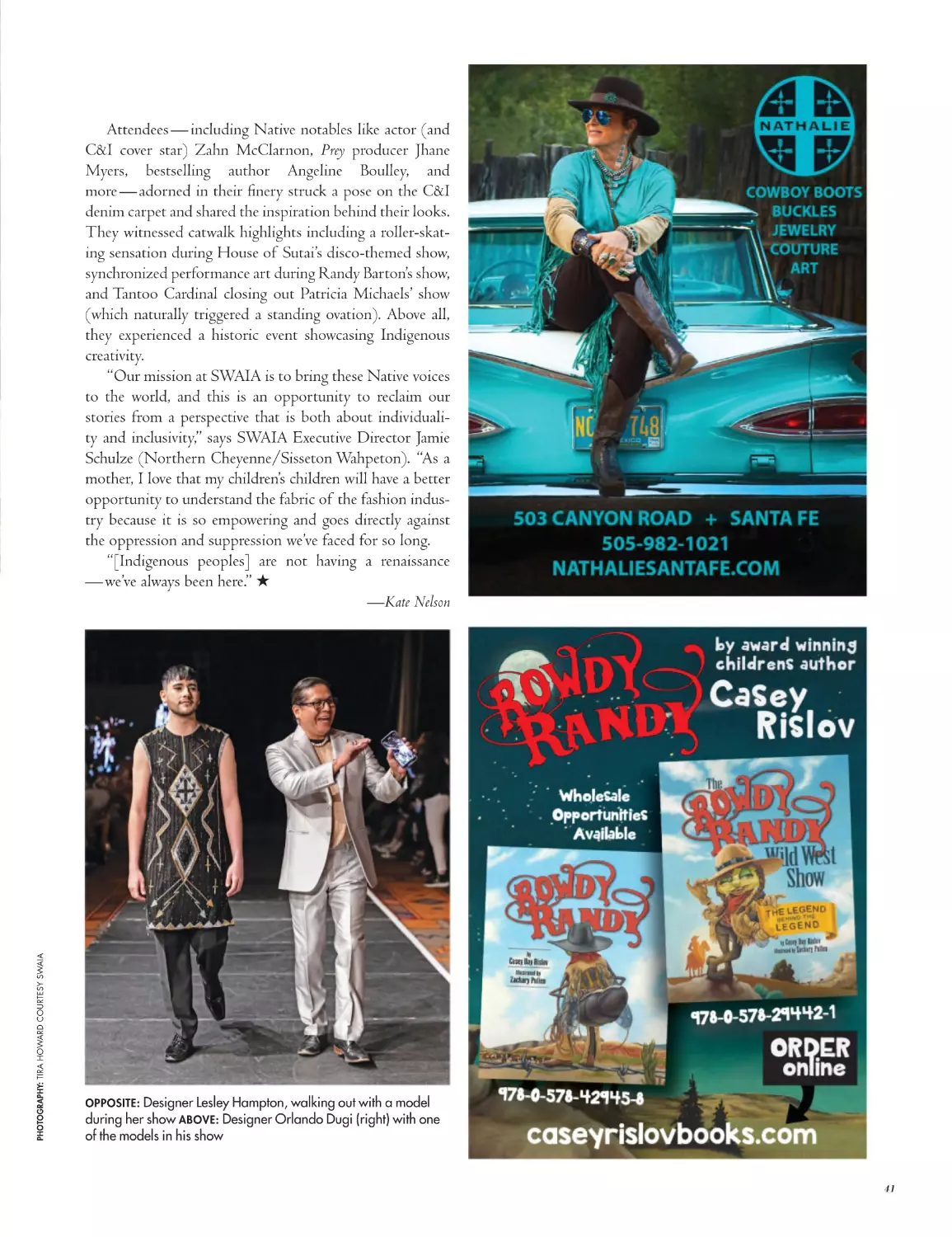
Designer Lesley Hampton, walking out with a model
during her show ABOVE: Designer Orlando Dugi (right) with one
of the models in his show
OPPOSITE:

41

WESTERN STYLE

SANTA FE WAS AGLOW
WITH JOY AND CREATIVITY
IN EARLY MAY. HERE
ARE SOME OF OUR
FAVORITE TRENDS
AND TAKEAWAYS
FROM THE
FIRST-EVER
SWAIA NATIVE
FASHION
WEEK.

a lot of ’60s- and ’70s-style makeup
and eyeliners. “In the Indigenous community, it’s always about vibrancy with
strong eyes and strong red lips.”
INHERENT INCLUSION
Native people come in all shapes,
sizes, and genders, so the recognition
of that in the runway shows felt like
a reflection of the real world. Kicking
off the event was House of Sutai by
Peshawn Bread, which brought out
brightly colored graphic outfits with
intricate beaded neckpieces featuring
pearls and dentalium shells worn by a
diverse collection of models. A rollerskating beauty expertly danced the
U-shaped length of the platform to
a roar of applause, and a long-haired
male model strutted the runway playing air guitar to the music of “Electric
Pow Wow Drum” by Halluci Nation.
It was a powerful statement of the new
and now.
LEFT: A design by Orlando Dugi
BELOW: A look from superstar designer

Patricia Michaels

NATIVES SUPPORTING
NATIVES
We observed a lot of community
spirit in Native American attendees
actively showing support for other
Native products and businesses. In
every show, designers relied on each
other’s input and pieces to complete
their visions with accessories, shoes,
makeup, hair, and skincare folded into
many looks. Award-winning designer
Patricia Michaels, who closed the
show with a gorgeous flow of handpainted silk dresses, used handcrafted
42

AUGUST / SEP T EMBER 2024

moccasins made by Robert Mirabal
of Mirabal Moc. Multicolored with
fringe, laces, and appliqués, the highend, down-to-earth designs complemented Michaels’ couture.
BEYOND THE APPAREL
“People all around are using
Indigenous products, not just the fashions,” says makeup entrepreneur Cece
Meadows of Prados Beauty, whose line
is carried in more than 600 JCPenney
stores. Trends spotted included pigmented neon color makeup, as well as

PHOTOGRAPHY: TIRA HOWARD COURTESY SWAIA

An inspired combo from chizhii by Carrie Wood

Actors Kiowa Gordon and Jessica Matten (stars of Dark Winds,
read more on page 72) in Lesley Hampton designs

43

Design by Peshawn Bread

Design by Vlvidus by Tierra Alysia

Design by Helen Oro

JEWELS OF THE SHOW
No Native look is complete without
jewelry: Major pieces were on the
models, in the crowd, and the pop-ups.
Star jeweler Kenneth Johnson showed
his Seminole roots with intricate pieces
in silver, featuring turtle designs that
graced earrings and pendants. Cody
Sanderson is known for his stars
in silver. His flashy knuckleto-knuckle rings were everywhere. Indi City is pushing the
length of their acrylic earrings
to more than a foot in geometric
designs that glitter from earlobes
to the waist. The prize for the most
daring accessory goes to Helen Oro
and her beaded gas mask in orange
and silver.

designers showed Arctic looks with
sustainable seal fur and fox trim.
Warmth and function are the priority
as designers take cues from parkas,

huge tundra boots and mittens as
seen in Victoria’s Arctic Fashion.
Clara McConnell of Qaulluq uses
arctic fox and seal skin in glossy
grey and white on ballgowns, vests,
and dresses.

CANADIAN AND
ARCTIC DESIGNERS
With its distinctive look
born from geographical
necessity, the great white
and furry Northern
44

AUGUST / SEP T EMBER 2024

DESIGNERS IN MUSEUMS
Beyond the runway, designers’
work is being exhibited in major
museums. The Wheelwright in
Santa Fe and the Metropolitan
in New York have both exhibited
Jamie Okuma, who is known
for her beaded boots and graphic
patterned separates. A special exhibit
of her outfits was on display from
the collection of film producer
Jhane Myers (Prey). Patricia
Michaels has an exhibit now
at the Museum of Indian
Arts & Culture.
—Sandra Hale Schulman
Design by Loren Aragon
of Towering Stone

LEFT:

PHOTOGRAPHY: TIRA HOWARD COURTESY SWAIA

WESTERN STYLE

HOME & RANCH

Los Poblanos is a testament to the lasting
power and influence of John Gaw
Meem’s architecture and design.
by Laura Kostelny

V

ery few states in the United States have a single
definitive architectural style. New Mexico comes
close thanks to building hallmarks that are as
unique as the landscape. Not only is the state
home to some of the oldest pre-Hispanic, multilevel pueblo
buildings in the country; it has also long attracted craftsmen,
artisans, and architects who recognize the importance of
preservation and who have created a design vocabulary exclusive to The Land of Enchantment.
You can’t talk about some of the most notable structures in New Mexico without mentioning one of its most
important architects, John Gaw Meem (1894 – 1983). The
Brazilian-American spent much of his early life on the East
Coast — he studied engineering at the Virginia Military
Institute before heading to New York City to work on some
of the first subway tunnels. Then tuberculosis struck, and

48

AUGUST / SEP T EMBER 2024

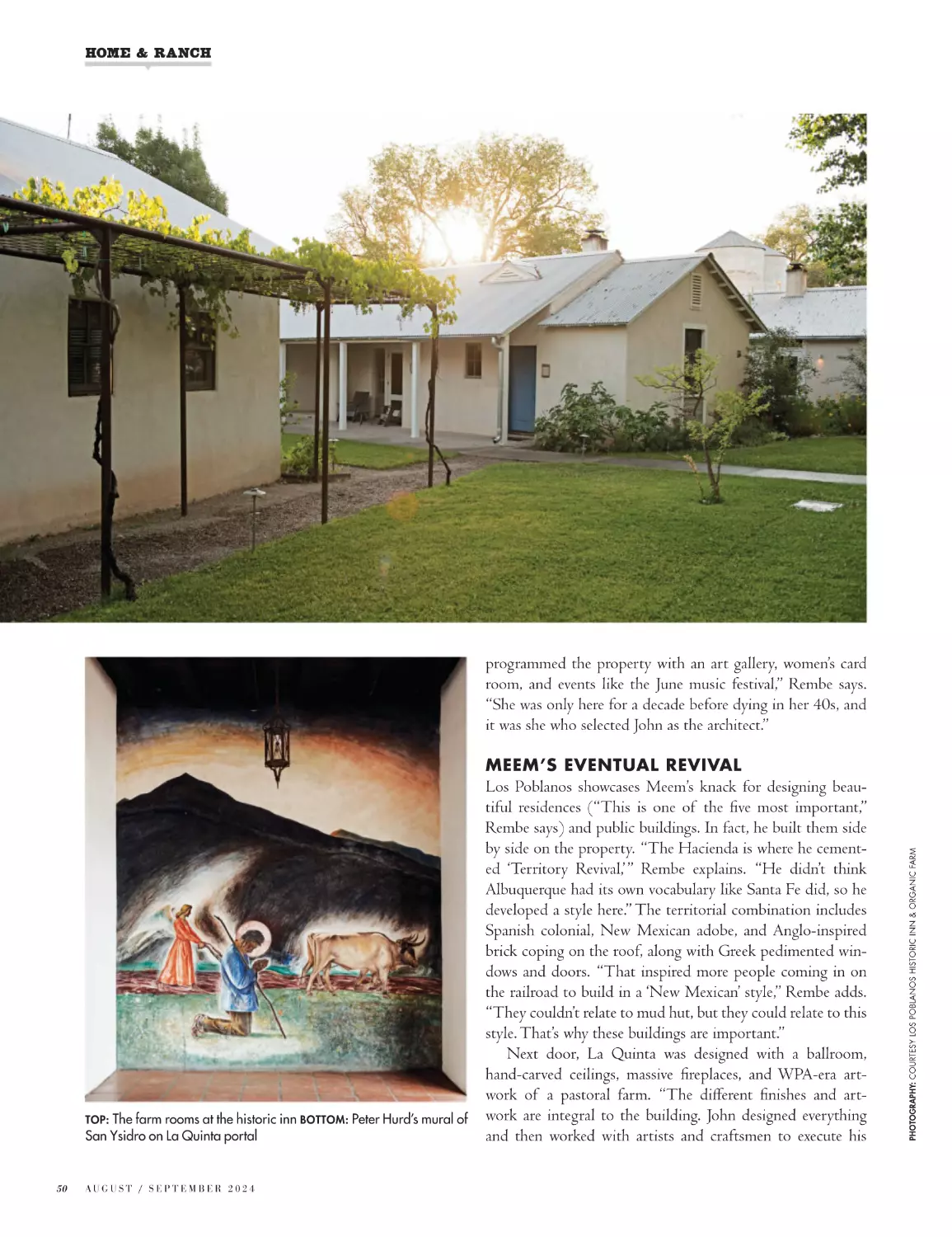
John Gaw Meem’s La Quinta project was designed with a ballroom,
hand-carved ceilings, massive fireplaces, and WPA-era artwork of a
pastoral farm.

PHOTOGRAPHY: COURTESY LOS POBLANOS HISTORIC INN & ORGANIC FARM

MEEM CULTURE

Meem was forced into looking for a more arid climate and
warmer temperatures. He found solace in Santa Fe, where he
began working with doctors to heal both his body and mind.
Meem also found purpose in meeting PortugueseAmerican artist Carlos Vierra. “They spoke the same language
and became friends right away,” says Matt Rembe, executive
director of Albuquerque’s historic inn and organic farm, Los
Poblanos. “At the time, Vierra was at the forefront of historic

PHOTOGRAPHY: COURTESY LOS POBLANOS HISTORIC INN & ORGANIC FARM

preservation of various churches and missions that needed restoration. He knew
how to raise money for pueblos and little
Spanish towns like Las Trampas.” Meem
joined Vierra on his mission and got involved to help restore some of the great
New Mexican churches, and developed
the vocabulary for the various parts of
adobes that were Indian, Anglo, Mexican,
and Arabic.
All that happened before Meem became an actual architect. By 1927 he
was one of the few AIAs registered in
the state and developing his Pueblo
Revival style in residential and commercial projects. “His importance can’t be
overstated because we have some of the
oldest architecture in the United States,
and he really felt like he needed to become a regionalist and preservationist.
He recognized that saving the style was
so important for our culture,” Rembe
says. “Because he was also an engineer,
his buildings are highly functional, but
he also designed all the decorative work
inside, from the tile work and lighting

to the fountains and door handles. He
really understood the historical references, and his designs tipped a hat to all the
arts and crafts, materials, and building
techniques of New Mexico.”
In particular, Meem paid homage to
homegrown details like tinwork, reversepainted glass, adobe, and ironwork, which
contributed to his dramatic influence.
“He’s had more of an impact on any state
than any other architect in their respective
states,” Rembe says. “There are certainly more important architects with more
seminal buildings, but no one’s had a bigger impact on a single state. The Plaza in
Santa Fe, many churches, and even the
University of New Mexico campus all
look a certain way because of him.”
Still, the greatest influence is perhaps
felt at Los Poblanos, the property located
just outside of Albuquerque where Ruth
Hanna and Albert Simms relocated from
the Midwest in the 1930s to establish
their massive dairy farm. “Ruth Hanna
was a real force — she was a leader of
the suffragette movement — and she

The grand library room inside La Quinta is decorated richly with plenty of built-in wood features
and elegant furnishings.

HOME & RANCH

The farm rooms at the historic inn BOTTOM: Peter Hurd’s mural of
San Ysidro on La Quinta portal

TOP:

50

AUGUST / SEP T EMBER 2024

MEEM’S EVENTUAL REVIVAL
Los Poblanos showcases Meem’s knack for designing beautiful residences (“This is one of the five most important,”
Rembe says) and public buildings. In fact, he built them side
by side on the property. “The Hacienda is where he cemented ‘Territory Revival,’ ” Rembe explains. “He didn’t think
Albuquerque had its own vocabulary like Santa Fe did, so he
developed a style here.” The territorial combination includes
Spanish colonial, New Mexican adobe, and Anglo-inspired
brick coping on the roof, along with Greek pedimented windows and doors. “That inspired more people coming in on
the railroad to build in a ‘New Mexican’ style,” Rembe adds.
“They couldn’t relate to mud hut, but they could relate to this
style. That’s why these buildings are important.”
Next door, La Quinta was designed with a ballroom,
hand-carved ceilings, massive fireplaces, and WPA-era artwork of a pastoral farm. “The different finishes and artwork are integral to the building. John designed everything
and then worked with artists and craftsmen to execute his

PHOTOGRAPHY: COURTESY LOS POBLANOS HISTORIC INN & ORGANIC FARM

programmed the property with an art gallery, women’s card
room, and events like the June music festival,” Rembe says.
“She was only here for a decade before dying in her 40s, and
it was she who selected John as the architect.”

PHOTOGRAPHY: COURTESY LOS POBLANOS HISTORIC INN & ORGANIC FARM

The foyer at La Quinta, with its exposed wood
beams and chandelier features

vision, while Ruth Hanna picked amazing materials from her travels to Spain,
Portugal, and Morocco,” Rembe says. “It’s
so different than anything he ever did in
New Mexico.” The building is home to
so many treasures including some of the
best iron- and tinwork in the state, a fresco by noted American painter Peter Hurd,
carved wood mantel and doors by Gustave
Baumann, and even custom hardware by
sculptor Walter Gilbert on every door.
Today, Los Poblanos is a family-owned
business that has become a destination for
travelers looking for the solace the 50room inn, working organic farm, and fieldto-table menus provide. The family looked
to Pasadena-based architect and urban
planner Stefanos Polyzoides and brought
in historians to maintain the integrity of
the buildings and landscape, which includes a mix of lavender, fruits, vegetables,
semi-formal gardens, and formal gardens.
“Today, we have 330 employees, and
seven or eight different business segments,
including agri-tourism and our line of
Los Poblanos lotions and salves that are

Co m p l
In te r e te
Desig nior
S ho w r o &
om

3953 E. 82nd St., Indianapolis // 317.577.2990 // coppercreekcanyon.com

51

HOME & RANCH

ABOVE: The inviting entry points to Los Poblanos’ historic inn
BOTTOM LEFT: The reception room right inside the inn

available around the country,” Rembe says. “Even as we’ve
expanded, we want to continue to tell the architectural story
here. That’s why we built new units in the Territory Revival
style. We didn’t do too many because we didn’t want to take
away from those two great buildings, so we were pretty
thoughtful about how we did it.”
That meant following the precedent set by Meem when
designing the new units’ operable windows to take advantage
of cross drafts and figuring out the scale of the vigas and
fireplaces. “We also paid homage to a lot of the rhythms he
created,” Rembe adds. “Meem was great about making changes from room to room — there wasn’t a single floor finish or
ceiling style. One room might have whitewashed plaster, then
you go to another, and you find vigas or brick or latillas or
52

AUGUST / SEP T EMBER 2024

BARN TOUR

Crafted for Life
AUTHENTIC POST & BEAM BARNS

Featured Photo: 44' x 48' Riverton Monitor Barn

painted wood. That happened a lot in New Mexico as people
added on, so we were mindful about bringing that in.”
The spirit of the property remains intact beyond the
structures. San Ysidro Labrador, the patron saint of farmers,
figured prominently in the architect’s original designs and is
still honored by Los Poblanos today. He’s become the brand
of Los Poblanos. “He’s the guy on all of our products, and
we have a celebration for him every year on May 15,” Rembe
says. “We’re here to continue the story of everything that
drove Meem’s design work and all the history here. Sure, this
place had the first pool in Albuquerque and some of the most
elegant buildings ever built, but all the artwork is inspired by
agriculture and farming. The driver has always been farming,
and it remains that way today.”
The organic farm and garden area includes a vintage greenhouse and other buildings. BOTTOM: A view of the ranch’s dairy barn

TOP:

54

AUGUST / SEP T EMBER 2024

Explore travel options and see more of Los Poblanos Historic Inn &
Organic Farm at lospoblanos.com.

PHOTOGRAPHY: COURTESY LOS POBLANOS HISTORIC INN & ORGANIC FARM

HOME & RANCH

FOOD & DRINK

PIÑON POWER
Head to the Southwest to forage for the
world’s second most expensive nut and
explore the Indigenous food cultures that
revolve around it.
by Julie Bielenberg

C

Candace Samora holds a bowl of piñon nuts she harvested by hand
in the Roaring Fork Valley of Colorado.

56

AUGUST / SEP T EMBER 2024

Harvesting piñon pine cones from a piñon pine in Carbondale,
Colorado.

Colorado, New Mexico, and Utah, with some additional outlying acreage in California, Oklahoma, Texas, and Wyoming.
The piñon pine’s relative, the Mediterranean pine tree, is the
predominant tree that provides the world’s harvest of pine
nuts, making piñon nuts an even pricier rarity. The nuts are
actually seeds, and retrieving them is a somewhat delicate process that tries to avoid damaging the soft exterior. “We usually crack them open with our teeth, like a pistachio,” Samora
says. Others use a rolling pin to crack the casing.
Adding to their novelty and rarity, piñon nuts only form
every five to seven years within the cones, and the timing for
collection each year is a short window. “I go with my uncle
and father in the high country at peak collection time to forage,” Samora says. “They put their arms around the bases of
the piñon trees and shake them until the nuts and cones fall.
We leave a tarp under the tree to collect the pine cones and
then gather them up and take them home to let them dry
out and release the pine nuts more easily.” The pine seed is
then consumed in many forms — the most popular is simply
roasted. “We always make sure to get enough pine cones to
have a couple of bowls of roasted nuts for each family member,” Samora adds. “Our family just likes them roasted; other
relatives use the nuts for baking pancakes and cupcakes.”

PHOTOGRAPHY: (BOTTOM) JULIE BIELENBERG; (TOP) CHAD CHISHOLM CREATIVE

andace Samora waits for the leaves to change
each autumn before embarking on her family’s
centuries-old tradition of gathering piñon nuts.
“My dad’s side is a mix of Hispanic and Pascua
Yaqui,” she says. “My mom’s family is Navajo, and she still
lives on the reservation where there are groves of piñon trees.
The season’s tradition was passed on to me by both of my
parents since the piñon is found in Colorado and Utah,” explains Samora. Growing up in the Roaring Fork Valley of
Colorado, Samora was surrounded by the piñon tree and its
delicacy — the piñon nut, the world’s second most expensive
nut, outpriced only by the macadamia.
Foraged for millennia, the piñon nut has a distinct rich
pine and buttery flavor and is loaded in protein and vitamins. Only found in the Southwest, the piñon’s native
range — woodlands where the piñon is the major pine species — covers about 40 million acres ranging over Arizona,

PHOTOGRAPHY: NEW MEXICO TRUE

One bowlful of prized piñon nuts can
cost $30 to $65 or more a pound.
In New Mexico, the world’s piñon
capital, where it’s even the official state
tree, there’s a delicious diversity of piñon
cuisine. At the Indian Pueblo Kitchen in
Albuquerque, which is owned and operated by New Mexico’s 19 Pueblo communities, a breakfast and lunch menu of traditional heritage dishes has been curated to
represent each of the Pueblos. “Piñon has
been used as a source of food by Native
Americans for thousands of years,” says
Indian Pueblo Kitchen sous chef Josh
Aragon. He is from the Laguna Pueblo,
just outside of Albuquerque, where he,
too, was taught the ancient tradition of
gathering the seed. “We call it ‘Mother
Nature’s milk’ because of all the incredible properties and benefits from this tiny
edible resource. It’s one of the ingredients in our Native Superfood Waffles
and Griddle Cakes that makes them
so unique.”
Aragon and other chefs from the
Pueblos embrace the ancient tradition of
piñon cuisine throughout the year at the
Indian Pueblo Kitchen serving griddle
cakes to both locals and tourists. Chief
Operating Officer for the Indian Pueblo

Cultural Center Monique Fragua (Pueblo
of Jemez) explains that featuring piñons
in the menu celebrates “who we are as
people of this land — as hunters, farmers,
and gatherers who for millenniums have
used the resources from our surroundings as ingredients in our meals.” At the
Indian Pueblo Kitchen, the tradition is to
spread roasted piñon nuts on the hotcake
just before flipping to enhance the flavor
in the outer layer upon first bite.
The hotcakes blend another tradition
throughout Navajo, Apache, and Pueblo
cultures of mixing blue corn with the
piñon. Atole, oftentimes called chaquehue
or chaquewa by Puebloan communities, is
a hot, creamy beverage made from blue
corn, piñon, and other regional ingredients; it’s often a baby’s first food because
of the nutritional value. Aragon and the
chefs prepare atole at the Indian Pueblo
Kitchen, but their version is a thicker,
blue-corn porridge with quinoa, currants,
piñon, sunflower seeds, triple berries, and
toasted Pueblo bread. They also serve a
piñon cola made by Zia Soda for a modern twist on the ancient flavor.
As is true throughout Native
American communities, all parts of a
tree or food source are valued and used.

Jemez Red Rocks on the Jemez Pueblo, northwest of Albuquerque, where visitors can hike and
take in piñon-punctuated scenery along the Jemez Red Rocks Trail.

FOOD & DRINK

Piñon pines and their cones are notoriously sticky, even more
so than maple sap. “We have to wear gloves when we gather
the pine cones because it will ruin any clothing it touches
and get your hair into mats,” Samora says. The sweetness of
the tree’s sap has proliferated into numerous piñon desserts.
Eldora Chocolate, a bean-to-bar handcrafted chocolate shop
in Albuquerque, offers a zesty mango piñon chocolate bar.
Nearby Santa Fe is stocked — piñon rolls, brittle, toffee, and
fudge — at Señor Murphy, with four locations, including at
La Fonda hotel.

Oftentimes, piñons simply don’t produce any pine cones, a
result of moisture and temperature fluctuations. Local piñon
trees stressed by multiple years of drought couldn’t produce
nuts, and some makers, like Buffett’s Candies in Albuquerque,
simply ran out. For now, they can’t offer their former top seller — a piñon assortment of piñon rolls, milk and dark chocolate piñon horny toads, piñon toffee, piñon creams, piñon
caramels, and piñon clusters — but plan to begin production
of those favorites again when the crop is sufficient.
New Mexico’s largest coffee roaster offers piñon coffee

PIÑON PROVISIONS
Here are 9 piñon products worth tracking down.
The piñon pine provides more than just nuts for cuisine.
Its essence is infused into perfumes and oils, its wood is
chopped for scented fires, and its dried-up cones are used
for fire starters—plus so much more.
Los Poblanos Historic Inn & Organic Farm in Los
Ranchos de Albuquerque features piñon in their Farm
Shop products, including piñon bar soap and a piñon
grove botanical fragrance. lospoblanos.com
Taos Piñon Company offers a piñon bar soap and
lotion that uses the sweet and distinguishable resin
from the tree. taospinoncompany.com

New Mexico Piñon Coffee, with several coffee houses
in Albuquerque and one in Rio Rancho, has a full drink
menu including piñon bear claws for a treat and a
piñon syrup to add to beverages.
nmpinoncoffee.com

The Super Salve Company sells traditional piñon Navajo
healing salve to rub on sore muscles. supersalve.com
Artemisia Herbs, formulated from native New Mexico
vegetation, sells osha cough syrup for youth using a mixture of lavender, wildcrafted piñon, beebalm, wildcrafted
osha, wild cherry bark, and more natural resources at the
Downtown Grower’s Market on Saturdays throughout the
fall in Albuquerque. artemisiaherbsnm.com
AlbuKirky Seasonings founders Kirk Muncrief and his
wife, Cheryl Valadez, blend piñon and coffee for their
red chile piñon coffee rub, available at grocery stores
and food boutiques throughout New Mexico.
albukirkyseasonings.com
Zia Soda sells refreshing sodas made in New Mexico,
including Zia Ginger Ale, Zia Nopales Prickly Pear,
and Zia Piñon Cola, blended and brewed with
piñon nuts harvested from the mountains of northern
New Mexico. ziabev.com (available in 12 packs
from madeinnewmexico.com/products/zia-sodas)
New Mexico Piñon Nut Company is the only consistent
place in New Mexico that can always provide the nut
itself. Prices change annually due to crop availability.
pinonnuts.com

58

AUGUST / SEP T EMBER 2024

PHOTOGRAPHY: COURTESY VENDORS

Indian Pueblo Kitchen sells a Taos sage and piñon
smudge bundle to purify and offer cleansing energy
to any space, an ancient practice of burning native
plant—smudging—central to Native American culture.
indianpueblopueblostore.com

Ellensburg Rodeo
Hall of Fame
ellensburgrodeohalloffame.org

Congratulations to this year’s Inductees

PIÑON IN THE KITCHEN
Piñon pine nuts (also called piñones)
are usually smaller than the average
pine nut and have a richer, more
buttery flavor, with a higher fat
content. Outside of New Mexico,
it’s extremely challenging to find
true piñon cuisine or beverages
on any menu. New Mexico Piñon
Nut Company is the only consistent
source of piñon. If you’re cooking at
home and can’t find or afford piñon
pine nuts, regular pine nuts will do
in a pinch.

Team Roper
Charles Pogue

Calf Roper and Steer
Wrestler Dave Brock

Stock Contractors
The Eaton family

PHOTOGRAPHY: CHAD CHISHOLM CREATIVE

Every Labor Day Weekend

at its Albuquerque coffee houses — piñon
latte, traditional piñon cold brew, piñon
steamer — in addition to bagged coffee sold
throughout the world. New Mexico Piñon
Coffee has to forage each piñon by hand
from the forest floor since no commercial
piñon grove exists. It can also be used to
make tea. “My aunties will make piñon tea
that just uses the piñon needles that are
steeped in hot water,” Samora says. “The
needles are always available year-round, and
it’s an easy and healthy tradition.”
But it’s the simplicity of the roasted
nut that is most ingrained throughout
Native cultures. “Roasted piñons are a delicious and ancient treat,” Fragua says. “As
Pueblo people, we have been gathering the
piñon nut since the time of our ancestors.
Eating roasted piñon in front of a fire is a
reminder of simpler days, days when the
stories of our grandparents and freshly
roasted piñon with a saltwater bath were
both treated like gold.”
Roasted green chile and piñon pancakes
with pine cone syrup sound good? Go to
cowboysindians.com for these and
other recipes.

59

SUBSTANTIAL
SECOND ACT
After living a full and prosperous tribal
life, Chief Dan George took up acting in
his 60s and scored a historic Oscar nod
for Little Big Man. We recommend a few
of his greatest screen performances.
by Joe Leydon

W

hen it came to acting, you could say Chief
Dan George — the first Native American ever
nominated for an Academy Award in an acting
category — was a late bloomer.
Born Geswanouth Slahoot on July 24, 1899, as a member
of the Tsleil-Waututh Nation in North Vancouver, British
Columbia, he was employed as a longshoreman in Vancouver
Harbor for 27 years, served as chief of his people from

60

AUGUST / SEP T EMBER 2024

1951 to 1963, and traveled extensively throughout British
Columbia with his children and other family members while
performing as Dan George and His Indian Entertainers. At
age 60, he was cast in the Canadian Broadcasting Company
series Cariboo Country.
Although he was a complete novice in his new gig, George
impressed critics and audiences with his portrayal of an elderly Indian named Ol’ Antoine, a role that had been originally cast with a white actor. (According to You Call Me Chief:
Impressions of the Life of Chief Dan George, a memoir he co-wrote
with Hilda Mortimer, George required “four or five hours”
of aging makeup each day he was on camera.) Not long afterward, he inspired playwright George Ryga to expand the role
of the title character’s father in The Ecstasy of Rita Joe, his workin-progress about an Indian girl who comes to regret moving
from her village to the big city. In the completed version of the
play, the father tries — in vain — to convince his daughter to
come home to her family. “For me,” Ryga said years after the
Chief Dan George’s career-defining acting role came as the sage
Cheyenne tribal leader Old Lodge Skins in director Arthur Penn’s
Little Big Man.

PHOTOGRAPHY: GETTY

ENTERTAINMENT

“

HE NEVER HAD ANY FORMAL ACTING
TRAINING, BUT WHAT A STORYTELLER!
I’D JUST SAY THE LINES WITH HIM SEVERAL
TIMES, AND THEN START THE CAMERA
WITHOUT HIM KNOWING IT. HE’D GET
HIS DIALOGUE 90 PERCENT RIGHT, AND
THE REST WOULD BE IMPROVISED AND
SOMETIMES IT’D BE GREAT.

”

PHOTOGRAPHY: ALAMY

— Clint Eastwood on Chief Dan George

Vancouver Playhouse’s acclaimed premiere
production, “the inclusion in the play of
the character of Rita Joe’s father was the
inclusion of the man Dan George.”
One thing led to another. He reprised his performance as Ol’ Antoine
in Smith! (1969), a Walt Disney production based on a novel that had in turn
been based on a Cariboo Country episode,
then landed his career-defining role as the
sage Cheyenne tribal leader Old Lodge
Skins in director Arthur Penn’s Little Big
Man. For his work as the elderly Native
American who “adopts” the title character — Jack Crabb (Dustin Hoffman), a
white man repeatedly torn between two
civilizations — George received Oscar
and Golden Globe nominations, and Best
Supporting Actor awards from the New
York Film Critics Circle and the National
Society of Film Critics. (Fun fact: Before
George was cast, Marlon Brando, Paul
Scofield, and Laurence Olivier were approached to play Old Lodge Skins, but
each declined the offer.)
George continued to appear in movies and TV shows, and author bestselling books of essays and poetry, until he
passed away in 1981. These are some of
the films that best represent his legacy.
SMITH! (1969)
Glenn Ford is the nominal star of this
family-friendly contemporary drama,

authoritatively playing the title character, a
rancher sympathetic to Native Americans
in general and Gabriel Jimmyboy (Frank
Ramirez), a young Indian wrongly accused of murder, in particular. But
George steals every scene that isn’t bolted to the floor as Ol’ Antoine, Smith’s
“blood brother,” who effectively testifies
for the defense at Jimmyboy’s trial by
extensively quoting the “I Will Find No
More Forever” surrender speech given by
Chief Joseph of the Nez Perce tribe of

Fits Right
Looks Right
Feels Right

Canadian

Cattlemans

The Gus

The movie poster for Smith!

Made in Bryan, Texas
Since 1983
(833) 430-HATS
catalenahatters.com

ENTERTAINMENT

in Penn’s adaptation of Thomas Berger’s 1964 novel — along
with an Oscar-worthy supporting performance by George as
the aforementioned Old Lodge Skins. George and Hoffman
share the film’s finest and most affecting sequence, as Lodge
Skins tells Jack Crabb after a victory at Little Big Horn that
he’s ready to simply lie down and die, “Because there is no
other way to deal with the White Man, my son. Whatever
else you can say about them, it must be admitted: You cannot get rid of them.” The old man is bitterly disappointed
when he opens his eyes and realizes he is still alive. “I was
afraid of that,” he groans. “Well, sometimes the magic works.
Sometimes, it doesn’t.” Fortunately, Chief Dan George always
made his magic work, no matter the size of his role.

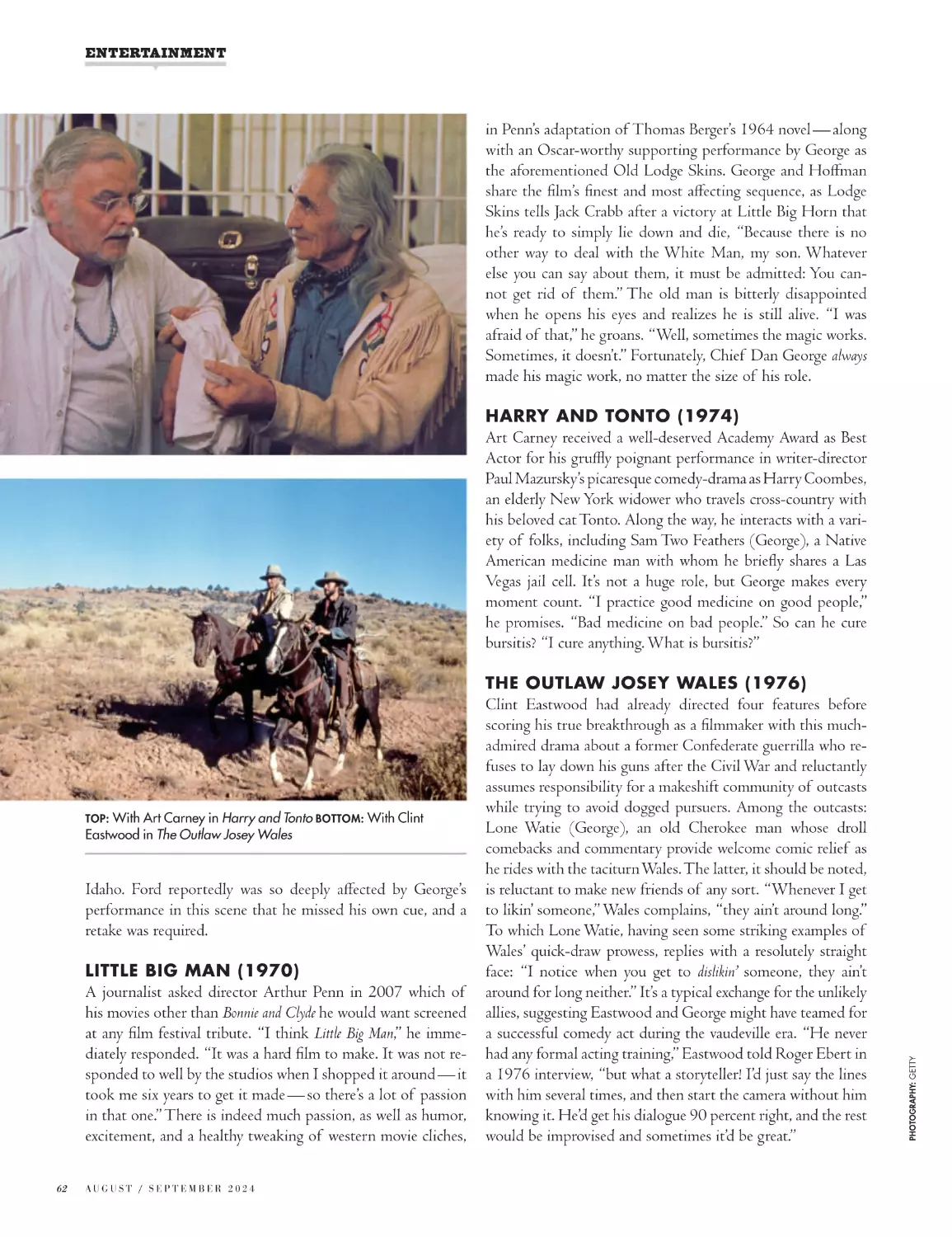
With Art Carney in Harry and Tonto BOTTOM: With Clint
Eastwood in The Outlaw Josey Wales

TOP:

Idaho. Ford reportedly was so deeply affected by George’s
performance in this scene that he missed his own cue, and a
retake was required.
LITTLE BIG MAN (1970)
A journalist asked director Arthur Penn in 2007 which of
his movies other than Bonnie and Clyde he would want screened
at any film festival tribute. “I think Little Big Man,” he immediately responded. “It was a hard film to make. It was not responded to well by the studios when I shopped it around — it
took me six years to get it made — so there’s a lot of passion
in that one.” There is indeed much passion, as well as humor,
excitement, and a healthy tweaking of western movie cliches,
62

AUGUST / SEP T EMBER 2024

THE OUTLAW JOSEY WALES (1976)
Clint Eastwood had already directed four features before
scoring his true breakthrough as a filmmaker with this muchadmired drama about a former Confederate guerrilla who refuses to lay down his guns after the Civil War and reluctantly
assumes responsibility for a makeshift community of outcasts
while trying to avoid dogged pursuers. Among the outcasts:
Lone Watie (George), an old Cherokee man whose droll
comebacks and commentary provide welcome comic relief as
he rides with the taciturn Wales. The latter, it should be noted,
is reluctant to make new friends of any sort. “Whenever I get
to likin’ someone,” Wales complains, “they ain’t around long.”
To which Lone Watie, having seen some striking examples of
Wales’ quick-draw prowess, replies with a resolutely straight
face: “I notice when you get to dislikin’ someone, they ain’t
around for long neither.” It’s a typical exchange for the unlikely
allies, suggesting Eastwood and George might have teamed for
a successful comedy act during the vaudeville era. “He never
had any formal acting training,” Eastwood told Roger Ebert in
a 1976 interview, “but what a storyteller! I’d just say the lines
with him several times, and then start the camera without him
knowing it. He’d get his dialogue 90 percent right, and the rest
would be improvised and sometimes it’d be great.”

PHOTOGRAPHY: GETTY

HARRY AND TONTO (1974)
Art Carney received a well-deserved Academy Award as Best
Actor for his gruffly poignant performance in writer-director
Paul Mazursky’s picaresque comedy-drama as Harry Coombes,
an elderly New York widower who travels cross-country with
his beloved cat Tonto. Along the way, he interacts with a variety of folks, including Sam Two Feathers (George), a Native
American medicine man with whom he briefly shares a Las
Vegas jail cell. It’s not a huge role, but George makes every
moment count. “I practice good medicine on good people,”
he promises. “Bad medicine on bad people.” So can he cure
bursitis? “I cure anything. What is bursitis?”

PHOTOGRAPHY: GETTY

George in Shadow of the Hawk

SHADOW OF THE HAWK
(1976)
The rent must be paid, groceries must be
purchased, and sometimes an actor signs
on to do a lot more for a movie than it ever
does for them. Case in point: This borderline ridiculous supernatural thriller — which
sporadically leaps over the line — gets more
mileage than it deserves from George’s stoically dignified portrayal of Old Man Hawk, a
modern-day shaman for a small village who
needs someone to take over his medicine
man duties and battle an evil spirit threatening his people. He travels to the big city to
prevail upon his “half-breed” grandson Mike
(Jan-Michael Vincent), a junior executive for a
computer company, to fill the position, which
entails doing everything from fighting a stunt
man posing in a none-too-convincing bear
suit to avoiding evildoers cruising around
in a mysterious ’58 Pontiac. (To be fair, the
scene in which the Pontiac gets magically
demolished is pretty cool.) Marilyn Hassett
plays a freelance reporter who goes along for
the ride, and delivers cringe-worthy lines like,
“Mike, I’m scared! Someone’s trying to kill
us!” George fares better dialogue-wise, and
even manages to flash a twinkle in his eye
whenever he compliments his grandson while
using his favorite nickname for the younger
man: “Well done, Little Hawk.” +

Visit the Entertainment tab at cowboysindians.com
weekly for recommendations on what to watch, read,
and listen to in the American West.

TRAVEL & DESTINATIONS

HISTORIC
TRAILS ACROSS
WYOMING

by Shilo Urban

T

he heady scent of sagebrush hangs over the high
desert of southwestern Wyoming, a rugged landscape that seems empty under the wide-open blue
above. Wooly clouds drift over windswept ridges
of sandstone and shale. Sparse patches of prairie grass surround the small towns of Rock Springs and Green River,
whose remoteness imparts a peaceful feeling of freedom
found only in the wilderness.
But look closer, and you’ll see that this arid countryside
is crisscrossed by the trails of travelers old and new. Situated
between the Rocky Mountains and the Great Plains, it’s a
64

AUGUST / SEP T EMBER 2024

Vivid colors and soaring cliffs offer a vibrant lesson in geology
at the Flaming Gorge National Recreation Area. BOTTOM: The town
of Green River overlooks its namesake waterway, which eventually
connects with the Colorado River in southeastern Utah.
TOP:

land of footpaths and thoroughfares, byways and river
routes — and it has long attracted explorers and wanderers
of every kind. Modern adventurers ride mountain bikes and
ATVs along off-road tracks that climb through the Green
River Valley. Sandboarders carve gritty runs into the dunes.
Kayakers leave lazy wakes in the Green River’s waters, and
wild horses race down desert pathways.
Voyagers have rested and refueled in Sweetwater County
for centuries, just like today’s motorcyclists and rodeo athletes
who stop at hotels on Interstate 80 — which was once the historic Lincoln Highway, America’s first transcontinental road.

PHOTOGRAPHY: SHILO URBAN

Trekking across the Cowboy State puts
you on the tracks of Native American
tribes, explorer John Wesley Powell, Old
West bandits, and New West adventure.

Built in 1913, the 3,000-mile motorway linked east with west
and cut straight across the former frontier. The Wild West
had vanished, but the legends were only beginning: the cowboy, the gunslinger, the notorious outlaw. One such outlaw
was Butch Cassidy, who acquired his nickname while working
at a butcher shop in Rock Springs. Like many bandits in the
1890s, Cassidy and his gang, the Wild Bunch, disappeared
into the badlands south of the town on secret getaway routes.
They turned ravines into hideouts like Minnie’s Gap, knowing that only the bravest, boldest daredevils would venture
into the wilds of Wyoming.
John Wesley Powell was just such a man. Appearing on
the frontier a few decades before the Wild Bunch, Powell
was a geologist and U.S. Army soldier who gained fame for
his death-defying expedition through the Grand Canyon in
1869, the first of its kind. A statue of the one-armed explorer,
Explore the region’s natural and cultural heritage at the
Sweetwater County Historical Museum, from ancient fossils to emigrant trails to weapons of the Wild West. BELOW: Spirit of the Wild
by KEY DETAIL in Rock Springs is one of many murals throughout
Sweetwater County.

PHOTOGRAPHY: SHILO URBAN

RIGHT:

65

TRAVEL & DESTINATIONS

“

THE FIRST MOUNTAIN MEN ENCOUNTERED
NOT AN EMPTY LANDSCAPE BUT ONE RICH IN
NATIVE AMERICAN CULTURES.
The name is no exaggeration: The canyon walls blaze with
brilliant red sandstone above the cool Green River Reservoir
below. Straddling Wyoming and Utah, it’s a prime playground for trophy trout fishing, stand-up paddleboarding,
and Powell-style float trips (minus the mutiny and starvation). Or you can simply drive the 150-mile loop around the
lake, stopping at jaw-dropping vistas like the Red Canyon
Overlook. If you’d rather watch for elk and mountain lions
instead of keeping your eyes on the road, the Flaming Gorge
Tour offers a guided bus trip with copious breaks for ice
cream and artisanal donuts.
Powell had neither for his excursion. But he did have coffee and sugar hauled in by Union Pacific Railroad, which

Get a bird’s-eye view of the Union Pacific Railyard on this pedestrian overpass linking downtown Green River with Expedition Island.

66

AUGUST / SEP T EMBER 2024

PHOTOGRAPHY: SHILO URBAN

ready for his next odyssey with paddle in hand, stands outside Sweetwater County Historical Museum in Green River.
Like a three-legged dog, he takes zero notice of his missing
limb — after all, there are rivers to conquer and mountains
to climb.
A few blocks away you can visit the pretty park of
Expedition Island, where Powell launched his boats into
the unknown with a crew of 10. They endured hundreds of
churning rapids, precipitous cliffs, mutiny, starvation, and
hostile Native American tribes. Powell’s journey on the Green
and Colorado Rivers passed some of the most impressive
natural landmarks in the American West, many of which he
named — including the spectacular Flaming Gorge.

”

The White Mountain Petroglyphs Site is sacred to members of multiple Plains and Great
Basins tribes. ABOVE LEFT: Handprints worn deep into the rock evoke an intimate connection
with those who used the site long ago. ABOVE RIGHT: You can see hundreds of etchings in the soft
sandstone walls, including animals, tiny footprints, and geometric forms.

PHOTOGRAPHY: SHILO URBAN

TOP:

had just laid down tracks to Sweetwater
County. The railroad’s arrival ignited the
local coal mining economy, and shafts
soon snaked underground. The region
still produces coal, but much more trona,
a sodium carbonate used to make glass,
laundry detergent, and 90 percent of the
baking soda in American kitchens today.
Rock Springs and Green River were
shoo-ins for the railroad route because

both towns were already stagecoach stops
on the Overland Trail. Green River also
had a Pony Express home station in the
early 1860s. By that time, the path had
already been blazed by two decades of
American homesteaders as the country
expanded west. The Oregon, California,
and Mormon Trails all ran through
Sweetwater County, which has more miles
of visible pioneer tracks than any other

TRAVEL & DESTINATIONS

Castle Rock, the most iconic of the area’s monumental rock formations, towers over the town of Green River.

county in the nation. Some can be seen at Fort Bridger, where
mountain man Jim Bridger established a trading post and
wagon trains stocked up on life-sustaining supplies before
pushing into the mountains ahead. Now a living-history museum, Fort Bridger began life in 1843 as a fur trading post for
trappers who had trickled through the area since the 1820s.
The first mountain men encountered not an empty landscape but one rich in Native American cultures. The Wyoming
Basin (which covers most of the state) was the home of the
Shoshone as well as an important hunting and raiding ground
for the Blackfeet, Bannock, Arapaho, Crow, Sioux, Ute, and
Cheyenne. You can feel the presence of the Indigenous peoples
who traversed the region at White Mountain Petroglyphs, a
300-foot-tall sandstone formation located down a rough dirt
road north of Rock Springs. Hundreds of etchings cover the
sheer rock face: elk, buffalo, horses, hunters, tepees, and tiny
human feet. Most are estimated to be 200 to 1,000 years old,
and all are up for interpretation. One enigmatic theory holds

TRAIL GUIDE: GREEN RIVER COUNTRY
flavors including banana, blackberry,
and s’mores. If you’re really into ice
cream, swing by Farson Mercantile,
a vintage general store-turned-gift-shop
that’s famous for its gigantic cones.
Discover clever, not kitschy,
souvenirs in rustic-cool environs at
Wyoming Freight Company, a new
addition to Pilot Butte Avenue in Rock
Springs. More than two dozen regional
craftspeople contribute their handiwork,
from glassware and manly toiletries to
Bigfoot shirts and dill pickle peanuts.
Stroll next door to Lola B. Boutique to
browse feminine apparel and accessories that are trendy without trying
too hard. Shop for Wyoming artwork
at Rock Springs’ Community Fine

SHOP:

Arts Center, where you can also see
original pieces by Norman Rockwell
and Salvador Dalí. Settle into a cozy
nook with a glass of pinot at Sidekicks
Book & Wine Bar and pick up titles on
local history at the Sweetwater County
Historical Museum.
Sweetwater County offers a
selection of chain hotels, including
Homewood Suites by Hilton Rock
Springs and Hampton Inn & Suites
Green River. For private digs, check
out the homes and apartments on shortterm rental sites like Airbnb and Vrbo
(most are in Rock Springs). You’ll also
find log cabins around Flaming Gorge;
the best are at Red Canyon Lodge
in nearby Dutch John, Utah, which
also has a bistro-style restaurant and
horseback riding. If you’re truly up for
an adventure, you can sleep in a yurt,
tepee, or covered wagon at Rocky
Ridge Outpost in Manila, Utah.

STAY:

SkyWest Airlines operates one
flight daily between Denver and Rock
Springs in each direction, plus a second
flight each way during busier times.

GO:

Boar’s Tusk Steakhouse

68

AUGUST / SEP T EMBER 2024

Eve’s

Broadway Burger Station

— S.U.

PHOTOGRAPHY: SHILO URBAN

Newly opened Boar’s Tusk
Steakhouse in Rock Springs has
already made its mark with exquisite
attention to detail, such as warm,
pillowy rolls with three types of soft
butter. Even the salads and sides are
noteworthy, like the fried brussels
sprouts with balsamic reduction.
Overlooking a grassy golf course, Eve’s
serves hearty meat-and-potatoes fare
along with innovations like cotija-stuffed
ravioli and lilac flower ice cream.
For breakfast, head to Rock Springs’
historic rail station for fresh pastries and
bagel sandwiches at Coal Train Coffee
Depot. Nearby is Broadway Burger
Station, a ’50s-style diner with firstclass burgers on cornmeal buns—plus
luscious milkshakes and malts in 30
EAT:

that White Mountain was a sacred birthing place for women of multiple tribes.
This idea is given weight by the site’s star
attraction, an outcropping embedded with
numerous handprints. The prints sink
deep into the soft sandstone, like so many
fingers had grasped and gripped the rock
again and again during childbirth.
Standing proudly in the countryside,
the petroglyphs’ silent stories are a powerful testament to the Native Americans
who came before. The earliest of them
arrived here in the Wyoming Basin an estimated 13,000 years ago, long after the
lava flows of ancient volcanoes had turned
into massive mounds of sand. You can surf
them at Killpecker Sand Dunes, where you
can bring your own dune buggy, dirt bike,
or ATV to make your own tracks across
11,000 acres of designated “open play
area” in an ecologically sensitive area that
is otherwise off-limits to such vehicular
entertainment.
A land of trails since the Mesozoic
“Age of the Reptiles” some 66 million
years ago, the Wyoming Basin is perhaps
unsurprisingly one of the world’s most
productive dinosaur sites. This paleontological piece of the West has been attracting visitors since time immemorial,
and it continues to appeal to travelers
and explorers. Some of them are looking considerably forward: A few eclectic
souls plan to welcome inhabitants of the
planet Jupiter at the Greater Green River
Intergalactic Spaceport, a public airstrip
and alien sanctuary — or at least a bona
fide roadside attraction. A mashup of distant prehistory and unfathomable future
in the selfsame spot on planet Earth. It’s
oddly fitting. Here, the record of geologic
time is on full display; the layers of rock
that pushed up and up over the eons create the gorges and ravines that now provide
a dramatic backdrop for whatever travelers might traverse this singular landscape
now and in ages to come. One thing is
certain: No matter which path you choose
in southwestern Wyoming, you follow in
extraordinary footsteps.
69

TRAVEL & DESTINATIONS

GEMS OF THE
CANYON

W

hether you’re seeking home-altering décor
or simply looking for visual inspiration, the
Canyon Road area of Santa Fe is known as
an art lovers’ respite. We’d suggest plotting out
your day(s) there with the invaluable information available at
visitcanyonroad.com. In the meantime, here are a few highlights from our recent visits.

GALLERIES

(meiklefineart.com) — In
addition to Barbara Meikle’s vibrant oil paintings and
limited edition bronzes, the gallery represents potter
Randy O’Brien, glass artist David Shanfeld, and painter
Simone B. Silva.
CANYON ROAD CONTEMPORARY (canyoncontemporary.com) —The new, updated location of the gallery recently celebrated its grand opening with “an eclectic mix
of contemporary art in gemstones, pastel, oil, watercolor,
acrylic, mixed media, fused glass, ceramic, and bronze
sculpture.”
GALLERY WILD (gallerywild.com) — This is one of two
locations (the other is in Jackson Hole, Wyoming) that
spotlight contemporary art inspired by wildlife. That
encompasses everything from small painted pieces to
larger-scale sculptures.
BARBARA MEIKLE FINE ART

Desert Son of Santa Fe

70

AUGUST / SEP T EMBER 2024

Gallery Wild

(legacygallery.com) — Peruse a
collection of contemporary paintings, sculpture, prints,
glass, and fine jewelry at Legacy’s Canyon Road location.

THE LEGACY GALLERY

RESTAURANTS

(compoundrestaurant.com)
—This elegant white-tablecloth establishment has won
and been nominated for James Beard Awards for its mix
of farm-to-table Mediterranean-inspired menu and its
revered wine program.
EL FAROL (elfarolsantafe.com) — Get swept away by
Flamenco performances while dining on Spanish tapas,
paella, and more. The signature cocktails are the icing.
GERONIMO (geronimorestaurant.com) — Executive Chef
Sllin Cruz serves his “global eclectic” creations inside
the warm and cozy adobe “Borrego House,” built by
Geronimo Lopez in 1756.
KAKAWA CHOCOLATE HOUSE (kakawachocolates.com)
— A sweet bite or drinkable chocolate elixir to break
up the shopping or put a bow on the meal? This shop
“balances traditional with cutting edge” when creating its
confections.
THE COMPOUND RESTAURANT

BOUTIQUES

(bittersweetdesigns.com) —
Semi-precious stones, pendants, and coins are incorporated into the pieces of designer Laurie Lenfestey, whose
wearable art is on display at her elegant showroom.
DESERT SON OF SANTA FE (desertsonofsantafe.com)
— A curation of top Southwestern designers’ handbags,
belts, buckles, footwear, jewelry, apparel, and more.
NATHALIE (nathaliesantafe.com) — “Unique” and “inspired” are two words that come to mind when thinking
of shopping the curations and designs of Nathalie.
Beautiful things — for wearing and for living — are top
priority in her world.
BITTERSWEET DESIGNS

PHOTOGRAPHY: COURTESY VENDORS

No vacation to Santa Fe is complete
without at least an afternoon spent
strolling the dozens of art galleries and
businesses on and near Canyon Road.

SETTING
THE SCENE
Thanks to hit shows like Dark Winds,
Indigenous-owned Camel Rock Studios
is making its mark on Hollywood.
by Kate Nelson

T

he Indigenous ensemble cast of Dark Winds —
including standouts Zahn McClarnon, Kiowa
Gordon, and Jessica Matten — has rightly been
lauded for bringing to life 1970s Navajo Nation
as depicted in Tony Hillerman’s classic Leaphorn & Chee novels. But there’s one unassuming character that has appeared in
each and every episode of the AMC noir thriller, sometimes
Camel Rock Studios has more than 100 acres of undeveloped land
of varying scenic aspects in its backlot.

72

AUGUST / SEP T EMBER 2024

even stealing the spotlight from these Native stars: that mesmerizing Southwestern landscape.
More than simply a backdrop, those breathtaking vistas
are courtesy of the Tesuque Pueblo’s Camel Rock Studios, set
just outside Santa Fe, New Mexico. Earlier this year during
Dark Winds Season 3 filming, C&I got an exclusive behind-thescenes look at what makes the country’s first Native-owned
movie studio so uniquely suited for authentic Indigenous
storytelling.
Far from the sound stages of Tinseltown and far from
ordinary, Camel Rock officially opened its doors in 2020.
The private studio is part of a New Mexico entertainment
boom that’s grown to unprecedented proportions, with more
projects being filmed in the Land of Enchantment than ever
before. In fact, media production is now one of the state’s
fastest growing industries, bringing in a record $2.2 billion
during the past three years.
In so many ways, Camel Rock is a shining example of
Indigenous innovation. After the Tesuque Pueblo debuted a
new luxury casino in 2018, the former 1990s-era gaming facility sat vacant, ready for its next chapter. Tribal leadership
was heavily considering converting the 75,000-square-foot

PHOTOGRAPHY: COURTESY AMC

INDIGENOUS LIFE

“

FOR SO MANY NATIVE TRIBES, LAND IS THE
FOUNDATION OF OUR CULTURE AND OUR SPIRITUALITY.
THE LAND IS SACRED AND AN IMPORTANT CHARACTER
WITHIN OUR [TRIBAL] STORIES.

PHOTOGRAPHY: COURTESY AMC

—Zahn McClarnon

space into a movie studio when Universal Pictures came calling with a serendipitous request: Could the Hollywood institution shoot its Tom Hanks film News of the World there? Thus,
the studio’s fate was sealed.
After that filming wrapped, AMC asked to lease out the
property to shoot Dark Winds, its Indigenous-focused show
from Robert Redford and George R.R. Martin (who, we’re
told, stop by Camel Rock now and then during production).
It’s precisely the type of project the Tesuque Pueblo had
hoped to land, allowing the small but mighty community to
have a hand in shaping Native content. The unique opportunity to film on tribal lands — and the irreplaceable richness
that lends to the storytelling — isn’t lost on the show’s cast
and crew. Celebrated Cheyenne/Arapaho director and executive producer Chris Eyre perhaps said it best: When it comes
to Indigenous representation, this is how to “do it right.”
“The land breathes further life and authenticity into these
stories,” notes McClarnon, who is of Hunkpapa Lakota/
Irish descent and serves as executive producer on the show in
addition to portraying its leading man. “This environment
allows me to bring Joe Leaphorn to life. For so many Native
tribes, land is the foundation of our culture and our spirituality. The land is sacred and an important character within
our [tribal] stories.”
Gordon, who plays detective Jim Chee on Dark Winds and
is a member of the Hualapai tribe of northern Arizona, seconds that. “It’s Mother Earth portrayed,” he muses. “In this
day and age when there’s a lot of CGI and green screen being
used in the industry, it’s a breath of fresh air to be able to
do something that’s this real and grounded — to be out in
the elements, feeling the heat of the sun and the cold of the
wind. We get to play out in the dirt, out in the bush, out in
the mountains, out in the water. You really can’t beat that.”
For the Tesuque Pueblo, transforming the former casino
into a movie studio was easy in some aspects, since the enterprises have overlapping needs: wide open spaces, secluded
offices and conference rooms, ample storage areas (primed
for props and costumes), 24/7 video surveillance, plentiful
parking (for all those 1970s-era vehicles), and the like. Even

”

Actor Zahn McClarnon (above), who portrays Joe Leaphorn in the
series, says the authentic surroundings allow him to bring his character
to life.

73

Clients of Camel Rock Studios have access to additional shooting locations throughout the 17,471-acre Tesuque Pueblo. Visit
camelrockstudios.com for more information.

so, the Pueblo of Tesuque Development Corporation spent
an initial $50 million on sustainable high-tech infrastructure improvements in order to meet industry standards and
continues to infuse additional funding as needed. Tesuque
Pueblo Lieutenant Governor Floyd Samuel says the investment has been well worth it, bolstering the tribal nation’s economic development while also creating a blueprint for other
Indigenous communities to follow.
But the benefit isn’t just to the pueblo. Production companies enjoy easy access, simplified permitting, and dedicated support from stage manager Peter Romero and his team.
In terms of facilities, they get access to two studio spaces
(including the former bingo hall), a rare 12,000-square-foot
onsite mill for construction needs, and a 100-plus-acre backlot of undeveloped, undisturbed land — allowing for those
scene-setting panoramas.
74

AUGUST / SEP T EMBER 2024

Additional shooting locations are available across the
17,000-plus-acre pueblo with approval from tribal leadership
and the tribal preservation officer, who ensures all sacred sites
are safeguarded and oversees post-production remediation.
That includes removing temporary exterior sets, restoring
displaced trees and plants, and taking any other necessary
stewardship steps. After all, it’s of the utmost importance to
Indigenous peoples to be “in right relationship” with the land.
Filming at Camel Rock allows production companies to
not only put money back into the pueblo but also to tap
local Indigenous talent, which Matten thinks is vital. “We’re
empowering the people that [this story] belongs to,” says the
Metis/Cree/Chinese/European actress, who plays officer
Bernadette Manuelito on Dark Winds. “When we bring in
crew members who are Navajo and are based here, I hope
they feel empowered to be working on what’s rightfully theirs.
But this isn’t about skin color — it’s just human beings working together in a very supportive environment, which is what
I love most.”
For McClarnon, that’s what authentic representation is really about. “One of our main objectives for all three seasons
has been employing as many Native Americans as possible
both in front of and behind the camera,” he says. “I’ve been in
this business for three decades now, and it’s certainly a beautiful time for Native representation in film and TV. I am very,
very fortunate to be part of this renaissance and hope I can
help open up doors for more Indigenous filmmakers, performers, and storytellers.” Spotlighting Indigenous talent while
showcasing stunning tribal lands while supporting Native sovereignty? Now that’s a win-win-win, if you ask us.
Season 3 of Dark Winds is set to premiere in 2025. Catch up with
our previous season recaps at cowboysindians.com.

PHOTOGRAPHY: COURTESY AMC

INDIGENOUS LIFE

Forever West
Show and Sale · August 9 th, 2024
Santa Fe, New Mexico

End of a Work Day

30" x 40" Oil

The Morning Commute

Howard Post

The End of Thirsty Trail

Bill Anton

32" x 38" Oil

Don Oelze

30" x 40" Oil

Paria Cliffs

30" x 50" Oil

G. Russell Case

Featuring the work of
Bill Anton, G. Russell Case, Glenn Dean, Teresa Elliott, Jerry Jordan, Z.S. Liang,
Jeremy Lipking, John Moyers, Terri Kelly Moyers, Don Oelze,
Howard Post, and Morgan Weistling
For more information please call 505-986-9833

Sa n ta Fe • S cot tsdale
225 Canyon Road • Santa Fe, NM 87501 • 505-986-9833
7178 Main Street • Scottsdale, AZ 85251

www. l e g ac y g a l l e r y. c o m

ǻɃǑ

ǻǑȑȘȒǤȬǑȒǤ7ǨɄǨȋȬ

(0(5$/'&87

&7',$021'

996+

*,$&(57,),('
)ODJVKLS

/RFDWHGLQ

3ODQW5LYHUVLGH'LVWULFW

(6$1)5$1&,6&267

:5,9(567
6$17$)(10 0DUN#GLYDGLDPRQGVMHZHOU\FRP 6$9$11$+*$

ABSTRACT
PIONEER
Linda Lomahaftewa learned from early
icons, became renowned herself, then
passed it on.
by Wolf Schneider

PHOTOGRAPHY: JASON S. ORDAZ

H

igh school has sometimes been known to change
lives, and in the case of Hopi-Choctaw artist
Linda Lomahaftewa, it set her on a path that
today finds her within six degrees of separation
from much of the contemporary Indigenous art world.
Born in 1947, Lomahaftewa began creating art as a child
in Phoenix and Los Angeles. When she was in ninth grade
her mother read a newspaper article about a new Indian art
school in Santa Fe. “She called me on the phone and asked
if I would like to go,” Lomahaftewa remembers. “I said yes.
And that was IAIA.”
Lomahaftewa entered the Institute of American Indian
Arts (IAIA) as part of its first class in 1962, attending alongside such soon-to-become art stars as T.C. Cannon (Kiowa,
Caddo), Kevin Red Star (Crow), and Earl Biss (Crow, featured on page 110). Her teachers included the illustrious
and influential Allan Houser (Chiricahua Apache), Charles
Loloma (Hopi), and Lloyd Kiva New (Cherokee). From
there, she obtained a scholarship to the San Francisco Art
Institute, earning both her BFA and MFA in painting. She remained in the Bay Area, teaching at Sonoma State University
then at the University of California, Berkeley, before heading
back to IAIA for 40 years, where her students have included
Tony Abeyta (Navajo). Among her cousins are the Choctaw
bead workers Marcus and Roger Amerman. She has since
been awarded emeritus faculty distinction at IAIA and honorary doctorate degrees from IAIA and the San Francisco
Art Institute.
A mixed-media artist herself with a focus on acrylic painting and printmaking, Lomahaftewa is known for her abstract
expressionist and modernist works referencing symbolism
such as parrots, crosses, spirals, corn, and plants — much of
it stemming from her Hopi culture.
Now 76 and no longer teaching full time, she maintains
a studio in the midtown district of Santa Fe. “I’m trying

Sustenance #1, Late ’60s – Early ’70s; Oil on canvas, 71” x 41½”;
Private Collection; © Linda Lomahaftewa

to work with both my tribes in my work,” she says. “Most
currently, I’ve been doing monotypes and collages.” What inspires her today is what has inspired her from the outset. “It’s
about who I am as a Hopi-Choctaw woman and who my
clans are and the stories I’ve grown up with — and how I can
use that in my artwork.”
That viewpoint traces back to her formative years at IAIA,
where she took a team-taught class from Houser. “It was
about who we are as Native people and how to use our culture
in our work,” she recalls. As for her colleagues there, “I remember Kevin Red Star and Earl Biss in the studio. They had
their own areas where they painted large canvases. Everyone
77

ART GALLERY

generation, with free concerts, peace marches, and powwows
at the Native American-occupied Alcatraz. But come the
mid-1970s, she was ready to return to Santa Fe and IAIA:
“By that time, I had two kids. I wanted to bring them back to
the Southwest to know their culture.”
Her abstract work from the ’60s and ’70s is earning renewed attention in the show Space Makers: Indigenous Expression and
a New American Art at the Crystal Bridges Museum of American

Dancing Spirits, 1996; Acrylic on canvas, 36” x 36”; Collection of the artist; © Linda Lomahaftewa

78

AUGUST / SEP T EMBER 2024

PHOTOGRAPHY: ERIC WIMMER

was trying everything. I would watch them tear up pieces of
canvases and glue them onto a canvas for collage and texture
or use a lot of paint and glue things onto a canvas and paint
over it. To me, that was really inspiring.” The group dynamic?
“I think Earl Biss was probably the talker. Kevin was quiet.
T.C. had a studio off-campus somewhere.”
In San Francisco, she was once again in the right place
at the right time. It was the 1960s heyday of the love

PHOTOGRAPHY: ERIC WIMMER

Art, which examines the Indian Space Painters, a mid-century
art movement, similar to abstract expressionism, that drew
inspiration from Indigenous visual forms. “Lomahaftewa has
been a leader in the modern Native art movement across an
incredible nearly 60-year career, and we are privileged to have
her and her daughter, Tatiana Lomahaftewa-Singer, curator
of collections at the IAIA’s Museum of Contemporary Native
Arts, as advisors to the exhibition,” says Christopher Green,
a visiting assistant professor of art history at Swarthmore
College and curator of the exhibition. “Lomahaftewa has
long been engaged in cutting-edge aesthetic exploration since
her time as a student at the IAIA, where she creatively collaborated with peers from diverse tribal backgrounds and made
use of modernist tactics like abstraction to find new expressions of her own visual heritage. Two of her early paintings
in the exhibition, Untitled (1970s) and Sustenance (late 1960s),
are prime examples of Lomahaftewa’s engagement with the
broader history of modern art and avant-garde movements
like abstract expressionism and the Indian Space Painters, as
explored in this exhibition, in concert with cultural forms
from her Hopi community.”
Sustenance #1 is a magnified abstraction of growth, earth,

Four Rivers #8, 2008; Monotype on paper, 26 ” x 33 ”;
Collection of the artist; © Linda Lomahaftewa

sky, and plants. “I painted in oils then, so it was a lot of
exploring techniques and blending, which creates the illusion
of space,” Lomahaftewa says. Dancing Spirits was inspired by a
visit to New Zealand’s Indigenous Maori people. Four Rivers
is based on a story about the Hopi having to cross four rivers
to come to where they are today, with the spirals representing
migration paths.
In an uncertain world, art remains a North Star, and her
Indigenous identity a touchstone. Accordingly, Lomahaftewa
has given and followed one piece of advice throughout her
career: “Never give up, and know who you are and where you
come from. That can always guide you.” +
Linda Lomahaftewa’s art is on view through September 30 in Space
Makers: Indigenous Expression and a New American Art
at the Crystal Bridges Museum of American Indian Art in Bentonville,
Arkansas. She is represented by Gallery Hozho at Hotel Chaco
(galleryhozho.com) and Richard Levy Gallery (levygallery.com)
in Albuquerque, New Mexico.
79

Cheyenne and Arapaho warrior artists
incarcerated at Fort Marion, Florida,
are remembered in an exhibition
at the National Cowboy & Western
Heritage Museum.
by Judith Wilmot

W

hen the Civil War ended and the country
shifted from North-South warfare to EastWest migration, new fronts opened up. There
were tensions over land and resources between
Native Americans, miners, and European immigrant settlers.
Among other hostilities, this friction culminated in the Red
River War of 1874. In that military campaign, the Army displaced tribes from the Southern Plains and forcibly relocated

80

AUGUST / SEP T EMBER 2024

Distributing Annuities, by Bear’s Heart, Cheyenne, 1875 – 1878, paper on pencil. The Arthur and Shifra Silberman Collection. National
Cowboy & Western Heritage Museum. 1997.07.010.

PHOTOGRAPHY: (ALL IMAGES) COURTESY OF THE NATIONAL COWBOY & WESTERN HERITAGE MUSEUM

IMPRISONED BUT
EMPOWERED

them to reservations in Indian Territory. In the aftermath,
the government ordered the arrest of 72 Cheyenne, Kiowa,
Comanche, Caddo, and Arapaho warriors. Of these, 15 were
Cheyenne; they, like the others, were taken from their families, put on trains, and sent on a monthlong journey to St.
Augustine, Florida, where they would be imprisoned for the
next three years at Fort Marion.
Soon after the warriors arrived at Fort Marion, government agents, wanting to instill discipline, cut their long hair,
issued them military uniforms, and contained them in a foreign environment they could hardly understand and adjust
to — stories that have been documented by historians and
government agents for over a century. In the new exhibition
Cheyenne Ledger Art From Fort Marion, opening September 2024
at the National Cowboy & Western Heritage Museum in
Oklahoma City, the Cheyenne and Arapaho get to tell their
own story — one that highlights the journey east, as well as
the life they left behind.
It’s a story told in art.

“The Fort Marion ledger artists and the drawings they
produced during their imprisonment in Florida have a continuing impact because this is where ledger art began a new
creative and artistic style of documenting actual historical
accounts of Cheyenne and Arapaho history, their incarceration at the fort, and significant events that took place during
their journey to Florida. It was also a traumatic transitional
period of freedom as a warrior to incarcerated prisoner of
war,” says Dr. Eric Singleton, curator of Native American Art
and Ethnology at the National Cowboy & Western Heritage
Museum and co-curator of the exhibition. “Over time, these
warriors saw an economic opportunity in selling their artwork, as well as bows, arrows, ceramic vases, fans, and sea
beans to tourists, Euro-American high society people from
the Northeast, and religious faith-based teachers. The money
they made was used to purchase clothing and other items in
town. It was also sent home to their impoverished families.
The Fort Marion ledger art continues today to be researched,
studied, and interpreted by historians and scholars.”
In that spirit, Singleton worked in collaboration with
co-curator Gordon Yellowman, Tribal Historian for the
Culture Resource program at the Cheyenne and Arapaho
Tribes, to tell the story of the Fort Marion Cheyenne warrior
artists from the perspective of the art they created. C&I spoke
with Yellowman about the art, the men, and the importance
of sharing their stories.
Cowboys & Indians: How did you come to know Eric Singleton
and get involved with the Cheyenne ledger art exhibition?

Gordon Yellowman: Eric and I started working on the project
in 2019 or 2020 when the curator at the Cummer Museum,

Buffalo Hunt, by Squint Eyes, Cheyenne, 1875 – 1878, pencil on
paper. The Arthur and Shifra Silberman Collection. National
Cowboy & Western Heritage Museum. 1996.17.0141

Jacksonville, Florida, called Eric and asked if there were any
exhibits or artworks in the Silberman Collection that were
easily accessible for a loan. We started working on identifying
people and material culture objects in the Cheyenne ledger
drawings and we sent the idea of an exhibition to the Cummer
Museum, and they loved it. Since we were already talking
about doing a Cheyenne ledger art exhibition at the National
Cowboy & Western Heritage Museum, it just worked out.
Since then, the Cummer Museum exhibit traveled to the Old
Town Jail Center in Albany, Texas. This exhibition took it a
step further with additional material culture items and more
contemporary art works and descendant interviews. Eric and
I look at those earlier exhibitions as stepping stones to an expanded and more in-depth Cheyenne ledger art exhibit, which
we are doing.
C&I: The exhibition includes four Cheyenne warrior-artists
— Making Medicine, Bear’s Heart, Squint Eyes, and Howling
Wolf — and has 52 Fort Marion drawings. When you talk
about “translating” their art, what do you mean?

Yellowman: I interpret the actions that appear in the ledger
art drawings. My interpretations come from a Cheyenne perspective, me being a member of the Cheyenne and Arapaho
Tribes and also a contemporary post-reservation Cheyenne
ledger artist myself. I see courting scenes, hunting scenes,
warfare scenes, society rituals, dances, and journey records. I
see things in the ledger drawing images, based on Cheyenne
culture and history, traditions, values, and customs. For example, the name glyphs of the artist, which identify who the
ledger artist is. I see and interpret symbols within the ledger artworks that only the Cheyenne would see or be able

Two Trains Passing Through a Town, by Making Medicine,
Cheyenne, 1875 – 1878, paper on pencil. The Arthur and Shifra
Silberman Collection. National Cowboy & Western Heritage
Museum. 1996.27.0538.

81

ART GALLERY

communication, telling their story of wrongful conviction,
wrongfully identified as hostile warriors, assumed they committed crimes against the whites. How they were shackled,
taken away from freedom, taken away from families they loved.
C&I: As a Native American man generations removed from
the incarceration at Fort Marion, what do you feel seeing the
art they created?

Stereograph of Cheyenne warriors in uniforms at Fort Marion in
1875. Titled St. Augustine Views, the image was sold to tourists.

Yellowman: I feel humbled. I feel pride and respect for the
drawings created and for them providing a record of actual
Cheyenne historical accounts. ... I would like people to know
about the educational opportunities that Capt. [Richard
Henry] Pratt provided to the Cheyenne warriors and other
tribes incarcerated. The economic opportunities, selling and
trading of ledger artworks for mercantile items to send back
home to their families. The experience of geographical regions, the heat, the humidity, and the environment.
C&I: When the Cheyenne speak of Fort Marion, how is that
history told and what is its legacy?

Traditionally clothed prominent Cheyenne chiefs and warriors at Fort
Marion, 1875.

to translate. I see the Cheyenne warrior society regalia. I see
expressions of love interests in courting scenes. I see loneliness in scenes of past home places or families of the warrior
prisoners. I see colors that represent certain things on clothing, warrior society clothing, and women.
C&I: The exhibition focuses on the Cheyenne experience at
Fort Marion. What was the Cheyenne experience?

Yellowman: The Cheyenne experience — communication,
not being able to understand English, when they only
spoke Cheyenne. The ledger drawings are their voices of
Cheyenne Ledger Art From Fort Marion is on view
September 13, 2024, through January 5, 2025,
at the National Cowboy & Western Heritage Museum
in Oklahoma City. For more information, visit
nationalcowboymuseum.org.

82

AUGUST / SEP T EMBER 2024

Yellowman: Oral histories have been handed down from
one generation to another. Each story is family-oriented,
and the story belongs to them. They recall a place where
their relatives were imprisoned, and some died there never
returning home. They recall the journey of their relatives being taking away from their families to a place unknown to
them; the families thought they would never see them again
or see them return home. The government singled out each
warrior and misidentified some of them as hostiles (those
who brought harm or death among the whites); and the government, during war time, exiled the Cheyenne warriors to
prison incarceration for punishment of crimes supposedly
committed. The U.S. Government took freedom from the
warrior artist — freedom that wasn’t theirs to take. ...
It’s important to preserve the ledger drawings, for educational purposes for future generations to see, share, and educate themselves on the Cheyenne history recorded in the ledger drawings. Although the warriors were not confined in jail
cells with the standard iron bars, they were confined to a fort.
They were allowed to roam among one another and learned
military drills/formations for organization and representation. They went from traditional clothing to military-style
uniforms; their hair was cut, which broke the ceremonial custom of men’s hair-braiding. This exhibition is an educational
experience of art history and the Cheyenne way of life. I hope
it will create much-needed dialogue on recognizing a right to
heal historical trauma. +
Discover and learn more about Native American ledger art at
cowboysindians.com.

A NATIVE AMERICAN STORY
TOLD IN PAINT AND COLOURS

ALUMINUM
REPRODUCTIONS

Another Place, Another Time 24” x 36”

Vision Seeker 30” x 24”

Discover Clarence Kapay’s Art
Scan to Watch!

ClarenceKapay.com

ART GALLERY

SUBLIME LIGHT
Diné artist DY Begay weaves the colors
and traditions of her homeland into her
tapestries.
by Wolf Schneider

I

Intended Vermillion, 2015. Wool with plant, insect, and synthetic
dyes, 49 x 37½ in. Denver Art Museum: Commissioned and funded
by Kent and Elaine Olson for the Denver Art Museum, 2015.266

PHOTOGRAPHY: COURTESY OF SMITHSONIAN’S NATIONAL MUSEUM OF THE AMERICAN
INDIAN; INTENDED VERMILLION, 2015. WOOL WITH PLANT, INSECT, AND SYNTHETIC
DYES, 49 X 37½ IN. DENVER ART MUSEUM: COMMISSIONED AND FUNDED
BY KENT AND ELAINE OLSON FOR THE DENVER ART MUSEUM, 2015.266 © DY BEGAY

n the remote Four Corners region of the Navajo
Nation known as Tsélání, Arizona, Diné artist DY
Begay has developed her own aesthetic for infusing
her weavings with emotive meaning. Working with a
large color palette of dyes made from plants and insects, she

juxtaposes different colors, frequently using horizontal, undulating lines with gradations of color in abstract compositions that evoke her homeland.
Born in 1953, Begay first learned to weave watching
her mother and grandmother process wool from the family
sheep herd using tools made by male relatives and working
at their looms. “I was born into a family of weavers. I am
a [fifth]-generation weaver,” she told umission.org. “As far
as I can remember as a young girl, I was always interested
in weaving.”

84

AUGUST / SEP T EMBER 2024

“She works a lot with the colors of the landscape and
the shapes of the land. Mesas figure prominently, also the
wisps of clouds in the air, the ripples of water in an arroyo. Her art is very responsive to the natural world,” says
Cécile Ganteaume, a curator at the Smithsonian’s National
Museum of the American Indian who helped mount Sublime
Light: Tapestry Art of DY Begay. Consisting of 48 artworks, the
exhibition — the first retrospective of the artist’s career —
spans from the 1970s to current day.
Tied to the landscape in which Begay was raised and to
which much of her identity is attached, the tapestries are
modern in their use of color and design. For instance, the
piece Tselani is created of taupes and grays with faint images
of mesas. “She said she was inspired one morning when she
was sitting outside her hogan having her coffee, and off in
the distance she could hear sheep bleating as they were leaving their corrals, kicking up dust,” Ganteaume recalls. She
was thinking of the dust her great-great-great-grandmother’s
enormous herd of sheep must have kicked up each morning.
The curator got to know the artist. “I’ve been out
to where she lives on the Navajo Reservation on three

occasions,” Ganteaume says. “She’s serene, I would say —
methodical, also fun-loving. She likes to cook. She made us
Navajo tacos, which were wonderful. It’s very remote there.
In the eight-minute film we did for the exhibit, she’s walking through Tsélání and talking about its importance in
her art.”
That importance is about lineage, culture, and tradition
as much as it is about the landscape that inspires her. “I
am very interested in working with elders — especially listening to their stories about weaving, about a way of life,
or what they do,” Begay told umission.org. “That makes
me think that my weaving is not just a profession, but it is
more personal to me. I encourage people to try weaving, to
experiment, to explore, to listen to other’s stories and to tell
their own.” +
Sublime Light: Tapestry Art of DY Begay opens September 20,
2024, at the National Museum of the American Indian in Washington,
D.C., and remains on view until Summer 2025. A book of the same
title (with 80 artworks), edited by Ganteaume and Jennifer McLerran, is
available from Penguin Random House.

85

ART CALENDAR

DON’T MISS
Santa Fe Indian Market,
August 17 – 18!
Presented by the Southwestern
Association for Indian Arts since
1922, it’s billed as the largest and
most prestigious Native arts market.
Artists from more than 200 tribal
nations will fill Santa Fe Plaza and
surrounding streets showing jewelry, pottery, paintings, sculpture,
textiles, beadwork, and more.
The Indigenous Fashion Show is a
coveted ticket. swaia.org.

Through September 1
Cowgirl Up! Art From the Other Half
of the West
The exhibition is a tribute to the Western
genre and the women who contribute
to it. Featuring 64 women artists, it
includes more than 350 individual
pieces — including paintings, drawings,
and sculptures — in the museum’s five
galleries. Desert Caballeros Western
Museum, Wickenburg, Arizona.
928.684.2272, westernmuseum.org.
Through September 1
Navigating Narratives: The Corps of
Discovery in Titonwan Territory
This exhibition examines interactions
between the boatmen of the Corps
of Discovery Expedition and the

86

AUGUST / SEP T EMBER 2024

Through September 1
We Set Our Faces Westward:
One Woman’s Journey
This large-scale project by Ohio-based
Heide Presse tells the story of the journey
on the Oregon Trail inspired by a settler
woman’s overland journal. The exhibition
brings to life a female perspective of
this country’s westward migration.
Steamboat Art Museum, Steamboat
Springs, Colorado. 970.870.1755,
steamboatartmuseum.org.
Through September 2
Wyoming’s Artist: Harry Jackson
Wyoming cowboy-turned-sculptor Harry
Jackson was regarded as an expert in
the lost-wax casting method. He was
one of the first sculptors since the ancient
Greeks to apply color to his sculptures.
U.S. presidents have displayed his work
and selected his sculptures to present
as gifts to foreign heads of state. This
exhibition includes numerous bronzes
as well as paintings and drawings on
loan from the Harry Jackson Institute. The
Brinton Museum, Big Horn, Wyoming.
307.672.3173, thebrintonmuseum.org.
Through September 8
Survival of the Fittest
This exhibition features more than 50
masterworks created by painters known
as the Big Four — American Carl Rungius,
Germans Richard Friese and Wilhelm
Kuhnert, and Swede Bruno Liljefors —
who established a vision of wildlife and
wilderness during the late 1800s and

early 1900s. They pictured wild animals
in ways that had not been widely seen
before by Europeans or Americans and
influenced generations of artists. Briscoe
Western Art Museum, San Antonio.
210.299.4499, briscoemuseum.org.
September 10
Far West New York
This one-night event organized by
artists Mark Maggiori and Petecia Le
Fawnhawk brings together a contemporary show with artists who live in the
West and whose works are inspired by
it. Arcadia Contemporary, SoHo District,
New York City. 646.861.3941,
arcadiacontemporary.com.
September 20 – 21
American Narratives in Fine Art
Exhibition and Sale
Media mogul Glenn Beck, who is also
an artist and longtime fine arts collector,
is hosting an art event featuring approximately 100 works created by Beck and
30 other artists. The event also includes
a sale of the art, open public viewing,
demonstrations, panels, and a keynote
speech by Beck. Mercury Studios,
Irving, Texas. 435.757.0819,
americannarrativesinfineart.com.
September 27 – December 1
Traditional Cowboy Arts Association
Exhibition & Sale
The Traditional Cowboy Arts Association
showcases the best of saddlemaking,
bit- and spurmaking, silversmithing,
and rawhide braiding. This year’s
extra-special 25th anniversary exhibition
is open to the public on September
27, with an art sale September 28.
Works will remain on view through
December 1. Daytime activities,
including an autograph party, are free
with museum admission. National
Cowboy & Western Heritage Museum,
Oklahoma City. 405.478.2250,
tcaa.nationalcowboymuseum.org.
—Tommy Cummings

PHOTOGRAPHY: COURTESY COWGIRL UP!

Cari Updike, Monarch of the Desert. Oil
on linen, 31” x 37”. On view at Desert
Caballeros Western Museum, Wickenburg,
Arizona.

Titonwanian people. Meetings among
them September 23 – 30 in 1804 were
documented in first-person accounts
by Corps members William Clark,
Patrick Gass, John Ordway, and Joseph
Whitehouse. The Center for American
Indian Research and Native Studies
invited 70 contemporary visual artists,
poets, and musicians to create works
related to one or more journal entries.
South Dakota Art Museum, Brookings,
South Dakota. 605.688.5423,
southdakotaartmuseum.com.

A R T I S T R Y

O F

T H E

W E S T

-

P R O M O T I O N

GR E YS H OES
THE SCULPTURE OF UPTON ETHELBAH JR.

SANTA FE INDIAN MARKET BOOTH PLZ-80 • GREYSHOES.COM

87

Starts Here

THE BRISCOE WESTERN ART MUSEUM
CHOOSES 12 WORKS IN ITS COLLECTION
THAT CAPTURE AND CELEBRATE
THE WEST.
BY C&I EDITORS

90

AUGUST / SEP T EMBER 2024

Art Museum uses
the tagline “The West Starts Here.”
Here, for the Briscoe, is Texas, along the
scenic San Antonio River Walk. In its 10
years, the museum’s collection has grown
consistently, and its annual Night of
Artists has become one of the Western
art world’s most anticipated events.
“From beautiful, vast landscapes;
Native American life; flora and fauna;
and Spanish influence and history to
the curiosity of exploration and cowboy culture, the Briscoe Western Art
Museum’s collection offers a snapshot
into the great diversity the West represents,” says Liz Jackson, museum president and CEO. “The West has something for everyone, and the Briscoe aims
to deliver that connection.”
It was a challenge for museum staff
to narrow its collection to 50 works
and artifacts for the Briscoe’s 10-yearanniversary book, The West Starts Here: A
Decade at the Briscoe. “Even though we’re
a young museum, we’re incredibly proud
of our collection,” Jackson says.
Being asked to further focus and
winnow down the collection to find a
“Top 12” for a magazine feature was
“akin to asking us to pick our favorite
children,” she adds. “Yet each of these
works — and the talented artists behind
them — represents the genre well, and
we’re grateful to have the opportunity
to share them at the Briscoe.”
These examples bring a rich context
presented by an array of both historical
and contemporary artists. “Looking over
the last 10 years — and these fabulous
works — inspires us to go even further
in our next 10 years as we continue to
grow our collection and spotlight contemporary artists who illustrate both
the historic and the modern American
West,” Jackson says. “That’s what fuels
the Briscoe and our collection. The stories these works share need to be told.”

The book The West Starts Here:
A Decade at the Briscoe is available for
purchase online. For more information, visit
briscoemuseum.org and follow the Briscoe
on social media @BriscoeMuseum.

PHOTOGRAPHY: (ALL IMAGES) COURTESY OF THE BRISCOE WESTERN ART MUSEUM

THE BRISCOE WESTERN

OSCAR E. BERNINGHAUS (1874 – 1952)
COWBOY MESS CAMP, 1912
OIL ON CANVAS, 21¼ X 45¼ INCHES
GIFT OF THE JACK AND VALERIE GUENTHER FOUNDATION

Berninghaus was a founding member of the Taos Society of Artists, which formed in 1915
and is credited for exposing audiences to new cultures, visions, and landscapes — in turn
making Taos one of the most important art colonies in America at the time. A pivotal artist
best known for his paintings of Native Americans, Berninghaus painted this work prior to the
founding of the Taos Society. It presents a more romantic narrative of the Old West, displaying
the camaraderie built during cattle drives in the mid-to-late 19th century in the great
western plains and prairies.

CHARLES M. RUSSELL (1864 – 1926)
WHERE THE BEST OF RIDERS QUIT,
MODELED 1921 – 1922, CA. 1954
BRONZE, 14¼ X 11¼ X 8 INCHES
GIFT OF THE JACK AND VALERIE GUENTHER FOUNDATION

What Western art museum would be complete without a bronze
statue by quintessential cowboy artist Charles Marion Russell?
Where the Best of Riders Quit is a small, action-packed bronze that
shows The Kid’s modeling ability and his firsthand knowledge of
the Old West cowboy life he depicted. For an exhibition of Where
the Best of Riders Quit, Russell’s wife and foremost promoter Nancy
wrote a description: “The old-time cowpuncher knew his horse,
and it was often a battle of wits when he was breaking him to ride.
This horse is making a fight and is figuring on landing on his rider.
This rider, being of the best, is thinking, too. As the horse comes up,
the cowpuncher will grasp the horns and be in the saddle when he
gets on his feet again.” This bronze, one of only 15 casts that were
produced, is fittingly located in the museum’s lobby, so visitors are
welcomed to the Briscoe by one of the founding fathers of Western
art. Look closely at the sculpture and you’ll see that it’s signed on
the base, directly beneath the horse’s back legs, “CM Russell”
with his trademark bison skull cipher.
91

MARK MAGGIORI (B. 1977)
ONCE UPON A TIME, 2020
OIL ON CANVAS, 361/8 X 34¼ INCHES
GIFT OF THE ARTIST

When French cowboy artist Maggiori presented Once Upon a Time to the museum, he also presented a note that read in part, “May this
painting inspire and open the eyes of generations to come, as it shows a part of the West that was sometimes forgotten.” The painting is a visitor
favorite, and it’s no surprise why. “Painted and gifted to the museum by the artist during the turmoil following George Floyd’s murder, Maggiori’s
dynamic composition consisting of billowing clouds and expansive landscape not only commands the viewer’s attention but also highlights the
often-untold story and importance of Black cowboys and their role in the West,” says Jason Kirkland, director of exhibitions, collections and
education at the Briscoe Western Art Museum. “The title of the painting helps remind us of their critical role in our nation’s history.”

92

AUGUST / SEP T EMBER 2024

MAYNARD DIXON (1875 – 1946)
TWO PACKERS, 1936
GOUACHE ON ILLUSTRATION BOARD,
24 X 20 INCHES
PURCHASED WITH FUNDS PROVIDED
BY THE JACK AND VALERIE GUENTHER
FOUNDATION

Two Packers reflects Dixon’s strong
background in illustrative art, a field
that launched the Western genre and
the careers of the fathers of Western
art, Charles M. Russell and Frederic
Remington. Suggested to be a study for
a larger work whose commissioning
failed, this evolutionary piece shows
a history of Natives transporting
goods, illustrating historic and modern
transportation methods.

CARL RUNGIUS (1869 – 1959)
RAINBOW RAMS, CA. 1945
OIL ON CANVAS, 16¼ X 20¼ INCHES
GIFT OF THE JACK AND VALERIE
GUENTHER FOUNDATION

Known as one of the “Big Four,”
Rungius was, and remains, one of
the leading American wildlife artists,
painting vastly in the western United
States and Canada. In this work, he
depicts three Rocky Mountain bighorn
sheep in his classic impressionistic
style, showcasing the animals in their
naturalistic state. It’s a fantastic
reminder of one of the pillars of
Western art: wildlife and landscape—
representing so much of what we love
about the “wild” West.
93

HOWARD TERPNING (B. 1927)
STEER ROPING, 1975
OIL ON MASONITE, 23 7/8 X 19¾ INCHES
GIFT OF THE JACK AND VALERIE GUENTHER FOUNDATION

Terpning captures the fast-paced drama of the rodeo arena and
the American cowboy tradition of steer roping — a rare subject
for the artist. Guided by several pencil sketches done in real time,
Terpning uses these to construct his overall compositions, bringing
together the swift movement and hard work of cowboy culture.
The illustrative nature of this work reflects the influence of Charles
M. Russell and Frederic Remington, a factor in the founding of the
Cowboy Artists of America. Terpning was an early member of CAA,
an artist collective formed with the intent of keeping alive
traditional realism in Western art.

FRITZ SCHOLDER (1937 – 2005)
NATIVE WITH BLUE BLANKET, N.D.
ACRYLIC ON CANVAS, 18 X 12 INCHES
GIFT OF THE JACK AND VALERIE GUENTHER FOUNDATION

A formally enrolled member of the California Mission tribe
of Luiseños, called the La Jolla Band of Luiseño Indians,
Scholder once vowed to “never paint an Indian.” But his career
took a much different path and his body of work largely
confronted stereotypical portrayals of Native Americans,
dealing with controversial subjects like alcoholism, cultural
clashes, and joblessness. His use of bold swathes of color and
expressionistic style, shown in this painting, helped bring
Native American art into the larger sphere of contemporary art.
His dialogue of colors makes for a dynamic, unromanticized
portrait. Scholder was one of the first faculty members of the
Institute of American Indian Arts, formed in Santa Fe, New
Mexico, in 1962. There, he observed his students’ reactions to
the social issues and emotional repercussions of longstanding
government policies that affected Native Americans and
used his art to address them.

94

AUGUST / SEP T EMBER 2024

GEORGE HALLMARK (B. 1949)
REVERENCE, 2011
OIL ON LINEN, 48¼ X 36 INCHES
PURCHASED WITH FUNDS PROVIDED BY JOHN T. AND DEBBIE MONTFORD

Hallmark’s Reverence indeed suggests the Texas artist’s longstanding reverence and
affinity for Spanish colonial architecture, a favored subject in his work, and in this case
Mission San José. Through a sense of mood and memory, this painting highlights the mission
communities of the past and their lasting significance today. The San Antonio and South
Texas connection to this painting is important and signifies the Briscoe’s illustration of the
Tejano and vaquero influence on the West. It’s also a wonderful connection to San Antonio’s
five Spanish colonial missions, the only UNESCO World Heritage Site in Texas. After a stellar
50-year career, Hallmark is retiring this year, amplifying the significance of having this work
in the museum’s collection. He was honored for his lifetime of artistic achievement during the
Briscoe’s 2024 Night of Artists exhibition and sale, an event he has participated in since
its inception 23 years ago.

NEW! Pendleton® Tierra Collection

Pendleton Flatweave Carpets,
the Art of Living Stylishly

www.southwestlooms.com
919-489-8362
95

ALBERT BIERSTADT (1830 – 1902)
STUDY OF MOUNT CORCORAN, CA. 1875
OIL ON CANVAS, 26 X 35 7/8 INCHES
GIFT OF THE JACK AND VALERIE GUENTHER FOUNDATION

Today, the 13,701-foot summit in California’s Sierra Nevada mountain range is known as Mount Langley. But, in 1868, Bierstadt named it
Mount Corcoran in honor of banker and art collector William Wilson Corcoran. “This German American artist joined several journeys of the
westward expansion to paint scenes like this that exemplify idealistic portrayals of the great American West and all its grandeur,” Kirkland says.
“The Briscoe is proud to exhibit this study, which informed the larger work completed by the artist between 1876 and 1877, and which now
hangs in the National Gallery of Art.”

KATHRYN WOODMAN LEIGHTON (1875 – 1952)
THE SIOUX FIRE MAKER, CA. 1930
OIL ON CANVAS, 44 1/8 X 36 INCHES
PURCHASED WITH FUNDS PROVIDED BY THE JACK
AND VALERIE GUENTHER FOUNDATION

This beautiful painting of a Sioux fire maker comes at the hand of a New
England female artist, whose interest in Native American subjects wasn’t
piqued until an invitation from the great Charles M. Russell in 1925 to
visit Glacier National Park. Russell introduced her to the Blackfeet Nation,
including famed Chief Two Guns White Calf. Leighton fell in love with
the area and the people, returning often to paint the tribe. Her close
association with them led to her being given the ceremonial name
Anna-Tar-Kee, “Beautiful Woman in Spirit.” Longing to visually display
the “vanishing American,” Leighton boldly captures the rich traditions,
customs, and attire in this striking painting. The Briscoe’s Women of the
West gallery features a growing body of work by female Western artists,
and Leighton was one of the first in this genre.

96

AUGUST / SEP T EMBER 2024

The
Promise
a most unusual gift of love

THE POEM READS:

ALLAN HOUSER (1914 – 1994)
PUEBLO POTTER, N.D.
BRONZE, ED. 1 OF 20,
21½ X 6 X 1½ INCHES
GIFT OF THE JACK AND VALERIE
GUENTHER FOUNDATION

The Briscoe is proud to have several great
examples by the Native American sculptor
Houser, one of the most renowned artists
of the 20th century. A prolific Chiricahua
Apache artist and educator, he taught at
the respected IAIA, where he initiated the
department and gained his status as one
of America’s foremost modernist sculptors,
eventually retiring from teaching to begin
working on his art full time. Together
with Fritz Scholder, Houser influenced
a generation of Native American students—
an influence that continues today for both
Native and non-Native artists.

“Across the years I will walk with you–
in deep, green forests; on shores of sand:
and when our time on earth is through,
in heaven, too, you will have my hand.”
Dear Reader,
The drawing you see above is called The Promise. It is completely composed of dots of
ink. After writing the poem, I worked with a quill pen and placed thousands of these dots,
one at a time, to create this gift.
Now, I have decided to offer The Promise to those who share and value its sentiment.
Each litho is numbered and signed by hand and precisely captures the detail of the drawing.
As a wedding, anniversary or Valentine’s gift or simply as a standard for your own home, I
believe you will find it most appropriate.
Measuring 14” by 16”, it is available either fully-framed in a subtle copper tone with
hand-cut double mats of pewter and rust at $145*, or in the mats alone at $105*. Please
add for insured shipping and packaging. Your satisfaction is completely guaranteed.
My best wishes are with you.

Sextonart • P.O. Box 581 • Rutherford, CA 94573
415.989.1630
All major credit cards are welcome. Please call between 10 am-5 pm Pacific standard time,
7 days a week. Checks are also accepted. Please include a phone number.
*California residents please include 8.0% tax

1MFBTFWJTJUPVSXFCTJUFGPSPUIFSQJFDFT

www.robertsexton.com

MARTIN GRELLE (B. 1954)
CROOKED LANCE, 2002
OIL ON LINEN, 20 X 20 INCHES
GIFT OF THE JACK AND VALERIE GUENTHER FOUNDATION

Grelle is one of the most influential Western artists today. “Grelle pays homage by accurately depicting the tribal clothing,
accoutrements, and hairstyles of a Plains Indian, while transporting the viewer to an imagined scene amid the Western landscape,”
Kirkland says. “Rich in symbolism, the story is set as the Native could be headed into battle or a bison hunt.” +

98

AUGUST / SEP T EMBER 2024

A NEW EXHIBITION AT
CRYSTAL BRIDGES MUSEUM OF
AMERICAN ART EXPLORES
HOW NATIVE AMERICAN AND
NON-NATIVE ART CREATED
BETWEEN 1785 AND 1922 COEXISTS
AND CELEBRATES THE
DIVERSE WEST.
B Y M I N DY N . B E S AW
AND JAMI C. POWELL

100

AUGUST / SEP T EMBER 2024

AMID STUNNING ARCHITECTURE

and 120 acres of
Ozark nature, Knowing the West: Visual Legacies of the
American West opens this fall at Crystal Bridges
Museum of American Art in Bentonville,
Arkansas. A major traveling exhibition, it celebrates the American West as inclusive, complex, and reflective of the diverse peoples who
contributed to the art and life of the West.
Co-curated by Mindy Besaw, Crystal Bridges’
curator of American Art, and Jami Powell (Osage
Nation), curator of Indigenous art at Dartmouth
College’s Hood Museum of Art, the exhibition,
which originated at Crystal Bridges, presents more
than 120 artworks, including textiles, baskets,
paintings, pottery, sculpture, beadwork, saddles,
and prints by Native American and non-Native
American artists. On view September 14, 2024,
through January 27, 2025, the show will travel to
two additional venues and will be accompanied
by a fully illustrated book published by Rizzoli
Electa.
“Art of the West is so often presented in
simplified and binary terms — such as ‘cowboys and Indians’ — which does little to embrace the multiplicity of more than 550 Native
nations in present-day United States, let alone
artworks made by European-American women, Black artists, and New Mexican Hispanic
artists,” Besaw says.
“In addition to highlighting the multiplicity of Indigenous experiences in ‘the West,’
we have paid significant attention to sharing
the authority and power of women makers,”
Powell adds. “Most of the Native American
artworks in the exhibition were made by women, who we honor for their artistry, skills, and
cultural knowledge.”
As co-curators, Besaw and Powell are
hopeful that the exhibition, taken as a whole,
demonstrates that the “canon” is not the best
benchmark for American art. “By exhibiting
artworks in a variety of media and by including a range of makers, this exhibition aims to
question and flatten hierarchies in American
art,” Besaw says. “In fact, this approach can
serve as a model for how to rethink and
re-present American art broadly.”
C&I asked Besaw and Powell for an exclusive sneak peek at a dozen works that exemplify the show and the creative, coexisting spirit
of the American West.

WINTER COUNT: JEFFREY WELLS; DEGIKUP: PHILBROOK MUSEUM OF ART

Knowing

JOSEPH NO TWO HORNS OR HE NUPA WANICA
(HUNKPAPA LAKOTA, TETON SIOUX, 1852 – 1942)
WINTER COUNT, CA. 1922, DEPICTING THE YEARS 1785 – 1922
INK, WATERCOLORS, AND CRAYON ON MUSLIN, 93 X 36 INCHES
GIFT OF JO ANDERSON, OMAHA, NEBRASKA

Lakota peoples are some of the longest residents of the West, recording time and memorable events from their communities on a single hide
or muslin. This winter count by Joseph No Two Horns depicts more than 130 years of history with each year represented in a single image. As the
first object visitors will see, the No Two Horns drawings establish the temporal scope for the exhibition: artwork made between 1785 and 1922,
the years illustrated in the winter count. The winter count is surprisingly large, retains color, appears unaltered, and has rarely been seen in the
last century. More significantly in this context, it sets the tone for the exhibition and presents time and history as
community-driven, interdependent, and multifaceted.

LOUISA KEYSER OR DAT-SO-LA-LEE
(WASHOE, 1829 – 1925)
DEGIKUP, 1917 – 1918
WILLOW, REDBUD, AND BRACKEN FERN ROOT;
12¼ X 16 3 /8 INCHES (DIAMETER)
PHILBROOK MUSEUM OF ART, TULSA, OKLAHOMA;
GIFT OF CLARK FIELD, 1942.14.1909

Louisa Keyser is credited with revolutionizing
Washoe coiled basketry, and this is one of the finest
known examples of her work. Keyser transformed
the shape and design of the degikup, or utilitarian
basket, making sculptured baskets with coiled willow
and bracket fern (black) and redbud (red) for the
designs. Washoe peoples live in the eastern Sierra
Nevada mountain range, where they have lived
for at least the last 6,000 years. In the exhibition,
Keyser’s Degikup and baskets by Elizabeth Hickox
(Karuk/Wiyot) will be featured in dialogue with
Albert Bierstadt’s Sierra Nevada Morning, insisting
on not only the presence of Indigenous people in
the landscape, but their deep knowledge and
engagement with these ancestral homelands.

101

CHIURA OBATA (AMERICAN, BORN IN JAPAN, 1885 – 1975)
EL CAPITAN, FROM WORLD LANDSCAPE SERIES “AMERICA,” 1931
COLOR WOODCUT ON PAPER
15 5/8 X 11 INCHES
SMITHSONIAN AMERICAN ART MUSEUM, WASHINGTON, D.C.,
GIFT OF THE OBATA FAMILY, 2000.76.24

Chiura Obata visited Yosemite National Park and the Sierra
Nevada mountain range in 1927, making over 100 drawings
based on his experience. Obata collaborated with Takamizawa,
a Japanese printing company, to make the woodblock prints based
on his watercolors. The prints in his resulting portfolio titled the
World Landscape Series are astounding for their subtlety and the
way the artist and printmakers capture the soft atmospheric
brushwork of the watercolors that served as their inspiration.
Obata emigrated to the United States from Japan in 1903, and
while his artistic and professional career were unequivocally
shaped by California, his watercolors and prints carry traces of his
Japanese artistic training, reflecting a complex and transnational
perspective on the landscape of the West.

GRAFTON TYLER BROWN
(AMERICAN, 1841 – 1918)
A YELLOWSTONE GEYSER, 1887
OIL ON CANVAS, 28 X 11 INCHES
MUSEUM OF FINE ARTS, BOSTON,
EMILY L. AINSLEY FUND AND THE HERITAGE FUND FOR
A DIVERSE COLLECTION, 2009.4329

Among the few Black artists working in the American West,
Grafton Tyler Brown was born free in Pennsylvania in 1841.
Brown’s work would likely have been the first encounter many
Americans had with images of an otherwise-unfamiliar terrain,
given that his career included the production of lithographs
depicting the young, alluring state of California. In this sense,
Brown occupied a very peculiar position, contributing to the
draw of westward migration for Black Americans who, like the
artist, were seeking solace during the era of Reconstruction,
even as the accessibility of this territory depended on the
forced removal of its Indigenous people.

102

AUGUST / SEP T EMBER 2024

ARTIST ONCE KNOWN (MEXICAN)
MEXICAN CABALLERO SADDLE, 1820 – 1850
WOOD, RAWHIDE, LEATHER, GLOVE LEATHER, CHAMOIS,
FABRIC, SILVER, AND COTTON THREAD

A YELLOWSTONE GEYSER: PHOTOGRAPH © 2024 MUSEUM OF FINE ARTS, BOSTON; EL CAPITAN: © COURTESY OF THE CHIURA OBATA ESTATE
DESERT INDIAN: JAMES HART PHOTOGRAPHY

21 X 19 X 21 INCHES
NATIONAL COWBOY & WESTERN HERITAGE MUSEUM,
OKLAHOMA CITY, 2018.20

DOROTHY BRETT (AMERICAN, BORN IN ENGLAND, 1883 – 1977)

This remarkable and rare early Mexican saddle made in Alta
California features an embroidered suede seat, silver horn cap and
rim, and a crupper for the horse’s tail. The saddle was likely made
for a hacendado or ranchero on the northern Mexican frontier. This
saddle will be installed alongside an early vaquero saddle made
of wood and leather, a Crow women’s saddle with a tall horn and
back, a Diné (Navajo) saddle embellished with brass tacks, and an
ornately beaded Lakota Western-style saddle. The visual variety
displayed in the single form of the saddle conveys the diverse
artists and cultures coexisting and influencing one another across
nations and borders in the West.

DESERT INDIAN, 1932/1937
OIL ON CANVAS
40 X 40 INCHES
TIA COLLECTION, SANTA FE, NM

Dorothy Brett first visited Taos in 1924 from her home in London.
Although meant to be a short visit, she never left New Mexico and
eventually became a U.S. citizen in 1938. Her large-scale painting
of a Pueblo person on horseback counters the hypermasculine
images of Native warriors typically depicted in Western paintings.
The subject is likely based on Tony Luhan (Taos Pueblo), husband
of socialite and arts patron Mabel Dodge Luhan. The ambiguity of
the subject’s gender and monumental view of horse and rider
differentiate this painting from more stereotypical depictions.

ARTIST ONCE KNOWN (NIMIIPUU, NEZ PERCE)
SADDLE BLANKET, CA. 1885
WOOL, GLASS BEADS, CHINESE COINS
40 X 48 INCHES (SIGHT)
NATIONAL COWBOY & WESTERN HERITAGE MUSEUM,
OKLAHOMA CITY, 1983.06.12

This elaborately decorated saddle blanket reflects innovative use
of materials acquired through intercultural exchange and trade.
By the 1860s, wool blankets and glass beads had long been
significant trade goods between European settlers and Native
people across the continent, but the Chinese coins sewn to the
edges of the blanket are unique. These coins were no longer used
as currency but made their way to North America as ballast in the
hulls of ships bringing spices and other imports from the Far East
to the American West. The Nimiipuu artist used the coins as both
a visual and audible embellishment on the blanket, which would
make a jingling sound as the coins struck one another when
the horse moved. The coins also point to the influx of Chinese
immigrants to the West Coast throughout the 19th century. Many
worked in gold mines, agriculture, and factories, especially in the
garment industry, but others took on difficult and dangerous jobs
in railroad construction.

103

MIRANDA (DINÉ [NAVAJO], ACTIVE 19TH CENTURY)
SERAPE, 1892
COMMERCIAL WOOL YARN AND COTTON STRING
88 3/5 X 66 9/10 INCHES
DENVER MUSEUM OF NATURE & SCIENCE, AC.172A

When possible, we prioritized artworks with identified makers
for the exhibition. In some cases, we know very little about the
artist, such as the Diné (Navajo) weaver Miranda, who made this
striking Germantown rug near Farmington, New Mexico, around
1892. Named for the Philadelphia suburb where the brightly
colored yarns used to make these intricately woven pieces were
manufactured, Germantown rugs exemplify the impact of trade
and material entanglements on Diné design. According to the
collection documents, the Women’s Committee of San Juan County
commissioned this weaving for exhibition at the 1893 Chicago
World’s Fair. It is possible that “Miranda” was a name given to her
by someone from the Women’s Committee and that her history,
along with her real name, is lost to the archives.

MARIA MARTINEZ (SAN ILDEFONSO PUEBLO, 1887 – 1980)
AND JULIAN MARTINEZ (SAN ILDEFONSO PUEBLO, 1879 – 1943)
POLYCHROME JAR, 1926
CLAY AND PAINT
15½ X 19 INCHES (DIAMETER)

Maria Martinez and her artistic collaborator husband, Julian
Martinez, received widespread recognition during their lifetimes,
attracting buyers to San Ildefonso to purchase their pottery.
While the Martinezes are most well-known for their black-on-black
pottery—a practice which they revitalized through material and
archaeological research—this polychrome jar complicates the
narrative often told about this famous artistic couple. As with all
of their works, Maria would have formed, shaped, and polished
this jar while Julian was responsible for painting the surface with
the cream-colored slips and black and red paint.

104

AUGUST / SEP T EMBER 2024

POLYCHROME JAR: ADDISON DOTY, COURTESY OF THE SCHOOL FOR ADVANCED RESEARCH

INDIAN ARTS RESEARCH CENTER, SANTA FE, IAF.166

ARTIST ONCE KNOWN (OSAGE)
WEDDING OUTFIT, CA. 1900
WOOL, GLASS BEADS, AND LEATHER
DRESS: 45 X 28 INCHES; HAT: 13½ X 9¼ INCHES
NATIONAL COWBOY & WESTERN HERITAGE MUSEUM, OKLAHOMA CITY;
MUSEUM PURCHASE WITH FUNDS PROVIDED BY CAROL DICKINSON, 2008.08A

Clothing and regalia give a broader picture of the rich diversity of people in the West
and their complex interactions. Around 1900, Osage women began appropriating and
repurposing military jackets and top hats as bridal attire. The coats, originally given to
Osage leaders as gifts from the U.S. government, were status symbols associated with
tribal leaders. As the popularity of their use in weddings grew and when U.S. military
coats became rare, Osage women tailored coats to look like the military garments, adding
ribbon and embroidery, and embellishing accompanying silk top hats with brightly colored
feathers. Osage wedding attire is a striking representation of cultural entanglements,
adaptation, and innovation within a changing West. It is also one of many examples
of Native American artworks in the exhibition made by women honored for their
artistry, skills, and cultural knowledge.

Rob Sherman Designs
Three Generations
of Western Art
www.robshermandesigns.com
info@robshermandesigns.com
423.588.1116
105

NELLIE TWO BEAR GATES (,+Éܽ.7̌8ܽ:$ܽ1$ DAKHÓTA, STANDING ROCK RESERVATION, 1854 – 1935)
BEAD, HIDE, METAL, OILCLOTH, AND THREAD; 12½ X 17 11/16 X 10¼ INCHES
MINNEAPOLIS INSTITUTE OF ARTS, THE ROBERT J. ULRICH WORKS OF ART PURCHASE FUND, 2010.19

The details and materials that Nellie Two Bear Gates used to make this artwork reflect multiplicities of influences and exchange — from the glass
beads made abroad to the Euro-American suitcase or doctor’s bag form. This artwork reflects adaptation and resilience, particularly because it
was made while the artist was incarcerated on a reservation. Two Bear Gates includes abstract shapes along the edges relating to generations of
Lakota beadwork and quillwork as well as scenes of reservation life, including riders roping cattle, on each side. Her beadwork is a continuation
and persistence of Dakota life amid the changing and challenging circumstances of the late-19th and early-20th centuries in the West.

106

AUGUST / SEP T EMBER 2024

SUITCASE: MINNEAPOLIS INSTITUTE OF ART

SUITCASE, 1880 – 1910

Gift Shop

Art Gallery

Pine Ridge, SD

Permanent Collections

heritagecenter.mahpiyaluta.org

Historic Tours

605.865.8257

Knowing the West: Visual Legacies
of the American West will be on view
September 14, 2024 – January 27, 2025,
at Crystal Bridges Museum of American
Art in Bentonville, Arkansas; March
26 – August 31, 2025, at Cummer Museum
of Art & Gardens in Jacksonville, Florida;
and May 2, 2026 – August 9, 2026, at
North Carolina Museum of Art in Raleigh,
North Carolina. The Rizzoli book of the
same title will be released September 10.

107

ALBERT BIERSTADT (AMERICAN, BORN IN GERMANY, 1830 – 1902)
SIERRA NEVADA MORNING, 1870
OIL ON CANVAS
55¼ X 85½ INCHES

Albert Bierstadt’s grand landscape painting portrayed California as an unpopulated land rich with opportunity and promise. Bierstadt’s
composition is based on his experience visiting and sketching the Sierra Nevada mountain range in 1863, although he painted the large-scale
canvas several years later in his Tenth Street Studio in New York. Throughout the exhibition, deeper explorations into U.S. settler intentions and
Native American histories complicate this seemingly larger-than-life vista and other well-known examples of Euro-American art. +
For more of our conversation with curators Mindy N. Besaw and Jami C. Powell, go to cowboysindians.com.

108

AUGUST / SEP T EMBER 2024

SIERRA NEVADA MORNING: © GILCREASE MUSEUM

GILCREASE MUSEUM, TULSA, OKLAHOMA; GIFT OF THE THOMAS GILCREASE FOUNDATION, 01.2305

PHOTOGRAPHY: COURTESY OF THE BUFFALO BILL CENTER OF THE WEST, CODY, WYOMING, WHITNEY ART MUSEUM; COURTESY OF DENISE JOYNER BISS

Who Walked Among His People
THAT’S THE SUBTITLE OF THE BIOGRAPHY
AND NOW- STREAMING DOCUMENTARY ABOUT OTHERWORLDLY
CROW PAINTER EARL BISS.
BY CHADD SCOTT

111

FAVORITE ARTIST

is Earl Biss. No. 2: Vincent van Gogh.
When I say Earl Biss is my favorite artist, I’m not grading on a scale. I don’t mean my favorite painter or Native
American artist; I mean my favorite artist.
I’ve felt a spiritual connection to Biss’ paintings, and him,
from the moment I first saw his work. It’s unlike anything
before or since. That first time was at The James Museum of
Western and Wildlife Art in St. Petersburg, Florida, and I
remember the moment as distinctly as I recall seeing my wife
for the first time.
Lisa Gerstner’s documentary Earl Biss: The Spirit Who Walks
Among His People, released in late April 2023, shares Biss’ genius and spirit and Gerstner’s personal background with Biss.
Gerstner first met Biss at a party in Aspen, Colorado, in
1994 through a mutual friend, who thought Gerstner should
write Biss’ biography. Gerstner was not a professional writer
and, with only a few published articles under her belt, had
never attempted a project so ambitious.
In her book Experiences with Earl Biss: The Spirit Who Walks
Among His People, Gerstner recalls the artist sizing her up at
the party. Without fanfare, she asked him plainly, “Am I your
biographer?”
“Yes. I can just tell,” he answered, never having talked to or
spent any time with Gerstner.
Gerstner worked directly with Biss on and off for the next
year and a half before losing track of him. Four years later, by
happenstance, she saw an ad in a Denver newspaper for one
of his upcoming shows. At the exhibit, Gerstner asked him if
he wanted to finish the book. He did.
It was the last time the two would see each other in the
flesh. Biss died a month later at 51 years old.

Biss as a toddler with grandmother Margaret Spotted Horse
Stewart, Crow Agency, Montana RIGHT: Riders of the Foothills With
a Witching Moon, oil on canvas OPPOSITE: Land of the Free, Home
of the Brave, 1991, oil on canvas, 60 x 84 inches, private collection
PREVIOUS SPREAD: (LEFT) Parley, 1977, color lithograph on paper,
6.82; (RIGHT) Earl Biss in 1992
TOP:

112

AUGUST / SEP T EMBER 2024

PHOTOGRAPHY: COURTESY OF LORETTA STEWART THOMAS/DANA IVERS; COURTESY OF GALERIE ZÜGER SANTA FE

“It was a leap of faith,” Gerstner said, referring to writing
Biss’ biography. She didn’t realize that 20 years would pass
before the project she took on resulted in a finished product.
The book was published in 2018, and the documentary was
completed in 2021.
An astonishing trove of video footage and photographs
from throughout Biss’ life highlights the production. Biss was
born in 1947 and raised on the Apsáalooke Reservation in
Montana. It’s not surprising video and pictures exist from
when Biss was an art world superstar in highfalutin Aspen in
the 1980s. But how so many pictures and videos were taken,
let alone remain, of the artist’s childhood — including early childhood photos with his grandmother, who raised him,
when he couldn’t have been more than 3 years old — is miraculous. This was 60-some years before everyone held a camera
and video recorder in their pocket. These items couldn’t have
been cheap or commonplace on the reservation.
Not long before his death, Biss candidly revealed his
thoughts on art, life, spirituality, and indigeneity in 1997
during an extensive on-camera, sit-down interview with Dana
Ivers, which the film incorporates considerably.
The years — and hard living — are visible on Biss in
this footage. He’s no longer the lithe, energetic artist he was

earlier in the decade — vibrant, full of vim and vigor, painting in darkened basements with both hands at the same time,
removed from this physical world yet plugged in to another
spiritual world.
His Apsáalooke name was Iláaxe Baahéeleen Díilish, the
Spirit Who Walks Among His People.
“I’m holding the brush and someone else is doing the
painting and the thinking,” Biss says in the documentary.
Footage of him painting recalls Michael Jordan dunking from the free throw line or Jimi Hendrix playing guitar.
Staggering genius. You can’t believe your eyes.
EARL BISS AT IAIA
BEYOND A BIOGRAPHY

of Biss, the film adeptly documents the socalled Miracle Generation of initial enrollees at the Institute of
American Indian Arts in Santa Fe, New Mexico. It was Biss,
Kevin Red Star, Doug Hyde, T.C. Cannon, Linda Lomahaftewa
(read more on page 77), and their classmates — under the
direction of Lloyd Kiva New, Fritz Scholder, Allan Houser,
and Charles Loloma — who invented contemporary Native
American art.
In the same way that Monet, Renoir, Degas, and their
113

colleagues invented impressionism and forever altered the
course of modern art, Biss and his contemporaries similarly invented a genre, one which has yet to achieve its zenith,
gaining greater recognition every day in the hands of their
successors, including Wendy Red Star, Biss’ niece.
She’s Kevin Red Star’s niece as well, and if the film has
a co-star to Biss and his artwork, it’s Biss’ longtime friend,
second cousin, IAIA classmate, and fellow Apsáalooke Kevin
Red Star, who refers to Biss as “little brother.”
Numerous intimate photographs from these early days at
IAIA are shown in the movie. An amazing sequence of Biss
dressed in regalia clowning around with Cannon, who’s wearing street clothes, stands out.
Remarkable items of Biss ephemera from the voluminous
collection of the IAIA Native Artist Files are seen. News
clippings, gallery show opening announcements, a college
recommendation letter for Biss written by Scholder. IAIA, at
this time, was a high school.
We see Biss’ artist statement handwritten on a lined yellow
notepad. It reads: “I feel that the inborn flair for art is due to
my Indian background. I believe that my sense of balance and
color was passed down by my ancestors and this sense cannot
be lost even though tradition is not portrayed in my work.”

The film makes no attempt to hide this, nor should it. Biss
was not perfect by any means.
He was a womanizer. He was married about 10 times — a
precise accounting of wives no more possible than a precise
accounting of the number of oil paintings he produced. He
drank hard. He partied hard. Hard drugs. Jail time. IRS trouble.
His mischievous smile a window into his soul.
Through Gerstner’s interviews with Biss’ ex-wives, family,
friends, attorney, the former sheriff of Pitkin County where
Aspen is located, colleagues, collectors, and adopted son
Dante (a successful artist himself ), Biss is revealed as playful,
generous, the life of the party, the Spirit Who Walks Among
His People.

EARL BISS STORIES

All of them. The stories you hear about Biss.
My personal favorite comes from Bill Rey, owner of Claggett/
Rey Gallery in Edwards, Colorado. Rey’s been working the
art scene in the Colorado mountain resort towns since Biss’
career was at its apex. He remembers a scheduled show opening for Biss on a Friday night. An hour before the show, there
was no artwork.
Minutes before opening, Biss and some friends — he always
had a lot of friends — pull up in a dump truck with a load of
giant wet canvasses. Masterpieces produced in a frenzied trance
of activity that could have lasted multiple days uninterrupted
by sleep. Biss tended to paint that way at the time.
They all sold.
He was selling paintings for more than $50,000 in the
mid-’80s when that was real money, even in Aspen and Vail.
Not that he kept any of that money.
Another of my favorite Biss stories is how he was advanced
something like $20,000 the night of a gallery opening by the
owner. But come Monday, he was back asking for the rest of
his cut because he’d spent it all.
Biss lived for the moment. Cadillacs. Champagne. Drugs.
He lived the monied, celebrity ’80s lifestyle as outrageously
as any actor or rock star. In Aspen, he debauched with fellow
wild man and gonzo journalism creator Hunter S. Thompson.
114

AUGUST / SEP T EMBER 2024

ABOVE: Earl Biss at San Francisco Art Institute, 1968
OPPOSITE: (TOP) Title unknown; (LEFT) Earl Biss painting in San
Francisco, 1969; (RIGHT) T.C. Cannon, Fritz Scholder, and Earl Biss,

1975

PHOTOGRAPHY: MARLENE ROGOFF, COURTESY OF DANA IVERS

THEY’RE TRUE.

115

PHOTOGRAPHY: COURTESY OF GALERIE ZÜGER SANTA FE; COURTESY OF DANA IVERS

POSTSCRIPT

BISS SUFFERED A

massive stroke at age 51 on October 18, 1998,
in his Santa Fe studio. For most people, that seems young.
Biss squeezed at least 100 years of experiences into his 51.
His most recent 51, anyway. Biss firmly believed he had lived
past — and would likely live future — lives.
He loved, he saw the world, he helped invent an art form,
he made a fortune, he spent a fortune, he helped uphold his
culture, and he found a calling at which he possessed a unique
brilliance he is still esteemed for today.
Gerstner magnificently reveals this in her film.
Iláaxe Baahéeleen Díilish. +
Reprinted from Essential West, with the permission of Mark
Sublette/Medicine Man Gallery (medicinemangallery.com).
116

AUGUST / SEP T EMBER 2024

Title unknown ABOVE: Big Fat Chief, oil on canvas, 38 x 36
inches ABOVE LEFT: Movie poster for Earl Biss: The Spirit Who
Walks Among His People, directed and produced by Lisa Gerstner
TOP:

THE RESTLESS
SPIRIT MOVES

THE ART OF EARL BISS DEFIES CATEGORIZATION.
SO DID THE MAN AND HIS ‘MEDICINE.’

Made in Santa Fe, NM

When fully engaged, Earl Biss moved like an athlete, dynamic and
with certainty, flinging paint at the canvas, rhythmic, plugged in to
a power source we cannot see, using brooms and mops and rags to
“move paint around,” as he described it. Biss was not modest when
assessing his ability to do so. Nor should he have been.
His biographer, Lisa Gerstner, took video that captures much
more than a virtuoso with paint, a genius; viewers are shown the
supernatural. Biss is seen painting with both hands simultaneously,
using multiple brushes in concert, pouring water on the canvas, using
his hands—not his fingers—conjuring images from only he knows
where to create his breathtaking expressionist scenes.
What was it like being in the room as Biss spent his “medicine”
on the canvas?
“I would describe it as Earl becoming more himself,” Gerstner
explains. “Not like you hear about people channeling something
other, but he became more who he was as a soul, beyond the mind
and emotions, and there was this connection to his culture and this
other realm where these other Crows—whether they were still alive
or passed on and were visiting—you could feel hundreds of Crows in
the room when he was painting and he was very open about that. He
said, ‘Yeah, they’re coming through the paint. I didn’t do that; they
did that.’ You could feel the presence of all of these souls of the Crow
culture. The beautiful, powerful way of being, he captured that in
paint, and he could tune into that and the other realms and bring it
into the physical realm.”
In Gerstner’s documentary, Kevin Red Star, a fellow Crow and
friend of Biss, recalls an extraordinary story of Biss flying to the
Crow Reservation in Montana simply to observe one sunset and the
following sunrise to make sure he had his colors right.
No camera. No sketch pad. He only needed to look.
“There was something about the environment and the people.
You notice a lot of his work has these giant skies with masterful
colors. I’ve never seen anyone work with color like him before. He
just knew everything there was to know about color and everything
there was to know about the way oil paint feels under your hands,”
PHOTOGRAPHY: COURTESY OF GALERIE ZÜGER SANTA FE

says Gerstner, who’s also a painter with a fine arts degree. “He’d say
things like, ‘Between the atoms and molecules there’s a lot of space,
so there has to be something there. The spirit is between those atoms
and it’s alive, and that’s what I’m painting.’”
—C.S.

The book and documentary: Find both as well as a list of the streaming platforms where you can watch
the film (earlbissmovie.com). The exhibition: An Earl Biss art show will be on view August 16, 17, 18
during Indian Market at Galerie Züger Santa Fe; Biss biographer Lisa Gerstner will be in attendance
(galeriezuger.com). The biopic: A feature film about Biss—working title Cry of the Thunderbird,
to be shot in New Mexico with a large Native cast—is in development (cryofthethunderbird.com).

on e P laza
60 East San Francisco Street
Suite 218 | Santa Fe, NM 87501
505.983.4562
SantaFeGoldworks.com

PHOTOGRAPHY: (ALL IMAGES) COURTESY SHANE BALKOWITSCH

TIME SLOWS DOWN TO A GLACIAL PACE IN
SHANE BALKOWITSCH’S STUDIO IN BISMARCK, NORTH DAKOTA.
IT HAPPENS EACH TIME A SUBJECT
SITS DOWN IN FRONT OF HIS CAMERA TO HOLD STILL AS A STONE —
NOT A TWITCH, NOT THE FLUTTER OF AN EYELID —
WHILE BALKOWITSCH SHAVES 10 SECONDS OUT OF THAT PERSON’S
LIFE AND ARRANGES IT IN A LAYER OF PURE SILVER ON GLASS
THAT WILL LAST A THOUSAND YEARS. HE USES ONLY NATURAL LIGHT
FROM HIS NORTH-FACING WINDOWS AND THE STATE - OF-THE -ART
TECHNOLOGY OF 1851 — WET PLATE PHOTOGRAPHY.
B Y L A N C E N I XO N

119

PLATE PHOTOGRAPHY WAS

the process photographers used for
some of the great historical photographs of the mid-1800s,
including the first images of the Sioux leader Sitting Bull. And
it’s the process Shane Balkowitsch uses in his ongoing project
to photograph 1,000 Native Americans of the 21st century
from North Dakota and the surrounding region.
From each set of 250 portraits, he chooses 50 favorites
to publish in a book. He has already published two volumes.
The third in the series, Northern Plains Native Americans: A Modern
Wet Plate Perspective, Volume Three, comes out this July. It features Redsky Starr, Sacred Bear (Mandan, Arikara, Hidatsa,
Yankton Sioux) on the cover.
Balkowitsch came up with the idea of doing the series
after he had the chance to do a portrait of Sitting Bull’s
great-grandson, Ernie LaPointe, in 2014. It was a seminal
moment for Balkowitsch because one of his heroes of the
craft was Bismarck-based photographer Orlando Scott Goff, a
wet plate photographer who in 1881 captured the first image
ever taken of Sitting Bull. LaPointe’s portrait became the first
in the series (and the cover of the first book) as Balkowitsch
realized there was still much to document about the Native
peoples of the Plains.
And for that ambitious undertaking, wet plate photography seemed to Balkowitsch the ideal process.
Frederick Scott Archer invented the wet plate photography process, describing it in an 1851 article in the journal
The Chemist. His method was a vast improvement over earlier
processes of making photographs. Archer’s discovery was that
he could use collodion containing bromide salts — a flammable, syrupy solution used then as a medical dressing for
wounds — to prepare a glass plate as the surface on which to
record an image.
In a darkroom, the photographer first poured collodion
containing potassium iodide on the glass, then tilted the plate
carefully to form an even coating. Then the photographer
sensitized the plate by dipping it in a bath of silver nitrate.
Using a device to shield the plate from light, the photographer
then loaded it into the camera, exposed the plate while still
moist — within five to 10 minutes, Balkowitsch says — then
used other chemicals in a darkroom to develop and fix the
image immediately afterward. While Balkowitsch substitutes a
safer modern alternative for at least one chemical, he follows
essentially the same process Archer pioneered.

120

AUGUST / SEP T EMBER 2024

Redsky Starr, Hannah Wreylin
Roubideaux, and Denver Bryce Spotted Bear
THIS SPREAD (FROM ABOVE LEFT): Chante James Lambert, and Jeremy
Lee Laducer
OPENING SPREAD (FROM LEFT):

Why so devoted to a technology that was on the cutting
edge more than 170 years ago? Balkowitsch cites advantages
such as the longevity of the image. “It’s 100 percent silver,
pure silver on glass,” he says. “Silver doesn’t degrade at all. It
can be in full sun, it doesn’t matter. That’s why these images
will outlast any other images ever made. The images will be
here a thousand years from now.”
Another critical advantage is that the state-of-the-art technology of 1851 beats everything when it comes to detail,
including digital. There’s nothing retro about the quality of
the image. “I’m writing in molecules of silver,” Balkowitsch
explains. “You can take any of these images to any university,
put it under the most high-powered microscope, and you can’t
get to the pixel and grain that makes up the image. You need an
electronic microscope with 10,000x power to see the clumping of silver that makes up the image. So it’s also the most
high-resolution photography that man has ever invented.”
There are no shortcuts in making a wet plate photograph.
That may be why, as of mid-May, Balkowitsch had made 793

121

plates of Native Americans in 11 years. But he doesn’t think
of the process as time-consuming — quite the opposite.
“These aren’t snapshots,” he says. “These are 10-second
movies — these are still-life movies. There’s actually 10 seconds
of every one of these persons’ lives caught permanently in pure
silver that will be here long after we’re gone. That’s why this is
the most beautiful photographic process man’s ever invented.”
In the space it takes to make a wet plate image, the photographer captures something like a flicker of that person’s life.
That may be why the Hidatsas held a ceremony and named
Balkowitsch Maa’ishda tehxixi Agu’agshi — “Shadow Catcher.”
The name caught on among his Native American patrons,
who come to his studio with whatever artifacts, heirlooms,
regalia, and assorted props they choose to be photographed
with. “They will come through that door and they will call
me Shadow Catcher and give me a hug,” Balkowitsch says.
And then they will sit very, very still so their shadow might
be caught. +

Shane Balkowitsch’s first book, 2019’s Northern Plains Native
Americans: A Modern Wet Plate Perspective, has sold out.
Volume two is still available, and Balkowitsch is taking orders for volume
three. The limited edition books are each signed by the author, and sales
support the American Indian College Fund. Find out more, including how
to order the two latest books at nostalgicglasswetplatestudio.com.

THIS PAGE: Floris Cyrstal White Bull
OPPOSITE (CLOCKWISE): Tatianna Faith Write, Shandin Hashkeh Pete,

Ashlin Quill LaRocque, and Gerald Anthony Jefferson

View photographs from Shane Balkowitsch’s first volume of wet plate
photography at cowboysindians.com.

T H E L A S T S I T T E R AT F I S K E ' S S T U D I O

WHAT IS PHOTOGRAPHER
SHANE BALKOWITSCH DOING
SHOOTING PORTRAITS IN A BURNED-OUT
SHELL OF A BUILDING IN FORT YATES,
NORTH DAKOTA?

of this new image will go to the State Historical

photographed by Fiske himself. He might wonder,

Society of North Dakota to further document Fiske’s

though, at the photographer’s chosen process. For

studio by having a Native American who lives just

although wet plate photography greatly expanded

a few miles away photographed at what had been

the use and versatility of photography after it

his front door. Though Balkowitsch takes non-Native

was popularized starting in 1851, it was being

portraits and creates other art pieces as well, his

abandoned in favor of less-cumbersome dry plate

You could call it a professional courtesy—visiting

photographs of Native Americans, like Fiske’s, are

photography by about 1885.

the studio of a fellow photographer to pick up one

his life’s work.

final portrait of the kind the Fort Yates studio was

Balkowitsch suspects the frontier photographer

known for. It’s just that the studio that photographer

document how Native culture has survived and

probably would have thought the wet plate pho-

Frank Fiske was working in around 1900 burned

thrived into the 21st century. But he is continually

tographer visiting his Fort Yates studio in 2024 was

down in about 2010 and those trees growing up by

aware that he’s building on the work of frontier

curiously devoted to an old-fashioned Civil War-era

the ruins are messing a bit with the composition.

photographers such as Fiske, many of whose pho-

technology—and in the age of digital, at that.

Nevertheless, Balkowitsch is making portraits of

tographs are in the archives of the State Historical

Floris Crystal White Bull—“the last sitter at Fiske’s

Society of North Dakota.

studio,” Balkowitsch says—on May 14, 2024.
He has photographed her before. Activist and

122

Balkowitsch uses wet plate photography to

Fiske was a dry plate photographer.

Fiske—who was born in 1883 at Fort Bennett
in Dakota Territory and grew up at Fort Yates on

writer White Bull—a descendant of Chief White

the Standing Rock Indian Reservation, where he

Bull who grew up on Standing Rock Reservation and

attended the local boarding school with Indigenous

cowrote and narrated the 2017 documentary about

children—primarily photographed the Lakota

protests against the Dakota Access Pipeline, Awake: A

in North and South Dakota. He would doubtless

Dream From Standing Rock—sat for him in 2016.

appreciate Balkowitsch’s gesture and be amazed

The previous image he shot of Floris was

to see him photographing Floris Crystal White

documented earlier in the series. The original plate

Bull, whose forebear Chief White Bull was once

AUGUST / SEP T EMBER 2024

—L.N.

123

Burn
SANTA FE’S STORIED
AND CATHARTIC PUBLIC
ART TRADITION—
THE BURNING OF ZOZOBRA—
REACHES ITS CENTENNIAL
MILESTONE THIS YEAR.
SANTA FE’S CIT Y HISTORIAN
EX AMINES THE TRADITION’S
LASTING POWER AND HONORS
ITS CREATOR, FAMED ARTIST
WILL SHUSTER.
B Y A N D R E W L O VAT O

124

AUGUST / SEP T EMBER 2024

125

IS MADE OF WOOD,

wire, and cotton cloth
and stuffed with bushels of shredded paper and bad luck notes that Santa Fe folks
donate, such as old police reports, mortgages, and divorce papers.
This annual “visitor” known as
Zozobra waves his arms, shakes his head,
and growls at the crowd before meeting his demise. He is surrounded by
“Glooms” in white who are chased away
by his archenemy, the Fire Spirit, in a flowing red costume and headdress, swinging a
pair of blazing torches with which to seal
Zozobra’s fate.
The Fire Spirit taunts Zozobra before
lighting the fuse that sets him ablaze to
the crowd’s screams of “Burn, Burn!” Old
Man Gloom is engulfed in a torrent of
flames, and he crumbles in ashes as fireworks light up the sky behind him. The
good folks of Santa Fe can leave the bad
luck of the past year behind as they celebrate another joyful Santa Fe Fiesta.
The pageantry and color of the yearly burning of Zozobra are etched in the
memories of generations of Santa Feans
and visitors who have experienced it, but
this year’s edition is about to take on a
new grandeur. August 30th will mark the
100th anniversary of 1924’s original es126

AUGUST / SEP T EMBER 2024

tablishment of the tradition. Preparations
are in full swing for a momentous commemorative event for the iconic figure of
Zozobra and its rich history.
IT SPRUNG
FROM FIESTA
THE TRANSFORMATION

of Zozobra into the
epochal (or notorious, depending on
one’s perspective) giant luminary that
marks the start of the Santa Fe Fiesta
is a vibrant tale steeped in history and
culture. The fascinating journey that led

PREVIOUS SPREAD: Zozobra creator and artist
Will Shuster; the burning moment
THIS SPREAD (clockwise from top left): An
archival shot of Michael Ellis putting an eye
onto Zozobra’s head. Pieces of art depict Fiesta
culture in Santa Fe, from Will Shuster’s The Santa
Domingo Corn Dance to a promotional print
depicting the Hysterical Parade.

127

PHOTOGRAPHY: (OPENING SPREAD) COURTESY PALACE OF THE GOVERNORS PHOTO ARCHIVES/030476, ALAMY;
(THIS SPREAD) COURTESY PALACE OF THE GOVERNORS PHOTO ARCHIVES: JEFF KLEIN/ HP.2014.14.1943, COURTESY NEW MEXICO MUSEUM OF ART/GIFT OF WILL SHUSTER/1934, COURTESY WIKIMEDIA COMMONS/PUB. BY SOUTHWEST ARTS & CRAFTS, SANTA FE

to the birth of Zozobra began in 1712
when Spanish leaders passed a resolution to commemorate the reconquest
of Santa Fe and General Don Diego De
Vargas’ memory with an annual Fiesta.
During the early years of the Fiesta,
the event was mainly religious in nature.
As the character of Santa Fe began to
change after New Mexico became a U.S.
territory in 1850, the Santa Fe Fiesta was
also gradually transformed into a more
civic celebration that featured city history and culture in addition to religious
devotions. In the 1920s, a program of
free Fiesta activities called “Pasatiempo”
was initiated by locals and transplanted
Eastern U.S. artists and writers to rival
the organized Fiesta. These new activities
included a “Hysterical Parade” featuring exaggerated dress, community street
singing and dancing, a children’s animal
parade, and, most notably, the tradition
of Zozobra.
ZOZOBRA IS BORN—
AND BURNED
ARTIST WILL SHUSTER

created Zozobra
when he built a six-foot puppet based on
a story that he had heard about an effigy
of a Judas figure that was burned in a
ritual in Mexico during the Holy Week
celebrations of Yaqui Indians.
In 1924, Shuster burned his effigy in
his backyard for a group of friends and
curious onlookers. Shuster’s creation was
originally a protest against the organized
Fiesta, which he saw as “dull and commercialized.” The following year, with
the assistance of E. Dana Johnson, the
editor of The New Mexican newspaper, he
increased the puppet’s size to 18 feet,
and Johnson christened him “Zozobra,”
a name that Johnson dug up from a
Spanish dictionary that roughly translated as the “gloomy one.”
In 1926, the first public burning took
place, and a Fiesta tradition was born.
The initial public burning happened
in the back of the old City Hall. By all
accounts, it was an outrageous affair.
Copper sulfate was swathed on burlap

128

AUGUST / SEP T EMBER 2024

THIS SPREAD (clockwise from top left): Caballeros de Vargas in front of Zozobra during Fiesta;
workers on a crane constructing the figure; a
famous Zozobro mural by Will Shuster; The
“Gloomies” dance and pose in front of Zozobra.

WILL
SHUSTER'S
FIERY
LIGHT

Health concerns in 1920 brought
William Shuster to New Mexico, where
he’d engage in its art scene for nearly
50 years. A 2021 exhibit at the New
Mexico Museum of Art—A Fiery Light:
Will Shuster’s New Mexico—celebrated
the centennial anniversary of Shuster’s
arrival and his rich legacy in the area.
In addition to displaying artworks he
produced in New Mexico, the show

to create green flames, and according to
Shuster, Zozobra’s head was undersized
for his body. Bonfires were lit around
the puppet and brightly dressed, merry
pranksters cavorted to the strains of “La
Cucaracha” while waving colorful whips
as Zozobra went up in flames. Zozobra’s
burning was to become an established,
pre-Fiesta annual event, endorsed by the
Santa Fe Fiesta Council in subsequent
years. Shuster’s creation was soon a cherished part of the celebrations.
FOREVER RISING
FROM ASHES
AS THE YEARS PASSED,

Zozobra’s appearance became more elaborate and grew
in size and popularity. Eventually, it was
decided that the space behind City Hall
was no longer adequate for his burning.
A new venue was secured at Fort Marcy
Park just north of the Santa Fe Plaza,
where he is incinerated to this day.
During World War II, Zozobra’s appearance was altered to resemble the leaders of the Axis countries that the U.S.
was at war with — Emperor Hirohito
of Japan, Italian dictator Mussolini,
and Adolf Hitler of Germany. Zozobra
became more embellished over time, as
did the rituals and festivities surrounding him. By the 1960s, Zozobra stood
40 feet tall and required the support of
a steel pole. Amplified speakers broadcast his piteous groans as he waved his

looked at his time as a member of the
famed artists’ group Los Cinco Pintores,
explored his relationship with American
realist John Sloan, and covered his
invention of Zozobra.
Read more about the past exhibit
and see images and works from it
by searching “Will Shuster” at
nmartmuseum.org.

hands and rolled his eyes to a backdrop
of smoke and fireworks.
The Kiwanis Club of Santa Fe, which
had assisted Shuster from the early days
of Zozobra’s creation, officially inherited responsibility for constructing and
presenting the Zozobra event in 1964.
Kiwanis Club members carefully planned
and prepared Zozobra’s assembly and
burning. Over the years, a dedicated core
of community volunteers has also played
a vital role in making the event an ongoing success. The Kiwanis Club of Santa
Fe has used proceeds from the annual
burning of Zozobra to serve the youth
and community of Santa Fe.
By the beginning of the 21st Century,
Zozobra had grown to be over 50 feet
tall every year — technically one of the
world’s largest functioning marionettes.
Zozobra’s burnings between 2013 and
2023 witnessed the fruition of the
“Decades Project,” which highlighted

PHOTOGRAPHY: COURTESY PALACE OF THE GOVERNORS PHOTO ARCHIVES: LESLIE TALLANT, HP.2014.14.922/EDWARD VIDINGHOFF, HP.2014.14.1629/LESLIE TALLANT,
HP.2014.14.922/MARK LENNIHAN, HP.2014.14.1636; COURTESY NEW MEXICO MUSEUM OF ART/GIFT OF IRENE ARIAS WALKER AND MUSEUM PURCHASE

129

ABOVE: A large crowd in front of Zozobra during the celebration in Santa Fe. The ceremonial burning celebrates its 100th iteration this year.

130

AUGUST / SEP T EMBER 2024

PHOTOGRAPHY: COURTESY PALACE OF THE GOVERNORS PHOTO ARCHIVES/SYDNEY BRINK, HP.2014.14.1939

Take Home A
Treasure from
Indian Country
Buy works produced by members of
federally recognized Tribes
The Indian Arts and Crafts Board offers a Source
Directory of American Indian and Alaska Native
Businesses that sell authentic Indian art and
craftwork, available at www.doi.gov/iacb.
Under the Indian Arts and Crafts Act, it is
unlawful to offer or display for sale, or sell, any
art or craftwork in a manner that falsely suggests
it is Indian made.
For a free brochure on the Indian Arts and Crafts
$FWLQFOXGLQJKRZWRÀOHDFRPSODLQWSOHDVH
contact:
U.S. Department of the Interior

Indian Arts and Crafts Board

Toll Free: 1-888-ART-FAKE or 1-888-278-3253
Email: iacb@ios.doi.gov
Web: www.doi.gov/iacb
Joyce Nevaquaya Harris, Comanche,
Painting,%XWWHUÁ\%OHVVLQJV, ©2019

each successive decade since Zozobra’s
birth in 1924.
With history at its back, the city embarks on Zozobra’s centennial festivities,
which promise to celebrate and shine
light on a hundred years of a beloved
tradition that has enchanted locals and
visitors alike. +
Santa Fe native Andrew Lovato became the
city’s official historian earlier this year. The
100th Burning of Zozobra takes place on
August 30, 2024. Find more history, tickets,
and merch at burnzozobra.com.

Right: Zozobra is a citywide celebration
that gets all ages excited about burning their
glooms and releasing their misfortunes. Here,
schoolchildren watch the construction of
“Old Man Gloom.”

ROOM
FOR
ALL
GLOOMS

Preparations have been in the works
for many months to make the 100th
burning of Zozobra a red-letter day in
Santa Fe’s colorful history. The Kiwanis
Club of Santa Fe has already launched
its “Burn My Gloom” website. Folks can
make sure their “gloom”—whatever
is bothering them and needs to be
released—is stuffed into this year’s
Zozobra to burn. It’s quite the deal,
starting at only a dollar—but it can
cost a little more depending on where
you want your “gloom” stuffed inside
the Zozobra. Want a copy of your
divorce papers burned right where
Zozobra’s heart would be? That’ll be
$15. How about a long-held insecurity
set ablaze right inside Zozobra’s head?
Ten bucks, please.
Find out more at burnmygloom.com.

132

AUGUST / SEP T EMBER 2024

PHOTOGRAPHY: COURTESY PALACE OF THE GOVERNORS PHOTO ARCHIVES/STEVE NORTHUP, 010909

Blue Lizard Native American Gallery
100 B Cedar St. Sandpoint, Idaho
Proudly Presents

Lawrence Vargas
Meet & Greet - August 16,17,18 11:00 am - 3:00 pm

Featuring the Largest Collection of Vargas Storytellers

Storytellers

“Elephant Family on Safari” (genuine turquoise)

Legacy Vase

“Legacy Vase”
A celebration of life,
family, tradition, and culture

“The Journey”

“Happy” Elephant Storyteller (coral)

Blackware Elephant Family

For further information or to reserve your piece:
1-208-255-7105
blue-lizard@hotmail.com
bluelizardnativegallery.com

LEGENDS & HISTORY

REMEMBERING
RICK O’SHAY
Almost 70 years ago, the marshal
of Conniption rode into the nation’s
newspapers courtesy of Montana
cartoonist Stan Lynde.
by David Hofstede

T

134

AUGUST / SEP T EMBER 2024

Inspired by the cowboys of his Montana youth, Stan Lynde created
the long-running comic strips Rick O’Shay and Latigo; pictured here
in November 2012, he died at 81 in August 2013.

in which a historical Western figure returns after 50 years and
is outraged to find his life has become the subject of a television series. He rides to Los Angeles to confront the producers. “Kyute Movie” has members of the local tribe filming their own movie about Native American life to protest
Hollywood stereotypes.
Character names were among the strip’s signature delights. Among the most memorable (if sometimes unseemly
by today’s standards) were saloonkeeper Gaye Abandon (who
became Rick’s wife), town doctor Basil Metabolism, Rick’s
deputy Manuel Labor, and an orphaned baby dubbed Quyat
Burp.
The charismatic mustachioed outlaw Hipshot Percussion
became more popular with readers than Rick himself.
Newspapers threatened to cancel the strip after a 1966 story left the gunfighter critically wounded. Montana governor
Tim Babcock expressed his concern by offering Hipshot a
full pardon for “all misdeeds committed in Montana ... and
amnesty for all other misdeeds.”
By that time, the strip was already evolving from its satirical roots. Cold War intrigue reached Conniption in 1966’s
“Plenty Tooth,” and “Bearcat” raised awareness about saving the environment just one year after the first Earth Day
in 1970.

PHOTOGRAPHY: (ALL IMAGES) ELIZA WILEY/INDEPENDENT RECORD

his is a tale of two cowboys — both good guys.
The first is Rick O’Shay, the boyish, amiable marshal of a town called Conniption. From
1958 to 1981, the comic strip exploits of Rick,
gunslinger Hipshot Percussion, and gambler Deuces Wild appeared daily in the nation’s newspapers.
The second was Stan Lynde — Montana-born and raised
in a world of cowboys, ranchers, and Native Americans from
the Crow Indian Reservation. He grew up with a love of the
West and Charlie Russell and a talent for drawing, which he
put to good use when he created Rick and his friends.
At a time when newspapers are struggling for survival, it’s
hard to imagine the devotion newspaper comic strips once
held for millions of Americans. From Little Orphan Annie
to Flash Gordon to Dick Tracy, their stories captivated generations. Western fans were not forgotten on what used to be
called the funny pages, with strips featuring characters like
Red Ryder, Vesta West, and singing cowboy Gene Autry. But
there was something about Rick O’Shay that seemed to resonate more deeply with fans.
“Stan felt the longevity of Rick O’Shay was due to those
rural values he acquired in childhood,” said Stan’s wife, Lynda,
several years after he passed away in 2013. “He paid special
attention to authentic detail in his work; he knew those who
followed the strip would know if he wasn’t accurate.”
The year Rick O’Shay debuted there were more than 25
westerns on television. This was not a coincidence. “While
a few of these series were very good, many were not really
westerns at all,” Lynde wrote in his book Rick O’Shay, Hipshot,
and Me. “My goal from the start with Rick was to produce a
feature which would satirize the fictional western from the
standpoint of the authentic West, the West in which I had
grown up.”
Thus, the early strips featured stories like “Tom Foolery,”

The high point of the strip’s mature era may have been
“Trackdown,” a grim revenge tale published in 1974 – 75
in which Hipshot is targeted by an old enemy. Stan Lynde’s
richly detailed drawings were by then enhanced by Denney
NeVille, who helped produce Lynde’s pencils in the strip’s
final six years.
“Most of his inkers at that time used a pen, but because of
my art training I was more intrigued by doing it with a brush,
which gave the strip a more fluid edge, and Stan really liked
that,” NeVille recalled. “It was a lot of work. It probably took
Stan eight to 12 hours to draw a Sunday page, and it took
me four to five hours to ink it. But he had a drive for quality
work, and that was one thing I admired about him. I would
show up at 7 a.m. to start my day and find that he had been
there all night. He had a capacity to work like no one else.”
Sadly, Lynde’s connection to his beloved characters ended
before the comic strip did, when he gave notice to his newspaper syndicate following a revised agreement he thought was

“

unfair. The company figured it could keep the strip going
with a new writer and artist. Bad move.
“They did not consider [Stan’s] knowledge base of the
characters or the authenticity generated from his Western
background or his unique storytelling voice,” Lynda remembered. “I grew up on newspaper cartoons, but I personally
never went searching for a cartoonist as his fans did with him.
Many said they saved the clippings every day, so even after it
was no longer in the newspaper they could share it with the
next generation. He was given a great deal of credit from them
for the wisdom he imparted through Rick O’Shay. When he
left there was a huge outcry from fans, and the strip subsequently could not continue under a new team.”
Almost 50 years after the last strip, fans still write to the
Stan Lynde website to request prints of memorable O’Shay
Sunday strips that were rerun over the years, such as Rick’s
“Happy Birthday, Boss” message as he looks skyward at
Christmas, and Hipshot’s New Year’s “Moderation” Sundays.

SADLY, LYNDE’S CONNECTION TO HIS BELOVED
CHARACTERS ENDED BEFORE THE COMIC STRIP DID.

”

A cup emblazoned with the character Hipshot was among Lynde memorabilia donated to the Montana Historical Society. RIGHT: A Colt
1851 Navy revolver used by Wild Bill Hickok was comic-strip character Hipshot’s gun. Lynde wore these chaps (shown under the revolver)—
which have his registered brand, RIK, on the hip—during the Great Montana Centennial Cattle Drive in 1989.

LEFT:

135

LEGENDS & HISTORY

“I don’t kid myself that my readers
have been so loyal because I’m some
kind of genius. ... I simply share the
same attitudes and values that people
who have grown up with the land and
with nature hold, and have held before me,” Lynde wrote in his book Rick
O’Shay, Hipshot and Me. “The difference is
only that I had the platform, and that I
have been fortunate enough to be considered a kind of spokesman. It is an
honor, and one I value for which I am
profoundly grateful.”
When those fans ask where Rick
O’Shay and Hipshot are today, Lynda
tells them what Stan used to: “They are
where they’ve always been, somewhere
in the mountains near Conniption.”

Rick O’Shay, Hipshot, and Me: A Memoir by Stan Lynde includes 10 complete stories
from the daily comic strip and an introduction by Charlton Heston. BOTTOM: Stan Lynde’s
spurs, also worn in the Great Montana Cattle Drive, were among items Lynde donated to the
Montana Historical Society before his anticipated relocation to Ecuador with his wife, Lynda.

TOP:

STAN LYNDE POSTSCRIPT
On August 6, 2013, just two months
before he would have turned 82,
Myron Stanford Lynde died of cancer
in Helena, Montana. He and his wife,
Lynda, had barely embarked on their
new lives in Ecuador, where they had
planned to live out their retirement. To
lighten their relocation, they had donated much of their materials and memorabilia to the Montana Historical Society.
Among the artifacts: ornate spurs Lynde
wore in the Great Montana Cattle Drive
(a gift from Les Kellum in 1989); a
Colt 1851 Navy revolver (“Hipshot’s”
gun) used by famed shootist Wild Bill
Hickok; chaps with Lynde’s registered
brand, RIK, on the hip, made by Carol
Kellum in Gardiner, and first worn
by Lynde during the Great Montana
Centennial Cattle Drive in 1989.
In a farewell talk to the Montana
Historical Society in December 2012,
Lynde had called the move the first
chapter of a brand-new book. The
couple had packed their belongings
in four suitcases, two backpacks,
and a camera bag to settle in South
America, thinking they would go back

136

AUGUST / SEP T EMBER 2024

to Montana for a few months every
fall. But when Lynde got sick with what
turned out to be squamous cell lung
cancer, they returned to his home state
permanently.
“I feel very blessed,” he said in an
interview with Helena’s daily newspaper, Independent Record. “I’ve been
able to do the work I love for an appreciative audience. I love this state and
people of this state. If my tombstone

said something about Montana, I’d be
really happy. I’ve never met any state
with people who have such character.”
Lynde was buried in his birthplace
of Billings. Instead of a quote, his
tombstone bears an image that conveys
something about the man and Montana.
A cowboy on horseback in the mountains—(somewhere near his fictional
Conniption?) his hat in hand, his face
upturned—appears to be giving thanks.

SOCIETY

Western Heritage Awards

138

National Cowboy & Western Heritage Museum board member Wyatt McCrea and wife
Lisa posed with Marilyn and Best Western Lifestyle TV Show award-winner Mark Bedor,
Deb Goodrich, Rob Word, and Jennifer Rodgers Etcheverry.

Actors Patrick Wayne and Barry Corbin were just a couple of the
many Western celebrities who attended and spoke at the Western
Heritage Awards.

Country music superstar Reba McEntire received the prestigious
Lifetime Achievement Award; she is only the eighth person to receive
this honor.

Mo Brings Plenty (Oglala Lakota) received the first-ever New
Horizon Award for exceptional promise, significantly impacting
the Western genre, and demonstrating the values and integrity of
Western culture.

American singer-songwriter and actor R.W. Hampton and singersongwriter and author Adrian Brannan presented Ranger Doug with
the Outstanding Original Western Composition Award.

AUGUST / SEP T EMBER 2024

PHOTOGRAPHY: COURTESY NATIONAL COWBOY & WESTERN HERITAGE MUSEUM/JERRY
HYMER PHOTOGRAPHY

Reba McEntire and Keith Carradine
(The Long Riders) topped a star-studded
weekend at Oklahoma City’s annual
Western Heritage Awards. Hosted by the
National Cowboy and Western Heritage
Museum, the awards honor the best in
Western film, TV, literature, and music.
Carradine, an Academy Award-winner for
Original Song, was inducted into the Hall
of Great Western Performers. Reba (who
starred with Carradine in the TV movie
Is There Life Out There), was honored with
a Lifetime Achievement Award. Rex Linn
emceed with his crowd-pleasing humor for
the weekend celebration.
nationalcowboymuseum.org
— Mark Bedor

SOCIETY

Denver March Powwow

140

Grand Entry at the 2024 Denver March Powwow includes Color Guards and Eagle Staff.

2023 Miss Denver March Lennyn Paskemin (Plains Cree) waves to
the audience after her introduction speech.

Eatosh Bird (Mandan Hidatsa Arikara Nation) is a women’s Fancy
Shawl dancer.

Princesses and Ambassadors will travel from throughout the United
States and Canada to represent their communities at the Denver
March Powwow.

Winners of the Grace Gillette Honor Contest, named for the DMPW’s
executive director for 34 years, are in the special teen boys Grass
dance category.

AUGUST / SEP T EMBER 2024

PHOTOGRAPHY: COURTESY EUNICE STRAIGHT HEAD (MNICOUJU LAKOTA CHEYENNE RIVER
SIOUX) VIA DENVER MARCH POWWOW

For 40 years Denver has been home
to a celebration of Native American
heritage at the Denver March Powwow.
This is one of the largest events of its
kind, where over 1,500 dancers “come
together to sing, dance, and honor
their heritage that has been passed
down to them from their ancestors.”
Dancers hail from almost 100 tribes
from 38 states and three Canadian
provinces. Throughout the 3-day
celebration, there are dance events,
contests, and storytellers who share
their tribe’s history and legacies; and
many Indigenous peoples sell their art,
blankets, pottery, jewelry, beadwork,
and more. denvermarchpowwow.org

67521*+($576
'$9(0&*$5<

AN ACTIVE
LEGACY
Named for a pioneering cowboy athlete,
the Bill Pickett Invitational Rodeo circuit
feels more vital than ever after 40 years
of sport and education.
by Anna LoPinto

O

n June 11, 1905, an audience of more than
60,000 people gathered on the northern
plains of the Oklahoma Territory. The historic Miller Brothers 101 ranch invited the public
to watch the debut of their new Wild West show, billed as
“Oklahoma’s Gala Day.” The performance included an appearance by Geronimo (who shot a bison from a car), rodeo
events, Native American sports, traditional dances, and a giant parade.

142

AUGUST / SEP T EMBER 2024

The popularity of the inaugural exhibition spurred a
decades-long touring show — one that showcased Western
entertainment greats of the time: Buffalo Bill, Lillian Smith,
Tom Mix, and a talented performer named Bill Pickett. Born
in 1870 in Texas, Pickett was the inventive Black Cherokee
cowboy renowned for his creation of “bulldogging.” Pickett
left school after 5th grade to start work as a ranchhand.
An observant adolescent, he watched stock dogs — specifically bulldogs — mouth rogue cattle to unbalance them.
Mimicking this technique, Pickett would leap from his horse,
bite a steer’s mouth, and use his leverage to pull it to the ground.
This approach (sans bite) was the precursor to modern-day
steer wrestling.
A sensation in his lifetime, Pickett traveled nationally
and internationally as a rodeo performer and appeared in
silent films including The Bull-Dogger and The Crimson Skull.
He was posthumously inducted into the Rodeo Hall of
Fame in 1971 and the Pro Rodeo Hall of Fame in 1989.
But his transcendence into celebrity wasn’t without severe
Tory Johnson — who is currently recovering from a May injury — and
Charles Barrett are two of the circuit’s talented steer wrestlers.

PHOTOGRAPHY: COURTESY BILL PICKETT INVITATIONAL RODEO

SPORTING LIFE

discrimination along the way. Promoted as the “Dusky
Demon,” Pickett frequently had to lie about his race to be able
to compete.
Though often underrepresented in popular culture, Black
cowboys and cowgirls are an integral part of the history of the
American West. During the heyday of range cowboys, following the Civil War to the turn of the 20th century, one in four
cowboys was Black. The Bill Pickett Invitational Rodeo (BPIR)
continues to honor and promote this important legacy.
Created by the late Lu Vason in 1984 and now overseen
by Valeria Howard-Cunningham (the only Black woman owner
and promoter of a traveling rodeo circuit in the world), the
rodeo is a competitive athletic event that also celebrates the
history of Black cowboys and cowgirls, and provides educational opportunities for the public. “Nothing in our country
has been built or developed without African Americans making significant contributions. It’s not something you’ll read in
history books,” Cunningham says. “So, it becomes our responsibility to make sure we educate our communities and uplift
those people who had a significant role in the development of
the West, in the development of rodeo, and in the development
of entertainment.”

2024

NFR GIVEAWAY

2 LUCKY READERS WILL WIN
unforgettable weekends of NFR fun!

DEC. 5-7 12-14
GRAND PRIZE WINNER:
2 Suite Tickets to 2 WNFR Performances
Friday, Dec. 6 and Saturday, Dec. 7
Including a VIP Tour of the Thomas & Mack Center, Friday, Dec. 6
3-NIGHT STAY at the Silverton Casino Lodge, Dec. 5 - 7

ANOTHER LUCKY WINNER:
2 Plaza Tickets to 2 WNFR Performances
Friday, Dec. 13 and Saturday, Dec. 14
3-Night Stay at the Silverton Casino Lodge, Dec. 12 - 14
The Bill Pickett Invitational Rodeo is now overseen by owner and
president Valeria Howard-Cunningham.

TO ENTER, GO TO:
cowboysindians.com/nfr

DEADLINE TO ENTER: SEPTEMBER 30, 2024

SPORTING LIFE

CARRYING THE BANNER
In addition to classic rodeo events, the BPIR integrates the
history of famed Black pioneers alongside Pickett, including Stagecoach Mary, Bass Reeves, or cattle-drive legend
Bose Ikard — sometimes performing reenactments during
the rodeo performance or at educational programs at local
schools. Tory Johnson, a steer wrestler currently competing
in the Professional Rodeo Cowboys Association (PRCA) circuit, regularly travels to schools to teach kids about Black
cowboys and the legacy of Bill Pickett. For Johnson, the opportunity to share this history isn’t only to celebrate the past,
but to show the possibilities of the future: “I like to tell the

kids, ‘Whether you want to be the next Bill Pickett or the
next Michael Jordan, whatever it is, just give 110 percent,
and you’ll get 110 percent out of it.’ ” It’s a fitting analogy for a highly decorated competitor with a robust athletic
background. Johnson attended college on a rodeo scholarship, was the 2007 Bill Pickett Rookie of the Year, and holds
seven Pickett steer-wrestling titles, five all-around titles, one
calf-roping title, and one bull-riding title.
Born in Oklahoma and raised on a family ranch, Johnson
comes from a long lineage of cowboys. His grandfather
was a bareback rider, and his dad was a bull rider. “I was
throwing a horse around at two years old,” he says. “I’m a

“

I LIKE TO TELL THE KIDS, ‘WHETHER YOU WANT
TO BE THE NEXT BILL PICKETT OR THE NEXT MICHAEL
JORDAN, WHATEVER IT IS, JUST GIVE 110 PERCENT,
AND YOU’LL GET 110 PERCENT OUT OF IT.’

”

Bill Pickett was the inventive Black Cherokee cowboy renowned for his creation of “bulldogging.” RIGHT: A statue created by artist Lisa
Perry honors Pickett in Fort Worth’s historic Stockyards district.
LEFT:

144

AUGUST / SEP T EMBER 2024

PHOTOGRAPHY: COURTESY BILL PICKETT INVITATIONAL RODEO, ALAMY

—Tory Johnson, 2007 Bill Pickett Rookie of the Year

third-generation cowboy. When my grandfather was young, he
rode his horse to visit my grandmother. I’m the first in the
family to rodeo professionally, but I plan on carrying the legacy — and hopefully, the next generation will do the same.”
When Johnson isn’t on the rodeo circuit, his nephews and
cousins visit and assist him during his practices at the rodeo
arena on his property. “They help me practice, whether it’s
pushing the cattle up or opening the chutes. Anything they can
do to help me, they will. They are right there in my pocket.”
It’s a useful addition to Johnson’s intense training program.
Practicing nearly every day, he emphasizes high-quality groundwork — the portion of the event where he is chute-dogging on
foot — as well as training his horses. A typical day includes a
gym workout in the morning, an afternoon session on foot, and
then an evening practice on horseback.
Though training at home for an event can have solitary moments, the rodeos are incredibly familial. A bright example of
this in the BPIR community is Denise Tyus. Tyus has been with
the rodeo for over 30 years, serving in a multitude of roles
from competitor to grand entry coordinator. As an athlete, she
competes as a barrel racer and lady steer undecorator. The latter
is an event created at the BPIR, and growing in popularity, in
which a rider chases down a steer and pulls a ribbon off their
shoulder.
During her tenure, she has seen peers join the PRCA, appear in commercials and TV shows, and be hired to work as
stunt riders. Tyus was even approached to be on the program
Wife Swap, but she promptly declined. “Who would want to
clean our stalls?” she says with a chuckle. For Tyus, though,
the most remarkable part of the BPIR is the community (both
her daughter and granddaughter compete with her). “We are
there to work, but it’s also time together. It’s like a big family
reunion,” she says. That community extends beyond the story
of the Bill Pickett Rodeo; it’s a shared story of the history of
the West. “We are a big old melting pot, and we have to learn
about one another,” Tyus adds. “When we learn one another’s
history and culture, we learn to celebrate each other.”
The Bill Pickett Invitational Rodeo is celebrating 40 years
in operation this year. It is now a multigenerational event with
an expanding list of competitors and spectators, and most importantly, it’s inspiring the next wave of cowboys and cowgirls.
For owner Howard-Cunningham, future rodeo generations
are the heart of it all. “I saw a little 7-year-old boy in Memphis,
Tennessee, walk up to the arena,” she says. “As he got closer,
he paused, put his little hands on his hips, turned around, and
said with pride, ‘I just can’t believe this. There really are Black
cowboys and cowgirls.’ ”

DECEMBER 5-14, 2024
LAS VEGAS CONVENTION CENTER

SOUTH HALLS - LEVELS 1 & 2

9AM - 4PM DAILY

located adjacent to

Find more information, rodeo event schedules, and tickets at
billpickettrodeo.com.

/LasVegasNFR
2023

NFRexperience.com

I N

T H E

B U N K H O U S E

Lex Graham
Red Steagall, the Official Cowboy Poet of Texas, chats with an
acclaimed Western cartoonist and sculptor.
Red Stegall: Lex, let’s start by telling where

Their Jersey cow gave more milk than
they needed,
The calf grew up healthy and strong.
She staked him that fall in the grass by
the creek,
And pampered him all winter long.
In April her daddy rode into Fort Worth,
With her calf on the end of his rope.
He traded her prize for a red cedar
trunk,
That she filled full of memories and
hope.
I found grandmother’s trunk hidden
under a bed,
In a back room where she used to sleep.
I’ve spent the whole morning reliving
her youth,
Through the trinkets that she fought
to keep.
There’s the old family Bible, yellowed and
worn,
On the first page was her family tree.
She’d traced it clear back to the New
England coast,
And the last entry she made was me.
Excerpted from the album New and
Selected Poems, 2007, TCU Texas Poets
laureate series

TV AND RADIO SCHEDULE
Episodes of Red’s travel show, Red Steagall Is
Somewhere West of Wall Street, air Mondays at 8:30
p.m. Central on RFD-TV. Find out more about the TV
program at watchrfdtv.com, and keep up with Red’s
radio show, Cowboy Corner, at redsteagall.com/
cowboy-corner. Visit Red’s new YouTube channel by
searching “Red Steagall Official.”

146

AUGUST / SEP T EMBER 2024

Lex Graham: Red, I grew up in Holliday,
Texas, and you couldn’t tell where the town
ended and the mesquite pasture started. I went
barefoot nearly all my life. And I have slipped
in, fished, and hunted on every ranch within
10 to 20 miles of my house. I’d slip in, they
would run me off, but I’d be back if it was
good fishing or frog-hunting. And, boy, I wish
you could see my picture of me and my BB
gun — I’m holding up three huge bullfrogs. At five years old, I was a BB hunter.
And that’s kind of where I grew up. And we were only barefoot in the summer.
Not in the winter — Mother would make me put my shoes on. We had an all-gravel
road, and you stumped your toe a lot when you ran down those gravel roads. And
we played a little football there at recess.
All those big ranches would come right down the road in front of my house to
the cattle pens. They shipped those on train at that time, all of them. They’d come
by with their cows and calves, go down, separate them, and run them up a chute
and down into a train car. And I watched.
Red: [Laughs.] Mm-hmm, yeah.
Lex: Then a little later, the cowboys all came right back in front of my house heading back with all those cattle, hundreds of them. Best I remember, there might have
been 2,000. I was a little kid, and it looked like a lot to me. But they loaded that
train up, and here come the gypsies. And they stayed there because they camped
underneath it to stay out of the weather. Never seen such a mess when those gypsies came down there. They had all kinds of cars. They’d have a tent in the back of
an old Model T or A.
Red: Now, when did you start drawing?
Lex: Well, I started drawing airplanes in World War II. I drew airplanes, but I
really didn’t like that. And then I saw a J. R. Williams, I believe it was ... and Smoky
[the Cowhorse] by Will James — first and only book I believe I’ve ever read in my
life — and those Will James drawings, boy, I tried to copy those all the time. Got
into it. And that’s kind of what I started doing. It was no good trying to be a cowboy. I had the feel for doing cartoons [about] the things that I had done wrong,
and that was the [real] education. But I certainly thought I was a cowboy. I had my
britches and boots and all, but you can find out pretty quick if you really are or are
not ... and I was a cartoonist. [The] lack of talent was fodder for my cartoons. +
Find the full episode of Red Steagall Is Somewhere West of Wall Street, featuring the
conversation with Lex Graham, at watchrfdtv.com.

PHOTOGRAPHY: BANKSTON, RAY. [LEX GRAHAM], PHOTOGRAPH, 198X; UNIVERSITY OF
NORTH TEXAS LIBRARIES, THE PORTAL TO TEXAS HISTORY, TEXASHISTORY.UNT.EDU; CREDITING
UNT LIBRARIES SPECIAL COLLECTIONS

The Memories In
Grandmother’s Trunk

you came from, letting the folks know how you
grew up.

A FINE COLLECTION OF HANDCRAFTED FURNISHINGS AND ACCESSORIES
2465 N MAIN ST. FORT WORTH, TX 76164 | 817-626-8600 | RIOSINTERIORS.COM

M A R K E T P L AC E

F E AT U R E D P R O D U C T

TIM COX PRINTS AND CANVASES

BUTTON BIRD FOR CONCHO BUTTONS

SHERRY ORCHARD HAT FEATHERS

A cowboy reaches down to touch the rippling
“Reflections of a Passing Day”, as the colors
glow ever brighter and the sun fades into the
western sky. Visit www.TimCox.com to view our
gallery of available reproductions and originals,
or call (505) 632-8080.

A curated button collection born in Santa Fe.
Button Bird specializes in Southwest, unique,
hard to find, natural and artisan buttons. We
stock over 150 styles of Concho buttons, as well
as Czech glass, shell, beachstone, Swarovski Crystal,
porcelain, wood, horn and other buttons.
www.ButtonBird.com

Unique custom hat feathers designed by artist
Sherry Orchard. Images infused into natural
7”-8” goose feathers. My designs or yours.
Custom orders accepted. Show off your favorite
photo, promote your business, event, or brand.
Website www.sherryorchard.com, Etsy
www.sherryorchardfeather.etsy.com. Email
sherry.orchard@gmail.com, (509) 200-9090

CREATING WITH PENDLETON® WOOL

DESIGNED + MADE IN WYOMING

20% OFF WITH COUPON CIM20

L7 Designs has been creating outerwear made with
Pendleton® Wool blankets since 2019. Known
for quality workmanship made in the USA, each
style is a piece of wearable art. Find us at
www.indiantraders.com or www.L7Market.com.
Contact: L7DesignsAZ@gmail.com;
(866) 824-9778

Elevate your western lifestyle with our
artisan-crafted luxury leather handbags by Alexis
Drake. Handmade one at a time in our studio in
Cheyenne, Wyoming. Pictured style, the Jackie
with fringe. Contact us at www.alexisdrake.com
or (307) 426-4322

Best-selling handcrafted sterling silver earrings for
Wild West hearts. Certified Made in Montana,
USA. Portion of revenue supports horse rescue.
Retail and Wholesale in US, Canada and Australia.
www.buckaroobling.com (316)258-4557

As a mixed metal artist of Chiricahua Apache descent and a Reiki
healer, I create one of a kind pieces that are rustic in nature and
guided by the Native Spirit. Each piece is intuitively created from
my own hands with love and gratitude. Please feel free to visit my
website to see current available pieces as well as sign up to receive
collection release dates.
www.AbileneSky.com

ABILENE SKY

LOCATED IN THE OZARKS. Our Beautifully Handcrafted
Furniture and Home Decor is Uniquely Designed and built to
last. Pictured, three of our custom “Southwest Series” Table and
Desktop Lamps. And our NEW Horse Saddle Swivel Stool. Visit
our website for new items, specials, and custom orders.
www.ozarkamishfurniture.com Call or email us for more
information at (417)307-5525, info@ozarkamishfurniture.com

OZARK AMISH FURNITURE

SILVER PEARL RANCH
Your best source for authentic Navajo Pearls and handcrafted
American Indian sterling silver & turquoise jewelry. To make a
purchase or if you are interested in selling Silver Pearl Ranch jewelry
in your boutique, museum gift shop, specialty or online store, please
contact us for wholesale pricing. Retail inquiries are always welcome.
Hello@silverpearlranch.com
www.silverpearlranch.com
SILVER PEARL RANCH

HAPPY TRAILS

Coleman were reunited for what turned out to be his final
film, Still Working 9 to 5, an amusing and informative documentary about the making of the 1980 movie and its
enduring influence. Among Coleman’s other credits are the
motion pictures On Golden Pond (1981), Tootsie (1982),
WarGames (1983), Cloak & Dagger (1984), The Beverly Hillbillies
(1993), and Where the Red Fern Grows (2003). Coleman was
92 when he died May 16 in Santa Monica, California.
garnered fame, fortune,
and influence as director and/or producer
for literally hundreds of small-budget genre
movies — earning himself the title “King of
the Bs” in the process — and gave early
breaks to such notables as Jack Nicholson,
Martin Scorsese, Francis Ford Coppola,
James Cameron, Ron Howard, and Sylvester Stallone. The
title of his 1990 memoir, How I Made a Hundred Movies in
Hollywood and Never Lost a Dime, was never dismissed as an
empty boast by anyone who followed his career and knew of
his reputation for pinching pennies, cutting corners, and
encouraging promising young talents who weren’t yet able to
command huge salaries. His first film as a director was a
western — Five Guns West (1955) starring Dorothy Malone
and John Lund — soon followed by Apache Woman (also 1955)
starring Lloyd Bridges and Joan Taylor; The Oklahoma Woman
(1956), with Richard Denning and Peggie Castle; and
Gunslinger (also 1956), starring Beverly Garland and John
Ireland. And while Corman arguably is best known for
directing a series of stylish 1960s thrillers loosely based on
the works of Edgar Allen Poe (including House of Usher, The
Pit and the Pendulum, and The Raven), he also produced some
notable westerns, including the 1967 cult favorites The
Shooting and Ride the Whirlwind, directed by Monte Hellman
and cowritten by lead actor Jack Nicholson. Corman was 98
when he passed away May 9 in Santa Monica, California.

PATRICK GOTTSCH ,

founder and president
of Rural Media Group Inc., which is the
parent company of RFD-TV, The Cowboy
Channel, The Cowgirl Channel, and Rural
Radio 147 — was hailed by colleagues and
coworkers as an unconventional thinker
and visionary. “He always thought outside
the box and wasn’t afraid to introduce new ideas that would
grow the rural and Western way of life ... at 70 years old, he
continued to live life to the fullest and packed more experiences into a week than most people do in a lifetime,” reads
the remembrance on The Cowboy Way website. “Patrick was
a huge advocate for the Western heritage,” says actor and
C&I American Indian cultural consultant Mo Brings Plenty.
“His boldness and bravery were a bright light for the nearly
forgotten. His success was also rural America’s success.”
Gottsch passed away May 18 in Fort Worth.
enjoyed a decades-long
run as a character actor in film and TV,
stretching back to his supporting part in
the 1968 Western comedy The Scalphunters
and continuing through his final role as the
aged father of Kevin Costner’s John Dutton
in the Season 2 finale of Yellowstone. Costner
posted on Instagram that he found his flashback scene with
Coleman to be “one of the most heart-wrenching scenes I’ve
been a part of.” He added: “What an honor to have gotten
to work with Dabney Coleman. May he rest in peace.” Dolly
Parton also eulogized Coleman, who played the boss from
hell opposite Parton and costars Jane Fonda and Lily Tomlin
in the classic workplace comedy 9 to 5. “Dabney was a great
actor and became a great friend,” she wrote. “He was funny,
deep, and smart. We remained friends through the years and
I will miss him greatly as many people will.” Parton and
DABNEY COLEMAN

150

AUGUST / SEP T EMBER 2024

served as the
executive director of Cowtown Coliseum
in the Fort Worth Stockyards for nearly
three decades. Throughout his tenure, he
dramatically influenced the cowboy culture
and entertainment scene. His contributions include producing and hosting
several major events, such as The Red Steagall Cowboy
Gathering, The Texas Circuit Finals Rodeo, The Women’s
National Finals, the first two years of the PBR tour, and
the weekly Stockyards Championship Rodeo held at the
Cowtown Coliseum. +
HERBERT “HUB” BAKER

PHOTOGRAPHY: (PATRICK GOTTSCH) COURTESY RFD-TV; (COLEMAN, CORMAN) ALAMY;
(BAKER) COURTESY HUBBAKER.COM

ROGER CORMAN

L I V E

F R O M

NASHVILLE

John Carter Cash
The award-winning producer chats about Songwriter, the uncovered, refreshed recordings of his
legendary father released this summer.
By Alison Bonaguro

his songwriting back to life in a very exciting way this year.
How did you rediscover the recordings of Songwriter?

John Carter Cash: The masters were with the group of people who’d owned the recording studio. And this group of recordings just fell through the cracks in 1993. My dad had
made them almost as demos, then he wanted to do something
different. So it wound up being songs that very few people
[had] ever heard. They’re beautiful and they’re brilliant and
they’re amazing.

C&I: So your dad spent ample time researching a topic before
he’d sit down with a blank sheet of paper? That may inspire
new singers and songwriters to follow his lead and bring back
that lost art of storytelling songs.

Cash: Yes. No co-writers. Just Dad by himself. And that’s
why it’s called Songwriter. There’s not another Johnny Cash album that is just Dad. You get exactly who he was as a songwriter at the time.

Cash: You should see his library. My father was a student
first, and the rest followed. I spent a lot more time watching
my father read a book than I did with him holding a guitar.
That’s how you have story songs. How many times do you lie
down at night and listen to music? You listen with your eyes
closed. You’re creating that picture without having to stare at
anything, and without any screen in front of you.

C&I: How did you unearth the potential of these songs, know-

C&I: What do you think your father would think about the

ing they’re 30 years old?

project, from his 1993 start to your 2024 finish?

Cash: For a while it was questionable [whether]
these recordings should be released. As more
time passed, more people wanted to hear more
music. And it struck me that the strongest
thing about the original recordings was
Dad’s vocals. Mostly it’s just Dad and his
guitar. I saw the possibility to really simplify the production. To create the right
landscape behind him to make you think
of that time period, and to create the new
recordings around his voice as the center of
it all. His voice is timeless.

Cash: He would believe that I followed my heart. My heart
said for a long time, “It’s not time for this album.”
And then eventually my heart said, “It’s time.”

C&I: And your father penned all of the 11 tracks by himself,
right?

C&I: Can you tell when you listen what his
frame of mind was when he made this
music?

Cash: When he made it, his energy
was there. There are certain songs that
stand out, though. Like “Drive On.”
He had broken his jaw and had nerve
damage, and he wanted to study

152

people who had more pain and PTSD than he did. So, he
read book after book after book on the experiences of the
people in Vietnam who learned to deal with their physical
and emotional pain. That led him to create the character in
that song who had issues to overcome.

AUGUST / SEP T EMBER 2024

THE CASH STYLE
John Carter Cash visited with C&I recently
on the CMT Music Awards red carpet.
He admitted to being a big fan of the
magazine, not only because of its history and
entertainment coverage, but for its dedication
to Western style. “I’m wearing Luccheses
that I got at Allens Boots ... and
a Stetson hat. Dad always wore
Luccheses.”
Listen to songs from the album, which
comes out June 28, and read more
of our conversation with John Carter
Cash at cowboysindians.com.

ILLUSTRATION: RAÚL ARIAS

C&I: Your father died in 2003, but you’ve managed to bring

BRINGING YOUR VISION TO LIFE
Timberlyne designs and manufactures
one-of-a-kind homes and barns filled
with character. See why thousands
have trusted Timberlyne to turn
their dream into a reality.
Enrich your life with the
strength and beauty
of wood.

SHIPPED NATIONWIDE
888.489.1680 | timberlyne.com