/










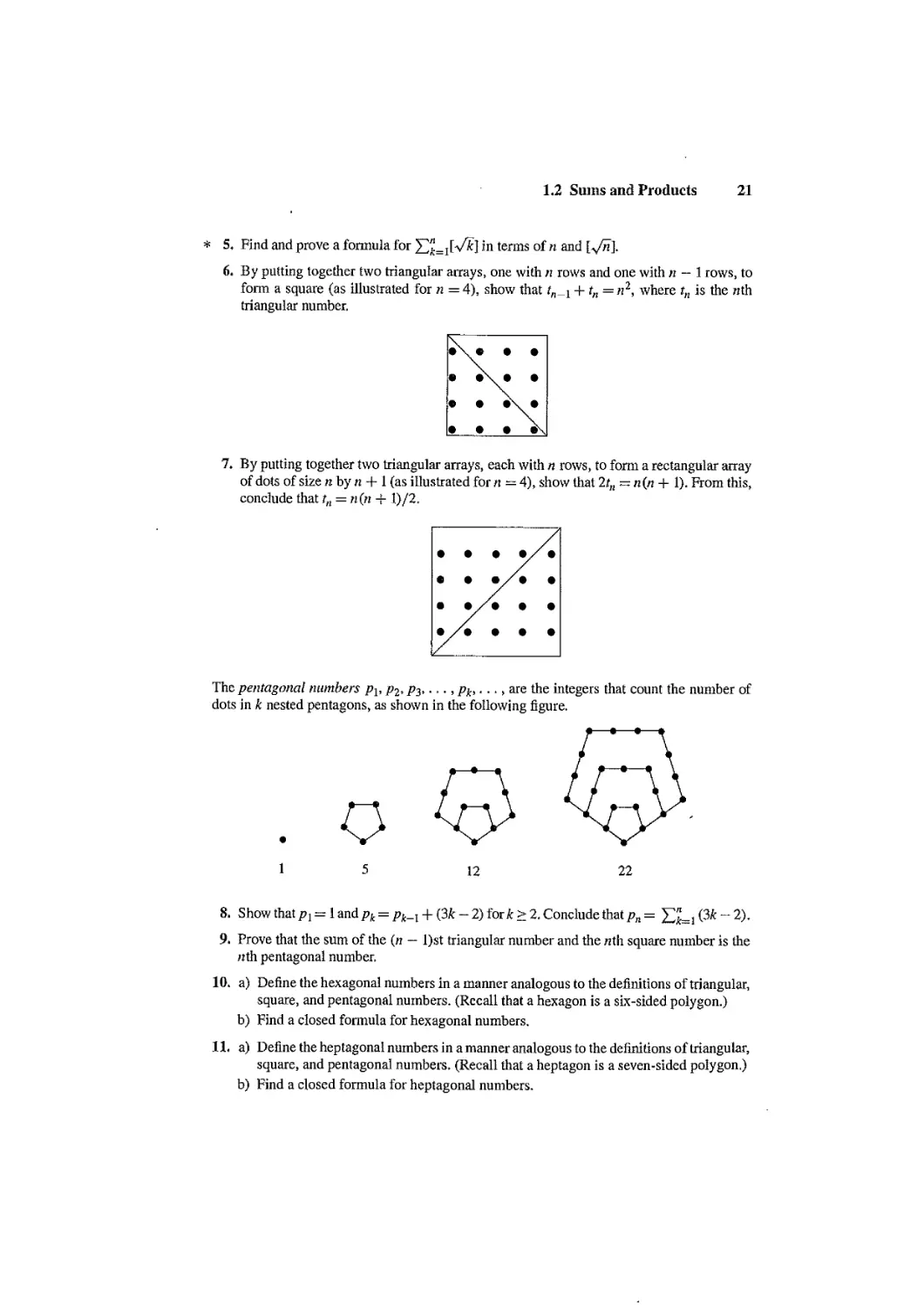








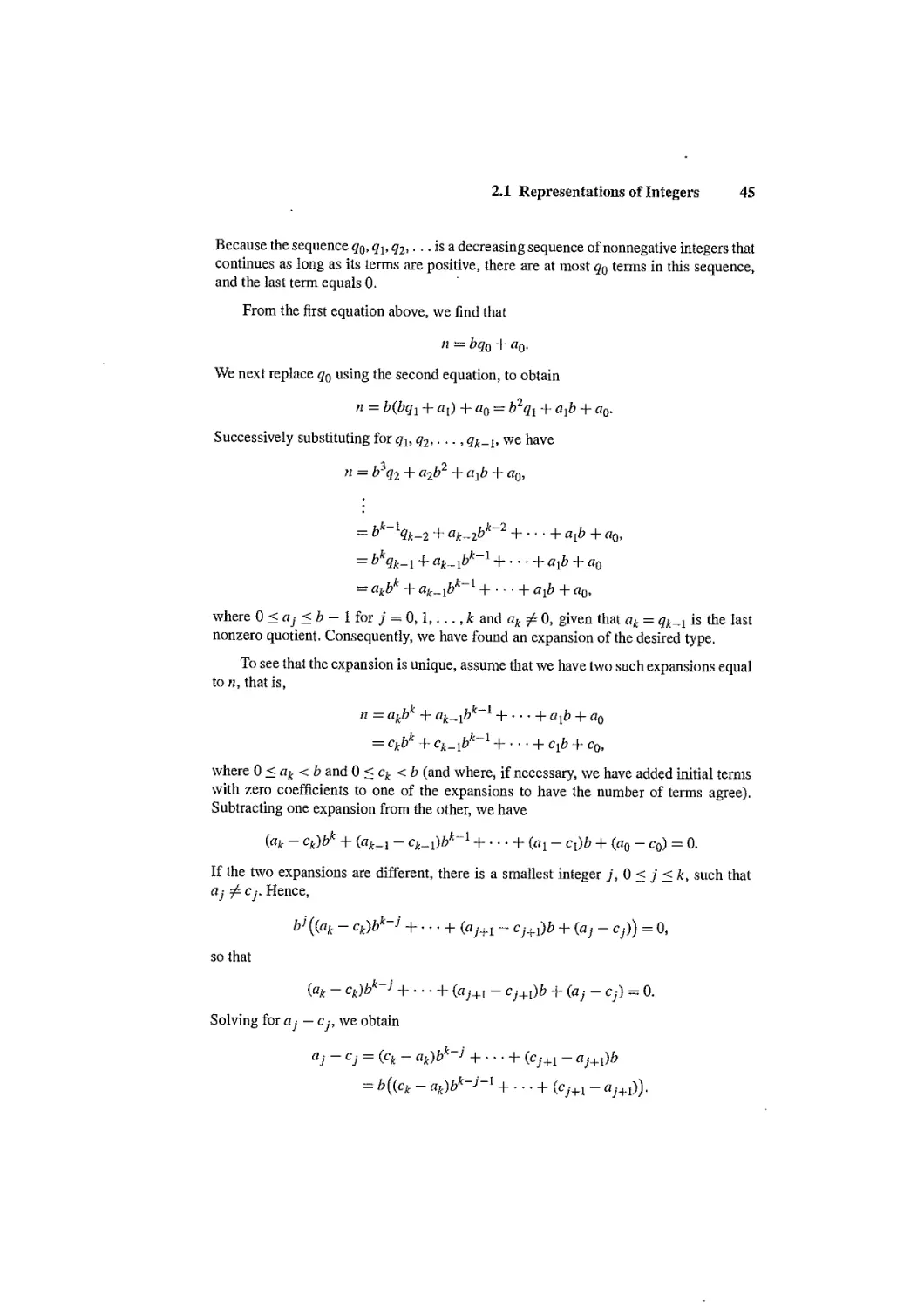
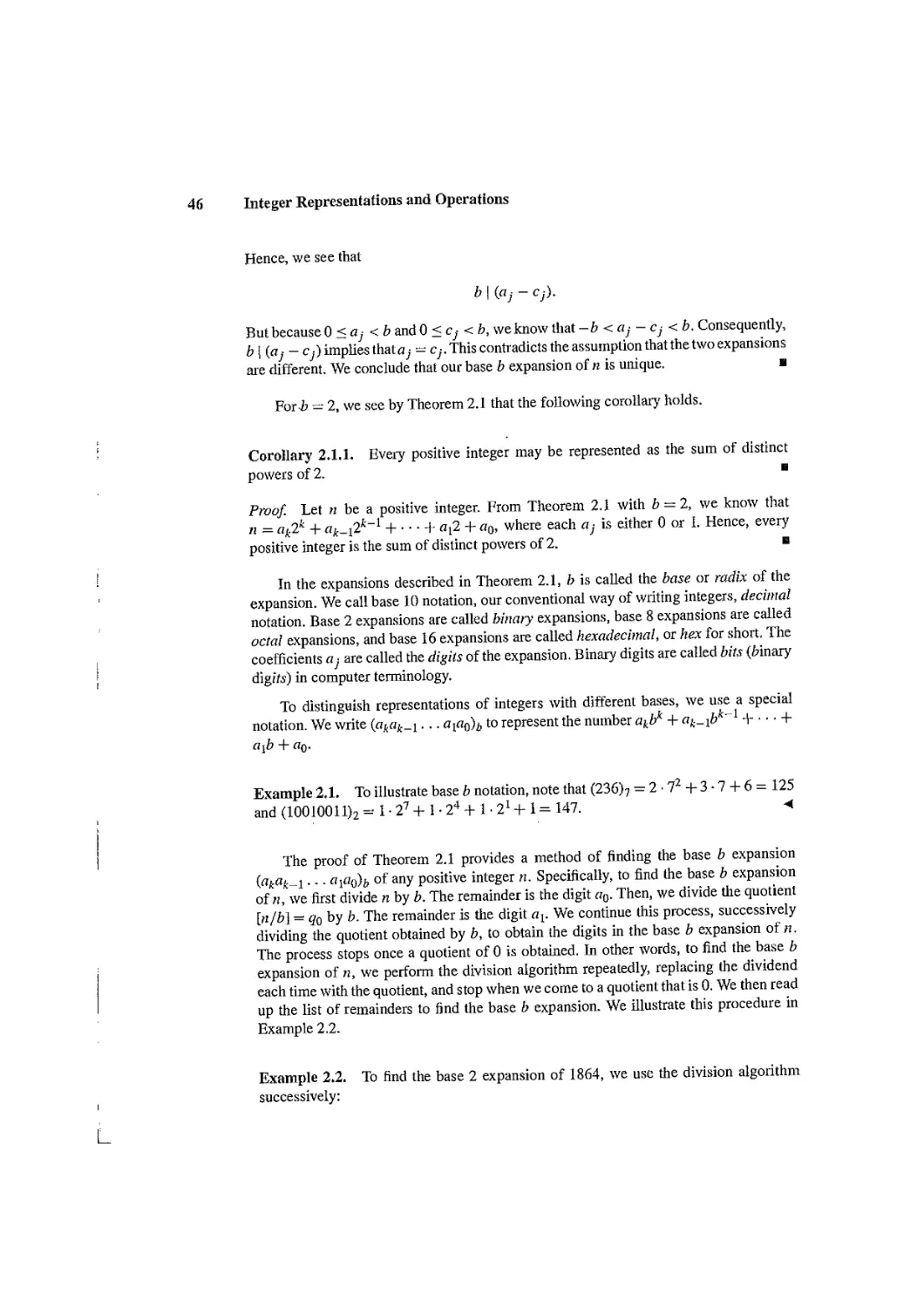


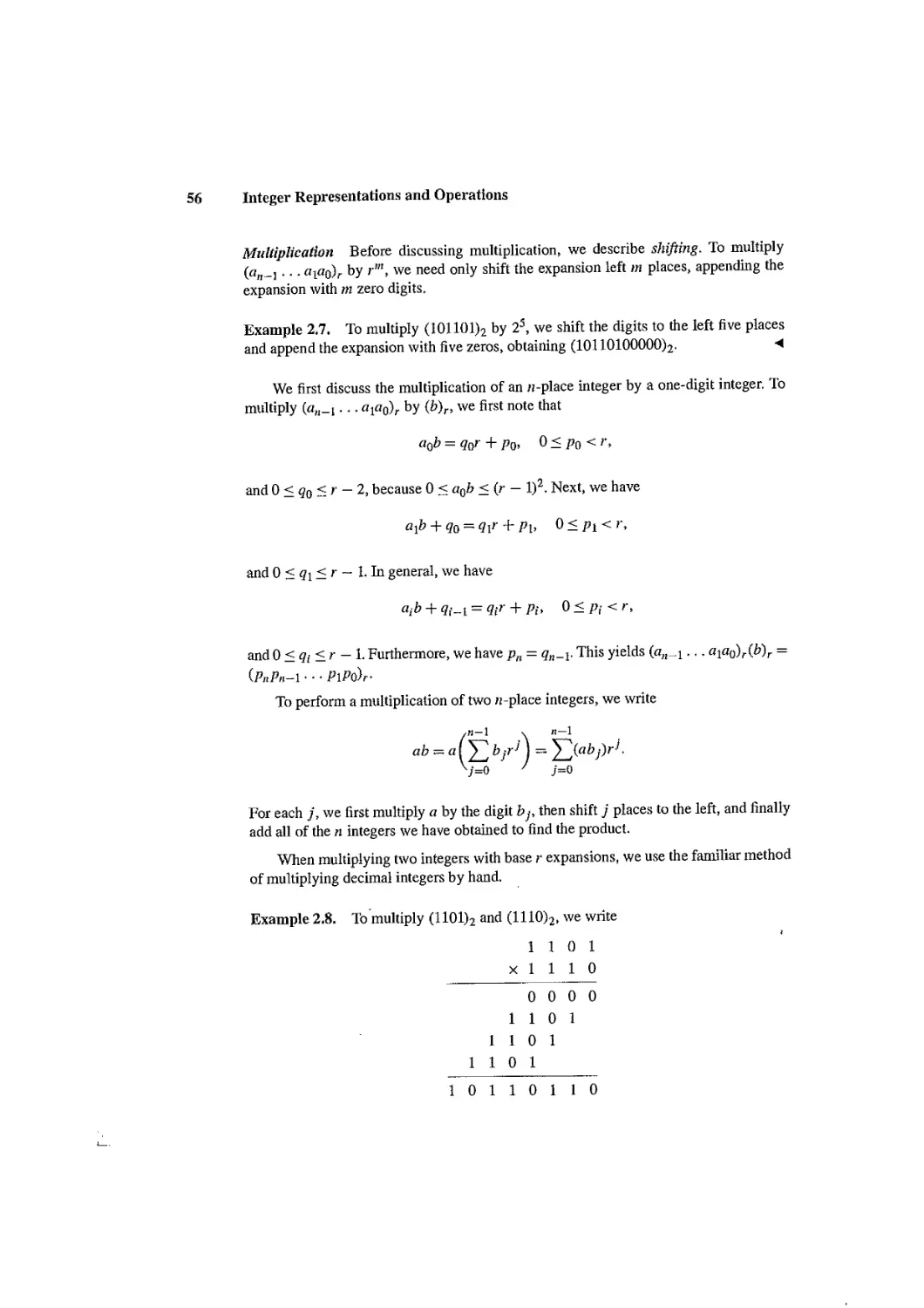


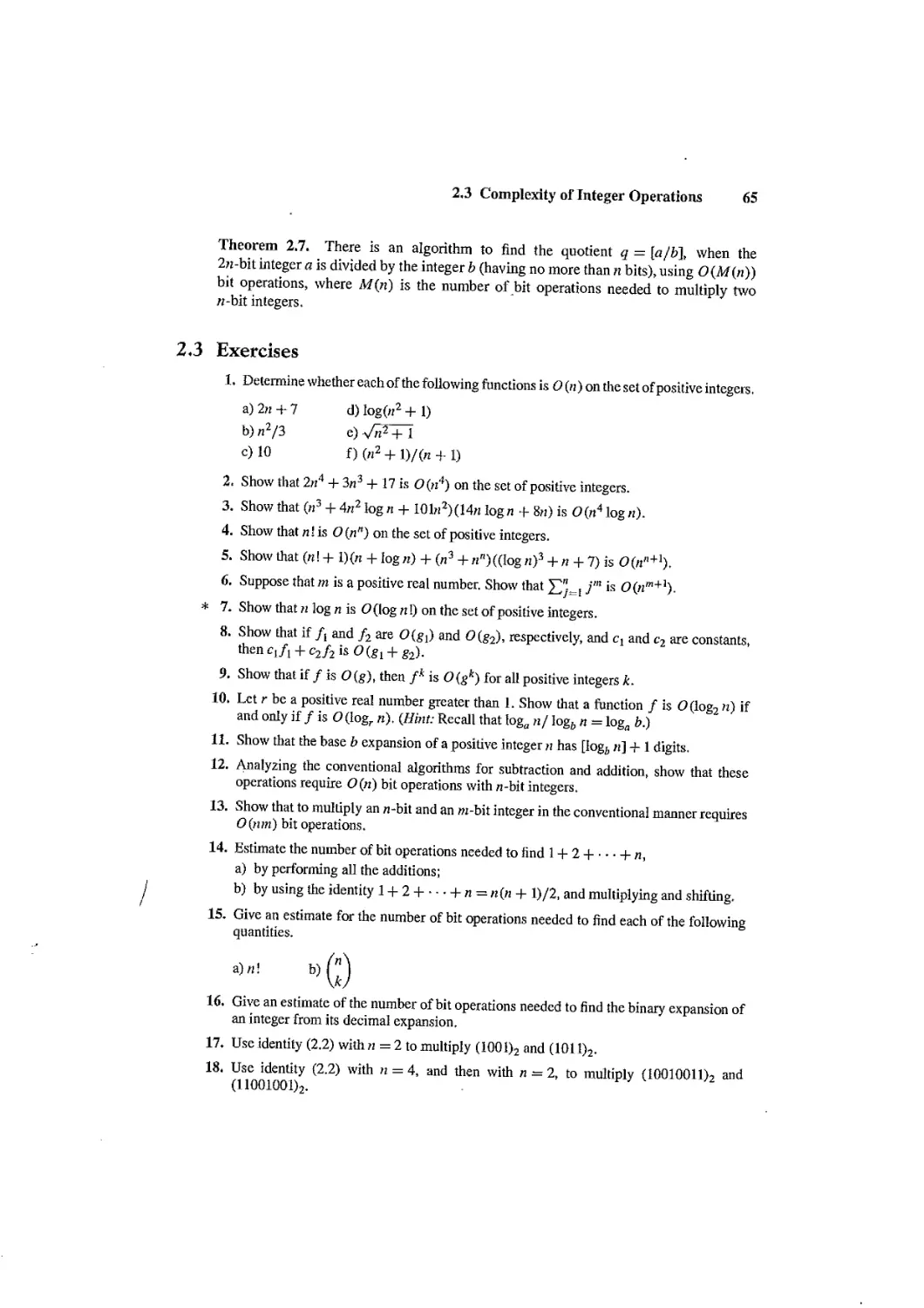



















































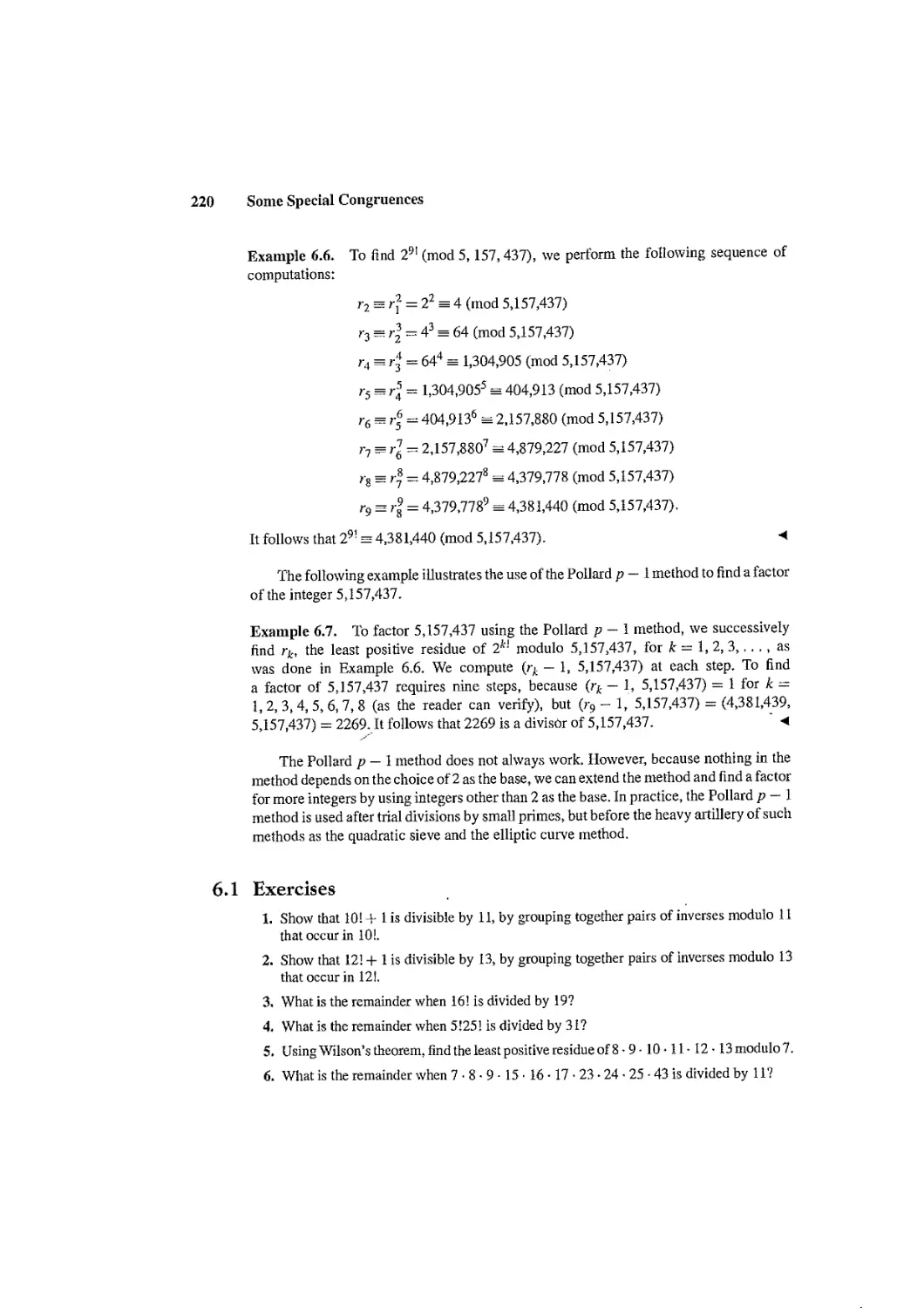

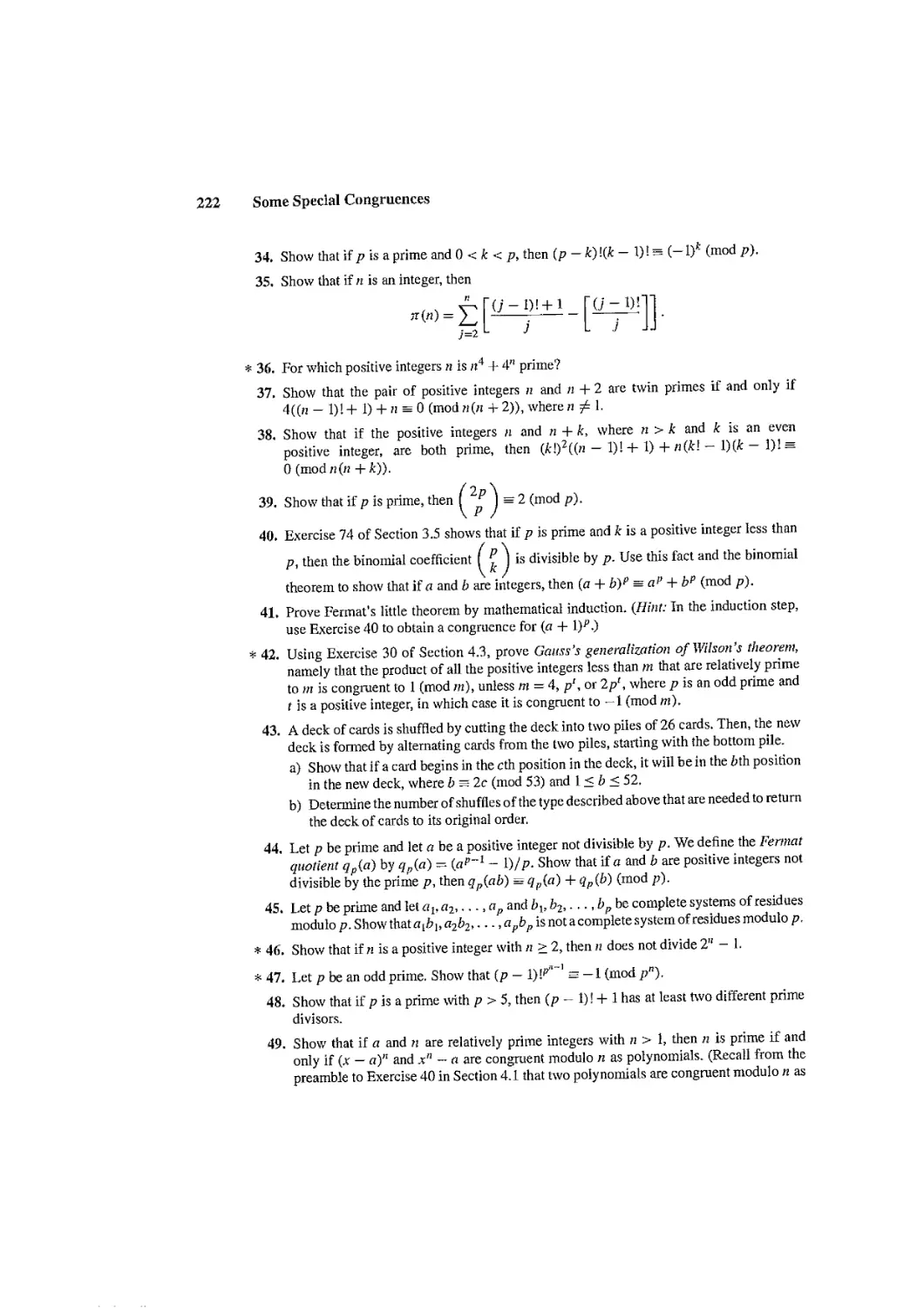
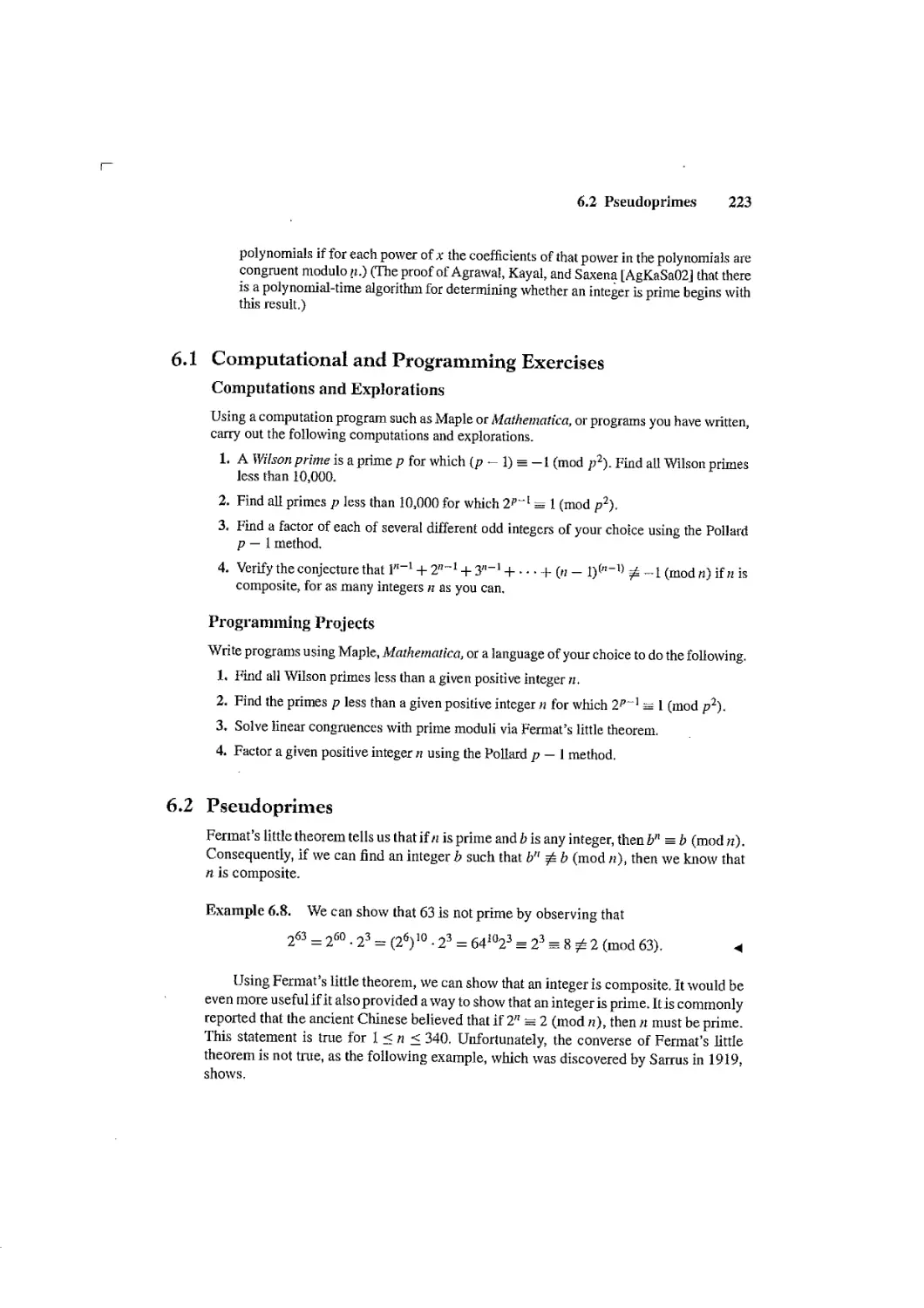

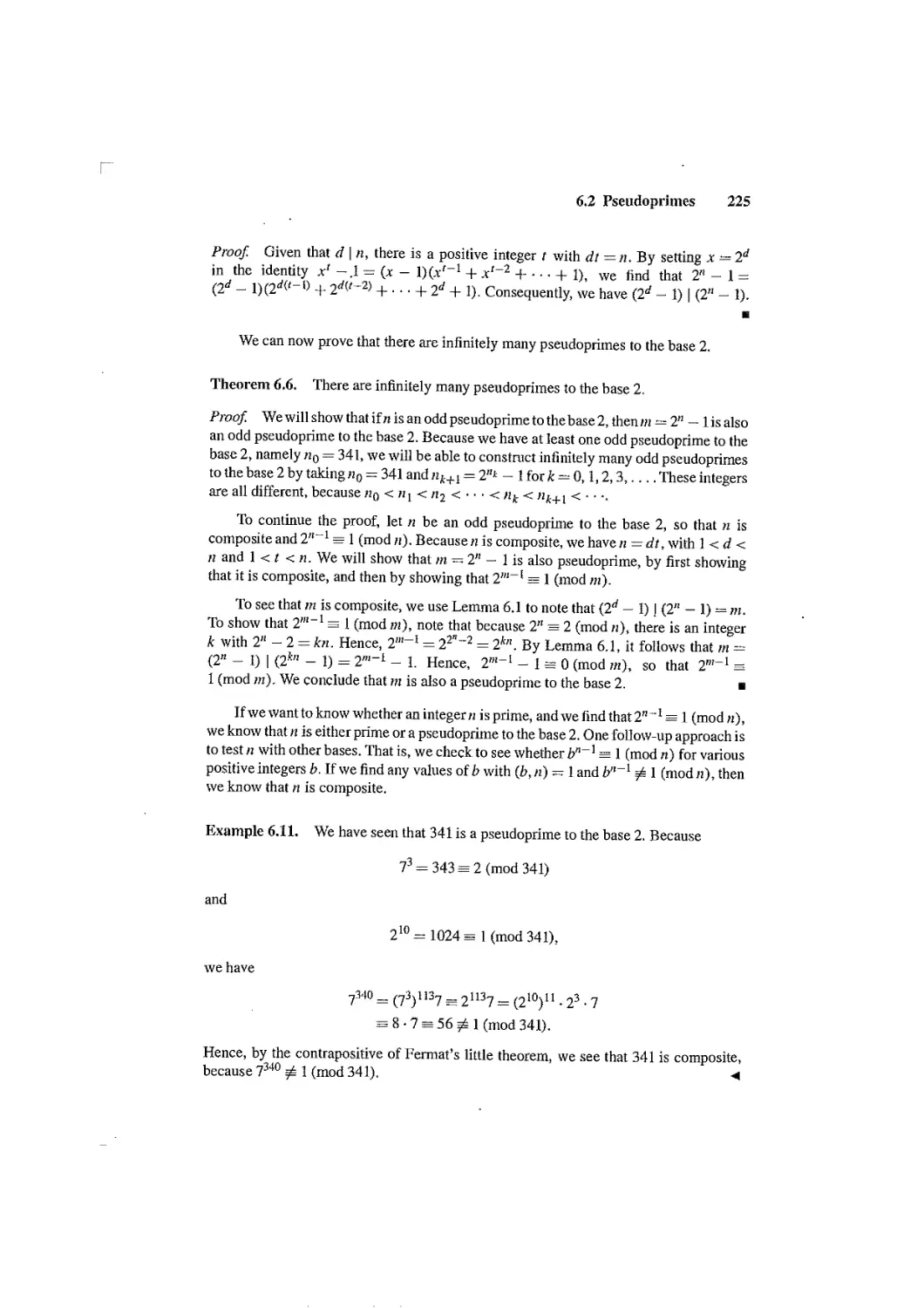



















































































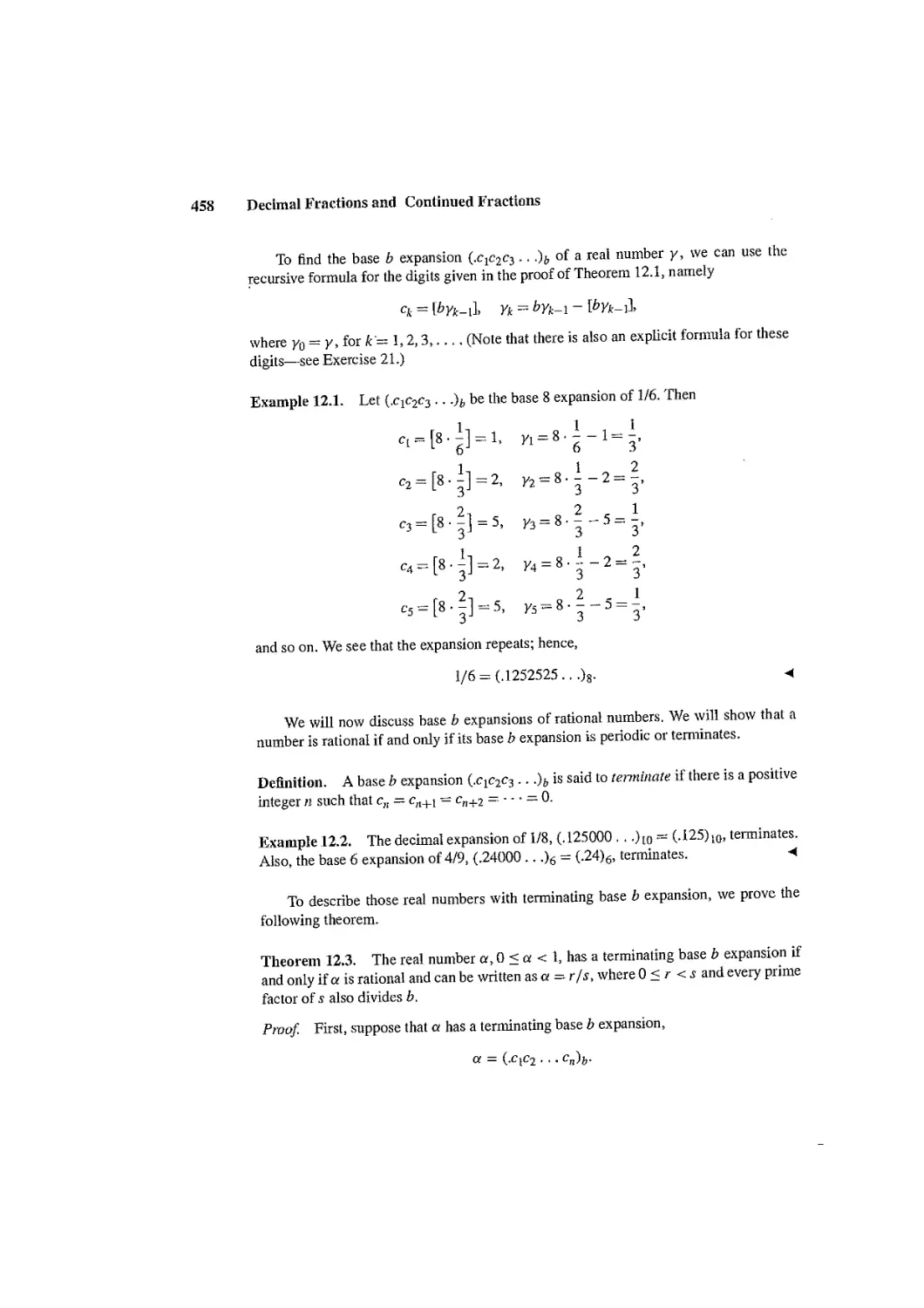


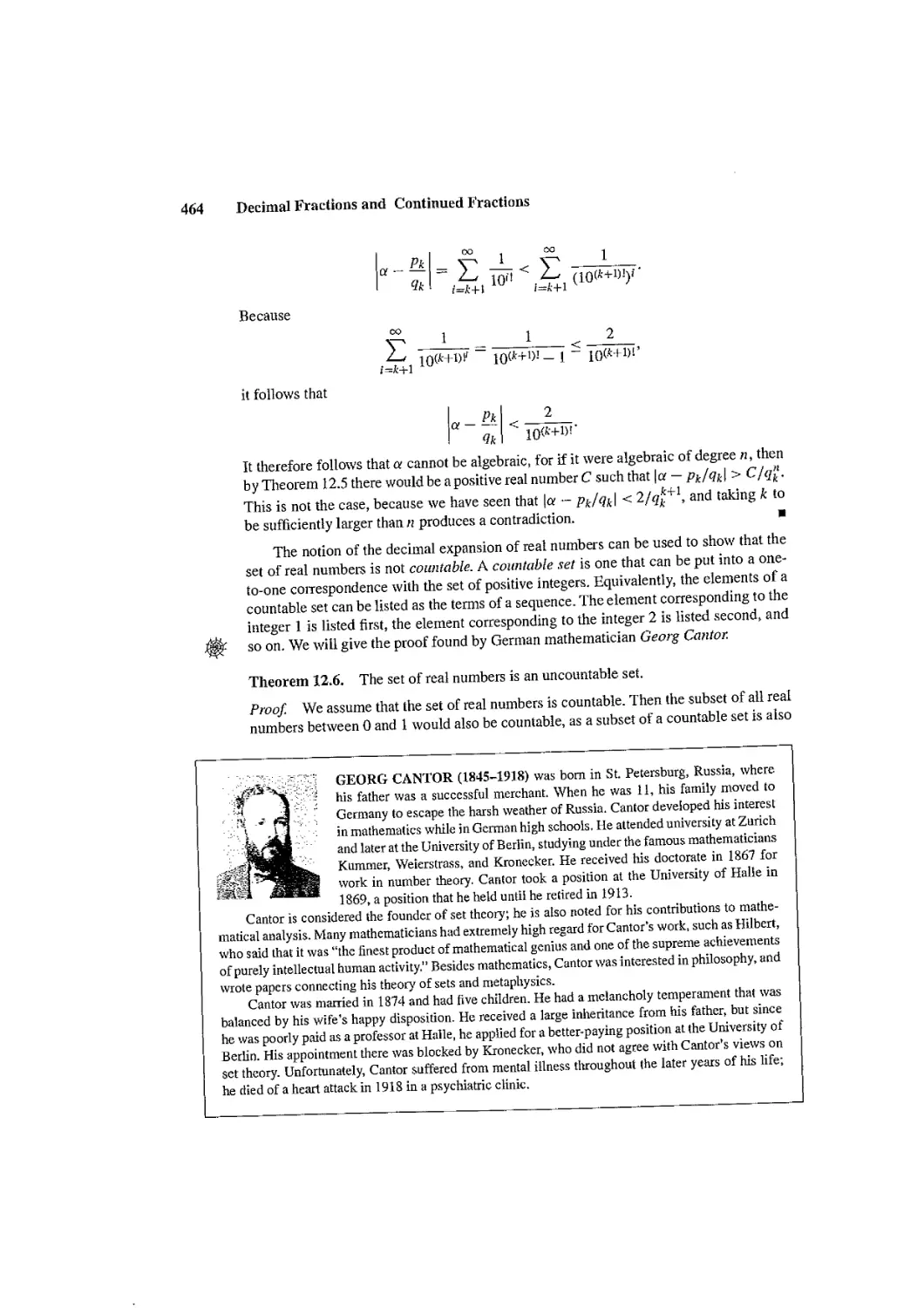
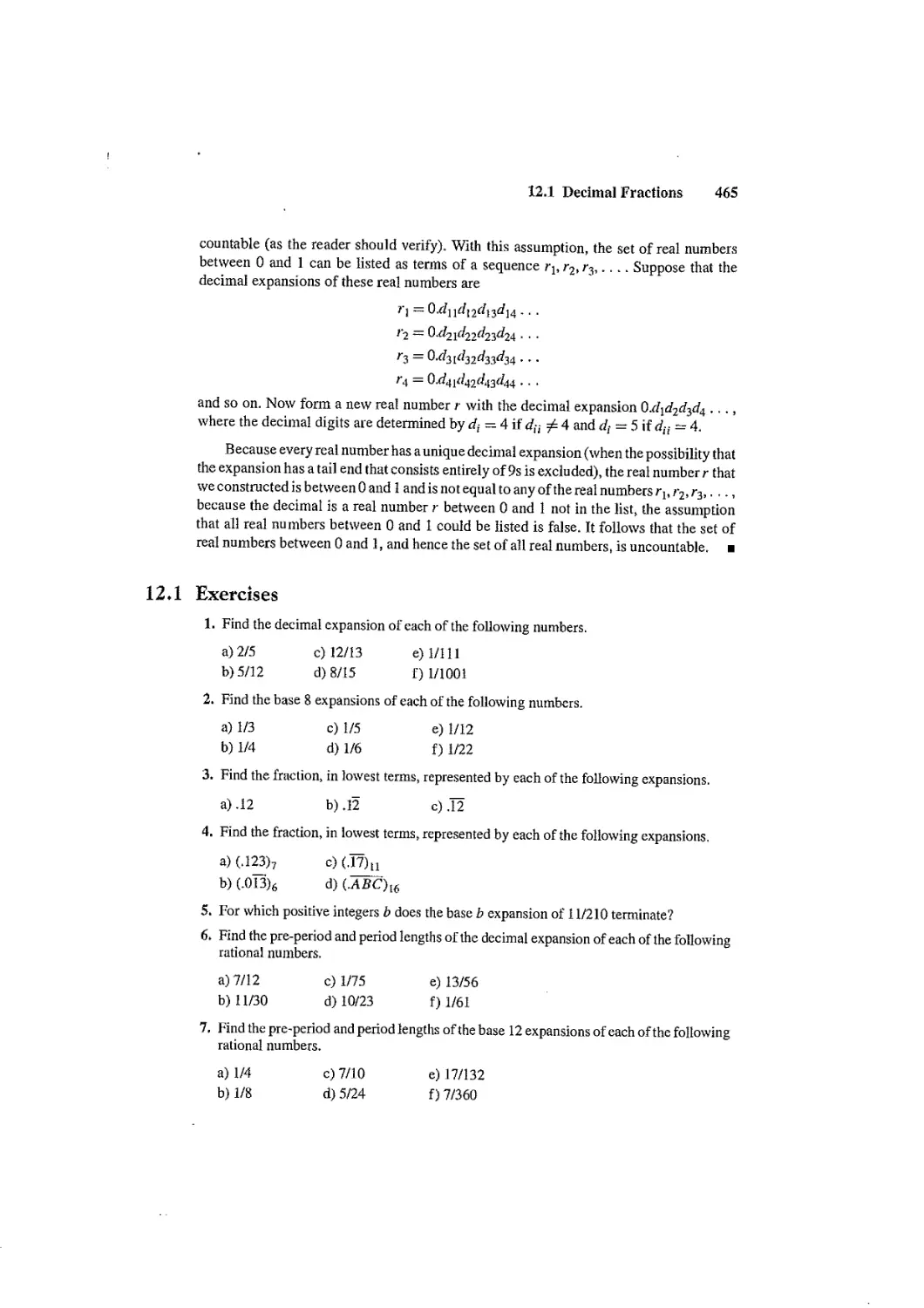


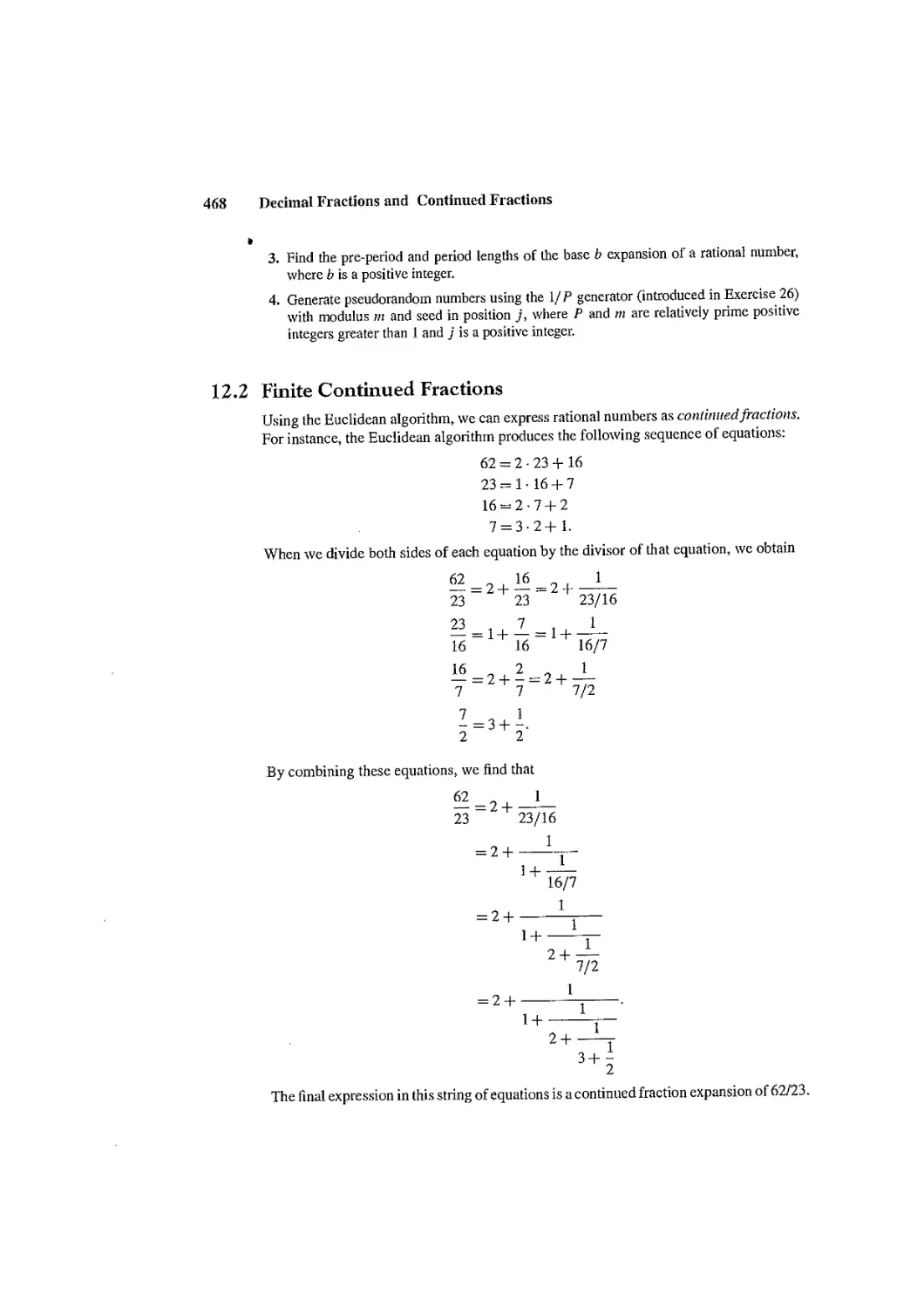




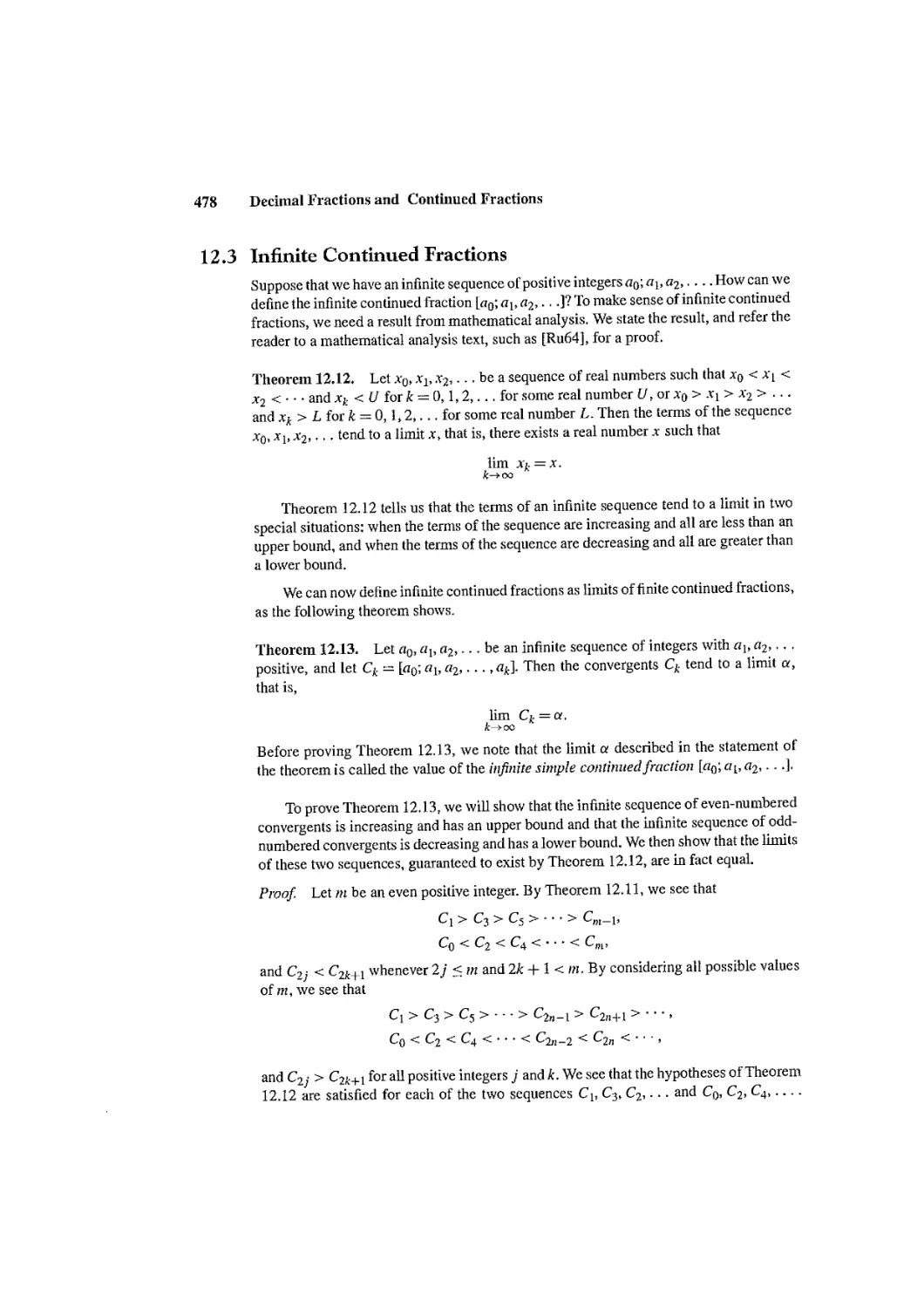
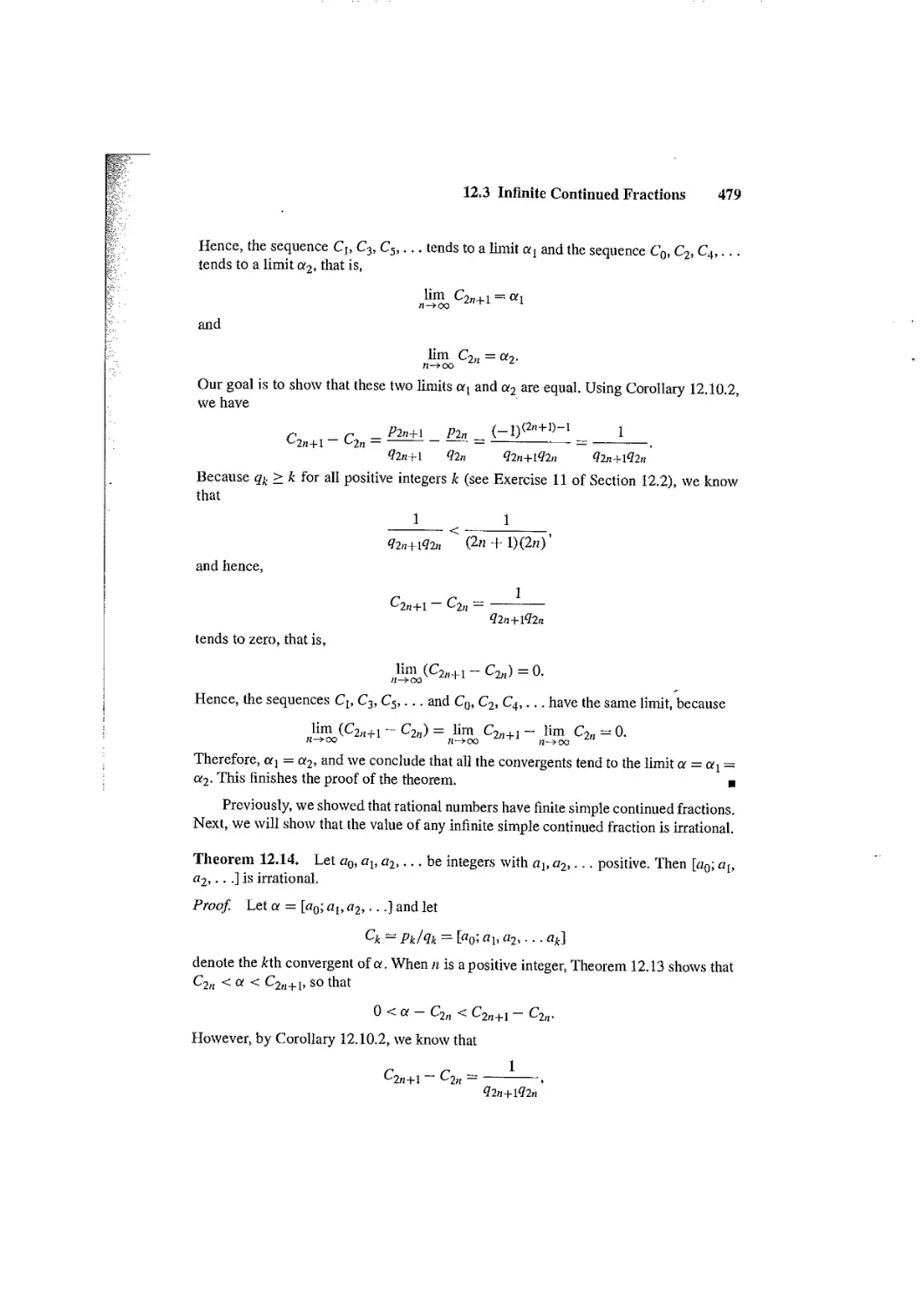


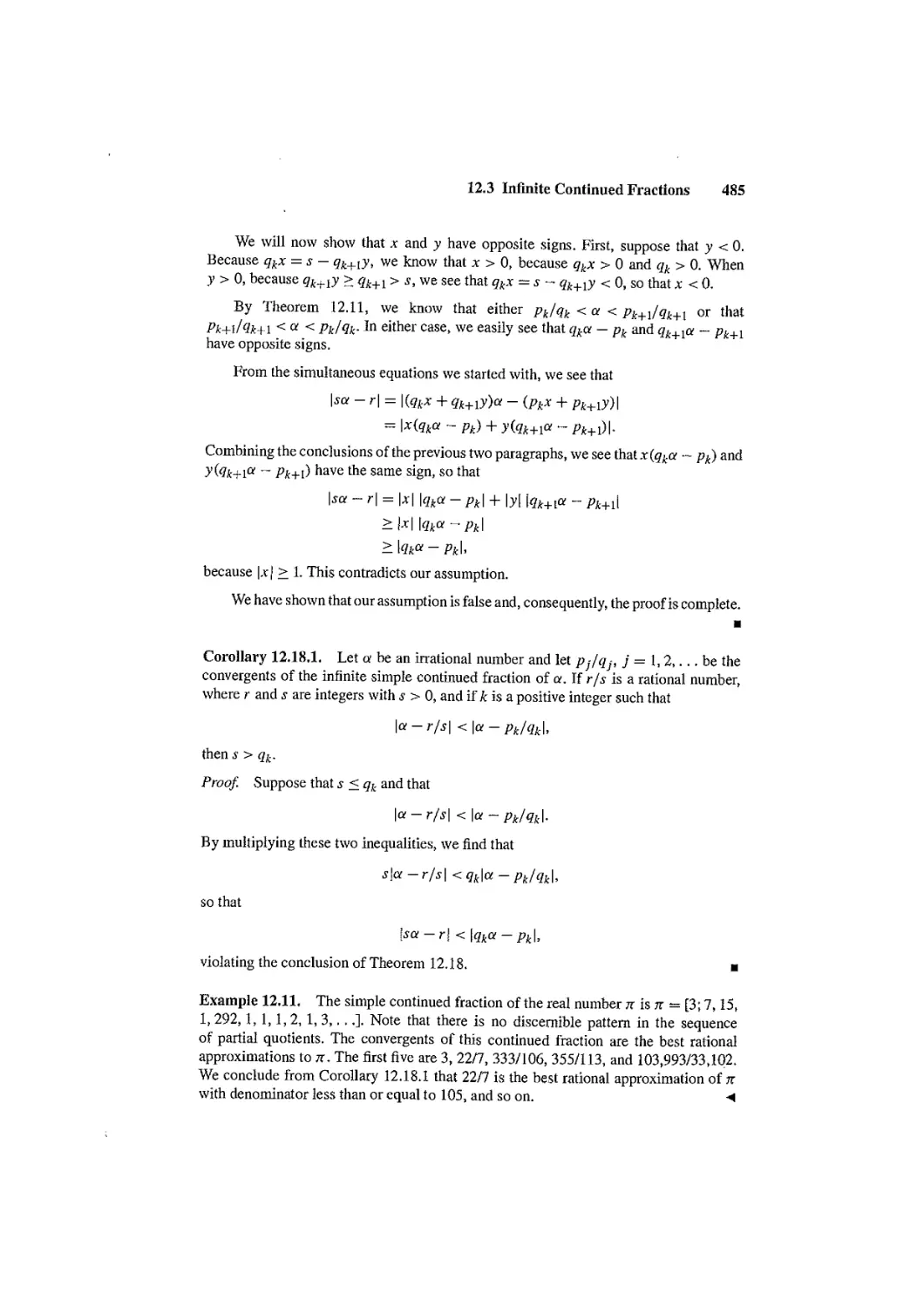


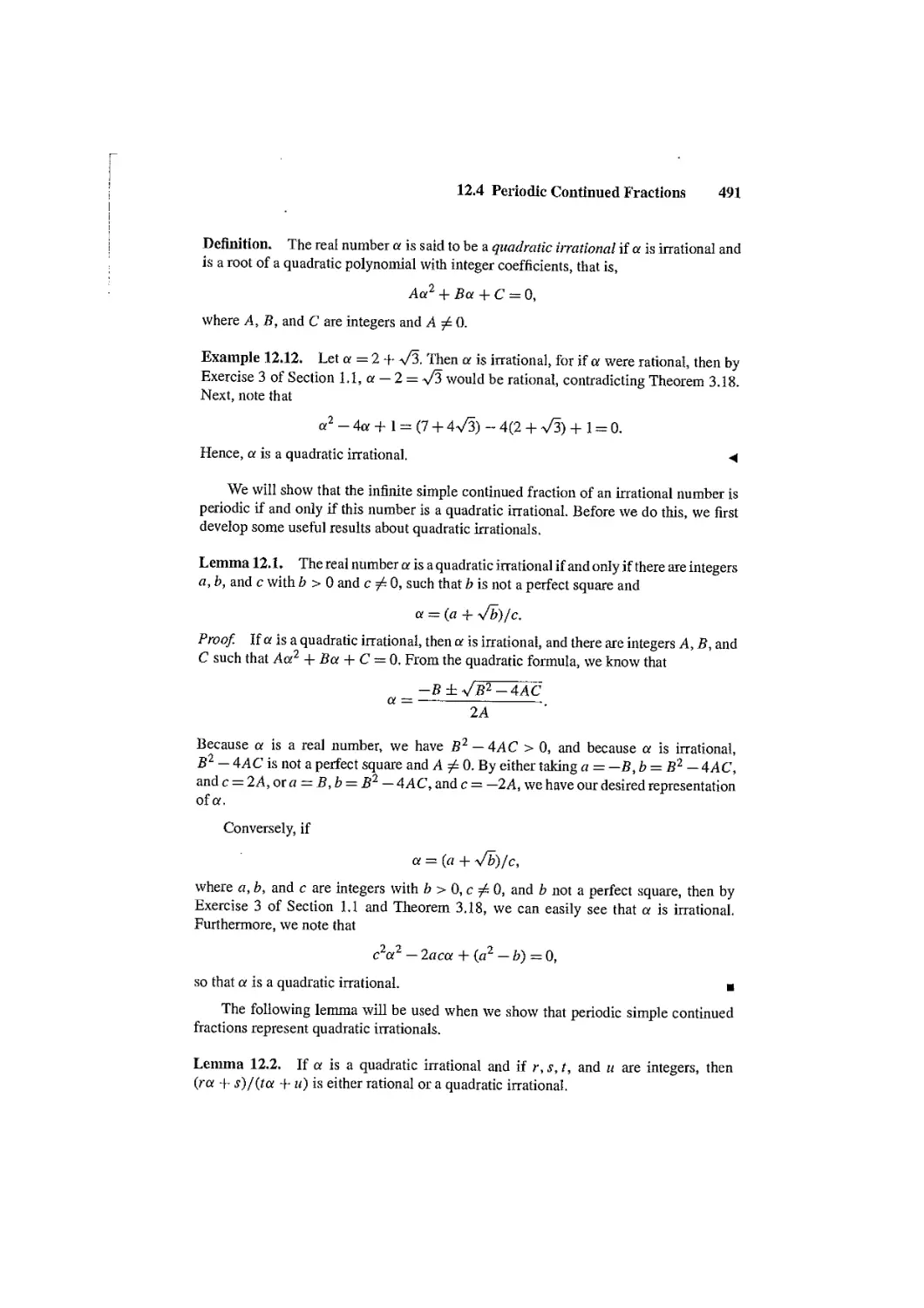
















































































Text
//
( Elementary Number Theory
\ __ __ _c _ ____
\" and Its Applications
...........-----
Fifth Editi on
Kenneth H. Rosen
AT&T Laboratories
-j
r \ - ODT V-HiD-iOV ;.:,!". -: L' ;l , :
MET U iJEllARY
L> ,___...t.......... ....,...._..,...._...... '.. .
...
III
Boston San Franci,co New York
London Toronto Sydney Tokyo Singapore M.drid
Mexico City Munich Paris Cape Town Hong Kong Montreal
Q A..1Lt {
R(J":J
.:L'.5Q 5
Publisher: Greg Tobin
Senior Acquisitions Editor: William Hoffman
Editorial Assistants: Emily Portwood and Mary Reynolds
Marketing Manager: Yolanda Cossio
Marketing Coordinator: Heather Peck
Managing Editor: Karen Wemholm
Senior Production Supervisors: Jeffrey Holcomb and Julie LaChance
Project Management: Barbara Pendergast
Composition and Art Illustration: Windfall Software, using ZzTEX
Senior Manufacturing Buyer: Evelyn Beaton
Photo Research: Beth Anderson
Interior Design.' Barbara T. Atkinson
Cover Design: Suzin Furney Osborne
Cover Image: (Q Jasper Johns I Licensed by VAGA, New York, NY I SuperStock
Photo Credits: Grateful acknowledgment is made to the copyright holders of the
biographical photos, listed on page 721, which is hereby made part of this copyright
page.
Many of the designations used by manufacturers and sellers to distinguish their products
are claimed as trademarks. Where those designations appear in this book, and Addison-
Wesley was aware of a trademark claim, the designations have been printed in initial
caps or all caps.
If you purchased this book within the United States or Canada, you should be aware that
it has been wrongfully imported without the approval of the Publisher or the Author.
Copyright @ 2005 by AT&T Laboratories and Kenneth H. Rosen.
All rights reserved. No part of this publication may be reproduced, stored in a
retrieval system, or transmitted, in any fonn or by any means, electronic, mechanical,
photocopying, recording, or otherwise, without the prior written permission of the
publisher. Printed in the United States of America.
ISBN 0-321-26314-6
1 2 3 4 5 6 7 8 9 10-PHT-07 06 05 04
a) METU LIBRARY
I !II 11; 11,111 Ifll llltll \IIII!III\ 1:11 !lll
OO 0353 54
L__
-c-{
o
b
:i
J
.J
_1
][
3
U
t:
.!
P
In olden times (well, before 1975) number theory had the reputation of being the purest
part of mathematics. It was studied for its long and rich history, its wealth of easily
accessible and fascinating questions, and its intellectual appeal. But, in the past few
years, people have looked at number theory in a new way. Today, people study number
theory both for the traditional reasons and for the compelling reason that number theory
has become essential for cryptography. The first edition of this book was the first text to
integrate the modern applications of elementary number theory with traditional topics.
This fifth edition builds on the basic approach of the original text. No other number theory
text presents elementary number theory and its applications in as thoughtful a fashion as
this book does. Instructors will be pleasantly surprised to see how modern applications
can be seam1essly woven into their number theory course when they use this text.
This book is designed as a text for an undergraduate number theory course at any
level. No formal prerequisites are needed for most of the material, other than some level of
mathematical maturity. This book is also designed to be a useful supplement for computer
science courses and as a number theory primer for people interested in learning about
new developments in number theory and cryptography.
This fifth edition has been designed to preserve the strengths of previous editions
while providing substantial enhancements and improvements. Instructors familiar with
previous editions will be comfortable with this new dition. Those examining this book
for the first time will see an up-to-date text, which integrates gems of number theory
dating back thousands of years with developments less than ten years old. Those familiar
with previous editions will find that this book has become more flexible, easier to teach
from, and more interesting and compelling. They will also find that additional emphasis
has also been placed on the historical context of results and on the experimental side of
number theory.
v
vi Preface
Changes in the Fifth Edition
This new edition incorporates many improvements made at the request of users and
reviewers. The new edition should be easier to teach from, easier to read, and more
interesting and informative. This edition more effectively conveys both the beauty and
the utility of number theory. Noteworthy changes include:
· More flexible organization
The first section of the fourth edition has been divided into two shorter sections. The
first covers types of numbers and sequences and introduces diophantine approximation.
The second covers sums and products. Instructors can skip most of the material in these
two sections if desired, although many will want to cover the material on diophantine
approximation. Section 3.1 of the fourth edition has also been divided into two sections.
The first of these sections introduces primes, establishes that there are infinitely many
primes, and begins the discussion of how primes are found. The second section dis-
cusses the distribution of primes and introduces the prime number theorem and many
conjectures about prime numbers.
· Expanded coverage of cryptography
Cryptanalysis of Vigenere ciphers has been added with the introduction of the Kasiski
test and the index of coincidence. Recent developments in cryptography are mentioned,
including the AES encryption standard. Attacks that have been devised on implemen-
tations on RSA are now described. One such attack is now developed in Chapter 12
using ideas from diophantine approximation using continued fractions. The weakness in
a proposed zero-knowledge proof method is now included in an exercise.
· Up-to-date discoveries
The latest discoveries in number theory are reflected in the text, including a number of
theoretical discoveries and discussions concerning the polynomial time algorithm for
proving an integer in prime and the resolution of the Catalan conjecture. Computational
discoveries, such as three new Mersenne primes, have been added. The Web site for
the book will highlight the latest news in number theory and links will be provided that
announce discoveries made subsequent to the publication of this book.
· New and expanded topic coverage
Dirichlet's theorem on approximation of real numbers by rational numbers has been
added, introducing the subject of diophantine approximation to the first section of the
text. A proof using the pigeonhole principle is provided. Many important topics whose
full treatment is beyond the scope of an elementary number theory text are now discussed;
the goal is to give the student a fuller appreciation of number theory. In a similar vein,
the coverage of diophantine equations has been expanded. This edition includes brief
discussions of Beal's conjecture, the Catalan conjecture and its recent resolution, and
the Fermat-Catalan conjecture. The abc conjecture is also discussed, and how it can be
used to prove results on diophantine equations is illustrated.
L-.
Preface vii
A new chapter on the Gaussian integers has been added. This chapter introduces
Gaussian primes, the . greatest common divisor of Gaussian integers, the Euclidean
algorithm for Gaussian integers, and the unique factorization of Gaussian integers into
Gaussian primes. This new chapter also explains how Gaussian integers can be used to
find the number of ways to express a positive integer into the sum of two squares.
· Improved examples and proofs
Euclid's proof that there are infinitely many primes is now given in the text. A large
number of other proofs of the infinitude of primes can be found in the exercises. Many
proofs have been improved, either by simplification or by additional explanation.
· Enhanced exercise sets
This book has long been noted for its exceptional exercises; in this edition the exercises
are even better. All exercises in the text have been reviewed and solved; exercises from
the fourth edition found to be ambiguous or lacking assumptions have been clarified.
Several hundred new exercises have been added. Additional exercises involving
Fibonacci identities have been inserted. New exercises also outline different proofs
that there are infinitely many primes. There are many new exercises on cryptography,
including many relating to the Vigenere cipher and the RSA cryptosystem. The newest
proof of the law of quadratic reciprocity is outlined in an exercise. More exercises
on nonlinear diophantine equations have been added, including exercises on Bachet's
equation, Markov's equation, and "congruent numbers.
· Expanded historical context and biographies .
The history and status of the Riemann hypothesis are now covered. Skewes' constant,
one of the largest numbers arising in a proof, is introduced. Also added is an account
of the discovery by Thomas Nicely of the famous division flaw in the Pentium chip,
found because two computations involving twin primes did not agree. This edition
introduces many new biographies, including those of Bertrand, Farey, Waring, Bachet,
Kronecker, Levi ben Gerson, and Catalan. Photographs have been also been added to
many biographies.
· Enhanced ancillaries and enhanced sllpportfor Maple@ and Mathematica@
The Student's Solutions Manual and the Instructor's Manual have been enhanced. They
both now contain a comprehensive guide explaining how to use Maple for computations
in number theory. Suggested syllabi for different courses are now contained in the In-
structor's Manual. The Instructor's Manual and the Web site now both contain migration
guides for the exercises showing where exercises in the fourth edition can be found in
the fifth edition, and conversely, where exercises in the fifth edition were located in the
fourth edition, if they were included in this previous edition.
Commands for carrying out computations with the Gaussian integers have been
added to the appendix that describes number theory commands in Maple and Mathe-
matica.
viii Preface
. ExtrafocliS Oll accuracy
This edition benefits from extra resources devoted to ensure the accuracy of the text,
as well as the exercises and their answers and solutions. Three accuracy checkers have
spent long hours making sure that this book is as error-free as possible.
· Expanded Web site
The Web site for this text has been expanded and enhanced in several key ways. "Number
Theory News" is a new feature highlighting recent discoveries in number theory. The
extensive list of number theory Web sites keyed to the text has been expanded and all
links have been updated. These links will be periodically updated during the life of this
edition. The Web site now also supports an extensive collection of number theory and
cryptography applets which can be used for computations and exploration, as well as
a tutorial on PARI/GP, a computational system for fast computation in number theory
upon which these applets are built. A collection of suggested group or individual student
projects can also be found on the Web site.
Features
A Development of Classical Number Theory
The core of this book presents classical elementary number theory in a comprehensive
and compeUing manner. The historical context and importance of key results are noted.
The basic material on eachtopic is developed carefully, followed by more sophisticated.
results on the same topic.
Applications
A key strength of this book is how applications of number theory are covered. Once
the requisite theory has been developed, applications are woven into the text in a
flexible way. These applications are designed to motivate the coverage of the theory
and illustrate the usefulness of different aspects of elementary number theory. Extensive
coverage is devoted to applications of number theory to cryptography. Classical ciphers,
block and stream ciphers, public key cryptosystems, and cryptographic protocols are all
covered. Other applications to computer science include fast multiplication of integers,
pseudorandom numbers, and check digits. Applications to many other areas, such as
scheduling, telephony, entomology, and zoology can also be found in the text.
Unifying Themes
Many concepts from elementary number theory are used in primality testing and fac-
toring. Furthermore, primality testing and factoring playa key role in applications of
number theory to cryptography. As such, these topics are used as unifying themes and
are returned to repeatedly. Almost every chapter includes material on these topics.
Preface Ix
Accessibility
This book has been designed with a minimum of prerequisites. The book is almost
entirely self-contained, with only a knowledge of what is generally known as "college
algebra" required. There are several places where knowledge of some concepts from
calculus is needed (such as in the discussions of the distribution of primes and big-
o notation). Concepts from discrete mathematics and linear algebra are needed in a
few places. All material that depends on topics more advanced than college algebra is
explicitly noted and is optionaL
Accuracy
Great effort has been made to ensure the accuracy of this edition. Input from many users
of the fourth edition, reviewers, and proofreaders has helped achieve this goaL
Extensive Exercise Sets
The best (and maybe the only) way to learn mathematics is by doing exercises. This
text contains an extremely extensive and diverse collection of exercises. Many routine
exercises are included to develop basic skills, with care taken so that both odd-numbered
and even-numbered exercises of this type are included. A large number of intermediate-
level exercises help students put several concepts together to form new results. Many
other exercises and blocks of exercises are designed to develop new concepts. Challeng-
...mgexercises are iriamplesupply arid are marked;'vlth()nestar (*)indicatiIlg adiffictllt
exercise and two stars (* *) indicating an extremely difficult exercise. There are some
exercises that contain results used later in the text; these are marked with a pointing-hand
symbol (IG"). These exercises should be assigned by instructors whenever possible.
An extensive collection of computer projects is also provided. Each section includes
computations and explorations designed to be done with a computational program such as
Maple or Mathematica, or using programs written by instructors and/or students. There
are some routine exercises of this sort that students should do to learn how to apply
basic commands from Maple or Mathematica (as described in Appendix D), as well as
more open-ended questions designed for experimentation and creativity. Each section
also includes a set of programming projects designed to be done by students using a
programming language of their choice, such as the programming languages included
with Maple and Mathematica, or another programming language of their choice.
Exercise Answers
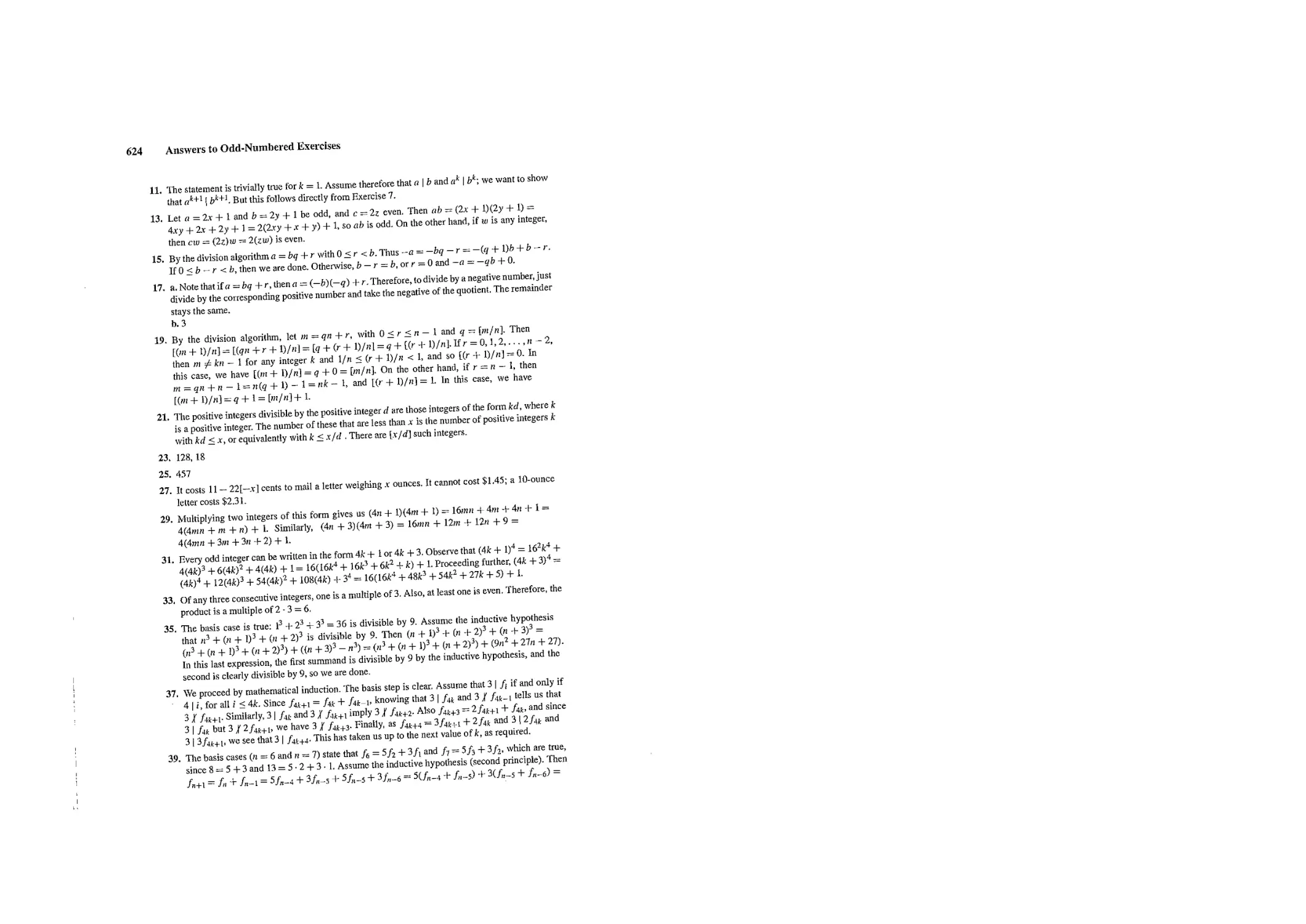
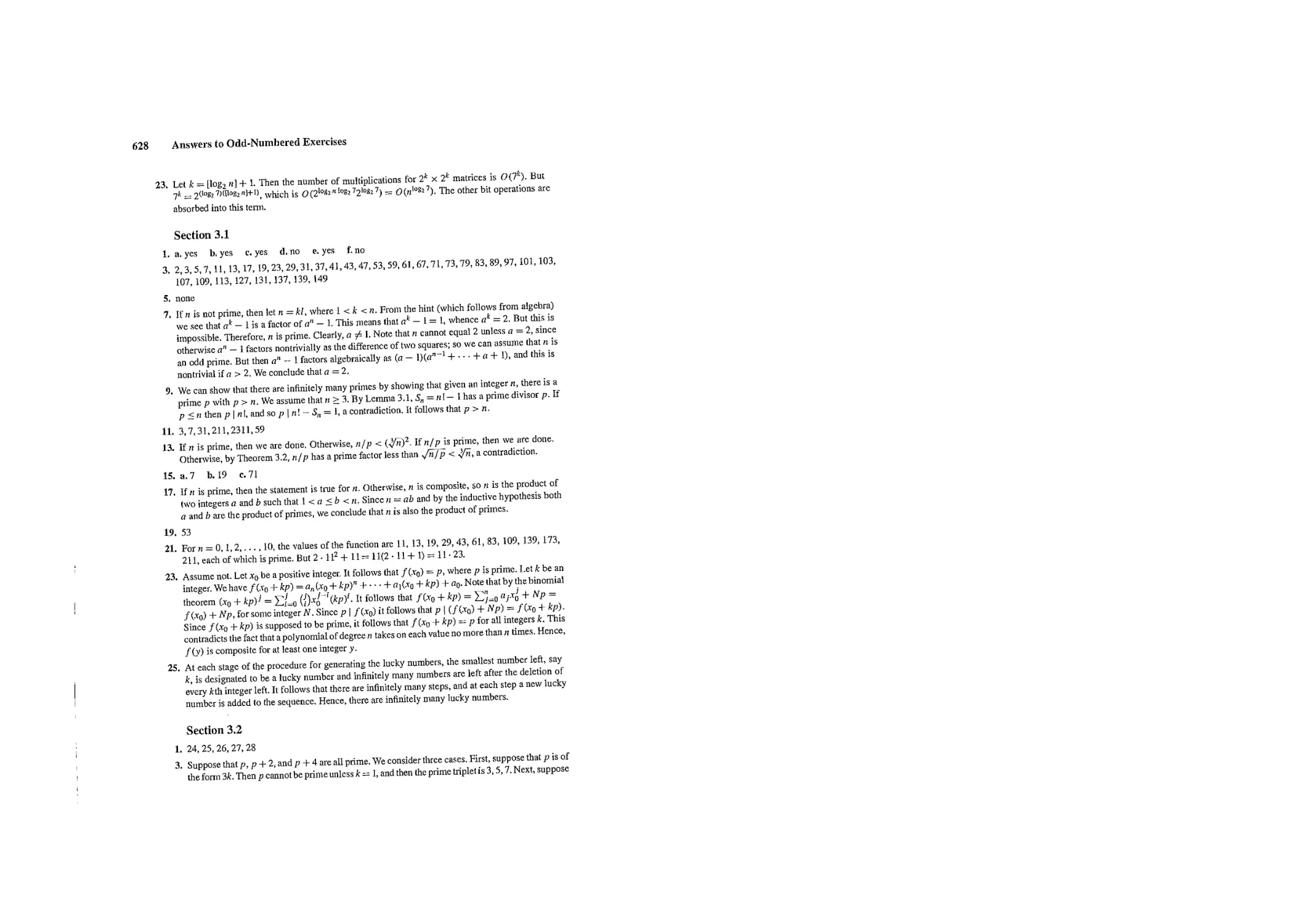
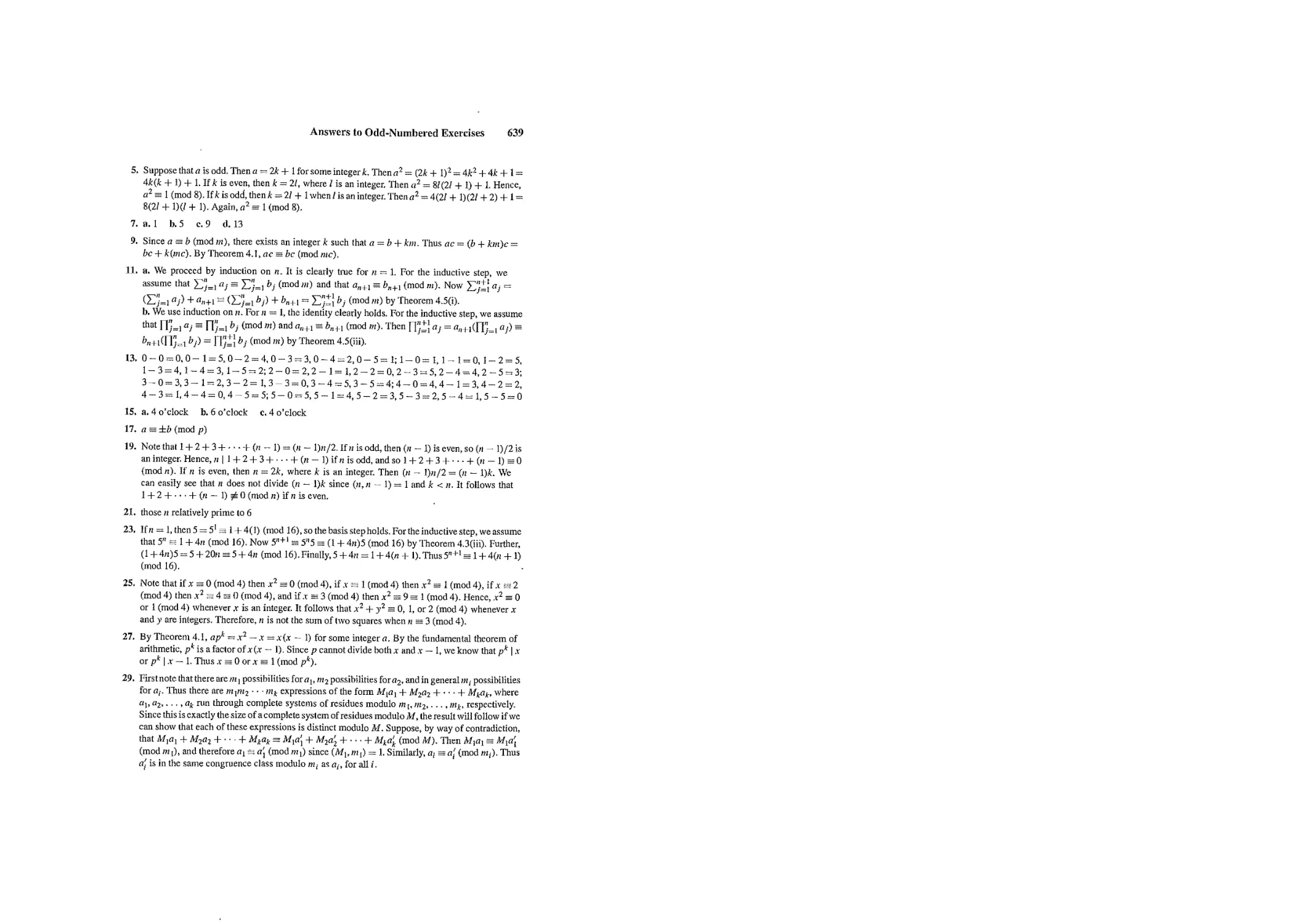
The answers to all odd-numbered exercises are provided at the end of the text. More
complete solutions to these exercises can be found in the Student's Solutions Manual
that accompanies this text. All solutions have been carefully checked and rechecked to
ensure accuracy.
x Preface
Discovery via Empirical Evidence
In many places in the text numerical evidence is examined to help motivate key results.
This gives an opportunity to students to come up with a conjecture much as the people
who originally developed many of the results of number theory did.
Extensive Examples
This book includes examples that illustrate each important concept. These examples are
designed to illustrate the definitions, algorithms, and proofs in the text. They are also
designed to help students work many of the exercises found at the end of sections.
Carefully Motivated Proofs
Many proofs in this book are motivated with examples that precede the formal proof and
illustrate the key ideas of the proof. The proofs themselves are presented in a careful,
rigorous, and fully explained manner. The proofs are designed so that students can
understand each step and the flow of logic. Numerical examples illustrating the steps
of the proof are often provided following the formal proof as well.
Algorithmic Reasoning
The algorithmic aspects of elementary number theory are thoroughly covered in this
..texL N6t. 6rilyareiriany alg6rithrtisdescribe:d, but their complexity is also . analyzed; ..
Among the algorithms described in this book are those for computing greatest common
divisors in many different ways and for primality testing and factoring. The coverage of
the complexity of algorithms has been included so that instructors can choose whether
they want to include this material in their course.
Biographies and Historical Notes
More than 60 biographies of contributors to number theory are included in this edition.
Contributors included lived in ancient times, the Middle Ages, the sixteenth through
eighteenth centuries, the nineteenth century, and the twentieth century, and lived in the
East and in the West. These biographies are designed to give students an appreciation of
contributors as unique individuals who often led (or are leading) interesting lives.
Open Questions
Many open questions in number theory are described throughout the book. Some are
described in the text itself and others are found in exercise sets. These questions show
that the subject of number theory is a work in progress. Readers should be aware that
attempting to solve such problems can often be time-consuming and futile. However, it
would be surprising if some of these questions were not settled in the next few years.
Preface xi
Up to Date Content
The latest discoveries'in number theory are included in this book. The current status
of many open questions is described, as are new theoretical results. Discoveries of new
primes and factorizations made as late as September 2004 are included with the first
printing of this edition. These discoveries will help readers understand that number theory
is an extremely active area of study. They may even see how they may participate in the
search for new primes.
Bibliography
An extensive bibliography is provided for this book. This bibliography lists key printed
number theory resources, including both books and papers. Many useful number texts
are listed, as are books dealing with the history of number theory and particular aspects
of the subject. Many original sources are included, as is material covering cryptography.
Maple and Mathematica Support
An appendix has been provi ed which lists the commands in both Maple and Math-
ematiea for carrying out computations in number theory. These commands are listed
according to the chapter of the text relevant to these commands.
Web Resources
...The YV bsi e for this boo incllldes aW bguideto nUrnbert orythat is keyed to
.. .. this text, as well as an extensive collection of other resources. To access this site go to
www.awlonline.com/rosen. For convenience, the most important number theory Web
sites are highlighted in Appendix D.
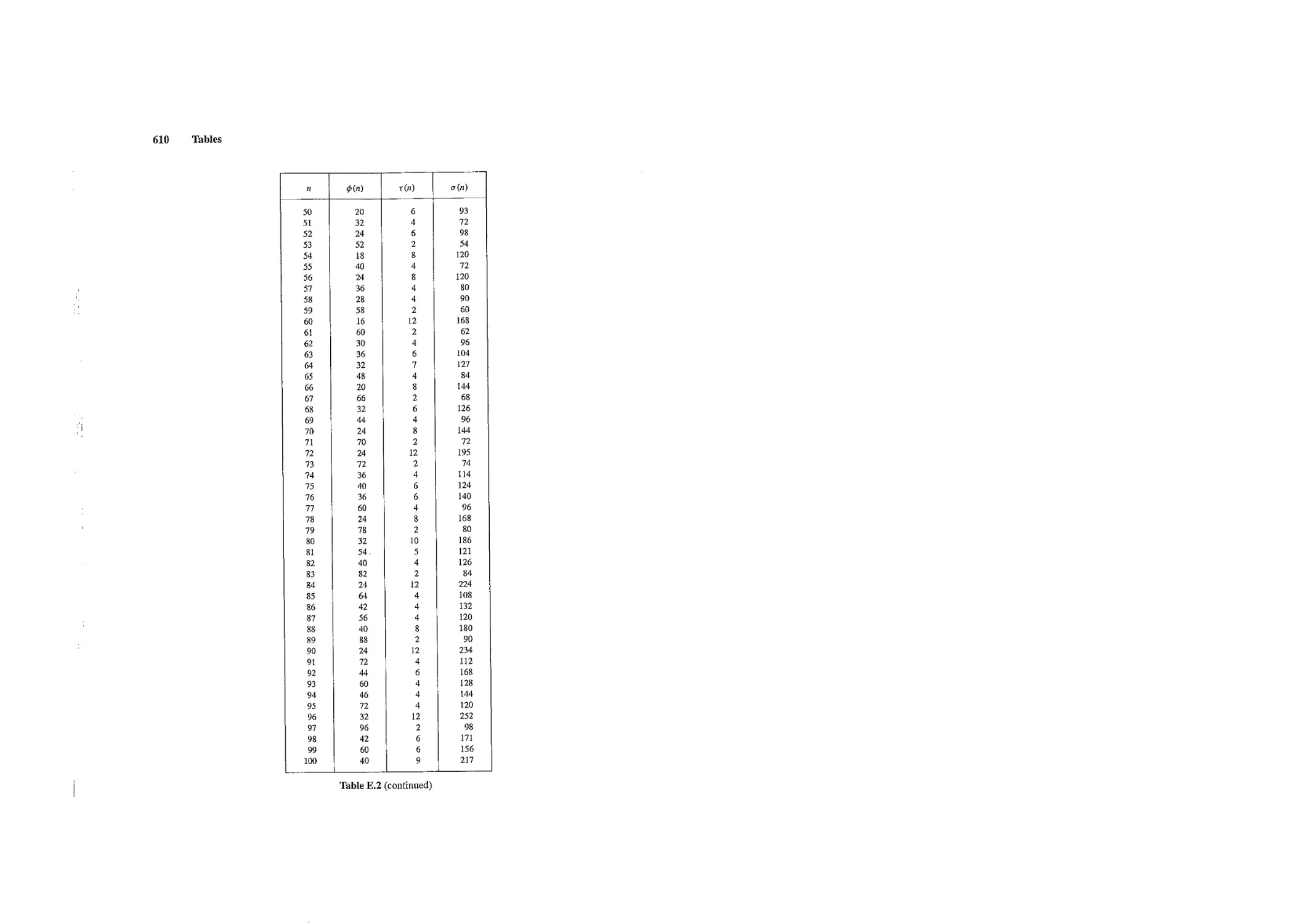
Tables
A set of five tables is included to help students with their computations and experi-
mentation. Looking at these tables can help students search for patterns and formulate
conjectures. The use of a computational software package, such as Maple or Mathemat-
lea is recommended when these tables are insufficient.
List of Symbols
A list of symbols used in the text and where they are defined is included on the inside
front cover of this book.
Ancillaries
Student's Solutions Manual (ISBN O 321 26840 7)
The Student's Solutions Manual contains worked solutions to all the odd-numbered
exercises in the text and other helpful material, including some tips on using Maple and
xii Preface
Mathematica to explore number theory. A tutorial for using Maple to do computations
in number theory is provided.
Instructor's Manual (ISBN O 321 26842 3)
The Instructor's Manual contains solutions to all exercises in the text. It also contains
advice on planning which sections to cover. Sample tests are also provided.
Web Site
The Web site for this book contains a guide providing annotated links to a large number of
Web sites relevant to number theory. These sites are keyed to the page in the book where
relevant material is discussed. These locations are marked with an icon ( ) in the text.
The Web site also contains a section highlighting the latest discoveries in number theory.
An extensive collection of number theory and cryptography applets is also provided.
How to Use this Book
This text is designed to be extremely flexible. The essential, core material for a number
theory course can be found in Section 1.4, which covers divisibility; Chapter 3, which
covers primes, factoring, and greatest common divisors; Sections 4.1-4.3, which cover
congruences; and Chapter 6, which covers important congruences including Fermat's
little theorem. Instructors can design their own courses by supplementing core material
with other content of their own choice. To help instructors decide which sections to cover,
a brief description of the different parts of the book follows.
The material in Sections 1.1-1.4 is optional. Section 1.1 introduces differenttypes of
numbers, integer sequences, and countability. This section also introduces the notion of
diophantine approximation. Section 1.2 reviews sums and products for students who need
a review of these topics. Section 1.3 introduces mathematical induction, which students
may already have studied elsewhere. (Material on integer axioms and the binomial
theorem can be found in the appendices.) Section 1.4 introduces the Fibonacci numbers,
a favorite topic of many instructors; students may have studied these numbers in a course
in discrete mathematics. As stated previously, Section 1.5 presents core material on
divisibility of integers and should be covered.
Chapter 2 is optional; it covers base b representations of integers, integer arithmetic,
and the complexity of integer operations. Big-O notation is introduced in Section 2.3.
This is important for students who have not seen this notation elsewhere, especially when
the instructor wants to stress the complexity of computations in number theory.
As previously stated, Chapter 3 and Sections 4.1-4.3 present core material. Section
4.4, which deals with solving polynomial congruences modulo powers of primes is
optional; it is important to development of p-adic number theory. Section 4.5 requires
some background in linear algebra; the material in this section is used in Section 8.2;
these sections may be omitted if desired. Section 4.6 introduces a particular factorization
method (the Pollard rho method) and can be omitted.
Preface xiii
Chapter 5 is optionaL Instructors can pick and choose from a variety of applica-
tions of number theory. Section 5.1 introduces divisibility tests; Section 5.2 covers the
perpetual calendar; Section 5.3 discusses scheduling round-robin tournaments; Section
5.4 shows how congruences can be used in hashing functions; and Section 5.5 describes
how check digits are found and used. As mentioned previously, Chapter 6 presents core
material.
Chapter 7 covers multiplicative functions. Section 7.1 should be covered; it intro-
duces the basic concept of a multiplicative function and studies the Euler phi-function.
The sum and number of divisors functions are studied in Section 7.2; this section is rec-
ommended for all instructors. All instructors will probably want to cover Section 7.3,
which introduces the concept of a perfect number and describes the search for Mersenne
s. -
Chapter 8 covers the applications of number theory to cryptology. It is highly rec-
ommended since this is such an important topic and one that students find extremely
interesting. Section 8.1 introduces the basic terminology of this subject and some classi-
cal character ciphers; instructors who plan to cover cryptography in their course should
be sure to include this section. Section 8.2 introduces block and stream ciphers, two
important families of ciphers, and provides examples of these types of cipher that are
based on number theory. Section 8.3 covers a particular type of block cipher based on
modular exponentiation. Section 8.4 should be covered by all instructors. It introduces
the fundamental concept of public key cryptography and illustrates this with the RSA
cryptosystem. Section 8.5 discusses knapsack ciphers; it is an optional section. Sec-
tion 8.6 provides an introduction to cryptographic protocols and is highly recommended
for instructors interested in modern cryptographic applications. (Additional topics from
cryptography are covered in Chapters 9, 10, and 11.)
Chapter 9 deals with the concept of the order of an integer, primitive roots, and index
arithmetic. Sections 9.1-9.4 should be covered if possible. Section 9.5, which discusses
how the concepts of this chapter are used in primality testing presents partial converses
of Fermat's little theorem. Section 9.6, on universal exponents, is optional; it contains
some interesting results about Carmichael numbers.
Chapter 10 introduces some applications that use the material from Chapter 9.
The three sections that cover pseudorandom numbers, the EIGamal cryptosystem, and
schemes for splicing telephone cable are optional. Instructors stressing cryptographic
applications will especially want to cover Section 10.2.
Sections 11.1 and 11.2, which cover quadratic residues and quadratic reciprocity,
a key result of number theory, should be covered whenever possible. Sections 11.3 and
11.4 deal with Jacobi symbols and Euler pseudoprimes and are optional. Section 11.5
covers zero-knowledge proofs; instructors interested in cryptography will want to cover
this section if possible.
Section 12.1, which covers decimal fractions, will be covered by many instructors.
Instructors with an interest in continued fractions will want to cover Sections 12.2-12.4,
which establish the basic results about finite and periodic continued fractions. Section
12.5, which deals with factoring using continued fractions, is optional.
xiv Preface
Most instructors will want to cover Sections 13.1 and 13.2, which deal with Pythag-
orean triples and Fermat's last theorem, respectively. Section 13.3, which covers sums
of squares, and Section 13.4, which discusses the solution of Pell's equation and which
uses continued fractions, are optional sections.
Chapter 14 is an optional chapter covering the Gaussian integers. Many of their
properties analogous to those of the integers are developed in this chapter. In particular,
Gaussian primes are introduced and the unique factorization of Gaussian integers is
established. Finally, the number of ways a positive integer can be expressed as the sum
of two squares is found using Gaussian integers.
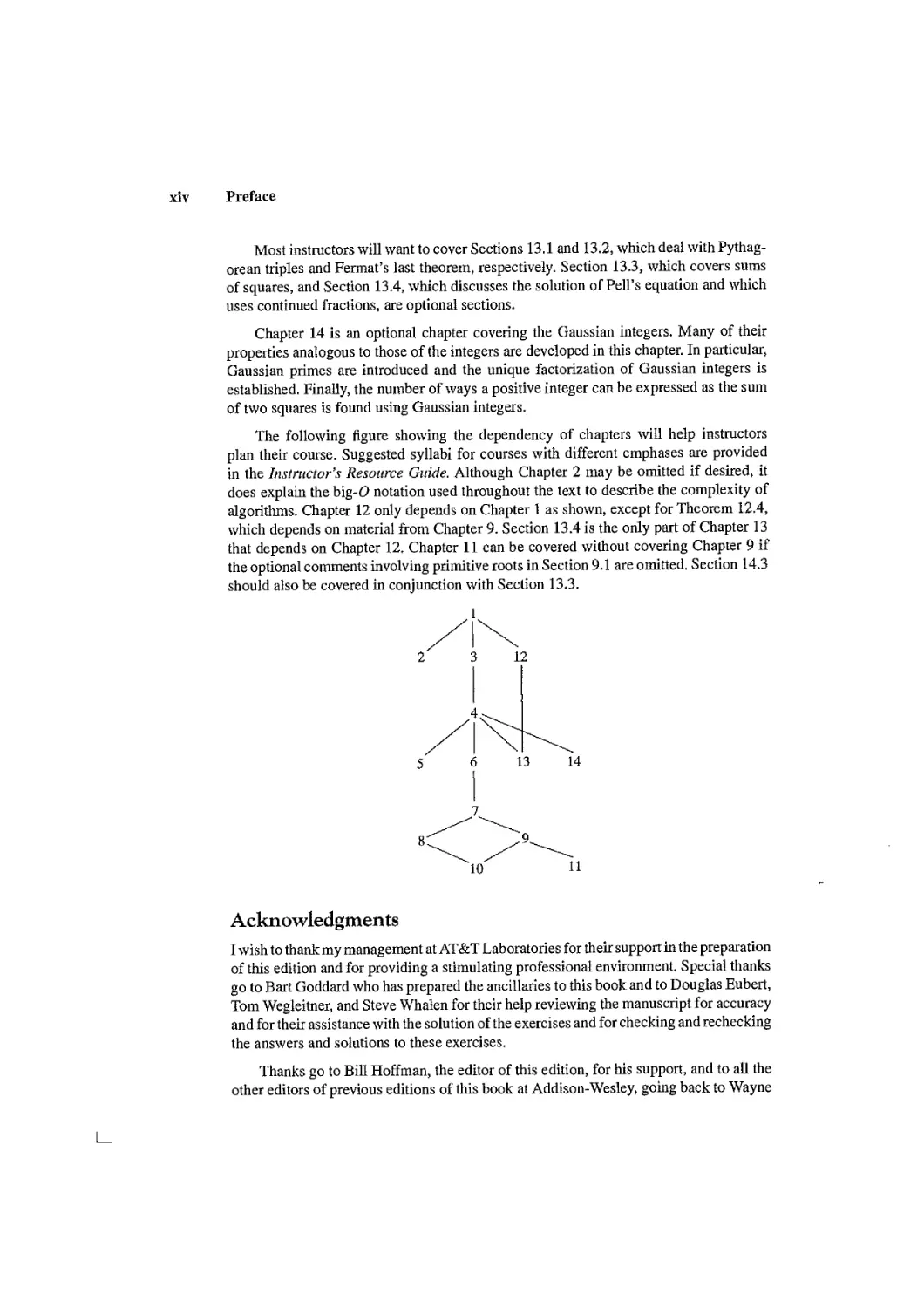
The following figure showing the dependency of chapters will help instructors
plan their course. Suggested syllabi for courses with different emphases are provided
in the Instructor's Resource Guide. Although Chapter 2 may be omitted if desired, it
does explain the big-O notation used throughout the text to describe the complexity of
algorithms. Chapter 12 only depends on Chapter 1 as shown, except for Theorem 12.4,
which depends on material from Chapter 9. Section 13.4 is the only part of Chapter 13
that depends on Chapter 12. Chapter 11 can be covered without covering Chapter 9 if
the optional comments involving primitive roots in Section 9.1 are omitted. Section 14.3
should also be covered in conjunction with Section 13.3.
I
/\
2 3 12
/t
5 6 13 14
1
7
-----
8 /9
10 11
Acknowledgments
I wish to thank my management at AT&T Laboratories for their support in the preparation
of this edition and for providing a stimulating professional environment. Special thanks
go to Bart Goddard who has prepared the ancillaries to this book and to Douglas Eubert,
Tom Wegleitner, and Steve Whalen for their help reviewing the manuscript for accuracy
and for their assistance with the solution of the exercises and for checking and rechecking
the answers and solutions to these exercises.
Thanks go to Bill Hoffman, the editor of this edition, for his support, and to all the
other editors of previous editions of this book at Addison-Wesley, going back to Wayne
L
Preface xv
Yuhasz and Jeff Pepper who endorsed the original concept and recognized the potential
appeal of this book at.a time when other publishers considered number theory a dead
course not worthy of new books. My appreciation also goes to the editorial, production,
marketing, and media team behind this book, including Mary Reynolds, Julie LaChance,
Jeffrey Holcomb, Barbara Atkinson, Beth Anderson, Barbara Pendergast, Paul Anagno-
stopoulos, Emily Portwood, Lynne Blaszak, Greg Tobin, and Phyllis Hubbard. I would
also like to thank David Wright for his many contributions to the Web site for this book,
including material on PARI/GP, number theory and cryptography applets, and suggested
projects.
I have benefited from the thoughtful reviews and suggestions from users of previous
editions of this book. Many of their ideas have been incorporated in this edition. My
profound thanks go the following reviewers who he1ped me prepare this edition:
Reviewers
Ruth Berger, Luther College
Joel Cohen, University of Maryland
Michael CuHinane, Keene State College
Mark Dickinson, University of Michigan
George Greaves, Cardiff University
Kerry Jones, Ball State University
Slawomir Klimek, Indiana University-Purdue University Indianapolis
Stephen Kudla, University of Maryland
Jennifer McNulty, The University of Montana
Stephen Miller, Rutgers University
Michael Mossinghoff, Davidson College
Michael E. O'Sullivan, San Diego State University
Gary Towsley, SUNY Geneseo
David Wright, Oklahoma State University
I also wish to thank again the reviewers of previous editions of this book who have
he1ped improve this book from edition to edition. Their affiliations at the time they
reviewed the book are noted.
David Bressoud, Pennsylvania State University
Sydney Buhnan-Fleming, Wilfred Lauria University
Richard Bumby, Rutgers University
Charles Cook, University of South Carolina, Sumter
Christopher Cotter, University of Northem Colorado
Euda Dean, Tarleton State University
Daniel Drucker, Wayne State University
Bob Gold, Ohio State University
Fernando Gouvea, Colby College
Jennifer Johnson, University of Utah
Roy Jordan, Monmouth College
Herbert Kasube, Bradley University
Neil Koblitz, University of Washington
Steven Leonhardi, Winona State University
xvi Preface
Charles Lewis, Monmouth College
James McKay, Oakland University
John Mairhuber, University of Maine-Orono
Alexsandrs Mihailovs, University of Pennsylvania
Rudolf Najar, California State University, Fresno
Carl Pomerance, University of Georgia
Sinai Robins, Temple University
Tom Shemanske, Dartmollth College
Leslie Vaa1er, University of Texas, Austin
Evelyn Bender Vaskas, Clark University
Samuel Wagstaff, Purdue University
Edward Wang, Wilfred Laurier University
Betsey Whitman, Framingham State University
David Wright, Oklahoma State
Paul Zwier, Calvin College
Finally, I thank in advance all those who send me suggestions and corrections in the
future. You may send such material to me care of Addison-Wesley at rnath@awl. corn.
Kenneth H. Rosen
Middletown, New Jersey
(/ Contents
\
What Is Number Theory? 1
1 I The Integers 5
1.1 Numbers and Sequences 6
1.2 Sums and Products 16
1.3 Mathematical Induction 23
1.4 The Fibonacci Numbers 30
1.5 Divisibility 37
2 I Integer Representations and Operations 43
2.1 Representations of Integers 43
2.2 Computer Operations with Integers 53
2.3 Complexity of Integer Operations 60
3 I Primes and Greatest Common Divisors 67
3.1 Prime Numbers 68
3.2 The Distribution of Primes 77
3.3 Greatest Common Divisors 90
3.4 The Euclidean Algorithm 97
3.5 The Fundamental Theorem of Arithmetic 108
3.6 Factorization Methods and the Fermat Numbers 123
3.7 Linear Diophantine Equations 133
xvii
xviii Contents
4 I Congruences 141
4.1 Introduction to Congruences 141
4.2 Linear Congruences 153
4.3 The Chinese Remainder Theorem 158
4.4 Solving Polynomial Congruences 168
4.5 Systems of Linear Congruences 174
\ 4.6 Factoring Using the Pollard Rho Method 184
"'-
5 I Applications of Congruences 189
5.1 Divisibility Tests 189
5.2 The Perpetual Calendar 195
5.3 Round-Robin Tournaments 200
5.4 Hashing Functions 202
5.5 Check Digits 207
6 I Some Special Congruences 215
6.1 Wilson's Theorem and Felmat's Little Theorem 215
6.2 Pseudoprimes 223
6.3 Euler's Theorem 233
7 I Multiplicative Functions 239
7.1 The Euler Pm-Function 239
7.2 The Sum and Number of Divisors 250
7.3 Perfect Numbers and Mersenne Primes 257
\!.4 Mobius Inversion 269
81 Cryptology 277
8.1 Character Ciphers 278
8.2 Block and Stream Ciphers 286
8.3 Exponentiation Ciphers 305
8.4 Public Key Cryptography 308
8.5 Knapsack Ciphers 316
8.6 Cryptographic Protocols and Applications 323
Contents xix
9 J Primitive Roots _ 333
,..9.1 The Order of an Integer and Primitive Roots 334
. 9.2 Primitive Roots for Primes 341
\9.3 The Existence of Primitive Roots 347
9.4 Index Arithmetic 355
9.5 Primality Tests Using Orders of Integers and Primitive Roots 365
9.6 Universal Exponents 372
10 I Applications of Primitive Roots and the
Order of an Integer 379
10.1 Pseudorandom Numbers 379
10.2 The ElGamal Cryptosystem 389
10.3 An Application to the Splicing of Telephone Cables 394
11 I Quadratic Residues 401
( 11.1 Quadratic Residues and Nonresidues 402
11.2 The Law of Quadratic Reciprocity 417
11.3 The Jacobi Symbol 430
11.4 Euler Pseudoprimes 439
11.5 Zero-Knowledge Proofs 448
12 1 Decimal Fractions and' Continued Fractions 455
12.1 Decimal Fractions 455
12.2 Finite Continued Fractions 468
12.3 Infinite Continued Fractions 478
12.4 Periodic Continued Fractions 490
12.5 Factoring Using Continued Fractions 504
13 I Some Nonlinear Diophantine Equations 509
13.1 Pythagorean Triples 510
13.2 Fennat's Last Theorem 516
13.3 Sums of Squares 528
13.4 Pell's Equation 539
xx Contents
14 I The Gaussian Integer 547
14.1 Gaussian Integers and Gaussian Primes 547
14.2 Greatest Common Divisors and Unique Factorization 559
14.3 Gaussian Integers and Sums of Squares 570
A I Axioms for the Set of Integers 577
B I Binomial Coefficients 581
C I Using Maple and Mathematica for Number Theory 589
C.1 Using Maple for Number Theory 589
C.2 Using Mathematica for Number Theory 593
D I Number Theory Web Links 599
E I Tables 601
Answers to Odd.Numbered Exercises 617
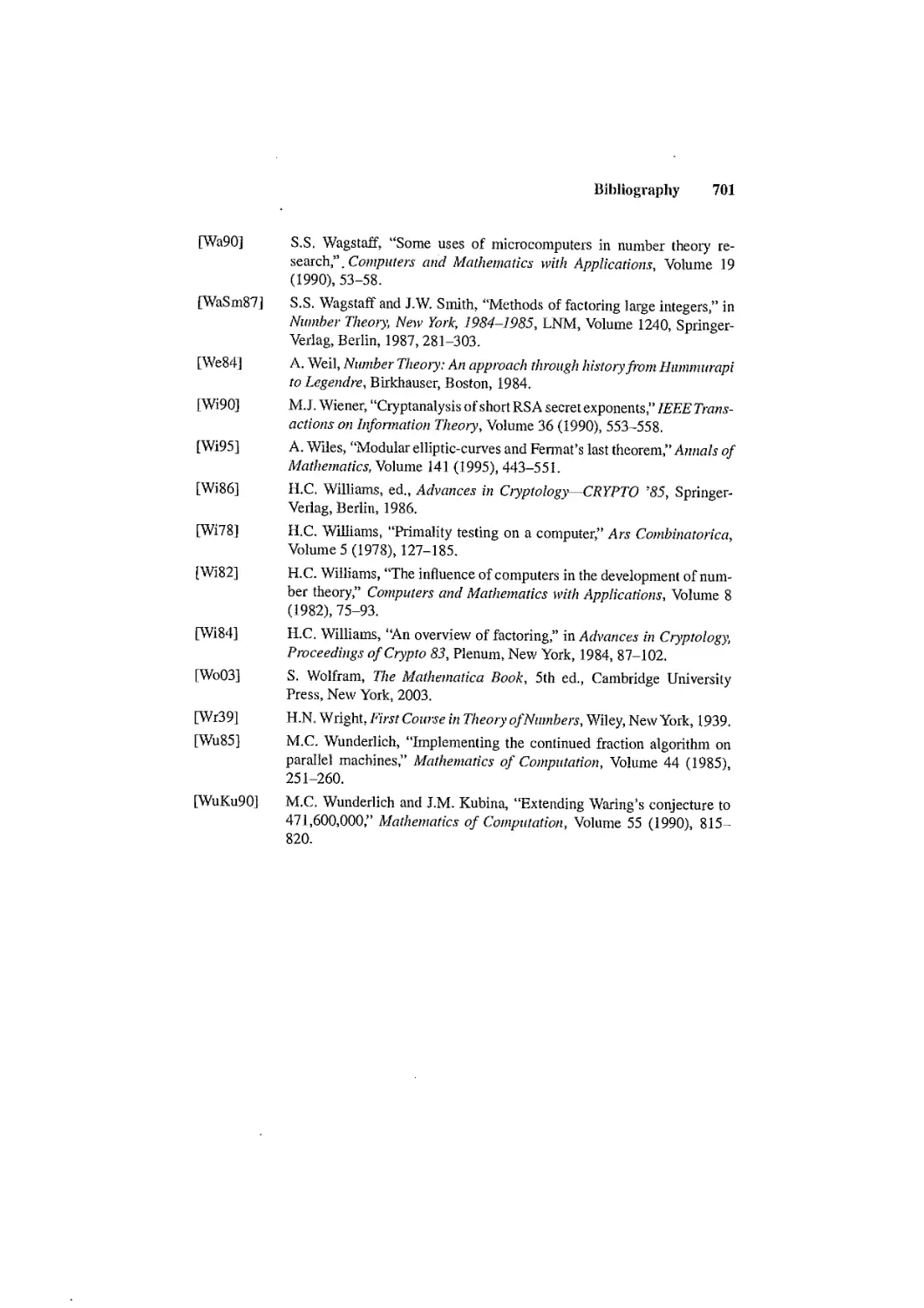
Bibliography 689
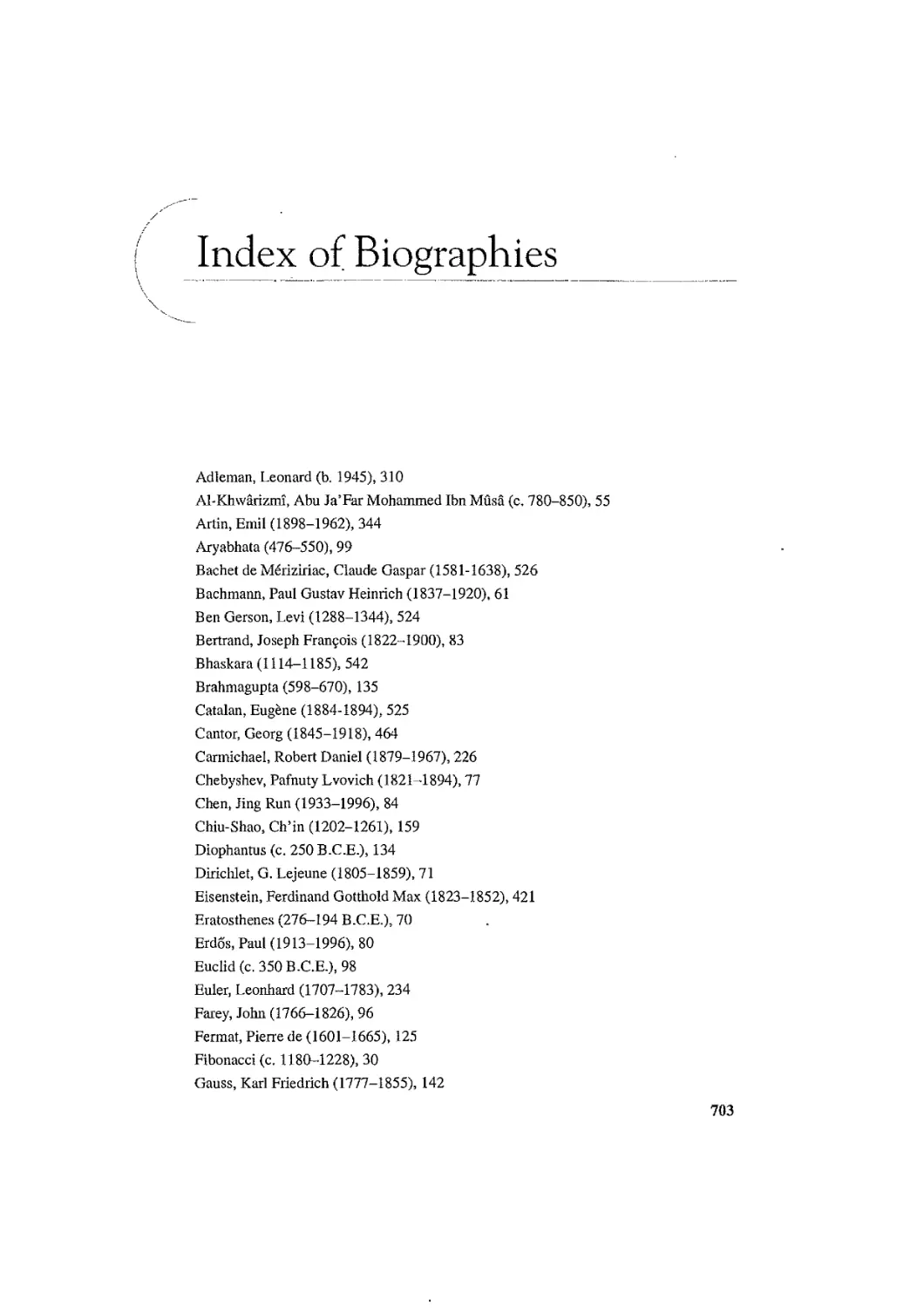
Index of Biographies 703
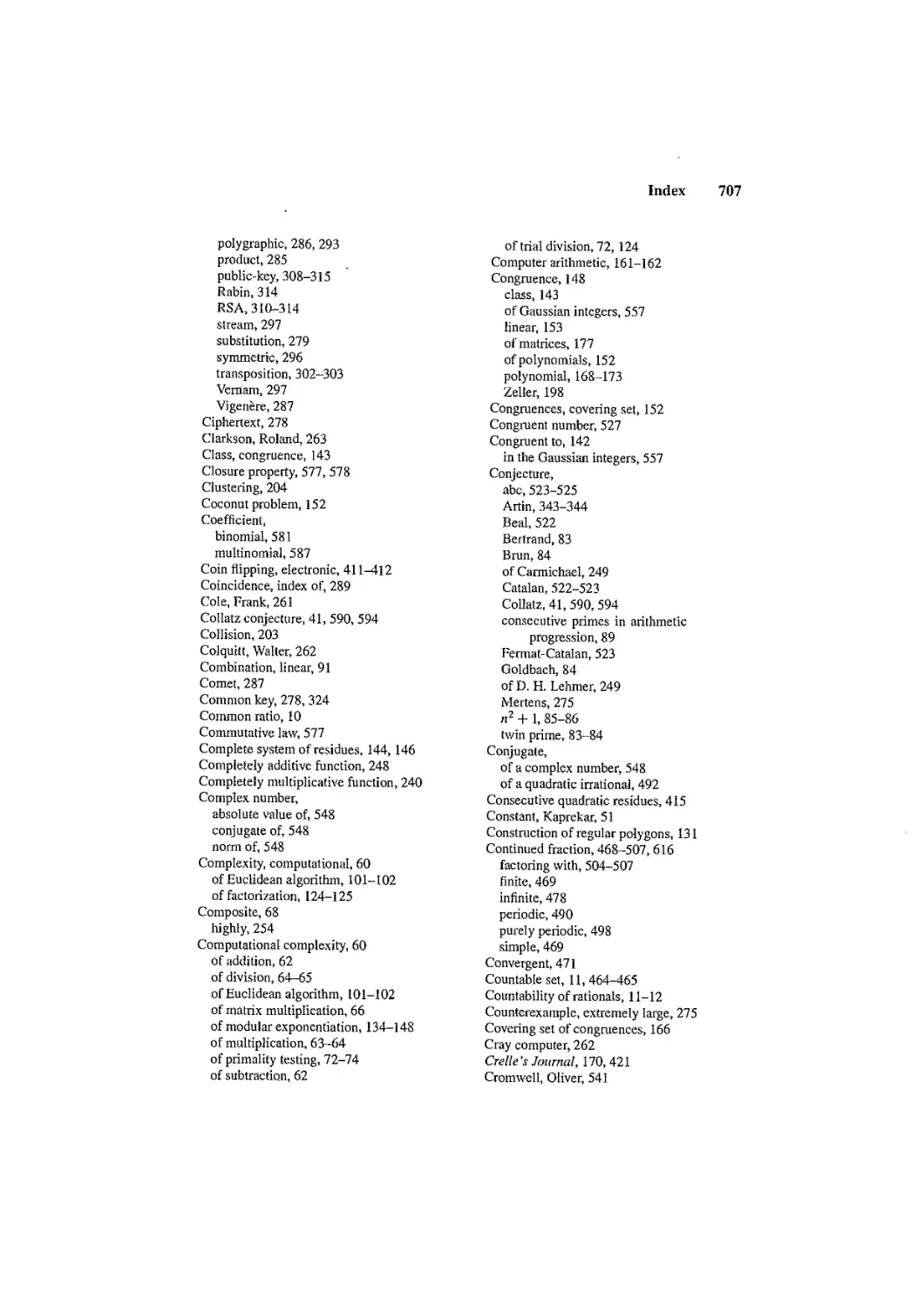
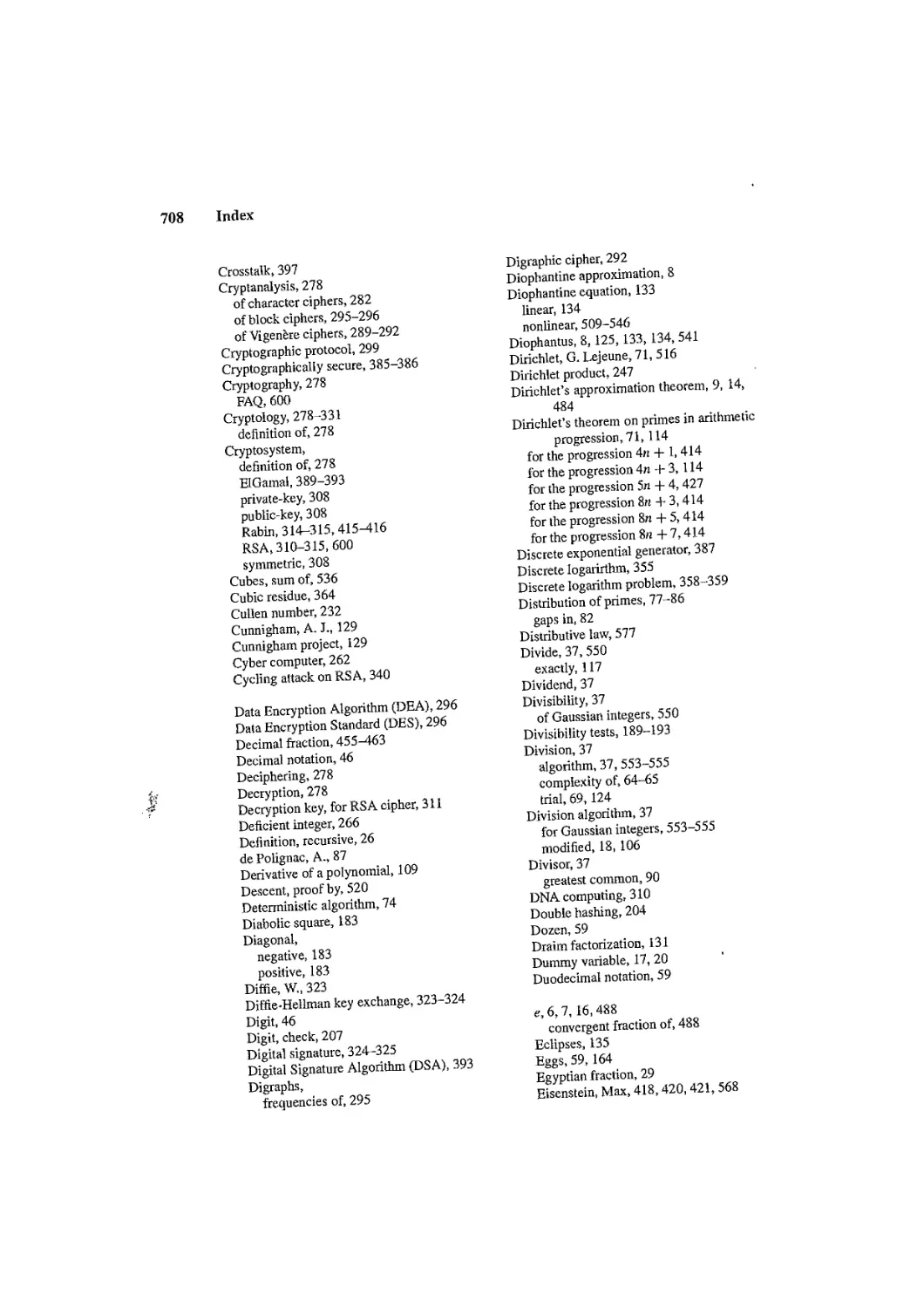
Index 705
Photo Credits 721
What Is. Number Theory?
There is a buzz about number theory: Thousands of people work on communal number
theory problems over the Internet . . . the solution of a famous problem in number
theory is reported on the PBS television series NOVA. . . people study number theory
to understand systems for making messages secret . . . What is this subject, and why are
so many people interested in it today?
Number theory is the branch of mathematics that studies the properties of, and the
relationships between, particular types of numbers. Of the sets of numbers studied in
number theory, the most important is the set of positive integers. More specifically,
the primes, those positive integers with no positive proper factors other than 1, are
of special importance. A key result of number theory shows that the primes are the
multiplicative building blocks of the positive integers. This result, called the fundamental
theorem of arithmetic, tells us that every positive integer can be uniquely written as
the product of primes in nondecreasing order. Interest in prime numbers goes back
at least 2500 years, to the studies of ancient Greek mathematicians. Perhaps the first
question about primes that comes to mind is whether there are infinitely many. In
The Elements, the ancient Greek mathematician Euclid provided a proof that there are
infinitely many primes. Interest in primes was rekindled in the seventeenth and eighteenth
centuries, when mathematicians such as Pierre de Fermat and Leonhard Euler proved
many important results, and conjectured approaches for generating primes. The study of
primes progressed substantially in the nineteenth century; results included the infinitude
of primes in arithmetic progressions, and sharp estimates for the number of primes not
exceeding a positive number x. The twentieth century has seen the development of many
powerful techniques for the study of primes, but even with these powerful techniques,
many questions remain unresolved. An example of a notorious unsolved question is
whether there are infinitely many twin primes, which are primes that differ by 2. New
results will certainly follow in the coming decades, as researchers continue working on
the many open questions involving primes.
1
2 What Is Number Theory?
The development of modern number theory was made possible by the German
mathematician Carl Friedrich Gauss, one of the greatest mathematicians in history, who
developed the language of congruences in the early nineteenth century. We say that two
integers a and b are congruent modulo In, where m is a positive integer, if m divides
a-b. This language makes it easy to work with divisibility relationships in much the
same way that we work with equations. Gauss developed many important concepts in
number theory; for example, he proved one of its most subtle and beautiful results, the law
of quadratic reciprocity. This law relates whether a prime p is a perfect square modulo
a second prime q to whether q is a perfect square modulo p. Gauss developed many
different proofs of this law, some of which have led to whole new areas of number theory.
Distinguishing primes from composite integers is a key problem of number theory.
Work in this area has led to the development of an arsenal of plimality tests. The simplest
primality test is simply checking whether a positive integer is divisible by each prime
not exceeding its square root. Unfortunately, this test is inefficient for extremely large
positive integers. In the nineteenth century, Pierre de Fermat showed that p divides 2 P - 2
whenever p is prime. Some mathematicians thought that the converse also was true (that
is, that if n divides 2/1 - 2, then n must be prime). However, it is not; by the early
nineteenth century, composite integers n, such as 341, were known for which n divides
2 11 - 2. Such integers are called pseudoprimes. Though pseudoprimes exist, primality
tests based on the fact that most composite integers are not pseudoprimes are now used
to quickly find extremely large primes.
Factoring a positive integer into primes is another central problem in number theory.
The factorization of a positive integer can be found using trial division, but this method
is extremely time-consuming. Fennat, Euler, and many other mathematicians devised
imaginative factorization algorithms, which have been extended in the past 25 years
into a wide array of factoring methods. Using the best-known techniques, we can easily
find primes with hundreds of digits; factoring integers with the same number of digits,
however, is beyond our most powerful computers.
The dichotomy between the time required to find large primes and the time required
to factor large integers is the basis of an extremely important secrecy system, the RSA
oyptosystem. The RSA system is a public-key cryptosystem, a security system in which
each person has a public key and an associated private key. Messages can be encrypted
by anyone using another person's public key, but these messages can be decrypted
only by the owner of the private key. Concepts from number theory are essential to
understanding the basic workings of the RSA cryptosystem, as well as many other parts of
modern cryptography. The overwhelming importance of number theory in cryptography
contradicts the earlier belief, held by many mathematicians, that number theory was
unimportant for real-world applications. It is ironic that some famous mathematicians,
such as G. H. Hardy, took pride in the notion that number theory would never be applied
in the way that it is today.
The search for integer solutions of equations is another important part of number
theory. An equation with the added proviso that only integer solutions are sought is called
diophantine, after the ancient Greek mathematician Diophantus. Many different types of
diophantine equations have been studied, but the most famous is the Fennat equation
What Is Number Theory? 3
xlt + ylt = zit. Fennat's last theorem states that if n is an integer greater than 2, this
equation has no solutions in integers x, y, and z, where xyz -:F O. Fermat conjectured
in the seventeenth cen"tury that this theorem was true, and mathematicians (and others)
searched for proofs for more than three centuries, but it was not until 1995 that the first
proof was given by Andrew Wiles,
As Wiles's proof shows, number theory is not a static subject! New discoveries
continue steadily to be made, and researchers frequently establish significant theoretical
results. The fantastic power available when today's computers are linked over the Internet
yields a rapid pace of new computational discoveries in number theory. Everyone can
participate in this quest; for instance, you can join the quest for the new M ersenne primes,
primes of the form 2 P - 1, where p itself is prime. In June 1999, the first prime with
more than 1 million decimal digits was found: the Mersenne prime 2 6 ,972,593 - I, and
a concerted effort is under way to find a prime with more than 10 million digits. After
learning about some of the topics covered in this text, you may decide to join the hunt
yourself, putting your idle computing resources to good use.
What is elementary lIumber theory? You may wonder why the word "elementary" is
part of the title of this book. This book considers only that part of number theory called
elemelltmy number theory, which is the part not dependent on advanced mathematics,
such as the theory of complex variables, abstract algebra, or algebraic geometry. Students
who plan to continue the study of mathematics will learn about more advanced areas of
number theory, such as analytic number theory (which takes advantage of the theory
of complex variables), and algebraic number theory (which uses concepts from abstract
algebra to prove interesting results about algebraic number fields).
Some words of advice. As you embark on your study, keep in mind that number
theory is a classical subject with results dating back thousands of years, yet is also the
most modern of subjects, with new discoveries being made at a rapid pace. It is pure
mathematics with the greatest intellectual appeal, yet it is also applied mathematics, with
crucial applications to cryptography and other aspects of computer science and electrical
engineering. I hope that you find the many facets of number theory as captivating as
aficionados who have preceded you, many of whom retained an interest in number theory
long after their school days were over.
Experimentation and exploration form an indispensable part of the study of number
theory. Th results in this book were found by mathematicians who often examined
large amounts of numerical evidence, looking for patterns and making conjectures. They
worked diligently to prove their conjectures; some of these were proved and became
theorems, others were rejected when counterexamples were found, and still others remain
unresolved. As you study number theory, I recommend that you examine many examples,
look for patterns, and fonnulate your own conjectures. This will help you to learn the
subject-and you may even find some new results of your own!
//
/
!
i
i
,
,
.
\
'"",,-
1
The Integers
Introduction
In the most general sense, number theory deals with the properties of different sets of
numbers. In this chapter, we will discuss some particularly important sets of numbers,
including the integers, the rational numbers, and the algebraic numbers. We will briefly
introduce the notion of approximating real numbers by rational numbers. We will also
introduce the concept of a sequence, and particular sequences of integers, including some
figurate numbers studied in ancient Greece. A common problem is the identification of
a particular integer sequence from its initial tenns; we will briefly discuss how to attack
such problems.
Using the concept of a sequence, we will define countable sets and show that the set
of rational numbers is countable. We will also introduce notations for sums and products,
and establish some useful summation fonnu1as.
One of the most important proof techniques in number theory (and in much of
mathematics) is mathematical induction. We will discuss the two forms of mathematical
induction, illustrate how they can be used to prove various results, and explain why
mathematical induction is a valid proof technique.
Continuing, we will introduce the intriguing sequence of Fibonacci numbers, and
describe the original problem from which they arose. We will establish some identities
and inequalities involving the Fibonacci numbers, using mathematical induction for
some of our proofs.
The final section of this chapter deals with a fundamental notion in number theory,
that of divisibility. We will establish some of the basic properties of division of integers,
including the "division algorithm." We will show how the quotient and remainder of a
division of one integer by another can be expressed using values of the greatest integer
function (we will describe a few of the many useful properties of this function, as well).
5
6 The Integers
1.1 Numbers and Sequences
In this section, we introduce basic material that will be used throughout the text. In
particular, we cover the important sets of numbers studied in number theory, the concept
of integer sequences, and summations and products.
Numbers
To begin, we will introduce several different types of numbers. The integers are the
numbers in the set
[. . . ,-3, -2, -1,0,1,2,3,. . .}.
The integers play center stage in the study of number theory. One property of the positive
integers deserves special mention.
The Well-Ordering Property Every nonempty set of positive integers has a least ele-
ment.
The well-ordering property may seem obvious, but it is the basic principle that allows
us to prove many results about sets of integers, as we will see in Section 1.3.
The wen-ordering property can be taken as one of the axioms defining the set of
positive integers or it may be derived from a set of axioms in which it is not included.
(See Appendix A for axioms for the set of integers.) We say that the set of positive
integers is well ordered. However, the set of all integers is not well ordered, as there are
sets of integers without a smallest element, such as the set of negative integers, the set
of even integers less than 100, and the set of all integers itself.
Another important class of numbers in the study of number theory is the set of
numbers that can be written as a ratio of integers.
Definition. The real number r is rational if there are integers p and q, with q i= 0,
such that r = p / q. If r is not rational, it is said to be irrational.
Example 1.1. The numbers -22/7,0 = 0/1, 2/17, and 1111/41 are rational numbers.
...
Note that every integer n is a rational number, because 11 = 11/1. Examples of irrational
numbers are ./2, 1r, and e. We can use the well-ordering property of the set of positive
integers to show that ..j2 is irrational. The proof that we provide, although quite clever,
is not the simplest proof that ./2 is irrational. You may prefer the proof that \ve will give
in Chapter 4, which depends on concepts developed in that chapter. (The proof that e is
irrational is left as Exercise 44. We refer the reader to [HaWr79] for a proof that 1r is
irrational. It is not easy.)
Theorem 1.1. ./2 is irrational.
1.1 Numbers and Sequences 7
"
Proof. Suppose that ..Ji were rational. Then there would exist positive integers a and b
such that..Ji = alb. Consequently, the set S = {k..Ji I k and k..Ji are positive integers}
is a nonempty set of positive integers (it is non empty because a = b..Ji is a member of
S). Therefore, by the well-ordering property, S has a smallest element, say s = t..Ji.
We have s..Ji - s = s..Ji - t..Ji = (s - 1)..Ji. Because s..Ji = 2t and s are both
integers, s..Ji - s = s..Ji - t..Ji = (s - t)..Ji must also be an integer. Furthermore,
it is positive, because s..Ji - s = s(.v2 - 1) and ..Ji> 1. It is less than s, because
s = t..Ji, s..Ji = 2t and ..Ji < 2. This contradicts the choice of s as the smallest positive
integer in S. It follows that ..Ji is irrational. _
The sets of integers, positive integers, rational numbers, and real numbers are
traditionally denoted by Z, Z+, Q, and R, respectively. Also, we write XES to indicate
that x belongs to the set S. Such notation will be used occasionally in this book.
We briefly mention several other types of numbers here, though we do not return to
them until Chapter 12.
Definition. A number a is algebraic if it is the root of a polynomial with integer
coefficients; that is, a is algebraic if there exist integers ao, aI, . . . ,an such that anal! +
a l1 _la 1J - I +. . . + ao = O. The number a is called transcendental if it is not algebraic.
Example 1.2. The irrational number ..Ji is algebraic, because it is a root of the
polynomial x 2 - 2. ...
Note that every rational number is algebraic. This follows from the fact that the number
a/b, where a and b are integers and b oF 0, is the root of bx - a. In Chapter 12,
we will give all example of a transcendental number. The numbers e and JT: are also
transcendental, but the proofs of these facts (which can be found in [Ha Wr79]) are beyond
the scope of this book.
The Greatest Integer Function
In number theory a special notation is used for the largest integer that is less than or equal
to a particular real number.
Definition. The greatest integer in areal number x, denoted by [x], is the largest integer
less than or equal to x. That is, [x] is the integer satisfying
[x]::=; x < [x] + 1.
Example 1.3. We have [5/2] = 2, [-5/2] = -3, [JT:] = 3, [-2]= -2, and [0]= O. ...
Remark. The greatest integer function is also known as the floor junctioJl. Instead of
using the notation [x] for this function, computer scientists usually use the notation Lx J.
The ceiling fUJlction is a related function often used by computer scientists. The ceiling
function of a real number x, denoted by [x 1, is the smallest integer greater than or equal
tox.Forexample, [5/21 =3and [-5/21 =-2.
-----
8 The Integers
The greatest integer function arises in many contexts. Besides being important in
number theory, as we will see throughout this book, it plays an important role in the
analysis of algorithms, a branch of computer science. The following example establishes
a useful property of this function. Additional properties of the greatest integer function
are found in the exercises at the end of this section and in [GrKnPa94].
Example 1.4. Show that if 11 is an integer, then [x + n] = [x] + n whenever x is a real
number. To show that this property holds, let [x] = m, so that m is an integer. This implies
that m .:S x < m + t We can add n to this inequality to obtain m + n .:S x + n < m + 11 + t
This shows that m + 11 = [x] + 11 is the greatest integer less than or equal to x + 11. Hence
[x + n] = [x] + n. ...
Definition. The fractional part of a real number x, denoted by {x}, is the difference
between x and the largest integer less than or equal to x, namely [x]. That is, {x} =
x - [x].
Because [x].:S x < [x] + 1, it follows that O.:S {x} = x - [x} < 1 for every real
number x. The greatest integer in x is also called the integral part of x because x =
[x] + {x}.
Example 1.5. We have {5/4} = 5/4 - [5/4] = 5/4 - 1 = 1/4 and {-2/3} = -2/3-
[-2/3] = -2/3 - (-1) = 1/3. ...
.
Diophantine Approximation
We know that the distance of a real number to the integer closest to it is at most 1/2.
But can we show that one of the first k multiples of a real number must be much closer
to an integer? An important part of number theory called diophantine approximation
studies questions such as this. In particular, it con'centrates on questions that involve
the approximation of real numbers by rational numbers. (The adjective diophantine
comes from the Greek mathematician Diophantus, whose biography can be found in
Section 13.1.)
Here we will show that among the first n multiples of a real number a, there must
be at least one at a distance less than l/n from the integer nearest it. The proof will
depend on the famous pigeonhole principle, introduced by the German mathematician
Dirichlet.! Infonnally, this principle tells us if we have more objects than boxes, when
these objects are placed in the boxes, at least two must end up in the same box. Although
this seems like a particularly simple idea, it turns out to be extremely useful in number
theory and combinatorics. We now state and prove this important fact, which is known
as the pigeonhole principle because if you have more pigeons than roosts, two pigeons
must end up in the same roost.
.,
] Instead of calling Theorem 1.2 the pigeonhole principle. Dirichlet called it the Schubfachprinzip in GenTIan,
which translates to the drawer principle in English. A biography of Dirichlet can befoundin Section 3.1.
1.1 Numbers and Sequences 9
Theorem 1.2. The Pigeonhole Principle, If k + lor more objects are placed into k
boxes, then at least on box contains two or more of the objects.
Proof. If none of the k boxes contains more than one object, then the total number of
objects would be at most k. This contradiction shows that one of the boxes contains at
least two or more of the objects. _
We now state and prove the approximation theorem, which guarantees that one of
the first 11 multiples of a real number must be within 1/11 of an integer. The proof we
give illustrates the utility ofthe pigeonhole principle. (See [Ro03] for more applications
of the pigeonhole principle.) (Note that in the proof we make use of the absolute value
function. Recall that lxi, the absolute value of x, equals x if x 0 and -x if x < O. Also
recall that Ix - yl gives the distance between x and y.)
Theorem 1.3. Dirichlet's Approximation Theorem. If a is a real number and n is a
positive integer, then there exist integers a and b with 1:S a :S 11 such that laa - bl < 1/11.
Proof. Consider the 11 + 1 numbers 0, {a}, (2a}, . . . , {na}. These n + 1 numbers
are the fractional parts of the numbers j a, j = 0, 1, . . . , 11, so that 0 :S {j a} < 1 for
j = 0,1, . . . , n. Each of these n + 1 numbers lies in one of the n disjoint intervals
O:Sx < l/n, l/n:Sx <2/n,..., (j -1)/n:Sx < j/n,... ,(11 -l)/n:::x < 1. Be-
cause there are n + 1 numbers under consideration, but only 11 intervals, the pigeonhole
principle tells us that at least two of these numbers lie in the same interval. Because each
of these intervals has length 1/ n and does not include its right endpoint, we know that
the distance between two number's that lie in the same interval is less than 1/11. It fol-
lows that there exist integers j and k with 0 :S j < k :S n such that I {ka} - {j a} I < 1/11.
Now let a = k - j and b = [ka] - [ja]. Because 0 :S j < k ::: n, we see that 1:S a :S n.
Moreover,
laa - bl = I (k - j)a - ([ka] - [ja])]
= I(ka - [ka]) - (ja - [ja])!
= I{ka} - {ja}1 < l/n.
Consequently, we have found integers a and b with 1 :S a :S 11 and laa - hi < l/n, as
desired. _
Example 1.6. Suppose that a =,Ji and n = 6. We find that 1 .,Ji 1.414,2.,Ji
2.828,3.,Ji 4.243, 4.,Ji 5.657, 5.,Ji 7.071, and 6 .,Ji 80485. Among these
numbers 5. ,Ji has the smallest fractional part. We see that 15. v'2 -71 17.071- 71 =
0.071 :S 1/6. It follows that when a = v'2 and 11 = 6, we can take a = 5 and b = 7 to
make laa - bl < l/n. ...
Our proof of Theorem 1.3 follows Diricblet's original 1834 proof. Proving a stronger
version of Theorem 1.3 with 1/ (n + 1) replacing 1/ n in the approximation is not diffi-
cult (see Exercise 32). Furthennore, in Exercise 34 we show how to use the Dirichlet
approximation theorem to show that, given an irrational number a, there are infinitely
many different rational numbers p / q such that la - p / q I < 1/ q2, and important result
in the theory of diophantine approximation. We will return to this topic in Chapter 12.
10 The Integers
Sequences
A sequence {all} is a list of numbers at> a2, a3, . . . . The terms of a sequence can be put
into a one-to-one correspondence with the set of positive integers using the mapping
f(O = aj. (Recall that a one-fo-one correspondence, also called a bijection, is a function
that is both one-to-one and onto.) We will consider many particular integer sequences
in our study of number theory. We introduce several useful sequences in the following
examples.
Example 1.7. The sequence {all}' where all = n 2 , begins with the terms 1,4,9,16,25,
36,49,64, . . . . This is the sequence of the squares of integers. The sequence {bll), where
b , ) = 2 11 , begins with the tern is 2,4,8, 16,32,64,128,256, . . . . This is the sequence of
powers of 2. The sequence (c ll }, where cIJ = 0 if n is odd and C ll = 1 if n is even, begins
with the terms 0,1,0,1,0,1,0,1, . . . .
There are many sequences in which each successive term is obtained from the
previous term by multiplying by a common factor. For example, each term in the
sequence of powers of 2 is 2 times the previous term. This leads to the following
definition.
Definition. A geometric progression is a sequence of the form a, ar, ar 2 , ar 3 , . . . ,
ark, . . . , where a, the initial fel7n, and r, the common ratio, are real numbers.
Example 1.8. The sequence {all}, where an = 3 . 5 11 , n = 0, 1,2, . . ., is a geometric
sequence with initial term 3 and common ratio 5. (Note that we have started the sequence
with the term ao. \Ve can start the index of the terms of a sequence with 0 or any other
integer that we choose.)
A common problem in number theory is finding a formula or rule for constructing
the terms of a sequence, even when only a few terms are known (such as trying to find
a formula for the nth triangular number 1 + 2 + 3 + . . . + n). Even though the initial
terms of a sequence do not determine the sequence, knowing the first few tenns can lead
to a conjecture for a formula or rule for the tenns. Consider the following examples.
Example 1.9. Conjecture a fonnula for all' where the first eight terms of {all} are
4,11,18,25,32,39,46,53. We note that each term, starting with the second, is obtained
by adding 7 to the previous term. Consequently, the nth term could be the initial term
plus 7(n - 1). A reasonable conjecture is that all = 4 + 7(n - 1) = 7n - 3.
The sequence proposed in Example 1.9 is an arithmetic progression, that is, a
sequence of the form a, a + d, a + 2d,. . . , a + nd,. .. . The particular sequence in
Example 1.9 has a = 4 and d = 7.
Example 1.10. Conjecture a formula for all' where the first eight terms of the sequence
{all} are 5,11,29,83,245,731, 2189, 6563. We note that each term is approximately 3
times the previous term, suggesting a formula for all in terms of 3 11 . The integers 31/ for
L
1.1 Numbers and Sequences 11
n = 1,2,3, . . . are 3,9,27,81,243,729,2187,6561. Looking at these two sequences
together, we find that the fonnu1a all = 3 11 + 2 produces these terms. .....
Example 1.11. Conjecture a formula for an' where the first ten terms of the sequence
{an} are 1,1,2,3,5,8,13,21,34,55. After examining this sequence from different
perspectives, we notice that each term of this sequence, after the first two terms, is the
sum of the two preceding terms. That is, we see that an = aJl-r + a ll -2 for 3 ::; n ::; 10.
This is an example of a recursive definition of a sequence, discussed in Section 1.3. The
tenns listed in this example are the initial tenns of the Fibonacci sequence, which is
discussed in Section 1.4. <OIl
.
Integer sequences arise in many contexts in number theory. Among the sequences
we will study are the Fibonacci numbers, the prime numbers (covered in Chapter 3), and
the perfect numbers (introduced in Section 7.3). Integer sequences appear in an amazing
range of subjects besides number theory. A fantastically diverse collection of more than
8000 integer sequences has been amassed by Neil Sloane, who created The Encyclopedia
of Integer Sequences ([SlP195]) with Simon Plouffe. An extended version of this list, and
a program for finding sequences that match initial tenns provided as input, can be found
on the Web. You may find this a valuable resource as you continue your study of number
theory (as well as other subjects).
We now define what it means for a set to be countable, and show that a set is countable
if and only if its elements can be listed as the tenns of a sequence.
Definition. A set is countable if it is finite or it is infinite and there exists a one-to-
one correspondence between the set of positive integers and the set. A set that is not
countable is called uncountable.
An infinite set is countable if and only if its elements can be listed as the terms of a
sequence indexed by the set of positive integers. To see this, simply note that a one-to-
one correspondence f from the set of positive integers to a set S is exactly the same as
a listing of the elements of the set in a sequence ar, aZ, . . . ,all' . . . , where ai = f(i).
Example 1.12. The set of integers is countable, because the integers can be listed
starting with 0, followed by 1 and -1, followed by 2 and -2, and so on. This produces
the sequence 0, 1, -1, 2, -2,3, -3,. . . , where ar = 0, a2n = n, and a2n+r = -11 for
n = 1,2,.... <OIl
Is the set of rational numbers countable? At first glance, it may seem unlikely that
there would be a one-to-one correspondence between the set of positive integers and the
set of all rational numbers. However, there is such a correspondence, as the following
theorem shows.
Theorem 1.4. The set of rational numbers is countable.
Proof We can list the rational numbers as the terms of a sequence, as follows. First, we
arrange all the rational numbers in a two-dimensional array, as shown in Figure 1.1. We
12 The Integers
put all fractions with a denominator of 1 in the first row. We arrange these by placing the
fraction with a particular numerator in the position this numerator occupies in the list of
all integers given in Example 1.12. Next, we list all fractions on successive diagonals,
following the order shown in Figure 1.1. Finally, we delete from the list all fractions that
represent rational numbers that have already been listed. (For example, we do not list
2/2, because we have already listed 1/1.)
0/ 1/1 2/] 3
-----
L / /- / /- 1
3
2/2/2/2 2 2
o 1 -1 2 -2 3
- -
L :/ - 3 3 3
2 -2 3
444 4 4 4
.
.
.
Figure 1.1 Listing the rational numbers.
The initial tenns of the sequence are 0/1 = 0, 1/1 = 1, -lj1 = -1, 1/2, 1/3, -1/2,
2/1 = 2, -2/1 = -2, -1/3, lj4, and so on.) We leave it to the reader to fill in the details,
to see that this procedure lists all rational numbers as the terms of a sequence. -
1.1 Exercises
1. Detemnine whether each of the following sets is well ordered. Either give a proof using
the well-ordering property of the set of positive integers, or give an example of a subset
of the set that has no smallest element.
a) the set of integers greater than 3
b) the set of even positive integers
c) the set of positive rational numbers
d) the set of positive rational numbers that can be written in the fonn a /2, where a is a
positive integer
e) the set of nonnegative rational numbers
lIT 2. Show that if a and b are positive integers, then there is a smallest positive integer of the
form a - bk, k E Z.
3. Prove that both the sum and the product of two rational numbers are rational.
4. Prove or disprove each of the following statements.
a) The sum of a rational and an irrational number is irrational.
b) The sum of two irrational numbers is irrational.
c) The product of a rational number and an irrational number is irrational.
d) The product of two irrational numbers is irrational.
L
1.1 Numbers and Sequences 13
* S. Use the well-ordering property to show that .j3 is irrational.
6. Show that every nonempty set of negative integers has a greatest element.
7. Find the following values of the greatest integer function.
a) [1/4J
b) [-3/4]
c) [22/7]
d)[ - 2]
e) [[1/2] + [1/2]]
f)[ -3 + [-1/2]]
8. Find the following values of the greatest integer function.
a) [-1/4]
b) [-22/7J
c) [5/4]
d) [[1/2]]
e) [[3/2] + [-3/2]]
f) [3 - [1/2]]
9. Find the fractional part of each of the following numbers.
a) 8/5
b) 1/7
c) -11/4
d)7
10. Find the fractional part of each of the following numbers.
a) -8/5
b) 22/7
c) -1
d) -1/3
11. What is the value of [x] + [-x] where x is a real number?
12. Show that [x J + [x + 1/2] = [2x] whenever x is a real number.
13. Show that [x + y] 2: [xJ +- [yJ for all real numbers x and y.
14. Show that [2xJ +- [2yJ 2: [..] + [yJ + [x + yJ whenever x and yare real numbers.
15. Show that if x and y are positive real numbers, then [xy] 2: [,,][YJ. What is the situation
when both x and yare negative? When one of.Y and y is negative and the other positive?
16. Show that -[-x J is the least integer greater than or equal to x when x is a real number.
17. Show that [x + 1/2J is the integer nearest to x (when there are two integers equidistant
from x, it is the larger of the two).
18. Show that if m and n are integers, then [{x + n)/mJ = [{[x] + lI)/m] whenever x is a
real number.
* 19. Show that [ M] = [../X] whenever x is a nonnegative real number.
* 20. Show that if m is a positive integer, then
[mx] = [x] + [x + (1/m)J + [x +- (2/m)] +... + [x + em -1)/111]
whenever x is a real number.
21. Conjecture a formula for the nth term of {an}, if the first ten terms of this sequence are
as follows.
a) 3,11,19,27,35,43,51,59,67,75
b) 5,7,11,19,35,67,131,259,515,1027
c) 1,0,0,1,0,0,0,0, 1,0
d) 1,3,4,7,11,18,29,47,76,123
14 The Integers
22. Conjecture a formula for the nth term of (a,,), if the first ten terms oftrus sequence are
as follows.
a) 2,6,18,54,162,486,1458,4374,13122,39366
b) 1,1,0, I, 1,0, 1,1.0,1
c) 1,2,3,5,7,10,13,17,21,26
d) 3,5,11,21,43,85,171,341,683,1365
23. Find three different formulas or rules for the terms of a sequence {a,,}, if the first three
terms of this sequence are 1,2,4.
24. Find three different formulas or rules for the terms of a sequence {a,,}. if the first three
terms of this sequence are 2, 3, 6.
25. Show that the set of all integers greater than -100 is countable.
26. Show that the set of all rational numbers of the form n/5, where 11 is an integer, is
countable.
27. Show that the set of aU numbers of the form a + b-/2, where a and b are integers, is
countable.
* 28. Show that the union of two countable sets is countable.
* 29. Show that the union of a countable number of countable sets is countable.
30. Using a computational aid, if needed, find integers a and b such that 1 :S a :S 8 and
laa - b[ < 1/8. where a is
a) -/2. c) n.
b) 42. d) e.
31. Using a computational aid, if needed, find integers a and b such that 1:S a :S 10 and
laa - bl < 1/10, where a is
a) ../3.
b) .
c) n 2 ,
d) e 3 .
32. Prove the following stronger version of DiricWet's approximation. If et is a real number
and 11 is a positive integer, there are integers a and b such that 1 :S a :S II and laa - bl :S
1/ (11 + 1). (Hint: Consider the 11 + 2 numbers 0, . . . , {jet}, . . . , land the II + I intervals
(k - 1)/(11 + 1):S x < k/(ll + 1) for k = 1,...,n + 1.)
33. Show that if a is a real number and 11 is a positive integer, then there is an integer k such
that la - u/kl :S 1/2k.
34. Use Dirichlet's approximation theorem to show that if a is an irrational number, then
there are infinitely many positive integers q for which there is an integer p such that
la - p/ql:S 1/q2.
35. Find fourratlonal numbers p/q with 1-/2 - p/ql :S l/q2.
36. Find five rational numbers p/q with 143 - p/ql :S l/q2.
37. Show that if a = a/b is a rational number, then there are only finitely many rational
numbers p/q such that Ip/q - a/b[ < l/q2.
L
1.1 Numbers and Sequences lS
The spectrum sequence of a real number a is the sequence that has [net] as its nth term.
38. Find the first ten tenus of the spectrum sequence of each of the following numbers.
a) 2
b)v'2
c) 2 + v'2
d) e
e) (I + -/5)/2
39. Find the first ten terms of the spectrum sequence of each of the following numbers.
a) 3
b)vS
c) (3 + vS)/2
d) 7r
40. Prove that if a =1= [3, then the spectrum sequence of a is different from the spectrum
sequence of [3.
* * 41. Show that every positive integer occurs exactly once in the spectrum sequence of a or in
the spectrum sequence of [3 if and only if et and fJ are positive irrational numbers such
that l/et + 1/ fJ = 1.
The Ulam numbers un' n = 1, 2,3, . . . are defined as follows. We specify that III = 1 and
112 = 2. For each successive integer It!, It! > 2, this integer is an Ulam number if and only if it
can be written uniquely as the sum of two distinct Ulam numbers. These numbers are named
for Stanislaw Ulam, who first described them in 1964.
.
STANISLAW M. ULAM (1909-1984) was born in Lvov, Poland. He became
interested in astronomy and physics at age 12, after receiving a telescope from
his uncle. He decided to learn the mathematics required to understand relativity
theory, and at the age of 14 he used textbooks to learn calculus and other
mathematics.
Ulam received his Ph.D. [rom the Polytechnic Institute in Lvov in 1933,
completing his degree under the mathematician Banach, in the area of real
analysis. In 1935, he was invited to spend several months at the Institute for
Advanced Study; in 1936, he joined Harvard University as a member of the SoCiety of Fellows,
remaining in this position until 1940. During these years he returned each summer to Poland where
he spent time in cafes, such as the Scottish Cafe, intensely doing mathematics with his fellow Polish
mathematians.
Luckily for Ulam, he left Poland in 1939, just one month before the outbreak of World War
II. In 1940, he was appointed to a position as an assistant professor at the University of Wisconsin,
and in 1943, he was enlisted to work in Los Alamos on the development of the first atomic bomb,
as part of the Manhattan Project. Ulam made several key contributions that led to the creation of
thermonuclear bombs. At Los Alamos, Ulam also developed the Monte Carlo method, which uses a
sampling technique with random numbers to find solutions of mathematical problems.
Ulam remained at Los Alamos after the war until 1965. He served on the faculties of the
University of Southern California, the University of Colorado, and the University of Florida. Ulam
had a fabulous memory and was an extremely verbal person. His mind was a repository of stories,
jokes, puzzles, quotations, formulas, problems, and many other types ofinforrnation. He wrote several
books, including Sets, Numbers, and Universes and Advellt!tres ola Mathematician. He was interested
in and contributed to many areas of mathematics, including number theory, real analysis, probability
theory, and mathematical biology.
16 The Integers
42. Find the first ten Ulam numbers.
* 43. Show that there are infinitely many Ulam numbers.
* 44. Prove that e is irrational. (Hint: Use the fact that e = 1 + 1/11 + 1/2J + 1/3! + . . . .)
1.1 Computational and Programming Exercises
Computations and Explorations
Using a computation program such as Maple or Mathematica, or programs you have written,
carry out the following computations and explorations.
1. Find 10 rational numbers p/q such that lIT - p/q 1 :S 1/q2.
2. Find 20 rational numbers p/q such that Ie - p/q] :s l/q2.
3. Find as many terms as you can of the spectrum sequence of .,fi. (See the preamble to
Exercise 38 for the definition of spectrum.)
4. Find as many terms as you can of the spectrum sequence of IT. (See the preamble to
Exercise 38 for the definition of spectrum.)
5. Find the first 1000 Ulam numbers.
6. How many pairs of consecutive integers can you find, where both are Ulam numbers?
7. Can the sum of any two consecutive Ulam numbers, other than 1 and 2, be another Ulam
number? If so, how many examples can you find?
8. How large are the gaps between consecutive Ulam numbers? Do you think that these
gaps can he arbitrarily long?
9. What conjectures can you make about the number of Ulam numbers less than an integer
11? Do your computations support these conjectures?
Programming Projects
Write programs using Maple, Mathematica, or a language of your choice to do the following.
1. Given a number a, find rational numbers p/q such that la - p/q 1 :s 1/q2.
2. Given a number a, find its spectrum sequence.
3. Find the first n Ulam numbers, where n is a positive integer.
1.2 Sums and Products
Because summations and products arise so often in the study of number theory, we now
introduce notation for summations and products. The following notation represents the
sum of the numbers ar, a2' . . . , an:
11
Lak = al + a2 +... + all'
k=l
L
1.2 Sums and Products 17
The letter k, the index of summation, is a "dummy variable" and can be replaced by any
letter. For instance,
II 11 11
Lak= Laj= Lai, and so forth.
k=l j=1 i=1
Example 1.13. We see that L]=1j = 1 + 2 +3 + 4 + 5 = 15, L]=12 =2 + 2 +2 +
2 + 2 = 10, and L =1 2 j = 2 + 2 2 + 2 3 + 2 4 + 2 5 = 62.
We also note that, in summation notation, the index of summation may range
between any two integers, as long as the lower limit does not exceed the upper limit.
If m and n are integers such that m .s n, then L =m ak = am + a m +1 + . . . + all" For
instance we have ,,5 k 2 = 3 2 + 4 2 + 52 = 50 ,,2 3 k = 30 + 31 + 32 = 13 and
' k=3 ' k=O '
L "'-2 k 3 = (_2)3 + (_1)3 + 0 3 + 1 3 = -8. ...
We will often need to consider sums in which the index of summation ranges over
aU those integers that possess a particular property. We can use summation notation to
specify the particular property or properties the index must have for a term with thatindex
to be induded in the sum. This use of notation is illustrated in the following example.
Example 1.14. We see that
L 1/(j + 1) = 1/1 + 1/2 + 1/5 + 1/10 = 9/5,
j:;to
jE[n 2 lnEZj
because the tenns in the sum are all those for which j is an integer not exceeding 10 that
is a perfect square. ...
The following three properties for summations are often useful. We leave their proofs
to the reader.
11
II
(Ll)
L ka j = k L a j
j=m j=m
n I! 11
L(aj+b j )= Laj+ Lb j
(1.2)
j=m
j=m
j=m
(1.3)
11 q ( 11 )( q ) q 11
LLaibj= Lai Lb j = LLaibj
i=m j=p j"'m j=p J=p i=m
Next, we develop several useful summation fonnulas. We often need to evaluate
sums of consecutive terms of a geometric selies. The following example shows how a
formula for such sums can be derived.
18 The Integers
Example 1.15. To evaluate
It
S= Lar j ,
j=o
the sum of the first 11 + 1 tenns of the geometric series a, ar, . . . , ark, . . . , we multiply
both sides by r and manipulate the resulting sum to find:
11
rS = r L ar j
j=O
It
= L ar j + 1
j=O
11+1
= Lark
k=1
(shifting the index of summation)
11
= Lark + (ar"+! - a)
k=O
= S + (ar/!+! - a).
It follows that
(removing the term with k = 11 + 1
from the set and adding the term with k = 0)
rS - S = (ar ll + 1 - a).
Solving for S shows that when l' -:f 1,
ar lt + 1 - a
S=
1'-1
Note that when r = 1, we have LJ=o ar j = LJ=o a = (n + l)a.
...
Example 1.16. Taking a = 3, r = -5, andn = 6in the formula found in Example 1.15,
6 . 3(-5)7_3
we see that Li=O 3(-5)1 = -5-1 = 39,063. ...
The following example shows that the sum of the first n consecutive powers of 2 is
one less than the next power of 2.
Example 1.17. Let 11 be a positive integer. To find the sum
IJ
L 2 k = 1 + 2 + 2 2 + . . . + 2 11 ,
k=O
we use Example 1.15, with a = 1 and l' = 2, to obtain
2"+1 1
1+2+22+...+21t= - =21t+1_1.
2-1
...
L
1.2 Sums and Products 19
A summation of the fonn 'L.J=I(aj - aj I)' where ao, aI, a2, . . . , a/I is a sequence
of numbers, is said to be telescoping. Telescoping sums are easily evaluated because
n
L aj - aj_i = (al - ao) + (a2 al) + . .. + (af! - an-I)
j=I
= an - aO'
The ancient Greeks were interested in sequences of numbers that can be represented
by regular arrangements of equally spaced points. The following example illustrates one
such sequence of numbers.
Example 1.18. The triangular I!lImbers t I , t2, t3, . . . , tk> . . . is the sequence where tk
is the number of dots in the triangular array of k rows with j dots in the jth row. ...
,
Figure 1.2 illustrates that tk counts the dots in successively larger regular triangles
for k = 1, 2, 3, 4, and 5.
. h. 6 8
3 6 10 15
Figure 1.2 The Triangular Numbers.
Next, we will determine an explicit fonnula for the kth triangular number tk'
Example 1.19. How can we find a formula for the I! th triangularnumber? One approach
is to use the identity (k + Ii k 2 = 2k + 1. When we isolate the factor k, we find
that k = «k + 1)2 - k 2 )/2 - 1/2. When we sum this expression for k over the values
k = 1,2,. " ,11, we obtain
11
t'I=Lk
k=1
( 11 ) If
= L«k + 1)2 - k 2 )/2 - L 1/2
k=1 k=l
= «I! + 1)2/2 - 1/2) - n/2
= (n 2 + 211)/2 -1!/2
= (n 2 + n)/2
= n(n + 1)/2.
(replacing k with «k + 1)2 - k 2 )/2)
(simplifying a telescoping sum)
20 The Integers
The second equality here follows by the formula for the sum of a telescoping series with
ak = (k + 1)2 - k 2 . We conclude that the nth triangular number t n = n(n + 1)/2. (See
Exercise 7 for another way to find t w ) ...
We also define a notation for products, analogous to that for summations. The
product of the numbers al. a2, . . . , all is denoted by
/I
fl aj = aIa2' . . all'
j=l
The letter j above is a "dummy variable," and can be replaced arbitrarily.
Example 1.20. To illustrate the notation for products, we have
5
fl j = 1 . 2 . 3 . 4 . 5 = 120,
j=l
5
fl2 = 2 . 2 . 2 . 2 . 2 = 2 5 = 32, and
j=l
5
fl2 j = 2 . 2 2 .2 3 .2 4 .2 5 = 2 15 ,
j=1
...
Thefactorialfimction arises throughout number theory.
Definition. Let n be a positive integer. Then n! (read as "n factorial") is the product
of the integers 1. 2, . . . , n. We also specify that OJ = 1. In tenns of product notation, we
h I TI ll .
ave n. = j=t J.
Example 1.21. We have 1! = 1, 4! = 1 .2.3.4 = 24, and 12! =1.2.3,4.5.6.7.
8 .9. 10 . 11 . 12 = 479, 001, 600. ...
1.2 Exercises
1. Find each of the following sums.
a) L =l j2 b) L =I (-3)
2. Find each of the following sums.
a) L =o 3 b) L =o(j - 3)
3. Find each of the following sums.
a) L =I 2 i b) L =l 5(-3)j
4. Find each of the following sums.
c) L =! l/U + 1)
c) L =o(j + 1)!(j + 2)
c) Lj=t 3(-1!2)j
a) L} o 8 . 3 j
b) L o (_2)Ht
J=O
c) L} o(I/3)j
l
1.2 Sums and Products 21
* 5. Find and prove a formula for L =I[.Jk] in terms of 11 and [..;ll].
6. By putting together two triangular arrays, one with n rows and one with n - 1 rows, to
form a square (as illustrated for n = 4), show that t,,-I + t ll = n 2 , where t ll is the nth
triangular number.
. .
. .
. .
7. By putting together two triangular arrays, each with n rows, to form a rectangular array
of dots of size n by n + 1 (as illustrated for n = 4), show that 21 11 = n (n + 1). Frorn this,
conclude that In = n(n + 1)/2.
The pentagonal numbers PI' P2' P3' . . . , Pk, . . . , are the integers that count the number of
dots in k nested pentagons, as shown in the following figure.
.
o
o
5
12
22
8. Show that PI = 1 and Pk = Pk-I + (3k - 2) for k 2::: 2. Conclude that P,! = L 1 (3k - 2).
9. Prove that the sum of the (n - l)st triangular number and the nth square number is the
nth pentagonal number.
10. a) Define the hexagonal numbers in a manner analogous to the definitions of triangular,
square, and pentagonal numbers. (Recall that a hexagon is a six-sided polygon.)
b) Find a closed formula for hexagonal nurnbers.
11. a) Define the heptagonal numbers in a manner analogous to the definitions of triangular,
square, and pentagonal numbers. (Recall that a heptagon is a seven-sided polygon.)
b) Find a closed formula for heptagonal numbers.
22 The Integers
The tetrahedra/numbers T 1 , T2' T3' . . . , Tk. . . . . are the integers that count the number of
dots on the faces of k nested tetralledra, as shown in the following figure.
.
A
£
4
10
20
12. Show that the 11th tetrahedral number is the sum of the first n triangular numbers.
13. Find and prove a closed formula for the nth tetrahedral number.
14. Find II! for II equal to each of the first ten positive integers.
15. List the integers l00!, 100 100 , 2 100 , and (50!)2 in order of increasing size. Justify your
answer.
16. Express each of the following products in terms of n;'=l ai' where k is a constant.
a) n '=l kai
b) TI7=t iai
)TI " k
c i=t a,
17. Use the identity k(k l) = k - k t to evaluateI: =l k(k l) '
18. Use the identity kLt = H k l - k l ) to evaluateI: =2 :if:r.
19. Find a formula for I: = t k 2 using a technique analogous to that in Example L 19 and the
formula found there.
20. Find a formula for L =l k 3 using a technique analogous to that in Example Ll9, and
the results of that example and Exercise 19.
21. Without multiplying all the terms, show that
a) lOr = 6! 7!.
b) lOr = 7! 5! 3[.
c) 16! = 14! 5! 21.
d)9!=7!3l3!2!.
22. Let ai' a2,"" an be positive integers. Let b = (at! a2!'" a n !)'- 1, and c =
a I! a21. . . a,l!. Show that c! = all a2! . . . an !b1.
23. Find all positive integers x, y. and z such that x! + y! = z!.
24. Find the values of the following products.
a) TIj=2(l- l/j) b) TIj=2(l- 1/j2)
1.2 Computational and Programming Exercises
Computations and Explorations
Using a computation program such as Maple or Mathematica, or programs you have written,
carry out the following computations and explorations.
u
1.3 Mathematical Induction 23
1. What are the largest values of 11 for which 11! has fewer than 100 decimal digits, fewef
than 1000 decimal.digits, and fewer than 10,000 decimal digits?
Programming Projects
Write programs using Maple, Mathematica, Of a language of your choice to do the following.
1. Given the terms of a sequence aI' a2" . . , a,l' compute l.:J=1 a j and nj=1 a j'
2. Given the terms of a geometric progression, find the sum of its terms.
1.3 Mathematical Induction
By examining the sums of the first 11 odd positive integers for small values of n, we can
conjecture a formula for this sum. We have
1= 1,
1 + 3 = 4,
1 + 3 + 5 = 9,
1+3+5+7=16,
1 +3 +5 +7 +9=25,
1 + 3 + 5 + 7 + 9 + 11 = 36.
.
From these values, we conjecture that 2:1=1 (2j - 1) = 1 + 3 + 5 + 7 + . . . + 2n - 1 =
n 2 for every positive integer n.
How can we prove that this fonnula holds for all positive integers 1/?
The principle of mathematical induction is a valuable tool for proving results
about the integers-such as the fonnula just conjectured for the sum of the first 11 odd
positive integers. First, we will state this principle, and then we will show how it is
used. Subsequently, we will use the well-ordering principle to show that mathematical
induction is a valid proof technique. We will use the princi pIe of mathematical induction,
and the well-ordering property, many times in our study of number theory.
We must accomplish two things to prove by mathematical induction that a particular
statement holds for every positive integer. Letting S be the set of positive integers for
which we claim the statement to be true, we must show that 1 belongs to S; that is, that
the statement is true for the integer 1. This is called the basis step.
Second, we must show, for each positive integer ll, that It + 1 belongs to S if 11 does;
that is, that the statement is true for It + 1 if it is true for It. This is called the inductive step.
Once these two steps are completed, we can conclude by the principle of mathematical
induction that the statement is true for aU positive integers.
Theorem 1.5. The Principle of Mathematical Iuductiou. A set of positive integers
that contains the integer 1, and that has the property that, if it contains the integer k, then
it also contains k + 1, must be the set of all positive integers.
24 The Integers
We illustrate the use of mathematical induction by several examples; first, we prove
the conjecture made at the start of this section.
Example 1.22. We will use mathematical induction to show that
II
I)2j - 1) = 1 + 3 + . . . + (2n - 1) = 11 2
j=1
for every positive integer n. (By the way, if our conjecture for the value of this sum was
incorrect, mathematical induction would fail to produce a proof!)
We begin with the basis step, which follows because
I
I)2j - 1) = 2.1- 1 = 1 = 1 2 .
j=1
For the inductive step, we assume the inductive hypothesis that the formula holds
for n; that is, we assume that E J =I(2j - 1) = 1l 2 . Using the inductive hypothesis, we
have
n+t II
L(2j - 1) = L(2j - 1) + (2(n + 1) - 1) (splitting off the tenn with j = n + 1)
j=1 j=!
= 11 2 + 2(n + 1) - 1 (using the inductive hypothesis)
= 11 2 + 2n + 1
= (n + 1)2.
Because both the basis and the inductive steps have been completed, we know that the
result holds. ....
Next, we prove an inequality via mathematical induction.
Example 1.23. We can show by mathematical induction that III :::: n1l for every pos-
itive integer Il. The basis step, namely the case where n = 1, holds since I! = 1 ::::
1 1 = L Now, assume that 12 l :::: Illl; this is the inductive hypothesis. To complete the
proof, we must show, under the assumption that the inductive hypothesis is true, that
.
The Origin of Mathematical Induction
The first known use of mathematical induction appears in the work of the sixteenth-century
mathematician Francesco Maurolico (1494-1575). In his book Arithmeticomm Libri Duo,
Maurolico presented various properties of the integers, together with proofs. He devised the
method of mathematical induction so that he could complete some of the proofs. The first
use of mathematical induction in his book was in the proof that the sum of the first II odd
positive integers equals 11 2 .
I
L
1.3 Mathematical Induction 25
(n + 1)1::: (n + 1)11+1. Using the inductive hypothesis, we have
(n + 1)! = (n + 1) . n!
::: (n + l)n ll
< (ll + l)(n + 1)1l
.:S (n + 1)11+1.
This completes both the inductive step and the proof. ...
We now show that the principle of mathematical induction follows from the well-
ordering principle.
Proof Let S be a set of positive integers containing the integer 1, and the integer n + 1
whenever it contains n. Assume (for the sake of contradiction) that S is not the set of
all positive integers. Therefore, there are some positive integers not contained in S. By
the well-ordering property, because the set of positive integers not contained in S is
nonempty, there is a least positive integer Il that is not in S. Note that 11 =ft 1, since 1 is
in S.
Now, because 11 > 1 (as there is no positive integer n with 11 < 1), the integer 11 - 1
is a positive integer smaller than n, and hence must be in S. But because S contains
II - 1, it must also contain (n - 1) + 1 = n, which is a contradiction, as n is supposedly
the smallest positive integer not in S. This shows that S must be the set of all positive
integers. _
A slight variant of the principle of mathematical induction is also sometimes useful
in proofs.
Theorem 1.6. The Second Principle of Mathematical Induction. A set of positive
integers that contains the integer 1, and that has the property that, for every positive
integer ll, if it contains all the positive integers 1,2,. . . , n, then it also contains the
integer n + 1, must be the set of all positive integers.
The second principle of mathematical induction is sometimes called strong induc-
tion to distinguish it from the principle of mathematical induction, which is also called
weak induction.
Before proving that the second principle of mathematical induction is valid, we will
give an example to illustrate its use.
Example 1.24. We will show that any amount of postage more than one cent can be
formed using just two-cent and three-cent stamps. For the basis step, note that postage
of two cents can be fonned using one two-cent stamp and postage of three cents can be
formed using one three-cent stamp.
For the inductive step, assume that every amount of postage not exceeding n cents,
n ?: 3, can be formed using two-cent and three-cent stamps. Then a postage amount of
n + 1 cents can be fonned by taking stamps of 11 - 1 cents together with a two-cent
stamp. This completes the proof. ....
26 The Integers
We will now show that the second principle of mathematical induction is a valid
technique.
Proof Let T be a set of integers containing 1 and such that for every positive integer
12, if it contains 1,2,. . . ,n, it also contains n + 1. Let S be the set of all positive integers
n such that all the positive integers less than or equal to n are in T. Then 1 is in S, and
by the hypotheses, we see that if 11 is in S, then n + I is in S. Hence, by the principle
of mathematical induction, S must be the set of all positive integers, so clearly T is also
the set of all positive integers, since S is a subset of T. ·
Recursive Definitions
The principle of mathematical induction provides a method for defining the values of
functions at positive integers. Instead of explicitly specifying the value of the function
at n, we give the value of the function at 1 and give a rule for finding, for each positive
integer 11, the value of the function at n + 1 from the value of the function at n.
Definition. We say that the function f is defined recursively if the value of f at 1 is
specified and if for each positive integer n a rule is provided for determining f (n + 1)
from fen).
The principle of mathematical induction can be used to show that a function that is
defined recursively is defined uniquely at each positive integer (see Exercise 25 at the
end of this section). We illustrate how to define a function recursively with the following
definition.
Example 1.25. We will recursively define thefactorialfimction fen) = n!. First, we
specify that
f(1) = 1.
Then we give a role for finding fen + 1) from fen) for each positive integer, namely
fen + 1) = (n + 1) . fen).
These two statements uniquely define nt for the set of positive integers.
To find the value of f(6) = 61 from the recursive definition, use the second property
successively, as follows:
f(6) = 6. f(5) = 6.5. f(4) = 6.5.4. f(3) = 6.5.4.3. f(2) = 6.5.4.3.2. f(1).
Then use the first statement of the definition to replace f(l) by its stated value 1, to
conclude that
6! = 6.5.4.3.2.1 = 720.
....
The second principle of mathematical induction also serves as a basis for recursive
definitions. We can define a function whose domain is the set of positive integers by
specifying its value at 1 and giving a role, for each positive integer n, for finding fen)
L
1.3 Mathematical fuduction 27
from the values f (j) for each integer j with 1:::: j :::: 12 - 1. This will be the basis for the
definition of the sequepce of Fibonacci numbers discussed in Section 1.4.
1.3 Exercises
1. Use mathematical induction to prove that n < 2 n whenever n is a positive integer.
2. Conjecture a formula for the sum of the first n even positive integers. Prove your result
using mathematical induction.
3. Use mathematical induction to prove that I: =l fz = + + . . . + ::S 2 - when.
ever 11 is a positive integer.
4. Conjecture a formula for I: =t k(k l) = /2 + 2 3 + . . . + n(n l) from the value of
this sum for small integers 1/. Prove that your conjecture is correct using mathematical
induction. (Compare this to Exercise 17 in Section 1.2.)
5. Conjecture a formula for An where A = ( i). Prove your conjecture using mathe-
matical induction.
6. Use mathematical induction to prove that I: =t j = 1 + 2 + 3 + . . . + n = 12(n + 1)/2
for every positive integer n. (Compare this to Example 1.19 in Section 1.2.)
7. Use mathematical induction to prove that I: =t j2 = 1 2 + 2 2 + 3 2 + . . . + 12 2 =
n(n + 1)(2n + 1)/6 for every positive integer n.
8. Use mathematical induction to prove that I: J =l j3 = 1 3 + 2 3 + 3 3 + . . . + n 3 =
[11(n + 1)/2f for every positive integer n.
9. Use mathematical induction to prove that I:J=t j (j + 1) = 1 . 2 + 2 . 3 + . . . + n.
(n + 1) = n(n + l)(n + 2)/3 for every positive integer n.
10. Use mathematical induction to prove that I:J=I( _I)i-Ij2 = 1 2 - 2 2 + 3 2 - .. . +
(-W- t n 2 = (-I)n- 1 n(n + 1)/2 for every positive integer n.
11. Find a formula for DJ=1 2 i .
12. Show that I:J=I j . j! = 1 . I! + 2 . 2! + . . . + 11 . 12! = (n + I)! - 1 for every positive
integer 11.
13. Show that any amount of postage that is an integer number of cents greater than 11 cents
can be formed using just 4-cent and 5-cent stamps.
14. Show that any amount of postage that is an integer number of cents greater than 53 cents
can be formed using just 7 -cent and IO-cent stamps.
Let Hn be the nth partial sum ofthe harmonic series, that is, H" = I: J =l 1/ j.
* 15. Use mathematical induction to show that H2" 2: 1 + n/2.
* 16. Use mathematical induction to show that H2" :::: 1 + n.
17. Show by mathematical induction that if n is a positive integer, then (2n)! < 2 2n (n !)2.
18. Use mathematical induction to prove that x - y is a factor of x n - y", where x and y
are variables.
28 The Integers
I!:T 19. Use the principle of mathematical induction to show that a set of integers that contains
the integer k, such that this set contains n + 1 whenever it contains n, contains the set of
integers that are greater than or equal to k.
20. Use mathematical induction to prove that 2" < 11 l for n ?: 4.
21. Use mathematical induction to prove that n 2 < n! for n ?: 4.
22. Show by mathematical induction that if It ?: -1, then 1 + nl1 :S (1 + 11)" fOf all nonneg-
ative integers n.
23. A jigsaw puzzle is solved by putting its pieces together in the correct way. Show that
exactly n - 1 moves are required to solve a jigsaw puzzle with n pieces, where a move
consists of putting together two blocks of pieces, with a block consisting of one or more
assembled pieces. (Hint: Use the second principle of mathematical induction.)
24. Explain what is wrong with the following proof by mathematical induction that all horses
are the same color: Clearly a1l horses in any set of 1 horse are all the same color. This
completes the basis step. Now assume that all horses in any set of n horses are the
same color. Consider a set of n + I horses, labeled with the integers 1, 2, . . . , n + L
By the induction hypothesis, horses 1,2, . . . , n are a1l the same color, as are horses
2,3,. . . , n, n + 1. Because these two sets of horses have common members, namely
horses 2,3,4, . . . , /2, ail n + 1 horses must be the same color. This completes the
induction argument.
25. Use the principle of mathematical induction to show thatthe value at each positive integer
of a function defined recursively is uniquely determined.
26. What function f (n) is defined recursively by f (I) = 2 and f (n + 1) = 2 f (n) for n ::: I?
Prove your answer using mathematical induction.
27. If g is defined fecursively by gel) = 2 and g(n) = 2g(rl-t) for n?: 2, what is g(4)?
28. Use the second principle of mathematical induction to show that if f(l) is specified and
a rule for finding f (n + 1) from the values of f at the first n positive integers is given,
then fen) is uniquely determined for every positive integer n.
29. We define a function recursively for all positive integers n by f (1) = 1, f (2) = 5, and for
11 > 2, fen + 1) = fen) + 2f(n 1). Show that fen) = 2 '1 + (-1)", using the second
principle of mathematical induction.
30. Show that 2/ J > 11 2 whenever 11 is an integer greater than 4.
31. Suppose that ao = 1, a[ = 3, a2 = 9, and a/I = a,,-t + a,,-2 + a,,-3 for n ?: 3. Show that
a rl :S 3" for every nonnegative integef n.
32. The tower of Hanoi was a popular puzzle of the late nineteenth century. The puzzle J
includes three pegs and eight rings of different sizes placed in ordef of size, with the
largest on the bottom, on one of the pegs. The goal of the puzzle is to move all of the
rings, one at a time, without evef placing a larger ring on top of a smaller ring, from the
first peg to the second, using the third as an auxiliary peg.
a) Use mathematical induction to show that the minimum number of moves to transfer
n rings from one peg to another, with the rules we have described, is 2" - L
b) An ancient legend tells of the monks in a tower with 64 gold rings and 3 diamond pegs.
They started moving the rings, one move per second, when the world was created.
When they finish transferring the rings to the second peg, the world will end. How
long will the world last?
l.i
1.3 Mathematical Induction 29
* 33. The arithmetic mean and the geometric mean of the positive real numbers ai' a2, . . . ,
a" are A = (a] + l!2 + . . . + a,,)/n and G = (a]a2 . . . a,,)]/II, respectively. Use mathe-
matical induction to prove that A G for every finite sequence of positive real numbers.
When does equality hold?
34. Use mathematical induction to show that a 2" x 2" chessboard with one square missing
can be covered with L-shaped pieces, where each L-shaped piece covers three squares.
* 35. A lmit fraction is a fraction of the form 1/ n, where n is a positive integer. Because the
ancient Egyptians represented fractions as sums of distinct unit fractions, such sums
are called Egyptian fractions. Show that every rational number p! q, where p and q are
integers with 0 < p < q, can be written as a sum of distinct unit fractions, that is, as
an Egyptian fraction. (Hint; Use strong induction on the numerator p to show that the
algorithm that adds the largest possible unit fraction at each stage always terminates. For
example, running this algorithm shows that 5/7 = 1/2 + 1/5 + 1/70.)
36. Using the algorithm in Exercise 35, write each of these numbers as Egyptian frac.tions.
a) 2/3
b) 5/8
c) 11/17
d) 44/101
1.3 Computational and Programming Exercises
Computations and Explorations
Using a computation program such as Maple or Mathematica, or programs you have written,
carry out the following computations and explorations.
1. Complete the basis and inducti ve steps, using both numerical and symbolic computation,
to prove that L: =t j = n(n + 1)/2 for all positive integers n.
2. Complete the basis and inductive steps, using both numerical and symbolic computation,
to prove that L: J =] P = n(n + 1)(2n + 1)/6 for aU positive integers n.
3. Complete the basis and inductive steps, using both numerical and symbolic computation,
to prove that L: =l j3 = (n(n + 1)/2)2 for all positive integers n.
4. Use the values L: =l j4 for /l = 1,2,3,4,5,6 to conjecture a formula for this sum that
is a polynomial of degree 5 in n. Attempt to prove your conjecture via mathematical
induction using numerical and symbolic computation.
S. Paul Erdos and E. Strauss have conjectured that the fraction 4/n can be written as the
sum of three unitfractions, that is, 4/ n = l/x + l/y + l/z, where x, y, and z are distinct
positive integers for all integers 11 with n > L Find such representation for as many
positive integers n as you can.
6. It is conjectured that the rational number p/q, where p and q are integers with 0 < p < q
and q is odd, can be expressed as an Egyptian fraction which is the sum ofumt fractions
with odd denominators. Explore this conjecture using the algorithm that successively
adds the unit fraction with the least positive odd denominator q at each stage. (For
example, 2/7 = 1/5 + 1/13 + 1/115 + 1/10,465.)
30 The Integers
Programming Projects
Write programs using Maple, Mathematica, or a language of your choice to do the following.
* 1. List the moves in the tower of Hanoi puzzle (see Exercise 32). If you can, animate these
moves.
* * 2. Cover a 2/1 X 2/1 chessboard that is missing one square using L-shaped pieces (see
Exercise 34).
3. Given a rational number p/q, express p/q as an Egyptian fraction using the algorithm
described in Exercise 35.
1.4 The Fibonacci Numbers
.. In his book Liber Abaci, written in 1202, the mathematician Fibonacci posed a problem
concerning the growth of the number of rabbits in a certain area. This problem can be
phrased as follows: A young pair of rabbits, one of each sex, is placed on an island.
Assuming that rabbits do not breed until they are two months old and after they are two
months old, each pair of rabbits produces another pair each month, how many pairs are
there after 1! months?
Let fit be the number of pairs of rabbits after n months. We have 11 = 1 because
only the original pair is on the island after one month. As this pair does not breed during
the second month, h = L To find the number of pairs after 1! months, add the number
on the island the previous month, 111-1' to the number of newborn pairs, which equals
J;J-z, because each newborn pair comes from a pair at least two months old. This leads
to the following definition.
Definition. The Fibonacci sequence is defined recursively by II = 1, h = 1, and
J;t = J;! 1 + J;1-2 for 11 3. The tenns of this sequence are called the Fibonacci llumbers.
The mathematician Edouard Lucas named this sequence after Fibonacci in the
nineteenth century when he established many of its properties. The answer to Fibonacci's
question is that there are 111 rabbits on the island after n months.
FffiONACCI (c. 1180-1228) (short for jillls Bonacci, son of Bonacci), also
known as Leonardo of Pisa, was born in the Italian commercial center of Pisa.
Fibonacci was a merchant who traveled extensively throughout the Mideast,
where he came into contact with mathematical works from the Arabic world.
In his Liber Abaci Fibonacci introduced Arabic notation for numerals and their
algorithms for arithmetic into the European world. It was in this book that his
famous rabbit problem appeared. Fibonacci also wrote Practica geometriae,
a treatise on geometry and trigonometry, and Liber quadratonl111, a book on
diophantine equations.
1:
L
1.4 The Fibonacci Numbers 31
Examining the initial terms of the Fibonacci sequence will be useful as we study
their properties.
Example 1.26. We compute the first ten Fibonacci numbers as follows:
f3=/Z+h=1+1=2
14=13+ /z=2+ 1=3
15=14+/3=3+2=5
16=15+/4=5+3=8
17=16+ 15=8+5= 13
18 = 17 + 16 = 13 + 8 = 21
h = is + 17 = 21 + 13 = 34
110 = h + Is = 34+ 21=55.
....
We can define the value of 10 = 0, so that /z = 11 + 10' We can also define In where
n is a negative number so that the equality in the recursive definition is satisfied (see
Exercise 37.)
. The Fibonacci numbers occur in an amazing variety of applications. For example,
in botany the number of spirals in plants with a pattern known as phyllotaxis is always
a Fibonacci number. They occur in the solution of a tremendous variety of counting
problems, such as counting the number of bit strings with no two consecutive Is (see
[Ro03 D.
The Fibonacci numbers also satisfy an extremely large number of identities. For
example, we can easily find an identity for the sum of the fust n consecutive Fibonacci
numbers.
Example 1.27. The sum of the fust 11 Fibonacci numbers for 3 n ::.: 8 equals 1, 2, 4,
7, 12,20,33, and 54. Looking at these numbers, we see that they are all just 1 less than
the Fibonacci number In+2' This leads us to the conjecture that
II
L fk = 111+2 - 1.
k=l
Can we prove this identity for all positive integers n?
We will show, in two different ways, that this identity does hold for all integers n.
We provide two different demonstrations, to show that there is often more than one way
to prove that an identity is true.
First, we use the fact that III = 111-1 + 111-2 for n = 2, 3, . . . to see that fk =
1k+2 - fk+1 for k = 1,2,3, . . . . This means that
n n
L Ik = L(fk+2 - Ik+l)'
k=1 k=1
32 The Integers
We can easily evaluate this sum because it is telescoping. Using the formula for a
telescoping sum found in Section 1.2, we have
11
L Ik = 111+2 - h = J;J+2 - 1.
k=1
This proves the result.
We can also prove this identity using mathematical induction. The basis step holds
because Lk=1 ik = 1 and this equals 11+2 - 1 = h - 1 = 2 1 = L The inductive
hypothesis is
11
L ik = 111+2 - 1.
k=1
We must show that, under this assumption,
11+1
L Ik = J;J+3 - 1.
k=1
To prove this, note that by the inductive hypothesis we have
11+1 ( 11 )
L ik = L Ik + J;z+1
k=1 k=1
= (J;!+2 - 1) + J;Z+1
= (f1l+1 + IJJ+2)-1
= 1;1+3 - 1.
....
The exercise set at the end of this section asks you to prove many other identities of
the Fibonacci numbers.
How Fast Do the Fibonacci Numbers Grow?
The following inequality, which shows that the Fibonacci numbers grow faster than a
geometric series with common ratio a = (1 + ../5)/2, will be used in Chapter 3.
Example 1.28. We can use the second principle of mathematical induction to prove
that III > a1l 2 for II ::::: 3 where a = (1 + ../5)/2. The basis step consists of verifying this
inequality for n = 3 and n = 4. We have a < 2 = /3, so the theorem is true for 11 = 3.
Since a 2 = (3 + ../5)/2 < 3 = f4, the theorem is true for n = 4.
The inductive hypothesis consists of assuming that a k - 2 < Ik for all integers k with
k 11. Because a = (1 + ../5)/2 is a solution of x 2 - x - 1 = 0, we have a 2 = a + 1.
Hence
a ll - 1 = a 2 . a'z-3 = (a + 1) . a n - 3 = a'J-2 + a ll - 3 .
I
L
1.4 The Fibonacci Numbers 33
By the inductive hypothesis, we have the inequalities
11-2 1,
a < II'
11-3 1,
a < 11-1'
By adding these two inequalities, we conclude that
a ll - 1 < /,J + fll-1 = 1,:+1'
This finishes the proof.
....
We conclude this section with an explicit formula for the nth Fibonacci number. We
will not provide a proof in the text, but Exercises 41 and 42 at the end of this section
outline how this formula can be found using linear homogeneous recurrence relations
and generating functions, respectively. Furthennore, Exercise 40 asks that you prove this
identity by showing that the terms satisfy the same recursive definition as the Fibonacci
numbers do, and Exercise 45 asks for a proof via mathematical induction. The advantage
of the first two approaches is that they can be used to find the formula, while the second
two approaches cannot.
Theorem 1.7. Let n be a positive integer and let rx = 1+;15 and f3 = 1-;/5 , Then the
11th Fibonacci number fit is given by
1 It {3 /1
/,z = .j5 (rx - ).
.
We have presented a few important results involving the Fibonacci numbers. There
is a vast literature concerning these numbers and their many applications to botany,
computer science, geography, physics, and other areas (see [Va89]). There is even a
scholarly journal, The Fibonacci Quarterly, devoted to their study.
1.4 Exercises
1. Find the following Fibonacci numbers.
a) f10
b) f13
c) f15
d) f18
e) 120
f) 125
2. Find each of the following Fibonacci numbers.
a) 112
b) 116
c) 124
d) 130
e) 132
f) 136
3. Prove that f,,+3 + fll = 2fll+2 whenever n is a positive integer.
4. Prove that fn+3 - fn = 2fll+1 whenever 11 i& a positive integer.
5. Prove that hn = J, + 2/':-1111 whenever n is a positive integer. (Recall that fa = 0.)
6. Prove that f,,-2 + f"+2 = 3 /" whenever 11 is an integer with 11 :::: 2. (Recall that fo = 0.)
7. Find and prove a simple formula for the sum of the first /l Fibonacci numbers with odd
indices when fI is a positive integer. That is, find a simple formula for fl + 13 + . . . +
1211-1'
34 The Integers
8. Find and prove a simple formula for the sum of the first JI Fibonacci numbers with even
indices when n is a positive integer. That is, find a simple formula for h + f4 + . . . + hn.
9. Find and prove a simp1eformulafor the expression 1" - fn 1 + fn-2 - . . . + (_l)n+l fl
when n is a positive integer.
10. Prove that 17.1,+1 = f;+1 + f, whenever JI is a positive integer.
11. Prove that f2" = 1,;+1 - 1,; 1 whenever n is a positive integer. (Recall that fa = 0.)
12. Prove that 1" + f,,-I + 1,'-2 + 2fn-3 + 41,'-4 + 81,,-5 +. . . + 2,,-3 = 2 n - 1 whenever
11 is an integer with 11 2: 3.
13. Prove that E J =! ff = ff + fi + . . . + 1,; = fn1,,+1 for every positive integer 11.
14. Prove that fn+1I,,-1 - f; = (-1)" for every positive integer n.
15. Prove that f,,+1In - fn-I1,,-2 = f'h,-1 for every positive integer n, n > 2.
16. Prove that hh + hh +. . . + 12,,-[1211 = fin if n is a positive integer.
17. Prove that flll+" = 1,,,fll+l + 1,,1m-l whenever m and n are positive integers.
.$' The Lucas numbers, named after Fram;ois-Edlloard-Anatole Lucas (see Chapter 7 for a
biography), are defined recursively by
I
l
LIZ = L,,-l + L lI - 2 , n 2: 3
with L 1 = I and L 2 = 3. They satisfy the same recurrence relation as the Fibonacci numbers,
but the two initial values are different.
18. Find the first 12 Lucas numbers.
19. Find and prove a formula for the sum of the first n Lucas numbers when n is a positive
integer.
20. Find and prove a formula for the sum ofthe first n Lucas numbers with odd indices when
11 is a positive integer.
21. Find and prove a formula for the sum of the first n Lucas numbers with even indices
when n is a positive integer.
22. Prove that L - L"+ILII-l = 5(-1)" when n is an integer with n 2: .
23. Prove that LI + L + . . . + L = L"L"+1 - 2 when n is an integer with n 2: 1.
24. Show that the nth Lucas number LI' is the sum of the (n + l)st and (n - l)st Fibonacci
numbers, 1,'+1 and 1,,-\J respectively.
25. Show that 12" = f" LII for all integers n with 11 2: 1, where fll is the 11th Fibonacci number
and LII is the nth Lucas number. I
26. Prove that 51,,+ t = LIJ + LII+2 whenever n is a positive integer, f" is the nth Fibonacci
number, and LIJ is the nth Lucas number.
* 27. Prove that Lm+n = 1,n+1Ln + !mLn-1 wheneverm andn are positive integers withn > 1,
f" is the nth Fibonacci number, and L" is the nth Lucas number.
28. Show that L", the nth Lucas number, is given by
L" = all + {31' ,
where a = (1 + ../5)/2 and {3 = (1- ...(5)/2.
1.4 The Fibonacci Numbers 35
The Zeckendoif representation of a positive integer is the unique expression of this integer
as the sum of distinct Fibonacci numbers, where no two of these Fibonacci numbers are
consecutive tenns in the Fibonacci sequence and where the term I] = 1 is not used (but the
tenn h = 1 may be used.)
29. Find the Zeckendorf representation of each of the integers 50, 85, 110, and 200.
* 30. Show that every positive integer has a unique Zeckendorf representation.
31. Show that 1" :'S a"-] for every integer n with n 2': 2, where a = (1 + ...;5)/2.
32. Show that
( ) + (n 1) + ( n ; 2) +.. . = 111+ I'
where n is a normegative integer and In+l is the (n + l)st Fibonacci number. (See
Appendix B for a review of binomial coefficients. Here, the sum ends with the term
(,, ]) .)
33. Prove that whenever n is a nonegative integer, L:;=] (;) Ij = h" where Ij is the jth
Fibonacci number.
34. Let F = 0 ). Show that F" = (i:t L:J when n E Z+.
35. By taking detenninants of both sides of the result of Exercise 34, prove the identity in
Exercise 14.
36. Define the generalized Fibonacci numbers recursively by gl = a, g2 = b, and gn =
g,,-1 + g/J-2 for n 2: 3. Show that g" = a!'J 2 + b!'J-l for n 2: 3.
37. Give a recursive definition of the Fibonacci number 1,/ when n is a negative integer. Use
your definition to find III for n = -I, -2, -3, . . . , -10.
38. Use the results of Exercise 37 to fonnulate a conjecture that relates the values of 1- 11
and 1,1 when n is a positive integer. Prove this conjecture using mathematical induction.
39. What is wrong with the claim that an 8 x 8 square can be broken into pieces that can be
reassembled to form a 5 x 13 rectangle as shown?
8
3
5
3
pZ
r t-J 5
13
5
5
3
').
(Hint: Look at the identity in Exercise 14. Where is the extra square unit?)
40. Show that if all = )s Ca" - j3/J), where a = (1 + ...;5)/2 and j3 = (1- ...;5)/2, then
all = a/I [ + a ll -2 and a[ = a2 = 1. Conclude that 1,1 =a", where In is the nth Fibonacci
number.
36 The Integers
A linear homogeneolls recurrence relation oj degree 2 with constant coefficients is an equation
of the form
a lJ = clan-I + C2 a ,,-2'
where ci and c2 are real numbers with C2 i= O. It is not difficult to show (see [Ro03]) that if
the equation r 2 - clr - C2 = 0 has two distinct roots rl and r2' then the sequence {an} is a
solution of the linear homogeneous recurrence relation an = cla,,_[ + c2a,,-2 if and only if
an = C trl' + C 2 r!2 for 11 = 0, 1, 2, . . . , where C I and C 2 are constants. The values of these
constants can be found using the two initial terms of the sequence.
41. Find an explicit formula for J", proving Theorem 1.7, by solving the recurrence relation
In = J,,-I + J,,-2 for n = 2,3, . . . with initial conditions fo = 0 and it = 1.
The generalingftmction for the sequence ao, ai' . . . , ak>' . . is the infinite series
00
G(x) = I::akXk.
k=O
42, Use the generating function G(x) = 2::: 0 ikx k where fk is the kth Fibonacci number
to find an explicit formula for ik, proving Theorem 1.7. (Hint: Use the fact that ik =
fk-l + ik-2 for k = 2, 3,. . . to show that G(x) - xG(x) - x 2 G(x) = x. Solve this to
show that G(x) = x/(l- x - x 2 ) and then write G(x) in terms of partial fractions, as
is done in calculus.) (See [Ro03] for information on using generating functions.)
43. Find an explicit formula for the Lucas numbers using the technique of Exercise 41.
44. Find an explicit formula for the Lucas numbers using the technique of Exercise 42.
45. Use mathematical induction to prove Theorem L 7.
1.4 Computational and Programming Exercises
Computations and Explorations
Using a comp1,1tation program such as Maple or Mathematica, or programs you have written,
carry out the following computations and explorations.
1. Find the Fibonacci numbers flOo, 1200, and f500,
2. Find the Lucas numbers L lOO ' L 200 , and L5OO'
3. A surprising theorem states that the Fibonacci numbers are the positive values of the
polynornial2xi + x 2 y3 - 2.x 3 y2 - y5 x 4 y + 2y asx and y range overall nonnegative
integers. Verify this conjecture for the values of x and y where x and y are nonnegative
integers with x + Y :::S 100.
Programming Projects
Write programs using Maple, Mathematica, or a language of your choice to do the following.
1. Given a positive integer n, find the first 11 terms of the Fibonacci sequence.
2. Given a positive integer n, find the first 11 terms of the Lucas sequence.
i,
1.5 Divisibility 37
1.5 Divisibility
The concept of the divisibility of one integer by another is central in number theory.
Definition, If a and b are integers with a # 0, we say that a divides b if there is an
integer e such that b = ae. If a divides b, we also say that a is a divisor orfaetor of b
and that b is a multiple of a.
If a divides b we write a 1 b, and if a does not divide b we write a X b. (Be careful
not to confuse the notations a 1 b, which denotes that a divides b, and a/b, which is the
quotient obtained when a is divided by b.)
Example 1.29. The following statements illustrate the concept of the divisibility of
integers: 131182, -5130, 171 289, 6 X 44, 7 X 50, -3133, and 1710. <III
Example 1.30. The divisors of 6 are ::l:l, ::l:2, ::1:3, ::1:6. The divisors of17 are ::1:1, ::l:17.
The divisors of 100 are ::l:1, ::1:2, ::l:4, ::1:5, ::1:10, ::l:20, ::1:25, ::l:50, ::1:100. <III
In subsequent chapters, we wiH need some simple properties of divisibility, which
we now state and prove.
Theorem 1.8. If a, b, and e are integers with a 1 band b 1 e, then ale.
Proof. Because a 1 band b 1 e, there are integers e and f such that ae = band bf = e.
Hence, c = bf = (ae)f = a (ef), and we conclude that a 1 c. .
Example 1.31. Because 11166 and 661198, Theorem 1.8 tells us that 111198. <III
Theorem 1.9. If a, b, m, and n are integers, and if cia and c 1 b, then c I (ma + nb).
Proof. Because cia and c 1 b, there are integers e and f such that a = ce and b = cf.
Hence, ma + nb = mce + nef = c(me + nf). Consequently, we see that c 1 (ma + nb).
.
Example 1.32. As 3 12l and 3 133, Theorem 1.9 tells us that 3 divides
5 . 21 - 3 . 33 = 105 - 99 = 6.
<III
The following theorem states an important fact about division.
Theorem 1.10. The Division Algorithm. If a and b are integers such that b > 0, then
there are unique integers q and r such that a = bq + r with 0 :'S r < b. .
In the equation given in the division algorithm, we call q the quotient and r the
remaindeJ: We also call a the dividend and b the divis01: (Note: We use the traditional
name for this theorem even though the division algorithm is not actually an algorithm.
We discuss algorithms in Section 2.2.)
38 The Integers
We note that a is divisible by b if and only if the remainder in the division algorithm
is O. Before we prove the division algorithm, consider the following examples.
Example 1.33. If a = 133 and b = 21, then q = 6 and r = 7, because 133 = 21. 6 + 7.
Likewise, if a = -50 and b = 8, then q = -7 and l' = 6, because -50 = 8(-7) + 6.
We now prove the division algorithm using the well-ordering property.
Proof Consider the set S of all integers of the form a - bk where k is an integer, that
is, S = {a - bk I k E Z}. Let T be the set of all nonnegative integers in S. T is nonempty,
because a - bk is positive whenever k is an integer with k < a/b.
By the well-ordering property, T has a least element l' = a - bq. (These are the
values for q and I" specified in the theorem.) We know that l' ::::. 0 by construction, and
it is easy to see that l' < b. If l' ::::. b then l' > I" - b = a - bq b = a - b(q + 1) ::::. 0,
which contradicts the choice of l' = a bq as the least nonnegative integer of the form
a - bk. Hence 0 ::S I" < b.
To show that these values for q and I" are unique, assume that we have two equations
a = bq1 + 1'1 and a = bq2 + 1'2, with 0 ::S 1'1 < band 0 ::S 1"2 < b. By subtracting the second
of these equations from the first, we find that
0= b(q1 - q2) + (1'1 - 1'2)'
Hence, we see that
1'2 - 1'1 = b(q1 - q2)'
This tells us that b divides 1'2 - 1"1' Because 0 ::S 1'1 < band 0 ::S 1'2 < b, we have -b <
1'2 - 1"1 < b. Hence, b can divide 1"2 - /'1 only if 1"2 - 1"1 = 0 or, in other words, if 1"1 = 1'2'
Because bq1 + 1"1 = bq2 + 1'2 and 1'1 = 1'Z, we also see that q1 = q2' This shows that the
quotient q and the remainder l' are unique. -
We now use the greatest integer function (defined in Section 1.1) to give explicit
formulas for the quotient and remainder in the division algorithm. Because the quotient
q is the largest integer such that bq ::S a, and l' = a - bq, it follows that
(1.4)
q = [a/b], l' = a - b[a/b].
The following examples display the quotient and remainder of a division.
Example 1.34. Let a = 1028 and b = 34. Then a = bq + l' with O::s l' < b, where
q = [1028/34] = 30 and l' = 1028 - [1028/34].34 = 1028 - 30.34 = 8. '
Example 1.35. Let a = -380 and b = 75. Then a = bq + l' with O::s r < b, where
q = [-380/75] = -6 and l' = -380 - [-380/75].75 = -380 - (-6)75 = 70.
We can use Equation (1.4) to prove a useful property of the greatest integer function.
Example 1.36. Show that if n is a positive integer, then [x/n] = [[x]/n] whenever x
is a real number. To prove this identity, suppose that [x] = m. By the division algorithm,
u;
1.5 Divisibility 39
we have integers q and r such that m = tlq + r, where 0:::: r :::: tl - 1. By Equation (1.4),
we have q = [[x]jn]._Because [x]:::: x < [x] + 1, it follows that x = [x] + E, where
0.:::: E < 1. We see that [xjn] = [([x] + E)jn] = [em + E)jn] = [«nq + r) + E)jn] =
[q + (r + E)jn]. Because 0.:::: E < 1, we have 0.:::: r + E < (n - 1) + 1 = 11. It follows
that[xjll] = [q]. <II
Given a positive integer d, we can classify integers according to their remainders
when divided by d. For example, with d = 2, we see from the division algorithm that
every integer when divided by 2 leaves a remainder of either 0 or 1. Tms leads to the
following definition of some common terminology.
Definition. If the remainder when 11 is divided by 2 is 0, then 11 = 2k for some integer
k, and we say that 11 is even, whereas if the remainder when n is divided by 2 is 1, then
11 = 2k + 1 for some integer k, and we say that n is odd.
Similarly, when d = 4, we see from the division algorithm that when an integer 11 is
divided by 4, the remainder is either 0,1,2, or 3. Hence, every integer is of the fonn 4k,
4k + 1, 4k + 2, or 4k + 3, where k is a positive integer.
We will pursue these matters further in Chapter 4.
1.5 Exercises
1. Show that 31 99,5 ! 145,71 343, and 888 I O.
2. Show that 1001 is divisible by 7, by 11, and by 13.
3. Decide which of the following integers are divisible by 7.
a) 0
b) 707
c) 1717
d) 123321
e) -285714
f) -430597
4. Decide which of the following integers are divisible by 22.
a) 0
b) 444
c) 1716
d) 192544
e) -32516
f) -195518
5. Find the quotient and rernainder in the division algorithm, with divisor 17 and dividend
a) 100.
b) 289.
c) -44.
d) -100.
6. What can you conclude if a and b are nonzero integers such that a I b and b I a?
7, Show that if a, b, c, and d are integers with a and e nonzero, such that a I band e I d,
then ae I bd.
8. Are there integers a, b, and e such that a I be, but a J b and a J e?
9. Show that if a, b, and e i= 0 are inte&ers, then arb if and only if ae I be.
40 The Integers
10. Show that if a and b are positive integers and a 1 b, then a :S b.
11. Show that if a and b are integers such that a 1 b, then a k 1 b k for every positive integer k.
12. Show that the sum oftwo even or oftwo odd integers is even, whereas the sum of an odd
and an even integer is odd.
13. Show that the product of two odd integers is odd, whereas the product of two integers is
even if either of the integers is even.
14. Show that if a and b are odd positive integers and b J a, then there are integers sand t
such that a = bs + t, where t is odd and 1 t 1< b.
15. When the integer a is divided by the integer b, where b > 0, the division algorithm gives
a quotient of q and a remainder of r. Show that if b J a, when -a is divided by b, the
division algorithm gives a quotient of -(q + 1) and a remainder of b - rj' whereas if
b I a, the quotient is -q and the remainder is O.
16. Show that if a, b, and e are integers with b > 0 and e > 0, such that when a is divided
by b the quotient is q and the remainder is r, and when q is divided by e the quotient is t
and the remainder is s, then when a is divided by be, the quotient is t and the remainder
is bs + r.
17. a) Extend the division algorithm by al10wing negative divisors. In particular, show that
whenever a and b i= ° are integers, there are unique integers q and r such that
a = bq + r, where 0 :S r <I b I.
b) Find the remaindef when 17 is divided by -7.
18. Show that if a and b are positive integers, then there are unique integers q and r such
that a = bq + r, where -bj2 < r :S bj2.
19. Show that if m and 11 > 0 are integers, then
[ 111 + 1 ] = ( [;;-] if m i= kn -1 for sorne integer k;
n [;;-] +1 if In = kn - 1 for some integer k.
20. Show that the integer n is even if and only if 11 - 2[11(2] = O.
21. Show that the number of positive integers less than Of equal to x, where x is a positive
real number, that are divisible by the positive integer d equals [x j d].
22. Find the number of positive integers not exceeding 1000 that are divisible by 5, by 25,
by 125, and by 625.
23. How many integers between 100 and 1000 are divisible by 7? by 49?
24. Find the number of positive integers not exceeding 1000 that are not divisible by 3 or 5.
25. Find the number of positive integers not exceeding 1000 that are not divisible by 3,'5,
or7.
26. Find the number of positive integers not exceeding 1000 that are divisible by 3 but not
by 4.
27. In 1999, to mail a first-class letter in the United States of America it cost 33 cents for
the first ounce and 22 cents for each additional ounce or fraction thereof. Find a formula
involving the greatest integer function for the cost of mailing a letter in 1999. Could
it possibly have cost $1.45 or $2.31 to mail a first-class letter in the United States of
America in 1999?
L
1.5 Divisibility 41
28, Show that if a is an integer, then 3 divides a 3 - a.
29. Show that the product of two integers of the form 4k + 1 is again of this form, whereas
the product of two integers of the form 4k + 3 is of the form 4k + 1.
30. Show that the square of every odd integer is of the form 8k + 1.
31. Show that the fourth power of every odd integer is of the form 16k + 1.
32. Show that the product of two integers of the form 6k + 5 is of the form 6k + L
33, Show that the product of any three consecutive integers is divisible by 6.
34. Use rnathematical induction to show that n 5 - 12 is divisible by 5 for every positive
integer n.
35. Use mathematical induction to show that the sum of the cubes of three consecutive
integers is divisible by 9.
In Exercises 36-40, let !" denote the nth Fibonacci number.
36. Show that In is even if and only if n is divisible by 3.
37. Show that !" is divisible by 3 if and only if 12 is divisible by 4.
38. Show that In is divisible by 4 if and only if 12 is divisible by 6.
39. Show that !,J = 51n-4 + 31n-5 whenever 12 is a positive integer with n > 5. Use this
result to show that In is divisible by 5 whenever 11 is divisible by 5.
* 40. Show that !"+m = 1"'!"+1 + 1m-I!" whenever 111 andn are positive integers withm > 1.
Use this result to show that !" I !,,, when m and n are positive integers with 12 1m.
. Let 12 be a positive integer. We define
{ nl2 if 12 is even;
T(n) -
- (3n + 1)/2 if 12 is odd.
We then form the sequence obtained by iterating T: n, T(n), T(T(n», T(T(T(n))),
.... For instance, starting with 1l =7, we have 7, II, 17,26, 13,20, 10,5,8,4,2, 1,2,
1,2, 1, . . . . A well-known conjecture, sometimes called the Collatz conjecture, asserts that
the sequence obtained by iterating T always reaches the integer 1 no matter which positive
integer 12 begins the sequence.
41. Find the sequence obtained by iterating T starting with n = 39.
42. Show that the sequence obtained by iterating T starting with n = (221< - 1)/3, where k
is a positive integer greater than I, always reaches the integer L
43. Show that the Collatz conjecture is true if it can be shown that for every positive integer
11 with 12 2: 2 there is a term in the sequence obtained by iterating T that is less than n.
44. Verify that there is a term in the sequence obtained by iterating T, starting with the
positive integer 12, that is less than 12 for all positive integers n with 2 .::S. 11 .::S. 100. (Hint:
Begin by considering sets of positive integers for which it is easy to show that this is
true.)
* 45. Show that [(2 + .;3)"] is odd whenever n is a nonnegative integer.
42 The Integers
1.5 Computational and Programming Exercises
Computations and Explorations
Using a computation program such as Maple or Mathematica, or programs you have written,
carry out the following computations and explorations.
1. Verify the Collatz conjecture described in the preamble to Exercise 41 for all integers n
not exceeding 10,000.
2. Using numerical evidence, what sort of conjectures can you make concerning the number
of iterations needed before the sequence ofiterations T (n) reaches 1, where n is a given
positive integer?
3. Using numerical evidence, make conjectures about the divisibility of Fibonacci numbers
by 7, by 8, by 9, by 11, by 13, and so on.
Programming Projects
Write programs using Maple, Mathematica, or a language of your choice to do the following.
1. Decide whether an integer is divisible by a given integer.
2. Find the quotient and remainder in the division algorithm.
3. Find the quotient, remainder, and sign in the modified division algorithm given in
Exercise 18.
4. Compute the terms of the sequence n, T(n), T(T(n)), T(T(T(n))), . . . for a given
positive integer n, as defined in the preamble to Exercise 41.
u
(/ -2
\
,, --
Integer Representations
and Operations
Introduction
The way in which integers are represented has a major impact on how easily people
and cornputers can do arithmetic with these integers. The purpose of this chapter is to
explain how integers are represented using base b expansions, and how basic arithmetic
operations can be carried out using these expansions. In particular, we will show that
when b is a positive integer, every positive integer has a unique base b expansion. For
example, when b is 10, we have the decimal expansion of an integer; when b is 2, we
have the binary expansion of this integer; and when b is 16, we have the hexadecimal
expansion. We will describe a procedure for finding the base b expansion of an integer,
and describe the basic algorithms used to carry out integer arithmetic with base b
expansions. Finally, after introducing big-O notation, we will analyze the computational
complexity of these basic operations in terms of big-O estimates of the number of bit
operations that they use.
2.1 Representations of Integers
In daily life, we use decimal notation to represent integers. We write out numbers using
digits to represent powers of ten. For instance, when we write out the integer 37465, we
mean
3 . 10 4 + 7 . 10 3 + 4 . 10 2 + 6 . 10 + 5.
Decimal notation is an example of a positional number system, in which the position
a digit occupies in a representation determines the quantity it represents. Throughout
ancient and modern history, many other notations for integers have been used. For
example, Babylonian mathematicians who lived more than 3000 years ago expressed
integers using sixty as a base. The Romans employed Roman numerals, which are used
43
44 Integer Representations and Operations
even today to represent years. The ancient Mayans used a positional notation with twenty
as a base. Many other systems of integer notation have been invented and used over time.
There is no special reason for using ten as the base in a fixed positional number
system, other than that we have ten fingers. As we will see, any positive integer can
be used as a base. With the invention and proliferation of computers, bases other than
ten have become increasingly important. In particular, base 2, base 8, and base 16
representations of integers are used extensively by computers for various purposes.
In this section, we will demonstrate that no matter which positive integer b is chosen
as a base, every positive integer can be expressed uniquely in base b notation. In Section
2.2, we will show how these expansions can be used to do arithmetic with integers.
(See the exercise set at the end of this section to learn about one's and two's complement
notations, which are used by computers to represent both positive and negative integers.)
For more information about the fascinating history of positional number systems, the
reader is referred to [Or88] or [Kn97], where extensive surveys and numerous references
may be found.
We now show that every positive integer greater than 1 may be used as a base.
Theorem 2.1. Let b be a positive integer with b > 1. Then every positive integer It can
be written uniquely in the form
It = akbk + ak_lbk 1 +. . . + alb + ao,
where k is a nonnegative integer, a j is an integer with 0 .:S a j :S b - 1 for j = 0, 1, . . . , k,
and the initial coefficient ak =1= o.
Proof We obtain an expression of the desired type by successively applying the division
algorithm in the following way. We first divide n by b to obtain
It = bqo + ao, 0 .:S ao .:S b - 1.
If qo =1= 0, we continue by dividing qo by b to find that
qo = bql + aI' 0 .:S al :S b - 1.
We continue this process to obtain
ql = bq2 + a2'
q2 = bq3 + a3,
o .:S a2 .:S b - 1,
o .:S a3 .:S b - 1,
qk-2 = bqk-l + ak-l'
qk 1 = b. 0 + ak,
o .:S ak-l .:S b - 1,
o .:S Ok .:S b - 1.
The last step of the process occurs when a quotient of 0 is obtained. To see this, first note
that the sequence of quotients satisfies
I
;
Ii
L.
n > qo > ql > q2 > . . . ==-- O.
2.1 Representations of Integers 4S
Because the sequence qQ. ql' q2, . . . is a decreasing sequence of nonnegative integers that
continues as long as its terms are positive, there are at most qo terms in this sequence,
and the last term equals O. .
From the first equation above, we find that
n = bqo + ao.
We next replace qo using the second equation, to obtain
Jl = b(bql + ar) + ao = b 2 ql + alb + ao.
Successively substituting for ql> q2> . . . , qk-I, we have
11 = b 3 q2 + a2b2 + a1b + ao,
= b k - [qk-2 + ak 2bk-2 + . . . + arb + ao,
= b k qk_l + ak lbk-l +. . . + alb + ao
= ak bk + ak_l bk - l + . . . + al b + aD.
where O.:S aj .:S b - 1 for j = 0, 1,. . . , k and ak ¥' 0, given that ak = qk-l is the last
nonzero quotient. Consequently, we have found an expansion of the desired type.
To see that the expansion is unique, assume that we have two such expansions equal
to 11, that is,
11 = akbk + ak lbk-l + . . . + alb + ao
= ck bk + Ck_l bk - l + . . . + cl b + Co,
where O.:S ak < band 0 ::S ck < b (and where, if necessary, we have added initial terms
with zero coefficients to one of the expansions to have the number of terms agree).
Subtracting one expansion from the other, we have
(ak - ck)b k + (ak_1 - Ck_l)b k - 1 + . . . + (al - cl)b + (aD - Co) = O.
If the two expansions are different, there is a smallest integer j, 0 ::S j .:S k, such that
a j ¥' C j' Hence,
bj((ak - ck)b k - j +... + (aj+l- cj+l)b + (aj - Cj)) = 0,
so that
k- .
(ak - ck)b ) +... + (aj+i - cj+r)b + (aj - Cj) = O.
Solvingforaj -Cj, we obtain
k- .
aj-cj=(Ck-ak)b J+"'+(Cj+l- a j+l)b
= b((Ck - ak)b k - j - l +... + (cj+l - aj+I))'
46 Integer Representations and Operations
Hence, we see that
bl(aj-cj)'
But because 0 :s a j < b and 0 ::: C j < b, we know that -b < a j - C j < b. Consequently,
b! (a j - C j) implies that a j = Cj' This contradicts the assumption thatthe two expansions
are different. We conclude that our base b expansion of n is unique. -
For-b = 2, we see by Theorem 2.1 that the following corollary holds.
Corollary 2.1.1. Every positive integer may be represented as the sum of distinct
powers of 2. ·
Proof Let 11 be a positive integer. From Theorem 2.1 with b = 2, we know that
11 = ak 2k + ak_r 2k - 1 + . . . + a l 2 + ao, where each a j is either 0 or 1. Hence, every
positive integer is the sum of distinct powers of 2. ·
In the expansions described in Theorem 2.1, b is called the base or radix of the
expansion. We call base 10 notation, our conventional way of writing integers, decimal
notation. Base 2 expansions are called bina1)' expansions, base 8 expansions are called
octal expansions, and base 16 expansions are called hexadecimal, or hex for short. The
coefficients a j are called the digits of the expansion. Binary digits are called bits (binary
digits) in computer terminology.
To distinguish representations of integers with different bases, we use a special
notation. We write (akak-l . . . araoh to represent the number akbk + ak_r bk - l + . . . +
arb + ao.
Example 2.1. To illustrate base b notation, note that (236h = 2.7 2 + 3.7 + 6 = 125
and (lOOlOOllh = 1.2 7 + 1 .2 4 + 1. 2 r + 1 = 147. ....
The proof of Theorem 2.1 provides a method of finding the base b expansion
(akak l . . . arao)b of any positive integer 11. Specifically, to find the base b expansion
of n, we first divide 11 by b. The remainder is the digit ao. Then, we divide the quotient
[nib] = qo by b. The remainder is the digit ar' We continue this process, successively
dividing the quotient obtained by b, to obtain the digits in the base b expansion of n.
The process stops once a quotient of 0 is obtained. In other words, to find the base b
expansion of 11, we perfonn the division algorithm repeatedly, replacing the dividend
each time with the quotient, and stop when we come to a quotient that is O. We then read
up the list of remainders to find the base b expansion. We illustrate this procedure in
Example 2.2.
Example 2.2. To find the base 2 expansion of 1864, we use the division algorithm
successively:
L
2.1 Representations of Integers 47
1864 = 2 . 932 + 0,
932 = 2 . 466 + 0,
466 = 2 . 233 + 0,
233 = 2 . 116 + 1,
.116=2.58+0,
58 = 2 . 29 + 0,
29 = 2 . 14 + 1,
14=2.7+0,
7=2.3+1,
3 = 2 . 1 + 1,
1=2.0+1.
To obtain the base 2 expansion of 1864, we simply take the remainders of these divisions.
This shows that (1864ho = (1110100l000h <II(
Computers represent numbers internally by using a series of "switches" that may
be either "on" or "off." (This may be done mechanically, using magnetic tape, electrical
switches, or by other means.) Hence, we have two possible states for each switch. We can
use "on" to represent the digit 1 and "off" to represent the digit 0; this is why computers
use binary expansions to represent integers internally.
Computers use base 8 or base 16 for display purposes. In base 16 (hexadecimal)
notation there are 16 digits, usually denoted by 0,1,2,3,4,5,6,7,8,9, A, B, C, D, E, F.
The letters A, B, C, D, E, and F are used to represent the digits that correspond to 10, 11,
12, 13, 14, and 15 (written in decimal notation). The following example demonstrates
the conversion from hexadecimal to decimal notation.
Example 2.3. To convert (A35BOF) 16 from hexadecimal to decimal notation, we write
(A35BOFh6 = 10 . 16 5 + 3 . 16 4 + 5 . 16 3 + 11 . 16 2 + 0 . 16 + 15
= (10705679ho_ <II(
A simple conversion is possible between binary and hexadecimal notation. We can
write each hex digit as a block of four binary digits according to the correspondences
given in Table 2.1.
Example 2.4. An example of conversion from hex to binary is (2FB3h6 =
(10111Il0110011h Each hex digit is converted to a block offour binary digits (the
initial zeros in the initial block (001O)z corresponding to the digit (2)16 are omitted).
To convert from binary to hex, c nsider (1111011l101001)z. We break this into
blocks of four, starting from the right. The blocks are, from right to left, 1001, 1110,
1101, and 0011 (with two initial zeros added). Translating each block to hex, we obtain
(3DE9) 16' <II(
48 Integer Representations and Operations
Hex Binary Hex Binary
Digit Digits Digit Digits
0 0000 8 1000
1 0001 9 1001
2 0010 A 1010
3 0011 B 1011
4 0100 C 1100
5 0101 D 1101
6 0110 E 1110
7 0111 F 1111
Table 2.1 COl!versionfrom hex digits to blocks of biliary digits.
We note that a conversion between two different bases is as easy as binary-hex
conversion whenever one of the bases is a power of the other.
2.1 Exercises
1. Convert (1999ho from decimal to base 7 notation. Convert (6105)7 from base 7 to
decimal notation.
2. Convert (89156ho from decimal to base 8 notation. Convert (706113)g from base 8 to
decimal notation.
3. Convert (10101111)2 from binary to decimal notation and (999)10 from decimal to binary
notation.
4. Convert (1OIOOIOOOh from binary to decimal notation and (1984ho from decimal to
binary notation.
5. Convert (100011 110101h and (lllOIOOlllOh from binary to hexadecimal.
6. Convert (ABCDEFh6, (DEFACED)16' and (9AOBh6 from hexadecimal to binary.
7. Explain why we really are using base 1000 notation when we break large decimal integers
into blocks of three digits, separated by commas.
8. Show that if b is a negative integer less than -1, then every nonzero integer 11 can be
uniquely written in the form
11 = akbk + ak_lbk-t + . . . + a1b + ao,
whereak #= 0 and 0 aj < I b I for j =0,1,2,... ,k. We write 11 = (akak l'" alaO)b'
just as we do for positive bases.
9. Find the decimal representation of (101001)_2 and (12012)_3'
10. Find the base -2 representations of the decimal numbers -7, -17, and 61.
11. Show that any weight not exceeding 2 k - 1 may be measured using weights of
1,2,2 2 ,. . . ,2k-l, when all the weights are placed in one pan.
L
2.1 Representations ofIntegers 49
12. Show that every nonzero integer can be uniquely represented in the form
ek3k + ek_]3 k -] + . . . + e]3 + eo,
where ej = -1, 0, or 1 for j = 0,1,2,.. . , k and ek f= O. This expansion is called a
balanced ternary expansion.
13. Use Exercise 12 to show that any weight not exceeding (3 k -1)/2 may be measured
using weights of 1, 3, 3 2 ,. . . ,3 k - l , when the weights may be placed in either pan.
14. Explain how to convert from base 3 to base 9 notation, and from base 9 to base 3 notation.
15: Explain how to convert from base r to base r1l notation, and from base r" to base r
notation, when r > 1 and n are positive integers.
16. Show that if n = (akak_] . . . a]aoh, then the quotient and remainder when 11 is divided
by b i are q = (akak_] . . . a j)b and r = (a j-t . . . a]aoh, respectively.
17. If the base b expansion of n is n = (akak_] . . . a]aO)b' what is the base b expansion of
bmn?
One's complement representations of integers are used to simplify computer arithmetic. To
represent positive and negative integers with absolute value less than 2/1, a total of 11 + 1 bits
is used.
The leftmost bit is used to represent the sign. A 0 in this position is used for positive
integers and a I in this position is used for negative integers.
For positive integers, the remaining bits are identical to the binary expansion of the
integer. For negative integers, the remaining bits are obtained by first finding the binary
expansion of the absolute value of the integer, and then taking the complement of each of
these bits, where the complement of a 1 is a 0 and the complement of a 0 is a 1.
18. Find the one's complement representations, using bit strings of length six, of the follow-
ing integers.
a) 22 c)-7
b) 31 d) -19
19, What integer does each of the following one's complement representations of length five
represent?
a) 11001
b) 01101
c) 10001
d) 11111
20. How is the one's complement representation of -111 obtained from the one's complement
of 111, when bit strings of length n are used?
21. Show that if m is an integer with one's complement representation a Jl -]a 1l _2 . . . a]aO,
then m = -a 1l _1(2,,-l - 1) + L7 g ai21.
1\vo's complement representations ofintegefS also are used to simplify computer arithmetic
(in fact, they are used much more commonly than one's complement representations). To
represent an integer x with _2"- t :5 x :5. 2 11 -] - I, n bits are used.
The leftmost bit represents the sign, with a 0 used for positive integers and a 1 for negative
integers.
50 Integer Representations and Operations
For a positive integer, the remaining n - I bits are identical to the binary expansion of
the integer. For a negative integer, the remaining bits are the bits of the binary expansion of
2"- t _lxl.
22. Find the two's complement representations, using bit strings oflength six, ofthe integers
in Exercise 18.
23. What integers do the representations in Exercise 19 represent if each is the two's com-
plement representation of an integer?
24. Show that if I1l is an integer with two's complement representation a'J-l a ll-2 . . . alaO,
th 2 ,,-1 + ",'J-2 2 i
en m = -a,,_t . L.oi=O aj .
25. How is the two's complement representation of -In obtained from the two's complement
representation of In, when bit strings of length 1l are used?
26. How can the two's complement representation of an integer be found from its one's
complement representation?
27. Sometimes integers are encoded by using four-digit binary expansions to represent each
decimal digit. This produces the binmy coded decimal form of the integer. For instance,
791 is encoded in this way by 01111001000 1. How many bits are required to represent
a number with 1l decimal digits using this type of encoding?
A Cantor expansion of a positive integer n is a sum
11 =a",m!+am_[(m -I)! +... +a2 2 !+a 1 l!,
where each a j is an integer with 0 a j :S j and am -j. O.
28, Find Cantor expansions of 14, 56, and 384.
* 29. Show that every positive integer has a unique Cantor expansion. (Hint: For each positive
integer n there is a positive integer m such that m! n < (111 + I) L For am' take the
quotient from the division algorithm when n is divided by m!, then iterate.)
The Chinese game of nim is played as follows. There are several piles of matches, each
containing an arbitrary number of matches at the start of the game. To make a move a player .
removes one or more matches from one of the piles. The players take turns, and the player
who removes the last match wins the game.
A winning position is an arrangement of matches in piles such that if a player can move
to this position, then (no matter what the second player does) the first player can continue to
play in a way that will win the game. An example is the position where there are two piles,
each containing one match; this is a winning position, because the second player must remove
a match, leaving the first player the opportunity to win by removing the last match.
30. Show that the position in nim where there are two piles, each with two matches, is 'a
winning position.
31. For each arrangement of matches into piles, write the number of matches in each pile in
binary notation, and then line up the digits of these numbers into columns (adding initial
zeros where necessary). Show that a position is a winning one if and only if the number
of Is in each column is even. (For example: Three piles of 3, 4, and 7 give
o 1 1
1 0 0
I I 1
i
L
2.1 Representations of Integers 51
where each column has exactly two Is.) (Hint: Show that any move from a winning
position produces !l nonwinning one. Show that there is a move from any nonwinning
position to a winning one.)
Let a be an integer with a four-digit decimal expansion, where not all digits are the same. Let
a' be the integer with a decimal expansion obtained by writing the digits of a in descending
order, and let a" be the integer with a decimal expansion obtained by writing the digits
of a in ascending order. Define T(a) = a' - all. For instance, T(7318) = 8731 - 1378 =
7353.
* 32. Show that the only integer with a four-digit decimal expansion (where not all digits are
the same) such that T (a) = a is a = 6174. The integer 6174is called Kaprekar's constant,
'* after the Indian mathematician D. R. Kaprekar, because it is the only integer with this
property.
* * 33. a) Show that if a is a positive integer with a four-digit decimal expansion where not all
digits are the same, then the sequence a, T(a), T(T(a), T(T(T(a))),..., obtained by
iterating T, eventually reaches the integer 6174.
b) Determine the maximum number of steps required for the sequence defined in part
(a) to reach 6174.
Let b be a positive integer and let a be an integer with a four-digit base b expansion,
with not all digits the same. Define Tb(a) = a l - all, where a' is the integer with base b
expansion obtained by writing the base b digits of a in descending order, and a" is the
integer with base b expansion obtained by writing the base b digits of a in ascending
order.
** 34. Let b = 5. Find the unique integer ao with a four-digit base 5 expansion such that
Ts(ao) = ao. Show that this integer ao is a Kaprekar constant for base 5; in other words,
that a, T(a), T(T(a), T(T(T(a))),. . . eventually reaches Go' whenever a is an integer
with a four-digit base 5 expansion where not all digits are the same.
* 35. Show that no Kaprekar constant exists for four-digit numbers to the base 6.
* 36. Determine whether there is a Kaprekar constant for three-digit integers to the base 10.
Prove that your answer is correct.
........ ".-"'-.
- -
-- -
- -
. .... .
. . ..
. . . .
. , .. .
- -
. .' .
... .
-- - --
. n. .
. n" .. . .
.. . ,
.. . .
. . ".' . ... .
- - -
. .... . :. ._. " . .'.:
.... . .
. ... .
. . . .
,. ..n _ .
, . . .
:. . '-4_-<
..'-.. io .,
. .. .' .
. . .'.. .
. . .,
. .. ..
. .. "V .". .
.. .. . .
, .' . " .
- -
. -
:II-
--.;:J! - - -.:-:::_:
;J& --.
liti!iir.o!. - l1
D. R. KAPREKAR (1905-1986) was born in Dahanu, India, and was interested
in numbers even as a small child. He received his secondary school education
in Thana and studied at Ferguson College in Poona. Kaprekar attended the
University of Bombay, receiving his bachelor's degree in 1929. From 1930
until his retirement in 1962, he worked as a schoolteacher in Devlali, India.
Kaprekar discovered many interesting properties in recreational number theory.
He published extensively, writing about such topics as recurring decimals,
magic squares, and integers with special properties.
_ . . ....." . 'J
T . -., .. .
:c \ OD . ;B: : : ' XJ
- -
52 Integer Representations and Operations
2.1 Computational and Programming Exercises
Computations and Explorations
Using a computation program such as Maple or Mathematica, or programs you have written,
carry out the following computations and explorations.
1. Find the binary, octal, and hexadecimal expansions of each of the following integers.
a) 9876543210
b) 1111111111
c) 10000000001
2. Find the decimal expansion of each of the following integers.
a) (l0101010101Olh b) (765432101234567)g c) (ABBAFADAC ABA h6
3. Evaluate each of the following sums, expressing your answer in the same base used to
represent the summands.
a) (110l1011011011011h + (100100100100100100100lh
b) (12345670123456)8 + (765432107654321)8
c) (l23456789ABCD)16 + (BABACACADADA)16
4. Find the Cantor expansions of the integers 100,000, 10,000,000, and 1,000,000,000. (See
the preamble to Exercise 28 for the definition of Cantor expansions.)
5. Verify the result described in Exercise 33 for several different four-digit integers, in
which not all digits are the same.
6. Use numerical evidence to make conjectures about the behavior of the sequence
a, T(a), T(T(a)),. . . where a is a five-digit integer in base 10 notation in which not all
digits are the same, and T(a) is defined as in the preamble to Exercise 32.
7. Explore the behaviorfor different bases b of the sequence a, T (a), T (T(a)) , . . . where a
is a three-digit integer in base b notation. What conjectures can you make? Repeat your
exploration using four-digit and then five-digit integers in base b notation.
Programming Projects
Write programs using Maple, Mathematica, or a language of your choice to do the following.
1. Find the binary expansion of an integer from the decimal expansion of this integer, and
vice versa.
I
L
2. Convert from base b t notation to base b 2 notation, where b I and b z are arbitrary positive
integers greater than 1.
3. Convert from binary notation to hexadecimal notation, and vice versa.
4. Find the base (-2) notation of an integer from its decimal notation (see Exercise 8). .
5. Find the balanced ternary expansion of an integer from its decimal expansion (see
Exercise 12).
6. Find the Cantor expansion of an integer from its decimal expansion (see the preamble
to Exercise 28).
7. Playa winning strategy in the game of nim (see the preamble to Exercise 30).
* 8. Investigate the sequence a, T(a), T(T(a», T(T(T(a))),. . . (defined in the preamble to
Exercise 32), where a is a positive integer, to discover the minimum number of iterations
required to reach 6174.
2.2 Computer Operations with Integers 53
2.2 Computer Operations with Integers
Before computers were invented, mathematicians did computations either by hand or
by using mechanical devices. Either way, they were only able to work with integers of
rather limited size. Many number theoretic problems, such as factoring and primality
testing, require computations with integers of as many as 100 or even 200 digits. In this
section, we will study some of the basic algorithms for doing computer arithmetic. In
the following section, we will study the number of basic computer operations required
to carry out these algorithms.
We have mentioned that computers internally represent numbers using bits, or binary
digits. Computers have a built-in limit on the size of integers that can be used in machine
arithmetic. This upper limit is called the word size, which we denote by w. The word size
is usually a power of 2, such as 2 32 for Pentium machines or 2 35 , although sometimes
the word size is a power of 10.
To do arithmetic with integers larger than the word size, it is necessary to devote
more than one word to each integer. To store an integer n > w, we express n in base w
notation, and for each digit of this expansion we use one computer word. For instance, if
the word size is 2 35 , using ten computer words we can store integers as large as 2 350 - 1,
since integers less than 2 350 have no more than ten digits in their base 2 35 expansions.
Also note that to find the base 2 35 expansion of an integer, we need only group together
blocks of 35 bits.
The first step in discussing computer arithmetic with large integers is to describe
how the basic arithmetic operations are methodically performed.
We will describe the classical methods for performing the basic arithmetic oper-
ations with integers in base r notation, where r > 1 is an integer. These methods are
examples of algorithms.
Definition. An algorithm is a finite set of precise instructions for performing a com-
putation or for solving a problem.
We will describe algorithms for performing addition, su traction, and multiplication
of two n-digit integers a = (a n -Ia n -2 . . . alaO)r and b = (b 1t - 1 b,I-2 . . . b1bO)n where
initial digits of zero are added if necessary to make both expansions the same length.
The algorithms described are used for both binary arithmetic with integers less than the
word size of a computer, and multiple precision arithmetic with integers larger than the
word size w, using w as the base.
Addition When we add a and b, we obtain the sum
n-l 11-1 Jj 1
a +b= Lajr j + Lbjr j = L{aj +bj)r j .
j=o j=O j=O
To find the base r expansion of a + b, first note that by the division algorithm, there are
integers Co and So such that
ao + b o = Cor + so' 0 ::S So < r.
54 Integer Representations and Operations
Because Go and b o are positive integers not exceeding 1', we know that 0 S ao + b o .:S
21' - 2, so that Co = 0 or 1; here, Co is the carry to the next place. Next, we find that
there are integers C I and S1 such that
al+bl+CO=Clr+sl, Ossl <1'.
Since 0 S a1 + b i + Co S 21' - I, we know that C 1 = 0 or L Proceeding inductively, we
find integers C i and Sj for 1 S i S 11 - I by
aj +b i + Cj 1 = Cjr +si. 0 SSi < 1',
with C j = 0 or 1. Finally, welets n = C n - I , since the sum of two integers with n digits has
11 + 1 digits when there is a carry in the nth place. We conclude that the base l' expansion
for the sum is a + b = (SnSn-l . . . SISO)r'
When performing base r addition by hand, we can use the same familiar technique
as is used in decimal addition.
Example 2.5. To add (1101h and (lOOlh, we write
1 1
1 1 0 1
+ 1 0 0 1
1 0 1 1 0
where we have indicated carries by 1s in italics written above the appropriate colunm.
We found the binary digits of the sum by noting that 1 + 1 = 1 . 2 + 0, 0 + 0 + 1 =
0.2+ 1,1 + 0 + 0 = 0.2 + 1, and 1 + 1 + 0 = 1.2 + O. ...
Subtraction Assume that a> b. Consider
n-1 n-l 11-1
a - b = L ajr j - L bjr j = L(aj - bj)r j .
j=O j=O j=o
Note that by the division algorithm, there are integers Bo and do such that
ao - b o = Bar + do, 0 S do < l' ,
.
Where the Word «Algorithm" Comes from
"Algorithm" is a corruption of the original term "algorism," which originally comes from
the name of the author of the ninth-century book Kitab al-jabr w'aJ-muqabala (Rules
of Restoration alld Reduction), Abu Ja'far Mohammed ibn MOsi'i al-Khwi'irivnf (see his
biography included on the next page). The word "algorism" originally referred only to the
rules of performing arithmetic using Hindu-Arabic numerals, but evolved into "algorithm"
by the eighteenth century. With growing interest in computing machines, the concept of an
algorithm became more general, to include all definite procedures for solving problems, not
just the procedures for performing arithmetic with integers expressed in Arabic notation.
I
L.
2.2 Computer Operations with Integers 55
and because ao and ho are positive integers less than r, we have
-(r - 1) ao - ho r - 1.
When ao - ho ::: 0, we have Bo = O. Otherwise, when ao - ho < 0, we have Bo = -1;
Bo is the honvw from the next place of the base r expansion of a. We use the division
algorithm again to find integers B 1 and d 1 such that
al - hi + Bo = Blr + d 1 , 0 d 1 < r.
From this equation, we see that the borrow Bl = 0 as long as al - hI + Bo::: 0, and that
B 1 = -1 otherwise, because -r al - hI + Bo r - 1. We proceed inductively to find
integers B i and d i , such that
ai - hi + B i - I = Bir + d i , 0::::: d j < r
with B i = 0 or -1, for 1 i :::: n - 1. We see that Bn-l = 0, because a > h. We can
conclude that
a - h = (d n - 1 d n - 2 . , , d 1 d o )r'
When performing base r subtraction by hand, we use the familiar technique used in
decimal subtraction.
Example 2.6. To subtract (l011O)z from (1l01lh, we have
l
11011
-1 0 1 1 0
101
where the -1 in italics above a column indicates a borrow. We found the binary digits
of the difference by noting that 1- 0 = 0 . 2 + 1, 1 - 1 + 0 = 0 . 2 + 0, 0 - 1 + 0 =
-1 . 2 + 1, 1 - 0 - 1 = 0 . 2 + 0, and 1 - 1 + 0 = 0 . 2 + O. <II
ABU JA'FAR MOHAMMED IBN MUSA. AL-KHWA.RIZ!\trI (c. 780-
c. 850), an astronomer and mathematician, was a member of the House of
Wisdom, an academy of scientists in Baghdad. The name al-Khwanzml means
"from the town of Kowarzizm," now known as Khiva in modem Uzbekistan.
AI.Khwanzmi was the author of books on mathematics, astronomy, and geog-
raphy. People in the West first learned about algebra from his works; the word
"algebra" comes from ai-jabr, part of the title of his book Kitab ai-jabr w'ai
1nuqaba{a, which was translated into Latin and widely used as a text. Another
book describes procedures for arithmetic operations using Hindu-Arabic numerals.
56 Integer Representations and Operations
Multiplication Before discussing multiplication, we describe shifting. To multiply
(all-I' . . alaO)r by 1"111, we need only shift the expansion left m places, appending the
expansion with m zero digits.
Example 2.7. To multiply (lOllOlh by 2 5 , we shift the digits to the left five places
and append the expansion with five zeros, obtaining (10110100000h- <II
We first discuss the multiplication of an II-place integer by a one-digit integer. To
multiply (alJ-1 . . . alaO)r by (b)p we first note that
aob = qol" + Po, 0 .:::: Po < r,
and 0 .:::: qo .:::: ,. - 2, because 0 .:::: aob .:::: (r - 1)2. Next, we have
alb + qo = qll" + PI' 0.:::: Pi < r,
and 0 .:::: ql .:::: I" - 1. In general, we have
a,b+qi_l=qil"+P"O'::::Pi<l",
and 0.:::: qi .:::: I" - L Furthermore, we have PI! = qll-I' This yields (all l . . . alao)r(b)r =
(P1IPIJ-l' . . PlPO)r'
To perform a multiplication of two n-place integers, we write
( 11-1 ) 11-1
ab=a Lbjl"j = L(abj)r j .
j=O j=O
For each j, we first multiply a by the digit b j' then shift j places to the left, and finally
add all of the 11 integers we have obtained to find the product.
When multiplying two integers with base r expansions, we use the familiar method
of multiplying decimal integers by hand.
Example 2.8. To multiply (llOlh and (lIlOh, we write
1 1 0 1
x 1 1 1 0
0 0 0 0
1 1 0 1
1 1 0 1
1 1 0 1
1 0 1 1 0 1 1 0
2.2 Computer Operations with Integers 57
Note that we first multiplied (110l)z by each digit of (lllOh, shifting each time by the
appropriate number o places, and then we added the appropriate integers to find our
product. <II
Division We wish to find the quotient q in the division algorithm
a = bq + R, 0 R < b.
If the base r expansion of q is q = (qn-tqn-2 . . . QlqO)r> then we have
a=b( q1'rj) +R,
J=o
To detennine the first digit qll-1of q, notice that
o R < b.
a - bq,,_lr ll - 1 = b(r: qjr 1' ) + R.
)=0
The right-hand side of this equation is not only positive, but also less than br ll -l, because
Lj: q1'r 1' Lj: (r - l)r 1' = Lj: r 1' - Ej: r 1' = r ll - I - 1. Therefore, we know
that
0 < a - b q rll-I < br '1 - 1
- 11-1 .
This tells us that
qn l = [ br -l ] .
We can obtain qll-l by successively subtracting br n - 1 from a until we obtain a negative
result; ql1-1 is then one less than the number of subtractions.
To find the other digits of q, we define the sequence of partial remainders R i by
Ro=a
and
R R b n-i
i = i l - qll-i r
for i = 1,2, . . . , n. By mathematical induction, we show that
R i = ct 1 q1'r1')b + R.
)=0
For i = 0, this is clearly correct, because Ro = a = qb + R. Now, assume that
(2.1)
II-k-l )
Rk = ( q1'r 1' b + R.
J=O
58 Integer Representations and Operations
Then
R R b It-k l
k+l = k - q'J-k-l r
( It-k-l
= .?= qjrj)b + R - bqll_k_lr ll - k - l
1",,0
( 1l-(k+l} l , )
= L qjr} b + R,
j=O
establishing (2.1).
By (2.1) we see that 0 ::S R i < r'l-fb, for i = 1,2, . . . , n, because Lj: l qjr J ::S
r,l-i - 1. Consequently, because R i = Ri-l - bqn_irn-i and O::S R f < rn-lb, we see that
the digit qn i is given by [Ri -11 (brit-i)] and can be obtained by successively subtracting
br'J i from Ri l until a negative result is obtained, and then qll-i is one less than the
number of subtractions. This is how we find the digits of q.
Example 2.9. To divide (1l101)z by (lll)z, we let q = (q2qlqoh- We subtract
22(lll)z = (1l100)z once from (l1l01)z to obtain (lh, and once more to obtain a
negative result, so that q2 = 1. Now, Rl = (1 1 101h - (11100h = (lh. We find that
ql = 0, because Rl - 2(1l1h is less than zero, and likewise qo = O. Hence, the quotient
of the division is (lOOh and the remainderis (lh .
2.2 Exercises
1. Add (lOl1l1Ollh and (ll00l1lO11h.
2. Add (1000100011110Ih and (11111101011 1 11h.
3. Subtract (llOlO11lh from (llllOOOOll)z.
4. $ubtract (101110101h from (110l101100)z.
5. Multiply (11101h and (llOOOlh.
6. Multiply (l 11011 Ih and (1001101l)z.
7. Find the quotient and remainder when (110011111)2 is divided by (1101}z.
8. Find the quotient and remainder when (l1OlOOlllh.is divided by (11101)z.
9. Add (1234321)5 and (2030104)5'
10. Subtract (434421)s from (4434201h.
11. Multiply (1234)5 and (3002)s.
12. Find the quotient and remainder when (14321)5 is divided by (334)5'.
13. Add (ABAB)!6 and (BABA)16'
14. Subtract (CAFEh6 from (FEEDh6'
15. Multiply (FACEh6 and (BAD)t6'
16. Find the quotient and remainder when (BEADEDh6 is divided by (ABBA)t6'
L_'.
2.2 Computer Operations with Integers 59
17. Explain how to add, subtract, and multiply the integers 18235187 and 22135674 on a
computer with wor size 1000.
18. Write algorithms for the basic operations with integers in base (-2) notation (see
Exercise 8 of Section 2.1).
19. How is the one's cornplement representation of the sum of two integers obtained from
the one's complement representations of those integers?
20. How is the one's complement representation of the difference of two integers obtained
from the one's complement representations of those integers?
21. Give an algorithm for adding and an algorithm for subtracting Cantor expansions (see
the preamble to Exercise 28 of Section 2.1).
22. A dozen equals 12, and a gross equals 12 2 . Using base 12, or duodecimal arithmetic,
answer the following questions.
a) If3 gross, 7 dozen, and 4 eggs are removed from a total of 11 gross and 3 dozen eggs,
how many eggs are left?
b) If 5 truckloads of 2 gross, 3 dozen, and 7 eggs each are delivered to the supermarket,
how many eggs are delivered?
c) If 11 gross, 10 dozen, and 6 eggs are divided in 3 groups of equal size, how many
eggs are in each group?
23. A well-known rule used to find the square of an integer with decimal expansion
(alla n _]. . . a]aoho and final digit ao = 5 is to find the decimal expansion of the product
(a"a n _l . . . atho[(a"a n -] . . . al)1O + 1], and append this with the digits (25)10' For in.
stance, we see that the decimal expansion of (l6SP begins with 16. 17 = 272, so that
(165)2 = 27225. Show that this rule is valid.
24. In this exercise, we generalize the rule given in Exercise 23 to find the squares of integers
with final base 2B digit B, where B is a positive integer. Show that the base 2B expansion
of the integer (allall_t . . . alGohB starts with the digits of the base 2B expansion of the
integer (a"a,,_l' . . alhB [(a"a"_I' . . arhB + 1] and ends with the digitsB/2 and 0 when
B is even, and the digits (B - 1)/2 and B when B is odd.
2.2 Computational and Programming Exercises
Computations a:t:ld Explorations
Using a computation program such as Maple or Mathematica, or programs you have written,
carry out the following computations and explorations.
1. Verify the rules given in Exercises 23 and 24 for examples of your choice.
Programming Projects
Write programs using Maple, Mathematica, or a language of your choice to do the following.
1. Perform addition with arbitrarily large integers.
2. Perform subtraction with arbitrarily large integers.
3. Multiply two arbitrarily large integers using the conventional algorithm.
4. Divide arbitrarily large integers, finding the quotient and remainder.
60 Integer Representations and Operations
2.3 Complexity of Integer Operations
Once an algorithm has been specified for an operation, we can consider the amount of
time required to perfonn this algorithm on a computer. We will measure the amount of
time in terms of bit operations. By a bit operation we mean the addition, subtraction, or
multiplication of two binary digits, the division of a two-bit by a one-bit integer (obtain-
ing a quotient and a remainder), or the shifting of a binary integer one place. (The actual
amount of time required to carry out a bit operation on a computer varies depending on
the computer architecture and capacity.) When we describe the number of bit operations
needed to perform an algorithm, we are describing the computational complexity of this
algorithm.
In describing the number of bit operations needed to perform calculations, we will
use big-O notation. Big- 0 notation provides an upper bound on the size of a function in
tenns of a particular well-known reference function whose size at large values is easily
understood.
To motivate the definition of this notation, consider the following situation. Suppose
that to perform a specified operation on an integer n requires at most n 3 + 8n 2 log n bit
operations. Since 81/ log n < 8lt 3 for every positive integer, less than 911 3 bit operations
are required for this operation for every integer n. Since the number of bit operations
required is always less than a constant times n 3 , namely 9n 3 , we say that 0(n 3 ) bit
operations are needed. In general, we have the following definition.
Definition. If f and g are functions taking positive values, defined for aU XES, where
S is a specified set of real numbers, then f is 0 (g) on S if there is a positive constant K
such that f(x) < Kg(x) for all sufficiently large xES. (NonnaIly, we take S to be the
set of positive integers, and we drop aU reference to S.)
.
Big-O notation is used extensively throughout number theory and in the analy-
sis of algorithms. Paul Bachmann introduced big-O notation in 1892 ([Ba94]). The
big-O notation is sometimes called a Landau symbol, after Edmund Landau, who used
this notation throughout his work in the estimation of various functions in number theory.
The use of big-O notation in the analysis of algorithms was popularized by renowned
computer scientist Donald Knuth.
We illustrate this concept of big-O notation with several examples.
Example 2.10. We can show on the set of positive integers that n 4 + 2n 3 + 5 is 0 (n 4 ).
To do this, note that n 4 + 2n 3 + 5 S 11 4 + 2n 4 + 5n 4 = 811 4 for all positive integers. (We
take K = 8 in the definition.) The reader should also note that n 4 is 0(n 4 + 2n 3 + 5).
...
Example 2.11. We can easily give a big-O estimate for :LJ=l j. Noting that each
summand is less than n tells us that LJ=l j 'S LJ=l n = 11 . n = n 2 . Note that we could
also derive this estimate easily from the formula LJ=l j = n(n + 1)/2. ...
L .
.'
2.3 Complexity of Integer Operations 61
We now wiU give some useful results for working with big-O estimates for combi-
nations of functions.
Theorem 2.2. If f is O(g) and c is a positive constant, then cf is O(g).
Proof. If f is O(g), then there is a constant K with f(x) < Kg(x) for all x under
consideration. Hence cf(x) < (cK)g(x), so cf is O(g). .
Theorem 2.3. If it is o (g1) and fz is o (g2), then f1 + fz is O(gl + g2), and frf2 is
o (glg2)'
Proof. If f is O(gl) and fz is 0(g2), then there are constants Kl and K 2 such that
f1(X) < K 1 g 1 (X) and fz(x) < K 2 g 2 (X) for all x under consideration. Hence.
f1(X) + fz(x) < K t g 1 (x) + K 2 g 2 (X)
K(gl(X) + g2(X»,
where K is the maximum of K 1 and K 2 . Hence. f1 + fz is O(gl + g2)'
Also,
f1(X)fz(x) < K 1 g 1 (X)K 2 g 2 (X)
= (K 1 K 2 )(gl(X)g2(X»,
so frf2 is 0 (g 192)'
.
PAUL GUSTAV HEINRICH BACHi\IANN (1837-1920), the son of a pas-
tor, shared his father's pious lifestyle, as well as his love of music. His talent for
mathematics was discovered by one of his early teachers. After recovering from
tuberculosis, he studied at the University of Berlin and later in G6ttingen, where
he attended lectures presented by Dirichlet. In 1862, he received his doctorate
under the supervision of the number theorist Kummer. Bachmann became a pro-
fessor at Breslau and later at Munster. After retiring, he continued mathematical
research, played the piano, and served as a music critic for newspapers. His
writings include a five-volume survey of number theory, a two-volume work on elementary number
theory, a book on irrational numbers, and a book on Fermat's last theorem (this theorem is discussed
in Chapter 13). Bachmann introduced big-O notation in 1892.
EDMUND LANDAU (1877-1938) was the son of a Berlin gynecologist, and
attended high school in Berlin. He received his doctorate in 1899 under the
direction of Frobenius. Landau first taught at the University of Berlin and then
moved to Gottingen, where he was full professor until the Nazis forced him
to stop teaching. His main contributions to mathematics were in the field of
analytic number theory; he established several important results concerning the
distribution of primes. He authored a three-volume work on number theory and
many other books on mathematical analysis and analytic number theory.
!i
I;
I
II
'j
l
62
Integer Representations and Operations
Corollary 2.3.1. If II and 12 are O(g), then II + 12 is O(g).
Proof Theorem 2.3 tells us that II + 12 is o (2g). But if II + 12 < K(2g), then
II + 12 < (2K)g, so Ii + his O(g). ·
The goal in using big-O estimates is to give the best big-O estimate possible while
using the simplest reference function possible. Well-known reference functions used in
big-O estimates include 1, log n, 11, n log n, n log 11 log log n, 11 2 , and 2 n , as well as some
other important functions. Calculus can be used to show that each function in this list is
smaller than the next function in the list, in the sense that the ratio of the function and the
next function tends to 0 as n grows without bound. Note that more complicated functions
than these occur in big-O estimates, as you will see in later chapters.
We illustrate how to use theorems for working with big-O estimates with the fol-
lowing example.
Example 2,12. To give a big-O estimate for (n + 8 log n) (IOn log n + 1711 2 ), first
note that 11 + 8 log n is 0 (n) and 1011 log n + 17n 2 is 0 (n 2 ) (because log n is 0 (n) and
n log n is o (n 2 )) by Theorems 2.2 and 2.3 and Corollary 2.3.1. By Theorem 2.3, we see
that (n + 8 log n)(lOn log 11 + 17n 2 ) is 0(n 3 ). <III
Using big-O notation, we can see that to add or subtract two n-bit integers takes
o (n) bit operations, whereas to multiply two n-bit integers in the conventional way takes
o (n 2 ) bit operations (see Exercises 12 and 13 at the end of this section). Surprisingly,
DONALD KNUTH (b. 1938) grew up in Milwaukee where his father owned
a small printing business and taught bookkeeping. He was an excellent student
who also applied his intelligence in unconventional ways, such as finding more
than 4500 words that could be spelled from the letters in "Ziegler's Giant Bar,"
winning a television set for his school and candy bars for everyone in his class.
Knuth graduated from Case Institute of Technology in 1960 with B.S. and
M.S. degrees in mathematics, by special award of the faculty who considered
his work outstanding. At Case he managed the basketball team and applied his
mathematical talents by evaluating each player using a formula he developed (receiving coverage on
CBS television and in Newsweek). Knuth received his doctorate in 1963 from the California Institute
of Technology.
Knuth taught at the California Institute of Technology and Stanford University, retiring in 1992
to concentrate on writing. He is especially interested in updating and adding to his famous series,
The Art of Compl/ter Programming. This series has had a profound influence on the development of
computer science. Knuth is the founder of the modern study of computational complexity and has
made fundamental contributions to the theory of compilers. Knuth has also invented the widely used
TeX and Metafont systems used for mathematical (and general) typography. TeX played an important
role in the development ofHTIvIL and the Internet. He popularized the big-O notation iIl his work on
the analysis of algorithms.
Knuth has written for a wide range of professionaljournals in computer science and mathematics.
However, his first publication, in 1957, when he was a college freshman, was the 'The Potrzebie
System of Weights and Measures," a parody of the metric system, which appeared in MAD Magazine.
2.3 Complexity of Integer Operations 63
there are faster algorithms for multiplying large integers. To develop one such algorithm,
we first consider the mpltiplication of two 2n-bitintegers, say a = (a2n-lG2n-2 . . . Gl a oh
and b = (b2n-lb2n-2 . . . blboh. We write
G = 2 n Al + AD b = 2 n B 1 + BO'
where
Ai = (a211-1 G 2n-2 . . . G II +la n h AD = (G n -lG n -2 . . . Glaoh
Bl = (b2n-lb211-2 . . . b ll + 1 b l1 h Bo = (b n - l b n - 2 . . . blboh.
We will use the identity
(2.2) ab = (2 2n + 2n)ArBI + 2 11 (A l - Ao)(Bo - B 1 ) + (2 11 + l)AoBo.
To find the product of G and busing (2.2) requires that we perform three multiplications
of n.bit integers (namely, AlBl> (AI - AoHBo - B 1 ), and AoBo), as weU as a number
of additions and shifts. This is illustrated by the following example.
Example 2.13. We can use (2.2) to multiply (1101h and (l011)z. We have (1101)z =
22(11)z + (Ol)z and (1011)z = 22(1O)z + (11)z. Using (2.2), we find that
(l101)z(1011}z = (2 4 + 2 2 )(1l)zClO}z + 22«llh - (01)2)' «ll)z - (10)2)+
(2 2 + 1)(01h(11h
= (2 4 + 22) (llOh + 2 2 (l0)z(01)2 + (2 2 + 1)(1l)z
= (1100000)2 + (11000)z + (lOOOh + (1100)z + (llh
= (l0001l11)z. <III
We will now estimate the number of bit operations required to multiply two n-bit integers
by using (2.2) repeatedly. If we let M (n) denote the number of bit operations needed to
multiply two n-bit integers, we find from (2.2) that
(2.3)
M(2n) .:S 3M(n) + Cn,
where C is a constant, because each of the three multiplications of n-bit integers takes
M(n) bit operations, whereas the number of additions and shifts needed to compute ab
via (2.2) does not depend on n, and each of these operations takes O(n) blt operations.
From (2.3), using mathematical induction, we can show that
(2.4)
M(2 k ) .:S c(3 k - 2 k ),
where c is the maximum ofthe quantities M (2) and C (the constant in (2.3)). To cany out
the induction argument, we first note that with k = 1, we have M(2) .:S c(3 1 - 21) = c,
because c is the maximum of M (2) and C.
As the induction hypothesis, we assume that
M (2 k ) .:S c(3 k - 2 k ).
[!i
I
I
;1.
I;
64
futeger Representations and Operations
Then, using (2.3), we have
M(2k+1) :S 3M(2 k ) + C2 k
:S 3c(3 k - 2k) + C2 k
:S c3 k + 1 - C . 3 . 2 k + c2 k
:S c(3k+1 - 2k+l).
This establishes that (2.4) is valid for all positive integers k.
Using inequality (2.4), we can prove the following theorem.
Theorem 2.4. Multiplication of two n-bit integers can be performed using 0 (n1og2 3)
bit operations. (Note: log2 3 is approximately 1.585, which is considerably less than the
exponent 2 that occurs in the estimate of the number of bit operations needed for the
conventional multiplication algorithm.)
Proof From (2.4), we have
M(n) = M{i og211 ) :S M(2[1og2 11 }+1)
:S C(3[log2 n}+1 _ 2[log 2 I1 J +1)
:S 3c. 3[log2/ 1 J:s 3c. 310g211 = 3cnlog23 (because 310g211 = n10g23).
Hence, M{n) is o {n 10g2 3).
.
We now state, without proof, two pertinent theorems. Proofs may be found in [Kn97]
or [Kr79].
Theorem 2.5. Given a positive number E > 0, there is an algorithm for multiplication
of two n-bit integers using 0 (111+") bit operations.
Note that Theorem 2.4 is a special case of Theorem 2.5 with E = log2 3 - 1, which
is approximately 0.585.
Theorem 2.6. There is an algorithm to multiply two n-bit integers using
o (nlog2 n log2 log2 n) bit operations.
Since log2n and log 2 log2 11 are much smaller than n€ for large numbers n,
Theorem 2.6 is an improvement over Theorem 2.5. Although we know that M(n) is
o (n log2 n log2log2 n), for simplicity we will use the obvious fact that M(n) is O{n 2 )
in our subsequent discussions.
The conventional algorithm described in Section 2.2 performs a division of a
2n-bit integer by an n-bit integer with 0 (n 2 ) bit operations. However, the number of
bit operations needed for integer division can be related to the number of bit operations
needed for integer multiplication. We state the following theorem, which is based on an
algorithm discussed in [Kn97].
2.3 Complexity of Integer Operations 65
Theorem 2.7. There is an algorithm to find the quotient q = (a/b], when the
2n-bit integer a is divided by the integer b (having no more than n bits), using O(M(n»
bit operations, where M(n) is the number o(bit operations needed to multiply two
n-bit integers.
2.3 Exercises
1. Detennine whether each of the following functions is 0 (n) on the set of positive integers.
a) 2n + 7
b) n 2 /3
c) 10
d) log(n 2 + I)
e) ";n 2 + 1
f) (n 2 + 1)/(n + 1)
2. Show that 2n 4 + 3n 3 + 17 is 0 (n 4 ) on the set of positive integers.
3. Show that (n 3 + 4n 2 log 11 + 10111 2 )(14n logn + 8n) is 0(n 4 1og n).
4. Show that n! is 0 (nil) on the set of positive integers.
S. Show that (n! + 1)(n + log n) + (n 3 + nil) «log n)3 + n + 7) is 0(11"+]).
6. Suppose that m is a positive feal numbef. Show that L =I j'" is O(n m + I ).
* 7. Show that n log n is O(1og n!) on the set of positive integers.
8. Show that if II and f2 are O(g]) and 0 (g2), respectively, and c] and C2 are constants,
then cd! + c2f2 is O(gt + g2)'
9. Show that if f is 0 (g), then fk is 0 (g k) fOf aU positive integers k.
10. Let r be a positive feal number greater than 1. Show that a function f is o (log2 n) if
and only if f is o (log, n). (Hint: Recall that loga n/ 10gb 11 = 10g a b.)
11. Show that the base b expansion of a positive integef 11 has (10gb n] + 1 digits.
12. Analyzing the conventional algorithms for subtraction and addition, show that these
operations require O(n) bit operations with n-bit integers.
13. Show that to mUltiply an n-bit and an m-bit integer in the conventional mannef requires
o (mn) bit operations.
14. Estimate the number of bit operations needed to find 1 + 2 + . . . + n,
a) by perfonning all the additions;
b) by using the identity 1 + 2 + . . . + n = n(n + 1)/2, and multiplying and shifting.
15. Give an estimate for the number of bit opefations needed to find each of the following
quantities.
a)n! b) (;)
16. Give an estimate of the number of bit operations needed to find the binary expansion of
an integer from its decimal expansion.
17. Use identity (2.2) with 11 = 2 to multiply (lOOlh and (lOl1h.
18. Use identity (2.2) with n = 4, and then with n = 2, to multiply (10010011h and
(11001001)2'
/
66 Integer Representations and Operations
19. a) Show there is an identity analogous to (2.2) fOf decimal expansions.
b) Using part (a), multiply 73 and 87 performing only three multiplications of one-digit
integefs, plus shifts and additions.
c) Using part (a), reduce the multiplication of 4216 and 2733 to three multiplications
of two-digit integers, plus shifts and additions; then, using part (a) again, reduce
each of the multiplications of two-digit integers into three multiplications of one-
digit integers, plus shifts and additions. Complete the multiplication using only nine
multiplications of one-digit integers, and shifts and additions.
20. If A and B are 11 x It matrices, with entries aij and b fj for 1 :S i :S n, 1:S j :S n, then
AB is the It x 11 matrix with entries Cij = L =t aikbkj' Show that n 3 multiplications of
integers are used to find AB directly from its definition.
21. Show that it is possible to multiply two 2 x 2 matrices using only seven multiplications
of integers, by using the identity
( au an ) ( bll bl2 )
a2l an b 2l b n
( aubu + al2b21 x + (a2t + an)(b n - b u ) )
+ (au + al2 - a2l - a22)b n ,
x + (au - a2t)(b 22 - b 12 ) x + (au - a2l) (b 22 - b l2 )
- an(b tt - b 2l - b 12 + b 22 ) + (a21 + a22)(b 12 - b u
where x = aubu - (au - a2l - a22)(b u - b l2 + b 22 ).
* 22. Using an inductive argument, and splitting (2n) x (21t) matrices into four It x n matrices,
use Exercise 21 to show that it is possible to multiply two 2 k x 2 k matrices using only
7 k multiplications, and less than 7k+l additions.
23. Conclude from Exercise 22 that two n x n matrices can be multiplied using 0 (nlog2 7)
bit operations when all entries of the matrices have less than C bits, whefe c is a constant.
2.3 Computational and Programming Exercises
Computations and Explorations
Using a computation program such as Maple or Mathematica, or programs you have written,
carry out the following computations and explorations.
1. Multiply 81,873,569 and 41,458,892 by using identity (2.2) with these eight-digit inte-
gers, with the resulting four-digit integers, and with the resulting two-digit integers.
2. Multiply two 8 x 8 matrices of your choice, by using the identity in Exefcise 21 with
these matrices and then again for the multiplication of the fesulting 4 x 4 matrices.
Programming Projects
Write programs using Maple, Mathematica, or a language ofyoufchoice to do the following.
* 1. Multiply two arbitrarily large integers using identity (2.2).
** 2. Multiply two n x It matrices using the algorithm discussed in Exercises 21-23.
(/ 3
\
.
Primes and Greatest
Common Divisors
Introduction
This chapter introduces a central concept of number theory, namely that of a prime
number. A prime is an integer with precisely two positive integer divisors. Prime numbers
were studied extensively by the ancient Greeks, who discovered many of their basic
properties. In the past three centuries, mathernaticians have devoted countless hours
to exploring the world of primes. They have discovered many fascinating properties,
formulated diverse conjectures, and proved interesting and surprising results. Research
into questions involving primes continues today, partly driven by the importance of
primes in modern cryptography. Open questions about primes stimulate new research.
There are also hordes of people trying to enter the record books by finding the largest
prime yet known.
In this chapter, we will show that there are infinitely many primes. The proof we
will give dates back to ancient times. We will also show how to find all the primes not
exceeding a given integer, using the sieve of Eratosthenes, also dating back to antiquity.
We will discuss the distribution of primes, and state the famous prime number theorem
that was proved at the end of the nineteenth century. This theorem provides an accurate
estimate for the number of primes not exceeding a given integer. Many questions about
primes remain open despite attention from mathematicians over hundreds of years; we
will discuss two of the best known, the twin prime conjecture and Goldbach's conjecture.
This chapter also shows that every positive integer can be written uniquely as the
product of primes (when the primes are written in increasing order of size). This result is
known as thefimdamental theorem of arithmetic. To prove this theorem, we will use the
concept of the greatest common divisor of two integers. We will establish many important
properties of the greatest common divisor in this chapter, such as the fact that it is the
smallest linear combination of these integers. We will describe the Euclidean algorithm
that can be used for finding the greatest common divisor of two integers, and analyze
its computational complexity. We will discuss methods used to find the factorization of
67
68 Primes and Greatest Common Divisors
integers into products of primes, and discuss the complexity of these methods. Numbers
of special form are often studied in number theory; in this chapter, we will introduce the
Fermat numbers, which are integers of the form 2 2 " + 1. (Fermat conjectured that they
are all prime but this turns out not to be true.)
Finally, we will introduce the concept of a diophantine equation, which is an equa-
tion where only solutions in integers are sought. We will show how greatest common
divisors can be used to help solve linear diophantine equations. Unlike many other dio-
phantine equations, linear diophantine equations can be solved easily and systematically.
3.1 Prime Numbers
.
The positive integer 1 has just one positive divisor. Every other positive integer has at
least two positive divisors, because it is divisible by 1 and by itself. Integers with exactly
two positive divisors are of great imp0l1ance in number theory; they are called primes.
Definition. A prime is a positive integer greater than 1 that is divisible by no positive
integers other than I and itself.
Example 3.1. The integers 2, 3, 5, 13, 101, and 163 are primes.
..
Definition. A positive integer greater than 1 that is not prime is called composite.
Example 3.2. The integers 4 = 2.2,8 = 4.2,33 = 3.11,111 = 3.37, and 1001 =
7 . 11 . 13 are composite. ..
The primes are the multiplicative building blocks ofthe integers. Later, we will show
that every positive integer can be written uniquely as the product of primes.
In this section, we will discuss the distribution of prime numbers among the set of
positive integers, and prove some elementary properties about this distribution. We will
also discuss more powerful results about the distribution of primes. The theorems we
will introduce include some of the most famous results in number theory.
You can find all primes less than 10,000 in Table E.l at the end of the book.
The Infinitude of Primes We start by showing that there are infinitely many primes,
for which the following lemma is needed.
Lemma 3.1. Every positive integer greater than 1 has a prime divisor.
Proof We prove the lemma by contradiction; we assume that there is a positive integer
greater than 1 having no prime divisors. Then, since the set of positive integers greater
than 1 with no prime divisors is nonempty, the well-ordering property tells us that there
is a least positive integer 11 greater than 1 with no prime divisors. Since 11 has no prime
divisors and 11 divides 11, we see that 11 is not prime. Hence, we can write n = ab with
1 < a < 11 and 1< b < 11. Because a < 11, a must have a prime divisor. By Theorem 1.8,
any divisor of a is also a divisor of 11, so 11 must have a prime divisor, contradicting the
L
3.1 Prime Numbers 69
fact that n has no prime divisors. We can conclude that every positive integer greater
than 1 has at least one .prime divisor. _
We now show that there are infinitely many primes, a wondrous result known by
the ancient Greeks. This is one of the key theorems in number theory that can be proved
in a variety of ways. The proof we will provide was presented by Euclid in his book
the Elements (Book IX, 20). This simple, yet elegant proof is considered by many to be
particularly beautiful. It is not surprising that the very first prooffound in the book Proofs
from THE BOOK [AiZi03], a collection of particularly insightful and clever proofs,
begins with this proof found in Euclid. Moreover, this book presents six quite different
proofs of the infinitude of primes. (Here, THE BOOK refers to the imagined collection
of perfect proofs that Paul Erdos claimed is maintained by God.) We wiII introduce
a variety of different proofs that there are infinitely many primes later in this chapter.
(See Exercise 8 at the end of this section, the exercise sets in Sections 3.3 and 3.5, and
Section 3.6.)
Theorem 3.1. There are infinitely many primes.
Proof Suppose that there are only finitely many primes, PI' P2. . . . Pit' where n is a
positive integer. Consider the integer Q,P obtained by multiplying these primes together
and adding one, that is,
QII = PIP2 . . . P ,1 + 1.
By Lemma 3.1, Q has at least one prime divisor, say q. We obtain a contradiction by
showing that q is not one of the primes listed. (These supposedly formed a complete list of
all primes.) If q = P j for some integer j with 1 ::S j ::S. 1l, then since QJ! - PIP2 . . . PJ! = 1,
because q divides both terms on the left.hand side of this equation, by Theorem 1.9 it
follows that q [1. This is impossible because no prime divides 1. Consequently, q must be
a prime we have. not listed. This contradiction shows that there are infinity many primes.
-
The proof of Theorem 3.1 is nonconstructive because the integer we have con-
structed in the proof, Q']J which is one more than the product of the first n primes, may
. or may not be prime (see Exercise 11). Consequently, in the proof we have not found a
new prime, but we know that one exists.
Finding Primes In later chapters, we will be interested in finding and using extremely
large primes. Tests distinguishing between primes and composite integers will be crucial;
such tests are called primality tests. The most basic prirnality test is trial division, which
tells us that the integer n is prime if and only if it is not divisible by any prime not
exceeding .fii. We now prove that this test can be used to detennine whether n is prime.
Theorem 3.2. If n is a composite integer, then n has a prime factor not exceeding .fii.
PIVof Since n is composite, we can write n = ab, where a and b are integers with 1 <
a ::S b < n. We must have a ::S .fii, since otherwise b 2: a > .fii and ab > .fii. .fii = 11.
Now, by Lemma 3.1, a must have a prime divisor, which by Theorem 1.8 is also a
divisor of 11 and which is clearly less than or equal to .fii. .
70 Primes and Greatest Common Divisors
2 3 -4- 5 -6- 7 -8- g -Ht
11 -H- 13 +4- .Y.f +6- 17 -l& 19 .w-
Z .n 23 "* ¥ :xr -28- 29 .3{}-
31 .33' '34- %- 37 -38- .J9' 4{}
41 43 44- M 46- 47 48- 49 -3f}
5t' 53 # '». -5-6- yr 48- 59 -6e-
61 @ % M- 'M. # 67 -68- .ff9 qe.
71 ::& 73 '* J.5 ff 'if7 * 79 .ge-
M -e 83 -8+ -86- %7 -8& 89 *
I * .w- 94- '%.. %- 97 98- .99" -lOO-
Figure 3.1 Using the sieve of Eratosthenes to find the primes less than 100.
i
We can use Theorem 3.2 to find all the primes less than or equal to a given positive
integer n. This procedure is called the sieve of Eratosthenes, since it was invented by
. the ancient Greek mathematician Eratosthenes. We illustrate its use in Figure 3.1 by
finding all primes less than 100. We first note that every composite integer less than
100 must have a prime factor less than 100 = 10. Since the only primes less than
10 are 2,3,5, and 7, we only need to check each integer less than 100 for divisibility
by these primes. We first cross out, with a horizontal slash (-), all multiples of 2
greater than 2. Next, we cross out with a slash (I) those integers remaining that are
multiples of 3, other than 3 itself. Then all multiples of 5, other than-5, that remain
are crossed out with a backslash (\). Finally, all multiples of?, other than 7, that are left
are crossed out with a vertical slash (D. All remaining integers (other than 1) must be
prime.
Although the sieve of Eratosthenes produces all primes less than or equal to a fixed
integer, to determine in this manner whether a particular integer n is prime it is necessary
to check n for divisibility by all primes not exceeding .This is quite ineftlcit::nt; later,
we will give better methods for deciding whether or not an integer is prime.
ERATOSTHENES (c. 276-194 B.C.E.) was born in Cyrene, which was a Greek
colony west of Egypt. It is known that he spent some time studying at Plato's
school in Athens. King Ptolemy II invited Eratosthenes to Alexandria to tutor
his son. Later, Eratosthenes became the chief librarian of the famous library
at Alexandria, which was a centra] repository of ancient works of literature,
art, and science. He was an extremely versatile scholar, having written on
mathematics, geography, astronomy, history, philosophy, and literature. Besides
his work in mathematics, Eratosthenes was most noted for his chronology of
ancient history and for his geographical measurements, including his famous measurement of the
size of the earth. .
I:;
b
\
3.1 Prime Numbers 71
We now introduce a function that counts the primes not exceeding a specified
number.
Definition. The function n (x), where x is a positive real number, denotes the number
of primes not exceeding x.
Example 3,3. From our illustration of the sieve of Eratosthenes , we see that n(W) = 4
and n(100) = 25. ...
.
Primes in Arithmetic Progressions Every odd integer is either of the form 4n + 1
or the form 411 + 3. Are there infinitely many primes in both these forms? The primes
5,13,17,29,37,41, . .. are of theform 4n + 1 and the primes 3, 7, 11, 19,23,31,43, .. .
are of the form 4n + 3. Looking at this evidence hints that there are infinitely many
primes in both these progressions. What about other arithmetic progressions such as
3n + 1, 7n + 4, 8n + 7, and so on? Does each of these contain infinitely many primes?
German mathematician G. Lejeune Dirichlet settled this question in 1837, when he used
methods from complex analysis to prove the following theorem.
Theorem 3.3. Dirichlet's Theorem on Primes in Arithmetic Progressions. Suppose
that a and h are positive integers not divisible by the same prime. Then the arithmetic
progression an + h, n = 1,2,3, . . . , contains infinitely many primes.
No simple proof of Dirichlet's theorem on primes in arithmetic progressions is
known. (Dirichlet's original proof used complex variables. In the 1950s an elementary but
complicated proof was found by Selberg.) However, special cases of Dirichlet's theorem
can be proved quite easily. We will illustrate this in Section 3.5, by showing that there
are infinitely many primes of the form 4n + 3.
$'
Tlte Largest Known Primes For hundreds if not thousands of years, professional and
amateur mathematicians have been motivated to find a prime larger than any currently
known. The person who discovers such a prime becomes famous, at least for a time,
G. LEJEUNE DIRICHLET (1805-1859) was born into a French family living
in the vicinity of Cologne, Germany. He studied at the University of Paris when
this was an important world center of mathematics. He held positions at the
University of Breslau and the University of Berlin, and in 1855 was chosen
to succeed Gauss at the University of G15ttingen. Dirichlet is said to be the
first person to master Gauss's Disquisitiones Arithmeticae, which had appeared
20 years earlier. He is said to have kept a copy of this book at his side even
when he traveled. His book on number theory, Vorlesungen iiber Zahlentheorie,
helped make Gauss's discoveries accessible to other mathematicians. Besides his fundamental work
in number theory, Dirichlet made many important contributions to analysis. His famous "drawer
principle," also called the pigeonhole principle, is used extensively in combinatorics and in number
theory.
72 Primes and Greatest Common Divisors
and has his or her name entered into the record books. Because there are infinitely many
prime numbers, there is always a prime larger than the current record. Looking for new
primes is done somewhat systematically; rather than checking randomly, people examine
numbers that have a special fonn. For example, in Chapter 7 we will discuss primes of
the form 2 P - 1, where p is prime; such numbers are called MerSelllle primes. We will
see that there is a special test that makes it possible to determine whether 2 P - 1 is
prime, without performing trial divisions. The largest known prime number has been a
Mersenne prime for most of the past hundred years. Currently, the world record for the
largest prime known is 2 24 ,036,583 - 1.
Formulas for Primes Is there a formula that generates only primes? This is an-
other question that has interested mathematicians for many years. No polynomial in
one variable has this property, as Exercise 23 demonstrates. It is also the case that
no polynomial in Il variables, where n is a positive integer, generates only primes
(a result that is beyond the scope of this book). There are several impractical for-
mulas that generate only primes. For example, Mills has shown that there is a con-
stant 8 such that the function f(lI) = [8 3n ] generates only primes. Here the value
of 8 is known only approximately, with 8 1.3064. This formula is impractical for
generating primes not only because the exact value of 8 is not known, but also be-
cause to compute 8 you must know the primes that fen) gen.erates (see [Mi47] for
details) .
If no useful formula can be used to generate large primes, how can they be generated?
In Chapter 6, we will learn how to generate large primes using what are known as
probabilistic primality tests.
c.
o
Primality Proofs
If someone presents you with a positive integer Il and claims that 11 is prime, how can you
be sure that n really is prime? We already know that we can determine whether 11 is prime
by performing trial divisions of n by the primes not exceeding ..(ii. If 11 is not divisible
by any of these primes, it itself is prime. Consequently, once we have determined that
11 is not divisible by any prime not exceeding its square root, we have produced a proof
that Il is prime. Such a proof is also known as a certificate ofprimality.
Unfortunately, using trial division to produce a certificate of primality is extremely
inefficient. To see this, we estimate the number of bit operations used by this test. Using
the prime number theorem, we can estimate the number of bit operations needed to show
that an integer 11 is prime by trial divisions of 11 by all primes not exceeding ,Jii. The prime
number theorem tells us that there are approximately ,,[ii/10g,Jii = 2,Jii/log It primes
not exceeding,,[ii. To divide 11 by an integer m takes o (log2 n .log2 m) bit operations.
Therefore, the number of bit operations needed to show that Il is prime by this method is
at least (2,,[iij10gn)(c log21l) = c,Jii (where we have ignored the log2 m term because it
is at least 1, even though it sometimes is as large as (log2 n) /2). This method of showing
that an integer n is prirne is very inefficient, for it is necessary not only to know all the
primes not larger than ./ii, but to do at least a constant multiple of ,Jii bit operations.
I
LL
3.1 Prime Numbers 73
To input an integer into a computer program, we input the binary digits of the integer.
Consequently, the cOlJ1putational complexity of algorithms for determining whether an
integer is prime is measured in terms of the number of binary digits in the integer. By
Exercise 11 in Section 2.3 we know that a positive integern has [log2 n] + 1 binary digits.
Consequently, a big-O estimate for the computational complexity of an algorithm in
terms of number of binary digits of 11 translates to the same big-O estimate in terms of
log2 n, and vice versa. Note that the algorithm using trial divisions to determine whether
an integer II is prime is exponential in tenns of the number of binary digits of n, or
in terms of log2 n' because .;n = 2 10 g2 n12. That is, this algorithm has exponential time
complexity, measured in terms of the number of binary digits in n. As n gets large,
an algorithm with exponential complexity quickly becomes impractical. Determining
whether a number with 200 digits is prime using trial division still takes billions of years
on the fastest computers.
Mathematicians have looked for efficient primality tests for many years. In par-
ticular, they have searched for an algorithm that produces a certificate of primality in
polynomial time, measured in terms of the number of binary digits of the integer input.
In 1975, G. L. Miller developed an algorithm that can prove that an integer is prime
using 0 ((log n )5) bit operations, assuming the validity of a hypothesis called the gener-
alized Riemann hypothesis. Unfortunately, the generalized Riemann hypothesis remains
an open conjecture. In 1983, Leonard Adleman, Carl Pomerance, and Robert Rumely
developed an algorithm that can prove an integer is prime using (log 11)C log log Jog n bit
operations, where c is a constant. Although their algorithm does not run in polynomial
time, it runs in close to polynomial time because the function log log log n grows so
slowly. To use their algorithm with an up-to-date PC to detennine whether a IOO-digit
integer is prime requires just a few milliseconds, detennining whether a 400-digit inte-
ger is prime requires less than a second, and determining whether a 1000-digit integer is
prime takes less than an hour. (For more information about their test, see [AdPoRu83]
and [Ru83].)
.
Until 2002, no one was able to find a polynomial time algorithm for proving that a
positive integer is prime. In 2002, M. Agrawal, N. Kayal, and N. Saxena, an Indian
computer science professor and two of his undergraduate students, announced that
they had found an algorithm that can produce a certificate of primality for an integer
n using o ((log n)12) bit operations. Their discovery of a polynomial time algorithm
for proving that a positive integer is prime surprised the mathematical community.
Their announcement stated that "PRIMES is in P." Here, computer scientists denote
by PRIMES the problem of determining whether a given integer n is prime, and P
denotes the class of problems that can be solved in polynomial time. Consequently,
PRIMES is in P means that one can determine whether n is prime using an algorithm
that has computational complexity bounded by a polynomial in the number of binary
digits in n, or equivalently, in log n. Their proof can be found in [AgKaSa02] and can
be understood by undergraduate students who have studied number theory and abstract
algebra. In this paper, they also show that under the assumption of a widely believed
conjecture about the density of Sophie Germain primes (primes p for which 2p + 1 is
also prime), their algorithm uses only o ((log n)6) bit operations. Other mathematicians
have also improved on Agrawal, Kayal, and Saxena's result. In particular, H. Lenstra
74 Primes and Greatest Common Divisors
and C. Pomerance have reduced the exponent 12 in the original estimate to 6 + E, where
E is any positive real number.
It is important to note that in our discussion of primality tests, we have only addressed
detenninistic algorithms, that is, algorithms that decide with certainty whether an integer
is prime. In Chapter 6, we will introduce the notion of probabilistic primality tests, that
is, tests that tell us that there is a high probability, but not a certainty, that an integer is
pnme.
3.1 Exercises
1. Determine which of the following integers are primes.
a) 101
b) 103
c) 107
d) 111
e) 113
f) 121
2. Determine which of the following integers are primes.
a) 201
b) 203
c) 207
d) 211
e) 213
f) 221
3. Use the sieve of Eratosthenes to find all primes less than 150.
4, Use the sieve of Eratosthenes to find all primes less than 200.
5. Find all primes that are the difference of the fourth powers of two integers.
6. Show that no integer of the form n 3 + 1 is a prime, other than 2 = 1 3 + 1.
7. Show that if a and 11 are positive integers with 11 > 1 and a tl - 1 is prime, then a = 2 and
n is prime. (Hint: Use the identity a kl - 1 = (a k - l)(a k (l-l) + a k (I-2) + . . . + a k + 1).)
8. (This exercise constructs another proof of the infinitude of primes.) Show that the integer
Qn = n l + 1, where n is a positive integer, has a prime divisor greater than n. Conclude
that there are infinitely many primes.
9. Can you show that there are infinitely many primes by looking at the integers S" = n ! - 1,
where 11 is a positive integer?
10. Using Euclid's proof that there are infinitely many primes, show that the nth prime p"
does not exceed 2 2rt - 1 whenever 11 is a positive integer. Conclude that when n is a positive
integer, there are at least n + 1 primes less than 2 2 " .
11. Let Qn = P!P2 . . . P/I + 1, where PI' P2, . . . , Pn are the 11 smallest primes. Determine
the srnallest prime factor of Q/I for n = 1,2,3,4,5, and 6. Do you think that QII is prime
infinitely often? (Note: This is an unresolved question.)
12. Show that if Pk is thekth prime, wherek is a positive integer, then PII :S PIP2. . . PII-l + 1
for all integers 11 with 11 3.
13. Show that if the smallest prime factor P of the positive integer 11 exceeds .{/ii, then n/ P
must be prime or 1.
c
-
3.1 Prime Numbers 75
14. Show that if P is a prime in the arithmetic progression 312 + 1, n = 1,2,3,. . . , then it is
also in the arithmetic progression 6n + 1, n = 1,2,3, . . . .
15. Find the smallest prime in the arithmetic progression an + b, where
a) a = 3, b = 1.
b) a = 5, b = 4.
c) a = 11, b = 16.
16. Find the smallest prime in the arithmetic progression an + b, where
a) a = 5, b = 1.
b)a=7,b=2.
c) a = 23, b = 13.
17. Use the second principle of mathematical induction to prove that every integer greater
than 1 is either prime or the product of two or more primes.
* 18. Use the principle of inc1usion-exclusion (Exercise 16 of Appendix B) to show that
]T(n) = (1T(.ji!) - 1) + 11 - ([ ;J + [ ;J +.. . + [ ;J )
+ ([ P: J + [ P: J +... + [ Pr lPr ])
_ ([ ] + [ ] +...+ [ n ]) +...
PIP2P3 PIP2P4 Pr-2Pr-lPr '
where PI> P2' . . . 'P r are the primes less than or equal to.ji! (with r = 1T(.ji!». (Hint:
Let property Pi be the property that an integer is divisible by Pi')
19. Use Exercise 18 to find 1T(250).
20. Show that x 2 - X + 41 is prime for all integers x with O:s x .:S 40. Show, however, that
it is composite for x = 41.
21. Show that 2n 2 + 11 is prime for all integers 12 with 0 ::5 n .:S 10, but is composite for
n=l1.
22. Show that 211 2 + 29 is prime for all integers 12 with O.:S It .:S 28, but is composite for
n = 29.
* 23. Show that if f(x) = allx" + a,,_lx ll - l + . . . + alx + ao, where the coefficients are
integers, then there is an integer y such that fey) is composite. (Hint: Assume that
f(x) = P is prime, and show that P divides f(x + kp) for all integers k. Conclude that
there is an integer y such that f (y) is composite from the fact that a polynomial of degree
n, 12 > 1, takes on each value at most 12 times.)
The lucky numbers are generated by the following sieving process: Start with the positive
integers. Begin the process by crossing out every second integer in the list, starting your count
with the integer 1. Other than 1, the smallest integer not crossed out is 3, so we continue by
crossing out every third integer left, starting the count with the integer L The next integer left
is 7, so we cross out every seventh integer left. Continue this process, where at each stage we
cross out every kth integer left, where k is the smallest integer not crossed out, other than 1,
not yet used in the sieving process. The integers that remain are the lucky numbers.
24. Find all lucky numbers less than 100.
25. Show that there are infinitely many lucky numbers.
76 Primes and Greatest Common Divisors
26. Suppose thattk is the smallest prime greater than Qk = PIP2 . . . Pk + 1, where Pj is the
jth prime number.
a) Show that tk - Qk + 1 is not divisible by P j for j = 1,2, . . . , k.
b) R. F. Fortune conjectured that tk - Qk + I is prime for all positive integers k. Show
that this conjecture is true for all positive integers k with k :5 5.
3.1 Computational and Programming Exercises
Computations and Explorations
U sing a computation program such as Maple or Mathematica, or programs you have written,
carry out the following computations and explorations.
1. Find the 11th prime, where 11 is each of the following integers.
a) 1,000,000
b) 333,333,333
c) 1,000,000,000
2. Find the smallest prime greater than each of the following integers.
a) 1,000,000
b) 100,000,000
c) 1,00,000,000,000
3. Plot the nth prime as a function of 11 for 1 :5 II :5 100.
4. Plot n(x) for 1:5 x :5 500.
5. Find the smallest prime factor of II! + 1 for all positive integers n not exceeding 20.
6. Find the smallest prime factor of PIP2 . . . Pk + 1, where PI' P2, . . . , Pk are the kth
smallest primes for all positive integers k not exceeding 50.
7. Use the sieve of Eratosthenes to find all primes less than 10,000.
8. Use the result given in Exercise 18 to find n( 10,000), the number of primes not exceeding
10,000.
9. Verify R. F. Fortune's conjecture that Ik - Qk + 1 is prime for all positive integers k,
where tk is the smallest prime greater than Qk = fl =1 P j + 1 for as many k as you can.
10. Find aU lucky numbers (as defined in the preamble to Exercise 24) not exceeding 10,000.
Programming Projects
Write programs using Maple, Mathematica, or a language of your choice to do the following.
1. Decide whether a given positive integer is prime, using trial division of the integer by all
primes not exceeding its square root.
* 2. Use the sieve of Eratosthenes to find all primes less than 11, where 11 is a given positive
integer.
** 3. Find n(1I), the number of primes less than or equal to 11, using Exercise 18.
4. Given positive integers a and b not divisible by the same prime, find the smallest prime
number in the arithmetic progression an + b, where 11 is a positive integer.
* 5. Find the lucky numbers less than 11, where n is a given integer (see the preamble to
Exercise 24).
L
3.2 The Distribution of Primes 77
3.2 The Distribution of Primes
We know that there .are infinitely many primes, but can we estimate how many primes
there are less than a positive real number x? One of the most famous theorems of number
theory, and of all mathematics, is the prime Jlumber theorem, which answers this question.
Mathematicians in the late eighteenth century examined tables of prime numbers
created using hand calculations. Using these values, they looked for functions that
estimated ll"(x). In 1798, French mathematician Adrien-Marie Legendre (see Chapter 11
for a biography) used tables of primes up to 400,031, computed by Jurij Vega, to note
that ll" (x) could be approximated by the function
x
log x - 1.08366
The great German mathematician Karl Friedrich Gauss (see Chapter 4 for a biography)
conjectured that ll"(x) increases at the same rate as the functions
l x dt
x/log x and Li(x)== _
. 2 gt
(where Ii>: 1::;/ represents the area under the CUrve y == 1/ log t and above the t-axis from
t == 2 to t == x). (The name Li is an abbreviation of logarithmic integral.)
Neither Legendre nor Gauss managed to prove that these functions approximated
][ (x) closely for large values of x. By 1811, a table of all primes up to 1,020,000 had been
produced (by Chernac), which could be used to provide evidence for these conjectures.
The first substantial result showing that ll"(x) could be approximated by x/log x was
. established in 1850 by Russian mathematician Pafnuty Lvovich Chebyshev. He showed
that there are positive real numbers C l and C2> with C l < 1 < C 2 , such that
Cl(x/logx) < ll"(X) < C 2 (x/logx)
PAFNUTY LVOVICH CHEBYSHEV (1821-1894) was born on the estate
of his parents in Okatovo, Russia. His father was a retired army officer. In
1832, Chebyshev's family moved to Moscow, where he completed his secondary
education with study at home. In 1837, Chebyshev entered Moscow University,
graduating in 1841. While still an undergraduate, he made his first original
contribution, a new method for approximating roots of equations. Chebyshev
joined the faculty of St. Petersburg University in 1843, where he remained until
1882. His doctoral thesis, written in 1849, was long used as a number theory
textbook at Russian universities. Chebyshev made contributions to many areas of mathematics besides
number theory, including probability theory, numerical analysis, and real analysis. He worked in
theoretical and applied mechanics, and had a bent for constructing mechanisms, including linkages
and hinges. He was a popular teacher, and had a strong influence on the development of Russian
mathematics.
78 Primes and Greatest Common Divisors
for sufficiently large values of x. (In particular, he showed that this result holds with
C 1 = 0.929 and C 2 = 1.1.) He also demonstrated that if the ratio of Jr(x) and x/log x
approaches a limit as x increases, then this limit must be 1.
The prime number theorem, which states that the ratio of :rr(x) and x/log x ap-
proaches 1 as x grows without bound, was finally proved in 1896, when French
mathematician Jacques Hadamard and Belgian mathematician Charles-Jean-Gllstave-
Nicholas de la Vallee-Pollssin produced independent proofs. Their proofs were based
on results from the theory of complex analysis. They used ideas developed in 1859 by
German mathematician Bernhard Riemann, which related Jr(x) to the behavior of the
function
.
00 1
(s) = ,,-
Ln s
n=1
in the complex plane. (The function (s) is known as the Riemann zeta junction.) The
connection between the Riemann zeta function and the prime numbers comes from the
identity
00 1 1
(s) = ,,- = 11(1- _)-1,
L nS 11 P s
n=1 P
JACQUES HADAMARD (1865-1963) was born in Versailles, France. His
father was a Latin teacher and his mother a distinguished piano teacher. After
completing his undergraduate studies, he taught at a Paris secondary school.
After receiving his doctorate in 1892, he became lecturer at the FacuIte des
Sciences of Bordeaux. He subsequently served on thefaculties of the Sorbonne,
the College de France, the Ecole Poly technique, and the Ecole Centrale des Arts
et Manufactures. Hadamard made important contributions to complex analysis,
functional analysis, and mathematical physics. His proof of the prime number
theorem was based on his work in complex analysis. Hadamard was a famous teacher; he wrote
numerous articles about elementary mathematics that wefe used in French schools, and his text on
elementary geometry was used fOf many years.
CHARLES.JEAN-GUSTAVE-NlCHOLAS DE LA VALLEE-POUSSIN
(1866-1962), the son of a geology professor, was born at Louvain, Belgium.
He studied at the Jesuit College at Mons, first studying philosophy, latef turn-
ing to engineering. After receiving his degree, instead of pursuing a career in
engineering, he devoted himself to mathematics. De la Vallee-poussin's most
significant contribution to mathematics was his proof of the prime number theo-
rem. Extending this work, he established results about the distribution ofprlrnes
in arithmetic progression and the distribution of primes represented by quadratic
forms. Furthermore, he refined the prime number theorem to include error estimates. He made impor-
tant contributions to differential equations, approximation theory, and analysis. His textbook, COllfS
d'QIIQlyse, had a strong impact on mathematical thought in the first half of the twentieth century.
3.2 The Distribution of Primes 79
where the product on the right-hand side of the equation extends over all primes p. We
will explain why this i entity is true in Section 3.5.
In addition to proving the prime number theorem, de la Vallee-Poussin showed that
the function Li(x) is a closer approximation to Jf(x) than x/Clog x - a) for all values of
the constant a.
.
The proofs of the prime number theorem found by Hadamard and de la Vallee-
Poussin depend on complex analysis, though the theorem itself does not involve
complex numbers. This left open the challenge of finding a proof that did not use the
theory of complex variables. It surprised the mathematical community when, in 1949,
Norwegian mathematician Atle Selberg and Hungarian mathematician Paul Erdos inde-
pendently found elementary proofs of the prime number theorem. Their proofs, though
elementary (meaning that they do not use the theory of complex variables), are quite
complicated and difficult.
We now formally state the prime number theorem.
Theorem 3.4. T/ze Prime Number Theorem. The ratio of Jf (x) to x/log x approaches
1 as x grows without bound. (Here, log x denotes the natural logarithm of x and in the
language oflirnits, we have lirnX-H)o Jf(x)/(x/log x) = 1.)
Remark. A concise way to state the prime number theorem is to write ]f(x) '" x/log x.
Here the symbol "-' denotes "is asymptotic to." We write a(x) rv b(x) to denote that
limx->oo a (x)/b(x) = 1, and we say that a(x) is asymptotic to hex).
The prime number theorem tells us that the ratio between x/log x and Jf(x) is close
to 1 when x is large. However, there are functions for which the ratio between these
functions and Jf (x) approaches 1 more rapidly than it does for x/ log x. In particular, it
ATLE SELBERG (b. 1917), born in Langesund, Norway, became interested in
mathematics as a schoolboy. He was inspired by Ramanujan's writing, both by
the mathematics and the "air of mystery" surrounding Ramanujan's personality.
Selberg received his doctorate in 1943 from the University of Oslo. He remained
at the university until 1947, when he married and took a position at the Institute
for Advanced Study in Princeton. After a brief stay at Syracuse University,
he returned to the Institute for Advanced Study, where he was appointed a
permanent member in 1949; he became a professor at Princeton University in
1951. Selberg received the Fields Medal, the most prestigious award in mathematics, for his work on
sieve methods and on the properties of the set of zeros of the Riemann zeta function. He is also wen
known for his elementary proofs of the prime number theorem (also done by Paul Erdos), Dirichlet's
theorem on primes in arithmetic progressions, and the generalization of the prime number theorem
for primes in arithmetic progressions.
80 Primes and Greatest Common Divisors
X l!" (x) xl log x l!"(x)1 lo X Li(x) l!"(x)ILi(x)
10 3 168 144.8 1.160 178 0.9438202
10 4 1229 1085.7 1.132 1246 0.9863563
10 5 9592 8685.9 1.104 9630 0.9960540
106 78498 72382.4 1.085 78628 0.9983466
10 7 664579 620420.7 1. 071 664918 0.9998944
10 8 5761455 5428681.0 1.061 5762209 0.9998691
10 9 50847534 48254942.4 1.054 50849235 0.9999665
10 10 455052512 434294481.9 1.048 455055614 0.9999932
10 It 4118054813 3948131663.7 1.043 4118165401 0.9999731
10 12 37607912018 36191206825.3 1.039 37607950281 0.9999990
}O13 346065536839 334072678387.1 1.036 346065645810 0.9999997
10 14 3204941750802 3102103442166.0 1.033 3204942065692 0.9999999
Table 3.1 Approximations to n(x).
has been shown that Li(x) is an even better approximation. In Table 3.1, we see evidence
for the prime number theorem and that Li (x) is an excellent approximation of JT (x). (Note
that the values of Li(x) have been rounded to the nearest integer.)
It is not necessary to find all primes not exceeding x to compute JT(x). One way
to evaluate JT(x) without finding all the primes less than x is to use a counting ar-
r .....'. '
----i ._:?o/
, J: ..::<., \
. . .:;1
PAUL ERDOS (1913-1996), born in Budapest, Hungary, was the son of high-
school mathematics teachers. When he was three years old, he could multiply
three-digit numbers in his head, and when he was four, he discovered negative
numbers on his own. At 17 he entered E6tv6s University, graduating in four
years with a Ph.D. in mathematics. Mter graduating, he spent four years at
Manchester University, England, as a postdoctoral fellow. In 1938 he came to the
United States because of the difficult political situation in Hungary, especially
for Jews.
Erdos made many significant contributions to combinatorics and to number theory. One of the
discoveries of which he was most proud was his elementary proof of the prime number theorem.
He also participated in the modem development of Ramsey theory, a part of combinatorics. Erdos
traveled extensively throughout the world to work with other mathematicians. He traveled from one
mathematician or group of mathematicians to the next, proclaiming, 'My brain is open." Erdos wrote
more than 1500 papers, with almost 500 coauthors. Erdos offered monetary rewards for the solutions
of problems he found particularly interesting. Two recently published biographies (ISc98] and [H099])
give further details on his life and work.
:;: y-.
3.2 The Distribution of Primes 81
gument based on the sieve of Eratosthenes (see Exercise 18 in Section 3.1). Efficient
ways of computing !f(x) requiring only O(x(3/5J+ ) bit operations have been de-
vised by Lagarias and Od1yzko [LaOd82]. The current world record is Jf(4 . 1022) =
783,964,159,847,056,303,858, found as part of a distributed computing effort on the
Internet. (Efforts to extend these computations to larger values of x have temporarily hit
a snag.)
-.---_ _T_______, ____ .- __. _. '_ _c,______ _ ._.____. ___.___ ,.__ .-___ "L__
.
The Riemann Hypothesis
Many mathematicians consider the RiemGm! hypothesis, a conjecture about the zeros of
the zeta function, the most important open problem in pure mathematics. For more than
100 years, number theorists have struggled to solve this problem. Interest in it has spread,
perhaps because a prize of one million dollars for a proof (if it is indeed true) has been
offered by the Clay Mathematics Institute. Recently, many general-interest books about the
Riemann hypothesis, such as [De03), [Sa03a], and [Sa03b], have appeared, even though the
hypothesis involves sophisticated notions from complex analysis. We will briefly describe
the Riemann hypothesis for the benefit of readers familiar with complex analysis, as well
as for the general appreciation of others.
We have defined the Riemann zeta function as t (s) = L l . This definition is valid
for all complex numbers s with Re(s) > I, where Re(s) is the real part of the complex
number s. Riemann was able to extend the function defined by the infinite series to a function
in the entire complex plane with a pole at s = 1. In his famous 1859 paper [Ri59] , Riemann
connected the zeta function with the distribution of prime numbers. He derived a formula for
11" (.,) in terms of the zeros of t (s). The more we understand about the location of the zeros
of the zeta function, the more we know about the distribution of the primes. The Riemann
hypothesis is a statement about the location of the zeros of this function. Before stating
the hypothesis, we first note that the zeta function has zeros at the negative even integers
2, -4, -6, ..., called the trivial zeros. The Riemann hypothesis is the assertion that
the nontrivial zeros of t(s) all have real part equal to 1/2. Note that there is an equivalent
fonnulation of the Riemann hypothesis in tenus ofthe error introduced when Li(x) is used
to estimate 1I"{x); this alternative fonnulation does not involve complex variables. In 1901,
von Koch showed that the Riemann hypothesis is equivalent to the statement that the error
that occurs when 1I"(x) is estimated by Li(x) is O(x l / 2 10g x).
Many mathematicians believe the Riemann hypothesis is true, particularly because of
the wealth of evidence supporting it. First, a vast amount of numerical evidence has been
found. We now know that the first 25 x 1011 zeros (in order of increasing imaginary parts)
have real part equal to 1/2. (These computations were done by Sebastian Wedeniwski, who
has set up a distributed computing project to carry them out called ZetaGrid). Second, we
know that at least 40% of the nontrivial zeros of the zeta function are simple and have real
part equal to 1/2. Third, we know that if there are exceptions to the Riemann hypothesis,
they must be rare as we move away from the line Re(s) = 1/2. Of course, it is still possible
that this evidence is misleading us and that the Riemann hypothesis is not true. Perhaps this
famous problem will be resolved in the next few years, or maybe it will resist all attacks
for hundreds of years into the future. For more technical information about the Riemann
hypothesis, consult the article by Enrico Bomberi on the Web and [EdO!].
82 Primes and Greatest Common Divisors
How big is the nth prime? The prime number theorem has the following corollary,
which can be proved using calculus (see page 10 of [HaWr79]).
Corollary 3.4.1. Let PI! be the nth prime, where n is a positive integer. Then PI1
n log n.
What is the probability that a randomly selected positive integer is prime? Gi ven that
there are approximately x/log x primes not exceeding x, the probability that x is prime
is approximately (x/ log x)/x = 1/ log x. For exanlple, the probability that an integer
near 10 1000 is prime is approximately l/log 10 1000 1/2302. Suppose that you want to
find a prime with 1000 digits; what is the expected number of integers you must select
before you find a prime? The answer is that you must select roughly 1/(1/2302) = 2302
integers of this size before one of them will be a prime. Of course, you will need to check
each one to determine whether it is prime. In Chapter 6, we will discuss how this can be
done efficiently.
Gaps ill the Distributioll of Primes We have shown that there are infinitely many
primes and we have discussed the abundance of primes below a given bound x, but we
have yet to discuss how regularly primes are distributed throughout the positive integers.
We first give a result that shows that there are arbitrarily long runs of integers containing
no primes.
Theorem 3.5. For any positive integer n, there are at least 11 consecutive composite
positive integers.
Proof. Consider the n consecutive positive integers
(n + 1) 1 + 2, (n + 1)! + 3,
(n + 1) 1 + n + 1.
When 2 ::::: j ::::: n + 1, we know that j I (n + 1)!. By Theorem 1.9 it follows that
j I (n + 1) 1 + j. Hence, these n consecutive integers are all composite. -
1_ -_.- n -- - --... n__ -- .---. - ------- ----- .-. ----- --------- --- ------ ---- n_ ---
I I One of the Largest Numbers Ever Appearing Naturally in a Mathematical Proof
Using the data in Table 3.1, we can show that for all x in the table, the difference Li(x) -
i ](x) is positive and increases as x grows. Gauss, who only had access to the data in the
\ first few rows of this table, believed this trend held for all positive integers x. However,
in 1914, the English mathematician J. E. Littlewood showed that Li(x) - ]((x) changes
, sign infinitely many times. In his proof, Littlewood did not establish a lower bound for
the first time that Li(x) - ]((x) changes from positive to negative. This was done in 1933
by Samuel Skewes, a student of Littlewood's, who managed to show that Li(x) - ](;d
changes signs for at least one );; with x < 10 1OlO J.!, a humongous number. This number,
known as Skewes' constant, became famous as the largest number to appear naturally in a
mathematical proof. Fortunately, in the past seven decades, considerable progress has been
made in reducing this bound. The best current results show that Li(x) - ]( (x) changes sign
I near x = 1.39822 x 10 316 .
I
c.._________.,,____.. _M.
.----., _._-_. -"--- --
3.2 The Distribution of Primes 83
Example 3.4. The seven consecutive integers beginning with 8! + 2 = 40,322 are
all composite. (Howc:::ver, these are much larger than the smallest seven consecutive
composites, 90, 91, 92, 93,94,95, and 96.) ....
.
Conjectures About Primes
Professional and amateur mathematicians alike find the prime numbers fascinating. It is
not surprising that a tremendous variety of conjectures have been formulated concerning
prime numbers. Some of these conjectures have been settled, but many still elude
resolution. We will describe some of the best known of these conjectures here.
Looking at tables of primes led mathematicians in the first half of the nineteenth
century to make conjectures that the distribution of primes satisfies some basic properties,
such as this following conjecture.
Bertrand's Conjecture. In 1845, the French mathematician Joseph Bertrand conjec-
tured that for every positive integer n with n > 1, there is a prime p such that n < p < 2n.
Bertrand verified this conjecture for all n not exceeding 3,000,000, but he could not pro-
duce a proof. The first proof of this conjecture was found by Pafnuty Lvovich Chebyshev
in 1852. Because this conjecture has been proved, it is often called Bertrand's postulate.
(See Exercises 22-24 for an outline of a proof.)
Theorem 3.5 shows that the gap between consecutive primes is arbitrarily long. On
the other hand, primes may often be close together. The only consecutive primes are 2
and 3, because 2 is the only even prime. However, many pairs of primes differ by two;
these pairs of primes are called twin primes. Examples are the pairs 3,5 and 7, 11 and
13, 10 1 and 103, and 4967 and 4969.
.
Evidence seems to indicate that there are infinitely many pairs of twin primes. There
are 35 pairs of twin primes less than 103; 8169 pairs less than 106; 3,424,506 pairs less
than 109; and 1,870,585,220 pairs less than lO t2 . This leads to the following conjecture.
1\vin Prime Conjecture. There are infinitely many pairs of primes p and p + 2.
JOSEPH LOUIS FRANCOIS BERTRAND (1822-1900) was born in Paris.
He studied at the Ecole Poly technique from 1839 until 1841 and at the Ecole des
Mines from 1841 to 1844. Instead of becoming a mining engineer, he decided
to become a mathematician. Bertrand was appointed to a position at the Ecole
Poly technique in 1856 and, in 1862, he also became professor at the College
de France. In 1845, on the basis of extensive numerical evidence in tables of
primes, Bertrand conjectured that there is at least one prime betw en nand 2n
for every integer n withn > 1. This result was first proved by Chebyshev in 1852.
Besides working in number theory, Bertrand worked on probability theory and differential geometry.
He wrote several brief volumes on the theory of probability and on analyzing data from observations.
His book Calcul des probabilities, written in 1888, contains a paradox on continuous probabilities
now known as Bertrand's paradox. Bertrand was considered to be kind at heart, extremely clever, and
full of spirit.
84
Primes and Greatest Common Divisors
*
In 1966, Chinese mathematician J. R. Chen showed, using sophisticated sieve
methods, that there are infinitely many primes p such that p + 2 has at most two prime
factors. An active competition is under way to produce new largest pairs of twin primes.
The current record for the largest pair of twin primes is 33,218,925 . 2169.690 ::!:: 1, a pair
of primes with 51,090 digits each, discovered by Daniel Papp and Yves Gallot in 2002.
Viggo Brun showed that the sum Lprim s p with p+2 prim t = (1/3 + 1/5) +
(1/5 + 1/7) + (1/11 + 1/13) +. . . converges to a constant called Bmn 's c01lstant, which
is approximately equal to 1.9021605824. Surprisingly, the computation of Brun's con-
stant has played a role in discovering flaws in Intel's original Pentium chip. In 1994,
Thomas Nicely at Lynchburg College in Virginia computed Brun's constant in two dif-
ferent ways using different methods on a Pentium PC and came up with different answers.
He traced the error back to a flaw in the Pentium chip and he alerted Intel to this problem.
(See page 85 for more information about Nicely's discovery.)
We now discuss perhaps the most notorious conjecture about primes.
Goldbach's Conjecture. Every even positive integer greater than 2 can be written as the
sum of two primes.
Example 3.5. The integers 10,24, and 100 can be written as the sum of two primes in
the following ways:
10 = 3 + 7 = 5 + 5,
24=5+19=7+ 17= 11+ 13,
100 = 3 + 97 = 11 + 89 = 17 + 83
= 29 +71 =41+ 59 =47 +53.
...
.
This conjecture was stated by Christian Goldbach in a letter to Leonhard Euler in
1742. It has been verified for all even integers less than 4. 10 14 , with this limit increasing
as computers become more powerful. Usually, there are many ways to write a particular
even integer as the sum of primes. as Example 3.5 illustrates. However, a proof that there
is always at least one way has not yet been found. The best result known to date is due
to J. R. Chen, who showed (in 1966), using powerful sieve methods, that all sufficiently
large integers are the sum of a prime and the product of at most two primes.
Goldbach's conjecture asserts that infinitely many primes occur as pairs of consec-
utive odd numbers. However, consecutive primes may be far apart. A consequence of
JING RUN CHEN (1933-1996) was a student of the prominent Chinese num-
ber theorist Loo Keng Hua. Chen was almost entirely devoted to mathematical
research. During the Cultural Revolution in China, he continued his research,
working almost all day and night in a tiny room with no electric lights, no table Of
chairs, only a small bed and his books and papers. It was during this period that
he made his most important discoveries concerning twin primes and Goldbach's
conjecture. Although he was a mathematical prodigy, Chen was considered to
be next to hopeless in other aspects oflife. He died in 1996 aftef a long illness.
3.2 The Distribution of Primes 85
the prime number theorem is that as n grows, the average gap between the consecutive
primes Pn and Pn+l i log n. Number theorists have worked hard to prove results that
show that the gaps between consecutive primes are much smaller than average for in-
finitely many primes_ For example, it has been shown that Pn+l - Pn < 0.2486 log n
for infinitely many positive integers II. Showing that for every positive real number E,
there are infinitely many positive integers n such that (PII+l - Pn)Jlog n < E remains
an elusive goal on the way toward the proof of Goldbach's conjecture.
There are many conjectures concerning the number of primes of various forms, such
as the following conjecture.
The n 2 + 1 Conjecture. There are infinitely many primes of the form n 2 + 1, where n
is a positive integer.
The smallest primes of the fonn n 2 + 1 are 5 = 2 2 + 1, 17 = 4 2 + 1, 37 = 6 2 + 1,
101 = 10 2 + 1, 197 = 14 2 + 1,257 = 16 2 + 1, and 401 = 20 2 + 1. The best result known
__0 c____ .-._"_ - -,._---__ _c_._" __ ____ _
Pentium Chip Flaw
The story behind the Pentium chip flaw encountered by Thomas Nicely shows that answers
produced by computers should not always be trusted. A surprising number of hardware and
software problems arise that lead to incorrect computational results. This story also shows
that companies risk serious problems when they hide errors in their products. In June 1994,
testers at Intel discovered that Pentium chips did not always carry out computations cor-
rectly. However, Intel decided not to make public information about this problem. Instead,
they concluded that because the error would not affect many users, it was unnecessary to
alert the millions of owners of Pentium computers. The Pentium flaw involved an incor-
feet implementation of an algorithm for floating-point division. Although the probability
is low that divisions of numbers affected by this error come up in a computation, such di-
visions arise in many computations in mathematics, science, and engineering, and even in
spreadsheets running business applications.
Later in that same month, Nicely came up with two different results when he used a
Pentium computer to compute Brun's constant in different ways. In October 1994, after
checking all possible sources of computational error, Nicely contacted Intel customer sup-
port. They duplicated his computations and verified the existence of an error. Furthermore,
they told him that this error had not been previously reported. After not hearing any addi-
tional information from Intel, Nicely sent e-mail to a few people telling them about this.
These people forwarded the message to other interested parties, and within a few days, in-
formation about the bug was posted on an Internet newsgroup. By late November, this story
was reported by CNN, the New York TImes, and the Associated Press.
Surprised by the bad publicity, Intel offered to replace Pentium chips, but only for users
running applications determined by Intel to be vulnerable to the Pentium division flaw. This
offer did not mollify the Pentium user community. All the bad publicity drove Intel stock
down several dollars a share and Intel became the object of many jokes, such as: "At Intel,
quality is job 0.999999998." Finally, in December 1994, Intel decided to offer areplacement
Pentium chip upon request. They set aside almost half a billion dollars to cover costs, and
they hired hundreds of extra employees to handle customer requests. Nevertheless, this story
does have a happy ending for Intel. Their corrected and improved version of the Pentium
chip was extremely successful.
86 Primes and Greatest Common Divisors
to date is that there are infinitely many integers 11 for which n 2 + 1 is either a prime or the
product of two primes. This was shown by Henryk Iwaniec in 1973. Conjectures such
as the n 2 + 1 conjecture may be easy to state, but are sometimes extremely difficult to
resolve (see [Ri96] for more information).
3.2 Exercises
1. Find the smallest five consecutive composite integers.
2. Find one million consecutive composite integers.
3. Show that there are no "prime triplets," that is, primes p, p + 2, and p + 4, other than
3,5 . and 7.
4. Find the smallest four sets of prime triplets of the form p, p + 2, p + 6.
5. Find the smallest four sets of prime triplets of the form p, p + 4, p + 6.
6. Find the smallest prime between 11 and 2/1 when It is
a) 3.
b) 5.
c) 19.
d) 31.
7. Find the smallest prime between nand 211 when 11 is
a) 4.
b) 6.
c) 23.
d) 47.
An unsettled conjecture asserts that for every positive integer It there is a prime between 1t 2
and (It + 1)2.
8. Find the smallest prime between 1t 2 and (11 + 1)2 for all positive integers 11 with 11 :5 10.
9. Find the smallest prime between n 2 and (It + 1)2 for all positive integers n with 11 :5
n :5 20.
10. Verify Goldbach's conjecture for each of the following values of 11.
a) 50
b) 98
c) 102
d) 144
e) 200
f) 222
CHRISTIAN GOLDBACH (1690-1764) was born in Ktinigsberg, Prussia (the city noted
in mathematical circles for its famous bridge problem). He became professor of mathematics
at the Imperial Academy of 51. Petersburg in 1725. In 1728, Goldbach went to Moscow to
tutor Tsarevich Peter II. In 1742, he entered the Russian Ministry of Foreign Affairs as a staff
member. Goldbach is most noted for his correspondence with eminent mathematicians, in
particular Leonhard Euler and Daniel Bernoulli. Besides his well-known conjectures that
every even positive integer greater than 2 is the sum of two primes and that every odd
positive integer greater than 5 is the sum of three primes, Goldbach made several notable
contributions to analysis.
3.2 The Distribution of Primes 87
11. Goldbach also conjectured that every odd positive integer greater than 5 is the SUm of
three primes. Veriry this conjecture for each of the following odd integers.
a) 7
b) 17
c) 27
d) 97
e) 101
f) 199
12. Show that every integer greater than 11 is the sum of two composite integers.
13. Show that Goldbach's conjecture that every even integer greater than 2 is the sum of two
primes is equivalent to the conjecture that every integer greater than 5 is the sum of three
primes.
14. Let G(t!) denote the number of ways to write the even integer n as the sum P + q, where
P and q are primes with P ::0 q. Goldbach's conjecture asserts that G (n) 1 for all even
integers 11 with n > 2. A stronger conjecture asserts that G(n) tends to infinity as the
even integer n grows without bound.
a) Find G(n) for all even integers 11 with 4::0 n ::0 30.
b) Find G(l58).
c) Find G(l88).
* 15. Show that if II and k are positive integers with n > 1 and alln positive integers a, a +
k, . . . ,a + (n - l)k are odd primes, then k is divisible by every prime less than n.
Use Exercise 15 to help you solve Exercises 16-19.
16. Find an arithmetic progression of length six that begins with the integer 7 and where
every term is a prime.
17. Find the smallest possible minimum difference for an arithmetic progression that con-
tains four terms and where every term is a prime.
18. Find the smallest possible minimum difference for an arithmetic progression that con-
tains five terms and where every term is a prime.
* 19. Find the smaIlest possible minimum difference for an arithmetic progression that con-
tains six terms and where every term is a prime.
20. a) In 1848, A. de Polignac conjectured that every odd positive integer is the sum of a
prime and a power of two. Show that this conjecture is false by showing that 509 is
a counterexample.
b) Find the next smallest counterexample after 509.
* 21. A prime power is an integer of the form p1l, where p is prime and n is a positive integer
greater than I. Find aU pairs of prime powers that differ by I. Prove that your answer is
correct.
22. Let n be a positive integer greater than 1 and let Ph P2, . . . ,Pt be the primes not
exceeding n. Show that PIP2 . . . Pt < 4 11 .
* 23; Let n be a positive integer greater than 3 and let p be a prime such that 2nJ3 < p ::0 11.
Show that P does not divide the binomial coefficient ( ).
* * 24. Use Exercises 22 and 23 to show that if n is a positive integer, then there exists a prime
P such that n < p < 2n. (This is Bertrand's conjecture.)
25. Use Exercise 24 to show that if P1l is the nth prime, then p" :s 2 11 .
""
88 Primes and Greatest Common Divisors
Use Bertrand's conjecture to show that every positive integer 11 with n 7 is the sum of
distinct primes.
Use Bertrand's P ostulate to show that I + _ + 1 1 + .. . + _ + 1 does not e q ual an inte g er
Il n 11. m
when 11 and 111 are positive integers.
In this exercise, we show that if 11 is an integer with 1l 4, then Pn+l < PIPZ . . . Pn,
where Pk is the kth prime. Tllis result is known as BOllse's inequality.
a) Let k be a positive integer. Show that none of the integers PtP2 . . . Pk-t . 1- 1,
PtP2 . . . Pk-t . 2 - 1, ..., PIP2 . . . Pk-J . Pk - 1 is divisible by one of the first
k - I primes and that if a prime P divides one of these integers, it cannot divide
another of these integers.
b) Conclude from part (a) that if 1l - k + 1 < Ph then there is an integer among those
listed in part (a) not divisible by Pj for j = 1, . . . , fl. (Hillt: Use the pigeonhole
principle.)
c) Use part (b) to show that if l! k + 1 < Pk, then Pn+l < PIP2 . . . Pk' Fix 11 and
suppose that k is the least positive integer such that 11 - k + 1 < Pk' Show that
11 - k 2: Pk ] - 2 and that Pk-t - 2 k when k 5 and that if n 10, then k 5.
Conclude that if fl 20, then PCn+I) < pzpz . . . Pk for some k with 11 - k k. Use
this to derive Bonse's inequality when n 10.
d) Check the cases when 4 ::; 11 < 10 to finish the proof.
Show that 30 is the largest integer 11 with the property that if k < 11 and there is no prime
P that divides both k and n, then k is prime. (Hint: Show that if 11 has this property and
n p2 where P is prime, then pin. Conclude that if n 2.: 7 2 , then n must be divisible by
2,3, 5, and 7. Apply Bonse's inequality to show that such an n must be divisible by every
prime, a contradiction. Show that 30 has the desired property, but no Jl with 30 < 11 < 49
does.)
* 30. Show that Pn+tPII+2 < PI . P2 . . . p", where Pk is the kth prime whenever n is an integer
with 11 4. (Hint: Use Bertrand's postulate and the work done in part (c) of the proof of
Bonse's inequality.
31. Show that P < P n -tP n -2P n -3' where Pk is the kth prime number and n 6. Also, show
that inequality does not hold when 11 = 3, 4, or 5. (Hint: Use Bertrand's postulate to obtain
Pn < 2PII_] and p,,-] < 2P,,_2')
26.
27.
* 28.
29.
32. Show that for every positive integer N there is an even number K so that there are more
than N pairs of successive primes such that K is the difference between these successive
primes. (Hint; Use the prime number theorem.)
3.2 Computational and Programming Exercises
Computations and Explorations
Using a computation program such as Maple or Mathematica, or programs you have written,
carry out the following computations and explorations.
1. Verify as much of the information given in Table 3.1 as you can.
2. Find as many tuples of primes of the form p, P + 2, and P + 6 as you can.
3. Verify Goldbach's conjecture for aU even positive integers less than 10,000.
L
I
I
f
3.2 The Distribution of Primes 89
4. Find aU twin primes less than 10,000.
5. Find the first pair of twin primes greater than each of the integers in Computation L
6. Plot JTz(x), the number of twin primes not exceeding x, for I :::; x :::; 1000 and 1:::; x :::
10, 000.
7. Hardy and Littlewood conjectured that JTz(x), the number of twin primes not exceeding
x, is asymptotic to 2C z x/(log xj2 where c z = f1 p >z( 1- (p t}2 )' The constant C z is
approximately equal to 0.66016. Determine how accurate this asymptotic fornmla for
JTz(x) is for values of x as large as you can compute.
8. Compute Brun's constant with as much accuracy as possible.
9. Explore the conjecture that G(n), the number of ways to write the even integer n as
the sum p + q, where p and q are primes with p :::; q, satisfies G(n) 2': 10 for all even
integers n with n 2.: 188.
10. An unsettled conjecture asserts that for every positive integer n, there is an arithmetic
progression of length n comprised of 11 consecutive prime numbers. The longest such
arithmetic progression currently known consists of 22 consecutive primes. Find arith-
metic progressions consisting of three consecutive primes with all primes less than 100
and four consecutive primes with all primes less than 500.
11. Show that all terms of the arithmetic progression oflength five that begins with 1464481
and has common difference 210 are prime.
12. Show that all terms of the arithmetic progression oflength twelve that begins with 23143
and has common difference 30030 are prime.
13. Find an arithmetic progression containing ten primes that begins with 199.
14. An unsettled conjecture asserts that for all positive integers 11, there is a prime p such
that n Z < p < (n + 1)2. Verify this conjecture for as many positive integers n as you can.
15. Explore the conjecture that every even integeris the sum of two, not necessarily distinct,
lucky numbers. Continue by exploring the conjecture that given a positive integer k, there
is a positive integer n that can be expressed as the sum of two lucky numbers in exactly
k ways.
Programming Projects
Write programs using Maple, Mathematica, or a language of your choice to do the following.
1. Verify Goldbach's conjecture for all even integers less than n, where n is a given positive
integer.
2, Find all twin primes less than 11, where 11 is a given positive integer.
3. Find the first In primes of the form 11 2 + I, where n is a positive integer and m is a given
positive integer.
4. Find G(n), the number of ways to write the even integer II as the sum p + q, where p
and q are primes with p ::: q.
5. Given a positive integer n, find as many arithmetic progressions oflength 11, where every
term is a prime.
90 Primes and Greatest Common Divisors
3.3 Greatest Common Divisors
If a and b are integers, not both 0, then the set of common divisors of a and b is a finite
set of integers, always containing the integers + 1 and -1. We are interested in the largest
integer among the common divisors of the two integers.
Definition. The greatest common divisor of two integers a and b, which are not both
0, is the largest integer that divides both a and b.
The greatest common divisor of a and b is written as (a, b). (Note that the notation
gcd(a, b) is also used, especially outside of number theory. We will use the traditional
notation (a, b) here, even though it is the same notation used for ordered pairs.) We also
define (0, 0) = O.
Even though every positive integer divides 0, we define (0,0) = O. This is done to
ensure that the results we prove about greatest common divisors hold in all cases.
Example 3.6. The common divisors of 24 and 84 are ::1:1, ::1:2, :1:3, ::1:4, :1:6, and
::I: 12. Hence, (24,84) = 12. Similarly, looking at sets of common divisors, we find that
(15,81) = 3, (100, 5) = 5, (17, 25) = 1, (0,44) = 44, (-6, -15) = 3, and (-17,289) =
17.
We are particularly interested in pairs of integers sharing no common divisors greater
than 1. Such pairs of integers are called relatively prime.
Definition. The integers a and b are relatively prime if a and b have greatest common
divisor (a, b) = 1.
Example 3.7. Since (25,42) = 1,25 and 42 are relatively prime.
Note that since the divisors of -a are the same as the divisors of a, it follows that
(a, b) = (Ial, Ihl) (where lal denotes the absolute value of a, which equals a if a 2: 0 and
-a if a < 0). Hence, we can restrict our attention to the greatest common divisors of
pairs of positive integers.
In Example 3.6, we noted that (15, 81) = 3. If we divide 15 and 81 by (15,81) = 3,
we obtain two relatively prime integers,S and 27. This is no surprise, because we have
removed all common factors. This illustrates the following theorem, which tells us that
we obtain two relatively prime integers when we divide each of two original integers by
their greatest common divisor.
Theorem 3.6. Let a and b be integers with (a, b) = d. Then (aid, bid) = 1.
Proof. Let a and b be integers with (a, b) = d. We will show that aid and bid have
no common positive divisors other than 1. Assume that e is a positive integer such that
e I (a/d) and e I (bid). Then, there are integers k and I with aid = ke and bid = fe,
so that a = dek and b = del. Hence, de is a common divisor of a and b. Since d is
3.3 Greatest Common Divisors 91
the greatest common divisor of a and b, de :S d, so that e must be 1. Consequently,
(aid, bid) = 1. .
We do not change the greatest common divisor of two integers when we add a
multiple of one of the integers to the other. In Example 3.6, we showed that (24,84) = 12.
When we add any multiple of 24 to 84, the greatest common divisor of24 and the resulting
number is still 12. For example, since 2.24 = 48 and (-3) .24 = -72, we see that
(24,84 + 48) = (24, 132) = 12 and (24,84 + (-72» = (24,12) = 12. The reason for
this is that the common divisors of 24 and 84 are the same as the common divisors of
24 and the integer that results when a multiple of 24 is added to 84. The proof of the
following theorem justifies this reasoning.
Theorem 3.7. Let a, b, and c be integers. Then (a + cb, b) = (a, b).
PIVof Let a, b, and c be integers. We will show that the common divisors of a and
b are exactly the same as the common divisors of a + cb and b. This will show that
(a + cb, b) = (a, b). Let e be a common divisor of a and b, By Theorem 1.9, we see that
e I (a + cb), so that e is a common divisor of a + cb and b. If f is a common divisor of
a + cb and b, then by Theorem 1.9. we see that f divides (a + cb) - cb = a, so that f
is a common divisor of a and b. Hence, (a + cb, b) = (a, b). .
We will show that the greatest common divisor of the integers a and b, not both 0,
can be written as a sum of multiples of a and b. To phrase this more succinctly, we use
the following definition.
Definition. If a and b are integers, then a linear combinatioll of a and b is a sum of
the fonn ma + nb, where both m and II are integers.
Example 3.8. What are the linear combinations 9m + 15n, where In and II are both
integers? Among these combinations are -6 = 1.9 + (-1) .15; -3 = (-2)9 + 1,15;
0=0.9+0.15; 3=2, 9+ (-1) .15; 6= (-1),9+ 1.15; and so on. It can be shown
that the set of all linear combinations of 9 and 15 is the set {. , . ,-12, -9, -6, -3,0,3,
6,9,12, . . .}, as the reader should verify after reading the proofs of the following two
theorems. ...
In Example 3.8, we found that (9,15) = 3 appears as the smallest positive linear
combination with integer coefficients of 9 and 15. This is no accident, as the following
theorem demonstrates.
Theorem 3.8. The greatest common divisor of the integers a and b, not both 0, is the
least positive integer that is a linear combination of a and b.
Proof Let d be the least positive integer that is a linear combination of a and b, (There
is a least such positive integer, using the well-ordering property, since at least one of two
linear combinations 1 . a + ° . band (-I)a + ° . b, where a :j:. 0, is positive.) We write
(3.1) d = ma + llb,
where In and II are integers. We will show that d I a and d I b.
92 Primes and Greatest Common Divisors
By the division algorithm, we have
a = dq + r, 0 :S r < d.
From this equation and (3.1), we see that
r =a - dq =a - q(ma +nb) = (1- qm)a - qnb.
This shows that the integer r is a linear combination of a and b. Since 0 :S r < d, and
d is the least positive linear combination of a and b, we conclude that r = 0, and hence
d I a. In a similar manner, we can show that d I b.
We have shown that d, the least positive integer that is a linear combination of
a and b, is a common divisor of a and b. What remains to be shown is that it is the
greatest common divisor of a and b. To show this, all we need show is that any common
divisor c of a and b must divide d, since any proper positive divisor of d is less than d.
Since d = ma + nb, if c! a and c I b, Theorem 1.9 tells us that c I d, so that d 2: c. This
concludes the proof. -
Because we will often need to apply Theorem 3.8 in the case where a and b are
relatively prime integers, we state the following corollary.
Coronary 3.8.1. If a and b are relatively prime integers, then there are integers m and
n such that ma + nb = 1.
PIVof To prove this corollary, we note that if a and b are relatively prime, then
(a, b) = 1. Consequently, by Theorem 3.8, 1 is the least positive integer that is a linear
combination of a and b. It follows that there are integers m and 11 such that ma + nb = 1.
-
Theorem 3.8 is valuable: We can obtain results about the greatest common divisor
of two integers using the fact that the greatest common divisor is the least positive linear
combination of these integers. Having different representations of the greatest common
divisor of two integers allows us to choose the one that is most useful for a particular
purpose. This is illustrated in the proof of the following theorem.
Theorem 3.9. If a and b are positive integers, then the set of linear combinations of a
and b is the set of integer multiples of (a, b).
Proof Suppose that d = (a, b). We first show that every linear combination of a and b
must also be a multiple of d. First note that by the definition of greatest common divisor,
we know that d I a and d I b. Now every linear combination of a and b is of the form
ma + nb, where m and l! are integers. By Theorem 1.9, it follows that whenever m and
m are integers, d divides ma + nb. That is, ma + nb is a multiple of d.
We now show that every multiple of d is also a linear combination of a and b. By
Theorem 3.8 we know that there are integers rand s such that (a, b) = ra + sb. The
multiples of d are the integers of the form j d, where j is an integer. Multiplying both
sides of the equation d = ra + sb by j, we see that j d = (j r)a + (j s)b. Consequently,
every multiple of d is a linear combination of a and b. This completes the proof. _
3.3 Greatest Common Divisors 93
We have defined greatest common divisors using the notion that the integers are
ordered. That is, give!) two distinct integers, one is larger than the other. However, we
can define the greatest common divisor of two integers without relying on this notion of
order, as we do in Theorem 3.10. This characterization of the greatest common divisor of
two integers not depending on ordering is genera1ized in the study of algebraic number
theory to apply to what are known as algebraic number fields.
Theorem 3.10. If a and b are integers, not both 0, then a positive integer d is the
greatest common divisor of a and b if and only if:
(i) d I a and d I b
(ii) if c is an integer with c I a and c I b, then c I d.
Proof We will first show that the greatest common divisor of a and b has these two
properties. Suppose that d = (a, b). By the definition of common divisor, we know that
d ! a and d I b. By Theorem 3.8, we know that d = ma + nb, where m and n are integers.
Consequently, if c I a and c I b, then by Theorem 1.9, c I d = ma + JIb. We have now
shown that if d = (a, b), then properties (i) and (ii) hold.
Now assume that properties (i) and (ij) hold. Then we know that d is a common
divisor of a and b. Furthermore, by property (ii), we know that if c is a common divisor
of a and b, then c I d, so that d = ck for some integer k. Hence, c = dj k :S d. ONe
have used the fact that a positive integer divided by any nonzero integer is less than that
integer.) This shows that a positive integer satisfying (i) and (ii) must be the greatest
common divisor of a and b. .
We have shown that the greatest common divisor of a and b, not both 0, is a
linear combination of a and b. However, we have not explained how to find a par-
ticular linear combination of a and b that equals (a, b). In the next section, we will
provide an algorithm that finds a particular linear combination of a and b that equals
(a,b).
We can also define the greatest common divisor of more than two integers.
Definition. Let aI, a2, . . . , an be integers, not all 0. The greatest common divisor of
these integers is the largest integer that is a divisor of a11 of the integers in the set. The
greatest common divisor of at, a2,' . . ,an is denoted by (aI' aZ, . . . ,an)' (Note that the
order in which the a/s appear does affect the result.)
Example 3.9. We easily see that (12,18,30) = 6 and (10, 15,25) = 5.
...
We can use the following lemma to find the greatest common divisor of a set of more
than two integers.
Lemma 3.2. If ab aZ, . . . ,a'l are integers, not all 0, then (aI> a2, . . . , an-I> an) =
(ab a2, . . . , a n -2' (an-I' an))'
Proof Any common divisor of the n integers aI' a2, . . . , a,l-I, an is, in particular, a
divisor of a n -I and a,p and therefore a divisor of (an-I' an)' Also, any common divisor
94 Primes and Greatest Common Divisors
of the 11 - 1 integers aI, a2>' . . ,an 2' and (an-l> an) must be a common divisor of all n
integers, for if it divides (all_I> all)' it must divide both all-I and all' Since the set of 11
integers and the set of the first 11 - 2 integers together with the greatest common divisor
of the last two integers have exactly the same divisors, their greatest common divisors
e d -
Example 3.10. To find the greatest common divisor of the three integers 105, 140, and
350, we use Lemma 3.2 to see that (105, 140,350) = (105, (140,350)) = (lOS, 70) = 35.
<II(
Example 3.11. Consider the integers 15,21, and 35. We find that the greatest common
divisor of these three integers is 1 using the following steps:
(15,21, 35) = (15, (21,35)) = (15,7) ;=: 1.
Each pair among these integers has a common factor greater than 1, since (15,21) = 3,
(15,35) = 5, and (21,35) = 7. <II(
Example 3.11 motivates the following definition,
Definition. We say that the integers at, a2, . . . , all are nIl/tually relatively prime if
(aI> a2, . , , ,an) = 1. These integers are called painvise relatively prime if, for each pair
ofintegers aj and a j with i j from the set, (ai' a) = 1; that is, if each pair of integers
from the set is relatively prime.
The concept of pairwise relatively prime is used much more often than the concept
of mutually relatively prime. Also, note that pairwise relatively prime integers must be
mutually relatively prime, but that the converse is false (as the integers 15, 21, and 35 in
Example 3.11 show).
3.3 Exercises
1. Find the greatest common divisor of each of the following pairs of integers.
a) 15, 35
b) 0, 111
c) -12, 18
d) 99, 100
e) 11, 121
f) 100, 102
2. Find the greatest common divisor of each of the following pairs of integers.
a) 5, 15
b) 0, 100
c) -27, -45
d) -90, 100
e) 100, 121
f) 1001,289
3. Let a be a positive integer. What is the greatest common divisor of a and 2a?
4. Let a be a positive integer, What is the greatest common divisor of a and a 2 ?
S. Let a be a positive integer. What is the greatest common divisor of a and a + 17
L
3.3 Greatest Common Divisors 95
6. Let a be a positive integer. What is the greatest common divisor of a and a + 2?
7. Show that if a and.b are integers, not both 0, and c is a nonzero integer, then (ca, cb) =
!cl(a, b).
8. Show that if a and b are integers with (a, b) = 1, then (a + b, a - b) = 1 or 2.
9. What is (a 2 + b 2 , a + b), where a andb are relatively prime integers that are not both O?
10. Show that if a and b are both even integers that are not both 0, then (a, b) = 2(a/2, b/2).
11. Show that if a is an even integer and b is an odd integer, then (a, b) = (a/2, b).
12. Show that if a, b, and c are integers such that (a, b) = 1 and c I (a + b), then (c, a) =
(c, b) = 1.
13. Show that if a, b, and c are mutually relatively prime nonzero integers, then (a, be) =
(a, b)(a, c).
p:F 14. a) Show that if a, b, and c are integers with (a, b) = (a, c) = 1, then (a, be) = 1.
b) Use mathematical induction to show that if a1' a2' . . . , an are integers, and b is
another integer such that (a1> b) = (a2> b) = .'. . = (an' b) = 1, then (a1a2 . . . an' b)
=1.
15. Find a set of three integers that are mutually relatively prime, but any two of which are
not relatively prime. Do not use examples from the text.
16. Find four integers that are mutually relatively prime such that any three of these integers
are not mutually relatively prime.
17. Find the greatest common divisor of each of the following sets of integers.
a) 8, 10, 12
b) 5, 25, 75
c) 99, 9999, 0
d) 6, 15, 21
e) -7,28, -35
f) 0, 0, 1001
18. Find three mutually relatively prime integers from among the integers 66, 105, 42, 70,
and 165.
19. Show that if a1, a2' . . . , an are integers that are not all 0 and c is a positive integer, then
(cal' ca2' . . . , call) = c(al, a2 . . . ,an)'
20. Show that the greatest common divisor of the integers aI' a2> . . . ,aJI' not all 0, is the
least positive integer that is a linear combination of a1> ab . . . , an'
21. Show that if k is an integer, then the integers 6k - 1, 6k + 1, 6k + 2, 6k + 3, and 6k + 5
are pairwise relatively prime.
22. Show that if k is a positive integer, then 3k + 2 and 5k + 3 are relatively prime.
23. Show that 8a + 3 and Sa + 2 are relatively prime for all integers a.
24. Show that if a and b are relatively prime integers, then (a + 2b, 2a + b) = lor 3.
25. Show that every positive integer greater than 6 is the sum of two relatively prime integers
greater than 1.
96 Primes and Greatest Common Divisors
The Farry series J'n of order n is the set of fractions h/ k, where Ii and k are integers,
o :S h :S k 11, and (Ii, k) = 1, in ascending order. We include 0 and 1 in the fonns 0/1 and
1/ I, respectively. For instance, the Farey series of order 4 is
0111231
1'4' 3' 2' 3' 4' l'
Exercises 26-29 deal with Parey series.
26. Find the Farey series of order 7.
* 27. Show that if a / b, c / d, and e / f are successive terms of a Farey series, then
c a +e
d b+f
* 28. Show that if a/b and c /d are successive terms of a Farey series, then ad - be = - L
* 29. Show that if a/b and c/d are successive terms of the Parey series of order n, then
b + d > n.
JOHN FAREY (1766-1826) attended school in Woburn, England, until the age of 16. In
1782, he entered a school in Halifax, Yorkshire, where he studied mathematics, drawing,
and surveying. In 1790, he married and his first son was born the following year. In 1792,
the Duke of Bedford appointed Parey as land steward for his Woburn estates. Farey held
this post until 1802, developing expertise in geology. When the duke died suddenly, the
duke's brother dismissed Farey, who went to London and established an extensive practice
as a surveyor and geologist.
Farey's geologic work included studies of soils and strata in Derbyshire. He also
produced a map of the strata visible between London and Brighton. Farey also produced
extensive scientific writings, publishing around 60 articles in philosophical and scientific
magazines. These articles address a wide range of topics, including geology, forestry,
physics, and many other areas.
Although he achieved moderate fame as a geologist, ironically Farey is remembered
for a contribution to mathematics. In his four-paragraph 1816 article, "On a curious property
of vulgar fractions," Farey noted that a reduced fraction pi q with 0 < pi q < I and q < /!
equals the fraction whose numerator and denominator are the sum of the numerators and the
sum ofthe denominators, respectively, ofthe fractions on either side of p / q when all reduced
fractions between 0 and I with denominators not exceeding n are written in increasing order
(see Exercise 27). Farey said he was unaware whether this property was already known. He
also wrote that he did not have a proof. The French mathematician Cauchy read Farey's
article and proved this property in the book Exercises de mathimatique, published in 1816.
It was Cauchy who coined the name Farey series because he thought Farey was the first
person to notice this property.
Not surprisingly, Farey was not the first person to notice the property for which he
became famous. In 1802, C. Haros wrote an article in which he approximates decimal
fractions using common fractions, constructing the Farey sequence for n = 99 employing
this curious property in his construction.
L
3.4 The Euclidean Algorithm 97
* 30. a) Show that if a and b are positive integers, then ((an _ bn)j(a _ b), a _ b) =
(n(a, b)n-1, a :- b).
b) Show that if a and b are relatively prime positive integers, then
((an - blJ)/(a - b), a - b) = (n, a - b).
31. Show that if a, b, c, and d are integers such that band d are positive, (a, b) = (c, d) = 1,
and + J is an integer, then b = d.
32. What can you conclude if a, b, and c are positive integers such that (a, b) = (b, c) = 1
and + t + is an integer?
33. Show that if a and b are positive integers, then (a, b) = 2 'Lf:}[bi / a] + a + b _ ab.
(Hint: Count the number oflattice points, that is, points with integer coordinates, inside
or on the triangle with vertices (0,0), (0, b), and (a, 0) in two different ways.)
34. Show that if II is a positive integer and i and j are integers with 1 :::: i < j :::: 11, then
(n! . i + 1, n! . j + 1) = 1.
35. Use Exercise 34 to show that there are infinitely many primes. (Hint: Assume that there
are exactly r primes and consider the r + 1 numbers (r + I)!. i + 1. This proof was
discovered by P. Schorn.)
36. Show that if c and d are relatively prime positive integers, then the integers a j, j =
0, 1,2, . . . , defined by Go = c and all = aOal . . . an-l + d for II = 1,2,. . . ,are pairwise
relatively prime.
3.3 Computational and Programming Exercises
Computations and Explorations
Using a computation program such as Maple or Mathematica, or programs you have written,
carry out the following computations and explorations.
1. Construct the Farey series of order 100.
2. Verify the properties of the Farey series given in Exercises 27, 28, and 29 for successive
terms of your choice in the Farey series of order 100.
Programming Projects
Write programs using Maple, Mathematica, or a language of your choice to do the following.
1. Find the greatest common divisor of two integers from the lists of their divisors.
2. Print out the Farey series of order n for a given positive integer n.
3.4 The Euclidean Algorithm
.
We are going to develop a systematic method, or algorithm, to find the greatest common
divisor of two positive integers. This method is called the Euclidean algorithm. It is
named after the ancient Greek mathematician Euclid, who describes this algorithm in his
Elements. (The same method for finding greatest common divisors was also described in
the sixth century by the Indian mathematician Aryabhata, who called it "the pulverizer.")
98 Primes and Greatest Common Divisors
Before we discuss the algorithm in general, we demonstrate its use with an ex-
ample. We find the greatest common divisor of 30 and 72. First, we use the division
algorithm to write 72 = 30 . 2 + 12, and we use Theorem 3.7 to note that (30,72) =
(30,72 - 2.30) = (30, 12). Note that we have replaced 72 by the smaller number
12 in our computations because (72,30) = (30, 12). Next, we use the division algo-
rithm again to write 30 = 2. 12 + 6. Using the same reasoning as before, we see that
(30,12) = (12,6). Because 12 = 6.2 + 0, we now see that (12, 6) = (6,0) = 6. Conse-
quently, we can conclude that (72, 30) = 6, without finding all the common divisors of
30 and 72.
We now present the general form of the Euclidean algorithm for computing the
greatest common divisor of two positive integers.
Theorem 3.11. The Euclidean Algorithm. Let 1'0 = a and 1'1 = b be integers such
that a ::: b > O. If the division algorithm is successively applied to obtain I' j = rj+1qj+1
+rj+z, with 0 < rj+2 < rj+1 for j = 0,1,2, . . . ,n - 2 and r n +1 = 0, then (a, b) = r ll ,
the last nonzero remainder. -
From this theorem, we see that the greatest common divisor of a and b is the last
nonzero remainder in the sequence of equations generated by successively applying
the division algorithm and continuing until a remainder is O-where, at each step, the
dividend and divisor are replaced by smaller numbers, namely the divisor and remainder.
To prove that the Euclidean algorithm produces greatest common divisors, the
following lemma will be helpful.
Lemma 3.3. If e and d are integers and e = dq + 1', where q and I' are integers, then
(e, d) = (d,r).
Proof. This lemma follows directly from Theorem 3.7, taking a = 1', b = d, and c = q.
-
We now prove that the Euclidean algorithm produces the greatest common divisor
of two integers.
EUCLID (c, 350 B.C.E) was the author of the most successful mathematics
textbook ever written, namely his Elements. which has appeared in over a
thousand editions from ancient to modem times. Very little is known about
Euclid's life, othef than that he taught at the famed academy at Alexandria.
Evidently he did not stfess the applications of mathematics, for 1t is reputed that
when asked by a student fOf the use of geometry, Euclid had his slave give the
student some coins, "since he must needs make gain of what he learns." Euclid's
Elements provides an introduction to plane and solid geometry, and to number
theory. The Euclidean algorithm is found in Book VII of the thirteen books in the Elements, and his
proof of the infinitude of primes is found in Book IX. Euclid also wrote books on a variety of other
topics, including astronomy, optics, music, and mechanics.
3.4 The Euclidean Algorithm 99
Proof. Let ro = a and 1'1 = b be positive integers with a ;::: b. By successively applying
the division algorithm__ we find that
ro = 1'IqI + 1'2
rl = 1'2Q2 + r3
o :S 1'2 < 1'1>
o :S 1'3 < 1'2,
rj_2 = rj-Iqj-I + 1'j O:s rj < rj_1>
1'11-4 = 1"1_3qn_3 + 1'n_2 O:s 1'n-2 < 1'n_3,
r n -3 = r n -2q't-2 + 1'n_l O:s r1J ! < 1'11-2,
rn 2 = 1'11-IQn-l + I'll 0 :S r ll < r'l-t,
1'11-1 = rnqll'
We can assume that we eventually obtain a remainder of zero, because the sequence
of remainders a = ro ;::: rl > 1'2 > . . . ;::: 0 cannot contain more than a terms (because
each remainder is an integer). By Lemma 3.3, we see that (a, b) = (1'0,1'1) = (rl, 1'2) =
(rz, 1'3) = . . . = (1'11-3,1'11-2) = (1'11-2, 1'n-l) = (r1l-I, rn) = (r1l' 0) = J'I[' Hence, (a, b) =
1'n' the last nonzero remainder. _
We illustrate the use of the Euclidean algorithm with the following example.
Example 3.12. The steps used by the Euclidean algorithm to find (252,198) are
252 = 1. 198 + 54
198 = 3 . 54 + 36
54 = 1 . 36 + 18
36 = 2 . 18.
ARYABHATA (476-550) was born in Kusumapura (now Patna), India. He is the author
of the Aryabhatiya, a summary of Hindu mathematics written entirely in verse. This book
covers astronomy, geometry, plane and spherical trigonometry, arithmetic, and algebra.
Topics studied include formulas for areas and volumes, continued fractions, sums of pO\ver
series, an approximation for Jr, and tables of sines. Aryabhata also described a method for
finding greatest common divisors which is the same as the method described by Euclid. His
formulas for the areas of triangles and circles are correct, but those for the volumes of spheres
and pyramids are wrong. Aryabhata also produced an astronomy text, Siddhal1fa, which
includes a number of remarkably accurate statements (as well as other statements that are
not correct). For example, he states that the orbits of the planets are ellipses, and he correctly
describes the causes of solar and lunar eclipses. India named its first satellite, launched
in 1975 by the Russians, Aryabhata, in recognition of his fundamental contributions to
astronomy and mathematics.
100 Primes and Greatest Common Divisors
We summarize these steps in the following table:
J
o
1
2
3
rj
252
198
54
36
rj+1
198
54
36
18
qj+1
1
3
1
2
rj+2
54
36
18
o
The last nonzero remainder (found in Ihe next-to-last row in the last column) is the
greatest common divisor of 252 and 198. Hence, (252, 198) = 18. ...:
The Euclidean algorithm is an extremely fast way to find greatest common divisors.
Later, we will see this when we estimate the maximum number of divisions used
by the Euclidean algorithm to find the greatest common divisor of two positive integers.
However, we first show that, given any positive integer 11, there are integers a and b such
that exactly 11 divisions are required to find (a, b) using the Euc1idean algorithm. We can
find such numbers by taking successive terms of the Fibonacci sequence.
The reason that the Euclidean algorithm operates so slowly when it finds the greatest
common divisor of successive Fibonacci numbers is that the quotient in all but the last
step is 1, as illustrated in the following example.
Example 3.13. We apply the Euclidean algorithm to find (34,55). Note that 19 = 34
and 110 = 55. We have
55 = 34 . 1 + 21
34 = 21 . 1 + 13
21 = 13.1 + 8
13=8.1+5
8=5.1+3
5=3.1+2
3=2.1+1
2= 1.2.
Observe that when the Euclidean algorithm is used to find the greatest common divisor of
f9 = 34 and 110 = 55, a total of eight divisions are required. Furthermore, (34, 55) = 1,
since 1 is the last nonzero remainder. ...:
The following theorem tells us how many divisions are used by the Euclidean
algorithm to find the greatest common divisor of successive Fibonacci numbers.
Theorem 3.12. Let 111+1 and 1,'+2 be successive tenns of the Fibonacci sequence,
with l! > 1. Then the Euclidean algorithm takes exactly n divisions to show that
(1,,+1,1,1+2) = 1.
L
3.4 The Euclidean Algorithm 101
Proof Applying the Euclidean algorithm, and using the defining relation for the Fibo-
nacci numbers h =-!j-l + Ij-2 in each step, we see that
IJJ+2 = 111+1 . 1 + 1/1'
111+1 = 1/1 . 1 + III-I>
14 = 13 . 1 + fz,
13 = fz . 2.
Hence, the Euclidean algorithm takes exactly n divisions, to show that (f1l+2' In+1) =
fz=l. .
The Complexity of the Euclidean Algon'thm We can now prove a theorem first proved
.. by Gabriel Lame, a French mathematician of the nineteenth century, which gives an
estimate for the number of divisions needed to find the greatest common divisor using
the Euclidean algorithm.
Theorem 3.13. Lame's Theorem. The number of divisions needed to find the greatest
common divisor of two positive integers using the Euclidean algorithm does not exceed
five times the number of decimal digits in the smaller of the two integers.
Proof When we apply the Euclidean algorithm to find the greatest common divisor of
a = 1'0 and b = 1'1 with a > b, we obtain the following sequence of equations:
1'0 = 1'tQl + 1'2,
1'1 = 1'2Qz + 1'3,
o .s 1'2 < 1'r.
o .s 1'3 < 1'z,
1'n-2 = 1'n-1Q/l-1 + 1',1'
1"1-1 = 1'IIQ,I'
o .s I'll < 1'11-1,
We have used n divisions. We note that each of the quotients qr. qz, . . . ,q/l_! 2: 1, and
qn 2: 2, because I'll < 1',1-1' Therefore,
GABRIEL LAME (1795-1870) was a graduate of the Ecole Poly technique.
A civil and railway engineer, he advanced the mathematical theory of elasticity
and invented curvilinear coordinates. Although his main contributions were to
mathematical physics, he made several discoveries in number theory, incl.!1 din g
the estimate of the number of steps required by the Euclidean algorithm, and
the proof that Fermat's last theorem holds for 11 = 7 (see Section 13.2). It
is interesting to note that Gauss considered Lame to be the foremost French
mathematician of his time.
102 Primes and Greatest Common Divisors
1"1 ?: 1 = f2,
1' 11 -1?: 21'11 ?: 212 = 13,
1'11-2 ?: 1'11-1 + 1'11 ?: f3 + h = f4,
1' 11 -3?: 1'11-2 + 1',,-t ?: f4 + 13 = f5,
1'2 ?: 1'3 + 1'4 ?: fll-1 + fl1-2 = fn,
b = 1') ?: 1'2 + 1'3 ?: fn + f1l-1 = f1l+1.
Thus, for there to be n divisions used in the Euclidean algorithm, we must have b ?: fll+ l'
By Example 1.28, we know that fnH > a 1l - 1 for n > 2, where a = (1 + .J5}/2. Hence,
b > a"-I. Now, since 10g lO a> 1/5, we see that
logw b > (n - 1) 10glO a> (n - 1)/5.
Consequently,
11 - 1 < 5 . 10glO b.
Let b have k decimal digits, so that b < lOk and log10 b < k. Hence, we see that
n - 1 < 5k, and because k is an integer, we can conclude that n ::: 5k. This establishes
Lames theorem. -
The following result is a consequence of Lame's theorem. It tells us that the
Euclidean algorithm is very efficient.
Coronary 3.13.1. The greatest common divisor of two positive integers a and b with
a> b can be found using o ((log2 aP) bit operations.
Pwo! We know from Lame's theorem that 0(1og2 a) divisions, each taking
o ((log2 a)2} bit operations, are needed to find (a, b). Hence, by Theorem 2.3, (a, b)
may be found using a total of o «log2 a}3) bit operations. -
Expressing Greatest Common Divisors-As Linear Combinations The Euclidean
algorithm can be used to express the greatest common divisor of two integers as a linear
combination of these integers. We illustrate this by expressing (252, 198) = 18 as a linear
combination of 252 and 198. Referring to the steps of the Euclidean algorithm used to
find (252, 198), by the next to the last step we see that
18 = 54 - 1 . 36.
By the preceding step, it fo]]ows that
36 = 198 - 3.54,
which implies that
18 = 54 1. (198 - 3 . 54) = 4 . 54 - 1. 198.
3.4 The Euclidean Algorithm 103
Likewise, by the first step, we have
54 = 252 1. 198,
so that
18 = 4(252 1 . 198) - 1- 198 = 4 - 252 - 5 . 198.
This last equation exhibits 18 = (252, 198) as a linear combination of252 and 198.
In general, to see how d = (a, b) may be expressed as a linear combination of a and
b, refer to the series of equations that is generated by the Euclidean algorithm. By the
penultimate equation, we have
1' n = (a, b) = 1' IJ -2 -lil-[q/l-1-
This expresses (a, b) as a linear combination of 1'11-2 and I',l-I' The second to the last
equation can be used to express r n -1 as 1'11-3 - 1' n -2q,J-2' Using this last equation to
eliminate 1'/1-1 in the previous expression for (a, b), we find that
r n = 1' n -3 - r n -2qn-2>
so that
(a, b) = rn 2 - (r 11 -3 r n -2qn-2)qn-1
= (1 + qll lq'J 2)rJJ-2 qll I1'n-3'
which expresses (a, b) as a linear combination of r ll -2 and r n -3. We continue working
backward through the steps of the Euclidean algorithm to express (a, b) as a linear
combination of each preceding pair of remainders, until we have found (a, b) as a linear
combination of ro = a and r1 = b. Specifically, if we have found at a particular stage that
(a, b) = s1'j + trj_1>
then, since
1) = rj-2 - rj-IQj-1'
we have
.
(a, b) = s(rj_2 - rj_lqj_l) + trj_1
= (t - sqj_[)rj_1 + srj_2'
This shows how to move up through the equations that are generated by the Euclidean
algorithm so that, at each step, the greatest common divisor of a and b may be expressed
as a linear combination of a and b.
This method for expressing (a, b) as a linear combination of a and b is some-
what inconvenient for calculation, because it is necessary to work out the steps of the
Euclidean algorithm, save all these steps, and then proceed backward through the steps
to write (a, b) as a linear combination of each successive pair of remainders. There
is another method for finding (a, b) which requires working through the steps of the
Euclidean algorithm only once. The following theorem gives this method, which is called
the extended Euclidean algorithm.
104 Primes and Greatest Common Divisors
Theorem 3.14. Let a and b be positive integers. Then
(a, b) = Sna + t l1 b,
where Sn and t n are the nth terms of the sequences defined recursively by
So= 1,
S1 =0,
to= 0,
t 1 = 1,
and
Sj = Sj-2 - qj-1Sj 1' tj = t j _2 - qj-lfj-1
for j = 2, 3, . . . ,n, where the qj are the quotients in the divisions of the Euclidean
algorithm when it is used to find (a, b).
Proof. We will prove that
(3.2)
rj = sja + tjb
for j = 0,1, . . . , n. Since (a, b) = 1',1' once we have established (3.2), we will know that
(a, b) = SI1a + tnb.
We prove (3.2) using the second principle of mathematical induction. For j = 0,
we have a = ro = 1 . a + 0 . b = soa + tob. Hence, (3.2) is valid for j = O. Likewise,
b = 1'1 = 0 . a + 1 . b = sla + t1b, so that (3.2) is valid for j = 1.
Now, we assume that
rj=sja+tjb
for j = 1,2, . . . ,k - 1. Then, from the kth step of the Euclidean algorithm, we have
rk = I'k-2 - l'k-lqk-l'
Using the induction hypothesis, we find that
rk = (Sk_2 a + tk-2 b ) - (sk_Ia + tk-lb)qk-l
= (sk-2 - sk-lqk-l)a + (tk-2 - tk-lqk-l)b
= sk a + tk b .
This finishes the proof.
.
The following example illustrates the use of this algorithm for expressing (a, b) as
a linear combination of a and b.
Example 3.14. We summarize the steps used by the extended Euclidean algorithm to
express (252, 198) as a linear combination of 252 and 198 in the following table.
3.4 The Euclidean Algorithm 105
j
o
1
2
3
4
rj 1)+1 qj+l
252 198 1
198 54 3
54 36 1
36 18 2
rj+2 Sj Ij
54 1 0
36 0 1
18 1 1
o 3 4
4 -5
The values of S j and Ij' j = 0, 1,2,3,4, are computed as follows:
So = 1, to = 0,
SI = 0, t l = 1,
S2 = So - slql = 1- 0 . 1 = 1, 12 = to - Ilql = 0 - 1. 1 = -1,
s3 = sl - s2Q2 = 0 - 1 .3= 3, 13 = tl - t2q2 = 1 - (-1)3 = 4,
s4 = s2 - s3q3 = 1 - (-3) . 1 = 4, t4 = t2 - t3q3 = -I - 4 . 1 = -5.
Because r4 = 18 = (252, 198) and r4 = s4a + 14b, we have
18 = (252,198) = 4.252 - 5 . 198.
<III
Note that the greatest common divisor of two integers may be expressed as a linear
combination of these integers in an infinite number of ways. To see this, let d = (a, b)
and let d = sa + tb be one way to write d as a linear combination of a and b, guaranteed
to exist by the previous discussion. Then for all integers k,
d = (s + k(b(d»a + (t - k(a(d»b.
Example 3.15. With a = 252 and b = 198, we have 18 = (252, 198) = (4 + 11k)252+
(-5 - 14k) 198 for any integer k. <III
3.4 Exercises
1. Use the Euclidean algorithm to find each of the following greatest common divisors.
a) (45, 75)
b) (102,222)
c) (666, 1414)
d) (20785,44350)
2. Use the Euclidean algorithm to find each of the following greatest common divisors.
a) (5 1,87)
b) (105,300)
c) (981, 1234)
d) (34709, 100313)
3. For each pair of integers in Exercise 1, express the greatest common divisor ofthe integers
as a linear combination of these integers.
4. For each pair of integers in Exercise 2, express the greatest common divisor ofthe integers
as a linear combination of these integers.
5. Find the greatest common divisor of each of the following sets of integers.
a) 6, 10, 15
b) 70, 98, 105
c) 280, 330,405,490
106 Primes and Greatest Common Divisors
6. Find the greatest common divisor of each of the following sets of integers.
a) 15, 35, 90
b) 300,2160, 5040 c) 1240,6660,15540,19980
The greatest common divisor of the II integers at, a2, . . . , a" can be expressed as a linear
combination of these integers. To do this, first express (a[, (2) as a linear combination of at
and a2' Then express (a[, a2, a3) = «a1> (2), 113) as a linear combination of ill' a2, and aJ.
Repeat this until (a[, a2' . . . , all) is expressed as a linear combination of al> a2, . . . , all' Use
this procedure in Exercises 7 and 8.
7. Express the greatest common divisor of each set of numbers in Exercise 5 as a linear
combination of the numbers in that set.
8. Express the greatest common divisor of each set of numbers in Exercise 6 as a linear
combination of the numbers in that set.
The greatest common divisor of two positive integers can be found by an algorithm that uses
only subtractions, parity checks, and shifts of binary expansions, without using any divisions.
The algorithm proceeds recursively using the following reduction:
\ ;(aI2, b12)
( a b ) -
, - (aI2, b)
(a - b,b)
if a = b;
if a and b are even;
if a is even and b is odd;
if a and b are odd, where a> b.
(Note: Reverse the roles of a and b when necessary.) Exercises 9-13 refer to this algorithm.
9. Find (2106,8318) using this algorithm.
10. Show that this algorithm always produces the greatest common divisor of a pair of
positive integers.
* 11. How many steps does this algorithm use to find (a, b) if a = (T' - (-1)'1)/3 and
b =: 2(2"- [ - (-I)" [) 13, when n is a positive integer?
* 12. Show that to find (a, b) this algorithm uses the subtraction step in the reduction no more
than 1 + {logz max(a, b)] times.
* 13. Devise an algorithm for finding the greatest common divisor of two positive integers
using their balanced ternary expansions.
In Exercise 18 of Section 1.5, a modified division algorithm is given, which states that if a and
b > 0 are integers, then there exist unique integers q, r, and e such that a = bq + er, where
e =: xl, r:::: 0, and -b12 < er -S b12. We can setup an algorithm, analogous to the Euclidean
algorithm, based on this modified division algorithm, called the least-remainder algorithm.
It works as follows: Let ro = a and r1 = b, where a > b > O. Using the modified division
algorithm repeatedly, obtain the greatest common divisor of a and b as the last nonzero
remainder r" in the sequence of divisions
1'0 = r[q[ + ezrz, - 1'11 2 < e2 r 2 :5 1'11 2
1',,-2 =: rll-!qn-[ + ellr,!,
1",,-[ =: r ll QIl'
-1",,-11 2 < e"r" :5 /"11-11 2
3.4 The Euclidean Algorithm 107
14. Use the least-remainder algorithm to find (384,226).
15. Show that the least.remainder algorithm always produces the greatest common divisor
of two integers.
* * 16. Show that the least-rernainder algorithm is always at least as fast as the Euclidean
algorithm. (Hint: First show that if a and b are positive integers with 2b < a, then
the least-remainder algorithm can find (a, b) with no more steps than it uses to find
(a,a - b).)
* 17. Find a sequence of integers va, VI> Vb . . . , such that the least-remainder algorithm takes
exactly 11 divisions to find (v,,+l' V lI +2)'
* 18. Show that the number of divisions needed to find the greatest common divisor of two
positive integers using the least-remainder algorithm is less than 8/3 times the number
of digits in the smaller of the two numbers, plus 4/3.
* 19. Let III and n be positive integers and let a be an integer greater than 1. Show that
(am I, an - 1) = a (m,JI) - 1.
* 20. Show that if m and n are positive integers, then (/,,,, J,,) = J("",,).
The next two exercises deal with the game oj Euclid. Two players begin with a pair of positive
integers and take turns maldng moves of the following type. A player can move from the pair
of positive integers {x, y} with x :::: y, to any of the pairs {x - ty, y}, where t is a positive
integer and x - ty :::: O. A winning move consists of moving to a pair with one element equal
to O.
21. Show that every sequence of moves starting with the pair {a, b} must eventually end with
the pair {O, (a, b)}.
* 22. Show that in a game beginning with the pair {a, b}, the first player may playa winning
strategy na = b oTif a> b(l + .j5)/2; otherwise, the second player may playa winning
strategy. (Hint: First show that ify < x .:S y(1 + .j5)/2, then there is a unique move from
{x, y} that goes to a pair {z, y} with y > z(1 + .j5)/2.)
* 23. Show that the number of bit operations needed to use the Euclidean algorithm to find
the greatest common divisor of two positive integers a and b with a > b is 0 ((10g2 a )2).
(Hint: First show that the complexity of division of the positive integer q by the positive
integer d is 0 (log d log q).)
* 24. Let a and b be positive integers and let r j and q j' j = 1,2, . . . , n be the remainders and
quotients of the steps of the Euclidean algorithm as defined in this section.
a) Find the value of I:J=l /'jqj'
b) Find the value of I:J=l rJqj.
25. Suppose that a and b are positive integers with a:::: b. Let qi and r; be the quotients and
remainders in the steps of the Euclidean algorithm for i = 1,2, . . . , n, where r" is the last
nonzero remainder. Let Q; = (ql 6) and Q = n;'=o Qi' Show that ( ) = Q ( ).
108 Primes and Greatest Common Divisors
3.4 Computational and Programming Exercises
Computations and Explorations
U sing a computation program such as Maple or Mathematica, or programs you have written,
carry out the following computations and explorations.
1. Find (9876543210, 123456789), (11111111111, 1000000001) and (45666020043321,
73433510078091009).
2. Verify Lame's theorem for several different pairs oflarge positive integers of your choice.
3. Compare the number of steps required to find the greatest common divisor of differ-
ent pairs of large positive integers of your choice using the Euclidean algorithm, the
algorithm described in the preamble to Exercise 9, and the least-remainder algorithm
described in the preamble to Exercise 14.
4. Estimate the proportion of pairs of positive integers (a, b) that are relatively prirne,
where a and b are positive integers not exceeding 1000, not exceeding 10,000, not
exceeding 100,000, and not exceeding 1,000,000. To do so, you may want to test a
random selection of a small number of such pairs (see Section 10.1 for material on
pseudorandom numbers). Can you make any conjectures from this evidence?
Programming Projects
Write programs using Maple, Mathematica, or a language of your choice to do the
following.
1. Find the greatest common divisor of two integers using the Euclidean algorithm.
2. Find the greatest common divisor of two integers using the modified Euclidean algorithm
given in the preamble to Exercise 14.
3. Find the greatest common divisor of two integers using no divisions (see the preamble
to Exercise 9).
4. Find the greatest common divisor of a set of more than two integers.
5. Express the greatest common divisor of two integers as a linear combination of these
integers.
6. Express the greatest common divisor of a set of more than two integers as a linear
combination of these integers.
* 7. Play the game of Euclid described in the preamble to Exercise 21.
3.5 The Fundamental Theorem of Arithmetic
The fundamental theorem of arithmetic is an important result that shows that the primes
are the multiplicative building blocks of the integers.
Theorem 3.15. The Fundamental Theorem of Arithmetic. Every positive integer
greater than 1 can be written uniquely as a product of primes, with the prime factors
in the product written in nondecreasing order.
3.5 The Fundamental Theorem of Arithmetic 109
Sometimes, the fundamental theorem of arithmetic is extended to apply to the inte-
ger L That is, 1 is considered to be written uniquely as the empty product of primes.
Example 3.16. The factorizations of some positive integers are given by
240=2.2.2.2.3.5=2 4 .3.5,289=17.17=17 2 ,1001=7.11.13. ....
Note that it is convenient to combine all the factors of a particular prime into a power
of this prime, such as in the previous example: For the factorization of240, all the factors
of 2 were combined to fonn 2 4 . Factorizations of integers in which the factors of primes
are combined to form powers are called prime-power factorizations.
To prove the fundamental theorem of arithmetic, we need the following lemma
concerning divisibility. This lemma turns out to be a crucial part of the proof.
Lemma 3.4. If a, b, and e are positive integers such that (a, b) = 1 and a I bc, then
a Ie.
Proof Since (a, b) = 1, there are integers x and y such that ax + by = L Multiplying
both sides of this equation bye, we have aex + bey = e. By Theorem 1.9, a divides
aex + bey, because this is a linear combination of a and be, both of which are divisible
by a. Hence, a Ie. _
The following consequence of this lemma will be needed in the proof of the funda-
mental theorem of arithmetic.
Lemma 3.5. If p divides a]a2 . . . aJ" where p is a prime and ai' a2> . . . ,a1/ are positive
integers, then there is an integer i with 1 i n such that p divides aj.
Proof We prove this result by induction. The case where 11 = 1 is trivial. Assume that
the result is true for 11. Consider a product of n + I integers a]a2 . . . a'l+1 that is divisible
by the prime p. We know that either (p, a]a2 . . . an) = 1 or (p, a]a2 . . . a1/) = p. If
(p,ar a 2' .. an) = 1, then by Lemma 3.4, plan+t. On the other hand, if p[ala2'" a1/'
using the induction hypothesis, there is an integer i with 1 i 11 such that plai'
Consequently, pJaj for some i with 1 i 11 + 1. This proves the result. _
We now begin the proof of the fundamental theorem of arithmetic. First, we will
show that every positive integer greater than 1 can be written as the product of primes in
at least one way. Then we will show that this product is unique up to the order of primes
that appear. .
Proof We use proof by contradiction. Assume that some positive integer cannot be
written as the product of primes. Let 11 be the smallest such integer (such an integer must
exist, from the well-ordering property). If 11 is prime, it is obviously the product of a set
of primes, namely the one prime 11. So 11 must be composite. Let 11 = ab, with 1 < a < 11
and 1 < b < II. But since a and b are smaller than 11, they must be the product of primes.
Then, since 11 = ab, we conclude that 11 is also a product of primes. This contradiction
shows that every positive integer can be written as the product of primes.
110 Primes and Greatest Common Divisors
We now finish the proof of the fundamental theorem of arithmetic by showing that
the factorization is unique. Suppose that there is an integer 11 that has two different
factorizations into primes:
11 = Pi P2 . . . Ps = ql q2 . . . qt,
where PI> P2, . . , , Ps' and qt, q2' . . . , qt are all primes, with Pi P2 . , , Ps and
ql q2 . . . qt.
Remove all common primes from the two factorizations to obtain
Pi J Pi 2 . . . Pi u = qhqh . . . qj"
where the primes on the left-hand side of this equation differ from those on the right-
hand side, II 2': 1, and v 2': 1 (because the two original factorizations were presumed to
differ). However, this leads to a contradiction of Lemma 3.5; by this lemma, Pi! must
divide qjk for some k, which is impossible, since each q h is prime and is different from
Pil' Hence, the prime factorization of a positive integer n is unique. -
Where Unique Factorization Fails The fact that every positive integer has a unique
factorization into primes is a special property of the set of integers that is shared by some,
but not all, systems of numbers. In Chapter 13, we will study the diophantine equation
x lt + y/l = zit. In the nineteenth century, mathematicians thought they could prove that
this equation has no solutions in nonzero integers when 11 is an integer with l! 2': 3 (a
result known as Fermat's last theorem), using a form of unique factorization for certain
types of algebraic numbers. It turned out that these numbers do not enjoy the property
of unique factorization. The supposed proofs were incorrect, a problem that escaped the
notice of many eminent mathematicians.
Although we do not want to go too far afield (by introducing algebraic number
theory, for instance), we can provide an example showing that unique factorization fails
for certain types of numbers. Consider the set of numbers of the form a + b...;=5, where
a and b are integers. This set contains every integer (taking b = 0), as well as other
numbers such as 3...;=5, -1 + 4,,;=5, 7 - SN, and so on, A number of this form is
prime (in this context) if it cannot be written as the product of two other numbers of
this form both different than::l::1. Note that 6 = 2.3 = (1 + .J=5)(1- H). Each of
the numbers 2, 3,1 + H, and 1- R is a prime (see Exercises 19-22 at the end of
this section to see how this can be established). It follows that the set of numbers of the
form a + bH does not enjoy the property of unique factorization into primes, On the
other hand, numbers of the fonn a + bR, where a and b are integers, do have unique
factorization, as we will show in Chapter 14.
Using Prime Factorizations
The prime-power factorization of a positive integer n encodes essential information about
n, Given this factorization, we can immediately deduce whether a prime P divides 11 since
p divides n if and only if it appears in this factorization. (We can obtain a contradiction
of the uniqueness of the prime-power factorization of n if a prime q divided 11, but did
not appear in the prime-power factorization of 11. The reader should fill in the other parts
3.5 The Fundamental Theorem of Arithmetic 111
of the proof.) For instance, since 168 = 2 3 .3.7, each of the primes 2, 3, and 7 divides
120, but none of the primes 5,11, and 13 do. Furthermore, the highest power of a prime
p that divides n is the power of this prime in the prime-power factorization of n. For
instance, each of 2 3 ,3, and 7 divides 168, but none of 2 4 ,3 2 , and 7 2 do. Moreover, an
integer d divides 11 if and only if all the primes in the prime-power factorization of d
appear in the prime-power factorization of n to powers at least as large as they do in the
prime-power factorization of d. (The reader should also verify that this follows from the
fundamental theorem of arithmetic.) The following example illustrates how we can find
all the positive divisors of a positive integer using this observation.
Example 3.17. The positive divisors of 120 = 2 3 .3.5 are those positive integers with
prime-power factorizations containing only the primes 2, 3, and 5, to powers less than or
equal to 3, 1, and 1, respectively. These divisors are
1 3 5 3 . 5 = 15
2 2.3=6 2.5=10 2 . 3 . 5 = 30
2 2 =4 2 2 . 3 = 12 2 2 . 5 = 20 2 2 . 3 . 5 = 60
2 3 = 8 2 3 . 3 = 24 2 3 . 5 = 40 2 3 .3.5 = 120. ...
Another way in which we can use prime factorizations is to find greatest common
divisors, as illustrated in the following example.
Example 3.18. To be a common divisor of720 = 2 4 . 3 2 . 5 and 2100 = 2 2 . 3 . 52 . 7, a
positive integer can contain only the primes 2, 3, and 5 in its prime-power factorization,
and the power to which one of these primes appears cannot be larger than either of
the powers of that prime in the factorizations of 720 and 2100. Consequently, to be a
common divisor of 720 and 2100, a positive integer can contain only the primes 2, 3,
and 5 to powers no larger than 2, 1, and 1, respectively. Therefore, the greatest common
divisor of 720 and 2100 is 2 2 . 3 . 5 = 60. ...
To describe, in general, how prime factorizations can be used to find greatest
common divisors, let min(a, b) denote the smaller, or minimum, of the two numbers
a and b. Now, let the prime factorizations of a and b be
a) a2 a b hI b 2 b
a = PI P2 ... p ll n , = PI P2 ... Pn",
where each exponent is a nonnegative integer, and where all primes occurring in the prime
factorizations of a and of b are included in both products, perhaps with 0 exponents. We
note that
( b ) - min(alh) min(a2h)... min(an.b n )
a, - PI P2 PIt'
because for each prime Pi, a and b share exactly min(aj, bi) factors of Pi'
Prime factorizations can also be used to find the smallest integer that is a multiple of
each of two positive integers. The problem of finding this integer arises when fractions
are added.
112 Primes and Greatest Common Divisors
Definition. The least common multiple of two nonzero integers a and b is the smallest
positive integer that is divisible by a and b.
The least common multiple of a and b is denoted by [a, b]. (Note; The notation
lcm(a, b) is also commonly used to denote the least common multiple of a and b.)
Example 3.19. We have the following least common multiples: [15,21] = 105,
[24,36] = 72, [2,20] = 20, and [7, 11] = 77. ...
Once the prime factorizations of a and b are known, it is easy to find [a, b].
If aj az an d b bj b z b" h h .
a = PI P2 ... PI! an = PI P2 ... PII , were PI' P2, . . . , P/I are t e pnmes
occurring in the prime-power factorizations of a and b (where we might have ai = 0
or b i = 0 for some i), then for an integer to be divisible by both a and b, it is necessary
that in the factorization of the integer, each P j occurs with a power at least as large as
a j and b j' Hence, [a, b], the smallest positive integer divisible by both a and b, is
[a b ] = P max(GJh) p max(az.bz) P mm;:(a",bn)
, I 2 ... I!
where max(x, y) denotes the larger, or maximum, of x and y.
Finding the prime factorization of large integers is time-consuming. Therefore, we
would prefer a method for finding the least common multiple of two integers without
using the prime factorizations of these integers. We will show that we can find the least
common multiple of two positive integers once we know the greatest common divisor
of these integers. The latter can be found via the Euclidean algorithm. First, we prove
the following lemma.
Lemma 3.6. If x and yare real numbers, then max(x, y) + min(x, y) = x + y.
Proof. Ifx 2: y, thenmin(x,y) = y and max(x, y) =x, so that max(x, y) + min(x,y) =
x + y. If x < y, then min(.., y) = x and max(x, y) = y, and again we find that
max(x, y) + min(x, y) = x + y. ·
We use the following theorem to find [a, b] once (a, b) is known.
Theorem 3.16. If a and b are positive integers, then [a, b] = abj(a, b), where [a, b]
and (a, b) are the least common multiple and greatest common divisor of a and b,
respectively.
Proof. Let a and b have prime-power factorizations a = p ! p 2 . . . p n and b =
p j p 2 . . . p n , where the exponents are nonnegative integers and all primes occurring in
either factorization occur in both, perhaps with 0 exponents. Now let M j = max(a j, b)
3.5 The Fundamental Theorem of Arithmetic 113
and m j = min(a j' b j)' Then, we have
[ - b]( b) M! Al2 AI ml m2 m
a, a, =p[ P2 ",plIlTp[ P2 "'P ll o
MI+11I1 M2+ m 2 M +m
= p[ P2 . . . P lI n 0
_ al+b 1 a2+ b 2 ao+b o
- PI P2 . . . Pn
al a2 a b! b
= p[ P2 ... Plio PI ... p l1 lT
=ab,
since M j + m j = max(aj, b j ) + min(aj, b j ) = aj + b j by Lemma 3.6. .
The following consequence of the fundamental theorem of arithmetic will be needed
later.
Lemma 3.7. Let m and 11 be relatively prime positive integers. Then, if d is a positive
divisor of 11ln, there is a unique pair of positive divisors d l of m and d 2 of 11 such that
d = d I d 2 . Conversely, if d[ and d 2 are positive divisors of m and 11, respectively, then
d = d i d 2 is a positive divisor of mn.
Proof Let the prime-power factorizations of 111 and n be m = p;llp 12 . . . p;J s and
IJ1 112 IJ f S . ( ) I h f . d h f .
n=q[ q2 "'qt. Ince 111,11 = ,t eseto pnmesPI,p2,'" psan t eseto pnmes
qI> qz, . . . , qt have no common elements. Therefore, the prime-power factorization of
mn IS
lilt 1112 III III 112 JJ,
mn = PI P2 ... Ps 'q[ q2 '" qt .
Hence, if d is a positive divisor of mn, then
d - P e1 p e2 P es q Il q h q ft
- 12'" s I 2"'t'
where O.::S ei .::S mi for i = 1,2,..., sand 0::5 fj ::5 llj for j = 1,2,..., t. Now, let
d[ = (d, m) and d 2 = (d, 11), so that
d el e2 e d d _ fr h it
[ = Pi P2 ... Ps' an 2 - qi q2 ... qt .
Clearly, d = d I d 2 and (d I , d 2 ) = 1. This is the decomposition of d that we desire.
Furthermore, this decomposition is unique. To see this, note that every prime power in
the factorization of d must occur in either d[ or d 2 , that prime powers in the factorization
of d that are powers of primes dividing m must appear in d 1 , and that prime powers in
the factorization of d that are powers of primes dividing 11 must appear in d 2 . It follows
that d 1 must be (d, m) and d 2 must be (d, 11).
Conversely, let d l and d 2 be positive divisors of 111 and n, respectively. Then
d - er e2 e s
t - PI P2 ... Ps '
where 0 ::5 ei .::S 11l i for i = 1, 2, . . . , s, and
d - Ilh I,
2 - q 1 q2 ... qt ,
114 Primes and Greatest Common Divisors
where 0::; !j ::::. nj for j = 1,2,. . . ,t. The integer
d - d d - e[ e2 e il 12 it
- I 2 - PI P2 ... P/Ql q2 .., qt
is clearly a divisor of
m t m 2 111 11 ( 1f 2 1f t
mn=PI P2 .. 'Ps'qi Q2 ...qt'
because the power of each prime occurring in the prime-power factorization of d is less
than or equal to the power of that prime in the prime-power factorization of mn. ·
A Proof of u Special Case of Dirichlet's Theorem Unique factorization can be used to
prove special cases of DiricWet's theorem, which states that the arithmetic progression
an + b contains infinitely many primes whenever a and b are relatively prime positive
integers. We will illustrate this with a proof of Dirichlet's theorem for the progression
4n+3.
Theorem 3.17. There are infinitely many primes of the form 4n + 3, where n is a
positive integer.
Before we prove this result, we prove a useful lemma.
Lemma 3.8. If a and b are integers, both of the form 4n + 1, then the product ab is
also of this fonn.
Proof Since a and b are both of the form 4n + 1, there exist integers rand s such that
a = 41' + 1 and b = 4s + 1. Hence,
ab = (41' + 1)(4s + 1) = 16rs + 41' + 4s + 1 = 4(4rs + I' + s) + 1,
which is again of the form 4n + 1.
We now prove the desired result.
Proof Let us assume that there are only a finite number of primes of the form 4n + 3,
say Po = 3, Pi, Pb" . ,Pr' Let
.
Q = 4PI P2 . . . Pr + 3.
Then, there is at least one prime in the factorization of Q of the fonn 4n + 3. Otherwise,
all of these primes would be of the form 4n + 1, and by Lemma 3.8, this would imply
that Q would also be of this form, which is a contradiction. However, none of the
primes Po, PI' . . . , Pn divides Q. The prime 3 does not divide Q, for if 3 I Q, then
3 I (Q - 3) = 4 P IP2 . . . Pro which is a contradiction. Likewise, none of the primes P j
can divide Q, because P j I Q implies P j I (Q - 4 P IP2 . . . Pr) = 3, which is absurd.
Hence, there are infinitely many primes of the form 4n + 3. .
Results About bratiollul Numbers We conclude this section by proving some re-
sults about irrational numbers. If Ci is a rational number, then we may write ex as the
3.5 The Fundamental Theorem of Arithmetic 115
quotient of two integers in infinitely many ways, for if ex = a/b, where a and b are in-
tegers with b t= 0, then ex = ka/ kb whenever k is a nonzero integer. It is easy to see
that a positive rational number may be written uniquely as the quotient of two rela-
tively prime positive integers; when this is done we say that the rational number is
in lowest terms. We note that the rational number 11/21 is in lowest terms. We also
see that
... = -33/-63= -22/-42 = 11/-21 = 11/21 = 22/42 = 33/63 =.. '.
The next two results show that certain numbers are irrational. We start by giving
another proof that is irrational (we proved this originally in Section 1.1).
Example 3.20. Suppose that is rational. Then = a/b, where a and bare
relatively prime integers with b t= o. It follows that 2 = a 2 /b 2 , so that 2b 2 = a 2 . Since
2 1 a 2 , it follows (see Exercise 40 at the end of this section) that 2 1 a. Let a = 2c, so that
b 2 = 2c 2 . Hence, 21 b 2 , and by Exercise 40,2 also divides b. However, since (a, b) = I,
we know that 2 cannot divide both a and b. This contradiction shows that is irrational.
<III
We can also use the following more general result to show that is irrational.
Theorem 3.18. Let ex be a root of the polynomial xl! + CJj_IX Il - 1 +.. . + CIX + Co'
where the coefficients Co, cl, . . . ,cn-l are integers. Then ex is either an integer or an
irrational number.
Proof. Suppose that ex is rational. Then we can write ex = a/b, where a and bare
relatively prime integers with b t= O. Because ex is a root ofx" + Cn_lX JJ - 1 +... + CIX +
Co' we have
(a/b)'J + cn l{a/bl-l + . . . + cl (a/b) + Co = O.
Multiplying by b'1, we find that
an + cll_lan-lb + . . . + c[ab'J-l + cobJJ = O.
Since
n - b( C a 't-l C ab n-2 C b n-l )
a - - 11-[ -... [ - 0 ,
we see that b 1 a". Assume that b t= ::I: I. Then, b has a prime divisor p. Since p 1 band
b [ a'l, we know that p 1 all. Hence, by Exercise 41, we see that pia. However, since
(a, b) = I, this is a contradiction, which shows that b = ::I: 1. Consequently, if ex is rational
then ex = ::I:a, so that ex must be an integer. _
We illustrate the use of Theorem 3.18 with the following example.
Example 3.21. Let a be a positive integer that is not the mth power of an integer, so
that is not an integer. Then vra is irrational by Theorem 3.18, since vra is a root of
x lJJ - a. Consequently, such numbers as ,,ys, , etc., are irrational. ...
116 Primes and Greatest Common Divisors
The fundamental theorem of arithmetic can be used to prove the following result,
which relates the famous Riemann zeta function to the prime numbers.
Theorem 3.19. If s is a real number with s > 1, then
00 1 ( 1 ) -1
(S) = L US = n 1 - --;
11=1 P pnme P
Not surprisingly, we will not prove Theorem 3.19 because its proof depends on results
from analysis. We note here that the proof uses the fundamental theorem of arithmetic
to show that the term 1/ /Is, where n is a positive integer, appears exactly once when the
terms of the product on the right-hand side are expanded. To see this, we use the fact that
1 00 1
1 _ s = L
PJ k=O Pj
and then we multiply these sums together, obtaining the term
1
kl k2 k r
PI P2 ... Pr
when the denominator is the prime-power factorization of 11 exactly once. The details of
the proof can be found in [HaWr79].
3.5 Exercises
1. Find the prime factorizations of each of the following integers.
a) 36
b) 39
c) 100
d) 289
e) 222
f) 256
g) 515
h) 989
i) 5040
j) 8000
k) 9555
I) 9999
2. Find the prime factorization of 111,111.
3. Find the prime factorization of 4,849,845.
4. Find all of the prime factors of each of the following integers.
a) 100,000 b) 10,500,000 c) 10! d) (ig)
5. Find all of the prime factors of each of the following integers.
a) 196,608 b)7,290,OOO c) 20! d) on
6. Show that all of the powers in the prime-power factorization of an integer 11 are even if
and only if n is a perfect square.
7. Which positive integers have exactly three positive divisors? Which have exactly four
positive divisors?
3.5 The Fundamental Theorem of Arithmetic 117
8. Show that every positive integer can be written as the product of possibly a square and a
square-free integer. A square-free integer is an integer that is not divisible by any perfect
squares other than L
9. An integer n is calledpo1Ve1filf if, whenever a prime p divides 11, p2 divides 11. Show that
every powelful number can be written as the product of a perfect square and a perfect
cube.
10. Show that if a and b are positive integers and a 3 I b 2 , then a J b.
Let p be a prime and n a positive integer. If pa I n, but po+l X 11, we say that pO exactly divides
11, and we write po 1111.
11. Show that if po 11111 and ph Iln, then po+b limn.
12. Show that if po I [ m, then pka II nl.
13. Show that if po II m and ph IIn with a =f. b, then pmin(o,h) II (m + 11).
14. Let n be a positive integer. Show that the power of the prime p occurring in the prime-
power factorization of 11 ! is
[n/p] + [n/p2] + [n/p3] + ....
15. Use Exercise 14 to find the prime-power factorization of20!.
16. How many zeros are there at the end of 10001 in decimal notation? How many in base 8
notation?
17. Find aU positive integers /I such that 1I! ends with exactly 74 zeros in decimal notation.
18. Show that if /I is a positive integer, it is impossible for n! to end with exactly 153, 154,
or 155 zeros when it is written in decimal notation.
Let a = a + bH, where a and b are integers. Define the norm of a, denoted by N(a), as
N(a) = a 2 + 5b 2 .
19. Show that if a = a + bH and f3 = c + dR, where a, b, c, and d are integers, then
N(af3) = N(a)N(f3).
20. A number of the form a + bR is prime if it cannot be written as the product of numbers
a and f3, where neither a nor f3 equals ::1::1. Show that the number 2 is a prime number
of the fonn a + hR. (Hint: Start with N(2) = N(af3), and Ilse Exercise 19.)
21. Use an argument similar to that in Exercise 20 to show that 3 is a prime number of the
form a + bR.
22. Use arguments similar to that in Exercise 20 to show that both 1::1:: R are prime
numbers of the form a + b...;=5.
23. Find two different factorizations of the number 21 into primes of the form a + b...;=5,
where a and b are integers.
* 24. Show that the set of all numbers of the form a + bR, where a and b are integers, does
not enjoy the property of unique factorization.
118 Primes and Greatest Common Divisors
The next four exercises present another example of a system where unique factorization
into primes fails. Let H be the set of all positive integers of the fonn 4k + 1, where k is
a nonnegative integer.
25. Show that the product of two elements of H is also in H.
26. An element h =1= 1 in H is called a Hilbert prime (named after famous Gennan mathe-
matician David Hilbert) if the only way it can be written as the product of two integers
in His h = II. 1 = I. h. Find the 20 smallest Hilbert primes.
27. Show that every element of H can be factored into Hilbert primes.
28. Show that factorization of elements of H into Hilbert primes is not necessarily unique,
by finding two different factorizations of 693 into Hilbert primes.
29. Which positive integers J/ are divisible by all integers not exceeding ..jii?
30. Find the least common multiple of each of the following pairs of integers.
a) 8, 12
b) 14, 15
c) 28, 35
d) 111,303
e) 256, 5040
f) 343, 999
31. Find the least common multiple of each of the following pairs of integers.
a) 7, 11
b) 12, 18
c) 25, 30
d) 101,333
e) 1331,5005
f) 5040, 7700
32. Find the greatest common divisor and least common multiple of the fonowing pairs of
integers.
a) 2. 3 2 5\ 223 3 7 2
b) 2.3.5.7,7.11.13
c) 2 8 3 6 5+11 13 , 2.3.5.11.13
d) 41I014TB1031001, 4111434783111
DAVID HILBERT (1862-1943), born in Konigsberg, the city famous in math-
ematics for its seven bridges, was the son of a judge. During his tenure at
G5ttingen University, from 1892 to 1930, Hilbert made many fundamental con-
tributions to a wide range of mathematical subjects. He almost always worked on
one area of mathematics at a time, making important contributions, then mov-
ing to a new mathematical subject. Some areas in which Hilbert worked are
the calculus of variations, geometry, algebra, number theory, logic, and mathe-
matical physics. Besides his many outstanding original contributions, Hilbert is
remembered for his famous list of 23 difficult problems. He described these problems at the 1900 In-
ternational Congress of Mathematicians, as a challenge to mathematicians at the birth of the twentieth
century. Since that time, they have spurred a tremendous amount and variety of research. Although
many of these problems have now been solved, several remain open, including the Riemann hypoth-
esis, which is part of Problem 8 on Hilbert's list. Hilbert was also the author of several important
textbooks in number theory and geometry.
3.5 The Fundamental Theorem of Aritlnnetic 119
33. Find the greatest common divisor and least common multiple of the following pairs of
integers.
a) 2 2 3 3 5 5 7 7 , 2 7 3 5 5 3 7 2
b) 2.3.5.7.11.13, 17.19.23.29
c) 2 3 5 7 11 13 , 2.3.5.7.11.13
d) 47 11 79 111 1 01 1001, 41tl831l11011000
34. Show that every common multiple of the positive integers a and b is divisible by the
least common multiple of a and b.
35. Periodical cicadas are insects with very long larval periods and brief adult lives. For each
species of periodical cicada with a larval period of 17 years, there is a similar species
with a larval period of 13 years. If both the 17-year and 13-year species emerged in a
particular location in 1900, when will they next both emerge in that location?
36. Which pairs of integers a and b have greatest common divisor 18 and least common
multiple 540?
37. Show that if a and b are positive integers, then (a, b) [ [a, b]. When does (a, b) = [a, b]?
38. Show that if a and b are positive integers, then there are divisors e of a and d of b with
(e, d) = 1 and cd = [a, b].
ID" 39. Show that if a, b, and e are integers, then [a, b] [ e if and only if a I e and b [ e.
ID" 40. Use Lemma 3.4 to show that if p is a prime and a is an integer with p [a 2 , then p J G.
It? 41. Show that if p is a prime, a is an integer, and n is a positive integer such that p [ a ' !, then
pia.
42. Show that if a, b, and e are integers with e [ ab, then e [ (a, e)(b, c).
43. a) Show that if G and b are positive integers with (a, b) = I, then (a", b") = 1 for all
positive integers II.
b) Use part (a) to prove that if a and b are integers such that a" [ b", where II is a positive
integer, then a [ b.
44. Show that ..ys is ilTational:
a) by an argument similar to that given in Example 3.20;
b) using Theorem 3.18.
45. Show that ..fi + v'3 is irrational.
46. Show that log2 3 is irrational.
47. Show that logp b is irrational, where p is a prime and b is a positive integer that is not
the second or higher power of p.
* 48. Let /l be a positive integer greater than 1. Show that 1 + f + j + . . . + is not an integer.
49. Show that if a and b are positive integers, then (a, b) =(a + b, [a, b]).
50. Find the two positive integers with sum 798 and least common multiple 10,780. (Hint:
Use Exercise 49.)
51. Show that if a, b, and e are positive integers, then ([a, b], c) = [(a, c), {b, e)J and
[(a, b), e] = {fa, e], [b, cD.
120 Primes and Greatest Common Divisors
The least commoll multiple of the integers aI, a2' . , .', all' which are not all zero, is the
smallest positive integer that is divisible by all the integers ai' a2, , . . , all; it is denoted by
[aI' a2' . . . , all]'
52. Find [6, 10, 15] and [7,11,13].
53. Show that [al> a2' . . , , an-I, an] = [[al> a2, . , . , all-tl, all).
54. Let n be a positive integer. How many pairs of positive integers satisfy [a, b] = n7 (Him:
Consider the prime factorization of 11.)
55. a) Show that if a, b, and c are positive integers, then
max(a, b, c) = a + b + c rnin(a, b) - rnin(a, c) - minCb, c) + rnin(a, b, c),
b) Use part (a) to show that
[ b abc(a,b,c)
a, ,c]=
(a, b)(a, c)(b, c)
56. Generalize Exercise 55 to find a formula relating (aI' a2,' . . , all) and [ab a2, , . . ,all]'
where ai' a2' . , , , all are positive integers.
57. Show that if a, b, and c are positive integers, then (a, b, c)[ab, ac, be] = abc.
58. Show that if a, b, and c are positive integers, then [a, b, c](ab, ac, be) = abc.
59. Show that if a, b, and c are positive integers, then ([a, b], [a, c], [b, cD =
[(a, b), (a, c), (b, c)).
60. Prove that there are infinitely many primes of the form 6k + 5, where k is a positive
integer.
* 61. Show that if a and b are positive integers, then the arithmetic progression a, a + b,
a + 2b, . , , , contains an arbitrary number of consecutive composite terms.
62. Find the prime factorizations of each of the following integers.
a) 10 6 - 1
b) 10 8 1
c) 2 15 - I
d) 2 24 - 1
e) 2 3G - I
f) 2 36 - 1
63. A discount store sells a camera at a price less than its usual retail price of $99 but more
than $1. If they sell $8137 worth of this camera and the discounted dollar price is an
integer, how many cameras did they sell?
64. A publishing company sells $375,961 worth of a particular book. How many copies of
the book did they sell if their price is an exact dollar amount which is more than $1?
65. If a store sells $139,499 worth of electronic organizers at a sale price which is an exact
dollar amount less than $300 and more than $1, how many electronic organizers did they
se1l?
66. Show that if a and b are positive integers, then a 2 I b 2 implies that a I b.
67. Show that if a, b, and c are positive integers with (a, b) = I and ab = c", then there are
positive integers d and e such that a = d" and b = e".
IG' 68. Show that if ah aZ, , . . , al! are pairwise relatively prime integers, then [aI' a2, , , , ,all] =
al a 2,..a ll ,
3.5 The Fundamental Theorem of Arithmetic 121
69. Show that among any set of n + 1 positive integers not exceeding 2n, there is an integer
that divides a different integer in the set.
70. Show that (m + n)!fm!n r is an integer whenever m and 11 are positive integers.
* 71. Find all solutions of the equation m" = n"', where 111 and n are integers.
72. Let Ph P2, . . . , PIt be the first n primes and let m be an integer with 1 < 111 < n. Let Q
be the product of a set of m primes in the list and Jet R be the product of the remaining
primes. Show that Q + R is not divisible by any primes in the list, and hence must have
a prime factor not in the list. Conclude that there are infinitely many primes.
73. This exercise presents another proof that there are infinitely many primes. Assume that
there are exactly r primes PI' Pl,' . ., P/"o Let Qk = (nj=l Pi) / Pk for k = 1,2,. . . , r.
Let S = 2::1=1 Qj' Show that S must have a prime factor not among the r primes listed.
Conclude that there are infinitely many primes. (This proof was published by G. Metrod
in 1917.)
74. Show that if P is prime and 1 ::S k < P, then the binomial coefficient (f) is divisible by p.
75. Prove that in the prime factorization of n1, where n is an integef with n > 1, there is at
least one prime factor with 1 as its exponent. (Hint: Use Bertrand's postulate.)
Exercises 76 and 77 outline two additional proofs that there are infinitely many primes.
76. Suppose that PI> . . . , Pi are the first j primes, listed in increasing order. Denote by N (x)
the numbef of integers n not exceeding the integer x that are not divisible by any prime
exceeding Pi'
a) Show that every integer n not divisible by any prime exceeding Pi can be written in
the form n = r l s, where s is square-free.
b) Show there are only 2 i possible values of s in part (a) by looking at the prime
factorization of such an integer n, which is a product of terms p;k, where 0 ::S k ::S j
and ek is 0 Of 1.
c) Show that if n .:s x, then r ::S .,fii ::S ...jX, where r is in part (a). Conclude that there afe
no more than ...jX different values possible for r. Conclude that N (x) ::S 2 i ...jX.
d) Show that if the number of primes is finite and P j is the largest prime, then N (x) = x
for all integers x.
e) Show from parts (c) and (d) that x ::S 2 j ...jX, so that x ::S 2 2j for all x, leading to a
contradiction. Conclude that there must be infinitely many primes.
* 77. This exercise develops a proof that thefe are infinitely many primes based on the fun-
damental theorem of arithmetic published by A. Auric in 1915. Assume that thefe are
exactly r primes, PI < Pl < . . . < Pro Supposethatn is a positive integenmdlet Q = p .
a) Show that an integer 111 with 1 ::S 11l ::S Q can be written uniquely as m = p? p;2 . . . P;',
where ej 2: 0 fOf i = 1,2, . . . , r. Furthermore, show that for the integer 1Jl with this
factorization, p;J ::S m ::S Q = p .
b) Let C = (log Pr)/(log PI)' Show that ej ::S nC for i = 1,2, . . . , r and that Q does
not exceed the number of r-tuples (eI' e2, . . . , e r ) of exponents in the prime-power
factorizations of integers 1Jl with 1 ::S 1Jl ::S Q.
122 Primes and Greatest Common Divisors
c) Conclude from part (b) that Q = p .:s (Cn + lY:s nT(C +!y.
d) Show that the inequality in part (c) cannot hold for sufficiently large values of n.
Conclude that there must be infinitely many primes.
Suppose that 11 is a positive integer. We define the Smarandache function S (n) by specifying
that S(n) is the least positive integer for which n divides S(n)!. For example, S(8) = 4 since
8 does not divide II = 1,21 = 2, and 31 = 6, but it does divide 41 = 24.
78. Find Sell) for aU positive integers n not exceeding 12.
79. Find S(n) for n = 40, 41, and 43.
80. Show that S(p) = P whenever p is prime.
Let a (n) be the least inverse of the Smarandache function, that is, the least positive integer
for m for which S(m) = n. In other words, a (n) is the position of the first occurrence of the
integer n in the sequence S(l), S(2), . . . , S(k), . . . .
81. Find a (ll) for all positive integers n not exceeding 1 L
* 82. Find a(12).
83. Show that a (p) = p whenever p is prime.
Let rad(n) be the product ofthe primes that occur in the prime-power factorization of n. For
example, rad(360) = rad(2 3 . 3 2 . 5) = 2 . 3 . 5 = 60.
84. Find rad(n) for each of these values of n.
a) 300
b) 44
c) 44004
d) 128128
85. Show that rad(!!) = 11 when n is a positive integer if and only if 11 is square-free.
86. "What is the value of rad(n !) when 11 is a positive integer?
87. Show that rad(nm) :s rad(ll)rad(m) for all positive integers 111 and n. For which positive
integers m and n does equality hold?
The next six exercises establish some estimates for the size of Jr(x), the number of primes
less than or equal to x. These results were originally proved in the nineteenth century by
Chebyshev.
88. Let p be a prime and let n be a positive integer. Show that p divides ( ) exactly
([2n/ p] - 2[n/ p]) + ([211/ p2] - 2[n/ p2]) + . . . + ([2n/ pr] - 2[n/l])
times, where t = [logp 211]. Conclude that if pr divides ( ,), then pr :s 211.
89. Use Exercise 88 to show that
c:) :s (2n);r(2n).
90. Show that the product of all primes between 11 and 2n is between ( ,) and
n;r(2n)-;r{n). (Hint: Use the fact that every prime between nand 2n divides (211)! but
not (n !)2.)
3.6 Factorization Methods and the Fermat Numbers 123
91. Use Exercises 89 and 90 to show that
Jf (2n) Jf(n) < 11 log 4/ log n.
* 92. Use Exercise 91 to show that
Jf(2n) = (Jf(2n) - Jf(n) + (Jf(n) - Jr(n/2)) + (Jf(n/2) _ Jr(n/4))
+ . . . ::S n log 64/ log n.
* 93. Use Exercises 89 and 92 to show that there are positive constants cr and C2 such that
Cjx/ log x < Jf(x) < c2X/ log x
for all x 2: 2. (Compare this to the strong statement given in the prime number theorem,
stated as Theorem 3.4 in Section 3.2.)
3.5 Computational and Programming Exercises
Computations and Explorations
Using a computation program such as Maple or Mathematica, or programs you have written,
carry out the following computations and explorations.
1. Find the prime factorizations of 8,616,460,799; 1,234,567,890; II I,ll UtI,IlI; and
43,854,532,213,873.
2. Compare the number of primes of the form 4n + 1 and the number of primes of the form
411 + 3 for a range of values of 11. Can you make any conjectures about the relationship
between these numbers?
3. Find the smallest prime of the form an + b, given integers a and b, for a range of values
of a and b. Can you make any conjectures about such primes?
Programming Projects
Write programs using Maple, Mathematica, or a language of your choice to do the following.
1. Find all of the positive divisors of a positive integer from its prime factorization.
2. Find the greatest conunon divisor of two positive integers frOln their prime factorizations.
3. Find the least common multiple of two positive integers from their prime factorizations.
4. Find the number of zeros at the end of the decimal expansion of n 1, where n is a positive
integer.
5. Find the prime factorization of 1l 1, where n is a positive integer.
3.6 Factorization Methods and the Fermat Numbers
By the fundamental theorem of arithmetic, we know that every positive integer can
be written uniquely as the product of primes. In this section, we discuss the problem
of determining this factorization, and we introduce several simple factoring methods.
Factoring integers is an extremely active area of mathematical research, especially
because it is important in cryptography, as we wiU see in Chapter 8. In that chapter,
124 Primes and Greatest Common Divisors
we will learn that the security of the RSA public-key cryptosystem is based on the
observation that factoring integers is much, much harder than finding large primes.
Before we discuss the cun-ent status of factoring algorithms, we will consider the
most direct way to factor integers, caned trial divisio11. We will explain why it is not
very efficient. Recall from Theorem 3.2 that n either is prime, or has a prime factor not
exceeding ..;n. Consequently, when we divide 11 successively by the primes 2, 3, 5, . . . ,
not exceeding .jil, either we find a prime factor Pt of n or we conclude that 11 is prime.
If we have located a prime factor PI of 11, we next look for a prime factor of ni = 11/ PI'
beginning our search with the prime PI' as 11 I has no prime factor less than PI, and any
factor of 11 I is also a factor ofn. \Ve continue, if necessary, determining whether any of the
primes not exceeding ..jii t divide 11 l' We continue in this manner, proceeding iteratively,
to find the prime factorization of Jl.
Example 3.22. Let 11 = 42,833. We note that n is not divisible by 2, 3, or 5, but that
71 n. We have
42,833 = 7 . 6119.
Trial divisions show that 6119 is not divisible by any of the primes 7, 11, 13, 17, 19, or
23. However, we see that
6119=29.211.
Since 29 > v'2TI, we know that 211 is prime. We conclude that the prime factorization
of 42,833 is 42,833 = 7.29.211. ..
Unfortunately, this method for finding the prime factorization of an integer is
quite inefficient. To factor an integer N, it may be necessary to perform as many as
7f (.jN) divisions (assuming that we already have a list of the primes not exceeding
.jN), altogether requiring on the order of .jNlog N bit operations because, from the
prime number theorem, 7f(...(N) is approximately .jN flog .jN = 2.jN /log N, and
from Theorem 2.7, these divisions take o (log2 N) bit operations each.
Modern Factorization Methods
Mathematicians have long been fascinated with the problem of factoring integers. In
the seventeenth century, Pierre de Fermat invented a factorization method based on the
idea of representing a composite integer as the difference of two squares. This method
is of theoretical and some practical importance, but is not very efficient in itself. We will
discuss Fermat's factorization method later in this section.
Since 1970, many new factorization methods have been invented that make it pos-
sible, using powerful modern computers, to factor integers that had previously seemed
impervious. We will describe several of the simplest of these n 7 wer methods. However,
the most powerful factorization methods currently known are extremely complicated.
Their description is beyond the scope of this book, but we wi1l discuss the size of the
integers that they can factor.
3.6 Factorization Methods and the Fermat Numbers 125
.
Among recent factorization methods (developed in the past twenty-five years) are
several invented by J. M. Pollard, including the Pollard rho method (discussed in Section
4.6) and the Pollard p - I method (discussed in Section 6.1). These two methods are
generally too slow for difficult factoring problems, unless the numbers being factored
have special properties. In Section 12.5, we will introduce another method for factoring
that uses continued fractions. A variation of this method, introduced by Morrison and
Brillhart, was the major method used to factor large integers during the 1970s. This
algorithm was the first factoring algorithm to run in subexponential time, which means
that the number of bit operations required to factor an integer II could be written in
the form /lct(ll) where (;((11) decreases as II increases. A useful notation for describing
the number of bit operations required to factor a number by an algorithm running in
subexponential time is £ (a, b), which implies that the number of bit operations used by
the algorithm is o (exp(b(log ll)a (log log n) I-a)). (The precise definition of L(a, b) is
somewhat more complicated.) The variation of the continued fraction algorithm invented
by Morrison and Brillhart uses £(1/2, V372) bit operations. Its greatest success was the
factorization of a 63-digit number in 1970.
The quadratic sieve, described by Carl Pomerance in 1981, made it possible for
the first time to factor numbers having more than one hundred digits not of a special
form. This method, with many enhancements added after its original invention, uses
L(1/2,1) bit operations. Its great Success was in factoring a 129-digit integer known
as RSA-129, whose factorization was posed as a challenge by the inventors of the
RSA cryptosystem discussed in Chapter 8. Currently, the best general-purpose factoring
algorithm for integers with more than 115 digits is the /lumber field sieve, originally
suggested by Pollard and improved by Buhler, Lenstra, and Pomerance, which uses
L(1/3, (64/9)1/3) bit operations. Its greatest success has been the factorization of a 160-
digit integer known as RSA-160 in early 2003. For factoring numbers with fewer than
115 digits, the quadratic sieve still seems to be quicker than the number field sieve.
An important feature of the number field and quadratic sieves (as well as other meth-
ods) is that these algorithms can be run in parallel on many computers (or processors) at
the same time. This makes it possible for large teams of people to work on factoring the
PffiRRE DE FEfu"IAT (1601-1665) was a lawyer by profession. He was
a noted jurist at the provincial parliament in the French city of Toulouse.
Fermat was probably the most famous amateur mathematician in history. He
published almost none of his mathematical discoveries, but did correspond with
contemporary mathematicians about them. From his correspondents, especially
the French monk Mersenne (discussed in Chapter 6), the world learned about his
many contributions to mathematics. Fermat was one of the inventors of analytic
geometry. Furthermore, he laid the foundations of calculus. Fermat, along with
Pascal, gave a mathematical basis to the concept of probability. Some of Fermat's discoveries come to
us only because he made notes in the margins of his copy of the work ofDiophantus. His son found his
copy with these notes, and published them so that other mathematicians would be aware of Fermat's
results and claims.
126 Primes and Greatest Common Divisors
Number of Decimal Digits Approximate MIPS-Years Required
150 10 4
225 10&
300 1011
450 10 16
600 10 20
Table 3.2 Computing power required to factor integers using the
number field sieve.
same integer. (See the historical note on factoring RSA-129 and other RSA challenge
numbers, at the end of this subsection.)
How big will the numbers be that can be factored in the future? The answer depends
on whether (or, more likely, how soon) more efficient algorithms are invented, as well
as how quickly computing power advances. A useful and commonly used measure
for estimating the amount of computing required to factor integers of a certain size is
millions of instructions per second-years, or MIPS-years. (One MIPS-year represents
the computing power of the classical DEC VAX Iln80 during one year. It is still
used as a reference point even though this computer is obsolete. Pentium PCs operate
at hundreds of MIPS.) Table 3.2 (adapted from information in [Od95]) displays the
computing power (in terms of MIPS-years, rounded to the nearest power often) required
to factor integers of a given size using the number field sieve. Teams of people can
work together, dedicating thousands or even millions of MIPS - years to factor particular
numbers. Consequently, even without the development of new algorithms, it might not be
surprising to see the factorization, within the next ten years, of integers (not of a special
form) with 200, or perhaps as many as 250 decimal digits.
For further information on factoring algorithms, we refer the reader to [Br89],
[BrDO] , [Di84], [Gu75], [Od95], [P084], [P090], [Ri94], [Ru83], [WaSm87], and [Wi84].
Fermat Factorizatioll We now describe a factorization technique that is interesting,
although it is not always efficient. This technique, discovered by Fermat, is known as
Fermat factorization, and is based on the following lemma.
Lemma 3.9. If 11 is an odd positive integer, then there is a one-to-one correspondence
between factorizations of n into two positive integers and differences of two squares that
equal 11 .
Proof. Let n be an odd positive integer and let t! = ab be a factorization of n into two
positive integers. Then 11 can be written as the difference of two squares, because
n = ab = :;2 _ t 2 ,
l
where:; = (a + b)/2 and t = (a - b)/2 are both integers because a and b are both odd.
3.6 Factorization Methods and the Fermat Numbers 127
Conversely, if!! is the difference of two squares, say n = s2 _ t 2 , then we can factor
11 by noting that n == (s - t)(s + t).
We leave it to the reader to show that this is a one-to-one correspondence. _
To carry out the method of Fermat factorization, we look for solutions of the
equation 11 = x 2 - y2 by searching for perfect squares of the form x 2 _ n. Hence, to
find factorizations of 11, we search for a square among the sequence of integers
t 2 - n, (t + 1)2 - n, (t + 2)2 _ n, . . .
where t is the smallest integer greater than Vii. This procedure is guaranteed to tenninate,
since the trivial factorization 11 = 11 . 1 leads to the equation
n=( n;1 )2_( n;1 )2
Example 3.23. We factor 6077 using the method of Fennat factorization. Since 77 <
../6077 < 78, we look for a perfect square in the sequence
78 2 - 6077 = 7
79 2 - 6077 = 164
80 2 - 6077 = 323
81 2 - 6077 = 484 = 22 2 .
Since 6077 = 81 2 - 22 2 , we see that 6077 = (81- 22)(81 + 22) = 59.103. <OIl!
Unfortunately, Fermat factorization can be very inefficient. To factor n using this
technique, it may be necessary to check as many as (n + 1)/2 - r"fil] integers to
..
/:- --.
The RSA Factoring Challenge
The RSA Factoring Challenge is an ongoing contest that challenges mathematicians to factor
certain large integers. The firstRSA challenge, posed in 1977 in Martin Gardner's column
in Scientific American, was to factor a 129-digit integer, known as RSA-129. A $100 prize
was offered for the decryption of a message; the message could be decrypted easily when
this 129-digit number Was factored, but not otherwise. Seventeen years passed before this
challenge was met in 1994. The factorization ofRSA-129 using the quadratic sieve method
took approximately 5000 MIPS-years, and was carried out in eight months by more than
600 people working together. RSA Labs, a part of RSA Data Security (the company that
holds the patents for the RSA cryptosystem discussed in Chapter 8), sponsors the challenge,
offering cash prizes for the factorization of integers on challenge lists. So far, they have
awarded more than $40,000 for successful factorizations. Factorizations of numbers on
their list have led to world records. For example, in 1996, a team led by Arjen Lenstra used
the number field sieve to factor RSA-130. This took approximately 750 IvIIPS-years. In
1999, the number field sieve was used to factor RSA-140 and RSA-155, using 2000 and
8000 MIPS-years, respectively. The factorization of RSA-160 in Apri12003 is the current
world record for the factorization of a number not of a special form.
----,
_.-----"-'-----,- - --------'----------------._-. -- -"
,
!
_. --. -j
128 Primes and Greatest Common Divisors
determine whether they are perfect squares. Fermat factorization works best when it is
used to factor integers having two factors of similar size. Although Fermat factorization
is rarely used to factor large integers, its basic idea is the basis for many more powerful
factorization algorithms used extensively in computer calculations.
The Fermat Numbers
The integers F 1J = 2 2ff + 1 are called the Fennat numbers. Fermat conjectured that these
integers are all primes. Indeed, the first few are primes, namely Fa = 3, Fl = 5, F 2 = 17,
F3 = 257, and F4 = 65,537. Unfortunately, F5 = 2 25 + 1 is composite, as we will now
demonstrate.
Example 3.24. The Fermat number Fs = 2 25 + 1 is divisible by 641. We can show
that 641 ! Fs without actually performing the division, using several not-so-obvious
observations. Note that
641 = 5.2 7 + 1 = 2 4 + 54.
Hence,
2 25 + 1 = 2 32 + 1 = 2 4 .2 28 + 1 = (641- 5 4 )2 28 + 1
= 641. 2 28 - (5.27)4 + 1 = 641. 2 28 - (641- 1)4 + 1
= 641(2 28 - 641 3 + 4.641 2 - 6 . 641 + 4).
Therefore, we see that 6411 Fs.
..
The following result is a valuable aid in the factorization of Fermat numbers.
Theorem 3.20. Every prime divisor of the Fermat number Fn = 2 2ff + 1 is of tye form
21l+2k + 1. \
The proof of Theorem 3.20 is presented as an exercise in Chapter 11. Here, we
indicate how Theorem 3.20 is useful in determining the factorization of Fermat numbers.
Example 3,25. From Theorem 3.20, we know that every prime divisor of F3 = 2 23 +
1 = 257 must be of the form 2 5 k + 1 = 32 . k + 1. Because there are no primes of this
form less than or equal to -/ill, we can conclude that F3 = 257 is prime. ....
Example 3.26. When factoring F6 = 2 26 + 1, we use Theorem 3.20 to see that all of
its prime factors are of the form 2 8 k + 1 = 256 . k + 1. Hence, we need only perform
trial divisions of F6 by primes of the form 256 . k + 1 that do not exceed jF6. After
considerable computation, we find that a prime divisor is obtained with k = 1071, that
is, 274,177 = (256. 1071 + 1) 1 F6' ..
The Factorization of Fermat Nllmbers A tremendous amount of effort has been de-
$' voted to the factorization of Fermat numbers. As yet, no new Fermat primes (beyond
3.6 Factorization Methods and the Fermat Numbers 129
F 4 ) have been found. Many mathematicians believe that no additional Fermat primes
exist. We will develop. a primality test for Fermat numbers in Chapter II, which has
been used to show that many Fennat numbers are composite. (When such a test is used,
it is not necessary to use trial division to show that a number is not divisible by a prime
not exceeding its square root.)
As of this writing (2004), a total of 214 Fermat numbers are known to be composite,
but the complete factorizations are known for only seven composite Fermat numbers:
F 5 , F 6 , F7' Fs, F 9 , FlO' and F l1 . The Fennat number F 9 , a number with 155 decimal
digits, was factored in 1990 by Mark Manasse and Arjen Lenstra, using the number field
sieve, which breaks the problem of factoring an integer into a large number of smaller
factoring problems that can be done in parallel. Though Manasse and Lenstra farmed out
computations for the factorization of F9 to hundreds of mathematicians and computer
scientists, it still took about two months to complete the computations. (For details of
the factorization of F 9 , see [Ci90J.)
The prime factorization of Fll was discovered by Richard Brent in 1989, using a
factorization algorithm known as the elliptic curve method (described in detail in [Br89J).
There are 617 decimal digits in F 11 , and FI1 = 319,489.974,849. P21 . P 22 . P564' where
P 21 , P 22 , and P 564 are primes with 21,22, and 564 digits, respectively. It took until 1995
for Brent to completely factor FlO' He discovered, using elliptic curve factorization, that
FIO = 45,592,577 .6,487,031,809. P 40 , P 252 , where P 40 and P 252 are primes with 40
and 252 digits, respectively.
Many Fermat numbers are known to be composite because at least one prime factor
of these numbers has been found, using results such as Theorem 3.20. It is also known that
F;l is composite for n = 14, 20, 22, and 24, but no factors of these numbers have yet been
found. Thelargestn for which it is known that Fn is composite is 11 = 2,478,782. (F 382 ,447
was the first Fermat number with more than 100,000 digits shown to be composite; it
was shown to be composite in July 1999.) F33 is the smallest Fermat number that has not
yet been shown to be composite, if it is indeed composite. Because of steady advances
in computer software and hardware, we can expect new results on the nature of Fennat
numbers and their factorizations to be found at a healthy rate.
The factorization of Fennat numbers is part of the Cunningham project, sponsored
.. by the American Mathematical Society. Devoted to building tables of all the known
factors of integers of the fonn b ll ::!: 1, where b = 2, 3, 5, 6, 7, 10, 11, and 12, the
project's name refers to A. J. Cunningham, a colonel in the British army, who compiled
a table of factors of integers of this sort in the early years of the twentieth century. The
factor tables as of 1988 are contained in [Br88J; the current state of affairs is available
over the Internet. Numbers of the fonn b ' ! ::I: 1 are of special interest because of their
importance in generating pseudorandom numbers (see Chapter 10), their importance in
abstract algebra, and their significance in number theory.
In conjunction with the Cunningham project, a list of the "ten most wanted" integers
to be factored is kept by Samuel Wagstaff of Purdue University. For example, until it was
factored in 1990, F9 was on this list. With advances in factoring techniques and computer
power, increasingly larger numbers are included on the list. In the early 1980s, the largest
130 Primes and Greatest Common Divisors
had between 50 and 70 decimal digits, in the early 1990s between 90 and 130 decimal
digits, and today they have between 190 and 200 decimal digits.
Using the Fermat Numbers to Prove the Infinitude of Pdmes It is possible to prove
that there are infinitely many primes using Fermat numbers. We begin by showing that
any two distinct Fermat numbers are relatively prime. The following lemma will be used.
Lemma 3.10. Let Fk = 2 2k + 1 denote the kth Fermat number, where k is a nonnegative
integer. Then for all positive integers 11, we have
FoFIF2'" Fn-l = F;1 - 2.
Proof We will prove the lemma using mathematical induction. For II = 1, the identity
reads
Fo = F I - 2.
This is obviously true, because Fo = 3 and FI = 5. Now, let us assume that the identity
holds for the positive integer n, so that
FoFIF2' . . F;I-l = FJI - 2.
With this assumption, we can easily show that the identity holds for the integer n + 1,
because
FoF1F2' . . F;1-IFn = (FoF1F2 . . . FJI-I)F;I
2 fi 2 fi
= (F n - 2)F n = (2 - 1)(2 + 1)
2 fi 2 2 n +1
= (2 ) - 1 = 2 - 1 = F,!+l - 2.
.
This leads to the following theorem.
Theorem 3.21. Let 111 and 11 be distinct nonnegative integers. Then the Fennat numbers
Fm and FI! are relatively prime.
Proof Let us assume that 111 < n. By Lemma 3.10, we know that
FoFIF2' . . F;)[ . .. F,I_[ = FI! - 2.
Assume that d is a common divisor of F;1I and FI!' Then, Theorem 1.8 tells us that
d I (FI! FoFlF2'" Fm'" F H - I ) = 2.
Hence, either d = 1 or d = 2. However, since Fm and Fn are odd, d cannot be 2.
Consequently, d = 1 and (F m , FJI) = 1. ·
Using Fermat numbers, we now give another proof that there are infinitely many
primes. First, we note that by Lemma 3.1 in Section 3.1, every Fermat number F H has a
prime divisor Pw Because (FliP F;r) = 1, we know that Pm =1= PI! whenever 111 =1= n. Hence,
we can conclude that there are infinitely many primes.
3.6 Factorization Methods and the Fermat Numbers 131
The Fermat Primes and Geometry The Fermat primes are important in geometry. The
proof of the following .famous theorem of Gauss may be found in [Or88].
Theorem 3.22. A regular polygon of Jl sides can be constructed using a ruler and
compass if and only if 11 is the product of a nonnegative power of 2 and a nonnegative
number of distinct Fermat primes.
3.6 Exercises
1. Find the prime factorization of each of the following positive integers.
a) 33,776,925
b) 210,733,237
c) 1,359,170,111
2. Find the prime factorization of each of the following positive integers.
a) 33,108,075
b) 7,300,977,607
c) 4,165,073,376,607
3, Using the Fermat factorization method, factor each of the following positive integers.
a) 143
b) 2279
c) 43
d) 11,413
4, Using the Fermat factorization method, factor each of the following positive integers.
a) 8051
b) 73
c) 46,009
d) 11,021
e) 3,200,399
f) 24,681,023
5. Show that the last two decimal digits of a perfect square must be one of the following
pairs: 00, el, e4, 25, 06, e9, where e stands for any even digit and 0 stands for any odd
digit. (Hint: Show that n 2 , (50 + 11)2, and (50 - n)2 all have the same final decimal digits,
and then consider those integers n with 0 .::s n .::s 25.)
6. Explain how the result of Exercise 5 can be used to speed up Feffi1at's factorization
method.
7. Show that if the smallest prime factor of n is p, then x 2 - n will not be a perfect square
for x> (n + p2)/(2p), with the single exception x = (ll + 1)/2.
Exercises 8-10 involve the method of Draimfactorization. To use this technique to search
for a factor of the positive integer II = J! h we start by using the division algorithm, to obtain
nt = 3q[ + /'(> 0 .::s 1"1 < 3.
Setting m I = n l' we let
JIl2 =1111 - 2QI' n2 = J1l2 + r[.
We use the division algorithm again, to obtain
112 = 5q2 + r2, 0 .::s '"2 < 5,
and we let
m3 = m2 - 2Q2' n3 = JIl3 + F2'
132 Primes and Greatest Common Divisors
We proceed recursively, using the division algorithm, to write
Ilk = (2k + l)qk + rh 0:.:; rk < 2k + 1,
and we define
Ink = mk-I - 2qk-], 1Ik = lIIk + rk_]'
We stop when we obtain a remainder rk = O.
8. Show that Ilk = knt - (2k + l)(q] + q2 + .. . + qk-]) and that Ink = 111 - 2 .
(q] + q2 + . . . + qk- I)'
9. Show that if (2k + 1) 11/, then(2k + I) I Ilk and n = (2k + 1)1I1kH
10. Factor 5899 using Draim factorization.
In Exercises 11-13, we develop a factorization technique known as Euler's method. It is
applicable when the integer being factored is odd and can be written as the sum of two squares
in two different ways. Let 11 be odd and let 11 = a 2 + b 2 = c 2 + d 2 , where 0 and c are odd
positive integers, and band d are even positive integers.
11. Let/( = (a - c,b - d).Showthatu is even, and thatifr = (a c)/u ands = (d - b)/lI,
then (r, s) = 1,r(a + c) = sed + b), and s ! (0 + c).
12. Let sv = a + c. Show that rv = d + b, v = (a + c, d + b), and v is even.
13. Conclude that n may be factored as 11 = ICu/2)2 + (v/2)2](r 2 + s2).
14. Use Euler's method to factor each of the following integers.
a) 221 = 10 2 + 11 2 =5 2 + 14 2
b) 2501 = 50 2 + 1 2 = 49 2 + 10 2
c) 1,000,009 = 1000 2 + 3 2 = 972 2 + 235 2
15. Show that any number of the form 2411+2 + I can be factored easily by the use of the
identity 4x 4 + 1 = (2x 2 + 2x + 1)(2x 2 - 2x + I). Factor 2 18 + 1 using this identity.
16. Show that if a is a positive integer and am + 1 is an odd prime, then In = 2 11 for some
positive integer 11. (Hint: Recall the identity am + 1 = (a k + l)(ak(l-l) - a k (l-2) + . . . -
a k + 1), where In = kl and 1 is odd).
17. Show that the last digit in the decimal expansion of F" = 2 2 " + 1 is 7 if n 2:. 2. (Hint:
Using mathematical induction, show that the last decimal digit of 2 2 " is 6.)
18. Use the fact that every prime divisor of F4 = 22 + 1 = 65,537 is of the form 2 6 k + 1 =
64k + 1 to verify that F4 is prime. (You should need only one trial division.)
19. Use the fact that every prime divisor of F5 = 2 25 + I is of the form 2 7 k + 1 = 128k + 1
to demonstrate that the prime factorization of F5 is F5 = 641 . 6,700,417.
20. Find all primes of the form 2 2 " + 5, where 11 is a nonnegative integer.
21. Estimate the number of decimal digits in the Fermat number F".
* 22. What is the greatest common divisor of 11 and F,,, where n is a positive integer? Prove
that your answer is correct.
23. Show that the only integer of the form 2 m + 1, where m is a positive integer, that is a
power of a positive integer (i.e., is of the form Ilk, where II and k are positive integers
with k 2: 2) occurs when 111 = 3.
3.7 Linear Diophantine Equations 133
24. Factoring k11 by the Fermat factorization method, where k is a small positive integer, is
sometimes easier than factoring n by this method. Show that to factor 901 by the Fermat
factorization method, it is easier to factor 3.901 = 2703 than to factor 901.
3.6 Computational and Programming Exercises
Computations and Explorations
Using a computation program such as Maple or Mathematica, or programs you have written,
carry out the following computations and explorations.
1, Using trial division, find the prime factorization of several integers of your choice
exceeding 10,000.
2. Factor several integers of your choice exceeding 10,000, using Fermat factorization.
3. Factor the Fermat numbers F6 and F7 using Theorem 3.20.
Programming Projects
Write programs using Maple, Mathematica, or a language of your choice to do the following.
1. Given a positive integer n, find the prime factorization of 11.
2, Given a positive integer n, perform the Fermat factorization method on 11.
3. Given a positive integer n, perform Draim factorization on n (see the preamble to
Exercise 8).
4. Check the Fermat number Fn' where n is a positive integer, for prime factors, using
Theorem 3.20.
3.7 Linear Diophantine Equations
Consider the following problem: A man wishes to purchase $510 of travelers' checks.
The checks are available only in denominations of $20 and $50. How many of each
denomination should he buy? If we let x denote the number of $20 checks and y the
number of $50 checks that he should buy, then the equation 20x + 50y = 510 must be
satisfied. To solve this problem, we need to find all solutions of this equation, where both
x and yare nonnegative integers.
A related problem arises when a woman wishes to mail a package. The postal clerk
detennines the cost of postage to be 83 cents, but only 6-cent and 15-cent stamps are
available. Can some combination of these stamps be used to mail the package? To answer
this, we first let x denote the number of 6-cent stamps and y the number of 15 -cent stamps
to be used. Then we must have 6x + 15y = 83, where both x and y are nonnegative
integers.
When we require that solutions of a particular equation come from the set of integers,
we have a diophantine equation. These equations get their name from the ancient Greek
. mathematician Diophantlls, who wrote on equations where solutions are restricted to
134 Primes and Greatest COnunOll Divisors
rational numbers. The equation ax + by = c, where a, b, and c are integers, is called a
linear diophantine equation in two variables.
Note that the pair of integers (x, y) is a solution of the linear diophantine equation
ax + by = c if and only if the (x, y) is a lattice point in the plane that lies on the
line ax + by = c. We illustrate this in Figure 3.2 for the linear diophantine equation
2x + 3y = 5.
The first person to describe a general solution oflinear diophantine equations was the
. Indian mathematician Brahmagupta, who included it in a book he wrote in the seventh
century. We now develop the theory for solving such equations. The following theorem
tells us when such an equation has solutions, and when there are solutions, explicitly
describes them.
Theorem 3.23. Let a and b be integers with d = (a, b). The equation ax + by = c has
no integral solutions if dIe. If d \ c, then there are infinitely many integral solutions.
Moreover, if x = Xo, Y = )'0 is a particular solution of the equation, then all solutions are
given by
x = Xo + (bld)n, y = Yo - (ald)n,
where n is an integer.
Proof. Assume that x and y are integers such that ax + by = c. Then, because d I a
and d I b, by Theorem 1.9, die as welL Hence, if dIe, there are no integral solutions
of the equation.
Now assume that die. By Theorem 3.8, there are integers sand t with
(3.3)
d = as + bt.
Since die, there is an integer e with de = c. Multiplying both sides of (3.3) bye, we
have
c = de = (as + bt)e = a(se) + h(te).
Hence, one solution of the equation is given by x = Xo and y = Yo, where Xo = se and
Yo = te.
DIOPHANTUS (c. 250) wrote the Arithmetica, which is the earliest known book on
algebra; it contains the first systematic use of mathematical notation to represent unknowns
in equations and powers of these unknowns. Almost nothing is known about Diophantus,
other than that he lived in Alexandria around 250 C.E. The only source of details about his
life comes from an epigram found in a collection called the Greek Anthology: "Diophantus
passed one sixth of his life in childhood, one twelfth in youth, and one seventh as a
bachelor. Five years after his marriage was born a son who died four years before his father,
at half his father's age." From this the reader can infer that Diophantus lived to the age
of 84.
3.7 Linear Diophantine Equations 135
y
6'
5
4
(-2,3) 3
.
-2 -I 8 x
. -I
. -2
. -3
. -4
Figure 3.2 Solutions of2x + 3y = 5 in integers x alld y correspond to the lattice points all the
lille 2x + 3y = 5.
To show that there are infinitely many solutions, let x = Xo + (bfd)n and y =
Yo - (afd)n, where 11 is an integer. We wil1 first show that any pair (x, y), with x =
Xo + (bfd)n, y = Yo - (afd)n, where 11 is an integer, is a solution; then we will show
that every solution must have this form. We see that this pair (x, y) is a solution, because
ax + by = axo + a (bfd)n + byo - b(afd)n = aXa + bYa = c.
BRAHMAGUPTA (598-670), thought to have been bom in Ujjain, lndia, became the
head of the astronomical observatory there; this observatory was the center of lndian math-
ematical studies at that time. Brahmagupta wrote two important books on mathematics
and astronomy, Brahma-splwta-siddhanta ('The Opening of the Universe") and Khall-
dakhadyaka, written in 628 and 665, respectively. He developed many interesting formulas
and theorems in planar geometry, and studied arithmetic progressions and quadratic equa-
tions. Brahmagupta developed new algebraic notation, and his understanding of the number
system was advanced for his time. He is considered to be the first person to describe a gen-
eral solution of linear diophantine equations. In astronomy, he studied eclipses, positions
of the planets, and the length of the year.
136 Primes and Greatest Common Divisors
We now show that every solution of the equation ax + by = c must be of the fonn
described in the theorem. Suppose that x and yare integers with ax + by = c. Because
axo + byo = c,
by subtraction we find that
(ax + by) - (axo + byo) = 0,
which implies that
a(x - xo) + bey - Yo) = o.
Hence,
a(x - xo) = b(yo - y).
Dividing both sides of this last equation by d, we see that
(aid) (x - xo) = (bld)(yo - y).
By Theorem 3.6, we know that (aid, bid) = 1. Using Lemma 3.4, it follows that
(aid) I (Yo - y). Hence, there is an integer n with (ald)n = Yo - y; this means that
y = Yo - (ald)n. Now, putting this value of y into the equation a(x xo) = b(yo - y),
we find that a(x - xo) = b(ald)n, which implies that x = Xo + (bld)n. ·
The following examples illustrate the use of Theorem 3.23.
Example 3.27. By Theorem 3.23, there are no integral solutions of the diophantine
equation 15x + 6y = 7, because (15,6) = 3 but 3%7. ...
Example 3.28. By Theorem 3.23, there are infinitely many solutions of the diophan-
tine equation 21x + 14y = 70, because (21,14) = 7 and 7 I 70. To find these solu-
tions, note that by the Euclidean algorithm, 1. 21 + (-1) . 14 = 7, so that 10 . 21 +
(-10) . 14 = 70. Hence, Xo = 10, Yo = -10 is a particular solution. All solutions are
given by x = 10 + 2n, y = -10 - 3n, where n is an integer. ....
We will now use Theorem 3.23 to solve the two problems described at the beginning
of the section.
Example 3.29. Consider the problem of forming 83 cents in postage using only 6- and
15-cent stamps. If x denotes the number of 6-cent stamps and y denotes the number
of 15-cent stamps, we have 6x + 15y = 83. Since (6,15) = 3 does not divide 83, by
Theorem 3.23 we know that there are no integral solutions. Hence, no combination of
6- and 15-cent stamps gives the correct postage. ...
Example 3.30. Consider the problem of purchasing $510 of travelers' checks, using
only $20 and $50 checks. How many of each type of check should be used?
3.7 Linear Diophantine Equations 137
Let x be the number of $20 checks and let y be the number of $50 checks. We have
the equation 20x + 50y = 510. Note that the greatest common divisor of 20 and 50 is
(20,50) = 10. Because 10 I 510, there are infinitely many integral solutions of this linear
diophantine equation. Using the Euclidean algorithm, we find that 20(-2) + 50 = 10.
Multiplying both sides by 51, we obtain 20(-102) + 50(51) = 510. Hence, a particular
solution is given by Xo = -102 and Yo = 51. Theorem 3.23 tells us that all integral
solutions are of the form x = -102 + 5n and y = 51 - 2n. Because we want both x and
y to be nonnegative, we must have -102 + 5Jl 0 and 51- 211 0; thus, 11 ::: 20 2/5
and II :::; 251(2. Becausen is an integer, it follows that 11 = 21, 22, 23, 24, or 25. Hence,
we have the following five solutions: (x, y) = (3,9), (8,7), (13,5), (18,3), and (23, 1).
So the teller can give the customer 3 $20 checks and 9 $50 checks, 8 $20 checks and 7
$50 checks, 13 $20 checks and 5 $50 checks, 18 $20 checks and 3 $50 checks, or 23
$20 checks and 1 $50 check ....
We can extend Theorem 3.23 to cover linear diophantine equations with more than
two variables as the fOllowing theorem demonstrates.
Theorem 3.24. If aI, az,. . ., an are nonzero positive integers, then the equation aIxI +
a2 x 2 + . . . + anx n = c has an integral solution if and only if d = (aI' a2, . . . , an) divides
c. Furthermore, when there is a solution, there are infinitely many solutions.
Proof If there are integers Xl> xl> . . . , x n such that aIxI + a2x2 + . . . + anx" = c, then
because d divides Gi for i = 1,2, . . . , ll, by Theorem 1.9, d also divides c. Hence, if
d j c there are no integral solutions of the equation.
We will use mathematical induction to prove that there are infinitely many integral
solutions when d ! c. Note that by Theorem 3.23 this is true when Jl = 2.
Now, suppose that there are infinitely many solutions for all equations in II vari-
ables satisfying the hypotheses. By Theorem 3.9, the set oflinear combinations GwYn +
a n +I.\'n+l is the same as the set of multiples of (a]]> an+l)' Hence, for every integer y
there are infinitely many solutions ofthe linear diophantine equation anx n + a]I+Ix n +! =
(a", an+I)Y' It follows that the original equation in 11 + 1 variables can be reduced to a
linear diophantine equation in II variables:
aIXI + a2 x 2 + . . . + an-Ix n -! + (an' an+I)Y = c.
Note that c is divisible by (a[> a2, . . . ,an-I> (a,t> an+I)) because, by Lemma 3.2, this
greatest common divisor equals (aI' a2, . . . , a,l' an+I)' By the inductive hypothesis, this
equation has infinitely many integer solutions, as it is a linear diophantine equation in n
variables where the greatest common divisor of the coefficients divides the constant c.
It follows that there are infinitely many solutions to the original equation. _
A method for solving linear diophantine equations in more than two variables can
be found using the reduction in the proof of Theorem 3.24. We leave an application of
Theorem 3.24 to the exercises.
138 Primes and Greatest Common Divisors
3.7 Exercises
1. For each of the following linear diophantine equations, either find all solutions, or show
that there are no integral solutions.
a) 2x + 5y = 11
b) 17.. + 13y = 100
c) 2h + 14y = 147
d) 60x + 18y = 97
e) 1402x + 1969y = I
2. For each of the following linear diophantine equations, either find all solutions, or show
that there are no integral solutions.
a) 3x +4y =7
b) 12x+18y=50
c) 30x + 47y =-11
d) 25x + 95y = 970
e) 102x + 1001y = 1
3. A Japanese businessman returning home from a trip to North America exchanges his
U.S. and Canadian dollars for yen. If he receives 15,286 yen, and received 122 yen for
each U.S. and 112 yen for each Canadian dollar, how many of each type of currency did
he exchange?
4. A student returning from Europe changes his eUfOS and Swiss francs into U.S. money.
If she receives $46.26, and received $1.11 for each euro and 831t for each Swiss franc,
how much of each type of currency did she exchange?
5. A professor returning home from conferences in Paris and London changes his euros
and pounds into U.S. money. If he receives $117.98, and received $1.11 for each euro
and $1.69 for each pound, how much of each type of currency did he exchange?
6. The Indian astronomer and mathematician Mahavira, who lived in the ninth century,
posed this puzzle: A band of 23 weary travelers entered a lush forest where they found
63 piles each containing the same number of plantains and a remaining pile containing
seven plantains. They divided the plantains equally. How many plantains were in each
of the 63 piles? Solve this puzzle.
7. A grocer orders apples and oranges at a total cost of $8.39. If apples cost him 251t each
and oranges cost him 181t each, how many of each type of fruit did he order?
8. A shopper spends a total of$5.49 for oranges, which cost 18 each, and grapefruit, which
cost 33 each. What is the minimum number of pieces of fruit the shopper could have
bought?
9. A postal clerk has only 14- and 21-cent stamps to sell. What combinations of these may
be used to mail a package requiring postage of exactly each of the following amounts?
a) $3.50
b) $4.00
c) $7.77
10. At a clambake, the total cost of a lobster dinner is $11 and of a chicken dinner is $8.
What can you conclude if the total bill is each of the following amounts?
a) $777
b) $96
c) $69
3.7 Linear Diophantine Equations 139
* 11. Find a1l integer solutions of each of the following linear diophantine equations.
a) 2x + 3y + 4z = 5
b) 7x + 21y + 35z = 8
c) lOb: + 102y + 103z = 1
* 12. Find all integer solutions of each of the foIlowing linear diophantine equations.
a) 2x[ + 5"2 + 4x} + 3x4 = 5
b) 12xl + 2h 2 + 9x3 + 15x4 = 9
c) 15x1 + 6X2 + lOx3 + 2lx4 + 35x5 = 1
13. Which combinations of pennies, dimes, and quarters have a total value of 99\t?
14. How many ways can change be made for one dollar, using each of the following coins?
a) dimes and quarters
b) nickels, dimes, and quarters
c) pennies, nickels, dimes, and quarters
In Exercises 15-17, we consider simultaneous linear diophantine equations. To solve these,
first eliminate all but two variables and then solve the resulting equation in two variables.
15. Find all integer solutions of the following systems of linear diophantine equations.
a) x + y + z = 100
x + 8y + 50z = 156
b) x + y + z = 100
x + 6y + 21z = 121
c) :c + y + z + w = 100
x + 2y + 3z + 4w = 300
x + 4y + 9z + 16w = 1000
16. A piggy bank contains 24 coins, all of which are nickels, dimes, or quarters. If the total
value of the coins is two doJ]ars, what combinations of coins are possible?
17. Nadir Airways offers three types of tickets on their Boston New York flights. First-
class tickets are $140, second-class tickets are $110, and standby tickets are $78. If 69
passengers pay a total of $6548 for their tickets on a particular flight, how many of each
type of ticket were sold?
18. Is it possible to have 50 coins, all of which are pennies, dimes, or quarters, with a total
worth $3?
Let a and b be relatively prime positive integers, and let n be a positive integer. A solution
(x, y) of the linear diophantine equation ax + by = 11 is nonnegative when both x and yare
nonnegative.
* 19. Show that whenever n (a - 1) (b - 1), there is a nonnegative solution of ax + by = n.
* 20. Show that if n = ab - a - b, then there are no nonnegative solutions of ax + by = fl.
* 21. Show that there are exactly (a - l)(b - 1)/2 nonnegative integers n < ab - a - b such
that the equation has a nonnegative solution.
140 Primes and Greatest Common Divisors
22. The post office in a smal1 Maine town is left with stamps of only two values. They
discover that there are exactly 33 postage amounts that cannot be made up using these
stamps, including 46 . What are the values of the remaining stamps?
* 23. A Chinese puzzle found in the sixth-century work of mathematician Chang Ch'iu-chien,
called the "hundred fowls" problem, asks: If a cock is worth five coins, a hen three coins,
and three chickens together are worth one coin, how rnany cocks, hens, and chickens,
totaling 100, can be bought for 100 coins? Solve this problem.
* 24. Find all solutions where x and y are integers to the diophantine equation
1 1 1
-+---
x Y - 14'
3.7 Computational and Programming Exercises
Computations and Explorations
Using a computation program such as Maple or Mathematica, or programs you have written,
carry out the following cornputations and explorations.
1. Determine which positive integers are of the form ax + by, where x and y are nonnega-
tive integers and a and b are relatively prime positive integers of your choice. Use your
evidence to confirm the results of Exercises 19-21.
Programming Projects
Write programs using Maple, Mathematica, or a language of your choice to do the
following.
1. Find the solutions of a linear diophantine equation in two valiables.
2. Find the positive solutions of a linear diophantine equation in two variables.
3. Find the solutions of a linear diophantine equation in three variables.
* 4. Find an positive integers 11 for which the linear diophantine equation aX + by = 11 has
no positive solutions (see the preamble to Exercise 19).
. / -
;/
/
(
\
\
''',
4
. -- --- ---------- ----- _._----- - - _._ _.._..._ -
'------
Congruences
Introduction
The language of congruences was invented by the great German mathematician Gauss. It
allows us to work with divisibility relationships in much the same way as we work with
equalities. We will develop the basic properties of congruences ln this chapter, describe
how to do arithmetic with congruences, and study congruences involving unknowns,
such as linear congruences. An example leading to a linear congruence is the problem of
finding all integers x such that when 7x is divided by 11, the remainder is 3. We will also
study systems of]inear congruences that arise from such problems as the ancient Chinese
puzzle that asks for a number that leaves a remainder of 2, 3, and 2, when divided by
3, 5, and 7, respectively. We will learn how to solve systems of linear congruences in
one unknown, such as the system that results from this puzzle, using a famous method
known as the Chinese remainder theorem. We will also learn how to solve polynomial
congruences. Finally, we will introduce a factoring method, known as the Pollard rho
method, which we use congruences to specify.
4.1 Introduction to Congruences
The special language of congruences that we introduce in this chapter, which is extremely
useful in number theory, was developed at the beginning of the nineteenth century by
. Karl Friedrich Gauss, one of the most famous mathematicians in history.
The language of congruences makes it possible to work with divisibility relation-
ships much as we work with equalities. Prior to the introduction of congruences, the
notation used for divisibility relationships was awkward and difficult to work with.
The introduction of a convenient notation helped accelerate the development of number
theory.
141
142 Congruences
Definition. Let m be a positive integer. If a and b are integers, we say that a is congruent
to b modulo m if m I (a - b).
If a is congruent to b modulo m, we write a b (mod m). Ifm I (a - b), we write
a ¥= b (mod m), and say that a and b are incongruent modulo m. The integer m is called
the modulus of the congruence. The plural of modulus is moduli.
Example 4.1. We have 22 =: 4 (mod 9), since 9 I (22 - 4) = 18. Likewise 3 -6
(mod 9) and 200 =: 2 (mod 9). On the other hand, 13 t 5 (mod 9) since 9 I (13 - 5) = 8.
<III
Congruences often arise in everyday life. For instance, clocks work either modulo
12 or 24 for hours and modulo 60 for minutes and seconds; calendars work modulo 7 for
days of the week and modulo 12 for months. Utility meters often operate modulo 1000,
and odometers usually work modulo lOO,OOO.
In working with congruences, we will sometimes need to translate them into equal-
ities. The following theorem helps us to do this.
Theorem 4.1. If a and b are integers, then a == b (mod m) if and only if there is an
integer k such that a = b + km.
Proof. If a=: b (mod m), then 111 I (a - b). This means that there is an integer k with
km = a - b, so that a = b + km.
KARL FRIEDRICH GAUSS (1777-1855) was the son of a bricklayer. It was
quickly apparent that he was a prodigy. In fact, at the age of 3, he corrected
an error in his father's payroll. In his first arithmetic class, the teacher gave
an assignment designed to keep the class busy, namely to find the sum of the
first 100 positive integers. Gauss, who was 8 at the time, realized that this
sum is 50.101 = 5050, because the terms can be grouped as 1 + 100 = 101,
2 + 99= 101, . . . ,49+ 52 = 101, and 50 + 51 = 101.10 1796, Gauss made an
important discovery in an area of geometry that had not progressed since ancient
times. In particular, he showed that a regular heptadecagon (17-sided polygon) could be drawn using
just a ruler and a compass. In 1799, he presented the first rigorous proof of the fundamental theorem
of algebra, which states that a polynomial of degree I! with real coefficients has exactly 11 roots. Gauss
made fundamental contributions to astronomy, including calculating the orbit of the asteroid Ceres. On
the basis of this calculation, Gauss was appointed director of the G5ttingen Observatory. He laid the
foundations of modem number theory with his book Disqrdsitiolles Arithmeticae in 1801. Gauss was
called "Princeps Mathematicorum" (the Prince of Mathematicians) by his contemporaries. Although
Gauss is noted for his many discoveries in geometry, algebra, analysis, astronomy, and mathematical
physics, he had a special interest in number theory. This can be seen from his statement: "Mathematics
is the queen of sciences, and the theory of numbers is the queen of mathematics." Gauss made most of
his important discoveries early in his life, and spent his later years refining them. Gauss made several
fundamental discoveries that he did not reveal. Mathematicians making the same discoveries were
often surprised to find that Gauss had described the results years earlier in his unpublished notes.
4.1 Introduction to Congruences 143
Conversely, if there is an integer k with a = b + km, then km = a b. Hence
m [ (a - b), and consequently, a == b (mod m). _
Example 4,2. We have 19 == -2 (mod 7) and 19 = -2 + 3.7.
....
The following proposition establishes some important properties of congruences.
Theorem 4.2. Let m be a positive integer. Congruences modulo m satisfy the following
properties:
(0 Reflexive property. If a is an integer, then a == a (mod m).
(ii) Symmetric property. If a and b are integers such that a == b (mod m), then
b==a (modm).
(Hi) Transitive property. If a, b, and c are integers with a == b (mod m) and b ==
c (mod 111), then a == c (mod m).
Proof
(i) We see that a == a (mod m), since m ! (a - a) = O.
(ii) If a == b (mod m), then 111 [ (a - b). Hence, there is an integer k such that
km =a - b. This shows that (-k)m =v - a, sothatm 1 (b - a). Consequently,
b==a (modm).
(Hi) If a == b (mod m) and b == c (mod m), then m [ (a - b) and m [ (b - c). Hence,
there are integers k and I such that knt = a - b and 1m = b - c. Therefore,
a - c = (a b) + (b - c) = km + 1m = (k + l)m. It follows that m [ (a - c)
and a ==c (modm). _
By Theorem 4.2, we see that the set of integers is divided into IJl different sets called
congruence classes modulo nt, each containing integers that are mutually congruent
modulo 111.
Example 4.3. The four congruence classes modulo 4 are given by
. . . == -8 == -4 == 0 == 4 == 8 == . .. (mod 4)
. . . == -7 == -3 == 1 == 5 == 9 == . .. (mod 4)
. . . == -6 == -2 == 2 == 6 == 10 == . .. (mod 4)
. . . == -5 == -1 == 3 == 7 == 11 == . .. (mod 4).
....
Suppose that 111 is a positive integer. Given an integer a, by the division algorithm
we have a = bm + r, where 0 S r S 111 - 1. We call r the least nonnegative residue of a
modulo m. We say that r is the result of reducing a modulo m. Similarly, when we know
that a is not divisible by m, we call r the least positive residue of a modulo m.
Another commonly used notation, especially in computer science applications,
is a mod m = r, which denotes that r is the remainder obtained when a is divided by m.
For example, 17 mod 5 = 2 and -8 mod 7 = 6. Although we do not use such notation
in this book, it is commonly used in other contexts.
144 Congruences
Now note that from the equation a = bm + r, it follows that a =- I' (mod m). Hence,
every integer is congruent modulo m to one of the integers of the set 0, I, . . . , m - 1,
name1ytheremainderwhen iUs divided by m. Since no two of the integers 0, 1,. . . ,m - I
are congruent modulo m, we have II! integers such that every integer is congruent to
exactly one of these m integers.
Definition. A complete system of residues modulo m is a set of integers such that every
integer is congruent modulo m to exactly one integer of the set.
Example 4.4. The division algorithm shows that the set of integers 0, 1,2, . . . , m - 1
is a complete system of residues modulo m. This is called the set of least nonnegative
residues modulo m. ....
Example 4.5. Let 171 be an odd positive integer. Then the set of integers
m-1 m-3 m-3 m-l
- ,- ,... , 1,0, 1,..., , ,
the set of absolute least residues modl/lo m, is a complete system of residues. ....
We will often do arithmetic with congruences, which is called modular arithmetic.
Congruences have many of the same properties that equalities do. First, we show that
an addition, subtraction, or rnultiplication to both sides of a congruence preserves the
congruence.
Theorem 4.3. If a, b, c, and m are integers, with m > 0, such that a =- b (mod m), then
(i) a+c=:b+c(modm),
(ii) a - c =- b - c (rnod m),
(iii) ac =- bc (rnod m).
Proof Because a=: b (mod m), we know that 111 I (a - b). From the identity
(a + c) - (b + c) = a - b, we see that II! I «a + c) - (b + c», so that (i) follows.
Likewise, (ii) follows from the fact that (a - c) - (b - c) = a-b. To show that (iii)
holds, note that ac - bc = c(a - b). Because m I (a - b), it follows that m I c(a b),
and hence, ac =. bc (mod m). -
Example 4.6. Because 19 =- 3 (mod 8), it follows from Theorem 4.3 that 26 = 19 +
7 =.3+7 = 10 (mod 8),15 = 19 -4 =.3 -4 =-1 (mod 8), and 38 = 19. 2=. 3. 2 =
6 (mod 8). ....
What happens when both sides of a congruence are divided by an integer? Consider
the following example.
Example 4.7. We have 14 = 7 . 2 =: 4 . 2 = 8 (mod 6). But we cannot cancel the com-
mon factor of 2, because 7 '¥=- 4 (mod 6). ....
4.1 Introduction to Congruences 145
This example shows that it is not necessarily true that we preserve a congruence
when we divide both sides by an jnteger. However, the following theorem gives a valid
'Congruence when both sides of a congruence are divided by the same integer.
Theorem 4.4. If a, b, e, and III are integers such that m > 0, d = (e, 1/1), and ae
be (mod m), then a b (mod mid). '-'
Proof If ae be (mod m), we know that III I (ae be) = e(a - b). Hence, there js
an integer k with e(a - b) = km. By dividing both sides by d, we have (eld)(a - b) =
k(mld). Because (mid, eld) = 1, by Lemma 3.4 it foHows that mid I (a - b). Hence,
a b (mod mid). _
Example 4.8. Because 50 20 (mod 15) and (10, 15) = 5, we see that 50110:0;
20/10 (mod 15/5), or 5 2 (mod 3). ....
The following coroJlary, which is a special case of Theorem 4.4, is used often; it
allows us to cancel numbers that are relatively prime to the modulus m in congruences
modulo m.
Corollary 4.4.1. If a, b, e, and In are integers such that m > 0, (e, m) = 1, and
ae be (mod m), then a b (mod m).
Example 4.9. Since 42 == 7 (mod 5) and (5, 7) = 1, we can conclude that 42/7
717 (mod 5), or that 6 1 (mod 5). ....
The following theorem, which is more general than Theorem 4.3, is also useful. Its
proof is similar to the proof of Theorem 4.3.
Theorem 4.5. If a, b, e, d, and m are integers such that III > 0, a b (mod m), and
e d (mod m), then
0) a + e b + d (mod m),
(ii) a-e b-d(modm),
(Ui) ae bd (mod m).
Proof. Because a b (mod m) and e == d (mod m), we know that 1/1 I (a - b) and
m I (e - d). Hence, there are integers k and I with km = a - b and 1m = e - d.
To prove (1), note that (a + c) - (b + d) = (a - b) + (e - d) = km + 1m =
(k + l)m. Hence, m I [(a + c) - (b + d)]. Therefore, a + e b + d (mod m).
To prove (ii), note that (a - c) - (b - d) = (a - b) - (e - d) = km -1m =
(k -[)Ill. Hence, m ][(a - c) - (b - d)], so that a - e b - d (mod m).
To prove (iii), note that ae - bd = ae - be + be - bd = e(a - b) + b(e - d) =
ekm + blm = meek + bl). Hence, m I (ae - bd). Therefore, ae bd (mod m). _
146 Congruences
Example 4.10. Because 13 3 (mod 5) and 7 2 (mod 5), using Theorem 3.5 we
see that 20 = 13 + 7 3 + 2 = 5 (mod 5), 6 = 13 - 7 3 - 2 = 1 (mod 5), and 91 =
13 . 7 3 . 2 = 6 (mod 5). ....
The following lemma helps us to determine whether a set of m numbers forms a
complete set of residues modulo In.
Lemma 4.1. A set of m incongruent integers modulo m forms a complete set of residues
modulo m.
Proof Suppose that a set of m incongruent integers modulo In does not form a complete
set of residues modulo In. This implies that at least one integer a is not congruent to any
of the integers in the set. Hence, there is no integer in the set congruent modulo m to
the remainder of a when it is divided by m. Hence, there can be at most m - 1 different
remainders of the integers when they are divided by Ill. It follows (by the pigeonhole
principle, which says that if more than n objects are distributed into n boxes, at least two
objects are in the same box) that at least two integers in the set have the same remainder
modulo m. This is impossible, because these integers are incongruent modulo m. Hence,
any m incongruent integers modulo In fonn a complete system of residues modulo m.
-
Theorem 4.6. If 1'1' 1'2' . . . , r m is a complete system of residues modulo In, and if a
is a positive integer with (a, m) = 1, then
ar1 + b, ar2 + b, . . . , arm + b
is a complete system ofresidues modulo m for any integer b.
Proof First, we show that no two of the integers
ar1 + b, ar2 + b, . . . , arm + b
are congruent modulo m. To see this, note that if
arj + b ark + b (mod m),
then, by (ii) of Theorem 4.3, we know that
arj == ark (mod m).
Because (a, m) = 1, Corollary 4.4.1 shows that
rj == rk (mod Ill).
Given that rj i= rk (mod m) if j i= k, we conclude that j = k.
By Lemma 4.1, because the set of integers in question consists of 111 incongruent
integers modulo 111, these integers form a complete system of residues modulo m. -
The following theorem shows that a congruence is preserved when both sides are
raised to the same positive integral power.
4.1 Introduction to Congruences 147
Theorem 4.7. ITa, b, k, andm are integers such thatk > O,m > 0, and a == b (modm),
then a k == b k (mod m). .
Proof. Because a == b (mod 171), we have m I (a - b), and because
a k - b k = (a - b)(a k - 1 + a k - 2 b + . . . + ab k - 2 + bk-I),
we see that (a - b) I (a k - b k ). Therefore, by Theorem 1.8 it follows that m I (a k _ bk).
Hence, a k == b k (mod m). _
Example 4.11. Since 7 == 2 (mod 5), Theorem 4.7 tells us that 343 = 7 3 == 23 =
8 (mod 5). 011II
The following result shows how to combine congruences of two numbers to different
moduli.
Theorem 4.8. If a == b (mod m1), a == b (mod 1712)' . . . ,a == b (mod mk), where a, b,
mI' nl2' . . . , mk are integers with mI, Jnz, . . . , 11lk positive, then
a == b (mod [m[>11lz,... ,md),
where [m 1> m2' . . . ,mk] is the least common multiple of m 1,1112' . . . ,lIlk'
Proof. Because a == b (mod nI [), a == b (mod nl2), . . . , a == b (mod nlk), we know that
III 11 (a - b), 11121 (a - b),. . . ,lIlk 1 (a - b). By Exercise 39 of Section 3.5 we see that
[mh m2" . . ,md I (a - b).
Consequently,
a == b (mod [m1' 1Il2, . . . , mk])'
.
The following result is an immediate and useful consequence of this theorem.
Corollary 4.8.1. If a == b (mod mI), a == b (mod 1Il2),' . . , a == b (mod mk), where a
and b are integers and m1' 1112' . . . ,nlk are pairwise relatively prime positive integers,
then
a == b (mod mlm2 . . . mk).
Proof. Since ml' mz,. . . , mk are pairwise relatively prime, Exercise 68 of Section 3.5
tells us that
[ml> 1112'" . , J1I kJ = 11l1m2'. . nlk'
Hence, by Theorem 4.8, we know that
a == b (mod m1m2. " IIlk).
.
Modular Exponentiation
In our subsequent studies, we will be working with congruences involving large pow.
ers of integers. For example, we will want to find the least positive residue of 2 644
148 Congruences
modulo 645. If we attempt to find this least positive residue by first computing 2 644 ,
we would have an integer with 194 decimal digits, a most undesirable thought. Instead,
to find 2 644 modulo 645 we first express the exponent 644 in binary notation:
(644)10 = (101000010 0 h-
Next, we compute the least positive residues of2, 2 2 ,2 4 ,2 8 , . . . ,2 512 by successively
squaring and reducing modulo 645. This gives us the congruences
2 _ 2 (mod 645),
2 2 4 (mod 645),
2 4 16 (mod 645),
2 8 ;;;: 256 (mod 645),
2 16 "= 391 (mod 645),
2 32 "= 16 (mod 645),
2 64 "= 256 (mod 645),
2 128 ;;;: 391 (mod 645),
2 256 == 16 (mod 645),
2 512 "= 256 (mod 645).
We can now compute 26-M modulo 645 by multiplying the least positive residues of the
appropriate powers of 2. This gives
2 644 = 2 512 +128+4 = 2512212824,,= 256.391.16 = 1,601,536;;;: 1 (mod 645).
We have just illustrated a general procedure for modular exponentiation, that is, for
computing b N modulo nt, where b, 111, and N are positive integers. We first express the
exponent N in binary notation, as N = (akGk-l . . . a tGoh. We then find the least positive
residues of b, b 2 , b 4 , . . . ,b 2k modulo tn, by successively squaring and reducing modulo
111. Finan y, we multiply the least positive residues modulo m of b 2j for those j with G j = 1,
reducing modulo m after each multiplication.
In our subsequent discussions, we will need an estimate for the number of bit opera-
tions needed for modular exponentiation. This is provided by the following proposition.
Theorem 4.9. Let b, m, and N be positive integers such that b < m. Then the least
positive residue of b N modulo m can be computed using 0 ((10g2 m)2 log2 N) bit
operations.
Proof To find the least positive residue of b N modulo m, we can use the algorithm
just described. First, we find the least positive residues of b, b 2 , b 4 , . . . , b 2k modulo m,
where 2 k ::: N < 2 k +1, by successively squaring and reducing modulo m. This requires
a total of 0 ((log2 mp log2 N) bit operations, because we perform [10g2 N] squarings
modulo nt, each requiring 0 ((log2 111 )2) bit operations. Next, we multiply together the
least positive residues of the integers b 2i corresponding to the binary digits of N that
are equal to one, and we reduce modulo m after each multiplication. This also requires
o ((10g 2 m)2l og2 N) bit operations, because there are at most 10g2 N multiplications,
4.1 Introduction to Congruences 149
each requiring o ((log2 m)2) bit operations: Therefore, a total of O((log2 m)21 0g2 N)
bit operations is needed. _
4.1 Exercises
1. Show that each of the following congruences holds.
a) 13 == 1 (mod 2)
b) 22 == 7 (mod 5)
c) 91 == 0 (mod 13)
d) 69 == 62 (mod 7)
e) -2 == 1 (mod 3)
f) -3 == 30 (mod 11)
g) III == -9 (mod 40)
h) 666 == 0 (mod 37)
2. Detennine whether each of the following pairs of integers is congruent modulo 7.
a) 1,15
b) 0,42
c) 2,99
d) -1,8
e) -9,5
f) -1,699
3. For which positive integers 111 is each of the following statements true?
a) 27 == 5 (mod 11/)
b) 1000 == 1 (mod 111)
c) 1331 == 0 (mod 111)
4. Show that if a is an even integer, then a 2 == 0 (mod 4), and if a is an odd integer, then
a 2 == 1 (mod 4).
RJ 5. Show that if a is an odd integer, then a 2 == 1 (mod 8).
6. Find the least notmegative residue modulo 13 of each of the following integers.
a) 22
b) 100
c) 1001
d) -1
e) -100
f) -1000
7. Find the least positive residue of 11 + 21 + 3! + . . . + 100 t modulo each of the following
integers.
a) 2
b)7
c) 12
d) 25
8. Showthatif a, b, m, and n areintegers such thatm > 0, n > 0, n 1111, and a == b (mod 111),
then a == b (mod n).
9. Show that if a, b, e, and 111 are integers such that e > 0,111 > 0, and a == b (mod m), then
ae == be (mod me).
10. Show that if a, b, and e are integers with e > 0 such that a == b(mod e), then (a, e) =
(b, e).
11. Show that if a j == b j (mod m) for j = I, 2, . . . , n, where 111 is a positive integer and a j'
b j , j = 1,2, . . . ,11, are integers, then
150 Congruences
n n
a) Laj == Lb j (modm).
j",t j",l
It JJ
b) TI aj == TI b j (mod m).
j",l j:,f
In Exercises 12-14, construct tables for arithmetic modulo 6 using the least nonnegative
residues modulo 6 to represent the congruence classes.
12. Construct a table for addition modulo 6.
13. Construct a table for subtraction modulo 6.
14. Construct a table for multiplication modulo 6.
15. What time does a clock read
a) 29 hours after 1t reads 11 o'clock?
b) 100 hours after it reads 2 o'clock?
c) 50 hours before it reads 6 o'clock?
16. Which decimal digits occur as the final digit of a fourth power of an integer?
17. What can you conclude if a 2 == b 2 (mod p), where a and b are integers and p is prime?
18. Show that if a k == b k (mod m) and ak+l == b k + 1 (mod m), where a, b, k, and 111 are
integers with k > 0 and m > 0 such that (a, m) = 1, then a == b (mod m). If the condition
(a, m) = 1 is dropped, is the conclusion that a == b (mod m) still valid?
19. Show that if n is an odd positive integer, then
1 + 2 + 3 +. . . + (n - 1) == 0 (modn).
Is this statement true if 11 is even?
20. Show that if n is an odd positive integer or if 11 is a positive integer divisible by 4, then
1 3 + 2 3 + 3 3 + . . . + (n - 1)3 == 0 (mod n).
Is this statement true if 11 is even but not divisible by 4?
21. For which positive integers n is it true that
1 2 + 2 2 + 3 2 +. . . + (n - 1)2 == 0 (mod n)?
22. Show by mathematical induction that if 11 is a positive integer, then 4 11 == 1 + 3n (mod 9).
23. Show by mathematica1 induction that ifn is a positive integer, then 5" == 1 + 412 (mod 16).
24. Give a complete system of residues modulo 13 consisting entirely of odd integers.
25. Show that if n == 3 (mod 4), then n cannot be the sum of the squares of two integers.
26. Show that if p is prime, then the only solutions of the congruence x 2 == x (mod p) are
those integers .\' such that x == 0 or 1 (mod p).
27. Show that if p is prime and k is a positive integer, then the only solutions of x 2 ==
x (mod pk) are those integers x such that x == 0 or 1 (mod pk).
28. Find the least positive residues modulo 47 of each of the following integers.
a) 2 32
b) 2 47
c) 2 200
4.1 Introduction to Congruences 151
29. Let1l1l> 1112' . . . , 1I1k be pairwise relatively prime positive integers. Let M = InIln2 . . . JJtk
and M j = M/lnj for / = 1,2,. . . ,k. Show that
Mial + M 2 a 2 + . . . + Mkak
runs through a complete system of residues modulo M when at, a2' . . . , ak run through
complete systems of residues modulo In h nl2, . . . , 1J!b respectively.
30. Explain how to find the sum 1/ + v from the least positive residue of II + v modulo 111,
where Ii and v are positive integers less than m. (Hint: Assume that Ii ::: v, and consider
separately the cases where the least positive residue of It + v is less than II, and where it
is greater than v.)
31. On a computer with word size w, multiplication modulo II where n < w /2 can be
performed as outlined. Let T = [.jii + 1/2], and t = T 2 - 11. For each computation,
show that all the required computer arithmetic can be done without exceeding the word
size. (This method was described by Head [He80]).
a) Show that I t I ::: T.
b) Show that if x and yare nonnegative integers less than n, then
x = aT + b, y = eT + d,
where a, b, e, and d are integers such that 0::: a::: T, 0::: b < T, 0::: e::: T, and
O:::d <T.
c) Let z == ad + be (mod n), such that 0::: z < n. Show that
:ry == act + zT + bd (mod n).
d) Let ae = eT + f, where e and f are integers with 0::: e ::: T and 0::: f < T. Show
that
xy == (z + et)T + ft + bd (mod II).
e) Let v == z + et (mod n), such that 0::: v < n. Show that we can write
v=gT +h,
where g and II are integers with 0 ::: g ::: T, 0 ::: h < T, and such that
xy == hT + (f + g)t + bd (mod 11).
f) Show that the right-hand side of the congruence of part (e) can be computed without
exceeding the word size, by first finding j such that
j == (f + g)t (mod 11)
and 0 ::: j < n, and then finding k such that
k == j + bd (mod n)
and 0 ::: k < n, so that
xy == liT + k (mod 11).
This gives the desired result.
32. Develop an algorithm for modular exponentiation from the base 3 expansion of the
exponent.
152 Congruences
33. Find the least positive residue of each of the following.
a) 3 10 modulo II
b) 2 12 modulo 13
c) 5 16 modulo 17
d) 3 22 modulo 23
e) Can you propose a theorem from the above congruences?
34. Find the least positive residues of each of the following.
a) 6! modulo 7
b) 101 modulo 11
c) 12! modulo 13
d) 161 modulo 17
e) Can you propose a theorem from the above congruences?
* 35. Show that for every positive integer m there are infinitely many Fibonacci numbers fn
such that 111 divides fn. (Hint; Show that the sequence of least positive residues modulo
111 of the Fibonacci numbers is a repeating sequence.)
36. Prove Theorem 4.7 using mathematical induction.
37. Show that the least nonnegative residue modulo m of the product of two positive integers
less than 111 can be computed using 0 (log2 m) bit operations.
* 38. Five men and a monkey are shipwrecked on an island. The men have collected a pile of
coconuts which they plan to divide equally among themselves the next morning. Not
trusting the other men, one of the group wakes up during the night and divides the
coconuts into five equal parts with one left over, which he gives to the monkey. He then
hides his portion of the pile. During the night, each of the other four men does exactly the
same thing by dividing the pile he finds into five equal parts leaving one coconut for the
monkey and hiding his portion. In the morning, the men gather and split the remaining
pile of coconuts into five parts and one is left over for the monkey. What is the minimum
number of coconuts the men could have collected for their original pile?
'" 39. Answer the question in Exercise 38, where instead of five men and one monkey, there
are n men and k monkeys, and at each stage the monkeys receive one coconut each.
We say that the polynomials f(x) and g(x) are congruent modulo n as polynomials if for
each power of x the coefficients of that power in f (x) and g (x) are congruent modulo 11. For
example, 1];(3 + x 2 + 2 and x 3 - 4x 2 + 5x + 22 are congruent as polynomials modulo 5.
The notation f(x) g(x) (mod 11) is often used to denote that f(x) and g(x) are congruent
as polynomials modulo n. In Exercises 40-44 assume that 11 is a positive integer with 11 > 1
and that all polynomials have integer coefficients.
40. a) Show that if f(x) and g(x) are congruent as polynomials modulo 11, then for every
integer a, f(a) = g(a) (mod n).
b) Show that it is not necessarily true that f(x) and g(x) are congruent as polynomials
modulo n if f(a) = g(a) (mod 11) for every integer a.
41. Show that if flex) and g1 (x) are congruent as polynomials modulo 11 and hex) and g2(X)
are congruent as polynomials modulo 11, then
a) (f1 + fz)(x) and (gl + 82) (x) are congruent as polynomials modulo n.
b) (f1fz) (x) and (glg2)(x) are congruent as polynomials modulo n.
4.2 Linear Congruences 153
42. Show that if f(x) is a polynomial with integer coefficients and f(a);;s 0 (mod n), then
there is a polynomia! g(x) with integer coefficients such that f(x) and (x - a)g(x) are
congruent as polynomials modulo n.
43. Suppose that p is prime, f(x) is a polynomial with integer coefficients, at, a2, . . . , ak
are incongruent integers modulo p, and f(a j) 0 (mod p) for j = 1,2, . . . ,k. Show
that there exists a polynomial g(x) with integer coefficients such that f(x) and
(x - aI)(x - 02) . . . (x - ak)g(x) are congruent as polynomials modulo p.
44. Use Exercise 43 to show that if p is a prime, f(x) is a polynomial with integer co-
efficients, and x n is the largest power of x with a coefficient divisible by p, then the
congruence f(x) ;;;; 0 (mod p) has at most p incongruent solutions modulo p.
4.1 Computational and Programming Exercises
Computations and Explorations
Using a computation program such as Maple or Mathematica, or programs you have written,
carry out the following computations and explorations.
1. Compute the least positive residue modulo 10,403 of 7651 891 .
2. Compute the least positive residue modulo 10,403 of 7651 20 !.
Programming Projects
Write programs using Maple, Mathelllatica, or a language of your choice to do the following.
1. Find the least nonnegative residue of an integer with respect to a fixed modulus.
2. Perfonn modular addition and subtraction when the modulus is less than half of the word
size of the computer.
3. Perfonn modular multiplication when the modulus is less than half of the word size of
the computer, using Exercise 31.
4. Perfonn modular ponentiation using the algorithm described in the text.
,
4.2 Linear Congruences
A congruence of the form
ax ;;s b (mod Ill),
where x is an unknown integer, is called a linear congruence in one variable. In this
section, we wi1l see that the study of such congruences is similar to the study of linear
diophantine equations in two variables.
We first note that if x = .1'0 is a solution of the congruence ax == b (mod m), and if
xl ;;s Xo (mod m), then aXI == axo ;;s b (mod m), so that xI is also a solution. Hence, if
one member of a congruence class modulo m is a solution, then all members of this class
are solutions. Therefore, we may ask how many of the m congruence classes modulo
In give solutions; this is exactly the same as asking how many incongruent solutions
there are modulo m. The following theorem tells us when a linear congruence in one
154 Congruences
variable has solutions, and if it does, tells exactly how many incongruent solutions there
are modulo m.
Theorem 4.10. Leta, b,andm be integers such thatm > Oand(a,m) = d. Ifd 1 b, then
ax :;;: b (mod m) has no solutions. If d [ b, then ax = b (mod 111) has exactly d incongruent
solutions modulo m.
Proof. By Theorem 4.1, the linear congruence ax = b (mod m) is equivalent to the
linear diophantine equation in two variables ax - my = b. The integer x is a solution of
ax == b (mod m) if and only if there is an integer y such that ax - my = b. By Theorem
3.23, we know that if d 1 b, there are no solutions, whereas if d [ b, ax - my = b has
infinitely many solutions, given by
x=xo+(mjd)t, y=yo+(ajd)t,
where x = Xo and y = Yo is a particular solution of the equation. The values of x given
above,
.\'=xo+(mjd)t,
are the solutions of the linear congruence; there are infinitely many of these.
To determine how many incongruent solutions there are, we find the condition
that describes when two of the solutions Xl = Xo + (mjd)t1 and X2 = Xo + (mjd)t2 are
congruent modulo m. If these two solutions are congruent, then
Xo + (mjd)t! == Xo + (mjd)t2 (mod m).
Subtracting Xo from both sides of this congruence, we find that
(mjd)t1 = (mjd)12 (modm).
Now (m,mjd) = mjd since (mjd) ! 111, so that by Theorem 4.4, we see that
11 = 12 (mod d).
This shows that a complete set of incongruent solutions is obtained by taking x =
Xo + (mjd)t, where 1 ranges through a complete system of residues modulo d. One
such set is given by x = Xo + (mjd)t, where t = 0,1,2,..., d - 1. -
A linear congruence where the multiplier a and the modulus 111 are relatively prime
has a unique solution, as Corollary 4.10.1 shows.
Corollary 4.10.1. If a and m are relatively prime integers with m > a and b is an
integer, then the linear congruence ax = b (mod m) has a unique solution modulo 111.
Proof. Because (a, m) = 1, we know that (a, 111) [ b. Consequently, by Theorem 4.10, it
follows that the congruence ax == b (mod m) has exactly (a, m) = 1 incongruent solution
modulo m. -
We now illustrate the use of Theorem 4.10.
4.2 Linear Congruences 155
Example 4.12. To find all solutions of 9x == 12 (mod 15), we first note that since
(9, 15) = 3 and 3 112, there are exactly three incongruent solutions. We can find these
solutions by first finding a particular solution and then adding the appropriate multiples
of 15/3 = 5.
To find a particular solution, we consider the linear diophantine equation 9x - 15y =
12. The Euclidean algorithm shows that
15 = 9 . 1 + 6
9=6.1+3
6= 3.2,
so that 3 = 9 - 6.1 = 9 - (15 - 9. 1) = 9.2 - 15. Hence, 9.8 - 15.4 = 12, and a
particular solution of 9x - 15y = 12 is given by Xo = 8 and Yo = 4.
From the proof of Theorem 4.10, we see that a complete set of three incongruent
solutions is given by x = xo == 8 (mod 15), x = Xo + 5 == 13 (mod 15), and x = Xo + 5.
2 == 18 == 3 (mod 15). ....
Modular Inverses We now consider congruences of the special form ax == 1 (mod m).
By Theorem 4.10, there is a solution to this congruence if and only if (a, m) = 1, and
then all solutions are congruent modulo m.
Definition. Given an integer a with (a, m) = 1, a solution of ax == I (mod m) is called
an inverse of a modulo In.
Example 4.13. Because the solutions of 7x =: 1 (mod 31) satisfy x == 9 (mod 31),9,
and all integers congruent to 9 modulo 31, are inverses of 7 modulo 31. Analogously,
since 9 .7== 1 (mod 31), 7 is an inverse of 9 modulo 31. ....
When we have an inverse of a modulo In, we can use it to solve any congruence
of the form ax == b (mod m). To see this, let a be an inverse of a modulo In, so that
aa == 1 (mod m). Then, if ax =: b (mod m), we can multiply both sides of this congruence
by a to find that a(ax) == itb (mod m), so that x=: ab (mod m).
Example 4.14. To find the solutions of 7x =: 22 (mod 31), we multiply both sides of
this congruence by 9, an inverse of 7 modulo 31, to obtain 9. 7x == 9.22 (mod 31).
Hence, x == 198 == 12 (mod 31). ....
Example 4.15. To find all solutions of7x == 4 (mod 12), we note that since (7, 12) = 1,
there is a unique solution modulo 12. To find this, we need only obtain a solution of the
linear diophantine equation 7x - 12y = 4. The Euclidean algorithm gives
12=7.1+5
7=5.1+2
5=2.2+1
2= 1.2.
156 Congruences
Hence, 1 = 5 - 2 . 2 = 5 - (7 - 5 . 1) . 2 = 5 . 3 - 2 . 7 = (12 - 7 . 1) . 3 - 2 . 7 =
12 . 3 - 5 . 7. Therefore, a particular solution to the linear diophantine equation is
Xo = -20 and Yo = 12. Hence, all solutions of the linear congruences are given by
x = -20 =4 (mod 12). <11II
'!
'I
Later we will want to know which integers are their own inverses modulo p, where
p is prime. The following theorem tells us which integers have this property.
>{
t>
Theorem 4.11. Let p be prime. The positive integer a is its own inverse modulo p if
and only if a = 1 (mod p) or a = -1 (mod p).
Proof. If a = 1 (mod p) or a == -1 (mod p), then a 2 == 1 (mod p), so that a is its own
inverse modulo p.
Conversely, if a is its own inverse modulo p, then a 2 = a . a = l(mod p). Hence,
p I (a 2 - 1). Since a 2 - 1 = (a - l)(a + 1), either p I (a - 1) or p I (a + 1). Therefore,
either a = 1 (mod p) or a == -1 (mod p). ·
4.2 Exercises
1. Find all solutions of each of the following linear congruences.
a) 2x == 5 (mod 7)
b) 3x == 6 (mod 9)
c) 19x == 30 (mod 40)
d) 9x == 5 (mod 25)
e) 103x == 444 (mod 999)
f) 980x == 1500 (mod 1600)
2. Find all solutions of each of the following linear congruences.
a) 3x == 2 (mod 7)
b) 6x == 3 (mod 9)
c) 17x == 14 (mod 21)
d) 15x == 9 (mod 25)
e) 128x == 833 (mod 1001)
f) 987x == 610 (mod 1597)
3. Find an solutions to the congruence 6,789,783x == 2,474,010 (mod 28,927,591).
4. Suppose that p is prime and that a and b are positive integers with (p, a) = 1. The
following method can be used to solve the linear congruence ax = b (mod p).
a) Show that if the integer x is a solution of ax == b (mod p), then x is al.so a solution
of the linear congruence
alx == -b[m/a} (mod p),
where al is the least positive residue of p modulo a. Note that this congruence is of
the same type as the original congruence, with a positive integer smaller than a as
the coefficient of x.
b) When the procedure of part (a) is iterated, one obtains a sequence of linear con-
gruences with coefficients of x equal to ao = a > al > a2 > . . . . Show that there is a
positive integer I! with a" = 1, so that at the nth stage, one obtains a linear congruence
x == B (mod p).
c) Use the method described in part (b) to solve the linear congruence 6x == 7 (mod 23).
4.2 Linear Congruences 157
5. An astronomer knows that a satellite orbits the Earth in a period that is an exact multiple
of 1 hour that is less + than 1 day. If the astronomer notes that the satellite completes 11
orbits in an interval that starts when a 24-hour clock reads 0 hours and ends when the
clock reads 17 hours, how long is the orbital period of the satellite?
6. For which integers c, 0 c < 30, does the congruence l2x == c (mod 30) have solutions?
When there are solutions, how many incongruent solutions are there?
7. For which integers c, 0 :S c < 1001, does the congruence 154x == c (mod 1001) have
solutions? When there are solutions, how many incongruent solutions are there?
8. Find an inverse modulo 13 of each of the following integers.
a) 2 c) 5
b) 3 d) 11
9. Find an inverse modulo 17 of each of the following integers.
a) 4 c) 7
b) 5 d) 16
10. a) Determine which integers a, where 1 a 14, have an inverse modulo 14.
b) Find the inverse of each of the integers from part (a) that have an inverse modulo 14.
11. a) Detennine which integers a, where I.:::; a :S 30, have an inverse modulo 30.
b) Find the inverse of each of the integers from part (a) that have an inverse modulo 30.
12. Show that if a is an inverse of a modulo m and b is an inverse of b modulo 111, then a b
is an inverse of ab modulo m.
13. Show that the linear congruence in two variables ax + by == c (mod m), where a, b, c,
and In are integers, In > 0, with d = (a, b, In), has exactly dm incongruent solutions if
dIe, and no solutions otherwise.
14. Find all solutions of each of the following linear congruences in two variables.
a) 2x +3y == I (mod 7)
b) 2x + 4y == 6 (mod 8)
c) 6x + 3y == 0 (mod 9)
d) lOx + 5y == 9 (mod 15)
15. Let p be an odd prime and k a positive integer. Show that the congruencex 2 :=::=: 1 (mod pk)
has exactly two incongruent solutions, namely x == :i:l (mod pk).
16. Show that the congruence x 2 == 1 (mod 2k) has exactly four incongruent solutions,
namely x ==:!:1 or :i:(l + 2k-l) (mod 2k), when k > 2. Show that when k = 1 there
is one solution and that when k = 2 there are two incongruent solutions.
17. Show that if a and In are relatively prime positive integers such that a < m, then an
inverse of a modulo m can be found using o (1og3 m) bit operations.
18. Show that if p is an odd prime and a is a positive integer not divisible by p, then the
congruence x 2 == a (mod p) has either no solution or exactly two incongruent solutions.
158 Congruences
4.2 Computational and Programming Exercises
Computations and Explorations
Using a computation program such as Maple or Mathematica, or programs you have written,
carry out the folIowing computations and explorations.
1. Find the solutions of 123,456,789x ;: 9,876,543,210 (mod 10,000,000,001).
2. Find the solutions of333,333,333x;: 87,543,211,376 (mod 967,454,302,211).
3. Find the inverses of734,342; 499,999; and 1,000,001 modulo 1,533,331.
Programming Projects
Write programs using Maple, Mathematica, or a language of your choice to do the following.
1. Solve linear congruences using the method given in the text.
2. Solve linear congruences using the method given in Exercise 4.
3. Find inverses modulo 111 of integers relatively prime to 111, where 111 is a positive integer.
4. Solve linear congruences using inverses.
5. Solve linear congruences in two variables.
4.3 The Chinese Remainder Theorem
In this and in the following section, we discuss systems of simultaneous congruences.
We will study two types of such systems: In the first type, there are two or more linear
congruences in one variable, with different moduli. The second type consists of more
than one simultaneous congruence in more than one variable, where all congruences
have the same modulus.
First, we consider systems of congruences that involve only one unknown, but
different moduli. Such systems arose in ancient Chinese puzzles such as the following
problem, which appears in Master Sun's Mathematical Manual, written late in the third
century C.E.. Find a number that leaves a remainder of I when divided by 3, a remainder
of 2 when divided by 5, and a remainder of 3 when divided by 7. This puzzle leads to
the following system of congruences:
x 1 (mod 3), x == 2 (mod 5),x 3 (mod 7).
Problems involving systems of congruences occur in the writings of the Greek
mathematician Nicomachus in the first century. They also can be found in the works of
Brahmagupta in India in the seventh century. However, it was not until the year 1247 that
a general method for solving systems of linear congruences was published by Ch 'in Chiu-
Shao in his Mathematical Treatise in Nine Sections. We now present the main theorem
concerning the solution of systems of linear congruences in one unknown. This theorem
is called the Chinese remainder theorem, most likely because of the contributions of
Chinese mathematicians such as Ch'in Chiu-Shao to its solution. (For more information
4.3 The Chinese Remainder Theorem 159
about the history of the Chinese remainder theorem, consult [Ne69], [LiDu87], [Li73],
and [Ka98].)
Theorem 4.12. The Chinese Remainder Theorem, Let 11l 1, 11l2> . . . , nl r be pairwise
relatively prime positive integers. Then the system of congruences
x = a1 (mod Illl),
x = a2 (mod 11l2)'
x == a r (mod Jn r ),
has a unique solution modulo M = nI 1m2' . . m r ,
Proof. First, we construct a simultaneous solution to the system of congruences. To
do this, let M k = M/11lk = 11l111l2 . . . l1Ik-llnk+l . , . nl r . We know that (M k , nlk) "" I by
Exercise 14 of Section 3.3, because (m j, Illk) = 1 whenever j =1= k. Hence, by Theorem
4.10 we can find an inverse Yk of M k modulo Ink> so that MkYk = 1 (mod nlk)' We now
form the sum
x = a l M 1 Y1 + a2M2Y2 + . , . + arMrYr.
The integer x is a simultaneous solution of the l' congruences. To demonstrate this,
we must show that x = ak (mod mk) for k ::=; 1,2, . . . , r. Since mk I M j whenever j f=
k, we have M j = 0 (mod nlk)' Therefore, in the sum for x, all terms except the kth
term are congruent to 0 (mod nlk)' Hence, x = akMkYk == ak (mod Ink)' since MkYk ==
1 (mod ink)' We now show that any two solutions are congruent modulo M. Let Xo
and Xl both be simultaneous solutions to the system of r congruences, Then, for each
CH'lN CHIU-SHAD (1202-1261) was born in the Chinese province of Sichuan, He
studied astronomy at Hangzhou, the capital of the Song dynasty. He spent ten years in
dangerous and difficult conditions at the frontier, where battles with the Mongols under
Genghis Khan were under way. He wrote that he was instructed in mathematics by a "recluse
scholar." During his time at the frontier, he investigated mathematical problems. He selected
81 of these, divided them into nine classes, and described them in his book Mathematical
Treatise ill Nine Sections. This book covers systems of linear congruences, the Chinese
remainder theorem, algebraic equations, areas of geometrical figures, systems of linear
equations, and other topics.
Ch'in Chiu.Shao was considered to be a mathematical genius and was talented in
architecture, music, and poetry, as well as in many sports, including archery, fencing, and
horsemanship. He held several different positions in government, but was relieved of his
duties many times because of corruption. He was considered to be extravagant, boastful, and
obsessed with his own advancement. He managed to amass great wealth and through deceit
had an immense house constructed at a magnificent site. The back of this house contained
a series of rooms for lodging female musicians and singers. Ch'in Chiu-Shao developed a
notorious reputation in love affairs.
160 Congruences
k, Xo =0 Xl =0 ak (mod mk), so that 11!k I (xo - xl)' Using Theorem 4.8, we see that
M I (.1'0 - Xl)' Therefore, .1'0 =0 xl (mod M). This shows that the simultaneous solution
of the system of r congruences is unique modulo M. ·
We illustrate the use of the Chinese remainder theorem by solving the system that
arises from the ancient Chinese puzzle.
Example 4.16. To solve the system
x == 1 (mod 3)
x == 2 (mod 5)
x:=;3 (mod 7),
we have M =3.5.7= 105,Ml = 105/3= 35 , M 2 = 105/5 =21,andM3 = 105/7= 15.
To determine Yt, we solve 35Yl :=; 1 (mod 3), orequivalently, 2Yl == 1 (mod 3). This yields
Yl == 2 (mod 3). We find Y2 by solving 21Y2 =0 1 (mod 5); this immediately gives Y2 ==
1 (mod 5). Finally, we find Y3 by solving 15Y3 == 1 (mod 7). This gives Y3 == 1 (mod 7).
Hence,
x == 1. 35 .2+ 2 .21 . 1 + 3 . 15 . 1
== 157 == 52 (mod 105).
We can check that x satisfies this system of congruences whenever x == 52 (mod 105) by
noting that 52 == 1 (mod 3), 52 == 2 (mod 5), and 52:=; 3 (mod 7). ...
There is also an iterative method for solving simultaneous systems of congruences.
We illustrate this method with an example.
Example 4.17. Suppose we wish to solve the system
x == 1 (mod 5)
x == 2 (mod 6)
.1'== 3 (mod 7).
We use Theorem 4.1 to rewrite the first congruence as an equality, namely x = 5t + 1,
where t is an integer. Inserting this expression for x into the second congruence, we find
that
St + 1 == 2 (mod 6),
which can easily be solved to show that t == 5 (mod 6). Using Theorem 4.1 again, we
write t = 611 + 5, where II is an integer. Hence, x = 5(6u + 5) + 1 = 301l + 26. When
we insert this expression for x into the third congruence, we obtain
30u + 26:=; 3 (mod 7).
When this congruence is solved, we find that It == 6 (mod 7). Consequently, Theorem 4.1
tells us that II = 7v + 6, where v is an integer. Hence,
x = 30(7v + 6) + 26 = 210v + 206.
4.3 The Chinese Remainder Theorem 161
Translating this equality into a congruence, we find that
x := 206 (mod 210),
and this is the simultaneous solution.
<II(
Note that the method we have just illustrated shows that a system of simultaneous
questions can be solved by successively solving linear congruences. This can be done
even when the moduli ofthe congruences are not relatively prime as long as congruences
are consistent (see Exercises 15-20 at the end of this section).
o
'-
i':'{
c
\'
Computer Arithmetic Using the Chinese Remainder Theorem The Chinese remain-
der theorem provides a way to perform computer arithmetic with large integers. To store
very large integers and do aritlunetic with them requires special techniques. The Chinese
remainder theorem tells us that given pairwise relatively prime moduli 111 1, 1112> . . . ,1II r ,
a positive integer n such that II < M "'" 11111112' . '1II r is uniquely determined by its least
positive residues modulo In j for j = 1, 2, . . . , r. Suppose that the word size of a com-
puter is only 100, but that we wish to do arithmetic with integers as large as 10 6 , First,
we find pairwise relatively prime integers less than 100 with a product exceeding 106;
for instance, we can take 111 1 = 99, 1112 = 98, 1113"'" 97, and m4 = 95. We convert inte-
gers less than 10 6 into 4-tup1es consisting of their least positive residues modulo m l' nl2,
1113' and 1114' (To convert integers as large as 10 6 into their list of least positive residues,
we need to work with large integers using mu1tiprecision techniques. However, this is
done only once for each integer in the input and once for the output.) Then, for instance,
to add integers, we simply add their respective least positive residues modulo nil> 1112,
nl3, and 1114' making use of the fact that if x S xi (mod nli) and Y S Yi (mod mi), then
x + y S Xi + Yi (mod mi)' We then use the Chinese remainder theorem to convert the
set of four least positive residues for the sum back to an integer.
The following example illustrates this technique.
(.
"
\,'
)-
Example 4.18. We wish to add x = 123,684 and Y = 413,456 on a computer of word
size 100. We have
x ;;=0 33 (rnod 99)
x;;=o 8 (mod 98)
x;;=o 9 (mod 97)
x ;;=0 89 (rnod 95)
Y S 32 (mod 99),
Y ;;=0 92 (mod 98),
Y ;;=0 42 (rnod 97),
Y S 16 (rnod 95),
so that
x + y;;=o 65 (mod 99),
x + Y S 2 (rnod 98),
x +y;;=o5l (rnod97),
x + Y -= 10 (mod 95).
We now use the Chinese remainder theorem to find x + Y modulo 99 . 98 . 97 . 95.
We have M = 99.98.97.95 = 89,403,930, M l = M/99 = 903,070, M 2 = Mf98 =
912,285, M3 = M/97 = 921,690, and M4 = M/95 = 941,094. We need to find the
162 Congruences
inverse of M j (mod Yj) for i = 1,2,3,4. To do this, we solve the following congruences
(using the Euclidean algorithrn):
903,070Yl == 91Yt == 1 (mod 99),
9l2,285Y2 == 3Y2 == 1 (mod 98),
921,690Y3 == 93Y3 == 1 (mod 97),
941,094Y4 == 24Y4 == 1 (rnod 95).
We find that Y1 == 37 (mod 99), Y2 == 35 (mod 98), Y3 == 24 (mod 97), and Y4:=O 4
(rnod 95). Hence,
x + Y :=0 65 . 903,070 . 37 + 2 . 912,285 .33 + 51 . 921,690 . 24 + 10 .941,094.4
= 3,397,886,480
:=0 537,140 (mod 89,403,930).
Since 0 < x + Y < 89,403,930, we conclude that x + Y = 537,140.
...
On most computers, the word size is a large power of 2, with 2 35 a common value.
Hence, to use modular arithmetic and the Chinese remainder theorern to do computer
arithmetic, we need integers less than 2 35 that are pairwise relatively prime and that
multiply together to give a large integer. To find such integers, we use numbers of the
form 2/11 _ 1, where 111 is a positive integer. Computer arithmetic with these numbers
turns out to be relatively simple (see (Kn97]). To produce a set of pairwise relatively
prime numbers of this form, we first prove two lemmas.
Lenuna 4,2. If a and b are positive integers, then the least positive residue of 2([ - 1
modulo 2 b _ 1 is 2 r - 1, where I' is the least positive residue of a modulo b.
proof From the division algorithm, a = bq + 1', where I' is the least positive residue
of a modulo b. We have 2 a _ 1 = 2 bq + r - 1 = (2 b - 1)(2 b (q-1)+r + . . . + 2b+ r + 2 r ) +
(2 r _ 1), which shows that the remainder when 2 a - 1 is divided by 2 b - lis 2 r - 1; this
is the least positive residue of 2 a - 1 rnodulo 2 b - 1. ·
We use Lemma 4.2 to prove the following result.
Lenuna 4.3. If a and b are positive integers, then the greatest common divisor of2 a - 1
and 2 b - 1 is 2(a,b) - L
Proof When we perform the Euclidean algorithm with a = 1'0 and b = rt. we obtain
1'0 = r1q1 + 1'2
1'1 = r2q2 + 1'3
o ::5 1'2 < 1'1
o ::5 1'3 < 1'2
1'/1-3 = r/l-2qJ!-2 + 1'/1-1
rJ!-2 = r n -1Qn-1,
o .::: 1'/1-1 < 1'/1_2
where the last remainder, r n -!, is the greatest common divisor of a and b.
4.3 The Chinese Remainder Theorem 163
Using Lemma 4.2, and the steps of the Euclidean algorithm with a = ro and b = rl>
when we perform the uclidean algorithrn on the pair 2° - 1 = Ro and 2 b - 1 = R l' we
obtain
Ro = R I Q1 + R 2
R I = R 2 Q2 + R3
R 2 = 2 r2 - 1
R 3 = 2 r ) - 1
Rn-3 = R n - 2 QIl-2 + R JJ _ 1
RJJ-2 = RJJ-IQn-I'
Here, the last nonzero rernainder, Rn-1 = 2 r n-[ - 1 = 2(ap) - 1, is the greatest common
divisor of Ro and R l' .
Using Lemma 4.3, we have the following theorem.
,
Rn-I = 2 rn - 1 - 1
Theorem 4.13. The positive integers 2° - 1 and 2 b - 1 are relatively prime if and only
if a and b are relatively prirne.
We can now use Theorem 4.13 to produce a set of pairwise relatively prime integers,
each of which is less than 2 35 , with product greater than a specified integer. Suppose
that we wish to do arithmetic with integers as large as 2 184 . We pick l1lI = 2 35 - I,
1112 = 2 34 - 1,1113 = 2 33 - 1, 1114 = 2 31 - 1, 11tj = 2 29 - 1, and 1116 = 2 23 - 1. Since the
exponents of 2 in the expressions for the 11l j are pairwise relatively prirne, by Theorem
4.13, the 11l j are pairwise relatively prime. Also, we have M = 11l 1n! 2m 311!411! j11l 6 > 2 184 .
We can now use modular arithmetic and the Chinese remainder theorern to perform
arithmetic with integers as large as 2 184 .
Although it is somewhat awkward to do computer operations with large integers
using modular arithmetic and the Chinese remainder theorern, there are sorne definite
advantages to this approach. First, on rnany high-speed cornputers, operations can be
performed simultaneously. So, reducing an operation involving two large integers to a
set of operations involving srnaller integers, namely the least positive residues of the large
integers with respect to the various moduli, leads to simultaneous computations which
rnay be performed more rapidly than one operation with large integers, especially when
parallel processing is used. Second, even without taking into account the advantages of
sirnuItaneous computations, multiplication of large integers rnay be done faster using
these ideas than with many other multiprecision methods. The interested reader should
consult Knuth [Kn97].
4.3 Exercises
1. Which integers leave a remainder of 1 when divided by both 2 and 3?
2. Find an integer that leaves a remainder of 1 when divided by either 2 or 5, but that is
divisible by 3.
3. Find an integer that leaves a remainder of 2 when divided by either 3 or 5, but that is
divisible by 4.
164 Congruences
4. Find aU the solutions of each of the following systems of linear congruences.
a) x == 4 (mod 11)
x == 3 (mod 17)
c) x == 0 (mod 2)
x == 0 (mod 3)
x == I (mod 5)
x == 6 (mod 7)
d) . ;:O; 2 (mod 11)
x ;:0; 3 (mod 12)
x ;:0; 4 (mod 13)
x == 5 (mod 17)
x == 6 (mod 19)
b) x == 1 (mod 2)
x == 2 (mod 3)
x == 3 (mod 5)
5. Find all the solutions to the system of linear congruences x == 1 (mod 2), X == 2 (mod 3),
x == 3 (mod 5), x == 4 (mod 7), and x == 5 (mod 11).
6. Find all the solutions to the system of linear congruences x == 1 (mod 999), x ==
2 (mod 1001), x == 3 (mod 1003), x == 4 (mod 1004), and x == 5 (mod 1007).
7. A troop of 17 monkeys store their bananas in 11 piles of equal size, each containing more
than I banana, with a twelfth pile of 6 left over. When they divide the bananas into 17
equal groups, none remain. What is the smallest number of bananas they can have?
8. As an odometer check, a special counter measures the miles a car travels modulo 7.
Explain how this counter can be used to determine whether the car has been driven
49,335; 149,335; or 249,335 miles when the odometer reads 49,335 and works modulo
100,000.
9. Chinese generals counted troops remaining after a battle by lining them up in rows of
different lengths, counting the number left over each time, and calculating the total from
these remainders. If a general had 1200 troops at the start of a battle and if there were 3
left over when they lined up 5 at a time, 3 left over when they lined up 6 at a time, 1 left
over when they lined up 7 at a time, and none left over when they lined up 11 at a time,
how many troops remained after the battle?
10. Find an integer that leaves a remainder of 9 when it is divided by either 10 or 11, but that
is divisible by 13.
11. Find a multiple of 11 that leaves a remainder of 1 when divided by each of the integers
2,3,5, and 7.
12. Solve the following ancient Indian problem: If eggs are removed from a basket 2, 3, 4,
5, and 6 at a time, there remain, respectively, 1, 2, 3, 4, and 5 eggs. But if the eggs are
removed 7 at a time, no eggs remain. What is the least number of eggs that could have
been in the basket?
13. Show that there are arbitrarily long strings of consecutive integers each divisible by a
perfect square greater than 1. (Hint: Use the Chinese remainder theorem to show that
there is a simultaneous solution to the system of congruences x == 0 (mod 4), x == -1
(mod 9), x == -2 (mod 25), . . . , x == -k + 1 (mod pi), where Pk is the kth prime.)
* 14. Show that if a, b, and c are integers such that (a, b) = 1, then there is an integer n such
that (an + b, c) = I.
In Exercises 15-18, we will consider systems of congruences where the moduli of the
congruences are not necessarily relatively prime.
4.3 The Chinese Remainder Theorem 165
15. Show that the system of congruences
x = al (mod III I)
x = a2 (mod nl2)
has a solution if and only if (m!> 1112) I (ar - a2)' Show that when there is a solution, it
is unique modulo [Ill 1> 1Il2]. (Hint: Write the first congruence as x = a] + kill I> where k
is an integer, and then insert this expression for x into the second congruence.)
16. Using Exercise 15, solve each of the following simultaneous systems of congruences.
a) x = 4 (mod 6)
x = 13 (mod 15)
b) x = 7 (mod 10)
x == 4 (mod 15)
17. Using Exercise 15, solve each of the following simultaneous systems of congruences.
a) x = 10 (mod 60)
x = 80 (mod 350)
b) x == 2 (mod 910)
x == 93 (mod 1001)
18. Does the system of congruences x == 1 (mod 8), x == 3(mod 9), and x == 2 (mod 12) have
any simultaneous solutions?
What happens when the moduli in a simultaneous system of more than two congruences
in one unknown are not pairwise relatively prime (such as in Exercise 18)? The following
exercise provides compatabi1ity conditions for there to be a unique solution of such a system,
modulo the least common multiple of the moduli.
19. Show that the system of congruences
x == al (mod III I)
x = a2 (mod 1112)
x == a r (mod IIl r )
has a solution if and only if (IIlj, 111 j) I (aj - a) for all pairs of integers (i, j), where
1 :S i < j ::;: r. Show that if a solution exists, then it is unique modulo [m h 11I2' . . . ,11Ir}.
(Hint: Use Exercise IS and mathematical induction.)
20. Using Exercise 19, solve each of the following systems of congruences.
a) x = 5 (mod 6) d) x = 2 (mod 6)
x = 3 (mod 10) x = 4 (mod 8)
x = 8 (mod 15) x = 2 (mod 14)
x = 14 (mod 15)
b) x = 2 (mod 14)
x = 16 (mod 21) e) x = 7 (mod 9)
x = 10 (mod 30) x =2 (mod 10)
x = 3 (mod 12)
c) x = 2 (mod 9) x =6 (mod 15)
x = 8 (mod 15)
x = 10 (mod 25)
166 Congruences
21. What is the smallest number of lobsters in a tank if I lobster is left over when they are
removed 2, 3, 5, or 7 at a time, but no lobsters are left over when they are removed 11 at
a time?
22. An ancient Chinese problem asks for the least number of gold coins a band of 17 pirates
could have stolen. The problem states that when the pirates divided the coins into equal
piles, 3 coins were left over. When they fought over who should get the extra coins, one
of the pirates was slain. When the remaining pirates divided the coins into equal piles, 10
coins were left over. When the pirates fought again over who should get the extra coins,
another pirate was slain. When they divided the coins in equal piles again, no coins were
left over. What is the answer to this problem?
23. Solve the following problem originally posed by Ch'in Chiu-Shao (using different weight
units). Three fanners equally divide a quantity of rice with a weight that is an integral
number of pounds. The farmers each sell their rice, selling as much as possible, at three
different markets where the markets use weights of 83 pounds, 110 pounds, and 135
pounds, and only buy rice in multiples of these weights. What is the least amount of rice
the fanners could have divided if the fanners return home with 32 pounds, 70 pounds,
and 30 pounds, respectively?
24. Using the Chinese remainder theorem, explain how to add and how to multiply 784 and
813 on a computer of word size 100.
A positive integer x t= 1 with n base b digits is called an allt011l0rph to the base b if the last
11 base b digits of x 2 are the same as those of x.
* 25. Find the base 10 automorphs with four digits (with initial zeros allowed).
* 26. How many base b automorphs are there with 11 or fewer base b digits, if b has prime-power
f .. b b[ b 2 b k ?
actonzal1on = PI P2 ... Pk .
. According to the theory of biorhythms, there are three cycles in your life that start the day
you are born. These are the physical, emotional, and intellectual cycles, oflengths 23, 28, and
33 days, respectively. Each cycle follows a sine curve with period equal to the length of that
cycle, starting with value 0, climbing to value lone-quarter of the way through the cycle,
dropping back to value 0 one-half of the way through the cycle, dropping further to value -1
three-quarters of the way through the cycle, and climbing back to value 0 at the end of the
cycle.
Answer the following questions about biorhythms, measuring time in quarter days (so that
the units will be integers).
27. For which days of your life will you be at a triple peak, where all of your three cycles
are at maximum values?
28. For which days of your life will you be at a triple nadir, where all three of your cycles
have minimum values?
29. When in your life will aU three cycles be at a neutral position (value O)?
A set of congruences to distinct moduli greater than I that has the property that every integer
satisfies at least one of the congruences is called a covering set of congruences.
30. Show that the set of congruences x 0 (mod 2), x 0 (mod 3), x == 1 (mod 4), x
1 (mod 6), and x == II (mod 12) is a covering set of congruences.
4.3 The Chinese Remainder Theorem 167
31. Show that the set of congruences x == 0 (mod 2), x == O(mod 3), x == 0 (mod 5), x ==
o (mod 7), x == 1 {mod 6), x == 1 (mod 10), x == 1 (mod 14), x == 2 (mod 15), x ==
2 (mod 21), x == 23 (mod 30), x == 4 (mod 35), x == 5 (mod 42), x == 59 (mod 70), and
x == 104 (mod 105) is a covering set of congruences.
* 32. Let m be a positive integer with prime-power factorization m = 2 a o p;! p 2 . . . p r. Show
that the congruence x 2 == I (mod 711) has exactly 2 r + e solutions, where e = 0 if ao = 0 Of
1, e = 1 if ao = 2, and e = 2 if ao > 2. (Hint: Use Exercises 15 and 16 of Section 4.2.)
33. The three children in a family have feet that are 5 inches, 7 inches, and 9 inches long.
When they measure the length of the dining roorn of their house using their feet, they
each find that there are 3 inches left over. How long is the dining room?
34. Find all solutions of the congruence x 2 + 6x 31 == 0 (mod 72). (Hint: First note that
72 = 2 3 3 2 . Find, by trial and error, the solutions of this congruence modulo 8 and modulo
9. Then apply the Chinese remainder theorem.)
35. Find all solutions of the congruence x 2 + 18x 823 == 0 (mod 1800). (Hint: First note
that 1800 = 2 3 3 2 5 2 . Find, by trial and error, the solutions of this congruence modulo 8,
modulo 9, and modulo 25. Then apply the Chinese remainder theorem.)
* 36. Give a positive integer R, a prime p that is the only prime between p - R and p + R,
including the end points, is called R-reclusive. Show that for every positive integer R,
there are infinitely many R-reclusive primes. (Hint: Use the Chinese femainder theorem
to find an integer x such that x - j is divisible by Pj and x + j is divisible by PR+j'
where Pk is the kth prime. Then invoke Dirichlet's theofem on primes in arithmetic
progressions.)
4.3 Computational and Programming Exercises
Computations and Explorations
Using a computation program such as Maple or Mathematica, or programs you have written,
carry out the following computations and explorations.
1. Solve the simultaneous system of congruences x == 1 (mod 12,341,234,567),
x == 2 (mod 750,000,057), and x == 3 (mod 1,099,511,627,776).
2. Solve the simultaneous system of congruences x == 5269 (mod 40,320), x == 1248
(mod 11,111), x == 16,645 (mod 30,003), and x == 2911 (mod 12,321).
3. Using Exefcise 13 of this section, find a string of 100 consecutive positive integers each
divisible by a perfect square. Can you find such a set of smaller integers?
4. Find a covering set of congruences (as described in the preamble to Exercise 30) where
the smallest modulus of one of the congruences in the covering set is 3; where the smallest
modulus of one of the congruences in the covering set is 6; and whefe the smallest
modulus of one of the congruences in the covering set is 8.
Programming Projects
Write programs using Maple, Mathematica, or a language of your choice to do the following.
1. Solve systems of linear congruences of the type found in the Chinese remainder theorem.
2. Solve systems of linear congruences of the type given in Exercises 15-20.
168 Congruences
3. Add large integers exceeding the word size of a computer using the Chinese remainder
theorem.
4. Multiply large integers exceeding the word size of a computer using the Chinese remain-
der theorem.
5. Find automorphs to the base b, where b is a positive integer greater than 1 (see the
preamble to Exercise 25).
6. Plot biorhythm charts and find triple peaks and triple nadirs (see the preamble to Exercise
27).
4.4 Solving Polynomial Congruences
This section provides a useful tool that can be use9 to help find solutions of congruences
of the form f(x) 0 (mod m), where f(x) is a polynomial of degree greater than 1 with
integer coefficients. An example of such a congruence is 2x 3 + 7x - 4 == 0 (mod 200).
We first note that if m has prime-power factorization m = p l p 2 . . . p?, then
solving the congruence f (x) 0 (mod 111) is equivalent to finding the simultaneous
solutions to the system of congruences
f(x) == 0 (mod p i), i = 1,2,... ,k.
Once the solutions of each of the k congruences modulo p i are known, the solutions
of the congruence modulo m can be found by the Chinese remainder theorem. This is
illustrated in the following example.
Example 4.19. Solving the congruence
2x 3 + 7x - 4 == 0 (mod 200)
reduces to finding the solutions of
2x 3 + 7x - 4 0 (mod 8)
and
2x 3 + 7x - 4 == 0 (mod 25)
since 200 = 2 3 5 2 . The solutions of the congruence modulo 8 are aU integers x ==
4 (mod 8) (for x to be a solution x must be even; the cases where x is odd can be
quickly checked). In Example 4.20, we will see that the solutions modulo 25 are all
integers x 16 (mod 25). When we use the Chinese remainder theorem to solve the
simultaneous congruences x 4 (mod 8) and x == 16 (mod 25), we find that the solu-
tions are all x == 116 (mod 200) (as the reader should verify). These are solutions of
2x 3 + 7x - 4 == 0 (mod 200). <OIl
We will see that there is a relatively simple way to solve polynomial congruences
modulo pk, once aU solutions modulo p are known. We will show that solutions modulo
p can be used to find solutions modulo p2, solutions modulo p2 can be used to find
solutions modulo p3, and so on. Before introducing the general method, we present an
4.4 Solving Polynomial Congruences 169
example illustrating the basic idea used to find solutions of a polynomial congruence
modulo p2 from those modulo p.
Example 4.20. The solutions of
2x 3 + 7x 4 == 0 (mod 5)
are the integers with x == 1 (mod 5), as can be seen by testing x = 0, 1,2,3, and 4.
How can we find the solutions modulo 25? We could check aU 25 different values
x = 0,1,2, . . . ,24. However, there is a more systematic method. Since any solution of
2x 3 + 7x - 4 == 0 (mod 25)
is also a solution modulo 5 and all solutions modulo 5 satisfy x == 1 (mod 5), it follows
that x = 1 + 5t, where t is an integer. We can solve for t by substituting 1 + 5t for x. We
obtain
2(1 + 5f)3 + 7(1 + Sf) - 4 == 0 (mod 25).
Simplifying, we obtain a linear congruence for t, namely
65t + 5 == 1St + 5 == 0 (mod 25).
By Theorem 4.4, we can eliminate a factor of 5, so that
3t + 1 == 0 (mod 5).
The solutions ofthis congruence are t == 3 (mod 5). This means that the solutions modulo
25 are those x for which x == 1 + 5t == 1 + 5 . 3 == 16 (mod 25). The reader should verify
that these are indeed solutions. <OIl
We will now introduce a general method that will help us find the solutions of
congruences modulo prime powers. In particular, we will show how the solutions of
the congruence f(x) == 0 (mod pk), where p is prime and k is a positive integer with
k 2, can be found from those of the congruence f(x) == 0 (mod pk-i). The solutions
of the congruence modulo pk are said to be lifted from those modulo pk-l. The theorem
uses ff (x), the derivative of f. However, we will not need results from calculus. Instead,
we can define the derivative of a polynomial directly and describe the properties that we
will need.
Definition. Let f(x) = anx't + a1t lXn-l +. . . + QIX + ao, where aj is a real number
for i = 0, 1,2, . . . , n. The derivative of f(x), denoted by flex), equals naJlx 1Z - 1 +
(n - l)all_lxll-2 + . . . + al'
Starting with a polynomial, we can find its derivative and then find the derivative of
its derivative, and so on. We can define the kth derivative of a polynomial f(x), denoted
by f(k)(x), as the derivative of the (k - l)st derivative, that is, f(k\x) = (f(k-t)'(x).
We wiU find the following two lemmas helpful. We leave their proofs to the reader.
170 Congruences
Lemma 4.4. If f (x) and g (x) are polynomials, then (f + g)1 (x) = P (x) + gl (x) and
(cfYex) = c(P(x», where c is a constant. Furthermore, if k is a positive integer, then
(f + g)(k)(x) = f(k)(x) + g(k) (x) and (cf)(k) (x) = c(f(k)(x», where c is a constant.
Lemma 4.5. If In and k are positive integers and f (x) = Xlii, then f(k) (x) =
m(m -1)... (m -k + l)x lll - k .
We can now state the result that can be used to lift solutions of polynomial con-
.. gruences. It is called Hensel's lemma after the German mathematician Kurt Hensel, who
discovered it in work leading to the invention of the field of mathematics known as p-adic
analysis.
Theorem 4.14. Hensel's Lemma. Suppose that f(x) is a polynomial with integer
coefficients and that k is an integer with k 2. Suppose further that l' is a solution of the
congruence f x) == 0 (mod pk-l): Then,
(i) if P (r) i= 0 (mod p), then there is a unique integer t, 0 :::: t < p, such that
f(r + tpk-l) == 0 (mod pk), given by
t == - FCr) (f(r)/pk-l) (mod p),
where F(r) is an inverse of F(r) modulo p;
(ii) if per) == 0 (mod p) and fer) == 0 (mod pk), then f(r + tpk-i) == 0 (mod pk)
for all integers t;
(Hi) if per) == 0 (mod p) and fer) =1= 0 (mod pk), then f(x) == 0 (mod pk) has no
solutions with x == l' (mod pk-l).
In case (i), we see that a solution to f(x) == 0 (mod pk-l) lifts to a unique solution of
f (x) == 0 (mod pk), and in case (ii), such a solution either lifts to p incongruent solutions
modulo pk or to none at all. -
KURT HENSEL (1861-1941) was born in Konigsberg, Prussia (now Kalin-
ingrad, Russia). He studied mathematics in Berlin, and later in Bonn, under
many leading mathematicians, including Kronecker and Weierstrass. Much of
his work involved the development of arithmetic in algebraic number fields.
Hensel is best known for inventing the p-adic numbers in 1902, in work on rep-
resentations of algebraic numbers in terms of power series. The p-adic numbers
can be thought of as a completion of the set of rational numbers that is different
from the usual completion that produces the set of real numbers. Hensel was
able to use the p-adic numbers to prove many results in number theory, and these numbers have had a
major impact on the development of algebraic number theory. Hensel served as a professor at the Uni-
versity of Marburg until 1930. He was the editor for many years of the famous mathematicaljoumal
known as Cl'elle's Journal, whose official name is Joumalfiil' die reille ulld angewalldte Mathematik.
4.4 Solving Polynomial Congruences 171
We will need the following lemma about Taylor expansions for the proof of Hensel's
lemma.
Lemma 4.6. If f (x) is a polynomial of degree n with integer coefficients, then
f(a + b) = f(a) + p(a)b + r(a)b 2 /2! + . . . + f(n) (a)b ll In!,
where the coefficients (namely I, rea), p'(a)/2!. . . , f(ll) (a) In !) are polynomials in a
with integer coefficients.
Proof. Every polynomial f of degree /l is the sum of multiples of the functions X lit ,
where m S n. Furthermore, by Lemma 4.4, we need only establish Lemma 4.6 for the
polynomials fm (x) = x m , where m is a positive integer.
By the binomial theorem, we bave
(a + b)m = t ( l1 ) am-jbj.
j=O J
By Lemma 4.5, we know that fn\j) (a) = m(m - 1) . . . (m - j + l)a lll - j . Hence,
-("(j) e )! " - ( m ) m-j
J m a J. - . a .
J
Because (j) is an integer for all integers m and j such that 0 S j S m, the coefficients
fill (j) I j ! are integers. This completes the proof. _
We now have all the ingredients needed to prove Hensel's lemma.
Proof. If r is a solution of fer) == 0 (mod pk), then it is also a solution of fer) ==
o (mod pk-l). Hence, it equals l' + tpk-l for some integer t. The prooffollows once we
have determined the conditions on t.
By Lemma 4.6, it follows that
f l' ( r ) f (I) ( 1' )
fer + tpk l) = fer) + f'(r)tpk-r + (tpk-I)2 +... + ----;;](tpk-I)I1,
where f(k>Cr)1 kJ is an integer for k = 1,2, . . . ,n. Given that k 2>: 2, it follows that
k S m(k - 1) and pk r p1Jl(k-l) for 2 SinS I!. Hence,
fer + tpk-l) == fer) + f'(r)tpk-l (mod pk).
Because r + tpk-l is a solution of fer + tpk-l) == 0 (mod pk), it follows that
r(r)tpk-I == - fer) (mod pk).
Furthermore, we can divide this congruence by pk-t, because fer) == 0 (mod
pk-l). When we do so and rearrange terms, we obtain a linear congruence in t, namely
p(r)t = -f(r)lpk-l (mod p).
By examining its solutions modulo p we can prove the three cases of the theorem.
172 Congruences
Suppose that f'(1') i= 0 (mod p). It follows that (f'(r), p) = 1. Applying Theorem
4.10, we see that the congruence for t has a unique solution,
t "= (- f(1')/pk-l) /,(r) (mod p),
where f'(r) is an inverse of f'(r) modulo p. This establishes case (i).
When f'(r) "= 0 (mod p), we have (f'(r), p) = p. By Theorem 4.10, if
p ! (f(r)/pk-l), which holds if and only if fer) "= 0 (mod pk), then all values tare
solutions. This means that x = r + tpk-l is a solution for t = 0, 1, . . . ,p - 1. This
establishes case (ii).
Finally, consider the case when f'(/") "= 0 (mod p), but p I (f(r)/pk-l). We have
(f'(r), p) = p and fer) ¥= 0 (mod pk); so, by Theorem 4.10, no values oft are solutions.
This completes case (iii). ·
The following corollary shows that we can repeatedly lift solutions, starting with a
solution modulo p, when case (i) of Hensel's lemma applies.
Corollary 4.14.1. Suppose that l' is a solution of the polynomial congruence f(x) "=
o (mod p), where p is a prime. If /,(r) i= 0 (mod p), then there is a unique solution 1'k
modulo pk, k = 2,3, . . ., such that
rk = rk-l - f(J}-I)f/(r),
where /,(1') is an inverse of 1'(1') modulo p.
Proof Using the hypotheses, we see by Hensel's lemma that l' lifts to a unique solution
1'2 modulo p2 with r2 = l' + tp, where t = - /,(r) (f(r)/p). Hence,
1'2 = l' - f(1') /,(1') .
Because 1'2"= 1" (mod p), it follows that f'(r2) "= f'(1') i= 0 (mod p). Using Hensel's
lemma again, we se e that t here is a unique solution 1"3 modulo p3, which can be shown
to be 1"3 = 1'2 - f(1'2)/'(r). If we continue in this way, we find that the corollary follows
for an integers k 2. ·
The following examples illustrate how Hensel's lemma is applied.
Example 4.21. Find the solutions of
);3 + x 2 + 29"= 0 (mod 25).
Let f(x) = x 3 +x 2 + 29. We see (by inspection) that solutions of f(x) "= 0 (mod 5) have
x "= 3 (mod 5). Because f'ex) = 3x 2 + 2x and 1'(3) = 33 "= 3 i= 0 (mod 5), Hensel's
lemma tells us that there is a unique solution modulo 25 of the fonn 3 + Sf, where
t "= - /,(3) (f(3)/5) (mod 5).
Note that /,(3) = 3" = 2, because 2 is inverse to 3 modulo 5. Also note that f(3)/5 =
65/5 = 13. It follows that t == 2 . 13 = 4 (mod 5). We conclude that x "= 3 + 5 . 4 = 23
is the unique solution of f(x) "= 0 (mod 25). ...
4.4 Solving Polynomial Congruences 173
Example 4.22. Find the solutions of
x 2 +x + 7s 0 (mod 27).
Let f(x) = x 2 + x + 7. We find' (by inspection) that the solutions of f(x) sO (mod 3)
are the integers with x::::::; I (mod 3). Because rex) = 2x + 1, we see that r(l) =
3 s 0 (mod 3). Furthermore, because f(l) = 9 sO (mod 9), we can apply case (ii) of
Hensel's lemma to conclude that 1 +3t is a solution modulo 9 for all integers t. This
means that the solutions modulo 9 are.. s 1,4\ or7Jmod 9).
Now, by case (iii) of Hensel's lemma, because f (1) = 9 i= 0 (mod 27), there are no
solutions of f(x) sO (mod 27) with x s 1 (mod 9). Because f(4) = 27::::::; 0 (mod 27),
by case (ii),. 4. +- t is a solution modulo 27 for all integers t. This shows that all x so 4, 13,
or 22 (mod 27) are solutions. Finally, by case (Hi), because f(7) = 63 i= 0 (mod 27),
there are no solutions of-f(x) s 0 (mod 27) with x s 7 (mod 9).
Putting everything together, we see that all solutions of f (x) ::::::; 0 (mod 27) are those
x::::::; 4,13, or 22 (mod 27). ..
Example 4.23. What are the solutions of f(x) = x 3 + x 2 + 2x + 26 s 0 (mod 343)?
By inspection, we see that the solutions of x 3 + x 2 + 2x + 26::::::; 0 (mod 7) are the
integers x s 2 (mod 7). Because rex) = 3x 2 + 2x + 2, it follows that r(2) = 18 i=
o (mod 7). We can use Corollary 4.14.1 to find solutions modulo 7 k for k = 2, 3, . . . .
Noting that 1'(2) = 4 = 2, we find that 1"2 = 2 - f(2) 1'(2) = 2 - 42.2 = -82 s
16 (mod 49), and 1'J = 16 - f(16) 1'(2) = 16 - 4410.2 = -8804::::::; 114 (mod 343). It
follows that the solutions modulo 343 are the integers x = 114 (mod 343). ..
4.4 Exercises
1. Find all the solutions of each of the following congruences.
a) x 2 + 4x + 2 = 0 (mod 7)
b) x 2 +4x + 2 = 0 (mod 49)
c) x 2 +4x + 2 s 0 (mod 343)
2. Find all the solutions of each of the following congruences.
a) x J + 8x 2 - x-I::::::; 0 (mod 11)
b) x 3 + 8x 2 - x-I '= 0 (mod 121)
c) x 3 + 8x 2 - x-I = 0 (mod 1331)
3. Find the solutions of the congmence x 2 + x + 47 s 0 (mod 2401). (Note that 2401 = 74.)
4. Find the solutions of x 2 + x + 34 sO (mod 81).
5. Find all solutions of 13x 7 - 42x - 649::::::; 0 (mod 1323).
6. Find all solutions of x 8 - x 4 + 1001 s 0 (mod 539).
7. Find all solutions of x 4 + 2x + 36,= 0 (mod 4375).
8. Find all solutions of x 6 - 2x s - 35,= 0 (mod 6125).
174 Congruences
9. How many incongruent solutions are there to the congruence 5x 3 + x 2 + x + 1",=
o (mod 64)?
10. How many incongruent solutions are there to the congruence x 5 + x - 6",= 0 (mod
144)?
11. Let a be an integer and p a prime such that (a, p) = L Use Hensel's lemma to solve the
congruence ax "'= 1 (mod pk), for aU positive integers k.
* 12. a) Let f(x) be a polynomial with integer coefficients. Let p be a prime, k a positive
integer, and j an integer such that k 2: 2j + 1. Let a be a solution of f(a) "'=
o (mod pk), with pj exactly dividing f'ea). Show that if b "'= a (mod pk- j ), then
f(b) "'= f(a) (mod pk), pj exactly divides f'(b), and there is a unique t modulo p
such that f(a + tpk-j);;: 0 (mod pk+1). (Hint; Using a Taylor expansion, first show
that I(a + tpk-j) "'= f(a) + tpk-j f'(a) (mod p2k-2 j ).)
b) Show that when the hypotheses of part (a) hold, the solutions of f (x) ;;: 0 (mod pk)
may be lifted to solutions of arbitrarily high powers of p.
* 13. How many solutions are there to x 2 + x + 223 "'= 0 (mod 3 j ), where j is a positive
integer? (Hint: First find the solutions modulo 3 5 and then apply Exercise 12.)
4.4 Computational and Programming Exercises
Computations and Explorations
Using a computation program such as Maple or Mathematica, or programs you have written,
carry out the following computations and explorations.
1. Find all solutions of x 4 - 13x 3 + Ih - 3;;: 0 (mod 78).
2. Find all solutions of x 9 + 13;.;3 - x + 100,336 0 (mod 17 9 ).
Programming Projects
Write programs using Maple, Mathematica, or a language of your choice to do the following.
1. Use Hensel's lemma to solve congruences of the fonn f(x) 0 (mod p"), where I(x)
is a polynomial, p is prime, and n is a positive integer.
4.5 Systems of Linear Congruences
We will consider systems of more than one congruence that involve the same number
of unknowns as congruences, where all congruences have the same modulus. We begin
our study with an example.
Suppose that we wish to find all integers x and y such that both of the congruences
3x + 4y:;; 5 (mod 13)
2x + 5y ;;: 7 (mod 13)
are satisfied. To attempt to find the unknowns x and y, we multiply the first congruence
4.5 Systems of Linear Congruences 175
by 5 and the second by 4, to obtain
15x + 20y 25 (mod 13)
8x + 20y == 28 (mod 13).
We subtract the second congruence from the first, to find that
7x == -3 (mod 13).
Since 2 is an inverse of 7 (mod 13), we multiply both sides of the above congruence by
2. This gives
2 . 7x -2 . 3 (mod 13),
which tells us that
x == 7 (mod 13).
Likewise, we can multiply the first congruence by 2 and the second by 3 (of the original
system), to see that
6x + 8y 10 (mod 13)
6x + 15y == 21 (mod 13).
When we subtract the first congruence from the second, we obtain
7y 11 (mod 13).
To solve for y, we multiply both sides of this congruence by 2, an inverse of 7 modulo
13. We get
2 . 7y 2 . 11 (mod 13),
so that
y == 9 (mod B).
What we have shown is that any solution (x, y) must satisfy
x == 7 (mod 13), y == 9 (mod 13).
When we insert these congruences for x and y into the original system, we see that these
pairs actually are solutions:
3x + 4y == 3 .7 + 4. 9 = 57 == 5 (mod 13)
2x + 5y == 2 . 7 + 5 . 9 = 59 == 7 (mod 13).
Hence, the solutions of this system of congruences are all pairs (x, y) such that x ==
7 (mod 13) and y == 9 (mod 13).
We now give a general result concerning certain systems of two congruences in two
unknowns. (This result resembles Cramer's rule for solving systems of linear equations.)
Theorem 4.15. Let a, b, e, d, e, f, and 111 be integers, m > 0, such that ( ,m) = 1,
where = ad - be. Then the system of congruences
ax + by == e (modm)
ex + dy == f (modm)
176 Congruences
has a unique solution modulo m, given by
x == ii(de - bi)(mod m)
y == ii(af - ee) (mod m),
where ii is an inverse of b. modulo m.
Proof. We multiply the first congruence of the system by d and the second by b, to
obtain
adx + bdy == de (mod m)
bex + bdy == bf (mod m).
Then we subtract the second congruence from the first, to find that
(ad - be)x == de - bf (mod m),
or, since b. = ad - be,
b.x == de - bf (mod 111)_
Next, we multiply both sides of this congruence by ii, an inverse of b. modulo m, to
conclude that
x == ii(de - bi) (mod m).
In a similar way, we multiply the first congruence by e and the second by a, to obtain
aex + bey == ee (mod m)
aex + ady == af (mod m).
We subtract the first congruence from the second, to find that
(ad - be)y == af - ee (mod m)
or
b.y == af - ee (mod m).
Finally, we multiply both sides of this congruence by ii to see that
y == ii(af - ee) (mod m).
We have shown that if (x, y) is a solution of the system of congruences, then
x == ii(de - bi) (mod m), y == ii(af - ee) (mod m)-
We can easily check that any such pair (x, y) is a solution. When x ==
Li(de - bi) (mod m) and y == ii(af - ee) (mod m), we have
4.5 Systems of Linear Congruences 177
ax + by == aii(de - bf) + bii(af - ee)
== ii(ade - abf - abf - bee)
== 6. (ad - bc)e
== b.b.e
==e (modm),
and
ex + dy == eii(de - bf) + d ii(af - ee)
== b.(ede - bef + adf - ede)
== 6.(ad - be)f
== iib.f
== f (mod m).
This establishes the theorem.
.
By similar methods, we may solve systems of 11 congruences involving n unknowns.
However, we will develop the theory of solving such systems, as well as larger systems,
by methods taken from linear algebra. Readers unfamiliar with linear algebra may wish
to skip the remainder of this section.
Systems of 11 linear congruences involving 11 unknowns will arise in our subsequent
cryptographic studies. To study such systems when 11 is large, it is helpful to use the
language of matrices. We will use some of the basic notions of matrix arithmetic, which
are discussed in most linear algebra texts.
Before we proceed, we need to define congruences of matrices.
Definition. Let A and B be 11 x k matrices with integer entries, with (i, j)th entries aij
and bij, respectively. We say that A is congruent to B modulo 111 if aU == bij (mod 111) for
all pairs (i, j) with 1.:::; i .:::; 1t and 1.:::; j .:::; k. We write A == B (mod m) if A is congruent
to B modulo m.
The matrix congruence A == B (mod 111) provides a succinct way of expressing the
nk congruences aij == bij (mod 111) for 1.:::; i .:::; Jl and 1.:::; j .:::; k.
Example 4.24. We easily see that
(li 1 3 2) == ( 3 ) (mod 1I).
....
The following proposition will be needed.
Theorem 4.16. If A and Bare Jl x k matrices with A == B (mod m), C is a k x p
matrix, and D is a p x 11 matrLx, all with integer entries, then AC == BC (mod m) and
DA==DB (modm).
178 Congruences
Proof. Let the entries of A and B be aij and b U ' respectively, for 1 :'S i .:::: 11 and 1.:::: j :'S k,
and let the entries of C be Cij for 1.:::: i :'S k and 1:'S j :'S p. The (i, j)th entries of AC and
BC are 2::;=1 aitCtj and 2::;=1 bi/ctj' respectively, for 1 :'S i :'S 11 and 1:'S j .:::: p. Because
A == B (mod 111), we know that ait == bit (mod m) for all i and k. Hence, by Theorem 4.3,
we see that 2::;=1 aitCtj == 2::;=1 bitctj (mod m). Consequently, AC == BC (mod 111).
The proof that DA == DB (mod m) is similar and is omitted. .
Now let us consider the system of congruences
al1x1 + at2x2 + . . . + a]/lx ll == b 1 (mod 111)
a21x1 + a22,\:"2 + . . . + a211x" == b 2 (mod 111)
a1l1x1 + a1l2x2 + . . . + a ll /lx/J == b1J (mod m).
Using matrix notation, we see that this system of n congruences is equivalent to the
matrix congruence AX == B (mod m), where
( : :
A=
aliI a 1l 2
: ) , X = ( ) , and B = ( ) .
a 1l1l ';1J b ll
Example 4,25. The system
3x + 4y == 5 (mod 13)
2x + 5y == 7 (mod 13)
can be written as
( ; ) (;) == ( ;) (mod 13).
....
We now develop a method for solving congruences of the form AX == B (mod 111).
This method is based on finding a matrix A such that AA == I (mod 111), where I is the
identity matrix. -
DefinitiOn, ( r and A e ) 1I x 11 matrices of integers and AA == AA == I (mod m),
o 1 0 -
where I = : is the identity matrix of order n, then A is said to be an
o 0 1
inverse of A modulo m.
If A is an inverse of A and B == A (mod m), then B is also an inverse of A. This
follows from Theorem 4.16, because BA == AA == I (mod m). Conversely, if B 1 and B 2
are both inverses of A, then B 1 == B 2 (mod m). To see this, using Theorem 4.16 and
the congruence BtA == B 2 A == I (mod m), we have BlAB! == B2AB! (mod m). Because
ABI == I (mod m), we conclude thatB1 == B 2 (mod m).
4.5 Systems of Linear Congruences 179
Example 4.26. Given that
( ;) ( ) = (l ) ( ) (mod 5)
and
( i ) ( ) = ( l i) ( ) (mod 5),
we see that the matrix (i ) is an inverse of ( ;) modulo 5.
.....
The following proposition gives an easy method for finding inverses for 2 x 2
matrices.
Theorem 4.17. Let A = ( ;) be a matrix of integers, such that b. = det A =
ad - be is relatively prime to the positive integer m. Then, the matrix
- - ( d -b )
A=b. ,
-e a
where Li is the inverse of b. modulo m, is an inverse of A modulo m.
Fmoj To verify that the matrix A is an inverse of A modulo m, we need only verify
that AA =: AA =: I (mod 11/).
To See this, note that
A A ( a b ) Li ( d
e d -e
- ( b.
=:b. °
-b ) =: Li ( ad - be ° )
a ° -be + ad
0 ) ( Lib. 0 ) ( 1 0 )
b. =: ° Lib. == ° 1 =1 (modm)
and
A A=:Li ( d
-e
- ( b.
b. °
b ) ( ;) == Li ( ad be -be ad )
) =: (Liob. Li°b. ) =: (6 ) = I (mod m),
where Li is an inverse of b. (mod m), which exists because (b.,m) = 1.
.
Example 4.27. Let A = ( ; :). Because 2 is an inverse of det A = 7 modulo 13,
we have
- ( 5 -4 ) ( 10 -8 ) ( 10 5 )
A=:2 _ 2 3 -4 6 =: 9 6 (mod 13).
.....
180 Congruences
To provide a formula for an inverse of an Il x Il matrix, where n is a positive integer
greater than 2, we need a resu1t from linear algebra. It involves the notion of the adjoint
of a matrix, which is defined as follows.
Definition. The adjoint of an Il x n matrix A is the Il x n matrix with (i, j)th entry
C ji, where C ij is (-1/+ j times the determinant of the matrix obtained by deleting the
ith row and jth column from A. The adjoint of A is denoted by adj (A), or simply adj A.
Theorem 4.18. If A is an 11 x 11 matrix with det A =I=- 0, then A (adj A) = (det A)I,
where adj A is the adjoint of A.
Using this theorem, the following theorem follows readily.
Theorem 4.19. If A is an 11 x n matrix with integer entries and In is a positive integer
such that (det A, m) = 1, then the matrix A = (adj A) is an inverse of A modulo m,
where is an inverse of t!. = det A modulo m.
Proof If (det A, m) = 1, then we know that det A =I=- O. Hence, by Theorem 4.18, we
have
A (adj A) = (det A)I = t!.I.
Since (det A, m) = 1, there is an inverse of t!. = det A modulo In. Hence,
A( adj A) = A. (adj A) = t!. I '= I (mod m),
and
(adj A)A = «adj A)A) = t!.I:= I (mod m).
This shows that A = (adj A) is an inverse of A modulo nI.
.
Example 4.28. Let A = ( ) . Then det A = 5. Furthermore, we have
123
(det A, 7) = 1, and we see that 4 is an inverse of det A = -5 (mod 7). Consequently,
we find that
( -2
A=4(adjA)=4 -
-3 5 ) ( - 8
o 10 = -20
1 -10 16
-12
o
4
20 ) ( 6 2 6 )
40:= 105
-40 2 4 2
(mod 7).
...
We can use an inverse of A modulo m to solve the system
AX = B (mod 11/),
where (det A,m) = 1. By Theorem 4.16, when we multiply both sides of this congruence
by an inverse A of A, we obtain
4.5 Systems of Linear Congruences 181
A(AX) = AB (mod In)
(AA)X == AB (mod In)
X = AB (mod In).
Hence, we find the solution X by forming AB (mod In).
Note that this method provides another proof of Theorem 4.15. To see this, let
AX = B, where A = ( ), X = ( ), and B = (; ). If = det A = ad - be
is relatively prime to m, then
( ) = X = AB = (!c b) (; ) = (:; = ) (mod m).
This demonstrates that (x, y) is a solution if and only if
x = (de - hI) (mod m), y = (af - ee) (mod In).
Next, we give an example of the solution of a system of three congruences in three
unknowns using matrices.
Example 4.29. We consider the system of three congruences
2XI + 5x2 + 6x3 = 3 (mod 7)
2XI + x3 == 4 (mod 7)
xl + 2X2 + 3X3 == 1 (mod 7).
This is equivalent to the matrix congruence
( ) ( ; ) == ( ) (mod 7).
1 2 3 x3 1
We have preno ly shown th.t ilie matrix (! !) an ffive e of ( ! )
(mod 7). Hence, we have
0:)=0 D m=G )=m (mod7)
...
Before leaving this subject, we should mention that many methods for solving sys-
tems of linear equations may be adapted to solve systems of congruences. For instance,
Gaussian elimination may be adapted to solve systems of congruences, where division
is always replaced by multiplication by inverses modulo m. Also, there is a method for
solving systems of congruences analogous to Cramer's rule. We leave the development
of these methods as exercises for those readers familiar with linear algebra.
182 Congruences
4.5 Exercises
1. Find the solutions of each of the following systems of linear congruences.
a) x + 2y == 1 (mod 5)
2x + y :=:0 1 (mod 5)
b) x + 3y == 1 (mod 5)
3x + 4y == 2 (mod 5)
c) 4x + y =2 (mod 5)
2x + 3y = I (mod 5)
2. Find the solutions of each of the following systems of linear congruences.
a) 2x + 3y == 5 (mod 7)
x + 5y = 6 (mod 7)
b) 4x + y == 5 (mod 7)
x + 2y == 4 (mod 7)
* 3. What are the possibilities for the number of incongruent solutions of the system of linear
congruences
ax + by == c (mod p)
dx+ey==f(modp),
where p is a prime and a, b, c, d, e, and f are positive integers?
4. Find the matrix C such that
C = ( ;) (i ) (mod 5)
and all entries of C are nonnegative integers less than 5.
S. Use mathematical induction to prove that if A and Bare 11 x 11 matrices with integer
entries such that A == B (mod m), then A k :=:0 Bk (mod m) for all positive integers k.
A matrix A I- I is called involutory modulo 111 if A 2 = I (mod m).
6. Show that (i ) is involutory rnodulo 26.
7. Prove or disprove that if A is a 2 x 2 involutory matrix modulo In, then det A ==
::1:1 (mod 111).
8. Find an inverse rnodulo 5 of each of the following matrices.
( ) ( ) ( )
9. Find an inverse modulo 7 of each of the following matrices.
D
( 1 0 1 1 ° i)
a)
( 1 2 3 )
b) I 2 5
1 4 6
c) U
4.5 Systems of Linear Congruences 183
10. Using Exercise 9, find all the solutions of each of the following systems.
a) x + y == 1 (mod 7)
x + z == 2 (mod 7)
y + z == 3 (mod 7)
c) x + y + z == 1 (mod 7)
x + y + w "" 1 (mod 7)
x + z + w == 1 (mod 7)
Y + z + w == 1 (mod 7)
b) x + 2y + 3z == 1 (mod 7)
x + 2y + 5z "" I (mod 7)
x + 4y + 6z == I (mod 7)
11. How many incongruent solutions does each of the following systems of congruences
have?
a) x+ y+ z == 1 (mod 5) c) 3x + y + 3z == 1 (mod 5)
2x + 4y + 3z == I (mod 5) x + 2y + 4z == 2 (mod 5)
4x + 3y + 2z == 3 (mod 5)
b) 2x +3y + z == 3 (mod 5) d) 2x + y + z == 1 (mod 5)
x + 2y + 3z == 1 (mod 5) x +2y + z == 1 (mod 5)
2x+ z == 1 (mod 5) x + y + 2z == I (mod 5)
* 12. Develop an analogue of Cramer's rule for solving systems of n linear congruences in n
unknowns.
* 13. Develop an analogue of Gaussian elimination to solve systems of 11 linear congruences
in 111 unknowns (where m and 11 may differ).
..
A mqgic square is a square array of integers with the property that the sum of the integers in
a row or in a column is always the same. In this exercise, we present a method for producing
magic squares.
* 14. Show that the n 2 integers 0, I, . . . , n 2 - 1 are put into the 11 2 positions of an n x n square,
without putting two integers in the same position, if the integer k is placed in the ith row
and jth column, where
i == a + ck + e[kfn] (mod n),
j == b + dk + f[kfn] (rnod n),
1::::; i ::::; II, 1::::; j ::::; n, and a, b, c, d, e, and f are integers with (cf - de, n) = 1.
* 15. Show that a magic square is produced in Exercise 14 if (c, n) = (d,n) = (e, n) = (f, n)
=1.
* 16. The positive and negative diagonals of an 11 x n square consist of the integers in positions
(i, j), where i + j == k (mod n) and i - j == k (mod 11), respectively, where k is a given
integer. A square is called diabolic if the sum of the integers in a positive or negative
diagonal is always the same. Show that a diabolic square is produced using the procedure
given in Exercise 14 if (c + d, n) = (c - d, n) = (e + f, 11) = (e - f, n) = 1.
184 Congruences
4.5 Computational and Programming Exercises
Computations and Explorations
Using a computation program such as Maple or Mathematica, or programs you have written,
carry out the following computations and explorations.
1. Produce 4 x 4, 5 x 5, and 6 x 6 magic squares.
Programming Projects
Write programs using Maple, Mathematica, or a language of your choice to do the following.
1. Find the solutions of a system of two linear congruences in two unknowns using Theorem
4.15.
2. Find inverses of 2 x 2 matrices using Theorem 4.17.
3. Find inverses of 11 x 11 matrices using Theorem 4.19.
4, Solve systems of 1! linear congruences in 11 unknowns using inverses of matrices.
5. Solve systems of 1! linear congruences in 11 unknowns using an analogue of Cramer's
rule (see Exercise 12).
6. Solve systems of 11 linear congruences in m unknowns using an analogue of Gaussian
elimination (see Exercise 13).
7. Given a positive integer, produce an 11 x 1! magic square by the method given in Exer.
cise 14.
4.6 Factoring Using the Pollard Rho Method
In this section, we will describe a factorization method based on congruences that was
developed in 1974 by J. M. Pollard. Pollard called this technique the Monte Carlo
method because it relies on generating integers that behave as though they were randomly
chosen; it is now commonly known as the Pollard rho method, for reasons which will be
explained.
Suppose that 11 is a large composite integer and that p is its smallest prime divisor.
Our goal is to choose integers xo, xl, . . . , Xs so that these integers have distinct least
nonnegative residues modulo 11, but where their least nonnegative residues modulo pare
not all distinct. As can be seen using probabilistic arguments (see [Ri94]), this is likely
to be the case when s is large compared to ..jPbut small when compared to.jil, and the
numbers are chosen randomly.
Once we have found integers Xi and X j. 0 ::S i < j ::: s, such that Xi '-'= X j (mod p)
but xi :I X j (mod 11), it follows that (Xi - Xj, n) is a nontrivial divisor of n, as p divides
Xi - Xj' butn does not. The number (Xj - Xj' n) can be found quickly using the Euclidean
algorithm. However, to find (xi - X j' n) for each pair (i, j) with 0 ::: i < j ::S s requires
that we find 0(s2) greatest common divisors. We will show how to reduce the number
of times we must use the Euclidean algorithm.
4.6 Factoring Using the Pollard Rho Method 185
To find such integers xi and x j' we use the following procedure: We start with a seed
value Xo that is chosen randomly and a polynomial function f (x) with integer coefficients
of degree greater than 1. We compute the tenns Xh k = 1,2,3,. . . , using the recursive
definition
Xk+l == f(xk) (mod n), 0::::: xk+l < ll.
The polynomial f (x) should be chosen so that the probability is high that a suitably large
number of integers xi are generated before they repeat. Empirical evidence indicates
that the polynomial f(x) = x 2 + 1 performs well for this test. The following example
illustrates how this sequence is generated.
Example 4.30. Let II = 8051, and suppose that Xo = 2 and f(x) = x2 + L We find that
Xl = 5, X2 = 26, X3 = 677, X4 = 7474, X5 = 2839, x6 = 871, and so on. ....
Now, note that by the recursive definition of xh it follows that if
xi == Xj (mod d),
where d is a positive integer, then
Xi+l =::0 f(xi) =::0 f(xj) ==xj+l (mod d).
It follows that if xi == x j (mod d), then the sequence xk becomes periodic modulo d with
a period dividing j - i. That is, x q == x r (mod d) whenever q == r (mod j - i), and q 2:. i
and r 2:. i. It follows that if s is the smallest multiple of j - i that is at least as large as
i, then X == x2s (mod d).
It follows further that to look for a factor of ll, we find the greatest common divisor
of x2k - Xk and n for k = 1,2,3, . . . . We have found a factor of II when we have found
a value k for which 1 < (;I;2k - xh n) < n. From our observations, we see that it is likely
that \ve will find such an integer k with k close to .;p.
In practice, when the Pollard rho method is used, the polynomial f(x) = x 2 + 1 is
often chosen to generate the sequence of integers Xo, Xl> x2, . . , ,xk, . . . . Furthermore,
the seed Xo = 2 is often used. This choice of polynomial and seed produces a sequence
that behaves much like a random sequence for the purposes of this factorization method.
Example 4.31. We use the Pollard rho method with seed Xo = 2 and generator poly-
nomial f{x) = x 2 + 1 to find a nontrivial factor of II = 8051. We find that xl = 5,
X2 = 26, x3 = 677, X4 = 7474, x5 = 2839, x6 = 871. Using the Euclidean algorithm,
it follows that (x2 - x[, 8051) = (26 - 5,8051) = (21, 8051) = 1 and (x4 - x2' 8051) =
(7474 - 26, 8051) = (7448,8051) = 1. However, we find a nontrivial factor of 8051 at
the next step, as (X6 - X3' 805l) = (871- 677,8051) = (194, 8051) = 97. We see that
97 is a factor of 8051. ....
To see why this rnethod is called the Pollard rho method, look at Figure 4.1 on the
next page. This figure shows the periodic behavior of the sequence Xi' where Xo = 2
186 Congruences
and xi + 1 = xl + 1 (mod 97), i 1. The part of this sequence that occurs before the
periodicity is the tail of the rho, and the loop is the periodic part.
X 2 = 26
Xl =5
J x,""7.95 (=d.7)
X 4 = 7474 '" 5 (mod 97)
x(}=2
Figure 4.1 The Pollard rho method.
The Pollard rho method has proved to be practical for the factorization of integers
with moderately large prime factors. In practice, the first attempt to factor a large integer
is to do trial division by small primes, say by all primes less than 10,000. Next, the
Pollard rho method is used to look for prime factors of intermediate size (up to 10 15 ,
for instance). Only after trial division by small primes and the Pollard rho method have
failed are the really big guns brought in, such as the quadratic sieve or the elliptic curve
method.
4.6 Exercises
1. Use the Pollard rho method with Xo = 2 and f (x) = x 2 + 1 to find the prime factorization
of each of the following integers.
a) 133
b) 1189
c) 1927
d) 8131
e) 36,287
f) 48,227
2. Use the Pollard rho method to factor the integer 1387, with the following seeds and
generating polynomials.
a) Xo = 2, f(x) = x2 + 1
b) xo=3,f(.,)=x 2 +1
c) Xo = 2, f(x) = x 2 - I
d) xo=2,f(x)=x 3 +x+1
* 3. Explain why the choice of f(x) as a linear polynomial, that is, a function of the form
f (x) = ax + b, where a and b are integers, is a poor choice.
4.6 Factoring Using the Pollard Rho Method 187
4.6 Computational and Programming Exercises
Computations and Explorations
Using a computation prograrn such as Maple or Mathematica, or programs you have written,
carry out the following computations and explorations.
1. Use the Pollard rho method to factor ten different integers that have between 15 and 20
decimal digits.
2. Use the PoUard rho method to factor a large number of integers that are close to 100,000,
keeping track of the nurnber of steps required. Can you make any conjectures based on
your data?
3. Factor 2 58 + 1 using the Pollard rho method.
Programming Projects
Write programs using Maple, Mathematica, or a language of your choice to do the following.
1. Given a positive integer 11, find a prime factor of this integer using the Pollard rho method.
/ ----...--
/"
/
(
l
\
'"
5
'.
'---
Applications of
Congruences
Introduction
Congruences have diverse applications. We have already seen some exarnples of this,
such as in Section 4.3, where we saw how large integers can be multiplied on a computer
using congruences. This chapter covers a wide variety of interesting applications of
congruences. First, we will show how congruences can be used to develop divisibility
tests, such as the simple tests you may already know for checking whether an integer is
divisible by 3 or by 9. Next, we will develop a congruence that determines the day of
the week for any date in history. Then, we will show how congruences can be used to
schedule round-robin tournaments. We will discuss some applications of congruences
in computer science; for example, we will show how congruences are used in hashing
functions, which themselves have many applications, such as determining computer
memory locations where data is stored. Finally, we will show how congruences can
be used to construct check digits, which are used to determine whether an identification
number has been copied in error.
In subsequent chapters, we will discuss additional applications of congruences. For
example, in Chapter 8, we will show how congruences can be used in different ways to
make messages secret, and in Chapter 10, we will show how congruences can be used
to generate pseudorandom numbers.
5.1 Divisibility Tests
You may have learned in primary school that to check whether an integer is divisible by
3, you need only check whether the sum of its digits is divisible by 3. This is an example
of a divisibility test that uses the digits of an integer to check whether it is divisible
by a particular divisor, without actually dividing the integer by that possible divisor.
In this section, we will develop the theory behind such tests. In particular, we will use
189
190 Applications of Congruences
congruences to develop divisibility tests for integers based on their base b expansions,
where b is a positive integer. Taking b = 10 will give us thewel1-known tests for checking
integers for divisibility by 2, 3, 4, 5, 7, 9, 11, and 13. Although you rnay have learned
these divisibility tests a long time ago, you will learn why they work here.
Divisibility by Powers of 2 First, we develop tests for divisibility by powers of 2. Let
n = 32,688,048. It is easy to see that n is divisible by 2 since its last digit is even. Consider
the following questions. Does 2 2 = 4 dividen?Does 2 3 = 8dividen?Does 2 4 = 16 divide
n? What is the highest power of 2 that divides n? We will develop a test that does not
require that we actually divide 11 by 4, 8, and successive powers of 2, which answers
these questions.
In the fol1owing discussion let 11 = (akak_[ . . . a[aO)lO' Then n = aklOk+
ak [lOk-l+... + G[lO +ao, with 0 :S Gj:S 9 for j = 0, 1,2,... ,k.
Because 10 == 0 (mod 2), it follows that !OJ == 0 (mod 2 j ) for all positive integers j.
Hence,
11 == (aoho (mod 2),
11 == (a[aoho (mod 2 2 ),
n == (a2arao) 10 (mod 2\
l! == (ak-[ak-2 . . . G2a[Goho (mod 2 k ).
These congruences tell us that to determine whether an integer 11 is divisible by 2, we
only need to examine its last digit for divisibility by 2. Similarly, to determine whether
11 is divisible by 4, we only need to check the integer made up of the last two digits of
11 for divisibility by 4. In general, to test 11 for divisibility by 2 j , we only need to check
the integer made up of the last j digits of 11 for divisibility by 2 j .
Example 5.1. Let n = 32,688,048. We see that 2 I n because 2 I 8, 4 I n because
4148,81 n because 8148,16 I n because 161 8048, but 32 X 11 since 32 J 88,048. ....
Divisibility by Powers of 5 Next, we develop divisibility tests for powers of 5.
To develop tests for divisibility by powers of 5, first note that because 10 ==
o (mod 5), we have 10 j == 0 (mod 9). Hence, divisibility tests for powers of 5 are anal-
ogous to those for powers of 2. We only need to check the integer made up of the last j
digits of n to determine whether n is divisible by 5 j .
Example 5.2. Let 11 = 15,535,375. Because 515,5111, because 25 175,251 n, because
1251375,1251 n, but because 625 X 5375,625 J 11. ....
5.1 Divisibility Tests 191
Divisibility by 3 and 9 Next, we develop tests for divisibility by 3 and by 9.
Note that both the congruences 10 s I (mod 3) and 10 s 1 (mod 9) hold. Hence,
lok s 1 (mod 3) and lok == 1 (mod 9). This gives us the useful congruences
(akak-] . . . a]aO)lO = ak lOk + ak_]10 k -] +. . . + a]lO + ao
s ak + ak-] +. . . + a] + ao (mod 3) and (mod 9).
Hence, we only need to check whether the sum of the digits of n is divisible by 3, or by
9, to see whether 11 is divisible by 3, or by 9, respectively.
Example 5.3. Let 11 = 4,127,835. Then, the sum of the digits of 11 is 4 + 1+2 + 7 +
8 + 3 + 5 = 30. Because 3 I 30 but 9 J 30, 3 I n but 9 J 11. ....
Divisibility by 11 A rather simple test can be found for divisibility by l1.
Because 10 == -1 (mod 11), we have
(akak ] . . . a]aoho = akWk + ak_]lOk-] +. .. + a]lO + ao
s ak(-l)k + ak ](-l)k- + .. . - a! + ao (mod 11).
This shows that (akak_] . . . a]aoho is divislble by 11 if and only if ao - a] + a2 - . . . +
(-I)k ab the integer formed by alternately adding and subtracting the digits, is divisible
by 11.
Example 5.4. We see that 723,l60,823 is divisible by 11, because alternately adding
and subtracting its digits yields 3 - 2 + 8 - 0 + 6 - 1 + 3 - 2 + 7 = 22, which is
divisible by 11. On the other hand, 33,678,924 is not divisible by 11, because 4 - 2 +
9 8 + 7 - 6 + 3 - 3 = 4 is not divisible by 11. ....
Divisibility by 7, 11, and 13 Next, we develop a test to simultaneously check for
divisibility by the primes.7, 11, and 13.
Note that 7. 11. 13 = 1001 and 10 3 = 1000 s -1 (mod 1001). Hence,
Ic k-]
(akak-l'" aoho = ak 1 \T + ak_]l0 +.. . + a]lO + ao
== (ao + lOa] + IOOa2) + 1000(a3 + lOa4 + 100as)
+ (l000)2(a6 + lOa7 + 100ag) + . . .
s (l00a2 + lOa] + ao) - (IOOas + lOa4 + Q3)
+ (lOOag + lOa7 + a6) - . . .
= (a2 a l a oho - (a5 a 4 a 3ho + (aga7a6ho - . .. (mod 1001).
192 Applications of Congruences
This congruence tells us that an integer is congruent modulo 100 I to the integer formed
by successively adding and subtracting the three-digit integers with decimal expansions
formed from successive blocks of three decimal digits of the original number, where
digits are grouped starting with the rightmost digit. As a consequence, because 7, 11,
and 13 are divisors of 1001, to determine whether an integer is divisible by 7,11, or 13,
we only need to check whether this alternating sum and difference of blocks of three
digits is divisible by 7, 11, or 13.
Example 5.5. Let 11 = 59,358,208. Because the alternating sum and difference of the
integers formed from blocks of three digits, 208 - 358 + 59 = -91, is divlsible by 7 and
13, but not by 11, we see that n is divisible by 7 and 13, but not by 1 L ....
Divisibility Tests Using Base b RepreselltatiollS All of the divisibility tests we have
developed thus far are based on decimal representations. We now develop divisibility
tests using base b representations, where b is a positive integer.
Theorem 5.1. If d I band j and k are positive integers with j < k, then (ak . . . alaoh
is divisible by d j if and only if (aj-l . . . alaoh is divisible by d j .
Proof. Because b == 0 (mod d), it follows that b j == 0 (mod d j ). Hence,
k . '-1
(akak-l .. . alaO)b = akb +... + a jb) + aj_lb} +... + a1b + ao
'-1
== aj_lb} +... + al b + ao
= (aj_l'" alaoh (mod d j ).
Consequently, d j ! (akak-l . . . alaoh if and only if d j I (a j-l . . . alaoh. ·
Theorem 5.1 extends to other bases the divisibility tests of integers expressed in
decimal notation by powers of 2 and by powers of 5.
Theorem 5.2. If d I (b - 1), then 11 = (ak . . . alaoh is divisible by d if and only if the
sum of digits ak + . . . + al + aD is divisible by d.
Proof. Because d I (b - 1), we have b == 1 (mod d), so that by Theorem 4.7 we
have b j == I (mod d) for all positive integers j. Hence, n = (ak . . . alaoh = ak bk +
. . . + alb + aD == ak + . . . + al + ao (mod d). This shows that din if and only if
d I (ak + . . . + al + ao). ·
Theorem 5.2 extends to other bases the tests for divisibility of integers expressed in
decimal notation by 3 and by 9.
Theorem 5,3. If d I (b + 1), then n = (ak . . . a!aO)b is divisible by d if and only if the
alternating sum of digits (-liak +... - al +ao is divisible by d.
Proof. Because d I (b + I), we have b == -1 (mod d). Hence, b j == (-I)j (mod d), and
consequently, n = (ak . . . alaoh == (-I)k ak + . . . - al + ao (mod d). Hence, d ] n if and
only if d \ « -liak + . . . - al + aD). -
5.1 Divisibility Tests 193
Theorem 5.3 extends to other bases the test for divisibility by 11 of integers expressed
in decimal notation.
Example 5.6. Let n = (7F28A6h6 (in hex notation). Then, because 2116, from Theo-
rem 5.1 we know that 2 I n, because 2 16. Likewise, because 4 J 16, we see that 4 )' n,
because 4 )' 6. By Theorem 5.2, because 31 (16 - 1),51 (16 - 1), and 15 I (16 - 1), and
7 + F + 2 + 8 + A + 6 = (30)16' we know that 31n, since 31 (30)16' whereas 5 J n
and 15)' n, because 5 J (30)16 and 15 J (30h6' Furthennore, by Theorem 5.3, because
171 (16 + 1) andn == 6 - A + 8 - 2+ F -7 = (Ah6(mod 17), we conclude that 17 )' n,
because 17 )' (Ah6' ....
Example 5.7. Let n = (lOOlOOllll)z. Then, using Theorem 5.3 we see that 3 J n,
because n == 1- 1 + 1- 1 + 0 - 0 + 1- 0 + 0 - 1==0 (mod 3) and 31 (2 + 1). ....
5.1 Exercises
1. Determine the highest power of 2 that divides each of the following positive integers.
a) 201,984
b) 1,423,408
c) 89,375,744
d) 41,578,912,246
2. Determine the highest power of 5 that divides each of the following positive integers.
a) 112,250
b) 4,860,625
c) 235,555,790
d) 48,126,953,125
3. Which of the following integers are divisible by 3? Ofthose that are, which are divisible
by9?
a) 18,381
b) 65,412,351
c) 987,654,321
d) 78,918,239,735
4. Which of the following integers are divisible by 117
a) 10,763,732
b) 1,086,320,015
c) 674,310,976,375
d) 8,924,310,064,537
5. Find the highest power of 2 that divides each of the following integers.
a) (l011111IO)z
b) (l010000011)z
c) (111000000)z
d) (1011011101)2
6. Determine which of the integers in Exercise 5 are divisible by 3.
7. Which of the following integers are divisible by 27
a) (l210122h
b) (211102101h
c) (l 1122011 12h
d) (101222220111OIh
8. Which of the integers in Exercise 7 are divisible by 4?
194 Applications of Congruences
9. Which of the following integers are divisible by 3, and which are divisible by 5?
a) (3EA235) 16
b) (ABCDEFh6
c) (F1l7921173)16
d) (lOAB987301F)16
10. Which of the integers in Exercise 9 are divisible by 17?
.. A repllnit is an integer with decimal expansion containing all Is.
11. Determine which repunits are divisible by 3, and which are divisible by 9.
12. Determine which repunits are divisible by 11.
13. Determine which repunits are divisible by 1001. Which are divisible by 7? by 13?
14. Determine which repunits with fewer than 10 digits are prime.
A base b repzmit is an integer with base b expansion containing all1s.
15. Determine which base b repunits are divisible by factors of b - 1.
16. Determine which base b repunits are divisible by factors of b + 1.
A base b palindromic integer is an integer whose base b representation reads the same
forward and backward.
17. Show that every decimal palindromic integer with an even number of digits is divisible
by 11.
18. Show that every base 7 palindromic integer with an even number of digits is divisible
by 8.
19. Develop a test for divisibility by 37, based on the fact that 10 3 :0:; 1 (mod 37). Use this to
check 443,692 and 11,092,785 for divisibility by 37.
20. Devise a test for integers represented in base b notation to check for divisibility by n,
where 11 is a divisor of b 2 + 1. (Hint; Split the digits of the base b representation of the
integer into blocks of two, starting on the right.)
21. Use the test that you developed in Exercise 20 to decide whether
a) (lOlIlOllOh is divisible by 5.
b) (12100122h is divisible by 2, and whether it is divisible by 5.
c) (364701244)g is divisible by 5, and whether it is divisible by 13.
d) (5837041320219)10 is divisible by lOI.
22. An old receipt has faded. It reads 88 chickens at a total of $x4.2y, where x and yare
unreadable digits. How much did each chicken cost?
23. Use a congruence modulo 9 to find the missing digit, indicated by a question mark:
89,878 .58,965 = 5299 ? 56270.
We can check a multiplication c = ab by determining whether the congruence c :0:; ab
(mod m) is valid, where m is any modulus. If we find that c is not congruent to ab mod-
ulo m, then we know that an error has been made. When we take m = 9 and use the fact that
an integer in decimal notation is congruent modulo 9 to the sum of its digits, this check is
called casting Ollt nines.
24. Check each of the following multiplications by casting out nines.
5.2 The Perpetual Calendar 195
a) 875,961.2753 = 2,410,520,633
b) 14,789.23,567_= 348,532,367
c) 24,789.43,717 = 1,092,700,713
25. Is a check of a multiplication by casting out nines foolproof?
26. What combinations of digits of a decimal expansion of an integer are congruent to this
integer modulo 99? Use your answer to devise a check for multiplication based on casting
out ninety-nines. Theil use the test to check the multiplications in Exercise 24.
5.1 Computational and Programming Exercises
Computations and Explorations
Using a computation program such as Maple or Mathematica, or programs you have written,
carry out the following computations and explorations.
1. Detennine whether the repunit with 12 digits is prime, where n is a positive integer not
exceeding 30. Can you go further?
Programming Projects
Write programs using Maple, Mathematica, or a language of your choice to do the following.
1. Given a positive integer n' determine the highest powers of2 and of 5 that divide n'
2. Given a positive integer n' test 12 for divisibility by 3, 7, 9, 11, and 13. (Use congruences
modulo 1001 for divisibility by 7 and 13.)
3. Given a positive integer II, determine the highest power of each factor of b that divides
an integer from the base b expansion of n.
4. Test a positive integer II, from its base b expansion, for divisibility by factors of b - 1
and of b + 1.
5.2 The Perpetual Calendar
.
In this section, we derive a formula that gives us the day of the week of any day of any
year. Because the days of the week form a cycle of length seven, we use a congruence
modulo 7. We denote each day of the week by a number in the set 0, 1,2, 3,4, 5, 6,
setting
· Sunday = 0,
· 1vlondoy = 1,
· Tuesday = 2,
· Wednesday = 3,
· Thursday = 4,
· Friday = 5,
· Saturday = 6.
196 Applications of Congruences
Julius Caesar changed the Egyptian calendar, which was based on a year of exactly
365 days, to a new calendar, called the Julian calendar, with a year of average length
365 1/4 days, with leap years every fourth year, to better reflect the true length of the
year. However, more recent calculations have shown that the true length of the year is
approximately 365.2422 days. As the cenhlries passed, the discrepancies of 0.0078 days
per year added up, so that by the year 1582 approximately 10 extra days had been added
unnecessarily in leap years. To remedy this, in 1582 Pope Gregory set up a new calendar.
First, 10 days were added to the date, so that October 5, 1582, became October 15, 1582
(and the 6th through the 14th of October were skipped). It was decided that leap years
would be precisely the years divisible by 4, except that those exactly divisible by 100,
the years that mark centuries, would be leap years only when divisible by 400. As an
example, the years 1700, 1800, 1900, and 2100 are not leap years but 1600 and 2000
are. With this arrangement, the average length of a calendar year became 365.2425 days,
rather close to the true year of 365.2422 days. An error of 0.0003 days per year remains,
which is 3 days per 10,000 years. In the future, this discrepancy will have to be accounted
for, and various possibilities have been suggested to correct for this error.
In dealing with calendar dates for various parts of the world, we must also take into
account the fact that the Gregorian calendar was not adopted everywhere in 1582. In
Britain and what is now the United States, the Gregorian calendar was adopted only in
1752, and by then it was necessary to add 11 days. In these places September 3, 1752,
in the Julian calendar became September 14, 1752, in the Gregorian calendar. Japan
changed over in 1873, Russia and nearby countries in 1917, while Greece held out until
1923.
We now set up our procedure for finding the day of the week for a given date in the
Gregorian calendar. We first must make some adjustments, because the extra day in a
leap year comes at the end of February. We take care of this by renumbering the months,
starting each year in March, and considering the months of January and February part
of the preceding year. For instance, February 2000 is considered the twelfth month of
1999, and May 2000 is considered the third month of 2000. With this convention, for the
day of interest, let
· k = day of the month,
· m = month,
with
Janumy = 11
Februmy = 12
March = 1
April = 2
May = 3
June = 4
July = 5
August = 6
September = 7
October = 8
November = 9
December = 10
· N =year,
where N is the current year unless the month is January or February in which case
N is the previous year, and where N = 100e + Y, where
5.2 The Perpetual Calendar 197
· C =century,
· Y =particular year of the century.
Example 5.8. For the date April 3, 1951, we have k = 3, In = 2, N = 1951, C = 19,
and Y = 51. But note that for February 28, 1951, we have k = 28, m = 12, N = 1950,
C = 19, and Y = 50, because, for our calculations, we consider February to be the twelfth
month of the previous year. <III
We use March 1 of each year as our basis. Let d N represent the day of the week of
March 1 in year N. We start with the year 1600, and compute the day of the week March
1 falls Qn in any given year. Note that between March 1 of year N - 1 and March 1 of
year N, if year N is not a leap year, 365 days have passed; and because 365 = 1 (mod 7),
we see that d N d N _] + 1 (mod 7), whereas if year N is a leap year, because there is
an extra day between the consecutive firsts of March, we see that
d N d N _] + 2 (mod 7).
Hence, to find d N from d I600 , we must first find out how many leap years have occurred
between the year 1600 and the year N (not including 1600, but including N); let us
call this number x. To compute x, first note that by the division algorithm there are
[(N - 1600)/4J years divisible by 4 between 1600 and N, there are [(N - 1600)/100J
years divisible by 100 between 1600 and N, and there are [(N - 1600)/400J years
divisible by 400 between 1600 and N. Hence,
x = [(N - 1600)/4J - [(N - 1600)/100] + [(N - 1600)/400]
= [N /4] - 400 - [N /lOOJ + 16 + [N /400J - 4
= [N /4J - [N /100J + [N /400J - 388.
(We have used the identity from Example 1.34 to simplify this expression.) Putting this
in terms of C and Y, we see that
x = [25C + (Y/4)]- [C + (Y/100)]+ [(C/4) + (Y/400)J-388
= 25C + [Y/4J - C + [C/4]- 388
== 3C + [C/4] + [Y/4J - 3 (mod 7).
Here we have again used the identity from Example 1.4, the inequality Y /100 < 1, and
the equation [(C/4) + (Y/400)] = [C/4J (which follows from Exercise 19 of Section
1.5, because Y /400 < 1/4).
We can now compute d N from d16(JO by shifting d16(X) by one day for every year that
has passed, plus an extra day for each leap year between 1600 and N. This gives the
following formula:
d N == d l600 + N - 1600 +x
= d 1600 + 100C + Y - 1600 + 3C + [C/4] + [Y /4J - 3 (mod 7).
Simplifying, we have
d N == d 1600 - 2C + Y + [C/4J + [Y /4J (mod 7).
198 Applications of Congruences
Now that we have a formula relating the day of the week for March 1 of any year to the
day of the week of March 1, 1600, we can use the fact that March 1, 1982, is a Monday
to find the day of the week of March 1, 1600. For 1982, because N = 1982, we have
C = 19, and Y = 82, and since d l982 = 1, it follows that
1 == d l600 - 38 + 82 + [19/4] + [82/4] == d l600 - 2 (mod 7).
Hence, d 1600 = 3, so that March 1, 1600, was a Wednesday. When we insert the value of
d l6oo , the formula for d N becomes
d N == 3- 2C + Y + [Cj4] + [Yj4] (mod 7).
We now use this formula to compute the day of the week of the first day of each
month of year N. To do this, we have to use the number of days of the week that the first
of the month of a particular month is shifted from the first of the month of the preceding
month. The months with 30 days shift the first of the following month up 2 days, because
30 == 2 (mod 7), and those with 31 days shift the first of the following month up 3 days,
because 31 == 3 (mod 7). Therefore, we rnust add the following amounts:
from March 1 to April 1:
frorn April 1 to May 1:
from May 1 to June 1:
from June 1 to July 1:
from July 1 to August 1:
from August 1 to September 1:
from September 1 to October 1:
from October 1 to November 1:
from November 1 to December 1:
from December 1 to January 1:
from January 1 to February 1:
3 days
2 days
3 days
2 days
3 days
3 days
2 days
3 days
2 days
3 days
3 days.
We need a formula that gives us the same increments. Notice that we have 11 increments
totaling 29 days, so that each increment averages 2.6 days. By inspection, we find that
the function [2.6m - 0.2] - 2 has exactly the same increments as m goes from 2 to 12,
and is zero when m = 1. (This formula was originally found by Christian Zeller;1 he
apparently found it by trial and error.) Hence, the day of the week of the first day of
month 111 of year N is given by the least nonnegative residue of d N + [2.6m - 0.2] - 2
modulo 7.
To find W, the day of the week of day k of month m of year N, we simply add k - 1
to the fonnula we have devised for the day of the week of the first day of the same month.
1 Christian Julius J ohatll1es Zeller (1849-1899) was born in Muhlhausen on the Neckarin Germany. He became
a priest at Schokingen after completing his theological studies. He served as the principal of a women's college
at Markgromngen from 1847 until 1898. He published his fonnula for the day of the week ofa date in 1882.
We obtain the formula:
5.2 The Perpetual Calendar 199
W k-f [2.6m -0.2]-2C+ Y + [Yj4] + [Cj4](mod 7).
We can use this formula to find the day of the week of any date of any year in the
Gregorian calendar.
Example 5.9. To find the day of the week of January 1, 1900, we have C = 18, Y = 99,
111 = 11, and k = 1 (because we consider January as the eleventh month of the preceding
year). Hence, we have W I + 28 - 36 + 99 + 24 + 4 I (mod 7), so that January I,
1900, was a Monday. ...
5.2 Exercises
1. Find the day of the week of the day you were born, and of your birthday this year.
2, Find the day of the week of the following important dates in U. S. history (use the Julian
calendar before September 3, 1752, and the Gregorian calendar from September 14,
1752, to the present)
* a) October 12, 1492
* b) May 6, 1692
* c) June 15, 1752
d) July 4, 1776
e) March 30, 1867
f) March 17, 1888
g) February 15, 1898
h) July 2, 1925
i) July 16, 1945
j) July 20, 1969
k) August 9, 1974
I) March 28, 1979
m) January 1, 1984
n) December 25, 1991
0) June 5, 2027
(Columbus sights land in the Caribbean)
(Peter Minuit buys Manhattan from the natives)
(Benjamin Franklin invents the lightning rod)
(U. S. Declaration of Independence)
(U. S. buys Alaska from Russia)
(Great blizzard in the Eastern U. S.)
(U. S. Battleship Maine blown up in Havana Harbor)
(Scopes convicted of teaching evolution)
(First atomic bomb exploded)
(First man on the moon)
(president Nixon resigns)
(Three Mile Island nuclear accident)
("Ma Bell" breakup)
(Demise of the U.S.S.R.)
(First man on Mars)
3. How many times will the 13th of the month faU on a Friday in the year 2020?
4. How many leap years will there be from the year 1 until the year 10,000, inclusive?
5. To correct the small discrepancy between the number of days in a year of the Gregorian
calendar and an actual year, it has been suggested that the years exactly divisible by 4000
should not be leap years. Adjust the formula for the day of the week of a given date to
take this correction into account.
6. Show that days with the same calendar date in two different years of the same century,
28, 56, or 84 years apart, fall on the identical day of the week.
7. Which of your birthdays, until your one hundredth, faU on the same day of the week as
the day you were born?
200 Applications of Congruences
8. What is the next term in the sequence 1995, 1997, 1998, 1999,2001,2002,20037
9. What is the next term in the sequence 1700, 1800, 1900,2100,2200,23001
10. Show that the number of leap years that occur in any 400 consecutive years is always
the same and find this number of years.
11. Show the 13th day of each of two consecutive months is a Friday if and only if these
months are the February and March of a year for which January 1 falls on a Thursday.
* 12. A new calendar called the Illtemational Fixed Calendat has been proposed. In this
calendar, there are 13 months, including all of our present months, plus a new month,
. called Sol, which is placed between June and July. Each month has 28 days, except for
the June of leap years, which has an extra day (leap years are determined the same way
as in the Gregorian calendar). There is an extra day, Yea/" End Day, which is not in any
month, which we may consider as December 29. Devise a perpetual calendar for the
International Fixed Calendar to give the day of the week for any calendar date.
13. Show that every year in the Gregorian calendar includes at least one Friday the 13th.
14. Show that for every year of the Gregorian calendar and for every integer k with I k
30, as the 12 months of the year pass, the kth day of the month falls on all seven days of
the week.
15. Given a year in the Gregorian calendar, determine on how many different days of the
week the 31st of a rnonth falls.
16. Determine the largest possible number of years in a century during which the month of
February has 5 Sundays.
5.2 Computational and Programming Exercises
Computations and Explorations
Using a computation program such as Maple or Mathematica, or programs you have written,
carry out the following computations and explorations.
1. Find the number of times that the thirteenth of a rnonth falls on a Friday for all years
between 1800 and 2300. Can you make and prove a conjecture based on your evidence?
Programming Projects
Write programs using Maple, Mathematica, or a language of your choice to do the following.
1. Give the day of the week of any date.
2. Print out a calendar of any year.
3. Print out a calendar for the International Fixed Calendar (see Exercise 12).
5.3 Round..Robin Tournaments
Congruences can be used to schedule round-robin tournaments. In this section, we show
how to schedule a tournament for N different teams, so that each team plays every other
team exactly once. The method we describe was developed by Freund [Fr56].
5.3 Round.Robin Tournaments 201
First, note that jf N is odd, not all teams can be scheduled in each round, because
when teams are paired the total number of teams playing is even. So, if N is odd, we add
a dummy team, and if a team is paired with the dummy team during a particular round,
it draws a bye in that round and does not play. Hence, we can assume that we always
have an even number of teams, with the addition of a dummy team if necessary.
We label the N teams with the integers 1,2,3,... ,N - 1, N. We construct a
schedule, pairing teams in the following way. We have team i, with i f= N, play team
j, with j f= Nand j f= i, in the kth round if i + j == k (mod N - I). This schedules
games for all teams in round k, except for team N and the one team i for which
2i == k (mod N - 1). There is one sllch team because Theorem 4.10 tells us that the
congruence 2x == k (mod N - 1) has exactly one solution with 1,S x ,S N - 1, because
(2, N - 1) = L We match this team i with team N in the kth round.
We must now show that each team plays every other team exactly once. We consider
the first N - 1 teams. Note that team i, where 1 ,S i ,S N - 1, plays team N in round k,
where 21 == k (mod N - I), and this happens exactly once. In the other rounds, team i
does not play the same team twice, for if team i played team j in both rounds k and 1C, then
i + j == k (mod N - 1), and i + j == k' (mod N - I), which is an obvious contradiction
because k t k' (mod N - 1). Hence, because each of the first N - 1 teams plays N - 1
games, and does not play any team more than once, it plays every team exactly once.
Also, team N plays N 1 games, and since every other team plays team N exactly once,
team N plays every other team exactly Once.
Example 5.10. To schedule a round-robin tournament with five teams, labeled 1, 2,
3, 4, and 5, we include a dummy team labeled 6. In round one, team 1 plays team j,
where 1 + j == 1 (mod 5). This is the team j = 5 so that team 1 plays team 5. Team 2 is
scheduled in round one with team 4, since the solution of 2 + j == 1 (mod 5) is j = 4.
Because i = 3 is the solution of the congruence 2i == 1 (mod 5), team 3 is paired with the
dunimy team 6, and hence, draws a bye in the first round. If we continue this procedure
and finish scheduling the other rounds, we end up with the pairings shown in Table 5.1,
where the opponent of team i in round k is given in the kth row and ith colunm. ....
Team
Round 1 2 3 4 5
I 5 4 bye 2 I
2 bye 5 4 3 2
3 2 I 5 bye 3
4 3 bye I 5 4
5 4 3 2 I bye
Table 5.1 Round-robin schedule for fil'e teams.
202 Applications of Congruences
5.3 Exercises
1. Set up a round-robin tournament schedule for the following.
a) 7 teams b) 8 teams c) 9 teams d) 10 teams
2. In round-robin tournament scheduling, we wish to assign a home team and an away team
for each game so that each of l! teams, where 12 is odd, plays an equal number of home
games and away games. Show that if, when i + j is odd, we assign the smaller of i and
j as the home team, whereas if i + j is even, we assign the larger of i and j as the home
team, then each team plays an equal number of home and away games.
3. In a round-robin tournament scheduling, use Exercise 2 to determine the home team for
each game for the following numbers of teams.
a) 5 teams b) 7 teams c) 9 teams
5.3 Computational and Programming Exercises
Computations and Explorations
Using a computation program such as Maple or Mathematica, or programs you have written,
carry out the following computations and explorations.
1. Construct a round-robin schedule for a tournament with 13 teams, specifying a home
team for each game.
Programming Projects
Write programs using Maple, Mathematica, or a language of your choice to do the following.
1. Schedule round-robin tournaments for 11 teams, where n is a positive integer.
2. Using Exercise 2, schedule round-robin tournaments for 11 teams, where n is an odd
positive integer, specifying the home team for each game.
5.4 Hashing Functions
$'
A university wishes to store a file in its computer for each of its students. The identifying
number or key for each file is the social security number of the student. The social
security number is a nine-digit integer, so it is extremely infeasible to reserve a memory
location for each possible social security number. Instead, a systematic way to arrange
the files in memory, using a reasonable number of memory locations, should be used so
that each file can be easily accessed. Systematic methods of arranging files have been
developed based on hashing functions. A hashing function assigns to the key of each file
a particular memory location. Various types of hashing functions have been suggested,
but the type most commonly used involves modular arithmetic. We discuss this type of
hashing function here; for a general discussion of hashing functions, see Knuth [Kn97]
or [CoLeRiOl).
5.4 Hashing Functions 203
Let k be the key of the file to be stored; in our example, k is the social security
number of a student. Let m be a positive integer. We define the hashing function h(k) by
h(k) k (modm),
where 0 :: h (k) < 11/, so that h (k) is the least positive residue of k modulo 11/. We wish
to pick 11/ intelligently, so that the files are distributed in a reasonable way throughout
the 11/ different memory locations 0, 1, 2, . . . , In - 1.
The first thing to keep in mind is that 11/ should not be a power of the base b that is
used to represent the keys. For instance, when using social security numbers as keys, 11/
should not be a power of 10, such as 10 3 , because the value ofthe hashing function would
simply be the last several digits of the key; this may not distribute the keys uniformly
throughout the memory locations. For instance, the last three digits of early issued social
security numbers may often be between 000 and 099, but seldom between 900 and 999.
Likewise, it is unwise to use a number dividing b k :I: a, where k and a are small integers
for the modulus m. In such a case, h (k) would depend too strongly on the particular digits
of the key, and different keys with similar, but rearranged, digits may be sent to the same
memory location. For instance, if In = I ll, then, since 1111 (10 3 - I) = 999, we have
10 3 1 (mod 111), so that the social security numbers 064 212 848 and 064848212 are
sent to the same memory location, because
11(064 212848) 2 064 2128482064 + 212 + 848 21124214 (mod 111)
and
h(064 848 212) 064 848 212 064 + 848 + 212 :=; 1124:=; l4 (mod 111).
To avoid such difficulties, 111 should be a prime that approximates the number
of available memory locations devoted to file storage. For instance, if there are 5000
memory locations available for storage of 2000 student files, we could pick m to be
equal to the prime 4969.
If the hashing function assigns the same memory location to two different files,
we say that there is a collision. We need a method to resolve collisions, so that files are
assigned to unique memory locations. There are two kinds of collision resolution policies.
In the first kind, when a collision occurs, extra memory locations are linked together to
the first memory location. When one wishes to access a file where this collision resolution
policy has been used, it is necessary to first evaluate the hashing function for the particular
key involved. Then the list linked to this memory location is searched.
The second kind of collision resolution policy is to look for an open memory location
when an occupied location is assigned to a file. Various suggestions have been made for
accomplishing this, such as the following techniques.
Starting with our original hashing function ho(k) = h(k), we define a sequence of
memory locations h 1 (k), h 2 (k),. . . . We first attempt to place the file with key k at location
l1o(k). If this location is occupied, we move to location hI (k). If this is occupied, we move
to location h 2 (k), and so on.
204 Applications of Congruences
We can choose the sequence of functions hj(k) in various ways. The simplest way
is to let
hj(k) h(k)+j(modm), O hj(k)<I11.
This places the file with key k as near as possible past location h(k). Note that with this
choice of h jCk), all memory locations are checked, so if there is an open location, it will
be found. Unfortunately, this simple choice of h j(k) leads to difficulties; files tend to
c!lts/e}: We see that if k 1 =1= k 2 and hi(k() = h j(k 2 ) for nonnegative integers i and j, then
hi+k(k 1 ) = II j+k(k 2 ) for k = 1,2,3, . . . , so that exactly the same sequence of locations
is traced out once there is a collision. This lowers the efficiency of the search for files in
the table. We would like to avoid this problem of clustering, so we choose the function
h jCk) in a different way.
To avoid clustering, we use a technique called double hashing. We choose, as before,
h (k) k (mod In),
with 0 h(k) < m, where 111 is prime, as the hashing function. We take a second hashing
function
g(k) k + 1 (mod m - 2),
where 0 < g(k).:::: m -1, so that (g(k), m) = L We take as a probing sequence
hj(k) h(k) + j. g(k) (modm),
where 0 h j(k) < m. Because (g(k), In) = 1, as j runs through the integers 0,1,2, . . . ,
111 - 1, all memory locations are traced out. The ideal situation would be for m - 2 also
to be prime, so that the values g(k) are distributed in a reasonable way. Hence, we would
like m - 2 and m to be twin primes.
Example 5.11. In our example using social security numbers, both 111 = 4969 and
In - 2 = 4967 are prime. Our probing sequence is
h /k) h(k) + j . g(k) (mod 4969),
where 0 hj(k) < 4969, h(k) k (mod 4969), and g(k) k + 1 (mod 4967).
Suppose that we wish to assign memory locations to files for students with the
following social security numbers:
k 1 = 344401659
k 2 = 325 510 778
k3 = 212228844
k, = 329 938 157
k5 = 047 900 151
k6 = 372 500191
k7 = 034 367 980
kg = 546 332 190
k9 = 509 496 993
kto = 132489973.
Because k 1 269, k 2 1526, and k3 2854 (mod 4969), we assign the first three
files to locations 269, 1526, and 2854, respectively.
S.4 Hashing Functions 205
Because k4 == 1526 (mod 4969), but memory location 1526 is taken, we compute
h l (k 4 ) == h(k 4 ) + g(k 4 ) = 1526 + 216 = 1742 (mod 4969); this follows because g(k4) ==
1 + k4 == 216 (mod 4967).
Because location 1742 is free, we assign the fourth file to this location. The fifth,
six, seventh, and eighth files go into the available locations 3960,4075,2376, and 578,
respectively, because ks == 3960, k6 == 4075, k7 == 2376, and kg == 578 (mod 4969).
We find that kg == 578 (mod 4969); because location 578 is occupied, we com-
pute hI (kg) == h (kg) + g (kg) = 578 + 2002 = 2580 (mod 4969), where g (kg) == 1 + kg ==
2002 (mod 4967). Hence, we assign the ninth file to the free location 2580.
Finally, we find that klO == 1526 (mod 4969), but location 1526 is taken. We com-
pute h1(k lO ) == h(k lO ) + g(k lO ) = 1526 + 216 = 1742 (mod 4969), because g(k lO ) ==
1 + klO == 216 (mod 4967), but location 1742 is taken. Hence, we continue by finding
h 2 (k lO ) == h(k lO ) + 2g(k lO ) == 1958 (mod 4969) and in Ihis available location we place
the tenth file.
Table 5.2 lists the assignments for the files of students by their social security
numbers. In the table, the file locations are shown in boldface. ...
We wish to find conditions in which double hashing leads to clustering. Hence, we
find conditions when
(5.1)
hi (k 1 ) = h j(k 2 )
and
(5.2)
hi+1(k 1 ) = hj+l(k 2 ),
Social Security
Number h(k) hl(k) h 2 (k)
344 401 659 269
325 510 778 1526
212228 844 2854
329 938 157 1526 1742
047900 151 3960
372 500 191 4075
034 367 980 2376
546 332 190 578
509 496 993 578 2580
132489 973 1526 1742 1958
Table S.2 Hashing ftmctioJ! for swdent files.
206 Applications of Congruences
so that the two consecutive terms of two probe sequences agree. If both (5.1) and (5.2)
occur, then
(5.3)
h(k l ) + ig(k l ) = h(k 2 ) + jg(k 2 ) (mod m)
and
(5.4) h(k]) + (i + l)g(k l ) = h(k 2 ) + (j + 1)g(k 2 ) (mod m).
Subtracting congruence (5.3) from (5.4), we obtain
g(k 1 ) = g(k 2 ) (mod 11/).
Because 0 < g(k) ,<:; m - 1, the congruence g(k 1 ) = g(k 2 ) (mod m) implies that g(k 1 ) =
g(k 2 ). Consequently,
k] + 1 = k 2 + 1 (mod 111 - 2),
which tells us that
k l = k 2 (mod m - 2).
Because g(k l ) = g(k 2 ), we can simplify congruence (5.3) to obtain
h(k i ) = h(k 2 ) (mod m),
which shows that
k 1 = k 2 (mod 11/).
Consequently, because (m - 2, m) = 1, Theorem 4.8 tells us that
k l = k 2 (mod m(m - 2».
Therefore, the only way that two probing sequences can agree for two consecutive terms
is if the two keys involved, k l andkz, are congruent modulo m(1I1 - 2). Hence, clustering
is extremely rare. Indeed, if 111 (m - 2) > k for all keys k, clustering will never occur.
5.4 Exercises
1. A parking lot has 101 parking places. A total of500 parking stickers are sold and only 50-
75 vehicles are expected to be parked at any time. Set up a hashing function and collision
resolution policy for assigning parking places based on license plates displaying six-digit
numbers.
2. Assign memory locations for students in your class, using as keys the day of the rnonth
of birthdays of students, with hashing function II (K) = K (mod 19), and
a) with probing sequence h j(K) = II(K) + j (mod 19).
b) with probing sequence h j(K) II(K) + j . g{K), 0 S j S 16, where g(K) 1 +
K (mod 17).
'" 3. Let a hashing function be II (K) K (mod 111), with 0 S. II (K) < m, and let the probing
sequence for collision resolution be h j(K) = h(K) + jq (mod m), 0 S h jCK) < Ill, for
j = 1,2,. . . , In - 1. Show that all memory locations are probed
5.5 Check Digits 207
a) if m is prime and 1 q ::: m - 1.
b) if m = 2 r and (j- is odd.
* 4. A probing sequence for resolving collisions where the hashing function is h(K) ==
K (mod m), 0 ::: h(K) < m, is given by h j(K) == h(K) + j (2h(K) + I) (mod m), 0:::
hj(K) < m.
a) Show that if 111 is prime, then all memory sequences are probed.
b) Determine conditions for clustering to occur; that is, when h j(K 1 ) = Iz /K 2 ) and
h j+r(K t ) = h j+r(K 2 ) for r = 1,2, . . . .
S. Using the hashing function and probing sequence of the example in the text, find
open memory locations for the files of additional students with social security numbers
k ll = 137612044, k 12 = 505576452, ktJ = 157 170996, kt4 = 131 220418. (Add
these to the ten files already stored.)
5.4 Computational and Programming Exercises
Computations and Explorations
Using a computation program such as Maple or Mathematica, or programs you have written,
carry out the following cornputations and explorations.
1. Assign memory locations to the files of all the students in your class, using the hashing
function and probing function from Example 5.11. After doing so, assign memory
locations to other files with social security numbers that you make up.
Programming Projects
Write programs using Maple, Mathematica, or a language of your choice to assign mernory
locations to student files, using the hashing function h(k) == k (mod 1021),0::: h(k) < 1021,
where the keys are the social security numbers of students,
I. linking files together when collisions occur.
2. using h j(k) == h(k) + j (mod 1021), j = 0, 1,2, . . . as the probing sequence.
3. using hj(k)=h(k) + j .g(k),j =0, 1,2,..., wherel(k) == l+k(mod 1019), as the
probing sequence.
5.5 Check Digits
Congruences can be used to check for errors in strings of digits. In this section, we wi]]
discuss error detection for bit strings, which are used to represent computer data. Then
we will describe how congruences are used to detect errors in strings of decimal digits,
which are used to identify passports, checks, books, and other types of objects.
Manipulating or transmitting bit strings can introduce errors. A simple error detec-
tion method is to append the bit string xlx2' " X n with a parity check bit xn+1 defined
by
Xn+1 S Xl + X2 + . . . + xlJ (mod 2),
208 Applications of Congruences
so that xn+! = 0 if an even number of the first 11 bits in the string are 1, whereas x n + 1 = 1
if an odd number of these bits are 1. The appended string x1x2 . . . x 1I x II +1 satisfies the
congruence
(5.5)
Xl + x2 + . . . + x n + xn+1 0 (mod 2).
We use this congruence to look for errors.
Suppose that we send x1x2 . . . x"x,,+I' and the string )'1)'2 . . . )'n)'n+1 is received.
These two strings are equal, that is, )'i = Xi for i = 1,2, . . . , n + 1, when there are no
errors. But if an error was made, they differ in one or more positions. We check whether
(5.6)
)'1 +)'2 +. .. +)'11 + )'11+1 == 0 (mod 2)
holds. If this congruence fails, at least one error is present, but if it holds, errors may stiH
be present. However, when errors are rare and randorn, the most common type of elTor
is a single error, which is always detected. In general, we can detect an odd number of
errors, but not an even number of errors (see Exercise 4).
Example 5.12. Suppose that we receive 110 1111 and 11001000, where the last bit in
each string is a parity check bit. For the first string, note that 1 + 1 + 0 + 1 + 1 + I + 1 ==
o (mod 2), so that either the received string is what was transmitted or it contains an
even nurnber of errors. For the second string, note that 1 + 1 + 0 + 0 + 1 + 0 + 0 + 0 ==
1 (mod 2), so that the received string was not the string sent; we ask for retransmission.
...
Strings of decimal digits are used for identification numbers in many different
contexts. Check digits, computed using a variety of schemes, are used to find errors
in these strings. For instance, check digits are used to detect errors in passport numbers.
In a scheme used by several European countries, if xlx2x:tx4.\'5x6 is the identification
number of a passport, the check digit X7 is chosen so that
X7 == 7xI + 3X2 + X3 + 7x 4 + 3X5 + X6 (mod 10).
Example 5.13. Suppose that the identification number of a passport is 211894. To find
the check digit X7, we compute
X7 == 7.2 + 3.1 + 1.1 + 7.8 + 3.9 + 1 .4 == 5 (mod .10),
so that the check digit is 5, and the seven-digit number2118945 is printed on the passport.
...
We can always detect a single error in a passport identification number appended
with a check digit computed in this way. To see this, suppose that we make an error of
a in a digit; that is, )' j = X j + a (mod 10), where x j is the correct jth digit and)' j is the
incorrect digit that replaces it. From the definition of the check digit, it follows that we
change x7 by either 7a, 3a, or a (mod 10), each of which changes x7' However, errors
caused by transposing two digits will be detected if and only if the difference between
these two digits is not 5 or -5, that is, ifthey are not digits Xi and X j with I Xi - X j 1= 5
5.5 Check Digits 209
(see Exercise 7). This scheme also detects a large number of possible errors involving
the scrambling of thre.e digits.
ISBNs
.
We now turn our attention to the use of check digits in publishing. Almost all recent books
are identified by their Intemafional Standard Book Number (ISBN), which is a ten-digit
code assigned by the publisher. For instance, the ISBN for the first edition of this text
is 0-201-06561-4. Here the first block of digits, 0, represents the language of the book
(English), the second block of digits, 201, represents the publishing company (Addison-
Wesley), the third block of digits, 06561, is the number assigned by the publishing
company to this book, and the final digit, in this case 4, is the check digit. (The sizes
of the blocks differ for different languages and publishers). The check digit in an ISBN
can be used to detect the errors most commonly made when rSBNs are copied, namely
single errors and errors made when two digits are transposed.
We will describe how this check digit is determined and then show that it can be used
to detect the commonly occurring types of errors. Suppose that the ISBN of a book is
X(';2' . . xlO. where X10 is the check digit. (We ignore the hyphens in the ISBN, because
the grouping of digits does not affect how the check digit is computed.) The first nine
digits are decimal digits, that is, belong to the set to, 1,2,3,4,5,6,7,8, 9}, whereas the
check digit x to is a base 11 digi t, belonging to the set {O, 1, 2, 3, 4, 5, 6,7, 8, 9, X}. where
X is the base 11 digit representing the integer 10 (in decimal notation). The check digit
is selected so that the congruence
10
L iXi == 0 (mod 11)
;=(
holds. As is easily seen (see Exercise 10), the check digit x10 can be computed from
the congruence xlO == I::i=t i Xi (mod 11); that is, the check digit is the remainder upon
division by 11 of a weighted sum of the first nine digits.
Example 5.14. We find the check digit for the ISBN of the first edition of this text,
which begins with 0-201-06561, by computing
xlO == 1.0 + 2.2 + 3.0 + 4.1 + 5.0 + 6.6 + 7.5 + 8.6 + 9. L= 4(mod 11).
Hence, the ISBN is 0-201-06561-4, as previously stated. Similarly, if the ISBN number
of a book begins with 3-540-19102, we find the check digit using the congruence
x10 == 1.3 + 2.5 + 3.4 + 4.0 + 5.1 + 6.9 + 7.1 + 8.0 + 9.2 == 10 (mod 11).
This means that the check digit is X, the base 11 digit for the decimal number 10. Hence,
the ISBN number is 3-540-19I02-X. <!III
We wi]] show that a single error, or a transposition of two digits, can be detected
using the check digit of an ISBN. First, suppose that x1x2 . . . x10 is a valid ISBN, but
that this number has been printed as YIY2 . . . YIO' We know that I::i l iXi == 0 (mod 11),
because x1x2 . . . xlO is a valid ISBN.
210 Applications of Congruences
Suppose that exactly one error has been made in printing the ISBN. Then, for some
integer j, we have Yi = Xj for i i= j and Yj = Xj + a, where -10 S as 10 and a i= O.
Here a = Y j - x j is the error in the jth place. Note that
10 10
L iYi = L iXi + ja == ja t= 0 (mod 11)
;=1 i=1
because L: 1 i xi == 0 (mod 11) and, by Lemma 3 .5, it follows that 111 j a because 111 j
and 11 J a. We conclude that YIYZ . . . Y10 is not a valid ISBN so that we can investigate
the error.
Now suppose that two unequal digits have been transposed; then there are distinct
integers j and k such that Y j = Xk and Yk = Xj, and Yi = xi if i i= j and i i= k. It follows
that
10 10
L iYi = L iXi + (jXk - jXj) + (kXj - kx k ) == (j k)(Xk - Xj) ',i 0 (mod 11)
i=1 i=1
because L: 1 iXi == 0 (mod 11), and 11 J (j - k) and 11 J (xk - x j)' We see that
YIYZ . . . Y!O is not a valid ISBN, so that we can detect the interchange of two unequal
digits.
We have discussed how a single check digit can be used to detect errors in strings
of digits. However, using a single check digit, we cannot detect an error and then correct
it, that is, replace the digit in error with the valid one. It is possible to detect and correct
an error using additional digits satisfying certain congruences (see Exercises 20 and 22,
for example). The reader is referred to any text on coding theory for more infonnation
on error detection and correction. Coding theory uses many results from different parts
of mathematics, including number theory, abstract algebra, combinatorics, and even
geometry. To find good sources of information, consult Chapter 14 of [R099a]. We also
refer the reader to the excellent articles by 1. Gallian on check digits, [Ga92], [Ga91],
and [Ga96], [GaWi88], for related information, including how check digits for drivers
license numbers are found, and the book [KiOl] entirely devoted to check digits and
identification numbers.
5.5 Exercises
1. What is the parity check bit that should be added to each of the following bit strings?
a) 111111
b) 000000
c) 101010
d) 100000
e) 11111111
f) 11001011
2. Suppose that you receive the following bit strings, where the last bit is a parity check bit.
Which strings do you know are incorrect?
a) 111111111
b) 0101010101010
c) 1111010101OIOlOl
5.5 Check Digits 211
3. Assume that each of the following strings, ending with a parity check bit, was received
correctly except fqr a missing bit indicated with a question mark. What is the missing
bit?
a) 1?11111
b) 000?10101
c) ?0101O1O1O0
4. Show that a parity check bit can detect an odd number of errors, but not an even number
of errors.
5. Using the check digit scheme described in the text, find the check digit that should be
added to the following passport identification numbers.
a) 132999
b) 805237
c) 645153
6. Are the following passport identification numbers valid, where the seventh digit is the
check digit computed as described in the text?
a) 3300118
b) 4501824
c) 1873336
7. Show that the passport check digit scheme described in the text detects transposition of
the digits xi and Xj if and only if I xi - X j If 5.
8. The bank identification number printed on a check consists of eight digits, x1-'2 . . . Xg,
followed by a ninth check digit X9, where x9 == 7x1 + 3X2 + 9x3 + 7x4 + 3.1'5 + 9x6 +
7x7 + 3x& (mod 10).
a) What is the check digit following the eight-digit identification number 00185403?
b) Which single errors in bank identification numbers does a check digit computed in
this way detect?
c) Which transpositions of two digits does this scheme detect?
9. What should the check digit be to complete each of the following ISBNs?
a) 2-113-54001
b) 0-19-081082
c) 1-2123-9940
d) 0-07-038133
10. Show that the check digit xlO in an ISBN x1-'2 . . . xlO can be computed from the
congruence.\"l0 == 2..:i=t iXi (mod 11).
11. Detennine whether each of the following ISBNs is valid.
a) 0-394-38049-5
b) 1-09-231221-3
c) 0-8218-0123-6 e) 90-6191-705-2
d) 0-404-50874-X
12. Suppose that one digit, indicated with a question mark, in each of the following ISBNs
has been smudged and cannot be read. What should this missing digit be?
a) 0-19-8?3804-9 b) 91-554-212?-6 c) ?-261-05073-X
13. While copying the ISBN for a book, a clerk accidentally transposed two digits. If the
clerk copied the ISBN as 0-07-289095-0 and did not make any other mistakes, what is
the correct ISBN for this book?
.
Retail products are often identified by Universal Product Codes (UPCs), the most common
of which consists of 12 decimal digits. The first digit identifies a product category, the next
five the manufacturer, the following five the particular product, and the last digit is a check
digit. The check digit is determined by the following three steps that use the first 11 digits of
212 Applications of Congruences
the UPc. First, digits in odd-numbered positions, starting from the left, are added, and the
resulting sum is tripled. Second, the sum of digits in even-numbered positions is added to the
result of the first step. Third, the check is found by detennining which decimal digit, when
added to the overall result of the second step, produces an integer divisible by 10.
14. Give a fonnula using a congruence that produces the check digit for a UPC from the 11
digits representing the product category, manufacturer, and particular product.
15. Detennine whether each of the following 12-digit strings can be the UPC of a product.
a)047000001836 c) 0 58000 00127 5
b) 311000 01038 9 d) 2 26500011794
16. What is the check digit for the 12-digit UPC code that begins with each of the following
ll-digit strings?
a) 3 8137002918
b) 50117500557
c) 0 33003 31439
d) 4 1100001028
17. Determine whether the 12-digit UPC code can always detect an error in exactly one digit.
18. Determine whether the 12-digit UPC code can always detect the transposition of two
digits.
19. Suppose we specify that the valid lO-digit decimal code words XIX2 . . . xlO are those
satisfying the congruence L: 1 xi == 0 (mod 11).
a) Can we detect all single errors in a code word?
b) Can we detect transposition of two digits in a code word?
* 20. Suppose that the only valid lO-digit code words xlx2 . . . xlO are those satisfying the
10 . - LO '. - 0 ( d 11)
congruences L.,i=1 Xi = L..,i=] IXi = mo .
a) Show that the valid code words, where the first digits are decimal digits, that is, in the
set {O, 1,2,3,4,5,6,7,8, 9}, are those where the last two digits satisfy the congruences
x9 == L =[(i + l)xi (mod 11) and xLO == L =1(9 - i)xi (mod 11).
b) Find the number of valid decimal code words.
c) Show that any single error in a code word can be detected and corrected, because the
location and value of the error can be determined.
d) Show that we can detect any error caused by transposing two digits in a code word.
21. The government of Norway assigns an ll-digit decimal registration number
Xlx2' . . Xu to each of its citizens using a scheme designed by Norwegian number
theorist E. Selmer. The digits x[x2 . . . x6 represent the date of birth, the digits -'"7 X 8 X 9
identify the particular person born that day, and xlO and Xu are check digits that are
computed using the congruences xlO == 8Xl + 4x2 + 5x3 + lOx4 + 3X5 + 2x6 + 7x7 +
6x8 + 9x9 (mod 11), and xl 1 == 6Xl + 7x2 + 8x3 + 9X4 + 4x5 + 5X6 + 6X7 + 7x8 + 8x9 +
9x]O (mod 11).
a) Detennine the check digits that follow the first nine digits 110491238.
b) Show that this scheme detects all single errors in a registration number.
* c) Which double errors are detected?
5.5 Check Digits 213
* 22. Suppose that we specify that the valid lO-digit code words X]X2 . . . XIO, where each
digit is a decimaL digit, are those satisfying the congruences L: ! xi L: l iXi
,\,10 .2. - ,\,10 '3. - 0 ( d 11)
L."i=ll .\i = L."j=ll .\j = mo .
a) How many valid 10-digit code words are there?
b) Show how any two errors in a code word can be corrected.
c) Suppose a code word has been received as 0204906710. If two errors have been made,
what is the correct code word?
Air1ine tickets carry IS-digit identification numbers a](l2 . . . a]4(115, where a15 is a check digit
which equals the least nonnegative residue of the integer (I]a2 . . . a]4 modulo 7.
23. Find the check digit a]5 when the first 14 digits of the identification of an airplane ticket
are
a) 00032781811224
b) 10238544122339
c) 00611133123278
24. Determine whether these are valid airline ticket identification numbers.
a) 102284711033122
b) 004113711331240
c) 100261413001533
25. Determine which errors in a single digit can be detected and which cannot be detected
using the check digit for airline tickets.
26. Detennine which errors involving the transposition of two adjacent digits in the identi-
fication number of an airline ticket can be detected and which cannot be detected using
the check digit for airline tickets.
The lntemational Standard Serial Number (ISSN) used to identify a periodical consists of
two blocks of four digits, where the last digit in the second block is a base 11 check digit.
As in an ISBN, the character X represents 10 (in decimal notation). The check digit d s is
detemlined by the congruence d s 3d! + 4d 2 + 5d 3 + 6d 4 + 7d 5 + 8d 6 + 9d 7 (mod 11).
27. For each of the following initial seven digits of an ISSN, detennine the correct check
digit.
a) 0317-847
b) 0423-555
c) 1063-669
d) 1363-837
28. Is it always possible to detect a single error in an ISSN? That is, is it always possible to
detect that an error was made when one digit of an ISSN has been copied incorrectly?
Justify your answer.
29. Is it always possible to detect when two consecutive digits in an ISSN have been
accidentally transposed? Justify your answer.
5.5 Computational and Programming Exercises
Computations and Explorations
Using a computation program such as Maple or Mathematica, or programs you have written,
carry out the following computations and explorations.
1. Check the ISBN numbers of a selection of books to see whether the check digit was
computed correctly.
214 Applications of Congruences
Programming Projects
Write programs using Maple, Mafhemafica, or a language of your choice to do the following.
1. Determine whether a bit string, ending with a parity check bit, has either an odd or an
even number of errors.
2. Determine the check digit for an ISBN, given the first nine digits.
3. Detennine whether a lO-digit string, where the first nine digits are decimal digits and
the last is a decimal digit or an X, is a valid ISBN.
4. Determine whether a 12-digit decimal string is a valid UPC.
6
------- ._ ----- -_._ - - ---- -- - _._- ------------ -.-.-
Some Special Congruences
Introduction
In this chapter, we discuss three congruences that have both theoretical and practi-
cal significance: Wilson's theorem shows that when p is prime, the remainder when
(p - 1)! is divided by pis - L Fermat's little theorem provides a congruence for the pth
powers of integers modulo p. In particular, it shows that if p is prime, then a P and a
have the same remainder when divided by p whenever a is an integer. Euler's theorem
provides a generalization of Fermat's 1ittle theorem for moduli that are not prime.
These three congruences have many applications. For example, we will explain how
Fennat's little theorem can be used as the basis for prima1ity tests and factoring algo-
rithms. We will also discuss composite integers, called pseudoprimes, that masquerade
as primes by satisfying the same congruence that primes do in Fermat's little theorem.
We will use the fact that pseudoprimes are relatively rare to develop some tests that can
provide overwhelming evidence that an integer is prime.
6.1 Wilson's Theorem and Fermat's Little Theorem
.
In a book published in 1770, English mathematician Edward Waring stated that one of
his students, John Wilson, had discovered that (p - I)! + 1 is divisible by p whenever
p is prime. Furthermore, he stated that neither he nor Wilson knew how to prove it.
Most likely, Wilson made this conjecture based on numerical evidence. For example, we
can easily see that 2 divides 1 J + 1 = 2, 3 divides 21 + 1 = 3, 5 divides 4! + I = 25, 7
divides 6! + 1 = 721, and so on. Although Waring thought it would be difficult to find a
proof, Joseph Lagrange proved this result in 1771. Nevertheless, the fact that p divides
(p - I)! + 1 is known as Wilson's theorem. We now state this theorem in the form of a
congruence.
215
216 Some Special Congruences
Theorem 6.1. Wi/SOli'S Theorem. If p is prime, then (p - I)! == 1 (mod p).
Before proving Wilson's theorem, we use an example to illustrate the idea behind
the proof.
Example 6.1. Let p = 7. We have (7 - l)! = 6! = 1. 2.3.4.5.6. We will rearrange
the factors in the product, grouping together pairs of inverses modulo 7. We note
that 2 . 4 == 1 (mod 7) and 3 . 5 == 1 (mod 7). Hence, 6! == 1 . (2.4) . (3.5) . 6 == 1. 6 ==
-1 (mod 7). Thus, we have verified a special case of Wilson's theorem. ....
We now use the technique illustrated in the example to prove Wilson's theorem.
Proof. When p = 2, we have (p - 1)! == 1 == -1 (mod 2). Hence, the theorem is true for
p = 2. Now let p be a prime greater than 2. Using Theorem 4.10, for each integer a with
I sa S p - 1, there is an inverse ii, 1 S ii ::== p 1, with aa == 1 (mod p). By Theorem
4.11 the only positive integers less than p that are their own inverses are 1 and p - 1.
Therefore, we can group the integers from 2 to p 2 into (p - 3) /2 pairs of integers,
with the product of each pair congruent to 1 modulo p. Hence, we have
2.3. . . (p - 3) . (p - 2) == 1 (mod p).
We multiply both sides of the this congruence by 1 and p - 1 to obtain
(p -1)1 = 1. 2.3.. . (p - 3)(p - 2)(p -1) == 1. (p -1) == -1 (mod p).
This completes the proof.
.
An interesting observation is that the converse of Wilson's theorem is also true, as
the following theorem shows.
Theorem 6.2. If n is a positive integer with 11 ::: 2 such that (n - I)! == -1 (mod n),
then n is plime.
JOSEPH LOUIS LAGRANGE (1736-1813) was born in Italy and studied
physics and mathematics at the University of Turin. Although he originally
planned to pursue a career in physics, Lagrange's growing interest in mathemat-
ics led him to change course. At the age of 19, he was appointed as a mathematics
professor at the Royal Artillery School in Turin. In 1766, he Ii !led the post Euler
vacated at the Royal Academy of Berlin when Frederick the Great sought him
out. Lagrange directed the mathematics section of the Royal Academy for 20
years. In 1787, when his patron Frederick the Great died, Lagrange moved to
France at the invitation of Louis XVI, to join the French Academy. In France he had a distinguished
career in teaching and writing. He was a favorite of Marie Antoinette, but managed to win the favor of
the new regime that came into power after the French Revolution. Lagrange's contributions to mathe-
matics include unifying the mathematical theory of mechanics. He made fundamental discoveries in
group theory and helped put calculus on a rigorous foundation. His contributions to number theory
include the first proof of Wilson's theorem, and the result that every positive integer can be written as
the sum of four squares.
6.1 Wilson's Theorem and Fermat's Little Theorem 217
Proof. Assume that II is a composite integer and that (n - 1) 1 == -1 (mod n). Because
II is composite, we have II = ab, where 1 < a < nand 1 < b < n. Because a < 11, we
know that a I (n - I)!, because a is one of the n - I numbers multiplied together to
form (n - I)!. Because (ll - I)! == -1 (mod n) it follows that II I «n - 1)! + 1). This
means, by Theorem 1.8, that a also divides (n - 1)! + 1. By Theorem 1.9, because
a I (n - 1)1 and a I «n - 1)1 + 1), we conclude that a I «n - I)! + I) - (n - 1)! = 1.
This is a contradiction, because a > 1. .
Wilson's theorem can be used to demonstrate that a composite integer is not prime,
as Example 6.2 shows.
Example 6.2, Because (6 - I)! = 51 = 120 == 0 (mod 6), Theorem 6.1 verifies the
obvious fact that 6 is not prime. ..
As we can see, Wilson's theorem and its converse give us a primality test. To
decide whether an integer n is prime, we determine whether (n - 1) 1 == -l (mod 11).
Unfortunately, this is an impractical test because n - 2 multiplications modulo 11 are
needed to find (11 - 1)1, requiring O(n(log211)2) bit operations.
Fermat made many important discoveries in number theory, including the fact that
p divides a p - t - 1 whenever p is prime and a is an integer not divisible by p. He stated
this result in a letter to one of his mathematical correspondents, Frenicle de Bessy, in
1640. Fermat did not bother to enclose a proof with his letter, stating that he feared that
a proof would be too long. Unlike Fermat's notorious last theorem, discussed in Chapter
13, there is little doubt that Fermat really knew how to prove this theorem (which is called
"Fermat's little theorem" to distinguish it from his "last theorem"). Leonhard Euler is
responsible for the first published proof, in 1736. Euler also generalized Fermat's little
theorem; we will explain how in Section 6.3.
Theorem 6.3. Fermat's Little Theorem. If p is prime and a is a positive integer with
pIa, then a P -! == 1 (mod p).
Proof. Consider the p - 1 integers a, 2a, . . . , (p - l)a. None of these integers are
divisible by p, forif pI ja, then by Lemma 3.4, p Ij, because p 1 a. This is impossible,
because 1 S j S p - 1. Furthermore, no two of the integers a, 2a, . . . , (p - l)a are
congruent modulo p. To see this, assume that ja == ka (mod p), where IS j < k S
p - 1. Then, by Corollary 4.4.1, because (a, p) = 1, we have j == k (mod p). This is
impossible, because j and k are positive integers less than p - 1.
Because the integers a, 2a, . . . , (p - l)a are a set of p - 1 integers all incongruent
to 0, and no two are congruent modulo p, we know that the least positive residues of
a, 2a, . . . , (p - l)a, taken in some order, must be the integers 1,2, . . . , p - 1. As a
consequence, the product of the integers a, 2a, . . . , (p - l)a is congruent modulo p to
the product of the first p - I positive integers. Hence,
a .2a . . . (p - l)a == 1.2. . . (p - 1) (mod p).
218 Some Special Congruences
Therefore,
a P - 1 (p - 1)1= (p - I)! (mod p).
Because ((p - I)!, p) = I, using Corollary 4.4.1, we cancel (p - 1)! to obtain
a P - 1 == 1 (mod p).
.
We illustrate the ideas of the proof with an example.
Example 6.3. Let p = 7 and a = 3. Then, 1. 3 == 3 (mod 7),2.3 == 6 (mod 7),3.3=
2 (mod 7), 4 . 3 == 5 (mod 7), 5 .3== 1 (mod 7), and 6 . 3 == 4 (mod 7). Consequently,
(1.3) . (2.3) . (3.3) . (4 . 3) . (5.3) . (6.3) == 3 . 6.2.5. 1.4 (mod 7),
so that 3 6 .1.2.3.4.5.6 == 3.6.2.5. 1.4 (mod 7). Hence, 3 6 . 6! == 6l (mod 7), and
therefore 3 6 == 1 (mod 7). ...
/ Theorem 6.4. If p is prime and a is a positive integer, then a P == a (mod p).
Pmof If p X a, by Fermat's little theorem we know that a P - 1 ==j (mod p).Multiplying
both sides of this congruence by a, we find that a P == a Tmod p). If p I a, then p laP
as well, so that a P == a == 0 (mod p). This finishes the proof, because a P == a (mod p) if
p X a and if p I a. ·
Finding the least positive residue of powers of integers is often required in num-
ber theory and its applications--especially cryptography, as we will see in Chapter 8.
Fermat's little theorem is a useful tool in such computations, as the following example
shows.
Example 6.4. We can find the least positive residue of 3 201 modulo 11 with the help
of Fermat's little theorem. We know that 3 10 == 1 (mod 11). Hence, 3 201 = (310)20 . 3 ==
3 (mod 11). ...
A useful application of Fermat's little theorem is provided by the following result.
Theorem 6.5. If p is prime and a is an integer such that p J a, then a P - 2 is an inverse
of a modulo p.
Proof If p J a, by Fennat's little theorem we have a . a P - 2 = a P - 1 == 1 (mod p).
Hence, a P - 2 is an inverse of a modulo p. ·
Example 6.5. By Theorem 6.5, we know that 2 9 = 512 == 6 (mod 11) is an inverse of
2 modulo 1 L ...
Theorem 6.5 gives us another way to solve linear congruences with respect to prime
moduli.
6.1 Wilson's Theorem and Fermat's Little Theorem 219
Corollary 6.5.1. If a and b are positive integers and p is prime with p J a, then
the solutions of the linear congruence ax b (mod p) are the integers x such that
x == a p - 2 b (mod p).
Proof. Suppose that ax =: b (mod p). Because p J a, we know from Theorem 6.5 that
a P - 2 is an inverse of a (mod p). Multiplying both sides of the original congruence by
a P - 2 , we have
a P - 2 ax == a p - 2 b (mod p).
Hence,
x==: a p - 2 b (mod p).
.
The Pollard p - 1 Factorization Method
Fermat's little theorem is the basis of a factorization method invented by J. M. Pol1ard in
1974. This method, known as the Pollard p - I method, can find a nontrivial factor of an
integer 11 when 11 has a prime factor p such that the primes dividing p - I are relatively
small.
To see how this method works, suppose that we want to find a factor of the positive
integer I!. Furthermore, suppose that 11 has a prime factor p such that p - 1 divides
k!, where k is a positive integer. We want p - I to have only small prime factors, so
that there is such an integer k that is not too large. For example, if p = 2269, then
p 1 = 2268 = 2 2 3 4 7, so that p - 1 divides 9!, but no smaller value of the factorial
function.
The reason we want p - I to divide k! is so that we can apply Fennat's little theorem.
By Fermat's little theorem we know that 2 P - 1 ;;::: 1 (mod p). Now, since p - 1 divides
k!, k! = (p - l)q for some integer q. Hence e-
2 k ! = 2(p-l)q = (2 p - t )q == lq = 1 (mod p), _
which implies that p divides 2 k ! - L Now, let M be the least positive residue of 2 k ! - I
modulo n, so that M = (2 k ! - 1) - nt for some integer t. We see that p divides M bec use
it divides both 2 k ! - I and 11.
Now, to find a divisor of n, we need only compute the greatest common divisor of
M and 11, d = (M, 11). This can be done rapidly using the Euclidean algorithm. For this
divisor d to be a nontrivial divisor, it is necessary that M not be O. This is the case when
11 does not itself divide 2 k ! - 1, which is likely when n has large prime divisors.
To use this method, we must compute 2 k !, where k is a positive integer. This can
be done efficiently because modular exponentiation can be done efficiently. To find the
least positive remainder of 2 k ! modulo ll, we set 1"] = 2 and use the following sequence
of computations: 1'2;;::: rf (mod n), 1'3 ==: ri (mod 11),. . . ,1'k;;::: 1'Lt (mod 11). We illustrate
this procedure in the following example.
220 Some Special Congruences
Example 6.6. To find 2 91 (mod 5, 157,437), we perform the following sequence of
computations:
1'2 =" 1' = 2 2 =" 4 (mod 5,157,437)
1"} =" 1'j = 4 3 =" 64 (mod 5,157,437)
1'4 =" 1'j = 64 4 =" 1,304,905 (mod 5,157,437)
1'5 =" 1' = 1,304,905 5 =" 404,913 (mod 5,157,437)
1'6 =" r = 404,913 6 =" 2,l57,880 (mod 5,157,437)
}'7 =" r; = 2,157,880 7 =" 4,879,227 (mod 5,157,437)
rg =" r = 4,879,227 8 =" 4,379,778 (mod 5,157,437)
1"9 =" 1' = 4,379,778 9 =" 4,381,440 (mod 5,157,437).
It follows that 2 91 =" 4,381,440 (mod 5,157,437).
...
The following example illustrates the use of the Pollard p - 1 method to find a factor
of the integer 5,157,437.
Example 6.7. To factor 5,157,437 using the Pollard p - 1 method, we successively
find rb the least positive residue of 2 k ! modulo 5,157,437, for k = 1, 2, 3, . . . , as
was done in Example 6.6. We compute (rk - 1, 5,157,437) at each step. To find
a factor of 5,157,437 requires nine steps, because (rk - 1, 5,157,437) = 1 for k =
1,2,3,4,5,6,7,8 (as the reader can verify), but (1'9 - I, 5,157,437) = (4,381,439,
5,157,437) = 2269. It follows that 2269 is a divisor of 5,157,437. . ...
_... .
The Pollard p - 1 method does not always work. However, because nothing in the
method depends on the choice of 2 as the base, we can extend the method and find a factor
for more integers by using integers other than 2 as the base. In practice, the Pollard p - 1
method is used after trial divisions by small primes, but before the heavy artillery of such
methods as the quadratic sieve and the elliptic curve method.
6.1 Exercises
1. Show that 10! + I is divisible by 11, by grouping together pairs of inverses modulo 11
that occur in 101.
2. Show that 121 + 1 is divisible by 13, by grouping together pairs of inverses modulo 13
that occur in 12!.
3. What is the remainder when 161 is divided by 19?
4. What is the remainder when 5 !25! is divided by 31?
5. Using Wilson's theorem, find the least positive residue of 8.9. 10 . 11. 12 . 13 modulo 7.
6. What is the remainder when 7 . 8 . 9 . 15 . 16 . 17 . 23 . 24 . 25 . 43 is divided by II?
6.1 Wilson's Theorem and Fermat's Little Theorem 221
7. What is the remainder when 181 is divided by 437?
8. What is the remainder when 40! is divided by 1763?
9. What is the rernainder when 5 100 is divided by 7?
10. What is the remainder when 6 2000 is divided by 11 ?
11. Using Fermat's little theorem, find the least positive residue of 3999.999.999 modulo 7.
12. Using Fermat's little theorem, find the least positive r u e of 2 1000000 modulo 17.
13. Show that 3 10 I (mod 112). L '--t./ .
14. Using Fermat's little theorem, find the last digit of the base 7 expansion of 3100.
IS. Using Fermat's little theorem, find the solutions of the following linear congruences.
a) 7x 12 (mod 17)
b) 4x 11 (mod 19)
16. Show that if 11 is a composite integer with 11 i= 4, then (11 - 1)1 0 (mod n).
17. Show that if p is an odd prime, then 2(p - 3)1 -1 (mod p).
18. Show that if 11 is odd and 3 X 11, then n 2 1 (mod 24).
19. Show that a 12 - 1 is divisible by 35 whenever (a, 35) = 1.
20, Show that a 6 - 1 is divisible by 168 whenever (a, 42) = 1.
21. Show that 42 I (n 7 - 11) for all positive integers 11.
22. Show that 30 I (n 9 11) for all positive integers 11.
23. Show that I p - I + 2 P - 1 + 3 P - 1 + ... + (p - 1/ p - 1 ) s -1 (mod p) whenever p is
prime. (It has been conjectured that the converse of this is also true.)
24. Show that IP + 2 P + 3 P + . . . + (p - 1)P s 0 (mod p) when p is an odd prime.
25. Show that if p is prime and a and b are integers not divisible by p, with a P s b P (mod p),
then a P s bP (mod p2).
26. Use the Pollard p - I method to find a divisor of 689.
27. Use the Pollard p - 1 method to find a divisor of7,33 1,117. (For this exercise, you will
need to lIse either a calculator or computational software.)
28. Show that if p and q are distinct primes, then pq-t + qP l s 1 (mod pq).
29. Show that if p is prime and a is an integer, then p I (a P + (p 1)1 a).
30. Show that if p is an odd prime, then 1 2 3 2 ... (p 4)2(p _ 2)2 s (_I)(pH)/2 (mod p).
31. Show that if p is prime and p s 3 (mod 4), then ((p -1)/2)! s::l::l (mod p).
32. a) Let p be prime, and suppose that r is a positive integer less than p such that
(-IYr! -1 (mod p). Show that (p - r + 1)1 ==: -1 (mod p).
b) Using part (a), show that 61! ==: 631 -1 (mod 71).
33. Using Wilson's theorem, show that if p is a prirne and psI (mod 4), then the
congruence x 2 = 1 (mod p) has two incongruent solutions given by x
::I::(p - 1)/2)1 (mod p).
222 Some Special Congruences
34. Show that if p is a prime and 0 < k < p, then (p - k)!(k - 1)! "'= (-Ii (mod p).
35. Show that if tl is an integer, then
[ u - I)! + 1 [ u -I)! ]]
;r(n) = L - - .
j=2 j j
* 36. For which positive integers n is n 4 + 4'1 prime?
37. Show that the pair of positive integers nand 11 + 2 are twin primes if and only if
4((n - 1) 1 + 1) + Il "'= 0 (mod n(n + 2», where 11 f= I.
38. Show that if the positive integers /I and n + k, where n > k and k is an even
positive integer, are both prime, then (k!)2«n - I)! + 1) + 11(k! - l)(k - 1)1 ==
o (modn(11 +k».
39. Show that if p is prime, then (2: ) == 2 (mod p).
40. Exercise 74 of Section 3.5 shows that if p is prime and k is a positive integer less than
p, then the binomial coefficient ( f ) is divisible by p. Use this fact and the binornial
theorem to show that if a and b are integers, then (a + b)P "'= a P + b P (mod p).
41. Prove Fennat's little theorem by mathematical induction. (Hint: In the induction step,
use Exercise 40 to obtain a congruence for (a + I)P.)
* 42. Using Exercise 30 of Section 4.3, prove Gauss's generalization of Wilson's theorem,
namely that the product of all the positive integers less than 111 that are relatively prime
to m is congruent to 1 (mod 111), unless m = 4, pI, or 2l, where p is an odd prime and
t is a positive integer, in which case it is congruent to 1 (mod m).
43. A deck of cards is shuffled by cutting the deck into two piles of 26 cards. Then, the new
deck is fonned by alternating cards from the two piles, starting with the bottom pile.
a) Show that if a card begins in the cth position in the deck, it wiII be in the bth position
in the new deck, where b "'= 2c (mod 53) and I S b S 52.
b) Determine the number of shuffles of the type described above that are needed to return
the deck of cards to its original order.
44. Let p be prime and let a be a positive integer not divisible by p. We define the Fennat
quotient qp(a) by qp(a) = (a P - 1 - 1)/ p. Show that if a and b are positive integers not
divisible by the prime p, then qpCab) == qp(a) + qp(b) (mod p).
45. Let p be prime and let a l' az, . . . , a p and b I , b z , . . . , b p be complete systems of residues
modulo p. Show that a1b!, a2b2" . ., apb p is nota complete system of residues modulo p.
* 46. Show that if n is a positive integer with n 2: 2, then n does not divide 2" - I.
* 47. Let p be an odd prime. Show that (p - 1)!p"-1 == -I (mod p").
48. Show that if p is a prime with p > 5, then (p I)! + 1 has at least two different prime
divisors.
49. Show that if a and 11 are relatively prime integers with n > 1, then n is prime if and
only if (x - a)" and x" - a are congruent modulo n as polynomials. (Recall from the
preamble to Exercise 40 in Section 4.1 that two polynomials are congruent modulo 11 as
I
6.2 Pseudoprimes 223
polynomials if for each power of x the coefficients of that power in the polynornials are
congruent modulo fl.) (The proof of Agrawal, Kayal, and Saxena [AgKaSa02] that there
is a polynomial-time algorithm for detennining whether an integer is prime begins with
this result.)
6.1 Computational and Programming Exercises
Computations and Explorations
Using a computation program such as Maple or Mathematica, or programs you have written,
carry out the following computations and explorations.
1. A Wilson prime is a prime p for which (p - 1) == -I (mod p2). Find all Wilson primes
less than 10,000.
2. Find all primes p less than 10,000 for which 2P 1 == I (mod p2).
3. Find a factor of each of several different odd integers of your choice using the Pollard
p - 1 method.
4. Verify the conjecture that }"-1 + 2"-1 + 3"-1 + . . . + (II - 1)("-1) i= I (mod n) if n is
composite, for as many integers II as you can.
Programming Projects
Write programs using Maple, Mathematica, or a language of your choice to do the following.
1. Find all Wilson primes less than a given positive integer 11.
2. Find the primes p less than a given positive integer n for which 2P 1 == I (mod p2).
3. Solve linear congruences with prime moduli via Fennat's little theorem.
4. Factor a given positive integer II using the Pollard p - I method.
6.2 Pseudoprimes
Fermat's little theorem tells us that if 11 is prime and b is any integer, then b" == b (mod n).
Consequently, if we can find an integer b such that b ll ;:j. b (mod n), then we know that
n is composite.
Example 6.8. We can show that 63 is not prime by observing that
2 63 = 2 60 . 2 3 = (2 6 ) 10 . 2 3 = 64 10 2 3 == 2 3 == 8 i= 2 (mod 63).
<III
Using Fermat's little theorem, we can show that an integer is composite. It would be
even more useful if it also provided a way to show that an integer is prime. It is commonly
reported that the ancient Chinese believed that if 2 11 == 2 (mod 11), then n must be prime.
This statement is true for 1 S n S 340. Unfortunately, the converse of Fermat's little
theorem is not true, as the following example, which was discovered by Sarrus in 1919,
shows.
224 Some Special Congruences
Example 6.9. Let n = 341 = 11 . 31. By Fermat's little theorem, we see that
210 == 1 (mod 11), so that 2 340 = (210)34 == 1 (mod 11). Also, 2 340 = (25)68 == (32)68 ==
1 (mod 31). Hence, by Corollary 4.8.1, we have 2 340 == 1 (mod 341). By multiplying
both sides of this congruence by 2, we have 2 341 == 2 (mod 341), even though 341 is not
prime. ...
Examples such as this lead to the following definition.
Definition. Let b be a positive integer. If 11 is a composite positive integer and b 'l ==
b (mod 11), then 11 is caned a pseudoprime to the base b.
Note that if (b,1I) = 1, then the congruence b" == b (mod 11) is equivalent to the
congruence b 'J - 1 == 1 (mod 11). To see this, note that by Corollary 4.4.1 we can divide both
sides of the first congruence by b, because (b, 1l) = 1, to obtain the second congruence.
By part (iii) of Theorem 4.3, we can multiply both sides of the second congruence by b
to obtain the first. We will often use this equivalent condition.
Example 6.10. The integers 341 = 11 .31, 561 = 3. 11. 17, and 645 = 3.5.43 are
pseudoprimes to the base 2, since it is easily verified that 2 340 == 1 (mod 341), 2 560 ==
1 (mod 561), and 2 644 == 1 (mod 645). ...
If there are relatively few pseudoprimes to the base b, then checking to see whether
the congruence bi! == b (mod 11) holds is a useful test; only a small fraction of composite
numbers pass this test. In fact, there are far fewer pseudoprimes to the base b not
exceeding a specified bound than prime numbers not exceeding that bound. In particular,
there are 455,052,511 primes, but only 14,884 pseudoprimes to the base 2, less than 10 10 .
Although pseudoprimes to any given base are rare, there are, nevertheless, infinitely
many pseudoprimes to any given base. We will prove this for the base 2. The following
lemma is useful in the proof.
Lemma 6.1. If d and 11 are positive integers such that d divides 11, then 2 d - 1 divides
211_ L
,--,.. ._,__ ____. _u._____.<_ ____...._.....__0.
.-.... -_..------ ._ --- ._-.------
---I
An Historical Inaccuracy
Apparently, the story that the ancient Chinese believed that n is prime if 2" == 2 (mod /1) is
due to a mistaken translation and an error by a nineteenth-century Chinese mathematician.
In 1897, J. H. Jeans reported that this statement dates "from the time of Confucius;' which
seems to be the result of an erroneous translation from the book The Nille Chapters of
Mathematical Art. In 1869, Alexander Wade published an article, "A Chinese theorem," in
the journal Notes and Queries 011 China, crediting the mathematician Li Shan-Lan (1811-
1882) for this "theorem." Li learned that this result was false, but the error was perpetuated
by later authors. These historical details come from a letter from Chinese mathematician I
Man-Keung Siu to Paulo Ribenboim (see [Ri96] for more information). .
L.___..___-..___._.____...___ J
_ ______nu. ...__ _"n --- .....-.--..- .---....-.....- ----..-..
r-
6.2 Pseudoprimes 225
Proof Given that d In, there is a positive integer t with dt = n. By setting x = 2 d
in the identity x/ -.1 = (x - 1)(x/- 1 + x/- 2 + ' , . + 1), we find that 2/1 - 1 =
(2 d - 1)(2 d (t-1) + 2d(t 2) + . . . + 2 d + 1). Consequently, we have (2 d _ 1) I (2 1l - 1).
.
We can now prove that there are infinitely many pseudoprimes to the base 2.
Theorem 6.6. There are infinitely many pseudoprimes to the base 2.
Proof We will show that if n is an odd pseudoprime to the base 2, then 111 = 2 11 - 1 is also
an odd pseudoprime to the base 2. Because we have at least one odd pseudoprime to the
base 2, namely no = 341, we will be able to constmct infinitely many odd pseudoprimes
to the base 2 by taking no = 341 and nk+l = 2 11k - !for k = 0, 1,2,3, . . . . These integers
are aU different, because no < nl < n2 < . . . < nk: < nk+l < ' , '.
To continue the proof, let n be an odd pseudoprime to the base 2, so that l! is
composite and 2 11 - 1 == 1 (mod n). Because 11 is composite, we have 11 = dt, with 1 < d <
11 and I < t < n. We will show that 111 = 2 '1 - 1 is also pseudoprime, by first showing
that it is composite, and then by showing that 2 f1J -( == I (mod 111).
To see that m is composite, we use Lemma 6.1 to note that (2 d - 1) J (2" - I) = m.
To show that 2 f1J - l == 1 (mod 111), note thaI because 2 11 == 2 (mod 11), there is an integer
k with 2f! - 2 = kll. Hence, 2 f1J - l = 2 2n - 2 = 2k:f!. By Lemma 6.1, it follows that m =
(2f! - 1) I (2 k f! - 1) = 2 m - l - 1. Hence, 2 m - l - 1 == 0 (mod 111), so that 2 111 - 1 ==
1 (mod 111). We conclude that 111 is also a pseudoprime to the base 2. .
Ifwewantto know whether an integer 11 is prime, and we find that2 Fl - 1 == 1 (mod n),
we know that n is either prime or a pseudoprime to the base 2. One follow-up approach is
to test n with other bases. That is, we check to see whether b lJ - 1 == I (mod 11) for various
positive integers b. If we find any values of b with (b, n) = 1 and b'l-l ¥= I (mod 11), then
we know that n is composite.
Example 6.11. We have seen that 341 is a pseudoprime to the base 2. Because
7 3 = 343 == 2 (mod 341)
and
2 10 = 1024 == I (mod 341),
we have
7 340 = (73)1137 == 2 113 7 = (210)11. 23.7
== 8,7 == 56 ¥= I (mod 341),
Hence, by the contrapositive of Fennat's little theorem, we see that 341 is composite,
because 7 340 ¥= 1 (mod 341). ...
226 Some Special Congruences
Carmichael Numbers
Unfortunately, there are composite integers n that cannot be shown to be composite using
the above approach, because there are integers that are pseudoprimes to every base, that
is, there are composite integers n such that b n - I 1 (mod 11), for all b with (b, 11) = 1.
This leads to the following definition.
Definition. A composite integer n that satisfies b rI -! 1 (mod 11) for all positive in-
*' tegers b with (b, n) = 1 is called a Canuicl1aelnumber (after Robert Cannichael, who
studied them in the early part of the twentieth century) or an absolute pseudoprime.
Example 6.12. The integer 561 = 3 . 11 . 17 is a Carmichael number. To see this,
note that if (b, 561) = 1, then (b, 3) = (b, 11) = (b, 17) = 1. Hence, from Fermat's lit-
tle theorem, we have b 2 == 1 (mod 3),b lO I (mod 11), and b 16 == 1 (mod 17). Conse-
quently, b 560 = (b 2 )280 == 1 (mod 3), b 560 = (b lO )56 == 1 (mod 11), and b 560 = (b!6)35 :=
1 (mod 17). Therefore, by Corollary 4.8.1, b 560 == 1 (mod 561) for all b with (b, 11) = 1.
...
In 1912, Carmichael conjectured that there are infinitely many Carmichael numbers.
It took 80 years to resolve this conjecture. In 1992, Alford, Granville, and Pomerance
showed that Carmichael was correct. l Because of the complicated, nonelementary nature
of their proof, we will not describe it here. However, we will prove one of the key
ingredients, a theorem that can be used to find Carmichael numbers.
Theorem 6.7. Ifn = qlQ2' . . qk' where the q} are distinct primes that satisfy (qj - 1) I
(11 - 1) for all j and k > 2, then 11 is a Carmichael number.
Proof. Let b be a positive integer with (b, n) = 1. Then (b, qj) = 1 for j = 1,2,. . . , k,
and hence, by Fermat's little theorem, b q r 1 1 (mod Q) for j = 1,2, . . . ,k. Because
(qj - 1) ! (n - 1) for each integer j = 1,2, . . . , k, there are integers t j with tj(qj - 1) =
11 - 1. Hence, for each j, we know that b 'I - 1 = b(qr 1 )fJ 1 (mod qj)' Therefore, by
Corollary 4.8.1, we see that b'1-1 == 1 (mod n), and we conclude that Il is a Carmichael
number. -
1 In particular. they showed that C(x), the number of Carmichael numbers not exceeding x, satisfies the
inequality C(x) > x2/7 for sufficiently large numbers x.
ROBERT DANIEL CARMICHAEL (1879-1967) was born in Goodwater, Alabama. He
received his B.A. from Lineville CoUege in 1898 and his Ph.D. in 1911 from Princeton Uni-
versity. Carmichael ta':!ght at Indiana University from 1911 to 1915, and at the University of
lllinois from 1915 until 1947. His thesis, written under the direction of G. D. Birkhoff, was
considered the first significant American contribution to differential equations. Carmichael
worked in a wide range of areas, including real analysis, differential equations, mathemat-
ical physics, group theory, and number theory.
6.2 Pseudoprimes 227
Example 6.13. Theorem 6.7 shows that 6601 = 7.23.41 is a Carmichael number,
because 7,23, and 41 are all prime, 6 = (7 - 1) 16600,22 = (23 - 1) J 6600, and 40 =
(41- 1) 16600. ....
The converse of Theorem 6.7 is also true, that is, all Carmichael numbers are of the
form qlq2 . . . qh where the qj are distinct primes and (qj - 1) I (11 - 1) for all j. We
will prove this fact in Chapter 9.
By the way, we can show that although there are only 43 Carmichael numbers not
exceeding 10 6 , there are 105,212 of them not exceeding 10 15 .
Miller's Test
Once the congruence b ll - 1 == 1 (mod n), where 11 is an odd integer, has been verified,
another possible approach is to consider the least positive residue of b(n-l)/2 modulo
n. We note that if x = b(JI-I)/2, then x 2 = b'r-I == 1 (mod 1/). If 11 is prime, by Theorem
4.11 we know that either x == I or x == -I (mod n). Consequently, once we have found
that b Jl - I == 1 (mod 11), we can check to see whether b(1l-t)/2 == :1:1 (mod 11). If this
congruence does not hold, then we know that 1/ is composite.
Example 6.14. Let b = 5 and let n = 561, the smaIlest Carmichael number. We find
that 5(561-1)/2 = 5 280 == 67 (mod 561). Hence, 561 is composite. ....
To continue developing primality tests, we need the foIlowing definitions.
Definition. Let 11 be a positive integer with 11 > 2 and n - 1 = 2 S t, where s is a
nonnegative integer and t is an odd positive integer. We say that 11 passes Miller's testfor
the base b if either b l == 1 (mod 11) or b 2j r == -1 (mod 11) for some j with 0 S j S s 1.
The following example shows that 2047 passes Miller's test for the base 2.
Example 6.15. Let l! = 2047 = 23 . 89. Then 2 2046 = (2 11 ) 186 = (2048) 186 ==
I (mod 2047), so that 2047 is a pseudoprirne to the base 2. Because 2 2046 / 2 = 21023 =
(211)93 = (2048)93 == I (mod 2047),2047 passes MiIler's test for the base 2. ....
We now show that if 11 is prime, then 11 passes Miller's test for all bases b with n,( b.
Theorem 6.8. If n is prime and b is a positive integer with n ,( b, then fl passes Miller's
test for the base b.
Proof Let 11 - 1 = 2 s t, where s is a nonnegative integer and t is an odd positive integer.
Letxk = b(JJ-1)/2 k = b 2S - kr , fork = 0,1,2,. . . , s. Becausen is prime, Fermat's little theo-
rem tens us that .1'0 = b n - 1 == 1 (mod 11). By Theorem 4.11, because xl = (b(JI-I)/2)2 =
.1'0 == 1 (mod n), either xl == -1 (mod 11) or xl == 1 (mod 11). If Xl == I (mod 11), because
xi = Xl == 1 (mod n), either .1'2 == -1 (mod n) or X2 == 1 (mod n). In general, if we have
found that Xo == Xl == X2 ==. . . == Xk == 1 (mod n), with k < s, then, because x;+l = Xk ==
1 (mod n), we know that either xk+1 == 1 (mod n) or xHl == 1 (mod n).
228 Some Special Congruences
Continuing this procedure for k = 1,2, . . . , s, we find that either Xs == 1 (mod 11), or
xk == -1 (mod 11) for some integer k, with 0::: k :::'s. Hence, n passes Miller's test for
the base b. ·
If the positive integer n passes Miller's test for the base b, then either b t == 1 (mod 11)
or b 2j t == -1 (mod 11) for some j with 0 :::. j ::: s - 1, where 11 - 1 = 2 s t and t is odd.
In either case, we have b ll - 1 == 1 (mod 11), because b 1J - 1 = (b 2h f5-j for j =
0, 1, 2, . . . ,s, so that a composite integer n that passes Miller's test for the base b is
automatically a pseudoplime to the base b. With this observation, we are led to the
following definition.
Definition. If n is composite and passes Miller's test for the base b, then we say n is a
strong pseudoprime to the base b.
Example 6.16. By Example 6.15, we see that 2047 is a strong pseudoprime to the
bue2
Although strong pseudoprimes are exceedingly rare, there are still infinitely many
of them. We demonstrate this for the base 2 with the following theorem.
Theorem 6.9. There are infinitely many strong pseudoprimes to the base 2.
Proof. We shall show that if 11 is a pseudoprime to the base 2, then N = 2/J - 1 is a
strong pseudoprime to the base 2.
Let n be an odd integer that is a pseudoprime to the base 2. Hence, n is composite,
and 2 J1 - 1 == 1 (mod n). From this congruence, we see that 2 11 - 1 - 1 = I1k for some integer
k; furthennore, k must be odd. We have
N - 1 = 2 't - 2 = 2(2Jl-1 - 1) = 2 l nk;
this is the factorization of N - 1 into an odd integer and a power of 2.
We now note that
2(N-l)/2 = 2 Jlk = (2 1t l == 1 (mod N),
because 2 J1 = (2 J1 - 1) + 1 = N + 1 == 1 (mod N). This demonstrates that N passes
Miller's test.
In the proof of Lemma 6.1, we showed that if 11 is composite, then N = 2 1t - 1
also is composite. Hence, N passes Miller's test and is composite, so that N is a strong
pseudoprime to the base 2. Because every pseudoprime n to the base 2 yields a strong
pseudoprime 2 Jl - 1 to the base 2, and because there are infinitely many pseudoprimes to
the base 2, we conclude that there are infinitely many strong pseudoprimes to the base 2.
.
The following observations are useful in combination with Miller's test for checking
the primality of relatively small integers. The smallest odd strong pseudoprime to the base
2 is 2047, so that if n < 2047, 11 is odd, and 11 passes Miller's test to the base 2, then 11
I
6.2 Pseudoprimes 229
is prime. Likewise, 1,373,653 is the smallest odd strong pseudoprime to both the bases
2 and 3, giving us a primality test for integers less than 1,373,653. The smallest odd
strong pseudoprime to the bases 2, 3, and 5 is 25,326,001, and the smallest odd strong
pseudoprime to aU the bases 2,3,5, and 7 is 3,215,031,751. Furthermore, there are no
other strong pseudoprimes to all these bases that are less than 25 . 10 9 . (The reader should
verify these statements.) This leads us to a primality test for integers less than 25. 10 9 .
An odd integer 11 is prime if 11 < 25 . 10 9 , n passes Miller's test for the bases 2,3,5, and
7, and n i= 3,215,031,751.
Computations show that there are only 101 integers less than lOt2 that are strong
pseudoprimes to the bases 2, 3, and 5 simultaneously. Only 9 of these are also strong
pseudoprimes to the base 7, and none of these is a strong pseudoprime to the base
11. The smallest strong pseudoprime to the bases 2,3,5,7, and 1 I simultaneously is
2,152,302,898,747. Therefore, if an odd integer n is prime and n < 2,152,302,898,747,
then n is prime if it passes Miller's test for the bases 2, 3, 5, 7, and 11. If we want to
test even bigger integers for primality in this way, we can use the observation that no
positive integer less than 341,550,071,728,321 is a strong pseudoprime to the bases 2,
3,5, 7, 11, 13, and 17. A positive odd integer not exceeding this number is prime if it
passes Miller's test for the seven primes, 2, 3, 5, 7, 11, 13, and 17,
There is no analogue to a Carmichael number for strong pseudoprimes. This is a
consequence of the following theorem.
Theorem 6.10. If 11 is an odd composite positive integer, then n passes Miller's test for
at most (n - 1) 14 bases b with 1 ::: b ::: 11 - L
We prove Theorem 6.10 in Chapter 9. Note that Theorem 6.10 tells us that if n
passes Miller's tests for more than (n - 1)/4 bases less than 1/, then 11 must be prime.
However, this is a rather lengthy way to show that a positive integer n is prime, worse
than performing trial divisions. Miller's test does give an interesting and quick way of
showing that an integer n is "probably prime." To see this, take at random an integer b
with 1::: b ::: 11 - 1 (we will see how to make this "random" choice in Chapter 10). From
Theorem 6.10, we see that if 1/ is composite, the probability that n passes Mi1ler's test for
the base b is less than 1/4. If we pick k different bases less than n and perform Miller's
tests for each of these bases, we are led to the following result.
Theorem 6.11. Rabin's Probabilistic Primarily Test. Let n be a positive integer. Pick
k different positive integers less than nand perfonn Miller's test on n for each of these
bases. If n is composite, the probability that n passes all k tests is less than (/4)k,
Let n be a composite positive integer. Using Rabin's probabilistic primality test, if
we pick 100 different integers at random between I and n and perform lV1iIler's test for
each of these 100 bases, then the probability that n passes all the tests is less than 10-60,
an extremely small number. In fact, it may be more likely that a computer error was made
than that a composite integer passes all 100 tests. Using Rabin's primality test does not
definitely prove that an integer n that passes some large number of tests is prime, but
230 Some Special Congruences
does give extremely strong, indeed almost overwhelming, evidence that the integer is
prime.
There is a famous conjecture in analytic number theory called the generalized
Riemann hypothesis, which is a statement about the famous Riemann zeta function,
named after the German mathematician Georg Friedrich Bernhard Riemann, which is
discussed in Section 3.2. The following conjecture is a consequence of this hypothesis.
.
Conjecture 6.1. For every composite positive integer n, there is a base b, with b <
2(log2 /J)2, such that 11 fails Miner's test for the base b. ·
If this conjecture is true, as many number theorists believe, the following result
provides a rapid primality test.
Theorem 6.12. If the generalized Riemann hypothesis is valid, then there is an algo-
rithm to determine whether a positive integer n is prime using 0 «10g2 11)5) bit operations.
Proof Let b be a positi ve integer less than n. To perform Miller's test for the base b on 11
takes 0 «log2 11)3) bit operations, because this test requires that we perform no more than
10g2 n modular exponentiations, each using 0 «(log2 b )2) bit operations. Assume that the
generalized Riemann hypothesis is true. If n is composite, then by Conjecture 6.1, there
is a base b with 1 < b < 2(log 2 n)2 such that 11 fails Miller's test for b. To discover this
b requires less than 0 ((1og21I)3) . 0 ((log2 n)2) = 0 «10g2 11)5) bit operations. Hence,
using o ((1og2 n)5) bit operations, we can determine whether n is composite or prime.
.
The important point about Rabin's probabilistic primality test and Theorem 6.12
is that both results indicate that it is possible to check an integer 11 for primality using
only 0 «log2 nl) bit operations, where k is a positive integer. (Also, the recent result of
Agrawal, Kayal, and Saxena [AgKaSa02] shows that there is a deterministic test using
o (10g2 n/) bit operations.) This contrasts strongly with the problem of factoring.
The best algorithm known for factoring an integer requires a number of bit operations
-;> :. .:q
:;. . ...,.-
c. ;.,,:
;\ *
'Af ff."'O ' ".
. ...... \ .. '-:.'
.. .
GEORG FRIEDRICH BERNHARD RIEMANN (1826-1866), the son of a
minister, was born in Breselenz, Germany. His elementary education came from
his father. After completing his secondary education, he entered Gottingen U ni-
versity to study theology. However, he also attended lectures on mathematics.
After receiving the approval of his father to concentrate on mathematics, Rie-
mann transfered to Berlin University where he studied under several prominent
mathematicians, including Dirichlet and Jacobi. He subsequently returned to
Gottingen where he obtained his Ph.D.
Riemann was one of the most imaginative aod creative mathematicians of all time. He made
fundamental contributions to geometry, mathematical physics, and analysis. He wrote only one paper
on number theory, which was eight pages long, but this paper has had tremendous impact. Riemann
died of tuberculosis at the early age of 39.
!
6.2 Pseudoprimes 231
exponential in the square root of the logarithm of the number of bits in the integer being
factored, whereas primality testing seems to require only a number of bit operations
less than a polynomial in the number of bits of the integer tested. We capitalize on this
difference by presenting a recently invented cipher system in Chapter 8.
6.2 Exercises
1. Show that 91 is a pseudoprime to the base 3.
2. Show that 45 is a pseudoprime to the bases 17 and 19.
3. Show that the even integer n = 161,038 = 2.73 . 1103 satisfies the congruence 2" ;s
2 (mod 11). The integer 161,038 is the smallest even pseudoprime to the base 2.
4. Show that every odd composite integer is a pseudoprime to both the base 1 and the
base -1.
5. Show that if n is an odd composite integer and 1/ is a pseudoprime to the base a, then 11
is a pseudoprime to the base 11 - a.
* 6. Show that if 1/ = (a 2p - 1)/(a 2 - 1), where a is an integer, a > 1, and p is an odd prime
not dividing a(a 2 - 1), then 1/ is a pseudoprime to the base a. Conclude that there are
infinitely many pseudoprimes to any base a. (Hint; To establish that a ll -] ;s 1 (mod 1/),
show that 2p I (n 1), and demonstrate that a 2p ;s 1 (mod n).)
7. Show that every composite Fennat number Fill = 2 2 "' + I is a pseudoprime to the
base 2.
8. Show that if p is prime and 2P 1 is composite, then 2 P - I is a pseudoprirne to the
base 2.
9. Show that if 1/ is a pseudoprime to the bases a and b, then n is also a pseudoprime to the
base ab.
10. Suppose that a and 11 are relatively prime positive integers. Show that if n is a pseudo-
prime to the base a, then II is a pseudoprime to the base Ii, where a is an inverse of a
modulo 1/.
11. a) Show that if 1/ is a pseudoprime to the base a, but not a pseudoprime to the base b,
where (a, n) = (b, n) = 1, then n is not a pseudoprime to the base ab.
b) Show that if there is an integer b with (b, n) = I such that n is not a pseudoprime to
the base b, then 11 is a pseudoprime to less than or equal to ,pen) different bases a
with 1 ::::; a < n, where tP (n) is the number of positive integers not exceeding II that are
relatively prime to n. (Hint: Show that the sets aI, a2' . . . , a r and bal' ba2, . . . ,bar
have no common elements, where ai' a20 . . . , a r are the bases less than 11 to which n
is a pseudoprime.)
12. Show that 25 is a strong pseudoprime to the base 7.
13. Show that 1387 is a pseudoprime, but not a strong pseudoprime, to the base 2.
14. Show that 1,373,653 is a strong pseudoprime to both bases 2 and 3.
IS. Show that 25,326,00] is a strong pseudoprime to bases 2, 3, and 5.
232 Some Special Congruences
16. Show that the following integers are Carmichael numbers.
a) 2821 =7.13.31
b) 10,585 = 5 . 29 . 73
c) 29,341 = 13.37.61
d) 314,821 = 13.61.397
e) 278,545 =5 .17.29.113
f) 172,081 = 7 . 13 . 31 . 61
g) 564,651,361 = 43 . 3361. 3907
17. Find a Carmichael number of the fonn 7.23. q, where q is an odd prime other than
q = 41, or show that there are no others.
18. a) Show that every integer of the fonn (6m + 1)(12111 + 1)(18m + 1), where m is
a positive integer such that 6m + 1, 12m + I, and 18m + I are all primes, is a
Cannichael number.
b) Conclude from part (a) that 1729 = 7 . 13. 19; 294,409 = 37.73 . 109; 56,052,361 =
211.421.631; 118,901,521 = 271.541.811; and 172,947,529 = 307 . 613.919 are
Carmichael numbers.
19. The smallest Camllchael number with six prime factors is 5 . 19 . 23 . 29 . 37 . 137 =
321,197,185. Verify that this number is a Carmichael number.
* 20. Show that if n is a Carmichael number, then n is square-free.
21. Show that if n is a positive integer with 1/ 3 (mod 4), then Miller's test takes
O((log21/)3) bit operations.
6.2 Computational and Programming Exercises
Computations and Explorations
Using a computation program such as Maple or Mathematica, or programs you have written,
. carry out the following computations and explorations.
1. Determine for which positive integers n, n ::: 100, the integer n .2 11 - 1 is prime.
2. Find as many CamUchael numbers of the fonn (6m + 1)(12m + 1)(18m + 1), where
6m + I, 12m + 1, and 18m + 1 are all prime, as you can.
3. Find as many even pseudoprimes to the base 2 that are the product of three primes as
you can. Do you think that there are infinitely many?
4. The integers of the form n .2 11 + 1, where n is a positive integer greater than I, are called
Cullen numbers. Can you find a prime Cullen number?
Programming Projects
Write programs using Maple, Mathematica, or a language of your choice to do the following.
1. Given a positive integer n, determine whether n satisfies the congruence b n - 1 ==
1 (mod n), where b is a positive integer less than n; if it does, then n is either a prime or
a pseudoprime to the base b.
6.3 Euler's Theorem 233
2. Given a positive integer 11, determine whether l! passes Miller's test to the base b; if it
does, then 11 is either prime or a strong pseudoprime to the base b.
3. Perform a primality test for integers less than 25 . 10 9 based on Miller's test for the bases
2,3,5, and 7. (Use the remarks that follow Theorem 6.9.)
4. Perform a prirnality test for integers less than 2,152,302,898,747 based on Miller's test
for the bases 2, 3, 5, 7, and 11. (Use the remarks that follow Theorem 6.9.)
5. Perform a primality test for integers less than 34],550,071,728,321 based on Miller's
test for the bases 2,3,5,7, 11, 13, and 17. (Use the remarks that follow Theorem 6.9.)
6. Given an odd positive integer n, determine whether 11 passes Rabin's probabilistic
primali ty test.
7. Given a positive integer n, find all Camllchael numbers less than a given integer 11.
6.3 Euler's Theorem
.
Fennat's little theorem tells us how to work with certain congruences involving exponents
when the modulus is a prime. How do we work with the corresponding congruences
modulo a composite integer?
For this purpose, we would like to establish a congruence analogous to that provided
by Fermat's little theorem for composite integers. As mentioned in Section 6.1, the great
Swiss mathematician Leonhard Euler published a proof of Fermat's little theorem in
1736. In 1760, Euler managed to find a natural generalization of the congruence in
Fermat's little theorem that holds for composite integers. Before introducing this result,
we need to define a special counting function (introduced by Euler) used in the theorem.
Definition. Let n be a positive integer. The Euler phi-fullctioll ifJ (11) is defined to be
the number of positive integers not exceeding n that are relatively prime to 11.
In Table 6.1, we display the values of tjJ(n) for I::; 11 ::; 12. The values of tjJ(n) for
1 ::; n ::; 100 are given in Table 2 of Appendix E.
n I 2 3 4 5 6 7 8 9 10 11 12
tj)(n) 1 I 2 2 4 2 6 4 6 4 10 4
Table 6.1 The values Of Euler's phi-functiollfor 1::5011 S 12.
In Chapter?, we study the Euler phi-function further. In this section, we use the phi-
function to give an analogue of Fermat's little theorem for composite moduli. To do this,
we need to lay some groundwork.
Definition. A reduced residue system modulo n is a set of tjJ(n) integers such that each
element of the set is relatively prime to ll, and no two different elements of the set are
congruent modulo n.
234 Some Special Congruences
Example 6.17. The set 1,3,5,7 is a reduced residue system modulo 8. The set
-3, -1,1,3 is also such a set. ....
We will need the following theorem about reduced residue systems.
Theorem 6.13. If rj, r2, . . . ,r ,pen) is a reduced residue system modulo n, and if a is a
positive integer with (a, n) = 1, then the set arl, ar2, . . . , ar,p(J!) is also a reduced residue
system modulo 11 .
Proof. To show that each integer aJ'j is relatively prime to n, we assume that (arj' n) >
1. Then, there is a prime divisor p of (arj' n). Hence, either p I a or pi rj' Thus, we have
either p I a and p] n, or p ] rj and pin. However, we cannot have both pi rj and pin,
because rj is a member of a reduced residue system modulo n, and both p I a and p lu
cannot hold because (a, n) = L Hence, we can conclude that arj and n are relatively
prime for j = 1,2, . . . , ifJ(n).
To demonstrate that no two arj are congruent modulo n, we assume that arj ;;=;:
ark (mod n), where j and k are distinct positive integers with 1 S j S ifJ(n) and 1 S
k S ifJ (n). Because (a, n) = 1, by Corollary 4.4.1 we see that rj == rk (mod n). This is a
contradiction, because rj and rk come from the original set of reduced residues modulo
n, so that rj t= rk (mod n). ·
We illustrate the use of Theorem 6.13 by the following example.
LEONHARD EULER (1707-1783) was the son of a minister from the vicinity
of Basel, Switzerland, who, besides theology, had also studied mathematics. At
13, Euler entered the University of Basel with the aim of pursuing a career in
theology, as his father wished. At the university, Euler was tutored in mathemat-
ics by Johann Bernoulli, of the famous Bernoulli family of mathematicians, and
became friends with Johann's sons Nicklaus and Darnel. His interest in math-
ematics led him to abandon his plans to follow in his father's footsteps. Euler
obtained his master's degree in philosophy at the age of 16. In 1727, Peter the
Great invited Euler to join the Imperial Academy in St. Petersburg, at the insistence of Nicklaus and
Daniel Bernoulli, who had entered the academy in 1725 when it was founded. Euler spent the years
1727-1741 and 1766-1783 at the Imperial Academy. He spent the interval 1741-1766 at the Royal
Academy of Berlin. Euler was incredibly prolific; he wrote more than 700 books and papers, and he
left so much unpublished work that the Imperial Academy did not finish publication of Euler's work
for 47 years after his death. During his life, his papers accumulated so rapidly that he kept a pile of
papers to be published for the academy. They published the top papers in the pile first, so that later
results were published before results they superseded or depended on. Euler was blind for the last
17 years of his life, but had a fantastic memory, so that his blindness did not deter his mathematical
output. He also had 13 children, and was able to continue his research while a child or two bounced
on his knees. The publication of the collected works and letters of Euler, the Opera Omnia, by the
Swiss Academy of Science will require more than 85 large volumes, of which 76 have aleady been
published (as oflate 1999).
6.3 Euler's Theorem 235
Example 6.18. The set 1,3,5,7 is a reduced residue system modulo 8. Because
(3,8) :=; 1, from Theorem 6.13, the set 3 . I:=; 3,3.3 :=; 9,3.5:=; 15,3.7 :=; 21 is also a
reduced residue system modulo 8. «(
We now state Euler's theorem.
Theorem 6.14. Euler's Theorem. If m is a positive integer and a is an integer with
(a, m) :=; 1, then aq,(m) == 1 (mod m).
Before we prove Euler's theorem, we illustrate the idea behind the proof with an
example.
Example 6.19. We know that both the sets 1,3,5,7 and 3. 1,3.3,3.5,3.7 are reduced
residue systems modulo 8. Hence, they have the same least positive residues modulo 8.
Therefore,
(3. 1) . (3 . 3) . (3. 5) . (3.7) == 1 . 3 . 5 . 7 (mod 8),
and
3 4 . 1 .3. 5 .7== 1 . 3 . 5 . 7 (mod 8).
Because (1. 3 . 5 . 7, 8) :=; 1, we conclude that
3 4 :=; 3.p(8) == 1 (mod 8).
«(
We now use the ideas illustrated by this example to prove Euler's theorem.
Proof Let r], r2> . . . ,r q,(m) denote the reduced residue system made up of the positive
integers not exceeding m that are relatively prime to m. By Theorem 6.13, because
(a,m):=; 1, the set arl> a,z' . . ., arr/>(m) is also a reduced residue systemmodulom. Hence,
the least positive residues of arI> ar2' . . . ,arq,(m) must be the integers '], r2, . . . ,rq,(m)'
in some order. Consequently, if we multiply together an terms in each of these reduced
residue systems, we obtain
ar]a'2 . . . arq,(m) == ']r2 . . . r $(11I) (mod m).
Thus,
a rP (m)r]1'2 . . . r.p(IIl) == r]r2 . . . r.p(m) (mod m).
Because (r]T2 . . , r,p(m)' m) = 1, from Corollary 4.4.1, we can conclude that aq,(m) ==
1 (mod m). _
We can use Euler's theorem to find inverses modulo m. If a and m are relatively
prime, we know that
a . aq,(m)-] :=; aq,(m) == 1 (mod m).
Hence, aq,(m)-] is an inverse of a modulo m.
236 Some Special Congruences
Example 6.20. We know that 24>(9) ! = 2 6 - 1 = 2 5 = 32 == 5 (mod 9) is an inverse of
2 modulo 9. ...
We can solve linear congruences using this observation. To solve ax == b (mod 111),
where (a, m) = 1, we multiply both sides of tills congruence by a<p(m)-1 to obtain
a4>(l/J)-l ax == a4>(m)-lb (mod m).
Therefore, the solutions are those integers x such that x == a<p(m) Ib (mod 1Il).
Example 6.21. The solutions of 3x == 7 (mod 10) are given by x == 34>(10)-1.7 ==
3 3 .7 == 9 (mod 10), because tjJ(lO) = 4. ...
6.3 Exercises
1. Find a reduced residue system modulo each of the following integers.
a) 6 b) 9 c) 10 d) 14 e) 16 f) 17
2, Find a reduced residue system modulo 2"', where 111 is a positive integer.
3, Show that if Cl> C2,' . . , cq,(m) is a reduced residue system modulom, wherem is a positive
integer with 111 =1= 2, then Ct + C2 + . . . + cq,(m) = 0 (mod 111).
4. Show that if a and II! are positive integers with (a, 111) = (a 1,111) = 1, then 1 + a +
a 2 + . . . + aq,(",) 1 == 0 (mod m).
5. Find the last digit of the decimal expansion of 3 1000 .
6. Find the last digit of the decimal expansion of 7999,999.
7. Use Euler's theorem to find the least positive residue of 3 100 ,000 modu16 35.
8. Show that if a is an integer such that a is not divisible by 3 or such that a is divisible by
9, then a 7 = a (rnod 63).
9. Show that if a is an integer relatively prime to 32,760, then a l2 == 1 (mod 32,760).
10. Show that aq,(b) + bljJ(a) = 1 (mod ab), if a and b are relatively prime positive integers.
11. Solve each of the following linear congruences using Euler's theorem.
a) 5x = 3 (mod 14) b) 4x = 7 (mod 15) c) 3x = 5 (mod 16)
12. Show that the solutions to the simultaneous system of congruences
x =al (modml)
x == a2 (mod 1112)
x == a r (mod Ill,),
where the 111 j are pairwise relatively prime, are given by
x = atMt(I1![) + a2Mf(m2) + . . . + arM!(>n,) (mod M),
where M = m I m2 . . . m, and M j = M / m j for j = 1, 2, . . . , r.
r ..
. .
6.3 Euler's Theorem
237
13. Use Exercise 12 to solve each of the systems of congruences in Exercise 4 of Section
4.3.
14. Use Exercise 12 to solve the system of congruences in Exercise 5 of Section 4.3.
15. Use Euler's theorem to find the last digit in the decimal expansion of7 1ooo .
16. Use Euler's theorem to find the last digit in the hexadecimal expansion of 5 1 ,000,000.
17. Find qS (n)for the integers 11 with 13 .s n .s 20.
18. Show that every positive integer relatively prime to 10 divides infinitely many repunits
(see the preamble to Exercise 11 of Section 5.1). (Him: Note that the n-digit repunit
111. . . 11 = (Ion - 1)/9.)
19. Show that every positive integer relatively prime to b divides infinitely many base b
repunits (see the preamble to Exercise 15 of Section 5.1).
* 20. Show that if m is a positive integer, 111 > I, then am = a m -t/>(III) (mod m) for all positive
integers a.
6.3 Computational and Programming Exercises
Computations and Explorations
Using a computation program such as Maple or Mathematica, or programs you have written,
carry out the foUowing computations and explorations.
1. Find qS(n) for all integers 11 less than 1000. What conjectures can you make about the
values of qS (n)?
2. Let (n) = L;' ! qS (n). Investigate the value of (11) / n 2 for increasingly large values
of n, such as n = 100, n = 1000, and n = 10,000. Can you rnake a conjecture about the
limit ofthis ratio as n grows large without bound?
Programming Projects
Write programs using Maple, Mathematica, or a language of your choice to do the following.
1. Construct a reduced residue system modulo 11 for a given positive integer n.
2. Solve linear congruences using Euler's theorem.
3. Find the solutions of a simultaneous system oflinear congruences using Euler's theorem
and the Chinese remainder theorem (see Exercise 12).
/
!
(
\
\
',-..
7
_ym_______._.._ " __ __.___
. -- ....- .--- --" -- -- - .._. . -- - _m__ ___ . __.__
Multiplicative Functions
Introduction
In this chapter, we will study a special c]ass of functions on the set of integers called
multiplicative junctions. A multiplicative function has the property that its value at
an integer is the product of its values at each of the prime powers in its prime-power
factorization. We will show that some important functions are multiplicative, including
the number of divisors function, the sum of divisors function, and the Euler phi-function.
We will use the fact that each of these functions is multiplicative to obtain a closed
formula for the value of these functions at a positive integer n based on the prime-power
factorization of n.
Furthermore, we will study a special type of positive integer, called a pelfect number,
which is equal to the sum of its proper divisors. We will show that all even perfect numbers
are generated by a special kind of prime, called a Mersenne prime, which is a prime that
is l1ess than a power of 2. The quest for new Mersenne primes has been under way since
ancient times, accelerated by the invention of powerful computers, and accelerated even
more with the advent of the Internet.
We will also show how the summatory function of an arithmetic function can be used
to obtain information about the function itself. The summatory function of a function j
takes a value at n equal to the sum of the values of j at each of the positive divisors of
n. The famous Mobius inversion fonnula shows how to obtain the values of j from the
values of its summatory function.
7.1 The Euler Phi..Function
The Euler phi- function has the property that its value at an integer 1/ is the product of the
values of the Euler phi-function at the prime powers that occur in the factorization of n.
Functions with this property are called multiplicative; such functions arise throughout
239
240 Multiplicative Functions
number theory. In this section, we will show that the Euler phi-function is multiplicative.
From this fact, we will derive a formula for its values based on prime factorizations.
Later in this chapter we will study other multiplicative functions, including the number
of divisors function and the sum of divisors function.
We first present some definitions.
Definition. An arithmetic function is a function that is defined for all positive integers.
Throughout this chapter, we are interested in arithmetic functions that have a special
property. .
Definition. An arithmetic function f is called multiplicative if f(mn) = f(m)f(n)
whenever m and n are relatively prime positive integers. It is called completely multipli-
cative if f(mll) = f(m)f(n) for all positive integers 111 and n.
Example 7.1. The function f (n) = 1 for all n is completely multiplicative, and hence
also rnultiplicative, because f(nm) = 1, fen!) = I, and fen) = 1, so that f(mn) =
f(m)f(n). Sinfilarly, the function g(n) = Ii is completely rnultiplicative, and hence
multiplicative, since g(mn) = 11m = g(m)g(n). ...
If f is a multiplicative function, then we can find a sirnple fonnula for f (n) given
the prirne-powerfactorization of n. This result is particularly useful, because it shows us
how to find fen) from the values of f(p i) for i = 1,2, . . . , s, where n = p lp;2 . . . P >
is the prime-power factorization of fl.
Theorem 7.1. If f is a rnultiplicative function and if 11 = pfl p;2 . . . p > is the prirne-
power factorization of the positive integer n, then fen) = f(p 1)f(p;2) . . . f(p ».
Proof We will prove this theorem using mathematical induction on the number of
different primes in the prime factorization of the integer n. If n has one prirne in its
prirne-power factorization, then n = p7 1 for some prime PI' and it follows that the result
is trivially true.
Suppose that the theorem is true for all integers with k different primes in their
prime-power factorization. Now suppose that n has k + 1 different primes in its prime-
power factorization, say 11 = p l p;2 . . . p k p r Because f is' multiplicative and
( GJ G2 Gk Gk+l ) 1 h fe ) f( GJ G2 Gk )f( Gk+l ) B h
PI P2 ... Pk ,PHI = , we see t at 11 = PI P2 ..' Pk Pk+t. y t e
inductive hypothesis, we know that f(pfl p;2 p 3 . . . p k) = f(p 1)f(p;2)f(p 3) . . .
f(p k). It follows that fen) = f(p l)f(p;2) ... f(pZ")f(p i). This completes the
inductive proof. -
We now return to the Euler phi-function. We first consider its values at primes and
then at prime powers.
Theorem 7.2. If p is prime, then rp(p) = p - L Conversely, if P is a positive integer
with ,pcp) = p - 1, then p is prime.
7.1 The Euler Phi.Function 241
Proof. If P is prime, then every positive integer less than p is relatively prime to p.
Because there are p - 1 such integers, we have ljJ(p) = p _ 1. Conversely, if p is not
prime, then p = 1 or p is composite. If p = 1, then ljJ(p) f= p - 1 because 1jJ(l) =: 1. If
P is composite, then p has a divisor d with 1 < d < p, and, of course, p and d are not
relatively prime. Because we know that at least one of the p - 1 integers 1,2, . . . ,p "':""1,
namely d, is not relatively prime to p, IjJ (p) S P - 2. Hence, if IjJ (p) = p _ 1, then p
must be prime. .
We now find the values of the phi-function at prime powers.
Theorem 7.3. Let p be a prime and a a positive integer. Then IjJ (pa) = pa _ pa-].
Proof. The positive integers less than pa that are not relatively prime to p are those
integers not exceeding pa that are divisible by p. These are the integers kp, where
1 S k :s pa l. Since there are exactly pa-l such integers, there are pa _ pa-I integers
less than pa that are relatively prime to pa. Hence, ljJ(pa) =: pa _ pa-I. .
Example 7.2. Using Theorem 7.3, we find that 1jJ(5 3 ) = 53 _ 52 = 100, 1>(2 10 ) =
2 10 - 2 9 = 512, and 1jJ(l1 2 ) = 11 2 - 11 = 110. ....
To find a fonnula for ljJ(n), given the prime factorization of n, it suffices to show that
IjJ is multiplicative. We illustrate the idea behind the proof with the following example.
Example 7.3. Let III = 4 and n = 9, so that mn '= 36. We list the integers from 1 to 36
in a rectangular chart, as shown in Figure 7.1.
[CD CD 9 @ @ 21 @ @ 33 1
2 6 10 14 18 22 26 30 34
3 (7) @ 15 @ @ 27 @ @ /
4 8 12 16 20 24 28 32 36
Figure 7.1 Demonstrating that 4;(36) = 4;(4)4;(9).
Neither the second nor the fourth row contains integers relatively prime to 36, since
each element in these rows is not relatively prime to 4, and hence not relatively prime to
36. We enclose the other two rows; each element of these rows is relatively prime to 4.
Within each of these rows, there are 6 integers relatively prime to 9. We circle these; they
are the 12 integers in the list relatively prime to 36. Hence, IjJ (36) = 2. 6 = 1> (4)1jJ (9).
<III
We now state and prove the theorem that shows that IjJ is multiplicative.
l
Theorem 7.4. Let m and 11 be relatively prime positive integers. Then rjJ(mn) =
ljJ(m)ljJ(n).
242 Multiplicative Functions
Proof We display the positive integers not exceeding /1111 in the following way.
1 m +1 2m + 1 (/1 - l)m + 1
2 m+2 2m+2 (n - l)m + 2
3 m+3 2/11+3 (n - l)m + 3
r m+1' 2m +1' (n - l)m + I'
m 2m 3m mll
Now, suppose that l' is a positive integer not exceeding m, and suppose that (m, r) =
d > 1. Then no number in the rth row is relatively prime to mn, because any element of
this row is oftheformkm + /', wherekis an integer with 1 S k S n -1, andd! (km + 1'),
because dim and d 1 r.
Consequently, to find those integers in the display that are relatively prime to /1In,
we need to look at the 1'th row only if (m, 1') = 1. If (m, 1') = land 1 S r m, we must
determine how many integers in this row are relatively prime to mn. The elements in this
row are l' ,m + r, 2m + l' , . . . , (n - 1)m + r. Because (1' , m) = 1, each of these integers
is relatively prime to m. By Theorem 4.6 the n integers in the rth row form a complete
system of residues modulo 11. Hence, exactly rp (n) of these integers are relatively prime
to 11. Because these rp(n) integers are also relatively prime to m, they are relatively prime
to mn.
Because there are rp (m) rows, each containing rp (n) integers relatively prime to /1l 11,
we can conclude that rp(mn) = rp(m)rp(n). -
Combining Theorems 7.3 and 7.4, we derive the following fonnula for rp(n).
Theorem 7.5. Let II = p7!p 2 . . . p k be the prime-power factorization of the positive
integer n. Then
rp(n) = n ( 1- .l ) ( 1- ) . .. ( 1- ) .
PI P2 Pk
Proof Because rp is multiplicative, Theorem 7.1 tells us that
rp(n) = rp(p 1)rp(p 2) . . . rp(p?).
In addition, by Theorem 7.3, we know that
a. a. a .-1 (I' ( 1 )
rp(p,1) = P / - p,1 = p,1 1--
J J J J Pj
for j = 1,2, . . . , k. Hence,
7.1 The Euler Phi.Function 243
rp(n) = p l ( I - ) p 2 ( 1- ) . " p k ( 1- )
- PI P2 Pk
aj a2 ak (1 1 ) ( 1 ) ( 1 )
= PI P2 .., Pk - 1 - '" 1 -
PI P2 Pk
= n ( 1 - ;J (1- ;J .. . ( 1 - ;J .
This is the desired formula for rp (n).
We illustrate the use of Theorem 7.5 by the following example.
-
Example 7.4. Using Theorem 7.5, we note that
rp(lOO) = rp(22S2) = 100 (1- ) (1- ) =40
and
rp(720) = rp(2 4 3 2 S) = 720 (1- ) (1- j) (1 - ) = 192.
Note that rp(n) is even except when lJ = 2, as the foHowing theorem shows.
....
Theorem 7.6. Let lJ be a positive integer greater than 2. Then rp (n) is even.
Proof Suppose that n = p !p 2 . . . P:' is the prime-power factorization ofn. Because
rp is multiplicative, it follows that rp(n) = f1j=1 rp(p?). By Theorem 7.3, we know that
rp (p?) = P ;r \p j 1). We can see that rp (p?) is even if P j is an odd prime, because
then P j - 1 is even; or if P j = 2 and a j > 1, because then P ; r I is even. Given that n > 2,
at least one of these two conditions holds, so that rp (p ;1) is even for at least one integer
j, I::; j :'S s. We conclude that rp (n) is even. _
Let f be an arithmetic function. Then
F(n) = L fed)
din
represents the sum of the values of f at all the positive divisors of n. The function F is
called the slImmatory function of f.
Example 7.S. If f is an arithmetic function with summatory function F, then
F(l2) = L fed) = f(1) + f(2) + f(3) + f(4) + f(6) + f(12)..
dl12
For instance, if fed) = d 2 and F is the summatory function of f, then F(12) = 210,
because
L d 2 = 1 2 + 2 2 + 3 2 + 4 2 + 6 2 + 12 2
dl12
= 1 + 4 + 9 + 16 + 36 + 144 = 210.
....
244 Multiplicative Functions
The following result, which states that n is the sum ofthe values ofthe phi-function
at all the positive divisors of 11, will also be useful in the sequel. It says that the summatory
function of 1>(11) is the identity function, that is, the function whose value at 11 is just n.
Theorem 7.7. Let 11 be a positive integer. Then
L 1> (d) = 11.
d!,)
Proof We split the set of integers from 1 to n into classes. Put the integer 111 into the
class Cd if the greatest common divisor of m and n is d. We see that m is in Cd' that is,
(m, 11) = d, if and only if (m 1 d, n I d) = 1. Hence, the number of integers in Cd is the
number of positive integers not exceeding 12ld that are relatively prime to the integer
1I1d. From this observation, we see that there are 1>(nld) integers in Cd' Because we
divided the integers 1 to 11 into disjoint classes and each integer is in exactly one class, 11
is the sum of the numbers of elements in the different classes. Consequently, we see that
12 = L 1>(nld).
din
As d runs through the positive integers that divide 11, nld alsOIUns through these divisors,
so that
n = L <p(nld) = L <p(d).
din din
This proves the theorem.
.
Example 7.6. We illustrate the proof of Theorem 7.7 when n = 18. The integers from
1 to 18 can be split into classes Cd' where d 118 such that the class Cd contains those
integers m with (m, 18) = d. We have
C 1 = {I, 5, 7, 11, 13, 17}
C 2 = {2,4, 8,10,14, 16}
C 3 = {3, 15}
C 6 = {6, 12}
C 9 = {9}
CIS = {I8}.
We see that the class Cd contains 1> (181 d) integers, as the six classes contain
cp(18) = 6,1>(9) = 6, 1>(6) = 2, 1>(3) = 2, cp(2) = 1, and 1>(1) = 1 integers,respectively.
We note that 18 = 1>(18) + 1>(9) + 1>(6) + 1>(3) + 1>(2) + 1>(1) = LdllS 1>(d). <III
A useful tool for finding all positive integers n with 1> (11) = k, where k is a positive
integer, is the equation 1> (11) = TI =1 pfi -1 (Pi - 1), where the prime-power factorization
of n is n = TI7=1 p:i. This is illustrated in the following example.
Example 7.7. What are the olutions to the equation 1>(n) = 8, where n is a positive
integer? Suppose that the prime-power factorization of 11 is n = p7 1 p . . . p k. Because
k
1>(11) = TI p rl(pj - 1),
j=l
7.1 The Euler Phi-Function 245
the equation ljJ(n) = 8 impJies that no prjme exceeding 9 divides n (otherwjse ljJ(n) >
P j - 1 > 8). Furtherm?re, 7 cannot divide n because if it did, 7 - 1 = 6 would be a factor
of ljJ (n). It follows that n = 2 G 3 b SC', where a, b, and c are nonnegative integers. We can
also conclude that b = 0 or b = 1 and that c = 0 or c = 1; otherwise, 3 or 5 would divide
ljJ(n) = 8.
To find alf solutions we need only consider four cases. When b = c = 0, we have
n = 2 0 , where a 1. This implies that ljJ (n) = 2 0 - 1 , which means that a = 4 and n = 16.
Whenb = 0 and c = 1, we have n = 2 G . 5, where a 1. This implies thatljJ(ll) = 20-1.4,
so a = 2 and n = 20. When b = 1 and c = 0, we have n = 2 0 . 3, where a 1. This implies
that ljJ(n) = 2 0 -] .2 = 2 0 , so a = 3 and 11 = 24. Finally, when b = 1 and c = 1, we have
n = 2 a . 3 . 5. We need to consider the case where a = 0, as well as the case where a :::: 1.
When a = 0, we have n = 15, which is a solution because ljJ(l5) = 8. When a 1, we
have ljJ(n) = 2 a -] . 2.4 = 2 0 +2. This means that a = 1 and n = 30. Putting everything
together, we see that all the solutions to ljJ(n) = 8 are n = 15, 16,20,24 and 30. <III
7.1 Exercises
1. Detennine whether each of the following arithmetic functions is completely multiplica-
tive. Prove your answers.
a) fen) = 0
b) fen) = 2
c)f(1I)=n/2
d) fen) = log 11
e) fen) = n 2
f) fen) =n]
g) fen) =11 + 1
h) fen) = n"
i) fen) =.fii
2. Find the value of the Euler phi-function at each of the following integers.
a) 100
b) 256
c) 1001
d) 2 . 3 . 5 . 7 . 11 . 13
e) 1O!
f) 20!
3. Show that ljJ(5186) = cp(5187) = ljJ (5188).
4. Find all positive integers 11 such that ljJ (n) has each of the following values. Be sure to
prove that you have found all solutions.
a) 1
b) 2
c) 3
d) 4
5. Find all positive integers 11 such that cp(n) = 6. Be sure to prove that you have found aU
solutions.
6. Find all positive integers n such that ljJ(n) = 12. Be sure to prove that you have found
all solutions.
7. Find all positive integers 11 such that ljJ (n) = 24. Be sure to prove that you have found
all solutions.
8. Show that there is no positive integer 11 such that cp(n) = 14.
9. Can you find a rule involving the Euler phi-function for producing the terms of the
sequence 1,2,2,4,4,4,6,8,6, . . .?
246 Multiplicative Functions
10. Can you find a rule involving the Euler phi-function for producing the terms of the
sequence 2, 3, 0, 4, 0,4,0,5,0, . . .?
11. For which positive integers n does <I>(3n) = 3<f>(n)?
12. For which positive integers n is <I>(n) divisible by 4?
13. For which positive integers n is <I> (n) equal to /I /2?
14. For which positive integers n does <I>(n) I II?
15. Show that if n is a positive integer, then
<I>(2n) = { <1>(11)
2<f>(n)
if 11 is odd;
if 11 is even.
16. Show that if n is a positive integer having k distinct odd prime divisors, then <f>(n) is
divisible by 2 k .
17. For which positive integers n is <I>(n) a power of2?
18. Show that if n is an odd integer, then <I> (4n) = 2<f>(n).
19. Show that if n = 2<f> (n), where n is a positive integer, then n = 2 j for some positive
integer j.
20. Let P be prime. Show that pIn, where n is a positive integer, if and only if <I>(np) =
(p - 1)<f>(n).
21. Show that if m and n are positive integers and (m, n) = p, where p is prime, then
<I>(mn) = p<f> (m)<I> (n)f(p - 1).
22. Show that if m and k are positive integers, then <I> (nl) = IIlk l<1>(m).
23. Show that if a and b are positive integers, then
<I>(ab) = (a, b)<I>(a)<I>(b)I<I>(a, b».
Conclude that rjJ(ab) > <f>(a)<I>(b) when (a, b) > 1.
24. Find the least positive integer n such that the following hold.
a) <I>(n) :::: 100
b) <I>(n) :::: 1000
c) <I>(n) :::: 10,000
d) <I>(n) :::: 100,000
25. Use the Euler phi-function to show that there are infinitely rnany primes. (Hint: Assume
there are only a finite number of primes PI' . . . , Pk' Consider the value of the Euler
phi-function at the product of these primes.)
26. Show that if the equation <f>(n) = k, where k is a positive integer, has exactly one solution
II, then 36 I n.
27. Show that the equation tjJ(n) = k, where k is a positive integer, has finitely rnany solutions
in integers 11 whenever k is a positive integer.
28. Show that if p is prirne, 2(1 p + 1 is cornposite for a = 1,2, . . . , rand p is not a Fermat
prime, where r is a positive integer, then <I> (n) = 2' p has no solution.
* 29. Show that there are infinitely many positive integers k such that the equation <f>(n) = k
has exactly two solutions, where n is a positive integer. (Hint: Take k = 2 . 3 6 j+i, where
j = 1, 2, . . . .)
7.1 The Euler Phi-Function 247
30. Show that if n is a positive integer with 11 #= 2 and n i- 6, then <I>(n) 2: Vii.
* 31. Show that if n is a I?omposite positive integer and <I> (n) [ n - 1, then 11 is square-free and
is the product of at least three distinct primes.
32. Show that if J1l and n are positive integers with 111 [ n, then <I> (m) [ <I> (n).
* 33. Prove Theorem 7.5, using the principle of inclusion-exclusion (see Exercise 16 of
Appendix B).
34. Show that a positive integer n is cornposite jf and only if <I>(n) .:::: n Vii.
35. Let n be a positive integer. Define the sequence of positive integers n[, 112. n3' . . .
recursively by n[ = <I>(n) and nk+! = rjJ(lIk) for k = 1,2,3, . . . . Show that there is a
positive integer r such that n r = 1.
A rnu1tiplicative function is called strongly multiplicative if and only if I(pk) = I(p) for
every prirne p and every positive integer k.
36. Show that I(n) = rjJ(n)/l1 is a strongly rnultiplicative function.
1\vo arithmetic functions I and g may be multiplied using the Dirichlet product, which is
defined by
(f * g)(n) = L I(d)g(n/d).
dill
37. Showthat/*g=g*l.
38, Show that (f * g) * h = 1 * (g * h).
We define the lfimction by
I(n) = { 1 if n = 1;
o if J! > 1.
..
39. a) Show that t is a rnultiplicative function.
b) Show that I * I = 1* t = f for all arithmetic functions I.
40. The arithrnetic function g is said to be the inverse of the arithmetic function I if I * g =
g * I = I. Show that the arithmetic function I has an inverse if and only if 1(1) #= 0.
Show that if I has an inverse it is unique. (Hint: When 1(1) i- 0, find the inverse I-I
of 1 by calculating I-t(n) recursively, using the fact that/(n) = Ldlll l(d)/-t(nld).)
41. Show that if I and g are multiplicative functions, then the Dirichlet product I * g is also
multiplicative.
42. Show that if I and g are arithmetic functions, F = I * g, and Iz is the Dirichlet inverse
of g, then 1= F * h.
We define Liouville's fimction A (n), named after French mathematician Joseph Liouville, by
A(1) = 1, and for n > 1, A(n) = (_1)GJ+G2+"+G m , where the prime-power factorization of n
is 11 = P GJ p G 2 . . . P am.
1 2 IJ[
43. Find A(n) for each of the following values of n,
a) 12
b) 20
c) 210
d) 1000
e) 1001
f) 101
g) 201
248 Multiplicative Functions
44. Show that ).,(n) is completely multip1icative.
45. Show that if n is a positive integer, then Ldlll )., (d) equals 0 if 11 is not a perfect square,
and equals I if n is a perfect square.
46. Show that if f and g are multiplicative functions, then f g is also rnuItiplicative, where
(fg)(n) = f(n)g(n) for every positive integer n.
47. Show thatif f and g are completely multiplicative functions, then fg is also completely
multiplicative.
48. Show that if f is completely multiplicative, then fen) == f(pDIIl f(P2t 2 .. . f(Pm)II,.,
where the prime-power factorization of 1/ is n = p 1 p 2 . . . p ,;,.
A function f that satisfies the equation f(ml!) = f(m) + f(l/) for all relatively prime positive
integers m and n is ca1led additive, and if the above equation holds for all positive integers m
and 11, f is called completely additive.
49. Show that the function f(n) = log JZ is completely additive.
The function wen) is the function that denotes the number of distinct prime factors of the
positive integer n.
50. Find w (n) for each of the following integers.
a) 1
b) 2
c) 20 d) 84 e) 128
JOSEPH LIOUVILLE (1809-1882), born in Saint-Omer, France, was .the
son of a captain in Napoleon's army. He studied mathematics at the College
St. Louis in Paris, and in 1825 he enrolled in the Ecole Poly technique; after
graduating, he entered the Ecole des Ponts et Chaussees (School of Bridges
and Roads). Health problems while working on engineering projects and his
interest in theoretical topics convinced him to pursue an academic career. He
left the Ecole des Ponts et Chaussees in 1830, but during his time there he wrote
papers on electrodynamics, the theory of heat, and partial differential equations.
Liouville's first academic appointment was as an assistant at the Ecole Poly technique in 1831.
He had a teaching load of around 40 hours a week at several different institutions. Some of his less
able students complained that he lectured at too high a level. In 1836, Liouville founded the JOllrJral
de MatMmatiques Pures et Appliquies, which played an important role in French mathematics in the
nineteenth century. In 1837, he was appointed to lecture at the College de France and thefollowing year
he was appointed Professor at the Ecole Poly technique. Besides his academic interests, Liouville was
also involved in politics. He \Vas elected to Constituting Assembly in 1848 as a moderate republican,
but lost in the election of 1849, embittering him. Liouville was appointed to a chair at the College
de France in 1851, and the chair of mechanics at the Faculte des Sciences in 1857. Around this time,
his heavy teaching load began to take its toll. Liouville was a perfectionist and was unhappy when he
could not devote sufficient time to his lectures.
Liouville's work covered many diverse areas of mathematics, including mathematical physics,
astronomy, and many areas of pure mathematics. He was the first person to provide an explicit example
of a transcendental number. He is also known today for what is now called Sturm-Liouville theory, used
in the solution of integral equations, and he made important contributions to differential geometry.
His total output exceeds 400 papers in the mathematical sciences, with nearly half of those in number
theory alone.
I
7.1 The Euler Phi-Function
249
51. Find w{lI) for each of the following integers.
a) 12 b) 30 cf32 d) lOr e) 20! f) 50!
52. Show that W (11) is additive, but not completely additive.
53. Show that if f is an additive function and g(l1) = 2/(11)' then g is multiplicative.
54. Show that the function n k is completely multiplicative for every real number k.
7.1 Computational and Programming Exercises
Computations and Explorations
Using a computation program such as Maple or Mathematica, or programs you have written,
carry out the following computations and explorations.
1. Find </>(n) when 11 takes each of the following values.
a) 185,888,434,028
b) 1,111,111,111,111
2. Find the number of iterations of the Euler phi-function required to reach 1, starting with
each of the integers in Computation I.
3. Find the largest integer 11 such that </>(11) .:::: k for each of the following values of k.
a) 1,000,000
b) 10,000,000
4. Find as many positive integers 11 as you can, such that </>(11) = </>(n + 1). Can you
formulate any conjectures based on the evidence that you have found?
5. Can you find a positive integer 11 otherthan 5186 such that </>(n) = </>(11 + 1) = </>{n + 2)?
Can you find four consecutive positive integers n, 11 + !, 11 + 2, 11 + 3, such that </>(11) =
cjJ{n + 1) = </>(n + 2) = </>(11 + 3)1
6. An open conjecture ofD. H. Lehmer asserts that n is prime if cjJ (11) divides 11 1. Explore
the truth of this conjecture.
7. An open conjecture of Carmichael asserts that for every positive integer n there is a
positive integer 111 such that cjJ(m) = rp(n). Gather as much evidence as possible for this
conjecture.
Programming Projects
Write programs using Maple, Mathematica, or a language of your choice to do the following.
1. Given a positive integer 11, find the value of </>(n).
2. Given a positive integer 11, find the number of iterations of the phi-function, starting with
n, requircd to reach 1. (This is the the integer r in Exercise 35.)
3. Given a positive imeger k, find the number of solutions of </>(11) = k.
250 Multiplicative Functions
7.2 The Sum and Number of Divisors
As we mentioned in Section 7.1, the number of divisors and the sum of divisors are
both multiplicative functions. We will show that these functions are multiplicative, and
derive formulas for their values at a positive integer 11 from the prime factorization of n.
Definition. The sum of divisorsfullctioll, denoted by a, is defined by setting a (11) equal
to the sum of all the positive divisors of 11.
In Table 7.1, we give a (II) for 1::':: J! S 12. The values of a(n) for 1 S II ::':: 100 are
given in Table 2 of Appendix E. (These values can also be computed using Maple or
Mathematica. )
/I I 2 3 4 5 6 7 8 9 10 11 12
(T(II) I 3 4 7 6 12 8 15 13 18 12 28
Table 7.1 Tire sum vf/he divisors for I :::: n :::: 12.
Definition. The lIwlIber of divisors fU1!ction, denoted by "[, is defined by setting "[ (n)
equal to the number of positive divisors of rI.
In Table 7.2, we give "[ (n) for 1 ::':: n S 12. The values of "[ (n) for 1 ::':: n S 100 are
given in Table 2 of Appendix E. (These values can also be computed using Maple or
Mathematica.)
n I 2 3 4 5 6 7 8 9 10 11 12
"[en) I 2 2 3 2 4 2 4 3 4 2 6
Table 7.2 The number of divisors for I :::: 11 :::: 12.
Note that we can express a (11) and "[en) in summati<:>n notation. It is simple to see
that
a (11) = L d
d!n
and
"[(n) = L 1.
dill
To prove that a and "[ are multiplicative, we use the following theorem.
Theorem 7.8. If f is a multiplicative function, then the summatory function of f,
namely F(n) = Ldltl fed), is also multiplicative.
7.2 The Sum and Number of Divisors 251
Before we prove the theorem, we illustrate the idea behind its proof with the
following example. L t f be a multiplicative function, and let F(n) = Ldlll fed). We
will show that F(60) = F(4)F(15). Each of the divisors of 60 may be written as the
product of a divisor of 4 and a divisor of 15 in the following way: 1 = 1. 1, 2 = 2 . I,
3 = 1 . 3, 4 = 4 . 1, 5 = 1 . 5, 6 = 2 . 3, 10 = 2 . 5, 12 = 4. 3, 15 = 1. 15, 20 = 4 . 5,
30 = 2 . 15, 60 = 4. 15 (in each product, the first factor is the divisor of 4, and the
second is the divisor of 15). Hence,
F(60) = f(1) + f(2) + f(3) + f(4) + f(5) + f(6) + f(1O) + f(12)
+ f(15) + f(20) + f(30) + f(60)
= f(l. 1) + f(2 . 1) + f(1. 3) + f(4. 1) + f(1. 5) + f(2. 3)
+ f(2 . 5) + f(4. 3) + f(1. 15) + f(4. 5) + f(2. 15) + f(4. 15)
= f(l)f(1) + f(2)f(1) + f(l)f(3) + f(4)f(1) + f(l)f(5)
+ f(2)f(3) + f(2)f(5) + f(4)f(3) + f(1)f(15) + f(4)f(5)
+ f(2)f(15) + f(4)f(15)
= (j(I) + f(2) + f(4»(j(I) + f(3) + f(5) + f(15»
= F(4)F(15).
We now prove Theorem 7.8 using the idea illustrated by the example.
Proof. To show that F is a multiplicative function, we must show that if m and 11
are relatively prime positive integers, then F(mn) = F(m)F(n). So let us assume that
(m, n) = 1. We have
F(mn) = L fed).
dlmll
By Lemma 3.6, because (m, n) = 1, each divisor of mn can be written uniquely as the
product of relatively prime divisors d 1 of m and d 2 of n, and each pair of divisors d 1 of
111 and d 2 of 11 corresponds to a divisor d = d 1 d 2 of mn. Hence, we can write
F(nm) = L f(d l d 2 ).
djlm
dzln
Because f is multiplicative, and (d l , d 2 ) = 1, we see that
F(m1l) = L f(d l )f(d 2 )
djlm
dzln
= L f(d l ) L f(d 2 )
dd m dzJIl
= F(m)F(n).
We can now use Theorem 7.8 to show that a and r are multiplicative.
.
Corollary 7.8.1. The sum of divisors function a and the number of divisors function
T are multiplicative functions.
252 Multiplicative Functions
Proof Let f(n) = nand g(n) = L Both f and g are multiplicative. By Theorem 7.8,
we see that a (n) = Ldln fed) and fen) = Ldln g(d) are multiplicative. -
Now that we know that a and r are multiplicative, we can derive formulas for their
values based on prime factorizations. First, we find formulas for a (n) and r (II) when 11
is the power of a prime.
Lemma 7.1. Let p be prime and a a positive integer. Then
pa+l 1
a (pa) = 1 + P + p2 + . . . + pa =
p l
and
r (pa) = a + 1.
Proof The divisors of pa are 1, p, p2, . . . , pa-l, p a . Consequently, pa has exactly
a + 1 divisors, so that r(pa) = a + L Also, we note that a (pa) = 1 + p + p2 + . . . +
1 a+l_l. .
pa- + pa = P p_1 ' usmg the formula 1ll Example 1.15 for the sum of terms of a
geometric progression. -
Example 7.8. When we apply Lemma 7.1 with p = 5 and a = 3, we find that a (53) =
1 + 5 + 52 + 53 = 554:l = 156 and r (53) = 1 + 3 = 4. ..
Lemma 7.1 and Corollary 7.8.1 lead to the following fonnulas.
Theorem 7.9. Let the positive integer 11 have prime factorization Jl = p lp 2... p '.
Then
aj+l 1 a2+ 1 1
( ) PI P2 -
a Jl = .
PI - 1 P2 - 1
a+l
a,+1 1 s p.1 - 1
. Ps - = TI ]
Ps - 1 j=1 P j 1
and
s
r(n) = (aj + 1)(a2 + 1) . . . (as + 1) = TI (aj + 1).
j=1
Proof Because both a and r are multiplicative, we see that a(n) = a(p j p 2 . . . p S)
= a(p !)a(p 2) ... a(p S) and r(n) = r(p [p 2 .,. p S) = r(p [)r(p 2)... r(p S).
Inserting the values for (J(p i) and r(pfi) found in Lemma 7.1, we obtain the desired
formulas. -
We i11ustrate how to use Theorem 7.9 with the following example.
Example 7.9. Using Theorem 7.9 we find
3 2 2 4 - 1 53 - 1
a(200) = a(2 5) = . - = 15.31=465,
2-1 5-1
r(200) = r (2 3 5 2 ) = (3 + 1)(2 + 1) = 12.
Similarly, we have
7.2 The Sum and Number of Divisors 253
4 2 2 5 - 1 3 3 - 1 52 - 1
0-(720)=0-(2 .3 . 5)= . -. =31.13. 6=2418,
2-1 3-1 5-1
.(2 4 .3 2 .5) = (4 + 1)(2 + 1)(1 + 1) = 30. ....
7.2 Exercises
1. Find the sum of the positive integer divisors of each of the foUowing integers.
a) 35
b) 196
c) 1000
d)2100
e) 2 . 3 .5 . 7 . 11
f) 2 5 3 4 5 3 7 2 11
g) lOr
h) 201
2. Find the number of positive integer divisors of each of the following integers.
a) 36
b) 99
c) 144
d) 2 . 3.5.7.11.13 .17 . 19
e) 2 .3 2 .5 3 .7 4 .11 5 . 13 4 . 17 5 . 195
f) 201
3. Which positive integers have an odd number of positive divisors?
4. For which positive integers 11 is the sum of divisors of 11 odd?
'" 5. Find aU positive integers n with 0- (n) equal to each of the following integers.
a) 12 d)48
b)18 e) 52
c) 24 f) 84
* 6. Find the smallest positive integer n with T (n) equal to each of the following integers.
a) I
b) 2
c) 3
d) 6
e) 14
f) 100
7. Show that if k > 1 is an integer, then the equation T (11) = k has infinitely many solutions.
8. Which positive integers have exactly two positive divisors?
9. Which positive integers have exactly three positive divisors?
10. Which positive integers have exactly four positive divisors?
11. What is the product of the positive divisors of a positive integer n?
12. Show that the equation o-(n) = k has at most a finite number of solutions when k is a
positive integer.
13. For each of the following sequences, can you find a rule for producing the terms of the
sequence that involves the r and/or the 0- function?
a) 3,7, 12, 15, 18,28,24,31, . . .
b) 0, 1,2,4,4,8,6, 11, . . .
254 Multiplicative Functions
c) 1,2,4,6,16,12,64,24,36,48,...
d) 1,0,1,1,0,1,1,1,0,0,0,2,1,...
14. For each of the following sequences, can you find a rule for producing the tenns of the
sequence that involves the '[ and/or the J function?
a) 2,5,6,10,8,16,10,19,16,22,.. .
b) 1,4,6,8,13,12,14,24,18,...
c) 6,8,10,14,15,21,22,26,27,33,34,35,...
d) 1,2,2,2,3,2,2,4,2,2,4,2,3,...
. A positive integer n, n > 1, is highly composite, a concept introduced by the famous 1ndian
mathematician Srinivasa Ramaflujan, if '[em) < '[en) for all integers m with I:s m < n.
15. Find the first six highly composite positive integers.
16. Show that if II is a highly composite positive integer and m is a positive integer with
'[em) > '[en), then there exists a highly composite integer k such that n < k :S m.
Conclude that there are infinitely many highly composite integers.
17. Show that if n 2::: 1, there exists a highly composite number k such that 11 < k :S 2n. Use
this to provide an upper bound on the mth highly composite number, where m is a positive
integer.
18. Show that if n is a highly composite positive integer, there exists a positive integer k such
that II = 2u13u25a3 . . . p k, where Pk is the kth prime and at 2: a2 2: . . . 2: ak 2: 1.
* 19. Find all highly composite numbers of the fonn 2 u 3 b , where a and b are nonnegative
integers.
Let Jk(n) denote the sum of the kth powers of the divisors of n, so that O'k(n) = Ldln d k .
Note that 0'1 (n) = J(n).
20. Find 0'3(4), J3(6), and 0'3(12).
21. Give a formula for Jk(P), where P is prime.
22. Give a fonnula for O'k(p a ), where p is prime and a is a positive integer.
23. Show that the function Jk is multiplicative.
24. Using Exercises 22 and 23, find a formula for Jk(n), where n has prime-power factor-
. 01 a2 a
lzatlOn n = PI P2 ... p,, '.
* 25. Find all positive integers II such that q, (n) + 0' (n) = 211.
* 26. Show that no two positive integers have the same product of divisors.
27. Show that the number of ordered pairs of positive integers with least common multiple
equal to the positive integer /I is '[ (n 2 ).
28. Let n be a positive integer, II 2: 2. Define the sequence of integers 11 1,112, n3' . . . by
nt = '[en) and nk+1 = '[(Ilk) for k = 1,2,3,. . . . Show that there is a positive integer
r such that 2 = IIr = fly+1 = fly+2 = . . . .
29. Show that a positive integer 11 is composite if and only if J(n) > 11 + ...;n.
30. Letn be a positive integer. Show that '[(2" - I) 2:. '[en).
7.2 The Sum and Number of Divisors 255
* 31. Show that L =I -r(j) = 2 L ][l!lj] - tJiiP whenever 11 is a positive integer. Then
use this formula to"find Lj l -r (j).
* 32. Let a and b be positive integers. Show that a (a)/a a(ab)/(ab) a(a)a (b)/(ab).
* 33. Show that if a and b are positive integers, then a (a)a (b) = Ld!(a,b) da (ab /d2).
SRINIVASA RAMANUJAN (1887-1920) was born and raised in southern
India, near Madras. His father was a clerk in a cloth shop and his mother
contributed to the family income by singing at a local temple. Ramanujan
studied at a local English language school, displaying a talent in mathematics.
At 13 he mastered a textbook used by college students; when he was 15,
a university student lent him a copy of Synopsis of Pure Mathematics, and
Ramanujan decided to work out the more than 6000 results in this book. He
graduated from high school in 1904, winning a scholarship to the University of
Madras. Enrolling in a fine arts curriculum, he neglected subjects other than mathematics and lost his
scholarship. During this time he filled his notebooks with original writings, sometimes rediscovering
already published work and at other times making new discoveries.
Lacking a university degree, Ramanujan found it difficult to land a decent job. To survive, he
depended on the good will of friends. He tutored students, but his uncoventional ways of thinking
and failure to stick to the syllabus caused problems. He was married in 1909 in an arranged marriage
to a woman who was 13 years old. Needing to support himself and his wife, he moved to Madras
looking for ajob. He showed his notebooks to potential employers, but his writings bewildered them.
However, a professor at the Presidency College recognized his genius and supported him, and in 1912
he found work as an accounts clerk, which earned him a small salary.
Ramanujan continued his mathematical investigations, publishing his first paper in 1910 in an
Indian journal. Realizing that his work was beyond that oflndian mathematicians, he decided to write
to leading English mathematicians. Although the first mathematicians turned down his request for
help, G. H. Hardy arranged a scholarship for Ramanujan, bringing him to England in 1914. Hardy
initial! y was inclined to turn Ramanujan down, but the mathematical results Ramanujan stated without
proof in his letter puzzled Hardy. He examined Ramanujan's writings with the aid of his collaborator,
J. E. Littlewood. They decided thatRamanujan was probably agenius, as his statements "could only be
written down by a mathematician of the highest class; they must be true, because if they were not true,
no one would have the imagination to invent them." Hardy personally tutored Ramanujan and they
collaborated for five years, proving significant theorems about the partitions of integers. During this
time, Ramanujan made important contributions to number theory, and worked on elliptic functions,
infinite series, and continued fractions. Ramanujan had amazing insight involving certain types of
functions and series, but his purported theorems on prime numbers were often wrong, illustrating his
vague idea of what makes up a correct proof.
Ramanujan was one of the youngest members ever appointed a Pellow of the Royal Society.
Unfortunately, in 1917, he became extremely ill. Although it was once thought he contracted turbercu-
losis, it is now thought that he suffered from a vitamin deficiency brought on by his strict vegetarianism
and shortages in wartime England. He returned to India in 1919 and continued his mathematical work
even while confined to bed. He was highly religious and thought that his mathematical talent came
from his family deity, Namaigiri. He said that "an equation for me has no meaning unless it expresses
a thought of God." He died in April 1920, leaving several notebooks of unpublished results. Mathe-
maticians have devoted many years of study to the explanation and justification of the results jotted
down in Ramanujan's notebooks.
256 Multiplicative Functions
2
* 34. Show that if n is a positive integer, then (Ldln l' (d») = Ldln T (d)3.
35. Show that if n is a positive integer, then l' (n 2 ) = Ldln 2 W (11\ where w(n) equals the
number of prime divisors of 11.
36. Show that Ldlll 1l(J" (d) / d = Ldl1l dT (d) whenever 11 is a positive integer.
* 37. Find the determinant of the II x II matrix with (i, j)th entry equal to (i, j).
* 38. Let n be a positive integer such that 241 (n + 1). Show that (J"(n) is divisible by 24.
39. Show that there are infinitely many pairs of positive integersJll, II such that 1f1 (m) = (J"(n),
if there are infinitely many pairs of twin primes or infinitely many Mersenne primes (that
is, primes of the form 2 P 1, where p is prime).
40. Prove that LdlJl lf1(d) = n (Theorem 7.7) as a consequence of Theorem 7.8.
7.2 Computational and Programming Exercises
Computations and Explorations
Using a computation program such as Maple or Mathematica, or programs you have written,
carry out the following computations and explorations.
1. Find l' (II), (J"(n), and (J"2(1I) (as defined in the preamble to Exercise 20) for each of the
following values of 11.
a) 121,110,987,654
b) 11,111,111,111
c) 98,989,898,989
2. Find as many pairs, triples, and quadruples as you can of consecutive integers, each with
the same number of positive divisors.
3. Determine the number of iterations required for the sequence nl = T(n),
n2 = T(nl)' . . . , 1lk+1 = l' (Ilk), . . . to reach the integer 2, for all positive integers n
not exceeding 1000. Fonnulate sorne conjectures based on your evidence.
4. Find all the highly composite integers (as defined in the preamble to Exercise 15) not
exceeding 10,000.
* S. Show that 29,331,862,500 is a highly composite integer.
Programming Projects
Write programs using Maple, Mathematica, or a language of your choice to do the following.
1. Given a positive integer n, find l' (n), the number of positive divisors of n.
2. Given a positive integer n, find (J" (n), the sum of the positive divisors of n.
3. Given a positive integer n and a positive integer k, find CTk(n), the sum of the kth powers
of the positive divisors of n.
4. Given a positive integer n, find the integer r defined in Exercise 28.
S. Given a positive integer n' determine whether Il is highly composite.
7.3 Perfect Numbers and Mersenne Primes 257
7.3 Perfect Numbers and Mersenne Primes
Because of certain mystical beliefs, the ancient Greeks were interested in those integers
that are equal to the sum of all their proper positive divisors. Such integers are called
pelfect /lumbers.
Definition. If 11 is a positive integer and a (n) = 2n, then n is called a peifect number.
Example 7.10. Because a (6) = 1 + 2 + 3 + 6 = 12, we see that 6 is perfect. We also
note that a (28) = 1 + 2 + 4 + 7 + 14 + 28 = 56, so that 28 is another perfect number.
The ancient Greeks knew how to find all even perfect numbers. The following
theorem tells us which even positive integers are perfect.
Theorem 7.10. The positive integer n is an even perfect number if and only if
n = 2 1l-1(2111 - 1),
where m is an integer such that m 2 and 2/11 - 1 is prime.
Pmoj. First, we show that if n = 2111-1(2111 - 1), where 2 m - 1 is prime, then n is
perfect. We note that because 2 m - 1 is odd, we have (2/n l, 2 111 - 1) = 1. Because a
is a multiplicative function, we see that
a(n) = a(2 m - I )a(2 111 - 1).
Lemma 7.1 tellsus thata(211J I) = 2 m - 1 and o-(2 11J - 1) = 2 m , because we are assuming
that 2/11 - 1 is prime. Consequently,
a(n) = (2 11t - 1)2 j = 2n,
demonstrating that n is a perfect number.
To show that the converse is true, let 11 be an even perfect number. Write n = 2 s t,
where sand t are positive integers and t is odd. Because (2 S , t) = 1, we see from Lemma
7.1 that
(7.1)
a(n) = a(2 S t) = a(2 S )a(t) = (2 s + l _ l)a(t).
Because n is perfect, we have
(7.2)
a(n) = 2n = 2 s + 1 t.
Combining (7.1) and (7.2) shows that
(7.3) (2 s + 1 - l)a(t) = 2 s + 1 t.
Because (2 s + 1 , 2 s + 1 _ 1) = 1, from Lemma 3.4 we see that 2s+ 1 ! aCt). Therefore, there
is an integer q such that a (t) = 2 s + lq. Inserting this expression for a (t) into (7.3) tells
us that
(2 s + 1 _ 1)2 s + 1 q = 2 s + 1 t,
258 Multiplicative Functions
and, therefore,
(7.4)
(2s+ 1 - l)q = t.
Hence, q I t and q =? t.
When we add q to both sides of (7.4), we find that
(7.5)
t + q = (2 s + 1 - l)q + q = 2 s +[q = aCt).
We will show that q = 1. Note that if q I- I, then there are at least three distinct positive
divisors of t, namely 1, q, and t. This implies that a (t) 2: t + q + 1, which contradicts
(7.5). Hence, q = 1 and, from (7.4), we conclude that t = 2 s + 1 - 1. Also, from (7.5), we
see that a (t) = t + 1, so that t must be prime, because its only positive divisors are 1 and
t. Therefore, n = 2 S (2 s + 1 - 1), where 2 s +[ - 1 is prime. -
By Theorem 7.10, we see that to find even perfect numbers, we must find primes of
the form 2 111 - 1. In our search for primes of this fonn, we first show that the exponent
m must be prime.
Theorem 7.11. If 111 is a positive integer and 2 m - 1 is prime, then m must be prime.
Proof Assume that 111 is not prime, so that m = ab, where 1 < a < m and 1 < b < m.
(Note that m > 1, since 2 111 - 1 is prime.) Then
211I 1 = 2 ab _ 1 = (2 a _ 1)(2 a (b-l) + 2a(b 2) + . . . + 2 a + 1).
Because both factors on the right side of the equation are greater than 1, we see that
2 m _ 1 is composite if m is not prime. Therefore, if 2 11I - 1 is prime, then In must also
be prime. -
By Theorem 7.11, we see that to search for primes of the form 2 m - 1, we need to
consider only integers 1l! that are prime. Integers of the form 2 m - 1 have been studied
in great depth; these integers are named after a French monk of the seventeenth cenmry,
Marin Mersenne, who studied them.
Definition. If m is a positive integer, then M m = 2 m - 1 is called the mth Merse1lne
/lumber; if p is prime and M p = 2 P 1 is also prime, then M p is called a Mersenne
prime.
Example 7.11. The Mersenne number M7 = 2 7 - 1 is prime, whereas the Mersenne
number MIl = 2\1- 1 = 2047 = 23.89 is composite. ....
It is possible to prove various theorems that help decide whether Mersenne numbers
are prime. One such theorem will now be given. Related results are found in Exercises
37-39 in Section 11.1.
Theorem 7.12. If p is an odd prime, then any divisor of the Mersenne number Mp =
2 P - 1 is of the form 2kp + 1, where k is a positive integer.
,-
7.3 Perfect Numbers and Mersenne Primes 259
Proof Let q be a prime dividing Mp = 2 P - 1. By Fermat's little theorem, we know
that q I (2 q - 1 - 1). Also, from Lemma 3.2, we know that
(7.6)
(2 P - 1,2Q-l_ 1) = 2(p,q-l) 1.
Because q is a common divisor of2 P - 1 and 2 Q - 1 _ 1, we know that (2 P - 1, 2 q -] - 1)
> 1. Hence, (p, q - 1) = p, because the only other possibility, namely (p, q - 1) = 1,
would imply from (7.6) that (2 P - 1, 2q-l_ 1) = 1. Hence p I (q - 1) and, therefore,
there is a positive integer 11l such that q - 1 = nip. Because q is odd, we see that m must
be even, so that m = 2k, where k is a positive integer. Hence, q = 11Ip + 1 = 2kp + 1.
Because any divisor of Nip is a product of prime divisors of Mp, each prime divisor of
M p is of the form 2kp + 1, and the product of numbers of this fonn is also of this form,
the result follows. .
We can use Theorem 7.12 to help decide whether Mersenne numbers are prime. We
illustrate this by the following examples.
Example 7.12. To decide whether M13 = 2 13 - 1 = 8191 is prime, we need only look
for a prime factor not exceeding y'819l = 90.504. . . . Furthermore, by Theorem 7.12,
any such prime divisor must be of the form 26k + 1. The only candidates for primes
dividing NIJ3 less than or equal to v' NI l3 are 53 and 79. Trial division easily rules out
these cases, so that NIJ3 is prime.
Example 7.13. To decide whether M23 = 2 23 - 1 = 8,388,607 is prime, we only need to
determine whether M 23 is divisible by a prime less than or equal to / M 23 = 2896.309 . . .
of the form 46k + 1. The first prime of this form is 47. A trial division shows that
8,388,607 = 47. 178,481, so that NI 23 is composite. <11II
MARIN l\:IERSENNE (1588-1648) was born in Maine, France, into a family
of workers. He attended the College of Mans and the Jesuit College at La
Fleche. He continued his education at the Sorbonne, studying theology. He
joined the order of the Minims in 1611, a group whose name comes from
the word minimi indicating that the members considered themselves the least
religious order. Besides prayer, members pursued scholarship and study. In
1612, Mersenne became a priest at the Palace Royale in Paris; between 1614
and 1618, he taught philosophy at the Minim Convent in Nevers. He returned
to Paris in 1619, where his cell in the Minims de l' Annociade was a meeting place for scientists,
philosophers, and mathematicians, including Fermat and Pascal. Mersenne corresponded extensively
with scholars throughout Europe, serving as a clearinghouse for new ideas. Mersenne \\lfote books
on mechanics, mathematical physics, mathematics, music, and acoustics. He studied prime numbers
and tried unsuccessfully to develop a formula representing all primes. In 1644, he claimed to have the
complete list of primes p with p 257 for which 2 P - 1 is prime; this claim was far from accurate.
Mersenne is also noted for his defense of two of the most famous men of his time, Descartes and
Galileo, from religious critics. He also helped expose alchemists and astrologers as frauds.
260 Multiplicative Functions
Because there are special primality tests for Mersenne numbers, it has been possible
to determine whether extremely large Mersenne numbers are prime.
A particularly useful primality test follows, known as the Lucas-Lehmer test after
. Edouard Lucas, who develqped the theory the test is based on in the 1870s, and Derrick
H. Lehmer, who developed a simplified version of the test in 1930. This test has been
used to find the largest known Mersenne primes and is being used today in the ongoing
search for new Mersenne primes, described later in this section. For most of recent
history, the largest known Mersenne prime was the largest known prime as is currently
the case. However, from late 1990 until early 1992, the largest known prime was
391,581 .2 216 ,193 - 1. Because this number is of the form k .2 11 - 1, it was possible
to use special tests to show that it is prime.
Theorem 7.13. The Lucas-Lehmer Test. Let p be a prime and let M p = 2P - 1 denote
the pth Mersenne number. Define a sequence of integers recursively by setting rl = 4
and, for k 2,
rk = rLl - 2 (mod M p ), O:s J} < Mp.
Then M p is prime if and only if r p-1 = 0 (mod M p).
FRANc;OIS.EDOUARD-ANATOLE LUCAS (1842-1891) was born in
Arniens, France, and was educated at the Ecole Normale. After finishing his
studies, he worked as an assistant at the Paris Observatory, and during the
Franco-Prussian war he served as an artillery officer. After the war he became a
teacher at a secondary school. He was considered to be an excellent and enter-
taining teacher. Lucas was extremely fond of calculating and devised plans for
a computer, which unfortunately were never realized. Besides his contributions
to number theory, Lucas is also remembered for his work in recreational math-
ematics. The most famous of his contributions in this area is the well-known tower of Hanoi problem.
A freak accident led to Lucas's death. He was gashed in the cheek by a piece of a plate which was
accidentally dropped at a banquet. An infection in the resulting wound killed him several days later.
DERRICK H. LEHMER (1905-1991) was born in Berkeley, California. He
received his undergraduate degree in 1927 from the University of Califomia and
his master's and doctorate degrees from Brown University in 1929 and 1930,
respectively. He served on the staffs of the California Institute of Technology,
the Institute for Advanced Study, Lehigh University, and Cambridge University
before joining the mathematics department at the University of California,
Berkeley, in 1940. Lehmer made many contributions to number theory. He
invented many special purpose devices for number theoretic computations,
some with his father, who was also a mathematician. Lehmer was the thesis advisor of Harold Stark,
who in turn was the thesis advisor of the author of this book.
7.3 Perfect Numbers and Mersenne Primes 261
The proof of the Lucas- Lehmer test may be found in [Le80] and [Si64]. We give an
example to illustrate how the Lucas-Lehmer test is used.
Example 7.14. Consider the Mersenne number M j = 2 5 1 = 31. Then r! = 4,
J'2 42 - 2 = 14 (mod 31), r] 14 2 - 2 = 8 (mod 31), and J'4 8 2 -2 =0 (mod 31).
Because r4 0 (mod 31), we conclude that M j = 31 is prime. ...
The Lucas-Lehmer test can be performed quite rapidly, as the following corollary
states. It lets us test whether Mersenne numbers are prime without factoring them and
makes it possible to determine whether extremely large Mersenne numbers are prime,
whereas other numbers of similar size that are not of special fonn are beyond testing.
"-
Corollary 7.13.2. Let p be prime and let Mp = 2 P - 1 denote the pth Mersenne
number. It is possible to determine whether Mp is prime using O(p3) bit operations.
Proof To determine whether Mp is prime using the Lucas-Lehmer test requires p _ 1
squarings modulo Mp, each requiring o ((log Mp)2) = o (p2) bit operations. Hence, the
Lucas-Lehmer test requires O(p3) bit operations. _
It has been conjectured but not proved that there are infinitely many Mersenne
primes. However, the search for larger and larger Mersenne primes has been quite
successful.
The Search for Mersenne Primes
The history of the search for Mersenne primes can be divided into the eras before and after
the advent of computers. In precomputer days, the search was littered with enors and
unsubstantiated claims, many turning out to be false. By 1588, Pietro Cataldi had verified
that Ml7 and Mt9 were primes, but he also stated, without any justification, that Mp was
prime for p = 23, 29,31, and 37 (of these, only M 31 is prime). In his Cogitata Physica-
Mathematica, published in 1644, Mersenne claimed (without providing a justification)
that Mp is prime for p = 2,3,5, 7, 13, 17, 19,31,67, 127, and 257, and for no other
prime p with p < 257. In 1772, Euler showed that lI'hI was prime, using trial division by
all primes up to 46,337, which is the largest prime not exceeding the square root of M 3I .
In 1811, the English mathematician Peter Barlow wrote in his The01Y of Numbers that
M3! would be the greatest Mersenne prime ever found-he thought that no one would
ever attempt to find a larger Mersenne prime because they are "merely curious, without
being usefuL" This turned out to be a terrible prediction; not only was Barlow wrong
about people finding new Mersenne primes, but he was wrong about their utility, as our
subsequent comments will show.
In 1876, Lucas used the test that he had developed to show that M67 was compos-
ite without finding a factorization; it took an additional 27 yeaTS for M67 to be factored.
The American mathematician Frank Cole devoted 20 years of Sunday-afternoon compu-
tations to discover that M67 = 193,707,721. 761,838,257,287. When he presented this
result at a meeting of the American Mathematical Society in 1903, writing the factoriza-
tion on a blackboard and not saying a word, the audience gave him a standing ovation, as
262 Multiplicative Functions
they understood how much work had been required to find this factorization. The num-
bers M 61 , MS9' M to7 , and M I27 were shown to be prime between 1876 and 1914. But
it was not unti11947 that the primality of M p for all primes p not exceeding 257 was
tested, with the help of mechanical calculating machines. When this work was done, it
was seen that Mersenne had made exactly five mistakes. He was wrong when he stated
that M67 and M 257 are primes, and he failed to include the Mersenne primes M61, M89'
and M 107 in his list.
As we have seen, only 12 Mersenne primes were known before the advent of
modern computers, the last of which was discovered in 1914. But since the invention
of computers, new Mersenne primes have been found at a fairly steady rate, averaging
about one new Mersenne prime every two years since 1950. The first five Mersenne
primes found with the help of a computer were the 13th through the 17th Mersenne
primes. AU five were found in 1952 by Raphael Robinson, using SWAC (the National
Bureau of Standards Western Automatic Computer) with the help of D. H. and Emma
Lehmer. The 13th and 14th Mersenne primes were found the first day SWAC was used to
run the Lucas-Lehmer test, and the other three were found in the following nine months.
Compared to computers today, SWAC was primitive. Its total memory was 1152 bytes,
and half of this was used for the commands that ran the program. It is interesting to note
that Robinson's program to implement the Lucas-Lehmer test was the first program he
ever wrote.
Riesel found the 18th Mersenne prime using the Swedish BESK computer, Hurwitz
found the 19th and 20th Mersenne primes using the IBM 7090, and Gillies found the
21st, 22nd, and 23rd Mersenne primes using the ILLIAC 2. Tuckerman found the 24th
Mersenne prime using the IBM 360.
The 25th and 26th Mersenne primes were found by high school students Laura
Nickel and Landon Noll using idle time on the Cyber 174 computer at California
State University, Hayward. Nickel and Noll, who were 18 years old at the time, were
also studying number theory with D. H. Lehmer and CSU professor Dan Jurca. Their
discoveries were announced on the nightly news shows of major networks around the
world. Nickel and Noll discovered the 25th Mersenne prime together, while only Noll
went on to discover the 26th Mersenne prime by himself.
David Slowinski, working with several different collaborators, discovered the nth
Mersenne prime for n = 27,28, 30, 31, 32, 33, and 34 between 1979 and 1996. For
example, Slowinski and Gage found the Mersenne prime M 1,25'7,787, a number with
378,632 digits, in 1996. The proof that this number is prime took approximately six
hours on a Cray supercomputer. The Mersenne prime that Slowinski missed, the 29th,
was found by Colquitt and Welsh in 1988 using aNEC SX-2 computer. You may wonder
how Slowinski overlooked this prime. The reason is that he did not check whether Mp
is prime for consecutive primes, but instead jumped around following hunches about the
distribution of Mersenne primes, just as many researchers have done.
The Internet is another factor accelerating the discovery of Mersenne primes. Many
people are cooperating to find new Mersenne primes as part of the Great Internet
Mersenne Prime Search (GTh1PS), founded by George Woltman in 1996. Approximately
7.3 Perfect Numbers and Mersenne Primes 263
15 trillion (10 12 ) floating point operations per second (15 Teraflops) are devoted to
GIMPS on PrimeNet, ,the network linking the distributed computers in GIMPS into one
virtual supercomputer. This virtual supercomputer is now the equivalent of more than
a dozen of the largest supercomputers in the world, even though most of the individual
computers used are Pentium PCs.
The six largest Mersenne primes kno}vn, the 35th through the 41st, were all found
as part of the GIMPS project, with M 1 ,398,269 and M2976,221 discovered to be prime in
1996 and 1997, respectively. The Mersenne prime M 2 ,976,221 was shown to be prime
using a 100 MHz Pentium computer using about 15 days of CPU time. In January 1998,
M 3 ,02t,377' a number with 909,526 decimal digits, was found to be prime by GIMPS. The
lucky person who made this discovery, Roland Clarkson, was a 19-year-old student at
California State University, Dominguez Hills, at the time. He used a 200 MHz Pentium
computer, taking the equivalent of about a week of full-time CPU processing, to find this
prime. The Mersenne M 6972 ,593, a number with 2,098,960 decimal digits, was found
in June 1999 by Nayan Hajratwala, a GlMPS participant, using a 350 MHz Pentium
computer, using the equivalent of about three weeks of uninterrupted processing.
The 39th Mersenne prime, M 13 ,466,917, an integer with 4,053,946 decimal digits,
was found in November 2001 by a 20-year-old Canadian university student, Michael
Cameron. It took 42 days on an 800 MHz AMD personal computer to show that this
number is prime. The 40th Mersenne prime is Nho,996,0ll> an integer with 6,320,430
decimal digits, which was shown to be prime in November 2003 by Michael Shafer,
a 26-year-old chemical engineering graduate student at Michigan State University. He
used a 2.4 GHz Pentium 4 personal computer running for 19 days to make this discovery.
The 41st Mersenne prime, and the largest known prime as of June 2004, is M 24 ,036,583,
an integer with 7,253,733 decimal digits which was shown to be prime in May 2004
by Josh Findley. He used a 2.4 GHz Pentium 4 PC running for 14 days to show this
number is prime. The search for new Mersenne primes continues full blast, with more
than 60,000 people looking for new ones by running GliYIPS software on more than
200,000 personal computers. The next few years will show whether GIMPS can keep up
their pace of finding a new Mersenne prime every year or two. (See Table 7.3 for a list of
all the currently known Mersenne primes, along with information about their discovery.)
Why do people look for flrIersenne primes? Many people are devoted to the quest for
new Mersenne primes. Why do they spend so much time and energy on this task? There
are many reasons. The discovery of a new Mersenne prime brings fame and notoriety.
Some people may be motivated by the recent cash prizes being offered for finding new
Mersenne primes; other people like to contribute to team efforts. By joining GIMPS
and PrimeNet, anyone can begin making useful contributions to the search for new
Mersenne primes. The quest for new Mersenne primes has sparked the development of
new theoretical results, and this has motivated many people; others are interested in the
distribution of primes and want evidence to use as the basis for conjectures. Many people
have used software for the Lucas-Lehmer test to check out new hardware platfonns, as
these programs are CPU and computer bus intensive. For example, the Intel Pentium II
chip was tested using GllvlPS software. Some people would rather have their cornputer
Decimal Digits Date of
No. p ioMp Disco,'ery Discovercr(s) Computer Used
1 2 1 ancient times
2 3 1 ancient times
3 5 2 ancient times
4 7 3 ancient times
5 13 4 1456 anonymous
6 17 6 1588 Cataldi
7 19 6 1588 Cataldi
8 31 10 1772 Eu]er
9 61 19 1883 Pervushin
10 89 27 1911 Powers
11 107 33 1914 Powers
12 127 39 1876 Lucas
13 521 157 1952 Robinson SWAC
14 607 183 1952 Robinson SWAC
15 1279 386 1952 Robinson SWAC
16 2203 664 1952 Robinson SWAC
17 2281 687 1952 Robinson SWAC
18 3217 969 1957 Riesel BESK
19 4253 1281 1961 Hurwitz IBM 7090
20 4423 1332 1961 Hurwitz IBM 7090
21 9689 2917 1963 Gillies ILLIAC 2
22 9941 2993 1963 Gillies ll..UAC 2
23 11,213 3376 1963 Gillies ll..LIAC 2
24 19,937 6002 1971 Tuckerman IBM 360/91
25 21,701 6533 1978 Noll, Nicke] Cyocr 174
26 23,209 6987 1979 Noll Cyber 174
27 44,497 13,395 1979 Ne]son, Slowinski Cray 1
28 86,243 25,962 1983 Slowinski Cray1
29 110,503 33,265 1988 Colquitt, Welsh NEC SX-2
30 132,049 39,751 1983 Slowinski Cray X-MP
31 216,091 65,050 1985 Slowinski Cray X-MP
32 756,839 227,832 1992 Slowinski, Gage Cray 2
33 859,433 258,716 1994 Slowinski, Gage Cray 2
34 1,257,787 378,632 1996 Slowinski, Gage Cray T94
35 ] ,398,269 420,92] 1996 Armendgaud, Woltman 90 MHz Pentium
(Gll\lIPS)
36 2,976,221 895,952 ]997 Spence, Woltman (Gl 'IPS) 100 MHz Pentium
37 3,021,377 909,526 1998 Clarkson, Woltman, Kurowski 200 MHz Pentium
(GllvIPS, PrlmeNet)
38 6,972,593 2,098,960 ]999 Hajratwala, Woltman, 350 MHz Pentium
Kurowski (Gh\IPS,
PrlmeNet)
39 13,466,9] 7 4,053,946 2001 Cameron (GllVIPS, Prime Net) 800 I'vIHz AMD
40 20,996,011 6,320,430 2003 Shafer (GIMPS, PrlmeNet) 2 GHz Pentium 4
41 24,036,583 7,253,733 2004 Findley (GllYIPS, PrlmeNet) 2.4 GHz Pentium 4
I,
Table 7.3 The known Mersenne primes.
7.3 Perfect Numbers and Mersenne Primes 265
look for Mersenne primes during idle time than TUn a screen-saver. For these and other
reasons, many people Jook for Mersenne primes.
If you catch the bug and become interested in the search for Mersenne primes, you
should investigate the GIMPS Web site, as well as several other'televant Web sites (links
for these can be found in Appendix D and on the Web site for this book). At the GIMPS
site, you can obtain a program for running the Lucas-Lehmer test, and learn how to join
PrimeNet. The GIMPS program for running the Lucas-Lehmer test has been optimized
in many ways, so that it runs much more efficiently than a naive implementation of the
test. You can reserve a particular range of exponents to check. If history is a guide, it
should not be too much longer before the world's record for Mersenne (and all) primes
is smashed. If you join GIMPS, you may be the lucky one to break this record!
Odd Perfect Numbers
.
We have reduced the study of even perfect numbers to the study of Mer senne primes. But
are there odd perfect numbers? The answer is still unknown. It is possible to demonstrate
that if they exist, odd perfect numbers must have certain properties (see Exercises 32-36,
for example). Furthermore, it is known that there are no odd perfect numbers less than
10300; an odd perfect number must have at least eight different prime divisors and at least
37 prime divisors counting multiplicities; and the largest prime factor of the number must
be at least 1020. A discussion of odd perfect numbers may be found in [Ou94] or [Ri96],
and information about recent results may be found in [BrCote93], [C087], and [Ha83].
7.3 Exercises
1. Find the six smallest even perfect numbers.
2. Find the seventh and eighth even perfect numbers.
3. Find a factor of each of the following integers.
a) 2 15 1
b) 2 9 ! - 1
c) 2!OO! - 1
.--........- ..-.-- .- - --..--.-,-.- ----.-.-
..
A Prime Jackpot
When Nayan Hajratwala found the Mersenne prime 26.972.593 - 1, he was the first person
to find a prime with more than 1 million decimal digits. This made him eligible for a
prize of $50,000 from the Electronic Frontier Foundation (EFF), an organization devoted
to protecting the health and growth of the Internet. You still have a chance to collect a prize
from the EFF by finding large primes. They offer $100,000 for the first person who finds
a prime with 10 million digits, a prize that most likely will be claimed within the next few
years. Prizes of $150,000 and $250,000 are offered for the first person to find a prime with
100 million and 1 billion decimal digits, respectively. An anonymous donor has funded these
prizes to spur cooperative work on scientific problems that involve massive computation.
I
I
I
I
L__ ____.c.__ .___ ..r_ __.__..__._.__..._..
266
Multiplicative Functions
I'
4. Find a factor of each of the following integers.
a) 2 111 - 1
b) 2 289 - 1
c) 246.189 - 1
Un is a positive integer, we say that 11 is deficient if a(n) < 2n, and we say that n is abundant
if a (n) > 2n. Every integer is either deficient, perfect, or abundant.
5. Find the six smallest abundant positive integers.
* 6. Find the smallest odd abundant positive integer.
7. Show that every prime power is deficient.
8. Show that any proper divisor of a deficient or perfect number is deficient.
9. Show that any multiple of an abundant or perfect number, other than the perfect number
itself, is abundant.
10. Show that if n = 2",-1(2'" - I), where 111 is a positive integer such that 2 111 - I is
composite, then 11 is abundant.
11. Show that there are infinitely many deficient numbers.
12. Show that there are infinitely many even abundant numbers.
13. Show that there are infinitely many odd abundant numbers.
14. Show that if 11 = pGqb, where p and q are distinct odd primes and a and b are positive
integers, then II is deficient.
.. Two positive integers m and 11 are called an amicable pair if a(m) = 0'(11) = m + n.
15. Show that each of the following pairs of integers are amicable pairs.
a) 220, 284
b) 1184, 1210
c) 79750,88730
16. a) Show that if n is a positive integer with n 2:. 2, such that 3 .2"- 1 - 1, 3 .2" - I, and
3 2 . 2 2n - t _ 1 are all prime, then 2 11 (3 .2"- 1 - 1)(3.2 11 - 1) and 2'1(3 2 .2 21 ,-1 - 1)
form an amicable pair.
b) Find three amicable pairs using part (a).
An integer 11 is called k-peifect if (7 (n) = kn. Note that a perfect number is 2-perfect.
17. Show that 120 = 2 3 . 3 . 5 is 3-perfect.
18. Show that 30,240 = 2 5 . 3 3 . 5 . 7 is 4-perfect.
19. Show that 14,182,439,040 = 2 7 .3 4 . 5.7. 11 2 . 17 . 19 is 5-perfect.
20. Find all3-perfect numbers of the fonn n = 2 k . 3 . p, where p is an odd prime.
21. Show that if 11 is 3-perfect and 3 X 11, then 311 is 4-perfect.
An integer n is k-abulldant if a (n) > (k + 1)11.
22. Find a 3-abundant integer.
23. Find a 4-abundant integer.
* * 24. Show that for each positive integer k there are an infinite number of k-abundant integers.
7,3 Perfect Numbers and Mersenne Primes 267
A positive integer II is called superpelfect if (T«T(n» = 2n.
25. Show that 16 is superperfect.
26. Show that if II = 2 q , where 2 q +! - 1 is prime, then n is superperfect.
27. Show that every even superperfect numberis of the form 11 = 2 Q , where 2 Q +1 - 1 is prime.
* 28. Show that if n = p2, where p is an odd prime, then n is not superperfect.
29. Use Theorem 7.12 to determine whether each of the following Mersenne numbers is
prime.
a)M 7
b) MIJ
c) M17
d) M 29
30. Use the Lucas-Lehmer test, Theorem 7.13, to determine whether each of the following
Mersenne numbers is prime.
a)M 3
b)M.,
c) Ml!
d) M13
* 31. Show that if n is a positive integer and 211 + 1 is prime, then either (2n + I) I M n or
(2/1 + 1) I (M" + 2). (HiM: Use Fermat's little theorem to show that M,,(M lI + 2) ==
o (mod 211 + I).)
* 32. a) Show that if II is an odd perfect number, then II = pa m 2, where p is an odd prime,
p == a == I (mod 4), and III is an integer.
b) Use part (a) to show that if 11 is an odd perfect number, then 11 == 1 (mod 4).
* 33. Show that if II = pa m 2 is an odd perfect number, where p is prime, then n == p (mod 8).
* 34. Show that if n is an odd perfect number, then 3, 5, and 7 are not all divisors of ll.
* 35. Show that if /I is an odd perfect number, then /I.has at least three different prime divisors.
* * 36. Show that if n is an odd perfect number, then 11 has at least four different prime divisors.
37. Find aU positive integers 11 such that the product of all divisors of n other than n is exactly
11 2 . (These integers are multiplicative analogues of perfect numbers.)
38. Let/! be a positive integer. Define the aliquot sequence n 1>112, n3, . , . , recursively by n 1 =
(T(n) - nand l1k+j = (T (nk) -l1k for k = 1,2,3, . . . , (The word aliquot is an adjective
that means "contained an exact number of times in something else:' Archaically, the
aliquot parts of an integer were the divisors of this integer.)
a) Show that if II is perfect, then 11 = II t = 112 = 113 = . . '.
b) Show that if II and III are an amicable pair, then III = 111,112 = 11, 113 = m, 114 = n" . .
and so on; that is, the sequence IIj, 112> n3, . , . is periodic with period 2.
c) Find the aliquot sequence of integers generated if 11 = 12,496 = 2 4 . 11 . 71.
Before computers were used to examine the behavior of aliquot sequences, it was conjectured
that for all integers II the aliquot sequence of integers /lj, 112, 113, . , . is bounded. However,
evidence obtained from calculations with large integers suggests that some of these sequences
are unbounded.
* 39. Show that if /I is a positive integer greater than 1, then the Mersenne number M" cannot
be the power of a positive integer.
268 Multiplicative Functions
7.3 Computational and Programming Exercises
Computations and Explorations
Using a computation program such as Maple or Mathematica, or programs you have written,
carry out the following computations and explorations.
1. Verify by direct computation that 2 3 °(2 31 1) is perfect.
2. Show that the number 154,345,556,085,770,649,600 is a 6-perfect number (as defined
in the preamble to Exercise 17).
3. Show that each of the following pairs of integers is an amicable pair (as defined in the
preamble to Exercise 15).
a) 609928, 686072
b) 643336,652664
c) 938304290, 1344480478
d) 4000783984,4001351168
4. Find factors of as many Mersenne numbers of the form M p' where p is prime, as you
can, using Theorem 7.12.
5. Verify the primality of as many Mersellile primes as you can, using the Lucas-Lehmer
test. (You may want to use Glt\1PS software to do this.)
6. Join the GIMPS and search fOf Mefsenne primes.
7. Find all amicable pairs, where both integers in the pair afe less than 10,000.
8. Show that the aliquot sequence (as defined in Exercise 38) obtained by taking n = 14,316
is periodic with period 28.
9. Find as many aliquot sequences as you can that are periodic with period 4.
10. Find the number of terms in the aliquot sequence obtained by taking It = 138 before this
sequence reaches the integer 1. What is the largest tern1 of the sequence? Can you answer
the same question for lZ = 276?
Programming Projects
Write programs using Maple, Mathematica, or a language of your choice to do the following.
1. Classify positive integers according to whether they are deficient; perfect, or abundant
(see the preamble to Exefcise 5).
2. Use Theorem 7.12 to look for factors of Mefsellile numbers.
3. Determine whether the Mersellile number 2 P - 1 is prime, where p is a prime, using the
Lucas-Lehmer test.
4. Given a positive integer lZ, determine if the aliquot sequence defined in Exercise 32 is
periodic.
5. Given a positive integef /1, find all amicable pairs of integers a, b, where a /1 and b.:S /1
(see the preamble to Exercise 15).
7.4 Mobius Inversion 269
7.4 Mobius Inversion
Let f be an arithmetic function. The fonnula F(n) = Ldlll fed) expresses the values
of F, the summatory function of f, in terms of the values of f. Can this relationship be
inverted? That is, is there a convenient way to express the values of f in terms of those
of F? In this section, we will provide a useful formula that does this. We will start with
some exploration, to help us see what kind of formula might exist.
Suppose that f is an arithmetic function and F is its summatory function F(n) =
Ldllt fed). Expanding the definition of F(n) for n = 1,2, . . . , 8, we see that
F(l) = f(1)
F(2) = f(1) + f(2)
F(3) = f(1) + f(3)
F(4) = f(1) + f(2) + f(4)
F(5) = f(1) + f(5)
F(6) = f(1) + f(2) + f(3) + f(6)
F(7) = f(1) + f(7)
F(8) = f(l) + f(2) + f(4) + f(8),
and so on. When we solve these equations successively for fen), for 11 = 1,2,. . . ,8, we
find that
f(l) = F(I)
f(2) = F(2) - F(1)
f(3) = F(3) - F(l)
f(4) = F(4) - F(2)
f(5) = F(5) - F(1)
f(6) = F(6) - F(3) - F(2) + F(1)
f(7) = F(7) - F(I)
f(8) = F(8) - F(4).
Note that fen) equals a sum of terms of the fonn r.F(n/d), where d In. From this
evidence, it might be fruitful to look for an identity of the fonn
fen) = L /1-(d)F(n/d),
dill
where l is an arithmetic function. If this identity holds, our computations imply that
1 (1)=I, /1-(2)=-1, /1-(3)=-1, /1-(4)=0, /1-(5)=-1, /1-(6)=,1, /1-(7)=-1, and
/1-(8) = O. Furthennore, F(p) = f(1) + f(p), which implies that f(p) = F(p) - F(1),
whenever p is prime. This requires that /1-(p) = -1. Moreover, because
F(p2) = f(l) + f(p) + f(p2),
we have
f(p2) = F(p2) - (F(p) - F(1» - F(l) = F(p2) - F(p).
270
Multiplicative Functions
I'
This implies that jt(p2) = 0 for every prime p. Similarreasoning can be used to show that
jt(pk) = 0 for every prime p and integer k > 1. If we conjecture that jt is a multiplicative
function, the values of jt are determined by those at prime powers. This leads to the
following definition.
Definition. The Mobiusfimction, jt(n), is defined by
!,(n) ! 1-1)'
if n = 1;
if n = PIP2 . . . PP where the Pi are distinct primes;
otherwise. . .
. The Mobius function is named after August Ferdinand Mobius.
From the definition, we see that jt(n) = 0 whenever n is divisible by the square of
a prime. The only values of n for which /1-(n) oF 0 are those n that are square-free.
Example 7.15. From the definition of jt(n), we see that jt(l) = 1, /1-(2) = 1, /1-(3) =
-1, /1-(4) = jt(22) = 0, /1-(5) = -1, jt(6) = jt(2 . 3) = 1, jt(7) = -1, jt(8) = /1-(2 3 ) = 0,
/1-(9) = /1-(3 2 ) = 0, and jt(10) = jt(2 . 5) = 1. ....
Example 7.16. We have /1-(330) = jt(2 . 3 . 5 . 11) = (-1)4 = 1,
/1-(2 2 .3.5.11) = 0, and jt(4290) = /1-(2.3.5.11.13) = (-1)5 =-1.
/1-(660) =
....
We now verify that the Mobius function is multiplicative, proceeding directly from
its definition.
Theorem 7.14. The Mobius function jt(n) is a multiplicative function.
Proof Suppose that m and n are relatively prime positive integers. To show that jt(n) is
multiplicative requires that we show that jt(mn) = jt(m)jt(n). To establish this equality,
we first consider the case when m = 1 or n = 1. When m = 1, we see that both jt(mn)
and jt(m)jt(n) equal jt(n). The case for n = 1 is similar.
AUGUST FERDINAND MOBIUS (1790-1868) was born in the town of
Schulpfort3, near Naumburg, Germany. His father was a dancing teacher and
his mother was a descendant of Martin Luther. Mobius was t!lught at home until
he was 13, displaying an interest and talent in mathematics at a young age. He
received formal training in mathematics from 1803 until 1809, when he entered
Leipzig University. He intended to study law, but instead decided to concentrate
on subjects more to his interest mathernatics, physics, and astronomy. After
pursuing further studies at Gottingen, where he studied astronomy with Gauss,
and at Halle, where he studied mathematics with Pfaff, he became professor of astronomy at Leipzig,
remaining there until his death. Mobius made contributions to a wide range of subjects, including
astronomy, mechanics, projective geometry, optics, statics, and number theory. Today, he is best
known for his discovery of a surface with one side, called the Mobilis strip, which can be formed
by taking a strip of paper and connecting two opposite ends after twisting it.
7.4 Mobius Inversion 271
Now suppose that at least ne of In and n is divisible by a square of a prime. Then
mn is also divisible by. the square of a prime. Consequently, J.L(mn) and J.L(m)J.L(n) are
both equal to O. Finally, consider the remaining case when both 111 and n are square-
free integers greater than 1. Suppose that m = PIP2 . . . Ps, where Pt, P2, . . , , Ps are
distinct primes, and n = qlq2 . . . qt' where qI, Q2, . . . , qt are distinct primes. Because
111 and II are relatively prime, no prime occurs in both of the prime factorizations of
111 and 1/. Consequently, mil is the product of s + t distinct primes. It follows that
J.L(mn) = (-l)s+t = (-l)s (-1)t = J.L(m)J.L(n). _
We will now show that the summatory function of the Mobius function is a partic-
ularly simple function.
Theorem 7.15. The summatory function of the Mobius function at the integer n,
F(n) = Ldlll J.L(d), satisfies
" J.L(d) = { 1 f Jl = l;
0 Ifn>l.
dl/1
Proof. First consider the case when n = 1. We have
F(l) = L f-t(d) = 1[(1) = 1-
dll .
Next, let n > L By Theorem 7.8, because J.L is a multiplicative function, its summatory
function F(n) = Ld!/1 J.L(d) is also multiplicative. Now, suppose that P is prime and k
is a positive integer. We see that
F(pk) = L J.L(d) = J.L(1) + J.L(p) + J.L(p2) + . . . + J.L(pk)
dlpk = 1 + (-1)' + 0 + . . , + 0 = 0
becal!se J.L(pi) = 0 whenever i .?::. 2. Finally, suppose that 11 is a positive integer, n >
1, with prime-power factorization n = p lp? . ,'. p:'. Because F is multiplicative, it
follows that F(n) = F(p ])F(p;2). .. F(p:'). Becau e each of the factors on the right-
hand side of this equation is 0, it follows that F(n) = O. _
The Mobius inversion formula provides an answer to the question posed at the
beginning of this section. It provides a way to express the values of 1 in terms of values of
its summatory function F. This formula is used extensively in the study of multiplicative
functions and can be used to establish new identities involving these functions.
Theorem 7.16. The Mobius Inversion Formula. Suppose that 1 is an arithmetic
function and that F is the summato!}' function of 1, so that
F(n) = L fed).
dill
Then, for all positive integers n,
l(n) = L J.L(d)F(nfd).
dill
272 Multiplicative Functions
Proof. The proof of this formula involves some manipulations of double sums. We
proceed as follows, starting with the sum on the right-hand side of the formula, substi-
tuting for F(nld) the expression Lei (n/d) fee), which comes from the definition of the
function F as the summato!}' function of f. We have
L fJ-(d)F(nld) = L ( fJ-(d) L fee) )
dll1 d!IJ el(ll/d)
= L ( L fJ-(d)f(e) ) .
din e!(n/d)
Note that the pairs of integers (d, e) with d I Jl and e ! (nld) are the same as those with
e I nand d I (nle). It follows that
L ( L tt(d)f(e) ) = L ( L fce)fJ-(d) )
din el(l1/d} e!n dl(nje)
= L ( f(e) L {led) ) .
el1l dl(1Ije}
Now we see by Theorem 7.15 that Ld!(n/e) fJ-(d) = 0 unless nl e = 1. When nl e = 1,
that is, when n = e, this sum equals 1. Consequently,
L ( f(e) L ttCd) ) = f(n). 1 = f(n).
el1l dl (n/e)
This completes the proof.
.
The Mobius inversion formula can be used to construct many new identities that
would be difficult to prove in another manner, as the following example shows.
Example 7.17. The functions (J(n) and T(n) are the summatory functions of the
functions fen) = nand fen) = 1, respectively, as noted in Section 7.2. That is, (J(n) =
Ldll! d and -r (n) = Ld!IJ L By the Mobius inversion formula, we can conclude that for
all integers n,
n = L fJ-(nfd)(J(d)
din
and
1 = L fJ-(nld)-r(d).
dllJ
Proving these two identities directly would be difficult.
...
By Theorem 7.8, we know that if f is a multiplicative function, then so is its
SUllllTIary function, F(n) = Ldln fed). Another useful consequence of the Mobius
I
7.4 Mobius Inversion
273
inversion formula is that we can turn this statement around. That is, if the summatory
function F of an arithIpetic function f is multiplicative, then so is f.
Theorem 7.17. Letfbe an arithmeticfunctionwith summatory F = Ld/lr fed). Then,
if F is multiplicative, f is also multiplicative.
Proof Suppose that m and Il are relatively prime positive integers. We want to show
that f(mn) = f(m)f(n). To show this, first note that by Lemma 3.7, if d is a divisor
of mn, then d = d l d 2 where d 1 1m, d 2 In, and Cd l , d 2 ) = 1. Using the Mobius inversion
formula and the fact that J.L and F are multiplicative, we see that
f(mn) = L J.L(d)F Cl l )
d)m/J
= L J.L(d 1 d 2 )F ( ;n; )
dJlm"f211l 1 2
= L j[(d 1 )J.L(d 2 )F ( ;, ) F ( ; )
ddm,d21n 1 2
= L J.L(dl)F ( ;1 ) . L J.L(d 2 )F ( ; )
d1lm t d 2 1n 2
= f(m)f(ll).
.
7.4 Exercises
1. Find the following values of the Mobius function.
a) jL(12)
b) jL(15)
c) jL(30)
d) jl(50)
e) jlOODl)
f) jl(2 . 3 . 5 . 7 . 11. 13)
g) jl(IO!)
2. Find the following values of the Mobius function.
a) jl (33)
b) jl(105)
c) jlOlO)
d) jL(740)
e) jl(999)
f) p..(3 . 7 . 13 . 19.23)
g) J[(1O!f(5!P)
3. Find the value of jl(n) for each integer n with 100.::s n .::s 110.
4. Find the value of jl(n) for each integer n with 1000 .::s n .::s 1010.
S. Find all integers n, 1 :::: n :::: 100 with jl (n) = L
6. Find all composite integers n, 100 :::: n .::s 200 with p..(n) = - L
The Mertens function M(n) is defined by M(n) = 2::7=1 jl(i).
7. Find M(n) for all positive integers not exceeding 10.
8. Find M(n) for 11 = 100.
274
I
.,
I
I
"
I,
MuJtipJicative Functions
9. Show that M(n) is the difference between the number of square-free positive integers
not exceeding n with an even number of prime divisors and those with an odd nurnber
of prime divisors.
10. Show that if 11 is a positive integer, then f1«n)J.l(n + l)J.l(n + 2)J.l(n + 3) = O.
11. Prove or disprove that there are infinitely many positive integers 11 such that J.l(n) +
L(n + I) = O.
12. Prove or disprove that there are infinitely many positive integers n such that J.l(n - I) +
f.L(n) + J.l(n + I) = O.
13, For how many consecutive integers can the Mobius function J.l(n) take a nonzero value?
14. For how many consecutive integers can the Mobius function J.l(n) take the value O?
15. Show that if n is a positive integer, then c/J (n) = 11 Ldlll f1«d)jd. (Hint: Use the Mobius
inversion formula.)
16. Use the Mobius inversion formula and the identity n = Ldlll c/J(njd), demonstrated in
Section 7.1, to show the following.
a) c/J(pl) = pi - pI-I, whenever p is prime and t is a positive integer.
b) c/J(n) is multiplicative.
17. Suppose that! is a multiplicative function with f(1) = 1. Show that
L L(d)f(d) = (1- f(pt»(l - f(P2» . . . (1- !(Pk»'
dill
where n = p lp;2 . . . p k is the prime-power factorization of 11.
18. Use Exercise 17 to find a simple formula for Ldlll d J.l(d) for all positive integers n.
19. Use Exercise 17 to find a simple formula for Ldlll J.l(d) j d for all positive integers n.
20. Use Exercise 17 to find a simple formula for Ldjn f.L(d). (d) for all positive integers n.
21. Use Exercise 17 to find a simple formula for Ldlll f.L(d)u (d) for all positive integers n.
22. Let n be a positive integer. Show that
\ -1
DJ.l(d) = 0
din 1
if n is a prime;
if 11 has a square factor;
if 11 is square-free and composite.
23. Show that
L J.l2(d) = 2",(n),
dllJ
where w (n) denotes the number of distinct prime factors of n.
24. Use Exercise 23 and the Mobius inversion formula to show that
f.L2(1I) = L J.l(d)2"'(J! f d).
dill
r-
i
7.4 Mobius Inversion
275
25. Show that Ldlll fL(d)A(d) = 2"'(11) for all positive integers n, where wen) is the number
of distinct prime f;1ctors of n. (See the preamble to Exercise 43 in Section 7.1 for a
definition of ).(n).)
26. Show that Ldl1l A(nfd)2 w (d} = 1 for all positive integers n.
Exercises 27-29 provide a proof of the Mobius inversion formula and Theorem 7.17 using
the concepts of the Dirichlet product and the Dirichlet inverse, defined in the exercise set of
Section 7.1.
27. Show that the Mobius function p..(n) is the Dirichlet inverse of the function v(n) = 1.
28. Use Exercise 38 in Section 7.1 and Exercise 27 to prove the Mobius inversion formula.
29. Prove Theorem 7.17 by noting that if F = / * v, where v = 1 for aU positive integers 11,
then / = F * fL.
The Mango/dr/unctiol! A is defined for all positive integers 11 by
A(n) = { log p if 11 = l-!k, where p is prime and k is a positive integer;
o otherWIse.
30. Show that Ldlll 1\ (d) = log 11 whenever 11 is a positive integer.
31. Use the Mobius inversion formula and Exercise 30 to show that
A(n) = - L fLed) log d.
din
7.4 Computational and Programming Exercises
Computations and Explorations
Using a computation program such as Maple or Mathematica, or programs you have written,
carry-out the following computations and explorations.
1. Find p.. (11) for each of the following values of 11.
a) 421,602,180,943
b) 186,728,732,190
c) 737,842,183,177
2. Find M(n), the value of the Mertens function at 11, for each of the following integers.
(See the preamble to Exercise 7 for the definition of M(n).)
a) 1000
b) 10,000
c) 100,000
3. A famous conjecture made in 1897 by F. Mertens, and disproved in 1985 by A. Odlyzko
and H. te Riele (in [Odte85]), was that )M(lI) I <..;n for all positive integers 11, where
M(n) is the Mertens function. Show that this conjecture, called Mertens' conjecture,
is true for all integers 11 for as large a range as you can. Do not expect to find a
counterexample, because the smallest l! for which the conjecture is false is fantastically
large. What is known is that there is a counterexample less than 3.21. 10 64 . Before the
conjecture was shown to be false, it had been checked by computer for all integers n up to
10 10. This shows that even a trernendous amount of evidence can be misleading, because
the smallest counterexample to a conjecture can nevertheless be titanically large.
276 Multiplicative Functions
Programming Projects
Write programs using Maple, Mathematica, or a language of your choice to do the following.
1. Given a positive integer II, find the value of /L(n).
2. Given a positive integer n, find the value of M(n).
3. Given positive integer n, check whether Mertens' conjecture holds for II, that is, whether
IM(n)] =! L =l L(i)1 :s.;n.
(/ -8
\
",'---
-- ----------------.-- .- .-_ __c __ _____ __.__
Cryptology
Introduction
I
l_
How can you make a message secret, so that only the intended recipient of the mes-
sage can recover it? This problem bas interested people since ancient times, especially
in diplomacy, military affairs, and COmmerce. In the modern world, making messages
secret has become even more important, especially with the advent of electronic mes-
saging and the Internet. This chapter is devoted to cryptology, the discipline devoted to
secrecy systems. We wi11 introduce some of the classical methods for making messages
secret, starting with methods used in the Roman Empire, 2000 years ago. We will de-
scribe variations and modifications of these classical methods developed in the past two
centuries, all based on modular arithmetic, and introduce the basic terminology and con.
cepts of cryptology through our study of these methods. In all these classical systems,
two people who wish to communicate privately must share a common secret key.
Since the 1970s, the notion of public key cryptography has been introduced and
developed. In public key cryptography, two people who wish to communicate need not
share a common key; instead, each person has both a private key that only this person
knows and a public key that everyone knows. Using a public key system, you can send
someone a message using their public key so that only that person can recover the
message, using the corresponding private key. We will introduce the RSA cryptosystem,
the most commonly used public key cryptosystem, whose security is based on the
difficulty of factoring integers. We will also study a proposed public key cryptosystem,
based on the knapsack problem, which (although promising) turned out not to be suitable.
Finally, we will discuss some cryptographic protocols. These are algorithms used
to create agreements among two or more parties to achieve some common goal. We
will show how cryptographic techniques that we have developed can be used to allow
people to share common encryption keys, to sign electronic messages, to play poker
electronical1y, and to share a secret.
277
278 Cryptology
$'
8.1 Character Ciphers
Some Terminology
Before discussing specific secrecy systems, we present the basic tenninology of secrecy
systems. The discipline devoted to secrecy systems is called Cl}'ptology. Clyptography is
the part of cryptology that deals with the design and implementation of secrecy systems,
while cryptanalysis is aimed at "breaking" (defeating) these systems. A message that is
to be altered into a secret fonn is called plaintext. A cipher, or enclyptioll, method is a
procedure method for altering a plaintext message into ciphertext by changing the letters
of the plaintext using a transformation. The key determines a particular transfonnation
from a set of possible transformations. The process of changing plaintext into ciphertext
is called enclyption, or enciphering, while the reverse process of changing the ciphertext
back to the plaintext by the intended receiver, who possesses knowledge of the method
for doing so, is caUed decl}'ption, or deciphering. This, of course, is different from
the process that someone other than the intended receiver uses to make the message
inteUigible, through cryptanalysis.
!.
By a cryptosystem we mean the coUection made up of a set of allowable plaintext
messages, a set of possible ciphertext messages, a set of keys where each key specifies a
particular encryption function, and the corresponding encryption functions and decryp-
tion functions. Formally, a cryptosystem is a system that consists of a finite set pc of
possible plaintext messages, a finite set e of possible ciphertext messages, a keyspace 'J(
of possible keys, and for each key k in the keyspace X, an encryption function Ek and
a corresponding decryption function Dk' such that Dk(Ek(x)) = x for every plaintext
message x.
The Caesar Cipher
In this chapter, we present secrecy systems based on modular arithmetic. The first ofthese
had its origin with Ju1ius Caesar; the newest systems that we will discuss were invented
in the late 1970s. In all these systems, we start by translating letters into numbers. We
take as our standard alphabet the letters of English and translate them into the integers
from 0 to 25, as shown in Table 8.1.
Of course, if we were sending messages in Russian, Greek, Hebrew! or any other
language, we would use the appropriate alphabet and range of integers. Also, we may
want to include all ASCII characters, including punctuation marks; a symbol to indicate
blanks, and the digits for representing numbers as part of the message. However, for
I.
','
Letter A B CD EF G H I J K L M N 0 p Q R S T U V W X Y Z
Numerical o 1 2 3 45 6 7 89 10 11 12 13 14 15 16 17 18 19 20 21 22 23 24 25
Equivalent
Table 8.1 The numerical equivalents of letters.
i.
!
8.1 Character Ciphers 279
the sake of simplicity, we restrict ourselves to the letters of the English alphabet. The
transformation of lett rs to nurnbered equivalents can be done in many other ways
(including translation to bit strings). Here we have chosen a simple and easily understood
transformation for simplicity.
First, we discuss secrecy systems based on transforming each letter of the plaintext
message into a different letter (or possibly the same) to produce the ciphertext. The en-
cryption methods in these cryptosystems are called character, or mal/agraphic, ciphers,
because each character is changed individuaUy to another letter by a substitution. Alto-
gether, there are 261 possible ways to produce a monographic transformation. We will
discuss some particular monographic transfonnations based on modular arithmetic.
Julius Caesar used a cipher based on the substitution in which each letter is replaced
by the letter three further down the alphabet, with the last three letters shifted to the first
three letters of the alphabet. To describe this cipher using modular arithmetic, let P be
the numerical equivalent of a letter in the plaintext and C be the numerical equivalent of
the corresponding ciphertext letter. Then
C P + 3 (mod 26), 0 :S C .:::: 25.
The correspondence between plaintext and ciphertext is given in Table 8.2.
A Be D EF G H I J K L M N 0 p Q R S T U V W x y Z
Plaintext o I 2 3 4 5 6 7 8 9 10 11 12 13 14 15 16 17 18 19 20 21 22 23 24 25
3 4 5 6 7 8 910 11 12 13 14 15 16 17 18 19 20 21 22 23 24 25 o 1 2
Ciphertext D EF G H I J K L M N 0 p Q R S T U V W X Y Z A B C
Table 8.2 flle correspondence of letters for the Caesar cipher.
To encrypt a message using this transformation, we first change it to its numerical
equivalent, grouping letters in blocks of five. Then we transform each number. The group-
ing of letters into blocks helps to prevent successful cryptanalysis based on recognizing
particular words. We illustrate this procedure in Example 8.1
Example 8.1. To encrypt the message
THIS MESSAGE IS TOP SECRET,
we break it into groups of five letters. The message becomes
THISM ESSAG EISTO PSECR ET.
Converting the letters into their numerical equivalents, we obtain
19 7 8 18 12
15 18 4 2 17
4 18 18 0 6
4 19.
4 8 18 19 14
L
280
I
),
:
; I
"
::
Cryptology
Using the Caesar transfonnation C =0 P + 3 (mod 26), this becomes
22 10 11 21 15
18 21 7 5 20
7 21 21 3 9
7 22.
7 11 21 22 17
Translating back to letters, we have
WKLVP HVVDJ HLVWR SVHFU HW.
This is the encrypted message.
<IIIIi
The receiver decrypts a message in the following manner. First, the letters are
converted to numbers. Then, the relationship P =0 C - 3 (mod 26), 0 p 25, is used
to change the ciphertext back to the numerical version of the plaintext, and finally the
message is converted to letters.
We illustrate the deciphering procedure in the following example.
Example 8.2. To decrypt the message
WKLVL VKRZZ HGHFL SK1-IU
encrypted by the Caesar cipher, we first change these letters into their numerical equiv-
alents, to obtain
22 10 11 21 11 21 10 1725 25 767 5 11 18 10 7 20.
Next, we perform the transformation P =0 C - 3 (mod 26) to change this to plaintext,
and we obtain
19 7 8 18 8 187 14 22 22 4 3 4 2 8 15 7 4 17.
We translate this back to letters and recover the plaintext message.
THISI SHOWW EDECI PHER
By combining the appropriate letters into words, we find that the message reads
THIS IS HOW WE DECIPHER
<IIIIi
Affine Transformation
The Caesar cipher is one of a family of similar ciphers described by a shift transfomwtion.
C P + k (mod 26), 0:5 C 25,
where k is the key representing the size of the shift of letters in the alphabet. There are
26 different transformations of this type, including the case of k =0 0 (mod 26), where
letters are not altered, because in this case C =0 P (mod 26).
More generally, we will consider transformations of the type
(8.1)
C ::= a P + b (mod 26), 0:5 C ::: 25,
8.1 Character Ciphers 281
where a and b are integers with (a, 26) = L These are called affine transformations. Shift
transformations are affine transformations with a = 1. We require that (a, 26) = 1, so
that as P runs through a complete system of residues modulo 26, e also does. There
are 4J(26) = 12 choices for a, and 26 choices for b, giving a total of 12 .26 = 312
transfonnations of this type (one of these is e:::::= P (mod 26) obtained when a = 1 and
b = 0). If the relationship between plaintext and ciphertext is described by (8.1), then
the inverse relationship is given by
P == a(e - b) (mod 26), O.:S P .:S 25,
where a is an inverse of a (mod 26), which can be found using the congruence a ==
a iJI (26)-1 = a t I (mod 26).
We illustrate how affine transformations work in Example 8.3.
Example 8.3. Let a = 7 and b = 10 in an affine cipher with e:::::= aP + b (mod 26),
so that e :::::= 7 P + 10 (mod 26). Note that P == 15(C - 10) :::::= 15e + 6 (mod 26), be-
cause 15 is an inverse of 7 modulo 26. The correspondence between letters is given in
Table 8.3.
A B C D E F GH I J K L M N 0 P Q R S T U V W X Y Z
Plaintext o 1 2 3 4 5 6 7 8 9 10 II 12 13 14 15 16 ]7 18 19 20 21 22 23 24 25
10 17 24 5 12 19 07 14 21 2 9 16 23 4 11 18 25 6 13 20 I 8 15 22 3
Ciphertext K R Y F M T A HO V C J Q X E L S Z G N U B I PW D
Table 8,3 The correspondence of letters for the cipher with C =- 7 P + 10 (mod 26).
To illustrate how we obtained this correspondence, note that the plaintext letter L
with numerical equivalent II corresponds to the ciphertext letter J, because 7. 11 + 10=
87 == 9 (mod 26) and 9 is the numerical equivalent of J.
To illustrate how to encrypt, note that
PLEASE SEND MONEY
is transformed to
UMKG MGMXF QEXMW.
Also note that the ciphertext
FEXEN 2MBMK JNIDvlG MYZMN
corresponds to the plaintext
DONOT REVEA LTHES ECRET,
or, combining the appropriate letters,
DO NOT REVEAL THE SECRET.
<III
282 Cryptology
We now discuss some of the techniques directed at the cryptanalysis of ciphers based
on affine transformations. In attempting to break a monographic cipher, the frequency of
letters in the ciphertext is compared with the frequency of letters in ordinary text. This
gives infol111ation concerning the correspondence between letters. In various frequency
counts of English text, one finds the percentages listed in Table 8.4 for the occurrence
of the 26 letters of the alphabet. Counts of letter frequencies in other languages may be
found in [Fr78] and [Ku76].
Letter A Be DE FG HI J K LM NO P Q RS TU V W x y Z
Frequency 7 I 3 4 13 3 2 3 8 <1 <1 4 3 8 7 3<1 8 6 9 3 I I <1 2 <1
(in %)
Table 8.4 The frequencies of occurrence of the letters of the alphabet.
From this infol111ation, we see that the most frequently occurring letters in typical
English text are E, T, N, R, I, 0, and A, with E occurring substantially more than the
other letters, 13% of the time, and T, N, R, I, 0, and A each occurring between 7% and
9% of the time. We can use this information to determine which cipher based on an affine
transformation has been used to encrypt a message. We illustrate how this cryptanalysis
is done in the following example.
Example 8.4. Suppose that we know in advance that a shift cipher has been employed
to encrypt a message; each letter of the message has been transformed by a correspon-
dence C == P + k (mod 26), 0 C 25. To cryptanalyze the ciphertext
YFXMP
NTASP
CESPZ
CTYRX
CJTDF
PDDLR
DPQFW
P D,
QZCPY
we first count the number of occurrences of each letter in the ciphertext. This is displayed
in Table 8.5.
I'
Letter A BC D EF G H I J KL M NO PQ RS TU V W XYZ
Number of 1 0 4 5 I 3 o 0 o I o 1 1 I o 7 2 2 2 3 o 0 1 2 3 2
Occurrences
Table 8.5 The number of occurrences of letters in a ciphertext.
,
"
We notice that the most frequently occurring letter in the ciphertext is P, with the
letters C, D, F, T, and Y occurring with relatively high frequency. Our initial guess would
be that P represents E, since E is the most frequently occurring letter in English text. If
this is so, then 15 == 4 + k (mod 26), so that k == 11 (mod 26). Consequently, we would
have C == P + 11 (mod 26) and P == C - 11 (mod 26). This correspondence is given in
Table 8.6.
,I,
r
8.1 Character Ciphers
283
A B C D E F G H I J K L M N 0 P Q R S T U V W X Y Z
Ciphertext 0 I 2 3 4 5 6 7 8 9 10 11 12 13 14 15 16 17 18 19 20 21 22 23 24 25
15 16 17 18 19 20 21 22 23 24 25 0 I 2 3 4 5 6 7 8 9 10 11 12 13 14
Plaintext P Q R S TU V W X Y Z A B C D E F G H I J K L M N 0
Table 8.6 Correspondence of letters for the sample ciphertext.
Using this correspondence, we attempt to decrypt the message. We obtain
NUMBE
CIPHE
RTHEO
RINGM
RYISU
ESSAG
SEFUL
ES.
FOREN
This can easily be read as
NUMBER THEORY IS USEFUL FOR
ENCIPHERlL G MESSAGES.
Consequently, we made the correct guess. If we had tried this transformation, and instead
of plaintext, it produced garbled text, we would have tried another likely transformation
based on the frequency count of letters in the ciphertext. <III
Example 8.5. Suppose we know that an affine transformation of the form C == a P + b
(mod 26), 0 S C S 25, has been used for encryption. For instance, suppose that we wish
to cryptanalyze the encrypted message
USLEL JUTCC YRTPS URKLT YGGFV
ELYUS LRYXD JURTU ULVCU URJRK
QLLQL YXSRV LBRYZ CYREK LVEXB
RYZDG HRGUS LJLLM LYPDJ LJTJU
FALGU PTGVT JULYU SLDAL TJRWU
SLJFE OL PU.
The first thing to do is to count the occurrences of each letter; this count is displayed
in Table 8.7.
Letter A Be D EF G HI J K L M N 0 PQ R ST U VW X YZ
Number of 2 2 4 4 53 6 1 010 3 22 I 0 1 4 2 12 7 8 16 5 1 3 10 2
Occurrences
Table 8.7 The 1lumber of OCCllrrences of letters in a ciphertext.
With this infonnation, we guess that the letter L, which is the most frequently
occurring letter in the ciphertext, corresponds to E, while the letter U, which occurs
with the second-highest frequency, corresponds to T. This implies, if the transformation
is of the form C == a P + b (mod 26), the pair of congruences
4a + b == 11 (mod 26)
19a + b == 20 (mod 26).
284 Cryptology
By Theorem 4.15 we see that the solution of this system is a :;=; 11 (mod 26) and b :;=; 19
(mod 26).
If this is the correct enciphering transformation, then using the fact that 19 is an
inverse of 11 modulo 26, the deciphering transformation is
p:;=; 19(C 19):;=; 19C 361:;=; 19C + 3 (mod 26), 0::::. P .:::: 25
This gives the correspondence found in Table 8.8.
A B C DE F G H I J K L M N 0 p Q R S T U V W X Y Z
Ciphertext o I 2 3 4 5 6 7 8 9 10 11 12 13 14 15 16 17 18 19 20 21 22 23 24 2S
3 22 15 8 1 20 13 6 2S 18 11 4 23 16 9 2 21 14 7 0 19 12 5 24 17 10
Plaintext D W P I B U N GZ S L E X Q J C V 0 H A T M F Y R K
Table 8.8 The correspondence of letters for the sample ciphertext.
With this correspondence, we try to read the ciphertext, which becomes
THEBE
BERTH
VEEVE
ORKIN
UDENT
HESUB
STAPP
EORYI
RYHOM
GONTH
CANMA
JECT
ROACH
STOAT
EWORK
ESEEX
STERT
TOLEA
TEMPT
PROBL
ERCIS
HEIDE
RNNUM
TOSOL
EMBYW
ESAST
AS OFT
We leave it to the reader to combine the appropriate letters into words to see that the
message is intelligible.
The methods described in this section can be extended to construct cryptosystems
more difficult to break than character ciphers. For example, plaintext letters can be shifted
by different amounts, as is done in Vigen ere ciphers, described in Section 8.2. Additional
methods based on enciphering blocks ofletters, rather than individual characters will also
be described in Section 8.2 and in subsequent sections of this chapter, as will ciphers
where the key used to encrypt characters changes from character to character.
8.1 Exercises
1. Using the Caesar cipher, encrypt the message ATTACK AT DAWN.
2. Decrypt the ciphertext message LFDPH LVDZL FRQTX HURG, which has been en-
crypted using the Caesar cipher.
3. Encrypt the message SURRENDER IMIv1EDIATELY using the affine transformation
C:;=; lIP + 18 (mod 26).
r
8.1 Character Ciphers
285
4. Encrypt the message THE RIGHT CHOICE using the affine transfonllation C == I5P +
14 (mod 26).
5. Decrypt the message YLFQX PCRlT, which was encrypted using the affine transforma-
tion C == 2IP + 5 (mod 26).
6. Decrypt the message RTOLK TOlK, which was encrypted using the affine transforma-
tion C == 3P + 24 (mod 26).
7. If the most common letter in a long ciphertext, encrypted by a shift transfomlation
C == P + k (mod 26) is Q, then what is the most likely value of k?
8. The message KYVMR CLVFW KYVBV PZJJV MVBKV VB was encrypted using a
shift transformation C == P + k (mod 26). Use frequencies of letters to determine the
value of k. What is the plaintext message?
9. The message IVQLM IQATQ SMIKP QTLVW VMQAJ MBBMZ BPIVG WCZWE
VNZWU KPQVM AlvINWZ BCVMK WWSQM was encrypted using a shift transfor-
mation C == P + k (mod 26). Use frequencies of letters to detemUne the value of k. What
is the plaintext message?
10. If the two most common letters in a long ciphertext, encrypted by an affine transformation
C == aP + b (mod 26), are X and Q, respectively, then what are the most likely values
for a and b?
11. If the two most common letters in a long ciphertext, encrypted by an affine transformation
C == aP + b (mod 26), are Wand B, respectively, then what are the most likely values
for a and b?
12. The message MJMZK CXUNM GWIRY VCPUW MPRRW Gl'vllOP MSNYS RYRAZ
PXMCD WPRYE YXD was encrypted using an affine transformation C == aP + b (mod
26). Use frequencies of letters to determine the values of a and b. What is the plaintext
message?
13. The message WEZBF TEBNJ THNBT ADZOE TGTYR BZAIN ANOOZ ATWGN
ABOVG FNWZV A was encrypted using an affine transformation C =< aP + b (mod
26). the most common letters in the plaintext are A, E, N, and S. What is the plaintext
message?
14. The message PJXFJ SWJNX IMRTJ FVSUJ OOJWF OVAJR WHEOF JRWJO DJFFZ
BJF was encrypted using an affine transforrnation C =< a P + b (mod 26). Use fre-
quencies of letters to determine the values of a and b. What is the plaintext mes-
sage?
Given two ciphers, plaintext may be encrypted by first using one of the ciphers, and then
using the other cipher on this result. This procedure produces a product ciphel:
15. Find the product cipher obtained by using the transformation C =< 5P + 13 (mod 26)
followed by the transformation C == 17 P + 3 (mod 26).
16. Find the product cipher obtained by using the transformation C == aP + b (mod 26)
followed by the transfonnation C == cP + d (mod 26), where (a, 26) = (c, 26) = 1.
286 Cryptology
8.1 Computational and Programming Exercises
Computations and Explorations
Using a computation program such as Maple or Mathematica, or programs you have written,
carry out the following computations and explorations.
1. Find the frequency of the letters of the English alphabet in different types of English
text, such as in this book, in computer programs, and in a novel.
2. Encrypt some messages using affine transformations, as ciphertexts for your classmates
to decipher.
3. Decrypt messages that were enciphered by your classmates using affine transformations,
using letter-frequency analysis.
Programming Projects
.Write computer programs using Maple, Mathematica, or a language of your choice to do the
following.
1. Encrypt messages using the Caesar cipher.
2. Encrypt messages using the transformation C s:; P + k (mod 26), where k is a given
integer.
3. Encrypt messages using the transformation C s:; a P + b (mod 26), where a and bare
integers with (a, 26) = I.
4. Decrypt messages that have been encrypted using the Caesar cipher.
5. Decrypt messages that have been encrypted using the transformation C s:; P + k (mod
26), where k is a given integer.
6. Decrypt messages that have been encrypted using the transformation C s:; aP + b (mod
26), where a and b are integers with (a, 26) = 1.
* 7. Cryptanalyze, using frequency counts, ciphertext that was encrypted using a transfor-
mation of the form C s:; P + k (mod 26), where k is an unknown integer.
* 8. Cryptanalyze, using frequency counts, ciphertext that was encrypted using a transfor-
mation of the form C s:; aP + b (mod 26), where a and b are unknown integers with
(a, 26) = 1.
8.2 Block and Stream Ciphers
.
In Section 8.1, we studied character (or monographic) ciphers based on the substitution
of characters. These ciphers are vulnerable to cryptanalysis based on the frequency of
letters in the ciphertext. To avoid this weakness, we can use ciphers that substitute for
each block of plaintext letters of a specified length a block of ciphertext letters of the
same length. Ciphers of this sort are called block, or polygraphic, ciphers. In this section,
we will discuss several varieties of block ciphers, including polygraphic ciphers based
on modular arithmetic. We will describe a cipher known since the sixteenth century
that employs several different character ciphers determined by a keyword, and a cipher
"
8.2 Block and Stream Ciphers 287
invented by Hill around 1930 (see [Hi31l) that encrypts blocks using modular matrix
multiplication. We wjJJ also discuss (but not describe in full detail) a more complicated
block cipher jmportant in commercial use, the Data Encryption Algorithm. At the end
of this section, we will describe another type of cipher, a stream cipher, where the key
can change as successive characters (or bits) are encrypted.
Vigen ere Ciphers
We begin by describing the Vigenere ciphn; named for French diplomat and cryptogra-
pher Blaise de Vigenere. Instead of encrypting each letter of a plaintext message in the
. same way, we will vary how we encrypt letters. The key of a Vigenere cipher consists of
a keyword £1£2' . . £Il" Suppose thatthe numerical equivalents of the letters £1' £2> . . . , £n
are k l , k 2 , . . . , k,p respectively. To encrypt a plaintext message, we first split it into blocks
of length ,I. A block consisting of letters with numerical equivalents PJ, P2' . . . , PI! is
transformed into a ciphertext block of letters with numerical equivalents cJ, C2> . . . , C n
using a sequence of shift ciphers with
ci = Pi + k i (mod 26), 0.::::: ci .::::: 25,
for i = I, 2, . . . , n. The Vigene re ciphers are the encryption algorithms for the cryptosys-
tern where blocks of plaintext letters of length n are encrypted to blocks of ciphertext
letters of the same length. The keys are n-tuples (kl> k 2 , . . . , kJl) of letters. (A terminal
group of fewer than n dummy letters can be used to fill out a final block.) That is, Vi-
genere ciphers can be thought of as block ciphers operating on blocks of length n using
keys oflength n.
Example 8.6. To encrypt the plaintext message MILLENNTIJM using the key YT-
WOK for a Vigenere cipher, we first translate the message and the key into their numerical
BLAISE DE VIGENERE (1523-1596), born in the village of Saint-Pour9ain,
France, received an excellent education. At 17 he was sent to court, and at 22 to
the Diet of Worms as a secretary. He became a secretary for the Duke of Nevers
in 1547, and in 1549 he was sent to Rome as a diplomat. While there he read
numerous books on cryptography, a subject that he discussed with experts of the
papal curia. In 1570, after a long career in diplomacy, interrupted by a period of
study, Vigenere retired from court. He married a young wife, turned his annuity
over to the poor of Paris, and dedicated himself to writing. He was the author
of more than 20 books, the best known being his I'm/ete des Chiffres, written in 1585. In this book,
Vigenere provides a comprehensive overview of cryptography. He discusses polyalphabetic ciphers
at length Ij.nd introduces several variations of known polyalphabetic ciphers, including the autokey
cipher. Many historians believe that this cipher should have been called the "Vigenere" rather than
the simpler one that now bears his name.
Vigenere did not write only about cryptography. His I'miete des Chijfres also contains discussions
of magic, alchemy, and the mysteries of the universe. His Traiete des Comhes helped destroy the myth
that God flings comets at Earth to warn people to stop sinning.
. ./
288 Cryptology
equivalents. The letters of the message and the letters of the key translate to
PIP2P3P4PSP6P7PSP9PlO = 12 8 11 11 4 13 13 8 20 12
and
kJk2k3k4kS = 24 19 22 14 10,
respectively. Applying the Vigenere cipher with the specified key, we find that the
characters in the encrypted message are:
I
CJ = PI + k l = 12 + 24 10 (mod 26)
C2 = P2 + k 2 = 8 + 19 1 (mod 26)
C3 = P3 + k3 = 11 + 22 7 (mod 26)
c4 = P4 + k4 = 11 + 14 25 (mod 26)
Cs = Ps + ks = 4 + 10 14 (mod 26)
c6 = P6 + k l = 13+ 24 11 (mod 26)
C7 = P7 + k 2 = 13 + 19 6 (mod 26)
Cg = pg + k3 = 8 + 22 4 (mod 26)
c9 = P9 + k4 = 20 + 14 8 (mod 26)
CIO = PIO + ks = 12 + 10 22 (mod 26).
Translating the numerical equi valents of numbers back to letters we see that the encrypted
message is KBHZO LGEIW. ...:
Example 8.7. To decrypt the ciphertext message FFFLB CVFX encrypted using a
Vigen ere cipher with key ZORRO, we first translate the letters of the ciphertext message
into their numerical equivalents to obtain C[c2c3c4cSC6C7CgC9 = 5 5 5 11 1 2 21 5 23.
The numerical equivalents of the letters in the key are k(k2k3k4kS = 25 14 17 17 14. To
obtain the numerical equivalents of the plaintext letters, we proceed as follows:
, ,
" .
PI CI - k( = 5 - 25 6 (mod 26)
P2 C2 - k 2 = 5 - 14 17 (mod 26)
P3 C3 - k3 = 5 - 17 == 14 (mod 26)
P4 C4 - k4 = 11 - 17 == 20 (mod 26)
Ps == Cs - ks = 1- 14 13 (mod 26)
P6 == C6 - k l = 2 - 25 == 3 (mod 26)
P7 == C7 - k 2 = 21 - 14 7 (mod 26)
pg == Cg - k3 = 5 - 17 14 (mod 26)
P9 == C9 - k4 = 23 - 17 == 6 (mod 26).
I. '1
Ii' .
Translating the numerical equivalents back to letters, we see that the plaintext message
was GROUNDHOG. ...:
8.2 Block and Stream Ciphers 289
Cryptanalysis of Vigenere Ciphers
The Vigenere cipher Was considered unbreakable for many years. It was used exten-
sively to encrypt sensitive information transmitted by telegraphy. However, by the mid-
nineteenth century, techniques were developed that could successfully break Vigenere
ciphers. In 1863, Friedrich Kasiski, a Prussian military officer, described a method, now
known as Kasiski's test, for determining the key length of a Vigenere cipher. Once the
key length is known, frequency analysis of letters in the ciphertext can be used to de-
termine the characters of the key. As with many discoveries named after their presumed
first inventor, Kasiski was not the first person to discover this method. We now know
that Charles Babbage discovered the same test in 1854. However, the publication of
Babbage's discovery was delayed for many years. The reason for this delay was British
national security. The British military used Babbage's test to break secret messages sent
by their adversaries and did not want this to become known.
Kasiski's method is based on finding identical strings in ciphertext. When a message
is encrypted using a Vigenere cipher with key length n, identical strings of plaintext
separated by a multiple of II are encrypted to the same string (see Exercise 5). Kasiski's
test is based on locating identical strings in the ciphertext, generally of length three
or more, which likely correspond to identical strings in the plaintext. For each pair of
identical ciphertext strings, we determine the difference between the positions of their
initial characters. Suppose ther are k such pairs of identical strings in the ciphertext and
d j , d 2 , d 3 , . . . ,d k are the differences in the positions of their initial characters. If these
pairs of identical ciphertext strings really do correspond to identical plaintext strings, the
key length 11 must divide each of the integers d j , i = 1,2, . . . , k. It would then follow
that n divides the greatest common divisor of these integers, (d!> d 2 , . . . ,d k ).
Because different strings of plaintext may be encrypted to the same ciphertext by
different parts of the encyption key, some differences in starting positions of identical
strings of ciphertext are extraneous and should be discarded. To overcome this problem,
we can compute the greatest common divisor of some, but not all, these differences.
We can run a second test to help us assess whether we have found the correct key
length. This test, developed by the famous American cryptographer William Friedman
in 1920, estimates the key length of a Vigenere cipher by studying the variation in
frequencies of ciphertext letters. Friedman observed that there is considerable variation
in the frequencies of the letters in English text, but as the length of the key used in a
Vigen ere cipher increases, this variation becomes smaller and smaller.
Friedman introduced a measure called the index of coincidence. Given a string of
II characters Xl' X2, . . . , XI!' its index of coincidence, denoted by IC, is the probability
that two randomly chosen elements of this string are the same. We now assume that we
are working with strings of English letters and that the letters A, B,. . ., Y, and Z occur
fo, ft,. . . ,124, and 125 times, respectively, in a string.
Because the ith letter occurs Ii times, there are
( l' ) = It (f - 1)
f-.---.-.--- .-. -'... '_"dU. _ '._ .. ...____:
I ODTO l{YTUPBAi ES!l
M. E. 1. U L1B !: yo __J
1 1
il'
ill
!, :
i
!
290
"
": I
Cryptology
ways to choose two of its elements so that both are the ith character. Because there are
( ) = n(n - 1)/2 ways to choose two characters in the string, we can conclude that the
index of coincidence for this string is
IC = Ei o J;.(fi - 1) .
n (n - 1)
Now consider a string of English plaintext. If the plaintext is sufficiently long, we
expect the frequencies of letters to approximate their frequencies in typical English
(shown in Table 804). Suppose that Po, PI, . . . ,P25 are the expected probabilities of
A, B, . . . , Y, and Z, respectively. It follows that the probability two randomly chosen
letters are both A is P5' the probability both are B is pi, and so on. Consequently, we
would expect the index of coincidence of this plaintext to be approximately
25
L P; 0.065.
i=O
(The values Pi, i = 0, I, . . . ,25 used in this computation can be found in [St02].)
Moreover, this reasoning applies for ciphertext produced by character ciphers. For a
character cipher the probability of occurrence of a character in ciphertext equals the
probability of occurrence of the corresponding plaintext character. Consequently, for
ciphertext encrypted with a character cipher, the terms of the sum Ei:o PF are permuted,
but the sum is not changed.
To use indices of coincidence to determine whether we have guessed correctly
that the key has length k, we break the ciphertext message into k different parts. The
first part contains characters in positions 1, k + 1, 2k + 1,. . . ; the second part contains
the characters in positions 2, k + 2, 2k + 2, . . . ; and so on. We compute the index
of coincidence for each of these different parts separately. If our guess was correct,
each of these indices of coincidence should be approximately 0.065. However, if we
guessed wrong, these values will most likely be less than 0.065. They probably will be
considerably closer to the index of coincidence of a random string of English characters,
namely 1/26 0.038. (This index of coincidence can be computed using.the probabilities
of occurrence of letters in typical English text.)
For each part ofthe ciphertext, we attempt to find the letter ofthekey that was used to
encrypt letters in this part by examining letter frequencies. We dt1termine the most likely
possibilities for the letters of the key by determining the letters that are most frequent iIJ
the ciphertext and presuming they correspond with the most common letters of English
To determine whether we have guessed correctly, we can compare the frequencies WE
expect when letters are encrypted by shifting them using this letter of the key with thE
observed frequencies for this part of the ciphertext.
Once we have made our best guess for each letter of the key, we attempt to decrypt tht
message using the key we have computed. If we recover a meaningful plaintext message
we presume we have recovered the correct plaintext. On the other hand, if we end ul
with nonsense, we go back to the drawing board and check out other possibilities.
8.2 Block and Stream Ciphers 291
We illustrate the cryptanalysis of ciphertext encrypted using a Vigenere cipher in
the following exampl .
Example 8.8. Suppose that the ciphertext produced by encrypting plaintext using a
Vigenere cipher is
QWHID DNZEM WTLMT BKTIT EMWLZ
WVCVE HLTBS TUDLG WNUJE WJEUL
EXWQO SLNZA NLHYQ ALWEH VOQWD
VQTBW ILURY STI JW CLHWW RNSIH
MNUDI YFAVD ELAGB LSNZA NSMIF
GNZEM WALWL CXEFA BYJTS SNXLH
YHULK UCLOZ ZAJHI HWSM
We describe the steps we use to break this message. We first use the Kasiski test,
looking for repeated triples of letters in the ciphertext. We list our finding in a table.
Triple Starting positions Differences in starting positions
EMW
ZEM
ZAN
NZE
NZA
LHY
ALW
9,21,129
8, 128
59, 119
7, 127
58, 118
62, 149
66, 132
12, 108, 120
120
60
120
60
87
66
The differences between identical ciphertext blocks of length three are 12, 60, 66,
87, 108, and 120. Because (12,60,66,87,108, 120) = 3, we guess that the key length
equals 3.
Assuming that this guess is correct, we split the ciphertext into three separate parts.
The fustcontains the letters in positions 1,4,7, . . . ,169; the second contains the letters in
positions 2, 5, 8, . . . , 167; and the third contains the letters in positions, 3,6,9, . . . , 168.
To confirm that our guess is correct, we compute the indices of coincidence for each
of these three parts of the ciphertext, obtaining 0.071, 0.109, and 0.091, respectively.
(We leave the details of these computations to the reader. See Exercise 12.) One of these
numbers is relatively close to the index of coincidence for English text, 0.065, and the
other two are even larger. This indicates that 3 might be the correct key length. Because
our ciphertext is rather short, we are not too worried that these indices of coincidence
are not as close to 0.065 as we might like. Note that if our guess was wrong, we would
expect some of these indices of coincidence to be smaller than 0.065, perhaps even near
0.038.
After some work, which we leave to the reader, we find the key used to encrypt the
message is USA and the corresponding plaintext is
292 Cryptology
WEHOL DTHES ETRUT HSTOB ESELF
EVIDE NTTHA TALLM ENARE CREAT
EDEQU ALTHA TTHEY ARE EN DOWED
BYTHE IRCRE ATORW ITHCE RTAIN
UNALI ENABL ERIGH TSTHA TAMON
GTHES EAREL IFELI BERTY ANDTH
EPURS UITOF HAPPI NESS
This plaintext comes from the Declaration of Independence of the United States. It
reads: "We hold these truths to be self-evident, that all men are created equal, that
they are endowed by their Creator with certain unalienable Rights, that among these
are Life, Liberty, and the pursuit of Happiness:' For more information on cryptanalysis
of Vigen ere ciphers, see [St02] and [TrWa02]. ...
Hill Ciphers
Hill ciphers are block ciphers invented by Lester Hill in 1929. To introduce Hill ciphers,
.. we first consider diagraphic ciphers; in these ciphers, each block of two letters of
plaintext is replaced by a block of two letters of ciphertext. We illustrate this process
with an example.
Example 8.9. To encrypt a message using digraphic Hill ciphers, we first split a
message into blocks of two letters (adding a dummy letter, say X, at the end of the
message, if necessary, so that the final block has two letters). For instance, the message
THE GOLD IS BURIED IN ORONO
I
is split up as
TH EG OL DI SB UR IE DI NO RO NO.
Next, these letters are translated into their numerical equivalents (as in previous exam-
ples) to obtain
19 7
13 14
4 6
17 14
14 11 3 8 18 1 20 17 8 4 3 8
13 14.
I,
LESTER S. HILL (1891-1961) was born in New York City. He graduated from Columbia
College and received his Ph.D. in mathematics from Yale University in 1926. He held
positions at the University of Montana, Princeton University, the Uoiversity of Maine,
Yale University, and Hunter College. Hill was interested in applications of mathematics
to communications. He developed methods for checking the accuracy of telegraphed code
numbers and the encryption method known as the Hill cipher. Hill continued to submit
cryptographic papers to the United States Navy mostiy dealing with polygraphic ciphers
for more than 30 years.
l '
8.2 Block and Stream Ciphers 293
-Each block of two plaintext numbers PrP2 is converted into a block of two ciphertext
numbers C I C 2 by defip.ing C 1 to be the least nonnegative residue modulo 26 of a linear
combination of PI and P 2 , and defining C 2 to be the least nonnegative residue modulo
26 of a different linear combination of PI and P 2 . For example, we can let
C I 0=::5P I + 17P 2 (mod 26), OSCr<26
C 2 0=:: 4P 1 + 15P 2 (mod 26), 0 S C 2 < 26,
in which case the first block 19 7 is converted to 6 25, because
C 1 0=:: 5.19 + 17.7 =" 6 (mod 26)
C 2 = 4. 19 + 15 . 7 0=:: 25 (mod 26).
After performing this operation on the entire message, the following ciphertext is ob.
tained:
6 25 18 2 23 13 21 2 3 9 25 23 4 14 21 2 17 2 11 18 17 2.
When these blocks are translated into letters, we have the ciphertext message
GZ SC XN VC DJ ZX EO VC RC LS RC.
The decryption procedure for this cryptosystem is obtained by using Theorem 4.15. To
find the plaintext block PrP2 corresponding to the ciphertext block C I C 2 , we use the
relationship
PI = 17C! + 5C 2 (mod 26)
P 2 =" 18C r + 23C 2 (mod 26).
(The reader should verify that this relationship is implied by Theorem 4.15.) <011
The digraphic cipher system in Example 8.9 is conveniently described using matri-
ces. For this cryptosystem, we have
( C 1 ) 0=:: ( 5 17 ) ( PI ) (mod 26).
C 2 4 15 P 2
By Theorem 4.17, we see thatthe matrix ( i 2 ) is an inverse of ( i ) modulo
26. Hence, Theorem 4.16 tells us that decryption can be done using the relationship
( PI ) ( 17 5 ) ( CI )
P 2 =" 18 23 C 2 (mod 26).
In general, a Hil1 cryptosystem may be obtained by splitting plaintext into blocks of n
letters, translating the letters into their numerical equivalents, and forming ciphertext
using the relationship
i
I
I
L
C ;;=; AP (mod 26),
294 Cryptology
where A is an n x n matrix, (det A, 26) = 1, C = ( ; ) and P = ( ; ) , and
Cll PI!
C r C 2 . . . C lI is the ciphertext block that corresponds to the plaintext block Pr P 2 . . . Pw
Finally, the ciphertext numbers are translated back to letters. For decryption, we use
the matri A, an inverse of A modulo 26, which may be obtained using Theorem 4.19.
Because AA '= I (mod 26), we have
AC '= A(AP) '= (AA)P '= P (mod 26).
Hence, to obtain plaintext from ciphertext, we use the relationship
P '= AC (mod 26).
I
I
Example 8.10. We illustrate this procedure using n = 3 and the encrypting matrix
( 11 2 19 )
A = 5 23 25 .
20 7 1
Because det A,= 5 (mod 26), we have (det A, 26) = 1. To encrypt a plaintext block of
length three, we use the relationship
( :) 2A( :) (mod26)
To encrypt the message STOP PAYMENT, we first split the message into blocks of three
letters, adding a final dummy letter X to fill out the last block. We have plaintext blocks.
STO PPA YME NTX.
We translate these letters into their numerical equivalents:
18 19 14 15 15 0 24 12 4 13 19 23.
We obtain the first block of ciphertext in the following way:
( C r ) ( 11 2 19 )( 18 ) ( 8 ) ,
C 2 '= 5 23 25 19 '= 19 (mod 26).
C 3 20 7 1 14 13
Encrypting the entire plaintext message in the same manner, we obtain the ciphertext
message
8 19 13 13 4 15 0 2 22 20 11 O.
Translating this message into letters, we have our ciphertext message
:t
!TN NEP ACW ULA.
,
8.2 Block and Stream Ciphers 295
The decrypting process for this polygraphic cipher system takes a ciphertext block
and obtains a plaintex! block using the transformation
GO A ( gO (nmd 26),
where
( 6 -5 11 )
A= -5 -I -10
-7 3 7
is an inverse of A modulo 26, which may be obtained using Theorem 4.19.
Because polygraphic ciphers operate with blocks, rather than with individual letters,
they are not vulnerable to cryptanalysis based on letter frequency. However, polygraphic
ciphers operating with blocks of size 11 are vulnerable to cryptanalysis based on frequen-
cies of blocks of size n. For instance, with a digraphic cryptosystem, there are 26 2 = 676
digraphs, blocks of length two. Studies have been done to compile the relative frequen-
cies of digraphs in typical English text. By comparing the frequencies of digraphs in the
ciphertext with the average frequencies of digraphs, it is often possible to successfully
attack digraphic ciphers. For example, according to some counts, the most common di-
graph in English is TH, followed closely by HE. If a Hill digraphic cryptosystem has
been employed and the most common digraph is KX, followed by VZ, we may guess
that the ciphertext digraphs KX and VZ correspond to TH and HE, respectively. This
would mean that the blocks 197 and 74 are sent to 10 23 and 21 25, respectively. If A
is the encrypting matrix, this implies that
A C; ) = (; ; ) (mod 26).
Because (1 ) is an inverse of (I; ) (mod 26), we find that
( 10 21 )( 4
A = 23 25 19
19 ) ( 23
19 = 21
17 )
2 (mod 26),
which gives a possible key. After attempting to decrypt the ciphertext using A =
( ; 2 ) to transform it, we would know whether our guess was correct. <011
In general, if we know 11 correspondences between plaintext blocks of size n
and ciphertext blocks of size II-for instance, if we know that the ciphertext blocks
CljC 2j ... C nj , j = 1,2,... ,11, correspond to the plaintext blocks PljP 2j ", P1rj,j =
1,2, . . . ,11, respectively-then we have
296 Cryptology
( F[j ) ( C[j )
A :, == :, (mod 26),
Fit} C'I}
for j = 1,2, , , , ,11.
These n congruences can be succinctly expressed using the matrix congruence
AP === C (mod 26),
where P and C are It x n matrices with ijth entries Pij and Cij' respectively. If (det P,
26) = 1, then we can find the encrypting matrix A via
A === CP (mod 26),
where P is an inverse of P modulo 26.
Cryptanalysis using frequencies of polygraphs is only worthwhile for small values
of 11, where 11 is the size of the polygraphs, When n = 10, for example, there are 26 10 ,
which is approximately 1A x lOt4, polygraphs oHhis length. Any analysis of the relative
frequencies of these polygraphs is extremely infeasible.
.
The Data Encryption Standard and Related Ciphers
The most important cipher that has been used for commercial and government appli-
cations during the past 20 years is the Data Encryption Algorithm (DEA), which was
standardized in 1977 by the federal government as part of the Data Encryption Standard
(DES) (Federal Information Processing Standard 46-1). It was developed by IBM and
was known as Lucifer before it became a standard. The DEA is a block cipher that en-
crypts 64-bit blocks using a 64-bit key (where the last 8 bits of the key are parity check
bits stripped off before use) transforming them into 64-bit ciphertext blocks.
The encryption procedure used by the DEA is extremely complicated and will not
be described in detail here. Basically, a plaintext block of 64 bits is encrypted by first
permuting the 64 bits, iterating a function that operates on the left and right halves of a
string of 64 bits in a particular way 16 times, and then applying the inverse of the initial
permutation. Details of this cipher can be found in [St02] and [Meva Va97]. These details
are easily understandable by anyone of the mathematical maturity of students using this
tex.t; they are quite lengthy, however.
The DEA is a symmetric cipha Both the sender and the receiver of a message must
know the same secret key, which is used for both encryption and decryption. Distributing
secure keys for use by the DEA is a difficult problem, which can be addressed using
public key cryptography (discussed in Section 8A).
Although the DEA has not been broken, in the sense that no easy attack on it has
been found, it is vulnerable to brute-force analysis. An exhaustive search can now check
all 2 56 possible keys in less than a day. Because of the vulnerability of this algorithm to
such attacks, the National Institute of Standards and Teclmology (NIST) decided not to
certify DES for use after 1998.
8.2 Block and Stream Ciphers 297
In November 2000, NIST selected a new algorithm caIled the Advanced EncJ)'ptioll
Standard (AES) as th official encryption standard for the U.S. government. This en-
cryption algorithm was developed by two Belgian scientists, Joan Daemen and Vincent
Rijmen, and is called Rijndael after its creators. The adoption ofRijndael as the Advanced
Encryption Standard followed three years of competition among many encryption algo-
rithms submitted as candidates for the standard. The AES algorithm is capable of using
128-, 192-, and 256-bit symmetric keys to encrypt and decrypt 128-bit blocks. The Com-
plexity of the AES and the size of the keys that it supports should make it resistant to
brute-force attacks for many years. The U.S. government hopes that AES will remain
secure for at least 20 years.
.
Stream Ciphers
The methods discussed so far have the property that the same key is used to determine the
particular encryption transfonnation that is applied to each character (or block). Once
a plaintext iphertext pair is known, the key can be found. To add additional security,
we can change the key used to encrypt successive characters. To discuss this type of
encryption, we must first define some terms.
A sequence kj. k 2 , k 3 , . . . of elements from a keyspace X is called a keystream. The
encryption function corresponding to the key k i is denoted by Ek.' A stream cipher is
a cipher that sends a plaintext string PIP2P3 . . . , using a keystrea k 1 , k2> k 3 , . . . , to a
ciphertext string c[c2c3 . . . , where Cj = Ek.(Pi)' The corresponding decryption function
is Dd.(cj) = Pi, where d i is a decryption k y corresponding to the encryption key k j .
,
We can generate the keystream for a stream cipher in different ways. For example,
we can select the keys at random to construct a keystream, or we can use a keystream
generatOl; a function that generates successive keys using an initial sequence of keys (the
seed), perhaps also using previous plaintext symbols.
The simplest (nontrivial) stream cipher is the Vemam Cipher, proposed by Gilbert
Vemam in 1917 for the automatic encryption and decryption of telegraph messages. In
this stream cipher, the keystream is a bit string k j k 2 . . . k m of the same length as the
plaintext message, which is a bit string PIP2 . . . Pm' Plaintext bits are encrypted using
the map
Ek; (Pi) -:= k j + Pi (mod 2).
Exactly two different encryption maps are used in a Vernam cipher. When k i = 0, Ek. is
the identity map that sends 0 to 0 and I to 1. When k i = 1, Ek. is the map that sends 0 to
,
1 and 1 to O. The corresponding decryption transfonnation Da. is identical to Ek.'
, ,
Example 8.11. When we encrypt the plaintext bit string 0 1111 0111 using a Vernam
cipher with keystream 1 1000 1111, we obtain the bit string 1 0111 1000, where each bit
is obtained by adding corresponding bits of the plaintext and the keystream. Decrypting
this just requires that we repeat the operation. ...
298 Cryptology
Keystreams in the Vernam cipher should be used only once (see Exercise 38). When
the keystream of a Vernam cipher is chosen at random and is used to encrypt exactly
one plaintext message, it is called a one-time pad. It can be shown that a one-time pad is
unbreakable, in the sense that someone with a ciphertext string encrypted using a random
keystream used only once can do no better than to simply guess at the plaintext string.
The problem with the Vernam cipher is that the keystream must be at least as long as
the plaintext message, and must be transmitted securely between two parties who want
to use a one-time pad. Consequently, the one-time pad is not used except for extremely
sensitive communications, mostly of a diplomatic or military nature.
We will describe another stream cipher, the alltokey cipher invented by Vigenere
in the sixteenth century. The autokey cipher uses an initial seed key, which is a single
character; subsequent keys are plaintext characters. In particular, the autokey cipher
shifts each plaintext character, other than the first character, the numerical equivalent
of the previous character modulo 26; it shifts the first character the numerical equivalent
of the seed character modulo 26. That is, the autokey cipher encrypts a character Pi
according to the transformation
Cj == Pi + k i (mod 26),
where pj is the numerical equivalent of the ith plaintext character, Ci is the numerical
equivalent of the ith ciphertext character, and k j the numerical equivalent of the ith
character of the keystream, is given by k 1 = s, where s is the numerical equivalent of the
seed character and k i = Pi -1 for i 2.
To decrypt a message encrypted with the autokey cipher we need to know the seed.
We subtract the seed from the first ciphertext character modulo 26 to determine the
first plaintext character, and then we subtract the numerical equivalent of each plaintext
character modulo 26 from the next ciphertext character to obtain the next plaintext
character.
We illustrate how to encrypt and decrypt using the autokey cipher in the fonowing
examples.
GILBERT S. VERNAM (1890-1960) was born in Brooklyn, New York. After
graduating from Worcester Polytechnic Institute, he took a' job at AT&T. He
was able to visualize electrical circuits without actually implementing them.
He was noted for his cleverness; one story quotes him as asking "What can
I invent now?" each evening while stretched out on his couch. At AT&T he
developed a method to make transmission via the teletypewriter, the first system
that automated cryptology, secure. At AT&T he also developed a technique
for encrypted digital images. Vemam also held positions with the International
Communications Laboratories and the Postal Telegraph Cable Company. He was granted 65 patents
for his inventions in cryptography and in telegraph switching systems.
r-
,
8.2 Block and Stream Ciphers 299
Example 8.12. To encrypt the plaintext message HERMIT using the autokey cipher
with seed X (with numerical equivalent 23), we first translate the letters of HERMIT
into their numerical equivalents to obtain 74 17128 19. The keystream consists of the
numbers 23 7 4 17 12 8. The numerical equivalents of the characters in the ciphertext
message are
PI + k i = 7 + 23 4 (mod 26)
P2 + k 2 = 4 + 7 11 (mod 26)
P3 + k3 = 17 + 4 == 21 (mod 26)
P4 + k4 = 12 + 17 == 3 (mod 26)
Ps + ks = 8 + 12 .20 (mod 26)
P6 + k6 = 19 + 8 1 (mod 26).
Translating back to letters, we see that the ciphertext is ELVDUB.
..
Example 8.13. To decrypt the ciphertext message RMNTU encrypted using the au-
tokey cipher with seed F, we first translate the characters of the ciphertext into their
numerical equivalents to obtain 17 12 13 19 20. We obtain the numerical equivalent of
the first plaintext character by computing
PI = CI - S 17 - 5 = 12 (mod 26).
We obtain the numerical equivalent of successive plaintext characters as follows:
P2 = C2 - PI = 12 - 12 = 0 (mod 26)
P3 = c3 - P2 = 13 - 0 = 13 (mod 26)
P4 = c4 - P3 = 19 - 13 = 6 (mod 26)
Ps = Cj - P4 = 20 - 6 = 14 (mod 26).
Translating these numerical equivalents back to letters, we find that the plaintext message
was MANGO. ..
We have only briefly touched the surface of the deep subject of stream ciphers. For
more information about them, including descriptions of stream ciphers used in practice,
consult [Meva Va97].
8.2 Exercises
1. Use the Vigenere cipher with encrypting key SECRET to encrypt the message
DO Nor OPEN TIllS ENVELOPE.
2. Decrypt the following message, which was enciphered using the Vigenere cipher with
encrypting key SECRET:
\VBRCSLAZGJMG IF
'-
300 Cryptology
3. Use the Vigenere cipher with encrypting key TWAIN to encrypt the message
AN ENGLISHMAN IS A PERSON WHO DOES THINGS BECAUSE THEY HAVE
BEEN DONE BEFORE. AN AMERICAN IS A PERSON WHO DOES THINGS
BECAUSE THEY HAVE NOT BEEN DONE BEFORE.
4. Decrypt the following message, which was enciphered using the Vigenere cipher with
encrypting key TWAIN.
PACWH EZUAR NLTEB XPEZA BPIMF
BJLMN KJ IVT THLBU TPIAG HXETR
TNNMQ TXOCG HQRWJ GSOZY WWNLG
AATPB NOAVQ LKFVN MEOVF MD A B.U
TREIE BOEVN GZFTB NNIAU XZAVQ
OWNQF AADNE HIIBZ TPHMZ TPIKF
THOVR PKUTQ HYCCC RIEMV ZDTUV
EHIWA RAAZF
5. Suppose a plaintext message is encrypted using a Vigenere cipher. Show that identical
strings of characters separated by a multiple of the key length are encrypted to the same
string of ciphertext characters.
In Exercises 6-1 I, use the procedure described in the text to cryptanalyze the given ciphertext,
which was encrypted using a Vigenere cipher.
6. UCYFC OOCQU CYFHE BHFTH EFERF
GQJCK XVBUV BSHFT BLCZB SWKUV
BNKWE HLTIC GSOUV BTZFO UPBBA
BFOPK PPTLV HOBUB PIPGC OUIKF
7. KMKRE CCWSP I S N E J RSXZI ALKZS
QSLEH NVWAM SRIQM YJKMK RECCW
XMVOF ELRLW WEJCT JCGAM YKJMX
CPWQW GLWLF ELAEF MRDWF WJISP
RWBXZ CLSPH OYCML PWQWA RMKYJ
SREDK MKREC CAZGG ZYXDC EKRSL
FIJQG SLPWY VFDVO K
8. SIIWZ FDIBN HUDEU WQJHP JKRNK
RLACT WXBIM MHMPJ OFUFP WVEOG
PQPEL VPZYD AXIAG PITMA XFSSS
GWP BW IWOFO TFWVF JSXPL BJOTP
SUDIJ JXFNR FPAFG RPSXI WXJOR
PPXSQ I
9. JWEFF PRGBA GDSZF ZBTZJ IBLSP
VDBTP FXMLV UGWID NWDHO BNKJT
VLXIJ KPMZQ HQEDW QCOBO V J JB Z U
HOIEG JNVOU BYDUQ NDTUF UFLZV
UQEJV QJKFL SBUPR WDQIF VUJWB
VTHUP RWJAY RVTUK BDVEF MEEZI
EBFXR XMMKL DWLOE PRYFE FDO
8.2 Block and Stream Ciphers 301
10. PDJVJ LFCJW ZQLGR EVMUV ZOWID
AJZPZ _DWEMU QLGGI QZZME NZPJM
YXSMW IHQQP DBWIE KMSFB GIQWW
IJWZE YMAIC TJRRB MIYQS KPDJV
LARIY LNRRM AICQR TCWAM YOUEE
PDSFS SSHGT YHQQP YMAIC OJXEW
YLPMS HZNYL PRTYC VJCMC YXSQX
WZNFV QZTQO QXGZC WERQS KZVQC
LLIWE WYLPR TCLVI KWWWC ZNYLP
KQMXJ
11. TUZTU WFGCG LHGTF GMKGR FIASR
KWKRR DAAGU WDGTQ GEYNB LISPY
QTNAG SLRWU GAXEY SUMHR VAZAE
WGKNV MSKSG ZEELN MGNEQ STIOY
MMHUF LHKYY SUMHR VAZFH DTUNG
ZEELN MGNEQ STZHR OROGU LBXOG
ZEXSO MTZHR QARSB DAAGU WDGTO
GZUTU WCROI F
12. Show how we find that the correct key in Example 8.8 is USA once we know the key
has length three.
13. Using the digraphic cipher that sends the plaintext block PjP2 to the ciphertext block
C j C 2 , with
C j == 3P j + lOP 2 (mod 26)
C 2 "" 9P j + 7 P 2 (mod 26)
encrypt the message BEWARE OF THE MESSENGER.
14. Using the digraphic cipher that sends the plaintext block P[P 2 to the ciphertext block
C[C 2 , with
c) == 8P j + 9P 2 (mod 26)
C 2 == 3P t + I1P 2 (mod 26)
encrypt the message DO NOT SHOOT THE lvIESSENGER.
15. Decrypt the ciphertext message RD S R QO VU QB CZ AN QW RD DS AK OB, which
was encrypted using the digraphic cipher that sends the plaintext block P t P 2 into the
ciphertext block C)C2> with
C j "" BPI + 4P 2 (mod 26)
C 2 == 9P j + P 2 (mod 26).
16. Decrypt the ciphertext message UW DM NK QB EK, which was encrypted using the
digraphic cipher that sends the plaintext block PJ P 2 into the ciphertext block C t C 2 , with
C j == 23P[ + 3P 2 (mod 26)
C 2 == lOPJ + 25P 2 (mod 26).
302 Cryptology
17. A cryptanalyst has detemllned that the two most common digraphs in a ciphertext
message are RH and NI, and guesses that these ciphertext digraphs correspond to the
two most common diagraphs in English text, TH and HE. If the plaintext was encrypted
using a Hill digraphic cipher described by
C 1 == aPt + bP 2 (mod 26)
C 2 == cPl + dP 2 (mod 26),
what are a, b, c, and d?
18. How many pairs of letters remain unchanged when encryption is performed using each
of the following digraphic ciphers?
a) C 1 == 4P 1 + 5P 2 (mod 26)
C 2 == 3Pt + P 2 (mod 26)
b) C 1 == 7Pl + 17P 2 (mod 26)
C 2 == Pt + 6P 2 (mod 26)
c) C 1 == 3P t + 5P 2 (mod 26)
C 2 == 6P t + 3P 2 (mod 26)
19. Show that if the encrypting matrix A in the Hill cipher system is involutory modulo 26,
that is, A 2 == I (mod 26), then A also serves as a decrypting matrix for this cipher system.
20. A cryptanalyst has determined that the three most common trigraphs (blocks of length
three) in a ciphertext are LME, WRl, and ZYC, and guesses thatthese ciphertext trigraphs
correspond to the three most common trigraphs in English text, THE, AND, and THA.
If the plaintext was encrypted using a Hill trigraphic cipher described by C == AP (mod
26), what are the entries of the 3 x 3 encrypting matrix A?
21. Find the product cipher obtained by using the digraphic Hill cipher with encrypting ma-
trix ( I;) followed by using on the result the digraphic Hill cipher with encrypting
. ( 5 1 )
matnx 25 4 .
22. Show that the product cipher obtained from two digraphic Hi1l ciphers is again a digraphic
Hill cipher.
23. Show that the product cipher obtained by encrypting first using a Hill cipher with blocks
of size 111 and then using a Hill cipher with blocks of size 11 is again a Hill cipher that
uses blocks of size [m, n].
24. Find the 6 x 6 encrypting matrix corresponding to the product cipher obtained by first
using the Hill cipher with encrypting matrix ( i ), followed by using the Hill cipher
with encrypting matrix ( i ) .
011
* 25. In transposition cipher, blocks of a specified size are encrypted by permuting their char-
acters in a specified manner. For instance, plaintext blocks of length five, PtP2P3P4P5'
rnay be sent to ciphertext blocks CtC2C3C4C5 = P4P5P2PtP3' Show that every such
transposition cipher is a Hill cipher with an encrypting matrix that contains only Os and
Is as entries, with the property that each row and each coluIIlll contains exactly one 1.
L_ .
!
8.2 Block and Stream Ciphers
303
Hill ciphers are special cases of block ciphers based on affine transformations. To form such a
transformation, let A bt;: an n x 11 matrix with integer entries and (det A, 26) = 1, and let B be
an n x 1 matrix with integer entries. To encrypt a message, we split it into blocks oflength 11
and put the numerical equivalents of the letters in each block into an 11 x 1 matrix P (padding
the last block with dummy letters, if necessary). We find the corresponding ciphertext block
by computing C (AP + B) (mod 26) and translating the entries in C back into letters.
26. Using the affine transfonnation C =:0 ( Ii) p + ( 1 ) (mod 26) on blocks of two
successive letters, encrypt the message HAVE A NICE DAY.
27. What is the decrypting transformation associated with the affine transfonnation in Ex-
ercise 26?
28. What is the decrypting transfonnation associated with the encrypting transfonnation
C =:0 (AP + B) (mod 26), where A is an 11 x 11 matrix with integer entries and (det A,
26) = 1, and B is an 11 x 1 matrix with integer entries?
29. Decipher the message HG PM QR YN NM that was encrypted using the affine transfor-
mation C =:0 C I;) P + Ci) (mod 26).
30. Explain how you would go about decrypting a message that was encrypted in blocks of
length two using an affine transformation C AP + B (mod 26), where A is a 2 x 2
matrix with integer entries and (det A, 26) = 1, and B is a 2 x 1 matrix with integer
entries.
31. Explain how you would go about decrypting a message that was encrypted in blocks of
length three using an affine transfonnation C =:0 AP + B (mod 26), where A is a 3 x 3
matrix. with integer entries and (det A, 26) = 1, and B is a 3 x 1 matrix, with integer
entries.
32. Is the product cipher composed of two digraphic block ciphers based on affine transfor-
mations also a digraphic block cipher based on an affine transformation?
* 33. is the product cipher composed of two block ciphers based on affine transformations,
encrypting blocks of length m and blocks of length n, respectively, also a block cipher
based on an affine transformation?
34. Encrypt the bit string 11 1010 0011 using the Vemam cipher with keystream 10 0111
1001.
35. Decrypt the bit string II 1010 0011, assuming that it was encrypted using the Vernam
cipher with keystream 10 01111001.
36. Encrypt the plaintext message J\1IDDLETOWN using the autokey cipher with seed Z.
37. Decrypt the ciphertext message ZVRQH DUJIM, assurning that it was encrypted using
the autokey cipher with seed 1.
38. Show that the Vernam cipher is vulnerable to a known-plaintext attack if a keystream
is used repeatedly. In particular, show that if someone can encrypt a bit string and have
access to the resulting ciphertext string, the keystring can be found.
39. Show that if a key stream is used to encrypt two different messages using a Vernam cipher,
then the bit string obtained by adding corresponding bits of the two messages modulo
2 could be found by someone with the corresponding ciphertext messages. Why might
this permit cryptanalysis?
'I
I;i
il
,',
304 Cryptology
I:!
'I
::1
!i
.1
"
8.2 Computational and Programming Exercises
Computations and Explorations
"i
Using a computation program such as Maple or Mafhematica, or programs you have written,
carry out the following computations and explorations.
1. Encrypt some messages using Vigenere ciphers for your classmates to decrypt.
* 2. Decrypt rnessages encrypted by your classmates using Vigenere ciphers.
3. Run the Kasiski test on some ciphertexts encrypted using Vigenere ciphers.
4. Find the index of coincidence for some character strings
5. Cryptanalyze some ciphertexts encrypted using Vigenere ciphers.
6. Find the frequencies of digraphs in various types of English texts, such as this text,
computer programs, and a novel.
7. Find the frequencies of trigraphs in various types of English texts, such as this text,
computer programs, and a novel.
8. Encrypt some messages using Hill ciphers for your classmates to decrypt.
9. Decrypt messages encrypted by your classmates using Hill ciphers.
10. Encrypt and decrypt some long messages using a Vigenere cipher one-time pad, sending
these messages to a particular classmate.
11. Encrypt some messages using an autokey cipher for your classmates to decrypt.
12. Decrypt some messages that were encrypted using an autokey cipher by your classmates.
Programming Projects
I
l ::
\Vrite computer programs using Maple, Mathematica. or a language of your choice to do th
following.
1. Encrypt messages using Vigenere ciphers.
2. Decrypt messages that have been encrypted using Vigenere ciphers.
* 3. Given ciphertext encrypted using a Vigenere cipher, run the Kasiski test to determine thl
key length of the cipher.
4. Given a string of English characters, find the index of coincidence of this string.
* * 5. Cryptanalyze ciphertext encrypted using a Vigenere cipher using the Kasiski test, fo]
lowed by the Friedman test, which uses the index of coincidence to verify the key lengtt
followed by frequency analysis to find each character of the key. Then use the resultin
key to recover the original plaintext.
6. Encrypt messages using a Hill cipher.
7. Decrypt messages that were encrypted using a Hill cipher.
* 8. Cryptanalyze messages that were encrypted using a digraphic Hill cipher, by analyzin
the frequency of digraphs in the ciphertext.
9. Encrypt messages using a cipher based 01} an affine transformation. (See the preamb'
to Exercise 26.)
I
I
I.. ,
I
I, :
, ,
i:
Il:
.',
J I
:: 1
u.
8.3 Exponentiation Ciphers 305
10. Decrypt messages that were encrypted using an affine transformation.
11. By analyzing the frequency of digraphs in ciphertext, cryptanalyze messages encrypted
using a digraphic block cipher based on an affine transfonnation.
12. Encrypt messages using the autokey cipher.
13. Decrypt messages that were encrypted using the autokey cipher.
8.3 Exponentiation Ciphers
In this section, we discuss a cipher based on modular exponentiation, which was invented
in 1978 by PohIig and HeUman [PoHe78]. We will see that ciphers produced by this
system are resistant to cryptanalysis. (This cipher is of more theoretical than practical
significance.)
Let p be an odd prime and let e, the enciphering key, be a positive integer with
(e, p - 1) = 1. To encrypt a message, we first translate the letters of the message into
numerical equivalents (retaining initial zeros in the two-digit numerical equivalents of
letters). We use the same relationship we have used before, as shown in Table 8.9
Letter A B C D E F G H I J K L M N 0 p Q R S T U V W X y Z
Numerical 00 01 02 03 04 05 06 07 08 09 10 11 12 13 14 15 16 17 18 19 20 21 22 23 24 25
Equivalent
Table 8.9 TIvo-digit numerical equivalents of letters.
Next, we group the resulting numbers into blocks of 2m decimal digits, where
2m is the largest positive even integer such that all blocks of numerical equivalents
corresponding to m letters (viewed as a single integer with 2m decimal digits) are less
than p, e.g., if 2525 < P < 252,525, then m = 2.
For each plaintext block P, which is an integer with 2m decimal digits, we form a
ciphertext block C using the relationship
C p e (mod p), 0 s C < p.
The ciphertext message consists of these ciphertext blocks, which are integers less than
p. Notice that different values of e determine different ciphers, hence e is aptly called
the enciphering key. We illustrate the encryption technique with the following example.
Example 8.14. Let the prime to be used as the modulus in the encryption procedure
be p = 2633, and let the encryption key to be used as the exponent in the modular
exponentiation be e = 29, so that (e, p - 1) = (29, 2632) = 1. To encrypt the plaintext
message
TillS IS AN EXAMPLE OF AN EXPONENTIATION CIPHER,
306 Cryptology
we first convert the letters of the message into their numerical equivalents, and then form
blocks of length four from these digits, to obtain
1907 0818 0818 0013 0423
0012 1511 0414 0500 1304
2315 1413 0413 1908 0019
0814 1302 0815 0704 1723.
Note that we have added the two digits 23, corresponding to the letter X, at the end
of the message to fill out the final block of four digits.
We next translate each plaintext block P into a ciphertext block C using the rela-
tionship
C = p 29 (mod 2633), 0 :S C < 2633.
For instance, to encrypt the first plaintext block, we compute
C = 1907 29 =2199 (mod 2633).
To efficiently carry out the modular exponentiation, we use the algorithmgiven in Section
4. L When we encrypt the blocks, we obtain the ciphertext:
2199 1745 1745 1206 2437
2425 1729 1619 0935 0960
1072 1541 1701 1553 0735
2064 1351 1704 1841 1459.
....
To decrypt a ciphertext block C, we need to know a decryption key, namely an
integer d such that de = 1 (mod p - 1), so that d is an inverse of e (mod p - 1), which
exists because (e, p - 1) = 1. If we raise the ciphertext block C to the dth power modulo
p, we recover your plaintext block P, because
Cd = (pe)d = ped = pk(p-l)+! = (pp-l)k P = P (mod p),
where de = k(p - 1) + 1, for some integer k, because de == 1 (mod p - 1). (Note that
we have used Fermat's little theorem to see that pp-[ == 1 (mod p).)
, .
"
Example 8.15. To decrypt the ciphertext blocks generated using the prime modulus
p = 2633 and the encryption key e = 29, we need an inverse of e modulo p - 1 = 2632.
An easy computation, as done in Section 4.2, shows that d = 2269 is such an inverse.
To decrypt the ciphertext block C to define the corresponding plaintext block P, we use
the relationship
p == C 2269 (mod 2633).
;
;; :
For instance, to decrypt the ciphertext block 2199, we have
p == 2199 2269 == 1907 (mod 2633).
Again, the modular exponentiation is carried out using the algorithm given in Section 4.1.
<III
8.3 Exponentiation Ciphers 307
For each plaintext block P that we encrypt by computing pe (mod p), we use only
0«10g2 p)3) bit operations, as Theorem 4.9 demonstrates. Before we decrypt, we need
to find an inverse d of e modulo p - 1. This can be done using 0 (log3 p) bit operations
(see Exercise 15 of Section 4.2), and this must be done only once. Then to recover the
plaintext block P from a ciphertext block C, we simply need to compute the least positive
residue of Cd modulo p; we can do this using o «log2 p)3) bit operations. Consequently,
the process of encryption and decryption using modular exponentiation can be carried
out rapidly.
On the other hand, cyptanalysis of messages encrypted using modular exponenti-
ation generally cannot be accomplished rapidly. To see this, suppose that we know the
prime p used as the modulus and, moreover, suppose that we know the plaintext block
P corresponding to a ciphertext block C, so that
(8.2)
C == p e (mod p).
For successful cryptanalysis, we need to find the enciphering key e. This is the discrete
logarithm problem, a computationa1ly difficult problem that will be discussed in Chapter
9. Note that when p has more than 200 decimal digits, it is not feasible to solve this
problem using a computer.
8.3 Exercises
1. Using the prime p = 101 and encryption key e = 3, encrypt the message GOOD MOR1'\I-
ING using rnodular exponentiation.
2. Using the prirne p = 2621 and encryption key e = 7, encrypt the rnessage SWEET
DREAMS using modular exponentiation.
3. What is the plaintext message that corresponds to the ciphertext 01 0900 12 12 09 24
10 that is produced using modular exponentiation with modulus p = 29 and encryption
exponent e = 5?
4. What is the plaintext rnessage that corresponds to the ciphertext 121309020539 1208
1234 11 03 1374 that is produced using modular exponentiation with modulus p = 2591
and encryption key e = 13?
5. Show that the encryption and decryption procedures are identical when encryption is
done using modular exponentiation with modulus p = 31 and enciphering key e = 11.
6. With rnodulus p = 29 and unknown encryption key e, modular exponentiation produces
the ciphertext 04 19 19 11 04240915 15. Cryptanalyze the above cipher, if it is also
known that the ciphertext block 24 corresponds to the plaintext letter U (with numerical
equivalent 20). (Hint: First find the logarithm of 24 to the base 20 modulo 29, using some
guesswork.)
308 Cryptology
8.3 Computational and Programming Exercises
Computations and Explorations
Using a computation program such as Maple or Mathematica, or programs you have written,
calTY out the following computations and explorations.
1. Encrypt some messages for your classmates to decrypt using exponentiation ciphers.
2. Decrypt messages encrypted by your classmates using exponentiation ciphers, given the
encryption key and prime modulus.
Programming Projects
Write computer programs using Maple, Mathematica, or a language of your choice to do the
following.
1. Encrypt some messages for your classmates to decrypt using exponentiation ciphers.
2. Decrypt messages encrypted by your classmates using exponentiation ciphers, given the
encrypting key and prime modules.
8.4 Public Key Cryptography
The cryptosystems we have discussed so far are all examples of private key, or symmetric
cryptosystems, where the encryption and decryption keys are either the same or can be
easily found from each other. For example, in a shift cipher, the encrypting key is an
integer k and the corresponding decrypting key is the integer -k. In an affine cipher, the
encrypting key is a pair (a, b) and the corresponding decrypting key is the pair ((I, -ab),
where a is an inverse of a modulo 26. In a Hill cipher, the encrypting key is an 11 x 11
matrix A and the corresponding decrypting key is the 11 x 11 matrix A, where A is an
inverse of the matrix A modulo 26. In the Pohlig-Hellman exponentiation cipher, the
encrypting key is (e, p), where p is a prime, and the corresponding decrypting key
is (d, p), where d is an inverse of e modulo p - 1. For the DEA, the encrypting and
decrypting keys are exactly the same.
For that reason, if one of the cryptosystems discussed so far is used to establish se-
cure communications within a network, then each pair of communicants must employ an
encryption key that is kept secret from the other individuals in the network, because once
the encryption key in such a cryptosystem is known, the decryptio key can be found us-
ing a small amount of computer time. Consequently, to maintain secrecy, the encryption
keys must themselves be transmitted over a channel of secure communications.
To avoid assigning a key to each pair of individuals, which must be kept secret from
the rest of the network, a new type of cryptosystem, called a public key cryptosystem, was
invented in the 1970s. In this type of cryptosystem, encrypting keys can be made public,
because an unrealistically large amount of computer time is required to find a decrypting
transformation from an encrypting transformation. To use a public key cryptosystem to
establish secret communications in a network of n individuals, each individual produces
a key of the type specified by the cryptosystem, retaining certain private information that
went into the construction of the encrypting transformation E(k), obtained from the key
I
8.4 Public Key Cryptography 309
k according to a specified rule. Then a directory of the n keys k 1> k 2 , . . . , kJ! is published.
When individual i wishes to send a message to individual j, the letters of the message
are translated into their numerical equivalents and combined into blocks of specified
size. Then, for each plaintext block P a corresponding ciphertext block C :=; Ek.(P) is
J
computed using the encrypting transformation Ek" To decrypt the message, individual
J
j applies the decrypting transformation Dk j to each ciphertext block C to find P; that is,
Dk.(C) = Dk.(EdP)) = P.
J } J
Because the decrypting transformation Dk. cannot be found in a realistic amount of time
J
by anyone other than individual j, no unauthorized individuals can decrypt the message,
even though they know the key k j' Furthermore, cryptanalysis of the ciphertext message,
even with knowledge of k j , is extremely infeasible due to the large amount of computer
time needed.
Many cryptosystems have been proposed as public key cryptosystems. All but a
few have been shown to be unsuitable, by demonstrating that ciphertext messages can
be decrypted using a feasible amount of computer time. In this section, we will introduce
the most widely used public key cryptosystem, the RSA cryptosystem. In addition, we
will introduce several other public key cryptosystems, including the Rabin public key
cryptosystem, which we will discuss at the end of this section, and the EIGamal public
key cryptosystem, which we will discuss in Chapter 10. The security of these systems
rests on the difficulty of two computationaUy intensive mathematical problems, factoring
integers (discussed in Chapter 3) and finding discrete logarithms (to be discussed in
Chapter 9). In Section 8.5, we will describe a proposed public key cryptosystem, the
knapsack cryptosystem, that turned out not to be suitable as a basis for a public key
cryptosystem. (See [Meva Va97] for a comprehensive look at most of the important public
key cryptosystems.)
Although public key cryptosystems have many advantages, they are not extensively
used for general-purpose encryption. The reason is that encrypting and decrypting in
these cryptosystems require too much lime and memory on most computers, generally
several orders of magnitude more than required for symmetric cryptosystems currenlly
in use. However, public key cryptosystems are used extensively to encrypt keys for
symmetric cryptosystems such as DES, so that these keys can be transmitted securely.
They are also used in a wide variety of cryptographic protocols, such as in digital
signatures (discussed in Section 8.6). They are also particularly useful for applications
involving smart cards and electronic commerce.
Also note that in modem cryptography, the cryptosystem used to encrypt messages is
publicly known. Consequently, the secrecy of encrypted messages does not depend on the
secrecy of the encryption algorithm in use. For symmetric key cryptosystems, the secrecy
of messages depends on the secrecy of the encryption key in use and the computational
difficulty of finding this key from other infonnation (such as plaintext-ciphertext pairs).
For public key cryptosystems, secrecy rests on the secrecy of the decryption key and
the computational difficulty of finding this key from the encryption key and other public
information (such as plaintext-ciphertext pairs).
310 Cryptology
The RSA Cryptosystem
The RSA clyptosystem, invented by Ronald Rivest, Adi Shamh; and Leonard Adleman
[RiShAd78] in the 1970s (and patented by them [RiShAd83] in 1983) is a public key
cryptosystem based on modular exponentiation, where the keys are pairs (e, 1l) consisting
of an exponent e and a modulus n that is the product of two large primes; that is, n = pq,
where p and q are large primes, so that (e, 0/(11)) = 1. To encrypt a message, we first
translate the letters into their numerical equivalents and then form blocks of the l<\fgest
possible size (with an even number of digits). To encrypt a plaintext block P, we fmm
a ciphertext block C by
E(P) = C "" p e (mod 11), O::'S C < n.
The decrypting procedure requires know ledge of an inverse d of e modulo fjJ (n), which
exists because (e, fjJ (n)) = 1. To decrypt the ciphertext block C, we find
RONALD RIVEST (b. 1948) received his B.A. from Yale University in 1969
and his Ph.D. in computer science from Stanford University in 1974. He is a
professor of computer science at M.l.T., and a cofounder ofRSA Data Security,
Inc. (now a subsidiary of Security Dynamics), the company that holds the patents
on the RSA cryptosystem. Rivest has worked in the areas of machine learning,
computer algorithms, and VLSI design. He is one of the authors of a popular
textbook on algorithms ([ColeRiOI]).
ADI SHAI\UR (b. 1952) was born in Tel Aviv, Israel. He received his under-
graduate degree from Tel Aviv University in 1972, and his Ph.D. in computer
science from the Weizmann Institute of Science in 1977. He held a research as-
sistantship at the University of Warwick for one year, and in 1978 he became an
assistant professor at M.l.T. He is now a professor in the Applied Mathematics
Department at the Weizmann Institute in Israel, where he formed a group to
study computer security. Sharnir has made many contributions to cryptography
besides coinventing the RSA cryptosystem, including cracking the knapsack
cryptosystem proposed as a public cryptosystem by Merkle and Hellman, developing numerous cryp-
tographic protocols, and creative cryptanalysis of DES.
'--""'"-
(
,-"
LEONARD ADLEl\-lAN (b. 1945) was born in San Fraqcisco, California. He
received his B.S. in mathematics and his Ph.D. in computer science from the
University of California, Berkeley, in 1968 and 1976, respectively. He was a
member of the mathematics faculty at M.I.T. from 1976 until 1980; during his
stay at M.LT., he helped invent the RSA cryptosystem. In 1980 he was appointed
to a position in the computer science department of the University of Southern
California, and to a chaired professorship in 1985. Adleman has worked in
the areas of computational complexity, computer security, immunology, and
molecular biology, in addition to his work in cryptography. He coined the term "computer virus." His
recent work on computing using DNA has attracted great interest. Adleman served as the technical
adviser for the movie Sneakers, in which computer security figured prominently.
I,
i
i
L
8.4 Public Key Cryptography 311
D(C) == Cd = (pe)d = ped = pk1>(1J)+l
== (p1>(l!)k P == P (mod n),
where ed = krjJ(n) + 1 for some integer k, because ed == 1 (mod if;> (n», and by Euler's
theorem, we have pf(lI) == 1 (mod n), when (P, /I) = 1 the (probability that P and n are
not relatively prime is extremely small; see Exercise 4 at the end of this section). The
pair (d, n) is a decrypting key_
Example 8.16. To illustrate how the RSA cryptosystem works, suppose that the en-
crypting modulus is the product of the two primes 43 and 59 (which are smaller than the
large primes that would actual1y be used); thus, we have n = 43 . 59 = 2537 as the mod-
ulus. We take e = 13 as the exponent; note that we have (e, if;> (n» = (13,42.58) = 1. To
encrypt the message
PUBLIC KEY CRYPTOGRAPHY,
we first translate the letters into their numerical equivalents, and then group these
numbers together into blocks of four. We obtain
1520 0111 0802 1004
2402 1724 1519 1406
1700 1507 2423,
where we have added the dummy letter X = 23 at the end of the passage to fill out the
final block.
We encrypt each plaintext block into a ciphertext block, using the relationship
C == p13 (mod 2537).
For ipstance, when we encrypt the first plaintext block 1520, we obtain the ciphertext
block
C == (1520)13 == 95 (mod 2537).
Encrypting all the plaintext blocks, we obtain the ciphertext message
0095 1648 1410 1299
0811 2333 2132 0370
1185 1957 1084.
To decrypt messages that have been encrypted using this RSA cipher, wemust find an
inverse of e = 13 modulo if;> (2537) = if;> (43 . 59) =42.58 = 2436. A short computation
using the Euclidean algorithm, as done in Section 4.2, shows that d = 937 is an inverse of
13 modulo 2436. Consequently, to decrypt the ciphertext block C, we use the relationship
p == C 937 (mod 2537), 0::::: p < 2537,
which is valid because
C 937 == (P 13)937 == (p2436)5 P == P (mod 2537).
312 Cryptology
I
Note that we have used Euler's theorem to see that
p4>(2537) = p 2436 ==;; 1 (mod 2537),
when (P, 2537) = 1 (which is true for all of the plaintext blocks in this example). I...:
.
The Secllrity of the RSA Cryptosystem To understand how the RSA cryptosystem
fulfills the requirements of a public key cryptosystem, first note that each individual can
find two large primes p and q, each with 100 decimal digits, in just a few minutes of
computer time. These primes can be found by picking odd integers with 100 digits at
random; by the prime number theorem, the probability that such an integer is prime
is approximately 2/log 10 1 °°. Hence, we expect to find a prime after examining an
average of 1/(2/log 10 10 °), or approximately 115, such integers. To test these randomly
chosen odd integers for primality, we use Rabin's probabilistic primality test (discussed
in Section 6.2). For each of these 100-digit odd integers we perform Miller's test for 100
bases less than the integer; the probability that a composite integer passes all these tests
is less than 10- 6 °. The procedure we have just outlined requires only a few minutes of
computer time to find a 100-digit prime, and each individual need do so only twice.
Once the primes p and q have been found, an encrypting exponent e must be chosen
such that (e, cp (pq)) = 1. One suggestion for choosing e is to take any prime greater than
both p and q. No matter how e is found, it should be true that 2 e > 11 = pq, so that it
is impossible to recover the plaintext block P, P f:. 0 or 1, just by taking the eth root of
the integer C with C ==;; p e (mod n), 0 S C < 11. As long as 2 e > 11, every message, other
than P = 0 and 1, is encrypted by exponentiation followed by a reduction modulo n.
We note that the modular exponentiation needed for encrypting messages using
the RSA cryptosystem can be done using only a few seconds of computer time when
the modulus, exponent, and base in the modular exponentiation have as many as 200
decimal digits. Also, using the Euclidean algorithm, we can rapidly find an inverse d
of the encryption exponent e modulo cp (n) when the primes p and q are known, so that
cp(n) = cp(pq) = (p -l)(q - 1) is known.
To see why knowledge of the encrypting key (e, n) does not easily lead to the
decrypting key (d, n), note that to find d, an inverse of e modulo cp(n), requires that
we first find cp (n) = cp (pq) = (p 1) (q - 1). Note that finding cp (n) is not easier
than factoring the inte ger n. To see why, note that p + q = n - cp(n) + 1 and p -
q = (p + q)Z -4pq = (p + q)Z -411 and that p = 1[(p +q) + (p -q)] and q =
1[(p + q) - (p - q)]. Consequently, p and q can easily be found when 11 = pq and
tj1(n) = (p - l)(q - 1) are known. Note that when p and q both have approximately
100 decimal digits, 11 = pq has approximately 200 decimal digits. Using the fastest
factorization algorithm known, millions of years of computer time are required to factor
an integer of this size. Also, if the integer d is known, but 1>(11) is not, then Jl may also
be factored easily, since ed - 1 is a multiple of rp (11) and there are special algorithms for
factoring an integer n using any multiple of rp (n) (see [Mi76]).
It has not been proven that it is impossible to decrypt messages encrypted using the
RSA cryptosystem without factoring 11, but so far no such method has been discovered.
r
8.4 Public Key Cryptography
313
As yet, all decrypting methods that work in general are equivalent to factoring n and, as
we have remarked, fa<:toring large integers seems to be an intractable problem, requiring
tremendous amounts of computer time. If no method of decrypting RSA messages
without factoring the modulus J! is found, the security of the RSA system can be
maintained as factoring methods and computational power improve, by increasing the
size of the modulus. Unfortunately, messages encrypted using the RSA will become
vulnerable to attack when factoring the modulus J! becomes feasible. This means that
extra care should be taken-for example, by using primes p and q each with several
hundred digits-to protect the secrecy of messages that must be kept secret for tens, or
hundreds, of years.
Note that a few extra precautions should be taken in choosing the primes p and
q to be used in the RSA cryptosystem, to prevent the use of special rapid techniques
to factor 11 = pq. For example, both p - 1 and q - 1 should have large prime factors,
(p - 1, q - 1) should be small, and p and q should have decimal expansions differing
in length by a few digits.
As we have remarked, the security of theRSA cryptosystem depends on the difficulty
of factoring large integers. In particular, for the RSA cryptosystem, once the modulus
11 has been factored it is easy to find the decrypting transformation ITom the encrypting
transformation. Note, however, that it may be possible to somehow find the decrypting
transformation from the encrypting transformation without factoring 11, although this
seems unlikely at present.
Attacks on Implementations of the RSA Cryptosystem
After 20 years of scrutiny, a variety of attacks on particular implementations of the
RSA cryptosystem have been devised. These attacks show that care must be taken
when implementing RSA to avoid particular vulnerabilities. Note that no fundamental
vulnerability has been found that would make RSA unsuitable for use as a public key
cryptosystem. We will describe a variety of these attacks. The interested reader should
consult [B099J.
Encrypting the same plaintext message with different keys can lead to a successful
Hastad broadcast attack. For example, when the encryption exponent 3 is used by three
different people with different encryption moduli to encrypt the same plaintext message,
someone who has the three ciphertext messages produced can recover the original plain-
text. In general, it is possible to recover a plaintext message from ciphertext produced
by encrypting the message using different RSA encryption keys when sufficiently many
copies of the message have been encrypted. This type of attach can even succeed if the
original message is altered for each recipient in a way that produces linearly related
plaintext. To avoid this vulnerability, different random paddings of the message should
be encrypted.
We now describe a vulnerability of RSA found by M. Wiener [Wi90]. He showed
that the decrypting exponent d of an RSA cryptosystem with encrypting key (e, 11) can be
efficiently determined if 11 = pq, p and q are primes with q < p < 2q, and the decrypting
exponent d is less than 11 ]/4/3. (In Chapter 12 we will use the theory of continued
L
314 Cryptology
fractions to develop this attack.) This result shows that primes p and q that are not
too close together should be used to produce the encrypting modulus and a decrypting
exponent d that is relatively large should be used. Although it is customary to first select
the encryption key in an RSA cipher, we can make the decrypting exponent large by
selecting it first, and then using it to compute the encrypting exponent e.
Disclosing partial information about one of the primes that make up the encrypting
modulus 11 leads to another weakness of the RSA cryptosystem. Suppose that n = pq
has m digits. Then knowing the initial m/4 or the final m/4 digits of p allows n to be
efficiently factored. For example, when both p and q have 100 decimal digits, if we
know the first 50 or the last 50 digits of p, we will be able to factor n. Details of this
partial key disclosure attack can be found in [C097]. A similar result shows that if we
know the last 111/4 digits of the decrypting exponent d, then we can efficiently find d
using aCe log e) operations. This shows that if the encryption exponent e is small, the
decryption exponent d can be found if we know the last 1/4 of its digits.
The final type of attack we mention was discovered by Paul Kocher in 1995 when
he was an undergraduate at Stanford University. He demonstrated that the decryption
exponent in the RSA cryptosystem can be determined by carefully measuring the time
required for the system to perform a series of decryptions. This provides information that
can be used to determine the decryption key d. Fortunately, it is easy to devise methods
to thwart this attack. For a description of this attack, see [TrWa02] and the article by
Kocher [K096aJ.
The widespread acceptance and use of the RSA cryptosystem makes in an inviting
target for attack. That only minor vulnerabilities have been found has given people con-
fidence in the practical use of this cryptosystem. This fuels the search for vulnerabili ties
in this popular cryptosystem.
The Rabin Cryptosystem
Michael Rabin [Ra79] discovered a variant of the RSA cryptosystem for which factor-
ization of the modulus n has almost the same computational complexity as obtaining
the decrypting transformation from the encrypting transformation. To describe Rabin's
cryptosystem let 11= pq, where p and q are odd primes, and let b be an integer with
0:::: b < n. To encrypt the plaintext message P, we form
C =0 PcP + b) (modn).
!.
I
i
We will not discuss the decrypting procedure for Rabin ciphers here, because it relies
on some concepts that we have not yet developed (see Exercise 49 in Section 11.1).
However, we remark that there are four possible values of P for each ciphertext C such
that C =0 P (P + b) (mod n), an ambiguity that complicates the decrypting process. When
p and q are known, the decrypting procedure for a Rabin cipher can be carried out rapidly
because a (log n) bit operations are needed.
Rabin has shown that if there is an algorithm for decrypting in this cryptosystem,
without knowledge of the primes p and q, that requires fen) bit operations, then
there is an algorithm for the factorization of n requiring only 2(f(n) + log n) bit
L
I
8.4 Public Key Cryptography 315
operations. Hence, the process of decrypting messages encrypted with a Rabin cipher
without knowledge of p and q is a problem of computational complexity similar to that
of factorization. For more information about the Rabin public key cryptosystem, see
[Meva Va97].
8.4 Exercises
1. Find the primes p and q if 11 = pq = 14,647 and rp (11) = 14,400.
2. Find the primes p and q if 11 = pq = 4,386,607 and rp(lI) = 4,382,136.
3. Suppose a cryptanalyst discovers a message P that is not relatively prime to the enci-
phering modulus 11 = pq used in an RSA cipher. Show that the cryptanalyst can factor 1/.
4. Show that it is extremely unlikely that a message such as that described in Exercise 3
can be discovered. Do this by demonstrating that the probability that a message P is
not relatively prime to n is 1 + 1 - -1..., and if p and q are both larger than 10 100 , this
p q pq
probability is less than 10- 99 .
5. What is the ciphertext that is produced when RSAencryption with key (e, 11) = (3,2669)
is used to encrypt the message BEST WISHES?
6. What is the ciphertext that is produced when RSA encryption with key (e, 11) = (7,2627)
is used to encrypt the message LIFE IS A DREAM?
7. If the ciphertext message produced by RSA encryption with the key (e, 11) = (13,2747)
is 22060755 0436 1165 1737, what is the plaintext message?
8. If the ciphertext message produced by RSA encryption with the key (e, n) = (5,2881) is
05041874034705152088235607360468, what is the plaintext message?
9. Encrypt the message SELL NOW using the Rabin cipher C =; PcP + 5) (mod 2573).
10. ncrypt the message LEAVE TOWN using the Rabin cipher C =; P (P + 11) (mod 3901).
11. Suppose that Bob, extremely concerned with security, selects an encrypting modulus 11,
11 = pq, where p and q are large primes, and two encrypting exponents ej and e2' He
asks Alice to double encrypt messages set to him by first encrypting plaintext using the
RSA cipher with encryption key (el> II) and then encrypting the resulting ciphertext again
using the RSA cipher with encryption key (e2, 11). Does Bob gain any extra security by
this double encryption? Justify your answer.
12. Suppose that a plaintext message P is not relatively prime to 11 = pq, where p and q are
large primes. Is it possible to successfully decrypt the ciphertext produced by encrypting
p using RSA encryption with key (e, II)?
13. Suppose that two parties share a common modulus n in the RSA cryptosystem, but have
different encrypting ex ponents. Show that the plaintext of a message sent to each of these
two parties encrypted using each of their RSA keys can be recovered from the ciphertext
messages.
14. Show that if the encryption exponent 3 is used for the RSA cryptosystem by three
different people with different moduli, a plaintext message P encrypted using each
of their keys can be recovered from these resulting three ciphertext messages. (Him:
Suppose that the moduli in these three keys are 11 I> 112' and It}. First find a commOn
316 Cryptology
solution to thecongruences);i == p3 (mod lIi), i = 1,2,3.) (This is an example ofa Hastad
broadcast attack.)
IS. Describe how an RSA cryptosystem works if the encrypting modulus 11 is the product of
three primes, rather than two primes.
16. Suppose that two people have RSA encrypting keys with encrypting moduli 1! 1 and 112'
respectively, when 11 1 i= 112. Show how you could break the system if (11 l' 112) > 1.
8.4 Computational and Programming Exercises
Computations and Explorations
Using a computation program such as Maple or Mathematica, or programs you have written,
carry out the fol1owing computations and explorations.
1. Construct a key for the RSA cipher for inclusion in a directory of encryption keys for
the members of your class.
2. For each member of your class, encrypt a message using the RSA cipher with the public
keys published in the directory.
3. Decipher the messages sent to you by your classmates that were encrypted using your
RSA encryption key.
Programming Projects
Write computer programs using Maple, Mathematica, or a language of your choice to do the
following.
1. Encrypt messages with an RSA cipher.
2. Decrypt messages that were encrypted using an RSA cipher.
8.5 Knapsack Ciphers
In this section, we discuss cryptosystems based on the knapsack problem. Given a set
of positive integers aI, aZ, . . . , al! and an integer S, the knapsack problem asks which
of these integers, if any, add together to give S. Another way to phrase the knapsack
problem is to ask for values of Xl' X2, . . . 'XI!' each either 0 or 1, such that
(8.3 )
S = atXl + a2x2 + . . . + al!xll'
We use an example to illustrate the knapsack problem.
Example 8.17. Let (ai, a2, a3' a4' as) = (2,7,8,11,12) and S = 21. By inspection, we
see that there are two subsets of these five integers that add together to give 21, namely
21 = 2 + 8 + II = 2 + 7 + 12. Equivalently, there are exactly two solutions to the
equation 2xl + 7x2 + 8X3 + Ih4 + l2x5 =21, withxj = 0 or 1 fori = 1,2,3,4,5. These
solutions are Xl = x3 = X4 = 1, X2 = x5 = 0, and Xl = X2 = Xs = 1, x3 = X4 = O. ...
To verify that equation (8.3) holds, where each Xj is either 0 or 1, requires that we
perform at most n additions. On the other hand, to search by trial and error for solutions of
8.5 Knapsack Ciphers 317
(8.3) may require that we check a1l2 JJ possibilities for (X1> X2, . . . , x,), The best method
known for finding a sqlution of the knapsack problem requires 0 (2"/2) bit operations,
which makes a computer solution of a general knapsack problem extremely infeasible
even when 11 = 100.
Certain values of the integers a1> a2, . . . ,an make the solution of the knapsack
problem much easier than the solution in the general case. For instance, if aj = 2 j -1,
to solve S = al X l + a2x2 + ... + a"x lI , where xi = 0 or 1 for i = 1,2,... ,J!, simply
requires that we find the binary expansion of S. We can also produce easy knapsack
problems by choosing the integers ar. a2, . . . ,all so that the sum of the first j 1 of
these integers is always less than the jth integer, that is, so that
j-l
Lai<aj, j=2,3,...,l!.
i=1
If a sequence of integers ar. a2, . . . , a/1 satisfies this inequality, we can the sequence
sllper-illcreasillg.
Example 8.18. The sequence 2, 3, 7, 14, 27 is super-increasing because 3> 2,7 >
3+2,14>7+3+2,and27>14+7+3+2. ...
To see that knapsack problems involving super-increasing sequences are easy to
solve, we first consider an example.
Example 8.19. Let us find the integers from the set 2,3,7, 14,27 that have 37 as their
sum. First, we note that since 2 + 3 + 7 + 14 < 27, a sum of integers from this set can only
be greater than 27 jfthesum contains the integer 27. Hence, if 2'\'1 + 3X2 + 7X3 + 14x4 +
27x 5 = 37 with each xi = Oor 1, we must have x5 = 1 and2xI +3X2 + 7X3 + 14'\'4 = 10.
Because 14> 10, x4 must be 0 and we have 2X1 + 3x2 + 7X3 = 10. Because 2 + 3 < 7,
we must have xJ = 1 and therefore 2XI + 3X2 = 3. Obviously, we have X2 = 1 and xl = O.
The solution is 37 = 3 + 7 + 27. ..
In general, to solve knapsack problems for a super-increasing sequence aI' a2>' . . ,
all' that is, to find the values of xl, X2> . . . , XII with S = a1xl + a2x2 + . . . + aW"'(,1 and
Xj = 0 or 1 for i = 1,2, . " . ,11 when S is given, we use the following algorithm. First,
we find x" by noting that
{ I if S 2: all;
x/I = "
o If S < all'
Then, we find xII-I' X 1I -2' . " . 'Xl' in succession, using the equations
Xj = (
for j = 11 - 1, J! - 2, . . " , 1.
To see that this algorithm works, first note that if X" = 0 when S 2: a,P then
,\,11 ,\,11-1 S d ". h d . . ,\,11 S S" . 1 1
L..,i=l aixi L..,i=l ai < all , contra lctmg t e con Ihon L.., j=l a jX j = . Imt ar y,
if S - L '=j+l xiai 2: aj;
if S - L j+1 xlai < aj,
318 Cryptology
. 0 h 5 II Il j-i I!
if Xj = W en L....i=j+i xiai .::: aj, then L....i=I aixi :::: L....i=i Qi + L....i=j+i Xiai <
aj + L =J+I xial :::: 5, which is again a contradiction.
Using this algorithm, knapsack problems based on super-increasing sequences can
be solved extremely quickly. We now discuss a cryptosystem based on this observation,
invented by Merkle and Hellman [MeHe78], that was initially considered a good choice
for a public key cryptosystem. (We will conunent more about this later in this section.)
The ciphers that we describe here are based on transformed super-increasing se-
quences. To be specific, let aI' a2> . . . , a'l be super-increasing and let m be a positive
integer with m > 2a w Let w be an integer relatively prime to m with inverse w modulo
m. We form the sequence b 1 , b2> . . . , b,!, where b j == wa j (mod m) and 0 :::: b j < m. We
cannot use this special technique to solve a knapsack problem of the type S = L '=t bixi,
where 5 is a positive integer, because the sequence bi> b2> . . . , bl! is not super-increasing.
However, when w is known, we can find
(8.4)
I! II
w 5 = L wbix/ == L aixi (mod m),
1'=1 i=t
because wb j == a j (mod m). From (8.4), we see that
I!
50 = L aixi,
i=t
where 50 is the least positive residue of w5 modulo m. We can easily solve the equation
II
5 0 = La/xi,
i=l
because ai' a2' . . . , an is super-increasing. This solves the knapsack problem
II
5= Lb/x/1
i=l
because b j == wa j (mod m) and 0:::: b j < In. We illustrate this procedure with an example.
Example 8.20. The super-increasing sequence (aj, a2, a3, a4, as) = (3, 5,9,20,44)
can be transformed into the sequence (bi> b 2 , b 3 , b 4 , b s ) = (23,68,69,5, 11) by taking
b j == 67a j (mod 89), for j = 1, 2, 3, 4, 5. To solve the knapsack problem 23x1 + 68-'2 +
69x3 + 5X4 + 11x5 = 84, we can multiply both sides of this equation by 4, an inverse of
67 modulo 89, and then reduce modulo 89, to obtain the congruence 3X1 + 5X2 + 9X3 +
20x4 + 44x5 == 336 == 69 (mod 89). Because 89 > 3 + 5 + 9 + 20 + 44, we can conclude
that 3xI + 5x2 + 9X3 + 20X4 + 44x5 = 69. The solution of this easy knapsack problem
is x5 = x4 = x2 = I and -'3 = Xl = O. Hence, the original knapsack problem has as its
solution 68 + 5 + 11 = 84. ...
The cryptosystem based 011 the knapsack problem invented by Merkle and Hell-
man works as follows. Each individual chooses a super-increasing sequence of positive
8.5 Knapsack Ciphers 319
Binary Binary
Letter Equivalent Letter Equivalent
A 00000 N 01101
B 00001 a 01l1O
c 00010 p 01111
D 00011 Q 10000
E 00100 R 1000 1
F 00101 S 10010
G 00110 T 10011
H 00111 U 10100
I 01000 V 10101
J 01001 W 10110
K 01010 X 10111
L 01011 Y 11000
M 01100 Z 11001
Table 8.10 The binGlY equil'alents of letters.
integers of a specified length, say N (for example, a]. a2, . . . ,aN)' as well as a mod-
ulus m with m > 2aN and a multiplier w with (m, w) = 1. The transformed sequence
bI> bb . . . ,b n is made public. When someone wishes to send a message P to this in-
dividual, the message is first translated into a string of zeros and ones using the binary
equivalents of letters, as shown in Table 8.10. This string of zeros and ones is next split
into segments of length N (for simplicity, we Suppose that the length of the string is
divisible by N; if not, we can simply fill out the last block with all ones). For each block,
a sum is computed using the sequence b], b 2 ,. . . , b N : forinstance, the blockx]X2 . . . XN
gives S = b I ",] + b 2 X 2 + . . . + bNxN' Finally, the sums generated by each block form
the ciphertext message.
We note that to decipher ciphertext generated by the knapsack cipher, without
knowledge of l1! and w, requires that a group of hard knapsack problems of the form
(8.5)
S =b]x] +b2X2 +... +bNxN
be solved. On the other hand, when m and w are known, the knapsack problem (8.5) can
be transformed into an easy knapsack problem, because
wS = w b]x] + wb 2X2 +... + wb NxN
== G]xI + a2 x 2 +... + aNXN (mod m),
in which wb j == a} (mod m), where tv is an inverse of w modulo 111, so that
(8.6)
So = Q]x] + a2 x 2 +. . . + aNxN,
320 Cryptology
where So is the least positive residue of w S modulo 111. We have equality in (8.6), because
both sides of the equation are positive integers less than m that are congruent modulo m.
We illustrate the encrypting and decrypting procedures of the knapsack cipher with
an example. We start with the super-increasing sequence (ai> a2, a3, G4, as, a6, G7' ag, a9'
alO) = (2, 11,14, 29,58, 119,241, 480, 959,1917). We take m = 3837 as the encrypting
modulus, so that m > 2aw, and w = 1001 as the multiplier, so that (m, w) = 1, to
transform the super-increasing sequence into the sequence (2002, 3337, 2503, 2170,
503,172,3347,855,709,417).
To encrypt the message
REPLY IMMEDIATELY,
we first translate the letters of the message into their five-digit binary equivalents, as
shown in Table 8.10, and then group these digits into blocks of ten, to obtain
1000100100 0111101011
0110001100 0010000011
1001100100 0101111000.
1100001000
0100000000
For each block of ten binary digits, we form a sum by adding together the appropriate
terms of the sequence (2002, 3337, 2503, 2170, 503, 172, 3347, 855, 709, 417) in
the slots corresponding to positions of the block containing a digit equal to 1. This
gives uS
3360 129868686 100423629333755309529.
For instance, we compute the first sum, 3360, by adding 2002, 503, and 855.
To decrypt, we find the least positive residue modulo 3837 of 23 times each sum,
because 23 is an inverse of 1001 modulo 3837, and then we solve the corresponding
easy knapsack problem with respect to the original super-increasing sequence (2, 11,
14,29,58,119,241, 480, 959,1917). For example, to decrypt the first block, we find
that 3360 . 23 540 (mod 3837), and then note that 540 = 480 + 58 + 2. This tells us
that the first block of plaintext binary digits is 1000100100.
Knapsack ciphers originally seemed to be excellent candidates for use in public key
cryptosystems. However, in 1982 Shamir [Sh84] has shown that they are not satisfactory
for public key cryptography. The reason is that there is an efficient algorithm for solving
knapsack problems involving sequences hI' hz, . . . , b ll with b j == wa j (mod 111), where
wand m are relatively prime positive integers and at, aZ, . . . ,all is a super-increasing
sequence. The algorithm found by Shamir can solve these knapsack problems using only
o (P (n») bit operations, where P is a polynomial, instead of requiring exponential time,
as is required for known algorithms for general knapsack problems involving sequences
of a general nature. Although we will not go into the details of the algorithm found by
Shamir here, the reader can find these details by consulting [Od90].
There are several possibilities for altering this cryptosystem to avoid the weakness
found by Shamk One such possibility is to choose a sequence of pairs of relatively prime
8.5 Knapsack Ciphers 321
integers (wI' nil), (W2, nl2),' . . , (W p 111r), and then fonn the series of sequences
b el) d
j s w!aj. (mo nit)
b 2) s w2b !) (mod 11l 2 )
J J
b (r) b (r-l) ( d )
j = w r j mo 111r'
for j = 1, 2, . . . , n. We then use the final sequence b r), bi r ), . . . , bl ) as the encrypt-
ing sequence. Unfortunately, efficient algorithms have been found for solving knapsack
problems involving sequences obtained by iterating modular multiplications with differ-
ent moduli.
A comprehensive discussion of knapsack ciphers can be found in [Od90]. This
article describes knapsack ciphers and their generalizations, and goes on to explain the
attacks that have been found for breaking them.
8.5 Exercises
1. Decide whether each of the following sequences is super-increasing.
a) (3, 5,9, 19,40)
b) (2, 6, 10, 15,36)
c)(3,7,17,30,59)
d) (11, 21, 41, 81, 151)
2. Show that if at> a2> . . . , all is a super-increasing sequence, then aj 2: 2j-1 for j =
1,2,... ,n.
3. Show thatthe sequence at, a2>' . . ,an is super-increasing if a j+1 > 2a j for j = 1, 2, . . . ,
n-l.
4. Find all subsets of the integers 2, 3,4,7, 11, 13, 16 that have 18 as their sum.
5. Find the sequence obtained from the super-increasing sequence (1, 3, 5, 10,20,41,81)
when modular multiplication is applied with multiplier w = 17 and modulus m = 163.
6. Encrypt the message BUY NOW using the knapsack cipher based on the sequence
obtained from the super-increasing sequence (17, 19, 37, 81, 160), by performing
modular multiplication with multiplier w = 29 and modulus nI = 331.
7. Decrypt the ciphertext 402 75 120325 that was encrypted by the knapsack cipher based
on the sequence (306, 374, 233, 19,259). This sequence is obtained by using modular
multiplication with multiplier w = I7 and modulus 111 = 464, to transform the super-
increasing sequence (18, 22,41,83,179).
8. Find the sequence obtained by applying successively the modular multiplications with
multipliers and moduli (7,92), (11,95), and (6,101), respectively, on the super-increasing
sequence (3, 4, 8, 17, 33, 67).
9. What process can be employed to decrypt messages that have been encrypted using
knapsack ciphers that involve sequences arising from iterating modular multiplications
with different moduli?
322 Cryptology
A multiplicative knapsack problem is a problem of the following type: Given positive integers
al> a2, . . . ,a" and a positive integer P, find the subset, Of subsets, of these integers with
product p. or equiva1ently, find all solutions of
P _ a Xi a X2 . a x.
- ] 2 .. It'
where Xj = 0 or I for j = 1, 2, . . . ,n.
10. Find all products of subsets of the integers 2,3,5,6, 10 equal to 60.
11. Find all products of subsets of the integers 8, 13, 17,21,95, 121 equal to 15,960.
12. Show that if the integers a], a2, . . . , all are pairwise felatively prime, then the multipli-
cative knapsack problem P = a la 2 . . . a; ., Xj = 0 or 1 for j = 1,2,. . . ,11 is easily
solved from the prime factorizations of the integers P, a]. a2, . . . , all' and show that if
there is a solution, then it is unique.
13. Show that by taking logarithms to the base b modulo m, where (b, m) = 1 and 0 < b < m,
the multiplicative knapsack problem
p = a la;2 . . . a "
is converted into an additive knapsack problem
S = alx] + a2x2 +... +a ll x lI ,
where S, ai' a2, . . . , all are the logarithms of P, a], a2' . . . , all to the base b modulo m,
respectively.
14. Explain how Exercises 12 and 13 can be used to produce ciphers where messages are
easily decrypted when the mutually relatively prime integers a], a2' . . . ,all are known,
but cannot be decrypted quickly when the integers al> a2, . . . ,all are known.
8.5 Computational and Programming Exercises
Computations and Explorations
Using a computation program such as Maple or Mathematica, or programs you have written,
carry out the following computations and explorations.
1. Starting with a super-increasing sequence that you have constructed, perform modular
multiplication with modulus m and multiplier ill to find a sequence to serve as your public
key for the knapsack cipher.
2. For each of your classmates, encrypt a message using their public key for the knapsack
cipher.
3. Decrypt the messages that were sent to you by classmates.
** 4. Using algorithms described in [Od90], solve knapsack problems based on a sequence
obtained by modular multiplication of a super-increasing sequence.
Programming Projects
Write computer programs using Maple, Matlze1l1atica, or a language of your choice to do the
following.
1. Solve knapsack problems by trial and error.
2. Solve knapsack problems involving super-increasing sequences.
I.-
8.6 Cryptographic Protocols and Applications 323
3. Encrypt messages using knapsack ciphers.
4. Decrypt messages that were encrypted using knapsack ciphers.
S. Encrypt and decrypt messages using knapsack ciphers involving sequences arising from
iterating modular multiplications with different moduli.
6. Solve multiplicative knapsack problems involving sequences of mutually relatively
prime integers (see Exercise 14).
8.6 Cryptographic Protocols and Applications
In this section, we describe how cryptosystems can be used in protocols, which are
algorithms carried out by two or more parties to achieve a specific goal, and in other
cryptographic applications. In particular, we will show how two or more people can
exchange encryption keys. We will also explain how messages can be signed using the
RSA cryptosystem, and how cryptography can be used to allow people to play poker
fairly over a network. Finally, we will show how people can share a secret, so that no
one person knows the secret, but a large enough group of people can recover the secret
by cooperating. These are only a few of the many examples of protocols and applications
that we could discuss; the interested reader should consult [MevaVa97] to learn about
additional protocols and applications based on the ideas we have covered in this chapter.
Diffie HeIlman Key Exchange
.
We will now discuss a protocol that allows two parties to exchange a secret key over
an insecure communications link without having shared any infOlmation in the past.
Exchanging keys is a problem of fundamental importance in cryptography. The method
that we will describe was invented by Diffie and Hellman in 1976 (see [DiHe76J) and is
calle the Diffie-Hel/mal! key agreement protocol. The common secret key generated by
this protocol can be used as a shared key for a symmetric cryptosystem to be used during
a particular communication session by parties who have never met or shared any prior
information. It has the property that unauthorized parties cannot discover it in a feasible
amount of computer time.
To implement this protocol, we need a large prime p and an integer r such that the
least positive residue of r k runs inclusively through all integers from 1 to II - 1. (This
means that r is a primitive root of p, a concept that we will study in Chapter 9.) Both
the large prime p and the integer r are public information.
In this protocol, two parties who want to share a common key each pick a random
private value from the set of positive integers between 1 and p - 2, inclusive. If the two
parties select k 1 and k2> respectively, the first party sends the second party the integer )'1,
where
)'1;='; 1.kz (mod p), 0 <)'1 < p,
and the second party finds the common key K by computing
K;=,; y 2;=,; l hk2 (mod p), 0 < K < p.
324 Cryptology
Similarly, the second party sends the first party the integer Y2' where
Y2 == r k2 (mod p), 0 < Y2 < p,
and the first party finds the common key K by computing
K:;;: y;l ==rk!k2 (mod p), 0 < K < p.
The security of this key agreement protocol depends on the security of determining
the secret key K, given the least positive residues of r k1 and r k2 modulo p; that is, it
depends on the difficulty of computing what are known as discrete logarithms modulo p
(to be discussed in Chapter 9), which is thought to be a computationally difficult problem.
It has been shown (see [Ma94]) that breaking this protocol is equivalent to computing
discrete logarithms, when certain conditions hold.
In a similar manner, a common key can be shared by any group of 11 individuals. If
these individuals have keys k 1 , k 2 , . . . , kiP they can share the common key
K = rklk2...k" (mod p).
We leave an explicit description of a method used to produce this common key as a
problem for the reader.
The topic of key establishment protocols extends far beyond what we have described
here. Many different protocols for establishing shared keys have been developed, includ-
ing protocols that make use of trusted servers for distributing keys. To learn more about
this topic, consult Chapter 12 of [MevaVa97].
Digital Signatures
-* When we receive an electronic message, how do we know that it has come from the
supposed sender? We need a digital signature that can tell us that the message must
have originated with the party who supposedly sent it. We will show that a public key
cryptosystem, such as the RSA cryptosystem, can be used to send "signed" messages.
When signatures are used, the recipient of a message is sure that the message came from
the sender, and can convince an impartial judge that only the sender could be the source
of the message. This authentication is needed for electronic mail, electronic banking,
and electronic stock market transactions. To see how the RSA cryptosystem can be used
to send signed messages, suppose that individual i wishes to send a signed message to
individual j. The first thing that individual i does to a plaintext block P is to compute
S = Dk- (P) == pdt (mod lli),
I
where (d i , 1Ii) is the decrypting key forindividual i, which only individual i knows. Then,
if l1 j > lIj, where (e j' 12 j) is the encryption key for individual j, individual i encrypts S
by forming
C = Ekj(S) == Sej (mod 11 j), O:s C < 11 j'
When 11 ) < 12 i, individual i splits S into blocks of size less than 11 j and encrypts each
block using the encrypting transformation Ek o'
J
8.6 Cryptographic Protocols and Applications 325
For decrypting, individual j first uses the private decrypting transformation Dk. to
J
recover S, because
DdC) = DdEdS» = S.
J J)
To find the plaintext message P, supposedly sent by individual i, individual j next uses
the public encrypting transformation E ki , because
E,<;(S) = Ek;(Dk;(P» = P.
Here, we have used the identity Ek j (D ki (P» = P, which follows from the fact that
Ek. (D k . (P» == (pdi)e; == pd;ei == P (mod /1j),
r I
because
djej == 1 (mod <P(lIj)).
The combination of the plaintext block P and the signed version S convinces individual j
that the message actually came from individual i. Also, individual i cannot deny sending
the message, because no one other than individual i could have produced the signed
message S from the original message P.
Electronic Poker
An amusing application of exponentiation ciphers has been described by Shamir, Rivest,
and Adleman [ShRiAd81], They show that by using exponentiation ciphers, a fair game
of poker may be played by two players, communicating via computers. Suppose that
Alex and Betty wish to play poker. First, they jointly choose a large prime p. Next,
they .individually choose secret keys e1 and eZ, to be used as exponents in modular
exponentiation. Let E e ) and E e2 represent the corresponding encrypting transformations,
so that
Eel(M) == Me) (mod p)
Ee/M) == M e 2 (mod p),
where M is a plaintext message. Let d t and d 2 be the respective inverses of e1 and £2
modulo p, and let Del and D e2 be the corresponding decrypting transformations, so that
Del (C) == Cdj (mod p)
De/C) == C d 2 (mod p),
where C is a ciphertext message.
Note that encrypting transformations commute, that is,
E el (E e2 (M» = Ee/EeJM»,
because (M e 2)€1 == (J1.J€IY2 (mod p).
L
326 Cryptology
To play electronic poker, the deck of cards is represented by the 52 messages
M[ = "TWO OF CLUBS"
M 2 = "THREE OF CLUBS"
M S2 = "ACE OF SPADES".
When Alex and Betty wish to play poker electronically, they use the following sequence
of steps. We suppose that Betty is the dealer.
1. Betty uses her encrypting transformation to encipher the 52 messages for the
cards. She obtains E e2 (M t ), E e2 (M 2 ),. . . , E e2 (M s2 ). Betty shuffles the deck, by
randomly reordering the encrypted messages. Then she sends the 52 shuffled
encrypted messages to Alex.
2. Alex selects, at random, five of the encrypted messages that Betty has sent
him. He returns these five messages to Betty and she decrypts them to find her
hand, using her decrypted transformation D e2 because D e2 (E e2 (M)) = M for all
messages M. Alex cannot determine which cards Betty has, because he cannot
decrypt the encrypted messages Ee/M), j = 1, 2,. . . ,52.
3. Alex selects five other encrypted messages at random. Let these messages be
C 1> C 2 , C 3 , C 4 , and C s , where
C } . = Ee, (M i .),
- J
j = 1,2,3,4,5, Alex sends these five previously encrypted messages using his
encrypted transformation. He obtains the five messages
Cj = Ee;C(C j ) = EeJ E e2(M i )),
j = 1, 2, 3, 4,5. Alex sends these five messages that have been encrypted twice
(first by Betty and afterward by Alex) to Betty.
4. Betty uses her decrypted transformation D C2 to find
Dez(Cj) = De/EeJEez(M ij )))
= De2(Ee2(Ee!(Mij)))
= EeJMi)'
because Eq(Ee/M») = Ee/Ee](M)) and De/Ee/M)) = M for all messages
M. Betty sends the five messages Eel (M i ) back to Alex.
5. Alex uses his decrypting transformation De! to obtain his hand, because
DeJEel(Mij)) = M if
When a game is played where it is necessary to deal additional cards, such as draw
poker, the same steps are followed to deal additional cards from the remaining deck.
Note that using the procedure we have described, neither player knows the cards in the
hand of the other player, and all hands are equally likely for each player. To guarantee
I
8.6 Cryptographic Protocols and Applications
327
that no cheating has occurred, at the end of the game both players reveal their keys, so
that each player can verify that the other player was actually dealt the cards claimed.
A description of a possible weakness in this scheme, and how it may be overcome,
may be found in the exercise set of Section 11.1.
.
Secret Sharing
We now discuss another application of cryptography, namely a method for sharing
secrets. Suppose that in a communications network there is some vital, but extremely
sensitive, information. Ifthis information is distributed to several individuals, it becomes
much more vulnerable to exposure; on the other hand, if this information is lost, there
are serious consequences. An example of such information is the master key K used for
access to the password file in a computer system.
To protect this master key K from both loss and exposure, we construct shadows
kr> k 2 , . . . , kp which are given to r different individuals. We will show that the key K
can be produced easily from any s of these shadows, where s is a positive integer less
than r, whereas the knowledge of less than s of these shadows does not permit the key
K to be found, Because at least s different individuals are needed to find K, the key is
not vulnerable to exposure. In addition, the key K is not vulnerable to loss, since any s
individuals from the r individuals with shadows can produce K. Schemes with properties
we have just described are called (s, r)-threshold schemes.
To develop a system that can be used to generate shadows with these properties, we
use the Chinese remainder theorem. We choose a prime p greater than the key K and a
sequence of pairwise relatively prime integers Jnl,Jn2" ,. ,11l r that are not divisible by
p, such that
1111 <1112 <.'.<1Ilp
and
(8,7)
1111 111 2' , . 1Ils > pm r 11l r _I'.. lnr-s+2.
Note that the inequality (8.7) states that the product of the s smallest of the integers m j
is greater than the product of p and the s - 1 largest of the integers m j. From (8.7), we
see that if M = m 1 m 2. . . 11I s , then M f p is greater than the product of any set of s - 1
of the integers 111 j'
Now, let t be a nonnegative integer less than M f p that is chosen at random. Let
Ko = K + tp,
so that 0 S Ko :S M - 1 (because O:s Ko = K + tp < p + tp = (t + l)p :S (Mf p)p
=M).
To produce the shadows k 1 , k 2 , . . . , k p we let k j be the integer such that
k j s Ko (mod 111), O:s k j < mj'
328 Cryptology
for j = 1, 2, . . . ,1'. To see that the master key K can be found by any s individuals
from the total ofr individuals with shadows, suppose that the s shadows k h , k h ,. , , ,kjs
are available. Using the Chinese remainder theorem, we can easily find the least positive
residue of Ko modulo M j' where M j = nI hill h . . . In j, Because we know that 0 :S K ° <
M ::: M j , we can determine Ko, and then find K = Ko - tp.
On the other hand, suppose that we know only the s - 1 shadows k il , k i2 ,. .. ,kis_!'
By the Chinese remainder theorem, we can determine the least positive residue a of Ko
modulo Mi' where M j = mi l l1lj '" mi I ' With these shadows, the only information we
2 s-
have about Ko is that a is the least positive residue of Ko modulo M j and ::: Ko < M.
Consequently, we only know that
Ko = a + xM j ,
,.
,
where 0 ::: x < M / Mi' From (8.7), we can conclude that M/ M i > p, so that as x ranges
through the positive integers less than M / M i , x takes every value in a full set of residues
modulo p. Because (mj' p) = 1 for j = 1,2,.,., s, we know that (M i , p) = 1 and,
consequently, a + xM i runs through a full set of residues modulo p as x does. Hence,
we see that the knowledge of s - 1 shadows is insufficient to detennine Ko, as Ko could
be in any of the p congruence classes modulo p.
We use an example to illustrate this threshold scheme.
'I
:'
,
I
I
Example 8.21. Let K = 4 be the master key. We will use a (2,3)wthreshold scheme
of the kind just described, with p = 7, m1 = 11, nI2 = 12, and m3 = 17, so that M =
m 1 m 2 = 132> pm) = 119. We pick t = 14 randomly from among the positive integers
less than M / p = 132/7, This gives us
Ko = K + tp = 4 + 14.7 = 102.
The three shadows kl> k 2 , and k3 are the least positive residues of Ko modulo In l' 1n2,
and l1t3; that is,
k 1 102 == 3 (mod 11)
k 2 102 6 (mod 12)
k3 == 102 0 (mod 17),
so that the three shadows are kt = 3, k 2 = 6, and k3 = O.
We can recover the master key K from any two of the three shadows. Suppose we
know that k l = 3 and k3 = O. Using the Chinese remainder theorem, we can determine
Ko modulo m tln3 = 11. 17 = 187; in other words, because Ko == 3 (mod 11) and Ko == 0
(mod 17), we have Ko 102 (mod 187). Because 0 S Ko < M = 132 < 187, we know
that Ko = 102, and consequently the master key is K = Ko - tp = 102 - 14.7 = 4.
....
For more details on secret sharing schemes, see [MevaVa97].
8.6 Cryptographic Protocols and Applications 329
8.6 Exercises
1. Using the Diffie-Hellman key agreement protocol, find the common key that can be used
by two parties with keys k 1 = 27 and k 2 = 31, when the modulus is p = 103 and the base
r=5.
2. Using the Diffie-Hellman key agreement protocol, find the common key that can be used
by two parties with keys k[ = 7 and k 2 = 8, when the modulus is p = 53 and the base is
1'=2.
3. What is the group key K that can be shared by three parties with keys k] = 3, k 2 = 10,
and k J = 5, using the modulus p = 601 and base r = 7?
4. What is the group key K that can be shared by four parties with keys k] = 11, k 2 =
12, k J = 17, and k4 = 19, using the modulus p = 1009 and base r = 3?
* S. Describe the steps of a protocol that allows 11 parties to share a common key, as described
in the tex t.
6. Romeo and Juliet have as their RSA keys (5, 19 . 67) and (3, 11 . 71), respectively.
a) Using the method in the text, what is the signed ciphertext message sent by Romeo
to Juliet, when the plaintext message is GOODBYE SWEET LOVE?
b) Using the method in the text, what is the signed ciphertext message sent by Juliet to
Romeo, when the plaintext message is ADIEU FOREVER?
7. Harold and Audrey have as their RSA keys (3,23.47) and (7,31. 59), respectively.
a) Using the method in the text, what is the signed ciphertext sent by Harold to Audrey,
when the plaintext message is CHEERS HAROLD?
b) Using the method in the text, what is the signed ciphertext sent by Audrey to Harold,
when the plaintext message is SINCERELY AUDREY?
In Exercises 8 and 9, we present two methods for sending signed messages using the RSA
cipher system, avoiding possible changes in block sizes.
* 8. Let H be a fixed integer. Let each individual have two pairs of encrypting keys: k = (e, n)
and k* = (e, 11*) with 11 < H < n*, where nand n* are each the product of two primes.
Using the RSA cryptosystem, individual i can send a signed message P to individual j
by sending Ek*(Dd P ».
J '
a) Show that it is not necessary to change block sizes when the transfonnation Ek* is
J
applied after Dk; has been applied.
b) Explain how individual j can recover the plaintext message P, and why no one other
than individual i could have sent the message.
c) Let individual i have encrypting keys (3, 11.71) and (3,29. 41), so that 781 = II .
71 < 1000 < 1189 = 29 .41, and let individual j have enciphering keys (7, 19 .47)
and (7,31 . 37), so that 893 = 19 .47 < 1000 < 1147 = 31 . 37. What ciphertext mes-
sage does individual i send to individual j using the method given at the beginning of
this exercise, when the signed plaintext message is HELLO ADM1? What ciphertext
message does individual j send to individual i when the signed plaintext message is
GOODB YE ALICE?
* 9. a) Show that if individuals i and j have encrypting keys k l = (e I' ni) and k j = (e j, 11 j)'
respectively, where both III and n j are products of two distinct primes, then individual
330 Cryptology
i can send a signed message P to individual j without needing to change the size of
blocks, by sending
EdDk.(P» if ni < n J '
1 '
DdEk. (P» if lli < Il J "
1 '
II
b) How can individual j recover P?
c) How can individual j guarantee that a message came from individual i?
d) Let k i = (11,47.61) and k j = (13,43.59). Using the method described in part (a),
what does individual i send to individual j if the message is REGARDS FRED, and
what does individual j send to individual i if the message is REGARDS ZELDA?
10. Decompose the master key K = 5 into three shadows using a (2,3)-threshold scheme of
the type described in the text, with p = 7, 1f!1 = 11,1112 = 12,1113 = 17, and t = 14, as in
Example 8.21.
11. Decompose the master key K = 3 into three shadows using a (2,3)-threshold scheme of
the type described in the text, with p = 5, ml = 8, 1112 = 9, f1!3 = 11, and t = 13.
12. Show how to recover the master key K from each of the three pairs of shadows found in
Exercise 10.
13. Show how to recover the master key K from each of the three pairs of shadows found in
Exercise 1 L
14. Construct a (3,5)-threshold scheme of the type described in the text. Use the scheme to
decompose the master key K = 22 into five shadows, and show how the rnaster key can
be found using one set of three shadows so produced.
8.6 Computational and Programming Exercises
Computations and Explorations
Using a computation program such as Maple or Mathematica, or programs you have written,
carry out the following computations and explorations.
1. Produce a set of common keys using a prime p with more than 100 digits.
2. Produce some signed messages using the RSA cryptosystem and verify that these mes-
sages came from the supposed sender.
3. Construct a (4,6)-threshold scheme that decomposes a master 'key into six shadows.
Distribute these shadows to six members of your class, and then select three different
groups of four of these sLx people, reconstructing the key from the four shadows of the
people in each group.
Programming Projects
Write cornputer programs using Maple, Mathematica, or a language of your choice to do the
following.
1. Produce common keys for individuals in a network.
2. Send signed messages using an RSA cipher and the method described in the text.
8.6 Cryptographic Protocols and Applications 331
3. Send signed messages using an RSA cipher and the method in Exercise 8.
4. Send signed messages using an RSA cipher and the method in Exercise 9.
* 5. Play electronic poker using encryption via modular exponentiation.
6. Find the shadows in a threshold scheme of the type described in the text.
7. Recover the master key from a set of shadows.
I
i.
1,
';:
I
.'
I
"
;1
I
I
//
9
/
i
\
\
\,
..._-- ---_. - -- .-_.______r___ ___. ___,_____ .__
Primitive Roots
"
",
--
Introduction
In this chapter, we will investigate the multiplicative structure of the set of integers
modulo n, where n is a positive integer. First, we will introduce the concept of the order
of an integer modulo n, which is the least power of the integer that leaves a remainder
of I when it is divided by n. We will study the basic properties of the order of integers
modulo n. A positive integer x, such that the powers of x run through all the integers
modulo n, where n is a positive integer, is called a primitive root modulo fl. We will
determine for which integers 1/ there is a primitive root modulo 11.
Primitive roots have many uses. For example, when an integer n has a primitive
root, discrete logarithms (also called indices) of integers can be defined. These discrete
logarithms enjoy many properties analogous to those of logarithms of positive real
numbers. Discrete logarithms can be used to simplify computations modulo n.
We will show how the results of this chapter can be used to develop primality tests
that are partial converses of Fermat's little theorem. These tests, such as Proth's test, are
used extensively to show that numbers of special fonns are prime. We will also establish
procedures that can be used to certify that an integer is prime.
Finally, we will introduce the concept of the minimal universal exponent modulo 1/.
This is the least exponent U for which xU = 1 (modn) for all integers x. We will develop
a formula for the minimal universal exponent of n, and use this formula to prove some
useful results about Carmichael numbers.
333
334 Primitive Roots
9.1 The Order of an Integer and Primitive Roots
In this section, we begin our study of the least positive residues modulo 11 of powers of an
integer a relatively prime to n, where n is a positive integer greater than 1. We will start
by studying the order of a modulo 11, the exponent of the least power of a congruent to
1 modulo n. Then we will study integers a such that the least positive residues of these
powers run through all positive integers less than 11 that are relatively prime to n. Such
integers, when they eX1st, are called primitive roots of 11. One of our major goals in this
chapter will be to determine which positive integers have primitive roots.
.
I
I.
The Order of an Integer
By Euler's theorem, if n is a positive integer and if a is an integer relatively prime to 11,
then ar/>( 1 ) == 1 (mod 11). Therefore, at least one positive integer x satisfies the congruence
aX 1 (mod n). Consequently, by the well-ordering property, there is a least positive
integer x satisfying this congruence.
i
,
d,
I
.,.
,.
L
"
Definition. Let a and 11 be relatively prime positive integers. Then, the least positive
integer x such that aX == 1 (mod n) is called the order of a modulo 11.
We denote the order of a modulo 11 by ordna. This notation was introduced by Gauss
in his Disqllisitiones Arithmeticae in 1801.
Example 9.1. To find the order of2 modulo 7, we compute the least positive residues
modulo 7 of powers of 2. We find that
2 1 == 2 (mod 7), 2 2 == 4 (mod 7), 2 3 1 (mod 7).
Therefore, ord 7 2 = 3.
Similarly, to find the order of 3 modulo 7 we compute
3 1 == 3 (mod 7), 3 2 == 2 (mod 7), 3 3 6 (mod 7),
3 4 == 4 (mod 7), 3 5 5 (mod 7), 3 6 1 (mod 7).
We see that ord 7 3 = 6.
<III.
To find all solutions of the congruence aX 1 (mod n), we need the following
theorem.
Theorem 9.1. If G and 11 are relatively prime integers with 11 > 0, then the positive
integer x is a solution of the congruence aX 1 (mod n) if and only if ordnG I x.
Proof. If ordna I x, then x = k . orona, where k 1S a positive integer. Hence,
aX = ak-ordnG = (aordna)k 1 (mod n). \,
Conversely, if aX 1 (mod n), we first use the division algorithm to write
x = q . ordna + r, 0 ::: r < ordnG.
9.1 The Ordei' of an Integer and Primitive Roots 335
From this equation, we see that
a. t = aq.ordnO+T = (aord"a)qa T == aT (mod 11).
Because aX == 1 (mod n), we know that aT == 1 (mod n). From the inequality 0 ::: r <
ordlla, we conclude that r = 0 because, by definition, y = ordlla is the least positive
integer such that a Y == 1 (mod n). Because l' = 0, we have x = q . ordlJa. Therefore,
ordJla Ix. .
Example 9.2. We can use Theorem 9.1 and Example 9.1 to determine whether x = 10
and x = 15 are solutions of 2 x == 1 (mod 7). By Example 9.1, we know that ord 7 2 = 3.
Because 3 does not divide 10, but 3 divides 15, by Theorem 9.1 we see that x = 10 is
not a solution of 2 x == 1 (mod 7), but x = 15 is a solution of this congruence. ...
Theorem 9.1 leads to the following corollary.
Corollary 9.1.1. If a and n are relatively prime integers with n > 0, then ordna /4J(n).
Proof Because (a, 11) = 1, Euler's theorem tells us that
ar/>(ll) == 1 (mod n).
Using Theorem 9.1, we conclude that ordlla 14J(n).
.
We can use Corollary 9.1.1 as a shortcut when we compute orders. The following
example illustrates the procedure.
Example 9.3. To find the order of 7 modulo 9, we first note that 4J(9) = 6. Because
the only positive divisors of 6 are 1, 2, 3, and 6, by Corollary 9.1.1 these are the only
possible values of ord 9 7. Because
7 1 == 7 (mod 9), 7 2 == 4 (mod 9),7 3 == 1 (mod 9),
it follows that ord 9 7 = 3.
...
Example 9.4. To find the order of 5 modulo 17, we first note that 4J(17) = 16. Because
the only positive divisors of 16 are 1,2, 4, 8, and 16, by Corollary 9.1.1 these are the
only possible values of ord 175. Because
-'
51 == 5 (mod 17),5 2 = 8 (mod 17),5 4 == 13 (mod 17),
58 = 16 (mod 17), 5 16 == 1 (mod 17),
we conclude that ord 17 5 = 16.
...
The following theorem will be useful in our subsequent discussions.
Theorem 9.2. If a and n are relatively prime integers with n > 0, then ai ==
a j (mod n), where i and j are nonnegative integers, if and only if i = j (mod ordna).
336 Primitive Roots
Proof. Suppose that i "" j (mod ordJla) and 0 -:: j -:: i. Then we have i = j + k . ordJla,
where k is a positive integer. Hence
a i = aj+k.ord"a = a j (aOId"al"" a j (mod 11),
because aord"a "" 1 (mod n).
Conversely, assume that a i "" a j (mod n) with i :::: j. Because (a, n) = 1, we know
that (a j , n) = 1. Hence, using Corollary 4.4.1 the congruence
a i := a j a i - j "" a j (mod 11)
implies, by cancellation of a j , that
a i - j := 1 (mod 11).
i.
I
By Theorem 9.1, it follows that ord!!a divides i - j, or equivalently, i ""
j (mod ord!!a). -
The next example illustrates the use of Theorem 9.2.
I,
.'1
, '
'!
I '
II
!,
Example 9.5. Let a = 3 and 11 = 14. By Theorem 9.2, we see that 3 5 := 3 1 L (mod 14),
but 3 9 t. 3 20 (mod 14), because Gfi (14) = 6 and 5"" 11 (mod 6) but 9 ¥= 20 (mod 6). ...
Primitive Roots
Given an integer ll, we are interested in integers a with order modulo II equal to Gfi (n),
the largest possible order modulo n. As we will show, when such an integer exists, the
least positive residues of its powers run through all positive integers relatively prime to
11 and less than 11.
Definition. If rand 11 are relatively prime integers with n > 0 and if Ord!!f = Gfi(n),
then r is called a primitive root modulo 11.
Example 9.6. We have previously shown that ord 7 3 = 6 = Gfi(7). Consequently, 3 is a
primitive root modulo 7. Likewise, because ord 7 5 = 6, as can easily be verified, 5 is also
a primitive root modulo 7. ...
Euler coined the term primitive root in 1773. His purported proof that every prime
has a primitive root was incorrect, however. In Section 9.2, we will prove that every prime
has a primitive root using the first correct proof of this result by Lagrange in 1769. Gauss
also studied primitive roots extensively and provided several additional proofs that every
prime has a primitive root.
Not all integers have primitive roots. For instance, there are no primitive roots
modulo 8. To see this, note that the only integers less than 8 and relatively prime to
8 are 1,3,5, and 7, and ord 8 1 = 1, while ord 83 = ord s 5 = ord s 7 = 2. Because q,(8) = 4,
there are no primitive roots modulo 8.
r
I
I
9.1 The Order of an Integer and Primitive Roots 337
Among the first 30 positive integers, 2,3,4,5,6,7,9, 10, 11, 13, 14, 17, 18, 19,22,
23,25,26,27, and 29 have primitive roots whereas 8, 12, 15,16,20,21,24,28, and 30
do not. (The reader can verify this information; see Exercises 3-6 at the end of this
section, for example.) What can we conjecture based on this evidence? In this range,
every prime has a primitive root (as Lagrange showed), as does every power of an odd
prime (since 9 = 3 2 ,25 = 52, and 27 = 3 3 have primitive roots), but the only power of
2 that has a primitive root is 4. The other integers in this range with a primitive root are
6,10,14,18,22, and 26. What do these integers have in common? Each is 2 times an
odd prime or power of an odd prime. Using this evidence, we conjecture that a positive
integer ha rif!li i ye root if i t.f s, 2,4,p,1 ,.Qc2 pi, where pIs an otl d prime and t is
a pOSitive integ r. Sections 9.2 and 9.3 are devoted to verifying this conjecture.
To indicate one way in which primitive roots are useful, we give the following
theorem.
Theorem 9.3. If l' and n are relatively prime positive integers with n > 0 and if l' is a
primitive root modulo n, then the integers
1'1,1'2, . . . ,1''''(11)
form a reduced residue set modulo n.
Proof To demonstrate that the first p (n) powers of the primitive root l' form a reduced
residue set modulo n, we need only show that they are all relatively prime to n and that
no two are congruent modulo n.
Because (1', n) = 1, it follows from Exercise 14 of Section 3.3 that (r k , n) = 1 for
any positive integer k. Hence, these powers are all relatively prime to n. To show that no
two of these powers are congruent modulo n, assume that
r i = r j (mod 11).
By Theorem 9.2, we see that i = j (mod pen» . However, for 1:5. i S rf;(n) and 1:5.
j :5. pen), the congruence i = j (mod pen» implies that i = j. Hence, no two of these
powers are congruent modulo 11. This shows that we do have a reduced residue system
modulo 11. .
Example 9.7. We see that 2 is a primitive root modulo 9, because 2 2 = 4,2 3 = 8, and
2 6 = I (mod 9). By Theorem 9.3, the first p (9) = 6 powers of 2 form a reduced residue
system modulo 9. These are 2 1 = 2 (mod 9),2 2 = 4 (mod 9), 2 3 = 8 (mod 9),2 4 == 7
(mod 9), 2 5 == 5 (mod 9), and 2 6 = 1 (mod 9). ....
When an integer possesses a primitive root, it usuaHy has many primitive roots. To
demonstrate this, we first prove the following theorem.
Theorem 9.4. If ordlJa = t and if II is a positive integer, then
ord l1 (a u ) = flU, u).
338 Primitive Roots
proof Let S = ordll(a ll ), v = (t, It), f = t]v, and II = Il]v. By Theorem 3.6, we know
that (t], It I) = 1.
Because t] = t I(t, It), we want to show that ord/ 1 (a r ,) = f]. To do this, we will show
that (a ll / 1 == I (mod n) and that if (all)S == 1 (mod n), then f] Is. First, note that
(all)t[ = (a'r[u)(tfv) = (a t )lI[ == 1 (mod n),
because ordlfa = t. Hence, Theorem 9.1 tells us that S 1 fl'
On the other hand, because
(allf = a Us == 1 (mod n),
we know that t Ius. Hence, ttV IUlvs and, consequently, ft III]s. Because (t], UI) = 1,
using Lemma 3.4, we see that fl Is. '
Now, because sit] and t]1 s, we conclude that S = tl = f Iv = t I(t, It). This proves
the result. -
Example 9.8. By Theorem 9.4, we see that ord 7 3 4 = 6/(6, 4) = 6/2 = 3, because we
showed in Example 9.1 that ord 7 3 = 6. ....
The following corollary of Theorem 9.4 tells us which powers of a primitive root
are also primitive roots.
) ,;
Corollary 9.4.1. Let r be a primitive root modulo n, where n is an integer, n > 1. Then
rrl is a primitive root modulo n if and only if (ll, 1>(11)) = 1.
Proof By Theorem 9.4, we know that
ordlfr ll = ordflr/(u, ordlfr)
= cp(n)j(u, 1>(n)).
Consequently, ord!!r u = cp(n), and r U is a primitive root modulo 11, if and only if
(u,cp(n)) = 1. -
This leads immediately to the following theorem.
Theorem 9.5. Uthe positive integer 11 has a primitive root, then it.has a total of cp(cp (n))
incongruent primitive roots.
Proof Let r be a primitive root modulo n. Then Theorem 9.3 tells us that the integers
r, r 2 ,. . .,1'<1>(11) form a reduced residue system modulo n. By Corollary 9.4.1, we know
that r U is a primitive root modulo n if and only if (ll, 1> (n)) = L Because there are exactly
cp(cp(n)) such integers ll, there are exactly 1>(1) (n)) primitive roots modulo 11. -
Example 9.9. Let 11 = 1 L Note that 2 is a primitive root modulo 11 (see Exercise 3 at
the end of this section). Because 11 has a primitive root, by Theorem 9.5 we know that
11 has cp (cp (11)) = 4 incongruent primitive roots. Because cp (11) = 10, by the proof of
Theorem 9.5 we see that we can find these primitive roots by taking the least nonnegative
9.1 The Order of an Integer and Primitive Roots 339
residues of2 1 , 2 3 , 2 7 , and 2 9 , which are 2,8,7, and 6, respectively. In other words, the
integers 2, 6, 7, 8 fOffil a complete set ofincongruent primitive roots modulo 11. ...
9.1 Exercises
1. Determine the following orders.
a) ord s 2
b) ord 10 3
c) ord 13 l0
d) ord 10 7
2. Determine the following orders.
a) ord 11 3
b) ord 17 2
c) ord 21 10
d) ord 2s 9
3. a) Show that 5 is a primitive root of 6.
b) Show that 2 is a primitive root of 11.
4. Find a primitive root rnodulo each of the fOllowing integers.
a) 4
b) 5
c) 10
d) 13
e) 14
f) 18
S. Show that the integer 12 has no primitive roots.
6. Show that the integer 20 has no prirnitive roots.
7. How many incongruent primitive roots does 14 have? Find a set ofthis many incongruent
prirnitive roots modulo 14.
8. How many incongruent primitive roots does 13 have? Find a set of this many incongruent
P!imitive roots modulo 13.
9. Show that if a is an inverse of a modulo n, then ordna = ordna.
10. Show that if n is a positive integer, and a and b are integers relatively prime to n such
that (ordlJa, ord"b) = I, then ordn(ab) = ord"a . ord"b.
11. What can be said about ordlJ (ab) if a and b are integers relatively prime to n such that
ord"a and ordltb are not necessarily relatively prime?
12. Decide whether it is true that if 11 is a positive integer and d is a divisor of rjJ (n), then
there is an integer a with ordlta = d. Give reasons for your answer.
13. Show that if a is an integer relatively prime to the positive integer 111 and ordma = Sf,
then ord",a t = s.
14. Show if 111 is a positive integer and a is an integer relatively prirne to 111 such that
ord'J,a = In - 1, then In is prirne.
15. Show that r is a primitive root modulo the odd prime p if and only if r is an integer with
(r, p) = 1 such that
r(p-l)/q =1= 1 (mod p)
for all prime divisors q of p - 1.
340 Primitive Roots
16. Show that if r is a primitive root modulo the positive integer m, then r is also a primitive
root modulo m, if r is an inverse of r modulo m.
17. Show that ord Fn 2:5 2"+1, where Fll = 2 2 " + 1, is the nth Fermat number.
* 18. Let p be a prime divisor of the Fennat number F" = 2 2n + 1.
a) Show that ord p 2 = 2"+1.
b) From part (a), conclude that 2,,+1 I (p - I), so that p must be ofthe form 2"+lk + 1.
19. Let II! = a" 1, where a and n are positive integers. Show that ordma = 11, and conclude
that n I rp (m).
* 20. a) Show that if p and q are distinct odd primes, then pq is a pseudoprime to the base 2
if and only if ord q 2 I (p - 1) and ord p 2 I (q 1).
b) Use part (a) to decide which of the following integers are pseudoprimes to the base
2: 13.67,19.73,23. 89,29.97.
I
i..
I
* 21. Show that if p and q are distinct odd primes, then pq is a pseudoprime to the base 2 if
and only if M pM q = (2 P - 1) (2 q - 1) is a pseudoprime to the base 2.
There is an iterative method known as the cycling attack for decrypting messages that were
encrypted by an RSA cipher, without knowledge of the decrypting key. Suppose that the
public key (e, n) used for encrypting is known, but the decrypting key (d,n) is not. To decrypt a
ciphertextblockC, we form a sequence C 1 , C 2 , C 3 ,. . ., setting C r :=; C e (mod n), 0 < C t < n,
and C j + 1 :=; Cj (mod n), 0 < Cj+l < n for j = 1,2,3" . ..
j
22. Show that C j :=; C e (mod n), 0 < C j < n.
23. Show that there is an index j such that C j = C and C j _ 1 = P, where P is the original
plaintext message. Show that this index j is a divisor of ord,p(ll)e.
24. Let n = 47 . 59 and e = 17. Using iteration, find the plaintext corresponding to the
ciphertext 1504.
1,
I.
'"
I'
I.
I'
II
(Note: This iterative method for attacking RSA ciphers is seldom successful in a reasonable
amount of time. Moreover, the primes p and q may be chosen so that this attack is almost
always futile. See Exercise 19 of Section 9.2.)
9.1 Computational and Programming Exercises
Computations and Explorations
Using a computation program such as Maple or Mathematica, or prog ams you have written,
carry out the following computations and explorations.
1. Find ord52,5792, ord52,5793, and ordS2.5791001.
2. Find as many integers as you can for which 2 is a primitive root. Do you think that there
are infinitely many such integers?
Programming Projects
Write projects using Maple, Mathematica, or a language of your choice to do the following.
1. Find the order of a modulo 1/1, when a and tit are relatively prime positive integers.
9.2 Primitive Roots for Primes 341
2. Find primitive roots when they exist.
3. Attempt to decrypt- RSA ciphers by iteration (see the preamble to Exercise 22).
9.2 Primitive Roots for Primes
In this and the following section, our objective is to determine which integers have
primitive roots. In this section, we show that every prime has a primitive root. To do
this, we first need to study polynomial congruences.
Let f(x) be a polynomial with integer coefficients. We say that an integer c is a root
of f (x) modulo m if f ( c) ==0 0 (mod m). It is easy to see that if c is a root of f (x) modulo
m, then every integer congruent to c modulo m is also a root.
Example 9.10. The polynomial f(x) = x 2 + x + 1 has exactly two incongruent roots
modulo 7, namely x ==0 2 (mod 7) and x ==0 4 (mod 7). ....
Example 9.11. The polynomial g(x) = x 2 + 2 has no roots modulo 5.
....
Example 9.12. Fermat's little theorem tells us that if p is prime, then the polyno-
mial hex) = x p - 1 1 has exactly p 1 incongruent roots modulo p, namely x ==0
1,2,3,. . ., p - 1 (mod p). ....
We will need the following important theorem concerning roots of polynomials
modulo p where p is a prime.
Theorem 9.6. Lagrange's Theorem. Let f(x) = a,lx ' ! + all_1xll-1 + . . . + afx + aD
be a polynomial of degree 11, n 1, with integer coefficients and with leading coefficient
all not divisible by p. Then f(x) has at most 11 incongruent roots modulo p.
Proof We use mathematical induction to prove the theorem. When 11 = 1, we have
f(x) = at X + aD with pI aI- A root of f(x) modulo p is a solution of the linear
congruence alx == -aD (mod p). By Theorem 4.10, because (a[. p) = 1, this linear
congruence has exactly one solution, so that there is exactly one root modulo p of f(x).
Clearly, the theorem is true for n = L
Now, suppose that the theorem is true for polynomials of degree 11 - 1, d let f (x)
be a polynomial of degree 11 with leading coefficient not divisible by p. Assume that
the polynomial f(x) has n + 1 incongruent roots modulo p, say Co' Cr. _ . . , Cll' so that
f(ck) ==00 (mod p) for k =0,1,.. _ ,n. We have
f(x) - f(co) = an (XII - cQ) + all_[(xll l_ c -l) +. . . + alex - co)
= all (x - CO)(X Il - 1 + xn-2ca +.. . + xc -2 + c -l)
+ an-lex - cO)(xll 2 + xll 3cO + . . . + xc -3 + c -2)
+ . . . + a 1 (x - Co)
= (x - co)g(x),
342 Primitive Roots
where g(x) is a polynomial of degree n - 1 with leading coefficient a w We now show
that Cj, C2, . . . , C n are all roots of g(x) modulo p. Let k be an integer, 1.:::: k .:::: 11. Because
f(ck) == f(co) == 0 (mod p), we have
f(ck) f(co) = (ck - CO)g(Ck) == 0 (mod p).
It follows that g(ck) == 0 (mod p), because ck - Co ;:j. 0 (mod p). Hence, Ck is a root
of g(x) modulo p. This shows that the polynomial g(x), which is of degree n - 1 and
has a leading coefficient not divisible by p, has 11 incongruent roots modulo p. This
contradicts the induction hypothesis. Hence, f (x) must have no more than n incongruent
roots modulo p. The induction argument is complete. -
We use Lagrange's theorem to prove the following result.
Theorem 9.7. Let p be prime and let d be a divisor of p 1. Then the polynomial
x d - 1 has exactly d incongruent roots modulo p.
, I
I
I
,I '
I- ';t!"
"'-1:" \
r{.
C
!
Let p -1 = de. Then
= xp j - 1= (x d l)(x d (e-l) + xd(e 2) + . . . + x d + 1)
= (x d - l)g(x).
From Fermat's little theorem, we see that x p - 1 - 1 has p - 1 incongruent roots modulo
p. Furthermore, any root of x p - j - 1 modulo p is either a root of x d - 1 modulo p or a
root of g(x) modulo p.
Lagrange's theorem tells us thatg(x) has at most d(e - 1) = p - d - 1 roots modulo
p. Because every root of x p -! - 1 modulo p that is not a root of g(x) modulo p
must be a root of x d - 1 modulo p, we know that the polynomial x d - 1 has at least '
(p - 1) - (p d - 1) = d incongruent roots modulo p. On the other hand, Lagrange's
theorem tells us that it has at most d incongruent roots modulo p. Consequently, x d - 1
has precisely d incongruent roots modulo p. -
Proof
II
!
.11'
I'
"
I'
"
II',
Theorem 9.7 can be used to prove a useful result that tells us how many incongruent
integers have a given order modulo p. Before proving this result, we present a lemma
needed for its proof.
Lemma 9.1. Let p be a prime and let d be a positive divisor of p - 1. Then the number
of positive integers less than p of order d modulo p does not exceed rp(d).
Proof For each positive integer d dividing p - 1, let F(d) denote the number of positive
integers of order d modulo p that are less than p.
If F (d) = 0, it is clear that F (d) .:::: rp (d). Otherwise, there is an integer a of order
d modulo p. Because ordpa = d, the integers
a, a 2 , . . . , ad
are incongruent modulo p. Furthermore, each of these powers of a is a root of x d - 1
modulo p, because (ak)d = (ad)k == 1 (mod p) for all positive integers k. By Theorem
r "
"
I
I
I
,
9.2 Primitive Roots for Primes 343
9.7, we know that x d - 1 has exactly d incongruent roots modulo p, so every root
modulo p is congruent to one of these powers of a. However, by Theorem 9.4, we know
that the powers of a with order d are those of the form a k with (k, d) = L There are
exactly if; (d) such integers k with 1:s k ::: d, and consequently, if there is one element of
order d modulo p, there must be exactly if> (d) such positive integers less than d. Hence,
F(d) ::: if> (d). .
We now can determine how many incongruent integers can have a given order
modulo p.
Theorem 9.8. Let p be a prime and let d be a positive divisor of p - 1. Then the number
of incongruent integers of order d modulo p is equal to if> (d).
Proof For each positive integer d dividing p - 1, let F (d) denote the number of positive
integers of order d modulo p that are less than p. Because the order modulo p of an
integer not divisible by p divides p - I, it follows that
p - 1= L F(d).
dlp-l
By Theorem 7.7, we know that
p-l= L if> (d).
dlp-l
By Lemma 9.1, F(d) :::S rjJ(d) whend r (p - 1). This inequality, together with the equality
'\
L F(d) = L if> (d),
dlp-l djp-!
impli s that F(d) = if> (d) for each positive divisor d of p - 1.
Therefore, we can conclude that F(d) = if> (d), which tells us that there are precisely
if>(d) incongruent integers of order d modulo p. _
The following corollary is derived immediately from Theorem 9.8.
.
Corollary 9.8.1. Every prime has a primitive root.
Proof Let p be a prime. By Theorem 9.7, we know that there are if>(p - 1) incongruent
integers of order p - 1 modulo p. Because each of these is, by definition, a primitive
root, p has if>(p - 1) primitive roots. _
The smallest positive primitive root of each prime less than 1000 is given in Table
3 of Appendix E; looking at the table, we see that 2 is the least primitive root of many
primes p. Is 2 a primitive root for infinitely many primes? The answer to this question
is not known, and it is also unknown when we replace 2 by an integer other than::l::l or
a perfect square. Evidence suggests the truth of the following conjecture made by Emil
Artin.
344 Primitive Roots
Artirr's-i:onjecture. The integer a is a primitive root of infinitely many primes if
a =1= ::1::1 and a is not a perfect square.
,.
'"
Although Actin's conjecture has not been settled, there are some interesting partial
results. For example, one consequence of work by Roger Heath-Brown is that there are
at most two primes and three positive square-free integers a such that a is a primitive
root of only finitely many primes. One implication of this work is that at least one of the
integers 2, 3, and 5 is a primitive root for infinitely many primes.
Many mathematicians have studied the problem of determining bounds on gp' the
smallest primitive root for a prime p. Among the results that have been proved are that
gp> Clog p
for some constant C and infinitely many primes p. This result, proved by Fridlender (in
1949), and independently by Salie (in 1950), shows that there are infinitely many primes
where the least primitive root is larger than any particular positive integer. However,
gp does not grow very quickly. Grosswald showed (in 1981) that if p is a prime with
p > ee 24 , then g p < p0.499. Another interesting result, proved in the problems section of
the American Mathematical Monthly in 1984, is that for every positive integer M, there
are infinitely many primes p such that M < g p < p - M.
d '
Ii,
"
",
"
".''
I
"
I.
9.2 Exercises
1. Find the number of incongruent roots modulo 11 of each of the following polynomials.
a) x 2 + 2
b) x 2 + 10
c) x 3 + x 2 + 2x + 2
d) x 4 + x 2 + 1
EJlvIll.. ARTIN (1898-1962) was born in Vienna, Austria. He served in the
Austrian army during World Waf 1. In 1921, he received a Ph.D. from the
University of Leipzig, which he attended both as an undergraduate and as a
graduate student. He attended the University of Gottingen from 1922 until 1923.
In 1923, he was appointed to a position atthe University of Hamburg. Artin was
forced to leave Germany in 1937 as a result of Nazi regulations because his wife
was Jewish, although he was not. He emigrated to the United States, where he
taught at NotreDame University (1937-1938), Indiana University (1938-1946),
and Princeton University (1946-1958). He returned to Germany, taking a position at the University
of Hamburg, in 1958.
Artin made major contributions to several areas of abstract algebra, including ring theory and
group theory. He also invented the concept of braids structures, defined using the concept of strings
woven to form braids, now studied by topologists and algebraists. Artin made major contributions to
both analytic and algebraic number theory, beginning with his research involving quadratic fields.
Artin excelled as a teacher and advisor of students. He was also a talented musician who played
the harpsichord, clavichord, and flute and was a devotee of old music.
I
I
I
9.2 Primitive Roots for Primes
345
2. Find the number of incongruent roots modulo 13 of each of the following polynomials.
a) x 2 + 1
b) x 2 + 3x + 2
c) x 3 + 12
d) x 4 + x 2 + x + 1
3. Find the number of primitive roots of each of the following primes.
a) 7
b) 13
c) 17
d) 19
e) 29
f) 47
4. Find a complete set of incongruent primitive roots of 7.
5. Find a complete set of incongruent primitive roots of 13.
6. Find a complete set of incongruent primitive roots of 17.
7. Find a complete set of incongruent primitive roots of 19.
8. Let r be a primitive root of the prime p with p == I (mod 4). Show that -r is also a
primitive root.
9. Show that if p is a prime and p == 1 (mod 4), there is an integer x such that x 2 == _I
(mod p). (Hillt: Use Theorem 9.8 to show that there is an integer x of order 4 mod-
ulo p.)
10. a) Find the number of incongruent roots modulo 6 of the polynomial x 2 - x.
b) Explain why the answer to part (a) does not contradict Lagrange's theorem.
11. a) Use Lagrange's theorem to show that if p is a prime and f(x) is a polynomial of
degree 11 with integer coefficients and more than 11 roots modulo p, then p divides
every coefficient of f(x).
b) Let p be prime. Using part (a), show that every coefficient of the polynomial f(x) =
. (x l)(x - 2) . . . (x - p + 1) - Xp I + 1 is divisible by p.
c) Using part (b), give a proof of Wilson's theorem (Theorem 6.1). (Him: Consider the
constant term of f(x).)
12. Find the least positive residue of the product of a set of rjJ (p - 1) incongruent primitive
roots modulo a prime p.
* 13. A systematic method for constructing a primitive root modulo a prime p is outlined
in this problem. Let the prime factorization of rjJ(p) = p - 1 be p 1 = q [q 2 . . . q;,
where q!, q2, . . . , qr are prime.
a) Use Theorem 9.8 to show thatthere are integers aI, a2> . . ., a r such that ordpal = q?,
ord p a 2 = q 2,. . . ,ordpa r = q;.
b) Use Exercise 10 of Section 9.1 to show that a = a[a2 . . . a r is a primitive root mod-
ulo p.
c) Follow the procedure outlined in parts (a) and (b) to find a primitive root modulo 29.
* 14. Suppose that the composite positive integer 11 has prime-power factorization 11 =
p7 1 p;1 . . . p r. Show that the number of incongruent bases modulo 11 for which 11 is
a pseudoprime to that base is [1 =[ (11 - 1, P j 1).
346 Primitive Roots
15. Use Exercise 14 to show that every odd composite integer that is not a power of 3 is a
pseudoprime to at least two bases other than ::f: 1.
16. Show that if p is prime and p = 2q + 1, where q is an odd prlme and a is a positive
integer with I < a < p - 1, then p - a 2 is a priq1itive root modulo p.
* 17. a) Suppose that f(x) is a polynomial with integer coefficients of degree rt - 1. Let
Xl' X2>' . . ,x" be 11 incongruent integers modulo p. Show that for all integers x, the
congruence
11 11
f(x);: L f(xj) I1 (x - Xj)(Xj - xi) (mod p)
j=[ I;}
holds, where Xj - Xi is an inverse of xl - xi modulo p. This technique for finding
f(x) modulo p is called Lagrange interpolation
b) Find the least positive residue of f(5) modulo 11 if f(x) is a polynomial of degree
3 with f(l) == 8, f(2);: 2, and f(3) ;: 4 (mod II).
,
i.
I
I:
,I:'
"
I
<I
!II
18. In this exercise, we develop a threshold scheme for protection of master keys in a
computer system, different from the scheme discussed in Section 8.6. Let f(x) be a
randomly chosen polynomial of degree r - 1, with the condition that K, the master
key, is the constant term of the polynomial. Let p be a prime, such that p > K and
p > s. The s shadows k[,k 2 ,. . . ,k:s are computed by finding the least positive residue of
f (x j) modulo p for j = 1,2, . . . , S, where X[,.1::2' . . . 'X:s are randomly chosen integers
incongruent rnodulo p; that is,
k j ;: I(xj) (mod p), 0:::: k j < p,
ii
;
' '
for j = I, 2, . . . , s.
a) Use Lagrange interpolation, described in Exercise 17, to show that the master key K
can be determined from any r shadows.
b) Show that the master key K cannot be determined from fewer than r shadows.
c) Let K = 33, p = 47, r =4, and s = 7. Let f(x) =4x 3 + x 2 + 3h + 33. Find the
seven shadows corresponding to the values of f(x) at 1,2,3,4,5,6,7.
d) Show how to find the master key from the four shadows f(I), f(2), f(3), and f(4).
19. Show that an RSA cipher with encrypting modulus n = pq is resistant to the cycling
attack (see the preamble to Exercise 22 of Section 9.1) if p - 1 and q - 1 have large
prime factors p' and q', respectively, and p' - 1 and q' - 1 have large prime factors pI!
and q", respectively.
9.2 Computational and Programming Exercises
Computations and Explorations
Using a computation program such as Maple or Mathematica, or programs you have written,
carry out the following computations and explorations.
1. Find the least primitive root for each of the primes 10,007, 10,009, and 10,037.
2. Erdos has asked whether for each sufficiently large prime p there is a prime q for which
q is a primitive root of p. What evidence can you find for this conjecture? For which
small primes p is the statement in the conjecture false?
I
I
:
9.3 The Existence of Primitive Roots
347
Programming Projects
Wri te programs using Maple, Mathematica, or a language of your choice to do the following.
1. Given a prime p, use E ercise 13 to find a primitive root of p.
2. Implement the threshold scheme given in Exercise 18.
9.3 The Existence of Primitive Roots
In the previous section, we showed that every prime has a primitive root. In this section,
we will find all positive integers having primitive roots. First, we will show that every
power of an odd prime possesses a primitive root.
Primitive Roots Modulo p2, p Prime The first step in showing that every power of
an odd prime has a primitive root is to show that every square of an odd prime has a
primitive root.
Theorem 9.9. If p is an odd prime with primitive root r, then either r or r + p is a
primitive root modulo p2,
Proof Because r is a primitive root modulo p, we know that
ordpr = <P(p) = p - 1.
Let 11 = ord p2 r, so that
r Jl 1 (mod p2).
Because a congruence modulo p2 obviously holds modulo p, we have
r n 1 (mod p).
By Theorem 9.1, because p - 1 = ordpr, it follows that
p-11 n.
On the other hand, Corollary 9.1.1 tells us that
1l I tp (p2).
Because tp(p2) = pep - 1), this implies that n 1 pep - 1). Because n 1 pep - 1) and
p - 11 11, either 1l = P - 1 or 11 = pep - 1). If 11 = pep - 1), then r is a primitive root
modulo p2, because ord p 2 r = tf>(p2), Otherwise, we have n = p - 1, so that
(9.1)
,.p-l 1 (mod p2).
Let s =,. + p. Then, because s r (mod p), s is also a primitive root modulo p.
Hence, ord p 2 s equals either p - 1 or pep - 1). We will show that ord p 2 s = pep - 1)
by eliminating the possibility that ord p 2 S = P - 1.
348 Primitive Roots
To show that ord p 2 s f= p - 1, first note that by the binomial theorem we have
sp-l = (r + p)p-l = r P - 1 + (p _ 1)r P - 2 p + (p l)r P - 3p2 +,., + pp-I
'= r P - 1 + (p _ l)p' r P - 2 (mod p2).
Hence, using (9.1), we see that
sp-l == 1 + (p - l)p. r P - 2 '= 1- pr P - 2 (mod p2),
From this last congruence, we can show that
"
I,.,
Sp-l ¥= 1 (mod p2).
To see this, note thatifs p - 1 '= 1 (mod p2), then pr P - 2 '= 0 (mod p2), This last congruence
implies that r P - 2 == 0 (mod p), which is impossible because p X J' (remember that r is
a primitive root of p).
Because ord p 2 s f= p 1, we can conclude that ord p 2 s = pep 1) = tp (p2). Con-
sequently, s = r + p is a primitive root of p2, ·
I.
I,.
1
I
'j:
n'
"
I,
,.
"
il"
Example 9.13. The prime p = 7 has J' = 3 as a primitive root. Using observations made
in the proof of Theorem 9.9, either ord 49 3 = 6 or ord 49 3 = 42. However,
r P - 1 = 3 6 ¥= 1 (mod 49).
It follows that ord 49 3 = 42. Hence 3 is also a primitive root of p2 = 49.
.....
We note that it is extremely rare for the congruence
r P - 1 == 1 (mod p2)
to hold when r is a primitive root modulo the prime p. Consequently, it is very seldom
that a primitive root r modulo the prime p is not also a primitive root modulo p2. When
this occurs, Theorem 9.9 tell us that r + p is a primitive root modulo p2. The following
example illustrates this.
Example 9.14. Let p = 487. For the primitive root 10 modulo 87, we have
10 486 == I (mod 487 2 ).
Hence, 10 is not a primitive root modulo 487 2 but, by Theorem 9.9, we know that
497 = 10 + 487 is a primitive root modulo 487 2 . .....
Primitive Roots Modlllo pk, p Prime and k a Positive Integer Next, we show that
artibrary powers of odd primes have primitive roots.
Theorem 9.10. Let p be an odd prime. Then pk has a primitive root for all positive
integ'ers k. Moreover, if r is a primitive root modulo p2, then r is a primitive root modulo
pk, for all positive integers k.
9.3 The Existence of Primitive Roots 349
Proof. By Theorem 9.9, we know that p has a primitive root r that is also a primitive
root modulo p2, so that
(9.2)
rP-11= 1 (mod p2).
Using mathematical induction, we wiH prove that for this primitive root r,
(9.3)
1' pk - 2 (p_l) 1= 1 (mod pk)
for all positive integers k, k 2.
Once we have established congruence, we can show that l' is also a primitive root
modulo pk by the following reasoning. Let
11 = ordpk r.
By Theorem 8.1, we know that 11 I ifJ(pk). By Theorem 7.3, we have ifJ(pk) =
pk-l(p - 1). Hence, r I pk(p - I). On the other hand, because
1" J I (mod pk),
we also know that
r" I (mod p).
By Theorem 9.1, since rp(p) = p - 1 we see that p - 1111. Because p - Iln, and
n I pk-l(p - 1), we know that n = pt(p - 1), where t is an integer such that 0::: t .:::
k - 1. If 11 = pI (p - 1) with t ::: k - 2, then
rpk-2(p l) = (r P '(P-I))pk-2-t 1 (mod pk),
which would contradict (9.3). Hence, ordpk r = pk-I(p - 1) = ifJ(pk). Consequently, r
is als a primitive root modulo pk.
All that remains is to prove (9.3) using mathematical induction. The case of k = 2
follows from (9.2). Let us assume that the assertion is true for the positive integer k .?:: 2.
Then
r pk - 2 (p-l) 1= 1 (mod pk).
Because (1', p) = 1, we know that (1', pk-l) = 1. Consequently, from Euler's theorem,
we know that
r P <-2(p-l) = rP(p<-I) I (mod pk-l).
Therefore, there is an integer d such that
rpk 2(p-l) = 1 + dpk-l,
where p J d, because by hypothesis r pk - 2 (p-l) '1= 1 (mod pk). We take the pth power
of both sides of the above equation to obtain, via the binomial theorem and using the
hypothesis that p is odd,
350 Primitive Roots
rpH(p-l) = (1 + dpk-l)p
= 1 + p(dpk l) + ( )(dpk-I)2 +. . . + (dpk-l)p
1 + dpk (mod pHI).
Because p J d, we can conclude that
r pk - 1 (p_1) 1 (mod pHI).
This completes the proof by induction.
.
Example 9.15. By Example 9.13, we know that r = 3is a primitive root modulo 7 and
72. Hence, Theorem 9.10 tells us that r = 3 is also a primitive root modulo 7 k for all
positive integers k. .....
"
'"
Primitive Roots and Powers 012 It is now time to discuss whether there are primitive
roots modulo powers of 2. We first note that both 2 and 2 2 = 4 have primitive roots,
namely 1 and 3, respectively. For higher powers of 2, the situation is different, as the
following theorem shows; there are no primitive roots modulo these powers of 2.
I. i
I. .
'i' ,
'i.
!,
,
I
I,
.,
,I.
Theorem 9.11. If a is an odd integer, and if k is an integer, k 3, then
arP(2k)/2 = a2k 2 1 (mod 2 k ).
Proof. We prove this result using mathematical induction. If a is an odd integer, then
a = 2b + 1, where b is an integer. Hence,
a 2 = (2b + 1)2 = 4b 2 + 4b + 1 = 4b(b + 1) + L
Because either b or b + 1 is even, we see that 8 ! 4b(b + 1). By Exercise 5 of Section
4.1, it follows that
a 2 1 (mod 8).
This is the congruence of interest when k = 3.
Now, to complete the induction argument, let us assume that
2 k - 2 k
a 1 (mod 2').
Then there is an integer d such that
2k 2 k
a - =1+d.2.
Squaring both sides of the above equality, we obtain
a 2k - 1 = 1 + d2 k +1 + d 2 2 2k .
This yields
a 2 k-1 1 (mod 2k+l),
which completes the induction argument.
.
'--
9.3 The Existence of Primitive Roots 351
Theorem 9.11 tells us that no power of 2, other than 2 and 4, has a primitive root,
because when a is an odd integer, ord 2 kG :I 1> (2 k ) , because aif>(2 k )j2 1 (mod 2 k ).
Even though there are no primitive roots modulo 2 k for k 3, there always is an
element of largest possible order, namely 1> (2 k ) /2, as the following theorem shows.
Theorem 9.12. Let k 3 be an integer. Then
ord 2 k5 = 1> (2 k )f2 = 2 k - Z .
Proof. Theorem 9.11 tells us that
2 k - 2 k
5 1 (mod 2 ),
for k 3. By Theorem 9.1, we see that ord 2 k 512k-2. Therefore, if we show that
ordzk 5 ,r 2 k - 3 , we can conclude that
ord 2 k 5 = 2k 2.
To show that ord 2k 5 J 2 k - 3 , we will prove by mathematical induction that, for k 3,
5 2 k-3 == 1 + 2k-l"'jE I (mod 2 k ).
For k = 3, we have
5 1 + 4 (mod 8).
Now, we assume that
5 2 k-3 == 1 + 2k-l (mod 2 k ).
This means that there is a positive integer d such that
5 2 k-3 = (1 + 2k-l) + d2 k .
Squaring both sides, we find that
5 2H = (1 + 2 k - 1 f + 2(1 + 2k-l)d2k + (d2k)2,
so that
5 2k - 2 == (1 + 2k-I)2 = 1 + 2 k + 2 2k - 2 == 1 + 2 k (mod 2 k +1).
This completes the induction argument and shows that
ord 2 k 5 = 1> (2 k ) (2.
.
Primitive Roots Modulo Integers Not Prime Powers We have now demonstrated that
all powers of odd primes possess primitive roots, while the only powers of 2 having
primitive roots are 2 and 4. Next, we determine which integers not powers of primes-
that is, those integers divisible by two or more primes-have primitive roots. We will
demonstrate that the only positive integers not powers of primes that possess primitive
roots are twice powers of odd primes.
352 Primitive Roots
We first narrow the set of positive integers that we must consider with the following
result.
Theorem 9.13. If 11 is a positive integer that is not a prime power or twice a prime
power, then 11 does not have a primitive root.
Proof Let 11 be a positive integer with prime-power factorization
tl II I
11 = PI P2 . . . P/;:.
I.
I. :
,.
Let us assume that the integer 11 has a primitive root r. This means that (1',11) = 1
and ordJlr = 4> (n). Because (r, 11) = 1, we know that (1', pI) = 1, whenever pI is one of
the prime powers occurring in the factorization of 11. By Euler's theorem, we know that
rrf>(pI} == 1 (mod l).
Now, let U be the least common multiple of 4> (p l), 4>(p 2), . . . , 4>(p 7), that is,
U = [4>(p I), 4> (/i), . . ., 4> (p::)].
I. ,
\,
.i
"
'I'
I,
I'
"
'1
I,': .
r
Because 4>(P;') I U, we know that
r U ;;: 1 (mod p?)
for i = 1,2, . . . ,m. Using the Chinese remainder theorem, it now follows that
r U ;;: 1 (mod 11),
which implies that
I
!
L
ord'Jr = 4>(n) :=: U.
By Theorem 7.4, because 4> is multiplicative, we have
4>(11) = 4>(p !/i . .. p ,) = 4>(p l)4>(p ) . .. 4>(P::).
This formula for 4> (n) and the inequality 4> (n) :=: U imply that
4>(p I)q;(pi)'" 4> (p::) :=: [4>(p I), 4>(p ),. .., 4> (p::)].
Because the product of a set of integers is less than or equal to their least commor
multiple only if the integers are pairwise relatively prime (and the,n the "less than or equal
to" relation is really just an equality), the integers 4>(p l), q;(p ), . . . ,q;(p 7) must b
pairwise relatively prime.
We note that q; (pt) = pt-I(p - 1), so that 4> (pt) is even if p is odd, or if p = 2 all(
t ?:: 2. Hence, the numbers q;(p l), 4>(/;), . . . , 4>(p ';) are not pairwise relatively prim{
unless m = 1 and n is a prime power, or 111 = 2 and n = 2 p t, where p is an odd primf
and t is a positive integer. I
We have now limited our consideration to integers of the form n = 2 p ', where pi:
an odd prime and t is a positive integer. We now show that all such integers have primitiv!
roots.
9.3 The Existence of Primitive Roots 353
Theorem 9.14. If P is an odd prime and t is a positive integer, then 2 p t possesses a
primitive root. In fact, if r is a primitive root modulo pt, then if r is odd, it is also a
primitive root modulo 2 p t; whereas if r is even, r + pI is a primitive root modulo 2 p t.
Proof. If r is a primitive root modulo pI, then
r1>(p') 1 (mod pt),
and no positive exponent smaller than qy(p') has this property. By Theorem 7.4, we note
that qy(2 p t) = qy(2)qy(pt) = qy(pl), so that r1>(2p') 1 (mod pt).
If r is odd, then
,.rt>(2p') 1 (mod 2).
Thus, by Corollary 4.8.1, we see that ,.1>(2 p t) 1 (mod 2 p t). No smaller power of r
is congruent to 1 modulo 2 p t. Such power would also be congruent to 1 modulo pt,
contradicting the assumption that r is a primitive root of pt. It follows that r is a primitive
root modulo 2 pt .
On the other hand, if r is even, then r + pI is odd. Hence,
(r + pt)<P( 2 p t) 1 (mod 2).
Because r + pI == r (mod pt), we see that
(r + pt)'PC 2 p t) 1 (mod pt).
Therefore, (r + ptyP<2p') == 1 (mod 2p'), and as no smaller power of r + pt is congruent
to 1 modulo 2 pI, we see that r + p' is a primitive root modulo 2 pt. .
Example 9.16. Earlier in this section we showed that 3 is a primitive root modulo 7'
for all positive integers t. Hence, because 3 is odd, Theorem 9.14 tells us that 3 is also a
primitive root modulo 2 . 7' for all positive integers t. For instance, 3 is a primitive root
modulo 14.
Similarly, we know that 2 is a primitive root modulo 5 t for all positive integers t.
Because 2 + 5 f is odd, Theorem 9.14 tells us that 2 + 5' is a primitive root modulo 2 .5 t
for all positive integers t. For example, 27 is a primitive root modulo 50. "ill
Putting Everything Together Combining Corollary 9.8.1 and Theorems 9.10, 9.13,
and 9.14, we can now describe which positive integers have a primitive root.
Theorem 9.15. The positive integer n, 11 > 1, possesses a primitive root if and only if
n = 2, 4, pt, or 2 p t,
where p is an odd prime and t is a positive integer.
354 Primitive Roots
9.3 Exercises
1. Which of the integers 4, 10, 16, 22, and 28 have a primitive root?
2. Which of the integers 8, 9, 12, 26, 27, 31, and 33 have a primitive root?
3. Find a primitive root modulo each of the following moduli.
a) 3 2 c) 23 2
b) 52 d) 29 2
4. Find a primitive root modulo each of the following moduli.
a) 11 2
b) 13 2
c) 17 2
d) 19 2
5. Find a primitive root for all positive integers k modulo each of the following moduli.
a) 3 k
b) Uk
c) 13 k
d) 17 k
6. Find a primitive root for aU positive integers k modulo each of the following moduli.
a) 23 k
b) 20/'
c)31 k
d) 37 k
7. Find a primitive root modulo each of the following moduli.
a) 10 c)38
b) 34 d) 50
8. Find a primitive root modulo each of the following moduli.
a)6 c) 26
b) 18 d) 338
9. Find all the primitive roots modulo 22.
10. Find all the primitive roots modulo 25.
11. Find all the primitive roots modulo 38.
12. Show that there are the same number of primitive roots modulo 2 p l as there are modulo
pI, where p is an odd prime and t is a positive integer.
Ii:.? 13. Show that the integer m has a primitive root if and only if the only solutions of the
congruence x 2 '== 1 (mod m) are x ,==:1::1 (mod m).
* 14. Let 11 be a positive integer possessing a primitive root. Using this primitive root, prove
that the product of all positive integers less than 11 and relatively prime to 11 is congruent
to -1 modulo n. (When II is prime, this result is Wilson's theorem (Theorem 6.1).)
* 15. Show that although there are no primitive roots modulo 2 k , where k is an integer, k 2: 3,
every odd integer is congruent modulo 2" to exactly one of the integers (-I)"5 ti , where
a = 0 or 1 and f3 is an integer satisfying O:s f3 :S 2k-2 - L
16. Find the smallest odd prime p that has a primitive root r that is not also a primitive root
modulo p2.
9.4 Index Arithmetic 355
9.3 Computational and Programming Exercises
Computations and Explorations
Using a computation program such as Maple or Mat!lemGtica, or programs you have written,
carry out the following computations and explorations.
1. Find as many examples as you can where r is a primitive root of the prime p, but r is
not a primitive root of p2. Can you make any conjectures about how often this occurs?
Programming Projects
Write computer programs using Maple, Mat!zematica, or a language of your choice to do the
following.
1. Find primitive roots modulo powers of odd primes.
2. Find primitive roots modulo twice powers of odd primes.
9.4 Index Arithmetic
In this section, we demonstrate how primitive roots may be used to do modular arithmetic.
Let T be a primitive root modulo the positive integer In (so that In is of the form described
in Theorem 9.15). By Theorem 9.3, we know that the integers
T, ,.2, r 3 ,. . . . r4>(m)
form a reduced system of residues modulo m. From this fact, we see that if a is an integer
relatively prime to m, then there is a unique integer x with 1 S x S tp(m) such that
r == a (mod m).
This leads to the following definition.
Definition. Let m be a positive integer with primitive root r. If a is a positive integer
with (a, m) = 1, then the unique integer x with I S x S cp(m) and r == a (mod m) is
called the index (or discrete logarithm) of a to the base r modulo m. With this definition,
we have rind,o == a (mod m).
If x is the index of a to the base r modulo 11l, then we write x = indra, where
we do not indicate the modulus m in the notation. as it is assumed to be fixed. From
the definition, we know that if a and b are integers relatively prime to 111 and a == b
(mod m), then indra = indrb. Indices share many properties of logarithms, but with
equalities replaced with congruences modulo tp (m) (that is why they are called discrete
logarithms ).
Example 9.17. Let m = 7. We have seen that 3 is a primitive root modulo 7 and that
3 1 == 3 (mod 7), 3 2 == 2 (mod 7), 3 3 == 6 (mod 7), 3 4 == 4 (mod 7), 3 5 == 5 (mod 5), and
3 6 == 1 (mod 7).
356 Primitive Roots
Hence, modulo 7, we have
ind 3 1 = 6, ind 3 2 = 2, ind 3 3 = 1,
ind 3 4 = 4, ind 3 5 = 5, ind 3 6 = 3.
With a different primitive root modulo 7, we obtain a different set ofindices. For instance,
calculations show that with respect to the primitive root 5,
ind s 1 = 6, ind s 2 = 4, ind s 3 = 5,
ind s 4 = 2, ind s 5 = 1, ind 5 6 = 3.
...
Properties of II/dices We noW develop properties of indices, modulo m similar to those
oflogarithms, but instead of equalities, we have congruences modulo 4; (m).
Theorem 9.16. Let m be a positive integer with primitive root r, and let a and b be
integers relatively prime to m. Then
(i) ind,1 :== 0 (mod 4; (m»,
(ii) indr(ab):== indra + indrb (mod 4; (m»,
(m) indra k :== k . indra (mod 4; (m» if k is a positive integer.
Proof of (0. From Euler's theorem, we know that r<p(nt) :== 1 (mod m). Because r is a
primitive root modulo m, no smaller positive power of r is congruent to I modulo m.
Hence, ind,1 = 4;(/11):== 0 (mod 4; (m».
Proof of (ii). To prove this congruence, note that from the definition of indices,
rindr(ab) :== ab (mod m)
and
rindra+indrb:== rindra . r indrb :== ab (mod m).
Hence,
rindr(ab) :== rindra+indrb (mod m).
Using Theorem 9.2, we conclude that
indr(ab):== indra + indrb (mod 4; (m».
Proof of (iii). To prove the congruence of interest, first note that by definition, we have
rind,a k :== a k (mod m)
and
rk.ind,a :== (rindral (mod m).
Hence,
. d k . d
rln r a :== r k . m r a (mod m).
L.
9.4 Index Arithmetic
357
Using Theorem 9.2, this leads us immediately to the congruence we want, namely
indra k k . indra (mod tj;(m)).
.
Example 9.18. From the previous examples, we see that, modulo 7, ind 5 2 = 4 and
ind 5 3 = 5. Because tj;(7) = 6, part (ii) of Theorem 9.16 tells us that
ind 5 6 = ind 5 (2 . 3) = ind 5 2 + ind 5 3 = 4 + 5 = 9 3 (mod 6).
Note that this agrees with the value previously found for ind 5 6.
From part (Hi) of Theorem 9.16, we see that
ind 5 3 4 4 . ind 5 3 4 . 5 = 20 2 (mod 6).
Note that direct computation gives the same result, because
ind 5 3 4 = ind 5 81 = ind 5 4 = 2.
...
Indices are helpful in the solution of certain types of congruences. Consider the
following examples.
Example 9.19. We will use indices to solve the congruence 6x 12 11 (mod 17). We
find that 3 is a primitive root of 17 (because 3 8 -1 (mod 17». The indices of integers
to the base 3 modulo 17 are given in Table 9.1.
a 1 2 3 4 5 6 7 8 9 10 11 12 13 14 15 16
ind 3 a 16 14 1 12 5 15 11 10 2 3 7 13 4 9 6 8
Table 9.1 Indices to the base 3 modulo 17.
Taking the index of each side of the congruence to the base 3 modulo 17, we obtain
a congruence modulo tj;(17) = 16, namely
ind 3 (6x 12 ) ind 3 11 = 7 (mod 16).
Using parts (ii) and (iii) of Theorem 9.16, we obtain
ind 3 (6x 12 ) ind 3 6 + ind 3 (x I2 ) == 15 + 12. ind 3 x (mod 16).
Hence,
15 + 12. ind 3 x 7 (mod 16)
or
12. ind 3 x == 8 (mod 16).
From this congruence it follows (as the reader should show) that
ind 3 x == 2 (mod 4).
358 Primitive Roots
Hence,
ind 3 x "'" 2, 6,10, or 14 (mod 16).
Consequently, from the definition of indices, we find that
x"'" 3 2 , 3 6 , 3 LO , or 3 14 (mod 17).
(Note that this congruence holds modulo 17). Because 3 2 "", 9,3 6 "", 15,3 10 ::", 8, and
3 14 ::", 2 (mod 17), we conclude that
x::'" 9, 15,8, or 2 (mod 17).
Because each step in the computations is reversible, there are four incongruent solutions
of the original congruence modulo 17.
Example 9.20. We wish to find all solutions of the congruence 7 x == 6 (mod 17). When
we take indices to the base 3 modulo 17 of both sides of this congruence, we find that
ind 3 (7X) == ind 3 6 = 15 (mod 16).
By part (iii) of Theorem 9.16, we obtain
ind 3 (7X) "'" x . ind 3 7 == llx (mod 16).
I'
Hence,
l1x == 15 (mod 16).
Because 3 is an inverse of 11 modulo 16, we multiply both sides of the linear congruence
above by 3, to find that
x::'" 3.15 = 45 == 13 (mod 16).
All steps in this computation are reversible. Therefore, the solutions of
7 X == 6 (mod 17)
are given by
x == 13 (mod 16).
The Difficulty of Finding Discrete Logarithms
Given a prime p and a primitive root r, the problem of finding the index (discrete
logarithm) of an integer a to the base r modulo m is called the discrete logarithm problem.
This problem is believed to be as computationally difficult as that of factoring integers.
For this reason, it has been used as the basis for several public key cryptosystems, such as
the EIGamal cryptosystem discussed in Section 10.2, and protocols, such as the Diffie-
Hellman key agreement scheme discussed in Section 8.3. With the growing importance
of the discrete logarithm problem in cryptography, a great deal of research has been
devoted to constructing efficient algorithms for computing discrete logarithms. The most
efficient algorithm known for computing discrete logarithms is the number-field sieve
9.4 Index Arithmetic 359
method, which requires approximately the same number of bit operations to find discrete
logarithms modulo a prime p as it would to factor a composite number of about the same
size as p. To determine how long it takes to solve the discrete logarithm problem modulo
a prime p, consult Table 3.2, which shows how long it takes to factor an integer l! of the
same number of decimal digits as p. For more information about the discrete logarithm
problem, and algorithms for solving it, consult [MevaVa97] and the many references
cited there.
Power Residues
Indices are also helpful for studying congruences of the formx k ;;;; a (modm), wherem is
a positive integer with a primi tive root and (G, 111) = 1. Before we study su ch congruences,
we present a definition.
Definition. If 111 and k are positive integers and a is an integer relatively prime to m,
then we say that a is a kth power residue of In if the congruence xk ;;;; a (mod m) has a
solution.
When m is an integer possessing a primitive root, the following theorem gives a
useful criterion for an integer a relatively prime to m to be a kth power residue of m.
Theorem 9.17. Let m be a positive integer with a primitive root. If k is a positive
integer and a is an integer relatively prime to m, then the congruence xk ;;;; a (mod m)
has a solution if and only if
a<p(m)/d;;;; 1 (mod m),
where d = (k, 4>(m». Furthermore, if there are solutions of xk ;;;; a (mod m), then there
are exactly d incongruent solutions modulo 1/1.
Proof Let r be a primitive root modulo the positive integer m. We note that the
congruence
Xk ==a (modm)
holds if and only if
(9.4)
k. indrx == indra (mod 4> (m)).
Now let d = (k, 4> (m» and y = indrx, so that x;;;; r Y (mod m). By Theorem 4.10, we
note that if d f indra, then the linear congruence
(9.5)
ky == indrG (mod 4> (m»
has no solutions and, hence, there are no integers x satisfying (9.4). If d I indrG, then
there are exactly d integers y incongruent modulo 4> (m) such that (9.5) holds and, hence,
exactly d integers x incongruent modulo In such that (9.4) holds. Because d I indra if
and only if
(4) (m)/d)indrG ;;;; 0 (mod 4> (m»,
360 Primitive Roots
and this congruence holds if and only if
ar/>(m)(d == 1 (mod m),
the theorem is true.
.
We note that Theorem 9.17 tells us that if p is a prime, k is a positive integer, and a
is an integer relatively prime to p, then a is a kth power residue of p if and only if
a(p-l)(d == 1 (mod p),
where d = (k, p - 1). We illustrate this observation with an example.
i
I
i
I'
Example 9.21. To detetmine whether 5 is a sixth power residue of 17, that is, whether
the congruence
x 6 == 5 (mod 17)
has a solution, we determine that
516((6,16) = 58 == -1 (mod 17).
Hence,S is not a sixth power residue of 17.
A table of indices with respect to the least primitive root modulo each prime less
than 100 is given in Table 4 of Appendix E.
Proving Theorem 6.10 This proof of Theorem 6.10 is quite long and complicated, but
is based only on results already established. We present this proof to give the reader an
indication that even elementary proofs can be difficult to create and hard to follow. As
you read this proof, follow each part carefully and check each separate case. We restate
Theorem 6.10 for convenience.
Theorem 6.10. If n is an odd composite positive integer, then II passes Miller's test for
at most (/1 - 1)/4 bases b with 1 .:S b < II - 1.
We need the following lemma in the proof.
Lemma 9.2. Let p be an odd prime and let e and q be positive integers. Then the number
of incongruent solutions of the congruence x q == 1 (mod pe) is (q, pe-l(p - 1)).
Proof Let r be a primitive root of pe. By taking indices with respect to r, we
see that x q == I (mod pe) if and only if qy == 0 (mod 4>(pe)), where y = indrx. Us-
ing Theorem 4.1 0, we see that there are exactly (q, 4> (pe)) incongruent solutions of
qy = 0 (mod 4>(pe)). Consequently, there are (q, 4> (pe)) = (q, pe-l(p - 1)) incongru-
ent solutions of x q == 1 (mod pe). ·
We now proceed with a proof of Theorem 6.10.
9.4 Index Arithmetic 361
Proof Let 11 - I = 2 s t, where s is a positive integer and t is an odd positive integer.
For n of Theorem 6.10 to be a strong pseudoprime to the base b, either
b l :=; 1 (mod n)
or
b 2jl == -1 (mod n)
for some integer j with 0 :S j :S s - 1. In either case, we have
b'1-l == 1 (mod n).
Let the prime-power factorization of 11 be n = p 1 p;z . . . p r. By Lemma 9.2, we
know that there are (11 - 1, p? (p j I» = (n - I, P j - 1) incongruent solutions of
x IJ - 1 :=; 1 (mod /1), j = 1,2, . . . , r. Consequently, the Chinese remainder theorem tells
J
us that there are exactly OJ=l (n - 1, P j - 1) incongruent solutions of x/J- t :=; 1 (mod 11).
.
We consider two cases.
Case (i). We first consider the case where the prime-power factorization of 11 contains
a prime power p;k with exponent ek 2. Because
CPk - l)lp;k = (IlpZk- 1 ) - (llp;!):s 219
(the largest possible value occurs when P j = 3 and e j = 2), we see that
r
r
fl(n -l'Pj -1):S flCPj -1)
j=l j=l
:S QJpj) ( p?)
#k
2
< -n.
-9
Because l! :S iCn - 1) for Jl ::: 9, it follows that
r
flCn - 1,Pj -1):s (11- 1)/4.
j=l
Consequently, there are at most (n - 1)/4 integers b, 1 :S b :S 12, for which 11 is a strong
pseudoprime to the base b.
Case (ii). Now, we consider the case where J1 = PIP2 . . . p" where PI> P2, . . . , Pr are
distinct odd primes. Let
i
L
Pi -1 = 2 Si t i , i = 1,2,... ,1',
362 Primitive Roots
where si is a positive integer and tj is an odd positive integer. We reorder the primes
PI' P2, . . . , Pr (if necessary) so that S1 :s:. S2 :s:. . . . .::::. Sr' We note that
(n - 1, Pi - 1) = 2 min (S,si)(t, t j ).
The number of incongruent solutions of Xl == 1 (mod Pi) is T i = (t, t j ). From Exercise
22 at the end of this section, there are 2 j 1/ incongruent solutions of x 2jr == -1 (mod Pi)
when 0 :::: Si - 1, and no solutions otherwise. Hence, using the Chinese remainder.theo-
rem, there are T 1 T 2 .. . Tr incongruent solutions of Xl == 1 (mod n), and 2jrT 1 T 2 . . . Tr
incongruent solutions of x 2jr == -1 (mod n) when 0 .::::. j :::: St - L Therefore, there are a
total of
( sl 1. ) ( 2rsl 1 )
TIT2' . . Tr 1 + t; 2 ir = TIT2 . . . Tr 1 + 2r-1
integers b, with 1.::::. b :::: n - 1, for which n is a strong pseudoprime to the base b.
N ow, we note that
I;
i.
(n) = (PI - 1)(P2 1) ... (Pr - 1) = tlt2" . tr2S1+s2+--+Sr.
We will show that
TIT2' . . Tf ( 1 + 2 fS1 - 1 ) :::: (n)/4,
2 r - l
which proves the desired result. Because T 1 T2 . . . Tr :::: tEt2 . . . t f , we can achieve our
goal by showing that
(9.6)
( 1 + 2 rs j - 1 ) /2SI+S2+"+Sr < .
2 r - 1 - 4
Because SI .::::. . . . .::::. sp we see that
( 2fSj 1 ) ( 2rsj 1 )
1 + - /2 S1 + S2 +"+sr < 1 + - /2 rs1
2r - 1 - 2 r - 1
1 2 r SI - 1
=-+
2 rS l 2rS1(2r - 1)
1 1 1
=-+--
2rsl 2r-l 2rS1(2f - 1)
1 2 r - 2
=-+
2 r - 1 2 rS1 (2 r - 1)
1
<-
- 2r 1 .
From this inequality, we conclude that (9.6) is valid when r ::: 3.
When r = 2, we have n = PIP2, with PI - 1 = 2 S1 t t and P2 - 1 = 2S2t2, with St .::::. S2-
If s1 < s2' then (9.6) is again valid, because
I
9.4 Index Arithmetic 363
(1 + 2 S]3- 1 ) 12St+s2 = (1 + 22r - 1 ) 1(22r!. 2 srsI )
= ( ! + 1 ) 12s2-sr
33.2 s ]-1
1
<-
- 4'
When sl = Sz, we have (n - I, PI - 1) = 2 s T! and (n - 1, pz - 1) = 2sTz. Let us assume
that PI> P2' Note that TI ;j:. 11, for if TI = 11> then (Pl - I) ! (11 1), so that
11 = PIPZ ::= pz ::= 1 (mod PI - I),
which implies that pz > PI' a contradiction. Because TI i= tt, we know that TI :'S tt/ 3 .
Similar1y, if PI < P2, then T 2 ;j:. t z , so that Tz :'S tzl3. Hence, TITz :'S t l t2/3, and because
(1+ 22s -1 ) 12 2rt :'S i, we have
T 1 Tz (1 + 22S - 1 ) S tl t 2 22s ] 16 = 4>(11)/6,
proving the theorem for this final case, since 4> (11) 16 S (n - 1)16 < (n - 1)/4.
By analyzing the inequalities in the proof of Theorem 6.10, we can see that the
probability that n is a strong pseudoprime to the randomly chosen base b, 1 :'S b S 11 - 1,
is close to 1/4 only for integers n with prime factorizations of the form 11 = PIPZ, with
PI = 1 + 2ql and P2 = 1 + 4q2' where qi and q2 are odd primes, or 11 = Qlq2Q3, with
PI = 1 + 2ql> P2 = 1 + 2qz, and P3 = 1 + 2Q3, where ql, Qz, and q3 are distinct odd primes
(see Exercise 23).
9.4 Exercises
1. Write out a table of indices modulo 23 with respect to the primitive root 5.
2. Find all the solutions of the following congruences.
a) 3x 5 == 1 (mod 23)
b) 3x 14 == 2 (mod 23)
3. Find all the solutions of the following congruences.
a) 3 x = 2 (mod 23)
b) lY =5 (mod 23)
4. For which positive integers a is the congruence ax 4 == 2 (mod 13) solvable?
5. For which positive integers b is the congruence 8x 7 = b (mod 29) solvable?
6. Find the solutions of 2 x = x (mod 13), using indices to the base 2 modulo 13.
7. Find all the solutions of XX == x (mod 23).
8. Show that if pis anoddprimeandr is a primitive root of P, thenindr(p - I) = (p - 1)/2.
9. Let P be an odd prime. Show that the congruence .\A == -I (mod p) has a solution if and
only if P is of the form 8k + 1.
L
364 Primitive Roots
10. Prove that there are infinitely many primes of the form 8k + 1. (Hint: Assume that
PI' P2' . . . , Pn are the only primes of this fonn. Let Q = (2PI' P2 . . . p,,)k + L Show
that Q must have an odd prime factor different than PI' P2' . . . , Pn and, by Exercise 9,
necessarily of the fonn 8k + 1.)
By Exercise 15 of Section 9.3, we know that if a is an odd positive integer, then there
are unique integers ct and f3 with ct = 0 or 1 and 0 f3 2 k - 2 - 1 such that a == (-l)"Sfj
(mod 2 k ). Define the index system of a modulo 2 k to be equal to the pair (ct, f3).
11. Find the index system of 7 and 9 modulo 16.
12. Develop rules for the index systems modulo 2 k of products and powers, analogous to the
rules for indices.
13. Use the index system modulo 32 to find all solutions of7x 9 := 11 (mod 32) and Y == 17
(mod 32).
Let It = 2 1 0 p 1 p 2 . . . P be the prime-power factorization of n. Let a be an integer relatively
. L b ., . f 11 t2 t . I d 1
prune to n. et rl, r2, . . . ,1'", e pnnu!Jve roots 0 PI' P2' . . . 'Pr; ' respectIve y, an et
YI =indr1a (modq'l(p I), Y2 =ind r2 a (modq'l(p 2)),.. ., y", =indr,"a(modq'l(p r,».Ifto:'S 2,
let 1'0 be a primitive root of 2 1 0, and let Yo = indroa (mod q'I(2 to ». If to:::: 3, let (ct, f3) be the
index system of a modulo 2 k , so that a == (-1)"'5 13 (mod 2 k ). Define the index system of a
modulo n to be (Yo, YI, Y2> . . . , y",) if to :'S 2 and (ct, f3, Yt, Y2, . . . , y",) if to:::: 3.
14. Show that if n is a positive integer, then every integer has a unique index system mod-
ulo n.
15. Find the index systems of 17 and41 (mod 120) (in your computations, use 2 as a primitive
root of the prime factor 5 of 120).
16. Develop rules for the index systems modulo 11 of products and powers, analogous to
those for indices.
17. Use an index system modulo 60 to find the solutions of 11x 7 == 43 (mod 60).
18. Let P be a prime, P > 3. Show that if P == 2 (mod 3), then every integer not divisible
by 3 is a third-power, or cubic, residue of p, whereas if P := I (mod 3), an integer a is a
cubic residue of P if and only if a(p-I)/3 == 1 (mod p).
19. Let e be a positive integer with e ::: 2. Show that if k is an odd positive integer, then every
odd integer a is a kth power residue of 2".
* 20. Let e be a positive integer with e ::: 2. Show that if k is even, then an integer a is a kth
power residue of 2" if and only if a := 1 (mod (4k, 2"»).
* 21. Let e be a posi tive integer with e :::: 2. Show that if k is a positive integer, thell the number
of incongruent kth power residues of 2 e is
2 e -[
(k, 2)(k, 2e-2) .
117 22. Let N = 2 j u be a positive integer, with j a nonnegative integer and u an odd positive
integer, and let P - 1 = 2' t, where sand t are positive integers with t odd. Show that
9.5 Primality Tests Using Orders of Integers and Primitive Roots 365
there are 2 j (t, II) incongruent solutions of x N 0= -1 (mod p) if 0 j s _ 1, and no
solutions otherwise.
* 23. a) Show that the probability that n is a strong pseudoprime for a base b randomly
chosen with 1 b n - 1 is near 1/4 only when 11 has a prime factorization of
the form 11 = PrP2, where Pr = 1 + 2ql and P2 = 1+ 4q2> with qt and q2 prime,
or 11 = PIP2P3, where PI = 1 + 2qr, P2 = 1 + 2q2' and P3 = 1 + 2q3' with % q2> q3
distinct odd primes.
b) Find the probability that Il = 49,939. 99,877 ls a strong pseudoprime to the base b
randomly chosen with 1 b 11 - 1.
9.4 Computational and Programming Exercises
Computations and Explorations
Using a computation program such as Maple or Mathematica, or programs you have written,
carry out the following computations and explorations.
1. Find integers 11 for which the probability that 11 is a strong pseudoprlme to the randomly
chosen base b, 1 b n - 1, is close to 114.
Programming Projects
Write programs using Maple, Mathematica, or a language of your choice to do the following.
1. Construct a table of indices modulo a particular primitive root of an integer.
2. Using indices solve congruences of the form ax b 0= c (mod m), where a, b, c, andm are
integers with c > 0,112 > 0, and where m has a primitive root.
3. Find kth power residues of a positive integer m having a primitive root, where k is a
positive integer.
4. Find index systems modulo powers of 2 (see the preamble to Exercise 11).
5. Find index systems modulo arbitrary positive integers (see the preamble to Exercise 14).
9.5 Prirnality Tests Using Orders of Integers
and Primitive Roots
In Chapter 6, we saw that the converse of Fennat's little theorem is not true. Fermat's
little theorem tells us that if p is prime and a is an integer with (a, p) = 1, then a p- I ==
1 (mod p). Even if a"- 1 0= 1 (mod 11), where a is a positive integer, 11 may still be
composite. Although the converse of Fermat's little theOfemis not true, can we establish
partial converses? That is, can we add hypotheses to the converse to make it true?
In this section, we will use the concepts developed in this chapter to prove some
partial converses of Fermat's little theorem. We begin with a result known as Lucas's
converse of Fermat's little theorem. This result was proved by French mathematician
Edouafd Lucas in 1876.
L
366 Primitive Roots
Theorem 9.18. Lucas's Converse of Fermat's Little Theorem. If n is a positive integer
and if an integer x exists such that
x n - 1 == 1 (mod n)
and
x(n-l)/q 1= 1 (mod 1/)
for all prime divisors q of n 1, then 11 is prime.
Proof. Because X Il - 1 == 1 (mod n), Theorem 9.1 tells us that ord w \' I (11 - 1). We will
show that ordnx = 11 - L Suppose that ordnx f= n - 1. Because ordnx I (n - 1), there is
an integer k with 11 - 1 = k . ordnx, and because ordnx f= 11 - 1, we know that k > 1. Let
q be a prime divisor of k. Then
x(II-1)/q = xk/(ordn.,.q) = (xordnX)(k/q) == 1 (mod n).
However, this contradicts the hypotheses of the theorem, so we must have ord w \' = 11 - 1.
Now because ordnx ::S tp(n) and tp(n) ::S n - 1, it follows that tp(n) = n - 1. By Theorem
7.2, we know that n must be prime. -
Note that Theorem 9.18 is equivalentto the fact that if there is an integer with order
modulo n equal to n - 1, then n must be prime. We illustrate the use of Theorem 9.18
with an example.
Example 9.22. Let n = 1009. Then 11 1008 ;=;:: 1 (mod 1009). The prime divisors of 1008
are 2, 3, and 7. We see that 11 1008 / 2 = 11 504 == -1 (mod 1009), 11 1008 / 3 = 11 336 == 374
(mod 1009), and 11 1008 / 7 = 11 144 ;=;:: 935 (mod 1009). Hence, by Theorem 9. 18, we know
that 1009 is prime. ....
The following corollary of Theorem 9.18 gives a slightly more efficient prima1ity
test.
Corollary 9.18.1. If II is an odd positive integer and if x is a positive integer such that
X(II-l)/2 == -l (mod n)
and
x(n-l)/q 1= I (mod n)
for ail odd prime divisors q of n - 1, then 11 is prime.
Proof. Because x(n-l)/2 == -1 (mod n), we see that
xn-1 = (X(II-l)/2)2 == (_1)2 = 1 (mod n).
Because the hypotheses of Theorem 9.18 are met, we know that n is prime.
-
Example 9.23. Let n = 2003. The odd prime divisors of n - 1 = 2002 are 7, 11,
and 13. Because 5 2002 / 2 = 5 1001 == -1 (mod 2003), 52002/7 = 5 286 =::: 874 (mod 2003),
9.5 Primality Tests Using Orders ofIntegel's and Primitive Roots 367
5 2002 / 11 = 5 183 ;=: 886 (mod 2003), and 5 2002 / 13 = 5 154 == 633 (mod 2003), we see from
Coronary 9.18.1 that 2003 is prime. ....
To detennine whether an integer 11 is prime using either Theorem 9.18 or Corollary
9.18.1, it is necessary to know the prime factorization of n - 1. As we have remarked
before, finding the prime factorization of an integer is a time-consuming process. Only
when we have some a priori information about the factorization of n - 1 are the primality
tests given by these results practical. Indeed, with such information these tests can
be useful. Such a situation occurs with the Fermat numbers; in Chapter 11 we. give a
prima1ity test for these numbers based on the ideas of this section.
In Chapter 3, we discussed the recent discovery of an algorithm that can prove that
an integer 11 is prime in polynomial time (in the number of digits in the prime). We can
prove a weaker result using Corollary 9.18.1, which shows that we can prove that an
integer is prime in polynomial time once particular information is known.
Theorem 9.19. If II is prime, this can be proved when sufficient information is available
using o ((Jog2 n)4) bit operations.
Proof. We use the second principle of mathematical induction. The induction hypothe-
sis is an estimate for f (n), where f (n) is the total number of multiplications and modular
exponentiations needed to verify that the integer n is prime.
We demonstrate that
f(n),::; 3(log n/log 2) - 2.
First, we note that f(2) = 1. We assume that for all primes q, with q < n, the
inequality
f(q):::: 3(log n/log 2) - 2
holds.
To prove that n is prime, we use Corollary 9.18.1. Once we have the numbers
2 G , ql, . . . ,qt' and x that supposedly satisfy
(i) n - 1 = 2 Q qlq2 . . . qt'
(ii) q; is prime for i= 1,2,...,t,
(Hi) x(1I-1)/2;=: -1 (mod n),
and
(iv) x(n-l)/qj == 1 (mod 11), for i = 1,2, . . . ,t,
we need to do t multiplications to check (i), t + 1 modular exponentiations to check (iii)
and (iv), and f(qi) multiplications and modular exponentiations to check (ii), that q; is
prime for i = 1,2, . . . , t. Hence,
L
368 Primitive Roots
t
fen) = t + (t + 1) + L f(qi)
i=l
t
2t + 1+ L«3log qdlog 2) 2).
i=I
Now, each multiplication requires o ((1og2 n)2) bit operations and each modular expo-
nentiation requires 0 «10g2 n )3) bit operations. Because the total number of multiplica-
tions and modular exponentiations needed is f(n) = O(log2n), the total number of bit
operations needed is 0((1og21l)(10g2 11)3) = o «10g2 n)4). ·
Another limited converse of Fermat's little theorem was established by Henry
Pocklington in 1914. He showed that the prima1ity of n can be established using a partial
factorization of 1I - 1. We use the usual notation n - 1 = F R, where F represents the
part of n - Ifactored into primes and R the remaining part not factored into primes.
Theorem 9.20. Pocklington's Primality Test. Suppose that n is a positive integer with
n - 1 = FR, where (F, R) = 1 and F > R. The integer 11 is prime if there exists an
integer a such that (a(n-t}(q - 1, n) = 1 whenever q is a prime with q I F and an-I == 1
(mod n).
Proof Suppose that p is a prime divisor of n with p . Because a lJ - 1 == 1
(mod n) (where a is the integer assumed to have the properties specified in the hypothe-
ses), if pin, we see that a n - t == 1 (mod p).lt follows that ord p a 111 - 1. Consequently,
there exists an integer t such that 11 - 1 = t . ord p a.
Now, suppose that q is a prime with q 1 F and that qe is the power of q appearing
in the prime-power factorization of F. We will show that q J t. To see this, note that if
q It, then
a(lI-l)(q = aOTd p a.(t(q) == 1 (mod p).
This implies that p I (a(n- t)(q - l, n) because p I a(n-l)(q - 1 and p J 11. This contradicts
the hypothesis that (a(rl- I)(q - 1, n) = 1. Consequently, q X t. It follows that qe lord p a.
Because for every prime dividing F the power of this prime in the prime-power factor-
ization of F divides ord p a, it follows that F I ord p a. Because ord p a I p - 1, it follows
that F I p - 1, implying that F < p.
Because F > Rand l! - 1 = F R, it follows that l! - 1 < F 2 . Because both 11 - 1
and F 2 are integers, we have 11 F 2 , so P > F 2:. vii. We can conclude that n is prime.
.
The following example illustrates the use ofPocklington's primality test, where only
a partial factorization of n - 1 is used to show that 11 is prime.
Example 9.24. We will use Pocklington's primality test to show that 23801 is prime.
With n = 23801, we can use the partial factorization of n - 1 = 23800 = F R, where
F = 200 = 2 3 5 2 and R = 1 J 9, so that F > R. Taking a = 3, we find (with the help of
b..
r
9.5 PrimaUty Tests Using Orders ofIntegers and Primitive Roots
369
computation software) that
3 23800 20 1 (mod 23801)
323800/2 == -1 (mod 23801)
323800/5 == 19672 (mod 23801).
From this we find (using the Euclidean algorithm) that (323800/2 _ 1, 23801) =
(-2,23801) = 1 and (323800/5 - 1,23801) = (19671, 23801) = 1. This shows that 11 =
23801 is prime, even though we did not use the complete factorization of n _ 1 = 23800
(namel , 23800 = 2 3 . 52 . 7 . 17). ...
We Can use Pocklington's primality test to develop another test, which is useful
for testing the primality of numbers of special form. This test (which actually predates
Pocklington's) was proved by E. Froth in 1878.
Theorem 9.21. Proth's Primality Test. Let 11 be a positive integer with 11 = k2 J11 + 1,
where k is an odd integer and /Jl is an integer with k < 2 m . If there is an integer a such
that
a(Il-1)/2 == -1 (mod 11),
then n is prime.
Pmof. Let s = 2 m and t = k, so that s > t by the hypotheses. If
(9.7)
a(Il-1)/2 == -I (mod 11),
we can easily show that (a(II-1)j2 - 1, n) = 1. To see this, note that if d I (a(II-1}/2 _ 1)
and d Ill, then by (9.7), d I (a(II-l)/2 + 1). It follows that d divides (a(1I-0/2 _ 1) +
(a(u-l)/2 + 1) = 2. Because n is odd, it follows that d = 1. Consequently, all the hy-
potheses of Pocklington' s primality test are satisfied, so 11 is prime. _
Example 9.25. We will use Proth 's primality test to show that 11 = 13 . 2 8 + 1 = 3329 is
prime. First, note that 13 < 2 8 = 256. Take a = 3. We find (with the help of computation
software) that
3(/!-1)/2 = 33328/2 = 3 1664 == 1 (mod 3329).
It follows by Proth's primality test that 3329 is prime.
....
.
Proth's primality test has been used extensively to prove the primality of many large
numbers of the form k2 m + 1. Three of the ten largest primes currently known have
been found using Proth's primality test; the rest are Mersenne primes. For a few years,
the largest known prime was not a Mersenne prime, but one of the form k2 m + 1. You
can download PC-based software from the Web for running Proth's primality test, and
look for new primes of the form k2 11J + 1 yourself! If you find one you will receive some
small amount of fame, but it will not make you as famous as if you found a new Mersenne
prime.
370 Primitive Roots
9.5 Exercises
1. Show that 101 is prime using Lucas's converse of Fennat's little theorem with x = 2.
2. Show that 211 is prime using Lucas's converse of Fennat's little theorem with x = 2.
3. Show that 233 is prime using Corollary 9.18.1 with x = 3.
4. Show that 257 is prime using Corollary 9.18.1 with x = 3.
5. Show that if an integer x exists such that
1 2 "
x 1 (mod Fn)
and
2[2"-1)
X op 1 (mod F11.)'
then the Fennat number Fn = 2 2 " + 1 is prime.
*' 6. Let n be a positive integer. Show that if the prime-power factorization of n - 1 is
1 al Q2 ar d f . 1 2 I ., h h
11- =Pt P2 "'PI ,an or]= , ,...,t,tlereexlstsanmtegerxjsuc tat
(n-I)/Pj -A 1 ( d )
x j F mo 11
and
I
x't l 1 (mod 11),
then 11 is prime.
*' 7. Let 11 be a positive integer such that
r
n -1 = 111 T1 q?,
j=1
where 111 is a positive integer, aI' Q2, . . . ,a r are positive integers, and ql' q2, . . . ,qr are
relatively prime integers greater than one. Furthennore, let bl' b 2 , . . . , b r be positive
integers such that there exist integers x l' x2, . . . 'X r with
x, -I 1 (mod n)
J
and
( .(n-l)/qj _ 1 ) -1
"j ,n -
for j = 1, 2, . . . , r, where every prime factor of q j is greater than or equal to b j for
j = 1,2,. . . , 1', and
r
n < (1+ T1 b?)2.
j=1
Show that 11 is prime.
8. Use Pock1ington's primality test to show that 7057 is prime. (Hint: Take F = 2 4 .3 2 =
144 and R =49 in 7057 - 1 =7056 = FR.)
9. Use Pocklington's prirnality test to show that 9929 is prime. (Hint: Take F = 136 =
2 3 . 17 and R = 73 in 9929 - 1= 9928 = FR.)
9.5 Primality Tests Using Orders of Integers and Primitive Roots 371
10. Use Proth's primality test to show that 449 is prime.
11. Use Proth's primallty test to show that 3329 is prime.
* 12. Show that the integer J/ is prime jf /I - 1 = F R, where (F, R) = 1, B is an integer with
F B > Vii, and R has no prime factors less than B; for each prime q dividing F, there
exists an integer a such that a tl -[ I (mod 11) and (a(lI-l)!q - 1,11) = 1; and there exists
an integer b greater than I such that b Tl - 1 == 1 (mod /I) and (b F - 1, n) = 1.
:;< 13. Suppose that n = hqk + 1, where q is prime and qk > h. Show that 11 is prime if there
exists an integer a such that a Tl - 1 1 (mod 11) and (a(II-])!q - 1,1/) = 1.
. * 14. A Sierpinski number is a positive odd integer k for which the integers k2 11 + I, where 11
is an integer with /I > I, are all composite. Show 78557 is a Sierpinski number.
9.5 Computational and Programming Exercises
Computations and Explorations
.
Using a computation program such as Maple or !vlathematica, or programs you have written,
carry out the following computations and explorations.
1. Use Pocklington's primality test to show that 10,998,989 is prime, with 11 - 1 = F R,
where s = 4004, t = 2747, and a = 3.
2. Use Pocklington's primality test to show that 111,649,121 is prime.
3. Use Proth's primality test to find as many primes of the form 3 . 2" + 1 as you can.
4. Use Proth's primality test to find as many primes of the form 5 . 2 11 + 1 as possible.
S. It has been conjectured that 78557 is the smallest Sierpinski number (see Exercise 14).
(Sierpinski showed in 1960 that there are infinitely many Sierpinski numbers.) Can
you help verify this conjecture (if it is true) by eliminating any of the integers 4847,
5359,10223, 19249,21811,22699,24737,27653,28433,33661,55459, and 67607
from contention? To do so, you will have to find an integer 11 such that k2 11 + 1 is
prime, where k is an integer on this lis!. (You can monitor progress on this conjecture at
www.seventeenorbust.com.)
6. Give a succinct certification of primality of F4 = 22 + 1 = 65537.
Programming Projects
Write programs using Maple, Mathematica, or a language of your choice to show that a
positive integer /I is prime using the following.
1. Lucas's converse of Fennat's little theorem
2. Corollary 9.18.1
3. Pocklington's primality test
4. Proth's primality test
l
372 Primitive Roots
9.6 Universal Exponents
Let 11 be a positive integer with prime-power factorization
n = p ]p 2... p ;;'.
If a is an integer relatively prime to n, then Euler's theorem tells us that
aP(p') == 1 (mod pi),
whenever pi is one of the prime powers occurring in the factorization of n. As in the
pro,of of Theorem 9.13, let
u = l4>(p ]), 4> (pi), . . . , 4>(p ;;,)J,
the least common multiple of the integers 4>(p?), i = 1,2, . . . ,111. Because
i..
I.
I.
4>(p/) I U,
for i = 1,2, . . . ,111, using Theorem 9.1 we see that
aU == 1 (mod p?),
for i = 1, 2, . . . , 111. Hence, by Corollary 4.8.1, it follows that
aU == 1 (mod n).
.;
!!
This leads to the following definition.
.1
Definition. A universal exponent of the positive integer n is a positive integer U suc.
that
aU == 1 (mod n),
for all integers a relatively prime to 11.
".
Example 9.26. Because the prime-power factorization of 600 is 2 3 . 3 . 52, it follm\
that U = [4> (2 3 ), 4> (3), 4> (52)] = [4, 2, 20] = 20 is a universal exponent of 600.
i.'
From Euler's theorem, we know that 4>(n) is a universal exponent. As we hm
a1ready demonstrated, the integer U = [4> (p !), 4> (pi), . . . , 4> (p:;)] is also a univers
exponent of n = p 1 /l. . . . P:; . We are interested in finding the smallest positive Ullivers
exponent of n.
. i
.'.
i
Definition. The least universal exponent of the positive integer n is called the minim
ul1iversal exponent ofn, and is denoted by ).,(n).
We now find a formula for the minimal universal exponent ).,(n), based on the prim
power factorization of n.
I
]
9.6 Universal Exponents 373
First, note that if It has a primitive root, then J.. (11) = cp (11). Because powers of odd
primes possess primitive roots, we know that
).(pt) = cp (pt),
whenever p is an odd prime and t is a positive integer. Similarly, we have ),(2) = cp (2) = 1
and ),(4) = cp(4) = 2, because both 2 and 4 have primitive roots. On the other hand, if
t 2:: 3, then we know by Theorem 9.11 that
a 2 '-2 == 1 (mod 2 t )
and ord 2 ,5 = 2 t - 2 , so that we can conclude that )'(2 t ) = 2 t - 2 if t ::: 3.
We have found J..(ll) when n is a power of a prime. Next, we turn our attention to
arbitrary positive integers n.
Theorem 9.22. Let n be a positive integer with prime-power factorization
11 = 2tO p tl p t2 . . . P t,".
12m
Then J..(I1), the minimal universal exponent of n, is given by
J..(n) = [J..(2 tQ ), cp(p?),. . ., cp(p::m.
Moreover, there exists an integer a such that ordl]a = J..(n), the largest possible order of
an integer modulo n.
Proof Let a be an integer with (a, n) = 1. For convenience, let
M = [J..(26)' cp(p I), cp(p 2),. . . , cp(p:;m.
Because M is divisible by all oflhe integers J..(2tO), cp (p?) = A(p I), cp(p 2) = J..(p 2), . . . ,
cp (p:;n = J..(p;;n, and because a).(p') ==" 1 (mod pt) for all prime powers in the factoriza-
tion of fl, we see that
aM ==" 1 (mod pt),
whenever pI is a prime power occurring in the factorization of n.
Consequently, by Corollary 4.8.1 we' can conclude that
aM ==" 1 (mod 11).
The last congruence established the fact that M is a universal exponent. We must
now show that M is the least universal exponent. To do this, we find an integer a such
that no positive power smaller than the Mth power of a is congruent to 1 modulo 11. With
this in mind, let rj be a primitive root of p?
374 Primitive Roots
We consider the system of simultaneous congruences
x == 5 (mod 2 1 0)
x == 1'1 (mod p l)
x == r2 (mod /i>
x = l' ( mod P I", )
.. - III m .
By the Chinese remainder theorem, there is a simultaneous solution a of this system
that is unique modulo 11 = 2 1 0 p l /,f . . . p:;:; we will show that ord ll a = M. To prove this
claim, assume that N is a positive integer such that
aN == 1 (mod 11).
Then, if pi is a prime-power divisor of 11, we have
aN == 1 (mod pi),
so that
I
!
ordpt a I N.
But, because a satisfies each of the 111 + 1 congruences of the system, we have
ord p ! a = ),,(pl),
for each prime power in the factorization. Hence, by Theorem 9.1, we have
'A(p') I N,
for all prime powers pi in the factorization of n. Therefore, by Corollary 4.8.1, we know
that M = [)"(2 /0 ), ),,(p;I), ),,(pi), . . . , ),,(p ;;')] ! N.
Because aM == 1 (mod n) and M I N whenever aN == 1 (mod n), we can conclude
that
ord ll a = M.
This shows that M = ),,(n) and simultaneously produces a positive integer a with ord ll a =
),,(n). -
Example 9.27. Because the prime-power factorization of 180 is 2 2 . 3 2 .5, from Theo-
rem 9.22 it follows that
),,(180) = [4> (2 2 ),4>(3 2 ),4> (5)] = 12.
To find an integer a with ord 18o G = 12, .first we find primitive roots modulo 3 2 and 5. For
instance, we take 2 and 3 as primitive roots modulo 3 2 and 5, respectively. Then, using
"
_L
9.6 Universal Exponents 375
the Chinese remainder theorem, we find a solution of the system of congruences
a == 3 (mod 4)
a == 2 (mod 9)
a == 3 (mod 5),
obtaining a == 83 (mod 180). From the proof of Theorem 9.22, we see that ord 180 83 = 12.
....
Example 9.28. Let 11 = 2 6 .3 2 .5.7.13.17.19.37.73. Then, we have
),,(n) = [)"(2 6 ), 4> (32), 4>(5), 4> (17),4> (13),4> (17), 4> (19),4> (37),4> (73)J
= [2 4 ,2 . 3, 2 2 ,2 . 3, 2 2 . 3,2 4 ,2 . 3 2 ,223 2 ,2 3 3 2 ]
= 2 4 . 3 2
= 144.
Hence, whenever a is a positive integer relatively prime to 2 6 .3 2 .5.7. 13. 17. 17.
19. 37 .73, we know that a [44 == 1 (mod 2 6 . 3 2 . 5 . 17. 19 . 37.37 .73). ....
Results About Carmichael Numbers We now return to the Carmichael numbers,
which we discussed in Section 6.2. Recall that a Carmichael number is a compos-
ite integer that satisfies b n - 1 == 1 (mod 11) for all positive integers b with (b, n) = L
We proved that if n = qlq2 . . . qk> where q[qb . . . , qk are distinct primes satisfying
(qj - 1) I (n 1) for j = 1, 2, . . . , k, then n is a Carmichael number. Here, we prove
the converse of this result.
Theorem 9.23. If 11 > 2 is a Carmichael number, then 11 = qlqz . . . qk> where the qj
are distinct primes such that (qj - 1) I (n - 1) for j = 1,2, . . . , k.
Proof If n is a Carmichael number, then
b"- I == 1 (mod n),
for all positive integers b with (b, 11) = 1. Theorem 9.22 tells us that there is an integer a
with ordlla = ),,(n), where ),,(n) is the minimal universal exponent; and because all-I == 1
(mod /I), Theorem 9.1 tells us that
),,(11) [ (n - 1).
Now 11 must be odd, for if n were even, then n - 1 would be odd, but)" (n) is even (because
n > 2), contradicting the fact that ),,(n) I (n - 1).
We now show that 11 must be the product of distinct primes. Suppose that n has a
prime-power factor pi with t ::: 2. Then
),,(pl) = 4> (pi) = pt-I(p - 1) I ),,(n) = n - 1.
This implies that pI (n - 1), which is impossible because p [11. Consequently, n must
be the product of distinct odd primes, say
11 =::: qlqz . . . qk'
376 Primitive Roots
We conclude the proof by noting that
A(qi) = cfJ(qj) = (qj - 1) I A(I1) = n - 1.
.
We can easily prove more about the prime factorizations of Cannichael numbers.
Theorem 9.24. A Carmichael number must have at least three different odd prime
factors.
Proof Let n be a Cannichael number. Then n cannot have just one prime factor, because
it is composite, and is the product of distinct primes. So assume that n = pq, where p
and q are odd primes with p > q. Then
11 1 = pq - 1 = (p - l)q + (q - 1) q - 1 i= 0 (mod p - 1),
which shows that (p - 1) X (n - 1). Hence, n cannot be a Carmichael number if it has
just two different prime factors. -
9.6 Exercises
1. Find A(n), the minimal universal exponent of 11, for the following values of 11.
a) 100
b) 144
c) 222
d) 884
e) 24.3 3 .5 2 .7
f) 2 5 .3 2 .5 2 .7 3 .112.}3. 17-19
g) 1O!
h) 20!
2. Find all positive integers 11 such that A (n) is equal to each of the following integers.
a) 1
b)2
c) 3
d) 4
e) 5
f) 6
3. Find the largest integer 11 with A(n) = 12.
4. Find an integer with the largest possible order for the following moduli.
a) 12 d) 36
b) 15 e) 40
c) 20 f) 63
5. Show that if m is a positive integer, then A(m) divides lfJ(m).
6. Show that if m and n are relatively prime positive integers, then A(mn) = [A(m) , A(I1)].
7. Let 1l be the largest positive integer satisfying the equation A(n) = a, where a is a fixed
positive integer. Show that if m is another solution of A(m) = a, then m divides n.
8. Suppose that n is a positive integer. How many incongruent integers are there with
maximal order modulo n?
9. Show that if a and m are relatively prime integers, then the solutions of the congruence
ax b (mod m) are the integers x such that x "" aJ.(m)-lb (mod m).
9.6 Universal Exponents 377
10. Show that if c is a positive integer greater than 1, then the integers IC, 2 c , . . . , (m - It
form a complete system of residues modulo m if and only if m is square-free and
(c, ),,(m» = 1.
* 11. a) Show that if c and m are positive integers and 111 is odd, then the congruence XC s
x (mod m) has exactly
r
n (l + (c I, rjJ(p?»)
j=!
incongruent solutions, where m has prime-power factorization m = p 1 p;2 . . . p r.
b) Show that XC s x (mod m) has exactly rr solutions if (c - I, rjJ(m)) = 2.
12. Use Exercise 11 to show that there are always at least nine plaintext messages that are
not changed when encrypted using an RSA cipher.
* 13. Show that 561 is the onlyCannichael number of the forrn3pq, where p and q are primes.
* 14, Find all Carmichael numbers of the fonn 5pq, where pq are primes.
* 15. Show that there are only a finite number of Cannichael numbers of the form n = pqr,
where p is a fixed prime, and q and r are also primes.
16. Show that the decryptihg exponent d for an RSA cipher with encrypting key (e, /I) can
be taken to be an inverse of e modulo ),,(n).
Let 1l be a positive integer. When (a, n) = 1, we define the generalized Fermat quotieflt q,,(a)
by %(a) == (a A (") 1)/11 (mod n) and 0 S qll(a) < n.
17. Show that if (a, 11) = (b, 1/) = 1, then q" (ab) == q,,(a) + q" (b) (mod 11).
18. Show that if (a, !1) = 1, then q,,(a + llc) == qll(a)",(11)ca (mod 11), where a is the inverse
of a modulo 11.
9.6 Computational and Programming Exercises
Computations and Explorations
Using a computation program such as Maple or Mathematica, or programs you have written,
carry out the following computations and explorations.
I. Find the universal exponent of all integers less than 1000.
2. Find Carmichael numbers with at least four different prime factors.
Programming Projects
Write programs using Maple, Mathematica, or a language of your choice to do the fOllowing.
1. Find the minimal universal exponent of a positive integer.
2. Find an integer with the minimal universal exponent of n as its order modulo n.
3. Given a positive integer M, find all positive integers 11 with minimal universal exponent
equal to M.
4. Solve linear congruences using the method of Exercise 9.
,....
10
._ -_ _ r__ _ - ...____. __.. __ __.,_ _,. .__._ _,. _____._____ _..__.._....._____. ___.__ _
Applications of Primitive
Roots and the Order
of an Integer
Introduction
In this chapter, we will introduce applications that rely on the concepts of orders and
primitive roots. First, we consider the problem of generating random numbers. Comput-
ers can produce random numbers using data generated by hardware or software, but they
cannot create long sequences of random numbers this way. To meet the need for long
sequences of random numbers in computer programs, procedures have been developed
to generate numbers that pass many statistical tests that numbers selected truly at random
pass. The numbers that such procedures generate are called pseudorandom numbers. We
will introduce several techniques to generate pseudorandom numbers based on modular
arithmetic and the concepts of the order of integers and primitive roots.
We will also introduce a public key cryptosystem, known as the EIGamal cryp-
tosystem, defined using the concept of a primitive root of a prime. The security of this
cryptosystem is based on the difficulty of the problem of finding discrete logarithms
modulo a prime. We will explain how to encrypt and decrypt messages using EIGamal
encryption, and how to sign messages in this cryptosystem.
Finally, we will discuss an application of the concepts of the order of an integer and
of primitive roots to the splicing of telephone cables.
10.1 Pseudorandom Numbers
.
Numbers chosen at random are useful in many applications. Random numbers are needed
for computer simulations used to study phenomena in areas such as nuclear physics, op-
erations research, and data networking. They can be used to construct random samples
so that the behavior of a system can be studied when it is impossible to test all possible
cases. Random numbers are used to test the performance of computer algorithms, and to
run randomized algorithms that make random choices during their execution. Random
l.
379
380 Applications of Primitive Roots and the Order of an Integer
numbers are also extensively used in numerical analysis. For instance, random numbers
can be used to estimate integrals using Riemann sums, a topic studied in calculus. In
number theory, random numbers are used in probabilistic primality tests. In cryptogra-
phy, random number have many applications, such as in generation of cryptokeys and in
the execution of cryptographic protocols.
When we talk about random numbers, we mean the terms of a sequence of numbers
in which each termis selected by chance without any dependence on the other terms ofthe
sequence, and with a specified probability oflying in a particular interval. (It really makes
no sense to say that a particular number, such as 47, is random, although it can be a term
of a sequence of random numbers.) Before 1940, scientists requiring random numbers
produced them by rolling dice, spinning roulette wheels, picking balls out of an urn,
dealing cards, or taking random digits from tabulated data, such as censuS reports. In the
1940s, machines were invented to produce random numbers, and in the 1950s, computers
were used to generate random numbers using random noise generators. However, random
numbers produced by a mechanical process often became skewed from malfunctions in
computer hardware. Another important problem was that random numbers generated
using physical phenomena could not be reproduced to check the results of a computer
program.
The idea of generating random numbers using computer programs instead of via
.. mechanical method was first proposed in 1946 by Jolm von Neumann. The method he
suggested, called the middle-square method, works as follows. To generate four-digit
random numbers, we start with an arbitrary four-digit number, say 6139. We square this
number to obtain 3768732l, and we take the middle four digits, 6873, as the second
random number. We iterate this procedure to obtain a sequence of random numbers,
always squaring and removing the middle four digits to obtain a new random number
from the preceding one. (The square of a four-digit number has eight or fewer digits.
Those with fewer than eight digits are considered eight-digit numbers by adding initial
digits of 0.)
Sequences produced by the middle-square method are, in reality, not randomly
chosen. When the initial four-digit number is known, the entire sequence is determined.
However, the sequence of numbers produced appears to be random, and the numbers
JOHN VON NEUMANN (1903-1957) was bom in Budapest, Hungary. In
1930, after holding several positions at universities in Germany, he came to the
United States. In 1933, von Neumann became, along with Albert Einstein, one
of the first members of the famous Institute for Advanced Study in Princeton,
New Jersey. Von Neumann was one of the most versatile mathematical talents of
the twentieth century. He invented the mathematical discipline known as game
theory; using game theory, he made many important discoveries in mathematical
economics. Von Neumann made fundamental contributions to the development
of the first computers, and participated in the early development of atomic weapons.
I
!
i
L
10.1 Pseudorandom Numbers
381
.
produced are useful for computer simulations. The integers in sequences that have been
chosen in some methodical manner, but appear to be random, are called pseudorandom
nlimbers.
It turns out that the middle-square method has some unfortunate weaknesses. The
most undesirable feature of this method is that, for many choices of the initial integer,
the method produces the same small set of numbers over and over. For instance, starting
with the four-digit integer 4100 and using the middle-square method, we obtain the
sequence 8100, 6100, 2100, 4100, 8100, 6100, 2100, . . . , which only gives four
different numbers before repeating.
The Linear Congruential Generation
The most commonly used method for generating pseudorandom numbers, called the
linear congruential method, was introduced by D. H. Lehmer in 1949. It works as
follows: Integersm,a, c, and Xo are chosen so that 2 a < 111,0 C < m, andO xo m.
The sequence of pseudorandom numbers is defined recursively by
X 12 +I:;O=: aXil + c (mod m), 0:::: xll+l < m,
for n """ 0, 1,2,3, . . . . We call m the modI/Ius, a the multipliel; c the increment, and Xo
the seed of the pseudorandom numbers generator. The following examples illustrate the
linear congruential method.
Example 10.1. When we take m """ 12, a = 3, c = 4, and .to """ 5 in the linear congruen-
tial generator, we have x 1 3 . 5 + 4 == 7 (mod 12), so that x I = 7. Similarly, we find that
X2 = 1, because x2 == 3.7 + r :;0=: 1 (mod 12), X3 = 7, becausex3:= 3. 1 + r :;0=: 7 (mod 12),
and so on. Hence, the generator produces just three different integers before repeating.
The sequence of pseudorandom numbers obtained is 5, 7,1,7,1,7, l, . . . . ...
Example 10.2. When we take m = 9, a = 7, c = 4, and Xo = 3 in the linear congruential
generator, we obtain the sequence 3,7,8,6,1,2,0,4,5,3, . . . (as should be verified by the
reader). This sequence contains nine different numbers before repeating. ...
Remark. For computer simulations it is often necessary to generate pseudorandom
numbers between 0 and 1. We can obtain such numbers by using a linear congruential
generator to produce pseudorandom numbers xi' i = 1,2,3, . . . between ° and 111, and
then dividing each number by In, obtaining the sequence xi/m, i = 1,2,3,. . . .
The following theorem tells us how to find the terms of a sequence of pseudorandom
numbers generated by the linear congruential method directly from the multiplier, the
increment, and the seed.
Theorem 10.1. The tenns of the sequence generated by the linear congruential method
previously described are given by
Xk '= akxo + c(a k - l)/(a - 1) (mod m), O:=; xk < m.
382 Applications of Primitive Roots and the Order of an Integer
Proof. We prove this result using mathematical induction. For k = 1, the formula is
obviously true, because xl =::: axo + c (mod m), 0 :::: xl < m. Assume that the formula is
valid for the kth term, so that
xk =::: akxo + c(ak - l)/(a - 1) (modm), 0:::: Xk < m.
Because
Xk+l "= aXk + c (mod m), O::S xHl < m,
we have
i
i'
XHI "= a (akxo + c(ak - I)/(a - I» + c
=::: ak+lxo + c(a(a k - l)/(a - 1) + 1)
;= ak+lxQ + c(a Hl - 1)/(a - 1) (mod m),
which is the correct formula for the (k + 1)st term. This demonstrates that the formula
is correct for all positive integers k. ·
The period length of a linear congruential pseudorandom number generator is the
maximum length of the sequence obtained without repetition. We note that the longest
possible period length for a linear congruential generator is the modulus m. The following
theorem tells us when this maximum length is obtained.
Theorem 10.2. The linear congruential generator produces a sequence of period length
m if and onlyif(c,m) = l,a;= 1 (mod p) for all primes P dividingm, and a;= I (mod 4)
if4[ m.
Because the proof of Theorem 10.2 is complicated and quite lengthy, we omit it.
The reader is referred to [Kn97] for a proof.
The Pure Multiplicative Congruential Method
The case of the linear congruential generator with c = 0 is of special interest because of its
simplicity. In this case, the method is called the pllre multiplicative congruentialmethod.
We specify the modulus m, multiplier a, and seed xo. The sequence of pseudorandom
numbers is defined recursively by
X n +1 =::: aX n (mod 111), 0 < xl1+1 < m.
In general, we can express the pseudorandom numbers generated in terms of the multi-
plier and seed:
XII 5 a l1 xQ (modm), 0 < Xn+l < m.
If I is the period length of the sequence obtained using this pure multiplicative generator,
then I is the smallest positive integer such that
Xo =::: a 1 Xo (mod m).
l
10.1 Pseudorandom Numbers 383
If (xo, m) = 1, using Corollary 4.4.1 we have
a l == 1 (modm).
From this congmence, we know that the largest possible period length is ).(m), where
A(m) is the minimal universal exponent modulo m.
For many applications, the pure multiplicative generator is used with the modulus
m equal to the Mersenne prime M 31 = 2 31 - 1. When the modulus m is a prime, the
maximum period length is III - 1, and this is obtained when a is a primitive root of m.
To find a primitive root of M 31 that can be used with good results, we first demonstrate
that 7 is a primitive root of Nt 31 .
Theorem 10.3. The integer 7 is a primitive root of M 31 = 2 3t - 1.
Proof To show that 7 is a primitive root of M 31 = 2 31 1, it is sufficient to show that
7(MJI-1)/q "!c 1 (mod M 31 ),
for all prime divisors q of M 31 - 1. With this information, we can conc1ude thatord M3 J =
M 31 - 1. To find the factorization of M 31 1, we note that
M 31 - 1 = 231_ 2 = 2(2 30 - 1) = 2(2 15 _1)(2 15 + 1)
= 2(2 5 - 1)(2 10 + 2 5 + 1)(2 5 + 1)(2 10 - 2 5 + 1)
= 2.3 2 .7.11.31> 151.331.
If we show that
7(MJI-1)/q"!c 1 (mod M 31 ),
for q = 2,3,7,11,31,151, and 331, then we know that 7 is a primitive root of M 31 =
2,147,483,647. Because
7(,\[31-1)/2 == 2,147,483,646"!c 1 (mod M 31 )
i M31 - 1 )/3 == 1,513,477,735 "!c 1 (mod M 31 )
7(,\/31- 1 )/7 == 120,536,285 oft 1 (mod M 31 )
7(M31- 1 )/11 == 1,969,212,174 ¥=- 1 (mod M 31 )
7(M31- 1 )/31 == 512"!c 1 (mod M 3 !)
7(M31-1)/151 == 535,044,134 oft 1 (mod M 31 )
7<M}1- 1 )/331 == 1,761,885,083"!c 1 (mod Nhl),
we see that 7 is a primitive root of M 31 .
.
In practice, we do not want to use the primitive root 7 as the generator, be-
cause the first few integers generated are small. Instead, we find a larger primitive
root using Corollary 9.4.1. We use 7 k , where (k, M 3t - 1) = 1. For instance, be-
cause (5, M 31 1) = 1, we know that 7 5 = 16,807 is a primitive root. Because
(13, k/ 31 - 1) = 1, another possibility is to use 7 13 == 252,246,292 (mod M 31 ) as the
multiplier.
384 Applications of Primitiye Roots and the Order of an Integer
The Square Pseudorandom Number Generator
Another example of a pseudorandom number generator is the square pseudorandom
number generator. Given a positive integer 11 (the modullls) and an initial term Xo
(the seed), this generator produces a sequence of pseudorandom numbers using the
congruence
Xi+1 :=; xi (mod 11), 0 :S Xi+1 < n.
From this definition, we can easily see that
xi:=; xt (mod n), 0 :S Xi < n.
Example 10.3. Let 11 = 209 be the modulus and Xo = 6 the seed of the square pseudo-
random number generator. The sequence produced by this generator is
6,36,42,92,104,157,196,169,137,168,9,81,82,36,42,.. ..
I I
We see that this sequence has a a period of length 12. The first term is not part of the
rio
'::
We can determine the length of the period of a square pseudorandom number
generator using the concept of order modulo 11, as the following theorem shows.
Theorem 10.4. The length of the period of the square pseudorandom number with
seed .1'0 and modulus n is ord s 2, where the integer s is the odd positive integer such that
ordwl'o = 2 t s, where t is a nonnegative integer.
Proof We will show that ord s 2 divides i, the length of the period of this generator.
Suppose that x j = Xj+l for some integer j. Then
. '+i
xg 1 == xg 1 (mod n),
which implies that
2j+; 2]
.1'0 - :=; 1 (mod 11).
Using the definition of the order of an integer modulo n, we see that
"+l .
ordnxo I (2 l - 2 l ),
or, equivalently, that
(10.1)
21+ f :=; 2 j (mod is).
Because 2 1 I (21+£ - 2 j ) and 2 jH - 2 j = 2 j (2£ - 1), we see that j ?: t. By congruence
(10.1) and Theorem 4.4, it follows that
2 j +l- t == 2 j - t (mod s).
Using Theorem 9.2, we see that j + i - t :=; j - t (mod ord 2 s). Hence, f == 0
(mod ord 2 s), which means that ord 2 s divides i, the period length.
I..
10.1 Pseudorandom Numbers 385
We will now show that the period .e divides ord s 2. To show that ord s 2 is a mul-
tiple of .e, we need only show that there are two terms x j and x j = xk such that
j == k (mod ord s 2). To accomplish this, we suppose that j == k (mod ord s 2) and
that k ::: j :::. t. By Theorem 9.2, we see that
2 j == 2 k (mods).
Furthermore, we have
2 k == 2 j (mod 2 1 ),
because 2 k - 2 j = 2 j (2k j - 1) and j ::: t. By Corollary 4.8.1 and the fact that (2 1 , s) = 1,
we can conclude that
2 j == 2 k (mod 2 1 s).
Because ordw'o = 2 1 s, we know that
k .
ordw'o I (2 - 2 J ),
which means that
2 k -21
x == 1 (mod 11),
which in turn tells us that
2 k 21
X == x (mod 11).
This implies that xk = Xj' We conclude that ord s 2 must be a multiple of.e, completing
the proof. _
Example 10.4. In Example 10.3, we used the modulus 11 = 209 and the seed Xo = 6
in the square pseudorandom generator. We note that ord 209 6 = 90 (as the reader should
verify). Because 90 = 2.45, Theorem 10.4 tells us that the period length of this generator
is ord 4s 2 = 12 (as the reader should verify). This is the length we observed when we listed
the terms generated. ...
How can we tell whether the terms of a sequence of pseudorandom numbers are
useful for computer simulations and other applications? One method is to see whether
these numbers pass statistical tests designed to determine whether a sequence has par-
ticular characteristics that a truly random sequence would most likely have. A battery of
such tests can be used to evaluate pseudorandom number generators. For example, the
frequencies of numbers can be tested, as can the frequencies of pairs of numbers. The
frequencies of the appearance of subsequences can be checked, as can the frequency of
runs of the same number of various lengths. An autocorrelation test that checks whether
there are correlations of the sequence and shifted versions of it may also be helpful.
These and other tests are discussed in [Kn97] and [MevaVa97].
For cryptographic applications, pseudorandom number generators must not be pre-
dictable. For example, a linear congruential pseudorandom number generator cannot be
used for cryptographic applications because, in sequences generated this way, knowledge
of several consecutive tenns can be used to find other terms. Instead, Cl}'P to g ra phically
386 Applications of Primitive Roots and the Order of an Integer
secure pseudorandom number generators must be used. These produce sequences such
that the terms of the sequence are unpredictable to an adversary with limited computa-
tional resources. These notions are made more precise in [Meva Va97] , and in [La90].
We have only briefly touched upon the subject of pseudorandom numbers. For
a thorough discussion of pseudorandom numbers, see [Kn97], and for a survey of
the relationships between pseudorandom number generators and cryptography, see the
chapter by Lagarias in [Po90].
10.1 Exercises
1. Find the sequence of two-digit pseudorandom numbers generated using the middle-
square method, taking 69 as the seed.
2. Find the first ten terms of the sequence of pseudorandom numbers generated by the linear
congruential method withxo = 6andx,,+[ 5x" + 2 (mod 19). What is the period length
of this generator?
3. Find the period length of the sequence of pseudorandom numbers generated by the linear
congruential method with Xo = 2 and x"+1 :2 4x II + 7 (mod 25).
4. Show that if either a = 0 or a = 1 is used for the multiplier in the linear congruential
method, the result would not be a good choice for a sequence of pseudorandom numbers.
5. Using Theorem 10.2, find those integers a that give period length m, where (c, m) = 1,
for the linear congruential generator x n +[ ax" + c (mod m), for each of the fonowing
moduli.
','
a) m = 1000
b) m = 30030
c) m = 10 6 I
d) III = 2 25 - 1
* 6. Show that every linear congruential pseudorandom number generator can be simply
expressed in tenus of a linear congruential generator with increment c = 1 and seed
O. by showing that the tenus generated by the linear congruential generator x)!+! :=
aXil + c (mod m), with seed Xo. can be expressed as XII :2 b . y" + Xo (mod m), where
b (a - l)xo + c (mod 111), Yo = 0, and YII+[:2 ay" + I (mod 111).
7. Find the period length of the pure multiplicative pseudorandom number generator x)! '=
C"n-l (mod 2 3L - 1) for each of the following multipliers c.
a) 2
b) 3
c) 4
d) 5
e) 13
f)17
I
"
L--'-
8. Show that the maximal possible period length for a pure multiplicative generator of
the form X)!+1 :2 ax)! (mod 2 e ), e ::::. 3, is 2 e - 2 . Show that this is obtained when a '= :1::3
(mod 8).
9. Find the sequence of numbers generated by the square pseudorandom number generator
with modulus 77 and seed 8.
10. Find the sequence of numbers generated by the square pseudorandom number generator
with modulus 1001 and seed 5.
11. Use Theorem 10.4 to find the period length of the pseudorandom sequence in Exercise 9.
10.1 Pseudorandom Numbers 387
12. Use Theorem 10.4 to find the period length ofthe pseudorandom sequence in Exercise 10.
13. Show that longest pDssible period of any sequence of pseudorandom numbers generated
by the square pseudorandom number generator with modulus 77, regardless of the seed
chosen, is 4.
14. What is the longest possible period of any sequence of pseudorandom numbers generated
by the square pseudorandom number generator with modulus 989, regardless of the seed
chosen?
Another way to generate pseudorandom numbers is to use the Fibonacci generator. Let 111
be a positive integer. 1\vo initial integers "'0 and xI' both less than m, are specified, and the
rest of the sequence is generated recursively by the congruence "',,+1 so x n + X,,_1 (mod m),
0.::; x,,+] < m.
15. Find the first eight pseudorandom numbers generated by the Fibonacci generator with
modulus 111 = 31 and initial values Xo = I and XI = 24.
16. Find a good choice for the multiplier a in the pure multiplicative pseudorandom number
generator x n +] == ax" (mod 101). (Hint: Find a primitive root of 101 that is not too small.)
17. Find a good choice for the multiplier a in the pure multiplicative pseudorandom number
generator x" == ax 1l _[ (mod 2 25 - 1). (Hint: Find a primitive root of2 25 - I and then take
an appropriate power of this rooL)
18. Find the multiplier a and increment c of the linear congruential pseudorandom number
generator x,,+1 == ax" + c (mod 1003),0 .::; ' /I+] < 1003, if Xo = 1, x2 = 402, and x3 =
361.
19. Find the multiplier a of the pure multiplicative pseudorandom number generator x,,+] ==
ax" (mod 1000),0.::; x,,+] < 1000, if 313 and 145 are consecutive terms generated.
20. The discrete exponential generator takes a positive integer Xo as its seed and generates
pseudorandom numbers x], X2> X3,' . . using the recursive definition x n +! == gX n (mod p),
0< x,,+1 < p, for II = 0,1,2,. . . , where p is an odd prime and g is a primitive root
modulo p.
a) Find the sequence of pseudorandom numbers generated by the discrete exponential
generator with p = 17, g = 3, and Xo = 2.
b) Find the sequence of pseudorandom numbers generated by the discrete exponential
generator with p = 47, g = 5, and Xo = 3.
c) Given a term of a sequence of pseudorandom numbers generated by using a discrete
exponential generator, can the previous term be found easily when the prime p and
primitive root g are known?
21. Another method of generating pseudorandom numbers is to use the power generator
with parameters m, d. Here, m is a positive integer and d is a positive integer relatively
prime to cP (111). The generator starts with a positive integer Xo as its seed and generates
pseudorandom numbers x], x2> xJ, . . . using the recursive definition x n +] == x: (mod 111),
O<x,,+] <m.
a) Find the sequence of pseudorandom numbers generated by a power generator with
In = 15, d = 3, and seed Xo = 2.
b) Find the sequence of pseudorandom numbers generated by a power generator with
1J! = 23, d = 3, and seed Xo = 3.
388 Applications of Primitive Roots and the Order of an Integer
10.1 Computational and Programming Exercises
Computations and Explorations
Using a computation program such as Maple or Mathematica, or programs you have written,
carry out the following computations and explorations,
1. Examine the behavior of the sequence of five-digit pseudorandom numbers produced by
the middle-square method, starting with different choices of the initial term.
2, Find the period length of different linear congruential pseudorandom generators of your
choice.
3. How long is the period of the linear congruential pseudorandom number generator with
a = 65,539, c = 0, and m = 2 11 1
! '
4. How long is the period of the linear congruential pseudorandom number generator with
a = 69,069, c = 1, and In = 2 32 ?
5. find a seed that produces the longest possible period length for the square pseudorandom
number generator with modulus 2867.
6, Show thatthe square pseudorandom number generator with modulus 9,992,503 and seed
564 has a period length of 924.
7. Find the period length of different quadratic congruel/tial pseudorandom number gen-
erators; that is, generators of the form xn+l == (ax; + bXn + c) (mod m), 0 :S XII+[ < m,
where a, b, and c are integers. Can you find conditions that guarantee that the period of
this generator is m?
8. Determine the length of the period of the Fibonacci generator described in the preamble
to Exercise 15 for various choices of the modulus In. Do you think this is a good generator
of pseudorandom numbers?
9. There are a variety of empirical tests to measure the randomness of pseudorandom
number generators. Ten such tests are described in Knuth [Kn97]. Look up these tests
and apply some of them to different pseudorandom number generators,
Programming Projects
Write programs using Maple, Mathematica, or a language of your choice to generate pseu-
dorandom numbers using the following generators.
L
1. The middle-square generator
2. The linear congruential generator
3. The pure multiplicative generator
4. The square generator
5. The Fibonacci generator (see the preamble to Exercise 15)
6. The discrete exponential generator (see Exercise 20)
7. The power generator (see Exercise 21)
I
i
I
10.2 The EIGamal Cryptosystem
389
10.2 The EIGamal Cryptosystem
In Chapter 8, we introauced the RSA public key cryptosystem. The security of the RSA
cryptosystem is based on the difficulty of factoring integers. In this section, we introduce
another public key cryptosystem known as the ElGamal cryptosystem, invented by
T. ElGamal in 1985. Its security is based on the difficulty of finding discrete logarithms
modulo a large prime. (Recall that if p is a prime and r is a primitive root of p, the
discrete logarithm of an integer a is the exponent x for which r X == a (mod p).)
In the EIGamal cryptosystem, each person selects a prime p, a primitive root r of
p, and an integer a with 0 .:S a .:S p - 1. This exponent is the private key, that is, it is the
information kept secret by that person. The corresponding public key is (p, r, b), where
b is the integer with
b ==,.a (mod p), 0 .:S a .:S p - L
In the following example, we illustrate how keys for the EIGamal cryptosystem are
selected.
Example 10.5. To generate a public and private key for the ElGamal cryptosystem, we
first select a prime p. Here we wi1l take p = 2539. (This four-digit prime is selected to
illustrate how the cryptosystem works; in practice, a prime with several hundred digits
should be used.) Next, we need a primitive root of this prime p. We select the primitive
root r = 2 of 2539 (as the reader should verify). Next, we choose an integer a with
o .:S a .:S 2538. We choose a"" 14. This exponent a is the private key. The corresponding
public key is the triple (p, r, b) = (2539,2,1150), because b == 2 14 == 1150 (mod 2539).
....
Before we encrypt a message using the ElGamal cryptosystem, we will translate
letters into their numerical equivalents and then form blocks of the largest possible size
(with an even number of digits), as we did when we encrypted messages in Section 8.4
using the RSA cryptosystem. (This is just one of many ways to translate messages made
up of characters into integers.) To encrypt a message to be sent to the person with public
key (p,,., b), we first select a random number k with 1.:S k .:S p - 2. For each plaintext
block P, we compute the integers y and 8 with
y =,.k (mod p), O.:S Y.:S p-1
and
8 == P . b k (mod p), O.:S 8 .:S p - L
The ciphertext corresponding to the plaintext block P is the ordered pair E(P) = (y, 8).
The plaintext message P has been hidden by multiplying it by b k to produce 8. This
hidden message is transmitted together with y. Only the person with the secret key a
can compute b k and y, and use this to recover the original message.
When messages are encrypted using the EIGamal cryptosystem, the ciphertext
corresponding to a plaintext block is twice as long as the original plaintext block. We say
that this encryption method has a message expansion factor of 2. The random number k
390 Applications of Primitive Roots and the Order of an Integer
is included in the encryption procedure to increase security in several ways that we will
describe later in this section.
Decrypting a message encrypted using ElGamal encryption depends on knowledge
of a, the private key. The first step of the decryption of a ciphertext pair (y, 8) is to
compute ya . This is done by computing yp-l-a modulo p. Then, the pair C = (y, 8) is
decrypted by computing
D(C) = y a 8.
To see that this recovers the plaintext message note that
D(C) s y a 8 (mod p)
s r ka . Pb k (mod p)
s (ra)k Pb" (mod p)
s b" Pb" (mod p)
= bk b k P (mod p)
= P (mod p).
Example 10.6 illustrates encryption and decryption using the ElGamal cryptosystem.
Example 10.6. We will encrypt the message
PUBLIC KEY CRYPTOGRAPHY
using the EIGamal cryptosystem with the public key we constructed in Example 10.
In Example 8.16, we encrypted this same message using the RSA cryptosystem. We
translated the letters into their numerical equivalents and then grouped numbers into
blocks of four decimal digits. We can use this same grouping here because the largest
possible block is 2525. The blocks we obtained were
1520 01110802 l004
2402 1724 1519 1406
1700 1507 2423,
where the dummy letter X is translated into 23 at the end of the passage to fill out the
final block. ....
To encrypt these blocks, we first select a random number k with 1:S k :S 2537 (we
will use the same k for each block here; in practice, a different number k is chosen
for each block to ensure a higher level of security). Picking k = 1443, we encrypt each
plaintext block P in a ciphertext block, using the relationship E(C) = (y, 8), with
y s 2 1443 s 2141 (mod 2539)
and
8 =:;; P . 1150 1443 (mod 2539), 0 :S 8 :S 2538.
10.2 The ElGamal Cryptosystem 391
For example, the first block is encrypted to (2141, 216), because
y == 2 1443 == 2141 (mod 2539)
and
0== 1520 . 1150 1443 == 216 (mod 2539).
When we encrypt each block, we obtain the following ciphertext message:
(2141,0216) (2141,1312) (2141,1771) (2141,1185)
(2141,2132) (2141,1177) (2141,1938) (2141,2231)
(2141,1177) (2141,1938) (2141,1694).
To decrypt a ciphertext block, we compute
n(c) == y 14 0 (mod 2539).
For example, to decrypt the second ciphertext block (2141, 13 12), we compute
D((2141, 1312» == 2141 14 . 1312
== 1430 . 1312
== 2452.1312
== 111 (mod 2539).
We have used the fact that 2452 is an inverse of 1430 modulo 2539. This inverse can
be found using the extended Euclidean algorithm, as the reader should verify. (We have
also used the fact that 2141 14 == 1430 (mod 2539).)
As mentioned, the security of the ElGamal cryptosystem is based on the difficulty
of detennining the private key a from the public key (p, r , b), an instance of the
discrete logarithm problem, a computationally difficult problem described in Section 9.4.
Breaking the EIGamal encryption method requires the recovery of a message P given
the public key (p, r, b) together with the encrypted message (y, 0) without knowledge
of the private key a. Although there may be another way to do this other than solving a
discrete logarithm problem, it is widely thought that this is a computationally difficult
problem.
Signing Messages in the EIGamal Cryptosystem
We will describe a procedure invented by T. ElGamal in 1985 for signing messages using
the EIGamal cryptosystem. Suppose that a person's public key is (p, r, b) and his private
key is a, so that b == r a (mod p). To sign a message P, the person with private key a
does the following: First, he selects an integer k with (k, p - 1) = 1. Next, he computes
y, where
y=:rk(modp), O':sy.:Sp-!
and
s == (P - ay)k (mod p - 1), O.:S s .:S p - 2.
i
L
392 Applications of Primitive Roots and the Order of an Integer
The signature on the message P is the pair (y, s). Note that this signature depends on the
value of the random integer k and can only be computed with knowledge of the private
keya.
To see that this is a valid signature scheme, note that we know the public key (p, r , b),
hence we can verify that the message came from the person who supposedly sent it. To
do this, we compute
VI =0 ySb Y (mod p), 0::; V t ::; P I
and
V 2 =0 r P (mod p), 0 :S V 2 ::; p - 1.
For this signature to be valid, we must have VI = V 2 . If the signature is valid, then
VI =0 ySb Y (mod p)
=0 y(P-ay)kb Y (mod p)
=0 (yk)P-aYb Y (mod p)
=0 /P-a y ) bY (mod p)
=0 rP raYb Y (mod p)
=0 rP bY b Y (mod p)
=0 r P (mod p)
=V 2 .
I'
A different integer k should be chosen to sign each message in the EIGamal signature
scheme. If the same integer k is chosen for two signatures, it can be found from these
signatures, making it possible to find the private key a (see Exercise 8). Another concern
is whether someone could forge a signature on a message P by selecting an integer k
and computing y =0 r k (mod p) using the public key (p, r, b). To complete the signature,
this person also would have to compute s = (P - ay)k (mod p - 1). She cannot easily
find a, because computing a from b requires that a discrete logarithm be found, namely
the discrete logarithm of b with respect to r modulo p. Not knowing a, a person could
select a value of s at random. The probability that this would work is only 1/ p, which is
close to zero when p is large.
Example 10.7 illustrates how a message is signed using the EIGamal signature
scheme.
Example 10.7. Suppose that a person has a public EIGamal key of (p, r, b) =
(2539,2, 1150) with corresponding private ElGamal key a = 14. To sign the plain-
text message P = 111, they first choose the integer k = 457, selected at random with
1 :S k ::; 2538 and (k, 2538) = L Note that 457 = 2227 (mod 2538). ...
"
Ll.
I
!
10.2 The EIGamal Cryptosystem 393
The signature of this plaintext message 111 is found by computing
y =:= 2 457 =:= 1079 (mod 2539)
and
S =:= (111- 14. 1079) .2227;:::;; 1139 (mod 2538).
Anyone who has this signature (1079, 1139) and the message III can verify that the
signature is valid by computing
1150107910791139;:::;; 1158 (mod 2539)
and
2 1 ! 1 =:= 1158 (mod 2539).
.
The ElGamal signature scheme has been modified to create another signature
scheme that is widely used, known as the Digital Signature Algorithm (DSA). The DSA
was incorporated in 1994 as a U.S. government standard, Federal Information Process.
ing Standard (FIPS) 186, commonly known as the Digital Signature Standard. To learn
how the ElGamal signature scheme was modified to produce the DSA, consult [St95]
and [MevaVa97].
10.2 Exercises
1. Encrypt the message HAPPY BIRTHDAY using the ElGamal cryptosystem with the
public key (p, r, b) = (2551,6,33). Show how the resulting ciphertext can be decrypted
using the private key a = 13.
2. Encrypt the message DO NOT PASS GO using the EIGamal cryptosystem with the public
key (2591,7,591). Show how the resulting ciphertext can be decrypted using the private
keya=99.
3. Decrypt the message (2161,660), (2161, 1284), (2161, 1467) encrypted using the
E1Gamal cryptosystem with public key (2713,5,193) corresponding to the private
key 17.
4. Decrypt the message (lO61, 2185), (1061,733), (1061, 1096) encrypted using the El-
Gamal cryptosystem with public key (2677,2,1410) corresponding to the private key
133.
S. Find the signature produced by the ElGamal signature scheme for the plaintext message
p = 823 with public key (p, r, b) = (2657,3,801), private key a = 211, and where the
integer k = 10 1 is selected to construct the signature. Show how this signature is verified.
6. Find the signature produced by the ElGamal signature scheme for the plaintext message
P =2525 with public key (p, r, b) = (2543,5,1615), private key a = 99, and where the
integer k = 257 is selected to construct the signature. Show how this signature is verified.
394 Applications of Primitive Roots and the Order of an Integer
7. Show that if the same random number k is used to encrypt two plaintext messages PI
and P 2 using ElGamal encryption, then P 2 can be found once the plaintext message PI
is known.
8. Show that if the same integer k is used to sign two different messages using the ElGamal
signature scheme, producing signatures (Yr. St) and (Y2' s2), the integer k can be found
from these signatures as long as sl '-# S2 (mod p - 1). Show that once k has been found,
the private key a is easily found.
10.2 Computational and Programming Exercises
Computations and Explorations
.,
,
U sing a computation program such as Maple or Mathematica, or programs you have written,
carry out the following computations and explorations.
1. Construct a private key, public key pair for the ElGamal cryptosystem for each member
of your class. Put together a directory of the public keys.
2. For each member of your class, encrypt a message using the EIGama1 cryptosystem using
the public keys published in the directory.
3. Decrypt the messages sent to you by your classmates that were encrypted using your
ElGamal public key.
i.
1
I
I
I
.1
:
r
, ,
1:
,J,
I
Programming Projects
I
!
i.
, I
. '
[ i
i
Write programs using Maple. Mathematica, or a language of your choice to do the following
things.
1. Encrypt messages using an EIGamal cryptosystem.
2. Decrypt messages that were encrypted using an ElGamal cryptosystem.
3. Sign messages using the EIGamal cryptosystem.
"!,
10.3 An Application to the Splicing of Telephone Cables
An interesting application of the preceding material involves the splicing of telephone
cables. We base our discussion on the explosion in [Or88], relating the contents of an
original article by Lawther [La35], reporting on work done for the Southwestern Ben
Telephone Company.
To develop the application, we first make the fonowing definition.
I:'
Definition. Let m be a positive integer and let a be an integer relatively prime to m.
The :I:: I-exponent of a modulo m is the srnallest positive integer x such that
cr T :;;;:l::1 (mod m).
I
We are interested in determining the largest possible :l::l-exponent of an integer
modulo m; we denote this by AQ(m). The following two theorems relate the value of the
maximal :l::1-exponent AQ(m) to A(m), the minimal universal exponent modulo m.
10.3 An Application to the Splicing of Telephone Cables 395
First, we consider positive integers that possess primitive roots.
Theorem 10.5. If m is a positive integer, m > 2, with a primitive root, then the maximal
::I::1-exponent Ao(m) equals q;(m)j2 = A(m)j2.
Proof We first note that if m has a primitive root, then A(m) = q;(m). By Theorem 7.6,
we know that ifJ (m) is even, so that ifJ (m) j2 is an integer, if m > 2. Euler's theorem tells
us that
a1>(m) = (a<P(m)/2)2 1 (mod /1l),
for all integers a with (a, 111) = 1. By Exercise 13 of Section 9.3, we know that when m
has a primitive root, the only solutions of x 2 == 1 (mod m) are x == ::1::1 (mod m). Hence,
a<P(m)/2 ::I::1 (mod m).
This implies that
AD(m) .s ifJ(m)f2.
Now, let r be a primitive root of modulo m with ::I::l-exponent e. Then
r e == ::f::1 (mod m),
so that
r 2e 1 (mod m).
Because ordmr =:: cp(m), Theorem 9.1 teUs us that cp(m) J 2e, or equivalently, that
(cp(m)j2) r e. Hence, the maximum ::f::l-exponent AD(m) is at least cp(m)j2. However,
we know that A(m) .s cp(m)j2. Consequently, AD(m) = rjJ(m)j2 =:: A(m)j2. _
We now will find the maximal ::f:: I-exponent of integers without primitive rOols.
Theorem 10.6. If In is a positive integer without a primitive root, then the maximal
::f::1-exponent AD(m) equals A(m), the minimal universal exponent of m.
Proof. We first show that if a is an integer of order A(m) modulo m with ::f::l-exponent
e such that
a A (m)/2 :;E -1 (mod m),
then e = A (m). Consequently, once we have found such an integer a, we will have shown
that AD(m) = A(m).
Assume that a is an integer of order A(m) modulo m with ::f::l-exponent e such that
a A (m)/2 ¥= -1 (mod 111).
Because a e ==::1::1 (mod m), it follows that a 2e == I (mod m). By Theorem 9.1, we know
that A(m) 12e. Because A(m) [ 2e and e :5: A(m), either e = A(m)j2 or e =:: A(m). To
see that e :F A (m)j2, note that a e == ::1::1 (mod m), but a A (jn)/2 :;E 1 (mod m), because
ordma = A(m), and a A (m)/2:;E -1 (mod m), by hypothesis. Therefore, we can conclude
tht if ordma =A(m), a has ::f::1-exponenl e, anda e -1 (modm), then e=A(m).
396 Applications of Primitive Roots and the Order of an Integer
We now find an integer a with the desired properties. Let the prime-power factor-
ization of 111 be 111 = 2 1 0 p l p 2 . . . p s. We consider several cases.
We first consider those m with at least two different odd prime factors. Among the
prime powers p;' dividing m, let PI be one with the smallest power of 2 dividing rjJ (PI)'
Let ri be a primitive root of p? for i = 1, 2, . . . , s. Let a be an integer satisfying the
simultaneous congruences
a "'= 3 (mod 2 10 ),
a "'= ri (mod p;i) for all i with i p j,
2 I.
a",=r.(modp!).
] ]
Such an integer a is guaranteed to exist by the Chinese remainder theorem. Note that
ordma = [)"(2 10 ), <p(p?),. . . ,rjJ(p])/2,. . . , rjJ(p )],
and, by our choice of /1, we know that this least common multiple equals )..(m).
]
I 'j
2 I. rp(pj)/2 .p(p.) I.
Because a == r. (mod p}), it follows that a j == r. J == 1 (mod p f). Because
] ] ] ]
I.
rjJ(Pj)/2! )..(m)/2, we know that
al.(m)/2",= 1 (mod /1),
]
so that
af..{m)/2 ¥= -1 (mod m).
Consequently, the :!:1-exponent of a is )..(m).
The next case that we consider deals with integers of the form m = 2 1 0 pit, where P
is an odd prime, t1 ::: I and to 2: 2, because In has no primitive roots. When to = 2 or 3,
we have
)..(m) = [2, rjJ(p I)] = rjJ(p l).
Let a be a solution of the simultaneous congruences
a == 1 (mod 4)
a == r (mod p l),
where r is a primitive root of (p I). We see that ordma = )..(m). Because
al.(m)/2",= 1 (mod 4),
we know that
al.(m)/2 ¥= -1 (mod m).
Consequently, the :!:l-exponent of a is )..(m).
10.3 An Application to the Splicing of Telephone Cables 397
When to S 4, let a be a solution of the simultaneous congruences
a == 3 (mod 2'0)
a == r (mod p:I);
the Chinese remainder theorem tells us that such an integer exists. We see that ordma =
J...(m). Because 4 [ J...(2'O), we know that 4 ! J...(11I). Hence,
a A (m)/2 == 3 A (1II)/2 == (3 2 l(m)/4 == 1 (mod 8).
Thus,
aA(nr)/2 -1 (mod m),
so that the :f::1-exponent of a is J...(m).
Finally, when m = 2'0 with to:::: 3, we know from Theorem 9.12 that ord m 5 = J...(m),
but
5 A (m)/2 == (5 2 l(nr)/4 == I (mod 8).
Therefore, we see that
5 A (m)/2 -1 (mod m);
we conclude that the :f::l-exponent of 5 is J...(m).
,This finishes the argument, because we have dealt with all cases where In does not
have a primitive root. _
We now develop a system for splicing telephone cables. Telephone cables are made
up of concentric layers of insulated copper wire, as illustrated in Figure 10.1, and are
produced in sections of specified length.
Figure 10.1 A cross-section of one layer of a telephone cable.
l
Telephone lines are constructed by splicing together sections of cable. When two
wires are adjacent in the same layer in multiple sections of the cable, there are often
problems with interference and crosstalk. Consequently, two wires adjacent in the same
layer in one section should not be adjacent in the same layer in any nearby sections. For
practical purposes, the splicing system should be simple. We use the following rules to
398 Applications of Primitive Roots and the Order of an Integer
describe the system: Wires in concentric layers are spliced to wires in the corresponding
layers of the next section, following the identical splicing direction at each connection. In
a layer with 111 wires, we connect the wire in position j in one section, where l ::: j ::: nt,
to the wire in position S(n in the next section, where S(j) is the least positive residue
of 1 + (j - l)s modulo m. Here, s is called the spread of the splicing system. We see
that when a wire in one section is spliced to a wire in the next section, the adjacent wire
in the first section is spliced to the wire in the next section in the position obtained by
counting forward s modulo 111 from the position of the last wire spliced in this section. To
have a one-to-one correspondence between wires of adjacent sections, we require that
the spread s be relatively prime to the number of wires m. This shows that if wires in
positions j and k are sent to the same wire in the next section, then S(j) = S(k) and
1 + (j - l)s "" 1 + (k - l)s (mod m),
so that js == ks (mod m). Because (m, s) = 1, from Corollary 4.4.1 we see that j "" k
(mod 111), which is impossible.
Example 10.8. Let us connect nine wires with a spread of 2. We have the correspon-
dence
1-+ I
4-+7
7-+4
as illustrated in Figure 10.2.
2-+3
5-+9
8-+6
3-+5
6-+2
9-+ 8,
...
- .......- ,"
--
...., -r"''''
" ,
... ; ....... ;
'''' ' :;/......
... ," ....., ,,'
...>..., ......,101.........
...>, ...............
",," ',,,....... ......
...->:::
-' ,
........ .....,
_... .....--..........:: .::
Figure 10.2 Splicing ofnine wires with a spread of2.
The following result tells us the correspondence of wires in the first section of cable
to the wires in the nth section.
Theorem 10.7. Let Sn(j) denote the position of the wire in the nth section spliced to
the jth wire of the first section. Then
SII(j) =' 1+ (j _1)srJ-l (modm).
10.3 An Application to the Splicing of Telephone Cables 399
Proof For 11 = 2, by the rules for the splicing system, we have
S2(J) =:; 1 + (j - l)s (mod m),
so the proposition is true for 11 = 2. Now assume that
SIJ(J) =:; 1 + (j - l)slJ-l (mod m).
Then, in the next section, we have the wire in position Sn (J) spliced to the wire in
position.
Sll+I(J)::::::; 1 + (SlI(j) - l)s
=:; 1 + «(j - I)SII-I)s
=:; 1 + (j - l)sll (mod m).
This shows that the proposition is true.
.
In the splicing system, we want to have wires adjacent in one section separated as
long as possible in the foIlowing sections. Theorem 10.7 tells us that after 11 splices,
the adjacent wires in the jth and (j + l)th positions are connected to wires in positions
SII(j) =:; 1 + (j - l)slJ (mod m) and SIJ(J + 1) = 1 + js" (mod m), respectively. These
wires are adjacent in the nth section if, and only if,
Sll(J) - SII(J + 1) =:;:1:1 (mod m),
or, equivalently,
(1 + (j - l)sll) - (1 + jslJ) =:;:1:1 (mod m),
which holds if and only if
Sir =:;:1:1 (mod m).
We can now apply the material at the begilll1ing of this section. To keep wires that
are adjacent in the first section separated as long as possible thereafter, we should pick
for the spread s an integer with maximal ::!:l-exponent '>"o(m).
Example 10.9. With 100 wires, We should choose a spread s so that the ::!:1-exponent
of s is '>"0(100) = '>"(100) = 20. The appropriate computations show that s = 3 is such a
spread. ....
10.3 Exercises
1. Find the maximal ::I:: I-exponent of each of the fOllowing positive integers.
a) 17
b) 22
c) 24
d) 36
e) 99
f) 100
402 Quadratic Residues
be used in computations and to prove useful results, such as Pepin's test, which can be
used to detennine whether Fennat numbers are prime.
The Legendre symbol, which tells us whether an integer is a quadratic residue mod-
ulo p, can be generalized to the Jacobi symbol. We will establish the basic properties of
Jacobi symbols and show that they satisfy a reciprocity law that is a consequence of the
law of quadratic reciprocity. We show how Jacobi symbols can be used to simplify com-
putations of Legendre symbols. We also use Jacobi symbols to introduce a particular type
of pseudoprime, known as an Euler pseudoprime, which is an integer that masquerades
as a prime by satisfying Euler's criteria for quadratic residues. We will use this concept
to develop a probabilistic primality test.
11.1 Quadratic Residues and Nonresidues
Let p be an odd prime and a an integer relatively prime to p. In this chapter, we devote
our attention to the question: Is a a perfect square modulo p? We begin with a definition.
Definition. If 111 is a positive integer, we say that the integer a is a quadratic residue
of 111 if (a, m) = 1 and the congruence x 2 a (mod m) has a solution. If the congruence
x'2 a (mod m) has no solution, we say that a is a quadratic l!onresidue ofm.
Example 11.1. To detennine which integers are quadratic residues of II, we compute
the squares of the integers 1, 2,3, . . . , 10. We find that 1 2 10 2 1 (mod 11), 2 2
9 2 4 (mod 11), 3 2 8 2 9 (mod 11), 4 2 7 2 5 (mod 11), and 52 6 2 3
(mod 11). Hence, the quadratic residues of 11 are 1,3,4, 5,9; the integers 2, 6, 7, 8, 10
are quadratic nonresidues of 11. ....
Note that the quadratic residues of the positive integer m are just the kth power
residues of m with k = 2, as defined in Section 9.4. We will show that if p is an odd
prime, then there are exactly as many quadratic residues as quadratic nonresidues of
p among the integers 1,2, . . . ,p - L To demonstrate this fact, we use the following
lemma.
Lemma 11.1. Let p be an odd prime and a an integer not divisible by p. Then, the
congruence
x 2 a (mod p)
has either no solutions or exactly two incongruent solutions modulo p. .
Proof. If x 2 a (mod p) has a solution, say x = xo, then we can easily demonstrate
that x = -xo is a second incongruent solution. Because (_XO)2 = x5 == a (mod p), we
see that -xo is a solution. We note that Xo ¥= -xo (mod p), for if Xo -Xo (mod p),
then we have 2xo 0 (mod p). This is impossible because p is odd and p .x Xo because
x5 a (mod p) and p .x a.
l__
11.1 Quadratic Residues and Nonresidues 403
To show that there are no more than two incongruent solutions, assume that x = Xo
and x = Xl are both solutions of x 2 == G (mod p). Then we have x5 == xl == G (mod p),
so thatxJ - xl = (xo +Xl)(XO - Xl) == 0 (mod p). Hence, p I (xo + Xl) or pi (xo -XI),
so that xl == -xo (mod p) or xI == Xo (mod p). Therefore, if there is a solution of x 2 == G
(mod p), there are exactly two incongruent solutions. _
This leads us to the following theorem.
Theorem 11.1. If P is an odd prime, then there are exactly (p - 1) /2 quadratic residues
of p and (p - 1)/2 quadratic nonresidues of p among the integers 1,2,. . . , p _ 1.
Proof. To find all the quadratic residues of p among the integers 1,2, . . . , p _ 1, we
compute the least positive residues modulo p of the squares of the integers 1,2, . . . ,
p - 1. Because there are p - 1 squares to consider, and because each congruence x 2 == G
(mod p) has either zero or two solutions, there must be exactly (p _ 1)/2 quadratic
residues of p among the integers 1,2, . . . , p - 1. The remaining p _ 1- (p _ 1)/2 =
(p - 1)/2 positive integers less than p - 1 are quadratic nonresidues of p. _
Primitive roots and indices, studied in Chapter 9, provide an alternative method for
proving results about quadratic residues.
Theorem 11.2. Let p be a prime and let r be a primitive root of p. If G is an integer
not divisible by p, then G is a quadratic residue of p if indrG is even, and G is a quadratic
nonresidue of p if indrG is odd. .-
Proof. SUppose that indrG is even. Then (rindra/2)2 == G (mod p), which shows that G
is a quadratic residue of p. Now SUppose that G is a quadratic residue of p. Then there
exists an integer X such that x2 == G (mod p). It follows that ind r x 2 = indrG. By Part (Ui)
of Theorem 9.16, it follows that 2. indrx == indrG (mod ,pCp», so indrG is even. We have
shown that G is a quadratic residue of p if and only if indrG is even. It follows that G is
a quadratic nonresidue of p if and only if indrG is odd. _
Note that by Theorem 11.2, every primitive root of an odd prime p is a quadratic
nonresidue of p.
We illustrate how the relationship between primitive roots and indices and quadratic
residues can be used to prove results about quadratic residues by giving an alternative
proof of Theorem 11.1.
Proof. Let p be an odd prime with primitive root r. By Theorem 11.2, the quadratic
residues of p among the integers 1,2,. . . , p - 1 are those with even index to the base
,.. It foHows that the quadratic residues of G in this set are the least positive residues of
r k , where k is an even integer with 1 :'S k :'S p - 1. The result follows because there are
exactly (p - 1)/2 such integers. _
The special notation associated with quadratic residues is described in the following
definition.
L
404 Quadratic Residues
Definition, Let p be an odd prime and a be an integer not divisible by p. The Legendre
symbol ( ) is defined by
(;)={-i
if a is a quadratic residue of p;
if a is a quadratic nonresidue of p.
.. This symbol is named after the French mathematician Adriell-Marie Legendre, who
introduced the use of this notation.
,
.,
Example 11.2. The previous example shows that the Legendre symbols (-IT), a =
1,2, . . . , 10, have the following values:
"
,I
'I
i:
,!
..1
: \
C\ ) = ( :1 ) = ( :J = ( :1 ) = ( 1 ) = 1,
( :1 ) = ( 1 ) = ( :J = ( :1 ) = ( ) =-1.
....
Ii
'. ,
ti.
I.':
We now present a criterion for deciding whether an integer is a quadratic residue of
a prime. This criterion is useful in demonstrating properties of the Legendre symboL
Theorem 11.3. Euler's Criteriol/. Let p be an odd prime and let a be a positive integer
not divisible by p. Then
, .
I'
(;) == a(p-I)/2 (mod p).
Proof. First, assume that ( ) = 1. Then, the congruence x 2 == a (mod p) has a solution,
say x = Xo. Using Fermat's little theorem, we see that
I:
,
,
j..
a(p-l)/2 = (x5)(p-l/2) = xg- 1 == 1(mod p).
Hence, if ( ) = 1, we know that ( ) == a(p 1)/2 (mod p).
ADRIEN-MARIE LEGENDRE (1752-1833) was born into a well-to-do fam-
ily. He was a professor at the Ecole Militaire in Paris from 1.775 to 1780. In
1795, he was appointed professor at the Ecole Normale. His memoir Recherches
d'Allalyse lndetenllillee, published in 1785, contains a discussion of the law of
quadratic reciprocity, a statement of Dirichlet's theorem on primes in arithmetic
progressions, and a discussion of the representation of positive integers as the
sum of three squares. He established the II = 5 case of Fennat's last theorem.
Legendre wrote a textbook on geometry, Elements de geometrie, that was used
for more than 100 years, and served as a model for other textbooks. Legendre made fundamental
discoveries in mathematical astronomy and geodesy, and gave the first treatment of the law of least
squares.
:" !
11.1 Quadratic Residues and Nonresidues 405
Now consider the case where ( ) = -1. Then, the congruence x 2 =< a (mod p)
has no solutions. By Theorem 4.10, for each integer i with (i, p) = I there is an integer
j such that ij =< a (mod p). Furthermore, because the congruence x 2 == a (mod p) has
no solutions, we know that i f= j. Thus, we can group the integers 1,2,. . ., p _ ] into
(p - 1)/2 pairs, each with product a. Multiplying these pairs together, we find that
(p - 1) r =< a(p-l)/2 (mod p).
Because Wilson's theorem tells us that (p - 1)! =< -1 (mod p), we see that
-1 == a(p-l)/2 (mod p).
In this case, we also have ( ) == a(p-l)/2 (mod p).
.
ExampJe 11.3. Let p = 23 and a = 5. Because 5 11 =< -1 (mod 23), Euler's criterion
teUs us that (fJ) = -1. Hence, 5 is a quadratic nonresidue of 23. ....
We now prove some properties of the Legendre symboL
Theorem 11.4. Let p be an odd prime and a and b be integers not divisible by p. Then
(i) if a=< b (mod p), then ( ) = ( ).
(ii) ( ) ( ) = ( e; ).
(Hi) ( 2 ) = 1.
Proof of (i). If a =< b (mod p), then x 2 == a (mod p) has a solution if and only if x 2 == b
(mod p) has a solution. Hence ( ) = ( ).
Proof of (il). By Euler's criterion, we know that
(;) == a (p-l)/2 (mod p), ( ) =< b(p-l)j2 (mod p),
and
( ) == (ab)(p-l)/2 (mod p).
Hence,
(;) (;) =< a (p-l)/2b(p-l)/2 = {ab)(P-I)/2 == ( ) (mod p).
Because the only possible values of a Legendre symbol are :1:1, we conclude that
(;)(;) = ( ).
406 Quadratic Residues
Proof of (Hi). Because (i) = :f: 1, from part (ii) it follows that
( a; ) = ( )( ) = 1.
.
Part (ii) of Theorem 11.4 has the following interesting consequence. The product of
two quadratic residues, or of two quadratic nonresidues, of a prime is a quadratic residue
of that prime, whereas the product of a quadratic residue and a quadratic nonresidue of
a prime is a quadratic nonresidue.
Relatively sirnple proofs of Theorerns 11.3 and 11.4 can be constructed using the
concepts of primitive roots and indices, together with Theorem 11.2. (See Exercises 30
and 31 at the end of this section.)
When is -1 a Quadratic Residue of the Prime p?
For which odd primes not exceeding 20 is -1 a quadratic residue? Since 2 2 == -1
(mod 5), 52 == -1 (rnod 13) and 4 2 == -1 (mod 17), we see that -1 is a quadratic residue
of5, 13, and 17. Howeveritis easy to see (as the reader should verify) that the congruence
x2 == -1 (mod p) has no solution when p = 3, 7,11, and 19. This evidence leads to the
conjecture that -1 is a quadratic residue of the prirne p if and only if p == 1 (mod 4).
Using Euler's criterion, we can prove this conjecture.
Theorem 11.5. If P is an odd prime, then
( -1 ) { 1 if p == 1 (mod 4);
p = -1 if p == -1 (mod 4).
Proof By Euler's criterion, we know that
( 1 ) == (_I)(p-1)/2 (mod p).
If p == 1 (mod 4), then p = 4k + 1 for sorne integer k. Thus,
(_1)(p-1)/2 = (_1)2k = 1,
so that ( -;,1 ) = 1. If p == 3 (mod 4), then p = 4k + 3 for sorne integer k. Thus,
(_1)(p-1)/2 = (_1)2k+1 = -1,
so that ( -;,1 ) =-1.
.
Gauss's Lemma
The following elegant result of Gauss provides another criterion to determine whether
an integer a relatively prime to the prime p is a quadratic residue of p.
I:
&
r
11.1 Quadratic Residues and Nonresidues
407
Lemma 11.2. Gauss's Lemma. Letp bean odd prime and a an integer with (a, p) = 1.
If s is the number ofleast positive residues of the integers a, 2a, 3a,. . ., «p _ 1)/2)a
that are greater than p /2, then (i) = (-1Y.
Proof Consider the integers a, 2a, . . . , «p - 1)/2)a. Let lir, 1l2' . . . , Us be the least
positive residues of those that are greater than p/2, and let vI> 1.12> . . . , v t be the least
positive residues of those integers that are less than p /2. Because (j a, p) = 1 for all j
with 1 s j s (p - 1)/2, these least positive residues are in the set 1,2, . . . ,p _ 1.
We will show that p - ur, P - 1120' . . ,p - Us, VI> 1.12,. . ., v t comprise the set of
integers 1,2, . . . , (p - 1)/2, in some order. To see this, we need only show that no two
of these integers are congruent modulo p, because there are exactly (p _ 1)/2 numbers
in the set, and all are positive integers not exceeding (p - 1)/2.
Clearly, no two of the U i are congruent modulo p and no two of the v j are congruent
modulo p; if a congruence of either of these two sorts held, we would have ma == na
(mod p), where m and 11 are both positive integers not exceeding (p _ 1)/2. Because
p ,r a, this would imply that m == n (mod p), which is impossible.
In addition, one of the integers p - lli cannot be congruent to a Vj' for if such a
congruence held, we would have ma == p -na (mod p), so that ma == -na (mod p).
Because p ,r a, this would imply that m == -n (mod p), which is impossible because
both In and n are in the set 1,2, . . . , (p - 1)/2.
Now that we know that p - ul> P - Ilb' . . ,p -us, Vr, 1.12>' . . ,V t are the integers
1,2,. . . , (p - 1)/2, in some order, we conclude that
( p - 1 )
(p - lir)(P - U2) . . . (p - u s )VIU2 . . . V t == 2 ! (mod p),
which implies that
(11.1)
( p - 1 )
(-lY U r Il 2 .. . Il s v r u 2 . . . v t == 2 ! (mod p).
( 11.2)
But, because Ilr, U2, . . . , us' 1.11,1.12' . . . ,V t are the least positive residues of a, 2a, . . . ,
«p - 1)/2)a we also know that
Ur 1l 2' . . Us Vr 1.12' . . V[ == a . 2a . . . «p - 1)/2»a
.
= a «p - 1)/2)! (mod p).
Hence, from (11.1) and (11.2), we see that
E.::!
(-Va 2 «p-l)/2)!==«p-1)/2)[(modp)
Because (p, «p - 1)/2)!) = 1, this congruence implies that
E.::!
(-lYa 2 == I (modp).
408 Quadratic Residues
By multiplying both sides by ( ll, we obtain
p-!
aT (_l)S (modp).
Because Euler's criterion tells us that a9 ( ) (mod p), it follows that
( ) (-lY (rnod p),
establishing Gauss's lemma.
.
Example 11.4. Let a = 5 and p := 11. To nd (fi) by Gauss's lemma, we compute
the least positive residues of 1 . 5,2.5,3.5,4 . 5, and 5 . 5. These are 5, 10,4,9, and 3,
respectively. Because exactly two of these are greater than 11/2, Gauss's lemma tells us
that (fi) = (-If = 1. <III
When is 2 a Quadratic Residue of a Prime p?
For which odd primes not exceeding 50 is 2 a quadratic residue? Since 3 2 2
(mod 7), 6 2 2 (mod 17), 52 2 (mod 23), 8 2 2 (mod 31), 17 2 2 (mod 41), and 7 2
2 (mod 47), we see that 2 is a quadratic residue of 7, 17,23,31,41, and 47. However (as
the reader should verify)x 2 2 (mod p)has no solution whenp = 3, 5,11,13,19,29,37,
and 43. Is there a pattern to the primes p for which 2 is a quadratic residue modulo p?
Examining these primes and noting that whether 2 is a quadratic residue of p seems to
depend on the congruence of p modulo 8, we conjecture that 2 is a quadratic residue of
the odd prime p if and only if p ::I:: 1 (mod 8). Using Gauss's lemma, we can prove this
conjecture.
Theorem 11.6. If P is an odd prime, then
( ) = ( I/p2-i)/s.
Hence, 2 is a quadratic residue of all primes p ::I:: 1 (mod 8) and a quadratic nonresidue
of all primes p == :1::3 (mod 8).
Proof. By Gauss's lemma, we know that if s is the number of least positive residues of
the integers
1.2, 2.2, 3.2, . .. , «p - 1)/2) . 2
that are greater than p /2, then ( ) = ( -IY. Because all ofthese integers are less than p,
we need only count those greater than p /2 to find how many have least positive residues
greater than p (2.
The integer 2j, where 1::: j .::: (p - 1)/2, is less than p/2 when j .::: p/4.
Hence, there are [p/4] integers in the set less than p/2. Consequently, there are
11.1 Quadratic Residues and Nonresidues 409
s = (p - 1)/2 - [p/4] greater than p/2. Therefore, by Gauss's lemma, we see that
( ) = (-1)9-[P/41.
To prove the theorem, it is enough to show that for every odd integer p,
p - 1 p2 - 1
- [p/4J == -g (mod 2).
(11.3)
Note that (11.3) holds for a positive integer p if and only if it holds for p + 8. This
follows because
(p + 8) - 1 _ [(p + 8)/4] = ( p - 1 + 4 ) _ ([p/4] + 2) == P - 1 _ [p/4] (mod 2)
222
and
(p + 8P - 1 = p2 - 1 + 2p + 8 == p2 - 1 (mod 2).
8 8 8
Thus we can conclude that (11.3) holds for every odd integer 1l if it holds for p = ::1:1
and ::1:3. We leave it to the reader to verify that (11.3) holds for these four values of p.
It follows that for every prime p we have ( ) = (_1)(p 2 -1)/8.
From the computations of the congruence class of (p2 - 1)/8 (mod 2), we see that
U) = 1 if p ==::1:1 (mod 8), while ( ) = -1 if p ==::1:3 (mod 8). .
Example 11.5. By Theorem 11.6, we see that
( ) = C 2 7 ) = ( ;3 ) = C 2 1 ) = 1,
whereas
( ) = ( ) = ( :1 ) = ( :3 ) = C2 9 ) = ( 22 9 ) =-1.
....
We now present an example to show how to evaluate some Legendre symbols.
Example 11.6. To evaluate ( 3N ), we use part (i) of Theorem 11.4 to obtain
. !
( 317 ) _ ( ) _ ( ) 2 -1
11-11-11 -,
because 317 == 9 (mod 11).
To evaluate O ), because 89 == -2 (mod 13), we have
( ) = ( : ) = ( ; ) C 2 3 ).
410 Quadratic Residues
Because 13;:::::; 1 (mod 4), Theorem 11.5 tells us that ( 11) = 1. Because 13;:::::;-3
(mod 8), we see from Theorem 11.6 that (f3) = -1. Consequently, ( ) = -1. ....
In the next section we wil1 state and prove one of the most intriguing and challeng-
ing results of elementary number theory, the law of quadratic reciprocity. This theorem
relates the values of ( ) and ( ). where p and q are odd primes. The law of quadratic
reciprocity has many implications, both theoretical and practical, as we will see through-
out this chapter. From a computational standpoint, we will see that it can help us evaluate
Legendre symbols.
-;
Modtllar, qu_are Roots
Suppose that n = pq, where p and q are distinct odd primes, and suppose that the
congruence X2 ;:::::; a (mod n), where 0 < a < 11 and (a, n) = 1, has a solution x = xo. We
will show that there are exactly four incongruent solutions modulo n. In other words,
we will show that a has four incongruent square roots modulo n. To see this, let Xo ;:::::; Xl
(mod p), 0 < Xl < p, and let Xo ;:::::; X2 (mod q), 0 < x2 < q. Then the congruence x2 ;:::::; a
(mod p) has exactly two incongruent solutions modulo p, namely X == Xl (mod p)
and x;:::::; p - Xl (mod p). Similarly, the congruence x2 ;:::::; a (mod q) has exactly two
incongruent solutions modulo q, namely X ;=:: X2 (mod q) and X ;:::::; q - x2 (mod q).
From the Chinese remainder theorem, there are exactly four incongruent solutions of
the congruence x 2 ;=:: a (mod n); these four incongruent solutions are the unique solutions
modulo pq of the four sets of simultaneous congruences:
(i) x;=:: xl (mod p)
x == X2 (mod q),
(ii) x;:::::; Xl (mod p)
x == q -X2 (mod q),
(iii) x;=:: p - Xl (mod p)
x;=:: x2 (mod q),
(iv) x;:::::; p - Xl (mod p)
x ;=:: q - X2 (mod q).
We denote solutions of (i) and (ii) by x and y, respectively. Solutions of (Hi) and (iv) are
easily seen to be n - y and n - x, respectively.
We also note that when p ;:::::; q ;:::::; 3 (mod 4), the solutions of x 2 ;:::::; a (mod p) and of
x 2 ;:::::; a (mod q) are x == :f:a(p+l)/4 (mod p) and x;:::::; :f:a(q+l)/4 (mod q), respectively-
By Euler's criterion, we know that a(p-l)/2 ;:::::; ( ) = 1 (mod p) and a(q-l}/2 ;=:: ( ) = 1
(mod q) (recall that we are assuming that x 2 ;=:: a (mod pq) has a solution, so that a is a
quadratic residue of both p and q). Hence,
(a(p+l)J4)2 = a(p+I)/2 = a(p-l)/2 . a;:::::; a (mod p)
and
(a(q+l)/4)2 = a (q+!)/2 = a(q-l)/2 . a == a (mod q).
,-
11.1 Quadratic Residues and Nonresidues 411
Using the Chinese remainder theorem, together with the explicit solutions just
constructed, we can easily find the four incongruent solutions of x 2 ;;;: a (mod n). The
foUowing example illustrates this procedure.
Example 11,7. Suppose that we know it priori that the congruence
x 2 = 860 (mod 11,021)
has a solution. Because 11,021 = 103 . 107, to find the four incongruent solutions we
solve the congruences
x 2 860 = 36 (mod 103)
and
x 2 == 860 = 4 (mod 107).
The solutions of these congruences are
x == :1:36(103+1)/4 = :1:36 26 = :1:6 (mod 103)
and
x == :l:4{107+t)/4 = :1:4 27 = :1:2 (mod 107),
respectively. Using the Chinese remainder theorem, we obtain x = :f:212, ::1:109
(mod 11,021) as the solutions of the four systems of congruences described by the
four possible choices of signs in the system of congruences x = :1:6 (mod 103), x == :1:2
(mod 107). ....
Flipping Coins Electronically
An interesting and useful application of the properties of quadratic residues is a method to
"flip coins" electronically, invented by Blum [Bl82]. This method takes advantage of the
difference in the length of time needed to find primes and needed to factor integers that
are the products of two primes, also the basis of the RSA cipher discussed in Chapter 8.
We now describe a method for electronically flipping coins. Suppose that Bob
and Alice are communicating electronically. Alice picks two distinct large primes p
and q, with p = q = 3 (mod 4). AHce sends Bob the integer n = pq. Bob picks, at
random, a positive integer x less than n and sends to Alice the integer a with x 2 =
a (modn), 0 < a < n. Alice finds the four solutions ofx2 = a (modn), namely x, y,n - x,
and n - y. Alice picks one of these four solutions and sends it to Bob. Note that
since x + y == 2Xl ¥= 0 (mod p) and x + y == 0 (mod q), we have (x + y, n) = q, and
similarly (x + (n - y), n) = p. Thus, if Bob receives either y or n - y, he can rapidly
factor n by using the Euclidean algorithm to find one of the two prime factors of n. On
the other hand, if Bob receives either x or 11 - x, he has no way to factor n in a reasonable
length of time.
Consequently, Bob wins the coin flip if he can factor n' whereas Alice wins if Bob
cannot factor n. From previous comments, we know that there is an equal chance for
I
L
412 Quadratic Residues
Bob to receive a solution of x 2 "" a (mod n) that helps him rapidly factor n, or a solution
of x 2 "" a (mod n) that does not help him factor n. Hence, the coin flip is fair.
11.1 Exercises
1. Find aU of the quadratic residues of each of the following integers.
a) 3
b) 5
c) 13
d) 19
2. Find all of the quadratic residues of each of the following integers.
a) 7
b) 8
c) 15
d) 18
3. Find the value of the Legendre symbols ({) for j = 1, 2, 3, 4.
4. Find the value of the Legendre symbols ( ) for j = 1,2,3,4, 5, 6.
5. Evaluate the Legendre symbol (ft)
a) using Euler's criterion.
b) using Gauss's lemma.
6. Let a and b be integers not divisible by the prime p. Show that either one or all three of
the integers a, b, and ab are quadratic residues of p.
7. Show that if p is an odd prime, then
( -2 ) { I if P "" 1 or 3 (mod 8);
p = -I ifp",,-lor-3 (mod 8).
8. Show that if the prime-power factorization of 11 is
2/ 1 +1 2/2+1 2/k+I 2/1+1 2/
11 = PI P2 . . . Pk Pk+I' . . Pm"'
and q is a prime not dividing 12, then
( ) = ( :1 ) ( :2 ) .. . ( :k ) .
9. Show that if P is prime and P ",,3 (mod 4), then [(p -1)/2]!"" (_1)/ (mod p), where t
is the number of positive integers less than P /2 that are nonquadratic residues of p.
10. Show that if b is a positive integer not divisible by the prime p, then
(%) + c: ) + ( ) + . . . + CP l)b ) = O.
11. Let p be prime and a be a quadratic residue of p. Show that if p == 1 (mod 4), then
-a is also a quadratic residue of p, whereas if p "" 3 (mod 4), then -a is a quadratic
nonresidue of p.
12. Consider the quadratic congruence ax 2 + bx + c == 0 (mod p), where p is prime and
a, b, and c are integers with p J a.
a) Let p = 2. Detenmne which quadratic congruences (mod 2) have solutions.
11.1 Quadratic Residues and Nonresidues 413
b) Let p be an odd prime and let d = b 2 4ac. Show that the congruence ax 2 + bx +
c "" 0 (mod p) js equivalent to the congruence y2 "" d (mod p), where y = 2ax + b.
Conclude that if d "" 0 (mod p), then there is exactly one solution x modulo p; if
d is a quadratic residue of p, then there are two incongruent solutions; and if d is a
quadratic nonresidue of p, then there are no solutions.
13. Find all solutions of the following quadratic congruences.
a) x 2 + x + I"" 0 (mod 7)
b) x 2 + 5x + I"" 0 (mod 7)
c) x 2 + 3x + 1"" 0 (mod 7)
14. Show that if p is prime and p :::: 7, then there are always two consecutive quadratic
residues of p. (Hint: First show that at least one of 2, 5, and 10 is a quadratic residue
of p.)
* 15. Show that if p is prime and p :::: 7, then there are always two quadratic residues of p that
differ by 2.
16. Show that if p is prime and p :::: 7, then there are always two quadratic residues of p that
differ by 3.
17. Show that if a is a quadratic residue of the prime p, then the solutions of x 2 "" a (mod p)
are
a) X"" ::I-a"+ t (mod p), if p = 41Z + 3.
b) X"" :l:a"+1 or :l:22n+laJI+1 (mod p), if p = 8/1 + 5.
* 18. Show that if p is a prime and p = 811 + 1, and r is a primitive root modulo p, then the
solutions of x 2 ",,::1-2 (mod p) are given by
X"" ::1-(1'7" ::I- 1''') (mod p),
where the :I: sign in the first congruence corresponds to the ::I- sign inside the parentheses
in the second congruence.
19. Find all solutions of the congruence x 2 "" 1 (mod 15).
20. Find all solutions of the congruence x 2 == 58 (mod 77).
21. Find all solutions of the congruence x 2 "" 207 (mod 1001).
22. Let p be an odd prime, e a positive integer, and a an integer relatively prime to p. Show
that the congruence x 2 == a (mod pe) has either no solutions or exactly two incongruent
solutions.
* 23. Let p be an odd prime, e a positive integer, and a an integer relatively prime to p.
Show that there is a solution to the congruence x 2 "" a (mod pe+I) if and only if there
is a solution to the congruence x 2 == a (mod pe). Use Exercise 22 to conclude that the
congruence x 2 == a (mod pe) has no solutions if a is a quadratic nOIlfesidue of p, and
exactly two incongruent solutions modulo p if a is a quadratic residue of p.
24. Let 11 be an odd integer. Find the number of incongruent solutions modulo 11 of the
congruence x 2 == a (mod 11), where 11 has prime-power factorization 11 = p l p 2 . . . p;r;r,
in tenns of the Legendre symbols ( ) , . . . , ( :", ). (Hillt: Use Exercise 23.)
25. Find the number of incongruent solutions of each of the following congruences.
a) x 2 == 31 (mod 75)
414 Quadratic Residues
b) x 2 == 16 (mod 105)
c) x 2 == 46 (mod 231)
d) x 2 == 1156 (mod 325375116)
* 26. Show that the congruence x 2 == a (mod 2 e ), where e is an integer, e ?: 3, has either
no solutions or exactly four incongruent solutions. (Hint: Use the fact that (:!::xf ==
(2 e - 1 :!:: x)2 (mod 2 e ).)
27. Show that there are infinitely many primes of the form 4k + L (Hint: Assume that
PI' P2, . . . , P II are the only such primes. Form N = 4(PIP2 . . . PIIP + I, and show,
using Theorem 11.5, that N has a prime factor of the form 4k + 1 that is not one of
Pt,P2,"', PII')
* 28. Show that there are infinitely many primes of each of the following forms.
a) 8k + 3
b) 8k + 5
c) 8k + 7
(Hint: For each part, assume that there are only finitely many primes PI' P2' . . . , Pn
of the particular form. For part (a), look at (PIP2 . . . PII)2 + 2; for part (b), look at
(PIP2 . . . p"P + 4; and for part (c), look at (4pIP2 . . . Pn)2 - 2. In each part, show
that there is a prime factor of this integer of the required form not among the primes
PI' P2, . . . , PI!' Use Theorems 11.5 and 11.6.)
29. Let P and q be odd primes with P == q == 3 (mod 4) and let a be a quadratic residue of
n = pq. Show that exactly one of the four incongruent square roots of a modulo pq is
a quadratic residue of n.
30. Prove Theorem 11.3 using the concept of primitive roots and indices.
31. Prove Theorem 11.4 using the concept of primitive roots and indices.
32. Let P be an odd prime. Show that there are (p - 1)/2 - rp(p - 1) quadratic nonresidues
of P that are not primitive roots of p.
* 33. Let P and q = 2p + 1 both be odd primes. Show that the P - 1 primitive roots of q are
the quadratic nonresidues of q, other than the nonresidue 2 P of q.
* 34. Show that if P and q = 4p + 1 are both primes and if a is a quadratic nonresidue of q
with ordqa i- 4, then a is a primitive root of q.
* 35. Show that a prime P is a Fermat prime if and only if every quadratic nonresidue of p is
also a primitive root of p.
* 36. Show that a prime divisor P of the Fermat number Frl = 2 2 " + 1 must be of the form
2"+2k + L (Hint: Show that ord p 2 = 2,,+t. Then show that 2(p I)/2 == 1 (mod p) using
Theorem 11.6. Conclude that 2"+11 (p - 1)/2.)
* 37. a) Show that if P is a prime oftheform 4k + 3 and q = 2 P + lis prime, then q divide
the Mersenne number M p = 2 P - L (Hint: Consider the Legendre symbol ( ).)
b) From part (a), show that 231 Mt t, 47 1 M 2 3' and 503 1 M 251 .
* 38. Show that if I! is a positive integer and 2n + 1 is prime, and if n == 0 or 3 (mod 4), then
2/1 + 1 divides the Mersenne number Mil = 2" - 1, whereas if n == lor 2 (mod 4), then
2n + I divides Mil + 2 = 2" + 1. (Hint: Consider the Legendre symbol ( 2r:rl ) and use
Theorem 11.5.)
l
11.1 Quadratic Residues and Nonresidues 415
39. Show that if p is an odd prime, then every prime divisor q of the MerseJ11le number M p
must be of the fonn q = 8k::l: 1, where k is a positive integer. (Hint: Use Exercise 38.)
40. Show how Exercise 39, together with Theorem 7.12, can be used to help show that M 17
is prime.
* 41. Show that if p is an odd prime, then
p-2
L ( j (j + 1» ) = - L
j=l P
(Hint: First show that ( j(jp+t» ) = ( ). where 7 is an inverse j of modulo p.)
* 42. Let p be an odd prime. Among pairs of consecutive positive integers less than p, let
(RR), (RN), (NR), and (NN) denote the number of pairs of two quadratic residues, of a
quadratic residue followed by a quadratic nomesidue, of a quadratic nonresidue followed
by a quadratic residue, and of two quadratic nonresidues, respectively.
a) Show that
(RR) + (RN) = (p -2 _ (_I)(p-l)/2)
2
(NR) + (NN) = (p - 2 + (_I)(p-l)/2)
2
1
(RR) + (NR) = - (p - 1) - I
2
1
(RN) + (NN) = - (p - 1).
2
b) Using Exercise 41, show that
I: ( j(j + I» ) = (RR) + (NN) - (RN) - (NR) =-1.
j=l P
c) From parts (a) and (b), find (RR), (RN), (NR), and (NN).
43. Use Theorem 9.16 to prove Theorem 1 L L
* 44. Let p and q be odd primes. Show that 2 is a primitive root of q, if q = 4p + 1.
* 45. Let p and q he odd primes. Show that 2 is a primitive root of q, if P is of the form 4k + 1
and q = 2p + 1.
* 46. Let p and q be odd primes. Show that -2 is a primitive root of q, if p is of the form
4k - 1 and q = 2 P + 1.
* 47. Let p and q be odd primes. Show that -4 is a primitive root of q, if q = 2p + 1.
48. Find the solutions of x 2 s= 482 (mod 2773) (note that 2773 = 47 . 59).
* 49. In this exercise, we develop a method for decrypting messages encrypted using a Rabin
cipher. Recall that the relationship between a ciphertext block C and the corresponding
plaintext block P in a Rabin cipher is C s= P (P + 2b) (mod n), where n = pq, p and q
are distinct odd primes, and b is a positive integer less !ban n.
416 Quadratic Residues
a) Show that C + a=: (P + 2.b)2 (modn), where a =: (2.bf (mod n), and 2. is an inverse
of 2 modulo 11.
b) Using the algorithm in the text for solving congruences of the type x2 == a (mod 11),
together with part (a), show how to find a plaintext block P from the corresponding
ciphertext block C. Explain why there are four possible plaintext messages. (This
ambiguity is a disadvantage of Rabin ciphers.)
c) Decrypt the ciphertext message 1819 0459 0803 that was encrypted using the Rabin
cryptosytem with b = 3 and II = 47 . 59 = 2773.
50. Let p be an odd prime, and let C be the ciphertext obtained in modular exponentia-
tion, with exponent e and modulus p, from the plaintext P, that is, C =: p e (mod p),
o < C < n, where (e,p - 1) = 1. Show that C is a quadratic residue of p if and only if
P is a quadratic residue of p.
* 51. a) Show that the second player in a game of electronic poker (see Section 8.6) can obtain
an advantage by noting which cards have numerical equivalents that are quadratic
residues modulo p. (Hint: Use Exercise 50.)
b) Show that the advantage of the second player noted in part (a) can be eliminated if
the numerical equivalents of cards that are quadratic nonresidues are all multiplied
by a fixed quadratic nonresidue.
* 52. Show that if the probing sequence for resolving collisions in a hashing scheme is
h j{K) =: h{K) + aj + bP (mod m), where h(K) is a hashing function, m is a positive
integer, and a and b are integers with (b, Ill) = 1, then only half the possible file locations
are probed. This is called the quadratic search.
We say that x and y form a chain of q!wdratic residues modulo p if x, y, and x + yare all
quadratic residues modulo p.
53. Find a chain x, y, x + y of quadratic residues modulo 11.
54. Is there a chain of quadratic residues modulo 7?
11.1 Computational and Programming Exercises
Computations and Explorations
Using a computation program such as Maple or Mathematica, or programs you have written,
carry out the following computations and explorations.
1. Find the value of each of the following Legendre symbols: ( 4Jm9 )' ( 2J5 J 207 )'
( 6,818,811 )
l5,454,356,666.6ll .
2. Show that the prime p = 30,059,924,764,123 has (%) = -1 for all primes q with
2 q 181.
3. A set of integers Xl' Xl" . . 'XI!' where II is a positive integer, is called chain of quadratic
residues if all sums of consecutive subsets of these numbers are quadratic residues. Show
that the integers 1,4, 45, 94, 261, 310, 344, 387, 393, 394, and 456 form a chain of
quadratic residues modulo 631. (Note: There are 66 values to check.)
4. Find the smallest quadratic nonresidue of each prime less than 1000.
11.2 The Law of Quadratic Reciprocity 417
5. Find the smal1est quadratic nonresidue of 100 randomly selected primes between
100,000 and 1,000,000, and 100 randomly selected primes between 100,000,000 and
1,000,000,000. Can you make any conjectures based on your evidence?
6. Use numerical evidence to determine for which odd primes p there are more quadratic
residues a of p with 1::; a ::; (p - 1)/2 than there are with (p + 1)/2::; a ::; p _ 1.
7. Let p be a prime with p =0 3 (mod 4). It has been proved that if R is the largest number of
consecutive quadratic residues of p and N is the largest number of consecutive quadratic
nonresidues of p, then R = N < ../ii. Verify this result for all primes of this type less
than 1000.
8. Let p be a prime with p =0 I (mod 4). It has been conjectured that if N is the largest
number of consecutive quadratic nOI1fesidues of p, then N < .fP when p is sufficiently
large. Find evidence for this conjecture. For which small primes does this inequality fail?
9. Find the four modular square roots of 4,609,126 modulo 14,438,821 = 4003.3607.
10. Find the square roots of 11,535 modulo 142,661. Which one is a quadratic residue of
142,661 ?
Programming Projects
Write computer programs using Maple, Mathematica, or a language of your choke to do the
following.
1. Evaluate Legendre symbols using Euler's criterion.
2. Evaluate Legendre symbols using Gauss's lemma.
3. Given a positive integer n that is the product of two distinct primes both congruent to
3 modulo 4, find the four square roots of the least positive residue of x 2 , where x is an
integer relatively prime to n.
* 4. Flip coins electronically using the procedure described in this section.
* * 5. Decrypt messages that were encrypted using a Rabin cryptosystem (see Exercise 49).
11.2 The Law of Quadratic Reciprocity
Suppose that p and q are distinct odd primes. Suppose further that we know whether q
is a quadratic residue of p. Do we also know whether p is a quadratic residue of q? The
answer to this question was found by Euler in the mid-1700s. He found the answer by
examining numerical evidence, but he did not prove that his answer was correct. Later, in
1785, Legendre refonnulated Euler's answer, in its modem, elegant form, in a theorem
known as the law of quadratic reciprocity. This theorem tells us whether the congruence
x 2 = q (mod p) has solutions, once we know whether there are solutions of x 2 =0
p (mod q).
.
Theorem 11.7. The Law of Quadratic Reciprocity. Let p and q be distinct odd primes.
Then
( p ) ( q ) E=.!. q-J
- - = (-1) 2 2.
q P
418 Quadratic Residues
Legendre published several proposed proofs of this theorem, but each of his proofs
contained a serious gap. The first correct proof was provided by Gauss, who claimed
to have rediscovered this result when he was 18 years old. Gauss devoted considerable
attention to his search for a proof. In fact, he wrote that "for an entire year this theorem
tonnented me and absorbed my greatest efforts until at last I obtained a proof."
Once Gauss found his first proofin 1796, he continued searching for different proofs.
He found at least six different proofs of the law of quadratic reciprocity. His goal in
looking for more proofs was to find an approach that could be generalized to higher
powers. In particular, he was interested in cubic and biquadratic residues of primes; that
is, he was interested in determining when, given a prime p and an integer a not divisible
by p, the congruences x 3 = a (mod p) and x 4 = a (mod p) are solvable. With his.sixth
proof, Gauss finally succeeded in his goal, as this proof could be generalized to higher
powers. (See [IrR091], [G098], and [LeOO] for more information about Gauss's proofs
and the generalization to higher power residues.)
Finding new and different approaches did not stop with Gauss. Some of the weH-
known mathematicians who have published original proofs of the law of quadratic
reciprocity are Cauchy, Dedekind, Dirichlet, Kronecker, and Eisenstein. One count in
1921 stated that there were 56 different proofs of the law of quadratic reciprocity, and in
. 1963 an article published by M. Gerstenhaber [Ge63] offered the 152nd proof of the law
of quadratic reciprocity. In 2000, Franz Lemmermeyer [LeOO] compiled a comprehensive
list of 192 proofs of quadratic reciprocity, noting for each proof the year, the prover, and
the method of proof. Lemmermeyer maintains a current version of this on the Web; as of
early 2004,207 different proofs were listed. According to his count, Gerstenhaber's proof
is number 153 and eight of the proofs were completed since 2000. It will be interesting
to see if new proofs continue to be found at the rate of one per year. (See Exercise 17 for
an outline of the 207th proof.)
Although many of the different proofs of the law of quadratic reciprocity are similar,
they encompass an amazing variety of approaches. The ideas in different approaches can
have useful consequences. For example, the ideas behind Gauss's first proof, which is
a complicated argument using mathematical induction, were of little interest to mathe-
maticians for more than 175 years, until they were used in the 1970s in computations in
an advanced area of algebra known as K-theory.
The version of the law of quadratic reciprocity that we have stated and proved is
different from the version originally conjectured by Euler. This version, which we now
state, turns out to be equivalent to the version we have stated as Theorem 11.7. Euler
formulated this version based on the evidence of many computations of special cases.
Theorem 11.8. Suppose that p is an odd prime and a is an integer not divisible by p.
If q is a prime with p =::f::q (mod 4a), then ( ) = ( ).
This version of the law of quadratic reci procity shows that the value of the Legendre
symbol ( ) depends only on the residue class of p modulo 4a, and that the value of ( )
takes the same value for all primes p with remainder r or 4a - r when divided by 4a.
11.2 The Law of Quadratic Reciprocity
419
, "
We leave it to the reader as Exercises 10 and 1l to show that this form of the law of
quadratic reciprocity is equivalent to the form given in Theorem 11.7. We also ask the
reader to prove, in Exercise 12, this form of quadratic reciprocity directly, using Gauss's
lemma.
Before we prove the law of quadratic reciprocity, we will discuss its consequences
and how it is used to evaluate Legendre symbols. We first note that the quantity
(p - 1)/2 is even when p == 1 (mod 4) and odd when p == 3 (mod 4). Consequently,
we see that £.yl. q2 1 is even if p == 1 (mod 4) or q ;;::::; 1 (mod 4), whereas P2 1 . q2 1 is
odd if p == q == 3 (mod 4). Hence, we have
( E ) ( !l ) = { I p -= 1 (mod 4) or q == 1 (mod 4) (or both);
q p -11fp==q==3(mod4).
Because the only possible values of ( ) and ('{;) are ::f: I, we see that
( p ) _ ( ('f;)
q - - ('f;)
if p == I (mod 4) or q ;;::::; 1 (mod 4) (or both);
if p == q -= 3 (mod 4).
This means that if p and q are odd primes, then ( ) = (;; ), unless both p and q are
congruent to 3 modulo 4, and in that case, ( ) = -('f;).
Example 11.8. Let p = 13 and q = 17. Because p == q == 1 (mod 4), the law of quadratic
reciprocity tens us that (H) = (H). By part (i) of Theorem 11.4, we know that
( H) = (-b-)' and from part (iii) of Theorem 11.4, it follows that (tJ) = ( h) = 1.
Combining these equalities, we conclude that (H) = 1. ...
Example 11.9. Let p = 7 and q = 19. Because p == q == 3 (mod 4), by the law of
quadratic reciprocity, we know that ( ) = - ( 1f). From part (i) of Theorem 11.4,
we see that (!j) = ( ). Again, using the Jaw of quadratic reciprocity, because 5 == 1
(mod4) and 7 == 3 (mod 4), we have ( ) = n). By part (i) of Theorem 11.4 and
Theorem 11.6, we know that ( ) = ( ) = -1. Hence, ( ) = 1. ...
We can use the law of quadratic reciprocity and Theorems 11.4 and 11.6 to evaluate
Legendre symbols. Unfortunately, prime factorizations must be computed to evaluate
Legendre symbols in this way.
Example 11.10. We will calculate ( 1 7 &0 ) (note that 1009 is prime). We factor 713 =
23.31, so that by part (ii) of Theorem 11.4, we have
( 713 ) ( 23'31 ) ( 23 ) ( 31 )
1009 = 1009 = 1009 1009 '
/
(/
420 Quadratic Residues
To evaluate the two Legendre symbols on the right side of this equality, we use the law
of quadratic reciprocity. Because 1009 =: 1 (mod 4), we see that
( 23 ) ( 1009 )
1009 = 23 '
Using Theorem 11.4, part (i), we have
( ) = ( 1009 ) .
1009 31
( 1009 ) = ( 20 ) ( 1009 ) = ( 17 ) .
23 23' 31 31
By parts (ii) and (iii) of Theorem 11.4, it follows that
( ) = e:;5 ) = ( )( ;3 ) = ( ;3 }
The law of quadratic reciprocity, part (i) of Theorem 11.4, and Theorem 11.6 tell us that
( ;3 ) = e: ) = ( ) = ( ) = ( ) =-1.
Thus, ( 1 ) =-1.
Likewise, using the law of quadratic reciprocity, Theorem 11.4, and Theorem 11.6,
we find that
( ) = ( ) = G ) = ( :7 )( :7 ) = ( :7 ) = c; ) = ( )
=_( ) = _( ) = _( 2; ) =-1.
Consequently, ( 1 ) = -1.
Therefore, ( ? ) = (-1)(-1) = 1.
....
.
A Proof of the Law of Quadratic Reciprocity
We noW present a proof of the law of quadratic reciprocity originally given by Ma:'( Eisen-
stein. This proofis a simplification of the third proof given by Gauss. This simplification
was made possible by the following lemma of Eisenstein, which will help us reduce the
proof of the law of quadratic reciprocity to counting lattice points in triangles.
Lemma 11.3. If p is an odd prime and a is an odd integer not divisible by p, then
( ) = (_1)T(a,p),
where
(p-l)f2
T(a, p) = L [ja/p].
j=l
11.2 The Law of Quadratic Reciprocity 421
Proof Consider the least positive residues of the integers a, 2a, . . . , «p _ 1)/2)a; let
uI, U2,' . . ,Its be those greater than p/2 and let vI, Vb' . . , VI be those less than p/2.
The division algorithm tells us that
ja = p[ja/p] + remainder,
where the remainder is one of the It j or V j' By adding the (p - 1)/2 equations of this
sort, we obtain
(11.4)
(p-I)/2 (p-I)/2 s I
L ja= L p[ja/p] + L/lj+ LVj.
j=( I=l j=l j=l
As we showed in the proof of Gauss's lemma, the integers p - It I, . . . , p - Us' VI, . . . , VI
are precisely the integers 1,2, . . . , (p - 1)/2, in some order. Hence, summing all these
integers, we obtain
(11.5)
(p I)/2 s I s I
L j= L(p-u)+ LVj=ps- L!lj+ LVj'
j=I j=l j=l j=l j=l
Subtracting (11.5) from (11.4), we find that
(p-I)/2 (p-l)/2 (p-I)/2 s
L ja- L j= L pfja/p]-ps+2Lllj
j=l j=l j=1 j=1
FERDINAND GOTTHOLD MAX EISENSTEIN (1823-1852) suffered
from poor health his entire life. He moved with his family to England, Ire-
land, and Wales before returning to Germany. In Ireland, Eisenstein met Sir
WHiiam Rowan Hamilton, who stimulated his interest in mathematics by giv-
ing him a paper that discussed the impossibility of solving quintic equations in
radicals. On his return to Germany in 1843, at the age of 20, Eisenstein entered
the University of Berlin.
Eisenstein amazed the mathematical community when he quickly began producing new results
soon after entering the university. In 1844, Eisenstein met Gauss in Gottingen where they discussed
reciprocity for cubic residues. Gauss was extremely impressed by Eisenstein, and tried to obtain
financial support for him. Gauss wrote to the explorer and scientist Alexander von Humboldt that
the talent Eisenstein had was "that nature bestows upon only a few in each century." Eisenstein was
amazingly prolific. In 1844, he published 16 papers in Volume 27 of Crelle 's JOl/mal alone. In the third
semester of his studies, he received an honorary doctorate from the University ofBreslau. Eistenstein
was appointed to an unsalaried position as a Privatdozent at the University of Berlin; however, after
1847, Eisenstein's health worsened so much that he was mostly confined to bed. Nevertheless, his
mathematical output continued unabated. Mter spending a year in Sicily in a futile attempt to improve
his health, he returned to Germany where he died from tuberculosis at the age of 29. His early death
was considered a tremendous loss by mathematicians.
422 Quadratic Residues
or, equivalently, because T(a, p) = Lj 11)f2[ja/ p],
(p-l)f2 s
(a -1) L j =pT(a, p) - ps +2L>j'
j=l j=l
Reducing this last equation modulo 2, because a and p are odd, yields
0== T(a, p) - s (mod 2).
Hence,
T(a, p) == s (mod 2).
To finish the proof, we note that from Gauss's lemma,
(;) = (-ll.
Consequently, because (-ll = (_I)T(a,p\ it follows that
(;) = (_l)T(a,p).
Although Lemma 11.3 is used primarily as a tool in the proof of the law of quadratic
reciprocity, it can also be used to evaluate Legendre symbols.
.
Example 11.11. To find (it) using Lemma 11.3, we evaluate the sum
5
L[7 j /11] = [7/11] + [14/11] + [21/11] + [28/11] + [35/11]
j=l
=0+1+1+2+3=7.
Hence, (it) = (-1)7 =-1.
Likewise, to find (¥), we note that
3
L[llj /7] = [11/7] + [22/7) + [33/7] = 1 + 3 + 4 = 8,
j=l
so that (¥) = (_1)8 = 1.
..
Before we present a proof of the law of quadratic reciprocity, we use an example to
illustrate the method of proof.
Let p = 7 and q = 11. We consider pairs of integers (x, y) with 1 :S x :S (7 - 1)/2 = 3
and I :S y :S (11 - 1)/2 = 5. There are 15 such pairs. We note that none of these pairs
satisfies 1 h = 7 y, because the equality 11x = 7 y implies that 111 7 y, so that either 111 7,
which is absurd, or 111 y, which is impossible because 1:S Y :S 5.
11.2 The Law of Quadratic Reciprocity 423
\Ve divide these 15 pairs into two groups, depending on the relative sizes of l1x and
7y, as shown in Figure. I 1.1.
5
y == 11x/7
3
4
2
2 3
Figure 11.1 Counting lattice points to detennine ( fr.) (¥).
The pairs of integers (x, y) with 1 .::; x .::; 3, 1 .::; y .::; 5, and 1 h > 7y are precisely
those pairs satisfying 1 .::; x .::; 3 and 1 .::; y .::; llx /7. For a fixed integer x with 1 .::; x .::; 3,
there are [llx /7J allowable values of y. Hence, the total number of pairs satisfying
1.::; x .::; 3, 1.::; Y .::; 5, and 1lx > 7y is
3
2:)11J /7J = [11/7J + [22/7] + [33/7J = 1 + 3 + 4 = 8;
j=l
these eight pairs are (1, 1), (2, 1), (2,2), (2,3), (3, 1), (3,2), (3,3), and (3,4).
The pairs of integers (x, y) with 1.::; x .::; 3, 1.::; y .::; 5, and 1lx < 7y are precisely
those pairs satisfying 1 .::; y .::; 5 and 1 .::; x .::; 7y /11. For a fixed integer y with 1 .::; y .::; 5,
there are [7y/llJ allowable values of x. Hence, the total number of pairs satisfying
1 .::; x .::; 3, 1 .::; y .::; 5, and 11x < 7 y is
5
2:)7 J/11J = [7/11] + [14/11J + [21/11J + [28/11J + [35/11]
j=l
=0+1+1=2=3=7.
These seven pairs are (1,2), (1,3), (1,4), (1,5), (2,4), (2,5), and (3,5).
Consequently, we see that
11-1 7-1 J 5
-. - =5.3= 15= L[11J/7] + L[7J/11J=8+7.
2 2 . 1 . 1
J= J=
Hence,
(-1) t ] . 7i] = (_1)L =1[llj/71+L =1[7j/llJ
= (_l)L =][l1jJ7J( _1)L =1[7j/lll.
424 Quadratic Residues
( ) ",3 [11 '/7] ( ) ",5 [7'/11]
Because Lemma 11.3 tells us that ¥ =(_l) j=1 ] and rt =(-l) j=1 ] ,
we see that (rt) ( ¥) = (-1) 7;: I . 11; 1 .
This establishes the special case of the law of quadratic reciprocity when p = 7 and
q=ll.
We noW prove the law of quadratic reciprocity, using the idea illustrated in the
example,
Proof We consider pairs of integers (x, y) with 1:S x :S (p - 1) /2 and 1:S y :S
(q _ 1)/2. There are p l , such pairs, We divide these pairs into two groups, de-
pending on the relative sizes of qx and py, as shown in Figure 11.2
CO, (q _ 1)/2) ((p - l)n, (q - 1)12)
(q--I)!2
L.[pj/ql lattice points
j=t
(p- 0/2
L [q}/p] lattice points
j=l
(0,0)
((P - 1)/2, 0)
Figure 11.2 CQunting lattice points to determine ( ) (i).
First, we note that qx :f:. py for all these pairs. For if qx = py, then q I py, which
implies that q I p or q I y. However, because q and p are distinct primes, we know that
q X p, and because 1 y :S (q - 1)/2, we know that q X y.
To enumerate the pairs of integers (x, y) with 1 x :S (p - 1)/2, 1 y :S
(q _ 1)/ 2 , and qx > py, we note that these pairs are precisely those where 1:S x
(p _ 1)/ 2 and 1 y qx / p. For each fixed value of the integer x, with 1:S x :S
(p _ 1)/2, there are [qxl p] integers satisfying 1 y :S qxl p. Consequently, the to-
tal number of pairs of integers (x, y) with 1 :S x :S (p - 1)/2, 1 y :S (q - 1)/ 2 , and
qx > py is Lj 1)/2[qj/p].
We now consider the pairs of integers (x, y) with 1 x (p - 1)/2, 1 Y
(q _ 1)1 2 , and qx < py. These pairs are precisely the pairs of integers (x, y) with
1 :S y (q - 1) /2 and 1 x :S py 1 q. Hence, for each fixed value of the integer y,
where 1 :S y :S (q - 1)/2, there are exactly [pY! q] integers x satisfying 1 x py 1 q.
This shows that the total number of pairs of integers (x, y) with 1 x :S (p - 1)/2,
1 y (q - 1)/2, and qx < py is Lj l)/2[pjlq].
Adding the numbers of pairs in these classes, and recalling that the total number of
such pairs is 9 . Q2'I , we see that
11.2 The Law of Quadratic Reciprocity 425
(p-I)/2 (q-I)/2
L [qj/p]+ L [pjjq]= p-1 . q -l ,
j=! j=l 2 2
or, using the notation of Lemma 11.3,
p-1 q-l
T(q,p)+T(p,q)= . -.
2 2
Hence,
(_l)T(q,p)+T{p,q) = (-l)T{q,P)(_l)T(p,q) = (_I) P21 . .
Lemma 11.2 tells us that (_l)T(q,p) = ( ) and (_I)T(p,q) = ( ). Hence
( p ) ( q ) p-l .!L.!
- - = (-1) 2 2.
q P
This concludes the proof of the law of quadratic reciprocity.
.
The law of quadratic reciprocity has many applications. One use is to prove the validity
of the following primality test for Fermat numbers.
Theorem 11.9. Pepin's Test. The Fermat number Fm = 2 2 '" + I is prime if and only if
3(F",-O/2 == -1 (mod F;1I)'
Proof We will first show that F;1I is prime if the congruence in the statement of the
theorem holds. Assume that
3{F m -I)/2 == -1 (mod F,,).
Then, by squaring both sides, we obtain
3 F m- 1 == -l (mod F;J!)'
From this congruence, we see that if p is a prime dividing FnI' then
3 F m- 1 == -1 (mod p),
and hence,
2 m
ordp31 (F;1I - 1) = 2 .
Consequently, ord p 3 must be a power of2. However,
ordp3l22m-1 = (F m -1)/2,
because 3(F m -l)/2 == -1 (mod Fill)' Hence, the only possibility is that ord p 3 = 2 2m =
Fill - 1. Because ord p 3 = Fill - 1 p - 1 and p I Fm' we see that p = Fm and, conse-
quently, Fm must be prime.
426 Quadratic Residues
Conversely, if Fm = 2 2 '" + 1 is prime for m 2: 1, then the law of quadratic reciprocity
tells us that
(11.6)
( ;J = ( F;J ) = ( ) = -1,
because Fm == 1 (mod 4) and Fill == 2 (mod 3).
Now, using Euler's criterion, we know that
( 2- ) == 3(F",-I}/2 (mod Fm)'
Fm
(11.7)
By the two equations involving ( i,J , (11.6) and (11.7), we conclude that
3(F",-1)/2 == -l (mod Fm)'
This finishes the proof.
.
Example 11.12. Let m = 2. Then F 2 = 2 22 + 1 = 17 and
3(F r 1)/2 = 3 8 := -1 (mod 17).
By Pepin's test, we see that F 2 = 17 is prime.
Let m = 5. Then Fs = 2 25 + 1 = 2 32 + 1 = 4,294,967,297. We note that
3(F 5 -1}/2 = 3 231 = 3 2 ,146,483,648 := 10,324,303 ¥= -1 (mod 4,294,967,297).
Hence, by Pepin's test, we see that Fs is composite.
<II(
11.2 Exercises
1. Evaluate each of the following Legendre symbols.
( ) ( ) ( u: )
b) (i9) d) (:4\ ) f) U )
2. Using the law of quadratic reciprocity, show that if p is an odd prime, then
(%)={-i
if p ==:1::1 (mod 12);
if p =: :1::5 (mod 12).
3. Show that if p is an odd prime, then
( -: )={-i
if p == 1 (mod 6);
if p =-1 (mod 6).
4. Find a congruence describing all primes for which 5 is a quadratic residue.
S. Find a congruence describing aU primes for which 7 is a quadratic residue.
11.2 The Law of Quadratic Reciprocity 427
6. Show that there are infinitely many primes of the form 5k + 4. (Hint: Let /I be a positive
integer and form Q.= 5(11 1)2 1. Show that Q has a prime divisor of the form 5k + 4
greater than n. To do this, use the law of quadratic reciprocity to show that if a prime p
divides Q, then ( ) = L)
7. Use Pepin's test to show that the fonowing Fermat numbers are primes.
a) FI = 5
b) F3 = 257
c) F4 = 65,537
* 8. Use Pepin's test to conclude that 3 is a primitive root of every Fermat prime.
* 9. In this exercise, we give another proof of the law of quadratic reciprocity. Let p and q
be distinct odd primes. Let R be the interior of the rectangle with vertices Q = (0,0),
A = (p/2, O),B = (qj2, 0), and C = (pj2, q(2), as shown.
B (ql2, 0)
C (p/2, q/2)
o (0, 0)
A (P/2, 0)
a) Show that the number of lattice points (points with integer coordinates) in R is
R::.! . 1=.!
22'
b) Show that there are no lattice points on the diagonal connecting 0 and C.
c) Show that the number of lattice points in the triangle with vertices 0, A, and C is
Lj,,= I)/2[jq j p].
d) Show that the number of lattice points in the triangle with vertices 0, B, and C is
Lj I)/2[jpjq].
e) Conclude from parts (a), (b), (c), and (d) that
(p-I)/2 (q I)/2 _ 1 _ 1
L [jq/p] + L [jp/q] = L-. L-,
j=l j=l 2 2
Derive the law of quadratic reciprocity using this equation and Lemma 11.2.
Exercises 10 and 11 ask that you show that Euler's form of the law of quadratic reciprocity
(Theorem 11.8) and the form given in Theorem 11.7 are equivalent.
10. Show that Euler's form of the law of quadratic reciprocity, Theorem 11.8, implies the
law of quadratic reciprocity as stated in Theorem 11.7. (Hint: Consider separately the
. cases when p == q (mod 4) and p '¥= q (mod 4).)
11. Show that the law of quadratic reciprocity as stated in Theorem 11.7 implies Euler's
form of the law of quadratic reciprocity, Theorem 11.8. (Hint: First consider the cases
when a = 2 and when a is an odd prime. Then consider the case when a is composite.)
12. Prove Euler's form of the law of quadratic reciprocity, Theorem 1 I .8, using Gauss's
lemma, (Hint: Show that to find (i), we need only find the parity of the number
428 Quadratic Residues
of integers k satisfying one of the inequalities (2t - 1) (p 12a) :S k :S t (p I a) for t =
1,2, . . . ,211 - I, where II = al2 if a is even and II = (a - 1)/2 if a is odd. Then,
take p = 4am + r with 0 < r < 4a, and show that finding the parity of the number
of integers k satisfying one of the inequalities listed is the same as finding the parity
of the number of integers satisfying one of the inequalities (2t - 1)r12a :S k :S tria for
t = 1,2, . . . ,211 - 1. Show that this number depends only on r. Then, repeat the last step
of the argument with r replaced by 4a - r).
Exercise 13 asks that you fill in the details of a proof of the law of quadratic reciprocity
originally developed by Eisenstein. This proof requires familiarity with the complex numbers.
13, A complex number is an nth root ofullity, where n is a positive integer, if;" = 1. If 11
is the least integer for which " = 1, then; is called a primitive nth root of unity. Recall
that e 2rri = 1.
a) Show that e(2Jri/n}k is a root of unity if k is an integer with 0 :S k .:S n - 1, which is
primitive if and only if (k, n) = 1.
b) Show that if is an nth root of unity and 111 f (mod n), then tll = t. Furthermore,
show that if; is a primitive 11th root of unity and ;m = Sf, then 111 f (mod 11).
c) Define fez) = e 2niz - e- 2niz = 2i sin(27rz). Show that f(z + 1) = fez) and f( -z) =
_ f (z), and that the only real zeros of fez) are the numbers 11 12, where n is an integer.
d) Show that if n is a positive integer, then Xii - y" = n : ( kx - -ky), where
; = e 2lri / 1I .
e) Show that if n is an odd positive integer and fez) is as defined in part (c), then
f(nz) (tl-I)/2 ( k ) ( k )
-= TI f z+- f z-- .
fez) k=t n n
f) Show that if p is an odd prime and a is an integer not divisible by p, then
(p-l}/2 ( fa ) ( a ) (P-I)/2 ( f )
TIf =- TIf-.
£=1 p p i=1 P
g) Prove the law of quadratic reciprocity using parts (e) and (f), starting with
(p-I}/2 ( f q ) _ ( q ) (p-I}/2 ( t )
TIf -- TIf-.
£=1 p P t=! P
(Hint: Use part (e) to obtain a formula for f ( ) If ( ).)
14. Suppose that p is an odd prime with (;) = -1, where n = k2'" + 1 with k < 2 m for
some integers k and 111. Show thatn is prime if and only if p(1I-l)/2 -1 (mod n). (Hint:
Use Froth's theorem from Section 9.5 for the "only if" part and Euler's criterion and the
law of quadratic reciprocity for the "if' part.)
15. The integer p = 1 + 8.3.5.7. 11.13.17.19.23 = 892,371,481 is prime (as the
reader can verify using computational software). Show that for all primes q with q :S 23,
(%) = 1. Conclude that there is no quadratic nonresidue of p less than 29 and that p has
!
11.2 The Law of Quadratic Reciprocity . 429
no primitive root less than 29. (This fact is a particular case of the result established in
the following exercise.)
16, In this exercise, we will show that given any integer M, there exist infinitely many primes
p such that M < r p < p - M, where r p is the least primitive root modulo p.
a) Letql = 2,q2 = 3, q3 = 5,. . ., q" be all the primes not exceeding M. Using Dirichlet's
theorem on primes in arithmetic progressions, there is a prime p = 1 +
8qlq2 . . . q1Jr, where r is a positive integer. Show that ( I ) = 1, (t) = 1, and
that ( ) = 1 fori = 2, 3,. . . ,11.
b) Deduce that all integers t + kp with M :S t + kp :S M, where t is an arbitrarily
chosen integer, are quadratic residues modulo p and hence not primitive roots modulo
p. Show that this implies the result of interest.
* 17. New proofs of the law of quadratic reciprocity are found surprisingly often. In this
exercise we fill in the steps of a proof discovered by Kim [Ki04), the 207th proof of
quadratic reciprocity according to the count by Lemmermeyer. To set up the proof, let
R be the set of integers a such that 1 :S a :s PQ2-1 and (a, pq) = 1, let S be the set of
integers a with 1:S a :S pr 1 and (a, p) = 1, and let T be the set of integers a with
q . 1, q .2,.. ., q . 9. Finally, let A = T1 a.
aER
a) Show that T is a subset of S and that R = S - T.
b) Use part (a) and Euler's criterion to show that A=,,( -1) '9 (;) (mod p).
c) Show that A.= (-l) ( ) (mod q) by switching the roles of p and q in parts (a)
and (b).
d) Use parts (b) and (c) to show that (-1) q l (;) = (-l) ( ) if and only if A.=::I::1
(mod pq).
e) Show that A.= lor -1 (mod pq) if and only if p .= q .= 1 (mod 4).
(Hint: First show that A .=::1:: T1 a (mod pq), where U = {a E R [ a 2 .=::I::l (mod pq)}
aEU .
by pairing together elements of R that have either 1 or -1 as their product. Then consider
the solutions of each of the congruences a 2 .= 1 (mod pq) and a 2 .= -1 (mod pq ).)
f) Conclude from parts (d) and (e) that (-l / ' (;) = (-1) Eyl ( ) if and only if
p.= q == 1 (mod 4). Deduce the law of quadratic reciprocity from this congruence.
11.2 Computational and Programming Exercises
Computations and ExpJorations
Using a computation program such as Maple or Mathematica, or programs you have written,
carry out the following computations and explorations.
1. Use Pepin's test to show that the Fennat numbers F 6 , F 7 , and Fs are all composite. Can
you go further?
l
,
430 Quadratic Residues
Programming Projects
Write programs using Maple, Mathematica, or a language of your choice to do the following.
1. Evaluate Legendre symbols, using the law of quadratic reciprocity.
2. Given a positive integer n, detennine whether the nth Fermat number F" is prime, using
Pepin's test.
11.3 The Jacobi Symbol
.
In this section, we define the Jacobi symbol, named after German mathematician Carl
Jacobi who introduced it. The Jacobi symbol is a generalization of the Legendre symbol
studied in the previous two sections. Jacobi symbols are useful in the evaluation of
Legendre symbols and in the definition of a type of pseudoprime.
Definition. Let 11 be an odd positive integer with prime factorization 11 = p l /i . . . p 'i
and let a be an integer relatively prime to n. Then, the Jacobi symbol ( ) is defined by
( ) C 'pi . p ) (;}'(;J ..' ( ;" Y' '
where the symbols on the right-hand side of the equality are Legendre symbols.
Example 11.13. From the definition of the Jacobi symbol, we see that
( :5 ) = ( 3 22 .5 ) = ( y ( ) = (_1)2(-1) =-1
and
G ) V \l ) = C 9)C 9)C ) mm G )
= ( y ( y ( :) = (_1)21 2 (-1) = -1.
CARL GUSTAV JACOB JACOBI (1804-1851) was born into a well-to-do
German banking family. Jacobi received an excellent early education at home.
He studied at the University of Berlin, mastered mathematics through the texts
of Euler, and obtained his doctorate in 1825. In 1826, he became a lecturer at the
University of Konigsberg; he was appointed a professor there in 1831. Besides
his work in number theory, Jacobi made important contributions to analysis,
geometry, and mechanics. He was also interested in the history of mathematics
and was a catalyst in the publication of the collected works of Euler, a job not
yet completed although it was begun more than 125 years ago!
11.3 The Jacobi Symbol 431
When 11 is prime, the Jacobi symbol is the same as the Legendre symboL However,
when n is composite, th value of the Jacobi symbol ( ) does not tell us whether the
congruence x 2 = a (mod n) has solutions. We do know that if the congruence x 2 = a
(mod 11) has solutions, then ( ) = 1. To see this, note that if P is a prime divisor of 11 and
if x 2 = a (mod n) has solutions, then the congruence x 2 = a (mod p) also has solutions.
Thus, ( ) = 1. Consequently, ( ) = nj 1 ( ;j ) tj = 1, where the prime factorization of
n is n = p l p 2 . . . P:;;'. To see that it is possible that ( ) = 1 when there are no solutions
to x 2 = a (mod n), let a = 2 and 11 = 15. Note that ( 1 2 5 ) = ( ) ( ) = (-1)(-1) = 1.
However, there are no solutions to x 2 = 2 (mod 15), because the congruences x 2 = 2
(mod 3) and x 2 = 2 (mod 5) have no solutions.
We now show that the Jacobi symbol enjoys some properties similar to those of the
Legendre symboL
Theorem 11.10. Let tl be an odd positive integer and let a and b be integers relatively
prime to 11. Then
(i) if a = b (mod 11), then (;;) = ( ).
(ii) ( C;; ) = ( )( ).
(iii) C / ) = (-1) (11-1)/2.
(iv) ( ) = (_1)C112-I}/8.
Proof In the proof of this theorem, we use the prime factorization tl = p l p 2 . . . P:;:.
Proof of ( i). We know that if P is a prime dividing n, then a = b (mod p). Hence, from
Theorem 11.4 (i), we have (;) = ( ). Consequently, we see that
( a ) ( a ) f! ( a ) t2 ( a ) fm ( b ) tl ( b ) t2 ( b ) fm ( b )
= PI P2 . .. Pm = PI P2 . .. Pm = .
Proof of (ii). From Theorem 11.4 (ii), we know that ( ) = ("ffi) OJ for i =
1,2,3,. . . ,m. Hence,
( ab ) = ( ab ) t 1 ( ab ) t 2 ... ( ab ) t m
11 PI P2 Pm
= ( ) fl ( !!... ) t] ( ) f2 ( !!... ) t2 ... ( !!..- ) tm ( ) fm
PI PI P2 P2 Pm Pm
=( )( ).
432 Quadratic Residues
Proof of (iii). Theorem 11.5 tells us that if P is prime, then (- n = (_I)(p-I)/2.
Consequently,
( -1 ) = ( _1 ) t 1 ( _1 ) 12 .., ( _I ) t'"
n PI P2 Pm
= (_I)'I(Pl-I)/2+t2(prl)/2+..+tm(Pm-I)/2.
From the prime factorization of 11, we have
n = (1 + (PI - l))t 1 (1 + (P2 - 1))t 2 . . . (1 + (Pm - l))t m .
Because Pi - 1 is even, it follows that
(1 + (Pi - 1))t i = 1 + tj(Pi - 1) (mod 4)
and
(1 + ti(Pi -1))(1 + tj(Pj -1)) = 1 + tj(Pi -1) + tjCPj -1) (mod 4).
Therefore,
n = 1 + tl(PI - 1) + t 2 (P2 - 1) + . . . + tm(Pm - 1) (mod 4),
which imples that
(11 - 1)/2 = tl (PI - 1)/2 + t2(P2 - 1)/2 + . . . + tm(Pm - 1)/2 (mod 2).
Combining this congruence for (11 - 1)/2 with the expression for ( n shows that
( n = (_1)(11-1)/2.
Proof of (iv). If P is prime, then ( ) = (_I)(p 2 -1)/8. Hence,
( ) = ( ;) t 1 ( ;J t 2 ... ( :m ym = (_1)'!(pi-I)/8+t2(pi-I)/8+"+1m(p -1)/8.
As in the proof of (Hi), we note that
n 2 = (1 + (pf - l)tl(1 + (p - 1))t 2 . . . (1 + (p ! - 1))t m .
Because pf - 1 = 0 (mod 8) for i = 1, 2,. . .,111, we see that
(1 + (p - l))t j = 1 + tj(pi -1) (mod 64)
and
(1 + ti(P; - 1))(1 + tjCpj - 1)) = 1 + ti(pf - 1) + tjCpj -1) (mod 64).
Hence,
n 2 == 1 + t((pf - 1) + t2(P - 1) +. . . + tm(P 1 - 1) (mod 64),
11.3 The Jacobi Symbol 433
which implies that
(n 2 - 1)/8 = 11(pi - 1)/8 + f2(P; - 1)/8 +. . . + fm(p;1 - 1)/8 (mod 8).
Combining this congruence for (11 2 - 1)/8 with the expression for ( ) tells us that
( ) = (_1)(1I2 1)/8. .
We now demonstrate that the reciprocity law holds for the Jacobi symbol as well as
the Legendre symbol.
Theorem 11.11. The Reciprocity Law for Jacobi Symbols. Let 11 and m be relatively
prime odd positive integers. Then
( n )( m ) m-l . n-!
- - = (-1) 2 2.
In 11
Proof. Let the prime factorizations of m and n be 111 = p7 1 P;' . . . P s and n =
q lqg2 . .. q r. We see that
r b. r s ( ) biaj
m = Il m '= Il Il Pj
(11 ) i=1 (qt) i=d j=1 qj
and
s ( ) aj s r ( ) ajbi
!!... = Il.!!.... = Il Il qi
en) j=1 Pj j=1i=t Pj
Thus,
r $ [ ( )] aibi
!!... = T1 Il Pj qi
(,J en) i=lj=1 (qJ Pj
By the law of quadratic reciprocity, we know that
( ) ( ) ( pr! ) ( qi-l )
:: ; = (-1) -r -r.
Hence,
(11.8) ( m ) ( !!... ) = fIfI(_I)ai( )bi( qi;[ ) = (_1)L =II: =laj( Pj2-1 )bi( qi;}
1l 111 i=l j=1
We note that
t taj( Pj 2-1 )b i ( q[; 1 ) = taj( pj 2- 1 ) t bi ( qt; I ).
1=1 )=1 )=1 1=1
434 Quadratic Residues
As we demonstrated in the proof of Theorem 11.10 (iii),
s ( pj _ 1 ) In - 1
Laj ==-(mod2)
j=l 2 2
and
t b i ( qi - 1 ) == 11 - 1 (mod 2).
i=l 2 2
Thus,
(11.9)
t t a j ( P j - 1 ) bi ( qi - 1 ) == 111 - 1 . 11 - 1 (mod 2).
i=l j=I 2 2 2 2
Therefore, by equations (11.8) and (11.9), we can conclude that
( ) ( !!- ) = (_1) m 2 1 . n 2 1 .
11 m
.
An AlgoritTwljor Computing Jacobi Symbols We noW develop an efficient algorithm
for evaluating Jacobi symbols. Let a and b be relatively prime positive integers with
a > b. Let Ro = a and R 1= b. Using the division algorithm and factoring out the highest
power of two dividing the remainder, we obtain
Ro = Rtql + 2 S1 R 2 ,
where sl is a nonnegative integer and R 2 is an odd positive integer less than R I . When
we successively use the division algorithm, and factor out the highest power of two that
divides remainders, we obtain
Rl = R 2 q2 + 2 S2 R J
R 2 = R 3 q3 + 2 S3 R4
Rn-3 = RJ] 2qll-2 + 2 Sn - 2 R n _l
Rn-2 = RIl-lqn-l + 2Sn 1 . 1,
where S j is a normegative integer and R j is an odd positive integer less than R j -1 for
j = 2, 3, . . . ,11 _ 1. Note that the number of divisions required to reach the final equation
does not exceed the number of divisions required to find the greatest common divisor of
a and b using the Euclidean algorithm.
We illustrate this sequence of equations with the following example.
Example 11.14. Let a = 401 and b = 111. Then
401 = 111 . 3 + 2 2 . 17
111 = 17 . 6 + 2° . 9
17 = 9 . 1 + 2 3 . 1.
...
I
11.3 The Jacobi Symbol
435
U sing the sequence of equations that we have described, together with the properties
of the Jacobi symbol, we prove the following theorem, which gives an algorithm for
evaluating Jacobi symbols.
Theorem 11.12. Let a and b be positive integers with a > b. Then
( a ) Rf-I R;_I l RI-I R2 1 Rn-2-1 Rn-j-I
b = (-lrl----s-+"+sn-1----r-+-z-.-z-+.+-y-.---y-,
where the integers R j and S j, j = 1, 2, . . . . n - I, are as previously described.
Proof. From the first equation with (i), (ii), and (iv) of Theorem 11.10, we have
( ) = ( : ) = ( 2: 2 ) = ( J SI( ) = (-1/ 1 * ( ).
Using Theorem 11.11, the reciprocity law for Jacobi symbols, we have
( R2 ) . Rrl ( Rl )
- = (-1) 2 2 -,
Rl R 2
so that
( a ) RI-I R2- 1 Rf-l ( R )
- = (-I)-z-'-y-+slS- ---1 .
b R 2
Similarly. using the subsequent divisions, we find that
( Rj_I ) = (-1) Rj2-I . Rj I-\ sr* ( Rj )
Rj Rj+l
for j = 2, 3, . . . , n - 1. When we combine aH the equalities, we obtain the desired
expression for (E)' .
The following example illustrates the use of Theorem 11.12.
Example 11.15. To evaluate ( i?} ), we use the sequence of divisions in Example 11.14
and Theorem 11.12. This tells us that
(401) 2 1112-I +O [72-1 +3 92_1 + 1H-I 17-1 + 17-19-[
- = (-1).----g- 'g- '"""""8 '---Z ---Z'T = 1.
111
...
The foHowing corollary describes the computational complexity of the algorithm
for evaluating Jacobi symbols given in Theorem 11.12.
Corollary 11.12.1. Let a and b be relatively prime positive integers with a > b. Then
the Jacobi symbol (E) can be evaluated using O«log 2 b)3) bit operations.
Proof. To find (5) using Theorem 11.12, we perform a sequence of o (10g 2 b) divisions.
To see this, note that the number of divisions does not exceed the number of divisions
needed to find (a, b) using the Euclidean algorithm. Thus, by Lame's theorem, we know
that 0 (log2 b) divisions are needed. Each division can be done using 0 «(log2 b )2) bit
436 Quadratic Residues
operations. Each pair of integers R j and S j can be found using 0 (1og2 b) bit operations
once the appropriate division has been carried out.
Consequently, o «log2 b)3) bit operations are required to find the integers Rj'
s j, j = 1,2, . . . , n - 1 from a and b. Finally, to evaluate the exponent of -1 in the
expression for (5) in Theorem 11.12, we use the last three bits in the binary expan-
sions of R j' j = 1,2, . . . , n - 1 and the last bit in the binary expansions of s j, j =
1, 2, . . . ,11- 1. Therefore, we use o (10g2 b) additional bit operations to find (%). Be-
cause o ({log2 b)3) + o (log2 b) = o «log 2 b)3), the corollary holds. ·
We can improve this corollary if we use more care when estimating the number of bit
operations used by divisions. In particular, we can show that o «log2 b)2) bit operations
suffice for evaluating (%). We leave this as an exercise.
11.3 Exercises
1. Evaluate each of the following Jacobi symbols.
a) (iJ) c) UlJl ) e) O )
b) (fdl ) d) o n f) o:n
2. For which positive integers n that are relatively prime to 15 does the Jacobi symbol ( ¥r )
equal I ?
3. For which positive integers 11 that are relatively prime to 30 does the Jacobi symbol ( )
equal! ?
Suppose that 11 = pq, where p and q are primes. We say that the integer a is a pseudo-square
modulo n if a is a quadratic nonresidue of n, but (%) = 1.
4. Show that if a is a pseudo-square modulo n, then (% ) = ( ) = -1.
S. Find all the pseudo-squares modulo 21.
6. Find aU the pseudo-squares modulo 35.
7. Find aU the pseudo-squares modulo 143.
8. Let a and b be relatively prime integers such that b is odd and positive and a = ( -1Y2 1 q,
where q is odd. Show that
( ) = (_I) b z l . s + b 2 g 1 .t ( ).
9. Let 11 be an odd square-free positive integer. Show that there is an integer a such that
(a, n) = 1 and (%) =-1.
10. Let 11 be an odd square-free positive integer.
a) Show that L ( ) = 0, where the sum is taken over aU k in a reduced set of residues
modulo n. (Hint: Use Exercise 9.)
11,3 The Jacobi Symbol 437
b) From part (a), show that the number of integers in a reduced set of residues modulo
11 such that (*) = 1 is equal to the number with ( ) = 1.
* 11, Let a and b = ro be relatively prime odd positive integers such that
a = roqt + Sirl
ro = rtq2 + S2r2
T II _I = T,,-lqll 1 + B"r".
where qi is a nonnegative even integer, Si = :1:1, ri is a positive integer with ri < Ti-h
for i = 1,2, . , . ,11 j' and r" = 1. These equations are obtained by successively using the
modified division algorithm given in Exercise 18 of Section 1.5.
a) Show that Jacobi symbol ( ) is given by
( ) ( '0-1 '1'1-1 '1-1 t2'2-1 + + '._1-1 '"'n-l )
= (-1) -Y-' z + -Y-' ----z- ... ----Y--' ----z- .
b
b) Show that the Jacobi symbol ( ) is given by
( ) = (-ll,
where T is the number of integers i, 1-S i -S 11, with ri-l == B;r; == 3 (mod 4).
* 12. Show that if a and b are odd integers and (a, b) = 1, then the following reciprocity law
holds for the Jacobi symbol:
( ) ( b ) { "-] b-l
a _ -(-1)22
TbI - (_l) "2 1b 2 1
if a < 0 and b < 0;
otherwise.
In Exercises 13-19, we deal with the Kronecker symbol (named after Leopold Kronecker),
which is defined as follows. Let a be a positive integer that is not a perfect square such that
a == 0 or I (mod 4). We define
( a ) { I ifa==] (mod 8);
2: = -1 if a == 5 (rnod 8).
( ;) = the Legendre symbol ( ) if P is an odd prime such that pIa.
r ( ) (1
( :: ) = T1 if (a, 11) = 1 and 11 = Dj=l /j is the prime factorization of fl.
11 j=l p}
13. Evaluate each of the following Kronecker symbols,
a) (f2)
b) (M)
c) O )
For Exercises 14-19, let a be a positive integer that is not a perfect square such that a == 0 or
1 (mod 4).
L
438 Quadratic Residues
14. Show that ( ) = (&i) if2la, where the symbol on the right is a Jacobi symbol.
15. Show that if l1t and 1/2 are positive integers and if (at, 11(. H2) = 1, then ( n nJ =
( ) . ( ).
* 16. Show that if 11 is a positive integer relatively prime to a and if a is odd, then ( ) = ( I I )'
whereas if a is even and a = 2' t , where t is odd, then
( a ) ( 2 ) ' J-I.!!=.! ( 11 )
- = - (-1) 2 2 - .
l! J! It I
* 17. Show that if 11 [ and J!2 are positive integers relatively prime to a and lit == 1/2 (mod lal),
then ( ) = ( ).
LEOPOLD KRONECKER (1823-1891) was born in Liegnitz, Prussia, to
prosperous Jewish parents. His father was a successful businessman and his
mother came from a wealthy family. As a child, Kronecker was taught by
private tutors. He later entered the Liegnitz Gymnasium where he was taught
mathematics by the number theorist Kummer. Kronecker's mathematical talents
were quickly recognized by Kummer, who encouraged Kronecker to engage in
mathematics research. In 1841, Kronecker entered Berlin University where he
studied mathematics, astronomy, meteorology, chemistry, and philosophy. In
1845, Kronecker wrote his doctoral thesis on algebraic number theory; his supervisor was Dirichlet.
Kronecker could have begun a promising academic career, but instead he retumed to Uegnitz
to he1p manage the banking business of an uncle. In 1848, Kronecker married a daughter of this
uncle. During his time back in Liegnitz, Kronecker continued his research for his own enjoyment. In
1855, when his family obligations eased, Kronecker returned to Berlin. He was eager to participate
in the mathematical life of the university. Not holding a university post, he did not teach any classes.
However, he was extremely active in research and he published extensively in number theory, elliptic
functions and algebra, and their interconnections. In 1860, Kronecker was elected to the Berlin
Academy, giving him the right to lecture at Berlin University. He took advantage of this opportunity
and lectured on number theory and other mathematical topics. Kronecker's lectures were considered
very demanding but were also considered to be stimulating. Unfortunately, he was not a popular
teacher with average students; most of these dropped out of his courses by the end of the semester.
Kronecker was a strong believer in constructive mathematics, thinking that mathematics should
be concerned only with finite numbers and with a finite number of operations. He doubted the validity
of nonconstructive existence proofs and was opposed to objects defined nonconstructively, such
as irrational numbers. He did not believe that transcendental numbers could exist. He is famous
for his statement: "God created the integers, all else is the work of man." Kronecker's belief in
constructive rnathematics was not shared by most of his colleagues, although he was not the only
prominent mathematician to hold such beliefs. Many mathematicians found it difficult to get along
with Kronecker, especially because he was prone to failings out over mathematical disagreements.
Also, Kronecker was self-conscious about his short height, reacting badly even to good-natured
references to his short stature.
I
11.4 Euler Pseudoprimes 439
;;: 18. Show that if a 'f 0, then there exists a positive integer 11 such that ( ) = - 1.
:!: 19 Sh h . f ...,L 0 - h ( a ) { I if a > 0;
. . owt at! a, ,t en lal-I = -1 ifa<O.
20. Show that if a and b are relatively prime integers with a < b, then Jacobi symbol ( )
can be evaluated using o ((1og2 b)2) bit operations.
11.3 Computational and Programming Exercises
Computations and Explorations
Using a computation program such as Maple or Mathematica, or programs you have written,
carry out the following computations and explorations.
1. Find the value of each of the Legendre symbol ( i: : i ).
2 P . d h I f th fi II . J b . b I ( 9343 ) ( 54371 )
. m t e va ue 0 e 0 OWIng aco 1 sym 0 s: 65,518,791 ' 5.400,207,333 '
( 320001 )
II,] II,!! I,!! I,ll I .
Programming Projects
Write computer programs using Maple, Mathematica, or a language of your choice to do the
following.
1. Evaluate Jacobi symbols using the method of Theorem 11.12.
2. Evaluate Jacobi symbols using Exercises 8 and 11.
3. Evaluate Kronecker symbols (as defined in the preamble to Exercise 13).
11.4 Euler Pseudoprimes
Let p be an odd prime number and let b be an integer not divisible by p. By Euler's
criterion, we know that
b(p-l)/2 == (%) (mod p).
Hence, if we wish to test the positive integer 11 for primality, we can take an integer b,
with (b, /1) = 1, and detennine whether
b(lt-t)/2 == (;) (mod /1),
where the symbol on the right-hand side of the congruence is the Jacobi symbol. If we
find that this congruence fails, then /1 is composite.
440 Quadratic Residues
Example 11.16. Let 11 = 341 and b = 2. We calculate that 2 170 == 1 (mod 341). Because
341 == -3 (mod 8), using Theorem 11.10 (iv), we see that ( 3 1 ) = -1. Consequently,
2 170 t= ( 3 1 ) (mod 341). This demonstrates that 341 is not prime. ...
Thus, we can define a type of pseudoprime based on Euler's criterion.
Definition. An odd, composite, positive integer n that satisfies the congruence
b(n-1)/2 == ( ) (mod n),
where b is a positive integer, is called an Euler pseudoprime to the base b.
An Euler pseudoprirne to the base b is a composite integer that masquerades as a
prime by satisfying the congruence given in the definition.
Example 11.17. Let n = 1105 and b = 2. We calculate that 2 552 == 1 (mod 1105).
Because 1105 == 1 (mod 8), we see that ( 11 2 05 ) = 1. Hence, 2 552 == ( 1 ;05 ) (mod 1105).
Because 1105 is composite, it is an Euler pseudoprime to the base 2. .oil
The following theorem shows that every Euler pseudoprime to the base b is a
pseudoprime to this base.
" -. -:
Theorem 11.13. If n is an Euler pseudoprime to the base b, then 11 is a pseudoprime
to the base b.
Proof. If /J is an Euler pseudoprime to the base b, then
b{I1-I)/2 == ( ) (mod 11).
Hence, by squaring both sides of this congruence, we find that
(b(l!-1)/2)2 == ( y (mod n).
Because (*) =:1:1, we see that b"-1 == 1 (mod n), which means that n is a pseudoprime
to the base b. ·
Not every pseudoprime is an Euler pseudoprime. For example, the integer 341 is
not an Euler pseudoprime to the base 2, as we have shown, but is a pseudoprime to this
base.
We know that every Euler pseudoprime is a pseudoprime. Next, we show that every
strong pseudoprime is an Euler pseudoprime.
Theorem 11.14. If n is a strong pseudoprime to the base b, then n is an Euler pseudo-
prime to this base.
!
11.4 Euler Pseudoprimes
441
Proof. Let n be a strong pseudoprime to the base b. Then, if It - 1 = 2 s t, where t is
odd, either b t 1 (mod 12) or b 2 't -1 (mod n), where O.:S r .:S s - 1. Let n = rT 1 pt
be the prime-power factorization of n.
First, consider the case where hI == 1 (mod 11). Let p be a prime divisor of 11. Because
y 1 (mod p), we know that ordpb 1 t. Because t is odd, we see that ordpb is also
odd. Hence, ordpb I (p - 1)/2, because ordpb is an odd divisor of the even integer
tjJ(p) = p - 1. Therefore,
b(p I)/2 == 1 (mod p).
Consequently, by Euler's criterion, we have ( ) = 1.
To compute the Jacobi symbol ( ), we note that (%) = 1 for all primes p dividing
It. Hence,
( b ) ( b ) m ( b ) U;
- = Dm Ui = T1 - = 1.
11 j=1 Pi j=1 Pi
Because b t 1 (mod n), we know that b(1l-1)/2 = (b t j2'-1 == 1 (mod n). Therefore, we
have
b(1l 1}/2 == ( ) == 1 (mod 11).
We conclude that n is an Euler pseudoprime to the base b.
Next, we consider the case where
bZ't -1 (mod n)
for some r with 0 .:S r :s s - 1. If p is a prime divisor of n, then
bZ't == -1 (mod p).
Squaring both sides of this congruence, we obtain
2'+lt
b ==l(modp),
which implies that ordpb 121+1(, but that ordpb f2 l t. Hence,
ordpb = 2 1 +t C ,
where c is an odd integer. Because ordpb 1 (p - 1) and 21+11 ordpb, it follows that
21+11 (p - 1). Therefore, we have p = 21+1d + 1, where d is an integer. Because
b(ord p b)/2 == -1 (mod p),
we have
(%) == b(p- 1)/2 = b(ord p b/2)((p-I)/ord p b)
== (_1)(p-1)/ord p b = (_1)(P-1)/2,+l c (mod p).
442 Quadratic Residues
Because c is odd, we know that (-lY = - L Hence,
(%) = (_1)(p-1)f2 r + 1 = (_l)d,
(11.10)
recalling that d = (p - 1)/2 r + 1 . Because each prime Pi dividing 11 is of the form
Pi = 2 r +1d i + 1, it follows that
m
n = IT p?
i=l
m
= IT (2 r + 1 d i + l)a;
i=1
m
== IT (1 + 2 r + 1 ai d i)
i=1
m
== 1 + 2r+1 L a;dr (mod 22r+2).
i=1
Therefore,
m
t2 s - 1 = (n 1)/2 == 2 r L aA (mod 2r+I).
i=1
This congruence implies that
t2 s - 1 - r == L7 laA (mod 2)
and
(11.11)
b(II-l)/2 = (b 2 't)2 S - 1 -' == (_1)2 5 - 1 - r = (_l)L =la;d; (mod 11).
On the other hand, from (11.10), we have
( ) m ( ) ai m II!
= n = n« l)di)a; = IT(-l)a;d; = (_l)L;:la;d i .
tl 1=1 PI i=1 1=1
Therefore, combining the preceding equation with (11.11), we see that
b(Il-1)/2 == (;) (mod n).
Consequently, tl is an Euler pseudoprime to the base b.
.
Although every strong pseudoprime to the base b is an Euler pseudoprime to this
base, note that not every Euler pseudoprime to the base b is a strong pseudoprime to the
base b, as the following example shows.
Example 11.18. We have previously shown that the integer 1105 is an Euler pseudo-
prime to the base 2. However, 1105 is not a strong pseudoprime to the base 2, because
11.4 Euler Pseudoprimes 443
2(1105-1)/2 = 2 552 == 1 (mod 1105),
whereas
2(1105-1)/2 2 = 2 276 == 781 ;f= :f:1 (mod 1105).
...c
Although an Euler pseudoprime to the base b is not always a strong pseudoprime to
this base, when certain additional conditions are met, an Euler pseudoprime to the base
b is, in fact, a strong pseudoprime to this base. The following two theorems give results
of this kind.
Theorem 11.15. If 12 == 3 (mod 4) and 12 is an Euler pseudoprime to the base b, then 11
is a strong pseudoprime to the base b.
Proof From the congruence n == 3 (mod 4), we know that n - 1 = 2 . t, where t =
(n - 1)/2 is odd. Because 11 is an Euler pseudoprime to the base b, it follows that
b t = b(ll-l}/2 == ( ) (mod 12).
Because ( ) = :f: 1, we know that either b t == 1 (mod fl) or b t == -I (mod ll).
Hence, one of the congruences in the definition of a strong pseudoprime to the base
b must hold. Consequently, n is a strong pseudoprime to the base b. .
Theorem 11.16. If 11 is an Euler pseudoprime to the base band ( ) = -1, then n is a
strong pseudoprime to the base b.
Proof. We write It - 1 = 2 5 t, where t is odd and s is a positive integer. Because 11 is an
Euler pseudoprime to the base b, we have
b 2r - 1t = b(It-1)/2 == ( ) (mod n).
But because ( ) = -1, we see that
2,-1
b t . == -1 (mod 12).
This is one of the congruences in the definition of a strong pseudoprime to the base b.
Because 12 is composite, it is a strong pseudoprime to the base b. .
Using the concept of Euler pseudoprimality, we will develop a probabilistic primal-
ity test. This test was first suggested by Solovay and Strassen [SoSt 77].
Before presenting the test, we give some helpful lemmas.
Lemma 11.4. If n is an odd positive integer that is not a perfect square, then there is
at least one integer b with 1 < b < 11, (b, 11) = 1, and ( ) = -1, where ( ) is the Jacobi
symbol.
444 Quadratic Residues
Proof If 11 is prime, the existence of such an integer b is guaranteed by Theorem 11.1.
If 11 is composite, because 1l is not a perfect square, we can write 11 = r s, where (r, s) = 1
and r = pe, with p an odd prime and e an odd positive integer.
Now, let t be a quadratic nonresidue of the prime p; such a t exists by Theorem 11. L
We use the Chinese remainder theorem to find an integer b such that 1 < b < 1l, (b,n) = 1,
and such that b satisfies the two congruences
b == t (mod r)
b == 1 (mod s).
Then
(;)=( ;e )=(%Y =(_I)e=-1
and (n = 1. Because ( ) = U) (%). it follows that (n =-1.
.
Lemma 11,5. Let 11 be an odd composite integer. Then there is at least one integer b
with 1 < b < ll, (b, n) = 1, and
b(I1-1)/2 t. ( ) (mod n).
Proof Assume, for all positive integers not exceeding 11 and relatively prime to It, that
(11.12) b(II-1}/2== C;) (modn).
Squaring both sides of this congruence tells us that
bll-1 == ( ) 2 == (:1: 1)2 = 1 (mod 11),
if (b,n) = 1. Hence, 11 must be a Carmichael number. Therefore, by Theorem 9.24, we
know that 1l = qtq2 . . . qp where qlt Q2, . . . , qr are distinct odd primes.
We will now show that
b(u-l)/2 == 1 (mod ll)
for all integers b with l:S b :S nand (b, 11) = L Suppose that b is an integer such that
b(n-l)/2 == -1 (mod ll).
We use the Chinese remainder theorem to find an integer a with 1 < a < ll, (a, n) = 1,
and
a == b (mod qD
a == 1 (mod q2q3 . . . qr)'
Then we observe that
11.4 Euler Pseudoprimes 445
(11.13)
a (n-I)/2 == b(1I 1)/2 == - I (mod Ql)'
whereas
(11.14) a(n-l)/2 == 1 (mod Q2q3 . . . qr)'
From congruences (11.13) and (11.14), we see that
a(1I-1)/2 'Ie::i:1 (mod 11),
contradicting congruence (11.12). Hence, we must have
b(1I-1)/2 == 1 (mod n),
for all b with 1.::::: b :::: 11 and (b,l1) = L Consequently, from the definition of an Euler
pseudoprime, we know that
b(It-I)/2 == ( ) = 1 (mod 11),
for all b with 1 :::: b .::::: nand (b, 11) = L However, Lemma 11.4 tells us that this is
impossible. Hence, the original assumption is false. There must be at least one integer b
with 1 < b < n, (b,n) = 1, and
b(Il-1)/2 'Ie ( ) (mod 11). _
We can now state and prove the theorem that is the basis of the probabilistic primality
test.
Theorem 11.17. Let 11 be an odd composite integer. Then the number of positive
integers less than 11 and relatively prime to n that are bases to which n is an Euler
pseudoprirne does not exceed cp (n) /2.
Proof By Lemma 11.5, we know that there is an integer b with 1 < b < n, (b, n) = 1,
and
(11.15)
b(n-l)/2 'Ie ( ) (mod n).
Now, let at, aZ, . . . , am denote the positive integers less than 11 satisfying 1 :::: a j .:::::
n,(aj,n)=I,and
(11.16)
a Il-1)/2== ( a j ) (modll),
J 11
for j = 1, 2, . . . ,m.
Let 1'1> 1'2, . . . , I'm be the least positive residues of the integers bat, ba2,' . . , ba m mod-
ulo n. We note that the integers rj are distinct and that (I' j' 11) = 1 for j =
1, 2, . . . ,111. Furthennore,
(11.17)
( 11-1 )/ 2 ( rj )
r. 'Ie - (mod n);
J 11
446 Quadratic Residues
for, if it were true that
( 11-1 )/ 2 ( f J ' ) d
r. := - (mo n),
J n
then we would have
( ba. )
(baj)(1I-1)/2:= -f (mod n),
which would imply that
b(1I-1)/2 a yr-1)/2 == ( ) ( : ) (mod n),
and because (11.16) holds, we would have
b(I! 1)/2 := ( ) ,
contradicting (11.15).
Because a j' j = 1,2, . . . ,111, satisfies the congruence (11.16), whereas fj' j =
1,2,. .. , In, does not, as (11.17) shows, we know that these two sets of integers share
no common elements. Hence, looking at the two sets together, we have a total of 2m
distinct positive integers less than II and relatively prime to n. Because there are rp (11)
integers less than 11 that are relatively prime to n, we can conclude that 2m ::: rp(n), so
that m ::: rp(n)f2. This proves the theorem. -
By Theorem 11.17, we see that if n is an odd composite integer, when an integer
b is selected at random from the integers 1,2,. . . ,11 - 1, the probability that n is an
Euler pseudoprime to the base b is less than 1/2. This leads to the following probabilistic
prima1ity test.
Theorem 11.18. The So[ovay.Strassell Probabilistic Primality Test. Let n be a posi-
tive integer. Select, at random, k integers b 1 , b 2 ,. . . ,b k from the integers 1, 2,. . . ,11 - 1.
For each of these integers b j' j = I, 2, . . . , k, determine whether
b (II-I)/2= ( bj ) ( d )
. _ mo n.
J 11
If any of these congruences fails, then 11 is composite. If n is prime, then all these
congruences hold. If n is composite, the probability that all k congruences hold is less
than If2 k . Therefore, if n passes this test when k is large, then n is "almost certainly
prime."
Because every strong pseudoprime to the base b is an Euler pseudoprime to this base,
more composite integers pass the Solovay-Strassen probabilistic primality test than the
Rabin probabilistic primality test, although both require 0 (k(1og2 n)3) bit operations.
r
11.4 Euler Pseudoprimes 447
11.4 Exercises
1. Show that the integer 561 is an Euler pseudoprime to the base 2.
2. Show that the integer 15,841 is an Euler pseudoprime to the base 2, a strong pseudoprime
to the base 2 and a Carmichael number.
3. Show that if n is an Euler pseudoprime to the bases a and b, then n is an Euler
pseudoprime to the base ab.
4. Show that if /I is an Euler pseudoprime to the base b, then IJ is also an Euler pseudoprime
to the base n - b.
5. Show that if n == 5 (mod 8) and n is an Euler pseudoprime to the base 2, then Jl is a strong
pseudoprime to the base 2.
6. Show that if Jl == 5 (mod 12) and 1l is an Euler pseudoprime to the base 3, then 1l is a
strong pseudoprime to the base 3.
7. Find a congruence condition for an Euler pseudoprime n to the base 5 that guarantees
that 11 is a strong pseudoprime to the base 5.
* * 8. Let the composite positive integer 11 have prime-power factorization n = p 1 p 2 . . . P :,.
where P j = 1 + 2 k1 qj for j = 1,2,. . . ,In, where k j ::: k 2 ::: . . . ::: klJ!' and where 11 =
1 + 2k q . Show that n is an Euler pseudoprime to exactly
IJ!
8 11 T1 «n 1)/2, p) - I)
j=l
different bases b with 1::: b < n, where
8 11 = { /2
if k l = k;
ifk} < k and aj is odd for some j;
otherwise.
9. For how many integers b, I::: b < 561, is 561 an Euler pseudoprime to the base b?
10. For how many integers b, 1 ::: b < 1729, is 1729 an Euler pseudoprime to the base b?
11.4 Computational and Programming Exercises
Computations and Explorations
Using a computation program such as Maple or Mathematica, or programs you have written,
carry out the following computations and explorations.
1. Find all Euler pseudoprimes to the base 2 less than 1,000,000. Do the same thing for the
bases 3, 5, 7, and 1 L Devise a primality test based on your results.
2. Find 10 integers, each with between 50 and 60 decimal digits, that are "probably prime"
because they pass more than 20 iterations of the Solovay-Strassen probabilistic primality
test.
L
448 Quadratic Residues
Programming Projects
Write computer programs using Maple, Mathematica, or a language of your choice to do the
following.
1. Given an integer 11 and a positive integer b greater than 1, detennine whether 11 passes
the test for Euler pseudoprimes to the base b.
2. Given an integer n, perform the Solovay-Strassen probabilistic primality test on n.
11.5 Zero..Knowledge Proofs
ff
Suppose that you want to convince another person that you have some important private
information, without revealing this information. For example, you may want to convince
someone that you know the prime factorization of a 200-digit positive integer without
telling them the prime factors. Or you may have a proof of an important theorem and
you want to convince the mathematical community that you have such a proof without
revealing it. In this section we will discuss methods, commonly known as zero-knowledge
or minimum-disclosure proofs, that can be used to convince someone that you have
certain private, verifiable information, without revealing it. Zero-knowledge proofs were
invented in the mid-1980s.
In a zero-knowledge proof, there are two parties, the proveJ; the person who has the
secret information, and the verifier, who wants to be convinced that the prover has this
secret information. When a zero-knowledge proof is used, the probability is extremely
small that someone who does not have the information can successfully cheat the verifier
by masquerading as the prover. Moreover, the verifier learns nothing, or almost nothing,
about the information other than that the prover possesses it. In particular, the verifier
cannot convince a third party that the verifier knows this information.
Remark: Because zero-knowledge proofs supply the verifier with a small amount
of information, zero-knowledge proofs are more properly called minimum-disclosure
proofs. Nevertheless, we will use the original terminology for such proofs.
We will illustrate the use of zero-knowledge proofs by describing several examples
of such proofs, each based on the ease of finding square roots modulo products of two
primes compared with the difficulty of finding square roots when the two primes are not
known. (See Section 11.1 for a discussion of this topic.)
Our first example presents a proposed scheme for a zero-knowledge proof that turned
out to have a flaw making it unsuitable for this use. Nevertheless, we introduce this
scheme as our first example because it illustrates the concept of zero-knowledge proofs
and is relatively simple. Moreover, understanding why it fails to be a valid scheme for
zero-knowledge proofs adds valuable insight (see Exercise 11). In this scheme Paula, the
prover, attempts to convince Vince, the verifier, that she knows the prime factors of n,
where n is the product of two large primes p and q, without helping him find these two
prime factors.
When this scheme was originally devised, it was thought that someone who does
not know p and q would be unable to find the square root of y modulo 11 in a reasonable
11.5 Zero-Knowledge Proofs 449
amount of time, unlike Paula who knows these primes. This turns out not to be the case,
as Exercise 11 illustrates.
The proposed scheme is based on iterating the following procedure.
(i) Vince, who knows 11, but not p and q, chooses an integer x at random. He
computes y, the least nonnegative residue of x 4 modulo 11 and sends this to
Paula.
(ii) When Paula receives y, she computes its square root modulo n. (We will explain
how she can do this after describing the steps of the procedure.) This square
root is the least positive residue of x 2 modulo n. She sends this integer to Vince.
(iii) Vince checks Paula's answer by finding the remainder of x 2 when it is divided
by 11.
To see why Paula can find the least positive residue of x 2 modulo /I in step (ii), note
that because she knows p and q, she can easily find the four square roots of x 4 modulo
/I. Next, note that only one of the four square roots of x 4 modulo n is a quadratic residue
modulo n (see Exercise 3). So, to find .r 2 , she can select the correct square root of the
four square roots of x 4 modulo 11 by computing the value of the Legendre symbols of
each of these square roots modulo p and modulo q. Note that someone who does not
know p and q is unable to find the square root of y modulo n in a reasonable amount of
time, unlike Paula, who knows these primes.
We illustrate this procedure in the following example.
Example 11.19. Suppose that Paula's private information is her factorization of n =
103.239 = 24,617. She can use the procedure just described to convince Vince that she
knows the primes p = 103 and q = 239 without revealing them to him. (In practice,
primes p and q with hundreds of digits would be used, rather than the small primes used
in this example.)
To illustrate the procedure, suppose that in step (i) Vince selects the integer 9134 at
random. He computes the least positive residue of9134 4 modulo 24,617, which equals
20,682. He sends the integer 20,682 to Paula.
In step (ii), Paula determines the integer x 2 using the congruences
x 2 "" :f:20,682(103H)/4 = :f:20,682 26 "" :f:59 (mod 103)
x 2 "" :f:20,68zC 239 +1)/4 = :f:20,682 60 "" :f:75 (mod 239).
(Note that we have used the fact that when p "" q "" 3 (mod 4), the solutions of x 2 "" a
(mod p) andx 2 == a (mod q) arex 2 == :f:a(p+I)/4 (mod p) andx 2 == :f:a(q+l)/4 (mod q),
respectively.)
Because x 2 is a quadratic residue modulo 24,627 = 103.239, we know that it also
is a quadratic residue modulo 103 and 239. Computing Legendre symbols, we find that
( [5t3 ) = 1, ( 15j ) = -1, ( 2 7 i9 ) = 1, and ( 2j ) = -1. Therefore, Paula finds x 2 by
solving the system x 2 == 59 (mod 103) and x 2 == 75 (mod 239). When she solves this
system, she concludes that x 2 "" 2943 (mod 24,617).
L
450 Quadratic Residues
In step (Hi), Vince checks Paula's answer by noting that x 2 = 9134 2 ==' 2943
(mod 24,617). ..
We now describe a method to verify the identity of the prover, based on zero-
knowledge techniques, invented by Shamir in 1985. We again suppose that 11 = pq,
where p and q are two large primes both congruent to 3 modulo 4. Let I be a positive
integer that represents some particular information, such as a personal identification
number. The prover selects a small positive integer c, which has the property that the
integer v obtained by concatenating 1 with c (the number obtained by writing the digits
of 1 followed by the digits of c) is a quadratic residue modulo 11. (The number c can be
found by trial and error, with probability close to 112.) The prover can easily find H, a
square root of v modulo n.
The prover convinces the verifier that she knows the primes p and q using an
interactive proof. Each cycle of the proof is based on the following steps.
(i) The prover, Paula, chooses a random number 1', and sends to the verifier a
message containing two values: x, where x==' 1'2 (mod 11), 0 ::: x < 11, and y,
where y ==' vx (mod n), 0 ::: y < n. Here, as usual, x is an inverse of x modulo n.
(ii) The verifier, Vince, checks that xy ==' v (mod 11) and chooses, at random, a bit
b, which he sends to the prover.
(iii) If the bit b sent by Vince is 0, Paula sends r to Vince. Otherwise, if the bit b is
1, Paula sends the least positive residue of II r modulo 11, where r is an inverse
of r modulo H.
(iv) Vince computes the square of what Paula has sent. If Vince sent a 0, he checks
that this square is x, that is, that 1'2 ==' x (mod }j). If he sent a 1, he checks that
this square is y, that is, that s2 ==' y (mod 11).
This procedure is also based on the fact that the prover can find II, a square root of
v modulo n, whereas someone who does not know p and q will not be able to compute
a square root modulo 11 in a reasonable amount of time.
The four steps of this procedure form one cycle. Cycles can be repeated sufficiently
often to guarantee a high degree of security, as we will subsequently describe.
We illustrate this type of zero-knowledge proof with the following example.
Example 11.20. Suppose Paula wants to verify her identity to Vince by convincing
him that she knows the prime factors of n = 31 . 61 = 189 L Her identification number is
1 = 391. Note that 391 is a quadratic residue of 1891 because, as the reader can verify, it
is a quadratic residue of both 31 and 61, so she can take v = 391 (that is, in this case, she
does not have to concatenate an integer c with l). Paula finds that It = 239 is a square
root of 391 modulo 1891. She can easily perform this calculation, because she knows
the primes 31 and 61. (Note that we have selected small primes p and q in this example
to illustrate the procedure. In practice, primes with hundreds of digits should be used.)
I
I
I
I
i
11.5 Zero-Knowledge Proofs
451
We illustrate one cycle of this procedure. In step (i), Paula chooses a random number,
say I' = 998. She send Vince two numbers, x == 1'2 == 998 2 == 1338 (mod 1891) and
y == vi" == 391. 1296 == 1839 (mod 1891).
In step (ii), Vince checks that xy == 1338. 1839 == 391 (mod 1891) and chooses, at
random, a bit b, say b = 1, which he sends to Paula.
In step (Hi), Paula sends S == l{ r = 239. 1855 == 851 (mod 1891) to Vince. Finally,
in step (iv), Vince checks that s2 == 851 2 == 1839 == y (mod 1891). ....
Note that if the prover sends the verifier both rands, the verifier will know the private
information Ii = rs, which is the secret information held by the prover. By passing the
test with sufficiently many cycles, the prover has shown that she can produce either l' or
s on request. It follows that she must know II because, in each cycle, she knows both l'
and s. The choice of the random bit by the verifier makes it impossible for someone to
fix the procedure by using numbers that have been rigged to pass the test. For example,
someone could compute the square of a known number l' and send x = ,.2, instead of
choosing a random number. Similarly, someone could select a number x such that vi" is
a known square. However, it is impossible to do precalculations to make both x and y
the squares of known numbers without knowing It.
Because the bit chosen by the verifier is chosen at random, the probability that it
will be a 0 is 1/2, as is the probability that it will be a 1. If someone does not know Ii,
the square root of v, the probability that they will pass one iteration of this test is almost
exactly 1/2. Consequently, the probability that someone masquerading as the prover will
pass the test with 30 cycles is approximately 1/230, which is less than one in a billion.
A variation of this procedure, known as the Fiat-Shamir method, is the basis for
verification procedures used by smart cards, such as for verifying personal identification
numbers.
Next, we describe a method that can be used to prove, using a zero-knowledge
proof, that someone has certain information. Suppose that the prover, Paula, has in-
formation represented by a sequence of numbers VI> Vz,. . ., V m ' where 1:5 Vj < n for
j = 1, 2, . . . , m. Here, as before, n is the product of two primes p and q that are both con-
gruent to 3 modulo 4. Paula makes public the sequence of integers Si, S2' . . . , Sill' where
s j == V] (mod n), I :5 S j < n. Paula wants to convince the verifier, Vince, that she knows
the private infonnation Vi' V2,' . . , V m , without revealing this information to Vince. What
Vince knows is her public moduli n and her public information Sl, Sz, . . . , Sm'
The following procedure can be used to convince Vince she has this information.
Each cycle of the procedure has the following steps.
(i) Paula chooses a random number l' and computes x = 1'2, which she sends to
Vince.
(ij) Vince selects a subset S of the set {1, 2, . . . , m} and sends this subset to Paula.
(iii) Paula computes y, the least positive residue modulo n of the product of l' and
the integers v j' with j in S, that is, y == l' DjES Vj (mod n), 0:::: y < 11.
452 Quadratic Residues
(iv) Vince verifies that x == y2z (mod n), where z is the product of the integers Cj'
with j in S, that is, z == TIjES Sj (mod n), 0.::: z < n.
Note that the congruence in step (iv) holds, because
lz == ,2 TI v} TI S j
jES jES
== r 2 TI V}V]
jES
== 1'2 (mod n).
The random number l' is used so that the verifier cannot detennine the value of the integer
v j' part of the secret information, by selecting the set S = {j}. When this procedure is
carried out, the verifier is given no new information that will help him determine the
private information CI, . . . , C m .
We illustrate one cycle of this interactive zero-knowledge proof in the following
example.
Example 11.21. Suppose that Paula wants to convince Vince that she has secret
information, which is represented by the integers vI = 1144, V2 = 877, v3 = 2001, V4 =
1221, Vs = 101. Her secret modulus is n = 47.53 = 2491. (In practice, primes with
hundreds of digits are used rather than the small primes used in this example.)
Her public infonnation consists of the integers S j, with S J == v (mod 2491),0 < S j <
2491, j = 1,2,3,4,5. It follows, after routine calculation, that her public information
consists of the integers Sl = 197, S2 = 2453, s3 = 1553, S.Jc = 941, and Ss = 494.
Paula can convince Vince that she has the secret infonnation using the procedure
described in the text. We describe one cycle of the procedure. In step (i), Paula chooses
a random number, say l' = 1253. Next, she sends x = 679, the least positive residue of
1'2 modulo 2491, to Vince.
In step (ii), Vince selects a subset of {l, 2, 3,4, 5}, say S = {1, 3,4, 5}, and informs
Paula of this choice.
In step (iii), Paula computes the number y, with 0.::: y < 2491 and
y == rVIv3v4vS
== 1253 . 1144 . 2001 . 1221. 101
== 68 (mod 2491).
Consequently, she sends y = 68 to Vince.
Finally, in step (iv), Vince confirms that x == y2sIS3S.JcSS (mod 2491) by verifying that
x = 679 == 68 2 .197.1553.941.494 (mod 2491).
Vince can ask Paula to nm through more cycles of this procedure to verify that she
does have the secret information. He stops when he feels that the probability that she is
cheating is small enough to satisfy his needs. ....
11.5 Zero-Knowledge Proofs 453
How can the prover cheat in this interactive procedure for zero-knowledge proofs
of information? That is,.how can the prover fool the verifier into thinking that she really
knows the private information Ct, . . . , c m when she does not? The only obvious way
is for the prover to guess the set S before the verifier supplies this; in step (1), to take
x = r 2 DjEs v;; and in step (iii), to take)' = 4. Because there are 2 m possible sets S (as
there are that many subsets of {I, 2, . . . ,m}), the probability that someone not knowing
the private information fools the verifier using this technique is 1j2 m . Furthennore, when
this cycle is iterated T times, the probability decreases to 1j2 mT . For instance, if In = 10
and T = 3, the probability of the verifier being fooled is less than one in a billion.
In this section, we have only briefly touched upon zero-knowledge proofs. The
reader interested in learning more about this subject should refer to the chapter by
Goldwasser in [P090], as well as to the reference supplied in that chapter.
11.5 Exercises
1. Suppose that 11 = 3149 = 47 . 67 and thatx 4 == 2070 (mod 3149). Find the least nonneg-
ative residue of x 2 modulo 3149.
2. Suppose that II = 11,021 = 103 . 107 and that x 4 == 1686 (mod 11,021). Find the least
nonnegative residue of x 2 modulo 11 ,02 1.
3. Suppose that n = pq, where p and q are primes both congruent to 3 modulo 4, and that
x is an integer relatively prime to n. Show that of the four square roots of x 4 modulo /1,
only one is the least nonnegative residue of a square of an integer.
4. Suppose that Paula has identification number 1760 and modulus 1961 = 37.53. Show
how she verifies her identity to Vince in one cycle of the Shamir procedure, if she selects
the random number 1101 and he chooses 1 as his random bit.
5. Suppose that Paula has identification number 7 and modulus 1411 = 17 . 83. Show how
she verifies her identify to Vince in one cycle of the Shamir procedure, if she selects the
random number 822 and he chooses 1 as his random bit.
6. Run through the steps used to verify that the prover has the secret information in Example
11.21, when the random number r = 888 is selected by the prover in step (i) and the
verifier selects the subset [2,3, 5} of {l, 2, 3,4, 5}.
7. Run through the steps used to verify that the prover has the secret information in Example
11.21, when the random number r = 1403 is selected by the prover in step (i) and the
verifier selects the subset {I, 5} of {I, 2, 3, 4, 5}.
8. Let 11 = 2491 = 47.53. Suppose that Paula's identification information consists of the
sequence of six numbers vI = 881, V2 = 1199, V3 = 2144, v4 = 110, V5 = 557, and V6 =
2200.
a) Find Paula's public identification information, St> S2, s3' s4' s5' s6'
b) Suppose that Paula selects at random the number r = 1091, and Vince chooses the
subset S = 2, 3, 5, 6 and sends this to Paula. Find the number that Paula computes
and sends back to Vince.
c) What computation does Vince make to verify Paula's knowledge of her secret infor-
mation?
I
L
454 Quadratic Residues
9. Let /I = 3953 = 59 . 67. Suppose that Paula's identification information consists of
the sequence of six numbers lit = 1001, U2 = 21, 113 = 3097, u4 = 989, u5 = 157, and
U6 = 1039.
a) Find Paula's public identification information s[, s2, s3' 54,55,56.
b) Suppose that Paula selects at random the number,. = 403, and Vince chooses the
subset S = {I, 2, 4, 6} and sends this to Paula. Find the number that Paula computes
and sends back to Vince.
c) What computation does Vince make to verify Paula's knowledge of her secret infor-
mation?
10. Suppose that 11 = pq, where p and q are large odd primes and that you are able to
efficiently extract square roots modulo /I without knowing p and q. Show that you can,
with probability close to 1, find the prime factors p and q. (Hint: Base your algorithm on
the following procedure. Select an integer x. Exract a square root of the least nonnegative
residue of x 2 modulo n. You will need to show that there is a 1/2 chance that you found
a square root not congruent to ::I::x modulo n.)
11. In this exercise, we expose a flaw in the proposed scheme of a zero-knowledge proof
presented prior to Example 11.19. Suppose that Vince randomly chooses integers w
until he finds a value of w for which the Jacobi symbol (7f) equals 1 and that he sends
Paula z, the least nonnegative residue of w 2 modulo n. Show that Vince can factor 11 once
Paula sends back the square root of z that she computes.
11.5 Computational and Programming Exercises
Computations and Explorations
Using a computation program such as Maple or Mathematica, or programs you have written,
carry out the following computations and explorations.
1. Give one of your classmates the integer 11, where 11 = pq and p and q are primes with
more than 50 decimal digits, both congruent to 3 modulo 4. Convince your classmate
that you know both p and q using a zero-knowledge proof.
2. Convince one of your classmates that you know a secret in the form of a sequence of 10
positive integers each less than 10,000, using the zero-knowledge proof described in the
text.
Programming Projects
Write computer programs using Maple, Mathematica, or a language of your choice to do the
following.
1. Given 11, the product oftwo distinct primes both congruent to 3 modulo 4, and the least
positive residue of x 4 modulo II, where x is an integer relatively prime to II, find the least
positive residue of x 2 modulo 11.
I
12
,._- -- - ._-- ._--- ------ - L__ __...__r __.______ __..0________
,
Decimal Fractions and
Continued Fractions
Introduction
In this chapter, we will discuss the representation of rational and irrational numbers as
decimal fractions and continued fractions. We will show that every rational number can
be expressed as a terminating or periodic decimal fraction, and provide some results that
tell us the length of the period of the decimal fraction of a rational number. We will also
construct irrational numbers using decimal fractions, and show how decimal fractions
can be used to express a transcendental number and to demonstrate that the set of real
numbers is uncountable.
Continued fractions provide a useful way of expressing numbers. We will show
that every rational number has a finite continued fraction; that every irrational number
has an infinite continued fraction and that continued fractions are the best rational
approximations to numbers. We will establish a key result that will tell us that the set of
quadratic irrationals can be characterized as the set of numbers with periodic continued
fractions. Finally, we will show how continued fractions can be used to help factor
integers.
12.1 Decimal Fractions
In this section, we discuss the representation of rational and irrational numbers as decimal
fractions. We first consider base b expansions of real numbers, where b is a positive
integer, b > 1. Let a be a positive real number, and let a = [a] be the integer part of a, so
that y = a - [a] is the fractional part of a and a = a + y with 0:5 y < L By Theorem
2.1, the integer a has a unique base b expansion. We now show that the fractional part
y also has a unique base b expansion.
455
456 Decimal Fractions and Continued Fractions
Theorem 12.1. Let Y be a real number with 0 Y < 1, and let b be a positive integer,
b> 1. Then Y can be uniquely written as
00
Y = L cj/b j ,
j=l
where the coefficients Cj are integers with 0 Cj b - 1 for j = 1,2,. . . , with the
restriction that for every positive integer N there is an integer 11 with 11 2: Nand c/J :F
b-l.
In the proof of Theorem 12.1, we deal with infinite series. We will use the following
formula for the sum of the terms of an infinite geometric series.
Theorem 12.2. Let a and r be real numbers with 1/'1 < 1. Then
00
L ar j == a/(l- r).
j=o
Most books on calculus or mathematical analysis contain a proof of Theorem 12.2 (see
[Ru64], for instance).
We can now prove Theorem 12.1.
Proof We first let
Cj = [by],
so that 0 C\ b - 1, because 0 by < b. In addition, let
y\ = by - c[ = by - [by],
so that 0 Yt < 1 and
Y = Cl + Yl .
b b
We recursively define ck and Yk for k = 2, 3, . . . , by
Ck = [bYk- d
and
Yk = bYk-t - Ck
so that 0 Ck b - 1, because 0 bYk- t < band 0 Yk < L Then, it follows that
Y = ci + c2 +. . . + c n + Y/J .
b b 2 bit b "
Because 0 Y,J < 1, we see that 0 YJ,/b" < l/b n . Consequently,
lim Yn/b'l = O.
11---700
12.1 Decimal Fractions 457
Therefore, we can conclude that
y = lim ( Cl + C2 +... + CII )
n->oo b b 2 b n
00
= L cj/b j .
j=l
To show that this expansion is unique, assume that
00 00
y = L cj/b j = Ldj/b j ,
j=l j=l
where 0.::: Cj .::: b - 1 and 0 .::: d j .::: b - 1 and, for every positive integer N, there are
integers 11 and m with c n f= b - 1 and d m f= b - 1. Assume that k is the smallest index
for which ck f= db and assume that ck > d k (the case ck < d k is handled by switching the
roles of the two expansions). Then
00 00
0= L(Cj - dj)/b J = (ck - dk)/b k + L (d j - cj)/b j ,
j=l j=k+l
so that
(12.1)
00
(Ck - dk)/b k = L (d j - cj)/b j .
j=k+l
Because ck > d k , we have
(12.2)
k k
(ck-dk)/b ?:.I/b,
whereas
00
00
(12.3)
L (d j - cj)/b j .::: L (b - l)/b j
j=k+l j=k+l
= (b _ 1) l/bk+l
1 - 1/ b
= 1/ b k ,
where we have used Theorem 12.2 to evaluate the sum on the right-hand side of the
inequality. Note that equality holds in (12.3) if and only if d j - C j = b - 1 for aU j with
j ::: k + 1, and this occurs if and only if d j = b - 1 and C j = 0 for j ::: k + 1. However,
such an instance is excluded by the hypotheses of the theorem. Hence, the inequality in
(12.3) is strict, and therefore (12.2) and (12.3) contradict (12.1). This shows that the base
b expansion of a is unique. _
The unique expansion of a real number in the form L:}:1 cj/b j is called the base b
expansion of this number and is denoted by (.CjC2C3 . . ')b'
458 Decimal Fractions and Continued Fractions
To find the base b expansion (.c]c2c3 . . ')0 of a real number Y, we can use the
ecursive formula for the digits given in the proof of Theorem 12.1, namely
Ck = [bYk-t1, Yk = bYk-] - [bYk-]],
where Yo = y, for k"= 1,2,3,. . . . (Note that there is also an explicit formula for these
digits-see Exercise 21.)
Example 12.1. Let (.c]c2c3 . . .)0 be the base 8 expansion of 1/6. Then
1
c[ = [8 . - J = 1,
6
1
C2 = [8 . - J = 2,
3
2
c3 = [8 . - J = 5,
3
1
C4 = [8. - J = 2,
3
2
C5 = [8. 3 J = 5,
1 1
Y] = 8 . 6 - 1 = 3'
1 2
Y2 = 8. "3 - 2 = 3'
2 1
Y3 = 8 . 3 - 5 = "3'
1 2
Y4 = 8 . - - 2 = -,
3 3
2 1
Y5 = 8 . - - 5 = -,
3 3
and so on. We see that the expansion repeats; hence,
1/6 = (.1252525. . ')8'
...
We will now discuss base b expansions of rational numbers. We will show that a
number is rational if and only if its base b expansion is periodic or terminates.
Definition. A base b expansion (,c]c2c3 . . .)& is said to terminate if there is a positive
integer 11 such that c ll = c 7I +] = c n +2 = . . . = O.
Example 12.2. The decimal expansion of 1/8, (.125000 . . ')10 = (.125)w, terminates.
Also, the base 6 expansion of 4/9, (.24000 . . ')6 = (.24)6' terminates. ...
To describe those real numbers with terminating base b expansion, we prove the
following theorem.
Theorem 12.3. The real number ex, 0 :::: ex < 1, has a terminating base b expansion if
and only if ex is rational and can be written as ex = r! s, where 0 :::: r < s and every prime
factor of s also divides b.
PlVof First, suppose that ex has a terminating base b expansion,
ex = (.C]C2 . . . c , )o'
12.1 Decimal Fractions 459
Then
ex = Cl + C2 + . . . + C n
b b 2 b Jl
cjb n - 1 + C 2 b'1-2 + . . . + c"
=
b Jl
so that ex is rational, and can be written with a denominator divisible only by primes
dividing b.
Conversely, suppose that 0 .:'S ex < 1, and
ex = r/s,
where each prime dividing s also divides b. Hence, there is a power of b, say b N , that
is divisible by s (for instance, take N to be the largest exponent in the prime-power
factorization of s). Then
bNex = bNr/s = aI',
where sa = b N , and a is a positive integer because slb N . Now let (amam_j . . . alaO)b be
the base b expansion of ar. Then
N amb'Jl + am jbm-[ +. . . + a1b + ao
ex = ar / b =
b N '
= amb m - N + am jbm-l-N +. . . + ajb 1 - N + aob-N
= (.00 . . . amam-l . . . GlaO)b'
Hence, ex has a terminating base b expansion.
.
Note that every tenninating base b expansion can be written as a nonterminat-
ing base b expansion with a tail-end consisting entirely of the digit b - 1, because
(,CIC2 . . . cmh = (.Cj C 2 . . . C m - 1 b - 1 b - 1 . . ')b' For instance, (.12)10 =
(.11999. . .ho. This is why we require in Theorem 12.1 that for every integer N there is
an integer l! such that It> Nand CJl "I b - I; without this restriction, base b expansions
would not be unique.
A base b expansion that does not terminate may be periodic, for instance,
1/3 = (.333 . . .) 10,
1/6 = (.1666.. ')10'
and
1/7 = (.142857142857142857 . . ')10'
Definition. A base b expansion (.CjC2C3 . . ')b is called periodic if there are positive
integers N and k such that c lI +k = CJl for 11 2': N.
460 Decimal Fractions and Continued Fractions
We denote by (.CIC2'.' CN-ICN . . . CN+k-l)b the periodic base b expansIOn
(.clc2' . . cN_lcN . . . cN+k-lcN . . . cN+k-lcN . . .)b' For instance, we have
1/3 = (.3ho),
1/6 = (.16)10'
and
1/7 = ( .142857h o.
Note that the periodic parts of the decimal expansions of 1/3 and 1/7 begin imme-
diately, whereas in the decimal expansion of 1/6 the digit 1 precedes the periodic part
of the expansion. We caU the part of a periodic base b expansion preceding the periodic
part the pre-period, and the periodic part the period, where we take the period to have
minimal possible length.
Example 12.3. The base 3 expansion of 2/45 is (.OO 1012h The pre-period is (OOh
and the period is (1012h
The next theorem tells us that the rational numbers are those real numbers with
periodic or terminating base b expansions. Moreover, the theorem gives the lengths of
the pre-period and periods of base b expansions of rational numbers.
Theorem 12.4. Letb be a positive integer. Then a periodic base b expansion represents
a rational number. Conversely, the base b expansion of a rational number either terminates
or is periodic. Further, if 0 < CI < 1, CI = ,. / s, where,. and s are relatively prime positive
integers, and s = T U, where every prime factor of T divides band (U, b) = 1, then the
period length of the base b expansion of CI is ordub, and the pre-period length is N,
where N is the smallest positive integer such that T Ib N .
Proof First, suppose that the base b expansion of CI is periodic, so that
CI = (.clc2 . . . cNcNH . . . CN+k)b
( 00 )
Cl C2 cN 1
= b + b 2 +. . . + b N + bjk
}=o
cl c2 cN ( bk ) ( CN+l CN+K )
= b + b 2 + . . . + b N + b k - 1 b NH +. . . + b N + k '
( CN+I CN+K )
bN+l + . . . + b N + k
where we have used Theorem 12.2 to see that
00 1 1 b k
'\'_----
bjk - 1- .l - b k -1'
] =0 if
Because CI is the sum of rational numbers, it is rationaL
I
I
12.1 Decimal Fractions 461
Conversely, suppose that 0 < ex < 1, ex = rls, where r alld s are relatively prime
positive integers, s =.TU, where every prime factor of T divides b, (U, b) == 1, and N is
the smallest integer such that Tlb N .
Because Tlb N , we have aT = b N , where a is a positive integer. Hellce,
(12.4)
b N ex = b N == ar .
TU U
Furthermore, we can write
(12.5)
ar = A + C
U U'
where A and C are integers with
O:S A < b N , 0 < C < U,
and (C, U) = 1. (The inequality for A follows because 0 < b N ex = If < b N , which results
from the inequality 0 < ex < 1 when both sides are multiplied by b N ). The fact that
(C, U) = 1 follows easily from the condition (1', s) = 1. By Theorem 12.1, A has a base
b expansion A == (anan_l . . . aZaO)b'
If U = 1, then the base b expansion of ex terminates as shown. Otherwise let
v = ordub. Then,
(12.6)
bU C = (tU + I)C = tC + C
U U U'
where t is an integer, because b U == 1 (mod U). However, we also have
b U C = b U ( Cl + C2 + . . . + C u + Yu )
U b b 2 b U bV'
(12.7)
where (.crC2c3 . . ')b is the base b expansion of , so that
Ck == [bYk l]' Yk = bYk-r - [bYk-l]'
where Yo = ,for k = 1,2,3,. . . . From (12.7), we see that
b v C ( b U-l b u-2 )
U = cr + C2 + . . . + C u + YU'
(12.8)
Equating the fractional parts of (12.6) and (12.8), noting that 0 :S Y v < 1, we find that
C
Y u = U '
Consequently, we see that
C
Yu == Yo =-,
U
so that from the recursive definition of Ct, Cb . . . we can conclude that ck+u = ck for
k = 1,2, 3, . . .. Hence, has a periodic base b expansion
462 Decimal Fractions and Continued Fractions
c
- = (.clC2 . . . cvh.
U
Combining (12.4) and (10.5), and inserting the base b expansions of A and fr' we have
(12.9)
b N ex = (anQ'I-l . . . alaO 'CIC2 . . . cvh.
Dividing both sides of (12.9) by b N , we obtain
ex = (.00.. . a 1l a 1l -] . . . G]aOclc2' ., CJb,
(where we have shifted the decimal point in the base b expansion of b N ex N spaces to
the left to obtain the base b expansion of ex). In this base b expansion of ex, the pre-period
(.00. . . a 1l a 1l -] . . . GlGO)b is of length N, beginning with N - (11 + 1) zeros, and the
period length is v.
We have shown that there is a base b expansion of ex with a pre-period of length N
and a period of length v. To finish the proof, we must show that we cannot regroup the
base b expansion of ex, so that either the pre-period has length less than N, or the period
has length less than v. To do this, supp ose that
Cl = (.c]c2 . . . cUcJH]' . . cJt+kh
C] C2 cM ( bk ) ( C}.t+L C}.t+k )
=b+ b2 +"'+ bM + bk-1 bM+] +"'+ bM+k
(c1b M -] + c2 bM - 2 +... + c,}f)(b k - 1) + (cu+lb k -] +. .. + CM+k)
=
b M (b k -l)
Because ex = l'/s, with (1', s) = 1, we see that sjb'H (b k - 1). Consequently, Tjb M and
UI(bk _ 1). Hence, M :::: N, and vlk (by Theorem 9.1, because b k == 1 (mod U) and
v = ordub). Therefore, the pre-period length cannot be less than N and the period length
cannot be less than v. ·
We can use Theorem 12.4 to determine the lengths of the pre-period and period
of decimal expansions. Let ex = 1'/ S, 0 < ex < 1, and s = 2 S1 SS 2 t, where (t, 10) = 1.
Then, by Theorem 12.4, the pre-period has length max(sl' S2) and the period has length
ord t 10.
Example 12.4. Let ex = 5/28. Because 28 = 2 2 .7, Theorem 12.4 tells us that the pre-
period has length two and the period has length ord 7 1O = 6. As 5/28 = (. 17857142) , we
see that these lengths are correct. ...
Note that the pre-period and period lengths of a rational number r / s , in lowest terms,
depend only on the denominator s, and not on the numerator r.
We observe that by Theorem 12.4 a base b expansion that is not tenninating and is
not periodic represents an irrational number.
Example 12.5. The number with decimal expansion
ex = .10100100010000. . . ,
12.1 Decimal Fractions 463
consisting of a one followed by a zero, a one followed by two zeros, a one followed by
three zeroes, and so on,js irrational because this decimal expansion does not terminate
and is not periodic. ..
The number a in the preceding example is concocted so that its decimal expansion
is clearly not periodic. To show that naturally occurring numbers such as e and T( are
irrational, we cannot use Theorem 12.4, because we do not have explicit formulas for the
decimal digits of these numbers. No matter how many decimal digits of their expansions
we compute, we still cannot conclude that they are irrational from this evidence, because
the period could be longer than the number of digits that we have computed.
Transcendental Numbers
The French mathematician Liouville was the first person to show that a particular number
is transcendental. (Recall from Section 1.1 that a transcendental number is one that is not
the root of a polynomial with integer coefficients.) The number that Liouville showed is
transcendental is the number
00 1
a = ?= lO it = 0.11000100000000000000000100....
1=1
This number has a 1 in the 11 !th place for each positive integer lJ and a 0 elsewhere. To
show that this number is transcendental, Liouville proved the following theorem, which
shows that algebraic numbers cannot be approximated very well by rational numbers.
In particular, this theorem provides a lower bound for how well an algebraic number of
degree lJ can be approximated by rational numbers. Note that an algebraic number of
degree n is areal number thatis arootofa polynomial of degree n with integer coefficients
which is not a root of any polynomial with integer coefficients of degree less than n.
Theorem 12.5. If a is an algebraic number of degree ll, where II is a positive integer
greater than I, then there exists a positive real number C such that
/a - r > Cjq!1
for every rational number pi q, where q > O.
Because the proof of Theorem 12.5, although not difficult, relies on calculus, we
will not supply it here. We refer the reader to [HaWr79] for a proof. We will be content
to use this theorem to show that Liouville's number is transcendental.
00 '1
Corollary 12.5.1. The number a = Lj = 1 II I O!, is transcendental.
Proof. First, note that a is not rational, because its decimal expansion does not terminate
and is not periodic. To see that it is not periodic, note that there are increasingly larger
numbers of Os between successive Is in the expansion.
Let Pklqk denote the sum of the first k terms in the sum defining a. Note that
qk = lok!. Because Wi!:-:: lO(k+l)!i whenever i :-:: k + 1, we have
464 Decimal Fractions and Continued Fractions
\ Pk l 00 1 00 1
a - q k =.I: IOil <.L (IO(k+l}!)i'
r=k+1 l=k+l
Because
00
1 2
= <
lO(k+t)!-1 - 1O(k+1)!'
1
I: IO(k+1)
j=k+l
it follows that
\ a _ Pk \ < 2
qk 1O(k+1)!'
It therefore follows that a cannot be algebraic, for if it were algebraic of degree n, then
by Theorem 12.5 there would be a positive real number C such that la - Pk/qkl > C/q .
This is not the case, because we have seen that la - Pk/qkl < 2/qf+l, and taking k to
be sufficiently larger than n produces a contradiction. -
The notion of the decimal expansion of real numbers can be used to show that the
set of real numbers is not cOllntable. A countable set is one that can be put into a one-
to-one conespondence with the set of positive integers. Equivalently, the elements of a
countable set can be listed as the terms of a sequence. The element corresponding to the
integer 1 is listed first, the element corresponding to the integer 2 is listed second, and
sO on. We will give the proof found by German mathematician Georg Cantm:
.
Theorem 12.6. The set of real numbers is an uncountable set.
Proof We assume that the set of real numbers is countable. Then the subset of all real
numbers between 0 and I would also be countable, as a subset of a countable set is also
GEORG CANTOR (1845-1918) was born in 5t. Petersburg, Russia, where
his father was a successful merchant. When he was 11, his family moved to
Germany to escape the harsh weather of Russia. Cantor developed his interest
in mathematics while in German high schools. He attended university at Zurich
and later at the University of Berlin, studying under the famous mathematicians
Knmmer, Weierstrass, and Kronecker. He received his doctorate in 1867 for
work in number theory. Cantor took a position at the University of Halle in
1869, a position that he held until he retired in 1913.
Cantor is considered the founder of set theory; he is also noted for his contributions to mathe-
matical analysis. Many mathematicians had extremely high regard for Cantor's work, such as Hilbert,
who said that it was "the finest product of mathematical genius and one of the supreme achievements
of purely intellectual human activity." Besides mathematics, Cantor was interested in philosophy, and
wrote papers connecting his theory of sets and metaphysics.
Cantor was married in 1874 and had five children. He had a melancholy temperament that was
balanced by his wife's happy disposition. He received a large inheritance from his father, but since
he was poorly paid as a professor at Halle, he applied for a better-paying position at the University of
Berlin. His appointment there was blocked by Kronecker, who did not agree with Cantor's views on
set theory. Unfortunately, Cantor suffered from mental illness throughout the later years of his life;
he died of a heart attack in 1918 in a psychiatric clinic.
12.1 Decimal Fractions 465
countable (as the reader should verify). With this assumption, the set of real numbers
between 0 and I can be listed as terms of a sequence 1'),1'2> 1'3, . . . . Suppose that the
decimal expansions of these real numbers are
1') = O.d]]d!2dnd]4 . . .
1'2 = O.d2ld22d23d24 . . .
1'3 = O.d3[d32d33d34 . . .
1'4 = O.d4]d42d43d44 . . .
and so on. Now form a new real number r with the decimal expansion O.d)d 2 d 3 d 4 . . . ,
where the decimal digits are determined by d i = 4 if d jj =f=. 4 and d j = 5 if d jj = 4.
Because every real number has a unique decimal expansion (when the possibility that
the expansion has a tail end that consists entirely of9s is excluded), the real number l' that
we constructed is between 0 and I and is not equal to any of the real numbers I'h 1'2,1'3" . .,
because the decimal is a real number r between 0 and 1 not in the list, the assumption
that all real numbers between 0 and 1 could be listed is false. It follows that the set of
real numbers between 0 and 1, and hence the set of all real numbers, is uncountable. _
12.1 Exercises
1. Find the decimal expansion of each of the following numbers.
a) 2/5
b) 5/12
c) 12/13
d) 8/15
e) 1/1 11
f) 1/1001
2. Find the base 8 expansions of each of the following numbers.
a) 1/3
b) 1/4
c) 115
d) 1/6
e) 1112
f) 1/22
a) .12
3. Find the fraction, in lowest terms, represented by each of the following expansions.
c) .12
b) .12
4. Find the fraction, in lowest terms, represented by each of the following expansions.
a) (J23h
b) (. 013) 6
c) (. 17) tl
d) ( .ABC) [6
S. For which positive integers b does the base b expansion of 11/210 terminate?
6. Find the pre-period and period lengths of the decimal expansion of each of the following
rational numbers.
a) 7112
b) 11/30
c) 1/75
d) 10/23
e) 13/56
f) 1/61
7. Find the pre-period and period lengths of the base 12 expansions of each of the following
rational numbers.
a) 1/4
b) 1/S
c) 7/10
d) 5/24
e) 171132
f) 7/360
466 Decimal Fractions and Continued Fractions
8. Let b be a positive integer. Show that the period length of the base b expansion of II 11!
is In - 1 if and only if m is prime and b is a primitive root of 111.
9. For which primes p does the decimal expansion of lip have period length equal to each
of the following integers?
a) I
b) 2
c) 3
d)4
e) 5
f)6
10. Find the base b expansion of each of the following nurnbers.
a) I/(b - 1)
b) I/(b + 1)
11. L et b be an integer with b> 2. Show that the base b expansion of I/(b - 1)2 IS
(.0123 . . . b - 3 b - Ih.
12. Show that the real number with base b expansion
(.0123... b - 1101112.. ')b,
constructed by successively listing the base b expansions of the integers, is irrational.
13. Show that
1 1 1 1 1
b + b 4 + b 9 + b t6 + b 2S + . . .
is irrational, whenever b is a positive integer larger than one.
14. Let hI' b 2 , b 3 , . . . be an infinite sequence of positive integers greater than one. Show that
every real number can be represented as
Ct C2 c3
co+-+-+-+""
b[ b 1 b 2 b[b 2 b 3
where Co' Ct, C2, C3' . . . are integers such that 0 S Ck < k for k = 1,2,3,. . . .
15. Show that every real number has an expansion
Cl C2 C3
Co + 11 + 2! + 31 +...,
where co' Ct' Cz, C3, . . . are integers and 0 S Ck < k for k = 1,2,3,. . . .
16. Show that every rational number has a terminating expansion of the type described in
Exercise 15.
* 17. Suppose that p is a prime and the base b expansion of lip is (.cJ C 2 . . . C p-th, so that
the period length of the base b expansion of lip is p - 1. Show that if m is a positive
integer with 1 :5 m < p, then
mlp = (,Ck+t... Cp lCtC2'" ck-lckh,
where k is the least positive residue of indblll m odulo p.
*' 18. Show that if p is prime and II p = (.C[Cl . . . ckh has an even period length, k = 2t, then
C j + C j+t = b - 1 for j = I, 2, . . . , t.
19. For which positive integers n is the length of the period of the binary expansion of II n
equal to n - I?
20. For which positive integers n is the length of the period of the decimal expansion of 1111
equal to 11 - I?
12.1 Decimal Fractions 467
21. Suppose that b is a positive integer. Show that the coefficients in the base b expansion
of the real number y = I:]:1 ci/b} with 0.:::: y ": I are given by the formula c} =
[yb i ]- b[ybi-I]for j = 1,2,... . (Hint: First, show that 0 ::: [yb i ] - b[yb}-t].::::b-l.
Then, show that I:7=] ([yb i ] - b[ybi-]])jb i = Y - (ybN[ybN]/b N ) and let N ---)0. 00.)
22. Use the formula in Exercise 21 to find the base 14 expansion of 1/6.
23. Show that the number
00
L(-lt r / lOi !
i=]
is transcendental for all sequences of positive integers a], a2, . . . .
24. Is the set of all real numbers with decimal expansions consisting of only Os and Is
countable?
* 25. Show that the number e is irrationa1.
26. Pseudorandom numbers can be generated using the base In expansion of 1/ P, where P
is a positive integer relatively prime to In. We set x n = cHIP where j, the position ofthe
seed, is a positive integer and 1/ P = (.CtC2C3 . . .)",. This is called the 1/ P generator. Find
the first ten terms of the pseudorandom sequence generator with each of the following
parameters.
a) In = 7, P = 19, and j = 6
b) m=8,P=2I,andj=5
12.1 Computational and Programming Exercises
Computations and Explorations
Using a computation program such as Maple or Mathematica, or programs you have written,
carry out the following computations and explorations.
1. Find the pre-period and period of the decimal expansions of2l2/3l597, 1053/4437189,
and 81327/16666699.
2. Find as rnany positive integers n as you can such that the length of the period of the
decimal expansion of 1/ n is n 1.
3. Find the first 10,000 terms of the decimal expansion of IT. Can you find any patterns?
Make some conjectures about this expansion.
4. Find the first 10,000 terms of the decimal expansion of e. Can you find any patterns?
Make some conjectures about this expansion.
Programming Projects
Write computer programs using Maple, Mathematica, or a language of your choice to do the
following.
1. Find the base b expansion of a rational number, where b is a positive integer.
2. Find the numerator and denominator of a rational number in lowest terms from its base
b expansion.
468 Decimal Fractions and Continued Fractions
.
3. Find the pre-period and period lengths of the base b expansion of a rational number,
where b is a positive integer.
4. Generate pseudorandom numbers using the 1/ P generator (introduced in Exercise 26)
with modulus m and seed in position j, where P and m are relatively prime positive
integers greater than 1 and j is a positive integer.
12.2 Finite Continued Fractions
Using the Euclidean algorithm, we can express rational numbers as conti7luedfractions.
For instance, the Euclidean algorithm produces the following sequence of equations:
62 = 2 . 23 + 16
23 = 1 . 16 + 7
16 = 2.7 + 2
7=3.2+1.
When we divide both sides of each equation by the divisor of that equation, we obtain
62 =2+ =2
23 23 + 23/16
23 7 1
-=1+-=1+-
16 16 16/7
16 2 1
-=2+-=2+-
7 7 7/2
7 1
- = 3 +-.
2 2
By combining these equations, we find that
62 _ 2 1
23 - + 23/16
1
=2+
1 1
+ 16/7
1
1
1+ 1
2+-
7/2
I
1
1+ 1
2+-
1
3+ -
2
=2+
=2+
The final expression in this string of equations is a continued fraction expansion of 62/23.
r
-.....
12.2 Finite Continued Fractions 469
We now define continued fractions.
Definition. Afinite continued fraction is an expression of the form
1
ao+ 1
al+
a2+
+
1
1 '
a l1 -I+-
air
where ao, ah a2, . . . ,a'l are real numbers with aI' ab a3, . . . , a'l positive. The real
numbers ah a2. . . . , an are called the partial quotients of the continued fraction. The
continued fraction is called simple if the real numbers aO' aI, . . . , an are all integers.
Because it is cumbersome to fully write out continued fractions, we use the nota-
tion [ao; aI' a2, . . . , an] to represent the continued fraction in the definition of a finite
continued fraction.
We will now show that every finite simple continued fraction represents a rational
number. Later we will demonstrate that every rational number can be expressed as a finite
simple continued fraction.
Theorem 12.7. Every finite simple continued fraction represents a rational number.
Proof. We wiU prove the theorem using mathematical induction. For n = 1, we have
1 GOal + I
[ao;ad=ao+ - = ,
al ao
which is rational. Now, we assume that for the positive integer k the simple continued
fraction [ao; aI' a2,' . . , ak] is rational whenever aO, aI" . . ,ak are integers with a!, . . . ,ak
positive. Let aD, ai, . . . , ak+l be integers with aI, . . . , ak+l positive. Note that
1
[aD; ai' . . . ,ak+l] = aD +
[al; a2> . . . ,ak> ak+d
By the induction hypothesis, [al; a2, . . . , Gk> ak+d is rational; hence, there are integers
rand s, with s =f 0, such that this continued fraction equals r! s. Then
1 aor + s
[aO;al.", ,ak,ak+d=ao+ - =_,
rjs r
which is again a rational number.
.
We now show, using the Euclidean algorithm, that every rational number can be
written as a finite simple continued fraction.
Theorem 12.8. Every rational number can be expressed by a finite simple continued
fraction.
470 Decimal Fractions and Continued Fractions
Proof Let x = a / b, where a and b are integers with b > O. Let 1'0 = a and 1'1 = b. Then,
the Euclidean algorithm produces the following sequence of equations:
1'0 = r1ql + r2
r1 = r2q2 + 1'3
r2 = r3q3 + r4
o < 1'2 < r1,
o < r3 < r2-
o < r4 < rJ,
1'11-3 = r ll -2qn-2 + 1'11-[
r ll -2 = r/l-1q,I-1 + 1'/1
1'n-1 = r11qn-
0< r n -1 < r n -2,
o < 1'n < rn I'
In these equations, q2' q3, . . . , q/l are positive integers. Writing these equations in frac-
tional form, we have
a 1
- = - = q1 + - = ql + -
b 1'( 1'1 rr!1'2
rl r3 I
- =q2+- =q2+-
r2 r2 r2/1"3
r2 1'4 1
-=q3+- =q3+-
1'3 r3 1'3/ r 4
1'/J-3 rll ! 1
- = qn-2 + - = qn-2 +
r n -2 r ll -2 r ll -2/1'n-l
r n -2 r ll 1
- =q'I-1 + - =qll-] +
r n -1 r/l_1 rll_1I1'n
r 11 -l
-=qw
r n
Substituting the value of r1l 1'2 from the second equation into the first equation, we obtain
(12.10)
a
b = ql + 1
q2+-
r2/1'3
Similarly, substituting the value of 1'2/1"3 from the third equation into (12.10), we obtain
c 1
b = ql + 1
q2 + 1
q3+-
1"3/ r 4
Continuing in this manner, we find that
12.2 Finite Continued Fractions 471
a 1
-=ql+
. b q2 + 1
q3+
1
+qn l +-
qn
Hence, F = [ql; q2, . . . , quJ. This shows that every rational number can be written as a
finite simple continued fraction. _
We note that continued fractions for rational numbers are not unique. From the
identity
I
an = (an - 1) + -,
1
we see that
[aD; aI' a2> . . . , an j, an] = [aD; aj, a2> . . . , an-I> an - 1, 1J
whenever an > 1.
Example 12.6. We have
7
- = [0; 1, 1, 1, 3J = [0; 1,1,1, 2,1].
11
..
In fact, it can be shown that every rational number can be written as a finite simple
continued fraction in exactly two ways, one with an odd number of terms, the other with
an even number (see Exercise 12 at the end of this section).
Next, we will discuss the numbers obtained from a finite continued fraction by
cutting off the expression at various stages.
Definition. The continued fraction [aD; aj, a2' . . . , ak], where k is a nonnegative in-
teger less than or equal to n, is called the kth convergent of the continued fraction
[aD; aI, a2, . . . ,all]. The kth convergent is denoted by C k .
In our subsequent work, we will need some properties of the convergents of a
continued fraction. We now develop these properties, starting with a formula for the
convergents.
Theorem 12.9. Let ao, aI, a2,' . . , an be real numbers, with aI' a2,' . . , an positive. Let
the sequences Po, PI' . . . , PI! and qo, ql> . . . , q/I be defined recursively by
Po = ao
PI =aOal + 1
qo = 1
qi = al
and
Pk = akPk-l + Pk-2
qk = akqk-l + qk-2
472 Decimal Fractions and Continued Fractions
for k = 2, 3, . . . , n. Then the kth convergent C k = [ao; aI, . . . ,ad is given by
C k = Pklqk'
Proof. We will prove this theorem using mathematical induction. For k = 0, we have
Co = [ao] = aoll = pol%.
For k = 1. we see that
I aOal + 1 PI
C 1 = [ao; ad = ao + - = = .
al al ql
Hence, the theorem is valid for k = ° and k = 1.
Now assume that the theorem is true for the positive integer k, where 2 k < n.
This means that
Pk akPk 1 + Pk-l
C k = [ao; aI' . . . ,ak] = - = .
qk akqk-l + qk-2
Because of the way in which the P /s and q /s are defined, we see that the real numbers
Pk-l' Pk-2' qk-2. depend only on the partial quotients ao, aI, . . . ,ak-l' Consequently,
we can replace the real number ak by ak + l/aHI in (12.11), to obtain
(12.11)
C k + t = [ao; at>. . ., ak, ak+l]
= [a o ; aI' . . . , ak-l' Gk + ]
ak+l
(ak + ak l ) Pk-l + Pk-2
=
( ak + ,f- ) qk-l + qk-2
HI
ak+l(akPk-1 + Pk-2) + Pk-l
ak+l(akqk-i + qk-2) + qk-l
ak+IPk + Pk-l
ak+lqk + qk-l
= Pk+l
qk+l
This finishes the proof by induction.
We will illustrate how to use Theorem 12.9 with the following example.
.
Example 12.7. We have 173/55 = [3; 6,1, 7]. We compute the sequences Pj and qj
for j = 0, 1,2,3, by
po=3
PI = 3 .6+ 1 = 19
P2 = 1. 19 + 3 = 22
P3 = 7 . 22 + 19 = 173
qo= 1
qi =6
q2 = 1 . 6 + 1 = 7
q3 = 7 . 7 + 6 = 55.
12,2 Finite Continued Fractions 473
Hence, the convergents of the above continued fraction are
C o = Po/qo =3/1=3
C 1 = pdq] = 19/6
C 2 = P2/q2 = 22/7
C 3 = P3/q3 = 173/55.
..
We now state and prove another important property of the convergents of a continued
fraction.
Theorem 12.10. Let C k = Pk/qk be the kth convergent of the continued fraction
[ao; ai' . . . ,an]' where k is a positive integer, 1:5. k ::5 11. If Pk are as defined in Theorem
12.9, then
Pkqk-l - Pk-Iqk = (_l)k-].
Proof. We use mathematical induction to prove the theorem. For k = 1, we have
p]qo Poq] = (aOal + 1) . 1- aOa( = 1.
Assume that the theorem is true for an integer k, where 1::5 k < n, so that
Pkqk-l - Pk-Iqk = (_I)k-l.
Then we have
Pk+lqk - Pkqk+l = (ak+lPk + Pk-l)qk - Pk(ak+lqk + qk-l)
= Pk-Iqk - Pkqk-l = _(_l)k-I = (_l)k,
so that the theorem is true for k + 1. This finishes the proof by induction.
.
We illustrate this theorem with the example that we used to illustrate Theorem 12.9.
Example 12.8. For the continued fraction [3; 6, 1, 7] we have
POql - PlqO = 3.6 - 19.1 =-1
P]q2 - P2ql = 19 . 7 - 22 . 6 = 1
P2q3 - P3q2 = 22.55 - 173.7 =-1.
As a consequence of Theorem 12.10, we see that for k = 1,2, . . . , the convergents Pk/ qk
of a simple continued fraction are in lowest terms. Corollary 12.10.1 demonstrates this.
..
Corollary 12.10.1. Let Ck = Pk/qk be the kth convergent of the simple continued
fraction [ao; a], . . . , an], where the integers Pk and qk are as defined in Theorem 12.9.
Then the integers Pk and qk are relatively prime.
Proof Let d = (Pk' qk)' By Theorem 12.10, we know that
Pkqk-] - qkPk-l = (_l)k-l.
474 Decimal Fractions and Continued Fractions
Hence,
d\(-ll- 1 ,
Therefore, d = 1.
We also have the following useful corollary of Theorem 12.10.
.
Corollary 12.10.2. Let C k = Pk/qk be the kth convergent of the simple continued
fraction [ao; a], a2, , . . , ak]' Then
(-li- 1
C k - C k - 1 =
qkqk-l
for all integers k with 1 :S k :S 11. Also,
C C _ Gk(-I)k
k - k-2-
qkqk-2
for all integers k with 2 :S k :S n.
Proof By Theorem 12.10, we know that Pkqk-] - qkPk-1 = (-Ii-I,
We obtain the first identity,
C k - C k - I = Pk _ Pk-l = (_l)k-! ,
qk qk-l qkqk-l
by dividing both sides by qkqk-l'
To obtain the second identity, note that
C k - Ck 2 = Pk _ Pk-2 = PkQk-2 - Pk-2qk .
qk qk-2 qkqk-2
Because Pk = GkPk-1 + Pk-2 and qk = akqk-l + qk-2' we see that the numerator of the
fraction on the right is
Pkqk-2 - Pk-2qk = (akPk l + Pk-2)qk-2 - Pk-2(akQk-1 + qk-2)
= ak(Pk-]qk-2 - Pk-2qk-l)
= ak(-1)k 2,
using Theorem 12.10 to see that Pk-lqk-2 - Pk-2Qk-] = (_1)k-2.
Therefore, we find that
C C _ Gk(-li
k - k-2-
qkqk-2
This is the second identity of the corollary.
.
Using Corollary 12.10.2, we can prove the following theorem, which is useful when
developing infinite continued fractions.
12.2 Finite Continued Fractions 475
Theorem 12.11. Let C k be the kth convergent of the finite simple continued fraction
[aD; aI, aZ, . . . , all]' Then
C(>C 3 >C 5 >...,
Co < C 2 < C 4 <"',
and every odd-numbered convergent C 2j + l , j = 0,1,2, . . . , is greater than every even-
numbered convergent C 2j , j = 0,1,2,. . . .
Proof. Because Corollary 12.10.2 tens us that, for k = 2,3, . . . , ll,
C k - C k - 2 = ak(-l)k
qkqk-2
we know that
C k < C k - 2
when k is odd, and
C k > Ck 2
when k is even. Hence,
C t >C 3 >C 5 >...
and
Co < C 2 < C 4 < . . . .
To show that every odd-numbered convergent is greater than every even-numbered
convergent, note that from Corollary 12.10.2, we have
(_1)2m-l
C 2m - C 2m - 1 = < 0,
q2mq2m-l
so that C 2m - 1 > C 2m . To compare C 2k and C 2j - I , we see that
C 2j - t > C 2 j+2k-l > C 2j + 2k > C n .
so that every odd-numbered convergent is greater than every even-numbered convergent.
.
Example 12.9. Consider the finite simple continued fraction [2; 3, 1, 1,2,4]. Then the
convergents are
C o = 2/1=2
C I = 7/3 = 2.3333 . . .
C2 = 9/4 = 2.25
C 3 = 16/7 = 2.2857 . . .
C 4 = 41/18 = 2.2777 . ..
C j = 180/79 = 2.2784 . . . .
476 Dccimal Fractions and Continued Fractions
We see that
Co = 2 < C 2 = 2.25 < C 4 = 2.2777.. .
< C 5 = 2.2784 . . . < C 3 = 2.2857 . . . < C 1 = 2.3333 . . . .
12.2 Exercises
<II(
1. Find the rational number, expressed in lowest terms, represented by each of the following
simple continued fractions.
a) [2; 7]
b) [1; 2, 3]
c) [0; 5, 6]
d) [3; 7,15,1]
e) [1; I]
f) [1; 1, 1]
g) [1; 1,1,1]
h) [1; 1, 1, I, I]
2. Find the rational number, expressed in lowest terms, represented by each of the following
simple continued fractions.
a) [10; 3]
b) [3; 2, I]
c) [0; 1, 2, 3]
d) [2; 1, 2, 1]
e) [2; 1, 2, 1, 1,4]
f)[l; 2, 1, 2]
g) [1;2, 1,2, 1]
h)[l; 2,1,2, 1,2)
3. Find the simple continued fraction expansion, not terminating with the partial quotient
of 1, of each of the following rational numbers.
a) 18/13
b) 32/17
c) 19/9
d) 310/99
e) -931/1005
f) 831/8110
4. Find the simple continued fraction expansion, not terminating with the partial quotient
of 1, of each of the following rational numbers.
a) 6/5
b) 22n
c) 19/29
d) 5/999
e) 94311001
f) 873/4867
S. Find the convergents of each of the continued fractions found in Exercise 3.
6. Find the convergents of each of the continued fractions found in Exercise 4.
7. Show that the convergents that you found in Exercise 5 satisfy Theorem 12.11.
8. Let fk denote the kth Fibonacci number. Find the simple continued fraction, terminating
with the partial quotient of 1, of fk+lIfk' where k is a positive integer.
9. Show that if the simple continued fraction expression of the rational nurnber a, a> 1, is
[00; 01' . . . ,ok]' then the sirnple continued fraction expression of l/a is [0; at, . . . ,ok]'
w 10. Show that if 00 > 0, then
and
pd Pk-t = [ok; Ok-I' . . . , ai' 00]
qk/qk-I = [Ok; ok-I" . . ,02' od,
12.2 Finite Continued Fractions 477
where C k - l = Pk-!iqk-l and C k = pdq/:> k 1, are successive convergents of the
continued fraction [.ao; al> . . . , an]' (Hint: Use the relation Pk = akPk-1 + Pk-2 to show
that pd Pk-l = ak + l/(pk-d Pk-2)')
IIJ" 11. Show thatqk:':: Ik for k= 1,2,. . ., where C k = Pdqkis the kth convergent of the simple
continued fraction [ao; ai' . . . , all] and ik denotes the kth Fibonacci number.
12. Show that every rational number has exactly two finite simple continued fraction expan-
sions.
* 13. Let [ao; at, a2> . . . ,a,a be the simple continued fraction expansion of r / s, where (r, s) = I
and r 1. Show that this continued fraction is symmetric, that is, ao = an,al = air_I> a2 =
G II _2,' . . , if and only if rl(s2 + 1) if n is odd and rl(s2 - 1) if n is even. (Hint: Use
Exercise 10 and Theorem 12.10.)
* 14. Explain how finite continued fractions for rational numbers, with both plus and minus
signs allowed, can be generated from the division algorithm given in Exercise 18 of
Section 1.5.
15. Let ao, Gl> a2>' . . , ak be real numbers with aI, a2, . . . positive, and let x be a positive real
number. Show that [ao;at,... ,ad < [aO;al'" ,ak +x]ifk is odd and [ao;al> ... ,ak]>
[ao; at... ,ak + x] if k is even.
16. Determine whether n can be expressed as the sum of positive integers a and b, where all
the partial quotients of the finite simple continued fraction of a/b are either I or 2, for
each of the following integers n.
a) 13
b) 17
c) 19
d) 23
e) 27
f) 29
12.2 Computational and Programming Exercises
Computations and Explorations
Using a computation program such as Maple or Mathematica, or programs you have written,
carry out the following computations and explorations.
1. Find the simple continued fractions of 1001/3000,10,001/30,000, and 100,001/300,000.
2. Find the finite continued fractions of x and 2x for 20 different rational numbers. Can
you find a rule for finding the finite simple continued fraction of 2x from that of x?
3. Determine for each integer n, n ::S 1000, whether there are integers a and b with n = a + b
such that the partial quotients of the continued fraction of a/b are all either 1 or 2. Can
you make any conjectures?
Programming Projects
Write programs using Maple, Mathematica, or a language of your choice to do the following.
1. Find the simple continued fraction expansion of a rational number.
2. Find the convergents of a finite simple continued fraction, and find the rational number
that this continued fraction represents.
478 Decimal Fractions and Continued Fractions
12.3 Infinite Continued Fractions
Suppose that we have an infinite sequence of positive integers ao; at> a2, . . . . How can we
define the infinite continued fraction [aD; al> a2, . . .]? To make sense ofinfinite continued
fractions, we need a result from mathematical analysis. We state the result, and refer the
reader to a mathematical analysis text, such as [Ru64], for a proof.
Theorem 12.12. Let Xo, xl' X2' . . . be a sequence of real numbers such that Xo < xl <
x2 < . . . and Xk < U for k = 0, 1,2, . . . for some real number U, or Xo > xl > X2 > . . .
and xk > L for k = 0, 1, 2, . . . for some real number L. Then the terms of the sequence
Xo, xl' X2, . . . tend to a limit x, that is, there exists a real number x such that
lim Xk=X'
k-HXJ
Theorem 12.12 tells us that the terms of an infinite sequence tend to a limit in two
special situations: when the terms of the sequence are increasing and all are less than an
upper bound, and when the terms of the sequence are decreasing and all are greater than
a lower bound.
We can now define infinite continued fractions as limits of finite continued fractions,
as the following theorem shows.
Theorem 12.13. Let ao, aI' G2, . . . be an infinite sequence of integers with aI, a2, . . .
positive, and let Ck = [ao; ah a2' . . . , ak]' Then the convergents C k tend to a limit a,
that is,
limCk=a.
k-+oo
Before proving Theorem 12.13, we note that the limit a described in the statement of
the theorem is called the value of the infinite simple continued fraction [ao; al, a2' . . .].
To prove Theorem 12.13, we will show that the infinite sequence of even-numbered
convergents is increasing and has an upper bound and that the infinite sequence of odd-
numbered convergents is decreasing and has a lower bound. We then show that the limits
of these two sequences, guaranteed to exist by Theorem 12.12, are in fact equal.
Proof Let m be an even positive integer. By Theorem 12.11, we see that
C 1 > C 3 > C s >... > C m - 1 ,
Co < C 2 < C 4 < . . . < Cm,
and C2j < C 2k + 1 whenever 2j ::: m and 2k + 1 < m. By considering all possible values
of m, we see that
C 1 > C 3 > C s > . . . > C 211 - 1 > C 2n + 1 > . . . ,
Co < C 2 < C 4 < . . . < C 2n - 2 < C 2 1] < . . . ,
and C 2 j > C 2k + 1 for all positive integers j and k. We see that the hypotheses of Theorem
12.12 are satisfied for each of the two sequences C 1, C 3 ' C 2 , . . . and Co, C 2 , C 4 ' . . . .
12,3 Infinite Continued Fractions 479
Hence, the sequence C 1 , C 3 , C j , . . . tends to a limit Q'I and the sequence Co, C b C 4 ,. . .
tends to a limit Q'2' that is,
lim C 2n + 1 = al
lJ->OO
and
lim C 2n = Q'2'
1J->00
Our goal is to show that these two limits al and Q'2 are equal. Using Corollary 12.10.2,
w .
C 2n + r - C 2IJ = P2n+! _ P2n = (_1)(2n+I)-1 = 1
q2n+1 q21J q2rJ+lq21i q21l+rq2n
Because qk 2: k for all positive integers k (see Exercise 11 of Section 12.2), we know
that
1
< ,
q21l+rq21l (211 + 1)(211)
and hence,
1
C 2I1 + r - C 21l =
q21l + rq2t,
tends to zero, that is,
lim (C 21l + 1 - C 21l ) = O.
n->oo
Hence, the sequences C r , C 3 , C j , . . . and Co, C 2 , C 4 , . . . have the same limit, because
lim (C 2II + 1 - C 21l ) = lim C 2JJ + I - lim C 21l = O.
n-+oo n oo ll-"----?OO
Therefore, al = Q'2, and we conclude that an the convergents tend to the limit a = Q'r =
Ct'2' This finishes the proof of the theorem. _
Previously, we showed that rational numbers have finite simple continued fractions.
Next, we will show that the value of any infinite simple continued fraction is irrationaL.
Theorem 12.14. Let ao, ar, a2, . . . be integers with ai' a2,' . . positive. Then [ao; a[>
a2, . . .J is irrational.
Proof Let Q' = [ao; at> a2, . . .J and let
C k = Pk/qk = [ao; a[1 a2, . . . akJ
denote the kth convergent of Q'. When n is a positive integer, Theorem 12.13 shows that
C 21l < Q' < C 2rHI , so that
o < Q' - C 21J < C 2rJ + I - C 2 1['
However, by Corollary 12.10.2, we know that
1
C 21J + I - C 21l =
q21l + rq2rJ
480 Decimal Fractions and Continued Fractions
which means that
o < et - C 211 = et _ P211 < 1
q211 q211+lq211
and, therefore, we have
1
o <etq211 - P2n <-.
q211+1
Assume that et is rational, so that et = a/b, where a and b are integers with b O. Then
O aq21l 1
<--P211<-'
b q211+1
and by multiplying this inequality by b, we see that
b
o <aq2rl -bP211 <-.
q211+1
Note that aq2n - bP21J is an integer for all positive integers n. However, because q21J+L >
2n + I, for each integer n there is an integer no such thatq2no+1 > b, so thatb/ Q2n o+1 < 1.
This is a contradiction, because the integer aq2IJo - bP2110 cannot be between 0 and 1.
We conclude that Ci is irrational. -
We have demonstrated that every infinite simple continued fraction represents an
irrational number. We will now show that every irrational number can be uniquely
expressed by an infinite simple continued fraction, by first constructing such a continued
fraction, and then by showing that it is unique.
Theorem 12.15. Let et = eto be an irrational number, and define the sequence
aO, al> a2, . . . recursively by
ak = [etk] Cik+l = l/( et k - ak)
for k = 0, 1,2, . . . . Then et is the value of the infinite simple continued fraction
[aD; ab a2, . . .].
Proof From the recursive definition of the integers ak, we see that ak is an integer for
every k. Furthennore, using mathematical induction, we can show that etk is irrational
for every nonnegative integer k and that, as a consequence, etk+1 exists. First, note that
eto = et is irrational, so that eto f= ao = [eto] and etl = 1/ (eto - ao) exists.
Next, we assume that etk is irrational. As a consequence, etk+l exists. We can easily
see that etk+l is also irrational, because the relation
etk+l = 1/( et k - ak)
implies that
(12.12)
1
etk=ak+-'
etk+1
12.3 Infinite Continued Fractions 481
and if ak+l were rational, then ak would also be rational. Now, because ak is irrational
and ak is an integer, we. know that ak i= ak, and
ak < ak < ak + 1,
so that
o < ak - ak < 1.
Hence,
ak+l = l/(ak - ak) > 1
and, consequently,
ak+1 = [aHa::: 1
for k = 0, 1, 2, . . . . This means that all the integers a I, aZ, . . . are positive.
Note that by repeatedly using (12.12), we see that
1
a = aD = aD + - = [aD; aIJ
al
1
= aD + 1 = [ao; a1> a2J
al+-
<¥2
=ao+
1
= [ao; a1> a2, . . . ,ak> ak+l].
al +
a2+
1
+ak+
aHI
What we must now show is that the value of [aD; aI, a2, . . . ,ak' ak+IJ tends to a as k
tends to infinity, that is, as k grows without bound. By Theorem 12.9, we see that
ak+1Pk + Pk-I
a = [ao; al"", ak,ak+I] = ,
ak+Iqk + qk-l
where C j = Pj/qj is the jth convergent of [ao; aI' a2, . . .]. Hence,
482 Decimal Fractions and Continued Fractions
C ctk+IPk + Pk-I _ Pk
ct- k=
ctk+Iqk + qk-t qk
-(Pkqk-I - Pk-Iqk)
(ctk+Iqk + qk-I)qk
_ _( _l)k-I
- (ctk+Iqk + qk-I)qk'
where we have used Theorem 12.10 to simplify the numerator on the right-hand side of
the second equality. Because
=
ctk+Iqk + qk-I > ak+Iqk + qk-I = qk+l,
we see that
1
Ict - Cd <-.
qkqk+1
Because qk > k (from Exercise 11 of Section 12.2), we note that 11 (qkqk+ I) tends to zero
as k tends to infinity. Hence, C k tends to ct as k tends to infinity or, phrased differently,
the value of the infinite simple continued fraction [ao; aI' a2' . . .] is ct. ·
To show that the infinte simple continued fraction that represent an irrational number
is unique, we prove the following theorem.
Theorem 12.16. If the two infinite simple continued fractions [ao; al. a2. . . .] and
[bo; b l . b 2 , . . .J represent the same irrational number, then ak = b k for k = 0,1,2, . . . .
Proof Suppose that ct = [ao; aI, a2" . .]. Then, because Co = ao and C I = ao + Ilal'
Theorem 12.11 tells us that
ao < ct < ao + 1/ a b
so that ao = [ct]. Further, we note that
1
[ao; at, aZ, . . .] = ao + ,
[al; a2' a3, . . .]
because
ct = [ao; aI' aZ, . . .] = lim [ao; aI' a2, . . . . ad
k --+ 00
l . ( I )
= tm Go +
k--+oo [al; aZ, G3, . . . , ad
I
=ao+ .
11m [al; aZ, . . . , ad
k->oo
1
=ao+ .
[a I; aZ, a3" . .]
Suppose that
[ao; ah a2, . . .] = [bo; hi' b 2 , . . .].
r
!
12.3 Infinite Continued Fractions
483
Our remarks show that
ao=bo=[c¥]
and that
I 1
aD + = b o + ,
Ear; a2, . . .] [bl; bz, . . .]
so that
Ear; a2, . . .] = [br; b 2 , . . .].
Now, assume that ak = b k , and that [ak+r; ak+2>' . .] = [bk+l; b k + 2 , . . .]. Using the same
argument, we see that ak+l = bk+I' and
1 1
ak+r+ =b k + t + ,
[ak+2; ak+3' . . .] [bk+r; b k + 3 , . . .]
which implies that
[ak+2; ak+3 . . .] = [bk+2; b k + 3 , . . .].
Hence, by mathematical induction, we see that ak = b k for k = 0, 1, 2, . . . . .
To find the simple continued fraction expansion of a real number, we use the
algorithm given in Theorem 12.15. We illustrate this procedure with the following
example.
Example 12.10. Let c¥ = ../6. We find that
aD = [.J6] = 2,
al = [ ../6 2 + 2 ] = 2,
1 ../6+2
c¥1- - --
-../6-2- 2'
1
c¥2 = (J6) = .J6 + 2,
6+2 _ 2
2
I ../6+2
c¥3 = (../6 + 2) _ 4 = 2 = c¥1.
a2 = [ .J6 + 2] = 4,
Because c¥3 = c¥r. we see that a3 = aI' a4 = a2>' . . ,and so on. Hence
.J6 = [2; 2, 4,2,4,2,4, . . .].
The simple continued fraction of ../6 is periodic. We will discuss periodic simple con-
tinued fractions in the next section. ...
The convergents of the infinite simple continued fraction of an irrational number are
good approximations to c¥. This leads to the following theorem, which we introduced in
Exercise 34 of Section 1.1.
484 Decimal Fractions and Continued Fractions
Theorem 12.17. Dirichlet's Theorem 011 Diophantine Appro.-dmation. If a is an
irrational number, then there are infinitely many rational numbers p/q such that
la - p/ql < 1/q2.
Proof Let Pkjqk be the kth convergent of the continued fraction of a. Then, by the
proof of Theorem 12.15, we know that
I a - Pk/qk 1< l/(qkqk+I)'
Because qk < qkH' it follows that
I a - Pk/qk 1< l/q;.
Consequently, the convergents of a, Pk/qk, k = 1,2, ... , are infinitely many rational
numbers meeting the conditions of the theorem. -
The next theorem and corollary show that the convergents of the simple continued
fraction of a are the best rational approximations to a, in the sense that Pk/ qk is closer
to a than any other rational number with a denominator less than qk'
Theorem 12.18. Let a be an irrational number and let P j/qj' j = 1,2, . . . , be the
convergents of the infinite simple continued fraction of a. If rand s are integers with
s > ° and if k is a positive integer such that
Isa - rl < Iqk a - Pkl,
then s 2: qk+1'
Proof Assume that Isa - 1'1 < IqkQ' - pkl, but that 1 s < qk+I' We consider the
simultaneous equations
PkX + PHIY = r
qk x + qHIY = s.
By multiplying the first equation by qk and the second by Ph and then subtracting the
second from the first, we find that
(Pk+Iqk Pkqk+l)Y = rqk - sPk'
By Theorem 12.10, we know that Pk+Iqk Pkqk+1 = (-1/, so that
Y = (-l)k(rqk - SPk)'
Similarly, multiplying the first equation by qHl and the second by PHI' and then
subtracting the first from the second, we find that
x = (-I)k(sPk+1 - rQk+l)'
We note that s i= 0 and Y i= O. If x = 0, then sPk+1 = rqk+I' Because (Pk+I' qk+l) = 1,
Lemma 3.4 tells us that qk+t!s, which implies that qHL s, contrary to our assumption.
If y = 0, then l' = PkX and s = qkx, so that
Isa - rl = Ixllqk a - Pkl2: Iqk a - pkl,
because Ix I 2: 1, contrary to our assumption.
12.3 Infinite Continued Fractions 485
We will now show that x and Y have opposite signs. Frrst, suppose that y < O.
Because qkx = s - qk+lY' we know that x> 0, because qkx > 0 and qk > O. When
y > 0, because qk+ lY ;::: qk+ I > s, we see that qkx = s - qk+ IY < 0, so that x < O.
By Theorem 12.11, we know that either Pk!qk < a < Pk+J!qk+1 or that
Pk+I/qk+1 < Ci < pklqk. 1n either case, we easily see that qkCi - Pk and qk+Ia - Pk+1
have opposite signs.
From the simultaneous equations we started with, we see that
Isa - rl = I (qk x + qk+ly)a - (Pk X + Pk+IY) I
= Ix(qk a - Pk) + y(qk+I a - Pk+I)I.
Combining the conc1usions of the previous two paragraphs, we see that x (qka - Pk) and
y(qk+I a - Pk+I) have the same sign, so that
Isa - rl = Ixllqk Ci - Pkl + ly!lqk+t a - Pk+rI
2: Ixllqk a - Pkl
2: !qk a - Pkl,
because Ix I 2: 1. This contradicts our assumption.
We have shown that our assumption is false and, consequently, the proof is complete.
.
Corollary 12.18.1. Let Ci be an irrational number and let Pjlqj, j = 1,2,. .. be the
convergents of the infinite simple continued fraction of a. If r Isis a rational number,
where rand s are integers with s > 0, and if k is a positive integer such that
la - rlsl < la - Pklqkl,
then 5 > qk'
Proof. Suppose that s .s qk and that
la - rlsl < la - Pklqkl.
By multiplying these two inequalities, we find that
sJa - rlsl < qkl a - Pklqkl.
so that
!sa - rJ < Iqk a - Pkl,
violating the conclusion of Theorem 12.18.
.
Example 12.11. The simple continued fraction of the real number 7r is 7r = [3; 7, 15,
1,292,1, l, 1,2, 1,3, . . .J. Note that there is no discernible pattern in the sequence
of partial quotients. The convergents of this continued fraction are the best rational
approximations to 7r. The first five are 3,2217,3331106,355/113, and 103,993/33,102.
We conclude from Corollary 12.18.1 that 22/7 is the best rational approximation of 7r
with denominator less than or equal to 105, and so on. ....
486 Decimal Fractions and Continued Fractions
Finally, we conclude this section with a result that shows that any sufficiently close
rational approximation to an irrational number must be a convergent of the infinite simple
continued fraction expansion of this number.
Theorem 12.19. If a is an irrational number and if r Isis a rational number in lowest
terms, where rand s are integers with s > 0 such that
[a - rls[ < 1/(2s 2 ),
then r Isis a convergent of the simple continued fraction expansion of ex.
Proof. Assume that r Isis not a convergent of the simple continued fraction expansion
of a. Then, there are successive convergents Pdqk and Pk+lIqk+l such that qk':::: s <
qk+l' By Theorem 12.18, we see that
Iqka - Pkl.:::: [sa - rl = s\a - 1'lsl < 1/(2s).
Dividing by qk' we obtain
la - Pklqkl < 1/(2sqk)'
Because we know that ISPk - 1'qd 2:. 1 (we know that sPk - rqk is a nonzero integer
because 1'1 s =!= Pkl qk), it follows that
1 ISPk-rqkl
-<
sqk sqk
= \ :: - I
.:::: ja - :: I + !a - !
1 1
< +-
2sqk 2s2
(where we have used the triangle inequality to obtain the second inequality). Hence, we
see that
1/2sqk < 1/2s2.
Consequently,
2sQk > 2s2,
which implies that qk > s, contradicting the assumption.
.
Applying Continued Fractions to Attack the RSA Cryptosystem We can use a version
of Theorem 12.19 for rational numbers to explain why an attack on certain implemen-
tations of RSA ciphers works. We leave it as an exercise to prove that this version of
Theorem 12.19 is valid.
Theorem 12.20. Wiener's Loll' EnClyption Exponent Attack 011 RSA. Suppose that
n = pq, where p and q are odd primes with q < P < 2q and that d < n 1 / 4 /3. Then,
12.3 Infinite Continued Fractions 487
given an RSA encryption key (e, n), the decryption key can be found using o «log 11)3)
bit operations.
Proof We will base the proof on approximation of a rational number by continued
fractions. First note that because de;;=; 1 (mod <p(n», there is an integer k such that
de - 1 = k<p (n). Dividing both sides of this equation by d<p (n), we find that
elk
- - =-,
<p(n) d<p(n) d
which implies that
e k 1
------.-_--
<p(n) d d<p(n)
This shows that the fraction kid is a good approximation of ef<P(n).
Note also that q < .jil, because q < p and n = pq by the hypotheses of the theorem.
Using the hypothesis that q < p, it follows that
p + q - 1 ::::. 2q + q - 1 = 3q 1 < 3 .
Because <p (n) = n - p - q + 1, we see that n - <p (n) = n - (Il - P - q + 1) = p + q -
1 < 3.jii.
We can make use of this last inequality to show that kid is an excellent approxima-
tion of e 111. We see that
r - I =! de l kil l
= r (de - k<p(n)) - (kn + kljJ(n» I
l!d
= 1 1- k(n - <p(n» I < 3k.jil = .
nd - lid d01
Because e < <p(n), we see thatke < ktjJ(n) = de - 1 < de. This implies that k < d. We
now use the hypothesis that d < n 1/413 to see that k < 1/1/4/3.
It follows that
r - I < 3k.jil < 3(n 1 / 4 /3).fii = < .
n d - lid - nd dlll/ 4 2d 2
We now use the version of Theorem 12.19 for rational numbers. By this theorem, we
know that kid is a convergent of the continued fraction expansion of ell!. Note also that
both e and n are public information. Consequently, to find kid we need only examine
the convergents of eln. Because kid is a reduced fraction, to check each convergent
to see whether it equals kid, we suppose that its denominator equals k. We then use
this value to compute <p(n), because <p(n) = (de - 1)1 k. We use this purported value of
<p (n) and the value of n to factor n (see the discussion in Section 8.4 to see how this is
done). Once we have found kid, we know d because kid is a reduced fraction and d is
its denominator. To see that kid is reduced, note that ed - k<p (n) = 1, which implies, by
488 Decimal Fractions and Continued Fractions
Theorem 3.8, that (d, k) = 1. Because computing all convergents of a rational number
with denominator 11 uses o ((log 11)3) bit operations, we see that d can be found using
o ((log 11 p) bit operations. -
12.3 Exercises
1. Find the simple continued fractions of each of the following real numbers.
a) v'2
b).j3
c) ../5
d) (l + ../5) 12
2. Find the first five partial quotients of the simple continued fractions of each of the
following real numbers.
a) 42
b) 2IT
c) (e -l)!(e + 1)
d) (e 2 - 1)/(e 2 + 1)
3. Find the best rational approximation to IT with a denominator less than or equal to
100,000.
4. The infinite simple continued fraction expansion of the number e is
e = [2; 1,2, 1,1,4, 1, 1,6,1, 1,8, . . .J.
a) Find the first eight convergents of the continued fraction of e.
b) Find the best rational approximation to e having a denominator less than or equal to
536.
* 5. Let a be an irrational number with simple continued fraction expansion a = [ao; a[,
a2, . . .J, Show that the simple continued fraction of -a is [-ao - 1; 1, al - 1, a2'
a3," .Jual > 1 and [-ao l;a2 + 1,a3'" .]ifal = 1.
* 6, Show that if Pk!qk and Pk+t!qk+l are consecutive convergents of the simple continued
fraction of an irrational number a, then
la - pk!qkl < 1!(2qI)
or
ja - Pk+1!Qk+d < 1!(2qi+l)'
(Hint: First show that ja - Pk+lIqk+ll + la - Pk!qkl = IPk+lIqk+1 - Pdqkl =
1!(qkqk+t).)
JJ:J 7, Leta be an irrational number, a > 1. Show that thekth convergent ofthe simple continued
fraction of l/a is the reciprocal of the (k - I)th convergent of the simple continued
fraction of a.
* 8. Let a be an irrational number, and let P j! qj denote the jth convergent of the simple
continued fraction expansion of a. Show that at least one of any three consecutive
convergents satisfies the inequality
la - Pj!qjl < 1/(.J5qJ).
12.3 Infinite Continued Fractions 489
Conclude that there are infinitely many rational numbers P / q, where P and q are integers
with q i= 0, such th.at
la - p/ql < 1/(../5q2).
* 9. Show that if a = (1 + vIs)/2, and c > vis, then there are only a finite number ofrational
numbers p / q, where p and q are integers, q i= 0, such that
!a - p/q( < 1/( cq 2).
(Hint: Consider the convergents of the simple continued fraction expansion of vis.)
If a and f3 are two real numbers, we say that f3 is equivalent to a if there are integers a, b, c,
and d such that ad - bc = ::1:1 and f3 = ;t; .
10. Show that a real number a is equivalent to itself.
11, Show that if a and f3 are real numbers with f3 equivalent to a, then a is equivalent to f3.
Hence, we can say that two numbers a and f3 are equivalent.
12. Show that if a, f3, and), are real numbers such that Cl and f3 are equivalent and f3 and A
are equivalent, then a and), are equivalent.
13. Show that any two rational numbers are equivalent.
* 14. Show that two irrational numbers a and f3 are equivalent if and only if the tails of
their simple continued fractions agree, that is, if a = [ao; ai> a2, . . . ,a j' cl> c2, c3' . . .J,
f3 = [b o ; bi> b 2 , . . . ,bk> cl> c2' c3, . . .J, where aj, i = 0,1,2,. . . ,j; b j , i = 0,1,2, . . . ,k;
and Ci, i = 1, 2,3, . . . are integers, all positive except perhaps ao and boo
Let a be an irrational number, and let the simple continued fraction expansion of a be
a = [ao; aI' a2, . . .J. Let pd qk denote, as usual, the kth convergent ofthis continued fraction.
We define the pseudoconvergents of this continued fraction to be
Pk,t/qk,t = (tPk-1 + Pk-2)/(tqk 1 + qk-2),
where k is a positive integer, k ::: 2, and t is an integer with 0 < t < ak'
15. Show that each pseudoconvergent is in lowest terms.
* 16. Show that the sequence of rational numbers Pk,2/qk,2'" . , Pk,aH/qk,aH' pdqk is in-
creasing if k is even, and decreasing if k is odd.
* 17. Show that if rand s are integers with s > 0 such that
la -r/sl:S la - Pk,t/qk,tl,
where k is a positive integer and 0 < t < ak, then s > qk,t or r/s = Pk-t!qk-I' This
shows that the closest rational approximations to a real number are the convergents and
pseudoconvergents of its simple continued fraction.
18. Find the pseudoconvergents of the simple continued fraction of Jr for k = 2.
19. Find a rational number r / s that is closer to 7f than 22/7 with denominator s less than
106. (Hint: Use Exercise 17.)
20. Find the rational number r/s that is closest to e with denominator s less than 100.
490 Decimal Fractions and Continued Fractions
21. Show that the version of Theorem 12.19 for rational numbers is valid. That is, show that
if a, b, c, and d are aU integers with band d nonzero, (a, b) = (c, d) = 1 and
\ - \ < 2 2 '
then c / d is a convergent of the continued fraction expansion of a / b.
22. Show that computing all convergents of a rational number with denominator 11 can be
done using 0 ((log n)3) bit operations.
12.3 Computational and Programming Exercises
Computations and Explorations
Using a computation program such as Maple or Mathematica, or programs you have written,
carry out the following computations and explorations.
1. Compute the first 100 partial quotients of each of the real numbers in Exercise 2.
2. Compute the first 100 partial quotients of the simple continued fraction of e 2 . Prom this,
find the rule for the partial quotients of this simple continued fraction.
3. Compute the first 1000 partial quotients of the simple continued fraction of IT. What is
the largest partial quotient that appears? How often does the integer 1 appear as a partial
quotient?
Programming Projects
Write programs in Maple, Mathematica, or a language of your choice to do the following.
1. Given a real number x, find the simple continued fraction of x.
2. Given an irrational number x and a positive integer 11, find the best rational approximation
to x with denominator not exceeding n.
12.4 Periodic Continued Fractions
We call the infinite simple continued fraction [ao; at> a2' . . .]periodic if there are positive
integers Nand k such that an = an+k for all positive integers 11 with 11 ?: N. We use the
notation
[ao; ai' a2" . . , aN l' aN, aN+l, aN+k-d
to express the periodic infinite simple continued fraction
[ao; ai' a2, . . . ,aN-I> aN, aN+ l' . . . , aN+k-l a N' aN+l' . . .J.
For instance, [1; 2, 3,4] denotes the infinite simple continued fraction [1; 2, 3,
4, 3,4, 3, 4, . . .].
In Section 12.1, we showed that the base b expansion of a number is periodic if and
only if the number is rational. To characterize those irrational numbers with periodic
infinite simple continued fractions, we need the following definition.
12.4 Periodic Continued Fractions 491
Definition. The real number C{ is said to be a quadratic irrational if C{ is irrational and
is a root of a quadratic polynomial with integer coefficients, that is,
AC{2 + BC{ + C = 0,
where A, B, and C are integers and A =J:. O.
Example 12.12. Let C{ = 2 + . Then C{ is irrational, for if a were rational, then by
Exercise 3 of Section 1.1, C{ - 2 = would be rational, contradicting Theorem 3.18.
Next, note that
C{2 - 4a + I = (7 + 4.v3) - 4(2 + .J3) + 1 = O.
Hence, C{ is a quadratic irrational.
We will show that the infinite simple continued fraction of an irrational number is
periodic if and only if this number is a quadratic irrational. Before we do this, we first
develop some useful results about quadratic irrationals.
Lemma 12.1. The real number a is a quadratic irrational if and only if there are integers
a, b, and c with b > 0 and c =J:. 0, such that b is not a perfect square and
C{ = (a + ,Jb)/c.
Proof If C{ is a quadratic irrational, then a is irrational, and there are integers A, B, and
C such that Aa 2 + BC{ + C = 0. From the q uadratic fo nnula, we know that
-B :f: .J B2 - 4AC
C{=
2A
Because C{ is a real number, we have B 2 - 4AC > 0, and because C{ is irrational,
B 2 - 4AC is not a perfect square and A =J:. 0. By either taking a = -B, b = B 2 - 4AC,
and c = 2A, ora = B, b = B 2 -4AC, and c = -2A, we have our desired representation
of c{.
Conversely, if
C{ = (a + ,Jb)/c,
where a, b, and c are integers with b > 0, c =J:. 0, and b not a perfect square, then by
Exercise 3 of Section 1. I and Theorem 3.18, we can easily see that C{ is irrational.
Furthennore, we note that
C 2 C{2 - 2aC(;{ + (a 2 - b) = 0,
so that C{ is a quadratic irrational. _
The following lemma will be used when we show that periodic simple continued
fractions represent quadratic irrationals.
Lemma 12.2. If C{ is a quadratic irrational and if r, S, t, and u are integers, then
(ra + s)/(tC{ + u) is either rational or a quadratic irrational.
492 Decimal Fractions and Continued Fractions
Proof From Lemma 12.1, there are integers a, b, and C with b > 0, C =f=. 0, and b not a
perfect square, such that
a = (a + Jb)jc.
Thus,
ra + s [ rea + Jb) ]/[ t(a + ) ]
_= +s +ll
ta + II C C
(ar + cs) + r
(at + Cll) + t
[Car + cs) + r ][(at + C!l) - t ]
[(at + Cll) + t ][(at + CII) - t.Jb]
[ear + cs)(at + C!l) - rtb] + [reat + CIl) tear + cs)]
(at + CII)2 - t 2 b
=
Hence, by Lemma 12.1, (ra + s)/(ta + /l) is aquadraticirrational, unless the coefficient
of is zero, which would imply that this number is rational. -
In our subsequent discussions of simple continued fractions of quadratic irrationals,
we will use the notion of the conjugate of a quadratic irrational.
Definition. Let a = (a + )jc be a quadratic irrationaL Then the conjugate of a,
denoted by a', is defined by a' = (a - .Jb)jc.
Lemma 12.3. If the quadratic irrational a is a root of the polynomial Ax 2 + Bx + C =
0, then the other root of this polynomial is aI, the conjugate of a.
Proof From the quadratic formula, we see that the two roots ofAx 2 + Bx + C = 0
are
-B :I: .../B2 - 4AC
2A
If a is one of these roots, then a' is the other root, because the sign of .../ B2 - 4AC is
reversed to obtain a l from a. -
The following lemma tells us how to find the conjugates of arithmetic expressions
involving quadratic irrationals.
Lennna 12.4. If al = (al + brJ{i)/Cl and a2 = (a2 + b 2 .../d)j c 2 are rational or qua-
dratic irrationals, then
(i) (al + (2)' = a + a;
(ii) (al + a2/ = a - a;
(1 ' 1 ' 1 ' ) ( ) ' , I
ala2 = a ta2
(iv) (at!a2)' = aVa;.
12.4 Periodic Continued Fractions 493
The proof of (iv) will be given here; the proofs of the other parts are easier, and appear
at the end of this section. as problems for the reader.
Proof of (iv). Note that
/ (ar + b\...[d)/Cl
al a2 =
(a2 + b 2 ...[d)/ C2
c2(at + b p ld)(a2 - b 2 ../J)
Cl (a2 + b 2 ...[d)(a2 - b 2 ...[d)
(c2 a l a 2 - c2 b r b 2 d ) + (C2 a 2 b l - C2 a l b 2)...[d
Cl (ai - bid)
whereas
' / ' (ar-bl...[d)/Cr
a r a 2 =
(a2 - b 2 ...[d)/C2
c2(al - b t ...[d)(a2 + b 2 ...[d)
Cr(a2 - b 2 ...[d)(a2 + b 2 ...[d)
(c2 a r a 2 - c2 b l b 2 d ) - (c2 a 2 b r - C2 a l b 2)...[d
cr(ai - bid)
=
Hence, (ar!a2)' = aUa .
.
The fundamental result about periodic simple continued fractions is called La-
grange's theorem (although part of the theorem was proved by Euler). (Note that this
theorem is different from Lagrange's theorem on polynomial congruences discussed in
Chapter 9. In this chapter, we do not refer to that result.) Euler proved in 1737 that a
periodic infinite simple continued fraction represents a quadratic irrational. Lagrange
showed in 1770 that a quadratic irrationality has a periodic continued fraction.
Theorem 12.21. Lagrange's Theorem. The infinite simple continued fraction of an
irrational number is periodic if and only if this number is a quadratic irrational.
We first prove that a periodic continued fraction represents a quadratic irrational.
The converse, that the simple continued fraction of a quadratic irrational is periodic, will
be proved after a special algorithm for obtaining the continued fraction of a quadratic
irrational is developed.
Proof. Let the simple continued fraction of a be periodic, so that
a = [aD; ar, a2>'" aN-loaN, aN+I,"" aN+d.
Now, let
fJ = [aN; aN+l' . . . , aN+d.
494 Decimal Fractions and Continued Fractions
Then
{3 = [aN; GN+I, . . . ,aN+k> {3],
and by Theorem 12.9, it follows that
(12.13) {3 = {3Pk + Pk-l ,
{3qk + qk-I
where Pk/qk and Pk-lIqk-1 are convergents of [aN; aN+1' . . . , GN+k]. Because the
simple continued fraction of {3 is infinite, {3 is irrational, and by (12.13), we have
qk{32 + (qk 1 - Pk){3 - Pk-I = 0,
so that {3 is a quadratic irrational. Now, note that
a = [ao; aI, a2" . . ,aN-I' {3],
so that, from Theorem 12.11, we have
{3PN-I + PN-2
a-
- {3qN-1 + qN-2'
where PN-t!qN-t and PN-2/QN-2 are convergents of [ao; ai' a2, . . . ,aN-a. Because
{3 is a quadratic irrational, Lemma 12.2 tells us that a is also a quadratic irrational (we
know that a is irrational because it has an infinite simple continued fraction expansion).
.
The following example shows how to use the proof of Theorem 12.21 to find the
quadratic irrational represented by a periodic simple continued fraction.
Example 12.13. Let x = [3; D]. By Theorem 12.21, we know that x is a quadratic
irrational. To find the value of x, we let x = [3; y], where y = [1; 2] , as in the proof of
Theorem 12.21. We have y = [1; 2, y], so that
_ 1 + _ 3y + 1
y - 2 + 1 - 2y + l'
y
It follows that 2 y 2 - 2y - 1 = O. Because y is positive, by the quadratic fonnula, we
have y = 1+ 2 ../3 . Because x = 3 + t, we have
x=3+ =3+ 2-J3 = 4+J3 .
1+J3 -2 2
...
To develop an algorithm for finding the simple continued fraction of a quadratic
irrational, we need the following lemma.
Lemma 12.5. If a is a quadratic irrational, then a can be written as
a = (P + .,{d)/Q,
12.4 Periodic Continued Fractions 495
where P, Q, and d are integers, Q ¥= 0, d > 0, d is not a perfect square, and Q J (d _ p2).
Proof Because a is a "quadratic irrational, Lemma 12.1 tells us that
a = (a + -Jb)/c,
where a, b, and c are integers, b > 0, and c ¥= O. We multiply both the numerator and the
denominator of this expression for a by lei to obtain
alcl+
a=
clcl
(where we have used the fact that lei = VCI). Now, let P = aiel, Q = clcl, and d = bc 2 .
Then P, Q, and d are integers, Q ¥= 0, because c ¥= 0, d > 0 (because b > 0). d is not
a perfect square because b is not a perfect square and, finally, QI(d - p2) because
d - p2 = bc 2 - a 2 c 2 = c 2 (b - a 2 ) = ::I::Q(b _ a 2 ). _
We now present an algorithm for finding the simple continued fractions of quadratic
irrationals.
Theorem 12.22. Let a be a quadratic irrational, so that by Lemma 12.5 there are
integers Po, Qo, and d such that
a = (Po + v'd)/ Qo,
where Qo ¥= 0, d > 0, d is not a perfect square, and Qol(d - pl). Recursively define
ak = (P k + v'd)/ Qk>
ak = [ak],
Pk+1 = akQk - Pk>
Qk+1 = (d - plH)/Qk,
for k = 0, 1,2, . . . . Then, a = [ao; aI' a2' . . .].
Proof Using mathematical induction, we will show that P k and Qk are integers with
Qk ¥= 0 and Qd(d - pD, for k = 0,1,2, . . . . First, note that this assertion is true for
k = ° from the hypotheses of the theorem. Next" assume that P k and Qk are integers
with Qk ¥= 0 and Qkl(d - pI). Then,
Pk+1 =akQk - P k
is also an integer. Further,
QkH = (d - plH)/Qk
= [d - (akQk - Pk)2)/Qk
= Cd - pl)/Qk + ( 2a k P k - a Qk)'
496 Decimal Fractions and Continued Fractions
Because Qkl(d - Pf), by the induction hypothesis, we see that Qk+1 is an integer, and
because d is not a perfect square, we see thatd ¥' Pf. so that Qk+1 = (d - P{+I)/Qk ¥,O.
Because
Qk = (d - pf+I)/ Qk+I'
we can conclude that Qk+11 (d - P[+I)' This finishes the inductive argument.
To demonstrate that the integers ao, aI, az,. . . are the partial quotients of the simple
continued fraction of ct, we use Theorem 12.15. If we can show that
ctk+1 = l/(ctk - ak),
for k = 0,1,2, . . . , then we know that ct = [ao; aI' a2' . . .]. Note that
P k + ..Jd
ctk - ak = - ak
Qk
= [Jd - (akQk - Pk)]fQk
= (.Jd - Pk+I)/Qk
= (..Jd - Pk+l)(-Id + Pk+I)/Qk(.Jd + PHI)
= (d - pf+I)/(Qk(.Jd + PHI))
= QkQk+II(Qk(...;d + P k +1))
= Qk+II(.jd + PHI)
= l/ctk+I'
where we have used the defining relation for QHl to replace d - pf+1 with QkQk+I'
Hence, we can conclude that ct = (ao; aI, a2" . .]. ·
We illustrate the use of the algorithm given in Theorem 12.22 with the following
example.
Example 12.14. Let ct = (3 + vIJ)/2. Using Lemma 12.5, we write
ct = (6 + v'28)/4,
where we set Po = 6, Qo = 4, and d = 28. Hence, Go = (ct] = 2, and
PI = 2 . 4 - 6 = 2,
QI =-(28 - 2 2 )/4 = 6,
P 2 = 1 . 6 - 2 = 4,
Q2 = (28 - 4 2 )/6 = 2,
P 3 = 4 . 2 - 4 = 4,
Q3=(28-4 2 )/2=6
P 4 = 1 . 6 - 4 = 2,
Q4 = (28 - 2 2 )/6 = 4,
Ps = 1 . 4 - 2 = 2,
Qs = (28 - 2 2 )/4 = 6,
12.4 Periodic Continued Fractions 497
al = (2 + v'28)/6,
al = [(2 + v'28)/6] = 1,
a2 = (4 + ../28)/2
a2 = [(4 + v'28)/2] = 4,
a3 = (4 + v'28)/6,
a3 = [(4 + ../28)/6] = 1,
a4 = (-v'28)/4,
a4 = [(2 + v'28)/4] = 1,
as = (../28)/6,
as = [(2 + .J28)/6] = 1,
and so on, with repetition, because PI = Ps and Q I = Qs. Hence, we see that
(3 + .../7)/2 = [2; 1,4, 1, 1 , 1,4,1,1,...]
= [2; 1,4, 1, 1].
...
We now finish the proof of Lagrange's theorem by showing that the simple continued
fraction expansion of a quadratic irrational is periodic.
Proof of Theorem 12.21 (continued). Let a be a quadratic irrational, so that by Lemma
12.5, we can write a as
a = (Po + ./d)/Qo.
Furthermore, by Theorem 12.20, we have a = [aD; aI, a2, . . .], where
ak = (P k + Vd)/Qk>
ak = [ad,
Pk+1 = ak Qk - Pk>
Qk+1 = (d - pf+l)/Qk>
for k = 0, 1, 2, . . . .
Because a = [ao; at> a2, . . . , ak], Theorem 12.11 tells us that
a = (Pk-Iak + Pk-2)/(qk lak + Qk-2)'
Taking conjugates of both sides of this equation, and using Lemma 12.4, we see that
(12.14)
a' = (Pk-Ia + Pk-2)/(Qk-Ia + Qk-2)'
498 Decimal Fractions and Continued Fractions
When we solve (12.14) for ct , we find that
( ctl Pk-Z )
I _ qk-2 qk Z
ct k - .
- q ct l Pk-1
k-I qk l
Note that the convergents Pk-2/Qk-2 and Pk-dqk-( tend to ct as k tends to infinity, so
that
( I Pk 2 ) / ( I Pk-I )
ct - ct--
qk-2 qk-l
tends to L Hence, there is an integer N such that ct < 0 for k 2::. N. Because ctk > 0 for
k > 1, we have
I _ P k + Pk - _ 2 0
ctk - ct k - - - - > ,
Qk Qk Qk
so that Qk > 0 for k 2::. N.
Because Qk QH I = d P[H' we see that for k :::: N,
Qk S QkQkH = d - P;+I S d.
Also for k :::: N, we have
P1+I S d = pl+ I - QkQk+l>
so that
-.jd < PHI < -/d.
From the inequalities 0 S Qk S d and - Jd < PH I < , which hold for k :::: N, we see
that there are only a finite number of possible values for the pair of integers P k , Qk for
k > N. Because there are infinitely many integers k with k 2::. N, there are two integers
i and j such that Pi = Pj and Q j = Q j with i < j. Hence, from the defining relation
for ctk> we see that ctj = ct j' Consequently, we can see that aj = a j' ai+1 = a j+l, ai+2 =
a j+2> . . . . Hence,
ct = [aO;al>a2,'" ,ai_l, aj,aj+(,... ,aj_l, aj,ai+I"" ,aj-I""]
= [aO;al,a2"" ,aj_l,aj,aj+I"" ,aj_d.
This shows that a has a periodic simple continued fraction.
.
Purely Periodic Continued Fractio1l$ Next, we investigate those periodic simple con-
tinued fractions that are purely periodic, that is, those without a pre-period.
Definition. The continued fraction [ao; aI' a2, . . .] is purely periodic if there is an
integer n such that ak = a ll +k> for k = 0,1,2, . . . ,so that
[ao; a(. a2, . . .] = [ao; aI' a2' a3, . . . ,all i]'
12.4 Periodic Continued Fractions 499
Example 12.15. The continued fraction [2; 3 ] = (1 + .../3)/2 is purely periodic,
whereas [2; 2, 4 ] =..j6 is not. ...
The next definition and theorem describe those quadratic irrationals with purely
periodic simple continued fractions.
Definition. A quadratic irrational a is called reduced if a > 1 and -1 < a' < 0, where
a' is the conjugate of a.
Theorem 12.23. The simple continued fraction of the quadratic irr ational a is purel y
periodic if and only if a is reduced. Furt her, if a is reduc ed and a = [aD; aI, a2, . . . , an],
then the continued fraction of -l/a' is [an; a,l-it. . . ,aD].
Proof First, assume that a is a reduced quadratic irrational. Recall from Theorem 12.18
that the partial fractions of the simple continued fraction of a are given by
ak = [ak], ak+1 = l/(ak - ak),
for k = 0,1,2,. . ., where aD = a. We see that
l/ak+1 = ak - ak'
and by taking conjugates and using Lemma 12.4, we see that
(12.15)
l/a;+I = a; - ak.
We can prove, by mathematical induction, that -1 < a < 0 for k = 0, 1,2, . . . . First,
note that because aD = a is reduced, -1 < a < O. Now, assume that -1 < ale < O. Then,
because ak 2: I for k = 0,1,2,. . . (note that aD 2: 1 because a > 1), we see from (12.15)
that
l/a;+l < -1,
so that -1 < a + I < O. Hence, -1 < ale < 0 for k = 0, 1,2, . . . .
Next, note that from (12.15) we have
a; = ak + l/a;+!'
and because 1 < a < 0, it follows that
-I < ak + l/a;+1 < O.
Consequently,
-1-I/a k + 1 < ak < -I/a k + l ,
so that
ak = [-I/a;+I]'
Because a is a quadratic irrational, the proof of Lagrange's theorem shows that there are
nonnegative integers i and j, i < j, such that at = a j, and hence with -1/ a; = -1/ aj.
500 Decimal Fractions and Continued Fractions
Because ai-l = [-l/a;] and a1'-l = [-l/aj], we see that ai-l = aj-l' Furthermore,
because ai-l = aj 1 + l/aj and aj-l = a 1'-1 + l/aj' we also see that ai-l = a 1'-1'
Continuing this argument, we see that ai-2 = a 1'-2' a 1'-3 = a 1' 3' . . . , and, finally, that
ao = a 1'-1' Because
ao = a = [ao; a1> . . . , a j-i-l' a 1'-t1
= [ ao; al" . . ,aj-i-l ' ao]
= [ao; al,' . . , a 1'-i-l],
we see that the simple continued fraction of a is purely periodic.
To prove the conve rse, assume that a is a quadratic irrational with a purely periodic
continued fraction a = [ao; a1> a2, . . . , ak]' Because a = [ao; aI' a2" . . , ak> a], Theorem
12.11 tells that
(12.16) a = apk + Pk-I ,
aqk +qk 1
where Pk-t!Qk-l and Pkjqk are the (k - l)th and kth convergents of the continued
fraction expansion of a. From (12.16), we see that
(12.17)
qka2 + (qk-l - Pk)a - Pk 1 = O.
Now, let f3 be the quadratic irrational such that f3 = [ak; ak-l" . . ,aI' ao], that is, with
the period of the simple continued fraction for a reversed. Then f3 = [ak; ak-l' . . . ,
aI, ao, f3], so that by Theorem 12.11, it follows that
f3 I + I
f3 = Pk Pk-l
f3 I I'
qk + qk-l
(12.18)
where pi-l/ Q k-l and P /qk are the (k - l)th and kth convergents of the continued
fraction expansion of f3. Note, however, from Exercise 10 of Section 12.2, that
pdPk-t = [ak;ak-1>'" ,al'oo]= pUq
and
qk!qk-l = [ak;ak-l,'" ,a2,ad= P -I/qk-l'
Because pi-tlqk-l and P /Qk are convergents, we know that they are in lowest terms.
Also, Pk!Pk-l and qk/qk-l are in lowest tenns, because Theorem 12.12 tens us that
Pkqk-l - Pk-lqk = (_l)k-l. Hence,
I I
Pk = Pk, qk = Pk 1
and
I I
Pk-l = qk> qk-l = qk-l'
Inserting these values into (12.18), we see that
f3= f3Pk+qk
f3Pk-l + qk-l
12.4 Periodic Continued Fractions 501
Therefore, we know that
Pk_I/32 + (qk-I - Pk)/3 - qk = O.
This imples that
(12.19)
qk( -1/ /3)2 + (qk-I - Pk)( -1/ /3) - Pk-I = O.
By (12.17) and (12,19), we see that the two roots of the quadratic equation
qk x2 + (qk-I - Pk)x - Pk-[ = 0
are a and -1//3, so tha t by the quadratic equation, we have at = -1//3. Because
/3 = [a,l; all-I, . . . ,a]1 ao], we see that /3 > 1, so that -1 < el = -11/3 < O. Hence, a
is a reduced quadratic irrational.
Furthermore, note that because /3 = -1/ e/, it follows that
-lie/ = [all; an-I' . . . , at> aol
.
We now find the form of the periodic simple continued fraction of .Ji5, where D
is a positive integer that is not a perfect square. Although .Ji5 is not reduced, because
its conjugate, -.Ji5, is not between -I and 0, the quadratic irrational [.Ji5] + .Ji5 is
reduced because its conjugate, [ vD] - .Ji5, does lie between -1 and O. Therefore, from
Theorem 12.23, we know that the continued fraction of [.Ji5] + .Ji5 is purely periodic.
Because the initial partial quotient of the simple continued fraction of [vD] +.Ji5 is
[[ vD] + .JD] = 2[.Ji5] = 2ao, where ao = [vD], we can write
[.Ji5] + .Ji5 = [2ao; aI, a2, . . . , a , ]]
= [ 2a o; aI, aZ, . . . ,all' 2ao, aI, . . . ,alJ
Subtracting ao = .Ji5 from both sides of this equality, we find that
.Ji5 = [ao; aI. aZ, . . . , 2a o, at, a2' . . . 2ao,. . .]
= [aD; al> a2, . . . . all' 2ao].
To obtain even more information about the partial quotients ofthe continued fraction
of .Ji5, we note that from Theorem 12.23, the simple continued fraction expansion of
-1/([.Ji5] - .JD) can be obtained from that for [vD] + .Ji5 by reversing the period,
so that
1/(.Ji5 - [v'D]) = [aJ1; all-I,. . . . a]1 2ao].
But also note that
.Ji5 - [ .Ji5] = [0; a]1 aZ, . . . . a,P 2ao],
so that by taking reciprocals. we find that
1/(.Ji5 - [vn]) = [at; az,. . . ,all' 2ao].
502 Decimal Fractions and Continued Fractions
Therefore, when we equate these two expressions for the simple continued fraction of
1/(./D - [.JD]), we obtain
al = all' a2 = all-I> . . . , all = aI'
so that the periodic part of the continued fraction for ..(i5 is symmetric from the first to
the penultimate term.
In conclusion, we see that the sim ple continued fraction of has the form
.jj5 = [ao; at, aZ, . . . , aZ, at, 2ao].
We illustrate this with some examples.
Example 12.16. Note that
v'23 = [4; 1, 3, 1,8],
v31 = [5, 1, 1, 3, 5, 3,1,1, 10],
v'46 = [6; 1,2,1, 1,2,6,2,1,1,2,1,12 ],
v'76 = [8; 1,2,1,1, 5, 4,5,1,1,2,1,16],
and
v'97 = [9; 1,5,1,1,1,1,1,1,5,1,18],
where each continued fraction has a pre-period of length 1, and a period ending with
twice the first partial quotient, which is symmetric from the first to the next-to-the-last
tenn. <III
The simple continued fraction expansions of ..f[i for positive integers d such that d
is not a perfect square and d < 100 can be found in Table 5 of Appendix D.
12.4 Exercises
1. Find the simple continued fractions of each of the following numbers.
a) -17
b) .;II
c) .;TI
d) v'47
e) v's9
f)V94
2. Find the simple continued fractions of each of the following numbers.
a) .,flOI
b) JI03
c) v'107
d) VWI
e) v203
f) ,JW9
3. Find the simple continued fractions of each of the following numbers.
a) 1 + .J2
b) (2 + 0)/3
c) (5 -17)/4
4. Find the simple continued fractions of each of the following numbers.
a) (1 + v'3)/2 b) (14+ffi)/3 c) (13- .J2)/7
12.4 Periodic Continued Fractions 503
5. Find the quadratic irrational with each of the following simple continued fraction expan-
sions.
a) [2; 1, 5J
b) [2; 1, 5J
c )[2; 1,5]
6. Find the quadratic irrational with each of the following simple continued ffaction expan-
sions.
a) [I; 2, 3J
b) [1; 2,3]
c) [1; 2, 3]
7. Find the quadratic irrational with each of the following simple continued fraction expan-
sions.
a) [3; 6]
b)[4; 8]
c) [5; 10]
d) [6; 12]
8. a) Let d be a positive integer. Show that the simple continued fraction of -,/ d 2 + I is
Cd; 2d] .
b) Use part (a) to find the simple continued fractions of.JI5T, -,/290 , and -,/2210 .
9. Let d be an integer, d 2: 2.
a) Show that the simple continued fraction of -,/ d 2 - 1 is [d - 1; I, 2d - 2].
b) Show that the simple continued fraction of -,/ d 2 - d is [d - 1; 2, 2d - 2].
c) Use parts (a) and (b) to find the simple continued fractions of,J99, -v'TIO, vTfi, and
-,/600 .
10. a) Show t hat if d is an intege r, d 2: 3, then the simple continued fraction of -,/ d 2 - 2 is
[d-l; I,d -2, 1,2d-2].
b) Show that if d is a positive integer, then the simple continued fraction of -,/ d 2 + 2 is
Cd; d, 2d].
c) Find the simple continued fraction expansions of../47,.J5I, and../287.
11. Let d be an odd positive integer.
a) S how that the simple co ntinued fraction of -,/ d 2 + 4 is [d;
(d 1)/2, 1,1, (d - 1)/ 2, 2d] , if d > 1.
b) Show that the simp le continued fraction of -,/ d 2 - 4 is [d - 1; 1, (d - 3)/2,2,
(d - 3)/2, 1, 2d - 2], if d > 3.
12. Show that the simple continued fraction of Vd, whefe d is a positive integer, has period
length one if and only if d = a 2 + I, where a is a nonegative integer.
13. Show that the simple continued fraction of Vd, where d is a positive integer, has period
length two if and only if d = a 2 + b, where a and b are integers, b > 1, and b!2a.
14. Prove that if a] = (al + blVd)/Ct and a2 = (a2 + b 2 Vd)/C2 are quadratic irrationals,
then the following hold.
a) (at + (2)' = a; + a
b) (a] az)'=a;-a
c) (a[a2)' = a; . a
504 Decimal Fractions and Continued Fractions
15. Which of the following quadratic irrationals have purely periodic continued fractions?
a) 1 + .J5
b) 2+.J8
c) 4 +
d) (11 ...;TO) /9
e) (3 + y'23)/2
f) (17 + ../f88)/3
16. Suppose that ex = (a + ..fij)/c, where a, b, and c are integers, b> 0, and b is not a
perfect square. Show that C( is a reduced quadratic irrational if and only if 0 < a < ..fij
and ..fij - a < c < ..fij + a < 2..fij.
17. Show that if ex is a reduced quadratic irrational, then -1/(/ is also a reduced quadratic
irrational.
* 18. Let k be a positive integer. Show that there are not infinitely many positive integers
D, such that the simple continued fraction expansion of ..[15 has a period of length
k. (Hint: Let al = 2, a2 = 5, and for k ::: 3, let ak = 2ak_1 + ak-2' Show that if D =
(tak + 1)2 + 2tak_1 + 1, where t is a nonnegative integer, then .jD has a period of
length k + 1.)
* 19. Let k be a positive integer. Let Dk = (3 k + 1)2 + 3. Show that the simple continued
fraction of .,fD; has a period of length 6k.
12.4 Computational and Programming Exercises
Computations and Explorations
Using a computation program such as Maple or Mathematica, or programs you have written,
carry out the following computations and ex ploration s.
1. Find the simple continued fraction of .-/ 100,007, .J l,000,007, and .J 1O,000,007.
2. Find the smallest positive integer D such that the length of the period of the simple
continued fraction of .jD is 10, 100, 1000, and 10,000.
3. Find the length of the largest period of the simple continued fraction of ..[15, where D is
a positive integer less than 1003, less than 10,000, and less than 100,000. Can you make
any conjectures?
4. Look for patterns in the continued fractions of.jD for many different values of D.
Programming Projects
Write programs in Maple, Matllematica, or a language of your choice to do the following.
* 1. Find the quadratic irrational that is the value of a periodic simple continued fraction.
2. Find the periodic simple continued fraction expansion of a quadratic irrational.
12.5 Factoring Using Continued Fractions
We can factor the positive integer 11 if we can find positive integers x and y such that
x 2 _ y2 = 11 and x y i= 1. This is the basis of the Fermat factorization method discussed
in Section 3.6. However, it is possible to factor 11 if we can find positive integers x and
y that satisfy the weaker condition
(12.20)
x 2 =y2(modll), O<y<x<n, and x+yi=n.
12.5 Factoring Using Continued Fractions 505
To see this, note that if (12.20) holds, then n divides x 2 - y2 = (x + y)(x - y), and 11
divides neither x - y I!0r x + y. It follows that (n, x - y) and (n, x + y) are divisors
of 11 that do not equal 1 or n. We can find these divisors rapidly using the Euclidean
algorithm.
Example 12.17. Note that 29 2 - 17 2 = 841 - 289 = 552 = 0 (mod 69). Because
29 2 - 17 2 = (29 - 17)(29 + 17) = 0 (mod 69), both (29 - 17,69) = (12, 69) and
(29 + 17,69) = (46,69) are divisors of 69 not equal to either 1 or 69; using the Euclidean
algorithm, we find that these factors are (12, 69) = 3 and (46, 69) = 23. ...
The continued fraction expansion of ,J'ii can be used to find solutions of the con-
gruence x 2 =: y2 (mod 11). The fol1owing theorem is the basis for this.
Theorem 12.24. Let 11 be a positive integer that is not a perfect square. Define Cik =
(P k + ,J'ii)/Qh ak = [Cik], PHI = akQk - Ph and Qk+1 = (n - Pf+I)/Qb for k =
0,1,2,. . . , where CiO = . Furthermore, let Pk/qk denote the kth convergent of the
simple continued fraction expansion of . Then,
2 2 ( l) k-I Q
Pk -nqk = - HI'
The proof of Theorem 12.24 depends on the fol1owing useful lemma.
Lemma 12.6. Let r + s = t + 1I , where 1', s, t, and II are rational numbers and
n is a positive integer that is not a perfect square. Then, r = t and S = II.
Proof Because l' + s"jn = t + Il , we see that if s ;fill, then
r-t
=-.
II-S
Because (1' - t)/(u - s) is rational and ,J'ii is irrational, it follows that s = It, and
consequently, that l' = t. .
We can now prove Theorem 12.24.
Proof Because,J'ii = Cio = [aD; ab a2, . . . , ak, Cik+1]' Theorem 12.9 tells us that
r:: Cik+IPk + Pk-I
v ll = .
Cik+lqk + qk-l
Because Q'k+1 = (Pk+1 + )/Qk+l> we have
= (PHI +.Jli) Pk + Qk+1 P k-l .
(Pk+I + ) qk + Qk+lqk-I
Therefore, we see that
11qk + (P k + 1 qk + Qk+1Qk-I),J'ii = (Pk+IPk + Qk+IPk-l) + Pk.Jli.
By Lemma 12.6, we see that nqk = Pk+IPk + Qk+lPk-1 and Pk+Iqk + Qk+Iqk-l = Pk'
When we multiply the first of these two equations by qk and the second by Pk' subtract
506 Decimal Fractions aud Continued Fractions
the first from the second, and then simplify, we obtain
P - llq = (Pkqk-I - Pk-Iqk) Qk+1 = (-1)k-iQk+1>
where we have used Theorem 12.10 to complete the proof.
.
We now outline the technique known as the contiJwedfraction algorithm for fac-
toring an integer 11, which was proposed by D. H. Lehmer and R. E. Powers in 1931,
and further developed by 1. Brillhart and M. A. Morrison in 1975 (see [Lep03l] and
[MoBr75] for details). Suppose that the terms Pk> qk, Qk> Qk, and elk have their usual
meanings in the computation of the continued fraction expansion of J1i.. By Theorem
12.24, it follows that for every nonnegative integer k,
pt == (-li-IQk+1 (mod n),
where Pk and Qk+1 are as defined in the statement of the theorem. Now, suppose that k
is odd and that Qk+l is a square, that is, Qk+1 = s2, where s is a positive integer. Then
Pf == s2 (mod 11), and we may be able to use this congruence of two squares modulo
11 to find factors of 11. Summarizing, to factor 11 we carry out the algorithm described
in Theorem 12.10 to find the continued fraction expansion of ,;n. We look for squares
among the terms with even indices in the sequence {Qd. Each such occurrence may lead
to a nonproper factor of II (or may just lead to the factorization 11 = 1. 11). We illustrate
this technique with several examples.
Example 12.18. We can factor 1037 using the continued fraction algorithm. Take
el = 1037 = (0 + 1037) ll with Po = 0 and Qo = 1, and generate the terms Pk> Qk' C(k'
and ak' We look for squares among the terms with even indices in the sequence {Q d.
We find that QI = 13 and Q2 = 49. Because 49 = 7 2 is a square, and the index of
Q2 is even, we examine the congruence pi == (_1)2 Q2 (mod 1037). Computing the
terms of the sequence {pd, we find that PI = 129. This gives the congruence 129 2 == 49
(mod 1037). Hence, 129 2 - 7 2 = (129 - 7)(129 + 7) == 0 (mod 1037). This produces
thefactors (129 - 7,1037) = (122,1037) = 61 and (129 + 7, 1037) = (136, 1037) = 17
1037.
Example 12.19. We can use the continued fraction algorithm to find factors of
1,000,009 (we follow computations of [Ri8S]). We have Ql = 9, Q2 = 44S, Q3 = 873,
and Q4 = 81. Because 81 = 9 2 is a square, we examine the congruence P == (-1)4Q4
(mod 1,000,009). However, P3 = 2,000,009 == -9 (mod 1,000,009), so that P3 + 9 is
divisible by 1,000,009. It follows that we do not get any proper factors of 1,000,009
from this.
We continue until we reach another square in the sequence {Qd with k even. This
happens when k = 18 with Q18 = 16. Calculating Pt7 gives PI? = 494,881.
From the congruence pi? == (-1)18Q18 (mod 1,000,009), we have 494,881 2 ==
42 (mod 1,000,009). It follows that (494881- 4,1000009) = (494877, 1000009) = 293
and (494881 + 4,1000009) = (494885, 1000009) = 3413 are factors of 1,000,009.
12.5 Factoring Using Continued Fractions 507
More powerful techniques based on continued fraction expansions are known. These
are described in [Di84], [Gu75], and [WaSm87]. We describe one such generalization in
the exercises.
12.5 Exercises
1. Find factors of 119 using the congruence 19 2 = 2 2 (mod 119).
2. Factor 1537 using the continued fraction algorithm.
3. Factor the integer 13,290,059 using the continued fraction algorithm. (Him: Use a com-
puter program to generate the integers Qk for the continued fraction for vl 13,290,059.
You will need more than 50 terms.)
4. Let 12 be a positive integer and let PI> P2, . . . , and Pm be primes. Suppose that there exist
integers xI' ' 2> . . . , x r such that
X2 = (_llO! p ell . . . P em1 (mod 11)
I t m '
x2 = (_I)eol p eu . . . P em1(mod 11)
2 1m'
X2 = (_I)eOr p elr... P e "" (mod 11)
r 1 111 '
where
eO! + e02 + . . . + eOr = 2eo
ell + e12 + . . . + elr = 2et
em] + e m 2 + . . . + e mr = 2e m .
Show that X2 = y2 (mod n), where X = .1:].1:2 . . . x r and y = (-1) e o p 1 . . . p: r . Explain
how to factor 11 using this information. Here the primes PI" . . , Pro together with -I,
are called the factor base.
5. Show that 143 can be factored by setting xI = 17 and X2 = 19, taking the factor base to
be [3, 5}.
6. Let 12 be a positive integer and let PL' P2,' . . , Pr be primes. Suppose that Qkr = D'j=] p ij
for i = 1, . . . , t, where the integers Q j have their usual meaning with respect to the
continued fraction of .;n. Explain how 11 can be factored if L;=I k j is even and L:=1 kij
is even for j = 1, 2, . . . , r.
7. S how that 1 2,007,001 can be factored using the continued fraction expansions of
vl 12,OO7,OOl with factor base -1,2,31,71,97. (Hint: Use the factorizations QI =
2 3 .97, Q12 = 2 4 .71, Q2& = 2 tt , Q34 = 31.97, and Q4L = 31.71, and show that
POPltP27P33P.w = 9,815,310.)
8. Factor 197,209 using the continued fraction expansion of vl 197,209 and factor base
2,3,5.
508 Decimal Fractions and Continued Fractions
12.5 Computational and Programming Exercises
Computations and Explorations
U sing a computational program such as Maple or Mathematica, or programs you have written,
carry out the following computations and explorations.
1. Use the continued fraction algorithm to factor F7 = 2 27 + 1.
* 2. Use the continued fraction algorithm to find the prime factorization of Nil' where N j is
the jth term of the sequence defined by N 1 = 2, Nj+l = PIP2 . . . Pj + 1, where Pj is
the largest prime factor of N j . (For example, N 2 = 3, N 3 = 7, N 4 = 43, N 5 = 1807, and
so on.)
Programming Projects
Write programs using Maple or ll'fathematica, or a language of your choice to do the following
things.
* 1. Factor positive integers using the continued fraction algorithmn.
* * 2. Factor positive integers using factor bases and continued fraction expansions (see Exer-
cise 6).
/// .-
/ /
i
!
\
\
"'"
13
Some Nonlinear
Diophantine Equations
Introduction
An equation with the restriction that only integer (or sometimes rational) solutions
are sought is called a diophantine equation. We have already studied a simple type of
diophantine equation, namely linear diophantine equations (Section 3.6). We learned
how all solutions in integers of a linear diophantine equation can be found. But what
about nonlinear diophantine equations?
It is a deep theorem (beyond the scope of this text) that there is no general method
for solving all nonlinear diophantine equations. However, many results have been es-
tablished about particular nonlinear diophantine equations, as well as certain families
of nonlinear diophantine equations. This chapter addresses several types of nonlinear
diophantine equations. First, we will consider the diophantine equation x 2 + y2 = z2,
satisfied by the lengths of the sides of a right triangle. We will be able to provide an
explicit formula for all of its solutions in integers.
After studying the diophantine equation x 2 + y2 = Z2, we will consider the famous
diophantine equation x" + zll = zll, where n is an integer greater than 2. That is, we will
be interested in whether the sum of the nth powers of two integers can also be the nth
power of an integer, where none of the three integers equals O. Fermat stated that there
are no solutions of this diophantine equation when 11 > 2 (a statement known as Fermat's
last theorem), but for more than 350 years no one could find a proof. The first proof of
this theorem was discovered by Andrew Wiles in 1995, which ended one of the greatest
challenges of mathematics. The proof of Fermat's last theorem is far beyond the scope
of this book, but we will be able to provide a proof for the case when n = 4.
Next, we will consider the problem of representing integers as the sums of squares.
We will determine which integers can be written as the sum of two squares. Furthermore,
we will prove that every positive integer is the sum of four squares.
509
510 Some Nonlinear Diophantine Equations
Finally, we will study the diophantine equation x 2 dy2 = 1, known as Pell's
equation. We will show that the solutions of this equation can be found using the simple
continued fraction of .j(j, providing another example of the usefulness of continued
fractions.
13.1 Pythagorean Triples
The Pythagorean theorem tells us that the sum of the squares of the lengths of the legs
of a right triangle equals the square of the length of the hypotenuse. Conversely, any
triangle for which the sum of the squares of the lengths of the two shortest sides equals
the square of the third side is a right triangle. Consequently, to find all right triangles
with integral side lengths, we need to find all triples of positive integers x, y, Z satisfying
the diophantine equation
(13.1)
x 2 + / = Z2.
. Triples of positive integers satisfying this equation are called Pythagorean triples after
the ancient Greek mathematician Pythagoras.
Example 13.1. The triples 3,4, 5; 6, 8,10; and5, 12,13 are Pythagorean triples because
3 2 + 4 2 = 52, 6 2 + 8 2 = 10 2 , and 52 + 12 2 = 13 2 . <III
Unlike most nonlinear diophantine equations, it is possible to explicitly describe all
the integral solutions of (13.1), Before developing the result describing all Pythagorean
triples, we need a definition.
Definition. A Pythagorean triple x, y, z is called primitive if (x, y, z) = 1.
PYTHAGORAS (c. 572-c. 500 B.C.E.) was born on the Greek island of Samos.
After extensive travels and studies, Pythagoras founded his famous school at
the Greek port of Crotona, in what is now southern Italy, Besides being an
academy devoted to the study of mathematics, philosophy, and science, the
school was the site of a brotherhood sharing secret rites. The Pythagoreans, as
the members of this brotherhood were called, published nothing and ascribed all
their discoveries to Pythagoras himself. However, it is believed that Pythagoras
himself discovered what is now called the Pythagorean theorem, namely that
a 2 + b 2 = c 2 , where a, b, and c are the lengths of the two legs and of the hypotenuse of a right triangle,
respectively. The Pythagoreans believed that the key to understanding the world lay with natural
numbers and form. Their central tenet was "Everything is Number." Because of their fascination with
the natural numbers, the Pythagoreans made many discoveries in number theory. In particular, they
studied perfect numbers and amicable numbers for the mystical properties they felt these numbers
possessed.
f t:tr
f
' 'f\'
{:plji '.
!, ' .;:i t,."
':i '(,
,\
r ..:
'". .
13.1 Pythagorean Triples
511
Example 13.2. The Pythagorean triples 3,4,5 and 5, 12, 13 are primitive, whereas the
Pythagorean triple 6, 8, 10 is not. <III
Let x, y, Z be a Pythagorean triple with (x, y, z) = d. Then there are integers Xl, Y1' Zl
with x = dXl> Y = dYl> Z = dZl> and (Xl' Y1' Zl) = 1. Furthermore, because
x 2 + l = Z2
we have
(xfd)2 + (yfd)2 = (zfd)2,
so that
X 2 + ) ,2 2
. 1 1 = Zl'
Hence, Xl> Y1, Zl is a primitive Pythagorean triple, and the original triple x, y, z is simply
an integral multiple of this primitive Pythagorean triple.
Also note that any integral multiple of a primitive (or for that matter any)
Pythagorean triple is again a Pythagorean triple. If Xt, Y[, Zl is a primitive Pythagorean
triple, then we have
2 2 2
Xl + Y1 = zl'
and hence,
(dX[)2 + (dYj)2 = (dZ 1 )2,
so that dX1' dY1' dzj, is a Pythagorean triple.
Consequently, all Pythagorean triples can be found by forming integral multiples of
primitive Pythagorean triples. To find all primitive Pythagorean triples, we need some
lemmas. The first lemma tells us that any two integers of a primitive Pythagorean triple
are relatively prime.
Lemma 13.1. If x, y, z is a primitive Pythagorean triple, then (x, y) = (x, z) =
(y,z)=L
Proof Suppose that x, y, z is a primitive Pythagorean triple and (x, y) > L Then, there
is a prime p such that p I (x, y), so that p J x and ply. Because p I x and ply, we know
that pi (x 2 + y2) = Z2. Because pi Z2, we can conclude that pi z. This is a contradiction,
because (.\" y, z) = 1. Therefore, (x, y) = L In a similar manner we can easily show that
(x,z) = (y,z) = L .
Next, we establish a lemma about the parity of the integers of a primitive
Pythagorean triple.
Lemma 13.2. If.\", y, z is a primitive Pythagorean triple, then x is even and y is odd or
x is odd and y is even.
512 Some Nonlinear Diophantine Equations
Proof Let x, y, z be a primitive Pythagorean triple. By Lemma 13.1, we know that
(x, y) = 1, so that X and y cannot both be even. Also x and y cannot both be odd. If x
and y were both odd, then we would have
x 2 i I (mod 4),
so that
Z2 = x 2 +)'2 == 2 (mod 4).
This is impossible. Therefore, x is even and y is odd, Of vice versa.
.
The final lemma that we need is a consequence of the fundamental theorem of
arithmetic. It tells us that two relatively prime integers that multiply together to give
a square must both be squares.
Lemma 13.3. If r,s, and t are positive integers such that (1', s) = 1 and rs = t 2 , then
there are integers m and 11 such that l' = 111 2 and s = n 2 .
Proof If l' = 1 or s = 1, then the lemma is obviously true, so we may suppose that r > 1
and s > l. Let the prime-power factorizations of l' , s, and t be
, . _ P al p a2 . P a"
- 1 2 .. It'
S = P a"+l p au + 2 . . . P a"
1I+1 1I+2 v'
and
b I b 2 b k
t = q1 q2 ... qk .
Because (1', s) = 1, the primes occurring in the factorizations of rand s are distinct.
Because rs = [2, we have
ill al [J a u +1 au+! a 2b 1 2b z 2bk
P1 P 2 "'Pj/uPll+1Pu+2'''Pv''=q1 q2 '''qk
From the fundamental theorem of arithmetic, the prime-powers occurring on the two
sides of the above equation are the same. Hence, each Pi must be equal to qj for some
j with matching exponents, so that aj = 2b j . Consequently, every exponent Qj is even,
and therefore aJ2 is an integer. We see that r = 111 2 and s = 11 2 , where 111 and 11 are the
integers
Tn = p t!2 p z/2 . . . p ,,/2
and
n = P au+t!2 p au+2/2 . .. a"/2
11+1 11+2 Pv
.
We can now prove the desired result that describes all primitive Pythagorean triples.
Theorem 13.1. The positive integers x, y, z fonn a primitive Pythagorean triple, with
y even, if and only if there are relatively prime positive integers 111 and 11, 111 > n, with
r
13.1 Pythagorean Triples
513
1lI odd and n even or m even and 11 odd, such that
x =1112 _1l 2 ,
Y = 211111,
z=m 2 +n 2 .
Proof Let x, y,z be a primitive Pythagorean triple. We will show that there are integers
111 and n as specified in the statement of the theorem. Lemma 13.2 tells us that x is odd
and y is even, or vice versa. Because we have assumed that y is even, x and z are both
odd. Hence, Z + x and z x are both even, so that there are positive integers rand s
with r = (z + x)/2 and s = (z - x)/2.
Because x 2 + y2 = Z2, we have y2 = Z2 - x 2 = (z + x)(z - x). Hence,
(iY= e;x ) e;x )=rs.
We note that (r, s) = 1. To see this, let (r, s) = d. Because d J rand d I s, d I (r + s) = z
and d I (r - s) = x. This means that d r (x, z) = 1, so that d = 1.
Using Lemma 13.3, we see that there are positive integers m and n such that r = m 2
and s = n 2 . Writing x, y, and z in terms of m and n, we have
x = r - s = m 2 11 2 ,
Y = = V4m 2 n 2 = 2111n,
z=r+s=m2+n2.
We also see that (m, n) = 1, because any common divisor of m and n must also divide
x = 111 2 - n 2 , y = 2mn, and z = m 2 + n 2 , and we know that (x, y, z) = 1. We also note
that m and n cannot both be odd, for if they were, then x, y, and z would aU be even,
contradicting the condition (x, y, z) = 1. Because (m, 11) = 1 and 11l and n cannot both
be odd, we see that m is even and 11 is odd, or vice versa. This shows that every primitive
Pythagorean triple has the appropriate form.
To complete the proof, we must show that every triple
x = m 2 _n 2 ,
y = 2mn,
z = m 2 +112,
where m and 11 are positive integers III > 11, (m, n) = 1, and m '! n (mod 2), fonns a
primitive Pythagorean triple. First note that m 2 - n 2 , 2mn, m 2 + n 2 forms a Pythagorean
triple since
x 2 + y2 = (nz2 _ n 2 )2 + (2mn)2
= (m 4 _ 2m 2 1l 2 + n 4 ) + 4m 2 n 2
= m 4 + 2m 2 n 2 + 11 4
= (m 2 + 112)2
=Z2.
514 Some Nonlinear Diophantine Equations
To see that this triple forms a primitive Pythagorean triple, we must show that these
values of x, y, and z are mutually relatively prime. Assume for the sake of contradiction
that (x, y, z) = d > 1. Then, there is a prime p I (x, y, z). We note that p =1= 2, because
x is odd (because x = m 2 - J!2, where m 2 and 11 2 have opposite parity). Also, note that
because p! x and pI z,p I (z +x) = 2m 2 and pi (z -x) =2n 2 . Hence, p! m and pin,
contradicting the fact that (m, n) = 1. Therefore, (x, y, z) = 1, and x, y, z is a primitive
Pythagorean triple, concluding the proof. -
The following example illustrates the use of Theorem 13.1 to produce a Pythagorean
triple.
Example 13.3. Let m = 5 and Il = 2, so that (m, n) = 1, m 'I n (mod 2), and m > n.
Hence, Theorem 13.1 tells us that
x = m 2 - n 2 = 52 - 2 2 = 21,
y = 2mn = 2 . 5 . 2 = 20,
z = m 2 + 1/2 = 52 + 2 2 = 29
is a primitive Pythagorean tri.l?le.
<II
We list the primitive Pythagorean triple generated using Theorem 13.1 with In 6
in Table 13.1.
II! tz ."t =m 2 _tz 2 y = 2mll z= m 2 +112
2 1 3 4 5
3 2 5 12 13
4 I 15 8 17
4 3 7 24 2S
5 2 21 20 29
5 4 9 40 41
6 1 35 12 37
6 5 11 60 61
Table 13.1 Some primitive Pythagorean triples.
13.1 Exercises
1. a) Find all primitive Pythagorean triples x, y, z with z :S 40.
b) Find aU Pythagorean triples x, y, Z with z:S 40.
2. Show that if x, y, z is a primitive Pythagorean triple, then either x or y is divisible by 3.
3. Show that if x, y, z is a primitive Pythagorean triple, then exactly one of x, y, and z is
divisible by 5.
,
13.1 Pythagorean Triples 515
4. Show that if x, y, z is a primitive Pythagorean triple, then at least one of x, y, and z is
divisible by 4.
S. Show that every positive integer greater than 2 is part of at least one Pythagorean triple.
6. Let xI = 3, Yl = 4, ZI = 5, and let x"' y", z,,, for 11 = 2, 3, 4, , . . ,be defined recursively by
.1',,+1 = 3x" + 2z" + I,
y,,+1 = 3x" + 2z" + 2,
ZIl+1 = 4.,'" + 3z" + 2.
Show that x,,, y'P Z" is a Pythagorean triple.
7. Show that if x, y, z is a Pythagorean triple with y = x + 1, then x, y, z is one of the
Pythagorean triples given in Exercise 6.
8. Find all solutions in positive integers of the diophantine equation .1'2 + 2y 2 = Z2.
9. Find all solutions in positive integers of the diophantine equation .1'2 + 3y2 = Z2.
* 10. Find all solutions in positive integers of the diophantine equation w 2 + x 2 + y2 = Z2,
11. Find all Pythagorean triples containing the integer 12.
12. Find formulas for the integers of all Pythagorean triples x, y, z with z = y + 1.
13. Find formulas for the integers of all Pythagorean triples x, y, z with z = y + 2.
* 14. Show that the number of Pythagorean triples x, y, z (with .1'2 + y2 = Z2) with a fixed
integer x is (r(x 2 ) - 1)/2 if x is odd, and (r(x 2 /4) - 1)/2 ifx is even.
* 15. Find all solutions in positive integers of the diophantine equation x 2 + py2 = Z2, where
p is a prime.
16. Find all solutions in positive integers of the diophantine equation l/x 2 + l/y2 = 1/z2,
17. Show that /,,1"+3' 2/',+1/',+2, and f}+1 + f}+2 form a Pythagorean triple, where ik
denotes the kth Fibonacci number.
18. Find the length of the sides of aU right triangles, where the sides have teger lengths
and the area equals the perimeter.
13.1 Computational and Programming Exercises
Computations and Explorations
Using a computation program such as Maple or Mathematica, or programs you have written,
carry out the following computations and explorations.
1. Find as many Pythagorean triples x, y, Z as you can, where each of x, y, and z is 1 less
than the square of an integer. Do you think that there are infinitely many such triples?
Programming Projects
Write programs using Maple, Mathematica, or a language of your choice to do the following.
1. Find all Pythagorean triples x, y, z with x, y, and z less than a given bound.
2. Find all Pythagorean triples containing a given integer.
516 Some Nonlinear Diophantine Equations
13.2 Fermat's Last Theorem
In the previous section, we showed that the diophantine equation x 2 + y2 = Z2 has
infinitely many solutions in nonzero integers x, y, z. What happens when we replace
the exponent 2 in this equation with an integer greater than 2? Next to the discussion of
the equation x 2 + )'2 = z2 in his copy of the works of Diophantus, Fermat wrote in the
margin:
"However, it is impossible to write a cube as the sum of two cubes, a fourth power
as the sum of two fourth powers and in general any power as the sum of two similar
powers. For this I have discovered a truly wonderful proof, but the margin is too small
to contain it."
Fermat did have a proof of this theorem for the special case of n = 4. We will present
a proof for this case, using his basic methods, later in this section. Although we will
never know for certain whether Fermat had a proof of this result for all integers n > 2,
mathematicians believe it is extremely unlikely that he did. By 1800, all other statements
that he made in the margins of his copy of the works of Diophantus were resolved; some
were proved and some were shown to be false. Nevertheless, the following theorem is
called Fermat's last theorem.
Theorem 13.2. Fermat's Last Theorem. The diophantine equation
Xii + ylJ = Z'2
has no solutions in nonzero integers x, y, and z when n is an integer with 11 ::- 3.
Note that if we could show that the diophantine equation
x P + yP = "P
has no solution in nonzero integers x, y, and z whenever p is an odd prime, we would
know that Fermat's last theorem is true (see Exercise 2 at the end of this section).
The quest for a proof of Fermat's last theorem challenged mathematicians for more
than 350 years. Many great mathematicians have worked on this problem without ul-
timate success. However, a long series of interesting partial results was established,
and new areas of number theory were born as mathematicians attempted to solve this
problem. The first major development was Euler's proof in 1770 of Fermat's last theo-
rem for the case n = 3. (That is, he showed that there are no solutions of the equa-
tion x 3 + y3 = Z3 in nonzero integers.) Euler's proof contained an important error, but
Legendre managed to fill in the gap soon afterward.
.. In 1805, French mathematician Sophie Germain proved a general result about
Fermat's last theorem, as opposed to a proof for a particular value of the exponent n.
She showed that if p and 2p + I are both primes, then x P + yP = zP has no solutions in
integers x, y, and z, with xyz oft 0 when p 1 xyz. As a special case, she showed that if
x 5 + y5 = Z5, then one of the integers x, y, and z must be divisible by 5. In 1825, both
Dirichlet and Legendre, in independent work, completed the proof of the case when
n = 5, using the method of infinite descent used by Fermat to prove the n = 4 case (and
13.2 Fermat's Last Theorem 517
which we will demonstrate later in this section). Fourteen years later, the case of n = 7
was settled by Lame, also using a proof by infinite descent.
In the mid-nineteenth century, mathematicians took some new approaches in at-
tempts to prove Fermat's last theorem for all exponents 1/. The greatest Success in this
direction was made by the Gennan mathematician Ems! Kwnmel; He realized that a
potentially promising approach, based on the assumption that unique factorization into
primes held for certain sets of algebraic integers, was doomed to failure. To overcome this
SOPHIE GERMAIN (1776-1831) was born in Paris and educated at home, us-
ing her father's extensive library as a resource. She decided as a young teenager
to study mathematics when she discovered that Archimedes was murdered by
the Romans. She started by reading the works of Euler and Newton. Although
Germain did not attend classes, she learned from university course notes that she
managed to obtain. After reading the notes from Lagrange's lectures, she sent
him a letter under the pseudonym M. Leblanc. Lagrange, impressed with the
insights displayed in this letter, decided to meet M. Leblanc; he was surprised
to find that its author was a young woman. Germain corresponded under the pseudonym M. LeBlanc
with many mathematicians, including Legrende who included many of her discoveries in his book
Theorie des Nombres. She also made important contributions to the mathematical theories of elasticity
and acoustics. Gauss was impressed by her work and recommended that she receive a doctorate from
the University of G6ttingen. Unfortunately, she died just before she was to receive this degree.
i,,;::jW'" c Y l
u,'1J.. 3
,,:',If --;:
ERNST EDUARD KUMMER (1810-1893) was born in Sorau, Prussia (now
Germany). His father, a physician, died in 1813. Kummer received private
tutoring before entering the Gymnasium in Sorau in 1819. In 1828, he entered
the University of Halle to study theology; his training for philosophy included
the study of mathematics. inspired by his mathematics instructor H. F. Scherk,
he switched to mathematics as his major field of study. Kummer was awarded
a doctorate from the University of Halle in 1831, and began teaching at the
Gymnasium in Sorau, his old school, that same year. The following year he took
a similar position teaching at the Gymnasium in Uegnitz (now the Polish city of Legnica), holding
the post for ten years. His research on topics in function theory, including extensions of Gauss's work
on hypergeometric series, attracted the attention of leading German mathematicians. They worked to
find him a university position.
In 1842, Kummer was appointed to a position at the University ofBreslau (now Wroclaw, Poland)
and began working on number theory. In 1843, in an attempt to prove Fermat's last theorem, he
introduced the concept of "ideal numbers." Although this did not lead to a proof of Fermat's last
theorem, Kummer's ideas led to the development of new areas of abstract algebra and the new subject
of algebraic number theory. In 1855, he moved to the University of Berlin where he remained until
his retirement in 1883.
Kummer was a popular instructor. He was noted for the clarity of his lectures as well as his sense
of humor and concern for his students. He was married twice. His first wife, the cousin of Dirichlet's
wife, died in 1848, eight years after she and Kummer were married.
518 Some Nonlinear Diophantine Equations
difficulty, Kummer developed a theory that supported unique factorization into primes.
His basic idea was the concept of "ideal numbers." Using this concept, Kummer could
prove Fennat's last theorem for a large class of primes called regular primes. Although
there are primes, and perhaps infinitely many primes, that are irregular, Kummer's work
showed that Fennat's last theorem was true for many values of 11. In particular, Kum-
mer's work showed that Fermat's last theorem was true for all prime exponents less than
100 other than 37, 59, and 67, since these are the only primes less than 100 that are ir-
regular. Kummer's introduction of "ideal numbers" gave birth to the subject of algebraic
number theory, which blossomed into a major field of study, and to the part of abstract
algebra known as ring theory. The exponents Kummer's work did not address-37, 59,
67, and other relatively irregular primes-fell to a variety of more powerful techniques
in subsequent years.
In 1986, German mathematician Gerhard Frey made the first connection of Fermat' s
last theorem to the subject of elliptic curves. His work surprised mathematicians by
linking two seemingly unrelated areas. Frey also managed to show (in 1983) that x" +
y1t = z" can have only a finite number of solutions in nonzero integers. Of course, if this
finite number was shown to be zero for J! :::: 3, Fermat's last theorem would be proved.
Computers were used to run several different numerical tests that could verify that
Fermat's last theorem was true for particular values of n. By 1977, Sam Wagstaff used
such tests (and several years of computer time) to verify that Fermat's last theorem held
for all exponents n with n 125,000. By 1993, such tests had been used to verify that
Fermat's last theorem was true for all exponents J! with n < 4 . 10 6 . However, at that
time, no proof of Fermat's last theorem seemed to be in sight.
-* Then, in 1993, Andrew Wiles, a professor at Princeton University, shocked the
mathematical world when he showed that he could prove Fermat's last theorem. He did
this in a series of lectures in Cambridge, England. He had given no hint that the subject
of his lectures was a proof of this notorious theorem. The proof he outlined was the
culmination of seven years of solitary work. It used a vast array of highly sophisticated
ANDREW WILES (b. 1953) became interested in Fermat's last theorem at
the age of 10 when, during a visit to his local library, he found a book stating
the problem. He was struck that though it looked simple, none of the great
mathematicians could solve it, and he knew that he would never let this problem
go. In 1971, Wiles entered Merton College, Oxford. He graduated with his B.A.
in 1974, and entered Clare College, Cambridge, where he pursued his doctorate,
working on the theory of elliptic curves under John Coates. He was a Research
Fellow at Clare College and a Benjamin Pierce Assistant Professor at Harvard
from 1977 until 1980. In 1981, he held a post at the Institute fOf Advanced Study in Princeton, and
in 1982 he was appointed to a professorship at Princeton University. He was awarded a Guggenheim
Fellowship in 1985, and spent a year studying at the Institut des Hautes Etudes Scientifique and the
Ecole Normale Superieure in Paris. Ironically, he did not fealize that during his years of work in the
field of elliptic curves he was learning techniques that would someday help him solve the problem
that obsessed him.
"
.
13.2 Fermat's Last Theorem 519
--------- .- .---.-- -_..._ -,._--.
Wiles's Seven-Year Qltest
In 1986, Wiles Il:arned of work by Frey and Ribet that showed that Fermat's last theorem fol-
lows from a conjecture in the thl:ory of elliptic curves, known as the Shimura- Taniyama con-
jecture. Realizing that this led to a possible strategy for proving the thl:orem, he abandoned
his ongoing research and devoted himself entirely to working on Fermat's last theorem.
During the first few years of this work he talked to colleagues about his progress. How-
ever, he decidl:d that talking to others generatl:d too much interest and was too distracting.
During his seven yeaTS of concentrated, solitary work on Fermat's last theorem he decided
that he only had time for "his problem" and his family. His best way to relax during time
away from his work was to spend time with his young children.
In 1993, Wiles reveall:d to several colleagues that he was close to a proof of Fermat's
last theorem. After filling what he thought were the remaining gaps, he presented an outline
of his proof at Cambridge. Although there had been false alarms in the past about promising
proofs of Fermat's last theorem, mathematicians generally believed Wiles had a valid proof.
However, a subtle but serious error in reasoning was found when he wrote up his results
for publication. Wiles worked diligently, with the help of a former student, for more than a
year, almost giving up in frustration, before he found a way to fill the gap.
Wiles's success has brought him countless awards and accolades. It has also brought
him peace of mind. He has said that "having solved this probll:m there's certainly a sense
of loss, but at the same time there is this tremendous sense of freedom. I was so obsessed
by this problem that for eight years I was thinking about it aU the time-when I woke up in
the morning to when I went to sleep at night. That particular odyssey is now over. My mind
is at rest."
.. _____ .____.1
The Wolfskehl Prize
There was added incentive besides fame to prove Fennat's last theorem. In 1908, the German
industrialist Paul Wolfskehl bequeathed a prize of 100,000 marks to the G5ttingen Academy
of Sciences, to be awarded to the first person to publish a proof of Fermat's last theorem.
Unfortunately, thousands of incorrect proofs were published in a vain attempt to win the
prize, with more than 1000 published, usually as privately printed pamphlets, between 1908
and 1912 alone. (1vIany people, often without serious mathematical training and sometimes
without a clear notion of what a correct proof is, attempt to solve famous problems such
as this one even if no prize is available.) Even though Wiles's proof was acclaimed to be
correct, it took two years for the Gottingen Academy of Sciences to award the Wolfskehl
prize to Wiles; they wanted to be certain the proof was really correct.
Contrary to rumors that the prize had been reduced by inflation to almost nothing,
maybe even a pfennig (a Gennan penny), Wiles received approximately $50,000. The prize
of 100,000 marks, originally worth around $1 ,500,000, had been reduced to approximately
$500,000 after World War I by German hyperinflation, and the introduction of the deutsche
mark after World War II further reduced its value. Many people have speculated about
why WolfskeWleft such a large prize for a proof of Fermat's last theorem. People with a
romantic slant enjoyed the rumor that, suicidal after being jilted by his true love, he had
regained his will to live when he found out about Fermat's last theorem. However, more
realistic biographical research indicates that he donated the money to spite his wife, Marie,
whom he was forced to marry by his family. He did not want his fortune going to her after
he died, so instead it went to the first person who could prove Fermat's last theorem.
i_ . __.______.______ _________ _ _______
520 Some Nonlinear Diophantine Equations
methods related to the theory of elliptic curves. Knowledgeable mathematicians were
impressed with Wiles's arguments. Word began to spread that Fermat's last theorem had
finally been proved. However, when Wiles's 200-page manuscript was studied carefully,
a serious problem was found. Although it appeared for a time that it might not be possible
to fill the gap in the proof, more than a year later, Wiles (with the help of R. Taylor)
managed to fill in the remaining portions of the proof. In 1995, Wiles published his
revised proof of Fermat's last theorem, now only 125 pages long. This version passed
careful review. Wiles's 1995 proof marked the end of the more than 350-year search for
a proof of Fermat's last theorem.
Wiles's proof of Fermat's last theorem is one of those rare mathematical discoveries
. covered by the popular media. An excellent NOVA episode about this discovery was
produced by PBS (information on this show can be found at the PBS Web site). Another
source of general information about the proof is Fennat's Enigma: The Epic Quest to
Solve the World's Greatest Mathematical Problem by Simon Singh ([Si97)]. A thorough
treatment of the proof, including the mathematics of elliptic curves used in it, can
be found in [CoSiSt97]. The original proof by Wiles was published in the Annals of
Mathematics in 1995 ([Wi95]).
Readers interested in learning more about the history of Fermat's last theorem, and
how investigations relating to this conjecture led to the genesis of the theory of algebraic
numbers, are encouraged to consult [Ed96], [Ri79], and [Va96].
The Proof for n = 4
The proof we will give for the case when n = 4 uses the method ofinfinite descent devised
by Fermat. This method is an offshoot of the well-ordering property, and shows that
a diophantine equation has no solutions by showing that for every solution there is a
"smaller" solution, contradicting the weB-ordering property.
Using the method of infinite descent, we will show that the diophantine equation
x 4 + y4 = z2 has no solutions in nonzero integers x, y, and z. This is stronger than
showing Fermat's last theorem is true for n = 4, because any x 4 + y4 = Z4 = (Z2)2 gives
a solution of x 4 + y4 = z2.
Theorem 13.3. The diophantine equation
x 4 + l = z2
has no solutions in nonzero integers x, y, and z.
Proof Assume that this equation has a solution in nonzero integers x, y, and z. Because
we may replace any number of the variables with their negatives without changing the
validity of the equation, we may assume that x, y, and z are positive integers.
We may also suppose that (x, y) = 1. To see this, let (x, y) = d. Then x = dXI and
y = dYI' with (Xl' YI) = 1, where Xl and )'1 are positive integers. Because x 4 + y4 = z2,
13.2 Fermat's Last Theorem 521
we have
(dX1)4 + (dY1)4 = '1. 2 ,
so that
d 4 (xi + yi) = '1. 2 .
Hence, d 4 1 '1. 2 and, by Exercise 43 of Section 3.5, we know that d 2 I '1.. Therefore,
'1. = d 2 z 1 , where '1.1 is a positive integer. Thus,
d 4 (xi + Yi) = (d 2 z 1 )2 = d 4 zf,
so that
A + 4 2 4
.\1 Y1 = t.
This gives a solution of x 4 + y4 = z2 in positive integers x = Xl> Y = Y1, and '1. = '1. 1 with
(xl> Y1) = 1.
So suppose that.t = xo, Y = Yo, and '1. = '1.0 is a solution of x 4 + y4 = '1. 2 , wherexo, Yo,
and '1.0 are positive integers with (xo, Yo) = L We will show that there is another solution
in positive integers x = Xl> Y = Yl> and '1. = '1.1 with (xl' Y1) = 1, such that Zl < '1.0'
Because xci + Yci = '1.6, we have
(x5)2 + (yJ)2 = z ,
so that xg, Y5, '1.0 is a Pythagorean triple. Furthermore, we have (x5' yJ) = 1, for if p is
a prime such that p I x5 and p I Y5' then p I Xo and p I Yo, contradicting the fact that
(xo, Yo) = 1. Hence, x5, Y5, '1.0 is a primitive Pythagorean triple, and by Theorem 13.1,
we know that there are positive integers 111 and n with em, n) = 1,111 ¥= 11 (mod 2), and
x =1112 _n 2 ,
Y5 = 2mn,
2 2
'1.0 = m + 11 ,
where we have interchanged xJ and Y5, if necessary, to make Y5 the even integer of this
part.
From the equation for x5' we see that
x5 + 11 2 = m 2 .
Because (m, n) = 1, it foHows that xo, ll, 111 is a primitive Pythagorean triple, 111 is odd,
and 11 is even. Again, using Theorem 13.1, we see that there are positive integers rand
s with (1', s) = 1, r ¥= s (mod 2), and
2 2
Xo = r - s ,
n = 21's,
m =r 2 +s 2 .
522 Some Nonlinear Diophantine Equations
Because 111 is odd and (m, n) = 1, we know that (m, 211) = L We note that because
Y5 = (2n)m, Lemma 13.3 tells us that there are positive integers Z! and w with m = zi
and 2/1 = w 2 . Because w is even, W = 2v, where tJ is a positive integer, so that
v 2 = n/2 = rs.
Because (1', s) = 1, Lemma 13.3 tells us that there are positive integers Xl and Yl such
that l' = xi and s = yi. Note that because (1', s) = 1, it easily follows that (Xl' Yl) = 1.
Hence,
xi + yi = r 2 + s2 = 111 = z ,
where Xl' Yl' Zl are positive integers with (XI> )'1) = L Moreover, wehaveZl < zo, because
4 2 2 2
Zl::;z[=m <m +/1 =ZO.
To complete the proof, assume that x 4 + y4 = Z2 has at least one integral solution.
By the well-ordering property, we know that among the solutions in positive integers,
there is a solution with the srnallest value Zo of the variable z. However, we have shown
that from this solution we can find another solution with a smaller value of the variable
z, leading to a contradiction. This completes the proof by the method of infinite descent.
.
Conjectures About Some Diophantine Equations
The resolution of a longstanding conjecture in mathematics often leads to new conjec-
tures, and this certainly is the case for Fermat's last theorem. For example, Andrew BeaI,
a banker and amateur mathematician, conjectured that a generalized version of Fermat's
last theorem is true, where the exponents on the three terms in the equation Xii + y" = ZII
are allowed to be different.
Beal's Conjecture The equation x Q + l = ZC has no solutions in positive integers
x, y, Z, a, b, c, where a 2: 3, b 2: 3, and c 2: 3 and (x, y) = (y, z) = (x, z) = L
Beal's conjecture has not been solved. To generate interest in his conjecture, Andrew
Beal has offered a prize of $100,000 for a proof or a counterexample.
The proof of Fennat's last theorem in the 1990s settled what was the best-known
conjecture related to diophantine equations. Surprisingly, in 2002, another well-known,
longstanding conjecture about diophantine equations was also settled. In 1844, the
Belgian mathematician Eugene Catalan conjectured that the only consecutive positive
integers that are both powers (squares, cubes, or higher powers) of integers are 8 = 23
and 9 = 3 2 . In other words, he made the following conjecture.
.
The Catalall Conjecture The diophantine equation
x m - yll = I
has no solutions in positive integers x, y, m, and 11, where III 2: 2 and 11 ?: 2, other than
x = 3, y = 2, and m = 2, and n = 3.
13.2 Fermat's Last Theorem 523
. Certain cases of the Catalan conjecture have been settled since the fourteenth century
when Levi ben Gerson proved that 8 and 9 were the only consecutive integers that are
powers of 2 and 3. That is, he showed that if 3/1 - 2 m :j=. :1=1, where In and n are positive
integers with In ?::: 2 and 11 ?::: 2, then m = 3 and n = 2. In the eighteenth century, Euler used
the method of infinite descent to prove that the only consecutive cube and square are 8 and
9. That is, he proved that the only solution of the diophantine equation x 3 _ y2 = :1=1 is
x = 2 and y = 3. Additional progress was made during the nineteenth and early twentieth
centuries, and in 1976, R. Tijdeman showed that the Catalan equation had at most a finite
number of solutions. It was not until 2002 that the Catalan conjecture was settled, when
Preda Mihailescu finally proved that this conjecture is correct.
A new conjecture has been formulated which attempts to unify Fermat's last theorem
and Mihailescu's theorem proving the Catalan conjecture.
Fermat-Catalan Conjecture The equation XO + yh = ZC has at most finitely many
solutions if (x, y) = (y, z) = (x, z) = 1 and + i + < 1.
The Fermat-Catalan conjecture remains open. At the present time, ten solutions of
this diophantine equation are known that satisfy the hypotheses. They are:
1 + 2 3 = 3 2 ,
2 5 + 7 2 = 3 4 ,
7 3 + 13 2 = 2 9 ,
2 7 + 17 3 = 71 2 ,
3 5 + 11 4 = 122 2 ,
}77 + 76271 3 = 21063928 2 ,
1414 3 + 2213459 2 = 65 7 ,
9262 3 + 15312283 2 = 113 7 ,
43 8 + 96222 3 = 30042907 2 ,
33 8 + 1549034 2 = 15613 3 .
The abc Conjecture
In 1985, Joseph Oesterle and David Masser formulated a conjecture that intrigues many
mathematicians. If true, their conjecture could be used to resolve questions about many
well-known diophantine equations. Before stating the conjecture we need to introduce
some notation.
Definition. If 11 is a positive integer, then rad(n) is the product of the distinct prime
factors of n. Note that rad(n) is also called the square free part of n because it can be
obtained by eliminating all the factors that produce squares from the prime factorization
ofn.
524 Some Nonlinear Diophantine Equations
Example 13.4. If Il = 2 4 .3 2 .5 3 .7 2 . 11, then rad(n) = 2 .3.5.7. 11 = 2310. ...
We can now state the conjecture.
. abc Conjectllre For every real number E > 0 there exists a constant K (E) such that if
a, b, and e are integers such that a + b = e and (a, b) = 1, then
max(]al, Ib[, leI) < K(E)(rad(abe))1+ E .
Many deep results have been shown to be consequences of this conjecture. It would take
us too far afield to develop the background and motivation for the abc conjecture. To learn
about the origins of the conjecture and its consequences, see [GrTu02] and [MaOO]. In
the following example we will show how the abc conjecture can be used to prove a result
related to Fermat's last theorem.
Example 13,5. We can apply the abc conjecture to obtain a partial solution of Fermat's
last theorem. We follow an argument of Granville and Tucker [GrTu02]. Suppose that
x H + yH = Z'l,
where x, y, and z are pairwise relatively prime integers. Let a = xu, b = )"J, and e = zn.
We can estimate rad(abe) = rad(x 't y'lz1!) by noting that
rad(xlly'lzlI) = rad(xyz) ::: xyz < z3.
The equality rad(xtJy"zIJ) = rad(xyz) holds because the primes dividing XnyllZH are the
same as the primes dividing xyz. The first inequality follows because rad(m) ::: m for
LEVI BEN GERSON (1288-1344), born at Bagnols in southern France, was a man
of many talents. He was a Jewish philosopher and biblical scholar, a mathematician,
an astronomer, and a physician. Most likely he made his living by practicing medicine,
especially since he never held a rabbinical post. Little is known about the particulars of his
life other than that he lived in Orange and later in Avignon. In 1321, Levi wrote The Book
of Numbers dealing with arithmetical operations, including the extraction of roots. Later in
life, he wrote all Silles, Chords and Arcs, a book dealing with trigonometry, which gives
sine tables that were long noted for their accuracy. In 1343, the bishop of Meaux asked
Levi to write a commentary on the first five books of Euc1id, which he caned The HamlO/JY
of Numbers. Levi also invented an instrument to measure the angular distance between
celestial objects called Jacob's staff. He observed both lunar and solar eclipses and proposed
new astronomical models based on the data he collected. His philosophical writings are
extensive. They are considered to be major contributions to medieval philosophy.
Levi maintained contacts with prominent Christians, and was noted for the universality
of his thinking. Pope Clement VI even translated some of Levi's astronomical writings into
Latin, and the astronomer Kepler made use of this translation. Levi was fortunate to live
in Provence, where popes provided some protection to Jews, rather than another part of
France. However, at times persecution made it difficult for Levi to work, even preventing
him from obtaining important volumes of Jewish scholarship.
,\
13.2 Fermat's Last Theorem 525
every positive integer m and the last inequality holds because x and yare positive, so
that x < z and y < Z. ,
Now applying the abc conjecture and noting that max(la I, Ihl, Ie!) = Z'I, for every
E > 0, there exists a constant K (E) > 0 such that
zll K(E)(Z3)1+€.
If we can take E = 1/6 and n 4, it is easy to see that 11 - 3(1 + E) n/8. This implies
that
l' K(1/6)8,
where K (1/6) is the value of the constant K (E) forE = 1/6. It follows that z K (1/6)8/11.
Consequently, in a solution of X!I + yll = zll with n 2: 4, the numbers x, y, and z are all
less than a fixed bound, which implies that there are only finitely many such solutions.
...
13.2 Exercises
1. Show that if x, y, z is a Pythagorean triple and Jl is an integer with Jl > 2, then
x" + y'l i=- z" .
2. Show that Fennat's last theorem is a consequence of Theorem 13.3, and of the assertion
that x P + yP = zP has no solutions in nonzero integers when p is an odd prime.
3, Using Fermat's little theorem, show that if p is prime, and
a) if xp l + yp-l = Zp-l, then pi XYZ.
b) if x P + yP = zP, then p! (x + y - z).
4. Show that the diophantine equation x 4 - y4 = Z2 has no solutions in nonzero integers
using the method of infinite descent.
5. Using Exercise 4, show that the area of a righttriangle with integer sides is nevera perfect
square.
EUGENE CATALAN (1814-1894) was bom in Bruges, Belgium. He gradu-
ated from the Ecole Poly technique in 1835. He then was appointed to a teaching
post at Chalons sur Marne. Catalan obtained a lectureship in descriptive geom-
etry at the Ecole Poly technique in 1838, with the help of his schoolmate Joseph
Liouville who was impressed by Catalan's mathematical talents. Unfortunately,
Catalan's career was aversely affected by the reaction of the authorities to his
political activity in favor of the French Republic. Catalan published extensively
on topics in number theory and other areas of mathematics. Perhaps he is best
known fOf his definition of the numbers now known as Catalan numbers, which appear in so many
contexts in enumeration problems. He used these numbers to solve the problem of determining the
numbef of regions produced by the dissection of a polygon into triangles by nonintersecting diagonals.
It turns out that Catalan was not the first to solve this problem, because it was solved in the eighteenth
century by Segner, who presented a less elegant solution than Catalan.
L
526 Some Nonlinear Diophantine Equations
* 6. Show that the diophantine equation x 4 + 4y4 = Z2 has no solutions in nonzero integers.
* 7. Show that the diophantine equation x 4 + 8 y 4 = Z2 has no solutions in nonzero integers.
8. Show that the diophantine equation x 4 + 3 y 4 = Z2 has infinitely many solutions.
9. Find all solutions in the rational numbers of the diophantine equation y2 = x 4 + 1.
. A diophantine equation of the fonn y2 = x 3 + k, where k is an integer, is called a Bachet
equation after Claude Bachet, a French mathematician of the early seventeenth century.
10, Show that the Bachet equation y2 = x 3 + 7 has no solutions. (Hint: Consider the con-
gruence resulting by first adding 1 to both sides of the equation and reducing modulo 4.)
* 11. Show that the Bachet equation y2 = x 3 + 23 has no solutions in integers x and y. (Hint:
Look at the congruence obtained by reducing this equation modulo 4.)
* 12. Show that the Bachet equation y2 = x 3 + 45 has no solutions in integers x and y. (Hint:
Look at the congruence obtained by reducing this equation modulo 8.)
13. Show that in a Pythagorean triple there is at most one perfect square.
14, Show that the diophantine equation x 2 + y2 = Z3 has infinitely many integer solutions,
by showing that for each positive integer k, the integers x = 3k 2 - 1, y = k(k 2 - 3), and
Z = k 2 + 1 fonn a solution.
15. This exercise asks for a proof of a theorem proved by Sophie Gennain in 1805. Suppose
that nand p are odd primes, such that p I xyz whenever x, y, and z are integers such that
x" + y" + z" "'" ° (mod p). Further suppose that there are no solutions of the congruence
w" "'" n (mod p). Show that if x, y, and z are integers such that Xli + y" + z'J = 0, then
nlxyz.
CLAUDE GASPAR BACHET DE rvIEZmIAC (1581-1638) was born in
Bourg-en-Bresse, France. his father was an aristocrat and was the highest judi-
cial officer in the province. His early education took place at a house of the Jesuit
order of the Duchy of Savoy. Later, he studied under the Jesuits in Lyon, Padua,
and Milan. In 1601, he entered the Jesuit Order in Milan where it is presumed
that he taught. Unfortunately, he became ill in 1602 and left the Jesuit Order.
He resolved to live a life ofleisUfe on his estate at Bourg-en-Bresse, which pro-
duced a considerable annual income for him. Bachet married in 1612. Bachet
spent almost all of his life living on his estate, except for 1619-1620 when he lived in Paris. While
in Paris, it was suggested that he become tutor to Louis XIII. This led to a hasty departure from the
royal court.
Bachet's work in number theory concentrated on diophantine equations. In 1612, he presented
a complete discussion on the solution of linear diophantine equations. In 1621, Bachet conjectured
that every positive integer can be written as the sum of four squares; he checked his conjecture for all
integers up to 325. Also, in 1621, Bachet discussed the diophantine equation that now bears his name.
He is best known, however, for his Latin translation from the original Greek of Diophantus' book
Arithmetica. It was in his copy of this book that Fermat wrote his marginal note about what we now
call Fermat's last theorem. Bachet also wrote books on mathematical puzzles. His writings were the
basis of most later books on mathematical recreations. Bachet discovered a method of constructing
magic squares. He was elected to the French Academy in 1635.
,'.c,p
".,._2
.:_c. ....." . .-;) '::"_
,
13.2 Fermat's Last Theorem 527
16. Show that the diophantine equation w 3 + x 3 + y3 = Z3 has infinitely many nontrivial
solutions. (Hint: T1!ke w = 9zk 4 , X = z(l- 9k 3 ), and y = 3zk(l 3k 3 ), where z and k
are nonzero integers.)
17. Can you find four consecutive positive integers such that the sum of the cubes of the first
three is the cube of the fourth integer?
18. Prove that the diophantine equation w 4 + x 4 = y4 + Z4 has infinitely many nontrivial
solutions. (Hint: Follow Euler by taking w = 111 7 + 11I 5 11 2 - 2111 3 n 4 + 3111 2 n 5 + 1IIn6,
x = 111 6 11 - 3111 5 1/2 - 2111 4 n 3 + m 2 n 5 + n 7 , y = m 7 + 11/51/2 - 2m 3 n 4 _ 3m 2 n 5 + 1/111 6 , and
Z = 7/1 6 n + 3m 5 n 2 - 2111 4 1/3 + 111 2 // 5 + 11 7 , where 111 and n are positive integers.)
19. Show that the only solution of the diophantineequation 3 n - 2 111 = -1 in positive integers
m and 11 is m = 2 and 11 = L
20. Show that the only solution of the diophantine equation 3 n - 2'" = 1 in positive integers
m and n is m = 3 and 1/ = 2.
21. The diophantine equation x 2 + y2 + Z2 = 3xyz is called Markov's equation.
a) Show that if x = (I, y = b, and z = c is a solution of Markov's equation, then.r = (I,
y = b, and z = 3ab - c is also a solution of Markov's equation.
'" b) Show that every solution in integers of Markov's equation is generated starting with
the solution x = I, y = 1, and z = 1 and successively using part (a).
* * 22. Apply the abc conjecture to the Catalan equation xnl - y" = 1, where 111 and n are integers
with 111 2': 2 and 11 2':: 2 to obtain a partial solution of the Catalan conjecture.
** 23. Apply the abc conjecture to show that there are no solutions to Beal's conjecture when
the exponents are sufficiently large.
The positive integer d is called a congruent number if there is a right triangle of area d
with sides that have rational numbers as their length. (Unfortunately, the terminology for
congruent numbers is easily confused with the terminology for the congruence of numbers).
The problem determining which positive integers are congruent numbers is more than a
millennium old (see [Gu94]).
24. a) Show that d is a congruent number if and only if there are positive rational numbers
a, b, and c such that ab = 2d and a 2 + b 2 = c 2 .
b) Show that 5, 6, and 7 are congruent numbers by considering right triangles with sides
of length 312, 20/3, and 41/6; sides of length 3, 4, and 5; and sides of length 35112,
24/5, and 337/60, respectively. Also, show that 24 and 30 are congruent numbers.
25. a) Show that 1 is a congruent number if and only if there is a right triangle with area
equal to a perfect square with sides of integer length.
b) Use part (a) and Theorem 13.1 to show that if I is a congruent number, then there is a
solution in positive integers of the diophantine equation x 2 + y4 = Z4. Deduce from
this fact and Exercise 4 that I is not a congruent number.
In 1983, J. Tunnell characterized congruent numbers using the theory of elliptic curves
(see [Ko96] for details). Suppose that d is a squarefree positive integer, a = 1 when d
is odd and a = 2 when d is even, n is the number of triples of integers (x, y, z) such
that .1,'2 + 2 ay 2 + 8Z3 = dla, and III is the number of triples of integers (x, y, z) such that
x 2 + 2(1y2 + 32z2 = dla. Tunnell showed that if 11 1'= 2m, then d is not a congruent number.
528 Some Nonlinear Diophantine Equations
He also showed that if n = 2m and a well-known conjecture about elliptic curves is true, then
d is a congruent number.
26. a) Show that m = n = 2, when d = 1 or d = 2.
b) Show that m = 11 = 4, when d = 3 or d = 10.
c) Show thatn = 12 and m =2, when d = 11.
d) Show that 11 = 8 and 111 = 4, when d = 34.
e) Show that n = 111 = 0, when d is of the form 8k + j, where k is a positive integer and
j = 5, 6, or 7.
f) Using Tunnell's theorem and parts (a), (b), and (c), show that 1,2,3, 10, and 11 are
not congruent numbers.
g) Tunnell's conjecture implies that 34 is a congruent number. Show that 34 is a con-
gruent number by finding a right triangle with sides of rational length with area 34.
13.2 Computational and Programming Exercises
Computations and Explorations
Using a computation program such as Maple or Mathematica, or programs you have written,
carry out the following computations and explorations.
1. Euler conjectured that no sum offewer than II 11th powers of nonzero integers is equal to
the 11th power of an integer. Show that this conjecture is false (as was shown in 1966 by
Lander and Parkin) by finding four fifth powers of integers whose sum is also the fifth
power of an integer. Can you find other counterexamples to Euler's claim?
2. Given a positive integer n, find as many pairs of equal sums of nth powers as you can.
Programming Projects
Write programs using Maple, Mathematica, or a language of your choice to do the following.
1. Given a positive integer 11, search for solutions of the diophantine equation xl! + yll = "I! .
2. Generate solutions of the diophantine equation x 2 + y2 = ,,3 (see Exercise 16).
3. Given a positive integer k, search for solutions in integers of Bachet's equation y2 =
x 3 +k.
4. Generate the solutions of Markov's equation, defined in Exercise 21.
13.3 Sums of Squares
Mathematicians throughout history have been interested in problems regarding the rep-
resentation of integers as sums of squares. Diophantus, Fermat, Euler, and Lagrange are
among the mathematicians who made important contributions to the solution of such
problems. In this section, we discuss two questions of this kind: Which integers are the
sum of two squares? What is the least integer n such that every positive integer is the
sum of It squares?
13.3 Sums of Squares 529
We begin by considering the first question. Not every positive integer is the sum of
two squares. In fact, 1l is. not the sum of two squares if it is of the form 4k + 3. To see this,
note that because a 2 == 0 or 1 (mod 4) for every integer a, x 2 + y2 == 0,1, or 2 (mod 4).
To conjecture which integers are the sum of two squares, we first examine some
small positive integers.
Example 13.6. Among the first 20 positive integers, note that
1 = 0 2 + 1 2 ,
2 = 1 2 + 1 2 ,
3 is not the sum of two squares,
4=2 2 +0 2 ,
5=12+22,
6 is not the sum of two squares,
7 is not the sum of two squares,
8=22+22,
9 = 3 2 + 0 2 ,
10= 3 2 + 1 2 ,
11 is not the sum of two squares,
12 is not the sum of two squares,
13 = 3 2 + 2 2 ,
14 is not the sum of two squares,
15 is not the sum of two squares,
16=42+02,
17=42+12,
18 = 3 2 + 3 2 ,
19 is not the sum of two squares,
20 = 2 2 + 4 2 .
...
It is not immediately obvious from the evidence in Example 13.6 which integers,
in general, are the sum of two squares. (Can you see anything in COllll11on among those
positive integers not representable as the sum of two squares?)
We now begin a discussion that will show that the prime factorization of an integer
determines whether this integer is the sum of two squares. There are two reasons for this.
The first is that the product of two integers that are sums of two squares is again the sum
of two squares; the second is that a prime is representable as the sum of two squares if
and only if it is not of the fonn 4k + 3. We will prove both of these results. Then we will
state and prove the theorem that specifies which integers are the sum of two squares.
The proof that the product of sums of two squares is again the sum of two squares
relies on an important algebraic identity that we will use several times in this section.
Theorem 13.4. If m and 11 are both sums of two squares, then nln is also the sum of
two squares.
Pmof Let m = a 2 + b 2 and 11 = e 2 + d 2 , Then
(13.2)
mn = (a 2 + b 2 )(e 2 + d 2 ) = (ae + bd)2 + (ad _ be)2,
The reader can easily verify this identity by expanding all the terms.
.
Example 13.7. Because 5 = 2 2 + 1 2 and 13 = 3 2 + 2 2 , it follows from (13.2) that
65 = 5.13 = (2 2 + 12)(3 2 + 22)
= (2 .3+ 1.2)2 + (2,2 - 1 . 3)2 = 8 2 + 1 2 .
...
530 Some Nonlinear Diophantine Equations
One crucial result is that every prime of the form 4k + 1 is the sum of two squar s.
To prove this result we will need the following lemma.
Lemma 13.4. If p is a prime of the form 4m + 1, where In is an integer, then there
exist integers x and y such that x 2 + l = kp for some positive integer k with k < p.
Proof By Theorem 11.4, we know that -1 is a quadratic residue of p. Hence, there
is an integer a, a < p, such that a 2 == -1 (mod p). It follows that a 2 + 1 = kp for some
positive integer k. Hence, x 2 + y2 = kp, where x = a and y = 1. From the inequality
kp = x 2 + l (p - 1)2 + 1 < p2, we see that k < p. ·
We can now prove the following theorem, which tells us that all primes not of the
form 4k + 3 are the sum of two squares.
Theorem 13.5. If P is a prime, not of the form 4k + 3, then there are integers x and y
such that x 2 + y2 = p.
Proof Note that 2 is the sum oftwo squares, because 1 2 + 1 2 = 2. Now, suppose that p is
a prime of the fOlm 4k + 1. Let m be the smallest positive integer such that x 2 + l = mp
has a s01ution in integers x and y. By Lemma 13.4, there is such an integer less than p;
by the well-ordering property, a least such integer exists. We will show that m = L
Assume that In > 1. Let a and b be defined by
a == x (mod Ill), b == y (mod 111)
and
-111/2 < a:::: 111/2, -m/2 < b ::::.m/2.
It fol1ows that a 2 + b 2 == x 2 + l = mp == 0 (mod In). Hence, there is an integer k such
that
a 2 + b 2 = km.
We have
(a 2 + b 2 )(x 2 + l) = (km) (mp) = km 2 p.
By equation (13.2), we have
(a2 + b2)(x2 + y2) = (ax + by)2 + (ay - bx)2.
Furthermore, because a == s (mod m) and b == y (mod In), we have
ax + by == x 2 + l == 0 (mod m)
ay - bx == xy - yx == 0 (mod m).
Hence, (ax + bY)/11l and (ay - bx)/m are integers, so that
( aX+b y ) 2 ( aX-by ) 2 k 2 / 2 k
+ =mpm=p
III m
r
13.3 Sums of Squares
531
is the sum of two squares. If we show that 0 < k < m, this will contradict the choice ofm
as the minimum posith e integer such that x 2 + y2 = mp has a solution in integers. We
know that a 2 + b 2 = km, -m12 < a ::::.mI2, and -m12 < b::::. m12. Hence, a 2 ::::. m 2 /4
and b 2 ::::. m 2 /4. We have
0::::. km = a 2 + b 2 ::::. 2(m 2 /4) = m 2 / 2 .
Consequently, 0::::. k ::::. m 12. It follows that k < m. All that remains is to show that k :j= O.
If k = 0, we have a 2 + b 2 = O. This implies that a = b = 0, so that x y 0 (mod m),
which shows that m [ x and In [ y. Because x 2 + y2 = mp, this implies that m 2 [ mp,
which implies that m [ p. Because m is less than p, this implies that m = 1, which is
what we wanted to prove. _
We can now put all the pieces together, and prove the fundamental result that
classifies the positive integers that are representable as the sum of two squares.
Theorem 13.6. The positive integer 11 is the sum of two squares if and only if each
prime factor of 11 of the form 4k + 3 occurs to an even power in the prime factorization
of 11.
Proof Suppose that in the prime factorization of n there are no primes of the form
4k + 3 that appear to an odd power. We write 11 = f 2 u, where It is the product of primes.
No primes of the form 4k + 3 appear in It. By Theorem 13.5, each prime in !{ can be
written as the sum of two squares. Applying Theorem 13.4 one time fewer than the
number of different primes in II shows that II is also the sum of two squares, say
u=x 2 +l.
It then follows that n is also the sum of two squares, namely
It = (tx)2 + (ty)2.
Now, suppose that there is a prime p, p 3 (mod 4), that occurs in the prime factorization
of n to an odd power, say the (2j + l)th power. Furthermore, suppose that 11 is the sum
of two squares, that is,
11=X 2 +y2.
Let (x, y) = d, a = xld, b = Yld, andm = nld 2 . It follows that (a, b) = 1 and
a 2 +b 2 =m.
Suppose that pk is the largest power of p that divides d. Then 111 is divisible by p2 j -2k+ t,
and 2j - 2k + 1 is at least 1 because it is nonnegative; hence, p [ m. We know that p
does not divide a, for if p ! a, then p [ b, because b 2 = m - a 2 and (a, b) = 1.
Thus, there is an integer z such that az b (mod p). It follows that
a 2 + b 2 a 2 + (az)2 = a 2 (1 + z2) (mod p).
Because a 2 + b 2 = In and p [ m, we see that
a 2 (l + Z2) 0 (mod p).
532 Some Nonlinear Diophantine Equations
Because (a, p) = 1, it follows that 1 + Z2 == 0 (mod p). This implies that Z2 ==
-1 (mod p), which is impossible because -1 is not a quadratic residue of p, because p ==
3 (mod 4). This contradiction shows that n could not have been the sum of two squares.
-
Because there are positive integers not representable as the sum of two squares, we
can ask whether every positive integer is the sum of three squares. The answer is no, as it
is impossible to write 7 as the sum of three squares (as the reader should show). Because
three squares do not suffice, we ask whether four squares do. The answer to this is yes, as
we will show. Fermat wrote that he had a proof ofthis fact, although he never published
it (and most historians of mathematics believe that he actually had such a proof). Euler
was unable to find a proof, although he made substantial progress toward a solution. It
was in 1770 that Lagrange presented the first published solution.
The proof that every positive integer is the sum of four squares depends on the
following theorem, which shows that the product of two integers both representable as
the sum of four squares can also be so represented. Just as with the analogous result for
two squares, there is an important algebraic identity used in the proof.
Theorem 13.7. If m and l! are positive integers that are each the sum of four squares,
then mn is also the sum offour squares.
Proof Let m = a 2 + b 2 + c 2 + d 2 and 11 = e 2 + f2 + g2 + h 2 . The fact that 11m is also
the sum of four squares follows from the following algebraic identity:
(13.3) mn = (a 2 + b 2 + e 2 + d 2 )(e 2 + f2 + g2 + h 2 )
= (ae + bf + cg + dh)2 + (af - be + eh - dg)2
+ (ag - bh - ce + df)2 + (all + bg - cf - de)2.
The reader can easily verify this identity by multiplying all the terms. -
We illustrate the use of Theorem 13.7 with an example.
Example 13.8. Because 7 = 2 2 + 1 2 + 1 2 + 1 2 and 10 = 3 2 + 1 2 + 0 2 + 0 2 , from (13.3)
it follows that
70 = 7. 10 = (2 2 + 1 2 + r2 + 12)(3 2 + 1 2 + 0 2 + 0 2 )
= (2 . 3 + 1 . 1 + 1 . 0 + 1 . 0)2 + (2 . 1 - 1 . 3 + 1 . 0 - 1 . Op
+ (2 . 0 - 1 . 0 - 1 . 3 = 1 . 1)2 + (2 . 0 + 1 . 0 - 1 . 1 - 1 . 3)2
=72+12+22+42. ....
We will now begin our work to show that every prime is the sum of four squares. We
begin with a lemma.
Lemma 13.5. If p is an odd prime, then there exists an integer k, k < p, such that
kp = x 2 + l + Z2 + w 2
has a solution in integers x, y, z, and w.
13.3 Sums of Squares 533
Proof We will first show that there are integers x and y such that
x 2 + y2 + 1 == 0 (mod p)
with 0 :'S x < p/2 and O:'S y < p/2.
Let
{ ( ) 1 }
2 2 p l
S= 0,1,..., 2
and
{ ( ) 2 }
2 2 p-l
T= -1-0,-1-1,...,-1- 2 .
No two elements of S are congruent modulo p (because x 2 "" y2 (mod p) implies that
x ==:f:y (mod p )). Likewise, no two elements of T are congruent modulo p. It is easy
to see that the set S U T contains p + 1 distinct integers. By the pigeonhole principle,
there are two integers in this union that are congruent modulo p. It follows that there
are integers x and y such that x 2 == -1 - y2 (mod p) with 0 :'S x .:'S (p - 1)/2 and
O:'S y < (p - 1)/2. We have
x 2 + y2 + 1"" 0 (mod p);
it follows that x 2 + y2 + 1 + 02 = kp for some integer k. Because x 2 + y2 + 1 <
2«p - 1)/2)2 + 1 < p2, it follows that k < p. .
We can now prove that every prime is the sum of four squares.
Theorem 13.8. Let p be a prime. Then the equation x 2 + y2 + Z2 + w 2 = p has a
solution, where x, y, z, and w are integers.
Proof The result is true when p = 2, because 2 = 1 2 + 1 2 + 02 + 02. Now, assume that
p is an odd prime. Let m be the smallest integer such that x 2 + y2 + Z2 + w 2 = mp has
a solution, where x, y, z, and w are integers. (By Lemma 13.5, such integers exist, and
by the well-ordering property, there is a minimal such integer.) The theorem will follow
if we can show that m = 1. To do this, we assume that m > 1 and find a smaller such
integer.
If 111 is even, then either all of x, y, z, and w are odd, all are even, or two are odd and
two are even. In all these cases, we can rearrange these integers (if necessary) so that
x == y (mod 2) and z "" w (mod 2). Itthen follows that (x - y)/2, (x + y)/2, (z - w)/2,
and (x + w)/2 are integers, and
C,;y )2 + C,;y )2 + ( z W )2 + ( z w )2 = (m/2)p.
This contradicts the minimality of m.
534 Some Nonlinear Diophantine Equations
Now suppose that m is odd and lit > 1. Let a, b, e. and d be integers such that
a=x(modm), b=y(modm), e=z(modm). d=w(modm),
and
m/2 < 0 < m12, -m12 < b < m12, -m/2 < e < m/2, -m/2 < d < m/2.
We have
0 2 + b 2 + e 2 + d 2 = x 2 + l + i + w 2 (mod m);
hence,
a 2 + b 2 + e 2 + d 2 = km
for some integer k, and
o a 2 + b 2 + e 2 + d 2 < 4(m/2)2 = m 2 .
Consequently, 0 k < m.Ifk =0, we have a = b= e=d = 0, sothatx = y = z = w =0
(mod m). From this, it follows that m 2 I mp, which is impossible because 1 < m < p. It
follows that k > O.
We have
(x2 + l +Z2 + w 2 )(a 2 + b 2 + e 2 +d 2 ) =mp' km =m 2 kp.
But by the identity in the proof of Theorem 13.7, we have
(ax + by + ez +dw)2 + (bx - ay + dz - ew)2
+ (ex - dy - az + bw)2 + (dx + ey - bz - aw)2 = m 2 kp.
Each of the four terms being squared is divisible by Ill, because
ax + by +ez+dw =x 2 + l +Z2 + w 2 =0 (modm),
bx - ay +dz- ew = y.t -xy + wz -zw =0 (modm),
ex -dy -az +bw =zx - wy -xz + yw =0 (modm),
dx + ey - bz aw == wx + zy - yz - xw = 0 (mod m).
Let X, Y, Z, and W be the integers obtained by dividing these quantities by m, that is,
X = (ax + by + ez + dw)/m,
Y = (bx -oy+dz -ew)/m,
Z=(ex dy-az+bw)lm,
W = (dx + ey - bz - aw)lm.
It then follows that
X2 + y2 + Z2 + W 2 = m 2 kp/m 2 = kp.
But this contradicts the choice of m; hence, In must be 1.
.
We now can state and prove the fundamental theorem about representations of
integers as sums of four squares.
r
13.3 Sums of Squares 535
.
Theorem 13.9. Every positive integer is the sum of the squares of four integers.
Proof Suppose that n is a positive integer. Then, by the fundamental theorem of
arithmetic, n is the product of primes. By Theorem 13.8, each of these prime factors
can be written as the sum of four squares. Applying Theorem 13.7 a sufficient number
of times, it follows that n is also the sum of four squares. _
We have shown that every positive integer can be written as the sum of four squares.
As mentioned, this theorem was originally proved by Lagrange in 1770. Around the same
time, the English mathematician Edward Waring generalized this problem. He stated, but
did not prove, that every positive integer is the sum of 9 cubes of nonnegative integers,
the sum of 19 fourth powers of nonnegative integers, and so on. We can phrase this
conjecture in the following way.
EDWARD WARING (1736-1798) was born in Old Heath in Shropshire, En-
gland, where his father was a farmer. As a youth, Edward attended Shrewsbury
School. He entered Magdalene College, Cambridge, in 1753, winning a schol-
arship qualifying him for a reduced fee if he also worked as a servant. His
mathematical talents quickly impressed his teachers and he was elected a fellow
of the college in 1754, graduating in 1757. Noted by many as a prodigy, Waring
was nominated for the Lucasian Chair of Mathematics at Cambridge in 1759;
after some controversy, he was confirmed as the Lucasian professor in 1760 at
the age of 23.
Waring's most important work was Meditationes Algebraicae, which covered topics in the
theory of equations, number theory, and geometry. In this book he makes one of the first important
contributions to the part of abstract algebra now known as Galois theory. It was also in this book that
he stated without proof that every integer is equal to the sum of not more than 9 cubes, that every
integer is the sum of not more than 19 fourth powers, and so on-the result we now call Waring's
theorem. To honor his contributions in the i'vleditationes Algebraicae, Waring was elected a Fellow
of the Royal Society in 1763. However, few scholars read the book because of its difficult subject
matter and because Waring was a poor communicator who used a notation that made his work hard
to understand.
Surprisingly, Waring also studied medicine while holding his chair in mathematics. He graduated
with an M.D. in 1767 and for a brief time practiced medicine at several hospitals, before giving up
medicine in 1770. His lack of success in medicine has been attributed to his shy manner and poor
eyesight. Waring was able to pursue medicine while holding his chair in mathematics because he
did not present lectures on mathematics. In fact, Waring was noted as a poor communicator with
handwriting almost impossible to read. Regrettably, this is not such a rare trait among mathematics
professors!
Waring was married to Mary Oswell in 1776. He and his wife lived in the town of Shrewsbury
for a while, but his wife did not like the town. The couple later moved to Waling's countl)' estate.
Waring was considered by his contemporaries to possess an odd combination of vanity and mod-
esty, but with vanity predominating. He is recognized as one of the greatest English mathematicians
of his time, although his poor communication skills limited his reputation while he was alive. More-
over, according to one account, near the end of his life he fell into a deep religious melancholy which
approached insanity and prevented him from accepting several awards.
536 Some Nonlinear Diophantine Equations
Waring's Problem. If k is a positive integer, is there an integer g(k) such that every
positive integer can be written as the sum of g(k) kth powers of nonnegative integers,
and no smaller number of kth powers will suffice?
Lagrange's theorem shows that we can take g(2) = 4 (because there are integers
that are not the sum of three squares). In the nineteenth century, mathematicians showed
that such an integer g(k) exists for 3 ::: k ::: 8 and k = 10. But it was not untill906 that
David Hilbert showed that for every positive integer k, there is a constant g (k) such that
every positive integer may be expressed as the sum of g(k) kth powers of nonnegative
integers. Hilbert's proof is extremely complicated and is not constructive, so that it gives
no formula for g(k). It is noW known that g(3) = 9, g(4) = 19, g(5) = 37, and
g(k) = [(3/2)k] + 2 k - 2
for 6::: k ::: 471,600,000. Proofs of these formulas rely on nonelementary results from
analytical number theory. There are still many unanswered questions about the values of
g(k).
Although every positive integer can be wriUen as the sum of 9 cubes, it is known
that the only positive integers not representable as the sum of 8 cubes are 23 and 239.
It is also known that every sufficiently large integer can be represented as the sum of
at most 7 cubes. Observations of this sort lead to the definition of the function G(k),
which equals the least positive integer such that all sufficiently large positive integers
can be represented as the sum of at most G(k) kth powers. The preceding remarks imply
that G(3) ::: 7. It is also not hard to see that G(3) ? 4, because no positive integer n
with n =: :1::4 (mod 9) can be expressed as the sum of three cubes (see Exercise 22). This
implies that 4::: G(3) ::: 7. It may surprise you to learn that it is still not known whether
G(3) = 4,5, 6,or7. The value of G(k) is extremely difficult to determine; the only known
values of G(k) are G(2) = 4 and G(4) = 16. The best currently known inequalities for
G(k), with k = 5,6,7, and 8 are 6 ::: G(5) ::: 17,9 S G(6) ::: 24, 8 ::: G(7) ::: 32, and
32::: G(8) ::: 42.
The interested reader can learn about recent results regarding Waring's problem
by consulting the numerous articles on this problem described in [Le74]. The paper of
Wunderlich and Kubina [WuKu90] established the upper limit of the range for which it
has been verified that g(k) is given by this formula.
.
13.3 Exercises
1. Given that 13 = 3 2 + 2 2 , 29 = 52 + 2 2 , and 50 = 7 2 + 1 2 , write each of the following
integers as the sum of two squares.
a) 377 = 13.29
b) 650 = 13.50
c) 1450 = 29.50
d) 18,850 = 13.29.50
13.3 Sums of Squares 537
2. Determine whether each of the following integers can be written as the sum of two
squares.
a) 19
b) 25
c) 29
d) 45
e) 65
f) 80
g) 99
h) 999
i) 1000
3. Represent each of the following integers as the sum of two squares.
a) 34
b) 90
c) 101
d) 490
e) 21,658
f) 324,608
4. Show that a positive integer ls the difference of two squares if and only if it is not of the
form 4 + 2, where k is an integer.
5. Represent each of the following integers as the sum of three squares if possible.
a) 3
b) 90
c) 11
d) 18
e) 23
f) 28
6. Show that the positive integer 11 is not the sum of three squares of integers if 11 is of the
form 8k + 7, where k is an integer.
7. Show that the positive integer n is not the sum of three squares of integers if 12 is of the
fonn 4'" (8k + 7), where 111 and k are nonnegative integers.
8. Prove or disprove that the sum of two integers each representable as the sum of three
squares of integers is also thus representable.
9. Given that 7 = 2 2 + 1 2 + 1 2 + 1 2 , 15 = 3 2 + 2 2 + 1 2 + (1, and 34 = 4 2 + 4 2 + 1 2 + 1 2 ,
write each of the following integers as the sum of four squares.
a) 105 = 7 . 15
b) 510 = 15 . 34
c) 238 = 7 . 34
d) 3570 = 7.15.34
10. Write each of the following positive integers as the sum of four squares.
a) 6
b) 12
c) 21
d) 89
e) 99
f) 555
11, Show that every integer n, J! 2::. 170, is the sum of the squares of five positive integers.
(Hillt: Write II! = IZ - 169 as the sum of the squares of four integers, and use the fact that
169 = 13 2 = 12 2 + 52 = 12 2 + 4 2 + 3 2 = 10 2 + 8 2 + 2 2 + 1 2 .)
12. Show that the only positive integers that are not expressible as the sum of five squares
of positive integers are 1,2,3,4,6,7,9, 10, 12, 15, 18,33. (Hint: Use Exercise 11, show
that each of these integers cannot be expressed as stated, and then show all remaining
positive integers less than 170 can be expressed as stated.)
* 13. Show that there are arbitrarily large integers that are not the sums of the squares of four
positive integers.
We outline a second proof for Theorem 13.5 in Exercises 14-15.
538 Some Nonlinear Diophantine Equations
15.
Show that if p is prime and a is an integer not divisible by p, then there exist integers x and
y such that ax == y (mod p) with 0 <I x 1<..jP and 0 <! y I<..(p. This result is called
Tlwe's lemma after Norwegian mathematician Axel Thue. (Hint; Use the pigeonhole
principle to show that there are two integers of the form au - v, with O:s It :S [..jPJ and
O:s v :S [,JP), that are congruent modulo p. Construct x and y from the two values of
u and the two values of v, respectively.)
Use Exercise 14 to prove Theorem 13.5. (Hint: Show that there is an integer a with
a 2 == I (mod p). Then apply Thue's lemma with this value of a.)
Show that 23 is the sum of nine cubes of nonnegative integers but not the sum of eight
cubes of nonnegative integers.
* 14.
.
16.
Exercises 17 21 give an elementary proof that g(4) :S 50.
17. Show that
L (Xi +."I.}4 + (xi _Xj)4) = 6 ( t x i ) 2
t i<j 4 k=l
(Hint; Start with the identity (xI + x j)4 + (xi - x j)4 = 2x; + 12x1X] + 2x1.)
18. Show from Exercise 17 that every integer of the form 6n 2 , where n is a positive integer,
is the sum of 12 fourth powers.
19. Use Exercise 18 and the fact that every positive integer is the sum of four squares to show
that every positive integer of the form 6m, where m is a positive integer, can be written
as the sum of 48 fourth powers.
20. Show that the integers 0, 1,2,81,16,17 form a complete system ofresidues modulo 6,
each of which is the sum of at most two fourth powers. Show from this that every integer
II with 11 > 81 can be written as 6m + k, where III is a positive in teger and k comes from
this complete system of residues. Conclude from this that every integer n with n < 81 is
the sum of 50 fourth powers.
21. Show that every positive integer /1 with n ::::: 81 is the sum of at most 50 fourth powers.
(Hint: For 51::::: 11 ::::: 81, start by using three terms equal to 2 4 .) Conclude from this exercise
and Exercise 20 that g(4) ::; 50.
22. Show that no positive integer /1, 11 == :1:4 (mod 9), is the sum of three cubes.
AXEL TRUE (1863-1922) was bom in Tonsberg, Norway. He received his
degree from the University of Oslo in 1889. He studied under the German
mathematician Lie in Liepzig and in Berlin from 1891 unti11894, and he was
professor of applied mechanics at the University of Oslo from 1903 until 1922.
Thue was the first person to study the problem of finding an infinite sequence
over a finite alphabet that does not contain any occurrences of adjacent identical
blocks. His work on the approximations of algebraic numbers was seminal, and
was later improved by Siegel and by Roth. Using his results, he managed to
prove that certain diophantioe equations such as l - 2x 3 = 1 have a finite number of solutions.
Edmund Landau characterized Thue's theorem on approximation as "the rnost important discovery
in elementary number theory that I know."
13.4 Pell's Equation 539
23. Show that G(4) ::; 15 by showing that if 11 is a positive integer with 11 == 15 (mod 16),
then 1! cannot be represented as the sum of fewer than 15 fourth powers of integers.
24. Use the fact that 31 is not the sum of 15 fourth powers and the method of infinite
descent, to show that no positive integer of the form 31. 16 m is the sum of 15 fourth
powers. (Hint: Suppose that L: t xi = 31. 16 m . Show that each xi must be even, so
that Ll l(x;/2)4 = 31. 16 m - I .)
13.3 Computational and Programming Exercises
Computations and Explorations
Using a computation program such as Maple or Mathematica. or programs you have written,
carry out the following computations and explorations.
1. Find the number of ways that each integef less than 100 can be written as the sum of two
squares. (Count the sum (:!:x 2 ) + (::!:y2) four times, once fOf each choice of signs.)
2. Using numerical evidence, make a conjecture concerning which positive integers can be
expressed as the sum of three squares. (Be sure to consult Exefcise 7.)
3. Explore which positive integers can be written as the sum of 11 cubes of nonnegative
integers for 1! = 2, 3,4, 5.
Programming Projects
Write programs using Maple, Mathematica, or a language of your choice to do the following.
* 1. Determine whether a positive integer 11 can be represented as the sum of two squares and
so represent it if possible.
* 2. Given a positive integer JI, represent 11 as the sum of four squares.
13.4 Pell's Equation
In this section, we study diophantine equations of the form
(13.4)
2 d 2
X - Y = n,
whefe d and 11 are fixed integers. When d < 0 and 11 < 0, there are no solutions of (13.4).
When d < 0 and n > 0, there can be at most a finite number of solutions, because the
equation x 2 - dy2 = n implies that 1 x I::; ..;n and 1 y b .Jll7TdT. Also, note that when
d is a perfect square, say d = D 2 , then
x 2 - dy2 = x 2 - D2y = (x + Dy)(x - Dy) = n.
Hence, any solution of (13.4), when d is a perfect square, corresponds to a simultaneous
solution of the equations
x + Dy = a,
x - Dy = b,
540 Some Nonlinear Diophantine Equations
where a and b are integers such that n = ab. In this case, there are only a finite number
of solutions, because there is at most one solution in integers of these two equations for
each factorization n = ab.
For the rest of this section, we are interested in the diophantine equation x 2 - dy2 =
11, where d and 11 are integers and d is a positive integer that is not a perfect square. As
the following theorem shows, the simple continued fraction of is very useful for the
study of this equation.
Theorem 13.10. Let d and n be integers such that d > 0, d is not a perfect square, and
In \ < . If x 2 - d y2 = n, then x I y is a convergent of the simple continued fraction of
.
Proof First consider the case where 11 > O. Because x 2 - dy2 = n, we see that
(13.5) (x + yJd)(x - y ) = n.
From (13.5), we see that x - y./d > 0, so that x > y . Consequently,
x
- - Jd > 0,
y
and, because 0 < n < , we see that
_ = (x- y)
y Y
x 2 _ dy2
y(x + y )
=
n
<
y(2y )
.jd
<-
2y2
I
- 2 y 2'
Because 0 < :! _ < 2 1 2 ' Theorem 12.19 tells us that x I y must be a convergent of
y y
the simple continued fraction of .
When 11 < 0, we divide both sides of x 2 - dy2 = 12 by -d, to obtain
l- (1Id)x 2 = -nld.
By a similar argument to that given when 12 > 0, we see that ylx is a convergent of
the simple continued fraction expansion of 1/ . Therefore, from Exercise 7 of Section
12.3, we know thatxly = l/(y Ix) mustbe a convergent of the simple continued fraction
of./d = 1/(1/ ). ·
13.4 Pell's Equation 541
We have shown that solutions of the diophantine equation x 2 - dy2 = 11, where
I n 1< .,Jd, are given by the convergents of the simple continued fraction expansion of
../J. We will restate Theorem 12.24 here, replacing n by d, because it will help us to use
these convergents to find solutions of this diophantine equation.
Theorem 12.24. Let d be a positive integer that is not a perfect square. Define fXk =
(P k + ../d)/Qk, ak = [fXkJ, Pk+t = akQk - P k , and Qk+l = (d - P[+l)/Qk, for k =
0,1,2, . . . , where fXo = ../d. Furthermore, let Pk/qk denote the kth convergent of the
simple continued fraction expansion of ../d. Then
pi - dqi. = (_l)k-lQkH
The special case of the diophantine equation x 2 - dy2 = n with 11 = 1 is called Pell's
. equation, after John Pell. Although Pell played an important role in the mathematical
community of his day, he played only a minor part in solving the equation named in his
honor. The problem of finding the solutions of this equation has a long history. Special
cases ofPeIl's equations are discussed in ancient works by Archimedes and Diophantus.
. Moreover, the twelfth-century Indian mathematician Bhaskara described a method for
finding the solutions of Pell's equation. In more recent times, in a letter written in 1657,
Fermat posed to the "mathematicians of Europe" the problem of showing that there are
infinitely many integral solutions of the equation x 2 - dy2 = 1, when d is a positive
integer greater than 1 that is not a square. Soon afterward, the English mathematicians
Wallis and Brouncker developed a method to find these solutions, but did not provide
a proof that their method works. Euler provided all the theory needed for a proof in a
paper published in 1767, and Lagrange published such a proof in 1768. The methods
of Wallis and Brouncker, Euler, and Lagrange all are related to the use of the continued
fraction of../J. We will show how this continued fraction is used to find the solutions of
Pe1l's equation. In particular, we will use Theorems 13.9 and 12.24 to find all solutions of
JOHt PELL (1611-1683), the son of a clergyman, was born in Sussex, England, and Was
educated at Trinity College, Cambridge. He became a schoolmaster instead of following
his father's wishes that he enter the clergy. After developing a reputation for scholarship in
both mathematics and languages, he took a position at the University of Amsterdam. He
remained there until, at the request of the Prince of Orange, he joined the faculty of a new
college at Breda. Among Pel!'s writings in mathematics are a book, Idea of Mathematics, as
well as many pamphlets and articles. He corresponded and discussed mathematics with the
leading mathematicians of his day, including Leibniz and Newton, the inventors of calculus.
Euler may have called x 2 - dy2 = I "PeWs equation" because he was familiar with a book
in which Pell augmented the work of other mathematicians on the solutions of the equation
.1: 2 - 12 y 2 = n.
Pell was involved with diplomacy; he served in Switzerland as an agent of Oliver
Cromwell and he joined the English diplomatic service in 1654. He finally decided to join
the clergy in 1661, when he took his holy orders and became chaplain to the Bishop of
London. Unfortunately, at the time of his death, Pel! was living in abject poverty.
542 Some Nonlinear Diophantine Equations
Pell's equation and the related equation x 2 - dy2 = - 1. More information about Peti's
equation can be found in [Ba03], a book entirely devoted to this equation.
Theorem 13.11. Let d be a positive integer that is not a perfect square. Let Pk/ qk denote
the kth convergent of the simple continued fraction of ..jd, k = 1,2,3 . . . , and let 11 be
the period length of this continued fraction. Then, when n is even, the positive solutions
of the diophantine equation x 2 - dy2 = 1 are x = P jn l' Y = qjn-l> j = 1,2,3. . . , and
the diophantine equation x 2 dy2 = -1 has no solutions. When n is odd, the positive
solutions of x 2 - dy2 = 1 are x = P2jn-t' Y = q2jJ!-l> j = 1, 2, 3, . . . , and the solutions
of x 2 - dy2 = -1 are x = P(2j-t)n-t' Y = q(2j-l)/!-t' j = 1,2,3,. . . .
Proof. Theorem 13.9 tells us that if xo, Yo is a positive solution of x 2 - dy2 = ::1:1. then
Xo = Pk, Yo = qk> where pd qk is a convergent of the simple continued fraction of ..jd.
On the other hand, from Theorem 12.24, we know that
P - dq1 = (-l/-lQk+l,
where Qk+l is as defined as in the statement of Theorem 12.24.
Because the period of the continued expansion of ...fd is 11, we know that Qjn =
Qo = 1 for j = 1,2,3, . . . , because.jd = Po . Hence,
P;11 1 -d q;n-! = (-l)jIlQlIj = (_l)jn.
This equation shows that when n is even, P jn-[' qjn-t is a solution of x 2 - dy2 = 1
for j = 1,2,3. . . , and when n is odd, P2jn-l, q2jn-t is a solution of x 2 - dy2 = 1 and
P2(j-t)I1-1' q2(j-l)I1-1 is a solution of x 2 - dl = -1 for j = 1,2,3, . . . .
To show that the diophantine equations x 2 - dy2 = 1 and x 2 - dy2 = -1 have no
solutions other than those already found, we will show that Qk+ t = 1 implies that 11 I k
and that Q j f= -lfot j = 1, 2, 3, . . . . .
We first note that if QkH = 1, then
BHASKARA (1114--1185) was born in Biddur, in the Indian state of Mysore. Bhaskara
was the head of the astronomical observatory at Ujjain, the center of mathematical studies
in India for many centuries. He is the best known of all Indian mathematicians of his era.
Bhaskara's works on mathematics include Lilavati (The Beautiful) and Bijaganita (Seed
Counting), which are both textbooks that cover parts of algebra, arithmetic, and geometry.
Bhaskara studied systems of linear equations in more unknowns than equations, and knew
many combinatorial formulas. He investigated the solutions of many different diophantine
equations. In particular, he solved the equation x 2 - dy2 = !in integers for d = 8, 11,32,61,
and 67, using what he called the "cycle method." One illustration of his keen computational
skill is his discovery of the solution of .\"2 61 y 2 = 1 with x = 1,766,319,049 and y =
226,153,980. Bbaskara also wrote several important books on astronomy, including the
Siddhantasiromani.
r
!
13.4 Pell's Equation
543
<¥k+l = Pk+l +./d.
Because <¥k+l = [ak+Z; Gk+2> . ..J, the continued fraction expansion of <¥k+1 is purely
periodic. Hence, Theorem 12.23 tells us that 1 < ak+l = P k + 1 - .jd < O. This implies
that P k + 1 = rvdJ, so that ak - <¥o, and fI I k.
To see that Qj I=- -1 for j = 1,2,3,..., note that Qj = -1 implies that aj =
-Pj - -/d. Because aj has a purely periodic simple continued fraction expansion, we
know that
-1 < <¥ = - Pj + ./d < 0
and
<¥j = -Pj - Vd > L
From the first of these inequalities, we see that Pj > -.jd, and from the second, we see
that Pj < -1 - -/d. Because these two inequalities for P j are contradictory, we see that
Qjl=--l.
Because we have found all solutions of x2 - d1'2 = 1 and x 2 - d1'2 = -1, where x
and l' are positive integers, we have completed the proof. _
We illustrate the use of Theorem 13.10 with the following examples.
Example 13.9. Because the simple continued fraction of -m is [3; 1, 1, I, l,6J, the
positive solutions of the diophantine equation x 2 - 13)'2 = 1 are PlOj l> qlOj-l> j =
1,2,3,..., where PlOj-r!qlOj-1 is the (lOj - l)th convergent of the simple continued
fraction expansion of -m. The least positive solution is P9 = 649, q9 = 180. The positive
solutions of the diophantine equation x 2 - 131'2 = -1 are PlOj-6, j = 1,2,3, . . . ; the
least positive solution is P4 = 18, q + 4 = 5. ..
Example 13.10. Because the continued fraction of v'14 is [3; 1, 2, 1, 6J, the positive
solutions of x 2 - 14)'2 = 1 are P4j-!, q4j-l' j = 1,2,3, . . . , where P4j-r!qj-l is the
jth convergent of the simple continued fraction expansion of v'14. The least posith/e
solution is P3 = 15, q3 = 4. The diophantine equation x 2 - 141'2 = 1 has no solutions,
because the period length of the simple continued fraction expansion of v'14 is even.
..
We conclude this section with the following theorem, which shows how to find all
the positive solutions ofPeU's equation, .\"2 - d1'2 = 1, from the least positive solution,
without finding subsequent convergents of the continued fraction expansion of ../d.
Theorem 13.12. Let xl. 1'1 be the least positive solution of the diophantine equation
x 2 - d1'2 = 1, where d is a positive integer that is not a perfect square, Then all positive
solutions xk> 1'k are given by
Xk + 1'k.JJ = (Xl + 1'l.JJl
for k = 1,2,3, . . . . (Note that Xk and 1'k are determined by the use of Lemma 13.4.)
544 Some Nonlinear Diophantine Equations
Proof We must show that Xk> Yk is a solution for k = 1,2,3, . . . , and that every solution
is of this form.
To show that Xb Yk is a solution, first note that by taking conjugates, it follows that
xk - Yk..Jd = (x I yl.Jd)k because, from Lemma 12.4, the conjugate of a power is the
power of the conjugate. Now, note that
x; - dy = (xk + yk.Jd)(Xk - yk.Jd)
= (xl + yI.Jd/(XI - yl.Jd)k
= (xi - dy?)k
=1.
Hence, xk' Yk is a solution for k = 1,2,3, . . . .
To show that every positive solution is equal to Xk' Yk for some positive integer k,
assume that X, Y is a positive solution fromxk, Yk for k = 1,2,3,. . . . Then there is an
integer 11 such that
(XI + y1.Jdt < X + y.Jd < (xI + yl.Jd)Jl+I.
When we multiply this inequality by (xI + yl..Jd)-I!, we obtain
I < (xI - YI Jd)"(X + y.Jd) < XI + YI..Jd,
because X[ - dy[ = 1 implies that xI - yl..Jd = (XI + yI.Jd)-I.
Now, let
s + t.Jd = (x! - yl.Jdi1(X + Y Jd)
and note that
S2 - dt 2 = (s - tJd)(s + tJd)
= (xI + yl..Jdt(X - y.Jd)(xl - yl.Jd)'l(X + y..Jd)
= (x? - dy?Yl (X 2 - d y 2)
=1.
We see that s, t is a solution of x2 - di = 1 and, furthennore, we know that 1 <
s + t Jd < XI + y1..Jd. Moreover, because we know that s + t..Jd > 1, we see tha1
0< (s + t..Jd)-I < 1. Hence,
s = [(s + t..Jd) + (s - t..Jd)] > 0
and
t = 10 [(s + tJd) - (s - t..Jd) ] > O.
2vd
I
I
I
i
I
I
13.4 Pen's Equation
545
This means that s, t is a positive solution, so that s ::: x I, and t ::: YI, by the choice of
XI> Yl as the smallest- positive solution. But this contradicts the inequality s + tVd <
XI + YIVd. Therefore, X, Y must be Xh Yk for some choice of k. .
The following example illustrates the use of Theorem 13.11.
Example 13.11. From Example 13.9, we know that the least positive solution of the
diophantine equation .1'2 - 13y 2 = 1 is xl = 649, Y = 180. Hence, all positive solutions
are given by xk, Yk where
Xk + Ykv13 = (649 + 180v13)k.
For instance, we have
X2 + Y2v13 = 842,401 + 233,640v13.
Hence, x2 = 842,401')'2 = 233,640 is the least positive solution of x2 - 13)'2 = 1, other
than xI = 649, YI = 180. ..
13.4 Exercises
1. Find all of the solutions, where x and Y are integers, of each of the following equations.
a) .1'2 + 3)'2 = 4
b) x 2 + 5)'2 = 7
c) 2.1'2 + 7)'2 = 30
2. Find all of the solutions, where x and Y are integers, of each of the following equations.
a) .1'2 - )'2 = 8
b) .1'2 +4)'2 = 40
c) 4x 2 + 9)'2 = 100
3. For which of the following values of n does the diophantine equation x2 _ 31)'2 = n
have a solution?
a)l
b) -1
c) 2
d) -3
e)4
f) -45
4. Find the least positive solution in integers of each of thefollowing diophantine equations.
a) x 2 - 29)'2 = -1
b) .1'2 - 29y 2 = 1
5. Find the three smallest positive solutions of the diophantine equation x 2 _ 37)'2 = I.
6. For each of the following values of d, determine whether the diophantine equation
x 2 d)'2 = -1 has solutions in integers.
a) 2
b) 3
c) 6
d) 13
e)l7
f) 31
g) 41
h) 50
7. The least posllIve solution of the diophantine equation x 2 - 61y 2 = 1 is Xl =
1,766,319,049')'1 = 226,153,980. Find the least positive solution other than x1> >'1.
* 8. Show that if pd qk is a convergent of the simple continued fraction expansion of .J[i,
then I pI dqll < 1 + 2.J[i.
546 Some Nonlinear Diophantine Equations
9. Show that if d is a positive integer divisible by a prime of the form 4k + 3, then the
diophantine equation x 2 - dy2 = -1 has no solutions.
10. Let d and 11 be positive integers.
a) Show that if r, s is a solution of the diophantine equation x 2 - dy2 = 1 and X, Y is a
solution of the diophantine equation x 2 - di = n, then Xr x dYs, Xs :l: Yr is also
a solution of x 2 - dy2 = n.
b) Show that the diophantine equation x 2 - dy2 = 11 either has no solutions or has
infinitely many solutions.
11. Find those right triangles having legs with lengths that are consecutive integers. (Hint:
Use Theorem 13.1 to write the lengths of the legs as x = s2 - t 2 and y = 2st, where s
and t are positive integers such that (s, t) = I, s > t and sand t have opposite parity.
Then;.: - y = x I implies that (s - t)2 - 2t 2 = xl.)
12, Show that the diophantine equation ;.:4 - 2y4 = I has no nontrivial solutions.
13. Show that the diophantine equation x 4 2 y 2 = -1 has no nontrivial solutions.
14. Show thatiftJ!' the nth triangularnumber, equals themthsquare, so thatn(n + 1)/2 = m 2 ,
then x = 2n + 1 and y = m are solutions of the diophantine equation x 2 - 8y2 = 1. Find
the first five solutions of this diophantine equation in terms of increasing values of the
positive integer x and the corresponding pairs of triangular and square numbers.
13.4 Computational and Programming Exercises
Computations and Explorations
Using a computation program such as Maple or Mathematica, or programs you have written,
carry out the following computations and explorations.
1. Find the least positive solution of the diophantine equation x 2 - 109y2 = 1. (This prob-
lem was posed by Fermat to English mathematicians in the mid-1600s.)
2. Find the least positive solution of the diophantine equation ;.:2 - 99ly2 = L
3. Find the least positive solution of the diophantine equation x 2 - 1,000,099 y 2 = 1.
Programming Projects
Write programs using Maple, Mathematica, or a language of your choice to do the following.
1. Find those integers t! with I t! 1< ...(J such that the diophantine equation x 2 - d i = n
has no solutions.
2. Find the least positive solutions of the diophantine equations x 2 - dy2 = 1 and
x 2 - dy2 = -1.
3. Find the solutions of Pell's equation from the least positive solution (see Theorem 13.12).
I
I
I
14
.. __r_... __....____._ __ __ __._ ___ _ ._.._____
The Gaussian Integers
I
I
I
I
I'
Introduction
In previous chapters we studied properties of the set of integers. A particularly appealing
aspect of number theory is that many basic properties of the integers relating to divisi-
bility, primality, and factorization can be carried over to other sets of numbers. In this
chapter we study the set of Gaussian integers, numbers of the form a + hi, where a and
b are integers and i = R. We will introduce the concept of divisibility for Gaussian
integers and establish a version of the division algorithm for these numbers. We will
describe what it means for a Gaussian integer to be prime. We will develop the notion of
greatest common divisors for pairs of Gaussian integers and show that Gaussian integers
can be written uniquely as the product of Gaussian primes (taking into account a few
minor details). Finally, we will show how the Gaussian integers can be used to deter-
mine how many ways a positive integer can be written as the sum of two squares. The
material in this chapter is a small step into the world of algebraic number theory, a major
branch of number theory devoted to the study of algebraic numbers and their properties.
Students continuing their study of number theory wiII find this fairly concrete treatment
of the Gaussian integers a useful bridge to more advanced studies. Excellent references
for the study of algebraic number theory include [AlWi03], [M096J, [M099], [P099],
and [Ri01].
14.1 Gaussian Integers and Gaussian Primes
In this chapter we extend our study of number theory into the realm of complex numbers.
We begin with a brief review of the basic properties of the complex numbers for those
who have either never seen this material or need a brief refresher.
547
548 The Gaussian Integers
The complex numbers are the numbers of the foon x + y i , where i = R. Complex
numbers can be added, subtracted, multiplied, and divided, according to the following
rule.
(a + bi) + (c + di) = (a + c) + (b + d)i
(a + bi) - (e + di) = (a - c) + (b - d)i
(a + bi)(e + di) = ae + adi + bci + bdi 2 = (ac - bd) + (ad + be)i
a+bi a+bi e-di ac+bd (-ad + be)i
= . = +
c + di c + di e - di c 2 + d 2 e 2 + d 2
Note that addition and multiplication of complex numbers are commutative. We use
the absolute value of an integer to describe the size of this integer. For complex numbers,
there are several commonly used ways to describe the size of numbers.
Definition. If z = x + iy is a complex nu mber, the n Izl, the absolute vallie of z, equals
Iz\ = J x2 + y2,
and N(z), the nann of z, equals
Id=x 2 +l-
Given a complex number, we can form another complex number with the same
absolute value and noon by changing the sign of the imaginary part of the number.
Definition. The conjugate of the complex number z = a + bi, denoted by z, is the
complex number x - iy-
Note that if wand z are two complex numbers, then the conjugate of w z is the product
of the conjugates of wand z. That is, (wz) = (W)(Z). Also note that if z = x + iy is a
complex number, then
zz = (x + iy)(x - iy) = x 2 + l = N(z).
We will now prove some useful properties of norms.
Theorem 14.1. The norm function N from the set of complex numbers to the set of
nonnegative rea] numbers satisfies the following properties.
(i) N(z) is a nonnegative real number for all complex numbers z.
(ii) N(zw) = N(z)N(w) for all complex numbers z and w.
(iii) N(z) = 0 if and only if z = O.
To prove (i), suppose that z is a complex number. Then z = x + iy, where x and y
are real numbers. It follows that N(z) = x 2 + y2 is a nonnegative real number because
both x 2 and y2 are nonnegative real numbers.
14.1 Gaussian Integers and Gaussian Primes 549
To prove (ii), note that
N(zw) (zw)(zw) = (zw)(ZW) = (zZ)(wW} = N(z)N(w),
whenever z and ware complex numbers.
To prove (Hi), note that 0 = 0 + Of, so that N (0) = 0 2 + 0 2 = O. Conversely, suppose
that N(x + iy) = 0, where x and y are integers. Then x 2 + y2 = 0, which implies that
x = 0 and y = 0 because both x 2 and y2 are nonnegative. Hence, x + iy = 0 + iO = O.
.
.
Gaussian Integers
In previous chapters we generally restricted ourselves to the rational numbers and
integers. An important branch of number theory, called algebraic number t!leO/y, extends
the theory we have developed for the integers to particular sets of algebraic integers.
By an algebraic integer, we mean a root of a monic polynomial (that is, with leading
coefficient 1) with integer coefficients. We now introduce the particular set of algebraic
integers we will study in this chapter.
Definition. Complex numbers of the fonn a + bi, where a and b are integers, are called
Gaussian integers. The set of all Gaussian integers is denoted by Z[i].
Note that if y = a + bi is a Gaussian integer, then it is an algebraic integer satisfying
the equation
y2 _ 2ay + (a 2 + b 2 ) = 0,
as the reader should verify. Because y satisfies a monic polynomial with integer coef-
ficients of degree two, it is called a quadratic irrational. Conversely, note that if a is
a number of the form r + si, where rand s are rational numbers and a is a root of a
monic quadratic polynomial with integer coefficients, then a is a Gaussian integer (see
Exercise 20.) The Gaussian integers are named after the great Gennan mathematician
Carl Friedrich Gauss, who was the first to extensively study their properties.
The usual convention is to use Greek letters, such as a,,8, y, and 0:5 to denote Gaussian
integers. Note that if It is an integer, then n = n + Oi is also a Gaussian integer. We call
an integer n a rational integer when we are discussing Gaussian integers.
The Gaussian integers are closed under addition, subtraction, and multiplication, as
the following theorem shows.
Theorem 14.2. Suppose that a = x + iy and,8 = w + i z are Gaussian integers, where
x, y, w, and z are rational integers. Then a + f3, a - ,8, and a,8 are all Gaussian integers.
Proof. We have a + ,8 = (x + fy) + (w + iz) = (x + w) + ICy + z), a - ,8 =
(x + iy) - (w + iz) = (x - w) + ICy - z), anda,8 = (x + iy)(w + iz) =xw + iyw +
ixz + i 2 yZ = (xw - yz) + i(yw + xz). Because the rational integers are closed under
addition, subtraction, and multiplication, it follows that each of a + ,8, a - {3, and a,8
are Gaussian integers. _
550 The Gaussian Integers
Although the Gaussian integers are closed under addition, subtraction, and multipli-
cation, they are not closed under division, which is also the case for the rational integers.
Also, note that if a = a + bi is a Gaussian integer, then N(a) = a 2 + b 2 is a nonnegative
rational integer.
Divisibility of Gaussian Integers
We can study the set of Gaussian integers much as we have studied the set of rational
integers. There are straightforward analogies to many of the basic properties of the
integers for the Gaussian integers. To develop these properties for the Gaussian integers,
we need to introduce some concepts for the Gaussian integers analogous to those for the
ordinary integers. In particular, we need to define what it means for one Gaussian integer
to divide another. Later, we will define Gaussian primes, greatest common divisors of
pairs of Gaussian integers, and other important notions.
Definition. Suppose that a and {3 are Gaussian integers. We say that a divides {3 if there
exists a Gaussian integer y such that {3 = a y. If a divides {3, we write a I {3, whereas if
a does not divide {3, we write a X {3.
Example 14.1. We see that 2 - i ! 13 + i because
(2 - i)(5 + 3i) = I3 + 1.
However, 3 + 2i X 6 + 5i because
6 + 5i _ (6 + 5i)(3 - 20 _ 28 + 3i _ 28 + 3i
3 + 2i - (3 + 2i)(3 - 2i) - 13 - 13 13'
which is not a Gaussian integer.
...
Example 14.2. We see that -i 1 (a + bi) for all Gaussian integers a + hi because
a + bi = i (-b + ai), whenever a and b are integers. The only other Gaussian integers
that divide all other Gaussian integers are I, -1, and i. We will see why this is true later
in this section. ...
Example 14.3. The Gaussian integers divisible by the Gaussian integer 3 + 2i are the
numbers (3 + 2i) (a + i b), where a and b are integers. Note that (3 + 2i)(a + i b) =
3a + 2ia + 3ib + 2i 2 b = (3a - 2b) + i(2(1 + 3b). We display these Gaussian integers
in Figure 14.1. ...
Divisibility in the Gaussian integers satisfies many of the same properties satisfied
by divisibility of rational integers. For example, if a, {3, and yare Gaussian integers
and a I f3 and {3 I y, then a I y. Furthermore, if a, {3, y, v, and fL are Gaussian integers
and y I a and y I f3, then y I (fLa + v(3). We leave it to the reader to verify that these
properties hold.
In the integers, there are exactly two integers that are divisors ofthe integer 1, namely
1 and - L We now determine which Gaussian integers are divisors of 1. We begin with
a definition.
14.1 Gaussian Integers and Gaussian Primes 55!
Figure 14.1 The GQ[(ssian integers divisible by 3 + 2i.
Definition. A Gaussian integer E is called a unit if E divides 1. When E is a unit, Ea is
an associate of the Gaussian integer a
We now characterize which Gaussian integers are units in a way that will make them
easy to find.
Theorem 14.3. A Gaussian integer E is a unit if and only if N (E) = 1.
Proof. First suppose that E is a unit. Then there a Gaussian integer v such that EV = 1.
By part (ii) of Theorem 14.1, it follows that N(E!) = N(E)N(v) = 1. Because E and
v are Gaussian integers, both N(E) and N(v) are positive integers. It follows that
N(E) = N(v) = 1.
Conversely, suppose that N(E) = 1. Then EE = N(E) = 1. It follows that ElI and E
is a unit. _
We now determine which Gaussian integers are units.
Theorem 14.4. The Gaussian integers that are units are 1, -1, i, and i.
Proof. By Theorem 14.3, the Gaussian integer E = a + bi is a unit if and only if
N(E) = 1. Because N(E) = N(a + bi) = a 2 + b 2 , E is a unit if and only if a 2 + b 2 = 1.
Because a and b are rational integers, we can conclude that E = a + bi is a unit if and
only if (a, b) = (1,0), (-1,0), (0, l), or (0, -1). It follows that E is a unit if and only if
E=l,-l,i,or-i. _
552 The Gaussian Integers
Now that we know which Gaussian integers are units, we see that the associates of
a Gaussian integer f3 are the four Gaussian integers {3, -f3, if3, and if3.
Example 14.4. The associates of the Gaussian integer -2 + 3i are -2 + 3i,
-(-2 + 3i) = 2 - 3i, i(-2 + 3i) = -2i + 3i 2 = -3 - 2i, and -i( 2 + 3i) =
2i - 3i 2 = 3 + 2i. ....
Gaussian Primes
Note that a rational integer is prime if and only ifit is not divisible by an integer other than
1, -1, itself, or its negative. To define Gaussian primes, we want to ignore divisibility by
units and associates.
Definition. A nonzero Gaussian integer n is a Gaussian prime if it is not a unit and is
divisible only by units and its associates.
It follows from the definition of a Gaussian prime that a Gaussian integer Jr is prime
if and only if it has exactly eight divisors, the four units and its four associates, namely
1, -1, i, -i, n, -7f, i7f, and -i7f. (Units in the Gaussian integers have exactly four
divisors, namely the four units. Gaussian integers that are not prime and are not units
have more than eight different divisors.)
An integer that is prime in the set of integers is called a rational prime. Later
we will see that some rational primes are Gaussian primes, but some are not. Prior to
providing examples of Gaussian primes, we prove a useful result which we can use to
help determine whether a Gaussian integer is prime.
Theorem 14.5. If 7f is a Gaussian integer and N (n) = p, where p is a rational prime,
then nand n are Gaussian primes, but p is not a Gaussian prime.
Proof Suppose that 7f = af3, where a and f3 are Gaussian integers. Then N (n) =
N(af3) = N(a)N(f3), so that p = N(a)N((3). Because N(a) and N(f3) are positive
integers, it follows that N (a) = 1 and N (f3) = p or N (a) = p and N (f3) = 1. We conclude
by Theorem 14.3 that either a is a unit or f3 is a unit. This means that n cannot be factored
into two Gaussian integers neither of which is a unit, so it must be a Gaussian prime.
Note that N(n) = 7f .n. Because N(n) = p, it follows that p = n1f, which means
that p is not a Gaussian prime. Note that because N (Jf) = p,n is also a Gaussian prime.
.
We now give some examples of Gaussian primes.
Example 14.5. We can use Theorem 14.5 to show that 2 - i is a Gaussian prime
because N (2 - i) = 2 2 + 1 2 = 5 and 5 is a rational prime. Also, note that 5 =
(2 + i)(2 - i), so that 5 is not a Gaussian prime. Similarly, 2 + 3i is a Gaussian prime
because N(2 + 30 = 2 2 + 3 2 = 13 and 13 is a rational prime. Moreover, 13 is not a
Gaussian prime because 13 = (2 + 3i)(2 - 3i). ....
14.1 Gaussian Integers and Gaussian Primes 553
The converse of Theorem 14.5 is not tme. It is possible for a Gaussian prime to have
a norm that is not a rational prime, as we will see in Example 14.6.
Example 14.6. The integer 3 is a Gaussian prime, as we will show, but N (3) =
N (3 + Oi) = 3 2 + 0 2 = 9 is not a rational prime. To see that 3 is a Gaussian prime,
suppose that 3 = (a + bi)(e + di), where a + bi and e + di are not units. By taking
norms of both sides of this equation, we find that
N(3) = N«a + bi) . (e + di)).
It follows that
9 = N(a + ib)N(e + id),
using part (ii) of Theorem 14.1. Because neither a + ib nor e + id is a unit, N(a + ib) l-
I and N(e + id) I- 1. Consequently, N(a + ib) = N(e + id) = 3. This means that
N (a + i b) = a 2 + b 2 = 3, which is impossible because 3 is not the sum of two squares.
It follows that 3 is a Gaussian prime. ....
We now determine whether the rational prime 2 is also a Gaussian prime.
Example 14.7. To determine whether 2 is a Gaussian prime, we determine whether
there are Gaussian integers ct and f3 neither a unit such that 2 = af3, where ct = a + i b
and f3 = e + id. If2 = ctf3, by taking norms, we see that
N(2) = N(ct)N(f3).
Because N(2) = N(2 + 00 = 2 2 + 0 2 = 4, this means that
N(ct)N(f3) = (a 2 + b 2 )(e 2 + d 2 ) = 4.
Because neither ct nor f3 is a unit, we know that N (ct) I- 1 and N (f3) I- 1. It follows that
a 2 + b 2 = 2 and e 2 + d 2 = 2 so that each of a, b, e, and d equals lor -1. Consequently,
ct and f3 must take on one of the values 1 + i, -1 + i, I - i, or -1 - i. On inspection,
we find that when a = 1 + i and f3 = 1 - i, we have ctf3 = 2. We conclude that 2 is not
a Gaussian prime and 2 = (1 + i){1- i).
However, 1 + i and 1- i are both Gaussian primes, because N(1 + i) = N(1- i) =
2 and 2 is prime, so that Theorem 14.5 applies. ....
Looking at Examples 14.5, 14.6. and 14.7, we see that some rational primes are also
Gaussian primes, such as 3, while other rational primes, such as 2 = (1- i)(1 + 1) and
5 = (2 + 1)(2 - i) are not Gaussian primes. In Section 14.3 we will determine which
rational primes are also Gaussian primes and which are not
The Division Algorithm for Gaussian Integers
In the first chapter ofthis book we introduced the division algorithm for rational integers,
which shows that when we divide an integer a by a positive integer divisor b, we obtain
a nonnegative remainder r less than b. Furthermore, the quotient and remainder we
554 The Gaussian Integers
obtain are unique. We would like an analogous result for the Gaussian integers, but
in the Gaussian integers it does not make sense to say that a remainder of a division is
smaller than the divisor. We overcome this difficulty by developing a division algorithm
where the remainder of a division has norm less than the nonn of the divisor. However,
unlike the situation for rational integers, the quotient and remainder we compute are not
unique, as we will illustrate with a subsequent example.
Theorem 14,6. The Division A 19orith m for Gaussian Integers, Let ct and {3 be Gaus-
sian integers with {3 :f. O. Then there exist Gaussian integers y and p such that
ct={3y+p
and O:'S N(p) < N({J). Here y is called the quotient and p is caned the remainder of
this division.
Proof. Suppose that ct / {3 = x + iy. Then x + iy is a complex number which is a
Gaussian integer if and only if {3 divides ct. Suppose that s = [x + !J and t = [y + !J
(these are the integers closest to x and y, respectively, rounded up if the fractional part
of x or)' equals 1/2; see Figure 14.2).
With these choices for sand t, we find that
x + iy = (s + f) + i(t + g),
where f and g are real numbers with If I :'S 1/2 and !gl :'S 1/2. Now, let y = s + ti and
p =ct - {3y. By Theorem 14.1, we know that N(p) 2: O.
j
,
---.l /iJ
r
Figure 14.2 Determining the quotient y when ct is divided by .
14.1 Gaussian Integers and Gaussian Primes 555
To show that N(p) < N(f3), recalling that a/f3 = x + iy and using Theorem 14.1
(ii), we see that
N(p) = N(a - f3y) = N«(a/f3) - y)f3) = N«x + iy) - y)f3)
= N«x + iy) - y)N(f3).
Because y = S + Ii, x - s = f, and y - I = g, we find that
N(p) = N«x + iy) - (s + 1i)N(f3) = N(f + ig)N(f3).
Finally, because If I.::::: 1/2 and IgJ.::::: 1/2, we conclude that
N(p) = N(f + ig)N(f3) .::::: ((1/2)2 + (l/2)2)N(f3).::::: N(f3)/2 < N(f3).
This completes the proof.
.
Remark. In the proof of Theorem 14.6 when we divide a Gaussian integer a by a
nonzero Gaussian integer f3, we construct a remainder p such that 0.::::: N(p).::::: N(f3)/2.
That is, the norm of the remainder does not exceed 1/2 of the norm of the divisor. This
will be a useful fact to remember.
Example 14.8 illustrates how to find the quotient and remainder computed in the
proof of Theorem 14.6. This example also illustrates that these values are not unique, in
the sense that there are other possible values that satisfy the conclusions of the theorem.
Example 14.8. Let a = 13 + 20i and f3 = -3 + 5i. We can follow the steps in the
proof of Theorem 14.6 to find y and p such that a = f3y + p and N(p) < N(f3), that is,
with 13 + 20i = (-3 + 5i)y + p and 0.::::: N(p) < N( -3 + 5i) = 34. We first divide a
by f3 to obtain
13 + 20i 61 125 .
- - - -1
- 3 + 5i - 34 34'
Next, we find the integers closest to and -11 5 , namely 2 and -4, respectively.
Consequently, we take y = 2 - 4i as the quotient. The corresponding remainder is
p = a - f3y = (13 + 201) - (-3 + 5i)y = (13 + 201) - (-3 + 51)(2 - 4i) = 1- 2i.
We verify that N(p) < N(f3) by noting that N( l- 2i) = 5 < N(-3 + 5i) = 34, as
expected.
Other choices for y and p besides those produced by the constmction in the proof
of Theorem 14.6 satisfy the consequences of the division algorithm. For example, we
can take y = 2 - 3i and p = 4 + i, because 13 + 20i = (-3 + 5i)(2 - 3i) + (4 + i) and
N (4 + i) = 17 < N (-3 + 51) = 34. (See Exercise 19.) ....
14.1 Exercises
1. Simplify each of the following expressions, expressing your answer in the form of a
Gaussian integer a + hi.
a) (2 + 1)2(3 + i)
b) (2 - 3i)3
c) -i(-i + 3)3
556 The Gaussian Integers
2. Simplify each of the following expressions, expressing your answer in the form of a
Gaussian integer a + hi.
a) (-1+03(1+1)3
b) (3 + 2i)(3 - IP
c) (2 + ii(5 - i)3
3. Determine whether the Gaussian integer a divides the Gaussian integer (3 if
a) a = 2 - i, (3 = 5 + 5i.
b) a = 1- I, (3 = 8.
c) a = 5, (3 = 2 + 3i.
d) a = 3 + 2i, {3 = 26.
4. Determine whether the Gaussian integer a divides the Gaussian integer (3, where
a) a = 3, {3 = 4 + 7i.
b)a=2+i,{3=15.
c) a = 5 + 3i, {3 = 30 + 6i.
d) a = 11 + 41, {3 = 274.
5. Give a formula for an Gaussian integers divisible by 4 + 3i and display the set of all
such Gaussian integers in the plane.
6. Give a formula for all Gaussian integers divisible by 4 - i and display the set of all such
Gaussian integers in the plane.
7. Show that if a, {3, and yare Gaussian integers and a I {3 and {3 I y, then a I y.
8. Show that if a, {3, y, It, and v are Gaussian integers and y I a and y I {3, then
y ! (J1a + v{3).
9. Show that if I.' is a unit for the Gaussian integers, then 1.'5 = E.
10. Find all Gaussian integers a = a + hi such that Ci = a - hi, the conjugate of a, is an
associate of a.
11. Show that the Gaussian integers a and {3 are associates if a I {3 and {3 I a.
12. Show that if a and {3 are Gaussian integers and a I {3, then N(a) IN ({3).
13. Suppose that N(a) I N({3), where a and {3 are Gaussian integers. Does it Decessarily
follow that a I {3? Supply either a proof or a counterexample.
14. Show that if a divides {3, where a and {3 are Gaussian integers, then ex divides fi.
15. Show that if a = a + hi is a nonzero Gaussian integer, then a has exactly one associate
c + dl (including a itself), where c > 0 and d :::: O.
16. For each pair of values for a and {3, find the quotient y an.d the remainder p when a
is divided by f3 computed following the construction in the proof of Theorem 14.6, and
verify that N(p) < N(f3).
a) a = 14 + 17i, f3 = 2 + 3i
b) a = 7 - 19i,.B = 3 4i
c) a = 33, (3 = 5 + i
17. For each pair of values for a and f3, find the quotient y and the remainder p when a
is divided by f3 computed following the construction in the proof of TheOfem 14.6, and
verify that N (p) < N (f3).
a) IX = 24 - 9i, f3 = 3 + 3i
b) a = 18 + 151, f3 = 3 + 4i
c) a = 87i, f3 = 11- 2i
18. For each pair of values for a and {3 in Exercise 16, find a pair of Gaussian integers y and
p such that a = (3y + p and N(p) < N(f3) different from that computed following the
con.struction in Theorem 14.6.
14.1 Gaussian Integers and Gaussian Primes 557
19. For each paif of values fOf a and f3 in Exercise 17, find a pair of Gaussian integers y and
p such that a = f3y + p and N(p) < N(f3) diffefent from that computed following the
construction in Theorem 14.6.
20. Show that fOf every pair of Gaussian integefs a and f3 with f3 =/:- 0 and fJ J a, there
afe at least two different paifs of Gaussian integers y and p such that a = f3 y + p and
N(p) < N(f3).
* 21. Determine all possible values for the numbef of paifs of Gaussian integefs y and p such
that a = f3 y + p and N (p) < N (f3) when a and f3 are Gaussian integers and f3 =/:- O. (Hillt:
Analyze this geometrically by looking at the position of a/ f3 in the square containing it
and with four lattice points as its comers.)
22. Show that if a numbef of the form r + si, where rand s are rational numbers, is an
algebraic integer, then rand s are integers.
23. Show that 1+ i divides a Gaussian integer a + i b if and only if a and b are both even or
both odd.
24. Show that if IT is a Gaussian prime, then N(Jr) = 2 or N(T{) '0" 1 (mod 4).
25. Find all Gaussian primes of the form a 2 + I, where a is a Gaussian integer.
26. Show that if a + bi is a Gaussian prime, then b + ai is also a Gaussian prime.
27. Show that the rational prime 7 is also a Gaussian prime by adapting the argument given
in Example 14.6 that shows 3 is a Gaussian prime.
28. Show that every rational prime p of the form 4k + 3 is also a Gaussian prime.
29. Suppose that a is a nonzero Gaussian integer which is neither a unit nor a prime. Show
that a Gaussian integer f3 exists such that f3 I a and 1 < N(f3) .:S V N(a) .
30. Explain how to adapt the sieve of Eratosthenes to find all the Gaussian primes with norm
less than a specified limit.
31. Find all the Gaussian primes with norm less than 100.
32. Display all the Gaussian primes with norm less than 200 as lattice points in the plane.
We can define the notion of congruence for Gaussian integers. Suppose that a, f3, and yare
Gaussian integers and that y =/:- O. We say that a is congruent to f3 modulo y and we write
a '0" f3 (mod y) if y I (a f3).
33. Suppose that JL is a nonzero Gaussian integer. Show that each of the following properties
holds.
a) If 0:' is a Gaussian integef, then a '0" a (mod tl).
b) If a '0" f3 (mod JL), then f3 '0" a (mod J1).
c) If a == f3 (mod JL) and f3 '0" Y (mod J1), then a == y (mod J1).
34. Suppose that a '0" fJ (mod JL) and y == 8 (mod p), where Q', f3, y, 8, and p are Gaussian
integers and J1 =/:- O. Show that each of these properties holds.
a) a + y == f3 + 15 (mod JL)
b) a - y == f3 -15 (mod JL)
c) ay "" f38 (mod J1)
35. Show that two Gaussian integers Q' = a J + ib 1 and f3 = a2 + i b 2 can multiplied using
only three multiplications of rational integers, rathef than the four in the equation shown
558 The Gaussian Integers
in the text, together with five additions and subtractions. (Hint: One way to do this uses
the product (al + bD(a2 + b 2 ). A second way uses the product b 2 (al + b t ).)
36. When a and b are real numbers, let {a + bi} = {a} + {b}i, where {x} is the closestinteger
to the real number x, rounding up in the case of a tie. Show that if z is a complex number,
no Gaussian integer is closer to z than {z} and N(z - {z}) 1/2.
Let k be a nonnegative integer. The Gaussian Fibonacci number G k is defined in terms of
the Fibonacci numbers with G k = fk + ifk+l' Exercises 37-39 involve Gaussian Fibonacci
numbers.
37. a) List the terms of the Gaussian Fibonacci sequence for k = 0,1,2,3,4,5. (Recall that
fo = 0.)
b) Show that G k = G k -l + G k - 2 for k = 2, 3,. . . .
38. Show that N(G k ) = f2k+l for all nOImegative integers k.
39. Show that G 11+2 G 11+ 1 - G 11+3 G 11 = (_1)11 (2 + i), whenever 11 is a positive integer.
40. Show that every Gaussian integer can be written in the form all(-I + i)" +
a,,_t(-I + i)11-l +. .. + Qt(-l+ i) + ao, whereaj = a or I for j =0, I,...,n -1,11.
41. Show that if a is a number of the form r + si, where rand s are rational numbers and a
is a root of a monic quadratic polynomial with integer coefficients, then a is a Gaussian
integer.
42. What can you conclude if 1f = a + bi is a Gaussian prime and one of the Gaussian
integers (a + 1) + bi, (a - 1) + bi, a + (b + l)i, and a + (b - l)i is also a Gaussian
prime?
43. Show that if1fl = a - 1+ bi, 1f2 = Q + 1+ bi, 1f) = a + (b - l)i, and1f4 =a + (b + l)i
are all Gaussian primes and lal + Ibl > 5, then 5 divides both a and b and neither Q nor
b is zero.
44. Describe the block of Gaussian integers containing no Gaussian primes that can be
constructed by first forming the product of a11 Gaussian integers a + bi with a and b
rational integers, 0 ::: Q m, and 0 b 11.
45. Find all Gaussian integers a, f3, and y such that af3y = a + f3 + Y = L
46. Show that if 1f is a Gaussian prime with N (1f) i- 2, then exactly one of the associates of
1f is congruent to either 1 or 3 + 2i modulo 4.
14.1 Computational and Programming Exercises
Computations and Explorations
Using a computation program such as Maple or Mathematica, or programs you have written,
carry out the following computations and explorations.
1. Find all pairs of Gaussian integers y and p such that 180 - 18H = (12 + Bi)y + p and
N(p) < N(12 + 13i).
2. Use a version of the sieve of Eratosthenes to find all Gaussian primes with norm les
than 1000.
3. Find as many different pairs of Gaussian primes that differ by 2 as you can.
14,2 Greatest Common Divisors and Unique Factorization 559
4. Find as many triples of Gaussian primes that form an arithmetic progression with a
common differenc!;; of 2 as you can.
5. Find as many Gaussian primes of the form a 2 + Cl + (9 + 4i) as you can.
6. Estimate the probability that two randomly chosen Gaussian integers are relatively prime
by testing whether a large number of randomly chosen pairs of Gaussian integers are
relatively prime.
Programming Projects
Write programs using Maple, Mathematica, or a language of your choice to do the following.
1. Given two Gaussian integers Cl and fJ, find an pairs of Gaussian integers y and p such
that Cl = yfJ + p.
2, Implement a version of the sieve of Eratosthenes to find all Gaussian primes with norm
less than a specified integer.
3. Given a positive real number k and a positive integer n, find all Gaussian primes with
norm less than 11 that can be reached, starting with a Gaussian prime with norm not
exceeding five moving from one Gaussian prime to the next in steps not exceeding k.
4. Display a graph of the Gaussian primes that can be reached as described in the preceding
programming project.
* * 5. Given a positive real number k, search for Gaussian moats, which are regions of width k
in the complex plane surrounding the origin that contain no Gaussian integers. (See
[GeWaWi98] for more information about Gaussian moats.)
.
14.2 Greatest Common Divisors and Unique Factorization
In Chapter 3 we showed that every pair of rational integers not both zero has a greatest
common divisor. Using properties of the greatest common divisor, we showed that if
a prime divides the product of two integers, it must divide one of these integers. We
used this fact to show that every integer can be uniquely written as the product of the
powers of primes when these primes are written in increasing order. In this section we
will establish analogous results for the Gaussian integers. We first develop the concept
of greatest common divisors for Gaussian integers. We will show that every pair of
Gaussian integers, not both zero, has a greatest common divisor. Then we will show
that if a Gaussian prime divides the product of two Gaussian integers, it must divide one
of these integers. We will use this result to develop a unique factorization theorem for
the Gaussian integers.
Greatest Common Divisors
l
We cannot adapt the original definition we gave for greatest common divisors of integers
because it does not make sense to say that one Gaussian integer is larger than another
one. However, we will be able to define the notion of a greatest common divisor for a pair
of Gaussian integers by adapting the characterization of the greatest common divisor of
two rational integers that does not use the ordering of the integers given in Theorem 3.10.
560 The Gaussian Integers
Definition. Let a and 13 be Gaussian integers. A greatest common divisor of a and 13
is a Gaussian integer y with these two properties:
(i) y I a and y I 13;
and
(ii) if 0 \ a and 0 1 13, then 0 I y.
If Y is a greatest common divisor of the Gaussian integers a and 13, then it is
straightforward to show that all associates of yare also greatest common divisors of
a and 13 (see Exercise 5). Consequently, if Y is a greatest common divisor of a and 13,
then _y, iy, and -iy are also grealestcommon divisors of a and 13. The converse is also
true, that is, any two greatest common divisors of two Gaussian integers are associates,
as we will prove later in this section. First, we will show that a greatest common divisor
exists for every two Gaussian integers.
Theorem 14.7. If a and 13 are Gaussian integers, not both zero, then
(i) there exists a greatest common divisor y of a and 13;
and
(ii) if y is a greatest common divisor of a and 13, then there exist Gaussian integers
J1.. and v such that y = J1..a + vf3.
Proof Let S be the set of norms of nonzero Gaussian integers of the form
J1..a + vf3,
where J1.. and v are Gaussian integers. Because J1..a + vf3 is a Gaussian integer when
J1.. and v are Gaussian integers and the norm of a nonzero Gaussian integer is a positive
integer, every element of S is a positive integer. S is nonempty, which can be seen because
N(l. a + 0 . 13) = N(a) and N (0. a + 1. 13) = N(f3) both belong to S and both cannot
be O.
Because S is a nonempty set of positive integers, by the well-ordering property, it
contains a least element. Consequently, a Gaussian integer y exists with
Y = J1..oa + vof3,
where J1..o and Vo are Gaussian integers and N (y) ::: N (J1..a + vf3) for all Gaussian integers
J1.. and v.
We will show that y is a greatest common divisor of a and 13. First, suppose that
o I a and 0 \ 13. Then there exist Gaussian integers p and a such that a = op and 13 = 00'.
It follows that
y = f oa + vof3 = J100p + vooo' = o (J1..oP + voo').
We see that 0 I y.
To show that yla and ylf3 we will show that y divides every Gaussian integer of
the form J1..a + vf3. So suppose that 1" = J1..la + Vlf3 for Gaussian integers I-Ll and vl' By
i
i.
I
14.2 Greatest Common Divisors and Unique Factorization
561
Theorem 14.6, the division algorithm for Gaussian integers, we see that
T=Yl]+t,
where r] and t are Gaussian integers with 0::: N (0 < N (y). Furthermore, t is a Gaussian
integer of the form j.tc( + vf3. To see this note that
t = T - YI7 = (/.tIC( + vlf3) - (j.toc( + vof3)17 = (ILl - /.tol7)C( + (Vi - vol7)f3.
Recall that y was chosen as an element with smallest possible norm among the nonzero
Gaussian integers of the form ILC( + vf3. Consequently, because t has this fonn and
o N(n < N(y), we know that N(n = O. By Theorem 14.1, we see that t = O.
Consequently, T = YI7. We conclude that every element Gaussian integer of the fOlm
/.tc( + vf3 is divisible by y. _
We now show that any two greatest common divisors of two Gaussian integers must
be associates.
Theorem 14.8. If both YI and Y2 are greatest common divisors of the Gaussian integers
C( and 13, not both zero, then YI and Y2 are associates of each other.
Proof Suppose that Yt and Y2 are both greatest common divisors of C( and 13. By part
(ii) of the definition of greatest common divisor, it follows that YI I Y2 and Y2 ! YI' This
means there are Gaussian integers E and B such that Y2 = EYI and YI = eY2' Combining
these two equations, we see that
YI = BEYt.
Divide both sides by YI (which does not equal 0 because 0 is not a common divisor of
two Gaussian integers if they are not both zero) to see that
8E = 1.
We conclude that () and E are both units. Because Yt = BYb we see that YI and Y2 are
associates. _
The demonstration that the converse of Theorem 14.8 is also true is left as Exercise 5
at the end of this section.
Definition. The Gaussian integers C( and 13 are relatively prime if 1 is a greatest common
divisor of C( and f3.
Note that 1 is a greatest common divisor of C( and 13 if and only if the associates of 1,
namely -1, i, and -I, are also greatest common divisors of C( and f3. For example, if we
know that i is a greatest common divisor of C( and 13, then these two Gaussian integers
are relatively prime.
We can adapt the Euclidean algorithm (Theorem 3.11) to find a greatest common
divisor of two Gaussian integers.
Theorem 14.9. A Euclidean Algorithm for Gaussian Integers. Let Po = C( and Pt =
f3 be nonzero Gaussian integers. If the division algorithm for Gaussian integers is
562 The Gaussian Integers
successively applied to obtain Pj = Pj+lYj+l + rj+2, with N(Pj+2) < N(Pj+l) for
j = 0, 1,2, . . . ,n - 2 and Pn+i = 0, then PI" the last nonzero remainder, is a greatest
common divisor of a and f3.
We leave the proof of Theorem 14.9 to the reader; it is a straightforward adapt ion
of the proof of Theorem 3.1 1. Note that we can also work backward through the steps
of the Euclidean algorithm for Gaussian integers to express the greatest common divisor
found by the algorithm as a linear combination of the two Gaussian integers provided as
input to the algoritlun. We illustrate this in the following example.
Example 14.9. Suppose that a = 97 + 210i and f3 = 123 + 16i. The version of the
Euclidean algorithm based on the version of the division algorithm in the proof of
Theorem 4.6 can be used to find the greatest common divisors of a and f3 with the
following steps.
97 + 210i = (123 + 160(1 + 2i) + (6 - 52i)
123 + 16i = (6 - 52i)(2i) + (19 + 4i)
6 - 52i = (19 + 4i)( -3i) + (-6 + 5i)
19 + 4i = (-6 + 5i)(-2 - 2i) + (-3 + 2i)
-6 + 5f = (-3 + 2i)2 + i
-3 +2f = f(2 + 30 +0
We conclude that i is a greatest common divisor of 97 + 210i and 123 + 16i.
Consequently, all greatest common divisors of these two Gaussian integers are the
associates of i, namely 1, -I, i, and -i. It follows that 97 + 210i and 123 + 6i are
relatively prime.
Because 97 + 21 Oi and 123 + 16i are relatively prime, we can express 1 as a linear
combination of these Gaussian integers. We can find Gaussian integers fL and v such that
1 = J.U:X + vf3 by working backward through these steps and then multiplying both sides
by -i to obtain L These computations, which we leave to the reader, show that
(97 + 2100(-24 + 2li) + (123 + 160(57 + 17i) = 1.
...
Unique Factorization for Gaussian Integers
The fundamental theorem of arithmetic states that every rational integer has a unique
factorization into primes. Its proof depends on the fact that if the rational prime p divides
the product of two rational integers ab, then p divides either a or b. We now prove an
analogous fact about the Gaussian integers which will play the crucial role in proving
unique factorization for the Gaussian integers.
14.2 Greatest Common Divisors and Unique Factorization 563
Lemma 14.1. If 17: is a Gaussian prime and a and f3 are Gaussian integers such that
Jt 1 af3, then Jt 1 a or 17:-113.
Proof. Suppose that 17: does not divide a. We will show that 17: must then divide fJ. If
17: I a, then we also know that fJt I <X when f is a unit. Because the only divisors of Jt
are 1, -1, i , i , Jt, -17:, i 17:, and -i Jt , it follows that a greatest common divisor of Jt and
a must be a unit. This means that 1 is a greatest common divisor of 17: and a. By Theorem
14.7, we know that there exist Gaussian integers it and v such that
1 = I.m + va.
Multiplying both sides of this equation by f3, we see that
f3 = If(fJ-f3) + v(afJ).
By the hypotheses of the theorem, we know that If I af3 so that 17: 1 v(af3). Because
13 = Jt(fJ-f3) + v(afJ), it follows (using Exercise 8 of Section 14.1) that Jt 1 {3. .
Lemma 14.1 is a key ingredient in proving that the Gaussian integers enjoy the
unique factorization property. Other sets of algebraic integers, such as Z[H], the
set of quadratic integers of the form a + bN, do not enjoy a property analogous to
Lemma 14.1 and do not enjoy unique factorization.
We can extend Lemma 14.1 to products with more than two terms.
Lemma 14.2. If 17: is a Gaussian prime and at, a2,' . . , am are Gaussian integers such
that 17: 1 al a 2 . . . anI' then there is an integer j such that 17: 1 aj' where 1 j m.
Proof. We can prove this result using mathematical induction. When m = 1, the result
is trivial. Now suppose that the result is tme for IJl = k, where k is a positive integer. That
is, suppose that if
17: 1 al a 2 . . . ak,
where <Xi is a Gaussian integer for i = 1,2, . . . ,k, then 17: 1 aj for some integer i with
1 i .::: k. Now suppose that
17: 1 a[a2 . . . C(kak+!,
where aj, i = 1,2, . . . , k + 1 are Gaussian integers. Then 17: I al (a2 . . . ak a k+l), so that
by Lemma 14.1, we know that 17: 1 a[ or Jt 1 a2 . . . akak+j. IfJt I a2 . . . akak+(. wecan use
the induction hypothesis to conclude that 17: 1 a j for some integer j with 2 j k + L
It follows that 17: 1 a j for some integer j with 1 j k + 1, completing the proof. .
We can now state and prove the unique factorization theorem for Gaussian integers.
Not surprising, Carl Friedrich Gauss was the first to prove this theorem.
Theorem 14.10. The Unique Factorization Theorem for Gaussian Integers. Sup-
pose that y is a nonzero Gaussian integer which is not a unit. Then
564 The Gaussian Integers
(i) Y can be written as the product of Gaussian primes; and
(ii) this factorization is unique in the sense that if
y = :lrr:lr2 . . . :Irs = PrP2 . . . PI>
where :lrv :lr2" . . ,:Irs' Pr, Pl,' . . ,Pt are all Gaussian primes, then s = t, and
after renumbering the terms, if necessary, :lrj and Pi are associates for i =
1,2,. .., s.
Proof We will prove part (i) using the second principle of mathematical induction
where the variable is N (y), the norm of y. First note that because y =1= 0 and y is not a
unit, by Theorem l4.3, we know that N (y) =1= 1. It follows that N (y) 2:. 2.
When N(y) = 2, by Theorem 14.5, we know that y is a Gaussian prime. Conse-
quently, in this case, y is the product of exactly one Gaussian prime, itself.
Now assume that N (y) > 2. We assume that every Gaussian integer 0 with N (0) <
N (y) can be written as the product of Gaussian primes; this is the induction hypothesis.
If y is a Gaussian prime, it can be written as the product of exactly one Gaussian
prime, itself. Otherwise, y = lJ(}, where r} and () are Gaussian integers which are not
units. Because 1/ and e are not units, by Theorem 14.3, we know that N(r}) > 1 and
N(e) > 1. Furthermore, because N(y) = N(1/)N(e), we know that 2.:S N(lJ) < N(y)
and 2:::: N(e) < N(y). Using the induction hypothesis, we know that both 1/ and e are
products of Gaussian primes. That is, r} = :lrr:lr2 . . . JT s ' where :lrr, :lr2,' . . , lfk are Gaussian
primes and e = PrP2 . . . Pt' where PI' P2> . . . ,Pt are Gaussian primes. Consequently,
Y =8r} =:Ir\:lr2'" :lr s P\P2'" Pt
is the product of Gaussian primes. This finishes the proof that every Gaussian integer
can be written as the product of Gaussian primes.
We will also use the second principle of mathematical induction to prove part (ii) of
the theorem, the uniqueness of the factorization in the sense described in the statement
of the theorem. Suppose that y is a nonzero Gaussian integer which is not a unit. By
Theorem 14.3, we know that N(y) 2:. 2. To begin the proof by mathematical induction,
note that when N(y) = 2, y is a Gaussian prime, so y can only be written in one way
as the product of Gaussian primes, namely the product with one term, y.
Now assume that part (ii) of the statement of the theorem is true when 0 is a Gaussian
integer with N(o) < N(y). Assume that y can be written as the product of Gaussian
primes in two ways, that is,
y = :lrl lf 2 . . . :Irs = PrP2 . . . PI'
where :Ir\, :lr2,' . . , :Irs' PI' P2,' . . , PI are all Gaussian primes. Note that s > 1; otherwise,
y is a Gaussian prime which already can be written uniquely as the product of Gaussian
primes.
Because :lrll :lrI:lr2 . . . :Irs and :lrr:lr2 . . ':lrs = PIP2 . . . Pt' we see that :Ir[1 PrP2 . . . Pt.
By Lemma 14.2, we know that:lr [ I Pk for some integer k with 1.:::: k ::: t. We can reorder
the primes Pr, P2, . . . , Pk, if necessary, so that:lrl I Pl' Because Pr is a Gaussian prime, it
I
14.2 Greatest Common Dhisors and Unique Factorization
565
is only divisible by units and associates, so that][1 and Pj must be associates. It fol1ows
that Pt = Of!, where.f is a unit. This implies that
JT[ JT 2 . . . ][s = pjP2 . . . Pt = fJTjP2 . . . Pt.
We now divide both sides of this last equation by JTt to obtain
JT2JT3' . . JT s = (fP2)P3 . . . Pt.
Because JTj is a Gaussian prime, we know that N(JTj) 2: 2. Consequently,
1.:::: N(JT2JT3' .. JT s ) < N(JTjJT2'" JT s ):=; N(y).
By the induction hypothesis and the fact that JT2JT3 . . . JT s = (f(Jz)P3 . . . Pt' we can
conclude that s - 1 = t - 1, and that after reordering of terms, if necessary, Pi is an
associate of JTi for i = 1,2, . . . , s - L This completes the proof of part (ii). .
Factoring a Gaussian integer into a product of Gaussian primes can be done by
computing its norm. For each prime in the factorization of this norm as a rational integer,
we look for possible Gaussian prime divisors of the Gaussian integer with this norm. We
can perfonn trial division by each possible Gaussian prime divisor to see whether it
divides the Gaussian integer.
Example 14.10. To find the factorization of 20 into Gaussian integers, we note that
N(20) = 20 2 = 400. It follows that the possible Gaussian prime divisors of 20 have
norm 2 or 5. We find that we can divide 20 by 1 + i four times, leaving a quotient of -5.
Because 5 = (1 + 2i)(1 2i), we see that
20:=; -(1 + i)\l + 2i)(1- 2i). <II(
14.2 Exercises
1. Use the definition of the greatest common divisor of two Gaussian integers to show that
if JTj and JT2 are Gaussian primes that are not associates, then I is a greatest common
divisor of JTj and JT2'
2. Use the definition of the greatest common divisor of two Gaussian integers to show that
if f is a unit and Ct is a Gaussian integer, then 1 is a greatest common divisor of Ct and f.
3. Show that if y is a greatest common divisor of the Gaussian integers Ct and {3, then y is
a greatest common divisor of Ci and 'P.
4. a) By e.'(tending the definition of a greatest Common divisor of two Gaussian integers,
define the greatest cornmon divisor of a set of more than two Gaussian integers.
b) Show from your definition that a greatest common divisor of three Gaussian integers
Ct, {3, and y is a greatest common divisor of y and a greatest common divisor of ct
and {3.
S. Show that if ct and {3 are Gaussian integers and y is a greatest common divisor of Ct and
{3, then all associates of yare also greatest common divisors of Ct and {3.
6. Show that if Ct and {3 are Gaussian integers and N(Ct) and N(f3) are relatively prime
rational integers, then Ct and {3 are relatively prime Gaussian integers.
566 The Gaussian Integers
7. Show that the converse of the statement in Exercise 6 is not necessarily true, that is, find
Gaussian integers a and fJ such that a and fJ are relatively prime Gaussian integers, but
N (a) and N ({3) are not relatively prime positive integers.
8. Show that if a and (3 are Gaussian integers and y is a greatest common divisor of a and
fJ, then N(y) divides «N(a), N(fJ).
9. Show if a and b are relatively prime rational integers, then they are also relatively prime
Gaussian integers.
10. Show that if a, fJ, and yare Gaussian integers and n is a positive integer such that
af3 = y" and a and f3 are relatively prime, then a = E8 11 , where E is a unit and 8 is a
Gaussian integer.
11. a) Show all steps of the version of the Euclidean algorithm for the Gaussian integers
described in the text to find a greatest common divisor of a = 44 + 18i and f3 =
12 - 16i.
b) Use the steps in part (a) to find Gaussian integers I-t and v such that 1-t(44 + 180 +
v(12 - 16) equals the greatest common divisor found in part (a).
12. a) Show all steps of the version of the Euclidean algorithm for the Gaussian integers
described in the text to show that 2 IIi and 7 + 8i are relatively plime.
b) Use the steps in part (a) to find Gaussian integers t L and v such that 1-t(2 - 110 +
v (7 + 80 = L
13. Show that two consecutive Gaussian Fibonacci numbers G k and G k + 1 (defined in the
preamble to Exercise 37 of Section 14.1), where k is a positive integer, are relatively
prime Gaussian integers.
14. How many divisions are used to find a greatest common divisor of two consecutive
Gaussian Fibonacci numbers G k and Gk+l (defined in Exercise 37 of Section 14.1),
where k is a positive integer? Justify your answer.
15. Derive a big-O estimate for the number of bit operations required to find a greatest
common divisor of two nonzero Gaussian integers a and fJ, where N(a) :S N(fJ). (Hint:
Use the remark following the proof of Theorem 14.6.)
16. For each of these Gaussian integers, find its factorization into Gaussian primes and a unit
where each Gaussian prime has a positive real part and a nonnegative imaginary part.
a) 9 + i
b)4
c) 22 + 7i
d) 210 + 21001'
17, For each of these Gaussian integers, find its factorization into Gaussian primes and a unit
where each Gaussian prime has a positive real part and a nonnegative imaginary part.
a)7 + 6i
b) 3 13i
c) 28
d) 400i
18. Find the factorization into Gaussian primes of each ofthe Gaussian integers k + (7 - k)i
for k = 1,2,3,4,5,6,7, where each Gaussian prime has a positive real part and a
nonnegative imaginary part.
19. Determine the number of different Gaussian integers, counting associates separately, that
divide
a) 10.
b) 256 + 128i.
c) 27000.
d) 5040 + 40320i .
I
14.2 Greatest Common Divisors and Unique Factorization 567
20. Detelmine the number of different Gaussian integers, counting associates separately, that
divide
a) 198.
b) 128 + 256i.
c) 169000.
d) 4004 + 8008i.
21. Suppose that a + ib is a Gaussian integer and 11 is a rational integer. Show that 11 and
a + i b are relatively prime if and only if 11 and b + ai are relatively prime.
22. Use the unique factorization theorem for Gaussian integers (Theorem 14.10) and Ex-
ercise 13 in Section 10.1 to show that every nonzero Gaussian integer can be written
uniquely, except for the order of terms, as EJr71;rr{2 . . . Jr;', where E is a unit and for
j = I, 2, . . . , k, ;rr j = a j + i b j is a Gaussian prime wi th a j > 0 and b j :::: 0, and e j is a
positive integer.
23. Adapt Euclid's proof that there are infinitely rnany primes (Theorem 3.1) to show that
there are infinitely many Gaussian primes.
Exercises 24-41 rely on the notion of a congruence for Gaussian integers defined in the
preamble to Exercise 33 in Section 14.1.
24. a) Define what it means for {3 to be an inverse of the a modulo fL, where a, {3, and fL
are Gaussian integers.
b) Show that if a and fL are relatively prime Gaussian integers, then there exists a
Gaussian integer {3 which is an inverse of a modulo fL.
25. Find an inverse of I + 2i modulo 2 + 3i.
26. Find an inverse of 4 modulo 5 + 2i.
27. Explain how a linear congruence of the fonn ax == {3(mod fL) can be solved, where a,
{3, and fL are Gaussian integers and a and fL are relatively prime.
28. Solve each of these linear congruences in Gaussian integers.
a) (2 + Ox == 3 (mod 4 - 0
b) 4x == -3 + 41 (mod 5 + 21)
c) 2x == 5 (mod 3 - 2i)
29. Solve each of these linear congruences in Gaussian integers.
a) 3.1' == 2 + 1 (mod 13)
b) 5.1' == 3 - 21 (mod 4 + i)
c) (3 + i)x == 4 (mod 2 + 31)
30. Solve each of these linear congruences in Gaussian integers.
a) 5x == 2 - 31 (mod 11)
b)4.1'==7+i (mod3+21)
c) (2 + 5i)x == 3 (mod 4 - 7i)
31. Develop and prove a version of the Chinese remainder theorem for systems of congru-
ences for Gaussian integers.
32. Find the simultaneous solutions in Gaussian integers of the system of congruences
x == 2 (mod 2 + 3i)
x == 3 (mod 1 + 4i).
33. Find the simultaneous solutions in Gaussian integers of the system of congruences
x == 1+31 (mod 2 + 5f)
x == 2 i (mod 3 - 4i).
568 The Gaussian Integers
34. Find a Gaussian integer congruent to 1 modulo 11, to 2 modulo 4 + 3i, and to 3 modulo
1 +7i.
A complete residue system modulo y, where y is a Gaussian integer, is a set of Gaussian
integers such that every Gaussian integer is congruent modulo y to exactly one element of
this set.
35. Find a complete residue system modulo
a) 1- i.
b) 2.
c) 2 + 3i.
36. Find a complete residue system modulo
a) 1 + 2i.
b) 3.
c) 4 - i.
37. Prove that a complete residue system of a, where a is a Gaussian integer, has N(a)
e1ements.
A reduced residue system modulo y, where y is a Gaussian integer, is a set of Gaussian
integers such that every Gaussian integer that is relatively prime to y is congruent to exactly
one element of this set.
38. Find a reduced residue system modulo
a)-1+3i.
b) 2.
c)5-i.
39. Find a reduced residue system modulo
a) 2 + 2i.
b) 4.
c)4+2i.
40. Suppose that 1f is a Gaussian prime. Determine the number of elements in a reduced
residue system modulo 1f .
41. Suppose that 1f is a Gaussian prime. Determine the number of elements in a reduced
residue system modulo 1fe, where e is a positive integer.
42. a) Show that the algebraic integers of the form r + s..;=3, where rand s are rational
numbers, are the numbers of the form a + bw, where a and b are integers and where
w = (-1 + ..;=3)/2. Numbers of this form are called Eisenstein integers after Max
Eisenstein who studied them in the mid-nineteenth century. (They are also sometimes
called Eisenstein-Jacobi integers because they were also studied by Carl Jacobi.) The
set of Eisenstein integers is denoted by Z [w].
b) Show that the sum, difference, and product of two Eisenstein integers is also an
Eisenstein integer.
c) Show that if a is an Eisenstein integer, then a, the complex conjugate of a, is also an
Eisenstein integer. (Hint: First show that w = w 2 .)
d) If a is an Eisenstein integer, we define the nonn of this integer by N (a) = a 2 - ab +
b2 if a = a + bw, where a and b are integers. Show that N (a) = aa whenever a is
an Eisenstein integer.
e) If a and {3 are Eisenstein integers, we say that a divides {3 if there exists an element
y in Z[w] such that (3 = ay. Determine whether 1 + 2w divides 1 + 5w and whether
3 + w divides 9 + 8w.
f) An Eisenstein integer E is a unit if E divides 1. Find all the Eisenstein integers that
are units.
14.2 Greatest Common Divisors and Unique Factorization 569
g) An Eisenstein prime 1f in Z[w] is an element divisible only by a unit or an associate
of 1f. (An associate of an Eisenstein integer is the product of that integer and a unit.)
Determine whether each of the following elements are Eisenstein primes: 1 + 2w,
3 - 2w, 5 + 4w, and -7 - 2w.
'" h) Show that if a and 13 =F 0 belong to Z[w], there are numbers y and p such that
ct = 13 y + p and N (p) < N (13). That is, establish a version of the division algorithm
for the Eisenstein integers.
i) Using part (h), show that Eisenstein integers can be uniquely written as the product of
Eisenstein primes, with the appropriate considerations about associated primes taken
into account.
j) Find the factorization into Eisenstein primes of each of the following Eisenstein
integers: 6,5 + 9w, 114,37 + 74w.
43. a) Show that the algebraic integers of the form r + sH, where rand s are rational
numbers, are the numbers ofthe fonn a + bH, where a and b are rational integers.
(RecaU that we briefly studied such numbers in Chapter 3. In this exercise, we look
at these numbers in more detail.)
b) Show that the sum, difference, and product of numbers of the form a + b.;=5, where
a and b are rational integers, is again of this form.
c) We denote the set of numbers a + bH by Z[ H]' Suppose that ct and 13 belong
to Z[ H]. We say that a divides 13 if there exists a number y in Z[ H] such that
fJ = cty. Determine whether -9 + 11H is divisible by 2 + 3.;=5 and whether
8 + 13H is divisible by I + 4.;=5.
d) We define the norm of a number ct = a + bH to be N(ct) = a 2 + 5b 2 . Show that
N(ctfJ) = N(ct)N(fJ) whenever ct and fJ belong to Z[H].
e) We say E is a unit of Z[H] if E divides L Show that the units in Z[ H] are 1
and -1.
f) We say that an e1ement ct in Z[ H] is prime if its only divisors in Z (H] are 1,
-1, ct, and -ct. Show that 2, 3, I + H, and I - H are all primes, that 2 does not
divide either 1 + H or 1- H. Conclude that 6 = 2.3 = (1 + H)(l- H)
can be written as the product of primes in two different ways. This means that Z[ H]
does not have unique factorization into primes.
g) Show that there do not exist elements y and p in Z[.;=5] such that 7 - 2H =
(I + .;=5)y + p, where N(p) < N(l + H) = 6. Conclude that there is no analog
for the division algorithm in Z [H].
h) Show that if ct = 3 and fJ = 1+ H, there do not exist numbers fL and \J in Z[ H]
such thatcttL + fJ\J = I, even though ct and 13 are both primes, neither of which divides
the other.
14.2 Computational and Programming Exercises
Computations and Explorations
Using a computation program such as Maple or Mathelllatica, or programs you have written,
carry out the following cornputations and explorations.
1. Find the unique factorization into a unit and a product of Gaussian primes, where
each Gaussian prime has a positive real part and a nonnegative imaginary part of
(2007 - k) + (2008 - k)i for all positive integers k with k ::S 8.
570 The Gaussian Integers
2. Find a prime factor of smallest norm of each of the Gaussian integers formed by adding
1 to the product of all Gaussian primes with norm less than 11 for as many 11 as possible.
Do you think that infinitely many of these numbers are Gaussian primes?
3. Determine whether two randomly selected Gaussian integers are relatively prime, and
by doing this repeatedly, estimate the probability that two randomly selected Gaussian
integers are relatively prime.
Programming Projects
Write programs using Maple, Mathematica, or a language of your choice to do the following.
1. Find a greatest common divisor of two Gaussian integers using a version of the Euclidean
algorithm for Gaussian integers.
2. Express a greatest common divisor of two Gaussian integers as a linear combination of
these Gaussian integers.
3. Keep track of the number of steps used by the version of the Euclidean algorithm for
Gaussian integers that uses the construction in the proof of the division algorithm for
Gaussian integers to find quotients and remainders.
4. Find the unique factorization of a Gaussian integer into a unit times Gaussian primes,
where each Gaussian prime in the factorization is in the first quadrant.
14.3 Gaussian Integers and Sums of Squares
In Section 13.3 we determined which positive integers are the sum of two squares. In
this section we will show that we can prove this result using what we have learned about
Gaussian primes. We will also be able to determine the number of different ways that a
positive integer can be written as the sum of two squares using Gaussian primes.
In Section 13.3 we proved that every prime of the form 4k + 1 is the sum of two
squares. We can prove this fact in a different way using Gaussian primes.
Theorem 14.11. If p is a rational prime of the form4k + 1, wherek is a positive integer,
then p is the sum of two squares.
Proof Suppose that p is of the fonn 4k + 1, where k is a positive integer. To prove that
p can be written as the sum of two squares, we show that p is not a Gaussian prime. By
Theorem 11.5, we know that -1 is a quadratic residue of p. Consequently, we know that
there is a rational integer t such that t 2 == -1 (mod p). It follows that p [ (12 + 1). We
can use this divisibility relation for rational integers to conclude that p 1 (t + O(t - i).
If p is a Gaussian prime, then by Lemma 14.1, it follows that pit + i or p [ t - i. Both
of these cases are impossible because the Gaussian integers divisible by p have the form
pea + hi) = pa + pbi, where a and b are rational integers. Neither t + i nor t - i has
this form. We can conclude that p is not a Gaussian prime.
Because p is not a Gaussian prime, there are Gaussian integers a and {3, neither a
unit, such that p = a{3. Taking norms of both sides of this equation, we find that
N(p) = p2 = N(a{3) = N(a)N({3).
14.3 Gaussian Integers and Sums of Squares 571
Because neither a nor {3 is a unit, N(a) ¥ 1 and N({3) ¥ 1. This implies that N(a) =
N({3) = p. Consequ€ntly, if a = a + bi and {3 = c + di, we know that
P = N(a) = a 2 + b 2 and P = N({3) = c 2 + d 2 .
It follows that p is the sum of two squares.
-
To find which rational integers are the sum of two squares, we will need to determine
which rational integers are Gaussian primes and which factor into Gaussian primes. To
accomplish that task, we will need the following lemma.
Lemma 14.3. If 7r is a Gaussian prime, then there is exactly one rational prime P such
that 7r divides p.
Proof. We first factor the rational integer N (7r) into prime factors, say N (7r) =
PIP2' . . Pt' where Pj is prime for j = 1,2,. . . ,t. Because N(7r) = 7r7r, it follows
that 7r ! N(7r), so that 7r ) PIP2'" Pt. By Lemma 14.2, it follows that 7r J Pj for some
integer j with 1 .:S j .:S t. We have shown that 7r divides a rational prime.
To complete the proof, we must show that 7r cannot divide two different rational
primes. So suppose that 7r 1 PI and 7r 1 P2' where PI and P2 are different rational primes.
Because PI and P2 are relatively prime, by Corollary 3.8.1, there are rational integers III
and 11 such that IIlPI + np2 = 1. Moreover, because 7r 1 PI and 7r ! P2 we see that 7r 11
(using the divisibility property in Exercise 8 of Section 14.1.) But this implies that 7r is
a unit, which is impossible, so 7r does not divide two different rational primes. _
We can now determine which rational primes are also Gaussian primes and the
factorization into Gaussian primes of those that are not.
Theorem 14.12. If P is a rational prime, then P factors as a Gaussian integer according
to these rules.
(i) If P = 2, then P = -i(l + i)2 = i(l- i)2, where 1 + i and 1- i are both
Gaussian primes with norm 2.
(ii) If P == 3 (mod 4), then P = 7r is a Gaussian prime with N(7r) = p 2 .
(iii) If P == 1 (mod 4), then P = 7r7r', where 7r and 7r' are Gaussian primes which
are not associates with N(7r) = N(7r') = p.
Proof. To prove (i), we note that 2 = -i (l + iP = i (1- i)2, where the factors -i and i
are units. Furthermore, N(l + i) = N(l- i) = l2 + 1 2 = 2. Since N(l + i) = N(l- i)
is a rational prime by Theorem 14.3, it follows that 1 + i and 1- i are Gaussian primes.
To prove (ii), let P be a rational prime with P == 3 (mod 4). Suppose that P = a{3,
where a and {3 are Gaussian integers with a = a + bi and {3 = c + di and neither
a nor {3 is a unit. By part (ii) of Theorem 14.1, it follows that N(p) = N(a{3) =
N(a)N({3). Because N(p) = p2, N(a) "" a 2 + b 2 , and N({3) = c 2 + d 2 , we see that
p2 = (a 2 + b 2 )(c 2 + d 2 ). Neither a nor {3 is a unit, so neither has norm 1. It follows
that N(a) = a 2 + b 2 = P and N({3) = c 2 + d 2 = p. However, this is irnpossible because
P == 3 (mod 4), so that p is not the sum of two squares.
572 The Gaussian Integers
To prove (iii), let p be a rational prime with p 21 (mod 4). By Theorem l4.1l,
there are integers a and b such that p = a 2 + b 2 . If JTl = a - bi and JT2 = a + bi, then
p2 = N(p) = N( JT l)N( JT 2)' so that N(JTl) = N(JT2) = p. It follows by Theorem 14.5
that JTi and JT2 are Gaussian primes.
Next, we show that JTl and 1f2 are not associates. Suppose that JT( = EJTz, where E is
a unit. Because E is a unit, E = 1, -1, i. or i .
If E = 1, then JT) = JT2' This means that x + yi = x - yi, sO that y = O. This implies
that p = x 2 + y2 = x 2 , which is impossible because p is prime. Similarly, when E =-1,
then JTl = - JT 2' This implies that x + yi = -x + yi, which makes x = O. This implies
that y2 = p, which is also impossible. If E = i, then x + iy = i(x - iy) = y + ix, so
that x = y. Similarly, if E = -i, then x + iy = -i (x - iy), so that x = -yo In both of
these cases, p = x 2 + y2 = 2x 2 , which is impossible because p is an odd prime. We have
shown that all four possible values of E are impossible. It follows that JTl and 1f2 are not
associates, completing the proof of (iii). ·
We have all the ingredients we need to determine the number of representations of
a positive integer as the sum of two squares using the unique factorization theorem for
the Gaussian integers. Recall that we determined which positive integers can be written
as the sum of two squares in Section 13.6.
Theorem 14.13. Suppose that n is a positive integer with prime power factorization
11 - 2 111 p el p ez P es q ft q h q fr
- 1 2 ... s L 2 ... ('
where J/! is a nonnegative integer, PL, P2' . . . ,Ps are primes of the form 4k + 1, ql>
qz, . . . , q{ are primes of the form 4k + 3, el. e2 . . . . e s are nonnegative integers, and
11'/2' . . . , it are even nonnegative integers. Then there are
4(el + 1)(e2 + 1) . . . (e s + 1)
ways to express 11 as the sum of two squares. (Here the order in which squares appear in
the sum and the sign of the integer being squared both matter.)
Proof To count the number of ways to write n as the sum of the squares, that is, the
number of solutions of 11 = a 2 + b 2 , we can count the number of ways to factor 1l into
Gaussian integers a + i b and a - i b, that is, to write 11 = (Il + i v)(u - i v).
We will use the factorization of 1l to count the number of ways we can factor
n as the product of two conjugates, that is, n = (II + iV)(1l - iv). First, note that by
Theorem 14.11, for each prime Pk of the form 4k + 1 that divides 11, there are integers
ak and b k such that Pk = al + br Also, note that because 1 + i = i(l - 0, we have
2 111 = (1 + iY'(1- 0 111 = (i(1- i))I11(1- 01/1 = i/rl(1- i)2/r1.
14.3 Gaussian Integers and Sums of Squares 573
Consequently, we have
n = fl'(1 i)2m(al + b10C1(al - b 1 0 ej (a2 + b 2 0 e2 (a2 - b20C2
. , . (as - bsi)e'(a s + bsOe'q/lq/2 , . . q/t.
Next, note that E = i/J! is a unit because ittakes on one of the values 1, -1, i, or - i. This
means that a factorization of n into the product of a unit and Gaussian primes is
J! = E(1 i)2m(a) + b10e1(al - b 1 0 C1 (a2 + b 2 i)e 2 (a2 - b2i)e2
. . . (as - bsi)es(a + bsOCsq/lq/2 . , . q/t.
Because the Gaussian integer 11+ iv divides II, its factorization into a unit and Gaussian
primes must have the fonn
It + iv = Eo(l- i)W(al + b1i)gl(al - b 1 i)h J (a2 + b 2 i)g2(a2 - b 2 0"2
. . . (at - bsOg'(a s - bsOh'q lql2 , . . q/',
where EO is a unit, w, gr. ' . . , gs' hI' . . . , hs, and k 1 , . . . ,kt are nonnegative integers with
0.::: w .::: 2m, 0 .::: gj .::: ei, 0 .::: hi'::: ei for i = 1,. . . , s, and 0.::: k j .::: fj for j = 1, . , "t.
Forming the conjugate of u + i v, we find
u - iv = Eo (l + i)W(Ql - b1i)gl(a) + b 1 0 h1 (a2 - b 2 0 g2 (a2 + b 2 i)h 2
( b ' ) 8 ( b , ) h kl k 2 k,
. " as - sl s as + sl sq] q2 ,.. qt .
We can now rewrite the equation n = (It + iv)(u - iv) as
2 w gj+Jl] g,+hs 2k 1 2kt
11 = PI . . . Ps q]. . . qt
Comparing this with the factorization of 11 into a unit and Gaussian primes, we
see that w = m, gj + hi = ej for i = 1, . . . ,s, and 2k j = fj for j = 1, . . , ,t. We
see that the values of wand k j for j = 1, . . . , t are determined, but we have ej + 1
choices for gi, namely gi = 0,1,2, . . . , ei, and that once gi is determined, so is h j =
ei - gj. Furthennore, we have four choices for the unit EO' We conclude that there are
4(el + 1) (e2 + 1) , , . (e s + 1) choices for the factor It + i v and for the number of ways
to write Jl as the sum of two squares. _
Example 14.11. Supposethat/1 = 25 = 52. Then by Theorem 14.13, there are 4 . 3 = 12
ways to write 25 as the sum of two squares. (These are (:1:3)2 + (:1:4)2, (:1:4)2 + (:1:3)2,
(:1:5)2 + 0 2 , and 0 + (:1:5)2. Note that the order in which terms appear matters when we
count these representations.)
Suppose that /1 = 90 = 2.5.3 2 . Then by Theorem 14.13, there are 4,2 = 8 ways
to write 90 as the sum of two squares. (These are (:1:3)2 + (:1:9)2 and (:l:9P + (::1:3)2,
Note that the order in which terms appear matters when we count these representations.)
Let n = 16,200 = 2 3 .5 2 .3 4 . By Theorem 14.13, there are 4.3 = 12 ways to write
16,200 as the sum of two squares. We leave it to the reader to find these representations.
..c
574 The Gaussian Integers
Conclusion
In this section we used the Gaussian integers to study the solutions of the diophantine
equation x 2 + y2 = n, where n is a positive integer. The Gaussian integers are useful
in studying a variety of other types of diophantine equations. For example, we can
find Pythagorean triples using the Gaussian integers (Exercise 7), and we can find the
solutions in rational integers of the diophantine equation x 2 + y2 = Z3 (Exercise 8).
14.3 Exercises
1. Detenmne the number of ways to write each of the following rational integers as the sum
of squares of two rational integers.
a) 5
b) 20
c) 120
d) 1000
2. Determine the number of ways to write each of the following rational integers as the sum
of squares of two rational integers.
a) 16
b)99
c) 650
d) 1001000
3. Explain how to solve a linear diophantine equation of the form ax + f3y = y, where Ci,
f3, and y are Gaussian integers so that the solution (x, y) is a pair of Gaussian integers.
4. Find all solutions in Gaussian integers of each of these linear diophantine equations.
a) (3+ 2i)x + 5y =7i
b) 5x + (2 - Oy = 3
5. Find aU solutions in Gaussian integers of each of the following linear diophantine
equations.
a) (3 + 4i)x + (3 - i)y = 7i
b) (7 + i)x + (7 - Oy = 1
6. In this exercise we will use the Gaussian integers to find the solutions in rational integers
of the diophantine equation x 2 + 1 = y3.
a) Show that if x and y are integers such that x 2 + 1 = y3, then x - i and x + i are
relatively prime.
b) Show that there are integers l' and s such that x = 1'3 - 31' s2 and 31'2 s - s3 = L (Hint:
Use part (a) and Exercise 10 in Section 14.2 to show that there is a unit E and a
Gaussian integer 0 such that x + i = (EOP.)
c) Find all solutions in integers x 2 + 1 = y3 by analyzing the equations for rand s in
part (b).
7. Use the Gaussian integers to prove Theorem 13.1 in Section 13.1, which gives primitive
Pythagorean triples, that is, solutions of the equation x 2 + y2 = Z2 in integers x, y, and
z, where x, y, and z are pairwise relatively prime. (Hint: Begin with the factorization
x2 + y2 = (x + iy)(..; - iy). Show that x + iy and x - iy are relatively prime Gaussian
integers and then use Exercise 10 in Section 14.1.)
* 8. Use the Gaussian integers to find all solutions of the diophantine equation x 2 + y2 = Z3
in rational integers x, y, and z.
* 9. Prove the analog of Fennat's little theorem for the Gaussian integers, which states that
if Ci and]f are relatively prime, then Ci N (7r}-t == 1 (mod ]f). (Hint; Suppose that p is the
14.3 Gaussian Integers and Sums of Squares 575
unique rational prime with J! I p. Consider separately the cases where p 1 (mod 4),
p 2 (mod 4), and.p 3 (mod 4».
10. Define <p(y), where y is a Gaussian integer, to be the number of elements in a reduced
residue system modulo y. Prove the analog of Euler's theorem for the Gaussian integers,
which states that if y is a Gaussian integer and a is a Gaussian integer that is relatively
prime to y, then
a<P(Y) I (mod y),
n. Prove the analog of Wilson's theorem for the Gaussian integers, which states that if J! is
a Gaussian prime and {at> a2,' . . , ar} is a reduced system of residues modulo 1f, then
<¥]a2'" a r -1 (mod J!).
12. Show that in the Eisenstein integers (defined in Exercise 42 in Section 14.2)
a) the rational prime 2 is an Eisenstein prime.
b) a rational prime of the form 3k + 2, where k is a positive integer, is an Eisenstein
prime.
c) a rational prime of the form 3k + I, where k is a positive integer, factors into the
product of two primes that are not associates of one another.
14.3 Computational and Programming Exercises
Computations and Explorations
Using a computation program such as Maple or Mathematica, or programs you have written,
carry out the following computations and explorations.
1. In Chapter 13 we mentioned that Catalan's conjecture has been settled, showing that 2 3
and 3 2 are the only powers of rational integers that differ by L An open question for
Gaussian integers is to find all powers of Gaussian integers that differ by a unit. Show
that (11 + HiP and (3i)5, (l - i)5 and (I + 2i)2, and (78 + 780 2 and (23i)3 are such
pairs of powers. Can you find other such pairs?
2. Show that (3 + l3i)3 + (7 + i)3 = (3 + lOi)3 + (1 + lOi)3, (6 + 3i)4 + (2 + 6i)4 =
(4 + 2i)4 + (2 + i)4, (2 + 3i)5 + (2 - 30 5 = 3 5 + 1, (I + 6i)5 + (3 - 2i)5 =
(6 + i)5 + ( 2 + 30 5 , (9 + 6i)5 + (3 -lOi)5 = (6 + 0 5 + (6 - 5i)5, and (15 + 14i)5 +
(5 18i)5 = (18 - 7i)5 + (2 + 30 5 , Can you find other solutions of the equation
XII + yll = w" + z", where x, y, z, and ware Gaussian integers and /I is a p<?sitiveinteger?
3. Show that Beal's conjecture, which asserts that there are no nontrivial solutions of the
diophantine equation x Q + yb = zC, where a, b, and c are integers with a ::::. 3, b::: 3,
and c ::::. 3, does not hold when x, y, and z are allowed to be pairwise relatively prime
Gaussian integers by showing that (-2 + iP + (-2 - 0 3 = (1+ i)4. Can you find other
counterexamples?
Programming Projects
Write programs using Maple, Mathematica, or a language of your choice to do the following.
1. Find the number of ways to write a positive integer 11 as the sum of two squares.
2. Find all representations of a positive integer n as the sum of two squares.
A
'-__'__ ' _ _._c._.___. _ ___ _,._._._"_ ______ .____ . ___
Axioms for the Set
of Integers
In this appendix, we state a collection of fundamental properties for the set of integers
{.. . , -2, -1, 0,1,2,. . .} that we have taken as axioms in the main body of the text.
These properties provide the foundations for proving results in number theory. We begin
with properties dealing with addition and multiplication. As usual, we denote the sum
and product of a and b by a + b and a . b, respectively. Following convention, we write
ab for a . b.
· Closure: a + b and a . b are integers whenever a and b are integers.
· Commutative laws: a + b = b + a and a . b = b . a for all integers a and b.
· Associative laws: (a + b) + c = a + (b + c) and (a. b) . c = a . (b . c) for all integers
a, b, and c.
· Distributive law: (a + b) . c = a . c + b . c for all integers a, b, and c.
· Identity elements: a + 0 = a and a . 1 = a for all integers a.
· Additive inverse: For every integer a there is an integer solution x to the equation
a + x = 0; this integer x is called the additive inverse of a and is denoted by -a. By
b - a we mean b + (-0).
· Cancellation law: If a, b, and c are integers with a . c = b . c, c i= 0, then a = b.
We can use these axioms and the usual properties of equality to establish additional
properties of integers. An example illustrating how this is done follows. In the main body
of the text, results that are easily proved from these axioms are used without comment.
Example A.I. To show that 0 . a = 0, begin with the equation 0 + 0 = 0; this holds
because 0 is an identity element for addition. Next, multiply both sides by a to obtain
(0 + 0) . a = 0 . a. By the distributive law, the left-hand side of this equation equals
(0 + 0) . a = 0 . a + 0 . a. Hence, 0 . a + 0 . a = 0 . a. Next subtract 0 . a from both
577
578 Axioms for the Set of Integers
sides (which is the same as adding the inverse of 0 . a). Using the associative law for
addition and the fact that 0 is an additive identity element, the left-hand side becomes
O. a + (0. a O. a) = O. a + 0 = O. a. The right-hand side becomes O. a - O. a = 0.
We conclude that 0 . a = 0. ....
Ordering of integers is defined using the set of positive integers {I, 2,3,.. .}. We
have the following definition.
Definition. If a and b are integers, then a < b if b - a is a positive integer. If a < b,
we also write b > a.
Note that a is a positive integer if and only if a > O.
The fundamental properties of ordering of integers follow.
. Closllrefor the Positive Integers: a + b and a . b are positive integers whenever a and
b are positive integers.
. Trichotomy law: For every integer 1I, exactly one of the statements a > 0, a = 0, and
a < 0 is tme.
The set of integers is said to be an ordered set because it has a subset that is closed
under addition and multiplication and because the trichotomy law holds for every integer.
Basic properties of ordering of integers can now be proved using our axioms, as the
following example shows. Throughout the text we have used without proof properties of
ordering that easily follow from our axioms.
Example A.2. Suppose that a, b, and c are integers with a < band c > O. We can
show that (lC < bc. First, note that by the definition of a < b we have b - a > O.
Because the set of positive integers is closed under multiplication, c(b - a) > O. Because
c(b - a) = cb - ca, it follows that ca < cb. ....
We need one more property to complete our set of axioms.
. The Well-Ordering Property: Every nonempty set of positive integers has a least
element.
We say that the set of positive integers is well ordered. On the other hand, the set of all
integers is not well ordered, because there are sets of integers that do not have a smallest
element (as the reader should verify). Note that the principle of mathematical induction
discussed in Section 1.3 is a consequence of the set of axioms listed in this appendix.
Sometimes, the principle of mathematical induction is taken as an axiom replacing
the well-ordering property. When this is done, the well-ordering property follows as
a consequence.
Axioms for the Set of Integers 579
Exercises
1. Use the axioms for the set of integers to prove the following statements for all integers
a, b, and e.
a) a. (b + e) = a. b + a. e
b) (a + b)2 = a 2 + 2ab + b 2
c) a + (b + e) = (e + a) + b
d) (b - a) + (e - b) + (a c) = 0
2. Use the axioms for the set of integers to prove the following statements for all integers
a and b.
a) (-I). a = -a c) (-a). (-1) =ab
b) -(a. b) = a. (-b) d) -(a + b) = (-a) + (-b)
3. What is the value of -o? Give a reason for your answer.
4. Use the axioms for the set of integers to show that if a and b are integers with ab = 0,
then a = 0 or b = O.
5. Show that an integer a is positive if and only if a > O.
6. Use the definition of the ordering of integers, and the properties of the set of positive
integers, to prove the following statements for integers a, b, and e with a < band c < o.
a) a + e < b + c
b) a 2 ::: 0
c) ae > be
d) e 3 < 0
7. Show that if a, b, and c are integers with a> band b > e, then a> c.
* 8. Show that there is no positive integer that is less than 1.
//
I
!
;
i
\
\
'.....
B
Binomial Coefficients
Sums of two tenns are called binomial e.\pressions. Powers of binomial expressions are
used throughout number theory and throughout mathematics. In this section we will
define the binomial coefficients and show that these are precisely the coefficients that
arise in expansions of powers of binomial expressions.
Definition. Let m and k be nonnegative integers with k ::::: m. The binomial coefficient
( ) is defined by
( m ) m!
k =k!(m-k)1'
When k and m are positive integers with k > m, we define en = o.
In computing ( ), we see that there is a good deal of cancellation, because
( m ) = m! = 1.2.3... em - k)(m - k + 1)... (m - l)m
k k!(m-k)! k! 1.2.3...(m-k)
(m - k + 1) . . . (m - l)m
k!
=
Example B.l. To evaluate the binomial coefficient G), we note that
( 7 ) 7! 1.2.3.4.5.6.75.6.7
- - ---35
3 - 3[4! - 1.2.3.1.2.3.4 - 1.2.3 - .
....
We now prove some simple properties of binomial coefficients.
581
582 Binomial Coefficients
Theorem B.1.. Let 11 and k be nonnegative integers with k :S 11. Then
(i) ( ) = (::) = 1, and
(ii) G) = C k}
proof To see that (i) is true, note that
( n ) = = n! = 1
o O!n! nl
and
( n ) _ _ n! _1
n - n!O! - nt - .
To verify (ii), we see that
( n ) 11 ! l! I ( n )
k =k!(n k)t=(n-k)l(n-(n-k»!= n-k'
An important property of binomial coefficients is the following identity.
.
Theorem B.2. Pascal's Identity. Let nand k be positive integers with n ::::. k. Then
(:) + C 1) = (n ; I}
Proof We perform the addition
( n ) ( l! ) n! nl
k + k-1 =kl(n-k)l+(k-l)!(n-k+l)!
by using the common denominator k !(n - k + I)!. This gives
( n ) ( 11 ) n [(n - k + 1) n !k
k + k - 1 = k !(n - k + I)! + k !(n - k + 1) l
n!«n - k + 1) + k)
k !(n k + 1)!
n!(n + 1)
k!(11 - k + 1)!
(n + 1)1
kl(n -k+ 1)1
= C ; 1)
.
$'
Using Theorem B.2, we can construct Pascal's triangle, named after French math-
ematician Blaise Pascal who used the binomial coefficients in his analysis of gambling
games. In Pascal's triangle, the binomial coefficient G) is the (k + l)st number in the
Binomial Coefficients 583
(n + l)st row. The first nine rows of Pascal's triangle are displayed in Figure B.1. Pas-
cal's triangle appeared jn Indian and Islamic mathematics several hundred years before
it was studied by Pascal.
I
121
1 3 3 1
I 464 I
15101051
1 6 15 20 15 6 1
I 7 21 35 35 21 7 1
I 8 28 56 70 56 28 8 I
Figure B.t Pascal's triangle.
We see that the exterior numbers in the triangle are all!. To find an interior number,
we simply add the two numbers in the positions above, and to either side, of the position
being filled. From Theorem B.2, this yields the correct integer.
Binomial coefficients occur in the expansion of powers of sums. Exactly how they
occur is described by the binomial theorem.
Theorem B.3. The Binomial Theorem. Let x and y be variable, and 11 be a positive
integer. Then,
(x + yt = G)xn + C)xn-ly + G)xn-2y2 + . . .
+ ( 11 ) x 2yn - 2 + ( n ) Xyn-l+ ( n ) yn,
11-2 n-1 n
or, using summation notation,
BLAISE PASCAL (1623-1662) exhibited his mathematical talents early even
though his father, who had made discoveries in analytic geometry, kept math-
ematical books from him to encourage his other interests. At 16, Pascal dis-
covered an lmportant result concerning conic sections. At 18, he designed a
calculating machine, which he had built and successfully sold. Later, Pascal
made substantial contributions to hydrostatics. Pascal, together with Fermat,
laid the foundations for the modern theory of probability. It was in his work
on probability that Pascal made new discoveries concerning what is now called
Pascal's triangle, and gave what ls considered to be the first lucid description of the principle of
mathematical induction. In 1654, catalyzed by an intense religious experience, Pascal abandoned his
mathematical and scientific pursuits to devote himself to theology. He returned to mathematics only
once: one night, he had insomnia caused by the discomfort of a toothache and, as a distraction, he
studied the mathematical properties of the cycloid. Miraculously, his pain subsided, which he took as
a signal of divine approval of the study of mathematics.
584 Binomial Coefficients
(x + y)" = t ( )xll-jyj.
j=O )
Proof We use mathematical induction. When n = 1, according to the binomial theorem,
the formula becomes
(x + y)1 = ( )x1l + G)x O /.
But because @ = (D = 1, this states that (x + y)t = X + y, which is obviously true.
We now assume that the theorem is true for the positive integer n, that is, we assume
that
ex +y)lI = t ( J ) xll-jyj.
j=o J
We must now verify that the corresponding formula holds with II replaced by f! + 1,
assuming the result holds for n. Hence, we have
(x + yt+t = (x + y)II(X + y)
= [ t ( l ) XIl-jyj J (x + y)
J=o ]
= t ( ) XIl-j+1yj + t ( J ) XIl-j yj+1.
j=O ] j=O )
We see by removing terms from the sums and subsequently shifting indices, that
t ( )Xll-j+tyj =xll+1 + t C )xll-j+1yj
j=o ) j=1 ]
and
11 ( ) Il-t ( )
L J xf! jyj+1 = L xll-jyj+1 + y'1+1
j=o J j=o ]
= t ( . n ) x ll - j + 1 yj + y"+t.
. 1 ] - 1
J=
Hence, we find that
(,x + y)" "=x'" + [C) + C ,)] ri+lyj + y,+l
By Pascal's identity, we have
( ) + C 1) = (n; 1}
Binomial Coefficients 585
so we conclude that
(x + -y)II+1 = .1',1+1 + t (11 1)XIl-H1yj + y"+1.
j=I J
_ _ ( n+1 ) 1I+1-j j
L,; . x y.
j=O J
This establishes the theorern.
.
The binomial theorem shows that the coefficients of (x + y)'J are the numbers in the
(n + l)st row of Pascal's triangle.
We now illustrate one use of the binomial theorern.
Corollary B.I. Let 11 be a nonnegative integer. Then
2" = (1 + 1)11 = t ( t ) l',-j1j = t ( J ) .
j=o J j=O J
Proof. Let x = 1 and y = 1 in the binomial theorem.
.
Corollary B.1 shows that if \ve add all elements of the (11 + l)st row of Pascal's
triangle, we get 2J! . For instance, for the fifth row, we find that
( ) + G) + G) + (:) + (:) = 1 + 4 + 6 + 4 + 1 = 16 = 2 4 .
Exercises
1. Find the value of each of the following binomial coefficients.
a) C )
b) e )
c) r30)
d) ( 1)
e) ( )
f) G )
2. Find the binomial coefficients a), m, and ( ), and verify that (;) + m = ( O).
3. Use the binomial theorem to write out all terms in the expansions of the following
expressions.
a) (a + b)5
b) (x + )')10
c) (m - J1j1
d) (2a + 3b)4
e) (3.1' - 4y)5
f) (5.1' + 7)8
4. What is the coefficient of x 99 y 101 in (2.1' + 3yj2oo?
5. Letn be a positive integer. Using the binomial theorem to expand (1 + (_1)", show that
t(-I)k ( J1 ) = O.
k=O k
6. Use Corollary B.l and Exercise 5 to find
586 Binomial Coefficients
( ) + (;) + (:) +.. .
and
C) + (;) + G) + . .. .
7. Show that if 11, r, and k are integers with O:s k :s r .:S 11, then
C)( ) = G)(: = ).
* 8. What is the largest value of e::), where m is a positive integer and n is an integer such
that 0 :s 11 :s In? Justify your answer.
9. Show that
C) + (r ; 1) + . . . + C) = c : :).
where nand r are integers with l.:Sr :S n.
The binomial coefficients G), where x is a real number and 11 is a positive integer, can be
defined recursively by the equations G) = x and
( x ) x - 11 ( x )
n+1 = n+l Il .
10. Show from the recursive definition that if x is a positive integer, then G) = k!(. T k)! '
where k is a integer with 1 :S k :S x.
11. Show from the recursive definition that if x is a positive integer, then G) + (n l) = tD,
whenever 11 is a positive integer.
12. Show that the binomial coefficient ( ), where 11 and k are integers with 0 :S k :S n, gives
the number of subsets with k elements of a set with 11 elements.
13. Use Exercise 12 to give an alternate proof of the binomial theorem.
14. Let S be a set with n elements and let PI and P 2 be two properties that an element of
S may have. Show that the number of elements of S possessing neither property PI nor
property P 2 is
II - (11 (PI) + 11 (P 2 ) - n (Pt, P 2 )],
where n(P!), n(P 2 ), and n(P I , P 2 ) are the number of elements of S with property PI'
with property P 2 , and both properties PI and P 2 , respectively.
15. Let S be a set with Il elements and let PI' P2> and P3 be three properties that an element
S may have. Show that the number of elements of S possessing none of the properties
Ph P 2 , and P 3 is
n - (n(PI) + n(P 2 ) + n(P 3 )]
- n(P 1 , P2) - n(P!> P3) -n(P 2 , P 3 ) + 11 (PI' P2> P 3 )],
where n(P i1 , . . . , P ik ) is the number of elements of S with properties Pi! . . . , Pit'
* 16. In this exercise we develop the principle of inclusion-exclusion. Suppose that S is a set
with Il elements and let P t , P 2 , . . . , Pt be t different properties that an element of S may
I
Binomial Coefficients
587
have. Show that the number of elements of S possessing none of the t properties is
n - [n(P I ) + 11 (P 2 ) +... +n(Pt)]
+ [11 (p]. P 2 ) + n(P]. P 3 ) +. . . + n(Pt_I' Pt)]
[n(P], P2> P 3 ) + n(P!, P2> P 4 ) + . . . + n(P I _ 2 , P t -]. Pt)]
+... + (-Vn(P r . P 2 ,..., PI)'
where n(P,!, Piz' . . . . P ij ) is the number of elements of S possessing all of the properties
Pi" P i2 ' . . . , Pij' The first expression in brackets contains a term for each property, the
second expression in brackets contains terms for all combinations of two properties,
the third expression contains terms for all combinations of three properties, and so
forth. (Hint: For each element of S, detemllne the number of times it is counted in
the above expression. If an element has k of the properties, show that it is counted
1 ( ) + m - . . . + ( l)k m times; this is ° when k > 0, by Exercise 5.)
'" 17. What are the coefficients of (XI + .1.'2 + . . . + xm)"? These coefficients are called multi-
nomial coefficients.
18. Write out all terms in the expansion of (x + y + Z)7.
19. What is the coefficient of x 3 y4z5 in the expansion of (2.1.' - 3y + 5Z)12?
Computational and Programming Exercises
Computations and Explorations
Using a computation program such as Maple or Mathematica, or programs you have written,
carry out the following computations and explorations.
1. Find the least integer 11 such that there is a binomial coefficient G), where k is a positive
integer greater than 1,000,000.
Programming Projects
Write computer programs using Maple, Mathematica, or a language of your choice to do the
following.
1. Evaluate binomial coefficients.
2. Given a positive integer 11, print out the first n rows of Pascal's triangle.
3. Expand (x + y)lI, given a positive integer n, using the binomial theorem.
c
Using Maple and
Mathematica for
Number Theory
Investigating questions in number theory often requires computations with large integers.
Fortunately, there are many tools available today that can be used for such computations.
This appendix describes how two of the most popular of these tools, Maple and Mathe-
matica, can be used to perform computations in number theory. We will concentrate on
existing commands in these two systems, both of which support extensive programming
environments that can be used to create useful programs for studying number theory. We
will not describe these programming environments here.
C.! Using Maple for Number Theory
The Maple system is a comprehensive environment for numerical and symbolic compu-
tations. It can also be used to develop additional functionality. We will briefly describe
some of the existing support for number theory in Maple. For additional information
. about Maple, consult the Maple Web site at http://www.rnaplesoft.com.
In Maple, commands for computations ln number theory can be found in the
numtheory package. Some useful commands for number theory are included in the
standard set of Maple commands, and a few are found in other packages, such as the
cornbinat package of combinatorics commands. You need to let Maple know when
you want to use one or more commands from a package. This can be done in two
ways: You can either load the package and then use any of its commands, or you can
prepend the name of the package to a particular command. For example, after running
the command wi th (numtheory), you can use commands from the numtheory package
as you would standard commands. You can also run commands from this package by
simply prepending the name of the package before the command. You wi1l need to do this
every time you use a command from the package, unless you run the wi th (nurntheory)
command.
589
590
Using Maple and Mathematica for Number Theory
Additional Maple commands for number theory can be found in the Maple V Share
Library, which can be accessed at http://www.cybermath.com/share_home .htmL
A useful reference for using Maple to explore number theory (and other topics in
discrete mathematics) is Exploring Discrete Mathematics with Maple [Ro97]. This book
explains how to use Maple to find greatest common divisors and least common multi-
ples, apply the Chinese remainder theorem, factor integers, run primality tests, find base
b expansions, encrypt and decrypt using classical ciphers and the RSA cryptosystem,
and perfonn other number theoretic computations. Also, Maple worksheets for num-
ber theory and cryptography, written by John Cosgrave for a course at St. Patrick's
College in Dublin, Ireland, can be found at http://www.spd.dcli.ie/j ohnbcos
IMaple_3rd_year.htm.
.
Maple Number Theory Commands
The Maple commands relevant to material in this text are presented according to the
chapter in which that material is covered. These commands are useful for checking com-
putations in the text, for working or checking some exercises, and for the computations
and explorations at the end of each section. Furthermore, programs in Maple can be
written for many of the explorations and programming projects listed at the end of each
section. Consult the appropriate Maple reference materials, such as the Maple V Pro-
gramming Guide [M096], for information about writing programs in Maple.
Chapter 1
combinat [f ibonacci] (n) computes the nth Fibonacci number.
iquo (intI' int2) computes. the quotient when intI is divided by int z .
irem(intl' int2) computes the remainder when intt is divided by int2'
floor (expr) computes the largest integer less than or equal to the real expression expr.
numtheory [di visors] (11) computes the positive divisors of the integer 11.
Maple code for investigating the Collatz 3x + I problem has been written by Gaston
Gonnet, and is available in the Maple V Release 5 Share Library.
Chapter 2
convert (int, base, posinr) converts the integer illt in decimal notation to a list
representing its digits base posit!!.
convert (int, binary) converts the integer illt in decimal notation to its binary equiv-
alent.
convert (int ,hex) converts the integer int in decimal notation to its hexadecimal
equivalent.
convert (bin, decimal, binary) converts the integer bin in binary notation to its
decimal equivalent.
convert (oct, dec imal ,octal) converts the integer oct in octal notation to its decimal
equivalent.
C.t Using Maple for Number Theory 591
convert (hex, decimal, octal) converts the integer hex in hexadecimal notation to its
decimal equivalent.
Chapter 3
isprime (n) tests whether l! is prime.
i thprime (n) calculates the nth prime number where 11 is a positive integer.
prevprime (11) calculates the largest prime smaller than the integer n.
numbertheory [fermat] (n) calculates the nth Fermat number.
if actor (n) finds the prime-powerfactorization of an integer 11.
ifactors (11) finds the prime integer factors of an integer fl.
igcdOnt[, . _ . ,int,,) computes the greatest common divisor of integers intv . . . , i1ltJl'
igcdex(intl, int2) computes the greatest common divisor of the integers inti and int2.
using the extended Euclidean algorithm, which also expresses the greatest common
divisor as a linear combination of inti and int2'
ilem Untv . - - , int,,) computes the least common multiple ofthe integers im 1> . . . , hJt II ,
Chapter 4
The operator mod can be used in Maple; for example, 17 mod 4 tells Maple to reduce 17
to its least residue modulo 4.
rnsol ve (eqn, m) finds the integer solutions modulo III of the equation eqn
chrem ([111' . . ,11r], [m 1, . . . ,11I r ]) computes the unique positive integer int such that int
mod mi = tlj for i = l, . . . , r.
Chapter 6
numtheory [phi] (n) computes the value of the Euler phi function atl!.
Chapter 7
numtheory [invphi] (n) computes the positive integers m with t/J (m) = 11.
nurntheory [sigma] (n) computes the sum of the positive divisors of the integer n.
numtheory [t au] (n) computes the number of positive divisors of the integer n.
numbertheory [bigomega] en) computes the value of Q (11), the number of prime
factors of n.
numtheory [mersenne] (n) determines whether the nth Mersenne number Mil = 21! - 1
is prime.
numtheory [mobius] (n) computes the value of the Mobius function at the integer n.
Chapter 9
nurntheory [order] (IJt, n2) computes the order of IJI modulo n2-
nurntheory [primroot] (n) computes the smallest primitive root modulo 11.
592 Using Maple and Mathematica for Number Theory
numtheory [mlog] (n I> 112, n3) computes the index, or discrete logarithmn, of n 1 to the
base 71 2 modulo U3' (The function numtheory [index] (n l' 7Ib n3) is identical to this
function.)
numtheory [lambda] (n) computes the minimal universal exponent of n.
Chapter 11
numtheory [quadres] (i nt 1' int2) detennines whether int1 is a quadratic residue mod-
ulo int2'
numtheory [legendre] (n1' n2) computes the value of the Legendre symbol (:: ).
numtheory [jacobi] (nl, 112) computes the value of the Jacobi symbol (;;).
numtheory [msqrt] (UI> r!2) computes the square root of 1!1 modulo n2'
Chapter 12
numtheory [pdexpand] (rat) computes the periodic decimal expansion of the rational
number rat.
numtheory [drac] (rat) computes the continued fraction of the rational number rat.
numtheory [invcfrac] (ef) converts a periodic continued fraction ef to a quadratic
irrational number.
Chapter 13
numtheory [sum2sqr] (n) computes all sums of two squares that sum to 11.
Chapter 14
Maple supports a special package for working with Gaussian integers. To use the com-
mands in this package, first run the command
with(GaussInt)j
After running this command you can add, subtract, multiply, and form powers of Gaus-
sian integers using the same operators as you ordinarily do. Maple requires that you enter
the Gaussian integer a + i b as a + b*I. (That is, you must include the * operator between
b and the letter I, which Maple uses to represent the imaginary number i.)
GaussInt [GInearest] (e) returns the Gaussian integer closest to the complex number
e, where the Gaussian integer of smallest norm is chosen in the case of ties.
GaussInt [GIquo] (m, n) finds the Gaussian integer quotient when In is divided by n.
GaussInt [GIrem] (m, n) finds the remainder Gaussian integer divisor when m is di-
vided by 11.
GaussInt [GInorm] (m) gives the norm of the complex number m.
GaussInt [GIprime] (m) returns true when m is a Gaussian prime and false otherwise.
GaussInt [GIf actor] (m) returns a factorization of III into a unit and Gaussian primes.
C.2 Using Mathemarica for Number Theory 593
GaussInt [GIfactors] (m) finds a unit and Gaussian prime factors and their multi-
plicities in a factorization of the Gaussian integer m.
GaussInt [GIs ieve] (m), where m is a positive integer, generates a list of Gauss primes
a + ib with 0 :S a :S b and norm not exceeding m 2 .
GaussInt [GIdivisor] (m) finds the set of divisors of the Gaussian integer m in the
first quadrant.
GaussInt [GInodiv J (m) computes the number of nonassociated divisors of m.
Gausslnt [GIgcd] (ml' 1112, . . . ,1Jl r ) finds the greatest common divisor in the first
quadrant of the Gaussian integers m 1, m2, . . . , m r .
GaussInt [GIgcdex] (a,b, 's', 't') finds the greatest commondivisorin the first quad-
rant of the Gaussian integers a and b and finds integers sand t such that as as + b t equals
this greatest common divisor.
GaussInt [GIchrem] ([ao, ab . . . , ar], [uO' Ill,' . . ,U r )) computes the unique Gaussian
integer m such that m is congruent to aj modulo llj for i = 1,2,. . ., r.
GaussInt [GIlcm] (ai' . . . , ar) finds the least common multiple in the first quadrant
(that is, with positive real part and nonnegative part), in terms of norm, of the Gaussian
integers ai' . . . ,a r .
Gausslnt [GlphiJ (n) returns the number of Gaussian integers in a reduced residue set
modulo n, where n is a Gaussian integer.
Gauss Int [Glquadres] (a, b) returns 1 if the Gaussian integer a is a quadratic residue
of the Gaussian integer band -1 if a is a quadratic nonresidue of b.
Appendices
binomial (n, r) computes the binomial coefficient n choose r.
C.2 Using Mathematica for Number Theory
The Mathematica system provides a comprehensive environment for numerical and
symbol computations. It can also be used to develop additional functionality. We will
describe the existing Mathematica support for computations relating to the number
theory covered in this text. For additional information on Mathematica, consult the
Mathematica Web site at http://www.mathematica.com.
Mathematica supports many number theory commands as part of its basic system.
Additional number theory commands can be found in Mathematica packages that are
collections of programs implementing functions in particular areas. The Mathematica
system bundles some add-on packages, called standard packages, with its basic of-
ferings. These standard packages include a group supporting commands for functions
from number theory, including ContinuedFractions, FactorlntegerECM, Num-
berTheoryFunctions, and PrimeQ. There are other Mathematica packages that can
be obtained using the Internet; access them at http ; / /www.mathsource.com. Consult
the Mathematica Book [Wo03] to learn how to load and use them.
594 Using Maple and Mathematica for Number Theory
You cannot use a command form package without having first told Mathemat-
iea that you want to run commands from this package, which is done by loading
it. For example, to load the package NurnberTheoryFunctions, use the command:
In[i] : NumberTheory'NurnberTheoryFunctions'
Another resource for using Mathematiea for number theory computations is Math-
ematica in Action by Stan Wagon [Wa99]. This book contains useful discussions of how
to use Mathematiea to investigate large primes, TUn extended versions of the Euclidean
algorithm, solve linear diophantine equations, use the Chinese remainder theorem, work
with continued fractions, and generate prime certificates.
Number Theory Commands in Mathematica
The Mathematiea commands relevant to material covered in this book are presented here
according to the chapter in which that material is covered. (The command for loading
these functions if they are part of add-on packages is also provided.) These commands
are useful for checking computations in the text, for working or checking some of the
exercises, and for the computations and explorations at the end of each section. Fur-
thermore, it is possible to write programs in Mathematiea for many of the explorations
and programming projects listed at the end of each section. Consult Mathematica ref-
erence materials, such as the Mathematica Book [Wo03], for information about writing
programs in Mathematica.
Chapter 1
Fibonacci en] gives the 11th Fibonacci number fit'
Quotient em, 11] gives the integer quotient when m is divided by 11.
Mod [m, nJ gives the remainder when m is divided by n.
The Col1atz (3x + 1) problem has been implemented in Mathematica by Ilan
VardL You can access this Mathematica package at http://www.mathsource.com
/Content/Applications/Mathematics/0200-305.
Chapter 2
IntegerDigi ts [11, b] gives a list of the base b digits of n.
Chapter 3
Pr imeQ en] produces output True if n is prime and Pals e if n is not prime.
Prime en] gives the 11th prime number.
Pr imeP i[x] gives the number of primes less than or equal to x.
In[l]:=NumberTheory'NumberTheoryFunctions'
NextPrime [n] gives the smallest prime larger than 1/.
GCD [n!> 112' . . . ,11k] gives the greatest common divisor of the integers n1, n2, . . . ,11k'
ExtendedGCD [11, m] gives the extended greatest common divisor of the integers 11
andm.
C.2 Using Mathematica for Number Theory 595
LCM [rt], 112' . . . , 11 k] gives the least common multiple of the integers Ill, 112' . . . ,n k'
FactorInteger [11] produces a list of the prime factors of n and their exponents.
Di visors [n] gives a list of the integers that divide 11.
IntegerExponent [n, b] gives the highest power of b that divides n.
In[1] :=NurnberTheory'NurnberTheoryFunctions'
SquareFreeQ en] returns True if 71 contains a squared factor and False otherwise.
In[1] :=NurnberTheory'FactorIntegerECM'
FactorIntegerECH [11] gives a factor of a composite integer n produced using Lenstra's
elliptic curve factorization method.
Chapter 4
Mod [k, 11] gives the least nonnegative residue of k modulo n.
Mod [k, 11, 1] gives the least positive residue of k modulo n.
Hod [k, n, -n/2] gives the absolute least residue of k modulo n.
PowerMod [a, b, 11] gives the value of a b mod 11. Taking b = -1 gives the inverse of a
modulo n, if it exists.
In[l] :=NurnberTheory'NumberTheoryFunctions,
ChineseRemainder [Ustt, list2] gives the smallest nonnegative integer l' such that
Hod[l', list2] equals lis!]. (For example, ChineseRemainder[(rj, 1'2}, {m]J1l2}J pro-
duces the solution of the simultaneous congruence x 1'] mod m] and x 1'2 mod 1112')
Chapter 6
EulerPhi en] gives the value of the Euler phi function at n.
Chapter 7
Di visorSigma [k, 71] gives the value of the sum of the kth powers of divisors function
at n. Taldng k = 1 gives the sum of divisors function at n. Taldng k = 0 gives the number
of divisors of n.
MoebiusMu[n] gives the value of p,(n).
Chapter 8
The RSA Public Key Cryptosystem has been implemented in Mathematica by
Stephan Kaufmann. You can obtain the Mathematica package, instructions for how
to use it, and a Mathematica notebook from the Mathsource Web site at http://www
.mathsource.com/Content/Applications/ComputerScience/O204-130.
Chapter 9
MultiplicativeOrder [k, n] gives the order of k modulo n.
PrimitiveRoot [n] gives a primitive root of 11 when n has a primitive root, and does
not evaluate when it does not.
596 Using Maple and Mathematica for Number Theory
In[l] :=NumberTheory'PrimeQ'
PrimeQCertificate [n] produces a certificate verifying that n is prime or composite.
CarmichaelLambda[n] gives the minimal universal exponent A(n).
Chapter 11
JacobiSymbol en, m] gives the value of the Jacobi symbol (f!!).
Sqrtl1od[d, n] gives a square root of d modulo 11 for odd 11.
Chapter 12
RealDigi ts [x] gives a list of the digits in the decimal expansion of x.
RealDigi ts [x, b] gives a list of the digits in the base b expansion of x.
The following functions dealing with decimal expansions are part of the Number
Theory' ContinuedFractions' package. Load this package using In [1] : =Number
Theory' Continued Fractions' before using them.
PeriodicForm [{ao, . . . . {am, . . .}}, exp] presents a repeated decimal expansion in
terms of a preperiodic and a periodic part.
PeriodicForm [{ao. . . . , {am' . . .}}, expr, b] represents a base b expansion.
Normal [PeriodicForm [args]] gives the rational number corresponding to a decimal
expansion.
The following functions dealing with continued fractions are part of the Number
Theory' Continued Fractions' package. Load this package using In [1] : =Number
Theory' Cont inued Fract ions' before using them.
Cont inuedFract ion [x, 11] gives the first n terms of the continued fraction expansion
ofx.
ContinuedFraction [x] gives the complete continued fraction expansion of a qua-
dratic irrational number.
FromContinued Fraction [list] finds a number from its continued fraction expan-
sion.
ContinuedFractionForm [lao, aI' . . .}] represents the continued fraction with partial
quotients ao, al . . .
ContinuedFractionForm [lao, aI' . . . , {Po. PI' . . .}}] represents the continued frac-
tion with partial quotients ao, ai . . . and additional quotients PI' P2, . . . .
NormaHContinuedFractionForm [quotients]] gives the rational or quadratic irra-
tional number corresponding to the given continued fraction.
Convergents [rat] gives the convergents for all terms of the continued fraction of a
rational or quadratic irrational x.
Convergents [mlllz, terms] gives the convergents for the given number of terms of the
continued fraction expansion of man.
Convergents [ef] gives the convergents for the particular continued fraction cf re-
turned from ContinuedFraction or ContinuedFractionForm.
C.2 Using Mathematica for Number Theory 597
QuadraticlrrationalQ [expr] tests whether expr is a quadratic irrational.
Chapter 14
Di visors en, GaussianIntegers -> True] lists all Gaussian integer divisors of the
Gaussian integer 11.
DivisorSigma[k,n, Gaussianlntegers -> True] gives the sum of the kth powers of
the Gaussian integer divisors of the Gaussian integer n.
Factorlnteger en, GaussianIntegers -> True] produces a list ofthe Gaussian prime
factors of the Gaussian integer n with positive real parts, and nonnegative imaginary
parts, their exponents, and a unit.
PrimeQ en, GaussianIntegers -> True] returns the value of True if n is a Gaussian
prime and False otherwise.
Appendices
Binomial en, m] gives the values of the binomial coefficient GIJ
,///
/
{
\
\
'--
D
'- -
N umber Theory Web' Links
In this appendix we provide an annotated list of key Web sites for number theory. These
sites are excellent starting points for an exploration of number theory resources on the
Web,_ At the time of publication of this book, these sites could be found at the URLs
listed here. However, with the ephemeral nature of the Web, the addresses of these sites
may change, they may cease to exist, or their content may change, and neither the author
nor the publisher of this book is able to vouch for the contents of these sites. If you have
trouble locating these sites, you may want to try using a search engine to see whether
they can be found at a new URL. You will also want to consult the comprehensive guide
to all the Web references for this book at http://www.awlonline.eom/rosen.This
guide will help you locate some of the more difficult-to-find sites relevant to number
theory and to cryptography.
The Fibonacci Numbers and the Golden Section (http://www.mes.surrey.ae . uk
/Personal/R.Knott/Fibonaeei/fib.html)
An amazing collection of infonnation about the Fibonacci numbers, including their
history, where they arise in nature, puzzles involving the Fibonacci numbers, and their
mathematical properties can be found on this site. Additional material addresses the
golden section. An extensive collection of links to other sites makes this an excellent
place to start your exploration for information about Fibonacci numbers.
The Prime Pages (http://www . utm. edu/research/primes/)
This is the premier site for information about prime numbers. You can find a glossary,
primers, articles, the Prime FAQ, current records, conjectures, extensive lists of primes
and prime factorizations, as well as links to other sites, including those that provide
useful software. This is a great site for exploring the world of primes!
599
600 Number Theory Web Links
The Great Internet Prime Search (http://www . mersenne. org)
Find the latest discoveries about Mersenne primes at this site. You can download software
from this site to search for Mersenne primes, as well as primes of other special fonns.
Links to other sites related to searching for primes and factoring are provided. This is
the site to visit to sign up for the communal search for a new prime of world-record size!
The MacTutor History of Mathematics Archives (http://www-groups . des
. st-and.ae.uk/history/index.html)
This is the main site to visit for biographies of mathematicians. Hundreds of important
mathematicians from ancient to modern times are covered. You can also find essays on
the history of important mathematical topics, including the prime numbers and Fermat's
last theorem.
Frequently Asked Questions in Mathematics (http://db . uwaterloo. ea
lalopez-o/math-faq/math-faq.html)
This is a compilation of the frequently asked questions from the USENET newsgroup
sd . math. It contains several sections of questions relating to number theory, including
primes and Fermat's last theorem, as well as a potpourri of historical information and
mathematical trivia.
The Number Theory Web (http://www . numbertheory. org/ntw/web. html)
This site provides an amazing collection to links to sites containing information relevant
to number theory. You can find links to sites providing software for number theory cal-
culations, course notes, articles, online theses, historical and biographical information,
conference information, job postings, and everything else on the Web related to number
theory.
RSA Labs-Cryptography FAQ (http://www.rsasecurity.com/rsalabs/f aql)
This site provides an excellent overview of modern cryptography. You can find de-
scriptions of cryptographic applications, cryptographic protocols, public and private key
cryptosystems, and the mathematics behind them.
The Mathematics of Fermat's Last Theorem (http://www.best.com/-cgd
Ihome/flt/fltOl.htm)
This site provides an excellent introduction to Fermat's last theorem. It provides discus-
sions of each of the important topics involved in the proof of the theorem.
NOVA Online-The Proof (http://www . pbs. org/wgbh/nova/proof)
This site provides material relating to a television program on the proof of Fermat's last
theorem. Included are transcripts of the program and of an interview with Andrew Wiles,
and links to other sites on Fermat's last theorem.
/
E
-- ._. _L ---- --- -_.- --------" ..- --- -_._._____.__ ._ _ _ .._ ---.--- _____ .L. __. _
Tables
Table E.1 gives the least prime factor of each odd positive integer less than 10,000 and
not divisible by 5. The initial digits of the integer are listed to the side and the last digit
is at the top of the column. Primes are indicated with a dash. The table is reprinted with
permission from U. Dudley, Elementary Number Theory, Second Edition, Copyright @
1969 and 1978 by W. H. Freeman and Company. All rights reserved.
Table E.3 gives the least primitive root r modulo p for each prime p, p < 1000.
Table E.4 is reprinted with permission from J. V. Uspensky and M. A. Heaslet, Elemen.
tary Number Theory, McGraw-HiU Book Company. Copyright @ 1939.
601
602 Tables '
1 3 7 9 1 3 7 9 1 3 7 9 1 3 7 9
0 - -- 3 40 - 13 11 - 80 3 11 3 - 120 - 3 17 3
1 -- - - 41 3 7 3 - 81 - 3 19 3 121 7 - - 23
2 3 - 3 - 42 - 3 7 3 82 -- - - 122 3 - 3 -
3 - 3 - 3 43 - - 19 - 83 3 7 3 - 123 - 3 - 3
4 - -- 7 44 3 - 3 - 84 29 3 7 3 124 17 11 29 -
5 3 - 3 - 45 11 3- 3 85 23 - - - 125 3 7 3 -
6 - 3 - 3 46 -- - 7 86 3 - 3 11 126 13 3 7 3
7 -- 7 - 47 3 11 3 - 87 13 3 - 3 127 31 19 --
8 3 - 3 - 48 13 3 - 3 88 - - - 7 128 3 - 3 -
9 7 3 - 3 49 - 17 7 - 89 3 19 3 29 129 - 3 - 3
10 - - - - 50 3- 3 - 90 17 3 - 3 130 - - - 7
11 3 - 3 7 51 7 3 11 3 91 - 11 7 - 131 3 13 3 -
12 11 3 - 3 52 - - 17 23 92 3 13 3 - 132 - 3 - 3
13 - 7 - - 53 3 13 3 7 93 7 3 - 3 133 11 31 7 13
14 3 11 3 - 54 - 3 - 3 94 - 23 - 13 134 3 17 3 19
15 - 3 - 3 55 19 7 - 13 95 3 8 3 7 135 7 3 23 3
16 7 - - 13 56 3 - 3 - 96 31 3 - 3 136 - 29 - 37
17 3 - 3 - 57 - 3 - 3 97 - 7 - 11 137 3 - 3 7
18 - 3 11 3 58 7 11 - 19 98 3 - 3 23 138 - 3 19 3
19 - - - - 59 3 - 3 - 99 - 3- 3 139 13 7 11 -
20 3 7 3 11 60 - 3 - 3 100 7 17 19 - 140 3 23 3 -
21 - 3 7 3 61 13 - - - 101 3 - 3 - 141 17 3 13 3
22 13 - -- 62 3 7 3 17 102 - 3 13 3 142 7 - - -
23 3 - 3 - 63 - 3 7 3 103 - - 17 - 143 3 - 3 -
24 - 3 13 3 64 - - -11 104 3 7 3 - 144 11 3 - 3
25 - ! 1 - 7 65 3 - 3 - 105 - 3 7 3 145 - - 31 -
26 3 - 3- 66 - 3 23 3 106 - - 11 - 146 3 7 3 13
27 - 3 - 3 67 11 - - 7 107 3 29 3 13 147 - 3 7 3
28 - - 7 17 68 3 - 3 13 108 23 3 - 3 148 - - - -
29 3 - 3 13 69 - 3 17 3 109 - - - 7 149 3 - 3 -
30 7 3 - 3 70 - 19 7 - 110 3 - 3 - 150 19 3 11 3
31 - - - 11 71 3 23 3 - 111 11 3 - 3 151 - 17 37 7
32 3 17 3 7 72 7 3 - 3 112 19 - 7 - 152 3 - 3 11
33 - 3 - 3 73 17 -11 - 113 3 11 3 17 153 - 3 29 3
34 11 7 - - 74 3 - 3 7 114 7 3 31 3 154 23 - 7 -
35 3 - 3 - 75 - 3 - 3 115 - - 13 19 155 3 - 3 -
36 19 3 - 3 76 - 7 13- 116 3 - 3 7 156 7 3 - 3
37 7 - 13- 77 3 - 3 19 117 - 3 11 3 157 - 11 19 -
38 7 - 3 - 7S 11 3 - 3 118 - 7 - 29 158 3 - 3 7
39 17 3 - 3 79 7 13 - 17 119 3 - 3 11 159 37 3 - 3
Table E.1 Factor table.
I
I
I
I
I
. Tables
603
1 3 7 9 1 3 7 9 1 3 7 9 1 3 7 9
160 - 7 - - 200 3 - 3 7 240 7 3 29 3 280 - - 7 53
161 3 - 3 - 201 - 3 - 3 241 - 19 - 41 281 3 29 3 -
162 - 3 - 3 202 43 7 - - 242 3 - 3 7 282 7 3 11 3
163 7 23 - 11 203 3 19 3 - 243 11 3 - 3 283 19 -- 17
164 3 31 3 17 204 13 3 23 3 244 - 7 - 31 284 3 - 3 7
165 13 3 - 3 205 7 - 11 29 245 3 11 3 - 285 - 3 - 3
166 11 - - - 206 3 - 3 - 246 23 3 - 3 286 - 7 47 19
167 3 7 3 23 207 19 3 31 3 247 7 - - 37 287 3 13 3 -
168 41 3 7 3 208 - -- - 248 3 13 3 19 288 43 3 - 3
169 19 -- - 209 3 7 3 - 249 47 3 11 3 289 7 11 - 13
170 3 13 3 - 210 11 3 7 3 250 41 - 23 13 290 3 - 3 -
171 29 3 17 3 211 - - 29 13 251 3 7 3 11 291 41 3 - 3
172 - - 11 7 212 3 11 3 - 252 - 3 7 3 292 23 37 - 29
173 3 - 3 37 213 - 3 - 3 253 - 17 43 - 293 3 7 3 -
174 - 3 - 3 214 - - 19 7 254 3 - 3 - 294 17 3 7 3
175 17 - 7 - 215 3 - 3 17 255 - 3 - 3 295 13 - - 11
176 3 41 3 29 216 - 3 11 3 256 13 11 ]7 7 296 3 - 3 -
177 7 3 - 3 217 13 41 7 - 257 3 31 3 - 297 - 3 13 3
178 13 - - - 218 3 37 3 II 258 29 3 13 3 298 11 ]9 29 7
179 3 11 3 7 219 7 3 13 3 259 -- 7 23 299 3 41 3 -
180 - 3 13 3 220 31 - - 47 260 3 19 3 - 300 - 3 31 3
18] - 7 23 17 221 3 - 3 7 261 7 3 - 3 301 - 23 7 -
182 3 - 3 31 222 - 3 17 3 262 - 43 37 11 302 3 - 3 13
]83 - 3 11 3 223 23 7 - - 263 3 - 3 7 303 7 3 - 3
184 7 19 - 43 224 3 - 3 13 264 19 3 - 3 304 - 17 11 -
185 3 17 3 11 225 - 3 37 3 265 11 7 - - 305 3 43 3 7
186 - 3 - 3 226 7 31 - - 266 3 - 3 17 306 - 3 - 3
187 - - - - 227 3 - 3 43 267 - 3 - 3 307 37 7 17 -
188 3 7 3 - 228 - 3 - 3 268 7 - - - 308 3 - 3 -
189 31 3 7 3 229 29 - - 11 269 3 - 3 - 309 11 3 19 3
190 - If - 23 230 3 7 3 - 270 37 3 - 3 310 7 29 13 -
191 3 - 3 19 231 - 3 7 3 271 - - 11 - 311 3 11 3 -
192 17 3 41 3 232 11 23 13 17 272 3 7 3 - 312 - 3 53 3
193 - - 13 7 233 3 - 3 - 273 - 3 7 3 313 31 13 - 43
194 3 29 3 - 234 - 3 - 3 274 - 13 41 - 314 3 7 3 47
195 - 3 19 3 235 - 13 - 7 275 3 - 3 31 315 23 3 7 3
196 37 13 7 11 236 3 17 3 23 276 11 3 - 3 316 29 - - -
197 3 - 3 - 237 - 3 - 3 277 17 47 - 7 317 3 19 3 II
198 7 3 - 3 238 - - 7 - 278 3 11 3 - 318 - 3 - 3
199 11 - - - 239 3 - 3 - 279 - 3 - 3 319 - 31 23 7
Table E.! (continued)
604 Tables
1 3 7 9 1 3 7 9 1 3 7 9 1 3 7 9
320 3 - 3 - 360 13 3 - 3 400 -- - 19 440 3 7 3 -
321 13 3 - 3 361 23 -- 7 401 3 - 3 - 441 11 3 7 3
322 - 11 7 - 362 3 - 3 19 402 - 3 - 3 442 - - 19 43
323 3 53 3 41 363 - 3 - 3 403 29 37 11 7 443 3 11 3 23
324 7 3 17 3 3M 11 - 7 41 404 3 13 3 - 444 - 3 - 3
325 - - -- 365 3 13 3 - 405 - 3 - 3 445 - 61 - 7
326 3 13 3 7 366 7 3 19 3 406 31 17 7 13 446 3 - 3 41
327 - 3 29 3 367 -- - 13 407 3 - 3 - 447 17 3 11 3
328 17 7 19 11 368 3 29 3 7 408 7 3 61 3 448 -- 7 67
329 3 37 3 - 369 - 3 - 3 409 -- 17 - 449 3 - 3 11
330 - 3 - 3 370 - 7 11 - 410 3 11 3 7 450 7 3 - 3
331 7 - 31 - 371 3 47 3 - 411 - 3 23 3 451 13 - - -
332 3 - 3 - 372 61 3 - 3 412 13 7 - - 452 3 - 3 7
333 - 3 47 3 373 7 - 37 - 413 3 - 3 - 453 23 3 13 3
334 13 - - 17 374 3 19 3 23 414 41 3 11 3 454 19 7 - -
335 3 7 3 - 375 11 3 13 3 415 7 - - - 455 3 29 3 47
336 - 3 7 3 376 - 53 - - 416 3 23 3 11 456 - 3 - 3
337 - - 11 31 377 3 7 3 - 417 43 3 - 3 457 7 17 23 19
338 3 17 3 - 378 19 3 7 3 418 37 47 53 59 458 3 - 3 13
339 - 3 43 3 379 17 - - 29 419 3 7 3 13 459 - 3 - 3
340 19 41 - 7 380 3 - 3 31 420 - 3 7 3 460 43 - 17 11
341 3 - 3 13 381 37 3 11 3 421 - 11 - - 461 3 7 3 31
342 11 3 23 3 382 - - 43 7 422 3 41 3 - 462 - 3 7 3
343 47 - 7 19 383 3 - 3 [j 423 - 3 19 3 463 11 41 - -
344 3 II 3 - 384 23 3 - 3 424 - - 31 7 464 3 - 3 -
345 7 3 - 3 385 - - 7 17 425 3 - 3 - 465 - 3 - 3
346 - - -- 386 3 - 3 53 426 - 3 17 3 466 59 - 13 7
347 3 23 3 7 387 7 3 - 3 427 -- 7 II 467 3 - 3 -
348 59 3 tl 3 388 - it 13- 428 3 - 3 - 468 31 3 43 3
349 - 7 13 - 389 3 17 3 7 429 7 3 - 3 469 - 13 7 37
350 3 31 3 11 390 47 3 - 3 430 11 13 59 31 470 3 - 3 17
351 - 3 - 3 391 - 7 - - 431 3 19 3 7 471 7 3 53 3
352 7 13 - - 392 3 - 3 - 432 29 3 - 3 472 - - 29 -
353 3 - 3 - 393 - 3 31 3 433 61 7 - - 473 3 - 3 7
354 - 3 - 3 394 7 - - 11 434 3 43 3 - 474 11 3 47 3
355 53 11 -- 395 3 59 37 3 435 19 3 - 3 475 - 7 67 -
356 3 7 3 43 396 17 3 - 3 436 7 - 11 17 476 3 11 3 19
357 - 3 7 3 397 11 29 41 23 437 3 - 3 29 477 13 3 17 3
358 - - 17 37 398 3 7 3 - 438 13 3 41 3 478 7 - - -
359 3 - 3 59 399 13 3 7 3 439 - 23 - 53 479 3 - 3 -
Table E.l (continued)
I
Tables
60S
1 3 7 9 1 3 7 9 I 3 7 9 1 3 7 9
-
480 - 3 11 3 520 7 11 41 - 560 3 13 3 71 600 17 3 - 3
481 17 - - 61 521 3 13 3 17 561 31 3 41 3 601 - 7 11 13
482 3 7 3 11 522 23 3 - 3 562 7 - 17 13 602 3 19 3 -
483 - 3 7 3 523 -- - 13 563 3 43 3 - 603 37 3 - 3
484 47 29 37 13 524 3 7 3 29 564 - 3 - 3 604 7 - - 23
485 3 23 3 43 525 59 3 7 3 565 - -- - 605 3 - 3 73
486 - 3 31 3 526 - 19 23 11 566 3 7 3 - 606 II 3 - 3
487 - 11 - 7 527 3 - 3 - 567 53 3 7 3 607 13 - 59 -
488 3 19 3 - 528 - 3 17 3 568 13 - !1 - 608 3 7 3 -
489 67 3 59 3 529 II 67 - 7 569 3 - 3 41 609 - 3 7 3
490 13 - 7 - 530 3 - 3 - 570 - 3 13 3 610 - 17 31 41
491 3 17 3 - 531 47 3 13 3 571 - 29 - 7 611 3 - 3II 29
492 7 3 13 3 532 17 - 7 73 572 3 59 3 17 612 - 3 11 3
493 - - - 11 533 3 - 3 19 573 11 3 - 3 613 - - 17 7
494 3 - 3 7 534 7 3 - 3 574 - - 7 - 614 3 - 3 11
495 - 3 - 3 535 - 53 11 23 575 3 11 3 13 615 - 3 47 3
496 11 7 - - 536 3 31 3 7 576 7 3 73 3 616 61 - 7 31
497 3 - 3 13 537 41 3 19 3 577 29 23 53 - 617 3 - 3 37
498 17 3 - 3 538 - 7 - 17 578 3 - 3 7 618 7 3 23 3
499 7 - 19 - 539 3 - 3 - 579 - 3 11 3 619 41 11 - -
500 3 - 3 - 540 11 3 - 3 580 - 7 - 37 620 3 - 3 7
501 - 3 29 3 541 7 - - - 581 3 - 3 11 621 - 3 - 3
502 - - 11 47 542 3 11 3 61 582 - 3 - 3 622 - 7 13 -
503 3 7 3 - 543 - 3 - 3 583 7 19 13 - 623 3 23 3 17
504 71 3 7 3 544 - - 13 - 584 3 - 3 - 624 79 3 - 3
505 - 31 13 - 545 3 7 3 53 585 - 3 - 3 625 7 13 - 11
506 3 61 3 37 546 43 3 7 3 586 - 11 - - 626 3 - 3 -
507 11 3 - 3 547 - 13 - - 587 3 7 3 - 627 - 3 - 3
508 - 13 - 7 548 3 - 3 11 588 - 3 7 3 628 11 61 - 19
509 3 11 3 - 549 17 3 23 3 589 43 71 - 17 629 3 7 3 -
510 - 3 - 3 550 - - - 7 590 3 - 3 19 630 - 3 7 3
511 19 - 7 - 551 3 37 3 - 591 23 3 61 3 63[ - 59 - 71
512 3 47 3 23 552 - 3 - 3 592 31 - - 7 632 3 - 3 -
513 7 3 11 3 553 - 11 7 29 593 3 17 3 - 633 13 3 - 3
514 53 37 - 19 554 3 23 3 31 594 13 3 19 3 634 17 - 11 7
515 3 - 3 7 555 7 3 - 3 595 11 - 7 59 635 3 - 3 -
516 13 3 - 3 556 67 - 19 - 596 3 67 3 47 636 - 3 - 3
517 - 7 31 - 557 3 - 3 7 597 7 3 43 3 637 23 - 7 -
518 3 71 3 - 558 - 3 37 3 598 - 31 - 53 638 3 13 3 -
519 29 3 - 3 559 - 7 29 [1 599 3 13 3 7 639 7 3 - 3
Table E.l (continued)
606 Tables
1 3 7 9 1 3 7 9 1 3 7 9 1 3 7 9
640 37 19 43 13 680 3 - 3 11 720 19 3 - 3 760 11 - - 7
641 3 11 3 7 681 7 3 17 3 721 - - 7 - 761 3 23 3 19
642 - 3 - 3 682 19 -- - 722 3 31 3 - 762 - 3 29 3
643 59 7 41 47 683 3 - 3 7 723 7 3 - 3 763 13 17 7 -
644 3 19 3 - 684 - 3 41 3 724 13 - - 11 764 3 - 3 -
645 - 3 11 3 685 13 7 - 19 725 3 - 3 7 765 7 3 13 3
646 7 23 29 - 686 3 - 3 - 726 53 3 13 3 766 47 79 11 -
647 3 - 3 11 687 - 3 13 3 727 11 7 19 29 767 3 - 3 7
648 - 3 13 3 688 7 - 71 83 728 3 - 3 37 768 - 3 - 3
649 - 43 73 67 689 3 61 3 - 729 23 3 - 3 769 - 7 43 -
650 3 7 3 23 690 67 3 - 3 730 7 67 - - 770 3 - 3 13
651 17 3 7 3 691 - 31 - 11 731 3 71 3 13 771 11 3 - 3
652 - 11 61 - 692 3 7 3 13 732 - 3 17 3 772 7 - - 59
653 3 47 3 13 693 29 3 7 3 733 - - 11 41 773 3 !l 3 71
654 31 3 - 3 694 11 53 - - 734 3 7 3 - 774 - 3 61 3
655 - - 79 7 695 3 17 3 - 735 - 3 7 3 775 23 - - -
656 3 - 3 - 696 - 3 - 3 736 17 37 53 - 776 3 7 3 17
657 - 3 - 3 697 - 19 - 7 737 3 73 3 47 777 19 3 7 3
658 - 29 7 1l 698 3 - 3 29 738 11 3 83 3 778 31 43 13 -
659 3 19 3 - 699 - 3 - 3 739 19 - 13 7 779 3 - 3 11
660 7 3 - 3 700 - 47 7 43 740 3 11 3 31 780 29 3 37 3
661 11 17 13 - 701 3 - 3 - 741 - 3 - 3 781 73 13 - 7
662 3 37 3 7 702 7 3 - 3 742 41 13 7 17 782 3 - 3 -
663 19 3 - 3 703 79 13 31 - 743 3 - 3 43 783 41 3 17 3
664 29 7 17 61 704 3 - 3 7 744 7 3 11 3 784 - 11 7 47
665 3 - 3 - 705 11 3 - 3 745 - 29 - - 785 3 - 3 29
666 - 3 59 3 706 23 7 37 - 746 3 17 3 7 786 7 3 - 3
667 7 - 11 - 707 3 11 3 - 747 31 3 - 3 787 17 - - -
668 3 41 3 - 708 73 3 19 3 748 - 7 - - 788 3 - 3 7
669 - 3 37 3 709 7 41 47 31 749 3 59 3 - 789 13 3 53 3
670 - - 19 - 710 3 - 3 - 750 13 3 - 3 790 - 7 - 1l
671 3 7 3 - 711 13 3 11 3 751 7 11 - 73 791 3 41 3 -
672 11 3 7 3 712 - 17 -- 752 3 - 3 - 792 89 3 - 3
673 53 - - 23 713 3 7 3 11 753 17 3 - 3 793 7 - - 17
674 3 11 3 17 714 37 3 7 3 754 - 19 - - 794 3 13 3 -
675 43 3 29 3 7\5 - 23 17 - 755 3 7 3 - 795 - 3 73 3
676 -- 67 7 716 3 13 3 67 756 - 3 7 3 796 19 - 31 13
677 3 13 3 - 717 71 3 - 3 757 67 - - 11 797 3 7 3 79
678 - 3 11 3 718 43 11 - 7 758 3 - 3 - 798 23 3 7 3
679 - - 7 13 719 3 - 3 23 759 - 3 71 3 799 61 - il 19
Table E.1 (continued)
:"
Tables 607
I 3 7 9 1 3 7 9 1 3 7 9 I 3 7 9
-
800 3 53 3 - 840 31 3 7 3 880 13 - - 23 920 3 - 3 -
801 - 3 - 3 841 13 47 19 - 881 3 7 3 - 921 61 3 13 3
802 13 7] 23 7 842 3 - 3 - 882 - 3 7 3 922 - 23 - 11
803 3 29 3 - 843 - 3 11 3 883 - 1l - - 923 3 7 3 -
804 11 3 13 3 844 23 - - 7 884 3 37 3 - 924 - 3 7 3
805 83 - 7 - 845 3 79 3 11 885 53 3 17 3 925 11 19 - 47
806 3 11 3 - 846 - 3 - 3 886 -- - 7 926 3 59 3 13
807 7 3 41 3 847 43 37 7 61 887 3 19 3 13 927 73 3 - 3
808 - 59 - - 848 3 17 3 13 888 83 3 - 3 928 - - 37 7
809 3 - 3 7 849 7 3 29 3 889 17 - 7 11 929 3 - 3 17
810 - 3 11 3 850 - 11 47 67 890 3 29 3 59 930 71 3 41 3
811 - 7 - 23 851 3 - 3 7 89] 7 3 37 3 931 - 67 7 -
812 3 - 3 11 852 - 3 - 3 892 11 - 79 - 932 3 - 3 19
813 47 3 79 3 853 19 7 - - 893 3 - 3 7 933 7 3 - 3
814 7 17 - 29 854 3 - 3 83 894 - 3 23 3 934 - - 13 -
815 3 31 3 41 855 17 3 43 3 895 - 7 13 17 935 3 47 3 7
816 - 3 - 3 856 7 - 13 II 896 3 - 3 - 936 11 3 14 3
817 - 11 13 - 857 3 - 3 23 897 - 3 47 3 937 - 7 - 83
818 3 7 3 19 858 - 3 31 3 898 7 13 11 89 938 3 11 3 41
819 - 3 7 3 859 11 13 - - 899 3 17 3 - 939 - 3 - 3
820 59 13 29 - 860 3 7 3 - 900 - 3 - 3 940 7 - 23 97
821 3 43 3 - 861 79 3 7 3 901 - - 71 29 941 3 - 3 -
822 - 3 19 3 862 37 - - - 902 3 7 3 - 942 - 3 11 3
823 - - - 7 863 3 89 3 53 903 11 3 7 3 943 - -- -
824 3 - 3 73 864 - 3 - 3 904 -- 83 - 944 3 7 3 11
825 37 3 23 3 865 41 ]7 11 7 905 3 11 3 - 945 13 3 7 3
826 11 - 7 - 866 3 - 3 - 906 13 3 - 3 946 - -- 17
827 3 - 3 17 867 13 3 - 3 907 47 43 29 7 947 3 - 3 -
828 7 3 - 3 868 - 19 7 - 908 3 31 3 61 948 19 3 53 3
829 - - - 43 869 3 - 3 - 909 - 3 11 3 949 - 11 - 7
830 3 19 3 7 870 7 3 - 3 910 19 - 7 - 950 3 13 3 37
831 - 3 - 3 871 31 - 23 - 911 3 31 3 11 951 - 3 31 3
832 53 7 11 - 872 3 1l 3 7 912 7 3 - 3 952 - 89 7 13
833 3 13 3 31 873 - 3 - 3 9]3 23 - - 13 953 3 - 3 -
834 19 3 17 3 874 - 7 - 13 914 3 41 3 7 954 7 3 - 3
835 7 - 61 13 875 3 - 3 ]93 915 - 3 - 3 955 - 4] ]9 11
836 3 - 3 - 876 - 3 11 3 916 - 7 89 53 956 3 73 3 7
837 11 3 - 3 877 7 31 67 - 917 3 - 3 67 957 17 3 61 3
838 17 83 - - 878 3 - 3 11 918 - 3 - 3 958 11 7 - 43
839 3 7 3 37 879 59 3 19 3 919 7 29 17 - 959 3 53 3 29
Table E.! (continued)
608 Tables
1 3 7 9 1 3 7 9 1 3 7 9 1 3 7 9
960 3 13 3 970 89 31 18 7 980 3 3 17 990 3 3
961 7 59 971 3 11 3 981 3 3 991 11 23 47 7
962 3 3 972 3 71 3 982 7 11 31 992 3 3
963 3 23 3 973 37 7 983 3 3 993 3 19 3
964 31 11 974 3 3 984 13 3 43 3 994 61 7 -
965 3 7 3 13 975 7 3 11 3 985 59 995 3 37 3 23
966 3 7 3 976 43 13 986 3 7 3 71 996 7 3 3
967 19 17 977 3 29 3 7 987 3 7 3 997 13 11 17
968 3 23 3 978 3 - 3 988 41 11 998 3 67 3 7
969 11 3 3 979 - 7 97 41 989 3 13 3 19 999 97 3 13 3
Table E.1 (continued)
i I
I
n .p (n) .(n) 0"(11)
I 1 1 1
2 I 2 3
3 2 2 4
4 2 3 7
5 4 2 6
6 2 4 12
7 6 2 8
8 4 4 15
9 6 3 13
10 4 4 1&
II 10 2 12
12 4 6 28
13 12 2 14
14 6 4 24
15 8 4 24
16 8 5 31
17 16 2 18
]8 6 6 39
19 18 2 20
20 8 6 42
21 12 4 32
22 10 4 36
23 22 2 24
24 8 8 6Q
25 20 3 31
26 12 4 42
27 18 4 40
28 12 6 56
29 28 2 30
30 8 8 72
31 30 2 32
32 16 6 63
33 20 4 48
34 16 4 54
35 24 4 48
36 12 9 91
37 36 2 38
38 18 4 60
39 24 4 56
40 16 8 90
41 40 2 42
42 12 8 96
43 42 2 44
44 20 6 84
45 24 6 78
46 22 6 72
47 46 2 48
48 16 10 124
49 42 3 57
Table E.2 Values of SOl/Ie arithmetic functions.
Tables
609
610 Tables
: I
11 tf(11) ,(11) O'(n)
50 20 6 93
51 32 4 72
52 24 6 98
53 52 2 54
54 18 8 120
55 40 4 72
56 24 8 120
57 36 4 80
58 28 4 90
59 58 2 60
60 16 12 168
61 60 2 62
62 30 4 96
63 36 6 104
64 32 7 127
65 48 4 84
66 20 8 144
67 66 2 68
68 32 6 126
69 44 4 96
70 24 8 144
71 70 2 72
72 24 12 195
73 72 2 74
74 36 4 114
75 40 6 124
76 36 6 140
77 60 4 96
78 24 8 168
79 78 2 80
80 32 10 186
81 54. 5 121
82 40 4 126
83 82 2 84
84 24 12 224
85 M 4 108
86 42 4 132
87 56 4 120
88 40 8 180
89 88 2 90
90 24 12 234
91 72 4 112
92 44 6 168
93 60 4 128
94 46 4 144
95 72 4 120
96 32 12 252
97 96 2 98
98 42 6 171
99 60 6 156
100 40 9 217
Table E.2 (continued)
Tables 611
p r p r p r p r
2 1 191 19 439 15 709 2
3 2 193 5 443 2 719 11
5 2 197 2 449 3 727 5
7 3 199 3 457 13 733 6
11 2 211 2 461 2 739 3
13 2 223 3 463 3 743 5
17 3 227 2 467 2 751 3
19 2 229 6 479 13 757 2
23 5 233 3 487 3 761 6
29 2 239 7 491 2 769 11
31 3 241 7 499 7 773 2
37 2 251 6 503 5 787 2
41 6 257 3 509 2 797 2
43 3 263 5 521 3 809 3
47 5 269 2 523 2 811 3
53 2 271 6 541 2 821 2
59 2 277 5 547 2 823 3
61 2 281 3 557 2 827 2
67 2 283 3 563 2 829 2
71 7 293 2 569 3 839 11
73 5 307 5 571 3 853 2
79 3 311 17 577 5 857 3
83 2 313 10 587 2 859 2
89 3 317 2 593 3 863 5
97 5 331 3 599 7 877 2
101 2 337 10 601 7 88! 3
103 5 347 2 607 3 883 2
107 2 349 2 613 2 887 5
109 6 353 3 617 3 907 2
113 3 359 7 619 2 911 17
127 3 367 6 631 3 919 7
131 2 373 2 641 3 929 3
137 3 379 2 643 11 937 5
139 2 383 5 647 5 941 2
149 2 389 2 653 2 947 2
151 6 397 5 659 2 953 3
157 5 401 3 601 2 967 5
163 2 409 21 673 5 971 6
167 5 419 2 677 2 977 3
173 2 421 2 683 5 983 5
179 2 431 7 691 3 991 6
IS! 2 433 5 701 2 997 7
Table E.3 Primitive roots modulo primes.
612 Tables
Numbers
p 1 2 3 4 5 6 7 8 9 10 11 12 13 14 15 16
3 2 1
5 4 1 3 2 Indices
7 6 2 1 4 5 3
11 10 1 8 2 4 9 7 3 6 5
13 12 1 4 2 9 5 11 3 8 10 7 6
17 16 14 1 12 5 15 11 10 2 3 7 13 4 9 6 8
19 18 1 13 2 16 14 6 3 8 17 12 15 5 7 11 4
23 22 2 16 4 1 18 19 6 10 3 9 20 14 21 17 8
29 28 1 5 2 22 6 12 3 10 23 25 7 18 13 27 4
31 30 24 1 18 20 25 28 12 2 14 23 19 11 22 21 0
37 36 1 26 2 23 27 32 3 16 24 30 28 11 33 13 4
41 40 26 15 12 22 1 39 38 30 8 3 27 31 25 37 24
43 42 27 1 12 25 28 35 39 2 10 30 13 32 20 26 24
47 46 18 20 36 1 38 32 8 40 19 7 10 11 4 21 26
53 52 1 17 2 47 18 14 3 34 48 6 19 24 15 12 4
59 58 1 50 2 6 51 18 3 42 7 25 52 45 19 56 4
61 60 1 6 2 22 7 49 3 12 23 15 8 40 50 28 4
67 66 1 39 2 15 40 23 3 12 16 59 41 19 24 54 4
71 70 6 26 12 28 32 1 18 52 34 31 38 39 7 54 24
73 72 8 6 16 1 14 33 24 12 9 55 22 59 41 7 32
79 78 4 1 8 62 5 53 12 2 66 68 9 34 57 63 16
83 82 1 72 2 27 73 8 3 62 28 24 74 77 9 17 4
89 88 16 1 32 70 17 81 48 2 86 84 33 23 9 71 64
97 96 34 70 68 1 8 31 6 44 35 86 42 25 65 71 40
Numbers
p 17 18 19 20 21 22 23 24 25 26 27 28 29 30 31 32 33
19 10 9
23 7 12 15 5 13 11 Indices
29 21 11 9 24 17 26 20 8 16 19 15 14
31 7 26 4 8 29 17 27 13 10 5 3 16 9 15
37 7 17 35 25 22 31 15 29 10 12 6 34 21 14 9 5 20
41 33 16 9 34 14 29 36 13 4 17 5 11 7 23 28 10 18
43 38 29 19 37 36 15 16 40 8 17 3 5 41 11 34 9 31
47 16 12 45 37 6 25 5 28 2 29 14 22 35 39 3 44 27
53 10 35 37 49 31 7 39 20 42 25 51 16 46 13 33 5 23
59 40 43 38 8 10 26 15 53 12 46 34 20 28 57 49 5 17
61 47 13 26 24 55 16 57 9 44 41 18 51 35 29 59 5 21
67 64 13 10 17 62 60 28 42 30 20 51 25 44 55 47 5 32
71 49 58 16 40 27 37 15 44 56 45 8 13 68 60 11 30 57
73 21 20 62 17 39 63 46 30 2 67 18 49 35 15 11 40 61
79 21 6 32 70 54 72 26 13 46 38 3 61 11 67 56 20 69
83 56 63 47 29 80 25 60 75 56 78 52 10 12 18 38 5 14
89 6 18 35 14 82 12 57 49 52 39 3 25 59 87 31 80 85
97 89 78 81 69 5 24 77 76 2 59 18 3 13 9 46 74 60
Table E.4 Indices.
i i
, .
r ".
I,';
Tables
613
Numbers
-
p 34 35 36 37 38 39 40 41 42 43 44 45 46 47 48 49
37 8 19 18
41 19 21 2 32 35 6 20 Indices
43 23 18 14 7 4 33 22 6 2!
47 34 33 30 42 17 31 9 15 24 13 43 41 23
53 H 9 36 30 38 41 50 45 32 22 8 29 40 44 21 23
59 41 24 44 55 39 37 9 14 11 33 27 48 16 23 54 36
61 48 1I 14 39 27 46 25 54 56 43 17 34 58 20 10 38
67 65 38 14 22 11 58 18 53 63 9 61 27 29 50 43 46
71 55 29 64 20 22 65 46 25 33 48 43 10 21 9 50 2
78 29 34 28 64 70 65 25 4 47 51 71 13 54 31 38 66
79 25 37 10 19 36 35 74 75 58 49 76 64 30 59 17 28
83 57 35 64 20 48 67 30 40 81 71 26. 7 61 23 76 16
89 22 63 34 11 51 24 30 21 10 29 28 72 73 54 65 74
97 27 32 16 91 19 95 7 85 39 4 58 45 15 84 14 62
Numbers
p 50 51 52 53 54 55 56 57 58 59 60 61 62 63 64 65
53 43 27 26
59 13 32 47 22 35 31 21 30 29 Indices
61 45 53 42 33 19 37 52 32 36 31 30
67 31 37 21 57 52 8 26 49 45 36 56 7 48 35 6 34
71 62 5 51 23 14 59 19 42 4 3 66 69 17 53 36 67
73 10 27 3 53 26 56 57 68 43 5 23 58 19 45 48 60
79 50 22 42 77 7 52 65 33 15 31 71 45 60 55 24 18
83 55 46 79 59 53 51 1I 37 13 34 19 66 39 70 6 22
89 68 7 55 78 19 66 41 36 75 43 15 69 47 83 8 5
97 36 63 93 10 52 87 37 55 47 67 43 64 80 75 12 26
Numbers
p 66 67 68 69 70 71 72 73 74 75 76 77 78 79 80 81
67 33
71 63 47 61 41 35 Indices
78 69 50 37 52 42 44 36
79 73 48 29 27 41 51 14 44 23 47 40 43 39
83 15 45 58 50 36 33 65 69 21 44 49 32 68 43 31 42
89 13 56 38 58 79 62 50 20 27 53 67 77 40 42 46 4
97 94 57 61 51 66 11 50 28 29 72 53 21 33 30 41 88
Numbers
p 82 83 84 85 86 87 88 89 90 91 92 93 94 95 96
83 41
89 37 61 26 76 45 60 44 Indices
97 23 17 73 90 38 83 92 54 79 56 49 20 22 82 48
Table E.4 (continued)
614 Tables
I
I
: .
Indices
p 1 2 3 4 5 6 7 8 9 10 11 12 13 14 15 16
3 2 1
5 2 4 3 1
7 3 2 6 4 5 1 Numbers
11 2 4 8 5 10 9 7 3 6 1
13 2 4 8 3 6 12 11 9 5 10 7 1
17 3 9 10 13 5 15 11 16 14 8 7 4 12 2 6 1
[9 2 4 11 16 13 7 14 9 18 17 15 11 3 6 12 5
23 5 2 10 4 20 8 17 16 11 9 22 18 21 13 19 3
29 2 4 8 16 3 6 12 24 19 9 18 7 14 28 27 25
31 3 9 27 19 26 16 17 20 29 25 13 8 24 10 30 28
37 2 4 8 16 32 27 17 34 31 25 13 26 15 30 23 9
41 6 36 11 25 27 39 29 10 19 32 28 4 24 21 3 18
43 3 9 27 38 28 41 37 25 32 10 30 4 12 36 22 23
47 5 25 31 14 23 21 11 8 40 12 13 18 43 27 41 17
53 2 4 8 16 32 11 22 44 35 17 34 15 30 7 14 28
59 2 4 8 16 32 5 10 20 40 21 42 25 50 41 23 46
61 2 4 8 16 32 3 6 [2 24 48 35 9 18 36 11 22
67 2 4 8 16 32 64 61 55 43 19 38 9 18 36 5 10
71 7 49 59 58 51 2 14 27 47 45 31 4 28 54 23 [9
73 5 25 52 41 59 3 15 2 10 50 31 9 45 6 30 4
79 3 9 27 2 6 18 54 4 12 36 29 8 24 72 58 16
83 2 4 8 16 32 64 45 7 14 28 56 29 58 33 66 49
89 3 9 27 81 65 17 51 64 14 42 37 22 66 20 60 2
97 2 25 28 43 21 8 40 6 30 53 71 64 29 48 46 36
Indices
p 17 18 19 20 21 22 23 24 25 26 27 28 29 30 31 32 33
19 10 1
23 15 6 7 12 14 1 Numbers
29 21 13 26 23 17 5 10 20 11 22 15 1
31 22 4 12 5 15 14 11 2 6 18 23 7 21 1
37 18 36 35 33 29 21 5 10 20 3 6 12 24 11 22 7 14
41 26 33 34 40 35 5 30 16 14 2 12 31 22 9 13 37 17
43 26 35 19 14 42 40 34 16 5 15 2 6 18 11 33 13 39
47 38 2 10 3 15 28 46 42 22 16 33 24 26 36 39 7 35
53 3 6 12 24 48 43 33 13 26 52 51 49 45 37 21 42 31
59 33 7 14 28 56 53 47 35 11 22 44 29 58 57 55 51 43
61 44 27 54 47 33 5 10 20 40 19 38 15 30 60 59 57 53
67 20 40 13 26 52 37 7 14 28 56 45 23 46 25 50 33 66
71 62 11 56 37 46 38 53 16 41 3 21 5 35 32 11 6 42
73 20 27 62 18 17 12 60 8 40 54 51 36 34 24 47 16 7
79 48 65 37 32 17 51 74 64 34 23 69 49 68 46 59 19 57
83 15 30 60 37 74 65 47 11 22 44 5 10 20 40 80 77 71
89 6 18 54 73 41 34 13 39 28 84 74 44 43 40 31 4 12
97 83 27 38 93 77 94 82 22 13 65 34 73 74 79 7 35 78
Table E.4 (continued)
r -. .
...:..
Tables
615
Indices
p 34 35 36 37 38 39 40 41 42 43 44 45 46 47 48 49
37 28 19 I
41 20 38 23 15 8 7 1 Numbers
43 31 7 21 20 17 8 24 29 1
47 34 29 4 20 6 30 9 45 37 44 32 19 1
53 9 18 36 19 38 23 46 39 25 50 47 41 29 5 10 20
59 27 54 49 39 19 38 17 34 9 18 36 13 26 52 45 31
61 45 29 58 55 49 37 13 26 52 43 25 50 39 17 34 7
67 65 63 59 51 35 3 6 12 24 48 29 58 49 31 62 57
71 10 70 64 22 12 13 20 69 57 44 24 26 40 67 43 17
73 35 29 72 68 48 21 32 14 70 58 71 63 23 42 64 28
79 13 39 38 35 26 78 76 70 52 77 73 61 25 75 67 43
83 59 35 70 57 31 62 41 82 81 79 75 67 51 19 38 76
89 36 19 57 82 68 26 78 56 79 59 88 86 80 62 8 24
97 2 10 50 56 86 42 16 80 12 60 9 45 31 58 96 92
Indices
p 50 51 52 53 54 55 56 57 58 59 60 61 62 63 64 65
53 40 27 1
59 3 6 12 24 48 37 15 30 1 Numbers
61 14 28 56 51 41 21 42 23 46 31 I
67 47 27 54 41 15 30 60 53 39 11 22 44 21 42 17 34
71 48 52 9 63 15 34 25 33 18 55 30 68 50 66 36 39
73 67 43 69 53 46 II 55 56 61 13 65 33 19 22 37 39
79 50 71 55 7 21 63 31 14 42 47 62 28 5 15 45 56
83 69 55 27 54 25 50 17 34 68 53 23 46 9 18 36 72
89 72 38 25 75 47 52 67 23 69 29 87 83 71 35 16 48
97 72 69 54 76 89 57 91 67 44 26 33 68 49 51 61 14
Indices
p 66 67 68 69 70 71 72 73 74 75 76 77 78 79 80 81
67 1
71 60 65 29 61 1
73 49 26 57 66 38 44 1
79 10 30 11 33 20 60 22 66 40 41 44 53 I
83 61 39 78 73 63 43 3 6 12 24 48 13 26 52 21 42
89 55 76 50 61 5 15 45 46 49 58 85 77 53 70 32 7
97 70 59 4 20 3 15 75 84 32 63 24 23 18 90 62 19
IndIces
p 82 83 84 85 86 87 88 89 90 91 92 93 94 95 96
83 1 Numbers
89 21 63 11 33 10 30 I
97 95 87 47 41 11 55 81 17 85 37 88 52 66 39 1
Table E.4 (continued)
616 Tables
d ..(J d ..(J
2 [1; 21 53 [7; 3,1, 1,3.14]
3 [1; T,2] 54 [7;2,1,6,2,14]
5 [2;4J 55 [7; 2, 2, 2, 14]
6 [2; 2,4 ] 56 [7; 2,141
7 [2; 1,1,1,4 ] 57 [7; 1, 1,4, 1, 1, 14]
8 [2; 1, 4} 58 [7; 1,1,1,1,1, 1, 14]
10 [3; 6J 59 [7; 1,2,7,2,1, 14}
11 [3; 3,6J 60 [7; 1,2, 1, 14]
12 [3; 2, 6J 61 [7; 1,4,3,1, 2, 2,1,3,4,1,14]
13 [3; 1, 1, 1, 1,6] 62 [7; 1,6, 1, 14J
14 [3; 1,2, 1,6J 63 [7; 1, 14]
15 [3; I,6J 65 [8; 16]
17 [4;8] 66 [8; 8, 16]
18 [4; 4,8] 67 [8; 5, 2,1,1,7,1,1,2,5,16]
19 [4; 2,1,3,1,2,8] 68 [8; 4,16]
20 [4; 2,8 ] 69 [8; 3, 3,1, 4,1,3,3,16]
21 [4; 1, 1,2,1,1,8] 70 [8; 2,1,2,1,2,16]
22 [4; 1,2,4,2, 1,8] 71 [8;2,2,1,7,1,2,2,16]
23 [4; I, 3, 1, 8 } 72 [8; 2, 16J
24 [4;T.8] 73 [8; 1, 1,5,5, 1, 1, 16J
26 [5;10] 74 [8; 1, I, 1, 1, 16]
27 [5; 5,10 ] 75 [8; 1,1,1, 16J
28 [5;3,2,3,10] 76 [8; [,2, I, 1,5,4,5, I, 1,2, 1,16]
29 [5; 2, 1, 1, 2, IOJ 77 [8; 1, 3, 2, 3, 1, 16J
30 [5; 2, 10 ] 78 [8; 1,4, 1, 16]
31 [5; 1, 1,3,5,3,1,1, 10} 79 [8; 1,7,1,16]
32 [5; 1, 1, 1, 10] 80 [8; 1, 16 ]
33 [5; 1, 2, 1, 1O} 82 [9;l8}
34 [5; 1,4,1, 10] 83 [9; 9, 18 }
35 [5; 5, 10] 84 [9; 6, 18]
37 [6; 12] 85 [9; 4,1,1, 4, 18}
38 [6; 6, 12] 86 [9; 3,1, 1, 1, 8, 1, 1, 1,3, 18]
39 [6; 4, 12] 87 [9; 3, 18]
40 [6; 3, 12J 88 [9; 2, I, 1, 1,2, 18J
41 [6; 2, 2, 12J 89 [9; 2, 3, 3, 2, 18]
42 [6; 2,12] 90 [9; 2, 18]
43 [6; 1, 1,3, 1,5, 1,3, 1, 1, 12] 91 [9; 1, 1, 5,1,5,1,1,18]
44 [6; 1,1,1,2, I, 1, I, 12] 92 [9; 1, 1,2,4,2,1, 1, 18]
45 [6; 1,2,2,2,1, 12] 93 [9; 1,1,1,4,6,4,1, 1,1, 18]
46 [6; 1, 3, 1, 1, 2, 6, 2,1,1, 3, 1, 12] 94 [9; 1,2,3, 1, 1, 5, 1,8, 1,5, 1, 1,3,2, 1, 18]
47 [6; 1,5, 1, 12} 95 [9; 1,2, 1, 18]
48 [6; 1, 12] 96 [9; 1,3,1, 18}
50 [7; 14] 97 [9; 1,5,1, 1, 1, 1, 1, 1,5,1,18]
51 [7; 7,14 ] 98 [9; 1,8, 1, I8}
52 [7; 4, 1, 2,1,4, 14] 99 [9; 1,18]
Table E.S Simple conti/!uedfractionsfor square roots ofposirive integers.
,/
//
i
I
r
\
\
\
' "
Answers to Odd Numbered
____ _>0_' ____._n _ _._... ___._.______________._____ _._ .______._ __._.___
Exercises
Section 1.1
1. a. well-ordered; every subset of this set is also a subset of the set of positive integers and hence
must have a least element
b. well-ordered; every subset of this set is also a subset of the set of positive integers and hence
must have a least element
c. not well-ordered; the set of positive rational numbers
d. well.ordered; the set of numerators of the numbers in any subset is a subset of the set of positive
integers, so it must have a least element b, and then b/2 is the least element of the subset
e. not well-ordered; the set of positive rational numbers
3. Let a/b and c/d be the given rational numbers, where a, b, c, and d are integers with band d
nonzero. The sum of the two rational numbers is (ad + bc)/(bd) , which is a rational number
since the numerator and denominator are integers and the denominator is not O. Similarly, their
product is (ac)/(bd), which is a rational number for the same reasons.
5. Suppose that ../3 = a/b, with a and b positive integers. Then the set S = [k01 k and kJ3 are
positive integers} is nonempty since it contains a = b../3. By the well-ordering property, S has a
smallest element, say s = t 0. Consider s' = s V3 - s = 3t - s. Since 3t and s are both integers,
s' must also be an integer. Note that s' = s( v'3 - I), so s' is positive since 0> I, and s' is less
than s since ../3 < 2. This contradicts the choice of s, so our original assumption that J3 is rational
is wrong.
7. a. 0 b, -I c. 3 d. -2 e. 0 f. 4
9. a. {8/5} = 3/5 b.{ln} = In c. (-1l/4} ;=:::l/4 d.{7} = 0
11. 0 if x is an integer; -1 otherwise
13. We have [x}::s x and [y]::S y. Adding these two inequalities gives [x] + [y]::s x + y. Hence,
[x + y] [[x]+ [y] = [x] + [)'].
15. Let x = a + rand y = b + s, where a and b are integers and rand s are real numbers such that
O::s r, s < 1. Then [x)'] = Lab + as + br + sr] = ab + [as + br + sr], whereas [x][y] = ab. Thus
617
618 Answers to Odd-Numbered Exercises
[xy].::: [x][y]. If x and yare both negative, then [x)']::S [x][y]. If one of x and y is positive and the
other negative, then either [x)' 1 or [x ][)' 1 could be larger.
17. Let x = [x] + r. Since 0 ::S r < I, x + 1 = [x] + r + l' If r < 1, then [x 1 is the integer nearest to x,
and [x + i] = [x] since[x] ::S x + 1 = [x] + r + 1 < [x] + 1. If r .::: 1, then (x] + lis the integer
nearest to x (choosing this integer if x is midway between [x] and (x + I]), and [x + 1] = [x] + I
since "(] + I ::S ."( + r + 1 < (x] + 2.
19. If x is a positive integer, then the two sides are identical. So suppose that x = /12 + lit + EO, where
!1 is the largest perfect square integer less than x, II! is a nonnegative integer, and 0 < E < L Then
both .fX and M = ../It 2 + II! are between It and!1 + L Therefore, both sides of the equation
equal It.
21. a.8n _ 5 b. 2 n + 3 c. [[y'n]/y'n] d. a[ = I, a2 = 3, and an = a ll -1 + a n -2 for II 2: 3
23. a" = 2,, 1; a" = (1l 2 - /l + 2)/2; al = 1, a2 = 2, and a" = a,,_[ + 2a,, 2 for IE 2: 3
25. This set is exactly the sequence a" = II 100 and hence is countable.
27. The function f(a + b..{i) = 2"3 b is a one-to-one map of this set into the set of positive integers,
which is countable.
29, Suppose that {Ai} is a countable collection of countable sets. Then each A j can be represented by a
sequence: AI = {all' a12' a13" . .}, A 2 = {a21, a22' a23" . .}, A3 = {a31' a32, a33" . .}, . . . Consider
the listing al[' a)2, a21' a13, a22' Q31> . . ., in which we first list the elements with subscripts adding
to 2, then the elements with subscripts adding to 3, and so on. Further, we order the elements
with subscripts adding to k in order of the first subscript. Form a new sequence ci as follows. Let
c[ = at. Given that c" is determined, let c,,+! be the next element in the listing that is different
from each Cj with i = 1,2, . . . , n. Then this sequence is exactly the elements of U I Ai' which
is therefore countable.
31. a.a=4,b=7 b.a=7,b=10 c.a=7,b=69 d.a=I,b=20
33. The number C( lies in an intervalofthe formr / k ::S C( < (r + 1)/ k, where O::S r ::S k - L Ifwe divide
this interval into equal halves, then C( must lie in one of the halves, so either r I k ::S C( < (2r + 1) /2k
or (21' + 1)/2k ::S C( < (r + 1)1 k. In the first case, because 1C( - r I kl < 1/2k, we can take 11 = r.
In the second case, we can take 1I = r + I, because IC( (r + 1)1 kl < 1/2k.
35. First we have 1../2 -1/ 1 1 = 0.414... < 1/12. Second, by Exercise 30 (a), we have 1../2 7/51 <
1/50 < 1/52. Third, observing that 3/7 = 0.428. . . leads us to try 1../2 - 1 0 / 7 1 = 0.014. . . <
1(72 = 0.0204 . . . . Fourth, observing that 5/12 = 0.4166. . . leads us to try 1../2 - 17/ 12 1 =
0.00245. . . < 1/12 2 = 0.00694. . ..
37. Assume !hatb > Oandq > O. Note thatifq > b, then Iplq - albl = Ipb - aql/qb 2: Ilqb > 11q2.
Therefore, solutions to the inequality have I ::S q ::: b. For a given q, there can be only finitely
many p such thatthe distance between the rational numbers a/b and p Iq is less than l/q2 (indeed,
there is at most one). Therefore, there are only finitely many p/q satisfying the inequality.
39. a. 3, 6, 9,12, 15,18,21,24,27,30 b. 1. 3, 5, 6,8, 10, 12, 13, 15, 17 c. 2, 4, 7, 9,11, 14, 16,
1&,21,23 d. 3, 6, 9,12,15,18,21,25,28,31
41. Assume that I/Ci + 11 f3 = 1. First, show that the sequences mC( alld nf3 are disjoint. Then, for an
integer k, define N (k) to be the number of elements of the sequences mC( and nf3 less than k. Then
N(k) = [klC(] + [klf3]. By definition of the greatest integer function, klC( - 1< [klC(] < k/C(
and klf3 _ I < [k/f3] < klf3. Add these inequalities to deduce that k - 2 < N(k) < k. Hence,
N(k) = k _ I, and the conclusion follows. To prove the converse, note that if I/C( + II f3 =F I, then
the spectrum sequences cannot partition the integers.
Answers to Odd-Numbered Exercises 619
43. Assume that there are only finitely many Ulam numbers. Let the two largest Ulam numbers be
1/,,-1 and !I". Then the jnt ger lln-l + 1/" is an Ulam numberlargerthan !I". It is the unique sum of
two distinct Ulam numbers !I; and 1/ j with i < j, since !I; + II j < u,,_1 + II" if j < /I or if j = n
and i < /I - 1.
Section 1.2
1. a.55 b. -15 c.29/20
3. a.510 b.246oo c. -255/256
5, The sum L =I[ Jk] counts for every value of k with .../k:::: 1. There are n such values of
k in the range k = 1,2,3, . . . , n. It counts another 1 for every value of k with .../k:::: 2.
There are n - 3 such values in the range. The sum counts another I for each value of k
with .../k :::: 3. There are 11 - 8 such values in the range. In general, for m = I, 2, 3, . . . , [y'n]
the sum counts a I for each value of k with .../k m, and there are n - (m 2 - 1) values
in the range. Therefore, L =I[.../k] = L ]:l/1 - (111 2 - 1) = [y'n](n + I) - L :1 m 2 =
[y'n](n + 1) - ([y'n]([y'n] + 1)(2[JilJ+ 1»/6.
7. The total number of dots in the n by n + 1 rectangle, namely n(lI + I), is 2t" since the rectangle
is made from two triangular arrays. Dividing both sides by 2 gives the desired formula.
9. From Exercise 8 we have p" = L =1(3k - 2) = 3 L =1 k - 2 L =l 1 = 311(n + 1)/2 - 2/1 =
(3/1 2 -12)/2. On the other hand, t,,_] + /12 = 11(/1 - 1)/2 + /12 = (3/1 2 n)/2 as well.
11. a. Consider a regular heptagon which we border successively by heptagons with 3, 4, 5, . . . dots
on each side. Define the heptagonal number Sk to be the number of dots contained in the k nested
heptagons.
b. (5k 2 - 3k)/2
13. By Exercise 12 we have 1;, = L =1 tk = L =1 k(k + 1)12. Note that (k + 1)3 - k 3 = 3k 2 + 3k + I
= 3(e + k) + 1, so that k 2 + k = (k + 1)3 = k 3 /3 - 1/3. It follows that 1;, = (1/2) L =l k(k + I)
= (1/6) L =1 (k + 1)3 - k 3 ) - (1/6) L =1 1. Because the first sum telescopes, we conclude that
1;, = (1/6)(n + 1)3 - 13) - 1/6 = (11 3 + 3n 2 + 2n)/6.
15. Each of these four quantities is the product of 100 integers. The largest product is 100 100 , since it
is the product ofloo factors of 100. The second largest is 1001 which is the product of the integers
1,2,. . ., 100, and each of these teons is less than or equalto 100. The third largest is (50!? which
is the product of 1 2 ,2 2 , . . . , 50 2 , and each of these factors j2 is less than j (50 + j). The smallest
is 2 100 as is easily seen.
17. We have L =t I/(k(k + I» = L =l(11 k - l/(k + I». Let aj = 1/(j + I). Notice that this
is a telescoping sum. Using the notation in the text preceding Example 1.19, we have
L =I(1/ k - I/(k + 1» = LJ=I(aj-l - aj) = -(a" - ao) = 1- lien + I).
19. We sum both sides of the identity (k + IP - k 3 = 3k 2 + 3k + I from k = I to k = n. Then
the sum telescopes, as in Example 1.19, yielding LZ=1 «(k + 1)3 - k 3 ) = (n + 1)3 - 1. Also
L =1(3k2 + 3k + I) = 3(LZ=1 k 2 ) + 3(L.:Z=1 k) + L =tl = 3(L.: =1 k 2 ) + 3n(n + 1)/2 + n.
As these two expressions are equal, solving for L.:Z=1 k 2 yields, after several steps of algebra,
L =l k 2 = n(n + 1)(2n + 1)/6.
21. a, 1O! = (71)(8 . 9 . 10) = (7!)(720) = (7!)(6!)
b.l0!= (7!)(6!) = (7!)(5!). 6 = (71) (5 !)(31)
c, 16! = (14!)(15 . 16) = (l4!)(240) = (14!)(5!)(21)
d. 9! = (71)(8 . 9) = (71)(6.6.2) = (7!)(3 !)(3!)(2!)
620 Answers to Odd-Numbered Exercises
23. .1;; = Y = I, z = 2
Section 1.3
1. For II = I we have I < 2 1 = 2. Now assume n < 2" . Then 11 + 1 < 2" + 1 < 2" + 2" = 2"+ 1.
3. For the basis step, I: =II/ k 2 = 1 2 - t. For the inductive step, we assume that I: =1 1/ k 2 ::::
2 _ l/n. Then I: : l/k 2 = I:;=1 l/k 2 + 1/(11 + 1)2:::: 2 - 1/11 + 1/(11 + IP =
2 ((n + Ii 11)/(11(11 + IP) = 2 - (112 + 11 + 1)/(1I(n + 1)2) 2 - (11 2 + 11)/(11(11 + 1)2) =
2 - 1/(11 + I), as desired.
5. A" [b '; 1 Th, b,," 'lOp" .rivL". Cud"" ;nduotive '''p, ",urn< thot A" [b '; 1 TI,
A"+I=AI1A=[ ' JU l=[ IIi I}
7. For the basis step, E}=1 i = 1= 1(1 + 1)(2.1 + 1)/6. For the inductive step, we assume that
Ej=t j2 = /l(1I + 1)(211 + 1)/6. Then Ej: i = Ej=1 i + (n + 1)2 = n(1I + l)(2n + 1)/6 +
(II + 1)2 = (II + 1)((n + I) + 1)(2(11 + 1) + 1)/6.
9. For the basis step, E}=1 j (j + 1) = 2= 1. 2.3/3. Assume it is true forn. Then Ej:\ j(j + 1) =
II (n + l)(n + 2)/3 + (II + l)(n + 2) = (11 + 1)(n + 2)(11/3 + I) = (n + 1)(11 + 2)(11 + 3)/3.
11. 2"{1I+1)/2
13. Proof using mathematical induction. We see that 12 = 4 . 3. Now assume that postage of II
cents can be formed, with 11 = 4a + 5b, where a and b are nonnegative integers. To form
/1 + I cents postage, if a > 0 we can replace a 4-cent stamp with a 5-cent stamp; that is,
n + 1= 4(a _ 1) + 5(b + 1). Uno 4-cent stamps are present, then all5-cent stamps were used. It
follows that there must be at least three 5-cent stamps and these cao be replaced by four 4-ceot
stamps; that is, n + 1 = 4(a + 4) + 5(b - 3).
15. We use mathematical induction. The inequality is true forI! = o since H 2 o = HI = I::: 1= 1 + 0/2.
Now assume that the inequality is true for 11, that is, Hz" ::: 1+ n /2. Then H2"+1 = E :'11/ j +
,,2"+1 ,,2"+1 +1 +t 1
L.,j=2"+11JJ ::: H2" + L.,j=2"+11/2" ::: 1 + 11/2 + 2" /2" = 1+ n/2 + 1/2 = 1+ (n + )/2.
17. For the basis step, (2. 1)1 = 2 < 2 2 . 1 (1 f)2 = 4. For the inductive step, we assume that
(2n)1 < 221'(n!)2. Then (2(n + 1»1 = (211)[(211 + 1)(211 + 2) < 2 2n (n!)2(2n + 1)(2n + 2) <
2'b1 (n!p (2n + 2)2 = 2 2 (11+1) (n + 1) 1)2.
19. Let A be such a set. Let B = (x - k + 11 x E A and x 2:. k}, which is clearly a set of positive
integers. Since k E A and k::: k, we know that k - k + 1= 1 is in B. Since n + 1 is in A whenever
n is, n + 1- k + I is in B whenever 11- k + 1 is. Thus B satisfies the hypothesis for mathematical
induction, i.e., B is the set of positive integers. Mapping B back to A in the natural manner, we
find that A contains the set of integers greater thao or equal to k.
21. For the basis step, 4 2 = 16 < 24 = 4L For the inductive step, we assume that 11 2 < n1. Then
(n + 1)2 = n 2 + 2n + I < II! + 2n + I < /l . n! + III = (II + I)n! = (n + I)!
23. We use the second principle of mathematical induction to prove that 11 - I moves are necessary
and sufficient to assemble a puzzle with /1 pieces. For the basis step (n = I), if the puzzle has only
one piece, then it clearly may be assembled with no moves. For the inductive step, assume that
a puzzle of k pieces takes k - I moves, for all k :::: II. To assemble a puzzle of II + 1 pieces. first
assemble 11 pieces, using n - I moves. This leaves two blocks-the assembled 11 pieces and the
last piece. Now make the move consisting of putting these two blocks together. Thus assembling
a puzzle of n + 1 pieces can be done in n = (n + 1) 1 moves. To see that it cannot be done
Answers to Odd-Numbered Exercises 621
in fewer moves, look at the situation just before making any last move, where there are two
blocks, say of sizes i anQ 11 + 1 - i. By the inductive hypothesis, it required i-I moves to put
together the first block and 11 + 1 - i I = 11 - i moves to put together the second block. Thus
i-I + II - i = n 1 moves have been required thus far. These, together with the final move,
account for n moves, as desired.
25. Suppose that 1(11) is defined recursively by specifying the value of 1(1) and a rule for finding
I (n + 1) from I (n). We will prove by mathematical induction that such a function is well-defined.
First note that 1(1) is well-defined since this value is explicitly stated. Now assume that 1(11) is
well-defined. Then I (n + 1) also is well-defined since a rule is given for determining this value
from I(n).
27. 65,536
29. We use the second principle of mathematical induction. The basis step consists of verifying
the formula for n = 1 and n = 2. For II = 1 we have 1(1) = I = 2 1 + ( 1) t, and for 11 = 2
we have 1(2) = 5 = 2 2 + (_1)2. Now assume that I (k) = 2 k + ( l)k for all positive integers
k with k < n, where n> 2. By the inductive hypothesis, I(n) = f(n - I) + 2/(n 2) =
(2"- 1 + (_1)"-1) + 2(2"-2 + (_1)11-2) = (2,,-t + 2"-1) + (-1)"-2(-1 + 2) = 2" + (-1)".
31. We use the second principle of mathematical induction. We see thatao = I 3 0 = 1, al = 3 3 i =
3, and a2 = 9 3 2 = 9. These are the basis cases. Now assume that ilk 3 k for all integers k with
o k < n. It follows that a" = a,,_1 + a ll _2 + a ll -3 3"-1 + 3,,-2 + 3"- 3 = 3'1-3(1 + 3 + 9) =
13.3"-3 < 27 . 3"-3 = 3".
33. Let P II be the statement for n. Then P 2 is true, since we have «al + a2)/2)2 - at a 2 =
«(at - a2)/2j2 .::: O. Assume that P" is true. Then by P 2 , for 2/1 positive r eal numbers
ai' . . . , a211 we have ill + . . . + a2J1 2: 2 C';ala2 + ..ja3a4 + . . . + ..j a2J,_lil2J, ) ' Apply PI! to
this last expression to get al +. . . + a2J, 2: 2n(ata2 .. . a2,,)I/(2J'). This establishes PI! for
n = 2 k for all k. Again, assume P" is true. Let g = (ala2 . . . a,,_I)!/("-tJ. Applying PI!'
we have ill + a2 + . . . + all_1 + g 2: n(ala2 . . . {/1I-lg)I/1I = n(g" lg)I/1I = lIg. Therefore
al + a2 + . . . + fln_1 2: (II - l)g, which establishes Pn-I' Thus P II implies PII I' Putting these
two pieces together establishes Pn for alln.
35. We foHow the hint. The basis step follows immediately because the algorithm stops after 1 step
when applied to a fraction of the form I/q. To carry out the induction step, assume that the
algorithm terminates for all fractions with numerator less than p. Given a fraction p/q, apply
the algorithm and find the unit fraction I/s such that l/(s - 1) > p/q > l/s. When we subtract
1/ s from p / q, the remainder is p / q - 1/ s = (ps - q) / qs. On the other hand, when we multiply
the inequality I/(s - 1) > p/q > l/s by q(s - 1), we see that q > pes - 1). This implies that
p > ps - q, showing that the numerator of (ps - q) / q is less than the numerator of the fraction
p/q. Applying the induction hypothesis finishes the proof-
Section 1.4
1. a.55 b.233 c,610 d.2584 e.6765 f.75,025
3. Note that 2/,,+2 /" = 1"+2 + (/',+2 - /,,) = 1"+2 + 111+1 = 1,,+3' Add /" to both sides.
5. For the basis step (when 11 = 1 and n = 2), note that 12 = fl + 2/011 because 1 = 1 2 + 2.0. 1
and 14 = Ii + 21tf2 because 3 = 1 2 + 2 . 1 . 1. For the induction step, assume that 12k =
If + 2lk-lik for k = 1,2, . . . ,n, where II 2: 3. Using the induction hypothesis, we have
h,-4 = IL2 + 2/',-3/,,-2 and hll-2 = fLI + 2/"-2/"-1' We have h, = 12J,-1 + h,-2 =
2h,-2 + hJ 3 = 3hn-2 - hn-4 because hn-I = 12J,-2 + 1211-3 and 1211-2 = 12J1-3 + 1211-4'
Using the inductive hypothesis, this last expression equals 3/Lt + 6/11 2/11-1 - IL2 -
622 Answers to Odd-Numbered Exercises
2fn-3/',-2 "" 3f; t + 6(/" - fn-I)/,,-I - (/" - fn_l)2 - 2(fn 1 - fn-2)(fn - fn-I) =
-2f' _1 + 6fnf,,-1 - I/; + 2/"(f,, - f,,-I) - 2f,,-I(fn - fn-t) "" J, + 2f"-d,,, which
completes the induction step.
7. I:J=I f2j-1 = hw Basis case T! "" 1 is trivial. Now assume that I:J=t hj-l "" hw Using this
inductive hypothesis, we have I:j hj-l = (I:J=I hj-t) + hn+1 = 12" + f2n+l:= f2J,+2'
9. The sum is f/l-l - (-1)". To see this in the case that 11 = 2k is even, note that the sum is
(12 + f4 +. . ,+ fv,) (11 + h + . . . + hk I)' which equals (f2k+l - 1) - hk = hk-I - 1 =
/,,-1 - 1"" f,,-1 - (_I)n by Exercises 8 and 9. Similarly, when 11 = 2k + 1 is odd, we have
(11 + h +. . . + 121<+1) - (12 + f4 + . . . + hk) "" hk+2 - (f2k+l - I) = hk + 1 = fn-l + 1:=
f/l-l - (-on.
11. By Exercise 5, we have f2n "" I/; + 2fn-I/" = fn(f" + f/l-l + f,,-[) "" (f,,+t - fn-t)(fn+t +
fn-I) = f;+1 - f;-I'
13. We use mathematical induction. To complete the basis step, note that I: =t ff:= 1112 because
the left-hand side is ff = 1 2 := I and the right-hand side is hh := I . 1:= 1. For the induction step,
assume that I:J=I fJ:= /"/"+1- It follows that I:J fJ:= I:J=I ff + f';+1 := /,,In+t + J, +I =
f"+1(fn + fn+l) = fn+II"+2> completing the proof.
15. We use mathematical induction and the recursive definition fn:= f,,-t + f,,-2' with fo:= 0 and
11 = L For n = 1, we have hfo - ff = 1. 0 - 1 2 = 1 = (_1)1. Hence, the basis step holds. Now
assumethatfn+dn-I- f;= (-W. Then/"+2/" - f' +1 = (/',+1 + fn)f" - f,,+1(f/l + fn-I) =
1,; - /',+I/', t:= -(-I)" = (_1)"+1.
17. For fixed m, we proceed by induction on n. For the basis step, note that when 11 = I, the identity
holds because fm+l = /',,12 + frf",-1 = fm + /'II I' When n = 2, the identity holds because
flll+2 = fmh + 12/,,,-[ = 2/,,, + f",-1 = fIll + (/,,, + /'n-l) = /'n + fm+l' For the induction
step, assume that the identity holds for 1,2,. ." k, where k::: 3. Then f",+k = /,,,fk+1 + fm-rfk
and /',,+k-l = /,,,ik + fm-lA-I' Adding these equations gives us f"'+k + f",+k-] = f",(fk+t +
A) + f",-](A + A-I)' This simplifies to f"'+k+1 = /'nfk+2 + fm-rfHl'
19. I:7=1 Li := L n +2 - 3. We prove this by induction. The basis step is L 1 = 1= L3 - 3. Assume that
the formulah01ds fow and compute I:;':!:l L j := I:;'=1 Lj + L,,+t:= L"+2 - 3 + L,,+t = L/I+3 - 3.
21. I:7=1 L 2i = L 2J ,+1 - L We prove this by induction. The basis step is L 2 = 3 = L3 - 1. Assume
that the formula holds for 1! and computeI:;':!:i L2i = I:7=1 L 2i + L2n+2 = L 2J ,+t - 1 + L2n+2 =
L2n+3 - 1.
23. We proceed by induction. The basis step is LI = 1 = LtL2 - 2. Assume that the formula holds
for n. Then I:7:!:l Lf = I:7=1 Lf + L +t := L"Ln+l - 2 + L +1 = L"+I(L" + L,,+t> - 2 =
L"+IL"+2 - 2.
I;
25. For the basis step we check that Ltii = 1 = hand L2f2 = 3 = f4' Assume that the identity
is true for all positive integers up to n. Then f,,+tL"+1 = (/,,+2 - f,,)(/"+2 - f,,) from
Exercise 24. This equals 1/;+2 - f, = (/',+1 + f,,)2 - (fn-I + fn- 2 P:= f;+t + 2f"+d,, +
f; - f; t - 2/',-11,,-2 -0- fL2 = (f;+1- f; I) + (f; - f; 2) + 2(f"+1f" - fn-1I,, 2) =
(f/l+] - fn-t)(fn+l + f,,-I) + (/" - fn-2)(/" + f,,-2) + 2f2J'-I' where the last term is obtained
from Exercise 16. This equals f"Ln + f,,-tL,, 1 + 212,,-1' Applying the induction hypothesis
yields f2n + 12,,-2 + 2f2JJ-t := (f2n + f2n-t) + (hn-t + f2J,-2) = h,,+t + 12" := f2J'+2' which
completes the induction.
Answers to Odd-Numbered Exercises 623
27. We prove this by induction on n. If n = 2, use induction on 111 to establish the basis step for
n. For the induction step on 11, note that Lm+"+I = Lm+" + L m +"_l = (Im+tLn + 1 11I L,,-I) +
(f"'HLn-! + 111I L ,,-2) = 111I+I(L II + L II _ I ) + J,,,(Ln-1 + L,,_2) = Im+lLII+1 + ImL".
29. 50 = f9 + h + f4, 85 = 110 + is + 16 + 12, 110 = III + fg, 200 = 1!2 + Ita + 12
31. We proceed by mathematical induction. The basis steps (n = 2, 3) are easily seen to hold.
For the inductive step, we assume that J".:S a"- 1 and 1,,-1 :'S a"-2. Now 1"+1 = /" + I,,-t :S
a,,-I + a"- 2 = a", since a satisfies an = a,,-I + a"-2.
33. We use Theorem 1.3. Note that a 2 = a + 1 and fJ2 = fJ + I, since a and fJ are the
roots of x 2 .1' - 1=0. Then hll = (a 2 " - fJ2")/-/5 = (1/-/5)((a + I)" - (fJ + 1)") =
(1//5) (2:::j=o (j)a i - LJ=o (j)fJi) = (1/-/5) 2:::]=0 (j)(a J fJ1) = 2::: 1 =[ ('))11 since the
first tenll is 0 in the second-to-Iast sum.
35. We have det(F") = det(F)" = (_I)" and det [ J, J, "+I J, /" ] = In+1J,H - I}.
II n-t
37. J" = In+2 I,,+t: 1-1 = 1,1-2 = -1, 1-3 = 2. 1-4 = -3, 1-5 = 5, 1-6 = -8, 1-7 = 13,
1-8 = 21, 1-9 = 34, 1-10 = -55
39. The square has area 64 square units, while the rectangle has area 65 square units. This corresponds
to the identity in Exercise 14, which tells us that hf5 - Ii = 1. Notice that the slope of the
hypotenuse of the triangular piece is i, while the slope of the top of the trapezoidal piece is .
We have - i = . Thus the "diagonal" of the rectangle is really a very skinny parallelogram
of area I, hidden visually by the fact that the two slopes are nearly equal.
41. We solve the equation r 2 - r - 1= 0 to discoverthe roots r[ = (I + -/5)/2 and'2 = (1- -/5)/2.
Then according to the theory in the preamble, /" = C[, ' + C 2 r 2 . For n = 0 we have 0 =
C 1 r?+ C 2 rf= C[ + C 2 ,andforn = I we have 1= CtTI + C2r2 =C t (1+-/5)/2+ C 2 (1 -/5)/2.
Solving these two equations simultaneously yields C I = 1/-/5 and C 2 = -1/-/5. So the explicit
formula is III = (1/ -/5)r - (1/ v'5)'2 = (rl'- 1'2)/-/5.
43. \Ve seek to solve the recurrence relation L" = L II _ t + L II _ t subject to the initial conditions L t = I
and L 2 = 3. We solve the equation ,2 - r - 1=0 to discover the roots a = (1 + /5)/2 and
fJ = (1- -/5)/2. Then according to the theory in the preamble to Exercise4l, LII = C[a" + C 2 fJ".
For 1/ = 1 we have L[ = I = CIa + C 2 /3, and for n = 2 we have 3 = C 1 a 2 + C 2 /3 2 . Solving these
two equations simultaneously yields C I = I and C 2 = 1. So the explicit fonnula is L" = an + 13".
45. First check that a 2 = a + I and fJ2 = /3 + 1. We proceed by induction. The basis steps
are (a - 13)/-/5 = -/5/0 = 1= hand (a 2 /32)/0 = {(I + a) - (I + fJ)/0 = {Q:_
fJ)/0 = 1=12. Assume that the identity is true for all positive integers up to 1/. Then
J,[+1 = /" + 1,,-[ = (a" - /3")/-./5+ (a"-I_ /3"-1)/ /5 = (an-I(a + I) - fJn-l(fJ + 1))/0 =
(a"- I (a 2 ) - f3"-1(ft2»/ -./5 = (a n + 1 - f3n+t)/ -./5. which completes the induction.
Section 1.5
1. 3 I 99 since 99 = 3 . 33; 5 1145 since 145 = 5.29; 71 343 since 343 = 7.49; 888 I 0 since
o = 888 . 0
3. a. yes b. yes c. no d. no e. no f. no
5. a. q = 5, r = 15 b. q = 17" = 0 c. q = -3,1' = 7 d. q = -6, r = 2
7. By the hypothesis, b = ra and d = se for some, and s. Thus bd = rs(ae), so ae I bd.
9. If a I b, then b = na and be = n(ea), i.e., ac I be. Now suppose that ae ! be. Then be = nac, and,
as e ¥ 0, b = 11a, i.e., a lb.
624 Answers to Odd-Numbered Exercises
11. The statement is trivially true for k = 1. Assume therefore that 0 1 band a k 1 b k ; we want to show
that ok+t ! bk+l. But this follows directly from Exercise 7.
13. Let 0 = 2x + I and b = 2)' + I be odd. and c = 2z even. Then ob = (2x + 1)(2)' + I) =
4xy + 2x + 2y + 1 = 2(2x)' + x + y) + 1, so ob is odd. On the other hand, if w is any integer,
then cw = (2z)w = 2(zw) is even.
15. By the division algorithm 0 = bq + r with 0 r < b. Thus -0 = -bq - r = -(q + l)b + b - r.
If 0:::; b _ r < b, then we are done. Otherwise, b - r = b. or r = 0 and -a = -qb + O.
17. a. Note that if (l = bq + r, then a = (-b)( -q) + r. Therefore, to divide by a negative number, just
divide by the corresponding positive number and take the negative of the quotient. The remainder
stays the same.
b.3
19. By the division algorithm, let m = qn + r, with 0 I' n - I and q = [mln]. Then
[(m + 1)ln] = 1(qn + r + I)/n] = [q + (r + 1)1111 = q + 1(1' + 1)1 n]. If r = 0, 1,2, . . . ,11 - 2,
then m I' kll 1 for any integer k and 1111 :::; (I' + 1)/11 < I, and so [(I' + 1)lnl = O. In
this case, we have [em + I)/n] = q + 0 = [mill]. On the other hand, if r = n - 1, then
m = qll + n _ 1 = n(q + I) - 1 = nk - I, and [(r + 1)111] = 1. In this case, we have
[em + 1)/11] =q + 1 = [m/II] + 1.
21. The positive integers divisible by the positive integer d are those integers of the form kd, where k
is a positive integer. The number of these that are less than x is the number of positive integers k
with kd x, or equivalently with k xld . There are [xld] such integers.
23, 128, 18
25. 457
27. It costs 11- 22[-x1 cents to mail a letter weighing x ounces. It cannot cost $1.45; a lO-ounce
letter costs $2.31.
29. Multiplying two integers of this form gives us (4n + 1)(4m + I) = 16n!l1 + 4m + 411 + 1 =
4(4mn + m + n) + 1. Similarly, (4n + 3)(4m + 3) = 16mn + 12m + 1211 + 9 =
4(4mn + 3m + 311 + 2) + 1.
31. Every odd integer can be written in the form 4k + lor 4k + 3. Observe that (4k + 1)4 = 16 2 k 4 +
4(4k)3 + 6(4kp + 4(4k) + 1= 16(l6k 4 + 16k 3 + 6k 2 + k) + 1. Proceeding further, (4k + 3)4 =
(4k)4 + 12(4k)3 + 54(4kp + 108(4k) + 3 4 = 16(16k 4 + 48k 3 + 54k 2 + 27k + 5) + 1.
33, Of any three consecutive integers, one is a multiple of 3. Also, at least one is even. Therefore, the
product is a multiple of 2 . 3 = 6.
35. The basis case is true: 1 3 + 2 3 + 3 3 = 36 is divisible by 9. Assume the inductive hypothesis
that n 3 + (11 + 1)3 + (II + 2)3 is divisible by 9. Then (n + 1)3 + en + 2)3 + (n + 3l =
(n 3 + (n + 1)3 + (n + 2)3) + ({n + 3)3 - n 3 ) = (11 3 + (n + 1)3 + (n + 2)3) + (9n 2 + 27n + 27).
In this last expression, the first summand is divisible by 9 by the inductive hypothesis, and the
second is clearly divisible by 9. so we are done.
37, We proceed by mathematical induction. The basis step is clear. Assume that 3 1 fi if and only if
4 1 i, fOf all i :::; 4k. Since f4k+l = 14k + 14k-l' knowing that 3 1 f4k and 3)' 14k-l tells us that
3 X 14k+L- Similarly, 31 14k and 3 X f4k+l imply 3)' f4k+2' Also f4k+3 = 2/4k+l + f4k> and since
31 f4k but 3)'2/4k+t> we have 3 X f4k+3' Finally, as 14k+4 = 3f4kH + 2f4k and 3 ! 2/4k and
3 [3/4k+l' we see that 31 f4k+J,' This has taken us up to the next value of k, as required.
39. The basis cases (n = 6 and n = 7) state that f6 = 512 + 311 and h = 513 + 312. which are true.
since 8 = 5 + 3 and 13 = 5 . 2 + 3 . L Assume the inductive hypothesis (second principle). Then
f"+1 = I" + In-l = 5flI-4 + 3.f,,-s + 5f,,-5 + 3/,,-6 = 5(/,,-4 + f"-5) + 3(/,,-5 + 1,,-6) =
I
"
Answers to Odd-Numbered Exercises 625
51n-3 + 3In-4, as desired. For the second statement, the basis case is the true statement that
15 = 5 is divisible by 5. A suming the inductive hypothesis that In is divisible by 5, we see that
1"+5 (n + 5 being the next multiple of 5 after n) is the sum of two multiples of 5, namely 5/11+1
and 3/",
41,39,59,89,134,67,101,152,76,38,19,29,44,22,11, 17,26, 13,20, 10,5,8,4,2, 1
43. We prove this using the second principle of mathematical induction. Since T(2) = 1, the Collatz
conjecture is true for 11 = 2. Now assume that the conjecture holds for all integers less than 11.
By assumption, there is an integer k such that k iterations of the transformation T, starting at n,
produces an integer 111 less than 11. By the inductive hypothesis, thefe is an integer I such that
iterating T I times starting at 111 produces the integer 1. Hence, iterating T k + I times starting
with n leads to L
45. We first show that (2 + ../3)n + (2 - ../3)" is an even integer. From the binomial theorem
it follows that (2 + ../3)11 + (2 ../3)11 = LJ=o (j)2 11 - J ../31 + LJ=O (j) 2"- 1 ( -1)1../31 =
2(2" + 3G)2n 2 + 3 2 G)2"-4 +.. .) = 21, where I is an integer. Next, note that (2 - ../3)" < 1.
We see that [(2 + ../3)11] = (2 + ../3)" + (2 - ../3)11 - 1.11 follows that [(2 + ../3)2J is odd.
Section 2.1
1. (5554h, (2112)[0
3. (175)10' (lllllOOlll)z
5. (8F5h6' (74Eh6
7. The reason is that we are using the blocks of three digits as one "digit," which has 1000 possible
values
9. -39,26
11. If In is any integer weight less than 2 k , then by Theorem 2.1, 111 has a base 2 expansion
m = ak_12k-1 + ak_22k-2 + . . . + a l 2 1 + ao2°, where each ai is 0 or 1. The 2 i weight is used if
and only if ai = L
13. Let w be the weight to be measured. By Exercise 12, w has a unique balanced ternary expansion.
Place the object in pan 1. If ei = I, then place a weight of 3 i in pan 2. If ei = -1, then place a
weight of 3 i in pan I. If ei = 0, then do not use the weight of 3 i . Now the pans will be balanced.
15. To convert a number from base r to base r", take the number in blocks of size n. To go the other
way, convert each digit of a base r" number to base r, and concatenate the results.
17. (akak-I'" alaOOO. . . DOh, where we have placed m zeros at the end of the base b expansion
ofn
19. a. -6 b.13 c. -14 d.O
21. If m is positive, then all_1 = 0 and an-2a1l-3 . . . ao is the binary expansion of III. Hence,
111 = L7 ai 2i as desired. If III is negative, then the one's complement expansion for m has
its leading bit equal to 1. By the definition of one's complement, we can think of obtaining the
remaining n - 1 bits by subtracting -nt, written in binary, from Ill.. . I (with n - I1s), since
subtracting a bit from 1 is the same thing as complementing it. Equivalently, if we view the bit
string (a1l-2a,,_1 . . . ao) as a binary number, then it represents (2"-[ - 1) - (-m). In symbols,
this says that (2 11 - 1 - 1) - (-m) = I:7,:-g ai2i. Solving fOf II! gives us the equation we are trying
to prove (since a 1l -1 = I).
23. a. -7 b.13 c. 15 d.-I
25. Complement each of the digits in the two's complement representation for m and then add L
626 Answers to Odd-Numbered Exercises
27.4n
29. We first show that every positive integer bas a Cantor expansion. To find a Cantor expansion of
the positive integer n, let m be the unique positive integer such that In! S II < (m + 1)!. By the
division algorithm, there is an integer am such that n = m! . am + I'll" where 0 S am S m and
o S I'm < III 1. We iterate, finding that I'm = (m 1)! . a",-l + 1'",-1' where 0 «: am-I S m - 1 and
OS 1'",-1 < (m 1)1. We iterate 111 - 2 more times, obtaining rj = (i -1)[' aj-I + ri-I' where
0.::; ai-I S i -I and 0 S rj_I < (i -1)!for i =m + l,m,m -1,... ,2, with fm+1 =11. At the
last stage, we have 1'2 = I! . al + 0, where 1'2 = 0 or I and 1'2 = aI'
31. Call a position good if the number of ones in each column is even, and bad otherwise. Since a
player can affect only one row, he or she must change some column sums. Thus any move from a
good position produces a bad position. To find a move from a bad position to a good one, construct
a binary number by putting a 1 in the place of each column with odd sum, and a 0 in the place of
each column with even sum. Subtracting this number of matches from the largest pile will produce
a good position.
33. a. First show that the result of the operation must yield a multiple of 9. Then it suffices to check
only multiples of9 with decreasing digits. There are only 79 of these. If we perform the operation
on each of these 79 numbers and reorder the digits, we will have one of the following 23 numbers:
7551, 9954, 5553,9990, 9981, 8820, 9810, 9620, 8532, 8550, 9720, 9972, 7731, 6543, 8730,
8640,8721,7443,9963,7632,6552,6642, or 6174. It will suffice to check only 9810, 7551, 9990,
8550,9720, 8640, and 7632.
b.8
35. Consider ao = (1234k We find that T6 repeats with period 6. Therefore it never goes to a
Kaprekar's constant for the base 6. Hence there is no Kaprekar's constant for the base 6.
II
. I
Section 2.2
1. (100101101IOh
3. (IOlllOllooh
5. (l0110001101h
7. q = (1111lh, I' = (1100h
9. (3314430)s
11. (432oo23)s
13. (16665)16
15. (B705736) 16
17. Represent (t823518 7 ho using three words, «(018)(235)(187»tOOQ. and (2213567 4 ho using three
words, ((022)(135)(674)hooo, where each base 1000 digit is represented by three base 10 digits
in parentheses. To find the sum, difference, and product of these integers from their base 1000
representations we carry out the algorithms for such computations for base 1000.
19. We must assume that the sum actually represents a number in the appropriate range. Assume that
n bits are being used, so that numbers strictly between _2,,-1 and 2,,-1 can be represented. The
answer is almost, but not quite, that to obtain the one's complement representation of the sum of
two numbers, we simply add the two strings representing these numbers using the usual grade-
school right-to-left algorithm, as in Example 2.4. Instead, after performing this operation, there
may be a carry out of the left.most column; in such a case, we then add 1 more to the answer.
21. Let a = (a",am-t . . . a2al)! and b = (bmbm-I . . . b 2 b t ),. Then a + b = (d",+ld",d,,, [ . . . d 2 d t )!
is obtained by adding the digits from right to left with the following rule for producing carries.
Answers to Odd-Numbered Exercises 627
If aj +b j +Cj_l> where Cj_1 is the carry from adding aj_l and b j _ l , is greater than j, then
Cj = I, and the resulting jth digit is d j = a j + b j + C j _ I - j - 1. Otherwise, the resulting
digit is d j = a j + b j + Cj_I' and Cj = O. To subtract b from a, assuming a > b, we let
d j = a j - b j + Cj_1 and set C j = 0 if aj - b j + Cj_1 is between 0 and j (inclusive). Otherwise,
d j = aj - b j + Cj_1 + j + 1 and Cj = -1. In this manner, a b = (d",d m _ I .. . d 2 d l )j.
23. We have (a" . . . a l 5)fo = (IO(a" . . . al)lO + 5P = 100(a" . .. al)fo + lOO(a ll . . . al)lO + 25 =
100(a" . . . al)lO . «(a" . . . al)lG + I) + 25. The decimal digits ofthis number consist of the decimal
digits of (a" . . . aj)w . (a" . . . al)lG + I) followed by 25 since this first product is mulliplied by
100, which shifts its decimal expansion two digits.
Section 2.3
1. a. yes b. no c. yes d. yes e. yes f. yes
3. First note that (11 3 + 4n 2 log n + 101112) is 0 (11 3 ) and that (14n log II + 8n) is 0 (n log II) as in
Example 2.11. Now applying Theorem 2.3 yields the result.
5. Use Exercise 4 and follow Example 2.9, noting that (log J!)3 :S n 3 whenever JI is a positive integer.
7. What we want to show is equivalent to the statement that Jog(n") is at most a constant times
log(n f), which in turn is equivalent to the statement that n" is at most a constant power of n!
(because of the fact that C log A = 10g(A c». We will show that in fact 11" S (lI!i for aU 11 > 1.
To do this, let us write (1I!)2 as (n . I). (n - 1) . 2) . ((n 2) .3) . " (2. (n - 1) . (l'II). Now
clearly each product pair (i + I) . (11 - i) is at least as big as n (indeed, the ones near the middle
are significantly bigger than 11). Therefore, the entire product is at least as big as 1/", as desired.
9. Suppose that f is 0 (g), where fen) and g(n) are positive integers for every integer n. Then there
is an integer C such that fen) < Cg(n) for all x E S. Then fk(lI) < C k l(n) for all XES. Hence,
fk is 0 (l).
11, The number of digits in the base b expansion of II is 1+ k, where k is such that b k :s 11 < bk+l,
since there is a digit for each ofthe powers of bO, b l , . . . , b k . Note that this inequality is equivalent
to k S 10gb II < k + I, so k = [10gb n]. Hence, there are [10gb IIJ + 1 digits in the base b expansion
of n.
13. To multiply an lI-digit integer by an m-digit integer in the conventional manner, one must multiply
every digit of the first number by every digit of the second number (with carries), to produce an
array of about mn digits. Then we need to add these partial products, but this requires only about
mn additions as we proceed column by column. In all, the number of operations is at most a
constant multiple of mn, as desired.
15. a. O«nlog n)l+€) for every E > 0
b. O«(n log n)!+€) for every E > 0
17. (lIOOOllh
19. a. ab = (102)' + IO")AIB I + IO"(A I - Ao)(B o B I ) + (10" + l)AoBo, where Aj and Bj are
defined as in identity (2.2)
b.6351 c.11522328
21. That the given equation is an identity may be seen by direct calculation. The seven multi-
plications necessary to use this identity are alibI!, al2b21, (an - a21 - a22)(b ll b l2 - b n ),
(a21 + a22)(b l2 - b](), (all + al2 - a21 - a22)b 22 , (an - a21)(b 22 - b (2 ), and
an(b ll - b 21 - b l2 + b n ).
628 Answers to Odd-Numbered Exercises
23. Let k = [log2 11] + 1. Then the number of multiplications for 2 k x 2 k matrices is O(7 k ). But
7 k = 2(10&2 7)([10&2nJ+1), which is 0 (2 10 &2" !0&2 72 10 &2 7) = 0 (11 10 &2 7). The other bit operations are
absorbed into this teml.
Section 3.1
1. a, yes b, yes c. yes d, no e. yes f. no
3,2,3,5,7,11,13, 17, 19,23,29,31,37,41,43,47,53,59,61,67,71,73,79,83,89,97, 101, 103,
107,109,113,127,131,137,139,149
5. none
7. If 11 is not prime, then let /1 = kl, where I < k < II. From the hint (which follows from algebra)
we see that a k _ I is a factor of a" - 1. This means that a k - I = 1, whence a k = 2. But this is
impossible. Therefore, II is prime. Clearly, a f. 1. Note that 11 cannot equal 2 unless a = 2, since
otherwise a" _ I factors nontrivially as the difference of two squares; so we can assume that Il is
an odd prime. But then a" - 1 factors algebraically as (a - 1)(a 1l - 1 + . . . + a + 1), and this is
nontrivial if a > 2. We conclude that a = 2.
9. We can show that there are infinitely many primes by showing that given an integer 11, there is a
prime p with p > 11. We assume that 11 ::: 3. By Lemma 3.1. S" = II! - I has a prime divisor p. If
p ::: J] then p II! I, and so p 1/1! S1l = I, a contradiction. It follows that p > 11.
11.3,7,31,211,2311,59
13. If 11 is prime, then we are done. Othef\vise, 11/ p < (.;jii)2. If 11/ P is prime, then we are done.
Otherwise, by Theorem 3.2, 11 / p has a prime factor less than ../11 / p < , a contradiction.
15. a.7 b. 19 c.71
17. If 11 is prime, then the statement is true for 11. Otherwise, 11 is composite, so 11 is the product of
two integers a and b such that 1 < a ::: b < 11. Since /1 = ab and by the inductive hypothesis both
a and b are the product of primes, we conclude that 11 is also the product of primes.
19. 53
21. For 11 = 0, 1,2,. . . ,10, the values of the function are 11, 13, 19,29,43,61, 83, 109, 139, 173,
211, each of which is prime. But 2 . 11 2 + 11 = 11(2 . 11 + 1) = 11 . 23.
23. Assume not. Let Xo be a positive integer. It follows that f (xo) = p, where p is prime. Let k be an
integer. We have f(xo + kp) =a,,(xo + kp)1I +.. . + a1(xo + kp) + ao. Note that by the binomial
theorem (xo + kp)j = E{=o ({)x£ j(kpi. It follows that f(xo + kp) = L'j=o a{<:£ + Np =
f (xo) + N p, for some integer N. Since p I f (xo) it follows that p I (f (xo) + N p) = f (xo + kp).
Since f(xo + kp) is supposed to be prime, it follows that f(xo + kp) = p for all integers k. This
contradicts the fact that a polynomial of degree I! takes on each value no more than 11 times. Hence,
fey) is composite for at least one integer y.
25. At each stage of the procedure for generating the lucky numbers, the smallest number left, say
k, is designated to be a lucky number and infinitely many numbers are left after the deletion of
every kth integer left. It follows that there are infinitely many steps, and at each step a new lucky
number is added to the sequence. Hence, there are infinitely many lucky numbers.
Section 3.2
1. 24, 25, 26, 27, 28
3, Suppose that p, p + 2, and p + 4 are all prime. We consider three cases. First, suppose that p is of
the form 3k. Then p cannot be prime unless k = I, and then the prime triplet is 3, 5, 7. Next, suppose
Answers to Odd-Numbered Exercises 629
that p is of the form 3k + 1. Then p + 2 = 3k + 3 = 3(k + 1) is not prime. We obtain no prime
triplets in this case. Finally, suppose that pis of the form 3k + 2. Then p + 4 = 3k + 6 = 3(k + 2)
is not prime, We obtain no prime triplet in this case either,
5. (7,11,13), (13, 17, 19), (37,41,43), (67,71,73).
7. a.5 b.7 c.29 d.53
9.127,149,173,197,227,257,293,331,367,401
11. a. 7 = 3 + 2 + 2 b. 17 = 11 + 3 + 3 c. 27 = 23 + 2 + 2
d.97=89+5+3 e.101=97+2+2 f.199=191+5+3
13. Suppose that n > 5 and that Goldbach's conjecture is true. Apply it to 12 - 2 if n is even or to
11 - 3 if n is odd. Conversely, suppose that every integer greater than 5 is the sum of three primes.
Let n > 2 be an even integer. Then n + 2 is also even and the sum of three primes, not all odd.
15. Let p < n be prime. Using the division algorithm, divide each of the first p + 1 integers in the
sequence by p to get a = qop + ro, a + k = QlP + rh . . . , a + pk = q pP + r p' with 0 ,::; ri < P for
each i. By the pigeonhole principle, at least two of the remainders are equal, say ri = rj' Subtract
the corresponding equations to get a + ik - a - jk = qiP + ri - qjP - rj' which reduces to
(i - j)k = (qi q)p. Therefore, p I (i - j)k, and because p is prime, it must divide one of the
factors. But since (i - j) < p, we must have p I k.
17. The difference is 6, achieved with 5,11,17,23.
19. The difference is 30, achieved with 7, 37,67,97,127, 157.
21. If pa - q/3 = I, with p and q primes, then p or q is even, so that p or q is 2. If p = 2, there are several
cases: we have 2 a - qP = L If ex is even, say ex = 2k, then (2 2k - I) = (2 k - 1)(2 k + 1) = q/3.
So q I (2 k - 1) and Q I (2 k + I); hence q = I, a contradiction. If ex is odd and f3 is odd,
then 2" = 1+ q/3 = (1 + q)(q/3-1_ q/3-2 + .. . :I: I). Thus 1+ q = 2" for some n. Then
2" = (2" - 1)/3 + 1=2" . (odd number), since f3 is odd. So 2"-" is odd and therefore ex = 11.
Thus 2" = 1+ (2" - 1)/3, and so f3 = I, which is not allowed. If ex = 2k + I and f3 = 2n, then
22k+1 = 1 + Q2". Since q is odd, q2 is of the form 4m + 1, and by the binomial theorem, so is
q2n. Thus the right-hand side of the last equation is of the form 4m + 2, but this forces k = 0, a
contradiction. If q = 2, then p" - 2/3 = I, whence 2/3 = (p - 1)(p,,-1 + pa-2 +. . . + P + I),
where the last factor is the sum of ex odd terms but must be a power of 2; therefore, a = 2k for
some k. Then 2/3 = (pk - I)(pk + 1). These last two factors are powers of 2 that differ by 2; this
forces k = I, ex = 2, f3 = 3, P = 3, and q = 2 as the only solution: 3 2 - 2 3 = 9 - 8 = L
23. Since 3p > 2n, we see that p and 2p are the only multiples of p that appear as factors in (2n)1.
Thus p divides (2n)! exactly twice. Since 2p > n, we know that p is the only multiple of p that
appears as a factor in n1. Thus p divides n! exactly once. Then since (:;;') = (2/1)!f (n!n!), the two
factors of p in the numerator are canceled by the two in the denominator. and therefore p does
not divide the quotient.
25. By Bertrand's postulate, there must be a prime in each interval of the form (2 k - l , 2 k ), for
k = 2, 3, 4, . . . . Thus there are at least k - 1 primes less than 2 k . Since the prime 2 is not counted
here, we have at least k primes less than 2 k .
27. First suppose that m < n. Then 1/12 + l/(n + I) + . . . + I/(n + III)'::; 1//1 + I/(n + 1) + . .. +
II (2n - I) < 1111 + II n + . . . + II n :S n (11 n) = I, so the sum cannot be an integer. Now suppose
11! 2: n. By Bertrand's postulate, there is a prime p such that n < p < n + m. Let p be the largest
such prime. Thenn + m < 2p.Suppose that Iln + I/(n + I) +. .. + lip +. .. + I/(n + m) = a,
where a is an integer. Note that p Occurs as a factor in only one denominator, since 2p > n + m.
Let Q = nj [ j, and let QI = Qli, for i = n, II + I,.. . ,n + m. Multiply the equation by Q to
get Q" + Q"+l +. . . + Qp + . . . + Q"+m = Q". Except for the term Qp on the left-hand side
630 Answers to Odd-Numbered Exercises
of the equation, every term on both sides is divisible by p. \Vhen we solve the equation for Q p
and factof P out, we obtain an equation of the form Q p = P N, whefe N is an integer. But this
implies that P divides Q P' a contradiction.
29. Suppose that II has the stated property and II 2:. p2 for some prime p. Since p2 is not prime, there
must be a prime dividing both p2 and 1/, and the only possibility is p itself, that is, p II!. Now
if 1/ 2:. 7 2 , then II is greater than 2 2 , 3 2 , and 52 and hence divisible by 2, 3, 5, and 7. This is the
basic step for induction. Now assume II is divisible by PI' P2' . . . , Pk' By Bonse's inequality,
pi+! < PIP2 . . . Pk < 1/, so PHI In also. This induction implies that every prime divides 1/, which
is absurd. Therefore, if 1/ has the stated property, it must be less than 7 2 = 49. To finish, check the
remaining cases.
31. First suppose II 2:. 8. By Bertfand's postulate, we have P,, I < p" < 2PI1_1 and P,,-2 < P,,-I <
2p,, 2' TherefOfe, P < (2P,,_I)(2p,,_I) < (2p,,_J)(4p"-2) < p/,_IPI1_2 8 < PII-IP,,-2P5 :'0
P,,-IP rI -2P,,-3, since II 2: 8. Now check the cases 11 = 6 and 7.
Section 3.3
1. a.5 b. 111 c.6 d. I e. 11 f.2
3. a
5. I
7. By Theorem 3.8, (ea, eb) = ema + c1/b = lei' IlIIa + IIbl, where ema + enb is as small as
possible. Therefore, IlIIa + Jlbl is as small a positive integer as possible, i.e., equal to (a, b).
9. 1 or 2
11. Leta = 2k. Since (a, b) I band b is odd, (a, b) is odd. But ((1, b) I a = 2k. Thus (a, b) I k. Therefore
(a, b) = (k, b) = (aI2, b).
13. Let d = (a, b). Then (a/d, bid) = I, so if g I (a/d), then (g, b/d) = L In particular, if we let e =
(a/d, be/d), then e I (a/d), so (e, b/d) = I; therefore e I e. Since e I (a/d), we know that e I a, so
e I (a, c). Conversely, if ! = (a,e),then(f.b)= I,so (d, f) = 1; therefore! I (ajd),andtrivially
f ! (be/d). Therefore, ! I e, whence e = f. Then (a, b)(a, c) = de = d{a/d, beld) = (a, be).
15. 10,26, 65
17. a. 2 b. 5 c. 99 d. 3 e. 7 r. 100 I
19. We proceed by induction, the basis case II = 2 being Exercise 7. Then using the basis
case and Lemma 3.2, we have (eal, ea2," . , ea,,) = (eal' ea2,' . . ,ea,,_2' (ca,,_1> ea,,» =
(eal, ea2" . ., ea,,_2' c(all-I' a,,» = c(al' a2'" ., a,,_2' (a,,_I' a,,» by the inductive hypothesis.
But this last expression equals c(al> a2" . . , a,,) by Lemma 3.2.
21. Suppose that (6k + a, 6k + b) = d. Then d I b - a. We have a, bE {-I, 1,2,3, 5}, so if a < bit
follows that b a E {I, 2,3,4, 6}. Hence, d E (1,2,3,4, 6). To show that d = 1 it is sufficientto
show that neither 2 nor 3 divides (6k + a, 6k + b). If P = 2 Of 3 and pI (6k + a, 6k + b), then
P I a and P I b. However, there are no such pairs a, b in the set { 1, 1, 2, 3, 5}.
23. We proceed with the Euclidean algorithm: Sa + 3 = 1(5a + 2) + (3a + 1), Sa + 2 =
1(3a + 1) + (2a + 1), 3a + 1= 1(2a + 1) + (a), 2a + 1 = 2(a) + (1). Therefore
(Sa + 3, 5a + 2) = 1.
25. From Exercise 21, we know that 6k - 1, 6k + 1, 6k + 2, 6k + 3, and 6k + 5 are pairwise
relatively prime. To represent n as the sum of two felatively prime integers greater than I, let
1! = 12k + h, 0:'0 II < 12. We now examine the twelve cases, one for each possible value of 11:
II = 0, I! = (6k - I) + (6k + 1); II = 1, II = (6k I) + (6k + 2); II = 2,1/ = (6k - 1) + (6k + 3);
II = 3, 11 = (6k + I) + (6k + 2); h = 4, 1/ = (6k + 1) + (6k + 3); h = 5, I! = (6k + 2) + (6k + 3);
I
I
Answers to Odd-Numbered Exercises 631
h = 6, 11 = (6k + I) + (6k + 5); II = 7, 11 = (6k + 2) + (6k + 5); h = 8,11 = (6k + 3) + (6k + 5);
h = 9, 11 = (l2k + 7) + 2; h = 10,11 = (12k + 7) + 3; h = 11,11 = (12k + 9) + 2.
27. Let S be the set of all fractions P j Q = (xa + )'e)j(xb + )'f), where x and)' are relatively prime
positive integers. Then every element of S lies between ajb and ej f and is in lowest terms. The
first element of S to appear in a Farey series will have the smallest Q, i.e., x = y = L This fraction
must be cjd by hypothesis.
29. Sinceajb < (a + c)j(b + d) < cjd, we have b + d > 11, orajb and cjd would not beconsecotive,
since otherwise (a + c)j(b + d) would have appeared in the Farey series of order fl.
31. Since (ajb) + (cjd) = (ad + bc)j(bd) is an integer, bd I ad + be. Certainly, then, bd I
dead + be) = ad 2 + cbd. Now since bd I cbd, we have bd I ad 2 . From this, bdll = ad 2 for
some integer II, and it follows that bl! = ad, or b I ad. Since (a, b) = 1, we must have b ! d.
Similarly, we can show that d I b; hence b = d.
.33. Note that a lattice point lies on the diagonalfrom (0,0) to (a, b) if and only if[bxja] is an integer.
Let d = (a, b) and a = cd, so that (e, b) = 1. There are exactly x multiples of c less than or equalto
a since cd = a, so there are exactly d + I lattice points on the diagonal. One way to count the lattice
points is to consider the rectangle, which has (a + I)(b + I) points, and divide by 2. But we need
to add back in half the points on the diagonal, which gives us (a + l)(b + l)j2 + ((a, b) + l)j2.
Another way is to count each column above the horizontal axis, starting with i = 1,2, . . . , a-I.
The equation of the diagonal is)' = (ba)x, so for a given i, the number of points on or below the
diagonal is [bi j a]. So the total number of interior points in the triangle plus the points on the the
diagonal is 'L :ll[bija]. Then the right-hand boundary has b points and the lower boundary has
a + I points. So in all, we have 'Lf:::jl[bi / a] + a + b + 1 points. Equating the two expressions
and simplifying gives the identity.
35. Assume there are exactly r primes and consider the r + 1 numbers (r + I)! + 1. From Lemma
3.1, each of these numbers has a prime divisor, but from Exercise 34, these numbers are pairwise
relatively prime, so these prime divisors must be unique, so we must have at least r + 1 different
prime divisors, a contradiction.
Section 3.4
1. a. 15 b. 6
c.2
d.5
b. 6.222 + (":13).102
d. -1707.20785 +
3. a. -I .75 + 2 . 45
800 . 44350
5. a. 1 b. 7 c. 5
7, a.I.6+1.1O+(-I).15
0.490
9. 2
c. -138.666 + 65.1414
b. 0 . 70 + (-I) . 98 + 1 . 105
c. 13 . 280 + 0 . 330 + 9 . 405 +
11. 211 - 2
13. Suppose that we have the balanced ternary expansions for integers a ::: b. If both expansions end
in 0, then both are divisible by 3, and we can divide this factor of 3 out by deleting the trailing
Os (a shift), in which case (a, b) = 3(a/3, bj3). If exactly one expansion ends in 0, then we can
divide the factor of 3 out by shifting, and we have (a, b) = (a/3, b), say. If both expansions end
in lor in -1, then we can subtract the larger from the smaller to get (a, b) = (a - b, b), say, and
then the expansion for a b ends in O. Finally, if one expansion ends in 1 and the other in -I,
then we can add the two to get (a + b, b), where the expansion of a + b now ends in O. Since
a + b is no larger than 2a and since we can now divide a + b by 3, the larger term is reduced by
632 Answers to Odd-Numbered Exercises
a factor of at least 2/3 after two steps. Therefore, this algorithm will terminate in a finite number
of steps, when we finally have a = b = 1.
15. Lemma: If c and d are integers and c = dq ::l:: r. where q and I' are integers. then (c. d) = (d. 1').
[Proof of lemma: If an integer e divides both c and d, then since I' = ::l::(c - dq), Theorem 1.8
shows that e I r. If e I d and e I 1'. then since c = dq + 1', from Theorem 1.8 we see that e Ie. Since
the common divisors of c and d are the same as the common divisors of d and r. we see that
(c, d) = (d, 1').] Let 1'0 = a and 1'1 = b be positive integers with a 2: b. By successively applying
the least-remainder division algorithm, we find that 1'0 = I'tql + e21'2, -rtf2 < e21'2 :S rtf2; .. . ;
1',,-2 = I',,-Iqn t + e"I'", -1',,_tf2 < e"I',,:S r,,_I12; r,,-t = I'"q". \Ve eventually obtain a remainder
of 0 since the sequence of remainders a = 1'0 > 1'1 > 1'2 > . . . 2: 0 cannot contain more than a
terms. By the lemma we see that (a, b) = (1'0,1'1) = (1'1,1'2) = . . . = (1'''-2' 1',,-1) = (1',,-1' /',,) =
(1'",0) = I'n' Hence (a, b) = 1'", the last nonzero remainder.
17. Let V2 = V3 = 2 and Vi = 2Vi-t + ul 2 for i 2: 4.
19. Performing the Euclidean algorithm with 1'0 = m andrt = n, we find that 1'0 = I'tql + 1'2' O:S 1'2 < 1'1.
/'1 = 1'2q2 + 1'3, 0 :S 1'3 < 1'2' ..., rk-3 = I'k-2qk 2 + I'k-t' 0 :S I'k-t < rk-2' and rk-2 = I'k- tqk- t.
We have (m,l1) = /'k ]' We will use these steps to find the greatest common divisor of a'" - I
and a" - 1. First, we show that if 11 and v are positive integers, then the least positive residue
of a" _ 1 modulo aU - I is aT - I, where I' is the least positive residue of II modulo v. To see
this, note that Ii = vq + r, where I' is the least positive residue of It modulo v. It follows that
a" _ 1= a vq + r _ I = (aU _ l)(a v (q-t)+T + . . . + a v + r + aT) + (aT - 1). This shows that the
remainder is a r _ I when a" - I is divided by aU - L Now let Ro = am - I and R] =a" - L
When we perform the Euclidean algorithm starting with Ro and Rt we obtain Ro = RtQl + R 2 ,
where R 2 = a T2 - I, R] = R 2 Q2 + R 3 , where R3 = aT} - I,.. . , Rk-3 = R k - 2 Qk-2 + R k -].
where R k - 1 = aTk-l-t. Hence the last nonzero remainder, Rk ] = a rk - 1 - 1= a(m,lt) - 1 is the
greatest common divisor of a'" - I and an - L
21. Note that (x, y) = (x - ty, y), as every divisor of x and y is also a divisor of x - ty. So, every
move in the game of Euclid preserves the g.c.d. of the two numbers. Since (a,O) = a, if the
game beginning with la, b} terminates, then it must do so at {(a, b), OJ}. Since the sum of the two
numbers is always decreasing and positive, the game must terminate.
23. Choosem so that d has no more than m bits and q has 2m bits, if necessary appending initial zeros to
q. By Theorems 2.5 and2.7, q can be divided by d using 0 (m 2 ) = o (log 2 q log2 d) bit operations.
Suppose that 11 is the number of steps used by the Euclidean algorithm to find (a, b). Then by
Theorem 3.13, n = o (Iog 2 a). The total number of bit operations for divisions in the Euclidean
algorithm is L: =t 0 (log 2 qi log2 1';) = I: =t o (log 2 qi log2 b) = O{log2 b I: =]10g2 qi) =
o (log2 b log2 Il =1 qi)' where qi and /'1 are as in the proof of Theorem 3.13. Dropping the
remainder in each step of the Euclidean algorithm, we have inequalities rj 2: I'i+tqi+!' for
i = 0, I,. . . ,I! - L Multiplying these inequalities together yields n;l:J Tj 2:: Il7=1 I'iqi' Cancelling
common factors reduces this to a = TO 2:: 1'" Il7=1 qi' Therefore, the total number of bit operations
is 0 (lOg2 b log2 n;l=l q;) = 0 (log 2 b log2 a) = 0 ((Iog2 a )2).
25. We apply the Qj'S one at a time. When we multiply (qi' ) (1'0 ) = ( q;:" ) = (1',;: 1 ),
the top component is the last equation in the series of equations in the proof of Lemma 3.3.
When we multiply this result on the left by the next matrix, we get (q"t ) (TI :1 ) =
( qn ]r"_l+r,, ) = ( 1',,_2 ) , which is the matrix version of the last two equations in
1',,-] I',,_t
the proof of Lemma 3.3. In general, at the ith step we have ( q"-l 1 ) ( I''' i t ) =
1 0 I''' r
Answers to Odd-Numbered Exercises 633
( qll-iTn-i-t + Tn-I ) = ( T"-1-2 ) , so that we inductively work our way up the equations
T lI -i-l r ll -i-t
in the proof of Lemma 3:3, until finally we have (;. ) = ( ).
Section 3.5
1. a. 2 2 .3 2 b. 3. 13 C. 2 2 .5 2 d. 17 2 e. 2.3.37 f. 2 8 g. 5. 103 h. 23.43
1.24.3 2 .5.7 j.2 6 .5 3 k.3.5.7 2 .13 1.3 2 .11.101
3. 3.5.7. 11. 13. 17 . 19
5. a.2, 3 b.2, 3, 5 c.2, 3, 5, 7, 11, 13, 17, 19 d.2, 3, 7, 13, 29, 31, 37, 41, 43, 47
7. integers of the form p2, where p is prime; integers of the form pq or p3, where p and q are
distinct primes
2a L 2a 2ak 2h[+3 2b 1 +3 2b J +3 f: . . Th
9. Letn = PI P2 ... Pk q[ q2 . .. q/ be the actonzatlOn of a powerful number. en
n = (p Lp? . . . p%k q :Lq;2 . . .ll)2(qlq2 . . . q/)3 is a product of a square and a cube.
11. Suppose that pa II 111 and pb II n. Then 111 = pa Q and 11 = pb R, where both Q and R are products
of primes other than p. Hence, mil = (pa Q)(pb R) = pu+b QR. It follows that pa+b III/In since
p does not divide QR.
13. Suppose that pa II II! and pb II n with a ¥' b. Then II! = pa Q and 11 = pb R, where both Q and
R are products of primes other than p. Suppose, without loss of generality, that a = minta, b).
Then m + 11 = pa Q + pb R = pmin(a,b)(Q + pb-a R). Then pI (Q + pb-a R) because p I Q but
p I pb-a R. It follows that pmin(a,b) II (m + n).
15. 218.38.54.72. 11. 13 . 17 . 19
17. 300, 301, 302, 303, 304
19. We compute afJ = (ae - 5bd) + (ad + be)H. Thus N(afJ) = (ae 5bdf + 5(ad + bef =
a 2 c 2 - lOacbd + 25b 2 d 2 + 5a 2 d 2 + lOadbe + 5b 2 e 2 = a 2 (e 2 + 5d 2 ) + 5b 2 (5d 2 + e 2 ) =
(a 2 + 5b 2 )(e 2 + 5d 2 ) = N(ex)N(j3).
21. Suppose 3 = exfJ. Then from Exercise 19 we know that 9 = N(3) = N(ex)N(fJ). Then N(a) = 1,
3, or 9. Let ex = a + bH. Then we must have a 2 + 5b 2 = I, 3, or 9. So either b = 0 and a =::I:I
or :1:3, or b = :I: I and a = :1:2. Since a = ::I: I, b = 0 is excluded, and since a = :1:3 forces fJ = :I: I,
we must have b = :1:1. That is, ex =:1:2:1: H. But then N(ex) = 9, and hence N(j3) = I, which
fore es fJ = :I: 1.
23. Note that 21 = 3.7 = (I + 2.;=5)(1- 2H). We know that 3 is prime from Exercise 21.
Similarly, if we seek ex = a + b..;=5 such that N(ex) = a 2 + 5b 2 = 7, then we find there are no
solutions. Indeed, b = 0 implies a 2 = 7,[bl = !implies a 2 = 2, and [bl > limpliesa 2 < 0, and in
each case there is no such a. Hence, if exfJ = 7, then N(exfJ) = N{ex)N(fJ) = N(7) = 49. So one
of N(ex) and N(fJ) must be equal to 49 and the other equal to 1. Hence, 7 is also prime. We have
shown that there are no numbers of the form a + b..;=5 with norm 3 or 7. So in a similar fashion to
the argument above, if exfJ = 1:1: 2..;=5, then N(exfJ) = N(a)N(fJ) = N(I:1: 2..;=5) = 21. Since
there are no numbers with norm 3 or 7, one of a and fJ has norm 21 and the other has norm 1.
Hence, 1:1: 2H is also prime.
25. The productof4k + I and4l + lis (4k + 1)(4l + I) = 16kl +4k +41 + 1 = 4(4kl + k + l) + 1=
4m + 1, where II! = 4kl + k + l. Hence, the product of two integers of the form 4k + I is also of
this fonn.
27. We proceed by mathematical induction on the elements of H. The first Hilbert number greater
than 1,5, is a Hilbert prime because it is an integer prime. This completes the basis step. For the
634 Answers to Odd-Numbered Exercises
inductive step, we assume that aU numbers in H less than or equal to 11 can be factored into Hilbert
primes. The next greatest number in H is I! + 4. If n + 4 is a Hilbert prime, then we are done.
Otherwise, n = hk, where hand k are less than 11 and in H. By the inductive hypothesis, hand k
can be factored ioto Hilbert primes. Thus II + 4 can be written as the product of Hilbert primes.
29. 1,2,3,4,6,8, 12,24
31. a. 77 b,36 c. 150 d. 33633 e. 605605 f.277200
33. a. 22335372, 2 7 3 5 5 5 7 7 b. 1,2.3.5.7.11.13.17.19.23.29 c.2. 5 .11, 2 3 .3.5 7 .7.11 13 .13
d.l011000,4111471179tl18311110IIOOl
35. the year 2121
37. Let a = p ] p;z . . . p k and b = p ] p 2 . . . p k, where each pj is a prime and ri and Sj are
t . Th ( b) min(q.rl) min(rk.rk) d 1 b] m3x(rl.rl) m3x(rk.rk} S
nonnegalVe. en a, =PI "'Pk an a, =Pt "'Pk . 0
[ bJ _ ( b) m3X(q.r]}-min(q.rl} roax(rk.rk)-min(rk.rk} S . ( ) . ( . ) .
a, a, 'PI "'Pk . mcemaXrj,si -mmlj,Si is
clearly nonnegative. we now see that (a, b) I [a, b J. Clearly, (a, b) = la, bJ if and only if each
rj == Sj, which means a = b.
39. If [a, bJ I e, then since a I [a, b}, we have ale. Similarly, b I e. Conversely, suppose that
al a, a" b b] bl b" d c] <2 en If I d b I th
a == PI P2' . . . Pn, == PI P2 .., Pn , an e = Pt P2 .,. Pn . a e an e, en
max(aj, b;) 5 ej for i = 1,2,. . ., n. Hence la, b]1 e.
41. Assume that P I an = :l::lal . lal . . 'la I. Then by Lemma 3.5, P Ila\ and so pIa.
43. a. Suppose that (a, b) == i and P I (a", b"), where P is a prime. It follows that P I a" and P I b".
By Exercise 43, P \ a and P I b. But then P \ (a, b) = 1, which is a contradiction.
b, Suppose that a does not divide b, but a" I bl!. Then there is some prime power, say pr, that
divides a but does not divide b (else a I b by the fundamenta1 theorem of arithmetic). Thus
a = pT Q, where Q is an integer. Now a" = (pr Q)I! == pm Q", so pTil I a" and it foHows that
p'" I b". Then b" == mp n " from which it follows that each of the n b's must by symmetry contain
at least r p's. But this is a contradiction.
45. Let x == J2 + ,J3. Then x 2 = 2 + 2 J2,J3 + 3 == 5 + 2..;6. Hence, x 2 - 5 = 2..;6. It follows
that x4 _ lOx 2 + 25 = 24. Consequent1y, JA - lOx 2 + 1 == O. From Theorem 3.18 it follows that
J2 + ,J3 is irrational, since it is not an integer (we can see this since 3 < J2 + ,J3 < 4).
47. Suppose that mill = logp b. This implies that pill/n = b, from which it follows that pm = b".
Since b is not a power of p, there must be another prime, say q, such that q I b. But then
q I b" == pFl! = P . P . . . p. By Lemma 3.5, q I p, which is impossible since p is a prime number.
49. Let p be a prime. Define sand t by pS II a and pi II b, say a == xps and b = ypl, where p X xy.
Without loss of generality, suppose that s :::; t. Then a + b = pS (.1: + pl-S), so p II a + b.
Also, pmil (s,t) II [a,b]. But max(s, t) = t, so pi II [a,bJ. Therefore pmin(s,t} 1\ (a + b, [a,bJ). But
pmin(s,t) II (a, b), so the same power of p divides both sides of the equation. Since this holds for
each p, the two sides must be equal.
51. It suffices to prove this "one prime at a time"; to this end, let r, s, and t be the exponents on
the prime p in the prime factorizations of a, b, and e, respectively. We know that the exponent
on pin la,b] is max(r,s), and so the exponent on p in ([a,b},c) is min(t, max(r, s». We also
know that the exponent on p in (a, c) is min(r, t) and the exponent on p in (b, c) is mines, t),
so the exponent on p in [(a, c), (b, c)J is max(min(r, t), mines, t)). But it is not hard to see that
min(t, ma.'{(r, s» and max(min(r, t), mines, t» always represent the same value. It follows that
the exponent on p in the primefactorizations of (la, bJ, c) and [(a, c), (b, en are the same for each
prime p, and we conclude therefore that ([a, b], c) == lea, c), (b, e)J. In a similar manner, we find
that [(a, b), c];= ([a, c), lb, cD.
Answers to Odd-Numbered Exercises 635
53. Let c = [aj, . . . , an], d = [[at, . . . , an-d, an], and e = [al" . . ,an-d. If c I Ill, then all ai's divide
m; hence elm and an I In,' so dim. Conversely, if d 11/1, then e I III and a Tl I Ill, so all ai's divide
m; thus c I m. Since c and d divide all the same numbers, they must be equaL
55. a. There are six cases, all handled the same way. So without loss of generality, suppose that
a ::S b ::S c. Then max(a, b, c) = c, min(a, b) = a, min(a, c) = a, min(b, c) = b, and min(a, b, c) =
a. Hence c = max(a, b, c) = a + b + c - min(a, b) - min(a, c) - min(b, c) + min(a, b, c) =
a+b+c-a-a-b+a.
b. The exponent on a prime P that occurs in the prime factorization of [a, b, c] is max(x, y, z),
where x, y, and z are the exponents on this prime in the factorizations of a, b, and c, respectively.
Also x + y + z is the exponent on P in abc, min(x, y, z) is the exponent on P in (a, b, c),
min(x, y) is the exponent on P in (a, b), min(x, z) is the exponent on P in (a, c), minCy, z)
is the exponent on P in (b, c), and min(x, y, z) is the exponent on P in (a, b, c). It follows
that x + y + z + rnin(x, y, z) - min(x, y) - min(x, z) - minCy, z) is the exponent on P in
abc(a, b, c)!«(a, b)(a, c)(b, c». Hence from part (a), [a, b, c] = abc(a, b, c)!«(a, b) (a, c)(b, c».
57 L r] '2 't b s[ S2 Sk d 11 12 It. h . d d
. et a = PI P2 ... Pk' = PI P2 ... Pk ,an c = Pt P2 . . . Pk' WIt Pi pnme an ri, Si' an ti
nonnegative. Then p?+sl+t J II abc, but p in(ri,sl,ti) II (a, b, c) and p?+s;+t; min('I,s;.It} II [ab. ac, ab],
d rnin('J,siJr) 'r+S;+lr-min(r;,si.li) 't+s,+lt
an Pi . Pi = Pi
59. It suffices to prove this "one prime at a time"; to this end, let r, s, and t be the exponents on
the prime P in the prime factorizations of a, b, and c, respectively. Then, using the facts that the
exponent on P in (a, b, c) is miner, s, t), and the exponent on P in [a, b, c] is max(r, s, I), we see
that the exponent on P in ([a, bJ, [a, c], [b, c]) is min(max(r, s), max(r, t), max(s, t», whereas the
exponent on P in [(a, b), (a, c), (b, c)] is max(min{r, s), miner, t), mines, t». But these two are
equal (examine the six orderings r 2:: s 2:: t, . . .).
61. First note that there are arbitrarily long sequences of composites in the integers. For example,
{ll + 2)1 + 2, (n + 2)1 + 3,. . ., {ll + 2)1 + (11 + 2) is a sequence of 11 consecutive composites.
To find a sequence of 11 composites in the sequence a, a + b, a + 2b, . . . , look at the integers
in a, a + b, a + 2b" . . with absolute values between (nb + 2)! + 2 and (lib + 2)1 + (lib + 2).
There are clearly n or 11 + I such integers, and aU are composite.
63. 103
65. 701
67. Let a = n:=l p t and b = m=t pf'. The condition (a, b) = I is equivalent to min(ai' f3r) = 0 for
all i, and the condition ab = c" is equivalent to /l I ai + f3i for all i. Hence 11 I ai and f3j = 0, or
JJ I f3r and ai = O. Let d be the product of p ;/" over all i of the first kind, and let e be the product
of pf;/II over all i of the second kind. Then d" = a and en = b.
69. Partition the set of integers S = {I, 2, 3,. . . , 2n} into n subsets in the following way. Let
St = {1,2,4, 8,...} n S; let S2= {3,6, 12,24,...} n S; let S3 = {5, 10,20,40,...) n S; and
so on, with the last set being Sn = {21! - I). In other words, Sj is the set of elements in S whose
"odd part" (the number with all factors of 2 divided out) is 2i - 1, for i = 1,2, . . . ,11. By the
pigeonhole principle, at least two of the n + I given numbers must lie in the same Sj, and clearly
the smaller of the two will divide the larger.
71. m = It or (m,l!} = {2,4}
73. For j ¥' i, Pi I Qj, since it is one of the factors. So PI must divide S - Lj¥'i Qj = Qi =
PI . . . Pj IPi+l . . . Pro but by the fundamental theorem of arithmetic, Pi must be equal to one of
these last factors, a contradiction.
636 Answers to Odd-Numbered Exercises
75. Let P be the largest prime less than or equal to n. If 2p < n, then Bertrand's postulate guarantees
another prime q such that P < q < 2 P :S n, contradicting the choice of p. Therefore, we know that
I! < 2p. Therefore, in the prime factorization of the product I!!:C: 1.2.3. . .I!, only one multiple
of P appears.
77. a. Uniqueness follows from the fundmental theorem of arithmetic. Because ej ?: 0, we have
p l = p?pg... p :s p lp 2. .. P:' = I/!.
b. Because p i < p;i :S J1[ :S Q = p , taking logarithms it follows that ej log PI = n log Pro
Dividing by log PI gives the first inequality. If I:s m :S Q, then m has a prime-power factorization
of the form in part (a), so the r-tuples of exponents count the number of integers in the range
l:Sm:SQ.
c. To bound the number of r-tuples, by part (b) there are at most C(n + 1)r r-tuples. By part (b)
we have P :S (CI! + 1)' = (n(C + I/n»)' :S nr(C + I)'.
d. Taking logarithms of both sides of the inequality in part (c), we obtain n :S rOog 1/ + 10g(C +
I» I log p" but because II grows much faster than log n, the left-hand side must be large'r than the
right-hand side for large values of 11.
79. S(40) = 5, (41) = 41, S(43) = 43
81. a(n) = 1, 2, 3,4, 5, 9, 7, 32, 27, 25, II,...
83. By Exercise 80, we have S(p) = p whenever p is prime. If 111 < p and In J S(p)! = p!, then
m J (p - I)!, so S(p) must be the first time that S(n) takes on the value p.
85. Let I! be square-free. Then no prime can appear to a power greater than one in the pJime-
power factorization of 1/. So n = PIP2 . . . Pr for some distinct primes Pi, which implies that
rad(n) = PIP2 . . . Pr = II. Conversely, if n is not square-free, then d 2 J 11 for some integer d with
d > 2, and some prime factor Pt of d appears to an even power in the prime-power factorization
ofn. So n = pia p 2 . . . P " This implies that rad(1/) = PIP2 . . . Pr of. n.
87. Since every prime occurring in the prime-power factorization of mn occurs in either the
factorization of morn, every factor in rad(lIm) occurs at least once in the product rad(m)rad(n),
yielding the inequality. If m = p ! . . . P;' and n = q 1 . . . qi' are relatively prime, then
rad(wn) = PI' . , Prql . . . qs = rad(m)rad(n).
89. First note that if P J ( '), then P :S 2n. This is true because every factor of the numerator of
e) = (2n)tJ(n!? is less than or equal to 2n. Let (';:') = p lp;2... p k be the factorization of
f,;') into distinct prime powers. By the definition of the function Jr(x), we have k :S Jr(2n). By
Exercise 88, p? :S 2n. It now follows that ( ') = p l p? . . . p? :S (2n) (21/) . . . (2n) :S (2n )11"{VI) .
91. Note that e) :S L o f,:') = (I + 1)'21' = 2 v ,. Then from Exercise 90, 1/11"(2")-11"(") < e) :S 2 2I1 .
Taking logarithms gives (Jr(2n) - Jr(n» log n < log(2 V1 ) = n log 4. Now divide by log 1/.
93. Note that 2" = TI =12:S f1 =l(1/ + a)la = C-:). Then by Exercise 89, 2" :S (211)11"('21'). Taking
logarithms gives Jr(2n) ?: n log 2/00g 21/). Hence for a real number x we have Jr(x) ::::
[xl2]iog 21 log[x] > CtX flog x. Forthe other half, Exercise 91 gives Jr(x) - Jr(xI2) < axJlog x,
where a is a constant. Then 10g(xI2 111 )Jr(xI2"') -log(xI2",+I)Jr(xI2 111 + 1 ) < axl2'" for every
positiveintegerm. Thus (log,\')Jr(.l:') = L ,,=o (10g(xI2 111 )Jr(xI2"') -log(xI2"'+1)Jr(xI2",+I») <
ax L ,=o 1/2'" < c2x, where v is the largest integer such that 2 v + 1 :S x. Then Jr (x) < c2 x I log x.
Section 3.6
1. a. 3.5 2 .7 3 .13.101 b. 11 3 . 13.19.641 c. 13.17.19.47.71.97
3. a. 143 = 12 2 - 1 = (12 + 1)(12 - 1) = 13. 11
b. 2279 = 48 2 - 52 = (48 + 5)(48 - 5) = 53 . 43
Answers to Odd-Numbered Exercises 637
c. 43 is prime.
d, 11413 = 107 2 6 2 =_(107 + 6)(107 - 6) = 113.101
S. Note that (50 + 11)2 = 2500 + 10011 +]12 and (50 - n)2 = 2500 - lOOn + n 2 . The first equation
shows that the possible final two digits of squares can be found by examining the squares of
the integers 0, I, . . . ,49, and the second equation shows that these final two digits can be found
by examining the squares of the integers 0, I, . . . ,25. We find that 0 2 = 0, 1 2 = 1,2 2 = 4, 3 2 =
9,4 2 = 16,5 2 = 25, 6 2 = 36, 72 = 49,8 2 = 64, 9 2 = 81,10 2 = 100, 11 2 = 121, 12 2 = 144, 13 2 =
169,14 2 = 196,15 2 = 225,16 2 = 256,17 2 = 289, 18 2 = 324,19 2 = 361, 20 2 = 400, 2t2 =
441,22 2 = 484, 23 2 = 529,24 2 = 576,25 2 = 625. It follows that the last two digits of a square
are 00, el, e4, 25, 06, e9, where e represents an even digit and 0 represents an odd digit.
7. Suppose that .1'2 - 11 is a perfect square with x > (n + p2) / (2 p), say a 2 . Now, a 2 = .1'2 - 11 >
«(n + p2)/(2p)i -11 = (n p2)/(2p»2. It follows that a > (11 + p2)/(2p). From these
inequalities for x and a, we see that x + a > nip, or Il < p(x + a). Also, a 2 = _,,2 - 11 tells
us that (x - a)(x + a) = 12. Now, (x - a)(.\' + a) = II < p(x + a). Canceling, we find that
x - a < p. But since x - a is a divisor of n Jess than p, the smallest prime divisor of n, it follows
that x - a = 1. In this case, x = (II + 1)/2.
9. From the identity in Exercise 8, it is clear that if n = n 1 is a multiple of 2k + I, then so
is lIk' since it is the difference of two multiples of 2k + L If 2k + 11 I1k, then 2k + 11 rk,
and it follows from /'k < 2k + I that rk = O. Thus nk = (2k + l)qk' Continuing, we see that
11 = n + 21!k - 2(2k + I)qk = (2k + I)n + 2(lIk - kn) - 2(2k + l)qk' It follows from Exercise 8
that II = (2k + 1)11 - 2(2k + I) 2: t qi - 2(2k + 1)qk = (2k + I)n - 2(2k + 1) 2:;=1 qj. Using
Exercise 8 again, we conclude that 11 = (2k + 1)(11 - 2 2::=1 q,) = (2k + l)lIlk+I'
11. To see that II is even, note that a - c is the difference of odd numbers and that b - d is the
difference of even numbers. Thus a - c and b - d are even, and It must be as well. That
(r, s) = 1 follows trivially from Theorem 3.6. To continue, a 2 + b 2 = c 2 + d 2 implies that
(a + c)(a - c) = (d - b)(d + b). Dividing both sides of this equation by II, we find that
rea + c) = sed + b). From this it is clear that s I rea + c). But since (r ,s) = 1, we have s I a + c.
13. To factor 11, observe that «(u/2)2 + (v/2)2)(r 2 + s2) = 1 (11 2 /,2 + u 2 s 2 + u 2 r 2 + v 2 s 2 ). Substitut-
ing a - c, d b, a + c, and d + b for ru, su, sv, and rv, respectively, will allow everything to be
simplified down to 11. As II and v are both even, both of the factors are integers.
15, We have 24,,+2 + 1 = 4(2")4 + 1 = (2 .2 211 + 2.2" + 1)(2 . 2 2 " - 2 .2" + 1). Using this identity
we have the factorization 2 18 + 1 = 4(2 4 )4 + 1 = (2.2 8 + 2.2 4 + 1)(2.2 8 - 2.2 4 + I) =
(2 9 + 2 5 + 1)(2 9 - 2 5 + 1) = 545 . 48 I.
17. We can prove that the last digit in the decimal expansion of F;, is 7 for 11 2: 2 by proving that the
last digit in the decimal expansion of 2 2 " is 6 for 11 2: 2. This can be done using mathematical
induction. We have 2 22 = 16 so the result is true for n = 2. Now assume that the last decimal digit
of 2 2 " is 6. i.e., 2 2 " == 6 (mod 10). It follows that 22"+1 = (22")2"+1-2" == 62"+1 2" == 6 (mod 10).
This completes the proof.
19. Since every prime factor of F5 = 2 25 + 1=4,294,967,297 is of the form 2 7 k + 1= 128k + 1,
we attempt to factor F5 by trial division by primes of this form. We find that 128. I + 1= 129
is not prime, 128.2 + 1= 257 is prime but does not divide 4,294,967,297, 128.3 + 1 = 385
is not prime, 128.4 + 1 = 513 is not prime, and 128.5 + 1= 641 is prime and does divide
4,294,967.297, with 4,294,967,297 = 641.6,700,417. Every factor of 6,700,417 is also a factor
of 4,294,967,297. We attempt to factor 6,700,417 by trial division by primes of the fonn 128k + I
beginning with 641. We first not e that 64 1 does not divide 6,700,417. Among the other integers
of the form 128k + 1 less than -/ 6700417, namely the integers 769, 897,1025,1153,1281,1409,
1537, 1665, 1793, 1921,2049,2177,2305,2433, and 2561, only 769. 1153, and 1409 are prime,
638 Answers to Odd-Numbered Exercises
and none of them divides 6,700,417. Hence 6,700,417 is prime and the prime factorization of F5
is 641. 6,700,417.
21. 2" 10glO 2
23. See Exercise 21 of Section 3.2.
Section 3.7
1. a,x=33-5t,y= 11+2t
b.x= 3OO+13t,)'=400-17t
c,x =21- 2t,)' = -21 + 3t
d. no solutions
e. x = 889 19691, Y = -633 + 14021
3. 39 US$ and 94 Can$, or 95 US$ and 33 Can$
5. Solving l11e + 169p = 11798 yields e = 53, p = 35.
7. 17 apples and 23 oranges
9. a. (1, 16), (4,14), (7, 12),. . . , (22, 2), (25,0)
b. no solutions
c. (0,37), (3,35), (6,33),. . ., (51,3), (54, I)
11, a. x = -5 + 3s - 21, Y = 5 - 2s, z = 1
b, no solutions
c. x = -I + 102s + t, Y = 1-lOls - 2t, Z = t
13, (9,9,0),(19,8,0), .,. ,(99,0,0);(4,7,1),(14,6,1), ." ,(74,0,1);(9,4,2),(19,3,2),
(49,0,2); (4,2,3), (14,1,3), (24,0,3)
15. a. x = 92 + 6t, Y = 8 - 7t, Z = 1
b, no solutions
c. x = 50 - t, Y = -100 + 3t, z = 150 3t, w = t
17, 9,19,41
19. The quadrilateral with vertices (b, 0), (O,a), (b 1, -1), and (-1, a - 1) has area a + b. Pick's
theorem, from elementary geometry, states that the area of a simple polygon whose vertices are
lattice points (points with integer coordinates) is given by 1x + Y - I, where x is the number
of lattice points on the boundary and y is the number of lattice points inside the polygon. Since
(a, b) = 1, we have x = 4, and therefore by Pick's theorem the quadrilateral contains a + b - 1
lattice points. Every point corresponds to a different value of 11 in the range ab - a - b < II < ab.
Therefore, every II in the range must get hit, so the equation is solvable.
21. (See the solution for Exercise 19.) The line ax + by = ab - a - b bisects the rectangle with
vertices (-1, a-I), (-I, -1), (b 1, a-I), and (h - 1, -1) but contains no lattice points.
Hence half the interior points are below the line and half are above. The half below correspond to
II < ab - a - b, and there are (a - 1)(b 1)/2 of them.
23. (0,25,75), (4,18,78), (8, 11, 81), (12,4, 84)
Section 4.1
1. a. 21 (13 - 1) = 12 b. 51 (22 7) = 15 c. 13 \ (91- 0) = 91 d. 71 (69 - 62) = 7
e. 31 (-2-1)= -3 r, 111 (-3 - 30)=-33 g.40 1(111- (-9» = 120
h.37 1 (666 - 0) = 666
3. a. 1,2,11,22 b. 1,3,9,27,37,111,333,999 c, 1,11,121,1331
Answers to Odd-Numbered Exercises 639
5. Suppose that a is odd. Then a = 2k + 1 for some integer k. Then a 2 = (2k + 1)2 = 4k 2 + 4k + 1 =
4k(k + 1) + L If k is even, then k = 21, where 1 is an integer. Then a 2 = 8l(21 + 1) + L Hence,
a 2 == 1 (mod 8). If k is odd, then k = 2l + 1 when 1 is an integer. Thena 2 = 4(2l + 1)(21 + 2) + 1=
8(2l + 1)([ + 1). Again, a 2 == 1 (mod 8).
7. a. 1 b.5 c. 9 d. 13
9. Since a == b (mod m), there exists an integer k such that a = b + kll!. Thus ae = (b + km)e =
be + k(me). By Theorem 4.1, ae == be (mod me).
11. a. We proceed by induction on II. It is clearly true for n = 1. For the inductive step, we
assume that 2...: 1 =1 aj == :L J =l b j (mod 111) and that an+1 == b n +1 (mod m). Now :Lj : aj =
(:LJ=l aj) + a n +1 == (2...: J =l b j ) + b n + l = :Lj b j (mod 1/1) by Theorem 4.5(i).
b. We use induction on n. For II = I, the identity clearly holds. For the inductive step, we assume
that OJ=1 aj == OJ=l b j (mod m) and a ll +1 == b n + l (mod 1/1). Then Oj aj = a,,+l(Oj=1 aj) ==
bn+l<Oj=l b j ) = nj b j (mod III) by Theorem 4.5(iii).
13. 0 - 0 = 0, 0 - 1 = 5, 0 - 2 = 4, 0 - 3 = 3, 0 - 4 = 2, 0 - 5 = 1; 1- 0 = 1, 1 1 = 0, 1- 2 = 5,
1- 3 = 4, 1 - 4 = 3, 1- 5 = 2; 2 - 0 = 2,2 - I = 1, 2 - 2 = 0, 2 3 = 5, 2 - 4 = 4, 2 - 5 = 3;
3 - 0 = 3, 3 - 1 = 2, 3 - 2 = 1, 3 - 3 = 0, 3 - 4 = 5, 3 - 5 = 4; 4 - 0 = 4, 4 - 1 = 3, 4 - 2 = 2,
4 - 3 = I, 4 - 4 = 0, 4 - 5 = 5; 5 - 0 = 5, 5 - 1 = 4, 5 - 2 = 3, 5 - 3 = 2, 5 4 = 1, 5 - 5 = 0
15, a. 4 o'clock b. 6 o'clock c.4 o'clock
17. a ==::I::b (mod p)
19. Note that 1 + 2 + 3 +. . . + (II - 1) = (II - 1)n/2.1fll is odd, then (II - 1) is even, so (11 - 1)/2 is
an integer. Hence, n II + 2 + 3 + . . . + (n - 1) if /I is odd, and so I + 2 + 3 + . . . + (n - 1) == 0
(mod /I). If n is even, then 11 = 2k, where k is an integer. Then (11 - 1)11/2 = (11 - l)k. We
can easily see that n does not divide (n - l)k since (II, 11 1) = 1 and k < n. It follows that
1 + 2 +. . . + (n - 1) 'I- 0 (mod 11) if n is even.
21. those 11 relatively prime to 6
23. If n = 1, then 5 = 51 == 1 + 4(1) (mod 16), so the basis step holds. For theinductive step, we assume
that 5" = 1 + 4n (mod 16). Now 5"+1 == 5"5 == (1 + 4n)5 (mod 16) by Theorem 4.3(iii). Further,
(1 +4/1)5 =5 +20n == 5 + 411 (mod 16). Finally, 5 +411 = 1 +4(11 + I). Thus 5"+1 == 1 +4(11 + 1)
(mod 16).
25. Note that if x == 0 (mod 4) then x 2 == 0 (mod 4), if x == I (mod 4) then x 2 == 1 (mod 4), if x == 2
(mod 4) then x 2 == 4 == 0 (mod 4), and if x == 3 (mod 4) then x 2 == 9 == I (mod 4). Hence, x 2 == 0
or I (mod 4) whenever x is an integer. It follows that x 2 + y2 == 0, 1, or 2 (mod 4) whenever x
and y are integers. Therefore, n is not the sum of two squares when n == 3 (mod 4).
27. By Theorem 4.1, apk = x 2 - X = x(x - 1) for some integer a. By the fundamental theorem of
arithmetic, pk is a factor of x (x - I). Since p cannot divide both x and x - 1, we know that pk I x
or pk I x - 1. Thus .r == 0 or .r == 1 (mod pk).
29. First note that there are 1111 possibilities for a» m2 possibilities fow2, and in general III i possibilities
for ai' Thus there are 1IJ11lJ2 .. . IIlk expressions of the form Mlal + M2a2 +. . . + Mkak, where
aI' a2> . . . , ak run through complete systems of residues modulo m!> m2> . . . ,1I!k' respectively.
Since this is exactly the size of a complete system of residues modulo M, the result will follow if we
can show that each of these expressions is distinct modulo M. Suppose, by way of contradiction,
that Mlal + lvha2 + . . . + i""Ikak == lvha; + M 2 a; + . . . + Mka (mod M). Then Mlal == MIa!
(mod II! r), and therefore al = a (mod nil) since (M l , m 1) = 1. Similarly, a; == a; (mod nlj). Thus
a; is in the same congruence class modulo m; as ai' for all i.
640 Answers to Odd-Numbered Exercises
31. a. Let..fii = a + r, where a is an integer, and 0 :=: r < L We now consider two cases: when 0 :=: r <
! and when! :=: r < 1. For the first case, T = [..fii + !J = a, and so t = T 2 - n = -(2ar + ]"2).
Thus It[ = 2ar +]"2 < 2a(1) + (1)2 = a + *. Since both T and II are integers, t is also an
integer. It follows that It I :=: [a + !] = a = T. For the second case, when i :=: r < I, we find that
T = [.ji1 + i] = a + I and t = 2a(l- r) + (1- r 2 ). Since! :=: r < I, we have 0 < 1- r :=: t
and 0 < 1_]"2 < 1. It follows that t :::: 2a(!) + (1- r 2 ). Because t is an integer, we can say that
t :<; [a + (l- r 2 )] = a < T.
b. By the division algorithm, if we divide x by T we get :( = aT + b, where 0 b < T. If
a were negative, then x = aT + b :::: (-I)T + b < 0; but we assumed x to be nonnegative.
This shows that 0 :::: a. Suppose noW that a > T. Then x = aT + b 2: (T + I)T = T 2 + T :::
(..fii _ !)2 + (.jii _ !) = 11 - ! and, as x and 11 are integers, x 2: It. This is a contradiction,
which shows that a :::: T. Similariy, 0 c T and 0 d < T.
c. x)' = (aT + b)(eT + d) = acT 2 + (ad + be)T + bd == ac(T 2 -It) + zT + bd == act + zT +
bd (mod It)
d. Use part (c), substituting eT + I for ae.
e. The first half is identical to part (b); the second half follows by substituting gT + II for z + et
and noting that T 2 == t (mod 1l).
f. Certainly ft and gt can be computed since all three numbers are less than T, which is less than
..fii + I. So (f + g)t is less than 2/1 < w. Similarly, we can compute j + bd without exceeding
the word size. Using the same arguments, we can compute liT + k without exceeding the word
size.
33. a. 1 b. I c. 1 d. 1 e. Fermat's little theorem (Section 6.1)
35. Since f,,-2 + 111- t == J" (mod m), if two consecutive numbers recur in the same order, then the
sequence must be repeating both as It increases and as it decreases. But there Me only III residues
and therefore only m 2 ordered sequence of two residues. As the sequence is infinite, some two
elements of the sequence must recur by the pigeonhole principle. Thus the sequence of least
positive residues of the Fibonacci numbers repeats. It follows that if rn divides some Fibonacci
number, that is, if I" == 0 (mod Ill), then 111 divides infinitely many Fibonacci numbers. To see that
m does divide some Fibonacci number, note that fa = O.
37. Let a and b be positive integers less than /11. Then they have 0 (log 111) digits (bits). Therefore by
Theorem 2.4 we can multiply them using o (log2 111) operations. Division by III takes O(log2 m)
operations by Theorem 2.7. Thus in all we have 0 (log2 Ill) operations.
39. Let N i be the number of coconuts the ith man leaves for the next man, with No = N. At each
stage, the ith man finds N i - l coconuts, gives k coconuts to the monkeys, takes (1/ n)(N j _ 1 - k)
coconuts for himself, and leaves the rest for the next man. This yields the recursive formula
N i = (N i - t k)(11 - 1)/11. For convenience, let w = (/1 - 1)/11. If we iterate this formula a few
times, we get N 1 = (No - k)w, N 2 = (N 1 - k)w = ((No - k)w -k)w = N o w 2 - kw 2 - kw,
N} = Now} _ kw 3 - kw 2 - kw, .... The general pattern N i = Now i - kw j - kW i - 1 - . . .-
kw = Now i _ kw(w i - 1)/(w - 1) maybe proved by induction. When the men rise in the morning
they find N" = Now" _ kw(w" - 1)/(w - I) coconuts, and we must have N" == k (mod /I), that
is, N" = Now" _ kw(w ll - I)/(w - I) = k + tll for some integer t. Substituting w = (II - 1)/11
back in for w, solving for No, and simplifying yields N = No = nn+l(t + k)/(n - I)" - kll + k.
For N to be an integer, since (n, 11 - 1) = 1, we must have (t + k)/(n - I)" all integer. Since we
seek the smallest positive value for N, we take t + k = (n - 1)11, so t = (11 - I)" - k. Substituting
this value back into the formula for N yields N = n"+ I - k /I + k.
41. a. Let fl(x) = :L7=o aixj, f2(x) = :L;'=l bix;, gt(x) = :L7=1 e;x i , and g2(x) = :L7=t dj;r;i,
where the leading coefficients may be zero to keep the limits of summation the same for all
Answers to Odd-Numbered Exercises 641
polynomials. Then aj Cj (mod II) and b i == d i (mod II). Therefore, ai + b[ == Cj + d i (mod n) for
i = 0, 1, . . . ,fl. Because (/1 + h)(x) = I: '=I(aj + bj)x i and (gl + g2)(X) = I:7=t(c; + dj)x i ,
showing the sums of the polynomials are congruent modulo n.
b. The coefficient of xk in (fth)(,:t) is aOb k + alb k _ 1 + . . . + akbO, and the corresponding
coefficient in (g [g2)(X) is cOd k + cld k _ 1 + . . . + CkdO' Because aj Ci (mod 11) and b j = d i
(mod n) for all i, the two expressions are congruent modulo 11, and so, therefore, are the
polynomials.
43. The basis step for induction on k is Exercise 42. Assume that f(x) == hex) (mod p) and
f(x) = (x - al) . . . (x - ak_l)h(x). Substituting ak for x in this equation makes both sides
0, and none of the factors ak - aj can be congruent to 0 modulo p, so we must have h (ak) == 0
(mod p). Apply Exercise 42 to hex) and ak to get h (x) == (x - ak)g(x) (mod p) and substitute
this in the congruence for f(x).
Section 4.2
1. a. x == 6 (mod 7) b. x == 2, 5, or 8 (mod 9) c. x == 10 (mod 40) d. x == 20 (mod 25)
e. x == 111 (mod 999) f. x == 75 + 80k (mod 1600), where k is an integer
3. x == 1074 + 3157k (mod 28,927,591)
5. 19 hours
7. 77 solutions when C is a multiple of 77
9. a. 13 b.7 c.5 d. 16
11. a. 1, 7, 11, 13, 17, 19, 23, 29
b. 1, 1 I, 19, and 29 are their own inverses; 7 and 13 are inverses of each other, as are 23 and 17
13. Ifax + by == C (mod m), then there exists an integer k such that ax + by - mk = c. Because
d = (a, b, m) I ax + by mk, it follows that die, which shows that there are no solutions
when d J c. So suppose that d I c. Let a = da ' , b = db', c = dc', and m = dm', so that
(a', b', m/) = 1. When we divide both sides of the original congruence by d, we obtain
a'x + b'y == c' (mod m'), or a ' == c' - b'y (mod m ' ). This congruence has solutions if and
only if g = (a', 111') I c b'y, or equivalently, if and only if b'y == c' (mod g) has solutions.
Because (a', h', m') = I, and (a',11I') = g, it follows that (hi, g) = 1. This IDeans that the
last congruence has only one incongruent solution Yo modulo g. But the mil g solutions,
)'0' Yo + g,)'o + 2g, . . . , Yo + (m' / g + l)g are incongruent modulo mi. Each of these yields g
incongruent valuesof.t in thecongruencea'x == c ' - b'y (mod 111'). Therefore, there areg(m'l g) =
m ' incongruent solutions of a'x == c' - hi y (mod m'). Now let (x 1> YI) be one solution of the original
congruence. Then the d values xI" 1 + m', Xl + 2m', . . . 'XI + (d - I)m ' are congruent modulo
m ' but incongruent modulo m. Likewise, the d values YI' YI + m', YI + 2m I, . . . 'YI + (d - I)m'
are congruent modulo m' but incongruent modulo m. So for each solution of a'x == c ' - h'y
(mod m ' ), there are d 2 solutions of the original congruence. This means that there are d 1 m ' = dm
solutions to the original congruence,
15. Suppose that X2 == I (mod pk), where p is an odd prime and k is a positive integer. Then
x 2 - 1 == (x + 1)(x - I) == 0 (mod pk), Hence pk I (x + 1)(x - I). Since (. + I) - (x - 1) = 2
and p is an odd prime, p divides at most one of x-I and x + 1. It follows that either pk I x + 1
or pk I x-I, so p ==:f:1 (mod pk).
17. To find the inverse of a modulo m, we must solve the diophantine equation ax + my = I, which
can be done using the Euclidean algorithm. Using Corollary 3.13.1 we can find the greatest
common divisor in o (log 3 m) bit operations. The back substitution to find .'( and y will take
642 Answers to Odd.Numbered Exercises
no more than o (log III) multiplications, each taking o (log2 111) operations. Therefore, the total
number of operations is o (log3 111) + o (log m)O(log 2 m) = o (log3 III).
Section 4.3
L x 1 (mod 6)
3, 32 + 60k
5. x 20 1523 (mod 2310)
7.204
9. 1023
11. 2!Ol
13, We can construct a sequence of k consecutive integers each divisible by a square as follows. Con-
sider the system of congruences x == 0 (mod pi), x == I (mod p ), x == -2 (mod p ),. . ., x ==
-k + I (mod p ), where Pk is the kth prime. By the Chinese remainder theorem there is a solu-
tion to this simultaneous system of congruences since the moduli are relatively prime. It follows
that there is a positive integer N that satisfies each of these congruences. Each of the k integers
N, N + 1,. . . ,N + k - 1 is divisible by a square since pi divides N + j - I for j = 1,2, . . . ,k.
15. Suppose that x is a solution to the system of congruences. Then, x == al (mod 111 1), so
that x = al + kill 1 for some integer k. Substituting this into the second congruence gives
al + km I == a2 (mod m2) or km t = (a2 - at) (mod 1112), which has a solution in k if and only if
(m 1,1112) I (ai, a2)' Now assume such a solution ko exists. Then all incongruent solutions are given
by k = ko + 1112t!(ml,1II2), where t is an integer. Then x = at + kl11 t = al + (ko + (" : :t2) ) I/] t =
a 1 + kaJll 1 + (;: :;'t / ' Note that II! Im2/ (111 1,1112) = [111 l' 11/21, so that if we set xI = at + kom 1, we
have x = xl + [11I1' 11I21r == xl (mod [mt, 11I2])' and so the solution is unique modulo [ml' 11I2].
17. a. x = 430 + 2100j b. x = 9102 + 1O,010j
19. The basis step r = 2 is given by Exercise 15. Suppose that the system of the first k congruences
has a unique solution A modulo M = [1111"" ,l1Ik] and (1II;,lIIj) I aj - a; for l:s i < j :s k.
Consider the system x == A (mod M), x == a r +l (mod m r +l)' First suppose that it has a solution
B modulo [[mt> 11I2, ... ,l1Id,l1Ik+!]' Then by Exercise 15, ([ml,m2,'" ,1IIk1.m r +l) I B - ak+l'
Since I/!i I [1111' nl2" .. ,Jllk] for I :s i :s k, we have (m;,I1Ik+t) I B - akr+l' That is, there
exists an integer IIi such that (mj,111k+1)lI, = B - ak+t. If we reduce this equation modulo
111i, for 1 :s i :'S k, then (0, mk+1)/ti == I/!k+l == ai - ak+l (mod 111;). If we reduce modulo fflk+l'
then (mj' 0)11,- = mjni == 0 (mod l1Ik+t). In either case, we have that (m" 111 j) I aj - ai for
l:s i < j :s k + L Conversely, suppose that (Jlli, 111 j) I aj - aj for I :s i < j :s k + 1. Then
as we have just shown, ([Il! 1,11I2' . . . , I1Ik]. IIlk+t) I A - ak+l' Therefore by Exercise 15 there is a
unique solution B to the first k + I congruences. This completes the induction step.
21. 2101
23. 73800 grams
25. 0000, 0001, 0625, 9376
27. none
29. every 85008 quarter-days, starting at 0
31. If the set of distinct congruences cover the integers modulo the least common multiple of the
moduli, then that set will cover all integers. Examine the integers modulo 210, the l.c.m. of the
moduli in this set of congruences. The first four congruences take care of all numbers containing
Answers to Odd-Numbered Exercises 643
a prime divisor of 2,3,5, or 7. The remaining numbers can be examined one at a time, and each
can be seen to satisfy on (or more) of the congruences.
33. most likely 318 inches
35. .\" = 225a] + IOOOa2 + 576a3 + 1800k, whefe k is an integer and al is 3 Of 7, a2 is 2 or 7, and a3
is 140r 18
Section 4.4
1. a. I or 2 (mod 7) b. 8 or 37 (mod 49) c. 106 Of 233 (mod 343)
3. 785 or 1615 (mod 2401)
5. 184, 373, 562, 751, 940, 1129, or 1318 (mod 1323)
7, 279 or 3404 (mod 4375)
9. two
11. Since (a, p) = I, we know that a has an inverse b modulo p. Let I(x) = a.\" - L Then x == b
(mod p) is the unique solution to f(.>:) == 0 (mod p). Since I'(x) =a ¥' 0 (mod p), we know
that r == b lifts uniquely to solutions modulo pk for all natural numbers k. By Corollary 4.14.1,
rk = rk_]- f(rk-l) j'(b) =rk-l - (ark-l - I)a =rk-t - (ark_! l)b =rk_l(1 ab) + b. This
gives a recursive formula for lifting b to a solution modulo pk for every k.
13. There are 1,3,3,9, and 18 solutions for lJ = 1,2,3,4, and II ?: 5, respectively.
Section 4.5
1. a. x == 2 (mod 5) and y == 2 (mod 5)
b. no solutions
c. x == 3 (mod 5) and y == 0 (mod 5); x == 4 (mod 5) and y == I (mod 5); x 0 (mod 5) and y == 2
(mod 5); x == ] (mod 5) and y == 3 (mod 5); x == 2 (mod 5) and y == 4 (mod 5)
3. 0, I, p, or p2
5. The basis step, where k = 1, is clear by assumption. For the inductive hypothesis assume that
A == B (mod m) and Ak == n k (mod Ill). Then using Theorem 4.10 we have Ak+t = A . Ak ==
A . Bk == B. n k = Bk+t (mod Ill).
7. false; take III = 8 and A = [ ]
[ 4 4
9. a. 4 3
3 4
:J
n !
]
r 5 5 5 4 l
5 5 4 5
c, 5 4 5 5
4 5 5 5
11. a. 5 b. 5 c,5 d. 1
13. In Gaussian elimination, the chief operation is to subtract a multiple of one equation or row from
another, in ordef to put a 0 in a desirable place. Given that an entry a must be changed to 0
by subtracting a multiple of b, we proceed as follows: Let b be the inverse of b (mod k). Then
a - (ab)b == 0 (mod k), and elimination proceeds as for real numbers. Ifb doesn't exist, and one
cannot swap rows to get an invertible b, then the system is underdetermined.
15. Consider summing the ith row. Let k = xn + y, where 0 y < n. Then x and y must satisfy Ihe
diophantine equation i == a + cy + ex (mod II), if k is in the flh row. Then x - cf and y + et
is also a solution for every integer t. By Exercise 14 there must be n positive solutions, which
yield 11 numbers k between 0 and 11 2 . Let s, s + 1, . . . , s + II - 1 be the values of t that give these
644 Answers to Odd-Numbered Exercises
solutions. Then the sum of the ith row is L : (n(x - c(s + r» + y + e(s + r) = lI(n + I),
which is independent of i.
Section 4.6
1. a.7.19 b.29.41 c.41.47 d.47.173 e.131.277 f.29.1663
3. Numbers generated by linear functions where a > I will not be random in the sense that
X2J - Xk = aX2J-t + b - (ax J _] + b) = a(x2s-1 - X J -l) is a multiple of a for all s. If a = 1,
then x2s - XJ = Xu + sb. In this case, if Xu :F 0, then we will not notice if a factor of b that is not
a factor of X() js a divisor of 11.
Section 5.1
1. a. 2 8 =256 b. 2 4 = 16 C. 2 10 = 1024 d. 2[ = 2
3. a. by 3 but not by 9 b. by both 3 and 9 c. by both 3 and 9 d. by neither 3 nor 9
5. a. 2 1 = 2 b. 2 0 = I c. 2 6 = 64 d. 2° = I
7. a. no b. no c. yes d. yes
9. a. by neither 3 nor 5 b. by both 3 and 5 c. by neither 3 nor 5 d. by 5 but not by 3
11. if and only jf the number of digits is a multiple of 3 (respectively, 9)
13. if and only if the number of digits is a multiple of 6 in each case
15. if and only if the number of digits is a multiple of d, where d I b - I
17. A palindromic integer with 2k digits has the form (akak-]" . a]ata2' .. ak)!O' Using the test for
divisibility by 11 developed in this section, we find that ak - ak-l + . . . :f: a[ =f a]:f: a2 =f . . .
-ak = 0, and so (QkQk-1 . . . Q[Q]Q2 . . . ak)W is divisible by 11.
19. an integer Qk Q k-l . . . QtaO is divisible by 37 if and only if aOQ[a2 + Q3 Q 4 a j + Q6 Q 7 a g + . . . is;
371443,692; 37 \ 11,092,785
21. a. no b. by 5 but not by 2 c. by neither 5 nor 13 d. yes
23.6
25. no
Section 5.2
1. answer is person-dependent
3. once
5. IV == k + [2.6m - 0.2] - 2C + Y + [Y/4] + [C/4] - [N/4000] (mod 7)
7. answer is person-dependent
9. 2500
11. If the 13th falls on the same day of the week on two consecutive months, then the number of
days in the first month is congruent to 0 modulo 7, and the only such month is February during a
nonleap year. If February 13th is a Friday, then January 1st is a Thursday.
13. Let W = 5 and k = 13 in the formula for the day of the week to obtain 5 == 13 + [2.6m - 0.2] -
2C + Y + [Y /4] + [C /4] (mod 7). This implies that [2.6m - 0.2] == 6 + 2C - Y - [Y /4] - [C /4]
(mod 7). For every pair of values of C and Y, there is an 111 satisfying this congruence because
[2.6m - 0.2] takes on all possible remainders modulo 7 as the month varies from March to
December and m takes on the values from 0 to 10.
Answers to Odd-Numbered Exercises 645
15, Months with 31 days are March, May, July, August, October, December, and January (considered
to be in the previous year); the corresponding values ofm are 1,3,5,6,8,10, and II, respectively.
Given Y and C, let k = 31 to obtain W 31 + [2.6m - 0.2] - 2C + Y + [Y /4] + [Cf4] ==
3 + [2.6m - 0.2] - 2C + Y + [Y /4] + [C/4] (mod 7). To determine the days of the week the 31st
falls on, first let III equal I, 3, 5, 6, 8, 10, and reduce modulo 7. Finally, decrease the year by one
and find the Dew values of Y and C, and let m = 11 and reduce modulo 7. The values of W we
find tell us the days of the week on which the 31st falls.
Section 5.3
}, a. Teams i and j are paired in round k if and only if i + j == k (mod 7), with team i drawing
a bye if 2i == k (mod 7). Round I: 1-7, 2-6, 3.5, 4-bye; round 2: 2-7, 3-6, 4-5, I.bye; round 3:
1-2,3-7,4.6, 5-bye; round 4: 1-3,4-7,5-6, 2-bye; round 5: 1-4,2.3, 5-7, 6 bye; round 6: 1-5,2-4,
6-7, 3-bye; round 7: 1-6,2-5,3-4, 7-bye.
b. Teams i and j are paired in round k if and only if i + j == k (mod 7), i, j 1=8; team i plays
team 8 if2i == k (mod 7).
c. Teams i and j are paired in round k if and only if i + j == k (mod 9), with team i drawing a bye
if 2i == k (mod 9).
d. Teams i and j are paired in round k if and only if i + j == k (mod 9), i, j 1=10; team i plays
team 10 if 2i == k (mod 9).
3. a. home teams in round I: 4 and 5; round 2: 2 and 3; round 3: I and 5; round 4: 3 and 4; round 5:
1 and 2
b. home teams in round I: 5,6, and 7; round 2: 2, 3, and 4; round 3: 1,6, and 7; round 4: 3,4, and
5; round 5: 1,2, and 7; round 6: 4,5, and 6; round 7: 1,2, and 3
c. home teams in round 1: 6,7,8, and 9; round 2: 2, 3, 4, and 5; round 3: 1,7,8, and 9; round 4:
3,4,5, and 6; round 5: 1,2,8, and 9; round 6: 4, 5, 6, and 7; round 7: 1,2,3, and 9; round 8: 5,6,
7, and 8; round 9: 1,2,3, and 4
Section 5.4
1. Let k be the six-digit number on the license plate of a car. We can assign this car the space
numbered h (k) = k mod 101. When a car is assigned the same space as another car we can assign
it to the space (h(k) + g(k» mod 101, where g(k) = (k mod 99) + 1. When this space is occupied
we next try (h(k) + 2g(k» mod 101, then (h(k) + 3g(k» mod 101, and so on. AI! spaces are
examined since (g(k), 101) = L
3. a. It is clear that m memory locations will be probed as j = 0, 1, 2, . . . , In - L To see that they
are all distinct, and hence that every memory location is probed, assume that hi(K) == II j(K)
(mod m). TIlen h(K) + iq == h(K) + jq (mod m). From this it follows that iq == jq (mod m),
and, as (q, m) = 1, we have i == j (mod m) by Corollary 4.4.1. Therefore i = j since i and j are
both less than m.
b. It is clear that m memory locations will be probed as j = 0, 1,2, . . . , III - 1. To see that they
are all distinct, and hence that every memory location is probed, assume that hj(K) == II j(K)
(mod m). Then h(K) + iq == h(K) + jq (mod m). From this it follows that iq == jq (mod 11/),
and, as (q, 111) = I, we have i == j (mod m) by Corollary 4.4.1. Therefore i = j since i and j are
both less than m.
5. 558, 1002,2174,4035
Section 5.5
1. a. 0 b. 0 c. 1 d. 1 e. 0 f. 1
646 Answers to Odd-Numbered Exercises
3. a. 0 b. 1 c.O
5. a. 7 b. I c. 4
7. Transposition means that adjacent digits are in the wrong order. Suppose, first, that the first two
digits, x[ and X2, or, equivalently, the fourth and fifth digits, are exchanged, and the error is
not detected. Then x7 == 7x[ + 3:':2 + x3 + 7x4 + 3X5 + x6 == 7X2 + 3x[ +;(3 + 7X4 + 3X5 + X6
(mod 10). It follows that 7x1 + 3x2 = 7X2 + 3x[ (mod 10) or 4x[ == 4X2 (mod 10). By Corollary
4.4.1, x[ == X2 (mod 5). This is equivalent to IX1 - x21 = 5, as Xl and X2 are distinct single digits.
Similarly, if the second and third (or fifth and sixth) digits are transposed, then 2X2 == 2x3 (mod 10),
which again reduces to Xl == .1.:3 (mod 5) by Corollary 4.4.1. Also, if the third and fourth digits
are transposed, then 6X3 == 6X4 (mod 10) and X3 == x4 (mod 5), similarly as before. The reverse
argument will complete the proof.
9. a. 0 b. 3 c. 4 d. X
11. a. valid b, not valid c. valid d. valid e. not valid
13. 0-07-289905-0
15. a. no b. yes c. yes d. no
17. It can.
19. a, yes b. no
21. a. 94
b. If Xi is misentered as Yi> then if the congruence defining xto holds, we see that aXi == aYi
(mod 11) by setting the two definitions of X10 congruent. From this, it follows from Corollary
4.4.1 that xi == Yi (mod 11), and so Xi = Yi' If the last digit, .1.:11' is misentered as Yll' then the
congruence defining xli will hold if and only if Xu = YJ!.
c. Suppose thatxj is misentered as YI and Xj isrnisentered as Y j' with i < j < 10. Suppose that both
of the congruences defining xlO and xII hold. Then by setting the two versions of each congruence
congruent to each other we obtain aXj + bXj == aYi + bYj (mod 11) and eXj + dXj == eYi + dYj
(mod 11), where a =F band e =F d.lfad - be '! 0 (mod 11), then the coefficient matrix is invertible
and we can multiply both sides of this system of congruences by the inverse to obtain xi = Yi and
Xj = Yj.lndeed, after (tediously) checking each possible choice of a, b, e, and d, we find that all
the matrices are invertible modulo 11.
23. a. 1 b. I c,6
25. Errors involving a difference of 7 cannot be detected: 0 for 7, I for 8, 2 for 9, or vice versa. All
others can be detected.
27. a. I b. X c. 2 d. 8
29. Yes. Assume not and compare the expressions modulo II, to get a congruence of the form
ad i + bd j == ad j + bd i (mod II), which reduces to (a - b)d j == (a - b)d j (mod 11). Because
o < a - b < II and II is prime, it follows that d j == d j (mod II). Because these are digits between
o and X, they must be equal.
Section 6.1
1. We have 1O! + 1 = 1(2.6)(3.4)(5.9)(7.8) 10 + I = I. 12. 12.45.56. 10 + 1 == 1. 1. I. 1.
I. (-1) + 1 == 0 (mod 11). Therefore, 11 divides !OJ + L
3. 9
5. 6
7. 436
Answers to Odd-Numbered Exercises 647
9. 2
11. 6
13. (3 5 )2 == 243 2 == 1 2 == 1 (mod 112)
15. a. x == 9 (mod 17) b. x == 17 (mod 19)
17. Suppose that p is an odd prime. Then Wilson's theorem tells us that (p - 1)[ == -1 (mod p). Since
(p -I)! = (p 3)!(p - l)(p - 2) == (p - 3)!(-1)(-2) == 2. (p - 3)[ (mod p), this implies that
2. (p 3)! == -1 (mod p).
19. Since (a, 35) = 1, we have (a, 7) = (a,S) = 1, so we may apply Fermat's little theorem to get
a 12 - 1 = (a 6 )2 - 1== 1 2 - 1 = 0 (mod 7), and a 12 1 = (a 4 )3 - 1== 1 3 - 1 = 0 (mod 5). Both 5
and 7 divide a l2 I, so 35 must also divide it.
21. When 11 is even, so is I! 7 , and when n is odd, so is n 7 . It follows that 11 7 == n (mod 2). Similarly,
since n 3 == n (mod 3), it follows that n 7 = (1!3j2 . n :;; n 2 . 11 == 1/3 == n (mod 3). We also know by
Fermat's little theorem that n 7 == n (mod 7). Since 42 = 2 . 3. 7, it follows that n 7 == 11 (mod 42).
23. By Fermat's little theorem, 2:f::1 1 kP l == 2:f::i 1= p - I == -I (mod p).
25. By Fermat's little theorem, a == a P == b P == b (mod p); hence b = a + kp for some integer k. Then
by the binomial theorem, b P = (a + kp)P = a P + (DaP-1kp + p 2 N, where N is some integer.
Then b P == a P + p 2 a P - 1 k + p2 N == aP (mod p2).
27. 641 (at k = 8)
29. Suppose that p is prime. Then by Fermat's little theorem, a P == a (mod p) for every integer a.
Also, by Wilson's theorem, (p - I)! == -1 (mod p), so a(p - I)! == -a (mod p). It follows that
a P + (p - 1)[a == a + (-a) == 0 (mod p). Consequently, pI a P + (p - I)!a.
31. Since p - 1 == -1, P - 2 == -2, ..., (p + 1)/2 == -(p - 1)/2 (mod p), we have
«p - 1)/2)1 2 == -(p - 1)1 == 1 (mod p). (Because p == 3 (mod 4) the minus signs work out.) If
x 2 == I (mod p), then p I x 2 - I = (x - I)(x + 1), so.\" ==:1:1 (mod p).
33. Suppose that p == 1 (mod 4). Let y = :1:«p - 1)/2)!. Then y2.=: (p _ 1)/2) [2 ==
«p - l)/2)!2(-I)iP-l)/2 == (1. 2.3... (p - 1)/2)«-(p - 1)/2).. . (-3) . (-2). (-I»
== I. 2 . 3 . . . (p - 1)/2. (p + 1)/2 . . . (p - 3)(p - 2)(p - I) = (p - I)! == -1 (mod p), where
we have used Wilson's theorem. Now suppose that x 2 == -1 (mod p). Then x 2 == y2 (mod p).
Hence (x 2 - )'2) = (x - y)(x + y) == 0 (mod p). It follows that p I x - y or p I x + y, so x
==::I:::y (mod p).
35, If n is composite and n ¥' 4, then Exercise 16 shows that (n - 1) If n is an integer, so
[(en - 1)[ + I)/n - [(n - I)Ifn]] = [en - 1)!jn + I/n - (n - 1)!jn] = [1/n] = o. If n = 4,
then the same expression is also equal to O. But if n is prime, then by Wilson's theorem, (n - 1)[ =
Kn - 1 for some integer K. So [«I! - 1)[ + 1)/n - [en - 1) !jn J] = [(KI! - 1 + 1)/11 -
[(K1I - 1)/ n]] = [K - (K - 1)] = 1. Therefore, the sum increases by 1 exactly when 11 is prime,
so it equals ;rr (n).
37. Suppose that n and I! + 2 are twin primes. Then by Wilson's theorem, (n - I)! == -1 (mod 11).
Hence, 4«n - 1)1 + I) + n == 4.0 + /I :;; 0 (mod n). Also, since 11 + 2 is prime it follows from
Wilson's theorem that (n + 1)! == -1 (mod n + 2), so (n + 1)/1 . (ll - I)! == (-1)(-2) (n - I)! ==
2(n - 1)[ == -1 (mod n + 2). Hence 4((n - I)! + 1) + n == 2(2. (n -1)1) + 4 + n == 2. (-I) +
4 + 11 = n + 2 == 0 (mod n + 2). Since (n, n + 2) = I it follows that 4((1I - 1) [+ I) + n == 0
(mod n(n + 2».
39. Note that 1.2.. . (p - I) == (p + l)(p + 2) . . . (2p - 1) (mod p). Each factor is rela-
tively prime to p, so 1 == (p + l)(p + 2). .. (2p - 1)/(1. 2 . . . (p - 1» (mod p). Thus 2 s
(p + l)(p + 2) . . . (2p - 1)2p/(I. 2 . . . (p - l)p) = r:-;) (mod p).
648 Answers to Odd-Numbered Exercises
41. We first note that IP == 1 (mod p). Now suppose that a P == a (mod p). Then by Exercise 40
we see that (a + I)P == a P + I (mod p). But by the inductive hypothesis a P == a (mod p), so
aP + I == a + 1 (mod p). Hence, (a + I)P == a + 1 (mod p).
43. a. If e < 26, then e extra cards are put into the deck above the card, so it ends up in
the (2e)th position; 2e < 52, so b = 2e. If c :::: 26, then e - 26 - 1 extra cards are put
into the deck above the card, but 26 cards are taken away above it, so it ends up in the
b = (e _ 26 - 1 + e - 26) = (2e - 53)th place. Then b = 2e - 53 == 2e (mod 53).
b.52
45. There are two cases. Assume first that ak == 0 (mod p) and b J == 0 (mod p), where k i= j. Then two
of the products aibi == 0 (mod p), and this would contradict Wilson's theorem if the aibi formed
a complete system, since the product of all but one of them must be -1 (mod p), not O. For
the second case, assume without loss of generality that a p == b p == 0 (mod p). Then by Wilson's
theorem, ala2'" ap-l == b l b2'" b p _ 1 == -1 (mod p). Then atbl'" ap_Ibp_1 == (-IP = I
(mod p). If the set were a complete system, the last product would have been == -I (mod p).
47. The basis step for induction is Wilson's theorem. Assume (p - 1)!p H == -I (mod pk). Then
(p -1)!p == (p _IWH)P == (-1 +ml)p == -1+ (Dmpk +... + (mpk)p == -1 (mod pHI),
where we have used the fact that p I (j) for j i= 0 or p.
49. Ifn is prime, then n divides the binomial coefficient C),r = 1, 2,. . . ,It - L It follows that (x a)lJ
and .>;" _ a" are congruent modulo n as polynomials because the coefficient of x T in (x - a)" is
congruent to 0 moduLo /I for,. = 1,2, . . . ,11 - 1. By Fermat's little theorem, it follows that alJ == a
(mod n), so that (x - a)" and x" - a are congruent modulo n as polynomials. Now suppose that
n is a composite integer with 11 > L We know that n has a prime divisor q. Suppose that l is the
greatest power of q dividing 11. A short argument shows that l J ( ) = n (n - 1) . . . (II - q + 1) / q!
and (qk, a,,-q) = L It follows that the coefficient of x q in (x a)" is not congruent to 0 modulo
p, but the coefficient of x" - a is O. It follows that (x - a)" and x" - a are not congruent as
polynomials modulo 11.
Section 6.2
1. 3 90 == 1 (mod 91), but 91 = 7 . 13
3. Either computation by hand or a computational program shows that 2 16103 & == 2 (mod 161038).
5. (n - a)" == (_a)" == -(a") == -a == (n - a) (mod /I)
7. Raise the congruence 2 2 "'; ==; -I (mod Fill) to the (2 2 "'-m)th power, to obtain
2'1!" 2'" I
2 ; ==; I (mod 2 ; +; 1), which says that 2 F ",- == 1 (mod Fm)'
9. Suppose that n is a pseudoprime to the bases a and b. Then b" == b (mod It) and a" == a (mod /I).
It follows that (ab)'! == a"b" == ab (mod n). Hence, II is a pseudoprime to the base ab.
11. a. If /I is a pseudoprime to the base ab, then (ab)"-l == 1 (mod n), so I == a" lbn-l == 1. b n - 1
(mod 11), which implies that 11 is a pseudoprime to the base b, a contradiction.
b. Let at, a2" . . ,aT be the bases to which n is a pseudoprime and for which (ai, II) = 1 for each
i. Then by part (a) we know that, for each i, I! is not a psel.ldoprime to the base bai' Thus we have
21' different elements relatively prime to n. Then by the definition of f/J(n), we have I' f/J(n)/2.
13, A computation shows that 2 1387 == 2 (mod 1387), so 1387 is a pseudoprime. But 1387 - 1 = 2 . 693
and 2 693 == 512 (mod 1387), which is all that must be checked, since s = 1. Thus 1387 fails Miller's
test and hence is not a strong pseudoprime.
Answers to Odd-Numbered Exercises 649
15. Note that 25,326,001 1 = 2 4 . 1,582,875 = 2 5 t. With this value of t, we see with the help
of computational software that 2 1 == -I (mod 25,326,001), ]I == 1 (mod 25,326,001), and
51 == 1 (mod 25,326,001):
17. Suppose that c = 7.23. q, with q an odd prime, is a Carmichael number. Then by Theorem 6.7 we
must have 7 - 1[ c I, so C = 7.23. q == 1 (mod 6). Solving this yields q == 5 (mod 6). Similarly,
23 11 c I, so 7.23. q == 1 (mod 22). Solving this yields q == 19 (mod 22). If we apply the
Chinese remainder theorem to these two congruences, we obtain q == 41 (mod 66), that is, q =
41 + 66k for some k. Then we must have q -1[ c- I, which is 40 + 66k 17.23. (41 + 66k) - 1.
So there is an integer m such that m (40 + 66k) = 6600 + 10626k = 160 + 6440 + 10626k =
160 + 161(40 + 66k). Therefore, 160 must be a multiple of 40 + 66k, which happens only when
k = O. Therefore, q = 41 is the only such prime.
19. We have 32,111,197,185 - 1 = 321,197,184 = 4.80,299,296 = 18. 17,844,288 =
22.14,599,872 =28.11,471,328=36. 8,922,144= 136. 2,361,744,sop -11321,197,185-1
for every prime p that divides 321,197,185. Therefore, by Theorem 5.7, 321,197,185 is a
Carmichael number.
21. We can assume that b < 11. Then b has fewer than 10g2 11 bits. Also, t < 11, so t has fewer than log2 11
bits. It takes at most log211 multiplications to calculate b2', so it takes o (1og2 71) multiplications to
calculate b210gZI = b l . Each multiplication is of two (log211)-bit numbers and so takes O«log2 11 )2)
operations. In all, we have o «log 2 11)3) operations.
Section 6.3
1. a.{1,5} b.{1,2,4,5,7,8} c.{l,3,7,9} d.{1,3,5,9,1I,13}
e. {l, 3, 5, 7, 9, II, 13, IS} f. {l, 2, 3,4,5,6,7,8,9,10,11,12, 13, 14,15, 16}
3. If (a, m) = I, then (-a, m) = 1, so Cj must appear among the C j' Also Cj Cj (mod III), else
2ci == 0 (mod 1/1) and so (c;, m) "11. Hence, the elements in the sum can be paired so that each
pair sums to 0 (mod m), and thus the entire sum is 0 (mod m).
5.
7. 11
9. Since a 2 == 1 (mod 8) whenever a is odd, a l2 = (a 2 )6 == 1 (mod 8) whenever (a, 32,760) = 1.
Euler's theorem tells us that a1>(9) = a 6 == I (mod 9) whenever (a, 9) = 1, so a l2 = (a 6 ? == 1
(mod 9) whenever (a, 32,760) = 1. Furthermore, Fermat's little theorem tells us that a 4 == I
(mod 5) whenever (a, 5) = I, a 6 == 1 (mod 7) whenever (a, 7) = 1, and a l2 == 1 (mod 13) whenever
(a, 13) = l.Itfollowsthata I2 == (a 4 )3== 1 (mod5),a I2 == (a 6 )2== 1 (mod 7),anda I2 "" 1 (mod 13)
whenever (a, 32,760) = 1. Since 32,760 = 2 3 .3 2 .5.7. 13 and the moduli 8, 9, 5, 7, and 13 are
pairwise relatively prime, we see that a l2 == 1 (mod 32,760).
11. a. x == 9 (mod 14) b. x == 13 (mod 15) c. x == 7 (mod 16)
13. a. x"" 37 (mod 187) b..\" == 23 (mod 30) c. x == 6 (mod 210) d. x == 150,999 (mod 554,268)
15. I
17. 1>(13)= 12,1>(14) = 6, 1>(15) = 8,1>(16) = 8, 1>(17) = 16, 1>(18) = 6, 1>(19) = 18, rp(20) = 8
19. If (a, b) = 1 and (a, b - 1) = 1, then a [ (b k 1>(a) - I)/(b -1), which is a base b repunit.
If (a, b - 1) = d > 1, then d divides every repunit of length k(b - I) and
(a/d) [ (b k 1>(a/d) 1)/(b - 1), and these sets intersect infinitely often.
650 Answers to Odd-Numbered Exercises
Section 7.1
1. a. f is completely multiplicative since for all positive integers rn and n, femn) = 0 = 0 . 0 =
f(m) . fen).
b. f is not completely multiplicative since f(6) = 2, but f(2) . f(3) = 2.2 = 4.
c, f is not completely multiplicative since f(6) = 3, but f(2) . f(3) = . = .
d. f is not completely multiplicative since f(4) = log(4) > I, but
f(2) . f(2) = 10g(2) . log(2) < 1.
e. f is completely multiplicative since for every positive integer m and n, f (11m) = (IIZni =
m 2 n 2 = f(m) . fen).
f. f is not completely multiplicative since f(4) = 4! = 24, but f(2) . f(2) = 2!2! = 4.
g. f is not completely multiplicative since f(6) = 7, but f(2) . f(3) = 3.4 = 12.
h. f is not completely multiplicative since f(4) = 4 4 = 256, but f(2) . f(2) = 2 2 2 2 = 16.
i. f is completely multiplicative since for every positive integer m and n, f (mn) = =
.jm..jii = fern) . fen).
3. We have the following prime factorizations of 5186, 5187, and 5188: 5186 = 2.2593,
5187 = 3.7.13. 19, and 5188 = 2 2 1297. Hence, 1>(5186) = 1>(2)1>(2593) = 1.2592 = 2592,
1>(5187) = 1>(3)1>(7)1>(13)1>(19) = 2.6.12. 18 = 2592, and 1>(5188) = 1>(2 2 )1>(1297) =
2.1296 = 2592.lt follows that 1>(5186) = 1>(5187) = 1>(5188).
5. 7,9, 14, 18
7.35,39,45,52,56,70,72,78,84,90
9. The nth term ofthis sequence is 1>(2n).
11. multiples of 3
13. powers of 2 greater than 1
15. If t1 is odd, then (2,11) = I and 1> (2n) = 1> (2)1> (n) = 1.1>(n) = 1> (n). If n is even, say n = 2 S t
with t odd, then 1> (2n) = 1> (2)+1f) = 1> (2 s + I )1>(t) = 2'1>(t) = 2(2 S - 1 1> (t)) = 2(1)(2')1>(0) =
2(1)(2 s t)) = 21>(11).
17. n = 2 k PIP2 . . . Pro where each Pi is a distinct Fermat prime
19. Let 11 = p J . . . P:' be the prime-power factorization for n.1f n = 21> (n), then p l . . . P:' =
2 0:1=1 p;r \p j I). This implies that PI . . . Pr = 2 TIj=1 (p j - 1). If any P j is an odd prime,
then the factor (p j - I) is even and must divide the product on the left-hand side. But there can
be at most one factor of 2 on the left-hand side and it is accounted for by the factor of 2 in front
of the product on the right-hand side. Therefore, no odd primes appear in the product. That is,
n = 2 j for some j.
21. Since (m, 11) = p, P divides one of the terms, say 11, exactly once, so 11 = kp with (rn, k) = 1 =
(1I,k). Then 1>(n) = 1> (kp) = 1> (k)1>(p) = 1> (k)(p - 1), and 1> (mp) = p1>(m) by the formula in
Example 7.7. Consequently, 1>(mn) = 1> (mkp) = 1>(mp)1>(k) = (p1>(m»)(1>(n)/(p -1».
23. Let PI" . . , Pr be those primes dividing a but not b. Let q!, . . . ,qs be those primes dividing b but
nota. Letr!,. . . , r/ be those primes dividing a and b. Let P = fl (1- (1/ Pi», Q = fl (1- (l/q;)),
and R = fl(1- (1/r;)). Then 1> (a b) = abP QR = aP RbQR/ R = cp(a)1>(b)/ R. But cp(a, b» =
(a, b)R, so R = cp«(a, b»/(a, b) and we have 1> (ab) = 1> (a)1>(b)/ R = (a, b)1>(a)cp(b)fcp«(a, b),
as desired. The final conclusion now follows immediately from the obvious fact that 1>((a, b» <
(a, b) when (a, b) > 1.
25. Assume thatthere are only finitely many primes, 2, 3,. . . , p. Let N = 2 . 3 . 5 . . . p. Then 1> (N) = I
since there is exactly one positive integer less than N that is relatively prime to N, namely 1, because
;.
Answers to Odd-Numbered Exercises 651
every prime is a factor of N. However, 4> (N) = 4> (2)4> (3)4> (5) . . . 4> (p) = 1 . 2 . 4 . . . (p - 1) > 1.
This contradiction shows. that there must be infinitely many primes.
27. From the formula for the 4> function, we see that if P ! n, then p - 114>(11). Since 4>(Jl) is finite,
there are only finitely many possibilities for prime divisors of /1. Further, if p is prime and pU In,
then pu 1 I 4> (n). Hence, a::; logp 4>(n) + 1. Therefore, each ofthe finitely many primes that might
divide /1 may appear to only finitely many exponents. This gives only finitely many possibilities
for lZ.
29. As suggested, we take k = 2. 3 6 }+1 with j 1 and suppose that 4>(11) = k. From the formula for
4>(11) we see that 4>(Jl) has a factor of p - 1, which is even, for every odd prime that divides n.
Since there is only one factor of 2 in k, there is at most one odd prime divisor of 11. Further,
since 211 k and II > 4, we know that 4 J n. Since k is not a power of 2, we know that an
odd prime p must divide 11. So 11 is of the form pU or 2 p u. Recall that 4>(pU) = 4> (2 p U).
It remains to discover the values of P and a. If a = 1, then 4> (p U ) = P - 1 = 2. 3 6 }+1.
But then p = 2 . 3 6 }+t + 1 = 6 . (3 6 )j + 1== (-I)(l)j + 1==0 (mod 7). Hence, P = 7. But
4> (7) = 6 = 2 . 3 6 }+t implies that j = 0, contrary to hypothesis, so this is not a solution. Therefore,
a> I and we have <P(pU) = (p - l)pu t = 2. 3 6 }+1, from which we conclude that p = 3 and
a = 6j + 2. Therefore, the only solutions are 11 = 3 6 }+2 and n = 2. 3 6 }+2.
31. Ifn = pr m , where p J m, then4>(p r m) = (pr - pr-I)4>(m) I pr m - 1; hence, p 11 of/' = L SOli is
square-free.]fn = pq, then4>(pq) = (p - 1)(q - 1) I pq - L Then P - 11 (pq I) - (p - l)q =
q - 1. Similarly, q - 1 J p - 1, a contradiction.
33. Let /1 = p jp 2 . . . p k. Let Pi be the property that an integer is divisible by Pi' Let S
be the set {I, 2,...,11 - I}. To compute 4>(11) we need to count the elements of S with
none of the properties PI' P 2 ,. . . , P k . Let n(P i [, P i1 , . . . , Pi,) be the number of elements
of S with all of properties p i [' Pi z ,. . . , Pi m ' Then n(P i [,. . . ,Pi) = n/(pijPlz .. . PI,)' By
the principle of inclusion--exc1usion, we have 4>(11) = n (nl PI + 1/1 P2 + . . . + n/ Pk) +
- k
(nl(PIP2)+nj(PIP3) +... +nj(Pk-IPk» -.. .+(-1) .nl(PI'" Pk)=n(l- L.,Pi!111/Pi +
Lpi[Pi2111 I/(pi[Pi) - LpijPIzPi311l 1/(Pi I Pi z Pi 3 ) +... + (-ll'I1/(Pl'" Pk»' On the other
hand, notice that each term in the expansion of (I II PI)(1 - II P2) . . . (1- 1/ Pk) is obtained
by choosing either I or -II Pi from each factor and multiplying the choices together. This gives
each term the form ( 1)11I1(PijPiz'" Pi)' Note that each term can occur in only one way.
Thus 11(1 - 1/ PI)(I- Ij P2) . . . (1- 11 Pk) = n(l- L p ;l11 II Pi + LpilPizlll I/(Pi[Pi z ) - . . . +
(-I/n/(PI . . . Pk» = <p(n).
35. Note that 1::; 4>(m) ::; m - I for 111 > 1. Hence, if n 2, then n > nl > 112 > .. . 1, where
11 1 = 4> (n) and IIi = 4> (ni-D for i > 1. Since ni, i = 1,2,3, . . ., is a decreasing sequence of
positive integers, there must be a positive integer r such that n r = 1.
37. Note that the definition of f * g can also be expressed as (j * g)(n) = Lu.b=11 f(a)g(b). Then
the fact that f * g = g * f is evident.
39. a. If either m > 1 or 11 > I, then mn > 1 and one of l(m) or I(n) is equal to O. Then
1(11111) = 0= I(m)l(n). Otherwise, m = II = I and we have l(mn) = I = 1.1= 1(111)1(11). Therefore,
I(n) is multiplicative.
b. (I * f)(n) = Ldlll l(d)f(njd) = 1(I)f(1I/1) = /(n) since I (d) = 0 except when d =
1; (j * I)(n) = (I * f)(n) = f(lI) by Exercise 37
41. Let h = f * g and let (m, n) = 1. Then 1I(lIIn) = Ldlmll f(d)g(mllld). Since (m, n) = 1, each
divisor d of mil can be expressed in exactly one way as d = ab, where a I m and bill. Then (a , b) =
I and (mia, nib) = 1. Thus there is a one-to-one correspondence between the divisors d of mn
652 Answers to Odd-Numbered Exercises
and the pairs of products ab, where a I m and b \ n. Then h(mn) = LIII"', bin f(ab)g(mnf(ab» =
LlIl m ,bln f(a)f(b)g(mfa)g(nfb)= LIII"' f(a)g(mfa) . Lbln f(b)g(nfb) = h(m)h(n).
43. a. -I b. -I c. 1 d. 1 e. -I f. -I g. 1
45. Let fen) = Ldln )..(d). Then by Theorem 7.8, f is multiplicative. Now f(pt) = )..(1) + )..(p) +
)..(p2) + . . . + )..(l) = 1 _ 1 + I _ . . . + (- V = 0 if t is odd and = I if t is even. Then
f(p l p 2 . . . p ,-) = n f(p t) = 0 if any aj is odd (n is not a square) and = I if all aj are even
(n is a square).
47. If f and g are completely multiplicative and 11/ and n are positive integers, then (fg)(mn) =
f(nw). g(mn) = f(m) . f(n) . gem) . g(n) = f(m) . gem) . fen) . g(n) = (fg)(m) . (fg)(n),
so f g is also completely multiplicative.
49. f(mn) = log mn = log m + log n = f(m) + f(n)
51. a.2 b.3 c. 1 d.4 e.8 f. 15
53. Let (m, n) = L Then by the additivity of f we have f(mn) = f(m) + f(n). Thus g(mn) =
2/{Jlm) = 2/(1I1)+/(II) =2/("')2/(n) = g(m)g(n).
Section 7.2
1. a.48 b.399 c.2340 d. 2 101 - 1 e.6912 f.813,404,592 g. 15,334,088
h. 13,891,399,238,731,734,720
3. perfect squarcs
5. a. 6, II b. 10, 17 c. 14, 15,23 d. 33, 35,47 e. none r. 44,65,83
7. Note that T(l-l) = k whenever p is prime and k is an integer greater than 1. Hence the equation
T(n) = k has infinitely many solutions.
9, squares of primes
11. n T(II)/2
13. a. The nth term is u(2n).
b. The nth term is u(n) - T(n).
c. The nth term is the least positive integer m with T(IIl) = n.
d. The nth term is the number of solutions to the equation u (x) = n.
15. 2, 4, 6, 12, 24, 36
17. Let a be the largest highly composite integer less than or equal to n. Note that 2a is less than or
equal to 2r! and has more divisors than a, and hence r(1a) > rea). By Exercise 16 there must be a
highly composite integer b with a < b ::: 2a. If b ::: n, this contradicts the choice of a. Therefore,
n < b ::: 211. It follows that there must be a highly composite integer k with 2 JI1 < k ::: 2",+1 for
every nonnegative integer m. Therefore, there are at least m highly composite integers less than
or equal to 2"'. Thus fue mth highly composite integer is less than or equal to 2"'.
19. 1,2,4,6, 12,24,36,48
21. I + pk
23. Suppose that a and b are positive integers with (a, b) = 1. Then Ldlab d k = Ld\\a,dzlb(d 1 d 2 i =
Ldtl a d . Ldllb d = Uk (a)uk(b).
25. prime numbers
27. Let n = p l p 2 . . . P " and let x and y be integers such that [x, y] = n. Then x 1 nand y [11,
so X = p l p 2 . . . p ' and y = p l p z . . . P " where b i and Ci are between 0 and ai' Since
[x, y) = n, we must have ffiax(b i , Cj) = ai for each i. Then one of b i and Cj mpst be equal to
Answers to Odd-Numbered Exercises 653
aj and the other can range over 0, 1, 2, . . . , aj. Therefore, we have 2aj + I ways to choose the
pair (b j , Cj) for each i. T us in total we can choose the exponents b l , b 2 , . . . , b" C(, C2> . . ., C r in
( 2a l + 1)(2a2 + 1) . . . (2a r + I) = T(n 2 ) ways.
29. Suppose that 11 is composite. Then n = ab, where a and b are integers with I < a .::S b < n. It
follows that either a .:::,;n or b 2: ,;n. Consequently, u(n) .::: I + a + b + n > 1 +,;n + n >
Jl +,jii. Conversely, suppose that Jl is prime. Then u(n) = n + I, so a(n) .::S n + . Hence,
a (n) > n +,;n implies that n is composite.
31. Forn = 1, the statement is true. Suppose that Lj;:;: T(j) = 2 L) J[(n - I)/j] - rJn-='W.For
the induction step, if 11 is not a perfect square, it suffices to show that T(n) = 2 L) l([n/j}-
[en - 1)/j]) = 2 Lj [v'il=T1jlll I, which is true by the definition of T(lI), since there is one
factor less than for every factor greater than Vii. Note that if J! is a perfect square,
we must add the term 2.jii - (2,jii - I) = I to the last two sums. For n = 100, we have
L ( T(j) = 2 L I[IOO/j] - 100 = 482.
33. Let a = 0 p? and b = f1 p;i, and let ci = rnin(aj, b i ) for each i. We first prove that the product
Op; L?=o pi u(p;;+b i -2 j ) = Ldl(a,b) du (ab/d 2 ). To see this,let d be any divisor of (a, b), say
O dl d. a+b.-2d 1
d = Pj' Then d j .::S Cj for each i, so each of the terms p;,u(p;" ) appears in exactly
one of the sums in the product. Therefore, if we expand the product, we will find, exactly
f1 d. a+b -2d- (0 a+b.-2d. ) (0 a. d. b. d. )
once, the term PiP;'U(P;' , ')=du Pi Pj " '=du p/Pj'/Pi')(Pi'/P;') =
du «(a/d)(b/d». This proves the first identity. Next, consider the sum L =O(pl!+b-j +
p a + b - j - I +... + p j ), where c = min(a, b). The term pk appears in this sum once each time
that k = a + b - j, which happens exactly when a + b - c .::S k.::S a + b, that is, C + I times. On
the other hand, in the expansion of the product (pa + pa-I +. . . + I)(pb + pb-I + . . . + 1) =
u(pl!)u (pb), the same term pk appears whenever k = (a - m) + (b - n), where O::s m .::S a and
o :::: n ::s b. Each of m and n determines the other, so pk appears exactly min (a + I, b + 1) = c + I
times. Given this identity, we have u(a)u(b) = f1 p /p;i + p;i-( +... + I)(p;i + pr- I +.. . +
1) = Op; L?=O(p;;+b,-j + p;'I+bi-j-I +. . . + ph, which is the right side of the identity, as we
proved above.
35, From Exercises 52 and 53 in Section 7.1, we know that the arithmetic function f(n) = 2"'(!I) is
multiplicative. Therefore, the Dirichlet product hen) = Ldll! 2"'(d) = f * g(n), where g(n) = 1,
is also multiplicative (see Exercise 41 in Section 7.1). Since T(n) and /11 are multiplicative, so is
r (n 2 ). Therefore, it is sufficient to prove the identity for n equal to a prime power, pl!. We have
T(p2a) = 2a + 1. On the other hand, LdJp" 2",(d) = L;=o 2",(pi) = 1 + '£;=1 2 t = 2a + 1.
37. cp (l)rp (2) ... cp(n)
39, If p and p + 2 are prime, then CP(p + 2) = p + 1= u(p). If 2 P - 1 is prime, then CP(2 P + I ) =
2 P = u(2 P 1).
Section 7.3
1. 6,28,496,8128,33,550,336, 8,589,869,056
3. a.31 b.I27 c.127
5. 12,18,20,24,30,36
7. Suppose that n = pk, where p is prime andk is a positive integer. Then u(pk) = (pHI 1)/(p
I). Note that 2 p k - 1 < pHI since p 2: 2. It follows that pHI _ 1 < 2(pk+1 _ pk) = 2pk(p - I),
so (pHI - l)/(p - I) < 2 p k = 2/1. It follows that n = pk is deficient.
654 Answers to Odd.Numbered Exercises
9. Suppose that /I is abundant or perfect. Then a(n) 2: 211. Suppose that m = nk for some integer
k> 1. The divisors of III include the integers kd whenever d \ II, as well as the number 1. Hence,
a(m) 2: 1+ Ldl" kd = I + k Ldl" d = 1+ ka(n) 2: 1 + 211k > 2kn = 2m. Hence, III is abundant.
11. If p is any prime, then a (p) = p + 1 < 2p, so p is deficient; and we know that there are infinitely
many primes.
13, (See Exercises 6 and 9.) For a positive integer a, let II = 3 a .5 .7, and compute a(n) =
a(3 a .5.7) = (W+ 1 _ 1)/(3 1»(5 + 1)(7 + 1) = (3 a + 1 - 1)24 = 3 a + 1 24 - 24 =
2. 3a(36) _ 24 = 2. 3 a (35) + 2. 3 a - 24 = 2n + 2. 3 a - 24, which will be greater than 211
whenever a .::: 3. This demonstrates infinitely many odd abundant integers.
15. a, The prime factorizations of 220 and 284 are 220 = 2 2 .5. 11 and 284 = 2 2 .71. Hence,
a (220) = a (22)a(5)a(11) = 7 .6 . 12 = 504 and a (284) = a (2 2 )a (71) = 7 . 72 = 504. Since
a (220) = a (284) = 220 + 284 = 504, it follows that 220 and 284 form an amicable pair.
b. The prime factorizations of 1184 and 1210 are 1184 = 2 5 .37 and 1210 = 2.5.11 2 . Hence,
a(1l84) = a (2 5 )a(37) = 63.38=2394 and a(l21O) =a(2)a(5)a(11 2 ) = 3.6.133=2394.
Since a(1184) = a(121O) = 1184 + 1210 = 2394, 1184 and 1210 form an amicable pair.
c. The prime factorizations of 79,750 and 88,730 are 79,750 = 2.5 3 . 11.29 and 88,730 =
2.5. 19.467. Hence, a (79,750) = a(2)a(5 3 )a(1l)a(29) = 3.156.12.30 =' 168,480 and
similarly a (88,730) = a(2)a(5)a(19)a(467) = 3.6.20.468 = 168,480. Since a (79,750) =
a (88,730) = 79,750 + 88,730 = 168,480, it follows that 79,750 and 88,730 form an amicable
pair.
17. a(120) = a (2 3 .3.5) = a (2 3 )a (3) a (5) = 15.4.6 =' 360 = 3.120
19, a(27 . 3 . 5.7.11 2 .17.19) = (2 8 -1). (3 5 -1)/ 2 ' (5 + 1). (7 + I). (11 3 -1)/10' (17 + 1).
(19 + 1) = 255. 121.6.8. 133. 18.20 = 70,912,195,200 = 5 . 14,182,439,040
21. Suppose that II is 3-perfect and 3 does not divide II. Then a (3n) = a(3)a(n) = 4.3/1 = 121! =
4 . 3n. Hence, 3n is 4-perfect.
23. 908,107,200
25. a(a(l6» = a(31) = 32 = 2.16
27. Certainly if rand s are integers greater than 1, then Q'(rs)'::: rs + s + 1. Suppose n = 2 q t is
superperfect with t odd and t > 1. Then 2/1 = 2q+lt = Q' (a (2 q t» = a ((2 q + 1 - 1) a{t»).:::
(2 q + 1 -1)a(t) +a(t) + 1> 2 q + 1 a(t) .:::2 q + l (t + 1). Thent > t + I, a contradiction. Therefore,
we must haven = 2 q , in which case we have 2n = 2 q +1 = a (a(2 q » = a (2 q + 1 - I) = a (2f) - 1).
Therefore, 211 - 1= 2 q +1 - I is prime.
29. a. yes b, no c. yes d. no
31. \I, Note that M"(M,, + 2) = (2 fl - 1)(2" + 1) = 2 2n - 1. If 2n + 1 is prime, then 4>(2n + 1) = 2n
and 22Jt == I (mod 2n + 1). Thus 2n + 1 \ 2 2 " - 1= M,,u.4,, + 2). Therefore, 2n + II M" or
2n + 1 \ M" + 2.
b, 23 J 2049, so 2312047 = M! 1; 47 18,388,609 so 47 1 8,388,607 = M 2 3
33. Since /II is odd, m 2 ==' 1 (mod 8), so n = pa m 2 == p" (mod 8). By Exercise 32(a), a == I (mod 4),
so pa == p4k P == p (mod 8), since p4k is an odd square. Therefore, n == p (mod 8).
35. First suppose that n = p", where p is an odd prime and a is a positive integer. Then
a(n) = (pa+l -l)/(p _ I) < pa+1/(p - I) = npl(p - 1) = 111(1- (lip» ::: nl( ) = 311/ 2 ,
so a (11) "12/1 and II is not perfect. Next suppose that II = p" qV, where p and q are primes and a
and b are positive integers. Then a(n) = (pa+1 - 1)/(p - 1) . (qb+1 - l)/(q - I) < pa+1qb+ll
((p _ 1)(q _ 1» = npq I((p - I)(q 1» = nl((1- (11 p»(I- (llq») ::: nl( . ) = 1511/8 <
2n. Hence, a(n) "l2n and n is not perfect.
I
Answers to Odd-Numbered Exercises 655
37. integers of the form p5 and p2q, where p and q are primes
39. Suppose that M" = 2" -1 =a k , with n andk integersgreaterthan 1. Then a must be odd. rfk = 2j,
then 2" - 1 = (a j )2. Since n > 1 and the square of an odd integer is congruent to 1 modulo 4,
reduction ofthe last equation modulo 4 yields the contradiction 1 == 1 (mod 4). Therefore, k must
be odd. Then 2" = a k + I = (a + 1)(a k - 1 _ a k - 2 +. . . + 1). So a + 1 = 2/11 for some integer m.
Then 2" - 1 = (2/11 l)k 2: 2/11k - k2/11(k-l) 2: 2"'{k l) 2: 2 2n ', so n ::: 2m. Then reduction modulo
2 2m gives -I == k2/11 - 1 (mod 2 21 "), or, since k is odd, 2'" == 0 (mod 2 2m ), a contradiction.
Section 7.4
1. a.O b. I c, -1 d.O e. -I f.l g.O
3. 0, I, -I, -1, 0, -1, 1. -1, 0, -1, -1, respectively
5. 1,6,10,14, 15,21,22, 26,33,34,35,38,39,46,51,55,57,58,62,65,69, 74, 77,82,85,86,87,
91, 93, 94, 95
7. 1, 0, -I, -1, -2, -I, -2, -2, -2, -1, respectively
9. Since J.i(n) is 0 for non-square-free n, is I for n a product of an even number of distinct primes,
and is -I for n a product of an odd number of distinct primes, the sum M(n) = L;'=1 J.i(i) is
unaffected by the non-square-free numbers, but counts 1 for every even product and -1 for every
odd product. Thus M(n) counts how many more even products than odd products there are.
11. For any nonnegative integer k, the numbers n = 36k + 8 and n + 1 = 36k + 9 are consecutive and
divisible by 4 = 2 2 and 9 = 3 2 , respectively. Therefore, J.i(36k + 8) + J.i(36k + 9) = 0 + 0 = O.
13. 3
15. Let h(n) = n be the identity function. Then from Theorem 7.7 we have h(n) = n = Ldl" fen).
Then by the Mobius inversion formula fen) = Ldl" J.i(d)h(nfd) = Ld!" J.i(d)(nfd) =
n Ld!" J.i(d)fd.
17. Since J.i and f are multiplicative, so is their product J.if, by Exercise 46 of Section 7.1.
The summatory function Ldl/! J.i(d)f(d) is also multiplicative by Theorem 7.17. Therefore,
it suffices to prove the proposition for n a prime power. We compute LdlpG J.i(d)f(d) =
J.i(pa)f(pa) + J.i(pa-l)f(pa-l) +.. . + J.i(p)f(p) + J.i(I)f(1). But for exponents j greater
than 1, J.i(pj) = 0, so this sum equals J.i(p)f(p) + J.i(I)f(l) = - f(p) + 1.
19. f(n)f/!
21. (-Ii n7=1 Pi
23. Since both sides of the equation are known to be multiplicative (see the solution to Exercise 35 in
Section 7.2, Exercise 46 in Section 7.1, Theorem 7.17, and Theorem 7.14), it suffices to prove the
identity for n = pa, a prime power. On one hand, LdlF" fJ.,2(d) = J.i2(p) + 11 2 (1) = I + 1= 2. On
the other hand, w(pa) = 1, so the right side is 2 1 = 2.
25. Let'\ play the role of f in the identity of Exercise 17. Then the left side equals n;=1 (1- '\(p j» =
n;=I(l- (-1» = 2 k = 2"'(").
27. By Theorem 7.15, J.i * V(Il) = Ldl" J.i(d)v(nfd) = Ldl/! J.i(d) = l(n).
29. Since v(n) is identically I, we have F(n) = Ldl/! fed) = Ldln f(d)v(nfd) = f * v(n). If we
Dirichlet multiply both sides on the right by J.i, then F * J.i = f * v * J.i = f * 1 = f.
31. From the Mobius inversion formula, Exercise 30, and Theorem 7.15, A (n) = Ld!/! J.i (d) log(n f d) =
Ldl" J.i(d) (log 11 -log d) = Ldl" J.i(d) 10g(n) - Ldl" J.i(d) log(d) = log n Ldl" J.i(d) -
656 Answers to Odd-Numbered Exercises
Ldln j.i(d) log (d) = (log lI)v(n) Ldl" j.i(d) 10g(d) = - Ldln j.i(d) log(d), since v(n) = 0
if n f= 1 and log n = 0 if n = 1.
Section 8.1
1. DWWDF NDWGD ZQ
3. lEXXK FZKXC UUKZC STKJW
5. READ MY LIPS
7. 12
9. AN IDEA IS LIKE A CHILD NONE IS BETTER THAN YOUR OWN FROM CHINESE
FORTUNE COOKIE
11. 9,12
13. THIS MESSAGE WAS ENCIPHERED USING AN AFFINE TRANSFORMATION
IS. C"", 7 P + 16 (mod 26)
Section 8.2
1. VSPFXH HIPKLB KIPMIE GTG
3. TJEVT EESPZ TJIAN IARAB GSHWQ HASBU BJGAO XYACF XPHML AWVMO XANLB
GABMS HNEIA TIEZV VWNQF TLEZF HJWPB WKEAG AENOF UACIH LATPR RDADR
GKTJR XJDWA XXENB KA
5. Let n be the key length, and suppose that kj, k 2 . . . . , k" are the numerical equivalents of the
letters of the keyword. If Pi = P j are two plaintext characters separated by a multiple of the
key length, when we break the plaintext into blocks of length II, Pi and P j will be in the same
position in their respective blocks, say the mth position. So when we encrypt them, we get
Cj 2 Pi + kill == P j + kill C j (mod 26).
7. The key is YES, and the plaintext is MISTA KESAR EAPAR TOFBE INGHU MANAP PRECI
ATEYO URt\iIIS TAKES FORWH ATIHE YAREP RECIO USLIF ELESS ONSTH ATCAN
ONLYB ELEAR NEDTH EHARD WAYUN LESSI TISAF ATALM ISTAK EWHIC HATLE
ASTOT HERSC ANLEA RNFRO M.
9. The key is BIRD, and the plaintext is IONCE HADAS PARRO W ALIG HTUPO NMYSH OULDE
RFORA MOMEN TWH]L EIWAS HOEIN GlNAV ILLAG EGARD ENAND IFELT THAT]
WASMO REDIS TINGU ISHED BYTHA TCIRC UMSTA NCETH ATISH OULDH AVEBE
ENBYA NYEPA ULETI COULD HAVEW ORN.
11. The key is SAGAN, and the plaintext is BUTIH EFACT THATS OMEGE NIUSE SWERE
LAUGH EDATD OESNO TlivlPL YTHAT ALLWH OAREL AUGHE DATAR EGENI USEST
HEYLA UGHED ATCOL UNIBUS THEYLAUGHE DATFULTONTHEYLA UGHED ATIHE
WRIGH TBROT HERSB UTTHE YALSO LAUGH EDATB aZOTH ECLOW N.
13. RL OQ NZ OF XNl CQ KG QI VD AZ
15. TO SLEEP PERCHANCE TO DREAM
17.3,24,24,25
19. C == AP (mod 26). Multiplying both sides on the left by A gives AC == A2p == IP == P (mod 26).
The congruence A 2 == I (mod 26) follows since A is involutory. It follows that A is also a
decrypting matrix.
21. C == [ 1 I ] P (mod 26)
Answers to Odd-Numbered Exercises 657
23. If the plaintext is grouped into blocks of size m, we may take Em, n]/ m of these blocks to form a
super-block of size [m, n} If A is the III x m encrypting matrix, form the [m,ll] x [m, n] matrix
B with Em, n J/ m copies of A on the diagonal and zeros elsewhere. Then B will encrypt Em, 1/]/ m
blocks of size II! at once. Similarly, if C is the n x n encrypting matrix, form the corresponding
Em, nJ x tm, n] matrix D. Then by Exercise 22, BD is an Em, n] x Em, n] encrypting matrix which
does everything at once.
25. Multiplication of [0 ... 0 1 0 '" 0], with the 1 in the ith place, by [PI P 2 '"
p"f yields the 1 x 1 matrix [Pi] (T denotes transpose). If the jth row of a matrix A is
to. .. 0 1 0 ... 0], then At p] P 2 ... P" f = [C] C 2 '" C,,] gives
C j =.P i . So if every row of A has its 1 in a different column, then each C j is equal to a different
Pi' Hence, A is a "permutation" matrix.
[ 17 4 ] [ 22 ]
27. p;,;:; 1 7 C + 15 (mod 26)
29. TOXIC WASTE
31. Make a frequency count of the trigraphs and use a published English language count of frequencies
of trigraphs. Then proceed as in Exercise 30. There are 12 variables to determine, so four guesses
are needed.
33. yes
35. 01 1101 1010
37. RENDEZVOUZ
39. Let PIP2 . . . Pm and qlq2 . . . q", be two different plaintext bit streams. Let kl> kz, . . . , kIll be the
keystream by which these two plaintexts are encrypted. Note that for i = 1,2, . . . ,111, Ek; (Pi) +
Ek.(q;) = k i + Pi + k i + qi = 2k i + Pi + qi ;,;:; Pi + qi (mod 2). Therefore, by adding corre-
sp nding bits of the ciphertext streams, we get the sums of the corresponding bits of the plaintext
streams. This partial information may lead to successful cryptanalysis of encrypted messages.
Section 8.3
1. 1417172711176576077614
3. BEAJ\Il ME UP
5. We encrypt messages using the transformation C == plI (mod 31). The decrypting exponent
is the inverse of 11 modulo 30 since cp (31) = 30. But 11 is its own inverse modulo 30 since
11 . 11 == 121 == 1 (mod 30). It follows that 11 is both the encrypting and decrypting exponent.
Section 8.4
1. 151,97
3. Since a block of ciphertext P is less than 11, we must have (p, n) = P or q. Therefore, the
cryptanalyst has a factor of n.
5. 121512241471 00230116
7. GREETINGS
9. 21450672 0724 1404 1630
11. No. This is the same as using the RSA cryptosystem with encryption key (eleZ, n). It is no easier,
or more difficult, to discover the inverse of e = ele2 than it is to discover the inverse of either of
the factors modulo cp(n).
658 Answers to Odd-Numbered Exercises
13. Suppose that P is a plaintext message and the two encrypting exponents are el and ez. Let
a = (el> ez). Then there exist integers x and Y such that elx + ezy = (I. Let C I == pet (mod II)
and C z == p e 2 (mod II) be the two ciphertexts. Since C I , C z , el> and ez are known to the
decipherer, and since x and y are relatively easy to compute, it is also easy to compute
C:C{ == pqx pe2Y = petx+e2Y = pa (mod II). If a = 1, then P has been recovered. If a is fairly
small, then it may not be too difficult to compute ath roots of pa and thereby recover P.
15. Encryption works the same as for the two-prime case. For decryption, we must compute an inverse
d for e modulo 4> (II) = (p - 1) (q - 1) (r - I), where tI = pq r the product of three primes. Then
we proceed as in the case with two primes.
Section 8.5
1. a. yes b. no c. yes d. no
3. Proceed by induction. Certainly, al < 2al < az. Suppose 2: 1 :: t!j < a". Then 2: 1 =[ aj =
,\,11-] 2
L-j=1 aj + a" < all + an = a" < a,,+].
5. (17,51,85,7,14,45,73)
7. NUTS
9. IftheIDultipliers and moduli are (WI, III I)' (WZ,IIIZ)" . . , (wnll!,), then the inverses WI ' Wz ,. . ., w,
can be computed with respect to their corresponding moduli. Then we multiply and reduce
successively by (w" 111,), (w,-l> III, I)" . . , (w[ , m I)' The result will be the plaintext sequence
of easy knapsack problems.
11. 8.21.95
13. For i = 1,2,3,. . _ ,11, we have b U ; "" ai (mod Ill). Then b S ==: p == (b"IYl(b u1 )"2 . . - (bU")X,, ==
bU1Xt+"+u,x, (mod 1/1). Then S == C!:IXt + . . . + a"x lI (mod 4>(m). Since S + k4>(m) is also a
logarithm of p to the base b, we may take the congruence to be an equation. Since each Xi is 0
or I, this becomes an additive knapsack problem on the sequence (0:'], az, . . . ,a,,).
Section 8.6
1. 90
3. 476
5. Let k l , k 2 , . . . , k n be the private keys for parties I through II, respectively. There are II steps in this
protocol. The first step is for each party i to compute the least positive residue of r ki (mod p) and
send this value Yi to the (i + l)th party. (The 11th party sends his value to the first party.) Now the
ith party has the value Yi-I (where we take Yo to be y,,). The second step is for each party i to
compute the least positive residue of l!...1 (mod p) and send this value to the (i + l)th party. Now
the ith party has the least positive residue of r k ,_I+k i -2 (mod p). This process is continued for a
total of II steps. However, at the 11th step, the computed value is not sent on to the next party_ Then
the ith party will have the least positive residue of rkl_l+k;_2+...+kl+k.+k"-I+n+kl+l+ki (mod p),
which is exactly the value of K desired.
7. a, 0371 0354085808580087 136903540000 0087 1543 17970535
b. 0833 0475 0074 0323062101050621086504210000 0746 0803 0105 0621 0421
9. a. If IIi < II j' the block sizes are chosen small enough so that each block is unique modulo
IIi' Since IIi < II j' each block will be unique modulo II j after applying the transformation Dk j '
Therefore, we can apply E k" to Dk" (P) and retain uniqueness of blocks. The argument is similar
} ,
when IIi > II j-
Answers to Odd-Numbered Exercises 659
b. If 1]i < 1] j' individual j receives Ekj(Dk;CP» and knows an inverse for e j modulo .p(1] j)' So he
can apply Dk/Ek/Dk,(P1» = Dk;(P), Since he also knows ei, he can apply EkJDkJP» = P
and discover the plaintext P. If III > ll } ., individual j receives Dk. (EdP». Since he knows ei he
, J
can apply EdDdEdP») = EdP). Since he also knows e } . he can apply Dk (E k (P» = P
I r J J j j
and discover the plaintext P.
c. Since only individual i knows ej, only he can apply the transfomation Dk and thereby make
Ek;CDkJP» intelligible. '
d. We have Ili = 2867> 1] j = 2537, so we compute DkJEkj (P». Both Ilj and 11 j are greater
than 2525, so we use blocks of 4. REGARDS FRED becomes 170406001703 1805 1704
0323 (adding an X to fill out the last block). Now ei = 11 and cfi(11/) = 2760, so e; = 251. We
apply Ek .(P) = pel = pl3 (mod 2537) to each block and get 1943 0279 0847017119430088.
J
Then we apply DdE) = E 251 (mod 2867) and get 0479 2564 0518 1571 0479 1064. Now
since Ilj < 1]1 indi idual j must send Ek,(Dk/P», ej = 13, cfi(2537) = 2436, and ej = 937.
Then Dk.(P) = p937 (mod 2537) and EdD) = D!I (mod 2867). The cipbertext for REGARDS
J ,
ZELDA is 1609 1802 0790 2508 1949 0267.
11. kt = 4 (mod 8), k 2 = 5 (mod 9), kJ == 2 (mod II)
13. The three shadows from Exercise II are k l = 4, k 2 = 5, and kJ = 2. We solve the system Ko = 4
(mod 8), Ko = 5 (mod 9), and Ko = 2 (mod II), where the moduli are the I1!j's. The Chinese
remainder theorem yields Ko = 68 (mod 8.9. II). Then K = Ko - Ip = 68 - 13.5 = 3.
Section 9.1
1. a. 4 b. 4 c. 6 d. 4
3. a. cfi(6) = 2, and 52 == I (mod 6)
b. cfi(ll) = 10, and 2 2 == 4,2 5 = 1,2 10 = 1 (mod 11)
5. Only 1,5,7,11 are relatively prime to 12. Each one squared is congruent to 1, but cfi(l2) = 4.
7. There are 2: 3 and 5.
9. That ord ll Q = ord" a follows from the fact that a l = I (mod 11) if and only ifa l = I (mod 1]). To
see this, suppose thata ' = I (mod n). Thena l =alala l = (]ta')a ' = (aa/a ' == If .1= 1 (mod II).
The converse is shown in a similar manner.
11. [r, s]f(r, s) ::S ord" ab [r, s], where /' = ord" a and S = ord" b
13. Let r = ord m at. Then a tr = 1 (mod m); hence, tr ?: t sand r ?: s. Since I = aU = (at)S (mod m),
we have s r.
15. Suppose that r is a primitive root modulo the odd prime p. Then r(p l)jq 't I (mod p) for all prime
divisors q of p - 1 since no smaller power than the (p - I)th of /' is congruent to 1 modulo p.
Conversely, suppose that r(p-IJjq 't I (mod p) for all prime divisors of p - 1. Suppose that r is not
a primitive root of p. Then there is an integert such thatr ' = I (mod p) with! < P - L Since I must
divide p - 1, we have p - 1= SI for some positive integer s greater than 1. Then (p - 1)/ s = I.
Let q be a prime divisor of s. Then (p - I)fq = IS /q, so r(p l)jq = r lsjq = (r,yjq = I (mod p).
This contradicts the original assumption, so r is a primitive root modulo p.
17, Since 2 2 " + 1= 0 (mod F,,), we have 2 2 " = -I (mod F II ). Squaring gives (22")2 = 2 2 ".2 = I
(mod FIl)' Thus ordF" 2 2" . 2 = 2"+1.
19. Note that a l < m = a" - I whenever I ::S I < II. Hence, a l cannot be congruent to I modulo 1/1
when I is a positive integer less than n. However, a" = I (mod m) since 1/1 = a" - II a" - 1. It
follows that ord m a = n. Since ord", a I cfi(m), we see that n l.p(m).
660 Answers to Odd-Numbered Exercises
21. First suppose that pq is a pseudoprime to the base 2. By Fermat's little theorem, 2 P = 2 (mod p),
so there exists an integer k such that 2 P - 2 = kp. Then 2Mp-1 - 1= 2 2P - 2 - 1 = 2 kp - 1. This last
expression is divisible by 2 P - I = M p by Lemma 6.1. Hence, 2 M r I I (mod M p), or 2 M p 2
(mod M p )' Since pq is a pseudoprime to the base 2, we have 2 pq = 2 (mod pq), so 2 pq = 2
(mod p). But 2 pq = (2 P )q == 2 q (mod p). Therefore, 2 q = 2 (mod p). Thus there exists an integer
[ such that Mq _ 1= 2 q - 2 = [p. Then 2Mq 1_ 1 = 2 2q - 2 = i p - I, so 2 P - 1 = Mp divides
2Mq-1 -1. Therefore, 2Mq =2 (mod M p )' Then wehave2 M pf.J q = (2 Mp )M q =2M q 0:;:; 2 (mod M p )'
Similarly, 2 U p M q "'= 2 (mod M q ). By the Chinese remainder theorem, noting that Mp and Mq are
relatively prime, we have 2 U p u q = 2 (mod MpM q ). Therefore, MpMq is a pseudoprime to the
base 2. Conversely, suppose that M pM q is a pseudoprime to the base 2. From the reasoning in the
proof of Theorem 6.6, 2Mp 2 (mod p). Therefore, 2 M p u q = 2(M p -l)M q Hf q := 2Mq := 2 (mod p).
But since M p = 2 P - I = 0 (mod M p), the order of 2 modulo M p is p. Therefore, p 1 Mq - L In
other words, 2 q := 2 (mod p). Then 2 pq := 2 q := 2 (mod p). Similarly, 2 pq := 2 (mod q). Therefore,
by the Chinese remainder theorem, 2 pq "'= 2 (mod pq). Since pq is composite, it is a pseudoprime
to the base 2.
23. Let j = ord\,>(n) e. Then e j 1 (modcp(II». Since ord ll PI cp(II), we have e j := I (mod ord" P).
j j_1 j-l j j
Then by Theorem 9.2, pe "= P (mod II), so C e := (pe)" = P" := p (mod II) and C" :=
P":= C (mod II).
Section 9.2
1. a.2 b.2 c.3 d.O
3. a.2 b.4 c.8 d.6 e.12 f.22
5. 2,6,7, 11
7. 2,3,10,13,14,15
9. By Lagrange's theorem there are at most two solutions to x 2 I (mod p), and we know that
x := II are the two solutions. Since p := 1 (mod 4), we have 41 p - 1= cp(p), so by Theorem 9.8
there is an element x of order 4 modulo p. Then . 4 = (x 2 )2 := I (mod p), so X 2 := II (mod p). If
x2:= I (mod p), then x does not have order 4. Therefore, x 2 := -I (mod p).
11. a. Let f(x) = a"x" + a,,_lx"-l + . . . + ao, and let k be the largest integer such that p does not
divide ak' Let g(x) = ak xk + ak_lxk-1 +.. . + ao. Then f(x) := g(x) (mod p) for every value
of x. In particular, g(x) has the same set ofroots modulo pas f(x). Since the number ofroots is
greater than It > k, this contradicts Lagrange's theorem. Therefore, no such k exists, and p must
divide every coefficient of f(x).
b. Note that the degree of f(x) is p - 2 (the x p - 1 terms cancel). By Fermat's little theorem
we have that x p - t _ 1:= 0 (mod p) for x = 1,2,.. ., p - 1. Further, each x in the same range
is patently a zero for ex - 1)(.>: -2) . . . (x - p + I). Therefore, each such x is a root of f(x).
Since f(x) has degree p - 2 and p - I roots, part (a) (ells us that all the coefficients of f(x) are
divisible by p.
c. From part (b) we know that the constant term of fC..;) is divisible by p. The constant term
is f(O). Thus 1(0) = (-1)(-2)... (-p + I) + 1 = "(_l)P-l(p - I)! + 1= (p -I)! + 1:= 0
(mod p), which is Wilson's theorem.
13. a. Since q? 1 cp(p) = p - I, by Theorem 9.8 there exist cp(q?) elements of order q? for each
i = 1,2, . . . ,r. Let a; be a fixed element of this order.
b. Using mathematical induction alld Exercise 10 of Section 9.1, we have ordp(a) =
ordp(al . .. a r ) = ordp(al . . . ar_l) . ordpCa r ) = . . . = ordp(al) .. . ordp(a r ) since
Answers to Odd-Numbered Exercises 661
{ord p (al)" . ., ordp(a,)} = {q;I,.. ., q;} are pairwise relatively prime.
c.18
15, If It is odd, composite, and not a power of 3, then the product in Exercise 14 is D J =t(1I _ I,
P j - I) (It - 1, 3 - 1) (n - 1, 5 - 1) 2 . 2 = 4. Therefore, there must be two bases other than
-I and +1.
17, a. Suppose that f(x) is a polynomial of degree l! - 1 with integer coefficients. Suppose
that Xt, X2' . . . , X n are incongruent modulo p, wher e p is prime. Consider the polynomial
g(x) = f(x) - I:;=I(f(Xj) . Di;6/x - x;)(Xj - X1'»' Note that x), j = 1,2, . . . , n, is a root
of this polynomial modulo p since its value au') is f(xj) (0 + 0 + . .. + f(xj) D;;6)(.>:j _
Xi)(Xj - x;) +. . . + O):=. I(xj) - f(x) . h= 0 (mod p). Since g(x) has It incongruent foots
modulo p and since it is of degree II - lor less, we can easily use Lagrange's theorem to see that
g (x) :=; 0 (mod p) for every integer x.
b,1O
19. By Exercise 23 of Section 9.1, j I ord (n) e. Here cp(n) = tj>(pq) = 4p'q', so j I cp(4p'q') =
2(p' - 1)(q' - I). Choose e to be a primitive foot modulo p'. Then p' - 1 = cp(p') I cp(cp(n»,
so p' - II ord9\(rz) e. The decryptef needs e j =. 1 (mod It), but this choice of e forces j = p' - 1,
which will take quite some time to find.
Section 9.3
1. 4, 10, 22
3. a,2 b,2 c.5 d.2
5, a.2 b,2 c.2 d.3
7. a,3 b.3 c,3 d.3
9. 7, 13, 17,19
11, 3, 13, 15, 21,29, 33
13. Suppose that r is a primitive foot of m and suppose further that x2 =. I (mod m). Let x :; rt
(mod 1/1), where 0 S t ::; P - 1. Then r 21 =. I (mod m). Singe r is a primitive root, cp(m) 1 21 , so
2t = kcp (m) and 1= kcp(m)!2 for some integer k. Then x=. r t = r k 9\(m)/2 = r(q,(m)/2)k =. (-Ii =.
:1:1 (mod m). Conversely, suppose thatm has no primitive root. Thenm is notof oneofthe forms 2,
4, pa, or 2 p a, with p an odd prime. So either two distinct odd primes divide Ill, or m = 2& pa with
p an odd prime and b > I, or m = 2& with b > 2. Let p be an odd prime dividing 111, say pa II m.
Then the solution to the system x =. I (mod pa), x=< -1 (mod m! pa) cannot be congruent to:l:l
(mod m). But x2 =. 1 (mod pa) and x 2 =. I (mod m! pa), so by the Chinese remainder theorem
x2:=. 1 (mod /1/). If no odd prime divides m, then m = 2 b with b 3. From Theofem 9.12, we
know there are at least three solutions Yl' )'2, and )'3 to )'2 =. 1 (mod 2&). So in each case, there is
at least one solution that is not congruent to :!::1 (mod 111),
15. By Theorem 9.12 we know that ord 2 < 5 = cp(2 k )!2 = 2k 2. Hence, the 2k-2 integers 5 j ,
j = 0, I, . . , ,2k-2 - I, are incongruent modulo 2 k , Similarly, the 2k-2 integers -5 j ,
j = 0, 1,. .. , 2 k - 2 - I, are incongruent modulo 2 k . Note that 5 j cannot be congruent to
_5 i modulo 2 k since 5 j == 1 (mod 4) but -5; 22 3 (mod 4). It follows that the integers
I 5 5 2<-2_1 I 5 5 2<-2-1 2 k-l . . d I 2 k S .
, ,..., , - ,- ,..., - are mcongruent mtegers mo u 0 . mce
cp(2 k ) = 2k-l and every integer of the form (-I)"'jP is relatively prime to 2 k , it follows that
every odd integer is congruent to an integer of this form with IX = 0 or 1 and 0 S fJ S 2 k - 2 - 1.
662 Answers to Odd-Numbered Exercises
Section 9.4
1. The values ofindsi, i = 1,2,. . . ,22, are 22,2,16,4, 1,18, 19,6, 10,3,9,20,14,21,17,8,7, 12,
15, 5, 13, 11, respectively.
3. 3.7, 18 b. none
5. 8,9, 20, 21, 29 (mod 29)
7. All positive integers x -= 0 I, 12,23,24,45,46,47,67,69,70,78,89,91,92,93,100,111,115,
1l6, 133, 137, 138, 139, 144,155,161,162,177,183,184, t85, 188, 199,207,208,210,221,
229,230,231,232,243,253,254,265,275, 276,277,287, 299,300, 309,321,322, 323,331,
345,346,353,367,368,369,375,386,391, 392,397,413,414, 415,419,430,437,438,441,
459,460,461,463,483,484, 485,496, or 505 (mod 506)
9. Let r be a primitive root of p. Suppose thau.4 -= -1 (mod p), and let y = ind r x. Then -x is also
a solution, and by Exercise 8, ind r (-x) -= ind r ( -I) + ind r (x) -= (p - 1) /2 + y (mod p - 1).
So without loss of generality we may take 0 < y < (p - 1)/2, or 0 < 4y < 2(p - I). Taking
indices of both sides of the congruence yields 4)' == ind r ( -1) -= (p - 1)/2 (mod p - 1), again
using Exercise 8. So 4)' = (p - 1)/2 +m(p - 1) for some m. But 4y < 2(p - 1), so either
4y = (p _ 1)/2 and so p = 8)' + 1, or 4y = 3(p - 1)/2. In the latter case, 3 must divide y,
so we have p = 8(y/3) + 1. In either case, p is of the desired form. Conversely, suppose that
p = 8k + 1, and let r be a primitive root of p. Take x = r k . Then x 4 s r 4k == r(p-l)/2 == I
(mod p) by Exercise 8. So this x is a solution.
11. (1,2); (0,2)
13. x == 29 (mod 32); x == 4 (mod 8)
15. (0,0, 1, I); (0,0, 1,4)
17. x -= 17 (mod 60)
19. We seek a solution to xk == a (mod 2"). We take indices as described before Exercise 11. Suppose
that a == (-1)"5f and x == (-I)Y 58. Then the index system of xk is (ky, kO), and the index system
of a is (a, (3), so ky == a (mod 2) and k!i == f3 (mod 2"-2). Since k is odd, both congruences are
solvable fOf y and 8, which determine x.
21. First we show that ord 2 < 5 = 2"-2. Indeed, rp (2") = 2e I, so it suffices to show that the highest
power of 2 dividing 5 2 '-2 - 1 is 2'. We proceed by induction. The basis step is the case e = 2,
which is true. Note that 5 2 <-2 - 1 = (52' 3 - 1)(5 2 <-3 + 1). The first factor is exactly divisible by
2'-1 by the induction hypothesis. The second factor differs from the first by 2, so it is exactly
divisible by 2; therefore, 5 2 '-2 - 1 i exactly divisible by 2 e , as desired. Hence if k is odd, then the
numbers (:!:5l, (:!:5)2k, ..., (::I::5)2'-2 k are 2 e - 1 incongruent kth power residues, which is the
number given by the formula. If 2'" exactly divides k, then 5 k == (-5i (mod 2 e ), so the formula
must be divided by 2, hence the factor (k, 2) in the denominator. Further, 52'" has order 2 e - 2 /2'"
if III ::S e - 2 and order 1 if m > e - 2, so the list must repeat modulo 2 e every ord 2 , 52'" terms,
whence the other factor in the denominator.
23. 3. From the first inequality in the proof, if I! is not square-free, then the probability is strictly
less than 211/9, which is substantiaUy smaller than (11 - 1)/4 for large I!. If I! is square-free, the
argument following (9.6) shows that if I! has 4 or more factors, then the probability is less than
12/8. The next inequality shows that the worst case for 11 = PlP2 is when 51 = 52 and 5] is as small
as possible, which is the case stated in the exercise.
b. 0.24999249 . . .
Answers to Odd-Numbered Exercises 663
Section 9.5
1. We have 2 2 =4 (mod 1011,2 5 "",32 {mod 101),2 10 = (25)2 322= 14 (mod 101),2 20 = (210)2=
14 2 = 95 (mod 101), 2 25 = (25)5 = 32 5 = (322)2 . 32 1024 2 . 32"", 14 2 . 32 = 196.32 =
-6.32 = -192 = 10 (mod 101), 2 50 (225)2 = 10 2 = 100 = -1 (mod 101), 2100 (250)2
(_1)2 1 (mod 101). Since 2(101-1)lq oj 1 (mod 101) for every proper divisor q of 100 but
2101-1 1 (mod 101), it follows that 101 is prime.
3. 233 - 1 = 2 3 . 29, 3 116 -1 (mod 233), 3 8 37 oj 1 (mod 233)
5. The first condition implies that x F .- 1 1 (mod F,,). The only prime dividing F" - 1=2 2 " is 2,
and (F II - 1)/2 = 2 2 "-1, so the second condition implies that 2(F,,-1)/2 ;ft I (mod F,,). Then by
Theorem 9.18, F" is prime.
7. See [Le80].
9. Since II - 1= 9928 = 2 3 . 17.73, we take F = 2 3 . 17 = 136 and R = 73, noting that F > R. We
apply Pocklington's test with a = 3. We check (using a calculator or computational software) that
3 9928 "", I (mod 9929) and that (39928/2 - 1,9929) = I and (39928/17 - 1,9929) = 1, since 2 and
17 are the only primes dividing F. Therefore, 11 passes Pocklington's test and so is prime.
11. Note that 3329 = 2 8 . 13 + I and 13 < 2 8 , so it is of the form that can be tested by Proth's test.
With the help of computational software, we compute 3(3329-1)j2 = -I (mod 3329), which shows
that 3329 is prime.
13, We apply Pocklington's test to this situation. Note that 11 - 1 = hqk, so we let F = qk and R = II
and observe that by hypothesis F > R. Since q is the only prime dividing F, we need only check
that there is an integer a such that a,,-I = I (mod 11) and (a(II-1)lq - 1, n) = L But both of these
conditions are hypotheses.
Section 9.6
1. a.20 b, 12 c.36 d.48 e.180 f.388,080 g.8640 h. 125,411,328,000
3, 65,520
5. Suppose that m = 2/ a p [ .. . p '. Then )..{m) = [)"(2 ta ), 4>{p I),. . . ,4>(p ')J. Furthennore,
4> (m) = 4>(2tO)4>(p l) . . . 4> (p}'). Since)"(2 tO ) = 1,2, or 2/0- 2 when to = 1,2, or to 2: 3, respectively,
we have).. (2 tO ) I 4> C2/ a ) = 2 to - l . Since the least common multiple of a set of numbers divides the
product of these numbers, or their multiples, we see that A.(m) 14>{m).
7. For any integer x with (x, n) = (x, m) = 1 we have x Q == I (mod n) andx" = I (mod m). Then the
Chinese remainder theorem gives us ;r" = I (mod [II,1/IJ). But since II is the largest integer with
this property, we must have [11, mJ = 11, so min.
9, Suppose that ax == b (mod m). Multiplying both sides of this congruence by a).(m)-I gives
a).(m)x a).(m)-lb (mod m). Since a).(III) .= I (mod m), it follows that x .= a).(m)-lb (mod 111).
Conversely, let Xo == a).(m)-Ib (mod m). Then axo.= aa).(m)-lb = a).(m)b.= b (mod m), so Xo is a
so lution.
11. a. First, suppose that III = pa. Then x(x c - 1 - I) == 0 (mod pa). Let r be a primitive root for
p". Then the solutions to xc-I I (mod pQ) are the powers r k with (c - l)k == I (mod 4> (pa»;
there are {c - 1,4> (pa» of these. Since 0 is a solution, there are 1 + (c - 1, 4> (pQ» solutions. If
m = p l . . . p ' , the result follows by the Chinese remainder theorem since there is a one-to-one
correspondence between solutions modulo m and the set of t-tuples of solutions to the system of
congruences modulo each of the prime powers.
b. If (c - 1,4> (Ill» = 2, then c - 1 is even. Since 4> CpQ) is even for all prime powers, except 2,
(e - 1, tP(p i» = 2 for each i. By (a) the number of solutions is 3'. If 2 1 is a prime-power factor,
664 Answers to Odd-Numbered Exercises
then cfi(m) = cfi(m/2), and since XC and.t have the same parity, x is a solution modulo II! if and
only if it is a solution modulo m12, so the result still holds.
13. Let n = 3pq, with p < q odd primes, be a Carmichael number. Then by Theorem 9.23,
p _ 11 3pq - 1 = 3(p - l)q + 3q - 1, so p - 11 3q - 1, say (p - l)a = 3q - L Since
q > p, we must have a 2: 4. Similarly, there is an integer b such that (q - I)b = 3p - L
Solving these two equations for p and q yields q = (2a + ab - 3)/(ab - 9) and p =
(2b +ab _ 3)/(ab - 9) = 1 + (2b + 6)/(ab - 9). Then since p is an odd prime greater than 3,
we must have 4(ab - 9) :S 2b + 6, which reduces to b(2a - 1) :S 21. Since a 2: 4, this implies
tbat b:S 3. Then 4(ab - 9) :S 2b + 6 :S 12, so ab:S 21/4, so a :S 5. Therefore, a = 4 or 5. If b = 3,
then the denominator in the expression for q is a multiple of 3, so the numerator must be a multiple
of 3, but that is impossible since there is no choice for a that is divisible by 3. Thus b = 1 or 2. The
denominator of q must be positive, so ab > 9, which eliminates aU remaining possibilities except
a = 5, b = 2, in which case p = 11 and q = 17. So the only Carmicbael number of this form is
561 = 3 . 11 . 17.
15. Assume that q < r. By Theorem 9.23, q - 11 pqr - 1 = (q - l)pr + pr - I. Therefore,
q _ II PI' - I, say a(q - 1) = PI' - 1. Similarly, b(r -1) = pq - 1. Since q < r, we must have
a> b.Solving tbese two equations forq and r yieldsI' = (p(a - 1) + a(b - 1»1 (ab - p2) and q =
(p(b _ 1) + b(a _ I»j(ab - p2) = 1+ (p2 + pb - p - b)/(ab - p2). Since this last fraction
must be an integer, ab - p2 :S p2 + pb - p b, which reduces to a(b - 1) :S 2 p 2 + pCb - I)
or a-l:S (2p 1 Ib) + (p(b - l)lb) :S 2 p 2 + p. So there are only finitely many values for a.
Likewise, the same inequality gives us b(C! - 1) :S 2 p 2 + pb - p or b(a - 1- p) :S 2 p 2 - p.
Since a > b and the denominator of the expression for q must be positive, a 2: p + I. If a = p + 1,
then (p + 1)(q - I) = pq - p + q - 1 = pr - I, which implies that p I q, a contradiction.
Therefore, a > P + I, and so a - I - p is a positive integer. The last inequality gives us
b :S b(a _ 1 _ p) :S 2 p 2 - p. Therefore, there are only finitely many values for b. Since a
and b determine q and r, there can be only finitely many Cannichael numbers of this fonn.
17. We have qll(ab) == «(ab/(II) - 1)/11 = (a A (II)b A (u) - a A (II) - bA(n) + 1 + a>.(lI) + b A (II) - 2)1 n =
(a A (II) -1)(b A (II) _ 1)ln + «(a MIl ) - I) + (bA(II) - mill == qll(a) + qll(b) (mod 11). At the last
step, we use the fact that 11 2 must divide (a MII ) - I) (bA(II) - 1), since >.(/1) is the universal exponent.
Section 10.1
1.69,76,77,92,46,11,12,14,19,36,29,84,05,02,00,00,00,
3. 10
5. a. a =' I (mod 20) b. a == 1 (mod 30,030) c. a == 1 (mod 111111) d. a == 1 (mod 2 25 - 1)
7. a.31 b.715,827,882 c.31 d.195,225,786 e.l,073,741,823 f.I,073,741,823
9. 8,64, 15,71,36,64,15,71,36, . . .
11. First we find that ord n 8 is 10 so that t = I and s = 5. Since ord 5 2 = 4, the period length is 4.
13. Using the notation of Theorem lOA, we have cfi(77) = 60, so ord n Xo is a divisor of 60 = 2 2 . 3 .5.
Thus the only possible values for s are the odd divisors of60, which are3, 5, and 15. But ord 3 2 = 2,
ord 5 2 = 4, and ord[5 2 = 4. Hence, by Theorem lOA the maximum period length is 4.
15. 24,25, 18, 12,30, 11, 10,21
17. Check that 7 bas maximal order 1800 modulo 2 25 - 1. To make a large enough multiplier, raise 7
to a power relatively prime to cfi (225 - I) = 32,400,000, for example, to the 11th power.
19. 665
21. a. 8,2,8,2,8,2, . .. b. 9, 12,6, 13,8, 18,2,4, 16,3,9, 12,6, 13,8, 18,2,4, 16,3, . . .
Answers to Odd-Numbered Exercises 665
Section 10.2
1. We select k = 1234 for our random integer. Converting the plaintext into numerical equivalents
results in 0700 151524010817 190703002423, where we filled out the last block with an X.
With the help of a computational program, we find y s r k = 6 1234 S 517 (mod 2551). Then for
each block P we compute 8 s P . b k = P . 33 [234 s P . 651 (mod 2551). The resulting blocks are
0700.651 s 1622 (mod 2551),1515.651 s 1579 {mod 2551),2401.651 s 1839 (mod 2551),
0817.651 == 1259 (mod 2551), 1907.651 == 1671 (mod 2551),0300.651 == 1424 (mod 2551),
and 2423.651 s 855 (mod 2551). Therefore, the ciphertext is (517,1622), (517,1579),
(517,1839), (517, 1259), (517,1671), (517, 1424), (517,855). To decrypt this ciphertext, we
compute yp-1-a = 5172551-1-13 = 517 2537 == 337 (mod 2551). Then for each block of the
ciphertext we compute P == 337 . 8 (mod 2551). For the first block we have 337.1622 s 0700
(mod 2551), which was the first block of the plaintext; and so on.
3. RABBIT
5. (y, s) = (2022, 833); to verify tlils signature, we use a computational program to find that
VI == 2022 833 . 80tz 022 == 1014 == 3 823 == V 2 (mod 2657)
7. Let 8 1 = Pt bk and "2 = P 2 b k in the EIGamal cryptosystem. If PI is known, then it is easy to
compute an inverse for PI modulo p. Then b k == PI " 1 (mod p). Then it is also easy to compute an
inverse for b k (mod p). Then P 2 == b k o 2 (mod p). Hence the plaintext P 2 is recovered.
Section 10.3
1. a. 8 b. 5 c. 2 d. 6 e. 30 f. 20
3. a. At each stage of the splicing, the kth wire of one section is connected to the S(k)th wire, where
S(k) is the least positive residue of 3k - 2 (mod 50).
b. At each stage of Ihe splicing, the kth wire of one section is connected to the S (k )th wire, where
S{k) is the least positive residue of21k + 56 (mod 76).
c. At each stage of the splicing, the ktl1 wire of one section is connected to the S(k)th wire, where
S(k) is the least positive residue of 2k - 1 (mod 125).
Section 11.1
1. a.l b.I,4 c.1,3,4,9,10,12 d.I,4,5,6,7,9,1l,16,17
3. 1, -1, I, 1
5. a. (II) == 7JJr1 == 7 5 s 49 2 .7 == 5 2 .7 == 3.7 == -I (mod 11)
b. (7, 14,21,28,35) == (7,3,10,6,2) (mod 11) and three of these are greater than ¥' so
(II) = ( 1)3 =-1
7. We have ( -;,2 ) = ( -;,1 ) 0) by Theorem 11.4. Using Theorems 11.5 and 11.6, we have: If p == 1
(mod 8), then (- n = (1)(1) = 1; if p -= 3 (mod 8), then ( -;,2 ) = (-1)(-1) = 1; if p ==-1
(mod 8), then ( -:;n = ( I)(I) = -1; if p == -3 (mod 8), then ( -;,2 ) = (l)( I) =-1.
9. Since p -1 == -I, p -2 =0 -2, ... ,(p + 1)/2 == (p -1)/2 (modp), we have «(p -1)/2)]2=
-(p - I)! = I (mod p) by Wilson's theorem (since p == 3 (mod 4) the minus signs cancel). By
Euler's criterion «(p - I) /2) !(p-1)/2 = (i) ( ) . . . ( (P-:)/2 ) = (- 1)1 (mod p), by definition of
the Legendre symbol. Since (p -1)/2)1 =:f:l (mod p) and (p - 1)/2 is odd, we have the result.
666 Answers to Odd-Numbered Exercises
11. lfp== 1 (mod 4), then ( -; ) = ( --;,l )( ) = 1.1= l.Ifp==3(mod4), then ( -; ) = ( --;,l )( ) =
( 1) . I = -1.
13. a. x == 4 or 2 (mod 7) b. x == 1 (mod 7) c. no solutions
15. Suppose that p is a prime greater than 6. At least one of the three incongruent integers 2, 3, and 6
is a quadratic residue of p, because if neither 2 nor 3 is a quadratic residue of p, then 2 .3= 6 is
a quadratic residue of p. If 2 is a quadratic residue, then 2 and 4 are quadratic residues that differ
by 2; if 3 is a quadratic residue, then 1 and 3 are quadratic residues that differ by 2; while if 6 is a
quadratic residue, then 4 and 6 are quadratic residues that differ by 2.
17. a. Since p = 411 + 3, we have 2/1 + 2 = (p + 1)(2. Then x 2 '= (:i:a,,+tf == alt.+2 == a(p+l)/2 ==
a(p t)/2a == I. a == a (mod p) using the fact that a(p-l)/2 == I (mod p) since a is a quadratic
residue of p. By Lemma 1l.1, there are only these two solutions.
b. By Lemma 11.1, there are exactly twO solutions to y2 '= 1 (mod p), namely y =:i:l (mod p).
Since p == 5 (mod 8), we know that -I is a quadratic residue of p and 2 is a quadratic
nonresidue of p. Since p = 8/1 + 5, we have 4n + 2 = (p - 1)/2 and 211 + 2 = (p + 3)(4.
Then (:i:a"+t)2 '= a(p+3)/4 (mod p) and (:i:2lt!+t a "+1)2 == 2(p t)/2a(p+3)/4 == _a(p+3J/4 (mod p)
by Euler's criterion. We must show that one of a(p+3J/4 or _a(p+3)/4 is congruent to a (mod p).
Nowa is a quadratic residue of p, so a(p-t)/2 == 1 (mod p), and therefore a(P-lJ/ 4 solves .x 2 == I
(mod p). But then a(p-tJ/4 ==:i:1 (mod p), that is, a(p+3J/4 ==:i:a (mod p) or :i:a(p+3J/4 == a
(mod p), as desired.
19. x == I, 4, 11, or 14 (mod 15)
21. 47, 96, 135, 278, 723, 866, 90S, 954 (mod 1001)
23. If x5 == a (mod pe+t), then x5 == a (mod pe). Conversely, if ,x5 == a (mod pe), then x5 = a + bpe
for some integer b. We can solve the linear congruence 2xoY == -b (mod p), say y = Yo.
Let xl = Xo + Yope. Then xf == x5 + 2xoYope = a + pe(b + 2xoyo) == a (mod pe+l) since
p j 2x oYO + b. This is the induction step in showing that x 2 == a (mod pe) has solutions if and
only if ( ) = I.
25. a.4 b.8 c.O d.I6
27. Suppose that PI' pz, . . . , Pll are the only primes of theform 4k + 1. Let N = 4(PlP2 . . . p,,)2 + 1.
Let q be an odd prime factor of N. Then q -1= Pi for i = 1,2,. . ., II, but N '= 0 (mod q), so
4(PtP2' . . p,,)2 '= -1 (mod q). Therefore ( t ) = 1, so q '= I (mod 4) by Theorem 11.5.
29. Let bl> b 2 , b 3 , and b 4 be the four modular square roots of a modulo pq. Then each b i is a solution to
exactly one of the four systems of congruences given in the text. For convenience let the subscripts
correspond to the lowercase Roman numerals of the systems. Suppose that two of the bi's were
quadratic residues modulo pq. Without loss of generality, say blE::' yf (mod pq) and b 2 == yi
(mod pq). Then from systems (i) and (ii) we have that yf == b l == X2 (mod q) and yi "'= b 2 "'= -x2
(mod q). Therefore, both X2 and -X2 are quadratic residues modulo q, but this is impossible since
q == 3 (mod 4). The other cases are identical.
31. Let r be a primitive root for p, and let a = r S (mod p) and b == r l (mod p) with 1::; s, t ::; p - 1.
If a == b (mod p), then s = t, and so sand t have the same parity; by Theorem 11.2, we have
part (i). Further, ab = r sH (mod p). Thus the right-hand side of (ii) is 1 exactly whens and t have
the same parity, which is exactly when the left-hand side is 1. This proves part (ii). Finally, since
a 2 == r2s (mod p) and 2s is even, a 2 must be a quadratic residue modulo p', proving part (iii).
33. If r is a primitive root of q, then the set of all primitive roots is given by {r k 1 (k, tjJ (q)) = (k, 2 p) =
l}. Thus the p - ] numbers {r k 1 k is odd, k -1= p, 1::; k < 2p} are all the primitive roots of q.
r
I
Answers to Odd-Numbered Exercises
667
On the other hand, q has (q - 1)/2 = p quadratic residues, which are given by {r2, r4,.. ., r 2p }.
This set has no intersection wHh the first one.
35. First suppose that p = 2 2 " + 1 is a Fermat prime, and let r be a primitive root for p. Then
rjJ (p) = 2 2 ". An integer a is a nonresidue if and only if a = r k with k odd. But then (k, rjJ (p» = 1,
so a is also a primitive root. Conversely, suppose that p is an odd prime and every quadratic
nonresidue of p is also a primitive root of p. Let r be a particular primitive root of p. Then rk is a
quadratic nonresidue and hence a primitive root for p if and only if k is odd. But this implies that
every odd number is relatively prime to rjJ(p), so rjJ(p) must be a power of2. Thus p "= 2b + 1 for
some b. If b had a nontrivial odd divisor, then we could factor p, contradicting the primality of p.
Therefore, b is a power of 2, and so p is a Fermat prime.
37. a. We have q = 2p + 1= 2(4k + 3) + 1= 8k + 7, so ( ) = 1 by Theorem 11.6. Then by Euler's
criterion, 2(q-l)j2 == 2 P == I (mod q). Therefore, q 12 P - 1.
b. 11 = 4(2) + 3 and 23 = 2(11) + 1, so 2312 11 - 1= M ll , by part (a); 23 = 4(5) + 3 and
47 = 2(23) + 1, so 471 M 23 ; 251 = 4(62) + 3 and 503 = 2(251) + 1, so 5031 M 251
39. Let q = 2k + 1. Since q does not divide 2 P + I, we must have, by Exercise 38, that k == 0 or 3
(rnod 4). That is, k == 0, 3, 4, or 7 (mod 8). Then q == 2. (0,3,4, or 7) + 1 ==::1:1 (mod 8).
41. Note that ( jUp+I} ) = ( j2( +7» ) = ( 1;7 ) since j2 is a perfect square. Then 'Lj:i ( N:t» ) =
'Lj:i (lp ) = 'Lj:i G) = 'Lj:: (i) 1 = -1. Here we have used the method in the
solution to Exercise 10 to evaluate the last sum, and the fact that as j runs through the values I
through p - 2, so does ].
43. Let r be a primitive root of p. Then the congruence x2 == a (mod p) has a solution in x if and only
if the congruence 2. ind r .\" == indrG (mod p - 1) has a solution in iudrx. Since p - I is even, the
last congruence is solvable if and only ifindra is even, which happens when a = r 2 , r 4 ,. . ., rP-1,
Le., (p - 1)/2 times.
45. We have q = 2(4k + 1) + 1 = 8k + 3, so 2 is a quadratic nonresidue of q. By Exercise 33,2 is a
primitive root.
47. Check that q == 3 (mod 4), so -1 is a quadratic nonresidue of q. Since 4 = 2 2 , we have
. ( 4 ) = ( 1 ) ( ) = (-1)(1) = -I. Therefore, -4 is a nonresidue of q. By Exercise 33, -4 is
a primitive root.
49. a. By adding (ib)2 to both sides, we complete the square.
b. There are four solutions to x 2 == C + a (mod pq). From each, subtract lb.
c. DETOUR
51,3.-1 b.-I c.-I d.-l e.l f.l
53. 1, 3, 4
Section 11.2
1. 3. -1 b. I c. I d. I e. I f. 1
3. If p == I (mod 6), then there are two cases: If p == I (mod 4), then ( 1 ) = I and (t) = ( ) =
(1) = 1, so ( 3 ) = 1. If p == 3 (mod 4), then ( j ) = I and (%) = - (1)' so ( 3 ) =
(-1)(-1) = 1. If P == I (mod 6) and p == I (mod 4), then ( 3 ) = ( n ( ) = 1. (1) =
( 3 1 ) = -1. If p == 3 (mod 4), then ( 3 ) = ( - n G) = ( 1) ( -( 1)) = (1) = ( -;1 ) = - L
668 Answel's to Odd-Numbered Exercises
5. p:= I, 3, 9, 19, 25, or 27 (mod 28)
7. a. F] = 2 21 + 1= 5. We find that 3{F 1 -])/2 = 3(5-t)/2 = 3 2 = 9:= 1 (mod F 1 ). Hence, by Pepin's
test, F] = 5 is prime.
b. F3 = 2 23 + 1= 257. We find that 3(FJ ])/2 = 3(257-])/2 = 3]28 == (3 8 )t6 :;0; 136]6 == (136 4 )'t ==
64 4 := (64 2 )2:= 241 2 == 256:= -I (mod 257).
c. 3 32 ,768 == 3 255 .]28 .3 128 := 94]28 .3]28:= 1 (mod F 4 )
9. The lattice points in the rectangle are the points (i, j), where 0 < i < p /2 and 0 < j < q /2. These
are the lattice points (i, j) with i = 1,2, . . . , (p - I) /2 and j = 1,2, . . . , (q - I) /2. Consequently,
there are «p - 1)/2)(q 1)/2) such lattice points.
b. The points on the diagonal connecting 0 and C are the points (x, y), where y = (q / p)x.
Suppose thaLt and yare integers with y = (q / p)x. Then py = q x. Since (p, q) = 1, it follows
that p Ix, which is impossible if 0 < x < p /2. Hence, there are no lattice points on this diagonal.
c. The number of lattice points in the triangle with vertices 0, A, and C is the number of lattice
points (i, j) with i = 1, 2,. . . , (p - 1)/2 and I j iq/ p. For a fixed value of i in the indicated
range, there are [i q / p] lattice points (i, j) in the triangle. Hence, the total number of lattice points
in the triangle is I:; lt)/2[iq / pl.
d. The number of lattice points in the triangle with vertices 0, B, and C is the number of lattice
points (i, j) with j = 1,2,. . . , (q - 1)/2 and 1 i < jp/q. For a fixed value of j jn the indicated
range, there are [jp/q] lattice points (i, j) in the triangle. Hence, the total number of lattice points
in the triangle is I:j 1I)j2[jp/q].
e, Since there are «(p - 1)/2)«(q - 1)/2) lattice points in the rectangle and no points
on the diagonal OC, the sum of the numbers of lattice points in the triangles OBC and
OAC is «p - 1)/2)((q - 1)/2). From parts (b) and (c), it follows that Ej: ])/2Uq / p] +
I:) 11)/2[j p/q] = (p - 1)/2)(q - 1)/2). From Lemma 11.3, it follows that ( ) = (_I)T(P.q)
and ({;) = (-1)T(q.p), where T(p, q) = I:j I)/2[jp/q] and TCq, p) = Lj 1!)/2[jq/ p]. We
conclude that ( ) (*) = (_1)«p-I)/2)«q-l)j2). This is the law of quadratic reciprocity.
11. First suppose that a = 2. Then p:=::I:q (mod 8), and.so ( ) = ( ) by Theorem 11.6.
Now suppose that a is an odd prime. If p == q (mod 4a), then p:= q (mod a), and so
(;) = ( ). Since p:= q (mod 4), we have (p -1)/2 == (q - 1)/2 (mod 2). Then by Theo-
rem 11.7, ( ) = (%) (- ])(p t)/2)(a-I)/2) = (;) (_I)«(q-I)/2)({a-I)/2) = ( ). But if p :=-q
(mod 4a), then p == -q (mod a), and so ( 7 ) = (;). Since p == -q (mod 4), we have
(p - 1)/2 == ((q - 1)/2) + I (mod 2). Then by Theorem 11.7, ( ) = (;) (_I)«(p-t)/2)(a I)/2) =
( 7) (-I) «(q-l)/2+I)«(a-l)/2) = ( -;;1 ) (_I)(a-I)/2 ( ) = ( ). The general case fo]]ows from
the multiplicativity of the Legendre symbol.
13. a. Reca]] that e xi = I if and only if.t is a multiple of 2iT. First we compute (e(2Jfi/n)k)', =
e(2JfI/n)nk = (e 2Jfi )k = I k = I, so e(2ni/n)k is an 11th root of unity. Now if (k, 11) = I, then
((2iTi/n)k)a is a multiple of 2iTi if and only if n I a. Therefore, a =11 is the least positive
integer for which (e(2ni/n)k)a = I. Therefore, e(2nij/J)k is a primitive nth root of unity. Conversely,
suppose that (k, n) = d > I. Then (e(2ni/n)k)"/d = e('bri)k/d = I, since k/d is an integer, and so in
this case, e(2ni/lI)k is not a primitive nth root of unity.
b. Let II! = 1 + kn, where k is an integer. Then 1;'" = I;I+k" = 1;11;k1! = 1;1. Now suppose that I; is
a primitive nth root of unity and that 1;'" = 1;/ , and without loss of generality, assume that II! 0:: 1.
From the first part of this exercise, we may take 0 1 II! < n. Then 0 = 1;'" _1;1 = 1;1 (1;',,-1 - I).
Answers to Odd-Numbered Exercises 669
Hence, 1II 1 = 1. Since n is the least positive integer such that /;" = 1, we must have HI _ / = O.
c. First, fez + I) = e 2 /Ti5 z + l ) - e- 2 /Ti(z+l) = e21lize2/Ti _ e- 2 /Tiz e -2/Ti = e 2 /Tiz . 1- e- 2 /TiZ . 1=
fez). Next, f( -z) = C 2Iriz - e 2 /Tiz = _(e 2Iriz e- 2Iriz ) = - fez). Finally, suppose that
fez) = O. Then 0 = e 2 /Tiz - e- 2 /Tiz = e-2/TiZ(e41liz - 1), so e 4 /Tiz = 1. Therefore, 4Jfiz = 2Jfill
for some integer II, and so z = 11/2.
d, Fix y, and consider g(x) = x" - yn and hex) = (x - y)(/;x _/;-I y ) . .. (/;n-I x _ /;-(n-I)y)
as polynomiaJs in x. Both polynomials have degree 11. The leading coefficient in hex) is
/;J+2+,,+(n-l) = /;"(11-1)/2 = (/;,,/"-1}/2 = I, since n - I is even. So both polynomials are
monic. Further, note that g(/;-2k y ) = (/;-2k y )" - y" = y" - y" = 0 for k = 0, 1,2, . . . ,11 - 1.
Also h(/;-2k y ) has /;K/;-2k y _/;-k y = /;-ky _/; ky = 0 as one of its factors. So g and II are
monic polynomials sharing these n distinct zeros (since -2k runs through a complete set of
residues modulo /I). By the fundamental theorem of algebra, g and h are identical.
e. Let x = e 2 /Tiz and y = e 2;riz in the identity from part Cd). Then the right-hand side becomes
nZ 6 (/;ke 21lit _/;-k e -21liz) = nz:ci (e 2 ;ri(Z+k/n) - e- 2 ;ri(z+kfn)) = nz:ci f (l +kln) =
fez) . np O/2 f (z + kin) . nz:t"+1)/2 f (z + kin). From part (c), this last product is
I n ,,-I f ( kl ) - 0 (n-I)/2 f ( k)1 - n (n- O /2 f ( I kl _
equa to k=(,,+!J/2 z + n - k=1 Z + (n - /I) - k=t l + - n)-
n% I)/2 f (l - kin). So the product above is equal to f(z). T1% 1)/2 f (z + kin) .
0 (11-1)/2 k f n (n-I)/2 .
k=1 f (z - 'In) = (z). k=! f (z + kin) . f (z - kin). Then notmg that the left
side of the identity in part (d) is (e 2 ;ri z )" - (e- 2 ;ri z y' = e 2 ;rinz - e- 2 ;rin z = f(nz) finishes the
proof.
f. For / = 1,2,. . . , (p - 1)/2, let k l be the least positive residue of la modulo p. Then
Oi !)/2 f (lalp) = T1; 1)/2 f (kJip) by the periodicity of f established in part (c). We
break this product into two pieces: nk/<p/2 f (ktlp). T1 k />p/2 f (kJip) = nk/<p/2 f (kdp),
nkep/2 - f (-kIlp) = T1 k /<p/2 f (kJi p) . T1kep/2 - f (Cp - k/)I p) = ni I)/2 f (lIp) (_I)N,
where N is the number of k l exceeding p12. But by Gauss's lemma, (-I)N = ( ). This estab-
lishes the identity.
g. Let l = lip and n = q in the identities in parts (e) and (f). Then we have (;) =
n; 1!)/2 f (lqlp) If (lIp) 7' T1J I)/2 T1i 11)/2 f (lIp + klq) . f (lIp - klq) =
ni:: I)/2 T1i 11)/2 f (klq +/Ip)' f (klq -lip)' (_I)(p-I)/2'(q-l)/2, where we have used
thefactthat f{ -z) = - fez) and thefact that there are exactly (p - 1)/2) . {(q - 1)/2) factors in
the double product. But by symmetry, this is exactly the expression for ( ) (_1)«p-I)/2).«(q-t)/2J.
1S. Since p == 1 (mod 4), we have ( ) = ( ). And since p == 1 (mod q) for all primes q 23, we
have ( ) = ( ) = 1. If a is an integer with 0 < a < 29 and prime factorization a = PtP2 . . . Pk,
then each Pi < 29 and ( ) = (1J; ) . . . (Ef ) = l k = 1. So there are no quadratic nonresidues
modulo p less than 29. Further, since a quadratic residue must be an even power of any primitive
root r, we know that r = r 1 cannot be less than 29.
17. a. If a E T, then a = qk for some k = 1,2,. . . (p - 1)/2. So 1 a::; q(p - 1)/2 (pq _ 1)/2.
Furthermore, (p, k) = 1 because k ::: (p - 1)/2, and p is prime. Because (q, p) = 1, it follows
that (a, p) = (qk, p) = 1, so that a E S, and hence, T C S. Now suppose a E S - T. Then
1 a S (pq - 1)/ 2 and (a, p) = 1. Because a Ii T, it follows that a -1= qk for any k. We conclude
that (a, q) = I, which means that (a, pq) = 1, and so a E R. Thus S - T cR. Conversely, if
a E R, then 1::; a S (pq - 1)/2 and (a, pa) = 1. This implies that (a, q) = 1, and so a is not a
multiple of q. Hence, a fj. T, so that a E S - T. It follows that ReS - T. Therefore, R = S T.
670 Answers to Odd-Numbered Exercises
b. By part (a), R = S - T, so that by Euler's criterion, fI a = fI a n a = A(q .2q . . .
aES aER GET
{(p _ 1)/2)a» = Aq(p-l)/2((p - 1)/2)[ "" A (%) ((p - 1)/2)! (mod p). Note that (pq - 1)/2 =
p(q _ 1)/2 + (p 1)/2, so that we can evaluate fI a == «p - 1)!)(q-I)/2{(p - 1)/21) ==
aES
(_I)<q I)/2(p _ 1)/2)! (mod p) by Wilson's theorem. When we set these two expressions
congruent to each other modulo p and simplify, we obtain A == (_1)(q I)/2 (%) (mod p) as
desired.
c. Because the roles of p and q are identical in the hypotheses and in parts (a) and (b), the result
follows by symmetry.
d. Assume that (_1)(q-I)/2 (%) = (_1j<p-I)/2 ( f)' Then A = :1::1, so that A =. :f: I (mod pq).
Conversely, suppose that A == 1 (mod pq). Then A == I (mod p) and A == 1 (mod q). By parts (b)
and (c), we have (-I) (q-I)/2 (% ) = A = ( 1) (p-l)/2 ( ). The same argument works if A == - ]
(mod pq).
e. If a is an integer in R, it satisfies 1:'S a :'S {pq - 1)/2. Therefore, its additive inverse modulo pq
isin the range (pq + 1)/2:'S -a:'S pq - I and in the set of reduced residue classes. By the Chinese
remainder theorem, the congruence a 2 == 1 (mod pq) has exactly four solutions, 1, -1, b, and -b
(mod pq) and the congruence a 2 == -I (mod pq) has solutions if and only if p == q :2 1 (mod 4),
and in this case, it has exactly four solutions, i, -i, ib, and -ib (mod pq). FOf each element
a E R, (a, pq) = 1, so a has a multiplicative inverse 1/. It follows that exactly one of lI, -II is in R.
Let U = {a E R I a 2 =.:f:l (mod pq)}. Then when we compute A, all othef elements will be paired
with an element that is either its inverse Of the negative of its inverse. Thus, A == n a =. n a
aER aEU
(mod pq). So if P == q == I (mod pq), then A == n a=. :f:(1. c. i . ic) == c 2 j2 == =fl (mod pq).
aEU
Conversely, in the other case, A == n a == :f:( I . c) 'i= :f: I (mod pq), which completes the proof.
aEU
f. By parts (d) and (e), we have (_I)(q-I)/2 (%) = (_1)(p-I)/2 (7) if and only if P =. q =. 1
(mod 4). So if P =. q =. 1 (mod 4), we have (%) = (7). But if p == l(mod 4) while q 3
(mod 4), then we must have - ( ) t ( ), which means we must change the sign, yield'ing
(% ) = (7). The case where p =. 3 (mod 4) but q :2 1 (mod 4) is identicaL If p :2 q =. 3 (mod 4),
then we have - (%) t - (f) so that we have (%) = (f), which concludes the proof.
Section 11.3
1. a. 1 b. 1 c. I d. 1 e. -1 f. 1
3. 1,7, 13, 17, 19,29,37,49,71, 83,91, 101, 103, 107, 113, or 119 (mod 120)
S. The pseudo-squares modulo 21 are 5,17, and 20.
7. The pseudo-squares modulo 143 are 1,3,4,9,12,14,16,23,25,27,36,38,42,48,49,52,56,
64,69,75,81,82,92,100,103,108,113,114,126, and 133.
9. Since II is odd and square-free, 11 has prime factorization n = PlP2 . . . Pr' Let b be one of the
(p _ 1)/2 quadratic nonresidues of PI' so that (1ii) = - L By the Chinese remainder theorem,
let a be a solution to the system of linear congruences x =. b (mod PI) and x =. 1 (mod Pi),
2:S j :s r. Then (:J = ( ) = -1, ( ) = Uz) = I, ..., (Ii.:) = (fr) = 1. Therefore,
( ) = (fr)( ) ... (:;) = (-1).1... 1=-1.
Answers to Odd-Numbered Exercises 671
11. a. Note that (a, b) = (b, 1'1) = (1'). 1'2) = . . . = (1'11_[' 1',,) = 1, and, since the q, are even,
the 1', are odd. Since 1'0.= b and a:o; E[r] (mod b), ( ) = (W) = ( )(g) = ( )( ) .
( ) ((10-1)/2)((rl-])/2) ( ) ( )
-1 byTheoremlLll.Ift[=I,then =(_1)«ro-])/2)((ELrL ]}/2) .
If t ] - I then ( 2 ) - ( _1 ) «(ro-])/2) and so we have ( q, ) - ( _1 ) ((r o -])/2)((r 1 +1)/2} ( r o )
- I Yo - , b --- TL -
(_1)C(ro-l)/2)«-q-[J/2)( ) = (_1)«(ro-]}/2)('lrl-1)/2)( ) since (r] + 1)/2 and
-(1'] - 1)/2 have the same parity. Similarly ( :g, ) = (_1)«(rL-I)/2)«(f2rr[)/2J ( !.l ) so that ( q, ) =
' r) '2 t b
( 1) (ro-I)/2)(('lr[- ])/2)+«(r1- ])/2)((f2r2 1)/2) (g). Proceed inductively until the last step, when
( .!:.'L ) - ( --L ) - 1
rn-L ........... r,._L - .
b. If either I'i_[ :0; 1 (mod 4) or Elri ':::" 1 (mod 4), then (rj-] 1)/2)«(Ej r l - 1)/2) is even.
Otherwise, that is, if 1',_] == E,r, = 3 (mod 4), then «rj_! - 1)/2){(Ejrl - 1)/2) is odd. Then
«1',,_1 - 1)/2)«E II I'II - 1)/2), the exponent in part (a), is even or odd as T is even or odd.
13. B. l b.-l c.-l
15. Let)! 1 = p 1 p 2 . . . p ' and 112 = qt l q;2 . . . q:' be the prime factorizations of 11[ and 112. Then
by the definition of the Kronecker symbol, ( -E...- ) = ( A ) a 1 . . . ( A ) a r ( i!... ) bl . . . ( i!... ) b, =
"1"2 PI Pc ql q,
(f.'1)( ).
17. If a == I (mod 4), then by Exercise 16, we have (f.'1) = (f;;T). This last is equivalent to
the Jacobi symbol, so by Theorem 11.1O{i), we have (f;;T) = ( i, ) = (f.!;-), using Exercise
16 again. If a == 0 (mod 4), say a = 2 S t with t odd and s 2: 2, then Exercise 16 gives
( i!... ) = ( 1. ) S (_l)CCr-])/2)'«1I1-1)/2) ( !!l ) and ( i!... ) = ( 1. ) S (_1)((t-l)j2)-((1Iz-1)/2) ( !!1 ) . Since
"l "l lal "2 "2 It I
Il] :O;Il2 (mod It/), we have (0) = (1*), and since 4/ a, we have 11] =n2 (mod 4), and
so (_1)((r-])/2)'{(1I1- 0 / 2 ) = (_1)({t- O /2)'{(1I2- 1 )/2). If s = 2 then certainly ( 1. ) 2 = ( 1. ) 2. If
. IZ( il2
S > 2, then 8 I a and 11] =:0 112 (mod 8), and hence ni = 11 (mod 8). SO UJ = (_1)(11;-1)/8 =
(_I)(II -IJ/8 = ( 2 ) . Therefore, ( E.. ) = ( i!... ) .
n2 nl 111
19. If a == 1 (mod 4), then fa 1= 1 (mod 4) if a> 0 and lal == -1 (mod 4) if a < 0, so by Exercise 16,
Cal'-I ) = CI II ) = ( ;;;[ ) = (-1) = I if a > 0 and = -lif a < O. If a == 0 (mod 4), then
a = 2 S t with t odd and t 2: 2, so by Exercise 16, Cal'-I ) = Ca ] r (_1 /2'1 ('al I] ). Since
s 2: 2, check that ( 11I1 2 _! ) S = 1. (Indeed, )a I - 1 == 7 (mod 8) if s > 2.) Also (-I) '2 1 ( lal ll ) =
'-I ( I ) ,-I J1::!
{-1)2 I =(-1)2+ 2 =lift>Oand =-I1ft<O.
Section 11.4
1. We have 2(561-])/2 = 2 280 = (210)28 =:0 (-98pS == «-98P)]4 == 67 14 (67 2 ? == t1 = 1
(mod 561). Furthermore, we see that ( 5 1 ) = I since 561 =:0 I (mod 8). But 561 = 3. 11. 17
is not prime.
672 Answers to Odd-Numbered Exercises
3. Suppose that II is an Euler pseudoprime to both the bases a and b. Then a(n-l)/2 == ( ) (mod 11)
and b(n-I)/2 == ( ) (mod Il). It follows that (ab/ n - I )/2 == ( ) ( ) = (0/;-). Hence, 11 is an Euler
pseudoprime to the base ab.
s. Suppose that II == 5 (mod 8) and Il is an Euler pseudopnme to the base 2. Since 11 == 5 (mod 8) we
have ( ) = -1. Since II is an Euler pseudoprime to the base 2, we have 2(1I 1)/2 == ( ) = -I
(mod Il). Write 11 - 1 = 2 2 t, where t is odd. Since 2(11-1)/2 == 2 21 == -1 (mod II), Il is a strong
pseudoprime to the base 2.
7. 11 == 5 (mod 40)
9. 80
Section 11.5
1. 1229
3. Since p, q == 3 (mod 4), we know that -1 is not a quadratic residue modulo p or q. If the four
square roots are found using the method in Example 11.19, then only one of each possibility for
choosing + or - can yield a quadratic residue in each congruence, so there is only one system
that results in a square.
S. If Paula chooses c = 13, then v = 713, which is a quadratic residue of 1411, and which has
square root II == 837 (mod 1411). Her random number is 822, so she computes x == 822 2 == 1226
(mod 1411) and y == vx == 713.961 == 858 (mod 1411). She sends x = 1226, Y = 858 to Vince.
Vince checks that x)' == 1226.858 == 713 (mod 1411) and then sends the bit b = I to Paula, so she
computes r == 822 == 1193 (mod 1411) and then /IT == 837 .1193 == 964 (mod 1411), which she
sends to Vince. Since Vince sent b = 1, he computes 964 2 == 858 (mod 1411) and notes that it is
indeed equal to y.
7. The prover sends x = 1403 2 = 1968409 == 519 (mod 2491). The verifier sends {I, 5}. The prover
sends y = 1425. The verifier computes)'2 . $1' $5 = 1425 2 .197.494 == 519 == x (mod 2491).
9. a, 959,1730,2895,441,2900,2684 b.l074 C. 1074 2 .959.1730.441.2684 == 336 == 403 2
(mod 3953)
11. If Paula sends back a to Vince, then (12 == w 2 (mod II), with a t w (mod II). Then a 2 - w 2 =
(a _ w)(a + w) == 0 (mod II). By computing (a - w, II) and (a + w, II), Vince can produce a
nontri vial factor of 11.
Section 12.1
1. a..4 b. .416 c. .923076 d.53 e. .009 f. .000999
3. a.3/25 b.ll/90 c.4/33
S. b = 2 T 3' 51 7" , with r,- $, t, and /I positive integers
7. a. pre-period 1, period 0 b, pre-period 2, period 0
d. pre-period 2, period 0 e. pre-period 11, period I
9. a.3 b. 11 c.37 d.101 e. 41, 271 f. 7,13
11. Using the construction from Theorem 12.2 and Example 12.1, we show by mathematical
induction that Ck = k - 1 and Yk = (kb - k + 1)/(b - Ii. The inductive step is as fol-
lows; cHI = [bYk] = [(kb 2 - bk + b)/(b - 1)2] = [Ck(b - 1)2 + b(k + I) - k)/(b - Ii] =
[k + (b(k + 1) _ k)/(b - 1)2] = k, and YHI = (k + I)b - k, if k oF b - 2. If k = b - 2, then
c. pre-period I, period 4
f. pre-period 2, period 4
Answers to Odd-Numbered Exercises 673
Cb-Z = b, so we have determined b - 1 consecutive digits of the expansion. From the bino-
mial theorem, (x + I)U == ax + 1 (mod xZ), so ord(b 1)2 b = b - I, which is the period length.
Therefore, we have detemiined the entire expansion.
13. The base b expansion is (.100100001. . ')b, which is nonrepeating and therefore, by Theorem 12.4,
represents an irrational number.
15. Let Y be a real number. Set Co = [y] and Yl = Y - co. Then 0 Yl < I and Y = Co + y!.
From the condition "that ck < k for k = 1,2,3,.. ., we must have Cl = O. Let Cz = [2yd and
Yz = 2Yt - cz. Then Y! = (cz + Y2)/2, so Y = Co + cJiI! + c2/2! + Y2/2!. Now let C3 = [3Y2]
and Y3 = 3Y2 - c3' Then Y2 = (c3 + Y3)/3 and so Y = Co + cdl! + cz/2! + c3/3! + Y3/3!.
Continuing in this fashion, for each k = 2, 3,. .., define ck = [kYk-tJ and Yk = kYk-l - Ck'
Then Y = Co + cd 1] + c2/2! + c3/3! + . . . + cd k! + Yd kL Since each Yk < 1, we know thaI
limk->oo Yki k! = 0, so we conclude that Y = Co + cJiI! + cz/2! + c3/3! +. .. + ckl k! +. . '.
17.. In the proof of Theorem 12.2, the numbers PYn are the remainde rs of bit upon division by p. The
process recurs as soon as some Yi repeats a value. Since II p = (,C1CZ . . . C p_l) has period length
p - I, we have, by Theorem 12.4, that ord p b = P - I, so there is an integer k such that b k == m
(mod p). So the remainders of mb" upon division by P are the same as the remainders of bkb"
upon division by p. Hence, the nth digit of the expansion of mlp is determjned by the remainder
of b k +" upon division by p. Therefore, it will be the same as the (k + n)th digit of lip.
19. 11 must be prime with 2 a primitive root.
21. Let yb 1 - 1 = a + E, where a is an integer and 0 E < 1. Then [yb j ] - b[yb 1 - 1 ] = [(a + €)b]-
bra + €] = ab + [Eb] ab = [€b]. Since 0 E < I, this last expression is an integer between
o and b - L Therefore, 0:.5 [yb1J - b[yb J - t ] b - L Now consider the sum L7=1 ([ybJ] _
b[ybJ-1])lb J . Factor out Ilb N to clear fractions and this becomes C1lb N ) L7=1 (b N - J[yb J ] -
bN-(J-t)[yb j - I ]). This sum telescopes to (-bN[y] + [ybN])/b N = [ybN]fb N since [y]=O. But
[ybN]lb N = (yb N - yb N + [ybNJ) Ib N = Y - (yb N - [ybND/b N . But 0 yb N - [yb N ] < 1,
so taking limits as N -7 00 of both sides of this equation yields Y = L ](IyM] - b[ybJ-1])lbJ.
By the uniqueness of the base b expansion given in Theorem 12.1, we must have Cj =
[ybJJ - b[yb j - 1 ] for each j.
23. Let a = L:l{-I) Ui llOi! and Pk/qk = L =l(-l)ui/lOi!. Then la - Pklqkl =
IL:k+1(-I)U;/lO iJ I :L:k+t I/IOi!. As jn the proof of Corollary 12.5.1, it follows that
Ja - Pklqkl < 2/1O(k+!)!, which shows that there can be no real number C, as in Theorem 12.5.
Hence, a must be transcendental.
25. Suppose that e = hi k. Then kIte - 1- 1/11- 1/2! -. . . - II k!) is an integer. But this is equal
to k!(I/(k + I)! + I/(k + 2)! +...) = I/(k + 1) + 1/((k + I)(k + 2») +... < I/(k + I) +
1/(k + I? + . . . = II k < 1. But kIte - 1- Ill! - 1/2! - . . . - II k!) is positive, and therefore
cannot be an integer, a contradiction.
Section 12.2
1. a.I5/7 b.10/7 c.6/31 d.355/113
3. a. [1; 2, I, 1,2] b. [I; 1,7,2] c. [2; 9]
f. [0,9,1,3,6,2,4, 1,2]
5. a. I, 3/2, 4/3,7/5, 18/13 b.1,2, 15/8,32/17 c.2, 19/9
d.3, 22/7, 25/8, 47/15, 72/23,119/38; 310/99
e. -1, -12/13, -13/14, -25/27, -63/68, -88/95, -151/163, -390/421, -931/1005
f.O, 1/9, 1/10,4/39,25/244,54/527,241/2352, 295/2879, 831/8110
e.2 f.3/2 g.5/3 h.8/5
d. [3;7, I, 1, 1,1,2] e. [-I; 13, 1, 1,2, I, 1,2,2]
674 Answers to Odd-Numbered Exercises
7. a. 3/2 > 7/5 and 1<4/3 < 18/13 b.2 > 32/17 and I < 15/8 c, vacuous
d.22/7 > 47/15> 119/38 and 3 < 25/8 < 72/23 < 310/99
e. -12/13 > -25/27 > -88/95> -390/421 and -1 < -13/14 < -63/68 < -151/163 <
-931/1005
f. 1/9> 4/39> 54/527 > 295/2879 and 0 < 1/10 < 25/244 < 241/2352 < 831/8110
9. Let a = r / s. The Eudidean algorithm for I/a = s / r < 1 gives s = OCr) + s, r = ao(s) + al< and
continues just as for r / s.
11. Proceed by induction. The basis case is trivial. Assume that qj 2': Ij for j < k. Then q" =
akqk-I + qk-2 2:: akik-l + Ik-2 2': Ik-I + Ik-2 = Ib as desired.
13. By Exercise 10, we have p,,1 P,,_I = (a,,; a,,_I' . . . ,ao] = (ao; ai' . . . ,a,,] = p"lq" = r /s if the
continued fraction is symmetric. Then q" = P,,_I = sand p" = r, so by Theorem 12.10, we have
p"q,,_1 -q"P,,-1 = rq,,_I- s2 = (_1)"-1. Thenrq,,_1 =s2 + (-I),,-I,ru1dso r !s2 + (_1)"-1.
Conversely, if r I s2 + (-1)"-1, then (-1)11 - 1= p"qn-t - q"P,,-1 = rq,,-l - P,,_l s . Therefore,
r I P,,_ls + ( 1)"-1, and hence, r I (s2 + (_1)"-1) - (p,,_ls + ( l)n-I) = s(s - P,,-I)' Since
s, P,,_I < r ru1d (r, s) = 1, we have s = Pn-I' Then (an; an-I>" . , ao] = Pnl P,,-I = r/s =
[aO;al,"" a,,].
15. Note that the notation [ao; a]> . . . ,a,,] makes sense, even if the OJ are not integers. Use induction.
Assume that the statement is true for k odd and prove it for k + 2. Define o = [ak; °k+I' °k+2]
and check that a < (Ok; 0k+I' 0k+2 + x] = a + x'. Then (00; 01" . . , Ok+2J = [ao; 01'" .. a ] >
[ao; 01, . . . , O + x'] = (ao; 01" . . , 0k+2 + x]. Proceed similarly for k even.
Section 12.3
1. a. [1; 2, 2, 2, ...) b. [1; 1,2, 1,2, ...J c, [2; 4, 4, 4,...] d. [I; l, 1,1,.. .]
3, 312689/99532
5. If al > I, let A = [02; a3," .]. Then [00; 01" . .] + [-00 - I; 1, 01 - I, °2' °3.. . .] = °0 +
1/(01 + I/A) + (-00 -1+ I/O + 1/(01 -1+ 11 A») =0. Similarly ifot = 1.
7. If a = [00; 01' 02" . .], then I/a = 1/[00; 01> 02' . . .] = 0 + 1/(00 + 1/(01 +. . .» = [0; aD, °1' °2'
. . .]. Then the kth convergent of 1/ a is [0; ao, ° I' 02' . . . , Ok-I] = 1/ [00; 0],02' . . . , °k- t], which
is the reciprocal of the (k - l)th convergent of a.
9. By Theorem 12.19, such a p/q is a convergent of a. Now (./5 + 1)/2 = [1; 1,1,.. .], so q" = I"
(Fibonacci) and p" = q,,+t. Then limll-->ooq"-t!q,, = lim,,--> 00 qn-r!P,,-1 = 2/(./5 + I) =
(./5 _ 1)/2. Therefore, lim,,-->oo(./5 + 1)/2 + q,,-dq,,) = (./5 + 1)/ 2 + (./5 - 1)1 2 =./5. So
(./5 + 1)/2 +" q"-t!q" > c only finitely often, whence 1/«((./5 + 1)/2 + q,,-r!q,,)q;) < 1/(cq;,).
The following identity finishes the proof. Note that a" = a for all n. Then la - p"/q,, \ =
I (a n +1P" + P"_I)/(a,,+lq,, + q,,-I) - p,,/qn! = I-(P"q"-l - Pn_Iq")/(q,,(aq,, + q,,_lnl =
I/(q;(a + qll-dq,,».
11. lfft is equivalent to a, then,6 = (aa+ b)/(ca +d). Sotvingfora gives a = (-dft +b)/(c,6 -a),
so a 1S equivalent to ,6.
13. By symmetry and transitivity (Exercises 11 and 12), it suffices to show that every rational
number a = m/11 (which we can assume is in lowest tenus) is equivalent to 1. By the Euclidean
algorithm, we can find a and b such that mo + nb = 1. Let d = 111 + band c = a - 11. Then
(aa + b)/(ca + d) = 1.
15. Note that Pk;qk-I - qk;Pk-1 = t(Pk-Iqk-1 qk-IPk-l) +(Pk-2qk-1 - Pk-lqk-2) = =1:1. Thus
Pk; and qk; are relatively prime.
Answers to Odd-Numbered Exercises 675
17, .See, for example, the classic work by O. Perron, Die Lehre von den Kettenbriiehen, Leipzig,
Teubner (1929).
19. 179/57
21. Note first that if b < d, then la/b - e/dl < 1/2d 2 implies that lad - bel < b/2d < 1/2. Because
b i= d, lad - be! is a positive integer, and so is greater than 1/2. Thus b 2: d. Now assume
that e/d is not a convergent of the continued fraction for a/b. Since the denominators of the
convergents increase to b, there must be two successive convergents p"/q,, and p,,+t!q"+1 such
that q" < d < q,,+1- Next, by the triangle inequality, 2jl > IF - J I = I J - t I-I E t 12:
I J - p" ] _ I Pn+l - & 1 , because the (II + l)st convergent is on the other side of a/b from the
qn q"+1 qn
nth convergent. Because the numerator of the first difference is a nonzero integer, applying
Corollary 12.10.2 to the second difference shows that the last expression is greater than or equal
to l/dq" - l/q,,+(q1l' If we multiply through by d 2 , we obtain - 2 ( > A.. ( 1- -L ) > 1- -L
g" q"+1 qn+l
because d/q" > 1. We deduce that 1/2 < d/q,,+I'
The convergents p"/q,, and P"+l/q"+1 divide the line into three regions. As eld could be in
any of these, there are three cases.
Case I: If e / d is between the convergents, then f- ::: I J - .& I ' becau se the numerator of the
qll qn
fraction is a positive integer and the denominators on both sides of the inequality are the same.
This last term is less than or equal to I P"+l - & I = , because the n + 1st convergent is
q.+l qn gn+1q"
further from the 11th convergent than c/d, where we have applied Corollary 12.10.2. But this
implies that d 2: q,,+I, a contradiction.
Case 2: If e/d is closer to p"/q,,, then we also have f- I J fu I IF - J I, because alb is
q/i q'l
on the other side of the nth convergent from c/d. But this last term is less than ]/2d 2 , and if we
multiply through by d we have 1/ qll < 1/2d, which implies that q,t > d, a contradiction.
Case 3: If c/d is closer to p,t+J!qll+l, then with the same reasoning as in Case 2, we have
I J Pn+l l < !F - JI < 1/2d 2 , But this implies that d/q"+1 < 1/2, contradicting the
q"+1 q,,+1
inequality established above. Having exhausted all the cases, we must conclude that c/d must be
a convergent of the continued fraction for a/b.
Section 12.4
1. a. [2; J b. [3; 3,6] c. [4; 1,3, 1, 8] d, [6; 1, 5, I, 12] e. [7; 1,2,7,2,1,14]
f. [9; 1,2,3, I, !, 5, 1,8, 1,5, I, 1,3,2,1,18]
3. a. [2; 2] b. [1; 2,2,2, I, 12, lJ c. [0; 1, 1,2,3, 10,3]
5. a. (23 + V29)/1O b. (-I + 30)/2 c. (8 + V82)/6
7. a..JT6 b. ../fi c. ..Ji6 d. v37
9. a. We h ave eto = , ao = d - I, Po = 0, Qo = 1, PI = d - I, Q 1= 2d - 2, etl =
t + t .j (d + 1)/(d - I), a] = I, P 2 = d - I, Q2 = I, et2 = d - 1 + .vd 2 - I , a2 = 2d - 2,
P3 = d - 1 = Pt, Q3 = 2d - 2 = Qt, so et = [d - I; I, 2(d -1)].
b. We have eto = .v d 2 - d, ao = d - 1 sin ce (d - lP < d 2 - d < d 2 . Then Po = 0, Qo = 1. PI =
d I, QI =d -l,etl = 1+ .j d/(d - l),aj =2, P 2 =d -I, Q2 = l,et2 = ( d 1) + .vd 2 -d,
a2 = 2(d - 1), P 3 = PI> Q3 = Qt. Therefore, .vd 2 - d = [d - I; 2, 2(d -1)].
c. [9; 1,18 ], [10; 2, 20J , [16; 2, 32] , [24; 2, 48]
11. a. Note that d < .vd 2 + 4 < d + 1. Then eto = .v d 2 + 4, ao = d, Po = 0, Qo = 1, PI = d,
Q] = 4, ett = (d + .v d 2 + 4) /4, a( = [2d14] = (d - 1)/2, since d is odd. Also, P 2 = d - 2,
676 Answers to Odd Numbered Exercises
Q2 = d, IX2 = (d _ 2 + .J;f2 + 4) ld, «(d - 2) + d)ld < IX2 < (d - 2 + d + l)ld, so a2 = I,
P 3 =2, Q3 = d, a3= (2 + ../d 2 + 4) jd,a3 = L P4=d -2, Q4 = 4,a4 = (d - 2 + .j;t2 + 4 )/4,
(d _ 2 + d)j4 = (d _ 1)/2 < a4 < (d - 2 + d + 1)/4, so a4 = ( d - 1)j2, Ps = d, Qs = I, as =
d + ./J2 + 4 , as = 2d, P 6 = d = PI' Q6 = 4 = Ql' Thus a = [d; (d - 1)/ 2 , I, I, (d - 1)/ 2 , 2d].
b. Note that d _ 1 < ,Jd 2 - 4 < d. Then ao = ../ d 2 - 4 , ao = d - 1, Po = 0, Qo = 1, PI =
d _ 1, Qt = 2d _ 5, al = (d - 1 + ,Jd 2 - 4 )j(2d - 5), (d - 1+ d - 1)j(2d - 5) < ao <
(d _ 1 + d)j(2d _ 5) and d > 3, so at = 1, P 2 = d - 4, Q2 = 4, a2 = (d - 4 + .J d 2 - 4 )j4,
a2 = (d _ 3)/ 2 , P 3 = d - 2, Q3 = d - 2, a3 = (d - 2 + ,Jd 2 - 4) /(d - 2), a3 = 2, P 4 = d - 2,
Q4 = 4, a4 = (d _ 2 + ../d 2 - 4) j4, a4 = (d - 3)j2, Ps = d - 4, Qs = 2d - 5, as = (d -
4 + ,Jd2 _ 4 )/(2d - 5), as = I, P 6 = d - 1, Q6 = I, a6 = d - I + , a6 = 2d - 2 ,
P 7 = d _ I = PI' Q7 = 2d - 5 = Ql' Thus a = [d - I; 1, (d - 3)/ 2 ,2, (d - 3)/ 2 , 1, 2d 2].
13. Suppose that ..jd has period length two. Then Jd = [a; c, 2a] from the discussion pre-
ceding Example 12.15. Then Jd = [a; y] with y = [c; 2a ] = [c; 2a, y] = c + 1/(2a +
Ijy) = (2 acy + c + y)j(2 ay + 1). Then 2a l- 2aey - e = 0, and since y is positive, y =
(2ac + /f2 ac)2 + 4(2a)c)j(4 a) = (ac + !Ca e? + 2ac)/(2a). Then ..jd = [a; y] = a + Ijy
= a + 2al(ac + !Ca e)2 + 2ac) = jQ 2 + 2alc, so d = a 2 + 2ajc, andb = 2alc is an integral di-
visorof2a. Conversely, let IX = ,Ja 2 + b andb! 2a, say kb = 2a. Thenao = [ .JO.2 + b] = a, since
a 2 < 02 + b < (a + 1)2. Then Po = 0, Qo = I, PI = a, Qt = b, at = (a + .Ja 2 + b )jb, al = 4k,
P 2 = a, Q2 = 1, IX2 = a + .jQ2 + b , a2 = 2a, P 3 = a = Pt. Q3 = b = Ql' so a = [a; 4k,2Q],
which has period length two.
"
15. a. no b. yes c. yes d. no e. yes f. no
17. Leta = (a + "/b)/e. Then -lla' = -cj(a -..jb) = (ca + M)/{b - a 2 ) = (A + .Jjj)jC, say.
By Exercise 16,0 < a < ..jb and..jb - a < c < .Jb + a < 2..jb. Multiplying by c gives 0 < ca <
.Jb22 and M _ ca < c 2 < M + ea < 2M. That is, 0 < A <.JB and.JB - A < c 2 <
.Jjj + A < 2.JB. Multiply ..jb - a < e by ..jb + a to get C = b - a 2 < ..{bC'i + ca = A + .JB.
Multiply c < ..jb + a by .Jb - a to get .JB A = .JbCi - ac < b - £/2 = C. So, -II a' satisfies
all the inequalities in Exercise 16 and therefore is reduced.
19. Start with ao = fiSk + 3 k + 1 (this will have the same period since it differs from Il5k
by an integer) and use induction. Apply the continued fraction algorithm to show that
aJ, = fiSk + 3 k _ 2. 3 k - i + 2/(2. 3 H ) for i = 1,2,... ,k, buta3k+Ji = fiSk + 3 k - 2/(2. 3 i )
for i = 1,2,. . . , k _ I, and a6k = fDk + 3 k + 1 = ao. Since at i= ao for i < 6k, the period is 6k.
Section 12.5
1. Note that 19 2 _ 2 2 = (19 - 2)(19 + 2) =" 0 (mod 119). Then (19 - 2,119) = (17, 119) = 17 and
(19 + 2,119) = (21, 119) = 7 arefactors of 119.
3. 3119.4261
5. We have 172 = 289 3 (mod 143) and 19 2 = 361 3.5 2 (mod 143). Combining these, we
have (17 . 19)2 3 2 5 2 (mod 143). Hence, 323 2 15 2 (mod 143). It follows that 323 2 - IS 2 =
(323 _ 15)(323 + 15) =" 0 (mod 143). This produces the two factors (323 - 15,143) =
(308,143) = 11 and (323 + 15, 143) = (338, 143) = 13 of 143.
7. 3001.4001
Answers to Odd-Numbered Exercises 677
Section 13.1
1. a. (3,4,5), (5, 12, 13), (15, 8, 17), (7,24,25), (21,20,29), (35, 12,37)
b. those in part (a) and (6,8,10), (9, 12, 15), (12, 16,20), (15,20,25), (18,24,30), (21,28,35),
(24,32,40), (10,24,26), (15,36,39), (30, 16,34)
3. By Lemma 13.1,5 divides at most one of x, y, and z. If 5f x or )', then x 2 ==:1:1 (mod 5) and
)'2 ==:1:1 (mod 5). Then Z2 == 0, 2, or -2 (mod 5). But:l:2 is not a quadratic residue modulo 5, so
Z2 == 0 (mod 5), whence 5 J z.
5. Let k be an integer::: 3. If k = 2/1 + 1, let m = 11 + 1. Then m and n have opposite parity, III > n
and m 2 - n 2 = 2n + 1= k, so m and /I define the desired triple. If k has an odd divisor d > I,
then use the construction above for d and multiply the result by kid. If k has no odd divisors, then
k = 2 j for some integer j > L Let In = 2 j - 1 and 1/ = 1. Then k = 2m1/, m > n, and m and 1/ have
opposite parity, so m and 1/ define the desired triple.
7. Substituting y = x + I into the Pythagorean equation gives us 2x2 + 2x + 1= Z2, which is
equivalent to]/12 - 2Z2 = -1, where 111 =2x + L Dividing by Z2 yields m 2 1l2 - 2 = -llz2.
Note that mlz 2: 1 and l1z2 = 2 - m 2 1z2 = (../2 + 1II1z) ( ../2 - mlz) < 2(../2 - mlz). So by
Theorem 12.19, mlz must be a convergent of the continued fraction expansion of.J2. Further,
by the proof of Theorem 12.13, it must be one of even-subscripted convergents. Therefore, each
solution is given by the recurrence m,,+[ = 3m" + 2z m z,,+! = 2m" + 3m". (See, for example,
Theorem 13.11.) Substituting x back in yields the recurrences of Exercise 6.
9. see Exercise 15 with p = 3
11. (9,12,15), (35, 12,37), (5, 12,13), (12, 16,20)
13. x = 2m, y = m 2 1, z = 111 2 + I, In > I
15. primitive solutions given by x = (m 2 - p/!2)/2, Y = m/!, Z = (m 2 + pn 2 )/2, where 111 > fill
17. Substituting /" = In+2 - /"+1 and /"+3 = 1,,+2 + In+l into (/"/"+3)2 + (2/,,+dn+2P
yields U"+2 - /',+I?Un+2 + In+1)2 + 4/;+1/;+2 = U;+2 - 1, +1)2 + 4/;+11, +2 = 1 2 -
21, +1/;+2 + 1:+ 1 + 4/;+11, +2 = 1:+ 2 + 2f, +[1, +2 + 1,;+1 = U,,2+2 + I, +J?' proving the
result.
Section 13.2
1. Assume without loss of generality that x < y. Then x" + y" = x 2 x"-2 + y2y"-2 <
(....2 + y2)yk-2 = Z2 y "-2 < Z2 Z "-2 = z".
3. a. If p I x, y, or z, then certainly pi xyz. If not, then by Fermat's little theorem xp-1 == yp-1 ==
zp-[ == I (mod p). Hence 1+ 1 == I (mod p), which is impossible.
b. We know that a P == a (mod p) for every integer a. Then x P + yP == zP (mod p) implies
x + y == z (mod p), so p I x + y - z.
5. Let x and y be the lengths of the legs and z be the hypotenuse. Then x 2 + y2 = z2. If the
area is a perfect square, we have A = !xy = r 2 . Then if x = m 2 _1/2 and y = 2m1/, we have
r 2 = III/! (m 2 - 112). All of these factors are relatively prime, so III = a 2 , 1/ = b 2 , and 111 2 _ /12 = c 2 ,
say. Then a 4 - b 4 = c 2 , which contradicts Exercise 4.
7. We use the method of infinite descent. Assume that there is a nonzero solution where Ixl is
minimal. Then (x, y) = L Also, .... and z cannot both be even, because then y would be odd
and then Z2 == 8 (mod 16), but 8 is not a quadratic residue modulo 16. Therefore x and z
are both odd, since 8 y 4 is even. From here it is easy to check that (x, z) = 1. We may also
assume (by negating if necessary) that x == I (mod 4) and z == 3 (mod 4). Clearly x 2 > Izl. We
haye 8 y 4 = x 4 - Z2 = (....2 - Z)(...-2 + z). Since z == 3 (mod 4), we have x 2 - Z == 2 (mod 4), so
678 Answers to Odd-Numbered Exercises
m = (X 2 _ z)/2 is odd, and /I = (x 2 + z)/4 is an integer. Since no odd prime can divide both m
and 11, we have (m,n) = I, m, n > 0, and mil = y4, whencem = r 4 and 11 = s4, with (r, s) = 1. So
now r 4 + 2s4 = 11l + 2/1 = x 2 . This implies (x, r) = 1, since no odd prime divides r and x but not s,
and I' and x are both odd. Also, Ixl > ,2 > O. Now consider 2s 4 = (x 2 - 1.4) = (x ,2)(. + 1'2).
ll1en s must be even since a difference of squares is not congruent to 2 (mod 4), so s = 2t and
32t 4 = (x ,2)(X + r 2 ). Recalling that x == I (mod 4) and, is odd; we know that U = (x + ,2)/2
is odd and V = (x -r 2 )/16is an integer. Again (U, V) = I and UV = t 4 , but we don't know the
sign of x. So U = :l:u 4 and V = :l:v 4 , depending on the sign of x. Now 1'2 = :I:(u 4 - 8v 4 ). But
since u is odd, the sign can't be - (or else 1'2 == 7 (mod 8». So the sign is + (hence x is positive),
and 1/4 _ 8v 4 = ,2. Finally, Ivl > 0 because l. + r 2 1 > 0, so we have not reduced to a trivial case.
Then 1/4 = U < Ix + r 2 1/2 < X, so \ul < x, and so Ixl was not minimal. This contradiction shows
that there are no nontrivial solutions.
9. Suppose that .>: = a/b, where a and b are relatively prime integers with b of O. Then y2 =
(a 4 + b 4 )/b 4 , from which we can deduce that y = z/b 2 for some integer z. Then z2 = a 4 + b 4 ,
which has no nonzero solutions by Theorem 13.3. Because b of 0, it follows that z of O. Therefore,
a = 0, and hence x = 0, and consequeotly y =:1:1. These are the only solutions.
11. If x were even, then y2 = x 3 + 23 = 3 (mod 4), which is impossible, sO x must be odd, making
y even, say y = 2v. If x == 3 (mod 4), then)'2 == 3 3 + 23 == 2 (mod 4), which is also impossible,
so x == I (mod 4). Next, add 4 to both sides of the equation to get y2 + 4 = 4v 2 + 4 = X3 + 27 =
(x + 3)(x 2 3x +9). Then z =x 2 -3x + 9= 1- 3+9=3 (mod 4), so a prime p =3 (mod 4)
must divide z. Then 4v 2 + 4 = 0 (mod p) or v 2 == -I (mod p). But this shows that a prime
congruent to 3 modulo 4 has -I as a quadratic residue, which contradicts Theorem 11.5. Therefore,
the equation has no solutions.
13. This follows from Exercise 4 and Theorem 13.2.
15. Assume that 11 1 xyz and (x, y, z) = 1. Now (-x)" = y" + z" = (y + z)(y,,-1 - y,,-2 z + . . . +
Z,,-I), and these factors are relatively prime, so they are Ilth powers, say)' + z = a" and y,,-1
y"-2z + . . . + z,,-1 = aU, whence -x = aD!. Similarly, z + x = b", Z,,-I - z,, 2x +. . . + X"- 1 =
f3",-y = bf3,x + y =C",. II-] _. "-2y +... + y,,-1 = y",and-z =cy.Sincex" + y" + zr! == 0
(mod p), we have p I xyz, say pix. Then y" = x,,-L .t',-2 y + . . . + y,,-I == y"-l (mod p).
Also 2x == b" + c'1 + (-a)'1 == 0 (mod p), so by the condition on p, we have p I abc. If pi b,
then y = -bf3 == 0 (mod p), but then p I x and y, a contradiction. Similarly, p cannot divide c.
Therefore, p I a, so )' == -z (mod p), and sO a" == )"!-] - y"-2z + . . . + z"-! == Ilyu-l == ny'l
(mod p). Let g be the inverse of y modulo p; then (ag)'1 == n (mod p), which contradicts the
condition that there is no solution to w" == n (mod p).
17.3,4,5,6
19. If m 2: 3, then modulo 8 we have 3" = 1 (mod 8), which is impossible, so II! = I or 2. If 111 = 1,
then 3 u = 2 _ I = 1, which implies that Il = 0, which is not a positive integer, so that we have no
solutions in this case. If m = 2, then 3 '1 = 2 2 - 2 = 3, which implies that II = 1, and this is the
only solution.
21. a, Substituting the expressions into the left-hand side of the equation yields a 2 + b 2 + (3ab - c)2 =
a 2 + b 2 + 9a 2 b 2 _ 6abc + c 2 = (a 2 + b 2 + c 2 ) + 9a 2 b 2 - 6abc. Since (a, b, c) is a solution
to Markov's equation, we substitute a 2 + b 2 + c 2 = 3abc to get the last expression equal to
3abc + 9a 2 + b 2 _ 6abc = 9a 2 b 2 - 3abc = 3ab(3ab - c), which is the right-hand side of
Markov's equation evaluated at these expressions.
b. Case 1: If x = y = z, then Markov's equation becomes 3x 2 = 3xyz so that I = yz. Then
y = z = I and then x = 1, so the only solution in this case is (1, 1, I).
Case 2: If x = y of z, then 2x 2 + Z2 = 3x 2 z, which implies that x 2 I Z2 or x I z, say dx = z. Then
2x 2 + d2x2 = 3dx3 or 2 + d 2 = 3dx or2 "" d(3x - d). So d 12, but because x of Z, we must have
Answers to Odd-Numbered Exercises 679
d = 2. Then 3:.: - d = I so that x = 1 = y and z = 2. It follows that the only solution in this case
is (l,1,2).
Case 3: Assume th at x < 0y < z. Fromz 2 - 3.\")'z + x 2 = y2 + z2 we apply the quadratic formula to
get 2z = 3xy ::i:: ,/ 9x 2 y2 - 4(x 2 + y2). Note that 8x 2 y2 - 4x 2 - 4y2 = 4x 2 (y2 - 1) + 4y2(x 2 -
I) > 0, so in the "minus" case of the quadratic formula, we have 2z < 3xy - ,/ 9x2y2 - 8x 2 y2 =
3x)' - xy = 2xy, or z < xy. But 3xyz = x 2 + y2 + z2 < 3Z2 so that xy < Z, a contradiction,
therefore we must have the case c orresponding to the plus sign in the quadratic formula and
2z = 3xy + ,/9 .-.: 2 )'2 - 4(.-.:2 + y2) > 3.-.:)', so that z > 3x)' - z. This last expression is the formula
for the generation of z in part (a). Therefore, by successive use of the formula in part (a), we will
reduce the value of.-.: + )' + z until it is one of the solutions in Case I and Case 2.
23. Let E > 0 be given. Then the abc conjecture implies that max(lal, Ibl, leD :5 K(E)rad(abe)l+<, for
integers (a, b) = 1 and a + b = e. Set M = log K I log 2 + (3 + 3E). Suppose x, y, Z, a, b, e are
positive integers with (x, )') = 1 and x a + yh = e l , so that we have a solution to Beal's equation.
Assumemin(a, b,c) > M. From the abc conjecture we have max(x a , yb, ZC) :5 K(E)rad(xyz)I+E :5
K(E)('-':YZ)I+". If max(x, y, z) = x, then we would have .t" :5 K(E)X 3 (I+E). Taking algorithms of
both sides yields a :5 log K flog x + (3 + 3E) < log K I log 2 + (3 + 3E) = M, a contmdiction.
A similar argument applies if the ma;'{imum is y or z. Therefore, if the abe conjecture is true, then
there are no solutions to the Beal conjecture for sufficiently large exponents.
25. a. If I is a congruent number, then there exist rational numbers r, s, and t such that
/,2 + s2 = P and rsl2 = L Let r = aid, s = bid, and t = cld, where a, b, c, and d are
integers and d is the least common denominator of the rational numbers r, s, and t. Then
a 2 + b 2 = (rd)2 + (sdp = d 2 P = e 2 , so that (a, b, c) is a Pythagorean triple, consisting of
the lengths of the sides of a right triangle with area abl2 = (I'd) (sd)/2 = (d 2 )(rsI2) = d 2 , a
perfect square. Conversely, if there is a right triangle with area a perfect square, d 2 , then its side
lengths form a Pythagorean triple (a, b, c), and a 2 + b 2 + e 2 . We can divide through by d 2 to get
(ald)2 + (bld)2 = (eld)2 and so this represents a right triangle with sides (aid, bid, cld) and
area If2(ald)(bfd) = (abf2)(lfd 2 ) = d 2 1d 2 = 1.
b. Suppose that I is a congruent number. Then, by part (a), there exist integers a, b, c, and d, such
that a 2 + b 2 = c 2 and ab 12 = d 2 . If we add and subtract 4 times the second equation from the
first we geta 2 + 2ab + b 2 = (a + b)2 = c 2 + (2d)2 and a 2 - 2ab + b 2 = (a - b)2 = c 2 - (2d)2.
Since the right-hand sides of both equations are squares, then so is their product, and we have
(e 2 + (2d)2)(c 2 - (2d)2) = c 4 - (2dl = (a + bp(a - bjI, but this is a solution to x 4 - y4 = Z2,
which contradicts Exercise 4. Therefofe 1 is not a congruent number.
Section 13.3
1. a. 19 2 + 4 2 b. 23 2 + 11 2 c. 37 2 + 9 2 d. 137 2 + 9 2
3. a. 52 + 3 2 b. 9 2 + 3 2 c. 10 2 + 1 2 d. 21 2 + 7 2 e. 133 2 + 63 2 f. 448 2 + 352 2
5. a. 1 2 + 1 2 + 1 2 b. not possible c. 3 2 + 1 2 + 1 2 d. 3 2 + 3 2 + 0 2 e. not possible f. not
possible
7. Let 11 = x 2 +)'2 + Z2 = 4"'(8k + 7). If m = 0, then see Exercise 6. If 1/1 ::: I, then Il is even, so
zero or two of x, )', z are odd. If two are odd, then x 2 + )'2 + Z2 "" 2 Of 6 (mod 8), but then 4 J 11,
a contradiction, so all of...., y, z are even. Then 4 m - t (8k + 7) = (xI2)2 + (YI2)2 + (zI2j2 is the
sum of three squares. Repeat untilm = 0 and use Exercise 6 to get a contradiction.
9. a. 10 2 + 1 2 + 0 2 + 2 2 b.22 2 + 4 2 + 1 2 + 3 2 c. 14 2 + 4 2 + 1 2 + 52 d. 56 2 + 12 2 + 17 2 + 1 2
11. Let II! = Il - 169. Then m is the sum of four squares: m = x 2 + y2 + Z2 + w 2 . If, say, x, y, z are
0, then Il = w 2 + 169 = w 2 + 10 2 + 8 2 + 2 2 + 1 2 . If, say, x, y afe 0, then fI = Z2 + w 2 + 169 =
680 Answers to Odd-Numbered Exercises
l? + W 2 + 12 2 +4 2 + 3 2 . If, say, x isO, thenn =y2+ Z 2 + w 2 + 169= y2 +Z2+ w 2 + 122+52.
If none are 0, then II = x 2 + y2 + z2 + w 2 + 13 2 .
13. If k is odd, then 2 k is not the sum of four positive squares. Suppose that k 2': 3 and 2 k =
x2 + y2 + z2 + w 2 . Modulo 8 we have 0 == "".2 + y2 + z2 + w 2 , and since an odd square is
congruent to I (mod 8), the only possibility is to have x, y, z, w all even. But then we can divide
by 4 to get 2 k - 2 = (x/2)2 + (y/2)2 + (Z/2)2 + (w/2i. Either k - 2::: 3 and we can repeat the
argument, Of k - 2 = 1, in which case we have 2 equal to the sum of four positive squares, a
contradiction.
15. If P = 2, the theorem is obvious. Otherwise, P = 4k + 1, whence -I is a quadratic residue
modulo p, say a 2 == -I (mod p). Let x and y be as in Thue's lemma, Then x 2 < p and y2 < P
and x2 == (a,,,.)2 ;2 y2 (mod p). Thus p 1 x 2 + y2 < 2p, so p = x2 + l, as desired.
17. The left sum runs ovef aU pairs of integers i < j for I ::; i < j :<: 4, so there are six terms.
Each integer subscript 1,2,3, and 4 appears in exactly three pairs, so 'E1::okj:,;4(XI +.". j)4 +
(XI - Xj)4) = 'E1="kj::04(2xf + 12x1xJ + 2xJ) = 'E1=1 6xi + 'E1::Okj:04 12x1xJ =
6 ('E1=lxf)2,
19. If III is positive, then III =: 'E1=1 xf for some Xk's. Then 6m = 6 'E1=1 xl = 'E1=[ 6xf. Each term
of the last sum is the sum of 12 fourth powers by Exercise 18. Therefore 6m is the sum of 4
fourth powers. .
21. For II = I, 2, . . . , 50 we have 11 = 'E 1 4 . FOf 11 = 51, 52, . . . , 81, we have 11 - 48 = 11 - 3(2 4 ) =
'E'r 48 1 4 , so 11 = 2 4 + 2 4 + 2 4 + 'E'r 48 1 4 is the sum of 11 - 45 fourth powers, and 11 45 ::;
36:<: 50. This result, coupled with the result from Exercise 20, shows that all positive integers can
be written as the sum of 50 or fewer fourth powers. That is, g(4) ::; 50.
23. The only quartic residues modulo 16 are 0 and L Therefore, the sum of fewef than 15 fourth
powers must have a least nonnegative residue between 0 and 14 (mod 16), which excludes any
integer congruent to 15 (mod 16).
Section 13.4
1. a. (::1::2,0), (::1::1,::1::1) b. none c. (::1::1, :1:2)
3. a. yes b. no c. yes d. yes e. yes f. no
5. (73,12), (10,657, 1752), (1,555,849, 255,780)
7. (6,239,765,965,720,528,801,798,920,165,762,330,040)
9. Reduce modulo p to get x2 <= -I (mod p). Since -1 is a quadratic nonresidue modulo p if
P =: 4k + 3, there is no solution.
11. Let Po = 0, P1 = 3, Pk = 2Pk-1 + 2Pk-2' qo = I, q[ = I, and qk =: 2qk-t + Qk-2' Then the legs
are x =: pi + 2pkQk and y = 2PkQk + 2qj;.
13. Suppose that (x, y) is a solution of x 4 - 2l =: - L Note that x must be odd. Furthermore, note that
(x2 + 1)2 = x4 + 2x 2 + 1= 2 y 2 + 2x2 and (x 2 - IP =: x 4 - 2x2 + I=: 2 y 2 - 2x 2 . Multiplying
these equations together yields (x 4 - 1)2 = 4(y4 x 4 ) so that «(x 4 - 1)/2P =: i - x 4 . Since
(x 4 _ 1)/2 is an integer, this contradicts Exercise 4 in Section 13.2.
Answers to Odd-Numbered Exercises 681
Section 14.1
1. a. 5 + 15i b. -46 - 9i' c. -26 -18i
3. a. yes b. yes c. no d. yes
5. (4a - 3b) + (3a + 4b)i, where a and b are rational integers (see the Student Solutions Manllal
for the display of such integers)
7. Because a If:! and f:! I y , there are Gaussian integers p., and v with /la = f:! and vf:! = y, and hence,
y = vf:! = v/la. Because the product of Gaussian integers is a Gaussian integer, vp., is also a
Gaussian integer. It follows that a I y.
9. Note that x 5 = x if and only if.t 5 - x = x(x - I)(x + 1)(.1' i)(x + i) = O. The solutions of this
last equation are 0, I, -I, i, and -i. These are the four Gaussian integers that are units, together
with 0.
11. Since a If:! and f:!la, there are Gaussian integers p., and v such that ap., = f3 and f:!v = a. It follows
that a = ap.,v. By Theorem 14.1, this implies that N(a) = N(alw) = N(a)Nep.,v). This means
that N(p.,)N(v) = I, and because the norm of a Gaussian integeris a nonnegative rational integer,
N(p.,) = N(v) = L Consequently /l and v are units, and hence, a and f:! are associates.
13. The pair a = 2 + i, f:! = 1 + 2i is a counterexample.
15. We first whow that such an associate exists. If a > 0 and b 2: 0, the desired inequalities are met; if
a < 0 and b > 0, multiply by -i to get -ia = b - ai = c +di; if a < 0 and b.::: 0, multiply by -1
to get -a = -a - bi =c + di; and if a 2: 0 and b < 0, multiply by i to getia = -b + al = c +di.
In all cases, c > 0 and d 2: O. To prove uniqueness, note that when we multiply c + di with c > 0
and d 2: 0 by a unit other than I, we obtain -c - di, which has -c < 0, -d + d, which has
-d ::0 0, or d - d, which has -c < O.
17. a. y = 3 - 5i, p = - 3i , N (p) = 3 2 + 0 2 = 9 < N (f:!) = 3 2 + 3 2 = 18
b. y = 5 - i, p = 1- 2i, N(p) = 5 < N(f:!) = 25
c. iy =-1 +8i, p =-5 -31, N(p) =.9 +3 2 =34 < N(f:!) = 11 2 +22 = 125
19. a. y = 2 - 5i, p = 3 b. y = 4 - i, p = 2 + 2i c. y = -2 + 8i, p = 6 - Sf
21. 1,2, and 4.
23. When a and b are both even, 21a + ib because a + ib = 2((aI2) + i(bI2», and (aI2) + i(bI2)
is a Gaussian integer. Because 1+ il2, we conclude that 1+ fla + ib. When a and b are both odd,
note that a + bi = (I + i) + (a - I) + (b - I)i, where a 1 and b - I are both even. Because
I + i and (a - I) + (b - l)i are both multiples of 1+ i, so is their sum. On the other hand, if a is
odd and b is even, then (a - I) + bi is a multiple of I + i. Hence, if a + bi is a multiple of a + bi,
then (a + bi) - (a - 1 + bi) = I is a multiple of 1 + i, a contradiction. A similar argument shows
that if a is even and b is odd, then 1 + i does not divide a + hi.
25. ::I:: I ::I:: 2i
27. Suppose that 7 = (a + bi)(c + di), where a + bi and c + di are not units. Taking norms of both
sides yields 49 = (a 2 + b 2 )(c 2 + d 2 ). Because neither a + bi nor c + di is a unit, both factors on
the right-hand side must equal 7. However, 7 is not the sum of 2 squares.
29. Because a is neither a unit nor a prime, there exist nonunit Gaussian integers a and f:! with
a = f:!y, where neither f3 nor y is a unit, so that N(a) = N(f:!)N(y), N(f:!) > 1, and N(y) > L If
N(f:!) > ../ N(a) , then N(y) = N(a)1 N(f3) < N(a)1 ../N(a) = ../N(a). Consequently, either f:!
or y divides a and has norm not exceeding ../N(a) .
31. The Gaussian primes with norm less than 100 are 3, 7, 1+ i, 1+ 21, 1+ 4i, 1 + 6i, 2 + 3i, 2 + 5i,
2 + 7i, 3 + 8i, 4 + 51,4 + 9i, 5 + 6i, and 5 + 8i, together with their associates and conjugates.
682 Answers to Odd-Numbered Exercises
33. a. Note that a - a = 0 = O. M, so that Mia - a. Thus, a == a (mod M).
b. Because a == {3 (mod M), Mia - {3. Hence, there isa Gaussian integer Y with MY = a - (3. This
means thatM(-Y) ={3 -a, so that/tl{3 -a. Therefore, {3 ""a (modM).
c. Because a=",{3 (mod M) and {3 == Y (mod M), there are Gaussian integers a and E such that
MO = a {3 and ME = {3 - y. It follows that a - Y = a - {3 + (3 - Y = Ma + ME = M(a + E).
Therefore, a ='" Y (mod M)'
35. Let a = a] + ib], {3 = a2 + ib z , and (a] + b l )(a2 + b z ) = R + Si. We have R = ataZ - b]b Z and
S = a]b z + a2 b ]. We compute m] = b 2 (a] + bl)' 1112 = az(al - hi)' and 11I3 = b 1 (az - b 2 ) using
a total of three multiplications. We use these three products to find Rand S \1sing the equations
R =1112 +1113 and S =11I1 +11IJ.
37. a.i, 1+i, 1+2i, 2+3i,3+5i,5+8i
b. Using the definition of G k and the recursive definition of the Fibonacci sequence, we have G k =
fk + ifk+1 = (fk-l + fk-z) + (fk + fk-Di = (ik-l + fki) + (fk-2 + fk-l i ) = Gk-t + G k - Z '
39. We proceed by induction. For the basis step, note that G 2 G I - G 3 G O = (l + 2i)(1 + i)-
(2 + 30(i) = 2 + i. Now assume the identity holds for values less than 11. Using the identity in
Exercise 37(b), we see that G,,+'};G,,+I - G"+JG,, = (G"+I + G n )G n + 1 - (G,,+'}; + Gn+])G" =
G;,+] - G n + 2 G" = G;'+I - (G,,+! + G")G,, = G;'+1 - G;, - Gn+IG" = (G,,+] + G,,)(G,,+! -
G,,) _ G"+]G,, = G,,+2 G ,,-t - G"+]G,, = _(_1)11-1(2 + i) = (-1)"(2 + i), which completes
the induction step.
4 L Suppose that l' + s i, where l' and s i- 0 are rational, is a root of the monic quadratic polynomial
ZZ + az + b, where a and b are integers. The other root of the quadratic polynomial m\1st be
l' _ si; the polynomial must be (z - (1' + sO)(z - (1' - sf» = z2 - 2rz + r Z + S2' Hence, the
coefficients a = 21' and b = 1'2 + sZ are integers. Solving for l' and s, we see that l' = al2 and
s2 = (4b _ 1'2)/4. This implies that s = el2 for some integer e. Multiplying by 4, we find that
([2 + eZ == 0 (mod 4). This implies that both a and e are even. Hence, r and s are integers and
l' + si is a Gaussian integer.
43. By the proof of the division algorithm in the text, given a Gaussian integer a, there are Gaussian
integers Y and p such that a = y(l + 20 + p such that N(p) N(I + 20/ 2 = 51 2 . Therefore,
the only possible values of p are 1+ 2i are 0, I, i, 1 + i and their associates. Observing that
a = (I + 2i)y + (1 + i) = (1 + 2i)(y + 1) + (1 + i) - (I + 2i) = (1 + 2i)(y + I) - i, by
modifying the quotient if necessary, all Gaussian integers can be written as a multiple of 1+ 2i .
plus a remainder equal to 0, I, -I, i, or -i. Now consider dividing each of the Gaussian primes
7fj, . . . , 7f 4, by 1+ 2i. If two of these can be written as a multiple of 1 + 2i plus the same
remainder, then I + 2i divides their difference. But these differences are either 2 or I :I: i, which
are not divisible by 1 + 2i . Furthermore, none of these remainders are 0 because each of these four
numbers is.prime. Therefore, we may rule out 0 as a possible remainder. Now divide the Gaussian
integer ([ + bi by 1 + 2i so that the remainder is one of 0, 1, -I, i, or -i; let the remainder be p.
I this remainder is not 0, one of 7f].. .. ,7fo! leaves the same remainder when divided by 1+ 2i,
where the quotient is selected so that the remainder is one of 0, 1, -1, i, or -i, say 7fk' It follows
that I + 2i divides tfk - (a + bi), which is impossible because this difference equals 1, -I, i,
or -1. Therefore, p = 0, so that 1+ 2i ! a + bi. A similar argument shows that I - 2i 1 ([ + bi.
Therefore, the product of these primes (1 - 20 (I + 2i) = 5 also divides ([ + bi, which implies
that 5 \ a and 5 I b. Note that b cannot be 0; if it were, a - I, a, and a + 1 would all be prime,
which is impossible and a cannot be zero. If a = 0 and if b is odd, then (b - I)i and (b + I)i are
both divisible by 2, while if a = 0 and b is even, either b - I or b + I is congruent to I modulo 4.
This implies that either b - lor b + I is not a Gaussian prime, and consequently, either (b - I)i
or (b + I)i is not a Gaussian prime.
Answers to Odd-Numbered Exercises 683
45. Because a{3y = I, N(a{3y) = N (a)N({3)N{y) = 1. This implies that N{a) = N({3) = N{y) = I,
which shows that a, {3, and yare all units in the Gaussian integers. This means that the only
possible values for these three values are I, -1, i, and -i. Check all possible values for these three
variables in the equation a + {3 + y = I, show that the possible solutions, up to permutation are
(1,1, -I) and (I, i, -i), but the first solution does not satisfy a{3y = 1. This shows that (1, i,-i)
and its permutations are the only six solutions.
Section 14.2
1. Certainly, II ]fl find II ]f2' Suppose that 8 I ]ft and 0 I ]f2' Because]fl and]f2 are Gaussian primes,
o must be either a unit or an associate of both primes. But because]fl and]f2 are not associates, no
Gaussian integer can be an associate of both, so that 8 must be a unit if 8 11. Therefore, I satisfies
the definition of a greatest common divisor for ]f I and ]f2'
3. Because y is a greatest common divisor of a and {3, y I a and y J {3. Hence, there exist Gaussian
integers IL and v such that f.LY = a and vy = {3.ltfollows that py = 7I. y = a and vy = v. y =: 73,
which implies that y is a common divisor ofa and 73. Furthermore, if 8 [a and 0 173, then 8[ a
nd 8 J {3. Consequently, 81 y by the definition of greatest common divisor. But this implies that
8 = 8 I y, which shows that y is a greatest common divisor for a and 71.
5. Let E y, where E is a unit, be an associate of y. Because y [ a, there is a Gaussian integer f.L such
that py = a. Because E is a unit, I/E is also a Gaussian integer. Then (I/E)JL(EY) = a, so that
Ey I a. Similarly, Ey I {3. If 0 I a and 8 f {3, then 81 y by the definition of greatest common divisor.
Consequently, there exists a Gaussian integer v such that v8 = y. This implies that EVO = E y, and
because £v is a Gaussian integer, we have 0 lEY. Thus, EY satisfies the definition of a greatest
common divisor.
7. Take 3 - 2i and 3 + 2i, for example.
9, Because a and b are relatively prime rational integers, there exist rational integers In and n such
that am + bl! = 1. Let 8 be a greatest common divisor of the Gaussian integers a and b. Then 8
divides am + bl! = L Therefore, 0 is a unit in the Gaussian integers. Hence, a and b are relatively
prime Gaussian integers.
11, a. We have 44 + 18i = (12 - 16i)(1 + 2i) + Wi; 12 - 16i = (10i)(-2 - i) + (2 + 4i);
10i = (2 + 4i)(2 + i) + O. The last nonzero remainder, 2 + 4i, is a greatest common divisor.
b. By part (a), 2 + 4i = (12 - 161) - (100(-2 - i) = (12 - 16i) - ({44 + 18i) - (12 - 16i)(1 +
2i»(-2 - i) = (2 + i) (44 + 18i) + (1 + (1 + 2i)(-2 - i))(l2 - 16i) = (2 + i) (44 + 180 +
(1- 5i)(12 16i). Take f.L = 2 + i and v = 1- 5i.
13, We proceed by induction. We have Go = i and G t = 1 + i. Because Go is a unit, Go and G I are
relatively prime, completing the basis step. For the induction step, assume that G k and G k _ 1 are
relatively prime. Suppose that 81 G k and 81 Gk+I' Then 0 I (G HI G k ) = (G k + G k - l - G k ) =
G k - I , so that 8 is a common divisor of G k and Gk l' which are relatively prime. Hence, 811.
Hence, 1 is a greatest common divisor of G k + l and G k .
15. Because the norm of the remainder in each step of the Euclidean algorithm for Gaussian integers
based on the division algorithm described in the text does not exceed half of the norm of the
divisor and the norm of the remainder is a positive integer, the maximum number of steps used to
find a greatest common divisor of a and {3 is the largest number of times we can divide N(a) by 2
and obtain a positive integer. It follows that there cannot be more than [log2 N(a)] + I divisions.
This means that the number of steps is at most O(log2 N(a».
17. a. (-1)(1- 21)(1- 4i) b. (-1)(1 + 1)(5 + 8f) c. (-1)(1 + i)47
d. i (1 + i)8(1 + 2iP(l- 2i)2
684 Answers to Odd-Numbered Exercises
19, a.48 b. 120 c. 1792 d,2592
21. Assume that /! and a + bi are relatively prime. Then, there exist Gaussian integers J.i and v such
that Il/! + v(a + hi) = 1. Taking conjugates of both sides, and recalling that the conjugate of a
rational integer is itself, we have II/! + v(a - bi) = 1. This implies that 11 is also relatively prime
to a _ bi. Since a - hi = -i (b + ai) is an associate of b + ai, /! and b + ai are relative1y prime.
The converse follows by symmetry.
23. Suppose that n!, n2' . . . ,nk are all the Gaussian primes. Form the Gaussian integer
Q = n!n2 . . . nk + 1. By Theorem 14.10, Q has a unique factorization into Gaussian primes, and
hence, is divisible by some Gaussian prime p. Because we have assumed that n l' . . . ,nk are all
the Gaussian primes, p must be somewhere in this list. It follows that p I Q and p I Jr]n2 . . . nb
which implies that p divides 1= Q - n]Jr2' . . nk' a contradiction. It follows that n!, n2, . . . nk
cannot be a list of all the Gaussian primes. Consequently, there must be infinitely many Gaussian
primes.
25. -2i
27. Because a andJ.i afe relatively prime, there exist Gaussian integers cr and T such that cra + T J.i = 1.
When we multiply both sides ofthis equation by {3, we obtain {3cra + {3T J.i = {3, so thata({3cr);=: {3
(mod 11). Thus, x {3cr (mod J.i) is the solution.
29. a. x ;=: 5 - 4i (mod 13) b. x "" 1+ i (mod 4 + i) c. x == 3i (mod 2 + 3i).
31. Chinese Remainder Theoremfor the Gaussian Integers. Let J.i]. 1l2" . . ,Ilr be pairwise relatively
prime Gaussian integers and let ai' a2' . . . , a r be Gaussian integers. Then the system of
congruences x ai (mod J.ii), i = 1,. .. , r has a unique solution modulo M = J.i1J.i2 . . '/Lr'
Proof: To construct a solution, for each k = I,..., r, let M k = MfJ.ik' Then M k and J.ik are
relatively prime, because J.ik is relatively prime to the factors of Mk' By Exercise 24, Mk has an
inverse Ak modulo J.ib so that MkAk == I (mod J.ik)' Now let x = aIM)A] + . . . + arMrAr- We
show that x is the solution to the system. Because J.ik I M j whenever j ::f. k, we have ajMjAk "" 0
(mod J.ik) whenever j ::f. k. Therefore, x == akMkAk (mod Ilk)' Also, because Ak is an inverse
for kh modulo J.ik' we have x '= ak (mod J.ik) for every k, as desired. Now suppose there is
another solution y to the system. Then x '= ak = y (mod Ilk) and so Ilk I X - Y for every k.
Because the J.ik are pairwise relatively prime, no Gaussian prime appears in more than one of
their prime factorizations. Therefore, if a Gaussian prime power n e I x - y, it divides exactly one
J.ik' Therefore, the product M also divides x - y. Hence, x == y (mod M), which proves that x is
unique modulo M.
33. .\' == 9 + 23i (mod 26 + 7i)
35. a. to, l} b. to, I, i, 1+ i} c. to, 1, -1, i, 2i, 3i, -i, -2i, -3i, 1+ i,l + 2i, 1- i, 1+ i}
37. Let a = a + bi and d = gcd(a, b). We assert that the set S = (p + qi \ O:s p < N(a)fd -1,
o 5 q < d - I} is a complete residue system. This set consists of lattice points inside a rectangle
in the plane. To see this, first note that N(a)fd = al,Jifd) is a real number and is also a multiple
of a. Second, note that there exist rational integers rand s such that ra + sb = d. All multiples
of a are given by v = (s + ir)a = (s + ir)(a + bi) = (as - br) + di, where sand r are integers.
Any Gaussian integer is congruent modulo a to an integer in the rectangle S, because we can add
or subtract multiples of v until the imaginary part is between 0 and d - I, and we can add and
subtract multiples of N(a)/d until the real part is between 0 and N(a)/d - L It remains to show
that the elements of S are incongruent to each other modulo a. Suppose that {3 and yare in Sand
congruent modulo a. Then the imaginary part of {3 - y is divisible by d, but since {3 and y must
lie in the interval from 0 to d - I, they are equal. Therefore the difference between {3 and y is
real and divisible by a, and hence, by a, and hence, by aCifd = N(a)fd, proving they are equal.
Since S has N(a) elements, we are done.
Answers to Odd-Numbered Exercises 685
39. a. {I, i, 2 + i, 3} b. {i, 3i, 1, 1+ 2i, 2 + i, 2 + 3i, 3,3 + 2i} c. {i, 1,3,4 + i, 6 + i, 7,8 + i, 9}
41. By the properties of the norm of Gaussian integers and Exercise 37. there are N(lr E ) = N(lr)E
residue classes modulo lrE. Let lr = r + si, and d = gcd(r, s). Also, by Exercise 37, a complete
residue system modulo lrE is given by the lattice points S = {p + qi 10.:::: p < N(lrE)(d - 1,0:s
q < d - I}, while a complete residue system modulo lr is given by the set of lattice points
T = {p + qi 10.:::: p < N(lr)(d - 1,0:s q < d - I}. Note that in T thereis exactly one element
not relatively prime to lr, and that there are N (lr )E-! copies of T, congruent modulo lr, inside of
S. Therefore, there are exactly N (If y-l elements in S not relatively prime to lr. Thus there are
N(lrY - N(lr y-l elements in a reduced residue system modulo lrE.
43. a. First note that because r + s-F5 is a root of a monic polynomial with integer coefficients,
the other root must be r - sH and the polynomial is (x (r + s-F5»(x - (r sJ=5» =
x 2 - 2rx + (r 2 + 5s 2 ) = x 2 - ax + b, where a and b are rational integers. Then r = a(2 and
5s 2 = (4b - a 2 )(4, so that s = e(2 for some integer e. (Note that 5 cannot appear in the denom-
inator of s, else when we square it, the single factor of 5 in the expression leaves a remaining
factor in the denominator, which does not appear on the right side of the equation.) Substituting
these expressions for rand s, we have (a(2p + 5(e(2p = b 2 , or, upon multiplication by 4,
a 2 + 5e 2 = 4b 2 s 0 mod 4, which bas solutions only when a and e are even. Therefore, rand s
are rational integers.
b. Let a = a + b-F5 and f3 = e + dH, where a, b, e, and d are rational integers.
Then (a + b-F5) + (e + d-F5) = (a + e) + (b + d)-F5, (a + bH) - (e + dH) =
(a - e) + (b d)R, and (a + bH)(e+dH)=ae+beH+adH -5bd=
(ae 5bd) + (be + ad)H. Each of these results is again of desired form.
c. yes, no
d. Let a = a + b-F5 and f3 = e + dR. Then N(a)N(f3) = (a 2 + 5b 2 )(e 2 + 5d 2 ) =
a 2 e 2 + 5a 2 d 2 + 5b 2 c 2 + 25b 2 d 2 . On the other hand, af3 = (ae - 5bd) + (ad + be)yCS,
so that N(af3) = N(ac - 5bd) + (ad + be) H) = (ae - 5bdP + 5(ad + be)2 = a 2 e 2 _
lOacbd + 25b 2 d 2 + 5(a 2 d 2 + 2adbc + b 2 c 2 ) = a 2 c 2 + 5a 2 d 2 + 5b 2 c? + 25b 2 d 2 . It follows that
N(af3) = N(a)N{f3).
e. If E is a unit in Z[-F5J, then there exists an 1] such that E1] = 1. From part (d), we have
N{E1]) = N(E)N{IJ) = N(1) = 1, so that N(E) = 1. Now suppose that E = a + bR. Then
N(E) = a 2 + 5b 2 = 1, which implies that b = 0 and a =::1::1. Therefore, the only units are I and
-1.
f. If an integer a in Z[ NJ is not a unit and not prime, it must have two nonunit divisors of f3
and y such that a = f3y. This implies that N(f3)N(y) = N(a). To see that 2 is prime, suppose
that f3 12, where f3 = a + bH. It follows that N(f3) = a 2 + 5b 2 1 N(2) = 4. This implies that
b = 0, and because f3 is not a unit, we have a = ::1::2. However, if a = ::1::2, then y is a unit, which
is a contradiction. Hence, 2 is prime. To see that 3 is prime, we seek divisors of N(3) = 9 among
integers of the form a 2 + 5b 2 . We see that b can be only 0 or ::I:: 1. If b = ::1::1, then a = ::1::3. But
this implies that the remaining factor is a unit. If b = 0, then a = ::1::3, and so 3 is prime. To see
that 1::1:: R is prime, note that its norm is 6. A divisor a + bi can have b = 0 or b = ::1::1, else
its norm is too large. If b = 0, then a 2 16, a contradiction, so b = ::1::1. But then a 2 + 516, which
implies that a =::1::1. But N(::I::I ::I:: H) = 6 so the other divisor is a unit, and so 1::1:: -F5 is
also prime. Note then that 2.3 = 6 and (1- H)(1 +,,;=5) = 6, so that we do not have unique
factorization into primes in Z[ RJ.
g. Suppose y and p exist. Note first that (7 - 2 H) ((1 + ...;:::5) = -1(2 - 3(2..;:::5, so p of. O.
Let y = a + b,,;=5 and p = c + dH. Then from 7 - 2..;:::5 = (I + H)(a + bH) +
(e+dH) = (a - 5b + c) + (a +b+d)H, we get 7 =a - 5b+c and -2=a +b +d.
If we subtract the second equation from the first, we have 9 = -6b + c - d or e - d = 6b + 9.
Therefore, 31 e - d, and since p of. 0, c - d i= 0, so Ie - d! 2: 3. We consider N{p) = e 2 + 5d 2 .
686 Answers to Odd-Numbered Exercises
If d = 0, then N (p) :::: e 2 :::: 3 2 > 6. If d = :1: 1, then lei:::: 2 and N (p) = c 2 + 5d 2 :::: 4 + 5 > 6. If
Idl :::: 2, then N(p) :::: 5d 2 :::: 5.2 2 = 20> 6, so in every case the norm of p is greater than 6. So
no such y and p exist, and there is no analog for the division algorithm in Z[.J=S].
b. Suppose JJ- = a + b.J=S and v = c + dN is a solution to the equation. Then
3(a + b.J=S) + (1 + H)(e + d.J=S) = (3a + c - 5d) + (3b + e + d)H = 1. So we
must have 3a + c _ 5d = I and 3b + e + d = O. If we subtract the second equation from the first,
we get 3a 3b 6d = I, which implies that 3\ I, a contradiction. Therefore, no such solution
exists.
Section 14.3
1. a. 8 b.8 8. 8 d. 16
3. We first check that a greatest common divisor E of a and fJ divides y, otherwise no solution exists.
If a solution exists, use the Euclidean algorithm and back substitution to express E as a linear
combination of a and fJ as a JJ- + fJ v = 8. Because E I y, there is a Gaussian integer 1) such that
81) = y. When we multiply the equation aJJ- + fJv = 1 by 1), we have aJ.t1) + f3 V1) = 81) = y, so we
may take Xo = 1-t1) and Yo = V7/ as a solution. The set of all solutions is given by x = Xo + f3r:f8,
y = Yo - a-cfE, where -c ranges over the Gaussian integers.
5. a. no solutions b. no solutions
7. Suppose.>:, y, z is a primitive Pythagorean triple with y even, so that x and z are odd. Then
z2 = .\"2 + l = (.\" + iy)(x - iy). If a rational prime p divides x + iy, it divides both x and
y, contradicting the fact that the triple is primitive. Therefore, the only Gaussian primes that
divide x + iy are of the form m + ill with II of O. Also, if 1 + i I x + iy, then 1- i I x - iy,
which implies that 2 = (1- i)(1 + i) divides z2, which is odd, a contradiction. Therefore, we
conclude that 1+ i does not divide x + iy, and hence, neither does 2. Suppose S is a common
divisor of x + iy and x _ iy. Then 8 divides the sum 2x and the difference 2iy. Because 2 is
not a common factor, 8 must divide both x and y, which are relatively prime. Hence, 8 is a
unit and x + iy and x _ iy are also relatively prime. Every prime that divides x + iy is of the
form l£ = II + iv, and so Jf = II - iv divides x iy. Because their product equals a square,
each factor is a square. Thus, x + iy = (m + illi and x - iy = (m - in)2 for some Gaussian
integer In + ill. But then x + iy = m 2 - n 2 + 2mni so x = m 2 - 11 2 and y = 211lll. And if
Z2 = (m + ni)2(m nif = (m 2 + n 2 p, so z = m 2 + n 2 , Further, if m and II were both odd or
both even, we would have z even, a contradiction. It follows that m and II have opposite parity.
Finally, having found 111 and n, ifm < n, we can multiply by i and reverse their roles to get m > II.
The converse is exactly as shown in Section 13.1.
9. By Lemma 14.3, there is a unique rational prime p such that1f I p. Let a = (l + bi. We separately
consider three cases: P = 2, P == 3 (mod 4), and p == I (mod 4).
Case 1: If p = 2, then 1f is an associate of 1+ i and N(l£) - 1=1. Because there are only
two congruence classes modulo 1 + i and because a and I + i are relatively prime, we have
aN(Ir)-t = a == I (mod 1 + i).
Case 2: If p == 3 (mod 4), then 1f = P and N(1f) - 1 = p2 - 1. Also, i P = -i. By the binomial
theorem, we can show that aP = (a + bi)P == a P + (bi)P == a P - ib P == a - bi == a (mod p),
using Fermat's little theorem. Similarly, (iP == a (mod p), so that a P2 == (iP == a (mod p), and
because p = 1f and a and 1f are relatively prime, we have a N (1r)-l == I (mod p).
Case 3: If p == I (mod 4), then 1fJf = p, i P = i, and N (1f) - 1 = P - L By the binomial theorem,
we can show that aP = (a + bOP == a P + (bi)P := a + bi == a (mod p), using Fermat's little
theorem. This implies that aP-1 == 1 (mod p), and because 1f I p, we have aN(rr)-l == 1 (mod 1f),
concluding the proof.
Answers to Odd-Numbered Exercises 687
11. Let Jr be a Gaussian prime. If a 2 == I (mod Jr), then 7r I a 2 I = (a - I)(a + 1), so that
either a == I or a == -1 (mod Jr). Therefore, only 1 Of -1 can be its own inverse modulo 7r.
Now let at = I, a2, . . . ,a r -l' a r = -1 be a reduced residue system modulo lr. For each ak>
k = 2, 3, . . . , r - 1, there is a multiplicative inverse modulo Jr, ak' such that ak a k == 1 (mod Jr).
If we group togethef the two numbers in all such pairs in the reduced residue system, then the
product is easy to evaluate: ala2 . . . a r = l(a2a;)(a3a ) . . . (a r -l)(a;_I) ( -1) == -I (mod Jr),
which proves the theorem.
Appendix A
1. a. a(b + c) = (b + c)a = ba + ca = ab + ac
b. (a + b)2 "" (a + b)(a + b) =a(a +b) +b(a + b)=a 2 +ab +ba+b 2 =a 2 +ab.l+ab.
1 + b 2 = a 2 + ab .2 + b 2 = a 2 + 2ab + b 2 .
a+0+ =a+ + = + +b= + +b
d. (b -a) + (c b)+ (a -c) = (-a +b) + ( b + c) + (-c+a) =-a + (b - b) + (c-c) +
a = a + 0 + 0 + a = -a + a = 0
3. -0 = 0 + -0 = 0
5. Let a be a positive integer. Since a = a - 0 is positive, a > O. Now Jet a > O. Then a - 0 = a is
positive.
7. a - c = a + (-b + b) - c = (a - b) + (b - c), which is positive from our hypothesis and the
closure of the positive integers.
Appendix B
1. a. 1 b. 50 c. 1140 d.462 e. 120 f. 1
3. a. a 5 + Sa 4 b + lOa 3 b 2 + lOa 2 b 3 + 5ab 4 + b 5
b. x 10 + IOx 9 y + 45x 8 yZ + 120x 7 y3 + 21Ox 6 y4 + 252x 5 y5 + 21Ox 4 y6 + 120x 3 )'7 + 45x 2 y8 +
IOxl + )'10
c. m 7 -7m 6 11 + 21m 5 n 2 - 35111 4 /13 + 35m 3 n 4 21111 2 /15 + 7/11// 6 _/17
d. 16a 4 + 96a 3 b + 216a 2 b 2 + 216ab 3 + 8lb 4
e. 243x 5 - I 620x 4 y + 4320x 3 y2 - 5760x 2 )'3 + 3840x)'4 1024 y 5
f. 390,625x 8 + 4,375,OOO. 7 + 21,437,500x 6 + 60,025,000x 5 + 105,043,750x 4 +
117,649,000x 3 + 82,354,300x 2 + 32,941,nOx + 5,764,801
5. On the one hand, (1 + (_1»)" = 0" = O. On the other hand, by the binomial theorem,
(1 + (-1»" = L =o( -Ii G).
( " ) fr ) III r! II!(II-k)1 ( 11 ) ( "-k )
7. r \k = r!(II-r)1 . kr(r k)! = k!(II-k)!(II-r)!(II-k-II+r)1 = k II-r
9. We proceed using the second principle of mathematical induction on the variable /I. The basis step
II = r = I is clear. For the inductive step, we assume that G) + C;-I) + . . . + C) = CtD is true
whenever r is an integer with 1 :S r ::: n. We will now examine the formula with II + I in the place
of II. If r < II + 1, then ( ) + C: 1 ) + . . . + C) + (";-1) = ( D + (";-1) = ( D by Theorem A.2,
so the formula holds in this case. If r = II + I, then ( ) + . . , + (";-I) = e: D = I = c: ;),
11 U' E erc' s 10 ( X ) + f .r ) _ .t! + .r! _ x!(II+1) + X!(X-1I) _
. smg x ] e '" In+l - 1I!(X-II)! (1I+1)!(x-/J-l)! - (11+ 1)I(x-II) [ (1I+1)l(.'-1I)! -
xl(x-n+n+O _ (.t+1) [ _ ( .<+1 )
(n+I)Kt-II)! - (II+1)l(x-n)! - 11+1 .
13. Let S be a set of /I copies ofx + )'. Consider the coefficient ofxk)'''-k in the expansion of {x + )')11,
Choosing the x from each element of a k-element subset of S, we notice that the coefficient of
xk y',-k is the numbef of k-elernent subsets of S, G).
688 Answers to Odd-Numbered Exercises
15. By counting elements with exactly 0, 1,2, and 3 properties, we see that only elements with 0
properties are counted in n - (ll(p!) + n (P 2 ) + n(P3» + (n(Pt, P 2 ) + n (PI> P 3 ) + n (P 2 , P3» -
n(PI> P 2 , P 3 ), and those only once.
k k k
17. A term of the sum is of the form aX l LX/ . . . x n ;", where k l + k 2 + . . . + k m = n and a =
n!f(k l lk 2 !... km!)'
19. 56133000000
:/
,
r
I
I
\
.,
\
'''''',
Bibliography
An extensive bibliography of printed resources on number theory and its applications is
provided here. Materials listed include both books and articles. To learn more about num-
ber theory, you may want to consult other number theory textooks, such as [AdG076],
[An94], [Ar70], [Ba69], [Be66], [B070], [BoSh66], [BuOI], [Da99], [Di57] , [Du78],
[ErSu03], [Fl89], [Gi70], [G098], [Gr82], [Gu80], [HaWr79], [Hu82], [IrR095], [Ki74],
[La58], [Le90], [Le96], [Lo95], [NIa-], [Na81], [NiZuM091], [Or67], [Or88], [PeBy70],
[Ra77], [Re96], [Ro77], [Sh85], [Sh83], [Sh67], [Si87], [Si64], [Si70], [St78], [St64],
[UsHe39], [Va01], [Vi54], and [Wr39].
Printed resources listed in this bibliography also include books and articles covering
particular aspects of number theory and its applications, including factorization and
primality testing, the history of number theory, and cryptography.
Additional information on number theory, including the latest discoveries, can be
found on the many Web sites containing relevant information. Appendix D lists the top
number theory and cryptography \Veb sites. A comprehensive set of links to relevant
Web sites can be found on the Web site for this book www.awlonline.com/rosen.
[AdG076] W.W. Adams and L.J. Goldstein, Introduction to Number Theory, Prentice
Hall, Englewood Cliffs, New Jersey, 1976.
[Ad79] L.M. Adleman, "A subexponential algorithm for the discrete logarithm
problem with applications to cryptography," Proceedings of the 20th An-
nual Symposium on the Foundations of Computer Science, 1979, 55-60.
[AdPoRu83] L.M. Adleman, C. Pomerance, and R.S. Rumely, "On distinguishing
prime numbers from composite numbers," Annals of Mathematics, Vol-
ume 117 (1983).
689
690 Bibliography
[AgKaSa02]
[AiZi03]
[A1Wi03]
[A1GrPo94]
[An94]
[Ap76]
[Ar70]
[BaSh961
[Ba94]
[Ba03]
[Ba69]
[Be66]
[BePi82]
[Be65]
[Bl82]
[Bo70]
[Bo99]
[Bo82]
[Bo91]
[BoSh661
[Br9l]
M.A. Agrawal, N. Kayal, N. Saxena, "PRIMES is in P," Department
of Computer Science & Engineering, Indian Institute of Tedmology,
Kanpur, India, August 6, 2002.
M. Aigner and G.M. Ziegler, Pl'Oofs from THE BOOK, 3rd ed., Springer-
Verlag, Berlin, 2003.
S. Alaca and K. Williams, Introductm)' Algebraic Number Them)', Cam-
bridge University Press, 2003.
W.R Alford, A. Granville, and C. Pomerance, "There are infinitely many
Carmichael Numbers," AmralsofMathematics, Volume 140(1994),703-
722.
G.E. Andrews, NWlIber Theory, Dover, New York, 1994.
T.A. Apostol, Introductiml to Analytic Number Theory , Springer-Verlag,
New York, 1976.
RG. Archibald, An Introduction to the Them)' of Numbers, Merrill,
Columbus, Ohio, 1970.
E. Bach and J. Shallit, Algorithmic Number Them)', MIT Press, Cam-
bridge, Massachusetts, 1996.
P. Bachmann, Die Analytische Zahlentheorie, Teubner, Leipzig, Ger-
many, 1894.
EJ. Barbeau, Pell's Equation, Springer-Verlag, New York, 2003.
LA. Barnett, Elements ofNuJl/ber Theory, Prindle, Weber, and Schmidt,
Boston, 1969.
A.H. Beiler, Recreations in the Them)' of Numbers, 2nd ed., Dover, New
York, 1966.
H. Beker and F. Piper, Cipher Systems, Wiley, New York, 1982.
E.T. Bell, Men of Mathematics, Simon & Schuster, New York, 1965.
M. Blum, "Coin-flipping by telephone-a protocol for solving impossible
problems," lEEE Proceedings, Spring Compcon 82, 133 137.
E.D. Bolker, Elementary Number Theory, Benjamin, New York, 1970.
D. Boneh, "Twenty years of attacks on the RSA cryptosystem," American
Mathematical Society Notices, Volumn 46 (1999),203-213.
B. Bosworth, Codes, Ciphers, and Compllters, Hayden, Rochelle Park,
New Jersey, 1982.
C.B. Boyer, A History oflvlathematics, 2nd ed., Wiley, New York, 1991.
Z.I. Borevich and l.R. Shafarevich, NWllber Them)', Academic Press,
New York, 1966.
RP. Brent, "Improved techniques for lower bounds for odd perfect num-
bers," Mathematics of Computation, Volume 57 (1991),857-868.
[BrGO]
[BrCote93 ]
[Br89]
[BrWaOO]
[Br81]
[Br88]
[Bu01]
[Bu02]
[Ca59]
[Ch83]
[ChRiSh83]
[Ci88]
[Ci90]
[Co87]
[CoWe91]
[CoGu96]
[Co97]
[CoLeRiO 1]
Bibliography 691
R.P. Brent, "Recent progress and prospects for integer factorization al-
gorithms," Proc. COCOON 2000, LNCS 1858, pages 3-22, Springer-
Verlag, 2000.
R.P. Brent, G.L. Cohen, and RJ.J. te Riele, "Improved techniques for
lower bounds for odd perfect numbers," Mathematics of Computation,
Volume 61 (1993), 857-868.
D.M. Bressoud, Factorization and Prima lit), Testing, Springer-Verlag,
New York, 1989.
D. Bressoud and S. Wagon, A Course in Complltational Number TheOl}',
Key College Publishing, Emeryville, California, 2000.
J. Brillhart, "Fermat's factoring method and its variants," Congressus
Numerantillnt, Volume 32 (1981), 29-48.
J. Brillhart, D.H. Lehmer, J.L. Selfridge, B. Tuckerman, S.S. Wagstaff,
Jr., Facton'zations of bit ::I:: 1, b = 2, 3, 5, 6, 7,10,11, 121lp to high powers,
revised ed., American Mathematical Society, Providence, Rhode Island,
1988.
D.M. Burton, Elementm)' Number TheOl}', 5th ed., McGraw-Hill, New
York, 2001.
D.M. Burton, The HistOl)' of Mathematics, 5th ed., McGraw-Hill, New
York, 2002.
RD. Carmichael, The Theory of Numbers and Diophantine Analysis,
Dover, New York, 1959 (reprint of the original 1914 and 1915 editions).
D. Chaum, ed., Advances in Oyptolog)'---Proceedings of Oypto 83,
Plenum, New York, 1984.
D. Chaum, RL. Rivest, AT. Sherman, eds., Advances in CJyptology
Proceedings ofCl)'pto 82, Plenum, New York, 1983.
B. Cipra, "PCs Factor a 'Most Wanted' Number," Science, Volume 242
(1988),1634-1635.
B. Cipra, "Big Number Breakdown," Science, Volume 248 (1990),1608.
G.L. Cohen, "On the largest component of an odd perfect number,"
Journal of the Australian Mathematical Societ)', (A), Volume 42 (1987),
280-286.
W.N. Colquitt and L. Welsh, Jr., "A New Mersenne Prime," Mathematics
ofComputatioll, Volume 56 (1991), 867-870.
RB. Conway and R.K. Guy, The Book of Numbers, Copernicus Books,
New York, 1996.
D. Coppersmith, "Small solutions to polynomial equations, and low ex-
ponent RSA vulnerabilities," Journals of Cryptology, Volume 10 (1997),
233 260.
T.H. Cormen, C.E. Leierson, RL. Rivest, Introduction to Algorithms, 2nd
ed., MIT Press, Cambridge, Massachusetts, 2001.
692 Bibliography
[CoSiSt97]
[Cr94]
[CrPoOl]
[Da99]
[De82]
[De03]
[Di57]
[Di71]
[Di70]
[DiHe76]
[Di84]
[Du78]
[Ed96]
[EdOl]
[ErSu03]
[Ev92]
[Ew83]
[F189]
[FI831
[Fr56]
[Fr78]
G. Cornell, J.H. Silverman, and G. Stevens, Modular Forms and Fermat's
Last Theorem, Springer-Verlag, New York, 1997.
R.E. Crandall, projects in Scientific Computation, Springer-Verlag, New
York, 1994.
R. Crandall and C. Pomerance, Prime Numbers, A Computational Per-
spective, Springer-Verlag, New York, 2001.
H. Davenport, The Higher Arithmetic, 7th ed., Cambridge University
Press, Cambridge, England, 1999.
D.E.R Denning, Cryptography and Data Security, Addison-Wesley,
Reading, Massachusetts, 1982.
J. Derbyshire, Prime Obsession, Joseph Henry Press, Washington, D.C.,
2003.
L.E. Dickson, Introduction to the Them)' of Numbers, Dover, New York,
1957 (reprint of the original 1929 edition).
L.E. Dickson, HistOl)' of the Them)' of Numbers, three volumes, Chelsea,
New York, 1971 (reprint of the 1919 original).
Dictional)' of Scientific Biography, Scribners, New York, 1970.
W. Diffie and M. Hellman, "New directions in cryptography;' IEEE
Transactions on Information Them)', Volume 22 (1976), 644--655.
J.D. Dixon, "Factorization and primality tests," American Mathematical
Monthly, Volume 91 (1984),333-353.
U. Dudley, Elementary Number Theory, 2nd ed., Freeman, New York,
1978.
H.M. Edwards, Fermat's Last Theorem, 5th ed., Springer-Verlag, New
York, 1996.
H.M. Edwards, Riemann's Zeta Function, Dover, New York, 2001.
P. Erdos and J. Suranyi, Topics in the Histm)' of Numbers, Springer-
Verlag, New York, 2003.
H. Eves, An Introduction to the Histm)' of Mathematics, 6th ed., Elsevier,
New York, 1992.
J. Ewing, "286243 - 1 is prime," The Mathematicallntelligencer, Volume
5 (1983), 60.
D. Flath, lntrod!lction to Number Them)', Wiley, New York, 1989.
D.R. Floyd, "Annotated bibliographical in conventional and public key
cryptography;' Cryptologia, Volume 7 (1983), 12-24.
J.E. Freund, "Round robin mathematics," American Mathematical
Monthly, Volume 63 (1956), 112-114.
W.F. Friedman, Elements of Cryptanalysis, Aegean Park Press, Laguna
Hills, California, 1978.
[Ga91]
[Ga92]
[Ga96]
[GaWi88]
[Ga86]
[Ge63]
[Ge82]
[GeWaWi98]
[Gi70]
[Go98]
[Go80]
[Gr04 ]
[GrTu02]
[Gr82]
[GrKnPa94]
[Gu80]
[Gu75]
[Gu94]
[Ha83]
[Ha Wr79]
Bibliography 693
J. Gallian, "The mathematics of identification numbers," College Math-
ematicsJoumal, Volume 22 (1991),194-202.
J. Gallian, "Assigning drivers license numbers," Mathematics Magazine,
Volume 64 (1992), 13-22.
J. Gallian, "Error Detection Methods," ACM Computing SUn'eys, Volume
28 (1996), 504-517.
J. Gallian and S. Winters, "Modular arithmetic in the marketplace," Amer-
ican Mathematical Monthly, Volume 95 (1988), 584-551.
c.F. Gauss, Disquisitiones Arithmeticae, revised English translation by
w.e. Waterhouse, Springer-Verlag, New York, 1986.
M. Gerstenhaber, 'The 152nd proof of the law of quadratic reciprocity,"
American Mathematical Monthly, Volume 70 (1963), 397-398.
A. Gersho, ed., Advances in Cryptography, Department of Electrical and
Computer Engineering, University of California, Santa Barbara, 1982.
E. Gethner, S. Wagon, and B. Wick, "A stroll through the Gaussian
primes," American Mathematical Monthly, Volume 104 (1998), 216-225.
A.A. Gioia, The Theory of Numbers, Markham, Chicago, 1970.
J.R Goldman, The Queen of Mathematics: An Historically Motivated
Guide to Number Theory, A.K. Peters, Wellesley, Massachusetts, 1998.
J. Gordon, "Use of intractable problems in cryptography," Infonnation
Privacy, Volume 2 (1980), 178-184.
A. Granville, "It is easy to determine whether a given integer is prime,"
Current Events in Mathematics, American Mathematical Society, 2004.
A. Granville and T.J. Tucker, "It's as Easy as abc," Notices of the American
Mathematical Society, Volume 49 (2002),1224-1231.
E. Grosswald, Topics from the Theory of Numbers, 2nd ed., Birkhauser,
Boston, 1982.
RL. Graham, D.E. Knuth, and O. Patashnik, Concrete Mathematics, 2nd
ed., Addison-Wesley, Reading, Massachusetts, 1994.
H. Gupta, Selected Topics in Number Theory, Abacus Press, Kent, En-
gland, 1980.
RK. Guy, "How to factor a number," Proceedings of the Fifth Manitoba
Conference on Numerical Mathematics, Utilitas, Winnepeg, Manitoba,
1975,49-89.
RK. Guy, Unsolved Problems in Numher TheOlY, 2nd ed., Springer-
Verlag, New York, 1994.
P. Hagis, Jr., "Sketch of a proof that an odd perfect number relatively
prime to 3 has at least eleven prime factors," Mathematics of COmpllta-
tions, Volume 46 (1983), 399-404.
G.H. Hardy and E.M. Wright, An Imroduction to the The01Y of Numbers,
5th ed., Oxford University Press, Oxford, 1979.
694 Bibliography
[He80]
[He79]
[Hi31]
[Hu82]
[H w79]
[IrRo95]
[Ka96]
[Ka98]
[Ki04]
[Ki74]
[KiOl]
[Kin]
[Kn97]
[Kn97a]
[Ko96]
[Ko94]
[Ko96a]
[Ko83]
[Ko81]
[Kr86]
[Kr79]
A.K. Head, "Multiplication modulo n," BIT, Volume 20 (1980), 115-116.
M.E. Hellman, "The mathematics of public-key cryptography," Scientific
American, Volume 241 (1979) 146-157.
L.S. Hill, "Concerning certain linear transformation apparatus of cryptog-
raphy," American Mathematical Monthly, Volume 38 (1931),135-154.
L. Hua, Introduction to Number TheOlY, Springer-Verlag, New York
1982.
K Hwang, Computer Arithmetic: Principles, Architecture and Design,
Wiley, New York, 1979.
KF. Ireland and M.L Rosen, A Classical Introduction to Modem Number
Theory, 2nd ed., Springer-Verlag, New York, 1995.
D. Kahn, The Codebreakers, the StOlY of Secret Writing, 2nd ed., Scrib-
ners, New York, 1996.
V. Katz, A HistOlY of Mathematics: An Introduction, 2nd ed., Addison-
Wesley, Boston, 1998.
S.Y. Kim, "An Elementary proof of the Quadratic Reciprocity Law,"
American Mathematical Monthly, Volume 111, Number 1 (2004),45-50.
A.M. Kirch, ElementalY Number TheOlY: A Computer Approach, Intext,
New York, 1974.
J. Kirtland, Identification Numbers and Check Digit Schemes, Mathemat-
ical Association of America, Washington, D.C., 2001.
M. Kline, Mathematical Thoughtfrom Ancient to Modem Times, Oxford
University, New York, 1912.
D.E. Knuth,ArtofComputer programming: Semi-Numerical Algorithms,
Volume 2, 3rd ed., Addison-Wesley, Reading, Massachusetts, 1997.
D.E. Knuth, Art of Computer Programming: Sorting and Searching,
Volume 3, 2nd ed., Addison-Wesley, Reading, Massachusetts, 1997.
N. Koblitz, Introduction to Elliptic Curves and Modular Forms, 2nd ed.,
Springer- Verlag, New York, 1996.
N. Koblitz, A Course in Number Theory and Cryptography, 2nd ed.,
Springer-Verlag, New York, 1994.
P. Kocher, "Timing attacks on implementations of Diffie-Hellman, RSA,
DSS, and other systems," Advances in Oyptology-CRYPTO '96, LNCS
1109, Springer-Verlag, New York, 1996,104--113.
G. Kolata; "Factoring Gets Easier," Science, Volume 222 (1983), 999-
1001.
A.G. Konheim, Czyptography: A Primer, Wiley, New York, 1981.
E. Kranakis, Primality and Cryptography, Wiley-Teubner, Stuttgart, Ger-
many, 1986.
L.Kronsjo, Algorithms: Their Complexity and Efficiency, Wiley, New
York, 1979.
[Ku76]
[La90]
[LaOd82]
[La58]
[La60]
[La35]
[LeP031 ]
[LeOO]
[Le79]
[Le80]
[Le90]
[Le96]
[Le74]
[LiDu87]
[Li73]
[Li79]
[L095]
[Lo90]
[Ma79]
Bibliography 695
S. Kullback, Statistical Methods in Cryptanalysis, Aegean Park Press,
Laguna Hills, California, 1976.
J.c. Lagarias, "Pseudo-random number generators in cryptography and
number theory," pages 115-143 in Clyptology and Compl/tational Num-
ber TheOJ)', Volume 42 of Proceedings of Symposia in Advanced Math-
ematics, American Mathematical Society, Providence, Rhode Island,
1990.
J. C. Lagarias and A.M. Odlyzko, "New algorithms for computing 7t (x),"
Bell Laboratories Technical Memorandum TM-82-11218-57.
E. Landau, Elementary Number TheOJ)', Chelsea, New York, 1958.
E. Landau, Foundations of Analysis, 2nd ed., Chelsea, New York, 1960.
HP. Lawther, Jr., "An application of number theory to the splicing of
telephone cables," American Mathematical Monthly, Volume 42 (1935),
81-91.
D.H. Lehmer and R.E. Powers, "On factoring large numbers," Bulletin of
the American Mathematical Society, Volume 37 (1931), 770-776.
F. Lemmermeyer, Reciprocity Laws I, Springer-Verlag, Berlin, 2000.
A. Lempel, "Cryptology in transition," Computing Surveys, Volume 11
(1979),285-303.
HW. Lenstra, Jr., "Primality testing," Studieweek Getaltheorie en Com-
puters, 1-5 September 1980, Stichting Mathematisch Centrum, Amster-
dam, Holland.
W.J. Leveque, Elementary Theory of Numbers, Dover, New York, 1990.
W.J. LeVeque, Fundamentals ofNU/nber TheOl)', Dover, New York, 1996.
W.J. LeVeque, editor, Reviews in Number TheOl)' [1940-1972], and R.K.
Guy, editor, Reviews ill Number Theory [1973-1983], six volumes each,
American Mathematical Society, Washington, D.C., 1974 and 1984, re-
spectively.
Y. Li and S. Du, Chinese Mathematics: A Concise History, translated by
J. Crossley and A. Lun, Clarendon Press, Oxford, England, 1987.
U. Libbrecht, Chinese Mathematics in the Thirteenth CentuT} The S1Iu-
slll/ chia-chang ofCh'ill Chill-shao, MIT Press, 1973.
R.I. Lipton, "How to cheat at mental poker," and "An improved power
encryption method," unpublished reports, Department of Computer Sci-
ence, University of California, Berkeley, 1979.
C.T. Long, Elementm)' Introduction to Number Theory, 3rd ed., Wave-
land Press, Prospect Heights, illinois, 1995.
J.H. Loxton, editor, Number TheOl)' and Cl)'ptography, Cambridge. Uni-
versity Press, Cambridge, England, 1990.
D.G. Maim, A Computer Laboratory Manualfor Number TheoT}', COM-
Press, Wentworth, New Hampshire, 1979.
696 Bibliography
[McRa79]
[Ma- ]
[Ma94 ]
[Ma95]
[MaOO]
[Meva Va97]
[Me82]
[MeHe78]
[MeMa82]
[Mi76]
[Mi47]
[Mo96]
[Mo99]
[Mo96]
[Mo80]
[Mo69]
[Na81]
[Ne69]
[NeSc99]
[NiZuMo91]
J.H. McClellan and eM. Rader, Number Theory in Digital Signal Pro-
cessing, Prentice Hall, Englewood Cliffs, New Jersey, 1979.
G.B. Matthews, Themy of Numbers, Chelsea, New York (no publication
date provided).
U. Maurer, "Towards the equivalence of breaking the Diffie-HeBman
p otocol and computing discrete logarithms," Advances in Clyptology-
CRYPTO '94, LNCS 839, 1994, 271 281.
U. Maurer, "Fast generation of prime numbers and secure public-key
cryptographic parameters," Joun/al of Cryptology, Volume 8 (1995),
123-155.
B. Mazur, "Questions about powers of numbers," Notices of the American
Mathematical Society, Volume 47 (2000), 195-202.
AJ. Menezes, P.C. van Oorschot, S.A. Vanstone, Handbook of Applied
Cryptography, CRC Press, Boca Raton, Florida, 1997.
R.C. Merkle, Secrecy, Authentication, and Public Key Systems, UMI
Research Press, Ann Arbor, Michigan, 1982.
R.C. Merkle and M.E. Hellman, "Hiding information and signatures in
trapdoor knapsacks," IEEE Transactions in Information Them)', Volume
24 (1978), 525-530.
c.R. Meyer and S.M. Matyas, Clyptography: A New Dimension i1l Com-
puter Data Security, Wiley, New York, 1982.
G.L. Miller, "Riemann's hypothesis and tests for primality," Journal of
Computer and Systems Science, Volume 13 (1976), 300-317.
W.H. Mills, "A prime-representing function," Bulletin of the American
Mathematical Society, Volume 53 (1947), 604.
R.A. Mollin, Quadratics, CRC Press, Boca Raton, Florida, 1996.
R.A. Mollin, Algebraic Number Theory, CRC Press, Boca Raton, Florida,
1999.
M.B. Monagan, K.O. Geddes, K.M. Heal, G. Labahn, and S.M. Vorkoet-
ter, Maple V Programming Guide, Springer-Verlag, New York, 1996.
L. Monier, "Evaluation and comparison of two efficient probabilistic
primality testing algorithms, Theoretical Computer Science, Volume 11
(1980),97-108.
LJ. Mordell, Diophantine Equations, Academic Press, New York, 1969.
T. Nagell, Introduction to Number Theory, Chelsea, New York, 1981.
O.E. Neugebauer, The Exact Sciences in Antiquity, Dover, New York,
1969.
J. Neukirch and N. Schappacher, Algebraic Number Theory, Springer-
Verlag, New York, 1999.
I. Niven, R.S. Zuckerman, and H.L. Montgomery, AllIl1troductioll to the
Them)' of Numbers, 5th ed., Wiley, New York, 1991.
[Odte85]
[ Od90]
[Od95]
[Or67]
[01'88]
[PaMi88]
[PeBy70]
[Pf89]
[Po 14]
[PoHe78]
[Po99]
[Po74]
[Po75]
[Po81]
[Po82]
[Po84]
[Po90]
Bibliography 697
AM. Odlyzko and R.J.l. te Riele, "Disproof of the Mertens conjecture,"
Jouma]fiir die reine und angeIVandte Mathematik, Volume 357 (1985),
138-160.
AM. Odlyzko, 'The rise and fall of knapsack cryptosystems," pages
75-88 in Oyptology alld Computational Number Theory, Volume 42 of
Proceedings of Symposia in Applied Mathematics, American Mathemat-
ical Society, Providence, Rhode Island, 1990.
AM. Odlyzko, "The future of integer factorization," RSA CrytoBytes,
Volume 2, Number 1, 1995,5-12.
O. Ore, An Invitation to Number Theory, Random House, New York,
1967.
O. Ore, Number Themy and its HistOJY, Dover, New York, 1988.
S.K. Park and K.W. Miller, "Random Number Generators: Good Ones are
Hard to Find," Commullications of the ACM, Volume 31 (1988), 1192
1201.
AJ. Pettofrezzo and D.R. Byrkit, Elements of Number Themy, Prentice
Hall, Englewood Cliffs, New Jersey, 1970.
c.Po Ptieeger, Security in Computing, Prentice Hall, Englewood Cliffs,
New Jersey, 1989.
H.C. Pocklington, "The determination of the prime or composite nature
of large numbers by Fermat's theorem," Proceedings of the Cambridge
Philosophical Society, Volume 18 (1914/6), 29 30.
S. Pohlig and M. Hellman, "An improved algorithm for computing loga-
rithms over GF(p) and its cryptographic significance," IEEE Transactions
on bifonnation Them), Volume 24 (1978), 106-110.
R. Pollard and H. Diamond, The Themy of Algebraic Numbers, 3rd ed.,
Dover, New York, 1999.
J.M. Pollard, "Theorems on Factorization and Primality Testing," Pro-
ceedings of the Cambridge Philosophical Society, Volume 76 (1974),
521-528.
J.M. Pollard, "A Monte Carlo Method for Factorization," Nordisk Tid-
skrift for InfonnatioJJsbehandling (BIT), Volume 15 (1975), 331-334.
C. Pomerance, "Recent developments in primality testing," The Mathe-
matica/Intelligencer, Volume 3 (1981),97-105.
C. Pomerance, "The search for prime numbers," Scientific American,
Volume 247 (1982), 136-147.
C. Pomerance, Lecture Notes on Primality Testing and Factoring, Math-
ematical Association of America, Washington, D.C., 1984.
C. Pomerance, ed., Cryptology and Compl/tational Number Theory,
American Mathematical Society, Providence, Rhode Island, 1990.
698 Bibliography
[Po93 J
[Ra79]
[Ra80]
[Ra77]
[Re96]
[Re96]
[Ri79]
[Ri96]
[Ri01]
[Ri59]
[Ri85a]
[Ri94]
[Ri78]
[RiShAd78]
[RiShAd83]
[Ron]
[Ro97]
[Ro99a]
[Ro03 ]
[Ru64]
:1
j
C. Pomerance, "Carmichael Numbers," Nieuw Arch. v. Wisklillde, Volume
4, number 11 (1993), 199-209.
M.O. Rabin, "Digitalized signatures and public-key functions as in-
tractable as factorization," MJ.T. Laboratory for Computer Science
Technical Report LCSffR-212, Cambridge, Massachusetts, 1979.
M.O. Rabin, "Probabilistic algorithms for testing primality," Journal of
Number Them)', Volume 12 (1980),128-138.
H. Rademacher, Lectw'es on Elementmy Number Theory, Krieger, 1977.
D. Redfern, The Maple Handbook, Springer-Verlag, New York, 1996.
D. Redmond, Number Them)': An Introduction, Marcel Dekker, Inc.,
New York, 1996
P. Ribenboim, 13 Lectures on Fennat's Last Theorem, Springer- Verlag,
New York, 1979.
P. Ribenboim, The New Book of Prime Number Record, Springer-Verlag,
New York, 1996.
P. Ribenboim, Classical Themy of Algebraic Integers, 2nd ed., Springer-
Verlag, New York, 200l.
E. Riemann, "Uber die Anzah! der Primzahlen unter einer gegeben
Grosse," Monatsberichte der Berliner Akademie, November, 1859.
H. Riesel, "Modern factorization methods," BIT(1985), 205-222.
H. Riesel, Prime Numbers and Computer Methodsfor Factorization, 2nd
ed., Birkhauser, Boston, 1994.
R.L. Rivest, "Remarks on a proposed cryptanalytic attack on the M.I.T.
public-key cryptosystem," Oyptologia, Volume 2 (1978), 62--{)5.
R.L. Rivest, A. Shamir, and L.M. Adleman, "A method for obtaining
digital signatures and public-key cryptosystems," Communications of the
ACM, Volume 21 (1978), 120-l26.
R.L. Rivest, A. Shamir, and L.M. Adleman, "Cryptographic communi-
cations system and method," United States Patent #4,405,8239, issued
September 20,1983.
J. Roberts, Elementary Number TheOl)', MIT Press, Cambridge, Massa-
chusetts, 1977.
K. Rosen et. at, Exploring Discrete Mathematics with Maple, McGraw-
Hill, New York, 1997.
KH. Rosen, Handbook of Discrete and Combinatorial Mathematics,
CRC Press, Boca Raton, Florida, 1999.
KH. Rosen, Discrete Mathematics alld its Applications, 5th ed.,
McGraw-Hill, New York, 2003.
W. Rudin, Principles of Mathematical Analysis, 2nd ed., McGraw-Hill,
New York, 1964.
[Ru83]
(Sa03a]
[Sa90]
[Sa03b]
(ScOp85]
[Sc86]
[SePi89]
[Sh79]
(Sh83]
[Sh84]
[ShRiAd81]
(Sh85]
[Sh83]
[Sh67]
[Si64]
(Si70]
[Si87]
[Si82]
Bibliography 699
R Rumely, "Recent advances in primality testing," Notices of the Amer-
ican Mathematical Society, Volume 30 (1983), 475-477.
K. Sabbagh, The Riemann Hypothesis, Farrar, Strauss, and Giroux, New
York, 2003.
A. Sa]omaa, Public-Key Cryptography, Springer- Vedag, New York,
1990.
M. du Sautoy, The Music of the Primes, Harper Collins, New York, 2003.
W. Scharlau and H. Opolka, From Femlat to MinkolVski, Lectures on
the TheOl)' of Numbers and its Historical Development, Springer-Verlag,
New York, ] 985.
M.R Schroeder, Number Theory in Science and Communication, 2nd ed.,
Springer-Verlag, Berlin, 1986.
J. Seberry and J. Pieprzyk, Cry'Ptography: An Introduction to Computer
Security, Prentice Hall, New York, 1989.
A. Shamir, "How to share a secret," Communications of the ACM, Volume
22 (1979), 612-613.
A. Shamir, "A polynomial time algorithm for breaking the basic Merkle-
HeHman cryptosystem," in Advances in Cl}'ptology Proceedings of
Cr)'P to 82, 279-288.
A. Shamir, "A polynomial time algorithm for breaking the basic Merkle-
Hellman cryptosystem," IEEE Transactions on Information Them}', Vol-
ume 30 (1984),699-704. (This is an improved version of [Sh83].)
A. Shamir, RL. Rivest, and LM. Adleman, "Mental Poker," The Math-
ematical Gardner, ed. D.A. Klamer, Wadsworth International, Belmont,
California, 1981,37-43.
D. Shanks, Solved and UlISolved Problems in Number Theory, 3rd ed.,
Chelsea, New York, 1985.
H.S. Shapiro, Introduction to the Them}' ofNwnbers, WHey, New York,
1983.
J.E. Shockley, Introduction to Number Them}', Holt, Rinehart, and Win-
ston, New York, 1967.
W. Sierpinski, A Selection of Problems in the 17Ieo1)' of Numbers, Perg-
amon Press, New York, 1964.
W. Sierpinski, 250 Problems in Elementary Number Them}', Polish Sci-
entific Publishers, Warsaw, 1970.
W. Sierpinski, ElemelltGl}' Theory of Numbers, 2nd ed., North-Holland,
Amsterdam, ]987.
G.J. Simmons, ed., Secure Communications and Asymmetric Cry'Ptosys-
tems, AAAS Selected Symposium Series Volume 69, Westview Press,
Boulder, Colorado, 1982.
700 Bibliography
[Si97]
[Si66]
[SlPl95]
[Sl78]
[SoSt77]
[So86]
[Sp82]
[St78]
[St64]
[St02]
[SzTa67]
[TrWa02]
[UsHe39]
[Va89]
[Va96]
[Va01]
[Vi54]
[Wa86]
[Wa99]
[Wa86]
S. Singh, Fermat's Enigma: The Epic Quest to Solve the World's Greatest
Mathematical Problem, Walker and Company, New York, 1997.
A. Sinkov, Elementary Clyptaltalysis, Mathematical Association of
America, Washington, D.C., 1966.
N.J.A. Sloane and S. Plouffe, The Encyclopedia of Integer Sequences,
Academic Press, New York, 1995.
D. Slowinski, "Searching for the 27th Mersenne prime," Joumal of Recre-
ational Mathematics, Volume 11 (1978/9), 258-26l.
R. Solovay and V. Strassen, "A fast Monte Carlo test for primality," SIAM
JoumalforComputing, Volume 6 (1977), 84--85 and en'atum, Volume 7
(1978), 118.
M.A. Soderstrand et al., editors, Residue Number System Arithmetic:
Modern Applications in Digital Signal Processing, IEEE Press, New
York, 1986.
D.D. Spencer, Computers in Number Theory, Computer Science Press,
Rockville, Maryland, 1982.
H.M. Stark, An Introduction to Number Theo!}', Markham, Chicago,
1970; reprint MIT Press, Cambridge, Massachusetts, 1978.
B.M. Stewart, The Theory of Numbers, 2nd ed., Macmillan, New York,
1964.
D.R. Stinson, Cryptography, Them)' and Practice, 2nd ed., Chapman &
Hall/CRC, Boca Raton, Florida, 2002.
N.S. Szabo and R.I. Tanaka, Residue Arithmetic and its Applications to
Computer Technology, McGraw- Hill, 1967.
W. Trappe and L. Washington, Introduction to Clyptography with Coding
Themy, Prentice Hall, Upper Saddle River, New Jersey, 2002.
J.V. Uspensky andM.A. Heaslet, Elemental)' Number Them)', McGraw-
Hill, New York, 1939.
S. Vajda, Fibonacci & Lucas Numbers and the Golden Section: Theol}'
and Applications, Ellis Horwood, Chichester, England, 1989.
A.I. van del' Poorten, Notes on Fermat's Last Theorem, Wiley, New York,
1996.
C. VandenEynden, Elemental}' Number Them}', McGraw-Hill, New
York, 2001.
LM. Vinogradov, Elements of Number Them}', Dover, New York, 1954.
S. Wagon, "Primality testing," The Mathematical Intelligencer, Volume
8, Number 3 (1986),58-61.
S. Wagon, Mathematica in Action, 2nd ed. Telos, New York, 1999.
S.S. Wagstaff, "Using computers to teach number theory," SIAM News,
Volume 19 (1986), 14 and 18.
[Wa90]
[WaSm87]
[We 84]
[Wi90]
[Wi95]
[Wi86]
[Wi78]
[Wi82]
[Wi84]
[Wo03]
[Wr39]
[Wu85]
[WuKu90]
Bibliography 701
S.S. Wagstaff, "Some uses of microcomputers in number theory re-
search,". Computers and Mathematics with Applications, Volume 19
(1990),53-58.
S.S. Wagstaff and J.W. Smith, "Methods of factoring large integers," in
Number The01)\ New York, 1984-1985, LNM, Volume 1240, Springer-
Verlag, Berlin, 1987,281-303.
A. Weil, Number The01Y: An approach through history from H!lmmurapi
to Legendre, Birkhauser, Boston, 1984.
M.l Wiener, "Cryptanalysis of short RSA secret exponents," IEEE Trans-
actions onlnfonnation The01Y, Volume 36 (1990), 553-558.
A. Wiles, "Modular elliptic-curves and Fermat's last theorem," Annals of
Mathematics, Volume 141 (1995),443-551.
H.C. Williarns, ed., Advances in CJyptology CRYPTO '85, Springer-
Verlag, Berlin, 1986.
RC. Williams, "PrimaIity testing on a computer," Ars Combinatorica,
Volume 5 (1978), 127-185.
H.c. Williams, "The influence of computers in the development of num-
ber theory," Computers and Mathematics with Applications, Volume 8
(1982), 75-93.
H.C. Williams, "An overview of factoring," in Advances in Cryptology,
Proceedings ofOypto 83, Plenum, New York, 1984, 87-102.
S. Wolfram, The Mathematica Book, 5th ed., Cambridge University
Press, New York, 2003.
H.N. Wright, First Course ill Theory ofNll1nbers, Wiley, New York, 1939.
M.C. Wunderlich, "Implementing the continued fraction algorithm on
parallel machines," Mathematics of Computation, Volume 44 (1985),
251-260.
M.C. Wunderlich and lM. Kubina, "Extending Waring's conjecture to
471,600,000," Mathematics of Computation, Volume 55 (1990), 815-
820.
"-
"/
/F
r
/
(
\
\
\
'"
"
Index of Biographies
Adleman, Leonard (b. 1945),310
Al-Khwfu-izmi, Abu Ja'Far Mohammed Ibn Musa (c. 780-850), 55
Artin, Emil (1898-1962), 344
Aryabhata (476-550),99
Bachet de Meriziriac, Claude Gaspar (1581-1638),526
Bachmann, Paul Gustav Heinrich (1837-1920),61
Ben Gerson, Levi (1288-1344), 524
Bertrand, Joseph Fran ois (1822-1900), 83
Bhaskara (1114-1185), 542
Brahmagupta (598-670), 135
Catalan, Eugene (1884-1894), 525
Cantor, Georg (1845-1918), 464
Carmichael, Robert Daniel (1879-1967), 226
Chebyshev, Pafnuty Lvovich (1821-1894), 77
Chen, Jing Run (1933-1996),84
Chiu-Shao, Ch'in (1202-1261), 159
Diophantus (c. 250 B.C.E.), 134
DiricWet, G. Lejeune (1805-1859), 71
Eisenstein, Ferdinand Gotthold Max (1823-1852), 421
Eratosthenes (276-194 B.C.E.), 70
Erdos, Paul (1913-1996),80
Euclid (c. 350 B.C.E.), 98
Euler, Leonhard (1707-1783),234
Farey, John (1766-1826), 96
Fermat, Pierre de (1601-1665), 125
Fibonacci (c. 1180-1228),30
Gauss, Karl Friedrich (1777-1855), 142
703
704 Index of Biographies
Germain, Sophie (1776-1831), 517
Goldbach, Christian (1690--1764),86
Hadamard, Jacques (1865-1963),78
Hensel, Kurt (1861-1941), 170
Hilbert, David (1862-1943), 118
Hill, Lester S. (1891-1961).292
Jacobi, Carl Gustav Jacob (1804-1851), 430
Kaprekar, D. R. (1905-1986), 51
Knuth, Donald (b. 1938),62
Kronecker, Leopold (1823-1891), 438
Kummer, Ernst Eduard (1810--1893),517
LaGrange, Joseph Louis (1736-1855), 216
Lame, Gabriel (1795-1870), 101
Landau, Edmund (1877-1938),61
Legendre, Adrien-Marie (1752-1833), 404
Lehmer, Derrick H. (1905-1991), 260
Liouville, Joseph (1809-1882), 248
Lucas, Frangois-Edouard-Anatole (1842-1891),260
Mersenne, Marin (1588-1648), 259
Mobius, August Ferdinand (1790--1868), 270
Pascal, Blaise (1623-1662),583
Pell, John (1611-1683), 541
Pythagoras (c. 572-500 B.C.E.), 510
Ramanujan, Srinivasa (1887-1920), 255
Riemann, Bernhard (1826-1866), 230
Rivest, Ronald (b. 1948),310
Selberg, Alte (b. 1917),79
Shaullr, Adi (b. 1952),310
Thue, Axel (1863-1922),538
Ulam, Stanislaw M. (1909-1984), 15
Vallee-Poussin, Charles-Jean-Gustave-Nicholas de la (1866-1962), 78
Vernam, Gilbert S. (1890--1960),298
Vigenere, Blaise de (1523-1596), 287
Yon Neumann, John (1903-1957), 380
Waring, Edward (1736-1798),535
Wiles, Andrew (b. 1953),518
///
Index
",.
--.
abc conjecture, 523-525
Absolute least residues, 144
Absolute pseudoprime, 226
Absolute value function, 9
Absolute value of complex number, 548
Abundant integer, 266
Addition, algorithm for, 53
Addition, complexity of, 62
Additive function, 248
Additive inverse, 577
Adjoint, 180
Adleman, Leonard, 73,310,325
Advanced Encryption Standard (AES), 297
Affine transformation, 280-281, 303
Agrawal, M., 73
Alchemists, 259, 287
Algebra, origin of the word, 54
Algebraic number, 7
Algorithm, 53
continued fraction factoring, 506
Data Encryption, 296
definition of, 53
deterministic, 74
division, 37
Euclidean, 97-105
extended Euclidean algorithm, 103-104
for addition, 53
for base b expansion, 46
for computing Jacobi symbols, 434
for division, 57
for greatest common divisors, 97-105,106
for matrix multiplication, 66
for modular exponentiation, 147-148
for modular multiplication, 151
for multiplication, 56
for subtraction, 54-55
least-remainder, 106
origin of the word, 54
polynomial time, 73
Rijndael, 297
Aliquot parts, 267
Aliquot sequence, 267
al-Khwanzmi, Abu Ja'far Mohammed ibn
Mfisa, 54, 55
Amicable pair, 266
Approximation,
best rational, 484
diophantine, 8
by rationals, 483-486
Archimedes, 541
Arithmetic, computer, 161-162
Arithmetic function, 240
inverse of, 247
summatory function of, 243
Arithmetic, fundamental theorem of, 108
Arithmetic mean, 29
Arithmetic, modular, 144
Arithmetic progression, 10
primes in, 71
Artin, Emil, 343, 344
Artin's conjecture, 343-344
Aryabhata, 97, 99
Associates, 551
Associative law, 577
705
706 Index
Astrologers, 259
Asymptotic to, 79
Attack on RSA, 340, 486-488
Atomic bomb, 15
Auric, A., 121
Axioms for the integers, 577
Autokey cipher, 298
Automorph, 166
Away team, 202
Brun's constant, 84
Babbage, Charles, 289
Babylonians, 43
Bachet, Claude Gaspar, 526
Bachmann, Paul, 60, 61
Balanced ternary expansion, 49
Barlow, Peter, 261
Base, 46
Base, factor, 507
Base b expansion,
of an integer, 46
of a real number, 457
periodic,459
terminating, 458
Basis step, 23
Beal's conjecture, 522
Best rational approximation, 484
Bertrand, Joseph, 83
Bertrand's conjecture, 83, 87-88
BESK computer, 262
Bhaskara,542
Big-a notation, 60
Bijection, 10
Binary coded decimal notation, 50
Binary expansion, 46
Binary notation, 46
Binomial coefficient, 581
Binomial expression, 581
Binomial theorem, 583
Biographies, 703-704
Biorhythms, 166
Bit, 46
parity check, 207
Bit operation, 60
Block cipher, 286
Bomb, atomic, 15
Bonse's inequality, 88
Borrow, 55
Brahrnagupta, 134, 135, 158
Brent, Richard, 129
Brillhart, John, 506
Brouncker, Lord William, 541
Brun, Viggo, 84
Caesar, Julius, 196, 279
Cafe, Scottish, 15
Calendar, 195-199
Gregorian, 196
International Fixed, 200
Julian, 196
perpetual, 195-199
Cameron, Michael, 263
Cancellation law, 577
Cantor, George, 464
Cantor expansion, 50
Card shuffling, 222
Carmichael, Robert, 226
Carmichael number, 226-227,375-377
Carry, 54
Casting out nines, 194
Casting out ninety nines, 195
Catalan, Eugene, 522, 525
Catalan conjecture, 522
Cataldi, Pietro, 261
Ceiling function, 7
Ceres, 142
Certificate of primality, 72
Chain of quadratic residues, 496
Challenge, RSA factoring, 127
Character cipher, 279
Chebyshev, Pafnuty, 77,83,122
Check bit, parity, 207
Check digit, 207
Chen, 1. R., 84
Chemac, 77
Chessboard, 29
Ch'in Chiu-Shao, 158, 159, 166
Chinese, ancient, 158-159,224
Chinese remainder theorem, 159-160
for Gaussian integers, 567
Cicada, periodic, 119
Cipher, 278
affine transformation, 281
autokey, 298
block, 286
Caesar, 278-280
character, 279
DES, 296
digraphic, 292
exponentiation, 305-307
Hill, 292-295
iterated knapsack, 320-321
knapsack,318 321
monographic, 279
polygraphic, 286, 293
product, 285
public-key, 308-315
Rabin, 314
RSA,310-314
stream, 297
su bstitution, 279
symmetric, 296
transposition, 302-303
Vem:am, 297
Vigenere, 287
Ciphertext, 278
Clarkson, Roland, 263
Class, congruence, 143
Closure property, 577, 578
Clustering, 204
Coconut problem, 152
Coefficient,
binomial, 581
multinomial, 587
Coin flipping, electronic, 411-412
Coincidence, index of, 289
Cole, Frank, 261
Collatz conjecture, 41, 590, 594
Collision, 203
Colquitt, Walter, 262
Combination, linear, 91
Comet, 287
Common key, 278, 324
Common ratio, 10
Commutative law, 577
Complete system of residues, 144, 146
Completely additive function, 248
Completely multiplicative function, 240
Complex number,
absolute value of, 548
conjugate of, 548
norm of, 548
Complexity, computational, 60
of Euclidean algorithm, 101-102
of factorization, 124-125
Composite, 68
highly, 254
Computational complexity, 60
of addition, 62
of division, 6+-65
of Euclidean algorithm, 10 1-102
of matrix multiplication, 66
of modular exponentiation, 134-148
of multiplication, 63-64
of primality testing, 72-74
of subtraction, 62
Index 707
of trial division, 72, 124
Computer arithmetic, 161-162
Congruence, 148
class, 143
of Gaussian integers, 557
linear, 153
of matrices, 177
of polynomials, 152
polynomial, 168 173
Zeller, 198
Congruences, covering set, 152
Congruent number, 527
Congruent to, 142
in the Gaussian integers, 557
Conjecture,
abc, 523-525
Artin, 343-344
Beal, 522
Bertrand, 83
Brun, 84
of Carmichael, 249
Catalan, 522-523
Collatz, 41, 590, 594
consecutive primes in arithmetic
progression, 89
Fermat-Catalan, 523
Goldbach, 84
of D. H. Lehmer, 249
Mertens, 275
11 2 + 1, 85-86
twin prime, 83 84
Conjugate,
of a complex number, 548
of a quadratic irrational, 492
Consecutive quadratic residues, 415
Constant, Kaprekar, 51
Construction of regular polygons, 131
Continued fraction, 468 507, 616
factoring with, 504-507
finite, 469
infinite, 478
periodic, 490
purely periodic, 498
simple, 469
Convergent, 471
Countable set, 11,464-465
Countability of rationals, 11-12
Counterexample, extremely large, 275
Covering set of congruences, 166
Cray computer, 262
Crelle's Journal, 170,421
Cromwell, Oliver, 541
708 Index
Crosstalk, 397
Cryptanalysis, 278
of character ciphers, 282
of block ciphers, 295-296
of Vigen ere ciphers, 289-292
Cryptographic protocol, 299
Cryptographically secure, 385-386
Cryptography, 278
FAQ, 600
Cryptology, 278-331
definition of, 278
Cryptos ystem,
definition of, 278
ElGamal, 389-393
private-key, 308
public-key, 308
Rabin, 314-315, 415-416
RSA, 310-315, 600
symmetric, 308
Cubes, sum of, 536
Cubic residue, 364
Cullen number, 232
Cunnigham, A. J., 129
Cunnigham project, 129
Cyber computer, 262
Cycling attack on RSA, 340
, <
.g
<1
Data Encryption Algorithm (DEA), 296
Data Encryption Standard (DES), 296
Decimal fraction, 455-463
Decimal notation, 46
Deciphering, 278
Decryption, 278
De cryption key, for RSA cipher, 311
Deficient integer, 266
Definition, recursive, 26
de polignac, A., 87
Derivative ofa polynomial, 109
Descent, proof by, 520
Deterministic algorithm, 74
Diabolic square, 183
Diagonal,
negative, 183
positive, 183
Diffie, W., 323
Diffie.Hellrnan key exchange, 323-324
Digit, 46
Digit,check,207
Digital signature, 324-325
Digital Signature Algorithm (DSA), 393
Digraphs,
frequencies of, 295
Digraphic cipher, 292
Diophantine approximation, 8
Diophantine equation, 133
linear, 134
nonlinear, 509-546
Diophantus, 8, 125, 133, 134,541
Dirichlet, G. Lejeune, 71,516
Dirichlet product, 247
Dirichlet's approximation theorem, 9, 14,
484
Dirichlet's theorem on primes in arithmetic
progression, 71, 114
for the progression 4n + 1,414
for the progression 4n + 3. 114
for the progression 5n + 4, 427
for the progression 8n + 3, 414
for the progression 8n + 5, 414
for the progression 8n + 7, 414
Discrete exponential generator, 387
Discrete 10garirthm, 355
Discrete logarithm problem, 358-359
Distribution of primes, 77-86
gaps in, 82
Distributive law, 577
Divide, 37, 550
exactly, 117
Dividend,37
Divisibility, 37
of Gaussian integers, 550
Divisibility tests, 189-193
Division, 37
algorithm, 37, 553-555
complexity of, 64--65
trial, 69, 124
Division algorithm, 37
for Gaussian integers, 553-555
modified, 18, 106
Divisor, 37
greatest common, 90
DNA computing, 310
Double hashing, 204
Dozen, 59
Draim factorization, 131
Dummy variable, 17, 20
Duodecimal notation, 59
e,6, 7,16,488
convergent fraction of, 488
Eclipses, 135
Eggs, 59,164
Egyptian fraction, 29
Eisenstein, Max, 418,420,421,568
Eisenstein integers, 568
Eisenstein prime, 569 .
Electronic Frontier Foundation, 265
Electronic poker, 325-327, 416
Elementary number theory, definition of, 3
Elements of Euclid, 69, 97
EIGamal, T., 389
ElGamal cryptosystem, 389-392
signing messages in, 391-392
Enciphering, 278
Encryption, 278
Encryption key, 278
for RSA cipher, 310
Encyclopedia of Integer Sequences, 11
End of the world, 28
Equation,
Bachet's, 526
diophantine, 133
Fermat's, 3, 516
Markov's, 527
Pell's,541-545
Equivalent real numbers, 489
Eratosthenes, 70
Eratosthenes, sieve of, 70
Erdos, Paul, 29, 79, 80
Euclid, 69, 79,80,97
game of, 107
Euclidean algorithm, 97-105, 469-470
complexity of, 101-102
extended, 103-104
for Gaussian integers, 561
Euler, Leonhard, 217, 233, 234, 261, 336,
493,516,532,541
collected works, 234, 430
Euler's version of quadratic reciprocity, 418
Euler phi.function, 233, 240-243, 609--611
formula for, 242
multiplicativity of, 241
Euler pseudoprime, 440
Euler's criterion, 404
Euler's factorization, 132
Euler's theorem, 235
Gaussian integers, analogue for, 575
Even number, 39
Everything, 510
Exactly divide, 117
Expansion,
balanced ternary, 49
base b, 46, 457
binary, 46
binary coded decimal, 50
Cantor, 50
Index 709
continued fraction, 469
decimal, 46
hexadecimal, 46
periodic base b, 460
periodic continued function, 460
terminating base b, 490
:l:1-exponent, 394
Experimentation in number theory, 3
Exponent,
minimal universal, 394-395
universal,372
Exponentiation cipher, 305-307
Exponentiation, modular, 147-148
Expression, binomial, 581
Extended Euclidean algorithm, 103-104
Factor, 37
Factor base, 507
Factor table, 602--608
Factorial function, 20, 26
Factorization, 108-110, 124--128, 128-132,
184-186,219-220,504-507
Draim, 131
Euler, 132
Fermat, 126
of Fermat numbers, 128-130
Pollard p -1, 219-220
Pollard rho, 184--186
prlme.power, 109
speed of, 124-126
using continued fractions, 504-507
Failure of unique factorization, 110, 117
FAQs,
cryptography, 600
mathematics, 600
Farey, John, 96
Farey series, 96
Fermat, Pierre de, 96, 217, 516, 532, 541
Fermat-Catalan conjecture, 523
Fermat equation, 3, 516
Fermat factorization, 126
Fermat number, 128-131,340,414
factorization of, 128-130
Permat prime, 128
Fermat quotient, 222
generalized, 377
Fermat's last theorem, 101,516-522
history of, 516-520
prooffor 11 = 3,516
proof for n = 4, 520-522
Fenllat's Last Theorem, the Mathematics of,
600
710 Index
Fermat's little theorem, 217
Gaussian integers, analogue for, 574-575
Lucas's converse of, 366
Fiat-Shamir method, 451
Fibonacci, 30
Fibonacci numbers, 30-36, 101-102,340,
427,476,599
explicit formula for, 33
Gaussian, 558
generalized, 35
growth of, 32
with negative indices, 35
Fibonacci pseudorandom number generator,
387
Fibonacci Quarterly, 33
Fibonacci sequence, 30
Field's medal, 79
Finding primes, 69
Findley, Josh, 263
Flaw in Pentium chip, 85
Flipping coins electronically, 411-412
Floor function, 7
Formula,
for primes, 72
for sum of terms of a geometric series, 18
for terms of a sequence, 11
Fortune, R. F., 76
Four squares, sums of, 532-535
Fowls, 140
Fraction,
continued, 468-507, 616
Egyptian, 29
unit, 29
Fractional part, 8, 455
Frauds, 259
Frenicle.de Bessy, 217
Frequencies,
of letters 282-284,
of digraphs, 295
of polygraphs, 296
Frequently Asked Questions
cryptography, 600
mathematics, 600
Friedman, William, 289
Frey, Gerhard, 518
Function,
absolute value, 9
additive, 248
arithmetic,240
ceiling, 7
completely additive, 248
completeiy multiplicative, 240
Euler phi, 233, 240-243, 609-611
factorial, 20, 26
floor, 7
generating, 36
greatest integer, 7
hashing, 202
[,247
Li,80
Liouville's, 247
Mangoldt, 275
Mertens, 273
Mobius, 270
mod, 143
multiplicative, 240
number of divisors, 250
w,248
11",71,222
11"2,89
rad, 122,523
Riemann zeta, 78
Smarandache, 122
strongly multiplicative, 247
sum of divisors, 250
summatory, 243
zeta, 78
Fundamental theorem of arithmetic, 108
Gage, Paul, 262
Game,
of Euclid, 107
of nim, 50
Gaps, in distribution of primes, 82
Gauss, Karl Friedrich, 77,82,141,142,334,
549
Gauss' generalization of Wilson's theorem,
222
Gauss' lemma, 407
Gaussian integers, 547-575
associates, 551
Chinese remainder theorem for, 567
congruence of, 557
divisibility of, 550
division algorithm for, 553-555
Euclidean algorithm for, 561-562
Euler's theorem for, 575
Fennat's little theorem for, 574-575
greatest common divisor of, 559
Maple, working with, 592
unique factorization for, 562-565
units of, 551
Wilson's theorem for, 575
Gaussian Fibonacci sequence, 558
Gaussian moats, 559
Gaussian prime, 552
Generalized Fermat quotient, 377
Generalized Fibonacci number, 35
Generalized Riemann hypothesis, 230
Generals,. Chinese, 164
Generating function, 36
Genghis Khan, 159
Geometric mean, 29
Geometric progression, 10
sum of terms, 18
Geometric series,
sum of infinite, 456
sum of terms of, 18
Germain, Sophie, 73, 526
Gerstenhaber, M., 418
Gillies, Donald, 262
G PS,262-265,600
Goldbach, Christian, 84, 86
Goldbach's conjecture, 84
Great Internet Mersenne Prime Search,
262-265,600
Greatest common divisor, 90
algorithms for, 97-105, 106
finding using prime factorizations, 111
as least positive linear combination,
91-92, 102-105,106
of Gaussian integers, 559
of two integers, 90
of more than two integers, 93
using to break Vigenere ciphers, 289
Greatest integer function, 7
Greeks, ancient, 69, 257
Gregorian calendar, 196
Gross, 59
Gynecologist, 61
Hadamard, Jacques, 77
Hajratwala, Nayan, 265
Hand, pointing (10" ), ix
Hanoi, tower of, 28
Hardy, G. H., 2, 89, 255
Harmonic series, 27
Haros, c., 96
Hashing, 202
double, 204
function, 202-203
quadratic, 416
Hashing function, 202
Hastad broadcast attack, 313, 315
Hellman, M. E., 318, 323
Hensel, Kurt, 170
Index 711
Hensel's lemma, 170
Heptadecagon, 142
Heptagonal number, 21
Hex, 46
Hexadecimal notation, 46-47
Hexagonal number, 21
Highly composite, 254
Hilbert, David, 118
Hilbert prime, 118
Hill, Lester S., 292
Hill cipher, 292-295
Home team, 202
House of Wisdom, 55
Horses, 28
Hundred fowls problem, 140
Hurwitz, Alexander, 262
Hyperinflation, 519
Hypothesis, Riemann, 81
IBM 360 computer, 262
IBM 7090 computer, 262
Identity elements, 577
ILLIAC, 262
Inclusion-exclusion, principle of, 75,
586 587
Incongruent, 142
Index arithmetic, 356-358
Index of an integer, 358, 612-626
Index of summation, 17
Index system, 364
Indices, 355, 612-626
Induction, mathematical, 23-26
Induction, strong, 25
Inductive step, 23
Inequality, Bonse's, 88
Infinite continued fraction, 478
Infinite descent, 520
Infinite simple continued fraction, 478
Infinitude of primes, 68-69, 74, 76, 97, 121,
130
Initial term of a geometric progression, 10
Integer, 6
abundant, 266
composite, 68
deficient, 266
Eisenstein, 568
Gaussian, 549
k-abundant, 266
k-perfect, 266
order of, 354
palindromic, 194
powerful, 117
712 Index
Integer (coI,tinlled)
rational, 549
sequences, 11
square-free, 117
superperfect, 267
Integers, 6
Gaussian, 549
most wanted, ten, 129
Intel, 84-85
International fixed calendar, 200
International Standard Book Number, 209
International Standard Serial Number, 213
Internet, 262
Interpolation, Lagrange, 346
Inverse, additive, 577
Inverse of an arithmetic function, 247
Inverse of a matrix modulo III, 178
Inverse modulo 11I,155
Inversion, Mobius, 271-273
Involutory matrix, 182
Irrational number, 6, 115
quadratic, 491,549
Irrationality of.ji, 6-7,115
ISBN,209
Iterated knapsack cipher, 320-321
Jackpot, 205
Jacobi, Carl G. J., 430,568
Jacobi symbol, 430
reciprocity law for, 433-434
Jeans, J. H., 224
Jigsaw puzzle, 28
Julian calendar, 196
Julius Caesar, 196, 279
Jurca, Dan, 262
k-abundant number, 249
k-perfect number, 248
Kaprekar, D. R., SI
Kaprekar constant, 51
Kasiski, F., 289
Kasiski test, 289
Kayal, N., 73
Key, 278
agreement protocol, 323
common, 278, 324
decryption, 278
encryption, 278
exchange, 324
for hashing, 202
master, 327
public, 308
Keyspace,278
Keystream, 297
Knapsack ciphers, 318-321
weakness in, 320
Knapsack problem, 316
multipHcative, 322
Knuth, Donald, 60, 62
Kocher, Paul, 314
Kronecker, Leopold, 438
Kronecker symbol, 437
kth power residue, 359
Kummer, Ernst, 438, 517-518
Lagarias, Jeffrey, 81
Lagrange, Joseph,215, 216, 336,346,493,
532,535,541
Lagrange interpolation, 346
Lagrange's theorem
on continued functions, 493-494
on polynomial congruences, 346
Lame, Gabriel, 101,517
Lame's theorem, 101-102
Landau, Edmund, 60, 61
Largest known primes, 71-72
Largest number naturally appearing, 82
Law,
associative, 577
cancel1ation,577
commutative, 577
distributive, 577
trichotomy, 578
Law of quadratic reciprocity, 417-425
Leap year, 196
Least common multiple,
finding using prime factorizations, 112
of two integers, 112
of more than two integers, 120
Least nonnegative residue, 143
Least nonnegative residues, 144
Least positive residue, 143
Least primitive root for a prime, 344
Least-remainder algorithm, 106
Leblanc, M. (pseudonym of Sophie
Geonain),517
Legendre, Adrien-Marie, 77, 404, 516
Legendre symbol, 404
Lehme Derrick,249,260,262,506
Lehmer, Emma, 262
Lemma,
Gauss's, 407
Hensel's, 170
Thue's, 538
Lemmermeyer, Franz, 418
Lenstra, Arjen, 129
Lenstra, H., 73
Letters, frequencies of, 282-284
Lifting solutions, 169
Linear combination, 91
greatest common divisor as a, 91-92,
102-105, 106
Linear congruence, 153
Linear congruences, systems of, 174
Linear congruential method, 381-382
Linear diophantine equation, 134
in more than two variables, 137
nonnegative solutions, 139
Linear homogeneous recurrence relation, 36
Liouville, Joseph, 247, 248, 463
Liouville's function, 247
Little theorem, Fermat's, 217
Littlewood, J. E., 82, 89, 255
Lobsters, 138, 166
Logarithm, discrete, 355
Logarithmic integral, 77
Logarithms modulo p, 355
Lowest terms, 115
Lucas, Edouard, 30, 34,260,261
Lucas converse of Fermat's little theorem,
366
Lucas numbers, 34
Lucas-Lehmer test, 260
Lucifer, 296
Lucky numbers, 75
MacTutor History of Mathematics Archives,
600
MAD Magazine, 62
Magic square, 183
Mahavira, 138
Mangoldt function, 275
Manhattan project, 15
Maple, 589-593
Gaussian integer package, 592
Markov's equation, 527
Master key, 327, 346
Master Sun, 158
Mathematica, 593-597
Mathematical induction, 23-26
origins of, 24
second principle, 25
Mathematics, Prince of, 147
Matrices, congruent, 177
Matrix, involutory, 182
Matrix multiplication, 66
Index 7i3
Maurolico,Francesco,24
Maximal ::I::l-exponent, 395
Mayans,44
Mean,
arithmetic, 29
geometric, 29
Merkle, R. C., 318
Mersenne,Marin, 259, 261
Mersenne number, 258, 414
Mersenne prime, 72, 258, 369, 383, 414
search for, 261-265
Mertens, Franz, 273
Mertens conjecture, 275
Mertens function, 273, 275
Message expansion factor, 389
Method,
Monte Carlo, 184
Method of infinite descent, 520
Middle-square method, 380
Mihailescu, Preda, 523
Miller's test, 227-228
Mills, W. H., 72
Mills formula, 72
Minimal universal exponent, 372
Minims, order of the, 259
Minimum-disclosure proof, 448
IvIIPS-years, 126
Moats, Gaussian, 559
Mobius, A. F., 270
Mobius function, 270
Mobius inversion, 269-273
Mobius strip, 270
Modular arithmetic, 144
Modular exponentiation algorithm, 147-148
complexity of, 148-149
Modular inverses, 155
Modular square roots, 410-411
Modulus, 142
Monkeys, 152, 164
Monks, 28
Monographic cipher, 279
Monte Carlo method, 15, 184
Morrison, M. A., 506
Most wanted integers, ten, 129-130
Multinomial coefficient, 587
Multiple, 37
Multiple precision, 53
Multiplication,
algorithm for, 56
complexity of, 62--64
matrix, 66
Multiplicative function, 240
714 Index
Namaigiri, 255
National Institute of Standards and
Technology, 296-297
Nicely, Thomas, 84, 85
Nickel, Laura, 262
Nicomachus, 158
Nim, 50
Noll, Landon, 262
Nonresidue, quadratic, 402
Norm, 117
of complex number, 548
Notation,
Arabic, 54
big-O,60
binary, 46
binary coded decimal, 50
decimal, 46
duodecimal, 59
hexadecimal, 46
octal, 46
one's complement, 49
product, 20
summation, 16-19
two's complement, 49
NOVA, 520, 600
NOVA Online-The Proof, 600
Number,
abundant, 266
algebraic, 7
Carmichael, 226, 375 377
composite, 68
congruent, 527
CuHen, 232
deficient, 266
even, 39
everything is, 510
Fermat, 128-131,340,414
Fibonacci, 30
generalized Fibonacci, 35
heptagonal, 21
hexagonal, 2l
irrational, 6
k-abundant, 266
k-perfect, 266
Lucas, 34
lucky, 75
Mersenne, 258
most wanted, 129-130
odd, 39
odd perfect, 265, 267
pentagonal, 21
perfect, 257
pseudorandom, 380-382
random, 380
rational, 6
Sierpinski, 371
superperfect, 267
tetrahedral, 22
transcendental, 7, 463-464
triangular, 19,21
Ulam, 15
Numbers,
lucky, 75
p-adic, 170
pseudorandom, 380-382
random, 380
ten most wanted, 115
Number of divisors function, 250,609-611
multiplicativity of, 251-252
Number system, positional, 43
Number theory, definition of, 1
elementary, definition of, 3
Number Theory Web, 600
Numerals, Hindu-Arabic, 54
Multiplicative knapsack problem, 322
Mutually relatively prime, 94
Mysteries of the universe, 287
Octal notation, 46
Odd number, 39
Odd perfect number, 265, 267
Odlyzko, Andrew, 81
One-to-one correspondence, 10
One-time pad, 298
One's complement representation, 49
Operation, bit, 60
Orange, Prince of, 541
Order of an integer, 334
Ordered set, 6, 578
Origin of,
mathematical induction, 24
the word "algebra", 54
the word "algorithm", 54
Origins of mathematical induction, 249
Pad, one-time, 298
p-adic numbers, 170
Pair, amicable, 266
Pairwise relatively prime, 94
Palindromic integer, 194
Parity check bit, 207
Partial key disclosure attack on RSA, 314
Partial remainder, 57
Partial quotient, 469
Parts, aliquot, 267
Pascal, Blaise, 583
Pascal's triangle, 583
Pel!, John, 541
Pell's equation, 541-545
Pentagonal number, 21
Pentium, 84, 85, 263, 264
Pepin's test, 425-426
Perfect number, 257, 265
even, 257
odd, 265, 267
Perfect square,
last two decimal digit, 131
Period,
length of a pseudorandom number
generator, 382
of a base b expansion, 460
of a continued fraction, 490
Periodic base b expansion, 459
Periodic cicada, 119
Periodic continued fraction, 490
Perpetual calendar, 195-199
Phyllotaxis, 31
1T, 6, 485
Pigeonhole principle 8,9
Pirates, 166
Plaintext, 278
Plouffe, Simon, 11
Pocklington, Henry, 368
Pocklington's primality test, 368
Pointing hand (117), ix
Poker, electronic, 325-327,416
Pollard, J. M., 125, 184,219
Pollard,
p - 1 factorization, 219
rbo factorization, 184-186
Polygon, regular, 131
Polygraphic cipher, 286, 293-294
Polynomial congruences, solving,
168-173
Polynomial time algorithm, 73
Polynomials, congruence of, 152-153
Pomerance, Carl, 73-74,125
Positional number system, 43
Potrzebie system, 62
Power, prime, 87
Power generator, 387
Power residue, 359
Powerful integer, 117
Powers, R. E., 506
Pre-period, 460
Index 715
Primality test, 69, 368-369
Pocklington's,368
probabilistic, 229-230, 446
Proth's, 369
Prime,
definition of, 68
Eisenstein, 569
Fermat, 128
Gaussian, 552
Hilbert, 118
in arithmetic progressions, 71
largest known, 71-72
Mersenne, 72, 258
power, 87
relatively, 90
size of the nth, 82
Sophie Germain, 73
Wilson, 223
Prime number theorem, 79
Prime Pages, The, 599
Prime power, 87
PrimeNet, 263, 265
Prime-power factorization, 109
using to find greatest common divisors,
III
using to find least common multiples, 112
Primes,
distribution of, 77-86
finding, 69
formula for, 72
gaps, 82
in arithmetic progressions, 71
infinitude of, 69, 74, 76, 97, 121, 130
largest known, 71-72
primitive roots of, 341-343
PRltVIES is in P, 8,9
Primitive Pythagorean triple, 519,570
Primitive root, 336, 611
Primitive root,
of unity, 428
method for constructing, 345
modulo primes, 341-348, 611
modulo prime squares, 347-348
modu 10 powers of primes, 348-350
Prince of Orange, 541
Principle of inclusion-exclusion, 586-587
Principle of mathematical induction, 23-26
second, 25
Principle, pigeonhole, 8,9
Private-key cryptosystem, 308
Prize,
for finding large primes, 265
716 Index
Prize (conti/!ued)
for proving the Riemann hypothesis, 81
Wolfskehl, 519
Probabilistic primality test, 229-230, 446
Solovay-Strassen, 446
Probing sequence, 204
Problem,
coconut, 152
discrete logarithm, 358-359
hundred fowls, 140
knapsack, 316
multiplicative knapsack, 322
Waring's, 536
Product, Dirichlet, 247
Product cipher, 285
Product notation, 20
Progression,
arithmetic, 10
geometric, 10, 18
Project,
cunnigham, 129
Manhattan, 15
Proof,
minimum-disclosure, 448
primality, 72-74
zero-knowledge, 448
Property,
reflexive, 143
symmetric, 143
transitive, 143
well-ordering, 6, 578
Proth, E., 369
Proth's prima1ity test, 369
Protocol,
cryptographic, 323
key agreement protocol, 323
Prover, in a zero-knowledge proof, 448
Pseudoconvergent, 489
Pseudoprime, 224
Euler, 440
strong, 228, 442
Pseudorandom number generator, 378-386
discrete exponential, 387
Fibonacci, 387
linear congroential, 381-382
middle-square, 380
II P , 467
power, 387
pure multiplicative, 382-383
quadratic congruential, 388
square, 384
Pseudorandom numbers, 378-386,387 467
Ptolemy II, 70
Public-key cipher, 308
Public-key cryptography, 308-309
Public-key cryptosystem, 308
Putvizer, the, 97
Pure multiplicative congruential method,
382-383
Purely periodic continued fraction, 498
Puzzle,
jigsaw, 28
tower of Hanoi, 28
Pythagoras, 510
Pythagorean triple, 510
primitive, 517, 574
Pythagorean theorem, 510
Pythagoreans, 510
Quadratic character of -1, 406
Quadratic character of 2, 408-409
Quadratic congruential generator, 388
Quadratic hashing, 416
Quadratic irrational, 491, 549
reduced, 499
Quadratic nonresidue, 402
Quadtatic reciprocity law, 417--425
different proofs of, 417-418
Euler's version of, 418
Gauss's proofs of, 418
history of,418
proof of, 420-425, 427-429
Quadratic residue, 402
Quadratic residues and primitive roots, 403
Quadratic residues
chain of, 416
consecutive, 415
Quadratic sieve, 125
Queen of mathematics, 142
Quotient, 37
Fermat, 222
partial, 469
Rabbits, 30
Rabin, Michael, 314, 325
Rabin cryptosystem, 314, 415-416
Rabin's probabilistic prirnality test, 229
rad function, 122,523
Radix, 48
Ramanujan, Srnivasa, 254, 255
Random numbers, 380
Ratio, common, 10
Rational integer, 549
Rationa1 number, 6
Rational numbers,
countabilityof, 11-12.
Real number, base b expansion of, 457
Real numbers, 464-465
equivalent, 489
uncountability, 464-465
Reciprocity law,
for Jacobi symbols, 433-434
quadratic, 417-425
Recurrence relation, linear homogeneous,
36
Recursive definition, 26
Reduced quadratic irrational, 499
Reduced residue system, 233
Reducing modulo 111,143
Reflexive property, 143
Regular polygon, constructability, 131
Relatively prime, 90
mutually, 94
pairwise, 94
Remainder, 37
Remainder, partial, 57
Representation,
one's complement, 49
two's complement, 49
Zeckendorf,35
Repunit, 194
base b, 194
Residue,
cubic, 364
kth power, 359
least nonnegative, 143
quadratic, 402
system, reduced, 233
Residues,
absolute least, 144
complete system of, 144
reduced, 233
Riemann, George Friedrich, 230
Riemann hypothesis, 81
Riemann hypothesis, generalized, 230
Riesel, Hans, 262
Rijndael algorithm, 635
Rivest, Ronald, 310
Robinson, Raphael, 244
Root, primitive, 262
Root of a polynomial modulo m, 341
Root of unity, 428
primitive, 428
Roman numerals, 43
Romans, 43
Round-robin tournament, 200-201
Index 717
RSA cryptosystem, 310-314, 340, 595, 600
attacks on implementations of,313-314
cycling attack on, 340
Hastad broadcast attack on, 313, 315
partial key disclosure attack on, 314
security of, 312-313
Wiener's low encryption exponent attack,
486
RSA factoring challenge, 127
RSA Labs, 125, 127,600
cryptography FAQ, 600
RSA-129, 125, 127
RSA-130, 125, 127
RSA.140, 125, 127
RSA-155, 125, 127
RSA-160, 125, 127
Rule for squaring an integer with final digit
5,59
Rumely, Robert, 73
Sarrus,223
Saxena, N., 73
Scottish Cafe, 15
Second principle of mathematical induction,
25
Secret sharing, 327-328
Security of RSA, 312-313
Seed, 381
Selberg, A., 71, 79
Sequence, 10
aliquot, 267
Fibonacci, 30
formula for tenus, 10
integer, II
probing, 204
spectrum, 15
super-increasing, 317
Series,
Farey, 96
harmonic, 27
Set,
countable, 11,464--465
ordered, 578
uncountable, 11. 464-465
well-ordered, 6
Shadows, 327
Shamir, Adi, 310, 320, 325, 450
Sharing, secret, 327-328
Shift transformation, 280
Shifting, 56
Shuffling cards, 222
Sierpinski number, 371
718 Index
Sieve,
of Eratosthenes, 70
number field, 125
quadratic, 125
Signature, digital, 324-325, 329-339,
391-392
Signed message, 324
Simple continued fraction, 469
Shafer, Michael, 263
Sinning, 287
Skewes, S., 82
Skewes' constant, 82
Sloane, Neil, 11
Slowinski, D., 262
Sneakers, 310
Solovay-Strassen probabilistic primality test,
446
Solving
linear congruences, 154
linear diophantine equations, 134
polynomial congruences, 168 173
Splicing of telephone cables, 397-399
Spread of a splicing scheme, 398
Square,
diabolic, 183
magic, 183
Square-free integer, 117
Square pseudorandom number generator,
384
Square root, modular, 410-411
Squaring an integer with final digit 5, 59
Squares, sums of, 528-535
Stark, Harold, 260
Strauss, E., 29, 443
Step,
basis, 23
inductive, 23
Stream cipher, 297
Strip, Mobius, 270
Strong pseudoprime, 228, 442
Strongly multiplicative function, 247
Subexponential time, 125
Substitution cipher, 279
Subtraction, algorithm for, 54.-44
Subtraction, complexity of, 62
Sum, telescoping, 19
Sum of divisors function, 250, 609--611
multiplicativity of,.251-252
Summation,
index of, 17
notation, 16-17
terms of a geometric series, 18
Summations,
properties of, 11
Summatory function, 243
ofM6bius function, 271
Sums of cubes, 536
Sums of squares, 528-535, 570-573
Sun-Tsu,158
Super-increasing sequence, 317
Superperfect integer, 267
SWAc, 262
Symbol,
Jacobi, 430
Kronecker, 437
Legendre, 404
Symmetric cipher, 296
Symmetric property, 143
System, index, 364
System of congruences, 174-181
System of linear congruences, 174-181
System of residues,
complete, 144
reduced, 233
Table,
factor, 602--608
of arithmetic functions, 609--610
of continued fractions, 616
of indices, 612--615
of primitive roots, 611
Team,
away, 202
home, 202
Telephone cables, 397-399
Telescoping sum, 19
Ten most wanted integers, 129-130
Tenn, initial, of a geometric progression, 10
Terminate, 458
Terminating base b expansion, 458
Test,
divisibility, 189-193
Kasiski, 289
Lucas-Lehmer, 260
Miller's, 227-228
Pepin's, 425-426
primality, 69,72-74,229-230,446
probabilistic primality, 229 230, 446
Tetrahedral number, 22
Theorem,
binomial, 583-584
Chinese remainder, 159
Dirichlet's, 9, 71,484
Euler's, 235
Fermat's last, 516-522
Fermat's little, 217-21
fundamental, of arithmetic, 108
Gauss's generalization of Wilson's, 222
Lagrange's (on continued fractions), 493
Lagrange's (on polynomial congruences),
346
Lame's, 101-102
prime number, 79
Wilson's, 216
Threshold scheme, 327-328, 346
Thue, Axel, 538
Thue's lemma, 538
Tijdeman, R., 523
Tournament, round-robin, 201 202
Tower of Hanoi, 28
Transcendental number, 7, 463-464
Transformation, affine, 280-281, 303
Transformation, shift, 280
Transitive property, 143
Transposition cipher, 302-303
Trial division, 69, 124
Triangle,
Pascal's, 582 583
Pythogrean,510
Triangular number, 19,21
Trichotomy law, 578
Tri vial zeros, 81
Tuberculosis, 421
Tunnell, J., 527
Tuckerman, Bryant, 262
Twin prime conjecture, 83-84
1\vin primes, 83
asymptotic formula conjecture, 89
application to hashing, 204
Two squares, sums of, 528-534
Two's complement representation, 49
Ujjain, astronomical observatory at, 542
Ulam, S. M., 15
Ulam number, 15
Uncountable set, 11,464-465
Unique factorization, 109
of Gaussian integers, 563 565
Unique factorization, failure of, 110, 117,
118
Unit, in the Gaussian integers, 551
Unit fraction, 29
Unity, primitive root of, 428
Unity, root of, 402
Universal exponent, 372
Universal product code, 211
Index 719
Uzbekistan, 55
Valle-Poussin, C. de ]a, 70
Variable, dummy, 10, 13
Vega, Jurij, 77
Vegitarianism, 255
Verifier, in a zero-knowledge proof, 421
Vemam, Gilbert, 298
Vemam cipher, 298
Vigenere, Blaise de 287
Vigcnere cipher, 287, 298
cryptanalysis of, 289-292
von Humboldt, Alexander, 421
von Neumann, John, 380
Wagstaff, Samuel, 129,518
Wallis, John, 541
Waring, Edward, 215, 535-536
Waring's problem, 535
Web, Number Theory, 600
Web sites, 599-600
Wedeniwski, Sebastian, 81
Weights, 48
Well-ordered set, 6, 578
Well-ordering property, 6,578
Welsh, Luke, 262
Wiener, M., 313-314
Wiles, Andrew, 518-520
Wilson, John, 212
Wilson prime, 223
Wilson's theorem, 215, 216
Gauss' generalization of, 222
Gaussian integers, analogue for, 575
Winning move in game of Euclid, 107
Winning position in nim, 50
Wisdom, House of, 55
Wolfskehl prize, 519
Woltman, George, 262
Word size, 53
World, end of, 28
Year end day, 200
Year, leap, 196
Zeckendorf representation, 35
Zeller, Christian Julius, 198
Zero-knowledge proof, 448
Zeros, trivial. 81
Zeta function, Riemann, 78,81
ZetaGrid, 81
Ziegler's Giant Bar, 62
//
/
,/
i
\
\
\
'-,'-....
Photo Credits
Courtesy of The MacTutor History of Mathematics Archive, University of St. Andrews,
Scotland: Stanislaw M. Ulam, Fibonacci, Francois-Edouard-Anatole Lucas, Paul
Gustav Heinrich Bachmann, Edmund Landau, Pafnuty Lvovich Chebyshev, Jacques
Hadamard, Alte Selberg, Joseph Louis Fran90is Bertrand, G. Lejeune Dirichlet, Gabriel
Lame, David Hilbert, Karl Friedrich Gauss, Kurt Hensel, Joseph Louis LaGrange,
Georg Friedrich Bernhard Reimann, Leonhard Euler, Joesph Liouville, Srinivasa
Ramanujan, Marin Mersenne, August Ferdinand Mobius, Adrien-Marie Legendre,
Ferdinand Gotthold Max Eisenstein, Carl Gustav Jacob Jacobi, Leopold Kroneker,
Georg Cantor, Pythagoras, Sophie Germain, Ernst Eduard Kummer, Andrew Wiles,
Claude Bachet, Edward Waring, Axel Thue, and B1aise Pascal; Eratosthenes @ Culver
Pictures, Inc.; Paul Erdos @ 1985 W10dzimierz Kuperberg; Euclid (Q The Granger
Collection; Pierre de Fennat @ Giraudon/Art Resource, N.Y.; Derrick H. Lehmer @
1993 the American Mathematical Society; Gilbert S. Vernam @ Worcester Polytechnic
Institute, Class of 1914; Adi Shamir@the Weizmann Institute of Science, Israel; Ronald
Rivest @ 1999 Ronald Rivest; Leonard Adleman @ 1999 Eric Mankin, University
of Southern California; John Von Neumann @ Corbis; Emil Artin @ The Hall of
Great Mathematicians, Southern Illinois University, Edwardsville; Eugene Catalan @
Collections artistiques de l'Universite de Liege.
721
p