/


Author: Koblitz N.
Tags: number theory higher mathematics mathematical analysis mathematical methods
ISBN: 0-387-90274-0
Year: 1977


Text
..
__ . . : .:i ':;:;'''' ' :*''' W : U: -;:.:::.z.
... "'\i! "OJ" O ""i '""
,.\. ..iG',,,.CO)....G>:..ODO ":"..;:-.;;.;.... '.. '..
.' .... .. :.... ..-,....... ." . . , O ; .,. . .:.;::.:-:_;:...._ ..
..,.,-.:OO . ... --- ...... -N:;'::
.. .... 'Q:";':"'O: ..,. .: .,:-... ,, &
,.' ..' O Q """" 7- .' .:::,:, 't)'.
8" .' ; """";: oO 6 o 2- "ci: .
J . ooo '.' .
' r;r9fY +.""",++; go oooo >(x::')41 .-.: ..
.'J:.... f'i/ .,..:t";-t- .1""'+-:/;+ --=-O O O )0" o O;:), ..: ... *.
r.J ,.' . o ++. g '1Q ox. :I( "6 ....:. ".';'" ....
. ., 00 ,. . .
, g g ,"0" ::')I,>C.")(, " '. 08' Of... : :I{ ". :-"
... ..... ......., '"R'P..(j .......: -:-'#.y.-' '($'ii ..:.: i. .-:"'.ac:l( 0 0 6 o' ... '.
.1. .., "Io",, "o' ' "" ro' "';'::::; :'::::''''-,c; :i: ' ::::.:" it ,>c ... ":\; "
..... 'j, } 'b'.! q:. ,.0 :1")' '''I,::::: :: ....0 y:.::..; . "'(). '} I( C7 7>0 '. \ \
... ::' V If 1070 . 'bO:O. o' + ioj. :.;:: ..'..g.:d', . :.::. o::o'!(j:&.. ,," 0 ,. Q\ ..
.'0:' ... io1 .::., " p: t ; -/o 'f>Ti ": 'J?o'b'O ! ':o :: .;;"Ci::'" .:..: Jr '. . \
. Y. iI " I. J. Q " " ...Q.p, . "".,.+....-/0'1 ,..:It .... ...- ....0........ .'. . .'
...:. v- .... . ..O;...O:lO'o;'\'I ..'I-.l'l-r 00 0 o vQ" ' l. '}":L . 'O:"o: : . . ....
.: . "''''. lit .. ..\..;.... -\0 ,. ,." ... :.. ...-:.',': +- It!:' "
: , .: :00.'9 O " , ... I( J( C 0000 "'+ +: 0 '. of ,-". " i :'
l '/ " , '1l 7;1to. O .: ;?QQ ::g; t}1 go 0: M . .... :..
. . . .'"r"..... O o 'L.....:.. 0 0_.... "':r+- +.' 0 00 . .
. ........ .......... 0 rr,,"..-t.i. .. of ...
f! !. ::... ,::. .i J;.:.;o/ .. I f:f:1i: ;.'l;.H.. ; . .:, \::; o J"\:: 1 I!i\
; ': 0o t4;:; Y '!,O ooOocoo\W4N/ :: ./p ooog I O .
. . . 0 ., + + :'I" + 1- DfIN&I O \"O)r -t' .......",..... 7' 0 0 0 0 00 '" u)tj.u..L.y:.,.,.,..j.1....:., 0 0 '" '';' . l........!.... o ., b ,, "
.. . 0 .... 17..JJi:'.C6" "'" :l'A .. )I 1\ ",...,. '., .... . . \I ..\...... , . .....
: : 9. Ol :::.:+: '.1.+ 1.,, )tit k ()ooogooOOY."I/Y.'I.-J.l j.'I. \'::::: '::-::::" .,..,.j,-r".,. ::.:.:::.:.::.; 0 t
: QW fI4 .;:t... .;::... "or ..... -:.'. 0 0 0 JI X )I "'.':::.:::.::.:".:: , 'I h '" ':".:,:::., i- 0 ':. j:\.:
. . . a + :.Jt .: .. :....:.;. ..... ... 0 0 0 O() :1( "' "' to .... ...:.........: y.l. y. .....,. \ :..... x' ,.. 0 :.I ....
. . hc. . ". ...... ()O 0 . .... '. . 0 0 0 ,. ,. II ".. .' .... ., .' . '. ""., .. r" . . ..,.. " . t: ",
: :..... () Jt. :::.:X OQ 0 Q \.:.-:.:::.:...{..::.. 0 0 0 )I X X ,. .: .::: .:..::..:: : ...::.,. ,,1-...... y., :\. 0 0 . . .
:, of.\. Jt .....:: 0 0 ....\................... 0 Jf)i :....... ... :.: .:..... ,,"l'oJ.-; ...f" :'."
:. '. .,: ': Jr \ :I(A ....... .,.. ::;..:;;.. ++.. ItO 00 ..:.; :.:. :J". 0°0 0 1- 00 l ., I,:'
:: : . i\ C) :\ }.: . t ."'n}i- 'It :+ J; o ogooo °0 00 '1J.1..f 0 0 0 0 ':1-; . ;,;.,t
'\ 8 d: }%f J 1S-t .: ., ..; o og ggg ;o .: 0 1 ,, O ; {.
"'rf ' 0 "::::' () ... ()">t -.c ' ;" ':':":::.:.:.' .:"0: .... 0 n'OO K k II/l;'; : i&'" . i:'
.. . .' )( 0 ':./.."#....'#.. .. .". .. .................. . J()I k ....... . ....
. . \..' 'r>. .............,. " ..' .... k k .... ,.....
-:. . ': " IO 0 0 ..g\9c; ..::..:....!:..:.L. ....::;::.:::.:;:... J( xJ(xJ(JcJ( .:...:." 0 t.fIC '-7.;: :'.:r.
: :. '. Q a " ::.:: o -3.O' :d' 0 ...:::....+ + 0 6 0 00 0. JI " (i;;-) i :.
':'.' II< ':''9, '::$:::':, O"'" . . "c:) "'0 000 '. . . 0 'i' ": ": :::::"
';,"f. . ;.=.;.:t i o,,:o o '" ""8gg og 0& !17 ;}: .?JI Ai;::
'. x o 'S2l. O .hI '0 0 ° 0 .:.:.. :.. W.Jf, .:::::;'
':; :.' ,r iq :x \: I' a (9 gos. k" , i:'''' : i;:
":, .." ...'. ' 1 x 'f; "K J '. o : 0 0. )'k.t -t :' ...JJ[ !:i:
"i '. -:. :i:" ":":":'.:>C:)c ')t.: . :.: o £) Q ...... ')(Jt", ..t 1;'" ;r.l"
.. II' . ('" ..;:::!O :.:: l ... . - : . r:::: ::r.J.r..t:.t: ...n.::O 4J f.
.:\ : . If"..... . :"., ':::. : .:: t... " :.: -t.. -t: ..... ..:;::'
"' . " t ' '::i.. ;:: . j:f:r ; ... 1" 1 : . :i.:", . f: Q :{!!:t.
" : :'I: .' O I "' ">J<J1iil.£-!> o ."1'
\:f" " vo . . .:t:;'
' "":"t".. )f ';:';", O :: '.l. . K: .... . :;JtJ!:1
.... 0<: ' .. R, ,. ......
''\'1;0 'IC'IC"": . .,,o 7'C .... -,.....,)!:'
,. .......... ,-yo ,.....
....' ,.7,;::, ........ ...,.......: -.L. ,.. .,..,,: :..:"
,... .....:'t. "C'1C' --;& ..c .. ':.:.
'\04t ....... -.-.... .......".. ...t,. _.... .;.. ........ .....
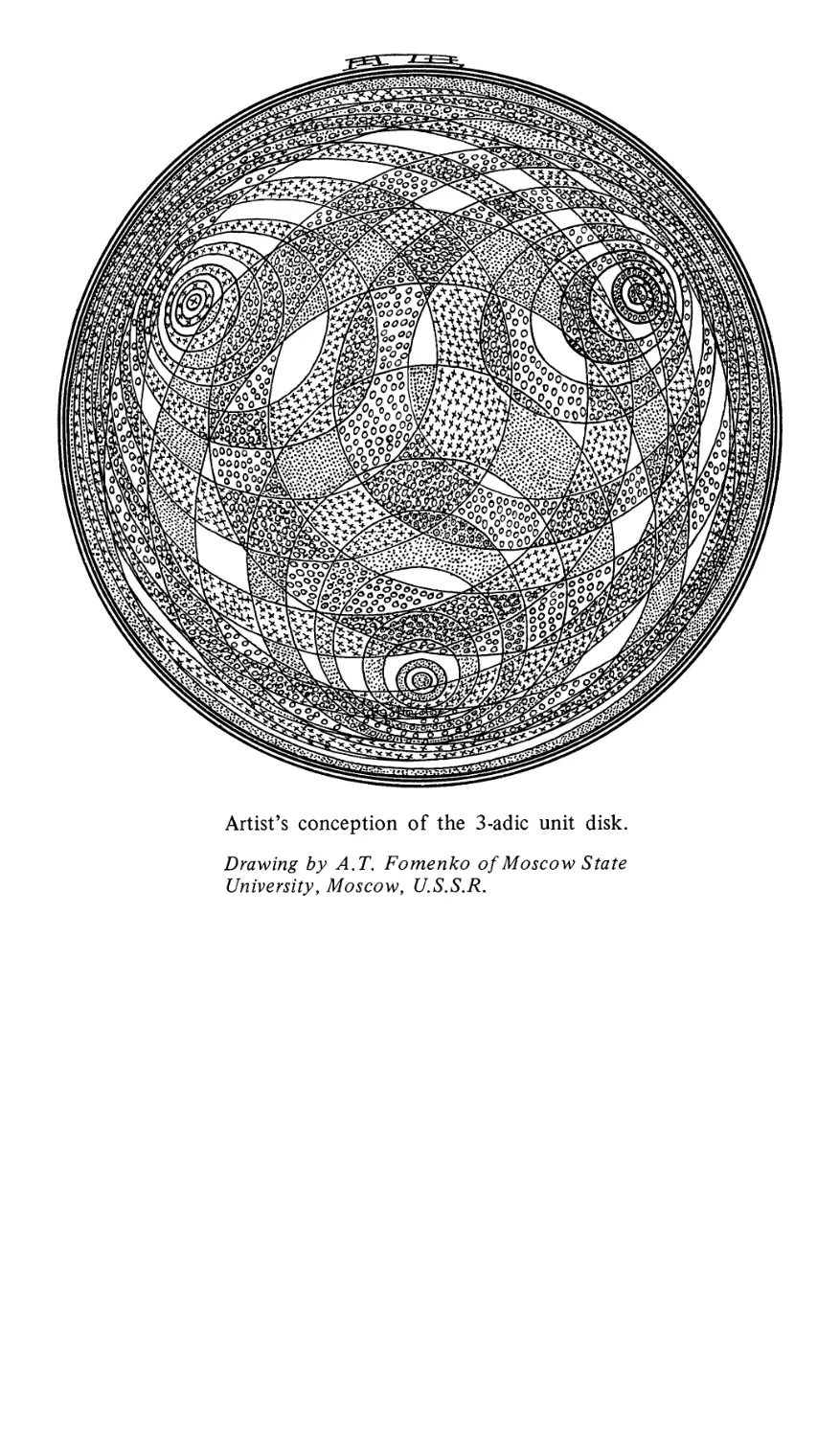
Artist's conception of the 3-adic unit disk.
Drawing by A. T. Fomenko of Moscow State
University, Moscow, U.S.S.R.
Neal Koblitz
p-adic Numbers,
p-adic Analysis, and
Zeta - Functions
Springer- Verlag
New York Heidelberg Berlin
Neal Koblitz
Harvard University
Department of Mathematics
Cambridge, Massachusetts 02138 USA
Editorial Board
P. R. Halmos
Managing Editor
University of California
Department of Mathematics
Santa Barbara, California 93106
USA
F. W. Gehring
University of Michigan
Department of Mathematics
Ann Arbor, Michigan 48104
USA
C. C. Moore
University of California
Department of Mathematics
Berkeley, California 94720 US A
AMS Subject Classifications: 10-01, 12-01, 12BI0, 14BI0
Library of Congress Cataloging in Publication Data
Koblitz, Neal, 1948-
P-adic numbers, p-adic analysis, and zeta-func-
tions,
(Graduate texts in mathematics; 58)
Bibliography: p.
1. p -adic numbers, 2. Functions, Zeta,
I. Title. II. Series.
QA241.K674 512' .75 77 -21869
All rights reserved
No part of this book may be translated or reproduced
in any fonn without written pennission from Springer- Verlag
@1977 by Springer- Verlag, New York Inc.
Printed in the United States of America
9 8 7 6 5 4 3 2 1
ISBN 0-387 -90274-0 Springer- Verlag New York
ISBN 3-540-90274-0 Springer- Verlag Berlin Heidelberg
To Professor Mark Kac
Preface
These lecture notes are intended as an introduction to p -adic analysis on the
elementary level. For this reason they presuppose as little background as possi-
ble. Besides about three semesters of calculus, I presume some slight exposure to
more abstract mathematics, to the extent that the student won't have an adverse
reaction to matrices with entries in a field other than the real numbers, field
extensions of the rational numbers, or the notion of a continuous map of topolog-
ical spaces.
The purpose of this book is twofold: to develop some basic ideas of p-adic
analysis, and to present two striking applications which, it is hoped, can be as
effective pedagogically as they were historically in stimulating interest in the
field. The first of these applications is presented in Chapter II, since it only
requires the most elementary properties of Qp; this is Mazur's construction by
means of p -adic integration of the Kubota- Leopoldt p -adic zeta-function, which
"p-adically interpolates" the values of the Riemann zeta-function at the negative
odd integers. My treatment is based on Mazur's Bourbaki notes (unpublished).
The book then returns to the foundations of the subject, proving extension of the
p -adic absolute value to algebraic extensions of Qp' constructing the p -adic
analogue of the complex numbers, and developing the theory of p-adic power
series. The treatment highlights analogies and contrasts with the familiar con-
cepts and examples from calculus. The second main application, in Chapter V, is
Dwork's proof of the rationality of the zeta-function of a system of equations
over a finite field, one of the parts of the celebrated Weil Conjectures. Here the
presentation follows Serre's exposition in Seminaire Bourbaki.
These notes have no pretension to being a thorough introduction to p -adic
analysis. Such topics as the Hasse-Minkowski Theorem (which is in Chapter 1
of Borevich and Shafarevich's Number Theory) and Tate's thesis (which is also
available in textbook form, see Lang's Algebraic Number Theory) are omitted.
VB
Preface
Moreover, there is no attempt to present results in their most general form. For
example, p-adic L-functions corresponding to Dirichlet characters are only dis-
cussed parenthetically in Chapter II. The aim is to present a selection of material
that can be digested by undergraduates or beginning graduate students in a
one- term course.
The exercises are for the most part not hard, and are important in order to
convert a passive understanding to a real grasp of the material. The abundance of
exercises will enable many students to study the subject on their own, with
minimal guidance, testing themselves and solidifying their understanding by
working the problems.
p-adic analysis can be of interest to students for several reasons. First of all, in
many areas of mathematical research-such as number theory and representation
theory-p-adic techniques occupy an important place. More naively, for a stu-
dent who has just learned calculus, the "brave new world" of non-Archimedean
analysis provides an amusing perspective on the world of classical analysis.
p -adic analysis, with a foot in classical analysis and a foot in algebra and number
theory, provides a valuable point of view for a student interested in any of those
areas.
I would like to thank Professors Mark Kac and Yu. I. Manin for their help
and encouragement over the years, and for providing, through their teaching and
writing, models of pedagogical insight which their students can try to emulate.
Logical dependence of chapters
/1 \
2 "
'\.
5
Vlll
Chapter I
p-adic numbers
1 . Basic concepts
2. Metrics on the rational numbers
Exercises
3. Review of building up the complex numbers
4. The field of p -adic numbers
5. Arithmetic in Qp
Exercises
Chapter II
p-adic interpolation of the Riemann zeta-function
1. A formula for (2k)
2. p-adic interpolation of the functionf(s) = as
Exercises
3, p - adic distributions
Exercises
4. Bernoulli distributions
5. Measures and integration
Exercises
6. The p-adic -function as a Mellin-Mazur transform
7. A brief survey (no proofs)
Exercises
Chapter III
Building up n
1. Finite fields
Exercises
Contents
1
1
2
6
8
10
14
19
21
22
26
28
30
33
34
36
41
42
47
51
52
52
57
IX
Contents
2. Extension of nonns
Exercises
3. The algebraic closure of Qp
4. 12
Exercises
57
65
65
70
72
Chapter IV
P - adic power series
1. Elementary functions
2, The Artin- Hasse exponential
Exercises
3. Newton polygons for polynomials
4. Newton polygons for power series
Exercises
75
75
82
86
89
91
99
Chapter V
Rationality of the zeta-function of a set of equations
over a finite field
101
1. Hypersurfaces and their zeta-functions
Exercises
2. Characters and their lifting
3. A linear map on the vector space of power series
4. p -adic analytic expression for the zeta-function
Exercises
5. The end of the proof
101
106
108
110
114
116
117
Bibliography
121
x
CHAPTER I
p-adic numbers
1. Basic concepts
If x is a nonempty set, a distance, or metric, on X is a function d from pairs
of elements (x, y) of X to the nonnegative real numbers such that
(1) d(x, y) = 0 if and only if x = y.
(2) d(x, y) = d(y, x).
(3) d(x, y) < d(x, z) + d(z, y) for all z E X.
A set X together with a metric d is called a metric space. The same set X can
give rise to many different metric spaces (X, d), as we'll soon see.
The sets X we'll be dealing with will mostly be fields. Recall that a field F
is a set together with two operations + and . such that F is a commutative
group under +, F - {O} is a commutative group under ., and the distributive
law holds. The examples of a field to have in mind at this point are the field
Q of rational numbers and the field [R of real numbers.
The metrics d we'll be dealing with will come from norms on the field F,
which means a map denoted /I /I from F to the nonnegative real numbers
such that
(1) !lxll = 0 if and only if x = O.
(2) I/x.y/l = IIx/l' /lyll.
(3) Ilx+yll < /lx/l + /lyl/.
When we say that a metric d "comes from " (or "is induced by") a norm
/I II, we mean that d is defined by: d(x, y) = /Ix - yll. It is an easy exercise
to check that such a d satisfies the definition of a metric whenever 1/ /I is a
norm.
A basic example of a norm on the rational number field Q is the absolute
value Ixl. The induced metric d(x, y) = Ix - yl is the usual concept of
distance on the number line.
1
I p-adic numbers
My reason for starting with the abstract definition of distance is that the
point of departure for our whole subject of study will be a new type of
distance, which will satisfy Properties (1)-(3) in the definition of a metric
but will differ fundamentally from the familiar intuitive notions. My reason
for recalling the abstract definition of a field is that we'll soon need to be
working not only with Q but with various" extension fields" which contain Q.
2. Metrics on the rational numbers
We know one metric on Q, that induced by the ordinary absolute value. Are
there any others? The following is basic to everything that follows.
Definition. Let p E {2, 3, 5, 7, 11, 13, ...} be any prime number. For any
nonzero integer a, let ord 1' a be the highest power of p which divides a, Le.,
the greatest m such that a = 0 (mod pm). (The notation a = b (mod c)
means: e divides a - b.) For example,
ord s 35 = 1, ord s 250 = 3, ord 2 96 = 5, ord 2 97 = O.
(If a = 0, we agree to write ord 1' 0 = 00.) Note that ord 1' behaves a little
like a logarithm would: ord 1' (ala2) = ord 1' al + ord 1' a2.
Now for any rational number x = ajb, define ord 1' x to be ord 1' a -
ord 1' b. Note that this expression depends only on x, and not on a and b,
Le., if we write x = aejbe, we get the same value for ord 1' x = ord 1' ae -
ord 1' be.
Further define a map I 11' on Q as follows:
ifx:/= 0;
if x = o.
Proposition. I 11' is a norm on Q.
PROOF. Properties (1) and (2) are easy to check as an exercise. We now verify
(3).
If x = 0 or y = 0, or if x + y = 0, Property (3) is trivial, so assume x, y,
and x + yare all nonzero. Let x = ajb and y = ejd be written in lowest
terms. Then we have: x + y = (ad + be)jbd, and ord1'(x + y) =
ordp(ad + be) - ord p b - ord 1' d. Now the highest power of p dividing the
sum of two numbers is at least the minimum of the highest power dividing
the first and the highest power dividing the second. Hence
ord1'(x + y) > min(ord 1' ad, ord 1' be) - ord 1' b - ord 1' d
= min(ord 1' a + ord 1' d, ord 1' b + ord 1' c) - ord 1' b - ord 1' d
= min( ord 1' a - ord 1' b, ord 1' e - ord 1' d)
= min( ord 1' x, ord 1' y).
Therefore, Ix + yip = p-ordp(x+y) < max(p-OrdpX,p-ordpY) = max(lxl 1' , Iylp),
and this is < IxJ1' + Iylp. 0
2
2 Metrics on the rational numbers
We actually proved a stronger inequality than Property (3), and it is this
stronger inequality which leads to the basic definition of p-adic analysis.
Definition. A norm is called non-Archimedean if II x + yIJ < max(llxll, Ilyll)
always holds. A metric is called non-Archimedean if d(x, y) <
max(d(x, z), d(z, y)); in particular, a metric is non-Archimedean if it is
induced by a non-Archimedean norm, since in that case d(x, y) =
!Ix - yll = /I(x - z) + (z - y)/I < max(/lx - zll, !!z - yll) = max(d(x, z),
d(z, y)).
Thus, I Ip is a non-Archimedean norm on Q.
A norm (or metric) which is not non-Archimedean is called Archimedean.
The ordinary absolute value is an Archimedean norm on Q.
In any metric space X we have the notion of a Cauchy sequence
{aI' a2, as, . . .} of elements of X. This means that for any e there exists an
N such that d(a m , an) < e whenever both m > Nand n > N.
We say two metrics d l and d 2 on a set X are equivalent if a sequence is
Cauchy with respect to d l if and only if it is Cauchy with respect to d 2 . We
say two norms are equivalent if they induce equivalent metrics.
In the definition of I !p, instead of (llp)ordpx we could have written pordpx
with any p E (0, 1) in place of lip. We would have obtained an equivalent
non-Archimedean norm (see Exercises 4 and 5). The reason why p = lip is
usually the most convenient choice is related to the formula in Exercise 17
below.
We also have a family of Archimedean norms which are equivalent to
the usual absolute value I I, namely I la when ° < a < 1 (see Exercise 7).
We sometimes let I 100 denote the usual absolute value. This is only a
notational convention, and is not meant to imply any direct relationship
between I I 00 and IIp.
By the "trivial" norm we mean the norm II II such that /1011 = ° and
/lxll = 1 for x :/= 0.
Theorem 1 (Ostrowski). Every nontrivial norm II II on Q is equivalent to I Ip
for some prime p or for p = 00.
PROOF. Case (i). Suppose there exists a positive integer n such that Ilnll > 1.
Let no be the least such n. Since II no II > 1, there exists a positive real number
a such that II no " = no a . Now write any positive integer n to the base no, i.e.,
in the form
n = ao + alnO + a2n02 + · · · + asnos, where ° < af, < no and as :/= 0.
Then
Ilnll < 11 0 011 + lI a lnoll + lIa2 n 021J + · · · + 1I0s n osil
= II ao II + II alII · no a + II a211 · nO 2a + · · · + II as II · no sa.
3
I p-adic numbers
Since all of the at are < no, by our choice of no we have II at \I < 1, and hence
/I n /I < 1 + no a + no 2a + · · · + no sa
= nos a (l + no -a + no2a + . . · + no sa )
< na[j {l/noa)l
because n > nos. The expression in brackets is a finite constant, which we
call C. Thus,
Ilnll < Cn a for all n = 1, 2, 3, ... .
Now take any n and any large N, and put n N in place of n in the above
inequality; then take Nth roots. You get
Jlnll < V Cn a .
Letting N 00 for n fixed gives /In II < na.
We can get the inequality the other way as follows. If n is written to the
base no as before, we have n + 1 > n > nos. Since Iln + 111 = Iin + n +1 - nIl <
II n II + "n + 1 - nil, we have
II nil > II n + 111 - II n + 1 - nil
> n +l)a - (n +l - n)a,
since Iln +lll = IInolls+1, and we can use the first inequality (Le., II nIl < na)
on the term that is being subtracted. Thus,
II nil > n + l)a - (n +l - nos)a (since n > noS)
= n +1)a[ 1 - ( 1 - ;o YJ
> C'n a
for some constant C' which may depend on no and a but not on n. As before,
we now use this inequality for n N , take Nth roots, and let N 00, finally
getting: II n II > n a .
Thus, IInll = na. It easily follows from Property (2) of norms that /Ix II =
Ixl a for all x E Q. In view of Exercise 7 below, which says that such a norm is
equivalent to the absolute value I I, this concludes the proof of the theorem
in Case (i).
Case (ii). Suppose that II nIl < 1 for all positive integers n. Let no be the
least n such that /I n" < 1; no exists because we have assumed that /I 1/ is
nontrivial.
no must be a prime, because if no = n1 . n2 with n1 and n2 both < no, then
/ln1/1 = l[n211 = 1,andsol[noll = IIn1/1./In211 = 1. Soletp denote the prime no.
We claim that Ilqll = 1 if q is a prime not equal to p. Suppose not; then
Ilqll < 1, and for some large N we have IlqN11 = JlqllN < t. Also, for some
large M we have IIpMl1 < t. Since pM and qN are relatively prime-have no
4
2 Metrics on the rational numbers
common divisor other than I-we can find (see Exercise 9) integers nand m
such that: mpM + nqN = 1. But then
1 = 11 1 11 = IlmpM + nqN/I < IlmpMl1 + IlnqNl1 = IlmllllpMl1 + IInllllqN/I,
by Properties (2) and (3) in the definition of a norm. But 11m II, IInll < 1, so
that
1 < IlpM11 + IIqNl1 < t + t = 1,
a contradiction. Hence Ilqll = 1.
We're now virtually done, since any positive integer a can be factored into
prime divisors: a = Pl b 1jJ2 b2 ... Pr br . Then Iiall = Ilplllb 1 .llp21I b2 .. ./lPrll br .
But the only Ilpill which is not equal to 1 will be IIpll if one of the p/s is p. Its
corresponding b i will be ord p a. Hence, if we let p = Ilpll < 1, we have
II a II = pordpa.
It is easy to see using Property (2) of a norm that the same formula holds with
any nonzero rational number x in place of a. In view of Exercise 4 below,
which says that such a norm is equivalent to lip, this concludes the proof
of Ostrowski's theorem. 0
Our intuition about distance is based, of course, on the Archimedean
metric I 100. Some properties of the non-Archimedean metrics I Ip seem very
strange at first, and take a while to get used to. Here are two examples.
For any metric, Property (3): d(x, y) < d(x, z) + d(z, y) is known as
the "triangle inequality," because in the cas e of the field C of complex
numbers (with metric d(a + bi, c + di) =V(a - C)2 + (b - d)2) it says
that in the complex plane the sum of two sides of a triangle is greater than
the third side. (See the diagram.)
z
x
y
Let's see what happens with a non-Archimedean norm on a field F. For
simplicity suppose z = O. Then the non-Archimedean triangle inequality says:
IIx - yll < max(lIx/l, lIyl/). Suppose first that the "sides" x and y have
different "length," say IIxll < Ilyli. The third side x - y has length
Ilx - yll < Ilyli.
But
Ilyll = IIx - (x - y)1I < max(llxll, IIx - yll).
Since II yll is not < IIxll, we must have II y/l < IIx - yll, and so II yll = IIx - yll.
5
I p-adic numbers
Thus, if our two sides x and yare not equal in length, the longer of the two
must have the same length as the third side. Every "triangle" is isosceles!
This really shouldn't be too surprising if we think what this says in the
case of I Ip on Q. It says that, if two rational numbers are divisible by
different powers of p, then their difference is divisible precisely by the lower
power of p (which is what it means to be the same "size" as the bigger of
the two).
This basic property of a non-Archimedean field-that /Ix + yll <
max(lIxll, Ilyll), with equality holding if /lx/l =1= lIyll-will be referred to as
the "isosceles triangle principle" from now on.
As a second example, we define the (open) disc of radius r (r is a positive
real number) with center a (a is an element in the field F) to be
D( a, r -) = {x E F I /I x - a II < r}.
Suppose II II is a non-Archimedean norm. Let b be any element in D(a, r-).
Then
D(a, r-) = D(b, r-),
Le., every point in the disc is a center! Why is this ? Well
x E D(a, r-) /Ix - all < r
/Ix - bll = /I(x - a) + (a - b)/I
< max(/lx - all, I[a - bl!)
<r
x E D(b, r-),
and the reverse implication is proved in the exact same way.
If we define the closed disc of radius r with center a to be
D(a, r) = {xEFIIIx - all < r},
for non-Archimedean " II we similarly find that every point in D(a, r) is a
center.
EXERCISES
1. For any norm II lion a field F, prove that addition, multiplication, and
finding the additive and multiplicative inverses are continuous. This means
that: (1) for any x, y E F and any e > 0, there exists S > 0 such that
Ilx' - xii < Sand Ily' - yll < Simply II (x' + y') - (x + y)11 < e; (2) the
same statement with II (x' + y') - (x + y)11 replaced by Ilx'y' - xyll; (3) for
any nonzero x E F and any e > 0, there exists S > 0 such that II x' - x II < S
implies 11(I/x') - (l/x)11 < e; (4) for any x E F and any e > 0, there exists
S > 0 such that Ilx' - xii < S implies II (-x') - (-x)11 < e.
2. Prove that if II II is any norm on a field F, then II - 111 = 111[1 = 1. Prove that
if II II is non-Archimedean, then for any integer n: II n II < 1. (Here "n"
means the result of adding 1 + 1 + 1 + · . · + 1 together n times in the
field F.)
6
Exercises
3. Prove that, conversely, if 1\ II is a norm such that Iin II < 1 for every integer n,
then II II is non-Archimedean. (Hint: Write Ilx + yilN = II (x + y)NII, use
the binomial expansion and Property (3) of a norm to get an inequality for
IIx + yilN in terms of max(llxll, lIyll). Remember, N can be an arbitrarily
large integer.)
4. Let II 111 and II 112 be two norms on a field F. Prove that II 111 /"OJ II 112 if and
only if there exists a positive real number a such that: IIxll1 = IIxll2 a for
all x E F.
5. Prove that, if 0 < P < 1, then the function on x E Q defined as pord p x if
x#;O and 0 if x = 0, is a non-Archimedean norm. Note that by the previous
problem it is equivalent to lip. What happens if p = I? What about if p > I?
6. Prove that I IpI is not equivalent to I Ip2 if P1 and P2 are different primes.
7. For x E Q define IIxll = Ixl a for a fixed positive number a, where I I is the
usual absolute value. Show that II II is a norm if and only if a < 1, and that
in that case it is equivalent to the norm I I.
8. Prove that two equivalent norms on a field Fare either both non-Archimedean
or both Archimedean.
9. Prove that, if Nand M are relatively prime integers, then there exist integers
nand m such that nN + mM = 1. (Hint: Show that the least positive integer
of the form nN + mM must be a common divisor of Nand M.)
10. Evaluate:
(i) ord 3 54
(iv) ord 7 ( -700/197)
(vii) ord 5 ( - 0.0625)
(x) ord 7 ( - 13.23)
(xiii) ord 13 ( - 26/169)
(ii) ord 2 128
(v) ord 2 (128/7)
(viii) ord 3 (10 9 )
(xi) ord 5 ( -13.23)
(xiv) ord 103 ( -1/309)
(iii) ord 3 57
(vi) ord 3 (7/9)
(ix) ord 3 ( -13.23)
(xii) ord 11 ( -13.23)
(xv) ord 3 (9!)
11. Prove that ordp«p N )!) = 1 + P + p2 + ... + pN-1.
12. If 0 < a < p - 1, prove that: ordp«apN)!) = a(1 + p + p2 + . . . + pN-1).
13. Prove that, if n = ao + alP + a2p2 + · · · + aspS is written to the base p,
so that 0 < at < P - 1, and if we set Sn = L at (the sum of the digits to the
base p), then we have the formula:
n-S
ordp(n!) = In .
p-
14. Evaluate la - blp, Le., the p-adic distance between a and b, when:
(i) a = 1, b = 26, p = 5 (ii) a = 1, b = 26, p = 00
(iii) a = l,b = 26,p = 3. (iv) a = 1/9,b = -1/16,p = 5
(v) a = 1, b = 244, p = 3 (vi) a = 1, b = 1/244, p = 3
(vii) a = 1, b = 1/243,p = 3 (viii) a = 1, b = 183,p = 13
(ix) a = 1, b = 183, p = 7 (x) a = 1, b = 183, p = 2
(xi) a = 1, b = 183, p = 00 (xii) a = 9!, b = 0, p = 3
(xiii) a = (9!)2/3 9 , b = O,p = 3 (xiv) a = 2 2N /2 N , b = O,p = 2
(xv) a = 2 2N /(2 N )!, b = 0, p = 2.
7
I p-adic numbers
15. Say in words what it means for a rational number x to satisfy Ix Ip < 1.
16. For x E Q, prove that limt-+ 00 Ixi/i! Ip = 0 if and only if: ord p x > 1 when
p #; 2, ord 2 x > 2 when p = 2.
17. Let x be a nonzero rational number. Prove that the product over all primes
including 00 of Ixl p equals 1. (Notice that this "infinite product" actually
only includes a finite number of terms that are not equal to 1.) Symbolically,
TIp Ixl p = 1.
18. Prove that for any p ( #; (0), any sequence of integers has a subsequence which
is Cauchy with respect to lip.
19. Prove that if x E Q and Ix Ip < 1 for every prime p, then x E 7L..
3. Review of building up the complex
numbers
We now have a new concept of distance between two rational numbers: two
rational numbers are considered to be close if their difference is divisible by
a large power of a fixed prime p. In order to work with this so-called "p-adic
metric" we must enlarge the rational number field Q in a way analogous
to how the real numbers [R and then the complex numbers C were constructed
in the classical Archimedean metric I I. SO let's review how this was done.
Let's go back even farther, logically and historically, than Q. Let's go back
to the natural numbers N = {I, 2, 3, . . .}. Every step in going from N to C
can be analyzed in terms of a desire to do two things:
(1) Solve polynomial equations.
(2) Find limits of Cauchy sequences, Le., "complete" the number system to
one "without holes," in which every Cauchy sequence has a limit in
the new number system.
First of all, the integers 71.. (including 0, - 1, - 2, ...) can be introduced as
solutions of equations of the form
a + x = b,
a, b EN.
Next, rational numbers can be introduced as solutions of equations of the
form
ax = b,
a, b E 71...
So far we haven't used any concept of distance.
One of the possible ways to give a careful definition of the real numbers is
to consider the set S of Cauchy sequences of rational numbers. Call two
Cauchy sequences S1 = {aj} E Sand S2 = {bj} E S equivalent, and write S1 '" S2,
if laj - hil 0 as j 00. This is obviously an equivalence relation, that is,
we have: (1) any s is equivalent to itself; (2) if S1 '" S2, then S2 '" S1; and
(3) if S1 '" S2 and S2 '" S3, then S1 '" S3. We then define [R to be the set of
equivalence classes of Cauchy sequences of rational numbers. It is not hard
8
3 Review of building up the complex numbers
to define addition, multiplication, and finding additive and multiplicative
inverses of equivalence classes of Cauchy sequences, and to show that rR is a
field. Even though this definition seems rather abstract and cumbersome at
first glance, it turns out that it gives no more nor less than the old-fashioned
real number line, which is so easy to visualize.
Something similar will happen when we work with 1 Ip instead of I I:
starting with an abstract definition of the p-adic completion of Q, we'll get a
very down-to-earth number system, which we'll call Qp.
Getting back to our historical survey, we've gotten as far as rR. Next,
returning to the first method-solving equations-mathematicians decided
that it would be a good idea to have numbers that could solve equations like
x 2 + 1 = O. (This is taking things in logical order; historically speaking,
the definition of the complex numbers came before the rigorous definition
of the real numbers in terms of Cauchy sequences.) Then an amazing thing
happened! As soon as i = V - 1 was introduced and the field of complex
numbers of the form a + bi, a, b E rR, was defined, it turned out that:
(1) All polynomial equations with coefficients in C have solutions in C-this
is the famous Fundamental Theorem of Algebra (the concise terminology
is to say that C is algebraically closed); and
(2) C is already "complete" with respect to the (unique) no rm whic h extends
the norm I I on rR (this norm is given by la + bil = va 2 + b 2 ), Le., any
Cauchy sequence {aj + bji} has a limit of the form a + bi (since {aj} and
{b j } will each be Cauchy sequences in rR, you just let a and b be their
limits).
So the process stops with C, which is only a "quadratic extension" of rR
(Le., obtained by adjoining a solution of the quadratic equation x 2 + 1 = 0).
C is an algebraically closed field which is complete with respect to the Archime-
dean metric.
But alas! Such is not to be the case with lip. After getting Qp, the comple-
tion of Q with respect to ! !p, we must then form an infinite sequence of
field extensions obtained by adjoining solutions to higher degree (not just
quadratic) equations. Even worse, the resulting algebraically closed field,
which we denote Q p, is not complete. So we take this already gigantic field
and "fill in the holes" to get a still larger field Q.
What happens then? Do we now have to enlarge Q to be able to solve
polynomial equations with coefficients in Q? Does this process continue on
and on, in a frightening spiral of ever more far-fetched abstractions? Well,
fortunately, with Q the guardian angel of p-adic analysis intervenes, and it
turns out that Q is already algebraically closed, as well as complete, and our
search for the non-Archimedean analogue of C is ended.
But this Q, which will be the convenient number system in which to study
the p-adic analogy of calculus and analysis, is much less thoroughly
understood than C. As I. M. Gel/fand has remarked, some of the simplest
9
I p-adic numbers
questions, e.g., characterizing Qp-linear field automorphisms of Q, remain
unanswered.
So let's begin our journey to Q.
4. The field of p-adic numbers
For the rest of this chapter, we fix a prime number p =1= 00.
Let S be the set of sequences {at} of rational numbers such that, given
e > 0, there exists an N such that lai - ai,lp < e if both i, i' > N. We call
two such Cauchy sequences {aa and {ba equivalent if lat - btlp 0 as
i 00. We define the set Qp to be the set of equivalence classes of Cauchy
sequences.
For any x E Q, let {x} denote the" constant" Cauchy sequence all of whose
terms equal x. It is obvious that {x} "-I {x'} if and only if x = x'. The equiva-
]ence class of {O} is denoted simply O.
We define the norm I Ip of an equivalence class a to be lim t -+ oo latlp,
where {ai} is any representative of a. The limit exists because
(1) If a = 0, then by definition limt-+oo latlp = O.
(2) If a =1= 0, then for some e and for every N there exists an iN > N with
I atNlp > e.
If we choose Nlarge enough so that lat - ai,lp < e when i, i' > N, we have:
lat - atNlp < e for all i > N.
Since laiNlp > e, it follows by the "isosceles triangle principle" that lailp =
laiNlp. Thus, for all i > N, lailp has the constant value laiNlp. This constant
value is then limt-+ 00 I ai I p.
One important difference with the process of completing Q to get [R should
be noted. In going from Q to [R the possible values of I I = I I 00 were
enlarged to include all nonnegative real numbers. But in going from Q to Qp
the possible values of I Ip remain the same, namely {pn}nez U {O}.
Given two equivalence classes a and b of Cauchy sequences, we choose
any representatives {ai} E a and {bi} E b, and define a. b to be the equivalence
class represented by the Cauchy sequence {aibi}. If we had chosen another
{at'} E a and {b/} E b, we would have
la/b/ - aibilp = la/(b/ - bi) + bi(a/ - ai)lp
< max(la/(b/ - bi)lp, Ibi(a/ - ai)lp);
as i 00, the first expression approaches lal p . lim Ibt' - bilp = 0, and the
second expression approaches Ibl p :1imlai' - atlp = O. Hence {ai'b i '} "-I {atbi}.
We similarly define the sum of two equivalence classes of Cauchy se-
quences by choosing a Cauchy sequence in each class, defining addition
term-by-term, and showing that the equivalence class of the sum only
depends on the equivalence classes of the two summands. Additive inverses
are also defined in the obvious way.
10
4 The field of p-adic numbers
For multiplicative inverses we have to be a little careful because of the
possibility of zero terms in a Cauchy sequence. However, it is easy to see that
every Cauchy sequence is equivalent to one with no zero terms (for example,
if ai = 0, replace at by at' = pt). Then take the sequence {lfat}. This sequence
will be Cauchy unless latlp 0, Le., unless {at} '" {OJ. Moreover, if {at} '" {a/}
and no at or at' is zero, then {lfat} '" {1/at'} is easily proved.
It is now easy to prove that the set Qp of equivalence classes of Cauchy
sequences is a field with addition, multiplication, and inverses defined as
,!bove. For example, distributivity: Let {at}, {bt}, {Ct} be representatives of
a, b, c E Qp; then a(b + c) is the equivalence class of
{at(b t + Ct)} = {atbi + aici},
and ab + ac is also the equivalence class of this sequence.
Q can be identified with the subfield of Qp consisting of equivalence classes
containing a constant Cauchy sequence.
Finally, it is easy to prove that Qp is complete: if {aj}i=1.2.... is a sequence
of equivalence classes which is Cauchy in Qp, and if we take representative
Cauchy sequences of rational numbers {ait}t = 1.2.... for each ah then it is easily
shown that the equivalence class of {ajj}i=1.2.... is the limit of the a i . We leave
the details to the reader.
It's probably a good idea to go through one such tedious construction in
any course or seminar, so as not to totally forget the axiomatic foundations
on which everything rests. In this particular case, the abstract approach also
gives us the chance to compare the p-adic construction with the construction
of the reals, and see that the procedure is logically the same. However, after
the following theorem, it would be wise to forget as rapidly as possible
about "equivalence classes of Cauchy sequences," and to start thinking in
more concrete terms.
Theorem 2. Every equivalence class a in Qpfor which lal p < 1 has exactly one
representative Cauchy sequence of the form {at} for which:
(1) 0 < at < pi for i = 1, 2, 3, ... .
(2) at = at+1 (modpf)for i = 1, 2, 3, ... .
PROOF. We first prove uniqueness. If {at'} is a different sequence satisfying (1)
and (2), and if ato =1= ato', then ato ato' (mod pt o ), because both are between
o and pfo. But then, for all i > io, we have at = aio ato' = at' (mod pt o ),
Le., at at' (mod pi o ). Thus
lat - at'lp > If p t o
for all i > io, and {at} t;J {at'}.
So suppose we have a Cauchy sequence {btJ. We want to find an equivalent
sequence {atJ satisfying (1) and (2). To do this we use a simple lemma.
11
I p-adic numbers
Lemma. [fx E Q and Ixl p < 1, then for any i there exists an integer a E 7l.. such
that la - xl p < p-t. The integer a can be chosen in the set {O, 1, 2, 3, .. .,
pt - I}.
PROOF OF LEMMA. Let x = alb be written in lowest terms. Since Ixl p < 1,
it follows that p does not divide b, and hence band pt are relatively prime. So
we can find integers m and n such that: mb + npi = 1. Let a = am. The idea
is that mb differs from 1 by a p-adically small amount, so that m is a good
approximation to lib, and so am is a good approximation to x = alb. More
precisely, we have:
la - xl p = lam - (alb)lp = lalbl p 1mb - lip
< 1mb - lip = Inptl p = Inlplpi < llpf.
Finally, we can add a multiple of pi to the integer a to get an integer between
o and pt for which la - x/p < p-t still holds. The lemma is proved. D
Returning to the proof of the theorem, we look at our sequence {bi}, and,
for every j = 1, 2, 3, ..., let N(j) be a natural number such that Ib i - bt,lp <
p-j whenever i, i' > N(j). (We may take the sequence N(j) to be strictly
increasing withj; in particular, N(j) > j.) Notice that Ib t / p < 1 if i > N(l),
because for all i' > N(l)
Ibil p < max(lbi,lp, Ib t - bt,/p)
< max(lbi,lp, lip),
and Ibt,/p lal p < 1 as i' 00.
We now use the lemma to find a sequence of integers aj, where 0 < aj < Pj,
such that
la j - bN(nlp < llpj.
I claim that {aj} is the required sequence. It remains to show that aj + 1 = a j
(mod pi) and that {bt} '" {aj}.
The first assertion follows because
/a j +1 - ajlp = laj+1 - b N (j+1) + b N (j+l) - bN(j) - (aj - bN(j»)lp
< max(laj+1 - b N (j+l)lp, /b N (j+1) - bN(j)lp, laj - bN(n/p)
< max(l Ipj + 1, llpj, llpj)
= 1 I pi.
The second assertion follows because, given any j, for i > N(j) we have
lat - btlp = lat - aj + aj - bN(j) - (b i - bN(j»)lp
< max(/ai - ajlp, laj - bN(j)lp, Ib t - bN(j)lp)
< max(ll p i, llpj, llpj)
= 1 I pj.
Hence lOt - btlp 0 as i 00. The theorem is proved.
D
12
4 The field of p-adic numbers
What if our p-adic number a does not satisfy lal p < I? Then we can
multiply a by a power pm of p (namely, by the power of p which equals lal p ),
to get a p-adic number a' = apm which does satisfy la'ip < 1. Then a' is
represented by a sequence {at'} as in the theorem, and a = a'p-m is repre-
sented by the sequence {aa in which ai = at'p-m.
It is now convenient to write all the at' in the sequence for a' to the base p,
.
I.e.,
at' = b o + b 1 P + b 2p 2 + · · · + b t _ 1 pi-l,
where the b's are all "digits," Le., integers in {O, 1, . . ., p - I}. Our condition
at' = a; + 1 (mod pi) precisely means that
a;+ 1 = b o + b 1 P + b 2p 2 + . . · + b t _ 1p t-l + bipt,
where the digits b o through b t - 1 are all the same as for at'. Thus, a' can be
thought of intuitively as a number, written to the base p, which extends
infinitely far to the right, Le., we add a new digit each time we pass from at'
to a;+I.
Our original a can then be thought of as a base p decimal number which
has only finitely many digits" to the right of the decimal point" (Le., corres-
ponding to negative powers of p, but actually written starting from the left)
but has infinitely many digits for positive powers of p:
b o b 1 b m - 1 b b b 2
a = - + - + ... + - + + +IP + +2P +....
pm pm -1 p m m m
Here for the time being the expression on the right is only shorthand for the
sequence {at}, whereat = bop-m + ... + b i _ 1p t-l-m, that is, a convenient way
of thinking of the sequence {at} all at once. We'll soon see that this equality
is in a precise sense "real" equality. This equality is called the "p-adic
expansion" of a.
We let lLp = {a E Qp Iial p < I}. This is the setJ of all numbers in Qp
whose p-adic expansion involves no negative powers of p. An element of lL p
is called a "p-adic integer." (From now on, to avoid confusion, when we
mean an old-fashioned integer in lL, we'll say "rational integer.") The sum,
difference, and product of two elements of lLp is in lL p , so lLp is what's called a
"subring" of the field Qp.
If a, bE Qp, we write a = b (modpn) if la - blp < p-n, or equivalently,
(a - b)jpn E lL p , i.e., if the first nonzero digit in the p-adic expansion of a - b
occurs no sooner than the pn-place. If a and b are not only in Qp but are
actually in lL (Le., are rational integers), then this definition agrees with the
earlier definition of a = b (mod c).
We define lLp x as {x E lLp 11/x E lL p }, or equivalently as {x E lL p I x 0 (mod p)},
or equivalently as {x E lLp Ilxl p = I}. A p-adic integer in lL p x-Le., whose
first digit is nonzero-is sometimes called a "p-adic unit."
13
I p-adic numbers
Now let {bat -m be any sequence of p-adic integers. Consider the sum
S b_m b_ m + l b b b 2 b N
N=-+ +...+ 0+ l P + 2 p +...+ NP .
pm pm-l
This sequence of partial sums is clearly Cauchy: if M > N, then )SN - SMlp
< Ij p N. It therefore converges to an element in Op. As in the case of infinite
series of real numbers, we define Lt= -m bipi to be this limit in Op.
More generally, if {Ct} is any sequence of p-adic numbers such that ICtip 0
as i 00, the sequence of partial sums SN = Cl + C2 + · . · +CN converges to
a limit, which we denote Lt=l Ci. This is because: ISM - SNip =
ICN+ 1 + CN+2 + · . · + cMlp < max(ICN+ lip, ICN+2Ip, · · . , ICMlp) which 0 as
N 00. Thus, p-adic infinite series are easier to check for convergence than
infinite series of real numbers. A series converges in Qp if and only if its terms
approach zero. There is nothing like the harmonic series 1 + t + t + ! + · · ·
of real numbers, which diverges even though its terms approach O. Recall
that the reason for this is that I Ip of a sum is bounded by the maximum (not the
sum) of the I Ip of the summands when p =1= 00, Le., when I Ip is non-
Archimedean.
Returning now to p-adic expansions, we see that the infinite series on the
right in the definition of the p-adic expansion
b o b l b m -1 b b b 2
- + - + ... + - + + + lP + +2P +...
pm pm-l p m m m
(here b t E {O, 1, 2, . . . , p - 1}) converges to a, and so the equality can be
taken in the sense of the sum of an infinite series.
Note that the uniqueness assertion in Theorem 2 is something we don't
have in the Archimedean case. Namely, terminating decimals can also be
represented by decimals with repeating 9s: 1 = 0.9999 . . .. But if two p-adic
expansions converge to the same number in Op, then they are the same, Le.,
all of their digits are the same.
One final remark. Instead of {O, 1, 2, . . ., p - I} we could have chosen
any other set S = {Cto, Ctl, Ct2, . . ., Ct p -I} of p-adic integers having the property
that Ctt = i (mod p) for i = 0, 1, 2, . . ., p - 1, and could then have defined
our p-adic expansion to be of the form Lt= -m bipt, where now the "digits" b t
are in the set S rather than in the set {O, 1, .. ., p - I}. For most purposes,
the set {O, 1, . . ., p - I} is the most convenient. But there is another set S,
the so-called "Teichmiiller representatives" (see Exercise 12 below), which
is in some ways an even more natural choice.
5. Arithmetic in Qp
The mechanics of adding, subtracting, multiplying, and dividing p-adic
numbers is very much like the corresponding operations on decimals which
we learn to do in about the third grade. The only difference is that the
14
5 Arithmetic in Qp
"carrying," "borrowing," "long multiplication," etc. go from left to right
rather than right to left. Here are a few examples in Q7:
3 + 6 x 7 + 2 x 7 2 + . . .
x 4 + 5 x 7 + 1 x 7 2 + · . .
5 + 4 x 7 + 4 x 7 2 + . . .
1 x 7 + 4 x 7 2 + . . ·
3 X 7 2 + . . .
5 + 5 x 5 + 4 x 7 2 + . · .
2 x 7 -1 + 0 x 7 0 + 3 x 7 1 + · · ·
- 4 x 7 - 1 + 6 x 7 0 + 5 x 7 1 + · · ·
5 x 7 - 1 + 0 x 7 0 + 4 x 7 1 + . · ·
5 + 1 x 7 + 6 x 7 2 + · · ·
3 + 5 x 7 + 1 x 7 2 + · · .! 1 + 2 x 7 + 4 x 7 2 + · · ·
1 + 6 x 7 + 1 x 7 2 + . . ·
3x7+2x7 2 +...
3 x 7 + 5 x 7 2 + · · .
4 X 7 2 + . . ·
4 X 7 2 ,+ . . .
As another example, let's try to extract vi 6 in Qs, i.e., we want to find
00, 0h 02, . . ., 0 < 0t < 4, such that
(00 + 01 x 5 + 02 x 52 + . . .)2 = 1 + 1 x 5.
Comparing coefficients of 1 = 50 on both sides gives 00 2 = 1 (mod 5), and
hence 0 0 = 1 or 4. Let's take 00 = 1. Then comparing coefficients of 5 on
both sides gives 201 x 5 = 1 x 5 (mod 52), so that 201 = 1 (mod 5), and
hence 01 = 3. At the next step we have:
1 + 1 x 5 = (1 + 3 x 5 + 02 x 5 2 )2 = 1 + 1 x 5 + 202 x 52 (mod 53).
Hence 20 2 = 0 (mod 5), and 02 = O. Proceeding in this way, we get a series
o = 1 + 3 x 5 + 0 x 52 + 4 x 53 + 04 x 54 + 05 x 55 + · · ·
where each 0t after 0 0 is uniquely determined.
But remember that we had two choices for 00' namely 1 and 4. What if we
had chosen 4 instead of 1 ? We would have gotten
- 0 = 4 + 1 x 5 + 4 x 52 + 0 x 53
+ (4 - 04) X 54 + (4 - os) X 55 + · .. .
The fact that we had two choices for 00' and then, once we chose 00' only a
single possibility for 01, 02' 03, ..., merely reflects the fact that a nonzero
element in a field like Q or [R or Qp always has exactly two square roots in the
field if it has any.
Do all numbers in Qs have square roots? We saw that 6 does, what about
7? If we had
(00 + 01 x 5 -f- · · .)2 = 2 + 1 x 5,
15
I p-adic numbers
it would follow that a0 2 = 2 (mod 5). But this is impossible, as we see by
checking the possible values ao = 0, 1, 2, 3, 4. For a more systematic look
at square roots in Qp, see Exercises 5-11.
This method of solving the equation x 2 - 6 = 0 in Qs-by solving the
congruence a0 2 - 6 = 0 (mod 5) and then solving for the remaining ai in a
step-by-step fashion-is actually quite general, as shown by the following
important "lemma."
Theorem 3 (Hensel's lemma). Let F(x) = Co + C1X + . . . + cnx n be a poly-
nomial whose coefficients are p-adic integers. Let F'(x) = C1 + 2C2X +
3C3X2 + . . . + ncnx n - 1 be the derivative of F(x). Let ao be a p-adic integer
such that F(ao) = 0 (mod p) and F'(ao) 0 (mod p). Then there exists a
unique p-adic integer a such that
F(a) = 0 and a = ao (modp).
(Note: In the special case treated above, we had F(x) = x 2 - 6, F'(x) =
2x, ao = 1.)
PROOF OF HENSEL'S LEMMA. I claim that there exists a unique sequence
of rational integers a1, a2, a3, . . . such that for all n > 1:
(1) F(a n ) = o (mod p n+1).
(2) an = an -1 (mod pn).
(3) 0 < an < pn+1.
We prove that such an exist and are unique by induction on n.
If n = 1, first let 0 0 be the unique integer in {O, 1, . . ., p - I} which is
congruent to a o mod p. Any a1 satisfying (2) and (3) must be of the form
00 + b 1 P,whereO < b 1 < P - 1. Now, looking at F(oo + b 1 P), we expand the
polynomial, remembering that we only need congruence to 0 mod p2, so
that any terms divisible by p2 may be ignored:
F(a1) = F(oo + b 1 p) = L ci(oo + b 1 P)i
= L (CiOO i + iCtO&-lb1P + terms divisible by p2)
= LCiOOi + (LiciOb-1)b1P(modp2)
= F(oo) + F'(oo)b 1 p.
(Note the similarity to the first order Taylor series approximation in calculus:
F(x + h) = F(x) + F'(x)h + higher order terms.) Since F(a o ) = 0 (mod p)
by assumption, we can write F(oo) = ap (mod p2) for some ex E {O, 1, . . ., p - I}.
So in order to get F(a1) = 0 (mod p2) we must get ap + F'(ii o )b 1 p = 0
(mod p2), Le., a + F'(00)b 1 = 0 (mod p). But, since F'(ao) 0 (mod p) by
assumption, this equation can always be solved for the unknown b 1 . Namely,
using the lemma in the proof of Theorem 2, we choose b 1 E {O, 1, . . ., p - I}
so that b 1 = -a/F'(Oo) (mod p). Clearly this b 1 E {O, 1, . . ., p - I} is
uniquely determined by this condition.
16
5 Arithmetic in Qp
Now, to proceed with the induction, suppose we already have aI, a2, ..-,
an-I- We want to find an- By (2) and (3), we need an = a n -l + bnpn with
b n E {O, 1, _ _ _, p - I}. We expand F(a n -l + bnpn) as we did before in the
case n = 1, only this time we ignore terms divisible by pn + 1. This gives us:
F(a n ) = F(a n -l + bnpn) = F(a n -l) + F'(a n _l)b np n (mod p n+l).
Since F(a n -l) = 0 (modpn) by the induction assumption, we can write
F(a n -l) = a'pn (mod p n+l), and our desired condition.F(a n ) = 0 (mod p n+l)
now becomes
a'pn + F'(a n _l)b np n = 0 (modpn+l), Le., a' + F'(a n -l)b n = 0 (modp).
Now, since a n -l = a o (modp), it easily follows that F'(a n -l) = F'(ao) 0
(mod p), and we can find the required b n E {O, 1, .. ., p - I} proceeding
exactly as in the case of b 1 , Le., solving b n = -a'/F'(a n -l) (modp). This
completes the induction step, and hence the proof of the claim.
The theorem follows immediately from the claim. We merely let a =
ao + b l P + b 2p 2 + · - · . SinceforallnwehaveF(a) = F(a n ) = 0 (mod p n+l),
it follows that the p-adic number F(a) must be o. Conversely, any a = ao +
b l P + b 2p 2 + - - . gives a sequence of an as in the claim, and the uniqueness
of that sequence implies the uniqueness of the a. Hensel's lemma is proved. D
Hensel's lemma is often called the p-adic Newton's lemma because the
approximation technique used to prove it is essentially the same as Newton's
Figure 1.1. Newton's method in the real case
17
1 p-adic numbers
method for finding a real root of a polynomial equation with real coefficients.
In Newton's method in the real case, (see Figure 1.1), iff'(an-I) =1= 0, we take
J(an-I)
an = an-I - f ' ( ) .
an-I
The correction term -f(an-I)/f'(an-I) is a lot like the formula for the
"correction term" in the proof of Hensel's lemma:
b n - a'pn - F(an-I) ( d n+l )
nP = - F ' ( ) = - F ' ( ) mo p ·
an-l an-I
In one respect the p-adic Newton's method (Hensel's lemma) is much
better than Newton's method in the real case. In the p-adic case, it's guaranteed
to converge to a root of the polynomial. In the real case, Newton's method
usually converges, but not always. For example, if you take f(x) = x 3 - x
and make the unfortunate choice ao = 1/'\1' 5, you get:
al = 1/'\1'5 - [1/5'\1'5 - 1/'\1'5]/(3/5 - 1)
= 1/'\1'5[1 - (1/5 - 1)(3/5 - 1)] = -1/V5;
a2 = 1/'\1'5; a3 = -1/'\1'5, etc.
(See Figure 1.2.) Such perverse silliness is impossible in Op.
..........
..........
"'"
"'"
..........
...........
Figure 1.2. Failure of Newton's method in the real case
18
Exercises
EXERCISES
1. If a E Op has p-adic expansion a_mP-m + a_ m +1P-m+1 + · · · + ao +
alP + . . ., what is the p-adic expansion of - a?
2. Find the p-adic expansion of:
(i) (6 + 4 x 7 + 2 x 7 2 + 1 x 7 3 + · · · )(3 + 0 x 7 + 0 x 7 2 + 6 x 7 3 + · · · )
in 0 7 to 4 digits
(ii) 1/(3 + 2 x 5 + 3 x 52 + 1 x 53 + . · .) in 0 5 to 4 digits
(iii) 9 x 11 2 - (3 x 11 -1 + 2 + 1 x 111 + 3 x 11 2 + · · .) in 0 11 to 4
digits
(iv) 2/3 in O 2
(vii) - 9/16 in 0 13
(x) 1/3! in 0 3
(v) -1/6 in 0 7
(viii) 1/1000 in 0 5
(xi) 1/4! in O 2
(vi) 1/10 in 0 11
(ix) 6! in 0 3
(xii) 1/5! in 0 5
3. Prove that the p-adic expansion of a E Op terminates (Le., at = 0 for all i
greater than some N) if and only if a is a positive rational number whose
denominator is a power of p.
4. Prove that the p-adic expansion of a E Op has repeating digits from some point
on (Le., at + r = at for some r and for all i greater than some N) if and only
if a EO.
5. Prove the following generalization of Hensel's lemma: Let F(x) be a poly-
nomial with coefficients in 7L p . If ao E 7L p satisfies F'(ao) = 0 (mod pM) but
F'(ao) $ 0 (mod pM + 1), and if F(ao) = 0 (mod p2M + 1), then there is a unique
a E 7L p such that F(a) = 0 and a = ao (mod p M+1).
6. Use your proof in Exercise 5 to find a square root of -7 in O 2 to 5 digits.
7. Which of the following 11-adic numbers have square roots in 0 11 ?
(i) 5 (ii) 7 (Hi) - 7
(iv) 5 + 3 x 11 + 9 x 11 2 + 1 x 11 3
(v) 3 x 11 -2 + 6 x 11 -1 + 3 + 0 x 11 + 7 x 11 2
(vi) 3 x 11 -1 + 6 + 3 x 11 + 0 x 11 2 + 7 x 11 3
(vii) 1 x 11 7 (viii) 7 - 6 X 11 2
(ix) 5 x 11 - 2 + "2: = 0 n x 11 n.
8. Compute + V - 1 in 0 13 to 4 digits.
9. For which p = 2, 3, 5, 7, 11, 13, 17, 19 does -1 have a square root in Op?
10. Let p be any prime besides 2. Suppose a E Op and la Ip = 1. Describe a test
for whether a has a square root in Op. What about if lal p #; I? Prove that
there exist four numbers a1, a2, a3, a4, E Op such that for all nonzero a E Op
exactly one of the numbers ala, a2a, a3a, a4a has a square root. (In the case
when p is replaced by 00 and Op by IR, there are two numbers, for example
+ 1 will do, such that for every nonzero a E IR exactly one of the numbers
l.a and -l.a has a square root in IR.)
11. The same as Exercise 10 when p = 2, except that now there will be eight
numbers al, . . ., aa E O 2 such that for all nonzero a E O 2 exactly one of the
numbers ala, . . ., aaa has a square root in O 2 . Find such al, . . ., aa (the
choice of them is not unique, of course).
19
I p-adic numbers
12. Find all 4 fourth roots of 1 in 0 5 to four digits. Prove that Op always contains
p solutions ao, al, . . ., a p -1 to the equation x P - x = 0, where at = i (mod p).
These p numbers are called the" Teichmliller representatives" of {O, 1, 2, . . .,
p - 1} and are sometimes used as a set of p-adic digits instead of
{O, 1, 2, . . ., p - I}.
13. Prove the following "Eisenstein irreducibility criterion" for a polynomial
f(x) = ao + a1X + . · . + anx n with coefficients at E 7L. p : If at = 0 (mod p) for
i = 0, 1,2, . . ., n - 1, if an =!- 0 (modp), and if ao =!- 0 (mod p 2), then f(x)
is irreducible over Op, Le., it cannot be written as a product of two lower
degree polynomials with coefficients in Op.
14. If p > 2, use Exercise 13 to show that 1 has no pth root other than 1 in Op.
(Hint: substitute y = x-I in (x P - 1)/(x - 1).) Give another proof of this
fact by writing such a root x as 1 + pTx' with Ix'ip = 1 and some r > 0
(explain why x = 1 (mod p», raising to the pth power, expanding, and looking
at coefficients of powers of p.
15. Prove that the infinite sum 1 + P + p2 + p3 + · · · converges to 1/(1 - p) in
Op. What about 1 - p + p2 - p3 + p4 - p5 + . . . ? What about 1 +
(p _ l)p + p2 + (p _ l)p3 + p4 + (p - l)p5 + . . . ?
16. Suppose that n is a (positive or negative) integer not divisible by p, and let
ex = 1 (modp). Show that ex has an nth root in Op. Give a counter-example
if n = p. Show that ex has a pth root if ex = 1 (mod p2) and p #; 2.
17. Let ex E 7L. p . Prove that ex pM = a pM - 1 (mod pM) for M = 1, 2, 3,4, . . . . Prove
that the sequence {ex pM } approaches a limit in Op, and that this limit is the
Teichmliller representative congruent to a mod p.
18. Prove that 7L. p is sequentially compact, Le., every sequence of p-adic integers
has a convergent subsequence.
19. Define matrices with entries in Op, their sums, products, and determinants
exactly as in the case of the reals. Let M = {r x r matrices with entries in 7L. p },
let M x = {A E M I A has an inverse in M} (it's not hard to see that this is
equivalent to: det A E 7L. p X), and let pM = {A E M I A = pB with BE M}.
If A E MX and BE pM, prove that there exists a unique X E MX such that:
X2 - AX + B = O.
20
CHAPTER II
p-adic interpolation of the Riemann
zeta-function
This chapter is logically independent of the following chapters, and is pre-
sented at this point in the middle of our ascent to Q as a plateau in the level
of abstraction-namely, everything in this chapter still takes place in the
fields Q, Q p, and rR.
The Riemann '-function is defined as a function of real numbers greater
than 1 by
ex:> 1
(S) de! n n S
It is easy to see (by comparison with the integral f; (dxjr) = Ij(s - 1) for
fixed s > 1) that this sum converges when s > 1.
Let p be any prime number. The purpose of this chapter is to show that
the numbers '(2k) for k = I, 2, 3, . .. have a "p-adic continuity property."
More precisely, consider the set of numbers
c (2k - 1)'
f(2k) = (1 - p2k-l) w: k '(2k), where C k = (-I)k 2 2k - 1 . ,
as 2k runs through all positive even integers in the same congruence class
mod(p - 1). It turns out thatf(2k) is always a rational number. Moreover,
if two such values of 2k are close p-adically (Le., their difference is divisible
by a high power of p), then we shall see that the correspondingf(2k) are also
p-adically close. (We must also assume that 2k is not divisible by p - 1.)
This means that the functionfcan be extended in a unique way from integers
to p-adic integers so that the resulting function is a continuous function of a
p-adic variable with values in Qp. (" Continuous function" means, as in the
real case, that whenever a sequence of p-adic integers {xn} approaches x
p-adically, {f(x n )} approaches f(x) p-adically.)
21
II p-adic interpolation of the Riemann zeta-function
This is what is meant by p-adic "interpolation." The process is analogous
to the classical procedure for, say, defining the functionf(x) = aX (where a
is a fixed positive real number): first define f(x) for fractional x; then prove
that nearby fractional values of x give nearby values of aX; and, finally,
define aX for x irrational to be the limit ofa xn for any sequence of rational
numbers X n which approach x.
Notice that a functionf on the set S of, for example, positive even integers
can be extended in at most one way to a continuous function on 7l.. p (assume
p =1= 2). This is because S is "dense" in 7l.. p -any x E 7l.. p can be written as a
limit of positive even integers X n . If f is to be continuous, we must have
f(x) = lim n -+ 00 f(x n ). In the real case, while the rational numbers are dense
in rR, the set S is not. It makes no sense to talk of "the" continuous real-
valued function which interpolates a function on the positive even integers;
there are always infinitely many such functions. (However, there might be a
unique real-valued continuous interpolating function which has additional
convenient properties: for example, the gamma-function r(x + 1) inter-
polates k ! when x = k is a nonnegative integer, it satisfies r(x + 1) = xr(x)
for all real x, and its logarithm is a convex function for x > 0; the gamma-
function is uniquely characterized by these properties.)
1. A formula for '(2k)
The kth Bernoulli number Bk is defined as k! times the kth coefficient in the
Taylor series for
t 1
e t - 1 - 1 + t/2! + t 2 /3! + t 3 /4! + ... + tn/(n + I)! + ...
00
de! L: Bktk/k!.
k=O
The first few Bk are:
Bo = 1, Bl = -1/2,
B4 = -1/30, Bs = 0,
We now derive the formula:
'(2k) = (-1)k1T 2k (!.k2k \) ( - kk ) for k = 1, 2, 3, ... .
Recall the definition of the "hyperbolic sine," abbreviated sinh (and
pronounced "sinch"):
B 2 = 1/6, B3 = 0,
Ba = 1/42, . . . .
. eX - e- x
sInh x = ·
2
I t is equal to its Taylor series
. x 3 X S X2k + 1
sInh x = x + 3! + 5! + . . . + (2k + I)! + . . . ,
22
1 A formula for '(2k)
obtained by averaging the series for eX and -e- X . Note that this Taylor
series is the same as that for sin x, except without the alternation of sign.
Proposition. For all real numbers x, the infinite product
1TX d ( 1 + : )
converges and equals sinh(7Tx).
PROOF. Convergence of the infinite product is immediate from the logarithm
test:
" l log( 1 + : ) < " l < 00 for all x.
We start by deriving the infinite product for sin x.
Lemma. Let n = 2k + 1 be a positive odd integer. Then we can write
sin(nx) = Pn (sin x)
cos(nx) = cos x Qn-1 (sin x)
where P n (respectively Qn -1) is a polynomial of degree at most n (respectively
n - 1) with integer coefficients.
PROOF OF LEMMA. We use induction on k. The lemma is trivial for k = 0
(i.e., n = 1). Suppose it holds for k - 1. Then
sin[(2k + l)x] = sin[(2k - l)x + 2x]
= sin(2k - l)x cos 2x + cos(2k - l)x sin 2x
= P 2k - 1 (sin x)(l - 2 sin 2 x)
+ cos XQ2k-2 (sin x)2 sin x cos x,
I
which is of the required form P 2k + 1 (sin x). The proof that cos(2k + l)x =
cos X Q2k (sin x) is completely similar, and will be left to the reader. D
We now return to the proof of the proposition. Notice that, if we set
x = 0 in sin nx = Pn (sin x), we find that Pn has constant term zero. Next,
we take the derivative with respect to x of both sides of sin nx = Pn (sin x):
n cos nx = Pn'(sin x) cos x.
Setting x = 0 here gives: n = Pn'(O), Le., the first coefficient of Pn is n. Thus,
we may write:
sIn nx P - ( . ) 1 · · 2
. = 2k sIn x = + a1 sIn x + a2 sIn x + · . ·
nSInx
+ a2k sin 2k x
(n = 2k + 1),
where the at are rational numbers. Note that for x = + (7Tln), . . ., + (k7Tfn),
the left-hand side vanishes. But the 2k values y = + sin(7Tln), + sin(27Tln), . . .,
23
II p-adic interpolation of the Riemann zeta-function
+ sin(k7T/n) are distinct numbers at which the polynomial P2k(Y) vanishes.
Since P 2k has degree 2k and constant term 1, we must have:
P ( ) = ( 1 - Y ) ( 1 - Y ) ( 1 - y ) ( 1 - y )
2k Y sin 7T/n - sin 7T/n sin 27T/n - sin 27T/n
( Y )( Y )
...1- 1-
sin k7T/n - sin k7TJn
k ( y2 )
- 1- ·
- D sm 2 1'1T/n
Thus
sin nx --. [1 k ( sin 2 x )
· = P2k(SlD x) = 1 - sin 2 1'1T/n ·
n SIn x T = 1
Replacing x by 7Tx/n gives:
sin TTX = rl ( 1 _ S in 2 (7Tx/n) ) .
n sin(7Tx/n) T= 1 sin2(7Tr/n)
Now take the limit of both sides as n = 2k + 1 00. The left-hand side
approaches (sin 7TX)/7TX. For r small relative to n the rth term in the product
approaches 1 - ((7Tx/n)/(7TrJn))2 = 1 - (x2/r 2 ). It then follows that the
product converges to T1 1 (1 - (x2Jr 2 )). (The rigorous justification is
straightforward, and will be left as an exercise below.)
We conclude:
00 ( X2 ) sin(7Tx) 7T2X2 7T4X4 7T6X6 7T8X8
[1 1-- = =1--+---+--...
n = 1 n 2 TTX 3! 5! 7! 9! '
using the Taylor series for sine. But
sinh(7Tx) = 1 7T2X2 7T4X4 7T6X6 7T8X8
7TX + 3! + 5T + 7! + 9! + . . . .
If we multiply out the infinite product for sine 7TX)/( 7TX), we get a minus sign
precisely in those terms having an odd number of x2Jn 2 terms, Le., precisely
for the terms in the Taylor series for sin(7Tx)/(7Tx) having a minus sign. Thus,
changing the sign in the infinite product has the effect of changing all of the
-'s to +'s on the right, and we have the desired product expansion of the
proposition. (For a "better" way of thinking of this last step, see Exercise 3
below.) D
We are now ready to prove:
Theorem 4.
n2k) = (_1)k7T 2k (2 2 11)! (- ;; ).
24
1 A formula for '(2k)
PROOF. First take the logarithm of both sides of
00 ( X2 )
sinh(7Tx) = TTX n 1 + 2'
n=l n
(for x > 0). On the left we get
log sinh(7Tx) = log[(e nx - e- nx )/2] = log[(e nx j2)(1 - e- 2nX )]
= 10g(1 - e- 2nX ) + l7X - log 2.
On the right we get (for 0 < x < I)
00 00 00 2k
log 7T + log x + L: log(l + r/n2) = log'7T + log x + L: L: (_l)k+1 \k '
n=l n=l k=l kn
by the Taylor series for log(l + x). Since this double series is absolutely
convergent for 0 < x < 1, we can interchange the order of summation and
obtain the equality:
log(1 - e- 231X ) + TTX - log 2 = log 7T + log x + k [( _l)k+1 X k n l n k ]
00 2k
= log 7T + log x + k l (_l)k+1 x k (2k).
We now take the derivative of both sides with respect to x. On the right
we may differentiate term-by-term, since the resulting series is uniformly
convergent in 0 < x < 1 - e for any e > O. Thus,
27Te- 2nx + 17 = ! + 2 ( -I ) k+1 X 2k-l' ( 2k ) .
1 - e- 2nx x k l
Multiplying through by x and then substituting x/2 for x gives:
7TX TTX _ 1 (-I)k+ l'(2k) 2k
nx _ 1 + 2 - + L.., 22k-1 x.
e k=l
The left-hand side gives: (l7x)/2 + L:'=o B k (7TX)k/k1. Comparing coefficients
of even powers of x gives: 7T 2k B 2k /(2k)! = (( - I)k + 1/2 2k -1 )'(2k), which gives
us the theorem. D
As examples, we have
7T 2
'(2) = -,
6
7T 4
'(4) = -,
90
7T 6
'(6) = 945 .
The arrangement of the formula for '(2k) in the statement of Theorem 4
was deliberate. We think of the ( - B 2k /2k) as the "interesting" part, and the
(_I)k7T 2k 22k-l/(2k - I)! as a nuisance factor. It is the interesting part that
we end up interpolating p-adically. Some justification for taking ( - B 2k /2k)
rather than the whole mess will be given later ( 7). For now, let's remark that
25
II p-adic interpolation of the Riemann zeta-function
at least the 1T 2k factor has to be discarded when we interpolate the values
p-adicaIly, since transcendental real numbers can not be considered p-adically
in any reasonable way. (What could "p-adic ordinal" mean for them ?)
2. p-adic interpolation of the
function f(s) = as
This section will eventually playa role in the subsequent logical development.
It is included at this time as a "dry run" in order to motivate certain features
of the later p-adic interpolation which may otherwise seem somewhat
idiosyncratic.
As mentioned before, if a is a fixed positive real number, the function
I(s) = as is defined as a continuous function of a real variable by first defining
it on the set of rational numbers s, and then "interpolating" or "extending
by continuity" to real numbers, each of which can be written as the limit of
a sequence of rational numbers.
Now suppose that a = n is a fixed positive integer. Consider n as an
element in Qp. For every nonnegative integer s, the integer n S belongs to 71.. p .
Now the nonnegative integers are dense in 71.. p in the same way as Q is dense
in rR. In other words, every p-adic integer is the limit of a sequence of non-
negative integers (for example, the partial sums in its p-adic expansion). So
we might try to extendf(s) = n S by continuity from nonnegative integers s to
all p-adic integers s.
To do this, we must ask if n S and n S ' are close whenever the two non-
negative integers sand s' are close, for example, when s' = s + pN for some
large N. A couple of examples show that this is not always the case:
(I) n = p, s = 0: Ins - nS'lp = 11 - ppNlp = 1 no matter what Nis.
(2) 1 < n < p: by Fermat's Little Theorem (see 9111.1, especially the first
paragraph of the proof of Theorem 9), we have n = n P (mod p), and so
n = n P = n P2 = n P3 = · · . = n PN (mod p); hence n S - n s + pN = nS(I - n PN )
= nS(1 - n) (modp); thus Ins - nS'lp = 1 no matter what Nis.
But the situation is not as bad as these examples make it seem. Let's
choose n so that n = 1 (modp), say n = 1 + mp. Let Is' - sip < IjpN, so
that s' = s + S"pN for some s" E 71... Then we have (say s' > s)
Ins - ns'lp = In s lpll - n S ' -sip = 11 - n S ' -sip = 11 - (1 + mp)S"pNlp.
But expanding
S"pN (S"pN - 1)
(1 + mp)S"pN = 1 + (s"pN)mp + (mp)2 + . . . + (mp)S"pN
2
shows that each term in 1 - (1 + mp)S"pN has at least p N+l. Thus,
I nS - ns' l < I p N+l l = .
p - P pN + 1
In other words, if s' - s is divisible by pN, then n S - n S ' is divisible by pN + 1.
Thus, if n = 1 (mod p), it makes sense to define f(s) = n S for any p-adic
integer s to be the p-adic integer which is the limit of nSt as Sf runs through any
26
2 p-adic interpolation of the function f(s) = as
sequence of nonnegative integers which approach s (for example, the partial
sums of the p-adic expansion of s). Then f(s) is a continuous function
from 7l.. p to 7l.. p .
We can do a little better-allowing any n not divisible by p-if we're
willing to insist that sand s' be congruent modulo (p - 1), as well as modulo
a high power of p. That is, we fix some So E {O, 1, 2, 3, . . ., p - 2}, and,
instead of considering n S for all nonnegative integers s, we consider n S for all
nonnegative integers s congruent to our fixed So modulo (p - 1). Letting
s = So + (p - l)sh we are looking at n 8 o+(p-1)Sl for S1 any nonnegative
integer. We can do this because then
n S = n8o(nP -1 )81,
and for every n not divisible by p we have n P -1 = 1 (mod p). Thus, we are in
the situation of the last paragraph with n P -1 in place of nand S1 in place of
s (and a constant factor n So thrown in).
Another way of expressing this function is as follows. Let Sso be the set of
nonnegative integers congruent to So mod (p - 1). Sso is a dense subset of 7l.. p
(Exercise 7 below). The function f: Sso -+ 7l.. p defined by f(s) = n S can be
extended by continuity to a functionf: 7l.. p -+ lL p . Notice that the functionf
depends on So as well as on n.
If n = 0 (mod p), we are out of luck. This is because nSt -+ 0 p-adically for
any increasing sequence of nonnegative integers. And if s E lLp is not itself a
nonnegative integer, any sequence of nonnegative integers which approach s
p-adically must include arbitrarily large integers. It follows that the zero
function is the only possible candidate for n S , and that's absurd.
One final remark: the above discussion applies word-for-word to the
function Iln s (Exercise 8 below).
Now let's look at the Riemann zeta-function
00 1
'(s) = L: s (s > 1).
n=l n
The naive way to try to interpolate '(s) p-adically would be to interpolate
each term individually and then add the result. This won't work, because
even the terms which can be interpolated-those for which ptn-form an
infinite sum which diverges in 7l.. p . However, let's forget that for a moment
and look at the terms one-by-one.
The first thing we'll want to do is get rid of the terms Iln s with n divisible
by p. We do this as follows:
00 1 00 1 00 1
'(s) = L: s + L: s = L: s +
n=1,Pfn n n=1,pln n n=1,ptn n
00 1 1
- L: s + S '(s);
n= 1,pfn n P
1 00 1
(s) = 1 - (lJp") _L: nO
n -1,Pfn
00
L:
n=l
1
p S n 8
27
II p-adic interpolation of the Riemann zeta-function
I t is this last sum
00 1 ( 1 )
*(S) de! n=f:r>tn nS = 1 - pS (s)
which we will be dealing with later. This process is known as "taking out
the p-Euler factor." The reason is that '(8) has a famous expansion (see
Exercise 1 below)
1
'(s) = n s ·
pr1mesq 1 - (l/q )
The factor 1/[1 - (1I q S)] corresponding to the prime q is called the" q-Euler
factor." Thus, multiplying '(s) by [1 - (lipS)] amounts to removing the
p- Euler factor:
n 1 S .
'*(s) =
primes q :# P 1 - (1 I q )
The second thing we'll want to do when interpolating ,(s) is fix So E
{O, 1, 2, . . ., p - 2} and only let 8 vary over,,;, nonnegative integers s E Sso =
{s I s = So (modp - I)}.
It will turn out that the numbers ( - B 2k 12k) arrived at in 1, when multi-
plied by (I - p2k -1), can be interpolated for 2k E S2so (2s o E {O, 2, 4, . . ., p - 3}).
Note that we are not multiplying by [1 - (1I p 2k)], as you might expect, but
rather by the Euler term with 2k replaced by 1 - 2k: 1 - (1I p 1- 2k) =
1 - p2k -1. The reason why this replacement 2k 1 - 2k is natural will be
discussed in 7. (We'll see that the "interesting factor" -B 2k 12k in '(2k)
actually equals '(1 - 2k); '(x) and '(1 - x) are connected by a "functional
equation. ")
More precisely, we will show that, if 2k, 2k' E S2ko (where 2ko E {2, 4, . . .,
p - 3}; there's a slight complication when ko = 0), and if k = k' (mod pN),
then (see 6)
(1 - p2k-l)( -B 2k I2k) = (1 - p2k'-I)( -B 2k ,j2k') (mod p N+l).
These congruences were first discovered by Kummer a century ago, but their
interpretation in terms of p-adic interpolation of the Riemann '-function was
only discovered in 1964 by Kubota and Leopoldt.
EXERCISES
1. Prove that
1
'(s) = TI -8 for s > 1.
prlmesQ (1 - q )
2. Prove that
TI k (1 - sin 2 (7Tx/n)/ sin2(7Tr/n)) 1
-r as n = 2k + 1 -+ 00.
T= 1 (1 - x 2 Jr 2 )
28
Exercises
3. Use the relationship e ix = cos x + i sin x for e to a complex power to show
that sinh x = - i sin ix. Give another argument for how the infinite product
for sinh x follows from the infinite product for sin x.
4. Prove that Bk = 0 if k is an odd number greater than 1.
5. Use the formula for '(2k), along with Stirling's asymptotic formula n! tv
V 27Tn nne-n (where tv means that the ratio of the two sides 1 as n 00) to
find an asymptotic estimate for the usual Archimedean absolute value of B 2k .
6. Use the discussion of n 8 in 2 to compute the following through the p4- p l ace :
(i) 11 1 / 601 in 0 5 (ii) v l/l0 in 0 3 (Hi) (_6)2+4'7+3'7 2 +7 3 +... in 0 7 .
7. Prove that for any fixed So E {O, 1, . . ., p - 2), the set of nonnegative integers
congruent to So modulo (p - 1) is dense in 7L. p , i.e., any number in 71. p can be
approximated by such numbers.
8. What happens to the discussion in 2 if we take n E 71. p instead of taking n to
be a positive integer? What happens if we replace the function f(s) = n 8 by
f(s) = l/n8? Note that this is the same as replacing "nonnegative integer" by
"nonpositive integer" when defining the dense subset of 71. p from which we
extend f.
9. Let X be the function on the positive integers defined by:
{ I, if n = 1 (mod 4);
x(n) = - 1, if n = 3 (mod 4);
0, if 21n.
Define Lx(s) de! :L:=1 (x(n)/n 8 ) = 1 - (1/38) + (1/58) - (1/7 8 ) + · . · . Prove
that Lx(S) converges absolutely if s > 1 and conditionally if c > o. Find
Lx(l). Find an Euler product for L , .<s) and for Lx *(s) def Ln l,pfn (x(n)/n S ). (It
turns out that there is a formula similar to Theorem 4 for Lx(2k + 1) (i.e., for
positive odd rather than even integers) with Bn replaced by
B - ,. h ffi · f n' tet te 3t ( _ - t )
X,n de! n. tImes t e coe clent 0 t In e4t _ 1 - e4t _ 1 - et + e- t ·
Note: Exercise 9 is a special case of the following situation. Let N be a
positive integer. Let (71./ N71.) x be the multiplicative group of integers prime
to N modulo N. Let X: (71./N71.) x CX be a group homomorphism from
(71./ N71.) x to the multiplicative group of nonzero complex numbers. (It is easy
to see that the image of X can only contain roots of 1 in C.) Suppose that X is
"primitive," which means that there is no M dividing N, 1 < M < N, such
that the value of X on elements of (71./N71.) x only depends on their value
modulo M. Consider X as a function on all positive integers n by letting
x(n) equal x(n modulo N) if n is prime to Nand x(n) = 0 if nand N have a
common factor greater than 1. X is called a "character of conductor N."
Now define
L (s) = x(n) .
x de! L.., n 8
n=l
29
II p-adic interpolation of the Riemann zeta-function
It can then be shown that a formula similar to Theorem 4 holds with Bn
replaced by
N-l x(a)te at
BXt n d f n! times the coefficient of t n in 2: Nt 1 ·
e a=l e -
The formula gives Lx of even integers if X( -1) = 1 and Lx of odd integers if
X( -1) = -1. (See Iwasawa, Lectures on p-adic L-functions.)
In addition, we have the formula
Li1) = i x(n) =
n=l n
T(X) N l . al7
- N a l X(a) log sIn N '
1TiT(X) N 1 _ ( )
N 2 L X a .a,
a=l
if X( - 1) = 1;
if X( - 1) = - 1,
where the bar over X denotes the complex conjugate character: X(a) = x(a) ,
def
and where
N-l
T(X) = 2: x(a)e2nta/N
def a = 1
(this is known as a "Gauss sum "). (For a proof, see Borevich and Shafarevich,
Number Theory, p. 332-336.)
10. Use the formula for L x (l) in the above note to check the value for L x (l) in
Exercise 9 and to prove that:
1 1 1 1 1 1 1 1 1 1
(a) 1 - 2 + 4 - :5 + -=, - 8 + 10 - IT + · · · + 3k + 1 - 3k + 2 + · · ·
17
= 3Y3 '
1 1 1 1 1 1 1 1 1 1 1 1
(b) - - - - - + - + - - - - - + - + - - - - - + - + · · ·
1 3 5 7 9 11 13 15 17 19 21 23
10g(1 + Y2) .
y2
3. p-adic distributions
The metric space Qp has a "basis of open sets" consisting of all sets of the
form a + pN71.. p = {x E Qp Ilx - alp < (l/pN)} for a E Qp and N E 71... This
means that any open subset of Qp is a union of open subsets of this type.
We shall sometimes abbreviate a + pN71.. p as a + (pN), and in this chapter
we shall call a set of this type an "interval" (in other contexts we often call
such a set a "disc "). Notice that all intervals are closed as well as open,
since the complement of a + (pN) is the union over all a' E Qp such that
a' tt a + (pN) of the open sets a' + (pN).
Recall that 7l.. p is sequentially compact: every sequence of p-adic integers
has a convergent subsequence (see exercise 18 of 91.5). The same is easily
seen to be true for any interval or finite union of intervals. In a metric space X,
30
3 p-adic distributions
the property of sequential compactness of a set SeX is equivalent to the
following property, called "compactness": every time S is contained in a
union of sets, it is contained in a union of finitely many of those open sets
(" every open covering has a finite subcovering "). (See Simmons, Introduction
to Topology and Modern Analysis, 24, for this equivalence; this book is also
a good standard reference for other concepts from general topology.) It then
follows (see Exercise 1 below) that an open subset of Qp is compact if and
only if it is a finite union of intervals. It is this type of open set, which we call
a "compact-open," that repeatedly occurs in this section.
Definition. Let X and Y be two topological spaces. A map f: X -+ Y is
called locally constant if every point x E X has a neighborhood U such
thatf(U) is a single element of Y.
It is trivial to see that a locally constant function is continuous.
The concept of a locally constant function is not very useful in classical
situations, because there usually aren't any, except for constants. This is the
case whenever X is connected, for example or C.
But for us X will be a compact-open subset of Qp (usually 7l.. p or lLp x =
{x E 7l.. p Ilxl p = I}). Then X has many nontrivial locally constant functions.
In fact,f: X -+ Qp is locally constant precisely whenfis a finite linear com-
bination of characteristic functions of compact-open sets (see Exercise 4
below).
Locally constant functions play the same role for p-adic X that step-
functions play when X = in defining integrals by means of Riemann
sums.
Now let X be a compact-open subset of Qp, such as 7l.. p or 7l.. p x .
Definition. A p-adic distribution p. on X is a Qp-linear vector space homo-
morphism from the Qp-vector space of locally constant functions on X to
Qp. Iff: X -+ Qp is locally constant, instead of writing p.(/) for the value
of p. atf, we usually write ffp..
Equivalent definition (see Exercise 4 below). Ap-adic distribution ft on X is
an additive map from the set of compact-opens in X to Qp; this means that
if U c X is the disjoint union of compact-open sets U i , U 2 , . . ., Un, then
ft(U) = p.(U i ) + p.(U 2 ) + . . . + ft(U n ).
By "equivalent definition," we mean that any p. in the second sense
" extends" uniquely to a p. in the first sense, and any p. in the first sense
"restricts" to a p. in the second sense. More precisely, if we have a distribution
p. in the sense of the first definition, we get a distribution (also denoted p.) in
the sense of the second definitio by letting
/L(U) = f (characteristic function of U)/L,
31
II p-adic interpolation of the Riemann zeta-function
for every compact-open U. If we have a distribution ft in the sense of the
second definition, we get a distribution in the sense of the first definition by
first letting
f (characteristic function of U)/L = /L( U),
and then defining ffp, for locally constantfby writingfas a linear combina-
tion of characteristic functions.
Proposition. Every map ft from the set of intervals contained in X to Qp for
which
p-l
ft(a + (pN)) = L ft(a + bpN + (pN+l))
b=O
whenever a + (pN) C X, extends uniquely to a p-adic distribution on X.
PROOF. Every compact-open U c X can be written as a finite disjoint union
of intervals: U = U Ii (see Exercise 1). We then define ft(U) def L ft(I i ).
(This is the only possible value of p,(U) if ft is to be additive.) To check that
ft( U) does not depend on the partitioning of U into intervals, we first note
that any two partitions U = U Ii and U = U 1/ of U into a disjoint union of
intervals have a common subpartition (" finer" than both) which is of the
form Ii = Uj lib where, if It = a + (pN), then the Ii/s run through all
intervals a' + (pN') for some fixed N' > N and for variable a' which are
= a (mod pN). Then, by repeated application of the equality in the statement
of the proposition, we have:
pN'-N_l
ft(I i ) = ft(a + (pN)) = L
1=0
ft(a + jpN + (pN')) = L ft(Iij).
i
Hence Li p,(I i ) = Lit' ft( j). Thus, Li ft(I i ) = Li ft(It'), because both sides equal
the sum over the common subpartition. It is now clear that ft is additive.
Namely, if U is a disjoint union of U h we write each U i as a disjoint union of
intervals Itj, so that U = Ui,j Ii;' and
ft(U) = L ft(lt j ) = L L ft(Iij) = L ft(U i ).
i,j i j i
D
We now give some simple examples of p-adic distributions.
(1) The Haar distribution p'Haar. Define
1
ftHaar( a + (pN)) del pN .
This extends to a distribution on 7l.. p by the proposition, since
p-l p-l 1 1
b /LHaar(a + bpN + (pN+1)) = b pN+l = pN
= ftHaar( a + (PN)).
32
Exercises
This is the unique distribution (up to a constant multiple) which is "transla-
tion invariant," meaning that for all a E 7l.. p we have ftHaar(a + U) = /1-Haar(U),
where a + U de! {X E 7l.. p I X - a E U}.
(2) The Dirac distribution /1-a concentrated at a E 7l.. p (a is fixed). Define
(U) = { I, if a E U;
fta de! 0, otherwise.
I t is trivial to check that fta is additive. Note that f ffta = f( a) for locally
constant f.
(3) The Mazur distribution ftMazur. First, without loss of generality, when
we write a + (pN) we may assume that a is a rational integer between 0 and
pN - 1. Assuming this, we define
ILMazur( a + (pN» de! ;N - .
We postpone the verification that ftMazur has the additivity property in the
proposition, since this will come as a special case of a more general result in
the next section.
Notice one important difference between the distributions ftHaar and
ftMazur and classical measures. In these two p-adic examples, as the interval
being measured "shrinks" (i.e., as N (0), its measure in terms of ft
increases as a number in Qp, namely:
IILHaarCa + (PlY)lp = };N p = pN;
and, if p t a (and if N > 1 in the case p = 2), then
IILMazur(a + (PN»lp = I ;N - p = pN.
We'll deal with this peculiarity later.
EXERCISES
1. Give a direct proof that 7L p is compact (i.e., that any open covering of 7L p has a
finite subcovering). Then prove that an open set in 7L p is compact if and only if
it can be written as a finite disjoint union of intervals. Note that any interval
can be written as a disjoint union of p "equally long" subintervals: a + (pn) =
Ub;: a + bpn + (pn + 1). Prove that any partition of an interval into a disjoint
union of subintervals can be obtained by applying this process a finite number
of times.
2. Give an example of a noncompact open subset of 7L p .
3. Let U be an open subset of a topological space X. Show that the characteristic
function J:X 7L defined by
J{x) = { I, if XE U;
0, otherwise,
33
II p-adic interpolation of the Riemann zeta-function
is locally constant if X = 7L p and U is a compact-open but is not locally
constant for any open set U if X = IR (unless U is IR itself or the empty set).
4. Let Xbe a compact-open subset of Ope Show thatf: X Op is locally constant
if and only if it is a finite linear combination with coefficients in Op of charac-
teristic functions of compact-opens in X. Then prove that the two definitions
of a distribution on X are equivalent.
S. If a E Op, lal p ::;: 1, show that ftHaar(aU) = ftHaar(U) for all compact-open U,
where aU denotes {ax Ix E U}.
6. Let f: 7L p -+ Op be the locally constant function defined by: f(x) = the first
digit in the p-adic expansion of x. Find f fft when: (1) ft = the Dirac distribu-
tion fta; (2) ft = ftHaar; (3) p, = ftMazur.
7. Let ft be the function of intervals a + (pN) which is defined as follows ([ ] =
greatest integer function):
{ p - [(N + 1)/2], if the first [Nj2] digits in a corresponding to odd
p,(a + (pN» = powers of p vanish;
0, otherwise.
Prove that ft extends to a distribution on 7L. p .
8. Discuss how one could go about making up examples of p-adic distributions ft
on 7L p with various growth rates (i.e., rates of growth of maxos a <pNlft(a + (pN»lp
as N increases).
4. Bernoulli distributions
We first define the Bernoulli polynomials Bk(X). Consider the function in
two variables t and x
/e:: = ( Bk t ) ( (xtt ) .
e 1 k=O k. k=O k.
In this product, we collect the terms with t k , obtaining for each k a poly-
nomial in x, and we define Bk(X) to be k! times this polynomial:
text 00 tk
e t - 1 = k O Bk(X) k1"
The first few Bernoulli polynomials are:
Bo(x) = 1, Bl(X) = X - -1, B 2 (x) = X2 - x + i,
B() - 3_J.2 + 1
3 x - X 2 X '2 X ,. . . .
Throughout this section, when we write a + (pN) we will assume that
o < a < pN - 1. Fix a nonnegative integer k. We define a map ftB,k on
intervals a + (pN) by
ILB,k(a + (pN» = pN(k-l>Bk( ;N )'
34
4 Bernoulli distributions
Proposition. f'B,k extends to a distribution on 7l.. p (called the "kth Bernoulli
distribution ").
PROOF. By the proposition in 3, we must show that
p-1
f'B,k(a + (pN)) = L f'B,k(a + bpN + (pN+1)).
b=O
The right-hand side equals
p - 1 ( b N )
P eN + 1)(k - 1) "" B a + 'P ,
L k P N + 1
b=O
so, multiplying by p-N(k-l) and setting ex = ajpN+l, we must show that
p-1 ( b )
Bk(pex) = pk-l L Bk ex + - ·
b=O P
,
The right-hand side is, by the definition of Bk(x), equal to k! times the coeffi-
cient of t k in
p - 1 te(a + blp)t pk - 1 teat p -1 pk - 1 teat e t - 1
pk - 1 "" _ "" ebtlp _ ,
b e t - 1 - e t - 1 b - e t - 1 . e tlP - 1
by summing the geometric progression Lg: e btlp . This expression equals
pk(tjp)e(pa)tIP _ k (tlp)i
tIp 1 - P L Bj(pex)---=y,
e - J =0 J.
again by the definition of Bj(x). Hence, k! times the coefficient of t k is simply
pkBk(Pa)Gt = Bk(pa),
as desired.
D
The first few Bk(X) give us the following distributions:
f'B,O(a + (pN)) = p-N, i.e., f'B,O = f'Haar;
/LB.1(a + (PN» = B 1 (;N ) = ;N - , i.e., /LB.1 = /LMazur;
/LB.2(a + (pN» = pN (;: - ;N + ),
and so on.
It can be shown that the Bernoulli polynomials are the only polynomials
(up to a constant multiple) that can be used to define distributions in this way.
We shall not need this fact, and so will not prove it. But it should be noticed
that the Bernoulli polynomials Bk(X) have appeared in an important and
35
II p-adic interpolation of the Riemann zeta-function
unique role in p-adic integration. This will turn out to be related to the
appearance of the Bernoulli numbers Bk (which are the constant terms in
the Bk(X); see Exercise 1 below) in the formula for '(2k).
5. Measures and integration
Definition. A p-adic distribution ft on X is a measure if its values on compact-
open U c X are bounded by some constant B E , i.e.,
Ift(U)lp < B for all compact-open U c X.
The Dirac distribution fta for fixed a E lLp is a measure, but none of the
Bernoulli distributions are measures. There is a standard method, called
"regularization," for turning Bernoulli distributions into measures. We first
introduce some notation. If a E lLp, we let {a}N be the rational integer between
o and pN - 1 which is = a (mod pN). If ft is a distribution and a E Qp, we let
aft denote the distribution whose value on any compact-open is a times the
value of ft: (aft)(U) = a. (ft(U)). Finally, if U c Qp is a compact-open set
and a E Qp, a =1= 0, we let aU def {x E Qp I xla E U}. It is trivial to check that the
sum of two distributions (or measures) is a distribution (resp. measure), any
scalar multiple aft of a distribution (or measure) ft is a distribution (resp.
measure), and, if a E lL p x and if ft is a distribution (or measure) on lL p , then
the function ft' defined by ft'(U) = ft(aU) is a distribution (resp. measure)
on lL p .
Now let a be any rational integer not equal to 1 and not divisible by p.
Let ftB,k,a-or, more briefly, ftk,a-be the" regularized" Bernoulli distribution
on lL p defined by
ftk,a(U) def ftB,k(U) - a-kftB,k(aU).
We will soon show that ftk,a is a measure. In any case, it's clearly a distribu-
tion by the remarks in the last paragraph.
We easily compute an explicit formula when k = 0 or 1. For k = 0,
ftB,O = ftHaar, and it is easy to see that fto,a( U) = 0 for all U (see Exercise 5 of
3). If k = 1, we have
all ( { aa}N 1 )
ILl.aCa + (PN)) = pN - 2 - pN - 2
= (1/a) - 1 + !!. _ ! ( aa _ [ aa ])
2 pN a pN pN
(where [ ] means the greatest integer function)
= ! [ aa ] + (1/a) - 1 .
a pN 2
Proposition. IftI,a(U)lp < 1 for all compact-open U C lL p .
PROOF. Notice that (a- I - 1)/2 E lL p , since l/a E lL p and 1/2 E lL p unlessp = 2.
If p = 2, then a-I - 1 = 0 (mod 2), and we're still OK. Since [aa/pN] Ell,
36
5 Measures and integration
it follows by the above formula that ftl,aCa + (pN)) E 7l.. p , Then, since every
compact-open U is a finite disjoint union of intervals Ih we may conclude that
Iftl,a(U)lp < max Iftl,aCI t )lp < 1. D
Thus, ftl,a is a measure-the first interesting example of a p-adic measure
that we've come across. In fact, we'll soon see that ftl,a plays a fundamental
role in p-adic integration, almost as fundamental as the role played by "dx"
in real integration.
We next prove a key congruence that relates ftk,a to ftl,a' The proof of
this congruence at first looks unpleasantly computational, but it becomes
more transparent if we think of an analogous situation in real calculus.
Suppose that in taking integrals such as ff({/ x) dx we want to make the
change of variables x Xk, Le., to evaluate ff(x)d(x k ). The simple rule is:
d(xk)fdx = kX k - 1 . Actually, d(Xk) can be thought of as a "measure" ftk on
the real number line, which is defined by letting ftk([a, b]) = b k - a k ; then
ftl is the usual concept of length. The relation d(xk)jdx = kX k - 1 actually
means
Hm ftk([a, b ]) = kak -1.
b-+a ftl([a, b])
Thus, in the Riemann sums Lf(xt)ftk(I t ) in the limit as the It's all become
smaller we may replace ftk(I t ) by kXk- 1 ftlC I t) and get f f(x)kx k - 1 dx.
The actual proof that limb-+a ftk([a, b ])f ftl ([a, b]) = ka k -1 uses the binomial
expansion for (a + h)" (where h = b - a)-actually, only the first two terms
a k + kha k - 1 really matter. Similarly, in the p-adic case, when we show that
ftk,a(I) '" ka k - 1 ftl,a(I) if I is a small interval containing a, we also use the
binomial expansion. Thus, Theorem 5 should be thought of as analogous to
the theorem that (djdx)(x k ) = kX k - 1 from real calculus. (Forget about the d k
on both sides of the congruence in Theorem 5; all it means is that, when we
divide both sides by d k , we must replace pN by pN- ordpd k , where ord p d k is just
a constant which doesn't matter for large N.)
Theorem 5. Let d k be the least common denominator of the coefficients of Bk(x).
Thus: d 1 = 2, d 2 = 6, d 3 = 2, etc. Then
dkftk,a(a + CpN)) = d k ka k - 1 ftl,a(a + (pN)) (mod pN).
PROOF. By Exercise 1 below, the polynomial Bk(X) starts out
k
BOXk + kB 1 x k - 1 + · . . = Xk - 2 Xk - 1 + · . . .
Now
d ( ( N )) d N(k-l> (B ( a ) -k B ( {exa}N ) )
kftk,a a + p = kP k pN - ex k pN ·
The polynomial dkBk(X) has integral coefficients and degree k. Hence we
37
II p-adic interpolation of the Riemann zeta-function
need only consider the leading two terms dkx k - d k (kJ2)x k -1 of dkBk(X),
since our x has denominator pN, so that the denominators in the lower terms
of dkBk(X) will be canceled by pN(k -1> with at least pN left over . We also note
that
aa = {aa}N (modpN),
and
{aa}N = aa _ [ aa ] ([] = g reatest inte g er function ) .
pN pN pN
Hence
d 11. ( a + (p N )) = d P N(k-1> ( ak _ a_k ( {aa}N ) k
krk,a k pNk ""', pN
_ ( ak-1 _ a_ k ( {aa}N ) k-1 ))
2 pN(k - 1) pN (mod pll)
_ d ( ak -k N(k-1> ( aa [ aa ] ) k
-k--ap ---
pN pN pN
k ( ( aa [ aa ]) k-1 ))
- 2 a k - 1 - a- k p NCk-1) pN - pN
_ d ( ak _k ( akak k k-1 k_1 [ aa ])
=k--a --a a -
pN pN pN
_ (ak.-1 _ a-k(ak-1ak-1») (modpN)
d k k_1 ( I [ aa ] IJa - 1 )
=k a --+
a pN 2
= dkkak-1f'1,a(a + (pN)).
D
Corollary. f'k,a is a measure for all k = 1, 2,3, . . . and any a E 71.., a p 71.., a =1= 1.
PROOF. We must show that f'k,a(a + (pN)) is bounded. But by Theorem 5,
IILk.a(a + (pN))lp < max ( p' Ika k - 1 IL1.a<a + (pN))lp)
< max( d k v' IIL1.a(a + (pN))lp)'
But 1f'1,a(a + (pN))lp < 1, and d k is fixed.
D
What is the purpose of going to all this fuss to modify (" regularize")
Bernoulli distributions to get measures? The answer is that for an unbounded
distribution f', f ff' is defined by definition as long as f is locally constant,
38
5 Measures and integration
but you run into problems if you try to use limits of Riemann sums to extend
integration to continuous functions f
For example, let p. = P.Haar, and take the simple functionf: 7l.. p 7l.. p given
by f(x) = x. Let's form the Riemann sums. Given a functionh for any N we
divide up 7l.. p into U r:01 (a + (pN)), we let Xa,N be an arbitrary point in the
ath interval, and we define the Nth Riemann sum of f corresponding to
{Xa,N} as
pN-1
SN,{Xa.N}(f) def L f(Xa,N)p.(a + (pN)).
a=O
In our example, this sum equals
pN - 1 1
x -.
a o a,N pN
For example, if we simply choose x a . N = a, we obtain
_ P 1 _ (pN _ 1)(pN) pN - 1
pN a=pN =.
a=O 2 2
This sum has a limit in Qp as N 00, namely -1/2. But if, instead of Xa,N =
a E a + (pN), we change one of the Xa,N to a + aopN E a + (pN) for each N,
where ao is some fixed p-adic integer, we then obtain
( PN -1 ) N 1
p - N a o a + aopN = p;: + aD,
whose limit is ao - t. Thus, the Riemann sums do not have a limit which is
independent of the choice of points in the intervals.
A "measure" p. is not much good, and has no right to be called a measure,
if you can't integrate continuous functions with respect to it. (This is a slight
exaggeration-see Exercises 8-10 below.) Now we show that bounded
distributions earn their name of "measure".
Recall that X is a compact-open subset of Qp, such as 7l.. p or 7l.. p x. (For
simplicity, let X c 7l.. p .)
Theorem 6. Let p. be a p-adic measure on X, and let f: X Qp be a continuous
function. Then the Riemann sums
SN ,{Xa,N} def L f(Xa,N)p.(a + (pN))
o :S: a < pN
a +(pN)<=X
(where the sum is taken over all a for which a + (pN) c X, and Xa,N is
chosen in a + (pN)) converge to a limit in Qp as N 00 which does not
depend on the choice of {Xa,N}.
PROOF. Suppose that p.(U) < B for all compact-open U c X. We first
estimate for M > N
ISN,{Xa,N} - SM,{Xa,M}lp.
39
II p-adic interpolation of the Riemann zeta-function
By writing X as a finite union of intervals, we can choose N large enough so
that every a + (pN) is either c X or disjoint from X. We rewrite SN,{Xa.N} as
follows, using the additivity of p.:
L f(Xa,N)p.(a + (pM))
o a<pM
a+(pM)cX
(where ii denotes the least nonnegative residue of a mod pN). We further
assume that N is large enough so that If(x) - f(y)/p < e whenever x = y
(mod pN). (Note that continuity implies uniform continuity, since X is
compact; this is an easy exercise, or else see Simmons' book.) Then
ISN,{Xa,N} - SM,{Xa,M}lp = L (f(Xa,N) - f(Xa,M))p.(a + (pM))
o a<pM p
a + (pM) eX
:>.0
< max(lf(xa,N) - f(Xa,M)lp .Ip.(a + (pM))lp)
< eB,
since Xa,N = Xa,M (mod pN). Since e is arbitrary and B is fixed, the Riemann
sums have a limit.
It follows similarly that this limit is independent of {Xa,N}. Namely,
ISN,{Xa,N} - SN,{X'a,N}lp = L (f(Xa,N) - f(X ,N))p.(a + (pN))
O a<pN p
a +(pN)cX
< maxa(lf(xa,N) - f(X ,N)lp.Ip.(a + (pN))lp)
< eB.
D
Definition. Iff: X Qp is a continuous function and p. is a measure on X, we
define f fp. to be the limit of the Riemann sums, the existence of which was
just proved. (Note that, if f is locally constant, this definition agrees with
the earlier meaning of f fp..)
The following simple but important facts follow immediately from this
definition.
Proposition. Iff: X Qp is a continuous function such that If(x)lp < A for all
x E X, and if p.( U) < B for all compact-open U c X, then
f IlL p < A.B.
Corollary. Iff, g: X Qp are two continuousfunctions such that /f(x) - g(x)lp
< e for all x E X, and if p.( U) < B ..for all compact-open U c X, then
f IlL - f gIL p < liB.
40
Exercises
EXERCISES
1. Show that Bk(x) = =o ( )BtXk-t, and, in particular, Bk(O) = Bk. Further
show that
r 1 B ( ) d { I if k = 0,
k X X =
.. 0 0 otherwise,
and that
d
dx Bk(x) = kBk-1(X).
2. Prove that no distribution ft (except for the identically zero distribution) has
the property that
max Ift(a + (pN»lp 0 as N 00.
Osa<pN
3. What is ft B t k (7L p )? ft B t k (p7L p )? ft B tk(7L p X)?
4. Prove that a p-adic distribution ft is a measure if and only if for some a E 7L p
the distribution a. ft takes values in 7L p . Prove that the set of measures on X
is a Qp-vector space.
5. Express ftk,a(7L p ) and ftk,a(7L p X) in terms of a and k. Find f Zp x f ftl,a if f(x) =
n t
L..t = () at X ·
6. Let p be an odd prime. For any a = 0, 1, . . ., pn - 1, let Sa denote the sum of
the p-adic digits in a. Show that ft(a + (pn» = (-I)Sa gives a measure on 7L p ,
and that f fft = 0 for any odd function f (Le., for which f( - x) = - f(x».
7. Let p > 2, f(x) = 1 I x, and a = 1 + p. Prove that f Zn x f ft1t a = -1 (mod p).
(Hint: Use the corollary at the end of 5 with g(x) = I/(the first digit in x), so
that f(x) = g(x) mod p, and g(x) is locally constant.)
8. A distribution ft on X is called "boundedly increasing" if maxo s a < pH
IpN ft(a + (pN» Ip 0 as N 00, Le., ft "increases strictly slower than ftHaar'"
Prove that Theorem 6 holds for ft if we assume that f: X Qp satisfies the
Lipschitz condition: there exists an A E IR such that for all x, y E X
If(x) - f(y)lp < A Ix - yip.
(This concept was introduced by Manin and applied by him to p-adic inter-
polation of certain Hecke series.)
9. Let ft be the distribution defined in Exercise 7 of 3. Check that ft is boundedly
increasing. Let f: 7L p 7L p be the function f(x) = x. Evaluate f fft, which we
know is well defined by the previous problem.
10. Let r be a positive real number. A function f: 7L p Qp is called (by Mazur)
"of type r" if there exists A E IR such that for all x, x' E 7L p we have
If(x) - f(x') Ip < A Ix - X'lpT.
Note that any such function is continuous. If r > 1, then f is Lipschitz (see
Exercise 8). Now let ft be a p-adic distribution on 7L p ---such that for some
positive S E IR
p-ns max Ift(a+(pN»lp O asN oo.
Osa<PN
Prove the analogue of Theorem 6 for such a ft and functions of type r when-
ever r > s.
41
II p-adic interpolation of the Riemann zeta-function
6. The p-adic '-function as a Mellin-Mazur
transform
If X is a compact-open subset of 7l.. p , any measure 11- on 7l.. p can be restricted to
X. This means we define a measure 1-'* on X by setting 11-* (U) = 1-'( U) when-
ever U is a compact-open in X. In terms of integrating functions, we have
f f/L* = f f.(characteristic function of X)/L.
We shall use the notation fx/11- for this restricted integral f fl1-*.
We said that what we want to interpolate is -Bklk. We have the simple
relationship
fl. /LB,k = WiJ,k(7L P ) = Bk
(see Exercise 3 of 5). Hence we want to interpolate the numbers
- (Ilk) f 1I1-B,k.
For different k are the distributions I1-B,k related to each other in any
straightforward way? Not quite, but the regularized measure I1-k,a is related
to 11-1,a by Theorem 5. More precisely, we have the following corollary of
Theorems 5 and 6:
Proposition. Let f: 7l.. p 7l.. p be the function f(x) = Xk -1 (k a fixed positive
integer). Let X be a compact-open subset of7l.. p . Then
J 1l1-k a = k J fl1-1 a.
X' X'
PROOF. By Theorem 5, we have
I1-k,a(a + (pN)) = ka k -111-1,a(a + (pN)) (mod pN -Ordpd k ).
No\\', assuming that N is large enough so that X is a union of intervals of the
form a + (pN), we have
Ix 1l1-k,a = L I1-k,a(a + (pN))
o a < pN
a +(pN)eX
L ka k - 1 11-1,a(a + (pN)) (modpN-Ordpd k )
o a < pN
a +(pN) eX
= k L f(a)11-1,a(a + (pN)).
o a < pN
a+(pN)eX
Taking the limit as N 00 gives Ix 1l1-k,a = k I fI1-1,a.
D
If we replace f by Xk -1 in our notation, treating x as a "variable of inte-
gration," we may write this proposition as
J 1l1-k a = k J Xk-111-1 a.
X' X '
42
6 The p-adic ,-function as a Mellin-Mazur transform
The right-hand side looks much better than the left hand side from the
standpoint of p-adic interpolation, since instead of k appearing mysteriously
in the subscript of ft, it appears in the exponent. And we know from 2 what
the story is for interpolating the integrand Xk -1 for any fixed x (see also
Exercise 8 of 2). Namely, we're in business as long as x 0 (mod p). To
make all of our x's in the domain of integration have this property, we must
take X = 7l.. p x .
Thus, we claim that the expression flL p X X k - 1 ftl,a can be interpolated. To
do this, we combine the results of 2 with the corollary at the end of 5. That
corollary tells us that if If(x) - xk -11 p < e for x E 7l.. p x , then
f x fftl,a - f x X k - 1 ftl,a < e
lL p lL p p
(recall that Iftl,a(U)lp < 1 for all compact-open U). Choose forfthe function
x k ' -1, where k' = k (mod p - 1) and k' = k (mod pN) (writing this as one
congruence: k' = k (mod (p - I)pN)). By 2, we have:
IXC'-l - XC-II" < p}+1 for x E 7L" x.
Thus,
f Xk'-1 J Xk-1
x ftl,a - x ftl,a
lL p lL p
1
< N+1 -
p p
We conclude that, for any fixed So E {O, 1, 2, . . ., p - 2}, by letting k run
through Sso de! {positive integers congruent to So (mod p - 1 )}, we can
extend the function of k given by fz x X k - 1 ft1.a to a continuous function of
p-adic integers s: p
J xSo + s(p - 1) - 111. .
x 1,a
lL p
But we have strayed a little from our original numbers -(Ilk) f IftB,k. We
just saw that we can interpolate
J x X k - 1 ftl,a = k ! J x Iftk,a.
lL p lL p
Let's relate these two numbers:
k J Iftk,a = k ! ILk,..(7L" X)
! zpx
1
= k (1 - a-k)(1 - pk-l)Bk (see Exercise 5 of 5)
= (ex- k - 1)(1 - pk-l)( - JzP lILB.k) ,
The term 1 - pk-1 made its appearance because we had to restrict our
integration from 7l.. p to 7l.. p x. This is the phenomenon predicted at the end of
2: because we can not interpolate n S when pin, we must remove a "p-Euler
43
II p-adic interpolation of the Riemann zeta-function
factor" from the '-function before it can be interpolated. So we will inter-
polate the numbers (1 - pk-1)( -Bk/k):
( 1 k-1 )( Bk ) - 1 J k-1
- p -T - a- k - 1 7lpx X ft1,a.
One slight embarrassment, which we warned of in 2, is that the Euler term
is 1 - pk-l and not 1 - p-k as you might think it should be from the
heuristic discussion in 2. It's as though, instead of '(k), we were really
interpolating "'(1 - k)" (we haven't yet defined what this means for
positive k). So we define our p-adic '-function to have the value (1 - pk-1).
( - Bk/k) at the integer 1 - k, not at k itself.
Definition. If k is a positive integer, let
'p(1 -.k) de! (1 - pk-1)( -Bk/k),
so that, by the preceding paragraph,
'p(1 - k) = -/ 1 J Xk-1ft1 a.
a - tl p x '
Note that the expression on the right does not depend on a, Le., if fJ E 71..,
pt , =1= 1, then( -k - 1)-1 f71 p x X k - 1 ft1,1J = (a- k - 1)-1 f71 p x X k - 1 ft1,a,since
both equal (1 - pk-1)( -Bk/k). This equality-this independence of a-can
also be proved directly (see Exercise 1). We shall use this independence of a
later, when we define 'pes) for p-adic s.
But we first derive some classical number theoretic facts about Bernoulli
numbers. These facts were considered to be elegant but mysterious oddities
until their connection with the Kubota-Leopoldt 'p and Mazur's measure
ft1,a revealed them as natural outcomes of basic "calculus-type" considera-
tions (namely, the corollary at the end of 5, which says, roughly speaking,
that when two functions are close together on an interval, so are their
integrals ).
Theorem 7. (Kummer for (1) and (2), Clausen and von Staudt for (3)).
(1) lfp - It k , then IBk/klp < 1.
(2) If P - 1 tk and if k = k' (mod(p - I )pN), then
(1 - pk-l) k = (1 _ pk'-l) ' (mod p N+1).
(3) lfp - Ilk and k is even (or k = 1, p = 2), then
pB k = -1 (modp).
PROOF. We assume p > 2, and leave the proof of (3) when p = 2 as an exer-
cise (Exercise 6 below).
We need a fact which will be proved at the beginning of the next chapter
44
6 The p-adic '-function as a Mellin-Mazur transform
(at the end of 9111.1): There exists an a E {2, 3, . . ., p - I} such that a P -1 is
the lowest positive power of a which is congruent to 1 modulo p. Put another
way, the multiplicative group of nonzero residue classes of 7l.. mopulo p is
cyclic of order p - 1, Le., there's a generator a E {2, 3, . . ., p - I} such that
the least positive residues of a, a 2 , a 3 , ..., a P - 1 exhaust {I, 2,3, .. .,p - I}.
In the proof of parts (1) and (2), we choose our "measure regularizer" a
to be such a generator in {2, 3, . . ., p - I}. This means that, since p - 1 t( - k),
we have a- k 1 (mod p), so that (a- k - 1) -1 E 7l.. p x.
To prove (1), we write (assuming k > 1; if k = 1 and p > 2, then
IB 1 /Ilp = I-I/2Ip = 1):
IBk/klp = II/(a- k - I)lpllj(I - pk-l)lpl f Xk-lftl,a I
7l. p x p
= f Xk-lll.
x .1,a
7l p P
< 1,
by the proposition at the end of 95 (with A = B = 1), since Iftl,a(U)lp < 1
for all compact-open sets U c 7l.. p x and Ix k - 1 Ip < 1 for all x E 7l.. p x.
To prove (2), we rewrite the desired congruence as
1 J k -1 - 1 f k' - 1 ( d N + 1 )
-k I x /1-1,a = -k' I x ftl,a mo P ·
a - 7l. p x a - 7l. p x
Notice that, if for a, b, c, dE 7l.. p we have a = c (mod pn) and b = d (mod pn),
then we also have ab = cb = cd (mod pn). Thus, since a = (a - k - 1)-1,
b = f71. p x X k - 1 ftl,a, C = (a- k ' - 1)-1, and d = f71 p x x k '-l ft1 ,a are in 7l.. p , it
suffices to prove that (a- k - 1)-1 = (a- k ' - 1)-1 (mod p N+l) and
f71. p x X k - 1 /1-1,a = f71. p x x k ' -l ft1 ,a (mod pN+ 1). The first reduces to a k = a k '
(mod pN + 1), and the second reduces (using the corollary at the end of 95,
with B = 1 and e = p-N-l) to showing that X k - 1 = X k '-1 (mod p N+l) for
all x E 7l.. p x . But this all follows from the discussion in 92.
Finally, we prove the Clausen-von Staudt congruence. For this let a =
1 + p. Recall that we are proving it for p > 2. We have
pB k = -kp( -Bk/k) = _-;/p 1 (l - pk-l)-l f Xk-lfta,l.
a - x
First take the first of the three terms on the right. If we let d = ord p k, then
a- k - 1 = (1 + p)-k - 1 = -kp (mod p d+2),
so that
_ -kp
1 = -k 1 (modp).
a -
Next, since k must be > 2, we have (1 - pk-l)-1 = 1 (modp). Thus,
pB k = f x X k - 1 ftl,a (modp).
7l. p
45
II p-adic interpolation of the Riemann zeta-function
Again using the corollary at the end of 5, this time with f(x) = Xk -1 and
g(x) = l/x, we obtain
pB k = I X-1ft1 a (modp).
lL p x '
But by Exercise 7 of 5, this latter integral is congruent to - 1 (mod p). D
We now return to p-adic interpolation.
Definition. Fix So E {O, 1, 2, . . ., p - 2}. For S E 71.. p (s =1= 0 if So = 0), we
define
1 J
- 0 + (p - 1)s - 1
p,so(S) de! a-(So+(p-l)s) _ 1 Zp x x" ILl,a'
It should by now be clear that this definition makes sense, namely,
a - (so + (p - 1)s) = a - So( a P -v. ) - sand ro + (p - 1)s - 1 for any x E 71.. p x
are defined for p-adic s by taking any sequence {kt} of positive integers
which approach s p-adically. Another way to define 'p,so(s) is as follows:
-lim ki -+ s (1 - p S o+(P-1)k t -1)B so +(P_1)k/(SO + (p - l)k t ).
We now see that if k is a positive integer congruent to So (mod p - 1), Le.,
k = So + (p - l)ko, then we have: 'p(l - k) = 'p,so(k o ). We think of the
'p,so as p-adic "branches" of 'p, one for each congruence class mod p - 1.
(But note that the odd congruence classes-so = 1, 3, . . ., p - 2-give us
the zero function, since for such So always Bso + (p -1)kt = 0; so we are only
interested in even so.)
In the definition of 'p,so' we excluded the case s = 0 when So = O. This is
because in that case a - (so + (p -1)s) = 1, and the denominator vanishes. If we
write 'p(1 - k) = 'p,so(k o ), where k = So + (p - l)ko, then this excluded
case corresponds to 'p(l). Thus, the p-adic zeta-function, like the Archimedean
Riemann zeta-function, has a "pole" at 1.
Theorem 8. For fixed p and fixed So, 'p,so(s) is a continuous function of s which
does not depend on the choice of a E 71.., pt a , a =1= 1, which appears in its
definition.
PROOF. It is clear that 2 and the corollary at the end of 5 imply that the
integral is a continuous function of s. The factor 1/(a-(So+(P-1)S) - 1) is a
continuous function as long as we don't allow s = 0 when So = 0, because
a-(so+(p-1)s) is a continuous function by 2. So 'p,so(s) is also continuous.
It remains to show that 'p,so(s) does not depend on a. Let fJ E 71.., pt,8,
,8 =1= 1. The two functions
1 I xSo+(p-1)S-1
a-(So+(p-1)S) _ 1 lL p x ft1,a
and
1 I
+ (p - 1)s - 1
fJ - (so + (p - 1)s) - 1 lL p x ro ft1, IJ
46
7 A brief survey (no proofs)
agree whenever So + (p - l)s = k is an integer greater than 0, Le., whenever
s is a nonnegative integer (s > 0 if So = 0), since in that case both functions
eq ual (1 - pk -1)( - Bk/k). But the nonnegative integers are dense in 7l.. p , so
that any two continuous functions which agree there are equal. Therefore,
taking fJ instead of a does not effect the function. D
Theorem 8 gives us our p-adic interpolation of the "interesting factor"
- B 2k /2k in '(2k). But a few things remain to be explained: (1) the terminology
"Mazur-Mellin transform" in the title of this section; and (2) the mysterious
switch from k to 1 - k. In addition, something should be said about (3)
deeper analogues with classical '-functions and L-functions, and (4) a
connection with modular forms. Since these four topics will take us beyond
the scope of what we intend to prove in this book, they are gathered together
in a section which surveys some basic relevant facts without attempting any
proofs. References for proofs and further discussion of (1 )-(4) are: (1) Manin,
"Periods of cusp forms, and p-adic Hecke series," 8; (2) Iwasawa, Lectures
on p-adic L-functions, 1 and appendix; (3) Iwasawa, Lectures on p-adic
L-.functions, especially 5, and Borevich and Shafarevich, Number Theory,
p. 332-336; (4) Serre, "Formes modulaires et fonctions zeta p-adiques,"
in Springer Lectures Notes in Mathematics 350.
7. A brief survey (no proofs)
(1) For s > 1, '(s) can be expressed as an integral
1 roo s-1 dx
r(s) J 0 x eX - 1.
where r(s) is the gamma-function, which satisfies r(s + 1) = s r(s), r(l) = 1,
so that, in particular, r(k) = (k - I)! for positive integers k. (See Exercise 4
below for the case s = k.) The integral is what is known as a Mellin transform.
For a functionf(x) defined on the positive reals, the function
g(s) = f" r- 1 f(x) dx,
whenever it exists, is called the Mellin transform of f(x) (or of f(x) dx).
Thus, r(s)'(s) is the Mellin transform of dx/(e X - 1), which exists for s > 1
(see Exercise 4 below).
In 6, we showed that the function whichp-adically interpolates (1 - pk-l)
(-Bk/k) is essentially (except for the If(a- S - 1) factor and the So business)
f xs-1
x JL1,a,
7l p
where JL1,a is the regularized Mazur measure. Thus, the p-adic '-function
47
II p-adic interpolation of the Riemann zeta-function
can be thought of, in analogy to the classical case, as the "p-adic Mazur-
Mellin transform" of the regularized Mazur measure ftl,a.
(2) If we consider
co 1
ns) = n ns
for s complex, with real part > 1, this sum still converges and defines a
"complex analytic" function of s. By the technique of "analytic continua-
tion," '(s) can be extended onto the entire complex plane except for the point
s = 1 (where its behavior is like the function 1/(s - 1)). A very basic pro-
perty of '(s) is that it satisfies a "functional equation" which relates its
value at s to its value at 1 - s. Namely,
w - s) = 2 cos ; :)r(s) (s)
Let's let s = 2k be a positive even integer. Then
w - 2k) = 2COS( ; - I)! (2k)
= 2( -1)k(2k - I)! (_1)k7T 2k 22k-l ( _ B2k )
(27T )2k (2k _ I)! 2k by Theorem 4
B 2k
=- 2k .
On the other hand, if s is an odd integer greater than 1, the right-hand side
of the functional equation vanishes because cos(7Ts/2) = 0 (we need s > 1 in
order for '(s) to be finite). Hence '(1 - s) vanishes, and so there too
'(1 - k) = - Bk/k, but all this says is that 0 = o.
Table of '(1 - k) = - Bk/k
1 - k
'(1 - k)
-1
-3
-5
-7
-9
-11
-13
-15
-17
-19
-21
-1/12
1/120
-1/252
1/240
-1/132
691/32760
-1/12
3617/8160
-43867/14364
174611/6600
-77683/276
48
7 A brief survey (no proofs)
So what we were "really" interpolating was the Riemann '-function at
negative odd integers. We can now summarize the relationship between 'p and
, in the following simple way, using the definition of 'p:
'p(1 - k) = (I - pk-1)'(1 - k) for k = 2, 3, 4, . . . .
If we're a little sloppy (forgetting that everything will diverge), we can
write: '(I - k) = I1 p rimeSQ 1/(1 - qk-1),
'*(1 - k) = n 1/(1 - qk-1) = (I - pk-1)'(1 - k),
primes Q, Q :1= p
so the appearance of the (I - pk -1) factor makes heuristic sense from this
devil-may-care point of view.
In the same tact, we can derive the formula '(1 - k) = - Bk/k in a com-
pletely straightforward way:
00 1 00
(1 - k) deC n n 1 - k = n l n k - 1 .
Since (d/dt)k- 1 e nt lt=o = n k -l, we may write
W - k) = i ( ) k-1ent
n = 1 dt t = 0
( d ) k-1 00
= - Lent
dt n = 1 t = 0
= ( ) k-1 ( 1 _ I )
dt 1 - e t
( d ) k-1 ( 1 )
= dt 1 - e t t = 0
t=o
= ( ) k-1 ( _! i Bn !n )
dt t n = 1 n ! t = 0
= ( ; Y-l L ( _ n ) (/ )!
t=o
_ Bk
- -T.
(3) Connections between 'p and , go deeper. An important example
requires us to consider the generalization of , to functions of the form
x(n)
Lx(s) de! -S'
n=1 n
s > 0,
where X is a "character" (see Exercises 9-10 of 2). As long as X is not the
49
II p-adic interpolation of the Riemann zeta-function
"trivial" character (equal to 1 for all n), this function Lx(s) converges when
s = I: '2.:'=1 (X(n)Jn), and can be computed explicitly. The result is:
( ) N-1
Lx(l) = - T X X(a) 10g(1 _ e-2ntaIN),
N a=1
where N is the conductor of X and T(X) = '2.::1 x(a)e2ntaIN (this formula
easily reduces to those given in Exercises 9-10 of 92).
In a manner very similar to the construction of 'p, it is possible to inter-
polate Lx(1 - k) by "p-adic L-functions" Lx,p. Amazingly, it turns out that
L x ,p(l) equals the following expression:
_ ( 1 - X(P) ) T(X} Nil x(a} Iogp(l _ e- 2 "faIN},
p N a=1
in which "logp" is the 'p-adic logarithm," which is a p-adic function of a
p-adic variable (see 9IV.I and Exercise 5 of9IV.2), and all of the roots of unity
that occur-namely, e2ntalN and the values of x-are considered as elements of
an algebraic extension of Qp (see III.2-3). Here (1 - (X(p)!p)) should be
thought of as the p-Euler factor (for the '-function, X = 1, and the Euler
factor in '(1), if '(I) were finite, would be (1 - (I!p)); see also Exercise 9 of
92 concerning Euler products for Lx). The rest of the expression for Lx,p(l)
is the same as Lx(l), except that the classical log is replaced by its p-adic
analogue logp.
(4) Very important in the study of elliptic curves and of modular forms
(see Chapter VII of Serre, A Course in Arithmetic) are the Eisenstein series
E 2k , k > 2, which are functions defined on all complex numbers z with
positive imaginary part by:
E ( ) 1 B 2k ( ) 2nfnz
2k Z = -2 2k + n 1 0"2k-1 n e ,
where
O"m(n) de! d m .
din
The series should be thought of as a "Fourier series" -Le., a series in powers
of e 2ntz -with constant term equal to -1'(1 - 2k).
It turns out that Eisenstein series can be p-adically interpolated. One hint
of this is that we can interpolate each nth coefficient as long as ptn. Namely,
that coefficient 0'2k -1 (n) is a finite sum of functions d 2k -1, all of which can
be interpolated, by 92, since ptd. Then interpolating '(1 - 2k) can be thought
of as "getting the constant coefficient too. " Vague as this all may seem, it is
actually possible to derive the results in this chapter using the theory of p-adic
modular forms. For details, see Serre's paper mentioned before, and papers
by N. Katz on p-adic Eisenstein measures and p-adic interpolation of Eisen-
stein series (see Bibliography).
50
Exercises
EXERCISES
1. Using the relationship between f'1,a, f'k,a, and f'B,k, give a direct proof (without
mentioning Bernoulli numbers) that
1 J k-1
-k I x /L1,a
a - )(
lL p
does not depend on Ct.
2. Check the Kummer congruences from the table of '(1 - k) when p = 5,
k = 2, k' = 22, N = 1. Check in the table that the congruences fail when
p - Ilk. Use the Kummer congruences and the first few values of Bk to compute
the following through the p2- p l ace :
(i) B 102 in Os (ii) B 296 in 0 7 (iii) B S92 in 0 7 .
3. Use Theorem 7 and Exercise 19 of I.2 to prove the following version of the
theorem of Clausen and von Staudt: (B k + Lt) E 7l, where the summation is
taken over all p for which p - Ilk.
4. Show that S; xS-1dx/(e X - 1) exists when s > 1. By writing 1/(e X - 1) =
e- x /(1 - e- X ) = L =1e-nx, prove that:
roo X k - 1 dx = (k _ I)! '(k) for k = 2, 3, 4, . . .
J 0 eX - 1
(justify your computations).
5. Prove that
f oo Xk-l
dx = (k - I)! (1 - 2 1 - k)'(k) for k = 2, 3, 4, . . . .
o e X +l
Show that the function
1 r 00 x 8 - 1
r(s)(1 - 21-8) Jo eX + 1 dx,
which you just showed equals '(s) for s = k = 2, 3, 4, . . ., exists and is
continuous as a function of s for s > 0, s '# 1.
6. Prove the Clausen-von Staudt theorem whenp = 2. (Hint: Let Ct = 1 + p2 =
5, and let g(x) = (ao + 2a1) -1, where ao, a1 are the first two 2-adic digits in x.)
Say in words what the theorem says about the numerator and denominator of
Bk for k even when p = 2.
51
CHAPTER III
Building up Q
1. Finite fields
In what follows, we'll have to assume familiarity with a few basic notions
concerning algebraic extensions of fields. It would take us too far afield to
review all the proofs; for a complete and readable treatment, see Lang's
Algebra or Herstein's Topics in Algebra. We shall need the following concepts
and facts:
(1) The abstract definition of a field F; a field extension K of F is any field K
containing F; a field extension K is called algebraic if every ex E K satisfies
a polynomial equation with coefficients in F: a o + a1 ex + a2 ex2 + . . . +
anex n = 0, where ai E F. For example, the set of all numbers a + b V2
with a, b E Q is an algebraic extension of Q.
(2) If F is any field, its characteristic char(F) is defined as the least n such
that when you add 1 to itself n times you get O. If 1 + 1 + . . . + 1
always i= 0, we say char(F) = O. (It might sound more sensible to say
char(F) = 00, but the convention is to say that such fields have charac-
teristic 0.) Q, Qp, , and C are fields of characteristic 0, while the set
of residue classes modulo a prime p is a field of characteristic p. (We'll
see more examples of fields of characteristic p in a little while.)
(3) The definition of a vector space V over a field F; what it means to have
a basis for V over F; what it means for V to be finite-dimensional; if V
is finite-dimensional, its dimension is the number of elements in a basis.
(4) A field extension K of F is an F-vector space; if it is finite-dimensional,
it must be an algebraic extension, and its dimension is called the degree
[K:F]. If ex E K has the property that every element of K can be written
as a rational expression in ex, we write K = F(ex) and say that K is the
extension obtained by "adjoining" ex to F. If K' is a finite extension of
K, then it is easy to see that K' is a finite extension of F, and [K': F] =
[K': K]. [K: F].
52
1 Finite fields
(5) Any element a in a field extension K of F which is algebraic over F
satisfies a unique monic irreducible polynomial (" monic" means it has
leading coefficient 1, "irreducible" means it cannot be factored into a
product of polynomials of lower degree with coefficients in F):
an + an -1 an -1 + · · · + al a + ao = 0,
af E F;
n is called the degree of a. The field extension F(a) has degree n over F
(in fact, {I, a, a 2 , . . ., an-I} is one possible basis for F(a) as a vector
space over F).
(6) If F is a field of characteristic 0 (for example, Q or Qp) or a finite field
(we'll study finite fields in detail very soon), then it can be proved that
any finite extension K of F is of the form K = F(a) for some a E K.
a is called a "primitive element." (Actually, this holds if F is any
" perfect" field, where "perfect" means that either char (F) = 0, or
else, if char (F) = p, every element in F has a pth root in F.) Knowing a
primitive element a of a field extension K makes it easier to study K,
since it means that everything in K is a polynomial in a of degree < n,
Le., K = {L:f;- J at af I at E F}.
(7) Given an irreducible polynomialf of degree n with coefficients in F, we
can construct a field extension K :::> F of degree n in which f has a root
a E K. Roots of all possible polynomials with coefficients in F can be
successively adjoined in this way to obtain an "algebraic closure"
(written Fa1g e1 or F) of the field F; by definition, this means a smallest
possible algebraically closed field containing F (recall: a field K is called
algebraically closed if every polynomial with coefficients in K has a
root in K). Any algebraic extension of F is contained in an algebraic
closure of F (Le., can be extended to an algebraic closure of F). Any
two algebraic closures of F are isomorphic, so we usually say "the
algebraic closure," meaning "any algebraic closure." The algebraic
closure of a field F is usually the union of an infinite number of finite
algebraic extensions of F; for example, the algebraic closure of Q
consists of all complex numbers which satisfy a polynomial equation
with rational coefficients. However, the algebraic closure of the real
numbers [R is C = [R(v - 1), which is a finite algebraic extension of [R of
degree 2; but this is the exception rather than the rule.
(8) If K = F(a), if K' is another extension field of F, and if u: K K'
gives an isomorphism of K with a subfield of K' (where u is an "F-
homomorphism," Le., it preserves the field operations, and o{a) = a
for all a E F), then the image O'(a) of a in K' satisfies the same monic
irreducible polynomial over F as a does. Conversely, if K = F(a), if
K' is another extension field of F, and if a' E K' satisfies the same monic
irreducible polynomial over F as a does, then there exists a unique
isomorphism 0' of K with the subfield F(a') of K' such that O'(a) = a for
all a E F and such that O'(a) = a'.
(9) In F = Fal g e1, all the roots of the monic irreducible equation over F
53
III Building up Q
satisfied by an element ex E F are called the conjugates of a. There is a
one-to-one correspondence between isomorphisms of F(a) with a sub-
field of F and conjugates a' of ex (see the preceding paragraph (8)). If
char (F) = 0 or if F is finite (or if F is perfect), then an irreducible
polynomial can not have multiple roots, Le., all the conjugates of a
are distinct. In that case: (number of conjugates) = [F(ex):F].
(10) If K = F(a), then K is called" Galois" if all of the conjugates of a are
in K. In that case all conjugates of any x = 2:f::-J atat E K are in K, since
such a conjugate is of the form Lf J aia't, where a' is a conjugate of a.
Examples of Galois extensions of Q are: Q(V2) (since a = V2 has
one conjugate a' = - V2, which is the other root of x 2 - 2 = 0; here
-V2EQ(V2)); Q(i); Q(v d ) for any dEQ; Q('m), where 'm = e 2ntlm
is a primitive mth root of 1 in C (since the conjugates of 'm are other primi-
tive mth roots, and these are of the form 'm t for i having no common
factor with m). An example of a non-Galois extension of Q is Q({/2),
since the conjugates of {/2 are the 4 roots of x 4 - 2 = 0, namely
+ {/2 and + i{l2, and we have i{/2 Q({/2) (since Q({l2) is contained
in the real numbers).
(11) If K is a Galois extension of F, then the isomorphisms in paragraph (8)
all have image K itself, Le., they are F-isomorphisms from K to K, or
"F-automorphisms of K." The set of these automorphisms is a group,
called the "Galois group of Kover F." If a is such an automorphism,
then the set of x E K such that a(x) = X is called the "fixed field of a"
(it's easy to see that it's a subfield of K containing F). For example,
if K = Q(v2 + V3), which is a Galois field extension of Q of degree 4,
and if a takes v2 + V 3 to v2 - v3, then the fixed field of a turns
out to be Q(vl). It is not hard to prove that, if K is a Galois extension
of F and K' =1= K is a field between K and F: F c K' <f= K, then there is
a nontrivial automorphism of K which leaves K' fixed. In turns out there
is a one-to-one correspondence between subgroups S of the Galois group
of Kover F and such intermediate fields F c K' c K, where
S Ks' = {x E K I aX = x for all a E S}.
But we shall only need simple cases of the facts in this paragraph, not
the full power of Galois theory.
We now proceed to the study of finite fields. The simplest example of a
finite field is the "integers modulo a prime p." This means: take the set of
equivalence classes of integers for the equivalence relation: x '" y means
x = y (mod p). There are p such equivalence classes: the class of 0, 1, 2, 3,
. . ., p - 2, p - 1. It is easy to define addition and multiplication and check
that this set, which we call IF p, forms a field (in particular, every non-zero
equivalence class has an inverse; this amounts to saying that if p does not
divide x, then there exists a y such that xy = 1 (modp)). IFp is sometimes
written 71../ p71.. (meaning "the integers divided out by p times the integers ").
We could have equally well started out with the p-adic integers 71.. p , and
54
1 Finite fields
defined x '" y (x, Y E Zp) to mean x = y (mod p) (Le., x and y have the same
first digit in their p-adic expansions). That is, IF p can also be written Zp/ plL p
(" the p-adic integers divided out by p times the p-adic integers "). Zp/ pZp is
called the "residue field" of Zp. The reason why we have to study general
finite fields before going further is as follows: the residue fields we get when,
instead of Qp and Zp, we deal with algebraic extensions of Qp are not quite as
simple as IF p. They turn out to be algebraic extensions of IF p. So we need to get
a picture of what general finite fields look like.
Let Fbe a finite field. Since not all the numbers 0, 1, 1 + 1, 1 + 1 + 1, . . .
can be distinct, F must have characteristic #0. Let n = char(F). Note that
n must be a prime, since if we could write n = n O n 1 , with no and nl both < n,
we would have no # 0, so multiplying by no -1 would give: nl = no -In = 0,
a contradiction. So let p denote the prime number char(F).
Clearly, any field F of characteristic p contains the field of p elements as a
subfield (namely, by taking the subfield of F formed by all numbers of the
form 1 + · . . + 1). This subfield is called the" prime field" of F.
Note that in any field F of characteristic p, the map x x P preserves
addition and multiplication:
xy (xy)P = xPyP;
x + YI-+(x + y)P = i ( l! ) XiYP-t = x P + yp,
1=0 I
because for 1 < i < P - 1 the integer (y) = p !/(i! (p - i)!) is divisible by p,
and hence equal to 0 in F.
Theorem 9. Let F be a finite field containing q elements, and let f = [F: IF p ]
(i.e., the dimension of F as a vector space over its prime field IF p ). Let K be an
algebraic closure of IF p containing F. Then q = p',. F is the only field of q
elements contained in K; and F is the set of all elements of K satisfying the
equation x q - x = O. Conversely, for any power q = pI of p, the roots of the
equation x q - x = 0 in K are a field of q elements.
PROOF. Since F is an f-dimensional vector space over f p , the number of
elements is equal to the number of choices of the f components (Le., "co-
ordinates" in terms of a basis off elements) from IF p , which is p'. Next, any
field F of q elements has q - 1 nonzero elements, so that the nonzero elements
of F under multiplication form a group of order q - 1. In this group the
powers of an element x form a subgroup of order equal to the least power of
x which equals one (called the" order" of x). But it is easy to prove that any
subgroup of a finite group has order dividing the order of the group. Thus, x
has order dividing q - 1, and so x q - 1 = 1 for all nonzero x in F. Then
x q - x = 0 for all x (including 0) in F. Since this holds for any field of q
elements in K, and a polynomial of degree q has at most q distinct roots in a
field, it follows that any field of q elements in K must be the roots of x q - x,
and there is only one such set of q roots.
55
III Building up Q
Conversely, given any q = p', the set of elements of K such that ;xQ. = x is
closed under addition and multiplication (the argument is the same as in the
paragraph right before the statement of this theorem), and so is a subfield of
K. This polynomial has distinct roots, because, if it had a double root, by
Exercise 10 below, that root would also be a root of the formal derivative
polynomial qx q -1 - 1 = - 1 (because q = 0 in K); but the polynomial - 1
has no roots. D
Remark. Because any two algebraic closures of IF p are isomorphic, it
follows that any two fields of q = p' elements are isomorphic.
We let IFq denote the unique (up to isomorphism) field of q = p' elements.
If F is a field, F X denotes the multiplicative group of non-zero elements
of F.
Propo jtion. IF q x is a cyclic group of order q - 1.
PROOF. If we let o(x) denote the order of x (the least power of x which
equals 1), we know that o(x) is a divisor of q - 1 for all x E IF q X. But if d is
any divisor of q - 1, the equation x d = 1 has at most d solutions, because the
degree d polynomial x d - 1 has at most d roots in a field. If d = o(x), then
all d distinct elements x, x 2 , . . ., x d -1, x d = 1 satisfy this equation, and so
they must be the only ones that do. How many of these d elements have
order exactly d? It is easy to see that the answer is: the number of integers
in {I, 2, . . ., d - 1, d} which are relatively prime to d (have no common
divisor with d other than 1). This number is denoted cp(d). Thus, at most cp(d)
elements of IFq x have order d. We claim that exactly cp(d) have order d for all
divisors d of q - 1, and in particular for d = q - 1. This follows from the
following lemma.
Lemma. Ldlncp(d) = n.
PROOF OF THE LEMMA. Let 7l../n7l.. denote the additive group {O, 1, . . ., n - I} of
integers modulo n. 7l../n7l.. contains a subgroup Sd for each divisor d of n defined
as follows: Sd is the set of all multiples of n/d. Clearly, every subgroup of
7l../n7l.. is obtained in this way.
Sd has d elements, of which cp(d) generate the full subgroup (Le., the set of
all multiples of mn/d exhausts the set of all multiples of n/d in 7l../n7l.. if and only
if m and d are relatively prime). But each integer 0 ,1, . . ., n - 1 generates
one of the subgroups Sd. Hence
{O, 1, . . ., n - I} = U {elements generating Sd}.
din
Since this is a disjoint union, we have: n = Ldlncp(d), and the lemma is proved.
The proposition follows immediately, because if there were fewer than
cp(d) elements of order d for some din ,we would have: n = Ldln {elements of
order d} < Ldlncp(d) = n. Hence, in particular, there are cp(q - 1) elements
56
2 Extension of norms
of order q - 1. Since cp(q - 1) > 1 (for example, 1 has no common factor
with q - 1), there exists an element a of order exactly q - 1. Then f q x -
{ 2 q - 1 } D
a, a , . . ., a .
EXERCISES
1. Let F be a field of q = pf elements. Show that F contains one (and only one)
field of q' = pr' elements if and only if I' divides f.
2. For p = 2, 3, 5, 7, 11, and 13, find an element a E {I, 2, . . ., p - I} which
generates IF p x, Le., such that IF p x = {a, a 2 , . . ., a P - l }. In each case, determine
how many choices there are for such an element a.
3. Let F be the set of numbers of the form a + bj, where a, b E 1F3 = {O, 1, 2},
addition is defined component-wise, and multiplication is defined by
(a + bj)(c + dj) = (ac + 2bd) + (ad + bc)j. Show that F = lFe; show that
1 + j is a generator of lFe x ; and find all possible choices of a generator of lFe x .
4. Write IF 4 and lFa explicitly in the same way as was done for lFe in the previous
problem. Explain why any element in 1F4 x or lFax is a generator.
5. Let q = pf, and let a be an element generating IFq X. Let P(X) be the monic
irreducible polynomial which a satisfies over IF p . Prove that deg P = f.
6. Let q = pf. Prove that the I automorphisms of IFq over IF p are precisely the
automorphisms 0'1, i = 0, 1, . . ., I - 1, given by: O't(x) = Xpi for x E IF q.
7. Let ex E IF p x, and let P(X) = XP - X-a. Show that, if a is a root of P(X),
then so is a + 1, a + 2, etc. Show that the field obtained by adjoining a to IF P
has degree p over IF p , i.e., it is isomorphic to IFpp.
8. Prove that IF q contains a square root of - 1 if and only if q 3 (mod 4).
9. Let' be algebraic of degree n over Qp, i.e., g satisfies a polynomial equation of
degree n with coefficients in Qp, but none of degree less than n. Prove that
there exists an integer N such that g does not satisfy any congruence
an_lgn-l + a n _2g n - 2 + · · · + alg + ao = 0 (modpN),
in which the at are rational integers not all of which are divisible by p. (Hint:
Assume the contrary, and use the same approach as in Exercise 18 of 1.2 and
Exercise 18 of 1.5.)
10. If F is any field, and I(X) = xn + an_lxn-l + · · · + alX + ao has co-
efficients in F and factors in F, i.e.,/(X) = TIf = 1 (X - at) with at E F, show
that any root at which occurs more than once is also a root of nxn-l +
an-l(n - l)xn-2 + a n _2(n-2)X n - 3 +... + al.
2. Extension of norms
If X is a metric space, we say X is compact if every sequence has a convergent
subsequence (see beginning of II.3). For example, 7l.. p is a compact metric
space (see Exercise 18 of I.5). We say that X is locally compact if every point
57
III Building up Q
X E X has a neighborhood (i.e., a subset of X containing some disc
{y I d(x, y) < e}) which is compact. The real numbers [R are not compact,
but are a locally compact metric space with the usual Archimedian absolute
value metric. Qp with the p-adic metric is another example of a locally
compact metric space, for the simple reason that for any x the neighborhood
x + Zp def {y fly - xl p < I} is compact (in fact, it is isomorphic to 7L p as a
metric space). More generally, if X is an additive group such that d(x, y) =
d(x - y, 0) for all x, y (for example, if X is a vector space and the metric is
induced from a norm on X, as defined below), then X is locally compact
whenever 0 has a compact neighborhood U. Namely, for any x, the transla-
tion of U by x: x + U def {y I y - X E U}, is a compact neighborhood of x.
In Qp, U = Zp is such a compact neighborhood of O. It is not hard to see
(Exercise 6 below) that any such locally compact group is complete.
Let F be a field with a non-Archimedean norm II II. For the duration of
this section we assume that F is locally compact.
Let V be a finite dimensional vector space over F. By a norm on V we
mean the analogous thing to a norm on a field, namely, a map 1/ /Iv from V
to the nonnegative real numbers satisfying: (1) IIxllv = 0 if and only if
x = 0; (2) lIax/l v = II all II xliv for all x E V and a E F (here Iiall is the norm in
F); and (3) /Ix + y /Iv < /lx/lv + /I y /Iv. For example, if K is a finite extension
field of F, then any norm on K as a field whose restriction to F is II II is also
a norm on K as a vector space. However, a word of caution: the converse is
false, since Property (2) for a vector space norm is weaker than the corres-
ponding property for a field norm (see Exercises 3-4 below).
As in the case of fields, we say that two norms II 111 and II 112 on V are
equivalent if a sequence of vectors is Cauchy with respect to /I 111 if and only
if it is Cauchy with respect to /I 112. This is true if and only if there exist posi-
tive constants C1 and C2 such that for all x E V: IIx 2 < C1 I/xll1 and I/xll1 <
c211 X 112 (see Exercise 1 below).
Theorem 10. If V is a finite dimensional vector space over a locally compact
field F, then all norms on V are equivalent.
PROOF. Let {V1, . . ., v n } be a basis for V. Define the sup-norm II "sup (pro-
nounced "soup norm") on V by
l/ a 1 v 1 + . . · + anvn/lsuP d f max (ilat/l).
e l t n
This II II sup is a norm (see Exercise 2 below). Now let II \Iv be any other norm
on V. First of all, for any x = a1Vl + . · · + anv n we have
Ilx v < lIalllllvlllv + . · . + Ilanll /lvnl/v
< n (max /I at /I) max /I Vt 1\ v,
so that we get II II v < C1 II Iisup if we choose Cl = n maxl t n(rlvillv). It
58
2 Extension of norms
remains to find a constant C2 such that the reverse inequality holds; then it
will follow that any norm on V is equivalent to the sup-norm.
Let
u = {x E V I !I xII sup = I}.
We claim that there is some positive e such that IIxliv > e for x E U. If this
weren't the case, we would have a sequence {Xt} in U such that Ilxtliv -+ o.
By the compactness of U with respect to Iisup (Exercises 2, 8 below), there
exists a subsequence {Xtj} which converges in the sup-norm to some x E U.
But for every j
IIxllv < IIx - xtjllv + /lxijllv < C1 /Ix - xtjllsup + II Xtj II v,
by our first inequality relating the two norms. Both of these terms approach
o asj -+ 00, since X tj converges to x in II II sup, and /lxtllv -+ O. Hence IIxllv = 0,
so that x = 0 U, a contradiction.
Using this claim, we can easily prove the second inequality, and hence the
theorem. The idea is: the claim says that on the sup-norm unit sphere U
the other norm II II v remains greater than or equal to some positive number e,
and hence II IIsup < C2 1/ IIv on U, where C2 = lie (on U the left side of this
inequality is 1, by definition); but everything in V can be obtained by multi-
plying U by scalars (elements in F), so the same inequality holds on all of V.
More precisely, let x = a1V1 + · . . + anV n be any element in V, and
choose j so that II ajll = max II af II = II x II sup. Then clearly (xl aj) E U, and so
Ilx/ajllv > e = 1/c2,
so that
/lxllsup = Ilajll < C2 Ilxliv.
D
Corollary. Let V = K be afield. Then there is at most one norm II IlK of K as a
field which extends II II on F (i.e., such that lIaliK = II all for a E F).
PROOF OF COROLLARY. By Theorem 10, any two such norms II 111 and II 112 on
K must be equivalent. Hence II 112 < C111 111. Let x E K be such that IIxll1 =1=
IIx112' say, !lxll1 < IlxlI2. But then for a sufficiently large Nwe have cll/xNll1 <
II x N 112, a contradiction. D
This still leaves the question of whether there exists any norm on K
extending II /I on F.
We now recall a basic concept in field extensions, that of the "norm" of
an element. This use of the word "norm" should not be confused with the
use so far in the sense of metrics. "Norm" in the new sense will always
be in quotation marks and denoted by N.
Let K = F(a) be a finite extension of a field F generated by an element a
which satisfies a monic irreducible equation
o = x n + a x n - 1 + · · · + a x + a
1 n - 1 n,
af, EF.
59
III Building up Q
Then the following three definitions of the "norm of a from K to F," abbre-
viated NK1F(a), are equivalent:
(1) If K is considered as an n-dimensional vector space over F, then multipli-
cation by a is an F-linear map from K to K having some matrix Aa. We
let NK1F(a) de! det(Aa).
(2) f\JK1F(a) de! ( -I)n an .
(3) f\JK1F(a) de! nf=lah where the ai are the conjugates of a = al over F.
The equivalence (2) (3) comes from: x n + alX n - l + . . . + an = Df=l
(x - at). The equivalence (1) (2) is easy to see if we use {I, a, a 2 , . . ., an-I}
as a basis for Kover F. Namely, the matrix of multiplication by a is then
clearly (using: an = -ala n - l - . · . - an-la - an):
0 0 -an
PI 0 0 -an-l
1 0
0 -a2
I -al
which has determinant (-I)n an , as follows immediately by expanding using
the first row.
If fJ E K = F(a), we can define NKIF( ) as either (1) the determinant of the
matrix of multiplication by in K, or, equivalently, (2) (NF<P)/F( )YK:F(B)]. The
two are equivalent because, if we choose bases for F( ) as a vector space
over F and for K as a vector space over F( ), then as a basis for Kover F we
can take all products of an element in the first basis with an element in the
second basis; using this basis for Kover F, we see that the matrix of multipli-
cation by fJ in K takes the following" block form"
A B 0
o Ap
Ap
where A p is the matrix of multiplication by fJ in F( ). The determinant of this
matrix is the [K:F( )]-th power ([K:F( )] is the number of blocks) of det Ap,
i.e., the [K :F( )]-th power of NF(P)/F( )' Thus, the two definitions of NKIF( )
are in fact equivalent.
Since NK1F(a) is defined for any a E K as the determinant of the matrix
of multiplication by a in K, it follows that N K1F is a multiplicative map from
K to F, i.e., f\JKIF(a ) = NKIF(a)f\JKIF( )' (Namely, multiplication by a is
given by the product of the matrix for a and the matrix for , and the determi-
nant of a product of matrices is the product of the determinants.)
We can now figure out how the extension of II lip to an algebraic number
a E Q lgCl must be defined if it exists. Suppose a has degree n, i.e., its monic
irreducible polynomial over Qp has degree n. Let Kbe a finite Galois extension
60
2 Extension of norms
of Qp containing a (see paragraph (10) at the beginning of this chapter), for
example, K can be the field obtained by adjoining a and all of its conjugates
to Qp (it's easy to check that this field is finite and Galois over Qp). Suppose
we find an extension II II of I Ip to K. By the corollary to Theorem 10, II II
is the unique field norm on K extending I I p. Now let a' be any conjugate of a,
and let a be an automorphism of K taking a to a' (see paragraphs (8), (9), and
(11) in 9111.1). Clearly the map" II':K [R defined by IIxll' = IIa(x)II is a
field norm on K which extends I I p. Hence II II' = II ", and so II a II = 1\ a II' =
I/a(a)II = Ila'll. We conclude that the norm ofa equals the norm of each of its
conjugates. But then the norm of NQp(a)/Qp(a), which is in Qp, equals
I NQp(a)/Qp( a) I p = II NQp(a)/Qp( a) /I
= II [1 a' II
conjugates a' of a
= [1ll a 'II
= lIall n .
Thus,
\lall = INQp(a)/Qp(a)I /n.
So, concretely speaking, to find the p-adic norm of a, look at the monic
irreducible polynomial satisfied by a. If it has degree n and constant term
an, then the p-adic norm of a is the nth root of lanl p . (Of course, we have not
yet proved that this rule really has all of the required properties of a norm;
this will be Theorem 11 below.)
Note that we can equivalently define II all to be
I NK/Qp(a)I /[K:Qp],
where K is any field containing a. This is because
NK/Qp(a) = (NQp(a)/Qp(a)YK:Qp(a)],
and
[ 0 ( ) 0 ] [K: Qp]
n = 'toI!p a : 'toI!p = [K: Qp(a)].
We now prove that this rule II " really is a norm. We shall write I 'p
instead of II II to denote the extension of I I p to K; this should not cause
confusion. The reader should be warned that Theorem 11 is not an easy
fact to prove. The proof given here, which was told to me by D. Kazhdan,
is much more efficient than other proofs I've seen. But it should be read and
re-read carefully until the reader is thoroughly convinced by the argument.
Theorem 11. Let K be a finite extension of Qp. Then there exists a field norm
on K which extends the norm I Ip on Qp.
PROOF. Let n = [K: Qp]. We first define I Ip on K, and then prove that it's
really a field norm on K extending I Ip on Qp. For any a E K we define
lal p de! I t\JK'Qp(a)I /n,
61
III Building up Q
where the right-hand side is the old norm in Qp. It is easy to check that:
(1) lal p agrees with the old lal p whenever a E Qp; (2) lal p is multiplicative;
and (3) lal p = 0 <=> a = O. The hard part is the property: la + ,8lp <
max(lal p , 1,Blp).
Suppose that l,slp = max(lal p , l,slp). Then, letting I' = a/,8, we must show
that
11 + yip < 1 whenever Iylp < 1.
First suppose that I' is a "primitive element," Le., K = Qp(Y). Take
{I, y, y2, . . ., yn-l} as a vector space basis for Kover Qp. Let A be the
matrix of multiplication by 1', so that At is the matrix of multiplication by yt.
Then Iylp = IdetAI /n and 11 + yip = Idet(1 + A)I /n. Let II II be the sup-
norm on the n 2 -dimensional Qp-vector space of n x n matrices with entries in
C p . We claim that {IIAt/1} is bounded.
Suppose the contrary. Let ij be such that IIAtl1i = hi > j. Let fJi be an
entry in At j such that l,Bilp = maXallentrlesP 1,Blp = IIAt j II. Consider the
sequence of matrices
B i de! Ail/fJj.
Clearly /lBili = 1. Since the sup-norm unit ball is compact (Exercises 2 and 8
below), we can find a subsequence {Blk} which converges to some B. Since
det B j = det Atj/,Bjn, we have
Idet Bjl p < Idet Aijlp/jn = Iyl;tj/jn < l/jn.
Since B jk B in the sense that the maximum I Ip of an entry in Bik - B
approaches zero, it is easy to see that det B jk approaches det B; hence,
det B = O.
Thus, there exists a nonzero element IE K such that B(/) = O. We show
that this implies that B is identical1y zero, contradicting II BII = 1.
It suffices to show that B(ytl) = 0 for any i, since {yt/}r;- 0 1 is a basis for K.
But
B(yil) = lim Bjk(ytl) = lim ytBjk(/)
k-+ 00 k-+ 00
(since B jk is multiplication by a power of y, divided by an element fJjk of Qp),
and this equals
= yt lim Bjk(/) = ytB(/) = O.
k-+ 00
Hence {IIAtll} is bounded by some constant C.
Notethatforanyn x nmatrixA = {atj} we have: IdetAlp < (maxt,Jlaljlp)n
= II A II n; this is clear if we expand the determinant and use the additive and
multiplicative properties of a non-Archimedean norm.
Now let N be very large, and consider: (1 + A)N = 1 + (f) A + · · · +
(Nl!.l)AN-l + AN. We have
11 + ylpN = Idet(l + A)NI /n < 11(1 + A)NI/ <
< ( max II Aill ) < C.
o tSN
( ( N ) )
max . At
OstSN l
62
2 Extension of norms
Hence 11 + yip < {IC. Letting N 00 gives 11 + yip < 1 as required. (Note
the similarity with the proof of Ostrowski's theorem in I.2.)
If y is not a primitive element, the above calculation with K replaced by
Qp(Y) gives 1 > I t\JQp(Y)/Qp(I + y)I /[Qp(Y):Qp] = I NK/Qp(I + y)I /n = 11 + yip.
This concludes the proof of Theorem 11. D
Let R be a (commutative) ring, Le., a set R with two operations + and.
which satisfy all the rules of a field except for the existence of multiplicative
inverses. In other words, it's an additive group under +; has associativity,
identity, and commutativity under. ; and has distributivity. R is called an
integral domain if xy = 0 always implies x = 0 or y = o. 7L and 71.. p are
examples of integral domains.
A proper subset I of R is called an ideal if it is an additive subgroup of R
and for all x E R and a E I we have: xa E I. In the ring 71.., the set of all multiples
of a fixed integer is an ideal. In 71.. p , for any r < 1 the set {x E 71.. p llxl p < r} is
an ideal. If, say, r = p - n, this is the set of all p-adic integers whose first
n + 1 digits are zero in the p-adic expansion.
If 11 and 1 2 are ideals of R, then the set
{x E R I x can be written as x = X 1 X 1 ' + . . . + xmx m ' with Xt Ell, xt' E 1 2 }
is easily checked to be an ideal, which is written 1 1 1 2 and is called the product
of the two ideals. An ideal I is called prime if: X1X2 E I implies Xl E I or
x 2 E I.
It is easy to verify (see Exercise 5 below) that 71.. p has precisely one prime
ideal, namely
p71.. p de! {X E 71.. p I Ixl p < I},
and that all ideals of 71.. p are of the form
pn71.. p de! {X E 71.. p I I xl p < p - n}.
If I is an ideal in a ring R, it is easy to see that the set of additive co sets
x + I form a ring, called RII. (Another way of describing this ring: the set of
equivalence classes of elements of R with respect to the equivalence relation
x '" y if x - y E I.) For example, if R = 71.. (or if R = 71.. p ), the ring RI pR is
the field IF p of p elements, as we've seen.
An ideal M in R is called maximal if there is no ideal strictly between M
and R. It is an easy exercise to check that:
(1) An ideal P is prime if and only if RIP is an integral domain.
(2) An ideal M is maximal if and only if Rf M is a field.
Now let K be a finite extension field of Qp. (Or, more generally, let K be
an algebraic extension of a field F which is the field of fractions of an integral
domain R, e.g., F = Q is the field of fractions of R = 71.., F = Qp is the field
of fractions of R = 71.. p , and so on.) Let A be the set of all x E K which satisfy
an equation of the form x n + a1Xn-1 + . . . + an-IX + an = 0 with the
at E 71.. p . (Every x E K of course satisfies an equation of this form with
63
III Building up Q
coefficients in Qp, but usually not all the at are in Zp.) A is called the "integral
closure of Zp in K."
It is not hard to show that if x E A, then its monic irreducible polynomial
has the above form. Moreover, the integral closure is always a ring. (For the
general proof, see Lang's Algebra, p. 237-240; in the case we'll be working
with-the integral closure of Zp in K-we prove that it's a ring in the proposi-
tion that follows.)
Proposition. Let K be a finite extension of Qp of degree n, and let
A = {x E K Ilxl p < I},
M = {x E K Ilxl p < 1}.
Then A is a ring, which is the integral closure of Zp in K. M is its unique
maximal ideal, and A/Mis a finite extension of IF p of degree at most n.
PROOF. It is easy to check that A is a ring and M is an ideal in A, using the
additive and multiplicative properties of a non-Archimedean norm. Now let
a E K have degree mover Qp, and suppose that a is integral over Zp: am +
ala m - 1 + . . · + am = 0, at E Zp. If /al p > 1, we would have:
lal p m = lamlp = lalam-1 + . . . + aml p < max latam-flp
Istsm
< max lam-tip = la/ -1,
lstsm
a contradiction. Conversely, suppose lal p < 1. Then all the conjugates of
a = al over Qp also have latlp = Ilj_llajl /m = lal p < 1. Since all the
coefficients in the monic irreducible polynomial of a are sums or differences
of products of at (the so-called" symmetric polynomials" in the at), it follows
that these coefficients also have I I p < 1. Since they lie in Qp, they hence
must lie in Zp.
We now prove that M contains every ideal of A. Suppose a E A, a tt M.
Then lal p = 1, so that II/alp = 1, and l/a E A. Hence any ideal containing a
must contain (l/a). a = 1, which is impossible.
Note that M n Zp = pZp from the definition of M.
Consider the field AIM. Recall that its elements are co sets a + M.
Notice that if a and b happen to be in Zp, then a + M is the same coset as
b + M if and only if a - b E M n Zp = pZp. Thus, there's a natural inclusion
of Zp/pZp into A/M given by coset a + pZp coset a + M for a E Zp. Since
Zp/pZp is the field IF p of p elements, this means that A/M is an extension field
of IF p.
We now claim that AIM has finite degree over IF p , in fact, that [AIM: IF p ] <
[K: Qp]. If n = [K: Qp], we show that any n + 1 elements aI, a2, . . .,
an + 1 E A/ M must be linearly dependent over IF p. For i = 1, 2, . . ., n + 1,
let at be any element in A which maps to at under the map A A/ M (Le.,
at is any element in the coset ah in other words: at = at + M). Since
64
3 The algebraic closure of Qp
[K: Qp] = n, it follows that a1, a2, . . . , an + 1 are linearly dependent over C p :
a1 b 1 + a2 b 2 + . · · + an+1bn+1 = 0,
b i E C p.
Multiplying through by a suitable power of p, we may assume that all the
h" E 7l.. p but at least one b t is not in p7l.. p . Then the image of this expression in
AIM is
0. 1 5 1 + 0. 2 0 2 +... + an+10n+1 = 0,
where b i is the image of b" in 7l.. p lp7l.. p (Le., 0" is the first digit in the p-adic
expansion of hi). Since at least one b i is not in p7l.. p , it follows that at least one
0" is not 0, so that 0. 1 , 0. 2 , . . ., an + 1 are linearly dependent, as claimed. D
The field AIM is called the residue field of K. It's a field extension of IF p of
some finite degree f. A itself is called the "valuation ring" of I I p in K.
EXERCISES
1. Prove that two vector space norms II III and II 112 on a finite dimensional vector
space V are equivalent if and only if there exist C1 > 0 and C2 > 0 such that
for all x E V:
IIxl12 < c111xll1 and IIxl11 < c211x112.
2. Let F be a field with a norm II II. Let V be a finite dimensional vector space
over Fwith a basis {Vb. . ., V n }. Prove that Ilalvl + · · · + anvnllsup de! maXl t n
( II at II) is a norm on v. Prove that if F is locally compact, then so is V.
3. Let V = Qp(Vp), Vl = 1, V2 = vp. Show that the sup-norm is not a field
norm on Qp(Vp).
4. If V = K is a field, can the sup-norm ever be a field norm (for any basis
{Vb . . . , v n }) when n = dim K > I? Discuss what type of finite extensions
K of C p can never have the sup-norm being a field norm.
5. Prove that 7L. p has precisely one prime ideal, namely p7L. p , and that all ideals in
7L. p are of the form p n 7L. p , n E {I, 2, 3, . . .}.
6. Prove that, if a vector space with a norm II II v is locally compact, then it is
complete.
7. Prove that a vector space with a norm II Ilv is locally compact if and only if
{x Illxllv < I} is compact.
8. Prove that, if a vector space with a norm II II v is locally compact, then
{x IlIxllv = I} is compact.
3. The algebraic closure of C p
Putting together the two theorems in 2, we conclude that I f p has a unique
extension (which we also denote IIp) to any finite field extension of C p .
Since the algebraic closure Op of C p is the union of such extensions, I 'p
extends uniquely to C p . Concretely speaking, if a E C p has monic irreducible
polynomial x n + alx n - 1 + · · . +a n , then lal p = lan, /n.
65
III Building up Q
Let K be an extension of Qp of degree n. For a E K we define
1
ord p a de! -logp lal p = -logp INKIQp(a)I /n = -Ii logp INK1Qp(a)lp.
This agrees with the earlier definition of ord p when a E Qp, and clearly has
the property that ord p af3 = ord p a + ord p f3. The image of K under the
ord p map is contained in (lfn)7l.. de! {X E C I nx E 7l..}. Since this image is an
additive subgroup of (lfn)7l.., it must be of the form (lle)7l.. for some positive
integer e dividing n. This integer e is called the" index of ramification" of K
over C p . If e = 1, we say that K is an unramified extension of C p . Now let
1T E K be any element such that ord p 17 = (lie). Then clearly any x E K can
be written uniquely in the form
l7 m U, where lul p = 1 and m E 7L (in fact, m = e. ord p x).
It can be proved (Exercise 12 below) that n = e./, where n = [K: C p ],
e is the index of ramification, and f is the degree of the residue field AIM
over IF p . In any case, we've already seen thatf < nand e < n. In the case of
an unramified extension K, Le., when e = 1, we may choose p itself for 1T
in the preceding paragraph, since ordpp = 1 = (lie). At the other extreme,
if e = n, the extension K is called totally ramified.
Proposition. If K is totally ramified and 1T E K has the property ord p 17 = (lie),
then 'IT satisfies an "Eisenstein equation" (see Exercise 13 of I.5)
x e + ae_lx e - 1 + · · · + ao = 0, at E 7l.. p ,
where at = 0 (mod p) for all i, and ao 0 (mod p2). Conversely, if a is a
root of such an Eisenstein equation over C p , then Cp(a) is totally ramified
over Qp of degree e.
PROOF. Since the ai are symmetric polynomials in the conjugates of 17, all of
which have I Ip = p-l/e, it follows that latlp < 1. As for ao, we have laol p =
117l p e = lip.
Conversely, we saw in Exercise 13 I.5 that an Eisenstein polynomial is
irreducible, so that adjoining a root a gives us an extension of degree e.
Since ord p ao = 1, it follows that ord p a = (lie) ord p ao = (lie), and hence
Cp(a) is totally ramified over C p . D
A more precise description of the types of roots of polynomials that can
be used to get a totally ramified extension of degree e can be given if e is not
divisible by p (this case is called "tame" ramification; pie is called "wild"
ramification). Namely, such tamely totally ramified extensions are obtained
by adjoining solutions of the equation x e - pu = 0, where u E 7l.. p x , Le., such
extensions are always obtained by extracting an eth root of p times a p-adic
unit (see Exercises 13 and 14 below).
N ow let K be any finite extension of C p . The next proposition tells us that
if K is unramified, Le., e = 1, then K must be of a very special type, namely, a
field obtained by adjoining a root of 1; while if K is ramified, it can be
obtained by first adjoining a suitable root of 1 to obtain its "maximal un-
66
3 The algebraic closure of Qp
ramified subfield" and then adjoining to this subfield a root of an Eisenstein
polynomial. Warning: the proof of the following proposition is slightly
tedious, and the reader who is impatient to get to the meatier material in the
next chapter may want to skip it (and also skip over some of the harder
exercises in III.4) on a first reading.
Proposition. There is exactly one unramified extension Kynram ofQp of degreef,
and it can be obtained by adjoining a primitive (pf - 1 )th root of 1. If K is an
extension of Qp of degree n, index oframification e, and residue field degreef
(so that n = ef, as proved in Exercise 12 below), then K = Iqnram(1T),
where 1T satisfies an Eisenstein polynomial with coefficients in Kjnram.
PROOF. Let iibe a generator of the multiplicative group IF;I (see the proposition
at the end of 1), and let P(x) = Xf + alXf-1 + . · · + af, at E IF p , be its monic
irreducible polynomial over IF p (see Exercise 5 of 1). For each i, let ai E 7l.. p be
any element which reduces to at mod p, and let P(x) = Xf + al xf -1 + . . . +
af. Clearly, P(x) is irreducible over Qp, since otherwise it could be written as a
product of two polynomials with coefficients in 7l.. p , and each could be
reduced mod p to get P(x) as a product. Let a E Q;lgCl be a root of P(x). Let
K = Qp(a), A = {x E K I Ixl p < 1},.AI = {x E K Ilxl p < I}. Then [.K: Qp] =
f, while the coset a + .AI satisfies the degree f irreducible polynomial P(x)
over IF p . Hence [AIM: IF p ] = f, and .K is an unramified extension of degree!
(We have not yet proved that it is the only one.)
Now let K be as in the second part of the proposition. Let A =
{x E K Ilxl p < I} be the valuation ring of I Ip in K, and let M =
{x E K I Ixlp < I} be the maximal ideal of A, so that AIM = IFpl. Let ii E IFpf
be a generator of the multiplicative group IF;I. Let aD E A be any element
that reduces to ii mod M. Finally, let 'IT E Kbe any element with ord p "" = lie;
thus, M = 1TA.
We claim that there exists a = aD mod 'IT such that apl -1 - 1 = O. The
proof is a Hensel's lemma type argument. Namely, we write a = aD + al'1T
(mod1T 2 ), SO that mod'7T 2 we need 0 = (ao + al1T)pl-1 - 1 = ag / - 1 - 1 +
(pf _ l)al 1Ta g l -2 = ag l -1 - 1 - al 1Ta g l -2 (mod 1T 2 ). But ag l -1 = 1 (mod 1T),
so that, if we set al = (ag l -1 - l)f(1Tag l -2) (mod 1T), then we get the desired
congruence mod 1T 2 . Continuing in this way, just as in Hensel's lemma, we
find a solution a = aD + al1T + a21T2 +. · · to the equation apl -1 = 1.
Note that a, a 2 , .. ., apl -1 are all distinct, because their reductions
mod M -ii, ii 2 , . . ., ii PI -I-are distinct. In other words, a is a primitive
(pf - 1 )th root of 1. Also note that [Qp( a): Qp] > f, since f is the residue
field degree of the extension. (We will soon prove that [Qp(a):Qp] = f.)
The above discussion applies, in particular, to the field K constructed in
the first paragraph of the proof. Hence K:::> Qp(a), where a is a primitive
(pf - l)th root of 1. Since f = [K:Qp] > [Qp(a):Qp] > f, it follows that
K = Qp(a). Thus, the unramified extension of degree f is unique. Call it
K unram
f ·
67
III Building up Q
We now return to our field K of degree n = ef over Qp. Let E(x) be the
monic irreducible polynomial of 17 over K = K'I nram . Let {17t} be the
conjugates of 17 over Ki nram , so that E(x) = TI (x - l7i). Let d be the degree
and c the constant term of E(x). Then ord p c = d ord p 17 = die. But since
ef= n = [K:Qp] = [K:K,nram][K,nram:Qp] = [K:K,nram]'h it follows that
d < e. Since c E K,nram, ord p c is an integer. We conclude that d = e, and
ord p c = 1. Thus, E(x) is an Eisenstein polynomial, and K = Kjnram(17). D
Corollary. If K is a finite extension of Qp of degree n, index of ramification e,
and residue field degree h and if 17 chosen so that ord p 17 = lie, then every
a E K can be written in one and only one way as
00
L: at 17t ,
t=m
where m = e ord p a and each at satisfies at p ! = at (i.e., the a/s are Teich-
muller digits).
The proof of the corollary is easy, and will be left to the reader.
If m is any positive integer not divisible by p, we can find a power p' of p
which is congruent to 1 mod m (namely, letfbe the order of p in the multipli-
cative group (lLlmlL) x of residue classes mod m of integers prime to m). Then,
if p' - 1 = mm', and if we adjoin to Qp a primitive (p' - I)th root a of 1,
it follows that am' is a primitive mth root of 1. Hence, we may conclude that
finite unramified extensions of Qp are precisely the extensions obtained by
adjoining roots of 1 of order not divisible by p.
The union of all the finite unramified extensions of Qp is written Q nram
and is called the "maximal unramified extension of Q p." The ring of integers
lL nram of Q nram (also called the "valuation ring"), which is
lLunram = { X E Qunram I l x l < 1 }
p de! p p - ,
has a (unique) maximal ideal Munram = plL nram = {x E Q nram llx/p < 1} =
{x E Q nram Ilxl p < lip}. The residue field lL nramlplL nram is easily seen to
be the algebraic closure iF p of IF p. Every x E iF p has a unique "Teichmiiller
representative" x E lL nram which is a root of 1 and has image x in lL nram I
plL nram . For this reason, lL nram is often called the "lifting to characteristic
zero of iF p " (also called the "Witt vectors of iF p ").
Q nram, which is a much smaller field than Q lgOI, can be used instead of
Q;lg 01 in many situations.
The "opposite" of unramified extensions is totally ramified extensions.
We can get a totally ramified extension, for example, by adjoining a primitive
pTth root of I-this will give us a totally ramified extension of degree
n = e = pT-l(p - 1) (see Exercise 7 below). However, unlike in the un-
ramified case, not by a long shot can all totally ramified extensions be ob-
tained by adjoining roots of 1. For example, adjoining a root of x m - p
clearly gives a totally ramified extension K ofdegreem; but if Kwerecontained
68
3 The algebraic closure of Qp
in the field obtained by adjoining a primitive pTth root of 1, we would have
mlpT-l(p - 1), which is impossible if, say, m > p and ptm. About all we
can say about the set of all totally ramified extensions of Qp is contained
in the proposition at the beginning of this section and in Exercise 14
below.
We repeat: An extension K of Qp of degree n, index of ramification e, and
residue field degree f is obtained by adjoining a primitive (p' - l)th root
of 1 and then adjoining to the resulting field Ki nram a root of an Eisenstein
polynomial with coefficients in Kjnram.
We conclude this section with a couple of useful propositions.
Proposition (Krasner's Lemma). Let a, b E Op (= Q lgCl), and assume that b
is chosen closer to a than all conjugates at of a (at =1= a), i.e.,
Ib - alp < lat - alp.
Then Qp(a) c Qp(b).
PROOF. Let K = Qp(b), and suppose a tt K. Then, since a has conjugates
over K equal in number to [K(a):K], which is > 1, it follows that there is at
least one at 1= K, at =1= a, and there is an isomorphism a of Qp(a) to Qp(at)
which keeps K fixed and takes a to at. We already know, because of the
uniqueness of the extension of norms, that laxl p = Ixl p for all x E K(a). In
particular, Ib - ailp = lab - aal p = Ib - alp, and hence
lai - alp < max(/ai - blp, Ib - alp) = Ib - alp < lat - alp,
a contradiction.
D
Note that Krasner's Lemma can be proved in exactly the same way in a
more general situation: If a, b E ijjp, K is a finite extension of Qp, and for all
conjugates at of a over K (ai =1= a) we have Ib - alp < lat - alp, then K(a) c
K(b).
Now let K be any field with a norm II II. If f, g E K[X], Le., f = 2: at Xf
and g = L btX t are two polynomials with coefficients in K, we define the
distance IIf - g II from f to g as
Ilf - g II de! maxi Ilat - btll.
Proposition. Let K be afinite extension ofQp. Letf(X) E K[X] have degree n
f(X) = anX n + a n _l Xn - 1 + ... + al X + ao.
Suppose the roots offin GJ p are distinct. Thenfor every £ > 0 there exists a 8
such that, if g = 2:f=o btXi E K[X] has degree n, and if If - g Ip < 8, then
for every root at of f(X) there is precisely one root fJi of g(X) such that
lat - fJtlp < £.
69
III Building up Q
PROOF. For each root /3 of g(X) we have
n
If(,8)Ip = 1/({3) - g({3)lp = I L (at - b t ),8tl p
t=o
< max(lat - bdp 1,8lp t )
t
< II - g)p max(l, 1,8l p n ) < 8C 1 n ,
where C 1 is a suitable constant (see Exercise 3 below).
Let C 2 = min1:S:t:S:j:s:nlat - ajl p . Since the at's are distinct, we have C 2 =1= o.
Then the relation 1,8 - atlp < C 2 is only possible for at most one at (since ifit
held for another aj =1= at we'd have lat - ajlp < max(lat - ,8lp, 1/3 - ailp) <
C 2 ). Since P
C 1 n8 > 1/(,8)lp
= Ian [1 (,8 - at)lp (since/(X) = an [1 (X - at))
= lanl p [11,8 - atlp,
it's clear that for S sufficiently small such an at with 1,8 - adp < C 2 must
exist. Moreover, for that at we have:
C n8
1,8 - adp < 1
lanl p [11/3 - ajlp
i::/:t
c 1 n 8
< I I . C n - 1 '
an p 2
which can be made < e by a suitable choice of 8.
D
4. Q
So far we've been dealing only with algebraic extensions of Qp. But, as
mentioned before, this is not yet enough to give us the p-adic analogy of the
complex numbers.
Theorem 12. Q p is not complete.
PROOF. We must give an example of a Cauchy sentence {at} in C p such that
there cannot exist a number a E Qp which is the limit of the ai.
Let b t be a primitive (p2! - 1 )th root of 1 in Q p, Le., b f 2! -1 = 1, but
b t m =1= 1 if m < p2i - 1. Note that bf2i' -1 = 1 if i' > i, because 2 t 12 t ' implies
p2i _ 1 I p2 t ' - 1. (In fact, instead of 2 t we could replace the exponent of p
by any increasing sequence whose ith term divides its (i + l)th, e.g., 3 t , it,
etc.) Thus, if i' > i, b i is a power of bt' Let
t
at = L bjpN J ,
i=o
where 0 = No < N 1 < N 2 < . .. is an increasing sequence of positive
integers that will be chosen later. Note that the bi,j = 0, 1, . . ., i, are the
70
4 Q
digits in the p-adic expansion of at in the unramified extension Qp(b t ), since
the b j are Teichmiiller representatives. Clearly {at} is Cauchy.
We now choose the N J , j > 0, by induction. Suppose we have defined N j
for j < i, so that we have our at = L =o bjpN J . Let K = Qp(b t ). In 3 we
proved that K is a Galois unramified extension of degree 2 t . First note that
Qp(a i ) = K, because otherwise there would be an automorphism a of Kwhich
leaves at fixed (see paragraph (11) in 1). But a(at) has p-adic expansion
L: ,=o a(bj)pN J , and a(b t ) i= b h so that a(at) =1= at because they have different
p-adic expansions.
Next, by exercise 9 of 111.l, there exists Nt + 1 > Nt such that ai does not
satisfy any congruence
anat n + an_laf- l +... + alat + ao = o (mod p N t + 1 )
for n < 2 i and aj E 7l.. p not all divisible by p.
This gives us our sequence {at}.
Suppose that a E Op were a limit of {at}. Then a satisfies an equation
ana n + an_la n - l + . · . + ala + ao = 0,
where we may assume that all of the at E 7l.. p and not all are divisible by p.
Choose i so that 2 i > n. Since a = at (mod pN t + 1), we have
anai n + an_laf- l + · · · + alat + ao = 0 (mod p N t + 1 ),
a contradiction. This proves the theorem.
D
Note that we have actually proved that Q nram, not only Op = Q lgCl, is
not complete.
So we now want to "fill in the holes," and define a new field Q to be the
completion of Op. Strictly speaking, this means looking at equivalence classes
of Cauchy sequences of elements in ijjp and proceeding in exactly the same
way as how Qp was constructed from Q (or how [R was constructed from Q,
or how a completion can be constructed for any metric space). Intuitively
speaking, we're creating a new field Q by throwing in all numbers which are
convergent infinite sums of numbers in (Pp, for example, of the type considered
in the proof of Theorem 12.
Just as in going from Q to Qp, in going from Q p to Q we can extend the
norm I I p on Qp to a norm on Q be defining Ixl p = limt-+oolxtlp, where {Xt}
is a Cauchy sequence of elements in Qp that is in the equivalence class of x
(see 1.4). As in going from Q to Qp, it is easy to see that if x =1= 0 this limit
Ixl p is actually equal to Ixtl p for i sufficiently large.
We also extend ord p to Q:
ord p x = -logplxl p .
The next theorem tells us that we are done: Q will serve as the p-adic
analogue of the complex numbers.
71
III Building up Q
Theorem 13. 0 is algebraically closed.
PROOF. Let: f(X) = xn + an_lxn-1 + . . . + alX + a o , at E O. We must
show thatf(X) has a root in O. For each i = 0, 1, . . ., n - 1, let {aij}j be a
sequence of elements of Op \vhich converge to at. Let gJ(X) = xn +
a n _l,jxn-l + . . · + al,jX + aO,j. Let rtj be the roots of gj(X) (i = 1, 2, . . .,
n). We claim that we can find i j (1 < i j < n) for j = 1, 2, 3, . .. such that
the sequence {rtJ,j} is Cauchy. Namely, suppose we have riJ,j and we want to
findrtJ+1.j+l. Let8 j = Igj - gj+llp = maxi(lat,j - a t ,j+l/P) (which approaches
o asj (0). Let A j = max(l, frtJ,jlpn). Clearly there is a uniform constant A
such that Ai < A for all j (see Exercise 3 below). Then we have
n IrtJ,j - r t ,i+llp = Igj+l( rt l,j)lp
t
= Igj+ l(r tJ ,J) - gj(rtj,j)lp
< 8 j A.
Hence at least one of the I rtJ,j - ri,j + 11 p on the left is < \Y 8 j A . Let rtJ + 1.j + 1 be
any such rt,j + 1. Clearly this sequence of r 1J ,j is Cauchy.
Now let r = limj-+ 00 rtJ,j E O. Then f(r) = lim j -+ 00 f(riJ,j) = lim j -+ 00 gj(rij,j)
= O. D
Summarizing Chapters I and III, we can say that we have constructed 0,
which is the smallest field which contains Q and is both algebraically closed
and complete with respect to I /p. (Strictly speaking, this can be seen as
follows: let 0' be any such field; since 0' is complete, it must contain a field
isomorphic to the p-adic completion of Q, which we can call Qp; then, since
0' contains Qp and is algebraically closed, it must contain a field isomorphic
to the algebraic closure of Qp, which we can call Qp; and, since 0' contains
Qp and is complete, it must contain a field isomorphic to the completion of
Qp, which we call O. Thus any field with these properties must contain a
field isomorphic to O. The point is that both completion and algebraic
closure are unique processes up to isomorphism.)
Actually, 0 should be denoted Op, so as to remind us that everything we're
doing depends on the prime number p we fixed at the start. But for brevity of
notation we shall omit the subscript p.
The field 0 is a beautiful, gigantic realm, in which p-adic analysis lives.
EXERCISES
1. Prove that the possible values of I Ip on Q p is the set of all rational powers
of p (in the positive real numbers). What about on n? Recall that we let the
ord p function extend to n by defining ord p x = -logp Ix Ip (Le., the power
IIp is raised to get Ixl p ). What is the set of all possible values of ord p on n?
Now prove that C p and n are not locally compact. This is one striking
difference with C, which is locally compact under the Archimedean metric
(the usual definition of distance on the complex plane).
72
Exercises
2. What happens if you define an "ellipse" in Q to be the set of points the sum
of whose distance from two fixed points a, b E Q is a fixed real number r?
Show that this" ellipse" is either two disjoint circles, the intersection of two
circles, or the empty set, depending on a, b, and r. What do you get if you
define a "hyperbola" as {XE Q Ilx - alp - Ix - blp = r}?
3. Let g(X) = xn + bn_1xn-l + · . . + b1X + boo Let Co = Iglp def maxtlbdp.
Show that there exists a constant C 1 depending only on Co such that any
root fJ of g(X) satisfies /,8lp < C 1 .
4. Let a be a root of a monic polynomial f(X) E K[X], where K is a finite
extension of Qp. Prove that there exists an e > 0 such that any polynomial
g(X) having the same degree as f and satisfying If - glp < e has a root ,8
such that K(a) = K(,8).
5. Prove that any finite extension K of Qp contains a finite extension F of the
rational numbers Q such that [F: Q] = [K: Qp] and F is dense in K, Le.,
for any element x E K and any e > 0 there exists Y E F such that Ix - yip < e.
6. Let p be a prime such that - 1 does not have a square root in Qp (see Exercise
8 of III.1). Use Krasner's Lemma to find an e such that Qp(V -a) =
Qp(V -1) whenever la - lip < e. For what e does la - pip < e imply
Qp(va) = Qp(Vp)? (Treat the case p = 2 separately.)
7. Let a be a primitive pnth root of 1 in Q p, Le., a pn -1 #; 1. Find la - lip.
(Hint: a satisfies the monic irreducible polynomial (Xpn - 1)/(X p n-1 - 1);
for n = 1, see Exercise 14 of I.5.) If n = 1, prove that Qp(a) = Qp« - p)l/(P-l).
Prove that if a is a primitive mth root of 1 and m is not a power of p, then
la - lip = 1.
8. Let K be a finite extension of Qp. Let m be a positive integer, and let (Kx)m
denote the set of all mth powers of elements of KX. Suppose that (1) Iml p = 1,
and (2) K contains no mth roots of 1 other than 1 itself. (For example, if
K = Qp, these two conditions both hold if and only if m is relatively prime
to both p and p - 1, as you can prove as an exercise.) Prove that the index
of (Kx)m as a multiplicative subgroup in KX (Le., the number of distinct
cosets) is equal to m.
9. If we remove the two assumptions in the previous exercise, show that the
index of (Kx)m in KX equals mwllml p , where w is the number of mth roots of
1 contained in K.
10. If K is a totally ramified extension of Qp, show that every mth root of 1 in K
is in Qp if p does not divide m.
11. Determine the cardinality of the sets Qp, ijp, and Q.
12. Prove that ef = n, where n = [K: Qp], e is the index of ramification, and f
is the residue field degree. (Hint: Let yl, . . ., Y f be elements in K such that
I Yt Ip = 1 and the images of the Yt in the residue field form a basis of the
residue field over IF p ; show that Yt1Ti, 1 < i < f, 0 < j < e - 1, form a basis
of Kover Qp, where ord p 1T = lIe.)
73
III Building up Q
13. Let K be a totally ramified extension of Qp of degree e. Show that there exists
f3 E K such that lf3 e - alp < IIp for some a E 7L p with ord p a = 1.
14. Suppose K is tamely totally ramified. Using a Hensel's lemma type argument,
show that f3 can be further adjusted so that f3e E C p , Le., f3 satisfies X e - a =
0, where a E 7L p and ord p a = 1. Note that K = Qp(f3) (explain why).
15. For any n, show that there are only finitely many extensions of Qp of degree
less than or equal to n.
16. The complex numbers C are much more numerous than the rational numbers,
'>c
or even the algebraic numbers, because the latter sets are only countably
infinite, while C has the cardinality of the continuum. Q is also much, much
bigger than C;l g 01, although not in precisely that way (see Exercise 11 above).
Prove that there does not exist a countably infinite set of elements of Q such
that Q is an algebraic extension of the field obtained by adjoining all those
elements to Op (Le., the field of all rational expressions involving those
elements and elements of Q p). One says that Q has "uncountably infinite
transcendence degree over Op." (Warning: this exercise and the next are hard!)
17. Does Q have countably infinite transcendence degree over the p-adic comple-
tion of C Dram?
74
CHAPTER IV
p-adic power series
1. Elementary functions
Recall that in a metric space whose metric comes from a non-Archimedean
norm II II, a sequence is Cauchy if and only if the difference between adjacent
terms approaches zero; and if the metric space is complete, an infinite sum
converges if and only if its general term approaches zero. So if we consider
expressions of the form
co
f(X) = L anxn,
n=O
an E Q,
we can give a value 2::>=0 anx n tof(x) whenever an x is substituted for X for
which lanxnl p o.
Just as in the Archimedean case (power series over [R or C), we define the
"radius of convergence"
1
r= ,
lim sup I an I }/n
where the terminology" l/r = lim suplanl /n" means that l/r is the least real
number such that for any C > 1fr there are only finitely many lanl /n greater
than C. Equivalently, l/r is the greatest" point of accumulation," Le., the
greatest real number which can occur as the limit of a subsequence of
{lanl /n}. If, for example, lim n -+ oo lanl /n exists, then l/r is simply this limit.
We justify the use of the term "radius of convergence" by showing that
the series converges if Ixl p < r and diverges if Ixl p > r. First, if Ixl p < r, then,
letting Ixl p = (1 - e)r, we have: lanxnl p = (rlanl /n)'t(1 - e)n. Since there are
only finitely many n for which lanl /n > 1/(r - fer), we have
. n · ( (1 - e)r ) n . ( 1 - e ) n
11m lanx II> < 11m (1 t ) = 11m 1 t = O.
n-+co n-+co - e r n-+co - e
75
IV p-adic power series
Similarly, we easily see that if Ixl p > r, thenanxndoesnotapproachOasn 00.
What if Ixl p = r? In the Archimedean case the story on the boundary of
the interval or disc of convergence can be a little complicated. For example,
10g(1 + x) = L:'=l (-I)n+1xnjn has radius of convergence I. When Ixl = I,
it diverges for x = - 1 and converges (" conditionally," not" absolutely") for
other values of x (Le., for x = 1 in the case of the reals and on the unit circle
minus the point x = -1 in the case of the complexes).
But in the non-Archimedean case there's a single answer for all points
Ixl p = r. This is because a series converges if and only if its terms approach
zero, Le., if and only if lanlplxl 0, and this depends only on the norm Ixl p
and not on the particular value of x with a given norm-there's no such thing
as "conditional" convergence (2: + an converging or diverging depending on
the choices of + 's).
If we take the same example 2::'=1 (-I)n+1Xn/n, we find that lanl p =
pordpn, and limn-.oolanl /n = 1. The series converges for Ixl p < 1 and diverges
for Ixl p > 1. If IxIp = 1, then lanxnl p = pordpn > 1, and the series diverges
for all such x.
Now let's introduce some notation. If R is a ring, we let R[[X]] be the ring
of formal power series in X with coefficients in R, Le., expressions L = oanXn,
an E R, which add and multiply together in the usual way. For us, R will
usually be lL, Q, lL p , Qp, or Q. We often abbreviate other sets using this
notation, for example,
1 + XR[[X]] de! ifE R[[X]] I constant term ao offis I}.
We define the "closed disc of radius r E [R about a point a E Q" to be
Da(r) de! {X E Q Ilx - alp < r},
and we define the "open disc of radius r about a" to be
Da(r-) de! {X E Q Ilx - alp < r}.
We let D(r) de! Do(r) and D(r-) de! Do(r-). (Note: whenever we refer to the
closed disc D(r) in Q, we understand r to be a possible value of lip, Le., a
rational power of p; we always write D(r-) if there are no x E Q with
lxl p = r.)
(A word of caution. The terms" closed" and" open" are used only out of
analogy with the Archimedean case. From a topological point of view the
terminology is bad. Namely, the set C e = {x E Q Ix - alp = c} is open in
the topological sense, because every point x E C c has a disc about it, for
example Dx(c-), all points of which belong to C c . But then any union of Ce's
is open. Both Da(r) and Da(r-), as well as their complements, are such unions:
for example, Da(r-) = Uc<a C e . Hence both Da(r) and Da(r-) are simul-
taneously open and closed sets. The term for this peculiar state of affairs in Q
is "totally disconnected topological space.")
Just to get used to the notation, we prove a trivial lemma.
76
1 Elementary functions
Lemma 1. Every f(X) E Zp[[X]] converges in D(l -).
PROOF. Letf(X) = 'L:=o anxn, an E Zp, and let x E D(I-). Thus, Ixl p < 1.
Also lanl p < 1 for all n. Hence lanxnl p < Ixlpn -+ 0 as n -+ 00. D
Another easy lemma is
Lemma 2. Every I(X) = 'L:=oanxn E Qr[X]] which converges in an (open or
closed) disc D = D(r) or D(r-) is continuous on D.
PROOF. Suppose Ix' - xl p < 8, where 8 < Ixl p will be chosen later. Then
Ix'ip = Ixl p . (We are assuming x i= 0; the case x = 0 is very easy to check
separately.) We have
00
I/(x) - f(x')lp = L (anx n - anx'n)
n=O P
< maxnlanxn - anx'nl p
= maxn(lanlpl(x - x')(x n - 1 + x n - 2 x' + . . ·
+ xx'n-2 + x,n-1I p ).
But Ixn-l + x n - 2 x' + ... + xx'n-2 + x,n-1l p < maxl i nlxn-fx'i-llp =
Ixl -l. Hence
I/(x) - f(x')lp < maxn(lx - x'iplanlplxl -l)
< I;!p maxn(janlplxlpn).
Since lanlplxl p n is bounded as n -+ 00, this I/(x) - l(x')lp is < e for suit-
able 8. 0
Now let's return to our series 'L: = 1 ( - l)n + 1 xn In, which, as we've seen, has
disc of convergence D(1 -). That is, this series gives a function on D(l-)
taking values in Q. Let's call this function 10gp(1 + X), where the subscript p
reminds us of the prime which gave us the norm on Q used to get Q, and
also remind us not to confuse this function with the classical log(l + X)
function-which has a different domain (a subset of or C) and range
(IR or C). Unfortunately, the notation logp for the "p-adic logarithm" is
identical to classical notation for" log to the base p." From now on, we shall
assume that logp means p-adic logarithm
10gp(1 + X): D(1 -) -+ Q,
00
logp(l + x) = L (-l)n+lxnln,
n=l
unless explicitly stated otherwise.
The dangers of confusing Archimedean and p-adic functions will be
illustrated below, and also in Exercises 8-10 at the end of 92.
77
IV p-adic power series
Anyone who has studied differential equations (and many who haven't)
realize that exp(x) = eX = 2::'=0 xn/n! is about the most important function
there is in classical mathematics. So let's look at the series L:=o Xn/n!
p-adically. The classical exponential series converges everywhere, thanks to
the n! in the denominator. But while big denominators are good things to
have classically, they are not so good p-adically. Namely, it's not hard to
compute (see Exercise 13 I.2)
ordvCn!) = n - n (Sn = sum of digits in n to base p);
p-
11/n!jp = pn-Sn/ P - 1 .
Our formula for the radius of convergence r = I/(lim suplanl /n) gives us
ord p r = lim inf G ord p an ) ,
(where the" lim inf" of a sequence is its smallest point of accumulation). In
the case an = Iln!, this gives
d 1 .. f( n - Sn )
or p r = 1m In - n(p _ 1) ;
but lim n -. oo ( -en - Sn)/(n(p - I))) = -I/(p - I). Hence L:=o xn/n! con-
verges if Ixl p < p-l/(P-l) and diverges if Ixl p > p-l/(P-l). What if Jxl p =
p-l/(P-l), Le., ord p x = 1/(p - I)? In that case
d ( n ) n - Sn n
or P anx = - 1 + 1 -
p- p-
Sn
p - 1
If, say, we choose n = pm to be a power of p, so that Sn = 1, we have:
ordp(apmxPm) = I/(p - I), lapmxpmlp = p-l/(P-l), and hence anx n 0 as n-)-
00. Thus, L:'=o Xn/n! has disc of convergence D(p-l/(P-l)-) (the - denoting
the open disc, as usual). Let's denote expp(X) def L = 0 Xn/n! E Qp[[X]].
Note that D(p-l/(P-l)-) c D(I-), so that exp p converges in a smaller
disc than logp!
While it is important to avoid confusion ,between log and exp and logp
and exp p , we can carryover some basic properties of log and exp to the p-adic
case. For example, let's try to get the basic property of log that log of a
product equals the sum of the logs. Note that if x E D(l-) and y E D(I-), then
also (I + x)(1 + y) = 1 + (x + y + xy) E 1 + D(l-). Thus, we have:
00
10gp[(1 + x)(l + y)] = L (-l)n+l(x + y + xy)n/n.
n=l
Meanwhile, we have the following relation in the ring of power series over Q
in two indeterminates (written Q[[X, Y]]):
L(-I)n+lxn/n + L(-I)n+lyn/n = L(-I)n+l(X+ y+ xy)n/n.
78
1 Elementary functions
This holds because over [R or C we have 10g(1 + x)(1 + y) = 10g(1 + x) +
10g(1 + y), so that the difference between the two sides of the above equality-
call it F(X, Y)-must vanish for all real values of X and Y in the interval
(-1, 1). So the coefficient of xm yn in F(X, Y) must vanish for all m and n.
The argument for why F(X, Y) vanishes as a formal power series is
typical of a line of reasoning we shall often need. Suppose that an expression
involving some power series in X and Y-e.g., 10g(1 + X), 10g(1 + Y), and
log(1 + X + Y + XY)-vanishes whenever real values in some interval are
substituted for the variables. Then when we gather together all xm yn-terms in
this expression, its coefficient must always be zero. Since this is a general fact
unrelated to p-adic numbers, we won't digress to prove it carefully here.
But if you have any doubts about whether you could prove this fact, turn to
Exercise 25 below for further explanations and hints on how to prove it.
Returning to the p-adic situation, we note that if a series converges in Q,
its terms can be rearranged in any order, and the resulting series converges
to the same limit. (This is easy to check-it's related to there being no such
thing as "conditional" convergence.) Thus, 10gp[(1 + x)(1 + y)] = 2::'= 1
(-I)n+1(x + y + xy)n/n can be written as 2::,n=o cm,nxnym. But the
"formal identity" in Q [[X, Y]] tells us that the rational numbers Cm,n will be
o unless n = 0 or m = 0, in which case: CO,n = Cn,o = (-I)n+1/n (co,o = 0).
In other words, we may conclude that
00 00
logp[(l + x)(1 + y)] = L (-I)n+1xn/n + L (_I)n+1yn/n
n=1 n=1
= 10gp(1 + x) + 10gp(I + y).
As a corollary of this formula, take the case when 1 + x is a pmth root of 1.
Then Ixl p < 1 (see Exercise 7 of III.4), so that: pm 10gp(1 + x) = logp
(1 + x)pm = logp 1 = O. Hence logp(l + x) = O.
In exactly the same way we can prove the familiar rule for exp in the p-adic
situation: if x, y E D(p -1/(p -1)-), then x + y E D(p -1/(p -1)-), and expp(x + y)
= exp p x. exp p y.
Moreover, we also find a result analogous to the Archimedean case as far
as logp and exp p being inverse functions of one another. More precisely,
suppose x E D(p -1/(p -1)-). Then exp p x = 1 + 2::'= 1 xnjn!, and ordp(xn/n!) >
n/(p - 1) - (n - Sn)/(P - 1) = Sn/(P - 1) > O. Thus, exp p x-I E D(I-).
Suppose we take
00
10gp(1 + exp p x-I) = L (-I)n+1(exp p x - l)n/n
n=1
= /-l)n+1C xmtml)jn.
But this series can be rearranged to get a series of the form 2::'=1 cnx n . And
reasoning as before, we have the following formal identity over Q[[X, Y]]:
1 (-1)n+1C 1 xmtm!)jn = X,
79
IV p-adic power series
coming from the fact that log(exp x) = x over or C. Hence C1 = 1, C n = 0
for n > 1, and
logp(l + exppx - 1) = x forxE D(p-1/(P-1)-).
To go the other way-i.e., expp(logp(l + x))-we have to be a little
careful, because even if x is in the region of convergence D(l-) of 10gp(1 + X),
it is not necessarily the case that logp(l + x) is in the region of convergence
D(p -1/(p -1)-) of expv X. This is the case if x E D(p -1/(p -1)-), since then for
n > 1:
1 n 1
(ord p xn/n) - 1 > -- - ord n - -
p- p-l p p-l
n - 1
1 - ord p n,
p-
which has its minima at n = 1 and n = p, where it's zero. Thus, ord p logp
(1 + x) > min n ord p xn/n > l/(p - I). Then everything goes through as
before, and we have:
expp(logp(1 + x)) = 1 + x for x E D(p -1/(p -1)-).
All of the facts we have proved about logp and exp p can be stated succinctly
in the following way.
Proposition. The functions logp and exp p give mutually inverse isomorphisms
between the multiplicative group of the open disc of radius p -1/(p -1) about 1
and the additive group of the open disc of radius p - 1/(p - 1) about O.
(This means precisely the following: logp gives a one-to-one correspondence
between the two sets, under which the image of the product of two numbers
is the sum of the images, and exp p is the inverse map.)
This isomorphism is analogous to the real case, where log and exp give
mutually inverse isomorphisms between the multiplicative group of positive
real numbers and the additive group of all real numbers.
In particular, this proposition says that logp is injective on D 1 (p -1/(p -1)-),
i.e., no two numbers in D 1 (p -1/(p -1)-) have the same logp. It's easy to see
that D 1 (p -1/(p -1)-) is the biggest disc on which this is true: namely, a primitive
pth root' of 1 has I' - lip = p -1/(p -1) (see Exercise 7 of 9111.4), and also
logp , = 0 = logp 1.
We can similarly define the functions
sin p : D(p -1/(p -1)-) Q,
00
sin p X = 2: (- l)n X 2n + 1 j (2n + I)!;
n=O
cos p : D(p - 1/(p - 1)-) Q,
00
COSpX= 2: (-I)nX 2n j(2n)!.
n=O
Another function which is important in classical mathematics is the
binomial expansion Ba(x) = (1 + x)a = 2::=0 a(a - 1). . . (a - n + l)jn! x n .
For any a E !R or C, this series converges in !R or C if Ixl < 1 and diverges
80
1 Elementary functions
if I xl > 1 (unless a is a nonnegative integer); its behavior at I xl = 1 is a
little complicated, and depends on the value of a. Now for any a E Q let's
define
B ( X ) = a(a - 1)... (a - n + 1) xn
a,p def n ' '
n=o ·
and proceed to investigate its convergence. First of all, suppose lal p > 1. Then
la - il p = lal p , and the nth term has I Ip equal to laxlpn/ln!lp. Thus, for
lal p > 1, the series Ba,p(X) has region of convergence D«p-1/(P-1»/lal p -).
Now suppose lal p < 1. The picture becomes more complicated, and
depends on a. We won't derive a complete answer. In any case, for any such a
we have la - il p < 1, and so la(a - 1)... (a - n + l)/n! xnl p < Ixn/n!lp, so
that at least Ba,p(X) converges on D(p-1/(P-1>-).
We'll soon need a more accurate result about the convergence of Ba,p(X)
in the case when a E lL p . We claim that then Ba,p(X) E lLp[[X]] (and, in particu-
lar, it converges on D(I-) by Lemma 1). Thus, we want to show that
a( a-I) . . . (a - n + 1 )/n! E lL p . Let ao be a positive integer greater than n
such that ordp(a - ao) > N (N will be chosen later). Then
ao(ao - 1). . . (ao - n + 1)/n! = ( o) Ell c lLp. It now suffices to show
that for suitable N the difference between ao(ao - 1). . . (ao - n + 1)/n! and
a(a - 1).. .(a - n + 1)/n! has I Ip < 1. But this follows because the
polynomial X(X - 1). . . (X - n + 1) is continuous. Thus,
Ba,p(X) E lLp[[X]] if a E lLp.
As an important example of the case a E lLp, suppose that a = l/m,
m E 71.., ptm. Let x E D(l-). Then it follows by the same argument as used to
prove 10gp(1 + x)(1 + y) = 10gp(1 + x) + 10gp(1 + y) that we have
[B 1 / m ,p(x)]m = 1 + x.
Thus, Bl/m,p(x) is an mth root of 1 + x in Q. (If plm, this still holds, but now
we can only substitute values of x in D(/ml p p-1/(P-1>-).) So, whenever a is an
ordinary rational number we can adopt the shorthand: Ba,p(X) = (1 + x)a.
But be careful! What about the following "paradox"? Consider 4/3 =
(1 + 7/9)1/2; in lL7 we have ord 7 7/9 = 1, and so for x = 7/9 and n > 1:
1/2(1/2 - 1). . . (1/2 - n + 1) X n
n! 7 < 7- n /ln!17 < 1.
Hence
1 > 1(1 + t)1/2 - 117 = It - 117 = Itl7 = 1.
What's wrong??
WeII, we were sloppy when we wrote 4/3 = (1 + 7/9)1/2. In both and
11J 7 the number 16/9 has two square roots + 4/3. In , the series for (1 + 7/9)1/2
converges to 4/3, Le., the positive value is favored. But in Q7, the square
root congruent to 1 mod 7, Le., -4/3 = 1 - 7/3, is favored. Thus, the exact
same series of rational numbers
i 1/2(1/2 - 1)..', (1/2 - n + 1) ( 2 ) n
n=O n. 9
81
IV p-adic power series
converges to a rational number both 7-adically and in the Archimedean
absolute value; but the rational numbers it converges to are different! This is
a counterexample to the following false "theorem."
Non-theorem 1. Let L:'=1 an be a sum of rational numbers which converges to a
rational number in I Ip and also converges to a rational number in I 100. Then
the rational value of the infinite sum is the same in both metrics.
For more "paradoxes," see Exercises 8-10.
2. The Artin-Hasse exponential
We now introduce an "elementary function" which is "better" than
expp-has a larger disc of convergence-and which can often be used to play
a similar role to exp in situations when better convergence than D(p -1/(p -1)-)
is needed. To do this, we first give an infinite product formula for the ordinary
exponential function, in terms of the "Mobius function" ft(n), which is often
used in number theory. For n E {I, 2, 3, . . .} we define
( ) = { a, if n is divisible by a perfect square greater than 1;
ft n ( _ l)k, if n is a product of k distinct prime factors.
Thus, 1 = ft(l) = ft(6) = ft(221) = ft(1155), 0 = p,(9) = ft(98), -1 = ft(2) =
ft(97) = ft(30) = ft(105). A basic fact about ft is that the sum of the values
of ft over the divisors of a positive integer n equals 1 if n = 1 and 0 otherwise.
This is true because, if n = PIal. . . P8 as is the decomposition into prime
factors, and if s 1, then we have:
L ft(d) =
din
L
all possible
B t = 0 or 1 , i = 1 , ... ,8
ft(PI B1 . . . PSBs) = L (_1)2B, = (1 - 1)8 = O.
We now claim that the following "formal identity" holds in Q[[X]]:
00 00
ex p( X ) = n ( 1 - xn ) -Jl,(n)/n = n B ( -X n )
def - /.l(n)/n ·
n=1 n=1
(Note that this infinite product of infinite series makes sense, since the nth
series starts with 1 - ft(n)JnX n , Le., has no powers of X less than the nth;
thus, only finitely many series have to be multiplied together to determine
the coefficient of any given power of X.) To prove this, take the log of the
right hand side. You get:
log Ii (l - xn)-tt(n)/n = - i p.(n) log{l - X n ) = i p.(n) i x nm
n=1 n=1 n n=1 n m=1 m
00 [ X' ]
- j / p.(n)
gathering together coefficients of the same power of X. By the basic property
of p, proved above, this equals x. Taking exp of both sides, we obtain the
desired formal identity.
(j = old mn),
82
2 The Artin-Hasse exponential
(Several times we have used the principle, mentioned in the discussion of
logp and developed in Exercise 25 below, that manipulation of formal power
series as though the variables were real numbers is justified as long as the
series involved all converge in some interval about 0.)
If we look at n = 1 (1 - xn) -Sl(n)/n p-adically, we can focus in on where
the "trouble" comes in. By "trouble" I mean why it only converges on
D(p-l/(P-l)-) and not on D(I-). Namely, if pin and p2 f n, then (1 - xn)-Sl(n)/n
only converges when an x is substituted for which
Ixnl v = Ixlv n E D(r), where r = p-l/(V-l) / - p. ) v = p-l/(V-l)lnl v '
For example, if n = p, then this converges precisely when
( 1 ) IIp
Ixl v < p-lf(V-1) p = p-l/(V-l).
But as long as pin we're O.K.: that is, since -/L(n)/n E 7l.. p , we have
(1 - xn)-Sl(n>ln E 7l.. p [[X]]. (Remember in all this that (1 - xn)a is just
shorthand for Batp( - X n ) = Lf:o a(a - 1)... (a - i + 1)/i! (- xny.)
So let's define a new function E p , which we call the "Artin-Hasse ex-
ponential," by just forgetting about the" ba.d" terms in the infinite product
(this is very similar to our "removing the Euler factor" in order to define
the p-adic zeta-function in Chapter II):
00
Ep(X) def n (1 - xn)-Sl(n)/n E Q[[X]].
n=l
ptn
Since each infinite series B _ Jl(n)/ntp( - X n ) is in 1 + X n 7l.. p [[X]], their infinite
product makes sense (only finitely many have to be multiplied to get the
coefficient of any given power of X), and it lies in 1 + X7l.. p [[X]].
We can easily find a simpler expression for Ep(X), using the property of
the /L function:
L /L(d) = { I if n is a. power of p;
dln,pfd 0 otherwIse.
This property follows immediately from the earlier property of /L, applied to
n/ pordpn in place of n. Considering Ep(X) over (or C) and taking the loga-
rithm as before gives:
00 () 00 xmn 00 [ Xj ]
log Ep(X) = - n l p. nn m l m = j T nlj n p.(n)
pfn
00
- L Xpm/ p m .
m=O
Hence,
( XP X P 2 X P 3 )
E (X) = exp X + - + - + - + . .. ,
p P p2 p3
as an equality of formal power series in Q[[X]].
83
IV p-adic power series
The important thing about Ep(X), in distinction from exp p (X), is that
Ep(X) E Zp[[X]]. Thus, Ep(X) converges in D(I-). It can be seen (Exercise 11
of gIV.4) that this is its exact disc of convergence, i.e., it does not converge
on D(I).
We conclude this section with a useful general lemma, due to Dwork.
Lemma 3. Let F(X) = L: aiXi E 1 + XQp[[X]]. Then F(X) E 1 + XZp[[X]]
if and only if F(XP)j(F(X))P E 1 + pXZp[[X]].
PROOF. If F(X) E 1 + XZp[[X]], then, since (a + b)P = a P + b P (modp) and
a P = a (mod p) for a E Zp, it follows that
(F(X))P = F(XP) + pG(X) for some G(X) E XZp[[X]].
Hence
F(XP) pG(X)
(F(X))P = 1 - (F(X))P E 1 + pXZp[[X]],
because (F(X))P E 1 + XZp[[X]] and hence can be inverted (see Exercise 3).
In the other direction, write
F(XP) = (F(X))PG(X),
G(X) = L biXi,
G(X) E 1 + pXZp[[X]],
F(X) = L ai Xi .
We prove by induction that ai E Zp. By assumption, ao = 1. Suppose ai E 7L p
for i < n. Then, equating coefficients of xn on both sides gives
a n / p if p divides n } = ffi . t f X n. ( , X i ) P (1 b . X i ) .
O th . coe Clen 0 In L a1, + L 1,
o erwlse i = 0 i = 1
If we expand the polynomial on the right, subtract a n / p in the case pin (and
recall that a n / p = a /p mod p), and notice that the resulting expression
consists of pan added to a bunch of terms in p7L p , we can conclude that
pan E p7l.. p , i.e., an E 7l.. p . D
Dwork's lemma can be used to give an easy direct proof (without using
the infinite product expansion) that the formal power series Ep(X) =
eX + (XP/p) + ( XP 2/ p2 ) + .,. has coefficients in 7L p (see Exercise 17 below).
Dwork's lemma, which seems a little bizarre at first glance, is actually an
example of a deep phenomenon in p-adic analysis. It says that if we know
something about F(XP)j(F(X))P, then we know something about F. This
quotient expression F(XP)j(F(X))P measures how much difference there is
between raising X to the pth power and then applying F, versus applying F
and then raising to the pth power, i.e., it measures how far off F is from
commuting with the pth power map. The pth power map plays a crucial
role, as we've seen in other p-adic contexts (recall the section on finite fields).
So Dwork's lemma says that if F "commutes to within mod p" with the pth
84
2 The Artin-Hasse exponential
power map, Le., F(XP)j(F(X))P = 1 + p' L (p-adic integers) Xf, then F has
p-adic integer coefficients.
We apply this lemma to a function that will come up in Dwork's proof of
the rationality of the zeta-function. First, note that Lemma 3 can be general-
ized as follows: Let F(X, Y) = 2: am,nxn ym be a power series in two variables
X and Y with constant term 1, Le.,
F(X, Y) E 1 + X4J p [[X, Y]] + YQp[[X, Y]].
Then all the am,n's are in 7l.. p if and only if
F(XP, YP)j(F(X, Y))P E 1 + pX7l.. p [[X, Y]] + P Y7l.. p [[X, Y]].
The proof is completely analogous to the proof of Lemma 3.
We now define a series F(X, Y) in Q[[X, Y]] as follows:
F(X, Y) = Bx,p(Y)B(xp-x)/P,p(YP)B(xP2 _XP)/P2,p(yp2).. .B(xpn_xpn-\/pn,p(ypn)...
= (1 + y)X(1 + YP)<x p -X)/P(1 + yp 2 )<X P2 -X P )/p2 . . .
n n-l
X (1 + ypn)<xp -x p )fpn . . .
X(X - 1)... (X - i + 1) f
- ., Y
t=o 1 ·
00 ( 00 Xpn _ Xpn-l ( xpn _ Xpn-l )
n L n n - 1 ...
n=! f=O P P
( xpn _ Xpn-l . ) YiPn )
X -1+1-.
pn i!
Since we only have to take finitely many terms in the product to get the co-
efficient of any xn ym, this is a well-defined infinite series F(X, Y) =
Lam,n xn ym in 1 + XQp[[X, Y]] + YQp[[X, Y]]. We use the generalization
of Lemma 3 to prove that am,n E 7l.. p . Namely ,we have
F(XP, YP) (1 + YP)XP(1 + y p 2)<x p2 -X P )/P(1 + yp3)(XP3_XP2)/p2.. .
-
(F(X, Y))P (1 + Y) PX(1 + YP)X P -xCI + y p 2)(X P2 _X p )/P...
(1 + YP)X
= (1 + y)px.
We must show that (1 + YP)Xj(I + Y)PX is in 1 + pX7l.. p [[X, Y]] +
p Y7l.. p [[X, Y]]. Applying Lemma 3 in the other direction shows that, since
1 + Y E 1 + Y7l.. p [[ Y]], it follows that
(1 + YP)j(1 + Y)P = 1 + P YG( Y), G( Y) E 7l.. p [[ Y]].
Thus,
(1 + YP)X = ( 1 YG ( Y )) X = X(X - 1). . .(X - i + 1) f ( YG ( y )) f
(1 + Y)PX + p t i ! P ,
which is clearly in 1 + pX7l.. p [[X, Y]] + P Y7l.. p [[X. Y]]. We conclude that
F(X, Y) E 7l.. p [[X, Y]].
85
IV p-adic power series
EXERCISES
1. Find the exact disc of convergence (specifying whether open or closed) of the
following series. In (v) and (vi), logp means the old-fashioned log to base p,
and in (vii) , is a primitive pth root of 1. [ ] means the greatest integer
function.
(i) L n! xn (iii) Lpn xn (v) L p[lOgp n] x n (vii) L (, - l)n Xnln!
(ii) Lpn[logn]x n (iv) LpnX pn (vi) LP[logpn]Xnln
2. Prove that, if L an and L b n converge to a and b, respectively (where at, b h a,
b EO), then L Cn, where C n = Lf=o atbn-h converges to ab.
3. Prove that 1 + XZp[[X]] is a group with respect to multiplication. Let D be
an open or a closed disc in Q of some radius about O. Prove that {f E 1 +
XO[[X]] If converges on D} is closed under multiplication, but is not a' group.
Prove that for fixed A, the set of f(X) = 1 + Lt 1 atXt such that ord p at - Ai
is greater than 0 for all i = 1, 2, . . . and approaches 00 as i 00, is a multipli-
cative group. Next, let!i E 1 + XZp[[X]],j = 1,2,3, .. . . Letf(X) = TIj l
/;(X i ). Check that f(X) E 1 + XZp[[X]]. Suppose that all of the jj converge
in the closed unit disc D(l). Does f(X) converge in D(l) (proof or counter-
example)? If all of the nonconstant coefficients of all of the jj are divisible by
p, does that change your answer (proof or counterexample)?
4. Let {an} C 0 be a sequence satisfying pn Ian Ip O. Prove that
00 n!
2: an
n=o x(x + l)(x + 2).. .(x + n)
converges for all x E Q not in Zp. What can you say if x E Zp ?
5. Prove that there is a unique continuous function f: 0 - {O} 0 satisfying
f(x) = logp x if Ix - lip < 1; f(p) = 0; f(xy) = f(x) + f(y)
for all x, y E Q - {O}.
This function is called the" I wasawa logp function." Show that f can not be
defined so as to be continuous at O. (This is the logp function that occurs
in II.7 in the formula for L xtp (l).)
6. Let i be a square root of -1 in Qp (actually, i lies in Qp itself unless p = 3
mod 4). Prove that: expp(ix) = cos p x + i sin p x for x E D(p-l/(P-l>-).
7. Show that the 2-adic ordinal of the rational number
2 + 2 2 12 + 2 3 13 + 2 4 14 + 2 5 15 + · · · + 2 n In
approaches infinity as n increases. Get a good estimate for this 2-adic ordinal
in terms of n. Can you think of an entirely elementary proof (Le., without
using p-adic analysis) of this fact, which is actually completely elementary
in its statement?
8. Find the fallacy in the following too-good-to-be-true proof of the irrationality
of 1T. Suppose 1T = al b. Let p #; 2 be a prime not dividing a. Then
00
o = sin(pb7T) = sin(pa) = L (-1)n(pa)2n+ 1/(2n + I)! = pa (mod p2),
n=o
which is absurd.
86
Exercises
9. Find the fallacy in the following proof of the transcendence of e. Suppose e
were algebraic. Then e - 1 would also be algebraic. Choose a prime p -# 2
which does not divide either the numerator or denominator of any coefficient
of the monic irreducible polynomials satisfied by e and by e - lover Q.
You can show as an exercise that this implies that Ie Ip = Ie - lip = 1. We
have: 1 = Ie - 11p p = I(e - l)plp = leP - 1 - 2:r l(f)(-e)tlp. Since the
binomial coefficients in the summation are all divisible by p, and since
I-el p = 1, it follows that 1 = leP - lip = II =lpn/n!lp, which is impossible
since each summand has I Ip < 1.
10. (a) Show that the binomial series for (1 - p/(p + 1» -n (where n is a positive
rational integer) and for (1 + (p2 + 2mp)/m2)1!2 (where m is a rational
integer with m > (V2 + l)p, ptm) converge to the same rational number as
real and as p-adic infinite sums.
(h) Letp > 7, n = (p - 1)/2. Show that (1 + p/n2)1!2 gives a counter-example
to Non-theorem 1.
11. Prove that for any nonnegative integer k, the p-adic number I = 0 nkpn is in Q.
12. Prove that in Q3:
00 3 2n 00 3 2n
L (-l)n = 2. L -n.
n=l n4 n=ln4
13. Show that the disc of convergence of a power series f(X) = I anxn is
contained in the disc of convergence of its derivative power series f'(X) =
I na n xn-1. Give an example where the regions of convergence are not the
same.
14. Prove that exp p X, 1/ X sin p X, and cOS p X have no zeros in their regions of
convergence, and that Ep(X) has no zeros in D(l -).
15. Find the coefficients up through the X4 term in Ep(X) for p = 2, 3.
16. Find the coefficients in Ep(X) through the Xp-1 term. Find the coefficient of
xp. What fact from elementary number theory is reflected in the fact that the
coefficient of XP lies in Zp ?
17. Use Dwork's lemma to give another proof that the coefficients of Ep(X)
are in Zp.
18. Use Dwork's lemma to prove: Let f(X) = exp(It'=o htX Pi ), hi E Qp. Then
f(X) E 1 + XZp[[X]] if and only if ht-1 - ph t E pZp for i = 0, 1, 2, . . .
(where h -1 = 0).
def
19. (a) Find an example of an infinite sum of nonzero rational numbers \vhich con-
verges in I I p for every p and which converges in the reals (Le., in I 100 = I I).
(b) Can such a sum ever converge to a rational number in any I Ip or I loo?
20. Suppose that, instead of dealing with power series, we decided to mimic the
familiar definition of differentiable functions and say that a functionf: n -7 n
is "differentiable" at a E n if (f(x) - f(a»/(x - a) approaches a limit in n
as Ix - alp ---+ O. First of all, prove that, if f(X) = I =o anxn is a power
series, then it is differentiable at every point in its disc of convergence, and it
can be differentiated term-by-term, i.e., its derivative at a point a in the disc of
87
IV p-adic power series
convergence is equal to 2.:=1 nana n -1. In other words, the derivative function
is the formal derivative power series.
21. Using the definition of "differentiable" in the previous problem, give an
example of a function I: n ---+ n which is everywhere differentiable, has
derivative identically zero, but is not locally constant (see discussion of
locally constant functions at the beginning of 911.3). This example can be
made to vanish along with all of its derivatives at x = 0, but not be constant
in any neighborhood of o. Thus, it is in the spirit of the wonderful function
e -1/x 2 from real calculus, which does not equal its (identically zero) Taylor
series at the origin.
22. The Mean Value Theorem of ordinary calculus, applied to I: IR ---+ IR,
I(x) = x p - x, on the interval {x E Ilxj < I}, says that, since 1(1) =
I( -1) = 0, we must have
I'(ex) = 0 for some ex E IR, lal < 1.
(In fact, ex = + (1/p)1/<P -1) works.) Does this hold with IR replaced by nand
I I replaced by I Ip?
23. Let I: Qp ---+ Qp be defined by x = 2. anpn r-+ 2. g(an)pn, where 2. anpn is the
p-adic expansion of x and g: {O, 1, . . ., p - I} ---+ Qp is any function. Prove
that 1 is continuous. If g(a) = a 2 and p -# 2, prove that 1 is not differentiable.
24. Prove that for any N and for any j = 1, 2, . . . , N,
(1 + X)pN - 1 E piZ[X] + X PN - j+ lZ[X].
Suppose that a/b is a rational number with la/b Ip < 1, and you want to find
the first M coefficients (M is a large number) of the power series (1 + x)a/b
to a certain p-adic accuracy. Discuss how to write a simple algorithm (e.g.,
a computer program) to do this. (Only do arithmetic in Z/pnz, not in Q,
since the former is generally much easier to do by computer.)
25. If R is any ring, define the ring R[[X b . . ., Xn]] (abbreviated R[[X]]) of
formal power series in n variables as the set of all sequences {rilt.... in} indexed
by n-tuples iI, . . ., in of nonnegative integers (such a sequence is thought of as
L ril...'. inX1i l . . . Xn in and sometimes abbreviated L riXi), with addition and
multiplication defined in the usual way. Thus, {rilt..., in} + {Silt.." in} =
{tilt"" in}' where t ib ..., in = rilt.... i + Silo"" in; and {rib..'. in}. {Silo"" in} =
{til.'.., in}' where tilt..,. in = L rh,.."jnS"t..... k n with the summation taken over
all pairs of n-tuples jl, . . ., jn and k 1 ,..., k n for which jl + k 1 = iI,
j2 + k 2 = i 2 , . . ., jn + k n = in.
By the minimal total degree deg 1 of a nonzero power series 1 we mean the
least d such that some ril..... in with i 1 + i 2 + . . . + in = d is nonzero. We
can define a topology, the "X-adic topology," on R[[X]] by fixing some
positive real number p < 1 and defining the" X-adic norm" by
I/lx = e degf (IOlx is defined to be 0).
def
(1) Show that I Ix makes R[[X]] into a non-Archimedean metric space (see
the first definition in 91.1; by "non-Archimedean," we mean, of course, that
the third condition can be replaced by: d(x, y) < max(d(x, z), d(z, y»). Say
in words what it means for If Ix to be < 1.
88
3 Newton polygons for polynomials
(2) Show that R[[X]] is complete with respect to I Ix.
(3) Show that an infinite product of series jj E R[[X]] converges if and
only if IfJ - llx 0 (where 1 is the constant power series {rib"" in} for
which ro,...,o = 1 and all other rilt'''' in = 0). Thus, for example, the
horrible power series defined at the end of 2 makes sense.
(4) If f E R[[X]], define fd to be the same as f but with all coefficients
ril,'''' in with i l + · · · + in > d replaced by O. Thus, fd is a polynomial in n
variables. Let gb . . ., gn E R[[X]]. Note that fd(gl(X), g2(X), . . ., gn(X» is
well-defined for every d, since it's just a finite sum of products of power series.
Prove that {fd(gl(X), . . ., g n(X»}d = 0, 1, 2, . .. is a Cauchy sequence in
R[[X]] if I gjlx < 1 for j = 1,. . ., n. In that case call its limit fog.
(5) Now let R be the field IR of real numbers, and suppose thatf,fd' gb ...,
gn are as in (4), with Igjlx < 1. Further suppose that for some e > 0 the
series f and all of the series gj are absolutely convergent whenever we substi-
tute Xi = Xi in the interval [ - £, £] C IR. Prove that the series fog is absolutely
convergent whenever we substitute Xi = Xi in the (perhaps smaller) interval
[- £', £'] for some £' > O.
(6) Under the conditions in (5), prove that if f 0 g(Xb . . ., x n ) has value 0
for every choice of Xl, . . ., X n E [ - £', £'], then fog is the zero power series
in IR[[X]]. (Hint: first prove that the convergence assumptions allow you to
rearrange terms; reduce everything to proving that an element in IR[[X]]
which vanishes for values of the variables in [- £', £'] must be the zero power
series; prove this fact by induction on n.)
(7) As an example, let n = 3, write X, Y, Z instead of Xl, X 2 , X 3 , and let
00
f(X, Y, Z) = (-I)i+l(Xi/i + Yi/i - Zi/i),
i=l
gl(X, Y, Z) = X,
g2(X, Y, Z) = Y,
g3(X, Y, Z) = X + Y + XY.
As another example, let n = 2,
f(X, Y) = C (_1)1+1 XIIi) - Y,
00
gl(X, Y) = 2: Xi/if,
i=l
g2(X, Y) = X.
Explain how your result in (6) can be used to prove the basic facts about the
elementary p-adic power series. (Construct the f and g j for one or two more
cases.)
3. Newton polygons for polynomials
Let f(X) = 1 + L:f=1 aiXi E 1 + XQ[X] be a polynomial of degree n with
coefficients in Q and constant term 1. Consider the following sequence of
points in the real coordinate plane:
(0, 0), (1, ord p a1), (2, ord p a 2 ), . . ., (i, ord p ai)' . . ., (n, ord p an)'
89
IV p-adic power series
(If ai = 0, we omit that point, or we think of it as lying "infinitely" far
above the horizontal axis.) The Newton polygon of f(X) is defined to be the
"convex hull" of this set of points, Le., the highest convex polygonal line
joining (0, 0) with (n, ord p an) which passes on or below all of the points
(i, ord p at). Physically, this convex hull is constructed by taking a vertical
line through (0, 0) and rotating it about (0, 0) counterclockwise until it hits
any of the points (i, ord p ai), taking the segment joining (0, 0) to the last such
point (i 1 , ord p ail) that it hits as the first segment of the Newton polygon,
then rotating the line further about (i b ord p ail) until it hits a further point
(i, ord p a i ) (i > i 1 ), taking the segment joining (i 1 , ord p ail) to the last such
point (i 2 , ord p a1 2 ) as the second segment, then rotating the line about
(i 2 , ord p ai2) and so on, until you reach (n, ord p an).
As an example, Figure 1 shows the Newton polygon for f(X) = 1 +
X2 + j-X3 + 3X4 in {Jb[X].
(4, I)
(2, 0)
(3, -1)
Figure IV.l
By the vertices of the Newton polygon we mean the points (i j , ord p atj)
where the slopes change. If a segment joins a point (i, m) to (i', m'), its slope is
(m' - m)/(i' - i); by the "length of the slope" we mean i' - i, Le., the
length of the projection of the corresponding segment onto the horizontal
aXIS.
Lemma 4. In the above notation, let f(X) = (1 - X/(1). · . (1 - X fan) be the
factorization of f(X) in terms of its roots ai E Q. Let Ai = ord p If a t. Then,
if A is a slope of the Newton polygon having length I, it follows that precisely I
of the Ai are equal to A.
In other words, the slopes of the Newton polygon off(X) "are" (counting
multiplicity) the p-adic ordinals of the reciprocal roots of f(X).
PROOF. We may suppose the ai to be arranged so that A 1 < A 2 < · · - < An- Say
A 1 = A 2 = . . . = AT < AT + 1. We first claim that the first segment of the
90
4 Newton polygons for power series
Newton polygon is the segment joining (0, 0) to (r, rA 1 ). Recall that each at is
expressed in terms of 1/a1, 1/a2, . . ., l/a n as (-1)i times the ith symmetric
polynomial, i.e., the sum of all possible products of i of the l/a's. Since the
p-adic ordinal of such a product is at least iA 1 , the same is true for at. Thus, the
point (i, ord p at) is on or above the point (i, iA 1 ), i.e., on or above the line
joining (0, 0) to (r, rA 1 ).
Now consider aT. Of the various products of r of the l/a's, exactly one has
p-adic ordinal rA 1 , namely, the product 1/(a1a2.'. aT). All of the other
products have p-adic ordinal > rA h since we must include at least one of the
A T + 1 , A r + 2 , . . ., An. Thus, aT is a sum of something with ordinal rA 1 and
something with ordinal > rA 1 , so, by the "isosceles triangle principle,"
ord p a r = rA 1 .
Now suppose i > r. In the same way as before, we see that all of the
products of i of the l/a's have p-adic ordinal > iA 1 . Hence, ord p at > iA 1 . If
we now think of how the Newton polygon is constructed, we see that we
have shown that its first segment is the line joining (0, 0) with (r, rA 1 ).
The proof that, if we have As < AS+1 = A8+2 = . . . = AS+T < As+r+1' then
the line joining (s, A 1 + A 2 + . . . + As) to (s + r, A 1 + A 2 + . . . + As + rAs + 1)
is a segment of the Newton polygon, is completely analogous and will be
left to the reader. 0
4. Newton polygons for power series
Now letf(X) = 1 + Lt l atXt E 1 + XQ[[X]] be a power series. Define
fn(X) = 1 + If=l ai Xi E 1 + XQ[X] to be the nth partial sum of I(X).
The Newton polygon of f(X) is defined to be the "limit" of the Newton
polygons of the fn(X). More precisely, we follow the same recipe as in the
construction of the Newton polygon of a polynomial: plot all of the points
Figure IV.2
91
IV p-adic power series
(0, 0), (1, ord p 0 1 ), . . ., (i, ord p ai), . . . ; rotate the vertical line through (0, 0)
until it hits a point (i, ord p ai), then rotate it about the farthest such point it
hits, and so on. But we must be careful to notice that three things can happen:
(1) We get infinitely many segments of finite length. For example, take
f(X) = 1 + 2:r:1 pi2 Xi, whose Newton polygon is a polygonal line inscribed
in the right half of the parabola y = x 2 (see Figure 2).
(2) At some point the line we're rotating simultaneously hits points
(i, ord p ai) which are arbitrarily far out. In that case, the Newton polygon
has a finite number of segments, the last one being infinitely long. For example,
the Newton polygon of f(X) = 1 + 2:t)=1 Xi is simply one infinitely long
horizontal segment.
(3) At some point the line we're rotating has not yet hit any of the (i, ord p at)
which are farther out, but, if we rotated it any farther at all, it would rotate
past such points, Le., it would pass above some of the (i, ord p ai). A simple
example isf(X) = 1 + 2:i 1 pXf.
. . . . .
Figure IV.3
In that case, when the line through (0, 0) has rotated to the horizontal
position, it can rotate no farther without passing above some of the points
(i, 1). When this happens, we let the last segment of the Newton polygon
have slope equal to the least upper bound of all possible slopes for which it
passes below all of the (i, ord p ai). In our example, the slope is 0, and the
Newton polygon consists of one infinite horizontal segment (see Figure 3).
In the case of polynomials, the Newton polygon is useful because it
allows us to see at a glance at what radii the reciprocal roots are located. We
shall prove that the Newton polygon of a power series f(X) similarly tells
us where the zeros of f(X) lie. But first, let's make an ad hoc study of a
particularly illustrative example.
Let
X X2 Xi 1
f(X) = 1 + - + - + .. . + + . . . = --log (1 - X)
2 3 i+l X p ·
The Newton polygon off(X) (see Figure 4, in whichp = 3) is the polygonal line
joining the points (0, 0), (p - 1, - 1), (p2 - 1, - 2), . . ., (pi - 1, - j),. . . ;
it is of type (1) in the list at the beginning of this section. If the power series
analogue of Lemma 4 of 3 is to hold, we would expect from looking at this
Newton polygon that f(X) has precisely pi + 1 - pi roots of p-adic ordinal
1/(pi+ 1 _ pi).
But what are the roots of -1/ X 10gp(1 - X)? First, if x = 1 - " where
92
4 Newton polygons for power series
, is a primitive pi + 1th root of 1, we know by Exercise 7 of 9111.4 that ord p x =
1/(pi+ 1 - pi); and we know by the discussion of logp in 9IV.l that logp
(1 - x) = logp , = O. Since there are pi+1 - pi primitive pi+1th roots of 1,
this gives us all of the predicted roots. Are there any other zeros of I( X) in
D(l-)?
Let x E D(l-) be such a root. Then for any j, Xi = 1 - (1 - x)pJ E D(l-)
is also a root since 10gp(1 - Xi) = pi 10gp(1 - x) = O. But for j sufficiently
large, we have Xi E D(p -1/(p -1)-). For x j E D(p -1/(p -1)-), we have 1 - Xi =
exp p (Iogp(1 - x j )) = exp p 0 = 1. Hence (1 - X)pf = 1, and x must be one
of the roots we already considered. Thus, the appearance of the Newton
polygon agrees with our knowledge of all of the roots of logp(l - X).
. . . . . . .
.
Figure IV.4
We now proceed to prove that the Newton polygon plays the same role for
power series as for polynomials. But first we prove a much simpler result:
that the radius of convergence of a power series can be seen at a glance from
its Newton polygon.
Lemma 5. Let b be the least upper bound of all slopes of the Newton polygon of
I(X) = 1 + Lt 1 ai Xi E 1 + XQ[[X]]. Then the radius of convergence is
pb (b may be infinite, in which case f(X) converges on all of Q).
PROOF. First let Ix\p < pb, i.e., ord p x > -b. Say ord p x = -b ' , where
b' < b. Then ordp(aixi) = ord p ai - ib'. But it is clear (see Figure 5) that,
sufficiently far out, the (i, ord p ai) lie arbitrarily far above (i, b'i), in other
words, ordp(aixi) 00, and f(X) converges at X = x.
/
/
,,/
/
/'"
,,/
/
/
./
Figure IV.S
93
IV p-adic power series
Now let Ixl p > pb, Le., ord p x = -b ' < -b. Then we find in the same
way that ordp(aixi) = ord p ai - b'i is negative for infinitely many values of i.
Thus f(x) does not converge. We conclude that f(X) has radius of conver-
gence exactly pb. D
Remark. This lemma says nothing about convergence or divergence
when I xl p = pb. It is easy to see that convergence at the radius of convergence
(" on the circumference") can only occur in type (3) in the list at the beginning
of this section, and then if and only if the distance that (I, ord p ai) lies above
the last (infinite) segment approaches 00 as i 00. An example of this
behavior is the power seriesf(X) = 1 + Lt;=1 ptxp\ whose Newton polygon
is the horizontal line extending from (0, 0). This f(X) converges when
ord p x = o.
One final remark should be made before beginning the proof of the power
series analogue of Lemma 4. If c E Q, ord p c = A, and g(X) = f(X/c), then
the Newton polygon for g is obtained from that for fby subtracting the line
y = Ax-the line through (0, 0) with slope A-from the Newton polygon forf
This is because, if f(X) = 1 + L aiXi and g(X) = 1 + L: biXi, then we
have ord p b i = ordp(adc i ) = ord p at - Ai.
Lemma 6. Suppose that Al is the .first slope of the Newton polygon of f(X) =
1 + Lt l aiXi E 1 + XQ[[X]]. Let c E Q, ord p c = A < '\1. Suppose that
f(X) converges on the closed disc D(pA) (by Lemma 5, this automatically
holds if A < '\1 or If the Newton polygon off(X) has more than one segment).
Let
g(X) = (1 - cX)f(X) E 1 + XQ[[X]].
Then the Newton polygon of g(X) is obtained by joining (0,0) to (1, A) and
then translating the Newton polygon o.ff(X) by 1 to the right and A upward.
In other words, the Newton polygon of g(X) is obtained by "joining" the
Newton polygon of the polynomial (I - cX) to the Newton polygon of the
power series f(X). In addition, if f(X) has last slope ,\/ and converges on
D(pA f ), then g(X) also converges on D(pA / ).
PROOF. We first reduce to the special case c = 1, ,\ = O. Suppose the lemma
holds for that case, and we havef(X) and g(X) as in the lemma. Thenfl(X) =
f(X/c) and g1(X) = (1 - X)f1(X) satisfy the conditions of the lemma with
c, '\''\1 replaced by 1, 0''\1 - '\, respectively (see the remark immediately
preceding the statement of the lemma). Then the lemma, which we're assum-
ing holds for f1 and g 1, gives us the shape of the Newton polygon of gl(X) (and
the convergence of g1 on D(pA / - A) whenf converges on D(pA / )). Since g(X) =
g1(CX), if we again use the relnark before the statement of the lemma, we
obtain the desired information about the Newton polygon of g(X). (See
Figure 6.)
Thus, it suffices to prove Lemma 6 with c = 1, A = o. Let g(X) = 1 +
94
4 Newton polygons for power series
II
gl
./
g
./'
./'
Figure IV.6
Lt=l biXi. Then, since g(X) = (1 - X)/(X), we have b i + 1 = ai+l - ai for
i > 0 (with ao = 1), and so
ord p b i + 1 > mine ord p ai + 1, ord p ai),
with equality holding if ord p ai + 1 =1= ord p ai (by the isosceles triangle principle).
Since both (i, ord p ai) and (i, ord p ai + 1) lie on or above the Newton polygon
of I(X), so does (i, ord p b i + 1)' If (i, ord p ai) is a vertex, then ord p ai + 1 >
ord p ab and so ord p b i + 1 = ord p a i . This implies that the Newton polygon of
g(X) must have the shape described in the lemma as far as the last vertex of
the Newton polygon of I(X). It remains to show that, in the case when the
Newton polygon of I(X) has a final infinite slope Ah g(X) also does; and, if
I(X) converges on D(pA / ), then so doesg(X). Since ord p b i + 1 > min(ord p ai+b
ord p ai)' it immediately follows that g(X) converges wherever I(X) does. We
must rule out the possibility that the Newton polygon of g(X) has a slope "g
which is greater than At. If the Newton polygon of g(X) did have such a
slope, then for some large i, the point (i + 1, ord p ai) would lie below the
Newton polygon of g(X). Then we would have ord p b j > ord p a i for all
j > i + 1. This first of all implies that ord p ai + 1 = ord p ah because ai + 1 =
b i + 1 + ai; then in the same way ord p ai + 2 = ord p a i + 1, and so on: ord p aj =
ord p aifor all j > i. But this contradicts the assumed convergence of I(X) on
D(I). []
95
IV p-adic power series
Lemma 7. Let f(X) = 1 + 'Li 1 aiXi E 1 + XO[[X]] have Newton polygon
with first slope '\1. Suppose that f(X) converges on the closed disc D(pA 1 ),
and also suppose that the line through (0, 0) with slope '\1 actually passes
through a point (i, ord p ai)' (Both of these conditions automatically hold if
the Newton polygon has more than one slope.) Then there exists an x for
which ord p x = -'\1 andf(x) = O.
PROOF. For simplicity, we first consider the case'\l = 0, and then reduce the
general case to this one. In particular, ord p ai > 0 for all i and ord p a i 00
as i 00. Let N > 1 be the greatest i for which ord p at = O. (Except in the
case when the Newton polygon of f(X) is only one infinite horizontal line,
this N is the length of the first segment, of slope '\1 = 0.) Let fn( X) =
1 + 'Lf=l ai Xi . By Lemma 4, for n > N the polynomialfn(X) has precisely N
roots Xn,b . . ., Xn,N with ord p Xn,t = O. Let X N = X N ,l, and for n > N let
Xn+1 be any of the X n +1,1' ..., X n + 1 ,N with IX n + 1 ,i - xnl p minimal. We claim
that {xn} is Cauchy, and that its limit x has the desired properties.
For n > N let Sn denote the set of roots of fn(X) (counted with their
multiplicities). Then for n > N we have
Ifn+1(X n ) - fn(xn)lp = Ifn+1(X n )lp (sincefn(x n ) = 0)
I1
xeS n + 1
1 _ X n
x p
N
= I111 - x n /x n +1,ilp (sinceifxE Sn+lhasordp X < 0,
t = 1
we then have 11 - xn/xlp = 1)
N
= n !X n +l,i - xnl p (since IX n +l,ilp = 1)
1=1
> lx n + 1 - xnl p N ,
by the choice of X n + 1. Thus,
IXn+1 - Xnl p N < Ifn+l(X n ) - fn(xn)lp = !an+lX +I(p = la n +l(po
Since la n + 1 lp 0 as n 00, it follows that {xn} is Cauchy.
If X n X E Q, we further have f(x) = lim n -+ oo fn(x), while
n Xi _ X t
Ifn(x)l" = Ifn(x) - fn(x n ) I" = Ix - xnl" I at x _ x: " < Ix - xnl",
since lail p < 1 and !(x t - xni)/(x - xn)lp = 'Xi-1 + xi- 2x n + xi- 3x n 2 + . . .
+ x -llp < 1. Hence,f(x) = limn-+oofn(x) = O. This proves the lemma when
'\1 = O.
Now the general case follows easily. Let 7T E Q be any number such that
ord p 7T = '\1. Note that such a 7T exists, for example, take an ith root of an
ai for which (i, ord p ai) lies on the line through (0, 0) with slope '\1. Now let
g(X) = f(X/7T). Then g(X) satisfies the conditions of the lemma with'\l = O.
96
4 Newton polygons for power series
So, by what's already been proved, there exists an Xo with ord p Xo = 0 and
g(xo) = O. Let x = XO/1T. Then ord p x = -'\1 andf(x) = f(X O /1T) = g(xo) = O.
D
Lemma 8. Let f(X) = 1 + It 1 aiXi E 1 + XQ[[X]] converge and have
value 0 at a. Let g(X) = 1 + L,i 1 biXi be obtained by dividing f(X) by
1 - X/a, or equivalently, by multiplying f(X) by the series 1 + X/a +
X2/a 2 + . . . + Xi/ai + . . . . Then g(X) converges on D(lalp).
PROOF. Letfn(X) = 1 + If=1 aiXi. Clearly,
b i = l/a i + al/a i - 1 + a2/ at - 2 + . . . + ai-l/a + aj,
so that
bia f = ft( a).
Hence Ibiailp = 1};(a)lp 0 as i 00, becausef(a) = O.
D
Theorem 14 (p-adic Weierstrass Preparation Theorem). Let f(X) = 1 +
Ii 1 ai Xi E 1 + X.Q[[X]] converge on D(pA). Let N be the total horizontal
length of all segments of the Newton polygon having slope < ,\ if this horizontal
length is finite (i.e., if the Newton polygon of f(X) does not have an infinitely
long last segment of slope ,\). If, on the other hand, the Newton polygon of
f(X) has last slope '\, let N be the greatest i such that (i, ord p ai) lies on that
last segment (there must be a greatest such i, because f(X) converges on
D(pA)). Then there exists a polynomial h( X) E 1 + X Q [X] of degree Nand
a power series g(X) = 1 + L,i 1 biXt which converges and is nonzero on
D(pA), such that
heX) = f(X).g(X).
The polynomial heX) is uniquely determined by these properties, and its
Newton polygon coincides with the Newton polygon of f(X) out to (N,
ord p aN)'
PROOF. We use induction on N. First suppose N = O. Then we must show
that g(X), the inverse power series of f(X), converges and is nonzero on
D(pA). This was part of Exercise 3 of IV.2, but, since this is an important
fact, we'll prove it here in case you skipped that exercise. As usual (see the
proofs of Lemma 6 and 7 and the remark right before the statement of
Lemma 6), we can easily reduce to the case ,\ = O.
Thus, suppose f(X) = 1 + 2: aiXi, ord p ai > 0, ord p ai 00, g(X) =
1 + I biXi. Sincef(X)g(X) = 1, we obtain
b i = -(bi-1al + b i - 2 a 2 +... + b1ai-l + ai)for i > 1,
from which it readily follows by induction on i that ord p b i > O. Next, we
must show that ord p b i 00 as i 00. Suppose we are given some large M.
Choose m so that i > m implies ord p a i > M. Let
e = mine ord p aI, ord p a2, . . ., ord p am) > O.
97
IV p-adic power series
We claim that i > nm implies that ord p b i > min(M, ne), from which it will
follow that ord p b i 00. We prove this claim by induction on n. It's trivial
for n = O. Suppose n > 1 and i > nm. We have
b t = -(bt-lal + . . . + hi-mam + bi-<m+l)am+l + . . . + ai).
The terms b i _ jaj with j > m have ordp(b i _ jaj) > ord p aj > M, while the
terms withj < m have ordp(bi_ja j ) > ord p h i - j + e > min(M, (n - l)e) + e
by the induction assumption (since i - j > (n - l)m) and the definition of e.
Hence all summands in the expression for b t have ord p > min(M, ne). This
proves the claim, and hence the theorem for N = O.
Now suppose N > 1, and the theorem holds for N - 1. Let Al < A be
the first slope of the Newton polygon of f(X). Using Lemma 7, we find an a
such thatf(a) = 0 and ord p a = -AI. Let
( X X2 Xi )
fleX) = f(X) 1 + - + - + . . . + - + . . .
a a 2 at
= 1 + 2 at' xt E 1 + XQ[[X]].
By Lemma 8, fleX) converges on D(pA 1 ). Let e = lla, so that: f(X) =
(1 - CX)fl(X). If the Newton polygon offl(X) had first slope AI' less than Ah
it would follow by Lemma 7 thatfl(X) has a root with p-adic ordinal -A/,
and then so wouldf(X), which it is easy to check is impossible. Hence AI' > AI,
and we have the conditions of Lemma 6 (withfl,h AI" and Al playing the roles
ofh g, Ah and A, respectively). Lemma 6 then tells us thatf1(X) has the same
Newton polygon asf(X), minus the segment from (0, 0) to (1, '\1). In addition,
in the case when f (and hence f1) have last slope A, because f converges on
D(pA), Lemma 6 further tells us that fl must also converge on D(pA).
Thus, fleX) satisfies the conditions of the theorem with N replaced by
N - 1. By the induction assumption, we can find an hl(X) E 1 + XQ[X] of
degree N - 1 and a series g(X) E 1 + XQ[[X]] which converges and is
nonzero on D(pA), such that
hl(X) = fl(X). g(X).
Then, multiplying both sides by (1 - eX) and setting heX) = (1 - cX)hl(X),
we have
heX) = f(X), g(X),
with heX) and g(X) having the required properties.
Finally, since we now know that f has precisely N zeros in D(pA), it
follows immediately that heX) is unique, since its zeros must be the same as
those N zeros of f(X), and it is a polynomial of degree N with constant
term 1. D
Corollary. If a segment of the Newton polygon off(X) E 1 + XQ[[X]] hasfinite
length N and slope A, then there are precisely N values of x for which
f(x) = 0 and ord p x = - A.
98
Exercises
Another consequence of Theorem 14 is that a power series which converges
everywhere factors into the (infinite) product of (1 - XI r) over all of its roots
r, and, in particular, if it converges everywhere and has no zeros, it must be a
constant. (See Exercise 13 below.) This contrasts with the real or complex
case, where we have the function eX (or, more generally, eh(X), where h is any
everywhere convergent power series). In complex analysis, the analogous
infinite product expansion of an everywhere convergent power series in terms
of its roots is more complicated than in the p-adic case; exponential factors
have to be thrown in to obtain the" Weierstrass product" of an "entire"
function of a complex variable.
Thus, the simple infinite product expansion that results from Theorem 14
in the p-adic case is possible thanks to the absence of an everywhere conver-
gent exponential function. So in the present context we're lucky that exp p has
bad convergence. But in other contexts-for example, p-adic differential
equations-the absence of a nicely convergent exp makes life very compli-
cated.
EXERCISES
1. Find the Newton polygon of the following polynomials:
(i) 1 - X + pX 2 (ii) 1 - X3j p 2 (iii) 1 + X 2 + pX 4 + p3 X 6
(iv) 2:f=l iXi-l (v) (1 - X)(l - pX)(l - p 3 X) (do this in two ways)
(vi) Of: 1 (1 - iX).
2. (a) Let f(X) E 1 + XZp[X] have Newton polygon consisting of one segment
joining (0, 0) to the point (n, m). Show that if nand m are relatively prime,
thenf(X) cannot be factored as a product of two polynomials with coefficients
in Zp.
(b) Use part (a) to give another proof of the Eisenstein irreducibility criterion
(see Exercise 13 of r.5).
(c) Is the converse to (a) true or false, Le., do all irreducible polynomials have
Newton polygon of this type (proof or counterexample) '1
3. Let f(X) E 1 + XZp[X] be a polynomial of degree 2n. Suppose you know
that, whenever a is a reciprocal root of f(X), so is pja (with the same multipli-
city). What does this tell you about the shape of the Newton polygon? Draw
all possible shapes of Newton polygons of such f(X) when n = 1, 2, 3, 4.
4. Find the Newton polygon of the following power series:
(i) 2:t=o Xpi-ljpi (ii) 2:i O«pX)i + XPi) (iii) 2:i o i!X i
(iv) 2:t=o Xiji! (v) (1 - pX 2 )j(1 - p2 X2) (vi) (1 - p2 X)j(l - pX)
(vii) I-L o(l - piX) (viii) 2:i op£iv'2]Xi
5. Show that the slopes of the finite segments of the Newton polygon of a power
series are rational numbers, but that the slope of the infinite segment (if there
is one) need not be (give an example).
6. Show by a counterexample that Lemma 7 is false if we omit the condition
that the line through (0, 0) with slope '\1 pass through a point (i, ord p ai),
i > o.
99
IV p-adic power series
7. Show by a counterexample that Lemma 6 is false if we omit the condition
that f(X) converge on D(pl\).
8. Let f( X) = 1 + 2.i 1 aiXi E 1 + XO[[X]] converge in D(pl\). Prove that
maxXED(pi\)lf(x)lp is reached when Ixl p = pl\, Le., on the "circumference," and
that this maximal value of f(x) has p-adic ordinal equal to
mint=o,l,...(ordp ai - iA),
Le., the minimum distance (which may be negative) of the point (i, ord p at)
above the line through (0, 0) with slope A.
9. Let f(X) = 2.t 0 atXi E £:p[[X]]. Suppose that f(X) converges in the closed
unit disc D(I). Further suppose that at least two of the at are not divisible by
p. Prove that f(X) has a zero in D(I).
10. Let f(X) be a power series which converges on D(r) and has an infinite
number of zeros in D(r). Show that f(X) is identically zero.
11. Prove that Ep(X) converges only in D(l -)(Le., not in D(l)). (Hint: use Exer-
cises 9 and 10, and show that if E p has one zero, it must have infinitely many.)
12. Let g(X) = h(X)/f(X), where g(X) E 1 + xn[[x]] has all coefficients in
D(l), and where h(X) and f(X) E 1 + xn[x] are polynomials with no
common roots. Prove that h(X) and f(X) also have all coefficients in D(I).
13. Suppose thatf(X) E 1 + Xn[[x]] converges on all of n. For every A, let hl\(X)
be the h( X) in Theorem 14. Prove that hl\ ---+ f as A ---+ 00 (i.e., each coefficient
of hl\ approaches the corresponding coefficient of f). Prove that f has in-
finitely many zeros if it is not a polynomial (but only a countably infinite set
of zeros rl, r2, . . .), and that f(X) = Ilt 1 (1 - X /ri). In particular, there is
no nonconstant power series which converges and is nonzero everywhere (in
contrast to the real or complex case, where, whenever h(X) is any everywhere
convergent power series, the power series eh(X) is an everywhere convergent
and nonzero power series).
100
CHAPTER V
Rationality of the zeta-function of a set
of equations over a finite field
1. Hypersurfaces and their zeta-functions
If F is a field, let A denote" n-dimensional affine space over F," i.e., the set
of ordered n-tuples (Xb . . ., x n ) of elements Xi of F. Let I(X l , . . ., X n ) E
F[X b . . ., Xn] be a polynomial in the n variables X b . . ., Xn. By the affine
hypersurlace defined by I in A , we mean
HI def {(Xl' . . ., X n ) E A I/(x l , . . ., X n ) = O}.
The number n - 1 is called the dimension of HI. We call HI an affine curve if
n = 2, i.e., if HI is one-dimensional.
The companion concept to affine space is projective space. By n-dimen-
sional projective space over F, denoted rP , we mean the set of eq uivalence
classes of elements of
A + 1 - {CO, 0, . . . , O)}
with respect to the equivalence relation
(Xo, Xr, . . . , x n ) I"V (Xo', Xl" . . ., X n ') <=> 3,\ E F x with X/ = '\X b i = 0, . . ., n.
In other words, as a set rP is the set of all lines through the origin in A + 1.
A can be included in rP; by the map (Xb . . ., x n ) 1-+ (I, Xb . . ., x n ).
The image of A; consists of all of rP; except for the" hyperplane at infinity"
consisting of all equivalence classes of (n + I)-tuples with zero xo-coordinate.
That hyperplane looks like a copy of rP -1, by virtue of the one-to-one
correspondence
equiv. class of (0, Xl' ..., x n ) r-+ equiv. class of (Xl' ..., x n ).
(F or example, if n = 2, the projective plane rP can be thought of as the
affine plane plus the" line at infinity.") Continuing in this way, we can write
rP; as a disjoint union
AFn U A -l U A -2 U . . . U Aft U point.
101
V Rationality of the zeta-function of a set of equations over a finite field
By a homogeneous polynomial J(Xo, . . ., X n ) E F[X o , . . ., Xn] of degree d
we mean a linear combination of monomials of the same total degree d. For
example, X 0 3 + X02 Xl - 3X 1 X 2 X 3 + X 3 3 is homogeneous of degree 3.
Given a polynomial f(X b . . ., X n ) E F[X 1 , . . ., Xn] of degree d, its homo-
geneous completion /(X o , Xl' . . ., X n ) is the polynomial
xgf(X 1 / Xo, . . ., Xn/ X o ),
which is clearly homogeneous ,of degree d. For example, the homogeneous
completion of X 3 3 - 3X 1 X 2 X 3 + Xl + 1 is the above example of a homo-
geneous polynomial of degree 3.
If J(Xo, . . ., X n ) is homogeneous, and if J(xo, . . ., x n ) = 0, then also
J(AX o , . . ., AX n ) = 0 for A E F X. Hence it makes sense to talk of the set of
points (equivalence classes of (n + I)-tuples) of P; at whichjvanishes. That
set of points H 1 is called the projective hypersurface defined by j in P;.
If I(X o , . . ., X n ) is the homogeneous completion of f(X 1 , . . ., X n ), then
fi 1 is called the projective completion of HI. Intuitively, fi j is obtained from
HI by "throwing in the points at infinity toward which HI is heading." For
example, if HI is the hyperbola (say F = )
X 1 2 X 2 2 _ 1
a 2 - b 2 - ,
thenj(X o , Xl' X 2 ) = X 1 2/ a 2 - X 2 2 /b 2 - X02, and HI consists of
{(I, Xl' X 2 )IX 1 2/ a 2 - X 2 2 /b 2 = I} U {CO, 1, X 2 )IX 2 = + b/a},
i.e., HI plus the points on the line at infinity corresponding to the slopes of
the asymptotes.
Now let K be any field containing F. If the coefficients of a polynomial are
in F, then they are also in K, so we may consider the" K-points" of HI' Le.,
HI(K) def {(Xl' . · ., X n ) E A I f(Xh · . ., X n ) = O}.
If j(X o , . . ., X n ) is homogeneous, we similarly define fj,(K).
We shall be working with finite fields F = IF q and finite field extensions
K = IF qS. In that case HI(K) and Hl(K) consist of finitely many points, since
there are only finitely many (namely, qsn) n-tuples in all of A (and only
finitely many points in P ). In what follows HI (or B j) will be fixed through-
out the discussion. In that case we define the sequence N 1 , N 2 , N 3 , . . . to be
the number of IF q-, IF q2-, IF q3-, ... -points of HI (or fi , ), Le.,
N s def #(HI(lFqs)).
Given any sequence of integers such as {N s } which has geometric or number
theoretic significance, we can form the so-called "generating function"
which captures all the information conveyed by the sequence {N s } in a
power series. This is the "zeta-function," which is defined as the formal
power serIes
eXPC l NsP/S) E Q[[T]].
102
1 Hypersurfaces and their zeta-functions
We write this function as Z(HI/W: q ; T), where W: q indicates what the original
field F was. Note that the power series Z(HI/W: q ; T) has constant term 1.
Before giving some examples, we prove a couple of elementary lemmas.
Lemma 1. Z (HI/W: q; T) has coefficients in lL.
PROOF. We consider the K-points P = (x h . . ., x n ) of HI (K a finite extension
W: q ) according to the least s = So for which all Xi E W: q S o . If Pj = (Xl j , . . ., x nj ),
j = 1, . . ., so, are the" conjugates" of P, i.e., X i1 ' . . ., x iso are the conjugates
of Xi = Xi! over W: q , then the Pj are distinct, because if all of the Xi are left
fixed by an automorphism a of IFqso over IFq; it follows that they are all in a
smaller field (namely, the "fixed field" of 0': {x E W: q S o I a(x) = x}).
Now let's count the contribution of P 1, . . ., Pso to Z (HI/IF q; T). Each of
these points is an W:qs-point of HI precisely when W: q S :::> W: q S o , i.e., when sols (see
Exercise 1 of gI1Ll). Thus, these points contribute So to N so , N 2so ' N 3so ' . . .,
and so their contribution to Z(HI/W: q ; T) is:
expC So Tiso/jso ) = exp( -log(1 - po» = 1 _1 po = i pSo,
The whole zeta-function is then a product of series of this type (only finitely
many of which has first T-term with degree < so), and so has integer co-
efficients. D
Remark. Note that a corollary of the proof is that the coefficients are
positive integers.
Lemma 2. The coefficient of Tj in Z (HI/IF q; T) is < qnj.
PROOF. The maximum value for N s is qns = #A s. The coefficients of
Z(HI/ff q; T) are clearly less than or equal to the coefficients of the series with
N s replaced by qns. But
expC qns p / s ) = exp( -log(1 - qnT» = 1/(1 - qnT) = i qniTi. 0
As a simple example, let's compute the zeta-function of an affine line
L = HXl C A q. We have N s = qS, and so
1
Z(L/lF q ; T) = exp('2.qSP/s) = exp(-log(l - qT» = 1 _ qT '
The zeta-function is defined analogously for projective hypersurfaces,
where now we use
N s def #(fl1(1F qS )).
For example, for a projective line L we have N s = qS + 1, and so
Z(L/ff q ; T) = exp("L(qSTs/s + TS/s))
1
= exp( -log(l - qT) - log(l - T» = (1 - T)(1 - qT) '
103
V Rationality of the zeta-function of a set of equations over a finite field
It turns out that it's much more natural to work with projective hypersurfaces
than with affine ones.
For example, take the unit circle X l 2 + X 2 2 = 1, whose projective
completion is HI, J = X l 2 + X 2 2 - X02. It's easier to compute Z(HI/rF q; T)
than Z(fif/rF q ; T). (We're assuming thatp=char rFq =1= 2.) Why is it easier?
Because there is a one-to-one correspondence between Hj(K) and L(K) (L
denotes the projective line). To construct this map, project from the south
pole onto the line X 2 = 1, as shown in Figure 1. A simple computation gives:
X2
L
t
/
/
/ (x I , x 2)
/
/
/
/
/
Xl
HI
Figure V.1
Xl = 4t/(4 + t 2 ), X2 = (4 - t 2 )/(4 + t 2 ), t = 2x l /(X 2 + 1). This map goes
bad in the t-to-x direction if t 2 = - 4, i.e., for 2 values of t if qS = 1 (mod 4)
and no values of t if qS = 3 (mod 4) (see Exercise 8 of gIll. 1). It goes bad in
the other direction when X 2 = -1, Xl = O. But if we take the projective
completions and let (X o , XI, X 2 ) be coordinates for the completed circle
and (X o ', Xl') for the completed line, then it is easy to check that we have a
perfectly nice one-to-one correspondence given by
(x o ', x/) (4X O '2 + X l '2, 4Xo'xl', 4XO'2 - Xl'2);
(xo, Xl' x 2 ) r-+ (x 2 + xo, 2Xl) if (x 2 + Xo, 2Xl) =1= (0, 0), and (0, 1) otherwise.
The reader should carefully verify that this does in fact give a one-to-one
correspondence between the projective line and the set of equivalence classes
of triples (xo, XI, X2) satisfying X l 2 + X2 2 - X02 = O. Thus, since N s is the
same for Hi and L, we have
Z(fij/rF q ; T) = Z(L/rF q ; T) = 1/[(1 - T)(l - qT)].
If we wanted to know Z(Hf/rF q ; T), f = X l 2 + X 2 2 - 1, we'd have to
subtract from N s the points "at infinity" on Nr, Le., those for which Xl 2 +
104
1 Hypersurfaces and their zeta-functions
X2 2 = X02 and Xo = O. There are 2 such points whenever -1 has a square
root in IF qS and no such points otherwise.
Case (1). q = 1 (mod 4). Then - 1 always has a square root in IF qS (see
Exercise 8 of 9111.1), and
N s = N s - 2,
Z(H jfF · T) = Z(fl';fF q ; T) _
f q, eXPC l 2Pjs)
Case (2). q = 3 (mod 4). Then it is easy to see that N s = N s if s is odd,
and N s = N s - 2 if s is even, so that
1 [(1 - T)(1 - qT)]
1/(1 - T)2
1 - T
1 - qT
Z(H jfF · T) = Z(fl';fF q ; T) _ Ij[(1 - T)(1 - qT)]
( '" ) 1/(1 - T2)
f q, exp 8;1 2T28j2s
Notice that in all of these examples, as well as in the examples in the
exercises below, the zeta-function turns out to be a rational function, a ratio
of polynomials. This is an important general fact, which Dwork first proved
in 1960 using an ingenious application of p-adic analysis.
I+T
1 - qT
Theorem (Dwork). The zeta-function of any affine (or projective-see Exercise
5 below) hyper surface is a ratio of two polynomials with coefficients in Q
(actually, with coefficients in 7L and constant term I-see Exercise 13
below).
The rest of this chapter will be devoted to Dwork's proof of this theorem.
We note that zeta-functions of hypersurfaces can be generalized to a
broader class of objects, including affine or projective" algebraic varieties,"
which are the same as hypersurfaces except that they may be defined by more
than one simultaneous polynomial equation. Dwork's theorem holds for
algebraic varieties (see Exercise 4 below).
Dwork's theorem has profound practical implications for solving systems
of polynomial equations over finite fields. It implies that there exists a finite
set of complex numbers ab . . ., a" f3b . . ., f3u such that for all s = 1, 2, 3, . . .
we have N s = L = 1 (XiS - 2:f= 1 f3i s (see Exercise 6 below). In other words,
once we determine a finite set of data (the (Xi and f3i)-and this data is already
determined by a finite number of Ns-we'll have a simple formula which
predicts all the remaining N s . Admittedly, in order to really work with this in
practice, we must know a bound on the degree of the numerator and denomi-
nator of our rational function Z(HIlF q ; T) (see Exercises 7-9 below for more
details). Actually, in all important cases the degree of the numerator and
denominator, along with much additional information, is now known about
the zeta-function. This information is contained in the famous Weil Conjectures
(now proved, but whose proof, even in the simplest cases, goes well beyond
the scope of this book).
105
V Rationality of the zeta-function of a set of equations over a finite field
The rationality of the zeta-function was part of this series of conjectures
announced by A. Weil in 1949. Dwork's proof of rationality was the first
major step toward the proof of the Weil Conjectures. The final step, DeHgne's
proof in 1973 of the so-called "Riemann Hypothesis" for algebraic varieties,
was the culmination of a quarter century of intense research on the conjec-
tures.
In the case of a "smooth" projective hypersurface Hr (i.e., for which the
partial derivatives of I with respect to all the variables never vanish simul-
taneously), the Weil Conjectures say the following:
(i) Z(fijjW: q : T) = P(T) 1j((1 - T)(1 - qT)(1 - q2T). . . (1 - qn-1T)),
where peT) E 1 + T [T] has degree f3, where f3 is a number related to the
"topology" of the hypersurface (called its" Betti number;" when ill is a
curve, this is twice the genus, or "number of handles," of the corresponding
Riemann surface). Here the + 1 means we take peT) if n is even and IjP(T)
if n is odd.
(ii) If ex is a reciprocal root of peT), then so is qn -1 ja.
(iii) The complex absolute value of each of the reciprocal roots of peT) is
q<n - 1)/2. (This is called the" Riemann Hypothesis" part of W eil's conjectures,
out of analogy with the classical Riemann Hypothesis for the Riemann
zeta-function-see Exercise 15 below.)
EXERCISES
1. What is the zeta-function of a point? What is Z(A q/[f q; T)?
2. Compute Z([J:] q/[fq; T).
3. Let f(XI, . . ., X n ) = X n + g(XI, . . ., X n - 1 ), where g E [fq[XI, . . ., X n - 1 ].
Prove that
Z(Hf/[fq; T) = Z(A ;l/[fq; T).
4. Letfl(Xl, ..., X n ),f2(X 1 , ..., X n ),.. .,fr(Xl, ..., X n ) E [fq[X!, ..., Xn],and
let H U1 . J2 ... .fr}([fqs) C A qs be the set of n-tuples of elements of [fqS which
satisfy all of the equations h = 0, i = 1, 2, . . ., r:
HUl.f2., ,.fr}([fqs) def {(Xl, . . ., x n ) E A qs I fl(Xl, . . ., x n ) = . . .
= fr(XI, ..., x n ) = O}.
Such an H is called an (affine) algebraic variety. Let N s = #H([fqs) (where H
is short for HUl., ,.f r }), and define the zeta-function as before: Z(H/[fq; T) def
exp(2 1 NsTs/s). Prove that Dwork's theorem for affine hypersurfaces
implies Dwork's theorem for affine algebraic varieties. (Hint: Suppose, for
example, that r = 2. Then show that #H U1 .f2}([fqs) = #Hf1([fqs) + #H f2 ([fqs)
- #H f1f2 ([fqs), where H f1f2 is the hypersurface defined by the product of the
two polynomials.)
5. Prove that if Dwork's theorem holds for affine hypersurfaces, then it holds
for projective hypersurfaces.
106
Exercises
6. Prove that Dwork's theorem is equivalent to: There exist algebraic complex
numbers ab . . . , at, fJb . . ., /3u, such that all conjugates of an a is an a, all
conjugates of a fJ is a fJ, and we have:
t u
N s = L (Xt S - L Pt S , for all s = 1, 2, 3, . .. .
t=l 1=1
7. It is known that the zeta-function of a smooth cubic projective curve E = D j
(thus, dim E = 1, degl = 3; E is called an "elliptic curve") is always of the
form: (1 + aT + qT2)j[(1 - T)(1 - qT)] for some a E Z. Show that if you
know the number of points in E(IF q), you can determine: (1) a, and (2)
#E([f qS) for any s.
8. Using the fact stat d in the previous problem, find Z(fl,/ lF q; T) when
I(X b X 2 ) is:
(i) %2 3 - X 1 3 - 1 andq = 2 (mod 3);
(ii) X 2 2 - X 1 3 + Xl and q = 3 (mod 4), also q = 5, 13, and 9.
9. Suppose we know that Z(H/[fq; T) is a rational function whose numerator
has degree m and whose denominator has degree n. Prove that N s = #H(lFqs)
for s = 1, 2, 3, . . ., m + n uniquely determine all of the other N s . (That is,
if two such rational functions equal exp(I:>= 1 NsTs/s) and exp(I:': 1 Ns'Ts/s),
res pectively, and if N s = Ns' for 1 < s < m + n, then the two rational
functions are the same, and then so are N s and Ns' for all s.)
10. Compute Z (Hf/[f q; T) when H f is the 3-dimensional hypersurface defined by
X 1 X 4 - X 2 X 3 = 1.
11. Compute Z(Hf/lF q ; T) and Z(ill/[fq; T) (I = homogeneous completion of I)
when H f is the curve:
(i) X 1 X 2 = 0 (ii) X 1 X 2 (X 1 + X 2 + 1) = 0 (iii) X 2 2 - X 1 2 = 1
(iv) %22 = X 1 3 (v) X 2 2 = X 1 3 + X 1 2 .
12. Lines in [J:]3 are obtained by intersecting two distinct hyperplanes, Le., a line
is the set of equivalence classes of quadruples which satisfy simultaneously
two given linear homogeneous polynomials. Let N s be the number of lines in
[J:] qs. Using the same definition of the zeta-function in terms of the N s as
before, compute the zeta-function of the set of lines in projective 3-space.
13. Using Exercise 12 of IV.4, prove that Dwork's theorem, together with
Lemma 1 above, imply that Dwork's theorem holds with "coefficients in 0"
replaced by "coefficients in Z and constant term 1."
14. Let H f be given by X 2 2 = XIS + 1, and let p = 3 or 7 (mod 10). Prove that
_ 1 + p2T4
Z(Hl/[fq; T) = (1 _ T)(1 - pT)
15. Let Hl be a smooth projective curve. Assuming the WeiI Conjectures for
Z(fJl/[fQ; T) (which were proved for curves much earlier than for the general
case), show that all of the zeros of the complex function of a complex variable
pes) der Z(Hlj[fq; q-S)
are on the line Re s = t. This explains the name "Riemann Hypothesis" for
part (iii) of the WeiI Conjectures.
107
V Rationality of the zeta-function of a set of equations over a finite field
2. Characters and their lifting
An D.-valued character of a finite group G is a homomorphism from G to the
multiplicative group D. x of nonzero numbers in D.. Since gOrderOf g = 1 for
every g E G, it follows that the image of G under a character must be roots
of unity in D.. For example, if G is the additive group of IF p, if e is a pth root
of 1 in Q, and if a denotes the least nonnegative residue of a E IF p, then the
map a e a is a character of IF p. In what follows, we shall omit the tilde and
simply write a ea. If e i= 1, then the character is "nontrivial," i.e., its image
is not just 1.
If IF q is a finite field with q = pS elements, we know that there are s =
[IF q: IF p] automorphisms 0'0, . . ., O's -1 of IF q given by: O'i(a) = apt for a E IF q (see
Exercise 6 of III.l). If a E IF q, by the trace of a, written Tr a, we mean
8-1
Tr a def L O'i( a) = a + a P + a P2 + . . . + a Ps - 1.
t=o
It is easy to see that (Tr a)P = Tr a, Le., Tr a E IFp, and that Tr(a + b) =
Tr a + Tr b. It then follows that the map
a l-+ e Tra
is an D.-valued character of the additive group of IF q.
Recall that for every a E IFq we have a unique Teichmiiller representative
tED., lying in the unramified extension K of Qp generated by the (q - l)st
roots of 1, such that t q = t and a is the reduction of t mod p. Our purpose
in this section is to find a p-adic power series 0(T) whose value at T = t
equals e Tra . (More precisely, we'll get the value of 0(T)0(TP)0(TP 2 )...
0(TP S - 1 ), where q = pS, to be e Tra at T = t.)
N ow fix a E IF q x , and let t E K be the corresponding TeichmiiIler representa-
tive. Let Tr K denote the trace over Qp of an element of K, Le., the sum of its
conjugates. Then for our Teichmiiller representative t we have (see Exercise 1
at the end of 4 below)
Tr K t = t + t p + t p2 + . . . + t p S - 1 E 7l.. p ,
and the reduction mod p of TrK t is
a + a P + a P2 + · . . + a Ps - 1 = Tr a E IF p.
Hence, since e raised to a power in 7l.. p depends only on the congruence class
mod p, we can write: e Tra = e Tr K t .
Let A = e - 1. We have seen that ord p A = 1/(p - 1) (see Exercise 7 of
III.4). We want a p-adic expression in t for
(1 + A)t+t P +t P2 + ... +t PS - 1 = e Tra .
108
2 Characters and their lifting
The naive thing to do would be to let
geT) = (1 + ,\)T = i T(T - 1).. .}T - i + 1) ,\1,
i=O I.
and then take the series g(T)g(TP)g( TP 2). . . g(TP S -1). But the problem is:
how to make sense out of the infinite sum geT) for the values T = t that
interest us. Namely, as soon as t tt Zp, Le., its residue a isn't in IF P' then
clearly It - il p = 1 for all i E Z; then
t (t - 1).. . (t - i + 1) i _ . i - Si _ Si
ord p . , A - I ord p A - 1 - 1 '
I. p- p-
which does not 00.
What we have to do is use the better behaved series F(X, Y) introduced at
the end of 9IV.2:
F(X, Y) = (1 + y)X(1 + YP)(XP-X)/P(1 + yp 2 YX P2 _X P )/p2...
x (1 + ypnyx pn -xpn -l)/pn. . .,
where recall that each term on the right is understood in the sense of the
corresponding binomial series in Q[[X, Y]]. We now consider F(X, Y) as a
series in X for each fixed Y:
F(X, Y) = o (xn m n am,n ym ),
am,n E 7l.. p ,
where we're using the fact that am,n i= 0 only when m > n; this follows be-
cause each term in the series B(xpn _ Xpn-1)/pn ,p( ypn), i.e.,
Xpn _ Xpn-l ( xpn _ Xpn-l ) ( xpn _ Xpn-l . ) yipn
- 1 ... - l + 1 -,
pn pn pn i!
has the power of X that appears less than or equal to the power yipn of Y.
Recall that A = e - 1, and that ord p A = 1/(p - 1). We set
00
0(T) = F(T, ") = L anTn,
n=O
with an = 2::=n am,n"n. Clearly ord p an > n/(p - 1), since each term in an
is divisible by An. Also, since the field Qp(e) = Qp(A) is complete, we
have an E Qp(e), and 0(T) E Qp(e)[[T]]. Moreover, 0(T) converges for t E
D(p1/(P - 1)-), because ord p an > n/(p - 1).
For our fixed t we now consider the series
( 1 + y) t + t P + . .. + t PS - 1 = B S - 1 ( Y)
def t + t P + ,.. + t P , P ·
It is easy to prove the following formal identity in Q[[ Y]]:
(1 + yy+t P +... +tPS-l = F(t, Y)F(t P , y)... F(tps-t, Y).
109
V Rationality of the zeta-function of a set of equations over a finite field
Namely, after trivial cancellations, the right hand side reduces to
(1 + yy + t P + ... + t PS -1(1 + YP)<t PS - t)/P(1 + yp 2 )<t PS + 1_ t P )/p2
X (1 + y p 3)<t PS + 2 - t P2 )/p3 . . . .
Since tPS = t, we get what we want.
Thus, if we substitute t for Tin 0(T)0(TP) . . . 0(TPS -1), we obtain
F(t, A)F(t P , A). . . F(t PS -\ A) = (1 + AY+t P +... +tP S - l
= e Tr a.
To conclude, we have found a nice p-adic power series 0(T) = L anTn E
Qp(e)[[T]], satisfying ord p an > n/(p - 1), such that the character a e Tra
of IFq can be obtained by evaluating 0(T).0(TP)...0(TPS-l) at the Teich-
muller lifting of a. 0 can be thought of as "lifting" the character of IF q to a
function on 0 (more precisely, on some disc in 0, which includes the closed
unit disc, and hence all TeichmiilIer representatives).
Liftings such as 0 are important because concepts of analysis often apply
directly only to p-adic fields, not to finite fields. If a situation involving finite
fields-such as zeta-functions of hypersurfaces defined over finite fields-
can be lifted to p-adic fields, we can then do analysis with them. Notice how
important it is that our lifting 0 converge at least on the closed unit disc
(rather than, say, only on the open unit disc): the points we're mainly interested
in, the Teichmtiller representatives, lie precisely at radius 1.
3. A linear map on the vector space of power series
Let R denote the ring of formal power series over Q in n indeterminates:
R def 0[[X 1 , X 2 , . . ., X n ]].
A monomial X 1 u 1 X 2 u 2 . . . Xnu n will be denoted Xu, where u is the n-tuple of
nonnegative integers (Ui, . . ., un). An element of R is then written L auXu,
where U runs through the set U of all ordered n-tuples of nonnegative integers,
and where au E Q.
Notice that R is an infinite dimensional vector space over Q. For each
G E R we define a linear map from R to R, also denoted G, by
r Gr,
i.e., multiplying power series in R by the fixed power series G.
Next, for any positive integer q (in our application q will be a power of
the prime p), we define a linear map Tq: R -+ R by:
r = L auXu Tq(r) = L aquXu,
where qu denotes the n-tuple (qUI' qU2, . . ., qu n ). For example, if n = 1, this
is the map on power series which forgets about all Xj-terms for which j is
not divisible by q and replaces Xj by Xj/q in the Xj-terms for which qlj.
110
3 A linear map on the vector space Qf power series
Now let 'Yq,G def Tq 0 G: R R. If G = Lweu gw XW , then 'Yq,G is the linear
map defined on elements XU by
'Yq,a(XU) = T q ( L: gw Xw + u ) = L: gqV_u Xv .
weU veU
(Here if the n-tuple qv - u is not in U, Le., if it has a negative component,
we take g qv - u to be zero.)
Let Gq(X) denote the power series G(xq) = Lweu gwxqw. The following
relation is easy to check (Exercise 7 below):
G 0 Tq = T q 0 G q = 'Yq,G q .
We define the function I I on U by: lul = Lf=1 u i . Let
Ro de! { G = L: gw XW E R I for some M > 0, ordpg w > Mlwl for all WE U } .
weU
I t is not hard to check that Ro is closed under multiplication and under the
map G G q . Note that power series in Ro must converge when all the
variables are in a disc strictly bigger then D( 1). An important example of a
power series in Ro is 0(aXW), where XW is any monomial in X b . . ., X n and
a is in D( 1) (see Exercise 2 below).
If V is a finite dimensional vector space over a field F, and if {aij} is the
matrix of a map A: V V with respect to a basis, then the trace of A is
defined as
Tr A def L: aii,
i.e., the sum of the elements on the main diagonal (this sum is independent of
the choice of basis-for details on this and other basic concepts of linear
algebra, see Herstein, Topics in Algebra, Ch. 6). (The use of the same symbol
Tr as for the trace of an element in IF q should not cause confusion, since it will
always be clear from the context what is meant.) If F has a metric, we can
consider the traces of infinite matrices A, provided that the corresponding
sum :L?= 1 aii converges.
Lemma 3. Let G E Ro, and let 'Y = 'Yq,Go Then Tr('Y S ) converges for s =
1, 2, 3, . . ., and
(qS - l)nTr('Y S ) = L: G(x).G(xq).G(xq2)...G(xqs-l),
xeQn
x QS - 1 = 1
vhere x = (x b . . ., x n ); x qt = (Xl q\ . . . , X n qt); and x qS -1 = means xjS -1 =
1 f'o r j = 1, 2, . . ., n.
PROOF. We first prove the lemma for s = 1, and then easily reduce the gen-
eral case to this special case. Since 'Y(XU) = Lveu gqV_uXV, we have
Tr 'Y = L: g(q-I)U,
ueU
which clearly converges by the definition of Ro.
111
V Rationality of the zeta-function of a set of equations over a finite field
Next, we consider the right-hand side of the equation in the lemma. First
of all, for each i = 1, 2, . . ., n, we have
{ q - 1
L: X,W t = '
Xi EQ 1 0,
xi - 1 = 1
if q - 1 divides Wi
otherwise.
(See Exercise 6 below.) Hence,
( ) { (q - l)n,
L: X W = n L: X.Wi =
XEQn t x q -1 = 1 1 0,
xq-l=l t
if q - 1 divides W
otherwise.
Thus,
L:
xq - 1 = 1
G(x) = L: gw L:
WE U x q - 1 = 1
X W = (q - l)n L: g(q-l)u - (q - l)n Tr '¥,
UEU
which proves the lemma for s = 1.
Now suppose that s > 1. We have:
'¥S = ToG 0 ToG 0 '¥s - 2 = ToT 0 G 0 G 0 '¥s - 2
q q q q q
= T q 20 G. G q 0 '¥s-2 = Tq20 Tq 0 (G. Gq)qG 0 '¥s-3
= T 3 0 G. G . G 2 0 '¥S - 3 = . . . = T S 0 G. G . G 2 . . . G s - 1
q q q q q q q
- '¥ S
- q ,G' G q , G q 2 . . . G qS - 1.
Thus, replacing q by qS and G by G. G q' G q2 . . . G qS-l gives the lemma in the
general case. D
If A is an r x r matrix with entries in a field F, and if T is an indeterminate,
then (I - AT) (where I is the r x r identity matrix) is an r x r matrix with
entries in F[T]. I t plays a role in studying the linear map on FT defined by A,
because for any concrete value t E F of T, the determinant det(l - At)
vanishes if and only if there exists a vector v E Fr such that 0 = (1 - At)v =
v - tAv, i.e., Av = (llt)v, in other words, if and only if lit is an eigen-value
of A. If A = {aij}, we have
n
det(1 - AT) = L: bmTm,
m=O
where
b m = ( -l ) m S g n () a a
L a a Ul, O'(Ul) U2.0'(U2)' .. Urn.O'(U rn )'
l Ul,.,..Urn r
0' a permutation of the u's
(Here sgn(a) equals + 1 or - I depending on whether the permutation a is a
product of an even or odd number of transpositions, respectively.)
Now suppose that A = {aij}i j= 1 is an infinite" square" matrix, and suppose
F = fl. The expression for det(1 - AT) still makes sense as a formal power
series in Q[[T]], as long as the expression for b m , which now becomes an
112
3 A linear map on the vector space of power series
infinite series (Le., the condition" < r" is removed from the u i ), is convergent.
We apply these notions to the case when A = {gqV-U}U,VEU is the "matrix"
of 'Y = T q 0 G, where G E Ro, i.e., ord p gw > MI wi. We then have the
following estimate for the p-adic ordinal of a term in the expression for b m :
ordp[gqa(Ul) -Ul . gqa(U2) -U2 . . . gqa(u m ) - Um]
> M[lqa(ul) - ull + Iqa(u 2 ) - u 2 1 + . . . + Iqa(u m ) -uml]
> M[Lqla(u1)1 - L IUil] = M(q - I) L Iud.
(Notice that, if G is a series in n indeterminates, then each Ui is an n-tuple of
nonnegative integers: Ui = (Ui1 . . ., u in ), and IUil = "LJ= 1 Uij.) This shows
that
ord p b m 00 as m 00
and also that
1
- ord p b m 00 as m 00.
m
The latter relationship holds because, if we take into account that there are
only finitely many u's with a given lul, we find that the average Iul as we run
over a set of distinct Ub Le., (11m) 2: llud, must approach 00.
This proves that
<X>
det(1 - AT) = L bmTm
m=O
is well-defined (i.e., the series for each b m converges), and has an infinite
radius of convergence.
We now prove another important auxiliary result, first for finite matrices
and then for {gqV _ u}. Namely, we have the following identity of formal power
series in Q[[T]]:
det(I - AT) = ex p p ( - s Tr(AS) Pis ).
To prove this, we first recall from the theory of matrices (Herstein, Ch. 6)
that the determinant and trace are unchanged if we conjugate by an invertible
matrix: A CAC-I, Le., they are invariant under a change of basis. More-
over, over an algebraically closed field such as Q, a change of basis can be
found so that A is upper triangular (for example, in Jordan canonical form),
in other words, so that there are no nonzero entries below the main diagonal.
So without loss of generality, suppose A = {aij}Lj= 1 is upper triangular. Then
the left hand side of the above equality takes the form Ilr = 1 (1 - aiiT).
Meanwhile, since Tr(AS) = 2:i = 1 a ii s , the right hand side is
ex p p ( - s i a/PIs) = D ex p p ( - s (aiiTYls)
r r
= n expp(logp(l - aii T )) = n (1 - aiiT).
i=l i=l
113
V Rationality of the zeta-function of a set of equations over a finite field
We leave the extension to the case when A is an infinite matrix as an
exercise (Exercise 8 below).
We summarize all of this in the following lemma.
Lemma 4. If G(X) = LWEUgWXW E Ro and 'Y = Tq 0 G, so that 'Y has matrix
A = {gqV-U}V,UEU, then the series det(l - AT) is a well-defined element of
Q[[T]] with infinite radius of convergence, and is equal to
ex p p { - s Tr(AS)T"js }.
4. p-adic analytic expression for the zeta-function
We now prove that for any hypersurface HI defined by f(X b . . ., X n ) E
f q[X l , . . ., X n ], the zeta-function
Z(Hf/rF p ; T) E Z[[T]] c Q[[T]]
is a quotient of two power series in Q[[T]] with infinite radius of convergence.
(Alternate terminology: is p-adic meromorphic, is a quotient of two p-adic
entire functions.)
We prove this by induction on the number n of variables (i.e., on the
dimension n - 1 of the hypersurface Hf). The assertion is trivial if n = 0
(i.e., H f is the empty set). Suppose it holds for 1, 2, . . ., n - 1 variables. We
claim that, instead of proving our assertion for
Z(Hf/rF q ; T) = exp('LNsTs/s),
it suffices to prove it for
Z'(HfjfFq; T) deC expC N.'T"jS),
where
Ns' def number of (Xl' . . ., x n ) E lF s such thatf(xl' . . ., x n ) = 0
and all of the Xi are nonzero
= number of (Xl' . . ., x n ) E IF such thatf(xl' . . ., x n ) = 0
d qS - 1 - 1 . - 1
an Xt -, I - ,..., n.
How does Z'(Hf/lFq; T) differ from Z(Hf/lF q ; T)? Well,
Z(Hf/lF q ; T) = Z'(Hf/rF q ; T). exp('L(N s - Ns')Ts/s),
and the exp factor on the right is the zeta-function for the union of the n
lower dimensional «n-2)-dimensional) hypersurfaces Hi (i = 1, . . ., n) defined
by f(X b . . ., X n ) = 0 and Xi = O. This latter zeta-function is easily seen to
be the product of the individual zeta-functions of the Hi, divided by the
product of the zeta-functions of the overlaps of Hi and H j (i i= j)-Le., the
114
4 p-adic analytic expression for the zeta-function
(n-3)-dimensional hypersurface defined by Xi == X j == 0 andf(Xh . . ., X n ) ==
O-multiplied by the product of the zeta-functions of the triple overlaps,
divided by the product of the zeta-functions of the quadruple overlaps, and
so on. But all of these zeta-functions are p-adic meromorphic by the induction
assumption. Hence, if Z' is proved to be p-adic meromorphic, it then follows
that Z is p-adic meromorphic as well.
Fix an integer s > 1. Let q == pT. Recall that, if t denotes the Teichmiiller
representative of a E f qS, then the pth root of 1 given by e Tra has a p-adic
analytic formula in terms of t:
e Tra == 0(t)0(t P )0(t p2 ). . . 0(tpTS -1).
A basic and easily proved fact about characters (see Exercises 3-5 below) is
that
L eTr(Xou) == { '
xoEIF qS q ,
if u E f;s
ifu == o.
,
and so, if we subtract the Xo == 0 term,
{ -I
L eTr(xoU) == s'
x q -1
XoEIF qS '
if U E f qXs
if u == o.
Applying this to u == f(Xh . . ., x n ) and summing over all Xl' . . ., X n E f qXs,
we obtain
L eTr(xof(xl' ..., x n » == qS Ns' - (qS - 1 )n.
x
XO'X1' " . , xnEIF qS
Now replace all of the coefficients in XOf(Xb . . ., X n ) E f q[X o , X h . . ., Xn]
by their Teichmiiller representatives to get a series F(X o , Xl' . . ., X n ) ==
Lf= 1 aiXW i E Q[X o , Xl' . . ., X n ], where XW i denotes Xo w iO X 1 W n . . . X n Wtn,
Wi == (W iO , W n , . . ., Win).
We obtain:
qSNs' == (qS - l)n + L e Tr (x o f(x 1 ,..., X n »
<
XO'X1"" XnElF qs
== (qS _ l)n +
L
XO.Xl' . .. . XnEQ
X q S -1 - . , . - X q S - 1 - 1
o - - n -
N
n 0(aiXWt)0(aiPXPWt). . .
i=l
0( pTS - 1 X p TS -1w )
. 104 a1 t .
Note that, since f(X b . . ., X n ) has coefficients in fq, q == pT, it follows that
ai pr == ai. Now let
N
G(Xo, ..., X n ) def n 0(aiXWi)0(aiPXPWi)'.' 0(afT- 1 Xp r - 1 w t ),
i= 1
so that
qSNs' == (qS - l)n + L G(x).G(xq).G(xq2)...G(xqs-1).
xO.xl'.... XnEQ
X qs -1 - , . . - X qs -1 _ 1
o - - n -
115
V Rationality of the zeta-function of a set of equations over a finite field
Since the series 0(at i XPi Wi ) are each in Ro (see Exercise 2 below), so is G:
G(Xo, . . ., Xl) E Ro c Q[[X o , . . ., X n ]].
Hence, by Lemma 3, we have
qSNs' = (qS _ l)n + (qS _ l)n+ 1 Tr('Y S ),
I.e.,
No' = I (_l)l( )qS(n-i-l) + (_ly(n 1 )qS(n-i) Tr('YS).
If we set (recall: A is the matrix of 'Y)
tJ.(T) de! det(l - AT) = ex p ,,{ - l Tr('YS)Pf S }
we conclude that
Z'(HffrF q ; T) = eXP"{ l N.'PfS}
n [ { 00 }] ( _l)i(n)
= G exp" S qs(n-l-l)TSfs I .
n+1 [ { 00 }] <_l)l(n+l)
X 0 exp" S qs(n-n Tr('Ys)Pfs I
n n+1
= n (1 - qn - i-IT)' -1)1 + 1( ) n (qn -iT)' -1)1 + 1(n;1).
i=l i=O
By Lemma 4, each term in this "alternating product" is a p-adic entire
function.
This concludes the proof that the zeta-function is p-adic meromorphic.
This result is the heart of the proof of Dwork's theorem. In the next section
we finish the proof that the zeta-function is a quotient of two polynomials.
EXERCISES
1. Let tEn be a primitive (pS - 1 )th root of 1. Prove that the conjugates of t
over Op are precisely: t, t P , t P2 , . . ., t PS - 1 . In other words, the conjugates of
the TeichmiiIler representative of a E IF q are the Teichmiiller representatives of
the conjugates of a over IF p.
2. Let XW = Xl W 1 . . . X n w n , and let a E D(t). Prove that 0(aXW) E Ro.
3. Let a1, . . ., as be distinct automorphisms of a field K. Prove that there is no
nonzero linear combination 2 atai such that 2 aiat(x) = 0 for every x E K.
(Hint: use induction on the number of nonzero at's; in case of difficulty, see
Lang's Algebra, p. 209.) Conclude as a corollary that the trace map Tr from
IFq to IF p is not the zero map.
116
5 The end of the proof
4. Let e E n be a primitive pth root of 1. Prove that 2:xElF q e Trx == O. (Hint: make
a change of variables x 1--+ x + Xo, where Xo E IFq has nonzero trace.)
5. Prove that
{ - 1 if U E IF q X s
L eTr(XU) == '
xelf'X qS - 1, ifu == O.
qS
6. Prove that for any positive integers n and a,
L ,a == { n, if n divides a;
Z;en.z;n = 1 0, otherwise.
7. Prove that G 0 T q == T q 0 G q in the notation of V.3.
8. Extend the result
det(1 - AT) = ex p p ( -8 1 Tr(A8)T 8 /S)
to infinite matrices A, with a suitable hypothesis on convergence of Tr.
9. A review problem. Let f(X) == 2:f = 0 atXi E IF q[X] be a polynomial in one
variable with coefficients in IF q, q == pT, and nonzero constant term. We are
interested in the number N of distinct roots of f(X) in IF q. For each i == 0,
1, . . . , n, let Ai be the TeichmiiIler representative of ai' Let e == 1 + A. be a
fixed primitive pth root of 1 in n, and define 0(T) as in V .2. Let
n T-l
G(X, Y) == [1 [1 0(At f Xipf ypf).
(=0 j=O
Prove that
N = q - 1 + ! L G(x. y).
q q x. yen
x q - 1 = yq - 1 = 1
5. The end of the proof
Dwork's theorem wil1 now foHow easily once we prove the following criterion
for a power series to be a rational function.
Lemma 5. Let F(T) = 2:.t=o aiTi E K[[T]], where K is any field. For m, s > 0,
let As,m be the matrix {as+i+j}o i.j m:
as a s + 1 a s + 2 a s + m
as + 1 a s +2 a s +3 as + m + 1
a s +2 a s +3 a s + 4 as + m + 2
a s + m as + m + 1 as + m + 2 as + 2m
and let Ns,m del' det(As,m). Then F(T) is a quotient of two polynomials
peT)
F(T) = Q(T) ,
peT), Q(T) E K[T],
117
V Rationality of the zeta-function of a set of equations over a finite field
if and only if there exists integers m > 0 and S such that Ns,m = 0 whenever
s > S.
PROOF. First suppose that F(T) is such a quotient. Let peT) = 'L o biT i ,
Q(T) = 'Lf=o ciT i . Then, since F(T). Q(T) = peT), equating coefficients of
T i for i > max(M, N) gives:
N
L ai-N+jCN-j = o.
j=O
Let S = max(M - N + I, I), and let m = N. If s > S, we write this
equation for i = s + N, s + N + 1, . . ., s + 2N:
OsC N + a s +1 c N-l + . . . + as+Nc O = 0
as+lcN + a s +2 c N-1 + ... + as+N+ICO = 0
as+NcN + a s +N+1 c N-l + ... + as+2NcO = O.
Hence the matrix of coefficients of the c j , which is AS,N' has zero determinant:
Ns,m = Ns,N = 0 for s > S.
Conversely, suppose that Ns,m = 0 for s > S, where m is chosen to be
minimal with this property that Ns,m = 0 for all s Jarger than some S. We
claim that Ns,m -1 i= 0 for all s > S.
Suppose the contrary. Then some linear combination of the first m rows
ro, r1, . . ., r m -1 of As,m vanish in all but perhaps the last column. Let ria be
the first row having nonzero coefficient in this Jinear combination, i.e., the
ioth row ria can be expressed as
<X1riO+l + <X2rio+2 + . . . + <Xm-ia-1rm-l
except perhaps in the last column. In As,m replace ria by ria - (<X1ria + 1 + . . . +
<Xm-ia-1rm-1), and consider two cases:
(1) io > O. Then we have a matrix of the form
as a s + 1 a s + m
a s + 1 a s + 2 as + m + 1
0 0 0 f3
a s + m as + m + 1 a s +2m
and the boxed matrix has determinant N s + I,m -1 = O.
(2) io = O. Then we have:
o :
I
o
o
f3
I
a s +1 I a s + 2
. I
. I
. I
as + m + 1
a s + m a s + m + 1
a s + 2m
118
5 The end of the proof
Now N s + 1,m -1 is the determinant of either of the boxed matrices. Since the
determinant Ns,m of the entire matrix is 0, either the determinant of the lower
left boxed matrix is 0, or else f3 = 0, in which case also N s + l,m -1 = o.
Thus, in either case N s + 1,m -1 = 0, and, by induction, we may obtain
N s ' ,m -1 = 0 for all s' > s. This contradicts our choice of m to be minimal.
But then for any s > S we have N s ,1n = 0 and Ns,m -1 =1= O. Hence there is
a linear combination of the rows of As,m which vanishes, in which the co-
efficient of the last row is nonzero. Thus, the last row of As,m for any s > S is a
linear combination of the preceding m rows. Hence any simultaneous
solution to
aSu m
+ a s +1 U m-1 +... + as+mu O
=0
a s + m -1 U m + as+ m u m -1 + . . . + as+2m-1UO = 0
is also a solution to
as + mUm + as + m + 1 U m -1 + . . . + as + 2m U O = 0,
and, by ind uction, to every
asu m + a s +1 u m-1 + . . . + as+muo = 0
for s > S. This clearly implies that
( Ui Xi ). ( aiX i )
is a polynomial (of degree < S + m).
o
We now use Lemma 5 to prove the theorem. We must make use of the
"p-adic Weierstrass Preparation Theorem" (Theorem 14, IV.4). In the form
we need, it says that, if F(T) is a p-adic entire function, then for any R there
exists a polynomial peT) and a p-adic power series Fo(T) E 1 + TQ[[T]] which
converges, along with its reciprocal G(T), on the disc D(R) of radius R, such
that F(T) = P(T). Fo(T). Namely, in Theorem 14 let pA = R; since F is
entire, it converges on D(pA).
For brevity, let Z(T) = Z(Hf/ q; T). We know from 4 that we can
write Z(T) = A(T)/ B(T), where A(T) and B(T) are p-adic entire functions.
Choose R > qn; for simplicity, take R = q2n. If we apply the fact in the last
paragraph to B(T), we may write B(T) = P(T)/G(T), where G(T) converges
on D(R). Let F(T) = A(T). G(T), which converges on D(R). Thus,
F(T) = P(T).Z(T).
Let F(T) = L o biT i E I + TQ[[T]], peT) = 2:f=o ciT i E I + TQ[T], Z(T)
= Lt=o aiT i E I + TZ[[T]]. By Lemma 2 of l, we have
lad 00 < qin.
119
V Rationality of the zeta-function of a set of equations over a finite field
Since F(T) converges on D(R), we also have for i sufficiently large:
Ibil p < R-i == q-2ni.
Choose m > 2e. Then fix m. Let As,m == {as+i+j}osi,jSm, as before, and
Ns,m == det(As,m). We claim that for our m we have Ns,m == 0 for s sufficiently
large. By Lemma 5, this claim will imply that Z(T) is a rational function.
Equating coefficients in F(T) == P(T)Z(T), we have:
b j + e == aj + e + cla j + e -1 + c 2 aj + e - 2 + . . . + Ceajo
In the matrix As,m, we add to each (j + e)th column-starting from the last
and moving left until the eth column-the linear combination of the previous e
columns with coefficient C k for the (j + e - k)th column. This gives us a
matrix whose first e columns are the same as in As,m, the rest of its columns
have a's replaced by the corresponding b's, and which still has determinant
Ns,m' We use this form of the matrix to estimate INs,mlp.
Since ai E 7L, we have lailp < 1. Thus, fNs,mlp < (maxj s+elbjlp)m+l-e <
R-s(m+1-e) for s sufficiently large. Since R == q2n, and m > 2e, this gives us:
INs,mlp < q-nS(m+2).
On the other hand, a crude estimate based directly on As,m gives: INs,ml 00 <
(m + 1) !qn(s + 2m)(m + 1) == (m + 1) !q2nm(m + 1)qnS(m + 1). Multiplying together these
two estimates, we see that the product of the p-adic norm and the usual
absolute value of Ns,m is bounded by an expression which is less than 1 for s
sufficiently large:
( + 1 ) ' 2nm(m + 1)
I N I . I N I < q - ns(m + 2) . ( m + 1 ) ' q 2nm(m + 1) q nS(m + 1) == m .q < 1
s,m p s,m 00 0 qns
for s sufficiently large. But Ns,m E 7L, and the only integer n with the property
that Inl'lnl p < 1 is n == O. Hence Ns,m == 0 for s sufficiently large.
Therefore, Z (T) is a rational function, and Dwork's theorem is proved.
D
120
Bibliography
Within each section, the order is approximately by increasing difficulty. In the
case of books and long articles, this is very rough, and is based on the level
of background required to understand the sections most relevant to the material
in our Chapters I-V.
(a) Background
1. G. Simmons, Introduction to Topology and Modern Analysis, McGraw-Hili,
1963.
2. I. Herstein, Topics in Algebra, John Wiley and Sons, 1975.
3. S. Lang, Algebra, Addison-Wesley, 1965.
(b) General
1. Z. I. Borevich and I. R. Shafarevich, Number Theory (translated from
Russian), Academic Press, 1966.
2. S. Lang, Algebraic Number Theory, Addison-Wesley, 1970.
3. J.-P. Serre, A Course in Arithmetic (translated from French), Springer-Verlag,
1973.
4. K. Ireland and M. Rosen, Elements of Number Theory, Including an Introduc-
tion to Equations over Finite Fields, Bogden and Quigley, 1972.
5. E. B. Dynkin and V. A. Uspenskii, Problems in the Theory of Numbers, Part
Two of Mathematical Conversations (translated from Russian), D. C.Heath
and Co., 1963.
6. K. Mahler, Introduction to p-adic Numbers and Their Functions, Cambridge
University Press, 1973.
7. G. Bachman, Introduction to p-adic Numbers and Valuation Theory, Academic
Press, 1964.
8. A. F. Monna, Analyse non-archimedienne, Springer-Verlag, 1970.
(c) Chapter II
1. K. Iwasawa, Lectures on p-adic L-Functions, Princeton University Press, 1972.
121
Bibliography
2. T. Kubota and H. W. Leopoldt, Eine p-adische Theorie der Zetawerte I,
J. Reine Angew. Math., 214/215 (1964), 328-339.
3. N. Katz, p-adic L-functions via moduli of elliptic curves, Proceedings A.M.S.
Summer Institute of Alg. Geom. at Arcata, Calif., 1974.
4. S. Lang, Introduction to Modular Forms, Springer-Verlag, 1976.
5. J.-P. Serre, Formes modulaires et fonctions zetap-adiques, Modular Functions
of One Variable III (Lecture Notes in Math. 350), Springer-Verlag, 1973.
6. J u. I. Manin, Periods of cusp forms and p-adic Heeke series, translated in
Math. USSR-Sh., 21 (1973), 371-393. (Note especially 8.)
7. M. M. Visik, N on-Archimedean measures connected with Dirichlet series,
translated in Math. USSR-Sb., 28 (1976).
8. Y. Amice and J. V61u, Distributions p-adiques associees aux series de Heeke,
Journees arithmetiques, 1974.
9. N. Katz, p-adic properties of modular schemes and modular forms, Modular
Functions of One Variable III (Lecture Notes in Math. 350), Springer-Verlag,
1973.
10. N. Katz, The Eisenstein measure and p-adic interpolation, Amer. J. Math.,
99 (1977), 238-311.
11. N. Katz, p-adic interpolation of real analytic Eisenstein series, Ann. of Math.,
104 (1976),459-571.
12. B. Mazur and P. Swinnerton-Dyer, Arithmetic of Weil curves, Invent. Math.,
25 (1974), 1-61.
(d) Chapter IV
1. B. Dwork, 1 of: On the zeta function of a hypersurface, Publ. Math. I.H.E.S.,
12 (1962), 7-17.
2. Y. Amice, Les nombres p-adiques, Presses Universitaires de France, 1975.
(e) Chapter V
1. A. Weil, Number of solutions of equations in finite fields, Bull. Amer. Math.
Soc., 55 (1949), 497-508.
2. J.-P. Serre, Rationalite des fonctions , des varietes algebriques (d'apres
Bernard Dwork), Seminaire Bourbaki, No. 198, February 1960.
3. B. Dwork, On the rationality of the zeta function of an algebraic variety,
Amer. J. Math., 82 (1960), 631-648.
4. P. Monsky, p-adic Analysis and Zeta Functions, Lectures at Kyoto University,
Kinokuniya Book Store, Tokyo, or Brandeis Univ. Math. Dept., 1970.
5. N. Katz, Une formule de congruence pour la fonction " S.G.A. 7 II (Lecture
Notes in Math. 340), Springer-Verlag, 1973.
6. B. Dwork, On the zeta function of a hypersurface, Publ. Math. I.H.E.S., 12
(1962), 5-68.
7. B. Dwork, On the zeta function of a hypersurface II, Ann. of Math., 80 (1964),
227-299.
8. B. Dwork, A deformation theory for the zeta function of a hypersurface,
Proc. Int. Congo Math. 1962 Stockholm, 247-259.
9. N. Katz, Travaux de Dwork, Seminaire Bourbaki, No. 409 (Lecture Notes in
Math. 317), Springer-Verlag, 1973.
122