/


Author: Komendantskaya E.
Tags: programming languages programming higher mathematics computer science springer publisher lecture notes
ISBN: 0302-9743
Year: 2022
Similar



Text
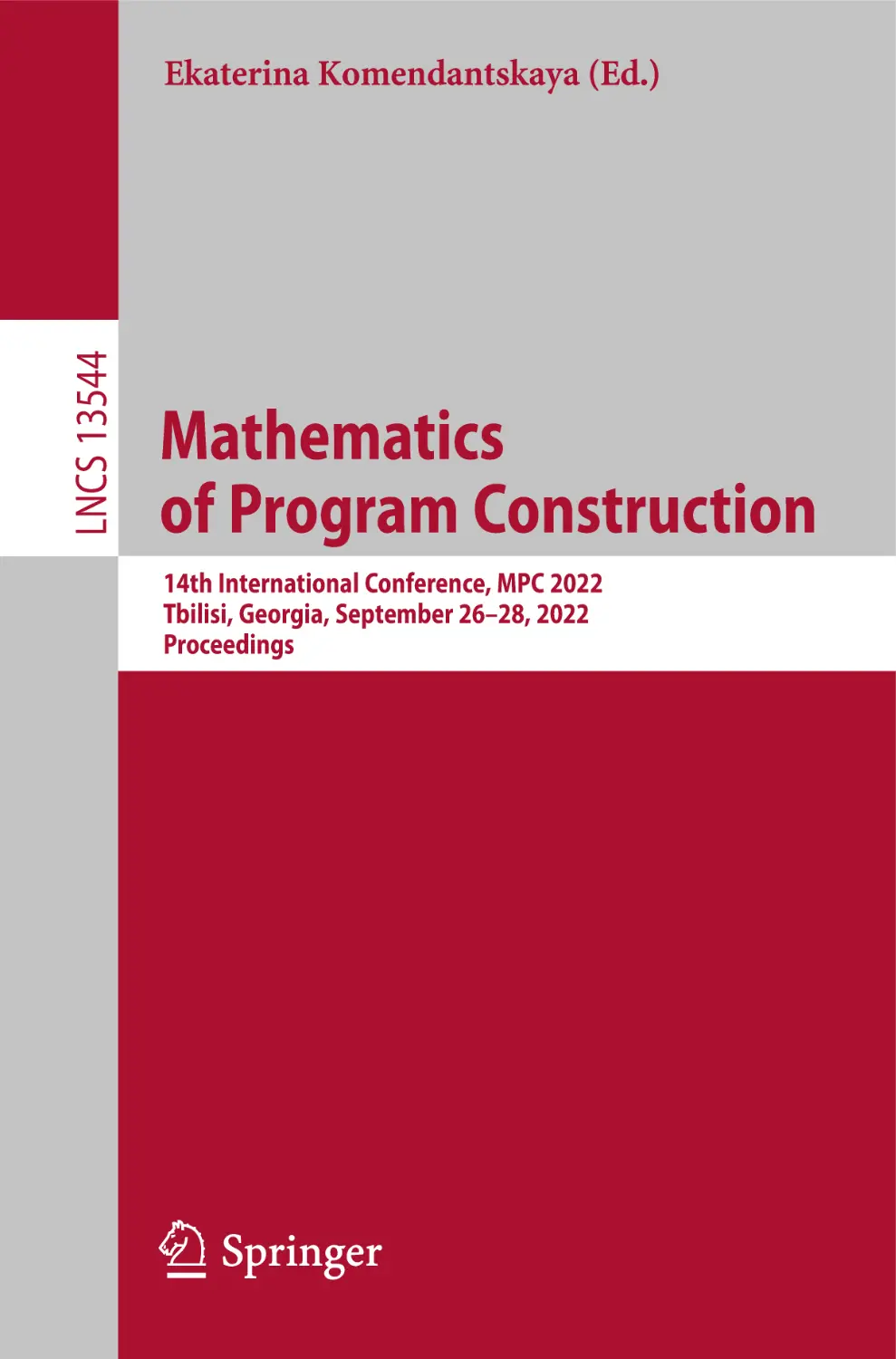
                    LNCS 13544

Ekaterina Komendantskaya (Ed.)

Mathematics
of Program Construction
14th International Conference, MPC 2022
Tbilisi, Georgia, September 26–28, 2022
Proceedings

Lecture Notes in Computer Science
Founding Editors
Gerhard Goos
Karlsruhe Institute of Technology, Karlsruhe, Germany
Juris Hartmanis
Cornell University, Ithaca, NY, USA

Editorial Board Members
Elisa Bertino
Purdue University, West Lafayette, IN, USA
Wen Gao
Peking University, Beijing, China
Bernhard Steffen
TU Dortmund University, Dortmund, Germany
Moti Yung
Columbia University, New York, NY, USA

13544

More information about this series at https://link.springer.com/bookseries/558

Ekaterina Komendantskaya (Ed.)

Mathematics
of Program Construction
14th International Conference, MPC 2022
Tbilisi, Georgia, September 26–28, 2022
Proceedings

Editor
Ekaterina Komendantskaya
School of Mathematical and Computer Sciences
Heriot-Watt University
Edinburgh, UK

ISSN 0302-9743
ISSN 1611-3349 (electronic)
Lecture Notes in Computer Science
ISBN 978-3-031-16911-3
ISBN 978-3-031-16912-0 (eBook)
https://doi.org/10.1007/978-3-031-16912-0
© The Editor(s) (if applicable) and The Author(s), under exclusive license
to Springer Nature Switzerland AG 2022
Chapter “Calculating Datastructures” is licensed under the terms of the Creative Commons Attribution 4.0
International License (http://creativecommons.org/licenses/by/4.0/). For further details see license information
in the chapter.
This work is subject to copyright. All rights are reserved by the Publisher, whether the whole or part of the
material is concerned, specifically the rights of translation, reprinting, reuse of illustrations, recitation,
broadcasting, reproduction on microfilms or in any other physical way, and transmission or information
storage and retrieval, electronic adaptation, computer software, or by similar or dissimilar methodology now
known or hereafter developed.
The use of general descriptive names, registered names, trademarks, service marks, etc. in this publication
does not imply, even in the absence of a specific statement, that such names are exempt from the relevant
protective laws and regulations and therefore free for general use.
The publisher, the authors, and the editors are safe to assume that the advice and information in this book are
believed to be true and accurate at the date of publication. Neither the publisher nor the authors or the editors
give a warranty, expressed or implied, with respect to the material contained herein or for any errors or
omissions that may have been made. The publisher remains neutral with regard to jurisdictional claims in
published maps and institutional affiliations.
This Springer imprint is published by the registered company Springer Nature Switzerland AG
The registered company address is: Gewerbestrasse 11, 6330 Cham, Switzerland

Preface

Welcome to the proceedings of the 14th International Conference on Mathematics of
Program Construction—MPC 2022!
The International Conference on Mathematics of Program Construction (MPC)
aims to promote the development of mathematical principles and techniques that are
demonstrably practical and effective in the process of constructing computer programs.
Topics of interest range from algorithmics to support for program construction in
programming languages and systems. Typical areas include type systems, program
analysis and transformation, programming language semantics, security, and program
logics. The notion of a ‘program’ is interpreted broadly, ranging from algorithms to
hardware.
MPC 2022 welcomes theoretical contributions with relevance to the methods
of program construction, reports on applications with solid mathematical basis, and
programming pearls that present elegant and instructive examples of the mathematics of
program construction.
The MPC series is a bi-annual conference; previous editions took place in Porto,
Portugal (2019); Königswinter, Germany (2015); Madrid, Spain (2012); Québec City,
Canada (2010); Marseille, France (2008); Kuressaare, Estonia (2006); Stirling, UK
(2004); Dagstuhl, Germany (2002); Ponte de Lima, Portugal (2000); Marstrand,
Sweden (1998); Kloster Irsee, Germany (1995); Oxford, UK (1992); and Twente, The
Netherlands (1989).
The 14th installment of the conference was colocated with the Computational Logic
Autumn Summit of 2022 (CLAS 2022), held during September 19–30, 2022, in Tbilisi,
Georgia.
MPC 2022 featured invited talks, presentations of original research papers, and a
discussion panel.
The program included three invited talks:
– Conor McBride, Strathclyde University, “Picking your way through Pascal’s triangle”.
– Daniela Petrisan, Université Paris Cité, “The semifree monad”.
– Fabio Zanasi, University College London, “Lens Theoretic Foundations for Learning:
from Semantics to Verification”.
Research papers include nine original research papers, selected from 14 submissions
including 13 complete submissions. Each submission was reviewed by at least three
Program Committee members and went through an online discussion period undertaken
by the Program Committee before a final decision was made. The selection was based
only on the merit of each submission and regardless of scheduling or space constraints.
Research papers are grouped into three topics: (1) Semantics of Program Construction, (2) Programming Methods, and (3) Data Structures and Proofs.

vi

Preface

The discussion panel “Mathematics of Program Construction Grand Challenge:
Machine Learning” featured invited presenters speaking on
– Semantics for machine learning (Fabio Zanasi, University College London),
– Types and functional programming for machine learning (Nicholas Wu, Imperial
College London), and
– Formalising machine learning in theorem provers (Reynold Affeldt, National Institute
of Advanced Industrial Science and Technology, Japan).
We thank Besik Dundua and the local organizers of CLAS for hosting MPC 2022,
and Springer for the longstanding, successful cooperation with the MPC series. We are
grateful to the 19 members of the MPC 2022 Program Committee and the external
reviewers for their timely and invaluable work. Many thanks to Matthew Daggitt,
Heriot-Watt University, for serving as publicity chair of MPC 2022 and Alasdair Hill
for designing the first version of the MPC 2022 webpage.
We are happy to note that the conference paper evaluation was successfully managed
with the help of EasyChair.
August 2022

Ekaterina Komendantskaya

Organization

Program Chair
Ekaterina Komendantskaya

Heriot-Watt University, UK

Program Committee
Mohammad Abdulaziz
Aurore Alcolei
Henning Basold
William Byrd
Jacques Carette
Andrea Costea
Peter Hoefner
Johan Jeuring
Patricia Johann
Ambrus Kaposi
Radu Mardare
Annabelle McIver
Shin-Cheng Mu
Jose Oliveira
Grant Passmore
Philip Saville
Ana Sokolova
Kathrin Stark
Georg Struth

Technische Universität München, Germany
Università di Bologna, Italy
Leiden University, The Netherlands
University of Alabama, USA
McMaster University, Canada
National University of Singapore, Singapore
Australian National University, Australia
Utrecht University, The Netherlands
Appalachian State University, USA
Eötvös Loránd University, Hungary
University of Strathclyde, UK
Macquarie University, Australia
Academia Sinica, Taiwan
Universidade do Minho, Portugal
Imandra, USA
University of Oxford, UK
Universität Salzburg, Austria
Princeton University, USA
University of Sheffield, UK

Publicity Chair
Matthew Daggitt

External Reviewers
Chris Chen
Yu-Ching Shen
Ian Shillito

Heriot-Watt University, UK

Abstracts of Invited Talks

Picking Your Way Through Pascal’s Triangle

Conor McBride
Strathclyde University
conor.mcbride@strath.ac.uk
www.strath.ac.uk/staff/mcbrideconordr/
Abstract. Every place in Pascal’s triangle enumerates the paths to that
place, zig-zagging downwards from the top, but we can do more than
count them. Binomial coefficients make for remarkable dependent types:
bit vectors indexed by their length and one-count can document selections from data structures, or the embedding of a term’s support into its
scope. They become all the more discriminating when you recognize that
numerical indices are but the erasures of richer, individuating information. They compose in sequence categorically, and in parallel monoidally.
Being made of bits, you can do Boolean logic with them, but with your
eyes open as to their meaning. Working with Pascal’s Triangle, rendered
into types, has changed the way I see and organise data in general, and
syntactic data in particular. I shall recount my path to this place, and seek
to find the meaning in the turns of my journey.

The Semifree Monad

Daniela Petrisan
Université de Paris
petrisan@irif.fr
www.irif.fr/~petrisan/
Abstract. Weak distributive laws were considered recently in the work
of Garner as a means of composing monads for which there is no strong
distributive law. For example, the canonical weak distributive law exhibited in Garner’s work between the powerset and the ultrafilter monad can
be used to exhibit the Vietoris monad on compact Hausdorff spaces as a
weak lifting of the powerset monad. Other weak distributive laws were
considered in our work with Alexandre Goy. In particular we obtained
a weak distributive law between the powerset monad and the distribution monad, which exhibits the convex powerset monad on barycentric
algebras as a weak lifting of the powerset monad.
One essential ingredient in the theory of weak distributive laws is the
notion o of semialgebras for a monad, that is, algebras for the underlying
functor of the monad subject to the associativity axiom alone. In this talk
I will discuss the algebraic nature of the semialgebras of a monad. If the
underlying category has coproducts then semialgebras for a monad “M”
are in fact the Eilenberg-Moore algebras for a suitable monad structure on
the functor “id + M”, which we call the semifree monad. Then I discuss
how weak distributive laws between a monad “M” and “T” can be seen
as strong distributive laws between the semifree monad on “M” and “T”,
subject to an additional condition. This is joint work with Ralph Sarkis.

Lens Theoretic Foundations for Learning: From
Semantics to Verification

Fabio Zanasi
University College London
f.zanasi@ucl.ac.uk
www.zanasi.com/fabio/
Abstract. I will present recent and ongoing work on giving a semantic
foundation to training algorithms in machine learning using the categorical formalisms of lenses. Lenses provide a much needed unifying
perspective on various classes of such algorithms, as well as offering a
different style of specifying and proving properties of training protocols.
They also enable the study of machine learning for new classes of models
such as Boolean circuits and polynomial circuits. In the last part of the
talk I will also discuss how this foundation informs the development of
new tools for the formal verification of machine learning algorithms.

References
1. Cruttwell, G.S.H., Gavranović, B., Ghani, N., Wilson, P., Zanasi, F.: Categorical foundations
of gradient-based learning. In: Sergey, I. (eds.) Programming Languages and Systems. ESOP
2022. LNCS, vol. 13240, pp. 1–28. Springer, Cham. https://doi.org/10.1007/978-3-030-993
36-8_1
2. Wilson, P.W., Zanasi, F.: Reverse derivative ascent: a categorical approach to learning Boolean.
In: Proceedings of the 3rd International Conference on Applied Category Theory (ACT) (2020)
3. Wilson, P.W., Zanasi, F.: Categories of differentiable polynomial circuits for machine learning.
In: Proceedings of the 5th International Conference on Applied Category Theory (ACT) (2022)

Contents

Breadth-First Traversal via Staging . . . . . . . . . . . . . . . . . . . . . . . . . . . . . . . . . . . . . . .
Jeremy Gibbons, Donnacha Oisín Kidney, Tom Schrijvers, and Nicolas Wu

1

Subtyping Without Reduction . . . . . . . . . . . . . . . . . . . . . . . . . . . . . . . . . . . . . . . . . . .
Brandon Hewer and Graham Hutton

34

Calculating Datastructures . . . . . . . . . . . . . . . . . . . . . . . . . . . . . . . . . . . . . . . . . . . . . .
Ralf Hinze and Wouter Swierstra

62

Flexibly Graded Monads and Graded Algebras . . . . . . . . . . . . . . . . . . . . . . . . . . . . 102
Dylan McDermott and Tarmo Uustalu
Folding over Neural Networks . . . . . . . . . . . . . . . . . . . . . . . . . . . . . . . . . . . . . . . . . . . 129
Minh Nguyen and Nicolas Wu
Towards a Practical Library for Monadic Equational Reasoning in Coq . . . . . . . . 151
Ayumu Saito and Reynald Affeldt
Semantic Preservation for a Type Directed Translation Scheme
of Featherweight Go . . . . . . . . . . . . . . . . . . . . . . . . . . . . . . . . . . . . . . . . . . . . . . . . . . . 178
Martin Sulzmann and Stefan Wehr
Streams of Approximations, Equivalence of Recursive Effectful Programs . . . . . 198
Niccoló Veltri and Niels Voorneveld
Fantastic Morphisms and Where to Find Them: A Guide to Recursion
Schemes . . . . . . . . . . . . . . . . . . . . . . . . . . . . . . . . . . . . . . . . . . . . . . . . . . . . . . . . . . . . . 222
Zhixuan Yang and Nicolas Wu
Author Index . . . . . . . . . . . . . . . . . . . . . . . . . . . . . . . . . . . . . . . . . . . . . . . . . . . . . . . . . 269

Breadth-First Traversal via Staging
Jeremy Gibbons1 , Donnacha Oisín Kidney2 , Tom Schrijvers3 ,
and Nicolas Wu2(B)
1
2

University of Oxford, Oxford, UK
Imperial College London, London, UK
n.wu@imperial.ac.uk
3
KU Leuven, Leuven, Belgium

Abstract. An effectful traversal of a data structure iterates over every
element, in some predetermined order, collecting computational effects
in the process. Depth-first effectful traversal of a tree is straightforward
to define compositionally, since it precisely follows the shape of the data.
What about breadth-first effectful traversal? An indirect route is to factorize the data structure into shape and contents, traverse the contents,
then rebuild the data structure with new contents. We show that this
can instead be done directly using staging, expressed using a construction
related to free applicative functors. The staged traversals lend themselves
well to fusion; we prove a novel fusion rule for effectful traversals, and
use it in another solution to Bird’s ‘repmin’ problem.
Keywords: Traversal

1

· Staging · Applicative functor · Fusion

Introduction

This paper is about effectful traversals of data structures, in which the effects are
modelled as applicative functors. This encompasses monadic effects (since every
monad is also an applicative functor), but also generalizes to include monoidal
aggregation, among other possibilities.
Applicative traversals capture the essence of the Iterator design pattern [9].
Informally, an applicative traversal processes a container data structure in a predetermined order, visiting each element precisely once, collecting computational
effects as it goes (for example, in the state monad), and replacing each element
with a new one while preserving the shape of the data structure.
For any polynomial datatype, it is completely straightforward to define an
applicative traversal that follows the structure of the data. Indeed, the definition
is so straightforward that it can be automated, or expressed as a single datatypegeneric program. That straightforward traversal will be depth-first, completely
traversing one child before moving on to the next. We give an example on lists
in Sect. 2.1, and one on trees in Sect. 2.2.
But there are other possible traversal orders. In particular, what about
breadth-first traversal of a tree? This is more awkward, because it goes against
the grain of the tree, so to speak. One approach is to factorize the tree into shape
c The Author(s), under exclusive license to Springer Nature Switzerland AG 2022

E. Komendantskaya (Ed.): MPC 2022, LNCS 13544, pp. 1–33, 2022.
https://doi.org/10.1007/978-3-031-16912-0_1

2

J. Gibbons et al.

(a tree of unit values) and contents (by breadth-first enumeration to a sequence
of elements). One can then traverse the contents in isolation from the shape,
then reassemble the unchanged shape and new contents into a new tree.
Executing breadth-first traversal in multiple passes in this way is a bit clumsy.
Can we do the same thing in a single pass? We can! The key idea is to construct
a multi-phase computation, with one phase per level of the tree. This multi-phase
computation can be assembled in a single pass over the tree; then the phases
of this computation are run one after the other. Although breadth-first traversal itself is not compositional (one cannot construct the breadth-first traversal
of a tree from the traversals of its children), the multi-phase computation is
compositional, because it is conveniently broken up into layers.
We present a novel approach to multi-phase computation in terms of applicative functors. In particular, we use a data representation due recently to Kidney
and Wu [12], isomorphic to the free applicative functor on a given base functor
but using a different applicative instance than that of the free applicative. Informally, we need to ‘zip’ together phases rather than concatenating them in order
to combine computations.
We show that this approach also provides alternative solutions to other problems involving transforming multiple passes into one, but avoiding the need for
laziness, such as breadth-first relabelling of a tree [11]. Examples include such as
Bird’s ‘repmin’ problem [2] and some other problems using circular definitions.
The paper is structured as follows. Section 2 relates background material
on applicative functors and applicative traversal. Section 3 presents the indirect
breadth-first approach via factorization into shape and contents. Our contribution starts in Sect. 4, which introduces two-phase computation, using the Day
convolution of two functors, and discusses how to fuse traversals at multiple
phases into a single multi-phase traversal. Section 5 generalizes this to arbitrarily many phases, by iterating Day convolution. Section 6 returns to breadthfirst traversal and breadth-first relabelling, but now expressed compositionally
in multi-phase terms and without needing laziness. Section 7 concludes. The key
result about fusion of traversals used in Sect. 4 is proved in Appendix A.
We use Haskell as a vehicle of expression, but almost always read it in terms
of sets and total functions rather than CPOs with strictness considerations. (The
only divergence from that position is in discussing Bird’s essentially lazy repmin
solution, but our solution avoids this essential laziness.) The code in the paper
is slightly simplified for presentation purposes, but the full details are available
online [8]. We follow Haskell in using lowercase letters for polymorphic type
parameters; but as a presentation convention, in prose though not in code, we
use uppercase letters when discussing specific types. For example, map has the
polymorphic type (a → b) → [a ] → [b ] (the type parameters a, b are implicitly
universally quantified), but if applied to a specific function f :: A → B then we
say that map f has type [A] → [B ].

Breadth-First Traversal via Staging

2

3

Applicative Functors

We focus on effects modelled as applicative functors, a slightly more general
perspective than the more familiar monads. But we use the simpler categoricallyinspired presentation, called the monoidal interface [14] rather than the more
program-oriented one in the Haskell libraries:
class Functor f ⇒ Applicative f where
unit :: f ()
(⊗) :: f a → f b → f (a, b)
Thus, there is a distinguished collection unit of unit values, and one can combine
two collections into a collection of pairs. Categorically, an applicative functor is
“strong lax-monoidal functor”. Strength comes for free in a higher-order language
like Haskell; and lax monoidality amounts to left- and right-unit and associativity
properties, where (‹$›) :: Functor f ⇒ (a → b) → f a → f b is the binary version
the functorial mapping fmap.
unitl ‹$› (unit ⊗ ys)
= ys
unitr ‹$› (xs ⊗ unit)
= xs
assoc ‹$› (xs ⊗ (ys ⊗ zs)) = (xs ⊗ ys) ⊗ zs
that hold not on the nose, but only up to some conversions; we write
unitl :: ((), a) → a
unitr :: (a, ()) → a
assoc :: (a, (b, c)) → ((a, b), c)

unitl −1 :: a → ((), a)
unitr −1 :: a → (a, ())
assoc −1 :: ((a, b), c) → (a, (b, c))

for the obvious isomorphisms witnessing the (so-called ‘strong’) monoidal structure of the product.
While we are on the subject of isomorphisms for pairs, we will also make use
of two involutions involving commutativity:
twist :: (a, b) → (b, a)
exch4 :: ((a, b), (c, d )) → ((a, c), (b, d ))
The monoidal and the usual Haskell presentations of applicative functors are
equivalent, and the interfaces interdefinable. In particular, we will still find the
Haskell interface convenient for programming, and it can be implemented as
follows:
pure :: Applicative f ⇒ a → f a
pure x = fmap (const x ) unit

4

J. Gibbons et al.

(‹∗›) :: Applicative f ⇒ f (a → b) → f a → f b
fs ‹∗› xs = fmap (λ(f , x ) → f x ) (fs ⊗ xs)

-- left-associative

(∗›) :: Applicative f ⇒ f a → f b → f b
xs ∗› ys = fmap snd (xs ⊗ ys)

-- left-associative

This situation is analogous to the distinction between the presentation of monads
in terms of bind (>>=), which is more convenient for programming, and in terms
of multiplication join, which is more categorically perspicuous.
Every monad is an applicative functor, with the following implementation:
instance Monad m ⇒ Applicative m where
unit
= return ()
xs ⊗ ys = do {x ← xs; y ← ys; return (x , y)}
—that is, (⊗) can be seen as a form of sequencing. An illuminating applicative
functor instance that does not arise from a monad is that of colists [ ]ω —that is,
finite and infinite lists together—under zipping:
instance Applicative [ ]ω where
unit = repeat ()
(⊗) = zip
Another is the constant applicative functor Const A for monoid A:
data Const a b = Const {getConst :: a }
instance Monoid a ⇒ Applicative (Const a) where
unit = Const mempty
x ⊗ y = Const (mappend (getConst x ) (getConst y))

2.1

Applicative Traversal

Applicative traversal is “the essence of the Iterator design pattern” [9], capturing computations that iterate over a data structure, in a predetermined order,
processing each element in turn and collecting effects as they go:
class Functor t ⇒ Traversable t where
traverse :: Applicative f ⇒ (a → f b) → t a → f (t b)
For example, left-to-right traversal of (finite) lists just follows the shape of the
list datatype:

Breadth-First Traversal via Staging

5

instance Traversable [ ] where
traverse f [ ]
= pure [ ]
traverse f (x : xs) = (:) ‹$› f x ‹∗› traverse f xs
Well-behaved traversals are those satisfying three axioms of naturality, linearity, and unitarity [10]. These essentially say that traverse is ‘natural’ in the
applicative functor, and respects the compositional structure of applicative functors. This implies, among other consequences, that a well-behaved traversal preserves the shape of the data structure it traverses, and visits every element
precisely once.
Formally, an applicative morphism φ : F → G between applicative functors F
and G is a polymorphic function φ :: ∀a . F a → G a that respects the applicative
structure. To be explicit, we write (⊗F ), unitF for the applicative operations for
applicative functor F . Then for φ to be an applicative morphism, it must satisfy:
φ unitF
= unitG
φ (xs ⊗F ys) = φ xs ⊗G φ ys
for xs :: F A and ys :: F B . Then the naturality axiom of a well-behaved traversal
states that it respects applicative morphisms: for f :: A → F B and applicative
morphism φ : F → G,
traverse (φ ◦ f ) = φ ◦ traverse f
Applicative functors are closed under functor composition: the identity functor I is applicative, and if F and G are applicative then so is their composition
F ◦ G. The other two conditions on well-behaved traversals are that they should
respect this compositional structure. To be explicit again, we subscript generic
functions with the applicative functor. The unitarity axiom states that traversal
with the identity function id :: A → I A is itself the identity:
traverseI id = id
Together with the free theorem of the type (A → F B ) → T A → F (T B )
of traverse, we get more generally that traversal in the identity applicative
functor—that is, traversal with a pure function f :: A → I B —is just a map:
traverseI f = fmap f
The linearity axiom states that traversal in the composition of applicative functors is a composition of traversals. That is, given applicative functors F and G,

6

J. Gibbons et al.

and traversal bodies f :: A → F B and g :: B → G C , write (‹◦›) for the obvious
composition:
g ‹◦› f = fmapF g ◦ f :: A → F (G C )
Then we have:
traverseF ◦G (g ‹◦› f ) = traverseG g ‹◦› traverseF f
Here we have equated I A with A, and (F ◦G) A with F (G A). This isn’t possible
in Haskell; we would have to introduce Identity and Compose datatype wrappers,
with corresponding injection and projection isomorphisms, and include those
isomorphisms in the statements of the properties.
One more important result about traversals, a theorem rather than an axiom:
the Representation Theorem for traversals [1] states that well-behaved traversals
over an arbitrary traversable datatype are fully characterised by the corresponding list-based traversals over their contents, and so results about traversals in
general follow from results about traversals over lists in particular. We will cover
this theorem when we need it, in Sect. 4.
2.2

Trees

We will use the following datatype of trees throughout the paper:
data Tree a = Node a (Forest a)
type Forest a = [Tree a ]
For example, here is a tree of integers:
t :: Tree Int
t = Node 3 [ Node 1 [ Node 1 [ ]
, Node 5 [ ]]
, Node 4 [ Node 9 [ ]
, Node 2 [ ]]]

3

1

1
5

4

9
2

Depth-first traversal of a tree is easily captured as a Traversable instance:
instance Traversable Tree where
traverse f (Node x ts) = Node ‹$› f x ‹∗› traverseF f ts
where traverseF f = traverse (traverse f )
This again follows the shape of the Tree datatype, which is mutually recursive
with the Forest type. We will encounter several times this pattern of mutual

Breadth-First Traversal via Staging

7

recursion between the function on trees and the corresponding function on
forests; here is another example, for computing the depths of a tree and a forest:
depth :: Tree a → Int
depth (Node x ts) = 1 + depthF ts
depthF :: Forest a → Int
depthF [ ] = 0
depthF ts = maximum (map depth ts)
The definition of traversal over trees is actually very similar in principle to
the traversal of lists, as defined in Sect. 2.1. In fact, the outermost traverse in the
definition of traverseF is that list instance of traversal. Moreover, each definition can in principle be derived automatically from the corresponding datatype
definition.
But what about breadth-first traversal? It is not obvious how to do that
structurally, as we have done for lists and for depth-first traversal of trees; in
particular, it does not follow directly from the structure of the datatype definition.

3

Shape, Contents, Relabelling

An indirect approach to breadth-first traversal can be made by factoring a tree
into its shape and contents [6]; here we see how.
Let us first consider breadth-first enumeration, returning just the list of elements in the tree. This is not compositional, because one cannot compute the
breadth-first enumeration of a tree from the enumerations of its children. But
the related “level-order enumeration”, giving a list of lists, one list per level, is
compositional:
levels :: Tree a → [[a ]]
levels (Node x ts) = [x ] : levelsF ts
levelsF :: Forest a → [[a ]]
levelsF = foldr (lzw (++)) [ ] ◦ map levels
Here, lzw (for “long zip with”) is similar to zipWith, but returns a list as long as
its longer argument [7]:
lzw
lzw
lzw
lzw

:: (a → a → a) → [a ] → [a ] → [a ]
f (x : xs) (y : ys) = f x y : lzw f xs ys
f []
ys
= ys
f xs
[]
= xs

8

J. Gibbons et al.

For example, with t as in Sect. 2, we have:
levels t = [

[3],
[1, 4],
[1, 5, 9, 2]

]

3

1

1
5

4

9
2

Given level-order enumeration, breadth-first enumeration is obtained by concatenation:
bf :: Tree a → [a ]
bf = concat ◦ levels
so that bf t = [3, 1, 4, 1, 5, 9, 2].
Now, enumeration is invertible, in the sense that one can reconstruct the
tree given its shape (a tree of units) and its level-order enumeration (a list of
elements). One way to define the inverse process is to pass the level-order enumeration around the tree, incrementally snipping bits off it. Here is a mutually
recursive pair of functions to relabel a tree with a given list of lists, returning
also the unused tails from the list of lists:
relabel :: (Tree (), [[a ]]) → (Tree a, [[a ]])
relabel (Node () ts, (x : xs) : xss) = let (us, yss) = relabelF (ts, xss)
in (Node x us, xs : yss)
relabelF :: (Forest (), [[a ]]) → (Forest a, [[a ]])
= ([ ], xss)
relabelF ([ ], xss)
relabelF (t : ts, xss) = let (u, yss) = relabel (t, xss)
(us, zss) = relabelF (ts, yss)
in (u : us, zss)
Assuming that the given list of lists is ‘big enough’—that is, each list has enough
elements for that level of the tree—the result is well-defined. Then relabel is
determined by the equivalence
relabel (t, xss) = (u, yss) ⇐⇒
shape u = shape t ∧ length yss = length xss ∧ lzw (++) (levels u) yss = xss
where shape discards the elements of a tree:
shape :: Tree a → Tree ()
shape = fmap (const ())

Breadth-First Traversal via Staging

9

In particular, if the given list of lists is the level-order enumeration of the tree,
and so is exactly the right size, then yss will have no remaining elements, consisting entirely of empty levels:
relabel (shape t, levels t) = (t, replicate (depth t) [ ])
So we can factor a tree into its shape and contents, and reconstruct the tree
from such data:
split :: Tree a → (Tree (), [[a ]])
split t = (shape t, levels t)
combine :: Tree () → [[a ]] → Tree a
combine u xss = fst (relabel (u, xss))
This lets us traverse a tree in breadth-first order, by performing the traversal on
the contents in isolation. We separate the tree into shape and contents, perform
a list-based traversal, and reconstruct the tree:
bftSC :: Applicative f ⇒ (a → f b) → Tree a → f (Tree b)
bftSC f t = combine (shape t) ‹$› traverse (traverse f ) (levels t)
Incidentally, it is not necessary to have the enumeration of the tree conveniently partitioned into levels; one can also relabel the tree just from its
breadth-first enumeration. The trick is to construct the appropriate partition
of the breadth-first enumeration into levels. There is a clever cyclic program due
to Geraint Jones [11] to do this at the same time as relabelling:
bflabel :: Tree () → [a ] → Tree a
bflabel t xs = let (u, xss) = relabel (t, xs : xss) in u
Note that xss is defined cyclically, so it is crucial that this let has letrec
semantics—that is, the variables bound on the left of the equals sign are in
scope on the right as well as in the body. Informally, the output leftovers xss
on one level also form the input elements to be used for relabelling all the lower
levels. Given this definition, we have
bflabel (shape t) (bf t) = t
for any t. We can use this approach instead in the definition of breadth-first
traversal:
bftL :: Applicative f ⇒ (a → f b) → Tree a → f (Tree b)
bftL f t = bflabel (shape t) ‹$› traverse f (bf t)

10

J. Gibbons et al.

However, both these implementations of breadth-first traversal are clunky and
inefficient, because of having to factor into shape and contents. Also, breadthfirst relabelling given only the enumeration is tricky: the program is cyclic, so
doing it in a single pass seems to require laziness [13]. We will show that this
impression is false: there are perfectly good ways of presenting it that make no
use of laziness.

4

Fusing Traversals via Staged Computation

The circular function for breadth-first relabelling is tricky because it fuses two
passes (splitting the input stream into levels, then applying these levels across
the tree) into one, entangling the two together. There is a whole class of programs
of this form: circular definitions, fusing together multiple passes into one. The
classic example is Bird’s ‘repmin’ problem [2]. Studying the structure of repmin
will help us see what is going on with breadth-first relabelling.
4.1

The Repmin Problem

The repmin problem is to replace every element of a tree with the minimum
element in that tree:
repmin :: Tree Int → Tree Int
repmin t = replaceT t (minT t) where
minT :: Tree Int → Int
minT (Node x [ ]) = x
minT (Node x ts) = min x (minF ts)
minF :: Forest Int → Int
minF = minimum ◦ map minT
replaceT :: Tree a → b → Tree b
replaceT (Node x ts) y = Node y (replaceF ts y)
replaceF :: Forest a → b → Forest b
replaceF ts y = [replaceT t y | t ← ts ]
but to do so in one pass rather than two. Bird’s technique is to define a composite
function that computes the minimum in a tree and replaces all elements with
a given element all in one go, and to feed the minimum output back in as the
replacement input:
repmin RSB :: Tree Int → Tree Int
repmin RSB t = let (u, m) = auxT t m in u
where
auxT :: Tree Int → a → (Tree a, Int)
auxT (Node x [ ]) y = (Node y [ ], x )

Breadth-First Traversal via Staging

11

auxT (Node x ts) y = (Node y us, min x z )
where (us, z ) = auxF ts y
auxF :: Forest Int → a → (Forest a, Int) -- non-empty forest
auxF ts y = (us, minimum ys)
where (us, ys) = unzip [auxT t y | t ← ts ]
Note that the m in repmin RSB is defined cyclically, as with Jones’s breadth-first
relabelling, so that let must have letrec semantics.
But Bird’s circular program making essential use of letrec semantics and
laziness is not the only way to solve the repmin problem. Pettorossi and Skowron
[15,16] show how to get the same results using only higher-order functions, and
needing only call-by-value evaluation. Pettorossi’s solution is as follows:
repmin ADP :: Tree Int → Tree Int
repmin ADP t = let (u, m) = auxT t in u m
where
auxT :: Tree Int → (a → Tree a, Int)
auxT (Node x [ ]) = (λy → Node y [ ], x )
auxT (Node x ts) = (λy → Node y (us y), min x z )
where (us, z ) = auxF ts
auxF :: Forest Int → (a → Forest a, Int) -- non-empty forest
auxF ts = (λy → map ($y) us, minimum ys)
where (us, ys) = unzip [auxT t | t ← ts ]
Where Bird’s auxT takes a replacement value as an input, and returns an
updated tree, Pettorossi’s auxT takes no such input, and returns instead a function from replacement value to updated tree. Where Bird’s main function has a
circular definition, feeding the output minimum back in as an input and returning only the updated tree, Pettorossi’s main function is not circular (the let need
not be treated as a letrec), and the output function is applied to the output
minimum. Danvy et al. [4] say more about the relationship between these two
approaches.
Pettorossi’s approach neatly makes explicit the data dependencies, and therefore the sense in which the components of the solution are compositional, in a way
that Bird’s approach does not. Specifically, it is explicit in Pettorossi’s program
that the output minimum does not depend on the input replacement value—
because there is no input replacement value upon which to depend. In contrast,
the input replacement value y in Bird’s auxT is in scope for the definition of
the output minimum; it takes some kind of program analysis to confirm that x ,
min x z , and minimum ys are all independent of y, as required in order for the
letrec to be productive and the result to be properly defined.
4.2

Fusing Traversals

The crucial ingredient in fitting this development into our framework is an
appropriate fusion rule for traversals. Informally, two consecutive traversals

12

J. Gibbons et al.

over the same data structure with the same class of effects can be fused into
a single traversal with a composite body. Formally, with applicative functor
F , traversable data structure t :: T A, and traversal bodies f :: A → F B and
g :: A → F C , we have:
traverse f t ⊗ traverse g t = fmap unzip (traverse (λx → f x ⊗ g x ) t)
where unzip separates a structure of pairs into a pair of structures:
unzip :: Functor t ⇒ t (a, b) → (t a, t b)
unzip t = (fmap fst t, fmap snd t)
We will only use this rule in the special case in which f returns unit (that is,
B = ()), or returns values that we discard. Then no unzipping is required:
traverse f t ∗› traverse g t = traverse (λx → f x ∗› g x ) t
But neither fusion rule can hold in general, because of the order of effects: on
the left, all the f -effects precede any of the g-effects, and on the right they are
interleaved.
The interleaving would be irrelevant if F were commutative: that is, if
xs ⊗ ys = fmap twist (ys ⊗ xs)
for all xs ::F A, ys ::F B . But that condition is quite restrictive, ruling out in particular anything stateful. However, the interleaving is still irrelevant even when
F is not commutative, provided more specifically that the f -effects commute
with g-effects, in the sense that
f x ⊗ g y = fmap twist (g y ⊗ f x )
for all x , y. With this assumption we can prove both fusion rules using the Representation Theorem for applicative traversals [1]; the proof is given in Appendix A.
In particular, whenever f and g specify effects that occur in distinct phases
of a two-phase computation, they will commute: it doesn’t matter whether you
say “do X now and Y later” or “do Y later and X now”, because either way X is
enacted before Y. So let us consider two-phase computations.
4.3

Day Convolution

The Day convolution [17] Day F G of two functors F , G is given by:
data Day f g a where
Day :: ((a, b) → c) → f a → g b → Day f g c

Breadth-First Traversal via Staging

13

Thus, Day f xs ys with xs :: F A, ys :: G B represents a two-phase computation,
with subcomputation xs happening in phase one generating effects in F , and ys
in phase two generating effects in G. It is convenient to package this pair up
with a function f :: (A, B ) → C to combine the results from the two phases.
This packaging is known as the “co-Yoneda trick”, and it straightforwardly turns
Day F G into a functor:
instance Functor (Day f g) where
fmap g (Day f xs ys) = Day (g ◦ f ) xs ys
Moreover, Day F G is applicative when F , G are applicative, with pointwise
combination:
instance (Applicative f , Applicative g) ⇒ Applicative (Day f g) where
unit
= Day unitr unit unit
Day f xs ys ⊗ Day g zs ws = Day (cross f g ◦ exch4 ) (xs ⊗ zs) (ys ⊗ ws)
where
cross :: (a → b) → (c → d ) → (a, c) → (b, d )
cross f g (x , y) = (f x , g y)
And there are two ways to inject a computation, one for each phase:
phase1 :: (Applicative f , Applicative g) ⇒ f a → Day f g a
phase1 xs = Day unitr xs unit
phase2 :: (Applicative f , Applicative g) ⇒ g a → Day f g a
phase2 xs = Day unitl unit xs
Crucially for us, computations in different phases commute:
phase1 xs ⊗ phase2 ys = fmap twist (phase2 ys ⊗ phase1 xs)
When the two phases share a class of effects, we can combine the two phases,
running one after the other and post-processing the results:
runDay :: Applicative f ⇒ Day f f a → f a
runDay (Day f xs ys) = fmap f (xs ⊗ ys)

14

J. Gibbons et al.

For example, we can send a two-part greeting in separate phases:
runDay (phase1 (putStr "Hello ") ∗›
phase2 (putStr "World"))
Hello World
It doesn’t matter if we specify those two phases in the opposite order:
runDay (phase2 (putStr "World") ∗›
phase1 (putStr "Hello "))
Hello World
We can even interleave the specification of fragments from different phases:
runDay (phase1 (putStr "Hel") ∗›
phase2 (putStr "World") ∗›
phase1 (putStr "lo "))
Hello World

4.4

Repmin in Two Phases

Returning now to the repmin problem, we have first to formulate it as an effectful
computation. We could use the state monad, writing minimum values to the
state in the first phase then reading the replacement value from the state in
the second. But those two phases use the state in different ways: computing the
minimum writes to the state without reading from it, and replacing tree elements
reads from the state without writing to it. So a more precise expression of the
two-phase solution would use two different classes of effect, writing and reading.
We therefore use the Writer and Reader monads respectively. For a monoid
W , the writer monad Writer W is essentially pairing with the written value W :
runWriter :: Writer w a → (a, w )
and provides an operation
tell :: Monoid w ⇒ Writer w ()
to ‘write’ a value. For arbitrary type R, the reader monad Reader R essentially
comprises functions from the read value R:
runReader :: Reader r a → (r → a)

Breadth-First Traversal via Staging

15

and provides an operation
ask :: Reader r r
to ‘read’ a value. We will also use the wrapper type Min to construct the monoid
Min Int, with minimum as the binary operator and the least Int value as unit:
Min
:: Int → Min Int
getMin :: Min Int → Int
Therefore we work in Day (Writer (Min Int)) (Reader (Min Int)), the Day convolution of the two effects using a common value type. We introduce four abbreviations:
type WInt = Writer (Min Int)
tellMin :: Int → WInt ()
tellMin x = tell (Min x )
type RInt = Reader (Min Int)
askMin :: RInt Int
askMin = fmap getMin ask
The core of the computation is the following function:
repminAux :: Tree Int → Day WInt RInt (Tree Int)
repminAux t = phase1 (minAux t) ∗› phase2 (replaceAux t)
where the first phase writes each element in turn:
minAux :: Tree Int → WInt ()
minAux (Node x ts) = tellMin x ∗› mapM_ minAux ts
and the second phase reads a fixed replacement value for each element:
replaceAux :: Tree Int → RInt (Tree Int)
replaceAux (Node x ts) = Node ‹$› askMin ‹∗› (mapM replaceAux ts)
In fact, both phases are (depth-first) instances of traverse over trees—at
least, if we allow the result returned in the first phase, which we discard anyway,
to be a tree instead of void:
repminAux  :: Tree Int → Day WInt RInt (Tree Int)
repminAux  t = phase1 (minAux  t) ∗› phase2 (replaceAux  t)

16

J. Gibbons et al.

minAux  :: Tree Int → WInt (Tree ())
minAux  = traverse (λx → tellMin x )
replaceAux  :: Tree Int → RInt (Tree Int)
replaceAux  = traverse (λx → askMin)
Now, phase1 and phase2 are applicative morphisms, so by the naturality
axiom of traversal we have
phase1 (traverse f ) = traverse (phase1 f )
and similarly for phase2 . Therefore we can move the phase coercions inside the
traversals:
repminAux  :: Tree Int → Day WInt RInt (Tree Int)
repminAux  t = minAux  t ∗› replaceAux  t
minAux  :: Tree Int → Day WInt RInt (Tree ())
minAux  = traverse (λx → phase1 (tellMin x ))
replaceAux  :: Tree Int → Day WInt RInt (Tree Int)
replaceAux  = traverse (λx → phase2 askMin)
Finally, the two traversal bodies commute, because they are in different
phases, so we can fuse the two traversals into one:
repminAux  :: Tree Int → Day WInt RInt (Tree Int)
repminAux  = traverse (λx → phase1 (tellMin x ) ∗› phase2 askMin)
To summarize the development:
phase1 (traverse tellMin t) ∗› phase2 (traverse (λx → askMin) t)
= { naturality in applicative functor }
traverse (phase1 ◦ tellMin) t ∗› traverse (λx → phase2 askMin) t
= { fusion of traversals }
traverse (λx → phase1 (tellMin x ) ∗› phase2 askMin)
So repminAux  describes a one-pass traversal over the tree, generating a twophase computation for later execution.
Now we turn to the question of extracting the Tree Int → Tree Int outer
function from the above core. We can run a computation in the Day convolution
of Writer S and Reader S for the same type S by extracting the writer and
reader components in parallel, as follows:

Breadth-First Traversal via Staging

17

parWR :: Day (Writer s) (Reader s) a → a
parWR (Day f xs ys) = let ((x , s), y) = (runWriter xs, runReader ys s)
in f (x , y)
Note that this is circular, with s appearing on both sides of the local declaration,
so the let must have letrec semantics. In particular,
repminWR RSB :: Tree Int → Tree Int
repminWR RSB t = parWR (repminAux  t)
is Bird’s circular, lazy solution to the repmin problem.
Conversely, we can extract the writer component then the reader component
sequentially:
seqWR :: Day (Writer s) (Reader s) a → a
seqWR (Day f xs ys) = let (x , s) = runWriter xs
y
= runReader ys s
in f (x , y)
Now there is no circularity, and a plain non-recursive let suffices. In particular,
repminWR ADP :: Tree Int → Tree Int
repminWR ADP t = seqWR (repminAux  t)
is Pettorossi’s non-circular, higher-order solution to the repmin problem. In a
lazy language, clearly parWR and seqWR are equal, and so too therefore are
repminWR RSB and repminWR ADP .
Observe that in both the lazy and strict solutions the values xs and ys are
nested tuples of values: the values in xs are all the unit, and the values in ys are
all the minimum value. The function f picks the values out of ys and assembles
them into the resulting tree; xs is ignored. A biased version
data Day  f g a where
Day  :: f (b → a) → g b → Day  f g a
of Day convolution would avoid constructing the nested structure for xs in the
first place.

5

Multiple Phases

We now generalize from two-phase computations to multiple (zero or more)
phases [5]:

18

J. Gibbons et al.

data Phases f a where
Pure :: a → Phases f a
Link :: ((a, b) → c) → f a → Phases f b → Phases f c
Here, Pure produces a chain with no effectful phases, and Link adds one more
effectful phase to the chain. It is basically a homogeneous iteration of Day convolution (Link constructs the Day convolution of f with Phases f ), just as lists are
essentially a homogeneous iteration of pairing (with cons pairing a list head with
a tail). There is a single initial value as the base case; each additional link in the
chain adds a combining function and a collection of values; and the types are all
compatible “in the obvious way”. For example, for some given base applicative
functor F , we can link together components of types
z
ys
g
xs
f

:: Char
:: F Float
:: (Float, Char ) → String
:: F Bool
:: (Bool , String) → Int

to form a chain
example = Link f xs (Link g ys (Pure z )) :: Phases F Int
We will always have the f argument to Phases be at least a functor (justifying
the phrase “a collection of” above), in which case Phases f is also a functor:
instance Functor f ⇒ Functor (Phases f ) where
fmap g (Pure x )
= Pure (g x )
fmap g (Link f xs ys) = Link (g ◦ f ) xs ys
That is, example is a symbolic representation of a collection of Ints.
5.1

Free Applicatives

Capriotti and Kaposi [3] show that the datatype Phases constructs the free
applicative functor on a given functor argument. We won’t dwell on what “free”
means here; we will observe simply that Phases f can be given applicative structure when f is a functor:
instance Functor f ⇒ Applicative (Phases f ) where
-- not used
unit
= Pure ()
Pure x ⊗ ys
= fmap (x , ) ys
Link f xs ys ⊗ zs = Link (λ(x , (y, z )) → (f (x , y), z )) xs (ys ⊗ zs)

Breadth-First Traversal via Staging

19

Informally, this defines ⊗ to concatenate two of these chains. Indeed, if we define
the ‘length’ of such a chain to be the number of Link constructors:
chlen :: Phases f a → Int
chlen (Pure x )
=0
chlen (Link f xs ys) = 1 + chlen ys
then chlen (xs ⊗ ys) = chlen xs + chlen ys.
However, this canonical applicative structure on chains is not helpful when
considering multiple-phase computations. Concatenation of chains amounts to
a sequential scheduling of effects: xs ⊗ ys schedules all the phases of xs first,
followed by all the phases of ys. It is more useful to schedule phases in parallel:
xs ⊗ ys should mean “in phase 1, execute phase 1 of xs and then phase 1 of ys,
in phase 2, execute phase 2 of xs and phase 2 of ys,” and so on.
The corresponding product operation with these parallel semantics should
‘zip’ together two chains; and this should be a ‘long zip’, returning a chain
as long as its longer argument—as we already used for breadth-first enumeration. In order to combine elements of the chain pointwise, we need the stronger
assumption that the f argument is itself applicative and not merely a functor
[12]:
instance Applicative f ⇒ Applicative (Phases f ) where
unit = Pure ()
Pure x ⊗ ys
= fmap (x , ) ys
xs ⊗ Pure y
= fmap (, y) xs
Link f xs ys ⊗ Link g zs ws = Link (cross f g ◦ exch4 ) (xs ⊗ zs) (ys ⊗ ws)
Now we have chlen (xs ⊗ ys) = max (chlen xs) (chlen ys).
Given that the chain is homogeneous and the functor argument is applicative,
we can run each of the phases in a chain in turn to extract the collection of
elements it represents:
runPhases :: Applicative f ⇒ Phases f a → f a
runPhases (Pure x )
= pure x
runPhases (Link f xs ys) = fmap f (xs ⊗ runPhases ys)
Thus, runPhases example consists of values f (x , g (y, z )) where x , y are drawn
pointwise from xs, ys (each of the first elements of xs, ys combined, then each
of the second elements, and so on). In contrast, if we know no more about the
functor argument, the only expansion we can give is to a nested collection of
results: we could run the phases of example to yield an F (F Int), containing
values f (x , g (y, z )) where x , y are drawn from the cartesian product of xs, ys.
On the other hand, if we knew further that the applicative argument were a
monad, we could flatten the nesting to a single level.

20

5.2

J. Gibbons et al.

Two Phases, More or Less

By design, Phases f is a generalization of the homogeneous Day convolution
Day f f . So of course we can inject the latter into the former:
inject :: Applicative f ⇒ Day f f a → Phases f a
inject (Day f xs ys) = Link f xs (Link unitr ys (Pure ()))
And of course, chlen (inject xs) = 2 for any two-phase computation xs.
Analogous to phase1 and phase2 , we define one function that embeds a
computation into an arbitrary phase:
phase :: Applicative f ⇒ Int → f a → Phases f a
phase 1 = now
phase i = later ◦ phase (i − 1)
where now embeds at phase one:
now :: Applicative f ⇒ f a → Phases f a
now xs = Link unitr xs (Pure ())
and later shifts everything one phase later:
later :: Applicative f ⇒ Phases f a → Phases f a
later xs = Link unitl unit xs
Note that we count phases from one, so that chlen (phase i xs) = i . Moreover,
inject ◦ phase1 corresponds to phase 1. They are not quite equal as values of
type Phases (the chain length of the former is two, and of the latter is one), but
we do have
runPhases ◦ inject ◦ phase1 = runPhases ◦ phase 1 = id

5.3

The ‘Sort-Tree’ Problem

A related problem to repmin is the ‘sort-tree’ problem [2,16], which extracts the
elements of a tree as a list, sorts that list into ascending order, then relabels
the tree with the sorted list—but again does so in a single pass. (Bird called it
‘sort-tips’, because in his tree datatype the elements were all at the tips.)
We start with three phases, although only the first and last phase involve
traversing the tree:

Breadth-First Traversal via Staging

21

sortTree :: Ord a ⇒ Tree a → Tree a
sortTree t = evalState (runPhases (sortTreeAux t)) [ ]
sortTreeAux :: Ord a ⇒ Tree a → Phases (State [a ]) (Tree a)
sortTreeAux t = phase 1 (traverse push t) ∗›
phase 2 (modify sort) ∗›
phase 3 (traverse (λx → pop) t)
The computation uses the state monad, where the state is a list of elements. We
use the following operations provided by the state monad:
get
:: State s s
put
:: s → State s ()
modify :: (s → s) → State s ()
The auxilliary function constructs a three-phase computation in that monad.
The main function initializes the state to the empty list, runs the three phases,
discards the final state (which will again be the empty list), and returns the
final tree. The first phase of the auxilliary function traverses the tree, pushing
the elements one by one onto the stored list:
push :: a → State [a ] ()
push x = modify (x :)
The second phase doesn’t touch the tree; it just sorts the stored list. The third
phase traverses the tree again, popping elements one by one off the stored list:
pop :: State [a ] a
pop = do {x : xs ← get; put xs; return x }
Note that the first phase pushes the tree elements from left to right, so the
resulting list is in reverse order; but that is irrelevant as input to sorting.
As before, the specification of the three phases can be rearranged:
sortTreeAux  t = phase 2 (modify sort) ∗›
phase 1 (traverse push t) ∗›
phase 3 (traverse (λx → pop) t)
and traversal commutes with staging:
sortTreeAux  t = phase 2 (modify sort) ∗›
traverse (λx → phase 1 (push x )) t ∗›
traverse (λx → phase 3 pop) t

22

J. Gibbons et al.

and consecutive traversals with bodies in different phases fuse:
sortTreeAux  t = phase 2 (modify sort) ∗›
traverse (λx → phase 1 (push x ) ∗› phase 3 pop) t
Using sortTreeAux  in place of sortTreeAux in sortTree solves the sort-tree
problem with—clearly!—a single traversal over the tree.

6

Breadth-first Traversal in Stages

Finally, let us return to breadth-first traversal. The key insight is that we can
specify such a traversal compositionally, by constructing a multi-stage computation with one phase per level of the tree. This is achieved by the auxilliary
function bftAux :
bftAux :: Applicative f ⇒ (a → f b) → Tree a → Phases f (Tree b)
bftAux f (Node x ts)
= Node ‹$› now (f x ) ‹∗› later (traverse (bftAux f ) ts)
Informally, the root label x is processed ‘now’, in phase one. A multi-stage computation is constructed for each child in ts, zipped together by levels using
traverse for the list of children, then postponed until one phase ‘later’. Finally,
the resulting tree is assembled by applying the constructor Node to the results of
processing the root now and the children later. Then bft is obtained by collapsing
the chain of phases into a single computation:
bft :: Applicative f ⇒ (a → f b) → Tree a → f (Tree b)
bft f = runPhases ◦ bftAux f
It is instructive to compare bftAux above with the depth-first instance of traverse
for trees that we had in Sect. 2.2—essentially:
dft :: Applicative f ⇒ (a → f b) → Tree a → f (Tree b)
dft f (Node x ts) = Node ‹$› f x ‹∗› traverse (dft f ) ts
which is recovered simply by deleting the staging annotations from bftAux .
In particular, we can relabel a tree in breadth-first order, without needing
either queues [13] or cyclicity and laziness [11]:
bfl :: Tree a → [b ] → Tree b
bfl t xs = evalState (bft (λx → pop) t) xs
where pop is as defined for the sort-tree problem in Sect. 5.3.

Breadth-First Traversal via Staging

7

23

Discussion

We have presented a novel approach to multi-phase or staged computation. By
this term, we mean computations split into separate phases, in order that intermediate phases may be extended; this is related to but distinct from the notion
of staging as run-time code generation [19].
We have shown how multi-phase computation can be expressed using a
construction related to free applicative functors, but combining structures by
‘zipping’ instead of ‘concatenating’ them. Two-phase computation is captured
by Day convolution, which Rivas and Jaskelioff [17] showed to be the natural
monoidal structure underlying applicative functors. Multi-stage computation is
captured by iterated Day convolution, which is the same datatype as for free
applicative functors [3] but with a different applicative instance. Among other
examples, we have used these constructions to clarify Bird’s and Pettorossi’s solutions to the ‘repmin’ problem, doing away with the laziness inherent in Bird’s
solution; and to provide an implementation of breadth-first effectful traversal
that avoids a clumsy factorization into shape and contents.
That implementation of breadth-first effectful traversal can be used in particular to implement breadth-first relabelling of a tree with a stream of fresh
labels. Our multi-stage solution to that problem avoids the circular definition
and inherent laziness in our earlier program [11]. Okasaki [13] discusses the same
problem, providing a solution that requires a more sophisticated queue datatype
in order to achieve linear-time execution. Okasaki states that “lazy evaluation is
required. Without lazy evaluation, you [. . . ] would need [. . . ] a separate pass”;
we have shown that neither a fancy queue datatype nor laziness are needed in
order to avoid multiple passes. One might even say that Okasaki’s queues are a
form of staging too, postponing actions for later execution.
To be fair, one might argue about the extent to which any of these solutions
to the repmin problem and its ilk have “eliminated multiple traversals”. It is clear
that the original input data structure is traversed only once; but there is a case to
be made that a copy is created in the first pass and traversed in the second pass.
Pettorossi’s solution repmin ADP explicitly constructs a lambda abstraction that
encodes a copy of the structure of the input tree, and then applies this function to
the replacement value. One might say that Bird’s solution repmin RSB constructs
that same copy implicitly.
Anyway, we make no claims that these transformations improve running time
or space usage. More broadly, we have not concerned ourselves with making these
traversals take linear time; for example, bf in Sect. 3 is not linear, because of
repeated concatenations of lists. This issue can be addressed by using difference
lists, and more generally by Cayley representations [12], but is orthogonal to our
main argument.
Day convolution as defined in Sect. 4 is heterogeneous: the two phases can
use different classes of effect, which will of course entail different methods of
‘running’. In contrast, the multi-stage computations defined as iterated Day
convolution in Sect. 5 are homogeneous: all phases must use the same class of
effects, which can then be combined using the applicative multiplication. This is

24

J. Gibbons et al.

analogous to situation with lists: ordinary pairs are heterogeneous, but lists (iterated pairs) are homogeneous. However, with suitably expressive typing facilities,
one can define a datatype of heterogeneous lists, perhaps indexed by a type-level
list of types; and in the same way, one could define heterogeneous multi-stage
computations, indexed by a type-level list of applicative functors. But we know
of no use for such a construction; nor is it clear how in general one would ‘run’
the heterogeneous collection of phases.
A minor point to note is that, while pure Day f f computations have only one
representation, those of Phases f have infinitely many, one for each chain length:
pure x , phase 1 (pure x ), phase 2 (pure x ), . . . This representational difference is
not significant, and thus we consider Phases f computations equal up to a pure
“tail”. In fact, phases i is only an applicative morphism for this notion of equality.
In case f is a unital applicative functor the representation could be normalised
to eliminate pure tails. Following the notion of unital monads [18], a unital
applicative functor is one for which it is possible to determine whether a given
computation is in the image of pure.
Acknowledgements. We are very grateful to the members of IFIP Working Group
2.1 and of the Algebra of Programming research group at Oxford, for patient listening and helpful comments while this work was gestating. Thanks are especially due
to Alberto Pettorossi for furnishing copies of his papers [15, 16], and to Alexander
Vandenbroucke for helpful comments.
This paper is dedicated to the memory of Richard Bird, who inspired us all.

A

Fusion of traversals

In this appendix we prove the fusion rule for traversals deployed in Sect. 4, using
the Representation Theorem for traversals [1]. We take the opportunity to make
the statement of the Representation Theorem more precise, using dependent
types for indexing by size. Throughout the section, we fix an applicative functor
F , and a traversable datatype T with corresponding traverse function (though
of course they are arbitrary).
We will use the following gadgets for products of pure functions:
cross :: (a → b) → (c → d ) → (a, c) → (b, d )
cross f g (x , y) = (f x , g y)
fork :: (a → b) → (a → c) → a → (b, c)
fork f g x = cross f g (x , x )
and their applicative counterparts for effectful functions:
crossA :: Applicative f ⇒ (a → f c) → (b → f d ) → (a, b) → f (c, d )
crossA f g (x , y) = f x ⊗ g y
forkA :: Applicative f ⇒ (a → f b) → (a → f c) → a → f (b, c)
forkA f g x = crossA f g (x , x )

Breadth-First Traversal via Staging

25

The key property is for two effectful functions to commute, that is, for their
effects not to interfere with each other:
Definition 1. Given f :: A → F B and g :: C → F D, say “f commutes with g”
if
g y ⊗ f x = fmap twist (f x ⊗ g y)
for all x :: A, y :: C .
Now for two consecutive traversals of the same data structure, if the two
bodies commute with each other, then the two traversals can be fused into one:
Theorem 2 (Fusion rule for traversals). If f :: A → F B commutes with
g :: A → F C , then
forkA (traverse f ) (traverse g) = fmap unzip ◦ traverse (forkA f g)

The rest of this appendix proves Theorem 2.
A.1

Length-indexed vectors

We can make the statement of the Representation Theorem more precise than
was possible in Haskell at the time the theorem was published [1], by using
dependent types to be explicit about the size of a data structure. But the results
still hold without the size indexing.
The traditional datatype definition of Peano naturals
data Nat = Z | S Nat
introduces a new type Nat with new value inhabitants Z , S N ; but it also introduces a new kind Nat with new type inhabitants Z , S N . For example, here is a
new type Four of kind Nat, serving as a type-level representation of the number
four:
type Four = S (S (S (S Z )))
We can use these type-level numbers to specify the size of a data structure. Here
are length-indexed vectors:
data Vec :: Nat → ∗ → ∗ where
VNil :: Vec Z a
VCons :: (a, Vec n a) → Vec (S n) a

26

J. Gibbons et al.

(the uncurried VCons is for later convenience). Vectors are of course traversable,
as lists are:
instance Traversable (Vec n) where
traverse f VNil
= pure VNil
traverse f (VCons (x , xs)) = fmap VCons (f x ⊗ traverse f xs)

A.2

Size-indexed trees

In the same way, we can define size-indexed trees and forests:
data TreeI :: Nat → ∗ → ∗ where
NodeI :: (a, ForestI n a) → TreeI (S n) a
data ForestI :: Nat → ∗ → ∗ where
FNil :: ForestI Z a
FCons :: (TreeI m a, ForestI n a) → ForestI (Plus m n) a
Naturally, the size of a non-empty forest FCons (t, ts) is the sum of the sizes of
t and ts, so we need type-level addition:
type family Plus (n :: Nat) (m :: Nat) :: Nat
type instance Plus Z
n=n
type instance Plus (S m) n = S (Plus m n)
And of course, trees are traversable too—in various ways. Here is the definition
of depth-first traversal:
instance Traversable (TreeI n) where
traverse f (NodeI (x , ts)) = fmap NodeI (f x ⊗ traverseF f ts) where
traverseF :: Applicative f ⇒ (a → f b) → ForestI n a → f (ForestI n b)
traverseF f FNil
= pure FNil
traverseF f (FCons (t, ts)) = fmap FCons (traverse f t ⊗ traverseF f ts)

A.3

Make functions

Definition 3. Define
type Make t n a = Vec n a → t n a

Breadth-First Traversal via Staging

27

Then, for a given size-indexed traversable datatype T with corresponding traversal function traverse, a make function for T is a polymorphic function
make :: Make T n a
that constructs a data structure from its contents, preserving those contents:
contents ◦ make = contents

Here, contents returns the contents of a data structure as a list, in their order
of traversal:
contents :: Traversable t ⇒ t a → [a ]
contents = getConst ◦ traverse (λx → Const [x ])

A.4

Representation Theorem

Note that what constitutes a make function for T depends on the corresponding
traverse function, and in particular depends on the traversal order chosen for T .
For example, given that we have defined traversal of trees to be depth-first, here
is a make function of arity four for trees:
makeDF :: Make TreeI Four a
makeDF (VCons (w , (VCons (x , VCons (y, VCons (z , VNil )))))) =
NodeI (w , FCons (NodeI (x , FCons (NodeI (y, FNil ), FNil )),
FCons (NodeI (z , FNil ), FNil )))
Diagrammatically,
w , x , y, z


w

x

y

z
If we had defined traversal for trees instead to be breadth-first, this would not
be a valid make function, because it would not preserve the order of elements.
The key insight is: for a given size-indexed traversable datatype and given
definition of traversal, there is a unique corresponding make function, which
uniquely relates data structures to the underlying vector of their contents, and
traversal on the datatype to traversal on the underlying vector.

28

J. Gibbons et al.

Theorem 4 (Representation Theorem). For size-indexed traversable type
T and data structure t :: T N A, there exists a unique make function m :: (∀a .
Make T N a) and unique xs :: Vec N A such that t = m xs and contents t =
contents xs. Moreover, for any f :: B → F C and ys :: Vec N B ,
traverse f (m ys) = fmap m (traverse f ys)
where the traverse on the right-hand side is on vectors.
The earlier statement and proof of this theorem [1] was rigorous but not
formal, relying on ellipsis (“make x1 ... xn ”) for referring to the arity; we have
made it more formal by using size-indexed datatypes. But the adapted proof is
essentially the same, so we do not repeat it here.
A.5

Commutativity

Obviously, the notion of “commuting with” is symmetric, because twist is an
involution. Moreover, pairing preserves commutability:
Lemma 5. If f commutes with g and with h, then f commutes with crossA g h.
Proof. We have:
crossA g h (y, z ) ⊗ f x
= { crossA }
(g y ⊗ h z ) ⊗ f x
= { associativity }
fmap assoc (g y ⊗ (h z ⊗ f x ))
= { f commutes with h }
fmap assoc (g y ⊗ (fmap twist (f x ⊗ h z )))
= { naturality of ⊗ }
fmap assoc (fmap (cross id twist) (g y ⊗ (f x ⊗ h z )))
= { associativity }
fmap assoc (fmap (cross id twist) (fmap assoc −1 ((g y ⊗ f x ) ⊗ h z )))
= { assoc ◦ cross id twist ◦ assoc −1 = twist ◦ assoc −1 ◦ cross twist id }
fmap twist (fmap assoc −1 (fmap (cross twist id ) ((g y ⊗ f x ) ⊗ h z )))
= { naturality of ⊗ }
fmap twist (fmap assoc −1 (fmap twist (g y ⊗ f x ) ⊗ h z ))
= { f commutes with g }
fmap twist (fmap assoc −1 ((f x ⊗ g y) ⊗ h z ))
= { associativity }
fmap twist (f x ⊗ (g y ⊗ h z ))
= { crossA }
fmap twist (f x ⊗ crossA g h (y, z ))

Breadth-First Traversal via Staging

29

(The step in the middle
assoc ◦ cross id twist ◦ assoc −1 = twist ◦ assoc −1 ◦ cross twist id
holds because both are the unique total function of type ((a, c), b) → ((a, b), c).
This proof would perhaps be clearer with appropriate string diagrams.)
Then traversal preserves commutability too:
Lemma 6. If f commutes with g, then also traverse f commutes with g (and f
commutes with traverse g, by symmetry of commutability).
Proof. We prove that if f commutes with g then
g y ⊗ traverse f xs = fmap twist (traverse f xs ⊗ g y)
for xs :: Vec N A, y :: B , f :: A → F C , g :: B → F D, by induction on N . For the
base case, we have:
g y ⊗ traverse f VNil
= { definition of traverse on Vec }
g y ⊗ pure VNil
= { applicative interchange law: us ⊗ pure v = fmap (, v ) us }
fmap (, VNil ) (g y)
= { twist }
fmap twist (fmap (VNil , ) (g y))
= { fmap (u, ) vs = pure u ⊗ vs }
fmap twist (pure VNil ⊗ g y)
= { definition of traverse on Vec }
fmap twist (traverse f VNil ⊗ g y)
and for the inductive step:
g y ⊗ traverse f (VCons (x , xs))
= { definition of traverse on Vec }
g y ⊗ (fmap VCons (f x ⊗ traverse f xs))
= { naturality of ⊗ }
fmap (cross id VCons) (g y ⊗ (f x ⊗ traverse f xs))
= { f and (by induction) traverse f commute with g }
fmap (cross id VCons ◦ twist) ((f x ⊗ traverse f xs) ⊗ g y)
= { cross and twist }
fmap (twist ◦ cross VCons id ) ((f x ⊗ traverse f xs) ⊗ g y)
= { naturality of ⊗ }
fmap twist (fmap VCons (f x ⊗ traverse f xs) ⊗ g y)
= { definition of traverse on Vec }
fmap twist (traverse f (VCons (x , xs)) ⊗ g y)

30

J. Gibbons et al.

Therefore, two traversals with bodies that commute will fuse:
Lemma 7. If f commutes with g, then traverse f fuses with traverse g on vectors:
forkA (traverse f ) (traverse g) xs = fmap unzip (traverse (forkA f g) xs)
for all xs :: Vec N A.
Proof. Proof by induction on N . For the base case:
forkA (traverse f ) (traverse g) VNil
= { definition of forkA }
traverse f VNil ⊗ traverse g VNil
= { definition of traverse on Vec }
pure VNil ⊗ pure VNil
= { applicative law }
pure (VNil , VNil )
= { definition of unzip }
pure (unzip VNil )
= { naturality of pure }
fmap unzip (pure VNil )
= { definition of traverse on Vec }
fmap unzip (traverse (forkA f g) VNil )
For the inductive step, we use some abbreviations:
assoc4 :: (a, ((b, c), d )) → ((a, b), (c, d ))
assoc4 = assoc ◦ cross id assoc −1
unassoc4 :: ((a, b), (c, d )) → (a, ((b, c), d ))
unassoc4 = cross id assoc ◦ assoc −1
twist4 :: (a, ((b, c), d )) → (a, ((c, b), d ))
twist4 = cross id (cross twist id )
exch4 :: ((a, b), (c, d )) → ((a, c), (b, d ))
exch4 = assoc4 ◦ twist4 ◦ unassoc4
Then:
forkA (traverse f ) (traverse g) (VCons (x , xs))
= { definition of forkA }
traverse f (VCons (x , xs)) ⊗ traverse g (VCons (x , xs))
= { definition of traverse on Vec }
fmap VCons (f x ⊗ traverse f xs) ⊗ fmap VCons (g x ⊗ traverse g xs)
= { naturality of ⊗ }

Breadth-First Traversal via Staging

31

fmap (cross VCons VCons)
((f x ⊗ traverse f xs) ⊗ (g x ⊗ traverse g xs))
= { associativity, twice }
fmap (cross VCons VCons ◦ assoc4 )
(f x ⊗ ((traverse f xs ⊗ g x ) ⊗ traverse g xs))
= { f commutes with g, so traverse f commutes with g }
fmap (cross VCons VCons ◦ assoc4 ◦ twist4 )
(f x ⊗ ((g x ⊗ traverse f xs) ⊗ traverse g xs))
= { associativity, twice }
fmap (cross VCons VCons ◦ assoc4 ◦ twist4 ◦ unassoc4 )
((f x ⊗ g x ) ⊗ (traverse f xs ⊗ traverse g xs))
= { exch4 }
fmap (cross VCons VCons ◦ exch4 )
((f x ⊗ g x ) ⊗ (traverse f xs ⊗ traverse g xs))
= { definition of forkA, induction }
fmap (cross VCons VCons ◦ exch4 )
(forkA f g x ⊗ fmap unzip (traverse (forkA f g) xs))
= { naturality of ⊗ }
fmap (cross VCons VCons ◦ exch4 ◦ cross id unzip)
(forkA f g x ⊗ traverse (forkA f g) xs)
= { unzip (see below) }
fmap (unzip ◦ VCons) (forkA f g x ⊗ traverse (forkA f g) xs)
= { definition of traverse on Vec }
fmap unzip (traverse (forkA f g) (VCons (x , xs)))
The penultimate step
unzip ◦ VCons = cross VCons VCons ◦ exch4 ◦ cross id unzip
is basically the definition of unzip on a VCons, where both sides have type
((a, b), Vec n (a, b)) → (Vec (S n) a, Vec (S n) b)

Now Theorem 2 reduces to Lemma 7, by the Representation Theorem
(Theorem 4).
Proof (of Theorem 2.) We have t :: T N A for size-indexed traversable type T
and arity N , a make function m :: ∀a . Make T N a and contents xs :: Vec N A
such that t = m xs, and traversal bodies f :: A → F B and g :: A → F C that
commute. Then:
forkA (traverse f ) (traverse g) t
= { Representation Theorem }
forkA (fmap m ◦ traverse f ) (fmap m ◦ traverse g) xs

32

J. Gibbons et al.

= { naturality of forkA }
fmap (cross m m) (forkA (traverse f ) (traverse g) xs)
= { traverse fusion on vectors }
fmap (cross m m ◦ unzip) (traverse (forkA f g) xs)
= { cross m m ◦ unzip = unzip ◦ m (see below) }
fmap (unzip ◦ m) (traverse (forkA f g) xs)
= { Representation Theorem }
fmap unzip (traverse (forkA f g) t)
where the penultimate step
cross m m ◦ unzip = unzip ◦ m
is discharged as follows:
cross m m ◦ unzip
= { definition of unzip }
cross m m ◦ fork (fmap fst) (fmap snd )
= { fusing cross and fork }
fork (m ◦ fmap fst) (m ◦ fmap snd )
= { naturality of m }
fork (fmap fst ◦ m) (fmap snd ◦ m)
= { fork fusion }
fork (fmap fst) (fmap snd ) ◦ m
= { definition of unzip }
unzip ◦ m

References
1. Bird, R., Gibbons, J., Mehner, S., Voigtländer, J., Schrijvers, T.: Understanding
idiomatic traversals backwards and forwards. In: Haskell Symposium. ACM (2013).
https://doi.org/10.1145/2503778.2503781
2. Bird, R.S.: Using circular programs to eliminate multiple traversals of data. Acta
Informatica 21, 239–250 (1984). https://doi.org/10.1007/BF00264249
3. Capriotti, P., Kaposi, A.: Free applicative functors. In: Levy, P.B., Krishnaswami,
N. (eds.) Mathematically Structured Functional Programming. EPTCS, vol. 153,
pp. 2–30 (2014). https://doi.org/10.4204/EPTCS.153.2
4. Danvy, O., Thiemann, P., Zerny, I.: Circularity and lambda abstraction: from Bird
to Pettorossi and back. In: Plasmeijer, R. (ed.) Implementation and Application
of Functional Languages, p. 85. ACM (2013). https://doi.org/10.1145/2620678.
2620687
5. Easterly, N.: Functions and newtype wrappers for traversing Trees: rampion/treetraversals, January 2019. https://github.com/rampion/tree-traversals

Breadth-First Traversal via Staging

33

6. Gibbons, J.: Breadth-first traversal, March 2015. https://patternsinfp.wordpress.
com/2015/03/05/breadth-first-traversal/
7. Gibbons, J., Jones, G.: The under-appreciated unfold. In: International Conference
on Functional Programming, pp. 273–279. Baltimore, Maryland, September 1998.
https://doi.org/10.1145/289423.289455
8. Gibbons, J., Kidney, D.O., Schrijvers, T., Wu, N.: Code for “Breadth-First Traversal Via Staging". http://www.cs.ox.ac.uk/people/jeremy.gibbons/publications/
traversals.hs
9. Gibbons, J., dos Santos Oliveira, B.C.: The essence of the Iterator pattern. J. Funct.
Programm. 19(3,4), 377–402 (2009). https://doi.org/10.1017/S0956796809007291
10. Jaskelioff, M., Rypacek, O.: An investigation of the laws of traversals. In: Chapman,
J., Levy, P.B. (eds.) Mathematically Structured Functional Programming. EPTCS,
vol. 76, pp. 40–49 (2012). https://doi.org/10.4204/EPTCS.76.5
11. Jones, G., Gibbons, J.: Linear-time breadth-first tree algorithms: An exercise in the
arithmetic of folds and zips. Computer Science Report No. 71, Dept of Computer
Science, University of Auckland, May 1993. http://www.cs.ox.ac.uk/publications/
publication2363-abstract.html, also IFIP Working Group 2.1 working paper 705
WIN-2
12. Kidney, D.O., Wu, N.: Algebras for weighted search. In: Proceedings of the ACM
on Programming Languages 5(ICFP), pp. 1–30 (2021). https://doi.org/10.1145/
3473577
13. Okasaki, C.: Breadth-first numbering: lessons from a small exercise in algorithm
design. In: Odersky, M., Wadler, P. (eds.) International Conference on Functional
Programming, pp. 131–136. ACM (2000). https://doi.org/10.1145/351240.351253
14. Paterson, R.: Constructing applicative functors. In: Gibbons, J., Nogueira, P. (eds.)
MPC 2012. LNCS, vol. 7342, pp. 300–323. Springer, Heidelberg (2012). https://
doi.org/10.1007/978-3-642-31113-0_15
15. Pettorossi, A., Skowron, A.: Higher order generalization in program derivation.
In: Ehrig, H., Kowalski, R., Levi, G., Montanari, U. (eds.) TAPSOFT 1987.
LNCS, vol. 250, pp. 182–196. Springer, Heidelberg (1987). https://doi.org/10.1007/
BFb0014981
16. Pettorossi, A., Skowron, A.: The lambda abstraction strategy for program derivation. Fundamenta Informaticae XII, pp. 541–562 (1989). https://doi.org/10.3233/
FI-1989-12407
17. Rivas, E., Jaskelioff, M.: Notions of computation as monoids. J. Funct. Program.
27, e21 (2017). https://doi.org/10.1017/S0956796817000132
18. Rivas, E., Jaskelioff, M., Schrijvers, T.: A unified view of monadic and applicative
non-determinism. Sci. Comput. Program. 152, 70–98 (2018). https://doi.org/10.
1016/j.scico.2017.09.007
19. Taha, W.: A gentle introduction to multi-stage programming. In: Lengauer, C.,
Batory, D., Consel, C., Odersky, M. (eds.) Domain-Specific Program Generation.
LNCS, vol. 3016, pp. 30–50. Springer, Heidelberg (2004). https://doi.org/10.1007/
978-3-540-25935-0_3

Subtyping Without Reduction
Brandon Hewer(B) and Graham Hutton
School of Computer Science, University of Nottingham, Nottingham, UK
brandon.hewer@nottingham.ac.uk

Abstract. Subtypes are useful and ubiquitous, allowing important
properties of data to be captured directly in types. However, the standard
encoding of subtypes gives no control over when the reduction of subtyping proofs takes place, which can significantly impact the performance
of type-checking. In this article, we show how operations on a subtype
can be represented in a more efficient manner that exhibits no reduction
behaviour. We present the general form of the technique in Cubical Agda
by exploiting its support by higher-inductive types, and demonstrate the
practical use of the technique with a number of examples.

1

Introduction

Think of a subtype and some operations on it. We can give you two equivalent
representations for the subtype that avoid the cost of subtyping proofs for the
operations. The first representation provides an alternative internalisation for
the subtyping condition, while the second does the same for the entire subtype.
The purpose of this article is to introduce these two representations, explain how
they compare, and formalise them in homotopy type theory.
Subtypes appear frequently in typetheory, where a subtype of A : Type can
be characterised by a dependent sum (a:A) P (a) over a family of propositions
P : A  Prop. For example, the even natural numbers can easily be seen as a
subtype of the naturals by defining a family isEven : N  Prop which maps every
even number to true, and every odd number to false. Another ubiquitous example
is that of the (totally-ordered) finite sets Fin : N  Type, which can be defined
as subtypes of the natural numbers by means of the family <: N  N  Prop.
Operations defined over subtypes must respect the subtyping condition. For
example, addition restricts to an operation over even numbers because the addition of two even numbers is even. As a more complex example, the dependent
sum over a family of finite types indexed by a finite type will always be finite for
some sensible notion of ‘finite’. In type theory, proving that an operation respects
a subtyping condition involves computing a term of the respective proposition.
For addition of even numbers, this means that given terms of the propositions
isEven (m) and isEven (n), we would compute a term of isEven (m + n).
In practice, computing subtyping proofs can be costly, and in a dependently
typed setting this has performance consequences not just at runtime, but also
during type checking. The impact of this problem can even be seen in simple
c The Author(s), under exclusive license to Springer Nature Switzerland AG 2022

E. Komendantskaya (Ed.): MPC 2022, LNCS 13544, pp. 34–61, 2022.
https://doi.org/10.1007/978-3-031-16912-0_2

Subtyping Without Reduction

35

examples such as addition on finite sets. In particular, the addition operation
+ : Fin m  Fin n  Fin (m + n) requires a proof that if x < m and y < n then
x + y < m + n, which typically proceeds by induction, and therefore the use of
+ may result in reduction taking place during type checking.
It is natural to see this issue as part of a much larger problem in type theory:
proofs whose content does not matter can drastically slow down type-checking as
a result of reduction behaviour. This problem is so prevalent that many dependently typed languages have special features for addressing it, such as Agda’s
abstract definition mechanism. However, these language-specific features usually
come with their own problems, which we discuss later on.
Our subtyping technique differs from existing solutions as it does not require
special-purpose language extensions, and can be used in any implementation
of type-theory that supports quotient types. In addition, we retain important
computational properties that are absent in solutions such as Agda’s abstract
definitions. More specifically, the article makes the following contributions:
– We introduce and formalise a general technique for translating a subtype with
given operations into two representations that are isomorphic to the original
subtype, but avoid the need to compute the proof of the subtyping condition
for the operations;
– We discuss the differences between the two representations, compare their
advantages and disadvantages, and provide practical
 examples of each;
– We describe a generalisation of our method for -types in which the second
component is an arbitrary type, rather than just a proposition.
All of our examples are written in Cubical Agda [13], and this is one of the
first articles to exploit the power of this system; a library that formalises all
of our results is available online [7]. The article is aimed at readers who are
familiar with functional programming and (dependent) type theory, but we do
not assume experience with homotopy type theory or Cubical Agda, and provide
explanations of the necessary concepts where appropriate.

2

Example: Even Numbers

In this section we introduce the basic type-theoretic encoding of even natural
numbers, which is used as the motivating example for the application of our
technique. In (Cubical) Agda we can define a recursive family of types that
witness whether a given natural number is even as follows:
isEven
isEven
isEven
isEven

: N → Type
0=
1=⊥
(suc (suc n)) = isEven n

Note that the definition uses Type rather than Prop, because in HoTT the definition of a subtype merely requires the subtyping condition to be a family of weak

36

B. Hewer and G. Hutton

propositions, i.e. h-propositions, a family of types for which any two inhabitants
are propositionally equal. We can observe that isEven is such a family because
the resulting type is always either the singleton type  or the empty type ⊥.
We can also define isEven in a different but equivalent way as an inductive
family, because a proof of evenness can be uniquely constructed from a proof
that 0 is even and a proof that if n is even then so is n+2. We can then introduce
these proofs as constructors even-z and even-ss of an inductive family:
data isEven : N  Type where
even-z : isEven 0
even-ss : isEven n  isEven (suc (suc n))
This translation from a family of propositions to an inductive family is necessary
for applying our technique. It is always possible for an arbitrary family P : A
Type, by defining an inductive family IdP : A  Type with a single constructor
ηP : (a : A)  P a  IdP a. However, as illustrated above, we can often inline the
definition of a propositional family as the constructors of an inductive family.
As with any type, we are also interested in the operations that can be used to
construct terms of a subtype. Concretely, such an operation comprises a function
that constructs a term of the underlying type, together with a proof that this
term is an element of the subtype. We will often refer to the proof that an
operation preserves a particular subtyping condition as a closure property of
that condition. For example, one such operation on even numbers is addition,
whose closure property we can construct in Agda as follows:
isEven+ : isEven m  isEven n  isEven (m + n)
isEven+ even-z q = q
isEven+ (even-ss p) q = even-ss (isEven+ p q)
We can think of isEven+ as a non-canonical constructor of isEven. Such constructors exhibit reduction behaviour by unfolding definitional equalities. In practice,
the use of these constructors may have a significant impact on the performance
of type-checking, due to an arbitrary number of reduction steps taking place.

3

Path Types

In this section we review path types, a key concept in homotopy type theory
(HoTT) that will be used throughout the article. For any type A, the type of
paths between two terms x, y : A is written x ≡A y, or simply x ≡ y when A is
clear. The underlying definition of a path type varies in different models of HoTT.
For example, in the Cohen, Coquand, Huber, and Mörtberg (CCHM) model [3],
on which Cubical Agda is based, a path type on elements of A corresponds to a
continuous function from the real interval [0, 1] to A.
Readers unfamiliar with HoTT can think of the path type x ≡A y as having
the same behaviour as the inductively defined identity type. In particular, the

Subtyping Without Reduction

37

eliminator for ≡A is given by the J-rule, which states that for any x : A, and
family M : (y : A)  x ≡A y  Type, if we have a proof t : M (x, refl) that M is
inhabited for reflection on x, then for all y : A and p : x ≡A y, we can construct a
term JM,t (x, y, p) : M (x, y, p). Intuitively, the J-rule states that if the end-point
y of the path p can vary, then we can substitute p for reflection on x.

4

Higher-Inductive Evenness

In this section we introduce our first approach to solving the above problem,
which is based on the use of higher-inductive families. As an initial step, we
might consider defining a new inductive family isEven?, by simply adding the
proof that addition preserves evenness as a constructor:
data isEven? : N  Type where
even-z : isEven? 0
even-ss : isEven? n  isEven? (suc (suc n))
even-+ : isEven? m  isEven? n  isEven? (m + n)
However, isEven? and isEven are not isomorphic families, and hence cannot be
used interchangeably. This is evident by observing that isEven? is not a family
of propositions. For example, the type isEven? 0 is inhabited by the (provably)
distinct terms even-z and even-+ 0 0.
Fortunately, there is a simple way to modify isEven? to obtain the desired
isomorphism, by exploiting higher-inductive families [12]. These generalise inductive families by introducing the notion of path constructors, which internalise the
idea of a (higher) quotient in type theory. While a data constructor for an inductive type A introduces a term of type A, a path constructor introduces a path
of one of the iterated path types on A, e.g. x ≡ y for terms x, y : A, or p ≡ q
for paths p, q : x ≡ y. In Cubical Agda, we can quotient our current definition
of isEven? to obtain a family of propositions as follows:
data isEven! : N  Type where
η : isEven? n  isEven! n
squash : (x y : isEven! n)  x ≡ y
That is, isEven! is given by propositionally truncating the family isEven?, where
the path constructor squash asserts that all elements of isEven! n must be treated
identically. As such, the eliminator for isEven! requires that the type being eliminated into is a proposition, thus ensuring all terms of isEven! n are mapped to
provably equal terms. Formally, this means that for any family of h-propositions
B : isEven! n  Type we can lift a function f : (x : isEven? n)  B (η x) on
isEven? n to a function g : (x : isEven! n)  B x on isEven! n.
For example, we can use this eliminator to construct a function from isEven! n
to isEven n. In this case, we begin by defining B to be the constant family

38

B. Hewer and G. Hutton

choosing the proposition isEven n. The function g : isEven n  isEven? n maps
each constructor of isEven n to its namesake, and f : isEven? n  isEven n
behaves similarly while mapping η (even-+ p q) to isEven+ (f p) (f q). Given
that isEven n and isEven! n are provably propositions, our construction of a
function in both directions is enough to establish an isomorphism.
Given two isomorphic types, it is natural to consider how they compare.
Recall that isEven! encodes the proof that addition preserves evenness as a canonical constructor, which maps proofs p : isEven! m and q : isEven! n that m and n
are even to a proof η (even-+ p q) : isEven! (m + n) that their addition is even.
Intuitively, we can understand this encoding as hiding the definitional equalities introduced by the function isEven+, and instead presenting them only as
propositional equalities. Namely, while the equations
isEven+ even-z q
=q
isEven+ (even-ss p) q = even-ss (isEven+ p q)
hold definitionally, i.e. they are the defining equations for isEven+, the equalities
η (even-+ even-z q)
≡η q
η (even-+ (even-ss p) q) ≡ η (even-ss (even-+ p q))
only hold up to a path given in terms of the squash constructor. Consequently,
our definition of isEven! realises our original goal of encoding the proof that
addition preserves evenness in a way that exhibits no reduction behaviour.
At this point one might be concerned that the more involved definition of
isEven! compared to isEven makes it more difficult to define functions on even
numbers. In practice, common patterns arise that simplify the use of subtypes
encoded by our technique, which we describe below using an example.
Given that isEven! and isEven are isomorphic families, one can always be
replaced by the other by appropriately transporting along the isomorphism.
However, when transporting from isEven! to isEven, an irreducible term of the
form η (even-+ p q) may be mapped to a term that exhibits reduction behaviour.
Therefore, it can often be preferable to more directly use the encoded family of
propositions, rather than transport along the derived isomorphism.
For example, consider the function div2 : isEven! n  N that divides an
even natural number by two. Because N is not an h-proposition, div2 cannot
be defined simply by applying the eliminator for isEven to a function div2? :
isEven? n  N. Instead, there are several possible constructions for div2?, each of
which makes intermediate use of the eliminator on isEven!. We highlight a few
of these approaches below, which reveal common patterns for defining functions
on the higher-inductive families arising from our technique.
One possible approach is to first eliminate isEven! n into an intermediate
type Bn : Type that is an h-proposition. Then we can compose with a function
behaviour. For example,
fn : Bn  N for which the composition has the expected

for div2 n we can take Bn as the h-proposition [ k ∈ N ] 2 ∗ k ≡ n, which
when composed with the first projection is sufficient to construct div2.

Subtyping Without Reduction

39

Another approach arises by considering how to directly re-obtain the typical induction principle for evenness on our definition of isEven!. In particular,
this requires constructing functions ¬isEven1 : isEven! 1  ⊥ and even-pred :
isEven! (suc (suc m))  isEven! m. Because both of these functions eliminate into
propositions, they can be constructed using the eliminator for isEven!.
A third option is to observe that div2? is constant over terms of isEven? and
eliminates into an h-set. This ‘coherently constant’ function can hence be lifted
to construct div2 by applying an alternative eliminator on isEven! [8]. The details
of each of these constructions for div2 can be found in our Cubical Agda library.

5

Higher-Inductive Recursive Even Numbers

In this section we introduce our second approach to the problem identified in
Sect. 2, based on the use of higher-induction recursion. Thus far, we have shown
how to encode that addition preserves evenness in a manner that exhibits no
reduction behaviour.
 This allows us to define addition on even numbers encoded
by the sum type [ n ∈ N ] isEven! n. In particular, the second component of
this pair can be constructed by applying the elimination rule for propositional
truncation, and then using the constructor even-+ p q.
While the proof that addition preserves evenness no longer exhibits reduction
behaviour, addition itself may still be unfolded. Therefore, we might consider
whether there is an encoding of even numbers that encodes addition as a single
canonical constructor. Indeed, by adapting the isomorphism between inductive
families and inductive recursive types [6], we can extend our technique to achieve
this aim. For even natural numbers, this translates to defining a higher-inductive
type data Even : Type mutually with a recursive function toN : Even  N. In
Cubical Agda, the higher-inductive type Even can be defined by:
data Even where
zero : Even
2+_ : Even  Even
_+E_ : Even  Even  Even
eq : (x y : Even)  toN x ≡ toN y  x ≡ y
The three data constructors zero, 2+_ and _+E_ correspond to zero, the next
even number, and the addition of two even numbers. As with isEven?, while every
even number can be defined using these constructors, they are not defined in a
unique way. For example, 0 can be encoded by both zero
 and zero +E zero. To
restore uniqueness and establish an isomorphism with [ n ∈ N ] isEven! n, we
again introduce an appropriate path constructor, eq, to quotient our type.
Intuitively, the eq path constructor asserts that two even numbers with the
same numeric value must be treated identically. In order to define toN, we can
recognise
 that it should behave in a similar manner to the first projection on the
type [ n ∈ N ] isEven! n, i.e. by mapping every even number to its underlying
value as a natural number. With this in mind, toN can be defined as follows:

40

B. Hewer and G. Hutton

toN
toN
toN
toN

zero = 0
(2+ x) = suc (suc (toN x))
(x +E y) = toN x + toN y
(eq x y p i) = p i

Readers unfamiliar with Cubical Agda may be surprised by the final equation:
while eq appears to take three parameters, we are matching on four in toN. However, this is really an overloading of the pattern matching syntax, and combines
the eliminator for the constructor eq with the eliminator for the path eq x y p. In
Cubical Agda, which is based on the CCHM model of cubical type theory [3], we
can think of this path as a continuous function from the interval [0, 1], internally
represented by I, to the type Even of even numbers. Therefore, for an element of
the interval i : I, the term eq x y p i has type Even, as expected.
So far, we have claimed that the introduction of the
path constructor eq is
enough to establish an isomorphism between Even and [ n ∈ N ] isEven n, but
have not proved this. Indeed, the construction is significantly more involved than
between isEven! and
isEven. Crucially, however, we can construct an isomorphism
between Even and [ n ∈ N ] isEven n by constructing a bijection between them.
In particular, this is equivalent to constructing an injection f : Even  N together
with a family of functions h : isEven n  Even, such that f only constructs even
numbers and the composition f ◦ h is the constant function returning n.
We begin this construction by defining f to be the recursive function toN, for
which the proof of injectivity is simply the path constructor eq. The proof that
toN only constructs even numbers follows by induction on a term of Even, and
the case for the eq constructor is trivial because evenness is an h-proposition.
We can then construct the family h by induction on terms of isEven n, mapping
even-z to zero and even-ss p to 2+ (h p). Finally, the proof that toN ◦ h is the
constant function returning n follows definitionally.
Readers familiar with HoTT might at this point wonder whether this construction only works for subtypes of h-sets, such as the natural numbers N. In
particular, we have only used the fact that eq is an injection, but to generalise
this construction for any subtype we would require that it be an embedding.
Surprisingly, a path constructor of this form, for an inductive-recursive definition, is enough to establish that the recursive function is an embedding, even for
higher-groupoid structures. Indeed, a similar construction has been discussed for
so-called ‘univalent inductive-recursive universes’ [11].
Formally, an inductive-recursive universe is an inductive type U : Type of
‘codes’, defined mutually with a recursive function El : U  Type which interprets
each code as a type. Such a universe is univalent if it has a path constructor
un : (x y : U)  El x El y  x ≡ y. It can be shown that un x y is always an
equivalence, and hence El is an embedding. Our approach generalises this idea
by considering recursive functions U  A for any type A, rather than just Type.
Therefore, to generalise un we must replace the equivalence by a path; that is,
we require a path constructor eq : (x y : U)  El x ≡ El y  x ≡ y. In a univalent

Subtyping Without Reduction

41

setting such as Cubical Agda, if we take A to be Type, then the eq and un versions
of the definition are equivalent.

6

Reflection

Now that we have introduced the basic ideas of our technique, it is useful to
make some remarks about its monadic underpinnings, impact on performance,
and how the two representations differ in terms of their construction.
Free Monads. We begin by outlining how free monads naturally underpin our
technique, and play a central role in its formalisation and generalisation.
Our technique can be seen as first defining a domain-specific language (DSL)
on a chosen subtype. More concretely, this means constructing a free monad on
a dependent polynomial functor [9] which characterises the operations of the
language. For example, our encoding of even numbers as an inductive-recursive
type introduced a DSL with addition as a constructor. We could have further
extended this type with any (strictly-positive) operation which constructs an
even number, such as multiplication, and the isomorphism with the standard
encoding of even numbers would remain constructible.
The above idea gives rise to the formalisation of our technique that is
described in Sect. 8. Notably, this involves taking particular quotients of free
monads which then allows us to construct a calculus on subtypes. In practice
this simplifies the process of working with our approach, particularly in the case
when constructing maps between two encoded subtypes.
Performance. The most significant impact of hiding reduction behaviour
for operations on a subtype is the improvement in performance during typechecking. In particular, operations encoded as constructors of an inductive type
will not be unfolded. Indeed, the performance cost of unnecessarily unfolding
terms during type-checking is so prevalent that Agda provides two language features to address this problem. The key insight behind these features, and indeed
our technique, is that even within the context of a total language the choice of
when to reduce terms is an important practical consideration that can mean the
difference between type-checking a proof in reasonable time and running out of
memory before type-checking concludes. We discuss the differences between our
technique and existing language features of Agda in Sect. 11.
Perhaps surprisingly, our encoding can also improve the performance of normalising specific terms. This is possible as a consequence of retaining additional
information about how a term of a subtype is constructed. For example, consider
the following function that proves that any positive power of two is even:
isEven-2^ : (n : N)  isEven (2 ^ suc n)
isEven-2^ zero = even-ss even-zero
isEven-2^ (suc n) =
let p = isEven-2^ n in isEven+ p (isEven+ p even-zero)

42

B. Hewer and G. Hutton

By replacing occurrences of isEven+ with the constructor even-+ and composing with η : isEven? n  isEven! n, we can similarly construct a function
isEven!-2^ : (n : N)  isEven! (2 ^ suc n). Using these definitions we can construct two different proofs that the natural number 65536 is even, and crucially,
these proofs are equal up to a heterogeneous path.
To compare performance, we normalised these proof terms in Cubical Agda’s
Emacs mode, as a working compiler for the language is not currently available.
Using a Macbook Pro with a 2.7 GHz quad-core processor and 16 GB of memory,
we were unable to normalise the first term for any tested amount of time (up to
30 min), while the second was normalised in under 30 s.
It is natural to wonder whether any ‘useful’ computation on even numbers would first require that we translate back to the standard representation of evenness, given by the recursive family isEven. However, as described
in Sect. 4, the example of dividing any even number by two reveals that this
is not the case. Interestingly, this can lead to significant performance benefits
when normalising the result of dividing a large even number by two. For example, we tested a number of ‘reasonable’ definitions for div2’ : isEven n  N and
div2 : isEven! n  N and found that we were unable to reduce the time taken
to normalise div2’ (isEven-2^ 15) to below three minutes, whereas our implementation of div2 (isEven!-2^ 15) took less than fifteen seconds. We refer readers
interested in our implementation of div2 to our Cubical Agda library.
A similar performance impact to utilising our technique can be found by
instead making use of a strict Prop universe [5]. In particular, by defining the
family of types isEven? introduced in Sect. 4 as a family of Props, it is then possible to construct a proof of the evenness of 65536 by instead defining isEven-2^
to construct a term of isEven? in a near identical fashion. At first glance, this
may appear to be a simpler approach. However, one of the key characteristics
of our approach is the preservation of computational content. In particular, this
means that it interacts well with other constructions in HoTT. For example, if
we were to define evenness as a family of strict Props, it would no longer be
possible to show that the forgetful map from evens to naturals is an embedding,
which is precisely the property we should expect from any subtype in HoTT.
Summary. We conclude by summarising our two approaches to encoding operations on a subtype. Both approaches give isomorphic representations, but differ
in manner in which they are constructed.
Inductive families (IF) approach:
1. Given a subtype, select some closure properties on its subtyping condition;
2. Define the subtyping condition as an inductive family;
3. Extend the family with data constructors that encode the closure properties;
4. Extend the family with a path constructor which asserts that all subtyping
proofs are equal.
Induction-recursion (IR) approach:

Subtyping Without Reduction

43

1. Given a subtype, select some operations on it;
2. Define the subtype as an inductive-recursive type;
3. Extend the inductive type with the operations, and extend the recursive function with their interpretations;
4. Extend the inductive type with a path constructor that asserts the function
is injective, and trivially extend the function over the path constructor.

7

Example: Ordered Finite Sets

In this section we show how ordered finite sets can be represented using the
inductive families version of our technique. In type theory, ordered finite sets are
typically defined as an inductive family Fin : N  Type with two constructors,
zero : Fin (suc n) and suc : Fin n  Fin (suc n). This example illustrates that
in order to obtain an extensible encoding, it is important to carefully choose
the operations to be encoded by our technique. Moreover, while there remains a
degree of creativity required to select operations on a subtype, we can identify
desirable properties for our encoding. In particular, for the example of ordered
finite sets, our focus will be on recovering the typical elimination principle by
dependent pattern matching in Cubical Agda [2].
We can alternatively think of Fin n as a subtype of N, with the subtyping condition on a natural number k given by k < n. This definition as a subtype is precisely the form our technique can be used with. Furthermore, the representation
of Fin as a family of subtypes has several desirable properties
 over its definition
as an inductive family. For example, the function toN : [ k ∈ N ] k < n  N
is trivially defined as the first projection, and the proof that this function is an
embedding follows simply from the fact that k < n is a proposition. Concretely,
we can define the total order _<_ in Agda as the following inductive family:
data _<_ : N  N  Type where
z<s : 0 < suc n
s<s : m < n  suc m < suc n
Intuitively, we can observe that _<_ defines a family of propositions since the
only way to prove that a number m is less than a number suc n is by applying
the constructor s<s a total of m times to the constructor z<s.
We can now proceed by applying the next step of our technique. In particular,
we can identify closure properties on the inductive family _<_ and extend its
definition with constructors encoding them. As a general rule, we recommend
prioritising closure properties that are both ubiquitous and for which the typical
elimination principle can be ‘easily’ extended over. In order to highlight this
idea, we shall give examples of such closure properties on _<_.
We begin by observing that the typical elimination principle for the inductive family _<_ can be constructed from proofs ¬m<0 : m < 0  ⊥ and

44

B. Hewer and G. Hutton

<-suc-monic : suc m < suc n  m < n. Indeed, these proofs are precisely what is
required to establish that the relation _<_ is well-founded. As such, it will be
sufficient to define the action of these functions on any additional closure properties we include in our definition of _<_. For example, consider transitivity of
the relation _<_, which can typically be proven as follows:
trans< : m < n  n < o  m < o
trans< z<s (s<s q) = z<s
trans< (s<s p) (s<s q) = s<s (trans< p q)
We begin by encoding the proof of transitivity as a constructor trans< : (n : N)
m < n  n < o  m < o. We then extend the function ¬m<0 by defining
¬m<0 (trans< n p q) = ¬m<0 q, and in turn extend the function <-suc-monic:
<-suc-monic (trans< 0 p q)
= absurd (¬m<0 p)
<-suc-monic (trans< (suc n) p q) = trans< (<-suc-monic p) (<-suc-monic q)
Crucially, this construction allows us to recover the typical elimination principle for _<_. As a second example, we consider the property that any natural
number is less than its successor, which can typically be proven as follows:
n<sn : (n : N)  n < suc n
n<sn zero = z<s
n<sn (suc n) = s<s (n<sn n)
We can encode this proof by a constructor n<sn : (n : N)  n < suc n. Notably,
our definition of ¬m<0 does not need to be extended since 0 never unifies with
suc n, and we can extend <-suc-monic by simply mapping a term n<sn (suc n)
to n<sn n.
While we have shown that the elimination principle for _<_ can be preserved
after extension with constructors trans< and n<sn, the new inductive family is
of course not isomorphic to the original. However, by applying the next step of
our technique, we quotient our new inductive family to obtain this isomorphism:
data _<_ : N  N  Type where
z<s : 0 < suc n
s<s : m < n  suc m < suc n
n<sn : n < suc n
trans< : m < n  n < o  m < o
trunc : (p q : m < n)  p ≡ q
We also now require that ¬m<0 and <-suc-monic be extended over the path
constructor, which is trivial as both functions eliminate into h-propositions.
It is important to highlight how the approach in this section differs from
recovering the same elimination principle by simply transporting along the isomorphism between the alternative and original representations. In particular,

Subtyping Without Reduction

45

by observing how the definition of <-suc-monic was extended over the inductive constructors trans< and n<sn, we can see that it does not ‘expand’ proofs
built from these constructors into proofs built only from z<s and s<s. That is,
in contrast to transporting along the induced isomorphism from the alternative
definition of _<_ to the original definition, we preserve the efficient encodings
of transitivity and the proof that every natural number is less than its successor.
The finite sets example can also be represented using our induction-recursion
technique, with the details being available in our Cubical Agda library.

8

IF Formalisation

As discussed in Sect. 6, our encoding of a subtyping condition arises as a quotient
of the free monad on a dependent polynomial functor. In this section, we give a
formalisation of this idea using indexed containers [1,10], which can be seen as an
internalisation of dependent polynomial functors in type theory. In particular,
we show how our technique arises as the free construction, over an indexed
container, of an algebraic structure we call a propositional monad.
8.1

Indexed Containers

Indexed containers provide a generic means to capture and reason about strictly
positive type families, and as such we can use them to capture collections of
operations on a subtyping condition. Indexed containers can be represented in
Agda as terms of the following record type:
record Container (I O : Type) : Type1 where
field
Com : (o : O)  Type
Res : ∀ {o}  Com o  Type
next : ∀ {o}  (c : Com o)  Res o c  I
It is useful to think of such a container as a collection of trees, each with a single
vertex, whose input edges are labelled by terms of I, and whose single output
edge is labelled by a term of O. In this way, Com maps each o : O to the type of
trees whose output edge is labelled by o, Res maps a tree c : Com o to the type
of its input edges, and next maps an input edge r : Res o c to its label from I.
Every C : Container I O gives rise to a dependent polynomial functor  C  :
(I  Type)  O  Type, by means of the following definition:

 C  X o = [ c ∈ Com C o ] (∀ r  X (next C c r))
This family is termed the extension of C, and we can similarly formulate its
dependent extension  C 2 A B : O  Type on all families A : I  Type,
B : ∀ i  A i  Type, defined as follows:

46

B. Hewer and G. Hutton

 C 2 A B o =


[ (c , f) ∈  C  A o ] (∀ r

 B _ (f r))

Together with the notion of a container and its extension, our formalisation also
uses the notion of a container morphism, captured by a record type:
record _⇒_ (C D : Container I O) : Type where
field
Com1 : ∀ o  Com C o  Com D o
Res1 : ∀ {o} (c : Com C o)  Res D (Com1 o c)  Res C c
Coh : ∀ o c r  next C c (Res1 c r) ≡ next D (Com1 o c) r
Every morphism f : C ⇒ D can be extended to a morphism between the
extensions of C and D. In particular, for every B : I  Type, we define
f B : ∀ o   C  B o   D  B o by mapping o : O and (c , g) :  C  B o
to:
Com1 f o c , λ r  subst B (Coh f o c r) (g (Res1 f c r)).

8.2

Propositional Monads

We now introduce propositional monads, which will be used to formalise our
technique. Given any O : Type, a type family M : (O  Type)  O  Type is a
propositional monad if there is a term of the following record type:
record isPropMonad M : Type1 where
field
isPropM : ∀ A o  (x y : M A o)  x ≡ y
return : ∀ A o  A o  M A o
bind : ∀ A B o  M A o  (∀ o  A o  M B o)  M B o
This definition of isPropMonad presents the structure of a monad on families of
propositions. That is, return is the unit map of the monad, bind combines its
multiplication map with its functorial action on morphisms, and isPropM asserts
that M is a family of propositions. The monadic laws are not required in our
definition, as they will always provably hold as a consequence of M being a family
of h-propositions. For any type families A B : O  Type, we can construct both
the functorial action of M on morphisms, and its monad multiplication map
join : (B : O  Type)  ∀ o  M (M B) o  M B o
from bind and return in the usual way. Importantly, a term of type
isPropMonad M is sufficient to prove the necessary monadic (and functorial)
laws. Indeed, because M is a family of propositions, these laws trivially hold.

Subtyping Without Reduction

47

Given propositional monads F G : (O  Type)  O  Type, a morphism from
F to G is simply a morphism between the underlying type families, i.e. a family
of functions αB : (o : O)  F B o  G B o for every B : O  Type. If the family
αB exists, it will always be unique and respect the monadic structure. Both of
these properties follow from appropriate application of the term
isPropM G B : (o : O) (x y : G B o)  x ≡ y
which states that for all o : O, the term G B o is a proposition.
8.3

Free Propositional Monad

For every indexed container C : Container O O, we can define the free propositional monad over C by truncating the free monad on C. In particular, this can
be defined in Cubical Agda by the following higher inductive family:
data FreePM C (P : O  Type) : O  Type where
η : (o : O)  P o  FreePM C P o
fix : (o : O)   C  (FreePM C P) o  FreePM C P o
squash : (o : O) (x y : FreePM C P o)  x ≡ y
To show that FreePM C is a propositional monad, we begin by observing that
isPropM is trivially given by the path constructor squash, and similarly return is
given by the data constructor η. Given type families P Q : O  Type, a term
x : FreePM C P o, and a family of functions g : ∀ o  P o  FreePM Q o, the
construction of bind P Q o x g : FreePM C Q o follows by induction on x:
bind P Q o (η o p) g = g o p
bind P Q o (fix o (c , f )) g = fix o (c , λ r  bind P Q o (f r) g)
Importantly, we can also extend bind over the path constructor squash, because
we are eliminating into a proposition.
We recall that this construction also gives us the functorial action of
FreePM C on O-indexed type families. That is, for all type families P Q : O
Type, we can lift a family of functions f : ∀ o  P o  Q o to a family of functions
map f : ∀ o  FreePM C P o  FreePM C Q o between their corresponding free
propositional monads. Similarly, we can define the monad multiplication map
joinFPM : ∀ o  FreePM C (FreePM C P ) o  FreePM C P o.
The free propositional monad construction extends to a functor by lifting any
morphism α : C ⇒ D to a family of functions lift α P : ∀ {o}  FreePM C P o
FreePM D P o. In particular, we define lift inductively on the constructors of
FreePM C P o by simply mapping η o p to η o p and fix o (c , f ) to:
fix o ( α

(FreePM C B) (c , lift α ◦ f))

48

B. Hewer and G. Hutton

It is easy to extend lift over the path constructor squash because the proof that
we are eliminating into a proposition is simply given by squash. The functorial
laws follow from the proof that FreePM D P o is a proposition.
To show that FreePM C is the free propositional monad on C, we first require
a unit of the free construction. In particular, this is a propositional monad morphism between  C  and FreePM C, which can be defined as follows:
unit : (B : O  Type)  ∀ o   C  B o  FreePM C B o
unit B o (c , f) = fix o (s , λ r  η (next C c r) (f r))
Furthermore, for all containers C D : Container O O for which there is a term
δ : isPropMonad  D  witnessing that  D  is a propositional monad, and for
every morphism α : C ⇒ D and family B : O  Type, we can construct a unique
family of functions fold α B : ∀ {o}  FreePM C B o   D  B o. To define
fold α B, we observe that the codomain is a proposition, and hence we can give
its inductive definition on only the data constructors of FreePM C B o:
fold α B (η o p) = return δ B o p
fold α B (fix o (c , f )) =
join δ B o ( α ( D  B) (c , fold α B ◦ f))
Importantly, for every x :  C  B o, it is possible to construct a suitable path
fold α B o (unit B o x) ≡ α B o x witnessing the left adjunct (fold) interacts
with the unit map in the expected way; fold α B is the unique such propositional
monad morphism satisfying this condition, as its type is an h-prop.
We recall that the key result of our technique is the construction of an isomorphism between our alternative representation of a family of propositions P ,
i.e. FreePM C P , and P itself. Notably, as both P and FreePM C P are families
of propositions, it suffices to construct a family of functions in both directions.
The family from P to FreePM C P is trivially given by the data constructor η. In
the other direction, it is not in general, possible to construct a family of functions
from FreePM C P to P . Indeed, this is only the case when P is closed under
the operations characterised by C, which means we can construct a C-algebra
α : ∀ o   C  P o  P o with P as the carrier. Given such an algebra, we can
inductively construct the desired family, f : ∀ {o}  FreePM C P o  P o, by
mapping η o p to p and fix o (c , g) to α o (c , λ r  f (g r)).
8.4

Example

To demonstrate how free propositional monads formalise the inductive families
version of our technique, we provide an example whose construction follows the
four step process in Sect. 6. In particular, we will consider a subtype of lists where
adjacent elements are related by a mere relation, i.e. a family of h-propositions,
which we denote _ ∼ _ : A  A  Type. To do this, we begin by defining the
following family of propositions on lists:

Subtyping Without Reduction

49

data isRelated : List A  Type where
nil : isRelated []
sing : (x : A)  isRelated (x :: [])
ind : x ∼ y  isRelated (y :: xs)  isRelated (x :: y :: xs)
The constructors nil, sing and ind allow us to construct proofs of the subtyping
condition for the empty list, singleton lists, and lists whose first two elements are
related and whose tail respects the subtyping condition. Because _ ∼ _ is a mere
relation, isRelated is a family of h-props. Notably, if _ ∼ _ is a total order, then
a term of type isRelated xs corresponds to a proof that xs is sorted. However,
for our purposes we will only require that _ ∼ _ be transitive. While this
additional constraint will not be necessary to construct our alternative encoding
of isRelated, it will be required to construct an isomorphism with the original
definition.
The next step of our technique involves choosing closure properties on the
subtyping condition isRelated. We will consider two such properties, namely that
if _ ∼ _ is transitive then isRelated is closed under filtering of a list and (safe)
removal of elements. That is, given functions
filter : (A  Bool)  List A  List A,
remove : (xs : List A)  Fin (length xs)  List A,
defined in the obvious way, we can construct the following two proof terms:
filterR : ∀ P xs  isRelated xs  isRelated (filter P xs)
removeR : ∀ xs i  isRelated xs  isRelated (remove xs i)
We now proceed by capturing these closure properties with an indexed container C : Container (List A) (List A). To do this, we begin by defining the
commands, Com C : List A  Type, as the following inductive family:
data RelCom : List A  Type where
filterC : ∀ P? xs  RelCom (filter P? xs)
removeC : ∀ i xs  RelCom (remove i xs)
The next step is to define the inductive positions or ‘responses’, Res C : ∀ {xs}
RelCom xs  Type. Here, this is simply given by Res C xs c =  for all xs : List A
and c : RelCom xs. Finally, we define next C : ∀ {xs}  (c : RelCom xs)
Res C xs c  List A by induction on the constructors of RelCom:
next C (filterC P? as) t = as
next C (removeC i as) t = as

50

B. Hewer and G. Hutton

From our definition of the container C, the alternative encoding of the inductive family isRelated is simply the free propositional monad FreePM C isRelated :
List A  Type, which we denote by isRelatedF. Importantly, we can prove that
for any list xs : List A, the h-props isRelatedF xs and isRelated xs are isomorphic. The construction of this family of isomorphisms follows from the proof that
isRelated is indeed closed under the two operations we have encoded. That is, we
can construct a C-algebra α : (xs : List A)   C  isRelated xs  isRelated xs,
by constructing proofs that filtering and removal respect isRelated. Of course,
this is only true when the relation _ ∼ _ is transitive.
As is the intended purpose of our alternative encoding of isRelated, the family
of propositions isRelatedF comes equipped with two canonical constructors:
filterF : ∀ P?  isRelatedF xs  isRelatedF (filter P? xs),
removeF : ∀ i  isRelatedF xs  isRelatedF (remove xs i),
In particular, these constructors correspond to the proofs that isRelatedF is closed
under filtering and removal. For example, filterF can be constructed as:
filterF P? xs = fix (filter P? xs) (filterC P? xs , λ t  xs)
Importantly, as long as the arguments P? and xs are in canonical form, then
the proof that filterF preserves the subtyping condition will correspondingly be
in canonical form. We can construct a similar term corresponding to removeF,
and in this way the inductive family isRelatedF efficiently encodes closure of lists
with related adjacent elements under filtering and element removal.

9

IR Formalisation

In this section, we will give a formalisation of our higher inductive-recursive
encoding of subtypes. We call this encoding the free subtype extension on a container. This formalisation will again make use of indexed containers to capture
collections of operations. We could also have encoded operations in terms of
IR-codes [4], but these two approaches are equivalent [6] and the use of indexed
containers simplifies many of our constructions. Once we have given a formalisation of the higher-inductive recursive encoding of subtypes, we then proceed by
defining its eliminator and proving its equivalence to the higher-inductive family
encoding of subtypes. We conclude this section by applying our formalisation to
the practical example of ordered finite sets.
9.1

Fibers

In order to formalise our higher-inductive recursive encoding of subtypes in terms
of indexed containers, we recall the definition of the fiber over a function. We
can define the fiber over a function f : A  B as an inductive family:

Subtyping Without Reduction

51

data Fiber f : B  Type where
fib : (a : A)  Fiber f (f a)
The inductive family Fiber f comes with eliminators unwrap f b : Fiber f b  A
and unwrap-β f b : (x : Fiber f b)  f (unwrap f b x) ≡ b, defined as follows:
unwrap f .(f a) (fib a) = a
unwrap-β f .(f a) (fib a) = refl
There is a well-known
equivalence between A-indexed type families and fibrations

over A, i.e. [ U ∈ Type ] (U  A). In particular, this equivalence maps an
IR-definition, i.e. an inductive type U : Type defined mutually with a recursive
function E : U  A, to the fibers over E. The A-indexed type family corresponding
to the fibers over E is precisely what is required when using indexed containers
to formalise our higher-inductive recursive encoding of subtypes.
9.2

Free Subtype Extension

As with the previous approach, to formalise our inductive recursive encoding of
subtypes we begin with an indexed container, C : Container O O, which corresponds to the operations that will be encoded as canonical constructors. We then
proceed by mutually defining a higher-inductive datatype data FreeSTExt C P :
Type together with a recursive function decode C P : FreeSTExt C P  O, for
every family P : O  Type. In particular, we define the type by
data FreeSTExt C P where
η : ∀ o  P o  FreeSTExt C P
fix : ∀ o   C  (Fiber (decode C P)) o  FreeSTExt C P
eq : ∀ x y  decode C P x ≡ decode C P y  x ≡ y
and the recursive function as follows:
decode C P (η o p) = o
decode C P (fix o x) = o
decode C P (eq x y p i) = p i
Intuitively, the eq path constructor of FreeSTExt C P asserts that decode C P
is an injective function. In this manner, we can understand FreeSTExt C P as
being a subtype of O, and decode C P as corresponding to the first projection
or ‘underlying’ map on the typical representation of a subtype as a dependent
pair. The fix constructor of FreeSTExt C P extends the definition of the subtype
given by η and eq with the operations characterised by the container C.
To construct functions out of the type FreeSTExt C P , we must prove that our
constructions respect the path constructor eq. Concretely, for every eliminator

52

B. Hewer and G. Hutton

f : (x : FreeSTExt C P )  B x this means that for all x, y : FreeSTExt C P and
p : decode C P x ≡ decode C P y we provide a construction for the path
cong f (eq x y p) : PathP (λ i  B (p i)) (f x) (f y).
It may at first seem that the eq path constructor, which appears to simply assert
that decode C P is injective, is insufficient to capture higher subtypes. That is,
injectivity of the underlying map is only enough when a subtype is an h-set.
However, as we will show, the introduction of the eq path constructor is in fact
sufficient to prove that decode C P is an embedding.
9.3

Decode Is an Embedding

A function f : X  Y is called an embedding if for all x, y : X, the action
of f on the path space x ≡ y, i.e. cong f : x ≡ y  f x ≡ f y, is an equivalence. This is known to be equivalent to f having propositional fibers, i.e.
Fiber f y is an h-prop for all y : Y . Importantly, this means that decode C P is
an embedding precisely when Fiber (decode C P ) o is an h-prop for all o : O. In
particular, this will simplify defining functions out of the free subtype extension
into Fiber (decode C P ) o, as it easy to show that the path constructor eq is
respected when eliminating into an h-prop.
In order to show that decode C P is an embedding, it is sufficient to prove
that the following two functions
cong (decode C P) : x ≡ y  decode C P x ≡ decode C P y,
eq x y : decode C P x ≡ decode C P y  x ≡ y,
establish an isomorphism between x ≡ y and decode C P x ≡ decode C P y.
That is, we require constructions for both the left and right inverse:
left : ∀ p  cong (decode C P) (eq x y p) ≡ p,
right : ∀ p  eq x y (cong (decode C P) p) ≡ p.
The family of paths left is simply given by the action of decode C P on the
path constructor eq. To construct the path right p for every path p : x ≡ y, it
is sufficient to construct a path eqRefl : eq x x refl ≡ refl by application of the
J-eliminator on p. In order to construct the path eqRefl, we shall make use of
one of the foundational concepts of cubical type theory, by constructing it as the
lid of the cube shown in Fig. 1. In this figure, the variables i, j, k : I are terms
of the interval that correspond to the dimensions of the cube, with i being the
dimension from left to right, j from front to back, and k from bottom to top.
In Cubical Agda, the side faces of the cube can be constructed as a partial
element of FreeSTExt C P . For any A : Type and interval formula ψ : I, the
type Partial ψ A corresponds to the type of cubes in A for which for which the

Subtyping Without Reduction

53

Fig. 1. A cube whose lid is eqRefl

formula ψ takes on the value i1 : I, where i1 is the maximum endpoint in the
interval. Given the dimensions i, j, k of the cube, the formula which has value i1
only for the side faces is i ∨  i ∨ j ∨  j. In this formula we use the connectives
∨ : I  I  I and  : I  I, which together with ∧ : I  I  I form a De Morgan
algebra on the interval type whose laws are given definitionally. To express the
side faces of our cube in Cubical Agda, we will construct the following term:
sides : (i j k : I)  Partial (i ∨  i ∨ j ∨  j) (FreeSTExt C P)
To do this, we will use a special form of pattern matching that allows us to individually consider when each of the disjuncts in our formula are i1. In particular,
this will correspond to giving a construction for each side face. For example, the
right-most face will consider the case i = i1 and will be given by a heterogeneous
path over λ k  eq x x refl k ≡ x, between eq x x refl : x ≡ x and refl : x ≡ x.
Concretely, we can can construct the side faces of our cube as follows:
sides
sides
sides
sides

i
i
i
i

j
j
j
j

k
k
k
k

(i
(i
(j
(j

=
=
=
=

i0)
i1)
i0)
i1)

=
=
=
=

eq x x refl j
eq x x refl (j ∨ k)
eq x x refl ( i ∨ k)
x

Here (i = i0), (i = i1), (j = i0) and (j = i1) correspond to the four face maps
for the sides of the cube. To construct the lid, we also require a path corresponding to the base. Concretely, this is a heterogeneous path over φ = λ i
eq x x refl ( i) ≡ x from eq x x refl to itself, constructed as follows:
base : PathP φ (eq x x refl) (eq x x refl)
base i j = eq (eq x x refl ( i)) x refl j

54

B. Hewer and G. Hutton

Finally, we can construct the path from eq x x refl to refl, using Cubical Agda’s
homogeneous composition function:
eqRefl i j = hcomp (sides i j) (base i j)
Crucially, as outlined earlier, this is enough to prove that decode C P is an
embedding. Furthermore, it follows that the fibers of decode C P are propositions, and indeed the O-indexed family of types Fiber (decode C P ) can be seen
as the subtyping condition for FreeSTExt C P .
As an alternative proof, we can instead directly show that Fiber (decode C P )
is a family of propositions, and make use of the equivalence between a function
having propositional fibers and being an embedding. To do this, we first state
the eta-law of the inductive family Fiber,
unwrap-η : ∀ x  PathP (Ψ x) (fib (unwrap x)) x
unwrap-η (fib a) = refl
where Ψ x i = Fiber f (unwrap-β x i). The next step involves defining two sides
of a square, for all a : FreeSTExt C P and x : Fiber (decode C P ) o:
sides a x : (i j : I)  Partial (i ∨  i) (Ψ x j)
sides a x i j (i = i0) = fib (eq (unwrap x) a (unwrap-β x) j)
sides a x i j (i = i1) = unwrap-η x j
Finally, given any x, y : Fiber (decode C P ) o, we can then construct a path
x ≡ y by induction on x, where we consider the single case o = decode C P a
and x = fib a. We can then apply Cubical Agda’s heterogeneous composition
comp over the path Ψ y, to compute the lid of the square with sides given by
sides a y and base given by fib (unwrap y).
The proof that the decode function has propositional fibers simplifies defining functions between free subtype extensions. Typically, to define a function
f : FreeSTExt C P  FreeSTExt D P by induction on FreeSTExt C P , we
need to show that f respects the path constructor eq. However, it is often
simpler to define a family of functions g : ∀ o  Fiber (decode C P ) o
Fiber (decode D P ) o, and then construct f as unwrap ◦ g ◦ fib. To construct g,
we can first induct on the single case of Fiber (decode C P ) o, i.e. fib a for
a : FreeSTExt C P , and then proceed by induction on a. Importantly, any construction we give by induction on a will respect the path constructor eq, as
a consequence of eliminating into a h-prop. An important example is defining
the functorial action of the free subtype extension on a container morphism
h : C ⇒ D, which can be found online in our Cubical Agda library.
9.4

Equivalence Between IF and IR Approaches

The proof that decode C P has propositional fibers is central to our construction
of an equivalence between our IF and IR encodings. In particular, it will facili-

Subtyping Without Reduction

55

tate the construction of a family of isomorphisms between the O-indexed families
FreePM C P and Fiber (decode C P ), which correspond to the subtyping condition. Finally, we will construct an equivalence
between the subtype encodings

themselves, i.e. FreeSTExt C P and [ o ∈ O ] FreePM C P o. Concretely, we
begin by constructing a family of functions IF IR : ∀ {o}  FreePM C P o
Fiber (decode C P ) o, defined on the data constructors of FreePM C P o by:
IF IR (η o p) = fib (η o p)
IF IR (fix o (c , g)) = fib (fix o (c , λ r  IF IR (g r)))
The action of IF IR on the path constructor squash is given by the proof that
decode C P has propositional fibers. In the other direction, we construct a family
of functions IR IF : ∀ {o}  Fiber (decode C P ) o  FreePM C P o by:
IR IF (fib (η o p)) = η o p
IR IF (fib (fix o (c , g))) = fix o (c , λ r  IR IF (g r))
The proof that IF IR and IR IF witnesses a family of isomorphisms between
FreePM C P and Fiber (decode C P ) follows simply from these families being hprops. By univalence and function extensionality this is also enough to construct
a path between propositions FreePM C P and Fiber (decode C P ). Moreover,
we can also prove the following function is an equivalence:


IR IF : FreeSTExt C P  [ o ∈ O ] FreePM C P o
IR  IF x = decode C P x , IR IF x
In particular, it is sufficient to prove this function has contractible fibers. To
this end, we will first show IR IF has propositional fibers, and then give a construction for f : ∀ y  Fiber IR IF y. We begin by observing that the function
π1 ◦ IR IF, i.e. the composition with the first projection, is definitionally equal
to decode C P , which we have already shown to have propositional fibers. It is
provable in HoTT that for any A B : Type and
C : B  Type, if C is a family of propositions then given a function f : A  [ b ∈ B ] C b, if π1 ◦ f has
propositional fibers then so does f ; the details can be found in our Cubical Agda
library.
 Given that FreePM C P is a family of propositions, it then follows that
IR  IF has propositional fibers.
To complete the proof that the fibers of IR IF arecontractible, it suffices to
construct a term Fiber IR IF (o, x) for each (o, x) : [ o ∈ O ] FreePM C P o.
We proceed by induction on x, and note that our construction will respect
the path constructor squash as a consequence of eliminating into a h-prop,
i.e. Fiber IR IF (o, x). For the case where x = η o p, we construct the term
fib (η o p). If x = fix o (c , g), we first construct the following path:
p : (o , fix o (c , IR IF ◦ IF IR ◦ g)) ≡ (o , fix o (c , g))
p i = o , squash o (fix o (c , IR IF ◦ IF IR ◦ g)) (fix o (c , g))

56

B. Hewer and G. Hutton

Finally, we transport the term fib (fix o (c , IF IR ◦ g)) along p, in the family
Fiber IR IF, to construct a term of type Fiber IR IF (o , fix o (c , g)) as required.
9.5

Example

We conclude this section by applying the formalisation of the IR encoding of
subtypes to the same example used in Sect. 8.4 to illustrate the IF encoding of
subtyping conditions. In particular, we will consider an encoding for the subtype
of lists for which any two adjacent elements are related by a mere transitive
relation _ ∼ _ : A  A  Type. Furthermore, we will make use of the same
indexed container C : Container (List A) (List A) as defined previously.
We can encode the given subtype on lists as the free subtype extension on C
applied to isRelated _ ∼ _, i.e. the type RelList = FreeSTExt C (isRelated _ ∼ _).
In this way, the subtyping condition is then encoded by the inductive family
Fiber (decode C (isRelated _ ∼ _)). In a similar manner to the example for the
IF formalisation, and given lengthR = length ◦ decode C (isRelated _ ∼ _), this
encoding gives rise to the following canonical constructors:
filterR : (P? : A  Bool)  RelList  RelList
removeR : (xs : RelList) (i : Fin (lengthR xs))  RelList
For example, we can construct filterR as follows:
filterR P? xs =
let ys = decode C (isRelated _∼_) xs
in fix ys (filterC P? ys , λ t  fib xs)

10

Generalising Our Technique

Our technique can be generalised in a natural manner, by considering an encoding for dependent sums whose second component is an arbitrary type, rather than
just a proposition. The advantage of such an encoding for generalised dependent
sums is the flexibility to control precisely when selected operations on a type are
normalised. We begin this section with the motivating example of finite lists, and
then provide a formalisation of the generalised approach for encoding arbitrary
type families A : O  Type together with a collection of operations represented
by a container C : Container O O.
As an alternative to the typical encoding of finite lists, we can instead first
consider vectors, i.e. families of finite lists indexed by their length:
data Vec (A : Type) : N  Type where
[] : Vec A 0
_::_ : A  Vec A n  Vec A (suc n)

Subtyping Without Reduction

57

Using vectors, we can encode finite lists
 of A as the sum over the family Vec A :
N  Type. That is, we define List A = [ n ∈ N ] Vec A n, which can be shown to
be equivalent to the typical presentation of lists. In particular, this representation
requires that any operation that constructs a list must also compute its length,
and therefore its length can be retrieved in constant time by projecting the first
component. For example, concatenation of two lists is defined by addition of
the first components, and application of the operation _++_ : Vec A m
Vec A n  Vec A (m + n) on the second components.
As an application of our generalised technique, we will consider encoding
finite lists in such a manner that it is possible to control when the operation _++_ is normalised. We can first observe that the definition of List A
using vectors does not fit the required scheme to apply the techniques we
have described thus far, as for any n > 0 if A is not a proposition then neither is Vec A n. However, the first step of the generalisation to our IF approach follows in an identical fashion, i.e. by defining a new inductive family
AVec A : N  Type, with two constructors η : Vec A n  AVec A n and
_++_ : AVec A m  AVec A n  AVec A (m + n). In particular, we intend
for η to be an embedding from Vec A n into AVec A n, and for the constructor
_++_ to encode the operation _++_.
In order to establish an equivalence between AVec A n and Vec A n, we
can quotient AVec A n such that _++_ corresponds to concatenation of the
represented vectors. To do this, it is necessary to be able to refer to the vectors
being represented by terms of AVec A n in its own definition. This corresponds
to mutually defining the family AVec A together with a family of functions
vect : AVec A n  Vec A n that map a term of AVec A n to the vector it
represents. Concretely, we define the quotiented family AVec A as follows:
data AVec A where
η : Vec A n  AVec A n
_++_ : AVec A m  AVec A n  AVec A (m + n)
eq : (xs : Vec A m) (ys : Vec A n)  η (vect xs ++ vect ys) ≡ xs

++

ys

We then define the function vect as:
vect (η as) = as
vect (xs ++ ys) = vect xs ++ vect ys
vect (eq xs ys i) = vect xs ++ vect ys
Importantly, the path constructor eq is sufficient to construct a path of the type
η (vect as) ≡ as for all n : N and as : AVec A n. Following from the definitional
equality vect (η as) = as, this is enough to establish that the constructor η
and the function vect witness a family of isomorphisms between Vec A and
AVec A.
to establish an equivalence between the
 Consequently, it is sufficient

types [ n ∈ N ] Vec A n and [ n ∈ N ] AVec A n.

58

B. Hewer and G. Hutton

By encoding vectors using the type AVec A, we can precisely control when
concatenation is normalised. In particular, it is possible to define a function
normalise : AVec A n  AVec A n for this purpose, by composing vect with η.
Indeed, this is similar to the approach of normalisation-by-evaluation, in which
terms are evaluated and then reflected back into the syntax. In the case of
our generalised encoding this reflection map is η and is an equivalence. More
generally, we can use this approach to delay normalisation until after applying
functions that do not require terms to be in a normalised form, e.g. the family
of functions map : (A  B)  AVec A n  AVec B n.
As can be observed with our finite lists example, in contrast to our definition
of free propositional monads, the generalisation of our IF approach requires that
we have a C-algebra α : (o : O)   C  A o  A o before defining our new
representation of A. The generalised IF approach proceeds by mutually defining
a higher inductive family FreeRep C A α : O  Type and a recursive function
rec α : ∀ {o}  FreeRep C A α o  A o. First, we define FreeRep C A α by:
data FreeRep C A α where
η : ∀ o  A o  FreeRep C A α o
fix : ∀ o   C  (FreeRep C A α) o  FreeRep C A α o
eq : ∀ o c g  η o (α o (c , rec C A α ◦ g) ≡ fix o (c , g)
Then the function rec α is constructed as follows:
rec α (η o a) = a
rec α (fix o (c , g)) = α o (c , λ r  rec α (g r))
rec α (eq o c g i) = α o (c , λ r  rec α (g r))
We say that FreeRep C A α is a freely represented family for A over the container
C. Given any o : O and x : FreeRep C A α o, we can extend the path constructor
eq to a family of paths eq-η x : η o (rec α x) ≡ x using the definition:
eq-η (η o a) = refl
eq-η (fix o (c , g)) = eq o c g
eq-η (eq o c g i) j = eq o c g (i ∧ j)
The functions rec α and η o establish an isomorphism between FreeRep C A α o
and A o. Hence the inductive family FreeRep C A α gives an alternative representation of A, for which the operations encoded by C can be expressed in a manner
that their computation is delayed until transporting along the isomorphism.
It is also possible to define an eliminator for FreeRep C A α into a family
of types B : O  Type. This eliminator requires a C-algebra β : (o : O)
 C  B o  B o which has B as its carrier, and a family of functions f :
(o : O)  A o  B o such that the following diagram commutes:

Subtyping Without Reduction

 C  (FreeRep C A α)
[ rec α ]

C B

[f ]

C A

59

β
A

α

f

B

That is, under the image of [ rec α ], the family of functions f must be an
algebra homomorphism between α and β. The construction of the eliminator
itself is given in our Cubical Agda library. An interesting application for this
idea is to define the functorial action of FreeRep C on morphisms between Calgebras. We remark that the correct notion of morphism between FreeRep C A α
and FreeRep C B β is an algebra homomorphism between the algebras given by
rec α and rec β. Again, our library gives the details.
The generalised IF approach can also be translated into a generalisation of
the IR approach. In particular, for every type A and α : (o : O)   C  A o  A o
we can mutually define a higher inductive type FreeRepIR C A α : Type,
data FreeRepIR C A α where
η : ∀ o  A o  FreeRepIR C A α
fix : ∀ o   C  (Fiber (π1 ◦ rec α)) o  FreeRepIR C A α
eq : ∀ o c g  η o (α o (c , recπ2 α ◦ g)) ≡ fix o (c , g)
a function recπ2 α : ∀ {o}  Fiber (π1 ◦ rec α) o → A o,
recπ2 α (fib x) = π1 (rec α x)
and a function rec α : FreeRepIR C A α


[ o ∈ O ] A o:

rec α (η o a) = o , a
rec α (fix o (c , g)) = o , α o (c , recπ2 α ◦ g)
rec α (eq o c g i) = o , α o (c , recπ2 α ◦ g)
In a similar manner to the generalisation of the IF approach, the eq path constructor can be extended to a family of paths eq-η x : uncurry η (rec α x) ≡ x.
In particular, this means that for all o : O, the functions
 rec α and uncurry η
witness an isomorphism between FreeRepIR C A α and [ o ∈ O ] A o.

11

Related Approaches

In this section we compare with two existing approaches in Agda to proofs whose
content does not matter, irrelevancy annotations and abstract definitions, and
with the use of the Prop universe in Coq and Agda.

60

B. Hewer and G. Hutton

In Agda, a term can be annotated as irrelevant in cases where its content will
not be used in any proof-relevant constructions, and doing so prevents unfolding
of the annotated term. The key distinction between our technique and irrelevancy annotations is the preservation of computational content. In particular,
annotating proofs of the subtyping condition as irrelevant is problematic in a
similar manner to that of using a strict universe of propositions, namely that we
cannot then use the content of a proof in any proof-relevant context. For example, this means that we would be unable to use a proof that a natural number is
even in order to construct the function div2 : isEven! n  N that divides an even
number by two, as discussed in Sect. 4.
Agda’s abstract definition mechanism can be used to hide the implementation details of a subtype, and expose operations as irreducible terms. Abstract
definitions are similar to our technique when defining a subtype X : Type within
an abstract block, together with the first projection El : X → O and a term
witnessing that the function El is an embedding. In particular, this is enough
to construct paths corresponding to equational properties of operations on X
outside of the block. However, abstract definitions still require explicit proofs of
closure under the subtyping condition for operations within the abstract block.
In contrast, our encoding only requires a proof that the encoded operations
are coherent with respect to the subtyping condition in cases where we need
to construct and transport along an isomorphism between our alternative representation of a subtype and its original definition. In this manner, encoding
operations using our technique is similar to postulating them, with the important distinction that computational properties are preserved.
A third approach, provided in both Agda and Coq, is to use a universe of
computationally irrelevant propositions, typically named Prop. Agda has a predicative hierarchy of Prop universes wherein pattern matching is restricted to only
the absurd pattern on elimination into proof-relevant types, thereby preventing
computational content from leaking. Meanwhile, Coq has a single impredicative
Prop universe that also allows for matching on inductively defined propositions
with a single constructor when eliminating into proof-relevant types. This is
known as the singleton-elimination principle, and by application to the identity
type in Coq it is possible to show the uniqueness of identity proofs, and is therefore inconsistent with univalence. As a closer analogue to Agda’s Prop universe,
Coq has an impredicative universe of definitionally proof-irrelevant propositions
termed SProp that is consistent with univalence [5]. The primary drawback
to using a definitionally proof-irrelevant Prop universe to prevent unnecessary
reduction behaviour of terms is the inability to use proof content in any proofrelevant context. In contrast, our approach provides the advantage of preserving
proof content, while preventing unnecessary reduction behaviour.

12

Conclusion

In this article we have presented a new technique that allows operations on a
subtype to be represented in a manner that exhibits no reduction behaviour.

Subtyping Without Reduction

61

Our approach does not require special-purpose language extensions, can be used
in any implementation of type theory that supports quotient types, and retains
important computational properties. Interesting topics for further work include
generalising our approach by introducing equational properties between operations as path constructors of the encoded subtype, generalising the equivalence
between inductive-recursive types and inductive families to their higher counterparts by applying the transformation used in our technique, and developing
a wider range of combinators for working with subtypes.
Furthermore, from the point of view of extensibility, it would be beneficial
to identify a sufficient condition on a collection of operations such that the
typical elimination principle for an encoded subtype can be recovered simply by
dependent pattern matching in the sense of [2].
Acknowledgements. We would like to thank Nicolai Kraus for many interesting
discussions, and the anonymous reviewers for their useful comments and suggestions.
This work was funded by the EPSRC grant EP/P00587X/1, Mind the Gap: Unified
Reasoning About Program Correctness and Efficiency.

References
1. Altenkirch, T., Ghani, N., Hancock, P., McBride, C., Morris, P.: Indexed containers. J. Funct. Program. 25 (2015)
2. Cockx, J., Devriese, D., Piessens, F.: Pattern matching without K. In: Proceedings
of the 19th ACM SIGPLAN International Conference on Functional Programming,
pp. 257–268 (2014)
3. Cohen, C., Coquand, T., Huber, S., Mörtberg, A.: Cubical type theory: a constructive interpretation of the univalence axiom. arXiv preprint arXiv:1611.02108
(2016)
4. Dybjer, P., Setzer, A.: Induction-recursion and initial algebras. Ann. Pure Appl.
Log. 124(1–3) (2003)
5. Gilbert, G., Cockx, J., Sozeau, M., Tabareau, N.: Definitional proof-irrelevance
without K. Proc. ACM Program. Lang. 3(POPL) (Jan 2019). https://doi.org/10.
1145/3290316
6. Hancock, P., McBride, C., Ghani, N., Malatesta, L., Altenkirch, T.: Small induction
recursion. In: Hasegawa, M. (ed.) TLCA 2013. LNCS, vol. 7941, pp. 156–172.
Springer, Heidelberg (2013). https://doi.org/10.1007/978-3-642-38946-7_13
7. Hewer, B.: Subtyping Cubical Agda Library (2022). https://tinyurl.com/f8pezwxd
8. Kraus, N.: Ph.D. thesis, University of Nottingham (2015)
9. Malatesta, L., Altenkirch, T., Ghani, N., Hancock, P., McBride, C.: Small induction
recursion, indexed containers and dependent polynomials are equivalent (2012)
10. Morris, P., Altenkirch, T.: Indexed containers. In: IEEE Symposium in Logic in
Computer Science (2009)
11. Shulman, M.: Higher inductive-recursive univalence and type-directed definitions,
June 2014. https://homotopytypetheory.org/2014/06/08/hiru-tdd/
12. Program, T.U.F.: Homotopy type theory: univalent foundations of mathematics.
Technical report, Institute for Advanced Study (2013)
13. Vezzosi, A., Mörtberg, A., Abel, A.: Cubical Agda: a dependently typed programming language with univalence and higher inductive types. J. Funct. Program. 31
(2021)

Calculating Datastructures
Ralf Hinze1 and Wouter Swierstra2(B)
1

2

TU Kaiserslautern, Kaiserslautern, Germany
ralf-hinze@cs.uni-kl.de
Utrecht University, Utrecht, The Netherlands
w.s.swierstra@uu.nl

Abstract. Where do datastructures come from? This paper explores
how to systematically derive implementations of one-sided flexible
arrays from a simple reference implementation. Using the dependently
typed programming language Agda, each calculation constructs an
isomorphic—yet more efficient—datastructure using only a handful of
laws relating types and arithmetic. Although these calculations do not
generally produce novel datastructures they do give insight into how certain datastructures arise and how different implementations are related.

1

Introduction

There is a rich field of program calculation, deriving a program systematically
from its specification. In this paper, we explore a slightly different problem:
showing how efficient datastructures can be derived from an inefficient reference
implementation. In particular, we consider how to derive implementations of
one-sided flexible arrays, a datastructure that offers efficient indexing without
being limited to store only a fixed number of elements. Although we do not claim
to invent new datastructures by means of our calculations, we can demystify the
definitions of familiar datastructures, providing a constructive rationalization
identifying the key design choices that are made.
In contrast to program calculation, relating a program and its specification,
the calculation of datastructures requires relating two different types. As it turns
out, we show how to calculate efficient implementations that are isomorphic
to our reference implementation. These calculations rely exclusively on familiar
laws of types and arithmetic. Indeed, we have formalised these calculations in
the dependently typed programming language and proof assistant Agda. While
we present our derivations in quite some detail, we occassionally will refer to
the accompanying source code for a more complete account; while not provable
in the current type theory underlying Agda, we will occassionally assume the
axiom of functional extensionality.
After defining the interface of flexible arrays (Sect. 2), we will define the
Peano natural numbers (Sect. 3), leading to a first reference implementation of
flexible arrays (Sect. 4). Starting from this reference implementation, we compute
an isomorphic, yet inefficient, datastructure (Sect. 5). By shifting to a more efficient (binary) number representation (Sect. 6), we can define a similar reference
c The Author(s) 2022
E. Komendantskaya (Ed.): MPC 2022, LNCS 13544, pp. 62–101, 2022.
https://doi.org/10.1007/978-3-031-16912-0_ 3

Calculating Datastructures

63

implementation (Sect. 7). Using this second reference implementation, we once
again compute an isomorphic datastructure (Sect. 8)—but in this case several
alternative choices exist (Sects. 9 & 10).

2

One-sided Flexible Arrays

Consider the following interface for one-sided flexible arrays:
N
Array
lookup
tabulate
nil
cons
head
tail

:
:
:
:
:
:
:
:

Set
N → Set → Set
Array n elem → ({i : N | i < n} → elem)
({i : N | i < n} → elem) → Array n elem
Array 0 elem
elem → Array n elem → Array (1 + n) elem
Array (1 + n) elem → elem
Array (1 + n) elem → Array n elem

An array of type Array n elem stores n elements of type elem, for some natural
number n. For the moment, we leave the type of natural numbers abstract.
In what follows, we explore different implementations of arrays by varying the
implementation of the natural number type.
We require flexible arrays to be isomorphic to functions from some finite set
of indices to the elem type. The lookup function witnesses one direction of the
isomorphism, tabulate the other.
lookup (tabulate f ) ≡ f

(1a)

tabulate (lookup a) ≡ a

(1b)

In what follows, we refer to functions with a finite domain, that is functions of
the form {i : N | i < n} → elem, as finite maps.
In contrast to traditional fixed-size arrays, one-sided flexible arrays can be
extended at the front using the cons operation. Non-empty arrays can be shrunk
with tail, discarding the first element. The following properties specify the interplay of indexing and the other operations that modify the size of the array.
lookup (cons x xs) 0 ≡ x
lookup (cons x xs) (1 + i) ≡ lookup xs i
head xs ≡ lookup xs 0
lookup (tail xs) i ≡ lookup xs (1 + i)

(2a)
(2b)
(2c)
(2d)

To define any implementation of this interface, we first need to settle on
the implementation of the natural number type. The most obvious choice is,
of course, Peano’s representation. Once we have this in place, we can explore
different implementations of the Array type.

64

R. Hinze and W. Swierstra

3

Peano Numerals

To calculate an implementation of flexible arrays we proceed in two steps. First,
we fix an indexing scheme by defining a type of natural numbers below some
fixed, upper bound. Such an indexing scheme fixes the domain of our finite maps,
{i | i < n}. Next, we calculate a more efficient representation of finite maps,
yielding a datastructure rather than a function. This section details the ideas
underlying the first step using the simplest representation of natural numbers;
in Sect. 5, we explore the second step.
3.1

Number Type

The datatype of Peano numerals describes the set of natural numbers as the
least set containing zero that is closed under a successor operation.
data Peano : Set where
zero : Peano
succ : Peano → Peano
We use variable names such as k, m, and n to range over Peano numerals
and use the Arabic numerals to denote Peano constants, writing 3 rather than
succ (succ (succ zero)).
The operations doubling and incrementing natural numbers, needed in
Sect. 6.1, illustrate how to define functions (by induction) in Agda.1
_+1 _+2 : Peano → Peano
n +1 = succ n
n +2 = succ (succ n)
_·2 : Peano → Peano
zero ·2 = zero
succ n ·2 = succ (succ (n ·2))
The underscores indicate that all three functions are written postfix.
3.2

Index Type

Having fixed the number type, we move on to define the type of valid indices in
an Array of size n. Here we have several alternatives, each with its own advantages and disadvantages. The most obvious transcription of {i | i < n} uses a
dependent pair or Σ type to combine a natural number and a proof that it is
within bounds:
1

The single most important rule when reading Agda code is that only a space separates lexemes. For example, +1 is a single lexeme denoting the successor function,
whereas n + 1 is a sequence of three lexemes. In general, an Agda identifier consists
of an arbitrary sequence of non-whitespace Unicode characters. There are only a few
exceptions to this rule: for example, parentheses, ( and ), and curly braces, { and },
must not form part of a name—for obvious reasons.

Calculating Datastructures

65

Index : Peano → Set
Index n = Σ[ i ∈ Peano ] i < n
Here < denotes the strict ordering on the naturals. While the definition is fairly
straightforward, it is somewhat cumbersome to use in practice as any computation on indices involves manipulations of proofs. Before discussing alternative
definitions, let us first explore some properties of the Index type.
Index-0
Index-1
Index-+
Index-∗
Index-↑

:
:
:
:
:

∼
Index (0)
=⊥
∼
Index (1)
=⊤
Index (m + n) ∼
= (Index m ⊎ Index n)
Index (m ∗ n) ∼
= (Index m × Index n)
Index (n ↑ m) ∼
= (Index m → Index n)

The formulas link arithmetic on numbers to operations on types, with the number 0 corresponding to the empty set (written ⊥ in Agda), 1 to a singleton set
(written ⊤), addition to disjoint union (written ⊎), multiplication to cartesian
product (written ×), and, finally, exponentiation to the function space. We refer
to these laws as index transformations.
For example, the sum rule Index-+ is witnessed by a mapping between indices
for a pair of arrays and indices for a single array, as suggested below.
0

1

2

3

0

1

2

3

4

5

6

0

1

2

3

4

5

6

7

8

9 10

More instructively, the product rule, Index-∗, is witnessed by a mapping between
indices for a two-dimensional array and indices for a one-dimensional array.
0

1

2

3

4

5

6

0

1

2

0

0

1

2

3

4

5

6

1

7

8

3

4

5

6

0

0

4

8 12 16 20 24

9 10 11 12 13

1

1

5

9 13 17 21 25

2

14 15 16 17 18 19 20

2

2

6 10 14 18 22 26

3

21 22 23 24 25 26 27

3

3

7 11 15 19 23 27

In general, there is not a single canonical witness for an index transformation.
The diagram on the left above exemplifies what is known as row-major order,
but there is also column-major order, shown on the right. For now, we choose
to ignore these specifics. However, when we start calculating datastructures the
choice of isomorphism becomes tremendously important, a point we return to
in Sect. 6.2.
Remark 1 (Categorical background). To provide some background, the type function Index is the object part of a functor from the preorder of natural numbers

66

R. Hinze and W. Swierstra

to the category of finite sets and total functions. (This is why the type is also
known as Fin or FinSet.) The action of the functor on arrows embeds Index m
into Index n, provided m 4 n. In fact, the isomorphisms demonstrate that Index
is simultaneously a strong monoidal functor of type (N, 0, +) → (Set, ⊥, ⊎) and
a strong monoidal functor of type (N, 1, ·) → (Set, ⊤, ×).
⊓
⊔
Returning to the issue of defining the Index type in Agda, we can use the
isomorphisms above to determine the index set by pattern matching on the
natural number n.
Index : Peano → Set
Index (zero) = ⊥
Index (succ n) = ⊤ ⊎ Index n
The zero rule Index-0 determines that the Index (0) type is uninhabited;
whereas the rules for one and addition, Index-1 and Index-+, determine that
Index (succ n) contains one more element than Index n.
For reasons of readability, we turn the definition of Index into idiomatic Agda,
replacing the type function by an inductively defined indexed datatype.
data Index : Peano → Set where
izero :
Index (succ n)
isucc : Index n → Index (succ n)
There are no constructors for Index zero, corresponding to the first equation
of Index, and two constructors for Index (succ n), corresponding to Index’s second equation. The constructor names are almost identical to those of Peano.
This is intentional: we want the constructors of Index to look and behave like
their namesakes. The only difference is that the former carry vital type information about upper bounds. Reassuringly, all three definitions of index sets are
equivalent. The straightforward, but rather technical proofs can be found in the
accompanying material.
To illustrate working with indices, let us implement some index transformations that are needed later in Sect. 6.2.
_·2+0 _·2+1
(izero) ·2+0
(isucc i) ·2+0
(izero) ·2+1
(isucc i) ·2+1

: Index n → Index (n ·2)
= izero
= isucc (isucc (i ·2+0))
= isucc izero
= isucc (isucc (i ·2+1))

The second operation combines doubling and increment. The “obvious” definition, i · 2 + 1 = isucc(i · 2 + 0) does not work, as the expression on the right-hand
side has type Index(n·2 + 1) and not Index(n·2), as required. On plain naturals
we can separate doubling and increment; here we need to combine the operations to be able to establish precise upper bounds. We cannot expect Agda to
automatically replicate the hand-written proof:
i≺n

⇐⇒

i+14n

⇐⇒

(i + 1) · 2 4 n · 2

⇐⇒

i· 2+1 ≺ n· 2.

Calculating Datastructures

67

In general, since Index combines data and proof, index transformations require
more work than their vanilla counterparts on naturals.
Now that we have a precise understanding of the domain of our finite maps,
we can start calculating an implementation of the interface specified in Sect. 2.

4

Functions as Datastructures

The simplest implementation of the Array type identifies arrays and finite maps:
Array : Peano → Set → Set
Array n elem = Index n → elem
In this particular case, lookup and tabulate are manifest identities, rather than
isomorphisms.
lookup : Array n elem → (Index n → elem)
lookup a = a
tabulate : (Index n → elem) → Array n elem
tabulate f = f
To complete this “implementation”, however, we still need to define the remaining
operations: nil, cons, head, and tail. The empty array nil is the unique function
from the empty set, defined below using an absurd pattern, written (). For the
other functions, the specification serves as the implementation, for example, (2a)
and (2b) form the definition of cons, given that lookup is implemented as the
identity function.
nil : Array zero elem
nil ()
cons : elem → Array n elem → Array (succ n) elem
cons x xs (izero) = x
cons x xs (isucc i) = xs i
head : Array (succ n) elem → elem
head xs = xs izero
tail : Array (succ n) elem → Array n elem
tail xs i = xs (isucc i)
The proofs that the “implementation” satisfies the specification are consequently
trivial: all the specified equivalences hold by definition.
While the “implementation” is exceptionally simple, it is also exceptionally
slow: the running time of lookup xs i is not only determined by the index i but also
by the number of operations used to build the array xs. For example, even though
tail (cons x xs) is extensionally equal to xs, each lookup takes two additional steps
as the index is first incremented by tail only to be subsequently decremented
by cons. In other words, the run-time behaviour of lookup is sensitive to how
the array has been constructed! To avoid this problem, we turn functions into
datastructures, using this “implementation” above as our starting point. Finding
a suitable datastructure is the topic of the coming section.

68

5

R. Hinze and W. Swierstra

Lists Also Known as Vectors

Do you remember the laws of exponents from secondary school?
X0 = 1

X1 = X

X A+B = X A · X B

X A·B = X B

A

Quite amazingly, these equalities can be re-interpreted as isomorphisms between
types, where B A is the type of functions from A to B.
law-of-exponents-⊥
law-of-exponents-⊤
law-of-exponents-⊎
law-of-exponents-×

:
:
:
:

∼
(⊥ → X)
=⊤
∼
(⊤ → X)
=X
(A ⊎ B → X) ∼
= ((A → X) × (B → X))
(A × B → X) ∼
= (A → (B → X))

If we apply these isomorphisms from left to right, perhaps repeatedly, we can
systematically eliminate function spaces. This process might be called defunctionalization or trieification, except that the former term is already taken.
Some background is perhaps not amiss. A trie is also known as a digital
search tree. In a conventional search tree, the search path is determined on the
fly by comparing a given key against the sign posts stored in the inner nodes.
By contrast, in a digital search tree, the key is the search path. This idea is, of
course, not limited to searching. The point of this paper is that it applies equally
well to indexing: the index or position of an element within an array is a path
into the datastructure that represents the array.
Remark 2 (Categorical background). A lot more can be said about trieification:
functors of the form A → X are contravariant in A, and part of an adjoint
situation, sending left adjoints (initial objects ⊥, coproducts ⊎, initial algebras)
to right adjoints (terminal objects ⊤, products ×, final coalgebras) [2,15].
⊓
⊔
That’s enough words for the moment, calculemus! We will now show how to
derive an alternative implementation of the Array type. To trieify our type of
finite maps,
trieify : ∀ elem → ∀ n → (Index n → elem) ∼
= Array n elem
we proceed by induction on the size of the array n. For the derivation, we use
Wim Feijen’s proof format, which features explicit justifications for the calculational steps, written between angle brackets. While the notation may be familiar,
it is worth pointing out that each of our calculations is a valid Agda term, constructing the desired isomorphism. The Agda type-checker verifies that each step
provides the evidence to establish the desired isomorphism. The justification for
each individual step can be rather verbose: for example, the first rewrite below
is justified by an isomorphism between function spaces: dom ∼
=→∼
= cod applies
the isomorphism dom to the domain of its function argument and cod to its
codomain.

Calculating Datastructures

69

trieify elem zero =
proof
(Index zero → elem)
∼
= h Index-zero ∼
=→∼
=∼
=-reflexive i
(⊥ → elem)
∼
= h law-of-exponents-⊥ i
⊤
∼
= h use-as-definition-of Array-zero i
Array zero elem
The calculation suggests a defining equation: Array zero elem = ⊤, which
expresses that there is exactly one array of size 0, namely the empty array.
For non empty arrays, the calculation is almost just as straightforward.
trieify elem (succ n) =
proof
(Index (succ n) → elem)
∼
=h Index-succ ∼
=→∼
=∼
=-reflexive i
(⊤ ⊎ Index n → elem)
∼
= h law-of-exponents-⊎ i
(⊤ → elem) × (Index n → elem)
∼
=Âęh law-of-exponents-⊤ ∼
=×∼
= trieify elem n i
elem × Array n elem
∼
= h use-as-definition-of Array-succ i
Array (succ n) elem
The final isomorphism expresses that an array of size 1 + n consists of an element
followed by an array of size n. If we name the constructors appropriately, we
obtain the familiar datatype of lists, indexed by length. This indexed type is
also known as Vector.
variable elem : Set
data Array : Peano → Set → Set where
nil : Array zero elem
cons : elem → Array n elem → Array (succ n) elem
Observe that the constructors of the interface, nil and cons, are now implemented
by the constructors of the datatype.
If we extract the two components of the trieify isomorphism, we obtain the
following definitions of lookup and tabulate.

70

R. Hinze and W. Swierstra

lookup : Array n elem → (Index n → elem)
lookup (cons x xs) (izero) = x
lookup (cons x xs) (isucc i) = lookup xs i
tabulate : (Index n → elem) → Array n elem
tabulate {zero} fm = nil
tabulate {succ n} fm = cons (fm izero) (tabulate (λ i → fm (isucc i)))
Like trieify, both lookup and tabulate are defined by induction on the size. In the
case of lookup, the size information remains implicit as Agda is able to recreate
it from the explicit argument, namely, the argument list. For tabulate, no such
information is available. Hence, we need to match on the implicit argument
explicitly in its definition.
Unfortunately, Agda’s extraction process is only semi-automatic, so we do
not trust the resulting code. The proofs that lookup and tabulate are inverses
are, however, entirely straightforward and can be found in the accompanying
material.
The equations for head and tail are immediate consequences of the specification.
head : Array (succ n) elem → elem
head (cons x xs) = x
tail : Array (succ n) elem → Array n elem
tail (cons x xs) = xs
Thanks to our reference implementation, see Sect. 4, the proof of correctness is a
breeze: we simply show that the “concrete” operations on vectors are equivalent
to their “specification” on finite maps. Defining a shortcut for the lookup function,
J K, the proof obligations read as follows.
JnilK ≡ F M.nil

(3a)

Jcons x xsK ≡ F M.cons xJxsK
head xs ≡ F M.headJxsK

(3b)
(3c)

Jtail xsK ≡ F M.tailJxsK
lookup xs ≡ F M.lookupJxsK

(3d)
(3e)

Jtabulate f K ≡ F M.tabulate f

(3f)

Here we have prefixed the operations of the reference implementation of Sect. 4
by FM, short for ‘finite map’. Recalling that FM.lookup and FM.tabulate are both
the identity function, Property (3e) means that lookup is indeed extensionally
equal to the implementation using finite maps. Conversely, as (3f) shows, the
tabulate is the right-inverse of lookup, which is unique.
The vector implementation of arrays does not suffer from history-sensitivity,
tail (cons x xs) is now definitionally equal to xs, but thanks to the ivory tower
number type, it is still too slow to be useful in practice. The cure is pretty
obvious: we replace unary numbers by binary numbers—albeit with a twist.

Calculating Datastructures

6

71

Leibniz Numerals

Instead of working with Peano naturals, we could choose a different implementation of the natural number type. In this section, we will explore one possible
implementation, Leibniz numbers, or binary numbers that have a unique representation of every Peano natural number.
6.1

Number Type

A Leibniz numeral is given by a sequence of digits with the most significant digit
on the left. A digit is either 1 or 2.
data Leibniz : Set where
0b : Leibniz
_1 : Leibniz → Leibniz
_2 : Leibniz → Leibniz
Eau-de-Cologne = 0b 1 1 2 1 1 2 2 1 2 1 1 1
Agda’s postfix syntax allows us to mimic standard notation for binary numbers:
the expression 0b 1 1 2 1 should be read as (((0b 1) 1) 2) 1.
To assign a meaning to a Leibniz numeral, we map it to a Peano numeral.
N J_K : Leibniz → Peano
N J 0b K = 0
N J n 1 K = N J n K ·2 +1
N J n 2 K = N J n K ·2 +2
assert : N J Eau-de-Cologne K ≡ 4711
For example, N J0b 1 1 2 1K normalizes to 17. The meaning function makes it
crystal clear that we implement a base-two positional number system, except
that the digits 1 and 2 are used, rather than 0 and 1.
Thanks to this twist we avoid the problem of leading zeros: every natural number enjoys a unique representation; the Leibniz number system is nonredundant. Moreover, the meaning function establishes a one-to-one correspondence between the two number systems: Leibniz ∼
= P eano. Speaking of number
conversion, the other direction of the isomorphism can be easily implemented
using the “pseudo-constructors” zero and succ.
zero : Leibniz
zero = 0b
succ : Leibniz → Leibniz
succ (0b) = 0b 1
succ (n 1) = n 2
succ (n 2) = (succ n) 1 -- carry
The binary increment exhibits the typical recursion pattern: the least significant
digit is incremented, unless it is maximal, in which case a carry is propagated

72

R. Hinze and W. Swierstra

to the left. Using the meaning function it is straightforward to show that the
implementation is correct.
zero-correct : N J Leibniz.zero K ≡ Peano.zero
succ-correct : N J Leibniz.succ n K ≡ Peano.succ N J n K
The prefix “pseudo” indicates that the operations zero and succ are not fullfledged constructors: we cannot use them in patterns on the left-hand side of
definitions. To compensate for this, we additionally offer a Peano view [21,31].
data Peano-View : Leibniz → Set where
as-zero : Peano-View zero
as-succ : (i : Leibniz) → Peano-View (succ i)
The view function itself illustrates the use of view patterns.
view : (n : Leibniz) → Peano-View n
view (0b)
= as-zero
view (n 1) with view n
... | as-zero
= as-succ 0b
... | as-succ m = as-succ (m 2) -- borrow
view (n 2)
= as-succ (n 1)
In a sense, view combines two functions: the test for zero and the predecessor
function, again following the typical recursion pattern: the least significant digit
is decremented, unless it is minimal, in which case we borrow one from the left.
The semantics of such a view is defined by a mapping into the Peano numerals. The correctness criterion asserts that view does not change the value of its
argument.
V J_K : Peano-View n → Peano
V J as-zero K = 0
V J as-succ n K = N J n K +1
view-correct : V J view n K ≡ N J n K
Remark 3 (Agda). You may wonder why the type Peano-View is indexed by a
Leibniz numeral. Why not simply define:
data Peano-View : Set where -- too simple-minded
as-zero : Peano-View
as-succ : Leibniz → Peano-View
In contrast to the simple, unindexed datatype above, our indexed view type keeps
track of the to-be-viewed value, which turns out to be vital for correctness proofs:
if view n yields as-succ m then we know that n definitionally equals succ m. The
constructors of the unindexed datatype do not maintain this important piece of
information, so the subsequent proofs do not go through.
⊓
⊔
As an intermediate summary, Leibniz numerals serve as a drop-in replacement for Peano numerals: the pseudo-constructors replace zero and succ on the
right-hand side of equations; the view allows us to additionally replace them in
patterns on the left-hand side.

Calculating Datastructures

6.2

73

Index Type

Of course, we would like to use binary numbers for indices, as well. Therefore
we need to adapt the type of positions that specifies the domain of our finite
maps. The following derivation is based on the index transformations but, as we
have noted in Sect. 3, there are, in general, several options for the witnesses of
these transformations. In other words, we have to make some design decisions!
In particular, since we use a binary, positional number system we need to inject
life into the doubling isomorphism:
Index-2·n∼
=Index-n⊎Index-n : Index (n ·2) ∼
= Index n ⊎ Index n
There are two canonical choices, one based on appending and a second one based
on zipping or interleaving.
0

000

1

001

2

010

3

011

4

100

append
0

1

2

5

101

6

110

7

111

0

000

4

5

6

2

010

3

011

4

100

5

101

zip

halve
3

1

001

7

0

1

6

110

7

111

unzip
2

3

4

5

6

7

If the size is an exact power of two, halving separates the indices based on the
most significant bit, whereas unzipping considers the least significant bit. (As an
aside, do not be confused by the names: append, zip etc. are index transformations, not operations on arrays.) Both choices are viable, however, we choose to
initially focus on the first alternative and return to the second in Sect. 12, but
only briefly.
Zipping maps elements of the first summand to even indices and elements of
the second to odd indices.
zip : Index n ⊎ Index n → Index (n ·2)
zip (inj1 i) = i ·2+0 -- even
zip (inj2 i) = i ·2+1 -- odd
Its inverse amounts to division by 2 with the remainder specifying the summand
of the disjoint union.
unzip : Index (n ·2) → Index n ⊎ Index n
unzip {succ n} (izero)
= inj1 izero -- even
unzip {succ n} (isucc izero) = inj2 izero -- odd
unzip {succ n} (isucc (isucc i)) with unzip i
... | inj1 j = inj1 (isucc j)
... | inj2 k = inj2 (isucc k)
Given these prerequisites the calculation of
re-index : ∀ n → Peano.Index J n K ∼
= Leibniz.Index n

74

R. Hinze and W. Swierstra

proceeds by induction on the structure of Leibniz numerals. For the base case,
there is little to do.
re-index (0b) =
proof
Peano.Index J 0b K
∼
= h Peano.Index-zero i
⊥
∼
= h use-as-definition-of Index-0 i
Leibniz.Index 0b
The calculation for the first inductive case also works without any surprises.
re-index (n 1) =
proof
Peano.Index J n 1 K
∼
= h Peano.Index-succ i
⊤ ⊎ Peano.Index (J n K ·2)
∼
=Index-n⊎Index-n i
=h∼
=-reflexive ∼
=⊎∼
= Index-2·n∼
⊤ ⊎ Peano.Index J n K ⊎ Peano.Index J n K
∼
=h∼
=-reflexive ∼
=⊎∼
= (re-index n ∼
=⊎∼
= re-index n) i
⊤ ⊎ Leibniz.Index n ⊎ Leibniz.Index n
∼
= h use-as-definition-of Index-1 i
Leibniz.Index (n 1)
We plug in the definition of Peano.Index, apply the doubling isomorphism based
on zipping, and finally invoke the induction hypothesis. The derivation for the
final case follows exactly the same pattern, except that we unfold the definition
of Peano.Index twice.
re-index (n 2) =
proof
Peano.Index J n 2 K
∼
= h Peano.Index-succ i
⊤ ⊎ Peano.Index (J n K ·2 +1)
∼
= Peano.Index-succ i
=⊎∼
=-reflexive ∼
=h∼
⊤ ⊎ ⊤ ⊎ Peano.Index (J n K ·2)
∼
=h∼
=-reflexive ∼
=⊎∼
= (∼
=-reflexive ∼
=⊎∼
= Index-2·n∼
=Index-n⊎Index-n) i
⊤ ⊎ ⊤ ⊎ Peano.Index J n K ⊎ Peano.Index J n K
∼
= re-index n)) i
= (re-index n ∼
=⊎∼
=-reflexive ∼
=⊎∼
= (∼
=h∼
=-reflexive ∼
=⊎∼
⊤ ⊎ ⊤ ⊎ Leibniz.Index n ⊎ Leibniz.Index n
∼
= h use-as-definition-of Index-2 i
Leibniz.Index (n 2)
As usual, we introduce names for the summands of the disjoint unions, obtaining
the following index type for Leibniz numerals. Note that these indices are not
the same as the Index type we saw previously, indexed by a Peano number.

Calculating Datastructures

75

data Index : Leibniz → Set where
0b1 :
Index (n 1) -- ⊤
_11 : Index n → Index (n 1) -- ⊎ Index n
_21 : Index n → Index (n 1) -- ⊎ Index n
0b2 :
Index (n 2) -- ⊤
1b2 :
Index (n 2) -- ⊎ Index n
_22 : Index n → Index (n 2) -- ⊎ Index n
_32 : Index n → Index (n 2) -- ⊎ Index n
A couple of remarks are in order. The index attached to the constructor names
indicates the least significant digit of the upper bound. The constructors 0b1
and 0b2 say: “Operationally we are alike, both representing the zeroth index.
However, we carry important type information, 0b1 lives below an odd upper
bound, whereas 0b2 is below an even bound.” The definition of the index set
is perhaps not quite what we expected as it amalgamates two different number
systems: the by now familiar 1-2 system and a variant that employs 0 and 1 as
leading digits and 2 and 3 for non-leading digits.
Remark 4. As an aside, the 2-3 number system is also non-redundant. In general,
any binary system that uses the digits 0, . . . , a in the leading position and a + 1
and a + 2 for the other positions, enjoys the property that every natural number
has a unique representation.
⊓
⊔
To make the semantics of these indices precise, we extract the witness for the
reverse direction of the re-indexing isomorphism (using iz and is as shorthands
for izero and isucc on Peano indices).
I J_K : Index n → Peano.Index J n K
I J 0b1 K = iz
I J i 11 K = is (I J i K ·2+0)
I J i 21 K = is (I J i K ·2+1)
I J 0b2 K = iz
I J 1b2 K = is iz
I J i 22 K = is (is (I J i K ·2+0))
I J i 32 K = is (is (I J i K ·2+1))
Just as we saw in Sect. 3, the expressions n · 2 + 1 and is (n · 2 + 0) are quite
different as they live below different upper bounds: if j : Index a, then j · 2 + 1 :
Index(a · 2), whereas is(j · 2 + 0) : Index(a · 2 + 1). These types carry just
enough information to avoid the infamous “index out of bounds” errors. While
the definitions of Index and I J K may seem quite bulky at first glance, they
encode an essential invariant of the indices involved.

76

R. Hinze and W. Swierstra

The same remark applies to the definition of izero and isucc.
izero : ∀ {n} → Index (succ n)
izero {0b} = 0b1
izero {n 1} = 0b2
izero {n 2} = 0b1
isucc : Index n → Index (succ n)
isucc (0b1 ) = 1b2
isucc (i 11 ) = i 22
isucc (i 21 ) = i 32
isucc (0b2 ) = izero 11
isucc (1b2 ) = izero 21
isucc (i 22 ) = (isucc i) 11
isucc (i 32 ) = (isucc i) 21
The successor function maps an odd number to an even number, and vice versa,
correspondingly incrementing the upper bounds. Consequently, arguments and
results alternate between the two number systems. This is why isucc(i22) yields
(isucc i)11 , rather than i32 . The recursion pattern is interesting: if the argument
is below an odd bound, isucc returns immediately; a recursive call is only made
for indices that live below an even upper bound. We return to this observation
in Sect. 8.
Using the meaning function we can establish the correctness of izero and
isucc.
izero-correct : I J izero {n} K ≡ iz
isucc-correct : I J isucc i
K ≡ is I J i K
Both equations relate expressions of different types, for example, I Jisucc iK :
N Jsucc nK whereas isI JiK : N J nK + 1. Fortunately, succ-correct tells us that
both types are propositionally equal.2
You may have noticed that this section replicates the structure of Sect. 6.1.
It remains to define an appropriate view on Leibniz indices.
data Index-View : Index (succ n) → Set where
as-izero : Index-View {n} izero
as-isucc : (i : Index n) → Index-View (isucc i)
The type Index-View is implicitly parametrized by a Leibniz numeral n and
explicitly parametrized by a Leibniz index of type Index (succ n). To use this
view, we still need to define a function mapping (Leibniz) indices to their corresponding Index-View. To do so, we need to decide when a given index is zero,
2

Agda correctly complains about a type mismatch as the types of the values on
either side of the equation are not definitionally equal. This somewhat unfortunate
situation can, however, be fixed with a hint of extensionality, adding succ-correct to
Agda’s definitional equality using a rewrite rule [6].

Calculating Datastructures

77

and compute the index’s predecessor when it is not. The definition of the view
function merits careful study.
iview : {n : Leibniz} → (i : Index (succ n)) → Index-View i
iview {0b} (0b1 ) = as-izero
iview {n 1} (0b2 ) = as-izero
iview {n 1} (1b2 ) = as-isucc 0b1
iview {n 1} (i 22 ) = as-isucc (i 11 )
iview {n 1} (i 32 ) = as-isucc (i 21 )
iview {n 2} (0b1 ) = as-izero
iview {n 2} (i 11 ) with iview i
...
| as-izero = as-isucc 0b2
...
| as-isucc j = as-isucc (j 22 ) -- borrow
iview {n 2} (i 21 ) with iview i
...
| as-izero = as-isucc 1b2
...
| as-isucc j = as-isucc (j 32 ) -- borrow
Recall that the Peano view combines the test for zero and the predecessor function. The same is true of iview, except that arguments and results additionally
alternate between the two number systems.
Finally, given the semantics of view patterns we can assert that iview does
not change the value of its argument.
W J_K : ∀ {i :
W J as-izero K
W J as-isucc i K
iview-correct :

7

Index (succ n)} → Index-View i → Peano.Index (J n K +1)
= iz
= is I J i K
(i : Index (succ n)) → W J iview i K ≡ I J i K

Functions as Datastructures, Revisited

To showcase the use of our new gadgets we adapt the implementation of Sect. 4
to binary indices, setting Array n elem = Index n → elem.
nil : Array 0b elem
nil ()
cons : elem → Array n elem → Array (succ n) elem
cons x xs i with iview i
... | as-izero = x
... | as-isucc j = xs j
head : Array (succ n) elem → elem
head xs = xs izero
tail : Array (succ n) elem → Array n elem
tail xs i = xs (isucc i)
As in the Peano case, “functions as datastructures” serve as our reference implementation for datastructures based on Leibniz numerals. With this specification
in place, we can now try to discover a corresponding datastructure.

78

8

R. Hinze and W. Swierstra

One-two Trees

Turning to the heart of the matter, let us trieify the type of finite maps based
on binary indices.
trieify : ∀ elem → ∀ n → (Index n → elem) ∼
= Array n elem
The strategy should be clear: as in Sect. 5, we eliminate the type of finite maps
using the laws of exponents. The base case is identical to the one for lists.
trieify elem (0b) =
proof
(Index (0b) → elem)
∼
= h Index-0 ∼
=→∼
=∼
=-reflexive i
(⊥ → elem)
∼
= h law-of-exponents-⊥ i
⊤
∼
= h use-as-definition-of Array-0 i
Array (0b) elem
The calculation for the inductive cases follows the same rhythm—we unfold
the definition of Index and apply the laws of exponents—except that we additionally invoke the induction hypothesis.
trieify elem (n 1) =
proof
(Index (n 1) → elem)
∼
= h Index-1 ∼
=→∼
=∼
=-reflexive i
(⊤ ⊎ Index n ⊎ Index n → elem)
∼
=h∼
=-transitive law-of-exponents-⊎
(law-of-exponents-⊤ ∼
=×∼
= law-of-exponents-⊎) i
elem × (Index n → elem) × (Index n → elem)
∼
= h (∼
=-reflexive ∼
=×∼
= (trieify elem n ∼
=×∼
= trieify elem n)) i
elem × Array n elem × Array n elem
∼
= h use-as-definition-of Array-1 i
Array (n 1) elem
The final step in the isomorphism above expresses that an array of size n · 2 + 1
consists of an element followed by two arrays of size n. The isomorphism for
arrays of size n · 2 + 2 follows a similar pattern.
trieify elem (n 2) =
proof
(Index (n 2) → elem)
∼
= h Index-2 ∼
=→∼
=∼
=-reflexive i
(⊤ ⊎ ⊤ ⊎ Index n ⊎ Index n → elem)

Calculating Datastructures

79

∼
=h∼
=-transitive law-of-exponents-⊎
(law-of-exponents-⊤ ∼
=×∼
= law-of-exponents-⊎) i
elem × (⊤ → elem) × (Index n ⊎ Index n → elem)
∼
= law-of-exponents-⊎) i
=×∼
= (law-of-exponents-⊤ ∼
=×∼
=-reflexive ∼
=h∼
elem × (elem × (Index n → elem) × (Index n → elem))
∼
=h∼
=-reflexive ∼
=×∼
= (∼
=-reflexive ∼
=×∼
=
(trieify elem n ∼
=×∼
= trieify elem n)) i
elem × elem × Array n elem × Array n elem
∼
= h use-as-definition-of Array-2 i
Array (n 2) elem
An array of size n · 2 + 2 consists of two elements followed by two arrays of size n.
All in all, we obtain the following datatype. Its elements are called one-two trees 3
for want of a better name.
variable elem : Set
data Array : Leibniz → Set → Set where
Leaf : Array 0b elem
Node1 : elem →
Array n elem → Array n elem → Array (n 1) elem
Node2 : elem → elem → Array n elem → Array n elem → Array (n 2) elem
As an aside, Agda like Haskell prefers curried data constructors over uncurried
ones. The following equivalent definition that uses pairs shows more clearly that
one-two trees are modelled after the 1-2 number system,
data Array′ : Leibniz → Set → Set where
Leaf : Array′ 0b elem
Node1 : elem 1 → (Array′ n elem) 2 → Array′ (n 1) elem
Node2 : elem 2 → (Array′ n elem) 2 → Array′ (n 2) elem
where A1 = A and A2 = A × A.
Turning to the operations on one-two trees, we first extract the witnesses
of the trieify isomorphism, obtaining human-readable definitions of lookup and
tabulate.
lookup : Array n elem → (Index n → elem)
lookup (Node1 x0 l r) (0b1 ) = x0
lookup (Node1 x0 l r) (i 11 ) = lookup l i
lookup (Node1 x0 l r) (i 21 ) = lookup r i
lookup (Node2 x0 x1 l r) (0b2 ) = x0
lookup (Node2 x0 x1 l r) (1b2 ) = x1
lookup (Node2 x0 x1 l r) (i 22 ) = lookup l i
lookup (Node2 x0 x1 l r) (i 32 ) = lookup r i
3

One-two trees are unconnected with 1-2 brother trees, an implementation of AVL
trees.

80

R. Hinze and W. Swierstra

The implementation of lookup nicely illustrates the central idea of tries, where
the index serves as a path into the tree. The least significant digit selects the node
component. If the component is a sub-tree, then lookup recurses. The diagrams
below visualize the indexing scheme.
one-node

two-node

0

0 1

2·i+1

2·i+2

2·i+2

2·i+3

A one-node corresponds to the digit 1, a two-node corresponds to 2. Conversely,
the tabulate function computes the array corresponding to a given finite map.
tabulate : (Index n → elem) → Array n elem
tabulate {0b} f = Leaf
tabulate {n 1} f = Node1 (f 0b1 )
(tabulate (λ i → f (i 11 )))
(tabulate (λ i → f (i 21 )))
tabulate {n 2} f = Node2 (f 0b2 ) (f 1b2 ) (tabulate (λ i → f (i 22 )))
(tabulate (λ i → f (i 32 )))
For example, tabulate{0b 1121}id yields the tree depicted below.
0
13

24

5
9

7
13

11

6
15

10

8
14

12

16

A couple of remarks are in order. By definition, one-two trees are not only sizebalanced, they are also height-balanced —the height corresponds to the length
of the binary representation of the size. The binary decomposition of the size
fully determines the shape of the tree; all the nodes on one level have the same
“shape”; the digits determine this shape from bottom to top. In the example
above, 0b 1 1 2 1 implies that the nodes on the third level (from bottom to top)
are two-nodes, whereas the other nodes are one-nodes. There are 23 nodes on
the bottom level, witnessing the weight of the most significant digit.
Turning to the size-changing operations, cons is based on the binary increment. Recall that succ alternates between odd and even numbers. Accordingly,
cons alternates between one- and two-nodes.

Calculating Datastructures

81

nil : Array zero elem
nil = Leaf
cons : elem → Array n elem → Array (succ n) elem
cons x0 (Leaf)
= Node1 x0 Leaf Leaf
cons x0 (Node1 x1 l r) = Node2 x0 x1 l r
cons x0 (Node2 x1 x2 l r) = Node1 x0 (cons x1 l) (cons x2 r)
A one-node is turned into a two-node. Dually, a two-node becomes a one-node; the
two surplus elements are pushed into the two sub-trees. Observe that the recursion
pattern of succ dictates the recursion pattern of cons, that is, whether we stop or
recurse. The definition of isucc dictates the layout of the data. For example, the
first component of N ode1 becomes the second component of N ode2 . You may want
to view a two-node as a small buffer. Consing an element to a one-node allocates
the buffer; consing a further element causes the buffer to overflow.
It is also possible to derive the implementation of cons from the specification (2a)–(2b). However, as the argument is based on positions and the Index
type comprises seven constructors, the calculations are rather lengthy, but wholly
unsurprising, so they have been relegated to Appendix A.
Figure 1 shows a succession of one-two trees obtained by consing 4, 3, 2, 1,
and 0 (in this order) to tabulate{0b 1 2 2}λ i → i + 5). In every second step, cons
touches only the root node. However, every once in a while the entire tree is
rewritten, corresponding to a cascading carry. In Fig. 1, this happens in the final
step when a tree of size 0b 2 2 2 is turned into a tree of size 0b 1 1 1 1.

Fig. 1. One-two trees of shape 0b 1 2 2 up to 0b 1 1 1 1.

82

R. Hinze and W. Swierstra

Consequently, the worst-case running time of cons is Θ(n). However, like the
binary increment, consing shows a more favourable behaviour if a sequence of
operations is taken into account: cons runs in Θ(log n) amortized time. This is
less favourable than succ, which runs in constant amortized time. The reason is
simple: for each carry succ makes one recursive call, whereas cons features two
calls so a carry propagation takes time proportional to the weight of the digit.
We return to this point in Sect. 10.
The operations head and tail basically undo the changes of cons.
head : Array (succ n) elem → elem
head {0b} (Node1 x0 l r) = x0
head {n 1} (Node2 x0 x1 l r) = x0
head {n 2} (Node1 x0 l r) = x0
tail : Array (succ n) elem → Array n elem
tail {0b} (Node1 x0 l r) = Leaf
tail {n 1} (Node2 x0 x1 l r) = Node1 x1 l r
tail {n 2} (Node1 x0 l r) = Node2 (head l) (head r) (tail l) (tail r)
As an attractive alternative to these operations we also introduce a list view,
analogous to the Peano view on binary numbers.
data List-View : Peano-View n → Set → Set where
as-nil : List-View as-zero elem
as-cons : elem → Array n elem → List-View (as-succ n) elem
Observe that the list view is indexed by the Peano view. The view function itself
illustrates the use of view patterns.
list-view : {n : Leibniz} → Array n elem → List-View (view n) elem
list-view {n = 0b} (Leaf)
= as-nil
list-view {n = n 1} (Node1 x0 l r) with view n | list-view l | list-view r
... | as-zero
| as-nil
| as-nil
= as-cons x0 r
... | as-succ m | as-cons x1 l′ | as-cons x2 r′ = as-cons x0 (Node2 x1 x2 l′ r′ )
list-view {n = n 2} (Node2 x0 x1 l r)
= as-cons x0 (Node1 x1 l r)
The first and the last equation are straightforward, in particular, removing an
element from a two-node yields a one-node. Following this logic, removing an
element from a one-node gives a zero-node—except that our datatype does not
feature this node type. Consequently, we need to borrow data from the sub-trees.
To this end, a view is simultaneously placed on the size and the two sub-trees—a
typical usage pattern.
The implementation of arrays using one-two trees can be shown correct with
respect to our reference implementation in Sect. 7. The steps are completely
analogous to the line of action in Sect. 5, but we have elided the details for
reasons of space.
Remark 5 (Haskell). It is instructive to translate the Agda code into a language
such as Haskell that does not support dependent types. The datatype definition
is almost the same, except that the size index is dropped.

Calculating Datastructures

83

data Array :: Type → Type where
Leaf :: Array elem
Node1 :: elem →
Array elem → Array elem → Array elem
Node2 :: elem → elem → Array elem → Array elem → Array elem
If we represent the element of the index type by plain integers, then we need to
translate the index patterns. This can be done in a fairly straightforward manner
using guards and integer division.
lookup :: Array elem → (Integer →
lookup (Node1 x0
l r) i | i ≡ 0
| i ‘mod’ 2
| i ‘mod’ 2
lookup (Node2 x0 x1 l r) i | i ≡ 0
| i ≡ 1
| i ‘mod’ 2
| i ‘mod’ 2

elem)
=
≡ 1 =
≡ 0 =
=
=
≡ 0 =
≡ 1 =

x0
lookup l ((i - 1)
lookup r ((i - 2)
x0
x1
lookup l ((i - 2)
lookup r ((i - 3)

‘div’ 2)
‘div’ 2)

‘div’ 2)
‘div’ 2)

A more sophisticated alternative is to replace each constructor of Index by a
pattern synonym [27].
As the interface considered in this paper is rather narrow, there is no need
to maintain the size of trees at run-time. However, if size information is needed,
it can be computed on the fly,
size :: Array elem → Integer
size (Leaf)
= 0
size (Node1 x1 l r) = size l ∗ 2 + 1
size (Node2 x1 x2 l r) = size l ∗ 2 + 2
in logarithmic time.

9

⊓
⊔

Braun Trees

The derivation of the Leibniz index type in Sect. 6.2 and its associated trie type in
Sect. 8 are entirely straightforward. Too straightforward, perhaps? This section
and the next highlight the decision points and investigate alternative designs.
9.1

Index Type, Revisited

The index type for Peano numerals enjoys an appealing property: its constructors look and behave like their Peano namesakes, indicated by the isomorphisms:
P eano ∼
= ⊤ ⊎ P eano

Index (succ n) ∼
= ⊤ ⊎ Index (n) .

The same cannot be said of Leibniz indices. The indices below an even bound
are based on 2-3 binary numbers, rather than the 1-2 system we started with.
Leibniz ∼
= ⊤ ⊎ Leibniz ⊎ Leibniz

Index (n 2) ∼
= ⊤ ⊎ ⊤ ⊎ Index (n) ⊎ Index(n)

84

R. Hinze and W. Swierstra

Can we re-work the isomorphism on the right so that it has the same shape
as the one on the left, with three constructors instead of four?
Let’s calculate, revisiting the second inductive case.
re-index (n 2) =
proof
Peano.Index J n 2 K
∼
=h∼
=-transitive Index-succ (∼
=-reflexive ∼
=⊎∼
= Index-succ) i
⊤ ⊎ ⊤ ⊎ Peano.Index (J n K ·2)
∼
=h∼
=-reflexive ∼
=⊎∼
= (∼
=-reflexive ∼
=⊎∼
= Index-2·n∼
=Index-n⊎Index-n) i
⊤ ⊎ ⊤ ⊎ Peano.Index J n K ⊎ Peano.Index J n K
At this point, we have applied the induction hypothesis in the original derivation.
An alternative is to first join the second and third summands of the disjoint
union, applying the re-indexing law Index-succ backwards from right to left.
∼
=h∼
=-reflexive ∼
=⊎∼
=∼
=-symmetric ⊎-associative i
⊤ ⊎ (⊤ ⊎ Peano.Index J n K) ⊎ Peano.Index J n K
∼
=h∼
=-reflexive ∼
=⊎∼
= (∼
=-symmetric Index-succ ∼
=⊎∼
=∼
=-reflexive) i
⊤ ⊎ Peano.Index (Peano.succ J n K) ⊎ Peano.Index J n K
∼
=⊎∼
=
= h (∼
=-reflexive ∼
(∼
=-congruence Peano.Index (symmetric succ-correct)
∼
=⊎∼
=∼
=-reflexive)) i
⊤ ⊎ Peano.Index J Leibniz.succ n K ⊎ Peano.Index J n K
∼
=h∼
=-reflexive ∼
=⊎∼
= (re-index (succ n) ∼
=⊎∼
= re-index n) i
⊤ ⊎ Leibniz.Index (Leibniz.succ n) ⊎ Leibniz.Index n
∼
= h use-as-definition-of Index-2 i
Leibniz.Index (n 2)
Voilà Naming the anonymous summands, we arrive at the following, alternative
index type for Leibniz numerals.
data Index : Leibniz → Set where
0b1 :
Index (n 1)
_11 : Index n
→ Index (n 1)
_21 : Index n
→ Index (n 1)
0b2 :
Index (n 2)
_12 : Index (succ n) → Index (n 2)
_22 : Index n
→ Index (n 2)
The datatype features two identical sets of constructors, one for indices below
an odd upper bound and a second for indices below an even upper bound.

Calculating Datastructures

85

Having changed the index type, we need to adapt the operations on indices.
izero : Index (succ n)
izero {0b} = 0b1
izero {n 1} = 0b2
izero {n 2} = 0b1
isucc : Index n → Index (succ n)
isucc {n 1} (0b1 ) = izero 12
isucc {n 1} (i 11 ) = i 22
isucc {n 1} (i 21 ) = (isucc i) 12
isucc {n 2} (0b2 ) = izero 11
isucc {n 2} (i 12 ) = i 21
isucc {n 2} (i 22 ) = (isucc i) 11
If we ignore the subscripts, the first three clauses of the successor function are
identical to the last three clauses. Operationally, the constructors 11 and 12 are
treated in exactly the same way. This is precisely what we have hoped for! (At
the risk of dwelling on the obvious, even though the definition of isucc seems
repetitive, it is not: the proofs relating the indices to their upper bounds are
quite different.)
9.2

Trie Type, Revisited

The new index type gives rise to a new trie type. We only need to adapt the
trieification for the second inductive case: n2. As in the original derivation, the
steps are entirely straightforward—nothing surprising here. ïż£
trieify elem (n 2) =
proof
(Index (n 2) → elem)
∼
= h Index-2 ∼
=→∼
=∼
=-reflexive i
(⊤ ⊎ Index (succ n) ⊎ Index n → elem)
∼
=h∼
=-transitive law-of-exponents-⊎
(law-of-exponents-⊤ ∼
= law-of-exponents-⊎) i
=×∼
elem × (Index (succ n) → elem) × (Index n → elem)
∼
= h (∼
=-reflexive ∼
=×∼
= (trieify elem (succ n) ∼
=×∼
= trieify elem n)) i
elem × Array (succ n) elem × Array n elem
∼
= h use-as-definition-of Array-2 i
Array (n 2) elem
Using this isomorphism, we obtain a variation of the 1–2 trees we constructed
previously. Once again, we have three constructors, one for each constructor of
the Leibniz data type; we have added a subscript attached to the node constructors to indicate the least significant digit of the upper bound (1 or 2). The
pattern of computing such datastructures should now be familiar.

86

R. Hinze and W. Swierstra

data Array : Leibniz → Set → Set where
Leaf : Array 0b elem
Node1 : elem → Array n
elem → Array n elem → Array (n 1) elem
Node2 : elem → Array (succ n) elem → Array n elem → Array (n 2) elem
A moment’s reflection reveals that we have rediscovered Braun trees [4,17].
Recall that the size of a Braun tree determines its shape: a Braun tree of odd size
(n1) consists of two sub-trees of the same size; in a Braun tree of even, non-zero
size (n2) the left sub-tree is one element larger. As an aside, the property that
the size determines the shape is shared by all our implementations of flexible
arrays. It is a consequence of the fact that the container types are based on
non-redundant number systems.
Similar to one-two threes, erm, trees, Braun trees feature two constructors
for non-empty trees. However, in contrast to one-two trees, indexing is the same
for both constructors. This becomes apparent if we extract the witnesses from
the trieify ismorphism.
lookup : Array n elem → (Index n → elem)
lookup (Node1 x0 l r) (0b1 ) = x0
lookup (Node1 x0 l r) (i 11 ) = lookup l i
lookup (Node1 x0 l r) (i 21 ) = lookup r i
lookup (Node2 x0 l r) (0b2 ) = x0
lookup (Node2 x0 l r) (i 12 ) = lookup l i
lookup (Node2 x0 l r) (i 22 ) = lookup r i
We make the same observation as for the successor function: if we ignore the
subscripts, the first three clauses are identical to the last three clauses. In other
words, the same indexing scheme applies to both varieties of inner nodes:
inner node
0
2·i+1

2·i+2

The definition of tabulate is similarly repetitive.
tabulate : (Index n → elem) → Array n elem
tabulate {0b} f = Leaf
tabulate {n 1} f = Node1 (f 0b1 ) (tabulate (λ i → f (i 11 )))
(tabulate (λ i → f (i 21 )))
tabulate {n 2} f = Node2 (f 0b2 ) (tabulate (λ i → f (i 12 )))
(tabulate (λ i → f (i 22 )))
For example, the call tabulate{0b1121}id yields the Braun tree shown below.

Calculating Datastructures

87

0
1

2

3
7
15

4

5
11

9

8

13

6
12

10

14

16

Here we observe the effect of the re-indexing isomorphism based on zipping or
interleaving, see Sect. 6.2. Elements at odd positions are located in the left subtree, elements at even, non-zero positions in the right sub-tree.
There is, however, one problem with this definition. The N ode2 constructor has two subtrees: one of size n, the other of size succ n. As a result, the
(implicit) Leibniz number passed implicitly to the tabulate function is not obviously decreasing: one call is passed n; the other is passed succ n. While the latter
represents a smaller natural number, it is not a structurally smaller recursive
call. As a result, Agda rejects this definition as it stands. There is a reasonably
straightforward argument that we can make to guarantee termination—even if
the recursion is not structural, it is well-founded: each recursive call is performed
on a structurally smaller Peano number. In the remainder of this section, we will
ignore such termination issues.
As before, the indexing scheme determines the implementation of the sizechanging operations.
nil : Array zero elem
nil = Leaf
cons : elem → Array n elem → Array (succ n) elem
cons x0 (Leaf)
= Node1 x0 Leaf Leaf
cons x0 (Node1 x1 l r) = Node2 x0 (cons x1 r) l
cons x0 (Node2 x1 l r) = Node1 x0 (cons x1 r) l
head : Array (succ n) elem → elem
head {0b} (Node1 x0 l r) = x0
head {n 1} (Node2 x0 l r) = x0
head {n 2} (Node1 x0 l r) = x0
tail : Array (succ n) elem → Array n elem
tail {0b} (Node1 x0 l r) = Leaf
tail {n 1} (Node2 x0 l r) = Node1 (head l) r (tail l)
tail {n 2} (Node1 x0 l r) = Node2 (head l) r (tail l)
Consider the definition of cons. Both recursive calls of cons are applied to the
right sub-tree, additionally swapping left and right subtrees. Of course! Adding
an element to the front requires re-indexing: elements that were at even positions
before are now located at odd positions, and vice versa. Figure 2 shows cons

88

R. Hinze and W. Swierstra

in action, replicating Fig. 1 for Braun trees. Observe how the lowest level is
gradually populated with elements. Can you identify a pattern?
Both one-two trees and Braun trees are based on the 1−2 number system. To
illustrate how intimately the two datastructures are related, consider the effect
of two consecutive cons operations:
one-two trees:

Braun trees:

cons a (cons b (Node1 c l r))
≡ { definition of cons }
≡

cons a (Node2 b c l r)
{ definition of cons }

cons a (cons b (Node1 c l r))
≡ { definition of cons }
cons a (Node2 b (cons c r) l)
≡ { definition of cons }

Node1 a (cons b l) (cons c r)
Node1 a (cons b l) (cons c r)
.
One-two trees may be characterized as lazy Braun trees: the first cons operation
is in a sense delayed with the data stored in a two-node. The next cons forces
the delayed call, issuing two recursive calls. By contrast, cons for Braun trees
recurses immediately, but makes only a single call. However, after two steps—
swapping the sub-trees twice—the net effect is the same. The strategy, lazy or

Fig. 2. Braun trees of shape 0b 1 2 2 up to 0b 1 1 1 1.

Calculating Datastructures

89

eager, determines the performance: cons for Braun trees has a worst-case running
time of Θ(log n), whereas cons for one-two trees achieves the logarithmic time
bound only in an amortized sense.
In this paper, we focus on one-sided flexible arrays. Braun trees are actually
more flexible (pun intended) as they also support extension at the rear—they
implement two-sided flexible arrays. Through the lens of the interface, cons and
snoc4 are perfectly symmetric. However, due to the layout of the data, their
implementation for Braun trees is quite different. If an element is attached to the
front, the positions, odd or even, of the original elements change: sub-trees must
be swapped. By contrast, if an element is added to the rear, nothing changes:
the sub-trees must stay in place. Depending on the size of the array, the position
of the new element is either located in the left or in the right sub-tree, see Fig. 2.
Staring at the sequence of trees, the position of the last element, the number 14,
may appear slightly chaotic. Perhaps this is worth a closer look. Consider the
diagram on the left below. The numbers indicate the order in which the positions
on the lowest level are filled.
a

a

b

c

d

f

b

e

g

c

d

f

e

g

0

4

2

6

1

5

3

7

0

1

2

3

4

5

6

7

000

100

010

110

001

101

011

111

000

001

010

011

100

101

110

111

By contrast, the diagram on the right displays the “standard”, left-to-right ordering. Comparing the diagrams, we observe that the positions of corresponding
nodes are bit-reversals of each other, for example, position 6 = (110)2 on the left
corresponds to 3 = (011)2 on the right. The reason is probably clear by now:
the layout of Braun trees is based on zipping (indexing LSB first), whereas the
“standard” layout is based on appending (indexing MSB first).
Turning to the implementation of snoc, the code is pretty straightforward
since the data constructors carry the required size information: if the original
size is odd, the element is added to the left sub-tree, if the size is even, it is
added to the right sub-tree.
snoc : Array n elem → elem → Array (succ n) elem
snoc (Leaf)
xn = Node1 xn Leaf Leaf
snoc (Node1 x0 l r) xn = Node2 x0 (snoc l xn ) r
snoc (Node2 x0 l r) xn = Node1 x0 l (snoc r xn )
As the relative order of x0 , l, r, and xn must not be changed, each equation is
actually forced upon us! (The power of dependent types is particularly tangible
if the code is developed interactively.)
4

It is customary to call the extension at the rear snoc, which is cons written backwards.

90

R. Hinze and W. Swierstra

The implementation of snoc shows that the cases for N ode1 and N ode2
are not necessarily equal! This has consequences when porting the code to
non-dependently typed languages such as Haskell—depending on the interface
explicit size information may or may not be necessary.
Remark 6 (Haskell). Continuing the discussion of Remark 5, let us again translate Agda into Haskell code. The implementation of snoc has demonstrated that
we cannot simply identify N ode1 and N ode2 . For a Haskell implementation there
are at least three options:
– we identify the constructors N ode1 and N ode2 but maintain explicit size
information, either locally in each node or globally for the entire tree; or
– we identify the two constructors and recreate the size information on the
fly—this can be done in Θ(log2 n) time [23]; or
– we faithfully copy the Agda code at the cost of some code duplication.
If we rather arbitrarily select the second option,
data Array :: Type → Type where
Leaf :: Array elem
Node :: elem → Array elem → Array elem → Array elem
the implementation of lookup is short and sweet,
lookup :: Array elem → (Integer → elem)
lookup (Node x0 l r) i | i ≡ 0
= x0
| i ‘mod’ 2 ≡ 1 = lookup l ((i - 1) ‘div’ 2)
| i ‘mod’ 2 ≡ 0 = lookup r ((i - 2) ‘div’ 2)
whereas the definition of snoc is more involved. ïż£
snoc Array a → a → Array a
snoc xs xn = put xs (size xs)
where put (Leaf)
n
= Node xn Leaf Leaf
put (Node a l r) n
| n ‘mod’ 2 ≡ 1 = Node a (put l ((n - 1) ‘div’ 2)) r
| n ‘mod’ 2 ≡ 0 = Node a l (put r ((n - 2) ‘div’ 2))
Unfortunately, the running time of snoc degrades to Θ(log2 n), as it is dominated
by the initial call to size.
⊓
⊔

10

Random-Access Lists

Both one-two trees and Braun trees are based on the binary 1-2 number system:
the types are tries for (two different) index sets; the operations are based on
the arithmetic operations. Alas, as already noted, the operations on sequences
do not quite achieve the efficiency of their arithmetic counterparts. While the
binary increment runs in constant time (in an amortized sense), consing takes
logarithmic time (amortized for one-two trees and worst-case for Braun trees).

Calculating Datastructures

91

The culprit is easy to identify: the cons operation makes two recursive calls
for each carry (eagerly or lazily), whereas incr makes do with only one. There
are two recursive calls as we introduced two recursive sub-trees when we invoked
(an instance of) the sum law during triefication, see Sect. 8:
law-of-exponents-⊎ : (A ×2 → X) ∼
= (A → X) 2
where A × 2 = A ⊎ A and A2 = A × A. The isomorphism states that a finite map
whose domain has an even size can be represented by two maps whose domains
have half the size. If you know the laws of exponents by heart, then you may
realize that this is not the only option. Alternatively, we could replace the finite
map by a single map that yields pairs. The formal property is a combination of
the product rule also known as currying, law − of − exponents − ×, and the sum
rule:
law-of-exponents-sq : (A ×2 → X) ∼
= (A → X 2 )
Building on this isomorphism the trieification of the original index set of Sect. 6.2
proceeds as follows.
trieify elem (n 1) =
proof
(Index (n 1) → elem)
∼
=→∼
=∼
=-reflexive i
= h Index-1 ∼
(⊤ ⊎ (Index n ×2) → elem)
∼
= h law-of-exponents-⊎ i
(⊤ → elem) × (Index n ×2 → elem)
∼
= law-of-exponents-sq i
=×∼
= h law-of-exponents-⊤ ∼
elem × (Index n → elem 2 )
∼
=h∼
=-reflexive ∼
=×∼
= trieify (elem 2 ) n i
elem × Array n (elem 2 )
∼
= h use-as-definition-of Array-1 i
Array (n 1) elem
A similar calculation yields Array(n2)elem ∼
= elem × elem × Array n(elem2 )
for the second inductive case.
All in all, we obtain the following datatype, which is known as the type of
binary, random-access lists.
data Array : Leibniz → Set → Set where
Nil : Array 0b elem
One : elem
→ Array n (elem × elem) → Array (n 1) elem
Two : elem → elem → Array n (elem × elem) → Array (n 2) elem

92

R. Hinze and W. Swierstra

If we wish to emphasize that our new array type is modelled after the 1 − 2
system, we might prefer the following equivalent definition:
data Array′ : Leibniz → Set → Set where
Nil : Array′ 0b elem
One : elem 1 → Array′ n (elem 2 ) → Array′ (n 1) elem
Two : elem 2 → Array′ n (elem 2 ) → Array′ (n 2) elem
where A1 = A and A2 = A × A.
Two remarks are in order. First, our binary numbers are written with the
most significant digit on the left. For the array types above, we have reversed the
order of bits, as this corresponds to the predominant, left-to-right reading order.
Second, our final implementation of arrays is a so-called nested datatype [3],
where the element type changes at each level. Indeed, a random-access list can
be seen as a standard list, except that it contains an element, a pair of elements,
a pair of pairs of elements, and so forth. Nested datatypes are also known as
non-uniform datatypes [19] or non-regular datatypes [26].
The rest is probably routine by now. As usual, we extract the witnesses of
the trieify isomorphism, lookup and tabulate.
lookup : Array n elem → (Index n → elem)
lookup (One x0
xs) (0b1 ) = x0
lookup (One x0
xs) (i 11 ) = proj1 (lookup xs i)
lookup (One x0
xs) (i 21 ) = proj2 (lookup xs i)
lookup (Two x0 x1 xs) (0b2 ) = x0
lookup (Two x0 x1 xs) (1b2 ) = x1
lookup (Two x0 x1 xs) (i 22 ) = proj1 (lookup xs i)
lookup (Two x0 x1 xs) (i 32 ) = proj2 (lookup xs i)
tabulate : (Index n → elem) → Array n elem
tabulate {0b} f = Nil
tabulate {n 1} f = One (f 0b1 )
(tabulate (λ i → f (i 11 ) , f (i 21 )))
tabulate {n 2} f = Two (f 0b2 ) (f 1b2 ) (tabulate (λ i → f (i 22 ) , f (i 32 )))
The call tabulate{0b1121}id yields the random-access list shown below.
1

1

1

2

0

1

2

3

4

5

6

7

8
9

10

11

12

13

14

15

16

Now the elements appear sequentially from left to right. But wait! Isn’t our indexing scheme based on interleaving rather than appending as set out in Sect. 6.2?
This is probably worth a closer look. Let us define a variant of lookup that takes

Calculating Datastructures

93

its two arguments in reverse order and works on the primed variants of our
arrays, defined on the previous page.
access : Index n → Array′ n elem → elem
access i t = lookup t i
If we compare the implementation of access for one-two trees
access (i 11 ) (Node1 x0 xs) = access i (proj1 xs)
to the one for random-access lists, If we compare the implementation of access
for one-two trees
access (i 11 ) (One x0 xs) = proj1 (access i xs)
we make an interesting observation. The two projection functions are composed
in a different order: access i · proj1 versus proj1 · access i. Of course! This reflects
the change in the organisation of data: we have replaced a pair of sub-trees
by a sub-tree of pairs. In more detail, the k-th tree of a random-access list
corresponds to the k-th level of a one-two tree. As the access order is reversed, the
corresponding sequences are bit-reversal permutations of each other. Consider,
for example, the lowest level: 9 13 11 15 10 14 12 16 (one-two tree) is the
bit-reversal permutation of 9 10 11 12 13 14 15 16 (random-access list).
It is time to reap the harvest. Since our new datastructure is list-like, cons
makes do with one recursive call.
cons : elem → Array n elem → Array (succ n) elem
cons x0 (Nil)
= One x0 Nil
cons x0 (One x1 xs) = Two x0 x1 xs
cons x0 (Two x1 x2 xs) = One x0 (cons (x1 , x2 ) xs)
The implementation is truly modelled after the binary increment. This entails,
in particular, that cons runs in constant amortized time. Figure 3 shows cons in
action, mirroring Figs. 1 and 2. The drawings nicely reflect that a 2 of weight 2k
is equivalent to a 1 of weight 2k+1 , see first and third diagram.
If we flip the equations for cons, we obtain implementations of head and tail.
head : Array (succ n) elem → elem
head {0b} (One x0 xs) = x0
head {n 1} (Two x0 x1 xs) = x0
head {n 2} (One x0 xs) = x0
tail : Array (succ n) elem → Array n elem
tail {0b} (One x0 xs) = Nil
tail {n 1} (Two x0 x1 xs) = One x1 xs
tail {n 2} (One x0 xs) = Two (proj1 (head xs)) (proj2 (head xs)) (tail xs)
Observe that we need to make the implicit size arguments explicit, so that Agda
is able to distinguish between a singleton array, first equation, and an array that
contains at least three elements, third equation. We leave the definition of a
suitable list view as the obligatory exercise to the reader (the solution can be
found in the accompanying material).

94

R. Hinze and W. Swierstra

Fig. 3. Random-access lists of shape 0b 1 2 2 up to 0b 1 1 1 1.

Calculating Datastructures

95

Remark 7 (Haskell). Translating the Agda code to Haskell poses little problems
as Haskell supports nested datatypes,
data Array :: Type → Type where
Nil :: Array elem
One :: elem →
Array (elem, elem) → Array elem
Two :: elem → elem → Array (elem, elem) → Array elem
and the definition of recursive functions over them.
lookup :: Array elem →
lookup (One x0 xs) i |
|
|
lookup (Two x0 x1 xs) i |
|
|
|

(Integer → elem)
i ≡ 0
= x0
i ‘mod’ 2 ≡ 1 = fst (lookup xs ((i - 1)
i ‘mod’ 2 ≡ 0 = snd (lookup xs ((i - 2)
i ≡ 0
= x0
i ≡ 1
= x1
i ‘mod’ 2 ≡ 0 = fst (lookup xs ((i - 2)
i ‘mod’ 2 ≡ 1 = snd (lookup xs ((i - 3)

‘div’ 2))
‘div’ 2))
‘div’ 2))
‘div’ 2))

Note that the definition is not typable in a standard Hindley-Milner system
as the recursive call has type Array(elem, elem) → (Integer → (elem, elem)),
which is a substitution instance of the declared type. The target language must
support polymorphic recursion [22]. As typability in this system is undecidable
[10], Haskell requires the programmer to provide an explicit type signature. ⊓
⊔
Random-access lists outperform one-two trees and Braun trees. But, all that
glitters is not gold: unlike their rival implementations, random-access lists do
not support a snoc operation, extending the end of an array. For this added
flexibility, we could “symmetrize” the design. The point of departure is a slightly
weird number system that features two least significant digits, one at the front
and another one at the rear. Inventing some syntax, 1h2h0i1i1, for example,
represents 1 + 2 · (2 + 2 · 0 + 1) + 1 = 8. If we trieify a suitable index type based
on this number system, we obtain so-called finger trees [5,16]. But that’s a story
to be told elsewhere.

11

Related Work

We are, of course, not the first to observe the connection between number systems
and purely functional datastructures. This observation can be traced as far back
as early work by Okasaki [24] and Hinze [11,13]. Indeed, Okasaki writes “data
structures that can be cast as numerical representations are surprisingly common,
but only rarely is the connection to a number system noted explicitly”. This paper
tries to provide a framework for making this connection explicit.
Nor are not the first to propose such a framework. McBride’s work on ornaments describes how to embellish a data type with additional information—and
even how to transport functions over one data type to work on its ornamented

96

R. Hinze and W. Swierstra

extension. Typical examples include showing how lists arise from decorating natural numbers with additional information; vectors arise from indexing lists with
their length. Ko and Gibbons [18] have shown how these ideas can be applied to
describe how binomial heaps arise as ornaments on binary numbers. Similarly,
binary random-access lists can be implemented systematically in Agda by indexing with a slight variaton of the binary numbers used in this paper [29]. Instead
of using the Leibniz numbers presented here, this construction uses a more traditional ‘list of bits’ to represent binary numbers. The resulting representation
is no longer unique, leading to many different representations of zero—and the
empty binary random access list accordingly. Without such unique a representation, the isomorphisms described in this paper do not hold. This situation
is typical in data refinement [25], where isomorphisms may form too strong a
requirement for certain derivations to hold.
The datastructures described in this paper are instances of so-called
Napierian functors [9], more commonly know as representable functors. By
design each of our datastructures is isomorphic to a functor of the form P → A,
for some (fixed) type of positions P. Indeed, this is the key lookup-tabulate isomorphism that we use to calculate the different datastructures throughout this
paper. Gibbons’s work on Napierian functors was driven by describing APL and
enforcing size invariants in multiple dimensions. Although quad trees built from
binary numbers are briefly mentioned, the different datastructures that can be
calculated using positions built from binary numbers remains largely unexplored.
Nor are we the first to explore type isomorphisms. DiCosmo gives an overview
of the field in his survey article [7]; Hinze and James have previously shown
how to adapt an equational reasoning style to type isomorphisms, using a few
principles from category theory. Recent work on homotopy type theory [30], where
isomorphic types are guaranteed to be equivalent, might facilitate some of the
derivations done in this paper, especially when establishing that operations such
as cons are respected across isomorphic implementations [20].
There is a great deal of literature on datatype generic tries [12,14,15]. These
tries exploit the same laws of exponentiation that we have used in this paper.
Typically, these tries are used for memoising computations, trading time for
space, whereas this paper uses the same laws in a novel context: the derivation
of datastructures. These datatype generic tries have appeared in the context
of dependent types when recognising languages [1,8] and memoising computations [28]—but their usage is novel in this context.

12

Conclusion

This paper has uncovered several well known datastructures in a new way. The
key technology—tries, number representations, and type isomorphisms—have
been known for decades, yet the connection between isomorphic implementations of datastructures has never been made this explicitly. In doing so, we open
the door for further derivations and exploration. The traditional 0 − 1 number
system for binary numbers, for example, will lead to a derivation of zero-one

Calculating Datastructures

97

trees, leaf-oriented Braun trees, or 0 − 1 random-access lists. Providing a generic
solution, however, where the shift in number representation automatically computes new datastructures, remains a subject for further work. Similarly, we have
chosen to restrict ourselves to a single size dimension—an obvious question now
arises how these results may be extended to handle matrices and richer nested
datastructures.
Acknowledgements. We would like to thank Markus Heinrich for our discussions in
the early stages of this work and his help in formalising several Agda proofs. Clare
Martin and Colin Runciman gave invaluable feedback on an early draft.

A

Deriving Operations

The definition of cons for one-two trees can be systematically inferred using the
abstraction function J K = lookup that maps one-two trees to finite maps. The
types dictate that cons applied to a one-node returns a two-node, so we need to
solve the equation
Jcons x0 (N ode1 x1 l r)K

≡

J N ode2 x′0 x′1 l′ r′ K

in the unknowns x′0 , x′1 , l′ , and r′ . To determine the components of the twonode, we conduct a case analysis on the indices, the arguments of the finite maps.
The index i22 , for example, determines the third component, the left sub-tree.
The derivation works towards a situation where we can apply the specification
of cons (2b). (2b)
proof
J cons x0 (Node1 x1 l r) K (i 2)
≡ h by-definition i
J cons x0 (Node1 x1 l r) K (isucc (i 11 ))
≡ h specification-cons-isucc x1 (Node1 x1 l r) (i 11 ) (2b) i
J Node1 x1 l r K (i 11 )
≡ h by-definition i
JlKi
We may conclude that l′ ≡ l. The other cases are equally straightforward.
The equation for two-nodes
Jcons x0 (N ode2 x1 x2 l r)K

≡

J N ode1 x′0 l′ r′ K

is more interesting to solve. Consider the index i′ 11 that determines the
second component, the left sub-tree of the one-node. We need to conduct a
further case distinction on i′ . Otherwise, Agda is not able to figure out the
′
predecessor of i 11 , that the equation isucc i = i′ 11 uniquely determines i for a
given i′ . For the case analysis we use a combined Peano view, on binary numbers
and on binary indices, dealing with the inductive case first.

98

R. Hinze and W. Swierstra

with view n | iview i′
... | as-succ m | as-isucc i =
proof
J cons x0 (Node2 x1 x2 l r) K ((isucc i) 11 )
≡ h by-definition i
J cons x0 (Node2 x1 x2 l r) K (isucc (i 22 ))
≡ h specification-cons-isucc x0 (Node2 x1 x2 l r) (i 22 ) (2b) i
J Node2 x1 x2 l r K (i 22 )
≡ h by-definition i
JlKi
≡ h symmetric (specification-cons-isucc x1 l i) (2b) i
J cons x1 l K (isucc i)
We conclude that l′ ≡ cons x1 l. Again, the calculation is straightforward, except
that it is not clear why the first element of l′ has to be x1 . The answer is simple,
the sub-case as-isucc fixes the tail of the sequence, its head is determined by the
base case as-izero. Actually, there are two base cases, featuring almost identical
calculations that only differ in the type arguments. (The “problem” can be traced
back to the definition of izero, which is defined by case analysis on the size index).
... | as-zero
| as-izero =
proof
J cons x0 (Node2 x1 x2 l r) K (izero {zero} 11 )
≡ h by-definition i
J cons x0 (Node2 x1 x2 l r) K (isucc {0b 2} (0b2 ))
≡ h specification-cons-isucc x0 (Node2 x1 x2 l r) 0b2 (2b) i
J Node2 x1 x2 l r K 0b2
≡ h by-definition i
x1
≡ h symmetric (specification-cons-izero x1 l) (2a) i
J cons x1 l K (izero {zero})
... | as-succ m | as-izero =
proof
J cons x0 (Node2 x1 x2 l r) K (izero {succ m} 11 )
≡ h by-definition i
J cons x0 (Node2 x1 x2 l r) K (isucc {(succ m) 2} (0b2 ))
≡ h specification-cons-isucc x0 (Node2 x1 x2 l r) 0b2 (2b) i
J Node2 x1 x2 l r K 0b2
≡ h by-definition i
x1
≡ h symmetric (specification-cons-izero x1 l) (2a) i
J cons x1 l K (izero {succ m})
The derivations confirm that l′ ≡ cons x1 l.

Calculating Datastructures

99

On a final note, the steps flagged by-definition may be omitted as Agda is
able to confirm the equalities automatically. But, of course, the equational proofs
are targetted at human readers. An after-the-fact proof that cons is correct is
actually a three-liner, plus a trivial three-liner for (2a) and a straightforward
seven-liner for (2b), but would be wholly unsuitable as a derivation.

References
1. Abel, A.: Equational reasoning about formal languages in coalgebraic style (2016),
submitted to the CMCS 2016 special issue (2016)
2. Altenkirch, T.: Representations of first order function types as terminal coalgebras.
In: Abramsky, S. (ed.) TLCA 2001. LNCS, vol. 2044, pp. 8–21. Springer, Heidelberg
(2001). https://doi.org/10.1007/3-540-45413-6_5
3. Bird, R., Meertens, L.: Nested datatypes. In: Jeuring, J. (ed.) MPC 1998.
LNCS, vol. 1422, pp. 52–67. Springer, Heidelberg (1998). https://doi.org/10.1007/
BFb0054285
4. Braun, W., Rem, M.: A logarithmic implementation of flexible arrays. Technical
report, Eindhoven University of Technology (1983). memorandum M83/4
5. Claessen, K.: Finger trees explained anew, and slightly simplified (functional pearl).
In: Proceedings of the 13th ACM SIGPLAN International Symposium on Haskell,
pp. 31–38. Haskell 2020, New York, NY, USA. Association for Computing Machinery (2020). https://doi.org/10.1145/3406088.3409026
6. Cockx, J.: Type theory unchained: extending AGDA with user-defined rewrite
rules. In: 25th International Conference on Types for Proofs and Programs (TYPES
2019). Schloss Dagstuhl-Leibniz-Zentrum für Informatik (2020)
7. Di Cosmo, R.: A short survey of isomorphisms of types. Math. Struct. Comput.
Sci. 15(5), 825–838 (2005)
8. Elliott, C.: Symbolic and automatic differentiation of languages. Proc. ACM Program. Lang. 5(ICFP) (2021). https://doi.org/10.1145/3473583
9. Gibbons, J.: APLicative programming with naperian functors. In: Yang, H. (ed.)
ESOP 2017. LNCS, vol. 10201, pp. 556–583. Springer, Heidelberg (2017). https://
doi.org/10.1007/978-3-662-54434-1_21
10. Henglein, F.: Type inference with polymorphic recursion. ACM Trans. Program.
Lang. Syst. 15(2), 253–289 (1993)
11. Hinze, R.: Functional Pearl: explaining binomial heaps. J. Funct. Program. 9(1),
93–104 (1999). https://doi.org/10.1017/S0956796899003317
12. Hinze, R.: Generalizing generalized tries. J. Funct. Program. 10(4), 327–351 (2000).
https://doi.org/10.1017/S0956796800003713
13. Hinze, R.: Manufacturing datatypes. J. Funct. Program. 11(5), 493–524 (2001).
https://doi.org/10.1017/S095679680100404X
14. Hinze, R.: Type fusion. In: Johnson, M., Pavlovic, D. (eds.) AMAST 2010. LNCS,
vol. 6486, pp. 92–110. Springer, Heidelberg (2011). https://doi.org/10.1007/9783-642-17796-5_6
15. Hinze, R.: Adjoint folds and unfolds–an extended study. Sci. Comput. Program.
78(11), 2108–2159 (2013). https://doi.org/10.1016/j.scico.2012.07.011
16. Hinze, R., Paterson, R.: Finger trees: a simple general-purpose data structure. J. Funct. Program. 16(2), 197–217 (2006). https://doi.org/10.1017/
S0956796805005769

100

R. Hinze and W. Swierstra

17. Hoogerwoord, R.R.: A logarithmic implementation of flexible arrays. In: Bird, R.S.,
Morgan, C.C., Woodcock, J.C.P. (eds.) MPC 1992. LNCS, vol. 669, pp. 191–207.
Springer, Heidelberg (1993). https://doi.org/10.1007/3-540-56625-2_14
18. Ko, H.s., Gibbons, J.: Programming with ornaments. J. Funct. Program. 27 (2016).
https://doi.org/10.1017/S0956796816000307
19. Kubiak, R., Hughes, J., Launchbury, J.: Implementing projection-based strictness
analysis. Technical report Department of Computing Science, University of Glasgow (1991)
20. Licata, D.: Abstract types with isomorphic types (2011). https://
homotopytypetheory.org/2012/11/12/abstract-types-with-isomorphic-types/
21. McBride, C., McKinna, J.: The view from the left. J. Funct. Program. 14(1), 69–
111 (2004)
22. Mycroft, A.: Polymorphic type schemes and recursive definitions. In: Paul, M.,
Robinet, B. (eds.) Programming 1984. LNCS, vol. 167, pp. 217–228. Springer,
Heidelberg (1984). https://doi.org/10.1007/3-540-12925-1_41
23. Okasaki, C.: Functional pearl: three algorithms on Braun trees. J. Funct. Program.
7(6), 661–666 (1997)
24. Okasaki, C.: Purely Functional Data Structures. Cambridge University Press, Cambridge (1998)
25. Oliveira, J.N.: Transforming Data by Calculation, pp. 134–195. Springer, Berlin
Heidelberg, Berlin, Heidelberg (2008). https://doi.org/10.1007/978-3-540-886433-4
26. Paterson, R.: Control structures from types, April 1994. ftp://santos.doc.ic.ac.uk/
pub/papers/R.Paterson/folds.dvi.gz
27. Pickering, M., Érdi, G., Peyton Jones, S., Eisenberg, R.A.: Pattern synonyms. In:
Proceedings of the 9th International Symposium on Haskell, pp. 80–91 (2016)
28. van der Rest, C., Swierstra, W.: A completely unique account of enumeration
(2022). https://dl.acm.org/doi/abs/10.1145/3547636?af=R
29. Swierstra, W.: Heterogeneous binary random-access lists. J. Funct. Program. 30,
e10 (2020). https://doi.org/10.1017/S0956796820000064
30. Univalent Foundations Program, T.: Homotopy Type Theory: Univalent
Foundations of Mathematics. Institute for Advanced Study (2013). https://
homotopytypetheory.org/book
31. Wadler, P.: Views: A way for pattern matching to cohabit with data abstraction.
In: Proceedings of the 14th ACM SIGACT-SIGPLAN Symposium on Principles of
Programming Languages, pp. 307–313 (1987)

Calculating Datastructures

101

Open Access This chapter is licensed under the terms of the Creative Commons
Attribution 4.0 International License (http://creativecommons.org/licenses/by/4.0/),
which permits use, sharing, adaptation, distribution and reproduction in any medium
or format, as long as you give appropriate credit to the original author(s) and the
source, provide a link to the Creative Commons license and indicate if changes were
made.
The images or other third party material in this chapter are included in the
chapter’s Creative Commons license, unless indicated otherwise in a credit line to the
material. If material is not included in the chapter’s Creative Commons license and
your intended use is not permitted by statutory regulation or exceeds the permitted
use, you will need to obtain permission directly from the copyright holder.

Flexibly Graded Monads and Graded
Algebras
Dylan McDermott1(B)

and Tarmo Uustalu1,2

1

2

Department of Computer Science, Reykjavik University, Reykjavik, Iceland
{dylanm,tarmo}@ru.is
Department of Software Science, Tallinn University of Technology, Tallinn, Estonia

Abstract. When modelling side-effects using a monad, we need to equip
the monad with effectful operations. This can be done by noting that each
algebra of the monad carries interpretations of the desired operations. We
consider the analogous situation for graded monads, which are a generalization of monads that enable us to track quantitative information about
side-effects. Grading makes a significant difference: while many graded
monads of interest can be equipped with similar operations, the algebras
often cannot. We explain where these operations come from for graded
monads. To do this, we introduce the notion of flexibly graded monad, for
which the situation is similar to the situation for ordinary monads. We
then show that each flexibly graded monad induces a canonical graded
monad in such a way that operations for the flexibly graded monad carry
over to the graded monad. In doing this, we reformulate grading in terms
of locally graded categories, showing in particular that graded monads
are a particular kind of relative monad. We propose that locally graded
categories are a useful setting for work on grading in general.
Keywords: Graded monad · Graded algebra · Flexible grading ·
Relative monad · Computational effect · Locally graded category

1

Introduction

Computational effects are often modelled, following Moggi [18,19], using (strong)
monads. The structure of the monad is used to interpret sequencing of computations, but to interpret the constructs that cause effects we need additional
data—usually a collection of algebraic operations in the sense of Plotkin and
Power [21]. For example, finite nondeterminism can be modelled using the usual
list monad on Set; nullary and binary nondeterministic choice are modelled as
the empty list and concatenation of lists. Presentations of theories corresponding to monads are an important source of these algebraic operations. For a given
presentation, an algebra consists of an object together with interpretations of its
operations, subject to its equations. The corresponding monad T (if it exists) is
defined to be such that the T-algebras are the algebras of the presentation. Every
T-algebra therefore admits interpretations of the operations of the presentation,
c The Author(s), under exclusive license to Springer Nature Switzerland AG 2022

E. Komendantskaya (Ed.): MPC 2022, LNCS 13544, pp. 102–128, 2022.
https://doi.org/10.1007/978-3-031-16912-0_4

Flexibly Graded Monads and Graded Algebras

103

and for free T-algebras these interpretations give rise to algebraic operations
in the sense of Plotkin and Power. For example, if we start with the presentation of monoids with a constant and a binary operation and the unitality and
associativity equations, then T will be the list monad; free T-algebras have lists
as carriers, and the empty list and concatenation of lists provide the monoid
structure of these free algebras.
We consider the analogous situation for the graded monads of Smirnov [22],
Melliès [16] and Katsumata [9], focusing in particular on their application to
tracking quantitative information about effects of programs [9,20]. (There are
other applications, such as in process semantics [2,17], and in probability theory [3].) Instead of assigning a single object T X to each object X, a graded
monad assigns an object T Xe to each object X and grade e. The quantitative
information is represented by e. For example, the grades could be natural numbers, upper-bounding the number of alternative outcomes from nondeterministic
computations. We can model these computations using the graded list monad
T = List where T Xe = ListXe is the set of lists over X of length at most e.
At first glance, the situation with operations for graded monads seems similar
to the situation for ordinary monads. The empty list () ∈ ListX0 and concatenation ListXe1 × ListXe2 → ListX(e1 + e2 ) make ListX into a graded monoid.
We might expect that this graded monoid structure arises because List-algebras
are graded monoids. But this is not the case, as we show below: graded monoids
are not the algebras of the graded monad List, or indeed of any graded monad.
The same phenomenon occurs also with other examples: the free algebras T X of
a graded monad can often be equipped with some algebraic structure of interest,
even when the general algebras cannot. (We also consider graded arithmoids as
an example below.)
We explain this phenomenon via a new notion of flexibly graded monad. Flexibly graded monads should be thought of as more general than graded monads
(though constructing a flexibly graded monad with the same algebras as a given
graded monad relies on existence of certain colimits). The point is that flexibly
graded monads often do capture these algebraic structures, for example, there
is a flexibly graded monad Listflex whose algebras are graded monoids. We show
that every flexibly graded monad T induces a graded monad T; the latter
may not have the same algebras as T, but does satisfy a universal property
(Lemma 2) formulated in terms of algebras. Moreover, every free T-algebra
forms a T-algebra. For example, we obtain List as the graded monad Listflex ,
and hence also the graded monoid structure of the free algebras ListX. This
paper should be viewed as a step towards developing notions of presentation
and algebraic operation for graded monads that can include, for example, the
operations of a graded monoid. The graded presentations considered from the
literature [2,12,17,22] are not flexible enough to present graded monoids. The
appropriate notions of flexibly graded presentation and flexibly graded algebraic
operation are discussed in the sequel paper [10].
As part of the development, we formulate graded monads in terms of locally
graded categories of Wood [26]. (He used a different name, we use Levy’s [13]

104

D. McDermott and T. Uustalu

terminology). These are a particular instance of enriched categories, and so they
enable us to use constructions and results that apply to enriched categories in
general. Still, here we use an explicit description of locally graded categories to
avoid assuming knowledge of enriched category theory. We show that graded
monads and flexibly graded monads are just instances of relative monads [1]
on functors between locally graded categories; we rely heavily on general facts
about relative monads in our other results. Locally graded categories also enable
us to simplify some previous work (such as Fujii et al.’s [4], which uses actegories
instead). For this reason, we propose that locally graded categories are a useful
setting for work on grading in general.
Contributions. We begin by reviewing the existing notions of graded monad
(Sect. 2) and locally graded category (Sect. 3). We then do the following.
– We define the appropriate notion of relative monad for locally graded categories, and develop some of the associated theory (Sect. 4). We show that
graded monads are relative monads, and introduce our notion of flexibly
graded monad. We show that flexibly graded monads capture algebraic structures we are interested in, such as graded monoids.
– We show that every flexibly graded monad T induces a graded monad T
satisfying a universal property (Sect. 5). This construction canonically equips
free T-algebras with additional structure (for example, equips ListX with
the structure of a graded monoid).
– We discuss the reverse direction: that of constructing a canonical flexibly
graded monad T from a graded monad T (Sect. 6). We use this to show
that graded monads do not capture certain algebraic structures (e.g. graded
monoids), we characterize the existence of T in terms of existence of certain
colimits.

2

Graded Monads

We begin by reviewing the existing notion of graded monad. The grades e are
the objects of a category E, one example being the poset N≤ of natural numbers
with their usual ordering. Various other examples can be found in the literature
on graded monads.
Definition 1. An E-graded object of C, where E and C are categories, is a
functor X : E → C. These form a category [E, C], with natural transformations
as morphisms.
To assign suitable grades to the unit and Kleisli extension of a graded monad,
we need a unit grade 1 and multiplication operator (·) on grades. For the rest of
the paper, we suppose a monoidal category (E, 1, ·) that we assume to be small
(for technical reasons) and strict (for convenience). For example, multiplication
of natural numbers makes N≤ into a strict monoidal category N×
≤ = (N≤ , 1, ·).
We often omit the prefix E- from E-graded.

Flexibly Graded Monads and Graded Algebras

105

Definition 2 ([9,16,22]). An E-graded monad T on a category C consists of
the following data:
– a graded object T X : E → C for each X ∈ |C|;
– a unit morphism ηX : X → T X1 for each X ∈ |C|;
†
– a Kleisli extension operator (−) that maps every morphism f : X → T Y e
and grade d ∈ |E| to a morphism fd† : T Xd → T Y (d · e).
Kleisli extension is required to be natural in d and e, and to satisfy the following
unit and associativity laws.
f1† ◦ ηX = f
†
idT Xd = (ηX )d
†
†
†
(ge ◦ f )d = gd·e ◦ fd†
2.1

for each f : X → T Y e
for each X ∈ |C|, d ∈ |E|
for each f : X → T Y e, g : Y → T Ze , d ∈ |E|

Examples

We use the following three examples throughout the paper. In each case, we
define a graded monad T, and then show that the T arises canonically from
some class of (graded) algebraic structures. The latter fact provides a way of
equipping the free algebras T X with the corresponding algebraic structure.
– The graded monad List (Definition 3) arises canonically from graded monoids
(Definition 4), and so ListX forms a graded monoid. Despite this, graded
monoids are not the algebras for any graded monad (Theorem 4).
– For each graded monoid M, the graded writer monad WrM (Definition 5) arises
canonically from M-actions (Definition 6). Differently from the List example,
WrM -algebras are exactly M-actions (Example 7).
– We define a graded monad Count for modelling computations that increment
and decrement a counter (Definition 7). In this case, the corresponding algebraic structure is our notion of graded arithmoid (Definition 8), so CountX
forms a graded arithmoid for each set X. Graded arithmoids are not the
algebras for Count or for any other graded monad (Theorem 5).
In this section, we define each of the graded monads, and the corresponding
algebraic structure.
Graded Monoids and List. We begin with the example of the graded list
monad.
Definition 3. The N×
≤ -graded monad List on Set maps each set X to the graded
object ListX of lists over X of bounded length: ListXe is the set of lists of length
at most e ∈ N, and for e ≤ e ∈ N the function ListX(e≤e ) : ListXe → ListXe
is the inclusion (where we write e≤e for the unique element of N≤ (e, e )). The
unit ηX : X → ListX1 and Kleisli extension fd† : ListXd → ListY (d · e) of
f : X → ListY e are similar to those of the usual list monad on Set: they are
defined by
fd† (x1 , . . . , xk ) = f x1 ++ · · · ++ f xk
ηX x = (x)
where (++) is concatenation of lists.

106

D. McDermott and T. Uustalu

For every set X, the graded object ListX forms a graded monoid in the sense
of the following definition, with
() ∈ ListX0

(++) : ListXe1 × ListXe2 → ListX(e1 + e2 )

as unit and multiplication.
+
Definition 4. We write N+
≤ for the strict monoidal category N≤ = (N≤ , 0, +).
+
A N≤ -graded monoid A = (A, u, m) on Set consists of a graded object A :
N≤ → Set (the carrier), a unit element u ∈ A0, and a family of multiplication
functions me1 ,e2 : Ae1 × Ae2 → A(e1 + e2 ) natural in e1 , e2 ∈ N≤ , such that
multiplication is unital and associative:

m0,e (u, x) = x = me,0 (x, u)
me1 +e2 ,e3 (me1 ,e2 (x, y), z) = me1 ,e2 +e3 (x, me2 ,e3 (y, z))
A homomorphism h : A → A is a natural transformation h : A ⇒ A such that
h0 u = u

he1 +e2 (me1 ,e2 (x, y)) = me1 ,e2 (he1 x, he2 y)

(This definition can easily be generalized to grades other than natural numbers
with addition and to monoidal categories other than Set, but for simplicity we
consider only N+
≤ -graded monoids in Set.) An example is the following grading
of the additive monoid of natural numbers:
N e = {0, . . . , e}

N (e≤e ) n = n

u=0

me1 ,e2 (n1 , n2 ) = n1 + n2

We give an informal explanation of why the algebras of the graded monad List
are not graded monoids (for the proof, see Theorem 4). A List-algebra consists of
‡
a carrier A : N≤ → Set, and an operator (−) that maps functions to functions
as follows:
f : X → Ae
fd‡ : ListXd → A(d · e)
These are required to satisfy some laws; we defer the full definition to Sect. 4.1.
Every graded monoid induces a List-algebra, by defining
fd‡ [x1 , . . . , xk ] = m(f x1 , m(f x2 , · · · m(f xk−1 , m(f xk , u)) · · · ))
(where we omit the subscripts of m). If List-algebras were graded monoids,
then this construction would be a bijection (by Corollary 1 below), so we
‡
should be able to recover m from (−) . This is not the case, intuitively because
‡
fd [x1 , . . . , xk ] is an iterated multiplication of elements of A that all have the
same grade, while the two arguments of m can have different grades. For a concrete example, we cannot recover the additive graded monoid structure on N
above from
fd‡ [x1 , . . . , xk ] = f x1 + · · · + f xk
To see why, let N  be the smallest family of subsets N  e ⊆ N e closed under the
‡
inclusions N (e ≤e ) and under (−) , and such that 2 ∈ N  2 and 3 ∈ N  3. The

Flexibly Graded Monads and Graded Algebras

107

List-algebra structure on N restricts to N  , so we can recover m only if m also
restricts to N  . But it does not, because m sends (2, 3) ∈ N  2 × N  3 to 5 ∈ N  5.
M-actions and WrM . Our second example is the following.
+
Definition 5. Every N+
≤ -graded monoid M = (M, u, m) induces a N≤ -graded
writer monad WrM , with assignment on objects, unit, and Kleisli extension
defined by

WrM Xe = M e × X
fd† (p, x)

ηX x = (u, x)

= let (q, y) = f x in (md,e (p, q), y)

For every set X, the graded monoid M acts on WrM X via the multiplication
of M. Precisely, if we define
acte1 ,e2 : M e1 × WrM Xe2 → WrM X(e1 + e2 )
acte1 ,e2 (p, (q, y)) = (me1 ,e2 (p, q), y)
then (WrM X, act) is an M-action in the following sense.
Definition 6. Let M be a N+
≤ -graded monoid. An M-action is a pair A = (A, act)
of a graded object A : N≤ → Set and a natural family of functions acte1 ,e2 :
M e1 × Ae2 → A(e1 + e2 ) satisfying
act0,e (u, x) = x

acte1 +e2 ,e3 (me1 ,e2 (p, q), x) = acte1 ,e2 +e3 (p, acte2 ,e3 (q, x))

A homomorphism h : A → A of M-actions is a natural transformation h : A ⇒
A such that
he1 +e2 (acte1 ,e2 (p, x)) = acte1 ,e2 (p, he2 x)
Graded Arithmoids and Count. Our third example is computations that
interact with a counter (which stores a natural number). These computations
are able to either return a value, without changing the counter, or to do one of
the following two operations.
– Increment: increase the value of the counter by 1, and then continue with a
given computation.
– Test and decrement: if the value is 0, then continue with one computation,
otherwise decrease the value by 1 and continue with another computation.
This can be seen as a special case of interaction with a stack of values drawn
from a set V , in the case V = 1 (the stack is determined by its size, which is the
value of the counter). Increment and decrement respectively correspond to push
and pop. The graded monad is a graded version of Goncharov’s stack monad [7],
specialized to V = 1, and our notion of graded arithmoid (Definition 8 below)
similarly arises by grading Goncharov’s presentation of the stack monad.
We only consider finite computations, and in particular each computation can
test the value of the counter only finitely many times (in other words, can interact

108

D. McDermott and T. Uustalu

with only a finite prefix of the stack, whose size depends on the computation). As
a consequence, computations cannot always learn the exact value of the counter.
This restriction is captured by the conditions involving ρ below.
Grades are integers, which provide an upper bound on the net amount the
counter increases. (A negative upper bound −e is equivalently a lower bound e
on the amount the counter decreases by.) For example, if the counter is initially
6 and we run a computation of grade 3, then the final value will be at most 9
(but intermediate values can be greater than 9).
Definition 7. We write Z≤ for the poset of integers with their usual ordering,
which forms a strict monoidal category Z+
≤ = (Z≤ , 0, +) using addition of inte+
gers. The Z≤ -graded monad Count on Set is defined as follows. Given a set X,
the graded object CountX is given by

CountXe = {t : i:N [0..i + e] × X |
∃ρ ∈ N. ∀k, j ∈ N, x ∈ X. t ρ = (j, x) ⇒ t(ρ + k) = (j + k, x)}
where [0..n] = {0, 1, . . . , n} (empty for negative n). Thus computations t are
dependent functions that map each initial counter value i to a pair (j, x) of a
final counter value j such that j − i ≤ e and a result x. (There are no such
dependent functions if e < 0, i.e. CountXe is empty in this case.) The unit of
the graded monad leaves the counter unchanged, and the Kleisli extension uses
the final counter value of one computation as the initial counter value of another:
ηX x = λi. (i, x)

fd† t = λi. let (j, x) = t i in f x j

The increment and decrement operations described above are captured by
the following functions:
ince : CountXe → CountX(e+1) dece : CountXe × CountX(e+1) → CountXe
dece (t1 , t2 ) = λi. if i = 0 then t1 0 else t2 (i−1)
ince t = λi. t(i + 1)
and these form graded arithmoids in the following sense.
Definition 8. A graded arithmoid is a triple A = (A, inc, dec) of a graded object
A : Z≤ → Set and natural families of functions
ince : Ae → A(e + 1)

dece : Ae × A(e + 1) → Ae

satisfying
ince (dece (x, y)) = y
dece (x, ince x) = x
dece (dece (x, y), z) = dece (x, z)
A homomorphism h : A → A of graded arithmoids is a natural transformation
h : A ⇒ A such that
he+1 (ince x) = ince (he x)

he (dece (x, y)) = dece (he x, he+1 y)

Flexibly Graded Monads and Graded Algebras

3

109

Locally Graded Categories

Locally graded categories are similar to ordinary categories, except that each
morphism has a grade e in addition to a domain and codomain. An example
of this situation appeared already in the definition of graded monad. While
morphisms f : X ⇒ Y in the ordinary category [E, C] preserve the grades
of elements (f sends elements of Xd to elements of Y d), Kleisli extensions f † :
T X ⇒ T Y (−·e) multiply by a grade e; in the locally graded category GObjE (C)
of graded objects (Definition 10), f † is a morphism from T X to T Y of grade e.
Definition 9 ([26]). A locally E-graded category C consists of
– a collection |C| of objects;
– for each X, Y ∈ |C| and e ∈ |E|, a set C(X, Y )e of morphisms from X to Y
of grade e; we write f : X e Y to indicate f ∈ C(X, Y )e;
– for each X ∈ |C|, a morphism idX : X 1 X;
– for each f : X e Y and g : Y e Z, a morphism g ◦ f : X e · e Z;
– for each ζ ∈ E(e, e ) and f : X e Y , a morphism ζ ∗ f : X e Y (the
coercion of f along ζ);
such that composition is unital (idY ◦f = f = f ◦idX ) and associative ((h◦g)◦f =
h ◦ (g ◦ f )); coercions are functorial (id∗e f = f and ξ ∗ (ζ ∗ f ) = (ξ ◦ ζ)∗ f ); and
such that composition commutes with coercion ((ξ · ζ)∗ (g ◦ f ) = ξ ∗ g ◦ ζ ∗ f ).
(In Wood’s terminology [26, Definition 1.1], these are large Eop -categories.) We
systematically use blackboard bold letters like C for ordinary categories and
calligraphic letters like C for locally graded categories.
We define a locally graded category of graded objects, which we use throughout the paper, and then give some further examples.
Definition 10. Let C be an ordinary category. The locally E-graded category
GObjE (C) is defined as follows.
–
–
–
–

Objects X ∈ |GObjE (C)| are E-graded objects of C (Definition 1).
Morphisms f : X e Y are natural transformations f : X ⇒ Y (− · e).
The identity idX is the identity natural transformation X ⇒ X.
The composition g ◦ f : X e · e Z of f : X e Y and g : Y e Z is
g−·e
f
⇒ Y (− · e) ==⇒ Z(− · e · e ).
X=

– The coercion ζ ∗ f : X

e

Y of f : X

f

e Y along ζ ∈ E(e, e ) is X =
⇒

Y (−·ζ)

Y (− · e) ====⇒ Y (− · e ).
Example 1. Just as monoids in Set are categories with one object, N+
≤ -graded
+
monoids A in Set are locally N≤ -graded categories with one object (morphisms
of grade e are elements of Ae).

110

D. McDermott and T. Uustalu

Example 2. Using both the multiplicative and additive monoidal structures on
+
N≤ , there is a locally N×
≤ -graded category GMon that has N≤ -graded monoids as

objects. Morphisms f : A e A in GMon are homomorphisms f : A → A (−·e),
where A (− · e) is the graded monoid (A (− · e), u, m−·e,−·e ) for A = (A , u, m).
Identities, composition, and coercions are as in GObjN× (Set).
≤
We have similar locally graded categories for our other two examples. For a
+
fixed N+
≤ -graded monoid M, the M-actions form a locally N≤ -graded category

GActM , in which morphisms A e A in GActM are homomorphisms A →
A (− + e), where A (− + e) = (A (− + e), act−,−+e ). The graded arithmoids form

a locally Z+
≤ -graded category GArith in which morphisms A e A are similarly

homomorphisms A → A (− + e).
We also need to consider functors between locally graded categories, and
natural transformations between these functors.
Definition 11 ([26]). A functor F : C → D between locally graded categories
consists of an object mapping F : |C| → |D| and a mapping of morphisms as on
the left below; these are required to preserve identities, composition and coercion
as on the right below.
F idX = idF X
f :X e Y
F (g ◦ f ) = F g ◦ F f
Ff : FX e FY
F (ζ ∗ f ) = ζ ∗ (F f )
A natural transformation α : F ⇒ G between functors F, G : C → D consists of
a morphism αX : F X 1 GX for each X ∈ |C|, such that αY ◦ F f = Gf ◦ αX
for every f : X e Y .
We of course have identity functors IdC : C → C, and functors F : C1 → C2
and G : C2 → C3 have a composition G · F : C1 → C3 . There are also horizontal
and vertical compositions of natural transformations.
Example 3. There is a forgetful functor GMon → GObjN× (Set) that sends
≤
each graded monoid A to its carrier A, and each morphism f : A e A to itself.
We similarly have forgetful functors GActM → GObjN+ (Set) and GArith →
≤

GObjZ+ (Set).
≤

If A, A are two locally graded categories that can similarly be equipped
with forgetful functors U : A → C and U  : A → C, we say that a functor
G : A → A is over C when U  · G = U , i.e. when G preserves carriers and
sends morphisms to themselves. For example, since addition of natural numbers
is commutative, there is a functor GMon → GMon over GObjN× (Set) that
≤
swaps the arguments of the multiplication of each graded monoid.
Locally graded categories induce ordinary categories and vice versa. We use
these constructions in our formulation of graded monads in terms of locally
graded categories.

Flexibly Graded Monads and Graded Algebras

111

Definition 12. Every locally graded category C has an underlying ordinary category C with the same objects; morphisms f : X → Y in C are morphisms
f : X 1 Y in C, and these compose as in C. Every functor F : C → D between
locally graded categories restricts to an ordinary functor F : C → D.
In the other direction, every ordinary category C induces a locally E-graded
category FreeE (C), defined by:

idX

|FreeE (C)| = |C|
FreeE (C)(X, Y )e = E(1, e) × C(X, Y )

= (id1 , idX )
(ξ , g) ◦ (ξ, f ) = (ξ · ξ  , g ◦ f )
ζ ∗ (ξ, f ) = (ζ ◦ ξ, f )

FreeE (C) is free on C in the following sense. Let HC : C → FreeE (C) be
the ordinary functor defined on objects by HC X = X and on morphisms by
HC f = (id1 , f ). Then every ordinary functor F : C → D induces a unique F  :
FreeE (C) → D such that F  · HC = F ; this is given on objects by F  X = F X,
and on morphisms (ξ, f ) : X e Y by F  (ξ, f ) = ξ ∗ (F f ) : F X e F Y .
We can view FreeE (C) as a full sub-locally graded category of GObjE (C) as
follows, assuming C has enough coproducts. Let X be an object of C (equivalently, an object of FreeE (C)). For each set A, we write A • X for the coproduct
of A-many copies of X, if it exists. (This is the copower of X by A.) In particular, if E(1, e) • X exists for every e ∈ |E|, then we have a graded object
JC X = E(1, −) • X ∈ |GObjE (C)|; in this way, we can view every object X of
FreeE (C) as an object JC X of GObjE (C). By the Yoneda lemma, morphisms
JC X e Y in GObjE (C) are in bijection with morphisms X → Y e in C:
E(1, −) • X ⇒ Y (− · e) in [E, C]
E(1, −) ⇒ C(X, Y (− · e)) in [E, Set]
X → Y e in C
Intuitively, JC X can be thought of as the graded object generated by assigning
the grade 1 to each element of X.
Definition 13. Let C be an ordinary category with coproducts of the form
E(1, e) • X. We define JC : FreeE (C) → GObjE (C) to be unique such that
JC · HC is the ordinary functor (X → E(1, −) • X) : C → [E, C] = GObjE (C).
Remark 1. We end this section by mentioning that, as shown by Wood [26,
Theorem 1.6], locally graded category theory can be viewed as an instance of
enriched category theory. Enriched category theory provides a useful source of
concepts and results for grading; for example, the definition of the underlying
ordinary category C is just an instance of the more general definition of the
underlying category of an enriched category (cf. [11, Section 1.3]). In more detail,
[E, Set] forms a monoidal category ([E, Set], I, ⊗) with Day convolution:

I = E(1, −)

X ⊗Y =

e1 ,e2 ∈E

E(e1 · e2 , −) × Xe1 × Y e2

112

D. McDermott and T. Uustalu

Locally graded categories C are [E, Set]-categories, with coercions making
C(X, Y ) into an object of [E, Set], and identities and composition in C providing identity and composition morphisms in [E, Set] (with composition in diagram order). Functors between locally graded categories are [E, Set]-functors
between [E, Set]-categories, and similarly for natural transformations, so that
the 2-categories of locally graded categories and of [E, Set]-categories are equivalent.

4

Flexibly and Rigidly Graded Monads

We next employ locally graded categories to define notions of flexibly graded
monad and rigidly graded monad. Rigidly graded monads turn out to be exactly
graded monads (Definition 2); we say ‘rigidly’ to more clearly distinguish between
these and flexibly graded monads. Flexibly graded monads are intuitively more
general than rigidly graded monads. There is a flexibly graded monad whose
algebras are graded monoids, and one whose algebras are graded arithmoids.
Both notions arise as instances of the following definition of relative monad
for locally graded categories. Relative monads are similar to monads, except
that instead of having free algebras on every object, they only have free algebras
on objects of the form JX where J : J → C is some functor (which should be
thought of as a full sub-locally graded category of C; every J we use below is fully
faithful in the sense that the functions (f → Jf ) : J (X, Y )e → C(JX, JY )e are
bijective). Altenkirch et al. [1] give a definition of relative monad for ordinary categories; their definition generalizes easily to enriched categories (cf. Staton [23]),
and the definition we give below arises from this via the discussion in Remark
1.
Definition 14. Let J : J → C be a functor between locally graded categories.
A J-relative monad T consists of an object mapping T : |J | → |C|, a unit
ηX : JX 1 T X for each X ∈ |J |, and a Kleisli extension operator
f : JX e T Y
f† : TX e TY
which is required to be unital, associative, and natural, as follows:
f † ◦ ηX
idT X
†
(g † ◦ f )
†
(ζ ∗ f )

=f
†
= ηX
†
= g ◦ f†
= ζ ∗ (f † )

for
for
for
for

each
each
each
each

f : JX e T Y
X ∈ |J |
f : JX e T Y, g : JY e T Z
ζ ∈ E(e, e ), f : JX e T Y

A morphism α : T → T of J-relative monads is a family of morphisms αX :
T X 1 T  X in C such that αX ◦ ηX = ηX for all X ∈ |J | and such that
†
(αY ◦ f ) ◦ αX = αY ◦ f † for all f : JX e T Y .

Flexibly Graded Monads and Graded Algebras

113

The object mapping of each J-relative monad T extends to a functor T :
†
J → C by defining T f = (ηY ◦ Jf ) for each f : X e Y ; under this definition,
units, Kleisli extensions, and morphisms of relative monads are natural in the
appropriate sense. The following two instances of the above definition are the
ones that matter for us. Here JC is as in Definition 13.
Definition 15. Let C be an ordinary category with coproducts of the form
E(1, e)•X. A flexibly E-graded monad on C is a monad on the locally graded category GObjE (C), i.e. an IdGObjE (C) -relative monad. A rigidly E-graded monad
on C is a JC -relative monad.
We now prove our claim that graded monads can be formulated in terms of
locally graded categories, by showing that they are just rigidly graded monads
in the sense of the above definition. The following table compares the data the
two definitions (Definition 2, Definition 15) ask for.

Graded monad T

Rigidly graded monad T

Object mapping T : |C| → |[E, C]|
T : |FreeE (C)| → |GObjE (C)|
ηX : E(1, −) • X ⇒ T X
Unit
ηX : X → T X1
f : E(1, −) • X ⇒ T Y (− · e)
f : X → TY e
Kleisli extension †
f : T X ⇒ T Y (− · e)
f † : T X ⇒ T Y (− · e)

The object mappings have identical types (since |FreeE (C)| = |C| and
|GObjE (C)| = |[E, C]|). The units and Kleisli extensions do not have identical types, but are in bijection via the Yoneda lemma (morphisms X → Y e are
in bijection with natural transformations E(1, −) • X ⇒ Y (− · e)).
Theorem 1. There is a bijection between E-graded monads on C and rigidly
E-graded monads on C for each C with coproducts of the form E(1, e) • X.
From this point onwards, we view List, WrM and Count as rigidly graded
monads.
Remark 2. We can also consider KC -relative monads, where KC : C → [E, C] is
the functor between ordinary categories defined by KC X = E(1, −) • X. These
are similar to graded monads, but not the same. The Kleisli extension of a KC relative monad has the form on the right below (equivalently, the form on the
left below).
f : E(1, −) • X ⇒ T Y
f : X → TY 1
†
f : TX ⇒ TY
f† : TX ⇒ TY
Compared to the table above, this is missing the quantification over e. The
quantification over e is what locally graded categories (as opposed to ordinary
categories) provide. This is why ordinary categories do not suffice when working with graded monads, and why we instead consider locally graded categories.

114

D. McDermott and T. Uustalu

(where e appears as the grade of a morphism). (Fujii et al. [4] instead use categories equipped with an action of E; the grade e then appears when applying
the action. We discuss this approach further in Sect. 4.2 below.)
Turning to flexibly graded monads, their data are the following:
T : |GObjE (C)| → |GObjE (C)|
ηX : X ⇒ T X
f : X ⇒ T Y (− · e)
f † : T X ⇒ T Y (− · e)
We use the following examples.
Example 4. We define a flexibly N×
≤ -graded monad Listflex on Set, whose alge-graded
monoids
(Theorem
2 below). Informally, Listflex Xe is the
bras are N+
≤
set of lists over X : N≤ → Set whose total grade is at most e ∈ N. To define
Listflex formally, let Se be the poset of lists n = (n1 , . . . , nk ) of natural numbers
whose sum is at most e ∈ N. (These lists may be empty, and any number of
elements may be 0.) The ordering is pointwise, i.e. n ≤ n if n and n have the
same length and ni ≤ ni for all i. Then for each graded object X : N≤ → Set,
we define a graded object Listflex X : N≤ → Set by

Listflex Xe = colimn ∈Se i Xni Listflex X(e≤e ) = [inn ]n ∈Se
(Recall that we write e≤e for the unique element of N≤ (e, e ); we also write
ini for the ith coprojection of a colimit.) Here we use the fact that if e ≤ e
then Se ⊆ Se . For the unit ηX : X 1 Listflex X (i.e. ηX : X ⇒ Listflex X),
we use singleton lists, defining ηX,d x = in(d) (x). Given f : X e Listflex Y in
GObjE (C) (i.e. f : X ⇒ Listflex Y (− · e)), the Kleisli extension f † : Listflex X ⇒
Listflex Y (− · e) is defined by
fd† (inn (x1 , . . . , xk )) = inm 1 ···m k (y11 , . . . , y11 , . . . , yk1 , . . . , ykk )
where inm i (yi1 , . . . , yii ) = fni xi
Here we use the fact that, if the sum of n is at most d, and the sum of each
ni · e, then the sum of the concatenation m1 · · · mk is at most
m
i is at most
†
(n
·
e)
=
(
i i
i ni ) · e ≤ d · e. Informally, f takes a list, applies f to each
element, and then concatenates the results.
+
Example 5. Let M be a N+
≤ -graded monoid. There is a flexibly N≤ -graded writer
M
M
monad Wrflex defined on objects by Wrflex X = M ⊗X where ⊗ is Day convolution
(see Remark 1). This turns out to have the same algebras (namely M-actions)
as the rigidly graded monad WrM (see Example 7 below), in contrast to the
situation with Listflex and List.

Flexibly Graded Monads and Graded Algebras

115

Example 6. We have a flexibly Z+
≤ -graded monad Countflex whose algebras are
graded arithmoids (Theorem 3 below). For each graded object X : Z≤ → Set,
the graded object Countflex X : Z≤ → Set is defined by

Countflex Xe = {t : i:N j:N X(e − (j − i)) |
∃ρ ∈ N. ∀k, j ∈ N, x. t ρ = (j, x) ⇒ t(ρ + k) = (j + k, x)}
The intuition is similar to that of Count above: a computation t takes an initial
counter value i and returns a pair (j, x) of a final counter value j and result
x. Note however that here the increase j − i in the value of the counter may
be greater than e; this is “corrected” by the fact that the grade of x is then
negative. The unit and Kleisli extension are similar to those of Count:
ηX,d x = λi. (i, x)
4.1

fd† t = λi. let (j, x) = t i in fd−(j−i) x j

Eilenberg-Moore and Kleisli

Every relative monad T induces a locally graded category EM(T) of (EilenbergMoore) T-algebras, which is analogous to the usual Eilenberg-Moore category of
a monad. We define EM(T), and prove a few basic properties; as for the definition of relative monad, these come directly from considering relative monads in
enriched categories more generally (via Remark 1).
Definition 16. Let T be a J-relative monad for some functor J : J → C
‡
between locally graded categories. A T-algebra A = (A, (−) ) is a pair of a carrier
A ∈ |C| and an extension operator
f : JX e A
f‡ : TX e A
which is required to satisfy the following equations:
f ‡ ◦ ηX = f
‡
(g ‡ ◦ f ) = g ‡ ◦ f †
‡
(ζ ∗ f ) = ζ ∗ (f ‡ )

for each f : JX e A
for each f : JX e T Y, g : JY e A
for each ζ ∈ E(e, e ), f : JX e A

These are the objects of a locally graded category EM(T). Morphisms f : A e A
‡
in EM(T) are morphisms f : A e A in C such that f ◦ g ‡ = (f ◦ g) for each

g : JX e A; identities, composition and coercions are as in C. The forgetful
functor UT : EM(T) → C sends A to A, and morphisms to themselves.
We use this definition as our notion of algebra for rigidly and flexibly graded
monads. Fujii et al. [4] define a notion of graded algebra for a graded monad T.
When T is a rigidly graded monad, the T-algebras as defined as above are in
bijection with graded algebras; see Sect. 4.2 below.
We characterize the algebras of the three flexibly graded monads defined
above. First, we note that for every flexibly graded monad T, the T-algebras

116

D. McDermott and T. Uustalu

can be formulated equivalently as a pair of a carrier and a structure map (analogously to the standard definition of Eilenberg-Moore algebra), rather than in
the extension form above. (This is an instance of a more general result, see
Marmolejo and Wood [15].) The flexibly graded monad T has a multiplication
μ : T · T ⇒ T , defined by μX = id†T X . Each T-algebra A induces a morphism
a : T A 1 A by a = idA ‡ , and this gives us a bijection between T-algebras A
and pairs (A, a) of an object A ∈ |C| and a morphism a : T A 1 A compatible
with the unit and multiplication of T (i.e. a ◦ ηA = idA and a ◦ μA = a ◦ T a).
As our first example, the flexibly N×
≤ -graded monad Listflex has graded
monoids as algebras.
Theorem 2. There exists an isomorphism GMon ∼
= EM(Listflex ) over
GObjN× (Set).
≤

Proof. Algebras A of Listflex are, as above, in bijection with pairs (A, a) of a
graded object A and morphism a : Listflex A 1 A (i.e. natural transformation
a : Listflex A ⇒ A) compatible with the unit and multiplication of Listflex . Given
(A, a), we define the multiplication and unit of a graded monoid (A, u, m) by
u = a0 (in() ())

me1 ,e2 (x1 , x2 ) = ae1 +e2 (in(e1 ,e2 ) (x1 , x2 ))

In the other direction, given a graded monoid (A, u, m), we define a as follows
(omitting the subscripts of m):
a(in(n1 ,...,nk ) (x1 , . . . , xk )) = m(x1 , m(x2 , · · · m(xk−1 , m(xk , u)) · · · ))
Simple calculations show that these form a bijection between Listflex -algebras and
graded monoids, and that a morphism A e A in GObjE (C) is a morphism of
algebras if and only if it is a morphism of the corresponding graded monoids.
As an example of this theorem, the free algebra FListflex X forms the free
graded monoid on X : N≤ → Set, with unit u = in() () and multiplication
md,e (inn (x1 , . . . , xk ), inm (x1 , . . . , x )) = inn m (x1 , . . . , xk , x1 , . . . , x )
Example 7. As our second example, the rigidly graded and flexibly graded
writer monads have the same algebras: in both cases the algebras are MM
∼
∼
actions, and there are isomorphisms EM(WrM
flex ) = GActM = EM(Wr ) over
M
GObjN+ (Set). An algebra for the flexibly graded monad Wrflex is (as above)
≤
equivalently a pair of a graded object A : N≤ → Set and a natural transformation a : WrM
flex A ⇒ A compatible with the unit and multiplication. These are
equivalently M-actions by properties of Day convolution. For the rigidly graded
monad WrM , algebras are again in bijection with M-actions, in particular, for
each WrM -algebra A, we have functions [A(ζ + e2 )]ζ∈N≤ (0,d) : JSet (Ae2 )d →
A(d + e2 ), and using these the graded monoid M acts on the carrier of A with
‡
acte1 ,e2 = ([A(ζ + e2 )]ζ )e1 .

Flexibly Graded Monads and Graded Algebras

117

Finally, for our third example we show that the flexibly Z+
≤ -graded monad
Countflex has graded arithmoids as algebras.
Theorem 3. There exists an isomorphism GArith ∼
= EM(Countflex ) over
GObjZ+ (Set).
≤

Proof. Each algebra A of Countflex comes with a natural transformation a :
Countflex A ⇒ A, and forms a graded arithmoid by defining
ince x = ae+1 (λi. (i + 1, x))
dece (x, y) = ae (λi. if i = 0 then (0, x) else (i − 1, y))
Conversely, to make a graded arithmoid into a Countflex -algebra, we define a :
Countflex A ⇒ A as follows. Let incje : Ae → A(e + j) be given by composing inc
with itself j times. Given t ∈ Countflex Ae, let ρ be a witness to the side-condition
in the definition of Countflex Ae, and set (ji , xi ) = t i. We then define
ae t = dec(incj0 x0 , dec(incj1 x1 , · · · (dec(incjρ−1 xρ−1 , incjρ xρ )) · · · ))
(Here it does not matter which witness ρ is chosen because of the graded arithmoid law dece (x, ince x) = x. We can take for example the smallest such ρ.)
We frequently look at relative monads in terms of their algebras; this is
justified by the fact that each relative monad is completely determined by its
algebras. For example, Listflex is (up to isomorphism) the only flexibly graded
monad that has graded monoids as algebras. To make this precise, if α : T → T
is a morphism of J-relative monads, then we let EM(α) : EM(T) → EM(T )


‡
be the functor over C that sends (A, (−) ) to (A, (−)‡ ) where f ‡ = f ‡ ◦ α. The
following is a general fact about relative monads, specialized to locally graded
categories:
Lemma 1. Let T and T be J-relative monads where J : J → C. For every functor G : EM(T) → EM(T ) over C, there is a unique relative monad morphism
α : T → T such that EM(α) = G.
The assignment α → EM(α) is therefore a bijection between morphisms T → T
and functors EM(T) → EM(T ) over C. It follows that, if T and T have the
same algebras, in the sense that there exists an isomorphism EM(T) ∼
= EM(T )
 ∼
over C, then there also exists an isomorphism T = T of relative monads.
Remark 3. Lemma 1 relies on considering locally graded categories of algebras
instead of the underlying ordinary categories: in general, there are ordinary functors EM(T) → EM(T ) over C that are not of the form EM(α). In particular,
there are examples of this in which T and T are rigidly graded monads.
If T is a J-relative monad (where J : J → C), then the free T-algebra FT X
†
on X ∈ |J | has T X as carrier and Kleisli extension (−) as extension operator.
Since X ranges over objects of J , these alone do not provide a left adjoint to
the forgetful functor UT : EM(T) → C. Instead, the free algebras form the left
J-relative adjoint FT : J → EM(T) of UT : EM(T) → C.

118

D. McDermott and T. Uustalu

Definition 17 ([25]). Let J : J → C be a functor between locally graded categories. A J-relative adjunction consists of functors L : J → D (the left adjoint)
and R : D → C (the right adjoint), and a family of bijections
θX,Y,e : D(LX, Y )e ∼
= C(JX, RY )e
natural in X, Y, e in the sense that the following hold for all f : LX e Y :
θX  ,Y,e ·e (f ◦ Lg) = θX,Y,e f ◦ Jg
θX,Y  ,e·e (g ◦ f ) = Rg ◦ θX,Y,e f
θX,Y,e (ζ ∗ f ) = ζ ∗ (θX,Y,e f )

for each g : X  e X
for each g : Y e Y
for each ζ ∈ E(e, e )

Each J-relative adjunction induces a J-relative monad, with object mapping X → R(LX). Conversely, EM(T) forms a resolution of T, i.e. a J-relative
adjunction that induces the relative monad T. This is the terminal resolution
of T, analogously to the situation with ordinary monads. In fact, many of the
usual properties of monads carry over to relative monads in general and to flexibly and rigidly graded monads in particular. Each relative monad also has an
initial resolution, given by the Kleisli construction.
Definition 18. Let T be a J-relative monad, where J : J → C. The Kleisli
locally graded category Kl(T) of T has the same objects as J . The morphisms
f : X e Y in Kl(T) are morphisms f : JX e T Y in C, the identity on X
is ηX : JX 1 T X, the composition of f : JX e T Y and g : JY e T Z is
g † ◦ f : JX e · e T Z, and coercions are as in C.
In the special case where T is a rigidly graded monad, Kl(T) is (isomorphic to)
the Kleisli locally graded category defined by Gaboardi et al. [5].
4.2

E-actegories

Previous work on graded monads, in particular by Fujii et al. [4], uses Eactegories instead of locally E-graded categories. We outline the connection
between the two settings, and show that our locally graded categories of Talgebras are in some sense the same as Fujii et al.’s actegories of graded algebras.
A strict E-actegory is an ordinary category C equipped with a bifunctor
∗ : E × C → C that is compatible with the monoidal structure of E strictly,
i.e. up to equality. Every strict E-actegory (C, ∗) induces a locally E-graded
category Ψ (C, ∗): objects are the same as C, and morphisms X e Y in Ψ (C, ∗)
are morphisms X → e ∗ Y in C. This construction extends to a 2-functor Ψ (with
appropriate notions of 1- and 2-cell between actegories), and Ψ is 2-fully faithful
(see [6,16]). In this way, we can view strict actegories as a special case of locally
graded categories. An example of a locally graded category that arises in this way
is GObjE (C): we can make [E, C] into an actegory by defining e ∗ X = X(− · e),
and then GObjE (C) is exactly Ψ ([E, C], ∗).
Eilenberg-Moore locally graded categories EM(T) of rigidly graded monads
also arise in this way. The ordinary category EM(T) forms a strict E-actegory

Flexibly Graded Monads and Graded Algebras

119

by assigning to each grade e ∈ |E| and T-algebra A the T-algebra e ∗ A whose
carrier is A(− · e), and whose extension operator is the restriction of that of A.
The locally graded category Ψ (EM(T), ∗) is then exactly EM(T). Moreover, the
actegory (EM(T), ∗) is isomorphic to Fujii et al.’s actegory of graded algebras.
In this sense, the latter, viewed as a locally graded category, is just our EM(T).
Not all of the locally graded categories we define above arise in this way
however: FreeE (C) and Kl(T) do not. (Fujii et al. [4] define Kleisli actegories of
graded monads; applying Ψ to these does not yield Kl(T).)

5

Rigidly Graded Monads from Flexibly Graded Monads

We turn to the relationship between flexibly and rigidly graded monads. In
this section, we show that every flexibly graded monad induces a rigidly graded
monad that is in some sense canonical. We use this construction to explain where
the graded monoid structure on ListX comes from. Throughout this section, we
suppose an ordinary category C with coproducts of the form E(1, e) • X.
Let T be a flexibly E-graded monad on C. The rigidly graded restriction T of
T is the rigidly E-graded monad T on C defined by restricting the structure of
T to objects of FreeE (C) (viewed as a sub-locally graded category of GObjE (C)
via the functor JC ). Explicitly, T is given on objects by T X = T (JC X), and
the unit and Kleisli extension are restrictions of those of T. This construction
is functorial: every morphism α : T → T of flexibly graded monads restricts to
a morphism α : T → T  of rigidly graded monads, so we have a functor
between the ordinary categories of flexibly E-graded monads on C and rigidly
E-graded monads on C:
− : FGMndE (C) → RGMndE (C)
We also have a functor RT : EM(T) → EM(T) over GObjE (C), which sends
each T-algebra A to the T-algebra RT A whose carrier is A, and whose extension
‡
operator (−) is the restriction of that of A.
We record two crucial facts about T. The first is that the graded objects
T X form T-algebras. More specifically, the free T-algebra functor FT is
equal to
FT
RT
JC
FreeE (C) −→
GObjE (C) −−→
EM(T) −−→
EM(T)
so in particular, T X is the carrier of the T-algebra FT (JC X). This is where,
for example, the graded monoid structure on ListX comes from; see Example 9
below.
The second fact is that T is canonical, in that it satisfies the universal
property expressed in the following lemma. Informally, the Eilenberg-Moore resolution of T is as close as possible to the Eilenberg-Moore resolution of T.
From this it follows that, if there is any rigidly graded monad T with the same
algebras as T, then T is actually T (Corollary 1).

120

D. McDermott and T. Uustalu

Lemma 2. Let T be a flexibly E-graded monad on C. For every rigidly E-graded
monad T on C and functor R : EM(T) → EM(T ) over GObjE (C), there is
a unique morphism α : T → T of rigidly graded monads such that R =
EM(α) · RT .
EM(T)

RT
R

T

EM(T)
EM(α)

α


T

EM(T )

Proof. For each X ∈ |C|, the T -algebra R (FT (JC X)) has carrier T X =
T (JC X), so ηJC X ‡ : T  X 1 T X. Commutativity of the triangle above on
FT (JC X) ∈ EM(T) implies αX = ηJC X ‡ , hence uniqueness of α. For existence,
define αX = ηJC X ‡ .
Corollary 1. Let T be a flexibly E-graded monad on C. If there exists a pair
of a rigidly E-graded monad T on C and isomorphism R : EM(T) ∼
= EM(T )
over GObjE (C), then RT : EM(T) → EM(T) is an isomorphism, and there
is an isomorphism T ∼
= T of rigidly graded monads.
Proof. The functor R induces a morphism α : T → T by Lemma 2. Another
−1
application of Lemma 2 shows that R · EM(α) is the inverse of RT , so that
−1
RT is an isomorphism. Since both RT and R are isomorphisms, EM(α) must
be too, and then Lemma 1 implies α is an isomorphism T ∼
= T.
M
and WrM
Example 8. Corollary 1 implies that WrM ∼
= WrM
flex , because Wr
flex
have the same algebras (Example 7).

Example 9. The rigidly graded restriction of Listflex is List. Indeed, the following
defines an isomorphism ψ : List ∼
= Listflex  of rigidly N×
≤ -graded monads:
ψX,e :

ListXe → colimn ∈Se


i

E(1, ni ) • X

(x1 , . . . , xk ) → in(1,...,1) (inid1 x1 , . . . , inid1 xk )

k

Recall from Theorem 2 that Listflex -algebras are graded monoids. Each graded
object ListX is isomorphic to the carrier of the free Listflex -algebra FListflex  X,
which as above forms a Listflex -algebra, and hence a graded monoid. One can
calculate that this graded monoid structure is given by concatenation of lists.
In summary, the graded monoid structure on ListX arises by starting with the
locally graded category GMon of graded monoids, constructing free graded
monoids, which form the flexibly graded monad Listflex , and then showing that
the restriction of Listflex is List.
Lemma 2 provides a universal property for List. Every graded monoid induces
a List-algebra via the following functor over GObjN× (Set):
≤

(Theorem 2)

RListflex

EM(ψ)

R : GMon −−→ EM(Listflex ) −−→ EM(Listflex ) −−→ EM(List)

Flexibly Graded Monads and Graded Algebras

121


For every rigidly N×
≤ -graded monad T and functor R : GMon → EM(T )
over GObjN× (Set), there is a unique morphism α : T → List of rigidly graded
≤

monads such that R = EM(α) · R. Hence, while no rigidly graded monad has
graded monoids as algebras (Theorem 4 below), List is as close as we can get.
Example 10. We have Countflex  ∼
= Count. To see this, note that JSet Xd =
∅ fornegative d, and JSet Xd ∼
= X otherwise. Hence, if λi. (ji , xi ) ∈
J
X(e
−
(j
−
i)),
then,
for each i, we must have e − (ji − i) ≥ 0, so
i:N
j:N Set
ji ∈ [0..i + e].
This fact has analogous consequences to the list example above. It provides
an explanation for where the graded arithmoid structure of the graded object
CountX comes from. We also obtain a functor GArith → EM(Count) that
provides a universal property for Count in terms of graded arithmoids.

6

Flexibly Graded Monads from Rigidly Graded Monads

We also consider going in the opposite direction: constructing a flexibly graded
monad T from a given rigidly graded monad T. Ideally, we would like to
construct T so that it has the same algebras as T. (This uniquely identifies
T up to isomorphism by Lemma 1.) In general, there does not exist a T with
this property, but we show below that there often does, by reducing existence of
T to existence of certain colimits. Modulo existence of these colimits, flexibly
graded monads are therefore more general than rigidly graded monads.
Throughout this section, we again suppose an ordinary category C with
coproducts of the form E(1, e) • X.
Definition 19. If it exists, the flexibly graded extension of a rigidly E-graded
monad T on C is a flexibly E-graded monad T on C equipped with an isomorphism QT : EM(T) ∼
= EM(T) over GObjE (C).
Example 11. The flexibly graded extension of WrM is WrM
flex . The isomorphism
M
∼
)
EM(Wr
)
is
defined
in
Example
7.
QWrM : EM(WrM
=
flex
A basic result is that the rigidly graded restriction T is T itself, and
R T : EM(T) → EM(T) is an isomorphism; this is immediate from
Corollary 1. We show that, if T exists, then it is the free flexibly graded monad
on T (Lemma 3 below). Existence of T for all T would imply that extensions
would form an ordinary functor − : RGMndE (C) → FGMndE (C) that is
left adjoint to − : FGMndE (C) → RGMndE (C). Moreover, since φT in the
following lemma is an isomorphism, − would then make RGMndE (C) into a
coreflective subcategory of FGMndE (C).
Lemma 3. Let T be a rigidly E-graded monad on C that has a flexibly graded
extension T. There is a unique morphism φT : T → T of rigidly graded
monads such that EM(φT ) · R T = QT . The unique φT is an isomorphism, and
witnesses T as the free flexibly graded monad on T (with respect to −).

122

D. McDermott and T. Uustalu

Proof. By Corollary 1, the functor R T : EM(T) → EM(T) is an isomorphism, so Lemma 1 implies that there is a unique φT such that EM(φT ) =
QT · R−1
T , and that φT is an isomorphism. To show that T is free, suppose a
flexibly E-graded monad T on C and morphism ψ : T → T  of rigidly graded
monads. We show that there is a unique morphism ψ̂ : T → T of flexibly
graded monads such that ψ = ψ̂ ◦ φT . For every morphism ψ̂ : T → T of
flexibly graded monads we have
ψ = ψ̂ ◦ φT
⇔ ψ ◦ φ−1
T = ψ̂

φT is an isomorphism

⇔ EM(φ−1
T ) · EM(ψ) = EM(ψ̂)

Lemma 1

⇔

EM(φ−1
T )

· EM(ψ) · RT = R


⇔ Q−1
T · EM(ψ) · RT = EM(ψ̂)

T

· EM(ψ̂)

Lemma 2
R

T

is an isomorphism

So the result follows from Lemma 1, using the last line to define ψ̂.
Example 12. The rigidly N×
≤ -graded monad List on Set has a flexibly graded
extension List, which can be constructed as follows. Recall from Example 4
that Se is the poset of lists of natural numbers that sum to at most e ∈ N. We
define a family of full subposets Se ⊆ Se inductively by three rules: (e) ∈ Se ; if

; and
n1 , . . . , nk ∈ Se for k ≥ 0, then the concatenation n1 n2 · · · nk is in Sk·e


if k ∈ Se and e ≤ e , then k ∈ Se . For example, (2, 1, 1) ∈ S4 but (3, 1) ∈ S4 .
4), except
Then List is defined in exactly the same way as Listflex (Example

with S  instead of S. In particular, ListXe = colimn ∈Se i Xni . The unit,
Kleisli extension, and functoriality of List are well-defined because of the three
rules that define S  . The isomorphism QList : EM(List) → EM(List) sends a

‡
‡
List-algebra (A, (−) ) to the List-algebra (A, (−) ), where f ‡ : ListX e A
is defined for f : JC X e A by


f ‡ (x1 , . . . , xk ) = f ‡ (in(1,...,1) (inid1 x1 , . . . , inid1 xk ))
The inclusions Se ⊆ Se induce a morphism α : List → Listflex of flexibly
graded monads. This is not an isomorphism. For example, let N : N≤ → Set be
the graded object N n = {0, . . . , n}, where N (n≤n ) is the inclusion N n ⊆ N n .
Then in(3,1) (3, 1) ∈ Listflex N 4 is not in the image of αN,4 , so αN,4 is not a
bijection. In fact, there is no isomorphism List ∼
= Listflex at all. Existence of such
an isomorphism would imply GMon ∼
= EM(List) ∼
= EM(List)
= EM(Listflex ) ∼
over GObjE (Set), and would therefore contradict the fact that no rigidly graded
monad has graded monoids as algebras, which we prove as the following theorem.
Theorem 4. There is no rigidly N×
≤ -graded monad T on Set such that
GMon ∼
= EM(T) over GObjN× (Set).
≤

Flexibly Graded Monads and Graded Algebras

123

Proof. By Theorem 2, to give an isomorphism GMon ∼
= EM(T) over
GObjN× (Set) is equivalent to giving an isomorphism EM(Listflex ) ∼
= EM(T)
≤

over GObjN× (Set), so, by Corollary 1, it suffices to show that RListflex :
≤

EM(Listflex ) → EM(Listflex ) is not an isomorphism. We can calculate that
QList · EM(α) = EM(ψ) · RListflex where α : List → Listflex is as above, and ψ
is the isomorphism List ∼
= Listflex  from Example 9. Both QList and EM(ψ) are
isomorphisms, but EM(α) is not (by Lemma 1, since α is not an isomorphism).
It follows that RListflex is not an isomorphism either.
Remark 4. One may ask whether it would make any difference to weaken existence of an isomorphism GMon ∼
= EM(T) commuting strictly with the forgetful
functors, to existence of an equivalence commuting up to natural isomorphism
with the forgetful functors. It does not, because existence of the latter implies
existence of the former. We do not attempt to determine whether there exists
an equivalence GMon  EM(T) that does not commute with the forgetful
functors. Such an equivalence would not enable us to make the carrier of a given
T-algebra into a graded monoid, so is not useful for what we are trying to achieve.
Example 13. The rigidly Z+
≤ -graded monad Count has a flexibly graded extension
Count, defined by

CountXe = {t : i:N j:N X(e − max{0, j − i}) |
∃ρ ∈ N. ∀k, j ∈ N, x.t ρ = (j, x) ⇒ t(ρ + k) = (j + k, x)}
and with similar unit and Kleisli extension to Countflex .
We construct the isomorphism QCount : EM(Count) ∼
= EM(Count). Given a
‡
‡
Count-algebra (A, (−) ), the corresponding Count-algebra (A, (−) ) is defined

by fd‡ t = fd‡ t, where on the left we view t as an element of CountXd, and on the
right we view t as an element of Count(JSet X)d. In the other direction, we
‡
‡
construct (−) from (−) . First note that the latter can be seen as an operator
h : Z → Ae
h‡ : CountZ ⇒ A(− + e)
Given f : X ⇒ A(− + e) and t ∈ CountXd, let ρ be a witness to the sidecondition on t in the definition of CountXd, and set (ji , xi ) = t i and mi =
max{0, ji −i}. (It does not matter which ρ is chosen.) Define g : [0..ρ] → A(d+e)
by
‡
g i = (fd−mi )mi (λi . (max{0, i + (ji − i)}, xi ))


so g0‡ : Count[0..ρ]0 → A(d + e), and then define fd‡ t by


fd‡ t = g0‡ (λi. (i, min{i, ρ}))
We show that graded arithmoids are not the algebras for any rigidly graded
monad, using a similar argument to the argument for graded monoids above.

124

D. McDermott and T. Uustalu

There is a morphism β : Count → Countflex of flexibly graded monads, given
by
βX,e (λi. (ji , xi )) = λi. (ji , X(e− max{0, ji −i}≤e−(ji −i))xi )
This is not an isomorphism. To see this, define a graded set Z : Z≤ → Set by
Zn = {m ∈ Z | m ≤ n}. Then
(λi. if i = 0 then (0, 0) else (i − 1, 1)) ∈ Countflex Z0
is not in the image of βZ,0 . This implies the following theorem.
Theorem 5. There is no rigidly Z+
≤ -graded monad T on Set such that
GArith ∼
= EM(T) over GObjZ+ (Set).
≤

Proof. By similar reasoning to the proof of Theorem 4, existence of such an
isomorphism would imply that β : Count → Countflex is an isomorphism,
which would be a contradiction.
6.1

Constructing Extensions

We turn to the problem of constructing the flexibly E-graded monad T for
a given rigidly E-graded monad T on C. It turns out that T exists exactly
when certain (small) colimits exist in EM(T). We introduce the following class
of (small) colimits in locally graded categories, which we use to construct T.
Definition 20. Let D be a locally E-graded category, and let Y be an E-graded
object of D. The internalization of Y , if it exists, consists of an object colimE Y
and natural family (λd : Y d d colimE Y )d∈E of morphisms in D, universal in the
sense that, for every e ∈ |E|, Z ∈ |D|, and natural family (fd : Y d d · e Z)d∈E ,
there is a unique [f ] : colimE Y e Z such that fd = [f ] ◦ λd for all d ∈ |E|.
Here naturality of a family (fd : Y d d · e Z)d∈E means fd ◦ Y ζ = (ζ · e)∗ fd for
all ζ ∈ E(d, d ). The universal property of colimE Y can be succinctly written as

E
∼
D(colim Y, Z)e =
D(Y d, Z)(d · e)
naturally in Z, e
d∈E

where the naturality in Z is locally graded and the integral on the right is an
end in Set; the elements of the right-hand side are the natural families (fd :
Y d d · e Z)d∈E .
Example 14. Every graded object X : E → C of an ordinary category C induces a
graded object JC (X−) of GObjE (C). A natural family (fd : JC (Xd) d · e Z)d∈E
is a family of morphisms fd,d : E(1, d ) • Xd → Z(d · d · e) natural in d, d ; by the
Yoneda lemma, these are in bijection with natural transformations X ⇒ Z(−·e),
i.e. morphisms X e Z in GObjE (C). Hence the internalization colimE (JC (X−))
is just X equipped with the family λ corresponding to idX : X 1 X.

Flexibly Graded Monads and Graded Algebras

125

More generally, let F : FreeE (C) → D be a functor. Then, for each X :
E → C, we have a graded object F (X−) : E → D. If colimE (F (X−)) exists for
all X, then they form a functor (X → colimE (F (X−))) : GObjE (C) → D. The
latter is exactly the (pointwise) left Kan extension of F along JC (in the enriched
sense). We can therefore compute left Kan extensions along JC as small colimits
(even though FreeE (C) might not be small). Example 14 above, where we take
F = JC , shows that LanJC JC is the identity functor; in other words, that JC is
dense.
We can now construct T as follows. First construct the left Kan extension
of the free T-algebra functor FT : FreeE (C) → EM(T) along JC , to obtain the
left adjoint F̄T : GObjE (C) → EM(T) of the forgetful functor UT . Then the
composition UT · F̄T forms a flexibly graded monad; this is T. (Here we mean
left adjoint in the usual enriched sense, in other words, the IdGObjE (C) -relative
left adjoint.)
Theorem 6. A rigidly E-graded monad T has a flexibly graded extension T if
and only if colimE (FT (X−)) exists in EM(T) for every X : E → EM(T). When
these exist, the functor
F̄T : X → colimE (FT (X−)) : GObjE (C) → EM(T)
forms the left adjoint of UT , and T is the flexibly graded monad induced by
this adjunction.
Proof. The extension exists exactly when UT : EM(T) → GObjE (C) is strictly
monadic, and, by a general result about relative monads, this is the case exactly
when UT has a left adjoint. (If the left adjoint exists, the adjunction induces a
flexibly graded monad T, and functors QT : EM(T) → EM(T) and Q−1
T :
EM(T) → EM(T) can be constructed and shown to be inverses using the fact
that Eilenberg-Moore resolutions are terminal.) Consider the following:
EM(T)(F̄T X, A)e
∼
=
∼
=

d∈E

EM(T)(FT (Xd), A)(d · e)

universal property of colimE

d∈E

GObjE (C)(JC (Xd), UT A)(d · e)

FT left JC -relative adjoint to UT

∼
= GObjE (C)(colimEd (JC (Xd)), UT A)e
∼
= GObjE (C)(X, UT A)e

universal property of colimE
Example 14

The first isomorphism exists when F̄T X does, the others always exist. Hence
the left adjoint must necessarily be F̄T .
Remark 5. To justify our use of the word “colimit” for the internalization
colimE Y of Y : E → D, we note that, if we view D as an [E, Set]-category
(using Remark 1), then internalizations are a special case of weighted colimits in
D. To be more specific, let Erev be the monoidal category E but with the arguments of the tensor swapped. By the universal property of free locally graded

126

D. McDermott and T. Uustalu

categories, there are unique functors W : FreeErev (Eop ) → GObjErev (Set)
and Y  : FreeE (E) → D such that W · HEop = HomE : Eop → [E, Set] and
Y  · HE = Y . (Recall that HC : C → FreeE (C).) Then colimE Y is the colimit
of Y  weighted by W . This is a small colimit in D, so it exists whenever D is
cocomplete in the enriched sense. (Here the enriching category is not symmetric
in general; for a definition of weighted colimit that does not assume symmetry,
see [8].)

7

Related Work

Relative Monads. Relative monads were defined for ordinary categories by
Altenkirch et al. [1], and generalized to V-categories (for V symmetric monoidal)
by Staton [23]. Our definitions of relative monad, algebra, and Kleisli (locally
graded) category are generalizations of theirs. Our definition is not an instance
of Lobbia’s [14] generalization of relative monads to arbitrary 2-categories.
Altenkirch et al. [1] studied the problem of extending a J-relative monad to
a monad—as we do in Sect. 6. They defined a notion of well-behavedness for a
functor J, which provides a sufficient condition for the extension to exist; when
J is well-behaved, the extension T of T has as underlying functor T  the
left Kan extension of T along J. We cannot use this result to construct flexibly
graded extensions, because JC is not well-behaved (in the appropriate locally
graded sense). Hence we give an alternative construction of T (involving the
Kan extension of FT instead of T ). In our case, the underlying functor of T is
not LanJC T in general (List is a counterexample).
Graded Monads. Graded monads were introduced independently by
Smirnov [22], by Melliès [16], and by Katsumata [9]. A formal theory for
graded monads was first developed using actegories by Fujii et al. [4] (based
on Street’s [24] formal theory of lax functors). Presentations of graded monads
have been studied by various authors [2,12,17,22], but these are all rigid, in
that they present algebras of rigidly graded monads (so are not general enough
to capture graded monoids or graded arithmoids).
Locally Graded Categories. Locally graded categories were first introduced by
Wood [26], who proved that they are enriched categories. We use the terminology
of Levy [13]. They were also used in connection with grading by Melliès [16] and
by Gaboardi et al. [5]. The latter in particular define the Kleisli locally graded
category of a graded monad. The formulation of graded monads within locally
graded category theory, which enables our development, is new here.

8

Conclusions

Graded monads cannot capture certain structures, such as graded monoids, as
their algebras. This is the case even if their free algebras form instances of these

Flexibly Graded Monads and Graded Algebras

127

structures. We show however that even when these structures are not captured
exactly, we can often characterize the graded monad by a universal property,
from which we can extract the structure of the free algebras. The proof of this
involves the notion of flexibly graded monad. We introduce these primarily as a
graded-monad-like tool for capturing these structures, though they may be useful
in their own right as a generalization (modulo existence) of (rigidly) graded
monads. We work within locally graded category theory, which provides a rich
source of results for reasoning about grading.
As we state in the introduction, our primary motivation for this work is to
develop a notion of presentation for graded monads that captures, for example,
the operations of a graded monoid. This paper lays the groundwork for such a
development, which we present in the sequel paper [10].
Acknowledgements. We thank Nathanael Arkor, Shin-ya Katsumata and Nicolas
Wu for helpful discussions. Both authors were supported by the Icelandic Research
Fund grants no. 196323-053 and 228684-051.

References
1. Altenkirch, T., Chapman, J., Uustalu, T.: Monads need not be endofunctors. Log.
Methods Comput. Sci 11(1), 3:1–3:40 (2015). https://doi.org/10.2168/lmcs-11(1:
3)2015
2. Dorsch, U., Milius, S., Schröder, L.: Graded monads and graded logics for the linear
time - branching time spectrum. In: Fokkink, W., van Glabbeek, R. (eds.) Proc.
of 30th Int. Conf. on Concurrency Theory, CONCUR 2019, Leibniz Int. Proc. in
Informatics, vol. 140, pp. 36:1–36:16. Dagstuhl Publishing, Saarbrücken/Wadern
(2019). https://doi.org/10.4230/lipics.concur.2019.36
3. Fritz, T., Perrone, P.: A probability monad as the colimit of spaces of finite samples.
Theor. Appl. Categ. 34(7), 170–220 (2019). http://www.tac.mta.ca/tac/volumes/
34/7/34-07abs.html
4. Fujii, S., Katsumata, S., Melliès, P.-A.: Towards a formal theory of graded monads.
In: Jacobs, B., Löding, C. (eds.) FoSSaCS 2016. LNCS, vol. 9634, pp. 513–530.
Springer, Heidelberg (2016). https://doi.org/10.1007/978-3-662-49630-5 30
5. Gaboardi, M., Katsumata, S., Orchard, D., Sato, T.: Graded hoare logic and its
categorical semantics. In: ESOP 2021. LNCS, vol. 12648, pp. 234–263. Springer,
Cham (2021). https://doi.org/10.1007/978-3-030-72019-3 9
6. Garner, R.: An embedding theorem for tangent categories. Adv. Math. 323, 668–
687 (2018). https://doi.org/10.1016/j.aim.2017.10.039
7. Goncharov, S.: Trace semantics via generic observations. In: Heckel, R., Milius, S.
(eds.) CALCO 2013. LNCS, vol. 8089, pp. 158–174. Springer, Heidelberg (2013).
https://doi.org/10.1007/978-3-642-40206-7 13
8. Gordon, R., Power, A.: Algebraic structure for bicategory enriched categories.
J. Pure Appl. Algebra 130(2), 119–132 (1998). https://doi.org/10.1016/s00224049(97)00094-7
9. Katsumata, S.: Parametric effect monads and semantics of effect systems. In: Proceedings of 41st ACM SIGPLAN-SIGACT Symposium on Principles of Programming Languages, POPL 2014, pp. 633–645. ACM Press, New York (2014). https://
doi.org/10.1145/2535838.2535846

128

D. McDermott and T. Uustalu

10. Katsumata, S., McDermott, D., Uustalu, T., Wu, N.: Flexible presentations
of graded monads. Proc. ACM Program. Lang. 6(ICFP), 123:1–123:29 (2022).
https://doi.org/10.1145/3547654
11. Kelly, G.M.: Basic Concepts of Enriched Category Theory, London Math. Soc. Lecture Note Series, vol. 64. Cambridge University Press, Cambridge (1982), reprinted
as: Reprints Theor. Appl. Categ. 10 (2005). http://www.tac.mta.ca/tac/reprints/
articles/10/tr10abs.html
12. Kura, S.: Graded algebraic theories. In: FoSSaCS 2020. LNCS, vol. 12077, pp.
401–421. Springer, Cham (2020). https://doi.org/10.1007/978-3-030-45231-5 21
13. Levy, P.B.: Locally graded categories. Slides (2019). https://www.cs.bham.ac.uk/
∼pbl/papers/locgrade.pdf
14. Lobbia, G.: Distributive laws for relative monads. arXiv preprint arXiv:2007.12982
[math.CT] (2020). https://arxiv.org/abs/2007.12982
15. Marmolejo, F., Wood, R.J.: Monads as extension systems: No iteration is necessary.
Theor. Appl. Categ. 24(4), 84–113 (2010). http://www.tac.mta.ca/tac/volumes/
24/4/24-04abs.html
16. Melliès, P.A.: Parametric monads and enriched adjunctions. Manuscript (2012).
https://www.irif.fr/∼mellies/tensorial-logic/8-parametric-monads-and-enrichedadjunctions.pdf
17. Milius, S., Pattinson, D., Schröder, L.: Generic trace semantics and graded monads.
In: Moss, L.S., Sobociński, P. (eds.) Proceedings of 6th Conference on Algebra and
Coalgebra in Computer Science, CALCO 2015, Leibniz Int. Proceedings in Informatics, vol. 35, pp. 253–269. Dagstuhl Publishing, Saarbrücken/Wadern (2015).
https://doi.org/10.4230/lipics.calco.2015.253
18. Moggi, E.: Computational lambda-calculus and monads. In: Proceedings of 4th
Annual Symposium on Logic in Computer Science, LICS 1989, pp. 14–23. IEEE
Press, Los Alamitos, CA (1989). https://doi.org/10.1109/lics.1989.39155
19. Moggi, E.: Notions of computation and monads. Inf. Comput. 93(1), 55–92 (1991).
https://doi.org/10.1016/0890-5401(91)90052-4
20. Mycroft, A., Orchard, D., Petricek, T.: Effect systems revisited—control-flow algebra and semantics. In: Probst, C.W., Hankin, C., Hansen, R.R. (eds.) Semantics,
Logics, and Calculi. LNCS, vol. 9560, pp. 1–32. Springer, Cham (2016). https://
doi.org/10.1007/978-3-319-27810-0 1
21. Plotkin, G., Power, J.: Algebraic operations and generic effects. Appl. Categ.
Struct. 11, 69–94 (2003). https://doi.org/10.1023/a:1023064908962
22. Smirnov, A.: Graded monads and rings of polynomials. J. Math. Sci. 151(3), 3032–
3051 (2008). https://doi.org/10.1007/s10958-008-9013-7
23. Staton, S.: An algebraic presentation of predicate logic. In: Pfenning, F. (ed.)
FoSSaCS 2013. LNCS, vol. 7794, pp. 401–417. Springer, Heidelberg (2013). https://
doi.org/10.1007/978-3-642-37075-5 26
24. Street, R.: Two constructions on lax functors. Cah. Topol. Géom. Diff. Catég.
13(3), 217–264 (1972). http://www.numdam.org/item/CTGDC 1972 13 3 217 0
25. Ulmer, F.: Properties of dense and relative adjoint functors. J. Algebra 8(1), 77–95
(1968). https://doi.org/10.1016/0021-8693(68)90036-7
26. Wood, R.J.: Indicial Methods for Relative Categories. Ph.D. thesis, Dalhousie University (1976). http://hdl.handle.net/10222/55465

Folding over Neural Networks
Minh Nguyen1(B)

and Nicolas Wu2

1

2

University of Bristol, Bristol, UK
min.nguyen@bristol.ac.uk
Imperial College London, London, UK
n.wu@imperial.ac.uk

Abstract. Neural networks are typically represented as data structures
that are traversed either through iteration or by manual chaining of
method calls. However, a deeper analysis reveals that structured recursion can be used instead, so that traversal is directed by the structure
of the network itself. This paper shows how such an approach can be
realised in Haskell, by encoding neural networks as recursive data types,
and then their training as recursion scheme patterns. In turn, we promote
a coherent implementation of neural networks that delineates between
their structure and semantics, allowing for compositionality in both how
they are built and how they are trained.
Keywords: Recursion schemes · Neural networks · Data structures
Embedded domain-specific languages · Functional programming

1

·

Introduction

Neural networks are graphs whose nodes and edges are organised into layers,
generally forming a sequence of layers:
forward propagation

output

input

back propagation

Given input data (on the left), which is propagated through a series of transformations performed by each layer, the final output (on the right) assigns some
particular meaning to the input. This process is called forward propagation.
To improve the accuracy of neural networks, their outputs are compared with
c The Author(s), under exclusive license to Springer Nature Switzerland AG 2022

E. Komendantskaya (Ed.): MPC 2022, LNCS 13544, pp. 129–150, 2022.
https://doi.org/10.1007/978-3-031-16912-0_5

130

M. Nguyen and N. Wu

expected values, and the discrepencies are sent back in the reverse direction
through each layer to appropriately update their parameters. This is back propagation.
How these notions are typically implemented is highly influenced by objectoriented and imperative programming design, where leading frameworks such
as Keras [3] and PyTorch [16] can build on the extensive, existing support for
machine learning in their host language. However, the design patterns of these
paradigms tend to forgo certain appealing abstractions of neural networks; for
example, one could perhaps view the diagram above as a composition of functions
as layers, whose overall network structure is described by a higher-order function.
Such concepts are more easily captured by functional languages, where networks
can be represented as mathematical objects that are amenable to interpretation.
The relationship of neural networks with functional programming has been
demonstrated several times, introducing support for compositional and type-safe
implementation in various manners [2,4,14]. Using Haskell, this paper explores
a categorical narrative that offers structure and compositionality in new ways:
• We illustrate how fully connected networks can be expressed as fixed-points
of recursive data structures, and their operations of forward and back propagation as patterns of folds and unfolds over these structures. Neural network
training (forward then back propagation) is then realised as a composition of
fold and unfold (Sect. 3).
• We generalise our definition of neural networks into their types of layers
by using coproducts, and provide an interface for modularly constructing
networks using free monads (Sect. 4).
• We show how neural network training can be condensed into a single fold
(Sect. 5).
We represent the ideas above with structured recursion schemes [9]. By doing so,
we create a separation of concern between what the layers of a neural network
do from how they comprise the shape of the overall network; this then allows
compositionality to be developed in each of these areas individually.
A vast number of neural network architectures are sequentially structured [1,
8,21]. This paper hence uses fully connected networks [17] as a running example,
being simple yet representative of this design. In turn, we believe the ideas
presented are transferable to networks with more complex sequential structure,
perhaps being sequential across multiple directions; we have tested this with
convolutional networks [24] and recurrent networks [12] in particular.

2

Background

We begin by giving the necessary background to the recursion schemes used
throughout this paper. First, consider the well-known recursive List type:
data List a = Nil | Cons a ( List a)

Folding over Neural Networks

131

Folding and unfolding over a list are then defined as:
foldr :: (a → b → b) → b → List a → b
foldr f z Nil
= z
foldr f z (Cons x xs) = f x (foldr f z xs)

unfoldr :: (b → Maybe (a, b)) → b → List a
unfoldr f b = case f b of
Just (a, b’) → Cons a (unfoldr f b’)
Nothing
→ Nil

Here, foldr recursively evaluates over a list of type [a] to an output of type
b, by iteratively applying an accumulator function f (with some base value z).
Conversely, unfoldr recursively builds a list of type [a] from a seed value b, by
iteratively applying some generator function g.
Non-recursive Functors and Fix Points. The above useful patterns of recursion can be generalised to work over arbitrary nested data types, by requiring a
common structure to recurse over – in particular, as a functor f :
class Functor f where
fmap :: (k → l) → f k → f l

Additionally, f is required to be non-recursive, and recursion is instead represented abstractly in its type parameter k of f k. The function fmap can then
support generic mappings to the recursive structure captured by k.
For example, the standard type List can be converted into a non-recursive
functor ListF a:
data ListF a k = NilF | ConsF a k
instance Functor ( ListF a) where
fmap f NilF
= NilF
fmap f (ConsF a k) = ConsF a (f k)

which is functorial over the new type parameter k, implicitly representing the
recursive occurrence of ListF .
All explicit recursion is then instead relocated to the fixed-point type Fix f :
newtype Fix f = In ( f (Fix f ))
out :: Functor f ⇒ Fix f → f (Fix f )
out (In f ) = f

The constructor In wraps a recursive structure of type f (Fix f) to yield the type
Fix f , and the function out deconstructs this to reattain the type f (Fix f). Values
of type Fix f hence encode the generic recursive construction of a functor f .
For example, the list [1, 2] in its Fix form would be represented as:
In (ConsF 1 (In (ConsF 2 (In NilF)))) :: Fix (ListF Int )

As NilF contains no parameter k, it encodes the base case (or least fixed-point)
of the structure.
The ideas introduced so far provide us a setting for defining and using recursion schemes; this paper makes use of two in particular: catamorphisms (folds)
and anamorphisms (unfolds).
Catamorphisms. A catamorphism, given by the function cata, generalises over
folds of lists to arbitrary algebraic data types [11].

132

M. Nguyen and N. Wu

cata :: Functor f ⇒ (f a → a) → Fix f → a
cata alg = alg ◦ fmap (cata alg) ◦ out

The argument alg is called an f-algebra or simply algebra, being a function of
type f a → a; this describes how a data structure of type f a is evaluated to an
underlying value of type a. The type a is referred to as the algebra’s carrier type.
Informally, cata recursively evaluates a structure of type Fix f down to an output of type a, by unwrapping the constructor of Fix via out, and then interpreting
constructors of f with alg.
Anamorphisms. Conversely, an anamorphism, given by ana, generalises over
unfolds of lists to arbitrary algebraic data types [13].
ana :: Functor f ⇒ (b → f b) → b → Fix f
ana coalg = In ◦ fmap (ana coalg) ◦ coalg

The argument coalg is called an f-coalgebra or simply coalgebra, being a function
of type b → f b; this describes how a structure of type f b is constructed from
an initial value of type b, where b is the carrier type of the coalgebra.
The function ana recursively generates a structure of type Fix f from a seed
value of type b, by using coalg to replace occurrences of b with constructors of f ,
and then wrapping the result with the Fix constructor In .

3

Fully Connected Networks

We now consider how fully connected networks, one of the simplest types of neural networks, can be realised as an algebraic data type for structured recursion
to operate over. These consist of a series of layers whose nodes are connected to
all nodes in the previous and next layer:
layer l

l = 0

l = 1

l = 2

...
input layer

l = 3

...
dense layer

The functor f chosen to represent this structure is the layer type, Layer:
data Layer k
= InputLayer Values | DenseLayer Weights Biases k deriving Functor
type Values = [Double]
type Biases = [Double]
type Weights = [[Double]]

Folding over Neural Networks

133

The case InputLayer is the first layer of the network and contains only the
network’s initial input Values. This is the base case of the functor.
The case DenseLayer is any subsequent layer (including the output layer), and
contains as parameters a matrix Weights and vector Biases which are later used to
transform a given input. Its argument k then represents its previous connected
layer as a recursive parameter.
Notice that the dimensions of Weights and Biases in fact sufficiently describe
a layer’s internal structure:
(0,0)
wl
(1,0)

wl

b0l
b1l

bl = [ b0l , b1l , b2l ]
wl = [[w(0,0) , w(1,0) ],
l
l

b2l
lth dense layer

(0,1)

[wl

(1,1)

, wl

],

(0,2)
(1,2)
[wl
, wl
]]

In the example layer l above, each j th node has a bias value bjl , and the edge to
(i,j)
the j th node from the previous layer’s ith node has a weight value wl . Hence,
a weight matrix with dimensions n × m specifies n nodes in the current layer,
with each node having m in-degrees. One could make this structure explicit by
choosing a more precise type such as vectors [2], but we avoid this for simplicity.
By then incorporating Fix , an instance of a network is represented as a recursive nesting of layers of type Fix Layer. For example, below corresponds to the
fully connected network shown at the beginning of Sect. 3:
fixNetwork :: Fix Layer
fixNetwork = In (DenseLayer w3 b3
(In (DenseLayer w2 b2
(In (DenseLayer w1 b1
(In (InputLayer a0 ))))))

−− l = 3,
−− l = 2,
−− l = 1,
−− l = 0,

dims(w3 ) = 2 × 3
dims(w2 ) = 3 × 3
dims(w1 ) = 3 × 2
dims(a0 ) = 2

A comparison can be drawn between the above construction and that of lists,
where DenseLayer and InputLayer are analogous to Cons and Nil . Of course, there
are less arduous ways of constructing such values, and a monadic interface for
doing this is later detailed in Sect. 4.
The type Fix Layer then provides a base for encoding the operations of neural
networks – forward and back propagation – as recursion schemes.

3.1

Forward Propagation as a Catamorphism

The numerous end-user applications that neural networks are well-known for,
such as facial recognition [10] and semantic parsing [25], are all done via forward propagation: given unstructured input data, this is propagated through a
sequence of transformations performed by each network layer; the final output

134

M. Nguyen and N. Wu

can then be interpreted meaningfully by humans, for example, as a particular
decision or some classification of the input.
One may observe that forward propagation resembles that of a fold: given
an input, the layers of a neural network are recursively collapsed and evaluated
to an output value (analogous to folding a list whose elements are layers). We
can implement this notion using a generalised fold – a catamorphism – over the
type Fix Layer; to do so simply requires a suitable algebra to fold with.
An Algebra for Forward Propagation. An algebra, f a → a, specialised to
our context will represent forward propagation over a single layer. The functor f
is hence Layer. The choice of carrier type a is [Values] , that is, the accumulation
of outputs of all previous layers. This gives rise to the following type signature:
alg fwd :: Layer [Values] → [Values]

Defining the case for InputLayer is trivial: a singleton list containing only the
initial input a0 is passed forward to the next layer.
alg fwd (InputLayer a0 ) = [a0 ]

Defining the case for DenseLayer is where any numerical computation is involved:
alg fwd (DenseLayer wl b l (al−1 : as)) = (al : al−1 : as)
where al = σ(wl ∗ al−1 + bl )

Above, the output al−1 of the previous layer is used as input for the current lth
layer, letting the next output al be computed; this is given by multiplying al−1
with weights wl , adding on biases bl , and applying some normalization function
σ (we assume the correct operators ∗ and + for matrices or vectors, given fully
in Sect. A.1). The output al is then prepended to the list of previous outputs.
Having defined forward propagation over a single layer, recursively performing this over an entire neural network is done by applying cata algfwd to a value
of type Fix Layer, yielding each of its layers’ outputs:
cata alg fwd :: Fix Layer → [Values]

This decoupling of non-recursive logic (algfwd ) from recursive logic (cata) provides
a concise description of how a layer transforms its input to its output, without
concerning the rest of the network structure.
A Better Algebra for Forward Propagation. The initial input to a neural
network is currently stored as an argument of the InputLayer constructor:
−− currently
data Layer k = InputLayer Values | DenseLayer Weights Biases k

However, this design is somewhat simplistic. Rather, a neural network should be
able to exist independently of its input value like so:
data Layer k = InputLayer | DenseLayer Weights Biases k

Folding over Neural Networks

135

and have its input be provided externally instead. To implement this, we will
have algfwd evaluate a layer to a continuation of type Values → [Values] that awaits
an input before performing forward propagation:
alg fwd :: Layer (Values → [Values]) → (Values → [Values])

In the case of InputLayer, this returns a function that wraps some provided initial
input into a singleton list:
alg fwd InputLayer = λa0 → [a0 ]

For DenseLayer, its argument “forwardPass” is the continuation built from forward
propagating over the previous layers:
alg fwd (DenseLayer wl b l forwardPass)
= (λ(al−1 : as) → let al = σ(wl ∗ al−1 + bl ) in (al :al−1 : as)) ◦ forwardPass

This is composed with a new function that takes the previous outputs (al−1 : as)
and prepends the current layer’s output al , as defined before.
Folding over a neural network with the above algebra will then return the
composition of each layer’s forward propagation function:
cata alg fwd :: Fix Layer → (Values → [Values])

Given an initial input, the type Values → [Values] returns a list of all the layers’
resulting outputs.

3.2

Back Propagation as an Anamorphism

Using a neural network to extract meaning from input data, via forward propagation above, is only useful if the network produces accurate outputs in the first
place; this is determined by the “correctness” of its Weights and Biases parameters. Learning these parameters is called back propagation: given the actual output of forward propagation, it proceeds in the reverse direction of the network
by updating each layer’s parameters with respect to a desired output.
One could hence view back propagation as resembling an unfold, which recursively constructs an updated neural network from right to left. Dually to Sect. 3.1,
we can encode this as a generalised unfold – an anamorphism – over the type
Fix Layer; to do so simply requires an appropriate coalgebra to unfold with.
A Coalgebra for Back Propagation. A coalgebra, b → f b, will represent
back propagation over a single layer. As before, f is Layer. The choice of carrier
type b is slightly involved, as it should denote the information to be passed backwards through each layer, letting their weights and biases be correctly updated.

136

M. Nguyen and N. Wu

In

particular,

to

update

lth

the

(i) Its original input al−1 and output
al .
(ii) The next layer’s weights wl+1 and
delta value δl+1 , the latter being
the output error of that layer. If
there is no next layer, the desired
output of the entire network is
needed instead.

input

layer
al−1

requires
output

knowledge

of:

al

weights
error

wl+1
δl+1

or

desired
output

This is all captured by the type BackProp below, where as is the list of all layers’
inputs and outputs produced from forward propagation:
type Deltas
= [Double]
data BackProp = BackProp {
,
,
,

The

choice

of

carrier

as
wl+1
δl+1
desiredOutput

type

b,

::
::
::
::

in

[Values]
Weights
Deltas
Values }

coalgebra

b → Layer b,

is

then

(Fix Layer , BackProp):
coalg bwd :: (Fix Layer , BackProp) → Layer (Fix Layer , BackProp)

As well as containing the information that is passed back through each layer,
it also contains the original network of type Fix Layer. Defining coalgbwd thus
consists of pattern matching against values of Fix Layer, determining the network
structure to be generated.
When matching against In InputLayer, there are no parameters to update and
so InputLayer is trivially returned:
coalg bwd (In (InputLayer ),

) = InputLayer

When matching against In DenseLayer, the layer’s output error and updated
parameters must be computed:
coalg bwd (In (DenseLayer wl bl prevLayer ), backPropl+1 )
) = backward wl bl backPropl+1
= let (δl , wlnew , bnew
l
backPropl = BackProp { wl+1 = wl ,
δl+1 = δl ,
as = tail (as backPropl+1 ) }
(prevLayer , backPropl )
in DenseLayer wlnew bnew
l
backward :: Weights → Biases → BackProp → (Deltas, Weights, Biases)

Above assumes the auxiliary function backward (given fully in Sect. A.2): this
takes as arguments the old parameters wl and bl , and the back propagation
values backPropl+1 computed by the next layer; it then returns an output error
.
δl and updated weights wlnew and biases bnew
l
Next, backPropl constructs the data to be passed to the previous layer: this
stores the old weights, the newly computed delta, and the tail of the outputs as;

Folding over Neural Networks

137

the last point ensures the head of as is always the original output of the layer
being updated. Finally, a new DenseLayer is returned with updated parameters.
Having implemented back propagation over a single layer, recursively updating an entire network, Fix Layer, is then done by calling ana coalgbwd (provided
some initial value of type BackProp):
ana coalg bwd :: (Fix Layer , BackProp) → Fix Layer

This can be incorporated alongside forward propagation to define the more complete procedure of neural network training, as shown next.

3.3

Training Neural Networks with Metamorphisms

Transforming an input through a neural network to an output (forward propagation), and then optimising the network parameters according to a desired
output (back propagation), is known as training; the iteration of this process
prepares a network to be reliably used for real-world applications.
Training can hence be viewed as the composition of forward and back propagation, which in our setting, is a catamorphism (fold) followed by an anamorphism (unfold), also known as a metamorphism [6]. We encode this below as
train: given an initial input a0 , a corresponding desired output, and a neural
network nn, this performs a single network update:
train :: (Values, Values) → Fix Layer → Fix Layer
train (a0 , desiredOutput) nn = (ana coalgbwd ◦ h ◦ cata algfwd ) nn
where h :: (Values → [Values]) → (Fix Layer, BackProp)
h forwardPass = let as = forwardPass a0
in (nn, BackProp as [] [] desiredOutput)

First, forward propagation is performed by applying cata algfwd to nn, producing a function of type Values → [Values].
The intermediary function h then maps the output of forward propagation,
forwardPass :: Values → [Values], to the input of back propagation, which has type
(Fix Layer , BackProp). Here, forwardPass is applied to the initial input a0 to yield
the outputs as of all layers, which are returned alongside the desired output and
original network nn.
Lastly, back propagation is performed by ana coalgbwd . From the seed value of
type (Fix Layer , BackProp), it generates a network with new weights and biases.
Updating a neural network over many inputs and desired outputs is then
simple, and can be defined by folding with train; this is shown in Sect. 5.3.

4

Neural Networks à la Carte

Below shows how one would use the previous implementation to represent a fully
connected neural network, consisting of an input layer and two dense layers.
fixNetwork :: Fix Layer
fixNetwork = In (DenseLayer w2 b2 (In (DenseLayer w1 b1 (In InputLayer ))))

138

M. Nguyen and N. Wu

Such values of type Fix Layer can be rather cumbersome to write, and require
all of their layers to be declared non-independently at the same time. A further
orthogonal issue is that each kind of layer, DenseLayer and InputLayer, exclusively
belongs to the type Layer of fully connected networks; in reality, the same kinds
of layers are commonly reused in many different network designs, but the current
embedding does not support modularity in this way.
We resolve these matters by taking influence from the data types à la carte
approach [18], and incorporate free monads and coproducts in our recursion
schemes. The result allows neural networks to be defined modularly as coproducts of their types of layers, and then constructed using monadic do-notation:
freeNetwork :: Free (InputLayer :+: DenseLayer) a
freeNetwork = do
denselayer w2 b2
denselayer w1 b1
inputlayer

This then enables sections of networks to be independently defined in terms of
the layers they make use of, and then later connected:
freeNetwork = do
network2
network1

4.1

network2 :: DenseLayer ⊂ f ⇒ Free f ()
network2 = do denselayer w2 b2
network1 :: (InputLayer ⊂ f , DenseLayer ⊂ f) ⇒ Free f a
network1 = do denselayer w1 b1
inputlayer

Free Monads and Coproducts

Free Monads. The type Fix f currently forces neural networks to be declared
in one go. Free monads, of the type Free f a, instead provide a monadic interface
for writing elegant, composable constructions of functors f :
−−
Fix f = In (f (Fix f ))
data Free f a = Op (f (Free f a)) | Pure a
instance
return
Pure a
Op f

Functor f ⇒ Monad (Free f) where
a
= Pure a
>>= k = k a
>>= k = Op (fmap (>>=) k)

Identical to In of Fix f , the constructor Op of Free f a also encodes the generic
recursion of f ; the constructor Pure then represents a return value of type a.
The key property of interest, is that monadically binding with (>>=) in the free
monad corresponds to extending its recursive structure at the most nested level.
Using this, a fully connected network would have type Free Layer a, and an
example of one input layer and two dense layers can be constructed like so:
freeNetwork :: Free Layer a

Folding over Neural Networks

139

freeNetwork = do
Op (DenseLayer w2 b2 (Pure ()))
Op (DenseLayer w1 b1 (Pure ()))
Op InputLayer

Coproducts. To then promote modularity in the kinds of layers, the constructors of Layer are redefined with their own types:
data DenseLayer a = DenseLayer Weights Biases a deriving Functor
data InputLayer a = InputLayer deriving Functor

A type that contains these two layers can be described using the coproduct type
f :+: g, being the coproduct of two functors f and g:
data (f :+: g) a = L (f a) | R (g a) deriving Functor

For example, a fully connected network would correspond to the free monad
whose functor is the coproduct InputLayer :+: DenseLayer:
type FullyConnectedNetwork a = Free (InputLayer :+: DenseLayer) a

This supports reusability of layers when defining different variations of networks.
As a simple example, one could represent a convolutional network by extending
FullyConnectedNetwork with a convolutional layer (Sect. B.1):
type ConvolutionalNetwork a = Free (InputLayer :+: DenseLayer :+: ConvLayer) a

To then instantiate and pattern match against coproduct values, the type class
sub ⊂ sup is used, stating that sup is a type signature that contains sub.
class (Functor sub, Functor sup) ⇒ sub ⊂ sup where
inj :: sub a → sup a
prj :: sup a → Maybe (sub a)

When this constraint holds, there must be a way of injecting a value of type
sub a into sup a, and a way of projecting from sup a back into a value of type
Maybe (sub a). These can be used to define “smart constructors” for each layer,
as seen before in freeNetwork:
denselayer :: (DenseLayer ⊂ f ) ⇒ Weights → Biases → Free f ()
denselayer w b = Op (inj (DenseLayer w b (Pure ())))
inputlayer :: (InputLayer ⊂ f ) ⇒ Free f a
inputlayer = Op (inj InputLayer)

The above provides an abstraction for injecting layers into the type Free f where
f is a coproduct of those layers.

4.2

Training Neural Networks with Free Monads

We next turn to reimplementing the recursion schemes cata and ana to support
free monads and coproducts – this then involves minor revisions to how the
algebra and coalgebra for forward and back propagation are represented.

140

M. Nguyen and N. Wu

Forward Propagation with Free Monads. The free monadic version of cata
is known as eval , and evaluates a structure of Free f a to a value of type b:
eval :: Functor f ⇒ (f b → b) → (a → b) → Free f a → b
eval alg gen (Pure x) = gen x
eval alg gen (Op f) = (alg ◦ fmap (eval alg gen)) f

Above carries out the same procedure as cata, but also makes use of a generator
gen :: a → b; the generator’s purpose is to interpret values of type a in Free f a
into a desired carrier type b for alg :: f b → b. We remark that eval can in fact be
defined in terms of cata, and is thus also a catamorphism.
Some minor changes are then made to the forward propagation algebra: as
each layer now has its own type, defining algfwd for each of these requires ad-hoc
polymorphism. The type class AlgFwd f is hence introduced which layers f can
derive from to support forward propagation:
class Functor f ⇒ AlgFwd f where
algfwd :: f (Values → [Values]) → (Values → [Values])

The algebra algfwd for constructors InputLayer and DenseLayer are unchanged:
instance AlgFwd InputLayer where
alg fwd InputLayer = λa0 → [a0 ]
instance AlgFwd DenseLayer where
alg fwd (DenseLayer wl b l forwardPass)
= (λ(al−1 : as) → let al = σ(wl ∗ al−1 + bl ) in (al :al−1 : as)) ◦ forwardPass

Using algfwd with eval is then similar to as with cata:
eval alg fwd genfwd :: AlgFwd f ⇒ Free f a → (Values → [Values])
where genfwd :: a → (Values → [Values])
genfwd = const (λx → [x])

This recursively evaluates a neural network of type Free f a to yield its forward
propagation function. Here, the generator genfwd is chosen as const (λx → [x]),
mapping the type a in Free f a to the desired carrier Values → [Values].
Back Propagation with Free Monads. The free monadic version of ana is
known as build (which can also be defined in terms of ana), and generates a
structure of Free f a from a seed value of type b:
build :: Functor f ⇒ (b → f b) → b → Free f a
build coalg = Op ◦ fmap (ana f) ◦ coalg

Similar to AlgFwd f, the type class CoalgBwd f is defined from which derived
instances f implement back propagation via its coalgbwd method:
class Functor f ⇒ CoalgBwd f where
coalg bwd :: (Free f a, BackProp) → f (Free f a, BackProp)

Here, the coalgebra’s carrier now has the neural network to be updated as the
type Free f rather than Fix f . Also note that unlike AlgFwd f whose instances correspond to individual layers, the instances of f derived for CoalgBwd f correspond
to the entire network to be constructed.
For fully connected networks, f would be (InputLayer :+: DenseLayer):

Folding over Neural Networks

141

instance CoalgBwd (InputLayer :+: DenseLayer) where

Defining coalgbwd is then the familiar process of pattern matching on the structure
of the original network (Sect. 3.2), determining the updated network to be generated. Rather than directly matching on values of (InputLayer :+: DenseLayer) a,
we make use of pattern synonyms [23] for a less arduous experience:
pattern InputLayer’ ← (prj → Just InputLayer)
pattern DenseLayer’ wl bl prevLayer ← (prj → Just (DenseLayer wl bl prevLayer ))

Here, matching a layer against the pattern synonym InputLayer would be equivalent to it passing it to prj below:
prj :: InputLayer ⊂ f ⇒ f a → Maybe (InputLayer a)

and then successfully pattern matching against Just InputLayer. A similar case
holds for DenseLayer’.
The coalgebra coalgbwd for InputLayer’ and DenseLayer’ are then the same as
with Fix , but now the updated layers are injected into a coproduct:
coalg bwd (Op InputLayer’, ) = inj InputLayer
coalg bwd (Op (DenseLayer’ wl bl prevLayer ), backPropl+1 ) =
, δl ) = . . .
let (wlnew , bnew
l
= ...
backPropl
(prevLayer , backPropl ))
in inj (DenseLayer wlnew bnew
l

Using coalgbwd with build instead of ana is also familiar, but now generates neural
networks of the type Free f :
build coalg bwd :: AlgBwd f ⇒ (Free f a, BackProp) → Free f b

Training with Free Monads. Finally, eval and build can be combined to
redefine the function train, now incorporating free monads and coproducts:
train :: (AlgFwd f, CoalgBwd f) ⇒ (Values, Values) → Free f a → Free f a
train (a0 , desiredOutput) nn = (build coalg bwd ◦ h ◦ eval alg fwd genfwd ) nn

This maps a network of type Free f a, where f implements forward and back propagation, to an updated network; the intermediary function h used is unchanged.

5

Training with Just Folds

Currently, we encode forward then back propagation as a fold followed by an
unfold. Rather than needlessly traversing the structure of a neural network twice,
it is desirable to combine this work under a single traversal. This can be made
possible by matching the recursion patterns used for each propagation. We show
this by encoding back propagation as a fold instead (Sect. 5.1), which can then
be performed alongside forward propagation under a single fold (Sect. 5.2).

142

M. Nguyen and N. Wu

5.1

Back Propagation as a Fold

Back propagation begins from the end of a neural network and progresses towards
the start, the reason being that each layer is updated with respect to the next
layer’s computations. An anamorphism may seem like a natural choice of recursive pattern for this: it generates the outermost constructor (final layer) first,
and then recurses by generating nested constructors (thus progressing towards
the input layer). This is in contrast to cata which begins evaluating from the
most nested constructor and then progresses outwards.
However, just as unfold can be defined in terms of fold, coalgbwd can be redefined
as a back propagation algebra algbwd for folding with:
class AlgBwd g f where
alg bwd :: g (BackProp → Free f a) → (BackProp → Free f a)

In AlgBwd g f, the parameter g is the specific layer that is back propagated over,
and f is the entire network to be constructed. The algebra algbwd then has as its
carrier type the continuation BackProp → Free f a, which given back propagation
values from the next layer, will update the current and all previous layers.
Defining algbwd for InputLayer returns a function that always produces an InputLayer (injected into the free monad).
instance InputLayer ⊂ f ⇒ AlgBwd InputLayer f where
alg bwd InputLayer = const (inject InputLayer)
inject = Op ◦ inj

Defining algbwd for DenseLayer returns a function that uses the backPropl+1 value
from the next layer to first update the current layer.
instance DenseLayer ⊂ f ⇒ AlgBwd DenseLayer f where
alg bwd (DenseLayer wl bl backwardPass) = λ backPropl+1 →
, δl ) = . . .
let (wlnew , bnew
l
= ...
backPropl
(backwardPass backPropl ))
in inject (DenseLayer wlnew bnew
l

The computed backPropl value is then passed to the continuation “backwardPass”
of type BackProp → Free f a, invoking back propagation on all the previous layers.
Folding back propagation over an entire network, via eval algbwd , will then compose each layer’s BackProp → Free f a function, resulting in a chain of promises
between layers to update their previous layer:
eval alg bwd genbwd
(AlgBwd f f, InputLayer ⊂ f ) ⇒ Free f a → (BackProp → Free f a)
where genbwd :: a → (BackProp → Free f a)
genbwd = const (inject InputLayer)

::

Here, the constraint AlgBwd f f says we can evaluate a network f to return a
function that updates that same network. The generator genbwd simply interprets
the type a of Free f a to the desired carrier.

Folding over Neural Networks

5.2

143

Training as a Single Fold

Having implemented forward and back propagation as algebras, it becomes possible to perform both in the same fold; this circumstance is given rise to by the
‘banana split’ property of folds [13], stating that any pair of folds over the same
structure can always be combined into a single fold that generates a pair.
To do this, the function pairGen is defined to take two generators of types b
and c, and return a generator for (b, c). Similarly, the function pairAlg takes two
algebras with carrier types b and c, and returns an algebra of carrier type (b, c).
pairGen :: (a → b) → (a → c) → a → (b, c)
pairGen genb genc a = (genb a, genc a)
pairAlg :: Functor f ⇒ (f b → b) → (f c → c) → f (b, c) → (b, c)
pairAlg alg b alg c f bc = (algb (fmap fst f bc ), alg c (fmap snd fbc ))

These are incorporated below to redefine the function train, by first pairing the
algebras and generators for forward and back propagation:
train :: (InputLayer ⊂ f, AlgFwd f, AlgBwd f f) ⇒ (Values, Values) → Free f a →
Free f a
train (a0 , desiredOutput) nn =
let alg train = pairAlg alg fwd alg bwd
gentrain = pairGen genfwd genbwd

Folding over a neural network with these produces a function forwardPass of type
Values → [Values] and a function backwardPass of type BackProp → Free f a:
(forwardPass, backwardPass) = eval algtrain gentrain nn

The intermediary function h is then defined to take the future output of
forwardPass and initialise a BackProp value as input for backwardPass:
h :: [Values] → BackProp
h as = BackProp as [] [] desiredOutput

Finally, passing an initial input a0 to the composition of forwardPass, h, and
backwardPass, returns an updated network:
in

5.3

(backwardPass ◦ h ◦ forwardPass) a0

Example: Training a Fully Connected Network

We now show that our construction of fully connected networks is capable of
learning. As an example, we will aim to model the sine function, such that the
desired output of the network is the sine of a provided input value.
The network we construct is seen below on the right, where a single input
value is propagated through three intermediate layers, and then the output layer
produces a single value. Its implementation is given by fcNetwork, where randMat2D m n represents a randomly valued matrix of dimension m×n.

144

M. Nguyen and N. Wu

type FullyConnectedNetwork = (InputLayer :+: DenseLayer)
fcNetwork :: Free FullyConnectedNetwork a
fcNetwork = do
denselayer (randMat2D 1 3) (randVec 1)
denselayer (randMat2D 3 3) (randVec 3)
denselayer (randMat2D 3 3) (randVec 3)
denselayer (randMat2D 3 1) (randVec 3)
inputlayer

−−
−−
−−
−−
−−

l4
l3
l2
l1
l0

l0

l1

l2

l3

l4

To perform consecutive updates to the network over many inputs and desired
outputs, one can define this as a straightforward list fold:
trainMany :: (InputLayer ⊂ f , AlgFwd f, AlgBwd f f)
⇒ [(Values, Values)] → Free f a → Free f a
trainMany dataset nn = foldr train nn dataset

An example program using this to train the network is given below:
main n samples = do
g ← getStdGen
let initialInputs
= take n samples (randoms g)
desiredOutputs = map sine initialInputs
nn
= trainMany (zip initialInputs desiredOutputs) fcNetwork

Figure 1 shows the change in the output error of the neural network as more
samples are trained with, comparing total sample sizes of 800 and 1400. The error
produced when classifying samples can be seen to gradually converge, where the
negative curvature denotes the network’s ability to progressively produce more
accurate values. The higher magnitude in correlation coefficient on the right
indicates a stronger overall rate of learning for the larger sample size.

(a) Samples: 800, correlation coefficient: - (b) Samples: 1400, correlation coefficient:
0.54
-0.65

Fig. 1. Training a fully connnected neural network

Folding over Neural Networks

6

145

Summary

This paper discussed a new narrative that offers structure and generality in
describing neural networks, showing how they can be represented as recursive
data structures, and their operations of forward and back propagation as recursion schemes. We demonstrated modularity in three particular ways: a delineation between the structure and semantics of a neural network, and compositionality in both neural network training and the types of layers in a network.
Although only fully connected networks have been considered, we believe the
ideas shown are transferrable to network types with more complex, sequential
structure across multiple directions, and we have explored this externally with
convolutional (Sect. B.1) and recurrent (Sect. B.2) networks in particular.
There are a number of interesting directions that are beyond the scope of this
paper. One of these is performance, in particular, establishing to what extent we
trade off computational efficiency in order to achieve generality in our approach.
It is hoped that some of this can be offset by the performance gains of “fusion
properties” [22] which the setting of structured recursion may give rise to; further
insight would be needed as to the necessary circumstance for our implementation to exploit this. A second direction is to explore the many useful universal
properties that recursion schemes enjoy, such as having unique solutions and
being well-formed [13]; these may offer a means for equationally reasoning about
the construction and evaluation of neural networks.

6.1

Related Work

It has been long established that it is typically difficult to state and prove laws for
arbitrary, explicitly recursive functions, and that structured recursion [11,19,20]
can instead provide a setting where properties of termination and equational
reasoning can be readily applied to programs [13]. Neural networks are not
typically implemented using recursion, and are instead widely represented as
directed graphs of computation calls [7]; the story between neural networks and
recursion schemes hence has limited existing work. A particularly relevant discussion is presented by Olah [14] who corresponds the representation of neural
networks to type theory in functional programming. This makes a number of
useful intuitions, such as networks as chains of composed functions, and tree
nets as catamorphisms and anamorphisms.
Neural networks have seen previous exploration in Haskell. Campbell [2] uses
dependent types to implement recurrent neural networks, enabling type-safe
composition of network layers of different shapes; here, networks are represented
as heterogeneous lists of layers, and forward and back propagation over layer
types as standard type class methods.
There is also work in the functional programming community on structured
approaches towards graph types. Erwig [5] takes a compositional view of graph,
and defines graph algorithms in terms of folds that can facilitate program transformations and optimizations via fusion properties. Oliveira and Cook [15] use
parametric higher-order abstract syntax (PHOAS), and develop a language for

146

M. Nguyen and N. Wu

representing structured graphs generically using fix points; operations on these
graphs are then implemented as generalized folds.
Lastly, a categorical approach to deep learning has also been explored by
Elliot [4], in particular towards automatic differentiation which is central in computing gradients during back propagation. They realise an intersection between
category theory and computing derivatives of functions, and present a generalisation of automatic differentiation by replacing derivative values with an arbitrary
cartesian category.
Acknowledgements. We are sincerely grateful to the anonymous reviewers for their
helpful suggestions and discussion, to Alessio Zakaria for aiding the ‘unfolding’ of the
ideas in this paper, and for the constant support of the Bristol Programming Languages
Research group. This work was partly funded by EPSRC Grant EP/S028129/1.

Appendix A. Elaborated code
A.1 Forward Propagation
Below gives the full implementation of algfwd in Sect. 3.1 for forward propagation.
type Values = [Double]
alg fwd :: Layer [Values] → [Values]
alg fwd (DenseLayer wl b l (al−1 : as))
= (al : al−1 : as)
where al = σ(wl ∗ al−1 + bl )
−− vector addition
⊕v :: [Double] → [Double] → [Double]
xs ⊕v ys = zipWith (+) xs ys
−− matrix−vector multiplication
⊗mv :: [[ Double]] → [Double] → [Double]
xss ⊗mv ys = map (sum ◦ zipWith (∗) ys) yss

+ b 0l

0
aa0l−1
l

∗

(0,0)
wl

∗

(1,0)
wl


0
al

σ

a0l

1
aa1l−1
l

Input

Output

−− sigmoid function
σ :: [Double] → [Double]
σ = map (λx → 1/(1 + e−x ))

A.2 Back Propagation
Below gives the full implementation of backward, used during back propagation.
backward :: Weights → Biases → BackProp → (Deltas, Weights, Biases)
backward wl bl (BackProp (al : al−1 : as) wl+1 δl+1 desiredOutput) =
= case δl+1 of
let δl
⊗v σ  (al−1 ) −− compute δl for final layer
[ ] → (al v desiredOutput)
→ ((transpose wl+1 ) ⊗mv δl+1 ) ⊗v σ  (al−1 ) −− compute δl for any other layer
wlnew = wl m (al−1  δl )
= bl  v δ l
bnew
l
in (δl , wlnew , bnew
)
l
−− vector multiplication

Folding over Neural Networks

147

⊗v :: [Double] → [Double] → [Double]
xs ⊗v ys = zipWith (*) xs ys
−− vector subtraction
v :: [Double] → [Double] → [Double]
xs v ys = zipWith (-) xs ys
−− matrix subtraction
m :: [[Double]] → [[Double]] → [[Double]]
xss m yss = zipWith (v ) xs ys
−− outer product
 :: [Double] → [Double] → [[Double]]
xs  ys = map (λx → map (x *) ys) xs
−− inverse then differential sigmoid function
σ  :: [Double] → [Double]
σ  = map (λx → let y = log(x/(1 - x)) in y * (1 - y))

Appendix B. Training convolutional and recurrent networks
B.1 Training a Convolutional Neural Network
Convolutional neural networks are used primarily to classify images. To demonstrate the ability of a convolutional network implementation to learn, we choose
to classify matrix values as corresponding to either an image displaying the
symbol ‘X’ or an image displaying the symbol ‘O’.
A diagram of the neural network used can be seen in Fig. 2 where dimensions
are given in the form (width × height × depth) × number of filters. An input
image of dimensions (7×7×1) is provided to the network, resulting in an output
vector of length two where each value corresponds to the probability of the image
being classified as either an ‘X’ or an ‘O’ symbol.

Fig. 2. Convolutional network
The network above is constructed by convNetwork, whose type ConvNetwork is
the coproduct of five possible layer types found in a convolutional network:
type ConvNetwork = (InputLayer :+: DenseLayer :+: ConvLayer :+: PoolLayer :+: ReLuLayer)
convNetwork :: Free ConvNetwork a
convNetwork = do

148

M. Nguyen and N. Wu
denselayer (randMat2D 2 2) (zeroMat1D 2)
convlayer (randMat4D 2 2 1 2) (zeroMat2D 2 1)
convlayer (randMat4D 2 2 4 1) (zeroMat2D 1 1)
poollayer 2 1
convlayer (randMat4D 3 3 1 4) (zeroMat2D 1 1)
inputlayer

In Fig. 3, we see the change in error as the amount of trained samples increases,
using sample sizes of 300 and 600. The negative curvature demonstrates the
convolutional neural network is successful in learning to classify the provided
images. Two distinct streams of blue dots can also be observed in each graph,
which represent the different paths of error induced by both of the sample types.
The negative correlation coefficient is stronger in magnitude when using a sample
size of 600, showing a better rate of convergence for the larger data set.

(a) Samples: 300, correlation coefficient: - (b) Samples: 600, correlation coefficient: 0.747
0.876

Fig. 3. Training a convolutional neural network (Color figure online)

B.2 Training a Recurrent Neural Network
Recurrent networks are primarily used for classifying sequential time-series data
in tasks such as text prediction, hand writing recognition or speech recognition.
To demonstrate the functionality of our recurrent network implementation, we
use DNA strands as data—these can be represented using the four characters a,
t, c, and g. Given a strand of five DNA characters, our network will attempt to
learn the next character in the sequence.
A diagram of the recurrent network used is shown in Fig. 4, consisting of
two layers of five cells. We omit its corresponding implementation, but note that
training over this network structure is represented by a catamorphism over layers
where the algebra is a catamorphism over the cells of the layer.

Folding over Neural Networks
c

c

t

a

g

cell1
2

cell2
2

cell3
2

cell4
2

cell5
2

cell1
1

cell2
1

cell3
1

cell4
1

cell5
1

a

c

c

t

g

149

Fig. 4. Recurrent network
In Fig. 5, we see the change in error as the amount of trained samples
increases, using sample sizes of 300 and 600. The negative curvature shown is
less noticeable than the tests performed on previous networks, but still present.
In contrast to the previous results, the correlation coefficient for the larger sample size of 600 is lower in magnitude than for the sample size of 300, perhaps
showing convergence early on; achieving more conclusive results would require a
more informed approach to the architecture and design of recurrent networks.

(a) Samples: 300, correlation coefficient: - (b) Samples: 600, correlation coefficient: 0.314
0.254

Fig. 5. Training a recurrent neural network

References
1. Bebis, G., Georgiopoulos, M.: Feed-forward neural networks. IEEE Potentials
13(4), 27–31 (1994)
2. Campbell, H.: Grenade (2017). https://github.com/HuwCampbell/grenade
3. Chollet, F., et al.: Keras (2015). https://github.com/fchollet/keras
4. Elliott, C.: The simple essence of automatic differentiation. Proc. ACM Program.
Lang. 2(ICFP), 1–29 (2018)

150

M. Nguyen and N. Wu

5. Erwig, M.: Functional programming with graphs. ACM SIGPLAN Not. 32(8),
52–65 (1997)
6. Gibbons, J.: Streaming representation-changers. In: Kozen, D. (ed.) MPC 2004.
LNCS, vol. 3125, pp. 142–168. Springer, Heidelberg (2004). https://doi.org/10.
1007/978-3-540-27764-4 9
7. Guresen, E., Kayakutlu, G.: Definition of artificial neural networks with comparison to other networks. Procedia Comput. Sci. 3, 426–433 (2011)
8. Hinton, G.E.: Deep belief networks. Scholarpedia 4(5), 5947 (2009)
9. Hinze, R., Wu, N., Gibbons, J.: Unifying structured recursion schemes. ACM SIGPLAN Not. 48(9), 209–220 (2013)
10. Khashman, A.: Application of an emotional neural network to facial recognition.
Neural Comput. Appl. 18(4), 309–320 (2009)
11. Malcolm, G.: Data structures and program transformation. Sci. Comput. Program.
14(2–3), 255–279 (1990)
12. Medsker, L.R., Jain, L.: Recurrent neural networks. Des. Appl. 5, 64–67 (2001)
13. Meijer, E., Fokkinga, M., Paterson, R.: Functional programming with bananas,
lenses, envelopes and barbed wire. In: Hughes, J. (ed.) FPCA 1991. LNCS, vol. 523,
pp. 124–144. Springer, Heidelberg (1991). https://doi.org/10.1007/3540543961 7
14. Olah, C.: Neural networks, types, and functional programming. https://colah.
github.io/posts/2015-09-NN-Types-FP/
15. Oliveira, B.C., Cook, W.R.: Functional programming with structured graphs. In:
Proceedings of the 17th ACM SIGPLAN International Conference on Functional
Programming, pp. 77–88 (2012)
16. Paszke, A., Gross, S., Massa, F., Lerer, A.: Pytorch: an imperative style, highperformance deep learning library. In: Wallach, H., Larochelle, H., Beygelzimer,
A., d’ Alché-Buc, F., Fox, E., Garnett, R. (eds.) Advances in Neural Information
Processing Systems, vol. 32, pp. 8024–8035. Curran Associates, Inc. (2019)
17. Svozil, D., Kvasnicka, V., Pospichal, J.: Introduction to multi-layer feed-forward
neural networks. Chemom. Intell. Lab. Syst. 39(1), 43–62 (1997)
18. Swierstra, W.: Data types à la carte. J. Funct. Program. 18(4), 423–436 (2008)
19. Uustalu, T., Vene, V.: Primitive (co) recursion and course-of-value (co) iteration,
categorically. Informatica 10(1), 5–26 (1999)
20. Vene, V., Uustalu, T.: Functional programming with apomorphisms (corecursion).
In: Proceedings of the Estonian Academy of Sciences: Physics, Mathematics, vol.
47, pp. 147–161 (1998)
21. Wang, W., Huang, Y., Wang, Y., Wang, L.: Generalized autoencoder: a neural network framework for dimensionality reduction. In: Proceedings of the IEEE Conference on Computer Vision and Pattern Recognition Workshops, pp. 490–497 (2014)
22. Wu, N., Schrijvers, T.: Fusion for Free. In: Hinze, R., Voigtländer, J. (eds.) MPC
2015. LNCS, vol. 9129, pp. 302–322. Springer, Cham (2015). https://doi.org/10.
1007/978-3-319-19797-5 15
23. Wu, N., Schrijvers, T., Hinze, R.: Effect handlers in scope. In: Proceedings of the
2014 ACM SIGPLAN Symposium on Haskell, pp. 1–12 (2014)
24. Yamashita, R., Nishio, M., Do, R.K.G., Togashi, K.: Convolutional neural networks: an overview and application in radiology. Insights Imaging 9(4), 611–629
(2018). https://doi.org/10.1007/s13244-018-0639-9
25. Yih, W.T., He, X., Meek, C.: Semantic parsing for single-relation question answering. In: Proceedings of the 52nd Annual Meeting of the Association for Computational Linguistics (Volume 2: Short Papers), pp. 643–648 (2014)

Towards a Practical Library for Monadic
Equational Reasoning in Coq
Ayumu Saito1 and Reynald Affeldt2(B)
1

Tokyo Institute of Technology, School of Computing, Department of Mathematical
and Computing Science, Tokyo, Japan
2
National Institute of Advanced Industrial Science and Technology (AIST),
Tokyo, Japan
reynald.affeldt@aist.go.jp

Abstract. Functional programs with side effects represented by monads
are amenable to equational reasoning. This approach to program verification has been experimented several times using proof assistants based on
dependent type theory. These experiments have been performed independently but reveal similar technicalities such as how to build a hierarchy
of interfaces and how to deal with non-structural recursion. As an effort
towards the construction of a reusable framework for monadic equational
reasoning, we report on several practical improvements of Monae, a Coq
library for monadic equational reasoning. First, we reimplement the hierarchy of effects of Monae using a generic tool to build hierarchies of
mathematical structures. This refactoring allows for easy extensions with
new monad constructs. Second, we discuss a well-known but recurring
technical difficulty due to the shallow embedding of monadic programs.
Concretely, it often happens that the return type of monadic functions
is not informative enough to complete formal proofs, in particular termination proofs. We explain library support to facilitate this kind of proof
using standard Coq tools. Third, we augment Monae with an improved
theory about nondeterministic permutations so that our technical contributions allow for a complete formalization of quicksort derivations by
Mu and Chiang.

1

Introduction

Pure functional programs, being referentially transparent, are suitable for equational reasoning. To reason about programs with side effects, one can use monads and their rich algebraic properties. In monadic equational reasoning, effects
are defined by interfaces with a set of equations; these interfaces can be combined and extended to represent the combination of several effects. A number of
programs using combined effects (state, nondeterminism, probability, etc.) have
been verified this way (e.g., [14,22–26]), and some of them have been formally
verified with proof assistants such as Coq and Agda (e.g., [4,24–26]).
The application to monadic equational reasoning of different proof assistants
raises common issues. The construction of the hierarchy of monad interfaces
c The Author(s), under exclusive license to Springer Nature Switzerland AG 2022

E. Komendantskaya (Ed.): MPC 2022, LNCS 13544, pp. 151–177, 2022.
https://doi.org/10.1007/978-3-031-16912-0_6

152

A. Saito and R. Affeldt

is such an issue. There exist several approaches such as canonical structures
(e.g., [4]) or type classes (e.g., [24]). The construction of a hierarchy of interfaces
nevertheless requires care because it is known that large hierarchies suffer scalability issues due to the complexity of type inference (as discussed, e.g., in [12]). In
the context of monadic equational reasoning, shallow embedding is the privileged
way to represent monadic functions. This is the source of other issues, which are
well-known. For example, when needed, induction w.r.t. syntax requires the use
of reflection (see, e.g., [4, Sect. 5.1]). Non-structural recursion is another issue
related to the use of a shallow embedding. General approaches and tools have
been developed to deal with non-structural recursion in proof assistants but they
are still cumbersome to use.
The Coq library Monae is an effort to provide a tool for formal verification
of monadic equational reasoning. It already proved useful by uncovering errors
in pencil-and-paper proofs (e.g., [4, Sect. 4.4]), leading to new fixes for known
errors (e.g., [3]), and providing clarifications for the construction of monads used
in probabilistic programs (e.g., [2, Sect. 6.3.1]).
Before explaining our contribution in this paper, let us illustrate concretely
the main ingredients of monadic equational reasoning in a proof assistant using
Monae.
Example of Proof by monadic equational reasoning Let us assume that we are
given a type monad for monads, where Ret denotes unit and = denotes the bind
operator ( is defined by m  k = m = (fun _ ⇒ k)). We can use this type to
define a generic function that repeats a computation mx (the computation skip
is Ret tt):
Fixpoint rep {M : monad} n (mx : M unit) :=
if n is n.+1 then mx  rep n mx else skip.

Let us also assume that we are given a type stateMonad T for monads with a
state of type T equipped with the usual get and put operators. We can use this
type to define a tick function (succn is the successor function of natural numbers
and ◦ is function composition):
Definition tick {M : stateMonad nat} : M unit := get = (put ◦ succn).

Let us use monadic equational reasoning to prove “tick fusion” [25, Sect. 4.1] (in
a state monad; addn is the addition of natural numbers):
Lemma tick_fusion n : rep n tick = get = (put ◦ addn n).

Despite the side effect, this proof can be carried out by equational reasoning
using standard monadic laws. Computations in any monad satisfy the following
laws:
bindA

∀ A B C (m : M A) (f : A → M B) (g : B → M C),
(m = f) = g = m = (fun a ⇒ f a = g)
bindretf ∀ A B (a : A) (f : A → M B), Ret a = f = f a
bindmret ∀ A (m : M A), m = Ret = m

Computations in a state monad moreover satisfy the following laws:

Towards a Practical Library for Monadic Equational Reasoning in Coq

153

Fig. 1. Intermediate goals displayed by Coq when executing the proof script for tick
fusion
putput
putget
getputskip
getget

∀ s s’, put s  put s’ = put s’
∀ s, put s  get = put s  Ret s
get = put = skip
∀ A (k : T → T → M A),
get = (fun s ⇒ get = k s) = get = fun s ⇒ k s s

The following proof script (written with the SSReflect dialect of the Coq proof
language [31]) shows that tick fusion can be proved by induction (using the elim
tactic) and a sequence of rewritings involving mostly monadic laws (see Fig. 1 for
the intermediate goals displayed by Coq or [25, Sect. 4.1] for a pencil-and-paper
proof):
Lemma tick_fusion n : rep n tick = get = (put ◦ addn n).
Proof.
elim: n ⇒ [|n ih]; first by rewrite /= −getputskip.
rewrite /= /tick ih bindA; bind_ext ⇒ m.
by rewrite −bindA putget bindA bindretf putput /= addSnnS.
Qed.

This example illustrates the main ingredients of a typical formalization of
monadic equational reasoning: monadic functions (such as rep and tick) are
encoded as functions in the language of the proof assistant (this is a shallow
embedding), and monadic equational reasoning involves several monads with
inheritance relations (here the state monad satisfies more laws than a generic
monad).
Our contribution in this paper is to improve several practical aspects of
Monae [21]. More specifically, we address the following issues:
– In monadic equational reasoning, monadic effects are the result of the combination of several interfaces. The formalization of these interfaces and their

154

A. Saito and R. Affeldt

combination in a coherent and reusable hierarchy requires advanced techniques. Monae provides the largest hierarchy [4] we are aware of by using
the methodology of packed classes [12]. However, when this methodology is
implemented manually as in [4], it is verbose and the extension of the hierarchy is error-prone. In this work, we reimplement and extend this hierarchy
using a more scalable and robust approach (Sect. 2).
– As we observe in the above example, monadic functions are written with the
language of the proof assistant. Though this shallow embedding is simple and
natural, in practice it is also the source of inconveniences when proving lemmas in general and when proving termination in particular. Indeed, contrary
to a standard functional programming language, a type-based proof assistant
requires termination proofs for every function involved. However, it happens
that in practice the tooling provided by proof assistants to deal with nonstructurally recursive functions is insufficient in the context of monadic equational reasoning. We explain how one can enrich the return type of monadic
functions using dependent types to deal with such proofs (Sect. 3); we also
propose dependently-typed assertions for that purpose (Sect. 4).
– Last, we demonstrate the usefulness of the two previous technical contributions by completing an existing formalization of quicksort by Mu and Chiang
(Sect. 5). The original motivation by Mu and Chiang [24] was to demonstrate
program derivation using the non-determinism monad and refinement but
they left a few postulates unproved in their Agda formalization (see Table 1).
We explain how to provide the remaining formal proofs and, as a by-product,
we furthermore enrich Monae with, in particular, a theory of nondeterministic permutations.

2

An Extensible Implementation of Monad Interfaces

We explain how we formalize a hierarchy of interfaces for monads used in
monadic equational reasoning. This hierarchy is a conservative extension and
complete reimplementation of previous work [2–4]. In previous work, the hierarchy in question was hand-written and its extension was error-prone (see
Sect. 6). To allow for easy and flawless extensions, we use a generic tool called
Hierarchy-Builder [11] for the formalization of hierarchies of mathematical
structures. The first version of this tool handled hierarchies of structures whose
carrier has a type T : Type; it has recently1 been extended to allow carriers with
a functional type, and this section is an application of this new feature. As illustrations, we will use Hierarchy-Builder to formalize the plus-array monad
and revise a prior formalization of monad transformers.
2.1

H IERARCHY-B UILDER in a nutshell

Hierarchy-Builder extends Coq with commands to define hierarchies of
mathematical structures. It is designed so that hierarchies can evolve (for example by splitting a structure into smaller structures) without breaking existing
1

Hierarchy-Builder version 1.1.0 (2021-03-30).

Towards a Practical Library for Monadic Equational Reasoning in Coq

155

code. These commands are compiled to packed classes [12] but the technical
details (Coq modules, records, coercions, implicit arguments, canonical structures instances, notations, etc.) are hidden to the user. The main concept is the
one of factory. This is a record defined by the command HB.factory that packs a
carrier, operations, and properties. This record usually corresponds to the standard definition of a mathematical structure. Mixins (defined by the command
HB.mixin) are factories used as the default definition for a mathematical structure. Structures (defined by the command HB.structure) are essentially sigmatypes with a carrier paired with one or more factories. A mixin usually extends
a structure, so it typically takes as parameters a carrier and other structures.
A builder is a function that shows that a factory is sufficient to build a mixin.
Factories (including mixins) can be instantiated (command HB.instance) with
concrete objects. Instances are built with .Build functions that are automatically
generated for each factory. To write a builder, one uses the command HB.builders
that opens a Coq section starting from a factory and ending with instances of
mixins.
In addition to commands to build hierarchies, Hierarchy-Builder also
checks their validity by detecting missing interfaces (see Sect. 6) or competing
inheritance paths [1].
2.2

Functors and Natural Transformations

Our hierarchy starts with the definition of functors on the category Set of
sets. The domain and codomain of functors are fixed to the type Type of Coq,
which can be interpreted as the universe of sets in set-theoretic semantics. Using
Hierarchy-Builder, we define functors by the mixin isFunctor (line 1). The
carrier is a function F of type Type → Type (line 1) that represents the action on
objects and the operator actm (line 2) represents the action on morphisms.
1
2
3
4
5
6

HB.mixin Record isFunctor (F : Type → Type) := {
actm : ∀ A B, (A → B) → F A → F B ;
functor_id : FunctorLaws.id actm ; (* actm id = id *)
functor_o : FunctorLaws.comp actm }. (* actm (g o h) = actm g o actm h *)
#[short(type=functor)]
HB.structure Definition Functor := {F of isFunctor F}.

The operator actm satisfies the functor laws (lines 3 and 4; FunctorLaws.id
and FunctorLaws.comp are definitions whose meaning is indicated as comments).
Line 5 prepares a notation for the type of functors. The structure of functors
is defined at line 6 as the functions that satisfy the isFunctor mixin. Given a
functor F and a morphism f, we note F # f the action of F on f.
We can now create instances of the type functor. For example, we can equip
idfun, the standard identity function of Coq, with the structure of functor by
using the HB.instance command (line 5 below). It is essentially a matter of
proving that the functor laws are satisfied (lines 3, 4):
1
2
3

Section functorid.
Let id_actm (A B : Type) (f : A → B) : idfun A → idfun B := f.
Let id_id : FunctorLaws.id id_actm. Proof. by []. Qed.

156
4
5
6

A. Saito and R. Affeldt
Let id_comp : FunctorLaws.comp id_actm. Proof. by []. Qed.
HB.instance Definition _ := isFunctor.Build idfun id_id id_comp.
End functorid.

As a consequence of this declaration, we can use the Hierarchy-Builder notation [the functor of idfun] to invoke the functor corresponding to idfun. Since
it is often used, we introduce the notation FId for this purpose. Similarly, we
provide an instance so that [the functor of F ◦ G] denotes the composition of
two functors F and G, where ◦ is the standard function composition of Coq.
We now define natural transformations. Given two functors F and G, we formalize the components of natural transformations as a family of functions f, each
of type ∀ A, F A → G A (short notation: F     G) that satisfies the following
predicate:
    G) :=
Definition naturality (F G : functor) (f : F
∀ A B (h : A → B), (G # h) ◦ f A = f B ◦ (F # h).

Natural transformations are defined by means of the mixin (line 1) and the
structure (line 4) below.
    G) := {
1 HB.mixin Record isNatural (F G : functor) (f : F
2
3
4
5

natural : naturality F G f }.
#[short(type=nattrans)]
HB.structure Definition Nattrans (F G : functor) := {f of isNatural F G f}.
Notation "f =⇒ g" := (nattrans f g) : monae_scope.

Hereafter, we use the notation F =⇒ G (declared at line 5) of natural transformations from the functor F to the functor G.
2.3

Formalization of Monads

We now formalize monads. A monad extends a functor with two natural transformations: the unit ret (line 2 below) and the multiplication join (line 3). They
satisfy three laws (lines 7–9). Furthermore, we add to the mixin an identifier for
the bind operator (line 4) and an equation that defines bind in term of unit and
multiplication (line 6). Note however that this does not mean that the creation
of a new instance of monads requires the (redundant) definition of the unit,
multiplication, and bind (this will be explained below).
1
2
3
4
5
6
7
8
9
10
11
12

HB.mixin Record isMonad (F : Type → Type) of Functor F := {
ret : FId =⇒ [the functor of F] ;
join : [the functor of F ◦ F] =⇒ [the functor of F] ;
bind : ∀ A B, F A → (A → F B) → F B ;
bindE : ∀ A B (f : A → F B) (m : F A),
bind A B m f = join B (([the functor of F] # f) m) ;
joinretM : JoinLaws.left_unit ret join ; (* join o ret (F A) = id *)
joinMret : JoinLaws.right_unit ret join ; (* join o F # ret A = id *)
joinA : JoinLaws.associativity join }. (* @join A o F # @join A =
@join A o @join (F A) *)
#[short(type=monad)]
HB.structure Definition Monad := {F of isMonad F &}.

Towards a Practical Library for Monadic Equational Reasoning in Coq

157

The fact that a monad extends a functor can be observed at line 1 with the
of keyword; also, when declaring the structure at line 12, the & mark indicates
inheritance w.r.t. all the mixins on which the structure depends on. Hereafter,
we use Ret as a notation for (@ret _ _) (the modifier @ in Coq disables implicit
arguments) and = as a notation for bind.
The above definition of monads is not the privileged interface to define new
instances of monads. We also provide factories with a smaller interface from
which the above mixin is recovered. For example, here is the factory to build
monads from the unit and the multiplication:
HB.factory Record isMonad_ret_join (F : Type → Type) of isFunctor F := {
ret : FId =⇒ [the functor of F] ;
join : [the functor of F ◦ F] =⇒ [the functor of F] ;
joinretM : JoinLaws.left_unit ret join ;
joinMret : JoinLaws.right_unit ret join ;
joinA : JoinLaws.associativity join }.

This corresponds to the textbook definition of a monad, since it does not require
the simultaneous definition of the unit, the multiplication, and bind. We use the
HB.builders command (Sect. 2.1) to show that this lighter definition is sufficient
to satisfy the isMonad interface.
Similarly, there is a factory to build monads from the unit and bind only:
HB.factory Record isMonad_ret_bind (F : Type → Type) of isFunctor F := {
ret : FId =⇒ [the functor of F] ;
bind : ∀ A B, F A → (A → F B) → F B ;
fmapE : ∀ A B (f : A → B) (m : F A),
([the functor of F] # f) m = bind A B m (ret B ◦ f) ;
bindretf : BindLaws.left_neutral bind ret ; (* ret = f = f *)
bindmret : BindLaws.right_neutral bind ret ; (* m = ret = m *)
bindA : BindLaws.associative bind }. (* (m = f) = g =
m = (fun x ⇒ f x = g) *)

This new definition of monad is an improvement compared to the original
formalization [4, Sect. 2.1] because there is now an explicit type of natural transformations (for ret and join) and because Hierarchy-Builder guarantees
that monads instantiated by factories do correspond to the same type monad. See
[21, file monad_model.v] for many instances of the monad structure handled by the
isMonad_ret_bind factory.
2.4

Extending the Hierarchy with New Monad Interfaces

Like we extended the type of functor to the type of monad in the previous
section, we can extend the type of monad to the type of nondeterminism monad
(by extending the interface of monad with a nondeterministic choice operator
and more laws), the type of state monad, the type of exception monad, etc.
We actually ported all monads from our previous work [4] using HierarchyBuilder; doing this port helped us identify and fix at least one type inference
problem (see Sect. 6). In this section, we explain in particular the plus-array

158

A. Saito and R. Affeldt

monad which is a new addition that we will use in Sect. 5.4 to formalize in-place
quicksort.
The array monad. The array monad extends a basic monad with a notion of
indexed array (see, e.g., [24, Sect. 5.1]). It provides two operators to read and
write indexed cells. Given an index i, aget i returns the value stored at i and
aput i v stores the value v at i. These operators satisfy the following laws (where
S is the type of the cells’ contents):
aputput
aputget

∀ i v v’, aput i v  aput i v’ = aput i v’
∀ i v A (k : S → M A),
aput i v  aget i = k = aput i v  k v
agetputskip ∀ i, aget i = aput i = skip
agetget
∀ i A (k : S → S → M A),
aget i = (fun v ⇒ aget i = k v) =
aget i = fun v ⇒ k v v
agetC
∀ i j A (k : S → S → M A),
aget i = (fun u ⇒ aget j = (fun v ⇒ k u v)) =
aget j = (fun v ⇒ aget i = (fun u ⇒ k u v))
aputC
∀ i j u v, (i = j) ∨ (u = v) →
aput i u  aput j v = aput j v  aput i u
aputgetC
∀ i j u A (k : S → M A), i = j →
aput i u  aget j = k =
aget j = (fun v ⇒ aput i u  k v)

For example, aputput means that the result of storing the value v at index i
and then storing the value v’ at index i is the same as the result of storing the
value v’. The law aputget means that it is not necessary to get a value after
having stored it provided this value is directly passed to the continuation. Other
laws can be interpreted similarly.
The extension of the array monad can be simply implemented by extending a
basic monad with the following mixin (note that the type of indices is an eqType,
i.e., a type with decidable equality, as required by the laws of the array monad):
HB.mixin Record isMonadArray (S : Type) (I : eqType) (M : Type → Type)
of Monad M := {
aget : I → M S ;
aput : I → S → M unit ;
aputput : ∀ i s s’, aput i s  aput i s’ = aput i s’ ;
aputget : ∀ i s (A : Type) (k : S → M A), aput i s  aget i = k =
aput i s  k s ;
(* other laws omitted to save space,
see [21, file hierarchy.v] for details *) }.
#[short(type=arrayMonad)]
HB.structure Definition MonadArray (S : Type) (I : eqType) :=
{ M of isMonadArray S I M & }.

Towards a Practical Library for Monadic Equational Reasoning in Coq

159

The plus monad We define the plus monad following [26] and [24, Sect. 2]. It
extends a basic monad with two operators: failure and nondeterministic choice.
These operators satisfy three groups of laws: (1) failure and choice form a monoid,
(2) choice is idempotent and commutative, and (3) failure and choice interact
with bind according to the following laws (where [~] is a notation for nondeterministic choice):
left_zero
∀ A B (f : A → M B), fail A = f = fail B
right_zero
∀ A B (m : M A), m  fail B = fail B
left_distributivity ∀ A B (m1 m2 : M A) (f : A → M B),
m1 [~] m2 = f = (m1 = f) [~] (m2 = f)
right_distributivity ∀ A B (m : M A) (f1 f2 : A → M B),
m = (fun x ⇒ f1 x [~] f2 x) =
(m = f1) [~] (m = f2)

We take advantage of monads already available in Monae [2] to implement
the plus monad with a minimal amount of code while staying conservative.
Indeed, we observe that the needed operators and most laws are already available in Monae. The monads failMonad and failR0Monad (which inherits from
failMonad and comes from [3], see Fig. 2) introduce the failure operator, and
the left_zero and right_zero laws. The monad altMonad introduces nondeterministic choice and the left_distributivity law. The monad altCIMonad (which
extends altMonad) introduces commutativity and idempotence of nondeterministic choice. Finally, nondetMonad and nondetCIMonad (which is the combination of
altCIMonad and nondetMonad) are combinations of failMonad and altMonad; these
monads are coming from [4]. In other words, only the right-distributivity law is
missing.

Fig. 2. The hierarchy of monad interfaces discussed in this paper. It is part of a larger
hierarchy that can be found online [21].

We therefore implement the plusMonad by extending above monads with
the right-distributivity law as follows. First, we define the intermediate

160

A. Saito and R. Affeldt

prePlusMonad by adding right-distributivity to the combination of nondetMonad
and failR0Monad2 . Below, alt is the identifier behind the notation [~].
HB.mixin Record isMonadPrePlus (M : Type → Type)
of MonadNondet M & MonadFailR0 M :=
{ alt_bindDr : BindLaws.right_distributive (@bind [the monad of M]) alt }.
#[short(type=prePlusMonad)]
HB.structure Definition MonadPrePlus := {M of isMonadPrePlus M & }.

Second, plusMonad is defined as the combination of nondetCIMonad and
prePlusMonad:
#[short(type=plusMonad)]
HB.structure Definition MonadPlus := {M of MonadCINondet M & MonadPrePlus M}.

The plus-array monad Finally, we can combine the array and the plus monads
to obtain the plusArrayMonad [24, Sect. 5]:
#[short(type=plusArrayMonad)]
HB.structure Definition MonadPlusArray (S : Type) (I : eqType) :=
{ M of MonadPlus M & isMonadArray S I M}.

To instantiate the interface of the plus-array monad the basic idea is to define
aget to be the function fun i a ⇒ [set (a i, a)] and aput to be the function
fun i s a ⇒ [set (tt, insert i s a)], where [set _] is a notation for singleton sets and insert i s a is fun j ⇒ if i == j then s else a j. One of course
needs to instantiate the interfaces of Fig. 2 (except MonadCINondet, MonadPlus, and
MonadPlusArray that are just joined interfaces). See [21, file monad_model.v] for
details.
2.5

Monad Transformers Using H IERARCHY-B UILDER

As another illustration of the ease to add monad constructs using HierarchyBuilder, we explain how we formalize monad transformers. This improves the
formalization of monad transformers from previous work [3, Sections 3.3–3.4]
with more readable formal definitions and more robust type inference.
Given two monads M and N, a monad morphism is a function M     N
that satisfies the laws of monad morphisms [7, Def. 19][16, Def. 7]:
    N) := {
HB.mixin Record isMonadM (M N : monad) (e : M
monadMret : MonadMLaws.ret e ; (* e ◦ Ret = Ret *)
monadMbind : MonadMLaws.bind e (* e (m = f) = e m = (e o f) *) }.

An important property of monad morphisms is that they are natural transformations, so that we define the type of monad morphism using the interfaces of
monad morphisms and natural transformations (Sect. 2.2):
2

The existence of this intermediate interface is further justified by its use in the
definition of the interface of the backtrackable state monad [14].

Towards a Practical Library for Monadic Equational Reasoning in Coq

161

#[short(type=monadM)]
HB.structure Definition MonadM (M N : monad) :=
{e of isMonadM M N e & isNatural M N e}.

However, since the laws of monad morphisms imply naturality, a monad morphism can be defined directly by a factory with only the laws of monad morphisms:
    N) := {
HB.factory Record isMonadM_ret_bind (M N : monad) (e : M
monadMret : MonadMLaws.ret e ;
monadMbind : MonadMLaws.bind e }.

Like for monads in Sect. 2.3, we are again in the situation where the textbook
definition ought better be sought in factories.
A monad transformer t is a function from monad to monad such that for any
monad M there is a monad morphism from M to t M [7, Sect. 3.3][16, Def. 9]:
HB.mixin Record isMonadT (t : monad → monad) := {
Lift : ∀ M, monadM M (t M) }.
#[short(type=monadT)]
HB.structure Definition MonadT := {t of isMonadT t}.

Going one step further, we define functorial monad transformers [16, Def. 20].
A functorial monad transformer is a monad transformer t with an hmap operator
of type ∀ M N : monad, (M =⇒ N) → t M =⇒ t N (i.e., hmap preserves natural
transformations) with additional properties. First, hmap respects identities of
natural transformations (line 4) and (vertical) composition of natural transformations (line 6).
1
2
3
4
5
6
7
8

HB.mixin Record isFunctorial (t : monad → monad) := {
hmap : ∀ {M N : monad}, (M =⇒ N) → t M =⇒ t N ;
functorial_id : ∀ M : monad,
hmap [the _ =⇒ _ of NId M] = [the _ =⇒ _ of NId (t M)] ;
functorial_o : ∀ (M N P : monad) (t : M =⇒ N) (s : N =⇒ P),
hmap (s \v t) = hmap s \v hmap t }.
#[short(type=functorial)]
HB.structure Definition Functorial := {t of isFunctorial t}.

See [21, file monad_lib.v] for the definitions of the identity natural transformation
NId and of vertical composition \v. Second, hmap preserves monad morphisms
(lines 2–5) and the Lift operator of the monad transformer is natural (line 7):
1
2
3
4
5
6
7
8
9

HB.mixin Record isFMT (t : monad → monad) of MonadT t & Functorial t := {
fmt_ret : ∀ M N (e : monadM M N),
MonadMLaws.ret (hmap [the functorial of t] e) ;
fmt_bind : ∀ M N (e : monadM M N),
MonadMLaws.bind (hmap [the functorial of t] e) ;
natural_hmap : ∀ (M N : monad) (n : M =⇒ N),
hmap [the functorial of t] n \v Lift [the monadT of t] M =
Lift [the monadT of t] N \v n }.
HB.structure Definition FMT := {t of isFMT t & }.

Using the above formal definitions, we have been able to produce several
instances of monad transformers (state, exception, environment, continuation,

162

A. Saito and R. Affeldt

etc.) and functorial monad transformers, and revise a formalization of Jaskelioff’s
modular monad transformers [16]; see [21, directory impredicative_set].

3

Difficulties with the Termination of Monadic Functions

In the context of monadic equational reasoning, we observe that we often run into
difficulties when proving properties of monadic functions because their type is
not informative enough. This happens in particular when proving termination.
For example, in their derivations of quicksort, Mu and Chiang postulate the
termination of several functions using the Agda pragma {-# TERMINATING #-},
which is not safe in general [5]. Before discussing practical solutions in the next
section (Sect. 4), we provide in this section background information about the
standard Coq tooling to prove termination in Sect. 3.1 and explain concrete
examples of difficulties in Sect. 3.2.
3.1

Background: Standard Coq Tooling to Prove Termination

Functions defined in a proof assistant based on dependent types need to terminate to preserve logical consistency.
The Equations command In Coq, the Equations command [29,30] provides
support to prove the termination of functions whose recursion is not structural.
For example, functional quicksort can be written as follows (the type T can be
any ordered type [20]):
Equations? qsort (s : seq T) : seq T by wf (size s) lt :=
| [::] ⇒ [::]
| h :: t ⇒ qsort (partition h t).1 ++ h :: qsort (partition h t).2.

The function call partition h t returns a pair of lists (say, ys and zs) that
partitions the list t w.r.t. the pivot h (the notations .1 and .2 are for taking
the first and second projection of a pair). The annotation by wf (size s) lt
indicates that the relation between the sizes of lists is well-founded (lt is the
comparison for natural numbers). Once the Equations? declaration of qsort is
processed, Coq asks for a proof that the arguments are indeed decreasing, that
is, proofs of size ys < size s and size zs < size s. Under the hood, Coq uses
the accessibility predicate [8, Chapter 15].
At first sight, the approach using Equations is appealing: the syntax is minimal and, as a by-product, it automatically generates additional useful lemmas,
e.g., in the case of qsort, one equation for each branch (qsort_equation_{1,2})
and a lemma capturing the fixpoint equation (qsort_elim).
The Program/Fix approach The Program/Fix approach is more primitive and
verbose than the Equations approach, but it is also more flexible and robust to
changes because it relies on less automation. It is a combination of the Program
command for dependent type programming [31, Chapter Program] and of the Fix
definition from the Coq.Init.Wf module for well-founded fixpoint of the standard

Towards a Practical Library for Monadic Equational Reasoning in Coq

163

library. For the sake of explanation, let us show how to define functional quicksort
using this approach.
First, one defines an intermediate function qsort’ similar to the declaration
that one would write with the Equations command except that its recursive
calls are to a parameter function (f below). This parameter function takes as an
additional argument a proof that the measure (here the size of the input list)
is decreasing. These proofs appear as holes (_ syntax) to be filled next by the
user3 :
Program Definition qsort’ (s : seq T)
(f : ∀ s’, (size s’ < size s) → seq T) : seq T :=
if s isn’t h :: t then [::] else
let: (ys, zs) := partition h t in f ys _ ++ h :: f zs _.

Second, one defines the actual qsort function using Fix. This requires a (trivial) proof that the order chosen for the measure is well-founded:
Definition qsort : seq T → seq T :=
Fix (@well_founded_size _) (fun _ ⇒ _) qsort’.

The Program/Fix approach does not generate any helper lemmas, it is essentially the manual version of the Equations approach but it is more widely applicable as we will see in Sect. 5.4.
3.2

Limitations of Coq Standard Tooling to Prove Termination

We now illustrate some limitations of Coq standard tooling with a monadic
function that computes permutations nondeterministically. The function perm
below (written in Agda) is not the most obvious definition for this task but it
is a good fit to specify quicksort and it is used as such by Mu and Chiang to
perform program derivation [24, Sect. 3].
split : {{_ : MonadPlus M}} → List A → M (List A × List A)
split [] = return ([] , [])
split (x :: xs) = split xs >>=
λ {(ys, zs) → return (x :: ys, zs) || return (ys, x :: zs)}
{-# TERMINATING #-}
perm : {{_ : MonadPlus M}} → List A → M (List A)
perm [] = return []
perm (x :: xs) = split xs >>=
λ { (ys , zs) → liftM2 (_++[ x ]++_) (perm ys) (perm zs) }

The function split splits a list nondeterministically. The notation || corresponds to nondeterministic choice (in Monae, this is the notation [~] that we
already saw in Sect. 2.4). The function perm uses split and liftM2, a generic
monadic function that lifts a function h : A -> B -> C to a monadic function of
type M A -> M B -> M C.
3

The Program command can be configured by the user so that Coq provides proofs
automatically.

164

A. Saito and R. Affeldt

First, we observe that since split is structurally recursive, it can be encoded
directly in Coq as a Fixpoint (using the altMonad of Sect. 2.4)4 :
Fixpoint splits {M : altMonad} A (s : seq A) : M (seq A * seq A) :=
if s isn’t x :: xs then Ret ([::], [::])
else splits xs = (fun ’(ys, zs) ⇒
Ret (x :: ys, zs) [~] Ret (ys, x :: zs)).

Applying the Equations approach to define perm (we call it qperm in Coq for
the sake of clarity) does not fail immediately but the termination proof cannot
be completed. Here follows the definition of qperm:
Equations? qperm (s : seq A) : M (seq A) by wf (size s) lt :=
| [::] ⇒ Ret [::]
| x :: xs ⇒
splits xs = (fun ’(ys, zs) ⇒
liftM2 (M := M) (fun a b ⇒ a ++ x :: b) (qperm ys) (qperm zs)).

As expected, Coq asks the user to prove that the size of the list is decreasing.
The first generated subgoal is:
qperm: ∀ s : seq A, size s < (size xs).+1 → M (seq A)
x: A
xs: seq A
ys, zs: seq A
================================================
size ys < (size xs).+1

There is no way to prove this goal since there is no information about the list ys
(the same is true for zs). The same problem happens with the Program/Fix
approach.

4

Add Dependent Types to Return Types for Formal
Proofs

The difficulty explained in the previous section is no surprise to the practitioner.
It is known that such formal proofs can be completed by enriching the return
type of functions with appropriate dependent types. However, in practice this
is bothersome enough so that one is tempted to resort to axioms/postulates
(e.g., [24]). In face of such a technical difficulty, we advocate the following pragmatic approach: use a standard dependent type if available and instrumented
(Sect. 4.1), otherwise use a dependently-typed assertion (Sect. 4.2).
4.1

Add Dependent Types to Called Functions to Prove
Termination

The first idea is to use standard dependent types to augment the return type of
functions so that the Equations approach succeeds.
4

Since Coq already has a split tactic, we call the function splits.

Towards a Practical Library for Monadic Equational Reasoning in Coq

165

Let us explain how to prove the termination of the qperm function of Sect. 3.2.
The splits function is defined such that its return type is M (seq A * seq A). We
add information about the size of the returned lists by providing another version
of splits whose return type is M ((size s).-bseq A * (size s).-bseq A), where
s is the input list and n.-bseq A is the type of lists of size less than or equal to n.
This type of “bounded-size lists” comes from the MathComp library [20].
Fixpoint splits_bseq {M : altMonad} A (s : seq A)
: M ((size s).-bseq A * (size s).-bseq A) :=
if s isn’t x :: xs then Ret ([bseq of [::]], [bseq of [::]])
else splits_bseq xs = (fun ’(ys, zs) ⇒
Ret ([bseq of x :: ys], widen_bseq (leqnSn _) zs) [~]
Ret (widen_bseq (leqnSn _) ys, [bseq of x :: zs])).

The body of this definition is the same as the original one provided one ignores
the notations and lemmas about bounded-size lists. The notation [bseq of [::]]
is for an empty list seen as a bounded-size list. The lemma widen_bseq captures
the fact that a m.-bseq T list can be seen as a n.-bseq T list provided that m ≤ n:
Lemma widen_bseq T m n : m ≤ n → m.-bseq T → n.-bseq T.

Since leqnSn n is a proof of n ≤ n.+1, we understand that widen_bseq (leqnSn _)
turns a n.-bseq A list into a n.+1.-bseq A list. The notation [bseq of x :: ys]
is a MathComp idiom that triggers automation canonical structures to build a
n.+1.-bseq A list using the fact that ys is itself a n.-bseq A list.
Since there is a coercion from lists to bounded-size lists, we can define qperm
like in Sect. 3.2 but using splits_bseq instead of splits:
Equations? qperm (s : seq A) : M (seq A) by wf (size s) lt :=
| [::] ⇒ Ret [::]
| x :: xs ⇒ splits_bseq xs = (fun ’(ys, zs) ⇒
liftM2 (M := M) (fun a b ⇒ a ++ x :: b) (qperm ys) (qperm zs)).

The proofs required by Coq now contain in their local context the additional
information that the lists ys and zs are of type (size xs).-bseq A, which allows
for completing the termination proof.
The nonderministic computation of permutations using nondeterministic
selection is another example of the use of bounded-size lists [14, Sect. 4.4] (see [21,
file fail_lib.v]).
This use of bounded-size lists to prove termination is reminiscent of sized
types which have already been shown to be useful to guarantee the termination
of programs such as quicksort [6]. However, as of today, it appears that users of
the Coq proof assistant still need a support library to prove termination manually
since there are indications that sized types for Coq might not be practical [9].
4.2

Add Dependent Types with a Dependently-Typed Assertion

The approach explained in the previous section is satisfactory when the needed
type is already available and instrumented in some standard library. Otherwise,

166

A. Saito and R. Affeldt

one needs to define a new, potentially ad hoc type, instrument it with lemmas,
possibly with a new notation, etc. Yet, we can reach a similar result without this
boilerplate using dependently-typed assertions.
For the fail monad M, it is customary to define assertions as follows. A computation guard b of type M unit fails or skips according to a boolean value b:
Definition guard {M : failMonad} b : M unit := if b then skip else fail.

An assertion assert p a is a computation of type M A that fails or returns a
according to whether p a is true or not (pred is the type of boolean predicates
in MathComp):
Definition assert {M : failMonad} A (p : pred A) a : M A :=
guard (p a)  Ret a.

Similarly, we define a dependently-typed assertion that fails or returns a value
together with a proof that the predicate is satisfied:
Definition dassert {M : failMonad} A (p : pred A) a : M { a | p a } :=
if Bool.bool_dec (p a) true is left pa then Ret (exist _ _ pa)
else fail.

We illustrate the alternative approach of using dassert with a non-trivial
property of the qperm function: the fact that it preserves the size of its input
(this is a postulate in [24]). This statement uses the generic preserves predicate:
Definition preserves {M : monad} A B (f : A → M A) (g : A → B) :=
∀ x, (f x = fun y ⇒ Ret (y, g y)) = (f x = fun y ⇒ Ret (y, g x)).
Lemma qperm_preserves_size {M : prePlusMonad} A :
preserves (@qperm M A) size.

In the course of proving qperm_preserves_size (by strong induction of the
size of the input list), we run into the following subgoal:
s : seq A
ns : size s < n
m:=fun ’(ys, zs) ⇒ liftM2 (fun a b ⇒ a ++ p :: b) (qperm ys) (qperm zs)
====================
splits s = (fun x ⇒ m x = (fun y ⇒ Ret (y, size y))) =
splits s = (fun x ⇒ m x = (fun y ⇒ Ret (y, (size s).+1)))

If we use the extensionality of bind to make progress (by applying the tactic
bind_ext ⇒ -[a b].), we add to the local context two lists a and b that correspond to the output of splits:
s : seq A
ns : size s < n
m:=fun ’(ys, zs) ⇒ liftM2 (fun a b ⇒ a ++ p :: b) (qperm ys) (qperm zs)
a, b : seq A
====================
m (a, b) = (fun y ⇒ Ret (y, size y)) =
m (a, b) = (fun y ⇒ Ret (y, (size s).+1))

Towards a Practical Library for Monadic Equational Reasoning in Coq

167

As in Sect. 3.2, we cannot make progress because there is no size information
about a and b. Instead of introducing a new variant of splits, we use dassert
and bind to augment the return type of splits with the information that the
concatenation of the returned lists is of the same size as the input (definition
dsplitsT below):
Definition dsplitsT A n :=
{x : seq A * seq A | size x.1 + size x.2 == n}.
Definition dsplits
{M : nondetMonad} A (s : seq A) : M (dsplitsT A (size s)) :=
splits s = dassert [pred n | size n.1 + size n.2 == size s].

The equivalence between splits and dsplits can be captured by an application
of fmap (fmap f is a notation for _ # f, the functor is inferred automatically)
that projects the witness of the dependent type (sval returns the witness of a
dependent pair):
Lemma dsplitsE {M : prePlusMonad} A (s : seq A) :
splits s = fmap (fun x ⇒ ((sval x).1, (sval x).2)) (dsplits s) :> M _.

We can locally introduce dsplits using the lemma dsplitsE to complete the
proof of qperm_preserves_size. Once dassert is inserted in the code, we can use
the following lemma to lift the assertions to the local proof context:
Lemma bind_ext_dassert
{M : failMonad} A (p : pred A) a B (m1 m2 : _ → M B) :
(∀ x h, p x → m1 (exist _ x h) = m2 (exist _ x h)) →
dassert p a = m1 = dassert p a = m2.

This leads us to a local proof context where the sizes of the output lists are
related to the input list s with enough information to complete the proof:
s : seq A
ns : size s < n
m:=fun ’(ys, zs) ⇒ liftM2 (fun a b ⇒ a ++ p :: b) (qperm ys) (qperm zs)
a, b : seq A
ab : size a + size b == size s
====================
m (a, b) = (fun y ⇒ Ret (y, size y)) =
m (a, b) = (fun y ⇒ Ret (y, (size s).+1))

See [21, file example_iquicksort.v] for the complete script.
Although we use here a dependently-typed assertion to prove a lemma, we
will see in Sect. 5.4 an example of termination proof where dassert also comes
in handy. Nevertheless, dassert requires to work with a monad that provides at
least the failure operator.

5

A Complete Formalization of Quicksort Derivation

In this section, we apply the library support we explained so far to prove postulates left by Mu and Chiang in their formalization of quicksort derivations [24].

168

A. Saito and R. Affeldt

Beforehand we need to complete our theory of computations of nondeterministic
permutations (Sect. 5.1). Then we will explain the key points of specifying and
proving functional quicksort (Sect. 5.3) and in-place quicksort (Sect. 5.4). These
proofs rely on the notion of refinement (Sect. 5.2).
5.1

Formal Properties of Nondeterministic Permutations

The specifications of quicksort by Mu and Chiang rely on the properties of
nondeterministic permutations as computed by qperm (Sect. 3.2). The shape of
this function makes proving its properties painful, intuitively because of two
non-structural recursive calls and the interplay with the properties of splits.
As a matter of fact, Mu and Chiang postulate many properties of qperm in their
Agda formalization, e.g., its idempotence (here stated using the Kleisli symbol):
Lemma qperm_idempotent {M : plusMonad} (E : eqType) :
qperm >=> qperm = qperm :> (seq E → M (seq E)).

The main idea to prove these postulates is to work with a simpler definition
of nondeterministic permutations, namely iperm, defined using nondeterministic
insertion:
Fixpoint insert {M : altMonad} A (a : A) (s : seq A) : M (seq A) :=
if s isn’t h :: t then Ret [:: a] else
Ret (a :: h :: t) [~] fmap (cons h) (insert a t).
Fixpoint iperm {M : altMonad} A (s : seq A) : M (seq A) :=
if s isn’t h :: t then Ret [::] else iperm t = insert h.

Since insert and iperm each consist of one structural recursive call, their properties can be established by simple inductions, e.g., the idempotence of iperm:
Lemma iperm_idempotent {M : plusMonad} (E : eqType) :
iperm >=> iperm = iperm :> (seq E → M _).

The equivalence between iperm and qperm can be proved easily by first showing
that the recursive call to iperm can be given the same shape as qperm:
Lemma iperm_cons_splits (A : eqType) (s : seq A) u :
iperm (u :: s) = do a ← splits s; let ’(ys, zs) := a in
liftM2 (fun x y ⇒ x ++ u :: y) (iperm ys) (iperm zs).

We can use this last fact to show that iperm and qperm are equivalent
Lemma iperm_qperm {M : plusMonad} (A : eqType) : @iperm M A = @qperm M A.

Thanks to iperm_qperm, all the properties of iperm can be transported to qperm,
providing formal proofs for several postulates from [24] (see Table 1).

Towards a Practical Library for Monadic Equational Reasoning in Coq

5.2

169

Program Refinement

The rest of this paper uses a notion of program refinement introduced by Mu and
Chiang [24, Sect. 4]. This is about proving that two programs obey the following
relation:
Definition refin {M : altMonad} A (m1 m2 : M A) : Prop := m1 [~] m2 = m2.
Notation "m1 ⊆ m2" := (refin m1 m2).

As the notation symbol indicates, it represents a relationship akin to set inclusion, which means that the result of m1 is included in that of m2. We say that m1
refines m2. The refinement relation is lifted as a pointwise relation as follows:
Definition lrefin {M : altMonad} A B (f g : A → M B) := ∀ x, f x ⊆ g x.
˙ g" := (lrefin f g).
Notation "f ⊆

Table 1. Admitted facts in [24] and their formalization in [21] (Lemmas xyz-spec
require the TERMINATING pragma as a consequence of the function xyz being postulated
as terminating.)
Definition/lemma in [24]

Status

Coq equivalent in [21] or in this paper

postulate

standard axiom of functional extensionality

postulate

not used

file Implementation.agda

ext
file Monad.agda

write-write-swap
writeList-++
writeList-writeList-comm

postulate

writeList_cat (array_lib.v)
writeListC (array_lib.v)

postulate

refin_qperm_ret (fail_lib.v)

postulate

Sect. 5.1

postulate

file Nondet.agda

return?perm
perm-idempotent
perm-snoc
sorted-cat3
perm-preserves-length
perm-preserves-all
perm
mpo-perm
partl/partl-spec
partl’/partl’-spec
mpo-partl’
qsort/qsort-spec

postulate

qperm_rcons (fail_lib.v)

postulate

Sect. 5.3

postulate

Sect. 4.2

postulate

Sect. 5.3

TERMINATING
TERMINATING
TERMINATING
TERMINATING
TERMINATING
TERMINATING

Sect. 4.1
commutation of computations (Sect. 5.3)

partl (example_iqsort.v), solved by currying
qperm_partl (example_iqsort.v)

commutation of computations (Sect. 5.3)
Sect. 3.1

file IPartl.agda

ipartl/ipartl-spec
introduce-swap [24, eqn 11]
introduce-read

TERMINATING Sect. 5.4, solved by currying
postulate

refin_writeList_rcons_aswap (array_lib.v)

postulate

not used

file IQSort.agda

iqsort/iqsort-spec
introduce-read
introduce-swap [24, eqn 13]

5.3

TERMINATING Sect. 4.2
postulate
postulate

writeListRet (array_lib.v)
refin_writeList_cons_aswap (array_lib.v)

A Complete Formalization of Functional Quicksort

We explain how we formalize quicksort as a function as Mu and Chiang did [24],
proving in Coq the few axioms they left in their Agda formalization.

170

A. Saito and R. Affeldt

What we actually prove is that the sort algorithm implemented by the qsort
function of Sect. 3.1 refines an algorithm that is obviously correct. The algorithm
in question is slowsort: a function that filters only the sorted permutations of all
permutations derived by qperm, which is obviously correct as a sorting algorithm:
Definition slowsort {M : plusMonad} T : seq T → M (seq T) :=
qperm >=> assert sorted.

Using the refinement relation, the specification that qsort should meet can be
written as follows:
˙ slowsort.
Lemma qsort_spec : Ret ◦ qsort ⊆

The axioms left by Mu and Chiang that we prove are either about termination or about equational reasoning. As for the former, we have explained the
termination of qperm and qsort in Sect. 4. As for the axioms about equational
reasoning, the main5 one is perm-preserves-all which is stated as follows (using
the Agda equivalent of the preserves predicate we saw in Sect. 4.2):
postulate
perm-preserves-all : {{_ : MonadPlus M}} {{_ : Ord A}}
→ (p : A → Bool) → perm preserves (all p)

This lemma says that all the permutations that result from perm preserve the
fact that all the elements satisfy p or not. In Coq, we proved the equivalent
(using guard) rewrite lemma guard_all_qperm:
Lemma guard_all_qperm
{M : plusMonad} T B (p : pred T) s (f : seq T → M B) :
qperm s = (fun x ⇒ guard (all p s)  f x) =
qperm s = (fun x ⇒ guard (all p x)  f x).

The proof of guard_all_qperm is not trivial: it is carried out by strong induction, requires the intermediate use of the dependently-typed version of splits
(Sect. 4.1), and more crucially because it relies on the fact that guard commutes
with computations in the plus monad. This latter fact is captured by the following lemma:
Definition commute {M : monad} A B (m : M A) (n : M B) C
(f : A → B → M C) : Prop :=
m = (fun x ⇒ n = (fun y ⇒ f x y)) =
n = (fun y ⇒ m = (fun x ⇒ f x y)).
Lemma commute_plus_guard
{M : plusMonad} b B (n : M B) C (f : unit → B → M C) :
commute (guard b) n f.

Its proof uses induction on syntax as explained in [4, Sect. 5.1].
Our formalization is shorter than Mu and Chiang’s. It is not really fair to
compare the total size of both formalizations in particular because the proof
5

There is another axiom sorted-cat3, but its proof is easy using lemmas from MathComp.

Towards a Practical Library for Monadic Equational Reasoning in Coq

171

style in Agda is verbose (all the intermediate goals are spelled out). Yet, with
the SSReflect dialect of Coq, we manage to keep each intermediate lemmas
under the size of 15 lines. For example, the intermediate lemma slowsort’-spec
in Agda is about 170 lines, while our proof in Coq is written in 15 lines (see
partition_slowsort_spec [21]), which arguably is more maintainable.
5.4

A Complete Formalization of In-Place Quicksort

We now explain how we formalize the derivation of in-place quicksort by Mu and
Chiang [24]. The first difficulty is to prove termination, which Mu and Chiang
postulate (see Table 1).
Let us first explain the original Agda implementation. The partition step is
performed by the function ipartl, which uses the array monad (Sect. 2.4):
{-# TERMINATING #-}
ipartl : {{_ : Ord A}} {{_ : MonadArr A M}} →
A → N → (N × N × N) → M (N × N)
ipartl p i (ny, nz, 0) = return (ny, nz)
ipartl p i (ny, nz, suc k) = read (i + ny + nz) >>= λ x →
if x ≤b p then swap (i + ny) (i + ny + nz) >> ipartl p i (ny + 1, nz, k)
else ipartl p i (ny, nz + 1, k)
where open Ord.Ord {{...}}

The call ipartl p i (ny, nz, nx) partitions the subarray ranging from index i
(included) to i + ny + nz + nx (excluded) and returns the sizes of the two partitions. For the sake of explanation, we can think of the contents of this subarray
as a list ys ++ zs ++ xs; ys and zs are the two partitions and xs is yet to be
partitioned; ny and nz are the sizes of ys and zs. At each iteration, the first
element of xs (i.e., the element at index i + ny + nz) is read and compared with
the pivot p. If it is smaller or equal, it is swapped with the element following ys
and partition proceeds with a ys enlarged by one element. (The swap function
uses the read/write operators of the array monad to swap two cells of the array.)
Otherwise, partition proceeds with a zs enlarged by one element.
The quicksort function iqsort takes an index and a size; it is a computation
of the unit type. The code selects a pivot (line 5), calls ipartl (line 6), swaps
two cells (line 7) and then recursively calls itself on the partitioned arrays:
1
2
3
4
5
6
7
8

{-# TERMINATING #-}
iqsort : {{_ : Ord A}} {{_ : MonadArr A M}} → N → N → M N
iqsort i 0 = return tt
iqsort i (suc n) =
read i >>= λ p →
ipartl p (i + 1) (0 , 0 , n) >>= λ { (ny , nz) →
swap i (i + ny) >>
iqsort i ny >> iqsort (i + ny + 1) nz }

We encode this definition in Coq and prove its termination as explained in
Sect. 4.2. First, observe that the termination of the function ipartl need not be

172

A. Saito and R. Affeldt

postulated: its curried form is accepted by Agda and Coq because the recursion is structural. Let us define iqsort in Coq using the Program/Fix approach
(Sect. 3.1). The direct definition fails for the same reasons as explained in Sect. 3:
it turns out that the termination proof requires more information about the relation between the input and the output of ipartl than the mere fact that it is a
pair of natural numbers. We therefore introduce a dependently-typed version of
ipartl that extends its return type to a dependent pair of type dipartlT:
Definition dipartlT y z x :=
{n : nat * nat | (n.1 ≤ x + y + z) ∧ (n.2 ≤ x + y + z)}.

The parameters x, y, and z are the sizes of the lists input to ipartl; this dependent type ensures that the sizes returned by the partition function are smaller
than the size of the array being processed. The dependently-typed version of
ipartl is obtained by means of dassert (Sect. 4.2)6 :
Definition dipartl
{M : plusArrayMonad T Z_eqType} p i y z x : M (dipartlT y z x) :=
ipartl p i y z x =
dassert [pred n | (n.1 ≤ x + y + z) ∧ (n.2 ≤ x + y + z)].

Using dipartl instead of ipartl allows us to complete the definition of iqsort
(the notation %:Z is for injecting natural numbers into integers):
Program Definition iqsort’ {M : plusArrayMonad E Z_eqType} ni
(f : ∀ mj, mj.2 < ni.2 → M unit) : M unit :=
match ni.2 with
| 0 ⇒ Ret tt
| n.+1 ⇒ aget ni.1 = (fun p ⇒
dipartl p (ni.1 + 1) 0 0 n = (fun nynz ⇒
let ny := nynz.1 in let nz := nynz.2 in
aswap ni.1 (ni.1 + ny%:Z)
f (ni.1, ny) _  f (ni.1 + ny%:Z + 1, nz) _))
end.

See [21, file example_iquicksort.v] for the complete termination proof. Note that
our in-place quicksort is a computation in the plus-array monad which is the
only array monad that provides the failure operator in our hierarchy. Anyway,
the following refinement proof requires the plus-array monad. We have not been
able to use the Equations approach here; it seems that the default setting does
not give us access to the proof that we introduced through dependent types.
The specification of in-place quicksort uses the same slowsort function as for
functional quicksort (Sect. 5.3):
Lemma iqsort_slowsort {M : plusArrayMonad E Z_eqType} i xs :
writeList i xs  iqsort (i, size xs) ⊆ slowsort xs = writeList i.

The function writeList i xs writes all the elements of the xs list to the array
starting from the index i. This is just a recursive application of the aput operator
we saw in Sect. 2.4:
6

The type Z_eqType is the type of integers equipped with decidable equality. This is
a slight generalization of the original definition that is using natural numbers.

Towards a Practical Library for Monadic Equational Reasoning in Coq

173

Fixpoint writeList {M : arrayMonad T Z_eqType} i s : M unit :=
if s isn’t x :: xs then Ret tt else aput i x  writeList (i + 1) xs.

Most of the derivation of in-place quicksort is explained by Mu and Chiang in
their paper [24]. In fact, we did not need to look at the accompanying Agda
code except for the very last part which is lacking details [24, Sect. 5.3]. Our
understanding is that the key aspect of the derivation (and of the proof of
iqsort_slowsort) is to show that the function ipartl refines a simpler function partl that is a slight generalization of partition used in the definition of
functional quicksort (Sect. 3.1). In particular, this refinement goes through an
intermediate function that fusions qperm (Sect. 4.1) with partl; this explains the
importance of the properties of idempotence of qperm whose proof we explained
in Sect. 5.1.

6

Related Work

The hierarchy of interfaces we build in Sect. 2 is a reimplementation and an
extension of previous work [3,4]. The latter was built using packed classes written manually. The use of Hierarchy-Builder is a significant improvement: it
is less verbose and easier to extend as seen in Sects. 2.4 and 2.5. It is also more
robust. Indeed, we discovered that previous work [3, Fig. 1] lacked an intermediate interface, which required us to insert some type constraints for type inference
to succeed (see [15] for details). Hierarchy-Builder detects such omissions
automatically. Type classes provide an alternative approach for the implementation of a hierarchy of monad interfaces and it has been used to a lesser extent
in some related work (e.g., [24]).
The examples used in this paper stem from the derivations of quicksort by
Mu and Chiang [24]. Together with their paper, the authors provide an accompanying formalization in Agda. It contains axiomatized facts (see Table 1) that are
arguably orthogonal to the issue of quicksort derivation but that reveals issues
that need to be addressed to improve formal monadic equational reasoning in
practice. In this paper, we explained in particular how to complete their formalization, which we actually rework from scratch, favoring equational reasoning
and the creation of reusable lemmas; in other words, our formalization is not a
port.
To complete Mu and Chiang’s formalization, we needed in particular to formalize a thorough theory of nondeterministic permutations (see Sect. 5.1) It
turns out that this is a recurring topic of monadic equational reasoning. They
are written in different ways depending on the target specification: using nondeterministic selection [14, Sect. 4.4], using nondeterministic selection and the
function unfoldM [22, Sect. 3.2], using nondeterministic insertion [23, Sect. 3], or
using liftM2 [24, Sect. 3]. The current version of Monae has now a formalization of each.
Sakaguchi provides a formalization of the quicksort algorithm in Coq using
the array state monad [27, Sect. 6.2]. His formalization is primarily motivated

174

A. Saito and R. Affeldt

by the generation of efficient executable code. This makes for an intricate definition of quicksort (for example, all the arguments corresponding to indices
are bounded). Though his framework does not prevent program verification [27,
Sect. 4], it seems difficult to reuse it for monadic equational reasoning (the type
of monads is specialized to state/array and there is no hierarchy of monad interfaces).
This paper is focusing on monadic equational reasoning but this is not the
only way to verify effectful programs using monads in Coq. For example, Jomaa
et al. have been using a Hoare monad to verify properties of memory isolation [17]. They are therefore only dealing with the effects of state and exception. Maillard et al. have been developing a framework to verify programs with
effects using Dijkstra monads [19]. Their Dijkstra monads are based on specification monads and are built using monad morphisms. Verification of a monadic
computation amounts to type it in Coq with the appropriate Dijkstra monad.
Christiansen et al. have been verifying effectful Haskell programs in Coq [10]
and Letan et al. have been exploring verification in Coq of impure computations
using a variant of the free monad [18].
The formalization of monads we explained in Sect. 2 is specialized to the
category Set of sets. Monae also features a formalization of (concrete) categories
that has been used to formalize the geometrically convex monad [2, Sect. 5]. Both
are connected in the sense that a monad over the category corresponding to the
type Type of Coq (seen as a Grothendieck universe) can be used to instantiate
the isMonad interface. Yet, as far as this paper is concerned, this generality is
not useful.

7

Conclusion

In this paper, we reported on practical advances about formalization of monadic
equational reasoning, illustrated by a complete formalization of functional quicksort and in-place quicksort. For that purpose, we improved an existing Coq
library called Monae. To ease the addition of new monad constructs, we reimplemented the hierarchy of interfaces of Monae using Hierarchy-Builder
and illustrated this extension with the plus-array monad and monad transformers. We observed that the shallow embedding of monadic functions is a source
of a recurring technical issue making some proofs (in particular, termination
proofs) bothersome; we argued that appropriate library extensions using dependent types are useful in practice to complement Coq’s standard tooling. We
applied these techniques to the formal verification of quicksort derivations by
Mu and Chiang that we were able to formalize without admitted facts.
As for future work, we plan to further enrich the hierarchy of interfaces and
to apply Monae to other formalization experiments (e.g., [26,28]). We also plan
to investigate the use of Monae as a back-end for the formal verification of Coq
programs, for example as generated automatically from OCaml [13].
Acknowledgements. The authors would like to thank Cyril Cohen and Enrico Tassi
for their assistance with Hierarchy-Builder, Kazuhiko Sakaguchi and Takafumi

Towards a Practical Library for Monadic Equational Reasoning in Coq

175

Saikawa for their comments, the members of the Programming Research Group of the
Department of Mathematical and Computing Science at the Tokyo Institute of Technology for their input, and the anonymous reviewers for many comments that improved
this paper. The second author acknowledges the support of the JSPS KAKENHI grants
18H03204 and 22H00520.

References
1. Affeldt, R., Cohen, C., Kerjean, M., Mahboubi, A., Rouhling, D., Sakaguchi, K.:
Competing inheritance paths in dependent type theory: a case study in functional analysis. In: Peltier, N., Sofronie-Stokkermans, V. (eds.) IJCAR 2020. LNCS
(LNAI), vol. 12167, pp. 3–20. Springer, Cham (2020). https://doi.org/10.1007/9783-030-51054-1_1
2. Affeldt, R., Garrigue, J., Nowak, D., Saikawa, T.: A trustful monad for axiomatic
reasoning with probability and nondeterminism. J. Funct. Program. 31, e17 (2021).
https://doi.org/10.1017/S0956796821000137
3. Affeldt, R., Nowak, D.: Extending equational monadic reasoning with monad transformers. In: 26th International Conference on Types for Proofs and Programs
(TYPES 2020). Leibniz International Proceedings in Informatics, vol. 188, pp. 2:1–
2:21. Schloss Dagstuhl, June 2021. https://doi.org/10.4230/LIPIcs.TYPES.2020.2,
https://arxiv.org/abs/2011.03463
4. Affeldt, R., Nowak, D., Saikawa, T.: A hierarchy of monadic effects for program
verification using equational reasoning. In: Hutton, G. (ed.) MPC 2019. LNCS,
vol. 11825, pp. 226–254. Springer, Cham (2019). https://doi.org/10.1007/978-3030-33636-3_9
5. Agda: Agda’s documentation v2.6.2.1 (2021). https://agda.readthedocs.io/en/v2.
6.2.1/
6. Barthe, G., Grégoire, B., Riba, C.: Type-based termination with sized products.
In: Kaminski, M., Martini, S. (eds.) CSL 2008. LNCS, vol. 5213, pp. 493–507.
Springer, Heidelberg (2008). https://doi.org/10.1007/978-3-540-87531-4_35
7. Benton, N., Hughes, J., Moggi, E.: Monads and effects. In: Barthe, G., Dybjer, P.,
Pinto, L., Saraiva, J. (eds.) APPSEM 2000. LNCS, vol. 2395, pp. 42–122. Springer,
Heidelberg (2002). https://doi.org/10.1007/3-540-45699-6_2
8. Bertot, Y., Castéran, P.: Interactive Theorem Proving and Program Development–
Coq’Art: The Calculus of Inductive Constructions. Texts in Theoretical Computer
Science. An EATCS Series. Springer, Cham (2004). https://doi.org/10.1007/9783-662-07964-5
9. Chan, J., Li, Y., Bowman, W.J.: Is sized typing for Coq practical? (2019). https://
arxiv.org/abs/1912.05601
10. Christiansen, J., Dylus, S., Bunkenburg, N.: Verifying effectful Haskell programs
in Coq. In: 12th ACM SIGPLAN International Symposium on Haskell (Haskell
2019), Berlin, Germany, 18–23 August 2019, pp. 125–138. ACM (2019). https://
doi.org/10.1145/3331545.3342592
11. Cohen, C., Sakaguchi, K., Tassi, E.: Hierarchy builder: algebraic hierarchies made
easy in Coq with Elpi (system description). In: 5th International Conference on
Formal Structures for Computation and Deduction (FSCD 2020), June 29-July
6, 2020, Paris, France (Virtual Conference). LIPIcs, vol. 167, pp. 34:1–34:21.
Schloss Dagstuhl - Leibniz-Zentrum für Informatik (2020). https://doi.org/10.
4230/LIPIcs.FSCD.2020.34

176

A. Saito and R. Affeldt

12. Garillot, F., Gonthier, G., Mahboubi, A., Rideau, L.: Packaging mathematical
structures. In: Berghofer, S., Nipkow, T., Urban, C., Wenzel, M. (eds.) TPHOLs
2009. LNCS, vol. 5674, pp. 327–342. Springer, Heidelberg (2009). https://doi.org/
10.1007/978-3-642-03359-9_23
13. Garrigue, J.: Proving the correctness of OCaml typing by translation into Coq.
In: The 17th Theorem Proving and Provers meeting (TPP 2021), November 2021.
presentation
14. Gibbons, J., Hinze, R.: Just do it: simple monadic equational reasoning. In: 16th
ACM SIGPLAN International Conference on Functional Programming (ICFP
2011), Tokyo, Japan, 19–21 September 2011. pp. 2–14. ACM (2011). https://doi.
org/10.1145/2034773.2034777
15. Hierarchy Builder: Hierarchy builder wiki–missingjoin. https://github.com/mathcomp/hierarchy-builder/wiki/MissingJoin (2021)
16. Jaskelioff, M.: Modular monad transformers. In: Castagna, G. (ed.) ESOP 2009.
LNCS, vol. 5502, pp. 64–79. Springer, Heidelberg (2009). https://doi.org/10.1007/
978-3-642-00590-9_6
17. Jomaa, N., Nowak, D., Grimaud, G., Hym, S.: Formal proof of dynamic memory
isolation based on MMU. Sci. Comput. Program. 162, 76–92 (2018). https://doi.
org/10.1016/j.scico.2017.06.012
18. Letan, T., Régis-Gianas, Y.: FreeSpec: specifying, verifying, and executing impure
computations in Coq. In: 9th ACM SIGPLAN International Conference on Certified Programs and Proofs (CPP 2020), New Orleans, LA, USA, 20–21 January
2020, pp. 32–46. ACM (2020). https://doi.org/10.1145/3372885.3373812
19. Maillard, K., et al.: Dijkstra monads for all. Proc. ACM Program. Lang. 3(ICFP),
104:1–104:29 (2019). https://doi.org/10.1145/3341708
20. MathComp: The mathematical components repository (2022). https://
github.com/math-comp/math-comp. version 1.14.0. See sreflect/order.v
for ordered types. See https://github.com/math-comp/math-comp/blob/
251c8ec2490ff645a6afa45dd1ec238b9f71a554/mathcomp/ssreflect/tuple.v#L460L499 for the bseq type
21. Monae: Monadic effects and equational reasoning in Coq (2021). https://github.
com/affeldt-aist/monae, version 0.4.1
22. Mu, S.: Calculating a backtracking algorithm: an exercise in monadic program
derivation. Technical report, Academia Sinica (2019). TR-IIS-19-003
23. Mu, S.: Equational reasoning for non-determinism monad: a case study of Spark
aggregation. Technical report, Academia Sinica (2019). TR-IIS-19-002
24. Mu, S.-C., Chiang, T.-J.: Declarative pearl: deriving monadic quicksort. In:
Nakano, K., Sagonas, K. (eds.) FLOPS 2020. LNCS, vol. 12073, pp. 124–138.
Springer, Cham (2020). https://doi.org/10.1007/978-3-030-59025-3_8
25. Oliveira, B.C.D.S., Schrijvers, T., Cook, W.R.: MRI: Modular reasoning about
interference in incremental programming. J. Funct. Program. 22, 797–852 (2012).
https://doi.org/10.1017/S0956796812000354
26. Pauwels, K., Schrijvers, T., Mu, S.-C.: Handling local state with global state. In:
Hutton, G. (ed.) MPC 2019. LNCS, vol. 11825, pp. 18–44. Springer, Cham (2019).
https://doi.org/10.1007/978-3-030-33636-3_2
27. Sakaguchi, K.: Program extraction for mutable arrays. Sci. Comput. Program. 191,
102372 (2020). https://doi.org/10.1016/j.scico.2019.102372
28. Schrijvers, T., Piróg, M., Wu, N., Jaskelioff, M.: Monad transformers and modular
algebraic effects: what binds them together. In: 12th ACM SIGPLAN International
Symposium on Haskell (Haskell 2019), Berlin, Germany, 18–23 August 2019, pp.
98–113. ACM (2019). https://doi.org/10.1145/3331545.3342595

Towards a Practical Library for Monadic Equational Reasoning in Coq

177

29. Sozeau, M.: Equations–a function definitions plugin (2009). https://mattam82.
github.io/Coq-Equations/. last stable release: 1.3 (2021)
30. Sozeau, M., Mangin, C.: Equations reloaded: high-level dependently-typed functional programming and proving in coq. Proc. ACM Program. Lang. 3(ICFP),
86:1-86:29 (2019). https://doi.org/10.1145/3341690
31. The Coq Development Team: The Coq Proof Assistant Reference Manual. Inria
(2022). https://coq.inria.fr. Version 8.15.1

Semantic Preservation for a Type Directed
Translation Scheme of Featherweight Go
Martin Sulzmann1(B)
1
2

and Stefan Wehr2

Karlsruhe University of Applied Sciences, Karlsruhe, Germany
martin.sulzmann@h-ka.de
Offenburg University of Applied Sciences, Offenburg, Germany
stefan.wehr@hs-offenburg.de

Abstract. Featherweight Go (FG) is a minimal core calculus that
includes essential Go features such as overloaded methods and interface
types. The most straightforward semantic description of the dynamic
behavior of FG programs is to resolve method calls based on run-time
type information. A more efficient approach is to apply a type-directed
translation scheme where interface-values are replaced by dictionaries
that contain concrete method definitions. Thus, method calls can be
resolved by a simple lookup of the method definition in the dictionary.
Establishing that the target program obtained via the type-directed
translation scheme preserves the semantics of the original FG program
is an important task.
To establish this property we employ logical relations that are indexed
by types to relate source and target programs. We provide rigorous proofs
and give a detailed discussion of the many subtle corners that we have
encountered including the need for a step index due to recursive interfaces and method definitions.

1

Introduction

Type directed translation is the process of elaborating a source into some target
program by making use of type information available in the source program.
Source and target may be from the same language as found in the case of compiler transformations, e.g. consider [16]. The target may be a more elementary
language compared to the source, e.g. consider [7,13]. In all cases it is essential
to establish that the target program resulting from the translation preserves the
meaning of the source program.
Here, we consider a type directed translation method applied to Featherweight Go. Featherweight Go (FG) is a minimal core calculus that includes
the essential features of Go such as method overloading and interfaces. Earlier
work by Griesmer and co-authors [6] specifies static typing rules and a runtime method lookup semantics for FG. In our own prior work [26], we give a
type directed translation that elaborates methods calls to method lookup in dictionaries that will be passed around in place of interfaces. We could establish
correctness of our translation but the result was somewhat limited as semantic
c The Author(s), under exclusive license to Springer Nature Switzerland AG 2022

E. Komendantskaya (Ed.): MPC 2022, LNCS 13544, pp. 178–197, 2022.
https://doi.org/10.1007/978-3-031-16912-0_7

Semantic Preservation for a Type Directed Translation Scheme

179

preservation only holds under the assumption that source and target programs
terminate.
In this work, we significantly extend our earlier semantic preservation result
and establish the following properties.
– If the source program terminates so will the target program and the resulting
values are equivalent.
– If the source program diverges so will the target program.
– If the source program panics due to a failed run-time type check, the target
program will panic as well.
These results require non-trivial extensions and adaptations of our earlier proof
method and type-indexed relation to connect source to target values. The upcoming Sect. 2 gives an overview and highlights the changes from [26] to achieve the
above results.
In summary, we make the following contributions.
– We introduce a family of syntactic, step-indexed logical relations to establish semantic preservation for terminating, diverging and panicking source
programs (Sect. 5)
– We provide for rigorous proofs of our results (Sect. 5).
Section 3 specifies Featherweight Go (FG). The type directed translation of
FG including a description of the target language is given in Sect. 4. Both sections are adopted from our earlier work [26]. Related work is covered in Sect. 6.
Section 7 concludes.

2

Overview

Translation by Example. We consider a type directed translation scheme that
transforms a FG program into some target program. The target language is an
untyped lambda-calculus extended with recursive let-bindings, constructors, and
pattern matching. Here, we use Haskell-style notation.
For example, the FG program on the left translates to the target program
on the right. For simplicity, we leave out some details (marked by ...).
type
type
func
func
var
var

Int struct {val int}
Eq interface {eq(that Eq) bool}
(this Int) eq(that Eq) bool {...}
main() {
i Eq = Int{1}
_ bool = i.eq(i) }

eqInt this that = ...
main =
let j = (1,eqInt)
in case j of (x,eq) -> eq x j

The FG program on the left contains a struct Int, an interface Eq, and a
definition for method eq for receiver type Int (line 3). Our example only contains
one definition of the eq method. In general, FG methods can be overloaded on
the receiver type. Hence, in the translation on the right, the function name eqInt
uniquely identifies the definition of eq for receiver type Int.

180

M. Sulzmann and S. Wehr

Interfaces give a name to a set of method signatures. They are types, and
so interface type Eq effectively describes all receiver types implementing the eq
method. Type Int implements this eq method and therefore Int{1} is (also) of
type Eq. Hence, the method call i.e.q(i) type checks.
The FG semantics performs a run-time type lookup to resolve method calls
such as i.e.q(i). In the translation, an interface is represented as a pair that
consists of the value that implements the interface and a dictionary of method
definitions for this specific value. For example, i at type Eq translates to the pair
(1,eqInt). Assuming that we represent the FG variable i as j in the target, the
method call i.e.q(i) translates to case j of (x,eq) -> eq x j, where we only
require a pattern match to access the underlying value and the concrete method
definition. See Sect. 4 for details of the type-directed translation.
Semantic Preservation via Logical Relations. To establish that the translation is
meaning preserving we need to relate source to target expressions. One challenge
is that evaluation steps are not in sync. For example, FG method calls reduce
in a single step whereas the translated code first performs a pattern match to
obtain the method definition followed by another step to execute the call.

Fig. 1. Improvements compared to earlier work

In our earlier work [26], we introduce a logical relation e ≈APLAS E ∈ t k
to express that source and target expressions behave the same. See top of Fig. 1.
The relation is indexed by type t and a step index k where we assume that
step indices are natural numbers starting with 0. Source expression e and target
expression E are in a relation: if the sum of evaluation steps to reduce e to some

Semantic Preservation for a Type Directed Translation Scheme

181

source value v and E to some target value V is less than k, then the values must
be in a relation.1 Thus, the number of reduction steps in the source and target
do not need to be in sync. If we need more than k steps, or if only the source
expression yields a value within k steps, or if one of the expressions diverges or
panics, the relation e ≈APLAS E ∈ t k holds vacuously and does not give us
any information.
In this work, we consider three cases: source terminates, diverges or panics.
See Fig. 1 that sketches a logical relation for each case. terminate: if the source e
terminates within less than k steps, then the target E terminates as well where
the number of evaluation steps do not matter. diverge/panic: if the source e
evaluates to e in less than k steps and e diverges/panics, then so does target E.
The detour via e in the last two cases is required to prove that source e and its
translation E are related. Taken together, the three cases yield a much stronger
characterization of the semantic relation between source and target programs
compared to our earlier work.
We use the convention that ≡ relates values whereas ≈ relates expressions.
The step index in the relation for values, see v ≡ V ∈ t k−k , seems unnecessary
but is important to guarantee that the definition of logical relations is wellfounded (c.f. Sect. 5)
Ill-Founded Without Step Index. Consider the example from above where Int{1}
of type Eq translates to (1,eqInt). We expect Int{1} ≡ (1,eqInt) ∈ Eq to
hold; that is, FG value Int{1} is equivalent to target value (1,eqInt) when
viewed at FG type Eq.
The following reasoning steps try to verify this claim. We deliberately ignore
the step index to show that without a step index we run into some issue.
(1) Int{1} ≡ (1,eqInt) ∈ Eq
if (2) Int{1} ≡ 1 ∈ Int
and (3) func (x Int) eq(y Eq) bool {e’} ≈ eqInt ∈ eq(y Eq) bool
Statement (1) reduces to statements (2) and (3). (2) states that the underlying
values are related at struct type Int. This clearly holds, we omit the details. (3)
requires a bit more thought. Function eqInt is part of the dictionary. Hence,
eqInt must have the same behavior as method eq defined on receiver type Int.
This is the intention of statement (3). Compared to the earlier notation of the
example, the function body has been replaced by some expression e’.
How can we establish (3)? It must hold that when applied to related argument
values, eqInt and method eq defined on receiver type Int behave the same. Thus,
establishing (3) requires (4):
(4) ∀v ≡ V ∈ Int , v  ≡ V  ∈ Eq . x → v, y → v  e’ ≈ eqInt V V  ∈ bool
where we write x → v, y → v  e’ to denote the substitution of arguments by
values in the function body.
1

We defer all formal and missing definitions to Sects. 3, 4 and 5. For now, we appeal
to intuition.

182

M. Sulzmann and S. Wehr

There is an issue. One of the arguments is of interface type Eq. Hence, for any
values v  , V  we require v  ≡ V  ∈ Eq . This leads to a cyclic dependency as a
statement of the form · ≡ · ∈ Eq relies on a statement · ≡ · ∈ Eq . See (1) and
(4). This would mean that the definition of our logical relation is ill-founded.

Fig. 2. Getting the step index right

Step Indices to the Rescue. FG interfaces can have cyclic dependencies similar
to recursive types, see interface Eq. To guarantee well-foundedness we include
a step index in the definition of our logical relations. There is in fact a second
reason for a step index. Method definitions may be recursive similar to recursive
functions. There is no well-foundedness issue here. But to apply an inductive
proof method where semantic preservation for expressions is lifted to method
definitions require a step-index.
Step indices in case of recursive types and recursive functions have been
studied before [2]. What makes our setting interesting is a subtle interaction
between (recursive) interfaces and (recursive) methods. Figure 2 specifies the
logical relation rules for methods and interfaces that we have used in the above
reasoning steps (1–4). The rule for interfaces relies on the rule for methods
and the rule for methods relies on the rule for interfaces (in case of recursive
interfaces). For brevity, we omit rules for struct types such as Int.
Rules method- and iface- are parameterized by some binary ordering
relation . Why not simply replace  by <, the less than relation? Rule instances
method-< and iface-< are clearly well-founded.

Semantic Preservation for a Type Directed Translation Scheme

183

Failed Proof Attempt in Case of method-< and iface-<. Via our running example we illustrate that the proof of semantic preservation for expressions will not
go through. Recall that
i.e.q(i) of type bool
i = Int{1} of type Eq

translates to case j of (x,eq) -> eq x j
j = (1, eqInt)

For values i and j, we may assume (1) Int{1} ≡ (1,eqInt) ∈ Eq k for some k.
To verify that the translation yields related expressions, we must show
(2) i.e.q(i) ≈ case j of (x,eq) -> eq x j ∈ bool

k

From (1), via reverse application of rule iface-<, we can derive
(3) func (x Int) eq(y Eq) bool {e’} ≈ eqInt ∈ eq(y Eq) bool

k−1

From (3) we get the implication in the premise of rule method-<. The lefthand side of this implication can be satisfied for k − 2 < k − 1 via lr-mono from
Fig. 2 and (1) and the fact that Int{1} ≡ 1 ∈ Int k . Thus, we can derive the
right-hand side x → i, y → i e’ ≈ eqInt 1 j ∈ bool k−2 . From this we get
(5) i.e.q(i) ≈ case j of (x,eq) -> eq x j ∈ bool

k−1

via property lr-step in Fig. 2 and the following evaluation steps:
i.e.q(i) −→1 x → i, y → i e’
case j of (x,eq) -> eq x j −→∗ eqInt 1 j
The issue is that from (5) we cannot deduce (2). Property lr-step allows us
to bump up the step index in case of source reduction steps. Target reductions
have no impact. Hence, we end up being one step short.
Fixing the Proof by Turning < into ≤. The solution is to turn one < into ≤.
Then, we can derive (5) i.eq(i) ≈ case j of (x,eq) -> eq x j ∈ bool k and
the proof of semantic equivalence for expressions goes through. It seems that we
have a choice between (A) rule instances method-≤ and iface-< and (B) rule
instances method-< and iface-≤. We pick choice (B) because under (A) the
proof of semantic preservation for (possibly recursive) method definitions will
not go through. See the proof of the upcoming Lemma 2 in Sect. 5.
Comparison to Our Earlier Work [26]. The logical relation introduced in our
earlier work [26] is more limited in that semantic preservation is only stated under
the assumption that both expressions, source and target programs, terminate.
also takes into
Recall Fig. 1 that shows that the logical relation ≈APLAS ∈
account source as well as target steps. Under this stronger assumption it is
easier to get the step index right as we can derive the following more general
variant of property lr-step
e ≈APLAS E ∈ t

k

∧ e −→k1 e ∧ E −→k2 E  =⇒ e ≈APLAS E  ∈ t

k+k1 +k2

184

M. Sulzmann and S. Wehr

That is, we can bump up the step index based on target reductions as well. This
provides for more flexibility, even with rule instances method-< and iface-<,
the proofs go through. As highlighted above, more care is needed for the logical
relations that we introduce in this work.
Next, we introduce the semantics of Featherweight Go and give the details
of the typed-directed translation scheme followed by our semantic preservation
results.

3

Featherweight Go

Featherweight Go (FG) [6] is a tiny fragment of Go containing only structs,
methods and interfaces. Figure 3 gives its syntax and the dynamic semantics.
Overbar notation sn denotes the sequence s1 . . . sn for some syntactic construct
s, where in some places commas separate the sequence items. If irrelevant, we
omit the n and simply write s. Using the index variable i under an overbar
marks the parts that vary from sequence item to sequence item; for example,
n
s si abbreviates s s1 . . . s sn and sj q abbreviates sj1 . . . sjq .
A FG program P consists of declarations D and a main function. A declaration is either a type declaration for a struct or an interface, or a method declaration. Such a method declaration func (x tS ) mM {return e} makes method
of name m and signature M available for receiver type tS , where the body e
may refer to the receiver as x. Expressions e consist of variables x, method calls
e.m(e), struct literals tS {e} with field values e, access to a struct’s field e.f , and
dynamic type assertions e.(t). For convenience, we use disjoint sets of identifiers
for structs tS and interfaces tI .
FG is a statically typed language. For brevity, we omit a detailed description
of the FG typing rules as they appear in [6] and will show up in slightly different
form in the type-directed translation in Sect. 4. However, we state the following
conditions that must be satisfied by a FG program:
FG1: Structs must be non-recursive.
FG2: For each struct, field names must be distinct.
FG3: For each interface, method names must be distinct.
FG4: Each method declaration is uniquely identified by the receiver type and
method name.
The execution of dynamic type assertions in F G relies on structural subtyping. The relation D FG t <: u denotes that under declarations D type t is
a subtype of type u (see Fig. 3). A struct tS is a subtype of an interface tI if
tS implements all the methods specified by tI . An interface tI is a subtype of
another interface uI if the methods specified by tI are a superset of the methods
specified by uI .
The dynamic semantics of FG is given in the bottom part of Fig. 3 as structural operational semantics rules. The relation D FG e −→ e denotes that
expression e reduces to expression e under the sequence D of declarations. Rule
fg-context makes use of evaluation contexts E with holes  to apply a reduction

Semantic Preservation for a Type Directed Translation Scheme

185

Fig. 3. Featherweight Go (FG)

inside an expression. Values, ranged over by v, are struct literals whose components are all values. A capture-avoiding substitution Φv = xi → vi replaces
variables xi with values vi , applying a substitution Φv to an expression e is
written Φv e.
Rule fg-field deals with field access. Condition FG2 guarantees that field
name lookup is unambiguous. Rule fg-call reduces method calls. Condition FG4
guarantees that method lookup is unambiguous. The method call is reduced to
the method body e where we map the receiver argument to a concrete value
v and method arguments xi to concrete values vi . Rule fg-assert covers type
assertions. We need to check that the type tS of value v is consistent with the

186

M. Sulzmann and S. Wehr

type t asserted in the program text. This check can be carried out by checking
that tS and t are in a structural subtype relation.
We write D FG e −→k e to denote that e reduces to e in exactly k steps.
We write D FG e −→∗ e to denote that there exists some k ∈ N with e −→k e .
We assume that N includes zero. If e reduces ad infinitum, we say that e diverges,
written D ⇑FG e. Formally, D ⇑FG e if ∀k ∈ N.∃e .D FG e −→k e .
FG enjoys type soundness [6]. A well-typed program either reduces to a value,
diverges, or it panics by getting stuck on a failed type assertion. The predicate
panicFG (D, e) formalizes panicking:
¬D

FG

tS <: t

panicFG (D, E[tS {v}.(t)])

4

fg-panic

Type Directed Translation

We specify a type-directed translation from FG to an untyped lambda-calculus
extended with recursive let-bindings, constructors, and pattern matching. The
translation itself has already been specified elsewhere [26], but there only a weak
form of semantic equivalence between source and target programs was given.
The goal of the article at hand is to prove a much stronger form of semantic
equivalence (see Sect. 5).
4.1

Target Language

Figure 4 specifies the syntax and dynamic semantics of our target language (TL).
We use capital letters for constructs of the target language. Target expressions
E include variables X, Y , data constructors K, function application, lambda
abstraction and case expressions to pattern match against constructors. In a
case expression with only one pattern clause, we often omit the brackets. If
a case expressions has more than one clause [Pat → E], we assume that the
constructors in Pat are distinct. A program consists of a sequence of (mutually
recursive) function definitions and a (main) expression. The function definitions
are the result of translating FG method definitions.
We assume data constructors for tuples up to some fixed but arbitrary size.
n
The syntax (E ) constructs an n-tuple when used as an expression, and deconstructs it when used in a pattern context. At some places, we use nested patterns
as an abbreviation for nested case expressions. The notation λPat.E stands for
λX.case X of Pat → E, where X is fresh.

Semantic Preservation for a Type Directed Translation Scheme

187

Fig. 4. Target Language (TL)

Target values V consist of constructors, lambda expressions, and variables.
A variable may be a value if it is bound in a let at the top-level; that is, it refers
n
to a method from FG. A constructor value K V is short for (. . . (K V1 ) . . .) Vn .
The structural operational semantics employs two types of substitutions.
Value substitutions ΦV records the bindings resulting from pattern matching and
function applications. Method substitutions Φm records the bindings for translated method definitions (i.e. for top-level let-bindings). Reduction of programs
is mapped to reduction of expressions under a method substitution, see rule
tl-prog. A variable Y applied to a value V reduces to Φm (Y ) V via tl-method.
The remaining reduction rules are standard.
We write Φm TL E −→k E  to denote that E reduces to E  with exactly k
steps, and Φm TL E −→∗ E  for some finite number of steps. If E reduces an
arbitrary number of steps, we say that E diverges, written Φm ⇑TL E. Formally,
Φm ⇑TL E iff ∀k ∈ N.∃E  .Φm TL E −→k E  .

188

M. Sulzmann and S. Wehr

In the source language FG, evaluation might panic by getting stuck on a failed
type assertion. The translation to the target language preserves panicking, so we
need to formalize panic. A target language expression panics if it is stuck on a
case-expression and there is no matching clause.
n

K Xi → E  ∈ [Cls]
n

panicTL (Φm , R[case K Vi of [Cls]])

4.2

tl-panic

Translation

The specification of the translation spreads out over three figures. Figure 5 gives
the translation of expressions, relying on Fig. 6 to define auxiliary relations for
translating structural subtyping and type assertions. Finally, Fig. 7 translates
method declarations and programs.
Before explaining the translation rules, we establish the following conventions (see also the top of Fig. 5). We assume that each FG variable x translates to the TL variable X. FG variables introduced in method declarations are
assumed to be distinct. This guarantees that there are no name clashes in environment Γ . For each struct tS we introduce a TL constructor KtS , and for each
interface tI we introduce a TL constructor KtI . For each method declaration
func (x tS ) mM {return e} we introduce a TL variable Xm,tS , thereby relying
on condition FG4 which guarantees that m and tS uniquely identify this declaration. We write Γ to denote typing environments where we record the types of
FG variables. The notation [n] is a short-hand for the set {1, . . . , n}.
The overall idea of the translation is to choose the TL-representation of an
FG-value v = tS {v} based on the type t that v is used at:
– If t is a struct type tS , then the representation of v is KtS (V ), where each Vi
is the representation of vi , so (V ) is a tuple for the struct fields.
– If t is an interface type, then the representation of v is an interface-value
KtI (V, Xmi ,tS ), where V is the representation of v at struct type tS and
Xmi ,tS is a dictionary [7] containing all methods mi of interface tI . The
translation makes each method func (x tS ) mi M {return e} available as a toplevel binding let Xmi ,tS = E. An interface value KtI (V, Xmi ,tS ) bears close
resemblance to an existential type [12], as it hides the concrete representation
of the value V .

Semantic Preservation for a Type Directed Translation Scheme

189

Fig. 5. Translation of expressions

The translation rules for expressions (Fig. 5) are of the form D, Γ
exp e :
t  E where D refers to the sequence of FG declarations, Γ refers to type
binding of local variables, e is the to be translated FG expression, t its type and
E the resulting target term. Rule td-var translates variables and follows our
convention that x translates to X. Rule td-struct translates a struct creation.
The translated field elements Ei are collected in a tuple and tagged via the
constructor KtS . Rule td-access uses pattern matching to capture field access
in the translation.
Method calls are dealt with by rules td-call-struct and td-call-iface. Rule
td-call-struct covers the case that the receiver e is of the struct type tS . The
first precondition guarantees that an implementation for this specific method
call exists. (See Fig. 3 for the auxiliary methods.) Hence, we can assume that
we have available a corresponding definition for Xm,tS in our translation. The

190

M. Sulzmann and S. Wehr

method call then translates to applying Xm,tS first on the translated receiver E,
n
followed by the translated arguments collected in a tuple (E ).
Rule td-call-iface assumes that receiver e is of interface type tI , so e translates to interface-value E. Hence, we pattern match on E to access the underlying value and the desired method in the dictionary. We assume that the order
of methods in the dictionary corresponds to the order of method declarations
in the interface. The preconditions guarantee that tI provides a method m as
demanded by the method call, where j denotes the index of m in interface tI .
To explain the two remaining rules for expressions (td-assert and td-sub),
we first introduce the two auxiliary relations defined in Fig. 6. The relation
D iCons t <: uI  E constructs an interface-value for uI . Thus, the resulting expression E is a λ-expression taking the representation of a value at type t
and yields its representation at type uI .

Fig. 6. Translation of structural subtyping and type assertions

The preconditions in rule td-cons-struct-iface check that struct tS implements the interface. This guarantees the existence of method definitions Xmi ,tS .
Hence, we can construct the desired interface-value. The preconditions in rule
td-cons-iface-iface check that tI ’s methods are a superset of uI ’s methods.
This is done via the total function π : {1, . . . , q} → {1, . . . , n} that matches
each (wanted) method in uI against a (given) method in tI . We use pattern
matching over the tI ’s interface-value to extract the wanted methods. Recall
that dictionaries maintain the order of method as specified by the interface.

Semantic Preservation for a Type Directed Translation Scheme

191

The relation D iDestr tI  u  E destructs an interface-value. The λexpression E takes a representation at type tI and converts it to the representation at type u. This conversion might fail, resulting in a pattern-match error.
Rule td-destr-iface-struct deals with the case that the target type u is a
struct type tS . Hence, we find the precondition D FG tS <: tI . We pattern
match over the interface-value that represents tI to check that the underlying
value matches tS and extract the value. It is possible that some other value has
been used to implement the interface-value that represents tI . In such a case,
the pattern match fails and we experience run-time failure.
Rule td-destr-iface-iface deals with the case that the target type u is an
interface type uI . The outer case expression extracts the value Y underlying
interface-value tI (this case never fails). We then check if we can construct an
interface-value for uI via Y . This is done via an inner case expression. For each
struct tSj implementing uI , we have a pattern clause Cls j that matches against
the constructor KtSj of the struct and then constructs an interface-value for uI .
There are two reasons for run-time failure here. First, Y (used to implement
tI ) might not implement uI ; that is, none of the pattern clauses Cls j match.
Second, [Cls] might be empty because no receiver at all implements uI . This
case is rather unlikely and could be caught statically.
We now come back explaining the two remaining translation rules for expressions (Fig. 5). Rule td-assert translates a type assertion e.(u) by destructing e’s
interface-value, potentially yielding a representation at type u. The type of e
must be an interface type because only conversions from an interface type to
some other type must be checked dynamically. Rule td-sub translates structural
subtyping by constructing an appropriate interface-value. This rule could be integrated as part of the other rules to make the translation more syntax-directed.
For clarity, we prefer to have a stand-alone subtyping rule.
The translation of programs and methods (Fig. 7) boils down to the translation of expressions involved. Rule td-method translates a specific method declaration, rule td-prog collects all method declarations and also translates the

Fig. 7. Translation of methods and programs

192

M. Sulzmann and S. Wehr

main expression. The type system induced by the translation rules is equivalent
to the original type system of Featherweight Go. See the Appendix.

5

Semantic Preservation

We establish correctness of the type-directed translation scheme by showing that
source and target behave the same. Figure 8 introduces the details of the logical
relations that are discussed in the earlier Sect. 2. We assume that step indices k
are natural numbers starting with 0.
D,Φ
The relation e ≈ E ∈ t k m specifies how an FG expression e and TL
expression E are related at FG type t. The three cases terminate, diverge and
panic from Fig. 1 are combined in one rule red-rel-exp.
D,Φ
The relation v ≡ V ∈ t k m specifies when FG value v and TL value
V are equivalent at FG type t. Rule red-rel-struct covers struct values by
ensuring that the constructor tag matches and all field values are equivalent.
Rule red-rel-iface generalizes iface-≤ from Fig. 2. The auxiliary methodLookup
retrieves the method declaration for some method name and receiver type:
func (x tS ) mM {return e} ∈ D
methodLookup(D, (m, tS )) = func (x tS ) mM {return e}
Rule red-rel-method relates methods, generalizing method-< from Sect. 2.
Rules red-rel-vb and red-rel-decls lift the logical relation to environments and
declarations.
Thanks to the step index our logical relations are well-founded. In the definitions
D,Φ
D,Φ
in Fig. 8, the relations e ≈ E ∈ tk m and v ≡ V ∈ tk m form a cycle. But
either the step index k decreases or it stays constant but the size of the target value V
decreases in recursive calls. Several other basic properties hold, such as lr-step and
lr-mono from the earlier Fig. 2. Details are given in the appendix. These properties
are vital to establish the following results.
We can prove that target expressions resulting from FG expressions are semantically
equivalent to the source.
Lemma 1 (Expression Equivalence). Let D, Γ  exp e : t  E and Φv , ΦV , Φm
such that D, Φm , Γ  krr Φv ≈ ΦV and krr D ≈ Φm for some k. Then, we find that
D,Φ
Φv (e) ≈ ΦV (E) ∈ tk m .

Semantic Preservation for a Type Directed Translation Scheme

Fig. 8. Relating FG to TL Reduction

193

194

M. Sulzmann and S. Wehr

As motivated in Sect. 2, for the proof to go through, one of the rules red-rel-iface
and red-rel-method must use < and the other ≤. In our case, we use ≤ in rule
red-rel-iface and < in rule red-rel-method. The lengthy proof is given in the
online version of this paper.2
Based on the above result, we can establish semantic equivalence for method definitions. For this proof to go through it is essential that we find ≤ in rule red-rel-iface
and < in rule red-rel-method.
Lemma 2 (Method Equivalence).
Let D and Φm such that for each
n
n
func (x tS ) m(x t ) t {return e} in D we have Φm (Xm,tS ) = λX.λ(X ).E where
n
n
D meth func (x tS ) m(x t ) t {return e}  λX.λ(X ).E. Then, we find that
krr D ≈ Φm for any k.
n

Proof. To verify (1) krr D ≈ Φm for each func (x tS ) m(xi ti ) t {return e} in D we
have to show based on rules red-rel-decls and red-rel-method that
n

D,Φ

D,Φm

∀k < k, v, V, v n , V .(v ≈ V ∈ tS k m ∧ (∀i ∈ [n].vi ≈ Vi ∈ ti k
n
D,Φ
=⇒ (2) x → v, xi → vi n e ≈ (Xm,tS V ) (V ) ∈ tk m

))

We verify the result by induction on k.
– Case k = 0 or k = 1: Holds immediately. See rule red-rel-exp.
D,Φ
– Case k =⇒ k + 1: Suppose k < k + 1 and (3) v ≈ V ∈ tS k m and (4)
D,Φ

vi ≈ Vi ∈ ti k m for some v, V , vi , Vi for i ∈ [n]. Define Φv = x → v, xi → vi n
n
n
and ΦV = X → V, Xi → Vi  and Γ = {x : tS , xi : ti }.


(5) D, Φm , Γ  krr Φv ≈ ΦV via (3) and (4).


(6) krr D ≈ Φm by induction.
(7) D, Γ  exp e : t  E from the assumption and rule td-method.
D,Φ
(8) Φv e ≈ ΦV E ∈ tk m via (5), (6), (7), and Lemma 1.
n

(9) Φm TL (Xm,tS V ) (V ) −→∗ ΦV E
n
via the assumption that Φm (Xm,tS ) = λX.λ(X ).E.
n

D,Φ

(10) Φv e ≈ (Xm,tS V ) (V ) ∈ tk m
via (8), (9) and because target reductions do not affect the step index
Statement (10) corresponds to (2). Thus, we can establish (1).


If we would find ≤ instead of < in rule red-rel-method, the proof would not go
through. We would then need to establish the implication at the beginning of the proof

for k ≤ k, but the induction hypothesis gives us only krr −1 D ≈ Φm in (6).
We state our main result that the dictionary-passing translation preserves the
dynamic behavior of FG programs.
Theorem 1 (Program Equivalence). Let prog D func main(){_ = e}
n
n
let Xmi ,tS i = Ei in E where we assume that e has type t. Let Φm = Xmi ,tS i → Ei .
D,Φm

Then, we find that e ≈ E ∈ tk

for any k.

Proof. Follows from Lemmas 1 and 2.
2

https://arxiv.org/abs/2206.09980.


Semantic Preservation for a Type Directed Translation Scheme

6

195

Related Work

Logical relations have a long tradition of proving properties of typed programming
languages. Such properties include termination [25, 28], type safety [24], and program
equivalence [18, Chapters 6, 7]. A logical relation (LR) is often defined inductively,
indexed by type. If its definition is based on an operational semantics, the LR is called
syntactic [5, 20]. With recursive types, a step-index [2, 3] provides a decreasing measure
to keep the definition well-founded. See [15, Chapter 8] and [24] for introductions to
the topic.
LRs are often used to relate two terms of the same language. For our translation,
the two terms are from different languages, related at a type from the source language. Benton and Hur [4] prove correctness of compiler transformations. They used
a step-index LR to relate a denotational semantics of the λ-calculus with recursion to
configurations of a SECD-machine. The setup relies on biorthogonality [11, 14, 21, 22]
to allow for compositionality and extensionality of equivalences.
Hur and Dreyer [9] build on this idea to show equivalence between an expressive
source language (polymorphic λ-calculus with references, existentials, and recursive
types) and assembly language. Their biorthogonal, step-indexed Kripke LR does not
directly relate the two languages but relies on abstract language specifications. The
Kripke part of the LR [19] allows reasoning about the shape of the heap.
Our setting is different in that we consider a source language with support for
overloading. Besides structured data and functions, we need to cover interface values.
This then leads to some challenges to get the step index right. Recall Fig. 2 and the
discussion in Sect. 2.
Simulation or bisimulation (see e.g. [27]) is another common technique for showing
program equivalences. In our setting, using this technique amounts to proving that
reduction and translation commutes: if source term e reduces to e and translates to
target term E, then e translates to E  such that E reduces to E  (potentially in
several steps) with E  = E  . One challenge is that two target terms E  and E  are
not necessarily syntactically equal but only semantically. With LR, we abstract away
certain details of single step reductions, as we only compare values not intermediate
results. A downside of the LR is that getting the step index right is sometimes not
trivial.
Paraskevopoulou and Grover [17] combine simulation and an untyped, step-indexed
LR [1] to relate the translation of a reduced expression (the E  from the preceding paragraph) with the reduction result of the translated expression (the E  ). They use this
technique to prove correctness of CPS transformations using small-step and big-step
operational semantics. Resource invariants connect the number of steps a term and its
translation might take, allowing them to prove that divergence and asymptotic runtime
is preserved by the transformation. Our LR does not support resource invariants but
includes a case for divergence directly.
Hur and coworkers [10] as well as Hermida and coworkers [8] also blend bisimulation
with LRs, building on previous results [9].

7

Conclusion

In this work, we established a strong semantic preservation result for a type-directed
translation scheme of Featherweight Go. To achieve this result, we rely on syntactic,
step-indexed logical relations. There are some subtle corners and we gave a detailed

196

M. Sulzmann and S. Wehr

discussion of how to get the definition of logical relations right so that the proofs will
go through. The proofs are still hand-written where all cases are worked out in detail.
To formalize the proofs in a proof assistant we yet need to mechanize the source and
target semantics. This is something we plan to pursue in future work.
We believe that the methods developed in this work will be useful in other language
settings that employ a type-directed translation scheme for a form of overloading,
e.g. consider Haskell type classes [7] and traits in Scala [29] and Rust [23]. This is
another topic for future work. In another direction, we plan to adapt our translation
scheme and proof method to cover Featherweight Go extended with generics [6].
Acknowledgments. We thank the MPC’22 reviewers for their comments.

References
1. Acar, U.A., Ahmed, A., Blume, M.: Imperative self-adjusting computation. In:
Proceedings of POPL. ACM (2008). https://doi.org/10.1145/1328438.1328476
2. Ahmed, A.: Step-indexed syntactic logical relations for recursive and quantified
types. In: Sestoft, P. (ed.) ESOP 2006. LNCS, vol. 3924, pp. 69–83. Springer,
Heidelberg (2006). https://doi.org/10.1007/11693024_6
3. Appel, A.W., McAllester, D.A.: An indexed model of recursive types for foundational proof-carrying code. ACM Trans. Program. Lang. Syst. 23(5) (2001).
https://doi.org/10.1145/504709.504712
4. Benton, N., Hur, C.: Biorthogonality, step-indexing and compiler correctness. In:
Proceedings of SIGPLAN. ACM (2009). https://doi.org/10.1145/1596550.1596567
5. Crary, K., Harper, R.: Syntactic logical relations for polymorphic and recursive
types. Electron. Notes Theor. Comput. Sci. 172 (2007). https://doi.org/10.1016/
j.entcs.2007.02.010
6. Griesemer, R., et al.: Featherweight Go. Proc. ACM Program. Lang. 4(OOPSLA)
(2020). https://doi.org/10.1145/3428217
7. Hall, C.V., Hammond, K., Peyton Jones, S.L., Wadler, P.L.: Type classes in
Haskell. ACM Trans. Program. Lang. Syst. 18(2) (1996). https://doi.org/10.1145/
227699.227700
8. Hermida, C., Reddy, U., Robinson, E., Santamaria, A.: Bisimulation as a logical
relation. Math. Struct. Comput. Sci. (2022)
9. Hur, C., Dreyer, D.: A Kripke logical relation between ML and assembly. In: Proceedings of POPL. ACM (2011). https://doi.org/10.1145/1926385.1926402
10. Hur, C., Dreyer, D., Neis, G., Vafeiadis, V.: The marriage of bisimulations and
Kripke logical relations. In: Proceedings of POPL. ACM (2012). https://doi.org/
10.1145/2103656.2103666
11. Jaber, G., Tabareau, N.: The journey of biorthogonal logical relations to the
realm of assembly code. In: Workshop LOLA 2011, Syntax and Semantics of Low
Level Languages. Toronto, Canada, June 2011. https://hal.archives-ouvertes.fr/
hal-00594386
12. Läufer, K., Odersky, M.: Polymorphic type inference and abstract data types. ACM
Trans. Program. Lang. Syst. 16(5) (1994). https://doi.org/10.1145/186025.186031,
https://doi.acm.org/10.1145/186025.186031
13. Leijen, D.: A type directed translation of MLF to system F. In: Proceedings of
ICFP 2007. ACM (2007)

Semantic Preservation for a Type Directed Translation Scheme

197

14. Melliès, P., Vouillon, J.: Recursive polymorphic types and parametricity in an
operational framework. In: Proceedings of LICS. IEEE Computer Society (2005).
https://doi.org/10.1109/LICS.2005.42
15. Mitchell, J.C.: Foundations for Programming Languages. Foundation of Computing
Series, MIT Press, Cambridge (1996)
16. Morrisett, G.: Compiling with Types. Ph.D. thesis, CMU (1995)
17. Paraskevopoulou, Z., Grover, A.: Compiling with continuations, correctly. Proc.
ACM Program. Lang. 5(OOPSLA) (2021). https://doi.org/10.1145/3485491
18. Pierce, B.: Advanced Topics in Types and Programming Languages. The MIT
Press, Cambridge (2004)
19. Pitts, A., Stark, I.: Operational reasoning for functions with local state. In: Higher
Order Operational Techniques in Semantics. Cambridge University Press (1998)
20. Pitts, A.M.: Existential types: logical relations and operational equivalence. In:
Larsen, K.G., Skyum, S., Winskel, G. (eds.) ICALP 1998. LNCS, vol. 1443, pp.
309–326. Springer, Heidelberg (1998). https://doi.org/10.1007/BFb0055063
21. Pitts, A.M.: Parametric polymorphism and operational equivalence. Math.
Struct. Comput. Sci. 10(3) (2000). https://journals.cambridge.org/action/
displayAbstract?aid=44651
22. Pitts, A.M.: Step-indexed biorthogonality: a tutorial example. In: Modelling, Controlling and Reasoning About State. Dagstuhl Seminar Proceedings, vol. 10351.
Schloss Dagstuhl - Leibniz-Zentrum für Informatik, Germany (2010). https://
drops.dagstuhl.de/opus/volltexte/2010/2806/
23. https://www.rust-lang.org/d (2021)
24. Skorstengaard, L.: An introduction to logical relations (2019). https://arxiv.org/
abs/1907.11133
25. Statman, R.: Logical relations and the typed lambda-calculus. Inf. Control. 65(2/3)
(1985). https://doi.org/10.1016/S0019-9958(85)80001-2
26. Sulzmann, M., Wehr, S.: A dictionary-passing translation of featherweight go. In:
Oh, H. (ed.) APLAS 2021. LNCS, vol. 13008, pp. 102–120. Springer, Cham (2021).
https://doi.org/10.1007/978-3-030-89051-3_7
27. Sumii, E., Pierce, B.C.: A bisimulation for type abstraction and recursion. J. ACM
54(5) (2007). https://doi.org/10.1145/1284320.1284325
28. Tait, W.W.: Intensional interpretations of functionals of finite type I. J. Symb.
Log. 32(2) (1967). https://doi.org/10.2307/2271658
29. https://www.scala-lang.org/ (2021)

Streams of Approximations, Equivalence
of Recursive Effectful Programs
Niccoló Veltri

and Niels Voorneveld(B)

Department of Software Science, Tallinn University of Technology, Tallinn, Estonia
{niccolo,niels}@cs.ioc.ee
Abstract. Behavioural equivalence for functional languages with algebraic effects and general recursion is often difficult to formalize. When
modelling the behaviour of higher-order programs, one often needs to
employ multiple coinductive structures simultaneously. In this paper, we
aim to simplify the issue with a single external stream monad dealing
with recursion, and deal with the structures for modelling higher-order
types in a purely inductive (finite) manner. We take a page from classical domain theory, modelling recursive programs as limits of increasing sequences of “finite” denotational elements. We carry around a single
relation which contains all relevant information of behaviour: self-related
elements are considered correct according to the denotational semantics,
and two elements that are related both ways are considered equivalent.
We implement equivalence of effectful programs using a relation lifting,
creating a notion of behavioural equivalence for approximations. This
is lifted to behavioural equivalence for recursive programs modelled by
sequences of approximations, using a relator implementing a notion of
weak similarity. We apply this to a fragment of call-by-push-value lambda
calculus with algebraic effects, and establish a denotational equivalence
which is sound with respect to an operational semantics, and sound with
respect to contextual equivalence.
Keywords: Program equivalence
Call-by-push-value · Agda

1

· Algebraic effects ·

Introduction

Equivalence of programs is a very useful tool for establishing when it is safe to
replace one program with another. This can be checked by embedding a programming language into a more abstract mathematical domain which captures
the right notions of behaviour. Two programs can then be deemed equivalent if
they are given the same interpretation. More generally, the denotational domain
allows the verification of properties of programs by exhibiting an equivalence
between the program interpretation and a more abstract design specification.
The authors were supported by the ESF funded Estonian IT Academy research measure
(project 2014–2020.4.05.19–0001). Veltri was also supported by the Estonian Research
Council grant PSG749.
c The Author(s), under exclusive license to Springer Nature Switzerland AG 2022

E. Komendantskaya (Ed.): MPC 2022, LNCS 13544, pp. 198–221, 2022.
https://doi.org/10.1007/978-3-031-16912-0_8

Streams of Approximations, Equivalence of Recursive Effectful Programs

199

In this work, we are interested in capturing the behaviour of a particular
collection of programming features: higher-order functional programs, general
recursion, and algebraic effects. Various techniques and abstract theories have
been developed in the past decades to formulate notions of program equivalence
for languages with these features. The formalization of such equivalences typically depends on the preceding formalization of a large volume of background
mathematical theory. In this paper, we attempt a more direct approach to denotational semantics of effectful higher-order programs. We present a new denotational model for a variant of Levy’s call-by-push-value (CBPV) paradigm [12],
a theoretical functional language equipped with general recursion and algebraic
effects [21]. Using this model, we formalize a congruent program equivalence,
capturing appropriate notions of behaviour for all the interesting programming
features of this language. Let us take a closer look at these features.
General Recursion. In order to make the language Turing complete, CBPV
can include a notion of recursion which, as typical in a functional setting, takes
the form of a fixpoint operator. This unlocks the Pandora’s box of divergence and
undecidable termination. Denotations of potentially diverging programs are typically formalized in proof assistants such as Agda and Coq using coinductive types.
In its purest form, i.e. in the absence of side effects, possible non-termination can
be captured using Capretta’s delay monad [5] or, more extensionally in homotopy type theory, employing the partiality monad [2,6]. Other techniques include
putting guards around each recursive unfolding, as done e.g. in guarded/clocked
type theory [3,4].
In this paper, the mathematical structures employed for modelling general
recursion are directly inspired by domain theory [1,9]. In domain theory, coinductive structures such as possible non-terminating computations and infinite trees
are typically represented as limits of certain sequences of approximations, where
the approximating elements are finite, belonging to inductively defined sets of
structures. In our work we take a more intensional approach, representing infinite structures directly as sequences (streams) of approximations. The behaviour
of these approximations is captured by a notion of improvement order, which
allows us to state when an approximation is able to simulate all the behaviours
of another approximation. These denotations are more intensional than normal
domain denotations, since different sequences may approximate the same infinite
object. As such, the collection of approximations needs to be equipped with a
notion of weak similarity: a sequence r weakly simulates another sequence l if
each element belonging to l is improved upon by some element belonging to r.
Algebraic Effects. Besides possible divergence, we capture a multitude of different effects by equipping our language with a collection of algebraic effect operations [21]. These implement some form of interaction between a program and the
environment, which has an effect on how the program is evaluated. Key examples include nondeterminism, where program evaluation is influenced by some
unknowable decider. Our semantic treatment of nondeterminism is inspired by

200

N. Veltri and N. Voorneveld

the domain-theoretic lower powerdomain construction [18]. A second example is
given by stateful effects, where operations are handled [22] by some deterministic decision process with a persistent state. These can be modelled by stateful
runners [25].
In this work, such effects are modelled by taking the set of finite approximations to be an inductive set of terms generated by a collection of effect operations.
More precisely, this set consists of finite trees where the branching is specified by
effect operations and leaves can either be denotations of values or a fixed “bottom” element, representing a position in which the infinite structure that the
finite tree is approximating has been pruned. Relations on values are lifted to
relations on these finite trees using a relator [13,24]. Relators are a flexible tool
for relational reasoning, used in [11] to formulate a notion of applicative bisimilarity on effectful lambda-calculi. To each effect we associate an appropriate
relator implementing its behaviour.
Higher-Order. To capture the behaviour of a variety of functional languages,
we study a variant of Levy’s call-by-push-value language [12]. This variant subsumes the PCF language [19] for describing computable functions on natural
numbers. CBPV captures both call-by-name and call-by-value evaluation strategies, by separating values from computations in a fine-grained manner [14]. The
denotational semantics of our language associates to each type of the language an
inductive set of approximations, and a transitive relation specifying the improvement order. Programs are then modelled by sequences (streams) of elements
from these sets. Two programs are considered equivalent if their approximation
sequences weakly simulate each other, i.e. they are weakly bisimilar.
We establish a variety of properties of this notion of equivalence. Firstly, using
the improvement order we can show that the interpretation of each program
in the model is correct in the following sense: 1) approximations of functional
programs are modelled by functions which preserve the improvement order on
correct arguments, 2) the sequence of approximations modelling each program
are increasing with respect to the improvement order. The proofs of these facts
follow arguments from the theory of logical relations, as we encode this notion
of correctness within the improvement order: a model is correct if it improves
upon itself. Using this notion of correctness as a base, we can prove that program
equivalence is a congruence. This is a technical way of saying that weak bisimilarity is preserved under the language construction rules. As a direct corollary,
we obtain that program equivalence is sound with respect to contextual equivalence [15,17], which is the largest congruent relation which still distinguishes
between behaviourally distinct basic programs.
We also show that program equivalence is sound wrt. A small-step operational
semantics. First, we show that program equivalence is preserved under syntactic
substitution as used by the β-reduction of lambda terms. We then describe the
operational semantics using evaluation stacks [8,30] capturing functional continuations of our programs, after which we establish the soundness result.

Streams of Approximations, Equivalence of Recursive Effectful Programs

201

Formalisation in Agda. Results from this paper have been completely formalized in the Agda proof assistant: https://github.com/Voorn/Stream-Equivalence.
Many of the choices of definitions in this paper were made for ease of formalization. As such, the main contribution is the relatively direct and intensional
implementation of the results, which can be theoretically motivated by abstract
theory from the programming language literature. Moreover, the techniques presented in this paper give a more hands-on approach. It does not take a lot of
work to define a model of a program, as it is given by a concrete approximation. This concrete approximation is then easier to investigate. Hence it may
not be necessary to resort to specified equivalence-proving techniques, such as
applicative bisimilarity, as are often employed for other more traditional denotational models. Another main difference between this and the domain theoretic
approach, is that in domain theory results like soundness and congruence are
due to intrinsic properties of the model, whereas here they are due to externally
identified properties. This is simply a shift in proof obligations, and not a shift
in complexity.
Lastly, it should be noted that the resulting notion of program equivalence
is slightly more fine-grained than other notions, such as contextual equivalence
and applicative bisimilarity. This is a necessary consequence, due to the uniform
way in which recursion is treated, with a singular external constructor. This
difference is not unreasonable however; it distinguishes programs with a constant
time complexity from those with an unbounded time complexity.
Structure of the Paper. We start by discussing some general theory on
streams and spaces of approximation in Sect. 2. In Sect. 3, we introduce the
syntactic constructs of the functional call-by-push-value language with general
recursion and effect operations, together with their models. In Sect. 4 we specify the right improvement orders for our programs, specifically implementing
the right notion of effect behaviour. These construct our notion of program
equivalence, whose properties are proven in Sect. 5. Lastly, we discuss some final
thoughts in Sect. 6.

2

Recursion Streams

In a programming language with general recursion, programs may call upon
themselves without any restriction. This makes it possible to meet a wide variety of specifications, going beyond the bounds of what is possible in decidable
or primitive recursive languages. However, this simultaneously introduces the
possibility of divergence. Not only that, this divergence is undecidable due to
the Halting Problem.
A common solution to safeguarding such programs is to avoid modelling
the complete evaluation, and instead work with finite approximations. One may
bound the evaluation of a program by number of reduction steps, or number of
problematic recursive calls. This gives a function from natural numbers to some
space of approximations.

202

N. Veltri and N. Voorneveld

In some instances, it is sufficient to use the delay monad. Elements of this
monad expose whether the evaluation of a program is ready now, or whether it
takes at least one more step. This monad can be defined as DX = νC.X + C,
the final coalgebra of the functor C → X + C which chooses between providing
a result in X, or continuing with one more step. This “one more step” is often
used to implement a guard on the evaluation of the program.
There are however two complications which make it difficult to work with,
and which we attempt to avoid in our models:
1. The delay monad is inherently coinductive, and its behaviour depends on how
this coinduction is implemented in the meta-language.
2. In general, higher-order structures such as functions cannot be given a complete denotation in a finite amount of time, hence they do not distribute over
the delay monad. A similar problem arises with effectful computations.
It is important to note that it is not impossible to overcome these complications
with the delay monad. Solutions are however not always straightforward: one
needs to make sure that each functional programming feature interacts well
with recursion, i.e. as modelled by the delay monad. In this paper, we would like
to make more concrete how to deal with recursion such that it readily composes
with higher-order structures in a more uniform way.
In particular, to solve the second problem, we use streams of approximations.
This model is built on the reader monad RX = X N . An element of RX reads a
natural number describing the bound of the program evaluation, which we call
R
: X → RX
fuel, and gives a corresponding approximation from X. The unit ηX
R
and multiplication μX : RRX → RX are given by
R
ηX
(x) = λn.x,

μR
X (d) = λn.d(n)(n).

(1)

We may describe sequenced programs using the bind operation κR
X,Y : RX →
(s)(f
)
=
λn.f
(s(n))(n).
In
other
words, when
(X → RY ) → RY given by κR
X,Y
composing programs, we give each program the same amount of fuel.
2.1

Approximations

We would like to equip the reader monad with additional suitable structure
that describes streams of approximations. To do this, we first need to specify a
structure on the set to which we apply the monad R.
Definition 1. An approximation space X is a pair (|X|, ≤X ) given by:
– A set |X|, called the carrier of X.
– A transitive relation ≤X on X, which we call the improvement order of X.
We often use the same notation for an approximation space and its carrier, i.e.
we write X in place of |X|.
First some notes on the structure of an approximation space, or more precisely its lack of structure. It would be reasonable to require that the improvement order is also reflexive. However, this is not a priori necessary since we can

Streams of Approximations, Equivalence of Recursive Effectful Programs

203

always limit ourselves to the subset {x ∈ |X| | x ≤X x} of self-related elements
of X, for which ≤X gives a reflexive and transitive relation. We call x ∈ |X|
correct if x ≤X x. For reasons we will go into later, we do sometimes require our
order to satisfy the extra property: ∀x, y ∈ X. x ≤X y implies x ≤X x, which
we call quasi reflexivity.
Secondly, one may suppose that the relation should be anti-symmetric, saying
that if two elements improve each other, they should be equal. This is also not
strictly necessary, since we can in principle take the quotient of X over the
symmetrisation of the improvement order. So it is always possible to construct
a reflexive, transitive and anti-symmetric relation.
The reason we do not build this into the structure itself is mainly to ease the
formalization of these structures in Agda.
For the denotation of a program, we use an inductive set with a single relation
which we use for relational reasoning, reminding ourselves we can always take
the appropriate subset and quotient to get to a more structured abstract model.
Definition 2. Given two approximation spaces X and Y , we define the approximation space of functions Y X as:
– Carrier |Y X | = |X| → |Y |.
– f ≤Y X g if: ∀x, x ∈ X. x ≤X x ∧ x ≤X x ⇒ f (x) ≤Y g(x ).
Proposition 1. The relation ≤Y X is transitive.
Proof. Suppose f ≤Y X g, g ≤Y X h, x ≤X x, and x ≤X x . Then x ≤X x∧x ≤X x
implies f (x) ≤Y g(x) and x ≤X x ∧ x ≤X x implies g(x) ≤Y h(x ). Hence
f (x) ≤Y h(x ) by transitivity of ≤Y .
If X is quasi reflexive, then the order of Y X can be simplified to:
f ≤Y X g ⇐⇒ ∀x, x ∈ X. x ≤X x ⇒ f (x) ≤Y g(x ).

(2)

In this case, f ∈ |Y X | is correct if and only if it is monotone.
As a concrete example consider the domain ω = (N, ≤), which is an approximation space with underlying set N with ≤ the standard ordering on natural
numbers, which is reflexive. For each approximation space X, we define the
approximation space of streams over X as given by the function space X ω .
Though the set contains any possible infinite sequence of elements, it does hold
that if s ≤X ω s, then s(0) ≤X s(1) ≤X s(2) ≤X . . . , hence correctness of s
implies that s is an increasing sequence of elements.
The mapping X → X ω can be used as a basis for a monad, using the structure
of a reader monad. Given a function f : X → Y , f ω : X ω → Y ω is given by
f ω (s)(n) = f (s(n)), and unit and multiplication are as in (1). We call this reader
monad the stream monad, and it has the following properties.
Lemma 1. The monad structure of the stream monad preserves the improvement order:
R
(x) ≤X ω ηYR (y).
– If x ≤X y then ηX

204

N. Veltri and N. Voorneveld

R
– If d ≤(X ω )ω e then μR
X (d) ≤X ω μY (e).

Given a set X, let X⊥ be the approximation space with carrier X + {⊥} and
improvement order the relation generated by ⊥ ≤X⊥ x and x ≤X⊥ x, for all
ω
| such that s ≤X⊥ω s are
x ∈ X. Then one can prove that the elements s ∈ |X⊥
in one-to-one correspondence with elements from the delay monad DX [26].
2.2

Relating Streams

When relating two streams, we do not want to simply check whether they are
related at each stage of the approximation. It is not always the case that an
external observer of a program can see how much fuel the evaluation of a program
needs. Hence, programs which take different amounts of fuel to get to the same
result should still be considered the same. So we would like to relate any two
streams if they can be synchronized in the following way.
Definition 3. Given a relation R ⊆ X × Y between X and Y , we define the
relation of weak similarity over R as Ω(R) ⊆ X ω × Y ω such that:
s Ω(R) z

⇐⇒

∀n. ∃m. s(n) R z(m)

The above relation lifting preserves reflexivity and transitivity.
Weak similarity is the non-symmetric variant of weak bisimilarity, which
relates programs regardless of the number of steps that are needed to evaluate
them. In our case, this means that we disregard how far into the approximation
we are, and only care about the existence of related approximations. As such,
weak similarity relates more terms than standard (strong) similarity.
How well does this behave with respect to approximation spaces? A relation
between two approximation spaces X and Y is given by a relation R ⊆ X × Y
such that: (≤X ; R) ⊆ R and (R; ≤Y ) ⊆ R (here the semicolon denotes sequential
composition of relations). Relations between approximation spaces are closed
under composition, and each approximation space X has an identity relation on
itself given by its approximation order ≤X .
Proposition 2. Let X and Y be approximation spaces and let R be a relation
between them. The following properties hold:
1. for all x, y ∈ |X ω |, if x ≤X ω y then x Ω(≤X ) y,
R
(x) Ω(R) ηYR (y),
2. for all x ∈ |X|, y ∈ |Y |, if x R y then ηX
ω ω
ω ω
3. for all d ∈ |(X ) |, e ∈ |(Y ) |, if d Ω(Ω(R)) e and e ≤(Y ω )ω e, then
R
μR
X (d) Ω(R) μY (e).

3

Higher-Order Programs

We want to use streams to approximate coinductive structures, so that the n-th
element in a stream represents the n-th approximation of a program denotation. In this section, we describe the space of approximations used for modelling
higher-order functional programs, using a theoretical programming language.

Streams of Approximations, Equivalence of Recursive Effectful Programs

205

We look at a fragment of call-by-push-value extended with a type of natural
numbers, a fixpoint operator and algebraic effect operations. Call-by-push-value
is a variation on simply-typed lambda calculus, which captures both call-byvalue and call-by-name evaluation strategies. In this section we focus on the
functional aspects of the language, leaving the interpretation of algebraic effects
for the next section. In call-by-push-value, programs are distinguished between
values and computations. Values are “passive” arguments of functions, and can
be substituted for variables. Computations are “active” terms which can be normalized and potentially raise effects. We use α as variable ranging over value
types, β as variable ranging over computation type and γ as variable ranging
over arbitrary types. We define the types inductively as follows:
Values Types: α := N | Uβ,

Computation Types: β := α → β | Fα

Value types contain a type of natural numbers N, which is a base type. Natural
numbers are inductively generated with zero and successor. The second value
type is a thunk type Uβ, which contains computations of type β, but considers
them as values that can be given as arguments to functions.
Computation types contain a type of functions α → β, which consists of
programs which accept value arguments of type α and return computations of
type β. The second computation type is a producer type Fα of computations
which, when evaluated, return a value of type α.
3.1

Algebraic Effect Operations

Computations may invoke operations whose behaviour are dependent on the
environment and situation. Such operations are called algebraic effect operations.
We collect these using a signature S = (So , Sa ) containing a set of names for
operations So and a function designating the arity of each operation Sa : So → N,
i.e. Sa (σ) is the number of arguments of the operation σ ∈ So . We consider
programs which may invoke operations from S.
When modelling the evaluation of computations which may invoke effect
operations, we aim to abstract away the known deterministic reduction steps,
leaving only the operations. What is left is a tree, known as an algebraic term.
Definition 4. Given a set X, the set of S-terms (or trees) over X is the set
TS X whose elements are inductively defined as follows:
– leaf(x) ∈ TS X, for any x ∈ X.
– node(σ)(t1 , . . . , tSa (σ) ) ∈ TS X, for any σ ∈ So , and (t1 , . . . , tn ) ∈ (TS X)Sa (σ) .
– bott ∈ TS X.
Here, leaf(x) describes the end of the evaluation, returning some value x. The
tree node(σ)(t1 , . . . , tn ) expresses the invocation of the effect operation σ, which
can be resolved in Sa (σ)-many possible ways. To each of these resolutions, a
continuation ti of the evaluation is assigned. If Sa (σ) = 0, no continuation is
possible. In the Agda formalization, we use finite sets to describe finite tuples.

206

N. Veltri and N. Voorneveld

Given a natural number n ∈ N, we write [n] for the set {0, 1, . . . , n − 1}.
Then for a function f : [Sa (σ)] → TS X, we can write node(σ)(f ) for the tree
node(σ)(f (0), f (1), . . . , f (n − 1)). Lastly, TS X includes a special designated bottom element bott, which is used as an end-of-approximation marker. It tells us
that we do not know how the evaluation of the computation continues given
the current approximation of our program. Concisely, TS corresponds to the free
monad wrt. the signature S extended with the 0-ary bottom operation.
Example 1. Let us consider first the situation in which there are no extra effects,
besides non-termination. This can be modelled using the empty signature, and
the monad of ∅-terms T∅ is then equivalent to the maybe monad.
Example 2. A signature S can be used to specify input/output style operations.
Each operation σ outputs a unique message to the screen, for example a question,
and the program user may respond with an input number between 1 and Sa σ.
Example 3. We can also consider the presence of a global memory. Depending
on the state of the global memory, operations are resolved in a deterministic
way, and the state may change in the process. In case the operation cannot be
resolved, we raise an error represented by our bottom token bott. We capture
the result with the maybe monad T∅ .
Definition 5. A stateful runner θ on a signature S is given by a state set M ,
and for each operation σ ∈ S a function θσ : M → T∅ ([Sa (σ)] × M ).
The function θσ tells us that, if we encounter an operation σ and the current
state is m, then when θσ returns a pair leaf(i, m ) the following two things
happen:
1. The evaluation of the program continues picking the i-th element as continuation.
2. The global state changes to m .
We consider two examples of runners:
– Global store: Assume given a finite set of memory states M with n elements,
and a signature S where So = {lookup} ∪ {updatem | m ∈ M } with arities
Sa (lookup) = n and Sa (updatem ) = 1. The lookup operation reads the
current state of the memory, and passes it to the program. The updatem
operation changes the state of the memory to m. This is implemented with
the runner on state space M :
θlookup (m) = leaf(m, m),

θupdatek (m) = leaf(0, k).

– Cost: Consider a signature S of cost operations, where So = {costm | m ∈ N}
and Sa (costm ) = 1. We use a global memory to keep track of how much we
can still afford to pay. We define a runner θ on state space N, where

leaf(0, k − m) if k ≤ m
θcostm (k) =
bott
otherwise

Streams of Approximations, Equivalence of Recursive Effectful Programs

3.2

207

Call-by-Push-Value

We now define the terms (i.e. the programs) of our fragment of call-by-push-value
[12] with natural numbers, algebraic effect operations and a fixpoint operator.
We assume given a countable set of variables. Variable contexts are given by
sequences of pairs of variables and value types:
Contexts: Γ := ε | Γ ; (x : α)
Two variables appearing in the same context are always assumed to be distinct.
We write (x : α) ∈ Γ to say that the pair (x : α) appears somewhere in the
context Γ . For a term P , we write Γ  P : γ to indicate that term P has type
γ and free variables in context Γ . We may mark the turnstile  with either v
or c, to specify that the term is respectively a value or computation. Terms are
inductively defined, following the judgements from Fig. 1.

Fig. 1. Term judgements

For each type γ, we define a set ||γ|| of approximations inductively as follows:
||N|| = N
||Uβ|| = ||β||
||α → β|| = ||α|| → ||β||
||Fα|| = TS (||α||)
A context Γ = e1 ; e2 ; . . . ; en with ei = (xi : αi ) has as denotation set the product
||Γ || = ||α1 || × ||α2 || × · · · × ||αn ||. For each (x : α) ∈ Γ , there is a projection
π(x:α)∈Γ : ||Γ || → ||α||.
We denote approximations of each term Γ  P : γ using functions ||Γ  γ|| =
||Γ || → ||γ||. Without the inclusion of the fixpoint operation, which implements
general recursion, the term can be denoted by a single function. However, once
recursion is a possibility, we cannot always find a full denotation inductively.
Instead, we make an approximation in terms of a function from the natural
numbers. These approximations are monotone with respect to the order on the

208

N. Veltri and N. Voorneveld

natural numbers and an improvement order on ||Γ  γ|| which will be defined in
Sect. 4.1. For each Γ  P : γ and n ∈ N, we define a denotation ||P ||n ∈ ||Γ  γ||
by mutual induction on both terms P and natural numbers n, given e ∈ ||Γ ||:
||var(x)||n (e) = π(x:α)∈Γ (e)
||app(P )(V )||n (e) = ||P ||n (e)(||V ||n (e))
||lamx (P )||n (e) = λe . ||P ||n (e, e )
||Z||n (e) = 0
||S(V )||n (e) = ||V ||n (e) + 1
||P ||n
if ||V ||n (e) = 0
||case V of {Z → P ; S(x) → Q}||n (e) =

||Q||n (e, e ) if ||V ||n (e) = e + 1
||return(V )||n (e) = leaf(||V ||n (e))
||thunk(P )||n (e) = ||P ||n (e)
||force(V )||n (e) = ||V ||n (e)
||let x be V in P ||(e) = ||P ||n (e, ||V ||n (e))
||P to x in Q||n (e) = κβ (||P ||n (e))(λv.||Q||n (e, v))
||op(σ)(i → Pi )||n (e) = nodeβ (σ)(λi.||Pi ||n (e))
||fix(P )||0 (e) = bottβ
||fix(P )||n+1 (e) = ||P ||n (e, ||fix(P )||n (e))
Above we have employed the special operations κβ : TS X → (X → ||β||) →
||β||, nodeβ : (σ ∈ So ) → (Sa (σ) → ||β||) → ||β|| and bottβ ∈ ||β|| which are
inductively defined as follows:
κFα = κTS ,
nodeFα (σ)(f ) = node σ f,
bottFα = bott,

κα→β (t)(f ) = λv. κβ (t)(f (v)).
nodeα→β (σ)(f ) = λv. nodeβ (σ)(f (v)).
bottα→β = λv. bottβ .

Crucially, the only situation in which the fuel n decreases in the definition
of ||P ||n is when the fixpoint operator gets unfolded. If n is zero at the time of
unfolding, we bind an end-of-approximation marker bott to the denotation.
The denotations implement the behaviour of terms, not their explicit evaluation. In the next section, we will associate to the denotation spaces an improvement order depending on the behaviour of effects. The program denotation will
be increasing with respect to this order. In Sect. 5, we will see that these denotations are sound with respect to the standard evaluation strategy of computations.

4

Effectful Behaviour

In order to associate an improvement order to approximations, we need to specify
what constitutes an improvement on effectful S-terms. This depends on the
behaviour of the effect operations, which can be characterized using the notion
of relator [13,24]. We follow the literature in using Γ for denoting relators, which
should not be confused with variable contexts.

Streams of Approximations, Equivalence of Recursive Effectful Programs

209

Definition 6. A relator Γ on S-terms is a function that takes a relation R
between sets X and Y to a relation Γ (R) between TS X and TS Y , such that:
–
–
–
–

=TS X ⊆ Γ (=X ).
Γ (R); Γ (S) ⊆ Γ (R; S).
If R ⊆ S then Γ (R) ⊆ Γ (S).
Given f : X → X  , g : Y → Y  , and R ⊆ X × X  , then, for all a ∈ TS X and
b ∈ TS Y , a Γ ({(x, y) | f (x) R g(y)}) b if and only if TS (f )(a) Γ (R) TS (g)(b).

The first two properties assert that a relator should behave well with respect
to the unit relation and relation composition. The third property states that
the relator is monotone with respect to the inclusion order. The fourth property
entails a sort of naturality, which is not directly necessary for the results of this
paper, given some extra assumptions made later. However, it is a useful reasoning tool, and it holds for all the main examples of signatures and relators. As a
consequence of the above properties, we see that a relator preserves both reflexivity and transitivity of relations. Hence, it can be used to lift an approximation
space (X, ≤X ) to an approximation space (TS (X), Γ (≤X )).
We additionally require relators to respect the monadic structure of S-terms
and we ask bott to be the bottom element of the lifted relation.
Definition 7. A relator Γ is said to be sufficient1 if it additionally satisfies the
three following properties:
– If x R y, then leaf(x) Γ (R) leaf(y).
– Given a ∈ TS X, b ∈ TS X  , f : X → TS X  , g : Y → TS Y  , R ⊆ X × Y ,
and S ⊆ X  × Y  such that a Γ (R) b and, for any x R y, f (x) Γ (S) g(y), then
κS (a)(f ) Γ (S) κS (b)(g).
– For any t ∈ TS Y , bott Γ (R) t.
There always exists a canonical minimal sufficient relator, which separates
different effect operations.
Definition 8. The syntactic relator ΔS on S-terms is inductively defined as
follows, given a relation R ⊆ X × Y :
– If x R y, then leaf(x) ΔS (R) leaf(y).
– If ∀i. li ΔS (R) ri , then node(σ)(l1 , . . . , ln ) ΔS (R) node(σ)(r1 , . . . , rn ).
– bott ΔS (R) r for any r ∈ TS Y .
The syntactic relator is called as such since it leaves the operations uninterpreted. It relates the least number of terms out of all possible sufficient relators.
1

In [11] these would be called inductive relators for TS , though in our case without the
inductive property requiring closure under limits since our approximation spaces are
not closed under limits. To avoid confusion, we would like to use the word “sufficient”,
which is not a technical term. It simply encapsulates a collection of properties that
are sufficient for achieving the results presented later in the paper.

210

N. Veltri and N. Voorneveld

Lemma 2. The syntactic relator ΔS is sufficient. Moreover, for any sufficient
relator Γ on S-terms and any relation R, ΔS (R) ⊆ Γ (R).
Other sufficient relators can be seen as quotients over the syntactic relator,
and can be defined for instance by adding equations between terms. We now
look at several different types of relators for different kind of algebraic effects.
Example 4 (Example 1 ctd). In case there are no extra effects besides nontermination, the syntactic relator Δ∅ from Definition 8 gives an appropriate
notion of behaviour, where a Δ∅ (R) b holds iff, whenever a terminates giving
result x, then b terminates giving some result y such that x R y.
Example 5 (Example 2 Ctd.). Consider the input/output effect over some signature S. A user of a program may navigate to any location in the input/output
tree using a precise series of inputs. As such, external observers can figure out
the precise shape of the tree, and differentiate between different trees. So the
syntactic relator ΔS is an appropriate model of behaviour in this situation.
Example 6 (Example 3 ctd). A stateful runner θ specifies a natural transformation θX : TS X × M → T∅ (X × M ), with additional properties related to the
monadic structure of both TS and T∅ . Important to our purposes however is
that we can construct a relator on TS using a runner. This should implement
the fact that two trees are equivalent if for any starting state, they evaluate to
equivalent results and have the same final state remaining.
Definition 9. The stateful relator Γθ for θ is the relator lifting a relation R ⊆
X × Y to the relation Γθ (R) ⊆ TS X × TS Y , where:
a Γθ (R) b ⇐⇒ ∀m ∈ M. θX (a, m) Δ∅ (R×(=M )) θY (b, m)
In other words, Γθ (R) relates S-terms a and b iff, for any starting state m,
whenever a evaluates to a result x with final state m , then b evaluates to a
result y such that x R y, ending with the same final state m .
Lemma 3. For any stateful runner θ, Γθ is a sufficient relator on TS .
S
Example 7. The nondeterministic relator Γnd
on S-terms implements the idea
that operations are resolved nondeterministically. This compares the set of leaves
of two terms, ignoring node operations. This can be inductively defined as follows:

–
–
–
–

S
(R) leaf(y).
If x R y then leaf(x) Γnd
S
S
(R) ai .
For σ ∈ So , leaf(x) Γnd (R) node(σ)(a1 , . . . , an ) if ∃i. leaf(x) Γnd
S
S
For σ ∈ So , node(σ)(a1 , . . . , an ) Γnd (R) b if ∀i. ai Γnd (R) b.
S
(R) a.
bott Γnd

S
Informally, Γnd
(R) relates terms a and b if for any leaf(x) of a there is a leaf(y)
of b such that x R y.
S
is a sufficient relator on TS .
Lemma 4. For any effect signature S, Γnd

Streams of Approximations, Equivalence of Recursive Effectful Programs

4.1

211

Improvement Orders

Suppose given a sufficient relator Γ on S-terms, we associate the following
improvement orders to the denotations of types:
Type γ

Denotation set ||γ||

Improvement order a ≤γ b

N
Uβ
α→β
Fα

N
||β||
||α|| → ||β||
TS ||α||

a=b
a ≤β a ∧ a ≤β b
∀v, w ∈ ||α||. v ≤α w ⇒ a(v) ≤β b(w)
a Γ (≤α ) b

The definition of a ≤Uβ b includes the requirement a ≤β a to ensure the
following property.
Lemma 5. For any value type α, the relation ≤α is quasi reflexive.
The improvement order for functions is taken from (2) which, by the above
lemma, is transitive as shown in Proposition 1. Hence, since every relator preserves transitivity of relations, we can conclude the following:
Lemma 6. For any type γ, ≤γ is transitive, hence (||γ||, ≤γ ) is an approximation space.
Remark 1. Before we got to the currently presented definition, we tried to use
Definition 2 directly as the improvement order ≤α→β of function denotations,
to ensure its transitivity. In order to make this work well with relators, the second property of Definition 7 regarding the κ-bind operation would need to be
strengthened. However, this stronger property is very stringent and unsatisfactory, and it is not satisfied by the nondeterministic relator from Example 7.
This is due to the fact that self-related trees do not necessarily have self-related
leaves. So we use the current formulation instead.
The improvement order on type denotations can be extended to context
denotations ||Γ || by combining the orders on the underlying value types:
(v1 , . . . , vn ) ≤Γ (v1 , . . . , vn )

⇐⇒

∀i.vi ≤αi vi .

Notice that this relation inherits quasi reflexivity. Finally, the improvement order
on type and context denotations can be extended to judgement denotations
||Γ  γ|| as follows:
f ≤Γ γ g

⇐⇒

∀e, e ∈ ||Γ ||. e ≤Γ e ⇒ f (e) ≤γ g(e )

From Lemma 6 and properties of sufficient relators, we can show the following
main result.
Proposition 3. For any term Γ  P : γ, and n, m ∈ N such that n ≤ m,
||P ||n ≤Γ γ ||P ||m .

212

N. Veltri and N. Voorneveld

As discussed before, improvement orders are not required to be reflexive, and
in fact they are not reflexive for most of the denotation spaces. For example,
denotations of functions are only related to themselves if they are monotone
with respect to the improvement order. One important consequence of the above
proposition is that for any n ∈ N, ||P ||n is related to itself, and hence each
approximation is correct according to the improvement order ≤Γ γ .

5

Full Program Denotations and Equivalence

The full denotation of a program will be given by a stream of approximations. We
call this the ω-denotation, so-called after ω-chains from domain theory, reflecting
the fact that they are increasing sequences of elements. For a context Γ and a
type γ, this full denotation is given by Γ  γ = ||Γ  γ||ω . For any term
Γ  P : γ, we give its full denotation P ∈ Γ  γ as λn.||P ||n . Proposition 3
implies that P ≤Γ γ P for any Γ  P : γ, hence the ω-denotation of P is
correct according to the improvement order ≤Γ γ .
There is however one problem that still needs to be solved. The full denotation
is sensitive to the current stage of the approximation. Consider for instance
the fixpoint case, where ||fix(P )||n+1 = ||app(P )(thunk(fix(P )))||n . We would
like to say that these two terms are indistinguishable, but it does not hold
that app(P )(thunk(fix(P ))) ≤Γ β fix(P ) . This discrepancy leaks into
all aspects of the program denotations, blocking us from proving soundness of
operational semantics with respect to the improvement order.
This issue can be overcome by implementing a type of weak relation, which
ignores any finite difference in fuel. To do this, we use the stream relator Ω for
weak similarity from Definition 3.
Definition 10. For any Γ and γ, the behavioural relation Γ γ on Γ  γ is
defined as:
⇐⇒
a Ω(≤||Γ γ|| ) b.
a Γ γ b
We simply write  in place of Γ γ when the judgement Γ  γ is clear from
context. The behavioural relation also gives a relation on programs P, Q of type
γ in context Γ : P  Q if and only if P  Q . We write P ≡ Q if both P  Q
and Q  P .
The behavioural relation is weaker than the improvement order, because
a ≤Γ γ b implies a Γ γ b, hence the former gives a viable proof technique for
establishing the latter. We will study the properties of the behavioural relation
as a relation on programs.
First and foremost, we establish that the relation is preserved over the term
judgements of Fig. 1, which makes it a precongruence.
Definition 11. A typed relation on programs is a family of relations R consisting of, for each pair of context Γ and type γ, a relation RΓ γ between terms of
type γ in context Γ . A typed relation R is a precongruence if for any judgement
Γ1 P1 :γ1 ...Γn Pn :γn
from Fig. 1, it holds that, for any tuple of related programs
Γ M (P1 ,...,Pn ):γ
Qi RΓi γi Ri , we have M (Q1 , . . . , Qn ) RΓ γ M (R1 , . . . , Rn ).

Streams of Approximations, Equivalence of Recursive Effectful Programs

213

Theorem 1 (precongruence). The behavioural relation  is a precongruence.
Proof. We can establish a stronger result by translating each typing rule of Fig. 1
into a function m : Γ1  γ1 ×· · ·× Γn  γn → Γ  γ within the denotational
spaces. It can then be established that, given pairs pi , qi ∈ Γi  γi such that the
three statements pi  qi , pi ≤ pi and qi ≤ qi hold, then the elements constructed
via m are related, i.e. m(p1 , . . . , pn )  m(q1 , . . . , qn ).
As a direct corollary, we can say that the behavioural relation is sound with
respect to contextual relation. This can be made precise in the following way.
Consider a closed program context C[−] of type β (not to be confused with
variable contexts), which is a program in the empty variable context with a hole
of some other computation type β  . We can simulate such contexts using thunk
types: simply replace the hole of C with force(var(x)), where x : Uβ  , creating
a program (x : Uβ  ) c C  : β. For a program ε c P : β  , we simulate the
substitution of P into C[−] as C[P ] = let x be thunk(P ) in C  .
Corollary 1. For any context C of type β with hole of type β  , and any pair of
programs ε c P, Q : β such that P  Q, then C[P ]  C[Q].
One way of defining the contextual relation is to first define a base relation
on programs of ground producer types, which in this case are programs of type
FN. This base relation should capture externally observable behaviour, and in
our case it is given by Γ (=N ). Then we say that two programs ε c P, Q : β
are contextually related if for any context C of type FN with hole of type β,
C[P ] and C[Q] are related via the base relation. By the above corollary, our
behavioural relation is sound with respect to the contextual relation.
5.1

The Subtlety of Approximation

As seen in Corollary 1, equivalence in our model implies contextual equivalence.
However, the reverse direction does not hold, which is partially due to similar
issues in the domain-theoretic approach, and we will discuss some reasons for this
lack of full abstraction in the conclusive Sect. 6. It should however be said that the
notion of equivalence constructed here is even more fine-grained than traditional
denotational equivalences and applicative (bi)similarities, due to dealing with
recursion completely externally. This difference does have a practical motivation
with regards to time complexity.
Example 8. Consider the constantly zero function ε c M : N → FN given by
M = lamx (return(Z)). For any n ∈ N, the approximation ||M ||n : N → TS N is
given by m → leaf(0). Consider the following alternative ε c N : N → FN
given by:
fix(lamc (lamn (case n of {Z → Z; S(m) → app(force(c))(m)})))
which counts down its argument using recursion, until it reaches zero. We left
out applications of return and var for readability’s sake. For any n ∈ N, ||N ||n :

214

N. Veltri and N. Voorneveld

N → TS N denotes the function sending any m < n to leaf(m), and any m ≥ n
to bott.
In domain theory, both these terms would denote the same constantly zero
function. In our model though, given a reasonable relator (see below), the two
are distinguishable. Since, for any n ∈ N, ||N ||n ≤εN→FN ||M ||n , and therefore
N εN→FN M . However, M εN→FN N , since there is no approximation n ∈ N of N which fully captures the first approximation of M .
The above example works in any situation where we use a relator Γ for which
leaf(x)Γ (R)bott never holds, which is a perfectly reasonable assumption since
otherwise the equivalence becomes rather trivial. Moreover, alternative examples
can be constructed in any case when there is an infinitary input, for instance
using a runner (Definition 5) with an infinitary state space M .
In general, our notion of program equivalence asserts a sort of uniform boundedness on infinitely wide input spaces. This is due to the fact that programs need
to be related on the level of approximation, and hence these approximations need
to be related when instantiated with any possible input. Another way of looking
at it is that the equivalence separates programs with a constant time complexity
from those with a non-constant time complexity.
5.2

The Substitution Lemma

We are working towards a result of soundness for the behavioural relation with
respect to the operational semantics. We have not yet specified an operational
semantics for the language in Fig. 1 however, and to do so we need to first look
at term substitution.
Consider the term app(lamx (P ))(V ), which should reduce to P [V /x] according to standard lambda calculus β-reduction. Here, P [V /x] stands for substituting V for every instance of var(x) in P . This substitution can be defined by
induction on terms, though one needs to be careful of how to deal with variable
names. In the Agda formalization, this is dealt with using De Bruijn indices.
It is important to analyse the difference between the denotations P [V /x]
and app(lamx (P ))(V ) , which is determined by the amount of fuel each of them
gives to V .
– app(lamx (P ))(V ) (n)(e) = ||app(lamx (P ))(V )||n (e) = ||P ||n (e, ||V ||n (e)),
gives to V the same amount of fuel n as it gives to P .
– P [V /x] (n)(e) = ||P [V /x]||n (e) may give to V a lower amount of fuel since
we may have fixpoint reduction steps before reaching V .
We can say that P [V /x] ≤ app(lamx (P ))(V ) but not the other way around.
However, we can establish that app(lamx (P ))(V )  P [V /x] . We actually
prove a more general form of these latter statements. First, we make explicit
how the denotational semantics deals with substitution.

Streams of Approximations, Equivalence of Recursive Effectful Programs

215

Definition 12. Given a context Γ = e1 ; . . . ; en with ej = (xj : αj ), and an
index 1 ≤ i ≤ n. We define Γ \ i := e1 ; . . . ; ei−1 ; ei+1 ; . . . ; en and Γ  i :=
e1 ; . . . ; ei−1 . Given v ∈ ||Γ \ i|| and w ∈ ||Γ  i  αi ||, we define v{w} ∈ ||Γ || as:
v{w} = (v1 , . . . , vi−1 , w(v1 , . . . , vi−1 ), vi+1 , . . . , vn )
Given p ∈ ||Γ  γ||, we define p[w/i] ∈ ||Γ \ i  γ|| as p[w/i] = λe.p(e{w}).
We call p[v/i] the substitution of v for i in p. As an example, if i = n as in
the case of β-reduction app(lamx (P ))(V ), we have that p[v/i](e) = p(e, v). The
following result shows soundness of denotational substitution with respect to
syntactic substitution. This is the corner-stone of soundness of denotations with
respect to the operational semantics.
Lemma 7 (substitution lemma). Given a context Γ = (x1 : α1 ); . . . ; (xn :
αn ), an index 1 ≤ i ≤ n and two programs Γ  P : γ and Γ  i  V : αi . Then:
1. P [V /xi ]
2. P [V /xi ]

≤Γ \iγ λn.||P ||n [||V ||n /i].
≡Γ \iγ λn.||P ||n [||V ||n /i].

Proof. The first statement can be shown by simultaneous induction on P and
n. The only non-standard case is that of the fixpoint operator, which is done by
case analysis on n. If n = 0, the left is bott which we know can be improved by
any other element. If n = m + 1, both sides unfold to almost the same thing,
except that the substituted argument ||V || is given fuel m on the left-hand-side,
and fuel m+1 on the right-hand-side. The statement follows from the correctness
of ||V || (Proposition 3).
The left-to-right direction of the second statement is directly implied by the
first statement. The right-to-left direction cannot be shown directly by induction.
Instead, we need to first show that for any k ∈ N:
(λn.||P ||n [||V ||k /i]) Γ \iγ P [V /xi ] .

(3)

This requires an induction on P and n, where in the base case of P = var(i),
we need to choose m to be k. All other cases are relatively straightforward. We
can subsequently show (λn.||P ||n [||V ||n /i]) Γ \iγ P [V /xi ] by instantiating
k = n in (3), for each n.
5.3

Operational Semantics and Soundness

We specify a small step operational semantics for our language in Fig. 1. This will
have to deal with the following problem: given an application app(P )(V ), the first
term P need not be in normal form. So when evaluating app(P )(V ), we will need
to first focus on evaluating P until it reduces to a lambda term lamx (Q), after
which we can perform the substitution Q[V /x]. Similarly, to reduce P to x in Q,
we need to reduce P to a return(V ) before continuing with Q[V /x]. Moreover,
whilst evaluating P we may encounter effect operations.

216

N. Veltri and N. Voorneveld

We solve this issue by defining stacks for implementing evaluation contexts
[8,30]. To focus our evaluation on a sub-term, we unfold the rest of the term
to the stack. Once the sub-term has been fully evaluated, we retrieve from the
stack how the evaluation should proceed. Stacks are defined by the grammar:
Stacks: S

:=

ε | ap S V | to S Q

Here, ap S V is an application stack, which stores an argument V of a function,
while to S Q is a continuation stack, which stores a continuation Q for a producer
type Fα. A stack can be typed by a pair of computation types S : β  β  , and
this typing is defined inductively:
– ε : β  β for any computation type β.
– If S : β  β  and ε v V : α, then ap S V : (α → β)  β  .
– If S : β  β  and (x : α) c Q : β, then to S Q : Fα  β  .
A stack-pair is a pair (S, Q) where S is a stack of some type β   β, and Q is
a closed term ε c Q : β  . Let ST(β) be the set of stack-pairs (S, Q) such that
S : β   β for some β  . Given a stack-pair (S, Q) ∈ ST(β), we define the term
ε  S{Q} : β recursively as follows:
ε{Q} = Q
(ap S V ){Q} = S{app(Q)(V )}
(to S P ){Q} = S{P to x in Q}
We define the operational semantics in terms of stack-pairs, where a pair
(S, Q) signifies that we are evaluating S{Q}, and are currently focussing on
evaluating Q. We consider the following evaluation steps:
(S, case Z of {Z → P ; S(x) → Q})  (S, P )
(S, case S(V ) of {Z → P ; S(x) → Q})  (S, Q[V /x])
(S, app(P )(V ))  (ap S V, P )
(ap S V, lamx (P ))  (S, P [V /x])
(S, P to x in Q)  (to S Q, P )
(to S P, return(V ))  (S, P [V /x])
(S, force(thunk(P )))  (S, P )
(S, let x be V in P )  (S, P [V /x])
(S, fix(P ))  (S, app(P )(thunk(fix(P ))))

(4)

There are three special cases which do not have a direct reduction in (4).
When evaluation reaches (ε, return(V )) or (ε, lamx (P )), we are done since both
terms are completely normalized. The last missing case is when we encounter
an effect operation, i.e. the program is of the form op(σ)(P1 , . . . , Pn ). To deal
with this case, we define the inductive set FS X, where X is a set and S here is
a signature of effects, which has two constructors:
– step(x) ∈ FS X for any x ∈ X.
– σ(x1 , . . . , xSa (σ) ) ∈ FS X for any σ ∈ So and x1 , . . . , xSa (σ) ∈ X.

Streams of Approximations, Equivalence of Recursive Effectful Programs

217

Elements of the set FS X specify whether the next evaluation step is deterministic
or results in an effect operation.
We define the general evaluation step as a function ρ : ST(β) → FS (ST(β)),
if (S, P )  (S  , Q)
ρ(S, P ) = step(S  , Q)
ρ(ε, lamx (P )) = step(ε, lamx (P ))
ρ(ε, return(V )) = step(ε, return(V ))
ρ((S, op(σ)(P1 , . . . , Pn ))) = σ((S, P1 ), . . . , (S, Pn ))
Let Terms(β) = {P | ε c P : β} be the collection of closed computations of
type β. Then we have a function φ : FS (ST(β)) → Terms(β) which extracts the
appropriate terms associated to results of a general evaluation step.
φ(step((S, P ))) = S{P }
φ(σ((S1 , P1 ), . . . , (Sn , Pn ))) = op(σ)(S1 {P1 }, . . . , Sn {Pn })
Given the above definitions, we can state soundness with respect to the operational semantics with the following concise statement.
Theorem 2 (soundness). For any (S, P ), S{P } ≡ φ(ρ(S, P )).

6

Discussion and Conclusion

Connection to Domain Theory. Streams of approximations are used to represent coinductive objects via a concrete sequence of inductive objects. At their
core, streams need not satisfy any additional property. But if a stream is correct,
as is the case for our program denotations, we can say that it adequately approximates some unbounded element. Theoretically, these unbounded elements can
be gathered together to form a domain (in the sense of domain theory). We give
a sketch of this construction, though this has not been formalized in Agda yet.
Given an approximation space X, we define the domain over X as follows:
– The carrier of the domain is the set [X] = {[f ] | f ∈ X ω , f ≤X ω f } where
[f ] ⊆ X ω is the equivalence class of f induced by (the symmetrisation of) the
weak similarity relation Ω(≤X ).
– The order of the domain is a relation  where [f ]  [g] iff f Ω(≤X )g.
Proving that this is a domain is not straightforward, considering one has to show
that any sequence of streams which is increasing according to the  order has
a unique limit. A helpful lemma for achieving this result is showing that for
any [f ]  [g], there is a stream h ∈ X ω such that f ≤X ω h, h Ω(≤X ) g and
g Ω(≤X ) h.
We can look at the examples of effects discussed in Sect. 4 through this
domain-theoretic lens. Starting from the approximation space of S-terms and
the syntactic relator, the above construction retrieves the partiality monad (in
Example 4) and the tree monad (in Example 5) of domains. More interestingly,
Example 7 corresponds to an implementation of the lower powerdomain [18].
Example 6, taking the global store sub-example, gives rise to the state monad.

218

N. Veltri and N. Voorneveld

Towards Full Abstraction? One disadvantage of the syntactic approach of
this paper is that not all elements of denotation spaces are finite. This means that
there exist elements x ∈ |X| for which the set {y ∈ |X| | y ≤X x} is infinite. As
such, if this x is approximated by a sequence x0 ≤X x1 ≤X x2 ≤X . . . of elements
not equal to x, then the stream x0 , x1 , x2 , . . . is not necessarily equivalent (wrt.
the symmetrisation of ≤X ω ) to the constant stream x, x, x, . . . even though they
“should” be the same.
This issue arises specifically when looking at function spaces. Effectively,
there is a separation between programs which are bounded across the width
of their codomain and programs that are unbounded. This is one way which
separates the program equivalence of this paper from contextual equivalence, and
gets in the way of full abstraction. However, one can motivate this discrepancy by
considering possible infinite variable contexts, capable of evaluating an infinite
number of programs in parallel. One potential solution is to only relate finite
substructures of approximations in the formulation of the stream relator. This
will have to be investigated further in future work.
Another way in which our program equivalence differs from contextual equivalence is by its inclusion of denotational elements which do not model any existing program. Hence contextually equivalent functional programs may still be
considered different according to our program equivalence, if they behave differently on “virtual” arguments, i.e. semantic elements which are not in the
image of the program evaluation function. Solutions for this kind of problem are
widespread, and include forcing lambda-definability with logical relations [20],
or limiting the denotation space using game semantics strategies [10].
Earlier Work. The program equivalence from this paper has both inductive
and coinductive predicates built in. The statement a Ω(R) b checks for every
approximation of a, whether there is an approximation of b which is related to
a via R. In the case of nondeterminism presented in Example 7, this entails
showing, for any leaf encountered in a, whether there exists a leaf in b which is
R-related to it. Viewing a and b as infinite (coinductive) trees, this implements
a coinductive test on a followed by an inductive test on b. Using this perspective,
we can give a logical specification of our program equivalence using inductive
and coinductive predicates, following the approach of [28]. Such a logical specification constructs for each type a collection of predicates capturing behavioural
properties. In particular, these use modalities [23] for lifting predicates on values
to predicates on trees over such values.
As seen in this paper, we can model a wide variety of effect examples. One
interesting example from [11,23] which is theoretically possible but difficult to
formalize, is that of probabilistic programs. Formalizing a relator for this effect
would be cumbersome, as proofs of composability often require more advanced
mathematical methods, such as Riemann integration. We leave the implementation of such a relator as a future goal.

Streams of Approximations, Equivalence of Recursive Effectful Programs

219

Coinductive Types. A reader of this paper may reasonably ask: Agda has
support for coinductive types, why did you not employ them in your work? First
of all, the provided support for corecursive definitions is relatively limited, since
all corecursive functions must satisfy very stringent syntactic guardedness conditions in order to be approved by Agda’s productivity checker. This issue is
practically overcome by the employment of sizes in the specification of coinductive types, which turn productivity checks into termination checks and give more
flexibility in the construction of corecursive functions [7].
To the best of our knowledge, sized coinductive types have not been used for
the purpose of denotational semantics of programming languages in the presence
of higher-order functional programs and effects. In fact, it is not immediately
clear to us what should be, in this specific case, the correct treatment of sizes
in the construction of the semantic domains. All our attempts at defining a
denotational domain for our variant of CBPV (or even call-by-value PCF) in
Agda using sized coinductive types pointed to a specific direction: the type of
denotational values, not only the denotational model of computations, should be
parametrised by a size, and should moreover appropriately preserve the ordering
of sizes (technically speaking, it has to be a contravariant presheaf on the thin
category of sizes).
This is a very pervasive requirement, which would have forced us to work
semantically in a category in which every type is sized, plus every semantic
construction is required to be monotone wrt. sizes. Interestingly, this would
be equivalent to working in a model of guarded/clocked type theory [29]. The
complications that arose from our attempt using sized types initiated the search
for alternative solutions, which eventually led to the very intensional approach
using stream of approximations that we have presented in this paper.
The development of a more extensional and fully-abstract denotational model
of our variant of CBPV is still an open problem and we leave it to future
work. We foresee that the appropriate framework for this endeavour would be
Guarded/Clocked Cubical Agda [16,27].

References
1. Abramsky, S.: Domain theory in logical form. Ann. Pure Appl. Log. 51(1–2), 1–77
(1991). https://doi.org/10.1016/0168-0072(91)90065-T
2. Altenkirch, T., Danielsson, N.A., Kraus, N.: Partiality, Revisited. In: Esparza, J.,
Murawski, A.S. (eds.) FoSSaCS 2017. LNCS, vol. 10203, pp. 534–549. Springer,
Heidelberg (2017). https://doi.org/10.1007/978-3-662-54458-7_31
3. Bahr, P., Grathwohl, H.B., Møgelberg, R.E.: The clocks are ticking: no more delays!
In: Proceedings of 32nd Annual ACM/IEEE Symposium on Logic in Computer
Science, LICS 2017, pp. 1–12. IEEE Computer Society (2017). https://doi.org/10.
1109/LICS.2017.8005097
4. Bizjak, A., Grathwohl, H.B., Clouston, R., Møgelberg, R.E., Birkedal, L.: Guarded
dependent type theory with coinductive types. In: Jacobs, B., Löding, C. (eds.)
FoSSaCS 2016. LNCS, vol. 9634, pp. 20–35. Springer, Heidelberg (2016). https://
doi.org/10.1007/978-3-662-49630-5_2

220

N. Veltri and N. Voorneveld

5. Capretta, V.: General recursion via coinductive types. Log. Methods Comput. Sci.
1(2) (2005). https://doi.org/10.2168/LMCS-1(2:1)2005
6. Chapman, J., Uustalu, T., Veltri, N.: Quotienting the delay monad by weak bisimilarity. Math. Struct. Comput. Sci. 29(1), 67–92 (2019). https://doi.org/10.1017/
S0960129517000184
7. Danielsson, N.A.: Up-to techniques using sized types. Proc. ACM Program. Lang.
2(POPL), 1–28 (2018). https://doi.org/10.1145/3158131
8. Felleisen, M., Hieb, R.: The revised report on the syntactic theories of sequential
control and state. Theor. Comput. Sci. 103, 235–271 (1992). https://doi.org/10.
1016/0304-3975(92)90014-7
9. Gierz, G., Hofmann, K.H., Keimel, K., Lawson, J., Mislove, M., Scott, D.S.: Continuous Lattices and Domains. Cambridge University Press, Cambridge (2003)
10. Hyland, M., Ong, L.: On full abstraction for PCF: I II and III. Inf. Comput. 163(2),
285–408 (2000). https://doi.org/10.1006/inco.2000.2917
11. Lago, U.D., Gavazzo, F., Levy, P.B.: Effectful applicative bisimilarity: monads,
relators, and Howe’s method. In: Proceedings of 32nd Annual ACM/IEEE Symposium on Logic in Computer Science, LICS 2017, pp. 1–12. IEEE Computer Society
(2017). https://doi.org/10.1109/LICS.2017.8005117
12. Levy, P.: Call-by-push-value: decomposing call-by-value and call-by-name. HigherOrder Symb. Comput. 19, 377–414 (2006). https://doi.org/10.1007/s10990-0060480-6
13. Levy, P.B.: Similarity quotients as final coalgebras. In: Hofmann, M. (ed.) FoSSaCS
2011. LNCS, vol. 6604, pp. 27–41. Springer, Heidelberg (2011). https://doi.org/10.
1007/978-3-642-19805-2_3
14. Levy, P., Power, J., Thielecke, H.: Modelling environments in call-by-value programming languages. Inf. Comput. 185(2), 182–210 (2003). https://doi.org/10.
1016/S0890-5401(03)00088-9
15. Milner, R.: Fully abstract models of typed lambda-calculi. Theor. Comput. Sci. 4,
1–22 (1977). https://doi.org/10.1016/0304-3975(77)90053-6
16. Møgelberg, R.E., Vezzosi, A.: Two guarded recursive powerdomains for applicative
simulation. In: Sokolova, A. (ed.) Proceedings of 37th Conference on Mathematical
Foundations of Programming Semantics, MFPS 2021. Electron. Proceedings in
Theoretical Computer Science, vol. 351, pp. 200–217 (2021). https://doi.org/10.
4204/EPTCS.351.13
17. Morris, J.H.: Lambda-calculus models of programming languages, Ph.D. thesis, Massachusetts Institute of Technology (1969). https://dspace.mit.edu/handle/
1721.1/64850
18. Plotkin, G.D.: A powerdomain construction. Siam J. Comput. 5(3), 452–487
(1976). https://doi.org/10.1137/0205035
19. Plotkin, G.D.: LCF considered as a programming language. Theor. Comput. Sci.
5(3), 223–255 (1977). https://doi.org/10.1016/0304-3975(77)90044-5
20. Plotkin, G.D.: Lambda-definability in the full type hierarchy. In: Seldin, J.P., Hindley, J.R. (eds.) To H. B. Curry: Essays on Combinatory Logic, Lambda Calculus
and Formalism, pp. 363–374. Academic Press (1980)
21. Plotkin, G.D., Power, J.: Adequacy for algebraic effects. In: Honsell, F., Miculan,
M. (eds.) FoSSaCS 2001, LNCS, vol. 2030, pp. 1–24 (2001). https://doi.org/10.
1007/3-540-45315-6_1
22. Plotkin, G.D., Pretnar, M.: Handling algebraic effects. Log. Methods Comput. Sci.
9(4), 1–36 (2013). https://doi.org/10.2168/lmcs-9(4:23)2013

Streams of Approximations, Equivalence of Recursive Effectful Programs

221

23. Simpson, A., Voorneveld, N.: Behavioural equivalence via modalities for algebraic
effects. ACM Trans. Program. Lang. Syst. 42(1), 1–45 (2020). https://doi.org/10.
1145/3363518
24. Thijs, A.M.: Simulation and fixpoint semantics, Ph.D. thesis, University
of Groningen (1996). https://research.rug.nl/en/publications/simulation-andfixpoint-semantics
25. Uustalu, T.: Stateful runners of effectful computations. Electron. Notes Theor.
Comput. Sci. 319, 403–421 (2015). https://doi.org/10.1016/j.entcs.2015.12.024
26. Uustalu, T., Veltri, N.: The delay monad and restriction categories. In: Hung,
D.V., Kapur, D. (eds.) ICTAC 2017. LNCS, vol. 10580, pp. 32–50. Springer (2017).
https://doi.org/10.1007/978-3-319-67729-3_3
27. Veltri, N., Vezzosi, A.: Formalizing π-calculus in Guarded Cubical Agda. In:
Blanchette, J., Hritcu, C. (eds.) Proceedings of 9th ACM SIGPLAN International Conference on Certified Programs and Proofs, CPP 2020, pp. 270–283. ACM
(2020). https://doi.org/10.1145/3372885.3373814
28. Veltri, N., Voorneveld, N.F.W.: Inductive and coinductive predicate liftings for
effectful programs. In: Sokolova, A. (ed.) Proceedings of 37th Conference on Mathematical Foundations of Programming Semantics, MFPS 2021. Electronic Proceedings in Theoretical Computer Science, vol. 351, pp. 260–277 (2021). https://doi.
org/10.4204/EPTCS.351.16
29. Veltri, N., van der Weide, N.: Guarded recursion in Agda via sized types. In:
Geuvers, H. (ed.) Proceedings of 4th International Conference on Formal Structures
for Computation and Deduction, FSCD 2019. LIPIcs, vol. 131, pp. 1–19. Dagstuhl
Publishing (2019). https://doi.org/10.4230/LIPIcs.FSCD.2019.32
30. Wright, A.K., Felleisen, M.: A syntactic approach to type soundness. Inf. Comput.
115(1), 38–94 (1994). https://doi.org/10.1006/inco.1994.1093

Fantastic Morphisms and Where
to Find Them
A Guide to Recursion Schemes
Zhixuan Yang(B)

and Nicolas Wu

Imperial College London, London, UK
{s.yang20,n.wu}@imperial.ac.uk

Abstract. Structured recursion schemes have been widely used in constructing, optimizing, and reasoning about programs over inductive and
coinductive datatypes. Their plain forms, catamorphisms and anamorphisms, are restricted in expressivity. Thus many generalizations have
been proposed, which further led to several unifying frameworks of structured recursion schemes. However, the existing work on unifying frameworks typically focuses on the categorical foundation, and thus is perhaps
inaccessible to practitioners who are willing to apply recursion schemes
in practice but are not versed in category theory. To fill this gap, this
expository paper introduces structured recursion schemes from a practical point of view: a variety of recursion schemes are motivated and
explained in contexts of concrete programming examples. The categorical duals of these recursion schemes are also explained.
Keywords: Recursion schemes · Generic programming · (Un)Folds
(Co)Inductive datatypes · Equational reasoning · Haskell

1

·

Introduction

Among the wilderness of recursive functions, there exists a taxonomy of tame
functions, each with its own character and behaviour that is more predictable
than the other wilder functions. The first function to be tamed was the catamorphism, so-named by Meertens in 1988 [43] who wanted to capture and more
closely study the unique function that arises as a homomorphism from an initial
algebra. Such functions had previously been studied in the context of category
theory, but this identification marked the beginning of the appreciation of such
functions as valuable companions in the menagerie of functional programmers.
They were appreciated for their many benefits to programming: by expressing
recursive programs as a recursion schemes such as a catamorphism, the structure of a program is made obvious; the recursion is ensured to terminate; and
the program can be reasoned about using the calculational properties.
These benefits motivated a whole research agenda concerned with identifying and classifying structured recursion schemes that capture the pattern of
many other recursive functions that did not quite fit as catamorphisms. Just
c The Author(s), under exclusive license to Springer Nature Switzerland AG 2022

E. Komendantskaya (Ed.): MPC 2022, LNCS 13544, pp. 222–267, 2022.
https://doi.org/10.1007/978-3-031-16912-0_9

Fantastic Morphisms and Where to Find Them

223

as with catamorphisms, these structured recursion schemes attracted attention
since they make termination or productivity manifest, and enjoy many useful
calculational properties which would otherwise have to be established afresh for
each new application.
In the early days, and in keeping the Bird-Meertens formalism, also known
as Squiggol due to its lavish use of squiggly notation, the identification of a new
species came both with an exotic name, as well as exotic notation to describe
such recursion schemes. Soon there came a whole zoo of other interesting species,
and this paper attempts to document its main inhabitants.
1.1

Diversification

The first variation on the catamorphisms was paramorphisms [44], about which
Meertens talked at the 41st IFIP Working Group 2.1 (WG2.1) meeting in Burton, UK (1990). Paramorphisms describe recursive functions in which the body
of structured recursion has access to not only the (recursively computed) subresults of the input, but also the original subterms of the input.
Then came the zoo of morphisms. Mutumorphisms [14], which are pairs of
mutually recursive functions; zygomorphisms [41], which consist of a main recursive function and an auxiliary one on which it depends; monadic catamorphisms [13], which are recursive functions that also cause computational effects;
so-called generalized folds [6], which use polymorphic recursion to handle nested
datatypes; histomorphisms [50], in which the body has access to the recursive
images of all subterms, not just the immediate ones; and then there were generic
accumulations [48], which keep intermediate results in additional parameters for
later stages in the computation.
While catamorphisms focused on terminating programs based on initial algebra, the theory also generalized in the dual direction: anamorphisms. These
describe productive programs based on final coalgebras, that is, programs that
progressively output structure, perhaps indefinitely. As variations on anamorphisms, there are apomorphisms [53], which may generate subterms monolithically rather than step by step; futumorphisms [50], which may generate multiple
levels of a subterm in a single step, rather than just one; and many other anonymous schemes that dualize better known inductive patterns of recursion.
Recursion schemes that combined the features of inductive and coinductive
datatypes were also considered. A hylomorphism [45] arises when an anamorphism is followed by a catamorphism, and a metamorphism [16] is when they are
the other way around. A more sophisticated recursion scheme gives dynamorphisms [37] which encodes dynamic programming algorithms, where a lookup
table is coinductively constructed in an inductive computation over the input.
1.2

Unification

The many divergent generalizations of catamorphisms can be bewildering to the
uninitiated, and there have been attempts to unify them. One approach is the
identification of recursion schemes from comonads (rsfcs for short) by Uustalu

224

Z. Yang and N. Wu

et al. [52]. Comonads capture the general idea of ‘evaluation in context’ [51], and
this scheme makes contextual information available to the body of the recursion.
It was used to subsume both zygomorphisms and histomorphisms.
Another attempt by Hinze [23] used adjunctions as the common thread.
Adjoint folds arise by inserting a left adjoint functor into the recursive characterization, thereby adapting the form of the recursion; they subsume accumulating folds, mutumorphisms, zygomorphisms, and generalized folds. Later, it
was observed that adjoint folds could be used to subsume rsfcs [28].
Thus far, the unifications had dealt largely with generalizations of catamorphisms and anamorphisms separately. The job of putting combinations of these
together and covering complex beasts such as dynamorphisms was first achieved
by Hinze and Wu [26], which was then generalized by Hinze et al.’s conjugate
hylomorphisms [29], which WG2.1 dubbed mamamorphisms. This worked by
viewing all recursion schemes as specialized forms of hylomorphisms, and showing that they are well-defined hylomorphisms using adjunctions and conjugate
natural transformations.
1.3

Overview

The existing literature [28,29,51] on unifying accounts to structured recursion
schemes has focused on the categorical foundation of recursion schemes rather
than their motivations or applications, and thus is perhaps not quite useful for
practitioners who would like to learn about recursion schemes and apply them
in practice. To fill the gap, this paper introduces the zoo of recursion schemes by
putting them in programming contexts. This paper provides a survey of many
recursion schemes that have been explored, and is organized as follows.
– Section 2 explains the idea of modelling (co)inductive datatypes as fixed
points of functors, which makes generic recursion schemes possible.
– Section 3 explains the three fundamental recursion schemes: catamorphisms,
which compute values by consuming inductive data; anamorphisms, which
build coinductive data from values; and their common generalization, hylomorphisms, which build data from values and consume them.
– Section 4 introduces structured recursion with an accumulating parameter.
– Section 5 is about mutual recursion on inductive datatypes, known as mutumorphisms, and their duals comutumorphisms, which build mutually defined
coinductive datatypes from a single value.
– Section 6 talks about primitive recursion, known as paramorphisms, featuring
the ability to access both the original subterms and the corresponding output
in the recursive function. Their corecursive counterpart, apomorphisms, and
a generalization, zygomorphisms, are also shown.
– Section 7 discusses the so-called course-of-values recursion, histomorphisms,
featuring the ability to access the results of all direct and indirect subterms
in the body of recursive function, which is typically necessary in dynamic
programming. Several related schemes, futumorphisms, dynamorphisms, and
chronomorphisms are briefly discussed.

Fantastic Morphisms and Where to Find Them

225

– Section 8 introduces recursion schemes that cause computational effects.
– Section 9 explains recursion schemes on nested datatypes and gadts.
– Section 10 briefly demonstrates how one can do equational reasoning about
programs using calculational properties of recursion schemes.
– Finally, Sect. 11 discusses two general recipes for finding more recursion
schemes and concludes.
The recursion schemes that we will see in this paper are summarized in
Table 1. Sections 3–9 are loosely ordered by their complexity, rather than by the
order in which they appeared in the literature, and these sections are mutually
independent so can be read in an arbitrary order. A common pattern in these
sections is that we start with a concrete programming example, from which we
distil a recursion scheme, followed by more examples. Where appropriate, we
also consider their dual corecursion scheme and hylomorphic generalization.
Table 1. Recursion schemes explored in this paper
Scheme

Type signature

Usage

Catamorphism

(f a → a) → μ f → a

Consume inductive data

Anamorphism

(c → f c) → c → ν f

Generate coinductive data

Hylomorphism

(f a → a) → (c → f c) → c → a

Generate then consume data

Accumulation

(∀x .f x → p → f (x , p)) →
(f a → p → a) → μ f → p → a

Recursion with an
accumulating parameter

Mutumorphism

(f (a, b) → a) → (f (a, b) → b)
→ (μ f → a, μ f → b)

Mutual recursion on
inductive data

Comutumorphism

(c → f c c) → (c → g c c)
→ c → (ν1 f g, ν2 f g)

Generate mutually defined
coinductive data

Paramorphism

(f (μ f , a) → a) → μ f → a

Primitive recursion, i.e.
access to original input

Apomorphism

(c → f (Either (ν f ) c))
→c→νf

Early termination of
generation

Zygomorphism

(f (a, b) → a) → (f b → b)
→μf →a

Recursion with auxiliary
information

Histomorphism

(f (Cofree f a) → a) → μ f → a

Access to all sub-results

Dynamorphism

(f (Cofree f a) → a)
→ (c → f c) → c → a

Dynamic programing

Futumorphism

(c → f (Free f c)) → c → ν f

Monadic catamorphism (∀x .f (m x ) → m (f x ))
→ (f a → m a) → μ f → m a
Indexed catamorphism

2

(f a →
˙ a) → μ̇ f →
˙ a

Generate multiple layers
Recursion causing
computational effects
Consume nested datatypes
and gadts

Datatypes and Fixed Points

This paper assumes basic familiarity with Haskell as we use it to present all examples and recursion schemes, but we do not assume any knowledge of category
theory. In this section, we briefly review the prerequisite of recursion schemes—
recursive datatypes, viewed as fixed points of functors.

226

Z. Yang and N. Wu

Datatypes. Algebraic data types (adts) in Haskell allow the programmer to
create new datatypes from existing ones. For example, the type List a of lists of
elements of type a can be declared as follows:
data List a = Nil | Cons a (List a)

(1)

which means that an element of List a is exactly Nil or Cons x xs for all x ::a and
xs :: List a. Similarly, the type Tree a of binary trees whose nodes are labelled
with a-elements can be declared as follows:
data Tree a = Empty | Node (Tree a) a (Tree a)

(2)

In definitions like List a and Tree a, the datatypes being defined also appear
on the right-hand side of the declaration, so they are recursive types. Moreover,
List a and Tree a are among a special family of recursive types, called inductive
datatypes, meaning that they are least fixed points of functors.
Functors and Algebras. Let us recall how endofunctors, or simply functors,
in Haskell are type constructors f :: ∗ → ∗ instantiating the following type class:
class Functor f where fmap :: (a → b) → f a → f b
Additionally, fmap is expected to satisfy two functor laws:
fmap id = id

fmap (h ◦ g) = fmap h ◦ fmap g

for all functions g :: a → b and h :: b → c.
Given a functor f , we call a function of type f a → a, for some type a, an
f -algebra, and a function of type a → f a an f -coalgebra. In either case, type a
is called the carrier of the (co)algebra.
Fixed Points. Given a functor f , a fixed point for f is a type p such that p is
isomorphic to f p. In the set theoretic semantics, a functor may have more than
one fixed point: the least fixed point, denoted by μ f , is the set of f -branching
trees of finite depths, while the greatest fixed point, denoted by ν f , is intuitively
the set of f -branching trees of possibly infinite depths.
However, due to the fact that Haskell is a lazy language with general recursion, the least and greatest fixed points of a Haskell functor f coincide as the
following datatype of possibly infinite f -branching trees:
newtype Fix f = In {out :: f (Fix f )}
This notation introduces the constructor In :: f (Fix f ) → Fix f to create fixed
point, and its inverse out :: Fix f → f (Fix f ).

Fantastic Morphisms and Where to Find Them

227

Although Haskell allows general recursion, the point of using structural recursion is precisely avoiding general recursion whenever possible, since general recursion is typically tricky to reason about. Hence in this paper we use Haskell as if
it is a total programming language, by making sure all recursive functions that
we use are structurally recursive as much as possible. Thus we distinguish the
least and greatest fixed points as two datatypes:
newtype μ f = In (f (μ f ))

newtype ν f = Out ◦ (f (ν f ))

While these two datatypes μ f and ν f are the same datatype declaration, we
mentally understand μ f as the type of finite f -branching trees, and ν f as the
type of possibly infinite ones, as in the set-theoretic semantics. Making such a
nominal distinction is not entirely pointless: the type system at least ensures
that we never accidentally misuse an element of ν f as an element of μ f , unless
we make an explicit conversion. But it is our own responsibility to make sure
that we never construct an infinite element in μ f using general recursion.
Example 1. The datatypes (1) and (2) that we saw earlier are isomorphic to
fixed points of functors ListF and TreeF defined as follows (with the evident
fmap that can be derived by ghc automatically1 ):
data ListF a x = Nil
| Cons a x deriving Functor
data TreeF a x = Empty | Node x a x deriving Functor
The type μ (ListF a) represents finite lists of a elements and μ (TreeF a)
represents finite binary trees carrying a elements. Correspondingly, ν (ListF a)
and ν (TreeF a) are possibly infinite lists and trees respectively.
As an example, the correspondence between μ (ListF a) and finite elements
of [a ] is evidenced by the following isomorphism.
conv μ :: [a ] → μ (ListF a)
conv ◦μ :: μ (ListF a)
→ [a ]
conv μ [ ]
= In Nil
conv ◦μ (In Nil )
= []
conv μ (a : as) = In (Cons a (conv μ as)) conv ◦μ (In (Cons a as)) = a : conv ◦μ as
Supposing that there is a function computing the length of a list,
length :: μ (ListF a) → Integer
The type checker of Haskell will then ensure that we never pass a value of
ν (ListF a) to this function.
Initial and Final (Co)Algebra. The constructor In :: f (μ f ) → μ f is an
f -algebra with carrier μ f , and it has an inverse in ◦ :: μ f → f (μ f ) defined as
1

It requires the DeriveFunctor extension of ghc to derive functors automatically.

228

Z. Yang and N. Wu

in ◦ (In x ) = x
which is an f -coalgebra thta witnesses the isomorphism between μ f and
f (μ f ), a fact known as Lambek’s Lemma [40]. Conversely, the constructor Out ◦ :: f (ν f ) → ν f is an f -algebra with carrier ν f , and its inverse
out :: ν f → f (ν f ) defined as
out (Out ◦ x ) = x
is an f -coalgebra with carrier ν f .
What is special with In and out is that In is the so-called initial algebra of
f , in the sense that it has the nice property that for any f -algebra alg :: f a → a,
there is exactly one function h :: μ f → a such that
h ◦ In = alg ◦ fmap h

(3)

Dually, out is called the final coalgebra of f since for any f -coalgebra coalg :: c →
f c, there is exactly one function h :: c → ν f such that
out ◦ h = fmap h ◦ coalg

(4)

The h’s in (3) and (4) are precisely the two fundamental recursion schemes,
catamorphisms and anamorphisms, which we will talk about in the next section.

3

Fundamental Recursion Schemes

Most if not all programs are about processing data, and as Hoare [30] noted,
‘there are certain close analogies between the methods used for structuring
data and the methods for structuring a program which processes that data.’ In
essence, data structure determines program structure [11,18]. The determination
is abstracted as recursion schemes for programs processing recursive datatypes.
In this section, we look at the three fundamental recursion schemes: catamorphisms, in which the program is structured by its input; anamorphisms, in
which the program is structured by its output; and hylomorphisms, in which the
program is structured by an internal recursive call structure.
3.1

Catamorphisms

We start our journey with programs whose structure follows their input. As the
first example, consider the program computing the length of a list:
length :: [a ]
→ Integer
length [ ]
=0
length (x : xs) = 1 + length xs

Fantastic Morphisms and Where to Find Them

229

In Haskell, a list is either the empty list [ ] or x : xs, an element x prepended to
list xs. This structure of lists is closely reflected by the program length, which is
defined by two cases too, one for the empty list [ ] and one for the recursive case
x : xs. Additionally, in the recursive case length (x : xs) is solely determined by
length xs without further usage of xs.
List Folds. The pattern in length is called structural recursion and is expressed
by the function foldr in Haskell:
foldr :: (a → b → b) → b → [a ] → b
foldr f e [ ]
=e
foldr f e (x : xs) = f x (foldr f e xs)
which is very useful in list processing. As a fold, length = foldr (λ l → 1 + l ) 0.
The frequently used function map is also a fold:
map :: (a → b) → [a ] → [b ]
map f = foldr (λx xs → f x : xs) [ ]
Another example is the function flattening a list of lists into a list:
concat :: [[a ]] → [a ]
concat = foldr (++) [ ]
By expressing structural recursive functions as folds, their structure becomes
clearer, similarly in spirit to the well accepted practice of structuring programs
with if-conditionals and for-/while-loops in imperative languages.
Recursion Scheme 1 (cata). Folds on lists can be readily generalized to the
generic setting, where the shape of the datatype is determined by a functor
[12,20,42]. Such functions are called catamorphisms, and come from the following
recursion scheme:
cata :: Functor f ⇒ (f a → a) → μ f → a
cata alg = alg ◦ fmap (cata alg) ◦ in ◦

Intuitively, cata alg gradually breaks down the inductively defined input data,
computing the result by replacing constructors with the given algebra alg.
meaning ‘downThe name cata dubbed by Meertens [43] is from Greek
wards along’ or ‘according to’. A notation for cata alg is the so-called banana
bracket  alg  but we will not use this style of notation in this paper, as there
will not be enough squiggly brackets for all the different recursion schemes.

230

Z. Yang and N. Wu

Example 2. By converting the builtin list type [a ] to the initial algebra of ListF
as in Example 1, we can recover foldr from cata as follows:
foldr :: (a → b → b) → b → [a ] → b
foldr f e = cata alg ◦ conv μ where
alg Nil
=e
alg (Cons a x ) = f a x
Now we can also fold datatypes other than lists, such as binary trees:
size :: μ (TreeF e) → Integer
size = cata alg where
alg :: TreeF a Integer → Integer
alg Empty
=0
alg (Node l e r ) = l + 1 + r

Example 3 (Interpreting dsls). The ‘killer application’ of catamorphisms is
using them to implement domain-specific languages (dsls) [19,33]. The abstract
syntax of a dsl can usually be modelled as an inductive datatype, and then
the (denotational) semantics of the dsl can be given as a catamorphism. The
semantics given in this way is compositional, meaning that the semantics of a
program is determined by the semantics of its immediate sub-parts—exactly the
pattern of catamorphisms.
As a small example here, consider a mini language of mutable memory consisting of three language constructs: Put (i , x ) k writes value x to memory cell of
address i and then executes program k ; Get i k reads memory cell i , letting the
result be s, and then executes program k s; and Ret a terminates the execution
with return value a. The abstract syntax of the language can be modelled as the
initial algebra μ (ProgF s a) of the following functor:
data ProgF s a x = Ret a | Put (Int, s) x | Get Int (s → x )
where s is the type of values stored by memory cells and a is the type of values
finally returned. An example of a program in this language is
p1 :: μ (ProgF Int Int)
p1 = In (Get 0 (λs → (In (Put (0, s + 1) (In (Ret s))))))
which reads the 0-th cell, increments it, and returns the old value. The syntax
is admittedly clumsy because of the repeating In constructors, but they can be
eliminated if ‘smart constructors’ such as ret = In ◦ Ret are defined.
The semantics of a program in this mini language can be given as a value of
type Map Int s → a, and the interpretation is a catamorphisms:

Fantastic Morphisms and Where to Find Them

231

interp :: μ (ProgF s a) → (Map Int s → a)
interp = cata handle where
handle (Ret a)
=λ →a
handle (Put (i , x ) k ) = λm → k (update m i x )
handle (Get i k )
= λm → k (m ! i ) m
where update m i x is the map m with the value at i changed to x , and m ! i
looks up i in m. Then we can use it to run programs:
∗ > interp p1 (fromList [(0, 100)]) -- outputs 100

3.2

Anamorphisms

In catamorphisms, the structure of a program mimics the structure of the input.
Needless to say, this pattern is insufficient to cover all programs in the wild.
Imagine a program returning a record:
data Person = Person {name :: String, addr :: String, phone :: [Int ]}
mkEntry :: StaffInfo → Person
mkEntry i = Person n a p where n = ...; a = ...; p = ...
The structure of the program more resembles the structure of its output—each
field of the output is computed by a corresponding part of the program. Similarly,
when the output is a recursive datatype, a natural pattern is that the program
generates the output recursively, called (structural) corecursion [18]. Consider
the following program generating evenly spaced numbers over an interval.
linspace :: RealFrac a ⇒ a → a → Integer → [a ]
linspace s e n = gen s where
step = (e − s) / fromIntegral (n + 1)
gen i
|i <e
= i : gen (i + step)
| otherwise = [ ]
The program gen does not mirror the structure of its numeric input at all, but
it follows the structure of its output, which is a list: for the two cases of a list,
[ ] and (:), gen has a corresponding branch generating it.
List Unfolds. The pattern of generating a list in the example above is
abstracted as the Haskell function unfoldr :
unfoldr :: (b → Maybe (a, b)) → b → [a ]
unfoldr g s = case g s of

232

Z. Yang and N. Wu

(Just (a, s  )) → a : unfoldr g s
Nothing
→ []
in which g either produces Nothing indicating the end of the output or produces
from a seed s the next element a of the output together with a new seed s  for
generating the rest of the output. Thus we can rewrite linspace as
linspace s e n = unfoldr gen s where
step = (e − s) / fromIntegral (n + 1)
gen i = if i < e then Just (i , i + step) else Nothing
Note that the list produced by unfoldr is not necessarily finite. For example,
from :: Integer → [Integer ]
from = unfoldr (λn → Just (n, n + 1))
generates the infinite list of all integers from n.
Recursion Scheme 2 (ana). In the same way that cata generalizes foldr ,
unfoldr can be generalized from lists to arbitrary coinductive datatypes. Functions arising from this (co)recursion scheme are called anamorphisms:
ana :: Functor f ⇒ (c → f c) → c → ν f
ana coalg = Out ◦ ◦ fmap (ana coalg) ◦ coalg
The name ana is from the Greek word
‘downwards’.

means ‘upwards’, dual to cata meaning

Example 4. Modulo the isomorphism between [a ] and ν (ListF a), unfoldr produces an anamorphism:
unfoldr :: (b → Maybe (a, b)) → b → [a ]
unfoldr g = conv ◦ν ◦ ana coalg where
coalg b = case g b of Nothing
→ Nil
(Just (a, b)) → Cons a b

Example 5. A more interesting example of anamorphisms is merging a pair of
ordered lists:
merge :: Ord a ⇒ (ν (ListF a), ν (ListF a)) → ν (ListF a)
merge = ana c where
c (x , y)
| null ν x ∧ null ν y = Nil

Fantastic Morphisms and Where to Find Them

233

| null ν y ∨ head ν x < head ν y
= Cons (head ν x ) (tail ν x , y)
| otherwise = Cons (head ν y) (x , tail ν y)
where null ν , head ν and tail ν are the corresponding list functions for ν (ListF a).
3.3

Hylomorphisms

Catamorphisms consume data and anamorphisms produce data, but some algorithms are more complex than playing a single role—they produce and consume
data at the same time. Taking the quicksort algorithm for example, a (not-inplace, worst-case complexity O(n2 )) implementation is:
qsort :: Ord a ⇒ [a ] → [a ]
qsort [ ]
= []
qsort (a : as) = qsort l ++ [a ] ++ qsort r where
l = [b | b ← as, b < a ]
r = [b | b ← as, b  a ]
Although the input [a ] is an inductive datatype, qsort is not a catamorphism as
the recursion is not performed on the sub-list as. Neither is it an anamorphism,
since the output is not produced in the head-and-recursion manner.
Felleisen et al. [11] referred to this form of recursive programs as generative
recursion since the input a : as is used to generate a set of sub-problems, namely
l and r , which are recursively solved, and their solutions are combined to solve
the overall problem a : as. The structure of computing qsort is manifested in the
following rewrite of qsort:
qsort  :: Ord a ⇒ [a ] → [a ]
qsort  = combine ◦ fmap qsort  ◦ partition
partition :: Ord a ⇒ [a ] → TreeF a [a ]
partition [ ]
= Empty
partition (a : as) = Node [b | b ← as, b < a ] a [b | b ← as, b  a ]
combine :: TreeF a [a ] → [a ]
combine Empty
= []
combine (Node l x r ) = l ++ [x ] ++ r
The functor TreeF a x = Empty | Node x a x governs the recursive call structure, which is a binary tree. The (TreeF a)-coalgebra partition divides a problem
(if not trivial) into two sub-problems, and the (TreeF a)-algebra combine concatenates the results of sub-problems to form a solution to the whole problem.
It is worth noting that, quicksort, as well as many other sorting algorithms
such as merge sort can be understood as the combination of catamorphisms and
anamorphisms in various ways, leading to numerous dualities between various
sorting algorithms [24,25], but we will not explore that further here.

234

Z. Yang and N. Wu

Recursion Scheme 3 (hylo). Abstracting the pattern of divide-and-conquer
algorithms like qsort results in the recursion scheme for hylomorphisms:
hylo :: Functor f ⇒ (f a → a) → (c → f c) → c → a
hylo a c = a ◦ fmap (hylo a c) ◦ c
The name is due to Meijer et al. [45] and is a term from Aristotelian philosophy
that objects are compounded of matter and form, where the prefix hylo- (Greek
) means ‘matter’.
Hylomorphisms are highly expressive. In fact, all recursion schemes in this
paper can be defined as special cases of hylomorphisms, and Hu et al. [32] showed
a mechanical way to transform almost all recursive functions in practice into
hylomorphisms. In particular, hylomorphisms subsume both catamorphisms and
anamorphisms: for all alg :: f a → a and coalg :: c → f c, we have
cata alg = hylo alg in ◦

and

ana coalg = hylo Out ◦ coalg.

However, the expressiveness of hylo comes at a cost: even when both alg ::
f a → a and coalg :: c → f c are total functions, hylo alg coalg may not be
total (in contrast, cata alg and ana coalg are always total whenever alg and
coalg are). Intuitively, it is because the coalgebra coalg may infinitely generate
sub-problems while the algebra alg may require all subproblems solved to solve
the whole problem.
Example 6. As an instance of the problematic situation, consider a coalgebra
geo :: Integer → ListF Double Integer
geo n = Cons (1 / fromIntegral n) (2 ∗ n)
which generates the geometric sequence [ n1 ,

1
1
1
2n , 4n , 8n ,

..], and an algebra

sum :: ListF Double Double → Double
sum Nil
=0
sum (Cons n p) = n + p
which sums a sequence. Both geo and sum are total Haskell functions, but the
function zeno = hylo sum geo diverges for all input i :: Integer . (It does not
mean that Achilles can never overtake the tortoise—zeno diverges because it
really tries to add up an infinite sequence rather than taking the limit.)
Recover Totality. One way to tame the well-definedness of hylo is to consider
coalgebras coalg :: c → f c with the special properties that the equation
h = alg ◦ fmap h ◦ coalg

(5)

Fantastic Morphisms and Where to Find Them

235

has a unique solution h :: c → a for all algebras alg :: f a → a. Such coalgebras
are called recursive coalgebras. Dually, one can also consider corecursive algebras
alg that make (5) have a unique solution for all coalg. For example, the coalgebra
in ◦ :: μ f → f (μ f ) is recursive, since the equation
h = alg ◦ fmap h ◦ in ◦

⇐⇒

h ◦ In = alg ◦ fmap h

has a unique solution by property (3) of the initial algebra. Dually, Out ◦ ::
f (ν f ) → ν f is a corecursive algebra by (4).
Besides these two basic examples, quite some effort has been made in searching for more recursive coalgebras (and corecursive algebras): Capretta et al. [9]
first show that it is possible to construct new recursive coalgebras from existing
ones using comonads, and later Hinze et al. [29] show a more general technique using adjunctions and conjugate pairs. With these techniques, all recursion schemes on (co)inductive datatypes presented in this paper can be uniformly
understood as hylomorphisms with a recursive coalgebra or corecursive algebra.
However, we shall not emphasize this perspective in this paper since it sometimes involves non-trivial category theory to massage a recursion scheme into a
hylomorphism with a recursive coalgebra (or a corecursive algebra).
Example 7. The coalgebra partition ::[a ] → TreeF a [a ] above is recursive (when
only finite lists are allowed as input). This can be proved by an easy inductive
argument: for any total alg :: TreeF a b → b, suppose that h :: [a ] → b satisfies
h = alg ◦ fmap h ◦ partition.

(6)

Given any finite list xs, we show h xs is determined by alg by an induction on
xs. For the base case xs = [ ], we have
h [ ] = alg (fmap h (partition [ ])) = alg (fmap h Empty) = alg Empty.
For the inductive case xs = y : ys, we have
h (y : ys) = alg (fmap h (partition (y : ys)))
= alg (fmap h (Node ls y rs))
= alg (Node (h ls) y (h rs))
where ls = [l | l ← ys, l <y ] and rs = [r | r ← ys, r  a ] are strictly smaller than
xs = y :ys, and thus h ls and h rs are uniquely determined by alg. Consequently,
h (y : ys) is uniquely determined by alg. Thus we conclude that h satisfying the
hylo equation (6) is unique.
Aside: Metamorphisms. If we separate the producing and consuming phases
of a hylomorphism hylo alg coalg for some recursive coalg, we have the following
equations (both follow from the uniqueness of the solution to hylomorphism
equations with recursive coalgebra coalg):
hylo alg coalg = cata alg ◦ hylo In coalg
= cata alg ◦ ν2μ ◦ ana coalg

236

Z. Yang and N. Wu

where ν2μ = hylo In out :: ν f → μ f is the partial function that converts the
subset of finite elements of a coinductive datatype into its inductive counterpart.
Thus, loosely speaking, a hylo is a cata after an ana. The opposite direction of
composition can also be considered:
meta :: (Functor f , Functor g) ⇒ (c → g c) → (f c → c) → μ f → ν g
meta coalg alg = ana coalg ◦ cata alg
which produces functions called metamorphisms by Gibbons [16] because they
metamorphose data represented by functor f to g. Unlike hylomorphisms, the
producing and consuming phases in metamorphisms cannot be straightforwardly
fused into a single recursive function. Gibbons [16,17] gives conditions for doing
this when f is ListF , but we will not expand on this in this paper.

4

Accumulations

Accumulating parameters are a well known technique for optimizing recursive
functions. An example is optimizing the following reverse function:
reverse :: [a ] → [a ]
reverse [ ]
= []
reverse (x : xs) = reverse xs ++ [x ]
This can be transformed from running in quadratic time (due to the fact that
xs ++ys runs in O(length xs) time) to linear time by first generalizing the function
with an additional parameter—an accumulating parameter ys:
revCat :: [a ] → [a ] → [a ]
revCat ys [ ]
= ys
revCat ys (x : xs) = revCat (x : ys) xs
This specializes to reverse by letting reverse = recCat [ ]. This pattern of scanning a list from left to right and accumulating a parameter at the same time is
abstracted as the Haskell function foldl :
foldl :: (b → a → b) → b → [a ] → b
foldl f e [ ]
=e
foldl f e (x : xs) = foldl f (f e x ) xs
which specializes to revCat for f = λys x → x : ys. Similar to foldr , foldl follows
the structure of the input—a base case for [ ] and an inductive case for x : xs.
What differs is that foldl has an argument e varied during the recursion.

Fantastic Morphisms and Where to Find Them

237

The pattern of accumulation is not limited to lists. For example, consider
writing a program that transforms a binary tree labelled with integers to the
tree whose nodes are relabelled with the sum of the labels along the path from
the root in the original tree. A natural idea is to keep an accumulating parameter
for the sum of labels from the root:
relabel :: μ (TreeF Integer ) → Integer → μ (TreeF Integer )
relabel (In Empty)
s = In Empty
relabel (In (Node l e r )) s = In (Node (relabel l s  ) s  (relabel r s  ))
where s  = s + e
In the Node case, the current accumulating parameter s is updated to s  for both
of the subtrees, but we can certainly accumulate the parameter for the subtrees
using other accumulating strategies. In general, an accumulating strategy can
be captured as a function of type
∀x .TreeF Integer x → Integer → TreeF Integer (x , Integer )
For example, the strategy for relabel is
st relabel Empty s
= Empty
st relabel (Node l e r ) s = Node (l , s  ) e (r , s  ) where s  = s + e
Notice that the type above is polymorphic over x , which means that the accumulation cannot depend on the subtrees. This is not strictly necessary, but it
reflects the pattern of most accumulations in practice.
Recursion Scheme 4 (accu). Abstracting the idea for a generic initial algebra,
we obtain the recursion scheme for accumulations [15,31,48]2 :
accu :: Functor f ⇒ (∀x .f x → p → f (x , p))
→ (f a → p → a) → μ f → p → a
accu st alg (In t) p = alg (fmap (uncurry (accu st alg)) (st t p)) p

Using the recursion scheme, the relabel function can be rewritten as
relabel  :: μ (TreeF Integer ) → Integer → μ (TreeF Integer )
relabel  = accu st relabel alg where
alg Empty
s = In Empty
alg (Node l r ) s = In (Node l s r )

2

The recursion scheme requires the ghc extension RankNTypes since the first argument
involves a polymorphic function.

238

Z. Yang and N. Wu

Example 8. In Example 3, the
morphism into a function type
that the Map Int s parameter
accurately express interp using

semantics function interp is written as a cataMap Int s → a. With a closer look, we can see
is an accumulating parameter, so we can more
accu:

interp  :: μ (ProgF s a) → Map Int s → a
interp  = accu st alg where
st :: ProgF s a x → Map Int s → ProgF s a (x , Map Int s)
st (Ret a)
m = Ret a
st (Put (i , x ) k ) m = Put (i , x ) (k , update m i x )
st (Get i k )
m = Get i (λx → (k x , m))
alg :: ProgF s a a → Map Int s → a
alg (Ret a) m = a
alg (Put k ) m = k
alg (Get i k ) m = k (m ! i )
Compared to the previous version interp in Example 3, this version interp  singles
out st, which controls how the memory m is altered by each operation, whereas
alg shows how each operation continues.

5

Mutual Recursion

This section is about mutual recursion in two forms: mutually recursive functions and mutually recursive datatypes. Mutually recursive functions are called
mutumorphisms, and we will discuss their categorical dual, which turns out to
be corecursion generating elements of mutually recursive datatypes.
5.1

Mutumorphisms

In Haskell, function definitions can not only be recursive but also be mutually
recursive—two or more functions are defined in terms of each other. A simple example is isOdd and isEven determining the parity of a natural number:
data NatF a = Zero | Succ a
isEven :: Nat → Bool
isEven (In Zero)
= True
isEven (In (Succ n)) = isOdd n

type Nat = μ NatF
isOdd :: Nat → Bool
isOdd (In Zero)
= False
isOdd (In (Succ n)) = isEven n

Here we are using an inductive definition of natural numbers: Zero is a natural
number and Succ n is a natural number whenever n is. Both isEven and isOdd
are very much like a catamorphism: they have a non-recursive definition for
the base case Zero, and a recursive definition for the inductive case Succ n in
terms of the substructure n, except that their recursive definitions depend on
the recursive result for n of the other function, instead of their own, making
them not a catamorphism.

Fantastic Morphisms and Where to Find Them

239

Another example of mutual recursion is the following way of computing the
Fibonacci number Fi (i.e. F0 = 0, F1 = 1, and Fn = Fn−1 + Fn−2 for n  2):
fib :: Nat → Integer
fib (In Zero) = 0
fib (In (Succ n)) = fib n + aux n

aux :: Nat → Integer
aux (In Zero) = 1
aux (In (Succ n)) = fib n

The value aux n is defined to be equal to the (n − 1)-th Fibonacci number Fn−1
for n  1, and aux 0 is chosen to be F1 − F0 = 1. Consequently, fib 0 = F0 ,
fib 1 = fib 0 + aux 1 = F0 + (F1 − F0 ) = F1 ,
and fib n = fib (n − 1) + fib (n − 2) for n >= 2, which matches the definition of
Fibonacci sequence.
Well-Definedness. The recursive definitions of the examples above are welldefined, in the sense that there is a unique solution to each group of recursive
definitions regarded as a system of equations. For the example of fib and aux ,
the values at Zero are uniquely determined for both functions:
fib 0, aux 0 = 0, 1
Then the values at Succ Zero are uniquely determined for both functions too,
according to their inductive cases: fib 1, aux 1 = 1, 0 , and so on for all inputs:
fib 2, aux 2 = 1, 1 , fib 3, aux 3 = 2, 1 , fib 4, aux 4 = 3, 2 , . . .
The same line of reasoning applies too when we generalize this pattern to mutual
recursion on a generic inductive datatype.
Recursion Scheme 5. Two mutually recursive functions on an inductive
datatype are called mutumorphisms [12], and arise from the recursion scheme
that defines them both at once:3
mutu :: Functor f ⇒ (f (a, b) → a) → (f (a, b) → b) → (μ f → a, μ f → b)
mutu alg 1 alg 2 = (fst ◦ h, snd ◦ h)
where h
= cata alg
alg x = (alg 1 x , alg 2 x )
in which alg :: f (a, b) → (a, b) makes use of alg 1 and alg 2 to compute the results
of the two functions being defined, from the sub-results of both functions.
For example, using mutu, fib and aux can be expressed as
3

The name mutumorphism is a bit special in the zoo of recursion schemes: the prefix
mutu- is from Latin rather than Greek.

240

Z. Yang and N. Wu

fib, aux :: Nat → Integer
(fib, aux ) = mutu f g where

f Zero = 0
f (Succ (n, m)) = n + m

g Zero = 1
g (Succ (n, )) = n

In the unifying theory of recursion schemes of conjugate hylomorphisms, a mutumorphism mutu alg 1 alg 2 :: (μ f → a, μ f → b) is the left-adjunct of a catamorphism of type μ f → (a, b) via the adjunction Δ
× between the product
category C × C and some base category C [27] (In the setting of this paper,
C = Set). The same adjunction also underlies a dual corecursion scheme that
we explain below.
5.2

Dual of Mutumorphisms

Since mutumorphisms are two or more mutually recursive functions folding one
inductive datatype, we can consider the dual situation—unfolding a seed to
two or more mutually-defined coinductive datatypes. An instructive example
is recovering an expression from a Gödel number that encodes the expression.
Consider the grammar of a simple family of arithmetic expressions:
data Expr = Add Expr Term | Minus Expr Term | FromT Term
data Term = Lit Integer | Neg Term | Paren Expr
which is a pair of mutually-recursive datatypes. A Gödel numbering of this
grammar invertibly maps an Expr or a Term to a natural number, for example:
encE (Add e t) = 2encE

e

∗ 3encT

t

encT (Lit n) = 2encLit n

encE (Minus e t) = 5encE

e

∗ 7encT

t

encT (Neg t) = 3encT

t

h (Paren e) = 5encE

e

encE (FromT t) = 11encT

t

where encLit n = if n  0 then 2 ∗ n + 1 else 2 ∗ (−n) invertibly maps any
integer to a positive integer. Although the encoding functions encE and encT
clearly hint at a recursion scheme (of folding mutually-recursive datatypes to the
same type), in this section we are interested in the opposite decoding direction:
decE :: Integer → Expr
decE n = let (e2 , e3 , e5 , e7 , e11 ) = factorize11 n
in if e2 > 0 ∨ e3 > 0 then Add (decE e2 ) (decT e3 )
else if e5 > 0 ∨ e7 > 0
then Minus (decE e5 ) (decT e7 )
else FromT (decT e11 )

Fantastic Morphisms and Where to Find Them

241

decT :: Integer → Term
decT n = let (e2 , e3 , e5 , , ) = factorize11 n
in if e2 > 0 then Lit (decLit e2 )
else if e3 > 0 then Neg (decT e3 )
else Paren (decE e5 )
where factorize11 n computes the exponents for 2, 3, 5, 7 and 11 in the prime
factorization of n, and decLit is the inverse of encLit. Functions decT and decE
can correctly recover the encoded expression/term because of the fundamental
theorem of arithmetic (i.e. the unique-prime-factorization theorem).
In the definitions of decE and decT , the choice of decE or decT when making
a recursive call must match the type of the substructure at that position. It would
be convenient, if the correct choice (of decE or decT ) can be automatically made
based on the types—we can let a recursion scheme do the job for us.
For the generality of our recursion scheme, let us first generalize Expr and
Term to an arbitrary pair of mutually recursive datatypes, which we model as
fixed points of two bifunctors f and g given by the Bifunctor class:
class Bifunctor f where
bimap :: (a → a  ) → (b → b  ) → f a b → f a  b
A bifunctor f a b can be understood as a functor whose domain is the product
category. A valid instance must respect the following laws:
bimap id id = id
bimap (h ◦ g) (k ◦ j ) = bimap h k ◦ bimap g j
These laws correspond to the usual identity and composition laws of functors.
The least fixed point models finite inductive data, and the greatest fixed
point models possibly infinite coinductive data. Here we are interested in the
latter, specialized to bifunctors:
newtype ν1 f g where
newtype ν2 f g where
Out ◦1 :: f (ν1 f g) (ν2 f g) → ν1 f g
Out ◦2 :: g (ν1 f g) (ν2 f g) → ν2 f g
For instance, Expr is isomorphic to ν1 ExprF TermF and Term is isomorphic
to ν2 ExprF TermF :
data ExprF e t = Add  e t | Minus  e t | FromT  t
data TermF e t = Lit  Int | Neg  t | Paren  e

242

Z. Yang and N. Wu

Recursion Scheme 6 (comutu). Now we can define a recursion scheme that
generates a pair of elements of mutually recursive datatypes from a single seed:
comutu :: (Bifunctor f , Bifunctor g) ⇒ (c → f c c) → (c → g c c)
→ c → (ν1 f g, ν2 f g)
comutu c1 c2 s = (x s, y s) where
x = Out ◦1 ◦ bimap x y ◦ c1
y = Out ◦2 ◦ bimap x y ◦ c2
which remains unnamed in the literature, and so we will call this the recursion
scheme for comutumorphisms, because of its relationship to mutumorphisms.
Example 9. The comutu scheme renders our decoding example to become
decExprTerm :: Integer → (ν1 ExprF TermF , ν2 ExprF TermF )
decExprTerm = comutu genExpr genTerm where
genExpr :: Integer → ExprF Integer Integer
genExpr n =
let (e2 , e3 , e5 , e7 , e11 ) = factorize11 n
in if e2 > 0 ∨ e3 > 0 then Add  e2 e3
else if e5 > 0 ∨ e7 > 0
then Minus  e5 e7 else FromT  e11
genTerm :: Integer → TermF Integer Integer
genTerm n =
let (e2 , e3 , e5 , , ) = factorize11 n
in if e2 > 0 then Lit  (decLit e2 )
else if e3 > 0 then Neg  e3 else Paren  e5
Comparing to the direct definitions of decE and decT , genTerm and genExpr
are simpler as they just generate a new seed for each recursive position and
recursive calls of the correct type is invoked by the recursion scheme comutu.
Theoretically, comutu is the adjoint unfold from the adjunction Δ
×:
comutu c1 c2 :: c → (ν1 f g, ν2 f g) is the right-adjunct of an anamorphism of
type (c → ν1 f g, c → ν2 f g) in the product category C × C. A closely related
adjunction + Δ also gives two recursion schemes for mutual recursion. One is
an adjoint fold that consumes mutually recursive datatypes, of which an example is the encoding function of Gödel numbering discussed above, and dually
an adjoint unfold that generates ν f from seed Either c1 c2 , which captures
mutual corecursion. Although attractive and practically important, we forgo an
exhibition of these two recursion schemes here.

6

Primitive (Co)Recursion

In this section, we investigate the pattern in recursive programs in which the original input is directly involved besides the recursively computed results, resulting

Fantastic Morphisms and Where to Find Them

243

in a generalization of catamorphisms—paramorphisms. We also discuss a generalization, zygomorphisms, and the categorical dual apomorphisms.
6.1

Paramorphisms

A wide family of recursive functions that are not directly covered by catamorphisms are those in which the original substructures are directly used in addition
to their images under the function being defined. An example is one of the most
frequently demonstrated recursive function factorial , where Nat has been given
a suitable Num instance:
factorial :: Nat → Nat
factorial (In Zero)
=1
factorial (In (Succ n)) = In (Succ n) ∗ factorial n
In the second case, besides the recursively computed result factorial n, the substructure n itself is also used, but it is not directly provided by cata. A slightly
more practical example is counting the number of words (more accurately, maximal sub-sequences of non-space characters) in a list of characters:
wc :: μ (ListF Char ) → Integer
wc (In Nil )
=0
wc (In (Cons c cs)) = if isNewWord then wc cs + 1 else wc cs
where isNewWord = ¬ (isSpace c) ∧ (null cs ∨ isSpace (head cs))
Again in the second case, cs is used besides wc cs, making it not a direct instance
of catamorphisms either.
To express factorial and wc with a structural recursion scheme, we can use
mutumorphisms by understanding factorial and wc as mutually defined with the
identity function. For example,
factorial  = fst (mutu alg alg id ) where
alg Zero
=1
alg (Succ (fn, n)) = (In (Succ n)) ∗ fn
alg id Zero
= In Zero
alg id (Succ ( , n)) = In (Succ n)
Better is to use a recursion scheme that captures this common pattern.
Recursion Scheme 7. Functions given by structured recursion with access to
the original sub-parts of the input are called paramorphisms, and are described
by the following scheme:
para :: Functor f ⇒ (f (μ f , a) → a) → μ f → a
para alg = alg ◦ fmap (id  para alg) ◦ in ◦ where
(f  g) x = (f x , g x )

244

Z. Yang and N. Wu

The prefix para- is derived from Greek

, meaning ‘beside’.

Example 10. With para, factorial is defined neatly:
factorial  = para alg where
alg Zero
=1
alg (Succ (n, fn)) = In (Succ n) ∗ fn

Compared with cata, para also supplies the original substructures besides
their images to the algebra. However, cata and para are interdefinable in Haskell.
Every catamorphism is simply a paramorphism that makes no use of the additional information:
cata alg = para (alg ◦ fmap snd )
Conversely, every paramorphism together with the identity function is a mutumorphism, which in turn is a catamorphism for a pair type (a, b), or directly:
para alg = snd ◦ cata ((In ◦ fmap fst)  alg)
Sometimes the recursion scheme of paramorphisms is called primitive recursion. However, functions definable with paramorphisms in Haskell are beyond
primitive recursive functions in computability theory because of the presence of
higher order functions. Indeed, the canonical example of non-primitive recursive
function, the Ackermann function, is definable with cata and thus para:
ack :: Nat → Nat → Nat
ack = cata alg where
alg :: NatF (Nat → Nat) → (Nat → Nat)
alg Zero
= In ◦ Succ
alg (Succ an ) = cata alg  where
alg  :: NatF Nat → Nat
alg  Zero = an (In (Succ (In Zero)))
alg  (Succ an+1,m ) = an an+1,m

6.2

Apomorphisms

Paramorphisms can be dualized to corecursion. The algebra of a paramorphism
has type f (μ f , a) → a, in which μ f is dual to ν f , and the pair type is dual to
the Either type. Thus the coalgebra of the dual recursion scheme should have
type c → f (Either (ν f ) c).
Recursion Scheme 8. The following recursion scheme gives rise to apomormeaning ‘apart from’.
phisms [50,53]. The prefix apo- comes from Greek

Fantastic Morphisms and Where to Find Them

245

apo :: Functor f ⇒ (c → f (Either (ν f ) c)) → c → ν f
apo coalg = Out ◦ ◦ fmap (either id (apo coalg)) ◦ coalg
which is sometimes called primitive corecursion.
Similar to anamorphisms, the coalgebra of an apomorphism generates a layer of
f -structure in each step, but for substructures, it either generates a new seed of
type c for corecursion as in anamorphisms, or a complete structure of ν f and
stop the corecursion there.
In the same way that cata and para are interdefinable, ana and apo are
interdefinable in Haskell too, but apo are particularly suitable for corecursive
functions in which the future output is fully known at some step. Consider a
function maphd from Vene and Uustalu [53] that applies a function f to the first
element (if there is) of a coinductive list.
maphd :: (a → a) → ν (ListF a) → ν (ListF a)
As an anamorphism, it is expressed as
maphd f = ana c ◦ Left where
= Nil
c (Left (Out ◦ Nil ))
= Nil
c (Right (Out ◦ Nil ))
c (Left (Out ◦ (Cons x xs))) = Cons (f x ) (Right xs)
(Right xs)
c (Right (Out ◦ (Cons x xs))) = Cons x
in which the seed for generation is of type Either (ν (ListF a)) (ν (ListF a))
to distinguish if the head element has been processed. This function is more
intuitively an apomorphism since the future output is instantly known when the
head element gets processed:
maphd  f = apo coalg where
coalg (Out ◦ Nil ) = Nil
coalg (Out ◦ (Cons x xs)) = Cons (f x ) (Left xs)
Moreover, this definition is more efficient than the previous one because it avoids
deconstructing and reconstructing the tail of the input list.
Example 11. Another instructive example of apomorphisms is inserting a value
into an ordered (coinductive) list:
insert :: Ord a ⇒ a → ν (ListF a) → ν (ListF a)
insert y = apo c where
c (Out ◦ Nil ) = Cons y (Left (Out ◦ Nil ))
c xxs@(Out ◦ (Cons x xs))

246

Z. Yang and N. Wu

|y x
= Cons y (Left xxs)
| otherwise = Cons x (Right xs)
In both cases, an element y or x is emitted, and Left xxs makes xxs the rest of
the output, whereas Right xs continues the corecursion to insert y into xs.
6.3

Zygomorphisms

When computing a recursive function on a datatype, it is usually the case
that some auxiliary information about substructures is needed in addition to
the images of substructures under the recursive function being computed. For
instance, when determining if a binary tree is a perfect tree—a tree in which
all leaf nodes have the same depth and all interior nodes have two children—by
structural recursion, besides checking that the left and right subtrees are both
perfect, it is also needed to check that they have the same depth:
perfect :: μ (TreeF e)
→ Bool
perfect (In Empty)
= True
perfect (In (Node l r )) = perfect l ∧ perfect r ∧ (depth l ≡ depth r )
depth :: μ (TreeF e)
→ Integer
depth (In Empty)
=0
depth (In (Node l r )) = 1 + max (depth l ) (depth r )
The function perfect is not directly a catamorphism because the algebra is not
provided with depth l and depth r by the cata recursion scheme. However we
can define perfect as a paramorphism:
perfect  = para alg where
alg Empty = True
alg (Node (l , pl ) (r , pr )) = pl ∧ pr ∧ (depth l ≡ depth r )
But this is inefficient because the depth of a subtree is computed repeatedly at
each of its ancestor nodes, despite the fact that depth can be computed structurally too. Thus we need a generalization of paramorphisms in which instead
of the original structure being kept and supplied to the algebra, some auxiliary
information (that can be computed structurally) is maintained along the recursion and supplied to the algebra, which leads to the following recursion scheme.
Recursion Scheme 9. A structurally recursive function with auxiliary information is called a zygomorphism [41]:
zygo :: Functor f ⇒ (f (a, b) → a) → (f b → b) → μ f → a
zygo alg1 alg2 = fst (mutu alg1 (alg2 ◦ fmap snd ))

Fantastic Morphisms and Where to Find Them

247

Here alg1 computes the function of interest from the recursive results together
with auxiliary information of type b, and alg2 maintains the auxiliary information. Malcolm [41] called zygomorphisms ‘yoking together of paramorphisms and
meaning ‘yoke’.
catamorphisms’ and prefix ‘zygo-’ is from Greek
Example 12. As we said, zygo is a generalization of paramorphisms: para alg =
zygo alg In. And the above perfect is zygo p d where
p :: TreeF e (Bool , Integer ) → Bool
p Empty
= True
p (Node (pl , dl ) (pr , dr )) = pl ∧ pr ∧ (dl ≡ dr )
d :: TreeF e Integer → Integer
d Empty
=0
= 1 + (max dl dr )
d (Node dl dr )

Note that although zygomorphisms are special cases of mutumorphisms, the
recursion scheme zygo is not a special case of mutu, precisely because of the projection fst. In the unifying framework by means of adjunctions, zygomorphisms
arise from an adjunction between the slice category C ↓ b and the base category C [27]. The same adjunction also leads to the dual of zygomorphisms—the
recursion scheme in which a seed is unfolded to a value of a recursive datatype
that is defined with some auxiliary datatype.

7

Course-of-Value (Co)Recursion

This section is about the patterns in dynamic programming algorithms, in which
a problem is solved based on solutions to subproblems just as in catamorphisms. But in dynamic programming algorithms, subproblems are largely shared
among problems, and thus a common implementation technique is to memoize
solved subproblems with a table. This section shows the recursion scheme for
functions that capture dynamic programming called histomorphisms, a generalization called dynamorphisms, the corecursive dual futumorphisms, and a further
generalization chronomorphisms.
7.1

Histomorphisms

A powerful generalization of catamorphisms is to provide the algebra with all
the recursively computed results of direct and indirect substructures rather than
only the immediate substructures. Consider the longest increasing subsequence
(LIS) problem: given a sequence of integers, its subsequences are obtained by
deleting some (or none) of its elements and keeping the remaining elements in its
original order, and the problem is to find (the length of) longest subsequences in
which the elements are in increasing order. For example, the longest increasing
subsequences of [1, 6, −5, 4, 2, 3, 9] have length 4 and one of them is [1, 2, 3, 9].

248

Z. Yang and N. Wu

A way to find LIS follows the observation that an LIS of x : xs is either an
LIS of xs, or a subsequence beginning with the head element x and whose tail
is also an LIS (or the whole LIS could be longer). This idea is implemented by
the program below.
lis = snd ◦ lis
lis  :: Ord a ⇒ [a ] → (Integer , Integer )
= (0, 0)
lis  [ ]
lis  (x : xs) = (a, b) where
a = 1 + maximum [fst (lis  sub) | sub ← tails xs, null sub ∨ x < head sub ]
b = max a (snd (lis  xs))
where the first component of lis  (x : xs) is the length of the longest increasing
subsequence that is restricted to begin with the first element x , and the second
component is the length of LIS without this restriction and thus lis = snd ◦ lis  .
Unfortunately this implementation is very inefficient because lis  is recursively applied to possibly all substructures of the input, leading to exponential running time with respect to the length of the input. The inefficiency is
mainly due to redundant recomputation of lis  on substructures: when computing lis  (xs ++ ys), for each x in xs, lis  ys is recomputed although the results
are identical. A technique to speed up the algorithm is to memoize the results
of lis  on substructures and skip recomputing the function when identical input
is encountered, a technique called dynamic programming.
To implement dynamic programming, what we want is a scheme that provides the algebra with a table of the results for all substructures that have been
computed. A table is represented by the Cofree comonad
data Cofree f a where
() :: a → f (Cofree f a) → Cofree f a
which can be intuitively understood as a (coinductive) tree whose branching
structure is determined by functor f and all nodes are tagged with a value of
type a, which can be extracted with
extract :: Cofree f a → a
extract (x  ) = x

Recursion Scheme 10. The recursion scheme histomorphism [50] is:
histo :: Functor f ⇒ (f (Cofree f a) → a) → μ f → a
histo alg = extract ◦ cata (λx → (alg x )  x )

Fantastic Morphisms and Where to Find Them

249

which is a catamorphism computing a memo-table of type Cofree f a followed
by extracting the result for the whole structure. The name histo- follows that
the entire computation history is passed to the algebra. It is also called courseof-value recursion.
Example 13. The dynamic programming implementation of lis is then:
lis  :: Ord a ⇒ μ (ListF a) → Integer
lis  = snd ◦ histo alg
alg :: Ord a ⇒ ListF a (Cofree (ListF a) (Integer , Integer ))
→ (Integer , Integer )
alg Nil
= (0, 0)
alg (Cons x table) = (a, b) where
a = 1 + findNext x table
b = max a (snd (extract table))
where findNext searches in the rest of the list for the element that is greater
than x and begins a longest increasing subsequence:
findNext :: Ord a ⇒ a → Cofree (ListF a) (Integer , Integer ) → Integer
findNext x ((a, )  Nil )
=a
findNext x ((a, )  (Cons y table  )) = if x < y then max a b else b
where b = findNext x table
which improves the time complexity to quadratic time because alg runs in linear
time for each element and alg is computed only once for each element.
In the unifying theory of recursion schemes by adjunctions, histomorphisms
arise from the adjunction U CofreeF [26] where CofreeF sends an object to its
cofree coalgebra in the category of F -coalgebras, and U is the forgetful functor.
As we have seen, cofree coalgebras are used to model the memo-table of computation history in histomorphisms, but an oddity here is that (the carrier of) the
cofree coalgebra is a possibly infinite structure, while the computation history is
in fact finite because the input is a finite inductive structure. A remedy for this
imprecision is to replace cofree coalgebras with cofree para-recursive coalgebras
in the construction, and the Cofree f a comonad in histo is replaced by its pararecursive counterpart, which is exactly finite trees whose branching structure is
f and nodes are tagged with a-values [29].
7.2

Dynamorphisms

Histomorphisms require the input to be an initial algebra, and this is inconvenient in applications whose structure of computation is determined on the fly
while computing. An example is the following program finding the length of
longest common subsequences (LCS) of two sequences [2].

250

Z. Yang and N. Wu

lcs :: Eq a ⇒ [a ] → [a ] → Integer
lcs [ ] = 0
lcs [ ] = 0
lcs xxs@(x : xs) yys@(y : ys)
|x ≡y
= lcs xs ys + 1
| otherwise = max (lcs xs yys) (lcs xxs ys)
This program runs in exponential time but it is well suited for optimization with dynamic programming because a lot of subproblems are shared across
recursion. However, it is not accommodated by histo because the input, a pair
of lists, is not an initial algebra. Therefore it is handy to generalize histo by
replacing in ◦ with a user-supplied recursive coalgebra:
Recursion Scheme 11. A dynamorphism (evidently the name is derived from
dynamic programming) introduced by Kabanov and Vene [37] is given by:
dyna :: Functor f ⇒ (f (Cofree f a) → a) → (c → f c) → c → a
dyna alg coalg = extract ◦ hylo (λx → alg x  x ) coalg
in which the recursive coalgebra coalg breaks a problem into subproblems, which
are recursively solved, and the algebra alg solves a problem with solutions to all
direct and indirect subproblems.
Because the subproblems of a dynamic programming algorithm together with
the dependency relation of subproblems form an acyclic graph, an appealing
choice of the functor f in dyna is ListF and the coalgebra c generates subproblems in a topological order of the dependency graph of subproblems, so that a
subproblem is solved exactly once when it is needed by bigger problems.
Example 14. Continuing the example of LCS, the set of subproblems of lcs s1 s2
are all pairs (x , y) for x and y being suffixes of s1 and s2 respectively. An ordering
of subproblems that respects their computing dependency is:
g :: ([a ], [a ]) → ListF ([a ], [a ]) ([a ], [a ])
g ([ ], [ ]) = Nil
g (x , y) = if null y then Cons (x , y) (tail x , s2 )
else Cons (x , y) (x , tail y)
The algebra a solves a problem with solutions to subproblems available:
a :: ListF ([a ], [a ]) (Cofree (ListF ([a ], [a ])) Integer ) → Integer
a Nil = 0
a (Cons (x , y) table)
| null x ∨ null y = 0
| head x ≡ head y = index table (offset 1 1) + 1

Fantastic Morphisms and Where to Find Them

| otherwise

251

= max (index table (offset 1 0))
(index table (offset 0 1))

where index t n extracts the n-th entry of the memo-table t:
index :: Cofree (ListF a) p → Integer → p
index t 0
= extract t
index (  (Cons t  )) n = index t  (n − 1)
The tricky part is computing the indices for entries to subproblems in the memotable. Because subproblems are enumerated by g in the order that reduces the
second sequence first, thus the entry for (drop n x , drop m y) in the memo-table
when computing (x , y) is:
offset n m = n ∗ (length s2 + 1) + m − 1
Putting them together, we get the dynamic programming solution to LCS:
lcs  s1 s2 = dyna a g (s1 , s2 )
which improves the exponential running time of specification lcs to O(|s1 ||s2 |2 ),
yet slower than the O(|s1 ||s2 |) array-based implementation of dynamic programming because of the cost of indexing the list-structured memo-table.
7.3

Futumorphisms

Histomorphisms are generalized catamorphisms that can inspect the history of
computation. The dual generalization is anamorphisms that can control the
future. As an example, consider the problem of decoding the run-length encoding
of a sequence: the input is a list of elements (n, x ) of type (Int, a) and n > 0 for
all elements. The output is a list [a ] and each (n, x ) in the input is interpreted
as n consecutive copies of x . As an anamorphism, it is expressed as
rld :: [(Int, a)] → ν (ListF a)
rld = ana c where
c [ ] = Nil
c ((n, x ) : xs)
|n≡1
= Cons x xs
| otherwise = Cons x ((n − 1, x ) : xs)
This is slightly awkward because anamorphisms can emit only one layer of the
structure in each step, while in this example it is more natural to emit n copies
of x in a batch. This can be done if the recursion scheme allows the coalgebra to

252

Z. Yang and N. Wu

generate more than one layer in a single step—in a sense controlling the future
of the computation.
Multiple layers of a structure given by a functor f are represented by the
Free monad:
data Free f a = Ret a | Op (f (Free f a))
which is the type of (inductive) trees whose branching is determined by f and leaf
nodes are a-values. Free algebras subsume initial algebras as Free f Void ∼
=μf
where Void is the bottom type, and cata for μ f is replaced by
eval :: Functor f ⇒ (f b → b) → (a → b) → Free f a → b
eval alg g (Ret a) = g a
eval alg g (Op k ) = alg (fmap (eval alg g) k )

Recursion Scheme 12. With these constructions, the recursion scheme for
futumorphisms [50] is defined by:
futu :: Functor f ⇒ (c → f (Free f c)) → c → ν f
futu coalg = ana coalg  ◦ Ret where
coalg  (Ret a) = coalg a
coalg  (Op k ) = k

Example 15. We can redefine rld as a futumorphism:
rld  :: [(Int, a)] → ν (ListF a)
rld  = futu dec
dec [ ]
= Nil
dec ((n, c) : xs) = let (Op g) = rep n in g where
rep 0 = Ret xs
rep m = Op (Cons c (rep (m − 1)))
Note that dec assumes n > 0 because futu demands that the coalgebra generate
at least one layer of f -structure.
Theoretically, futumorphisms are adjoint unfolds from the adjunction
FreeF
U where FreeF maps object a to the free algebra generated by a in
the category of F -algebras. In the same way that dynamorphisms generalize histomorphisms, futumorphisms can be generalized by replacing (ν F , Out ◦ ) with
a user-supplied corecursive F -algebra.
A broader generalization is to combine futumorphisms and histomorphisms in
a similar way to hylomorphisms combining anamorphisms and catamorphisms:

Fantastic Morphisms and Where to Find Them

253

chrono :: Functor f ⇒ (f (Cofree f b) → b)
→ (a → f (Free f a))
→a→b
chrono alg coalg = extract ◦ hylo alg  coalg  ◦ Ret where
alg  x = alg x  x
coalg  (Ret a) = coalg a
coalg  (Op k ) = k
These were dubbed chronomorphisms by Kmett [38] (prefix chrono- from Greek
meaning ‘time’), because they subsume both histo- and futumorphisms.

8

Monadic Structural Recursion

Up to now we have been working in the world of pure functions. It is certainly
possible to extend the recursion schemes to the non-pure world where computational effects are modelled with monads.
8.1

Monadic Catamorphism

Let us start with a straightforward example of printing a tree with the IO monad:
printTree :: Show a ⇒ μ (TreeF a) → IO ()
printTree (In Empty)
= return ()
printTree (In (Node l a r )) = do printTree l ; printTree r ; print a
The reader may have recognized that it is already a catamorphism:
printTree  :: Show a ⇒ μ (TreeF a) → IO ()
printTree  = cata printAlg where
printAlg :: Show a ⇒ TreeF a (IO ()) → IO ()
printAlg Empty
= return ()
printAlg (Node ml a mr ) = do ml ; mr ; print a
Thus a straightforward way of abstracting ‘monadic catamorphisms’ is to restrict
cata to monadic values.
Recursion Scheme 13 (cataM ). We call the morphisms given by the following recursion scheme catamorphisms on monadic values:
cataM :: (Functor f , Monad m) ⇒ (f (m a) → m a) → μ f → m a
cataM algM = cata algM
which is the second approach to monadic catamorphisms in [49].

254

Z. Yang and N. Wu

However, cataM does not fully capture our intuition for ‘monadic catamorphism’ because the algebra algM :: f (m a) → m a is allowed to combine computations from subparts arbitrarily. For a more precise characterization, we decompose algM :: f (m a) → m a in cataM into two parts: a function alg :: f a → m a
which (monadically) computes the result for the whole structure given the results
of substructures, and a polymorphic function
seq :: ∀x .f (m x ) → m (f x )
called a sequencing of f over m, which combines computations for substructures
into one monadic computation. The decomposition reflects the intuition that a
monadic catamorphism processes substructures (in the order determined by seq)
and combines their results (by alg) to process the root structure:
algM r = seq r >>= alg.

Example 16. Binary trees TreeF can be sequenced from left to right:
lToR :: Monad m ⇒ TreeF a (m x ) → m (TreeF a x )
lToR Empty
= return Empty
lToR (Node ml a mr ) = do l ← ml ; r ← mr ; return (Node l a r )
and also from right to left:
rToL :: Monad m ⇒ TreeF a (m x ) → m (TreeF a x )
rToL Empty
= return Empty
rToL (Node ml a mr ) = do r ← mr ; l ← ml ; return (Node l a r )

Recursion Scheme 14 (mcata). A monadic catamorphism [13,49] is given by
the following recursion scheme:
mcata :: (Monad m, Functor f ) ⇒ (∀x .f (m x ) → m (f x ))
→ (f a → m a) → μ f → m a
mcata seq alg = cata ((>>=alg) ◦ seq)

Example 17. The program printTree above is a monadic catamorphism:
printTree  :: Show a ⇒ μ (TreeF a) → IO ()
printTree  = mcata lToR printElem where
printElem Empty
= return ()
printElem (Node a ) = print a
Note that mcata is strictly less expressive than cataM because mcata requires
all subtrees processed before the root.

Fantastic Morphisms and Where to Find Them

255

Distributive Conditions. In the literature [13,27,49], the sequencing of a
monadic catamorphism is required to satisfy a distributive law of functor f over
monad m, which means that seq ::∀x .f (m x ) → m (f x ) satisfies two conditions:
seq ◦ fmap return = return
seq ◦ fmap join = join ◦ fmap seq ◦ seq

(7)
(8)

Intuitively, condition (7) prohibits seq from inserting additional computational
effects when combining computations for substructures, which is a reasonable requirement. Condition (8) requires seq to be commutative with monadic
sequencing. These requirements are theoretically elegant, because they allow
functor f to be lifted to the Kleisli category of m and consequently mcata seq alg
is also a catamorphism in the Kleisli category (mcata by definition is a catamorphism in the base category)—giving us nicer calculational properties.
Unfortunately, condition (8) is usually too strong in practice. For example,
neither lToR nor rToL in Example 16 satisfies condition (8) when m is the IO
monad. To see this, let
c = Node (putStr "A" >> return (putStr "C")) ()
> return (putStr "D"))
(putStr "B" >
Then (lToR ◦ fmap join) c prints "ACBD" but (join ◦ fmap lToR ◦ lToR) c prints
"ABCD". In fact, there is no distributive law of TreeF a over a monad unless
it is commutative, excluding the IO monad and State monad. Thus we drop
the requirement for seq being a distributive law in our definition of monadic
catamorphism.
8.2

More Monadic Recursion Schemes

As we mentioned above, mcata is the catamorphism in the Kleisli category provided seq is a distributive law. No doubt, we can replay our development of
recursion schemes in the Kleisli category to get the monadic version of more
recursion schemes. For example, we have monadic hylomorphisms [47,49]:
mhylo :: (Monad m, Functor f ) ⇒ (∀x .f (m x ) → m (f x ))
→ (f a → m a) → (c → m (f c)) → c → m a
mhylo seq alg coalg c = do x ← coalg c
y ← seq (fmap (mhylo seq alg coalg) x )
alg y
which specializes to mcata by mhylo seq alg (return ◦ in ◦ ) and monadic anamorphisms by
mana :: (Monad m, Functor f ) ⇒ (∀x .f (m x ) → m (f x ))
→ (c → m (f c)) → c → m (ν f )
mana seq coalg = mhylo seq (return ◦ Out ◦ ) coalg
Other recursion schemes discussed in this paper can be devised in the same way.

256

Z. Yang and N. Wu

Example 18. Generating a random binary tree of some depth with randomIO ::
IO Int is a monadic anamorphism:
ranTree :: Integer → IO (ν (TreeF Int))
ranTree = mana lToR gen where
gen :: Integer → IO (TreeF Int Integer )
gen 0 = return Empty
gen n = do a ← randomIO :: IO Int
return (Node (n − 1) a (n − 1))

9

Structural Recursion on GADTs

So far we have worked exclusively with (co)inductive datatypes, but they do
not cover all algebraic datatypes and generalized algebraic datatypes (gadts).
An example of algebraic datatypes that is not (co)inductive is the datatype for
purely functional random-access lists [46]:
data RList a = Null | Zero (RList (a, a)) | One a (RList (a, a))
The recursive occurrences of RList in constructor Zero and One are RList (a, a)
rather than RList a, and consequently we cannot model RList a as μ f for some
functor f as we did for lists. Algebraic datatypes such as RList whose defining
equation has on the right-hand side any occurrence of the declared type applied
to parameters different from those on the left-hand side are called non-regular
datatypes or nested datatypes [7,34,36].
Nested datatypes are covered by a broader range of datatypes called generalized algebraic datatypes (gadts) [21,35]. In terms of the data syntax in Haskell,
the generalization of gadts is to allow the parameters P supplied to the declared
type D on the left-hand side of an defining equation data D P = ... to be more
complex than type variables. gadts have a different syntax from that of adts
in Haskell4 . For example, as a gadt, RList is
data RList :: ∗ → ∗ where
Null :: RList a
Zero :: RList (a, a) → RList a
One :: a → RList (a, a) → RList a
in which each constructor is directly declared with a type signature. With this
syntax, allowing parameters on the left-hand side of an ADT equation to be not
just variables means that the finally returned type of constructors of a gadt G
can be more complex than G a where a is a type variable. A classic example
4

Support of gadts is turned on by the extension gadts in ghc.

Fantastic Morphisms and Where to Find Them

257

is fixed length vectors of a-values: first we define two datatypes data Z  and
data S  n with no constructors, then the gadt for vectors is
data Vec (a :: ∗) :: ∗ → ∗ where
Nil :: Vec a Z
Cons :: a → Vec a n → Vec a (S  n)
in which types Z  and S  n encode natural numbers at the type level, thus it
does not matter what their term constructors are.
gadts are a powerful tool to ensure program correctness by indexing
datatypes with sophisticated properties of data, such as the size or shape of
data, and then the type checker can check these properties statically. For example, the following program extracting the first element of a vector is always safe
because the type of its argument guarantees it is non-empty.
safeHead :: Vec a (S  n) → a
=a
safeHead (Cons a )

gadts as Fixed Points. As we mentioned earlier, nested datatypes and gadts
cannot be modelled as fixed points of Haskell functors in general, making them
out of the reach of the recursion schemes that we have seen so far. However, there
are other ways to view them as fixed points. Let us look at the RList datatype
again,
data RList a = Null | Zero (RList (a, a)) | One a (RList (a, a))
instead of viewing it as defining a type RList a :: ∗, we can alternatively understand it as defining a functor RList :: ∗ → ∗, where ∗ is the category of Haskell
types, such that RList satisfies the fixed point equation RList ∼
= RListF RList
for a higher-order functor RListF :: (∗ → ∗) → (∗ → ∗) defined as
data RListF f a = NullF | ZeroF (f (a, a)) | OneF a (f (a, a))
In this way, nested datatypes are still fixed points, but of higher-order functors,
rather than usual Haskell functors [7,34].
This idea applies to gadts as well, but with a caveat: consider the gadt G
defined as follows:
data G a where
Leaf :: a → G a
Prod :: G a → G b → G (a, b)

258

Z. Yang and N. Wu

then G cannot be a functor at all, let alone a fixed point of some higher-order
functor. The problem is defining fmap for the Prod constructor:
fmap f (Prod ga gb) =

:: G c

However, we have no way to construct a G c given f :: (a, b) → c, ga :: G a and
gb :: G b. Luckily, Johann and Ghani [35] shows how to fix this problem. In fact,
all we need to do is to give up the expectation that a gadt G ::∗ → ∗ is functorial
in its domain. In categorical terminology, we view gadts as functors from the
discrete category | ∗ | of Haskell types to the category ∗ of Haskell types, rather
than functors from ∗ to ∗. In other words, a gadt G :: ∗ → ∗ is then merely a
type constructor in Haskell, without necessarily a Functor instance. A natural
transformation between two functors a and b from | ∗ | to ∗ is a polymorphic
function ∀i .a i → b i , which we give a type synonym a →
˙ b5:
type ( →
˙ ) a b = ∀i .a i → b i
And a higher-order endofunctor (on the functor category ∗|∗| ) is f instantiating
the following type class, which is analogous to the Functor type class of Haskell:
class HFunctor (f :: (∗ → ∗) → (∗ → ∗)) where
hfmap :: (a →
˙ b) → (f a →
˙ f b)
in which fmap’s counterpart hfmap maps a natural transformation a →
˙ b to
another natural transformation f a →
˙ f b. On top of these, the least-fixed-point
operator for an HFunctor is
data μ̇ :: ((∗ → ∗) → (∗ → ∗)) → (∗ → ∗) where
˙ :: f (μ̇ f ) i → μ̇ f i
In

Example 19. Fixed-length vectors Vec e are isomorphic to μ̇ (VecF e) where
data VecF :: ∗ → (∗ → ∗) → (∗ → ∗) where
NilF :: VecF e f Z
ConsF :: e → f n → VecF e f (S  n)
which has HFunctor instance
instance HFunctor (VecF e) where
hfmap phi NilF
= NilF
hfmap phi (ConsF e es) = ConsF e (phi es)
5

It requires the RankNTypes extension of ghc.

Fantastic Morphisms and Where to Find Them

259

Recursion Scheme 15 (icata). With the machinery above, we can devise the
structural recursion scheme for μ̇, which we call indexed catamorphisms:
icata :: HFunctor f ⇒ (f a →
˙ a) → μ̇ f →
˙ a
˙ x ) = alg (hfmap (icata alg) x )
icata alg (In

Example 20. Just like list processing functions such as map are catamorphisms,
their counterparts for vectors can also be written as indexed catamorphisms:
vmap :: ∀a b.(a → b) → μ̇ (VecF a) →
˙ μ̇ (VecF b)
vmap f = icata alg where
alg :: VecF a (μ̇ (VecF b)) →
˙ μ̇ (VecF b)
˙ NilF
alg NilF
= In
˙ (ConsF (f a) bs)
alg (ConsF a bs) = In

Example 21. Terms of untyped lambda calculus with de Bruijn indices can be
modelled as the fixed point of the following higher-order functor [8]:
data LambdaF :: (∗ → ∗) → (∗ → ∗) where
Var :: a → LambdaF f a
App :: f a → f a → LambdaF f a
Abs :: f (Maybe a) → LambdaF f a
Letting a be some type, inhabitants of μ̇ LambdaF a are precisely the lambda
terms in which free variables range over a. Thus μ̇ LambdaF Void is the type of
closed lambda terms where Void is the type has no inhabitants. Note that the
constructor Abs applies the recursive placeholder f to Maybe a, providing the
inner term with exactly one more fresh variable Nothing.
The free variables of a lambda term can be extracted into a list quite easily,
by converting from μ̇ LambdaF a to [a ] for any type a:
vars :: μ̇ LambdaF →
˙ []
vars = icata alg where
alg :: LambdaF [ ] →
˙ []
alg (Var v )
= [v ]
alg (App fvs xvs) = fvs ++ xvs
alg (Abs vs)
= [v | Just v ← vs ]
This obtains all the free variables without attempting to remove duplicates.
The size of a lambda term can also be computed structurally. However, what
we get from icata is always an arrow μ̇ LambdaF →
˙ a for some a :: ∗ → ∗. If we
want to compute just an integer, we need to wrap it in a constant functor:

260

Z. Yang and N. Wu

newtype K a x = K {unwrap :: a }
Computing the size of a term is done by
size :: μ̇ LambdaF →
˙ K Integer
size = icata alg where
alg :: LambdaF (K Integer ) →
˙ K Integer
=K 1
alg (Var )
alg (App (K n) (K m)) = K (n + m + 1)
alg (Abs (K n))
= K (n + 1)

Example 22. An indexed catamorphism icata alg is a function ∀i .μ̇ f i → a i
polymorphic in index i . However, we might be interested in gadts and nested
datatypes applied to some monomorphic index. Consider the following program
summing up a random-access list of integers.
sumRList
sumRList
sumRList
sumRList

:: RList Integer → Integer
Null
=0
(Zero xs) = sumRList (fmap (uncurry (+)) xs)
(One x xs) = x + sumRList (fmap (uncurry (+)) xs)

Does it fit into an indexed catamorphism from μ̇ RListF ? The answer is yes,
with the clever choice of the continuation monad Cont Integer a as the result
type of icata.
newtype Cont r a = Cont {runCont :: (a → r ) → r }
sumRList  :: μ̇ RListF Integer → Integer
sumRList  x = runCont (h x ) id where
h :: μ̇ RListF →
˙ Cont Integer
h = icata sum where
sum :: RListF (Cont Integer ) →
˙ Cont Integer
sum NullF
= Cont (λk → 0)
sum (ZeroF s) = Cont (λk → runCont s (fork k ))
sum (OneF a s) = Cont (λk → k a + runCont s (fork k ))
fork :: (y → Integer ) → (y, y) → Integer
fork k (a, b) = k a + k b
Historically, structural recursion on nested datatypes applied to a monomorphic
type was thought as falling out of icata and led to the development of generalized
folds [1,6]. Later, Johann and Ghani [34] showed icata is in fact expressive enough
by using right Kan extensions as the result type of icata, of which Cont used in
this example is a special case.

Fantastic Morphisms and Where to Find Them

10

261

Equational Reasoning with Recursion Schemes

We have talked about a handful of recursion schemes, which are recognized
common patterns in recursive functions. Recognizing common patterns help programmers understand a new problem and communicate their solutions with others. Better still, recursion schemes offer rigorous and formal calculational properties with which the programmer can manipulate programs in a way similar
to manipulate standard mathematical objects such as numbers and polynomials. In this section, we briefly show some of the properties and an example of
reasoning about programs using them. We refer to Bird and de Moor [4] for a
comprehensive introduction to this subject and Bird [3] for more examples of
reasoning about and optimizing algorithms in this approach.
We focus on hylomorphisms, as almost all recursion schemes are a hylomorphism in a certain category. The fundamental property is the unique existence
of the solution to a hylo equation given a recursive coalgebra c (or dually, a
corecursive algebra a): for any x ,
x = a ◦ fmap x ◦ c ⇐⇒ x = hylo a c

(HyloUniq)

which directly follows the definition of a recursive coalgebra. Instantiating x to
hylo a c, we get the defining equation of hylo
hylo a c = a ◦ fmap (hylo a c) ◦ c

(HyloComp)

which is sometimes called the computation law, because it tells how to compute
hylo a c recursively. Instantiating x to id , we get
id = a ◦ c ⇐⇒ id = hylo a c

(HyloRefl)

called the reflection law, which gives a necessary and sufficient condition for
hylo a c being the identity function. Note that in this law, c :: r → f r and
a :: f r → r share the same carrier type r . Furthermore this law entails that the
algebra a is surjective, and the coalgebra c is injective. A direct consequence
of HyloRefl is cata In = id because cata a = hylo a in ◦ and id = In ◦ in ◦ .
Dually, we also have ana Out = id .
An important consequence of HyloUniq is the following fusion law. It is
easier to describe diagrammatically: The HyloUniq law states that there is
exactly one x , i.e. hylo a c, such that the following diagram commutes (i.e. all
paths with the same start and end points give the same result when their edges
are composed together):
x
ta
tc
a

f ta

c
fmap x

f tc

262

Z. Yang and N. Wu

If we put another commuting square beside it,
h

tb

fmap h

tc
(9)

c

a

b

f tb

x

ta
f ta

fmap x

f tc

the outer rectangle (with top edge h ◦x ) also commutes, and it is also an instance
of HyloUniq with coalgebra c and algebra b. Because HyloUniq states hylo c b
is the only arrow making the outer rectangle commute, thus hylo c b = h ◦ x =
h ◦ hylo a c. In summary, the fusion law is:
h ◦ hylo a c = hylo b c ⇐= h ◦ a = b ◦ fmap h

(HyloFusion)

and its dual version for corecursive algebra a is
hylo a c ◦ h = hylo a d ⇐= c ◦ h = fmap h ◦ d

(HyloFusionCo)

where d :: td → f td . Fusion laws combine a function after or before a hylomorphism into one hylomorphism, and thus they are is widely used for optimization [10].
We demonstrate how these calculational properties can be used to reason
about programs with an example.
Example 23. Suppose some f :: Integer → Integer such that for all a, b :: Integer ,
f (a + b) = f a + f b

∧

f 0=0

(10)

and sum and map are the familiar Haskell functions defined with hylo:
type List a = μ (ListF a)
sum :: List Integer → Integer
sum = hylo plus in ◦ where
plus Nil
=0
plus (Cons a b) = a + b

map :: (a → b) → List a → List b
map f = hylo app in ◦ where
app Nil
= In Nil
app (Cons a bs) = In (Cons (f a) bs)

Let us prove sum ◦ map f = f ◦ sum with the properties of hylo.
Proof. Both sum ◦ map f and f ◦ sum are in the form of a function after a
hylomorphism, and thus we can try to use the fusion law to establish
sum ◦ map f = hylo g in ◦ = f ◦ sum
for some g. The correct choice of g is

Fantastic Morphisms and Where to Find Them

263

g :: ListF Integer → Integer
g Nil
=f 0
g (Cons x y) = f x + y
First, sum ◦ map f = sum ◦ hylo app in ◦ , and by HyloFusion,
sum ◦ hylo app in ◦ = hylo g in ◦
is implied by
sum ◦ app = g ◦ fmap sum

(11)

Expanding sum on the left-hand side, it is equivalent to
(plus ◦ fmap sum ◦ in ◦ ) ◦ app = g ◦ fmap sum

(12)

which is an equation of functions
ListF Integer (μ (ListF Integer )) → Integer
and it can be shown by a case analysis on the input. For Nil , the left-hand side
of (12) equals to
plus (fmap sum (in ◦ (app Nil )))
= plus (fmap sum (in ◦ (In Nil )))
= plus (fmap sum Nil )
= plus Nil

(by definition of fmap for ListF )

=0
and the right-hand side of (12) equals to
g (fmap sum Nil ) = g Nil = g 0 = f 0
and by assumption (10) about f , f 0 = 0. Similarly when the input is Cons a b,
we can calculate that both sides equal to f a + sum b. Thus we have shown (11),
and therefore sum ◦ hylo app in ◦ = hylo g in ◦ .
Similarly, by HyloFusion, f ◦ sum = hylo g in ◦ is implied by
f ◦ plus = g ◦ fmap f
which can be verified by case analysis on the input: When the input is Nil ,
both sides equal to f 0. When the input is Cons a b, the left-hand side equals
to f (a + b) and the right-hand side is f a + f b. By assumption (10) on f ,
f (a + b) = f a + f b.

11

Closing Remarks and Further Reading

We have shown a handful of structural recursion schemes and their applications
by examples. We hope that this paper can be an accessible introduction to this
subject and a quick reference when functional programmers hear about some
morphism with an obscure Greek prefix. We end this paper with some remarks
on general approaches to find more fantastic morphisms and some pointers to
further reading about the theory and applications of recursion schemes.

264

Z. Yang and N. Wu

From Categories and Adjunctions. As we have seen, recursion schemes live with
categories and adjunctions, so whenever we see a new category, it is a good idea to
think about catamorphisms and anamorphisms in this category, as we did for the
Kleisli category, where we obtained mcata, and the functor category ∗|∗| , where
we obtained icata, etc. Also, whenever we encounter an adjunction L R, we can
think about if functions of type L c → a, especially L (μ f ) → a, are anything
interesting. If they are, there might be interesting conjugate hylomorphisms from
this adjunction.
Composing Recursion Schemes. Up to now we have considered recursion schemes
in isolation, each of which provides an extra functionality compared with cata
or ana, such as mutual recursion, accessing the original structure, accessing the
computation history. However, when writing larger programs in practice, we
probably want to combine the functionalities of recursion schemes. For example,
if we want to define two mutually recursive functions with historical information,
we need a recursion scheme of type
mutuHist :: Functor f ⇒ (f (Cofree f (a, b)) → a)
→ (f (Cofree f (a, b)) → b) → (μ f → a, μ f → b)
Theoretically, mutuHist is the composite of mutu and accu in the sense that the
adjunction U CofreeF underlying hist and the adjunction Δ × underlying
mutu can be composed to an adjunction inducing mutuHist [23]. Unfortunately,
our Haskell implementations of mutu and hist are not composable. A composable
library of recursion schemes in Haskell would require considerable machinery for
doing category theory in Haskell, and how to do it with good usability is a
question worth exploring.
Further Reading. The examples in this paper are fairly small ones, but recursion
schemes are surely useful in real-world programs and algorithms. For the reader
who wants to see recursion schemes in real-world algorithms, we recommend
books by Bird [3] and Bird and Gibbons [5]. Their books provide a great deal
of examples of proving correctness of algorithms using properties of recursion
schemes, which we only briefly showcased in Sect. 10.
We have only glossed over the category theory of the unifying theories of
recursion schemes. For the reader interested in them, a good place to start is
Hinze’s lecture notes [22] on adjoint folds and unfolds, and then Uustalu et al.’s
paper [52] on recursion schemes from comonads, which are less general than
adjoint folds, but they have generic implementations in Haskell [39]. Finally,
Hinze et al.’s conjugate hylomorphisms [29] are the most general framework of
recursion schemes so far.
Acknowledgements. Particular thanks are due to Jeremy Gibbons for his numerous
suggestions and comments. We would also like to thank the reviewers for the efforts in
helping us to improve this paper.
We dedicate this paper to the memory of Richard Bird.

Fantastic Morphisms and Where to Find Them

265

References
1. Abel, A., Matthes, R., Uustalu, T.: Iteration and coiteration schemes for higherorder and nested datatypes. Theoret. Comput. Sci. 333(1–2), 3–66 (2005). https://
doi.org/10.1016/j.tcs.2004.10.017
2. Bergroth, L., Hakonen, H., Raita, T.: A survey of longest common subsequence
algorithms. In: Proceedings Seventh International Symposium on String Processing
and Information Retrieval. SPIRE 2000, pp. 39–48, September 2000. https://doi.
org/10.1109/SPIRE.2000.878178
3. Bird, R.: Pearls of Functional Algorithm Design. Cambridge University Press, Cambridge (2010)
4. Bird, R., de Moor, O.: Algebra of Programming, London (1997)
5. Bird, R., Gibbons, J.: Algorithm Design with Haskell. Cambridge University Press,
Cambridge (2020). http://www.cs.ox.ac.uk/publications/books/adwh/
6. Bird, R., Paterson, R.: Generalised folds for nested datatypes. Formal Aspects
Comput. 11(2), 200–222 (1999). https://doi.org/10.1007/s001650050047
7. Bird, R., Meertens, L.: Nested datatypes. In: Jeuring, J. (ed.) MPC 1998.
LNCS, vol. 1422, pp. 52–67. Springer, Heidelberg (1998). https://doi.org/10.1007/
BFb0054285
8. Bird, R.S., Paterson, R.: de Bruijn notation as a nested datatype. J. Funct. Program. 9(1), 77–91 (1999). https://doi.org/10.1017/S0956796899003366
9. Capretta, V., Uustalu, T., Vene, V.: Recursive coalgebras from comonads. Inf.
Comput. 204(4), 437–468 (2006). https://doi.org/10.1016/j.ic.2005.08.005
10. Coutts, D., Leshchinskiy, R., Stewart, D.: Stream fusion: from lists to streams to
nothing at all. In: Proceedings of the 12th ACM SIGPLAN International Conference on Functional Programming. ICFP 2007, pp. 315–326. Association for Computing Machinery, New York (2007). https://doi.org/10.1145/1291151.1291199
11. Felleisen, M., Findler, R.B., Flatt, M., Krishnamurthi, S.: How to Design Programs:
An Introduction to Programming and Computing. The MIT Press, Cambridge
(2018)
12. Fokkinga, M.: Law and order in algorithmics. Ph.D. thesis, University of Twente,
7500 AE Enschede, Netherlands, February 1992
13. Fokkinga, M.: Monadic maps and folds for arbitrary datatypes. Memoranda Informatica 94–28, Department of Computer Science, University of Twente, June 1994.
http://doc.utwente.nl/66622/
14. Fokkinga, M.M.: Tupling and mutumorphisms. Squiggolist 1(4), 81–82 (1990)
15. Gibbons, J.: Generic downwards accumulations. Sci. Comput. Program. 37(1–3),
37–65 (2000). https://doi.org/10.1016/S0167-6423(99)00022-2
16. Gibbons, J.: Metamorphisms: streaming representation-changers. Sci. Comput.
Program. 65(2), 108–139 (2007). https://doi.org/10.1016/j.scico.2006.01.006
17. Gibbons, J.: Coding with asymmetric numeral systems. In: Hutton, G. (ed.) MPC
2019. LNCS, vol. 11825, pp. 444–465. Springer, Cham (2019). https://doi.org/10.
1007/978-3-030-33636-3_16
18. Gibbons, J.: How to design co-programs. J. Funct. Program. 31, e15 (2021).
https://doi.org/10.1017/S0956796821000113
19. Gibbons, J., Wu, N.: Folding domain-specific languages: deep and shallow embeddings (functional pearl). In: Proceedings of the 19th ACM SIGPLAN International Conference on Functional Programming, Gothenburg, Sweden, 1–3 September 2014, pp. 339–347. ACM (2014). https://doi.org/10.1145/2628136.2628138

266

Z. Yang and N. Wu

20. Hagino, T.: Category theoretic approach to data types. Ph.D. thesis, University of
Edinburgh (1987)
21. Hinze, R.: Fun with phantom types. The fun of programming, pp. 245–262 (2003)
22. Hinze, R.: Generic programming with adjunctions. In: Gibbons, J. (ed.) Generic
and Indexed Programming. LNCS, vol. 7470, pp. 47–129. Springer, Heidelberg
(2012). https://doi.org/10.1007/978-3-642-32202-0_2
23. Hinze, R.: Adjoint folds and unfolds–an extended study. Sci. Comput. Program.
78(11), 2108–2159 (2013). https://doi.org/10.1016/j.scico.2012.07.011
24. Hinze, R., James, D.W.H., Harper, T., Wu, N., Magalhães, J.P.: Sorting with
bialgebras and distributive laws. In: Löh, A., Garcia, R. (eds.) Proceedings of
the 8th ACM SIGPLAN workshop on Generic programming, WGP@ICFP 2012,
Copenhagen, Denmark, 9–15 September 2012, pp. 69–80. ACM (2012). https://
doi.org/10.1145/2364394.2364405
25. Hinze, R., Magalhães, J.P., Wu, N.: A duality of sorts. In: Achten, P., Koopman,
P. (eds.) The Beauty of Functional Code. LNCS, vol. 8106, pp. 151–167. Springer,
Heidelberg (2013). https://doi.org/10.1007/978-3-642-40355-2_11
26. Hinze, R., Wu, N.: Histo- and dynamorphisms revisited. In: Proceedings of the 9th
ACM SIGPLAN Workshop on Generic Programming. WGP 2013, New York, NY,
USA, pp. 1–12 (2013). https://doi.org/10.1145/2502488.2502496
27. Hinze, R., Wu, N.: Unifying structured recursion schemes: an extended study. J.
Funct. Program. 26, e1 (2016). https://doi.org/10.1017/S0956796815000258
28. Hinze, R., Wu, N., Gibbons, J.: Unifying structured recursion schemes. In: Proceedings of the 18th ACM SIGPLAN International Conference on Functional Programming, ICFP 2013. New York, NY, USA, pp. 209–220 (2013). https://doi.org/
10.1145/2500365.2500578
29. Hinze, R., Wu, N., Gibbons, J.: Conjugate hylomorphisms - or: the mother of all
structured recursion schemes. In: Proceedings of the 42nd Annual ACM SIGPLANSIGACT Symposium on Principles of Programming Languages, POPL 2015, pp.
527–538. ACM, New York (2015). https://doi.org/10.1145/2676726.2676989
30. Hoare, C.A.R.: Chapter II: Notes on Data Structuring, pp. 83–174. Academic Press
Ltd., GBR (1972)
31. Hu, Z., Iwasaki, H., Takeichi, M.: Calculating accumulations. N. Gener. Comput.
17(2), 153–173 (1999)
32. Hu, Z., Iwasaki, H., Takeichi, M.: Deriving structural hylomorphisms from recursive definitions. ACM SIGPLAN Not. 31 (1999). https://doi.org/10.1145/232629.
232637
33. Hutton, G.: Fold and unfold for program semantics. In: Proceedings of the Third
ACM SIGPLAN International Conference on Functional Programming. ICFP
1998, pp. 280–288. Association for Computing Machinery, New York (1998).
https://doi.org/10.1145/289423.289457
34. Johann, P., Ghani, N.: Initial algebra semantics is enough! In: Della Rocca, S.R.
(ed.) TLCA 2007. LNCS, vol. 4583, pp. 207–222. Springer, Heidelberg (2007).
https://doi.org/10.1007/978-3-540-73228-0_16
35. Johann, P., Ghani, N.: Foundations for structured programming with GADTs.
SIGPLAN Not. 43(1), 297–308 (2008). https://doi.org/10.1145/1328897.1328475
36. Johann, P., Ghani, N.: A principled approach to programming with nested types
in Haskell. High.-Order Symb. Comput. 22(2), 155–189 (2009). https://doi.org/
10.1007/s10990-009-9047-7
37. Kabanov, J., Vene, V.: Recursion schemes for dynamic programming. In: Uustalu,
T. (ed.) MPC 2006. LNCS, vol. 4014, pp. 235–252. Springer, Heidelberg (2006).
https://doi.org/10.1007/11783596_15

Fantastic Morphisms and Where to Find Them

267

38. Kmett, E.: Time for chronomorphisms. http://comonad.com/reader/2008/timefor-chronomorphisms/ (2008), accessed: 2020-06-15
39. Kmett, E.: Recursion-schemes: representing common recursion patterns as higherorder functions (2011). https://hackage.haskell.org/package/recursion-schemes
40. Lambek, J.: A fixpoint theorem for complete categories. Math. Z. 103, 151–161
(1968)
41. Malcolm, G.: Algebraic data types and program transformation. Ph.D. thesis, University of Groningen (1990)
42. Malcolm, G.: Data structures and program transformation. Sci. Comput. Program.
14(2–3), 255–280 (1990). https://doi.org/10.1016/0167-6423(90)90023-7
43. Meertens, L.: First Steps Towards the Theory of Rose Trees. CWI, Amsterdam
(1988)
44. Meertens, L.: Paramorphisms. Formal Aspects Comput. 4(5), 413–424 (1992)
45. Meijer, E., Fokkinga, M., Paterson, R.: Functional programming with bananas,
lenses, envelopes and barbed wire. In: Hughes, J. (ed.) 5th ACM Conference on
Functional Programming Languages and Computer Architecture. FPCA 1991, vol.
523, pp. 124–144 (1991). https://doi.org/10.1007/3540543961_7
46. Okasaki, C.: Purely functional random-access lists. In: Proceedings of the Seventh
International Conference on Functional Programming Languages and Computer
Architecture. FPCA 1995, pp. 86–95. Association for Computing Machinery, New
York (1995). https://doi.org/10.1145/224164.224187
47. Pardo, A.: Monadic corecursion -definition, fusion laws, and applications-. Electron.
Notes Theor. Comput. Sci. 11(C), 105–139 (1998). https://doi.org/10.1016/S15710661(04)00055-6
48. Pardo, A.: Generic accumulations. In: Gibbons, J., Jeuring, J. (eds.) Generic Programming: IFIP TC2/WG2.1 Working Conference on Generic Programming. International Federation for Information Processing, vol. 115, pp. 49–78. Kluwer Academic Publishers (2002). https://doi.org/10.1007/978-0-387-35672-3_3
49. Pardo, A.: Combining datatypes and effects. In: Vene, V., Uustalu, T. (eds.) AFP
2004. LNCS, vol. 3622, pp. 171–209. Springer, Heidelberg (2005). https://doi.org/
10.1007/11546382_4
50. Uustalu, T., Vene, V.: Primitive (co)recursion and course-of-value (co)iteration,
categorically. Informatica 10(1), 5–26 (1999). https://doi.org/10.3233/INF-199910102
51. Uustalu, T., Vene, V.: Comonadic notions of computation, 203(5), 263–284 (2008).
https://doi.org/10.1016/j.entcs.2008.05.029
52. Uustalu, T., Vene, V., Pardo, A.: Recursion schemes from comonads. Nordic J.
Comput. 8(3), 366–390 (2001)
53. Vene, V., Uustalu, T.: Functional programming with apomorphisms (corecursion).
Proc. Estonian Acad. Sci. Phys. Math. 47(3), 147–161 (1998)

Author Index

Affeldt, Reynald

151

Gibbons, Jeremy

1

Hewer, Brandon 34
Hinze, Ralf 62
Hutton, Graham 34

Uustalu, Tarmo

Kidney, Donnacha Oisín 1
McDermott, Dylan
Nguyen, Minh 129

Saito, Ayumu 151
Schrijvers, Tom 1
Sulzmann, Martin 178
Swierstra, Wouter 62

102

102

Veltri, Niccoló 198
Voorneveld, Niels 198
Wehr, Stefan 178
Wu, Nicolas 1, 129, 222
Yang, Zhixuan

222