/


Author: Hayward W. Campbell R. Larkin B.
Tags: radio engineering radio electronics telecommunications radio frequency systems
ISBN: 0-87259-879-9
Year: 2003



Text
$49.95
, EXPERIMEN~AL METHODS W
in IR F DE!!I~ I :' N L=J
Wes Hayward, W7Z01
Rick Campbell, KK7B
Bob Larkin, W7PUA
pubr shed by'
Basie '01VeSllQ"t on s in Electronics
Chapters on
iers, F I ers. Osc il ator
Suporhetf!ro "
"
'ansmitter5 and Recei e
Measurement quipment
D in~ct t.onversl r '1fH "f 'verc
.. \AI .......
A AAL AMATEUR RADIO
The nationalassociation for
I1d M
•
'J I
i
O~
I...;·c ~~,
I,
I
EXPERIMENTAL METHODS
•
In
;
11!
,
1
Wes Hayward, W7Z01
c
Rick Campb ell, KK7B
Bob Larkin, W7PUA
BRITISH liBRARY
DOCUMENT SUPPPLY CENTRE
12 NOV 2004
Edi tors:
Jan Carman, K5MA
Steve Ford , WBBIMY
Dana Reed , W1LC
Jim Ta Jens , N3JT
Larry Wolfga ng, WR 1B
Technic al Illustration:
David Pingree, N1NAS
Proofreaders:
Kat hy Ford
Jayne Pratt Lovelace
CD-ROM Devel opment:
Dan Wolfga ng
Cover Design:
Sue Fagan
Bob Inderbitze n, NQ1R
Prod ucti on :
Miche lle Bloom , WB 1ENT
Paul Lappen
Jod i Morin , KA1JPA
m
IEiiI
I I~
I\\1\111111,\ 1\111\il llllll\IIIIIIIIII\\\III!I IIIIIIIIIII\IIIII\
Return Dat e
REG-2776 290 6
000 5 2 :' (10EC09
Request Ref . No.
VDXTL4432450 LOAN
If no ot her library ind icated please return loan t o:The Brit ish Libra ry Document Supply Cent re , Boston Spa,
Wet herby , West Yor kshire, Un it ed Kingdom lS23 7 BQ
]
CONTENTS
Conlents
Pre fa ce
I G ... t1ing S tarted
1.1 Expe rimenting, " Homebrewing:' and the Pu rsuit of the New
1.2 Getting Sta rted - Rou tes for the Beginning Exp erim ent er
1.3 Some Guide lines for the Experimenter
1.4 Block Di agrams
1.5 An lC Based Direct Co nversion Recei ver
1.6 A Regenerati ve Rece iver
1.7 An Audio Amp lifier with Discrete Transisto rs
1.8 A Direct Conversio n Receiver Using a Di screte Co mpon ent Produ ct Detector
1.9 Po wer Supplies
1.10 RF Measurem ents
1. 11 A First T ransm itte r
1.12 A Bipo lar Transistor Po wer Amplifier
1.13 An O utput Low Pass Filter
1.14 Abo ut the Schematics in this Boo k
1 Ampli fier Des ig n Basi cs
2.1 Mod eling Simpl e So lid State Devices
2.2 Amplifier Desig n Basics
2.3 Large Signal Amplifiers
2.4 Ga in. Power. DB and Impedance Matching
2.5 Di fferential Amplifiers and the Op -Amp
2.6 Undesired Amp lifier Characteris tics
2.7 Feedback Amp lifiers
2.8 Bypassing and Decoupflng
2.9 Power Amplifier Basics
2.10 Practi ca l Power Am plifiers
2.1 1 A 30-W - 7-\ fH l Po wer Amplifier
_\ f illers a nd Im peda nce "al ch in ~ Circ uits
3.1 Filter Bas ics
3. 2 T he Lo w Pass Filter . De...ign and Exten sion
3.3 LC Ba ndp ass Filter s
3.4 Crystal Filters
3.5 Active Filter s
3.6 Impedan ce :\fat ch ing Networks
~
11111111111111111111111111111111111111111111111111
4 9 9 6 144 9
Return Date'
FI. ~"e" Ref.
-BDEC04
or Rl1S
se onl y
02 :3 D
NQ,
OF Zl 1 9 8 4 2 5 43 42 9 LOAN
j
If no other library indicated please return toan to..
The British library Docu m ent Supp ly Centre. Boston Spa.
Wetherby. West Yorkshire. LS23 7BO
Os cilla to rs a nd F re q ue ncy Synthes ts
4.1 LC-O"'cill ator Basics
4.2 Practical Han ley Ci rcuits and Oscill ator Drift Compen satio n
4.3 Th e Co lpit ts and So me Other scillarors
4,4 No ise in Osc illato rs
4.5 Crystal Oscillato rs and VXO s
4.6 Voltage Controll ed Oscillator s
4.7 Freq ue ncy Syn thesis
4.R The Ugly Week ender, MK-JI, A 7-MHz VFO T ransmitter
4.9 A Ge neral P ur pose VXO · Ex tend ing Freque ncy Sy nthesizer
S
~Ii\:l.'rs
a nd Fr eq ue ncy Mult ipli ers
5.1 Mixer Basic s
5.2 Balanced Mixer Concepts
5.3 Some Practi cal Mixers
5A Freq uenc y Multipliers
5.5 A VXO Tran smitter Using a Digital Frequency M ultiplier
6 Tra nsmitters and Receivers
6.0 Signals an d the Syste m... thai Proce ss Th em
6 .1 Recei ver Fundamenta ls
6 .2 IF Am plifiers an d AGe
6.3 Large Signals in Rece ivers and From End Design
6A Local Oscillator Sys te ms
6.5 Recei ve r" with Enhanced Dyn amic Rang e
6.6 Tra nsm itte r and Tr anscei ver Design
6. 7 Freq ue ncy Shift". Offsets a nd Incre menta l Tuning
6. 8 Transmit-Receive Antenna Switch ing
6.9 The Lichen Tr anscei ver: A Case Study
6. 10 A Monoband SS8 fC"'! Tran sceiver
6.11 A Portable DS B /CW 50 MH I Station
1 :\'ea'iu r em t'nt Eq uipme nt
7.0 Measurement Basics
t . I DC f\ tesaure ments
7.2 The Osc illo...cope
7.3 RF Power Measure ment
1..1 RF Power Measurement with an Oscilloscope
7.5 Measuring Freque ncy. Ind uctance . and Ca pacita nce
1.6 Sources and Ge nerators
'
1.7 Bridge s and Impedance Measur ement
7.8 Spectrum Analysi...
7.9 Q Mea surement of LC Re sonators
7.1 () Crystal Measureme nts
7. J I Nuisc and Noise So urces
7. 12 Asso rted Circuits
8 Direct Co nversion Recetvers
8. 1 A Brief History
S.2 The Basic Direct Co nver sio n Block Diag ram
S.3 Pecu liarities of Direct Convers ion
SA Mixe rs For Direct Co nvers ion Receivers
R.5 A Mod ula r Direct Co nversio n Recei ver
R.6 DC Rece iver Advan tages
9 Ph a sing H. eceivers a nd Tr ansmiU crs
9. 1 Block Diagrams
9.2 Introduct ion to the Math
9.3 fro m Mat hematics to Practice
9. ~ Sideba nd Suppresvion Design
9.5 Binaura l Rece ive rs
9.6 LO a nd RF Phase-Shift and In-Phase Sp litter-Com bine r Netw orks
9.7 Othe r Op-Am p Topologiev. Polyphase Ne tworks a nd DSP Phase Shifte rs
9.S Intellige nt Selectivity
9.9 A Next-Ge neration R2 Single-Signal Direct Con version Rece iver
9. 10 A High Perfor mance Phasing SS B Exciter
9.1 1 A Fe w Note s on Build ing Phasing Rigs
9. 1.2 Co ncl usio n
10 US.' Components
10.1 The EZ-Kit Lite
10.2 A Program Shell
10.3 DSP Compone nts
IDA Signal Generation
10.5 Random Noise Ge neration
10.6 Filterin g Components
10.7 DSP IF
10.8 DSP Mixing
10.9 Other OSP Component..
10.10 Discrete Fou rier Transform
10. 11 Automatic Noise Blankers
10.12 CW Signal Gene ration
10. 13 SSB Signal Ge neration
11 DSP Applications in Communicati ons
I J .I Progra m Structure
11.2 Using a OSP Device as a Controller
11.3 An Audio Genera tor Test Box:
l l A An 18-.\1Hz Transceive r
11.5 ~ S P~ 10 2-Meter Transceiver
12 Field Operation, Portable Gear a nd In tegrated Sta tions
12.1 Simp le Equipment for Portable Opera tion
12.2 The "Unfinished: ' A 7 - ~1Hl CW Transcei ver
12.3 The S7C, A Sim ple 7-MHz Super -Heterody ne Receive r
12,4 A Dual Band QRP CW Transceiver
12.5 Weak -Signal Communications Using the DSP- IO
12.6 A 28 - ~tH z QRP Module
12.7 A General Purpo se Receiver Module
12.8 Direct Conversion Transcei ver for 144-MHz SSB and CW
12.9 5 2 ~ M Hz Tunable IF for VHF and UHF Tran..ceivers
12. 10 Sleeping Bag Radio
12. 11 1 4 - ~m z CW Recei ver
Contents of CD· R0 1\l
Index
.J
r
PREFACE
The predece sso r for this boo k. Solid SWU' De signfo r the H" di/J
Ama teur (SS D J. was first pub livhed by ARRL in earl y 197 7. T he
goa l for thai rcxr was 10 prevent solid stale circuit des ig n methods
to a co mmunity muc h more familiar" ith vacuu m tube met hod s.
But. a no the r goal wa s inte gra ted into the text. thai of prese nting
the material in 11 way that would allo w the reader to actually
design his or her own circuits. Ha nd boo ks of the day pre.vented
only an encyclo pedic ove rview of so lid state device s with brief
qua l itative di sc ussio ns abo ut f unc tio nality. SS D described cir cu iI
d eme nts in te rms of mo dels t har co uld be used for an alysis.
Design consis ts of more than merely co mbining representative
circuits from a catalog or handb ook.
SS!) succ eeded with design becomin g the ke y word in the title ,
es pecially in later yea rs as the wo rld becam e accusto med to all
electro nic equi pment bei ng predo min a ntly sol id stale. Wha t
surprised ma ny is tha t t he hoo k re mained po pular. eve n after
ma ny of the trans istors used in the ci rcuits were no longer
available.
Exper imenta l Method.\ in Radio Frequency /)e_\-i~n (EMRFD )
is the seq u e l 10 SS D. with design remaining as a cen tra l the me.
Our goa l i ~ 10 present moods and discu ssio n tha t will allow the
use r to de sign equipm ent at bot h the circuit and the ..vsre m le vel .
Our o wn i n l .: r': ~ l s are domi nated b)' rad io freque ncies . so the te n
discusses problems peculiar to rad io cc mmunic ano ns eq uipmen t.
A final emphasis in EMHF D is expe r-i me nt a t ln n . A vi tal pan of
a n e xpe rime nt is mea sureme nt. We encou rage the reader to nOI
onl y hui ld eq uipment. but 10 perform meas urement" o n that gea r
a_~ it is being buil l.
The word "e xperiment:' often conj ures me mor ies of sc hool
exe rcises where a teacher has assem bled equipmen t and we. as
st udents. go th rough a prearra nged se t of ste ps to arrive at a
concl usion. also predet er min ed. Althou gh efficient. this is a poor
rcp rc vcmarion of sci ence. Rather. e xperi mental scie nce be gin s
with a ne w idea. An exp erim ent to te st the idea is then generat ed .
the experime nt i~ built. mc usc reme nrv are made , ami the resu lts
are po ndered. which ofte n result s in ne w ideas 10 test. Th is ca n all
be done by o ne pe rso n work ing alone. EMRFD encou ra ges the
participat ing rea der 10 build equipment with an attitu de of
connnually see kin g to unde rsta nd the eq uipment and to
unders tan d the p ri mitive concepts that for m the basis for Ihe
equi pment and the circu its co nta ined the rei n. Our greatest hope
i, that the tex t will i llustrate the potentia l of a mateu r radio. a nd
ot her personal science. as a training g rou nd fo r the individual.
This leu is aimed at a variety of reade rs: t he radio amateur who
design s and b uilds his ow n eq uipment: college stude nts loo king
fur de sign projects or wiching to ga rner practical e xperience with
working hardware: young professionals wishi ng to apply the tr
fresh e ngin ee ring and phy sics co urce wo rk to kitc he n tabl e
projec ts: no n-e ngi nee rs want ing to dabbl e in a tec hnic al field :
engineering man age rs recapt uring the fun of making t hings
t inste ad o r peo ple ) wo rk: a nd technical exp lorers of alt types,
The I1 N chapter of EMRFD deals wu h the problems of getting
start ed with e xperi mentatio n. Xumc rcus projects arc presented,
aimed at asvisti ng the e xperime nter in beginning i nvestigatio ns
in electronics. Ch apters 2 thro ugh 5 then deal with spe cific circ uit
functio n". Chup tcr 2 presen ts a mplif ie rs while fi lter s arc
di-c uc-ed in Chapter 3, Osc i Haters e merge in Chapter 4, including
the natu ral extension of freq uency' synthesis. Mix ers, inclu di ng
freq ue ncy mult ipliers, appear in the fifth chapter. Th ese chapters
are laced with projects that can be co ns truc ted. but they also
emphasize important basic concepu. Ch apte r 6 mo ves o n 10
prese nt cc mrmmicaticns eq uipme nt. pre do minantly us ing
supe r-het e rod yne me thods. Sys tem design con ciderat rcns arc
incl uded . especially with regard to distorti o n and dy namic ran ge .
The ch apter cont ains se vera l proj ect s incl udi ng a high
perfor mance receiver. Ch apte r 7 deal s with meas ure me nt
met hod" and incl udes con sidernble test equ ipment tha t the
ex perimen ter can bui ld. Chapter 8 the n moves on to a fundam ent al
discussion of dir ect con version. Thiv is followed by a thoro ugh
treatmen t of the phas ing method of SS E in Chapter 9. Cha pters
10 and I I prese nt fundame ntal co ncepts of digital sign al
processi ng and illustra te them with projec ts. The book co nclu des
wi th Chapter 12 featuring a variety of e xpe rime ntal act ivities of
special Inte res t to rhe a uthors.
A Co mpac t Disc is included with the boo k. Th is CD co mainv
come desig n soft ware. e xte nsive listing s for DS P firmware rel ated
to Chapters 10 and I I. and a sizeable collection ofj ournal a rticles
relating to material pres ented in the text . The de sign so ftwar e is
written for a perso nal computer using the Microsoft window s
o peratin g sys tem . while the jo urnal pape rs are pres ented in Adobe
Acrobat (PDF) formal.
Th is boo k is a pe rso na l o ne in Ihat we have on ly writte n abo ut
those thi ngs we ha ve actually ex per ie nce d. We spec ifically
a void ed an e ncycl oped ic disc ussio n of materia l that we had no t
actua lly ex peri e nced through ex perimen ts. Equipme nl of ime rest
to the three of us do mi na te s. The amateur bands up to 2 meters arc
co nside red. and are illustrated with CW and SSB gear. The book
use s some math e matics where a ppropriate. It is. howe ver . kept at
a basic le vel.
Th e boo k cont ains numerou s proje cts th at are suitable for
du plication . Pr inted circ uit boa rds arc not generally availab le for
these. altho ug h boards may beco me available at a later time,
Reader. should keep a n eye on the world wide web for PCB
informat ion and other matter" related to the boo k. See http ://
www.arrt.org/noteszxtss . We gene rally prefer tha t builders use
the projects as sta rting poi nts fo r thei r o wn designs a nd
e xpc rime ms rather than dup licat ing the projec ts presented.
Acknowledgments
The follo wing experimenters have contributed to this book
thro ug h e xpe rime nts. direct correspondence. e nco urage men t.
a nd by example. We gratefull y acknowledge rhcir co ntribuuous.
Bill Amidon fsk); To m Apc l. K5TRA ; Leif Asb rink, S\ f5BSZ;
Kirk Baile)'. r.;7CC B; Da ve Be nso n, K ISWL: Byro n Bla nc hard.
:" IEKV: De nto n Bra mwell. W7D B: Guy Brennen . K2EFB :
Rod Brin k, KQ6F : Ke nt Britain . WA 5V1B: wa yne Burdick.
N6 KR:
Russ Carpenter, AA 7Ql; : De nnis Criss: Bob Culte r. N7F KI:
George Daughters, K6GT: John Da vis. KF6 EDB: Pa ul Decker,
KG7HF : Re v. Ge orge Do bbs. G3RJV ;
Pete Eato n. WB9fLW : Gerry Edson. W AOKNW : Bill Ev an".
W3FB:
George Fare, GJ UGQ ; Joh an Forrer, KC7WW: Dick Frey.
K-lXU;
Barrie G ilbert : Jack Glandon. WB-lR:\O; Joe G l a~ s , W B2PJS:
Dr. Dave Oordon-Smu h. GJUUR ; ~li k e Grean ey, K3SRZ;
Linley Gumm. K7H FD:
Xick Hamilton. G4TXG ; Mark Hansen. KI7 N: Marku s Hansen.
VE7CA: :''It:il Heckr : Ward Helms. W7S MX: Don Hilliard.
woew. Fred Ho llt:r, W:!EKB: Ro bert Hughson:
Pete Juliano. W6 JFR ;
Hill Kelsey. N8 ET ; Ed Kessler. AA 3SJ : Paul Kiciak. .\'2PK :
Don KnOlls, W7HJS: O. K , Krienke:
Reb Larkin . W7 SLR : John Lawso n, K5JRK : Roy Lewallen .
W7EL: John Licb cn rood. K7RO : La rry Llljcqvis t, W7SZ : R.
F. Logan Jr.. \VB2NRD;
Step hen Maas. W:,\ Vt lJ : Chuck .\1aeCluer. W8MQW; Jaeob
Makh inson. N6NW P: Ernie Manly. W7 LHL: Dr. Skip Marsh.
W6TFQ (sk I: Mi ke Michael. \\' 31 5: Jim ~I i le s . K5CX:
Dave New kirk. W9VES:
Ga ry Olin ·r. WA7SH I;
Paul Pagel. NIFB :
Dave Robert s, G8K BB : ~I i k e Reed. KLl7T S: Don Reynol ds,
K7DB A (sk J: Dr. Ulrich Rohde. KA 2WEU : Dr. Dave
Rutledge, KN6EK : Tom Rousseau. K7PJT :
Bill Sabin. WOIYH: Tom Scott. KD7DMU: Marty Si nger .
K7AY P: Derry Spittle. VE7QK:
Fred Telewsk i, WA7TZY:
Paul Wade . W IGHZ: AI Ward, \V5L UA : Dr. Fred Wei ss: Jim
Wyckoff, K3BI :
Bob Zavrcl. W7SX: Rob Zulins ki. WASM A\-1;
We have certai nly missed some fol ks in our list. Please acc ep t
our apo logies for ou r ove ....ight and ou r than ks for your help with
the hook and rela ted e xperi mcnrs.
So me fol ks have made special contribution s and deserve
spec ial thanks. Co lin Horra bin. G3SBI, Harold Johnson.
W4ZCB : and Bill Carver. W7AAZ, collectiv ely fo rmed the
"Triad:' a gr oup build ing the high pe rfo rmance transceiver
partially descri bed in Chapter 6. We sincerely appre ciate the ir
willing ness to sha re their efforts and results with us . Thanks go
to Roger Hayward . KA7EX\l, for build ing so me eq uipme nt
de scri bed in the book as wel l as helping with field testi ng of
numero us design s. Jeff Damm, WA 7MLH. deser ves spec ial
thanks for his effo rts. He built equipment describe d in SS/) and
provided encou rageme nt for this version , Special thanks to Merle
Cox . W7YOZ. and Jim Dave y. KRR Z, for sev eral decades or
bouncing arou nd radio ideas. building the second prototypes.
and manning the distant station for co untle ss experime nts . ve ry
special thanks, arc exte nded to Terry White. K7TAU. Ter ry did
high qu ali ry PC layouts fo r several of the de sign s presented in the
text and in earlier QST artic les. He also built some equ ipment
shown in th e book and pro vided meas ure me nt ass ista nce on
several occasions.
Special mention should be made ofthe efforts of the late Doug
De'vlaw. W IFB. As co-author of SSD, he provided interest and
encouragement ror th is sequel. On e of Dou g' s greatest qu alities
wa s his intense. since re: interest in rad io communications. He
desi gned and built rad io equipm ent. used it on the air . and then
dearly wrote about the effo rts, establi shin g a stand ard for all I(l
foll ow . We missed him often thro ugh the ge neration of this text.
Finally. we wan t 10 thank our famil ies. and especially uur
....-i ves: Charlene (Sh on) Hayward. Sar a Rankinen. and Janet
Lar kin. A book requ ires time and intense effort that often detracts
fro m other activities. Our "be tter halves" have alltolerated these
moments of distrac tio n.
About the Cover Ph o t o g r a p h
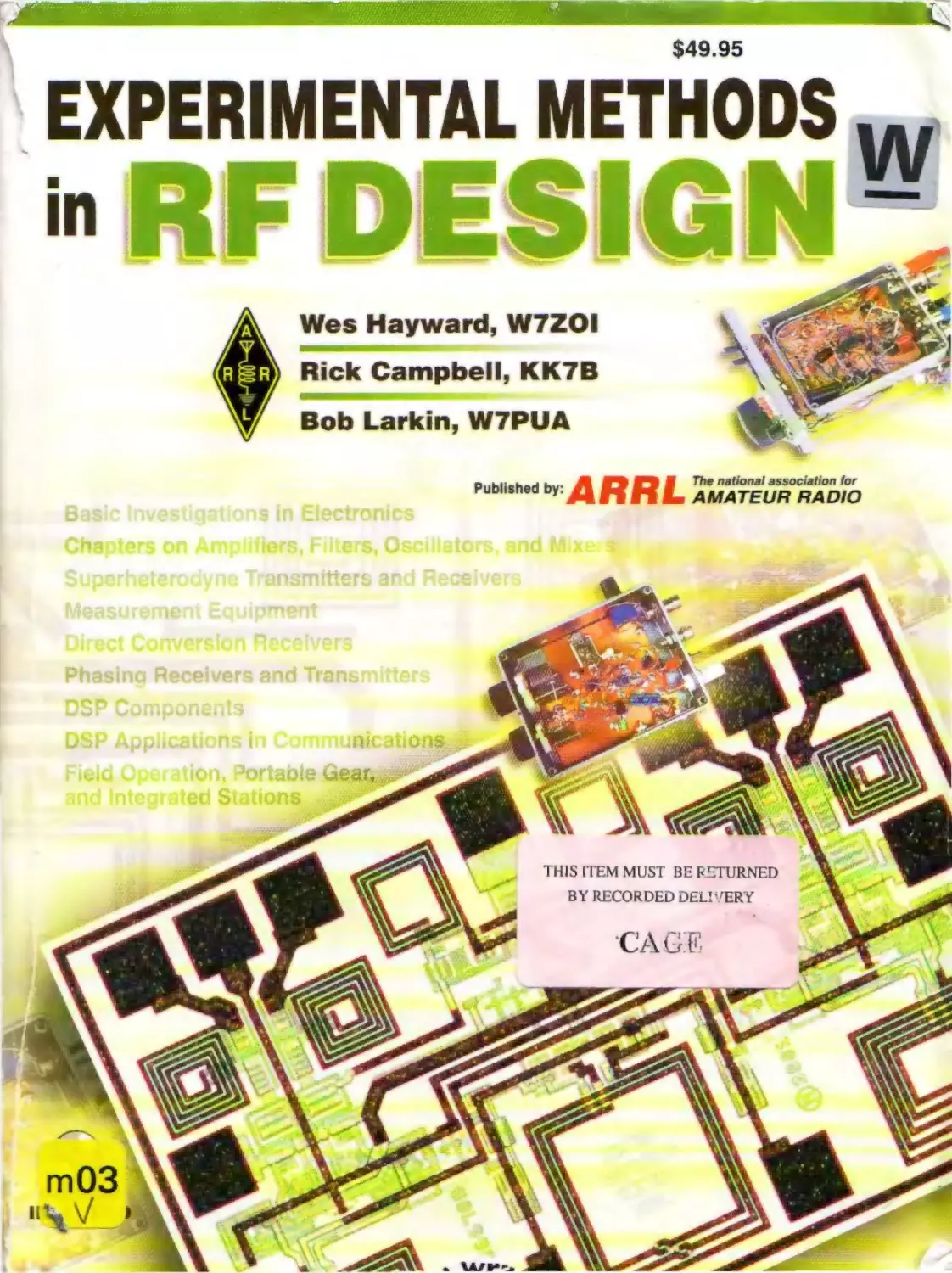
The cover ph otograph i ~ an experimental 2.4 GHz Ie dir ect
conversion receiver front-end on a gallium arseni de die . The die
is a litt le more than one millimeter wide. and less than one millimeter high . Gold-bond wires con nect to the metal squares
around the edg e. Th e large vpiral is a qu adrature hybrid coupled
inductor. and the match ed inductors at the top are in a Wil kenson
.I
splitter. The passive ci rcuitry is simi lar to Fig 939. and the pho tograp h on page 9.43 shows thi s 1(' co nnec ted to baseband cir cuitry desc ribed in Chapter 9, Note the call signs on the die.
"r-.1AL,'· wh o was not licensed in 200 1, is no w K7t\.1T1. Photogra ph hy Dean Moruhei.
Abo ut The Aut hors
All thre e of the authors share a s imil ar early exposu re to rad io. obta ining an amate ur licens e as a teen or ea rlie r.
Th ey all started with the novice cl ass licen se. The ir ca rly ham ex peri ences expan ded to become car eer s in science
and electronics. All three are members the IEE E Micro wave Theory and Techniques Society and havc pub lishe d
exten sive ly in a wide var-iety ofjournals and books. All three writers c ontrib uted to all cha pters of thi s text, but
each author had a primary re sponsibili ty listed bel ow
or
Wes Ha y w a r d , W7Z0 1
Wes rece ived a BS in Physics from Washingto n Stat ", Un iver sity in 196 1 and an 1\1S EE fro m Stan ford University
ill 1966. He worked on electron dev ice physics at Varian Assoc iates, The Boei ng Co., and Tektro nix. He then did
Rf c ircu it design. first at Tektro nix and the n at T riQu int Se micond uctor. Wcs is no w se mi-ret ired . dividing his
time betwee n writing a nd co nsulting. wcs "vas the prima ry contrib utor to C hapte rs 1 throug h 7 and large part s of
12 and c an be contacted at w7zoi@arr l.net .
Rick Ca m p bell, K K 7B
Rick received a BS in Physics from Seaule Pacific Uni verviry in 197 5. aft er two years act ivc duty as a US !\' avy
Rad io man. HI: worked for4 years in crys tal phys ics basic research at Bcll Labs in Murray Hill, NJ before retu rning
to grad uate school at the Unive rsity of Washington He completed the MSEE deg ree in 198 1 a nd the PhD in EE
in 19 H4 . He ser ved on the faculty at Mich iga n Tec h University until 1996. Since 1996 he has been with the
Advanced Deve lopm ent Group at T riQuint Semicon duc tor, dexign ing microwave receiver cir cuitry , Rick had
primary re sponsibility tor chaprers x. 9. and large parts of 12. He can be c ontacted at kk7b @llrrl.net.
Bob Larkin, W7 PU A
Bob rece ived a BS in EE fro m the Univers ity of Wa shington and a .\ l S in EE from New York Uni versity . He
work ed for 12 years at Bell Labs in New Je rsey in areas of circu it des ign and signal processing. I n 1973 he and
his wife Janet started Jan el Labs where a variet y of radio freq ue ncy products we re manufactured , They moved the
com pany to Co rvallis Oregon in 1975 where it operated unt il be ing acquired by Cetwave RF in 199 1. He now
works as a co nsulta nt speciali zing in microwave circ uits. Bob was the prim ary contributor to Ch apters 10 and I I
and wrote a sec tio n in Chapter 12. Readers can contact Bob at w7pua@ a r r 1.llct.
CHAPTER
Getting Started
1 .1 EXPERIMENTING, "HOMEBREWING," AND THE PURSUIT OF THE NEW
Amateur Radio i~ a diverse a nd colorful
a voc ation or h ubb y w her e the pa rtic ipants
com m unicate with e ach other through the
u- e o f rad io sig nals. T he co mm unic atio ns.
whic h c an e ncompass and extend beyo nd
the planet. arc often rout ine and predict ab le. but ca n a l times he et hereal. The
romance of communica ting with the o the r
sid..: of the world ble nds wit h the joy of
observing a c om plicarcd pan o f nature. Fo r
..orn e of uv, the wo nder never di sap pears.
Although rad io ca n be fun, our prag matic soc iety de mand.. mo re tha n exci tement when re sou rces arc used. The virtue
that most ofte n j ust ifies o ur use of the
radio spect r um is the gro wth of a proficient co mm unica ti o ns vys tem tha t can be
ca lled upon in limes of emergency. The
e xample s of its use are numero us.
But. "ha m' radio is mo re tha n this . II is
a te ch nic al a voc atio n of d iverse ed ucerional pote ntial. It has values that go we ll
beyo nd that o f a supple mentary co mmu nications network.
Most radi o ama te urs have a n inte rest in
the tec hnical details of the eq uipm ent the y
usc . Historic ally . Ihis was a req uire me nt;
The only way a rad io a mateur coul d assemble a n ope rat ing station war.. to person a ll y build his o r he r gea r. Co mm erc ial
eq uipment was rare, a nd was often pro hib itivel y expe nsive, HUI today. high quality "ham" gea r is readi ly a vail able in Il1O.<.t
of the wor ld. muc h of it at modest prices.
Altho ugh no lo nger necessar y. it is still
co mmon for rad io amate urs to build at leas t
so me of Ihe ir own equi pment. The reason..
are varied and a." numerous as the part icipant s. A fe w purists co nside r buil d ing the
eq uipment the)' usc to be a non-opti on al.
integra l pan of the ir ho bby in the same way
that a fl y fishing enthu siast would 111'1'1' 1"
consider fishing with a tl y that he or she
had not tnbricated. The majority la ke an
intermediate path. building part, of thei r
radio st ation s while purchasing ot hers. For
some. building is an exercise i n craftsm an shi p, an opport unity to gene rate eq uipment
with an individ ual imprint and perso nality.
Co mmo n 10 all of the se, amateur radio
presents an opportunity that is rare amo ng
avocations, a cha nce for indi vidual. unrestrained investig atio ns in fundamental science lind technology . This is a rarity in an
age when most research and desig n i~ performed by team s of invevtigatorv within
large organizations. be they universitics or
the engineering arms of corpo rations. There,
the subjects chosen for investigation arc often those of corpo rate or natiunal interest. lt
is increasingly rare that a study is initiated
out o r simple curiosity. fortunately. we are
not so constrai ned within oue perso na l invcsnga tions of radio science.
Consider an e xample. An ex perime nta lly
inclined rad io ama teur env isio ns a new
scheme for a recei ver. It might be a better
front end circuit . a ne w block d iagram. or a
way 10 real ize so me receiver fun ctions with
a comp uter . The e xperimenter can analyz e
the sche me. design an e xample. build a pro totype. build and ao ernblc needed tesr
eq uipme nt. me asure the receiv er per formance, compare it with predicted results.
and use the receiver on the air. Eac h part of
the investigat ion can imeract with the ot hers. All of the ac tivity can be done without
interference from othe r sources. The program will neve r be cancelled by the changing goal s of a n organization . Nor will it be
rushed b)' the economic pressure, of a co rporat e progra m.
The inspirurion fur experiment varies . In
rare cases. the ex peri me nter may fed that
his or her work co uld lead to a new twi st in
the stare -o f-the-art. a beuer recei ver. But
more ofte n it ..... ill ju st be a casual thought
tha i "Hey. I' ve never built o ne of these
before and l'Illcam something: if I do ," The
most common is an effo rt sp urred by a need:
a ham wants a rig 10 take along o n a hiking
trip when no such thing can be purchased .
1':0matter wh at the origin. the expe rimenter
ca n enjoy the kno wled ge that he or she is
learni ng mo re about the subjec t and about
the research process.
In thiv boo k we e nco urage a ll levels o f
what has bec ome kno wn as radio "homebrewing." rangi ng fro m beginn er projec t,
to sophisti cated multi-mode c reation s. We
ge neral ly em phasi ze simple equipme nt
describ ed b)' primin ve expla natio ns. By
primitive. we intend that the d iscu ssio n
re late to the most funda mental and basic
ci rcui t des ig n co nce pts. The equ ipment
and system s prese nted are rhe mselv e v
basic. etten witho ut the fril ls, bell s. and
whistle, of com mercial eq uipment. Some
refi nements will be discussed. allowing the
e xperimente r (0 add thos e he or she needs.
T his book e mp hasi zes equ ipme nt devign. Our interes t is in basic cir cuit functions and the und erlyi ng co ncepts th at
allo w' them to be unde rstood . Thi s book is
generall y NOT a colle ction of projec t, for
reproduct io n and co nstructio n Although
so me of the eq uip ment may be d irect ly
du plica ted. we would prefer to have you
ada pt ou r resu lts to fit yo ur o wn needs.
T his boo k is. in man y ways . a sequel to
an ea rlier effo rt. Solid State Designfor thr
Rad io Amatl'ur. 1
T hat 1977 book.
co- a uthored with the late Do ug Dc xtaw.
Ge"ing Started
1. 1
W I FB . had goa ls simi lar 10those outli ned
abo ve. plus ' hal of introd uci ng solid-state
methods 10 readers wit h experi ence limited 10 vac uum lub e electronics. The la ter
need has become arguable . for virt ually
all of ou r equipm e nt is now based upon
soli d-state tec hnology.
All of the c irc uits prese nted in this text
ha ve bee n co nstructed. tested, and used in
practic al. o n- the-ai r sh uanons. Jr'the re arc
exce ptio ns whe re t he au tho rs have not
ac tuall y bui lt an exa mple of what is d isc ussed. we will so state in the rel ated te xt.
We em phasize the trudirio nal corn municaucns modes of C \\'. the origi nal digi tal mod e. and SSR pho ne. Building lin k
rigs and radiati ng and rece iving comi nucus wa ves are 10 a radio ex peri menter
much like pl aying scales and fol k tunes
arc 10 a musi cian . The y are Ihe firs t things
we le arn. are important part s o t Inc da ily
practice routine thro ugh o ut life. and we
ne glec t the m at ou r pe ril. T he litt le rigs.
a nd the concepts the y re prese nt. are at the
core of wirel ess tech nology. It is nOI
eno ugh to play wit h the m as a no vice a nd
then move on to other things: they nee d 10
he revisited over and ov er aga in at d iffe ren t ~ la g es of one's voca tio n. each lime
ac hieving a new le vel o t mast ery until fi nall y one is probing the deepest mysteries
of the art .
1.2 GETTING STARTED-ROUTES FO R THE BEGINNING EXPERIMENTER
What to build:
A fre que nt question asked hy the prospccuv c e xperimenter regards an initia l
project or subj ect for pursu it. A common
c ho ice fo r a first project com es fro m a
des ire to extend the r apa bifitiev of an existing station. T he future ex perirnemer already has ex perience ..... ith on-the-ai r ac tivi ty and a working sta tion. He or she the n
want s to ex te nd that station to ne w ba nds.
impro ved transc eiver perfor ma nce. o r fabricate a rig offeri ng portability. w hile
these goals arc all ....o rthy. they can be d iffic ult. T hey may be con ceptuall y' Imooscihle for the begin ner. a nd impractica l for
the seasoned e xpe rimenter \\ ith other life
com mit ments. A be uer "fi rst" ex periment
may well be som eth ing that is much si mpler. Se veral simp le proj ec ts are offe red
later in this chapter as sui table beginnings.
How to build i t :
Another ge ttin g-started q uestion re o
gards the methods to use i n buildi ng e lectronics. The re are several opt io ns. all with
the ir asse ts and weakness es . A fe w arc
di sc uvved belo w.
PRINTED CIRCUIT BO ARDS
The primary co nstruc tio n sc heme used
in modern electro nics is the printed c ircu it
hoa rd lPeB ). Here. pads or islan ds of
metal are anached to an ins ulatin g mate rial. usually epox y-fi berglass. Wir es o n
[he parts are pushed thr o ugh ho les in the
boa rd and solde red to the pads. whic h a re
intercon nec ted by primed metal runs. thus
formin g the circ uit.
_,)" PCB hegins as a fiberglas.... beet with
copper lam inated to one or both sides. The
metal curfuce- are then coated with a light
,ensitin: "p ho lo-re, i, t"' material. A pall ern
for thc ..:ir,,·u il i, oplicall y tra nsferred to the
,urfa":l' ilnd the unnpo, ed materi a l is
wash ed allo ay. T he board is 11m\' placed in
a , olutio n thai che mically etches ,orne of
1.2
Chapte r 1
thc cop per awa y. le avin g only those
regions neede d to for m the desi red circuit.
After e tch ing. the board is ....-ashed a nd
drillcd. Pure co ppe r is easily co rroded. so
it is c om mon 10 pla te boa rds with a tin
coat ing. fonning a more stab le and
sold crable surface . Refined boards incl ude
cop per on bot h side s. and even plating on
the insid e of the holes. Ind ustrial boa rds
will ofte n incorporate many layers.
Modern practice features slir/aCt' mount
te rh notogv, S:\IT. using small co mpo nen ts wi thout wire leads. Thc leads ha ve
bee n replaced with met ali zed rcg rcns on
the pans that are then soldered d irectly to
the board . The so ldering provides physica l mo unti ng as we ll as electri culconneclion. The Sfl.fT ho ards arc cheaper to bui ld
and usua lly much more dense. S"'IT pam
" an boo: ,0 sma ll tha t the y are hard to hand le
wit ho ut a good microsco pe. SMT is an
inte resting way to bui ld if there is anced
for really sma ll equipme nt. T he small size
of SMT cir cuits often results in improved
high freque ncy perfor mance.
G rowi ng SMT po pularity in man ufacluring mean s that surface mounted is the
only available for m to r a component. Man y
parts don't exi st in leaded for ms. In so me
c ases the y can he ha nd led by the "S urfboards" by Capital Ad vanced Tec hnologies whic h are found in Digi Ke)" cata logs.
These are small SMT boards with an inte rface that will adap t to other board forms.
Circuit hoard s haw been built in a home
environment by hams for gener ations. The
reader should review the subject in The A RRL
Ha nd b ook: 10 find OUI morc about the methUth. A major problem with home etc hed
boards is the disposal of the used ctcha m.
usually a sol ution of ferric chloride. Disposal
practices commo n in the past arc now que, tioned in this era of enlightcned recycling.
Although some of thc projec ls descrihed in
this text use etched boards. few or the hoards
were ell.: hed in our ho rne labs,
BREADBOARDED CIRCUITS
Breadb oard, as app l ied to electronics,
is a term fro m a time whe n ea rly rad io
ex per ime nters huilt the ir eq uipme nt o n
s tabs of wood. often procu re d from the
kitchen. T he term remains as an ind ustr ywide descrip tion of a prel iminary ex perime nta l ci rcu it. There are numerous
mod ern method s lhal ca n be used to gc ncrale a one-of-a-ki nd ci rc uit.
UGL Y CONSTRUCTION
A panicular ly sim ple met hod was OUl·
lined in an ea rly QST pape r and i.. no w
know as " Ugly Construe tio n:'Z Alt ho ug h
ce rtai nly not uniqu e. the scheme wor ks
we ll a nd co ntinu e.. as a reco mme nde d
me thod . T he sch e me co nsist of the fol low ing:
I. A g round plane is establis hed usi ng
a n uri-etched scrap of copper cl ad circu it
hoard material!'
2. Foll ow ing the schem atic for a c ircuit
bein g bu ill. grounded compo nen ts are sol dere d dire c tly to the gro und foil with sho rt
leads.
3. Som e no n-gro unded parts are so ldere d (0 and sup ported by the gro unded
co mponents.
~. Ot her non -grou nded com po nents are
supported w ith suita ble "tie down poi nts,"
con sisting of high value res istors.
5 . O nce finished and wor kin g. the boa rd
ca n be mo unted in a suitab le box. hidde n
fro m view if desired. whe re it becomes a
pe rma nen t application of the idea. Ug ly
con ..tr uction is illus rrurcd in Fi g 1. 1.
Cas ual ci rcu it ana lysis a llo ws the
build er to pic k the stan doff resisto r values.
Any " hig h R" val ue re..tsto rs ca n be used .
Usuall y, 1- ~1 n res isto rs work we ll an ywhere with in RF circu ils. T hc typic a1 l /4
W re,i stor ot' a ny val uc has a stray lead -tolea d parallel ca pacitance of about 0.3 10
0.4 pF. per haps a lill ie more with longer
leads. and a serie, inducta nce of 3 10 5 n Il.
100
L
QJ 1-
vee~
l '~ 1-
1 Meg
. 01
Vee
, 1SS:.-m-I-I:;;:)
1 0::",0
~
Glu e o r s o ld e r.
,ti SOlder·1
~
22 0
1 Me g
~
S
~
S
Fig 1.2- An e xam ple of '"Ma nha Ua n"
breadboard ing.
2 20
S
1 Meg
. 01
1 Meg
S
S· solder
Fig 1.1- A pa rt ia l ci rc ui t ill u str ati ng Wugly" co nstruction.
I S O l d e r. ~
~ = 'I
~ S O l d e r_!
Reacta nce i ~ linle co nseq uence for ....-o rk
up thro ugh 150 \ f H7. Or so . High R mea ns
th ai resista nce is high with re...pecl to the
reactance of the induc tance. We sometimes
use R values as low as IOkQ. It is often
surpri...ing j ust ho w few standoff resistors
are needed in an ugly breadboard.
T he g rea te st vi rt ue of the ugly me thod is
low inductance grounding. Any const ruetion sche me that preserves this grounding
integ rity w ill wo rk as well. Pic king a
method is a chok e that the builder has. a
place where he or ..he can deve lop the
methods tha i wo rk best.
Integrated c irc u it, ca n he p lace d o n an
ugl y hoa rd wi th leads stick ing up. "dead
bug" style. There is litt le need to glu e the
chips do wn. torcomponents and wires wi ll
eventually hold them in place. Gro unde d
IC leads are be nt a nd soldered directly to
the foil.
Som e builders prefer 10 maintain ICs
with the IC la bel facing upwa rd. allo wing
later inspec tio n. They the n be nd all leads
o ut in a "spread eag le" format .
W r: have ne ve r had a prob le m with ugly
equipment being less than robust . Many of
our ugly rig s have bee n hauled throu gh the
mountai ns of t he Pacific No rthwest in
packs witho ut inciden t. An o utsta nding
ex am ple . the wor k of a frie nd. is the W7EL
Optimiz ed QRP Transceiver. a rig that has
trav eled aro und the worl d in suitcases and
pac ks) Fe w if any sta ndoff res istors were
used in that rig.
MANHA TTAN BREADBOARDING
Se veral o the r construction sche mes offer sim ilar grou nding fidel ity, incl ud ing
those .... her e small pads of ci rcui t board
material are glued or so lde red to th e
grou nd foi l. These pads then have ccmponems soldered to them. w e have fo und this
method to be especially usefu l for slig htly
massive cornponems such as floating. nongro unde d. trimmer capacitors . The spe cific glue type has lit tle impa ct on circuit
pe rfor manc e. Variat io ns of this me thod
hav e been called "Manh attan Co nstruetio n," and ca n be mixed with other breadboarding sc he mes . Th e reader can find
nume rous e xa mple s nn the Web on sites
dealing with QRP experiments, as we ll as
in Fi g 1.2_
The propone nts of Ma nha ttan Con st rue non often use small round pads that are
glued to a ground fo il with epoxy or simila r glue. The pad s arc placed so that all
components are parallel to hoar d edg es
and clo se to the grou nd foi l. This produces
an att ractiv e board resembli ng a co mmer cial. PC board. This does nut seem to comprom ise performance.
Wit h trad ition al ug ly construction. parts
can be moved about to make room Cor
ano ther stage. In the ex trem e . an enti re
circuit ca n be lifte d and mo ved, a stage at
a time, to a nother board.
A primary virt ue of a bread- boa rding
scheme is construction speed and flesih slity, esp ecially important when the prima ry
purpos e of buildin g gear is info rmat ion
abo ut ci rcu it be havi o r.
So me folks prefer to reb uild a circuit
after a brea db oarding phase. rep lacing an
ugl y pro tot ype wi th a mure perma ne nt.
production-like ve rsio n. These efforts take
addi tio nal time and rarely prod uce performa nce supe rior to the o riginal breadboards. Eve n loo ks can be deceptive when
o ne bide s ugly breadboa rds beh ind mo re
attractive front pa nels .
QUASI-PRINTED BOARDS
Some experiment er s prefer to build
equipmen t that looks like a PC B. even
Fig l.3-A - q uaet-ctrcu tt boa rd"
s cheme fo r brea d bo a rding. The
installed re s is tor he re is SOldered to
grou nd a nd to a pad that co nnects to
the res t of the circ uit ry.
when the board is no t etched in a circ uitspec ific pa tte rn . One met hod , call ed
"chec ker-board." uses double siocd c ircu it
board with one s ide func tioni ng as a
gro und foil. The other side con sists of a
matrix of small islands of copper. These
reg io ns are cre ate d either by et ching or
ma nuall y with a hack saw Patterns of
squares on ILl- inch cen ters accommodate
traditional K's . Ho les arc d rilled in the islands whe re components must reside. A
lar ge drill bit the n re m ove s ground fo il
aro und the hole witho ut enlargi ng it. No
hnles lire re quired wh ere a grou nd co nne cuon is need ed . Compone nt s usually
reside on the ground side of the bo ard. See
FiJi: 1.3_
The do uble sided c hec ker-board ca n
also serve for breadboarding with surfac e
mo unte d components. Pa rt" then reside
on the punem sidc w ith ho les drilled 10
reach ground. Sma ll lea ded co mponents
can also be surface mounted.
The checkerboa rd sc he me. " ~fa n h at
fan" variants, a nd eve n do uble- sided
printed boards have fair ly high capac itance from pads to grou nd. These arc often
poor qua lity ca paci tors with low Q. unde r
100 for epo~y fibe rg lass board material.
and arc s ubject to .... ate r a hsorprion. A
single sided formal i",preferred for critical
sections of a I.e osc ill ator application.
Getting Started
1 .3
1.3 SOME GUIDELINES FOR THE EXPERI MENTER
Wi th Solid-State Design for the Radio
Ama tela came considerab le interaction
wi th the re st of the amateur radi o communi ty A frequ ent que st ion we heard was
"How do I get sta rted wi th experimenting?" Or, "I've read abo ut and ha ve even
bui lt so me ki ts and published projects. but
1 want to go further. J wan t to d o my own
de sign . what is the nex t step?"
A set of guide lines is offered in a n attemp t to ans we r some of the se que st ion s.
The se are not firm. well establi shed rules .
but mere im pres vions and per so nal biases
that we han: ge ne rated. approaches that
wo r k fo r us. T hey are offered without
guara ntee,
-K ISS: Th is Bri tish te rm is sho rt fo r
" Keep It Simple, Stupid. " We often des ign
equipmen t that is mo re complicated than
needed. It is well worth some extra lime
duri ng de sign to e valuate every part to see
if it i s really needed. T he functio n of each
pa rt shou ld be understood and justifi ed.
The circ uit should fun ct ion as inte nded .
Th is does not imply that d es igns with the
minimum numb er of parts arc be st. Ho weyer. it is rar ely justifi ed 10 ov er des tg n by
add ing ext ra components " bec ause a prohle m might occur." For exa mple. designs
wi th a prof usio n of fe rrite bead s an d "s tability e nhanc ing" resi stors may be suspec t.
e A void lore: L ore , in this case. refe rs to
"knowledge that is based upo n experien ces that are d ivorced from carefu l
thought. A classic example in am ateur rad io regards the thermal stuhili ty o f L C
o sci llators. Envision the amat eur experi me nter who b uilt an osci llator using a tor o id. The c irc ui t drifted whe n he opened
the wi nd o w to t he wi nte r wea ther. T he
next evening he replaced the inductor wi th
one wound on a ce ra mic coil form, no tic i ng tess drift when he opened the window.
He concluded that cer am ic forms are bet ter tha n ro roi ds, ha vi ng nev er considered
the sp ecific coil forms that were used. the
ot her components in the circuit, or the fact
tha t the we a the r had improve d. Poorly
e xecuted experiments lik e this o ften ge ncrate erroneou s conclusions , T he resulting lore. although in tere stin g. sho uld
alway s be que stioned. It is always beuer to
do mea ningful measurements.
- P la n yo ur pro je c ts with block d ia grams: Start wi th small diagrams whe re
eac h bloc k is a glo bal element. perhaps
co ntaining sev era l stages, Expand these to
sho w grea te r detail. Block diag rams will
be discus sed fur ther below,
efienerate modul ar equipment: A hig h
per for mance receiver, for e xample . should
1 .4
Cha pte r 1
consist of sever al sec lions, each design ed
so tha t i t c an be built. test ed, mod ified , and
red es igned as needed , with minimal
change 10 the rest of the system. E ven the
simples t litt le rig should he built a stage at
a time , t urned on sequentiall y, te sted , and
mod if ied as nee ded . Single board tra nsceiver des igns are popular in the QR P
aren a. Bu t realize that the on e s that work
well are probably the res ult of several rcbuilds, a nd ev e n then, so me don't wo rk
ve ry well; others are superb .
- Avoid e xce ssi ve miniaturiza tio n: It
tak es much more ti me to bu ild sm all things
than those w here the ci rc uitry can expand
without bound. E ve n when bui lding small
port able QR P transc e ive rs. it's often
wor thw hile to establish the des ign with a
larger b read board .
- Ba se proj ect s on your own goals: Our
central personal goal is le arn in g thro ugh
experimenta tio n. Henc e , we base projects
on qu e stions that need inves tigation ra ther
than what we need or wa nt fo r on -the -air
operatio n. Bu t your goals may be different . It is worthwhi le to rev iew and defin e
the m as a mean s of picki ng th e best
proje cts for you . Is ol at e pr imary go als
fr om those that are se rend ip ity
_ Be war y of "Creepi ng Features." The
term "ap pliance : often de scri be s the
transcei ve rs that we purchase for
on -the-air c om m uni catio ns . Appliance s,
even ones that we bui ld o urse lv es, are
usually expected to have ma ny features,
but these b ells and whistles ca n ac t ually
impede experimental progress . A singl e
band , single mode transcei ve r ca n be a s
e xperime nta lly enlightening an d informa ti ve as 11 m ultiple mo de, general co verage
transceive r.
_ Use th e li terature . Pe rus e c atal og s,
data ma n uals. web sire s, and even instruction man uals for circ uit idea s. W hen a circuit method is not und erst ood, it should be
stud ied in texts appro priat e to the technolog y. It is useful to bu ild somethi ng with
the pa rt as a way to really understand that
pan .
- While pla nning is nec essary. d on' t
sp en d excessive time in the prel iminary
de sig n phase of 11 project. Ra ther, outli ne
preli minary ide as and goals , d o initial c alcu latio ns (on a computer onl y if they are
rea lly complicated), ga the r part s, and
beg in hui ld ing . Enjoy the fr ee do m tha t
allows yo u to change your min d in the
midd le of an invesugano n. Refi ned calc ulatio ns c an occur du ri ng and aft er co nstruct ion and are no t JUSl "design phase"
ac tiv ities.
-If s not ab out cr ntts manship : A po rtion
of the home hr ewing community wa s
schooled with the idea that "n ice look ing"
circu it cons truction went along with goo d
performance. But the two factor-s are gen erally isolated. Th is is illus trated in Fi g
1A. There is no relationship between hav in g 11 n ice loo king , ord erly ci rcu it bo ard
and good performance from that board , Indeed . those saddled with the cho re of de si gni ng 11 pri nted board to perform as well
as an ugly breadboard may wonder if there
mig ht be an inverse relationshi p)
-Use breadboarding ov er a gro und plane
for communic atio ns circ uits. e specially
when invest igating new idea s. Use vector
board or wire-wrap methods for slow digital
circuits, hut treat fast digital circuits as if they
were RF functions. In general. bu ild wi th
those methods that will offer the best . low
induct ance, groundi ng while allowing cir cuits to be q uickly de signed . assembled, and
tested. If yo u are concerned with aesthe tic
detai ls. build a second version. Alternatively. an attractive panel ca n be used to hide
ugly. but highly func tional brea dboa rds .
_ B uil d what you use. and usc wha t yo u
b uild: T ho se or us in the homebrew end of
amateur radio o ften kid our appliance op era tor friends , suggesting that a "real ham"
sho uld bu ild instead o f j us t operate . Some
avid e xper ime nters may take thi s too far:
they b uild a rig , usc it j us t lo ng enough to
confirm f unc tion alit y. and go o n to the
next project, miss ing some ex citi ng dis cov cries a lo ng the way . B y using the
equipment with tem pered intensity, the
experimenter will d isco ver the strength
an d weakness of the rig. allo wing the next
project to be eve n more successful. The
same arguments might be applied to software de velopme nts !
_ Beware of the go lde n screwdriver: A
goo d frie nd, WA 7M LH , encountered a
fe llow o n the air who se so le met hod for
experimentatio n was to adjus t all of h is
equi pme nt for maximum o utp ut. H e di d
this with a favor ite screwdrive r. wh ic h he
treated as gol den. Af te r careful tweaking
of a n circu it clements that c ould he ad justed. he was a lmost always ab le to co ax
a lOU-W tran scei ver into delivering 110
W of o utput. Unfortuna te ly, what started
as a good piece of equipment had become
a distorted disaster. Wh ile we all tend to
adj ust c ircui ts for " maxi mu m smoke." linear circu itr y should be co nfined to opcral e under li near conditions. I t is im po rtant
tha t the lim its be reco gni ze d and adhe re d
to . This is es peci ally im por tan t whe n
building SSB gea r. Alignmen t mea ns adj ustm ent to the proper. measu red le vel,
•
0:
Fig 1.4-"N ice looking " circ uit con str uc tion does not always equate to good circuit performance.
docume nts, for (hey are mo re permanent .
A lo ng te rm compute r based i ndex of noteboo k!' is ve ry useful.
loca l d ubs to fi nd c ut who is building. Listen 10 the appropriate ne ts a nd uncnd the
specialty cl ubs. Wri te to fello ws who
aut hor articl es of interes t, especially if
the y live nearby. Watch t he c hat sessio ns
on the Inte rne t or the Web . Amateur radio
is a bo ut commu nication s. so da n' , hesitate to comm uni cate.
• Look tow ard the ordi nary for explanatio ns: When a design is not worki ng as
well as it should, we look for explanatio ns
that will explain the diffe re nces. All too
ofte n we conside r the co mplic ated a nswe rv, o nly to disco ve r that the real ans wer is in the ..ob v io us." It i.s alway s
worthwhile to ret urn 10 fundam entals.
• Find o thers with the sa me pass ion for
e xperime nti ng: Although this guide line is
pren y o bvio us, ir's also easy fo r the ex per ime nter to beco me isolated in his o r he r
0 \\ 0 wo rld. Builder hams are rarely isolated. Finding the local o nes will give you
a place 10 communicate yo ur ideas, hear
abou t ne w though ts. and to sha re ju nkbe ...
pa rts as we ll as tes t equipme nt. Ad; a t
• Str ive to build eq uip ment that doe s
not po llute the alread y ab used radi o spec tru m: Make a n effort to ge ne rate d ea n
eq uipm ent. mea ning tha t it doc s not em it
sign als at frequ e ncies othe r than the intended one s. While most of this conce rn is
with transmitters, the ide as sho uld also be
app lied to receivers . The diffi cult question is "Ho w clea n is clean enoug h?" Tbe
whic h may differ from maximum.
. A l w ay ~
keep notebooks for expert-
mems: Record those wild ci rc uit ideas thai
come up while you cur the lawn or watch
TV: reco rd important data du rin g exper ime nu . includi ng the te mper at ure when
yo u o pen the windo w; take notes on the
circ uits that yo u build, including changes
thai are mad e during bui lding and "turn
on" , Dale the notebook and place small
dated labels inside the rigs 1\0 you ca n find
the data when it 's needed. Use bo und o r
spiral notebooks rather than loose-led
FCC has specific atio ns for spuriou s emissio ns fro m US tra nsmitters. These spec ificatio ns de pend upo n trans mitter outp ut
power. Even for equ ipment running full
po we r, the specificatio ns are ge ner ally
easy to meet at HF. Whe n powe r dro ps
below 5-W o utput. they beco me c ve n
easier. Throu gho ut this text we tak e the
app roach that ev en greater le v cls of cleanliness will be sought. This ho ok includes
a cha pter o n test eq uipment. One of the
item s featu red the re is a spec trum analyzer
thai wiII allow the builde r to mea sure spec tra l pu rity,
A final "rule:" Don' t let any of these
ru les ge t in the way of experimenting and
building ! It' s OK if the re are things that
you do n"t unde rsta nd even if that incl ude s
the proje ct you are about [ 0 build. for yo u
will unde rstand much mo re whe n you are
fini shed. The real goal of this pursu it. a nd
of this hook is to team by doing. The same
can he said for other "rules" that may appear in the literature oron the web : Do n' t
let the m keep yo u fro m experimenti ng .
Getting Started
1.5
1.4 BLOCK DIAGRAMS
F ig 1.5 shows a coll ectio n of e le ments
that can be used in a detai led bloc k diagram of a rad io . This short list i s ge nerall y
e xten sive enoug h to describe th e
no n-digital designs in this book.
Sc hemati c a nd block d iagrams serv e a
variety of purposes in e lec tronics. T he
pur pose o f the bloc k d iagr am is to pre se nt
the func tion s and their int e rcon nection
used in a piece of eq uipment. Schema tic
d iagrams prese nt the deta ils.
A blo ck dia gram is a useful way to plan
and des cribe the e quipmen t we wis h to
build , The block d iag ra m will se rve as the
startin g poin t for mathem atica l a nalysis
that we may app ly to the overa ll syste m. It
can also em phasize the function s required
to complete the de sign . This is ill ustrated
with Fig 1. 6 sho wing a d irec t conversion
trans ce ivc r for the 40-mete r band. Se veral
fil ters are sho wn, illu st ratin g the fu nctions
that are im po rtant fo r go od perfor mance .
The lo w pass an d the high pas s betwe en
the mixer and au di o am pli fier are sim ple ,
con si sting of one co mpo nent ea c h. Th ere
may be no co m pone nts for the signal spli tter , but the fu nc tion re mai ns.
Fig 1.7 sho ws a more elabo rate circ uit. a
super-he terodyne SSB/CW tran scei ver for
the 50-MHz ha nd. The phas ing met hod can
also be used: such a 50-MHz transceiver is
presented in Flg 1.8. Designing any of these
sys tems begi ns by forming the bloc k diagrams. whic h incl udes speci fy ing each of
the blocks . Once this is done. the indiv idual
circuits ca n be des igned. Som e elements arc
missi ng in the block diagram in the interests
of cla rity. It will he usef ul to add block deta il
during circuit des ign.
Some block detai ls ma y d iffer fro m the
fin a l im pleme nta tion, but funct io ns remain. For ex ampl e, the splitte r and phas e
shift ing fu nc tio ns arc oft en co m bined in
q uadrature co mbi ne r ci rcui ts ope rat in g at
RF. We somet im e s show a 90 -d eg ree
ph ase shift in one path wit h no ne in a not her where ac tual circ uitry merel y maintains a 90- d egn: e di fferen ce.
These fig ure s o ffer a gli mpse of what
the tc xt will cover. T he de sig n of the bloc k
cle ments will each be d isc usse d in individu al chapter s Then, the bl ocks will be
~ - -ern blcd in svste m chapters rel ated to fil<c: ;'h :.±-ing. and digital signal proces s ing
Basic Block Diagram Elements
--{>-
Ampli f i er .
Provi d es net po wer gai n .
Mixer _ Pr o vide s an out pu t f r eque ncy
th at is a s urn/ di f o f i np ut
fr eq uencie s.
Os ci l l at or . Gene rat es an out put at
a s i ng l e f r equency.
~
~
Combin er/ Sp l i tt er . Adds t wo s i gn als or
s pl i ts on e i nto t wo p ar t s whi l e i s ol ati ng
t hem.
[):::
I np ut s / out p ut s . Coax ', s p e aker ,
microp hon e , he adp hone s.
raJ
Low Pas s Fil t er
Hig h Pas s Fi l t er .
Bandpas s Fil t er .
All Pas s Fil t er
(Pha s e Shi f t net wor k)
Fig 1.5-Comm on bloc k di agram el em ents.
Aud i o LC!HPF
LC!BP F
Re ce ive r~
I nput
High Gaio
RF
AUd io Amp ,
Aud i o LC! LP F
TX
-.tR e y
,', <em _
Fig 1.6-Block di agram of a d ir ect co n versio n transc eiver.
,...
ChIopte r 1
Res onator
out put
1.5 AN IC BASED DIRECT CONVERSION RECEIVER
Thi s receiver design is one of the simplest possible that will allow CW and SS B
signal-, 10 be recei ved. It offers perfor mance eno ug h for on -the -air co ntac ts
while serving as an introd ucto ry co nstrue -
lion effort.
The basis for thi s recei ver is the :,\E602
(or XE 6 11) integrated ci rcuit. Originally
introd uced by Signericv in the late 1980s.
the c hip is c as>' to use and offers good per-
M dlO
"",,~ l ~ fiH
r:..r n~[
' : cr
Fig 1.7-Bloc k di agram of a super-heterodyn e 5SB tran sceiver.
Re ce lv« r
raput
;-;
11) \.;
I.e / BFf
.,,,
50-50 .3
Fig 1.8- Blo c k d iag ram of a phasing method SSB tra nsceive r.
0$<:~ .1 ~ ..
:.v )
l.<.[
formance among very low current recciv cr
cornpone ms. The NE60:! contains a miller
and an oscill ator, (WO essen tial bloch
needed for a receiv er. The mixer in a direct
conv ersion recei ver servev to heterod yne
the incoming antenna vignal directly down
to audio. Th e oscillator pro vide s mixer LO
(local oscillator] inj ection for this convc rsion. The oscillato r within the I\"E601 b a
single trancistor followed by a buffer amp lifier of undi sclo sed complexity. The
:-;[602 mixer is a dou bly balanced circu it
of a type known as the Gilbert Celt with
operation outli ned in a later c hapter.
The L tl-B llfiN audio ampli fier follow ing the N E 6 0 ~ comple tes the receiver. The
LM386N will drive a small speak er. or
headphones of high or low impeda nce. T he
ideal set ofvcnns" to use with this receive r
i~ a lie ht weight pair of the sort used wit h
j ogging receivers or simila r consumer
gea r.
The rece iver is shown sche matically in
f ig 1.9. Our vers io n is built usi ng the
"ugly" methods outlined ear lier. If you use
a pre-etch ed and drille d circuit board. lake
the time 10 study the board layout in deta il.
and tr ace [he ci rc uit while studying the
sc hem atic diagram. Merely stuffing parts
and solderi ng will prov ide you with no
more than so ldering prucuc e.
The signal from the antenna connect or
is applied \(I a pot that serves as a gain
control with output routed to a sing le tuned
circuit using L1. a toro id inducto r. Thi s
circuit drives the mixerinput at !\ E60:!pins
I and 2. The load within the Ie looks like
a pair of l .;<i ·kn resistors from the input
pins 10 a virtual gro und ,
The NE602 osci llator has a collect or tied
to the posit ive power supply. The base of
that transistor is available at pin 6 while
pi n 7 goes to the emitter. Internal bias
resis tors set the volta ge and establish a cu rrent of abo ut 0.3 mA in the Colpitts oscil later . Feedback ca pacitors in ou r circu it
run between pins 6 and 7 and from pin 710
groun d. A 270-pF capacitor then ties the
base to (he rest of the tuned circuit.
A simplified version of the oscillator
circuit is shown in Fig 1.10. This Hlustratcs the way a simplified circuit is used to
calculate the resona nt freq uency. Fig
I .IOA shows the co mple te oscillator. But.
the tWO6RO-pF feedbac k capac itors have a
series equ ivalent of 340 pF. as show n in
part B of the figure. In goi ng from Fi g
I.to8 10 Fig 1.1OC. we resolve the 50·pF
variable and to·pF fixed into IU pF; the
270 and 340 pF beco mc 150 pF. We evulu ated both variable cap acitors at thei r maxi·
m um value, Fig J.[OC has nothing bUI
para llel capacitor s which add directl y to
Getting Started
1.7
r
+5 to +3
+
100tF1-
vee
~
---j (
"
1
'1
n
L1
1
,T
NE602
,
.22
.1
0
.22
f--'---l f--O
~ 6BO
680
270
1
T
C1 ~?e?'-T-r----i, eo
reo
I
1
0
'
L 1,L2, 20 t. #26 on T37-6 to roid for 6.9-7.5 MHz.
Fig 1.9-Direct conversion 7-MHz receive r using two integrated circuits.
1. 16 uH
( e)
~L2
(D)
Fig 1.l0-Simplified v er s io n of the oscillator in a NE602. See text fo r explanation .
1. 8
Chapter 1
form Fig 1.10D . A simple resonance c alcel ation show s lunin g [0 0.9 Ml-lz.
'1' \', '0 variable capac itor re i and C2 ) are
used in our oscilla tor. They are near ly the
same value. The la rge r. C 1, d irectly para llels the inductor. A detailed analysis show s
that it will tune o ver a wide ran ge, the fu ll
6.9 to 7.5-!\1lIl span. C2 i s "padde d do wn"
with a lO-pF ser ies capacitor. C2 has a
val ue ranging fro m 5 to 50 p F. The seri es
cap acitor then generates a compos ite C
ranging from :U to R.3 pF, a 5-p F differe nce. Add capacitance in parallel with C2
to create even greater bandspread (resolution or low tu ning rate),
All fixed cap acito rs shou ld idea lly be
NPO c eramic type s. rea dily ava ilab le from
major mail order sources. B ut. don't hesitate to try other c aps if you have the m in
your ju nk box. T he worst that will happe n
is that the rec e iver will dri ft more t han
desi red. New parts are eas ily subst ituted
later.
These capac itor va riatio ns are doubly
sig nifica nt. First, you can ada pt a tuned
circu it 10 work with wha tever you have o n
han d. For example, common 365-pF AM
broa dcast ca pacito rs can be used in both
pos itions with app ropriate padd ing . Second, the use of t WO capacitor s is a very
practi cal mean s for buildi ng simple rcceivcrs while avoid ing the mechanical com plex ity of a dial mechanism . We have used
double cap tuning fur transcei vers in other
parts of the book. Adapt thc circuit to wha t
you have a vail able,
The mixer input network at L I that injccts ante nna sign als into the :J"E602 uses
an indu ctor identical to tha t in the osci lla tor , tun ed wit h a mica compression trimmer capacitor. Any variable can be used
here. II' a 365 -pF pa nel mo unted cap is
used , t he 270-pF capacitor c ould be re duccd in va lue. II't he only availabl e variab le capac itor is much smaller tha n 180
pf-. yo u may ha ve to resize L l. or add or
subt rac t net ca pacita nce a bi t to hit rcs onanc c. T he ind uctance can be reduced by
spreading or removin g turns, o r increased
by compre ssing t urns. Bot h cir cui ts arc
very tolerant of such changes ,
Once the mixer has been wired. most of
the rec ei ver is fini shed . T he LM 3S6 is a
low power part with no heat sin k requir ed.
This receiver d raws only 7 mA when sig nals arc low . with more current with louder
sig nals . A simp le 5-V power su pply works
well. A 6 -V battery pac k wi ll ru n the
receiver for ex tended per iods.
The .'IE602 mixer features excellent LO
/0 RF isola/ion. This means that there is little
LO energy appe aring at the mixer RF port .
and hence . thc receiver uruenna term inal.
The presence of such energy can lead to a
common problem of "tunable hum" with
Fig 1.11-Dire ct conversion re ceiver a s s e m bly.
some direc t co nversion receivers.
Thc rece iver a b o ha... problems. So me.
the a udio images. arc intrin sic wall simp le
di rect conversio n recei ve rs. This i ~ the
price , but also the thrill of such a design .
The selectivity is lacking. This can be remedied wi th audio filters that can be placed
in the receive r. Examples of a udio filler s
are fo und elsewhe re in th is book . These
filters wou ld go between the mixer and the
aud io am pli fier. It is easy 10 add such
things to a breadboarded receiver. but mo re
difficult with a pr inted board.
The greatest performance deficiency is the
poor strong signal handling capability of the
rece iver. Ahhough helped a bit by placing
the only gain con trol in the anten na lead. the
problem is intrinsic to the :-.lE602 mixer .The
basic G ilbert Cell is capa ble of much more.
but only whe n biased to draw considera bly
more current. The current is kepi low in the
NE60:! by' design, for il is intended for battery powered consume r equipment and nor
ham gear. Stron g. high performance direct
co nversion rece ivers are described later in
the book.
l niriaj tum -o n and adj ustme nt is st raight
for wa rd . Apply po wer initially wi th a
100 -0 resisto r in the pow e r supp ly line.
The res ist or se rves us a fuse if you hav e
do ne so mething d rasticall y wrong. Insen ing rbe headph o ne.'> whe n the outpu t
ca pac ito r is unch arged will prod uce an
audible po p. If the a udio seems 10 be ....-orking.mrn [he receiver off. remo ve the e xtra
res istor, and stan again . Att ach an a nten na,
advance the gai n co ntrol and tune CI . Signals sho uld be hea rd. Adj ust the front-e nd
tuned circuit for ma ximum signal. If yo u
have a ca librated signal gen erator you can
inj ect a signa l and see if the operation is OIl
the rig ht freq uency. If yo u have a general
coverage receiver available, you ca n au ach
the antenna of thi s receiver 10 Ihat of the
ge ne ral coverage rec eiver where you wi ll
be a ble to hea r the LO signal.H an ante nna
is not available. you ca n throw 20 or 30
fee t of wire out o n the floor. Whi le this is
not goi ng to co mpe te with a good o utdoor
anten na. il will provide signals in a bunda nce ro listen 10 a nd co nfirm rece ive r
ope ra tion.
The recei ver in Fig Lj l was built fo r (he
-m-mcter band. If you want to try a diffe re nt
hand. all tha t is req uired is to change the
t wo inductors. Increasing the 1.16-Il H inductor to 4.51l H will dro p the reeei ver right
into the 80 meter band. A band switc hing
version would be prac tic al.
The first popu lar rece iver s of this sort
appeared in the USA in a QST paper by
WA3RNC.-1 Va riatio ns of a similar so n
were generated a nd pub lished in Europe
by Geo rge Dobbs. G3RI V. George used a
do uble tu ned circu it in the front end to
impro ve signa l ha ndling properties.
1.6 A REGENERATIVE RECEIVER
There was a lime when si mp le vacuum
tube rege nerative circuits were the on ly
receivers a vailable 10 the rad io amateur.
Even whe n super-he terodynes became
possib le, the reg ene rative design remained
a.... the e nt ry level radio.
Regenerati ve rece ive rs have become
popular aga in. bUI they now generally use
sem iconductors. M uch of rhis popularity
hav been fuele d by the work of Charles
Kitc hin , :-;ITE V.5.6 Peo ple no w build reo
ge nerative receivers fo r the sheer joy of
listening 10 a receiver thai i ~ ex tremely
s imple, ye t is capable of receiving sig nals
fro m all ove r the world. The rad io offe red
here tu nes from 5.5 to 16 MH l , cove ring
three ama teur bands . 7, 10. 1. and l~ MH z,
as well as i nterna tional short-wave broadcasts at fl. 7, 9.5.12, 13.5, and 15 MHz.
The core of a regenerative receiver is
the d etec tor. l-"ig 1.12 shows a JFET versio n of a classic regenerative de tec to r using a "tic kle r co il:' S ignals fro m the ente nna o r a preceding radio fre q uency
amp lifier are app lied to the tuned circ uit,
producing a voltage at the FET gate. This
prod uces FET d rain curre nts that vary at
the RF rate . The RF drain current flows in
the tickle r co il which couples e nergy back
to the o rigina l coil thro ugh ind uc tive transforme r actio n. If e nough e nergy is coupled
back. the circ uit oscilla tes. Even when the
cou pling is weake r. insufficie nt fo r oscillatio n. the circuit can have very hig h gain.
This ma kes the weakest signal large with in
the det ec tor circ uit, The prese nce of any
large signal in a "square- law" dev ice like
a I FET will prod uce de tectio n, which
means that aud io also appears within the
circu it. 11 need on ly be co upled OUI and
a pplie d to headp hones or an audio a mplifier to co mple te the rece ive r.
Our receiver uses some slig htly unusual
circu its that simplify the des ign. The detector is based upo n a litt le appreciat ed
variation of a traditi o nal Ha rtley oscillalor . a variant without tran sfo rmer act ion .
Instead. IW O series ind ucto rs. 1.1 and L2 .
se rve a<; the trad itional "tank." or reso nator. To roid v we re used. altho ugh Q is not
cr itical and traditio nal cyli ndrical co ils
will also wo rk. Indeed, low Q rad io freq uency c ho kes offer o ppo rtunity 10 the ex perimenter.
The det ector, Q2, uses a ju nctio n field
effec t transistor . Whi Ie we us ed a 2N5454,
t he det ector worked well with any N-chan -
Getting Started
1.9
C3, each with a large knob . C2 is a " bandset" while C3 is a highe r reso lution "b and -
APC
Rege neratio~ ~
--l
spread" tuning. an action resulting from
the ser ies and parallel fixed cap acitors
+ 12
?
,
1
RF l n
~
,~
'Tuni n9
--L...
-
~
nel deple tion mode FET we could find in
o ur ju nk hox. This inclu ded the U309,
1310, 2N441 6, 2N3819. and MPF- l02. as
well as so me even mo re ob sc ure parts. We
co uldn ' t find a FE T that wou ld nOI work .
Use what yo u have! Th e co mple te recei ve r
schematic is s ho wn in Fig 1.13 , and a front
panel pho tog rap h ap pears in FIK 1,1·"
We wou nd ou r ow n l- mH c hok e for L3
arou nd C3 . Regeneration is co ntrolled with
a nother 365 -p F vari able capacitor. x o ne
of t he variable capac itor valu es are terribly
cri tical . If you find others at a flc a marke t
or ha rnfest. you can adapt the circuit 10 use
them. Thai' s part of the c harm of a person-
Fig 1.12-A
cla ss ic
regenerati ve
Audio
Out
detector.
alized regene rati \ 'C receiver; it applie s
pos itive feedbac k to yo ur imagination.
1
This circuit uses an RF amplifier. Q I.
The gain is nOI reall y nee ded . or e ven de-
sired. However, the ampli fier provides a
rel atively Mahle driving impedance for the
detecto r, and i ~ a conven ie nt way of varying the streng th of the signals arr iving <I t
the detec tor. Th e RF amplifier is preceded
by a 5th order low pass and 3rd order high
pass f ilters, The high pass rejects signals
from the AM broadcast band that could
overload the recei ver. The low pass an cnuarcs FM and TV broadcast signals that
could inter-mod ulate in the RF ampli fier
o r detec to r, producing distortion within
the rece ive r t uning rang e.
Audio gai n is provided by Q3 dr iving
using a larg e ferr ite head . A J-mH or
2.5 mH RFC will work well in this positio n. A I - K resisto r e ve n func tio ned i n
plac e of L3 , althou gh the regen era tion co ntrol was not as s moot h as it was with an
inductor.
The mec hanic al co mplicatio ns of a dia l
mechanism are avoided by tuning the rcce iver with two variable ca pac ito rs. C2 and
'"
i. a
0 2._ "..--_.,
,
.,
".
11
R~
)
<}JI----JI-+--K
10 0
,.
I'"'
-
L1: 20t ' 22 T68-6
L2 : St #22 T30- 6
'"'"
."
"
111'1'2
3
'"
.
" "
h
10
21 0
,~
O'
1 11 n ~2
Phones:
13 : 1 mH , 30t #28 FB43- 6301
C2, 3, 4 : 365 pF se e t ext
L4, 5 : 12t 1 28, T30-6
L6: 20t '2 6 T50-6 .
Q1 ,3 ,4 : 2N 3904 , 2N2222, etc .
Q2 : 2N5454 , s ee t ext .
01 , 2 : 1N415 2, o r an y si sw.
Fig 1.13-.0. regene r at iv e r ece iver t unin g f rom 5.5 to 16 MHz. See text fo r discussio n of parts and cons truc t io n .
1 .10
Chapter 1
l lLn
oW
6 .8- 16 MHz
Detecto r
T'" ,...~ .. -h'-
I
Fig 1.14- Front panel view of the
reg enerati ve receiv er.
l
c ee rse
Regen.
we
,._
....
.
In
~
,~ ~---.
,m
...L
l' / V W I--0l
I
Y1
-
~
~
-
m
I
out- in
1-.,r:,m¥~"--+--(-C )
+ 9v
we
--.L
-
I
. n .l..
.~
II ..l..
-e, -_ _ - , ow
1..
r-
0K
~~
-
~
390
.1
~
Fig 1.16-Alte rnative reg e nera tive de tector.
2" 3 9 0 4
sn
} '"
Fig 1.15-A s imple c ry s tal escruetor
bec omes a substitut e fo r a sig nal
generator.
UI. a co mmon L11386N output amplifier.
This will d riv e either low imped ance
"Walk man" ty pe pho nes or a small
speaker. walkman is a Sony trad ema rk. Q4
" a n acti ve decoupling f ilter that provides
hum-free de to the de tec tor. Althoug h the
receivcr of t-ig 1.1 3 is sho wn with a l 2-V
powe r supply, it wo rked welt w ith vonage.. a.. lnw a.. 6. Typica l c urre nt is 20 mA
at 12 V.
A s i ~ n a l ge ne rat or with freq ue ncy
coumer is usefu l during initial expertments with the receiver. However , ma ny
builders may not have the m available. Fig
1.15 sho ws a suita ble substitute. a c ry sta l
oscillator that will ope rat e anywhe re
within the receiver ran ge. Numerou s me xpe nsive crys tals are a vai lable from the
popular mail o rder sources that will provide a sta rti ng poi nt- Fo r ex ample. a
I O-t-.1Hz crystal available for under S I will
mark the I O. I - ~l Hz a mateu r and the 9.5 to
IO-1,t H7. SW broadcast bands .
The rece iver ca n be built in a ny of man)"
forms . A met al fro nt pane l is a mu st. affording shiel ding betwee n circ uitr y a nd
the o perator s hands. Ho we ver . the re st of
the rec eiver co uld be 11... simple as a bloc k
of wood found i n the garage . O Uf receiver
was built " ug ly" with vcra ps of ci rc uit
hoard material. One sc rap will suffice.
althoug h ou r receiver used three. an indictor o f earlier e xper ime nts. Othe r breadhoa rds will ....-ork as we ll. but a printed circ uit board ..ho uld never he used tor a
regenerative receiver, Even if dozens are
to he built. such as in a cl ub effort , the
proj ect sho uld emphas ize ope n e ndcd.
fle xib le breadboarding to encourage ex per ime ntation .
So me e xpe rim en tario n ma y he requ ired
to se t up the rege neration . Inc reas ing L2
hy a t urn o r decreasi ng R l will bo th
incre ase rege neratio n. Ho we ver. too I11m: h
inductan ce a! L :! o r too little resista nce at
R I wil l prod uce such ro bu st feedback that
rege ne ration cannot be stopped or easily
co ntrolled.
Operatio n of thilt. o r an)' reg en... ranve
receiv e r is a mul tiple co ntrol effort . Begin
with the rege ner atio n co ntro l. C..t at minimum capaci tance . unmeshed, and set the
two tuning co ntrols at half. Set the RF gain
for max imum gain. + 12 V on t he a mplifier. wit h the aud io ga in in the middle and
anach a n a nte nna. Tuning C2 rna}" produ ce
a sig nal. No w sh.:......,I}' adv ance the regencrutiun. lidding C at C" , It is nor ma] fo r
background noise to increas e with a mild
"plo p" occurring in the headp hone s as the
detector begins \0 osc!llate. If the dete ctor
becomes ove rlo aded. red uce the RF gain
cont rol. Tune the rece iver unt il an A M ..igna l is fo und . Then reduce reg e nera tio n
until the "squeals" subsi de. CW a nd 55 A
arc best received with the rege neratio n
well ad vance d. While the recei ver wo rks
best with an ou tside antenna, it will functiun wit h as little as 11 fe w feet of wi re
tacked to the wal l. The signal ge nerator (If
Fig 1. 15 requ ires no more than a two foot
piece of wire on its uutput, somewhe re in
the slime room as the receive r.
There are numerous interac tio n, be tween control s. features tha t offer challe nge and int r igue fo r the e xper iment er
who takes the lime to e njo y them . Nume rous circuit refinements are a va ilab le to the
experimente r who wi...he-, to continue the
ques t. The e xperi menter will discover a
great deal fro m his or he r efforts i n ope rating this receiver. The availability of very
high gain throu gh po sitive feedback ca n
be use d to great advanta ge. Bur o perati o n
can be a greater c hallenge than found with
a more ad vanced receiver.
A more recent experim e nt used a d iffe re nt rege nera tive de tec tor. sho wn in riA
1.1'; . This circu it eliminates one of the
variable capacitors used in the other circuit. re placi ng it with a pa ir of potentio meters. This ci rcuit was featu red in a recent
issue of SPRAThy Geo rge Dobbs . GJRJV.
altho ugh the circuit see ms to he the hrainchild of GIJ XZ t\t. 7Performance of the two
cir cuit s is similar,
Gett ing Started
1. 1 1
1 . 7 AN AUDIO AMPLIFIER WITH DISCRETE TRANSISTORS
The ama teur lite ratu re is rich with older
de'l oc" ' u- ing high impe dance hea dphonc -. These designs are often very batler~ effi cie nt. a vita l performa nce virtue
lo r portable or emerg enc y equi pme nt. But
high impedance head phon es that can he
u-ed wit h the mo re effic ie nt des igns have
becom e rar e. The answer 10 this dilem ma
I " a simple audio amplifie r that will drive
low impedance headphon es while mai ntaining reasonable efficiency.
One solution to (he problem is one of
many integ rated ci rcuits. Throughout the
book we used the LM3::l6orop-amps to dri vc
headpho nes of the Sony "Walkman' vari ety. An alternativ e circuit is shown in Fig
1.17. This amplifier uses com monly available discrete transistors. The version of the
circuit that we built used leaded parts, but
couklj ust as well be built with SMT compone nts, QI functions as a gain stage. T he 2.2kC! collec tor load (R8) with lOO-U
dege neration (R4) produce Q I bias curre nt
of 2 mA for an approxi mate volt age gain of
20. Q2 functions as a floating voltage source
that esta blishes bias for comp lementary
emitter- follower outpu t transis tors Q3 and
Q4. Negative feedback through R3 reduces
gain and establishes overall bias . This cir-
1. 1 2
C hapte r 1
-vcc
.8
P
2.2K
.,
,--~i>----..-~
-f-r:
03
20) 90 4
.,
22
12K
C3
ua
' .1
C'
t un
203904
I JlPut
. 8
10K
01
2U19 04
t""v'
~
.,
10K
~-'-
see
..
Q4 ~
2N390 6
um
mu
+C2~
Outp ut
~
"n
"'p.
,w
Fig 1.17-Sirnple aud io amplifier using discrete co m po nents.
cuit is similar to many of the simple r in tegrated circuits. This circuit functions well
with po wer supplie s from 5 to 15 V.
An IC is usually the preferred solutio n.
How ever, the d iscrete so lutio n i,<' a vailable
whe n an IC is not. All ofthe tra nsistor s in
this circuit are very ine xpens ive and usually fou nd in the experimenter's ju nk-box .
•
1.8 A DIRECT CONVERSION RECEIVER USING A DISCRETE COMPONEN T
PRODUCT DETECTOR
The dire ct conv ersio n receiver de..... ribed earlie r used a l\ E·602 integrated
circ unto fulfill both the detection and the
local osci llator functions. Discrete (nonimegrated l co mpo nents can alec be used in
these ap plicatio ns. T he rece iver sho wn in
r i~ 1. 18 use s a d iffere ntial amp lifier as the
prod uct detector. This design. shown for
ope rurie n in the -iu-mc rer ba nd. has been
built with bot h tradi tional leaded co mpo nenrs and wit h sur fac e mo unted tec hno!ogy I SMT j parts and appears in I" i ~ 1.19.
Q I func tions as a local oscillator. v olt-
genera tion . T his circu it. using negative feed bac k. uses a form found throu ghoutthe boo k,
o ne where an added co mpo nent red uce s gain
10 impro ve performance . The o utp ut drive s
the mixi ng prod uc t det ector convivri ng of Q 3
and Qt. An RF sig nal is extracted from the
antenna through a gain co ntrol. lo w pa ss filtered. and ap plied to rhe bace of Q5 where it
is ampli lied and co nven ed 10 a c urre nt so urce
feeding Q 3 and Q~ _ Th e mixer collec tors om:
by passe d for RF.
Thedctcctoro utpm feed ..adi fferen tial signalro a L.\13l!6 aud io amplifier. De-coupling
beca me jmponar u with this stage. o wing to
the internal re..i..tance found with a norma l
9V battery. A n uncomfort able "h owling " oscillation disappeared with high dcco uplin g
ca pacitance fur the audio ampli fier .
age control is used "...ith any of several common luning diodes. The Colpitts circui t use s
-mall powder iron toroids for both leaded
and SMT co mpo nent s. Cl is a combination
of NPO capacnors. selected dur ing construeno n to reso nate at the desired freque ncies.
With the parts shew n, the recei ver tunes
over abou t a 50- kHz rang e in the a n-me ter
band. T he ra nge may be expande d by paral leling additional varac tcr diod es. incr eacing the va lue o f the 82-pF bloc king cupacitor. de creasing the value o f the 2.2-kn
resi ste r in seri es with the tuni ng co ntrol. or
combi natio ns of these measures.
The oscillator is buffe red wi th Q 2. a
co mmon-emitter amp lifier with emitter de-
Fig 1.19-1nsi de view of SMT direct conv ersion receiver.
,.
IG G
JlK
'"I*
".
I Tuning I
L 7 8 10~
( $I M~ c <o e l e c t r o n ic . ,
Mou s er )
5 0 -8
l '
.,
2 11 l9 G ~
S G1 -H
b
l llJll l 8 U . Mou n e l
SG-8
501- 23
OOU G
( p n , l l.1 p. ,
D i~ iI'e y )
Fig 1.18--Direct conversion recei ver usin g
disc rete oscillator and detect or co mpo nent s.
Integrate d ci rcuits are used fo r t he aud io
out put amplllier and lor volt age regu lat ion,
but could als o use di scr ete components . This
recei ver is suitable l or con struction wit h
either leaded or SMT components.
Getting Started
1.13
1.9 POWER SUPPLIES
Among the ma ny tools needed by the
ci rcuit expe ri men ter. beg inni ng or seaso ned. is a pow er supply. In deed. sev eral
arc always usef ul. Batteries se rve welt for
simple . lo w current appli ca tio ns . Ho wever, the more use fu l pow e r supp ly e xtracts ene rgy from the power maim . T hat
ac volta ge i s app lied to a tra nsformer. is
rect if ied , fi ltered with a larg e c apacitor,
and reg ulated wi th trans isto rs an d/or integ rated ci rcuits.
T wo major des ig n qu e st io ns ar e pre senred to the beginner : What transfor mer
should be selec ted and how large should
the fil ter capac ito r be'! Fig 1.20 sho ws an
e xample ] 2- V, O.5-A de sig n we use to
address the se que stions .
Tra nsformers an: rated for RMS output
voltage wi th a load. T he pea k voltag e
will be higher by a fa ctor of 1.414 , so a
11.6-V tran sf or me r will ha ve a peak out put of 17.8 Y. The tra nsfo rmer curre nt ratin g should eq ual or excee d the maximum
de sired dc current, so a 0.5-A transfor me r
is adeq uate for this appli c at ion. T his is
show n in part A o f f ig 1.20. A swi tc h and
pro tect ive slow-b low fus e is add ed to the
tran sfo r me r prima ry.
A br idg e rectifi er using fo ur diod es is
adde d to the circuit to generate a dc out put.
The bridg c is preferred o ver circuits with
j ust two d iodes, for a ce nter tapped tra ns former is the n not req uire d. Bridg e rec tifie r diodes sho uld have an ave rag e current
rating ab ove the ma xim u m po wer sup pl y
curre nt. I -A dio de s wo uld be fin e for this
ap plicatio n.
Some wa ve form , arc shown in Ft g 1.2 1.
The " before fil terin g" voltage is the re sult
of rec tifi catio n for the circui t of Fi g I.lOA.
The "V -c ap" tra ce shows the vo ltage
ac ross the ca paci tor when it is ad de d to the
circ uit, Fig 1.20 B. The sig nificant deta il is
the ripple, or va riat io n in un regulated outp ut vol tage occurring at the filt er capac ito r. F ig 1.22 sho ws ripple for two differe nt
c ap acit or values when the lo ad curren t is
0 .5 A.
1\ suitable regulator i s the popular 78 12.
Th is three te rminal rcg ulato r Ie will pro vide the d es ired ou tput wit h a dropout of
ab out 2.5 V. Dro po ut is the mi nimum vo ltage d iff ere nce betwee n the reg ulate d o utput and the highe r unregulated in put. Wi th
a 2.5 - V dro po ut. the unr e gul ated inp ut
m ust be 14 .5 V or mo re ove r the e ntire
cycle. hg 1.22 sho ws tha t a 2000-I-lF c apacitor wil l be adequate, b ut 500 IlF will
not. If we define LlY a s the d iffere nce he tween the peak rec t ifi ed vo ltage an d the
minim um unregu lated val ue, 17 - 14.5 =
2.5 . I as the outp ut curre nt. an d Ll t as the
t ime fo r a half cyc le (.omo sec ond for
60 Hz ). the mi ni mum c ap ac itor val ue in
1.14
Cha pt er 1
s ecti.r t e r
AC
Cir cui t
1+1
~-l ! D~ i
01
\~_<,)f -- ~
1l 7A~
~~
Rect ifier + Filter Cap
AC Ci r c ui t
.
l+)
T1 ~1,-'1"---f--"--
~lII Qt
D3 I I::L
~
,
D~
11 7 AC
AC
Rect1! 1e r ,
Ci r c u1t
2'11 t a r Cap.
G
~
~~
Uil!D~~ ~
11 7 AC
:
ac
rn -=-
~~
L
Df
i« .
I
.,
,
1_c+----4
~
D~ * .Q.~
l A , S. B.
~
Regul a t or
1+1
" D1
h
+,k
=:=
1W
out p ut
781 2
22
~
[fJ
Fig 1.20- Fu nd ame ntal po wer su pp ly . Part A sh ows the t ra nsfo rmer and rectifier , B
add s the c rit ical o ut p ut filter capa ci tor, w hil e C u ses a 12-V regulator IC.
, - - - - - - - - - - - - - - - - - - - - - - - - , Fig 1.21- Wave lOU - - f o rms for a simp le
( --------- ~ J~<:--~ ::.~
po wer sup p ly . The
"befo re f iltering"
j
shows the raw
rect if ied sig nal
''''''
w it ho ut an y filt er
ca pa cit o r. The "Vc ap " s hows the
v o ltag e acr o ss th e
fil ter ca paci to r
attache d to th e
- 2U
_
rec t if ier w he n
loaded to a modest
0<, U( e 1: 1 )
'" )
O( UIl" '·."
curren t.
,
/
•
: OX
u>
V- H' " - 1: ·
',o l t s
Fig 1.22-Waveforms sho wing th e
v ol t ag e ac ross
filter capacit o rs of
tw o values w he n
lo ad ed w it h 0.5 A.
See text
d isc ussio n.
'"0,
," '
'e,
c· U(hi e)
~
' A."
"( 'OwC)
81)0,
•
Far ads is g iven by
Unr egul at e d
Input
0 . 22
•
Regu lated
out p ut;
T- li t
C
\
2. 43 98
Fig 1.23-Extending
t he output current
U\. !) Q1
Rl
c apablllty 01 a
regul ator with a
10
" w rap-ar o u nd" PNP
7812
~ Jr
1 11
~.
JIl
=,..,
1°1
~
-JOy v v
R2
i
~
~
n
~
&(
~
01
-'~
~
1;;,!
"T~
.".
u .~
I . "L
,wT,
~.
1812
"
u v,
(I ,
U ' ~.oas f o ..,~
01 . 1 " I W
n,
UI "
11 :
treoststor.
or """",
IW
U , Sri'" Recti h o>c , . W ,
Dt , l1....l EKi l li"'l oIi _
u.
UI311
,
.~.
h
Fig 1.24- Pract ical dual out put power supply 1eaturing t he LM-317 regula to r.
= .1V
(Eq 1. 1)
For Ihis exam ple. Eq 1.1 p re dic u, a minimum C o f 1700 ~F _ A pract ical value o f
2500 ~ f .... ould he a 1,:uod choice.
The co mp lete circ uit with the reg ulat or
is sho.... n in f ig l .l OC. Ext ra ca pac itors.
placed close to the reg ula tor jC. serve to
stab ilize the IC. T he: user should check da ta
sheets fo r the Ie that he o r she uses
10 evaluate stability. The I -l Q bleed e r
re sisto r cons umes lin le cu rrent . bu t g uarantees rhut the supp ly turns off soon after
the s....-itch b ope ned.
Th e O,5-A r ating o f the n I 2 becomes II
problem when more cu rrent is nee ded. Fig
1.23 sho ws a circuit tha t will extend the
ou tpu t curre nt fating by addi ng a po wer
tran sistor. Q I no w ca rr ies mos t of rhc cu rren t wi th rhc sp lit be ing det er mined by the
ra tio o f R2/R I. T he dropout for the total
circui t if> now that of the Ie plus a liule
mo re than a volt fo r the: diodenra nvisror
and R I a nd R2.
F ig 1 . 2~ shows a supply usi ng a LM3 l 7.
Thi.. is a progr ammable voltage part that
can supply' output s from 1.2 up to 37 V. set
""nh IWO resistors. for an out put current of
1.5 A. The JX)wer su pply we buill. used
extensi vely fur developing many o f the c ircuits in Ihi, book . was variable voltage and
also included a 12-V regulator a.. a seco nd
ompur. An 18-V transforme r was used. for
.... e wanted reg ulated out puts up 10 20 V.
Many ot her regulators arc fo und in vendor catalogs. many with con sider ably highe r
output curre nts an d lower dro pout s. The experimenter b enc ouraged to build his own
circ uits using them, Switc hing mode regulato rs offe r interes ting perfor ma nce virt ues
with equ ally interesting challe nges .
1. 10 RF POWER M EASUREM ENTS
Bef ore o ne can do an)' meaningful ex penrncnts with transmitters. you mu st be
a ble to measu re RF pow er. A basic sch eme
iu r duing thi-, i~ show n i n F ig 1.25. The RF
I ' applied 10 the .5O-U termln auon thro ug h
.I coa xial ca ble . It I,. nec essary Ihal a well
defi ned impeda nce be a vailable 10 abso rb
the u a nsmiue r power. Th e load must be
capable o f d iccipa nng that power in the
form of heat. So if the tran sminer is capable o f de li vering. for e xample , ]()() W,
the 50 - ~ ~ lo ad resis tor m ust be capable o f
dis sipat ing th is po wer. Th e lo ad m ust he a
re sis tor that really appears as a re sister (0
RF
Load
Pea>.
Voltaqe
Detecto r
DC
Voltnet e r
Fig 1.25--A ba s ic
RF power meter.
mil
Meter
Gell ing Start ed
1. 15
rhe radio frequency applied 10 it. Th is
means that the us ua l power re sisror-, sold
by vendors . even if capable of dissipating
100 W......ill nc r be ... unable. They an: usually buil t as a "wire wo und" parr. making
them high ly inductive fo r RF . It is sometimes pos sib le 10 tune the m. an ime re sring
ave nue for the advanced e xpe rime nter.
Suitable 50-n ter min ation s. o r "dummy
leads" ca n he built with pa rallel c ombinations of 2-W carbon res istors. or simi lar 2
or 3- W metal oxide power resi stor s such as
those manufact ure d h)' Yacg o or Xico n.
So me of these are used in po w er ane nuntors described in Chapter 7.
T he RF power di ssipa ted in the resis tor
will dev e lo p a corresponding RF voltage.
Th ai is rec tified wit h a sim ple diod e de tec tor. providing a signal across the ca pac itor
equaling the pea k RF voltage. less U. 7 V
fo r the d iode tum-on vc hage.
The power meier is completed w ith a suitable de vo h meter. It can be as simple as a
O- I-mA c urren t me te r and a resi stor.
a FETvoltmcter. or e 1'1: 0 ad igual voltm eter,
Fig 1.26 show s a d ua l range power
meter. Essent iall y it is a pai r of power
me te rs sha rin g a single meter mo vemen t.
The highe r pow er parr of the c irc uit starts
with a 4- \\-' load built from two paralle l
100-0. 2-W resis tors. These c an he ca rbon o r metal fi lm revi stcrs. If 2-W r eci vlOT"> are not available . fou r pa rall el 200-0
I_W parts will wo rk a-, well . Th e resulting
Rf vo ltage is rectified with a silicon
switchi ng diode. T his sho uld be a I OO· V
pan s uc h as the I :"i41-t8. 1S-t152. or simila r diode. Th e voltmeter pa rt n f the circui t
is a 20-kQre"istor driving a U-} rnA met e r.
P (m illiwatts)E 10 ( V ... 0.7 )2
(1 H scale )
DC Volt.
4 Wa t t
Input
l HU")2
/
,.
""
50 mW
Input
I HHA
.2UI
1. 51<
...L
"
. 0>
(Us e Calibration
Curve )
""
I•
I
•
"
•"
•"
"
",
• .~.::,;:-;._~.~.c,c.c,c:._;.~.c.-.c_c:•:•-:.o.-
Fig 1.27--eali b ra tJo n c urve fo r the 50
rnW range o f the pr eviou s po wer me ter .
Ass ume a transmitte r is attac hed and keyed
on 10 pro duce <In indic r uiou of 0.6 rnA . This
represe nt, a peak D
r 12 V. for the meter mul-
tiplier is the 20·kO revistor. The resultin g
power is then calculated frum the formula
given with the figure. IflU mw. or 1.6 W .
T he 50-mW input to thc po wer meter
uses a si ngle 51·ft ~'~ _ W . resistor with a
mort' sen sitive 11'3 .4A rectifier diode. The
meter mu ltiplier is now jusl 1.5 I n. An
approx imate cali bratio n cur ve is shown in
Fig 1.27, T ho: f inished me ter i-, shown in
Fig 1.28.
O ther schemes suitable for RF po we r
measu rement incl ude te rminated uscilloscopes. micro wave power met ers (usually
us ing ca lorime te r measure me n t methndv.)
spectrum an alyzers. lind wide ba nd toga rithmic integrated circuirv. Some of the se
wi ll he covered in a la ter c hapte r.
O ften we wish to examine an RF vol tage
10 sec if a circuit is "alive." and perhapv to
adj ust it. T he cl assic met hod for doing this
used an Rf probe with a high impedance.
usuall y vacuum lube o r FET volt meter.
The method i-, st ill very useful. especially
1.16
Chapter 1
Fig 1.26-0 ual
range po wer
meter. The
4-W input uses
the fo rmu la t o
ca lc u late power
in m ill iwatts. The
SO-mW ran ge
uses the c urve o f
Fi g 1.2 3.
.. 20 1<
Fig lo2a-The f ro nt pa nel of the du al .
r ange ORP power meier.
To H:i.gh Z
Voltmet~r
*=
s t a ndoff
Fig 1.29---RF pr obe su itable for use with a VTV M, FET voltmeter I or even a DVM.
Resistors ma rked with · are standoff resi st ors used fo r probe c o n st ruc ti o n and
ha ve IiU le impac t on circuit o peration.
whe n ins tru mentat ion is l imited. FiA 1.21)
shows a very simple RF probe. Th e ph oto
in Fig 1.30 show s an open bread board ver sion: it' s the sort of circ uit that one build s
when a meas uremen t must be done immed iately. A lo ng last ing versio n of the same
ci rcuit mig ht better be built inside a cy linde r at the end or the coa xial cable.
The probe may require calibra tio n. T his
i ~ bes t done with one of the o ther power
meters a nd a small transminer o r simi lar
RF sourc e. The trun smiuer is attac he d tu
the pow er met er and the out put is meu sured . T he co rres pon di ng RF voltage i ...
noted and the RF probe i ... att ach ed to the
power mete r :;0-11 resistor. pro d ucing a
resv n that can be co mpared.
Fig 131 ... bows a high impedance de \'011mete r suitable fur use with this probe. II is
also a good ...Iani ng measurement t01l1 for
,
Fi g 1.31 -Slmpl e hi gh Im ped ance
voltmeter fo r mea suring ee v o lt ag es
In circu its. It can be us ed with t he RF
pr o be of Fig 1.29 an d Fig 1.30.
"
Fig l ,3~ lose u p view o f an RF pr obe
b u ill on a st rip of PC board materi al.
Th e probe is a capac ito r lead.
use in the lab. For gene ral utility, it is useful
to have the .'i. I- Mil resistor at the tip end o r
a prone th ut is inserted into a circuit for measurcmcnrs. This allows the de to he mea -
sured without upsetting signals that may be
in the circuit. Th is circ uit c an be
cali brated with a rresb I.S·V butter y; vary
pre~e n l
the 6.2-1\0 revis tor if needed.
We wi ll hav e mo re 10 cay abo ut RF
pow e r me asu re ment in Chap te r 7.
1.11 A FIRST T RA NSM ITTER
This section describes the de sign o f a
si mple tr an sm itt er su itable as a firsl rig. a
project fo r so me o ne who has ne ve r b uilt a
nun-muter. It use s rob ust c irc uits with few
adjust me nts req uired d uri ng constructi o n.
It can be bu ilt with no thing more than a
volt meter. ,I pUWCJ meter. a nd po we r supply. We uced a n oscilloscope and a spectru m a nalyze r du ring the rig de sig n ph ase
and th ( N~ res ult s are presented. Howe ve r.
thi.lt equ ipme nt is not necessary for co nstr ucti o n. T he crystal co ntr olled 2- W
~O· ll1e l e r tran smitte r is huilt wit h bread hoard me thod .. ra ther tha n with a printe d
circuit.
The circ uit. shown in r iA L U . heg ins
wi th Q I fu nct ion ing as a crystal co ntrol led
o sc illato r. Our crystal had a marked Irequcncy of 704 5 k il l . Thi s v.. as the vpecifled freq ue ncy for operat io n v.. ith a 3 2-p F
lo ad c apa ci tance. T his Cnl pi nv circuit use s
a pair of series J9()-pF fee dbac k c apacito rs. The equ ivalent 195 pF parallel s the
crystal. Becau se th is capaci ta nce is much
larger tha n t he spec ifi ed 32 pft. th e operating frequency will be less than the marked
704 5 kil l.. I f ~ ou wam ihe freq ue ncy to be
e xact. a small tri m mer capacitor ca n he
placed in se ries wi th the crystal. we will
event ually do thi s as a method o f ob ta in ing
-omc slig ht t un ing. but do n' t bo the r with
this refinement in the begi nning . T he co mplex ity of c ryst als is discu ssed in la ter
chapte rs.
The os cillator ts built o n the end of a
scrap of ci rc uit board material . Th c crystal
wa s held on the board with a pie ce o f
dou ble sided foam tape r'Tcsa. 6 760 1). The
o scillato r wor ked r igh t off wit h several V
pea k-to -pea k observed at be th the base and
the em itter with a n o sci lloscop e a nd lOX
pro be. Th e RF probe de sc ribed ea rlier
cou ld a lso he used. T he osci llator t unc lion ed well with supply voltages as low
as 2.5 V. A qu ick check with a rece iver
c onfirmed the frequ e ncy.
+12V DC
10 0
1 0K
7 MHz
I
-.D 0K
I
I
Fig 1.32-Cry st a l contro lled os cillato r
that is the start of th e beg inner ' S
tra nsm itter.
The oscillator i" foll owed hy a buffer
amplifie r. A buffc r is an amplifier t hat
allows power to be ex trac ted from a n
o scilla tor. or other stage. wit hout ad versely
d isturbi ng il. An idea l buffer ofte n has a
high input impedance so it ca n be att ached
withou t e.\ tras·ti ng any pow er. T he be st
bu tterv ha ve good rev erse isola tion. mea ning tha t any signal pre"ent at the output i ~
hea vily atte nuated at the inp ut.
Th e fiN bu ffe r tri ed was an emitte r fo llow er. II co r nmnn c ho ice to fol low a cr ystal
oscillato r. Pe rformance was poor. Whi le
the loadi ng was lig h t. the o utput was highl y
d isto rte d. T his p roble m beha vio r is d i ~
cussed in detail in Chapte r 2. The design
was c hanged 10 the d ege nerated common
erniuer am pli fie r sho wn in Fig 1.33. We
obtain the buffer input from the os c ill ator
have instea d of the mo re com mo n em itter.
for the wav eform is cleaner. mo re
sinewave -like. at thai poin t.
T he buffer iv added to the crystal oscillator by sol de ring the requ ired pans to the
board o r ro o rhe r co mpo ne nt". The boa rd is
not installed in a box at this lime. Rathe r.
Its loose where it is e asiest 10 b uild and
measu re. We c a n tack so lder small lo ad
re sistors o r coax conn ec tor s to me hoard 10
facil itate e xpe rime ntatio n.
The b uff e r o ut put tran sfo rme r has a -I: I
turns ratio. The primary. the 12-turn winding on <I FH~ 3 · 24 0 1 ferrite he ad. or a
I-'Tn - ~ .1lO roid . which is virtually ident ica l. has an indu ctance of ab o ut .'i Ou H . T his
Getting Started
1.1 7
hac a 7- ~I H l reac tance of ~. ] -kfl. The load
o n the o utput i ~ transformed from 50 11 up
by the square of the turn s rati o to SOO n .
the approx imate impedance presented to
the co llector of Q~. The inductive reacranee h much higher. so it docs not impact
t he circuit o pera lion . The output is no r
tun ed . allo wing it to fun ctio n well ove r a
wide freq uency range.
w e measured the power from the 3-tum
output link on TI by attachi ng a small lengt h
of coax cable that ran to the 5().mW input o f
the power meter described earlier. The (lUIput was+IO dBm.IOmW.withR l =270n.
and was upto + 15 dBm with R I of 150 11.
Recall that the power meter has a 50-n
impedance .
v.' c wa nt more tha n 10 mW from our
transmitter and wi II e ven tually add a powe r
amplif'ier to reach an o urp ut oftwn W . That
a mplifie r wi ll req uire mod est drive of ~()O
to 300 mW. We could obtain mo re po wer
b)' biasing the seco nd sta ge for higher ga in
a nd o utput. A more co nserva tive and
stable . free from self-oscillation. approach
adds a third sta ge.
The t'\ o l\'ing design is sho w n in Fig I .~
with II class C amplifier for Q3. W e want
Ihis third stage tu prov ide a powe r gain of
10 and pick: another 2 :-: 3 ~ . With an F1
more than te n times the operat ing Ireq uen cy, gain wi ll be goo d. The ~)l39Q-1.
also has a beta that ho lds up well at high
c urrents, a useful characteris tic fur a po .... 'er
amplifie r. While we wanted class C operalion in the y J stage . stability was dee med
vital. so the circu it is degenerated with a
lo- n e mtue r resistor and a IOO-n load is
operati o n is
plac ed at the base. Class
assure d. Q3 curre nt disappears when RF
c:
.+1 2V DC
100
1 00
10K
Fig 1.33--Evo lving
transmitter
schematic sh o wing
the addition of a
bu ffer amp lifier, 02.
22K
7
100
Rl.~
4 .7K
27°1
Tl =1 2t #26 , 3t l i nk #2 2 , FB43- 240 1
+12V
DC~'-'---..~. -~
\ .0
(' OJ-
1 00
.~
lO Y.
7 MH:
ffi'
=
I
~
1
;".tt '.~ff-l~Ll~fJ)
10 0
•
1':2
I'"
",
r
390
Q2 J 1'0'0
~ 1
4 . 7K ~ R1 ~
10 0
-e-
15 uR
1'00
11501
TI =12 t " 26 , at link 11 2 2, FB43- 24 01
Ll =26t " 28 o n T37 - 6
Ql ,Q2 ,Q3- 2N3904
Fig 1.34- A Clas s C driver amp li fi er . 0 3. Is added t o the t rans mitter.
1 .18
Chapter 1
drive is re moved from the amplifier .
Th e desi red driver output powe r is
'h w. Thi s can he rea lize d by prope rly
loa ding the stage. We must present a rc sis tive load to the coll ecto r given by
IF:q. 1.2t
where Vcr; is the supp ly. V" i ~ the emit ter
volta ge, and RL is the load resistanc e in
Ohms. (Vcc-Vc) is abo ut II V fur th is examp le. so the equation predict» a desired
load of abou t I SO fl. An Lcne two rk. I I
and the 200 -pf capacitor. is designed
to trans form a 50-n load III " look like"
200 n at the co llector. An RF chok e providcs colle ctor bias for the transi stor,
Whil e tu nable compon ent- co uld have
bee n used in the Lnctwork to get the optimu m outpu t. we e lected to usc fixed values . We mea sured LI and set t he value to
thai desired . We then used a 5'l value for
the 100-pF cap ac itor. Varia ble elements
are only needed in higher Q situati on c. or
where it is not possible 10 find tight tolerance co mponents.
Power o utput could be me asured with
the .t- W pos ition of the watt meter. We
used an ahernan ve approac h here. A 5 1-n
'h oW resistor was tad. sold ered into the
ci rcuit at the ou tp ut po int sho wn in Fig
1.34 a nd the OUtpu t voltage was mea ... ured
with an oscilloscope and lOX prob e. The
Q] out put was 123 mw. 7 V pea k -to-peak
at the load. w ith R I""n O n in the buffe r.
Chang ing R I to 150 n Increased out put to
3 14 mw. The DC c urre nt, 43 mAo was determi ned by me asu ring the vol tag e drop
acros s the 10-0 deco upfing resistor. The
calculated efficiency is then 6~'I . good for
an amplifie r w hich co ntains resis tor s in
both the emitter and co llec tor. The 21'\ 3(,104
at Q3 is o perating we ll within ra tings. Ge nera lly. a TO-92 plastic transistor like the
2:-;J 90.t ca n dissi pate a qu arter of a watt
for extended limes. or half a wan for the
shorter intermitte nt periods enco unte red in
a CW tran smitter- Th is "ru le of thu mb"
ca n be stretched ....ith heat-s inking. or cas il)' viola ted in therm ally iso lated senin~s .
O w ing 10 the good effi ci cncy.jh e di ......ipation is o nly ~O(J mw in Q3 .
Q 3 powe r ou tpu t va ried smoothly fro m
very lo w levels up 10 the maximum 3 14
mW a... V" was adjusted fm m 5to 12 V.
This is ge nerally a useful met hod fo r examining sta bility. We will eventually add a
"drive co ntro l" III the circuit.
Bcfore ccntiuuing we need to address the
iss ue of spectral puri ty . Some observed
wavefor ms have departed fro m a stncw avc.
This mean s that the se waveform s arc
harmonic-rich. This transmitter use s a
crystal o scilla tor o pe rat ing at the output
freq uenc y. T heonly s ig nals that should be
pre se nt any where wi thin the transmitt er
a re at 7 MH z or ha r mon ic s at 14. 21.
28. .. . MHl. The on ly fil ter ing needed is
a low pas s filter at the transmiuer output.
While the Ln etwor k that ma kes a 50-n
lo ad appe ar a s 200 n at the Q 3 collector
ha s a lo w pass char acte rist ic, it has on ly
two compo ne nts and is not ver y effecti ve
as a fi lter. If the driver am pli fier is goi ng
to be used by itself as a tr ansmitt er. ano ther low pas s fi lt er should be adde d
to th e output. T he re is. however, little
va lue in addin g a bener lo w pass fi lte r
a fter the dri ver if it is to he used only to
dri ve an ot her st age which will also be ere-
ating harmonic d istortion . Sp ectrum ana ly zer me asu re me nt s showed spurio us
d riv er outpu ts at - 27. - 30. --43, and --49
dft c for the second thro ugh fifth harmonie s when the driver wa s delivering
full output. Th e harmoni c suppress io n "vas
actually worse at lo wer output le vels. T he
te rm dBc refe rs to dB down with re spect
10 the carrier.
1.1 2 A BIPO L A R TRA NSISTOR POWER AMPLIFIER
The project now sta rts to get exciting as
we begin to exp erime nt with highe r output
powers. Th e transi stor we have selec ted for
a f -W power ampli fier (PA) is a 2:"i5321.
This is a NPN de vice in a TO-39 case with
a co llector dissipation of 10 W in an infini te
head sink. or 1 W in free air. 50-V breakdowns. the ability to switch a current of 2 A.
and a 50-MHz FT, all for less than $1. The
low FT restrict s the devi ce to the lower
band s. but it also means that high freq uency
stability will not be an issue. Th e 2-W PA
schematic is pres ented in Fig 1.35.
Th e firs t deta il we mu st consider wi th
th e PA is a hea t sink. Our intention was to
inc rease power by about 10 dB 10 the 2 10
3- \\ ' level . If efficiency turns ou t to be 50 't ,
we wi ll ha ve a collector diss ipat ion that is
the same as the RF out put. The tra nsistor
can' t support this power without a heat
sink. We had a Thermalloy 2215A in the
Junk box which shou ld be more than adeq uate. The tran sistor was mo unted in the
beat sink which was then bolt ed to a PC
boa rd scrap. Hole s through the board made
the leads available for soldering . Be cartrulto av oid any short ci rcuits that arc not
intended . The transistor case is atta ched 10
the collector terminal in most TO -39 pack aged devices.
It's always diff icult to estimate heat sink
siz e s. While one can do the rmody namic
calcu lations. it ' s ge nerally adeq uate with
small rr ansrnitters to experi mentally treat
the pro blem . Touch the heat sink often during init ial me asurement s. If it' s too ho t to
touch, the heat sin k is not large enough. W e
alway s seem to err in the con servative area
with more heat sink than is needed.
The form ula prese nted in Eq 1.2 shows
tha t a 25-H load resista nce presented 10 the
collecto r will support the des ired output. A
simple pi-network wa s designed , The network Q was kept low , but was pick ed to
gen erate a network with standard. and j unkbox available, cap aci to rs. A matc hing network dcsign is prese nted in Ch apter 3.
A 33-V Zener diode is attached from the
co llector to gro und. The collector voltage
will never reac h these levels with nor mal
Cla ss-C operat ion. so the diode is tran spar ent except fo r the sometimes substantial
cap aci tance that it adds to the co llector circuit. But, the diode conducts jf the out put
lo ad disa ppe ars. and prevent s collector
breakdown that mig ht othe rwise destroy the
tran sistor, Care was taken to keep the emi tter lead short when the amp lifier was buill.
for ev en sma ll amounts of induc tance can
alter the perfor mance. This is /l ot (l /lI"(1\"S
bad.
Tran smi tter test ing a/ways begins by attaching a 50-f.! lo ad to the out put. Th is can
be a po wer mete r or a resistor of the proper
rating. The PA should ne ver be run without
a load.
T he fir st P A we bui lt for this project used
the sim plified ci rcuit of F ig 1.36. This circuit suffered from instabilities which became clear as we varied the dri ve from the
ear lier part of the transmitter. At on e point.
the Rf output and the collector current both
chan ged abruptly. The oscilloscope showed
frequenc ies well below the de sired 7 Mj-lz.
Changing the col lector RF cho ke from the
orig inal 15 u.H to a smaller 2.7-!1 H molded
ch oke moved the frequency up, but thc in stability was still presen t. However, changing the base circuit to one with a lower dri ve
impedance completely solv ed the problem,
The outp ut powe r and collector current no w
vary smo othly as the dr ive is varied . Th e
base transformer is a 2:1 turn s ratio step down that now dri ves the base from a
2 . 7uH
+1 2V DC
RFe
L2
.0 1
T2
+ 1 2 V DC
·'1
Q 5~
33
--d..
T2, 5 bifi l a r t u r n5 # 22 , FB43- 2401
12=1 2t #2 2 , T50- 6, 5pa ce ov e r ha l f core.
Q5=2N5321 with He a t Sink
Fig 1.35- A 2 W power amp lifier,
Fig 1.36-Earlier s imp lified PA des ign which suffered wit h
stability problems. See text for discussion.
Getting Started
1.19
12.5·{} source impedance. The ))-0 bace
resis tor ubvorbs some drive and rends til sta bilize the amphfier. Changing thb resistor
is one of the experiment al "hoo ks" available to the ex perimenter fighting
instability.
The 2· W ampl ifier is installed in the
tran smitt er . An ou tput power of 2.25 W
results from a drive of j ust over 100 mw.
Inc reasing t he drive produces highe r OUI-
put. But once the output gt'l ~ much
beyo nd 3 W. Q5 begi ns to heat . Although a
hig her pow er was obse rved with the osci lJc scopc when the key was firs t prevsed. the
power dec reases ove r a period of a
few seconds before stabilizing . We inves tigated this b)' looking al the collector
waveform at diffe ring drive levels. w hen
driven 10 2,25- W ou rput.fhe collector volt age varied between 3 and 23 V. As dri ve
Increases. the botto m of the co llector swing
drops toward zero . Hut at th is poin t the
amplifier is fully loaded. Further excursio ns are nOI co nsistent with simple class
C operation . More drive will ca use hig her
curren t with little incre ases in output . allowi ng efficiency to dec reas e. Th is ca uses
the heat ing. Changing both the matching
network and dri ve powe r is neede d for
highe r outpu t.
1 .1 3 AN OUTPUT LOW PASS FILTER
W hen the 2 -W amp lifier driv e is
adju sted for 2.25-W o utput, the measu red
effi cienc y was 47"k. A spec trum analys is
showed 2 00 and )nl ha rmoni cs at -36 dHc
and - 4 7 d Rc. Add ition of an o utboa rd low
pass filter re mo ved a ll spurio us respo nses
to better than - 75 d ldc.
The out board lo w pas s filter is sho wn in
Fig 1.3 7. T his is a 7 th _order Che by shev
design with a 7.5 -MHz ripp le c uto ff freq uen cy and a ripple of .07 dB. The rat her
obscure ripple was pic ked to fit standard
value capacitors that were on ha nd. T he
inner capacito rs are parallel combinati ons
of 680 a nd I ~ u pF. T he measured insertion
los s fo r the fi lter was 0.1 1 d B at 7 \ IHz.
T he filter was bui lt into a small a lum inum
box. Fi}: J.;\8. a~ an outboard a ppendage
so it could be used for oth er projectx. Also.
the pe rformanc e is superior when the
shiddi ng aro und the filte r is abs olute. It'
the sa me filte r ..... as built into the transmitter . there is it greate r c hance that gro und
curre nts lind radiation cou ld pro vid e path,
for sig nals \0 lea k aroun d the f ilter.
T his ex tre me filtering i s pro bably redunda nt. A much simpler filler co uld he
built into the transmitte r. nea r the Ol1lPUI
L4
=
11
47 0
SH
The mod ules built so fa r are mer e sc raps
of ci rcu it board materi al "itli ng on a bench
with short pieces of wire to tic them together. They need to he refi ned and packaged to creat e a tran smit ter thai we can put
on the air. An alm ost co mplete schematic
of the tran vmitte r i ~ shown in FI~ 1.39 .
Th e firs t refi nement is a keying circuit.
This fu nction is pe rfo rmcd by Q4 . a
P:\" P sw itching integrator, Thi s is a favo rite ke ying scheme of cu rv. a llo win g a
g rou nded key to corurel the pos itive sup ply to a trans mitter stage. Keying in the
positive supply allows the grou nded pans
of the ci rcu it to rema in grounded without
eve r be ing d istur bed by key ing . Q4 serv es
the additional functio n of shaping the keying . w he n the ke y is pressed. c urre nt
begi ns 10 flow in the 3 .9- k ~ ~ resisto r. T he
cu rrent Flows from Q4 base whic h "tries"
10 t urn Q4 o n. As the Q-1. collec tor volta ge
beg in , to increase, the c han ge is coupled
bac k to the base throug h the c apaci tor. T he
posi ti ve go ing signal opposes the c urrent
ex tracted by the .l 9-H l resis tor. Hence,
t he co llecto r docs not switch im mediate ly
to a hig h state. Ra ther. it ramps upward at
an app rox imately stead y rare until Q 4 becomes saturated . Forcing the stage to turn
o n vmoorhly over a co uple of milliseco nds
restricts the ba nd width of the modu latio n
related to t urning the carrie r o n. Th ai bandwidth will ex tend a fe w h undred Hz o n
e ither side of the carri er. Beyo nd that. no
cl icks will be heard i n a good receiver.
A power ou tput con trol is add ed to the
em itter ofQ1 . Owing to the class C nature
or the followi ng amplifiers. the o utput con rro l will a llow the truns miue r to run from
the maxim um ou tput down to virtually
nothing . T he co ntro l is a sc rewdriver adj usted pot mo unted on the hoard.
A variable capacito r. C I. is added 10 the
cr ystal oscillator. The capacitor used in our
transm itter tune d from 5 10 80 pf and provided a tuning range of ,) to .:I kHz. Usc
whatever is in your jun khnx . Whi le ce rtain ly nut a subctuu te for a VFO . it allow s
the use r to dodge so me interferen ce. A
"spo t' switch. S2. allows the oscillator to
func tion without placin g a vignal o n the air.
Fina lly. a tra nsmit -recei ve system is
added. T his functio n is pe rformed with a
multi- po le toggle switch, a simple but ad -
1
£'0
1
1 1 :1
_
Practical Details
L6
L5
1
coax connec tor, for ade quate har monic attenuatio n, Ch apt er 3 pro vide s det ail.
86 0
470
SlI
SM
1
L4 , L6=1 . 52 ua , 19t T50- 6 .
L5=1 .7 uH, 21t T50- 6.
Fig 1.37-L. ow pas s f ilt e r for us e w ith t he ex peri menta l
tran smi tte r.
1. 2 0
C ha pte r 1
Fig 1.38- l nsid e v iew of t he z-etement low pass filt er bu il t to
go w it h t he be g in ner ' s ri g. Th e f ilter Is also used w it h ot he r
equ ip me nt .
~~~~~~~~~~~
spot
D. C.
•
•
52
~<
=- +12V
l
<
. 01
. 01
Contr ol
To
Rece iver
Power
1K
I
VXO Freq .
11- 26 ,
2 . 7 uP.
RFC
10 0
Tl =12 t
DC
Input
output
Cont .
SIB
~
To Antenna
or Tuner .
3t l i nk !l 22 , FB43 -2 401
T2, 5 bifi lar t urn s 1/ 22 , FB 4 3-2 4 0 1
Ll =26 t #2 8 , T3 7-6
1 2=12t# 22 , T50 - 6, space over ha lf c o r e .
Ql,Q2,Q3 =2N39iJ4
Q4=2N3 90 6
Q5 =2N5 321 wi t h Heat sink
Fig 1.39-A nearly co m p lete schematic of t he t ra nsmitter. T h is v er sio n c o mb ines t he PA w it h th e earlier stag es, add s shap ed
keying, power o ut p ut adjust , T/R s w itchi ng , and VXO acti o n.
equa te solu tion . S IA applies the + 12 V
supply to the osc illator during transmit
perio ds. T he supply is always ava ilab le to
Q3 and Q5 and does not need to be
switched. The keying circ uit , Q4, co ntro ls
the supply reaching Q2. S 1B switches the
antenna from the receiver to the transmi tter. The miniat ure togg le switch at 5 1 is
suitable for powers up through a few watts.
More refined T/R method s are presented
From
Re c e iver
+ 1 2V
T o Key
L ine
~
100
Audio Out
51
R2
Jj'
1K
1
n
tEE
10 K
1 0K
°1
8
1 OK
555
2
lN4 1 5 2
-
+
7
l OO K
I
#
. 01
J?
T R
Sl c
2 .2 K
;.~~
?
To
He adphones
3
22 0
4
~
1 0K
-
Q 6 ~ 2 N 39 0 6
Fig 1.40- Sid et o ne os cill at o r fo r the tr ans m itter. Th is circ uit is also suit ab le as a
code pra ctice o sc ill ator.
elsewhere in the book.
If this transmitter is to be used with a high
quality modern recei ver with a wide AGe
range , a two pole switch is all that is needed
at S! . T he user can then listen to the transmitter in the receiver as the key is actuated .
T he more co mmon scenario places this
trans mitter with a simple direc t conv ersion
recei ver such as that described earlier in this
chapter. It will then be impossible to tum the
gain in that receiver dow n far enough to prevent over load. An answer to the problem is
presente d in Fig l AOwhere a sidetone oscillator is added to the syste m. A SSS-timer
integrated c ircuit functions as the square
wave oscillator v..hich is keyed on and off
with 05. 05 base current routes through a
lO-kn resi stor attached to the key in Fig
1.39. R2 must he adj usted for the headphones used with the transmitter. The hcad pho nes are disconn ected from the receiver
during transmit inter vals. attached only to
the sidetcnc oscillator. Two phone jacks are
included on the transmitter. A shan cable
then routes the recei ver audio output from
the rece iver to the transmitter where it is
switch ed . Th is scheme does not prevent the
receiver from heing over loaded, but guarantees that you don ' t have to listen when it
happens. The receiver won't be damaged by
Gett ing Started
1 . 21
Fig 1.41-0verall v iew of the complete t rans mitter
c o ns tr uction .
Fig 1.42-0utside view of the Beginner St ation. A t left is the
beginner's direct c o nver s io n re cei ver w it h the transmitter at
t he righ t.
Fig 1.43- The in s id e v iew of t he t r ans m itter s hows the capacitor an d T/R swit ch
mounted t o t he fron t p anel w it h pow er and c o ax ial co n nec t o rs o n the rea r. The left
board co ntains the first three sta ges w h ile t he righ t board co ntains the 2-W po wer
amplifier. A heat sink is under t hat boa rd. A s ma ll board under t he TtR switch
c o ntai n s t he sidetone o sc illa to r.
1.22
C h a p te r 1
the ove rload. A third pole is needed on the
switch for this refi nem en t. Three pole
double throw toggle switch es arc unusual,
so we used one with four pole s.
The com plete trans mitt er is packaged in
a stan da rd box as shown in Fig 1.41. This
one meas ured 2 x 3.5 x f inc hes. although
wha tever is available will work, Altematively, you can build your own box. T he
outs ide uf the box ca n be fixed to be as
attrac ti ve as you wo uld like it to be. co nsis tent with pe rsonal taste s, The variable ca pacitor. C t , the spotting switch .S2. and
the TtR swi tch ar c lo cated o n the fro nt
panel as sho wn on the rig ht han d side uf
Fig 1.42. The ke y j ack an d a headphon e
jack are also lo cated on the fron t. The re ar
pan el con tains power re cep tacle s, a ja ck
for the audi o inp ut from the rece iver . and
coaxial connectors for the antenn a and a
ca b le to the recei ver inp ut. T he box we PUTcha sed for the transm itt er had gray paint
on it. U nfor tu nately , it had nearly as much
paint on the insid e as was on the ou tside .
Ins ide pa in t was re moved w here eom ponellis we re grou nded to the ca se. Details of
the i nterna l con struction ap pear in F ig
1.43,
1.14 ABOUT T HE SCHEMATICS IN THIS BOOK
T he sc hematic dia grams used in this
boo k diffe r sligh tly fro m other ARRL pubIications in that we use slightly different
conventions . Nut all details are presented
in all schematics .
Capaci tors are in microfarads if elec trolytic or if they have decimal values less
than 1. Val ues greater than unity arc in picofarad if they are not electrolyt ic . Electro lytic ca ps always ha ve a voltage rat ing
gre ater than the Vcc or VdJ val ue used
in the ci rcu it with 25 Y be ing typical. In
so me applications we will use C val ues in
uF, which stands for nanofarad. 1000 pF =
1 nF.
RF transformers are specified by turns
ratio rather than impedance ratio . Often
this data is prese nted within the schematic
d iagram rather than as part of a caption.
The same holds for inductance values . \Ve
strive to load the schematic with as m uch
information as possible .
We generally label sc hematics wi th the
parts that we use d. But that docs nor mean
that this is what you migh t wan t to use. An
example is our frequent use the l N4152
silicon switching diode, In all cases, virtua lly a ll of these can be replaced by the
more common 1N4 148 or 1N9 14. Wh en
there is a qu estion abou t such details, loo k
the part up and sec if the part s you have on
ha nd are sim ilar. Then try the substitution.
Radio , ARRL . 2 nd Edition. lY76, p 144 ,
3. R . Le walle n, "An Optimized QR P
Transceiver :' QST. Aug. 1980, pp 14-19.
4. J. Dillo n. "The Neophy te Rec eiver."
QS T, Feb, 1988. p 14· 18.
5. C. Kitchin. "A Simple Regenerative Radio
for Beginners," QST, Sep, 2000, p 6 1.
6. C. Kitchin, " An Ultra-Simple VHF Reeeiverfor 6 Meters," QST, Dec. 1997, p 39.
7, G , Dobbs, " A Stab le Reg e nerative
Rece iver ," SPRAT, Issu e 105. Dec, 2000,
p 21.
REFERENCES
1. \ V. Hayward and D. De Maw , Solid St a re
Des ign for the Radio Amateur. ARRL
1977 .
2. R. Hayward and W. Hayward, 'The Ugly
Weeke nder," QST, A ug, 198 1. pp 18-21. See
also G, Grammer. Understanding Amateur
Getting Started
1.23
CHAPTER
Amplifier Design Basics
2.1 MODELING SIMPLE SOLID STATE DEVICES
Sma ll signal amplifier s are used in a
rece iver to bring wea k signals up to the
poi nt that they can be hea rd in hea d pho ne s.
Large sign al a mplifiers in tr ans miners e re -
ate eve n larger signa b. that . when applied
to an antenna. propagate 10 be heard by the
receivers. Clearly. the amplifier function
is ce ntra l to allthat we do as rad io cx pcrimente rs .
Before we gel in to the detail s of the
amplifier circuits. we examine devic es that
can amp lify . A prelim inary look at d iode,
soon ev olves into a discus-ion of bipola r
and field effect transistor s. H Ul , prior to
that, we examine the modeling process .
Eve n th e sirnple vt elec tro nic de vice s ca n
be very co mplica ted in thei r overall
beh avior. e speciall y if all po wer level s and
all freque nci es arc considered. Such a
co mple te description ca n be overw helming. Indeed . suc h a complete de vice picture wou ld conceptuall y bur y the sa lient
beha vior tha t the des ig ne r may seck when
R
Fig 2.1- Forward b iased Jun ct io n d iod e.
he or she uses a de vice. What is needed i _~
so me thing s imple r, a model with e nough
co mplicatio n to be useful in practical
app licati on s. but with no e xtra frills.
we use models for e ven the simples t of
parts. A resistor. for e xample. is modele d
as an idea l ele ment. a part t hat obe ys
O hm ' s La w. with no other c harac te ristics .
The re al res istor is more co mplica ted:
even the sma lles t surface mo unted part hes
capa c ita nce and ind uc tance. Wi re le ads
only mak e the effe cts larger. The L and C
alter circ uit beha vio r. but c an be decc ri bed
by more elaborate mod els ,
T he Junction Diode
The first device we mod el in detai l is the
j unc tion d iode. The d iode is a de vic e that
has p olarit y depe nda nt properties. Specifi c ally. if we insert all ide al d iode in a functioning de c ircuit that c arries a cu rrent, the
c ircuit will be uncha nged by the pre.-e nce
of [he d iode if the pola rity is for "fo rward
bias." But. c urre nt flo w will cease if the
d iode is re verse biased. T he sche matic d iagram of Fi~ 2. 1 ill ustrates a forward biased d iode defi ned by this behavior. Revers ing the d iod e le ads e lim ina tes cu rrent
flow in the ci rc uit.
The c urre nt in the circ uit of fig 2. I is
show n in Fi~ 2,2. a cu rve called a n I- V
characteristic. The c urren t is that flowing
throug h the diode and the volt age is, that
alTOSS the diod e. Fig 2.2 plots a curre nt
that is complete ly deter mined by e le ments
exremal to the d iod e. T his particular part
is called an "idea!" diod e.
A re al wo rld diod e departs fro m the
idea l. First. a slig ht voltag e d rop appears
across the forward biased d iod e. C urrent
re ma ins very smal l until that le vel is
exceeded. Sec ond. the flow of diode curre nt c auses a slig ht addi tional vo lta ge
d rop. A re fined model with these ch aractcn stic s is shown in F i ~ 2,3 . T he mode l
be co me s a n idea l d iode. a O.6 -V batter y.
and a diod e res is tor, RD' that is the ratio of
a small incre ase in app lied volta ge. 6.V,
and the resultin g sma ll change in c urre nt,
6.t. We so metim es refe r to the thre shol d
(0.0 V in the figure) as a diode offs et volt{/'; I' . T he offset will vary with diode type.
Silicon j unction switching a nd rect ifier
diodes usua lly have a n offset of (J,6 to
0.7 V. Germanium and hot- carrie r si licon
d iodes wi ll ha ve lo wer values. while some
co mp o und semicond uc to r parts have
I
Fig 2.2-IV Characteristics tor an ideal
o r perfec t d iode. The curve shows I t o r
a ny poss ible V tha t might be applied to
the ideal d iode.
A mp lifier Des ign Bas ics
2. 1
'""
0"
e
I
e
;
,. ,
"
AV
t
t
I
OM
I (V)
0"
u
V
0
. " .,
-c.s
0
OS
V
Diod~
Fi g 2.3- IV cha racteristic for a ref in ed di od e mo del.
thre sholds e xcee ding one vo lt.
T he mo del o f Fig 2.3 is mor e accurate
t ha n the ideal diode. but is sti ll less than
perfe ct in some s itu atio ns . A much be tter
diode repre sen tatio n is a mathem at ical
mode l where current is given by an equation.
1 == I s . ( c
J
_ J
-
S
e
4V/kT
qVlkT
E<j 2.1
where [s is called the saturation curren t in
amperes, q is the charge on an electron , k
is Bousman's constant, and T is the dio de
tempera ture in de grees Kelvi n. T he second . approximate form is common . This
mode l. know n mer e ly as the diode equa l ion , is illus trate d in Fi g 2.4 for the case of
T= 300 K (near room tempera ture ) and Is '"
3xlO-15 A. a value that we inferred f ro m
mea surements f or the popular 1,\i4 1481
IN4152 se ries o f par ts. Changi ng Is
genera tes new offset values . T he diode
equ ation is also sign if ica nt bec ause it
o rig inate s as a de scription evolvi ng fro m
basic phys ics . Physics bas ed mod e ls are
ge nerally preferred beca use they follow
from fu ndamentals, even though they may
no t be as intuitive.
More re fined diode mode ls will include
rev erse bre akdo w n, h igh frequency
parameters (inductance an d capacitance.)
and e ven carrier life time . No matt er wha t
met hods we use to analyz e a circ uit, the
re sults oft he analysis will onl y be as good
as the model s.
SMALL SIGNA L DIODE MODEL
Th e antenna signals that our rece i ver s
amplify are often in the microvolt region
or le ss . we ask how the diode wo uld
2.2
C h apt er 2
Bias, Volt.
Fig 2.4-IV ch ar act eristic for a c om mon junct ion di ode, This
fo llows t he d iode eq uat io n.
be have if one mic rovo lt was app li ed 10 it.
The current flowing in the diode, Eq 2.1.
wou ld be esse nti ally zero if a microvolt
was applied directly. R ut. the diode might
have a much different respo nse if the
diod e alread y had a bia s cur re nt tlowing .
:Fig 2.5 show s part of a diode IV curve.
T he poi nt corresponding to 5 rnA DC current flow is marked wit h a tan ge nt line.
T he slope of this line defines a res istance,
a change in current for an applied change
in voltage that occurs when a small signal
i s applied to the biased diode . T he d iode
has a re sistance of about 5 n when the
current is 5 rnA, generall y re presented by
source with a large base resistor is used ,
allowing us 10 co ntro l base current. A positive voltage i s appli ed to the co llector,
reverse biasing the collecto r-ba se junction .
T he two -d iode mode l wo uld pred ict zeroco llecto r current. B ut. collector current
doc s flow in propo rtion to the curren t in
the base. This is transistor ac tion. The ratio
of co llector to base current is usuall y slg-
e eis
O.ol
26
R,, ~ ~
.
I ~mA }
Eq 2.2
The factor 26 mV (o r .026 V ) c ome s
from di fferen tiat ion of E q 2.1 an d is a very
common parameter in semicon d ucto r electron ics:
kT '" .026
4
Eq 2.3
A sma ll sig nal diode mod el is no more
tha n a simple res istor. We will make
exten sive usc of small sig nal mo del s a s we
move on.
Th e Bipolar Tran s istor
The bipolar transistor is a three terminal
device . If we use the same equ ipment that
Vie used to examine diode s. we might concl ude that the bipo lar trans is tor is j ust a
pair of diodes in one pa cka ge, attached a s
sh own in F ig 2.6. T his i s an incomplete.
yet useful model.
Let' s pla ce this model in a tes t ci rcuit.
shown in F ig 2.7. A variable voltage bias
-'"
)
0 00'
0
e ss
"'
,
0 .65
a.t
0.7J
Fig 2.5-Sma ll SIgna l mo de l for a
j unc tion diode repre sents it as a
resis to r wit h th e sl ope sh ow n. See tex t.
NPN
-EQ
b
!':
e
FIg 2.6- Ap parent model o f a b ipolar
tr ans ist or. Thi s is wh at we wo uld Infer
by exam ina t ion wit h a VOM.
n
I
R-b N
§
I~
J.
c
vcc
b
=-
Ib
•I
~
V-in
..;.
nified by the greek letter bela. ~ . A typ ical
value mig ht he 100.
T he simpli fied model on rhc rig ht side
of Fig 2.7 is cle arly in error. Th e "collcctor" diode is rever se biased by V,-c' yet
considera ble c urre nt flo ws aga inst thc
diode arrow. A he tte r model is shu ....'n in
Fig 2.8A where the ori ginal diode pair is
supp le men ted b)' a curren t so urce proportiona l to the cu rrent in the base-emtuer
diode. The mod el in Fig 2.8 B is the model
we u...e for eval uatio n of bias ing circuits. It
T
,61 b
ld.. ",l
( bl
c
1
R-i n
e
e
Fig 2.8-A c urrent s ource is ad ded to th e diode pair to form a
re presentative model. The diod e is often ignored as in B.
e
b
Ib
• :::h
Sib
,e
(al
Fig 2.7-The circuit we used 10 bia s a bipolar t rans is to r fo r
acti ve ope ratio n. See text.
b
c
1 e' b
1
b
b
' b
e
e
e
(a )
neglects the collector-base diode and rcfine s the base-emitte r diode.
(c )
(b)
SMALL SIGNAL BIPOLAR
TRANSISTOR MODEL
Wha t happen s with the bipo lar tran sistor for s mall signals? Ho w do we model it?
The methods used with the diode are ex panded 10desc ribe the transistor . as shown
in fi g 2.Y.
In Fig 2.9A. the input diode is replaced
for small signals wi th a restsmnce. Thc
res ista nce is e xactly t hat used with
the curlier diode, 26/ 1 where I is no w the
DC cu rrent i n milli amper es for the
base-emitter diode. The curr ent amplifying properties that we disco ver ed ear lier
are pre ser ved for small signa ls. so the sma ll
sign al co llec tor c urrent remains at ~ xi".
We use a lo..... er case ''1'' to e mphasi ze the
"m all signal leve ls.
An alternative small s igna l model is
shown in Fig 2.9B. Here the resistance in
series with the base has been replaced with
one in the emitter. Th is resis tan ce. te rmed
r~ . is give n by
26
r~ =-
I,
Fig 2.9 Evo lutio n of a s mall si g na l transistor mode l.
using r, is more co mmon . Co mmo n em itte r small signal amplifier input resis tance
is
Eq 2.5
A traditio nal viewpoint emphasizes the
bipular transisto r as a cu rrent controlled
de vice with ~ re prese nting current gain.
But beta can va ry co nside rably for a give n
transistor type. sugg est ing that the ampli fie r gain may diffe r for different tran sisto rs. wh ich is not true. A prefe rred sma ll
sig nal model is shown in Fig 2.9C. where
the part is viewed as a vohuee driven com ponent. The o utput current so urce is now
specified by a tran scon d uctance , grn:
Eq 2.4
where I ~ is no w the em itte r current in mil liampe res. The collector c urrent e xceeds
that in the base by ~. and the emitter c urrent is the sum of the collec tor and base
values• .so the de emi tter current is great e r
than t he base value by ( ~+ I). Accor dingly,
the em itte r resistor of Fig 2.'IB is smaller
than the resistor of Fig 2.9A by (~+ I ), Hoth
models are eq ually va lid. alt hou gh that
Eq 2.6
The tra nscond uctance. gm' is give n by
gm =
I, (rnA)
26
Eq 2.7
While ~ may vary among transis tors . gm
is well defined by em itter curr ent.
Another feature of the mod el is illu strated by a s imple a mplifier design. show n
in Fig 2.10A. An I\ P N tra nsistor is biase d
with a base resis tor attac hed to a po siti ve
supply. A load re sivtor , Re, is p laced in the
collector. The base resistor is adj usted
until the e mitte r curre nt is I rnA. Th e small
signal model sho wn in Fig 2.10 B is used
for analysis ,
With I mA e mitter curre nt, the tra nsco nductance is gm= 1126. S ignal current is
the n v inx~m ' This c urre nt prod uces an OUIput vo ltage because it flows in Re. resulting in a voltage gain of gmxRc- which is
G, = R c / r~
Eq2.S
Knowing biasing details. vol tage gain
can be predicted "b y i nspec tio n" as a
resisto r ratio. independe nt of beta. Current
gai n. o r It is still of significance. for it will
alter the signal cu rre nt tha t flo w" w hen
d rive volta ge s a re a pplied. which defi nes
input imp eda nce .
No te thai we have said no thing about
transi stor type . Our discussio n has constdered the NPN . bUI has ,..aid litt le else of a
specific nature. This is not an o versimpl ifica tion. Mu ch of the utility of the bipolar
t rans isto r resu lts fr om properti es that
Amplifier Design Basics
2 .3
the pusruv e su pply thro ugh a vol tage
divider. R 1 and R 2. Th e eq uivale nt circuit
for the divider is sho wn in Fig 2. 138 . The
base voltage with the: transis to r temporarily rem o ved is fo und from di vider
act ion as
R,
Eq 2. 10
Fig 2.1O-T he sim ple amp li f ie r at A is an alyzed with th e small sig na l mod el at B .
depend primarily upon
te r cu rrent.
rne
~lan ding
emil-
BIPOLAR TRANSISTOR BIASING
Accu rate tra nsisto rc urre nt is viral to any
design. beca use c urre nt determines sma ll
signal properties. The powe r diss ipation.
the powe r ou tpu t capabilities. the distor tion. and e ven freque ncy depende nce arc
also dete rmined by hia, current and voltage. Biasing me thod s will be e valuat ed
with the mod el of fig 2.8R, whe re the
base-emitter j unction becom es an ideal
diode with a 0.6- V ba ttery. Collector curre nt is then ~ )( I t>.
The firs t bias ex amp le we consider hthat sho wn in Fi~ 2.11. A I-k llioad reststor appear, in the collec to r. while the base
i_, bia sed from rhe 12- V supply thro ugh a
l OO-" !! resistor. Th c model assumes a n
offset of 0.6 V, so the base c urrent is 11.4
V acr oss 100 kn, or 114 /lA . If trans istor
~,,;JUU . thc colle ctor curre nt is 11 .4 rnA.
Rut. the I -kn collec tor resist or produ ces
an 1R drop of 11.4 V. leaving a collecto r
voltage of o nly 0.6 V.
Re pea ling the c alc ula tio n with , lightly
higher ~ pred icts a nega tive collec to r voltage, impossible witho ut a nega tive supply .
Recall that earlier models included a
coll ector-bast': d iod e that pre ve nted the
collec ror from be ing more tha n a d iod e
d rop be low the base. w hene ver the collector volta ge eq uals or drops be lo w that of
the base , fo r an ;-o PN, the tran sist or is said
to be saturated.
The sch e me ofHg 2. 11 is, at best, a poo r
bias meth od. Slig ht cha nges in beta yield
great uncertainly. Biasing is improved
with neg ative feedback , with one fo rm
shown i n Fig 2.12. The IOO· kn resis tor is
biased fro m the co llector rat her than the
12- V supp ly. An intuitive ex amina tio n
shows that this is an impro ved method .
eve n before we "crunch" any num ber s. If
the bela changes to drive the tr ansisto r
toward saturation. the c urrenr rhro ugh R 1
2 .4
Chapter 2
will decr ease fro m the red uced collector
voltage. A lowe r than nominal bela will
ca use collector voltage to climb. forcing
more base c urre nt to flow.
Applic at ion o f the mod el and some
algebra prov ides a ge ne ral eq uatio n fo r Fig
2. 12.
V e, . R 1 + V~b .~ . R c
~ Rc
Eq 2,9
+ Rt
An even be tter bias sche me is sho wn in
t'ig 2.13:\ , where the base is d riven fro m
where the prime ind icates that the base is
open circ uited. and abse nt fro m the calc ulatio n. The c r uiuer voltage is bel ow the
base by the O.6-V offset placing the emittc r voltage at I AS V, Th e em iller current
is the n dete rmi ned by the 330· 0 e mitter
resistor a, 4 39 rnA. The coll ec tor current
is almos t the same as that in the em itter.
and the drop across the collector load puts
V~ at 7.61 V.
Thi s analysis. alth ough clo se. is in
erro r. Base current now produces an IR drop
in the biasing res istor chain. This
decreases the base voltage below the value
shown in Fig 2.13 by aho ut O.25 V . There are
two solutions to this prohle m. O ne would
replace R 1 and R2 with a "stiffer" voltage
divider. Values of 3.3 kO and 6!-:O n would
work well. but ar the price of greater power
con sumpuon . The othe r alrcm ative is a more
carefu l analysis. If this is perform ed, ibe
emiuer current is given by
I,
-<l~---'--'+ 12 V
Re
R1
1 0 0R
--ll -
Fig 2.11- A si mp le a mplifi e r used f o r
b ias a naly si s.
Vee • +12 V
Re
R1
i
----J
oox
L-;
(R , +R , )- R 3 -(~+ I). R, -R,
F:q 2. 11
1K
+--
(v" -R, - V" -(R, +R,)) (~.i)
1K
I;?
~
."".
Fig 2.12----1mp ro ved b ias IS o bta med
' ro m t he c oll ec t or.
The r, value for the co mpo nents in Fig
2,1J is 3.759 m.A .
pJ'\p biasi ng is identical to that of the
NPN. except that the voltages are measured with reg ard to the pos itive powe r
supply, which may o r may not be
"grou nd," See Flit 2.14.
f ig 2,15 shows a natural refine ment 10 the
biasing scheme. Here another resistor is
addcd, a normal pan of a deco upJing scheme.
The added resis tor provides negative feed back like thai used ear lier in Fig 2.12. This,
in combination with the feedback from R3of
Fig 2. 13 further stabilizes bias.
A schem e useful for biasi ng a n ,r.; PN
transistor with a di rec tly gro und ed em itter
is shown in Fig 2.16. A PNP tra nsistor
emitter sen ses the de col lector volta ge and
co mpares it wi th the PNP bas e at a reference, Y r' estab lished with voltage divid er
R I and R 2· The refe rence divider is usually
des igned 10 put most of th e power sup ply
on the J'\PN collector. The O. I - ~F ca pacitor stabilizes tbe negat ive feed back hias
loop. With the values s how n. the bias is
defined by
Vee
0
+12 v
-
~
lK
33K
R1
--B:
( 2 . 0 5v
R2
6. 8F:
R3 , 3 3 0
r0F-
S>
riA
1°5
~
1K
-
Ib)
~
Fig 2.14- PNP biased to t he same
conditions as we established wit h t he
NPN e xample.
Fig 2.13-Evolution of base bias from a voltage di vider.
Vee
Vee ' R 2
-v v
R- dc pl
R] + R2
Vee - V R - 0.6
iRe,
R1, 3 3K
v
6 8K
I, )
v,
<
5. 6 4:;
3 3K
~
3 30
83
-~
R2 , 6 . 8 K
1
~. 6 1 V)
l 1. 4 5v )
Vcc=1 2
+1 2 V
Rc
Eq 2.12
RA
R2
The Field-Effect
Transistor
Altho ugh the hipolar tra nsistor is our
work horse, various forms of f ield effect
tran sistor, or FET, are clo se in popularity .
Amo ng FETs. one of the mos t common is
the junction variant, the JFET . A JFET is
muc h like vacuu m tub e triodes of the past
and is easily biased and use d in amplifier
applicatio ns. FET s, including the JFET.
generally lac k the uniformi ty and predict ability of a bipolar trans istor. JFET s tend
to be lo w noise devices. Not only is the
noise figure low. but the lo w frequency
Ilieker. o r " 1/F" noise is small. This combina tion makes the JFET especially useful
for low noise osc illators .
F ig 2. 17 prt;'st;'nts t he test setu p that allows us to measure , and then model the
JFET. The e xample is a n N-channel
De pletio n mode JFET . A dra in pow er sup ply. +V dd, is appli ed . The gate voltage is
then varied while exami ning the current
that flo ws . Fig 2.18 is a resulting plot of
d rain cu rrent vs gate-to -so urce volt age
with constant drain voltage. The gate voltage is negative for mos t of the curv e. The
gate can he no more than 0.6 V pos iti ve.
for the gate of a JFET is actually a diode
j unction. The metal ox ide silico n field t;'ffee t transistor. MOSFET. has similar properties. but uses an insulating gate , There is
the n no diode clamping actio n.
Once gate -to-sou rce voltag e drops to an
adeq uate le vel, dra in curre nt goes to zero
and the FET is said to be in "pi nch-off."
The pinch -off volta ge. the gate-so urce V
where c urrent drops to (or nea rly to ) zero.
Rc "
Rl
IV
~
<
o~
R3i
Fig 2.15-Decoupling resistor add s
negative feedback to t he biasing wit h
an emitter res istor.
Vee
01
2 N39 06
Oa
02
T
Input
Fig 2.16-A "wrap-around" PNP biase s
an NPN wit h grounded em itter. The
Q.1-1..1 F capacitor stabilizes bias and is
the dom inant element in the bias loop.
+
Fig 2.17- Test setu p use d to evaluate a
JFET.
oft en called operation in the saturation
reg ion. Scauranon is just the oppo site conditio n in a FET fro m saturation in a hipolar tran sisto r.
Fig 2.19 shows the usual source res istor
meth od used for hiasi ng an 1\' -Cha nnel JET
at a current below 1<1'>" The cu rrent flo wing through the res istor establishe s
a positi ve sour ce voltage. A s c urr ent
incr eases. th e sou rce voltage increases.
ca using the gate-to-source voltage differ ence to become more negativ e. Th is is the
action needed to dec rease c urre nt, eve ntuall y stah ilizing the hia s. The act ion of an
external source R is a form of negative
feedhack, j ust as we used with an em itter
res isto r in the case of a bip olar transistor.
Fig 2. 19 includes so me JFET equatio ns.
SMALL SIGNAL JFET MODEL
is at -3 V for the example of Fig 2.1R
These data arc typical for the popu lar 1310
I FET. A drain vol tage higher than the
magnitude of the pinch-off is usu ally
required to ensure linear operation. This is
Fig 2.18 showed a co mplete c urve.
describing la rge and sma ll signal behavior
as wel l as JFET bias ing . The simplified
sma ll signa l mode l is shown in Fig 2.20,
Here an ope n gate termina l acce pts an
input vol tage , That signal the n con trols an
Ampl ifi er Des ign Basics
2.5
"'J
f
JFET Amplifier
"
"
I (V j
H f---
U
~ 11
-Jf---
ri
I
"
"
u
./
"
---
"
V
V
/
,
Bas ic FET equalion
Pincholfvoltage is negOl ..e
for on N-channel FET
" " .~ (, _ F~:
r;;;-)
10
u
v
Current with s e1 s ource R
Fig 2.18-0rain Cu rre nt vs Sou rce-ta-Gate Voltage fo r J310
type Junction Fiel d Effect Tra ns istor. Idss=35 rnA and Vp=-3 V.
V p is the vo ltage where drain current goes to zero. Ids s IS t he
drain current when the gate and source are both at t he same
potentia l.
Fig 2.19-JFET bias circuit and equatio ns . The lef t circu it is a
practica l amp lifier, while that on t he ri ght is the bias
eq uiva lent. Pick a desired drain current, 10 (must be less t han
loss), and use t he middle equat ion to find the requi red so urce
res istor. The resul tin g source voltage is gi ven by Ohm's Law .
Fig 2.20-Simplified small sig nal JF ET
model.
out put current so ur ce rel ated to the input
by a transconductance, gill' with
D
o
om
Td
= 2 . V" ' ( 1 + V,gJ
V
,
,
Eq 2.13
V- g
For example, if we biased the FE T for a
gate voltage equ aling ha lf of the pin ch-off
value. with Idss=35 mA an d Yp=- 3 Y, the
small si gn al transcondu ct ance is 0.01 17 S,
or " am ps per volt." From the equati ons in
Fig 2. 19, we sec tha t the DC drain curre nt
is then 8 .75 rnA, which is realized w ith a
so urc e R of 17 1 n. T he low fr equency input re sista nc e is es sentia lly infi nite.
2.2 AMPLI FIER DESI GN BASICS
Ha vi ng examined bas ic device models
and bia sing, we now eval uate so me basic
amplifier design s, fir st wi th the bipola r
ju nction tran sisto r (B JT) and t hen the
j unc tion fi eld effect transistor (JFET).
Wc bcgin with a single stag e aud io
desi gn. Fig 2.21. The circuit that we mi ght
build is presented in Fig 2.21a. "..hilc a biasing re lated part is shown in Fig 2.21b. T he
voltage divider, 10 kU and 3.3 kr!. cre ates
an eq uivale nt source of 2.481 V at the base .
This decreases hy 0.6 V in movin g through
the tra nsistor to produce an emitter vo ltage
of I. RR I Y. The emitter curr ent is then 1.88 1
rnA. Wi th betaelOu, base current is 19 11 A.
we ll below the 75 2 IlA in the volta ge
divider. T he colle ctor voltage is thcn
2.6
Chapter 2
10-1.8 81= 8.1 19 V. The collector -to-emitter
voltag e, VC'o ' is 6.238 an d pow er dis sipation
is the product of this vo ltage with the stand ing current. 11,73 m W.
Small sig na l tran sistor ch aracte r isti cs
are es t ab li she d by emitter current. Th e
resul ting sma ll signal mo del is that in Fig
2.2lc. The l -kU e mitter re sistor ha s di sappeared from the circuit fo r it i s well
bypassed by the 100-IlF ca pa ci tor. T he
sma ll signal r o is 2611.,(mA)= 13.8 2 Q . The
input res istance looking into th e bas e is
almost 1.4 kD: '= r. x(p+ I).
T he inp ut sour ce is a l -m V voltage gen erator in series with a re si sta nce of 1 k f.!.
which might represent a pr evious stage.
T he source is, AC cou p le d to the ba se
through a 10 -Il-F ca p aci tor wh ich h a s a
I -kH z re actance of 16 n . Be ing very small
compared wi th the amp lifi er input o r th e
source , it may be ne glected for a 1-kHz
analysis. The same argum e nt may be m ad e
for the out put capacitor. Th e re sul t is th e
small sign al ci rcuit o f Fig 2.2 Id. Th e
power supply is missing in thc sm all signa l mode ls w here V cc is re pl aced by
gro und: the supp ly is fix ed and d oes not
eh angc with audio sign a l current, so it is
effectivel y a si gnal gro und.
We ch aracteri ze d the BJ T by a tra nsconductance, £ m=0.0724 a mp/ vol t. Also,
we negl ec t any effect re lated to th e ba se
bi as divider on the small signal model.
Th e I -m Y inpu t signal i s voltag e
",,-~,.
I OK
lK
'.vE
c;;JAY---4
~ >m,
-:
l .JK
1-
V:c - 1 O
tx
~---1~'"
,.~'"~
h
_, I< ~
3 . 3K
11'" [!J
'"
"
l~
~""=1K
.." l.L l j,
[Q]
,
"()
$ ~l"'o~
~1
~
~ ~
~
[fJ
~
'"
"
~
et
=r
1 O",, =500
gH=·0724
r =1 3 .8
0
~
~
..
FIg 2.21 -Slngle trens retor euo!c amplifi er des i g n. See text fo r details .
di vide d bet ween the l -kO SOUTce rcs istancc an d the 1.39-k O input resis ta nce .
The ba se inp ut voltage becomes 0.582 mV
to prod uce a co llecto r sig na l current of
i ~= g ", xvtx: =(l. 0421 rnA . T his curren t nO\\'S
thr u ugh a resi stance of 333 n. the parallel
equivalent ofthe 500 -r.! load an d the l -kU
collector resista nce . The outpUi voltage is
then 0.04 2 1 mAx333. or J4.0 2 mY for a
circuit voltage guin of 24.1 Note t hat thi s
is a lso exactly the ratio
Elj 2.14
where the lo ad is the total impeda nce seen
by the collector.
The form of this equ ation is espec ially
int uitive. empha sizing the r ule o f r., a s
a degeneration resistance. If we p laced a
l O-n re sis tor in series with the IOO-IlF
emitter bypa ss capacitor. the net e mitter
res ista nce would he 1() + 13.X=23 ,X nand
the vo ltage gain would become 14. Th e
role of em itter c urre nt is clear: Increasin g
standing em itter curre nt ca use s r o to
decrease. inc reasing vol tage gain. Emitter
dege ne ration is a co mm on fee db ac k
scheme.
Wc have tre ated the bipolar tran sistor as
a volt age co ntrolled dev ice. Beta was indi rectly used in the calculation. but only [0
set tran sistor in put resistance . This, in tum,
est ablished the fraction o f the l - rnV input
voltage t hat appeared at the ba se.
There is a counter int uiti ve nature to the
mod e ling pre sented in F ig 2.2 I D , The
sche mat ic show s the in put is tied to ground
through r e, the 13.x-n resistor, whi ch
wo uld severel y atte nuate the signal Ho wever, the c urrent source repr ese nting the
transisto r is also attached to the input node,
and that cu rr en t mo ve s in unis on with
the inp ut volt age. Th is y iel d s the res ults
o utli ned.
We calcula ted a volt age gain , T he ga ins
o f greater interest are power rat ios . O ne of
in ter est to the RF d esi g ner is, si mply.
power gain, the o utput po wer divided by
inp ut pow er. T he ou tput power is calcuIatcd (for rig 2.2 1) as V"/R where R is the
:'500-n load an d V is the 14,02 -mVoutput.
O utput power is then 3.9 3 x 10⁻⁷ W . The
inp ut power is the base voltage (0 .5 82 mY )
across the tran sisto r input R of 1.4 kn. o r
2.43 5 x 10- 10 \V Th e po wer gain is the
ra tio o r the two powers, 16 14. Using a dB
re lations hip, this becomes 32. 1 d B. This is
high bu t re asonable ror a single tran sis tor ,
fOI' this amp l ifier operates at low frequencies. Such ga in fro m a single trans istor at
radio freq uencies is more di ffic ult.
Power gain is fundame ntal but is not
a lway s the gain we measure. We usua lly
mea sure transduce r POYl'fI" g ain . es pe cia lly when wo rk ing wi th R]-' c ircuits ,
Tra nsducer ga in is ou tpu t pow er de livered
to a load vs t he ma ximum power available fro m the inp ut generator, W e have
already calc ulated output pow er. The
a vail able po wer from t he sou rc e i s tile
power that wou ld be de liv ered to a te rmination that was im ped ance matc hed to the
genera tor. Th e ge nerator wa s a l -mV
op en c ircui t sour ce be hind a l -kf l resisto r. so the load th at wou ld al low the max im um a vail able powe r to he ex trac ted
would be a I -k n resistor. T he avail ab le
in put becomes 0.5 mV across 1 kQ . o r 2.5
x ]() -IO wa tts . leaving a transduce r guin of
1572 . or 32. 0 dB This is nearly as high as
the po we r gain . T he gain difference is a
consequence of the inp ut imped ance mis match . We will have mor e to say ab out
ga ins and dB later in t hi s chapter.
A common prac tice co nve rts a volt ag e
gain to dec ibe l fo rm with the fami lia r
20 *Log (G ..). 27 .6 dB for thi s example.
This is /101 a correct res ult, for the source
impeda nce i s not the sa me a s t he lo ad
imped ance. Th e deci bel co ns truct is one
that sho uld on ly be applied to power
rat ios , It wor ks with voltage ratios only
whe n the re lated res istances are equal.
I n the amp lifier we analyzed, the in p ut
,V (lS applied to the base while the em itter
wa s grou nded th ro ug h a large byp ass
cap ac ito r. He nce, the input wa s app lied
between the ba se and the emitter. T he outpu t wa s ex trac ted from the collector-emitter po rt. Thi s is a commo n-emitter (C E )
config uration, fo r the emitter is common
to inp ut and out p ut. A common-colle ctor
(c e ) am plifier is shown in Fig 2.22.
The complet e am plifier circuit i s sho wn
i n Fig 2.22 A. whil e the small si gnal ve rsion is in Fig 2.22B . The open cir cuit d e
base volt age is 5 V. so the emitter bias
c urre nt is 4.4 rnA , le ad ing to r e=:'5 .9 1 ,n ,
T he fol lowe r of Fig 2.22 B is dr iven from
a I -kn source impedance.It is terminated
in a pai r of l -kn res istors in parall el. The
in put res istance o f a follower is giv en by
E q 2,15
wh ile the output im pe dance is
R,
R OlTT =~+
\~ + I)
re
Eq2. 16
The vo ltage ga in for the emitter foll ower
is
R,
G, = -::-".LR L + re
Eq 2.17
Substi tut ing r, int o thes e eq uat io ns
shows that the Iullo wer has a gai n o rO.9 RS,
essentially I. ac cou n ti ng rOT t he c irc ui t
name . Se ttin g I3 lo 100, the inp ut re sistance
is 5 I kD:while the o utput resi sta nce is 15.S
n , Th e inpu t re sistance and the volt age
gai n bot h grow if the fo llow er is lightly
lo ad ed. The o utp ut resis ta nce decreas es as
t he so urce impedance drop s.
It is ver y common to de -couple a rotlower to a p rec ed ing am p lifier ; this is
ill ustrated in f ig 2,23 ,
Ampli fier Design Basics
2,7
can be very large. Howe ve r. this is so mewhat synthetic fur the inpu t imp edance is
usually ver y 10\,,'. making the amplifier
diffic ult to d rive. The co mmo n applicatio ns use a c urre nt so urce to dr ive the Cll
amplifier , realized by placing an extra resistance in ser ies with the input.
The CB amplifier has the usefu l property th at it offers exc ell ent reverse isol atio n. That is, the input impedance of a C H
amplifier is not affected by anything that
happens to t he output circu it. The example
shown in f ig 2.24 is biased to a current or
about 0 ,8 rnA. producing an input resistance of 32 11.
The equations for the small signal prope rties of the various amp lifiers are de rived
in Introducnon to Rl? De sign ! and arc dis c ussed in The Arr of Iitec tronics .e
The CC ampli f ier ha d a low output
imped ance. Noth ing was said about the
co mmo n em itter and common base a mpli fier o utput resistance. Both are esse ntially
infinite [or the simp le models co nside red
where the BJT is modeled as an "ideal
current sou rce:'
Most of the amplif ier analysis we have
done is based upon simple model s, ones
that have but one or two parameters . Beta
has only minor impact on cir cuit perfor mance , The domi nant cle ment in <Ill of the
models is r. . the e mitter resistance. This
parameter is directly related to current, a
parameter under the control of the circuit
designer. This would suggest tha t al l
bipolar transi stors are more alike than they
are different and that the on ly major differcnccs are in the freque ncy capabilit y and
size. Th is is gene rally an accurate view of
thc sma ll-signal hipolar transistor.
V cc ='10
'"
B
Fig 2.22-Com m o n c o ll ecto r amp lifier, a lso kno w n as an em itt er fo llower .
Vc c=10
"
0
~
"
"
(";:;
~
~
' "1
-
'K
-
1"
'00,
I
t:1
' '1
;j
\!'
~
~
Fi g 2.23 -Volta ge A mpl ifi e r w it h a DC coup led em itter follower.
Vcc- 10
Small-Signal FET
A mplifi ers
B
Fig 2.24- Co mm o n Bas e Amp lif ier w ith sma ll- si gnal eq ui v alent .
The third basic amplifier co nfiguration
is the com mon base (CB) amplif ier of l'ig
2.2 4.
The input resistance for the common
bas e (C 8) ampl ifie r is
1
R tl\=re = - o
EC12.18
om
The current gain for the C 8 ampfifi eris
given by the parame ter cc.
2 .8
Chapt er 2
Eq 2,19
whi ch is no rmally very close 10 uni ty. We
essentiall y assum e that the curr ent injected
into the CB ampli fier appears at the out put. The voltage gain is the n
Eq 2,20
The voltage gain for the CB amplifier
The field effect transistor fam ilies are
sim ilar 10 the BJT: as thr ee term inal
device s. the y can be con figured into three
diffe rent for ms. Fig 2.25 shows the com mon so urce, common gate, and common
drain (or source follower) configurations
fur an ~ Channel l FET.
There are many sim ilarities bet wee n
BJT and JFET circuits. The comm on gate
FET ampl ifier (e G) has a low inp ut
impeda nce with a high output impeda nce.
The topology offers e xcellent re verse
isolatio n. The follo wer (C D) has a [o w
outp ut imp edance with a very high input
imp eda nce .
JFET bias current is controlled hy the
designer . j ust as it wa s with the BJT.
Resistor values may, how ever, hav e to be
devic e specific, picked for a giveri FET to
establish performance . With in a given
JFET type, for example. a 3: I variatio n in
V dd
Vdd
Vdd
Vdd
ut
r-2-
Out
(-
---J 'r - +----,.;"'- --1",---Out
IN
~f--.-r'''2._,c.......J (---
In
---), ~+
(~
V-control
~'\NV-
Out
i
CS
CD
Fig 2.25-Common So urce, Co mmo n Gate, and Com mo n Drai n JFET Amp lif iers.
Fig 2.26-A JF ET o perating as a series
switch .
....10SF ETs arc usefu l audi o sw itches in
many app licatio ns.
Th e FETs may be used as voltage variable resistors. As such. they can function
in gai n co ntro l ci rcuits .
c
' or--
Hig h Frequency Effects
b
'b
1
FS
£r
",ew ercv _
Fig 2.27-Cu rrent ga in vs Fre q ue ncy fo r
a BJT.
'J" is common . A similar variat ion exi sts
with pinchoffv ultagc The combi nation of
these two variables mig htlead one to feel
that it wou ld be nearly impossible 10
design with FET s. Fortunate ly, it' s not that
bad. for the variat ions are related to each
oth er, That is. a given JFET in a family
w ith a high Idss w ill also ten d to hav e II
pin choff with a more negative valu e. pro ducing less variation in gm' the dominant
smal l signal charac terist ic.
There is goo d reas on for the similaritie s
between FET and 81 T amplifie rs. Many of
the proper ties result from feedba ck th at is
added to a circu it by the configuration. For
example. th e follower has the load in
se ries wit h the current source . Th e volt age
developed ac ross the load then gene rate s a
signal that coruributes 10 the contro l of the
current gen erato r.
The JfET ha s an add itio nal property not
pred icte d hy the prec ed ing mod e l. the
switc h ac tion illust rared in Fig 2.26 . Th e
J FET func tion s here as a se ries SPST
switch. An in put ac sig nal is applied to the
Fi g 2.28 - The hybrid-p i t ran s istor
model,
f ET channel (the source -drain path) and
is routed to the output wh en the co ntro l
voltage is puxi tive with regard to the chan nel. The cha nne l is the current path between so urce and d rain . T he channel is biased abov e ground by the voltage divide r.
The switch is open circu ited if the con trol
vohaec
is more ne euauve with reee ard to
e
the cha nnel tha n the fET pinc hoff voltage. T he swit chin g FET may he mode led
as a voltage controlled va riable resistor in
this application . Lo west R occurs wh en
the control voltage is at or ahov e the
chan nel. The gatc re sist er is us uall y large,
allowing the con trol to be several volts
higher than the chan nel. Alth ough the gale
diode is then forward biase d. current is
small and of little con sequence .
Virtuall y all FE T type s function well as
switches . En hanc e ment mode ~I O S FETs
offer the ad vantage of no gate diode to
complicate the circuit. Ga.As /l.fOSFETs
are useful in very high speed switch ing
ap plications where the y may be used for
micr owave sig nal control. J FETs an d
Little has been said about the effects of
high frequency. Yet, much of our interest as
radio e xperimenters is in the performance of
tran sistor circuits at frequencies well beyond
the range of our simple models.
The f irst th ing th at hap pe ns 10 the B JT
as freq uency i ncre ase s is that 0 dec rea ses
over the de and a udio val Lies. T his is shown
in the curve of Fig 2.27 of 0 v, freq ue ncy .
The lo w frequen cy ~ is shown as 00' The
frequ ency where 0drops 10 a value of unity
is ca lled the curr ent gain ha ndwidth product, or mo re ofte n, j ust as F t. Dropping 10
a frequency of F/ :? will produce ~ =2 . Th e
freq uency whe re 0 begins to depa rt fro m
~o is called the "be ta cutoff'."
The role off of cu rrent gain with freq uency is mod el ed with an ad ded base
cap acitor. Fig 2.28 , The other d ements are
gen erally uncha nged. so the com plete roll
on may be attri buted to the ca pacito r
across the input. The circ uit shown in Fig
2.28 is called the h yhrid -n mod el.
At low frequ enc ies an output si gn al
from a transist or is ei the r in pha se (0
deg rees) or out of ph ase (l W deg rees : with
the input sig nal. These simple phase rela tionships no lo nger hold above the ~ cutoff where the mathematics change. Liking
on a (for mally) com plex chara cter .
A typical EJT is the 2N39 04 , Th is NP.'\
tranxixtor has a typical F, of abou t 300
M H/, and a lo w frequency 00 of 100. Th is
places the 0 cu to ff at about 3 M H /. Th is
de vice wi ll have som e phase shift effects
at all frequencies within the HF spectra and
hig her.
Amp lifier Design Bas ic s
2. 9
2.3 L A RGE SIGNAL A M PLIFIERS
Our pre vio us small signal vie wpoint is
now expande d. We w ill examine ov erdriven rec eive r circuits o nly inten ded for
small sig nals. A more com mon large
si gnal a mplif ier is a trans mitter stage. a
circ uit inte nde d to funct io n at high levels .
Distenio n is a conseque nce of large si gnal operat ion . Disto rtion in a n amplifier
merely mea ns that the output is some thing
d iffe rent tha n a rep l ica of the in put. A distorting ci rcuit dr iven by a sine wave will
have non-si new ave outputs wh e n viewed
in the time domain . ex peri me ntally with
an osci llosco pe. In the freq uency doma in.
the d istortion app ea rs as harm onics. A distorti ng circuit driven hy tw o or more
sign als ma y contain o utputs that are t he
re sult of inter modulati on. fre quenc ies tha t
are sums and diffe re nces of input f reque ncy multiples .
Th e BJT mo del of grea test pop ularity is
an exte nsio n of the dio de equation .
.'L'::
I;, T
Eq 2.21
IE ", I FS· e
where IES is called the em itter satura tion
c urre nt. V is the volta ge on t he baseemitte r d iode. The othe r para meters are the
same as app eared with the d iode eq uatio n
in Sec tion 2. 1. T his is part of the model
k no wn co lle cti vel y as the Ebe rs-Moll
e quations . T he non-li near e xpo ne ntial
behavior is intrinsic to the bipo lar transistor . Detailed use of this model takes us
well outside the realm of this text. but is
high ly recommended for those with such
intere sts .'
Man y large signa l pro perti es of ampfifie rs are ext en sions of si mple c ircu it
a nalysis. Altho ugh the detai ls arc always
buried with in refined models. much ca n
he d isce rned from c areful ana lysi s wi thout analytic complexity. Some examples
will he used to ill ustrate this.
F ig 2.29 sho ws a simple audio amplifief drive n wi th a I kHz sig nal behind a
1K
10K
"
ff
rVv'v------l +
~
10 U
3.
~- out
?-
l
3y
rx
~
roo
u
~
F;9 2.29- A sim PIe aud io am PIifi er
exami ned fo r lar g e sig na l performance .
2 .10
1 0U i \
Chapter 2
~
~
su
Ve e-lO
($)
l -kn impedanc e. We o bser ve an out put
voltage at the collector. The de base voltage is app rox imatel y '/4 the po wer supply,
so the e mitter is at a bo ut 1.8 V. Tile e mitte r
curr en t is then I .S ntA . producing a de 0:.: 0 1lector bias volt age of 8.2 V , Th e emitter
c urrent leads to a s mall sig nal r~ val ue of
abou t 14 n . Volt age gain is 70 with the
I-k n c o llector load . T he inpu t resistance
will be a little o ver 1 kQ if P is 100 , Th is
means that the base signa l voltage is jus t
ove r half the ge nerat or value.
Fr om the bias and sma ll signa l ana lysis .
we pre dic t that an input of20 mV pe ak at
t he ge nerator wi ll pro duc e a bit o ver
10 mv at the base. Th e vol tage ga in of 70
applied to this wi ll giv e a peak co llector
sig nal of 0.7 V. or a pea k-to -pe ak valu e of
1.4 V. T he S.2-V ze ro s ign al coll e cto r
val ue will then move betwe en 7.5 V and
8.9 V. Th is is still a lon g way from the
+ 10-V su pply or the 2.5- V base wh ere
saturati on wo uld be a pproac hed We
would ex pec t a sine wave in put to generate
a sine wav e outpu t.
Fig 2.30 sho ws wa veform s for thre e
dr ive leve ls: .02 V, 0. 1 V, and n.S V pe ak.
T he s inusoidal output is very close to
the values we estimated . How e ver. the
ot her two cases are severely di storted. The
O. I-V drive c ase . five time s stro nger than
the init ia l 20- mV inp ut. is eno ugh to c ause
the o utput to re ach the 10- V po si tiv e
power supply . causing col lec to r c urrent to
dro p to zero . The other part of the cycl e is
st ill well behav ed wi th approxima tely
sinusoi dal outp uts .
T he most severely d ist orted out put
resul ts fro m the largest input signal. 0.5 V
pea k. also sho wn in Fig 2,30. At the pos i-
,,
,,
,,
,,
,,
,,
,,
IV
~
.'Wf!
3 .,3R
200
~
~
3.3K
lK
"q
0.1
Fit.
= 50
Fig 2.31- Em ltt er fo llower to d rive a
50·Q load . This circu it is not biased to
deliver the needed o ut put power.
~
~-
~
r;;
';
~,,
,,
,,
,,
,,
,,
,
IV
0 5,
~
1 2N3 9 0 ~
;-vo
::; HHz
I?
IV
~
0.1
'\/\-------l
''0
----
02!r
.0 i v
rive e xtre me. the tran sistor is cuto ff with
curren t having vanished . At the o ther end,
the transis tor current is well beyo nd the
bias value . T he collec tor has dro pped
belo w the bas e volt age and the transistor
is sat urated for the bo ttom, volta ge -fl at
parts of the c urve.
Simple mo dels pre dict much of the
non linear be havio r, without formal anal ysis. The base-collector dio de preve nts collector voltages more tha n a di ode -d rop
below the base. B ut. the co llector c urrent
gene rato r i s ca pa ble of inc reasing "as
needed" to supply larger cu rrents. but only
of the prescribed pol ari ty. The larger drive
exa mples wo uld so und very distorted if
this audio amplifier was part of a recei ver.
T he next e xam ple is a fa mili ar em itter
followe r that mig ht be on the output of
an oscilla tor. A fo llow er has a lo w output
impe da nce, and shou ld , we re aso n, be
capa bl e of de li veri ng pow er to a low
imped a nce such as a mixe r. Hut this
,,
,
,,
nol in OOl o, h
~
No o u t p u t
l o ~d
Ou + - -- --- --- --,.--- - - - - - - - - -,- - - - - - -- - - - r - - - - -- - - - - , - - - - - - - - - --, -- - -- - -- - 22 _ 0.. ,
22 . 5ns
za.uns
2 0. 5rns
21. ans
2 1 . " "'5
2 0 . 011ls
•,
'" U(c ol )
Ti .. e
Fig 2,30-0utp ut wavefo rms fo r the simple amplifier at several drive levels,
reas oning is Flawed.
T he e mitter foll o we r cir cu it is show n in
Fig 2.31. A pa ir o f :U-U l res istors bias
the base a t ha lf the IO-Y po wer su pply.
and the e mitter is biased with a l- kO resistor. 1~ =4 .4 rnA. sening r~ to 5.9 n. Th e
followe r i .~ driv e n from a 200-n so urce
res istance for a n output resistanc e o f
7.9 n . If Ibis circ uit w as go ing to be uved
10 drive a 50· n fi ller. tne 50-n resistance
would be rea li zed by adding a se ries ..13-n
resistor 10 the OUlp U!.
Thi.. follower circu it is being drive n by a
signa l so urce with a peak amplitude of 0.5 Y.
The inp ut impeda nce is well above the 200O dri\ ing sou rce. so virtually all uf the avail..
able generator ..ignal is present at the base.
The mod eling proce sv is applied to
c apac itors. with the sa me im port ance tha r
it is to transistors . A ca paci tor acc umula tes
c harge through c urre nt flow . neve r allo w-
<. ..
ing the vo ltage acro ss the capac itor to
insta ntaneo usly c hange . Th e c a pac itor
c ould co nce ptually he replaced by a batte ry . In no-sig na l con d itions the "A-rnA
tra nsisto r cnrrent flo ws in the I · kn bias
resistor with ze ro current in the 50-0 load.
Applying a positive goi ng s tg na tro the
base me re ly turns the tran sis tor on harde r.
As t he base voltage inc re ases fro m the
5 -V no-sig nal leve l 10 5.5 V. the crniue r
w ill follow from 4 .4 V 10 4.9 V. We now
have +0.5 V o n the output load. fo rci ng a n
o utput c urrent of l O rnA to n ow. T he c urrent in the I-ill bias resistor has increased
to -t.9 rnA. so the tot al transis tor c urre nt is
14. 9 mA .
A negat ive-go ing bas e signal prod uces
complications. A small negative base drive
of 0.1 V to ~ .9 V would drop the emiuer 10
~. 3 V_which drops the o utput to -Od V. The
curre nt in the 50-0. load beco mes - 2 rnA.
·•
·•
·•
•
·•
·•••
" .5U ~
,
" . Ou + - - - - - - - - - - - - - r - - - - - - - - · · · · - . · - - - - - -- - - - - -, - - - -- - - - - - - - - , - - - - - - - - - - - ..T. OuS
T.2 us
7. 4u5
7 . 0us
l . Bus
B. Ous
• U (b ~ s )
• U(t'lIli)
Ti nl'
Fig 2.32-Fo ll ower w avefo rms.
O. ou T
,,
,,
,,,
,,
,,
- -- - - - ----- - - - --- - ----- - ----- - - - - - - - - - - -- - - - - - - - - - -- - - - ----- - ------ --.,
S . IU ~
II . IU ~,
,,
,
,,,
:
••
330 ohm bt es R
3.1tJ +-------· ·· · · · . ·· · ----------.-------------, ----· · · -----· .,· ------------oi•
T. l us
• U (b ~ s )
7 . 2us
l.4uS
7.0us
lo BuS
B.tus
• U( u l )
Fig 2.33-Foll ower ou tpu t waveforms after increa sin g the standi ng b ias current.
With the emitter voltage at 4.3 V. we still
have -U rnA Il o....,ing in the 1-U l resistor.
The transistor current has now dro pped 10
2.3 rnA. Because il is sti ll positive. the transis tor is still co ntrolling the o utput and the
follow er continues to follow.
Hut what ha ppe ns when the dr ive
reache s the fnll neg at ive val ue of -0.5 V?
If the li ne ar. small signal model ap plied .
the base wo uld drop 10 4.5 V. leavi ng rhe
e mitte r at 3.9 V with the out put at -0.5 V.
produc ing a cu rre nt in the loa d of - lOrnA .
BUI t he c urrent flo wing in the bias resis ter
woul d still be 3.9 rnA. i rn p l ~ i n g thai the
trans isto r curre nt would be --6. 1 rnA. T his
j" not possible ! Th e transistor ca n supply
c urre nt v-ia the mod el current generalOr.
but that cu rrent canno t be negati ve.
Fi ll: 2.32 prese nts the wav efo rms. The
negative goi ng e...cursion is d ippe d at the
point .... hen the tra nsistor emi tter c urre nt
d rops to zcrc. jea ving a ll OUlpUl c urrent 10
flow in the l -kO resistor.
T his s imple c ircuit has illu srrared the
di fference be twee n small si gna l and large
sig nal mode ls. C urre nts of ei ther po larit y
are a llow ed in a sma ll signa l model. Th e
large signa l beh a vior is rest ric ted to that
d ictated by the model. in this case limited
to the pos itiv e c urre nt flo w pred icted by
the Ebe rs-Moll eq uatio n.
T he low small si gna l output impeda nce
of a follower was a conse q uenc e of ne gathe feed back. T he load in se ries with the
o utput creates a voltage that is appl ied 10
the transistor in opposuion to the signal
d riving it. It we allow the follow er to "r un
o ut of cu rrent ," the transistor is cUIoff with
zero cu rre nt flo w. The low o utput imped uncc is no lon ger prese nt d uring tha t part
of the cycle when transis tor cur re nt flow
has ce ased.
Fig: 2. 33 shows the ou tput after t he
design was mod ifi ed. T he e mitte r bias
re vivtor was changed from I H2 10 330 n.
increasing the emitt er hias cur re nt to 12.6
rnA . T his is larger t han the ne eded 10 rnA .
so the o utput re mai ns d ean. But. even a
slight inc re ase in d riv e cou ld a llo w
the dis tortio n 10 retu rn. T he ultimate
re fine ment mig ht be a complementary ou tPUl such as is fou nd with ma ny audio
a mplifiers .
T he ne xt e xa mple considered is a
lU- ~I Hz Class A amp lifier in tended to
devel op a few milli wau s of o utput po wer.
T he c irc uit is in I'ig 2.34 . The base is,
biased from a 10-V sup ply through a voltage d ivider of 1U H2 and 3.3 Ul. prod ucing a DC e miuer volt age of 1.64 V. T he
emi tter resistor se ts an cmi ue r current of 8. 2 mA o)'ie lding a sma ll cignal rcof
3.2 n . The 50-U output load sets the sma ll
signal voh age gain at 16.
A co mmon apprm.i mation ser s hig h
:wo·n
Amp lifier Des ign Basi c s
2.11
+10V
15 uH
2N3904
10K
SO
0.1
1. 89 3uH
li't--;J,7
~3Kr~ ~
-
2.12
Chapter 2
loo
] i S9
R L = 50
-
0.1
-
Fig 2.34- A class A amplifier.
frequency pat F)F, placing p at 30. T his
se ls in p ut re sistance of ab out 100 O. which
predicts that about 2/3 of the open ci rc uit
input voltage will appear at the base . An
inpu t signal of 10 mv peak produces about
6.7 mV o n the bas e. Applyi ng the small
si gnal voltage gain. the ou tput will be 105
mV pea k. Pe rhaps of gre ater interest . the
load current for this outpu t is 2 mA peak.
Th e tra nsistor collector current var ie s
from the quiescent (no -sign al) va lue o f 8.2
rnA up to 10.2 mA and dow n 10 6.1 ntA.
Wh ile sm all sign al characterist ics are preserved , the output current is al rea dy
becoming a sizable fraction of the DC bias
c urrent.
A characteristic found wi th the present
circuitthat we did not see in ear lie r amp lifier s re sults from the usc of a collector RF
choke . T he in ductor has the pro pertie s of
a constant current source. As a de cu rre nt
is establishe d in the ind uctor. the ac tion of
the inductor "trte svto maintain that value.
T his al lo ws t he co llector volt age to exceed
V n" whi ch nev e r occurred when a collector re si stor supp lied hi as current. This is
sh ow n in plots which foll o w.
\Ve now increase the inp ut dr ive to 50 "
m V peak. This is a fi ve ti mes in crea se ov e r
the I O-Ill V cas e, so we exp ect a similar
in crease in both the output vol tage and
current if small sig nal co ndi tions arc preserv ed. Meas urements and computer
sim ulat ions bo th confi rm this genera l
behavior. althou gh the output signals
de part co nsidera bly from stnu so lds. Output volt age across the lo ad is abo ut 0.5 V
pea k. Collector current drops alm o st to
zero at one point in the cycle but reac hes a
max imum of about 19 mA , abo ut tw ice the
bias value . D istortion is severe.
Th e amp lifier with 0.5- V dr ive is current
limi ted . for the c urrent drops to zero at on e
poi nt in the dri ve cycle. However. the volt age exc ursion s are still small. The output
powe r with a 50-0 loa d i s abo ut 2.5 mw .
Co nsider change s in load re sist ance
see n by the collector. I f we mai nta in d rive
a t 0.5 V pea k. the col lector signal c urre nt
1
2 00
1 0 MIl ,
ok
Fig 2.35- The class
A amplifier Is
modified with
output imped anc e
transformation for
higher output
power.
-
'"""-------"(\ ---(\ ---(\ /\ ------(\
,
,
,
1 0 .6U ~
,
,
,
,
,,
,
,,,
.
9 _6 U ~
,,
,,,
,
,,,
,,
v
v
50 mY peek ope n c i r c u i t inp u t
50 Ohm I c eo
9 .2 U +- -- - -- --- -- --r- -- - -- --- -- - - ,- - - - - -- -- - ---~ - - - - - - - - - - - - - , - - - - -- - -- - -- -,
1 . '>us
1. 6us
1.7us
1 .8u 5
1 . 9u s
2 _0u s
o U(coI)
Fig 2.36-50-0 term illation o n the c lass A amplifier.
20U .,.- -- - -- -- - - - -- --- -- - -- -- - - - -- -- - -- - - - -- -- - - - -- -- - - - - - - - - - - - - - - -- -- -- - --~
,
,
,,
,,
,
,
,
,,
,'
1 0U .J
""
,
,,
,
,,
:
50 mV d r ive , p i -net mat ch II i t h l K a t co t
,,
,
'
- 1 0 U + - - - - - - - - - - - - - r - - - - - - - - - - - - - T - - - - - - - - - - - - - , ------------- , - - - - - - - - - - - - - ~
1 . '>u s
o U( ou t )
1 _6u5
1. 1 us
1. 8u s
1_ 9 us
2 _0u s
" U( col )
Fig a.ar-cc ouectcr (upper) and o utput load (lower) voltages with the p i network
output circuitry.
will be the same . O utput voltage ca n. howe ver. increase as R I. grows . T o ohtain the
maximum power o ut put. we wis h to pick a
load that allows the co llector vol tag e to
drop nearly to the ba se value (satura tio n)
whi le go ing an equal dis tan ce ab ove Vco at
the op posite part ofthe cy cle . This voltage
excursion should occur as the current var ie s from twice the bias value down to zero.
The load resista nce that allows this i s
Eq 2.22
where If. is the de bias valu e. A mo re
fam iliar fo rm e xpresses the load in terms
of a desired o utput po wer ,
Eq 2.23
whe re R L is the load res istance i n O hms.
V ce is the po we r su pply. VB is the DC base
desi g ned. Rather. he or she wishes to measure the amp lifi er o utp ut with 50·n invtru me ntation and perhaps driv e o ther ci rcuit s
with a 50- U impeda nce. T he solution is
fo und in FI~ 2.35 when' an imped ance
transfo rming It-network is in...erred betwee n the 50-0 load and the co llector. Th is
net work mal e" the termination -too k like"
1000 n at 10 MHz. 11 also has low pas....
filte rin g cha racteri stics. attenuating energy
at 20 MHz , 30 Mil t , and higher harmonic
Freq uenc ies. Fig 2.36 shows the collec tor
waveform whe n the 50-U load is co nnecte d
di rectly to the collec tor. T he wave fo rms a fter matching are show n in Fig 2.37 .
voltage. and Pout is the o utput i n Watts.
T his form applie... to Cl ass B and C amplifiers as wel l as the class A am plifier under
d iscuss io n.
Applicatio n of Eq 2.22 predicts a load
resis tanc e of just over 1000 n for max imum ou tpu t- C hanging the load to I 1>0 in
the circ uit prod uces a ]().MHz o utpu l of
11 V pe ak-to-pea k cor respo nding to a
po wer of abo ut 16 mw. Eve n larger resistance would ha ve prod uced voltage li miting, so this is close to o ptimum.
More ofte n than not. 1000 n is no t the
impeda nce that the desi gner wishes to use
as a terminat io n fo r the a mplifier ju...t
2.4 GAIN, POWER, DB AND IMPEDANCE MATCHING
Aud io and o the r lo w freq uency amplifi ers a rc easi ly ana lyzed with the low freq uency model' used fo r bia...ing. But m01>1
of o ur interes t is i n hig her freq uenc ies
where meas urem e nt diffic ult ies per sist,
These e nco urage us to c o nsider power
instead of the vo ltages and curren ts that
d ominate the vie w of Ihe c ircuit theorist.
T his em phasi s is a n integra l pari of RF
desig n and for ms the haf- is fo r this sect io n.
The emphasis on power measurement goes
back to ear ly methods. Power at radio. microwave, and even optical frequencies was measured using a Bolometer. The Bolometer i~
based upo n temperature measurements. A
resistive load if- embedded in a thermally
well-insulated chamber. The application of
RF po wer cause s a temperature increase,
\\, hich can be detected with a thermometer.
But. the same increase in temperature ca n be
prod uced with application of direct current.
Steasurement of the direct current and related
voltage then provide a very fundamental
n- sour ca
v
rv
,
•,i
p er)
,.,,
,-•
R
Fig 2.39-A vo ltage with a source
resistance Rs deli vers power to a load R.
,
R-l oad
r-'\Nv'" """ .
V- g e n .
R- sour ce
Cons ide r the simple circ uit of t"ig 2.39
co nsisting of a voltag e source . V, and <I
sou rce resista nce, R ~ . \Ve will te rminate
this in a load R. Ohms La w pro vides the
net c urre nt. while vo ltage di vider actio n
gives the voltage across the load, yieldi ng
the power
dcterminarion of the Rf power.
The ot her reaso n we <I re co ncerned with
rower is that it is po wer and not voltage o r
curre nt that i ~ mo re t undamemal. Po wer is
the rate that ene rgy is transferred. whether
it be a rate of di ssi pation . such as the pow e r
that bec om es heat in a res istor. or the rate
that e nergy may pass throu gh a surracc.
suc h as the rate that a radio or light wave
pass es thro ugh a pla ne. T hat pla ne co uld
we ll be the capture area of an a ntenna. Th e
unit for powe r if- the Walt (W ). or Jo ules
per seco nd. We are more familiar with it
bei ng the produ ct of c urrent and vol tage.
An a mplifier applicatio n is present ed in
Fig 2.38 c o nsisting of a vo ltage sou rce
with rel ated sou rce resist ance. the amplifie r. and an o utp ut load. \Vhile 50 n is
co mmo n for bo th the so urc e and load. th is
is certainly not necessary. B UI, i f po wer is
10 be mea sured, we must hav e some re~i ~
tancc, for a volta ge acro ss an ope n ci rcuit
pn}\'i de~ no power .
Imp~ dan( •
1/
/
.r.1atthin
r---- I-----
t----
/
]
R-in
R~ l oad
Fig 2.38-Basic amplifier with resist ive Input and outp ut
impedances.
"
•
,,
,
Fig 2.4o-Power delivered t o the load Is maxi mum when the
load resistance eq uals that of t he source.
Amplifier Design Basics
2. 13
Eq 2.24
A plo t of powcr vs R is give n in Fig 2.40
where we have normalized the curve. T he
ma xi mum powe r is s hown as I and the
no rmalized resis tance , de fi ned as r"" Rj R
is I whe n power i" ma xim um. This is th~
fami liar res ult tha t the ma ximum pow er
tran sfer occurs when the load resista nce.
R. equals that of the source. R,. We the n
sa y that the so urce is matched to the 101ld .
In the general case. the source i mpeda nce
c an have a reactive part. Then . maximum
power tra nsfer occu rs whe n the load is, a
co mp lex i mpeda nce with the same resis tance as t hat in the sou rce imped ance.
When a generator volta ge and the
re lated source resistance arc specified, the
power ex trac ted whe n the gene rato r is terminated in a mat ched load is ca lled the
available power . for it is the maximu m
power that is available from thai generato r.
The amplifier of Fig 2.3A ha s an input
res ista nce, Ri o, and an \)Ulput res istance.
Row The rest of the amplifie r is modeled
with a co ntrolled c urrent ge ne rator. T he
amp lifier will be matc hed at the input when
R, =R in • T he output is mat che d with a load
RL=Rout" Picki ng these sou rce and loa d
resistan ces will prod uce th is pe rfe ct ly
ma tch ed am plifier . While it sou nds eas y
enou gh. it ca n be very complicated in a
prac tica l RF application . In a pract ical
amp lifie r Rin \I. ill depe nd upon the IO<iJ .
RI.. wh ile R OllI will depe nd on R s . Eve ntu <illy stabil ity beco mes II dominating iss ue.
Cir c uits that are unco nditionall y st able c an
eventuall y be matched pe rfec tly at bo th
inpu t and ou tput.
Sou rc e and load resista nce s arc not
changed directl y as a me ans of ach ie ving
ma tched co ndi tio ns, Rathe r. a 50-n genera tor might be ap plied to an impedance
trans formin g ne twork that prese nts a different impeda nce to the a mplifier input .
These networks are d isc ussed in greater
del ail in Ch apter 3.
v.,'e a l w ays are interested in the "g a in"
of an a mpli fier. T his usua lly means powe r
gain. which is the rat io of two power levels. Wuh a kno wn sou rce voltage. V. and
sou rce resistanc e. Rs • and the mo de led
input resistan ce R J ~ (from Fig 2.38), we
can c alc ulate the inpu t po w er. O utp ut
pow er c an a lso be calcula te d whe n The
amp lifier is we ll mode led. Kno wing the
powers. the powe r gain is:
Gp
Eq 2.25
T hc ma ximum po ss ible ga in is that
2. 14
Chapter 2
oc c urri ng whe n borh input and output a rc
m atch ed .
The pow ergain of Eq 2.25 is rare ly mea.
sured d irectly. Instead . we more ofte n
measur e o r ca lculate transducer gain. fi rst
me ntio ned in Section 2.2 . Tra nsd uce r ga in
is:
G,
E q 2.26
wh ere Pout is the powe r deli vered to the
load and PA v is the pow e r available fro m
the so urc e. Power gain and tra nsduce r gain
arc equal in a perfectly matched a mplifie r.
A variant of transdu cer gain i.s the inse rtio npower gain o btai ned when a tranvmis vicn li ne is broken , and an amp li fier is
inserted. T his occ urs when both Rs and RL
a re ide ntic al. usually 50 n .
The Decibel, or dB.
Gain ca n be ex presse d as a n ume ric
ratio, hut is more oft en specified in decibe ls. given b)'
dB = JO. Log
( :~)
Eq 2.27
where P I and P 2 arc IWO different powers . If
an amplifier has a 5 m w output and is being
drive n by a gene rat or with an available
powe r of I mw. the power ratio Pou/P,\\, is
5. for a tran sd ucer powe r gain of 7 dB .
The dB co nstruct was not invented to confuse the prospective designer. Rather. it is a
natura l conseque nce of the mathe matics.
Output power is calc ulated from an input
power and a numeric gain b)' using multiplicnnon. It is also calculated from a dB ratio,
but now simpler addition i.. used.
The d B const r uc t is usefu l fur o the r
co mpariso ns. For exam ple. we might
exami ne the har mo nic d istort ion in an
am plifier a nd find that for a 3-mW dri ve at
7 MHz_outp ut appea rs not o nly a t 7 bUI at
1-; ' 2 1 and 28l\-tHz. lf the 14-l\tHz output
is less tha n the 7 · ~I H z o utput by a factor of
5UO. we say tha t the 200 har mo nic is 27 dB
below the f unda me nta l. T he 7- MHl co mponem is often reg arded <IS a carrier and
the 14- MHz component is the n said to he
at -27 due where the "c " i ndica tes d B with
regard to a carri er or reference power.
Another oft en used variatio n of the dB
ideal occurs whe n a power is referenced
aga inst a standard of one milliwatt , We
then say that the power is in d Bm. meaning
power re fe re nce d to Ofl e m \\-'. T his doe s
NOT depe nd upon impe dance. Th e d Bm
val ue.. will be positi \ e or ne gative depending o n their rela tio nsh ip to 1 mw. A on e
wau Q RP transm ine r has a n OUIPUI uf I000
mW or +30 d Bm. BUI a stro ng received
si gna l fro m the termina ls of an antenna
might be at o ne mic rowau. 30 dB below
the I mW , o r at -30 d Bm.
Man y instr ume nts are cal ib rated in
d Rm. T he d Bm output of a si gna l ge neralo r is a measu re of the availabl e o utput
powe r of the generator. A vaitnble power.
d isc ussed above, was t he po wer act ua lly
tra nsferred fo r the sing le case whe n the
load matc hed the MI UrCe. It is co mmo n for
the o utput 10 be specified in a 50· ("2 system. a co mrno n RF sta ndard . A sig na l ge ne raror set up fo r an ou tput of + 10 dB m will
del iver that po wer to a 50-0 load att ached
d irectly. It will also deli ver that pow er to
a 200- H load if an app rop riate 2: I tu rns
ratio tra nsformer is placed bet ween the
load and the ge nerato r.
RF de tectio n in<;trume nlS, suc h as RF
power meters o r spectru m ana lyzers, a re
also cali brated in dfl m. T hese instruments
us ua ll y ha ve a 50-n in put impedance.
T hey beha ve like a 50~ f.! resistive load
when attached to a ge nerator. A 50-12 signal ge ner ator set for an out put of - 40 dB m
sho uld produ ce an ind icat ion of - 40 d Bm
whe n attached 10 a spect ru m ana lyzer.
Widehan d inu rumen rs used for ge neral
purpose electronic measu rements inc lude
wideband voltmeter s a nd oscillosco pe s.
The y usua lly have hig h input impedance.
typically I ~m . Wh en use d with a l OX
probe, the inp ut resist ance bec o me, 10
~l n . The measure me nt philosophy behind
the des ig n of these instru me nts is 10
prese nt such a s mall load 10 a circ uit bei ng
measure d that Ihe instru me nt c an be igno red. Th e oscilloscope is usuall y used in
a n ill sit«, or in-place measurement . Thi s
co ntrasts with t he measure ment philosophy of man y RF me as ure ments. which use
suhstitution. For exa mple, we substitute a
po we r meter for the an ten na when we wish
to measure transmitte r o utput powe r.
The wid c band osc illosco pe ca n be used
fo r me asure me nts in a 50-H system. hUI it
becomes vital 10 estab lis h a we ll de fined
input impe dance . Th is is done with a 50-n
resistive termination . A form that can be
buil t fo r the horne lab is sho wn in Fig 2.4 1.
whil e a photo in Fig 2..12 shows a ho rnebuilt versi on and a c ouple of co mmer cial
te rminato rs. The com mercial mode ls are
built with low ind uctanc e di sk rec ivrors
that offer higher bandwidth than can be
easily ach ie ved with lea ded part s in a
homebuilt box .
Gam measure mem, in a 50-n e nviron ment are srruig btfo rwa rd with the ter minated oscillosc ope and a sig nal generator.
The genera tor is fi rst au ached di rec tly to
the te rminate d oscltlocco pe wi th a le ngth
of coaxial cable. The ' sco pe re spo nse is
no ted . and po wer is ca lc ula ted to be sure
100
,
(61~+----f{))BNC
male
BNC
female
c oaxial cable
oscilloscope
50 Ohm /
terminator
'scope
input
Fig 2.42-Homebrew a nd surplus termmete rs.
Fig 2.41-Terminalor s for oscilloscope input loading. See
Chapter 7 for additional detail on power measurement s.
that this is not too lar ge for the ampl ifier.
T he cable is then di sco nnected. the: a mpli fie r is attach ed , another sec tio n of cable is
inserted 10co nnect 10 the ins tru mentation.
the am pli fier is po wered. and the new
response is noted . The' response will
(hopefully ) be la rger than it was without
the amplifie r in place.
with a lOX probe to study the amplifier,
Outp ut powe r can be measured from a voltage determinatio n at a load on the amp lifier
output. Rut amplifier input power is not defined when the input impeda nce is unkno w n.
Although com mon. it is rarel y valid 10
mere ly mea sure a voltage ratio to calculate a
power or tran sdu cer gain.
Several approac hes can he used 10
de termine gain. Th e fi rst wou ld be to me asu re the new vol tage with the term inated
oscilloscope a nd then calculate a new
o utput po wer. T he transducer ga in the n
become s 10 Lo g (P l>i>,1P,W)' This scheme
works wel l with a calibrated oscilloscop e
operati ng within iI' , ha nd width,
The alternative method removes all need
for oscillosco pe cal ibration and acc urate
response at the test freq uency. but places 11
grea ter burden on the signal generator. The
reference is firs t established wi th the signal
generator attac hed direc tly to the oscinescope . The response is noted . as is the OlJtput
setting for the generat or. The amplifier is
then inserted in line. and the signal gene rator
output is reduced untilthe 'scope response is
exactly the same as noted ear lier. The new
ge nerato r output is exami ned and fo und to
be lower than the orig inal. The difference in
generator settings in dB is then the transducor gain .
Ga in can sti ll be de termined. even if the
signal ge nerato r is not ca li brated . A step
aue nuaror is inserted in the generator OUtput. Atte nuat ion is increased when the
amp lifie r is placed in the syste m unti l a
re ference ' scope response is du plicated.
Th e en e nuator differe nce is then the gai n.
The oscilloscope ca n. of course. be used
Measures of impedance
match and mismatch
In Fig 2.4 0 'Me sa w that the power tra nsferred fro m a so urce to a load depen ds
upon t he mat ch be tween the t wo. Thb
curve has a symmetry that is not immed iately obv io us. Although the po wer transfe rred from the source to the load ts IOO'l
on ly when the match b pe rfect . (he deg ree
of ma tch depe nds on ly on the rat io of one
res isto r to the ot her withou t reg ard 10
which is larger. T ha t is. ifthe source is 50
O. we sec tha t pow e r tra nsfer is 88.9'K
e ffective for loa ds of eith er 25 or
S imilarl y. 12.5-U or :200-0 loads produce
64'l pow er tra nsfer and so forth. T he ratio
of these resistances to 50 n (al ways with
the la rge r number taken) is called the voltag e standing lI'al'l:' rat io. or VS WR.
The term VSWR aris e s from transmissio n line beha vio r and it relates to volt ages
mea sured alon g a transmission line that is
not matched. Whil e we ca n do thi s measu rcment with RF volt meters and suitable
trans missio n lines. this is not the way we
usually measu re the degree of impeda nce
matc h. (Actuall y. so me microwave experiment ers sti ll do JUSl this measurement.)
Rather. we per form brid ge me as uremen ts
n loon.
of a rela ted term ca lled voltage reflection
coefficient, ofte n sig nifie d hy the G re ek
letter Gamma. r. Gam ma is given for reo
sisrive loath .
r
0
"R_- -=:R-,,o
R ..;. R n
Eq 2.2N
whe re Ito is the refere nce resistance . In the
exa mples we have d iscussed. Rn wou ld be
(he source resis tance while R is the load.
Ga mma is related to VSWR throu gh
.
1+
VS\\ R O -
J-
Irl
r
11
Ell 2,29
where the bars arou nd r indicate that only
the magnitud e of r is used. In the gen era l
c asc o r has bo th magnit ude and angle.
co rresponding to co mple x impedance with
both resisti ve and re act ive pari s. A 1<,0. the
more general form of Eq 2.2K uses comp le x impedance 10 defi ne Ga mma.
r =(Z- Zo)/(Z +7-o).
Fig 2.40 showed powe r tran sfer effi-
0,15
wr :
OJ
0,, 5
Fig 2.43-Power tra nsfer re la te d to
reflectio n coeffic ie nt.
Ampli fie r Design Bas ics
2. 15
Amp l i f i e r
be i ng
me as u r e d.
Input fr om
S i gna l Generator
" RF "
\
,
Si g n a l
Ge n e r ator
~
-
50
,
"RF" Return L oss
:
:
"X"
Brid ge
,
,
>?
.>
s tep
Att e nu ator
ciency as a fu nct ion of the term inating
re sistance. A similar plot is give n in Fig
2.43 wher e powe r is now plott ed against
reflectio n coefficient, r.
Although reflection coeffi cient, l", may
seem like an esot eric impractical parameter.
it is easily measu red (in magnitude) using a
simple appar atus that can be built in the home
lab. This circui t. show n in Fig 2.44. is call ed
a rerurn loss bridge, or RLB. The three resistors in the hridg e are SO ,n when huilding a
hridge for usc in a 50-11 system , The signa l
generator is assumed to then have a SOon
impedance as well .The transformer is ncomilion mode choke (see Chapte r 3.) Construc tion is d iscussed in Chapter 7.
Th e brid ge act ion occurs becaus e a ll
resistor s are 50 n , Assume that the "X"
port, the unknow n, is terminated in SO n .
The n half of the voltage app lied at the
"RP" port ap pears at the junction of R l
and R 2. But half also app e ars at the " X "
port. T he voltages are eq ual on ei the r side
or the common mode tran sfor mer. so no
signal appear s at t he detec tor. In contrast.
a larger sign al appe ars when the unknow n
"X" port is eith er o pen or short circ uite d.
Use of the return los s bridge is presented
in Fig 2.45, where an amp lifi er inpu t will
j
"-
-oet.»
:
Fig 2.44-Return Lo ss Bridg e. All
resi st ors are norm all y 50 Q .
[>
50 ohm
Ter mill a t i o n
/-~
Oscill oscope
50 Ohm
Te r mi nat ion
Fig 2,45-Using a retu rn loss br idge wit h an amplifier.
be measured. The bridge is first ope n cir cuited at the " X" port. and the de tec tor
response is not ed. T hen, a 50-12 term ina tor is pl aced un the "X " por t. A large
decre ase in detector res po nse sho uld he
not iced . T his respons e is a measure of how
well the RLB is Iuncuo ning and is called
the bridge dire ctivity. An amplifier (po wer
on) is now attached to the "X" port through
a coa xi al cab le, and a termi nato r is
atta ch ed to the amplifier o utput. Th e
detector res pons e will be lo wer than the
level pre sen t with the "X" port ope n c ircui ted by a rat io ca lled the return loss , a
dB value. The ste p uue nuat or in the detector can be adjusted to atten uate the re ference to better measure return loss.
Return los s is related to F thro ugh
R. L.
=
- 20 · Log r
Eq 2,3n
The inverse form is
- R.L.
f = 10 20
E q 2.31
While we ha ve illu stra ted the RLB with
osc il loscope det ection, a 50 -n power
meter or spec trum analy zer is prefe rre d.
Both arc descri bed in C hapter7 . T hese are
so-n instruments, so they do not require
the e xternal termi nator so vital to the
osc illoscop e. T he 'scope suffers from two
problems th at co mprom ise this application. First. it is a wide ban d in strument. so
noise li mits the se nsitivity, making it diffic ult to see the wea k sign als th at arc
readily seen in a spectrum ana lyzer. Seco nd, ma ny of the ter min ations tha t we
migh t mea sure are narrow ban dwi dth
loads . As such. they will produce high
re turn loss at one f req uency. but not at the
harmonics . T he usual sig nal generato r is
harmo nic rich ,T he harmo nics are reso lved
and, hence , ign ored in a spectrum analyze r
measurem en t.
2 .5 DIFFE R ENTIA L AMPLIFIERS AND THE OP·AM P
The differenti al a mpli fier, or diff -cunp:
is the fou nd ation for mo st silicon analog
integ rated circuits in usc today, making it
a very imp ort ant topology . Here we investigate diffe rential amplifier fu ndam entals
and e xamine a major derivat ive of it. the
operatio nal ampli f ier, or op -amp .
fo llow ing the nam e, the differenti al
amplifier is a circuit inte nde d to amplify a
diffe rence . T he di ffere ntia l amplifier has
two in put terminals. T he output, which c an
be between two collectors or from just one,
2. 1 6
Cha pter 2
is the n proportiona l to the voltage (or c urrent) difference betwee n the input s. The
basi l" differen tial amp li fier usin g NP N bi polar transistors is present ed in F ig 2.46 .
We start with two ide ntic al transist ors
biased at the same de has e vo ltage. The
two emitters are attached and re turne d to
gro un d through a co mmon re sistance . as
in Fig 2.46A. Two ide nti ca l co llector
resis tors are attach ed, bi ased from a corn mon s upp ly. This circuit can hav e sign als
appli ed i n IWO ways. If the two bases arc
d riv e n toge ther. th e composite c ircuit
wou ld beha ve as one tra nsistor. The two
collector sig nals woul d the n be identi ca l.
Thi s o peration is ca lled common-mode
driv e or exci tation T he large e mitte r
resistor beco mes a deg eneration e lem ent.
cau sing the commo n-mode gain to be lo w.
T he oth er d iff-am p d rive is the differentiel-mode . where one base is driven in o ne
direction whil e the o ther is driven by an
opposite polari ty Ass ume that Q l a nd Q 2
arc biased with a de base vo ltage of 5 The
vo ltage at the co mmo n e mitte r is then -IA.
T o ta l current will be 4A rnA for an e mi tte r
resi stor of 1 k r.!, If the two transistors are
identical. each will be biased 10 an emitter
current of 2.2 rnA . We now apply a d iffe rential si gna l causing V bt to i ncre ase by
10 mV whi le V h2 drops by a n eq ua l 10
mv. The emitte r voltage re ma ins evvenlia lly cons tant. Vel dec reases while V c2
incre ases by a n a mount rela ted to the gain.
A usefu l pro per ty of this c irc uit is that
tot al current docs not ch ange wit h d iffe rcmial drive.
Fig 2046. pan B sho ws the cir cuit varia-
lio n fo und most often in integ rated c ircu its
whe re the e mitter resistor is rep laced by a
third tran sistor . Se t V b ~ 10 2 volts a nd pick
the Q3 emi tter resisto r fur the sa me 4 .4
rnA. Thi s leav es bia s con d itio ns for Q ! and
02 a ~ the y we re. altho ugh the co mmo n
mode gai n is e ven lo wer.
Q3 is a constant current source, a cir cuit
that ac ts as if the bias fo r Q I a nd Q2 ca me
f ro m a ver y large negati ve pow er supply
with ,HI eq uall y large resistor. Th e effect
of this topology is to fo rce the sum of the
cu rrents in Q I and Q 2 to remain constant.
Thi s has two importan t co nseq ue nces.
V~
;." 1 1~2
01
Vsm'
Vc1
Vc2
01
02
02
+Vcc
Vb.
Vbl
VOl
VOl
Vb3
Fig 2,4 6-D itferential Amplifiers.
1K
First. a diffe re ntial a mplifier is very easy
de couple . With co nsta nt tot a l cu rrent.
sign als are not injec ted o nto the VCo powe r
supply, very important when the diff-amp
is on e of mall)' such ci rc uits wi thin an Ie.
The other co nseq ue nc e of the constant
c urre nt so urce is that drive applied to j ust
o ne input will resu lt in diffe rential o utp ut
s igua ts. T his is shown in the am plifier of
Fig 2...7. The two co llector voltages ha ve
equal a mplitu des and lire ou t of phase with
each othe r.
Althoug h d iffe rent ial a mplifie rs are
ab undant in in teg rated ci rc uits. they a re
a lso usefu l and pra ctic al in d iscrete fo rm .
Fi g 2.-18 sho ws a d iff-a mp with readi ly
availa ble pans that might be used to pro vide balanced local osc illator dr ive to a
mixer with ou t tran sfo rmers. T his ci rcuit is
10
03
-v
1
Fig 2.49-Schematlc d ia g ram fo r an
o pe ratio na l a mp lifier .
Vcc =10
1K
Ve l
RFC
. -_ _ Ve 2
1K
1K
5 V
-Vee
Q3
2 V
~
~
0 .1
,
1K
Vc c=1 0
RFC
Vel
Ve 2
Iq"Q2
~
J6'
0.1
«
1K
V-bb
318
Fig 2.47--oiHere nt ial Amplifier that converts a single e nded
si g na l into a d iffere ntia l one hav ing two o utputs with a
d ifferenti al re la tionshi p. The 2 and S·V poi nts are fixed
vo ltage, usually ge ne rated wit hin the Ie containi ng thi s
diffe re ntia l pair .
Fig 2.48-0ilferential Amplifier built with discrete
c o mpo ne nts. The emuter re s is tors a re a d jus ted for e q ua l
c urrent in t he two tra nsislo rs. VI>tI re pre s ents a base bias
po wer s u pply, which could be a simple vo ltage di vider fro m
t he higher s upply.
Amplifier Design Basic s
2.17
useful becau se it pro vides a ba lanced ou tput with redu ced even order harmonics as
well as power ga in. The use of two em itter
resistor s cases the need to have identic al
tran sistors .
Having examined properties of the diffamp, we will now look at the "ultimate "
diff-amp example, the operat ional ampli fier. An op-amp is shown schematic all y in
Fi g 2.49 . The intern al circuitry can be
ra ther complicated; famili ar exam ple s
such as the 741 or 358, will include a doze n
or more tra nsi stor s wh ile high performance variants will have many more .
The operat ional amp lif ier (Fig 2.49) is
shown with two power suppli es, altho ugh
virtu ally all can be used with a single supply . The basic ope ration is, in some way s.
exactly like the sim ple diff -am ps dis cussed above. The op-am p has two inputs
j ust as the diff-amp has two base inputs
that effect their outputs. The usual op-a mp,
however, ha s just one, single en ded out put. More over, the output vo ltage can be
either above or be low the inp ut voltages.
The usua l up-amp has sever al ga in
stages, all cascaded with the output of one
feed ing the input of the next. As such, the
low fre quency voltage gain is oft en very
high wi th valu es ranging from 50 .000 up
to over one mill ion. While op -am p gains
are often expre ssed in dB (using the familiar 20 *LOG(VoutlVin) formula), this is
often incorr ect. The dB form only
pertains to po wer ratios . The equati on
rel ating vo ltage ratio is valid only when
terminat ing impedances are equ al.
A typical op -amp can provide ou tpu t
voltages from near the ne gative pow er
supply up to wit hin a volt or two of the
posit ive supply. The inp uts can also occur
at a wide vari ety of volt ages . A 74 1
op-amp will work with inputs that are from
about Vee +2 10Ve.,_- 2. This spa n is called
the commo n mod e input range. Op -amp s
using PNP bipo lar input tran sistor s can
have a common mode input range that
extends all the way 10 the negat ive supply.
Examp le s incl ude the LM-324 and
LM-35 8, wh ich arc: especially usefu l with
single pow er suppli es .
Ass ume that the "-" input in fig 2.4 9 is
consta nt at ground with power supplies of
+ 15 and -IS volts. Set the "+" input scv era! volts nega tive. The output will then be
very neg ati ve, as low as it can go. As the
"+" input is inc reased. the output rem ains
negative until the inp ut gets cl ose to
ground . Th en, the outpu t will start to
increase very quickly. Th e ou tpu t goes
above ground as the "+" input becomes
just a few millivolts pos itive. The vol tage
gain may be ev alu ated from a curve of the
ou tpu t vs the inp ut. Wit h eve n modes t
inputs. thc output reach es the positi ve
2.18
Cha pt er 2
power supply, or "r ail." The "+" input is
call ed the no n-in verting input for the output po larity follows it in direction.
Cir cuit op eration is simi lar if the noninv erting ("+") inp ut is grounded and the
positive going signal is applie d to the "-"
or inv erting input, except that now the
output moves in the oppos ite direc tion.
That is, the output makes a trans ition from
the pos itive power supply to the ne gative
one . Repeati ng these exp eriments at refe rence voltages other than ground shows that
the output depe nds onl y upon the milage
difference between inputs.
The input transistors for most op -am ps
arc biased for low current opera tion, causing the input impedanc e to be quite high.
We usually neg lect R;ndurin g the analy sis
of op -amp circ uits.
Op-amps are rar ely ope rat ed "open
loop ," as described abo ve. Instead, they
are used with negat ive feedback. This is
illustrated in Fig 2.511. Powe r supp lies are
omitte d in the op-a mp circu its that follow,
but are assu med to be + and - 15 vo lts.
Assume init ially that the "+" inpu t for
Fig 2.50 is at gro und. If the outp ut was at
a diffe rent vo ltage , the invert ing input
would then be at a le vel other than gro und.
This wou ld then produce a difference vol tage at the invert ing input that forces the
input toward ground.
Increas e the non-inverting input to +1
volt. Sim ilar argu me nts sho w that the output increases until the inverting input is
also at + 1 vo lt. The circ uit of Fig 2,50 is a
Yi n
voltage foll ower with a gai n of +1. Th e
val ue of the feedb ack res isto r is of no conseque nce for this circuit. for the inp ut current is very small . (A practical unity gai n
foll ow er normally ha s the output shorted
to the inverting input.)
Thc mod ification in Fig 2.51 adds an
equ al val ued resistor from the inverting
input to gro und. Sett ing Yin In a for ces the
output to grou nd. However, when we set
the inpu t to +1 volt , we find that the outp ut
move s to +2 volts. Our circ uit now has a
non-in verting gain of 2. Thi s is co nfirmed
thro ugh voltage divider act ion. The voltage at the "- " input must be half of that
at the outpu t; a voltage other than + I at the
"-" input would produce an inp ut diffe rence th at wo uld mo vc the outp ut.
Fig 2.52 shows an invertin g amplifier.
The "+" input is grou nded with an inpu t
applied to a res istor attached to the inverting input. \Ve star t wi th the amplifier inpu t
at gr ou nd. The ou tp ut must then be at
groun d . fncreas ing the ex cit ation to + \
volt caus es the in verting input to "try" to
go po sitive, an action that is inverte d with
gain in the op-amp. The syst em is in equilibr ium when the output is - I volt. The
amp lifier (hen has an inv ertin g gain of I.
A general beh avior has emerged from
this dis cussion, cas ing further anal ysis :
Negative [e edhack aro und all on -amp
always has the effe ct offorcing the l1-t'o
inputs to have the same voltage. This can
be used to derive the usua l formu las for
ga in of closed loop amp lif iers. The char-
+
l OOK
Fig 2.50-A unity g ain f oll o wer.
I
JcJ\A
= lOOK
Fig 2.5 1 A f o llo wer with a g ain greate r
t han u n ity.
~,P
~
Yin
~r/
AA
{OOK
Vi n1
V
lOvOvK
i n2
lOOK
l OOK
l OOK
Vi nl
lO OK
FIg 2.52-A n m v ert m g a mp lif ier WIth
un ity g ain.
FIg 2.53-A s um min g amp lif ier With
th re e in puts,
/'
E
ou t
1'--"
~ ~-
R • v
1
Vi a
'\.
/ VOd
R, ...
o t
R,
'-~
Fig 2.54-Feed back redu ces an outpu t resistance.
ucte ris tic is mai nta ine d so lon g as all
inputs and outp uts arc maint ai ned wi thi n
the afluwed rang es.
The invert ing input of a dosed loop
amp lifie r is o ften described as a "s ummi ng
node:' ill ustrated in l'ig 2.53 with three
inp uts. All thr ee ha ve the same input resisto r va lues. so the ga in fo r each input is the
<arne al - I. Th is ci rc uit i<, sc me umcs
referred to as a "mi xe r" in aud io ci rcles,
although the term mixer has II muc h differ-
em meaning for the RF experimenter.
Anal)sis is dir ect. The feedback resistor
maintains the ' .... 0 op-amp inp uts 0.1 the
carne vo ltage. which is grou nd in ,hi"
e xample. Any si ngle input will cha nge the
output accordin gly .... hile feedb ack kee ps
the sum ming node at ground . w e- calculate
the cu rre nt e nte ring t he summing node for
eac h input and note that the total c urre nt
into the summi ng node. incl uding tha t
fro m the o utput via the feedb ac k resistor.
must be zero. This de fin es the o utpu t
respo nse.
A high ly usefu l effect of negative feed bac k is that ofalte red imp edance. The zer o
voltage differe nce at the inverting amp lif ier of Fig 2.5 2 tell s us that the voltage at
the ,,- ,. input is ess enti ally ze ro. There is.
how ever. sign al cu rre nt Flowing into the
nude. The effect of the reedbuck is LO
redu ce the impedance at that nod e to ncar
zero.
Feed bac k also dec reases Output resista nce . t 'ig 2.54 shows an ideal o p-a mp
with a n added ou tput resista nce. R",w
Feedback is extracted from the output end
of th is resistor . Because V00. dr ive s the
feed back resistor. it is this point IV.....) tha t
is con trolled by the feedbac k cle me nt. R(.
Cha nging the load (R l Nd ) ma y ha ve
impact o n 1:::,...,. the 01' a mp direc t o utput.
but it has lin le effec t on V,....: the o utput
impedan ce at VOUI i,s ver y low. a result of
the feedback.
Th e effects of fee dbac k fro m a para lle l
res istor are most d ramatic with op-arnps
where the ope n loo p gai n (t hai gain
Fig 2.SS-The Aa-Ab-C2 network
establis hes DC bia s with litt le impact
o n AC ga in. Cl a nd the re lated resis tor
the n set AC gain. If C l ha s a s mall
reactance compared with its ser ies
res is tor , the gain will g row with
inc reas ing fre q uency.
without feedback} i, ve ry high. Negati ve
feedb ack is also useful in sing!e sta ge
amplifie rs uving hut o ne transistor. The
effec ts are similar: parallel neg ative feedback red uc es gain. ma king it de pe nd
primarily on resistor va lues . and redu ces
both input and out put impeda nce. :-;ot all
form s of oegative feedb ack red uce impe dance. Emitte r degenera tion in a trancistor
amplifie r inc reased a mplifi e r input R as it
red uces gain .
Placing capac itors (or indu c tor s ) in a
feed bac k pa th will fo rce the amp lifi er gain
to depe nd upo n freq uency. An ex ample is
presented in Fig 25::: where C 1 causes ga in
10 be lower at high freq ue ncies . C;: has the
effect of allow ing R A and R B 10 set DC
condit ions with lillie effec t o n ga in for AC
signa k But, this must done with care to
avo id q ahi lity probl ems.
2.6 UNDESIRED AMPLIFIER CHARACTERISTICS
The ideal amp lifier is linear with an output that is an exact replica or the input with
the o nly difference being gr eater amplitude
and a phase difference. The re should be no
other output frequ encies. If two inputs are
applied to an ideal linear amplifier, the result
will be 1\'0'0 o utputs. each be ing just what
would be seen if each input was applied
alone. with no thing else added. Severa l phenomena compromise amplifiers from thi ~
ideal. They include noise. gain com pression.
harmonic dis tort ion . and intcrmod ularion
distortion.
Noise in Amplifiers
Noise is a familiar corru ption in an emplitie r. The noise of con cern is not what we
010,t uften hear coming from o ur H~ recei vers; that noise generally arise s from thunder
storms somewhere in the world . or power
lines somewhere in o ur community, Rather,
we arc conc erned with the noise that is gcncrated within the circuitry. The domina nt
compo nent of this noise . "0 called thermal
noise. originates frum random motion of the
elec trons with in a co nductor. This noise
shows up as a voltage that appears between
the two conducto r ends, The ava ilable power
present is kTB (in watts) where k is
Bolt zman's constant. T i~ absolu te temperarure in Kelvin. and His the bandwidth we use
to observe the noise. Although a power kTB
is avail able from any conductor. the re lated
voltage is very small if the conductor is a
good one. A resisto r. 11 conductor with larger
resistance, allo ws a larger voltage 10appear,
but with the same available poweL (A m i/ able power was discu ssed in an earlier
scetion.)
Fig 2.56 shows a simple amplifier ter minated in 50 ~ ill both input and output.
Gain=G
50
50
Fig 2.56- A te rmina ted a mp lifier used
noise a na lys is.
fO T
A mp li fi er Desig n Bas ics
2,1 9
The source and loa d resist ances generate
noise. Th e noise ge nerated hy the o utpu t
load is normall y ignored during a noise
a nalys is of the amp lifier. for the c ircu it
des igner is pri mari ly con cerned w ith the
available noi se from the amplifier . The
noise fro m the input source is increa sed by
the amplifiergain,just as any signa l wo uld
be increased. T here is not hing that can be
done to avo id this noise , If the amplif ier
availab le power ga in is G and the avail able
noise pO\\ er from the inp ut source is N ;. the
o ut put noise will be GxN j • even when the
ampli fier i s perfect and noiseless.
A re al wor ld ampli fier will have a noi se
outputthat is even h igher than the am pli fi cd inp ut noise. T he output nois e is
gre ater by a ratio that we call the noil'l'
[actor o r noise f igure. design ated by F. T he
log ari t hmic form of noise Figu re i s
NFi dB l= IO*Log(Fl. The two fo rm s, algebraic ratio or dB . are used in te rc ha ngeably,
although the alge braic ratio is used in all
of the e qua tions that fol low . The ex tra
nois e i s that generated wi thin the active
device and ci rcu it components .
A forma l trea tment of noise" deals wit h
noise power ratios. Nois e fa ctor is gi ven
by.
Eq 2.32
w here 0i OUT is the outpu t no ise power
delivered to the lo ad , N tN is the noise
po wer av ai lable from the input res istance.
and G is the avai lab le power ga in o f the
circui t. N jj\ is the noise power av ail abl e
from the source resis ta nce w hen it has a
temp erat ure of 290 K. !\ F is the ratio o f
two noise powers . T he larger n umber (numerator ) is the noise act ually c omi ng from
the amp lifie r wh ile the smaller (de no minato r = G :\'I:"' ) is the nois e that wou ld be
coming from the amplifier if it gen era ted
no noise of its own. A pe rfec t. no iseless
am plifi er would ha ve F = 1 from the equa tion , or conver ti ng to dB, NF=O dB .
Gai n, G. is the pow er gain we normall y
as sociate with an ampl ifier: o utp ut sig nal
pow er del iv ered to the load. SO UT o di vided
by S i' an input sig nal power. If we insert
this gai n r atio into the no ise Figure defining eq uation. and rea rrange the te rms. we
obtai n
G NOISE
Eq 2.34
GS IGKAL
where G~OISE is the noise gain , the ou tpu t
noi se power di vided by the ava ila ble input
noise po wer. GS1 G.'<AL is the famili ar sig nal gain used above , All forms of these
eq uations are use d in de ri ving some o f the
results we use with noise figure .
Typi ca l NF va lues ra nge fro m 1 to 10
dR for the amp li fiers that we frequ e ntly
use in RF syste ms. M ixer s tend to have
high er noise fi gures. Mod ern FET amp lifiers ar e capable of NF as lo w as 0. 1 to 0. 2
dB at UHF with val ues u nder 1 dB even
poss ible at 10 GH1..
we fr equently ask for the noise factor
of a cascade of two am plifiers . Th is resul t
is
F - I
+ - 2- -
G,
Eq 2.35
wher e F) and F 2 are noi se factors fo r stage
I an d 2. res pect ive ly. and G ] is the availab le pow er ga in for the first stage. Whi le
the noi se from both st ages contributes to
the net noise fact or. the 2nd stage noi se
co ntribut ion is redu ced by the gai n of the
f irs t stage , C lea rly. if we can ca lcu late NF
for two stages. we ca n per for m the calc ulations sev eral times and obtain the re sult
fo r any numbe r of stages .
Nois e figure is a vi ta l amplifier an d
receiv er charact e ristic at VH F where
external noi se (th under storms . etc ) is luw.
While a low no ise fig ure is rar ely needed
at lower freque nci es . it be comes mo re
impo rtant when small ante nna s are use d.
Noise fig ure is also a vital parameter
within a rece ive r, for ca reful co ntrol of
nois e will allow the desi gner to use lo w
ga in. wh ich keeps di stortion lo w, Detai ls
are d isc ussed in lat e r chapters .
Rec all that the noi se power ava ilabl e
from a resistor is kT B, A useful nu m ber to
rem ember is that kT = - 174 dBm at " room"
tem pera ture of 290 K . If the no ise was
ob served in a rec e iver with a ban dwid th of
3 kHz (a vo ice "chan nel"). B would be
30 00 Hz and I Ox Lu gB i s 34 .!l dB . T he
no ise power ava ilable fr o m the res istor
wo uld then be - J74d B m + 34.8 dB =
- 139.2 dBm . A rece iver can be tho ug ht of
as a large am plif ier. If the receiver had a
10 dB noise f igure. the output noi se wo uld
be the same a s wo uld appear if a n inp ut
noise of -139 .2 dB m + 10 dB = - 129.2
db m was appli ed to the input of a perfect.
noi se le ss rece iver.
The related noi se voltage from a re sis tor is
E q 2.36
where k is again B olt z ma nn' s co nsta nt
(1 .3Rx 10-23 I, T is the res istor temperature
in K. B is band wid th in H z and R is the
resistance in n , Th e a vai la ble power, kT .
is call ed a spe ctral power densu» . usuall y
in W/ H z. Th e result ing vo ltage, V n• is
a sp ectra l voltage densi ty in vo lts-perroo t-HI . Op -am ps often have noise spec ified in terms of an equ iv ale nt inp ut spectra/ voltag e density of no ise. T he sam e
method is sometimes used fo r trans istor s.
a ltho ugh noi se fig ure is the mor e common
parameter used to specify an RF design.
A mplifi er noise figure is not a lways a
+12v
••
II
0.1
Ou t p u t
~~
Tl
3 . 0K
lK
Eq 2.33
Thi s desc ribes a co mbination of signal
an d noise . Essentially. nois e figure can be
interpreted to be a deg radat ion in sign al to
noise ratio as we progress thro ugh the am plifi er. T his eq uation can be rearra nged 10
2.20
Chapter 2
Fig 2.57-Feedba c k amplifier illustrat ing gai n compression and di st ortion . Thi s
ci rc uit has 20-mA Ie' T 1 co n sists o f 10 bifila r turn s on a FT-37-43 fe rr ite toroid core,
alt hough t he sp ec if ic co re ty pe is not criti cal. Thi s c ircu it fe at ur es a small s ig nal
gain of 20.5 dB and a good im pedan ce mat ch to 50 n at both input and output. See
te xt for noise Figure, gain com pression , and intercept result s.
followed hy a 15- MHl low -pass fi lter,
g uaranteei ng a dr ive free of harmonics.
Th e meas ureme nt results are sho wn in
Ta ble 2.1 .
The dri ve powe r was varied from - 20 to
+5 dlsm with a step attenuat ur. T he 14-MHI
output. a ltho ugh inc reasing with drive. still
showed gain com pression. severe :It the
highest drive. At lo wer le vels the harmonics
(abo shown in dRm ) grow at a level propertional to the harmonic number. Hen ce a 10
dtl drive change causes a chance of about 20
d B in ~ 1Id harmonic and ahoui 30 d B in y d
harmonic. This simple beha vior di sappears
a, the amplifier enters gain co mpression.
Mostlinenrcircuits display harmonic amp litudes proponionalro order with increasing
d rive.
II is co mmo n to specify harm o nic (a nd
other) dis to rrinnc in te rm,,-ofvd fjc ." which
is dB with regard to the desired carrier.
He nce. with a dr i ve of - 10 dh m. the
des ired output was + 11 d g m. a nd the 2 nd
har mon ic was - 30 d Bm. or -: 1 d lsc .
C &1 i b . 4t ~ d
llo1s ~
SO \l . " ~
...
~O
~
i
-b
I
Z~~r
~
01_
11~
Receiver
~
'-
G
r.,, ~
IIJ'IS
Vollae Ur
d l o d~
FIg 2.58-Scheme u sed to measure receiver noise FIgure. AUdIo vo ltmeter
examples are th e HP3400A or the Fluke Model 89.
simple co nstant tha t may he e xtrac ted from
a da ta shee t a nd ap plied 10 a design .
Rather. data shee t noise fig ure i ~ spec ific
10 a "t ypical" a mp lifie r, or more often. is
the best NF One can ac hieve . The noise
figu re of a spec ific desig n then depe nds
upon de vice bia..i ng and the im pedan ce
presen ted to the de vice inp ut.
An exa mple amplifier is shown in r ig 2.57
in conne ction with our disc ussion of divtorlion . T his a mplifier was measured with an
HP-R970 Noise Figure test set as 6 d B at 10
and ~O \fHz. T he c ircuit is d iscussed further
as we inves tigate feedback amplifiers.
The most ( om man method for noise- figure measurement is show n in Fig 2.58. This
drawing deals with a receiver. However. the
sa me so urce is used to measu re an a mplifie r
by following it with a receive r (or spectrum
analyzer). After a measurement of the cascadc is o btained , the earlie r equation is used
to obtain the :'\IF of the amplifier alone. The
critica l part of the measu reme nt svvtem is
the noise source. The one used here is a
Zener diode. When the switch is open. the
diode is off. The pad attenuation, if large.
force s the out put impedance 10 he close to
50 n , When the diode h tur ned on bv elming the switc h. the noise increases by ~ large
a mount. The noise increase is c alled the
excess noise ratio, ENR. and is abou t 21.5
dB for our nois e source. which is deccnbed
in Chapter 7.
with a 22.5 d B EK R. the noi se Output
of a perfe c t. no tse tcss receiver wou ld
increase by 22. 5 dB whe n the so urce i ~
turn ed o n. But the rec eiver i ~ co nmbu un g
noise o f ilS own . so the noise increase will
be less than ~2 .j dB. The Output increase
i.s called the ..y -faelor." No i.<;e fa( lor (a
power rat io rat her thilll d B) i' re lated to the
ENR a nd Y by
F= ENR
Y- I
A 12.5 dB ENR co rresponds 10 ENR= 178 as
a power ratio. If we measure Y of 19 dR for
a rece ive r, the corres pond ing po"' er ratio is
79A. F is then 2.27, or l\f=3.11 d B.
Gain Compression
Most no n-id eal a mpli fie r behavio r
occ urs nt highe r po we rs wit h a sim ple
exa mp le be ing ga in compressio n. Fig 2.57
sho wed a typical amplifier tha t ilIuslnlles
gain co mpress io n and o ther problems. The
c ircui t is a feedback a mplifie r with a
20 rnA co llec tor cu rrent. T his circui t.
wh ic h was built and me asu red has
mig rated into n umerou s rec eive;
trans mitter app lica tio ns. 1"0 heat si nk is
needed i n normal app lica tions .
S mall si gna l amp lifie r ga in was 20. 5 d B_
Re pea ling the measure ment at se ver al
in put pow e rs allo ws one to plo t a graph of
ga in Vs r o wer. E ven tually a poin t is
reac hed whe re the gai n m-gi ns to d ro p. Th e
o utput po we r where the gain is I d B below
the s mall signa l value is ( a iled the l -d H
compress ion point and OCCUlTed at an o utPUI of + 16.5 dBm.
Lind
Harmonic Distortion
A fami liar am plifier distortion appears
in the form of har mon ics. If an amp lifier is
driven at one freque ncy . amp lifie r no n-fine arity ge nerates a dis tort ed a mp ul. That
o utput will co ntain the or igina l input plus
harmoni c comp onent s. 1\ harmoni c is an
intege r mu ltiple of the input freq uency.
T he amplifi er of Fig ~ . 5 7 wac measu red
wilh a specl rum analyze r. The inpUl was
from a crystal co ntro lled 14-M lt /_<,n urce
Intermodulatlon
Distortion , IMD
We next cons ider ime rmodu lation d isrortion. (MD. lnre rmodula rion de sc ri bes
the be havior o f an am plifi er when it is
driven with two signals (" lo ne s'") that are
ge nera lly d ose to each orber in freq ue ncy.
Second order 1.\ f O the n cre ate s undesired
outputs at the su m a nd the d ifference freque nc ies. The desi red outp ut of a mixer is
often a 2nd order TMD product bet ween
the R ~ and LO . Thirdo rde r 1 ~1 D fro m two
to nes at f , and f~ generate.. produc ts at
(2f1- f l ) and ( 2 fl - f~) . T he order re lates to
rhc nu mher of freq ue ncie s participating in
a di stortio n proc es s wher e (2f l -f 2) can be
thoug ht of as f l' f l _ and f, . O rde r is a lso
a mbi g uousl y related to the unde rlyin gmarhc mauca l descri ption ofthc disto rtio n.
Con sider an exa mple where tw o eq ual
stre ngth . - 15 dHm ton es at 14_0 a nd 14.2
~1 H l are app lied 10 the am plifie r of Fig
2.57. T he desi red out puts occur at t he
o rig ina l freq uencies al a le ve l of +5 d Bm.
20 dB above the drives. A lso present are
the thir d order lMl) ter ms at 1.1 8 lind 14.4~'I HI . A ske tch o r the spec trum analv zcr
respons e is sho wn in Fi ~ 2.59 wit h- the
ana lyze r SC i for a + III d Bm re fere nce 1c\'eI
at Ihe to p of the di.splay . T he d i;;to rtion
Table 2.1 A ll powers are in d Bm, d B with rega rd to o ne mW.
Ell 2.3 7
wher e bot h E:\R and Y are power ratim
r.t1her lhan dB \·alues. Consider an exam ple:
Dlive Power
- 20 dBm
- 10
o
+5
14 MHz
+1 dBm
+ 11
+18
+ 21
28 MHz
- 51 dBm
- 30
+ 3
+11
42 MHz
- 72 dBm
-46
- 7
0
56 MHz
- 35 dBm
- 1
Amplifi er Design Bas i cs
2.21
+10 d8 m
"Reference Level'
~
Od8m
-10 cem
-
-20 d8m
~
~
E
•
,,
•
~
~
-30 d8 m
0
•
L-
-40 d8m
1-45dBm
a
~
-so cam
-50 d8m
I Frequen cy I
Fig 2.59- Spect rum fr o m the fe edback amplifier w he n d rive n w ith two lones. Th e
small er signa ls a re third order intermod ul at io n d istortio n . If this wa s th e inpu t t o a
rec eiv er, a ll of t hes e sig nals c o uld be hear d.
~ 50
I is econd Order I
Intercept Po int~
.... .. .. ..
l
Third Order
Intercept p Oint ~
- - - .. - - - ..
+30 j lP3outf -
E
-o
(1)-
c
,I
.·
. -' "•I :
o
~
' 10
.,o
'5
i"
£o "
o
·1 0
/
_20 ~ O
.
.
•0
o •·
.··
:
Q
" ~0§'
~I
I '
I
•
:
Cj
'
·• ..•
I.• •
..
.....
•
/
/
.'
•
:
:
:
,-"
IP3in
"
10
.
}Ii :,'. • b
"' ,! J;!s
p••
.: '. .
··..
W
1
./
,0
[L
· l,.
." ,i!f
•
j"'-.. /
c.
~
...
••
+20
/
/
- - -~
,
B
'-
....... -
I Compression
G.;"
zn
•
, ,i :
0
I
. 10
Input Power per tone, dBm
Fig 2.60-P lo t of a mp lifier o ut pu t v s in p ut w hen two equal in put to nes are va ried
to g et her. Both the des ire d o utp ut amplitude and t he di st ortion p rod uct amplitudes
ar e plotted, a lt ho ug h o n ly extrapolation distortio n is shown . Ga in compress ion is
ev ident. The d istorti o n pro d u cts intersect th e desired o utput at t he interc ep t
poi nts .
2.22
Chapte r 2
out pu ts hav e a power of - 45 d Bm . The
II-tO products are said to be 50 dB be low
one of t""'o eq ual desired output ton es.
T ransmitters are so metimes descri bed
by an lMD that is be luw the desired output
by a spec ified amo unt. But, imp licit in such
a specifi cat io n is transmitter operation at
rated out put power. There is rar ely a "rated
output" for amplifiers li ke this one.
Am plifie r inter modu lation d is tortion
ge ner a lly depe nds up un drive leve l.
Increasing drive by 1 d B will cause thi rd
o rder IMD powers to increa se by 3 d B.
Th is was rea d ily con fir med d uri ng the
tests to obtain the data uf Fig 2.59 . Con tinuing this pro cedure allows us to plot
both des ired output power for each tone
and distortio n pow er for eac h IMO product. This plot is sho wn in Fig 2.60. The
c urves an: " log- log" form, with both x and
y ax is in d Bm . The "desired outp ut" plot is
a line ar stra ight line (slopcelj unt il ga in
compression is e ncou ntered. The third
order dis tor tion plot is a strai ght line following a ste eper path.
It is usefu l to ext e nd the two cur ves.
each heing st ra ig ht li nes on the lo g-l ug
plot , until they in tersect. The point where
the desired and the third order curves cross
is calle d the third-order inte rcept po int or
sometimes just the inte rcept point. Th ere
arc two pow er value s (input and o utp ut)
associated wit h this poi nt . with the values
di fferi ng by the small sig na l amplifie r
gain . T hese values are very useful as a
Figure-of-merit for the amplifi er. The
high er the thir d ord er outpu t intercept,
IP30 m. the more imm une that amplifier is
to distortion problems . We someti mes see
thi s c alled OIP3, with the "0 " indi cating
that the number relates tu the ou tput. IIP3
is also pop ula r to indi ca te thi rd order
inpu t intercept. OIP3 and IIP3 differ by
the stage gain.
Note that the in tercept is mathematical:
it is usually i mpossi ble to operate an amplifier with an output powe r as high as the
out put inte rce pt. The amp lifi er interc ept,
IP30ut or OIP3, is more than a mere fig ure
of meri t. If the operating outp ut powers
are know n and if IP30 ut is specified. the
dis tortion ca n then be c alcu late d with
[\f UR = 2 . (JP'OUT - POl:T )
Eq 2.38
where IMDR is the IMD Ratio in dB. the
d iffe rence betwee n the desi red signal and
the distortion ; IP 3 0l11 is the output in terce pt
in dBm , and Pom is the out put powe r in
db m . Both pow ers are "per tone," one of
two identical va lues. For example. our test
amplifier ha s 1P 30uI = +30 d Bm . If W I: dri ve
the amplifie r with two tones to an output
of - 7 dBm per to ne. the IMD rat io is
74 dB, lea vin g the o utput di stortion prod.
ucts at - 81 dB m.
It is not necessary to actually draw the
plot of Fig 2. 60 10 obtain the in tercep t.
Rath er, it ca n he in ferred from a single
dis tort ion measurement with Eq 2.3 R: th is
is the us ua l pr actice .
Int er cep ts have a no ther very im por ta nt
use . Ifthe o utp ut inte rce pts of all stages in
a ca scade are know n. a co mpos ite int ercept
can he calc ulated for the ca scade. Con sider
the two-s tage ampl if i er of Fig 2.6 1. Each
stag e has a gai n of 12 d B, bu t thc second
sta ge has low er IMD than the first. The intercept- of each stage can he normalized 10
any desired point in the ca scade , Pickin g
the overall amp lifier inp ut as tha t po int,
the f ir st stage (IP30ut= + 15 db m) has
IP3in =+3 dBm, wh ile the second stage has
an int erc ept at the casc ade input of IP3c in=
--4 dBm. 24 dB bel ow that stage ' s o utput
inte rcept. T he second stage will dominate
di stortion, which becomes cle ar whe n thcy
are com pare d at a sin gle non n allzcd plane
within the c ha in. We can ca lcu la te the
input in tercept o f th e ca scade with
where all pow ers are now mW rather than
d gm. (See sect ion 2.5 for the conve rsion.)
Once we have the cascade input intercept, it
can he moved to the output hy adding the gain
of the cascade. Eq 2.39. deriv ed in tntrodnclion To Radio Frequency Design." des cribes
coh erent volta ge addit ion of third order di stortion products, so it repre sents a wors t case.
We have experimentally observed that this
worst-case behavior is usually real istic.
Fig 2.60 al so incl ud es sec ond order
11\,10. A second order intercept point. and
va lues for IP 2in an d IP2 0 ut are defi ned in
the sam e wa y as th os e of the th ird order
products . If input s occur at f l and [ 2'
second or der IM D occurs at frequencie ,
G=12 dB
G=12 dB
IP 30ut~ )=+ 20
!
IP30ut( 1)=+15
IP30ut(1)=+3 =1 9953 mW
IP30ut(2)=-4 =0 3 981 mW
Fig 2.61-A cascade of two amplifiers,
each well specified for gain and output
intercept. The composite intercept is
easily calculated. An extension of t his
allows an entire system to be ana lyzed
fo r IMD.
6 dB Hybrid
Combiner
50
50
OU T.>--
spectrum
Analyzer
Step
Att e nuato r
3 dB Hybrid
Combiner/Splitter
Ohm
10 0
Fig 2.62 - Test setup for
measu ring IMD. A low pass f ilter
some t imes foll ows t he hyb rid.
(tJ+ 12) and (tj -f2). These distortion frequenc ie s arc usually far rem o ved from t he
inputs. Hence , they can be remo ved with a
filter follow ing the amplifie r. Thi s is
not po ssible with th ir d order p ro d uct s
very close to the frequ e ncie s ca usin g th e
distort ion ,
Th e te st amplifier wa s fo und to ha ve a
second orde r outpu t interce pt of +4 4 dBm.
Second o rder int erc ept s ar e ge nerally
numerically highe r t han th e th ir d order
on es, alt hough the second order dis to rt io n
do es not drop a s quick ly. Second ord er
IM O c an he a major d iffic ulty in wide band
designs. such as ge ner al coverage receivers or spec trum ana lyzers.
It is intere sting to co m p are the I dB
com pression po wer with o utp ut intercepts.
Our les t amplifier h ad Pout(-l dB l=+ 16 .5
dll m and TP3 "ut=+30 dBm . a difference of
13 .5 dB. D iffe rences of 13 to 16 dB arc
common for am plifier s w ith bi polar transistors. Sm alle r val ue s (7 to 10 dB) arc
mo re common with vificon JFE'fs and with
GaAs FETs. T he diffe re nce is 110 / inte nded
to he a Figure-of -merit. Indeed . smaller
nu mhe rs in d icate th at a device c an be
op erated closer to it' s i nte rcept. Ty picall y
any o f the dev ice s we c ommon ly use for
amplifier, c an not operate at powers as
high as their ou tput intercep ts.
A te st set used to measure 2nd and 3rd
order intercep ts i s sho w in Fig 2.62. The
key to the scheme i s the hybr id comb iner
t hat adds the outp ut of two signal genera tors wh ile preservi ng impedance m atch
and isolating the two generators. A 6-dR
hyhr id is the pre ferred scheme owing to
the ex cellent isolation afforded . But a 3d H hyhrid can he substit ute d if good qu ality sign al generato rs a re used . A 6-dB
hybrid is a netwo rk with an output tha t is
6 dB lower per to ne tha n e ach input. Note
that th e 6 -d B hyb rid ha s the same schcmarie a s a re turn loss bridge . Hence. nn e
instrument can b e used to measure impedan ce match and to isolate sig nal sources ,
E very home lab nee ds at le as t one hyb rid
combiner.
The int ercep t Formaliz ation is ge nerall y
res tricted to circui ts with co ns ta nt. o r
nearly constant. bia s current . A Class A R
or B ampli fier whe re c urrent grows with
applied dri ve is nut gene ra lly d escr ibed by
an interce pt. R at he r, it is characterized
with a simple IM D rat io, usu ally at full
power output.
F urth er inform ation on d istortion and
noise is found in Introduction /0 Radio FreqUeIIC\' Design .6 The rea der is also referred
to Bi ll Sabin' s pre sentation in the 199 5 (and
later) ARRL Hatldbook7 concer ning disto rtion. including that of 2nd order [MD.
Amp lifier Design Bas ics
2.23
2.7 FEEDBACK AMPLIFIERS
A cir cuit form appearing oft en in this
hook is the feedbac k amplifier. This is a
circu it w ith two for ms of negative feed buck wit h (usu ally) a sin gle tra ns isto r to
obtain wid e ba ndwid th. well controlled
gain, and well controlle d. stab le input and
out put resi stances . Several of these amplifiers ca n be cascaded to for m a high gain
c ircui t that is bot h stable and predictable.
The small- signa l schematic fo r the feedhack amp lifie r is show n in F ig 2.63 with ou t
b ias co mpone nts or power suppl y
details. The des ign begins with a :.iPN trunsisto r biased to a stable de curren t. Gain is
reduc ed with emitte r degeneratio n, increasing input resi stance while decreas ing gai n.
Addit ional feedbac k is then add ed with a
parallel feedback resi stor, R f • between the
collec tor and ba se . This is muc h like the
re sistor be tween an op -ump o utpu t and the
in vert ing input which reduc es gain a nd
decreases inp ut res istance .
Sev eral addition al circu its <III: pre sented
shewing practical forms of th e feed hac k
ampl ifier. Th at in Fig 2.64 sho ws a comple te circu it. T he base is biased with a
resist ive d ivide r fro m the colle ctor. Ho wever, m uch of the re si sto r is by passed.
le aving on ly R f ac tive for actual sig n al
feedbac k. E mitte r de ge ne rat io n is ac
cou pl ed to the emi tter. The re sistor R E
do min at es th e degenerati o n since R E i s
no rma lly much smal ler than the emitte r
Vee
RFC
B
: 1Ilrt1litier
,,
: R- f
Sourc e
,
,
,
,
,
,
,
,,
Out
-I fL Od d
R-f
R- S
r0
~
• R-E
R-L
1
,:
,
,
,
,
I n --J
~
B
R-E
Fig 2.63-Small sig nal crr cutt fo r a
feed ba ck amplifier.
Vee
B
B
B
I
ck
I
II
l , out
'-.-,f-
bias resistor. Compo nen ts that are pre do minantly used for bi asi ng are marked
wit h '"8 : ' Thi s am pl ifier would norm ally
be term ina ted in 50 Q a t bot h the input and
output. Th e transfor mer ha s the e ffe ct of
maki ng the 50 -n load "look like" a larger
lo ad val ue . R L=~()O,n 10 the collect or. Th is
is a common and use ful va lue for man y HF
ap plicat io ns.
Fig 2.05 differ-, truru Fig 2.64 in two
places . F irst. the co l le cto r is b ia se d
thro ugh an Rf C in stead of a transfor m er.
The c o lle ct or c irc uit rhen -se es" 50 n
whe n th at load is connected Second. the
e mit ter d eg ene rat ion is in serie s wit h the
bias. ins tea d o f the curlier para llel conn ect io n. E ithe r scheme wor ks wel l. alt hou gh
the pa ralle l config ura tion a ffo rd s e xp eri m ent al fle xibi lity w ith iso lati on between
seui ng degene ration an d bia sing . Ampl ifie rs wi tho ut an outp ut tr ans for me r are not
cons traine d hy de grad ed tr an-For mer pe r forma nce an d o ften offe r tlat ga in to sc vera ! GIl/.
The vari at ion of Fig 1.6(, may we ll b e
the mos t gen era l . It u se , an ar hi trary trans former to match the collector. Bia sin g: is
trad ition al a nd d oes no t inte rac t with the
feed back,
Fee dback j, obtai ned direc tly frum t he
output lap in the circ uit of fi~ 1.67. While
this sch eme is com mon . it is lc-,-, dc virab lc
than th e ot hers . for the trun- tormc r is part
of the feedbac k loop T his could lead to
inst abilities . N or mallv . the pa ralle l fee d ha ck tends to , tab ili/ ": the arn plifier s. The
equat ion s and cur ve , prc-ented belo w per tai n 10 circ ui t> II 1Ih reedb uck take n
directl y from the co llector .
The ci rc u it of Fie 1 .M! ha -, -e vera t fea -
Fig 2.65 -A variat io n of t he feedba c k
am pli fi er with a 50-0: ou tput term inati on
at the co llector.
Ve e
B
~tv-<r<r----,
Vee
In
Fig 2.64- A practica l feedback
ampli fier. Co m po nent s marked wi th "8"
are pre domina nt ly for b iasing. Th e 50-0:
o utp ut te rm ina tion is tr ansf o rmed to
2000: at th e co ll ec to r. A typ ica l tr ans former is 10 bifilar turn s of #28 on a
FT· 37· 43 fe rrite t or oid . Th e inductanc e
of o ne of t he tw o windin gs sh ould ha ve
a reactanc e o f ar o u nd 250 0: at the
lo we st fr eq uency of op e ration.
2.24
Chap ter 2
-l
Fig 2.66- Th is fo rm uses an arb it rary
t rans fo rmer. Feedback is is o lated f rom
bias co mponents.
B
Fig 2.67-A tee o nac e am pli f Ier With
feed ba ck fr o m the o utput tr an sfo rme r
ta p. T his is c o mmon . but can prod uce
unstabl e resu lt s.
res istor s are chosen next. A reasonable input
and output impe da nce match occurs with
teres. Tw 0 nansistorv ar e used , each with
a sep arate emit ter bia sing resi sto r. How e ver. ac coupl ing cause s the pair to operate a s a single devi ce with de ge ner atio n
set by R ~.. T he par all e l fee dba ck re sistor.
R j , i s both a sipn al feed had: e leme nt a nd
part of th e b ia s d ivid or. Th is con str ains th e
val ues sli ght ly . j-inullv , an ar hitrary ou t putload can be presen ted III the compo site
co llector thro ugh a n -tvpe matchi ng
netwo rk . T his provi de s so me 10\,' pa ss
fi ltering. but constrain s the amplifi er
bandwidth.
Eq 2.4 0
R f R ~ = R s ·R L
where Rfis the paralle l feedback and R c is
th e net de generation resis tance. rc+ RI'
He re R F i s the externa l deg ener atiun .
and r. is the c urren t dep endant val ue,
26/J,(mA) . For e xam ple. an am pli fier
driven by 50 n an d te rm inated in 200.n
mi ght usc JO-Q exte rna l dege n eration
and 1O-m A cu rre nt for R, == 12.7 O hm s.
R r = 7 87 n would produce R in '" R s an d R"
'" RL, with R in and R" be ing the in put and
o ut pu t res ist an ce s fo r source and load
R s and R L. A practic al choice wo uld be
R f = 820 n . a sta ndard value.
Th ere is still a wide range of valu es that
can be used for degenera tion and feedback.
The final choice is made on the bas is of
desired ga in. which can be determi ned by the
equa tions prese nted in Fig 2.69 . The choice
is ease d by example data in T a ble 2.2 , While
the data in the table is for one current. 20 m.A.
it will provide an initial estimate.
Th e equat ion s of f ig 2.69 a ppear lo ng
and mes sy. b ut are easi ly programmed for
a calc ulato r or com put er.
F ig 2.70 sho ws the gain obtained when
De si gn Proc edure
Des ig n bq;in s by picking a b ia s current,
us ually dictated by ou tput po wer and JM D
require ments. Next the ou tput load imp edance prc scnrcd tu the collector (or drai n) is
chosen. A value of 200 n is pro bably the
most co m mo n, for it affo rd s good g ain
wi th re aso na ble current. Wit h tha t lo ad ,
th e out put power will b e restr ic ted to
arou nd 200 mw in t z -vcu sys tem s. Progrcscivcly lo we r impe dance s will all ow
h igh er out put power. Mo st feedb ac k a mp lifi ers end up being des ign ed for 50 -n
input re sistance .
T he emitter dege neration and feed back
vcc~
Table 2.2
Simulated Gain vs Degeneration
and Feedback Res istor s for a
2N3904 biased w it h IE=20 rnA where
r. =1.3 n . Gain was calculated at 14
MHz, so ,6=300/14=21. Resistors
were picked as standard val ues and
to provide an input return loss
better than 10 dB. The first example
is t he amplifier described in th e
previous section.
Load
R-degen R-feedback
Gain
200 n
ec
t .a en
3 ,9 c
4 ,7 c
5 6 12
6. 8 n
10 n
12 Q
15 0.
18 0.
22 Q
2.7 Q
3.9 Q
4.7 Q
5.6 Q
6.8 n
10 n
12 Q
15 Q
3 kn
2 .7 kn
2 kU.
1.6 ko
9 10 n
7500
560 0.
4300.
3300.
820 Q
680 Q
560 0.
470 c
390 n
270 Q
22 0Q
150Q
20.3
24.8
23.9
22.3
20.7
50 c
dB
dB
dB
dB
dB
16. 8 dB
15.1 d B
12 .6 dB
10. 3 dB
7 .7 dB
20.0 dB
18.2 dB
169 dB
15.6 dB
14 ,1 dB
10 ,7 dB
8 8 dB
5 .4 dB
Gain vs De zeneraticn wnen M atche d
Rre
R- f
In
,~
---'J
~~t
~ 0.1
I
0 .1
0. ' "o.i
B
1 '"B
1 B1
-
-
-
1
I
-
m
G( d)
"w i
s
" ' - -_
o
,
_
~
iu
~___l
•
n . ge...,n tion R. sis tance
R- E
-
Fig 2.68-Feedback a mpli fi er with two parall e l transist ors.
Fig 2.70 -Gain Vs net degeneration resistance w hen the
amplifier is matc hed . T h is evaluation occu rred at 14 MHz w ith
a 2N3904 biased to 20 mA with a SO-Q source and 200-Q loa d.
G ,- 10 l og
[[(I + ~ )' (R f + R ')] 'R, + R " R f]
[(I +13 ) ·R e+R s + f3 ·R s ]
Fi g 2.69- Tr an sducer Gain G in dB, Input resistance, Rin• and Output resistance, R o• b ot h in Ohms for a feedback amplifier.
The analysis is re stricted to the case where p arall el feedback is obtained from the collect or . RI is th e pa rall el feedback and Re
is t he to tal em itter degeneration (see text. ) R s and R L ar e th e source and loa d res istances, and are arbitrar y for this an alysi s.
~ is the current gain and is approximated as a scalar v a lue, ~ = F/F w here F t is the current gain-bandwidth product and F is th e
ope rat ing frequency, bo th in MHz.
Am pli f ier Des ign Basics
2.25
(Join ..
"
Do. "n.ntiu" P• • db.,k R -UK
:~ I
"s
GC"'
- ---
R ",( l )
,, ~
"
'- --
U,
"
,
'" " • '" "
Do.""..",. Ro"...",.
.'"
:~ I
'"0
,,"
"
,
"" ,
w
" '"
• " '" " '"
Fig 2.7 3-0utput resistance Vs
deg en eration fo r a fixe d t.a-kn
fe ed ba ck res ista nc e,
In put R V1LoadR (1.3K , 6 Olun.)
Wio(K L"
-"
'"
I
'"
"'>-« ==..
,
.
.. ".. '"" '"
" '"
•
""
3~"
I
"
"
""
Fig 2.74-0utput res istance depends on
the source resistance.
Fig 2.75-lnput res istance as a funct ion
of load resistance .
Eq 2.40 is applie d, forcing a reasonable
input and o utput im pedance matc h.
It is common to build an amplifier only
to then find that the gain must be cha nged
a little . The cttcct of changi ng the em itter
resistor is presented in Fig 2.71 for a fixed
R f= I ,3 kO , Th e same l 4-MHz . 20-m A
bias case is ass umed. Fig 2.72 a nd Fig 2.73
show the related effec t o n termina l resis ranees .
A characteristic of feedback amplifie rs
(sometimes useful, some times frus trati ng j
is that they are: partially transparent. T he
input resistanc e beco mes a stro ng functi on
of the load while the outp ut res is tance
depe nds upo n the sou rce . Th is is ill ustra ted in F ig 2.74 and Fig 2.75. Again . a
1.3-H l feedback R and 6-rl e xternal
degeneration arc use d. The amp lifier
transparenc y is parti ally "fixe d" with the
additio n of an an enuator at the amplifier
output. es pecially usefu l when the: am pli fier mu st interface with fil te rs and
switching-mode mixers. Pads must be
adde d with car e, for th ey will dec re ase
overall gain, a vailable o utput power and
output intercept.
Feedback ex ten ds the band wid th of
tran sformer termin ated amp lifie rs. Fig
2. 76 shows gain vs F for the example amplifier with a 2.'13Y04 at 20 mA . G-n degeneration and I 3-krl n, 50-n sour ce
and 200 -U load. There is less than a 3-dB
variation over the HI' spectrum. and the
amp is usable np to 50 MHz, e ven with a
modes t 2.\"3904. Highe r F t transi stors can
prod uce muc h gr eater bandwi dth. espeeially when configured for low or modest
gain without any transformer s that mig ht
com promi se frequency respo nse .
While we usually think in terms of building feedback ampli fie rs with bipolar transis tors, they arc j ust as tenab le with fETs.
Fig 2,77 shows a JFET ver sio n of t he
amplifier. This circ uit uses no dcgcncran on resis tor. The FET is self-biased with a
bypassed source resis ter . and the bia sed
I--"l-;-r transconductance is calc ulated using
eq uations presented e arlier. Having this
value. we can the n ask "what curre nt (r e) in
a bipolar transistor would pro duce the same
tra nsconductance ?" Finding that value, we
then use the same eq uations for ana lysis
that were applied to the bipolar, Fig 2.69.
C ha pte r 2
// /
"
'w
2 .26
/ /
,.
,.
!' O
/
Fig 2.72-lnput resistance Vs
degeneration fo r fi xed feedback
resistance.
""
J 5tJ
-----
/
, ,
t R V1 De en, F..dha ck R - l ,3K.
D. . . ...."'.,,, ""'"
r -- -
••
K .C l )
,,/
Co
,.
///
,
D. ...." ....
Output R v, Sour C" R (U K , 6 Olnu.)
~OG
,.••
F" do.ck R- 1.3K _
"" , '" " '" " '" "
• ,o ....
"
Fig 2.71- Ga in Vs degeneration for
fi xed feed back R of 1.3 kil.
R. (R.)
_ _ _
D,~ en ,
1',, 1
'"
iu
Kin ,.,
FIg 2,76-Feedback tend s to flatten
f req uency response , This is even more
d ramat ic w ith low er gain am pli f ie rs.
vd d
R- f
r
In
rF
-----1
\I::::;
B
~
BI
~
~
FIg 2.77-A feedbac k amplifier usmq a
FET. See te xt for design details .
f-eedback ampli fier noise figure is usu ally g reate r than that from the sam e transistor without feed back . Noise avai la ble
from the feedb ack resistors is injec ted into
the circu it. A feedb ack am plifier was bu ilt
using a 2SC I252 tran s!..tor (F,,,,,2 GHz )
with degeneration a nd feedback resisto rs
of 5.1 0 a nd 1.8 kO . Nois e figure w as
meas ured with an HP8970B test "et for
dif fe ring standin g currents. Th e nois e
fig ure was l.~ dB in the HF spectrum
for Ic= IO rttA. increaving to 3.3 dB with
63 rnA. No ise figu re fo r the 2N 3904
example ampli fier featured in th i.. section
(20 rnA. 6 12 and 1.3 kit 200-0 load ) was
mea sured al 6 dB.
f iA 2.78 s ho ws a feed back a mplifie r
with two trans istors in a Darlington co nfig uration. This circuit is typica l of sev er al popular silicon mo nolithic integrated
circ uit a mplifiers tha t arc presently availab le. Those co mpo ne nts within the dotted
line are part of the Ie. Q I and Q2 ucually
have F, abo ve 5 GHz . so the amplifier,
offer use ful pe rforma nce 10 2 GHl a nd
beyond with gain fro m IUto nearty
dB.
The -e amplifiers are specified b) the ir distribut er for a vonege on the OUlpul pin with
a specified c urrent allow i ng the user 10
pick R, for an available YCC' For exa mple.
the Minici rcuits MAR-2 ts specifie d for
25 mA at 5 V . He nce. for a 12-V po wer
supply . 2~U 0 would be needed for R, .
This IC should not be used without a d rop.
ping resi- aor. Th e power di ..vipauon in
the resistor cbo uld be checked. It' s on ly
175 mW in this example . so a lA·\\' res istor
would suffice .
r iA 2.79 present" another tWO discrete
tra nsis tor feed back amp lifier. This is a
buffe r amp lifier designed by W7EL. This
circ uit is sim ilar to MAR circ uits parts. hUI
u..es trans forme r output co upling for e ven
zu
f
V<Co<"
'"'
Vee R3
----..
:
:
,
,
--J
,,
,
,
IN
~
-
-
------ ..,
:
,
R- F
~ Ql
~
Out
59 .
., \b,
~
R2
··----_.
R- E
,
. 01
f
:
~
~
J
.. the
Fig 2.79-Feed ba c k ampllfter,
design of W7EL, often used as an
oscillato r buffer .
Ve e
,h
~W\r-te---4>-------'
1
47
51 0
R- s= 50
~ m- tu l
33
Ol
~
~
""
:r . ··
33
r
'b
,.
:
Fig 2.78-Feedback amplifier with a
Darlin gton co nnectio n of t ra ns istors .
Ve c
".
~
". I '%
:
"
't
RFC
greate r avail able gain. The inpu t resistor
sho uld be d riv en fro m a source at DC
grou nd . Ba ndwidth de pends on the o utp lll
transfo rme r with severe disto rt io n pos sible at lo w frequen cies if it doc s not have
adeq uate reactance . A typica l 7· MHz
a pplication use" a 2U-turn primary o n a Ff,
37-43 to roid with a S-Ium o utput link.
A common base amplifie r with tra nsformer output cou pli ng is she.... n in Fig
2J UI. This circ uit uses no feedb ack other
tha n the ·17-n dege neratio n. Thi s is pre sen ted as ,10 evolutionary step toward a
feed back amplifier. but it is ver y useful as
shown , Th e co mmon base topology rearures exc el lent reve rse ivola tion. lind. a"
suc h. it is an excellent YFO buffer. The
amplifie r is biased to abo ut -arnA co llec tor
curre nt . so ha s an inp ut res ista nce at the
e mtue r o f 6 .5 U. Add ing a series ·17 ~ 0
resis tor create" a reasonable input match
to a 50-12 so urce. T he powe r gain will be
determ ined by t he ra uo of t urn s o n the
output auro-r ranstornwr.
An mtere vring variation of th is circuit
is prese nted in Fig 2.81. T he 47-1'1 inpu t
resistor has been rep laced by a ..ingle tu m
link thro ugh t he transforme r co re . Th e
o peration is easily understood if we th ink
of dr iving the input wit h a cu rre nt so urce .
The lo w input impedance ill the emitter
has nil impact o n the c urrent tl nw ing .
Essentiall y the same c urr e nt flow s in the
coll ector (recall that th e c urre nt ga in of a
co mmon base amp lifie r is unity ). hut it
now flow s in t he high impedance mu ltiple
turn tra nsform er windings. Thi s allo ws
the circu it to provi de powe r gain. We now
"sa mp le" the co lle ctor current with a
.....inding. c reating a voltage ac ro ss the
.....inding . The ne w "v oltage" is placed i n
series with the low em itte r i nput impcd-
~ns
. 01
3 . 3K
Fig 2.8O-Common bas e a mplifier with an inp ut re s ist ance.
see tex t.
R- s =50
510
K
3 .3 K
Fig 2.81-A transfor mer fee d ba c k ampli fier designed by D.
Norto n of Anzac .
A mp lifier Design Basics
2.2 7
+12
0. 1
----l
In
10
0.[
7t
• •
27
I-
7t
1.5
It
•
0. 1
Out
•
2 N5109
560
•
0 .1
6 .8
10 0
Fig 2.83-Small si gnal c ircui t of a
tra nsformer type fee db ack amplifier
usin g a JFET.
Fig 2.82-A modif ied feedback amp lifier where t ransformer fee dback increases
inp ut impeda nce .
ance to create a 50-Q input te rmination.
However. this is dune without ally resistors. so the no ise f igure is not compromised. This amplifier is the brainchild of
David Norton of Anz ac.s
T he Fig 2.RI amplif ier will be matched
ir
2
n =m - Ill - l
Eq 2.4 1
10 produ ce a tra nsd uc er po wer gai n of
20 Log(m) d B. For ex amp le, if m",3. n is
then 5. a nd the power gain is 9. 5 dB. The
transformers for these amplifiers are often
wound on a binocular-t ype balu n co re. A
turn through such a ferrite core is counted
as a sing le pass of wire through both holes.
Po larity is vital to construction of the
transforme r. If wo und wrong, t he inp ut
impeda nce will be negative. almost guaran tccd to create oscillation. I n amp lifiers
of this kind thai we have bu ilt . we measured excellen t inp ut impedance mat ch
(25-dB retu rn loss) over a 5 to 100 !\IHz
range with no ise figure under 2 d B This
amplifier. however. suffers from a major
problem : the termi nal impedances de pe nd
strong ly on the termi nation at the other
port. The circ uit is worse than resistive
feedback amplifiers in th is regard.
Transformers can be further app lied to
extend performance of amp lifiers. F ig
2.82 show s a generally traditional feed back amplifier that is modified by passing
the input lead thro ugh the transform er core
to alter input impedance . T his topology is
early work of Rohde.9
Ft g 2.83 shows a f ET amplifie r (small
signal ci rcu it only) using an input transformer. A tapped transforme r teeds signal
to both the FET source and the gate . The
winding dri ving the so urce sees a low
impedance, so adj ustm ent of turns ratio can
ens ure a perfect matc h. The pate winding,
eve n though there is no signa l curren t now-
Fig 2.84 -A feedbac k amp lif ier example.
This circuit supplements te st equipment. Wit h V•• =12, 1.=65 rnA and
QIP3=+42 d Bm, narnets d B, and
band wid th exceeds 50 MHz.
ing, prov ide s thc gate voltage neede d for
gain and low nois e perfo rmance . Desi gn
details arc given in introduction to kadin
Frequency Design, p 2 16. 10 Bill Car ver.
W7 AAZ , has buil t practi cal version s of this
amplifier. See QST , May. 1996,11with further d iscuss ion in Chapter 6.
Transformer feedbac k amplifie r design
is a subje ct that contin ues to prod uce
des ign act ivity. The reader c an find mor e
informatio n starting with paper s by
Tra sk I2,13 and Koren.':'
Fig 2.84 shows an ex ample of a tee dback amplifier.
2 .8 BYPASSING A ND DECOUPLING
Our a mplifie r de signs ha ve included
grounded points tha t were not rea ll y at
grou nd. Rather. those po ints are "sig nal
groun ded " thro ugh bypass ca pac itors.
O bta ining an effective bypas s can be
d iffic ult and is often the ro ute to design
d ifficu lty.
T he probl em is paras itic induc tan ce .
Alt ho ugh we label and model pa rts as
"c apaci tor s," a more complete model is
needed. Th e better mudd is a serie s LRC,
shown in Jiig 2.85 . Capacitance is clos e to
2.28
Chapter 2
the marked value whi le in ductance is a
small value that grows with co mpo nent
lead length . Res istance is a loss term, usuall y co ntrolled by the Q of the parasitic
ind uctor. All co mpo nents show som e
ind uctance, inclu ding a wire. E ve n a
lca dle s s S:v1 T compon ent will di splay
indu ctance co mmensurate with the d imensions . A wir e ha s an inductance of about I
nH per mm of leng th.
B ypass capaci tor characteris tics can be
measured in the home lab with the test
setup of Fig 2.86 . Fig 2.87 shows a test
fix ture with an installed 470-pF leaded
cap acito r. Th e fi xture is used with a signal
gen erator and spectr um a nalyzer to evalu ate capacitors. Re lativel y long capacitor
leads were req uired to interface to the BNe
connectors. even thou g h the cap acitor
itse lf was sma ll . The sig nal generator was
tuned over its range whil e examining the
spectrum analyzer res ponse. wh ic h wa s
minimum at the seri es reso nant frequency.
Parasitic inductance is calculated from this
-If---
0
,
50 Oh m, 52 1
-
5
-,
-,
Fig 2.85-Model for a bypass capac ito r.
0
5
signal
Generator
§J
50
Pad
~
'---<-<f' -L
C
ap
B~a'l
~'
Spectrum
Analyze r
-z0
-z5
-30
-35
,
Ref . 0.00 dB
I
I
i
~
I
P anasonlc
470 pF Leaded
_ 0. 1" Lea
,
,
I
,
I
I
I
I
-5o L.- l_
St op 3 ,000,000 M Hz
S tart 0 ,300 MH z
Fig 2.86-Test set fo r home lab measurement of a bypass
+---
,
I -r r,
r.;; ""
45
capac itor.
-
I
0805 Chip
40
~
I
I
I 470pf
I
I
Fig 2.86 -Nelwork analyzer measu rement of 470-pF shunt
capacitors . Both SMT and leaded parts are studied.
'"
aa
470 p F Bypass
Cap with L:::7 nH ,
Qu=2S
Fig 2.67-Test f ixture for measu rin g se lf
resonant freq uency of capacitors.
su
Fig 2 .B9-lmpedance of a 470 -pF bypa s s capacitor.
fre que ncy . Th e C value was measured with
a low frequency I.e meter. Measu reme nt
gea r is di scu ssed in Chapter 7.
Th e meas ured 470 -pF capac itor is modeled as 4R5 pF in series with an inductance
of 7.7 nH. Th e L is larger than we would
see with shorter le ads. A (US-i nch 470-pF
ce ramic d isk ca pacitor with zero lead
len gth will sh ow a typi ca l inducta nce
closer to 3 nH. T he measured cap acitor Q
wa s 28 at self- resonance of 82 MHz bu t is
higher at lo wer freque ncy .
Data from a similar measurement, but
wit h a networ k ana lyz er is shown in
Fig 2.88 . T wo 470-pF capacitors are measure d, one surface mo unted and the other
a leaded part with D.l -inch lea ds.
Fig 2.89 sho ws two calculated plots for
the 47D-pF capacitor. The one on the left is
a Smith Chart showing the behavior vs. frequency, while that on the right is a plot of
co mponent reactance vs. freq uency . Reac-
ranee do minates, keeping the dat a all the
edge ofthc Smith Chart, for the Q is mod erate at 28. Bypassi ng is "perfe ct" at o nly one
frequ ency, that of series resonance. An idea l
(no induc tance ) ca pacitor wou ld have a
capac itive reactance of about 2 n at 150
MHz. The actual 150-MHI value is inductive with a magnitude of abou t 5 0.
T raditi onal lo re tells us that the bandv,..idth fo r by passing can be ex tended by
paralleling a capacitor that works well at
one frequenc y with another to accommodate a di ffe rent part of the spectrum.
Hen ce, paralle li ng the 470 p I-' with
a . (l1 -~F c a pacitor sho uld extend the
bypassing to low er frequenc ies, The cal c ulatio ns are sho wn in the plo ts of F ig
2.90. The resu lt s are terrible : Wh ile the
lo w frequency bypassing is indeed
imp rov ed, a high i mpeda nce resp o nse is
creat ed at 63 MH z. Th is complic ated
behavior is aga in the re su lt of indu ctance.
Each ca paci tor was assumed to ha ve a
seri es inducta nce of 7 nH. A parallel reso nance is approximately fo rmed between
the L of the la rge r capaci to r and the C of
the sm aller. T he Smith Ch ari plo t shows
us that the impe dance is nearly 50 n at 63
Ml-lz. I mpedance wou ld be ev en higher
wit h greater ca pacitor Q. This b ehavio r
is a dramatic examp le 01' lor e that is
generally wr ong!
Byp assing c an be improved by paralleling. However, the capaci tor s should be
app rox imately iden tical. Fig 2.91 shows
the result of paralleli ng two capacitors of
abou t the same va lue. The y d iffe r slightly
at 390 and 560 pF, cre ating a hint of resonance , Th is appears as a small " burble" in
the reactanc e plot and a tiny loop on the
Smith Ch an . The se ano mali es d isappear
as the C values become equal. Generally ,
paralleli ng is the scheme that produces the
be st bypass ing. T he ide al solu tio n is to
Amp lifier Design Basics
2.29
place a chip c ap on ea ch side of a print ed
circ uit run or wire at a point that is 10 be
by passed.
Additional capacitors were measured. A
,Ol- 11F disk (leaded, 50-V, O.2-inch diameter ) was resonant at 20 MHz in the test fixmr e shown. indicating an ind uct ance of 6 .5
nH. The Q was 5.7. T wo different
leaded capa citors were investigated. Ha th
had iden tical capac itance even though one
was larger than the oth er. T he induc tance
was about 4.5 nH with Q=5 for both .
.Marched capacitor pairs form an effeclive bypass over a rea so nable frequen cy
range. Two of the .Ol -,"-F disks have a
reactanc e mag nit ude le ss than 5 n from 2
to 265 MHz. A pair of the O .l -~F capac itors was even be tte r, producing the xame
by pas sin g im pedance from 0 .2 10 318
~1 H z. The 0 , l - flF ca paci tors are ch ip co mponcnts with at tac hed wire lea ds. Eve n
better results ca n be obtai ned wit h multilayer ce ramic chip capac itors. Co nstr uction with mu ltiple layers creates an
int egrated parall eling. We have measured
some 0,2 -!11--' pa rts with an i nd uctan ce of
2 nH. The mu lti-layer component s are
more expensi ve tha n the mo nolit hic
O. l -!-1F parts inve stigated .
Some application s (e.g .. IF amp lifi ers )
require e ffect ive by passing at even lower
frequ encie s. Modern tanta lum e lect ro lytic
cupacitors are sur prising ly effect i ve
thro ug h the R F spe ctr um whi le offering
hig h en o ugh C 10 be usefu l at a udio .
The parts sho uld be ev aluated for critical
app lic at io ns.
vee have discussed the pro ble m of
bypass i ng, hut hav e neg lected the rela ted
pro ble m o f de coupfing. T he byp ass
ca paci tor usually ser ves a d ual ro le. first
crea ting the low imp edan ce needed to gencrate a "si gna l" gro und . 11 also becomes
part of a deco upl ing lo w pass filte r that
passes de while atten uatin g signals. T he
atte nuation mu st function in both di rections, suppressi ng information in the
powe r su pply th at mig ht re ach an amplifier whi le kee ping a mpli fier si gnals from
re ac hing the po we r su pp ly.
A low pass filter is form ed with alt ernating serie s and parallel component co nnection s. A parallel byp ass is followe d by
a series impedance. ide ally a res is tor.
Add itio nal sh unt e lem e nts ca n the n be
added . a lthough th is must he do ne with
c are. An ind uctor betw ee n shunt capac itors should ha ve high ind uctance. It will
reson ate with the shunt cap acitors to cre ate high imp edances j ust like thos e tha t
ca me from pa ras itic L in the by passes . Th is
makes i t desirabl e to have an indu ctance
that is hig h eno ugh that an y resonance is
be lo w the hand of int ere st. Bu t serie s
inductor s have the ir ow n prob le ms; they
",----------,
o. rur
2 .30
Ch apte r 2
Panlnel Bypass
cececrtc rs, 470 pF and
.01 uF, each wit h 7 nH
ser ies inducta nce
Fi g 2.90-The c lassic tec hn iq ue of par alleling bypa ss capaci tors o f two values,
here 470 pF and .01 IJF. Thi s is a terrible byp as s! See text.
+~
15"
•
• •
['if]
• •
Tw o Parllllel Bypas s
Capacitors of alm ost
Equal Value (390 & 560
pF), each wit h 7 nH Series
Induct ance
su
Fig 2.91-Paralleling bypa ss c apac it o rs of nearly t he sa me va lue . T his re sults in
improved bypass ing w it hout co mp licat in g re sonan ces.
~;
...
!,!. fR=30 or 500 I :
,
i'•
Fig 2.92-Two different re sistor va lues par allel a de c ouplin g c hoke. The lower,
30 -!} value is mo r e eff ec ti v e. See text.
hav e parasitic cap aci tance that create their
o wn sel f-reso na nce.
A co uple of ava ila ble RF cho kes were
measured (now as se ries cle me nts ) with
the equ ipm ent described earlier. A 2.7-J1H
molded c hoke was parallel resonant a1200
M HI., indi cat ing a parallel capacitance of
0 .24 pF. The Q at 20 ~l H z was 52 . A
15-J1 H mo lded choke was parallel resonant
al 47 MHz. yielding a parallel C of 0.79
pF. This part had a Q of ~ a l 8 MH l .
Large inductors ca n be fabric ate d fro m
series co nnect io ns of sma lle r o nes. The
bes t wide band perfo rm ance will result
only when all ind uctors in II c hain have
about the sam e value. The reason s for th is
(and the ma thematics that describe the behevior) are ide ntical ..vit h thos e for paralleli ng identical capa citors .
Low ind uctor Q is oft en useful, which
enco urage s us to usc inductors with ferrite
co res . Ind uctors using the f air-Ri te
(Am idon) -43 materia l hav e Q in thc 4 to
10 region in the HF spec tru m. One can also
cre ate lo w Q circuits by pa ra llel ing a
series L of modes t Q with a resisto r.
Fig 2.92 show s a decouplin g network
and Ihe res ulting imped ance when viewed
from the "b ypas s" end . The 15-J1 H RFC
reson ates with a O.l -j.lF capaci tor to
destroy the bypass effect ju ~t abo ve 0. 1
~ H L. A lo w valu e pa n~ l lcl resistor fixes
the problem.
A maj or reaso n fo r careful wide ban d
bypassing and decouphng is the potential
fo r a mp lifier osc illat io n. Instab i lity tha t
allo ws oscillatio ns is usually suppress ed
by lo w impeda nce ter minatio ns. The base
and coll ecto r (or gate and d rai n) sho uld
both "see" lo w imped a nces to ens ure sta bility . Bu t that must be tr ue a t all freq uencies where the de vice ca n produce gain . It
is ne ver eno ugh to merely consider the ope rating freq uenc y for the a mplif ier. A par-
allel reso na nce ca n be a disaster. Whe n the
ultimate bypassi ng is not pos sible, nega rive feedback that enhances w ideband stability is often used.
Ca pacitor s also appea r in cir c uits as
bl ocking clements. A bloc king capacitor,
fo r example. appearv betwee n stages, creating a ncar she n circuit for signals while
acco mmodati ng di fferent de voltage s on
the two s ides. A bloc king ca paci tor is nOI
as cri tic al as a bypass. for the impedance s
on either side will usually be highe r than
that of the block.
.Emitter b}'p assi ng is often a cri tica l
application. As we ha ve see n, a few Ohms
of e mitte r deg e nera tion ca n drastically
alte r amplifie r perfor ma nce . A parallel
reson ant e mitter bypass co uld be a profo und difficulty whil e a series resonan t
one can be especially effe c tive. Clea rly ,
det ail ed modeling is the answer to comp onenr se lect ion .
2 .9 POWER AMPLIFIER BASICS
Th e remainder of this chapter deal s wit h
powe r amplifie rs. a subj ect dea r to the
radio experime nter. The ea rfie st linker
amo ng us cUI o ur tee th on attempts to
ex trac t more po we r fro m the already
stre ssed a mpli fier dev ices of the day. We
all reca ll stories of 6L6 receiving vac uum
tu bes being coa xed into pro vid ing hig h
out put po wer by i mme rsio n in an oi l bath.
The rest of us ha ve tried 10 e xtract power
fro m transistors. on ly to see the devi ce disapp ear "in smo ke.,. Experience of this sort
is a "rig ht of passage" for all RF experi me nte rs; do n' t miss it!
Classes of Amplifie r
Operation
Many of the ampl ifiers considered so far
have been "Class A ." The class of o peratio n of an amp lifier is determined by the
f ract io n of a dri ve cy cle , o r d uty cyc le
where co nduction occ urs. The Cte» A
amplifier co nducts for lOOG- of the cycle.
It is chara cteri zed by co nstan t supply curren t. rega rdless of the stre ngth of the d riving sig nal. Most of the a mplifiers we use
for RF a pplicatio ns and many aud io circuirs in receive rs operat e in Class A.
A Clas s B a mp lifier co nd ucts for 50
of the cycle . wh ich is ISO degrees if we
e xam ine the circuit wi th reg ard to a driv ing sinew ave. A Class B a mplifier d raws
no DC c urre nt when no input sig nal is applie d. But curre nt beg ins to flow with any
input, gro wing with the input stren gth,
'*
A Class B amplifier can di sp lay good
enve lope linear ity . meaning Ihal the OUIput a mp litude at the d rive freque ncy
cha nges linearly wirh the input s ignal. The
total abs e nce of cu rre nt flow for half of the
drive c ycle will create harmonics of the
signal d rive .
A Class C amplifier is o ne that condu cts
for less than half of a c ycle. :-;0 c urrent
fl ow s without drive. Applica tion of a sma ll
drive pro duces no out put and no current
flew. On ly after a threshol d is reached
does the device begi n to conduct a nd provide outp ut. A bipolar transistor with no
source of bias for the ba se typicall y operarcs in Class C.
The large-signal models discussed earlie r are su itable for the ana l p is of all
a mplifi er classes. Small- signal models are
ge nerall y reserved fo r Class A a mplifiers .
The most co mmon pow er a mplifier
class is a cross betwee n Cla. s A and B. the
Class AB ampli fier tha t conducts for more
than half of each c ycle. A Cl ass AB amplifier at low drive le vels is indis tinguishable
fro m a Class A design. However. increasing drive prod uce s greate r collector (o r
d rain) c urre nt a nd g rea ter output.
Amplifie r class le tte r des ignator s were
au gmented with a nume ric subscr ipt. A
vacuum tube Class AB I a mplifier was one
opera ting in AB. but ....,ith no gri d c urre nt
flowing. In the absence of grids , the numbe rs have dis appeared,
While wide band widt h Class A and
C lass B amp lifiers are com mo n. most cir -
cuu, ope rating in Class C and higher arc
tuned at the ou tput. The tuni ng accomplishes t.....o things. First. it allows diffe rent
term ina tio ns to ex ist for different frequ e ncies. For example. a resistive load cou ld be
prese nted at rhe drive freque ncy while present ing a sho rt circuit at so me or all
harm on ics. The second co nseq uen ce of
tun ing is tha i reactiv e loads ca n be cre ated
and present ed to the amp lifier co llector or
d rain . Th is the n pro vides indepe nde nt co ntro l of c urrent and voltage wav eforms.
While nut us commo n as A. E , and C,
Class D a nd E amplifiers are of increasi ng
inte rest. The Cl,lSS 0 circuit is a halanced
(t wo tra nsistor ) switc hin g fo rmat where
the input is dr ive n hard e nough 10 pro d uce
squa re wave collec tor waveforms. Class E
ampli fiers usuall y use a sin gle de vice with
output tun ing that allow s high c urre nt to
flow in t he de vice o nly w hcn the impressed
m ilag e is lo w.
Class A and AD ampli fie rs are capable
of good envelope li nearity. so the}' are the
mos t co mmo n formats used in the o utput
of SSB a mplifiers. Cla ss B and, pre domina nlly, Class C amp lifi ers a re used for CW
and FM a pplicatio ns. but lac k t he en velope linearity needed for SS B. Recent wo rk
with a ~ lh meth od of SS B may cha nge that.
allowi ng di storti ng a mplifi ers to be used
in SSB servtce.»
Efficienc y varies cons iderably betwee n
a mplifie r class, The Class A ampli fier can
reach a coll ec tor effi cie nc y of 50%, but
no higher. with much lower valu es being
Am p lifie r Design Basics
2 .31
+1 2V
+ 1 2V
.1
22
Keyed
• •T f----:L-
r51~
=
2N3 866
300
3.9
1 0 bifilar turns FT-37 -43
typical . Cl ass AB amp li fiers are capable of
higher efficien cy, although the widehand
circuits pop ular in HF transceivers typicully offer on ly 30% at full po wer. A C lass
C amp lifier is capab le of efficiencies approac hing 100% as the conduction cycle
becomes small. wit h common valu es of 50
to 75% . Bo th Class D and E are capable of
90% an d higher efficiency.
An engineering text treating power
amplifier details is Kraus s. B ostia n, and
Raaos Solid Stare Radio Engineering.w
A lan dmark paper targ eted to the horne
experimenter was tha t presented hy a
group from Ca l Tech in Qsr for May and
J une, 1997. 17
A T w o-Sta ge General
Purpose C la ss A B
A m plifier
The circuit of Fig 2.93 operates in Class
AB with an output o f half a wa tt in the HF
spectrum . This circ uit was originally built
Chapter 2
Pout Vs Pin at 5, 10, 20, 30, 50 MHz
30 ,.--25
-
-
-
-
-
- - --
----,
-- -- - - - -- - --- - - - - - - -- -- - -~
- - - -~
- ~
E 20
~ 15
"5
o 10
(L
5 -,""u;."
01/-':.....- - - - - --------1
Fig 2.93-Class AS amplif ier cha in.
2.32
RFC
2N3904
-
T
f----:L
-=
15u
.t1
22
-
.1
.1
3K
.1
6 80
-5 +-~~~~~~-_-_-~
-25
-30
-20
-15
-10
-5
o
P3 at Input, dBm
Fig 2.94-Gain compression characteristics fo r the simple
power chain,
as a gen eral purpose ga in block for CW
trans mitters. Total current is abo ut 80 rnA
with no RFdri ve. rea ch ing 200 rnA or more
when driv e is increased with most of the
increase occurring in the second stage. Fig
2.94 sho ws Pout VS. Pin at 5.10.20.30, and
50 MHz for this amplifier when operating
with a 12- V su pply. Th e mea su reme nts
were done with <I signal generator and a
spectrum analyzer. Low frequency ga in is
high at 35 an. dropping to 28 dB at 50 Mllz.
Low fr equency output power is over half a
watt , with over <I quarte r of a watt available
at 50 MHz. However, ga in is severely com press ed at thi s level. Higher output power
is ava ilable with imped ance matching.
A heat sink is used on the output tran sistor, for dissipatio n becomes high with
large drive. T he dissipatio n in the 2N3904
is 350 m\V, safe for keyed (low duty cycle )
C W appli cations. but marginal for SS B or
d igita l mo de s.
T he third orde r inrcrmodulation distortion was me asured at 14 :\tI Hl. Wi th an
o utput of + 10 dfim per tone , the output
intercept was +32 d Bm . Increasi ng drive
for +20 dBm per to ne outp ut (100 mW/
tone ur 400 mW PEP) yielded a high er
value of IP3o ut =+35 dbm. This i s
expected, for total current is now h igher at
180 rnA.
The po wer supply for the input stage is
normally keyed when used for CW transmission. T he bias fo r the output stage is
derived from the same supply resu lting in
a typ ical backwave 70 d B below full output. "B ack wav c" is the residual signal
pre se nt fro m a CW transmittcr during keyup periods.
T his d esign, although lacking in cfficic ncy. is otherwise very useful and has
been used in over a dozen rransmiuers or
transceivers in our statio ns. It ea n be
dri ven by a crystal os cillator on any HF
band to form an c ffecti ve QRP tran smitte r.
Preceding it with a feedba ck ampl iFierpmd uces a DSB or SSB chain sui table rOT
QR P use . or as a dr iver for a five watt PA.
2.10 PRACTICAL POWER AMPLIFIERS
Th is se ction pre se nts several desig n
e xample s fa r rower amplifiers . A two wall
bipolar power amp lifi er was presented in
Chapter I with the "B egin ne r-s Tr ansmi tte r." Some simple power me ter c irc uits
were also included.
A CW·QRP Rig Amplifier
A familia r RF pow er am plifier encountered by the experimenter is that used with
a low power (Q R P ) tran s mitter, The popular desig n prov ides about 1.-'i -\V outpu t
fro m a 12-V su pply. The ]O;iU res istance
the collector would "like to see" is then
Eq. 2.42
Eval uation y ie lds R L=4 8, so clove to
50 .n that no imped ance matching network
i" req uired at the output. Onl y a low pas s
fi lter is required 10 attenuate the stro ng
harmo nics that arc o ften created by the
ci rcuit. The amp li fi er c irc ui t is shown
in Fig 2.95. The 7-MHz des ign illustrates
the des ign id ea s, which are freque ncy
invariant.
The amp lifier inp ut is to be dr iven fro m
a soon source. Wh ile not required , it pro mo tes convenie nt measurement. T he
b uil der ca n then te st and adjust the driver
stages alone. wi th the earli er transmitter
stages, and without the c omplicmiuns of
the o ut put amp lifie r. Th is amp lifi er will
usuall y requ ire a dr ive po wer of 20 to 100
mw , de pending upon the tra nsisto r type
used in the am plifi er. The SOon drive is
transformed downward tu "look like" a
12.5-n sour ce at the base . T h is transformatio n provides the hig h base cu rren t
req uired for ef ficient operation. The 18-0.
base resisto r ser ves as a widcba nd lo ad for
the inp ut dri ver , e ve n during the parl of
the dr iv e cycle whe n the base IS reverse
biased. Decreas ing th is resis ta nce ca n
imp ro ve stability at the pric e of ga in.
Rase ma tching occurs with T I, a si mple
tran sm iss io n li ne trans forme r co nsis ting
of a hifilar win ding o n a ferrite core . These
tran sf ormers arc discussed in the filt er
chapter. Other impedance transfor mat ion
circuits can also be used, includ ing tu ned
L. It, or Tee netwo rks . The stage that must
dr ive this will pr o babl y be loade d wi th
a higher impedance. pe rha ps 200 Q .
Ano ther hifilar tran sfo rmer could he used .
or a single fe rrite transformer with a 4: I
turn s ratio could make the transitio n from
20U to 12.5 Q i n one step .
It is important that the base drive he provided hy a low imped ance source. A higher
source resi stance might sup ply the needed
base current. bu t then de ve lop high voltage
during the negative part o f the dr ive cycle .
This co uld lead to em itte r base breakdown,
a phenomenon that cr eates tra nsmitted
noise and a slow per formance degradation
in the o ut put tra nsi sto r. Em itter-ba se
breakdown is eas ily observed with a
wideband oscilloscope. A low d riv ing
im pedance also hel ps stability.
A small heat sin k is need ed for a TO -39
transistor such a s the 2N3866 or 2N3553.
A cl ip-o n heat-s ink will su ffic e. The tra nsistor c an even he sol de red into a hole in a
c ircu it hoard. If the latter met hod is used,
the ho le m ust be isolated f ro m c ircui t
grou nd with extra capacit ance absorbed
into the de sign.
T he amplif ier in clude s extra components tha t are not alw ay s need ed . O ne i s
the fam ili ar Zener diode at the collector.
Th is shou ld hav e a brea kdown value of
about S ti mes Vcc but less tha n the transistor breakdown. T he diode's purpose is to
load the amplifie r if it lo se s an o utput ter mina tion . T he diode conducts on ly if the
collector voltage becomes too high, th us
T O RX CC\
RF C
I np ut ,
20 t o
1 0 0 mill
r*
l OuH
RFC
!
I N41 52 x 2
4 0 0mW
s ene r
Fig 2.95-TVpical output amp lifier in a ORP transm itter.
saving the mor e e xpe ns ive out puttransis tor fro m dam age . The typ ica l Zener diode
will ha ve a re latively h igh capacitance .
e ve n before breakdown , req uir ing that the
inp ut C in the low pa ss filter be reduced in
value .
The vi rtue of t his dio de is op en to
de bate . It is ofte n see n in amateur applica tions, especiall y wi th tran sistor s nOI
intended fo r C las s C RF app lication s. It i s
not so com mon in co mmer cial app licatio ns
using transis tors intended for RF. The pro tect io n fu nct io n is e asi ly studie d with a
high -speed o scilloscop e.
An RF chok e routes hias to the coll ector. A n extra ind uctor is plac ed in se ries
wi th the supp ly. pro viding a series imped anc e fo r decoup ling. A resi stor the n parallels the deeoup ling choke. as di scussed in
an earl ier sec tion . An opti m um dccoupling
RFC use s lar ge lo ssy fer rite beads.
A 7-MHl series tuned circ uit is formed
hy the 50 -pI'. I O-J.lH co mb inat io n. The
bac k-t o-hack diodes pro vide a sh ort circui t for large RF signals, gene ra ting a con venie nt e lec tronic T/ R syste m. This
scheme, and similar T/R metho ds arc dis cussed in C hapter 6 ,
A low r ipple C he byshev low pass filt er
with a c utoff fr eq uency of ab out 7.5 I\1H/.
is recommended . Details appear in Cha pter 3. The capacitance at the trans istor end
of the filter should be reduced to accoun t
fo r Zener diode capacitance and the 50 pF
related to the T/R . No component values
are shown for thiv example.
The idcal tra nsm iuer design will incl ud e
var iab le RF dr i vc. Be sid ev heing useful for
com municatio ns. it is a very useful experimental too l.
Am pl ifier adj ustmen t con sist s of nothing mure than var y ing the dr ive power
whi le watch ing the ou tp utto a 50 -U lo ad.
Amplifier oper at ion wit hout a lo ad shoul d
be avo ided . T he output power should
ch ange smoothl y with drive, wit h any
jumps suggest ing instahility.
Tt is intere sting to mon itor efficie ncy
while dr ive is var ied . D rive is adj usted.
outpu t power is mea su red, power supply
current is noted. input power is calcu lated .
and the resulting eff ici ency is calcula ted .
Efficiency is usu a lly lo w whe n the outp ut
is considera bly less than the design level.
but increases wi th dri ve . It wil l often be
possible LOdri ve the amplifier to an out put
gr eate r than 1.5 W. usua lly at the pric e of
eff ici e nc y If yo u are intere sted in higher
output. the ou tp ut net wo rk shou ld be
re-designed acc ordi ngly .
1L is useful 10 examine am plifi er performance with a variet y of lo ad s , This is e asil y do ne with a transrn utch . The d ummy
Amplif ier Design Basic s
2.33
Waveforms of a Cl a ss-C Amplifie r
In an ettortto garner intuition about the voltages in
Class-C amp lifiers, a low powe r experiment was performed with the circuit of Fig A . A sig nal generator
provid ed base drive to the 2N3904 amplifier. The collector was bias ed at 5 V thro ugh a 4 .5 -~H high Q inductor. A
variable capa citor allowed the inductor to be tun ed to the
drive frequency, or be detune d for an inductive col lector
termination. A Zener diode could be added to the circuit.
.w
u
~
MIIz trOJll
Ollm
or
~O
li<; .... rat
tl
'"
m .lOO4
'"
I
T"," ,t
1
Test points are available at the transisto r base and
co llecto r, allowing the voltages to be monitored with a
high spe ed osc illoscop e, a Tekt ronix 7704A in this case.
The first case examined was the reference for the
experiment with results shown in Fig B. The low RF driv e
bare ly excites the base, but turns the tra nsistor on at the
peaks . The resulting current is a short spike, but still
produces a very clean collector waveform , just reachin g
#
I.. "1
"
rtc : 1Ut
~ 16
Appro>t
Fiq.
Dr i v e
e
1.6 roW
20 0 p F
c
au -
2 0 0 pF
au -
10 pf
M
'"
10 pF
,..
,
e
-
c
ZenH
""
""
FT2 3-4 3
Fig B- Low d rive produces a c lean collector wa veform in
the upper t rac e. T he lo we r t race shows the base v o ltag e.
In all cases, t he v ert ic al sens iti vi ty is shown for eac h trace,
and the O-V line is marked at the left of t he trace.
Fig C-Increased dr ive pr o du ces severe c lipping in t he
base v o ltage and an 18· V peak co llector signal .
Fig 2.96-Sch ematic
for a 10-W output
Class C a mp lifier.
Th e in pu t autot ran sfo rmer mig ht
consis t of 3 turns
t hr o ug h a binocu lar
type ba lun
transformer core. A
Thomson 2SC1969
would be a good
transistor c h o ic e,
bu t try ot her parts
as we ll . See text.
2.34
Ch ap ter 2
Fig A-RF Drive is applied to the base
of a BJT wh ile the un -te rmi nated
co llector is biased th rough a tuned
circ u il. Th e da ta table relates resu lts to
operating condit ions.
load is placed at t he rransmatch output, a nd
the collector voltage is ob served wit h an
oscilloscope and lOX . IO-MO proh e. The
output power will be 1.5 Vi when the
trans match is properly adjusted. However,
o utput pow er will drop co nsiderably as the
trau srnatch is "tw eak ed." T he co lle ctor
voltage will undergo majo r changes
during this adj ustme nt. wi th voltage s
sometime s go ing well beyond the
expected 24-V value ob serv ed when operating in the usual cl ass C mode with 11
Fig D-O peration with an inducti ve load allows the
coll ector voltage to ri ng up to over 40 V on positi ve peaks.
Fig E- The Zener diode is attached, effectively protec ting
the transistor from excess volt age.
zero at the bottom of the os cillation . The positive
collector peak easi ly reac hes twice the supply valu e.
Just a hin t of base conduction can be seen at the peak
of the base waveform. The conduc tion must be occurring only over a sma ll fracti on of the appli ed waveform ,
lor the ba se spen ds most of the cycle below 0.6 V. The
Zener diode is disconnected lor the first exper im ents.
The RF drive is now incre ased to 30 mW , more than
we would normally use with this small transistor. The
base voltage exceeds 1-V peak, which caus es the
collector voltage to drop to ze ro. The base voltage
' trtes" to stay on for more than half of the cycle, evidence of charge storage, a phenomenon intrins ic to the
BJT. But when the base does stop condu cting, the
collector voltage "rings up" to 18 V, well beyond the 5-V
supply. These resul ts are in Fig C. Base vo ltage ringing
at hig her frequ ency is evident.
The collector resonance of the last exam pie is
eliminated by detuning the capacitor to a low value . The
collector now sees a predomin antly inductive im pedance , resulting 'in the over 40-V peak sign al of Fig D ,
Note the change in vertica l scale , The transistor is
probab ly on the ve rge of dama ge at this po int. Note also
that the base voltage has chang ed, hav ing been altered
by the stress ed collector.
The amp lifier has no resistive load other than that
represente d by the unlo aded resonator Q and provides
no output power. The collecto r could be loaded by
adding a resistor across the inductor, which would
reduc e the co llector voltage . Even with loading, an
inducti ve component in the collector imp edan ce will
allow high voltages to be gene rated.
The final experiment connects the Zene r diode,
p roduc ing the wavefo rms shown in Fig E. The collecto r
voltag e is now clipped at the 24-V breakdown of the
Zener diode . The base cond uction duty cyc le is still
high , a result of the high drive and charge sl orage . But
the transis tor is now saved from damage.
These expe riments illustra te the eff ects of an induc tive collector term ination, Zen er diode pro tec tion, and
var iab le drive. The experiments could be exten ded with
other devices, mor e agg ressive applied stress ,
an d loading that would allow DC col lecto r cur rent
to increase,
" proper" term inat ion. 11 is not unusual to
see the ampli fier go into osc illa tions dur ing the severe mismatch that ha ppe ns with
this rra nsmatch experime nt. T he oscillations shou ld not be des tructive at this
power leve l, so lo ng as the tra nsistor has a
modest hea t sink and is protected against
excessive coll ector voltage . Tt is a good
idea to mo nitor t he hea l sin k temperat ure
(by touch is good eno ugh ) during these
ex periments , A current lim ited power sup -
ply is al ways useful, i f not vital. dur ing
exp eriments o r this .SOIl.
Con sider placing a pad between the
tran smitter and the transmatc h. lf we used.
for example. a I-dB pad , the wor st-case
return loss wou ld be twi ce the attenuation .
or 2 d B. The corresponding wors t-case
YS\\-'R is 8.7: 1 tscc Eq 4 ,ti.) If the amplifier can now with stand all possi ble udj ustments of the transmatch. we say that the
amp lifier c an withs tand an ~.7: I VS\VR at
all angle s. The pad is, of course. rem ove d
after the test.
A 10·W CW Amplifier
w hile the 1.5- \V amp lifier is idea l for
the seasoned QRP opera lor. others may
want a bit more powe r. Outputs o r 10 to 20
W are interesting. A few db gai n can make
a big di fferencc in results while still spo rting and prac tical for portab le o peration .
Amplif ier Design Bas ics
2.35
There are numero us inex pensive bi polar
transisto rs that will pro vide this po wer includ ing many not normall y used for.Rft .
O ne sho uld look fo r de vices specified for
a peak current that exceeds twice the antic ipated lev el (1.5 to 2 A fo r thi s case j.
collector brea kdown vo ltages we ll above
t he expected le ve l (24 V here ), and an Ft at
least 3 to 5 times the ex pec ted ope rating
freque ncy . Pow er d issi patio n shou ld equ al
or exceed the plan ned o utput. A suggested
10-W ampl ifier Is shown i n Fl~ 2.96.
The input reststance is ex pec ted to be
lo wer than for the I·W a mplifier. so ....-c
drive the circuit from a lower impedance
source. This can be an auto-tra nsformer,
a., ..how n in Fig 2.96. or a 3: I o r ..f: 1 turns
ratio cla....ic transformer. Binoc ular type
ferr ite bal un co res are excellent in this
applicanon, noting that each turn now co nsists at o ne full pass throug h roth holes in
the co re. O the r widcband transformer config urations are list ed in the transforme r
d iscussion in the Filter chapter. The input
ca n also be d rlven from a low Q t -C-CTee
netwo rk li ke that used in the ou tput.
des igne d for an im peda nce ofa few Ohm s.
A 10-W o utput ca lls fo r a resis tance of
7.2 U presented to the collector when
v cce 12. (Sec Eq 2A 2) This a mplifier uses
IUnc:J c ircu itry in the fo rm an L-C-C typ e
Tee network. Th is partic ular topo logy is
excel lent in that co mponent va lues are
usually practica l. network Q c an be kep t
low fo r lo w loss. a nd o nce des igned. the
networ k is easil y " twea ked" fo r slight ly
different impe dances. A good desi gn value
for Q is 2 to 3. Th e netwo rk be twr en the
dott ed lines in Fig 2.96 is used for impedance tran sfor matio n while the f Iter aue nuares harmo nics .
T he norm al Te e netw ork is modified
slightly ; a fixed ca paci to r with a reactance
mag nitude near the load resistance value
is placed at the co llec tor. T his kills hig h
frequency ga in. he lpin g to ensure VHF
stahiliry . Silvcrnuca c apa citor s are a good
cho ice for ne two rk capacitors with ceramics for hypass and bloc king clements.
A suitable te st load is six pa ral le led
300 -0:.
resisto rs. T he dr ive is
increased slo wly while mo nitoring the RF
output and collector current. The out put
Tee netwo rk capacito rs are tuned for maximum output at each p1,wer le vel. An oscilloscopc is es pecially uvefu l du rin g such
experiment s. allow ing eacy observ ation of
oscillations, shoul d they occu r. More
often than nor. osci llations will occ ur at
low frequenc ies. so a wide bund 'scope is
nor mandatory. Thi... ampl ifie r will probably use no morc than 14-w of drive. so the
builder may wish 10 add a pad if the driving transminer dehvers mo re than this.
The amplifier is set up for Class-C
To FX ~
.12v1f\
~~
lN4152 x2
J-l
.,
* r~
o.lII
-,
T1
~
!
33
;1;
Out
lN982'
cb
r.
at r i r.
""-
!
L3
25uH
L2
L1
,.f :·l I .r.~ -1-130 6'1"1 "'-1'
D42C9
-
-
~
~~
Input:
0 . 5 -0. 7 wat t
7 " '"
Fig 2.97-Hlgh effiCien c y amplifier after W7EL. 1 1_3_lurn pnmary, t -tum
secoodary, 430 wire, o n Fair· Rite 2843002402 Balun core. Count one turn on a
ba lun core as a pass t hroug h both holes. L1_0.71 1J.H= 13 t. o n T44-6; L2: 1.05 1J.H 19 t o n T37·6, l3=15 mH mo lded RFC. Q Is a GE D42C9 plas tic powe r tra osi s to r.
.1r-l
IRFS 11
+12
-=-
RYe
or
~~
IRF510
?-O.li'
~
O~:
51
=:r10
~
~
-
~
r - "-:
lK
+
Fig 2.98-Simpte
HEXFET linear
am plifie r for ORP
rigs .
+ V (TX)
~ ~:v
+ 12
o nly 2 1 MHz
l Ou Netwo rk s hown
+v keyed
2N2 2 22A
. 01
z-w
2 .36
Chapter 2
Fig 2.99-0ua l ba od Direc t Coupled HEXFET Amplifier after W7El . This c ircuit
oper ates at 14 a od 21 MHz. L1 is 7 t ums 00 a 1 37-6 ao d is the ind uctor for an
l · Ne1wor1t at 21 MHL The 1 NS367 Zene r d Iode s protect ing the FET d rain add about 140
pF to the circu it and a re a vital part 01 the oetwor k. The band-switch adds more series
inducta nce tor a 14-MHz l ·Netwo r1t_Both Imped a oce tran s form ing networ ks are
followed by low pass filters . R1, 5 ItO. Is ad justed tor about2Q- mA quiescent current in
the IRF511, while R2, 5 ill, s e ts the quies cen t cu rrent In the VN10 at 4(l rnA. The keyed
driver power s upply is less tt1a n +12 a nd Is varied to esta blish output power.
opera tio n, al though it could bc mo dified
for cl ass AB li near operation with Iiule
ot her change re quired . Linear biasing is
dis cussed below.
An Enha nced Effici ency
Amp l if ier
An interesting and subtle ampli Fier from
Roy Lewalle n, W7 E L, is presented in
Fig 2.9 7. D ubbed the "B rickeue," it was
inte nded to follow a 1.5 -\V output, 7 M liL
QRP transceiver.
This amplifier used an un usual tra nsisto r, a GE D42C9 . The available d rive is
attenuated with a 3 -dB pad, which was
needed for stability. The or iginal \V7EL
applica tion used a 6-d B pad. The amplifie r contai ns the usual Zener protection
diode , but now with a 75-V breakdown. A
pe ak co llector voltage of 65 was measured
with th is circuit, even with V cc= 12.0 V.
Th e circ uit transforming rhc 50-0 load to
a lower value at the col lector is a simpl e
L-netwo rk. The resistance presented to the
colle ctor is higher than expected, and is
inductive, allowing the high RF voltages.
The net resu lt is a collector efficiency of
85% or greater with an o utput of 7 to 9 W.
What hegan as a Clas s C de sign probably
no w operates in C lass E. The measuremen ts have been repeated an d confirmed
wi th several versions o f the circui t, all
showi ng high eff icie nc y.
The adjus tmen t procedure was similar
to that pr esented for the IO-W des ign .
However, Roy kep t increasing drive while
adjusti ng the output net work for increased
power and effic ienc y.
The T/R ser ies-tuned circuit is attached
to the collector. A lthough the netwo rk s
pre se nt an impedance less than 50 n to the
recei ver, the misma tc h is not a proble m at
7 MHz.
Fig 2.98 shows an RF amplifier using
an l RF5 l I or the IR F5 1O, p refe rred fo r
higher breakdown. Ei ther part has a low
"on" resis tance of 0.6 n , im portant for
efficiency . This circuit i s set up for an
output of abo ut 6 W from a 12-V supply.
A 2: I turns ratio transformer generates a
12-n drain lo ad. T his class AB circuit will
function in either CW or linear SSB app lica tions . T he bias shou ld be adj usted for a
quiescent current o f 100 rnA or more for
SSB whi le lo we r leve ls are suitable for
CW o The output tra nsform er is a hifila r
winding on a ferrite core and is suitable fo r
any of the HF bands . We have used this
circuit up through 14 MH z. The FET
should res ide on a modest heat sink.
Th e HEXFET amplifi er uses a IO-n
gat e resi stor 10 preserve HF stability . A
fe rrite bead shou ld not be substituted for
the resistor.u
An interesting dire ct -cou pled amplifie r
appears in F ig 2.YY. This circuit. another
creatio n of \V7EL , uses a de co upled
IR F51 1 to generate an output of 5 W at
e ither 14 or 21 Ml-lz with a mea sured efficiency of abou t 75'k.
Higher Powers
HE XFET s offer an inex pen sive and
interesting route to higher power. We ha ve
built single band C\V am plifiers for output
powers fro m JO to 50 W on many of the
H F bands. The inexpensive IRF 530
HEX FET is all excellen t choice for the
ba nd s up thro ugh 14 M Hz. A 30 -W 7 -MHz
CW amp lifier is described later.
T he IRFP440 and IRfP450 hav e bee n
used in high effici e nc y CW amp lifiers dis cussed later. These parts s ho uld al so offer
+ VCC
HEXFET Amplifiers
Power FETs became popu lar in the late
1970s. While some manu factu rer s introdu ccd devices specified for RF, the market was dominated by switching app lica lion s. A major s upp lier is In ternatio nal
Rectifier wi th a line o f dev ice s ca lled
HEX FETs.
Th e HEX FETs are availahle as bot h N
an d P channel enhancement mode parts
wi th a gate thresho ld around 4 V. The
transco nductance of the typical re-channel
device is ver y high , often rival] ng that of a
bipolar power tra nsistor at comparable CUTre nts . While the in put gale is a very high
im pedance at DC, high capacitance at all
three terminal s lim its hig h fr equency gain.
HEXFETs are often high voltage devices,
allowing a wide variety of supply voltages .
interesting op portu nit ies for the e xperi menter. Although more expensiv e than
HEXfETs . some 've ndors bui ld pa rts
es pecially for RF power applicatio ns. A
search of the web can yield numero us da ta
wi th suggested e xperim ents . See, fo r ex ample. an interest ing paper hy K4X U and
the re lated Web site of Advanced Pow er
Techno logy at ww w.adva nced po wer,
corn.':'
SSB Amplifiers
The bipo lar and FET amplifiers presented can be adapted for linear operation
as shown in fi g 2.100. Bipo lar uansivtor
base bias shou ld co me fro m a volt age
sou rce . If the more typical current source is
used, the DC c urren t ca nno t eas ily
increase with RF dr ive as is needed for
C lass AB o perat io n. A vol tage sou rce
bias uses a diode as a shun t "regulator,"
Fig 2- 100A. Th e diode is biased with a
resistor fro m the sa me supp ly that powers
the amplifier. The silicon diode is in intimate thermal communications wi th the
output tr ansistor. Some des igns us a studmoun ted dio de hal ted to the PA transisto r
heat sink. Ot he rs attach the diode 10 the
transistor wi th ep oxy.
The BJT amplifier is usuall y biased at
the quie scent le vel recommended hy the
tra nsist or man ufac turer. A JO-W part
might use an id ling collector curren t of 20
to 30 m.A. A larger current shoul d flo w
throug h Rcbias wit h the d iode serv ing as a
shu nt reg ulator. Increasing the res istor
current increases the standin g current in
th e amp lifie r, o ne o f the ha ndles available
to the expe rimente r fo r impro ve d l MD
performance fro m the amp lifie r.
·'r-l~dd
RFC
.0 1
( B)
(A)
10
~
RF C
Jt
~
+VCC
n -b t as
+ J500 ~F
10 K
n \f:::j
-=:b- + V ( TX)
t
1K
1'V
Fig 2.100-Biasing sche mes for linear amp lifier o perati on of (A) bipolar transistors
and (B) power FETs. The base RFC used wit h the BJT can have sma ll reactance ,
fo r the in put impedance is low. The diode is bypassed wit h a SOO-JlF electrolytic
capacitor. The base resistor may or may not be needed . a-bras in (A) shou ld have
mode rate diss ipat io n, for the current may be high .
A mplifier Design Bas i cs
2.37
Fig 2. 1OaR shows FET bia sin g for SSB.
T his is ge ner ally simpler than wi th a RlT.
for bias current is low . Th e FET bia s is
ea sily co ntrolled with small tr ansis tors.
easing TfR switching problems. As wi th
bipolar transis tor am plifiers . the FET ci rcuits present a compromi se bet wee n effi ciency and linearity. Amp lifier IMD can
be red uced wi th higher standing currents.
a lthough the heat sink requ irements grow.
Ampli fier biasing methods are dis cusse d in more detail in the text by Dy e
and G ranberg. 20 Included are sc he me s tor
tempe ra ture co mpe nsatio n.
Push-pull operation is common with
bot h FET and bipolar li near amplifiers.
T here are se ve ral advantages to thi s. F irst.
two de vices are used inst e ad o f o ne .
spreading the thermal lo ad over a larger
region. Second . transformer coupling
between device inputs will pre ve nt large
rever se voltages on bipo lar base -emi tter
junctions . One forw ard biased j unction
serves to clamp the re ver se voltage on the
other dev ice . Finally. the balanced op era tion will reduce even or der harmonic a nd
imermodulation d istortion .
Negative feedback is o ften used with
Class AB amp li fiers. usually in the for m
of a n ac coupled resistor between base and
collector, or gate and drain. Feedback sta bi lizes gain over freque ncy . T he nega tive
feedbac k is ap plied individually to eac h
dev ice in a push-pull pair. Negative feed back is sometimes extracted fro m a winding in an output transformer or bias cle ment in a pus h pull pai r.
Push pull bipo lar transis tors arc e ssen -
tially in parallel for bia sing . For thi s rea son . and 10 help mai ntai n RF bal ance. RF
po we r bip o la r transistor s arc often sold in
matched pa irs . This has becom e so commo n that the pr ice penalty is mi nimal.
The ease of FET hiasing incl udes push
pull amp lifiers, which is illustrated in the
practical circ uit show n in .....·ig 2.101 T his
SSB linear amplifier, the wor k of AA3X
(now K3BT). uses a pair of JRFS11s in a
push pull circuit to devel op an ou tput of 30
W PEP. Th e cir cuit uses a solid fer rite bloc k
for the out put transform er. Fig 2.102 shows
a sketch for the out put transfor mer. T3 .
Separate bias lines set up a qu iescent
current for e ach fET. A DVM measuri ng
tota l current during bia s adj ustment allows
the two current s to be set equa l to ea ch
othe r. W h ile matched tra nsistors might be
To
IRF511
Lo w-Pass
Fil ter
0.1
Input
•
10K
B ia s~ ~
-=-
_ 0 .1
Bias2 0. 1 -
uo
f-::L
1 0K
1: 1: 1
T3
T2
•
A
c
B
D
·1
-
2 :3
-
0. 1 IRF511
0.1
I
v -dd= 28
Fig 2.101 - An amplifier using a push-pull pair of IRF511s. Th is c ircuit, the creation
of AA3 X, is capable of up to 30-W output with Vdd =28 V on the lo wer HF bands.
Reduced ou tput and gain are ava ilable at 14 and even 21 MHz. Input transformer 11
is 12trifilar tu rns #26 on a FT50- 43 ferr ite toroid. T2 is 12 bifilar turns of #22 on a
stack of two FT37-50 toreros . This amplifier was originally in Q5T, Hints and Kinks,
for January, 1993 , page 50. 21 See r efe re nce and te xt for practical details.
T1
+13.5V
2.38
Chapter 2
Fig 2.102-Tra nsfor me r d et ail f o r T3 of
the AA3 X amplifie r. The pr imary, A-B ,
shown here as a single t u rn, but
actuall y uses two turns, two co m plete
passes through the co r e. The secondary
(also just shown as o ne turn) is 3 turns,
three co mplete pass es th ro ug h the
core. The w ind ings en d o n o pposite
sides of the ferrite blo ck, a BN-43-7051 .
Fig 2.103-100·W BJT Amplif ier. This circuit, or iginally
described in Motorola Engineering BUlletin, EB63, 22 is capable
of an output power of over 100 W from 3 to 30 MHz. Q1 and Q2
are matched MRF454s mo unted to a lar ge heat sink. L1 is a
p iece of #18 wi re loaded w it h 9 ferrite beads. Both trans formers have a 4:1 turns ratio with the winding, consisting of
ferrite loaded brass p ipe, allached to the transistors. The
o ne-t urn w ind ings are ce nter tapped . The 4-turn inp ut and
output wi nd ing s are plastic covered wire wo u nd through the
center of the tubes. Sim il ar tr ansformers co uld be built with
3f16-inch diameter brass tubin g (av ailab le at hobby stores)
load ed with FB-77 -63 Ferrite beads. 11 would use 4 while T2
wo u ld use 10 beads. A la rger bead and tubing size would be
better for T2. The transformers used in our amplifier were
su pplied w ith the kit from Communication Concepts, Inc . of
Beavercreek, Oh io . See QST advertisements fo r a current
address. CCI has several other kits for po wer ampli fie rs.
decir ahle . K3BT repo rts that he has had
good result s with devi ces with severely
mis matched thr e shold s . Equal c urren t" of
abo ut 20 rnA P<'r transistor are reco mmended. This amplifier has been used on
the amateur bands from 3.5 to 21 M H/..
althoug h the ava ilab le ••utput po wer is Ie~."
at Ihe higher end .
The output tran s for me r (3 :2 rums ratio
pre ve nts a load of 22 n between the two
d rains. The resul ting load is low er than
mig ht be des ire d for high effici ency . ;1
co mmon tra deoff with l inc ar amplifi ers
favoring lo wer divrortio n. Th e K3AT
amplifie r s hould be built wit h a large heat
vink. especially if experiments arc pla nned
with va ria bl e bias currents.
Carefu l low impeda nce termina tion of
the HEXFET inputs provides stability. The
power gain is st ill high enough to make the
p... rt-, very use ful. even with the redu ced
gain rel ated 10 the low so urce impedance .
The stabi lity pro blem is largel y the re sult
of intern al feedb ack wit hin the FETs.
Wh ile e xtr em ely di ffic ult with bipo lar
n ansisto rv. it becom es possible with FET,
10 neutralize the c ircuits. c anc e ling the
de ..rabilil ing effec ts of internal feedback.
These method s wer e co mmo n place with
vac uum tubes. but have la rgel y bee n
ignored wit h semico nductors. A neutralized push -pull I S-MH z l ine ar power
amplifi er usi ng IRF-5 11;, is included i n
Chapter I I .
A hig h po wer hipola r transistor amp lifieri vsho wn in Fig 2,103. T his circuit was
ori gin ally descri bed in a Motorola engineering Imilleti n. EB6J Ire f 22). and was
offe red in kit fo rm h o m CCI ( ww w ,
l·o mmu nica ti on-eo lll·t'pts .co m) T he amplificr is cap able of over 100 \V uf outp ut
ove r the entire HI-" spec trum. A mat ched
pa ir of .MRF454 , is used with a 13.) · V
power supp ly.
This circuit is a classic. s imila r to ma ny
of the outp ut arnphfierv in typical tran sceiv e rs. Brass pipe transforme rs arc used
al both the input and t he ou tput . Some
ne gari ve feed back is used . a lo ng: with
capacitive loading to improve gai n flatnevs. This ve rsio n of the a mplifier has bee n
tested ov er the 2 to 30~ 1\-lH z band and
fo und to o pera te av described in the app licatio ns note . alt ho ug h we d id not mea su re
I.\\ D. T he circ uit has been used ex ton~l \ cl y on the 40-M ba nd. It performe d well
as a SS E ampl i fie r. bei ng easily dri ve n
by a 1.5-W QRP SSB transce iver. It has
see n more service followi ng 11 l -W CW
transmitter.
T he origi nal version uf this amplifier
incl uded an RF ac tuated circ uit to co ntrol a
buin-In T /R re lay. The RF act uated scheme
was fo und 10 be comple tely unsuitable for
e ithe r CW or SSH use . When RF driv e was
initially appl ied. the re lay was ac ti vated.
Hut a mplifie r current start ed to grow
before the o utput wa s properly rermin arcd.
ca usi ng the ampl ifier to dr aw excewive
curre nt . T he power supply was c urrent
limited at 25 A. A ~ the s upply went into
limit ing, the voltage drop ped to 7 V before
starting to recover. The relay the n d ropped
out and the cycle repeated. T he relay chatterc d fur abou t half a second be fore stabiliz ing. The RF actuated c ircui tr y was
eve ntually rep laced with an ele ctronic TJR
system with diode switching.
T2 , the output transfo rmer. has a sing le
turn betwee n collec tors with a -t-rurn sec o ndary. T he 4: I turn s ratio tran sforms the
50· n loa d to ap pear as a 3. 1-0 load.
co llec tor-to-collector. T he load appl ied to
eac h co llector i ~ then 1.56 n. Rearra ngement of Eq 2.42 shows tha t a n output of 58
W sho uld be availa ble fro m e ach de vice at
V.x""13.5 V fo r a net o utput of 117 W.
In spite of the TIR prob le ms. [he amplifier is a rec ommended cir cuit . T he
t\tRF454 is very robu st. and has provided
us with classic po..... e r a mpli f ier expertcncc. We recommend modified bypassing
to use pa ralle l capacitors of equal value.
A Look at some High
Efficiency Amplifiers
All of the power a mplifiers presented
are co nce ptually simp le. many using the
same or similar sc he matic diagra ms, even
thou g h inte nded fo r d iffering application ...
Clas s-C amplifie rs arc des igned by picking a load resistance using Eq 2.42 and
design ing an output network to achie ve
tha t load at the operating freq ue nc y. T he
de vic e is then biased for ze ro current witho ut driv e. With the u..ual thres hold . applic alio n of a n inp ut si ne wave prod uces
Class-C o peratio n.
Linear am plifier de sign is similar. An
out put net wo rk is desig ned for the pea k
e nvelope output. agai n with Eq 2.42 . ~10v
i ng toward e ve n lo wer load res istance ma y
en hance line arity a t the price of efficiency.
The linea r a mpli fier is biased for cl ass A H
ope ration. This begins with class A bia...
bu t ucually allows de vice c urrent to
inc rease wit h a ppl ied RI-" dri ve. Wh ile
efficiency at the peak envelope power is
poor, th e normal voice has an ave rage
power well belo w thc pea k. provid ing 11
useful co mpromise.
An a mplifier d iscussed earl ier (the Fig
2.97 circ uit by \V7E L) featured imp roved
effici ency. It is interes ting to examine the
net wor ks that produ ced this res ult.
Fig 2.1114 show s a sc he matic and a
Sm ith Chart imp edanc e plot for the o utput
match ing ne two rk the Begtooers Transmille r of Ch apter 1. Frequency swee ps
from 3. 5 to 21 Mllz for this 7 · ~111.1.
deci gn. Th e im pedance at 7 MH z is nearly
real at abo ut 25 n. pro vid ing the needed
load Io r Class-C ope ration . The impedance
is capacitive fo r all other freq ue ncies. T his
76 0n
.:
......
....
'
.. ~o
.. ~ o
:: ' .
14MHz
I 10.5 M", I
zo
~
~ , o ooo
Fig 2.104-Sm lth c ha rt pl ot of the Impeda nce " seen " by t he coll ec to r of the 2N5 321
2-W " Beg in ner' s T r a n s m it1e r ~ fro m Ch ap ter 1.
A mplifier De s ig n B a sics
2.39
S11
L------~"'::;:=I:;;;;"'"z~o:_ =
:wJ . 0000
Fi g 2.106-50 ·0 Sm it h ch ar i display of
im pe dan ce tor a 400-W am plif ier
o perating 8t 13.5 MHz. See te xt .
Fig 2.10 S-$m it h Ch art p lo t fo r the Br ic ken e of W7 EL, s hown in Fig 2 .97 . The
im pedance is Inductiv e until rea c h ing the se cond ha rmonic . T here is a sl ig ht
change in t he p lot whe n additional C Is ad d ed at the co llector t o ac c o unt fo r the
Zener diode.
TrlU'lRlitt er
JUlt e nna
100
5.2 uti
280 nH
' 0,
'"
18 2 0
•
Fig 2.107-0iplexer. bandpas s-b and sto p ty pe . used fo r
h ar monic anen uatio n fr o m a 7·M Hz t ran s m itte r. T he re ader
s hou ld co ns u rt the o rig inal QS T a rti c le 23 fo r details.
amplifier C1 MHl . :!.2-W output. l:!-\olt
supply) "01' stab le and reproducible. but
had on ly 50<¥ ef ficiency.
The co ntrast ing ampl ifier was W 7E L ' ~
"Brickeue" of Fig 2.97. The o utput network is also a It-netwo rk. and the resulting
imped ance plot is shown in Fig 1 .105 . T he
plot diffe rv from the simp le Cla sv-C ci rcuit , The impedance has a real part of about
17 n near th e desi gn frequen cy . but is
inductiv e for much of the ..wee p. R L is
about twice that \', 'C wou ld use for II
2 .40
Chapter 2
•
Fig 2.108-Top view 0 1 100 -W b ipol ar am p lifie r. T he b oard Is
b o lt ed to a larg e hea t s ink th at Is als o the to p of t he m odule.
Clasv-C design. Z becomes capac itive only
above the 2 nd har monic . Th is amp lifier has
excellent e fficie ncy (R5 to 90q. ) at 7 to
9· W output (7 1>IHz. I ~ - V supply ) and has
been stable.
Class-f am pli fiers have beco me of
increasin g interest in the past few years.
Recent HEXFET offerings from Inte rnatio nal Rectifier provide very high power
capability at mod est pric e . Whi le the
amp lif iers are now used on ly for dig ital
applicatio ns (including CW.) rece nt work
has paved the way for SS B with no n-linear
high efficiency amplifiers.>' The recent
work of gteurec t inte rest to the expertmentcr cvolve.. from the EE department at
California Institute of Technology .~~
Fig 2. 106 shows an exa mple of a high
efficie ncy C IOI SS- F. amplifi er. 26 The partia l
schema tic shows IWo mod ifications to the
si mple pi-networ k used in the other IV.'Ocircuit s. rirsl, the normal inductor is repla ced
by a sc rie-, Le. This pro vides the same
inducti ve reactanc e at the U .S-MHz .
Fig 2.109-A 1.5-W 7-MHz amplifier
us in g a 2N3866 .
Fig 2.110-An RF po wer am p lifi er usin g
an IRF51Q HEXFET. The o utput network
is an Lee t ype Tee- ne tw o rk. Up t o 10 W
was ob tained fr om thi s c ircu it.
de vign freque ncy . hut greater inductive reac ta nce at higher Irequenciex. Thi s pre-ents the needed load to the fE T drain
needed to allow the volta ge to grow ("ri ng
Up " ) to values much larger than the supply
and offer the pha se control need ed for effic ie ncy. A Class.E amplifier is characte rized by high current flowin g only when the
Fig 2.111-A high efficiency 7-M Hz
amplifier (circ ui t of Fig 2.97).
voltage across the device is close to zero.
The ot her modification is at the load end
of the network. The usual parallel capacitor is replaced with a parallel-con nected
se ries tuned circuit (RR nH and 390 pFj .
Th is c ircuit is resonant at the 2 nd harmonic
of the 13.5- MHz drive freque ncy of this
exa mple. Th is ampl ifier provide s an output of 400 W with a drain effici ency of
B6'k. Thi s circ uit, whic h uses a 120-V
supp ly, could he ad ap ted to the 20 -me ter
ama teu r band. T he load impedance is
13.S+j 19 Q at the 13.5- M H/ oper ating freq uency . h ut is purely ca pac itiv e by the
time the 2 nd harmon ic is re ac hed. Eq 2.42
wou ld pred ict an 18-Q load for this output
and V dd ' Th is circ uit is very si milar to the
7-MHz design pre sented in QST for Ma y
1997. 27
Spect ral puri ty is an iss ue with these
amplifie rs. The re sonant trap at twice the
operat ing freq uency included in the
des igns hel ps. O ne wou ld nor mally inse rt
add itional lo w pass filters to attenu ate har mon ics , However, thi s nor ma l low pass
fil ter has an input impeda nce that is real
and 50 n at the oper ati ng freque ncy. but is
a lmos t a short circuit at the har monics . An
imp roved harmonic redu ction fi lter form
is shown in r ig 2. 107. Th is circu it is called
a diplc xer and has the charac teristic that
the input impe danc e is 50.n at all freq ue ncies. Other diplcx cr s are used elsewhere in
the hook.
F ig 2.108 throu gh Fig 2.111 sho w so me
of the des ign imp lem enta tion s descrt bed
in this secti on .
2.1 1 A 3 0 ·W, 7·M H Z POWER AMPLIFIER
Wh ile QI{ P c an he great fun, es peci a lly
in a portable app lication. there an: times
whe n more pow,'er can make a larg e difference in stati on effectiven ess. The amp lifier shown in Fig 2.112 is intended to boost
the outpnt of a Q RP rig to the 30 to 40 -W
le ve l wi th an in exp ens ive HE XFET. A
moderate heal sink is used, allowing
e xtended testi ng and oper ation.
The amplifi er requ ires ahout I Vol of
drive for full out put. If mo re drive is available. it may be dissi pa ted in an input
atre nuaror . A 3.3-dB pad is shown in the
fig ure. Th is is followed hy T 1. a hifilar
wo und ferr ite transfo rmer providing gate
driv e fo r the f ET . T he low impedance
d rive is needed to acco mmo da te the high
input C of the IRFS30. A 1O- Q, 1-W resis tor pro vides a wide ba nd termination.
T he drain ci rcuit is sup pl ied with a
+25-V sou rce throug h an RFC (L1 ) made
with a large powdered iron toroi d. The
exac t val ue is not cr itical. The RF resi stance that sho uld he prese nted to the drain
for a 30· W o utput is 10 Q . This is realive d
with T 2, a bifilar wo und ferr ite transfo rme r. Th is part of the cir cuit is open to
consid erable experimen tatio n for those so
inclined. T2 is follow ed by a lo w pass fil ter fo r har monic atten uatio n. Inductor L5
is tuned for parallel resona nce at 7 MH7..
An attached res istor then provides a
term ination for the amp lifie r transistor at
fre quencies ot he r than 7 .\1Hz whe n a
tra ns-match with a peaked high pass eharac tenstic is used. T he co mbination em ulates the diplex er descr ihed earlier.
A T/ R system is incl ud ed to su pply a
signal to the receiver inpu t. As shown . thi s
system has a mea sured insertion loss of
abo ut 3 dB . the result of the low Q RF
cho ke at L7 and t he shu nting effect of C 1.
T his Joss Of11 0 consequence at 7.\1Hz .
An adjustable hias is available for this
amplifier. provided by a PNP switch circuit keved
with a sisnal
from the dr ivinu
•
e
e
transmitter. A ground ing sig nal is applied
at 11 to turn on the PNP swi tch. FET bias
is adj uste d at R 1 (5 1 open ) for a few milliampere s of drain c urrent with no RJ-' dri ve
during key -down period s. T he switching
Amp lif ier Design Bas ic s
2.4 1
,." " ,.",
To Rcvr
b =-fi l ",::- t UEC.5 #22 '~ :l J:;~' - 43 -2 01 cc u.r. ":o rA
l " h lClr t" [l "! S ~2J 0 :1 FT -C - l l<:
11 - 22t 1'1 8 on 11 :6 - '0
: l - ~,
: :' - l ~
Ee r r L t.c r.cc o s , FB4:J- f' 1I1
;' 2 2, TSC c
"
1i.n
Fig 2.112-Sc hematic fo r t he 30-W, 7-MHz power amplif ier. See text f or details.
Fig 2.113 - The
30-W amplif ier.
action re moves bias d uring rec ei ve, p revent ing amplifier noise fro m oven,.. helm ing the receive r. The standing current fo r
SSB operation can be adj usted to larger
value s. up to 1 A. Monitor hea t sink re mperature to be sure that it neve r becom e s
too hot d uring tran smit periods .
Throwing switc h S l to the low power
posi tion allows the pow er output to he
dropped to kwh from well be low a watt
up to 5 V.i, controlled by a knob on R2. T his
sche me work s wel l even with an out put le ss
2.42
Chapter 2
than the inp ut drive .
Ini tial tu m-on begi ns by termi na ting the
amp lifier in a SO-Q load with at least 30 W
of dis sipatio n capability. A c urren t limited power su pply is attache d. RF dri ve
we ll below the required level is app lied
w hile the output is mo nitored with an os cilloscope or RF detector. Dri ve is slowly
increased while examining the output
waveforms. Clean signals with smoothly
varying levels shou ld be see n with
changes in dri ve. Any su dden change su g-
gests stab ility proh lems. We saw no such
problems wi th this amplifier.
Mon itoring drain voltage with a n osci llo scope (60-MHz bandwidth ) reve a led
some dist urb ing cha racte ris tics. When C I
is ab sent . the d rain vo lt age c ontained
exten sive harmo nic current, evident from
the fin e structure aro und the po s it ive
peaks. While thes e harmon ic s are hloeked
from the o utside world hy the low pass fil ter, the y should be co ntrolled or reduced
at the FET where they can compromise effi cie ncy . The low pass fil ter was temporar ily remo ved from the system. allowing
the wide band ou tput load 10 appear a t poi nt
"B " in the ci rcuit. This immedia tely
cleansed the si gnal at the drai n. removing
the hig h frequency sp ikes. The lo w pass
filter appears as a large sh un t capaci tanc e
at pla ne B in the figure . Th is load is
reflected throug h T2 . allowing the transfo rme r le akage inductance 1O app ear at the
FET drai n. T his is the load tha t will allow
the high er freque ncy cu rre nts to flo w.
The idea l solution for this situation is a
d iplcxcd lo w pass output filter. mentioned
above . Sabin st udied diple xer fi lters
an d pre se nted his work in QEX for
J uly/A ugu st. l <,l l,ll,l n The amplifier used
with these fi lle rs v..as de scrib ed in the N cvt
De c 1 <,l<,l9 Ql;X :18 both papers are e xcellent an d ar e incl uded on the hook CD.
We electe d not to use- a diple xer filte r in
this am plifie r. Rat her, C I is inclu ded at
the drai n. Wit h C I in pla ce, the drain vol tage go es up to abo ut fiO V. well within the
FET rat ings. Alth o ugh the re is sti ll distortion in the drain wavefor m, harmo nic curre rus are no t excessive.
Sev eral transfo rme r stru ctur es were
tried at 1'2. The most Inte re sting var iation
replaced the wid eba nd tran sfor mer with a
narrow ba nd LeC type Tee-n etwork . also
s hown i n the f ig ure. T his c irc uit was
adjus ted for max imu m ou tp ut while sl owly
ad vancing dr ive power. Over 45 W of OLJ tput wa s avai lable wi th this ci rcui t. The
dra in waveform was very cl ean, reaching a
peak of 75 V. C l was still present at the
FET drai n duri ng this experime nt. The
T-uctwur k was design ed lO provide 10 Q to
the drain with a Q o f S. Experimen ts with
othe r net works will allow you 10mov e ov er
the ill -def ined border between class B or C
operation tow ard cl ass E. fET ~ wit h higher
vo ltage ratings shou ld be co nside red for
these e xperime nts.
This circuit has bee n used in seve ral
variat ions for years a nd on se vera l bands
up thro ugh 14 Mil l . Higher hands sho uld
al so he possib le with e xper imen ta tion. We
have alw ays been im pre sse d with the
ro bust character of the de vice s. Th e typi cal power suppl y used is a surplus openframe linear regula te d ty pe with 4- A
cu rren t limiting. Typica l current is 2.5 A.
Th e usc of slig ht forward bias he lps to
guara ntee stability .
The present inter est in QRP operation is
ge nerally app lauded as both h ill and
wort hwh ile . Ho we ver . many fo lks mi ss
some exci ting ex peri men tal re ward s by an
o ve rl y stron g adhe rence to a synthetic
5 -\V li mit. This amp lifier is a chance to
exami ne the ot her sid e of th e pmver
sw itch . See Fig 2.113 and Fi g 2.11 4 for
two views of the 30 -W ampl ifier ,
Fi g 2 .114 - lnside t he 30·W amplifier.
REFER EN C ES
1. W. Hayward . In troduction TO Radi o
Frequencv Design, Pre nt ice-Hall , 19 ~Q ,
and ARRL. 1994.
12. C. Trilsk. "Common Ba se Am plifier
Linearizatio n Us ing Augme nta tio n: ' RF
Desig n. o«, 1999. pp 30 -34 .
2. P. Horowitz and W. Hill, The Art of
13. C. Trask. "Distortion Imp ro veme nt of
Lo vele ss Fe edback Am pli fiers Using
Augm en tation : ' Proce edin gs of the 1999
lEEE Midwest Symp osium on Circuits
an d Systems. L as Cru ce s. N1I. A ug , 1999,
Vo12. pp 9 5 1-954 .
Ele ctron ics, Second Edition . Cambridge
University Press . 1989 .
3. P. G ray and R. Me yer. Ana tvsis and
Design of Analog Integra/a! C ircuits,
Seco nd Ed itio n, Wi ley, 19 R4 .
4 . ILEE Standard Dictionary of Electrica l
lind Electronics t erms . AK SII IEE E St d
IOOll n 4, P ubli shed by IEE E and
Diw ibuted by Jo hn Wi ley. 19 84.
5. See Refere nce I.
6. See Re ference 1.
7. The ARRL Handb oo k for Rad io
A.marel/n . A RR L. 1995. pp 17.5 -8, 17. 10.
17.22 -25 .
8. D. Norto n. "H ig h Dynamic R ange
Tra nsisto r Ampli fiers Using Losstcs s
Feed bac k: ' Microwave Journul , Ma y,
1976. pp 53-5 7.
9. U. Rohde . "Eight Ways to Better Rad io
Rece iver De sig n" , Electronics: Fe b 20.
1975. P 87.
14. V. Kor en. ../\ Ne w Negati ve Feedback
Am plifier," RF De-sign, Feb, 19 89, pp 54(iO.
15 . R. Campbe ll, "A No vel H igh
Freq uenc y Singl e-Sideband Transmitter
Using C onst a nt-Envelope Modulation" .
/99 8 l EEE
iUTT-S
tnternanonal
Micr owave Sym pO.I'illm Digest, 98 .2.
(1998 Vol lIlM WS YM j) pp 112 1- 1124.
16. H. Krauss, C. Bosti a n, and F. Raab,
Solid St ate Radio Eng inee rin g. Wil ey,
19RO.
17. E. Lim , K . Chiu, J. Qi n, J. Davis. K.
Potte r, and D. Rutledge. " H igh Efficiency
Cl as s-E Power Amplifiers" QS T, Ma y,
199 7, p p 39 -42 and J un, 199 7. pp 39-42.
10. See Refe renc e 1. p 216 .
18. Tec hn ical Correspondence . QST.
:siov. 19 89. P 61.
11. W. Carve r. " A H igh -Performance
AC Cl l F Subsystem". QST, Ma y, 1996 . pp
39 -44 .
19. R . Frey, ";\ 300- W MOSFET Linear
Amplifier for SO MHz ." QF.X. Ma y, 1999.
rr SO-54 an d "Letters to the Editor,"
QEX, Ju l. 19 99. P 63.
20. N. Dye and H. G ranbe rg . Rad io
Frcqu rncv Tra ns istors: Principl es alii!
Practical Applications. Bu tte rwo rt hHeinemann. 1993.
2 1. J . Wyckoff. " H ints an d Kinks" , QST,
Jan. 1993 , p 50 -51 .
22 . T . Bishop. " 140W ( PE P) Am ateur
Ra dio L inea r A mplifie r 2 -30 Mllz",
Communications Engine ering Bulletin ,
EB63. Motorola Semicond uctor Produc ts,
Inc, Phoe nix. AZ. J ul. 1978 .
23 . See Reference 17.
24. R. Cam pbe ll. '"A No ve l Hig h
Freq ue nc y Single-sideband Trans mitter
Using Const ant -E nvelope Mod ulation,"
1998 AfTT-S inte rnational Microwave
Symposium, Digest 98 ,2. (1 99 8 Vo L n,
IMWSY \-1]): pp 112 1-1 124.
25 . See Reference 17.
26. Ll-. Davi s and D.1:3 . R utledge, '"A LowCo st Class-E Powe r Amplifi er wit h Sine
Wave Drive," JlJ98 MTT-S In ter-na tional
Mir.Tmm \·e Svmpovium ; Dige st 9R.2.
(1998 Vol. 11, IM WS Y.\1J): pp 1113 - 1116.
27. W. Sahin , "Diple xe r F ilte rs for an H F
MOSFET Power Amplifier," QEX , J ull
Aug , 1999 , pp 20 -26.
28. W. Sahi n. "A lOO-W MOSF ET HF
Amplifier" , QEX. NovlDec. 1999, pp 31-40.
Amplif ier Design Basics
2.43
CHAPTER
Filters and Impedance
Matching Circuits
Filters constitute one of the major
bloc ks in a communicat ions sys tem and
are espe cia lly im portant ( 0 the radio
experi menter. The performance offered
by a fill e r may well de fine the performance and/or cost of a project. The
experimenter who can design and build
his or her o wn fil le rs has co ntrol ove r Ihal
perfo rm ance and equi pment cost.
There are seve ral way!' of segmenti ng
filter s into groups. The usual scheme seg me nts filt ers accordi ng to freque ncy
respo nse, suc h as lo w pa ss \IS high pass .
Ot hers methods segment by the kind of
compo ne nts used . In that reg ard. th is cha pter deals first with LC filters. and later .... ith
RC active and c rystal fillers . Filte rs can
also he class ified by the way they dea l wit h
irnp ulse v of energy. The filte rs presented
in this ch apte r arc generally "i nf inite
impulse respon se" filters , or IIR . Finite
impu lse respo nse filler> (FIR) are de tailed
in a la ter cha pter e mphasizing digital ~i g
na l proc essing l DSP).
3.1 FILTER BASICS
A fille r is, in the most genera l sense. a
circ uit block thaI linearly modif ies the
nature of the signals app lied to it. When
we say linear, we mean that the ou tput is
a repl ica of the input, changed in amp litude and/or pha se . Howe ver. no add itional
frequencie s appear.
The term domain refers to our emphasis
whe n describ ing and measuri ng a phe no me non . Whe n a filter is exam ine d in the
freque nc y dom ain. we characterize (he filter by the way it be haves with different
freq ue ncies. We may then change foc us
and exa mine the time do main respo nse.
Fo r e xa mple. we may inv estiga te the lime
delay imposed upo n a signal as it passes
throu gh a filter. Th e DSP filter designer
has the ability 10 simulta neo usly examine
and o ften co ntrol bot h the time and fre q uenc y do main respo nses,
The response of a filter i ~ measured by
exam ining the tran sfer properue.. of the
circ uit. The voltage trans fer function is the
outp ut voltage (us ually across a ter mination) divi ded by the input voltage that
caused the output. This is j ust the fa miliar
vo ltage ga in that ..... e used with amplifie rs.
In the case of a filter. that "gai n" is usua lly
a loss, a nu mber less than one, with a corresp onding negative dB value .
Simple filters are built fro m mathemati-
o-
~A I
Insertion Loss at Pea ~
-1 -
-2 -
r
./
11
"
I Rlpple ]
I
III
3dB
I
'C
e
-3 -
;;;
Cwo" Frequen cy
e
I
h
Bandwidth
V
Frequency
-5
Pass b an d
•
)
Stopband
Fig 3.1-low pass liIter charac terist ics showing t he pass band and stopband.
bandwidth , 3-dB cut off , passband ripple, and inserti on loss. This fil ter has
appro ximately 0.5 dB Il at th e frequenc y 01 peak response while passband ripple
is also 0.5 dB . The vert ical exls is the gain through t he filter , output power Vs
availa ble input power whon the ti ller Is properl y terminated. (Formally. t he usual
gain used is th e f orward scatte ring parameter , 521.) Horizont al axis is frequ ency .
Filters and Impedance Mat ching Circuits
3 .1
.• f--
•
,
c
j
Low
,
pa~
ass \
Bandpass
•
"•
r-r-c
~
~
/
High Pass
Ban d-Reject
.r--,
,----
•1,•
,e
j
F... q u~n C f
Fig 3.2- The fr equency responses of various filter forms.
cally
i J~Ol I
induc tors and capncitorc , Such
a filte r. one without resistors. is called
iossless. All of the po we r applied 10 a
lo~~'e~~
tille r is avail able at the output .
Re al flhcrs cuntaining revicuve etemenu .
desired or otherwise. will suffer from some
[1"' . Lo vv in d B is a pos itive numbe r. and
1m, as a power ratio is greater than I.
T he trudirional filt ers we use are clasvified with re gard to freq uency do mai n respon ..e. illustrated wit h a low pass fi tter in
Fi g 3. 1. Th is figure is a plot of fille r guin
vs frequency . We encountered severa l d iffere nt kind, ( I f po wer gain in Chapter 2.
T he one usually used wit h rad io Fre q uency
fi lters is transduce r guin.
A low-pass filter is one that tran sfe rs a ll
inp ut freq uencies below a specified c utoff
frt'4ut'nc~'. T he spectrum below the cu toff
is call ed th e passband while the re gion of
higher anen uanon above the cu to f f is
called th e s topband . A filter divvi pates
so me of the availa b le power ap pli ed.
called inse rtio n loss. T he fille r of Fig 3-1
has an insertio n loss (lL ) of abo ut ha lf a
d B ,II the highes t freq uency peak . I L is
abou t 0.1 dB 31 very lo w freque ncy. The
cutoff fre quency is usua lly de fined as that
frequ e ncy where the response is :< d B It's,
than the pe ak passband resp on se. A ddi-
nonal variu uon v in ga in with in the passband occ ur with some fi lte rs: these vari auon-, are termed passband ripple .
A high -p a~s filter is similar 10 rhe 10....·
pa" evcept that the regions are interc hanged: the passband. the regio n co ntain ing dcvircd ~i l= n a1s. is no w abov e the
stopband
A ban dpavs filte r is one that passes a
given reg ion . often narrow. whi le rejecting mo st freq uencies. The bandw id th of a
ba nd pass filt er is the d ifferenc e betwee n
two points J d B be low a peak . A bandrej ec t fille r is the o ppos ite. ,I fi lte r rhar
pass es most of the spec trum while rej ecting a spec ified regio n, Finally . an all-pa ss
filte r is on e th at passes all fre que ncies
appli ed 10 its input. T he all -pass fil ter is
usef ul becaus e it can utter the phas e ofsi gnals pass ing through it without altering
signa l ampl itud e. T he variou s types (e xce pt for the a ll-pas s ) arc su mmarized with
re gard to fr equency resp o nse in Fig 3.2.
Passive filte rs conserve e nerg y: power
flowi ng into the input must go somewh ere .
If input ene rgy' is at a freque ncy within tile
filter pass band. thai energy e merges at the
filte r out put where it can be used. ( A fraclion of the energy is lost in any rea l. passive
fil ter. being dissipated in the losses of the
induc tors and capa cirorv that form the circuit.j In contrast, ene rgy in the fi lter stopband is reflected. Thai is. an imped ance
mismatch is crea ted by the fi lter ele me nts
such that power is not efficiently del ivered
from the sou rce, through the filler and to
the outpu t. ",10s1 LC filte rs display this
prop erty. allowing us to use input impedance match as another way to examine filte r
performance, The primary performance indicator rema ins the transfe r function.
3 .2 THE LOW·PASS FILTER-DESIGN AND EXTENSION
A lo w pass is a fi lter that passes freq uencies be lo w a specified cutoff freq uency
while attenuatin g thoc e above. It is a vital
compo nent uf almost any co mmu nication s
sys tem, T he low pass is also the baciv for
o ther filte r forms . Once we han: a lo wpass fil ler dcsi~nt'd. cataloged. and understood. Ihe properties and the component
values can be extended 10 genera te an y of
the other bas ic fil ter type s. O ne extension
c hange'> th e low pass into a high-pass c irc uit. Anoth e r mod if icat ion cha nges th e
lo w pass 10 a bandpa ss. A band-reject filter is a direc t res ult oft ransfor ming a hig hpass c ircu it. itself de ri ved fro m a tow-pass
prot ot ype. Th e prac tical a pplication de rails of these met hods will be presented.
a lthough man y mat hem atic al details will
he ig nor ed in this tre atment. Ana lytic de-
3 .2
Ch apter 3
la il can be fo und in tmroductionm Radio
Frequency Design I o r nume rous oth e r
te xts.
:\. simple three-c le ment lo w-pass filter
i;; g iven in t"ig 3.3. Thi s circu it consists of
a seri es, indu ctor and a pair of shunt capac itors. T he finer is drive n with a gen eralo r .... uh a source res istance Rs. and is termtnared in a load of RL. The so urce and
load are a vital pan of the ci rcuit: the tran sfe r function de pe nds upo n having bot h
end, of the filt er properly ter minate d. A
fi ller that is term inated in resis tive loads at
each en d. in pu t a nd o utpu t. is c a lled a
do ubly -ter minated fill er..Most of the LC
filters that are i nte resting 10us will he doubly terminated.
Figure 3.3 B show s ano ther three-oleme nt filter. This o ne uses IWO series in-
duc tors wit h o ne sh unt capacitor. With
prope r design. this fi lter w ill have exactly
the sa me tra nsfer function as that o f
Fig 3.3A . Th is is a common detail of fil ters ; the y often have du al form s.
we ca n tel l by inspectio n that both fi lters of Fig 3.3 arc low -pass circu its. The
series inductor is a sho n ci rc uit at de and
has reactive imp edanc e tha t grow s wit h
freq uency. Hence. it will inhib it the flow
of energy throu gh t he circuit more as Irequency incre ases . T he same arg ume nt c an
be made about the c apacito rs. T he)' be have
as a n ope n circ uit at de. Howe ve r, as freq ue ncy inc reases. t hey show lowe r a nd
lo wer impedan ce, more effectively sh unt ing the energy fl owing in the circuit.
A low -puss fi lter will have a number of
cleme nts eq u;Jling the order, The filt ers of
.,
.,
I
r
A
I
0
'" ,
_-j l'-,J.J\
,! hi/i '
I
":;:"""" , I ~
"
- 30
·'··i'~
~"'"
-<Q
-50
" ,
.
-2
< ,
-,
LP~~
- 60
2
t
3
f requency (MHz)
Fig J.4-Tra ns te r function fo r low-pa ss
filt ers with or der 3, 5 and 7. Add ing
secti ons w ill i nc rease stopb and
att enuati on.
Fig 3.3 are 3ed-order filte rs. A low pa vs
.... ilh ,; elements is a Sth-o rder circuit and
of fers greate r atte nuatio n in the stopb and.
The compone nt type must alternate as we
prog ress down the low-pass filte r. going
from ser ies inductor to shunt capacitor and
so forth. If there were. for example. two
series inductors next
to
each other. they
would beh ave as one singf e inductor. (The
re rm "or de r" co mes from the mathematic s.
A 5th-o rder low-pass filler has a transfer
function whe re the denomi nator is a Stbo rde r po lynomia l. mea ning that the frcque ncy appea rs raised 10 the 5th power.j
Fig 3.4 shows response plot s for three
different lo w-p ass filters. These circuits
all have a 3-d B eu toff freque nc y of I ~tH z .
bUI differ in the numb e r of co mponents.
These filt ers have o rde r 3, 5 a nd 7. Odd order pi fillers are popu lar , offering ma ximum pe rfo rma nce vs the number nf inductors used.
Filter Shapes
All three of the filter s ana lyzed in f ig
3.4 used a Butte rworth design. This refe rs
to the mat hematical detail s that describe
the filter: this o ne has a tram fer function
04
I
tr
0.8
1
\1f
i
.... 1
\,.
- 70
0
0.8
Fig 3.5-B utterworth fill er tran sler
fun ction s showing the passb an d
det ail s.
'
..." "
0 ,6
Frequency (MHz)
"., ~3
- 20
""
I
0.4
Fig 3.3-Thr ee el ement , or Jed-order
low-pass utters.
- 10 -
I
' \ ';\
LPF~
'
I',
.,
I
B
, ~
I
0.6
:
1
Freq u&nCy (MHz)
Fig 3.6-Ch ebyshev 5th -order low-pass
filter transfer funct ions sh o wi ng
passband ripple s of 1, 2, and 3 dB .
These e xtreme r ip ple val ues are rarel y
used, but illustr ate the conc epts. Note
th at t here is a ha tt cyc le of rip ple fo r
each f il ter elem en t.
kind of erro r. T his fil ter type allow s ripples
of equ al ampfitude to occur wit h in the
pa..sban d. Three trans fer func tions fo r
Che byshe v lo w-p as . . filters are sho wn in
F il: 3.f.. The three circu its arc aIl 5·po le. or
Sth-order low-pa.... filters. now using 11 I
MHz ripple cu lnff freq uency . The circuits
have pavsband ri pples of J. 2 an d
3 dB. b e n thou gh the three filler, !>hoy,
large ripples. they all show 0 dB loss at
po ints thro ugh the passband , The freque ncies arc not a func tio n o f ripple va lue .
T hese filters we re designed for ripple cut off freque ncy. Th ai iv. a filler with l·dB
passband ripple will ha ve the lasl point of
· 1 dB respon se at the ripple cu toff freq uency . Che bys hev filters ca n he desi gned
fo r eit her a des ired 3 ~ d B cutoff. or a ripple
c uto ff. Odd ordered Chebys he v fi lte rs
ha ve zero at te nua tio n at ze ro frequenc y
while e ven o rde red versions will have a de
att enu ation equ al 10 the ripple. Stopband
atte nuatio n is a stro ng func tio n of passba nd ripple. Th e more ripple allo wed
wit hin the passba nd. the gre ate r the
sto pba nd is atte nua ted.
There are nu merous other polynomial
types tha t fo rm useful and inte resti ng
low-pass filte rs. Som e are of direc t interest Inr tow-pass filters while oth ers are of
greater uulity a s the begi nnings of other
fil rcr types. Fo r examp le. the Bessel fill er.
also kno w as the mal Flat delay filte r, is
often used as a starting poi nt for ba nd pass
filters wi th minimum rin ging. Th is will be
discussed later with LC and qu artz crys tal
ha nd pacs filter desig n.
Lo w ·Pa ss Filter De sign
described as a B utt er worth polyno mial.
Ano ther popular sha pe is the Che byshe v.
There are man y more . The ideal is a bri ck
wall lo w pas filter, an unattain able goal
wit h an ab solutely flat res po nse thro ugho ut irs passband. and infinite attc nuanon
in the sto pba nd. The res po nses of Fig 3.4
w ggesl that achieving the ideal is go ing 10
be diffi cult. Want ing to do as well as we
ca n with minimum diffic ulty, we acce pt
some compromise. By pick ing differe nt
compro mis es, we will e nd up with differem filler shapes.
The Buu erw r mh fil le r is on e that is
des igned to be ma ximall y nat withi n the
pass band. (The slope of she transfe r functio n is to be zero at zero freq uency.I This
is ill ustrat ed in grea te r de tail with Fig 3.5_
a rep eat of Fig 3..t ,>ho wing o nly passband
details. All of the f ille rs are flat al zero
freque ncy . Altho ugh the curv es are
smooth througho ut the passband. attenu atio n grows as we approac h cutoff.
The Che byshe v filter allows a different
The des ign of practical lo w-pass Fitte rs
beg ins with ta ble s of normalized valu es.
These co mpo nent values, g(Il ). are eithe r
ca pacitor or ind ucto r values for the lI·th
part in a lo w-pass filte r with a I n terminatio n and a c utoff freq ue ncy of 1/( 2n ) Hz.
Whi le this is rarely a filt e r tha t any one
wo uld wish to build directl y. ir i~ a convenient form for scalin g to practical filters.
II' s also a mathe matical sim plification .
Table 3, 1 sho ws some gln ) valu es for a
fe w representa tive low-pass filt ers. Th e
Butterworth part of the table gi ve, da ta in
terms of a 3 d B cutoff freq uency. while the
Cheb yshe v fil ter data arc ca lcu lated o n the
ba ~ i ,> (If a ripple c utoff.
A prac tic al low-pas s fill er is easily
designed with data fro m Table 3.1.
Design begins by picking a cu toff Irequ enc y in Hz and a res istive terminatio n.
in n. for each end of the fil ler. The filters
that arc designed from the table are do ubly
terminated in eq ua l values. Having pic ked
the c ritica l parameters . a low -pass filt er
has indu ctor and capacitor values given by
Filters and Imped ance Matc hing Circu it s
3.3
Ell 3.1
Eq 3.2
where g (n ) is the n-th nor mal ized val ue
fro m the ta ble, Ro is the terminati ng res istance in Q . f is f requ e nc y in H z, L (IJ) i s the
n-th inductor in Henries, and Crn) is the
n-th capacitor in Fara ds .
The first part can be an L or C. If the fi rst
part is an inductor. the seco nd one will be
a capac itor. the thir d ano ther ind uct or, and
so forth . Bot h for ms generate the same resultin g transfe r fu nc tion .
C on sider an exa mple. a 4-th or der
Butter worth lo w-pass filter. T he no rmal iz ed values from the table ar e
g( 1)=0.7654, g( 2) = 1.85, g (3)= 1.85 , and
g (4 )=O.7654 , Le t' s de sig n this fi lter for a
3 -dB cutoff of 10 MHl with a termi na tion
o f 50 n at ea ch end. The filter will beg in
with an inductor. Hence,
L(1) = _"Il.,',6,,",,'.;, ,Il~6 =
0.609 . 10
"
2 ' 11".10. 10
C(4) = 2,436I Il-
W
T he res ul ting fi lter is sho wn in F ig 3.7A
whi le the d ua l form , the variation
heginn ing with a shun t capacit or . is pre se nted in Fig 3.7B.
The filt e r exa mple pi cked for Fig 3.7
was a spec ial ca se , a n eve n order ed design, As suc h, the dual filter. which is the
one sta rtin g with the alt ernative component type, is really the same filter . but with
the in put and o utput exc hanged. If we had
picke d an od d ord er filt er to ill ustrate the
tw o filter types , we would have filte r (A )
with mor e ca pacitor s th an inductors wh ile
(B ) would be d omina ted b y induct ors .
Th e dcno rrnaliz ation equatio ns ar e
si mple and ea sily progra mme d in a _"pre ad shee t, a pro gra m ma ble ca lcu lator, or in
any pop ular computer lan gu age.
W hat mig ht be the o bviou s rout e to a
f Iter desi gn ma y not be the most pract ic al.
T he logical sequence c alc ulates the values. pu rc has es an d or builds the compone nt s. and then asse m bles the c ircuit.
Indu c tors ar e not a proble m. fot the user
3.4
Ch apte r 3
c an pick a nu mber and po sit ion of turn s as
need e d to reali ze a re q uir ed val ue . Bu t
c apaci tors ten d to come only in stand ard
values . T he non-s tan da rd values ca n be
synthes ized with parallel co mbi nat ions of
capacitors. ah hough this often lead s to
bulkier an d more expensive circ uitry tha n
des ire d. an d par all e l capaci tor s le ad to
add it ion a l re son ance s. An alte rnative
ro ute is:
• De sig n an init ial lo w-pass filter.
• A naly ze the filt er to confir m th ai the
d es ire d respon se is rea liz ed . Co mpu ter
pro gr am s su ch as GPLA or ARR I. Radio
D e.l'ign n~ work well. Other analysis pro gram s ar e often fou nd on thc Web.
• Su bstitut e available capaci to rs for those
ca lculated in the des ig n phase and analyze
thc res ults
• Adjust inductor values to "fix" variat ions
that mi gh t have oc cu rre d a s a resu lt of
usin g pract ica l cap acitors ,
Half-Wave Filt er
Th e popular ha lf-w ave filter is a
ver y to lerant low -pass filter form.
L an d C have a react anc e equa l
to the l erminat ing resistance. The
mid dle capacito r is tw ice that at
the ends. This filter , a low pass, is
designed at l he operating fre qu ency rat t ie r tha n a cutof f. T his
filte r will have a 3·dB cuto ff that is
about 40% above th e design
frequ ency a nd only offe rs abo ut
25 -dB att en uation at the se con d
harm on ic , A 7-MHz half-wav e
filter will use L=1 ,1 JlH and
C=450 pF when des igne d for
R=50 n. T his filte r will hav e a
phase sh ift of 180 degr ees at the
ope rating freq uen cy ; hence, the
c ircuit name .
Mos t low -pass fi lters. e specially the
vinrple Hunerworth and Cheby sh ev
devigns, are insensi tive to small com poneut val ue c ha n ges . Sl ight adj us tments
toward practical value s will often hav e so
little impact tha t there will he no need fo r
ad dit ional adju stments. If a refi ned program is used for desig n, it is easy to vary
th e filter order and rip ple to obtain a
de sir ed re spon se , es pecially in a low -pass
fil ter.
The radi o ex peri menter will often use a
low -pass fil ter at a tran smitte r ou tput, for
a 10\\ ' pass will att e nuate harm o nics, the
predominan t dis tortions created in the outpu t stages . An ideal low -pa ss fil ter, howev er, is not required . Ra the r, the ne ed is
for a fi lter that will atte nuate harmon ics
a nd will pa ss a relatively narrow band of
50
~
R s = R L oad
XL = Xc = R s
e,
1.412
0. 609 uIl
580
( A)
fre q uen cies. Thc re qu ir ed passband is
often no more than 10 o r :l0% in width . It
is not nt'ces sa ry to do a good job at very
low frequ e nc ies . C hebysh ev o r B utlerwo rth fi lter s may not bc the be st choices.
A n interes ting. and often practi cal filter
typ e i s the alm os t unknown uhra -sphcri cal low -p ass filter.":' An ultra-sphe rica l
filtcr is li ke the Cheby shev to the exte nt
that it has passband ripp le s. Howe ver . the
"I
JF I
uIl
;41
50
-==-
1 . 4 12 uH
!)80 " I . 0. 609 uIl
JF I
50
(5)
1
Fig 3.7-Two forms of a 4th -order, 50-0, doubl y-ter minated, 10-MHz c uto ff
Butterwo rth low-pass filter .
Table 3.1
Normal ized Value s fo r Butterw o rt h and Chebyshev Lo w-P ass Fi lters. Th ese are used w it h t he Low Pass an d
High-Pass de-normalization eq uations. All of the data pre sented are for doubly terminated f i lters. Butt erwort h
fil ter s are designed on the basis of a 30dS cutoff wh il e a ripp le cuto ff is used for the Ch ebyshev f ilters .
Type
Butterworth
.01 dB Chebyshev
N
g(7)
2
1.414
3
1
4
5
6
7
0.7654
0.618
0.5 176
0.445
0.6292
0.7563
0.797
1.032
1.147
1.18
3
5
7
0.1 dB Chebyshe v
3
5
7
\. 1
:~,:j::::;::+=i\J=+=+=1
E
1
-tc,c---j--'----+ ---j- -X-+--+-I
-r s =-----i---+- I --+\--t-+-I
•", -20 ~
', ---'.I-,-
r-
::ri
_,; ,
I
I
I
o
,
2
";:0
\
I-+-+ --f\\. 1"3
4
5
6
7
8
Frequency (MHz)
(A)
-20
~
F--++ H--+
-30H--H-H
[
. 0
F--+--7-I--;-t-'-+t
+ f+"---1
,
l
-50 t;-'----------L------'-~
o , 2 J 4 5 6 7 8 9 1011121314
Freouency (MHz)
(B)
I"
-"H--+---rY
f--- - +1---+---+-7--\-+-20
~-30
-
-I++---+----,-"H
.o b \-H ---l
·50
N
I
I
-60 ~-~"-" " __! "--,,: -:':...h--:-:-,":,J
o 2 4 6 8 10 12 14 16 18 20
Freq uency (MHz)
(e)
g (2)
1.4 14
2
1.85
1.618
1.414
1.247
0.9703
1.305
1.392
1.147
1.371
1.423
g (3)
g (4)
g (5)
g (6)
g ( 7)
0.7654
1.6 18
1,932
2
0.61 8
.1414
1.802
0.5176
1.24 7
0.44 5
1.305
1.633
0.7 563
1.748
1.392
0.797
1.37 1
1.573
1.147
2.097
1.423
1.18
1
1.85
2
1.932
1.802
0 .6292
1.577
1.748
1.032
1.975
2.097
ripples arc nor necessarily of eq ual magnitude. The Chebyshev filter is a spe cialcase
of the ultra- sphe rical. The tran sfer functiun for th ree varia tion s of the ultra-s pherical filter is show n in Fig 3.8 . All of these
Sth-order filter s are designed at the highest peak freque ncy rather tha n at a cutoff
frequency. Eq 3. 1 and Eq 3.2 still app ly.
The g( II ) values arc shown in Tabl e 3.2.
Fig 3.8A shows what .... e mig ht ca ll a
wide ultra-s ph erica l filler. a circuit with
abou t a 20'1- bandwidth for 0 .2-dB varialion . yet ha ving stopband characteristic s
like those of a very high ripple Chebyshe v
low pass. Th is exa mple circuit was configured for complete cov erage of th e
3.5-4 M Hz band.
fig 3.8B shows a mediu m width ultraspherical filler . The main virtue of this circuit is the extrem e flex ibility offered with
regard to co mpone nt value. The price of
this is the need for an adjus table clement in
the middle of the filter. This is especially
suited to j unk box driven proj ects . The
example is a filter for a 7- f.1Hz rransminer.
The end capacitors might. in practice. be
I ~OO-pF sil ver mica while the midd le capacitor co uld he a IOOO-pF part paralleled
with a 2oo-pt= mic a trimmer.
Fig 3.8e presents the resu lt of a narrow
ultra-spheric al fil ter. Thi s circuit has a
pea k 3-dB bandwidth of about 200 kHl at
10 MHz while of ferin g 54 -dB attenuat ion
at the 2nd harmonic of the peak .
While the uhra -sphencal filler s offe r
band-pass filter like performance with lowpass stopband charactcris uc -; they can also
suffer from high loss with low- Q components. They should be analyzed or measured
when applied to narrow band app lications.
H igh Pa s s Filters
The low-pass filter is the bas i.. for this
sect ion: it is the corn erstone Ihat supports
all oth er passi ve l C filt ers. Occasion ally ,
a high-pass filter is required in a piece of
equipment . A high pass has a passband that
extends upward from a cutoff frequency.
Thc stop band of a high pass is belo w the
cut off.
Once we have a SC i of normalized low
pa ss tables. des ign ing a high-pass filler is
an ea sy exte nvion, The conce pt ually easy
approac h is II two-s tep proc ess: Having
picked a cu toff frequency . a low pas s of
Fig 3.8--(A)We might call t his a wide Ultra-s ph erical tilter, a circuit with about a
20% band wid th fo r 0.2-d B variat ion , yet havi ng stopband ch aracteri sti cs li ke th os e
of a very hi gh. rip pte Cheby shev low pass . This exam ple cir cuit was con f ig ure d fo r
complete coverage of t he 3.5·4 MHz band. (B) A medi um width ultr a-s pherical
filter. The main virt ue of this circuit Is the ext reme fle xibility offe red with regard to
component value, The price of th is is the need for an adjuslable elemen t In the
middle of the uue r. This is especiall y sui ted to junk bo x driven projects. The
examp le is a filter for a 7-MHz t rans mitter. The end capac itor s mig ht, in pract ice,
be 1200-pF sil ver mica while the middle capaci tor could be a 100().pF part
paralle led wit h a 200-pF mica trimmer. (e) The resu lt of a narrow ultra- sph er ical
filter, This circuit has a peak 3-dB band width of abo ut 200 kHz at 10 MHz whil e
offering 54-dB att enuat io n at t he 2nd harm on ic of t he peak.
Fi lters an d Impeda nce Matching Ci rc uits
3.5
the desired o rder and shape is designed.
Then, e ach lo w-pass e lement is replaced
with a high-pass o ne tha t has t he same
rea ctanc e at the c uto ff. Series inductors
are replaced with ser ies ca pacitors : shun t
capacitors become shunt ind ucto rs .
Alternatively. the tables of g(n ) values
may be used direct ly for high-pass filter
design . The viable equations are then
Table 3.2
Normalized Ultra-sp herical tow-p ass f ilter data.
g(5)
g( l )
g(2)
g(3)
g(4)
Wide U.Sp.
1.759
0 .704
2.352
0.704
1.759
Medium U,Sp.
2.717
1.087
2 .56
1.087
2.717
Narrow U.Sp.
3.456
1.382
1.787
1.382
3.4 56
Case
q(2)
q(4)
c (,)
§JRq(li [
-r
R
q(1:.
,(,).R, .,
I
(A)
f
R,
L (,)
2
,""
. IT'
a-t .,(o)
Eq 3.3
Eq 3.4
where g(lI ) are the normalized low-pass
e lements from Table 3.t, R o is the ter minat ing resista nce and f is freq uency in Hz.
Th e induc tance value, L(n ), is in Henr ys
and capacitance , C (n ), is in Farads .
As with the low-pass fillers. once a highpass filter is designed. it sho uld be confirmed
with some appropria te calculations and.
later. measure d after construction.
Some Simple
Transformations
(8)
New Lo ad
m=2
(C)
1 100
2t D
(D)
Fig 3 .9- l.ow -pass f ille r illust ra tin g Ba rt lett' s Bisection Theorem that all o w s a
terminatio n to be changed to a new val ue.
10H
0.6 uH
200 pF
900pF
l
Fig 3.10- Chang in g an Inductor to a " t rap" creates a f req uen cy of very hi gh
attenuation in th e stopband .
3 .6
cha pte r 3
There are se veral circuits that ca n he designed with relative ease once a low pass or
high -pass filteri s in place . Some will be discussed here, for they offer co nsiderable flexibility and opportunity to the ex perim enter.
We ofte n need different terminations at
fi lter ends. A me thod fordoing this is provided by the Bartlett' s Bisection Theorem.
illu stra ted in the lo w-pass filt er s how n in
Fig 3.9 .
T he fir st fil ter, shown in Fi g 3.9A , is a
symmet ric 50-C! 5th-order lo w pass. The
filler is a low pass with a 3-dB cutoff of
aho ut ](J MHz. This filter is redraw n in
part B with the fi lter split in the mid po int.
The two half section s are identical. We
wis h to change the output terminatio n to
10 0 n while preserving the same fil ter ing
cha racteristics. Th e ratio of the new terminatio n, 100 n. to the original 50 n is 2.
T he fi lter is tra nsformed by increasing
series clements (the L) by me Z in the right
side . The sh unt elements arc decreased by
the same factor of m. T his is illustrated in
Fig 3.9C with the final filter in Fig 3.9D.
T he mu ltiplier m can be any value greater
than O _ ~ T his method is used later in the
boo k in the design of some filters for a
SSB tran sceiv e r.
T he next filter mod ific ation that we con sider adds ca pacitors or inductors to a filter. T his scheme is used in the des ign of
e llip tic, or Caller-Chebyshev low-pa ss filters where add ing components that create
-
I Ideal f-.
to
./ "'I
I
1.': '
1. 4 h.
~
;~
"1-'- ,>-1
r
-L- 1
l h.
I e.
B
"'iI
..
"-' . I -a1
·30
1
2
3
Frequency IMH<:)
L
4
5
(A)
--
-,
I
! Ir,
H \--7-+f-,
I
I
I
/ I -+-f-\+-~
'
k
STOP
I
·:!-I
i
'''h
.'5
I
With parasitic Land C.
m .20 -
- 8 0. 0 0 dll
200 .00
0 .00
'0
2 0. 00 MH. /Di v .
.....
/1
o
'hi
,\
F R E QUEHC V .
~
,'/K
I ~
I
;\.
I
."l-I"
I
I. I I
I
SPAS
"---+-+ +-''-f+' r iI ,
r-~"Iot-'_H
·30 , /
-35
... "--l-'---_~.LJ
Fig 3.11- The VHF performanc e of HF low-p ass filters is significantly altered by
paras itic Inductance and capacitan ce. The parasitic element s are mod eled as be ing
lar ger than norma l to illus tr ate t he effects.
5
6
I
I
8
9
!:>"
111 ' c-+-1
1
• , ""':,,"--.J
10 11 12 13 14 15
Frequency (MHz)
(B )
Fig 3.13-Trans fer func tio ns fo r th e low
pass and high pas s (A) and the
band pass and band st op f ilters (B).
-.1 1 pf
'M±'~:± _
so
-~
~
~
LP
HP
~"
~
I
>-fIT""
":::1 -
-:-
n
-=-
c;;-
""
~
-
BP
BS
-ITFt g-i
-;-
fo,~'
~"
U8VHlo221VHJ
-
~'l
-
) .'n.v lj
~'I
~
~
Fig 3.12- A lo w-pass f il ter (L P) is t he pr ototype for the hIgh pass (HP). Th e
co mpo nent s in t he low pass may be resonated t o pr oduce a ba ndp ass (BP) fill er
with a ba ndw idt h equaling the o ri g ina l lo w pass. Sim ilarly, t he h igh -pass elements
are t une d to p r od uc e a ba nd stop f il ter (8 5) with a 3-dB n otc h w idth equ ali ng the
band width of the hig h pas s.
"trap" freq uenc ies al te rs the sto pband of a
filter. T his is i llustrated in Fig 3.10 where
a Iow-pass fill e r is modified . T he first induc tor. ori gi nall y a 1-p,H uni t. is pa ra lleled
with" 2UO-pF capacitor. The ind uctor is
reduced to 0.6 IlH su the L C combination
wi ll hav e a pproximat e ly the sa me rcuc -
ranee at the filt er cu toff freq uency.
T h is "e llipti c" modi fic at io n ca n be
e xte nd ed by converting both induc tors to
tHlPS and by add ing series ind uc ta nce with
an y or al1 o f the shunl ca pac ito rs . Th e
modific ation shown leaves the passband
al mo st uncha ng ed. but increa se s t he
aue nuauo n at 1.. M Hz. Unfor tunately. the
anenuurion at the hig he r e nd of the
sto pband. above 20 MHz. is not as goo d as
it was with the origi nallow-paw fill er: th b
is typ ica l o f e lliptic filters. A no ther disadvanta ge o f the me thod is that com po nent
losse s hav e much greater imp act than the y
di d without the trups, esp ec ially ncar the
c utoff frequency . All o f these c han ges arc
e as ily modeled wit h co mputer an alysis .
Design table s ar e foun d in numerous sta ndard fi lter te xts,"
T he trap c harac teristics ..'..e descri be Me
always pre-enrrcone exte nt o r another. even
whe n they are not fea tured. Acsume we
needcxl a low-pa.<.", filler 10 fo llo w a 7 - ~ f H 1.
tra ns mitter. ASth-order circ uit wasdesigned
for a 0.2-dB ripple Chebyshev' shape with
a 7.5· MHl ripple cutoff freq uency . T he
des igned filter is rhe "id eal" ci rcuit in
Fig 3. 11 .... ith respo nse sho wn as the "reference:' Th e ana lysis is ex tended o ut to 100
~l Hz. The othcr circun in the figure incl ude",
the "accide ntal" effects of pa rallel capacitancc across the inductors and ind uctance in
series with the ca pacitors. Bo th improve the
slt:epne<,s of the rollo ff. Bu t the y horh co ntrib ute to a severely degraded V HF sto pband attenuation.
T he ne xt tran sformatio n we co nsi der
rcsount cs the el e ments of lo w pas s a nd
high -pass fihen . We beg in by des igning a
Filters and Impedance Matching C ircuits
3.7
Srd-order low puss with a cutoffof2 MHz .
A si milar 2-MHz high pass is designed;
the filt ers are shown in Fig 3.12 . Once the
low and high -pass circu its are in place,
each element is resonated. The three -ele ment low puss ma ps into a 6-co mpone nt
bandpass filter. Th e new filter is centered
at the resonance freque ncy , here R MHz,
with the 2-MHz bandwidth of the parent
low pass. This metho d is generally limited
10 wide bandwidths, perhaps 20% or more.
Impractical component values are sometimes avoide d by terminating the fil ter in
resistances greater tha n 50 n,
A similar tra nsformatio n is applie d to
the high -pass filter, resulting in a bandstop
filter. A freque ncy of 12 MHz was picked
for thi s example , The samc restrictions
that accom panie d the wide ban dpass filter
apply to this design .
The trans fer f unction for the low pass
and high pass are given in Fig 3.13 along
with the response for the ba ndpass and
band stop.
3.3 LC BANDPASS FILTERS
The I.e bandpass filter is a critical fun ctio n in deter mining the per formance of a
typical RF system suc h as a receive r. An
input filter, usually a band pass, restric ts
the frequency range that the recei ver must
process. A late r IF fil ter de termines the
o ver all receiver bandwidth . This filter
ofte n use s crystals. although I.C filters
were pop ula r in older receivers. Audio filters often use I.C elements, altho ugh RC
active circ uits. or the com puta tion al abilitie s of digi tal signal processing add furthe r
selectivity and confine the noise to a desired spectrum .
The I.C filters we discuss in thi s section
arc narrow with a band width from 110 20 %
of the center frequenc y. Eve n narro wer filters are built with resonators with higher Q;
the quartz cry stal is an exa mple that will be
discussed later where bandwid ths of less
than a part per thousand are possible. The
basic concepts that we exa mine with I.C
circ uits will transfer to the crystal filter.
L o s s e s in Filters and Q
The key eleme nts in narrow filter s are
tuned circuits mad e from ind uctorcapacit or pairs, quartz crystals, or transmissi on line sections. These reso nators
share the properties that they store ene rgy,
but they have losses. A c hime is an
example. St riking the chime with a hammer produces the waveform of Fig 3.14 . A
parameter called Q, for quali ty facto r,
descr ibes the rate that the ampli t ude
decreases with time after the ha mmer
stri ke , The higher the Q, the lon ger it take s
for the sound to disa ppear. The os cillator
amplit ude wou ld no t dec re ase if it were
not for the toss es that expend ener gy stored
in the resona tor , The mere act of obs erving
the osci llation will l:aUSI: some energy to
be dissipa ted.
The chime was an acous tic resonator,
but the sam e behavior occ urs in electric
resonators , A pulse 10 a n I.e ca uses it
10 ring ; losses cause the amp litude to
diminish . The most obvi o us loss in an LC
3 .8
Chapter 3
f
BW = - c
Q
V (t)
t
Fig 3.14-The a mp litude of a c hime's
ring afte r be ing struck by a ha mme r.
Units are a rb itra ry.
circu it is conductor resis tanc e. incl uding
that in the ind uctor wire. Thi s re sistance is
higher than the de value owing to the ski n
effect. which forc es high freque ncy curren t toward the con ductor surface. Other
losses might result from the motion of
magnetic regio ns in an inducto r core or
the mo ve men t of diel ectric parts of a
capacitor.
An inductor is modeled as an ideal part
with a ser ies or a paralle l re sistance . The
resista nce will de pend on the Q if the
inductor wa s purt of a resonator with that
qua lity. The two resistances arc shown in
Fig 3.15.
()l ·L
Eq 3.5
The higher the indu ctor Q, the smalle r
the series resistance, or the larger the purallcl resista nce is needed to model that Q.
It really does no t matter which componen t
is used.
The Q of a resonator is related to the
ban dw idth of the tuned circu it by
Eq 3.6
where f c is the tuned circuit center freque ncy, Thi s Q is also that of the ind uc tor
in a tuned circuit if the capacitor is jossless.
The single tuned circuit is pres ented in
two diffe rent forms in Fig 3.16. In the top,
a parallel tuned circ uit consisti ng of L and
C has loss modeled by three resistors. The
one labeled by Rp is the parallel loss resistance representing the non -idea l nature of
the ind ucto r. (Another might be inclu ded
to rep rese nt capac itor loss es. ) But the LC
is here paralleled by three res isto rs: the
source. the load, and the loss element. Rp
would disappear if the tuned circuit was
bu ilt from perfect co mpo nent s. The source
and load remain; they represent the RF
world where a source resistance must bc
present if pow er is available and a load
resistance must be incl uded if po wer is to
bc extrac ted ,
Eq 3.5 and Eq 3.6 can be app lied in sev eral ways. If the resonator is eval uated with
o nly the intrinsic loss resistance (i n either
series or parallel for m) the resu lting Q is
called the unloaded Q, or Qu. If. however,
the net resistance is used . whic h is the puralle l com bination of the load , the sou rce,
and the loss in the parallel tuned circuit,
the resulting Q is cal led the loa ded value,
QL' If we were working with the ser ies
tuned circuit form. thc loa ded Q wo uld be
rel ated to the total se ries R.
Consider an e xam ple, a par allel tuned
circ uit (Fig 3. 16 top ) with a 2-flH inductor
tuned to 5 MHz with a 507 -pF capacitor.
Assume the parallel loss resistor was
12,57 kn . The unloaded Q calculated from
Equation 3.5 is 200 . The un loaded bandwidth wo uld be 5 MHz 1200 '" 25 kHz .
Assume that the source and load re sistor s were equa l. eac h 2 H2. The net resistance paralleling the LC would then be the
combination of the three res istors, 926 n.
The loa ded Q becomes 14.7 with a loaded
band width of 339 kHz . The loaded Q is
ct: ··1
11-....."
GJ
I
Fig 3.15- ln d ucto r a may be modeled
with either a se ries or a pa ra ll el
res is tance.
l
C
Fl_.
~
+
I1 '"-:
1<1..:>• • "
~
+
Fig 3.16- Two simple fo rms of t he
si ng le tu ned ci rcuit.
also called t he filt er Q. fur it desc ribe s the
bandwi dth of the sing le tuned circuit. the
simples! of ba ndp a ss filt ers.
Th is fiher has an inserti on loss. Thi s is
illustrated in Fig 3.17. which shows the
fi lter wi tho ut the l and C. effec ts that cancel at res ona nce . We use a n arbit rary ope n
c irc uit source vo ltage o f 2. T he a vailable
power to a lo ad is then 1 V across a resis['InCI;': eq ualing the 2-kQ so urce . Tfthe reso nator had no imc m allos ves. this available
power wo uld be del ive red 10 the 2-kU
load. However. the Joss R parallel s the
load. causi ng the ou tput voltage to be
0.926 V. a bitlees than the idea l I V. Ca lcu lation of the ou tput power into the 2-kU
load resistance a nd the avail a ble ro" er
shows {hat the insertio n los s is 0.61 dB.
Th is exe rcise illustrates IWO vita l ro i nl ~
that are gene ral for all ba nd pass fitters.
First, the ba nd widt h of any fil te r must
always be large r tha n the unloaded ba ndwidth of the rcso nutors used to build the
filt e r. Second , an y filte r bu ilt from real
world co mpone nts wi ll have an insert ion
loss. The closer the Q of the filt er
appro aches the unloaded reso nato r Q. the
gre ate r the i nse rtio n loss beco mes.
A paralle l tuned cir cuit illu strated these
ideas: the series tuned filte r wo uld have
prod uced Iden tical re sults . Gen era lly. the
insert io n loss of a , ingle tuned circui t
relates 10 loaded and unload ed Q by
Eq 3.7
The Q of a tuned LC circ uit is easily measured with a sign al generator of know n OUIput impedance. R o ' and a sens itive det ecto r. again with a known impedance le vel.
often equaling the generator Ro at 50 n.
The test-set is shown in Fig 3,18. The test
setup of Fig 3.18 usev equal load s uf value
Ro and eq ual capac itors to coup le from the
terminations tu the resonator. Equal capacltors. C l and C2 guarantees that eac h termination co mn bute s equally to the resonator
parallel load resis tance. The voltm eter acro«
the load is calibra ted in dB.
To begin measurement we remove the
tuned circuit and repl ace it with adirect connection from generator to load . The availablc po wer delive red to Ro is calc ulated
after the voltage is measured. The resonator
is then inserted between the generator and
toad, and the generator is tuned for a peak.
The measured power is kss than that available from the source, with the difference
be ing the insertio n loss for the simple tiller.
Capacitors C I and C ! are adju sted until the
loss is 30 dB or mo re. w ith Im s this high. the
intrinsic loss resistance of the re sonato r will
dominate the loss.
The generato r is no w tu ned first 10 one
side of the pea k. and then to the ot her .
not ing the freq ue ncies whe re the respon ce
is do wn fro m the peak. by 3 dB . The
unloaded band widt h. of . is the difference
bel ween the t wo 3 dB freq uencies. The
unloaded Q is calc ula ted as
= -
F
6F
E q 3.K
Th is method fo rQ measure me nt is quite
universal. being ef fective for audio tuned
circ uits, simple LC RP circ uits. VHF helica l resonators, or microwave reso nators.
The form of the variable capaci tors. C l
and C2. rna)' be diffe rent for the various
part s of the spec trum. but the concepts a re
ge ne ral. Indeed. it is not e ven important
ho w the coupling occ urs. Th e Q measu rement no rma lly de ter mi nes an unleaded
val ue, bUI loaded values arc abo of intereSI when testi ng filters .
Coupling
Co upling refer s to the sharing of e nergy
between resona tors. Two reso nator s in a
filler are gene rall y tu ned 10 exac tly the
sa me freq uency. Ho we ver, whe n an cleme nt (L or a C) is attached 10 cause e nerg y
in o ne to be shared with the other. t wo reo
•
12 571<
o 926 "V
o~l
Fig 3.17-Simplifled pa rall el luned
circuit at re sonan ce. The effect of lo s s
is iIIu s tr aled.
Fig 3.18-Test se tup for measuring t he
source and load
are assumed Ide nt ical . The tw o coupling
ca pacito rs are ad ju sted to be equal to
eac h other. The ou tput si g na l is
measured with an app ro priate ac "Vo lt
met er, a high Im pedan ce oscilloscope,
o r a spec tr u m ana ly ze r.
a of a resona tor. The
spo use peaks often appear wit h freque ncy
se paratio n becom ing a measure of the co upling . This is illustrated with the circui t of
Fig 3.19. whic h results in the c urves of Fig
3. 20 .
The freque ncy sep arat ion between
peaks is a measu re ofthe cou pli ng bel.....ccn
the reso nator s. The utility of th is paramete r is in the mea sure me nts that bec o me
possible, The filter des igne r needs o nly to
generate a method for co upling to produ ce
a desired freque ncy diffe re nce in orde r to
realize a given fill er . Such meas ure ments
(or calculation s] a re a vital part of building filler s with unusual tuned circuit s. suc h
as UHF hel ical resonators. A natu ral elltension of th is meas ure men t is a colleclio n kno wn as the Dichal Me thod." The
Di shal method is extremely useful in the
adj ustme nt of multiple re sonato r f ilters.
Th e met hod is d iscussed furthe r in tntro duction to Radin Frequency Design and in
Chapter 9 of Zve rev's te xt.
Multiple Resonator
Bandpass Filters
Bandpass filters with seve ral tuned cir c uir are des igned with rel ative ease with
careful appli catio n of so me bas ic steps:
The resona tors must ha ve an unloaded
Q that is highe r, usua lly by a factor of 3
or more. than the des ired filt e r Q. whic h is
fcl.j,f where fc is ce nter freq uency and .j,f
is ba ndwidth .
A fil te r sha pe te.g .. Butterwo rth or
Filte rs and Impedan ce Matchin g Ci rcuits
3. 9
n.J. dH Chebys hev . ercj is defined by the
loaded Q of e nd reson ato rs a nd by co upling between resonators.
These end Q values and co upling valu es
between resonators are o bta ined fro m ncrmalized tables of k and q. So me val ues for
do uble a nd tr iple tuned filters are g lve n in
Ta ble 3.3 .
Bandpass filler d",,.ign with nor malized
co upling and loadi ng uses k: and q ta bles.
These are di rectly re lated 10 the no rmalized g" va lu e s use d for low-pass filte r
design. The h datil is usefu l for q uic kly
estim ati ng the insertion loss of virtually
a ny band pass filler we mig hl des ign . The
loss in dB is
where F. R. and Q l: w ere defined abov e.
The g" values are the nor malized low -pass
ele ment s fo r the shap e in quec rion.
Assume that we wish to build a -tth o rde r
band pasv filter with a O.l -dB Chebyshev
shape. Th e 10..... pass parameters a re
g h d .109. g ~ = 1.306. g 3= 1.77, and
g-J=O.81 8 . The sum o f the elements is the n
5.003. If we were going to build this filte r
at 1-1.-1. Ml-lz with il bandwidth of 5 ~IH z
a nd we had man aged 10 build reson ato rs
with Q t:=SOO. we wo uld then ex pec t an insertio n loss of 1.25 dB. This formula is
attributed 10 Coh n.s,"
The si debar eq ua tio ns may be used to
write a compu ter or calculator prog ram for
design ing the se ci rcu its. Thi s ca n then be
combined with inducta nce ca lcula tio ns
(fo r the number of turns on solenoid or
toroid s. for example) to gen erate tab les of
filter design s. Thi s has bee n don", tu form
Table 3A (see sidebar on page 3. 1-1.). The
ind ucto rs used arc all wou nd on toro id
cor es; the ind ucta nce valu es sho wn are
ve ry d ose to actual values when the tor a ids are wo und with a sing le. evenly
spaced windin g. The Qu valu es a re
ap proxi mat e. although they are typica l of
measured da ta. Large r wire sil e will
inc rease Q sligh tl y, Th e data in the ta ble
a re ca lcul ated values. bUI are ty pical of
those we have huilt and co nfinn ed o n
numerous occasions.
Double-Tuned Circuits
The doubl e tuned circuit (OTC) can take
on many forms . all showing the same
bacic shape around the passband so long as
they de velop the same end section Q values
and the "arne cou pling betwe en resonators .
A familiar "top cou pled" OTe uses a series
capacito r In coupl e termination s to pa rallel
3.10
Chapter 3
tuned circuits 10 set end section Q. Couplin g
between reso nators is establ ished with a
small valued capacitor betwee n the "hot"
ends of the tuned circuits. The DTC in this
fonn is presented. wit h design equatio ns. in
I Generator I
the sidebar on page 3.14.
Filler shap e o ptio ns arc available in 111",
side bar DTC procedure. The Butter worth
is ge nerall y a good starling point, for it is
easil y rea lized with practical co mpone nts.
Co~li ""
Capacito r
~
~
h
I
Load
Fig 3.19-Sc heme for meas uring a nd defining co upl ing between two t uned
circ uits . e1 2 is either 10 o r 20 pF Wh ile t he resonato rs are both 1IJ.H paralleled
with 450 pF. "Pro be" capaci tor s are 1 pF.
~5 0
+
'.
,
~ 75
+
+
- 1 00
... \
'"
"
...
+
+
+
+
+
l,----~-~-~-~~;7---~---~~
8
7.5
7
Fig 3.2o-Se paration of res po nse peaks Indicating coupling betwee n two
reso nato rs. The so lid line us es a 10·p F coupling ca pacito r while t he do tted line
uses 20 pF .
Table 3.3
k and q Va lues for 'r wc- and 'three-pet e Filt ers
Passband Ripple. dB
Butte rwo rth
0.1 dB
0.25
0. 5
0.75
1.0
1.5
Butterworth
0. 1
0.25
0 .5
0 .75
1.0
1.5
n
2
2
2
2
2
2
2
3
3
3
3
3
3
3
k
0.7071
0.7 107
0.7 154
0.7225
0.7290
0.7351
0.7466
0.7071
0.6617
0.6530
0.6474
0.6450
0.6439
0.6437
q
1.414
1.638
1.779
1.9497
2 .09 1
2.3167
2.452
1.000
1.4328
1.6330
1.8640
2.0498
2.2156
2 .5169
The Triple.Tuned Filter
While the nc r-po pular double-tuned
circuit i~ ofte n adequate. the re are many
cases where mo re perfor mance iJ,. needed.
T he third -order bandpass is a special case.
easify des igned wi th the same eq uatio n
(a nd hence. so ftware) used for a doubletuned circuit. Thi s po ssibility eme rges if
you cumpare a double-tuned circ uit ....-ith
the example trip le-tun ed ci rcuit shown in
r iA.\. 2 1. Th is parti c ular filt er is centered
at 16.2 ~I H l with a des ign band wid th of
0 .5 MH J:. Fi g 3.22 sho .... s the response of
the trip le-tuned fil te r, a long with thaI of a
dou ble -t uned ci rc ui t built wi th the sa me
ind uctors.
The triple-tune d filte r is desig ned with
diffe re nt /.: an d q va lues tha n used for a
double-tuned circ uit. Set q=J and k=0.707
for a triple tuned Butter worth filler. T hen.
the co upling ca paci tors and the end match ing c apaci tors are the values pro vided hy
the side bar equation s. T he last equation in
tha t erie... prov ides the tun ing capacitor
value for the end sectio ns. The midd le
luning ca pacitor is gi ven hy
53p
'"
"'''
230 14>
200 II)
Fig 3.21- A tr iple-tuned circuil center ed at 16 .2 MHz w ith a ban dwidth of 0.5 MHz.
~ O . OO
GA IN , d 8
($ -21)
D
D
t:q 3.9
Build ing a tri ple -tu ned filler is no more
difficult tha n one with IWO resonators. If it
is designed for a slig huy w ider bandw idth
than mig hl he use d with a 2-po le design.
ihc filt er is often easi er to align. has sim ilar inse rtio n loss . and offe rs im proved
...top ba nd atte nuat io n, the usual primary
goal of ba nd pas s fi lteri ng.
The desig n of hig her orde r (N)3j
bundpas v fill ers is simila r to the DT C.
Coupling betwe e n reso nators (num be red
m and m is des cribed hy a normaliz ed co upling coeff ic ient. k",w The values will ge ne rally di ffer for eac h pa ir of reson ator s.
End loa di ng, perhaps d iffere nt for the IWo
ends. is descri bed by normalized e nd seclion q val ues. 1.1 1 and 1.1 . for a filter with II
n:sonalors. De no r malizatio n es tablishes
loaded e nd Q valu es that arc then esta blis hed as with the DTC. T he individual
para llel-t une d cir c uit s are indivi d uall y
tune d 10 the filler ce nte r freq uency " irh all
othe r parallel reson ato rs short -circu ited , A
ca lculator or co mputer program Yo rinen fo r
the design of double -tuned circuits rna)'
often he u...ed . witho ut mod ificat ion . fur
Ihe de,i gn of hig her-ord er fi lters.
T he ba ndpass fil ters e xa mined so far
used pa rallel tune d circu its. Se ries reso nato r.~ may also be use d. Thi, variation is
sho wn in Fig 3.23 with the des ign proced ure gi ven in the literature.
Wit h eith er for m. values fo r no rmalize d
k a nd q are ob tai ned fro m a tab le of values
such as tho se published i n the clas sic book
---<>0. 00 dO
Fig 3.22-Res po nse of t ri ple an d d ouble-tuned c ir cuits bu ilt w ith 0.4 mH ind ucto rs
wit h Ou=200.
hy Zverev. Th e values may alvo he calculated in computer program s. Somet imes
o ne e nc ounters table s of predistor ted k and
q values. Predi stortinn is a process 10 relain a desired fi lter shape. eve n with loss es
pre s e n t. lO. l t t ~
So me fi lters are mixtures betwee n the
fo rms prese nte d. An exa mple is presented
in t 'ig 3.2-1 whe re the fa miliar small cou pl ing capaci to r is replaced with a shunt
ca paci tor. usually large in value. A sma ll
value sh unt ind uc tor could also be use d.
Filters at VHF and
Higher
Ba nd pass fi lters arc so metimes eas ier
to reali ze at VHF and above tha n at lower
frequ e ncy . the result of higher ava ilable
reson ato r Q u at VHf. Build ing an a ir-core
co il wit h a Q of ev en 200 at 2 MH z requires a con side rable volu me. Howe ve r,
one with such a Q at 20() Ml-lz can be very
small. This res ults from ski n effect c hanging with frequenc y.
The boo k CD inc ludes a tutorial paper
o n the DTeY' T hat article outlines method. for e xpe rime nta lly real izin g si mp le
band pass f ilte rs a t any fre q uenc y. Th e
meth ods o utlined the re are easi ly ap plied
to VHF and mic rowave filters. ind ud ing
tho..e u... ing nan vuriv sio n-h nc resou atorv.
Hes\Onators can ta ke on much differe nt
forms at higher freq uency. On e common
and popular form is the q uarte r-wa velength lo ng reson ator. Th is is bui lt by
formi ng a section of tran smission li ne that
is j ust ..lightly less than 0.25 wavele ngth.
O ne end is then short c ircuited while the
other b open circui ted. The resonator Q
will depend upon freq ue ncy, geometry.
and dielectric material. Air (or vacu um)
dielec trics offer highest Q . T he conducr ivity of the surface me tal will sig nificantly
affect Q. Coppe r surfaces a re exce lle nt.
with silver be ing eve n bette r.
Fig ,l 25 shows a method fo r eval uating
a tra ns miss io n line resonator. Th is is a
sch emati c, yet prac tical scheme fo r bui lding fi lle r e lements with . for example .
Filters and Impedan ce Matc hing Circuits
3. 11
Stopband Atten u at ion of Bandpass Fi lters
A 9-MHz bandpa ss filter required
for a mixer experiment was built with
available components . A triple tuned circuit was fabricated from
top-coupled parallel tuned circuits.
The filter was exami ned in grea ter
detail atte r the exper imen t was
finished . Wh ile the lilter satisfied the
immediate need, the performa nce
was far from idea l. A deep notch
appea red in the stopband at about
11 MHz. Then what sho uld have
been an ideal fill er becam e a
disaster with a stopba nd attenuati on
of only 40 dB at 40 MHz.
This behav ior had been observed
earlier in a 7-MHz bandpass filter,
shown in Fig 3A . The circuit was
built on a scrap of circuit board
materia l that was then bolted into an
aluminum box. The BNC connectors
at each end we re -g rou nded~ to the
board with short wires from solder
lugs under the connecto r nut The
filler was exc ited with a signal
genera tor wh ile exam ining the other
end with a spectr um ana lyze r. We
observed that the stopba nd attenu ation improved slightly when a screw
driver blade short circuited various
spots on the circuit boar d edge to
the aluminum box. This pointed
toward grounding as a majo r
problem with this filter.
A new 9-MHz bandpass filter was
then buill. The components used in
the original, which was buill like the
7-MHz filter "bad filter," were iifted
and used in the new one. But the
new circuit was fabricated in a box
buill from circuit board mate rial
(Fig 38) . The walls were soldered to
the box floor, creating a cleaner
ground . One of the long walls was
initially left off, easing the filter
construction. Filter performance was
improved even bel ore the 4th wall
was added. The wall was added and
the circ uit was measured. revealing
a stopband null at 43 MHz. The
depth was at - 110 dBc, near the
limits of our meas urement capability.
The response at 70 MHz. the top of
the spectrum ana lyzer range. was
-83 dBc.
A single shield was added to the
filte r that removed the null and
dropped the 70-MHz response to 96 dBc. The filter is shown in the
photo -good tnter ."
The behav ior obse rved is eas ily
mode led with the circuit of Fig 3C.
The stray coupl ing. related to ground
currents , is mode led by liftin g all
ground connections in the filter and
3 . 12
Chapte r 3
•
..
.
Fig A- Bad filler-This bandpass filter performed well around the 7-MHz
passband but had poor sto pband attenuation. A very deep attenuation notch
appeared at about 15 MHz_
Fig B-Good filter-A box built from scraps of cIrculi board material produced
a response with good stopband ettenuatto n.
., .. "Tfl "
r- - - - - - - - - - - - - - - - - - - - - - - - ~
t~
,
-L
"
-••
'"
"• '"
••
•
"•
••
•
4.
~
L
'"
pH
'"
,,
,,
,,
,,
,,
,
~- - - - - - - - - - -- - - - - ~
Fig 3G-The traditional bandpass filter Is modified with a mutual inductor,
raising the bandpass filler above ground . The resistance in series with the 1j.lH inductors represents uu of 250 at 9 MHz.
°T, ------------------------------------------------------------------------------------------------------------
,,
-
..
,
~~
,
,
,
,,
,
- 60
i
-a e
i,
,
,,
,
- 1O~ ~
,
,
- 12 0 + - - - - - - - - - - - - - - --. _- - - - - - - ..,- - - - - - - - - - - - l_ ~ MH z
3_ 0HHz
3~ M Hz
1 0NHz
1 ~OH Hz
o , PB(U (fi lou t ))
Fr equency
Fig 3D- The resp o nse of t he id eal filte r and that of th e mutu al co u p li ng induct or are compa red . Th e id eal r esp on s e was
realized in measu r emen t w he n one sh ie ld was ad de d to t he tnter .
a tta c hing the m 10 a c ommon induelor . An ind uct a nc e of o nly 40 plco
He n ry (ye s; p H and not e ve n nH)
pro d uc e d cou pling thaf mafched the
me a s ure d pe rfo rma nc e . The "before
an d a fter" tran sfe r re s ponses are
sh own in Fig 3D.
C learly, gr ound inte g rily is a vital
pa rt of a n RF c ircu it, e s peci a lly a
ban d pa s s filte r us ing high Q resonala rs . Enclos ure s fa bric a te d from
s o lde re d s craps of c ircuit boa rd
ma te ria l o r sim ilar so lid conducto r
O. l -il -i nc h out si de diamet er semi-ri g id
coaxial c able like that used in microwave
-yste ms . The ce nte r con d uctor is mack
available at hoth ends. It is shorte d wit h as
li tt le indu ctance as poss ible at o ne e nd.
The n. a 50-U gen era tor and a 50-U load
.. ith detector art: loosel y co upled to the
"hot" end of the resona tor. The cou pling
ca pacitors may be nothing mo re th an small
pieces ofwire spac ed a sma ll dis tance from
the hig h impeda nce end of the reso nator.
The couplings from the generator and to
the detector shoul d be on opposite side s of
the line to reduce d irect in terac tion . The
co uplin g is adju sted for a high insertio n
10" and the frequenc y is swe pt until the
ce mer freq uency is found. T he unloaded
Q is meas ured by determ ining the 3-dB
bandw id th. Center fre quenc y may be adj usted by adj usting line le ngth .
Tf a bandp ass filte r is to be built with the
lin es, the end section loa di ng may be rea lize d wit h the scheme sho wn in Fig 3. 26 .
T he "grounded" end of the re so nator is
attached to a c oaxial conn ec tor in a gro und
plane. The cente r wire is attac hed to the
con nec tor and a sho rt is created with a
small inducto r co nsist ing of no thing more
than a ve ry short wi re. The wire length is
adju sted to set e nd sect io n Q. Th e li ne
shield sho uld be carefully gro unded ve ry
close to the coa xial co nnec tor.
On ce prop er end section Q is esta blish ed
and reso nat ors are tuned to the prope r ccn-
a re ide a l, often far s uperior 10
a lum inum boxe s, especially following ox ida lion . Pa inted a lum inum
bo xes ar e e ve n worse . Clearly,
measurem ents sho uld a lwa ys be
pe rforme d.
tcr frequency . a working fi lter can be bu ilt
by placin g the two clo se eno ugb to eac h
other that t he "ho t" e nds are in close prox imity . T his scheme works we ll for filters
fo r the 43 2 a nd I 296-M Hz bands. Th e line
sectio ns may be be nt to fit avai labl e space .
The transm issio n-li ne do uble- tuned c irc uit j ust described used sem i-rigid coaxia l
c able. Anothe r comm on transm ission li ne
f ilte r use s so -c alled ha irpi n ci rcuits .
Micru-strip tran smi ss io n li nes arc pri nted
on c ircu it board mat erial in thi s filter. The
li nes are eac h a half waveleng th lon g and
are be nt into a " U". or hairpin shape. An
e xamp le o r a hairpin filter with three re sonators is show n in H g 3.27.
The de sig n of thes e filte rs is a straight-
Filters and Im peda nce Matc hi ng Circuits
3 .13
DTC De sign
Pick a ce nte r fr equen cy, F, an d a bandwi dth , B, both in Hz. Pick a n inducto r; it can be of essentia lly arb itrary
val ue, although a good "sta rting value" would be L: 1OIF where L is in Hen ry and F is st ill in Hz . T he un loaded
ind uctor O u sho uld be approx imately kno wn . O ne must also pick no rmalize d k and q values . For a Butterw o rth
shape , k:0 .707 and q: 1.4 14 . For a filt er w ith some passband ripple, but stee per sk irts , use 0.25 d B Che bys hev
values of k: O.71 54 and Q= 1,779 . The des ign equations are :
(' ) =0.
2·
Co '"
j't.
F
I/ (l/ . L)
k ,R
"
.0
Cp "'Co ' - F
L
L
RO
~
q . F · Q l'
B ' Q L' - q . }'
I
: ~.
r:
I
::
..; Ro . Ql::: . Ul . L - Ro
Ta ble 3A
Double Tuned Circuits us i ng t he si d ebar c ircu it . A ll fi lter s are doubly terminated in 50 n at eac h en d .
T he c o re d esignators use t he copy r ighted num ber ing scheme of Mic r o meta ls , Inc .
F-MHz
BW·MHz
Core
Turns
c.ume
c-eoa
C·12
L'pH
Q. "
1.85
01
i68~2
6.98
250 pF
41 pF
775 pF
35
200
01
i 68-2
6.98
3.55
57
220
35
200
62
3.6
0.2
i 68·2
6.98
11
177
35
200
93
i 68-2
3.9
0.2
6.98
200
79
6.7
152
35
i 50-6
7.1
0.2
17
1.156
250
56
8.7
371
7.05
01
i50-6
17
1.156
250
35
4.4
402
7.05
01
i SO-6
3.2
286
20
L6
250
30
10.1
0.1
15
199
iSO·6
17
1.156
250
'4
10.1
0.1
T50~6
10
597
0.4
250
20
4.'
14.1
i50~ 6
10
0.4
250
0.2
21
32
295
14.2
02
i50-6
10
34
271
0.4
250
63
18.1
0.2
i50-6
10
0.4
200
10
1.5
182
i 50-6
10
0.4
200
6.1
1.0
135
21.1
0.2
21.25
i 50-6
10
0.4
122
200
0.5
16
23
i50-6
10
0.57
25
0.2
0.4
200
2.9
98
i50-6
10
0.4
150
5.6
0.8
28.2
0.4
73
28.35
0.7
i50-6
10
0.4
9.8
1.4
68
' 50
50.2
i50-6
10
04
21
0.4
150
35
1.0
14.1
i50-6
12.8
1224
0.2
5
0.1
200
38.7
i50-6
0,196
14.1
617
02
7
200
27
65
14.1
02
i50-6
04
3.2
296
200
10
19
14,1
i50-6
0.2
15
0.9
200
13
1.4
127
14,1
i50~6
0.2
20
1.6
200
9.5
08
69
14.1
i 50-6
43
76
02
25
2.5
200
05
14.1
i50-6
64
0.36
28.7
0.2
30
3.6
200
i50-6
49
54
0.26
20.3
14.1
02
35
200
Note: Ooly a couple of core types are needed to cover the entire spectrum from 1.8 to 50 MHz. The last eight table entries describe the
same filter. a 14.1-MHz circuit with a 200-kHz bandwidlh. ihe number of turns is allowed to vary, illustrating the freedom available to the
tiller deslqn et . The builder with a computer program set up tor design can vary inductance and bandwidth to realize a desired utter with
standard (and junk-box available) component values.
3 .14
Ch ap t er 3
Small Numeric Value Capacitors
Top co upled LC bandpass filters often use
capac itors with smal l numeric value. These
are becoming increasingly diffic ult to obtain.
However, a simple substitution will prov ide
the same coupling , but with large r more
conven ient values, picked with the equations show n. For examp le, assume a filter
desig n calls for a capacito r with C JK=1.2 pF.
The substitute network can use any value of
C SER that is greater than 2.4 pF. Assume we
use series capacitors of 10-pF value. The
parallel capacitor is then C PAR=63.3 pF. A
practical vaiue wou ld be either 56 or 68 pF.
The new netwo rk will have an equ ivalent
parallel compone nt at eac h end; you must
reduce the capacitance that tunes the
resonato rs acco rdingly.
forward chore with a mo dern compu ter ,
altho ugh it's a j ob for professio nal-level
micro wave si mulat ion software.
Th e tota l lengt h of each sectio n is O.S
wave length for proper tun ing. Th e tvvo end
sectio ns are usuall y identical. The lengths
of the e nd sections are 2(X4) + X5 while
that for the midd le section is 2(X4j + X3.
En d sect ion loading is determine d by X2.
es senti ally the spacing from the ce nter of
the end reson ators. a virtu al gro und point.
Conpl ing between resonato rs is establishcd acro ss the "g ap" sho wn in Fig 3-27 ,
analyzed by co nsidering the overlapping
sec tions as direc tional cou plers. 11 is
important for the com pute r analysis to inelu de the junctio ns to the SO-U lines (Tee
ju nctio ns) and a proper model for the ope n
line ends. The de sig ner must also ha ve
good information about the hoa rd mate rial
including loss. dielectric con stant . and
thickn ess betw ee n the patte rn laye r and the
ground foil below.
The hairpin filteri s generally a lossy struclure when built on conventional circuit board
materials used by amate urs. This material
generally has a loss tangen t of .OZ, producing resonator Q of 50. As such. narrow filters
are not possible. Hairpi n filters generally
have J() to 20 % bandw idth unless built o n
so me of the more exotic materials .
Hair pin filters have res ponses at harmon ics fr eq uenci es. A half wave re sona-
t
Pick
C SER> 2'C JK
Th~
C SER
C PAR =-
tor is res ona nt at Freq uencie s where the
line is 1, 2,3 . etc wavelengths long.
Anot her popu lar structure for higher frcquenci es is the helical resonator. These
were very popu lar for UHF FI\1 mohi le
radios of j ust a few year s ago . A helica l
resonator is a section (usu ally OIlC quarter
wavelength) of line using a helical trans mission line. A helical line is a soleno id
coil -like structure placed inside a shielded
enclosure . we can think of a wave as propa gating alo ng the wire at the speed of ligh t.
He nce, the propagati on veloci ty parallel to
the H is is much less than that of light. This
is a slow wave struc ture . Cutt ing a quarter
wav elen gth sectio n, grou nding one end
with the other open cir cuited. form s a resonator. The usua l helical reso nator is just
under a quarter-wavelength long. The extra length required for resonance is COI11pcn satcd by adding a small adj usta ble capaci tor to the end, often nothing more t han
a grounde d metal screw d ose to the "hot'
end of the cen ter conductor.
Nume rous
re vie w art icles ha ve
appeared describing the helical re son ator
and filte rs using them . Equat ions are oft en
gi ven for resona tor dimens ion s, an implicat ion that they must con form to a well def ined stru cture. Generally, there is much
greater freedom ava ilab le to the builder. A
helical filtcr may still work well if bu ilt in
a volu me that is "too sm all."
Fig 3.2 3-Ba n dpass f ilte r using se ries tu ne d c irc u its. In t h is example , N=4.
[t
-
1
- 2·CJK ' C SER
---c;c--
CJK
-
-
1
t
t
-
Fig 3.24 -Double-tuned c ircu it w ith a
sh unt cap ac itor for coupli ng between
reson ators. Thi s illus tr ates o ne of
nu me rous ba ndpass filte r topolog ies
that are mixtures of the two methods
p rese nted.
Fig 3.25-A q uarter wavelength of
transmission li ne fo rms a resonant
tuned circuit.
Fig 3.26-Load ing (coupling to the
"outs ide world") ca n be contro lled with
sma ll wire ind uct o rs.
Filters and Impedance Matching Circuits
3. 15
A casua l glance may not reveal a true
identity. That is, a heli cal reso nato r with a
tuning capaci tor looks like a shiel ded LC
resona tor. Ho we ver , the difference
becomes clear if wid ehand measurement s
are done with loo sely coupled probe s like
the one s that have been descr ibed for Q
measure ment. Suc h measur eme nts will
show a high Q at the fundamental frequency and addit iona l responses (als o ha ving high Q ) at 3. S. and other odd harmo nics of the fun damental. l n contrast , a pur e
LC resonat or will not show these
depa rtur es If capacitance is added to a
helical resonator to decrea se tu ndam ental
freq uency. t he higher freq uencies will nut
move as fast. Slight cap aciti ve loading
might mov e the first "sp uriou s response"
to 4 Fu with greater departure as loading
grows . Q rema ins high and excellent filte rs can sti ll be built.
Helic al resonato rs are coupled 10 each
other with a variety of meth ods. although
the most popular is throug h apertures . or
holes in the walls betwe en adjacent reso nators. As wi th oth er filter type s, the coupli ng can he re lated 10 th e frequ enc y
spread be twee n peaks when the resonators
are unloaded. End section loading is realized in a vari ety of ways with helical rc sonators A small line from a coaxial co nnector can bc tap ped onto the helix , The
3 .16
Chapter 3
Line W idth
- -j
-
f----
X1
G'\
X3
X,
Fig 3.27- Three
co,onator Hairpin
tvp e bandpass filter.
w e hm Lin e
width 1
•
X; I
f-1
X5
usual tap point is very close to the
gro und ed e nd, often a small fraction of one
turn. Aga in. the loading may he adju sted
to establish an end section loaded Q.
We have on ly scr atc hed the surface with
some filte r types we have built. A detailed
re view of the literature will reveal num erous other filter topologies of inte rest. The
bandpass filters presented here are transformed from simp le lo w-pass filters , the
so-called all-pole low -pass circu its with
not hing mo re than series ind uctors and
shunt capa cito rs. Other low -pa ss fillers
such as the Elliptic can be transformed to
hand pass form 10 ge nera te bandpa ss circuits with transmission zero s nex t to the
pas sband.
Another varia tion inje cts a transmissio n
zero in a passband with no additional inductors. This is realized by an additional
coupling ca pac ito r that co uples en ergy
betw ee n no n-adj acent reso nato rs. Thi s
method was use d in a 144 MHz transceiver
discussed later in the boo k.!- There is a
great dea l of work available to be do ne by
the curious experimenter.
3 .4 CRYSTAL FILTERS
No element is more intimately refuted to
rad io rece ivers tha n the quartz c rystals
use d in filter s. The early supe rheterodynes of the 19305 obtained singlesignal selectivity with a crystal filter using
but one crystal, a practice that con tinued
through the 19 70s. T he use ofhigh qua lity
fillers using a multiplic ity of crystals becarne popular in the 1950s as SS B replaced
cla ssic AM as the rad iotelephone method
of choice.
Crystal Fundamentals
A mo dern q uartz crys tal is usua lly a
ro und dis c of single crystalline q uartz with
mctalization o n each side . T he metal films
serve to create (a nd se nse ) an electric field
within the qu artz . The basic structure is
sho wn in Fig 3.28.
Th e basis for the interesting circ uit
properties of a quartz crystal is the piezoelec tric effect. This effect is a ma terial
charac teristic wh ere an electric field
cau ses a mechanical displacement. The
mechanical mot ion is at right ang les to the
electric field in the quartz crystal. An ele ctric fiel d occurs wh en a vo ltage is placed
between the two mc tal ization layers
attached to the crystal. The o pposite effect
also occurs; a mech anical motio n generates an e lectric field .
The action of a quartz cry stal when sub j ected to an electrical impulse is analogous
to striking a bell or chime with a hammer:
the energy of the imp ulse causes an oscil lation to occur, a ringing t hat dies out in
time. The resonant freq uenc y of the chime
is re lated to mechanical d ime nsions. In the
Ta ble 3.4 shows so me measured re pre sentative val ue s fo r som e j unk- hox
crystals . A cr ystal placed between a 50-0.
signal ge nerator and 50-0. load shows a
re sponse like tha i of F ig 3.30. If the
crystal was a simp le series tuned cir cuit
witho ut the para llel capacitor, Co ' the response would be a simple peak .
A crystal filte r c an bc built with a single
crystal wit h the sche me of Fig 3.3 1.
L-netwo rks at each end transform 50 n to
present 500 0. at the crystal. Transformer
T l prov ide s an om -of-phase vo ltage to
dri ve a phasing capaci tor . T his signal
co mbi nes with the energy flo wing through
the c rystal parallel capacitance to control
the posi tion of the notch . Th e lO-pF capaci to r inc re ases the eff ect ive parallel C
of the crystal. moving the notch closer to
the pea k while the 25-pF cap acito r resonates the ferrit e transformer . Fig 3,32 and
3,33 show the result of tuning the phasing
capacitor
Cha nging the terminating L-nctworks
c an alter the fil te r respon se , T he han dwidth will decrease if th e terminat ing
impedance is dropped. A li nk cou ld be
used on T1 to replace the input L netw ork
whi le an output could be terminated with
another wide band transformer. The modified circuit wou ld then function we ll with
a wide variet y of crys tals . Bandwidth will.
of co urse, vary considerably as the com -
sa me way, the resonan t freq ue ncy of a
quartz crys tal is related to the crystal thickness. T he Q of a quartz crystal ca n be very
high, from 10,000 to over o ne mill ion. The
motions of a quartz cr ystal arc transverse
wit h the crystal vib rating parall e l to the
surface. Thi s allows the Q and resonant
freq ue ncy to be alte red by surface effects.
The reader with an Interest in the physics
of quart z crystals is referred to the classic
tex t by Virg il Bouom.!'
Th e quartz cr ystal is modeled as the LC
tuned circuit shown in Fig3.29. L m and C m
are termed "mo tiona l" parameters for they
relate to the mechanical motion of the cr ystal. The equivale nt seri es resistance, ESR ,
is an element representing losses: it is rclated to the crystal Q. The final element,
Co ' is the parallel. or hol der cap aci tance .
T his C is a simple consequence of the crys tal construction as a parallel-plate capacitor . This value is the sum of the parallel
pla te C (the dominant element) and some
stray C related to the package housing the
crystal.
The
parallel
and
the
motional ca pac itance are rela ted in the
usual AT cut cryst al. (AT cut refers to the
cr ysta llog rap hic orientation of the crystal.
Many of the crystals we deal with in radio
are AT cut.) The rel ation between capacitors is app roximatel y
Co == 220· C M
0
- <0
Thickness
Metal ilm
+
+
+
+
+
+
+
+
+
+
+
+
+
+
+
.
+
+
+
+
+
+
+
+
+
+
+
+
+
.
+
+
+
+
+
+
+
+
~~1
+
+
- BO
4. 995
Fig 3.28- Cro s s section of a quartz
c r ys tal.
·
·
·
+
+
+
+
+
+
+
.
+
+
+
+
5 . 00 5
5 . 01 5
Fig J.30-C rysta l in a 50-Q system w it h respon se. This crysta l has a 5·MHz se ries
reso na nt frequency , L m=.096 H, Q=240,000, and Co=5 pF.
Table 3.4
3,58
Lm • H
0.13
5 .0
10.0
.098
.020
Freq. MHz
Fig 3.29-Symbol and c irc uit model fo r
a quartz crystal.
c.; pF
.0 152
.0 134
.0 1267
Co' pF
Q
3,35
50 ,000
240, 000
200 ,000
2,275
2 .B
ESR. !J
58
12.8
6 .3
Filters and Imped ance Matching Circu its
3.17
pc ncn ts arc ch anged . This Filter type cou ld
eve n be used ahead of a receiver.
Crystal Measurement
and Characterization
Ear lier we swep t an LC tuned c ircuit that
was loosely coupled to a generator and a
detec tor. A ba nd widt h measurement pro duced a Qu' Loose coupling to a paral lel
tuned circuit occ urre d with a hig h imp edanc e source and load. The crys tal is a
series tune d c irc uit and needs a low impedance environ ment fo r the loos e co upling req uired for mea surement s. \1./e can
me as ure a cry st al in the .'l0-n sys tem
sho wn ill Fig 3.34.
The si gnal ge nerato r sho uld he well
buffered and extremely stable. T he input
of the circu it sho wn beg ins with a 20 -dB
pad. compensating for mis matc h. The load
can be a .'l0-U ter minated oscilloscope, a
spec trum ana lyzer. or a sensitive power
meter. (See Chapter 7 or QST. l une . 2001. )
A 50-n , switch ed. 3-dB step anenuator is
a use ful aid in determining bandw idth .
A c rystal is inserte d in the test set
(Pig 3.34 ) and the gene rato r is tuned for a
peak output. Note the peak response
ampli tude a nd the frequ ency FO where it
occ urs .
Ha ving meas ure d peak respo nse.
remove 3-dB att enua tio n from the syst em .
increasi ng the response. T une the generator upward unt il the response dro ps to the
level of the prev iou s peak and record the
frequency This is one of the - 3 dB frequencie s. Re pe at thi s step by findin g the
lower -3 dB poi nt. The freq uency difference, ~F. is the 3 dB- loaded bandwidth in
Hz for this test setup. wh ich will be greater
than the unlo aded cry stal bandwidth.
Kno wing ~r. return the gene rator to the
freque ncy at pea k respo nse. Remo ve the
cr ysta l and plug the I OO-il pot into the te st
set. Adju st the pol for the same meter rea ding: remove the pot fro m the tes t setup and
meas ure its resistance with a digi tal volt meter. T his is approximately the ESR of
the crys tal.
10 M ~
-l< >-_~
1 rD~~
!yv~~_-=TJr"
1 91P~ 1-
Fig 3.31-A s ing le
crystal filter us ing
the c rystal of Fig
3-30. T1 is 12 bifilar
turns # 2 6 on a FT50-61 ferrite toroid.
This filter has a
3-dB bandwidth of
4.48 uH
Yl
.i,
1 191 P F
1 0 uH
=- ;: .~K= 0.9 9
25 . 3 pF
-=
Some experimente rs have mounted the
po t in a pane l and swi tche d it into the
circuit as needed. Th is may give inacc urate results owing to stray indu ctan ce , T he
pot should be mou nted to a suitable
"dummy cry stal" with short leads.
A de tai led anal ysis of the method
reveals errors . Thes e can be reduced
subs tantially by shifting to lowe r measurement imp edance.
The test se t of Fig 334 is complete. pro vid ing both motional paramete rs and Q
infor mation . Howe ver , meas urements
with this apparatu s become tedious.
A simple crystal os cillator c an provide
the mot iona l parameters . Th is c ircuit.
Fig 3.35. incl ude s a se ries capacitor that
may he switc hed into the ci rcuit to pro duce a Freq ue ncy shift. Rela ted equations
arc included with the figure.
The requi red Ou for filter applications
will de pen d upon the filter bandwidth and
center frequency as we ll as on the filter
shape and the number of resonato rs . A
reasona ble rule of thum b fo r most filters
(LC and crystal ) is that the "normalized
Q" must exceed twice the nu mber of resonators . Normalized q. qo. is defined as Q u
=
_
100
240
~
1 1
5- 3 0 p F
62
0
0
0
0
a [§iJ
~~
j
("
. .
- 30
1. 9 95
- co
.
:,+
Chapter 3
~: j
+
.
•
""" - [
5
Fig 3.34-Simp le test set for crystal
measurement. The pad is a 20-dB, 50-0
ci rcuit. The output shou ld be term inated
in 50 n. A maximum input power from
the ge nerator would be abou t -10 dBm ,
resulting in a ma ximum to the cr ysta l of
- 30 dBm. The 100-n pot is substituted
for t he crystal for ESR measurement.
See text. App roximate equations fo r
mot ional pa rameters are;
,~ +
",+
+G~~]/
.
Q
u-
1.2 10
-a
0
Fo
5. 0 0 5
Fig 3.33-Response of the s ingle
crystal filter of Fig 3.31 when the
phasing capac itor is at ma ximu m val ue
of 30 pF . The solid line re pres e nts the
case of e xact bala nce whe n t he phasing
c a pa c ito r equa ls t he crystal Co'
.F
dF
a
ao
1. 9 3 5-
8
b.F . R s
,+
: _ - 30
5 .0 05
Fig 3.32-Response of the s ingle
crystal filte r of Fig 3.31 whe n the
phas ing capacitor is at minimum va lue
of 5 pF. The s olid line represents the
case of exact balance when t he phasing
capacitor equals t he crysta l Co'
3.18
I
- 15
.
0
rt
~1
<c--1Df---lJ
62
1.4 kHz .
1 0 uH
19.1
dF
F= Crystal Freq in MHz, t. F=BW in test
fixture in Hz, R.= ESR, equ ivalent series
resistance.
div ided by the filter Q. or
Eq 3.10
A 500 Hz ba ndwidth filter at 5 MH z
would have filt er Q of 10.000 , If cry stal
Qu= 100.000, qo= IU and the filter wou ld
he practical with 5 crystals.
Generally. the most prac tical way to
build crystal titters in the hom e lab begi ns
with a largc number of essentia lly identical crystals. These can somett mes he foun d
at local surplu s hou ses. often for very low
pri ces. Equ ally good so urces arc mail
or der cat alogs selli ng microprocessor
cry stals . Me asure ments (by W7AAZj confirmed tha t many cry sta l brands offer good
Q c with a minima l freq uency spread . But
this is changing, even at this writin g. The
experimenter might consider orderin g a
small lot (perhaps 10) of a given cry stal
type. He or sho can then measure them for
Q and frequency distribution, If resu lts are
suitable, another order can be placed for a
la rger nu mber. Typical co st for these crys tals is around 51 each, so a batch of 10
crystals is still much less exp ensi ve than
ordering eve n on e special cry stal.
Crystals should be matched to withi n 5
10 10% of th e filter ban dwidth to build
effective filters. Hence, crystals for a
500 -Hz wid e CW filt er should he matc hed
within 25 to 50 Hz ofa nominal frequency.
The recommended measureme nt proce dure begins by numb ering and marki ng all
crystals in a set with stick-on label s. The
crystals are mea sure d for oscillation frequency in the same oscillator. If the
"G3UUR" oscillator is used. be sure you
specify which switch position is used, and
record it in the notes , Me asure motional
paramete rs for se veral cry sta ls to gua rantee that there is small spread between crys tals .It is also worthwh ile to measure a few
crystals for Qu . The data is then entered
into a computer spreadsheet where it is
sorted according to frequenc y, maki ng it
ea sy to select mat ched crystals for a filter.
How many crystals sho uld be pu rchased
to make one filter'.' The ans wer is difficult, for it could vary a great deal with the
crystal manufacturer. Genera lly, the pur chase of 2 or 3 times as many crystals as
the num ber of filt er resonators is a good
stan . Mere is always useful. A larger lot,
perhap s 100, almost gua rantees a large
selection of filte rs using most of the crys tals. Lett over crystal s will be used in
oscilla tors , It is rarely practical to bu ild
homebrew fi lte rs for already existi ng
eq uipmen t.
De s i gning S i m ple
Cr y sta l Filte rs
+12V
0.l-1
10K
47
2N3904
2N3904
10K. - --. 1K
Output
f------0.1
1K
1K
Fig 3.35-The G3UUR method for m easuring q uart z cr ystal motional par am ete rs A
s im p le circu it t o measure the motional parameters of fundamenta l mode quartz
cr y stal s . A crystal to be eva luated is p laced in the c irc u it at Y1 and osc illation is
co nf ir m ed . The frequency is measured. Then the s witch is t hrow n and the
f req uenc y is me asured again. Ty pi cal v alues are C p",470 p F and C.= 33 pF . C m w ill
hav e s am e units as C s. Be sure that C s includes the stray ca pac ita nce of t he
switc h as welt the circu it part. Th en;
If
C s « Cp
then
~F
F
,nd
1
LM = -,
, -'--w ·eM
w here ro=21tF w it h F no w in Hz. 6 F is the F d ifference o bse rve d w hen t he s wi t c h is
act iv ated . Examp le: Use c apacit o rs mentioned above, 10 MHz crystal ; F= 1x1 07 ,
DF=1609 Hz, to y ie ld L m",.0239H an d C m"'10.6 fF . (1000 fF '" 1 pF .)
Having ch aracterized a set of crystals.
we can now co nsi der a fil ter des ign. Th e
pro cedure will de pend on the qua lity of
the filter to be built. Some filters are ea sy.
while others may requ ire ext ens ive and
very careful measurement as wel l as ec r uputer simul ation. Bot h ex tremes will be
di scussed.
Mo st of the filters we will di scuss use
the lower side band lad der topo logy. An
example is pre sented in Fig:3,36 , The crys tal s are series ele me nts in a ladder. Shunt
capaci tor s couple e ner gy between adj acent cry stals , A me sh is one loop of a ladder. one crystal and the two shunt coupling
ca pacitors on either side of it , A mes h
could also be a load. a match ing capacitor.
a crystal, an d one coupling capacitor.
Some mes hes incl ude a serie s ca pacitor to
tune the mesh to the same freque ncy as the
oth er meshe s in the filt er.
The first method presente d ignores the
parallel crystal ca pacitance. treating the
crystal as a simple series LC circu it. This
scheme is suitable for simple CW filter s.
(Alt houg h we th ink of narrow filters as
bein g more exo tic than wide one s, it is
ge nerally easier to build narro w crystal
filt er s.) Thi s will he illus trated with an
ex ample. a 4th -orde r filter at 5 MHz with
a 400 Hz ba ndwi dth an d a But terworth
shape. The 11=4 Huuerworth is a symmetrical filter with q ]"'Q4",0.7654 .
k 12=(Ul409, k n ",0,45 12, and k 14=O .R409.
The c ryst al s have a 5-MHz ecntcr fre quency . a mot ional induct ance of OJl98
H, parallel C of 3 pF. and Q c of 240 .000 .
Nor malized Q is qo",19.2 , so th is is a realizable filter. Ca lculating th e mo tiona l C
fro m reso nan ce at 5 MHz. we find
C m",0.(}]()339 pF. We calcul ate the cou -
Filters and Impedance Matc hi ng Circu its
3.1 9
piing capaci tors wit h
Eq 3.11
where B is the bandwidth: F and I:l are hoth
in H z. Subs tit uting, we find C 12=
C34= 154 pF and C 2.1=2X6 pf". The end tcrminating res istance is given hy
Eq 3.12
T he e nd re s istance is 309 Q , yie lding
th e prel imi nar y fil ter as shown in
F ig 3.37A . T he fi lter has yet to he tu ned .
The filte r wo uld , oth erwi se . be fi nish ed if
we wanted to term ina te in th is res istance.
To ill us tra te the general cas e , we will terminate in a-larger va lue. 4S 0 n.
A termi nation R o will " look like " a
sm aller value R E if it is sh un ted with a
parallel ca pacita nce . C E where
Eq 3.13
Using the values from above . we obtain
an end capacitor o f 47 pF, produci ng th e
next version of th e filte r a s sho wn in
F ig 3 .37 B. Only f ilter tun ing rema ins .
The en d me shes. 1 a nd 4. are termi nated
in a parallel RC circu it . T he equivalent
series RC co n sists of t he origin al end
resistance, R E , and a c apa citance C' where
Eq 3.14
C' is ] 5 3 pF . Ru is 4S0 Q . and R E i s
309 n for this example .
The end mes hes are shown , isolat ed
from the other meshes. in F ig 3 .37C while
the interio r mes hes are sho wn in i solation
in Fig 3 .37D _The end me she s have a net
seri e s C of 76.7 pf while the int er ior ones
have a net ser ie s C of 10 0. 1 pl-, Both will
h e det un cd from the nominal c ry stal
5 M l-lz, b ut the meshes with th e s ma lle st
capacitan ce will he detu ncd by the larg es t
am ount . T ho: [o wer m es he s can be properly tuned by added seri es C so that they
have the same net ser ie s C as th e hi ghest
freq ue ncy one. Th is will occur with a tun ing C of
C High
C,
· C.\ jc_h
Eq 3.15
C \1e, fl - C High
Us ing C\1e, h = lOO. 1 pFand C Hi~h=76.7
pF. a proper tunin g cap acitor is 3 2~fpF. The
final filter circuit is shown in Fi g 3.37 E.
Th e com puter ge nerated re sponse for
th is filler is shown in Fig 3.38,
o_
'o_tu~ ~':.: (':-1~~,-)",,,~
Fig 3.36-L.o wer sideband lad de r f ilte r with four crysta ls. The fo ur mes hes are
label ed for r ef ere nce in t he d iscussion.
.io
,--I -
_
---I''--.L\--- -
m
D
, ~r:~r~1e~1~1;"
..
=
=
=
=
(6 )
40 1--""'='-- '-·00
·00
I
<'---'-
-800
-400
FO= 5,00 MHz
o
400
1200
Frequency (Hz)
Fig 3.38-Response for the cr ysta l filt er
designed in Fig 3.37.
450
Acco u nting for Pa r alle l
Crystal Ca p acitance
Fig 3.37-Evol utlOn of a ba ndpass fitte r sho wing th e steps in the desi gn. See text
for det ail s.
3 .20
Chapter 3
The quartz cryst a l model of Fig 3.29 is
gene rally an accu rate one. Co has li llie effect in filters that ar e sufficie nt ly na rr ow.
so was ignored in the pre viou s
desig n. T he 5- \-tHI: CW filter ju st presented was desi gned for a 4 00-H I handwi dt h with a Butterw orth shape . The shape
is very c lose 10 an ide al Butterworth.
Problems in crea se as the filter b andw idt hs grow . Thi s is ill ustrated with
F ig 3 .3 9 which shows the re sponse ofrwo
different 3 -k H/_ bandw id th fil ter s us i ng
3. SS -MII I T V co lo r burst c rysta ls , Tile
1(?~\
(~:;'-'71 -\- -
,:t:-
Re f.
zo
solid curve is the response we would
like . designed with ideal crystals with lew
parall el capacitance. Co"'4 pF produces the
other response . The filter bandwidth is too
narrow and the attenuation is ma rkedl y increased. It i s for this reason that this ci rcui t
is named the lower sideband ladder filter.
Res ponse distortion result, because the
par allel C o makes the serie s reson ators
behave as if they had a lar ger motional L
than is measured , Thi s effect is plotted in
F ig 3.40 for the 5-M Hz cr ystal s used in the
ea rlier CW filler d esign. T he lo wer curve
shows the effect of a 2-pF par all e l capaci tance whi le the upper c ur ve is for Co =
5 pF. Here, X is the ra tio of Len lO L rn . The
horizontal axis in the c urve is IlE the offse t fro m the serie s reso nant f req ue ncy.
These effects were discussed in greater
de tail in QEX for Ju ne . 1995, where
"
\
~ ·30
/
40
·50
/
I
Gajn
(S -2 1)
I
I
0
,"00
/
·00
-60 00
'\
', '\.
I
-3000
FO= 3. 58 M Hz
5000
I
9000
Freque ncy (Hz)
Fig 3. 39-The response of t wo crystal
fillers built from 3.SS-MHz color burst
cry stals. One uses ideal crystals with
zero CO to produce a symmetrical
s hape. The other (w ith dashed line)
u ses CO=4 pF crystals.
s
/
./
,o
~
----".
1000)
~
V
V
1500
. 500
Fig 3.40- X, defined as Lef,lL m, is plotted for frequency offset, Sf, abo ve crystal
series resonance in Hz. These 5-MHz c rystals had parallel C of 2 and 5 pF.
C-toim
C·jl im
"
Fig 3.41- Experimental crysta l fi lter.
Y1,2,3,4 = 3.5S-MHz surplus color burst crystals. (L m=O.l17H, Co=4 pF)
L = 151 I-lH , 48 turns #30 on FT-50-61 Ferrite t oroid.(A midon)
C-trim = 3·12 pF ceram ic trimmer. See the referenced QEX paper for adjustment
procedure.
det ai led desig n equations are g iven . The
corrections related 10 the effecti ve indue tance are incl ude d in the program
Xl AD.exe . Bot h the program and the 1995
QEX paper are included on the hook CD ,
T he effecti ve ind uctance is larger than
the normal motional L by a factor o f 2 or
mo re , T his reduce s the effective mot ional
capacitance by the same fac tor . Acco rding ly. the coupli ng c apacito rs m ust be
reduced by the same factor. The cha nge
also a lters the calculation of end res is tance. Th e new ter minations and reduced
co uplin g capacitors will then alte r the fi lter tuning.
One c an build symmetric filters if the
effect of parallel capacitance is eliminat ed .
One way to do thi s parall els each crystal
with a large in ductance . T he val ue
required is one tha t re sonates wi th Co'
forming a par alle l trap that is then bridged
by the series resonant portion of the crystal. An experimental filler W<lS b uill to
examine thi s idea . The ind uct ance use d
was small er than required fo r resonance,
so small trimmer capacitors we re ad ded .
The filter, bui lt with 3.5S-11Hz color bu rst
crystals for a 3.5 -kH7. bandwidth. is sho wn
in Hg 3.41. Th e measured response is presented in Fig 3.42 _
Cry sta l filters bu ill with paralleled in ductors suffer fro m degraded stopband
re sponse . Althou gh the per fo rma nce
aro und the filter center is as des igned. it
degrade s a few hu ndred kHz away from
cen ter. nece ssi tating the crysta l filler be
sup plemented with an LC ba nd pass .
The M in·Los s Filter of
C ohn a n d other
Sim p lif i ed Forms
A simplified non-mathemaucal sch eme
for bu ilding crystal f ilt ers uses the M in Loss circuit. This circuit is the result of
fundamental work by S. B. Cohn where he
de scribed a famil y of eouplcd resonator
fi lters tha t ach ieved very lo w insertio n loss
wh ile maintain ing goo d stop hand att en uation. !o A re ally interesting property of
these filt ers wa s the f act that they used
id entic al resonators that were coupled 10
e ach other with eq ual value s of coupling.
T his means that all shunt co upling capacitors in a Min-Loss crystal filt er are equal.
If the fillers arc des igned withou t shu nt
end loading c apacito rs. tu ning is greatly
simplified. A Min-Los s ty pe cry st al filter
is properly tun ed if
• all crystals ha ve the same freq uency.
• a ll coupli ng capacitors <lre o f the same
value . C.
• ser ies cap acitors ha ving the same capac itance as the coupli ng Care placed in serie s
Filters and Impedance Matching Circu its
3 .21
with both end crysta ls
• both terminations arc equal and properly
rela ted to coupl ing.
Butterwort h Crystal Filter, 3.58 MHz
m
TI
'J)-
0
-10
~
§ -20
Q
gj -30
Q'
?,l -40
iii
········· L
1 '\
.........
\
.:; !
\\..<
Fig 3A2- Measured
resp onse for the
filter shown in
Fig 3.41.
a5 -50
Q'
00
20
40
60
80
10 0 12 0 140
Relative Frequency , kHz
A t hree element
crys tal fi lter at 10
MHz. The met al
can c rys ta ls hav e
small wi res
so lde red to the m
th ai a re t he n
g ro u nd ed to t he
f oi l.
A cry stal filter of this typ e, with five
resonators . is shown in Fig 3.43.17
T his filter topology ofte n a ppe ars with
the name "Cohn filt er ," titled for the
ori ginal c ircu it the orist who co ntributed
so ex tensively to our design methods.
Other filters have also app ea red with the
Cohn name . Here we have divorced the
name from this simp le crystal filter, for it
is but one exa mple f ro m Cohn' s body of
work. a collection that is muc h richer and
more ext e nsive than has bee n presented in
the amate ur literature.
Whil e mo st of the Min-Los s crys tal fil ters we bui Id are fabricated wit hout de sign
( i.e .. with out any math ematical analy sis),
they Jll ay certainly be studied and designed
on the computer. The normalized coupling
coefficie nts and end section Q for this fil ter type arc approximately given hy
k ~.c2 . "p ( L" (2) )
Jk
q
N
I
~ -
Eq 3, 17
k jk
Th ree experiment al
crys tal fil ters. The
t o p circui t us es 10
c rysta ls in a c irc u it
w it h eq u al co up li ng
between resonator s
(Cohn ). Th e bottom
filter is that fro m
Fig 3.41 .
where 11 is the number of reso nators. The se
value s are tabulated for 11 from 2 10 10 in
Ta ble 3.5. (The first few points app eared
in the origi nal Coh n pap er, while k and q
for N> 5 arc extrapolations via our abov e
equations.)
Show n in F tg 3,44 A are transf er functio n plots for two d ifferent fi lters o r this
typ e, T he wider, lo wer loss one has 3 resonator s while the oth er has 8 cr ystal s. Bo th
circuits were des igned for 5 MH z with a
5UO-Hz bandwidth using high Q crystals
with L m=O,098 H . Pa rt A of the figure
shows c los e-in de tails while Fig 3.44 B
shows the response to the - so dB level.
Part C ofthe fi g ure shows the group delay
for the filter with 8 resona tors . (More will
be said abo ut gro up delay short ly.) All
three plots arc computer ge nerated re-
Table 3.5
Fig 3.43- Min-Loss
ty pe cr ysta l f ilter
w ith equa l co upli ng
an d si mplified
tuning .
3.22
Chap ter 3
)<;(1 3 ,16
N
2
3
4
5
6
7
8
9
10
k
0 ,707
0 ,63
0 ,595
0 ,574
0. 561
0 ,552
0,545
0,54
0.536
q
1.4 14
1 ,58 7
1.683
1.74 1
1.782
1.8 11
1.834
1.852
1.866
spouses . although th ey arc in go od ag reeme nt with mea su rements on sim ilar filters.
We ha ve b uilt Min- Lo ss crysta l filler s up
to 1Dth orde r.
The dat a of Fig 3.4 4 ill ustrat e the
salient propertie s of the Co hn filter. The
passband sh ap e is smooth wit h min imal
ripple fo r the low' order fi lters (N= 3), but
beco mes d istorted as the number of reso nator grow s beyo nd five . The r ipp les on
the pas sb and edg es ne ar th e ski n s bec o me
ex treme with wid er ban d widt h filter s. The
\"=8 da ta of Fig 3.44 B illustrate the excel le nt shape affor ded by the Min-Los s filter .
Howe ver. the lime domain perform anc e a,
depic ted in the grou p de lay plot , uggests
o
IAI
" ~F ';-TI
.
10
r '~/l --'
1' : - 1
I
" f---c-~t---+I-''cc;'c;-;cc;:l
I
/
\ Ref. 5 -21
_\~
/ '
·30
::g -40
....
,.
"
,
woo
3
-
Group Delay
Max GD - 12.33
-~
:-1
I
n
that th is fil ter may have severe ri nging if
built for narrow ( C Wj band widt hs.
Alt ho ug h the two filte rs (N= 3 and N=8 )
described in Fig 3.44 have di fferent
res pon se s. the y are re mark ab ly si mila r
in component va lue s. The N=3 filt er us ed
146- p F ca pacitors and 1RI -n termin ation ,
whi le th e I, N= R fi lter u sed HiI'; p F
and ISS n , A filter des igned with two or
three cr ys ta ls c an be ex tend ed w ith th e
same capaci tor val ues an d ter mi natio ns.
Th is bec o mes extremely u seful for the
exper im ent er .
The Min-Lo ss crystal filter has virtues
oflow insert io n loss and good skirts. bu t at
th e pr ice of po or passband shap e w ith
higher o rde r s. So me other filters o ffer
similar non-math ematical vimplicir y and
b ett er passb and performance. wit h a group
of cry stals a ll 'It the sa me frequ ency F iA
3.45 shows such a fi lter. This desig n is a
B utte rwor th des ig n at 10 MH z with normalized pa ram eter s of q=O. 765, ll~ =
k ,4=O.84 1. and k 2., =0 .54 1. T his filter is
de sig ned wit h a p ure re sisti ve termination
at the ends (no sh unt e nd ca pac itors.) The
equation s pr ed ict the e nd res is ta nc e and
the sh unt ca pacitors. The se ries tun ing capacitors are yet to he es tablished. However. the values ar c c lea r from inspec tio n.
If the end ca paci tors ar e set to th e valu e of
the c ent er ca pac ito r ( 1'; 5 pEl eac h me sh
has the same capacitor s in the rel ated loop .
Desi gn with th e eq uations doc s not takc
the p ara llel cryst al ca pacitance e ffects into
acco u nt. Th is I S done w ith curv es l ike
th os e o f F ig 3.40 that estab lish an
inc reased effec ti ve ind ucta nce val ue that
ca n then be app lie d w ith the e qua tions
Ap pro xima te des ig ns witho ut the curvev
will still re sul t i n practica l fi lte rs al
the hig her freq uen cies (8 MHz and up)
altho ugh the band width wi ll be a bit narrower than the des ign values .
Ringing, Group Delay
and Filter Pa ssband
Shape
A ll serio us recei ve r expe ri me nte rs have
their fa vorite e fforts . receivers wi th sp ecificat ion s diffe rin g lillie from ot hers . but
w ith a " crisp sou nd " that sets them apart
fr om the or di nary . The re ar e n um erou s
phe nom en o n that ten d to deg rad ed per termance and remo ve "crispn e ss ." One that
can ru in an otherwis e ex ce llent rece iver is
an If filter with cxcc ssi vc gro up d elay All
fi lters have time dela y. a truth th at can no t
he avoid ed . The fi lters that "soun d " th e
bes t are tho se th at have small de lay for a
gi ven band width an d, of greate r import,
behave like a trans mission lin e with lill ie
variatio n in gro up de lay ov er t he pas sban d ,
The group del ay of an ei gh th order MinLoss filter was pres ent ed in F ig 3 .44 C. The
delay wa~ high . e xceedi ng 10 rni Hiseconds
in pa rt o f the pa ssb and The gm up delay
variation mer the pass ba nd was a lso
severe . This filt er. alt ho ugh ver y se lecti ve.
wou ld probab ly no t so und good. cs pe cially wi th noise p uls es .
T wo 5 - ~l H l filt ers wer e de signe d for a
ba nd w id th of 5UU Hi. eac h with five
crys tals , O ne fi lter us ed a O.I -dB r ip ple
Cheby shev respon se whil e the other used a
linear phase respon se . T he Chebyshev re sult s are shown in F ig 3 .46 wh ile the linear
ph ase response is given in Fig 3.47 . 1:30th
plot s overl ay gro up d elay a nd gai n. Th e
"ca rs" of the Ch ebyshe v gro up del ay plot
line up with the 3-d B edge s o f the passban d . , 0 all del ay vari atio ns arc heard . In
con trast. the rcg ion of low gro up de lay in
the line ar phase fil ter ext end s well beyond
the filte r bandwidth edge s. Both of thes e
filte rs have bee n built an d tried m an
e xpe r ime ntal CW receiver . Th e linear
phase filt er was more d iffic ult to build. bu t
sounded m uch bet ter. The skirt, wer e steep
in th e Che bys hev . so it prese nted ade qu ate
se lec tivi ty. We fou nd the Iinear phase f Ite r
in need of more skirt se lecti vity. Althou g h
not shown in the figu re s. the Ch e by she v
filter group delay was 2 ,5 ti mes as large a s
the linear phase filter de lay .
We have also had go od re sults wi th an
in te rme dia te filter sha p e, the Gau ssianto -6 dB res pon se. Th is is a fil ter with a
rou nded pea k shape for the top 6 dB . but
with steep C he bys hev- like skirts. Tr ansition a l fi lter s (Ga ussian -to-o dB , Gaussianto - 12 dB . li near pha se. and max imu m n at
del ay) are sli ghtly m ore difficult to build
th a n the Min-Loss. Buuerwonh. or
Cheby she v filt ers. fo r the y lack the sy m-
'---'-~'L_L""""'_-!
-1000
-500
500
1000
1500
Frequency (Hz)
lei
Fig 3.44-Min-Loss c rysta l f ilte r
res po ns es. A an d B com pa re 3rd and
8th o rde r filter s in respo n se s to - 20 and
-80 d B. C s hows th e g ro up d elay fo r t he
8th o rd er f ilte r.
Fig 3.45-10·MHz SSB ban d wi dt h f ilter us in g c ryst als w ith id ent ic al fr eq uenc ies
and " easy" tunin g. Thi s f ilter has a Bullerworth s hape ; t he s implified tun in g
method often wo rks well w it h N=4 Cheby s hev f ilte rs .
Filte rs and Impedance Match in g Cir cuits
3.23
~
Gain
I
!
I
Gain
;
,
y
Gro up
Delay
Group /
Delay
-
7
I~
Fig 3.46-Group delay and gain for a Chebyshev cry stal f ilte r.
The gain is plotted over a 20-dB range.
merry ofthe traditional types. If the transitio nal fillers were commercially available.
they would probably be very expen sive.
On the other hand. they offer a challenge
that is well worth the effort for t he advanced ex perimente r. The rea der shou ld
Fig 3.47 -Group delay and ga in for a li near p hase cry stal
fi lter. The ga in is plotted o ve r a 20·dB range.
review the work of Carver !".
Int uition wou ld suggest that a FI R
(fin ite impulse re spo nse) filter, usually
realized with DSP. wou ld have s ignificantly red uced ringing , So me do. but some
oth ers still show sign ificant Tinging.
Extreme selectivity alway s seems 10 bring
some rin ging. Generally, it is the Jess
selective schemes with smooth peak shap es
that always sound the bes t, without regard
to the method used to ach ieve it, tradit ion al
hardware or digit al signal processi ng.
3 .5. ACTIVE FILTERS
Wh ile most receivers are sup er-h eterodyne des ig ns with an IF. some simple
superhets as we ll as virt ually all direct
conversion rece ivers obtain much of their
se lectivity from audio filtering. Audio fre quen cy inductors hav e become ava ilab le
in recent ye ar s, making tradition al LC
designs viab le at low frequencies. Ev en
prior to the arr iva l of those parts . some
build ers had built audio filte rs with sur plus telep hone toroids. Still, the most common method for audio filtering uses RC
acti ve circuits. An RC active filter com bine s gai n with res isto rs and ca paci tors to
synthesize inductor behavior.
The Low Pass Filter
Figure 3.48 shows an active low pass filter for m known as the voltage controlled
voltage source (V CV S). It use s an opera tional amplifier configured as a non inverting amplifier. usua lly with a gain of
one . T wo resistors and two capacitors com plete the circuit. Fig 3.48 sho ws part values
for the two resistors, here assumed equal,
and one capa citor. The other capa citor is a
multiple of the first. A representative set of
responses is shown in Fig 3.49 where A has
3.24
Chapter 3
a value uf 1. 2. 5. and 10. A peak appears in
the respons e as A exceeds 2. T he circuit provides a voltage gain of 1.7 when A=lO.
T he filter ha s a two -po le Bu tte rworth
response when A=2. Fo r A .-:; 2 and fo r
equal R, the 3 d B cutoff freq ue ncy is given
by
~A _ 2 +~2 ' A2 -
4· A + 4
2 ·j[ · R · C I · A
F:q 3.18
where A is the capacitor ratio, C2/C l . For
examp le, with R= IO kO, C l=.O I JlF (.0 1 JlF
= 10 nf') . and Ae l (equal capacitors) , the
cutoffi s 1024 Hz. Eq 3.18 ca n be solved for
R for an arbitrary cu toff frequency.
If A exceeds 2 the filter takes on a peaked
response. It is then more convenient to
wor k with the peak frequenc y as a function
of R, C, and A. the capa citor ratio. If A>2 ,
the peak frequency is given by
Eq 3.19
Fig 3.48-RC active low-p ass f ilter. Th e
up-a mp is assu med to be powere d fro m
dual s up p lies around g ro und. Ot her
biasing schemes are presented late r.
The operat iona l amplifier is co nfig u red
for a no n- inverting gain of 1. C2, t he
feed back ca pacitor, is A x C1 whe re A is
a va lue greater than 1.
Table 3 .6
A
Voltage Gain
2 ,2
1.004
2.4
1.0 14
A
Voltage Gain
6.8
1.4 1
3. 3
3.6
3.9
4.7
22
1.088
1 .12
1.14
1,22
10
33
47
1.67
2.4
2,9
3.46
con nec ted from the amplifier out put to
ground. T he resis tor should pass a st and ing curre nt of about I rnA. Severe cros sover di stortion wil l res ult with o ut th is
loading.
2.0
.
r
'. 5
~
"
/
/
-
/
.
>
.=-
1.0
-- "
/
. .'
\
Figure 3.52 shows a VCVS typ e highpass filter . This circuit is the d ual of the
low pa ssju st d iscu ssed . It is de signed with
equal valued ca pacitors. The resistors now
differ by a factor '· A'·. The usual filters
have the grounded res istor as the o ne with
larger value . Fig: 3.53 sho ws the re sp unse
»> ':" ,
\ ,
~.\~
.
\
0 .5
.
.
,I.~"' ".~
... .
-
0.0
0.1
High·Pa ss Filters
,
!
0,2
0.3
I
..... .:::-.r.:.........."
~ . _"=-= ...... .
, , I I ,
0.40,50,6
0.8 1.0
2.0
3.0
4.0 5.0 6.0
, ,
8.0 10,0
Frequency (kHz)
V(4) -
-
V(14)··· ···· ·· ··
V(24) -
.10-
-
-
."
V(34) _ . _ .
i
'" -30
Fig 3A9-Response of the filter sho wn in Fig 3-48 with A=1, 2, 5, and 10. These
curves, and severa l others in this section , were generated wit h Supe r Spice from
Compact Software. The solid line corresponds to A=1 while the highest peak is for
A=10.
~o1~~~~E~~~t~~~~
:~~ ----l-..1.JJ.Ll.~_._U
~~
·50
"
· 60
I
IJ t = L I I I
0.Q1
0.10
dB (V(12J)
So me va lues of lo w pass voltag e gain at
the response pea k are tabulated vs A. the
c apacitor ra tio, in Ta ble 3.6 .
The re arc nume ro us way s 10 design
practical low -pas s fi lte rs with the equalions. A c ascade of sec tion s like those in
Fig 3.48 would form Butterworth or
C he byshev filters of hig h order. Ea ch
capacito r c orresponds to o ne pnle in the
respo nse, one L or C in the tradi tiona l filter. Gene rall y, eac h two-pol e low-pass
sec tion will differ from the ot hers in higher
order Butte rworth o r Che hyshev f ilters .
For details . see the text by Johnson. et al.!"
Altern atively, se veral iden tical low-pass
-ecuons c an be cascade d to form a useful
c ircuit. These fil ters are easy to analy ze
and design, and off er e xc ellent performance, es pecially with simple direct co nversion receivers. An example of a fi lter of
+11
this type is shown in Fig 3.50, T hree tIVOpole sections with A=2 are ca scaded to
form a 6-pole filter suitable for SSH reception. The res ponse fo r this filter is shown in
Fig 3.51. The dip at low frequ ency resul ts
from the l -I-l F input coupling capaci tor.
Cascades of peaked low -p as s filters
( A > 2) ca n be very useful. The gain c an be
co nsiderable when se vera l stages are ca scaded. These fi lters lake on a bandpass like
shap e. offering an attractive res pon se for
direct co nversion rec eivers intended for
CW use .
The fi lter shown in Fig 3.50 is biased
fo r sing le powe r su pply ope ration . This
sc he me is especially attract ive with the
low-pass fi Iter, for an en tire cha in of fi Iter
se ction s may be biased with on ly one
d ivider. If LM-358 or LfI-·J-3 24 op-urnps
are used, a pull down resistor sho uld be
+11
20 nF
10.00
Fi g 3.51-Response fo r t he c as c ade of
identical lo w-pas s sections presented
in Fig 3·50 . This is a calcu lated reeu tt ,
although we ha ve built several sim ilar
designs.
R
Co
10 o f
rl
~1V
I
Co
,[>
10 o f
R,A
'.
~
Fig 3 .52-Vo ltage contro lled vo ltage
sou rce high-pass filter . The operational
am p lif ier is again set fer a c lo s ed loop
g ain of +1.
+12
+12
20 nF
1.00
Frequency (kHz)
20 nF
10 k
4 ,7 k
0",
10 k
Fig 3.50 -Practica l lo w-pass f ilter that c an be built w it h common op -empa, such as the 741 . 1458, 358, 324, 5532.
Filters and Impedance Matc hing Circu its
3.2 5
The
vev s low -pa ss titter
wit h equ al res istors has a transfer function of
R
c
C
,
,
,
Eq 3.20
s· C · R + s - · C · R - · A
---l
Input
where s is now the complex (Lal'Iacc I frequency , sejroin the Frequency domai n. C is
the sh unt capacitor while Ax e is the feed bac k capacitor. T he co rres pon ding frequency dom ain respo nse is
p"
nne
· 12
r/
!" .R
2
c'
Eq 3.2 1
~+
~ nne
I
~
1
f + R+ C+ . .>\ 2 + 16
it>
I
Fig 3.54-Biasing method for high-pass
filter sections. A voltage di vider crea tes
a synthetic ground at half of the sing le
supply.
2.0
-
2.0
>
1_ _\
I
/ .r
>
, -,
---,
I
J....,....... ....•.... .. .....
1.0
.
..... ..
•
0.0
0.1
....-
,/
1./ '
.>
.==.:;,:;; ..,-,·:1 - ·11 I
I
I
08 10
2.0
3.0
0.2
03
0'
0.50.6
i
o
\
\
10.0
Frequency (kHz)
-
Fig 3.5S-The 4x4 fi lte r, a cascade of
four peaked lo w-pass sections (6.8 kQ,
10 nF, and 50 nF) fo llowed by fo ur
peaked high-pass sections (20 nF,
27 kO, and 5.6 kQ)
A //
.......
/
0.0
0.1
V(62) -
/41
05
/
0;
' . .
-..::
\
/
10
~
15
/
1;
I I I I I I,
4.0 5.06, 0
8,0 10.0
Freq uenc y (kHz.)
V(4 )
V(14 ) · · · · ····· ··
V(24 ) -
- -
V(34 ) -
·-
··
Fig 3.53-Transfer functions for four versi ons of t he high pass section of Fig 3.52 .
The resistor ratio varies, taking on values of A=1, 2, 5, and 10. The solid line
corresponds to A=1 while the hig hest peak is for A=10.
for fo ur d ifferent filt ers. a ll with l fl-nf
capacitors and a 20-k!:.! ungrou nded resistor . Th e gro und ed re sis tor var ies to se t
ga in and peak ing . The values used are 20
kQ . 10 kn, 4 kn. and 2 kn ,
T he characteristics of the high -pas s section arc much lik e those of the low pass.
T he c ircuit hegins to take on a pea ked response when A exceeds 2. A peaked high
pa ss will have a pea k freque nc y given by
2 'II 'C. R.~
Eq 3.22
T here is no peak if A<2. The pure high
pass the n has a 3 d B cutoff frequenc y gi ven
hy
3.26
Chapter 3
~(2 - A )+b · A 2
- 4·A +4
2· II' C · R A
Eq 3.23
The vevs high -pass sec tions d o not
have a de path thro ugh them that allows
the easy biasing afforded by the luw pass.
A high -pass section may be biased wi th
the methods sho wn in Fig 3.54 when dua l
power sup plies are no t a vailable .
The high pass and low -pass form s may
be co mbined in a ca scade to form bandpass
fi leers with excellent stopband attenuation.
An example response is shown in Fig 3.55
where four peaked lo w-pass sections are
cascaded with four peaked high -pass sec tion s.
A ctiv e B a ndpass Filters
A bandpass-filter sec tion is shown in
Fig 3.5 6 usi ng an operational amplifier in
an infini te gain multi ple feedhack circ uit.
The IGMFB cir cuit is practical with com mon op-amps such as the 741. 145H, and
5532. The topo lo gy is represented with
two eq ual val ued capac itors and thr ee
resi stors . O ne of the resisto rs allows the
user to specify ci rcuit ga in as well as cellter freque ncy and Q or bandwidth. The desig n begins by picking these values for
vo ltage gain K (a dimensionless rat io). Q,
f o in Hz. and e in Farad s. The req uired
resistors are then
Eq 3.24
R,
Eq 3.25
~
e,
4. 7K
c
"
"
I n pu t
-
Input
V
-o!
-I,
-
v
Output
30
F 7r0
Fig
0.000 1
V
•
'"
3 .3K
, ,
- 1\ -1- ' ·
I
-j~
-I-
>OK
I
I;h
1 00
10K
~
l~
:-l
To Op- _
pi ns .
V~ ~
«ee
m
-
f>-
>OK
t r om , t. ~
0;\ .7K
LP out
No t c h Output
,~
'-
~
0.002
000105
>OK
t1P ou t
,
/
i:ll
Out p ut
,. [§]
~
I
~
,
aau
feedbac k (IGMFB) bandpass fil ter. This
to po log y is capab le of moderately high
Q and ga in w ith prac t ical compone nts.
" 1-
. 0 47
,
3 .3K
'"
Ou t p u t
.,.
-
,
,
B ~ SS
I :'r_e_~ ~~~_c_~ j ___ ______
,
in
,"K
,
Fig 3.56- lnf init e gain, multiple-
,
~ou tPu t
4. 7K
•
Fig a.se-c-state -vartame a udi o filte r for CW receiver applications . All op-amps are
741 or 1456. The cp-arn p pin numbers are not shown . The buil der must also
co nnect the power supply line to the Vee point on the op -amps . This circuit wa s
inserted between the aud io gain control an d th e o ut put amplifier in a high
performance CW recei ver .
a.sz-ccercuteteo gai n in d B for
th e IGMFB bandpass fil ter shown in
Fig 3-56 . Th is ve rs io n used t he
re s i sto r and capac it or values
ca lc ulated In the text f or Q=5 at 800
Hz with a gain at resonance of 2. The
so li d c urve represents t he nominal
re s po ns e while the dashed c u rv e
shows the resu lt of tuning R2 to a
lo wer va lue. Changi ng R2 to a 1 kilv ariab le in series with a 560 -0: fixed
re s i sto r would produce a tunab le
band pas s cha rac te r istic w it h
essent iall y constant ga in and
ba nd wid th. This t uning s cheme wo rks
we ll onl y when R1 >R2. This s weep
was generated wit h Super-Star
Pro fes s ion al from Eag le Soft ware.
Eq 3.26
when: % ",l XTC Xfu' y.,'e sec fro m E q ua tio n
3.25 that the gain sho uld he less tha n 2Q2.
For exampl e. a filter using 22-nF ca pacitors with a cen ter frequency 01'800 HI, a Q
of 5_and a gain at re son ance of 2 is bui lt
with Rl "'22 .600 n. R2=94 2 fl_ and
R3",90 .4 kQ . The transfer funct ion for this
filte r is shown i n Fig 3.57.
The IGMFB ban dpass filter must be
biased with the meth od shown earl ier for a
high pa ss filter if a sing le power supply is
to be used. Thi s f ilter form is idea l if
se veral sections are to be cas caded. It is
sometimes useful to provide a rotary
switch allowin g t he user the ability to
select one of several outputs in a ca scade .
Eac h section of a IGMF B filter ca n hav e a
Q as high as 10 or 20.
Other bandpass circuit forms arc also
suitable. An especially interesting one is
the so called state-variable filter. whic h
uses three o perational amplifi ers. The one
circuit will simul taneously provide low
pa ss, high pass, a nd bandpass outp uts .
Adding one more op-ump will even allow
a no tch filter fun ction. An e xamp le is
sho wn in Fig 3 .5H. This circuit is tunable
over the norm al range used for CW notes
an d has variable Q. The not ch is not
included in the vers ion that was built. but
could be added with the circuitry shown.
The reader interested in mor e infor matio n o n the sta te-variable fi lter should
exa min e the article by Howard Rerli n. 2o
The state-varia ble fine r is an espe cia lly
interesting circuit for those with a math em atical incl inat io n. fo r the circu itry is an
exact replication of the equatio ns.
The AII·Pass Filter
An especially i nte res ting, but very
sim ple RC active fi lter circ uit is the
all -pass of F ig 3.59. This circu it lI SCS an
op-am p. a single sectio n RC low pass filter. and a pair of resistors. Although we
ana lyze the circuit with ma them at ics.
much of t he behavior is clear from inspection . At very 10\,' freq uency. the capac itor
is an open circ uit The op-a mp input
imp edance is very hig h. so the input volt age is also that ap peari ng at the po int
marked ·'E." The negati ve feedback
actio n torces the inverti ng op-amp inp ut
to a Lso he E. The o nly way for this to happen i ~ for the outp ut 10 also equal E. At lo w
freque ncy the output i~ in pha se with the
input and has the same magnitude for unit y
gain. Tn co ntrast, at very high frequency.
the capacitor is a short circu it. The o p-amp
w,
In p ut
e
0
'"
E
<,
/
I
Outpui
I
Fig 3.59-Basic , single section all-pass
filler. This circuit has unity ga in at all
freq uencies, but has a co ntinually
chang ing phase response. II is usefu l
for phase shift net works such as t hose
used fo r the phasing 1Tletho d of s ingle
sideband.
Fi lters and Impedance Matching Circuits
3.27
0F-== :-r-- 1.0
10 .0
Frequ ency (kHz)
Phase IVi4 )) - --
Fig 3.60-Phase response for an
all-pass f ilter .
then behaves as the fam il iar inv ert ing
amp lifier ( 180 degrees of ph ase shift) with
un ity ga in .
Th e tran sfer funct io n fo r this circui t is
El l _'-27
where w = Zxn xf wi th fi n Hz . T his circui t
has an ampli tude re xpunce of unity at a ll
all fre quencie s and a phase sh ift given by
J ~ I - n~ 1
O= COS- l + "
1 Q
F:II ] .28
to
w here n = fl to wi t h
being the freq uency where the ne twork has a 90 degree
pha se.
is g iven hy
to
I
f o = -- ' - -
Eq 3.29
2 ·IT·R ·C
The phase re sponse of the network is
preve nted in F ig 3. fill for t he ca se of R=
10 1; 11 and C=I O nF.
A com mon application for the all -p a ss
ne twork is to ge ner ate the audio phase
shi ft need ed in a ph a sin g type S SB
recei ver or tran smi tte r. Exam ples ar c
fou nd in Chapte rs 8 and 9 ,
A FIR Bandpass Filter
The all-pas s fi Iter serves as a freque nc y
de pend ent del ay cl ement for a variety of
io«
ap plications. A n unusua l on e is in a 'Pccia l band pa ss fi lte r, one wi th a fini te
im puls e re spo nse. T he has ic , repeated
cle me nt in this f ilt er is a dela y element,
sho wn in Fig 3,61. Th e de lay arises fro m
a casc ade of lWO all-pass networks. The
R C in the all -p a ss is pic ked for 90 degrees
of phase sh ift at 800 H z. H ence . the cascade of two has 180 c shift at 80 0 Hz , The
shift is le ss at lower freq ue ncy, but more at
highe r frequency, The cir cuit o f Fig 3- 6 1
behav e s like a transmiss ion line with
le ngth of one half-wave at 800 Hz.
The halfwa ve line s ar e rep eated and cas ended to for m a line tha t is. in this ex ample.
4.5 wav el en gth s lo ng at 800 Hz, sh own in
F ig 3.62 . Th e line is tap ped at each half
wave point. Bec ause the li ne is h ui lt fro m
se ver al operat ion a l ampfifie r v the tap
po ints arc low im pedan ce and can be
lo ad ed wit hout inte ractio n or other
ad verse con sequence. d iffic ult wit h a rea l
trans miss ion line.
A sinuso idal audio sign al at SOD Hz is
app lied to the inpu t. The signal loo ks the
same at all po int s a long the line except for
cha ngl:s in pha se. H we e xtract two sign als
fro m two taps on the li ne that an: se para ted
by o ne full wavelength . the lWO sig nals
will be in p ha se. If the two signals ar e
adde d. they will produ ce a signal that is
twice the origi na l. If. howev er , the two
laps arc onc (or th ree , or five, ...) half wavelengths apart. the result is c om plete c an ce llat io n. for the tw o com ponen ts are t hen
equal in magn itude, but o ut of pha se , The
cancellation can be turned into po sitive
reinforcement if we add 180 de grees of
pha se sh ift to o ne hefore addi t io n; this
resu lt s from an inverter .
Fi g 3.62 shows a co mplete filter. All
tap s wit h even nu mbers arc su mmed toget her in a summi n g amplifier VI. V2
serves a similar role for si gnals from o dd
num bered taps. U3 inverts one res ul tant
signal with the final output extract ed from
U4 as the sum of the two . An out put response
is
pres ent ed in Fig 3.6 3.
This filter ha s a characte r isti c that dif fe rs from the typic al aud io filte r. the fi nite
na tu re of the im pul se respon se , The usu al
bandpass audio fi ller, su ch as de scribe d
'"
~,
In
Dl , r
l
(A) " ]
Fig 3.61- Half wav e transmission line em ulato r.
3.28
Chapter 3
earl ie r, will ri ng v irtually fo rev er w hen
subj ected to a noise im pu lse , T he lon g
ringing is ev ide nt from the mathematics ; it
is also evident from liste nin g to such a fi lrcr. In contrast . th e FI R fil ter has a imp ulse
resp onse that is Ii mited to the tot al de lay of
the all pass structure , A filter like thi s o ne
will still "color" noise , but that noi se will
not bri ng abou t the someti mes terr ible
ri nging that wo uld occu r wit h a casc ad e of
hig h Q reso nator s. Note the roun ded peak
shap e: i t's simi lar to tha t found with filt ers
with the be tte r ti me doma in respon se s.
The f ilter ci rcuit sho wn in F ig. 3.6 2 is
not com pletely imprac tical. alth ough it is
not recomm end ed as a construct ion project. One of the authors h uilt several FIR
audio ban dpa s s fi lters in the late 19 70s. In
come. the si gn als fro m the taps had
unequal weighti ng. accomplished by
chang ing the summi ng resistors fro m eac h
tap. The number of taps grew to impra ct ical
ext remes. (Don't as k ~ ) Tap s can be added
as the de lay len gth grow s. Th e resu lts were
mixed with the eve ntual conclusion that a
filter of this type was not practical in simple
anal og form. The experime nts were, nonetheles s. among the mo st enlightening that
we ha ve ever expe rienced !
A lar ge num ber of tap s is po ssib le and
comple tel y pract ical tod ay in FIR f ilt ers
based upo n dig ital signal proc exxing , It is
in formative to co nti nue the anal ogy .
o A DSP audio filte r begin s by sampling
the in co mi ng sign al. The inco ming sig nal is mer ely a voltage that cha nge s wi th
tim e. Sa mpl ing mean s that the sign al is
captured at o ne instan t intime. Thi s mus t
occur quic kly a nd o ften , at least twice
for ever y c ycle for the hig hest freq uency
that our au dio sy stem will proc ess .
Each sam ple is applied to an analo gto-di gi tal con verter. Th e A to D p ro vides
a stream of da ta that can be p rocessed , lt
can be do ne in a high sp eed ge ner al purpo se compUler or in special circuitry d esigned spec if ic all y fo r th is t as k. The
di g it ized da ta is st or ed in co mpute r
memory.
Computer me mory also con tains data that
was sto red from earl iermome nts. Rcmc mbcr thai we are sampling the signal at least
twice per cycle for the incom ing data we
wish to proces s. Th e memory has the data
j ust sam pled. that from one sa mple period
back. from two periods back. and so forth ,
ex tendi ng into the past by a number of
"taps" co mmensurate with ou r ab ility to
store and process.
At ea ch int er val in the p roce ss, we will
multi ply each of the stored nu m bers by
a consta nt. wei ghting the samples in the
sam e way that they are wei ght ed by the
summing res istors in the anal og filter.
They ar e then add ed togeth er to ob tain a
";-o':o 'r r'O 'O 'O 'OP'O!' I
t
II~
.
V1
l"v,~'~=
L-
l::..v--J
.&.ll h . i. hu
e'f'UJ. .
headph on es.
~I
I
I
I
'I
z
Yd' er , 10 1"1'"
I
•
\', Q )
r<.n<v~nal
R C Actin
••
..
\
/
", r .
,
.
- ' :--- I
"
,
:~
,
0
lto b ... F.........,
Fig 3.63- Tra nsfer fu nct ion of a 1o-tap
FIR fllter.
l::..v--J
Fig 3.62- A Fin it e Impulse Response, o r FIR ban d pass filte r b u ilt f rom a cascade
of all -pas s f il te rs . Th is filter has 91aps. Op-amps Ul throu gh U4 serve to add
s ig na ls fro m th e variou s tap s.
fi nal result.
The digital cutput rw crd" b a pplied ro a
DAC. a d igita l-to-a nalo g co nve rte r that
provides a s ig nal (hOlt can be injected
into an audio umphfler and. eventually.
tu
Data is elimin ated from memory at eac h
step in the proce ss. We only go as far
bac k in time as o ur comput ing power
w ill allow.
Amo ng the significant le sson s tha t
eme rge fm m a study of FIR fi lter s is the
realization that filteri ng is a compa rative
proce ss: a signa l is compared with a repl ica trom an earlier po int in time . The'
nature of the co mparison is direct and clear
in rhe FIR filter . It is presen t in the'simple r
filte rs. be it a si ngle: LC reso nator o r c rystal. or an active version wit h an ide ntic al
[unctio n. The s ignal co mponents [rum earlie r times va nis h from the rc-o nator as they
diss ipate in the tuned circui t I'h ,e, .
3.6 I M PEDA NC E MATCHING NETWORKS
Most fincr s buill from inductors and
capac itors wen: designed 10 achieve a
desired freq uency doma in result: T he}
accepted an input consisting uf many frequcncics, hut allow ed on ly a fe w to e merge
at the output. Other LC circuits are
de sig ned for impedance tran sformatio n. An
impedance transforming or marching network is one that accepts power from a generator wit h one chaructcrisric impedance,
the source. and de livers virtually all of that
po wer
(0
a d iffere nt impedance. the load.
question docs not ha ve a good a nswer. fo r
we did not ask the right q uestion. Impeda nces arc directional. A be tte r que stion
wo uld hav e been , "what is the impeda nce
look ing into the ampli fier from the plane
marked by A :'
The circui t in th e figure is a simple
amp lifier operatin g at. for example. 50
~,IH l. Th e input impedance lookin g into
the base is 20 - j 10 O . This valu e would be
reason able for an RF transis tor biased to a
few rnA an d operating at FT"IO . Wishi ng
to transfer as muc h powe r into this a mplifier from the source as po,sihle, we will
strive for a conj ugate input match by de s igning a suita ble input network. One of
111<111)' pos sible networks that will realize
s uc b a transfor mation is the Lnet work
sho wn. tran sformi ng fro m 50 down to
20 n. If we then add an inductance with
10-12 reac tance in series with the indue lor
of the Luetwork. we wi ll ha ve transformed the 50-0 source to loo k like the
de sired 20 +j l 0 needed hy the amplifier.
Bot h soun:e and load may be complex with
both real a nd imaginary t rcecuve r r a rts .
Simple des igns arc performed a t o nly one
freque ncy . Mo re refi ned met hod s c an
encompass a wide band of freq uenc ies.
Imped ance transforming networks generally haw filter ing propenies . e ve n if
they are nOI designed for that c harac tc ristic. Wc fou nd earl ie r. fo r e xa mple . that a
modified low' pa~ ~ filter co uld be terminated in an impedance that diffe red f rom
the orig inal de-i g n val ue. servin g a
w ideb und match ing role.
...
,~ ~
Direct ional Im pedanc es
Co nsider point A in the circu it of
Ft g 3.~ . A freque nt que-non we hear is.
"What i, the- impedance at point A '~" T h i ~
Fig 3.64-An amplifier with match ing networks at input and ou tpu t illustrating
dir ectional impedances . see te xt.
Filters and Impedance Matching Circuits
3.29
We w ere carefu l to match th e input, hut
will not seck a co njugate match at the out put. Th is often occurs with, for exa mple ,
power amplifier> where we pr esen t a sp ec if ic loa d. ZI.OAD ' to the co llector in
or der to realize a we ll define d output
power . But this lo ad will ge nerally he
d ifferent th an a conjugate matc h tu the
amplifi er output impedance. ZOUT ' Al thou gh a co nj ugate outp ut match may well
provide the highest ga in and the maximum
output power for small signal conditions,
that output load co uld produce li mitin g
that co nstrains large signal output power.
Input marching re sult ed from a low -p ass
type Lcnetwor k. An input blocking capa ci tor is an integ ral pan of the amplifi er.
Output match ing is perfo rmed with a h igh pass type l.vne twork. wh ich serves do uble
duty by provid ing a route for V ee to reach
th e transisto r. Th ere is 11 0 "perfect" ma tch
a nywh e re throu gh the out put. Recall also
that chang ing the load presented to the
amplifier w ill prob ably alter th e inpu t irnp edunce.
We oft en bu ild tra nsfo rming ne tworks
that will pre sent imp edances for reasons
other th an matching. Outpu t lo ading for
power was mentio ned , \\i e sometimes
presen t imped a nce s at th e inpu t of low
nois e amp lifi ers th at will np tirnize noise
fi gure, usually d ifferent tha n those that
provide be st ga in. WI: must be dear in
de fi nin g our goals whe n de signing matc hing c ircuits . an d exercise simi lar clarity
when ta lk ing abo ut such circu it s.
Th e L , it and T e e·
N etworks
Perhaps the most common LC im pedance tran sforming network is the L. so
nam ed be cause it us es two el ements . one
as a series e lem ent with the other as a parallel one, resembling the capital L on i t' s
side . B oth L -network fo rms arc shown in
Fi g 3.65. The lo wer valu e resistor, R t , is
tran sformed by add ing a series reactance.
The high er va lue, reactive impedance, is
resonated at one frequency with a parallel
reactance. yielding a lo ad th at looks li ke a
real im pedan ce of value R ~.
The same equation s apply if we wish to
tra nsfor m a high er resistan ce, R:" to " look
like" a lower one , R ,.This bilateral nature is
a ge ner al c harac teri-aic uf a ll loxxles s net wor ks. Th e derivation of these equat ions is
ou tlined in Ch apter 4 of Introduction 10 RF
Design ,:' ]
Eq 3 .30
,
x,
Chapter 3
+
Xs
Xs
,
Eq 3.3 1
Eq 3.32
Co nsi de r an example: We wish to transfo rm a 10-0 res istance to lo ok like 50 .n at
7 1\-1 Hz. T he series reactance. from the
eq uat ions, is 20 n and the parallel one is
25 n. The low -pa ss form, the L-network
wit h a series indu c to r. would u se L=
0.455 ~I H and 909 pF T he h igh -pass form
would use 0.568 J.l H and 1137 pF. Both
networks offer esse nt iall y identical performance at the des ign freq uency, but d iffer in th eir filtering pro perti es. The Q of
this Lvne twork is 2. Q is a charac teristic of
the L- networ k that is evtabfished by the
tran sformed impedances .
Anothe r popular network is the pi.
nam ed because its three elements re semble
the Greek n. T his network is shown in
lo w pass form in Fig 3.6 6. Again, R] is
re stricted.
Q is now a network para met e r that the
des igner mu st pic k. It can take on a wide
va rie ty of va lue s. although th ey are
hounded . The lowe st Q allowed is defined
by Eq 3.32 , presented ab o ve for the
Lnetwork . If yo u used this value, the
Fig 3.65- L-Network w it h design equations when R,
3 .30
P2
We ca n de fine a net wor k Q as the ratio
of the p ara llel res ist ance . R 2 in this
example, to th c react ance of the parallel
element. T hat is. we treat th e network as if
it was a parallel tuned circuit . N et work Q
is rel a ted to the voltage transformatio n of
the network, hut is no t always a good
indi cator of netwo rk b andwidth .
R1
<;
rC
'1l
R2 •
Fig 3.6S-Schematic and correspond ing
design equations for the popula r
a-network.
pi-network equations collapse 10 those fo r
the L. Low Q values arc gen er all y pr eferred
w ith th e low impedan ces usua lly found
wit h solid-s ta te circu its, offeri ng more
pr act ic al co mponent value s an d lower net wo rk los s. Hig her Q tends to re stric t handwidth, just as it wo uld in a si mple tun ed
c irc uit. 11 also ex ace rbate s the effects of
loss in the network L and C parts.
As an example. we examine the same
lO-n lo ad that must bc transforme d 10 50
i 1; we pic k a netwo rk Q of 5. The results
arc Xc,,=l0 n, X Cl =4 .::l::l Q . an d X 1,=
13.56 n, At 7 M Hz, the resp ec tiv e component valu es are 227 4 pf' , 4660 pF . and
0.308 .1IH .
A h igh-pa ss var iant of the pi network is
also po ssible. The pi -network com pon ent
values may no t be as practical a s those in
some other circui ts, es pecially when Q is
high ,
R2
~
R1
R,
XC2
Xc,
Eq 3.33
=0
~ R, ~-Q"~'----'--- Eq 3.34
Q ·R 2 + R, .R 2 / X C 1
02 + 1
Eq 3.35
Although less common. a very practical
an d use fu l ne twor k is the Tee us ing two
capacitors an d one in ducto r. Componen t
values ar c practical and loss is low. csp ccially for the lo w impedances fo un d with
so lid stale circ uits . The desig n beg in s by
picking a ne twork Q.
T he Tcnctwork has the same m in im um
Q as the pi netwo rk, wh ich is the Q of the
Lnctwork given by E4 3.32 . T he Tee
circuit is shown in F ig 3.6 7, Intermediate
variables, l\ and 1:3 . arc used in these culculat ions.
We pick the same example used before
is a quarter o r a wa vele ngth lo ng with a
ch ar acte ristic impedance Zo given by
Eq 3.4 1
Fig 3.67-lCC lype Tee-n e two rk
a nd de sign eq uations.
with R1= Io, R~ =50. and Q=5.
The re sulti ng reac ta nce values become
Xc =88. 12.
= 102.5. and >.1. =50 . all
in
At 7 MHz: these values corr es po nd
to 258 pF. 222 pF. and 1.I J 7 J.lH. res pec tively. Th ese co mpone nts are espec ially
practica l fo r both inpu t a nd o utput ne tworks of RF po wer amplifiers if mic aco mpression vari able capaci tors are used.
Xc.
h.
R2 > RI
B= R, . (a' + 1)
Eq 3.36
Eq 3.37
Eq 3.38
B
Xc, = - - -
Eq 3.39
a -A
Eq 3.40
Increasi ng the indu ctor. then add ing a
se rie s capac itor that cancels the added
inductive reac tance . may modify all the
net wo rks desc ribed . The mod ified ne tworks are more easi ly adj usted and can
prov ide narrowe r bandwidth.
We often view' 1t o r T-nerworks as bac k
to back Lnetworks. trans forming from a
no minal impedance to another. and then
back. This has the effec t of Inc reasin g
o vera ll ci rcuit Q or sele ct ivity . Ca scaded
Lnetworks can have the o pposite effect
of de crea sing ..electivity. a n e xtremel y
po wer fu l tool when buil din g circ uits to
functio n over wide bandwidrh.tt
If. for e xampl e. we wi..hed to tra nsform
a lO-n load to appear as 50 11 at 7 ~1I1 l .
we would use a line with a characteristic
impedance of12.4 H . The length would be
AJ4 at 7 ~IHz . abou t 25 ft in ca ble with a
\ elocity fac tor of about 0.7. This c haracter isti c im pe dance is imp racti cal. bUI co uld
be appro xi mated with parall el sec tions
of higher im pedance line s, ( Line with
Zo =15 n can be purchascd. j Tr an srni vsion line transform er s arc some umev practica l at this low freq uency. especially in
ante nna syste m.. where the lines an:
needed any way. Co axial tran sm issio n
line s can be co iled with virtua lly no
impact o n their beh a vio r so far as the fields
within the line . The qu arte r wa veleng th
lines arc ofte n ca lled " Q· Seetions:· A
transmission line need not have a )J4 to
..er...e as a tra nsforme r. A Smi th Cha rt is
often u..ed for the desig n of these cleme nt....
Transmission line s become more practical ci rcuit element s at higher frequencies. One printed line form is mic ro- trip.
shown in fig 3.68 . The lowe r co nd uctor is
a grou nd plane o n the back of a circui t
board while the uppe r co nd uctor is a
printed run. Electric fi eld line s between the
conductors arc fo und in the dielectric as
wel l as in air. He nce. these tra nsmission
lines have a veloc ity fact or part wuy
between that uf air arulrhar of the higher
die lec tric constant insulator.
Mirrost rip is vers atile. for it ca n he
de sign ed fo r abou t any characteristi c
im ped ance in the 10 to 100-11 reg ion. or
mo re . The wider lines have lo wer Zo '
Robert Wilson , KUIS A a nd Hal Silverma n. W3H WC. in "Wire Li nc- A New
a nd Easy Method of Mic ro w ave Circu it
Co nstruc tion ." des cri bed a wonderful
0.5t
Fig 3.68--Micros trip t ra ns mis s io n line
s ho wn in c ro ss section. The die lect ric
mater ial is t he ins ula ted po rtio n of a
printed circ uit boar d. The lo we r
co nd uc to r is usually a s olid g round
plan e. The d ra wing is not to s ca le .
\ arialion that the experimenter can build
without etc hing in the July 1981 QST. ~ )
Ano ther prac tical transmission line
form is a simple twisted pair of insulated
wires . Wire in..utared with plasti c ofte n
prod uces lines with a characteristic impeda nce arou nd 100 n. Ename led #24 wire
will prod uce line with an im pedance near
~O n whe n tig htly twisted .
A variat ion o n the quarter-wa ve line
matc hing uses synthetic tra nsmi..sion line...
Here. a transmission line is replace d by a
pi- netwo rk using ind uctors and capacuors.
A sidebar earlier in this chapter di..cussed
the half-wa ve filter . a variatio n ofthis circuit. FIll: 3.69 sho ws a synthetic quane rwave exam ple. the same ca ..e co nsidered
earlie r at 7 ~I H z. Transforming from 10 to
50 n occu rs with a 22.4 ·£1 line.
Po w d e r ed Iron Toroid
Indu cto r s a nd
Transform ers
Induc to rs arc rea lize d with ma ny structures. ra ngi ng fro m straight wire pie ce s to
solen oid a nd toroid coi ls. The soleno id is
easy tu wind a nd ca n exhi hit high Q. cspc dally at VHF. Howeve r, the mag netic field
of a sole noid exten ds well o utside the coil
oil
-
10_
--
The Tra n smi ssi on Line
a s a Tra nsformer
Tra ns miss io n l ines haw we ll know n
impedance trans forming properties . A ter minat ion of val ue R. is transformed to a
new valu e. R ~ . bv a transmission line tha t
-
-
Fig 3.69--A sy nthetic quarter wa velength line is fo rmed at 7 MHz with t hree eq ual
react a nc e values of Zo of a Q sec tio n.
Filters and Impedan ce Matchi ng Circu its
3.31
d ime nsions. le avi ng it free to co uple to
oth er circu it el ements in close prox imity.
incl udi ng conductive walls tha t can alt er
Q. In co ntras t. the tor oi d in duc to r has most
(h ut not quite all) of its magnet ic field con fined to the co re interior. allow ing a toro id
to he mo unted d irec tly against a grou nd
pla ne
with
minimal
change
in
ind uct ance or Q. T he Q available fur 10\\'
volu me coi ls is generally much higher for
toro ids up throug h 30 M H z.
Toroids arc more d ifficult t han so lenoid s to wind. creat ing app rehe nsion
amo ng beginn ing e xperi me nters. It is .
however. straight forward , even if t im e
c ons um mg.
Toroid ind uctance is almos t exactly proportional to the square o f the numb e r of
tu rns ,
St 1St
50
~
~
1
h
I
450 Ohms
I
1 volt
3 volts
Fig 3.70- CircUit illustrating the transfe r characteristics of an idea l tr ansformer.
F:q ],42
A co mmon cor e is the T 30-6 fro m
Mic rom erals wi th inductance consta nt. K.
of 3.6 nH/ t-"' (nano-henr y pe r tu rn squ ared.)
Var ious manu factu rers use other un its that
can bc related d irectl y to the K we find convenient for RF parts. A coil with 15 turns
eve nly woun d around most of this core has
a predi ct ed indu ctance of 810 nl-l . or O,g I
)lH. Ge nerally . the highest Q will re su lt
when the cores use the larg e st wire that
will fit in one laye r. It i s important for Q .
and e speciall y for temperature stability.
tha t the wire be tight ly wou nd aga ins t the
core. A more te mpe rature -stable coi l ca n
often be huilt wi th a wire size smaller than
tha t prod uc ing the highe st Q.
Micrometalv , Inc cop yri g hts the us ual
tor oid nu mbering sch eme. ill us trurcd he re
with T] O-6. T he -6 indic at es a specific
co re mate rial or "m ix." while the 30 ind ica tes an o utside diameter of 0.30 inc h. A
manufacturer or vendo r ca talog migh t list
the in d uctanc e co nsta nt for the T30-6 as 36
~H per 10 0 tu rns. The user c an c on ver t
thes e c onstants 10 whateve r form he or sh e
pre fers.
A toroid is wound by c ounti ng the numbcr of passes through the c e nte r ho le .
Wh ile so le noids can ha \1;' a frac tional numbcr of turn s, this do c s not hap pen wi th tora ids. A si ngle turn on a toro id co nsists of
the wire pass ing throu gh the hole ju st o ne
time.
\Ve huift rhe ind ucto r mentioned by
windi ng 15 turns o f # 28 wi re over about
90% or a T3 0-6 core. Using an Almos t A ll
Digita l Ele ct ron ics Lie Meter ITB. the
indu ct a nce was mea su red a s 872 nIL 8St
abov e the predictio n. Part of the diffe renc e
was prohah ly the res ult o f slig ht bunchin g
of some of thc t urns. The permeabil ity toler anc e norma ll y associated with thes e
3.32
Chap te r 3
J t2
•
,.!-
I
L+
•
•
~I
L-
Fig 3.71-Method for connectmg wmdlngs that allows co uplmg ccertrctent to be
calcu lated. Thi s method is general and can be applied with powdered iron or ferrite
core t ransformers. The resu lts becom e less accurate when coupling is strong , and
it is not unu sual to calculat e c-t. This is usu ally an indication of capacitance.
core s is +/-5 % . The accu racy is usua ll y
be tter as induc tanc e and core si ze grow.
T he windings we re then c ompre ssed to
co ver onl y 60Cfc of thc c ore. incre asin g
ind uctance to 1.039 f-lH . This 15 to 20%
incre ase is typical and offers a convenien t
mea ns for adju stment .
T h is ind uct or can be used d irectl y in
im pedan ce matc hing network s, or as part
or a LlC filte r. The reader should co ns ul!
the extensive da ta ava ilable from Am id on
Inc. This is found at an e xcelle nt Web site ,
www. amtdo n- tnduc rtve.com/.
A common impedance matching ne twor k uses a po wered iro n ind uct or wi th a
se cond wi ndin g. forming a tra nsform er.
T he ind uct or we just de scr ibed was modified hy ad di ng a 5 turn lin k o f #26 wire on
t he remaining hare portion or the core. T he
meas ured in ducta nce was 206nH. T his is
m uch h ig her than the 90 nH the formula
wou ld predict, b ut the coil is se vere ly co mpresse d. (Even with the 5 turn s spread over
the complete core. L=1 2 1 nH.) The 15
turn windi ng L was unchanged at 1039 nH.
We expect RF vol tage to incre ase in pro -
portion to the turn s r atio and impedance to
tran sfor m with the square of the turns ratio
in an id ea l tran sfor mer. Hence. a 50 -il gen era tor attached to the 5-turn link should
provide three time s the volta ge across the
IS-turn win d ing with the combi nat io n
lo okin g like a 4S0-Q so urce to the fo llowing circuitr y. as sh o wn in Fig 3.70. If it
was terminated in a 450-Q loa d. the impcdancc match look ing into the link shou ld
be perfect. Thi s tran sformer migh t be used
to match between a 50 -fl ampl ifier and a
450·fl. 10-\tHz cry stal filt er.
B ut. the se idea ls arc not realized. F irst ,
the impedance s are highly reactive. This is
re med ied b y tuning the seco ndary wi th a
parallel capacitor, 244 p F at 10 MHz. This
hrin gs the voltage gain nearl y up to the
predicted 3 w he n the output is termi na ted.
hut imped anc e match is still poor. This is
a result of le ss than id eal coupling ,
The cou pling coefficient is e asily measured wi th the sumc instruments used to
me asure induc tance. Th is is shown in
Fig 3.71. L j an d L 2 are the 5 and 15 turn
wi ndi ngs and are meas ured with the othe r
wind ing o pen cir cuited . The two windings
are men connected as show n in Fig 3.71
and the co mposite ind uctance values are
measured as L. and L_. The co upli ng coefficie nt is then given
k -
lL + - L)
-
- • . ~L , · L,
Eq3A3
This me thod was pre se nted by Bill
Carve r. W7AAZ. in t he Ja nuar y. 1998
issue of the QRP QlIa rle rly.2~ When the
met hod was applied to the test transfor mer.
nB
and
we
measured
L+==1 533
L.=872 nH. lea ding to a coupling coeffi cie nt ofk =O.357. The input VSWR exceeds
2: I for th is transformer , eve n whe n tu ned
and properly termin ated .
Ideall y. all ind uctors should be measured afte r th ey are wou nd . Whilc
the traditio nal tuned transfo rmer is still a
prac tical co mpone nt. it may requ ire more
design effort than an impedance transfo rmmg net wo rk built fro m disc rete
eleme nts.
The Fer r it e T r an sform er
The po wered iro n cor e transformer discussed above had to be resonated to funclio n as des ired . Eve n after tun ing. it
suffered for a lac k o f coup ling. Both prob lems are o ve rcome with higher ind uctance.
whic h occurs with the much highe r permeabi lity fo und in fe rrit e co res. The toroid ls
the most co mmo n form. but balun cores .
with their binocular shape. arc also popular. Most of the powered iron cores we use
have initia l pc rmea bilit y under 10 while
typical ferrites sho w J.I i value s between 40
and 5000 .
Recal l the classic inductor. a co mponent
that "tries" to maintain wha tever current is
flow ing at any insta nt. It is the d ual of the
ca pacitor. whic h doc s not allow voltage to
cha nge insta ntly. Consider a switch that
connects a battery to an induc tor. The ind uctor curre nt is zero before the sw itch
closed . so it must be zero immedia tely
afterwa rd. Th ere is no restric tion o n the
volt age. The vo ltage impressed e n L
changes qu ickly , soon reac hing the battery
value. The curre nt conservin g cbaracte nsnc of the ind uctor is a res ult of the magne tic
fie ld. When the switc h is closed. cu rre nt
begi ns to flow . But as soon as the fiel d starts
10 build up. the c hanging magnetic field
generales an electric field (he nce. a voltage) tha t opposes the electric effect that
ca used the current in the fir st place . This
is a no n-rigo rous statement of Faraday' s
Law, one of Maxw ell's equat ions. The
inducto r is shown with curves illustra ting
rhc behavior in Fig 3.72 .
Ind uc tor c urrent inc reases wit hout
bound in the ide al. tossfess case. Lo sses,
res istance within the wire and t he batte ry.
wo uld limi t the cu rre nt to a finitc. but large
le vel i n II prac tical cir cuu.
Consider now II modi fied structure. The
single winding inductor is replaced with a
pair of windings. shown in FiA 3.73. that are
very close together. The wires, although Isolated from each other. occ upy virtuatl v the
same space and sec essentia lly the same
magnetic field. If we left the- second winding
(BB') open circuited. voltage from A to A'
builds up in the same way that it did with the
simple inductor. Measurement across either
windin g will show the same voltage profile.
But, no current flow s in BB' when it is open
circuited.
The behavior changes when ViC repe at
the e xperiment with a load at BB ' . As the
voltage bu ilds. load current will begin to
flow. Transformer ac tion begins. The c urre nt in the seco nd winding will generate a
magnetic field. j ust as that in the primary
windi ng did . BUI the fie ld fro m the seco ndary is in a direc tion opposite 10 that
from the first winding. Beca use the net
magnetic field has bee n redu ced (nearly )
to zero . cu rrent flow is dete rmined by R.
the e xtern al toad.
The tra nsfor me r descri bed (Fig 3.72) .
with the two wires in close proximity. is
said to be bifilar. Bifi lar wi nd ings arc
ofte n twis ted . One manufacturer supplies
Multifilar® wire with strand, of differin g
,-----./'>_---<.--
~
colore. simplifying transform er construetion . (f\l ultifilar® parallel banded magne t
wire from MWS W ire lnd ustrie s.]
The dots o n the transfo rmer sc hematic
arc useful. An inc reasing voltage at one
dot produces an increasing voltage at the
other. Current enterin g the A dot equal,
tha tleaving the B do t. This behavior arise s
because the mag ne tic fiel d van ishes with in
the core. If the primal),' (AA ' ) had l'\f'tum s
while the secondary (BB') had Ns turns.
the c urrents wou ld o bey the more ge neral
bo undary co ndi tion that
Eq 3..u
Bifilar winding a nd the use of a hig h
pc rmcabilhy mag netic mat erial produce
tight co upling. appro ac hing k= I. Cou pling
is measured for a ferrite trans former with
the same method outlin ed for a pow dered
iron design, Fi g 3.7 1. Str o ng cou pling
means that all of the magneti c field Jines
created by the primary also co uple into the
secondary. In a prac tical tra ns forme r.
some of the primary field loops o ut fro m
the co re, o nly to re turn with o ut co mmunicating with the seco ndary.
The transformer is ofte n modeled as an
ide al one with adde d compon e nts. sho wn
in l"ig 3.7.J. The ideal tran sformer has
a vol tage rat io proportio nal to the
turns rat io and a c urre nt ratio defined by
Eq 3........ L, is the primary ind uctance . the
value we wo uld measure it the primary was
ex am ined witho ut a seco ndary termina-
v (I)
1(1)
L
R
Fig J .72-Princ lple s
of a n ideal Inductor,
with wav eforms.
The current woul d
grow linea rly
forev er in an ide al
compone nt .
Res ista nce
esta blis he s an
ultimate value .
y et )
tfme
l
i( l )
L----j
_~i(
tl i~fR~=O~I-=1_
I ~
~
itt) with finit e
RI
time
Filters and Impedance Matc hing Cir cuits
3 .33
A
B
Fig 3.74-A transformer mod el.
Cl
'
A
On
1
S
;
A
R
B
Cla ssic Bifilar T ransformer
Fig 3.73-Current flow in a bifilar
wou nd t ra nsfo rmer.
RF tr an sforme rs can be bu ill by plac in g
fe r r ite be ads ov er bras s tub ing t hai
fo r ms a s ingle turn w ind ing . Ci r cuit
board material connec ts t he tubi ng
ends wit h a short at on e end. A mul t ip le
wi re winding is t hen thre aded thr o ugh
th e mi dd le of the tub ing , guara nteeing
highest freq uency, and loss resis ta nce s
sma ll with respect to the source and load.
Inductance of windi ngs on ferrite cores is
pr opo rtio na l to the sq uare of the turns,
although the higher perme ability of ferrit e
produces dramaticall y higher "k" co nstants for usc with Eq 3.42. For example,
the popular FT3 7 -43 ferr ite toroid has k of
about 360 nHt·2 . Core loss ca n he modeled
as a para lle l res istanc e. whi ch is also pro portionalto the square of n, although this
formu latio n is no t in general usc.
Examp les of practical transformers arc
found thro ughout the te xt. A won derfu l
treatment or the modeling of this "s imple"
co m pon ent is prese nted by Clarke and
Hes, .25 A more complete rev ie w of transform er mo deling is presented h y Chris
Trus k.x \\'<.: generally usc po wdered iro n
toroid co res for high-Q ind uctors with
good tem perature characteristics while
fcmtcs are relegated to low -Q wide ha nd
trans forme r applica tion . However, this
distin ction IS not require d. Some pow dered iron core s are suitable For wide hand
transfor mers while some te rntes have ex cellent Q at Hf-. A good example of the
later is - 63 material from l-air -Rite Prod ucts Co rp (ww w.talr-r tt e.com) , often pro ducing Q values of several h undred at HF.
Ferrite Transmission
Line Transformers
The example presented abo ve to ill ust rate has ic tra nsfor mer ac tio n used a bifi-
Jar windi ng. wit h one wire as primary and
the other as a secondary. A pair of wires
a lso form s a transmission line. As such , it
can operate as a transmi ss ion l ine tra nsformer such as a Q-scetion according to
Eq 3.4 1. Even if it is not a proper 1../4
leng th, it will still transform the
impeda nce see n a t one end from that presented at the o ther. The transmission line
properties persist if the li ne is wound in
t he shap e of a co il, includ ing a toro id. Hut
the structure then asvumes a di fferent
extended beha vio r, summarized in a cla ssic paper hy Rurhro tt.:"
T he simp les t ferrite transm iss ion line
transfo rmer is that sho wn in Fig 3.75. This
str uc ture . for me d with a bifilar windi ng on
a toro id was at one time call ed a halun. A
bal un is a struct ure that ge nera tes a bal ance d vo ltage from one that is single
e nded . Thi s co nne cti on does not fo rce
suc h balance and is, hence , not strictly a
hal un, e ven tho ug h it does perform some
of the iso lation chores that we might ask
of a ba lun. Perhaps a bett er name is isola lion tron sformer, Transformer action.
described above , docs force eq ual current s
in the two windings. so this circuit is sometimes also call ed a current balu n,
The iso latio n trans forme r is labeled AH
at one end of the wind ing while the other
end is A'B' Wires A and Bare not an.ached
to each oth er, a use ful de tai l to keep in
mind whe n windi ng such transformers
without wires of differing co lor . Viewi ng
this structure as a transmission li ne, cur-
tig ht co u pli ng .
(8 )
~Jlh"
:nput
l ion. T he Lclea kage is the indu ct ance
accoun ting for the magn etic flux tha t docs
not pass through hoth wi ndings. R 1 a nd
R2 accoun t for losses. The trans former is
a ba ndp ass circuit with L p prese nt ing a
short at de and ver y low fre quenc y ; Lcleak -
age", a se ries e lemen t. prese nts a hig h
impedance at high freq uenc y
A practic al tran sfo rmer will ha ve a primary inductanc e with a reac tan ce at le ast 5
time s the term inating resistance at thc lo w
freque ncy lim it and a leakage ind uct ance
rea ctance less tha n 1/5 the resist anc e at the
3.34
Ch a pte r 3
~
" Y V-Y-....,
~.
S· "'".
A
/
/,10 ·'
.\
~, ~
"
. \ I.
-.
-,
r4
~]['~y
\
I e)
-
r nput
~
~ 25
_
A-·
,----,----,- -'-
,~
<,
.;. " ~-.J
a-I:
Fig 3.75- Part A: Basi c isolati on transf ormer using a transmission li ne on a fer rit e
toroid. This stru cture has so me ba lun li ke pr op erties. Part B sho ws a ba lanced
load connec ted 10 a sing le-end ed drive while C show s pol arity inversion,
rent at po int A,' is delayed Fro m t hat at A.
Howe ver, the ferri te co re and traditional
transforme r behavior would forc e eq ual
cu rrent through a winding. and indeed. in
the other wind ing.
'0)
Fig 3.76-A 4:1 step-up ba lun
tra ns fo rme r.
.'
"
~R
B
B'
4,1 Step Down
Fig 3.77- A s ingle ended impe da nc e
s tep down tran s former.
T he isol ation transforme r of Fig 3.75
has a single ended in put. T he ..ingfe e nded
drive will a ppea r as a balanced llutput on
a balanced load suc h as that in part B. In
this sen se. it is a ba lun structure. Ho wever.
if the load beco mes unba lanced, <1) in Fig
3.75C , the in put may still be ap plied to the
ter minatio n.
It is instru ctive to ment all y connec t the
two wires at one e nd (A and B I together .
doing the same th ing at the ot her CA' and
B' ) end. T he res ult i) an ind uc tor. Several
turn s on a high pe rmeabili ty ferrite would
produce considerable inductance. T hi -, is
ter med a common mod e indu ctance. Separating the wires. a load place d across
o ne e nd. A'B ', is then see n di fferentially
{bet wee n A lind B) at the othe r end. This
structure is oft en c a lled a commo n mode
choke for co mm on mode sign al s at o ne end
arc iso la ted from the o ther by the large
inductance . whi Ie d iffe rentia l ..ig nalv arc
not impeded .
The isolatio n properties of th is structure
allow us ttl drive o ne end whi le treating
the other end as if it were a separate ge neraror. An isol ation trans former t Fig
3.75 C I ca n produce a polarity reversal.
It is useful to co nnect the output of an
isolation tra nsforme r in se ries or para lle l
wit h the input. An interes tin g example is
sho wn in F ig 3, 76 whe re a load is connccted be tween the input a nd the inver ted
ou tput. T he com posite input will ca rry
~ 1 1 I, [ r l ,
. ~----,
~
.~
~
rr we Cores)
R
1:1 Ba lun
Fig 3.79-lIIustra llon of a 9: 1
unba la nc ed tran sf ormer.
, ---, " ,
R
"r-- -'
•
,
J" ' , ,1..C.,
a
,
,~" , ~R-
n
z,
n_
"
R_
•
{Two Coo:sJ '----J • I
OR
,
4,1 BalllOCed to Balanced T"'"ll:ltmer
Fig 3.78-A 1:1 Impedance rat io tru e
ba lun t ra nsforme r.
twice the cu rrent tha t one transfo rme r
"inding ca rries. res ulting in a true balu n.
for it forces equal. but OUI of phase voltages to a ppea r bet ween the ends . This is a
~ : I im pedance 1T<1O.. for ming balu n.
T he sa me struc ture is rea pplied in
Fi g 3.77. T he transfo rmer forces twic e the
c urre nt to n ow in the outp ut a_, at the input.
The iso lation propertie s of the trnnsmisslon line transforme r are used In parall el
an (lutpUl with a "direct connccncn" to the
inp ut. T his circuit now serves an unbalanced-to-unbala nced role. Thi-, c ircuit is
used for transformin g from 50 n down to
the 12.5-Q input o n a Rf power a mplifier.
We a lso sa w it u..ed extensivel y to cause a
';0 -0 load lO look like 200 n at the ccllcclor o f a feed back a mplifie r.
Thece wideband u ansto rmcr-, may be
view ed as eit her transmissio n li ne circ uits
or as co nve ntio nal tran sfo rmers. Their
o peratio n is consistent with either se t of
boundary con dit ions. T he tran sformers are
designed with about )J8 tu iJ~ of transmission line at the uppe r Ireuuenc y of the
circuit. The characteristic impedance of
the line is co nsis tent with line behavior
fo r the te r mina tio ns co ns idered. If. fo r
exa mple. we bu ilt a~ : I ste p dow n fro m 50
1012 using Fig 3,76 ,
shou ld be 25
This could be realized by paralleli ng two
50· n win dings on the co re. A 50-n winding co nsists of a tightl y tw i..led pair of #24
enamel wir es.
Th e transforme r of f ig 3.78 i~ a true 1:1
bal un. The te rmination impedance is that
seen at the input. but the ci rcuit c reat es
two voltages that are equal in magnitude.
hut o ut of ph ase.
A useful step dow n circui t for high
ptwver single ended amplifie r.. j, the 9:1
c ircuit of F j ~ .' ,7lJ . This tra nsfor mer uses
IWO cor es 10 drop from 5 0 .n down to abo ut
6 n. Se ries conn ec tions at the input si de
dr ive parallel o nes at the o utput. A sim ilar
series/parallel circ uit is prese nted in
F ig 3.80 where 1\\"0 cores fo rm a halanced
to ba lanced I :~ impeda nce rauo ..rep up
transfo rmer .
Xu merous other kinds of trans miss ion
line rra nsfo rm cr ca n he buil t. some a lmos t
di abolic in the ir cleverness. T he reader
is referre d to Motorola Ap plica tio ns
xo tc AN-593"' for fu rt he r interesting
examples.
Fig 3.8Q-A 4:1 balanced -to-bal an ced
tran s fo rme r.
Some Multiple Port
Networks
All of the networks prese nted in this sec tion have used but two pons. an inpu t and
a n OUtput. There arc. howe ver, several
muhi port netwo r ks that arc of speci al
interest 10 the radio amat eur . The fin t is
the so ca lled "Splitter/Combiner" show n
Filters and Impeda nce Matchi ng Circuits
3 .3 5
25 Ohm
Input
I•
r I
•
r.:-..
50
100
.
-=50
-=-
Inp'll
Port 1
•
~-
:---'1
,~~,
o de g rees
J
0.,
Port3
I
Fig 3.83- Phase shift network for RF
phasing in simple SSB equipment.
Fig 3.8 l -An in-phase spliller/c omb iner
network. Use 10 bifilar t urns o n a FT·37·
43 ferr ite toroid lor t he HF spectrum.
L
50 >
Fig 3.82- First-order lo w-pa s s/h ig hpass d iplexer.
tw o out puts receiv e drive from a single
input. This cir cuu . a diple xer. is si milar 10
a c ros sov er net w o rk use d in a udio lOy!'>terns. F req ue ncie s below a cu to ff pass
through the ind uc to r and are di ssipated in
the rela ted ter mination . Sig nals abov e cut off pass throu gh the ca paci tor to t he
re lated re sistor. Th e L and C arc picked
with reg ard 10 the so urce impedance s uch
that there is always a perfect imped a nce
matc h prese nted to the ge nerato r. If the
cu toff freq ue nc y i!'> f. then the rela ted
an gu lar frequ en cy is (llo=211:f. Then. the L
and C for a perfec t match are
L "'~
we
C=_l _
(O)c· R
Eq3A5
T he diplexe r is applied where mixer!'>
(e.g., d iode rings ) mu st be ter minated in a
in FIA 3. 81. Thi s ci rcuit. using not hing
mo re than a bifilar wind ing o n a ferrit e
tor oid. acc ep ts e nergy from a sing le generator with a 25·{} c harac te ristic impeda nce a nd su ppli es tha t en e rgy 10 l WO
outputs. each with il 50-n impe dan ce. A
50-0 in put can be transformed down to
25 n with any o f the matching sc hemes
p re se nted abo ve . v ariauon, o f th is ne twork us e tran sm issio n li nes or L-Nel works. The 100-0 res is tor abs o rbs e xce v,
pow er that beco mes avai lable when one of
the two o utput ports h mivs-rcrminared. A
co mmon applicat io n splits the o utput uf a
loc al osc illator chai n to drive two mi xers .
Thc ci rcuit isola tes tbe two out puts . T his
circ uit is cal led a 3·dB hybrid tra nsformer.
for the power in eac h output. neg lecting
lo vve s. is 3 dB bel ow the input. while
Hy brid re fer s to tra nsfo nner- Hke circuits
th at provide isol atio n bet....·ee n IWO of three
po rt!'> . Hy brids .... e re used in early te !epho nes to isolate the mic rophon e from the
earphone .
Fig 3.82 shows a three port circ uit where
3 .3 6
Chapter 3
widcba nd 50 n 10 minimiz e disto rtion ,
T he diplc xcr shown is an es pecially simple
one where each arm is a one po le low pass
or high pass fil ter . Nic Hamilto n. G-l-TXG.
h a.~ descri bed high o rder low pas s hig h
pa ~ s dip le xers. ~9 A third-order exa mple of
this desig n is show n in the d iplc xc r
sideba r. Diple xers ca n a lso be bu ill with
co mbinatio ns of band- pas" and ba nd stop
net .... o r kv. a lso su mmarized in the sidebar .
An int eresti ng. ye t si mple phase sbi ft
netw ork is shown in Fl~ 3_83. A gen erator
dri ves two o ne po le fi lters that arc te nninared at thei r output in ope n ci rcuits. T he
two c apacitors. equal in value. arc picked
to have a re ac tanc e il l one freq ue ncy equ a l
to R. the resis tor value used in each arm .
Th e phase differe nce for this network is
90 deg rees at all freq uencies. Ho we ve r. rhc
two o utput a mplitudes arc eq ua l only at
thc des ig n frequ e ncy.
An especiall y interesting fo ur-port ci rcu it form is the direc tio nal cou ple r. T he
coupler has an input and o utput. usually
with lo w loss betwee n them. A third is
called the "forward" coupled port . for the
e nergy availa ble i" proportio nal to the
ene rgy flowi ng fro m the " in put" 10 the
"out pOI.'" A fourth is the "re flected"
cou pled port wit h en ergy pro po rtion al
to th at flowing from the -'OUlPUI" to the
"input,' "i~ 3.XS ..ho ws a schematic rep rcscnration of a d irectiona l coupler. wh ich
is a lso a practical lo po logy in microstr ip
form. Part B of Fig .U\5 shows a wid eb nnd
variatio n using ferrite tra ns fur mcr s.v' A
pract ical ve r..ion of the widc bun d co upler
using three tran sform ers wa s designed by
Ro y Lewalle n'! and is incl uded on the
book C D.
The d irec tion al cou pler is e xtremely
usefu l fo r a va riety of app lications. When
used with a PO\\e r me ie r or spec trum a nalyzer. re flected e nergy is a measu re of the
impedance at the oUfPU! port. le adi ng 10
popu lar in-l ine pe .... er me ters such as the
W7EL desig n. BUf the co uple r can also be
use d to inj ect signals on a li ne. The coupling valu e is the powe r ratio be tween she
o utput and the cou pled ports and is I / N ~
fo r the ferr ite version. MoS! direction a l
co uplers have co up led en erg y that is in
phase with the output. The microwave liter aru re abo unds with inte resting co upl ers.
A coupler is a lso characte rized by
d irectivity. Assume that the thru path i<, rermina rcd in an open (o r short) circuit and a
power P I is measured in the reflec ted port.
If the main pat h is now loaded wit h a perfeet mat ch. the reflecte d power will drop to
P2. The ratio of Pl IOP2 is called the dirertivity. We consider directivity with a num ber of bridge circ uits in Cha pter 7.
Direc tional cou plers can be bu ilt with
lumped co mpon en ts. e ven at VUE A
lumped clem ent exa mple with ~ :! 8 dB coupling with 20-d B directivity at 144 MH z
is included in a design di-c ussedlarcr in the
book and incl uded on the book CD . That
design is <I quadrature co upler , discussed below } ~ There <Ire numerous refere nces in the literature to directional co uple rs.
See. fo r e xamp le. Andre Boulouard.!'
Th e twisted -wire qua drature hybrid
d irectio nal coupler is a very useful varia tion.
This cir cuit was described by Reed Fisher ,
W 2CQH . ~·J.s Fishe r's QST arti cle is ind uded on the hook Cf)- RO~·t . Also see.,1t\.H
For information {1Il d istributed co uplers.
sce.-'H_~\I Th is is a .~-d R co upler . for the
co upled output is below the input by .~ dB ,
prod ucing two outputs of equal strength.The
circ uit is called ,j q uadrat ure coupler beca use
there is a so-degree phase diffe rence
between the two output port s. A III-' variation. built for the 7-\1 HI band. is shown in
Fig3.~ .
T he de sign equations for the coupler arc
iden tica l to those prese nted for the
d iplexer. Eq 3..15. Howe ver. in this case.
rhe c apacua ncc is the tot al C in the circui t.
~
~
Out,
Input
Porl1
220 pF
o degr ees
L, ',..J
50
II
Porl2
+45 degrees
Port 4
,,-
50
~o Olin
""",,.,,to,-
Out pu t
~
:1
1.1 uH
~
r"o~
Out,
I np ut
," Olm
Tel."l:lina t i oa
Out,
Porl3
'0 0 ....
Te n"li na tion
RetIe cted
Co..,le" Port
F Onfirrd
Co..,Ie d Poet
"
"-
COM
V=D
-45 degrees
@]
50
50
I nput
~
Out pu t
"
~-
~
10 t.
Fig 3.B4- Quad rat ur e coupler fo r 7 MHz.
IlP n . c t e"
Forward
~
"
2
2
Hybrid I
Hy brid 2
3
0 4
3
4
"
Olltpllt
"
(A)
Fig 3.BS- Pa rt A shows a general schemat ic for a d irectional
coupler while B p resen ts a w ideb and vers ion using fe rrite
co re tra nsformers . The coupling on B is 20 dB owing t o t he
10 :1 turns rat io used. Th is is a practica l circu it if wound with
FT37·43 or FT37-7S cores. A s ing le binocular c ore c an be
used fo r both transformers .
~
Icput
"
1
,
2
2
Hy brid 2
Hy brid I
3
0
"
Olltpllt
"
(8)
3
4
Fig 3.86- So me applications fo r quadrature hybrids. Identica l
amplifiers (A) o r filters (B) are co mb ined to fo rm termination
inse nsi ti ve linear circuits. The extra terminations r eq uir ed
are shown in t he circu its.
~&
~
This must he halved to build the circuit. As
Fisher po ints out. the capacitance of the
tightly wo und hifil a r pair (12 pF in his
e xa mp!e ) is measured and removed from
the calculated C before cons tructio n. The
inducta nce is that of the two windings in
parallel. essentially the same as that of a
single winding on the core of interes t.
Fisher used a low -pe rmea bility ferrite
core. while we have generally used pow dered iron cores. owi ng prim arily to availa bility. Small po wder iron cores such as
rhc T25 in the -6. -12, or -17 materials are
suitable through 150 \1H/.
At the design freque ncy , the circuit is a
3-dB cou pler. providing equal power at
port 2 and 4. However, the coupli ng is
different at other frequen cies. The very
interesting properties of the q uadra ture
hybrid are summarized:
I. There is power transfer from port 1 to 2.
f " upper freq with 1 dB amplitude balance
-
I e,
-
In
~Out
•
L hyb
c,I
c,
-r-
0,1
' ,'''
-
C hyb "
-
1890
out
hyb
#1
=t C hyb
<p
L hyb
C,
50
-
L hyb
L
~
C hyb
#2
•
-
cn
W
-
0
c,
0
'"
f
f
fln MHz, L in uH, Ci n pF
Fig 3.B7-Extended bandwidth q uadratu re hybr id network.
Filters and Impedance Match ing Cir cuits
3.37
Third order Low Pass High
Pass Drplexer
Typical d ip lexer
co nfig u rat io ns and
equat ions .
Z'!l ~ 50
at
~
F
L and C values shown are reactance
at the cutoff frequency.
1 . P ick c u to f f frequenc y F and
( fr om 1 t o 10 )
Q
2.
w ", 2-x-F
L = _50 -Q
_
w
..
,.
s,
2. Power is tran sferr ed from port I to 4.
3. T here is no po wer transfer from port I
to 3 when all port s are prop erly te rminated.
4. T here is 110 reflected power back out
of port L again with proper terminatio ns.
5. The pha se d ifference be/ween ports 2
and 4 is 90 deg rees .
T he charac teristic of greatest int erest
wi ll dep e nd upon the applic atio n. The
phase difference is important in the consuucrion of phasi ng-method SSB equipme nt. Ho we ver, it is the isolatio n fro m
reflec tion problems, item 4, that leads to
so me of the more sub tle applicat ions. Two
examples, each using a pair of co upler s,
are show n in Fig 3.86 . In pa rt A, two
amplifiers are combined, while in B, two
filters are combi ned. In both ca ses, the two
elements must be ident ical. Howe ver. the
networks to be combined nee d no t be
impedance matched for a good match to
exis t at the input. For example. the two
amp lifiers co uld be FE T circuits that have
an L network at the input. Such a circ uit
pro du ces a ve ry poor inp ut impedance
ma tch, but an excellent no ise figure.
Alternati vely, two conditionally-stable
ampli fiers can become an unc onditionally
sta ble circuit when imbedd ed in quadrature hybrids . T his ba lanced sc heme is
attrib uted
to
Enge lbrec ht
and
Kurok awa. 40 .4 1.4 Z A termination insensitive cr ystal filter is described in Chapter 6
whe re qua drature cou ple rs arc ap plied.
The ci rcuit of Fig 3.86 is narro w bandwid th with identical output amplitudes at
only one freq ue ncy. Howeve r, the bandwidth can be extended to a n oct ave by cascadi ng two identical q uad rature hybrids
wit h a pair of pi-networks betwee n. Thi s
topology, with re lated de sign eq ua tions . is
shown in Fig 3.87.
REFERENCES
1. W. Hayward. Introduction to Radio
Frequ ency Design. Prenti ce-Hall , 1982:
ARRL. 1984.
Also see The ARRL
Handboo k , 1995 or later editions.
Filters Using Ultras perical Pol ynomials,"
JEEE Transa ctions on Ci rcuit Theory , Vol
CT -13, No. 4, Dec, 196 6, pp 364 -369.
" GPLA accompanies Introduction to
Radio Freque ncy Design (see Ref. I ) as a
DOS prog ram. CPL,\ 2002 is a Windows
versi on incl uded o n the book CD . /I,RRL
Radio Des igner was former ly ava ilab le
from ARRL.
6. Zverev , Handbook of Filt er Synthesis ,
\Viiey, 1967 .
3. »: Ha yward. Ham Radio Mogo -ine .
Ju n. 1984 , p. 96 .
4 . D. Johnso n and J. Jo hnson, "Low Pa ss
3.38
Chapter 3
5. Tortorclla ,RFDesign,Mar/Apr, 198 3.
7. M.
Di sha l.
"Alignment
and
Adju stment of Sy nchro nously Tu ned
M ultip le-Resonant-Circ uit Filters ," Elec/.
Commun .. Jun, 1952, pp 154-164.
8. S. B. Cohn, "Dissipation Loss in
Multiple-Cou pled-R eso nant
Fil ters ,"
1'1"0(". IR""', Aug , 1959 , pp 1342-1348.
9. G. Matthaei.L. Young.E. M. T. Jo nes,
Microwave Fitters, Impedance -Marching
Net works and Coup li ng Structures.
MeGraw-Hill ,1964.
10. See Reference 6.
11. A. B . Will iams, Electronic Fille r
Design Han dbook , McGraw-Hili , 19 RI.
12. W . Hayward. Intro du ction to Rad io
Frequency Design , AR RL, 19 94, Ch 3.
D W . Hayward, "The Double-Tuned
Circuit: An Experimenters Tu torial." QS T,
Dec . 199 1, pp 29-34 .
14. R. Larki n, "T he DSP- IO: AnAII-Mo de
:!· Meler Transcei ver U~i n g a DSP IF and
PC-Co ntrolled Front Panel. Pan I : ' QST.
Sep. 1999. pp .B -.t l .
24. W . Carver. "Measuring C apaci to rs
and Ind ucto rs ." QRP Quarterly . Jan.
1998 . p37.
IS. V. Bottom. In tro d uction to Qu art:
Crystal Unit Design. Van Nost rand
Reinhold . 198:!.
16. S. B. Cohn. "Diss ipation Loss in
~ I ul t iple Co up led Resonators". Proc IRE.
Aug . 19;9.
:!5. Clarke and Hess. Connnuni ranons
Circuits: Analys is and Design. Add iso nWesley . 197 1.
26 . C. Trask. "Wide banJ Transformers :
An Int uitiv e Appro... c h 10 MIKJeJs.
Ch aracteri zat ion and Design." Applied
Micm w;aH' and U'i refen . x cv. 2001.
17. W. Hay.....a rd. " Des ign ing and
Building Si mple Cr ys tal Fill ers" . QST.
Jul. 1987. pp 2.t· :!9.
HI. Ca rver. K60 LG. "Hig h-Per forma nce
Crysta l Filler Design." Communicunons
Qllarferlr , Win ter, 1993.
19, D. E. Johnson , J. R. Johnson. and H.
P. Moore. A Handbook of A cti \'I' Fitters,
Prent ice-Hall. 1980.
10, H , Berlin, "The Stat e-V ari able
Fille r." QST. Apr, 1978. r p 14- 16,
11. W. Hayward. tmroduc tion to Radio
Frequen cy Design. AR RL. 1994. Ch 4,
11. G. L. Ma n haei, "Tables of Che byshev
Impedance-Tr ansforming Ne twork s of
low- pass Filter For m: ' Proc IEEE. Aug.
1964. pp 939-961.
13. R. Wi lM) n and H. Silverman . "W ire
Line - A New and Easy Met hod of
Microwave Circuit Con struct ion: ' QST.
Jul. 1981. pp :!1-23 .
27. Rm hroff.
" So me
Broad -B and
Transform ers". Proc. IRt'. Aug, 1959.
28. N. Dye and H, Granberg, Rad io
Fr equency Truns i sto rs : Principles und
Pract ical App lin l/ io l1 .l . B utte r....-orthHeinemann, 1993. Ch t o,
29 . Ham ilton,
"Imp roved
Direct
Co nve rsion Rec eiver D e ~ ign ·' . Radio
C onunun ica tions, Apr, 1991. Appe ndix .
30. W . Hayward, Int roduction fa Radi o
Freq uenc y D esig n, ARR L. 1994. Ch 4.
31 . R. Lewalle n. ··A Simple and Accurate
QR P Directional w attmeter." osr. Feb.
1990 _pp 19-23 , 36.
]2. R. Larkin. " An 8-Wan.
2- ~ l e l er
' Bric kette"." QST. Jun. 2000. pp 43--47.
33. A. Boulouard. " Lumpe d-E lement
Quadrature Couplers: ' RF Desig n. Jul.
1989.
34. R. Fisher. "B ro adb and Twi..led-Wi re
Quadrature UyhriJ s: · It.J:.E Transactions
Mic rowave Thcnrv and Techniques,
Vol. ~ 1TT- 2 I. :'\0. 5. May. 1973. pp 355357.
011
35 . R. H cher , "Twisted -Wire Quadrature
Hybrid Direct iona l Couple rs," OS"!". Ja n.
1978. pp 11 -23,
36. J. D. Cappucci and H. Seidel. US
Pate nt 3.4 52.3 00_ Four Port Directive
Coup ler Having Ele ctrical S.\·mm elry
with rr spect to Both Axes . iss ued Jun 24,
1969.
37.J . D . Ca ppueci and H . Seide-! , L'S
Patent 3.4;2,30 I . Lumped Pa ramete r
D i rectiona l COl/pia. issued Ju n 24 . 1969 .
38. 8. ~l. Oli ver. "Directive Ele ct r oMagnetic Co uplers: ' Proc. IRE , Oct ,
1954.
39. S. 13 . Cohn, "S hielde d Coupled Strip
Tran smivcio n l ine:' M IT. Oct , 19; 5.
4U. K. Kuro ka ....a. ..Desig n Th eory of
Bal anced T ransis tor Amp lifiers: ' He/I
Svsrem Technical Journal, Vol. .w. No.
10. Oct . 196; . pp 1675- 1698.
4 1. K. S. Engel brecht and K. Kumk awa.
"A Wideband. l ow Xoi sc, Lband
Balanced Tr an sistor Amplifier:' Proc .
IEEE . Vol 53. Mar. 1963. pp 237-246.
42 . R. S. Engelbrecht. US Patent
J. J 71. ~84 . IIiglJ Frequency Balanced
A.mp /ifin . Feb 17. 1968.
Filters and Im pe d a n c e Matching Circuits
3. 3 9
p
,
CHAPTER '
"
,
;:
"
h
Oscillators and Frequency
Synthesis
Almost all of the Amateur Radio equi pment we bui ld will contain at least one
oscillator. It may be a simple crystal con trolled circuit. a tuned LC variable fre quency oscillator, or even a d irect-digi tal
synthesize r, a circuit that prov ides an out put simi lar to what we might expect from
a simpler circuit. A basi c os cillator might
be a simple one tuned by a mec hanica l
variable cupucitur. Alternatively, it might
be voltage con trolled. Combinations of all
of these are possible and are common in
modern communications equi p ment.
The local oscitknor (LO) is a critical
part of any communications system. Mod ern tra nscei ver performance is often COIll -
4.1
promised by La systems that surfer from
excess pha se noise, cffc ctivcly limiting the
rece iver dynamic range. while quiet os cillators. those with lo w phase noise. can
he built using traditio nal methods, these
circ uits ofte n lack the thermal stabi lit y of
a syn thesi zer.
Beyond their practical importance . osci Haters are ex treme ly int eresting circuits.
An effective oscillatnr cun be built wit h a
single transistor. Yet, this simple, primirive ci rcu it wi ll incl ude both po si tive kedhack, causing oscill ation to start at the
desired freque ncy, and negative feedback
that mai ntains operating am plit ude con stant with time.
A frequency vymhesiver offers oct-nanding thermal stability and Frequency accurae)' A synthesizer using a handful of integrated circuits, each containing h undreds
of trans istors, is les s expensive to manu facture than a high quality mechanically
tune d LO system . lt is more reliabl e. owing
to a reduced number of moving part s. Pre 4uency synthesis is not, however. the answer to all of the LO problems preve nted to
the experimenter. Some I'LL syruhesivers
are burdened by excessive phase noise .
Thos e using DD S, wh ile qu ieter, emit spu rious outputs. often in profusion. Both use
an excess of digital ci rcuitry that can often
co rrupt a rece iver environment.
LC-OSCILLATOR BASICS
Oscillators may be cla ssified in a number of ways. O ne categorizes the circu it by
the devices used for the ac tive clement and
the reso nator, such as the bipolar transis tor, crystal controlled oscillator and the
JFtT LC oscillator. One can also classify
oscillators according to a historic circuit
fo rm, suc h as the Co lpitts or Han ley. An
oscillator can bc cla ssified by the active
dev ice configuration , such as commonemitter , Final ly, it can be classified ac cording to the method used during design,
such as a negative resistan ce oscillator.
The first questio n we ask (or sho uld as k)
is if an oscillator wi ll indeed oscillate when
power is applied.
Fig 4.1 shows a bloek d iagram of an
oscillator. T he cir cuit is segm ented into
two e leme nts: a resonator or tuned circuit.
and an amplifie r. The tuned circuit output
is applied to the amplifier input. BUL the
amplifie r output is routed baek to the input
of the tuned c ircuit.
Assume that the circuit has a po wer sup ply attached, but thro ugh some means or
another the resonator is sho rt-circuited
with a switch or otherwise altered so that
the circuit is not oscillating. The swi tch is
then opened, restoring resonator function ality. The amplifier is operational with
normal operati ng bias ap plied: hen ce , it
ge nerates noise . The noise present at the
(AI
Fig 4,1-B lock d iagram of an oscillator. Part A shows t he bas ic os cillator while
part B illustrates the method used fo r analysis . This ana lysis can be applied to
either LC or c r y sta l oscillators, o r even ci r c u its using RC filte rs to replace the
resonator. Amp lifier inp ut an d output is labeled w it h "i" and " 0."
Oscil lators and Frequency Synthes izers
4.1
input is amplified to ap pear at the output
with greater amp litude . This noise is spread
more or less evenly over a wide bandwidth.
The amp lifier outp ut is applied 10 the tuned
c ircuit where it is filtered and phas e shifted .
The result ing signal emerges where it is
aga in applied to the amp lifier input. For
each freq ue ncy, the sig nal th at has traversed the ampli fier-reso nator loo p
emerge s with a ne w amplit ude and new
p base.H the a mpli fier has a net gain at the
reso nator cen ter f reque nc y. the signal at
th at fre quenc y is larger after having tra versed arou nd the c ircuit. It will cont inue
to gro w with each ro und trip.
The re will be one unique freque ncy
where there is no net phase shift as energy
at that frequ ency traverses the loop . Th is
eventually esta blishes the osci llator ope rating freq uenc y. En ergy at fre que ncies
above and belo w the center carr ier frequency will be shifted furth er in phase
with each tri p arou nd the loop, eventually
eme rgi ng 9 0 de grees awa y whe re it no
lon ger cont rib utes, to the power.
We have ju st descri bed osci llator starting, Oscillation will begin if the signal grows
in amplitude with each pass around the loop
and if the phase is the same as it was in the
beginning. The se arc the so-called Harkhausen criterion. They an: meas ured or analyzed with the system in the Figure.The loop
has been broke n at 'X" in part "a" or the
Figure . A signa l sour ce and a load are
inserted that allow the gain to be meas ured.
shown in part "b." t
T he amp litude cann ot continue to grow
without bound. So mething mus t occu r
within the cir cuit that will redu ce the overall gain to the le ve l just needed to ma inta in
a stable ampli tude . T his us ua lly occ urs
through current or voltage limiting . wit h
curre nt l imiting ge nerally pre ferred. (Automa tic gai n cu ruro l can also he used. )
Bias ing det a ils usuall y es tabl ish limiting
a nd set oscill ato r opera ting In d . A high
ope rating le ve l is ge ne rall y desired.
W ~ rarely analyz e starting in an HF oscilla to r WI: wish to huil t for a proj ect.
Rath er. we merely build and exami ne the
oscillator to sec if there is an o utpu t.
The Colpitts and
Ha rtley Circ u its
Whi le the re are numerou s named LC
oscillators . the y c an gen erally be cate gorized as Co lpitt s or a Han k y varia tion s
with bot h c irc uits nam ed for the ir inve ntors, ea rly rad io pio neers fro m the Be ll
Labs of the 1920s and 19.1 0s era . The basic
fo rms arc shown in Fig 4.2 , A and H. T he
o nly d iffere nce between the two is in the
mean s for fee dbac k. T he Hartle y (B) use s
a tapped indu c tor while the Colpi tts (A)
4.2
Chapt er 4
I
I
CA)
rP
'Ct
(D)
~
(C)
Fig 4.2-Colpitts (A) and Hartle y (B) os cillators. The vers ions at (C) and (D) ha ve
the ground re moved, a llowing an y of the three FET termina ls to be g ro unde d. The
bias is e liminated fro m the last two circ uits. Alt ho ug h illus trated wit h FETs , bipo lar
t ra ns is to rs are often used .
g]
©,
Ie) ,
,
r
@
(B)
~
T
-LP'
'-'=1
,
f
(D)
Fig 4.3-The Co lpitts (A) evolves into the Clapp (B) a nd t hen the Seil er (C). The
Vac kar osc illat or at (D) is ye t a not he r va ria tio n o n the Co lpitts whe re the base is
d riven from a lowe r impedance, a ch ieved with a capacitor tap a cross one of the
usual "Co lpitts Capacitors." These osc illators can be des ig ned with eith er FETs
or bip o lar t ra ns istors .
uses ca pa citors .
The Hartle y and the Co lpitis oscillators
of f ig 4.2 A and B use a so urc e follower
amplifier. Th is di stinction is an ar bitrary
one. as is illustrated with the two variatio ns of Fig 4.2 C and D, whi ch are dra wn
witho ut 11 gro und. The ground and biasing
can then he inse rte d as nee ded by the
designer.
The ope ration of the Hart ley is oft e n
e xplained with tra nsfo rme r acti on . T he
so urce follower of Fig 4 ,2B has a high input and re lati vely le w ou tput impe dance,
and a vo ltage gain clos e to 1. The ampli Iier outpu t signal is app lied to the tap on
the tuned circ uit. Transformer ac tion then
increases the vo ltage that ap pears at the
ga te. Hre aki ng the loop at eithe r the FET
gat e or so urce will show t he req uir ed
great er-than-u nit y. zero phase shift starting gain .
Th e Co lpitts ci rcuit (Fi g 4.2A) may not
be as in tu itive . Detailed circ uit analysis
will show that dri vin g the capacitive tap
with a lo w impedance sou rce wil l produce
the requ ired vo ltage ste p up in the com posite tun ed ci rcuit. I ndee d, a s im ilar
ana lysis sho ws that the same ac tion occ urs
in the Hartley oscillator e ven if there is no
mag netic co u pling be tween the two inductor sec tio ns , Transfo rmer actio n is not requi red! A Ha rtley is easily built with two
sep arat e coils. an occ asio na lly useful
vari ation.
Th e Ha rtl ey oscill ator with po siti ve
feedback res ultin g frnm induc tor s c an
have an advantage over the Col pitts: Ifi t is
tuned wi th a variable capa ci tor with mini-
Th is Hart ley Oscillato r is mounted in a stamped bo x. A v ern ier d ri ve is attached to
th e capa c itor shaft and is f ixe d to t he bo x w ith a s in g le bo lt tha t prevent s ro t at ion .
Spade lu gs allow a lid to be attac hed to t he bo x.
mal fixed capacitance. it will pro duce a
wider LUn ing range than is easily reali zed
with a Colpitts. There is no other fu ndament al adv antage of one over the ot her.
The Co lpitts oscill ator has several pop ular variations sho wn in Fi g 4.3 . The first
c ircuit fA) is the basic Colpi tts. now shown
with a bipo lar transistor. Part B show s the
Clap p oscillator. also c alled a series runed
Col pitt s. The Clapp starts wi th a Colpitts
c ircuit. but re places the usual inductor
with a larg er one. Then, the extra induetivc re ac tance is remo ved with a series
capaci tive reac ta nce. Pa rt C shows yet
ano the r variatio n. the Se iler, where a
Cla pp is modi fied. T he Clapp i nduc tor is
rep laced by a sma ller one paralle led with
a ca pac ito r. T he C lap p is c apab le of
gre ater en ergy storage than a si mi lar
Colp itts while the Se iler allow s the active
device to be we ll decou pled from the resonato r. T hese three arc ana lyze d in greater
det ail in Introducnon 10 Radio Frequenc y
Design; C hapte r 7.
A final variatio n sho wn in Fig 4. 30 is
the v ac kar. In th is c ircui t, the Co lpitts
capac i tor att ached to the base is e xpanded.
allo win g the base to be d rive n from a
lowe r sou rce impe dance. This would pro vide excelle nt dcc uupling be twee n the
ac tive tran sisto r and the reso nato r. The
Vackar is discu ssed la ter in greater detail.
4.2 PRACTICAL HARTLEY CIRCUITS AND OSCILLATOR DRIFT
COMPENSATION
1\ good oscillator is ther mall y and mecha nica lly sta ble in freq uency and has lo w
noise. \Ve ' 11 100k at the stabi li ty issues in
this sect ion, lea ving noise for later , and
will illustrate the ide as with practical ci rcuits sui tab le for du plication.
The first c ircu it we e xamine is a simple
LC Hart ley osci llator suitable as a LO in
the HF spectru m. We have used this circuit in ap plicat ions f rom I to SO Ml-lz. and
ha ve breadboard vari ati on s tha t ex tend
tro m audi o to 3 GHz. The 7-MH z c ircuit
presen ted in Fi g 4.4 uses a HO I:T .
Generall y, an induc to r with reacta nce
of aro und 100 n offers a good start ing
po int in design, a ltho ugh this is very noncritic al. The tap posit io n is s imi larly
uncritical; start with a tap u p from gro und
by abo ut 20 S( of the num ber of turn s ,
If this osci lla tor is built with no fixed
capac itance other than stray valu es . a frequency range ap proaching 4: I can be I;:X peered . Muc h of the ca pac itance in the tank
is fixed to r narrow tun ing ranges . All fi xed
c apacitor s sho uld be N POtypes. NPO is an
abb reviation for negative positive zero, a
capacitor type with a capacita nce that docs
not change with temp erature . The c apacitor betwe e n the hot end of the resonator
and the FET gate should have a sma ll C
va lue. T he in put C of the FET is typically
2.7
2N4416
,F
---r;t-T-I~'1-",~,t'8- )
2 uH
Ll l~~; Me~~
Fig 4.4-Practic al 7-MHz Hart ley
oscillator .
around 1 pF, so any series ca pacit or wit h
a simi lar or sl ightly larger size will do.
The osc illator of Fig 4.4 uses one large
variable capacito r for tuning. A typical circuit will use comb inations of fixed and variable capacitors, con figured to tunc a narrow
range with the variable clement. The cquations arc shown in a sidebar.
The gate d iode is often described as a
"clamping clement.' for it does not allow
the gate to beco me more po sitiv e tha n
about 0.6 V. Howe ver, the primar y function is a detector to sup ply the FET with
negative bias . A si gna l voltage present on
the tank circui t ca uses diode current when
the anode is posi tive by 0.6 V. The current
th rou gh the 2.7-p F hlocking ca pacito r
charg es it. The average de vo ltage on the
tank side of the capacitor must he zero. for
the coil is at de groun d. Hence, the charged
capacitor causes an average negative voltage to appear at thc FET gate . This neg ative
bias builds towar d fE T pinchoff as oscilla tor amplitude increases. If the osc illator operating level changes during tuning. the
negat ive bias will change, allow ing FET
gain to change as needed to ma intain a
nearly co nstant output. This automatic gain
co ntro l (AGC) action is much like the limiting that also occu rs in the Hanley Limiti ng will occ ur on a cycle- to-cycle basis
whi le rbc AGC resp onds to an average
level. T he AGC offers a co arse control,
leavi ng the limiting to se t the final level.
T he voltages de sc ribed a re easil y
obse r ved with a high-speed oscillosco pe
with a lOX probe Even a high qu ali ty
prob e will load the HF oscillator tan k.
c o mpro misi ng accuracy, hut qual itative
det ails c an sti ll be seen.
This oscil lato r normall y o pera tes with a
5 to 20- V pea k-to-peak signal on the tank .
It can be e ve n high er i f an extra shun t
ca pacitor is used at the gat e, mimicking
that des ign feat ure in the Vackar oscilla tor. Thc phase noise capabil ities of the
Hartley osci llator of Fig 4.4 are goo d.
Oscillators and Freq uency Synt hesizers
4.3
•
r
t.
""
c, •
cJ 1c,~"
r
r
~
r
C IlllI 0 :1' C"",
Tm t _
Fig 4.5-Squeeglng in a Hartley
oscillator, an on -and-off mod e where
the oscillator is not func tion ing except
du ring short per iod s . The vertical scale
s hows the gate vo ltage. Extreme values
of bloc king ca pacitor an d bias re s is tor
are req uired to prod uce this beh avior In
the FET Hartley osc illator s .
=
Tunin" R;oD<Je:
,.,
A simple reso nant circ ui t is t uned wit h parallel capacitors as show n in t he lop
section. The tuning range is con tr oll ed by the ratio of the varia ble capacit anc e
to t he fixe d o ne.
Ofl en an ava ilable variable capacitor has greater capacitance than required
for a desired frequency range. While plates can sometimes be removed, a
better solution embeds the variable capacitor in a netwo rk of fixed capacitors.
The evolution of this network is shown in the middle section. The variable, C,
and C2 are paralleled to form the equivalent C2v' This is then placed in series
with C, lor the equivalent C' 2v' This is parall eled by C 3 to form the tota l
capacitor, C NET- The overall frequency is calcu lat e d fro m the us ua l re s onance
re lat ionship. The e quatio ns are shown , with capacitors in Farads , ind ucta nce
in Henrys and frequency in Hz.
There is conside rable flexibility ava ilable to the designer, affor ded by
picking C 1 and C" val ues . S ome co mbina tions with C 1 much smaller tha n the
va ria ble ca pa citor ca n produce highly nonline ar tu ning .
althoug h not Ihe ultimate. (Pha.. . e noi.. . e is
di ccu.. . . . ed later in this chapte r. j
The I-MU resistor represents a load on
the tank. II also discha rges the series bloc king ca paci tor. If a smaller res istance is
used. the blocking capacitor will disc harge
more quickly . The energy to maintain biOI,
eo Illes from the RF envelope, further louding the reso nator. Resistor values aro und
I r.fil are generally optimum.
4.4
Chapter 4
Experime nts were performed to examine
the effec t of revivtnr and blocking
capacitor values. and unloaded resonator Q.
If extreme values uo ng time constant) were
used with degraded tank Q. the oscilla tor
could become amplitude un.. . table, producing a phenome non called $(/ lI(·R li i ll"; . A
sketch of the observed gate voltage is shown
in Fig 4.5 for an oscillator using a 2.\144 16
FET. This unusual behavior was observed
when tank Ou 3U. the gale resistor wa.. .
increased to values much larger than I ~H1.
and blocking capacitors of 200 pF or more
were uscd.J
The supply \ol lage used with this osci llator should be larger than the magnitude
of the fETp inchoff. A ..upply of +5 is high
enough for a ~S-J-J '6 with pinchoff of
-3 V. The . . upply shou ld be regulated and
come from a moderately low de impedance.
In one experi ment. we buill this oscillator
with a 6- V Zener diode with a 3.9- kU
resistor fed from a I ~.V supply. The high
resistance value was picked for overall efficien cy. The osci llator would not stan. DC
voltmeter measurements showed that the
FET onl y had I V on the drain. The FET
was II)'ill,liI1(1 draw a current of Id" . lcading
to excessi ve drop across the 3.9-H l reststor. A smatter (470-n ) dropping resistor
solved the prohlem. hut at the cost of higher
powe r consumption. A bener solution i.. . a
100-0 druln -decoupli ng resistor supplied
by a de emitter follower with the base referenced to a Zener diode paralleled by a
large electrol ytic capaci tor. A small charging current can then be used. maintaining
efficiency. Three termi nal reg ulator Ie . .
also work well in this application. Thiv i ~
one of many exarnplev where eum circuitry improves efficie ncy.
Temperature
Compensation
Gene rally. the most import ant charac teristic of osci llator.. . built for radio application is frequency stability. Stabi lity relates
to a change in frequency other than the
desired ones thai occur with tuning. Th is
change. or drif t. occurs in two forms. One
is the warm up driftoccurring when an oscillator i_ first turned on and allowed In
operate at constant tem perature. The sec-
JFET Hartley Oscillator
..l~ -.-:~ -.~~
.. .
..
... .
:
:
:
:
:
:
: : :
:
:
•
•
:
:
\ .. /
:
:
33
:
\
-\-
\. .
:
.
:
:
:
:
:
:: :
:
:
•
•
•
•
n
~:::::
\
.
J
V···
:
::
:::::::. :~~~--_
/:::::::::~;~
..:
:
::::::
l\~.
_--------~
_--- -
o
10
20
30
40
50
32
N
I
~
31 u>C
•e~
30
29
28
e
u,
z•
:;;
•
"'
27
Time, minutes
Fig 4.6-Tempe rat ur e and f requenc y vs. ti me l o r a Hartl ey o scillato r operat ing in a
si mple envir o n mental chamber. The heal was t urn ed o n al 10 m inu te s. It was
cycled crt and on aft er 25 minutes to maintain an approximately consta nt
temperature. The chambe r tid was removed and a cooling fan was tu rned on at 46
mi n ute s.
e nd is the drift with chan ging tem perature.
Both effects arc thermal in origin. hUI rhe
warm up d rift is caused by te mpe rature
changes in individual compone nts resulting from heat in g by the ci rcul at ing currer us
with in the circ uit. Warm up dr ift i-, nor ma lly small compared with the drirt ~ that
occ ur whe n an osc illator is su bjec ted to
even II modes t te mperature change .
Thermal drift may be of little co nse quencc when equ ipment is buill and used
in a ty pic al home environment wh ere room
temperatures are sta ble. Rut the oscil lator
that was "rock solid" during home operatio n may beco me a ve ry poo r performer
when subj ected to port able envi ronments.
The most extreme exa mples we ha ve
encountered occurred 'A hen we took eq uipmem on mounta ineering trip s. The temperature at the summit of a glacie r clad. eloud
covered mou ntai n ca n be below freezing.
even in mid ,> UmmCL But the temperature
can quic kly shoot up when the clouds blow
a....-ay for a few minutes. o nly 10 plu mmer
downward as soo n as the douds return. lts
impo rtan t to design for the se e xtre mes if
they mig ht be enc ountered. While not as
seve re. d rift problems are co mmo n eve n
when we arc o n the fl atlands .
Osci llator temperat ure compensatio n is
surprivingly easy. requiring liule equipment beyond the simple frequenc y counter
and DVM that most e xperimenters alread y
posses s. All that is needed is a simp le envircn mcnral chambe r with a thermom eter .
The c hamber is bu ilt from an ine xpe nsive
Styro foa m box. A light bulb is placed inside the box along with the ci rc uit being
tested . A sma ll fa n ~ l irs the inside air to
co mplete the ch a mber . Te mperature is
meas ured wit h an integ rate d ci rcuit intended for this purpos e . Leads ~upply
po wer to the l C and rou te a de sign al UU! of
the ch amb er fo r measu rem ent with a
DVM. An osc illator to be tested is plac ed
in the c hamber wit h cable s ro uted to the
o utside for powe r a nd for freq uenc y measu rement. Th e oscillator is turned un for II
while be for e the heat source is appl ied.
pro viding a measure of w arm -up drift.
Heat is the n applied. causing the te mperalure to increase.
Dura fo r a 7- ~I Hz Han ley osci llator is
shown in FiA4.6 w here freque ncy and c hamber temperature are plo tted \ 'S time. The oscillaror was operated for 10 minutes before
applying the 6(}.W bear source. producing a
typical ISO-Hi warm-u p drift. Chamber
temperature immediately started 10 increase
when the heat source was turned on . The
frequency did nor respond immediately. fo r
the oscillator was housed in it moderately
tight container, When frequency began to
drop. it moved about S kil l for a 15'C ternperature increase. The external hea ting
induced drift was over 30 times the warm up
drift! The heat "OUKe was onl y o perated
inte rmittemly after the 25-minme mark 10
rnaintuin cha mber te mperature . Oscill ato r
d rift continued a:. the internal com ponents
came up 10 temperatu re.
Mcasure rnemv a re simpler whe n the
test ed osc illa tor is (ml~ a sma ll bo ard with
low thermal mass. c apable of q uicker
temperature cha ngev.
Thermal frequ e ncy stabi lity depends o n
the resonator co il and all re lated ca pac itors. Mo cr oscill ato rs we built use to roid
ind uc tor s wound on SF ( ----6 ) mate rial. 1\
ne wer material with a - 7 des ignation is
repo n ed to be sl ig h t l~, mo re stable. The
- 6 material has a permeahility of about 10
and a tem pera ture coefficien t of inductan ce (TCI .i of +35 parts pCI' mill io n per
degree Celsi us (C) . This means that a n
ind uctor of 1 micro -henry will increase by
35 pH (i. e.. O.OO(X)J S IlH) when the tem perature increas es by I deg ree C. Te rnpe rat ure coeffici e nt> <I re generally spccificd in norma lized. dimens ionless fo rm.
(pa ris per mill ion) allo wi ng con venient
sc alin g. The normali zed rat e of cha nge of
freq ue ncy . TCF . is rela ted to all of the
components in the osc illator resonator. If.
for exa mple. a tan k co nsis ted of two parallel capacitors and an ind ucto r. the temper ature coe fficie nt of freq uency is re tarcd to
Ihat of the components hy
OF
I
TCF = - = - - ·
F
[
,
C_,_+ Tee:'
TC!. "' TC Ct ._
Crm
_...£L]
.- Cror
Eq 4.1
whe re C 1 a nd C: arc the ca paci tor s with
temperature coefficients TCc l and Te c: .
Te L is the temperature coe fficient of tho:
ind uctor. and TeF i" the tempera ture coefficient of freq ue ncy of the oscillator in
no rmali zed pa ns. C'ror is the tot al capacita nce . Cl+C Z ' The nega ti ve sign a rises
because a n inc rease in L or C lea ds 10
dec reas ing freq ue ncy . The factor of one
ha lf comes from the square root relation ship of frequency to L a nd C.
Co nside r a 7-MHI e xample. using a
2-]JH ind uctor carefu lly wound o n a T50·
6 toroid . Assu me TC L i.s +50 ppm/"C.
s lightly worse than the qu oted material
perfo rmance. whic h will be explai ned
rare r. Initially assu me rhm the ind uctor is
pa ralle led with 250 pF of pe rfect ly
non-d rifting ~PO capacito rs. The only part
that will d rift will he the ind uctor. From
Eq 4. 1. she 50 ppmr'C will prod uce a TCF
of - 25 ppm/ ~C. o r - 25 Hz per ~Hh. Th e
tv -degree shift of Fig 4-6 would the n pro duc e a frequency cha nge of - 2.6 kHz.
Oscillators and Frequency Synthesizers
4.5
W e no w repl ace the ving'lc capacito r
with two . a 150-pF Nptj cerami c and a 100pF polystyrene . Th e nom inal freq ue ncy
remains 7.118 MHz. Assume that me NPO
capechor i~ no t perfec t. ha ving a TC of +5
ppmf'c. The poly cap ha~ TC = - 150 ppm l
'c. The TCF for the circ uit is
r
~ 150 - 150 ·-100]
TCF = - -1 · 50 +:')·::! _
250
250
[4
~.2
Th is oscillator has a muc h impro ved
TCF of +3. 5 ppm pe r de gree C. This ts
3.5 II I d rift per Ml j z of observed Irequc ncy per "c. A t n.dcgrce C temp erature
rise wou ld prod uce a 245-11 /, freq uency
Increase. a very stab le v ro. The stability
re..ults from the use of a corubinntion of
parts wi th te mpe rature coef ficie nt, that
cancel eac h other.
The te mperature co effi cie nt o f freq uency . TCF. is redu ced From that of the
co mpensating capaci to r to half the ratio of
the co mpe nsa tin g capac itor to the total
res onator C. Capacilors with " te mper ature coefficie nt of- 750 pp mrC arc readily
available. The y ca n be placed directl y
across a re so nator or in ..e rte s with a NPO
capacitor for rompencat ion. If capacitor
C I has a known TC. but is placed in series
with a n:'\ PO capacitor. C ~. the resultin g
TC of cap acua nce is given by
Eq.U
Fo r example. if we place a 47-pF capucitor with "l'C of - 750 ppml"C in Sl.· rie~
with u IO-pF :t\PO capacitor. the result i~
8,2 pF with a Tt : or - n 2 ppm r c .
Altho ugh polystyrene capaci tors ca n be
used for cornpe nvation . the ) are not ideal.
The TC of - ISO ppm/ "C is not a preci..e
number. Th e TC itse lf has a to lerance of
+/-5 0 ppmr C. allowing a polystyrene r upacitor 10 ha ve a TC rang ing fro m - 100 10
- 200 pp mz- C. Th is vanubilu y h co mmo n.
even amon g ;.;- PO ca pac itors. For exa mple .
o ne of the bes t co mmo nly avu ilable ~PO
capacitor types is o ne with a so-cal led COG
charac teris tic. where the Gde clgnatcs a 'l 'C
tolera nce of +1-:'0 ppm/ 0c.
Our e~a m pl e used an inductor T'C that
diffe red fro m the publ ished va lue fo r the
po wdered irtln core. The d i fkr~n ce relales
to the \\a)" Ihi' core is wo und, If a large
wire is hand wound o n a tomid. wilh Ihe
wiri' ~i zc pickl:d 10 fill t he core tv prod uce
highe" possible Q. there is a good c hance
that the wire win gap awa y from the co re
for part of eac h tum. This lea ves unsu pport ed loops that can expand or co ntral.· \
with heat, prod uci ng ill-defi nc:> d chanu;te r·
4 .6
Chapter 4
isucs. A mo re te mpe rature stabl e coi l is
..1-310
+8 Reg
prod uced with a wire s tze tha t is sma l ler
than that prod ucing max imum Q . The Q
degrada tion i" usually nul large.
Te mperature coe fflcicms are themselves
temperature dependent. An oscillator that
has bee n compensated at one tempe rature
may not be as stable at tem perature'
e xtremes.
Another subt le proble m has 10 do with
stress built i nto the wire du rin g the winding proce ss . W I:' first obser ved this while
te mperat ure testing bandpass filters built Fig 4.7-A Hartley oscillator u sin g
from ro roid s. The filler frequ e nc y would
so urce bias and two in ductors. The
cha nge as tempe rature inc reased, but large r inductor is 17 turns on a T50·6
wou ld not come back to the o rigina l Ire- t or oid . Th e smaller one is 10 t urns on e
qucncy whe n the circ uit re turned to room T30-6. Output can be ex tracted fr om th e
te mperature. How eve r. a second e xcursion so urc e or d irect ly f rom the resonat or
wit h e cee eemve ta p and ap prop riat e
to hig h temp eratur e and back wou ld pro buffering .
d uce the expected re turn. Evident ly. the
f irst excursion to high tem perature (lI5 Cc)
and bac k relie ves the stress es left in the
me tal d uring wind ing . W7E L has dropped There are. ho we ver, some var iatio ns thai
coils into boiling wa ter after winding; sub- sho uld ulso be cons idered. Fig ".7 sho ws
seq uent cooling prod uces a more stable an osci llat or .....ithout li e cou pling into the
ind ucto r.
gale. rc mo ving the AGC action of earlier
Ka ne of the temperature sta bili ty and o-cilla to rs. The amplitude is deter min ed
compen satio n argumen ts rela te 10 oscilla- by more trad itio nal c urre nt lim iting . The
tor to pology. There i~ nothing thai will FET in the ex ample has a pinchoff vol tage
make o ne Iype more stable than a nothe r so of -3 V. The source resistor places th e
long as the circuit does nOI deg rade tank Q sourc e at a pocnive pot ential. even be fore
from imp roper limiti ng, The'compensation occitlarion has start ed. As oscilla tion
meth ods described here for the Hartley bu ilds. follower action causes rhe source
apply eq ually 10 other circuits pre sented volt age to reach large positive val ues . The
later. Cap acitor variabilit y makes it diffi- zure al so reaches po vitive val ues. but i~
cult to predict and control stab ility. e ncour- ; Iwavs offset below the source . During
aging the ser ious builder to measure his or pan ~f the cycle. the ga te-so urce voltage
he r v r o .
d ro ps to or be low pinch off : the greater
Po wde red iron toroid core s (- 6 and - 7 the fract io n of each cycl e spent in this co nma terial from ~I i t' w - :-' le t al S) prod uce dition. the greater will be the gain redu cstable and re producible ind ucto rs if care - tion . wh ich es tablishes the final
fully wo und. Som e other coil form s may operating lc vcl With a 2.2-kn source
produce stable co ils. although the read er res istor. the gate signal was I I V peak-toshoul d not trust poorly docume nted tesu- peak. This dro pped sig nificant ly when the
me nials (lore) regar ding s lug tune d form s sour ce R wa s increased to III kn ,
or othe r scheme'S that are not easily' dupliThe oscillator of Fig 4 .7 has an addicated and q uantif ied.
tional unusual feature': The usual tapped
The most viable oscillators are huilt coil is replaced .....ith t.....o isolated co ils.
fro m co llec tion , of corn poncme th ai ott This has the advantage that the ci rcuit is
have low drift. A rea lly bad co mpon e nt ea sily hand -vwitched. a sometim es- mess y
ca n be co mpen..ate d. hut only ove r a nar- prob lem with tapped induc tor v.
row te mperature ra nge .
Drift measu rements in a mea-sured. vari The uH uff 'n Puff"
able te mpe rature en\ironmc nt arc much
Freq uenc y cou nter circ uitry ca n be used
more meaningful tha n me re warm up drift
m..asu rcmcms ...), ~uila t>le eha mb.:r ca n be 10 stabili ze a mod erately good ucci llator,
built al verv Inw- eO~ 1 in an c ven ing . Th e achi e\' ing nea rly the stability of a ~ynthe
chambe r i~ 'desc ribed in a pape r included ~ized oscillatnr.J
This sche'me u ~ e s norma l freque ncy
o n the book CD )
co unle rci re uitry suc h a~ that in F i~ -IX A
<, table t'fys lal o~c i ll at o r is Ihe fo undatio n.
Variations on the
The re sull is di vided with a large co unte r,
Simple Hartley
a straightforwa rd opera tion with C.\10 $
The osc illat or described has been a long circuits such as the 4060 or ~ i m i l ar indu stime favo rite' amo ng QRP experime nters. trial tim er par ts. The divi sio n i, e xtended
Fr o m VFO
Output
Cr yst al Os c .
rv }--
COllJlt~ r
->{
divide by 2 N
d l'Vlde by 8
=
c
"
" D-FF "
Tr i gger
talIi ,,!!
O~
~ ...,.,.
' -_ _-< Tr i g .
g or s Volts
VFO
Res on at or
fl.'T Op - aJII! .
_ nTl ~
Hu t! ' 0 h I!
,, 1 z<;1 Jun. 01
.6.F ~l
kJh
Fig 4.8-T hi s scheme us es no rm al f req uenc y counter circu it r y. A sta ble c ry stal
o scill ato r is t he fou nd ati on .
to prod uce a square wave wit h a po siti ve
half peri od of le ngth T . Ass ume T =O. 1
-eco nd. A well- buffered sam ple of the
\' FO is applied to a co nd itio ning amplifier
follo we d by a ga te controlled by the tim 109 signal T. Th is allow s timing data to
reach a counter for 0 . 1 seco nd . Let' s
acsume the osci llator IU be st abil ized has a
frequency 300 Hi: a bove 5.0 MHz . and is
the rmally stable with no drift of it' s own.
In a 0.1 seco nd per iod the 8 bit cou mer
input will see 500,030 transition s, so it will
o verflow again and again. Whe n the gate
sig nalterminates at the end of the perio d T.
the 8 hit co unter will have overflowed a
total of 62.503 times and wil l e nd the period with a logic 1 in the output d igit . indi-
ea ting a count of 4. 5, 6, or 7. Tho: negutivc
edge of T is det ected and used 10 trigger a
D-Flip-tl op that memoriz es tho: result. The
sa ved digital I causes Q of the FF to be at
5 V. This si gnal is app lied 10 the input of an
op-amp integrator circ uit which ge nerate s
an out put that ramps down ward, but itt a
very low rate. T his slowly changing voltage cau ses the VFO frequency to dec rease.
Th e freq uency goes down slig htly as a
result of the applied sign al. Fi na lly. a fter a
few cyc les of co unting, it will ha ve
d ropp ed enough tha t the s ign al held in
me mor y beco mes a log ica l zero, resulting
in a n integ ra tor inpu t of 0 v . Th is now
cau ses the op -amp ou tpu t to aga in ram p
upward. slow ly incre asin g the freq uency.
Th e o ve rall effe ct of the added cir cuit
ele me nts is to force the oscillator to never
be at a fixed . e xact freque ncy, hut to mov e
(h uff ing an d puf fing ) be tween t wo fro quc ncies . The se two refe re nc es a re 40-H z
a part fo r our e xample, so ch ange s are no t
no ticed in nor mal app licat ions . G rea ter
resolution is avail abl e with a shorter co unt
or longer sam ple per iod.
We no w allow a slow ther mal d rift to
occu r. Thi s ha s the effe ct of altering the
time when we reach one of tho: transi tion
fre que ncies. How eve r, th e d rift will he
ca ncelled so long it is well under 40 Hz in
a u.z-sccond window.
A f ET switch is placed acro ss the integrate r timin g ca pac itor. This r ET is turn ed
on whe n the osc illator is t uned.
Thc Huff 'n Puff scheme can be ex tremely
useful for adding stab ility to a circui t that is
alrea dy reasona bly solid. TI is a wonderful
1001 for the e xperirnenter, for it can be addcd
to an already existing design. Se veral experiment ers have expa nded the basic system
in recent rimes.>
4.3 THE COLPITTS AND OTHER OSCILLATORS
One of the most po pula r oscillator c ircuits among rad io ex perime nte rs has been
Co lpitts in one of its many fo rms. The
basic ci rcu it. a lo ng with several of its
derivative fo r ms, was prese nted ut the
beginning of the c hapter. Some practical
variations are presen ted here.
Fig 4.9 sho ws a s imple Co lp itts
oscillator using a junctio n FET . Althou gh
very simple, this circuit is c apable of e xcelle nt performance. T he variat ion shown
operates at app rox imat ely 7.5 MHz with a
co mmo n drai n J FET. Addition of a variable cap aci tor and trimmer to this circuit
J·310
J
"=
820 p
1 1 CIIi
J-310
+8 Reg
1 0.1 uF
"~H
- I
+8 Reg
1"=
ezcc
-i-
O~,
1
"
1 fkg
u
-
IAI
,l
IBI
"'"' I
J
r
0 1 if
-
"
3 3k
-
Fig 4.9-Two v ers io ns of a Co lpitt s os cillator. The v ar iat ion at B is more tol era nt of
FET v ariations. The lower noise v er sio n s of t h is oscilla tor ha ve larger C w it h
red uc ed l va lues.
Osc illato rs and Frequency Sy nt hesizers
4. 7
+8 R _ "
+ 8R _ "
run
!.
I
' OK
.0 1 u F
,0 1 u F
8:;>0 p
~'
OK
5 0 pF
' 00
""11"K
1
820 P
~
("J
33K ~
I
-~
1 .1 u H
:l N3Q0 4
-.L?
'0'
4.7K
'OK
-
I~
8 20 P
:lN 3l;10e
-
_
820 P
' 00
_
.0 1 u F
1 ,luH
(8)
50 p F
.j.
-
~
Fig 4.1o-COlpillS os c illa to rs usi ng bipo lar t ra ns is to rs . Althou gh t he se ci rcuits
were de s ign ed ar ound the 2N 3904 ( NPN) a nd 2N3906 (PNP), tran si s tor type Is not
critic a l fo r ge ne ra l-purpos e applic ation s . The 2 N5 17 9 Is a good ge ne ral·purpose
cho ice to r VHF applications. The PNP has th e adva ntage that th e ta nk Is at gro und,
removing t he bypass capacito r 01 th e NPN tank from t he Irequenc y-deterrmnlng
loo p. The PNP Is a lso handy whe n verectcr diod e t uning is planne d.
3,3K
33 pF
'::1 L:'
]
-a Reg
1"
"K
180 pF
( 175 )
I
4 30 pF
(75 )
-=
22 K
-=-
Fig 4.11-A Sei ler osc illa to r for 5·M Hz o pe ration. The va lues shown In par e nth es is
a re reactances. allo wing the c irc uit to be s caled to oth e r freq uencies . Tra ns is tor
type is not c ritic a l, altho ugh the c ircu it wo rks well wit h a 2N 3904 .
will drop il do wn into the -m. mctc r band.
The ci rcuit uses a so urc e resisto r to se t o pcrating leve l. In thc variant with diode
cl amping. rhe sou rce resi stor ma y be
replaced with a c ho ke. a lthough the nega tivc feed back at low frequenc y from the
resisto r h believed to improve phase nuive
close to thc c arrie r. While sho wn with a
1-310 FET. FET Iype is nOI crit ical . T he
13 10 used for the measurerne mv on th is
oscillator had a pinchoff voltage of -3. 1 V
and Ids>of 37.5 rnA. T he clrc uud raws ju st
o ver 1 mA d uring operation . T he R, value
may require adjustmc nt if bu ilt wit h a lo w
gain 1FE T.
While the prefe rred de vic e for HF
4 .8
Chapter 4
Co lpi ns o sc illators and va riations is usually the 1FET (o wing to red uced lo w freque ncy n oise ), bipolar version s arc still
popular and effect ive . Bipol ar Colpitts os c illators arc s hown in Fig ~.1 0 . The
fa miliar form is thar in A usin g an N P:,\
transistor. T he P:,\ P version I Fig -1-. lOB ) is
con ve nie nt. for the de grou nded co llector
re moves the need for a good bypass
ca pacito r th ai beco mes pan o f the Ireque ncy-dcrcrmi ning reson ator.
The two osc illato rs presented in Fig -1-. 10
life des igned for operation ncar 7 ~I Hz. Like
any of the circ uits prese nted. they can be
scaled to any frequency within the HF and
lo w VHF spec trum . and even dow n to audio,
The frequency stability will depe nd upon the
criterion outlined ea rlier. Th at is. if quality
:'\PO capachorv and -6 or -7 loroid ind uctors
are used . reasonable stabi lity is pred ictable.
Temperature compensation can be applied
to further improve the performa nce.
A subtlely ha unts the bipol ar Colpi tts
c ircui ts of Fig -1-. 10 in the form of ill-defi ned limi ting. The circu it will nearly
a lway~ osci llate . However. if the .l3-l 0
e mitter bias resistor is reduced. the rransistor will go into saturatio n at the negative
e xtreme of the co llector voltage wavefor m.
Th is act ion ex tracts e nergy fro m the tank
and dissipates it in the trans istor sa turation
resistance. T his can severely degrade the
loade d tank Q. compromi si ng phase noise
and therm al stability . T he emi tter dcgcneration decreas es star ling gain and help s to
esta blish current limiting as the mechan ism
determining o perating lev el. T ransistor
saturation is easi ly de tec ted w ith 11 highspeed oscilloscope .
A si mple Colpitts should be built with
high ca pacita nce and lo w inductance. storing the greatest e nergy in the re sonator . But
there is a practica l limit to this tre nd. Eventual ly . sITay inductance of the capaci tors
and the wiring in the tank . including bypas s capacitors. will all co ntribu te to the
overall L in greater propo rtion . The stray
induct ance ge ne ra ll y has a co nside rabl y
lo wer Q and poo rer stab ility than that of a
powdered iro n toroid ind uctor.
Fi ~ -1-.11 sho ws a Se iler osci llator us ing
a bipo lar tra nsistor. The values sho wn are
for 5-f\IH7 o peration. with re act ance at the
operating freq uenc y show n in parentheses, all owin g scali ng. As mentioned
e arlier. the Se iler ca n be a naly ze d a., a
variation of the Clap p. which is the familiar "series tuned' versio n of the Colp itts,
This circuit has some very useful charac tcristics . First. the CO /pill" capacitors (the
180 and -1-J(l-p F ca pacitors prov iding the
in-phase feedback from co llector to e mitter) are large co mpare d with the JJ-pF co upli ng ca pac ito r to thc induc tor. Th is
de couplev the ac tive de vice. incl uding
p ara sit ic ca pac ita nce. fro m the rest of the
ta nk . Seco nd . current li miting is we ll
es tahlished wi th this c irc uit. (Co mputer
an al p is show s that th e tr ansistor uays
well away from sa turatio n when the
100-0 dege ne ra tion is used.t
Even
tho ugh
c urrent is sma ll in t his c ircuit.
abo ut I rnA, the s ignal vol ta ges ca n he
quite hig h. We measure d ove r 10 V p k-pk
acro ss the ind uc to r. T he co ll ec to r s ig nal
is muc h s ma ller at 2.5 V pea k-to-pea k.
O utput c an be obtai ned fro m the j unct io n
of the Colpitts capacitors.
The Co lpitts oscillators prese nted have
all operated at the lowe r end of the HF
spe ctru m. T he Col pitts a nd Hanle y can
me
r
T
001
r
c::
~
16 pr
1i
~1 6PF
50 pF
u
T
Output
~0 5 0 0hm s
-,
I
~
I
"l b
~
UK
(A)
n
"
~
Fig 4.12-A Colpitts VHF o sc illator. L1 is 50 nH , 3 turn s of
#22 bare w ire. It is initi all y wou nd o n a 114-20 machine screw
01
.
as a former. Th e bo lt is then rem oved. The varactor diode is
att ached to a tap (approximately center) on the co il in order
to reduc e the t uning sensit iv ity. The diode tu nes the
o scillato r b y 4 MHz ar o und 134 MHz w it h a v o lt age fr o m 5 to
12. L2 is a 2.7 ~ H RFC. The tr imme r capacitor aHows the
ci rc u it to tune f ro m 71 101 53 MHz. Po wer outpu t Is - 2 d Bm to
r
2N 3904
d
10k
1
~
+12 Y
~
(B)
~
'"f
S1-
= 180 pf
"
10
011
~ 0.6 uH
"
r"'
Voltage =
L
dr
S10V
+1 2 y
1
'"
~
(C)
Fig 4 .13- Nega t ive resistance o ne-port oscilla tors fo r
applicat io n at HF an d VH F. See tex t for d iscussion.
a 50-Q t er m inati o n .
33 0
+1 2
l OOuH
+8 Re g .
RFC
J 310
10 0
0.1
E-::L-
J310
2 00
5
25
OOK
1 80 0
C"
5 . 1uH
Q> 20 0
390 PFJ
;[dPF
"
;,
33 pf
~Tu e I - 0 01
both be scaled for operation at much
higher frequencies . Shown in F ig 4.12 is a
VHF Colpitts oscill ator. Th is circuit was
originally set up as a volt age co ntrolled
local oscillator in a SSB transceiver at
l-l-4 MHz. It can . however, be set up for a
wide frequ ency range by spread ing or
co mpressing the turns on the coil , which
uses an air dielectric.
Numerous other oscillato r form s are
available for wide frequency range app lications. Thr ee arc shown in Fig 4.13. The
first bipolar circuit (Fig 4.13A ) is a pri mitive variation of the scheme used in the
Motorola MC- 164X. The version shown
uses NPN transistors with a negative supply. The same cir cu it will wor k with a
single pos itive power supply wit h PNP
transistors such as the 2N3906. The oscillator is a one-port type where two no ninverting amplifiers, an em itte r follower
and a com mon-base. are cascaded. The output is returned to the input with a shunttuned circu it attached at the common point.
This scheme can be built on the bench and
made to function over an extremely wide
frequency rang e. Low Q tank circui ts are
favored. This circu it suffers fro m very low
stored tank energy. the result of voltage
clipping by the transi stors.
The second circuit uses J-FETs in a variation of the same topology. This circuit, similar to one used in the HP-8662 synthesized
generator>, does not suffer from the voltage
limiting found with the simple bipolar version. The circuit shown in Fig 4.138 is one
that was breadboarded from available com-
2N 4 ~ 16
~ C&
" ] 5.8 pF
lI~ ~'''l,~'CCl
~
2N3904
l
2N 5~
" ,, ~ '
"
I ~
-
lO OK
0.1
lK to
3 . 3K
I
2 00
f
m
c , 25
4 . 3 uH-=Q> 200
(A)
Reg .
~ ~~
J 310
2 00
18 00
lk
(B )
+1 2
100
J 3 10
5
0 0 "K~-===---F1
r
100
1K
to
3 . 3K
' £ 00
(--t11::) E-::L
j
lk
100 uH
Fe
Fig 4.14-The Vac ka r c irc u it sho w n is identica l t o the Seiler c ircui t pre sen ted
ear li er except for the c ho ice of co m po ne nt va lue s .
Osc il lator s and Freq uency Syn t hesizers
4 .9
f8 Peg.
1 00
t ! 1~
-
h
!p
+1 2
J 3 10
Vc
0.1
I
b
100
f'b
1
l RFc
0.1
J 3 1:d
>-1f-:l
~
"'C
Fi g 4.15- T h is fi gure sh ow s a va ria nt of t he Vac k ar os c illator w it h a Hartley theme.
T he so ur ce a nd gate are both tapped down on the resonator as a means of
isolat ing t he tank fro m t he resonator.
ponents. With an inductor consisting of 20
turns on a T50-2 toroi d. the circuit operated
at 5.34 MHz with 20-V peak-to-peak on the
tank. Changing the resonator allowed operation up to 200 :\1Hz.
Figure 4. 13C shows a third vers ion of
this oscillator that was built. this time
usi ng 2N3904 bipolar tran sis tors. Aga in,
the signal was 20- V pea k-to -peak across
the resonato r.
Fig 4.14 shows the Vackar oscillator.
Part A is a J FET ada ptation of a vacuum
rube design appearing in the Sth edi tion of
the RSGB Rad io Communications Han dbook with co mpo nents chose n for 7-:\1Hz
operation." O utput is extrac ted with a high
inpu t impeda nce buffe r attach ed to the
oscillator dra in Pa rt B of the Fig ure is
esse ntiall y the sa me circu it with the
gro und point shifted from the source to
the d rai n. T he inductance value is slig ht ly
lower in B than in A, for variable capacitor C v co nnects to gro und in H. If the capacitor had been return cd to the FET
so urce in B. the L val ue wou ld be the sam e
as at A for 7-I\IHz resona nce.
The Vac kar ci rcu it in Fig 4 ,14B is identical to the Seiler circuit pre sented earlier
exce pt for the choice of componen t values. Th e unique co mpone nt in the Vac kar
is the lar ge cap acitor ac ross the FET
gate-sour ce. T his component is crit ical:
incre asing the value will drop the star ting
gain to the point that osc illation will not
comme nce. A decrease in i nductor Q will
have a sim ilar effect. The deeou pling bet wee n re so nator and FET is near opt imum
in the Vaekar. Passive component tem perature coefficien ts will still dom inate
thermal sta bility.
Ftg 4.15 sho ws a variant of the Vackar
osci llator with a Ha rtl ey the me. T he
source and gate are both tapped down on
the resonator as a mea ns of isolating the
tank from the reson ator. Th is circuit is a
d irect tran sfo rm ation of th at of Fig
4.14H a nd is often used at VHF for low
noise osc illators.e
4.4 NOISE IN OSCILLATORS
Som e me ntion has alr eady bee n made
regarding oscillator noise . We don' t traditionally think of noise when d iscu ssing oxcillators. However . noi se is presen t in any
practical elec tronic circui t: the oscillator is
ce rtainly no exception. Indeed. exce ss LO
nois e is typ ically the dominant phenomenon limiting the performance of most
transceivers in the late 1990s time frame .
Befor e dis cussing osc illator no ise . we
should co nsider some RF measurements .
A spec trum analyze r (S A) is the instrumen t normally used 10 exam ine rad io Ireq uenc y signals. Th e SA is ess entially a
calibrated. swep t receiver. usually withou t audio output. Sig nal strengths arc dis played on a C RT or similar screen. Wh en
a si nuso idal ca rrier is a ppli ed to a spectrum a na lyze r. a response is noted at the
f req ue ncy of th at carr ie r. C ha nging the
an alyzer ba nd width will have l ittle impact
as we ob serve the carrier, The amp litude is
unchanged. It is spe cified as a power in
dBm. (Sec Chapter 2 for a discu ss ion of
dBm.)
Noise is differen t. If stro ng. wideband
noise is applied to a spectr um analyzer, it
will cause the ba sel ine to ri se. If we
increase the spectrum analy zer bandwidth
4 .10
C h a pter 4
by a factor of 10. the basel ine will further
increase by 10 dR. We cann ot describe the
noise with a simple "dBm level ." Rather,
noise is specified as a powe r density. the
power that wou ld appear in a I-Hz ban dwidth. If we apply a wide band noise sourc e
to a spectrum ana lyzer set to a reso luti on
bandwidth of 10 kHz and the re spon se
co mes up to the - 60 dfi m line . we say
that the spec tral de nsity of noise is
- 100 dbm/Hz; the 10-kHz ba nd wid th is
·'40 dB wider" than a I-HI. wide filter.
Reca ll that 10oLog( 1O,OOOj = 40 .
If a carrie r was also present in the noisy
display desc ribed . we might make reference to a carrier 10 /lOi ,II' rat io (CNR.) (We
USI: the term "ratio." for we an: examining
the ratio of powe r. However, we calcul ate
this with a simple s uhtrac rio n, for t he
pow er va lues are already in a dfsm format.] If the carrier was - ]5 d Bm wit h the
noise at -60 d u rn with 11 1O-kHz bandwidth, wh ich corresponded to - 100 d Bml
Hz, we wo uld say the CNR was 1\5 dBc/
HI . with dfsc standing for d B wit h respect
to a carrier . (We usu ally talk of CNR. car rier to noise ratio. rather than NCR, nois e
to ca rrie r ratio, for the carrier is much
st ronger than the noise and is the lo uder.
There is of/e n a si gn dis crepan cy in these
discussions. requiring care on the part of
the readcr.)
Recall the ear lier discu ssion of oscillator starting. (Fig 4 ,1) Widcband noise at
the a mplifier input port was amplified . but
was then filt ered in a re sonator. T he " signal" withi n the bandw idth of the reso nator
is transferred with lillie atten uation and is
aga in app lied to the a mplif ier input. Wit h
a few "trips" around the loop, the signal
has grown to the poi nt tha t limit ing hegins . As li miti ng occurs. t he ne t gai n
around the loop diminishes. eventually
sta bilizing at unity . the level nee ded to
sust ain amplitude-stable oscillation, but
no mo re. Unity gain occurs at the res ona tor center freque ncy (o r very clos e to it)
where the net phase shift is zero degrees.
Consider the ga in charac terist ics at freque ncies close to but slig htly rem ove d
from the carrier. For exa mple, suppose we
build an LC oscillator operating in the
amateu r lO-m eter hand with a toaded tan k
Q of 100. T hl:3-dH band wid th will then be
1'7<' of 14 MHz. or 140 kHz . Si gnals
70 kHz on eith er side of the carrier are
attenuated by 3 dB and shifted in pha se hv
+ or - 45 degree v. Si gna ls clos er to the
-- -
------- --- --- -- -- --- ---,--- - ------- - -- - -- - 0 d8
'",,;I;'
' t 'l"_I"
.
J 3 10
r-:
<,
O.' " H
,,' )'
" " " J
~
"" ,
:;;')'"
" ~:"
~
:~
"
~
" "
'"
.----
- 3 dB
0 de9
Frequency
"t
~
- - - y
- - --- - -- - -- -- --
Fig 4.17-A spectrum ana lyzer output
showi ng two signals with iden t ical
amp litude. The peak at the left is
" perf ect ," having a vert ical sp ike shape.
The width repr esents the spectrum
analyzer bandwidth. The rig ht hand
signal has noise, which appears as a
modulati on on eit her side of the carrier.
The f lat ho rizontal line is the
background noise level of the spectrum
ana lyzer.
-1 80 d"
----T- -------------------
1 211Hz
16 11H,
1411Hz
upt cut j
Fr equenc y
Fig 4.16- An example circu it of an amp lifier fo llo wed by a resonator. The
amplitude and phase responses are shown vs fre quency.
carrie r hav e Jess ph ase shi ft an d less than
3-dB attenuation. Th is behavior is illustrated with the amplifier and res onator of
fi g 4.16.
Alt ho ugh amplifier gain in an asci Harer
I~ li mited. noise i s still present. That noise
.. ill still be ampli fied and filte red in the
reso nator. Each t ime a burst of noise en er gy passe s through the resonator. it is
shi fte d in phas e and attenuated. No ise very
clo se to the cen ter must tra vel around the
loo p sev era l times before it is phase sh ifted
and att en uated eno ugh to disappear. Sig nals further fro m the carrier will di sapp ear
wnh fe wer pa sses around the loop.
Th e noise ari ses from two sources. One is
the wideband noise of the tra nsi sto r. T he
eth er noise starts at a lower frequency . This
baseband sig nal modu lates the ca rrier to
generate sidebands in the same way that a
10..... frequency sine wave migh t modula te a
carrier to gene rate discrete sideband s. Th e
modulation happ ens with in the circuit non linear amplifier, a nonlinearity that is always
present in a self limi ted osc illator.
Noise asso ciated wi th an oscillator is
us uall y phase noise, a variation in Ireueney or phase. Amplitude no ise is also
present, but i t is usual ly m uc h le ss tha n the
phase variation , a result of limiting. Also ,
os cillators arc often used with mix ers with
limiting characteristics with regard to LO
po wer, further redu cing the impac t of
amplitude noise.
A ske tched sp ectra of an o scillator observed in a spe ctru m anal yzer is shown in
f ig ~ .1 7 . The left peak repre sen ts a per fect
signal, one without noise . The righ t pea k
co ntains excess noise side bands typical of
that fo und in a nois y oscillator or sy nthe -
sizer. Tfthe SA ba ndw idth is increased, t he
noise will increa se. The re spo nse to the
carrier pea k. how ev er. will not c ha nge. A
photographed spectral disp lay is also
shown.
T he spectrum of an oscillator wi th noise
is shown in grea ter detai l in a side bar fig ure . A wideband nois e floor ex ists withi n
the osci Ilator feed back path. The noi se then
grows at freq ue ncies within the lo aded
bandwidth of the osc illator resonator.
C~rrjerpo'/Ver~
T he phase noise of an osci llator can
be predicted with the equations gi ven
in the sidebar."
Co nsider a typ ical example, an average
14-\f Hz oscillator. It uses a loaded reso na tor Q of 100. tan k capacitance or 100
pf', transi stor noise fi gure of 10 d b . and a
pea k tan k vo ltage of 4 V. Ana lys is with
the sidebar equatio ns shows a wideband
phas e noise floor of - 162 dBe /Hz and. at
lO kHz. noise of - 146 dbc/Hz
1
<ill
(noise sidebands)
\
....
L,-. ~·--f
-. '0'''''' '').
.
}-- ~
NC R ~
u, ( '" )'
_
2P s
k
~ h e ~e
Noise spectrum of
an oscillator based
upon th e work of
0.8 . Leeson .
~
2 Qr M ,
8 oltz ma n '~
con ~ t an t
abso l ut e t empe r ature ~ n Kel vl n
R
~o ia e fa c t o r
(r ati Q, nct d B)
p , ~ Pe wer fl olo'i ng in thco ugh the c e s~n e toc
f . R c e nter f r eq ue :lC'( of r e ao~ ato ~
f " = off se t o r - tI\O d u l a t i o n " f r e q u e ~ cy
Q ~ Loeded r e ~on "to ~ Q
Y, ~ p e a k v o l t a g e a c r o ~ ~ r e a or. ato~
C = c " p"c it "n c ~ o f ~ ~ ~ O n "t o r
!
f
R
Osci llators and Frequency Synthesizers
4.11
-t--t-'
I
S ~ c tru m an al y zer plots fro m two
c scruate rs. The left is es pecia ll y noi s y.
; ' :xlucin g noi s e sid eba nds where the
s ;"al mer ges into t he noise floor. The
: ~ .et os cillator (ri ght) lac ks these
e I cess side ban ds . allowing the si gnal
-e go all the way down 10 t he noise trccr
se t by t he spect rum ana lyzer. The left
was prod uced w it h an Eps o n
SG· 80Q2 Prog rammabl e Osci llator
~ 26 MHz) w h ile th e rig ht trac e ca me
"o m a 7·M Hz crystal co nt rolled
· · ~ te
cscnratc r.
Th e Effects of Phase
N o ise
\\ IIT:>1 gl ance. phase nois e soundv like
-:-otcnc detail that probably has lillie
"lp. I!;1 o n pra ct ical
co mmunica tio ns. Thi v
. cenerally true. Few osciua rors are so
" l i s~' thai they ha mpe r normal commu ni.Ol l i (l n~ in a band occ upied with weak 10
.rv e rage s ign als . B UI thi ngs cha nge d ramatica lly whe n a local station ~ hows up on
a hand or when a co ntest starts with a ucndam stron ger s ig nals.
A«u me that a rec eive r uses an ideal fiJtcr (per fec t skins ) wi th 11 ba ndwid th of
51)() HI.. T he rece ive r uses nois e less oseillatorx . Eve n if a very strong noiseless car rier is applied to the rece iver . a liste ner
will he ar a strong response when the receiver is tune d to it. but noth ing as snon as
the rece iver is tuned a way.
Consider now a carrier with no ise. re rhaps keyed with ''C Q '' so we can recognize
it. As the receive r tunes toward the keyed
ca rrier. we first hear some keyed no ise. The
noise gm ws in strength as we get closer 10 il.
until finally the carrier is within the receive r
passb and. prod ucing a clean . crisp note. The
noise re-a ppears on the other side. ,;ymmetrical with the first side.
We can' t a lways put the bla me o n "the
o ther guy: ' Avvume that the key ed c arrier
app lied to the rece iver is no iseless. but tha t
we now use a noivy oscill ator as the 1.0 in
o ur rece iver , T he perceived resu lt is ex act ly the sa me as we hea rd befo re with the
nni"y C W sign al. T he effect that we hea r is
ca lled "reci procal mixing ."
T his resul t is e xpected . T he IF response
is the difference (or sum) frequency of the
LO and the RF signal An y frequ en cy
change in eit her o ne will ca use the IF to
4 .12
Chapter 4
co ntain the sa me chan ge. the same phase
M freque ncy noi se. Th e phase noise is j ust
a n instantaneo us change in freq uency of
o ne of the oscill ator ....
While our illustratio ns have pre se nted
osc illat or noise as viewed in 3. spec trum
analyze r. few analyzers are good e nough 10
ac tually do thi s meas urement for the local
osciltarorc we need in o ur Hf and VHF
transceivers. Like receivers. spectrum analyze rs have limited dyna mic range. Consider the oscillator ment ioned earner with a
phase noise de nsity of - 1" 6 d Re/Hz 10 kHz
fro m the carrier. 1" 6 dR is the differe nce
belween the carrier and the noise if analyzer bandwidth is I H7. If we used a more
prac tical ban dwidth or I kHl . the carrie r to
noise ratio is still 116 uti. An a nalyzer capable of looki ng at this carrier and the nois e
a\ the same time woul d need a dyna mic
range greater than 116 d R, This is close to
the present state of the an . Oscillator no ise
me asure me nts fo r typic al osc illators (at
HFI must use modified method s. An example will he gi ven 1001er.
Designing Quiet
Oscillators
Many of the methods used to design
good LO system s arc implicit in the
Leeson desig n eq uanons prese nted in the
ear lie r sidebar. Some rules are :
• Use mode rately to w noi se transistors in
lo w noise ci rcuits.
• Use a high Q resonator so that the noise
side band wid th is low . It is loadt'd Q thm
is impo rta nt. A high unlo aded Q that is
degraded by the circuit docs lillie good.
If an osc illator is bui lt with a leaded Q
clos e 10 the unlo aded Q. the inser tio n
loss thro ugh the reso nator will be high,
wh ich increases operating ga in and increases noise. t'Ihis e ffec t was treated in
the filte r ch a pte r. I Th is deg rades the
wideband noise Il oo r.
• T he goa l is a high c arrie r-to-no ise ratio,
which is enhanced with a hig h ca rrier.
Hence. the he"t oscitlarors are those opcra ting with high stored e nergy in the
resonator. Thi s mean s high po wer . Even
with 8 or I0- V power supp lies. it is not
unu sua l to find oscitlat ors .... it h
ov er 50-V peak-to-pea k across revona tor c o mpo ne nts . Hig h e nergy also results from high capaci tance in s imple
resonators.
• Lim iti ng c harac teri stics are c ritic al in an
oscillator. with curre nt limiting bei ng
preferr ed. The c ircuit should o perate in a
way that allo w s the transi stor c urrent 10
dro p (0 zero o ver part of the cy c le 10 Ii mit
gain. Less desirable vo ltage limiting occurs whe n a low impedance ls cre ated
ov er par t of an operating cycle; that 10\\'
impeda nce then loads the resonator. de grad ing Q.
• T he t rans isto rs used in an osc illator
should have 10 w noise at bot h the operating frequency and at base band. This is
important beca use low freq uency noise
is hete rod yned up 10 the ope rating Irequcncy in a working osci llator to modula te the ca rrier. For this reaso n.
MOSfETs a nd GaA ~FETS. no rmally
perceived as lo w noise pan". are not as
des irable in osc illato rs as qu iet bipolar
transis to rs o r JFETs.
• T he be tter oscillators are often those
withou t e xcessi vely large starting ga in.
Th is places less de mand o n limi ting
within the osc illator. The operating citcuit is closer to a li near amplifier wh ich
ha, less tendenc y ttl mix lo w frequenc y
noise up to mod ulate the carrier. Emitter
or sou rce degenera tion is often a useful
mod ifica tio n.
An e xce llen t e xam ple of a low noise
oscillator is sho wn in I' ig ·1.18. T his occillator wa s or iginally desi gn ed by Linley
G umm. K7IWD_a nd is a good example o f
a simple c ircu it that functio ns well. It fe aturec e xcellent phase noise performance
a nd high out put powe r.
T he c ircuit was desig ned spe cific ally for
high stored reso nat or e nergy and high
pow e r. To tal e mitter cu rre nt is ~8 ma. or
1-1- mA pe r u ans tsrcr. The e mitte r RF
choke co nve ne the -1-7-11 emitter R into a n
co nsta nt c urre nt so urce.
Fig 4.18- Low Noi se 1O-MHz Osc illator
desig ned by K7HFD. L1 is 1.2 Il H.
con sis ti n g 0117 lurns on a 1 68- 6 to roid
core. The ta p is at 1 t urn from the
grounded en d w hile the link is 2 tu rns
wo und over Lt . The li nk must be
pr op erl y phased fo r oscilla t io n.
Alth ou gh not sh ow n, ferrite beads we re
u sed on bot h bases an d collect ors .
Fee",,;;]
Counte~
(9 C
·- i Ii" I
r:--
0" . ,""",
"-0 0-
I
;::\'j
Fig 4.20- Cry s tal
oscillator us ed for
rece iver reciproca l
mixing
measurements. C1
is adjusted for a
po we r output of
- 10 to -20 d B m.
33
· 6 dB
Spec trum
An alyzer
I
Crystal
Fit e,
15 0
150
Fig 4.19-System used to measure
ph as e noise in the K7HFD osci llator.
Fig 4.21-Easil y buil t example of a noisy
o sc ill ato r that the reader can construct
to observe phase no ise . It is inst ruc ti ve
10 evalua te th is c ir c uit with the design
guideli nes off ered earlier to see just
why th is is such a poor oscillator.
A di rrerentia l amplifier with heavy base
d rive will be ha ve as 11 limiting s witch . The
tota l c urre nt will o scillate bet ween the two
transi sto rs with one collector, an d the n the
ot he r co nduct ing the to tal current. The
high standing current is furt her increa sed
with an ou tput auto tra nsformer , yieldin g
a me asure d 1O-~1 H z output power of
+ 17 dB m.
The pea k cu rrent in the TI pr imary also
appears in L2, the 2-turn "tickler" link coil
o ver LI. The lo ad present ed to the tran sis to r by the link comes fro m the tra nsistor
base and the intrinsic lo ss of 1.1. Ne glecting the trans istor fo r the mom ent. the
unloa ded resonator Q is about 250 for a
T68-6 core wo und with hea vy wir e. At 10
~ I H z . the effec tive pa rallel res istance
acro ss L1 is a bou t 18 kn . Th is value is
diminished by the square of the turns rat io
to present a 250-.n lo ad to t he collec tor.
The sig nal current thro ug h this lo ad p ro-
The c ir c ui t of Fi g 4.21 is especiall y
bad for phase noise. This can be built
as a simple e xperiment that w ill a llow
y o u to hear the res u lts in a station
rece iver.
duces a peak collector signal of:1.3 V . T his
tra ns forms to a base signal o f 1.6 peak V:
the signal across L l is similarly calc ulated
as 56 V peak -to -peak. T hese values <Ire all
sig nific ant. The low collector im ped ance
establishes current lim iti ng with no chance
of voltage limi t ing . T he re st ricted base
dri ve guarantees that em itter-ba se b reakdown will not occur.
A cryst al filter, sho wn in the syste m of
Fi g 4.19 , was used to ev aluate the oscilla tor no ise . T he outboar d fi Iter had a 3-kHz
bandwidth ami skirts that we re steep
enough to provide ov er 50- dB rejec tion to
signals 10kHz aw ay from the fi Iter center.
Th e oscillator was tu ned to the filt er CCIl ter and the pow er reac hing the ana lyzer
wa s mea sured. The 1.0 wa s the n tu ned 10
kHz awa y. The auenuauon in the analyzer
c ould then be reduced eno ugh to mea sur e
the noi se res po nse. T he K7 HFD ci rc ui t
produced phas e noise that wa s below the
ca rrier by 156 dlsc/H z Even thoug h this
circuit was or ig inally bui lt and tes ted in
the ear ly 197 0 s ti mc fr nme . it st ill holds it s
o wn with mod ern eq uiv ale nts.
Other o scillator circuits. many of them
rel at ivel y simple . also offer good pha se
no ise pe rfo rma nc e. For e xample . the
sim ple Ha rtle y circuit of F ig 4. 1, ha s been
mea sured severar umes. Versio ns operating 'II 5 M l l z often indicate phase no ise of
-1 50 d HclH z at 10 k Hz spacing . Ro hde
reports that computer simulation s sug ges t
this Hart ley topology will ha ve degraded
performa nce closer to the ca rr ier .!''
The Hun ley oscillator results wer e measured indirec tly by measuri ng a crystal
oscillator wit h a rece ive r using the Hanley.
A typical circ uit used for the tes ting is show n
in Fig 4.20. This circu it can be used with a
crysta l filter 10 kj lz away from the oscillator. or with a crystal notch filter at the oscillator freq ue ncy. Assumi ng the cry stal o scillator to be perject, all pha se noise o bserved
is attributed to the receiver LO. Even without the assu mp tio n. observed result s will
bound the LO pe rformance. The crystal filter is req uired bec ause of the lim ited
dynamic range of the typical receiver. The
loaded Q of a cryst al. the " ta nk" in a crystal
o scillator, can he a thousand times hig her
than that of a typical LC tank. The resulting
phase noise is often qu ite low . in line wit h
Leeson's eq uation.
F ig 4.21 shows an osc illator at rhc othe r
ext reme . T his 15·[1.1 I-Iz circuit is rich in
phase nois e. It is well worth buildi ng and
app lying to a gen eral cove rage rece iver to
ob serve fir st hand just wha t a nois y o scil lator will su und like in a rece iver.
Oscillators and Freq uency Synthesizers
4.13
•
4.5 CRYSTAL OSC I LLATORS AND VXOS
O ne of the most c o mmo n os ci lla tor
fo rm) h that us ing a quartz crY$131 as th e
resonator. They may be orde red from a
num ber of so urc es for mode st CO~ I wi th
o nly a shan manufacturi ng delay . A c rystal c ross-sec tio n. symbol. a nd an eq uivalent circu it are show n in F i ~ 4.22 . Cry stals
were a lso d iscu ssed in the fi lter c hapte r.
A typ ica l crystal osc tttator c ircuit h. the
Co lpitt s sho wn in Fig 4.23 . II is the se ries
I.e of the crystal mode l. Fig ..1.21 . which
now se rve s as the "inducto r" in this circuit . Owi ng 10 the se ries mo tio nal C. th is
Gi ufZ
cir cuit is actually a Cla pp osci llator vari ant. With the components show n. the ci rcuit will function with funda mental mode
crystals from ebo ut J 10 20 MHl or more .
Tra nsis tor lyre is 001 c ritic al with the ubiquitou s 2N3904 being a good c hoi ce. l f rhe
crystal is spe ci fied fo r a "l oad capaciranee' of 3 2 pF. the osc illator c an be ad j usted to the exac t freq uenc y wit h C I . Th is
will oc cur whe n the totalloop c apacitanc e
is 32 p F. whic h is a pprox imately the serie s
equivalent of the two 470- pF c apac itors
and C l. In ma ny applic atio ns C I can
'"
Th O<nASS
\
•
•
100
oI
•I
f-:l
C~
2.2 K.
Y
=
Fig 4.22-Cross·sectio n, s ymbol a nd
mod el fo r a quartz c ry sta L
lOO K
C,
r
r=
2N3~4
-
Fi g 4 .25- Pie rce type c r y stal oscilla to r.
C1 c an be as lillie as 10 to 20 pF . Vee
ca n be from abo ut 3 up to 15 V. C r uNE,
oft en o m itte d, Is a tr immer w it h a
m aximum of 50 o r 100 p F.
Fig 4.23- Typical Co lp itts cry stal
oscillator. Power output is low. Extra
amplifiers are usuall y used to Increase
po wer to th e lev el need ed to drive a
r ing m i xe r o r fu nc tion in sim pl e
tr ansm in e r s .
...12v
Chapter 4
I
I
"
Fig 4.24-Method for extrac tin g lo w
no i se , low di stortion output tr om a
cry sta l o s cill ator .
4.1 4
47
,--~+-+O
ou tpu t
~
Cl
Fig 4.26-Gener al purpos e power
o sc ill ato r for u se f ro m 2 t o 70 MHz.
Q1 is a 2N3904 o r s im ilar m edium Fr
device. See te xt fo r co m pone nt va lue
discu ss i on.
mere ly he e liminated.
Output can be extracted with an emitter
follow er drive n hy Q1-1' emitter. The signal
on the base o f" Q I is often abou t the ...ame
magni tude. bUI is spectrally cleaner. It is also
possible 10 insert a small resis tor ( 100 U or
so) in the QI collector and to usc the developed sign al vo ltage i!.--; an output. While well
isola ted from the resonator. the colle ctcr signal is usually very rich in harm o nics .
Fig ~ .2" ...hews another sc heme fo r e xtrac ti ng a n out put si gnal. He re. C I beco mes a sele cted. fixed c apac ito r in series
....-ith the crystal. It is no longer co nve nie nt
to adj ust the freque nc y wit h C t , for the
capacitance will vary bot h F and o utput
voltage. Ho we ver , an output ob tained in
thi s ma nner ca n be ex tremel y cle an with
all harmo nics being ove r 50 dB belo w the
desi red o utpu t. Phase no ise is a lso lo w
with this top ology .
A po pula r and especially si mp le crystal
oscilla tor i~ the Pierce c ircuit sho wn in F ig
" .25. If the ci rcuit is red rawn wit h the
gro und ~hi fted to ei the r the base or the
collector. we sec that this is ye t another
version of the Co lpitts. Th is c irc uit functions well with a wide vari ety of cry ...tal s
from 2 to 2U J\lHl o r eve n hig her. Thc circu it gene rally operates at the crys tal fu nda ment al . O UipUI is e asily o btained w ith a
follower from either the co llector o r base.
It" C I is lifted fro m grou nd. a d irec t o utput
of a few milliwa us is ava ilab le.
Anot her Col pitts variation is presented
in Fl~ ".2n. This oscillator is c apab le of 10
to 25- milJiwall s out put and c an function 31
eith er fundamental ur overtone freque ncies
(e xplain ed belo w). T he ci rcuit uses the
re latively hig h bas e-e mitte r capaci tance of
the transistor as part of the cap acitive feedback needed for oscillation , again as a
Co lpitts varia tio n. External C3 va nishes
exc ept fo r the 1.8 and 3.5 -MHl ba nds
where value s of 330 a nd 200 pF ca n be
used . respect ivel y. C2 varies from 100 pF
at 3.5 and 7 MHI to 22 pF at 28 Mlb a nd
10 pF at 50 \ t Hl . L1 uses a toro id with a
reacta nce of about 250 n. The output link
is 10 to 201f the number of tu rn s o n Ll .
This b a very robust oscillator that takes
little experimentat io n to get go ing.
A c rystal ove rtone is a di ffere nt o perating: mode for an AT-cu t q uartz crystal . Any
c rystal will d isp lay a fundame ntal resona nce as well as o verto ne res po nse s.
Sometimes the cryst als are ma nufac tured
in a way that will substantially enh ance
o ne mode over anoth er. A genera l model
for a qua rtz crys ta l incl udi ng ove rtones is
sho wn in F I g 4.27. The model prese nted
sn fa r incl uded on ly the fu nda mental
mode. rel ated to N o:o ] i n the fi gure. Hut
+ 12v
22
L
=
T
c1
.i,
4 70
""c"
IU
,
N
~
3 . 3K
I
quartz crystal, All motional inductance
va lues are identical , w it h motional
capac itance scaling w ith frequency.
See text.
other odd har mo ni c modes are al so
possi ble . (Ev en order harmonics an: not
co nsi ste nt with the mechanica l boundary
cond itions needed so support oscillation.)
An os cill at or operat ing at an overto ne
m us t incl ude add itio na l freq ue nc y dependant c irc u it s th at '>'.'ill select th e d esi red
overtone . Sim ple f undame nta l mod e c ir-
cuits. such as those presented, will ernphasize the lo wer freq uenc ies where start ing
gain is higher. Th e circui t of Fig 4.26
in clu d ed a tune d circuit peaked a t the
op erating freq uen cy.
F ig 4.28 sho ws a popular and effective
ov erto ne ci rcuit. the BUller os cil lator. This
circu it is e ssentially an LC Colpitts osc illato r wit h a q uartz cry still inserted in the fee dback path. Th e LC tan k sho uld ha ve a
loaded Q fro m 10 to 20 . A Q that is too low
cou ld allo w osci llat io n at the wrong o ver to ne, whil e a Q to o high wi ll make luning
diff icu lt. An excellent met hod to ali gn this
circuit replaces the c ry stal w ith a resisto r
eq ua ling the equi vale nt seri es re sist ance
(ESR) of the cry sta l. If ESR is unkn own ,
use a 33 -Q re sistor in place of third ov erlone crys ta ls and a 56-.n for 5th ov erto ne
cr ystal s. Th e oscillator is adjus ted for th e
proper op erat ing fre quency w ith the resistor in place. The re sist or is the n replac ed
with the crys ta l wit h no additio na l adj ustment need ed . M ost o verton e circu its. in eludi ng the BUller, can be used for fu nda mental mode operat io n by proper
adj ustment of the tun ed ci rcui t.
T his c ircu it is so metime s "neutralized'
by p lac i ng an induc tan ce in parallel with
the cry stal. The va lu e reso nates wit h CO.
the cry sta l parallel cap aci tan ce , If CO=3
pF fo r the JOO-M Hz cryst al of Fig 4 -2!;,
the ind uct ance would be 0 ,84 ml-l. Be su re
th at the inducto r us ed has a self-res onan ce
well above 100 \-1Hz . We have ge ner ally
fo und that this ind ucto r c an be eliminate d
from the circu it.
Th e Bu tl er o scillator show n in Fig 4.28
1
~
1
39
Fig 4.27-More deta iled model for a
. 0 01
"
"
r"'l
T'"'
,
N51
±
" "!
h'D5~
2K
~
5 10
1
.t-'-
_ T'5
I 2- 22-pF
="
2
I±so
Ohm
82 _
l oad
Fig 4.28 -Butler
osc illator fo r 100 MHz .
L=25 nH . Th is is formed
w ith a 1.7 inc h p iece of
#22 enameled wi re
wou nd in the t h reads of
a 6-32 machi ne
scre w.(3 .3 mm ere, 12.6
turns/em) The wire ends
are stripped and 3 turns
a re wound on the screw ,
w h ic h is t hen removed.
C1 and R1 form a
network to suppress
UHF osc illat io ns at 500
to 1000 MHz. The
suppression ci rc uit
generates a UHF load
that is larg ely absent at
the operating frequenc y.
+12
W
I
0,
,[~ ' ~
'
_
N
4 . 7K
r
g
• L1
rl
IlrOut
Te ~
--.1;
Fig 4.29- A n oscillator designed by
inserting a c rysta l in series w ith t he
feed back path of a Hartley LC oscillator.
The ground point is then sh ifted to the
tap on the coi l. Th e ve rsion shown is
set up fo r 10 MHz operatio n , but tuni ng
c an be shifted to other f requencies .
Elim inating the tuning capacitors and
rep lac ing the transformer w ith one
us ing a ferrite co re a lso wo rks wen.
Y1= 10 MHz fundame ntal ;
L1=30t T 50-6, tapped at 7 turns and 6
turns for the li n k.
will provide an output of 10 mw to 50 n ,
The load is part of the desi g n; if th e load is
ill defi ned . use a 50 -12 pad at the o sci llator
out put . Nev er try to adjust the os cillat or
wi thou t the lo ad in place . The Bu tl er o sci llato r g en erally exhib its excellent p ha se
no ise. A lt hough a tr imm er ca pac itor in
series with the crystal will allow so me fre q uen cy adjustment, it is m uch le ss e ffec tiv e wi th ov erto ne crystals than wit h f unda mental mode p art s. Never tr y to adju st
o sc ill ator freque ncy with the crys ta l by
chang ing co llec to r tuni ng , for that c ou ld
cau se the circuit not to start wh en po\\"er is
Fir st app li ed ,
The B utler used a Co lpitt s as the ba sis.
F ig 4.29 pres e nts a us eful vari ation of this
circuit th at begin s as a Hartle y w ith the
crysta l in the fe ed b ack path from the coil
tap to th e emitter. The gro und poi nt is th en
A Butler oscillator. The c ircu it of Fig
4.28 is b readboa rded he re w it ho ut the
crystal. Instead, a 51-Q resistor is
placed in the c r y stal pos it ion. Th is is
a useful w ay to test the oscillator.
shifted , p lacing gro und at the coi l lap. Th is
pu ts one en d of the cry stal at gr ou nd , or
co nnected to a trim me r. T his c irc u it func ti o ns well a s eithe r a n overtone or fu ndamen ta l mode os c ill at or with lo w p ha se
noi se and moderate o utp ut. The circu it
funct ions well (fu nda ment al mode o nly) if
th e tuned output transfo rmer is repl aced
wi th a fe rri te tr ans tormer.u
T he VXO
The cry stal os c illato rs sho wn so far ha ve
ofte n inclu ded a trim mer capacitor for fine
freq ue ncy adjustme nt. If th e tun in g range
can be made larger. the circuit can be used
a s a h igh stabi lity substi tute for a v aria bl e
freq ue ncy LC o scill ator. ta king o n the
descr ipto r \lXO . A typ ica l VX O circ uit is
shown in F ig 4.30 ,
T he circ uit o f F ig 4 .30 was built and
tes ted wi th numero us cr yst als fro m ou r
j un k box. C rys ta ls at a nd abov e 14 MH l
could ty pically be tu ned by (l.! 'f of the
marked freq uency wh e n 1,=0 . with the bot LO rn freque ncy being cl ose to th e marked
cr y sta l fr equenc y. f or ex ampl e . a cryst al
Oscil lators and Frequency Synthes izers
4.15
V
2 13 90~
-=-
10K
~1 0K
i
't
Fig a.ao-caeerc VXO c ircuit . C2 IS
ty picall y twice C1, which is
100 pF at 10 MHz and higher, doubli ng
f or 7 MHz. L is det ermined by
experi ment. C v can be about any
varia ble capacitor, bu t shou ld be on e
with sm all min imum capac itance.
L may = 0, 2.7 IlH or 5.4 IlH.
marked 14060 kH z tuned from 14059.0 10
I -J070 A kHz ( 1I A -k H z shift] with C I a nd
C2 o f 100 and 200 pj-. Addi ng inductance
mov ed the botto m of the range downward
with a much s malle r change in the upp er
edge . L=5.4 I-IH produced 1405 3.0 to
14068 .'1. kHz (l5.4· kH7 ~h i ft.) In anoth er
example. an 18-~f Hz c rystal shifted 13.3
kll z with no indu ctance. but shifted ov er
25 kHz when 3.7 J.1 H wa c added. 5.4 J.1H in
fhal ci rc uit produced unstable operatio n.
c mphasiv ing the need for e xperi men tatio n.
In so me cases a variety' of crystals were
av aila ble from diffe re nt manufact urer s, all
at ap proximately the sa me freq uenc y.
Result s varied on ly slig htly. L u ger values
fo r C I and C 2 wer e req uired for osc illa lion at 7 1Ul t a nd tow er .
With eve n great er added ind uc tance, the
low er freq ue ncy drops further and the
range ex pa nds. Ho we ver, stabili ty als o
de grades. E ve ntua lly, if oscill atio n is
mai nta ine d, it may not be crystal co ntrolled. Expe rim e ntation and car eful
ana lysis can borh pay la rge d ividen ds.
With zero or on ly modest add ed i nduelance. the freq uency st ability of a VXO is
nea rly as good a ~ the o riginal oscilla tor.
Thi s makes the ci rcuit es pec ia lly au raerive for narrow tuning ra nge e quipme nt
such 011> VHF/ UHF C W and SS B rig s.
Extreme luning no nlinearity is common
with most VXO c ircu its , Mo st of the Irequenc v shift te nds 10 he co mpressed atthe
high frequ ency (low C) end of the range .
T h i ~ e ffect is so extre me that it is very dif'ficuh to implemcnt a predi ctable shift for
use in, fo r example . a direc t con version
tran sc eiv er.
The typical VXO sutte rs fro m con siderable vari atio n [u nflatt ness} in out put
po wer with tuning. T he VXO of Fig 4.30
can vary by nearly 10 dH . This is rel ie ved
with the circuit sho.... n in Fi g 4.31 where a
4 . 16
Chap te r 4
Id-.l
"
_ 1.5K
100
0 .1
'"
~
lO Y
_
M
+ 5 Reg .
~
5
~1°1200 1'"2-lOJf--+-,~
-fK-('--!-=-
88
pF
r
1
~c
~
~c
6~
-
~ -t.""
14H C0 4
•
~ '
2 0 .1
+ 11 dBm
o utpu t
>O-...., f--~
~
K
56
Fig 4.31-Addlng HCMOS Inv erte rs can substant ially fl atte n th e outp ut of a VXO.
Output filterin g w ill be requ ired.
.'.
A
.'.
±:,
B
~I
I
1
Fig 4.32-Two VXO c ircuits of interes t to the experime nter. That at A is known in
Japan as the Super VXO, and is the creation of JACAS and JH1FCZ. The Circuit at
B uses a quarter wave len gth of transmis sion li ne while that a C Is t he lum ped
element equ ivalent.
C MOS inve rter is add ed as an outp ut
buffer. T he cir cui t shown provides an ou tput of + II to + 12 dhrn for a tota l cu rrent
of aro und 35 rnA. The output is very rich
in ha rmo nics . so low pass f iltering will
often he req uired. Different nu mber s of
parallel invert e rs may be used to co ntro l
Output power. The ..qua re waveform at the
i nve rter OUiP UI ca n al so be useful for
freque ncy multip licat ion .
T wo VXO circuits a re sho wn in Fig .4.32
Ihal a re of spec ial interest to the e xper imenter. O ne add s a second crysta l. pro duci ng almost double the tuning range of
the sa mc ci rcui t with o ne. T he c rystals
shou ld be clos e in f requency, but need not
be a n exact mat ch . We encountered this
ci rcui t in the wurld wide we b where it is
know n as the "super VXO."'12 T he IWI)
cle me nts in paralle l beha ve like one c rystal. but with twice the mo tio nal and fi xed
capac itances a nd ha lf the motional inducta nce. T his is the d irect io n ne eded for
greater "tu nability."
The second VXO of Fig 4.32 uses a qua.r-
ter wavelength of trans miss ion line to co nvert a crysta l series resonance to appear at
the collector as a parallel resona nce. The
alte rnative version of this ci rcu it uses a
lumped clement equivalent for the transmission line. The real virtue of this scheme
is thai the troub leso me crystal parall el capacitance is absorbed into the "line." The
performanc e of this c ircuit can be truly
outsta nd ing. a lthou gh the c ircuit can be
d iffic ult 10 adjust . In one e xperi me nt we
were able to tune a 7· MHz crys tal by a range
of over 100 kHz. The cir cuit has proble ms
that present challen ge to the desi gner!
build er . The Q of the equivalent paralle l
resonator varies drama tically over the tun ing rang e, ma king it difficult to mai ntain
clea n limi ting in the transi stor Dr to obt ain
an outp ut with a stab le umplitude . U
T he Har tley the me circuit presented ear lier (Fig 4.29) is especi ally we ll suited to
VXO ap plic ation s. es peci ally when built
with ferrite tran sformers . T his topology is
used in a 2!:! ·M Hz VXO transmiue r pre se nted in Chapter 12.
4.6 VOLTAGE CONTROLLED OSCILLATORS
The osc illators pres ented so far have
used mechan ica l va riab le c apac ito rs for
tuning. Th e othe rtraditionaltuning scheme
is ind ucti ve. the permeahiliry-nmed oscitlaton of Collins fam e. Hoth depend on
wel l-e ngineered mechanic al des igns. a desirable, but disappearing charac teri stic.
Th e volt age -controlle d oscillator is replacing the "simpl e" mechan icall y t uned os cillator of the past. Tha t asc i llator is the n used
as part of a frequency synt hcsizcr.l n a few
cases, the veo is used "ope n loop," with out synthesis.
The domina nt component used for vo ltage control of oscillators of con ce rn in th is
tex t is the varactor diode . Any diode will
e xhibi t a capacitance. W hen the diode is
reverse bia sed, the capacitance will vary
in ver sel y with the app lied voltage . Th e
rev ers e bias ed diode is inserted in a YCO
circuit to become the tu ning c lement in that
oscillator.
Figu re 4.33 shows a 7-MHz voltag e
tun ed os cillator. Th is ci rcuit was d esign ed
to serve as the mai n con tro l for a d irect
con version tr anscei ve r. (Desc ribed later as
the Western Mountaineer. s QI func tions
as a high C Colpitts oscillator. In ductor L I
is resonated with the 470-pl-' Co lpitts ca pacitors and C 1, a fi xed capacitor o f over
600 pl-. Th e valu e was ha nd pic ke d fo r
reso nance. with only a small. lO-p F trim mer for final adj ust me nt.
Ea rli er mea surements with a small e nvi ro nmental chamber had e sta bli sh ed the
tuning diode te mpe ratu re coefficient at
5 Y as +442 p pm/" C . This is ge nerally
q ui te severe, ove r te n time.. wors e than
NPO oscillator components.
T his osc illator was initially bui lt with o ut the diode, stab le operation was con firmed. the d iode was adde d , and environment al chamber measuremen ts were do ne.
The tuning diode D l, a Motorola ~IY 2U9.
was temperature co mpe nsat ed wi th a second diode . D2. Th e sen se diode is plac ed in
the same the rmal environment as the tuning diode. Th e complete oscillator and its
buffer are sh ielded from the rest of the cir cu itry , for the osc ill ato r runs at the same
freque ncy as the transmi tter PA in this rig.
The diode standing curren t is adj usted by
picking R l, gene rat ing the need ed volt age
change with temperatu re , R I", lU k.n
wo rked well in our ci rcuit . but sho uld be
picked with the environ mental chamber for
individual appli cat ions. This compensation
scheme was suggested tu us by WA 7TZY.
The oscillator supply is re gul ated with
Uj. a 78L05 three-terminal reg ulator. T he
orig in a l Ze ner regu lat ion was u ns tab le
wi th temp erature. add ing ext ra complication . The regu lated vol tage also prov ides
U l 78 L 0 5
12
out
in
TO . 2 ~
~ 100
7 MHz
1 00
10K
2N3 9,g
rJ:
0.1
\!'
.'[ " 11
Q2
+--Outpu t
1. 5 K
1K
U2
• Sv Reg . lin e
10K
22u
\~
K i ne ~T u n e
22
1N4 1 52
1 / 2 55 32
f D~o;'lr22t::?o;
-===-
10 K
Na an - Tu n e
-=- -=-
1 0K
6 20K
2 00K
Fig 4.33 - A va ractor tu ned 7-MHz oscillator wit h a rest ricted tuning ran ge of a bout
60 kHz. Temperatu re compensation is provided with 02, a sense diode . L1 =12
turns #26 on a T30-6 toro id. L2 is a 15-IlH RF c ho ke.
Ins ide vie w of the 14-MHz veo.
sense -dio de biasing an d serves a s the supply for the tu ning controls.
The op-amp , U2, combines two tun ing
co ntro ls and an uffset vult age while provid ing a regulated tu ning vo ltage. T he circuit is configured to maintain at le ast 4.3 Y
o n the lu ning d io de. In many va ractortuned oscillators, RF vo ltage will be rec tified by the diod e, a llowing conduct ion
during pa rt of the cycle. deg rading stabil-
ny , p hase nois e. an d tuni ng linear ity. Th is
occurs wi th low tu ning voltage an d is
us ually de te cted a" a de c re ase in y eO
output.
Thc finaltemperature coefficie nt realiz ed
with this oscillator was abo ut 2 ppm/"-C The
transceiver has appea red 10 he " rock sol id"
during field oper at ion. inclu din g winter
snowshoei ng treks.
A 14-M Hz vco is shown in Flg 4. 34.
Oscillators and Frequency Synthesizers
4.17
.!. .1
10 0
ci
-
~'C-WC....,_~
lOO/ :\;fO
£",'
~ l G OK -
c
•
rn z s -r
"'"
~
{. i. i
liP O
EBI04
lin e
dual
va~a c to t
Ir-~w
*} "~
\... . -(, .1
- ::;y
'50}:
lK
-l
-,
0 . 1 '_'
-=-
-Ll;
~ . 2"
-0
J310
-~-+,"'
O
;. :>.f/ NF
-=-
Tun e
T
_"
~~
=
•
II
~-n'l
+"'T I'I'! 1;-01-'"12:10
10' 1 'J~ 1 0=-Dr 1270..
...L
l OOK
:+
'r--:.....
.I T I
- '0
33/ )lU
78L . .
l ~t ~ 2 6
n O-6
ua non,
1
Fi g 4.34-14-MHz veo 'or use in synthe siz er ex pe rime nts . L=16lurns o n a T30 · 6
to roi d coal ed w it h Q-dope t o redu ce m ic ro-phoni c effec ts.
,
VCO Tunin& C WH
•
,
"
D
,
,
"
•
Fig 4.35Frequenc y v s
cont rol vo ltage for
14-M Hz veo. An
av erag e sen si ti vit y
fo r thi s ci r cui t
o v er t he 2 to 10 V
ran ge is 30 kHzIV.
»>: e-
/"
/
I
.
"
v.
.
•
I tlRini VO }UI~'
t\ J310 FET wa s used wit h source resistor
biasing. T he varactor d iode was a surp lus
BD 104, similar to the Motorol a MV !o.I ,
The Toshib a lSV I0 3.
USl:U
in some
imported equ ip ment. mig ht be a suitable
su bst itute. T wo ind ivid ual varac to r Ji -
odes ca n also he used . This osc illato r
ca n be set up for a wider freq ue ncy range
by pic king CI. O ver I MHz of t un ing
was a vai lable with C I= IOO pF. C I was
dropped to 33 pF for a redu ced range. Th e
tuning characteristics for thi s oscillator
arc sh own in Fig 4.35. The c irc uit is buill
in a Hammond 1590 A e nclosure w i th coaxial o utput and feed throu gh capac itor s
for power and tuni ng. A 65-pF pluxtic
trimmer pro vid es co arse tuning .
T he usc of bac k-to- hac k varacror d iod e v
is common in VCO s. for it reduces the
e ffect>. of rec tification of the oscillator signal. It i~ also com mon 10 see man y d iodes
operated in parallel. This tnpology shows
lo wer noi se tha n a smaller number of
higher-capacitance d iodes.
The phase noise of this oscilla tor was
measured using a 1-l.· \ 1Hz single conversio n superhet rece ive r with exte nsive
crystal filtering. The veo was bailer)"
powered with the batte ry also bi:ls ing the
varacto r. wh ich was filte red furth er with a
lflO-!1F capacitor. The sig na l was uttcnunted to - 3 I dHm and appl ied W the rece ive r inpu t throug h a ste p att cmnuor.
Audio outp ut was mon itor ed with an
H P3400 A tr ue -RjdS volt mete r wit h
receiver AGC set off. T he aud io noise output in the mete r was noted 5 kHz away from
the ca rrier. The receiver was then tuned to
the ca rrier and the step atrenuator W :t S
increased unutrhe res pon se was t he same
as ob served with the noise. Add itio nal
attenuation of t I (J d B W,IS requ ired to reach
this response. T he no ise ba nd..... idth was
SOO Hz. produ ci ng a measured CNR of
- 137 d RcfHz. It is nOI clear if this noise
co mes from the veo or from the receiver
VFO. hut thi s value is a useful "WOh t case"
l imit. No phase noise co uld be det ec ted at
I 0 kHz offs et. !\\l o utboard crystal filte r
was used for this meas urement . plac ing us
al the h rnu of what we ca n measu re wi th
thi v set up .
Vo lta ge tuni ng wn h d iodes ten ds to
co mpromis e noise a nd sta bili ty pe rfo rmancc . How e ver, re asonable resu h~ are
available i f t he tun ing range is ke pt small.
An attractive sche me uvev varactor tuni ng
over a small ra nge wit h PI.\' diode switching in large r frequency steps . PIN d iode
ca pac itor sw itching is illu st rurcd in tr unscciv er ( The Lichen ) o ffered in Ch apte r 6.
The reader wo rking o n a synt hesizer fo r
a high performan ce (w ide dyna mic runge)
receiver should revie w the extens ive
l ite rature en volt age c ontrolled osci llators.
Numerous met hods ure ava ilable to design
these ci rc uits. It is ofte n the varac tor
diodes that ultima te ly limit no ise performa nce. :\'u ise su pp lied to the d iode o n
tun ing lines ca n also co mpromise per formancc.t-
,I
4 .7 FRE QU ENCY SYN T H ESIS
Virtua ll y all of the loc al osci llator sy...te rn... u... ed in mode rn co mmunicat io ns
eq ui pme nt now usc freq ue nc y synthesis in
on e fo rm or another. T wo cir cuit ty pes
dominate synthesis: the phase- locked loop
(PLL) and di rect-d igital synthesis ( DD S ~ .
T he two sche me s are ofte n used toge the r.
T he Hut fn Pu ff sc heme described e arlie r
i... a freq ue ncy lock method and is not usually the bars;is for synthesis. T he re aso n iv
tha t frequ ency lock allows frequ e ncy
errors. whic h are absen t in PLL o r DDS
vynthesizcrs.
4 . 18
Chapte r 4
.-\ PLL for freque nc y s y n t hes i~ in itv
si mplest form is sho wn in Fi g -1.36 . T he
first c o mpo nent i.. .1 vo ftagc -c o ntrulled
osc illator c haracte ri zed by a lu ning senjiitiviry in H /'/ V . T his se nsiti vity usua ll y
varie s over the tu nin g range . T he ne xt
co mpon e nt is th e pha se . o r phase d ille rcnc c d etector. a ci rcuit that provides a de
output pro porti o na l 10 th e phase d ifference
between two RF inputs. The third element
is a "loop fi ller : ' In its stmplcs r form. this,
is (for a second orde r loop, a ..ing!e pole
RC filt er with a cou ple o t resistors and o ne
capacito r. More ofte n its an ope rational
a mplifier offe ring low freq ue ncy' gain as
we ll as filteri ng pro pertie s. Th e lo w pa,s
f ilter ing is needed to remo ve signa l co mponents r nming fro m the phase detector.
The de from the detector und loop filt er
must bc of the pro pe r mag nit ude 10 drive
th.. VCO tu ning li ne . Beca use th is is a
ne gative feed bac k sys tem (a type of uno
loop. ) the phase of the fe ed bac k signa l av
it mo ves throug h the loop to eve ntually
reac h th e VCO musl be tail or ed for loo p
revpo nse.
A Pl .L that is "locked" forces the vc.O
to be at ex actly the same freq ue ncy as the
reference . If th e reference is tu ned . th e
\ T O wi ll follo w. mainta ini ng not o nly the
-ame Ireq uc nc v bUI a ph ase relatinn vhip
th'll de pends on the ch aracteristi cs of the
detector. If the loop dynami cs arc "wrong."
the VCO may not respond sm oothly to a
change in the reference freq ue ncy. In th e
e vrrcme. the loo p ca n os cillate.
We begin o ur discu ssio n ofth e PLL wi th
an experiment to evaluate a Mini-Circuits
SBL- I mixer opera ting a s a phase dete cto r.
.\IOSl o f us ha ve no eu-y way to acc urate ly
measure ph ase. but we c all do th ing s 10
inter it. In this ve in . \\'1; firs t ch arac terize a
piece of coaxial cable . 11 25-foo t len gth
av ailable in a ho rne lab . A "half wave"
balun wa s fabri cated from the cab le. shown
m Fig 4.37A. T he two halanc ed out put
po ints were attached to IOO-Q resist or s
with th e ju ncti o n att ached to an RF spectru m a na lyzer. The si gna l ge nerurcr was
tuned unti l a nu ll was ro und at 12.SS .\1Hz.
This occurs when the cable i, a ha lf wav elength long , producing 180 deg rees o f
phase shift betw een the tw o ends . A half
.... avele nprh in Iree space at thi s frequency
I ~ 3,s,2 feet. so the veloci ty facto r of our
coa x is 0.65. which is abo ut what W I; wou ld
expect . The pha se del ay in the coax ial cable
.... ill be di rectl y pr oportional 10 ca bl e leng th
and to freq uency. We kne w the length and
frequency that yi eld a phase sh ift of 1SO
degrees. , 0 we ca n ca lcu late the phas e fo r
.Iny arbitrary frequency.
Th e cha rac te rize d coa xia l cable is now
u- ed in the tes t set o f fi g 4 .37B . T he sign al
gene rator o ut pu t is d ivided in a po wer
-plitter con si sti ng of th ree 5 1-n res istors .
This pre ser ve s a 50-0 environmen t while
eq ually s plitt ing the input po we r , On e signal is app lied direc tly to the SBL - I LO
po rt. The oth er is attenuat ed by 10 dR .
pha se sh ift ed with th e cabl e. a nd ap plie d
to the mixer RF porl. The o utp ut wa s lo w
pass filtered wi th a sim pl e RC fi lter and
measur ed w ith a d ig ital volt meter. T he si gnal ge ne ra tor a mpli tu de was adjus te d to
prod uc e the specified + 7 dR m La drive
le ve l. Th IS ov erall circ uit is fami lia r a s a
delay-fin e dis cr im inator.
A qu ick tuning of the sig nal gene ra tor
vhnwed tha i the out p ul was ze ro at fiA
.\l Hz where COil X ph ase shi rt is 90 de grees .
Data w as ta ke n ov e r the :; Lo In - MHz. spectru m to generate a p lot (F ig 4 .381 showi ng
o utput vo ltag e as a f unct io n of phas e. T h is
is cl ose to a straight lin e over a wide phase
range . wi th the d ep art ur e at lo w ang les
re sulting from a vignal ge nerator output
decre a se neal' 3 Ml-lz. (W e used a mode st
d riv- e at the mix er RF por t: t he mixer is
ap pro ximate ly line ar to RF driv e at thi . .
le vel.] Ex am in at ion of th e data in Fig
~R"qm,e
vc o
'------<
Pha38
Detector
'U
t
•
Loop
Filter
f----,
•
~
•
•
Fig 4,36 -Bas lc Ph ase Locked Loo p ,
20 dB Pa d
RF- i n
(ot+-- - ,
1 00
(A )
10 I nput
51
RF -i n
It
To DVH
I
.i,
51
o
51
5 BL -1
dB Pa d
68
(B )
25 'coa x
Fig 4.37-Part A characterizes the phase sh ift in a section of coax cable thai is
then used in part B t o eva luate a $B L·1 as a phase detector.
SBL 1 as a Phase Det ector
100
150
100
1"-
50
o
l
o
r-,
<,
- 100
'"
- 150
-200
20
40
60
80
100
120
140
160
p
Phase, de grees
Fig 4.38-Dc output vs phase fo r a SBL-1 operated as a p hase detector.
Oscil lators and Frequency Synthes izers
4 ,1 9
~ -3S
show-, that the slo pe (phase ga in) is
millivult per deg ree. or -0.17 VI
rad ian . Re peating these e xperiments wit h
other cab le kn g th<, sho w that th is circuit
respo nds 10 pha..e rath er than frequency.
Hon ing: charac teri zed the phase detec tor . we ca n now build a pha" e loc ked loop.
We will use the 1 ~ - MHz VCO desc ribed
earl ie r I Fig ~ . 3~). an o sc iu aIOr wit h an
a ve rage lun ing sensitivit y of 30 LH1/ V
with the: a va ila b le voltages when we use a
12-V bench s upply. A ge neral-p urpose
si gnal generator is the "re ference" in the
loo p shown in fi g -1.39 . T he SR L- l deta ils
arc show n III e mphas ize the de isolatio n
pro pcrtic - o f the ring and tra nsfo rmer
\\'ind ing, . An op erat io nal ampl ifie r increas es the relative ly low o utp ut o f the
detector 10 dr ive the ye o tune- port. Th e
L ~135 X used wa s available for the experimcnt: a be tter choic e wo uld he an O P-27
or si mila r 10\\ noise pa ri.
The loop was o rigi na lly teste d while
ru nnin g the phase- detec tor ar the low
RF port le vel use d for measureme nts.
Althoug h phase 1000k was po ....ible . perfo rma nce wa.. poor. Inc re asing the levels to
+ 7 d Bm at both mixer port s produced more
ro bu st behavior. The circuit is initially
turned o n wuhout se eing any' indication of
"lock." A n oscilloscope was used to moni tor the op -a mp output. which ca me up
to about ~ v . the kH~ 1 s et hy the 3.9-k1!1
L!-k U vo ltage divider. T he s igna l ge nerat or was the n tuned. Lock was ach ie ved
when it passed through the VCO re .:,ting
frequency. The y e O will the n track the
refe rence o ver the full op- am p o utpu t
ran ge.
Intuition sugge st" that ac hie ving lock
wo uld be diffic ult. that both signal s wou ld
hav e to be at the sa me freq uenc y befor e
phav e lock can ev er be reali zed. R ut luck
-~ .96
does occ ur. even with a slight freq uency
di ffere nce. Co nsider IWO input signa ls. a
refe rence and a VCO, separated by I kHz
and applied to th e pilose detecto r, whic h is
the sam e topology as a mixer. The mixer
will prod uce I-kH z currents. This low
freq uency component will generate sideba nds abo ut bot h the refe ren ce a nd the
VCO . T hese components appear in the
mixer output. One of the VCO sidebands
is now d ire ctly on top of the re fere nce.
producing a de component that will pass
th roug h the loop fi lter whe re it ca n be
a mpl ified and mov e the veo to ward a
locked co nd ition. A sim ilar sideband is on
top or the yeO f reque nc y.
Analy sis like this offers so me e xp fanati on. albeit sketchy . of a re la ted phe no menon called injection locking , This occurs
whe n an extern al signa l is a pplied to an
operatin g osc illator. If the signal is stro ng
e nou gh. il c an ca use the oscillator to mo ve
freq uency until it become s loc ked to the
injected freq ue nc y. The sam e mod ulatio n
sideb ands are created wi thi n the oscilla tor
a nd ope ra te in much the same way.
Altho ug h th ese mod ulat io n processes
a rc powerf ul. they are restricted . A sim ple
PLL will have a well-defined pu ff-in range
where ca pture is possiblc.15
T his e xperi ment a l loop was designed
for a closed loo p ba ndw idt h (o pen loo p
unity gain freq uen cy ) of 1 kHz with a
da mpin g facto r of 5, parameters dete rmined by t he c hoice of the resisto r and
c apaci to r val ues of the loo p filter. Altho ugh we pick loop jilluco mpo ne nts. the
param eters descr ibe the o vera ll PLL a nd
not ju st the op-am p and related parts.
This see min gl y simple cir cuit is us e ful,
nor on ly as an ill us tr ation of the con cep t.
bu t as a way to obtain two sig nals th at have
a well-defined pha se rela tio nship to e ach
,I
oth er. With d iode ring phase detector.
the loc ked osci llator wi ll d iffer fro m t he
re ference by 90 degrees. A side bar show s
a practical PLL with a diode ring phase
de tect or.
Oth er mixe rs, i ncl ud ing the po pular
Gilbert ce ll. wo rk well as a phase detector.
T he most popular phase d etect ors usc d igital ci rcuits . Fig 4.40 show s a co mmo n circu u. a so -called phase-freq uency detecto r.
T his d igita l circ uit i ~ fed with digi tal vol tages 10 t he clock inp uts of IwO dam
fl ip-flops. The D-FF is a topo log y tha t
transfer s the level o n the Data i nput to the
Q output when a cloc k transition occurs.
T he dat a. in thi s circuit. is j ust a logic I.
for the D input is tied 10 the pos itive pow er
supply . A NA ND gate resets bot h D - FF ~
whe n both h,l ve a high Q ou tp ut. If the two
input s are sig nals at the- same freq uency
and are in phase. thc ou tput wil l he a ver y
narrow spike. defi ned by the logic s peed.
If. ho we ver, there is a phas e d iffere nce,
the Q re lated to the first FF trigge red wi ll
stay pos itive fo r a short pe riod. prod uci ng
an o utput with a net dc c omponent.
Th is ci rcuit will also com pare freq ue ncies . If one fre q ue ncy is higher tha n the
other. the de avera ge of the two outputs
will. aft e r Filtering. cause the VCO to
swee p to ward equal frequenc ies. Eve n if
this d et ect or is not Ihc primar y pha.;.e detector in a PLL. it can s tjll se rve to co mpare two freque ncies . a handy feature in
so me app licat ions .
T he digi tal phase freq ue nc y detector
uses d igita l log ic. Ho we ver. the si mple
loops discuvsed so far have dealt with anaIng signal s. An analog signal is easily co nverte d to dig ita l for m wit h the circ uit
show n in Fig -1.4 1. T he I O - k ~ l and 4.3-kO
res ist ors form a volta ge divider with a voltage gain of abo ut 1/.,. Bur . 10 be acti ve, the
.,
aer . in ,
veo. in ,
;Ji
- Ir
~I
C
'1
2
J
+7 dBm
+7 dBm
SBL--I
H.-
~
~
+12v
) . 91"
22K
"'1 1 noI
0 . 22
-=-
-=
3~
~ 'tOOU
1 LM35S
"K J47K ~J
-=
Fig 4.39--Phase
loc ked loop us ing
t he ph as e detector.
82
100
ToVCO
•
.
~2
c
36 K 0 .22
Fig 4.40-P has e freq ue ncy de tector
using dig ital inte g rate d c ircui ts.
4 .20
Chapter 4
A Pract ica l Fre q ue nc y Multiplying PLL LO System w ithout a Loop Filte r
The phase locked loops we hav e descri bed are second
order loops , ones with a ca pac itor in the loo p filter that
alters loop respon se. A simp ler form lor loo ps is possible ,
a first ord er circui t. This occurs when we take the dc
output from a phase detector. perhaps with some amplification. and apply it direct ly to a VCO. This is exa ctly the
sort of negative feedb ack used when we co ntrol the gain
of a simple op-amp by connecting the output to the inp ut
through a resisto r. The circuit is stable so long as the ga in
be fore feed back is inverting. The second order loop. With
its additional capacitor. int roduces the possibility of a
delay between an output error and the signal reac hing the
amplif ier input to cor rect that error .
An analogy may be appropriate: A rider proceeding
down a hill on a bicycle controls direction with a f irst order
feedbac k loop. The VCO represents the bicycle handlebars: a di rect ion error is co rrect ed with immediate
feedback applied to the handg rips. The secon d orde r loop
places springs between the rider's controlling hands and
the handleba rs, elt ecting a delay in the feedback. The
syste m with springs might be smoo ther on a gentle hill.
but clearly needs much more effort on the part of the
designer. The consequences of failure are drama tic.
We had built a VHF tran sceiver (des cribed later in the
bOOk) l uning fro m 52 to 53 MHz that receives mo st
modes . Whil e normally used with microwave trans verters.
we wanted to also use this for cas ual HF reception . We
nee ded a stable La that would operate in the 48 to 70MHz area that coul d drive a mixer to conve rt HF signals to
VHF. The neede d La could take on freq uenci es that were
mult iples of 1 MHz . This was do ne with a first order phase
locked loop. shown in Fig 4A . The bas is l or the LO is a
pair of off-the-shelf mod ules from Min i-Circuits : a POS 100 voltage controll ed oscillator l uning from 50 to 100
MHz and a SBL- 1 serving as a phase detector.
The VCO outp ut is split with most 01 the energy routed to
a coax ial output for mixer use. A sample is applied to a
common gate amplifier, 0 1, and then 10 the SBL -1 phase
detector with a level of aboul +7 dBm. The AF input to the
phase detector, the "reference" for the loop, is a harmonic 0 1
b '~n....,
':'~ ,
-
I Phase Det.1
I
I
r ~ . · . · " J. I -
U3 S BL- l -=¥ooH o • •, -
r.:::\
,
, -.
Y l· ... •• ·
_----,~
•
r
•
..
~
---<-0
Int ...·....l
·1'· ":::"I [,1'-.'I'•..,
,--+-,¥" ,-+-l,f-----< -'-r-
n. "----;."
,
Jr,
VIII
,•
oe t .. .ih
~
r oo=
u
c.
Oil
,
eb-
8 0L - l
n
b .. ,....---. u
:.L
a lower frequency crystal con trolled oscillator. The harmonic
signal shou ld be between -40 and 0 dBm at the desired
Irequency.
A dual op -amp provides the rest ottne contro l for the
system . U1 A is a unity gai n voltage followe r driven by a
10-1 tJrn 2-kf.! pot. The output signal, from 0.3 to 6 V. is
applied to the diod e ring in a way that this level als o
reac hes the veo. Not e that th is is not eas ily realized with
all ring mixers . Phase detection occu rs in the diode ring ,
creating a de signal that is adde d to the applied de bias .
This is then differentially amplified with a voltage gain of
+1 1 in U t B and routed to the VCO.
The syst em is generally very easy to use. Th e 10-turn
pot is merely tuned until a lock is obtained, prod ucing
stable output signals in the receiver. A chart of the
various frequencies vs the setting of the to -tum control is
kept , allow ing an easy return . The capture range (ho w
clos e you must tu ne t he 10 tu rn co nt rol to achieve lock) is
about 100 kHz if the corresponding input is at - 10 dBm,
but drops to 10 kHz for a - 30 dBm input. The reference
spuriou s responses in the output at plus and minus 1 MHz
were at
-60 dBc when the loop was locked.
This circuit shou ld be buill over ground plane with
relative ly sho rt leads in the AF areas. The U3 10 common
gate amplili er is critical. While the gain is low, the reverse
isolation is very goo d. nee ded to prevent l-M Hz energy
Irom reaching the VCO where it can create sidebands.
The ampli fie r is built by drilling a hole in the ground ron tor
the FET and soldering it in place. This is poss ible with the
U3 10. lor the gate is attached to the metal can . A J31 0
could be substituted il caution is dev oted to keeping the
circuit stable . Such circuits are discussed in Chapter 6.
Capacitor C1 is a VHF bypass that filters the de comi ng
from the phase detector. The value is small enough that it
does not impact loop perfo rmance.
The greatest vi rtue of this circui t is Its tol erance to
experimental changes. Because Ihere are no loop filte r
compo nents to pick , there is little design to be done. Yet
the resulting performance can be excellent.
~
1,::'
~
- -
=
~l
d B ._
output
""111 1" 1111
Fig 4A-A f irst order PLL allowing I VHF v e o t o lock to harmonics of a l·MHz input.
Oscillators and Frequency Syn t h es ize rs
4.21
A One-on·one Tracking
Phase-locked Loop
~
:~:K
0
.1tl0K
'i
--)
4 . 3K
2N39 04
Fig 4.41-A n ana log signa l is easily
con vert ed to digita l for m with th e
circui t shown here. Th e 10·kil and 4.3kQ resist ors l orm a v o lt age di vider w it h
a voll age gain of about 1/3. But, to be
acti ve, t he trans istor base must be
bi ased at abo ut 0.7 V.
The PLL sch eme becom e s mo re treetable whe n a mixer is add ed 10 the vyvtem,
sho wn in Fi g ..1...12 . T hc fr ...que ncies
are those used in a practi cal VFO . a
c ircuit desig ned for a two-be nd output. A
1..I·T\lHz VCO is mixe d with a 1:!.j·MHz
crystal osci llator and rhe do w n-converted
out put is sele c ted with a low pass fi ller.
T he result is ap plied 10 a pha se-frequency
de tec tor. T he re fere nc e fo r t he de tector
co mes from asta blt:. f ree ru nning
1 . 5 · ~IH z oscill ator. T he detec to r o utput
is filtered in the "loo p filt er" with the de
outp ut controlling the Yeo.
The most ob vious \ ln ue of thi s system
is stabili ty; the Ve o has the freq ue ncy stuhil ity of the two cs cillntors in the sy ste m,
T he I :!.5 -MHz osc ill ator is crystal co ntrolled and qu ite stable . T he free runn ing
1.5-\ I Hz VFO ope rates at a lo w freq ue ncy
tra nsistor base mU ~ 1 be biace d at about 0.7
V. Hence. the feed bac k loop hol d~ the collector clos e 10 ::! V. whic h is between a logic
a nd 1 fo r TTL a nd for CMOS running at
5 V. Th is ci rcui t will funct ion with RF ~ i2
nab of -30 J Rm from a 30..n generator. ~r
o
even less. dependi ng on freque ncy.
The normal phase-fre quency detector
outputs come from Q I and Q1*.
(Ql*=Not 0 2.) Q1 * is show n as Q2 with
a ba r above it i n the schem atic shu wn in
Fig -lA O. Dur ing phase locked operatio n.
Q 1 and Q 2 are bo th 10 \1 bet wee n clock
pulses . SO. Q2* will be high. When Q J
and Q2'" voltage s are analog added with
an op-ump . the result is a sig nal at half of
till: digital su pply. Eve n when both make
transition s together, the net res ult i~ the
sa me as the resting state so long as the re is
no phase diffe rence . T his bala nce he lps to
su ppress spuri ous pulses from the detector. T his de tec tor suffers from ga in that
d rill'S with zer o phase d ifference. xtore
refi ned phase -frequenc y detectors usc
logie schemes lhal gen era te a ga in that is
co nstan t .11 all phase d iffe re nces.
The pha se frequ ency detector o utpu t is
sa mpled data. A sa mple occurs o nce per
cycle and then dis appears . Th e ave rage d
de co mpon en t Is extracted and applied to
the cp -arnp thai follow s. T he prima ry
fu nct ion of the loo p fi ller is to atte nuate
the high freque ncy pari of these pulses. In
co ntrast. the o utput of a d iode ring phase
de tector is co ntin uo usly present. so lo ng
as there is s ine wave exci tatio n. But when
cl ipp ing occurs at hot h inputs. which is
co mmo n. the da ta hegins to take on
sam pled characteristics.
4 .22
Chapter 4
Fig 4.42- A prac ti cal on e-an -one or
offset trac ki n g PlL,
and is als o "ery stable.
Good long-term vtahifit y meas ured over
per iod s of seco nd s 10 minutes is hut one
virtue. Another is short-ter m crabilny. the
cycle-to -cycle beh avio r that we ha ve cha racre rizcd by phase noi se co nte nt. Th e
no ise of fhe 1.5- MHz reference oscillator
is tranvterred to the veo within the ha ndwidth of the phase locked loo p. O urslde
the loo p bandw idth . the phase no ise is
do mina ted by the intrinsic per for ma nce of
the yeo.
The as tute reade r is certainly posing a
que st io n a t th is po int: why a PLI. ? Why
nOI me re ly mix the 1 .5 - ~ lH z VFO with the
12.5-\ H l z crysta l osc ill ator to di rectly
gen erate the desired 14-\-fH /. si gnal? The
qu es tion is n good one . as is the method A
direct heterod yne ap proach. whi ch will he
d iscussed in a later chapter. is ideal , Hnwe ver. i f the ou tput is 10 be spectrall y d e an.
the filter at 14 M Hz rnu..' he a good one.
T he up-co n ver..ion proce .... will ge nera te
an image at 12.5- 1.5 ::= II \ 11 1/ . Th is must
be wel l su ppressed. T he re arc o ther hig he r
order mixing prod uc t-, that c an a lso co mprom ise the perfo rmance.
Another virtue is low co..r The LC fi lter is
a rclali\ ely expensive circuit. A di rect heterodyne sy..tern wou ld be even more difflcull and expensive if the trequcnci c.. were
changed to. for exa mple. a 13.5-l\.I HI cry ..tal oscillator and a O.5-MHz VFO. But. the
PLL for thc new sche me would be virtuallv
unchanged. Xotice in Fig 4....1.2 that there :l~
no bandpass filters in the ..yvte m. nOI even
simple ones. A very simple low pa<.'" filter
picks the down -converted product.
+12 T
I N4001
50 1 FT
,I H (
1 3 . 98 to 14 _3 MH z
-----,
f
11, 13t ':'37- 6
T1 , 1 0
b~fil ar
tu r n ~ ,
FT37- 4 3
Fig 4.43 -VCO for t he 14-MH z tra ck in g loop.
The PLL st ill has f ilteri ng pro perties , A
de tailed a na lysi s will sho w that the loop
-eha ves like a single tune d circuit at the
\ 'CO freq uency with a band width eq ua loag the loo p ba ndwidth . Thi s tracking
"ilta mov es al ong wit h th e output. transferri ng the ch aractcn-aic , o f the re fere nce
10 the VC O output. T hi s fi lter ing characserisuc is nul available to one buil din g the
eore conventional heterod yn e sy stem.
Schematics are presented for a practical
unple menrati on of the syst em of fig 4.4 2.
ad esign we used for a In- year pe riod. Two
ou tput fre q uen c y band s wen: availa ble : 7
lO 7. 1 and 1410 14 ,2 f..·lHz. The 14 -MHz
OUtp ut wa s also fr equency dou b led to p ro duce a 28-;\l Hz signal. The ba sic circuit is
.II 1.J--MH z PLL. b ut the o utpu t is digitally
di vid ed to produce the 7-MHz co mponent .
Th e 14- MHL veo i s shown in Fig 4.43.
.), 2:--: 390 6 PNP (Q I ) os ci llator is tuned
wuh a ;"1V2 0 9 ab rup t j unct ion vara ctor
diod e . The gro unded co llector fac ilitate s
diod e b iasing. The emitter current in th e
PNP guara ntees an ope rat ing lev el that
nev e r forwa rd b ias es the tunin g di od e . A
b uffer inc rea ses the ou tpu t to +2 dbm .
T here are no large bypass c ap aci to rs
within the sh ield ed Yeo . for th e +1 2-V
su pply is ke ye d.
T he VCO output dr ives a pa ssiv e po wer
splitte r wh e re t he two app lication s are
is o late d. sho wn in Fi g 4.44. O ne path
ro ute s 14- MHL energy to Q3 where it is
amp l ified to a 2.5-V pk -pk lev el to ser ve
as the LO for Q4. a dua l ga te f.,lOSFET
mixer. T he 12.5 -MHl sig na l is generated
wi th Q5 . T he le ve l reach ing the mi xer is
adju sted to pr ev en t ov erdri ving the mi xer.
The mixe r output i s filte red in a 1.7-.\lHz
low pass filter.
The other sp litter output is applied to Q6 ,
a stag e pr ovidi ng 14-MHz out put. Some
energy is "sto len" at the eminer to driv e Q7
and Ll l . a D-tlip-flop ope ra t ing a s a
div ide r. The result ing sq uare wa ve is further buffered in Q~ and is low pass filtered
to prod uce a cl ean 7-.\f Hz signa l. The 10 1-\'
pa ss is a pea ked (ul tra-spher ica l) d esig n,
o ffe ring greater than norm a l ha rmonic
attcnuanon. A b and-swi tch selects the
app ropriate o utp ut. Ev e n tho ugh the 7!'11Hz circuitry co ntin ues to operate when
t he 14-MHI hand is in use, the 40 -me tef
o utp ut is still 70 dB below the desired outp ut. The O-dBm outp ut was used to drive a
two stage. 1-\\' power amp lifier. T his was
low p ass filtered and used on the air for
QRP activity. Of app lied to a FET power
ampli fier for more agg res si ve efforts.
The I.S-MHz ou tput from F ig 4.44 is
ap p lied to the phase freque ncy dete cto r.
sho wn in Fi g 4.45 . T his then dr ives a loop
fil ter using a L\1301 op -amp. The loop
was d esign ed for a lO-k H z loop bandwidth. The reference VfO (not sh own) fo r
th e phase detecto r was a JFET H art le y
bu ffere d \·... ith a /l.fOSFET.
Keying and t iming deta ils . althoug h not
sho wn . are cri tic a l in thi s system . The
veo was keyed with a "+ 12T" vo ltage
that sta rted as soon as the key was p re ssed .
1'.7MH' LPF I
-L
1-=
T2
01
L2
II
To
1 1J
I
J-
1 0K
L3
I C~~~ Pha s e / f r e q .
1 . 2K
r"C f--".; Q4
2 3Do
3N2 11 SM
500 0
SM
.1 2
n et.
DO O
Sl--1
47 0
f1'
0 ~0 1
10 K
2 . 2K
1 2.5
L2 ,L 3: 5u , 3 2 t # 2 6, T 5 0- 2
1 2 0K
T2 : 20 t# 28 FT 37 - 4 3 , 4t l i nk .
T3, T4: 1 2
FT37 - 4 3
~ ifi l a r t
# 28 ,
Mi x e r
Dr i v e
. 12
10 0
!
T3 I
I
mx
1 4 MH z
2 20
'II'
. 01
Q6
51
2 N3 9 0 4
1 00
'i t
=
1K
. 01 1 0 0
. 01
4. 3K
D
U1a
7 4 L5 74
3
10K
Q7
2 N3 9 04
.0 1
22 O
r-J 1K
.0 1
• •
. 01
r-l
-=- . 1
. 01
7 MH z
T4
+5 Re g
Q
II
CK
7
-
5
47 0
IX
Q8
2 N3 9 04 '
6
47 0
o d Bm
Ou t p u t
I
!2'2aL
-::-
L5
L4
470
I
-
90- 40 0
lo~
L4 , L5 : 3u H, 3 2t # 28 , T 3 7 - 6
Fig 4.44-Mixer sec tion for t he trac k ing PLL.
Osc illators and Frequency Synthesizers
4.23
...
.,
-j - •
•
,
t
•• ''"
" ( 02 . or -
"
~
Hl 4
r
:~rL"4
e-
[oJ
1
I
~ o,
•
~:
'~l
:>1
-I
l~
'~•
,
1U ca "::U 3a
U2b
s
~ ~10
~
.
~
1;;
Phase-frequency detector using LS-TTL
logic. Thi s circuit Is show n in Fig 4.45.
., ,
4LS 74
P
l 'c
-
-~ h
:K
-
Fig 4.45 -Phase·treQuency detector and loop filter for the tracking PL L
Proqr Alml1ng
N
veo
F V 'V
•
Ph ue
Fr.qu .ncy
F
Detector
X
,R
Fig 4.46- A single loop Divide-b y-N PLL .
Careful li steni ng and exa m in ati on wit h an
oscilloscope showed that phase 10(: 1.; was
Iast and always occu rred be fore a signal
was a pplied 10 the antenna. A "hold -off"
ci rc uit was incl ude d tha t pre vented the
keying volta ge from re aching the po .... e r
ump hfi er unt il the key had been down for
5 milliseconds. Thi .. wa~ ap pli ed only on
initia l key clos ure ... VO X-li ke ci rcu it ry
then mai nta ined the o;ystem in transm it
mode rv t.O o n and T/~ rel ay etc... ed j fo r
hal ta second or .SO. This system would he
com pr omi sed if the Veo locking had nor
been quick .
A number of cha nge s would be imp leme nted it this syst em was rebuilt today.
T he du al-gale mix er would be replaced
with II balanced c ircuit. The op-urnp wou ld
become lin up-to-da te alte rnative. such as
the O PA -2 7. Hig h spe ed C MOS wo uld
replace the LS -TT L used. Fi nall y. the
Veo wo uld r UD co ntinuously wit hout
ke ying , hut would operate a t a different
frequency. T his co uld be ::!Il o r 56 r..1Hz
4.24
C h a pter 4
where d irec t d ivis ion would prod uce the
desired outputs.
Divide.by.N Phase
Loc k e d Synthesis
T he most com mon sc he me fo r frequ ency
is the divide- by- X PLL Fig 4.46,
A crys tal oscillator 011 r x is di vided by a
(uvuall y ] fix ed inte ger R. producing a
refere nce signal at the pha se frequency dcrector at FxlR . The veo is divided h~' a
progr amma ble integer. N. The d ivided
vee must also appe ar ar Fx /R. so F v=NF xl
R. Cons ider an exa mple: We wish to build
a synthesizer for the 9 10 9.5-.\1Hz range.
We divide II 2 - M Hl crystal os cillator hy
R",::!OO to generate a IO-kHz reference. ~
must be se t to 900 to prod uce a 9 -Mll l signal. Increasing S causes Fv to increase in
lO-kl li steps. reach ing 9. 5 MH7 with
N=950.
Thi s system would wor k well as a tra nscei ver local oscillator (LOI in an env iron, ~'n th esi s
mcn t wher e signah we re spaced al to-kHz
interval s. It wo uld nor. as sho wn. be "cry
usefu l as a ge neral purpose LO .
Mod if icat io ns co uld im prove reso lution. For exa mple. increas ing R to 2/)()()
pro duce!'> a I- kHz referen ce. N rang ing
fro m 9000 10 9500 would the n W H' r the
desired ran ge in I·kH l. ste ps. (A mea ns of
pu llin g the 2-MH I cr ystal os ci ll ator by a
me re 22 2 Hz woul d then generate all LO
frequenci es within the de sire d range.}
Genera lly. l OO-l-Il reso lut ion prod uces
unde rsta nda ble SSB wh ile f O- Hz sreps
yiel d na tura l sounding voices. BUI d ividers of 90.000 o r 900.000 are imp ract ica l.
even thoug h they are eas il y ach ie ved with
di gn allogic.
Consider Ihc I -k j lz step system wit h
N=9000 10 9500 . T he de tect o r re fe re nce
freque ncy is l- kj lz, the step val ue. T he
loo p filte ring t plus bala nce effects must
pro duce considerable atte nua tio n II I
I kHz. G enerally. a system wi th a I -kH z
ste p would use a loo p bandwidt h of 100
Hz or less . T he de from the loop fi lter
includes a small I -kHz co mp o nent thnt
frequ ency mod ulates the veo carrier al I
kHz. T he spec trum is a carri er with I-kH z
sideba nds . The se would he t ransmitted if
the LO was part of a transmitter. If pan of
a receiver , the co ntami na ted LO wo uld
caus e a stro ng vigna l 10 be recei ved in a
co uple of extra frequ e nci es. albe it al red uced stre ngth.
Ti ming pro ble ms occ ur when :-.: is
increme nte d 10 tunc such a synthesi zer.
Wh ile the N chan ge is instantane ous, the
result is not. A filte r with 1oo- Hz bandwidth is capa ble of c hange in a rime co mme nsurate with l IB whe re B is the loop
bandwid th. here 10 milli second s. The efteet can he a "chir py" so und wit h tun ing.
Th ere is yet ano the r pro ble m, a de grada tio n in pha se noise. T he PL L wit h a
d ivisi on-by-X i.' a freq uency multi plie r.
Assume. for example, tha t 1-Hz cha nges
the referenc e al t he detec tor. With
~=9000, tha r l -Hz shi ft becomes a 9-kHz
ft in the VCO. If we th ink of the I -Hz
sete rencc sh ift as a noi se, the resul t aft er
freq ue ncy m ultiplicatio n hy N is a noi se
.crease by 20L og(N) dB . 79 dB [or this
~. Cl early, PL L synthesizers with lar ge
" sho uld be avo ided .
PLL synthes izers are still practical.
wuh large fre q ue ncy steps, per haps 10
iLHz or more, tuning seems ins tanta neo us
e hile keeping refere nce sidebands we ll
1oOIppre ssed . G a ps between steps can be
fi lle d in with sc hemes using addi tional
Pl. Ls. VXO t unin g of the reference. or di -ec r digital sy nthesis-a meth od that we
_ til discuss late r.
'c umer ous sc heme s arc available for
~ ra mm ablc freq u e n c y division, limited
_ the experience of the de sig ne rs . O ne is
.oow n in F ig 4.4 7. The inco ming sig na l is
Ji rici:ed and applied to the down co unting
doc k input o f an Up/Down counter. a
- .lHC I9 3. The sta te of the counter deereBents by 1 wi th each cl oc k puls e. W hen it
reac he s 0 , the "borrow" line goes low. This
l~ fed to the data input of a D-FF. When the
Q o f that part go es low . the "l oad" comman d o n the "193 is execu ted. caus ing the
i n a on the "jam" inp uts, J ", to J D, to be
load ed in the counter, beg inn ing the cycle
an ew. T his over all circuit will d iv ide by
the number loaded at JA to 1D (0 to 15) plus
2, Se veral 74HC l93s can be cascaded to
realize large div isors . The 74HC74 forces
the ou t put to be sync hro nous wi th the in put clock.
Many PLL freq uency synthe sizers use a
pre sca ler. a d iv ider that divides by a fixed
amou nt before reaching pro grammable
circuitry , Th is reduces the complex ity of
the pro grammable parts, but has the d isad va ntage of multiplying the synthesizer
step size by the pre-scale value.
T his d ifficulty is eliminated with a var iahle modulus pres caler. a chip that divi des
by one of two different values, dependi ng
on the sta tus of a control pin. For example,
the Mo toro la MC l20 15 is a di vide hy
32/33: it divides the incoming freq ue ncy
by e ither 32 or 33. Ex tra c ircui try is requ ired in t he programmahl e par t of the
synthe sizer to accommodate p re scaler
pro gramming . but the programmable circuitry is relati vel y slow, casing de sign an d
reduc ing power.
Numerous co mmercially man ufac tured
LSI (l ar ge -s cale integration) chi ps are
availab le for phase locke d loops. One exampl e is the Motorola MC 145170 , which
in cludes prog ra mmable N and R div iders,
phase-fr equency de tecto r, cr ystal osc ill ator, and di gi ta l co ntrol and memory
circ uits .!'' T his IC functions up to 160
M Hz, rece iv ing instr uctions as a Hi-h it
serial word. While the use of a this chip
simplifies a sy nthesizer. it often mea ns that
a microproce sso r or co mp uter mu st be
presen t in equi pme nt usi ng suc h a syn thesizer. Th e MC1 45 170 and the Nat io nal
LMX 150 l A are used in a synt hes izer on
the book CD, t he DSP- IO tra nscei ver.
The freq uenc y mu ltiplication and the
resulting phase no ise degradat io n between
the reference and the YCO is a fundamental property of a divide-by-N synthesize r
tha t ca nnot he avoided with " impro ved"
desig n. For th is re a so n. it is becoming
co mm on for ma nufac ture rs o f PLL int egrated ci rcu its to specify the phase nois e
of their IC s at the phase det ect or. Spectral
noise dens ity in the - 160 dRc/HI region is
com mon. The fi nal system desig n is then
degraded by 20 Lo g( N) , It will he even
worse if other noise sources come into
play , such as a poor YCO.
A VXO Extending
Synthesizer
. 5
"
~
m:if~
~,: - ~
5
4
"P
1
14
74HC193 Ba r
nvn
h1
14
= 2
1
A simple PL L syn thesizer with a single
loop can be used in co nj unc tion with a
YXO for numero us spe cia l app lica tio ns.
This could be a div ide-by -N design li ke
that of Fig 4-46, or a modified des ig n that
incl udes a mixe r, shown in .F ig 4.48 . Tho
crystal oscillator (Y XO ) no w serves as the
La for a mixer and as a divided progra mmable clock fo r the phase de tec tor . T he
ste p size is no lon ger uniform, a cunseque nee of the va riab le ref ere nce d ivider.
Ho wever, the scheme is capab le of pro du ci ng very small steps wit h a relative ly
hig h reference freq uency.
Consider an example : A 6.892-MHI
oscillator is placed in the circuit of f ig
4 ,41; with N ranging fro m 32 to 64. Some
(hut not al l) o utput fr equenci es, step size s.
and reference frequencies arc g iven in
4
7.. HC74
Load
~f5 110Y oR~ ~ 7~
QP-
Fig 4.47- A simple programmable d iv ider. See te xt.
RF Ou t p u t
Bu f f e r
ph a se
Fr e qu e ncy
De t e ct or
veo
Table 4.1.
The reference frequency varie s ac cord,
i ng to the crystal frequency divid ed by X
while the step size varies with FxlN : . Con -
H (8 )
Table 4.1
Pr o g rammi ng
FV
=
FX (1 +
N
32
33
~)
VCO Output Step Size Ref. Freq.
7107.7 kHz 6. 5 kHz
215 .4 kHz
710 1.2
6 .3
208 .9
----
Fig 4.48-A simp le PL L sy nthes ize r feat ur ing f req uency steps m uch sma ller t han
the referenc e f req uency.
63
64
7001 .7
7000.0
1,74
1 ,68
109.4
107 .7
Osc illators and Frequency Synthesizers
4.25
1
o
o
,
,,
ce
c6
,t-J
,
,
I
,
0
-OJ
,
-00
~,8
I
,
,
-0 .•
-
,
I
,../1
\] Jr
-1
c
'"d
,
;)0
~
I-
'"
Fig 4.49-A s ine w av e is generated in DDS with a stepped approxima tion. Both t he
stepped, or "sam p led " w av ef o r m an d the des ired s ine w av e resu lt are shown .
vcrting the cr ystal oscillator to a VXO fills
the gaps. When this is done, it may nor be
necessary 10 use all pos sible N number-s .
Sy nthes izer s of this kind arc useful as a
means of ex ten din g the rang e of a VXO to
c over a la rger hand. Ho wev er , they are
be st use d with an independent frequency
co unter that provides reado ut. A prac tica l
projec t usi ng this sche me is given e lse whe re in this chapter. A practical. generalpurp ose co unter is also presented. 17
Direct Digital Synthesis
DDS. or direct digital svnthes is is very
powe rful and is easily implemented with
special. large- sc ale inte graled circuits
T he concept is dccept ively si mple : Digital approxima tions to val ues fo r a sy nthesized s ine wave are calculated or looke dup fro m memory . These values arc loaded
into a digi tal -to -a nalog con verte r mAC )
with a new val ue he ing period ically ge ner ated af ter a fi xed samp le time.
A typical DDS Ie migh t he c locked with
a 40-\1HI cr ystal oscil la tor. Th is sign al
serves as a dock for updating the outpu t
with a new sample that will persis t for 25
nanoseconds ( 1/40 \1H z) unt il the next
update arrives. To illustrat e the operation.
assume we want to ge nerate a 3-\fHz sine
wave wit h a I V amp litude. This is given as
Y"" si n(2 xITx f xt )
f",,311Hz
Eq 4.4
4 .26
C hapt er 4
At time zero, the desired. output sine wave
will have zero amplitude. But 25 nS later. it
will have an amplitude calculated by inserting 25 nS into the equation . 0.454 Y. At 50
nS. the signal will be 0.809 V, and so forth.
One co uld plot these val ues against n to
obtain the usua l sine wave. However, this
is 1I0[ wha t you would see when examin ing
t he DAC with a high. speed osc illoscope .
Rather. you wou ld see a line that is flat and
level fo r 25 nS. It would the n j ump almost
instantaneously to 454 mill i volts and remain there for anothe r 25 nS. At 50 nS it
wou ld ju mp to 0,809 V. and so on. This
behavior is shown in Fig 4.49 wher e a sine
wave is sampled abo ut 10.7 time s per cycle.
It we had used an eve n to samples for
eac h cycle of the sine wave be ing ge nerated. the lo west frequency in the overall
signal woul d be that of the output. The
o nly distortion would be harmonics . Con sider a sligh tly diffe re nt c ase. one where
we usc 10.333 samples for each cycle of
the fina l osc illatio n. Three cycle s of the
output waveform wou ld the n he gen erat ed
with 3 1 samples. Th ere is a longer peri odic characte r to the ove rall wa ve fc rm that
wo uld create spur ious outputs at one -third
the output freq uenc y. All harmo nics of the
low frequency arc also avai lable. The
spurs become more numerous as the peri od s beco me longer.
Fig 4. 50 shows the me as ured output of
an Anal og Devices AD-l)83 l residing on a
demo-board from Analo g Devices . The
part used a 2S-MHz cloc k. An o utput of
Fig 4.50-Measured output of a direct
digi ta l synthesizer us ing the Ana lo g
Devices 9831 . Meas urements we re
performed with a Tektroni x 494A
spectrum anal yzer set for a center
freque ncy of 7.0 MHz. The s igna l is at
7.1 MHz. This DDS de vice uses a to-en
p-te-A converter and the manufacturer
reports similar s pu rious responses.
7.1 \ 1Hz was synthesized for thi s example.
producing spuri ou s ou tputs over a wide
spectrum. Othe r examples produ ced spu rs
co nfined to l imited regio ns. The re are even
some "sweet spots," ou tput frequenc ies
that are virtu a lly free of spurs '
Lim ited DAC accuracy is a common
reaso n given to explain spurs in a DDS
sy nthe sizer. Wh ile this is usually dom inant. it is not the only source of spurs , The
ana lysis pres ented abo ve assumed a per feet DAC and still generated spurs. The
ve ry stair -step waveform of Fig 4.49 is an
approxi mat io n to a more ideal samp ling
wa veform recon struc tio n. IS
The widcb and phase noise in the o utput
of a DDS synthc sizer is often very lo w.
comparahle wit h the bes t Divide-by -N
PLL sys tems . Ho wever, this is of li ttl e
conseque nce if the noi se is merely
repl aced hy a famil y of coh erent spurio us
respon ses.
Mos t cu rre nt commercial tra nsce ive rs
use a combination of PL L and DDS technology , Unfortunately. it is very diffic ult
to gain even a basic understan d ing of these
syst ems from the sketchy man uals. Rohde
described an excellen t e xa mple of a dua l
tech no logy svnthcsizcr.!'' That de si gn
used DDS to ge nerate a 1O.7-lvJHl. sig nal
that was tunable in sma ll steps. T he resu lt
wa s ba ndpass filt ered with a lO-k Hz wide
cr ystal fi lter and the n freque ncy d ivided to
100 kHl ","here it se rved as the refere nce
for a PL L con trolling a 75 to 105 -MHz
yeo.
4.8 THE UGLY WEEKENDER, MK.II, A 7· M H Z VFO TRANSMITTER
soned builder. T he major featur e , an d the
source of the n am e, is the constru ction
method outlined in C hapter 1. This sect io n
describ es a versi o n of tha t tran smi tt er
that use s frequen cy dou bling to achieve
impro ved oscilla to r iso lation .
Th e tran sm itter (Fig 4.51 ) beg ins with a
3.5-MHz variable freq uency oscill ator.
The familiar Hartle y topo logy is used. altho ugh oth ers wou ld work as we ll. Th e
oscillator, Ql. ru ns continuous ly to avoid
repeated warm-up drift, osc jHaring a few
kHI abo ve the normal freq uency, but is
shifte d to the desire d freque ncy dur ing
transmit intervals. The VFa is temp era rure com pensated with a combination of
:-" PO and po lystyre ne capacitors i n the
3.5-MHz tan k ci rcu it. Th e com bi nation
was pic ked and co nfir med with re pe ated
tempera ture ru ns in a home-b uilt en vironme nta l chamber.
:::c 5n
+1 2
To e r .ive
Co n tr o l
100
-.0
lK
Ll
2 2 4/ NPO
10 0/ Po l y 2. 7
50
II
"T
L6
68
18 0
2N39 0 4
1N4 1 5 2
+1 2 d c pl
2 2K
To T/ R
2. 2K
1 N415 2
1
~+.
1K
1
5
2N390 6
'" 6 4u
2 2K
1N415 2 4 70
J
5 Po t
6 . 2K
10K
~ f--'_._-~""'f-
--.L
4 .7K 27 K
2N3 904
1N4152
J2.7
T3
Ql
2N441 6
1M
5
51
7 MHz
.1
T1
) . 5 MHz
O uts ide v ie w of " Ug l y Weeke nder"
tra ns mitters for 7 (left) a nd 3.5 MHz.
+1 2 dc p l
FT
)l
L1 ,3 6 t # 2 2 , T68 - 6
t a p a t 8t .
tor voltage between mod ules. Th is co mpon ent was e li minat ed in the si ngle
comp artm ent ver sion.
T he output power am plifi er. Q9 . an
e ver- reli a ble 2;'\[386 6 with a small he at
sink. is show n in Fig 4 .52 . Numero us other
The VFO is buffe red with a keyed dual ga te MOSFET amp lifier. Q2. A JFET
so urce follo wer driving a feedback amp lifier would also provi de the needed
IO-milliwalt ou tput needed to driv e the
freq uency do ubler.
The
2X -fre q uenc y
mu ltiplica tion
occ urs with a pair of dio des, as d isc usse d
in great e r de tail in Chapte r 5. The do ubler
ou tput is selected with a single tun ed
circuit. A 10% ba ndw idth dou ble t uned
ci rcu it wou ld be a better cho ice in this
po sition . The power lost in the passiv e frequenc y multiplicatio n is regained with a
buffe r ampl ifier using Q6 and Q7.
T he 7-MHzoutput from Q7 is applied to
a 5 0 0-~ drive c ont ro l with output to a
keyed feedback amp lifie r. QX, sho wn in
Fig 4.52 . The keyi ng voltage is deri ved
from Q4 , an int eg rat ing waveform sha ping c ircu it.
A feed-th ro ugh capacitor in the two box
version of this circuit rout es the Q4 collec-
T he "Ugly Wee ke nder" is a viable
project for both the beginner and the sea-
4.7 K
l
+ 1 2 Ke y e d to D r i ver
0 . 22
. 01
r O-- vr Key
T1
T2
TJ
L6
1 5t
4 5t
1 5t
1 5t
wi t h 5 bi fil a r tu rn o u t put , FT3 7- 4 3 .
# 28 , T5 0-2 , 5 t u m l i n k 5 (2 ) .
# 28 o n FT3 7- 43 , 4 t l i nk .
FT37 - 4 3
Fi g 4.51 - VFO and f req uency m ul ti pli er fo r the Mk II Ug ly Wee ke nde r .
Osci llators and Frequency Synthesizers
4. 27
Ins ide v iew of a si ng le boar d ve rs io n of t he 7-M Hz tran smitter. A recei vi ng c o nv erter is at the r ea r (left) of the box .
The V FO portio n of the tra nsmitter, inc lud ing d io de
freque nc y double r.
The po wer amplifier for the 7·M Hz
v er s io n.
parts will fu ncti on in th is position with
circu it det ails disc ussed in Chap ter 2.
Output power is j ust over two watts with
the drive co ntrol at ma ximum. A T/R sys tem is i ncl uded for QR P app lica tio ns.
Q.'i is a trans isto r switch that generates a
groun ded li ne when the key is pressed.
Thi s sig nal is time d to hold for a sho rt
period after the key is opened to control an
electronic transmi t-rec eive switc h with a
100-\\'' powe r am plifi er some times use d
with this exci ter.
A Digital Dial
T he freq uency counters we sec in the
amateu r li te rature are eith er ge neral-pu rpose rest instr uments or spec ial desig ns.
in te nded as a readout for a rece i ver or
transceiver. This unit falls into the later
cate gory , but it co uld be exp anded to serve
general applications .
\\'e wanted this design to usc standard
pans. Excellent special purpose co unter
chips are ava ilable, hut they are often expen sive and diffic ult to find . Micr o-proces sors .
such as the popular PIC and Basic Stamp
Series , can be configured as counters. while
serving all rel ated displa y chores. But a
4.28
Chapte r 4
T4,T 5 : 10 ~n : i l a ~ t u ~n ~
[,2 : 34t ~ 2 2 , T6 8- 6
H ?~ ,
, "r3 7- 4 3
L3 , L4 : i e c ~2 2 , '1' 50 - 6, 1 . 1 un
L5 : 1 5 ua rr.oldec1 R,,:::
Fi g 4.52
Drrver and power amp lifier po rt ion of the Mk II Ugl y Wee kend er.
simpler solution was sough t, one that was
usable without special programming skills.
T hi s c irc uit uses a sma ll num ber of
readily availa ble . inexpe nsive int egrated
circuit s. inc lud ing the four-LED d isp lays.
T he des ig n was int e nded 10 be cheap
eno ugh for repe titive use in a var iety of
projec ts. The ap proximate S10 parts cos t
incl uded the time base c rystal. but did not
incl ude a PC board 2 0
Thi s co unter avoid s multiplex methods ,
which are pro ne to RF nois e generat ion.
freque ncy reso lution is 100 Hz .
Fig u re 4.53 show s a functional block
d iagram for the freq uency co unte r. Signals to be co unted are applied to a sing le
tra nsistor cond itio ner th at drives a gate
co ntr olled by the co unter time ba se. For
100 Hz resolution, the gate must he "o pen"
fur 10 mil liseconds. How ever. this design
has an ext ra divide-by-H) to supp ress last
d igit fl icker. so a 100 -mS count window is
used , Afte r the co unting is fin ished and
the ga te is closed. a "strobe" signa l is applied to rc s tha t remembe r the co unted
result and dec ode it to a for mal suitab le to
dr ive the 7-seg me nt light e mitting diode
d isplays. T his is follo wed by a pulse that
rese ts the cou nters to zero, rea dy for the
next cycle .
The time base. shown in Fig 4.54. hegins with a cry stal contro lled bipo la r tran -
Fig 4.53-Block diag ram fo r counter.
Di y ~. 1
Condrtione,
Gate
1 2168 MHz
A clean way to fabr icate an LC oscillator uses a Hammond
1590B bo x, offering excellent shield ing. DC enters t hrough a
feedth rough capacitor and RF leaves on coax ial cab le. This
oscillator used a differentia l capac itor, but o n ly one side is
con ne cted .
+5l1 00
3 .27 6 8 H,Z
5 60
<
b
,~~~ l
'
,
f'C3 9 G
i
~
s
ri: roc Jl
.L
~t
Oll b
~
2N39'o'?
~
~
1 "I
P
s
ui
m
HC4 06 0
HC4 060
cs
"
r
"
e ~
Fig 4.54-Time base portion of f requency coun ter.
siste r oscillator op erat ing ,II 3.27 6 8 \-fHz.
Th e crystal is a read ily avai lable. off-theshelve part . The oscillator is d ivided by
2 L~ in VI and V2 . a pair of 74 HC4060
" timer" TCs. re sulting in the d esired 100 millisecond ga le window. Further divisio n
in V 2 p ro v ides a chain of addition al 100
mS wind ow s. Th es e arc decoded in V3 to
generate strob e and reset puls es .
Th e res t of the co unter is shown in Fi g
4. 55. T he signal to be co unt ed is co ndi-
tin ned with Q 1 with the resultin g lo gic
app lied to U4 A, part of a qu ad NAND gate
with other sect ion s serving as inverters ,
Th e output is then counted by U l l a , US.
and U6. 74 HC390 du al dec ad e counters.
T he se drive the decoder drivers, U7
throu gh Ul O. using 4511 B decoder -driver
Ie s. This configuration will disp la y kHz
to thc left of a decimal place and tenths o f
a kHz to the right of the decimal place.
We ha ve use d ICs from two famil ies in
this d es ign , Mo st of the sy stem uses "'HC"'
high -sp ee d CMOS par ts , Th is all ows the
circuit 10 fu nc tion to 50 M Hz or beyon d.
Howeve r. there is no need for high speed
in the display func tio n. ,0 the dec oder
dr ivers use the slower standard C~tOS
par ts , Using slower parts here sho uld help
tu minim iz e RF noi se and current co nsum ption , WI: used common cathode.
seven segment LE O s. type M AN 4740.
Early ver sions of this co unter used only
two dig its of displ ay, show in g on ly Oto lj9
kHz. While this worked well <1., a digi tal
substitute for a mechan ical dial. it became
frustrating in some ap pli ca tio ns. We
found ourselves wa nting more resol utio n.
incl uding a di git to the righ t o f the kHz
de cimal place . A more complete dis play
with di gi ts to the left allows complete
e liminatio n of mechanical dials in many
system s. Th e lower current two -d ig it for mat is ava ila ble by eli mina ti ng the rela ted
45 l I drivers and LEO s i n the de s ign prese nted.
To ta l current dep en ds upon the d igi ts
bei ng displayed. Wit h S-M H z input signals , c urren t was about 80 rnA when the
display re ad ··ggg X ', drop ping to 30 rnA
with " 111.1'" The sensiti vity was ex cel le nt with a 5-MHz input, co un ting rel iably
wit h an input of le ss than ---40 dBm fro m a
so-n gene rato r. The co unter continues 10
fu nction to over 50 MHz. but requi ri ng
hig her RF drive power.
Oscillators and Frequency Synthesizers
4. 29
Fig 4.55-lnp ut cir cui t, counter delall,
an d disp lay portion o f frequenc y
co unter.
I ,
lCJ-'---='-.
'.c
...
'*(.1. 1.
'-h,-,;--1f--::L
1
..
"
1
1
•
•
.
I ,!
-
U10 ~1J
4S11 I
."
."
,"
Frequenc y counter Installed in a
rec ei ver. U11 wa s added "dead bug
style" to eli minate f licker.
4 .30
Chapter 4
4 .9 REGARDING COUNTER A CCURACY
The sim ple co unter desc rib ed above is
ab le or good lI(;CUHU:y so long as the
...tal and the oscillator components arc
le. The capacitor ill series with the
ct:'<lal should be adjust ed 10 produce the
pn>per co unt whe n a known frequency is
~li ed 10 the co unt er input.
The cou nter as show n is sui table for use
•
cir nple direc t co nvers ion tra nsceivers
.. -u perhet systems where the iruermedilie frequency is an even mult iple of IOU
lHz. The "d ial" the n functions ac cur ately
_D(" II the LO alo ne is counted , except for
left most digit. It a "less friendly" IF is
e-ed. othe r schem es must he applied. The
S"l,IJI transcei ver might have several inter.ediate freq uencies. all of them with
eae vcn value s. The correspond ing osc il:.l!or, . incl uding RFOs or carrier osctl!ak>f>. co uld all be coun ted . ,A. mixture of up
md down countin g might be req uire d with
tb< various oscillators , depend ing upon the
e ay the fi na l fre que ncy is calculate d or
me asured. Clearly. th is wou ld be a good
application for a microprocessor.
A sim ple counter that would still be accurate over a wide frequen cy range could be
bui lt with circuitry much like that in Fig 4.55 .
even if the IF is "unfriendly." The simple up
co unters would be replaced with prcsctablc
up-down counters. In stead of res etti ng the
co unters to zero at the end of each cycle . the
counter wou ld he loaded with an appropriate digital wor d that causes the LO counting
to produce the right readout.
It is possible in som e appli cations to
obtain reasona ble resu lts o ver a narrow
tuning range merely by cha ngi ng the crys tal frequency . T his counter uses a cl oc k
oscillator of 3276.R kHz. That val ue is divided by a fixed value to produce a lim e
w ind ow that drives the counting ga te. The
final count is t he number o f cycles that
pa ss t hro ug h the ga te d uring the time inte rval. T he disp lay is a numher that is a
constant multiplied by the ratio of the two
freq ue ncie s. If th e cr ystal frequ ency is
changed . the " di al" can sti ll be e xac rly
right for one frequency . It mig ht not be too
far off at others that arc close .
Consider an example . a 7-:\lHz transceiver using a crystal filter at 1.98 M H z.
The VFO will then be tuned to 5.02 IvlH z
when the tran sc ei ver is at 7.000 MHz.
U sing the counter w ith the standard
3.2768-:--'1I1l crystal wou ld produce a
cou nt of " 20 .0" instead of the desired
"00.0. " If the clo ck crystal was ch anged to
3.2899 11Hz . a l Lj -k l-l z differe nc e. the
COUll! would be proper at 7 MHz . The erro r
at 7 .1 MHz wou ld he 0,4 k l-lz. Th is may be
tolerable for some applications .
There are several op tions available to
the h ui lder wanting to usc a microprocesso r cumrolled counter. Simpl e un its ar e
a vailable in kit form , ready For in st allation
in QRP rig s and the li ke. wi th refe rence s
found on the we b. Some examples are al so
incl uded on the book C D.2!
4.10 A GEN ERAL P U RPOSE V X O-EXTENDING FREQUENCY SYNTHESIZER
Fig 4.56 shows the block diagram for a
u nique fre quency synt he sizer. Altho ugh
this ex amp le wa s built for 14 M Hz us ing
JIl o ff-the -shelf T V color-bur st crystal in
the VX O at 14.3 18 M Hz. the system can
be adapted fo r many other app lications.
VHF examples are g iven later. Thi s
exam ple us ed t he VXO design pr e sented
III Fi g 4.30. The veo used with the synthevizer i s that o f Fig 4.34, which can be
ceal ed to other freq ue nci es.
We on ly d isc uss th e synthesizer circu its
in de tail here . T he VCO provides the
needed ou tput. It wi ll usually be split in a
hybrid with one co m pon ent use d in an inte nd ed output wh ile the other drives the
synthe sis circuitry. A leve l of - 6 dRrn is
need ed hy the synthesizer at ha th the v r. O
and the VX O input s .
The programmable frequ ency d iv ider is
a versio n of the circuit shown in Fig 4.47
using two 74H C I 93 chips . allowing divi sio n by lip to 258 . The de tai led circuit is
shown in F igs 4.57 and 4j7A. The di vi sion ratio is de ri ved from two more
74HC l 9 3 ch ips . now operated as an updo wn co unter. P ulses 10 the "up" or the
"d own" inp uts increment or dec re men t the
freq uency by one step. Th e user m ust establi sh th e di visio n range , con trolle d by
four hard wired points bel ow U2 , marked
A. B , C. and 0 in fig 4.57. T he fo ur in puts
are connec ted to logic 0 (gro und) . logic 1
(+) V). or to the outputs fro m U4. Some
p ossible variations are sho wn in Table 4.2 ,
The fr equ e ncy de term ining up -down
cou nter, U3 and U4 , may also be loaded
wi th an often-u sed selling, such as a rec og niz ed calling frequency. Each li ne must
13 . 95
to
1 4 .1 5
ve o
be hard-wired by the user 10 e stabli sh thi s
frequency .
T he Up/ Down commands are buff ered
with U6. Gro un ding an inp ut line (P9 or
PIO) will ca use an lip or dow n p ulse to
appear at U3. A ground command on 18
also causes the "c al lin g frequency" to be
loaded . The u ser may wish to add more
~-~25 0 kHz
w
DC t o
V10 veo
vxo
1 4 .3 2
Programmable Divider
MIl,
U1 , U2 , US
cresec reo
•
D etector
U B, U9
V6
"UP.~
"Down "
Lo ad'~_
Up-D own Counter
U3 , U4
'-r---'-~=-~
5V Regulator
VI I
_ ---!
"cal l ing
Frequen cy"
Fig 4.56-Block diagram for the VXO extending synthesizer.
Osc ill at ors and Frequency Synthesizers
4.31
Ta b le 4. 2
Ava ilable
A
B
C
D
s tares
2 to 258
2 to 130
6610 130
34 to 66
U4
U4
U4
U4
U4
U4
U4
U4
U4
1
0
U4
0
0
0
1
c::",",·~ ,·'
--
I
'J~~
I ;:
H._I.
_
'1
~.
OPA27
oi a
-.
,roo, 03
U10
"~:~C: tt.l-----·-'T.~~J;
' '~ ''': }''
eoi
interface cir cuitry to the Up/Down lines;
standard C W kcyer circ uits work well. as
does a keyer paddle or an com put er mo use
as an inp ut dev ice .
T he VXO and VCO arc both applied 10
mix e r U7, an :'IE-612. The low freq uency
output is lo w pass filte red and impedance
transfor med with a pi-n etwork using L l.
In the exam ple , a 200-kHz signal is trans form ed from 1.5 kj,J to 500 ,n with the pi
network formed by Ll , C18. and C19, T he
(iO()-!.iH inductor co nsists of 22t #26 o n a
FH43- 630l fe rri te bead. The low pass filter compon en ts will change with ot her
ap plication s. T he low pass fil ter outp ut is
amplified and cond itio ned for d igital le v-
f
RZ
J -I'D 2
'J;u4~C.+~O
"
""'='"
4 HC74 'I
,D2
Sn F/ FT ~_
:I:
I : o o~r
Q2 9
U8b
- TED-
,/Vv-.~,
' T 3 D' ...L " ~ B D"
-.:-'
coa x
7 4HCOO
~.
,
02+ ...,.- -- - -
i
s
l n ol
\- I~ ~ ',
13
11
un
+) 1 t c
c~ - a m ~
+12
7805
.
tn,--_*"-,-,
+5vout
Fig 4.57A- Co nt in uat io n of the
sc h emat ic in Fig 4.57 .
6
Q1
74H C74
3
10K
rz-
4
1
2N~
\'XO I np ut
t o VCO
U
;,::,4
~
8
5
Q
Ul
USa
7cb.
I
7
6
74HC74
QO
Q3
4 u p 74HC19 3
1
USb
Dwn
Lo ad
U4
J3
1 +5
00
o -J- 4 ' l~ 22 K
8
5
. ~
Ex t . Lo a d
3
2
7
12
u pQ O
Q Ca r
7 4HC193 nor 3
t e n U3
Lo a d
JO
J3
1
~ 5 1 0
-=M- 4
!lfl!
j
Pl 0
VCO
6 UE512
'"
~
0. 1
]
, 1 51
0.1
r-J
U7
5
I
0. 1
I
. ~
c1s1
7
2
NO
"
Chapter 4
•IC19
1 1
0 01
•
m
' 0
0 01
•m
·5
~l . 5K
•
Ex t . Da ta
600 "H,
f er rit e be a d .
0.1
Il
l OO K ' " 81
Fig 4.57-Sche mat ic for the exper imenta l synthesizer. See text for details.
4.32
5
•Ex t•. Dat a
I
00
I (t o ue .
. 5
1 . 5K ~
2H3 904
1 0K
Q3
10~
~
0.1
4 . 7K
2 H3 90 4
0.1
Q2
-=-
pl n 11 )
4 . 7R
cis with Q2 a nd Q3.
Two programm able jumpers arc pro vided
at I- PT)] and I-PD:!. While pin 3 of US is
normally driven from US in applications
with the crystal below the veo frequency, it
may change to drive from Q3 in other systems. The frequen cy scheme sho wn has the
crystal above the Yeo . A y eO tuning pularity may also require a chan ge.
The loop filler uses a premium up-amp,
the OPA-27. Th is fast, low noise part is ideal
for this application. Thc four input resistors
are all 47 kn while the feedback elements
are 10 kQ and 1.0 IlF for the 14-MHz
example. All of these components are subject to change with other applic ations and
are marked TBD in the schernaric for "to he
determined: ' They arc picked with the
PLL co mputer pro gram that accom panies
Introduction /0 Radio Frequency Design,
Phase lock loop s must be designed with
some care and component values arc nor well
suited to casual selection.
The 14-MHI. version of this design is
summariz ed in the equation sheet of .F ig
~.58 . The prog ramming sets N for values
from 34 to 66 with some Ircquencies listed
in the ta ble. The design equations lise a
Fr equ enc y sy nt hesizer in stall ed in a Hamm ond 159 08 8 bo x. Coaxia l in p uts are
f ro m th e veo and reference VXO. A ll in p uUo utput lines are attached to
fee dt hroug h capacitors.
Pha, "
f re"""n",
lJ<O"Clor
1.
P r 0 'P'u m i n g
M '" JO
Fo" " , "'''"00, "" ""II
, cr ~ " ' 1
, :a rt \~th an " ,,, ,ng, ,,,,,,b', 'os. "',1,0 , fo, t" ,
n-"
th" ' qJ, ,,cn
c" ,'g"
tn,t I. ABOVE ' h, c", pet
" ,,,110' ,"" "'" u"
X · '43JJ [V"O h q!
RY )
D(ll ) '
X
(N'+"j
E«Nj
X
,
X
N
d»;Nj - h o 0011:from VXO lunlr Q
3(11)
,",1I) +L=
M(N )
,
D",d, b,
F Stor
R, f hq S" MF"q
'H\ ~' )
6 W,I , o
'.l(~ )
Iimi
,5Cn l.J 1L
M
' "' ' ' 738
"",7D8
-~
,"",,'
j'"
mn42!"
J0020C--.J
50000
Fig 4.5B-Summa ry of availab le f req uenc ies and
c haracte rist ic s of the 14-MHz "VXO extender." Th is
dat a w as generated w ith MathCad 7.0.
JJ l8
J,W
J33 1
Fig 4.S9-Summary of avai lab le frequencies and
cha racte rist ics for a 20 -MHz " VXO extender." T he res u lt will
be f req uen cy doub led w here it then se rves as the LO fo r a
50-MHz transceiver based upon a 10 .0-MHz IF. Th is data was
generated with MathCad 7.0.
Osci llators and Frequency Synthesizers
4. 33
minu-, -i gn for this case. for the cry vra l Is
a Nn e the VCO .
The ,~ nth l'"~i l_er boa rd is housed in a
mrlle d aluminum box (Hammond 1590B8 ,
...ith either coa xia l cables or feedthro ugh
capacito rs for all interfaces. The VXO a nd
the \ 'CO are eac h ho used in individual
milled bo xes t Hamm o nd 1590A .) While
11 i-, po ss ible to inclu de both digital and
Rv/ analog circ uitry on a sjngle board, the
isolated an d shielded appr oac h is less
prone to spurious respn nse s and is recommended.
On ce the boa rds are funct io ning a nd
c hecked o ut. the syste m is turne d on with
relative ease. An oscilloscope se nvev the
de un t he co ntrol line while the VCO
co urse tuning is adjusted ,
HI.: 4.59 show s a design for the
e -mctcr ba nd. It is inte nded to be use d in
it mo no -b and supe r-hete rody ne tra ns -
ceiver with a IO.O-MHz IF. The symhesiler operates in the 20- MHz ran ge with a
19.8..J7-MHl VXO. It is the n freque nc y
doubl ed and filtered 10provide a 300 kH1.
range al40 MH:l. The ci rcuit could also be
adapted for 25- MHl operatio n: freq uency
dou bling wo uld then allow use with a
e-mcrcr pha sing tran sceiver.
A similar version cou ld be built for the
two - mete r b and where an inje ct io n Irequency of 144- [0",134 .\1Hz is needed .
An especially usef ul sche me woul d lise a
sy n the si ze r o pe ratin g. at a ten th of this
freque ncy. 13.4 MHl. If N varies f rom 66
to 130. the req uired VXO would ope rate
at 13.29 8 ~I H z . Th e sy nthe siz e r o utpu t
woul d be multiplied by 5 with a 74HC04
and bandp ass Ii hering, foll owed by a X2
diode multip lier and I 34-MHz filler. The
lOX sch em e leads to s imple frequency
co unting. Th e sys tem can also he adapted
for direct phasing at 144 \I Hz. Near ly one
full MHz of rang e is avai lable at Ihe
2-meter hand.
The "VXO Extender" is an experimen tal sy nthesizer. so me thing of a de parture
from the no rma l schemes in use , The
method is o ne that provide s relati vely
small step sizes with much higher refe rc ncc fre q uen cy. hU I at the pric e of une ve n
step size.
Single loop syn thesize rs can be config ured in a more traditional Iurmat vvith modest step size while still being used for
general-purpose applications. For e xample,
the Etecratt K2 CW/SSH transceiver uses a
single loop symhevize r with 100kHz steps.
The "clock" is a vonage co ntrolled crys tal
oscillator that is then drive n by a DAC. allowing all gaps 10 be filled in with small
steps. Clever firmware on the part of the
designers re move luning ambig uirie...
Makhin son. Communirunons Quarra fy .
Spring. 1999. pp 9· 17.
Theory and Design. Jo hn Wiley & Sons.
1976.
9. D. B_ Le eso n. "A Simple \ fodel of
Feedback Oscillator :-:oise Spec tra." Proc.
ItEE, Vo l 54 . Fcb. 1966 . pp 329-.HO.
16. CMOS A pplication-Specific Standard
l C.f . Moto rola Inc. Publicatio n D1I 3OJD,
REFERENCES
I . W. Hayward. Int roduc tion /(J Radio
Frequem-v Design. Chapte r 7. Pre ntic e Hall . 19 82: R_ Rhea. Oscil lator Design
and Compute r Simulation, Second Edi tion. Soble Publishi ng. 1995.
2. For a discussion of the sq ucc ging proble m. see Clar ke. JEtE Trans actions 011
Circu it Theory. Vol CT- 13, No.1. Mar.
1966.
3, W, Hayward. "Measurin g and Compe nsating Osci llator Frequen cy Drift." QST .
Vee. 1993_ pp 37-4 1.
4 . K. Sp aa rgare m. "Crystal Sta bilized
VFO ." RadCom . J u1. 197.' . pp 472-473 .
5. J. Makhinson. "A Drift -Free VfO: '
QS T. Dec. 1966. pp 32 -~6; K. Spa arga ren.
"Freq ue ncy Srahifizarion of LC OSl:ill a·
tors:' Q£)(. f e b, 1996. pp 19 <:!3.
6. U. Rohde. Di1:i1al PLL Frequency S.'"n thesi-ers Theory und Desig n. Prenti ceHall . 1982.
7. "The RF Oscillato r". Ra dio Commu nica tions Handbook, S ixth Editio n, RSGB,
199 4 , P 6 .36.
!S . U. Ro hde, Digim t PLL [rcquencv S.I'fl thesite rs Th eor v and Design. Pre nticeHall. 1982: U. Ro hde, "Designing Lo wPhase- Noise O"ci lla ton,: ' QEX. OCI.
1994. Fig 15. P 10: H. Jo hnso n. personal
correspon de nce with author: "Demphano
- A De vice fo r M e a ~ u ring Phase Noise : ' J.
4.34
Cha pter 4
10. U. Rohde. person al correspo ndence
with author.
II. W. Hayward, "vartauon - in a SingleLoop Fre quency Synthe siz er." QST , Se p.
1911 1, pp 24-26,
12. htlp : llw ww .q ~ l.nl"t l7n3 "
s upervxo.ht ml
.m l
13. \V.S. Monley. "F rcquen cy-Modu lated Qua rtz O..cil latorv for Broadcasting
Equipment." IEE£ Proceedings, Pari B.
\la~' . 19 5 7. pp 2 39 -24 9 ; \V _S _ \ t nrtley.
"C ircu it Givin g Linear Freq uency Mod ulat ion of Qua rtz Crys tal Oscillator.' Wireles s World. Del, 1951, pp 399-403 : V.
Manassewnsch. Frequency Syll/heJi:l'rs:
Theo ry and De_Iix n. Third Edition. John
Wi ley & Sons. 1487, pp 40 1-405.
14. Sec, eg , U, Roh de . Digital PL!. "'rl! qne ncv Synthl!,\i: l! n : Theory and Dn'ix n,
Prenrice-Hall. 1983: U, Ro hde and D, P.
New kirk. IU/Mit' rtJII'Q\'e Ci r cui t 1>1',l ig n
[or Wireless Applications, Chapter 5. John
Wiley & Son s. Inc.. 2000 .
15. F.M. Gardner. Phasdock Techniq ues,
Second Editio n. Wil ey, Apr. 1979: V.
Manassewi tsc h. Freqlfl'nc." S."llthesi:en:
199 1. pp 5- 10 I. Data she e t has a good set
of referen ces. Sec also design equ at ion
page.
17, W. Hayw ard . "Varia tion s in a SingleLoop Synth esizer." QST, Sep. 19R I. pp
24-2 0; Talbot. "Ncov er- M Freq uenc y
Synthesu." RF Design. Sep. 199 7.
18. E.O . Brigha m. The Fu.1"/ Fourier
Transform, Sec tion S A . "S am pli ng
Thcorm." Pre nt ice-Hall. 1974. pp 504 510.
19. U_ Rohde. " A High -Perf orm an ce Hyb rid Freq uency Synthesizer." QSl". Mar.
1995, pp 30-38 .
20. Th is circu it i v vimilar- to on c described
hy G. Adcoc k. G4EUK..." Simple Fre que ncy Co unter for DC Rece i... crs.' Spra t
73. Winte r, 1992/93, p 10.
21. For the ultim ate, high perform an c e
circuit, see W, Carver. "The Modu lar
Commvn icauon s
Quarterly ,
Di al,"
Spr ing. 1998, pp 35- 44. See also N.
Heckt. "A PIC-Hased Digital Freq uency
Display." QST . May. 1997_pp 36-38 : and
D . Benson . " Freq - \fi le- A progra mma ble Mo rse Cod e Freq uency Readout,"
OST. Dec. 199 ft pp 34-36 .
CHAPTER
Mixers and Frequency
Multipliers
5. 1 MI X E R BASICS
' eOirl~
a ll of the eq uipme nt we build
at least o ne mi ' CT. b e n the simplest
rect conversion receiver uses a prod uct
cetecror. whic h is one form of mixe r. Fi~
~ . I _hO\H the bh...ck-dia gra m sy m bol for a
mJ.' c r. A mixer i ~ a three -po rt ci rc ui t with
"0 input , ignah and one outpu t occurn ng at a frequency that is the sum and/or
ditfe rcncc of the t W O input frequenc ies.
One input. the {o c'al fI.IdUIJ/(Jr (or C OIII'e/"ion fJ.Irilla /o r) b usu ally m uc h stron ge r
Rl' ( i np u t)
~,
U1'-l n the ot her. the
RF il1f,ut . The o utput in
typical receiver application s is ca lled an
uurrmedia tefreqnency, or IF. for it i-,
often pan way between a highe r inp ut Ir equ enc y and baseband. While thi s historic
relation ship doc s no t alway s ap pl y to mod em sy stems. the IF term rem ai ns
Wc begin our e xnmin ntion of mixer,
with an experiment designed to analyze a
simp le mixer wi th the goa l of e xtra cted
understa ndin g W hat arc the dev ice charac te ristics that allow mi xi ng (d iffe re nce
and sum frequ e nc ies ) an d w hat are the
result ing sig nal le ve ls? Are the re unde vired o utp ut sig nals ?
O ur experimental mixer is the si ng le
JF ET ci rc uit of Fi ~ 5.2. Ro th loca l oscillator and RF arc ap plied at the ga te. Wh ile
this may nOI be the most common scheme.
I( le nd s itsel f to analy sis.
Examin auon begi ns wit h the him circuit
o f Fi ~ 5 _~ _ O ur gca l is (0 model the f ET an d
(0 the n bias il half way between pinchotf
and full dra in current. T he Fig 53 c irc uit is
built wi thout a "test" resistor. prod uci ng a
source volta ge of 3. 7~ V. (T hese arc ac tual
meas ured result s with a J 310 t' ET.' The
FET cu rre nt is ve ry low owing 10 the high
valu e vource resb lOr. so me FET pinc hoff
vohage will be close 10 -3.7~ V. Te st res is10 fS fro m 10 Idl do wn (0 15 !l were (hen
I F ( o u t p u t)
Fig 5.1- Block diag ram e le ment fo r a
mi xer .
<v ••
1-
Fig S.2-Basic JFET mi xer w it h LO and
RF applied at th e gate. The dra in will
t hen have all available o ut puts . It ca n be
t uned to emphasize o ne mi xer pr o du c t
+V- d d
Fig S.3-B las mg se tup for FET moa ehng.
plac ed in the ci rc uit. meas uring source
vol tage for each. T his allowed us lO form a
curve o f drain current \"S gate-sou rce voltage. Fig :; .~ . The data scatter (the hu mps)
re sulted from therm al effects at higher curre nt levels. T he smooth curve i\ c alc ula ted
for an idea l J t' El with a - ~. 2 V pi nchoff
and I n s s =~ 5 rnA. These par amet er s produ ced a good fit 10 the measured da ta ov er
most of the range.
Thi s e xerc ise pro vid es a ma the matic al
model. somethin g to use 10 stud y the mix i ng proc ess . A 150-r.! res istor prov ides the
des ired bias that "et" the sou rce vol tage at
2 V. ab ou t hal f way betw een full c urrent
and pi nch off.
Fi ll; 5.5 is a modificat ion of the smooth.
modeled data. The zer o vol tage point has
been sh ift ed to the middl e of the graph .
rbe bia s point c ho sen wi th the J .'i O-n
source resistor. The volta ge is the ac tual
value appear ing at the gate in F ig .'i.2. Th e
to ta l current ha-, been xplit into three ,egrue nt- . T he firsl is a constant, the bias current with no , ig nab pre ve nt. The second i s
the linear ter m. <I straig ht lin e. The third is
a parabola. T he thr ee co mpo ne nts add 10
fo rm t he pre vious cu r ve.
We now co nsider each of the:three curve
seg ments by the mselv es as "ignat" are applied to the mixer input. T he bias is a fix ed
valuc: the fixed cu rre nt does not de pend o n
uny ap plied signal. Th is i" eviden t in the bia-,
curve in Fig 5.5. whic h is flat.
T he li near term becomes more useful. If
we apply a sine wa ve to the gate that COlUs.: S
the voltage to osc illate betwee n -0 .5 and 0.5
v., I Vpeak -Io-peakswing.theeurre ntw ill
vary by about I I rnA peak -peak. A high impedance in the dra in allows the signal current to develop an output voltage. Th is is the
c harac ten -aic we sec k when we usc the JFET
Mixers and Freq uen cy Multip liers
5.1
"
"
I
Calculated
"
<, V
f
I
Measu red
I
<
E
t,•
V
I
.
~.,
-
.
-••
-m
I JJ lO I
-
•
•.
~
•
Fig SA- Curve fit of data f or FET mod eling. The bu mps are
th e res u lt of t her m al effects in dat a, w h ile the smooth cu rve
-.0-:%
V
I
---
V
V
I
\
Parabolic
\
Linnr
~
cate-s eurce Voltage
I
II
I
Tot al
~~
m
•
"• "•
g -"
./
Y
,-
....
I
II
-"
I
•
I
~,
I
I
• "
Gat. Vclta lile
•
"
,
Fi g 5.S-The FET current Is s p li t Into three component s; a
llxed bias, a li near term and a par abola.
Is calcul ated .
as an amplifie r.
Consider the linear curve when l\\ (l , ignab arc app lied to the input: T w o sine \\ ave
voltages at the gale produce 1\\ 0 sine wave
currents. but nothing more: no mixi ng
occurs as a result of the linear term. There is
also no distortion. This is the beha vior we
inte nd whe n we speak of linearity.
It is the parabo la that beco mes Interes ting. lak ing us beyo nd amplifier beha vio r.
1\ low a mplitude ga te signal causes no
cu rre nt. fo r the parabola is zero e verywhe re ncar 0 V . But cu rrent flow s as the
sig nal grow s. Moreo ver, it is distorted .
This i .~ evi dent; for a po sitive exc ursio n
will produce the same positi ve curren t that
is ge ne rated by a negati ve excursion . A
lar ge a mplitude sin e wa ve will prod uce
two outp ut c urrent pu lse s per cycle as the
signal swings both po siti ve and negati ve
abo ut the hias poin t. We have built a freque ncy doubler.
we now ap ply the sum of t wo s ig nal
voltage- to the gate . Ag ain. the bias curve
prod uces no thing. The linea r CUT \'e will
gene rate two respon se currents. each a
re plica of the input. bur nothing mo re . No
mixing occu rs from the linear respo nse.
BU I the parabolic c urve ge nerates interes ting results. NO! o nly do we see eac h i nput
freque ncy doubled. bu r we now see sum
a nd difference prod uc ts. Th i.. is not ev ide nt d irect ly from the curves. but follo ws
di rect ly fro m the relate d ma thc maric v.
T his is ava i lable on the book CD as a
MOIhco,1 rue. mixer-Jfet J.med. A flte is
also av ailab le (m ixmll lh.p dj ) rhar can he
viewed e ven if the reader doe s nOI o wn
Mathcad.
The t.... o-co mponent input uses o nc part.
the "local oscillator," at a high er level than
the other. t he "RF."· When this term is
5. 2
Cha pte r 5
a pplied to the pa rabolic curve. the result is
a prod uct of t w n sine wa ves. Multipl icatio n is the reason our mixer symbo l. Fig
5.1. uses a la rge mu ltiply vign. High sc hool
trigo no metry ide nrities convert the product of 1" 0 si ne waves into sine wa ves at
the sum and differe nce freque ncies. the
mix ing result that we see k. The sum is
o ften called the upper sideband. whi le the
difference is the (OK'U sideban d, te rmin olog y left o ver fro m modu latio n t heo ry.
Most of the circuits that w e ca ll mod ulato rs are actu ally mixer... The po we r a mplifi er in a classic a mplitud e modulated (AM)
tran smitter o perates as a po wer mixer. The
circu it tradi tio nall y calle d a "mod ulator"
is reall y j ust an audio pow e r am plifi er.
Fig 5.6 shows a pra ctica l vers io n of the
circ uit we have designed. We use a I -V
1000:al oscillator signal at 10 MH7. with RF
amp litu de of 0. 2 V at 14 MHz, The drain is
terminated in 50 Q by way of a wideb and
transfo rme r with a 5:1 turns ratio. resulting in a dra in load of L!5 kQ . The calcu lated o utp ut po we rs for all frequ encies
appear in Table 5.1. These are very c1ose
to those measured when we bu ilt the cir cuu with the FET we had c hara cte rized.
The calcula tions are in the Mathcad file
mentioned earlier .
The two conven ed. o r mixed outputs at
~ a nd 24 MHl nave equal a mplitu des.
which arc mu ch less tha n the a mplified Rf
o utput. The amp lified LO i.s a large signal.
close to the maxim um poss ible from a JJ I 0
FET with a 12-V suppl y with the drai n
impedance used . T hic mixe r topology is
norm ally built with a tuned ou tput. Tuning
wou ld elimina te the large drain volta ge at
the IO-MHz LO freq uenc y. Thi s wou ld
the n allo w a larger LO pow er to be used,
wh ich wo uld increase co nv ers ion gain .
Fig 5.6-J FET mi xer With a wl de band
out put te rmi nati on us ing a 5:1 t urn s rallo
tra nsf ormer. LO power is applie d to the
source , but this slill results in L O
between th e so urc e and dr ain , makin g
Ihi s circ uit th e equivalent of Fig 5.2.
Table 5.1
Freq.
Power
Des cription
(MHz)
•
10
14
20
2.
2'
- 8 dBm Lower Sideband mixed
(down conve rted) output
+18.9
Amplified LO
(feedth rough)
Amplified RF
5
(feedthrough)
Frequency doubled LO
-0.1
Upper Sideband mix ed
-8
[up-co nve rteuj ou tput
Frequency doubled RF
- 2.
Ge nera lly. FET mix er s (includi ng those
usi ng fl. IOS FETs) will have an op tim um
co nvers ion gain that is belo w the amp lifie r
gai n b)' 12 dB whe n the same terminating
impedances ure used,
The Jf ET e xam ple presented is but o ne
of many device s that will prod uc e mi xing
action. Mixing usually ari ses from 11 0111i ll -
rar device behavior. Mix ing can also be
prod uced in a ~}'~te m with tim e-dependen t
parameters. B ut. an idea l linear ampli fier
will never produ ce mixing. Even-order
cu rva ture in a devi ce charact eris tic is the
non lineari ty needed fo r mixing .
The virnple "ing1c ended JFET mixer of
Fig 5.6I>ecnme" a practical circuit when the
drain i~ tuned . Hut. it suffers from the wide
spread in ~ET characteristics. making il difficult 10 use in a "plug-and-play" mode. A
builder really needs to examine the FIT to
determine pinchoff and lnss- to est ablish
bias. and to pick the right LO b "CI. The fo llowin g procedure may be used :
(I) Buil d the mixer with a IOO-kO sou rce
resistor . Measure the so urce voltage to
ap proximatel y establish the pin ehoff.
(2) Place a sma ll resis tor or e ven a short
c irc uit ac ross the source resistor LO infer ' DSS' (o ptio nal)
(3 ) Find (ma t he ma ticall y o r ex perime ntall y) a sourc e resis tor that set, the de
sou rce voltage at ha lf the mag nit ude
of the pinchoff.
( -I.) Ap ply 1.0 po wer from a low Z source
and increase LO amp litud e until the
peak \olta gt: a pproa ches the de bias
val ue . In the 1] I0 exa mple. the opti mum 1.0 ,ignal wo uld be ne arly 2-V
peak , or ~ . V pe ak-to-peak. A highspeed osci lloscope is requ ired.
The low impedance LO driv e allo ws the
f ET to "look like" the source is grou nded
for RF inp ut s ignals. Simi la rly. the RF
tuned ci rcuit should be o ne whe re the gale
looks bac k into a low impedance ar the 1.0
freq uen cy.
The <; i ng l~ JF ET mix er. whe n ca refull y
done. is ca pable o r e xcel lent performance.
We have measured 4 to 6-dB KF with input in ter ce pts (third order) f rom 0 to + 10
d Bm with a 2N4 4 l 6. T he J3 10 is mo re
diff icult to dri ve ow ing to the increased
loss , but is capable of higher lIP 3.
A bipolar transistor ca n he operated a." a
single-ended active mixer..sho wn in FlA5.7.
Lowes t distortion will resu n from higher
"tand i n~ current. bUI this prod uces very low
input imped ance" prese nted to the local
oscillator. makin g d rive diffi cult . Emitter
degene ration reduces drive powe r. bUI ca n
compromise noise figure. We have not performed care ful measu reme ruv on thi... mixer.
Fig 5.8 she ws a mixer using a single
diode. Such mi xers were once very commo n. especially fo r mic ro wave a pplicatio ns. They have large ly disappeared in
mode rn tim e...
T he usua l d iode mixer has no bias
app lied. but the LO signa l is la rge e no ugh
that it ca use s the d iod e to co nduct. When
the d iode co nducts. it 1001.. " li ke a small
resista nce. allo wing c urrent roIlo ....' as the
resu lt of the app lied RF. We e nvisio n the
d iode as a switch that is co ntro lled by the
LO , T he switch is "on" for ha lf of the LO
.~
I np ut ~
OF
'1'F
Lo ad
.
"
Fig 5.8-A si mple d iode
mixer . RF and La inputs
generate a n IF ou tput,
but the o utput is rich in
si gnal feedthro ug h.
LO ~
lnput ~
"')":~
,
-u.s
s ec
. t)
•
a
m
,
0
,.-'
0
-u.a
"
Fig 5,7-Slmple bip o lar mixer.
cycle, and off for the rest. Whe n on. virt ually all of the RF powe r ava ilable ca n he
delivered to a load at the Ij- port . But when
the sw itch is off. none of the power ca n
re ach the load. Wi th the RF reac hin g the
IF load only half of the lim e. the voltage
d e velo ped ac ro-,... the load from the RF
generator is only half a, high a:o. it would
be if present a ll of the time. Accordingly.
the mixer has a 6-dH loss. f ig 5.9 shows
waveforms fo r a .<;ing-Ie diode switching
mode mixer.
Switching mode mixe rs are extremely
commo n. with mo vt of the mixers we usc
in com munications operati ng in this way.
These mixers are typica lly pa ssi ve and usc
no pow e r supply: they offer no gain. The
diode mi xer of Fig 5.8 use s a serie s switch.
IL-
,
L-
---'
~
,
~
'L-
•
ie
Fig 5.9-Time domain wav efo rms fo r a s ingle diode switc hing mode mixe r. The IF
o utp ut at an y ins ta nt Is the RF Input If t he La vo ltage Is positive, but 0 when the
La is 0 or negative.
Mixers and Frequ ency MUlti pli ers
5.3
<rr
Cl
'" 'n
LO
1~
-
-rP
-
10K
u
~IF
nt
r
\t:;
-=_
- Bi u
Fig S.lO -Switch ing mode m ixer us ing a
s ing le FET . Alt hough a J FET is sh o w n,
t he mi xer can also be im p le me nt ed with
a bip olar tr ansistor, a MOSFET. or a
GaAs FET. This ci rc uit ty pically ha s a
conversi o n lo ss of 6 d B. In p ut in terc ept
(thi rd o r der) ca n be from 0 to +20 d Bm ,
de pendi ng on the FET type. LO energy
at the RF port is typic ally red uc ed by 10
to 15 d B. Ope rating f reque nc y will
d ictate t he components in th e d iplexer
filter, C l a nd L1. See text.
I t tll1z
R. c .. l .....
l"1 ~t .. z
ni x""
L6 KKz IF r u t .. ..
r-lffi®--lT\}c>'" '~
,m,
LO
c ircui ts . arc il lu vtrat ed by the sys tem of
FI ~ 5.11. a CW receiv e r for I-l- ~IH z with
1O.-I-\I H" LO and 3 .6-~H1l IF.
IMAG ES. SIDE BANDS, SUMS AND
DfFFERENCES
hut sh unt switc he s abo work well FI-:Ts
and bipolar tra nvivrors ca n be use d in
switc hing mo de mixers,
F i ~ 5.10 shov.. . s a single FET as a shunt
swi tc h mixer. St e ve Maa s presented thi..
ci rc uit in detail in a [987 paper. I We have
used this mixer C\ t~ n,iH'ly in integ rated
fo nn in GaA, integrated circuits." T he FET
often has a biav applied to the gate. a n~ga
uve voltage equaling rhe FET pinchoff. The
1.0 is ty pic all y a sin e wave with a peak
value eq ual to or j ust over the pinchotf All
three po ns arc terminated in 50 D:. but the
LO presents a severe misma tch. T he co nfigur at ion shown is ,I (Io .... n-co nvertcr wit h
an IF below the RF and LO. Up-converters
exchange the RF and IF ports.
Th e diplexer f ilter. CI and L1 in
F ig 5. 10. isolates the IF fro m the RF port .
T he ca pac itor is a si ng le ele me nt high pa"
fi lter while the inductor is a low pass circuu. A co mmon app lication might usc an
IF much low er than the RF . On e can the n
calcula te a "c rossover" freq ue ncy that h
the geometric average of the IF an d RF. L 1
and C I are t hen picked to have a reactance
at the crossover equal to the te rm inat io ns.
High c r o rder di ple xer filt ers wil l he needed
if the IF a nd RF arc closer. A ba nd puv..1
ban ds top diplexer can a bo be used.
Mixer Specifi c ation and
M ea surement
Wc now exam ine m t xer -, in more deta il.
seeking the pro perti e s neede d to sp ecify
a nd u nders tand mixe rs fo r usc in a co mmunicarions syxtcm.
Ch apt er 2 incl ude d some ,·ita!. ) ...t less
cnmmon "pecifi~'at it>n, fo r amplifier,
includin g noise fi gu r~ and l~fD. T h e ,~
phenomenon. ~·hich a" o occur in mi ,~ r
5 .4
Cha pter 5
Fig 5.11-Partial
block d iagram of a
14-MHz receive r.
The IF is 3.6 MHz,
prod uced w it h a
10.4-MHz loca l
o s c illato r.
T he example recei ver mix er is preceded
by <J 1 4 - ~l Hz bandpass filter that ideally
passe s un ly frequenci e s d()s~ ro thc
20-mctc r band . Th e I 0 .4 - ~1 H l LO drive ..
the mixer 10 produce a n IF output ;11 the
.l 6· 1\-I Hz diffe renc e be twee n the RF and
LO freq uency . I-l- -10.-1.
Tempor ari ly remo ve the input bandp asv
filter and anac h it wide ran ge signa l gcn ereior at the rece ive mixe r RF input. There
is now a lso a response al 6.S '1Hz. for
10 .-1 - 6.8 '= .lb. The res po nse to a 6 .RMHI. input is culled the ima ge res ponse .
We eva luate the rece iver. now wi th the
bandpa-,s filter recon nected . by atta chi nga
cig nal generator to the input. Tunc the generator to 14 :'vl l-l". deucriv atc rec eiver AGe.
a nd meas ure the receive r out put signal
This meas urem ent works best wi th a mod evr inp ut signa l. pcrhapc - 100 dBm. Note
the audio o utpu t. then tunc rhe gene rator 10
6 .8 ~I H1 . Increa se the gen era tor level until
the receiver output is identical to the original. Th e ra tio of gene rato r pow e r k w h is
the receiv er imug e ,,"pp ression.
It is viruighrforward to b uitd a ha ndpass
fi ller ut 1.... t.fH z thai ", il l ,upp res s
6 . H - ~I H l si gn a l s h y IOOd Bor mort', Early
receivers. the old invtr ume ms no w so ught
by coll ectors. used intermediate frequencie-, nea r 500 kHz . a llo wing 14 :-01Hz to be
received with a 1 .~ . 5 - ),tH z L.O. T he image
resp onse wou ld the n be at 13.0 r..-1 H,.. It
was difficult to o bta in s ignific ant ( by mod ern st:tndard<;) suppres sion of l .~ MH z in a
14- ~H1l fi ller.
T he rece ive mixe r e xam ple has two
input<.: 10.-1 a nd 14 ~ IH /.. We usc the
3.6- \ I Hz differel/(·t" o utput re sponsc. RU I
thc mi~ er output wil l also contain a
nlln n~'I)(mse. lOA + I-l- '" 24.-l- ~fHz . The
J,6- \ l H /. respo nsc i ~ terminated in the us u-
a lly reasonable impedance match (If the
_H I-MHz b amlpa,~ fil ter.
But a ll
~-L.J-\IH l energy is generally reflected by
the IF filter. That en e rgy can get bac k into
the mi xer "o utput" w he re it might be
reconve n ed bad , III 14 I\IHz. but in a di ffere nt phase tha n the original sig nal whe re
it ca n alte r con version ga in and distortion
pe rformance . These pro blems a re espe ci ally ins id ious with the popu lar diod e ring
mixers , It is for th i~ rea so n that we o ft...n
see ex tra resistive pads used with such mixers. T hey arc often used in a ll three ports.
Active misers suc h as the H T discussed
ea rlier arc much Ie" pron... to thi.. problem .
Assume Thai the inc omi ng I-l--MII I
signal is modulated. co ntaining a singk
uppe r sideband a t 14 .00 2 ~t H ,, _ We ana1)1e the behavior n f th... .s ideband by con vidcring it to he an inde pende nt signal. It
will be mixed do wn 10 IF witho ut any dismrba nce from the or igi na l carrie r. T he
sideband end, tip at 3.602 ,\UI ". still ubov e
the 3.600· [\1H", carrier ap pear in g at the IF:
it is still a USH sign al.
Our re ce iving mixer wou ld func tio n
jusr as well if we use d a J 7 .6 -~IH 7. LO.
3.6 ~lH z above the input. An uppe r-sideband at 1-l- .002 ~IH z app l ied to such a
recei ver would produce an IF response at
3.598 \1H /.• no w below the 3.6- \ IHz carrier. Sideband illl'U siQII ha s occurred. Th is
poss ibi lity' sho uld be inv ectigated in any
SSB sys tem . The analysis j .. eq ually valid
when a currier is suppressed. Sideband
inv ersion is often a prac tica l advan tag e 10
the builder/desig ner. For example. a pl)PUlar crysta l fi lter form is the lower sideband
lad der wi th gr eater stop band atte nuat ion on
one side than the othe r.
ISO LATION
we ar e al wa ys concerned about the output at one port (If a mixc r as signals are
ap plied to the o thers. for e ~ a m p l e . we
mig ht ask ho w much LO signal appear, at
a mi'l(er"s Rf port. T his would be impm.
tant in a recc i\'cr; wc don ·t wa n! a la rge 1.0
signal to be radiated . for the mixer RF port
may be attached to the ante nna with mini mal filtering . Even without radiation con sideratio ns. isolation can be i mpo rtant , If
excessi ve LO was presen t. it co uld be
re f'lecrcd by a filter to re -appear at the
mixer RF port where it would be converte d
to produce a de o utp ut componen t. This
could, in some mixers, alt er the hias to
cha nge the mixer propert ies.
is olation is ea sily me asured for a mixer
that is not already imbedded within a piece
of equipme nt. If you are co nce rned with,
for example, LO 10 RF por t isola tio n.
apply LO at a know n level wh ile examining the output at the RF port by atta ching
it to a spec trum analyzer or mea suremen t
receiver. The LO power at the RF port will
be lower (we hope" ) than that available
from the LO source. The difference is the
suppression. This wi ll depe nd on mixer
tuning ill circ uits such as thc JFET
descr ibed ear lier . Often wc hear folks talking abou t "m ixer balance" in dB Usu ally ,
"."
they are co ncerned with port -to -port iso lation. wh ich can be e nhanced with balanced circuits . a method discussed late r.
SPURIOUS RESPONSES
Consi der the tran smitt e r application
shown in Fig 5.12. In this exa mple. we
wa nt to build a 7. 1 -~1 Hz tran smitter that
work s with an exi sting rece ive r usin g a
S· MHz IF. This will be acco mplis hed by
mi xing the sig nal from a 2,I-MHz LO with
that from a 5-M Hz crystal osc illator. The
output is filtered with a bandpass filter to
produce the des ired output.
The ideal output response fro m this mixe r.
assuming that the output filter is removed, is
that shown in Fig 5.13. The desire d sum
product at 7.1 MHz is acco mpa nied by a
difference respo nse at 2.9 MHz.
The ideal is rarely realized. Fig 5.14 shows
what we might actually see. This is a result of
harmonic responses. Specifically, the output
ofa mixer excited by an LOat L f\-lHI. and RF
at R MHz will be at F MH/..
11m", F il.te r
Mixer
Eq5.1
where nand marc integers. This spurious
response, or spur generation rela tes to
harmonics created within the mixer. even
when the inputs are free of harmon ics. The
upper part of Fig 5. 14 presents wha t we
wou ld see if n and m were allowed to take
on values trom 0 to 7 with the bandpass
filter missing. The lower display is even
marc ext reme, allowing values of n and
m up through 15. (These data were gencr ated with Spurtune .exe. a program distributed with lntroduction to Radio Frequency
De s ign. )
These uncali br arcd displays arc dis cou ragmg. Unde s ired outputs in s uc h
abundance would discourage anyone from
ever usi ng a mixer in a transmitter! Fortu nately , not all spurio us respon ses are of
equal magnitude. The spurs tend to gel
weaker as the total orde r (n+m) increa ses.
Further suppre ssion can occur with some
spurs as a con seq uence of balance tha t
might be used ill the mixer.
Spurs are also less with some system
archit ecture s over others. For example. if
the tra nsm itter considered here used a
12.1-I\I Hz LO instead of 2.1, the outpu ts of
Fig 5.15 result.
A spur related to order "m" for the RF
2.' Ml1z
1,.1Ml1z I
Fig 5.12 -Mixer sec tion of a 7-MHz transmitter w ith a 2-MHz
LO and a 5·M Hz crysta l " ca rrier" oscillator.
2.9 Ml1z
1.1 MHz
I
7x7
I
0,0000
----- - frequency·· ··
15 ,0000
Fig 5.13-ldea tized mi xer ou t p ut for th e circu it of Fig 5.12
withou t the output filte r.
0,0000
frequency
2.9Ml1z
5
15,0000
1.1 MHz
Iv"
' MI1Z
I
15x 15
I
I,
II
0,0000
0,0000
frequency····
I
I I
I I
...... frequency .._-
I I
I
I
15,0000
15 ,0000
Fig 5.14- Mixer o utputs wi th a variety of o rders allowed, n
and m to 7 in the u ppe r curve and 15 in the lo we r.
Fig 5.15- Sp u r spectrum for the same tra ns m itter, but w it h a
12.1· MHz LO . Spur orders through 7 are shown.
Mixe rs and Frequency Mult ipliers
5.5
will gene rally have a stre ng th propo rtio nal
port impedances arc us ua lly high wit h ac-
to tho: -m th" po w er o f tho: input at the R
uv e mixers. but rela ted 10o ther port terminations with switc hi ng mixers . That is, the
impedance seen at the IF port eq uals t he
value pre sented to the RF po rt.
mi xe r po n. He nce. dec reas ing the RF
input by I dB will drop a m-orde r spur by
In dB. Mi xer ov e rdri ve should be j ud iciouvly avo ided. The wn rct po ssible case ,
.arc those whe re the IF is related to the
o utput b)' a "mall integer. IF = k x RF, or
IF = RF/l .
LO DRI VE LE VEL
\ 10<.t commerci al mix ers arc specified
with regard 10 LQ d rive le vel. For
exam ple. the typical dio de rin g mixer is
vpecificd for +7 d lj m. This is not the pow e r
that is actually de livered to the mixer po rt.
Rather. il is the power available 10 a 5D-U
rerminauou from the source thai will eventuall)" drive the mixer. Osc illosco pe
e xamination of the 1.0 dr ive 10a diode ring
shows a seve rely di stort cd sign al wit h less
amplit ude than the original si ne wave driving a pure 50-n load. Many of tllc measureme nts we do with RF upplicancn s are
subs unnions rather tha n the fa miliar in-s itu
meas ure me nts of analog electronics .
Vario us mix ers behave d iffe rentl y as
LO power is vari ed. A sma ll c hang e in 1.0
pow e r makes al mos t no det ectable diffe re nce with Ihe ty pica l diode ring, In co ntrast. the JF ET st udied earlier will show
o utp ut deercusing almos t linea rly as LO
dr iv e drop".
CONVERSION GAIN (OR LOSS)
M i .\ e ~ arc all cbaractcrized by a co nve rsion ga in. meaning that we examine the
converted ou tpu t pow e r vs that available
10 [he RF po rt. The method o f spcctrytn g
the ga in will var y slight ly. A diode rin g
mi xer , a pas sive circ uit. might be speci fied wit h a loss. with 6 d B hein g a typ ic al
valu e. Acti ve mixers such as the J FET con sid e red ea rlie r will be specified by po wer
gain in a well -defined circuit or perhaps
by a conversion tra nsco nd ucta nce .
T ermi nal im ped ance is specifie d for a
mix er. Mo st pass ive mixers show a n RF
in put impcda nce thai equ a ls the II" ter nunat io n while the Jf ET mixer atthe begi nning of this c hapter sho ws a ne arly o pen
ci rc uit as the inp ut im peda nce at the gale.
or a low im pedance at me so urce like that
of a common ga te amp l ifier. a mp ul (I F)
5.6
Chapter 5
NOISE FIGURE
~1 i x e~ all exhibit noise that can be characterized by noi se figure. The measu rement
is sirni lar to thar ofan amplific r. A wideband
resistive termi natio n at ::!90 K is firs t presen ted to a mixe r input and the no ise out put
is noted. Th en. ,I stro nger but known noise
source is ap plied to the input. again while
observing o utput noise. The "n oise gain " is
co mpared wuh normal ava ilable pow er gai n
ttl infe r a noise figu re.
The procedu res. bot h for definition a nd
for measure ment. arc nea rly identical to
rhose used wit h an amp lifier . Two diffe rent mixe r no ise f ig ures a rc available
durin g any g iven measure men t. a , sh own
in r iA5 .16. with the di ff eren ce being the
ima ge- stri ppin g fi ller. (A n im age-s tripping filter is one that prevents an image
fro m re ach ing theinp ut of a mixer.j Sing le
"ideba nd noise figure i;, the desi red parameter. for mos t syslems usc fi lters 10
el imi na te the image. Ca re is required to
gua ra ntee that SS R NF is meas ure d. for
noi se fi gure i, def ined o nly fo r a single
signa l case.
Puvstv e mixer s usuall y have a noise fig ure equaling the nu me ric va lue o f the loss.
Hen ce. the usua l diode ring with a 6 -d B
conversion 10" will h ave a no ise fi gure of
6 d B. o r j ust a bit mo re .
INTERMODULA TlON DISTORTION
AND GAIN COMPRESSION
Whi le noi ve fi gure limits the wea kest
a mixer can proce ss. i ntermod ulation distor tion and gai n cornpres"ion usuall y defi ne strong sig nal beha vior.
IMI> measure me nt is the same as is used
with an ampli fier. except Ihal the output
sig nals are observed at the converted Ire q ue ncy. Two RF sig nals or to ne" ar e co mhincd in a suita ble hybrid circuit with the
re sult ap plied to the mi xer be ing tes ted , Th e
outpu t to ne s are then observed atthe mixer
out put freque ncy . alo ng with the d istortion
product s. An lnrermodulation ratio is es tabli shed by the meas urement . allow ing an
vigna l
n e-Q9-
If ou t
t
LO i n
!,.
sse
l oi n
Ft vuu " .,a s u r . -n t
1
-
'"
K o i~ .,
Fi qu r e
.,
®~
" I ,"
" eo ~ u r ~nt
Fig 5.16-Scheme for measu ring mixer
noise fig ure . The up per circuit
determines the usual single sideband
NF. The lo wer app li es no ise at tw o
freq uencies and es ta blishes what i s
oft en calle d double si deband noise
f igure. The bandpass filter eliminates
any image respons e fr om the mi xer
input. DSB no ise IIgure is typi call y
3 dB lower t han the desired SSB nois e
fi gure.
inp ut or ou tput interce pt to be calculate d.
Ga in is a co nsta nt for small sig nals , b UI
even tuall y dec rea se s as the RF re vel incre as e;" A use ful parum ere r is the av a ilable RF inp u t pow e r w here the gai n is
bela....' the small sig nal value by I d B.
M O'-( mixer manufacturers specify th eir
mixers by an input intercept value. T his is
in direct co ntrastro the amp li fie r fulks w ho
foc us o n the output. Roth forms are fi ne,
so long as the reader unde rsta nd s wha t is
being specified.
Irnpliei t in a mi xer inpu t intercep t speci ficat ion is an im pe danc e . T he usual sp eciflcauon uses 50-0 te rmination s at all po rts.
and those rermm ario ns are wide band on es.
Th is us ually impl ie s that the mixer was
dri ving the input of a spec tr um a naly ze r
du ri ng the mea sure men t. an instrume nt
with a go od 50-11 input impedance at all
frequ encies . Th is occ urs w hen the analyze r is set for at lea st 10 dB of input a tten uati on. T h is bec omes very im portan t
with switchi ng mode mille r, whe re a poor
output ter mi nation c an destroy othe rw ise
excellent IM D performance.
5.2 BALANCED MIXER CONCEPTS
Some intrinsic mixer prob lems can be
reduced or eliminated when circuits arc
modified by adding bala nce . Co ns ide r
Generally. balance improves iso tauon betwee n pon s thn have differing termination
fo rms. differential vs si ngle ended .
The mixer of Fig 5. 17. part C. is a si ngly
balanced circ uit because ba lanced circ uitry is used in but o ne place.
The JFET ba lanced mi xer co uld use
ot her co nnec tion s to o btain s imil ar
results. For exa mple. a tran sfor me r cau sing diff erentia l LO energy to be app lied to
the sources. while kee ping sing le ended
RF at the ga tes im proves LO to RF isol ation . It wou ld also aid La to IF isolat ion.
but wuuld not improve RF 10 IF isolation.
A variation of the previou s mixer might
use a drain transformer at the IF port ,
shown in Fig 5.18. A basic mix er. Q1. is
dup licate d in Q2. with a differ enti al o utput
co nnection through the transfor mer. The
1.0 is still single e nded. but is now a c urre m from the drain of Q3 appli ed 10 the
sources of QJ and Q::! . Altho ugh RF is
appli ed on ly to the Q I gate. !h i~ is a differenti al excuauon. for Q I and Q2 are a differential pair. As such. RF m the Q I gate
causes RF sig nal currents in Q I and Q2
tha t are equa l. but out of phase. Bala nce in
this mixer imp roves La to IF suppression
(si ngle e nded to differe ntial por ts ). hut
doe, not help RF to IF isolati o n.
The active balanced mixe rs prese nted
are all ass umed 10 be built fro m ide ntical
trans istors . Alth ough bes t whe:: n the circuits a re fabricate d in integ rated form .
they ca n still be prac tical with disc rete
devices.
(-'ig 5. 19 sho ws ba lanced diod e mixers.
Part A prese nts a s imple. yet very useful
two-diode mi xer ci rcuit . LO is applie d to a
transformer and causes the diod es. no w
F i~ 5. 17 , pari A. w here we start wit h the
fa miliar JF ET ac tive mixer. Loca l oscillator e nergy is applied at the so urce. FET
gate -sou rc e c apacitanc e co uple s the
, OUTee vo ltage to Ihe gate , deg rad ing LO
10 RF isolation. Connecting a spectru m
analyzer 10 the RF po rt reveals considerable LO energy at the RF port.
The term bal a nce im plies sy mme try, a
circuit wn h IW\I sid es or pans . A circ uit
beco mes a ba lan ced mixer th roug h dup li calion, show n in Fig 5. 17. The d uplica tion
prese nted in part B di d not improve: L O (0
RF suppress ion, but that in C does. The
sources in C are in parallel, hut the two
gates arc differentially dr ive n. LO e nergy
transferre d to the gate o f the first FET is
e xac tly d uplicated by that a t the second
FET. resulting in gate vol tage s tha t arc in
phase. But the transforme r gate co nnection res ults in no net current. and no La
freq ue nc y signal at t he transforme r primary. Th e LO to RF pon isolation is now
excelle nt. Practicall y. o m: might expect a
30-dB impro veme nt with ba lanc e.
The reverse. RF to LO isolation is also
improved. A signal applied at the Rf port
results in ga te volt ages tha t a re O UI of
phase. But the sources are paralleled .
resulti ng in red uced output at the La port .
RF to IF isolation is si milarly Impro ved.
for the drain... are para lleled. However . La
to IF isolanon h not altered. LO is appli ed
as an unbalanced o r single-ended signal.
.... it h IF extracted form a s imilar si ngleended conne ction. There are no balanced
c urrents that can produce any ca ncellation.
I!
VOd
0+
-'J
Rf' -i.n
~O-in
-
I
. ~
I v.. .
_I
-l
/;:::::::l Ql
"""
If
t-
r.c- m
-
J
.
Q2
~ l 'q
1_
,c:...,""\
pi
--- - -}l--
co
f:hc
,..d
~ ~
Ql
1
Fig S.13-A J FET ba la nced mixer wi th
si n g le en ded LO an d di ff ere ntial IF
ports . T his mix er is s imil a r to a bi polar
cla s s ic , the RCA CA3028A . The RF an d
LQ ports can be Interchanged w ith IItlle
pe rfo rma nce d ifference.
I
~
-
-'J
RF - in
I r -oa.
Vdd
Vdd
[!]
behaving as sw itch es. 10 turn o n d uring
the positive hal f of the LO cycle . Th e
diode, are off for the other half cycle . This
mixe r is co nfig ured as a dow n-co nve n er;
a higher frequ enc y RF signa! is appl ied to
the diod e j unction through C. while lo wer
freque ncy IF energ y moves from the juneuon to the IF port .
It is instructive to ex am ine the transfurmer action in greate r detail. La powe r
caus es. at o ne instant. a positive vol tage at
a dot on the tra nsformer. But a postnvc
voltage o n une dot causes a positiv e signal
on the o ther , The windings are wired to
generate the polarities shown. one posit ive
•
•
-
If
1-
~
--l
RF- i n
t-
-
LO- 1n
LO- 1n
-
-
-
Fig S.H - Ev o lut lo n of balan ced JFET m ix er.
Mixers and Frequency Multi p li ers
5. 7
.md tho:' ot he r nega tive iit one instant in
um c. The diodes arc ident ica l. with
marc hed o n-resista nce . Vol tage divid er
...cticn then caus es the j unction to he at
,::round, or zero LO voltag e. Even whe n the
1.0 polari ty re vers...s, th e identical diod...
rl'verse capacirnncc value, ge nerate zero
LO voltage at the junction. LO to RF and
t.O 10 IF suppressio n are both e nhanced.
The L and C value s Form a di plcxer filtcr ( , 1'1' Ch apter 3) in ri g 5,19 A. The usual
crosso ve r frequency use d is the geome tric
mean of the RF a nd IF. the sq uare root of
I lilt - fit ). The n. if the RF and IF impcd .I rK' ''-S arc 50 Q . I. and C are picked to haw
'II n of reac ta nce at the crossov er frcquc ncy, Mo re complicated diple xer filtcrs
m J ~ be needed if the IF is not sma ll with
rl' ~ ;l rd In the RF.
Diode LO c urre nt is es tabl ished by the
JI " J e c haracteristics a nd the so urce
Impedance pro vided by the LO system.
Th ..' open circuit ve ltag..: must he high
e noug h to ca use the d iodes to tIIm 011.
Gr eater availabl e LO po we r produ ces
hig her diode cu rrent, whi ch mea ns that the
J i.."k on res ista nce is lo wer and con ve r-ion loss is lowe r. Hot carrier diode s are
nor mall y used in mixers of this sort. for
lhe ~ usua lly turn on with less voltage than
J -ilic o n j unction t)'PC, The: absence of a
junction eliminates c harge storage effects .
allowing quicker diode turn-o ff. improving l'HF performance. This mixer is still
v .: r~ practic al at Hf with silicon switching
diodes such as the 1)\'"·U48. The diodes in
.. mixer shou ld all til: matc hed for volta ge
drop whe n forward biased to a few rnA.
The local osci llator cssemiully causes the
diodes to switch on and off. This combin es
with the transformer beh avior to gener ate
low impedance between the transfor mer
ce nter tap and the diode junction when the
dio des a re co nd ucting. The impedanc e is
high when the diodes arc off. This behavio r
is extended to form a wideband mixer wuh
the circuit of Fig 5. 198 ,
The mixers in parts A and B of rig 5. 19
prese nt a poor load to the LO generator.
for LO current nn l)' flows on hal f 01 eac h
cycle. The add ition of two mo re diodes.
fig 5.19 C, prov ides a load o n bot h halves
of the LO wavefo rm. With lhis co nnectio n. the LO act ion loan he thought of as a
squa re wav e.
These three mix ers (Fi g 5. 19. par t-, A.
H, and C) arc singly bnlunccd with differenti al co nnectio ns on ly at the LO port . Hut
they evo lve into a dou bly balanced mixer
in Fig 5. 19D. whic h is la beled with 1.0
polarity During the pol arity sho wn. diodes
d I and d2 cond uct while diodes 1.1.1 and d.t
arc open circuit. The diod e rol es intercha nge when the LO polarit) chan ges.
The switching action is furt her illus-
5 .8
Cha pter 5
na red in Fig 5,20 showi ng the t wo LO
polarities. Diodes d l and d2 con duc t with
d .~ and d4 off in part A. Trans former
actio n gen erate s a low impedance co nneclio n between the diod e j unc tio n and the TI
center tap. Bold lines in Fig 5.20 empha sile the c urrent th<.tt now Flo ws as a resu lt
of appli ed RF. Pa n B of the figure is the
sa me, e xcept for an oppos ite LO pol uriry.
The diode ring mixer esse ntiall y creates u
direc t connection between the RF input,
thro ugh the KF transforme r T2 . to the TF
load . How ever, the pol arity of the co uncelio n c ha nges in sync hron is m with the
applied LO. This process is called comnu n ation: the diode ring is th e cl assic
example of a commutation mixer.
Fig 5.20 reveals another int eres ting
pro pcrl)' of [his circui t: T ho:' RF t rans-
former, T2. comm unicates the IF rcrmin alion throug h to t he RF pon without
im ped ance uancfo rma tion . The transforme r used at T2 is often tho ught of a)
having a .1: I impedance ratio. and it can
certainly function this way in so me applicalion.". But this is not consistent with the
figu re. Rat her . one half o f the ce ntertapped secondary ca rries c urrent for eac h
polarity of the 1.0 . The inactive side has
voltage across it from transf ormer action.
but no current ot her than th at needed to
charge stra y capac itan ce . (Ca re mu st be
e xe rci sed whe neve r transformers wit h
mo re than two windi ngs arc used with no nlinea r devic cs. j
Time domain waveforms for a ccmrru nalion mixe r are shown in Fig 5.21. The LO
does no more than to commute polarity of
n
•
u
Fig 5.19-Evolutlon of diode mixers , Pa rts A a nd B s how narrow a nd wide ba nd
ve rs io ns of a two-dio de mixer . The mixer is ex pa nded to 4 d iode s in part C, a
circ uit offering a better termination fo r the LO generator . The se e volve into a diode
ring . doubly bal a nced mixe r in part D.
I!J
[!]
,.
( +LO )
"' "
~
•
u
Fig
.n
=
=.
, .,
= .,
-LO
( -LO )
rr-
s.ao-cmeee ring co mmutat ing
'LO!
"
"t
rr
ba lanced mixer s. See text fo r disc us sio n,
...
"
'b&V~
.
•
•
~"
•
. J\/\/\/\/\/\/\J
'0
•
.~
1
•
~
B1u
"
•
•
•
•
Fig 5.21-Wavefo rms for a diode ring commutation mi xer.
The RF and LQ signal s ere those seen w he n t he sources are
examined into resi sti ve loads. The IF signal Is mere ly the RF
waveform, except th at Ih e polarity is reversed when the LO
is negative.
L
.
, T '"T~ 0
.
~~.
c
r
:1
L1r -
T
L O-
Fig 5.22-FET rin g m ixer s using MOSFETs . The circu it at A is
tha t o rig ina lly d escr ibe by Oxn er w h ile t hat at B is a
minimum tran sformer topo logy.
the RF signal appearin g at the IF pon.
Field effect transistors can also he used
in switch ing mode commutatio n mixers as
sho wn in F ig 5.2 2. Pan A i" a dou hly bal anced FET ri ng desc ribed by Ed Oxner of
Silico nix. J Oxne r' s mixer original ly used
an integrated array of ~I OS FETs . the
S ilico ni x S0890 1. Man y quad a nalog
switc hes are ub,o suitable in this ap pl ica tion , altho ugh o ne sho uld use those featuring lo w on-res istance ~1 0S FE Ts . Discr ete
MOSFETs will also func tio n in thi s cir c uit. A detailed a nalys is shows that exactly
the same com muratic n action occ ur" in this
mixer as we saw with the diode ring.
Ox ncrs mixer is an e xce lle nt performer. offering third o rder input interccpts in excess of +JOd Hm. This low IMD
occurred ....-ith II conversion lo ss of abou t 8
10 9 dB. The miller function!' wel l at HF.
but degrade" significantly III VH F. The
FET ring mixer can be e xte nded 10 higher
freq uencie s with othe r tec hnologies. In
some rneas ure rncnt s we saw co nvers fon
loss undc r f dB with large area monolithic
Ga AsFE Ts. bUI 1 ~ID was not as low as
observed with the ro.l0S FET".~
The variatio n in Fig 5.22 pan R uses
on ly one transformer. Pe rfo rmance is
simil ar to the othe r rin g, althoug h the
interce pts are usuall y not quite as high .
The pa ssive FET mixer usi ng s hunt
FETs . f ig 5.23A . ca n als o be e xtended
with bal ance. Du plica ting the circui t with
differential LO and IF, but a single ended
RF res ults in a sing ly balanced mixe r. Fig
5.23B. Typical LO to RF isola tion is ·m
dB. eve n ar lo w mic rowave freque ncies.
Balance i;. an ex tremely powerfu l and
ge neral design tool tha i can often he
app lied 10 enhance pert-re-port isolation .
If any mixer i<. lacking in. for example.
LO-to -RF isolation. placing two of them
in a ba lanced pair will often enhance ivolation by a nother 30 dB. wit h a bonus of a
3 dB increase in 1lP3.5
Fig 5.2J- Ev o lulion of th e Maas mi xe r
wher e balance Impro ves LO to RF
iso lati o n .
Mixers and Frequency Multi pli ers
5.9
5.3 SOME PRACTICAL MIXERS
The Gilber t Ce ll
By Farthe most pop ularin tegrated mixer
circ uit available i~ the Gilbert Cell. named
for Barrie Gilbert of Analog Devices. Gilben de veloped a "four quadra nt" multi plier circuit a, an exte nsio n ot a ci rcuit
pre sented ea rlie r hy Jon es in US Patent
3..t2 1.07R issue d in 1966. The revised circuit is descri bed in more detai l in the text
by' Gray and \ k ycr.6
Th e Gilbert Cell is base d upon the simpler mixer circuit shown in r ig 5 .2 ~ . RF
drives the base o f QI (" produce the combi ned de and Rf cu rrent tha t is then
applied to the common emtuers of a difIerennal amplifier. Q2 and QJ . LO energy
applied differentially to the dit-amp bases
causes the RF to be togg led from one collector 10the other. The IF termination is a
ba lanced load. usually created ....ith a
transformer. Thic topo logy improves Rf
to IF and L.O to RF iso latio n, for the RF
input is single ended w hile the IF output
and LO input are diffe remial. This circuit
w as ava ilab le f rom RCA in IC form as the
CA J02!lA. This mixe r su fferv fro m poor
LO to IF isola tion. for differential drive
at the bases of Q2 and Q3 produce direc tly
am plified respo nses nt the different ia l
co llectors.
The Gifben Celt in rud imentary form.
sho wn in Fig 5.25. contains a pair of these
differential amplifier mix ers. RF is
applied to the lower differenti al amplifie r.
Q I and Q4. producing two currents co nrainin g de bias and the RF signal. These
driv e the emitte rs of idcnricul differential
pair s that are s witched by thc same LO
sign al. The Q3 and Q5 co llec tor cur rents
arc in phase with eac h othe r with regard 10
LO dr ive: Q2 and Q6 sha re the other
phase. However . nne of the two output
co llec tor conn ections is "twisted" before
anachmern. producing: il co nnection tha t
ca ned, 1.0 a ppearing 011 the IF. Pon In port
iso lation i ~ now excellent for all
com bina tions.
Mo~ l Gilbert Cell mixers are imegrated.
The popular ~lC I 49ti and similar device s
have bee n replaced wjth I C ~ that include
internal biasing: resistors. The most popular
of these i~ the :-:E-60 2 shown in FlA 5.26 .
This vervion includes load rcsisror-, a' ....ell
liS input hiaving, One can actually measure
the collec tor resistors w jfhan Ohmmeter: the
RI-'" input resistors do nOI really arrear to be
there. althoug h netwo rk analyzer measuremente show the resistor'> to represent a good
model. The teet circuit of t'ig 5.27 was Iabricated to cvaluarc the :-:t-:60:!.
The conversion gain for Ihi, mixe r was
20 dB wuh LO drive uf 0 dB m 1631 mV
5 .10
Cha pter 5
pk -pk at pin 6 1 with the tesl circuit
of Fig 5.27. Ear ly Signetic s da ta reco mmends a minimum LO of 2<KI mv peak peak . - 10 dBm in our test circu it. Con ver-
sion gai n dropped 10 14 dB at this level in
ou r measurements.
Both the RF and IF ports were floating
in the It,1 circ uit. allowing ba lanced dri ve
••
. •,
t
-
...-
;
."
n~'
J
H'
••
~~
-'
c-
~
;;;d
'I
,
~
•
,
~
Experimental dis crete transisto r ve rs ion of a Gilbe rt Ce ll Mixe r.
"
"
"
>.
I
Fig 5.24- The basic bipolar differe ntial
amp lifier mixe r that is the bas is tor the
Gilbert Cell. This mixer ca n be built with
a CA3028A. or fabricated fro m discrete
transisto rs. The 2N3904 woul d be
suitable for HF a pp licatio ns . Bias ing
resistors (not shown ) set the 02 and 0 3
bases at a pproximately mid supply.
Fig 5.2S-Fundamental Gilbert Cell mixer.
The collect or load is sometimes rea lized
with resis tors. although this will deg rade
Inte rce pts . for internal load res is tors
absorb power thai would oth erwise be
aveuebre to an externalload.
.~
--- .-----~-4"-____1 8
,,,I
Do o .
•~
'Of- "
I
RF
a
-
n
NE602
t?ll~
LO
2
r1
0 1
~---<c--l--4----{[3]
mination at either port degraded port-to -
port isolat ion. Balanced Rf drive will also
llt... r product detector performance.
O Uf best IM D per forma nce resulted
uh a single ended Rf drive. IP3in was
then - 17.5 d li m with co nve rs ion ga in of
I s an and 0 dllm LO dr ive.
Single sideband no ise f igure was mea -ured at 7 dB for this test circuit. T his
measurement was rea lized with a 15-M HL
lo w pass RF f ilter and a 19-M Hz LO .
We usually think of the Gilbert Ce ll as
an inte grated ci rcuit. Ho we ve r. the re is
no thin g fun dame ntalto precl ude building
the se mixer s in disc rete form. A disc rete
Gilbert Cellmi xer buill f rom 2N3904 tran-i stor s is shown in Fi g 5.28. 1'\0 special
transistor matchi ng was used, a lt hough all
transistors came from the same bag with
sde nrica l manufac tur er and da te c odes ,
The cha nce is reas o nable that they ca me
from the sa me silicon wafer.
The circuit pres ented some VHF ose ilja rio n d ifficult y whe n power w as initially
applie d Although the problems occ urred
.II! VHF. LO harmon ics mixed with the
VHF signa l to prod uce a low freq uenc y
ou tput th at moved in frequ ency as our
and was moved d ose to the circuit. The
freq ue nc y could a lso he t uned wi th changmg supply voltage. The oscillati ons were
. uppressed with the 10- and 36-fl rcs i slOr. inc lude d in f ig 5.28.
~ :~
n
T1
3 ~tM 3 0 ,
r2
3~t Il 30,
-
Fig 5.26- Equivalenl circuit of the Phillips NE602/NE612.8
input impe d ance match . A simi lar CXCfri se at the outp ut (pin S] degraded ga in by
.: d B. Of greater import . unh a la nce d ter-
~
NE612
"
"
rr-
I~
or
=
to bala nced load s. This balance co uld be
altered expe rimenta lly by bypassing one
end of the transforme r. Bypassing pin 2
reduced e
cain .
bv 2 dH and deee rade d the
"
~ 3~ :4t
4 : 3 ~ \1l
link FT 3 7 -61
.Link
F T - ~ O B - 43
Fig 5.27-Test circuit used to evaluate the performance of the
NE602. Mo st measurements u sed a 14·MHz RF, 19-MHz O-dBm
LO, and an IF of 5 MHz. The output 1 dB bandw idt h extended
from 0.5 to 10 MHz w ith the transformer shown. The RF port
impedance match was a retu rn loss of 19 dB w hile that at the
IF was 15 dB . The internal o sc ill ator was not used in these
experiments.
app ear in the wide hand TF output wi th both
abo ut 14 dB below the re spec tive input
le vels. Nume rous ot her spurious outputs
are present. all expected mixer spurious
res po nses. Mu st wo uld be lowe r in magnitude if the circ uit was actually integrated ,
This circuit had a third-order input intercept of +1 1 d Bm with IS- rnA hias and
D-dRrn 1.0 pow er.
Dec reasing the stand i ng curren t to 5 mA
produced a IP3in=-2 dli m. with J 6-dB
gai n. still dramaticall y beuer t han the
T he mixer was hiased to e it her 5 or
15 mA with most expe riments performed
at the higher le vel. Sing le-ended dri ve is
use d fo r both RF and L O inp uts, slightl y
co mpromising port -to -port isolation .
FiJ:;: 5.29 shows the IF port out put spec tra ,
Co nversio n transd ucer gain for this c irc uit
was IX d B (15 rnA. P -LO = 0 dBm. F -L O
= 10.4 MHI. and RF = 14.3 l\-I Hl. ) Increasing LO drive by 10 d B made no difference
in ga in. but a drop to - 10 d Bm prod uced a
I-d B gain decrease. RF and 1.0 sign al
[e
-
-
-
at.
HW
'""
FT37 - 43
Ql-Q6=
·
1i- 24 t
.
as
LO
as
~t
"
.,
t-"
I
Q2
2N3904
as
-
"' l:il. '
I"" ~~ ,.vI
Q'
Q'r v
L "III
ax
.• • l
m
.,~ 2. ? 1<
-
RF
,
24t
L?
5
Q'
"
-"
2. 211
(R
sets I )
-
,,"
0' s a
I" lt
-
S\
as
2.211
f
"
..L
., :I
-
-
Fig 5.28-Gilbert Cell mixer built with d isc rete t ra nsi sto rs . A resistor (300 or 62 0)
at the bottom sets t he b ias curren t f or th e o verall circuit.
Mixers and Frequency Mu lt ipliers
5.1 1
•
L
:'r
."
."
C¢
,
.-"
"
~
Du a l Gate M OSFET Mixer s
-
~
E
•o
appea rs similar to another discontinued Tl
pan . the TL44 2. The Tos hiba TA7358P is
still in production and could be a viable
replacemen t in new desig ns. (Tha nks to
IG IEADan d JA 3FR forin formarion on Japanese parts.) There is ample challenge a vailable to the experimenter.
•
~ - --
fIiF",
_.
1
-
~ .
--
-
•
•
-
I
I,
"
,
I
I
'6
20
~
Freque nc y , MHz
I
30
Fig 5.29- 0 ut put s pec t ru m observe d wi t h th e mi xer 01 Fi g 5.28. See t ext for
de t ails .
l'\E602 . A d iod e no ise so urce was used ( 0
measured DSB noise fig ure of 10.8 d Uo
This cxtrapolates ro a SSB :-;F of 13.8 dB.
De ge neration (22-n resi stors in the
e mfue rs of Q5 and 06) was needed i n the
RF input stag e 10 reduce 1.\i.D . However ,
Ihis degraded the no ise fi gure .
Alt houg h the main too l used to impro ve
IMD performance in a Gilbert Cell is 10
inc rease cu rrent . feedback can also be
applied . The experimenter should exam-
~~
ri·" -
'I
I·f..·.·
yd lA
..
,
.
'IV "'''.
,.
."
,
0
.
ine the work of Trask."
Some of the integrated Gilbert Cell mixers
that were once popular (e.g.. MC I496.
NEW :!) are becoming difficult to find . The
topology remains pop ular and is ofte n found
as pan of a larger. multiple function Ie. Some
Gilbert Cell s are available internatio nally,
although design data i ~ sometimes difficult
to obtain. One example is the SK169 13P,
from Texas Instruments Japan. This device
is slated for discontinuation at this writing. It
..
11: 1
" Jl -U
1)1
u_
.~ t. ZI<
u
@]
~
."",. 9 >IU
~"
nl - I
4:lIJ",>t-- -+_ (-tJ
.
~"
-... I
-=
L O '- ~
II lIH,
-
.1
-
'IV ,,~ -,,~
Fig 5.3O-Part A sh ows a mixe r us ing a dual gate MOSFET. Best gain occurs wi t h
around 5 V pk-p k at gate 2 fo r LO in ject ion , The mixe r at B us es a pa ir o f J FETs In
a cascode con nection . This mixer is eas il y fabricated with n early any ava ilable
J FET ty pe. See text .
5 .12
C ha p te r 5
JFET mixe rs wen: discussed ear lier. A
related device i ~ the meta! oxide silico n
field effecttransistor, or MOSFET . While
the usua l JFET is a de pictio n mod e dev ice ,
the typical MO SFET is an e nha nce me nt
mode pan . See the Refere nces c hapter of
a ny recent issue of The A RRL Handbook
for definiti o ns a nd fu rth er inform ation.
~IO SFET~ were . a t o ne time. ofte n built
with two gates wi th tha t closest to the
so urce ter med "g ate I: ' When o ne of the
gates is forw ard (positive) biased with
respect to the source . the devic e be haves
much like a JFET with the re maining gale
as the controlling eleme nt. These de vices
are often modeled as a cascade con nectio n
of single gate FET s. Mi xers ca n, of co urse ,
be bu ill with MO SFETs. for they exhibit
the same q uad rat ic transfer c harac te ristic
see n with the I FET .
Fig 5_'OA shows a mixer type tha t was
very po pu lar f rom the mid 196 0s until
abo ut 1990. Th is circuit uses a du al gate
~fOS FET . an insulated gate topo logy with
two parallel gates. A rule-of-thumb b that
a du al gate FET will display a narrow ba nd
conversion transco ndu ctance of 'I. the gm
expected for an a mplifier biased ar a s imilar eur rent with similar ler minating impedances. (This gu idel ine is consiste nt with
more re fined aualys is. ) Traditio nal dual
gate MOSFETs req uired an LO drive of
about 5 V pk-pk at gate 2 to re alize o ptimum gam.
Dual ga le MO S FET s. a ltho ugh «m
a vailab le, are not as abu ndant as they o nce
were . The alternative mixer of Fig 5.308
uses a cascode-co nnected pair of I FETs in
a simil ar circ uit. This co nnectio n was
e valuated for noise figure. gai n. and interce pt. The 2N5454 FETs from our ju nk box
are sim ilar to the popular 2N44 l6. TIS:SS. MPF- I02. 2N54:SS. 2:'\5486 , and many
other co mpo ne nts : any of t he se pans
sho uld perfor m wel l in this topology, Our
initia l attem pt with this circ uit present ed a
sta bility prob lem with an oscillatio n
occ urring at the reso nant freq uency of the
inpu t circ uit. This was observed with a
po wer meier a ttac hed to the IF o utput. The
oscillatio n was elimi nated whe n R l was
inserted acro ss the tra nsfo rmer pri mary. A
broadba nd IF output transfo rmer is wound
on relatively low loss ty pe 6 1 ferr ite co re
with a turns ratio to preve nt a good o utput
. ":1'
=
6 . BK
'£20
~
,•.",
"
:J- .~ r a
h
IJl US2
: 1"
10 . 1
~' ll>r~
'n
Tl : 11 t T'0 -6 , 2 t l ink
T2 :1 b i tl1 a r t F Tl l _, ]
T3 : 11\
r se-e ,
mu
..r1'00
T4 : 2n
Ll , L 2 : l1 t
nO - 6
I t l i nk
Fig 5.31-Sc hemat ic for a lo w no ise 10.1-MHz co nvert er.
match 10 50 !l An at tcmau ve winding
would allo w match ing to a c ryst a l fil ter.
T he mixer shown. biased fo r 3.4 mA at 12
V, ha s a me asured co nversio n gai n of 8 dB
with it noise figure of to dB and HP3 of +5
dftrn. There is no bal ance in this ci rc uit. so
La and RF energy is a vailable at the IF
port . This mi xer is used in a si mple
superhe t recei ver a ppea ring later i n the
book .
Man y d ual gale MOSFET s sho w very
low amp lifi er noise fig ure with val ues of
I d B be ing c ommon. T hey can also fu nctio n we ll in mixer application s. FIg 5.3 1
shuws a receivi ng co nvener with a measured NF of 6.6 dR a nd a con versio n gai n
of 22 dR . T hi s ci rcuit need ed an 1.0 of
14. 1 f\.lHz to conver t 10. 1 ~1 H l to 4 M j-lz .
An availa ble 7.05 -MHz ju nk box c rys tal
was used with a frequency doubler. The
osc illator pro vides 10 mW to drive the
passiv e diode do ubler. T he single tuned
c ircu it then inc re ases the voltage to the
requ ired level. Th is mixe r has a Jaw no ise
figure bec ause gate 2 "s ees" a low impcdance at a ll freq uenc ies other tha n that of
U. HHz I N
--.
the La inje ction . He nce. noise e nergy
within the LO sys tem at the 4· MH 1 IF and
a t the 1O. 1-.\ I H/, RF does not reach the
mi xer output. T he sa me mi xer with a
widcband 1.0 dri ve circu it will usuall y
have a no ise fig ure closer to 10 to 12 d H.
We d id nOI meas ure IMD with th b cir cuit.
Th e trad itio nal du al gale MO SF ET
mixer biased fo r 5 rnA at about 10 V will
have OI P3 of around +20 dbm . T he input
intercept will be this valu e red uced by the
con version ga in. Th e bes t dynamic range
tor mixe rs of this so rt will occ ur when the
impedance prese nted to gate I IRf input)
produces lower gain. Lower impedances will
also alter noise figure. The advanced experimenter (the one willing to mcnsure and
opumi It: resuhs )can expect ou tstanding performance from either mixer in Fig 5.30.
Di ode Ring Mi xers and
Re la ted C ircuits
The diode ring has become the workhorse for the com munication s ind ustry.
Although the mixe r has los s. 110 i, c figure
Fig 5.32-A 14·M Hz
rec eive r f ront end
ill ustrati n g th e
problems of
ter minat ing a d iode
ri ng m ixer.
is lo w and imc rcep tv are ge nerally high.
makin g it the bes t c hoke: when dynam ic
range i) c ritical. The lac k of gai n is not. in
itself, a proble m. 11 is imponam to usc thc
rin g with ca fe if bes t perfo rmanc e is to be
reali zed.
Pro babl y the most c ritical characte ristic
of a diode ring. and most other switc hing
mode mixers. is the need to ca refully terminate the If pon . A pro per te rm ination
( usuall)- 50 U ) means that o utp ut e nergy
available from the mixer is absorbed. If
po wer is reflect ed from the IF. it the n
impinges bad upon the mix e r IF port
whe re it ca n be reconverted bad. to the
RF . or 10 ima ge freque ncies. Recon ver ted
coruponent-, can the n exit the mixe r RF
port whe re the y a re ye t aga in a vailable For
absorption or anoth e r refl ection. Wi th
each refl ection can co me phase shift and
d is tort io n.
F IA 5.3 2 illustrates the te rm inatio n
prob le m. A diode ring is used in a 1 .J- ~f Hz
rccctv er where a to- MHz LO con ve rts the
desired signal to a 4-1>tHz IF. Hut the mixer
o utput also con tain s a 24·MHz signul. T h..
mixer i.s t..rmin atcd in an IF amplifie r with
t he fi rst selecti vi ty ap pe a ring after th..
amplifier. T ypical amplifiers have an
inpu t impedance that va ries wit h Irequ e ncy . Even if the am pl i Fier input is c lose
10 50 n at -I :MHz. it probab ly wi ll no t be
50n a t 24 ~1 Hlas w ell. T he 24 -~l H / eo m
po ne nt will then be scatte re d fro m the
amp lifier i nput bac k to the mixer output
w here it can parti cipate in furt her co nve rsions. a ll undesired .
The mixe r needs 10 be prope rly rcrminated for any and a ll signals that ernan arc
from it. Assu me the receiv er is tuned to
14.00 MH/ , but a stro ng signal appe ars at
14.01 Mflz . Thal sig nal. once tran slate d
to the IF. is pro bably out of the c ryst al tiller passband. It will then be re flect ed by
the fi ller and retur ned to the a mpli fie r
o utput. pos sibly creati ng excess distortio n
there. If the amplifi er use,- neg ative feedhack. the poo r o utput termin at io n to r the
14. 0l -\I Hz si gna l will be re flected back
10 rhe a mplifie r input . crea ting an
imprope r te rmination for the mix er .
The obv io us quest ion that arises when a
good impedance matc h is spec ifi ed is
"How good?" Generally. we look for an
IF termina tio n th ai is bet ter tha n a 2: I
VSW~ . Of a IO-dB return loss. T his matc h
is easily mea sured in the ho me la b with a
ret urn loss bridge. signa l generator, and
sc nstnvc detec tor. The detec tor co uld be a
special recei ve r. a spectrum analyzer.
po w~r meie r. or even an osci lloscope (sec
C hapter 7 ). T he match should be c xumined ove r a wide freq uency range, a nd with
it si gna l le vel low enoug h to gu arantee that
the termi natin g ci rcuitry is not ovcrdti ven.
Mixers and Freq uency Mult ip li ers
S. 1 3
+ 1 2 ..
--'V'' 'rlr----, ''
I
•
IS dB pad I
•
""f"r"'"
••
,,-
In
Kixe r
r eo
'"
-
-
Fig 5.34-Post
m ixer amplifie r
using a med ium
power, h igh r-t
b ipol ar t ransistor.
See te xt.
blfU.ar
FT )7 - ,1l
Fr~
Hix~r
RIC
12 0
Fig 5.33- A post mixer amplifier u sing a
junc ti o n FET. A high 1<1" FET is
required suc h as the J310. See the teet
for transforme r di scu s sio n.
In man y cituatlons the IF pun termi nation require ments may he relaxed if the
match is improved at the RF por t. Gellerally. distort io n and ga in measurement s
will reveal the prob lems. The agg ressive
experim ent er c an build the instrume ntation neede d fo r these mea surem ents.
Idoally. jhc bcstarnplifi er for ter minating a swi tching mode mix er is one with
excell ent reve rse isolation and a frequency
invariant (vflat''} input impe da nce . The
amp lifier mu st ha ve good distort io n properties. for it is often subjec ted 10 an entire
ba nd full of vignals. The noi se fig ure
shou ld be lo w, fur it ..... ill add directly 10
the mixer los s to set the noi se figu re looking into the mixe r. fi nally. the gain should
be high eno ugh to co mpensa te fo r mixer
los s and loss in the fi lter that will follow.
hut not a lot mo re. Excess gain means that
the signals beco me toolarge . stress ing the
fo llowing filter (c rystal filte rs can he dam aged by excessi ve signa ls. and ca n ge nerate The ir o..... n 111.1 1» and stressi ng the d istortion propertie s of the amp lifier.
A grou nded gate D IO J FET amp lifie r
suitable for post mixer a pp lications is
sho wn in I' ig 5. 33 . This ci rcuit has good
reverse isolatio n. so a crystal filter may be
d riven di rectly . Th e ou tput tra nsfo rme r
de termi nes gain. A dr ain impedance of
about 12000 yie lds a gain of aboutI Od B.
we measured a th ird -o rder outpu t
intercept of +28 d Bm tor this ampl ifie r
when biase d for Id = 1-1 rnA. A noise figu re
of less th an 3 J H is possible wit h a slig ht
5.14
Ch ap ter 5
input mis ma tch. T he amplifier will normally yiel d an input match (ret urn loss)
bette r than 10 dB. Good input match and
mod e..t inte rcepts are fo und o nly with hig h
cu rre nt. wh ich hap pens on ly with fairl y
high l oss FET s.
A favorite amplifier of o urs I rl ~ 5 .J~ 1
for ter minating a switching m ixer is a
bipolar transistor feed back ampli fie r followed by a 6-dB pad. Negative feedback is
used to se t the gai n a nd to stabi lize the
input and output impedances. This ci rcui t
was d isc usse d in deta il in the am plifier
chapte r. The o utput termi natio n o n a feedback amp will strongly influence the input
impeda nce. As such. one sho uld avoid
drivin g a crysta l filter dire ctly with such an
amp l ifier. The filter impedance chan ges
rapidly with frequ ency , espec ially in the
region at the pas sband edges. What may be
II fine ter minatio n in the passba nd becomes
an open or short circuit in the skins and
stop band . The resu lting mix er termi nati on
may cause se vere I\1D problem s.
The se problems arc largel y avoided by
placi ng a 6 dB pad in the amplifier out put.
T his then guarantees a n amplifier with a
stable, freq uency indepe ndent input imped ance to termi nate the mixer. It also guaruntees 1I good source impedance for thc c rystal
filter, another vital co nsideration.
T he amplifie r of Fig 5 .3~ uses a trans istor usually spec ified fo r RF powe r o r Co mmunity TV service. Th ey are bipo la r
devi ces wit h a I W or better o utput ca pability and with an FT That is atleast 10 times
the highest frequen cy IF where the y will
be used . The 2;'; 3866 a nd 2N5109 are bot h
available at this wr iting and work well in
this ..ervt ce. Man y oth er pans lire suita ble .
Parallel ed 2N 390-1s o r si mila r plas tic
case d devices are also sui tab le and are
show n later . The amplifier in the figure
uses a bias emitter current of 50 rnA a nd a
coll ec tor termi nat ion of 200 n. pro vided
wit h a bi fil ar transformer. The input
impeda nce is very close to 50 n and is
fai rly flat thr ough the HF spectrum. T yp ical OIPJ is +41 d Bm if the att cnu aror is
nor part of the me a sured circ uit. The 6-d B
anen uaror dec reases the o verall o utpu t
inte rcep t to +35 dBm. The gain is 2 1 d B,
J ropping to 15 d B with the 6-dB pad .
This parti cular amp lifier uses the feedback resistor for transist or biasing. so
c hangi ng circ uit ele men ts will alter biasing as well as feed back . Alteri ng feedbac k
with constant bias cu rre nt will maintain the
out put interce pt while chan ging the gain.
Input interc ept w ill chan ge accord ingly.
No ise figu re for the amplifie r of Fig
5.3 4 will vary with transistor type and bias,
hut values of5 d B arc typical. Care ful measurements o n one ve rsio n of this ci rcu it
showe d lowe r NF with reduced cu rre nt,
offering so me DR optimization .
An aucn uator at the inp ut of a feedback
amplifier will ge nerate stable por t impedances as well as good output intercept.
However. the input pad degrades noise figurc .
So me recei ver designs (with high level
mix ers ) dem and amp lifiers with higher
interce pts. T hi s is possible wit h hig her
current. How e ver, the output pad compromises e fficie ncy. A be tte r solutio n uses
tWOfeedback amp lifie r stages with atten uatio n bet wee n. T he impedances are stable
and no ise figu re and inte rcepts are mainta ined .
The re a rc so me situ ations where no
amplifie r is requ ired . It is still important to
ma inta in the prop.;"r mixer terminatio ns .
An exa mp le might be the fro nt c od of a
spectru m a nalyze r, shown in Fi g 5.35. The
first mixer is prese lected with a low pass
filter and prod uces a f irst IF of 1.5 G Hz .
T he pad in the mixer o utput stabili zes i mpedance in bo th directions. ensuring mixer
and fil ter perfo rm ance. The second mixer
produ c es a 50-MHz IF whe re an amplifier
with a pad is now used. Th is topo lo gy has
a muc h high er no ise figure than the usua l
receiv er, but is cap able of excellent IMD
pe rforma nce, the paramete r of gre ate r
inte rest for mea sureme nts.
Fig 5.36 shows a different a pproac h to
the prob lem . Here, a mix er is follow ed hy
a di ple xer filter that then dri ves a po st
nu xcr amplifi er us ing a du al gate
MOSFET. (40673, or 3N2 11 used .) The
2.2-k n gate resistor is tra nsformed to look
li ke 50 Q to the mixer thro ugh an L- network , L1 and C l. T his only prov ides a termin ation at th e IF . 1.9 :\l Hz in this
example , Sum pro d uct s ar e ter minated
with a high pass filt er pa ralle li ng the
Lucrwork. Th e pre se lec tor fil ter wa s a
triple tuned cir cuit in th is example with
about 3-dB lo ss while the MO SFET amplifier has a noise f ig ure of about 3 dB. for a
ne t NF of 12 dB. O veral l gain is 9 dB . Measured inp ut int ercept for the sys tem was
+ 15 dfim . This two-decad e-old scheme is
not as stro ng as oth ers, but can be an efficient one fo r buttery operat ion . The broadhand impedance mat ch is ma rgin al."
Perhap s the ultimate IF termination for
the switching mixer is a special cr ystal fil ter that presen ts a pro per impedance at all
freq uencie s. Th is fi lter, and simila r
amplifie rs result from a now classic method
describ ed by Kurokawa. er a1.lo Such a fi lter is disc ussed in the next chapter.
Par ts like the MiniCire uits SBL- l, T UFl , and AD E-I , a SMT part. represent the
stand ard diode rings. There are, of co urse .
many more listed in thei r catalogs. These
mix ers are specifi ed for a LO dr ive power
of +7 dB m. (Recall that this is available
power from the LU source.v T he mixer is
usually well saturated at this +7 dBm and
LO drive changes do not alter gain , The
"+ 7-dBm"' mixer s will c ontinu e to function with LO dri ves as lo w as 0 to +3 dbm,
with reduc ed gain and deg raded int ercepts
So me Mini -C ircuits parts are available for
LO power as low as 0 dBm .
Mi ni-Circuits +7 dBm mixers are specified for a n input 1 dB compre ssion power
of + I dBm. A rule ofthum h states that the
inpu t intercept of II diode mixer is 10 to
15 dB abo ve P-1dB, placing JIP3 at + 11 to
+ 16 dBm. T hese valu es are in line with our
measure ments for the TUF- l and SBL - I .
Mos t mixer ma nufacture rs als o bu ild
mixers specified for LO po we r of
+ 17 dBm . These mixers usually use two
series connected dio des in each leg of an
ot herwise co nve ntional ring. One ex -
ample. the T UF- I H. has a + 14 dlim value
for P-1dB. placing IP3 in at +14 dBm o r
higher. Even higher power mixers art'
avai lab le. including some " level 27-db m'
de vice s with P-1JB = +24 dB m.
A recent QEX pap er exami nes the ter mination of high -leve l mixer'; to imp rove
IMO .I I That pap er considers diplexer filters at both the IF and RF port s. as well as
some mod ifie d I,C f tie rs. It stri kes us tha t
the Engelbreeht-K urokawa methods may
also be suitab le fo r RF port terminat ion s.
T he e xce lle nt pap er by S teph e nsen is
incl ude d on the book CD ,
Hig h Le vel FET M ixe rs
Ve ry wide dy na mic range rec eivers and
lo w noise trans mitt ers both dem and high le vel mixers. while so me diode-bas ed
design s are suitahle, they demand high I ~ O
po wer . a pr acticul diffic ulty. Several
worker'; have ex amined othe r device s as
swi tches. T he not able example mentioned
ear lier was the MOSfET rin g de scr ibed
by Ed O xne r.
Perhaps the most exciting work publ ished in the past decade in this area was a
note appearing in Pat Hawke r' s ever popular and consi stentl y informati ve Technical
Top ics co lumn in Radi o Com mu nicatio ns. 12 Hawke r presented prev ious ly
unre ported work on a ne w mixer topology
by Colin Horra b!n. G3S FH. This fo ur-FHl'
mixer. shown in .F ig 5.37 , differed from
earlier circu its . Oxner 's des ign used fET s
as se ries switches whil e Hnr rahin uced
the FET s as gro unded swit ches. This is still
a commutati ng mi xer. but tran sfo rme r
action now genera tes the need ed signa ls.
Horrabins circuit used a monol ith ic quad
au MHz
Fig 5.35-Front end of a spect rum ana lyzer showing ri ng m ixe rs w it ho ut
amp lif ier s.
+l 2 v
V-LO
V -LO
•
uz
•
r
'fl"
rlci
Fig 5.36-A mi xer-terminating am plifier us ing a d iplexer
fi lter. Th is is a co m b inat io n of a lo w pass and a hi g h pass
fi lter in th is exa m p le, but could also be a bandpass and
bands to p filter. Th is example u ses a co ns ide rab le im pedan ce
tra nsfo rmat io n at the amp lifier inpu t.
~
ra
•
•
'Q' ~ n
V -LO
"Ou'
+ El)
'CO'
V -LO
Fig 5.37-H-m o de mi xer u si ng g ro unded FETs. Th is mixer,
the wo rk of Colin Ho rrabi n, G3S BI, has produced t h ir d o rder
input inte rc epts as high as +55 d Bm . The c ircuit takes its
na me fr om the " H" shape presented by t he tra nsforme rs .
Mixers and Frequency Mul t ipliers
5.15
n ·..... . ..
(A )
.
L
~~-
v-u
Fig 5.38- The H-mode mixe r is re dr awn to c lar ify o pe rattc n, See text fo r
expla nati o n.
of M OS FET~ . the Phillips 5D5000 . ..... hich
is esse nti ally the same ~fO S FE T as used in
O xne r' s S i~YO I.
T he ope ration of the H-mode mixer is
unde rstood .... -ith the red ra .... n c ircuit of
Fig 5.J!!. Part A of the figu re she w s t he
basic ci rc uit. Assume lhal at one poi nt in
time V-LO i.s pos itive. Th is ca uses FET s
Q 2 and Q.l tO he on. c re ati ng a low impedanc e to gr o und . The other I W O r ET
switches arc off. now modeled a.. open ci rcuits. The re suhing c ircuit is she.... n in part
R oft he fi gure. Transformer I I is o ne ith
evcentiall y three identic al windings ith
t w o co nfigu red as a larger center lapped
secon da ry. Each secondary w inding i;, no w
co nn..cr..d [ 0 se pa rate o utput tra n..Iormerc
1 2 and T.l Part of the tra nsforme rs arc net
shew n, for they arc co nnected to open ci rcuns at lh i ~ poi nt in time. The currenrv in
T2 and T3 add at the IF output.
T he polarity c ha nges as we ad vance one
half of a LO cycle. Q I and Q4 are now on
with Q 2 and Q.l Mf. T bc ot her two secondar y half- windi ngs are no w connected.
Althoug h not shown in the fi gure, deta iled
exa minatio n conf'irrns co mmutation.
Horrahin ha s measured values as high
as +5 5 dBm for ITPJ . It beco mes challe nging to build lo w l ~lD amp lifie rs to accompan y th is robu ..t mixer. It is diffic ult to
measure intercepts this high . and co nside rahle effort has been expended by
Horr ahin and his co lleagues i n Ihis pursuit. T hey attri bute the cxcel tem perfo rmance 10 a remova l of RF in put signals
from the gate-source s....itch-on path. The
co nfig uratio n with grounded FE T so urces
ma kes it muc h more d iffic ult to modulate
th e LO acti on with applied RF . Practical
fro m-end examples u..ing this mixer arc
presen ted in C hap te r 6.
5.4 FREQUENCY MULTIPLlER5
Closel y related to the mi xe r i" a co mmo nly used circ uit. the freq uency mul tiplier, T his is a c ircuit with the predo minant ou tp ut oc curring at a freq uency that
is an integer multip le of the input. We saw
f requenc y rnuh ipliea tio n when a loca l osc illato r was firs t applied to a mixer: the
ac tion was a natura l co nseq uenc e of the
circuit nonlineari ty.
T he s implest frequency muln pliers
.'h
'"
I-
ok
I
--1~~"±
I,
~
-
rese mble a sim ple amp lifie r with a single
de vice (bipo la r or FET ). If the output is
tune d 10 a multiple of the input frequency
a nd it the circ uit is dr ive n harde r than it
wou ld normally be driven for a mplif ier
serv ice . efficient freque ncy multipl ication
c an occur. Example circuits are shown in
Fig 5.39 .
While these circu its a re si mp le and easy
10 implement. the y often sutle r fro m poo r
·'h
'"
ok
,I
-
J UO
--1~
!I-
~ n,
1
+
Fig 5.39- S lmple, s ing le-ended fre q ue ncy multipliers us ing a bipolar tran s istor a nd
a J FET. The s e c las s ic c ircuits ca n s llll be useful in mod ern de si gn s , but o nly if
built wIt h ca re ful me asure me nts ,
5. 16
Chapter 5
spe ctral pu rity . If the cir cuit is tuned to
opera te a" a freque ncy tripter. the domi nant outp ut w ill certainl y be at :l time s the
input. Ho we ver. the re is a good ch ance that
~
r-in
----,
""-
•
:IF - o u t
n
."
l~~
-
Fig 5.40-0 10<1&frequenc y doub ler. The
d iodes. Ideally ide ntica l. c a n be s ilic on sw itChing types. s uc h as the l N4152 or
l N918 fo r use at HF a nd lo w VHF. Ho t
c a rrier d iodes a re recommen ded fo r
UHF a pplicati o ns. or fo r c ritic a l, lo w
ph as e no is e HF a pplic atio ns , The
tran s fo rmer c a n be the fa miliar 10
t rifila r t urn s on a FT37-43 core for HF
applicatio ns . Ofte n. th is do ub ler d rives
a link o n a s ingle t uned c ircu it,
e limina ting t he need fo r t he RFC.
.-
ru
E
"'.:
"C
-w
•~
-:0
..-,
0
-,
-
2F Output
~
-
~.
0.
a
Fig 5.42-0utput
power an d
f u nda men tal
feed-th r o ug h for
a d iode doub ler
usin g t he c ircu it
of Fig 5.40. Th e
d iodes were
1N415 2 t hat ha d
been matched
w ith a DVM .
V
-,"
.
~.
,
~
u
/ ,
-:
•
~
.i->
Fundamental
tu
Pm "
ta
"
Input Power, dBm
Fig 5.41-Basic push-push frequenc y
do u ble r uamq ba la nced bipolar
trans is to rs .
F -in
•
J~ ~
ro
f--2F - ou t
""
~c
R
q
~-
,m.
m
~
r
"' ,
1. !iuJI
T
l~oI
-
J
ua
~ -30
2 . 2uH
410uH
±
(~~
---lk-"~~
.100
0 . 22uH
-=-
~
"
1I}{z,-=-
Out
Fig 5.44 Frequency trtpla r
us ing four d iodes
and a lar ge
ind u ctan ce choke
to ge nerate a
square wave. The
outp ut c ircu its are
tu ned to the 3r d
harmonic of the
inp ut dr ive .
-
Fig 5.43- lmproved ba lanced d iode
f reque ncy doub le r. Typica l re sis to r
values are from 10 to 220 Q . See text .
there also be considerable energy at the
funda ment freq uenc y (the input), the 2nd .
and the 4th harmo nics of the input. The
o nly way to improve the per formance is
through more filtering.
Not all outp ut components occur at har monics. As with Class C amplifiers, non linear C c~ of a bipol ar tra nsistor can result
in no n-harmo nic spectral components.
As with mixer s. we reduce the occurrence of spurious outputs with balanced
circuits. A ha la nced freque ncy" douh ler j,
vho wn in Fig 5.40 where two dio des operate in a ci rcu it that is more tarn:liar 10 us as
a full- wave power su pp ly rectifi er. Ho weyer, we now s hort circ uit the de outp ut
.... ith a radio frequency cho ke . ext ract ing
only the 2F output. If t he in put tra nsfo rmer
I S wel l ba lanced and if the d iodes are
matc he d. it is common for the fund amenta l feed thro ugh fo r this cir cuit 10 be 30 to
..0 dB below the 2F output. Th is c ircu it is
passive and has no gain.
T he diode frequ en cy do ubler idea is
ofte n ex tended to form the push-push dou-
blc r shown in Fig 5.4 1. Th is circu it is
capable of ga in and higher output power
than is possible with the diod es . A pavsive
dou bler followed by an amplifier to regain
the pmver lost in the diode, has simi lar
power con sum ption and spec tral pur ity.
The output po wer from the clasvic d iode
duuhler ( Fig SAO ) i s typi ca lly around
+2 d Bm with a + l O-d Hm drive. A curve is
show n in Fi g 5.42 . Altho ugh output grows
with drive, gain dro ps . Gai n tends 10 be
more c onstant wit h the modi fied circuit of
F ig 5.4 3 where a bypassed res isto r is
added to "terminate" the de component.
The de signa l also provi de, a convenient
luning indicator. The ad ded re sisto r
decre ases multiplication gain at dr ive
le vels below + 10 dBm . However. gai n
is hig her at the highest dr ive levels or
+20 dhm where an outp ut of + 12 d Bm ha s
been meas ure d. At a drive of +20 db m. rhc
4x output is -1 dBm.
The drive to a balanced frequ ency doubler sho uld be relat ively free of even order
harmo nics. A distor ted drive can destroy
bala nce. which co mpromises the suppressio n of fundame ntal feed- through .
Odd order freq uency mu ltip lication is
also common. Although pos vihle with the
single de vice circuits presented ear lier, it
is gene rally done with a hal anced c ircuit
that generates a sq uare wave. Mathematics
reve als that a square wave contains no t've n
orde r harm onic s. Fig 5.44 show s a fre que nc y mplcr using a dio de brid ge tuned
for a I u-Ml-lz input with output at 30 MH z.
The input circ uit prov ides so me impedance
transformation from a 50· n source as well
as sumc lo w pass fi lter ing that helps to
preserve a sine wave drive. Diodes d l and
d2 co nduct O il the positive drive polarity
while d3/ d4 con duct on the negati ve half of
the cycle. Note that the curre nt fl owing in
the inter mediate inductor , shown with an
arrow, is the same for hot h pnlaritiev. T he
mu ltiplication gain for this circuit ca n be
aro und -9 dB, but is level depe ndent. The
circ uit ca n also be tun ed for x5 nmltiplication with reduced gain. This c ircuit originated from Charles Wenze l. t-Thc Web site
in this refere nce is a won derful ly useful site
wit h many ot her applicanon, listed.
A slightly simpler o dd order mu ltiplier
is presented in F ig 5.45 T his ci rcuit.
Mixers and Frequency Multipl iers
5 .17
2X
1"51 11
2 . 1 uH
2 .2uX
nom.
10
74H C0 4
e
...L
10~
m
lUI<
3 0 KHz
Ou tput
3 3 0u}{
Input
O.22uH
2 113904
22
.,
1K
21139 0';
4 , 0,14
2
3
K
(I
~
e
11 7 4HC74
Input
-
s. rx
r /2
'0
5
2K
1
-
x F) / 2
1=1 ,3 , 5 ,7 . •
Iill]
11{
Ba n dpa s s
~
Fil ter
2 N3904
22X
Q2
2 2K
213904 y~A
Q
3
Fig 5.46-T hi s f req ue ncy multip lier begins w Ith B freque ncy d iv ision by 2 1n a
d ig it al Int eg rat ed circuit . The result. aNer d ivis ion . is a very precise s q uar e wa ve .
Odd ha rmon ics c an th en be se lected w ith a su itable bandpass f llter. Th e o ut put
from the f ilter is typica ll y - 5 d Bm wh en n,, 3. Th e b andpass sho u ld be desi gned l or
a term ina tion of 1 kQ at the IC end .
whic h uses o nly two diodes. ca n also be
tuned for x5 operat ion. Wh ile we ha ve not
yet don e- the ex perimen t. it wo uld be ver y
in te re sti ng to e xamin e- the inse r tion o f
revivrancc ill senev with the large indue ran ee . Th e tr iple r ci rcu its fro m Wen zel
work well with either junction d iod es or
hot c arrier d evi ce s. alt ho ugh the hoi carrier diodes are prefe rre d for low noise
applica tions. The Wen zel we b site d i...cusses d iode serecuon.
Sq uare ....'a ves are e-asily created and pro -
5 . 18
Chapter 5
..11 d Bm
Fig 5.47- Si mple lim it ing a mplifier u sing a dig ita llC. Her e, B
HEX inverter ge ne rates an ou tput w ith ove r 10 mW at t he
f und amenta l d riv e fr equ en c y. Th e inputs to u nused sections
sh o uld n eve r be leN floati ng.
Fig 5.45-A si mp lified tr lp le r circui t u sing o n ly two d iodes.
Th is c irc u it is described in Ihe Web site from Wenzel
A s sociates. See te xt.
rl
- .,
0 .1
-l r--s;routput
ccssed with di gi ta l integ ra ted ci rc uit s. T his
provides des ign o ppo rt un itie s for many
intere sting ap plicatio ns , F ig 5.46 shows a
sc he me we hav e use-d for nu merou s VXO
based tra nsmit te rs. A sig nal is inj ected at
the input to Q I wher e tt is converted to a
logic friendly fo rmal. Le ve ls from - 10 10 0
d Bm are suitable. The sign al is then frequ enc ydi vidc d wi th a 7-lHC7-l D-fl ip-Oop.
resultin g in an accura te sq uare wave. Thi s
ou tp ut is then applied to a bandpavs filte r
where the app ro pria te ha rmo nic is se lec ted .
T ra nsm itte rs usin g this sc he me arc presented later. O ne- e xa mple mig ht use a
1~~;\tH l crystal in a VXO _ The d ivider
output is a 7- MHI sq uare wa ve, h UI o ne
ric h in 2 1-M Hl e n ~ rg y. A 5 % ba ndwi dth
triple- tuned circ uit band pass filt er se lects
the de sire-d 21 -}'1 1l1. o utput whi le providing over (iO dB suppre ssion of 7. 14 and
2 8 ~ M H z co mpone nts . This scheme offers
I WO add itio nal adva ntages: First. (he oscillator ope rale s 'It a freq uency that is well
isolated fro m the o ut put. so buffe ring is
extrem ely effec tive. Second. the output is
ea vily turn ed o n or o ff wi th the dig ital inpul
at - A", allo wing keying wi tho ut disturl:ling
the op erat ing oscillato r. Shaping to rem o ve
clicks mus t be ap plie-d to later amplifier s .
Other dig un l sche mes that ge nerate
sq ua re wave s are use fu l for od d-o rder
fr equenc y multi plic atio n. T he buff e r of
Fi g 5.4 7 can serve th is funct io n. For
exa mple, lhi ~ circuit co uld be dr iven by a
V XO at 14.4 MHz and fo ll owed hy a tr iple
tuned band pass filte r at 72 MHl . Th e signal wo uld the n be a mplified 10 a le vel o f
+ I 0 d Bm o r so whe- re- it c an be used 10 d riv e
a two d iode f reque nc y double r wit h a
dou ble tu ned ci rc uit at 144 ~l H z . resu lti ng
in 0 dB m at 2 m. read)' for use- wi th sim ple
transmit ters or transceive rs .
Th e e xa mple of r ig 5,47 used a He ,
inve rter. b UI o ther d igital part s arc: a bo
usefu l. f or e , ample. an cx c lucive -O g g ate
ca n be used as a d igital ba lanced mixe r,
offer ing 40 d B or g reater su pp ressio n o f
both "LO" and " RF" input signals be fo re
bandpass filterin g.
The freque ncy m ultipliers designed hy
wenzct featu red low phas e noise. Whi le them ultiplied output has hig her noise than the
driving source, that noise i ~ wor se o nly by
the norma l 20xLo g(N) factor for an ide al
multiplier. The mumphers using digital logic
elem ents may well he wo rse Ihan this . We
huve not performed the me asur eme nts
needed to cstablivh this perfo rmance.
5 .5 A VXO TRANSMITTER USING A DIGITAL FREQUENCY MULTIPLIER
The orig inal goal for this project was a
transmi ue r tha t would function on the
21-MHz ama teur baud while usin g an
available 1 4- ~I H 7. crys tal. The sing le band
transmitter d escribed here d evelops an
o utp ut in the 14-MH z band . 28-1IHz and
50 -M Hz designs are presented elsewhere
in the book.
The ba sis for the trans mitter is shown in
the block diagram of F ig 5 .48. A cry stal
osc ill ato r dri ves a digita l divide-hy -Z circuit to ge nerate a square wa ve at half the
osci lla to r freq uenc y. Thi s waveform is
ric h in odd -order harmo nic s while nea rly
dev oid of even ones. A bandpass filt er is
fabricated to extract the harmo nic o f in ter est wh ile suppressing the re st. T he res ul ting signal is then amplified to the des ired
powe r.
The re ar e sev eral advantages to this
scheme when ap plie d to a tra nsmi tte r
de sign. F ir st. the dig ita l di vide r an d re lated
ci rcuitry form a high gain b uffe r. pro vid in g exce llent isolation fro m the o utput.
While a com mo n prob le m with a YXO is
3F /2
5F /2
. ..
. . NxF /2
f~~\ uI \ H::{,
/
/ f'~~'
/ I \'- I ~
.
F
-s-
by 2
..
I
//
/ /
,
F /2 \
Squarewa ve
Crystal - F
N
output
9 _33
14
12 . 0 7
18 .67
3
14
3
20
5
14 . 32 1
20 .57
,
21
18.1
28
50
50 _125
72 =1 44/2
3
3
,
F
Fig 5.48-Block d iagram showing the t ra nsm itt er concept. The table shows some
possib le applications .
f-::L 0 . 1
47
+12V
3 . 3K
O. l , i-
.11. ~ O .1
.,
lN415 2
1K
~+---+-C
Q5
.2
+ 5V Bi a s t o P . A.<-------------
f--
\lX0 0 ut
22
lK
_
0.1
100
put
+1 1 d Bm
ai - e e i .
22
4, 0 , 1 4
2 N39 04
I
Q3
L
f;7 112N39 04
.,
2 N39 04
i~
78 LOS
j
22
lK
'1
-:
~
~r
2 2K
22 K
2N3 9 0 4
2 N3906
7 8LOS
~ ~
EBe
o u t- gnd-in
±~
Q4
2 N3904
Fig 5.49 -Schematic f o r the oscillator, d ivider, 14-MHz bandpass f ilter and buffer amp lifier for the VXO transmitter.
Mixers an d Frequency MUltipliers
5.19
high. and the div ider ge nerates the des ired
4.687-.vl HI out put. 'l he 5 V hias for U : i,
obtained from U2. a low power regulato r.
A 2-k U pull up re sistor o n U l ' s Q out put helps 10 en sure th at th e ou tput goes all
the way to 5 V dur ing operation. establishing the logi c lev el. and hen ce . the RF out put level. The com b in ation of the
re sisto r an d the ch ip c irc ui try ge ne rate a
load ofap pruximately 1 kn to pro vide fil ter lo ad in g ill th e inp ut en d. extahlic hin g
the values for C8 and CY , T he fil ter i s
des ig ne d for a 50-n output lo ad . T he
available power at the th ird harmon ic is
about 0 dBm . Th is filter is des igne d for a
bandwidth of 4 00 kH z at 14 MHz. W ith
the ind uc tor s used . th e filler inse rtion lo s<,
is about J dB.
A bu ffer amp lifie r, Q5. incre ase , the
outp ut fro m the filter to a co mfortab le
+ 11 d g m. Q5 is on ly powere d on key -down
inter vals. controlled by a de laye d switch.
Q6. wh ich also provi des the neede d co ntrol sig na l " A" for UI A 4.7 -.u f capacito r
kee ps th is swit ch "on" fo r a short int erval
after key down. T he l -kr.! re si stor in seri es
with the 4 .7-pF capacitor allow, th e "A"
signal to imm edia tely change with th e in iti al app lication of the k ey while the transmitter o utput is still shaped wi th the cir cuitry aro un d Q9 . T his create s a "t ime
o utput variation wi th tu ning , th is ou tp ut is
cons tan t fur th e total tun ing range, T he
os cillator fre q uency is not direc tly related
to the tran smitter out pu t f req ue ncy , so
th ere arc few pro ble ms relating 10 stray
power amplifier energy in the o scillator
circu itry F i nauy. the ou tput can be tu rn ed
off and on by controlling a di gital reset
line in the divid er. As such , the re is a pe rfect method fo r keying wi th o ut every
changi ng the osciffator op era tin g fre que ncy T he os cillator ru ns continuously
and does no t change frequency during a
tra nsmit inte rval, T he u su al mecha nis ms
for gen erat ing chirp arc abse nt.
The os cillator, divider, and f ilter por tion of the 20-m nan smiuer is sho wn in
Fig 5.49 , i\ cryst al at Y,3731\1JI z rH C-4 9.
20-pf lo ad ) wa s chosen to provide about
1() kHz of tunin g around the de sired output
frequency of 14,06 MH z. Th e ra nge is obta ined withou t any cry stal series indu ctance .
H ow ever . th e builder m ay wish III add inductance to exten d the tuning ran ge. The
outpu t from os cill ator Q l driv es Q2 . co nditio ning the signa l for logic cn rnpatihilitv.
This then drives <I 74 HC74 divide -by-E chip.
During norma l key-up conditions. pin I is
held low by Q3 . Thi s "res et" preve llls any
out put from appearing fro m the Ie. when
the key or spot switch are presse d. pin 1 go es
sequence" keyi ng scheme. sim ilar to one
ap p lied to v acu um tube tr an sm itte rs of the
1950 ', er a .
The b uffer ou tput is ap pli ed to a IOO-r.!
pot f unctioning as a Drive control, an d
then to a keyed dri ver, Q7 . This stage and
the output power a mplif ie r are shown in
F ig 5.50 , T hese components are on a sep arate boa rd fro m the earlier c ircu itry . fu rther isolnting the c irc ui ts. Th e dr iver. a
medium po we r hipo lar feedb ack am pli fier . is capable of an out pu t or up to
JOO mw. The key ing is do ne w ith QY. a
shapin g int egra to r-switch.
The ou tp ut amplifier uses an ine xpensive HE X FET. So me regu lat ed 5 -V
energy i, sto len fro m the oth er boa rd and
applied to a pot t hat genera te , hi as for the
FI--T PA The hia.' is adjusted hy mon itorin g the r ET drain c urre nt wit h a sensitive
meter and is set fo r a cu rre nt of close to
I ntA. This amp lifier will run in C lass B .
off du ring ke y up co ndi tio ns. all owing the
usc otc lcctronic TlR switching, How e ver.
fo rw ard FE T bia s enhances both gain and
stab ility . T he FET output is ma tc hed with
a modified L CC type T -nctwork co nsist ing o f 1.5 and a pair of mic a co mpre ssion
trim mer capacitors. Th is is foll owed by addit io na l low p ass fi lteri ng . Th e output is
set to 4 Vv' by adj u sting the d riv e and tun-
RF C 2. 7u
±
+12v
E
-
2 N3 9 0 6
l ¥ --1~ f
Q9.
680
O. 2 2u
, . 7K
~
o. , u
,---.
~ 1 °1
_
f r1 T:0m
vxo
O. l u
~
Drive
+5v
51 0 _~
c
. 22U
; RFC
~ 2 . 7u
~~nl ~lU-O . IU ,.~!
T2
! ·if1
O. l u
I
Q~li
O" U
33
1
51
~
12
l oo
--=- ~M
--=-
"
2 811Hz , -60 eae.
L6
L7
y~~
~~~~--=- ~:14 I ~~o I ~~41
--=-
--=-
Dat a f o r 2 0 ne t.e r ve r s a on:
Tl , T 2 , 8 b l f l la r tu r n s o n FT- 3 7- 4 3
L4 , 3 . 3 uH , 2 6 t # 2 4 , T5 0- 2
L5 , L6 , L7, 7 3 0 nn , 1 2t ;; 22 , T 5 0- 6
Ll ,L2 , L3 : 1 4 t # 2 6 o v e r 6 0 % o f T30 - 6
Cl= 10 0 , C2 = 2 00 , C8=3 .3 , C9=1 0
CI 0 ,C I 4 , CI 7 : 5 - 6 5 F i lmtr i m
CI 2 , CI 5=3 .3 , Cll ,C I 6= 10 0 , C13 =1 2 0
CI 8=33 , c i s - r oc
Y1 =9 .3 7 3 MH z .
Fig 5.50-Keyed d river an d po wer amplifier for the tr ansm itt er.
Ch a pte r 5
9 . 373 MHZ , - 7 5 dBc .
r-1 f--------+----- ~
IRF -5 1 0
Drive r P- ou t =3 0 0 mW.
5. 2 0
Spur s:
~ ~ ~1O; Q8 ~ . ~~~a
1. 5K I
...t? 2 N5 85 9
6.2
O. l u
4L
~ -l
2N386f11 l ~ l~ ~ ~ ~ T
Ke y
OO
22
P- out = 4W at
14 MHz.
!
H~ - 4 9
o r s i mila r .
-
Fig 5 .51-A 21-M Hz ban d pa ss filler. The inductors and the var iab le c apac it ors are
ide nt ica l to t hose us ed in the 14·MH z de s ig n .
ing the T -n et wor k ca pacitors f or maxi mum output.
A subtle ins tabi lity was noted du rin g the
transm itter tum-on proce ss. In a n effort to
make the transmitter as d ean as po ssible,
a n e xt ra 2.7-f-IH RFC had be en inc lude d in
the dr ain li ne. But a low lev el o scillation
was not ed in the PA . A n os c illo scope
ex ami nat io n re vea led a fr equency of
300 kHz. Th is turned ou t to be the result o f
a resonance between the 2.7 f-IH and the
bypass ca pac itors. A 6.2 -Q res istor was
paralleled across the RFC an d the oscillatio n wa s eli min ated. This ill ustr ates the
sub tlety of wid cband byp assing of pow er
stages in a tran smitter. Sec thc information on decoupling in Chap te r 2.
T he only sp ur iou s respo nse s notcd in
the out put wer e at the cr ystal o sci llat or
freque nc y and at the tra nsmitte r 2nd harmo nic. b ut the y were below the de sired
output hy 75 and 60 dB , re spec tively . Yc t
the transmitte r i, huil t with no internal
shielding or other complex itie s.
A 21-1\-111 1 versio n o f thi s desig n wou ld
be e specially practic al. for it cou ld m e a n
existing 14- MH z crystal. A 21-l\fHz
ban dpa ss filler is shown i n Fi g 5,51 to aid
the de sign er/huilder in real iz ing a rig fo r
that band.
Altho ugh the di gital divider was ori gi nally imple mented for use with simple low
powe r tran sm itters, it le nds itself well to
general-purpose applicatio ns with LC
os cill ators as well as cr ys tal-bas ed des igns .
The 4-W ou t pu t power am plifier is s how n at t he to p of the ph ot o. Th e boar d
inc ludes t he keyed d ri ver, d rive co ntro l po t , an d bi as p ot. Th e bo x ho usi ng th is rig
also inclu d es a 20-met er recei ver (T he "E as y 90-14") d escribed in Chapter 6.
REFERENCES
I. S. Maas, " A GOlAs I\fES FRT Mix er with
Very Low l ntc rmo d ulation." I EEE /HTr 35. ;.,ro. 4. April, 1987.
~.
W . Hayward. " E xperimen ts with Pri mitive FET Mixers," RF Design; Nov, 1990 .
3. E. Ox ner. " A Com m utation D o uble Balanced Mix er o f H ig h Dy nam ic Ran ge ,"
Prnceed ing s of Nf" J'echnology Expo '<'\6,
A naheim. CA, pp 309 -3~3 . See also Nt '
Design , Fe b, 1986.
~ . W. Hayward. "Experiments with Primitive FET Mi xers." RF Desig n; \"OV, 1990 ,
5. Li and Corse tro , Microwave Journal,
Oct, 1997 .
6. Gray and Meyer. Anotvsis and Design
7. B Zavrel. W7SX, "Feedback Tec hniq ue Im prov es Active Mi xe r Pertermancc .' RF Desi gn, Sc p. 199 7.
Fre que ncy B alanced Amplifier," feb 27.
1968: an d Kurnkawa and Englehrechr. "A
Wtdeband Low No ise L-Band Balanced
Tra nsistor Am plifier:' Proc IEEE. Mar,
1lJ65.
8. B. Zavrel, \\'7S X, " Double Balanced
Mi xer and Os c ill ato r" . Signetic s NEI
SA602, Xov 9, 1987 .
1 1 .T . B . Ste phensen.rReducing IM D in
High- Lev el Mixe rs : ' Qf""X, \-lay/June,
200\, pp 45 -50 .
9. W. Hay war d, "Cj-Rvcncrs," QS 1', Ju ne,
1976, pp 3 1-35 .
12. P. Hal-I' ker . "G3SB l's Hig h Pe rfor man ce
Mi xer".
Te ch nica l To pic s.
Rad io Communication s, Sop/Oc t. 1993, pp
55 -56 ,
ofAna lliR In tegra ted Circuits, 2 nd Editio n.
Wiley, 1984.
to , K, K urokaw a, " De sign T heo ry of B alanced Tra ns istor Amplifier s," Bell Sys tem
Techn ical Journal, Vol. 44, No. 10, Oct ,
196 5, pp 1675 - 1698 . See als o R. S.
Engelhrecht, US Pat e nt .' .37 1,28 4, " H ig h
13. C. w enz cl. "1'-." ew To po logy Multipli er
Odd
Harmonics.'
RF
Gen erate s
Design, J uly, 1987. See also ww w .
\V enl ei.co m/docum en ts/ zdtom ul t .h tm l.
Mixers and Frequency MUlti pl iers
5 . 21
CHAPTER
p:
Transmitters and Receivers
6.0 SIGNALS AND THE SYSTEMS THAT PROCESS THEM
The basic building blocks uf amplifiers,
filters. oscillators. mixers, and freque ncy
multipliers have been discussed . We now
begin to combine these components to build
the equipment that pro vides com mun ications. We begin the chapter with a look at
CW, AM. DSB, SSB. and FM sig nals. Block
diagrams are then show n for the equipment
we build to deal with these signa ls. Late r
sectio ns will present detailed design methods and examples .
Signals are pr esent ed as equations. We
then show graphs in t he time and freque ncy domains , the res ult s we would
obser ve with either a n oscillosc ope or
spec tr um ana lyz er. Thi s discussion is not
intended to be comp lete. but is mer ely a
ske tch of signal fo rms. A c omplete treatment is fo und in com munications tc xts .!
The fi rst s ignal we cons ider is the audio .
or bas eband repr esentatio n. Th is mig ht
represent the outpu t of a recei ver or a vo ice
signal tha t we appl y to a transmitte r
microphone input. A recei ver o utput from
a CW signal is gene rally a rathe r pure sine
wave, per haps at a freq uency of WOO Hz.
Mathe mat ically this is
Eq 6.1
whe re vft ] ind ica tes that the voltage is a
function of tim e. f is the frequency in HI.
and t is time in secon ds. G raphe d in the
time dom ain, the tone is the famili ar sine
wave, Fi g 6.1. The en ergy is co nfined to a
single frequen cy, so the spe ctr um. or frequenc y do mai n repre sentatio n is a single:
line. Fig 6.2 . T he I-V amp li tude has a
spec tr um with a height of I V. It is more
common with in the radio frequen cy design arena to see spectra cal ibrated in term s
of po wer.
The h uman voice is not a si ne wave, but
a combina tion of ton es form ing complicated patt erns i n bo th time and frequency.
Sin ,A udio Tone
The act ual signa ls are difficult to handle
with si mple equations and are diff erent for
every voice. So. we a ppro ximate a voice
signal with se ve ral sine wa ves. The baseband example WI: use (F igs 6.3 a nd 6.4 )
has thr ee tones of f l = WOO, f:" =2500, and
[ 1 = 400 H I with re specrive ampli tud es of
0-.6. J. and 0.5 V. T he total bas eba nd signal is
· o(t) =O.5,in(2K f,t)
r}
t)
+ 0.6 sin (2 IT f
+l sin(2 ITf1
Eq 6.2
Tra di tio nal a mp lit ude mo du lat io n is
fam iliar as an AM broadcast signal. Th is is
gen erated by cha nging -or modulating at
an audi o rate- the am plit ude of a earner,
T he carrier is mere ly a single sin usoid.
A frequency o r 100 kl-l z is used in our
,
>1--
~ .
e
•f
!
~
0.'
E
,
v( t)
"=
."
- O.J
"c,
-,
,,
0
tiJne,
~ c
ic
I-
II-
..
,
,
c
,
1 0 00
1500
20 00
Fr equenc y, H,
millise ~o lld5
Fig 6.1-A si n g le a ud io tone as a fu nc tion of time .
Fig 6.2- T he 1000 Hz aud io tone
f req ue ncy doma in .
Transm itters and Receivers
In
t he
6.1
B as eban d time domain
1. n _
,
"c
~
>
,"
-".
-
j
>
0
;
,
'"" F l' Aq'"""
uency ,
" (t)=(t+OJ'irr(2rr f"",, I))
x sin(2 1t(t)
Eq 6.3
where fe' is the carr ie r freque nc y of
100 kHz and [a ud is the aud io freque ncy of
I k Hz. The o.s factor is a m od ulat ion
inde x and indic a te s 3 0 ~{ mo d ulat ion. The
time dom ain signal is shown in Fig 6.5
wit h a spectrum in Fig 6.6 . The tw o curve s
are related th rou gh appropriate ma them a tic s , which fol low [rom th e tr ig ide nt ity
sho wn in the Trig laentities [ or Sigrurl
Analvsis sid ebar. A detailed mathematical
analys is will a lwa ys tie the two doma ins
together Mo du lations th at are si mple in
one domai n are often complicated and
messy in the other.
The time doma in wa veform shows that
th e amp litude of the RF sine wave varies.
'"
Fig 6.4- The frequenc y-domain graph of
the t h ree audio tones.
Fig 6.3- T he time-domain graph o f the three audio tones.
exam ples , T he graphs and equa tions ar e
the same as the ea rl ier sing le-tone audio
sig na l. except th at the freq uenc y is high er ,
The carrier am p lit ude is mo dul ated to
gen erat e the AI....1 signal at Eq 6.3 .
03""
ex ceeding t he or iginal carrier am plitude
for part o f the c yc le . The frequ en cy
domain gra phs show that ex tr a e nerg y to
he co nt ai ned in the Frequency domain side ba nds while the ca rrier remain s co ns ta nt
with no audio var iation. Thi s is easily confirm ed by o bservation w ith a spectru m
ana lyzer or receiver that will resolve the
carrie r fro m th e sideb and s.
A lOG-kHz carrier modulated hy th e
th ree- tone base band signal is sho wn in
F ig 6.7 a nd Fi g: 6.8 .
The multi-tone ampl itu de modu lation is
descri bed hy
Ell 6.4
where the sine tcnu repr esent s the carrier
and vbttj is the baseband signal fro m Eq 6.2 .
T he fir st set of parentheses on the right side
of the equal sign in Eq 6.4 contain s the unity
ter m. which leads to the carr ier in the final
result. and the complex aud io signal vb(t)
that ge nerates the sidehands.
A double sideb and sign al resul ts when
au dio is applied to a bolcmccd m od ulator
dr iven by a local oscill ator. The re sulting
ou tput for a si ng!e modulating audio tone i s
El l 6.5
wh er e th e first ter m is the audio while the
second is the c arr ier. Th e term with unity
in Eq 6.4 is mi ssing from Eq 6.5, ind ica ting th at th e carrier is no lo nge r pr es ent.
T he wa ve form s ar e shown in Fig 6.9 an d
.Fig 6.10 ;
The resu lt of a double -s ideband gene ra to r driven w ith the multiple-t one au dio is
then
" J; b
(t ) = sin ( 2 IT f u t)+ sin ( 2 ;r fu
()
-o- O,6 sin ( 2 rr f u l ) ->- O.6 sin ( 2 rr fLi t )
+ 0.5 Sin ( 2 ;r tU.i 1) -o-o.5 "in ( 2Jr I'u l )
Eq 6.6
where the frequenc ie s sho wn represe nt the
100 kHz r an i er 30 % modulate d b 1 kHz
_, '---_ _-'--_ _----"
u
1000
--'--_ _---.J
,
J OOO
socc
'00'
Fig 6.5- The carrier amp litude here is 1 V. Modulation ca uses
the amplitude to depart from this value. The energ y appears
in the f igure to be a so lid mass of energy, but if we zo o m in ,
plotting only a sma ll fraction of the curve shown, w e w ill see
the details of the RF oscillation. This c o u ld be done
experimentally with an oscilloscope t riggered from the RF
waveform .
6.2
Chapter 6
>
-"
~
;" "'----+.--"--~;;;_--'--~!o_---'99
mo
101
Fr equ ency , k H2
Fig 6.6-Frequency -doma in representation of an AM signal.
The carrier at 100 kHz is modulated at 1 kHz to generate two
sidebands be low and above the carrier.
T ri g Identities for Signal Ana lvsis
In hig h school trigon o metry c lass you may have lea rned some use ful identities. One of them relates the prod uct of
two sine funct ions:
Our analysis of amplitude mod ulation started with a carrier of amplit ud e A:
A ;.i n( ,)~
t)
where we '= 2nfc is a carr ier freq uency e xpre ss ed in radians/s ec , with f e in Hz. The amp litude is allowed to vary
about a base value.
A
'=
Au ( 1+ rn sin (wa I) )
wher e
OJa
is an aud io frequ ency in rad ians/sec and m is a modu latio n ind ex. The modula ted wa ve beco mes:
v(I) '= An(1+ III sin (m" t})~in (w<
.I)
which expands to:
v ( t) = An sin (roc t] + An sill (w
c I) m si n ((p)o t)
The Iirst term is the carrier , which varie s on ly wit h li me al the carrie r rate , U1c. The second term is the produ ct of
audio and RF ca rrier sine waves. Expansio n with the ide ntity yieldS:
Anmsin (ro, I).,;n ("'c ,) = Ann{ ~ c", [(ro, - ro, )tl-~c", [(ro, + "'. )tl]
and then:
Anmsin (ro, ,)<;n(0), ,) = Anm[ ~ co, [h [r, - r.),]-~ cos [2, (r, + f.)tl]
The two cosine waves on the right are th e low er and uppe r sidebands of th e AM sig nal.
A..'\t Sian-a! ",ill, 3 lone audio
if ... .
1
30 ~.
mod.
0
( 1)
r ier
V
•
>
,
-,
0
_, L
_
_
---'-
'---_
_
...L._
_
-"
--'
o
r
"
Fig 6.7-A th ree-tone baseband signal modulates a 1000kHz
audio ton e.
I-
-
t-
-
-
-
-
.
u
-
-
,
o
3000
' 000
Fig 6.9-100-kHz dou ble-s ideband
output with 1·k Hz audio.
time, miero:'iecoJUls
,a "
10 0
1111
102
10 3
Freque ncy , kH z
Fig 6.&-Frequency-domain view of amplitude modulation
with a three-tone baseband signal. The two side band
reg ions are now shaded .
,
-
II
,• ' ff..., f, f-i
0
>
< ,
"'"
Supp r e s s ed
Carrier
..
/
u •
Fr eq ue n c y ,
' "'
'"
Fig 6.10-Frequency -do main view of a
esa sig nal with a single audio tone.
Two outp ut frequencies are created.
Tran smitte rs a n d Rec ei v ers
6.3
D ou ble Sideb an d fr om 3 tone audio
,I
I
,
~
"' Ydsh( l )
- ---
"
] -
!"
I
-:u
-
I
,
.
- --
upper an d lower sideband components re su lling fro m a udio com ponents at f l , fl '
and fl ' The D SB sign als are sh own in
F ig 6.11 and F ig 6.12.
A single sideband (S SB) signal I S
de scr ibed by elim inating o ne of the sideba nds For this example . we re tai n the
uppe r sideband, re~ ult ing in
o
,
1M
soec
100a
1M
V "b (t ) = ~in (2Il fL'2 t )
+ OJ
Fig 6.11-Dou ble sideband with a multi-ton e aud io , t ime doma in.
,
,,
-
ILSB I
Supp r es s e d
Car r i er
,:.-------,,,
,
,
IUSBI
I i' l
sa
"
99
1 00
101
1 02
Fig 6. 12Fr equ ency -d oma in
repr es en tati on of
DSB w it h mu lt ipleto ne aud io. T he
up per and lo we r
sideb and parts o f
the spe ct rum ar e
h ig h lighted .
T he corr esponding gr aph s arc H g 6.13
and .F ig 6.14.
T he SSB signal , when view ed in the Irequency domain, i.<, really nothing more than
an exact rep lic a ofthe origi nal ba seband signal, except tha t it is no w tran slated lin early
to a higher fre que ncy. If a lower sideband
signal had bee n ge nerated . it wou ld hav e
been a rep lica of the original wi th an inversion .T hat is. what had started as a high audio
frequen cy of 2S0{) H z now appears as the
lowes t frequency.
A freq uen cy - modul ated signal is de scribed by
Vfm (t) ",
sin [2 1l
Single sideband signal with 3 tone audio
I
,
.,
I
-,
c
l ~OO
4QOO
time , mic....second.
Fig 6.13-Si ng le-sideband signa l f r o m a t h ree-to ne bas eban d inp ut .
s u ppr essed Ca r r i e r
,
Missi n!J
~
Lowe r
Sid eb and
,~
: jussj
'0
~
"
6 .4
sa
Cha pter 6
99
Fig 6.14-Spec t rum
of a singles ide ba nd si g nal
resu lt ing fro m a
t hree -tone
baseband aud io
in pu t .
,
,
,
'
"
"
',,'
~ '-----+--+--+---+.L...t100
1 01
Frequency , kH z
Eq 6.7
10J
Freq uency , kHz
I
r}
sin (2 IT f U.1 t)
+ 0.6 sin (2 II fL' !
tim. , microspconds
,--L+--
10 2
'"
Ie (1+Jllsin(2nf"
tnt]
Eq 6.8
If we pick a lO-kHz carrier and mod ulate
it with a I-k Hz audio sign al. we see the time
do main signal of F ig 6. 16. The amplitude is
con stant. but the freq uency varies.
Extracting the spect r um for this signa l
is mathematically muc h more d iffic u lt
than it was with the oth er signals. Fur t he
aud io sin e wave is now insi de th e argu men t for the bas ic »ig nal be for e modulation . as se e n in E q 6.8 . Signa ls appe ar
about the carr ier. spaced by the aud io fre que ncy. However, se veral set s app ear. A
I kHz au d io to ne pro duce s signal s at +/- 1.
+/- 2 kHI and so on , as sh ow n in Fig 6.17.
Th e st rength ofthe sideb and s lind the ca rrier depend on m. st ill a modul at ion ind ex,
and arc describ ed by Bess el fun ctlons.?
No FM equipment is described in th is
ho ok. but the eq uation s are included for
completeness.
B lock Diagrams
We now ex am ine bas ic tranxmiuers and
receiver s, beginning with simp le CW ge ar.
A Cv.' transmitter ge nerate s a carr ier at a
single freq ue ncy with no mod ulation o ther
than the off-on keying that im poses the familiar encoding. A simp le CW transmitter is
shown in F ig (j.18 , The circuit begi ns with
an osci llator operating at the fina l o ULp uL frequ ency. Typical os cillaLor, are usuall y fol-
10 kHz carrier, 1 kHz audio , Fl\!I
.•,
.
v( t)
&
o"
t
time , milliseconds
Fig 6.16-T ime doma in representation of an FM signal.
, I
I
1
I
I
I ,
I
I
I
I
8910111213
FI:el£llency, ldb
the frequen cy to change (pulling) wh en the
amplifiers are keyed on . The outp ut frcqucncy then differs from that wh en the
amplifier is off.
T he modified circu it of Fig 6, 18B uses
a fre quency multipli er bel ween the oscil lator and the power amp lifiers. The hufrcrin g action of a fre quency multiplier is
profound. Si gna ls travelling from the out put backward in a buffer remain at the
output frequ e ncy. T he butter input, including the oscillator. is not usually scnsi -
Fig 6.17- Spect rum of an FM signal,
10-kHz carrier w ith 1·kHz audio. T his
gra p h repr es en ts what we m ight
o bse rve w ith a typical spectrum
an al yzer. We often see p lots like th is
with some components below t he
fre q uen cy axis, ind icati n g a sign
change when frequency is modulated
rat her than amplitude.
lowed hy amplifi ers (perhaps several) 10 increase output power. The [m al bloc k is alow pass filter to remove harmo nics.
The amplifiers serve the addi tion al
func tio n of huff ering the oscillator. Buffers may have low gain. but have much
more gain in the normal forw ard dir ec tio n
(ha n in the reverse on e. A typical 20 -dB
gain design might have a ga in of -30 d B in
the reverse direction. This serves to pre \ ell! large tran smi tter output signa ls from
reaching the osc illator. Com mon -ba se
(gate ) amp lifiers usually feat ure excelle nt
re verse isolatio n.
A crystal or an l.C resonator deter mines
the oscillator frequency Thc osci llator
should be shield ed from the re st of the
trans mitter to preven t trans mitter output
components from reaching it. An oscillator is mos t sens itive to sign als at freque ncies within the loaded bandwidth of the
re so nato r co ntrolli ng the oscillator.
Hence . shield ing is especially important
for the simple trunsmi trcr of Fig 6.1S. Poor
shield ing or inadequate bu ffering allows
rive 10 this , With the transmitter output at
a multiple uf the oscillator fre quency, it no
longer has components withi n the bandwidth of the oscill ato r tank, so is not susce ptible to the pulling mentio ned. Indeed,
it is often practical to buil d tra nsmitters
with no inter-stage shie ld ing whatsoever
i f mu ltipliers arc use d. A bandpass filter is
used at the multiplier output to suppress
direc t feed -through from the oscillator and
harmo nies- other than the desired one that arc often present. The f ilter can often
he as simpl e as a single resonator if the
multiplier is just a ba lanced freque ncy
doubler. More often, we use do ub le or
tri ple luning at the output of multiplier s.
A mixer is often used with in a CWtransmitter with a band pass filt er to select the
desired freque ncy, shown in Fig 6.19, This
example has a 2-MHz variable-frequency
oscillator. a 5-MHI crystal-controlled oscillator . and an output at 7 M j-lz. Th e VFO
tunes a ISO-kHz range 10 co ver the C W
port ion of the 7-MHz hand . The bandpass
filter must bc wide en ough 10 pa ss the
ent ire range . but should not he a lo t wid er,
for sp urio us mixer prod uc ts must als o
bc supp ressed by the f ilte r. Th e :'i-MHz
component will be suppressed by balanc e
t - ou t
:l'- osc
Fil.ter
(TYM;:~~I
1 )Jnl ~ ~ ~ 0 ' 0" "
nx F-os c
b andl, a s s
t ~ l.te r
(B )
t _n"'t _o s c
Lrn.
Pas s
Fi l.t er
Fig 6.18-Simple CW tra nsm itters w ith a master oscillator and a p ower amplifier
are t rad it ionally ca lled a MOPA des ig n . Design " A " has the os cilla to r and amplifier
operating at the same frequency w hil e that at "8" uses frequency multiplication,
f -out
bandpass
t i l. t .. r
r
~<
Cow
P a ss
FiH er
Fig 6.19-A CW transm itter using a m ixer. Freq uen cy stability is im p ro ved owing
to use of a lo we r frequency for the va riable-frequenc y oscillator. Ca reful bandpass
filte ring is req u ired at the m ixer output to p reserve spectral pu rit y,
Transmitters and Receivers
6. 5
in the mixer, but may often nee d to be further atte nuated by the bandpa ss filter. A
typical circu it woul d often use a triple tuned fil ter if inte nded to me et modern
standard s.
Th ese methods arc not rest rict ed to
simple CW transmitters. Heterodyne
me thods arc also useful when hui ldi ng lucal oscillator systems for SSB or sim ilar
eq uipment.
A CW signal is received by heterodyning
the radio freq uency energy down to baseband
bandpas s
:filt e r
Audi o
Ou t p u t
\
,=
Pass
F i lt er
Fig 6.20-Direct-conve rs ion rec eiver. The incoming signa l is app lied to a mixer
where it is con verted directly to audio wit hout intermediate process ing.
These two po ints produce
identical output resp on ses.
Signal Genera tor Fr e q u enc y, Hz
Fig 6.21-Tuning response of a fixed-tuned DC recei ver while vary ing a signal generator applied t o the input. A 1000-Hz beat note is ava ilable from t he generat or at
two different generator f requenc ies. One response is the audio image of the other .
n ..rr_
Pr es ele c t o r
:l'ilt e r
S..,,,tpau
:l'll ter
pro du c t
d et ector
Au d i o
, =,
ban dp a ss
:l'ilt e r
6)
6 -6 . 1HlU
L o c al
Os cilla t or
Fig 6.22-A s imple sing le-conversion superheterod yne recei ver featu r ing a
" single-s ignal response." A narrow utter, usually using a quartz cr ystal ,
follows the mixer .
6.6
Chapter 6
Au d i o
Ou t p u t
where it can be heard. This may occur in one
step in a direct-conversion (including regenerative) receiver or in several steps in a conventional superheterod yne. The key element
in a direct-conversion receiver is the mixer,
or as it is usually called in application s with
an audio outp ut. the product detector. The
input signal. usually relati vely weak. is applied to the RF port of a mixer drive n by a
strong local oscill ator. Two mixer outputs
will appear. but only the audio difference frequency is used. The signal is usually amplified further and is applie d to headphones. A
block diagram is shown in Fig 6.20. The input preselec tor filter protects the rece iver
from strong signals at frequ encies far removed from those being received. The lowpass filter routes audio to the amplifiers while
preventing other mixer products or mixe r
feed-through components from reaching the
amplifier. Direct conversion receivers are
covered in much greater detail in Chapter 8.
An instructive ex peri menr tunes the fre quency of a signal gen erator attached to a
di rect co nversion receiver. One will then
he ar an audio be at note, th e d ifference
frequ ency between the gen erator and the
receiver loc al oscillator. T he output
freque ncy is shown in Fig 6.2 1 as a f unc tion of ge nera tor freq uency . Tuning the re cei ver with a fix ed generator pro duces an
identical result. T he respo nse is doub le
sided: for e ver y tuning of a simple dir ect
conversion receiver, the re are two differen t input frequencies tha t can produce the
same outp ut si gnal. One response is called
the audio image of the other. This mak es it
challenging to use such a receiver in severel y co nges ted ba nds. But the simp licity
and other good qualities of a direct conversion rece iver will ofte n co mpensate for
this problem.
The traditio nal solu tion to the audio
ima ge problem is the sing le-signal sup erheterodyn e rece iver show n in the bloc k
diagram of Fi g 6.22 . The inco ming signal
is processed in a presclccto r filter a nd the n
appli ed to a mixer. The o utpu t is still at a
radio frequency. but one that is different
from the incoming signa l, an intermediate
freque ncy, or IF. T his 7-MHz receiver uses
a 1-:\1H /. IF wit h an LO in the 6-MHz regio n. The I-MH z signa l from the mixer is
f iltered with a narrow bandw idth circuit. It
is f urther amplified and applied to a second
mixer , now func tioni ng as a product detec tor to produce an audio out put. After some
aud io gain , hea dphones are driven. The LO
for the prod uct detector is c alled a beat frequency oscillator, or BFO.
Assume that the I-MHz IF filte r has a
bandwi dth of 500 Hz , centered exactly at 1
MHz . The receiver LO will be tnned to
6.040 Ml-lz. This means that the incoming
signal s that will produce an o utput arc ccn -
Restricted Resp onse of
Single Sign al Superhet.
J
I
S ign~ l
I
I
GQn e r a t or Fre quQno y , H2
Fig 6.23-Tuning r espo ns e 10 Ihe single-s ign al supe rhe t. Th e o utput fr om a single
so ur ce oc cu rs in a sing le a rea o n t he dial.
tcrcd at 7.04 MHz and occur in a
SOO-Hz band, 250 Hz on either side of
7.04 MHz. Signal s within that band arc thc
only ones that will produce a n IF out put .
Set the 1:31-'0 to 0.999 MI-lL, 1 kHI away
from the IF center. An IF sig nal at I .\lHz
will then produ ce a I-kHz bea t not e. But
the only hea t notes that are posvihle for this
BFO se tting are in a SOO-Hz wide span from
750 10 1250 Hz. Repe aling the ea rlier experiment perfo rmed wit h the direc t conv crsia n rece iver yields the result of Ft g 6.23.
A singl e-sig na l res pons e ca n also be
obtained wit h phasi ng methods. and rela ted schemes . The se arc covered in detail
in Chapter 9.
do ub le side band si gn al. (Do ub le-s ide ban d. Full-carrie r amplitude modulation is
of gre at histor ic interes t, especially to 0::01lectors, but is not the most-used method of
vo ice communicatio ns today . \Ve won' t
trea t the me thod in this buok.) The key cleme nt needed to ge nerate DSB is a ha l-
_.
Audio
Au d io
L ow p a ss
BlI.l.mc e d
Hodula tor
1'ilt e r
Mi cr op h on e
'V
L oc al
Os c .
_.
Aud i o
RF Low pass
Fi lt er
DSB Ou t p u t
"t 1'0 .
DSB
Let ' s return to the transmitt er problem.
but now con sider t he ge neration of a
anced mixer. It will bo driven with a suit able RF local oscillator and low le vel audio from an amplifi ed microph one. The
output, shown ear lier in Fig 6. 10. cont ai ns
the two sidebands symme trically spaced
about a suppressed carr ier. Further amp lific ation and lo w-pass fil tering completes
the transmitter, A simple DSB transmi tter
is sho wn in Fig 6.24 . A typical simple DSB
transmitter will have a ca rrier that is suppress ed by 30 10 40 dB wit h resp ect to eithe r side hand. Altho ugh simpl e and com patible with exi sting SS B equ ipm ent. DSB
tran smitters are rarel y used today, largely
d ue to the excess spectrum used.
Audi o i ntel ligence is impressed o n the
sig nal in DSB and SSB transmitters with a
block trad itio nally shown as a halanced
modulato r. The mod ulato r is really JUSl a
mix er wit h a partic ular ap plic ation . It is
usuall y a hal anced c ircuit. for that is the
mech an ism use d to suppres s the carrier
output. See bala nce in Chapter 5.
The direc t-con version rec ei ver shown
earlier (Fig 6.20) will allo w DSB sig nals
to he rece ived. Each of the two sidebands
will be heterodyned do wn 10 ba se band
where the y wi ll add to produce an aud io
o utput. It is vital that the BfO be exactly
,
..
Fig 6.24-A dou bl e side band t ra nsmitter.
Harrow
Aud io
B U llJl c ed
b an dp ass
L o w P dS S
Modu1 at o r
1'i 1 t e r
RF L ow p as s
fi 1t er
Fil.ter
SSB Output
f r om ( f c + ] OO)
t.o
RF Ampl 11'i e r
~
rec-a oe-ss . /
Mic r op h o ne
BW
Ca r r i e r
t
1' c+ ] OO Hz
ee
1'c+] OO+ OO
Fig 6.25-A t raditional SSB tran smitter using t he f ilter met ho d. A na rrow f ilter fo llows a balan c ed mod ul ator to re move o ne of
tw o sideba nd s p res en t o n t he DSB ou tp ut of the modulator.
Trans mitte rs and Recei ver s
6.7
the frequ ency of the sup press ed carrier.
This is so diffic ult in practice that a DC
receiver is normally not suit able for DS B
application s.
The mo st popu lar metho d used to ge nera te SSB is show n in Fig 6.25. Th is is
traditio nally called the filter method. for a
narrow bandpass filt er is use d to select one
of two sideband s ge nerated by a bal anc ed
modula tor. See Figs 6. 12 and 6.14 . The
other dom ina nt way to get SSB is the ph asing method . treated in great detail in Chapter 9. The phasing method is based upon
mathemat ics foll o wing f ro m the Trig ldentiries for Signa! Analysis sidebar ear lier
in this chapter where multiplication of
two sine waves is perfor med with 11 doubly
balanc ed mixer.
The SSB transmitter shown in Fig 6. 25
has a seve re difficu lty-it o perates at onl y
a single freq uency, that of t he filter used to
generate the sideband. A pract ical filtertype SSB transmitter topology is prese nted
in Fig 6.26 where an SSB signal is generate d at a n i ntermedia te freq uen cy. The
res ulting SSH is then hete ro dyned to a
des ired o utput freq uenc y where it is
bandpass filtered , amplif ied , low-pass filtere d, a nd app lied to an antenna,
Ass ume the narrow f ilter use d to create
the SSB sig nal at If is configured to create
a n upper sideha nd. For exampl e, let
the carrier freq uen cy be 9.000 Ml-lz with
a fi lter extending from 9.0003 to
9.003 11Hz, a bandwidth of 2.7 kHz . Set
the LO to 37 .4 MHl a nd desi gn the LC
bandpass filt er 10 co vcr 28 to 29 MHz. The
resultin g signal is the n at 28.4 Mllz . The
transmit mixer has bo th sum and difference freq ue ncy outp uts and t he LC
bandpass has selected the diffe rence. pro ducing a carrier ou tput of (F U) - Fe ) for
the supp ressed carrier. The sideba nd frequency with in the IF will be Fc+o where 0
is a sma ll pos itive difference f reque ncy.
Thi s va lue is greater tha n the carrier, so
this is an upp er sid eband. Because the LC
ban dpass is configur ed for a diffe re nce
outp ut, the sig na l output will be (FLO (Fc+o)). which e xpa nds to (FLO - Fe - 0).
This is less than the suppressed and trans lated carri er at (F I,o- Fe), so we now hav e
a lower sideband signa l. A designer must
always be aware of such inversio ns, They
can be useful for the designer, for cry stal
fi hers without ideal symmetry (lowe r side band ladder of Cha pte r 3) are easily built.
The simple direc t-co nversion receiver
in Fig 6.20 is effective in rece i ving an SSE
signal. Th e diffi culty that we encou ntered
with DSB is no lon ger prese nt, for there is
no coheren t information in the spectrum
formerl y occupi ed by the sup pres sed side band to be heterodyned to base band. elim inat ing the need for extre me stability . If/he
BFO is in err or by 100 Hz, the received
voice may sound un usual . but will still be
intelligible .
Even thoug h there is negligible oppo-
(In
_.
Audi o
Aud io
L ow p ass
:t:i l t e l'
Balanced
Modul.a to r
site-sideband e nergy trans mitted hy a
properly designed and adjusted SSH transmitte r. that does not mean that the spe ctrum where that opposite sid eha nd wou ld
have bee n is not used. That spectrum is
usu ally occ upied by another SSB stat ion .
If a direct-co nversio n rec eiv er was tuned
to a desired signal. the undesired signal
would pro duce complete ly garbled audio.
mak ing simple direct-co nve rsio n receiv ers unsuitable in a dens ely populated band.
A superheterodyne receiver like that in
Fig 6.27 is usua lly used to receiv e SSB.
The incoming signal is filte red in a
prcsclcctor. hete rodyned to an IF, and is
passed through a handpass filter. The
bandw idth of that filter, usually bui lt with
quartz crys tals , is wid e enough to pass all
of the speech spec tr um that is transmitted.
but little more. A typ ica l SSB receiver will
have a hand width from 2 to 3 kHz . The
filte r sha pe is fairly flat ove r the pa ssband.
but then has steep skirts so that energy in
an adj ace nt "ch annel" wil l not inte rfere
with the signal heing received . The nar-
Na rr ow
band pas s
f i l t er
Pr es e l e ct or
P ro duc t
miK e ~
Fig 6.27-A tradit ional supe rh et 5SB rece ive r. Th e response fro m o nly one
sideba nd is all owed owing to the narrow-band width crysta l fi lte r and the
relationship of the BFO freque ncy to t hat fi lter .
"
r
h and p a S S
:t:i l t e r
IF
, Amp l if i er
RF Powe r
Amp li:t: ier
RF L ow p ass
Filter
s sa
Uu t p ut
(3
Mi c r o p h o n e
(h aseband )
m ~)
( ~I
Car r i e r
(ls c .
'0.
( ~ . UOO U
t o B MH z )
O U MHz)
~ Loc<>J.
Oscillat o r
¥.IIzI
F -LO
'-_---' (3 4.1 MHz)
Fig 6 .26- A practica l f ilter type SSB tra nsm itter where a mi xer translates the out put of a fi xed-f req uency SSB generator to a
variety of outputs.
6.8
Chapter 6
Nar row
Balanced b an dpass
Modula to r ~ t~ t er
Audto
Audt o
L ow p a ss
:t t 1 t .. r
r, c
Bandp a" s
ft1ter
~g
Rec e iver RF
Amp~if i e r
Mic ropho n e
An t e T\Jla
RF Low pass
Fi l t e r
O"c. (r )
=,
BFO(R )
TX RF Power
Amp~tf i er
Produ c t
De t ector
Fig 6.28-An SSB transceiver, a system for both rece iving and tra nsm itting an SSB signal. Economy and ope rat ing
convenience are ga ined by sharing elements between fun ct ions. It is most common to share oscillators and a c rysta l filte r,
which is done he re. This circu it also shares a mixe r between the recei ver and transmitter, and uses a bid irectional IF
ampli f ier, a ci rcuit t hat , with dc s witching, will amp lify signa ls moving in either direction. The amplifier circu its are presented
later in t he text.
row bandpass filter in the SSR receiver is
followed by IF amp lifiers. a product detec tor with BFO , and an audio amplifier.
The BFO must be carefully set in the SSB
receiver. It should be fixed so that one edge
of the f ilter (a - 6 dB point ) corresponds to
an aud io note of about 300 Hz. The orhcr
edge wi ll he determi ned by the filter bandwidth, Typically the BFO is at a point on
the filter response that is 20 or 30 dB below
the nominal, flat respon se. The same con straim s arc used in setting up the carrier
oscillator in the filter method transmitter.
The SSB rece iver can produce sideband
inversio n just as we illu strated in the trans mitte r. The build e r/designer should gu
throu gh the num bers to confirm the behav ior. Using pop ular vernacular. "You
do the math. "
The SSB receiver, although designed to
receive SSB . is also well suited to CW oSo
lo ng as the filter has good stopband attenuation. the response will also he sing le
signal. as can be confirmed hy repeating
the experime nt we ha ve done with both
the direct conversion and the CW superheterodyne. Readjustment of the BFO ca n
compromise the sing le signal characteristic . An SSB filter is oft en cons idered too
wide tor opt imum CW perfo rmance . especiall y in a hea vil y used hand.
The SS H receive riv also well suited for
recep tion of DSH signals. Th e filter in the
recei ver rejec ts o ne of the sidebands
present at the receiver anten na terminal.
Fina lly, we sec that com bining Figs 6.26
and 6.27 will result i n a tra nsce iver where
many circuit clements can be shared betv..een tran smit and receive functions..Most
transceivers share all osci llators and the
crystal filter between the two functions.
Fig 6.28 shows a typica l bloc k diagram.
here with a des ign that also shares a mixer
between functions, and uses a bidirect iona l
amplifier. No matter what schemes the designer may elect to usc , he or she should
take car e to preserve performan ce in both
tran smit and receive func tion s.
6 .1 RECEIVER FUNDA M EN TALS
A receiver is characterized by numc rous param eters . It mus t have considerable
gain, for the signals we wish to hear are
weak. The recei ver must also be selective,
allowing sig nals with only slightly differing freq uencies to he isolated, received.
with useful information pro cessed. The
receiver must also incl ude det ection in one
form or another, producing an output fre q uenc y that we can hear. The detection
may co nsi st of a rectifier that extract s
informa tion abou t ampli tude variations of
the radio freq uency signal. a discriminalor that evalu ates signal frequency. or a
mixer excited by an LO with a frequency
at or very clo se 10 the inco ming one.
All functions must be executed in a way
tha t does not compromise the information
from an or ig inal sign al. Hence, local
oscillators must be sta ble with respect to
the stability of the signa ls bei ng proce ssed .
Filters that pr o vide selectivity mu st be
wide enough to pass the des ired informatio n related to the received signals . The
gai n must be ge nerated without adding
ex ce ssive noise. Re cei ver performance
specif ications generally relate to how well
the various requ ired jobs are do ne.
We beg in our recei ver inves tigation with
a primitive exp erimen t, an examination of
head pho nes. the gene rally preferre d transducer for conv ening an electric al signal
into sound. (Altho ugh we all len d to
assume that headphones are opt imu m,
some wil l argu e that a speaker is preferred
for weak signals. Individual experimen ts
<Ire required.) The expe riment use s a 50-n
audio-s ignal source with known o utput
power. Sec Chapter 7.
A larg e coll ection of monaural and ste reopho nic hea dpho nes were examined, old
and new. The two car-piece , were
usua lly op erated in ser ies . Th e typi cal
phone s were low (4 Q) to medi um impedance (20 to 35 n per side), often represe nting a reasonable impedance match to the
SO-Q gene rator. The sig nal so urce W<:IS
adju sted with each headphone set until a
signal was j ust detectable in a quiet room .
The mo st sensitive head pho nes were
ob solete , inexpensive types consisting of
little more than 2-ineh diamete r speakers
mounted nex t to eac h ear. Two pai r from
our collection wer e capable of producing
Transmitters and Receivers
6.9
em when po wer was firs t app lied . Wh ile
the noise was not so loud as to be obj ectio nable. it would obscure some we ak
~i .!' n ah we expected to hear. W he n a
sig nal generator was attached a nd
adjus ted, the be st \\ e co uld he ar was about
-130 dltm. wel l a w ay from the - 140JB m
ex pec ted with ma ny sim p le direc t-con vers io n receivers.
w hy is t his receiver so noisy? Litt le
no ise is gen erated in the firs! clem ent in
the system. the diode ring mixer. a passi ve
clemen I witho ut gain. Rather. the nois e in
this des ig n is generated in the a mplifier
that follo w's the mixer.
This no ise i.... not the res ult of a poor
op-amp c ho ice . but a poor design wi th
respect to no ise . Nega tive fee dback in an
am plifier red uces inp ut impedance. The
impedance looking into the inverting
amplifi er input of a 553 :!. with a 5.6-H l
f eedhack resistor. is about I n . We mod ify
th is with an added series 56-Q resis tor to
ge nerate a 57-n imped ance to approx imately ma tch the mixer. a requ irem e nt for
low mixe r distort io n. The available ~ i g
nals from the mix er are all absorbed . but
o nly the fraction of the pow er deli ve red to
the l -n input i<, amp lified. The re mai ning
powe r is merely co nverted to heat. All of
the available noi.. e current from the input
resistor flows in the op-arn p input. The
result is poor noise fig ure. a deg rad atio n
in the input sig nal- to-noise ratio in the Ptvcess of amplification. Thi s amplifi er is
co ntrasted with the popular des ign where
the first audio amp lifie r is a com mon-be....e
bipo lar transis tor. In that decign, almos t
all of the available power is presented to
the activ e de vice.
The fun dament al rece i ver param eter
used to characterize the noise that limit !'>
sensi ti vit y is noise figure (1\'1-' ), introd uced
de tec table o utput with a n available input
of - 85 dBm. Tha t i c, the applied signal wa~
85 dB belo w one milliwatt from a
50-0 audio source .
Se veral of the phon es we re nearly a...
se ns itive incl uding so me ne .... e r Kos ...
TD/65 (90 n per side) u...ed for routine
co mmu nicat ion.... The Kess sensitiv ity ....'a.. .
-80 dBm. with better clarit y th an
provided by many othe rs . Several lightweight ine xpensive pho nes (Sony Walkman cia, s) had sens itivity from - 60 tu
- 70 dBm. Ve ry ol d high impedance
phones ha d sim ilar sens itivity. bUI o nly
after being impe dance matched.
A typ ical listen ing le vel will be sig nifi ca ntly higher than ou r threshold, but Mill
...-el l below a milliwatt . from the se e xperimen .... w e will assume that a mi nimum
receiver must he capable of producing an
o utp ut of - 50 du m fo r the wea kes t sig nal
to be encountered . The weakes t signal ...
thai we no rmally e ncou nter in HF C \ V
com munic atio ns are -J30 to - 140 d bm.
indicating a needed gain of aro und 90 dB.
Alt hough this is a subj ective result, it rep rese nts a desi gn beginnin g.
Our fi rst simp le receiver is shown in
Fig 6.29. A high-gain audio amplifier with
low inp ut and output impeda nce was bu ilt
with a gain of 87 dB. The am pli fier is
co mbined .....it h a n external diod e ri ng
mixer. 7-:\t Hz local oscillator and input
75-MHz lo w-pass filte r ttl fonn a complete d irect- c o nvers ion receive r. An
a ntenna was co nnected. producing n ume r ous si gnals in the 40-m band. The receiver
had the usua l bright res po nse that Il.e
expect from direc t-co nversion designs.
(DC recei vers are di...c us sed in much
greater detail in Chapter 8.;
The ampl ifie r did more than mak e the
sig nals lo uder. II gen erated noi se . appar:I
-+ 5
to l
-+ 1 5 "
Eq 6.9
where I.. is uotumanns constant. T is ternperature i n kel vins. and B is the ba ndw idt h
in Hz in ...hieh the noise is observed . The:
standard te mperature: used for no ise determinations is ::!90 K. close to a norma l roo m
tempe rature. Thi s noise po...er is inde pendent of the resis tance. The noise powe r is
dicrrib ured uniformly o ver all freque ncies.
If receive r bandwid t h is increased. t he
nois e pow er Increases accordingly .
Auachin g a roo m tempera ture resistor
to the inpu t of a receiver provi des a so urce
of noise , T he sig nal ge ne rator . with its
o utput resis tance . will also serve this function. If the gene rator level is c han ged by
anenuanon. output re...istance seen by the
rec eiver remains con Slant to maintain a
co nsta nt avail able noise power.
The o utp ut signal a nd noise are measure d by attaching a load (usually a
speaker or ear phones) mon itored by an ac
voltmeter. ide ally o ne that provides a true
rms res pons e. Noise o utput can he mon itored alon e hy mome ntarily t urning the
generat or off. When the signal is again
applied. alon g: wit h the input 1111 i\ ~ . the
I
100
100u
lOOK
27K
r1;";'Wv-;~,..J
u2
~~
lOOuH
"
• 22
e . 6K
"
'
5 . 6K
l
5532 dual
c p-amp
.
100
lOOK
,
U1
in sect ion ::! .6. NF is a mea sure of the degradation of signal -to- nois e rat io by a processing eleme nt. be it II co mple te recei ver
or a single stage.
Let's assume that we wish to infcr
receiver not.. e fig ure by driving the
receiver with a signal generator. The input
signal powe r is esta blis hed by the avastahle powe r fro m the generator . (This may
differ from the actual po wer deliv e red to
the source. j
Input av aila ble noi se pow er is that avail able fro m whate ver resis tor might he
att ached to rhe input. give n by
+
./
~
1 3 0K
2
t:;I l I OOU
•• ~
~~---cl+:I~f-(~
_4
0 .22 1 0 K
lO OK
1
10 0
; OOU
U3
I 145B I
Medi um Z
h e a dp h on e s
.m
Fig 6.29--A ba ste di rect- co nversion rec etver. An aud io am p ll fl e r w ith a gam 01 87 dB follow s the diode rin g. See text lor
disc ussion.
6 .10
Chapte r 6
+ no ise
powe r. An o utput signal-to-noise rat io can
then be ca lcu lated. Xoi se fi gure c an then
he calculated
Noise fi gure is usuall y mea sured with a
noise sou rce of kno wn power. usually well
above the noise pow er ava ilable fro m a
~90- K resis to r. See Section ~ . 6 and noise
measureme nts in Ch ap ter 7.
Th e greut es t virt ue of no ise figure as a
receive r paramete r is that it is band wid th
invaria nt . If we inc rease the ba nd wid th
duri ng a t\ F mcasu rc mcm. wc wil l proc esv
more noise in the receiv er. Bu t the o utp ut
.... ill ;IlslI increase in pro portio n. leavi ng
the not- e gain. the ratio of o utput noise to
in put not-e. a co nsta nt.
..1,nether mea sure of rece ive r sensiti vity
j_ minimum discema ble signal. or ~fl)S,
T his is the av aila ble inp ut signal fro m a
gene rator lha! will cause the output power
tu increase by ] d B ove r wha t i> present
without the a pplied si gna l. In th is condilion the sig nal and the noise have equa l
o utp ut po we rs.
~f DS is directly rela ted to roo m ternpera ture .\ f by
ou tpu t "i ll he an o utput sig na l
\ IDS (d Bm) = -174 d Bm + ;.IFld R)
... 10 10g1 R)
Eq 6.10
We measured the no ise figu re of tine of
our receive rs to be 7 d B with a nominal
bandwidth of 51X) Hz. Eq 6.10 then pre diets !\lDS of - 140 d Rm. ,.\ direc t meavurement of MDS whe re we loo k for a
.l-d B inc rea se in o utput a bove the noise
flo or a ~ we appl y sig nal produced an almml ldennc a l re cuh of - 14 1 d Bm.
II i~ i n le n: ~ t i ng to lis ten to lh i_ receiv er
with lhe sig nal gr:nr:ralor a lt;.ll.:hcd. Wr:fin d
that we c an hea r thc MDS. but mIt mU~'h
furt her into lhe no ise.
We now i ncrcasc thc reccivcr band width
to 2A kil l b~' sw ill.:hi ng in a ne" cr y~ta l
filter. ine rca si ng. the ban d widt h fa ~· tvr
in Eq 6.10 to ] 3.8 d B. \IDS b~'co lllcs
-133.2 d Bm with a 7-d B noise fi~ u re . A
meas urement will usua lly confirm this
nu mher. :-.lois.:: m ea~ur ement in II wide r
bandwidth i~ ~cncrally casier Iha n it i~ with
narrO" band s)~te ms owing 10less fluctua ·
tion in the meter mme ment. BUI major
errors ca n and often do ()I:cur as a re sult of
..light gain \'a riat io n.. wilh frequency in
eilher the IF or Ihe reLei\er audio eirl'ui try - erwrs thaI gcnn ate a narrower
noise bandw idlh Ihan c"pcctcd. " dire!.:t
:\ F measu re ment is ge ne ra lly pret'erred
lI\'er o ne of \IDS. where only a rat io of two
noise po we rs must be delc rmin.:d.
An ide al t ee e ive r \\ j l h me asu red \1 DS
co mme nsurate w ith the filter BW will o fte n leI a l i~tcne r hea r sign al s that ar e much
wcakl:r th;.ln in diea \l::d by Ihr: :\I DS . Wh) '?
T he human car and brain a re a vita l pa n o f
me cu rnmu nic ario n, system a nd they an:
c apable of acting like II f iller of consid erably narro wer band width than the vo ice
ba ndw idth of the rece ive r. T h is effe ct is
obse rve d with both widc ba ndwidth supe rhe terodyne d esig n.. a nd di rec t conversion
rece iv ers. Ind eed . many seasoned weaksi gnal VilP emhuvia-as including moon bou nce speciali ..ts normally uve ....id er
SSB-ha nd widl h filte rs.
Man y argue that noise figu re is rarely a
sign ifi can t receiver parame te r. especia lly
for Hf recep tio n. An :-.If o f 10 ur 12 d js at
~~ ~ IHz . With m uc h h ig h....r nu mb er s at
lowe r frequ encies will usuall y p rovide as
much sensiti vity as one can usc. A pracrical rec eiver re st is ver y s im ple : while
lisle ni ng to back ground no ise 011 a ha nd,
disco nnect the an tenn a. I f the noise dro ps
signifi cmllly. the reed vcr ;-';P is a~ good a s
it needs to he.
N r is muc h mor e imp onum a.. a devign
pa ramet er. Th e e" e IK'C of mod ern receiv e r de cign i-,a q ueer for dyna mic range.
and NF specifies the lower end of suc h a
ran ge.
Equation 6. 10 relare-, NF to MOS. vugge stin g that li ttle i" to he ga ined with
nne mel )! lo w noise flgures . Clln~ider. fo r
examp le. a rece ive r with a ~OU-Hl bandwidth and J -d B KF. Equation 6 .10 pred icts \fD S of -1 48 d Bm . Dro pping noise
figu re to a spectacular 0.5 d R res ult.. in
on ly a 2.5 dB sensi tivity imp ro veme nt to
- 150. 5 <IB m. T his is \\ h,1I a carefu l MDS
measurement wo uld de monstrate. But in
re ality. the pra ctical improve ment co uld
he much more th an this , T he d ile m ma
co me s about when wc pick a noi se tern perature of 2'J() K for our sla ilda rd. This
~'ho ice dd i nr:d lhe "inp ut" T
w ise in Eq 6.9.
But if the inp ut noi s.: re sulled nol frum the
290 K rcs islor rela led ttl o ur mea sure ment,
hut from a n ante nna po imed at a quiet part
of lhe ~ ky . lh..: inp ul n"i ..e migh t we ll
rclate 10 a resistor with ,I te mpc ralure a ~
lo w as ~ O K. A mo re refined cakulation
wo uld show Ihlll ~ I DS "uuld be as low as
- 15!! dB m fo r this example . A re lat ed con cept of noiJ(, tt'mprrlllur/' \\oa~ u.sed 10
obtain th is result}
The no ise fact o r of a two-s tagc cascade
i,
F= F. +
le, - I)
G,
E q6.11
whe re f is the net nuise fac to r. rl and r~
a re the no ise fa('to r'> ti1r the first and seco nd stag e , and 0 1 i" the av ailahle pow e r
ga in for the fir st stage. All nu mbers arc
power ratio~ and not dll \"l l ue~ .
Consider an ex am ple sho \\'n in F ig6.3U,
The fir st a mplifier has II ga in of 12 d B and
;.I J -dH NF \vhilc lhc _ C ~'ond stagt: has ;.ln
Net UF _ J. ?
dB
Kf'1.. 3 dB
Gain 1 • 12 dB
Fig 6.3G-Exa m pl e c alculation fo r noi se
fi g ur e of a ca scad e of t wo staqes.
8-<lH I\ F. Rel ated power ratios arc F l = 2.
F: = 6.3. and 0 1 = 15.8. y ie lding F '" 2.].\.
or NFl\[T '" .1 7 d B T he fir st sta ge noi se
per fo rman ce dominates in thi s ex ampl e.
On ce we know how to evaluate a cascade
of t wo sta ge s. we c urt appl y the p rocess in
"Ie p" to e valuate an arb itrary ca sc ade ,
incl uding a n en ure recei ver fro nt end.
Many of the circuit blocks that we U Sl.".tJ in
receiversand tra nsmitters are roo m temperaturc p;.l ~sh e pan ~ with no gai n el e ments.
These include not o nly the popular passive
switching-mode mixe rs. but ane nua tor.. and
fihers . Generally. the l\""F o f a passive circuit
equals the insertion lo,s o f that circuit.
Hence. a diode ring: mixe r with a 6 dK co nversion loss (gain =-6 dB) will have a 6-dA
NF. A handpa.'os filter wit h an insertion lo ss
of ~ dO will. si mila rly. have J\'F = ~ d R and
Ga in = - 2 d R.
H~ 6.31 illust rates a receive r front e nd
where several eleme nts contrib ute to the
noise figure. Th is circ ui t will include an
RF amp li fi.:r. fm we ;lre i ntcn:~l l: d in re lativ el y lu I.',' noi se fig ure. T wo ba ndpa _,
f ilter, are lIsed . The f irst is a s ingle reSOlHl lOr ah.:ad of the RF am plifier v,.h ile the
~ eco lld is a d lluhle tu ned circuit. A d iodc ri ng mixcr is fo llo wed by a feedb ar \. a mpli fie r that u..e s a bi polar Ira nsisto r wit h
high d~' em iller e urrt:/lL Th e o ve ral l ca,,cllde ha~ net ga in o f 15 d B an d a net no i~e
fi!!url:of7 .1 d K.
Fro nt-e nd band pa ss filt e rs us ua ll)' d o
not im pad o\oerall noise fig ure. In the reeei\'e r e'\ample jusl pres ent ed the s~!st(' m
ba ndwidth is de tennined by a cl)stal fi ller
that follow, the allenuator. Th is fil te r is
usuall y nar row (J kHz o r less) and the two
UC b,mdpass filtcrs sho wn a ~ Ihe firsl and
third element" in thc ca>.cade arc wid e l a
fe" hu ndred !..H I). T he cry"ta l fi lter the n
"e ts the overall response. Th~' bandpass
fil tc rs in the casc,tde ha\ e no morl: impact
on nu ise fig urt:: lh,m ,m alle nual0r \\l)uld.
T he ..ituat ion wo uld he cons ide rahly d iffe rent if thc nys t1l 1filter was r.:pl;.lced wi lh
a wid e LlC fil te r with equal or wider ban d width than thos e in the front cnd . ~
Transmitt ers and Recei vers
6 .11
Some RF Amplifi e rs a n d
Attenuators
Many modern Hf receivers usc no Rf
amp lifier , for adequate noise fig ure can be
obtained without it. Most commercial gea r
ha s a NF of 10 to 12 dB at and below
30 t\.111 z. A practical sensiti vity lest was
ou tline d above . There arc some sit uatio ns
where an RF amplifier can be useful . e ve n
at HF. This is especially true at 2 1 and
28 Mill during periods of margi nal propagation. It is then usef ul to swi tch a low
no ise amplifier in to the signal pa th. Such
a n ampli fier is not normally needed and
sho uld no t be used merel y to make signals
louder. We will illustrate a fe w circuits that
we have built, used , and measured .
A favorite RF amplifier is a common
gate JFET circuit. A 1310 is used for HF
applic ation s, whi le a U31 0 is preferred for
VH F and U HF. (T he surface mou nted version of the 1310 should be ex cellent for
bothl) The basic amp lifier is shown in
F ig 6.32. The FET is bias ed for a cu rre nt
of 12 to 14 rrtA. determined by FET l DSS
an d source res isto r. The ga in is on ly about
2 dB with this amplifier if the d rain load
resistor. R, i s set at 680 Q . In spite of the
lo w ga in. the ampli fier is still very useful.
It ha s a good input and output impeda nce
match, so offers a good in terface to fillers
and mixers. It is mos t usefu l for the exce llen t reve rse iso la tion. T he rev erse gain
(5 12) Via s measured as --43 dB. T his is
an exc ellent amp lifier for use with direc t
co nvers ion rece ivers when atte m pting to
red uce tuna ble hum, disc ussed in Ch apter
8. The circui t is turn ed o n with VCOl'"ROL
= +5 or so. The gain is re duced by 40 dB
when turned off.
Gain goes up to 6.5 dB in this ci rc uit
whe n the drain load resisto r is eliminated.
Tn that co nf igurat io n, the thi rd or de r OUlput intercept was +28 dfim . measured at
14 M l-lz with fairly fl at gai n up to 50 MHz .
(Intercepts we re introduced in se ctio n
2.6.) Lo wer freq ue ncy per for mance is improved with a larger inductance Rf ch ok e.
Higher gain is available if the out put is
tuned. shown in }'ig 6.33. T he output drai n
res istan ce for this am plifi er is close to
10 kQ , allowing it to form one te rminatio n
of a ban dpass filter. The variatio n shown
wi th a single tu ned output circu it has a typical gain of 12 to 13 dB with a SO-Q load.
Th e 50 -il input mat ch is a IS-dB ret urn
loss. Noise figure was 5.0 dB at 2 1 MHz.
Th is amplifi er ha s no tuning at the
input, for C 1 and LI arc bo th large. Lo wer
nois e f igure is oft en obtained with a su itable inp ut net work. on e that usu ally
degrades inp ut im pe dance match . Th e
design er can generally design an inp ut
netwo rk that will pre sent a needed impcd-
6 .1 2
Chapter 6
ance to the inp ut if the va lue for opt imum
Nf is k nown. We didn't have that d ata for
the 1310 , b ut we re able to fin d h ints. Specific a ll y, Ch ip Ang le. :!\6CA . ha s built
amplifi ers with the U3 1() for seve ral V HF
bands . The U310 is the same chip. but is
packaged in a meta l ca n wit h the ga te
attached to the ca n. We we re able to ana ly ze his circuits and scal e his input netwo rks to lowe r frequency. T he result was
an amplifier with a mea sured 1.5-dB NF,
but with a poor input matc h and gain of
o nly 12 dB . T his occurred at 2 1 MHz
wi th Ll = 1.26 ~H and CI '" 39 pft . The
noi se match point that we inferred was
r or-r '" 0.89 at T. ·~
A common so urc e JFt T should be
ca pable of lo w noise perfor ma nce. T he
p ract ical difficulty in huild ing su ch a c ircu it is often stab ility Cascodc co nne cted
JFE Ts sho uld he consi dered. Neutralization is also prac tical. althoug h rare ly used .
Th e humble source foll ower sh ould not
be d iscou nted as a low-n oi se amp lifier. A
suitable circu it is shoe.. n in Fi g 6.34. A
link-cou ple d in put drives the gate through
I System NF '" 7.1 dB
NF 1"or e ac h s t aqe :
,
<ill
•
P r e s elect
,
<ill
RF Amp .
<ill
,
Bandpass
<ill
6 dIl
6
es
Po s t Amp
Mixer
Gain for each s t a q ,,:
- 1 dIl
1 2 dIl
-z
-s
<ill
<ill
1 8 dIl
- 6 dIl
System Gain'" 15 dB
Fig 6,31-A six-stage cas cade showing a typical recei ver front end , The stages
con sist of a wide f ilter, an RF amp lifier, a steeper ski rted bandpass fi lter, a d iode
ring mixer , a post-mi xer amp lifier, and fin al ly, a 6-dS attenuator.
r
RF In
FT-37-43 Toroid
J310
1
100
15:5 t
27 u
"R"
120
1
v.ccmo
2N3904
J 310
10K
10K
1[1
I
RF Out
120
+12V
14m A
-
DSG
Fig 6.32-A common-gate amp lifier us ing a J FET, The 100-0 resi stor al the drain
suppresses UHF oscil lations, See text regarding the dra in load resist or, " A."
Close up of
co mmon -gate
lo w-no ise
amplifier us in g
a J3 10.
+ 1 2v
'n
~
I J310 I
'"'
T
'"
--=-
"
l'c~~
ca
r.i
. ,'".
."
,
- -
Ou t
,
-
Ll :
nH
ca :
~
L2:
m
cz :
2 - 1 8 pF
""
s
" 2 8 , T3O -6
e3: aa
e4 :
., "
"
Fig 6.33- A 21· MHz RF amplifier. Thi s circuit, w it h t he v alues shown, p rov id es a
gain of 14 dB w it h a S-dB no ise f ig ur e. Redesign of t he input net work produced a
NF of 1. S d B, but w ith reduced gain of 12 dB . A sh ie ld betw ee n the source inp ut
ci rc u it an d the output drain circu it is ad vised, espec ia lly if high-Q s o len o id coil s
are used . It is generall y not req uired w hen using tcrolds, although t he gate should
be grou nd ed w ith sh ort lead leng th .
..,
T ~ 0 -6
1 : 23
n::=\t:;
"
do
"
I·
-
2U~ 4~4
.,.
L-
••
,.• •
Tl : 10 bif ilar tur ns
FT3? - 43 or siJUlar
+i\\
y
II
Fig 6.34-Source foll o wer function in g as a low -no ise amplifier. The drain res isto r
serv es to suppress UHF parasitic os cillation s. The c o mpon e nts sho wn will tune
fr o m 6 to 22 MHz.
a tuned circuit with a sizable impedance
tra nsformation. Th e output is then ex trac ted from the source with a ferrite transform er , An exa mple amp lifier mea sured
gain o f I I d B with NF == l.Sl dB . No stability pro blems were no ted , The output match
was good. although the input is sev er ely
mismatched ,
Dual gate MO SF ETs make excell ent RF
am plifiers as sho w n in F ig 6.35 . T his circuit was tu ned for bot h the 2 1 a nd the
14 MH z band s wi th simi lar resul ts obtain
wi th eac h. T he 14-M Hz circ uit is shown.
A pi-network transforms the j O-n source
[0 -look like" an impedance of l OOO n at
gate- I o f the FET. The ne two rk was
des igned for a Q of 10 and used an existi ng
2 .7 -~H RFC. The dra in is ma tc hed wi th a
ferr ite tra nsfo rme r follow ed by a 6- d B
pad , T his a mpl i fie r provide a gain of
16.5 d B (incl udi ng the loss of the pa d) with
a 3.6-d B noi se figu re. The circuit had an
output interc ept o f + 12.5 d fim.
T he gain is oft en excess ive wi th dualgate MOSFETs. Better overall rece iver
dyn amic range i s affor ded by red uc ed
gain. The pa d help s. but it comprom ises
the amplifier inte rcept performance. for
th e amplifi er must have a 6 d B hi gher
in tercept 10 get the quo ted va lue. E ve n the
1200 -12 drain lo ad resisto r compromi ses
1.\ 10 performance. Source degene rat ion
provi des an alternative . achieved by dis con necti ng the source by pass capacitor.
G ain d ropp ed 109 dB for the circuit shown
(w ith pad ), and the noise fi g ure increased
slig htly to 4 .1 dB wit h DI P3 == + 14 dBm.
The low-Q ind uctor used in the input pinetwork compromises the noise figure. Replaci ng it with a toro id dr opped the
3.b -dB NF IO 2.5 dB. Even lo wer values are
avai lable if a hig her impeda nce is c hosen
for the pi network. The inpu tmatc h is very
poo r with all variation s of this amp li fier.
Ma nv o f the fee dback am plifi ers
descr ibed thro ugho ut this te xt ar e sui tahle
fo r RJ-' am plifier applic at io n. T he nois e
Figures can bc in the 3 dB area wi th come
trans ist or s. For example, we have me a"
sured a 3-dB Nf with a 2SC 125 l operating with 2 0~ m A e mitter cu rren t.
The mo dern trend in amateu r rece ive rs
is to incl ude an R F am plifier that can he
switched into the ci rcuit if needed. That
switching is best do ne wi th re lays.
altho ugh PIN diode s can also be used if
done with extreme c are to avoid second ord er intcrmodulation lt is also common
to include one or two atrenua rors that ca n
he switched ahe ad of a rec eiver. An
att enuaror eq uall y decreases the strength
of all s ignals reach ing t he fro nt end. Often
the signa ls we are trying to copy are strong
enough that an atten uat ion of 10 d B will
nor cause a sensit ivit y problem. Th e rea l
Tra ns mitt ers and Receivers
6. 13
T1
+12 1 0 0
- 6
dB
~
. l I l 0 0K
.
-
:il
-1 0o o I
In
3N211
Tl:
.1
C2
l OOK
u{11
2 0:4 t, F T3 1- 43
Cl:
210 pF
C2:
51 p F n omina1
Ll:
2 .1 uH RFC
Fig 6.36- A 50·n, 10· dB pad usmg
sta ndard resistors and a togg le switch.
Short lead lengths should be used to
prov ide good performance over the HF
region. Relay swit ch ing could also be
used.
Fig 6.35-Dual-gate MOSFET AF amplifier. This versio n used an RF cho ke at Ll
with Ou = 50. A higher 0 inductor will drop the ampli fier noise figure. See te xt.
Dual-Gate MOSFET
Avail ability
Q1~8J ns
51
51 ,
R4
R9
R6
15
Ii
1114152
.0 1 ;-
., .>
10.
V- c on trol
39"
~
1
\t:
21170 00
~-~
Fig 6.37-A 10·dB pad using electronic swit ching. A bridged -Tee pad (R3, 4, 5, 6) is
switched with low-cost MOSFETs . During thru operation, 0 1 is on while 02 is off .
0 2 comes on duri ng attenuated operati on. Current consum pti on is about 1 rnA.
6 .14
Chapter 6
T he dua l gat e MOSFET was a
ve ry popular cons umer device fro m
1970 to 1980 and was read ily
ava ilable fro m a number of sou rce s.
T he part prov ides low noise ,
mode rate to high amp litie r intercepts , and reaso nable pow er
consu mpt ion. Th ey also offe r good
AGe perfo rma nce. They a re now
mo re difficult to obta in th an they
we re in th e past.
But Dua l-Gate MO SFETs a re st ill
availa ble. Several su ppliers in
Japa n con tinue to ma nufact ure a
variety of co mponen ts . The NEe
3S K 131 is an exce llent pa rt, but it is
ava ilable on ly in a surfa ce-mount
form.
Phillips manufa ctures a la rge
var iety of dual-gate dev ices . These
are ofte n listed in som e US cata logs , Aga in , these devices appear
pred ominantl y in SMT forma t.
Genera lly, it is quit e straightfo rward to subst itute on e MOS FET in a
circuit des igned for an other. T he re
may be a few diffe rent biasing
deta ils, but thes e ca n be extracted
from data sheets, wh ich are gene rally ava ilable on the Wo rld Wi de
We b , Expe rimen ts may be requi red
if data is not ava ilab le .
Fina lly, most circuits usi ng dua lgat e MOS FETs can be bui lt with Nchannel JFE Ts in a cascade
co nfigu ration . T his is illustrated in
the IF amp lifie r part of this cha pte r.
utility of an aue nuaror is that most disto rtions d rop faster with signa l strength than
the signa ls themsel ves. Hence. if strong
signals within a ba nd are ca using gain
compression or intermodulauo n distortion, a slIl;a1 1decrease in the st rengt h of the
offe nding signa ls can completely eliminate the problems.
A passive anen uator is show n in f ijo: 6_'\6,
The typical miniature toggle switc h works
well for pads of this son with 10 to 20 dB
attenuation.
A sch e me is sho wn in Fig 6.37 where
2:'\7000 MOSF ETs rep lace a mechanica l
switch . The FETfo are both RF and de
s w itehes in this application. A pair of resisto rs. R I and R2 . create a6-V supply. R9
will bias Q I into conductio n in the 10"
attenuation posi tion with the Q2 gate low .
The Q I c hannel is then held at 6 V . But
when Q 2 is turned on. R6 is switched to
RF gro und . The de potentials also change
to tum Q I off. We mea sured an inse rtio n
loss 01'0.38 dB with thi " circuit. with a 10
d B gain step. The 1 ~ - ~I Hz IIP 3 e xceeded
+35 d bm duri ng low attenuation. and wac
+26.5 dB m in the attenuation position.
6.2 IF AMPLIFIERS AND AGe
A super heterodyne rece iver uses an
intermed iate freq uency betwee n an initial
mixer and detector. primarily as a means for
obtaining selectivuy. h is this selectivity that
<elects the sideband received. or provides
~ i ngl e-<;i gn a l CW recep tion. The IF is the
usual place for adding and con troll ing receiver gai n throug h voltage control .
Voltage-control led gain is usually realized with ime grared circuits. But thc most
POPUbH pan s arc slo .....ly, but surely dis appearing as the co nsumer mar kets evolve
toward larger sc ales of inregra rio n.
Acc ord ingly, this sect io n cont ains 1.....0
goa ls. First. we ho pe to illu strate some IF
amp lifie r methods that can be ap plied before the semico nd uctor s dis appear. And of
greater impo rt. we hope to illustrate some
methods that others can usc to develop
their own IF ci rc uits.
Ear ly s uperhe ts used tuned IF amp lifiers, pro viding selectivity throu ghout the
amp lifier while mod ern de signs us ually
use local filte ring . Sign als exit a mixer ,
pas.~ through a filte r (usually buill fro m
quartz c rystals ) 10 reach the IF a mp lifie r.
As such. the IF a mp lifie rs are protected
fro m strong ou t of band signals. the
so urces of pe rformance-compromising
dis tortions . Reaso nable linearity is still
useful 10 preserv e low in-band distortion.
Th e import ance of IF noise figure is
illustrated in Fi g 6.38 where we calcula te
receiver noise fig ure for a system with the
front end treated ea rlier. The front end had
a 7. I-d H :-:F with tot al gain of 15 dR. We
stan wit h a Ius;,)' crystal filter with lO-dR
insertio n loss and find that overa ll system
noise figure is always abo ve IOdH, eve n if
the If NF is as lo w as 3 dB . A more rea listic filter Joss uf 3 dB pro vides an ovcnul
NF io the 8 to 9 dB region . even with fair ly
noisy IF amplifier s. IF Amplifie r noise fig-
ure. incl uding the la,s of any filter ahead
of it, can have a maj or impact on system
performance!
The di stortion properties of IF amp lifi erv will become more import ant in emerg ing receiver topologies. These receive rs.
largely based upo n digital signal processing. usc wide IF fillers followed by an IF
amp lifier drivi ng a n analog- to-digital con -
ve rter. The recei ver is (hen completed
thro ugh d igital ca lcul ations. Distor tion
withi n the IF amplifier and the A-to- O
converter become vita l.
In the fol lowing pag es we will co nside r
a number of IF amplifier circuits . We will
exa mine them for noise figure. gain. gain
variation. and l MO. Som e co mplete IF
systems will be shown .
Cr ys t al.
F1l.t er
Fig 6.38--The trent end prese nted ea rlie r in Fig 6.31 Is combined with a c rys ta l
tilter of kno wn ins ertion los s , followed by an IF amplif ier . It the tuter has a 10-dB
IL, a 7-d B IF noi se figu re will produce a sy stem NF of 10.6 dB .
..,
.,
•• u
~I
.., •
-b' •
I,
,
,
MC135 0P
..E-:J...
-
•
•
J-h J-
-::bl.J '
12 : 1 2 : 5t
Fig 6.39-Am pti1ier
lor e xa minatio n of
the MC1 350P. Gain
is reduced by o ver
60 dB by inc reas ing
the dc c urre nt into
pin 5.
Tra ns mitters and Receivers
6 .15
"
ae
J .J K
m
A..l.1 t rans i s t or s
210 "'0 '\
11 : 111 bifi~ ar
t u r n s I' T37 -4 3
Fig 6.40- Blpo lar t ransist or discr ete IF amplifier wit h gai n
redu cti on using the same mechanism as used in th e
MC1350P. Con tro l rang e was 70 dB, expe rimentally
controll ed with a 10-kll man ua l IF ga in .
Fig G,4l - Slm ple gam-contr olled amp lif ier. The Ins et sh ows
the use of two PIN d iod es to in c r ease the co n tr o l r an g e
sli ghtiV w ith the sa me co n tro l c urr ent . Many d iode type s wo rk
with th is ci rc uit ; s ee text. T he lO- kO pot es ta b li sh es ma n ual
IF ga in.
Fig 6.42- AGC a mplifi er w ith FETs and PIN di odes. Manua l gain Is cont ro ll ed with
the l l)-kn po t.
The: firer a mplifier presented u<'e<' the
popular Motorola \ tCI350P. Although this
device is. at this wri ting. slated 10 he discontinued. it will probably be availab le for
a while from distribu to rs, or fro m surplus.
Th e meth ods used in the 1350 can also be
reali zed wi th d iscre te components. T he
fo,t C I J50P test c irc uit is sho wn in Fig (d9.
Th e input between pin, 4 and 0 (the
input d iffe rential pa ir) looks li ke a
27()O.n res istance paralleled by 8 p F at
10 MH z. Th is was approximatel y matc hed
with a 2: 14 turn ferrite transfor mer with no
R r u-ed. The ou tput. consisting of ope n co lrectors of a differential tran sistor pair. was
6 . 16
Ch apter 6
termin ated with a ferrite tra nsform er. producing a 1O-:\lHz gain of .J7 d B. Th e ga incontrol range was over 65 d B. T he noise
figure was 5. 1 dB . but degraded to 10.3 dB
whe n the gai n W3-S reduced by 10 dR .
Th e relatively hig h input impedance is
ra rel y suita ble for te rm inat io n o f c rys tal
fi lte rs. E xtra re sista nce. RT• is o fte n pa rallele d with the input to ac hieve a nee ded
impe da nce. R T = 620 n pro duced a net
im ped ance near 500 n. a ccrnmo n value
needed to terminate cry stal fi lte rs. T his
W<l S matched to 50 12with a 4:14 turn ratio
ferrite trans for mer. G ain dr opped to 39 d B,
as e xpec te d. Full gain noise fig ure wa s
6.6 d B. inc reas ing to 14. 1 dB wit h lO-dB
gain redu c tio n. Chan gin g RT to 220 n wi th
a new ma tch in g tran sfo r mer prod uced Iurther deg radat ion .
Fig 6...JO chows a brea d boa rd c irc uit
wit h inte rnal workings similar to the
·J350. altho ug h the Ie has add itional d iffere ntia l input an d o utp ut buffe ring. T he
Q l collector c urrent pa sses throug h Q2
thai op erates as a co m mon base am pli fie r.
Ga in is redu ced by increas ing the base bias
on Q3 '<;0 tha t emitter cu rre nt and signal
curre nt are bo th robbed from Q2. Thi s cir cuit p rov ided mea sured gai n o f 16.5 dB.
70-08 ga in-co ntrol ra nge, and goo d TMD
pe rforma nce. Nois e fig ure wa s 7 dB at
ma ximum g ain. b UI degrading 10 19 d13
with 10 -dB gain re duc tio n. We no ted a
no ise pea k whe n Q2 and Q3 c o nd uct ed
equal cu rrents. C areful e xa minatio n re o
vealed the sa me effect with the :\fC 1350.
A bipol ar transis tor circu it us ing PI;.l·
diode emitter dege neratio n is sho wn in
Fig 6...J1 . Althoug h simple . this ci rc uit
otters pro mise. Gai n OIl 1011Hz was measure d at 30d 8 with a M PN3404 PIN diode.
G ain control range wac al so 30 d R. A
build er may wish to load the co llec tor with
a resistor to prod uce sli ghtly less gai n per
stage wit h a better output impeda nce
match . Noise figure was 5.2 dB and hard ly
changed with a lO-dB gain reduc tion. Sc veral d iode lypc" we re ev aluate d in thi s circuit. Power rectifi er s suc h as the 11'1 4006
or 1Nfi47 wo rked well with lo w di sto rtion ,
although large diode c apaci tance reduc ed
gai n co nt rol HI nge. Whil e a 11\4 152
wo rked . IMD ""'US severe at some current s .
+ 11
I nput
11
II
"
".,,",
f1:
<ri'-O';__-t-rJI
;310
'"" 0!I
(A)
H'
Fig 6.43--A s ing le J FET Is bias ed
towa rd pinchoff with th e reve rse bias
eevercpee ac ro ss the Zener diode.
This a mplifie r offe rs 13.5 dB gain a nd a
37-<lB ga in ra nge. The t ransfo rme r,
wound o n a n FT37-43, was a vaila ble on
the be nch at th e time of te s ting. The
l G-kn pol sets gain.
PIN diodes ca n he combined with FETs
for interes ting IF a mplifiers. Fig 6.4 2
..hews an a mpli fier where a FEr serves as
a co mmon-so urce am plifi er. follo wed by
-hunr PIN diodes d rivi ng a so urce -followe r o utp ut . Output cou ld also be obrai ned fro m the flr st FET dra in through a
transformer. Th is topolog y ha s many pos sibilitie s. Ga in wa v 13 dB with a 60 -dB
gain range whe n the FEr was drive n from
50 n . J\"F WOlS poor in thi s topology. bUI
beca me very good when the first FEr was
driven from a higher impeda nce via a n
L-network. Ga in also increased .
The performance of this amplif ier is
critically dependent on diode type , IMD
was very low wit h MA47600 diodes from
Microwave Asso ciates. Experime nts with
devices from HP are reco mmended using
{he 5082 -3080, o r HS\1P- 38 14. We
o bserved some gain co mpression in this
circuit with {he MPN 34()4.
A very simpleJFET IF a mplifier is sho wn
in Fig 6.43 whe re gain is reduced as gate
bias mo ves to ward pincholl Th is ctrcun is
configured (with a Zene r diode] fo r a single
power supply. altho ugh a negative supply
for the biasmg would be preferred. The circuit show n barely has adeq uate power
supply voltage. hUI bas ic per formance is
exceuenr. tmuat gain is 13.5 dB (at I O~I Hz)
with a smooth control range of 37 dB. Norse
figure at maximum gain was 4.6dB. increasing to 7.6 dB w ith 10 dB of gain reduction.
Input intercept W il-' +lO d Bm at maximum
gain. dropping eventually to -7 dBm a,
gain drops. However. inte rcept degrades
+"
v-o
<O K
I
."
-I
10 0
.1
(8 )
J!-1
-l
IG-"
0" ,
.I
10 0
.1
V- c
-<O K
I G_u'
I1
-lr:-"'
Inp u t
I n pu t
".
".
"" .1'
7V
"" .1'
-
Fig 6.44-Two va ria tio ns of a bas ic du a l-gate MOS FET a mplifie r with va riable
gain. The cir cu it at (8) has the large r ga in va riation. The la be ling of FETs is
a rbit rary . fo r the se circu its are inte nded to be ge ner ic. The 3SK131, a n S MT device
fro m NEe is popu lar a nd is reco mme nded .
Inp ut
I nput
~"'""
. J>
IJlH ~ 2
I ll n ~ 1
"'
"'
Fig 6.45-An IF amplifier us ing e ither a dual-ga te MOS FET or a eeeecoe co nnec tio n
of J FETs. These amplifiers us e d iode s trings in series with the FETs for bia s ing ,
allow ing s ubstantial gain reduction with red uced co ntrol vo lta ge . Tra nsforme rs use
#28 wire o n a n FT-37-43 ferrite to roid. Meas ure me nts wer e do ne at 10 o r 14 MHz.
slower than gain. so l ~t D prod uct" are
always decreasing with gain reduction . The
measurements were done with 50-0 input
drive. An input net w ork presenting a higher
impedance to the gate .....ill increase gain and
drop noise figur e.
A po pular IF device i ~ the deal-gate
~ 10SFET . See the earlier side bar regarding pan ava ilability. Wi th IwO bav ic
config urations in f ig 6.4·t that at ( A ) is
the mo re funda me ntal. The FET is selfbiased with a source res istor while ga te I
is at de gro und . Gate 2 is nor mall y biased
at about 1/3 of Vdd to produce maxim um
gain. Moving the voltage o n ga te 2 in
either di rection wi ll red uce gain . This
topology ha-, a limited gain reduc tion (less
than 10 dB) available un less gale 2 is
Transmitters and Receivers
6.17
ex tended to negative vol tages,
r ig 6.44 " shows a po pula r var iation
used in ma ny imported transceivers. Here .
gate I is pos itivel y biase d to abo ut 2 V.
With t hi ~ bias ing on gale I. stage ga in
variatio n exceeds JOd R with positive gate
2 vol tages .
rig 6 AS shows additio nal variations we
exami ned. O ne uses a .1.~ 2oq. The biasing
i~ similar to that in the previo us figu re.
part A. but uses a stri ng of d iodes in the
sou rce lead with gale: I biased at Ihe top of
the diodes. With the JN20lJ circuit shown
and without R r • maxi mum gain was 28 d B
and ga in variauon was nea rly 60 dB. The
noi...e figu re W:l S 2.5 d B with the L network
designed to present an impedance of
2.3 H lto gate J. Inserting a J-kO resistor
for R r generates a prope r terminatio n for
the Lncr.... ur k. cauving gain [0 dro p to
20 d B and :'>l"F to increase to 6.6 d R. but
now with a well-matched input. Xoise figure deg rade.. only sligh tly wit h gain reduc tion. Very' ca reful gate:. 2 bypassi ng is
requ ired with all c ircuits using d ua l-gate
MOSFET s 10 preve nt UII-"nsci llation. The
bypa.... capacitor shou ld ha ve fairly sma ll
C ( 1000 pF) so AGe dyn amics arc no t altered. and capacitor lead length sho uld he
short . A d ra in resistor ( 10 to 100 H I will
also hd p stability .
1~I D perform ance was modest with a
Iyp ical IIP3 be ing - I I d Hm. How e ver ,
intercep t.. impro ved as ga in was red uced .
This me ans that distortion prod ucts alway s
drop faste r with ga in redu c tio n than the
desired si gna ls.
The circuit Oil the right side of Fig 6,45
use s a cascodc connection of 1310 JFETs.
A sligh tly larger so urce resistor was used
to o bta in similar stage c urrent. typically
RmA at full ga in. Th is ampli fier pro d uced
a ma xim u m gain of 2H dB with a 34· d B
gai n va riat ion (R r absent.) T he .1·d B K F
degraded lin lc with 10 dR ga in red uction .
A typical input intercept wa.. -.1 d Bm with
I~I D products dropping fa ste r than the
desired o utput signals,
IF amplifier using a cascade J FET pair.
of the curre nt is shifted fro m Q2 to Q I as
gain is red uce d. increa..ing I in shunt cle ments a nd re mo ving it from the: se ries
ones . Th is ci rc uit has a gain range of ab out
50 dB . Pe rfor mance is better (lo wer inverlio n loss at max . gain) with pre mium PIN
diodes. but is s urp risi ng ly good wi th
IN4006 rec tifier dio des, Rectifiers ofte n
use a PIN stru cture to secu re high break-
.,
" ,
1
. 0/
H ,
Chapter 6
...
<I"
U
IF Systems
6 .18
"
. 01
. 01
Tn
110
.?1
""'
~r
liD"
A" we begin to asse mble a co mplete IF
system. the first que-non we as k is ..Ho....
much ga in i", needed?" Often. the req uired
ga in is very sma ll. In such a case. o ne ca n
..till reali ze AGC in the: IF with a voltageco ntro lled an c n uaror . Such a ci rcu it is
sho wn in t"i ~ 6Ati where PIN d iodes arc
arranged in a ladde r (If series a nd shunt
clement s. Diode c urre nt is co ntrolled wit h
a bi polar d iffere ntial pa ir. Q~ is complerely "on" at maxi mum gai n. co nd uctin g all th e curren t offered hy Q3. T his
curre nt flows through series dements wit h
no current fl o wing in the chum pa rts. Some
T
down vo ltage. but may still ha ve high cupacit anc e whe n co mpared with "RF parts.'
T he tot a l IF gain needed in a tradinona l
AM receiver can be rel ati vely high. for the
usua l AM det ector requ ire s high dri ve for
reasonable fidelity. T he prod uct detec tor s
used in CW a nd SSB rece ivers are linear to
low le vel s. IF gain is the n picked for good
se nsitivity wit h the wea kes t si gnals and is
l' ."
U
'"
,
..
I..
,..
"
'"
&&e: 1"
11:1 -015 : n uo li.
Ll - L2,
...
1
01
"
Fig 6.46-1 F
attenuator circuit
off e rin g a 50·dB
ga in -con trol ra nge
w ith an insertion
loss of about 2 dB
at 5 MHz. The
10·kD pot is a
manual ga in
control.
"
...
.,
... r
OJ 10 0
"
~
01 e , <11 , IU 15 2
01 - 0 J , 211)9 0 4
liD lilt .. n :h .. lt~ t unol . 10 0 lilt ar c ...u u h .
reduced as signals gel larger. The IF in a
digital receiver (one where an IF signal is
applied 10 an A vto-D co nve rter) may have
more severe require ments relat ed to
matching the input sig nal requirements of
the ,.),, -to- D.
The usual IF system provides IWO ou tputs. One dnves the signal detector while
the other is app lied to an AGC dete ctor . a
circuir providing de outp ut in proportion
to the RF input voltage. Some AGC dete ctors arc shown in FiJ: 6_.f7. The two outputs mUM be well isolated. It is especially
important that BFO energy fro m the product detec tor not reach the AGC detector
where il can be de tected to redu ce IF gain.
x oise on the BFO (sec the oscillat or cha pter disc ussion of noise) that reach es the IF
can also inter-modulate with sig nals 10
compromise performance .
A de sig nal emerges fro m the AGe
detector. II is usua lly ampl ified and proce-sed with op-a mps for application to the
controlled stages .The de tec tor may have a
threshold with no output until a minimum
input signa l is applied. This de threshold
must be exceeded before any ga in reduction occ urs. resulling in a threvhcld for Rjde tection, Once the ~i gn ah arc strong
enough to excee d the dete ctor threshold.
the AGe holds the output nearly constant
with only a slig ht increase ....-ith louder
applied signal c. FIR 6..f8 sho ws a plot for
one of our recei vers. show ing output signal Vs ava ilab le input po w er. The threshold was adju stable and w as set to occu r
with an input signa l of - 97 dBm . MDS for
this CW rece iver was unde r - 140 dBm. so
there is a mode rat e range of signals avai lable before any AGC acuon occ urs . This
is an "car-save r" design , one that prote cts
the user from loud sign als, but produces a
receive r sound not compromis ed by AGe.
Most co mme rcial tran sceivers use AGe
systems designed to ma ke all sig nals
sound nea rly the sa me. This is cle arly an
ope n area for the individua l devign er/
builder.
Diodes arc often used to co mbine IWO
control signals applied to an If amp lifier .
shown in fig 6•..19. The two sig nal'> ca n
come from a manual gain co ntro l and an
AGC detector. or they may originate from
two paris ofan AGC syst em. Similar mcth od-, arc used to mute receiv e IF amphfl ers
du ring uansrmr periods.
Fi~ 6.50 shows a system with two stages
of gain with cascoce con nected JJIU. followed by a fi....cd gain differential amplifie r.
A I: I turns ratio ferrite transformer couple..
the signal from the cascode to the dif-pair. IF
output is extracted from one co llector of the
pair while the AGe derecroris driven by the
other isolated output.
The experimental development of this
cir cuit started wi th the first stage. Q I and
Q2. The gain con trol range was only 300B
with three diod es in thc ch ain, bUI increa sed with 5 diodes . Single sta ge current
was 10 mA at maximum gain. but dropped
to abo ut I mA at minimum gain. A second
stage. Q3 and Q·t was added . shari ng the
(C )
.,
-J
~
.t"
( A)
,.
., -1-
d e out
"f
~,
-
-
~~"J\!
m
'",
( 8)
2.390f
.~
de o ut
R-<
-
'"1.oor. .-.
"" 0"
-
-
-
(E )
(D)
:f-J
I np u t
"'
~
. 01
2
NE602
, ' -- ,r:-- -'
- 12'1
. O:f :f :l e t
...12
"
Audiu Out
20k
~
·'h
- t ho
Fig 6.47- Se veral RF detectors s uita ble for examining the output 01 an IF amp lifier. (A) shows a traditional dio de detector
with fast signal diod es. (8 ) is si milar alt hou gh the diode anode is now bias ed for a small direct current. IC) s hows a n emitter
followe r fun ctioning as a detector. As the inpu t vo ltage becomes mo re po s itive , cau sing the normal rec tification in the e-b
diode, co llector c urr ent flows to charge the capacitor. (0 ) shows a sensnrve detector, suitable for AM demodulation as well
as leve l detection . The Gilbert cell miller now function s as a multiplier, for both input po rts are dr iven by the sa me si gnal. A
tn-mv Input yie lds sever al volts of de outp ut. If that inpu t is 40% mod ulated, th e a udio output will be severa l vo lts pea k-topeak . This circ uit was designed by W7AAZ. Many c p-emps are s uita ble Includ ing the Tl074 and NE5532. (E) uses a pair of
differe ntia l amplifiers , each with an an-mv Input offset, ca us ing ea ch to operate as a detector . Cross co upling of the outputs
ca nce ls ae In the output through balan ce , producing a c urrent inpu t to an o p-amp. A dual s upply is usu ally required for this
circuit. This detector was used by Ca rver (W7AAZ) in his high-per form an ce IF s ystem."
Trans mitt ers and Receivers
6.19
.•
.
iT.
-'"
.•s
~
~
i
AGCR esp ouse 3 M OSFET IF
o
0
p.
-
..
r
v,
/
-
J
1~-¥
v,
~~·~I-~-A-mp--
/
..
i
(A)
/'
e
.,
i
0
-100
- 140
-"
- 00
Pi
Reeeher lJIput POWl'r, dBm
v,
v,
( C)
Fig 6.48-Receiver ou t put vs Inp ut tor a CW recei ver. The t hres hold wa s
specif ically set i n acco rd with oper ator prefe rences. The IF amplifier is show n
v, - - -1O"'
later in Fig 6. 56.
FIg 6.49-Diodes co mbi ne sig nals appl ied to an AGe am p lifier. AI A, an AGe
signal and o ne from a manual g ain control ar e selected with the more positive one
v, _ _-j;./
setting t he voltage applied 10 the amplifi er. In B, two signa ls applied to trans istor
bases establish curr ents that are summed in an op- amp . Bot h Input s contribute in
thi s case. The v er si o n in C uses d iodes w ithin f eed b ac k lo o ps of op-amps to form
" pe rfect recti fiers ," which establi sh a very sharp transition between acti ve in put s.
Th is scheme was el egantl y used in Carv er' s IF amplifier!
. .. ...... 4Uct U ...1 ..,i
I Mute 1+) P(t o
C o n t ~ o .l
.I j
(1 1.2 1 )
~
s
"'
, "
l' ..
"
B u RF C
3K
100 0
Yo
.'11 ax
1 00 0
rj
Q2
" rJ r "C1_ J
~ IJ3101
..
..
1 . .1 1
(1 . 94)
100 0
67 )
v,
" r~
'"'~1 2N3904 1
"
,•
"
c1l
n,
'"
'"
I,
. ,..
0
0
~
"
10
'"
"
".
ra II
, .,
1
out
In
cl 7--L L_ ,--,;,,1e eas
-a
T
.2 ~
2 N39041
,"
•
••
"
cf4 --L r l
n,
'"
,2
x'E
-
-
'" - '"
T09'
J.l K
",
"
(12.I )pv'~"_-,-T.
J6
'":d ,
"
+ 12
22 "="
13 : 4
rTH- U
or d • .
,n
-L
T"
~:c
SOU l
.I ll O
r 33
".on
\"
..,T
s
( x . xx • •
Yo Uaqe l _ ... ur ~ d w i th DVM ,
AGe ott . Gai n . max, no . 1 gna.l 1n .
Fig 6.50- A ge ner al-p u rpo se IF A mp li f ier module using cascod e J 310 J FETs. See text for det ail s.
6.20
Chapte r 6
Vo.l t a g e
Ve l
-H
AGe Response
c8Sl:0 de J310 IF
~
V-
--- ---
I
~
•
II
i--
---
..~ P 47
f ·;;-
-3l
I
<5
D C VoIta ee at o
:JD-Amp Output
a
r
I/
1'•
,
J!
.0
.
V-
~
\
<,
•
,
,
;
o
o
Ii
'/
I'--<,
~
I'---.
o
- <0
- 10 0 - 9(l - ~ 0
- 10
- ~o - ~o
- 40 - 30
- ~o
- 10 0
-lOO - 90
10
-ec
-so
-70 -&I
- 40 -30 -10 - 10
Pin
P,
Input p"wpr , dBm
lJIput POWPr ,dBm
Fig 6.51-I F system output vs Input fo r the IF system us in g
tw o cascade-connected J310 stages. The t wo curves are for
tw o di ff erent values o f " input resisto r" In t he op-a mp , which
.lIters system dc gain. See te xt for details.
diod e chain wirh the firs t pair. A BIO
source follo\\.:r was temporarily added 10
provide an o utput. Th e gai n variat ion was
DOW 93 d B at 10 _
\ IHz. increas ing to
108 1.1 1:1 at 5 MHz. There was a high pas~
eain characteristic. a result of the 15 I1 H
RFC. La rge r values should be used at
sower Frequency. The ga in co ntrol voltage
-ho uld be bet w'ee n 0 a nd 6 V. v a lue s above
6 V produced a sligh t gain drc reose. so
mat region sho uld not be used.
The 9-M HI gain was 28 dB with no
input network other tha n a bloc king
capacitor. NF was then 7 dB with R I at
IOl .Q, A Y-MHz pi network was then added
to prese nt 3 2-l0 impedance to the first
gare. causing ga in 10 ju mp 10 -l.-l. dB while
"'- F dro pped to an imp re ssiv e I d B. The SJ-:
_a, mainta ined with !Q.-dB gain reductio n.
We then rep laced R l with a 2.2·kO re vivlOr. so the net work now causes a good 50n impeda nce match 10 appear at the input.
"'-F .... as now up to 5 dB. incre asi ng to 6 dB
wuh a 20-d 8 gain reduction. The designer/
builder needs to design his o r he r own networks to apply this circuit Itl the fille rs
u-ed.
The rest of the circ uit was now built.
Initially u~ing of7 kO: for RJO. R t~ at U1.
The no-signal de volt age at the detector
output [e mitte r of Q7) was 6.8 V. so the
urn clvoffset" pot R] I wav se t initially 10
th i ~ value. The Up-am p. U2. buffer s the
co ntrol voltage appear-i ng Ul.:W S. the
liming CUpJCilO rS, C19 and
The loo p
I ' clos ed. generating AGe act ion , when
en.
0
Fig 6.52- DC level at the op -ernp output. This voltage ma y be
used direc tl y to drive an " 8 met er," dr ive n with an op-amp de
follo we r.
the op-arnp OUlPUI i, co nnected to the con troll ed stages through diode D6. The
revpo nse is shown in tbe upper c urve of
Fig 6.51. Although the loo p is well
be ha ved. il is nOI very tight . allowing co n-
( A'
slderable outpul variation between thresho ld and the upper inpu t-sig nal limit.
Inpul resistor Rl'>l was dropped to 10 H 2
(i ncreasing loop gain ) to prod uct' the preferred response in the lower c urve. But the
\
(Au d i o )
IL -'=:::.:.:..-_----'
("
D
r
V- o
(A~
v-c
( Audio)
v- c
1 ( D)
\
v- c
1- i.f-mom lr====;-\
~
I' ~ -
( Au dio)
Fig 6.53-Audio enve lopes and timing capacitor val ues vs t ime. See tex t f or
deta ils .
Tran sm itters and Receivers
6.2 1
+V- d d
De l a y ed
ACe
AGe
AGe
\
-.
L~ f
t
I
+V- dd
HI
+V - dd
Cr yst al
F i lter
To I F Outpu t
an d AGe
Dete c to r
I
..L
+}
..L
I
I
-
-
Fig 6.54-Syste m with a crysta l f il ter wit hin the AGe loop. See te xt fo r discussion.
system is nov>' ine ffecti ve at input levels
a bove 0 dBm . The rea son for this becomes
clear if we examine the c urve of F ig 6.52
sho wing de voltage at the U2 output. The
dc voltage has re ache d 0 by the time the
input gets to 0 dB m, so no further gain
reduction is possible. Adjustment of the
offset pot. R31. will probabl y fix this
anomaly. if it beco mes a problem. Suc h
levels would rarely be encoun tered in
mos t receivers .
The relat ively d ean de variation i n
Fig 6.52 sugg ests that a sig nal-strength
meter cou ld be dri ven directly by the opamp . If this is done , addition al circuitry
shou ld be added for any "calihrarion' that
might he des ired with the S meter. The
offset pot is not intended for this purpose.
but only to set AG C thres hold.
Th e attac k time in the circu it of Fig 6.50
is determined by the dete ctor (Q7l o utput
imped ance. by tim ing capac itors C 19 and
C1L and by RD . R2 1 and the capacitors
esta blish recovery cha racte rist ics. The
values shown were appro ximate and may
req uire later ch ange s.
A p~p detecto r was used in the pre vious circuit. Co nsider a mor e general case
with an N P~ (or a diode ) detector charg ing me mory capacitors . Fig 6.53. shows
som e aud io e nvelopes and rela ted capacitor va lues. Vr The input to the recei ver
(or IF system) is a ch ain of Mo rse dots
(dits .) Even if t he recei ver is to be used
only for SSB. th is represents a good test
met hod. Se t the strength of the dits to be
low, AGC to "off; ' and the manual gain
contral to drop the TF gain to prod uce the
res ponse show n in Fig 6.53A . Th is is an
idea l audio envelo pe with a we ll-defined
rise and fall tim e.
6.22
Chapter 6
Hav ing observed t he ideal system wit hout AGC, we now increase the strength of
the dit chain and activ ate AGe. Ge ner ally
we wish to have a ncar instantaneou s fas t
attack. with a s lo w decay. yiel ding the
same audio respo nse we saw with the ideal
case. But that does not always occur.
Fig 6.53B sho ws a si ngle timing ca paci to r, C 1. with a modest de tector outpu t
impedance. RA- The resulti ng slow attack
allows the audi o to cl imb to high le vel s,
and then drop over the course of the dir as
the
cap acitor
volt age
stabilizes.
Decreasing the a uac k time. rea lized by
reducing RA . reduces this distorting behavior. Hut in the e xtreme this gene rates
the behavior shown in Fig 6.53C where
the tim ing r aparitor c harges very fast
before the gain is red uced. The audio drops
to a leve l he low the pro per one , but grows
to the right valu e after the loop "catches
up." In the ext rem e, there is no audio for a
period until the timing cap acitor dis c harges en ough to allow the IF gain to inc rease to a value tha t pro duc es a stable
result . This is the we ll know n "p op"
occurri ng with some AGC system s.
A solution is found with two (or more)
timing capacitors. Cl and C2 . C l is smaller
than before and can be charged quickly with
the detec tor output impedance. This ma y
reduce the gain. but for only a short time.
Much of the charge un Cl discharges
through R to be deposited on C2, increas ing
that voltage and the resulting Vc value . The
proce ss repeats with each cycle of the IF
system. This behavior, close r to the ideal. is
presented in f ig6.53D.
The process is mo re complicated than
the simple picture we have painted, fo r
there are delays withi n all IF amp lifiers.
For example, the control gates of the Jf ET
cuscod e circ uits are co nnected to bypass
cap acitors wit h ser ies decoupling resis tors . The bypassing is a necess ary part of
the cascode connection. The related RC
forms a low pa ss filter that causes the signal at the controlled gat e to arrive after an
input is applie d. The delay is short wit h
the values we used, but can be much larger .
Signals arrivi ng at the IF input are delayed
thro ugh II narro w bandw idth filte r, generati ng an outpu t that grows at a finite ra te•
allowi ng a Iast AGe syst em to keep up.
In some applications we wish 10 app ly
AGC to an RF or IF am pli fier preceding a
narro w filt er, shown in the example of
Fig 6.54 . The filte r- dela y is no w within the
loop . That is. we detect after the delay of
the filter. allowing the sign al to grow too
large to avoid ove rloading early stages.
The delay can ca use severe overshoot or
popping if gain reduc tion is applied
directly to the first stage. Th e pr eferred
solution is to purposefu lly de/a)" the control signa l applied to the early stage with a
lon g time constant. Good syste m dynam ics result only when the co ntro lled ele ments afte r the narrow filter hav e enough
rang e and speed to reduce the gain far
enoug h to restrict the output for a short
whi le, on ly to recove r. allowing the
delayed stage time to ass ume part of the
overall gain reduction .
We use d a st ring or Mor se code dots as
a means for e valuation and adj ustment of
an AGC syste m. This is not a mere ill ustration , but a usefu l experimen tal method. A
simp le PIN diode mo dulator called the
Ditta is pre sented in the mea sure me nt
chapte r for just this purpose . The dits arc
created with a 555 time r IC, but could be
genera ted with a functio n generator. now
offe ring adjus tme nt ability . The Ditt er
incl udes an out put to dri ve the external
triggering input of a dua l trace osci llo scope. One ' sco pe ch annel then shows the
control voltage while the other mon itor s
audio o r TF output. Ideally. an AGC loop
nee ds to be tested over a wide range of
sig nals. for sta bility can vary with 1cve1. 8
Audio Derived AGe
Simp le equ ipment sometimes uses
aud io derived AGC where a detector
sam ples the audio sign al to charge a timing capacitor. Th at voltage is processed
and app lied to TF amp lifiers for AGe. The
attraction of this is tha t audio ampli tudes
are large, for mos t of the receiver gain has
been rea lized. Little more gain is requi red
to complete the AG C system . But there is
a major diff icu lty with a udio derived
AGe . Th is relates to the sampling nat ure
of the detection process . The detectors we
Op -amps LH324 or s i milar
Fig 6.55- Full wave aud io de tecto r for us e in sim pl e AGe systems.
have examined obtain o ne sam ple for e ac h
peak of the waveform being detected. A ud io wav efor ms have fe we r peaks, es pe cially if the signal is a lo w-pitc hed CW
carr ier. Th is allows the rece iver to he o ve rwhel med in the per iod between peaks .
A partial so lu tion 10 the low freque ncy
difficulty lie s in aud io filte ri ng. A h ighpass filt er (w ith se vera l cle ments) ah ead
of both the AGC de tec tor an d a udio o utput
will prevent very low beat notes from
reaching eit her. A cutoff of around 300 Hz
is su ggested.
A typi ca l full wave de tector for use in
an au dio d eri ved AGC is shown in F ig 6.55
with both pos it ive a nd negati ve audio
peaks con trib uting to the output. A slo w
rec overy is se t h y the lO-M n re sister
across C I. whi ch c an be made faster with
a sma ller re si stor. Shorting C I will turn
the AG C off. Th e system show n is sui table
for IF ampli fiers like the MC 1350P. Level
shifting or inversi on ma y be required for
othe r controlle d circ uits.
Me ntion was mad e earlier o f difficu lti es
with filt er s within an AGC lo op. T his prob Iem ca n be especi a lly se ver e when audi o
filters are included within a lo op . A udio
filtering is better applied a fte r detectio n
for the AGC loop.
Altho ugh audio derived systems pre sen t
maj o r desig n c hall en ges . good performance is st ill possible. T his beco mes ev ide nt when high-en d professio nal -level
audio-re cording equipment is st udi ed.
Practical FET IF
System Examples
The Cascade J FET amp lifier presen ted
earlie r was dev eloped as a co mplete. practical module, F ig 6.50 , for use in a Mono band SSB/CW Transceiver. This c ircu it can
be built with other FET types, with appropriate circui t ch anges. T he JFETs sho uld be
roughly matc hed for l oss (+/-1Oo/c) and
shoul d all be of the same type.
Th e ini tial adjustment of the IF amp lifier starts by removi ng on e e nd of R3 0
from the board. T he AGC is turned o n wi th
no sig nals pre se nt an d the voltage on pi n 6
of U2 is meas ured and record ed in t he
no teboo k. The volt age o n the ar m o f R31
is then set for the same value . R30 is ag ai n
ins tall ed in the c ircuit. R31 can be readju sted later to alter AGe th re shold.
A sim ilar MOS FET IF a mpli fier is
sh own in F ig 0.56 , Th is circui t use s th ree
gain sta ges using 3N209 MOSfETs. a type
available in ou r ju nk box . Those wishing
to dup licate this circui t sho uld consider the
3SK l 31 or simil ar av ailable SMT pa rts .
Afte r three gain sta ges, the signal is applie d to a diffe rent ial PNP am plifier. O ne
side is term ina ted in a 5 i 0 -.0 resis tor, pro v iding a pro pe rly matc hed drive fo r a "tail
end" cr yst a l fi ller, T h is fil ter serves to
eli mina te noise ge ne rate d withi n the IF
amplifier at fr equ enc ies othe r tha n that of
the mai n fil ter . I t also distrib utes the sel ec ti v ity improvi ng the sto pband auen uation
o f the ov era ll sys te m. The noise filter is
ter minated in a resistor and a FET follo wer
output stage feedi ng a product detect or.
Th e ma in IF input selectiv ity is pruvided
by a 10th or der filter wi th a SOO-Hz bandwid th, de si gned for a Ga ussian-to- l f -d g
re sponse . (Th is fil te r. a KVG XL-lOti-I. is
regrett ab ly no lon ger av ail able The y are
som etimes round on the surplus mar ket.
but few we re man ufac tured.] The IF sy stem was bread ho ar ded without printed
hoa rd s in a mul tip le-sec tion surplus milling. O ne sec tio n co ntains the main fil ter
inp ut wh ile ano ther has the o utput a nd the
first IF amplifier. Ano ther ho use s the 2nd
and Srd IF sta ge s while yet anothe r holds
the d ifferen tia l a mpli fi er and an :'\ P:';
detector. Feedth ro ugh c apaci tor s rou te the
signal thro ug h the milling where the de
parts o r the AG e lo op res ide.
Th e input circui try is er itical to the co m-
po ne nts us ed . A ferrite trans form er
matc hes the 50-n dri ve to the main crystal
filt er impe dan ce of about ::lO() ~l , T he filter
ou tput is the n transformed lip to 2200 n
with a low Q pi-networ k whe re a 2.2 -kU
input resis tor at Q l term inates the filter.
T his topology guarun tee , a re aso nable
no ise fi gur e with a proper im pe d ance
ma tc h fo r the c rys tal fil ter, vital in preserving the sp ecified perfor mance . T he
pi-net work used an exi.sting RF c ho ke,
alth ough a toroid with h igher Ou would he
preferred .
T his IF has a band wid th j ust under
500 HI. with a mea su red sys tem sideband
suppre ss ion in ex cess of 120 dB . Th e de
AGe res pons e was presented e ar li er i n
Fi g 6.4lL The threshol d ma y he adj usted
wi th R-th ( 2.5 k~2) show n in the schematic.
T he atta ck a nd rec ove ry ar e de termined
by the com ponents in the Timing section
of the circ uit. An NPN de tector, 06 .
charges a Iee dthrou gh cap ac ito r that feed s
a sign a l out or the miffe d enclos ure to a
CA]140 op-amp that then driv e s inverter
Q8. Th e 08 collect or the n dr ives the t iming ca pacitors . Th e pr imary o ne is a
.0 1 ~ F . wh ich is t ied to a () . I~FIJ{) kn
co mhina tion paralle led by a l~F/ JOO ld1
pai r. These val ues wer e esta blis hed with
the d iller mentio ned earlier. Th e vo ltage
o n the timi ng capacitor an d the audi o sig nal are show n in a p hoto.
A Hang AGe System
Fi g 6.5 7 sho ws an AGe sys tem with the
unu sua l c harac terist ic of usin g two timing
sy stem s. On e is dr iven by IF sig na ls. , 0 it
has the adv antage s of qu ic k attac k. Th e
other co mes fro m the aud io ,
Duri ng re ceiver ope ration. signal s
wit hi n the IF cause C2 to cha rge. which
red uces recei ver gain. If the signal is a short
li ved one or even a noise hurst, C2 will
qu ick ly di sch arge th rou gh 010, a lo w
pineh off JFET switch. I lo we vcr, if the sig nal is present for a reasonab le period
(aroun d a hundred milli seconds). au dio
will hav e been am plifie d hy Q l 1 to cha rge
C I negat i vel y. Th is dr ives (,lI O into
pinc hoff whi ch disc onnec ts it from C2.
The on ly discharge path for C2 is no...., a
22-I\H l resisto r. so reco very is slo w, cau sing the gain to liang at a nearly co nstant
leve l. Hut if the audio disappears fo r a short
period. C I d isch arge s. Q I O is no longer
pinch ed off. and C 2 qu ickly di scharge s.
return ing the rece iver to full gain." Th e
a udi o detect or is an "o pen-loop" proc es s
that modifies the basic d osed - loop IF AGe
sy stem, so doe s not alter system dynamics ,
The ha ng sche me can he adapted to o ur
fET IF systems wit h re lat i ve ease . as
sho w n i n Fig 6.58 , T he par tial c irc uit in
Transmitter s and Recei ver s
6 .23
Perha ps the most impressive IF design
we have veen is that presented by Bill
Tim ing signa ls for
the MOSFET IF
Amplif ier du rin g
AGe tes tin g.
( A ) i~ ,,~ t up fo r NPI\ detector s while (R)
accom modates PNP det ectors. The bui lder
IF amplifier usin g a du al-g ate f\.fOSFET
input sta ge followed by un \-lC U50P. By
applying AGC to both fET gutes , he was
able to onta in a very wide AGe range in a
rel atively simple design. PIN diodes ca n
also be added to existmg sys tems to stretch
the range of FET or bipo lar amp lifiers, integrated or not.
must prov ide many de sign details.
Evolving Designs
Clearly. many of the method, can be
com hined. For example. W7AA Z huilt an
Carv er . W7AAZ. in QS T. .\fay. 1996. 10
Th is ci rcuit is based upon the AD 600
ser ies of integrated cir cuits from Analog
Devices. Al thoug h expen sive, these pan s
offer ou tstanding performa nce. They fea tur e a wide AG C ran ge that is ex tremel y
dB linear (the gain in dB is direct ly propon ion al to the contro l volragej. Hill' s
complete paper is inclu ded on the CD
incl uded with this book.
Carver's IF amplifier incl uded a number of outstan din g features not fou nd in
other circuits . Hi s circuit used three
ampli fie r bloc ks where gain reduct ion
occ urred. j ust as on e of the previous circuits shown (Fig 6.5 6) used three sta ges.
Our simple ci rcuit had gain red uction
applied to all stag es at on ce, But Ca rver 's
If used a sequential gain reduction. The
last stage had gain red uced by 40 dB
before any ot her reduct ion occ urred.
Further reduc tion was app lied the n to the
1
5;/~ ~lOO ~ ) HIl-l-0-0r===t---~~!....~ +8v
4Hr-.
5nl r -r
X
AGe Line
9 MHz I N
KYG XLHlM
Ll
L2
2 . 7u
5 :12t
2 .7u
-1-Jf4'
1-J
_ . ~
~~
. 1~?
.--, W
*"
~ 2 =-01 1
-sA
10K
B
1
.1
.1
03
04
1
120
Q1 ,2 , 3: 3 N20 9
s e e text .
T2 : 20t ,28 , 4t '2 S l i nk
FB43- 2401 or FT37- 43 ,
D1- D7 : 1N415 2
~
51 0 51
10 0
24
Q2
+ Bv
2N3 906 x2
2 . 2K 51 0
t
~
.I
~rlj;i~--.J
.1
' -1l5~ . 1~ 11
11 : 5t :1 2t , FT37- 4 3
(2::
.1~
' - ----, . I
( 27 u
110:
"7 2 7u
lK
L1, L2 : 2 . 7uH mo l de d RFCs
T2
4Hf4
cO
~~8
20h
'='-,~ I200
r-l1
5n / FT
5
.x 5n/ FT
Q6
I Timing I
4 . 71(
2N390 4
5n / FT
~
10
-
I
06
-
(.:i.n
..L
"1
KVG X:: 9V.
To P.ocl .D., t .
11U'J04
IF out p ut
7- 4 5
Q10
1.1 : 5 t f T l7 _ U
L ....-<.~ Gro und to Mut e.
Fi g 6.S6- tF am plifier us ing thr ee gain reduc tion stages w ith dual·ga te MOSFETs . See te xt for di scu ssi on .
6 .24
C ha pte r 6
."
+12 V
+12 V
I- -
560
IF
I AMP
I
I
I 0.01
1N4152 -
+12 V
+ l~V
AGC
AMP
100
100
1 -~
~
01
* 0.01
~ 1'
2N3904
Q/,::>
,1,
3.3 k
+12 V
rc-:
2N390 4
\ I-A.
1k
45
Or
08
"--"[
500
b
~~S4~p
r
r;ci;
2 N3904
AGC
4'"
10 k
SET
22 M
,I,
r
1k
r
+J.
50~F
-rrh
\.
1k
GAIN
r
HP2800
,
220
r
-
3.3 k _
1
~,
T
DCAM P
:
l23-
I ~
AGe
AMP
~~>-, 9 M Hz
0.01
10 k
L ---,S 'f'/:'-.
10 k
22k
:e-
15 V
S-Me ter
M1
r
q+6741 ;.::6+---{ m A
0-1
r
20k, [
r
METER
10 k
e1
1k
+12
v
!--- - - -"'''-.,...7"I+ ~ lO~F
100 k
from
Audio
Am,
H
I--~M~...,.----r~ Ground
O, l ~ to
R1
rh
-
Mute
lN4152 100 k
0 ,1
10 k
,I,
r
ZERO
1k
OCk
10 k
0.56
420
~OF-F-',"A----1
15 V
-
r!, -
,I,
22 k
C1
1 o.,
1
4 .7 ~
Except as indicated , Decimal
value s of capac itance are in
microfarads
( ~F ) ;
others are in
picofa rads (pF) ; Resistan ces a re
in Ohm s; k=1 ,000, M=1,000 ,000.
Fig 6.57-A full hang -type AGe system with two lim ing systems. The IF-de rived AGe offers quick attack while "hang time" is
established by the audio.
Transmitters and Receivers
6.25
V oo
2N 390 6
I F d r i v en
+
V ee
,.,
2 20 K
~.
de t ect or
•
.i,
I
VCC/ 2
2 2 0K
j;
rv]2'rH--,*,. -~>i-l
1
I
IH415 2
Au d i o
1 11 --=)
+
-
Iu
21154601.
Fig 6.58- A dapting a hang AGe to IF am p lifiers w ith NPN o r PNP de tectors . See te xt di sc u ssion.
midd le stage. and after a total of RO-d B
reduction . to the input stage. Thi s ,vas possible bec aus e of the buffering II sed wit hin
the .'\D 600 and the use of "perfec t rcetifier s" in the co ntrol c irc uit" The Carver
system a lso used a seco nd gain red uction
loop with a hand pass filter betwee n stages.
op timi/ing dyna mic be havio r wh ile kee ping noise lo w,
The Carver paper included another
unusual feature that will become more com-
6 .26
Cha pter 6
mon with e mergi ng receivers: He used a
feed-forward scheme where the AGe deterlor nul only co ntroll ed the gain of stages
ahead of the detector. but altered the gain in
slage, following detectio n. In princi ple. one
could ca rry the se meth od, \0 the extreme
where an acc urate detector establish es gain
in later stages without a need for negative
feedback. Thi s could he realized with hardware (a log amplifier and detector with variable gai n IF amp lifiers and step ped gai n
audio amplifiers) or , oftware with a DSP
system. Delay in filters or amplifiers prese nted a prob lem with traditional neg-al ive
feedback syste ms. hut now becom es an asset. providing time for c alculatio ns in a
DSP based system.These DSP methods have
already. at this writing. been used for a few
years in some very - high-perf ormance miliWry equipmen t From Rohde and Schwarz.
and will he described for usc in OS P transce ivers described in this hook.I I
6.3 LARGE SIGNALS IN RECEIVERS AND FRO N T EN D DESIGN
T he range of vigna lc available 10 ou r
receivers can be very wide indeed . The
weakes t signals we can hear are limited
by noi se. and drop to typic al levels ot
-1 40 d Bm or le .... in a C W bandwidth .
These are rare OIl Hr . but common ill VHF .
BUI sig nals ca n also be H'T) st ron g. The
stro ngest sly'-" ave propa gated sig nals we
enco unter will depend on our antenna. hUI
can so metimes be as strong as a mic rowan
1- 30 d Bm.) o r eve n mo re with high gain
antennas,
Mo\ ' o f our concern for (urge signa l
performance re late s to the rece iver fro m
end. the part o f a receiv e r be twee n the
antenna co nnec te r and the place where
rece ive r ba ndwidth determining sc lcc tivit}' is obtained . usua lly the first cr ystal fil ler. T he fron t end usually co nsists of much
more than the "f irst stage ,"
We ha ve two concerns when dealing with
the large signals. First. -How luud ca n the
signals be that we tl")' to co py with o ur rcceivers? " This problem relates 10 both from
ends and to gain control. Second. "What is
therangeofsignals that ca n be present within
the receiver front e nd with out causin g problems "he n we atte mpt 10 rece ive average or
weak signals?" This is the more complicated
m J subtle problem with the more Imerecr109 challenge.
"i ~ 6.59 shows a partial rece iver bloc k
tivit y. But they arc vital in protecting the
receiver fro m ot her responses.
The narro w c rystal filterin the IF dete rmines t he receiver sekcti,il~-'. The
response of two c ryvta l fille rs arc shown
in Fig 6.61. Bot h fi llers wert' desi gned fo r
a band w id th of 2500 H, . but one filt e r
uses four crystals whi le the mo re sclccrive one uses eight. Th e beat frequency
oscillato r (B Fa ) i ~ normall y placed 300
III belo w th e lowe r pas sban d ed ge for an
u pper sideba nd respo nse . T he voice freque ncies the n rec o ve red hy' this 2500-Hz
ba nd wid th fi lter e xtend fro m 300 10 2800
Hz. Op posite sideband respon se is then
well de fined. Owi ng to the f ilte r skirt
sha pe. s ideba nd suppr ession is criticall y
o
I
t
1&-1& . 2
1&- 1& , 2
lOl l' LC
IOU
•
T
diagram f or a 1-*-\ f Hl. si ngfe-ccnve rsion
superhet with a 1-M Hz IF. The c alculated
t rent -end fi lter response is show n in
"'i l:, ';.60. The ce nter frequency respo nse
i . normalized to (J dB . so the response at
10 \ l l l z can be used to eval uate worvt-ca ve
image rejec tion. 76 dB fur this CX1l111 plc,
The front-e nd bandwidth. over 40() kHz. is
.... ide enough to not require any adju st ment
during rece ive r lI SC . These filters co ntr ibute little 10 the rece iver sigml l selectivity
and UO not impact noise fig ure and se nvi-
depe nde nt o n pos ition wit hin the passhand . Fur the fo ur-c lem e nt filte r. videblind su ppress io n extend" from o nly 1-*
d B at t he low audio end to .. 3 d B at th e
high end. T he x-e teme m filter offers muc h
better sideband vuppre scion. but is still
on ly 27 d B ar rbe low a udio end. It grow s
10 87 dB a t the high a udio extr e me. Sim ilar response ca n be ex pect ed in a filt er
me thod SS M tra nsmill er. T he im proved
respo nse of the phasi ng met hod is d ramarie for sideba nd sup press io n at /(111'
a udio ! rrtqll£'lJ(·y. This suggests that cornbin mio nv of a su pe r het lind the phasing
method may o ffer spe cta cular perfo rmance. an old. h ut still viable optio n
Several undesired phe no mena oc cur in
j
- t OO
ra
ia
1+ .l
6. 2.. - 0 ..
-55.233
-6 5.7 675
Fig 6.60- The resp on se 01 t he tront end from 10 to 18 MHz. Th e image rejecti on at
10 MHz is 76 dB. Th Is Is a com puter gene rated Ideal ptot . Th e 3-dB ban d wi d th is
0.41 MHz, cent ered at 14.1 MHz. Thi s resp onse result s fro m a sl ng le- t uned circui t
at th e antenna and a doub le-tune d circuit betwe en t he RF ampl ifi er and the m ixer .
LC
AOC
De l.
A Ge
bn ~
I
V
~"
-,
1-
J
Pr o <luct
D et ~ c t .. r
Au d io
"v
8r o
1 .99 9 MJt r
Fig 6.59-1 4-MHz recei ver wit h a 2·MH z IF. The LQ t unes from 12 to 12.2 MHz. so t he ima ge ext end s f rom 9.8 to 10 MHz.
Trans mitters and Receiv ers
6 .27
,i
l'
,I
I
v/
II
U
' D , ()[J
d B/O . v .
\\
GAI N ,
d B
,. -21>
\
\
/
\
"J
Hz
[)<lUD.DO Hz / o i v.
' T :...."
F D,
MHz
=
<.~
r.turnl
'"0 . 00 " '
1""""' . 00
H}[)()(]. " "
FR E ()IJ~N~V .
dB
f H C ' O
1
' 0
MF NU
Fig 6.61-Respo nse of two cryst al fi lters. Whil e both have a bandwidth of 2.5 kHz ,
one uses onl y 4 cr ysta ls (tra ce mar ked with sma ll squares) while t he other uses a.
Both were designed for a Butterw orth response. St eeper sk irts are afforded b y a
Chebyshev response . See l ex t fo r d iscussion .
receiver front e nd 10 cornp romive performan cc. The se include
Gain co mp re ssio n: If we ex ami ne the
front end <lS a mo dul e and measure pain.
we find a co nstant val ue for most sig nals. How ever. "., the sig nals grow . WI:
e ve ntua lly find a level where the gai n is
red uced overthe small ,i gnal va lue . We
usua lly sp ecify the I d B co r npre vvion
point . that available input powe r in dfim
where gain is redu ced fro m t he small
, ig na l value by I dB A simple way to
meas ure gai n compressio n USI:S two si gnals or "tonex." On e is of weak to average str ength an d is the one tu ned by tbe
receiver du ring the te st. T he othe r i.s
muc h stro nge r and is pla ce d with in the
fro nt-end ba nd width. b ut well ou tsi de
the rece iver band wid th. A ty pical spac ing for an SSE receiver might be 20 to
50 k l-lv. The strong si gnal is incre ased
un til thc we aker oue dropx by Id H Th i,
ca n be a difficult mea sure me nt to per form. T he IF fil ter mus t have enough
sto pba nd attenuation to keep the strong
si gnal fro m creeping into the If where
unde sired AG C detection might occur.
Further. the mea sur e ment is often comprom ised hy reciprocal mix ing . or noise
blo ck in g , which is described below .
G ain compre ssion is ea sily defi ned . hu t
rarely a gr eat proble m,
• Cross mo d ulatio n: Th is was a common
speci ficatio n when AM was the domi nant modul at ion mo de. It is measured
with two inp ut sig nals , Th e fi rst is an
{/Vi'I'llI{ i' stre nl?iP carrier wi th no modulation of it's own , The sec on d i s a
much stro nge r modulated carrier sp aced
11
6 .28
Chapter 6
o
away from the weak earner by sev eral
rece ivcr bandwidths . It is ofte n 30Cfc am plitude mo du late d by an aud io sin e
wave. We incr eas e the strength of the
modu lated c arrie r whi le the rece iver is
tu ned to the weaker one. wait ing until
the modul at ion of the stronger appears
on the weak er one.
Pha se noise blocking , or rec iprocal mixing : This pro blem was de scri bed in the
os cillator chapter. Ph ase no ise blo cking
occurs when a strong signal is ap pli ed to
the rc cci vcr at a frequency sl ightly awa y
from the receiver's (une d frequency.
Noise sideband s on the receiver LO will
mix with the in coming si gn a l to produce
an IF respon se. The offending e ne rgy is
a nois e rather than a carrier, so t he
re sponse is proportional to re ceiver
b andwidth. Fur thi s rea so n, the H~
spouse, when mea sured, is us ually nor maliz ed to a I- HI bandw idth , Meas ure ment is complicated by noise on a
generator that might he used to meas ure
it. It is di ffi c ult to differ entiate between
the two. ju stifying the term reciprocal
mixing. Noi se block ing shows up as a
problem on the air whe n a stro ng loc al
sig nal app ears . If the offending sig nal is
on C\V . the noise show s up as a keyed
hiss tha t becom e stronger a s the rccc i vcr
is tuned to ward the sig nal. It is a fund amental problem that i, "fixed " onl y with
caref ul LO de sign . Recip roc a l mixi ng is
a majo r p ro h lem wi th frequency synthesiz ed rad ios an d offers the singl e most
[undamentol challenge to the de sign of
adv anced communication s equ ip ment.
An int egra l part or this challenge is that
of el im inating sp urio us responses in fre qu en cy synthl: si / er<" sometimes quite
sign ific ant when D DS is used,
• Second-or de r intcrmodulation d isto rtion:
Genera lly, ir ue rmn dulation distortio n
(livID) O('·CUl'S when two or mo re signals
are applied to the input of a receiver. cre ating distortion products at freque ncie s
other than the input. Seco nd-or der LMD
produ ces sum and di ffere nce frequ encie s,
The sample rece iver of Fig 6,59 used a
2-l\lHz IF, so two inputs that were separated by 2 M l-lz could ge nerat e an output
at the IF. Input s at. for example. 13 and
15 \11Hz co uld gene rate the distortion
produ cts. How ever. this is unl ikclv. for our
receiver is preceded with consider able filtering. Sign als ill the se freq uenci es arc
atte nuated before reac hing the later parts
of the from end. Seco nd -order Il\ID is
characterized hy an inte rce pt, as outlined
in Chapt er 2.
• Harmonic distortion: T hi v is a d istort io n
created wit hin the receiver wh ere t he
output is a ha rmo nic of an input. For
example . se con d-order ha rmonic dis to rtio n wou ld occur if a strong I Ml-lz si gnal was app lie d to the front end A
second -har mo nic si gnal wou ld then he
cr eated within the receiver and p roduce
a sig nal in the 2-M Hz IF. A mor e cornmon di stortion mig ht be gen er ated f ro m
a str ong 7-:\1Hz signal. T he I 4-M HI seco nd harmonic created in the recei ver
front end is available for su bse quent
co nve rsion. But the example front end
filte ring is ex treme e noug h that litt le 1
or 7 Ml-lz e ne rgy would ev er rea ch the
front end. Direct harmo nic dis to rtio n is
rare ly a prob lem in a well pre -selected
rcce i vel'. one wi th go od inp ut fi lrer s. BUI
mo st commercial rec ei ver». today, are
not well pre -sele cted.
• Third -order inte rmodulation distortio n:
Li ke sec o nd-order IMD d isc ussed
above . th is d isto rtio n is the resu lt oftwo
inp ut tone s. T his prod uct is pe r haps the
most difficu lt disto rtion to eliminate , fo r
it oc curs cl o se to a pair of incoming frc que ncic s , It is a thi rd-order produc t
bec ause there arc e ss entially three fre quencie s that cre ate the p roduct . If two
input frequen cies. f l and f 2. arc app lie d
to a recei ve r, th e di sto rtio n occur s at
(2 f l- f 2) and (2 r2-ft) . In the first
example, f] is used twice. so the 3 inputs
are f l , f t, and f 2. (N ot e that order can
a lso be relat e d to the e xpo nent o n a
domi nanr term in a power se ries de scri ption of the di sto rting device, hut that
rela t ion sh ip i, ofte n am big uous. 12 )
Consider two example in puts of 14,04
and 14.0 5 Ml iz , direc tly within our input filt er s. The d istortion products now
appear at 14.03 and 14 .06 MHz. The fro nt
,
I
Sour ce
st ep
I
: Atte n uat o r :
,
,
Audiu
r--r-__-,
Vol.tme ter
'A)
eo
Otllll
Si ""o.l
'OUl'Ce '
,
Att~:::tur : ,~~_-,
Audio
VoltJl\ete r
,
hybr.d
",
Fig 6.62- Set u p fo r measu re me nt of receive r dy na mic ra nge. See text fo r
dis c us s io n.
end filt ering do cs nothing to uttenu are the
original signals that cause the distortion.
nor doc s it attenu ate the products once they
have bee n gener ated. Firvr i mpressions
vuggest that th is distort ion would wi n all
communicat ions, hut things are not that
-evere. The detailthat saves our rece ivers
is the charac teristic tha t a third- order disrortio n produc t will increase or dec rease
in proportion to the cube of the input signals . So, if input sig nals become I dB
weaker, the resulting dis to rtion decrea ses
by 3 dR . T hird-order IM U in a rece iver is
characterized hy a thi rd-order inp ut intercept. Alt hough thi rd-or der 1\ 10 is an
insidious proble m. it i, eas y to measure .
Genera lly. anything we do to 11 fro nt-end
design to imp rove 1:<'10 will al so improve
gain compress ion and seco nd-order IMO.
For these reason s, the third-ord er input intcrce pt becomes a central design cons ideration for receivers.
\-IDS was defined earlier and is the
available power fro m a rourn tem perature
sig nal so urce that willc au xe the o utp ut to
i ncr ea se by 3 d 8 abov e the back grou nd
noi se. MO S is related 10recei ver noise fig ure and bandwi dth by
MO S (d B m) == - 174 dBm +
10 log(BW) + :-"F
E q 6. 12
where BIN is the receiver noise bandwidth
in Hz and NF is the noi se figu re in dB.
Noise bandwid th is usu all y close to signal
ba ndwid th at the - 6 dB points . I.' Fo r
example, a rece iver wi th a 2.5-kllz
ban d widt h and a lU-dB noise Fig ure has a
- 130 -dB m M OS. Th e test se tup used to
meas ure !lIDS is sho wn in .F ig 6.62A . The
sign al in dBm ava ilable to the rece iver is
the generator o utput less the atten uation
value in dB.
Afte r meas urin g MD 5. a second sign al
sou rce is added to the re st set. as sho wn in
F ig 6.62 B. The sources are adjusted to
have eq ual out puts . T he hvhrid in tha t figure is a ci rc uit e lement that combines the
outputs of two 50 -£2 ge nerators to form
one 50 -£2 source while isola ting the two
ge nerators from ea ch other. (See Chapter
i under Ret urn Lo ss Hridge.I The l: 01l1 bincd output is adju sted as needed in the
step atte nua tor. The le ve l ava ilabl e 10
the recei ve r input is adju st ed unti l the
response on the met er is exactly the same
3-dB -above-the -n oise re spo nse that we
saw whe n meas uring 11D5.
Co nsider an example . F irs t, tu rn AGe
off for all DR and interce pt measurements.
With no inp u t sig nals . the au dio o utp ut
from o ur rece iver is 5 mv. RM S. Th is is
the result otrcccivcr noise. we now injec t
11 14.0 1O-11H z signal from a ge nerato r and
adjust the le vel and rece iver tunin g unti l
the audio output is 7.1 mV .3 dB abov e the
noise level . This happened wi th a ge ne rator ou tp ut o f ~ 1 3 0 dRm. which becomes
the .\105 . Next. we set u p the sig nal gen erators at 14.03 and 14.0 5 M H z, le av in g
the receiver tu ned to 14.01 ;\IHz. We incr ease the le vel of the two to nes until we
get the same output that we saw with the
\10S mea surement . T his o ccu rs with a
sig nal at the input of ---4 4 dR m per ton e,
Each tone is 86 dB above MOS, so our
two-to ne dyna mic range is ::-:6 dB.
\V e (;" 11 measure the rccc ivcr in put th irdorder intercept directly with the same
equ ipment. ( Sec Chapter 2, sect io n 6 , to
...
OI P 3- + 2 11
",
Dy n amic Range and
I nt ercepts
We often hear [ulks tal kin g about
dvnamic range of an amplifier or rece iver.
but the ter m is often ill de fi ned. Whe n
a-ked a bo ut it. the person will say it is the
di fference in dB bel wee n the large st sign al
that a circu it can han dle and the s malle st.
But w hat is the weakest signal and what
defin es it'! How large can the lar gest be
and how do we defin e that?
We usc the following rece ive r de finitio n: Two-tone dy nam ic ran ge is the dB
d ifference be tween lWO sig na l lev el s: The
\lo eakcst signal that a rec eiver can de al with
i-, the minimum disce rnahle signal. or
~ ID S wh ile the stro nge st signal is one of
two sign als of equal strength that pro duce
J. third -or d er di stortion produ ct with a revponsc equal to that o f the MIJS
-
OIP 3- + 3 0
>----1_ o u t
+ 1 dll1IFo 1. 2 ~ 9 rntf
- 4 tlIlJD-O . 3 98 rntf<-~~~~~~--J
- 6 tlIlJD-O . 2 ~ 1
rntf<-_~~~~~~~~~~~~..J
1
1
1
1
( 1.259 + 0.398 + 0.151
...
k:6
OIP 3= + 2 7 .4
-
--~
IIP 3-- 6. 6 3
~
Fig 6.63-Three ampli fier s tages a re cascaded. The inte rce pt for the cascade is
ca lcu la ted by norma lizing the intercepts to o ne plane in the system, c o n ve rtin g
va lue s fro m d Bm to mW, combining va lue s in t he way that re si s to rs in para lle l a re
combi ned, an d t hen converting back to dBm . See text for d e tails.
Trans mitters and Receivers
6.29
sec ho w inte rcept i s defined nn d mensu rcd.j Se t the anenu ator outpu t for a
larger ou t put pe r to ne than was use d in
the d ir..cct OR measurement. T une the
rece ive r to 1 ~ .0 1 t-Hll and note an output
of IO() m V in the aud io voltmeter. We note
tha t the av ailable vignals at 1 ~ . 03 :'101Hz and
1 ~.Oj ~H l l i~ -3 I d Hm per ton e or per
signal. We nuw tu ne the rece iver to
1~.03 M ill where we encoun te r a ve ry
lo ud <,igna1. T he aucnuuror b increased
until t he ourpur Ie vel is again .11 100 mv.
find ing thut this happened when we had
added 60 dR of atte nuat io n. Hence. the
dictortion products arc 60 d B bduv. the
des ired respons e. Thi s is the IM D Ratin.
or IM DR. Rewr iting ancquatinn hum seclion 2.6
l:\lO R
+---
2
Eq 6.1 3
a llo wing us to calculate the inp ut
intercept forthe receiver a.. - I d Bm . While
d oing this measurement. it i-, in- arucrive 10
c ha nge the inp ut from - J I 10 - 29 d Bm. or
a similar small amount. With 2-d R-l arger
input signals. we \ee l ~l D products that
ar e 6 d B stronge r. The IM DR beco mes
56 d B. still k'l\ ing an i np ut int... rcept of
-I d Bm . If W lin remai ns a constant. the
fro nt end is sa id 10 be wett behaved,
Fwo formats arc used to indic ate int erce pts. T he one we have used for an input
in tercep t is W Jill' T he IP3 pa rt indicates
that it i.s a third-order i nte rcept w hile ill
signifi cs an inp ut ra ther than o utput inte rce pt. An equally valid dl.'sig nat inn is IIP3
where the fir st I denore- input. The seco nd
for mat rel nte s to the outpnr interce p t. sym boli zed by IP3"",or OIP3. Avoid nssoc iati ng the term inte rcept po i llt with a nu mhe r.
for it i." on ly confusi ng whe n th e plane o f
definit io n is n<,1I specified . Stri ctly spea k ing . i nterce pt poi nt is the imersecuon o f
1\>.'0
curves.
lnte rcep rs ar e not mere esoter ic c unostlie 'i or re<.: c:i ve r figure s-ot-meri t. R'lther.
the y arc {Q(lh . use fu l para meters ava ilable
to Ihe d es igner. Inte rcep t' o ffer two maj or
capa hilitie s:
' I[ the input intercept o f a rece ive r (or an )'
systcm) is known. the iOlermodu lati on
d isto rtio n is well de fined for all input
k \ds.
• If the int e rcep ts and ga ins for all stages in
a syMem arc know n. Ihey c an he comhine d to eakulatc the in lereept for Ihe
co mplete system . Input and uutpu l intercep\<, for a singk stage differ hy Ihe
small ·signal stage gain .
Eq ua tion 6.13 leh u~ calculate d istortion for any input len:! .
The in len·ept of a ea~eade was trea led
c:arlier a nd is illuslrOltcd here wilh an example: a three-stage amplifier ,hnv.n in
6 .30
Chapter 6
l'ig 6.63. T his ca sca de mig ht he pa rt o f a
w ideband amplifier to be used in an SSB
transm it te r. Th e o urpu r inte rce pts 01 the
three stages are know n: + I I. +20. an d
+J O d Bm. Th e re spec tive g ains a re 10. l -l
and 12 d B. Rec allt hat the input intercept
of an am plifier is rela ted to the o utput inte rcept through the stage gain. T his d iffe rence is not re stricte d 10 a si ngle stage . The
o utp ut interceprv fur each stage can he no rmali eed. or "moved" 10 t he inp ut of
the ov erall syste m. becoming + I. ~. an d
- 6 dfsm. T he indiv id ua l intercepts are
merely adjusted hy the gai ns in the movemen t process. T he normalized value-, are
co nv ert ed fro m d Bm to powcr in milliwa tts. Th e values arc the n combined in the
same way tha t resistors-in-poroltel arc
com bined. produc ing a net inpul intercept
of 0.137 mW . o r - 8 .6 d Rm . T he parallel
re si stor analogy hac no significance o mer
than being a n easily re me mbe red formula.
T his ca n abo he pre se nted in a generalizcd eq ual ion
whe re IIPJ is the input third order intercept. :\F is sys tem no ise Fig ure. BW is
the system ba ndw idth . Reca ll that k'T =
-17~ d Bm at 290 K. explaini ng that te rm
in the eq uation.
1~
(i~llIJ "')
Some Front-End Design
Examples
1P1 = - 10
log
(
-
""
me thod is a wo rst-ca se an alysis whe re the
imer modulario n voltages fro m ea ch stage
add in p hase. Our meas urem ents indicate
tha t this analysis works well in practical sys tems. so lung as the individua l stages arc
well-be ha ved. as defi ned ea rlier.
Recei ver d y na mic range is related to
intercept an d MDS by a si mp le equauon.
~ I DS i-, furth er related 10 ba ndwidth
and noise figure. offeri ng a mo re gene ra l
equatio n.
DR(dB)'(f)(11" - 'IDS)
= ( .;) (lI PJ + IN - Me - lO wg
F.q
(Ge ne ra l case)
'"
= _ 10 log- JO-TO - 10 -Ji) •
'"
ro- lii
)
(N-3, a-steqe ex a mp le)
Eq
[nw]
6,1 ~
where IP3 now represent- the intercept of the
cascade and IP i is the intercept of the
i-th stage with all intercept s being nor111Ol I·
ized 10 a single plane in the amplifier. In our
exarnple, we normal ized all intercepts 10the
system inpu t. Howeve r. we cou ld have
picked the output , or any interface betw een
stages. (The eq uation is derived in bnrodurriOl1 TO R(ldio Fre'll/eIK.'" Design.' T his
s.rs
We arc no w in a positio n to e valuat e
so me rece ive r fro nt-end des ig ns . A reV.
exam ples will he p re se nted usi n g d ata
obtained from measu reme nts we ha ve pc:rf ormed.
Th e fi r<.t exa mple is a po p ular on e
amo ng the Q RP cl an. a rec eive r fro nt end
based upon the Phillips NE602 or NE6 12.
O Uf cvatuauoo d ata wa s presented in
C ha pte r 5 A trout-e nd block dia g ram .
F j~ 6.64 . inclu de , gains . interce pts. and
noise fig ures for tilt" stag es . T he re sult of
applying the d ynamic ran ge a nalysi s is
also incl uded . This is a si mple des ign with
only one active block. th e mixer. Th e dyna mic ra nge is modes t 'It 83 dR. alt houg h
sens itivit y is q ui te good . T he noise figu re
-
IIn__ l1. '
lIIe t
rou n _ U
oI!I
lIn .
- 15. 5 oI!IIIO
MIlS • - 11 0 olBIa
lII!' • 1 oI!I
till _ IJ oI!I
Fig 6.64-A simple rece ivNtont e nd using the NE6 02. The IF system is est imated
to have a noise figu re of 10 d B.
is es se nt ially tha t of th e IC plus the insertion loss o f the handpas-, filler p re cedi ng
it. C are must be exe rc ised in implemen ting th is des ig n if t his DR is to he re ali zed.
For example. ch ip intercept could be alrcrcd if o utput is extr acted only from o ne
o utput ter mi nal. On the other hand. c a re ful mis ma tc h at the inp ut ma y dec re ase
gai n to actu all y increa se input intercept
with only a modest noise fig ure ch a nge .
So m e builder s claim a 1}()-d B dyn amic
ran ge with NE602 front en ds with this
band,.. . idth . C lea r ly . carefu l me asurements
are alwa ys w orthw hil e ,
In sp ite ofthe good MDS ob tained from
the :\ E60 2, some builders are tem p ted 10
~
-
G ai n ~ -1
Gain _ _ 2 <Ill
dB
-
0IP 3 _ +0 .3
OIP ] _ O dIbn
To 5 0 0
~
Z Mat ch in g
Netwo rk
NE602
H
Cl' y " t aJ.
Filt e ..
and I F
- ---'
~
Gain_ 18 dB
"' ~
NF _ 5 dB
Gain_ l0 dB
NY_ ] dB
Ne t Galn _ 2 3 dB
IlP3 _ -2 5 5 <IBm
MllS _ - 1 4 2 . 2 <IBm
NY _ 4 . 8 dB
DR _ 78 <Ill
Fig 6.65 -An RF amplifier is added to the previous desi gn, offering s ligh tly
improved MDS at t he cost of degraded dynam ic ra n ge .
OIP]_ +]6
IIp ] - + lJ
tfl\l 0
<,
ea
M _O
N.,
Gain _
aa
""
=" "
us
l'
Gai n _ 22
M _O
"
crys tal.
:t i l t er
~
/
Gain_ _ 6
Gain- -3
( Pa d )
""'"
an
Gain ~ -6
""
1!'F-1 O
an
11F_6
,~
-r
""
""'"
""""'"
lIP] _ + l."l . 2
lID S M
- 13 2
1 ."i .3
- sa un
ON ·
Fig 6.66 -Basic front end with a diode-ri ng mlxer followed by a high-curren t
bipo la r feedback amplifier.
nlV
OIP]_ _ 20
IIp ] _ . l l
O ~i n 7_'
~
G. i n _ 'O dE
G~ in
"~in
__ 2
~
IIF. ] <lB
...
~ -
,,
@
". '" ".
~
~
6 <1" .. 02 dIJ
~
~
"
ny' h l
~,
""-.
G ~ ;
_
_•
UUor
• dfld IF
" ' - 1 0 dE
oW
""
-
+. ,"
Gd ; n _
lIP ] _
JIB' _ - U .
_ _6
~".
T he Receiver Fac t or
,_+ ,.
rV\}---C
>1r \}---@-{)
..
add an R'amplifie r. ln other situ at ion s, an
X E602 is used as a second mi xe r in a
rece ive r. having been pr ec eded wi th ga in .
The trade-off i s ill ustrated in F ig 6.65, A
ba nd pas s filter w ith a ! -dB lo ss is fol low ed
by a low ga in RF amplifier. T he s igna l then
passes throug h th e origin al 2-d B-ioss f ilte r be for e arriv ing at the m ixer. Th is design offers a 2-dB imp rovement in sens iti vity . but at the pr ice of a 5 -d J3 decre ase in
dy nam ic range .
T he next sample fro nt en d , FiA 6.66 , is
the opposi te extr em e. Here we usc a di od e
ring m ixer a s the fir st ele me nt . foll owed
by a po st mixer amp li fier wit h high cu rreat. T hi s is th e sort of fro nt en d wt:
recommend for the 160.80 or 4 0-m amateur ha nds where lo w no ise f igure is rar ely
need ed Altho ugh MDS is 8 to 10 d B
hig he r tha n the prev iou s desi gn s,
dy nam ic ra nge is ox dB . The mixer in th is
design is a +7 -d Bm -typ e rin g such as the
I\l in i-C irc ui ts SBL- L TUF - l or TUF -3. If
an even stron gerTUF - 1H was subs tituted .
IJR ov er 100 d H is eusi Iy wit hin reac h in a
sim ple de sign . The pos t mi xe r feed hack
am plifier would ideally us e a pa rt sp ecified j ust for t his applicarion . suc h as the
2N 5101} with 4 0 or 50 m i\. Ho wev er. a
parallel pair of 2.'131}{)4s will do a su rprisingl y good job. aga in w ith 40 mA of tot al
current.
Many builde rs que st io n the use of a
pa ssive mixer wi th no ga in Bu t it is ex actly th is lack of ga in that leads to th e low
no rse . T he passive na ture of the circ uit
elim inate s the noise-gene rat in g cle me nt s
th at co mprom ise som e oth er mix er s. There
is Ill) suhstiunio n for actual de vign.
T he high noise fig- urt: o f the bare -ringm ixer front end is usu ally not suitable for
tbe higher ban d s. The des ign er will often
wan t to add an RF am p! it ier In obtain low er
NI-'. T his modification is ill ust ra te d in
l; ig (J. (,7 . T he m ode st RF amp li fi er im proves se nsit iv ity hy se ve ra l dB w hil e o nly
re d uc in g dy namic ra nge hy 2 d B . Too
much RF gain co uld severe ly co mprom ise
per forma nce ,
~
"~
Fig 6 .67-An RF amplifier is added to th e bas ic diode-ring fro nt end, signifi ca ntly
imp ro vin g noise figu re while compromising DR by on ly 2 d B.
The two-ton e dynamic range pres ente d
above has a maj or disad van tage a s a re cei ve r figure-of-mer it: DR is a stron g func tio n of ban dwi dth. T his is a di re ct re su lt of
MDS used in the DR equation . A CW rece iver with a :'i O() Hz handwid tb wi ll pro d uce a higher [) I{ than a SSB design with
much wi der bandwid th. Mea surem ents of
.\-I DS arc diffi cul t. o ften co mp licate d by
un-planned filtering in the re ceiver au dio
sec tion. W hile th is filteri ng r nuy or may
not have much im pact on the way a recei ver
soun ds. the mea sured res ults are a ltere d ,
Trans mitt ers and Recei vers
6 . 31
Bot h inp ut interce pt and noise fig ure for
a receiver are generally ba ndwidth in;'ariant pa rameters. The first is a measure of
strong sig nal perfor ma nce whi le the other
defi nes weak signal beh avior. They can be
combi ne d b y tak ing the diffe re nce . \Ve ca ll
this the receiver factor, R::: IIP3-NF. The
rec eiver us ing a d iod e ring fro nt en d without RF amp lifie r, Fig 6,66 , had R:::O dRm
while the N E602 receiver with an RF amplifier, F ig (di5 , provided R :::- 30.3 dB m.
While both sample receivers used a C\V
ban dwid th, the R -va lucs wo uld be the
same if they were built with SSE filters.
Lat er in this ch apte r we will describe a
receiver with an as to undi ng R ::: +35 d.B m!
The noise figure , and hence , the recei ver
fac tor may change slightly with ba ndwidth
with some receivers . This is usua lly the
resul t of differing fil ter insertion loss as
bandw idth is switched.!"
• A bandpass fi lter with two or more resonators ;
• A diod e-ring mixer;
• A pos t-mixer amplifier us ing a low-noise
bipolar transistor with negative feedback:
• An attenuator that creates a stable impedance at both the output and. thro ugh
the behavior of the feedback circuitry ,
th e input of the pOSl mixer amplifier;
• A crystal filter:
• And finall y, an IF amplifier.
Generally. recei vers design ed with thi s
fron t e nd have prod uce d dynamic range
wi thin a couple of dE of the values pre-
A General Purpose
Monoband Receiver
Front End
Although th ere ar e numero us routes to
the construction of a high performance
front end, a de pe nd able robust topology
consists of th e following cascade:
• A simple bandpass fi lter;
• A low-gain RF amplifier:
CG
FET
LC
IF
I¥-{Q]-{~
S TC
PIn
Atten.
fl u te
Swit ch
Fig 6.6B-Block d iagram f o r t he general-p urpose f ront end.
V+
R9
R5
v+~f
~
el~~
~~~~l I
~" I
,;' "I
I I--@;Jf--+--+H
,---+~---+-i PoI F st Mixer
~
-=- e~Hix er
05
RF
J1
Amp.
e5J
Rl5
LJ
T i "Tel \f
R6
Rl
~
<~:1f
' ~~iiii't'e
R2
.I-
C2l.::r::-
e 22
-
Rl2
Yl
el5
RlO
10.21
Rl6
J
R7
e4
R3
e2 0T
Ul
Q3
A
Amp.
MPH3404
e16
R13
HC- 49
f :,: I
T2
Crys ta l Filt er (n=6 )
Y5
R20
I F Amp.
J3
Y6
R1 7
Fig 6.69-Schema1ic fo r the ge neral-purpose front end. See text f o r details.
6.32
Ch apte r 6
Ga1n
-
dieted by the ana lysis present ed when using mea sured data for the indi vidua l
stages. The block dia gram for th is front
end is shown in Fig 6.68,
A sm all cir cuit board was de signed and
fabricated for this front e nd and inclu de s a
crystal filter of up to 6 crysta ls. The 50- 0
impedance of the pad is increased with a
pi-netwo rk to whatev er value needed by
the filter. The other end of the cry stal laddcr is termina ted in the proper res istor and
a common sourc e JFET amp lifier. A PIN
diode attenuator is also included in the IF
a mp lifier ou tp ut for tho se app lica tion s
where no other IF gain co ntrol is available. A muting switch for the RF amplifi er
is als o included. The compl ete schematic
is given in Fig 6,69.
The input pre-selector filter is a single
tuned circuit. It beg ins as a 3-demcnt low pass fil ter, bu t t he usual ind ucto r is
re placed with a series tuned circ uit. This
simple topology de genera tes into a lo w
pass filter in the VHF stopband, a useful
a ttribute wh en trying to avoid spurio us
responses related to stray VHF signals ,
The seco nd ban dpass filter. a do ubletuned circu it, appe ars after the RF amp lifier whe re noi se figu re has be en established. Insert ion loss is not as criti ca l as it
might be without the amplifier. This mean s
that the filt er bandwi d th can be narro w
enough to ensure very good image rcjcclion. It also all ows us to use small toroid
cores, if desired .
Two ban dpass filte rs sho uld be used in
designs that include an RF am plifier. An
RF ampl ifie r that is not preceded by a filter
is subj ect to o verloa d from local signals.
pa rticularly the st rong VHf broadc asts
that mos t of us exper ience. A filter sho uld
also appear after the RF amplifie r, im mediately preced ing the: mixer. This circ uit.
ofte n te rmed t he image-stripping filt er,
establishes image reje ctio n. If it was only
present ahead of the RF am plifier, it wou ld
not supp ress noise at the ima ge freq uency
that is cre ated hy the RF amp lifier.
The RF ampli fier we chose is a
common-gate JFET des ign. It is capable of
very lo w noise figure while offering good
inrermodulatio n distort ion and high power
output when needed . It also can have very
good reverse isolation. serving to suppress
signa ls at the mixer that wou ld otherwise
find their way 10 the antenna term inal. Bur
it can also be challenging, for the co mmon
gate FET amplifier can tend to oscilla te.
The spuriou s osci llat ions , whic h usua lly
occur at a few hundred !\1Hz. occur when
the layout is poor or leads are too long .
Gener ally, too much fuss is propagated in
muc h of the electronics literature regarding
long leads in solid-state circuitry , but this is
a place where it really docs matter. particu-
larly with the FET gate lead.
A cur e for the instab ili ty is res ista nce in
ser ies with the drai n. This is nor a mere
experim enta l ba nd-aid, hut a circ uit detail
ju stif ied with an alytic eval uation. Great er
re sistance ge nerates e ven beuer stability.
We hav e used 100 n in this appli catio n,
for it prov ides mar gin without altering the
10\\' freq uency (HF and le w VH F! gain.
The res istor sho uld be pla ced as close to
Gain of a JFET Amplifier
The IF ampl ifier used in the outpu t of the gene ral-purp ose receiver front
end is a common-so urce config urat ion with a transform er output presenting a 200- n load to Ihe FET drain. Amplifier gain depe nds on the impedance presenl ed 10 Ihe input.
+Vd d
200 Ohm l oad
V-load
J 310
100
J310
PardJJU!t .. rs'
so
"-
Vp _ _ 311
I npu t
I d ss- 4 !i mil.
The "filter" is the combination of an impedance-tran sfo rming network
and a crysta l filter in this instance, The 50- 0. source is transfo rmed 10
malch a higher resis tan ce, 820 n in the schemal ie above , with the
compos ite "filter."
If 1 mV is presenle d 10 Ihe input, the volt age at the gate will be increased
by the squa re rool of the impedance ratio, he re a fact or of 4 .05. So, Vg =
4.05 mY . The FET bias curre nt is 7,92 mA in Ih is instance. so Ihe tran sconductance is gm = 0.0126 S, using equations presen ted in Chap ter 2.
The drain signa l cu rrent is then
GM-VG = 0.05 1 mi lliampere.
This curren t develops an outpu t voltage across the 200 n load, Vout =
10 ,2 1 mY. (Th e 100-0. resi stor is significa nt only in redu cing Ihe effective
supply voltage. It is included to suppress parasili c osc illations .)
Oulpul power is V2/200 = 5 .21 x 10- 7 W, Bullhe available inpul power
is 1 mV across 50 0. , or 2 x 10- 8 W , SO Ira nsduce r pow er gain is 26 , or
14 .2 dB. The important detail here is that powe r gain is a strong func tion
of Ihe impedance term inating the fil ter , show n in the curve below.
~
;l'
•• -GT(R,)
-
I
~
~
0 ' -- - - ---'-- - - - -
o
500
1000
15 00
2000
R,
Gate Terminarunt, Oluns
Trans mitters and Receive rs
6. 3 3
Output Inter cept and Gain Vs Currant
"
""
"soca
,/
00
OIP3
-
C,
-
'
i
I
I
/
,!
u
m
au
se
'0
I,
so
"0
ru
Fmitttr CllrI" nt, ntA
>"9 6.70- Gain (low er cu rve) and o ut put inte rc ept for one o r
2N3904s in parallel. Two de vices should be used for
cu r rents abo ve 20 rnA, wh ile total current over 40 rnA is no l
-ec ornm end ed except as an experiment.
T1 " 10 b ifil ar turns on an FT3 7- 43.
::<9 = 47, R8 = 1kQ, R6 = 1.5 kn, R7 = 680 n , R10=6.a kn,
::< 12 = R13, w h ic h are p icked to set th e de emitter c u rre nt.
.. 12 = R13 = 100 n for 30 rnA t otal cu rrent.
~ ....c
/
au
!
CR£<JO<HCY .
,"" ,
Chapter 6
.F ig 6.7 0. A home sta tion design w here
povi er is ab undant migh t u se 30 or 4 0 rnA
wh ile 10 mA ma y be enough for a portable
ap p lication. No heat sin k has been needed
for a pair of 2N3904s at 40 mA total CUT rent . La rg er tra nsistors wit h higher power
dissipation r atin gs can. o f cou rse . be used.
Th e designer/ b uilder mus t des ign the
cryst al filte r for the de sired bandwidth.
Whi le the board will acco mmodate up to
() crystals , fewer may suffice. i n one applical ion using a 'i-crystal CW bandwid th filte r, we found that stopban d attenuation wa s
le ss than indi ca ted by calc ulatio ns. Tw o
measu res res tored performance: First , all
crvvtal melal cases were grounded to a wire
bus. Second. a shie ld was so ldere d to the
gro und foil between the crystal filter and
the pos t mixer amplifier.
The builder/designer has co nsiderable
flex ibility available when choos ing the
ter minating resi stance for a cr ystal filter.
T his choi ce imp acts the design o f the i F
am p lifier. The de sig n procedure is sum mari ze d in the Ga in of (J in:"'!" Amplifier
sidebar. Higher ga in i s available w ith the
higher impedance va lue s.
The PiN diode will pro vide up to 30 -dB
attenua tion. Th is is especially handy for
app lications where no add ition al If gain is
used.
The Easy.gO Receiver
The general-purpose fro nt end was u sed
a sim ple receiver for the 20 -m CW
h and. du bbed the EZi)()-14C. The 90 ind icates a two-to ne dynamic range in exce ss
of90 dB . which is ac hie ve d wi th ease w ith
10 build
500. 00 1I, 000 ;Y •
'"'~'or
co,
\
' '''''',00
"-",,,M ''''' , ,,' ; ".' .
" , " , ' el
-
.00
"c ."" _
"' 0
t. ~.U'"
'0 ......
I
~-
Fig 6.71-Calculated response for the Gaussian-to-6 -dB
crysta l f ilter. The shape is Gaussian for the top 6 dB, but
then re verts to a Chebyshev-like skirt res po n se. The k and q
da ta for t his fille r were obtained from Zverev 's Handbook of
Filter Synthesis, Wiley, 1967 .
C13,14,15,16 ,18,19 = O.1J.1 F.
. ~ ( FET as th e board layout or breadboard
~.l" " , _ A simple shi elding method fo r a
J ; j{) RP amplifie r was shown ea rlier in
'h i- chapter . T he shiel d wa s nor needed on
.nr-, c ircu it hoa rd .
The RF amplifier outpu t resistanc e is
arou nd 10.000 n. Th at va lue was used
\\ hilc de signing the input ter m inatio n for
the dou hl e tu ned circui t wh ile the outp ut is
-c t fu r a 50 -Q ter min ation .
The RF amp lifierFET is biased on whe n
the I\'PN switch is satur at ed . The b uilder
chould des ign control circuitr y to app ly a
po sit i ve vo ltage to the cont ro l i np ut du ring rece ive intervals .
T h is mod ule uve-, m ixers in the T UI-'
fa mily fro m Mini -Cir cuits. Eit her the
TU F - l or TUF-3 shoul d work well with
+7 d Bm of LO power. A h igh le vel m ixer
lT UF-I H or T UF-3H with + 17-dBm LO
power) will al so fi t in the board and will
provide e ven higher d ynam ic range , hu t
on ly whe n followed hy an adequately
slrong p ost-mi xer am plifi er. The mixer is
generally th e D R defining element wit hin
the sy stem.
Th e post-m ixe r am plifier is a critical
el ement. Enough curren t shou ld be used to
guarantee the de sired dynamic range.
However, too much curre nt can also be
wa steful. especially in applications whe re
batteries arc used. Tile layo ut use d in the
gene ral -pu r pose board is for tw o paralleled 2;-.r3904s. shown in Fig fd19 . Re sis tor , R 12 and R13 determine the tota l
current. whi ch sho uld he equal. Onl y one
tra ns istor is req uired if to ta l current is
20 mA or le ss , Ga in and out put inte rcep t
are presented v s total amplifier c urr ent in
C,';,",';",,,
\
\
""""m. '--"""""
, """'-"' '' .
G ~ •• i ~ · ' . · G
\
\
\
--- ..
I """" ""
""'
H .,•
" -.,
\
//
,
"
6 .34
\
\
\
\
!
ie
"tu
'c.oo
"""o ;v.
\
I
'"
"'"
ie
,"
\
\
!
00
- -
.r>;
,
this receiv er. The rece iver arc hitecture is
one w itho ut an IF/A GC amplifier. Fro nt end parts are tabula ted in the fo llo wing lis t.
The 5-el ement 5-M Hz cr ystal filter for
th is rece iver was de signed for a 3-dB band width of 500 Hz and a Gau ssian -to 6-dB shape. T his shape has the vir tue of a
goo d time-domain characteristic, keeping
ringing to a minimum in a narrow filter.
The sto phand atte nuat ion is still reasonable. An added virtu e of trans itiona l fillers.
incl uding thi s Gau ssian-ro-o -db. is a retelive insensit ivity to exact component value .
allowing a minor degree of "slop" when be ing con structed . On the down side. this filter lacks the fam ili ar circu it sy mmetry of
Bu tterworth and Ch ebys hev de signs , We
bu ilt this 5-MHz filter wi th available crys tals that had good Q. oft en ove r 200,000.
Crystal frequ e ncies we re matched to wi thin
10 Hz. Design details are presented in
Chap ter 3. A calculated re sponse for thi s
crystal filt er is shown in Fig 6.71
Several different fil t er designs we re
tri ed in this re ceive r. W hile a C ohn de sig n
worked, it used a term inati ng resista nce
under 200 n. Th is severely impacted the
If amp li fier ga in as outlined in the IF
sidebar. (A Cohn ty pe cr yst al filter is . of
course , po ssible with a higher term inatin g
impedance. hut the simp le design method
presented in Chapter 3 is the n invalid. ) A
Gaussian-to-e d B fil te r with a 25 0-Hz
bandwidth and 500-!:.! terminations
worked w el l, hut was too narrow for the
intended application
T he fro nt- e nd board ou tput is rout ed
di rec tly to the product de tec tor. sho wn in
the detector -audio board in F ig 6 .7 2. Th is
. 6V
m
2N3904
Act i ve Filt e r
..
6.B k
o.
.oV
5532
CG
10k
0 22
ct
c,
2N39 04
--'l IJ~
~ ~~., \ l
2N3904
.,
"
4,7k
3,3k
RF
"
J310
68 0
"17
l Meg
100
Sicetone Ose
22U
10K
10n, 10%
Mute +
10n, 10%
22k
]
'"
"'
5
10K
5
22k
U28 1458
•
,.
1
100
01
+1 2
1N4152
Key
".
03
••
1Meg
l OO K ~~ 1 41
J310
l Meg
Fig 6.72- Aud io amplif iers, prod uct detector, and s idetone osc illator f or t he EZ-90C rece ive r.
EZ90·14C
Pa rts List for the 20-Meter "Easy 90" Rec eiver
C l,G3: 470 pF 8M or NPO ceramic
C2 ,C6 ,C9 ,C22 : 65 pF, 10 mm air
va riable (Sprague Goodman
GYC65000j
C29 : 100 pF
G30: 150 pF
C31:1QOpF
C32: 82 pF
C4 ,5,13 ,14 ,15, 16, 18 ,19 ,35 ,36,37,39:
0.1 J-lf
C33: short circuit
C7:82 pF
C8: 2.2 pF
C10 : 56 pF
C 11: 22 pF
C12: 200 pF
C20: 820 pF
0 1,04: J3 10
02 , 03 , 05: 2N3904
C21: 220 pF
C23: 470 pF
C24: 68 pF
C25: short c ircu it
C26: 100 pF
C27: 150 pF
C28: 100 pF
C34 : not used
0 1: MPN3404 or s imi lar PIN d iode
L1: 271 #28 on T30-6
L2, L5: 4.7 Il H mold ed RFC , 0>=50
L3 , L4 : 1,04 IlH , 16 t #28, T30 -6
T1 :T2 10 bifi lar turns #28, FT37 -43
R1: 180
R2 , R3 : 10 kn
R4: 100
R5: 47
R6 : 1.5 kn
R7 : 680
R8 : 1 kn
R9: 47
R10 : 6,8
R12 , R13: 100
R14 , R16: 150
R15: 36
R17 : 820
R18 : 220
R19 :100
R20 : 47
R21 : 1 kn
R22: 680
U1: TUF-1 or TUF -2 o r TUF-3
Y1, 2, 3, 4, 5: HC49 crystals,
5 MHz , Lm=98 mH, CO=3 pF (see
text)
Y6: net used ; add short circuit
Transmitter s and Receiv ers
6 .35
modu le desig n has been used in several
proje cts . A TCF - l provides the detector
fu nctio n. Bipolar audio amplifiers drive an
a udio gain co ntrol. follow ed by an op-amp
pro vidi ng gain and an RC active low pass
filter with a peak at 700 H L. The Q is kep t
low in this ver sion. Th e audio is muted
with a shu nt FE T switc h.
The BFO fur the prod uct detec to r is
shown in Fig 6.73. Th is is breadbo arde d
on a small scrap of circ uit hoard ma teria l.
Fig 6.74 shows a 9-l\.l Hz VFO for the
Fig 6.73-BFO fo r
t he EZ90·1 4C. A
var iab le ca pac it or
can be us ed in
series w it h the
c r y stal fo r f inal
adj us tme nt. It was
rep laced w ith a
f ix ed cap ac itor in
o u r re ce iv er.
~ MHZ~
=
1
18
se.r
I
4
11 : 1 .1 uH ,
H
l2tll l O , ' 3 1 _ 2,
Hnk .
Genera l-pu rpo se rec eiver f ron t en d boa rd used in t he EZ90·1 4.
-eaz
H .
L l : 9t *2 2 on T44- 6 .
Dl :
88 1 0 4
,.
d u <>.J.
v"~" ,, to~ .
~
.
J31 0
660
""
.,
rx
I
-
620
" I
m
•
t.a
.,
.,
.,
62
, A4 j l
-
m
( BV )
'"'
,.
.,
.01'
-
-
,
( BV )
'.1
"K
[Tuning I
R- i n
>OK
6.36
Chapter 6
i
ux
R-'
'"'
358
(V-"~
~ " , .~,
1. 5K
-
out
i.a
"
-
2 . 21'<
2 .2K
EZ90-14C. The osci llator is a voltagetuned Colpitts circ uit pu rpusefully configured for low induct ance. Thc high f ixed tank capaci tance is desira ble for lo w phase
noise . Thi s LO produces a narrow tuni ng
range of abo ut 20 kill with the available
tuning diode. Th is receive r is used with a
transmitter with restric ted tuning range . so
the nar row range is acce ptable The
builder/des igner may wish to use a com binatio n of varac tor tuning and a traditional
variable capa citor to achie ve a wider tuning range . Alternatively, hi gher L cou ld
be used to cover the ent ire CW band with
a varactor diode .
The VCO out put is extracted from a FET
followe r that the n driv es a pow er amplifier to provide the +7 dBm La power
needed hy the ring mixer. Power amplifier
de gener ation is adjus ted to set out put
level. An R- V reg ulato r supp lies the VCO ,
It also prov ides a stable hias for the tune
pot and a stable 4- V for an op-amp refer e nce , The gai n and offset in the op-amp
arc set up to supply a 5 to 10 V swing on
the varactor diode.
A recei ver noise Fi g ure measurement
prod uced NF = 6.6 dB . If a noise handwidth of XOO Hz is used with this . .MDS
of -13X dBm is suggested. Ho we ver. a direc t r neas ure mcnr of lvIDS pro du ced
- 14 1 dBm . The difference is attributed to
the narrow a udio filter that restrict s over all noi se bandw idth . DR mea surement
produced a value of 9S dB . fo r HP3
= - 1.5 dBm. Us ing t his va lue fo r IIP3,
recei ver fac tor is R = - X. l dBm.
Fig 6.74- VFO mod ul e fo r the EZ90·14C.
The receiver is packaged with a 14 !v[Hz
VXO transmitter described in C hapter 5.
The narro w recei ver tuning range clirninates most birdies from being a problem. In
spite of thi s. one was encountered in the
form of a feedthrou gh of IS-Mllz WWV
energy This signa l got into the enclosure
nn the antenna connector whe re it then
found it' , way onto the grounds that
reached t he pro duct detecto r. There. the
normal third har moni c response of the diode ring allowed the 15-MH z co mpo nent to
be directly converted. to prod uce base band
audio, The problem was elimi nated with a
5- MHl low-pass filter inverted in rhc line
between the fron t end and the detecto r audio hoard. The prohlem would never have
occurred if the receive r had not been built
with completely unshielded boards.
Generally this rccci vcr will ho ld up well
in a contest environment. a lthough we f ind
it in need of some AGe for those moments
when a reall y strong signal is e ncounte red.
Limiti ng in the audio output op-amp pro d uces a clip ped respo nse when the strong
sign<Jl s appear. saving the operator' s cars.
The very "hot" rcc c ivcr (low MDS ) was
designed [or portable s itu ation s where
no ise levels are much lower than we rind
in a home environ me nt.
needed for high dy nam ic range.
Th e rece iver is a CW only desi gn using
filter s with reasonable time domai n cha ract eristics . While these fi lters are no
lon ger ava ilable. it sho uld be po ssible for
the agg ressi ve builder to build viable substitu tes. T he 9-MHz IF syste m was
described ear lier in detail in f ig 6. 56. The
desig n featu res three stages of ga in using
d ual-gate ~10S FETs and crystal filters at
hoth the IF input and output. The IF circuitry is buil t with breadboards into a multiple sectio n mille d aluminum enclosu re.
Th e fron t en d (Fig 6.75 ) begins with a
bipo lar Rl- amp lifier biased to I, = 12 rnA.
which produces lo w noise figure while
mai ntaining an interce pt that is hig h
eno ugh to not degrade o verall receiver
IIP3 , The amp lifi er is pre ceded by a single
resonator pre selector and followe d by a
double tun ed image-s tripp ing filter.
The mixer uses a TUF-I with +7 dBm
LO dr ive . A highe r LO level is applied to
a 3 dB hybrid that splits the sig nal into two
isolated componen ts. O ne drives the mixer
while the other is attenuated and available
for uansceive appl icatio ns . The mixe r
has two inputs. selected by a small re lay.
One is the normal 14 MHz signal from
the double tuned circui t whil e the othe r
c omes from other eq uipmen t at either 4 or
14 .\1Hl . Th e mix er output is app lied to the
famili ar feedback amp lifi er and pad com bination. The front e nd is housed in a 4 x
4 x I inch milled a lum inum box.
The BfO and Product Detector, shown
A 14·MHz Receiver
Th is rec e iver is an updated version of
two earlier des igns ,15T he changes include
repackaging (smaller sile) with improved
shie ld ing, a new frequ ency counter with
lower power require ments. and a redu ced
noise IF system. This receiver is similar to
the E Z9 0 . but feature s the sbiefding
General-p urpose recei ver front e nd board ins ta lled in t he EZ90-1 4 Receiver.
4 IDIz Input
14 IDIz
I np u t
.11.,
-s
~
.
'" '"
:i' S C I 2 ~ 2
21l ~1 0 9
:i'2 0
1 6.8
~ .r'
Ll , :i', 3: 1 uH, 16t M2 8 T3 0 -6
L" : 8 00 nH, H t 1126 , T30 - 6
Tl ,2 ,3 : 1 0
blti~ar
5 IDfz LO
Inp ut ,
+ 1 0 dBm
tur ns , FT-3 7 - ,13
- 1'"T.' 8 0
_
~
B and
~wltcll
6 .75~F ron t
xs
·11·
h~~---+--<~
+12
Fig
or
2NH0 9
2 SC1 2 5 2 or
L ,I
L-
-
W"
AllX .
...----.~~._-...,'O)
~"
5 00 0 FT
'-'
Kl
11~ 11 0~
coil
;:;;;,,~ ~
~"
5
HIIz L O
Output ,
"-
. ~
-
end for t he 14-MHz rec e iver . The c ircuit is built la rgel y with breadboa rd ing me thods.
Transm itters and Receivers
6.37
Close up v iew of audio amplifiers.
front pa nel view of rec eiv er.
Inside of 14-MHz recei ver . Upper left is the frequen c y co unter, upper right is the
f r o nt end, midd le is If cha in, an d low er right is product de tector/BfO .
in Fig 6.76, is tradit io nal. A d iode ring
moves the lJ-M Hz IF sig nal to base band
while a bipolar transistor serves the BFO
function.
The 5 -1IHz local oscill ato r is shown in
.F i g 6. 77. The design uses a Colpitts VFO
wit h a JFET . A JFET buffer d rives a feed back amplifier o ut put stage. The out put
power is large enough to drive the hybrid
splitter and mix er in the front-end mod ule.
varactcr dio de luning will even tually be
added to pro vide an RIT functio n. The related CMOS frequenc y counter was
described in Chapter 4 .
T he receiver aud io system is shown in
Hg 6.78. U I provides audio gain, muting,
and a convenient place to inject a sidcto ne
signal. This drives an audio gain control and
the outp ut stage. U2 and Q 2. The o utput opcrates as a class A amplifier with a sta nding
current of about 90 rnA. This will drive a
small speaker or headpho nes of virtually any
impedance. The high current is not a prob -
~O O O
rr
ri
= .,
16 :4
m
n O- 6
T31 -6
sa
0
no
-
211390 4
,,"
"
, . ~
~
-
-
10 - 90
""
6ao
f ig 6.76-BFO and Detector for the 14-MHz receiver.
6.38
Chapter 6
sa
H
I
-
""'
no
-
, .m
~
IT
0
9 0 -4 00
"
-
"1
-
I Jlllut
22
1500p FT
:I:
22
+1 2V
J310
4x 820p
NPO
43
1K
~~--YI/'v------_---.J
Outpu t
33
10
-e0.1
~
1K
Counter
01 dB Chebl5 .5MHz
••
231. #28
130-6
231. #28
130-6
1K
•
0.1
}
1K
>
-::-
150
100
s61
Fig 6.n- LO system for the 14.MHz receiver. The N750 capacitor provides temperature compensation as measured with a
sma ll homebuilt the rmal chamber. All other cap acit ors in the oscillator have an NPO temperature coeff icient.
Transmitters and Receivers
6 .39
+12v
10K
100
10u
10K
I
~ ~
+
5532
Ula
+
5 8
01
J310
2 3+
6
tl°
u
Ulb =-
7
+
2K
1 K
100K
.01
U2
70K
1/2
1458
STO-in
68
§T
=-Audio
output
2N3904
4 7K
2N390
07
l OO K
4.7K
6V
Q5
To IF AGe Line
Q3
10K
1K
,.
r----,T:>
o AGC Cap
+1 22K
1 7~ 2N3904 2~39044 71
Key-line
Key-in
2N3904
Side Tone to
Aud io Amp
+12'0'
o 'lu
270
~ Key-out
Side Tone Osc.
-0
+
-=- 22u
15K
5 1K
2N3904
22K
5 1K
4 7K
"
51
I
,01,5 %
5 1K
Fig 6.78-Audio and control system for the rece iver. See text for deta ils.
Chapter 6
2N3906
Key-line
,Of 5%_
6. 4 0
1N4152
QB
rJ+
-=-4,7u
1
22K
lem, for the receiver is used only in a home
environment. Q3 and related compone nt...
generate a time deJa}. establi...hing the time
the rece iver is muted follo wing a key do...ure. Placing the funcucn in the recei ver
allows U"C with many transmiuerv that may
not incl ude interfa ce circuir-, The key line
loop.. in and out of the receiver.
Q8 and Q9 for m an un us ual We inbridge
side tone oscilla tor. In key-u p con di tio n s
the I WO transistors and the l WO S. I-kO emitter resistors form an amplifier with a noninverting gain of two, Th is is not high
enough In ..upport oscillation. Hut when the
key is pre ssed . the a .7-k! l resiston:ause"'lhe
\ o llagt' gain to exce ed 3. allowi ng oscillation to begin. The freque ncy is determined
by me 5':£ ca pacitor, and ::!:!-kll rcsi..IOTh.
Oscillatorout put is obtained from the emitter of Q8 . Th i.. point docs nor change de
value us the circ uit is keyed. preventing a
"eyed voltage ..pike in the aud io.
0
- I -- -- -
t
-"
U
f
+
•
/
-
+
+
- 3D
i.-:
9 0- <1.0 0
,
+
t.a
1 1 ,2 :
, ux ,
9 0 - 40 0
C1 ,2 :
~c .
cz
J
I2~0
-
'" ' 68 - 2
co-pr• •• lon
+
lc_c
+
+
+
- - ·
- ·
- •
+
+
•
3. 5
S2l
+
- - .
-
+
+
J
I 2~0 n ' 1
6 ~0
-
.- --
'.5
•
u
- Z9.9 H 3
- 1. 7 +'37 1
- 1.89152
- 30_3939
0
0
0
0
3. 5
' .5
Fig 6.7 9-Filter for use at the o utp ut 01 crystal co nt ro lled conv erters to be u sed
wi th the 4-MHz input In th e 14-MHz rece iv er.
Overall Results
Th is receiver is a design that has evol ved
for several years. '.0 the perform ance is fairly
-table. Prior to a majo r rebuild in 199!i. the
receiver used an IF based upon :\l C-1350 P
imegrated circ uus. While adequa te, the noise
performance wa.. marginal. Receiver no ise
figure is now mai ntai ned as IF gain i..
reduce d. producing a receiver that continue..
to sou nd " brigh t." when used for weak or
strong signals.
Soise figure wa s measu red us 7 dR . The
meas ure d :\ID 5 WilS around ~ I~ I d Bm
w hi le IIP3 wa .. + 1.5 dOm for DR of95 dB.
The LO sys te m. althoug h diffic ult to
eva luate. seems to a have phase no i ..e Jess
than - 140 d Hc/H I at a 5 kHz c arr ier offset.
The rma l st abili ty is excelle nt, alt ho ugh
this occ urred o nly a fter a minor struggle .
Examin atio n ..hewed that an RF chok e i n
the oscillator r ET so urce had poor remperatu re cha racter istics. Remo val o f that
co mponent and fu nher co mpensarion produced a stab le osci llator. illu-ararin g the
vir tue of careful test ing and re sponse 10
les l resultv. T he LO. alt hough lac king the
co ntro l features of a ..ynthesi zed system.
h. co mple tely free of spuriou s re'ponse s.
The receiver is j ust as much fu n to use ill'>
the ori gi nal wa-, in 19 7~ .
Converters
T he recei ve r has been used with crysta lco ntrolled converte rs f or n umerous bands.
Althoug h a traditional dua l con ve rsion
system doe.. not offe r the dyna mic range
of a single conversion desi gn. it can be
clos e if convene r ga in is ke pt lo w. T he
typical conveners con sist of a pre- elec tor
fi lter. a d iode ring mixer wit h crystal co ntrolled oscillator. a post mixer a mpl ifier.
a nd pad. An Rf amplifier i.. us ed for the
hig her ha nds . Some sort of 4- \ fHl handpass filt er i ~ then required to guard ilgilinst
any second conversion images. One filter
\\ e have used is shown in fi~ 6.79 with
c alculated response. The filter rna)" re cide
with the convener or with the basic re o
ceivcr. All of ou r converters usc a crystal
4 M Hz abov e tbc incoming hand. prcscr ving the frequ ency counter accuracy.
6.4 LOCAL OSCILLATOR SYSTEMS
F1~
6.80 shows a number of uuditional
LO configuration . . fou nd in receivers and
transceive rs. No t show n are the common
synthesized scheme... found in " modem"
commerci al equipment. Frequency synthesis was disc ussed in C hapter 4. Many
considerations presented here app l)' 10 synthcsizcrs as well as simpler systems.
The simplest system is that of Fig 6.80A .
A free running LC o..ci llator operates at
the des ired out put freq uency. lr i.. huffered. someumcs with more than one
amplifie r if high er po we r is req uired. Low
pass or band pass fi lteri ng is inclu ded to
remo ve harmonics. The signa l will eventually drive a mixer. with ma n) typev
req uiring LO drive tha t i.. free of evenorder har mo nics. Odd harmon ics are
@iF"''''" ~ (B)
3 dB hyb nd
Fig e.ao-u.ecer-esemetcr systems for use w it h co mmuoi cat lon s sy st em s. See te xt
lor d etails.
Transmi tters and Receivers
6.41
allo wed with the fam ilia r d iode ri n g ~ , for
they produce a symm etr ical , ig nal. a
~q u a re wave in the extreme. E ve n-ord er
harmo nic, ca n up~el the bala nce nee ded
for good port -to- port iso latio n. De tail s are
discussed further in Chapter S.
Freq uen cy multiplica tio n b often used.
Fig b.SUB. fo r the buffe ring offered i ~ <:\ ccllent. In so me case-, a multiplier is
needed to inc reave the freq ue ncy of a fun darnemal- mode VXO 10 rhc VHF region .
While cry stal -controlled oscillators may
be powible at the neede d frequency. ove rtone modes are usually used at VHF. which
can ne r be pulled with the ease o f a fu ndamenial mode uscilta ror. i\ bandpass filt e r
fullow s the frequ e ncy multiplier. T his is
nee ded 10 sele cted the desired harmonic
w hill: suppressing all o the r co mpone nts.
Bala nced frequ e ncy multipliers are recommended .... he n possible. for thcy c ase the
level of filteri ng and vhielding required .
111e freq ue ncy multiplication procevs is
often a loscy o ne. vo more amplifiers ma y
be requ ired . x tor e than o ne gai n ~ta ge may
be req uired. Finall y. a lo w pass fi lter redu ces the harmonics ge nerated by the a mplifi crs.
A freq uen cy multiplier sys tem like rhar
of Fig e..SOB need not a lter st ability . Any
d rift in the oscillator will be multiplied
with the ca rrier signal. So a t-kf-tz dri ft in
an oscillator Ihal is freq ue nc y triple d will
pro duce a 3- kHI vhif't in the output. leaving the frac tio nal c ha nge constant. This
drift is still lo w with multiplied cry stal oscitlurors.
T he pre mi x sc heme of Fig 6JWC is
popular. using a mixe r to produce an output resulting trnm two ovcillaturv. Om:
input is usua lly from a free running LC
ci rcuit whi le the 0 1her is crysta l contro lled.
For example. a 2 5 · ~1 Ili trans ceiver with
a n IF of (j MHz might u ~ e a 3 1-r-.'fH l 1.0
sy<.lem. Thi s .:n uld be reaJil.:J with a -+ .5:\-1 Hz free runn ing VFO a nd a 26 ,S-M llz
.:rys tal-wntrolled osc illator. Th e frequency d rifI is dom inale d by the I.e .:ireuil. which ca n ne f:lirl)' ..tah le o wing to
the low freq uency.
A ~sum e Ih i .~ example sptem is to lune a
300 kHI range fro m JO.I) 10 JJ. 2 MH z.
The VFO will then tune from -+A 10 -+. 7
MH, . Re fore con~ l ru l' t i o n beg ins . or a
cry~lal i~ ord ered. a .~p u r anal p i.. shou ld
be performed . T hi.. .... as d isc ussed in Ihe
mi'ler c hapter. There <l rt no se v'ere problems whh Ihe freq ue ncies used in Ihis example.
Spuri OU1> re sponse ~ . .... hen prcscnt . can
6.42
Ch apte r 6
be red uced with caref ul nncnricn devoted
In 1.0 mixe r drive le vels. A norma l diode
ring sho uld be dri ven with a 1.0 slgnat of
+7 d b m. the 26.5-\-fH l s igna l in ou r
exam ple . The " RF ' input should he conf ined 10 a maxi mum level of - 10 d Bm. The
"spec ificat ion s" for the mixer l i~l a much
hig her level. aro und 0 dB m. This is the
le\ el a llowe d without damage 10 the mixer.
BUI spurious respo nses gro w dramatic ally
with drive leve l. II is important 10 ac tually
measure levels. An available RF power of
-Ill d Bm should he es tablished with a suitable substitutiona l measurement with a
po.... er me ter or 50 0 te rminated ovcilloscope . disc ussed further in Chap ter 7.
The example mixer will hav e - 17 d Bm
outputs at 12 and 3 1 MH / . A h<lndpass fil ler will select the hig her. Eith e r a double
or tri ple tuned circuit is sui table. T his applicatio n requ ires at least a J OO· l Hi bandwidth. A wider fi ller may he prefe rred. for
a l 'i band.... idth L C fil le r is lossy wit h
ty pica l toroid coils. But a 1 - ~t Hz ha ndwidt h at a J 1-:\-tHz center would he an ea" )
fille r to des ign. bu ild . a nd ru ne. A Iyp ica l
fi ller inse rtio n loss might be 3 d B. resu lting in a filte r output of - :!O cum. If the
eventual sys tem outpu t mU~1 be + I0 d Bm.
a net gain of 30 d B is requ ired . Th is i<,
d iffic ult with o ne ga in stage. bUI ea~ i ly rcaliz ed with two. Feedbac k amplifie rs with
genera l-purpose tran s ist ors suc h as the
2N39U.t o r MPS HI O are <,uggested. Again.
measurements a re requ ired . Avo id input
overd rive as a means of o bta ining the de sired mix er output.
Layout can be critical with the mixe r
sys tem. The filte red mixer output is low at
- 20 dltm. Ye; there arc two very strong
signals presen t: an RF input (th e VFOj nt
4.4 104. 7 M Hz. and a cry stal ge nerated LO
at a robust +7 dlt m at 26.5 MHz . Spu riou s
mixer outputs sho uld be ut least 50 or 60
dB bcIov. the des ire d le"el af - :!O dBm , p r
at ~ 8 0 dBm . T he nystal osdllalOr olllpm
reaehe~ +7 d Bm . It is re asonahle 10 ob tain
50 to 60d H of s u rpre s ~illn beTween po int s
on a circuiT tloard _But S7-d B suppress ion
present s a gre ater c halle nge.
Fig 6.81 shows one way' we might bu ild
th is LO s y~Te m . Th e block d iag ram is in
part A while part R shows a Iy pical sing le
board layoul. T his mighl be ei ther a hreadboard o r a printed l'in:u it board. e ilhl'r using a near ly soli d met al top foi l. Whe n th is
layout is buill and mcasurcd. we see Ihe
"purious out puts menti one d carlier. T he
cry.stal osci llaTor signal C!b.5 MHz ) is
prescnl in the o utput. as is a wea ker VFO
com pon ent a14 ,5 M j-lz. B ut spu rio us outputs may ne t j ust ind ica te a n inadequ ate
bandpa.... fil te r. E ven when that filter is
improved. The spurs may persist . a result
of poo r layout.
A nu mber of prob le ms are present with
this layout . Large RF c urrents flow in the
oscillators. ofte n larger than indic ate d by
the ou tpu t levels. T hose cu rrents n o w in
ihe grou nd plane. If a so lid ground pla ne is
uved. atte nuated oscillator cu rren t will be
fo und in the ground foil around and beyond the ba ndpas s filter. no w free to feed
into the o utput. T he amp lifie r after the filter has a ....'ide ban d wid th and Increases the
spurious level.
Ra diated oscillator si gnals reach the
o utput c ua xial con nect or. The cen ter wire
and the gruund con nec tio n be tween the
box wall and The circ uit hoard fo il fo rm an
open loo p. T hat loo p is no w free to interccp t so me of the rad iated energy. i\ better
co nnec tion 10 the o uts ide world would
e xten d coaxial cab le on a bul khead co nnection until The hoa rd i.. reac hed. A
twis ted-wire pair also works we ll.
S ing le-point gro unds for eac h stage arc
com mon in audio systems and a re app ropriate for RF desi gns. Similar reg io na l
g rou ndi ng c an co nfi ne osc illato r gro und
c urre nt to a sma ll part of rhe overal l hoard.
This would a lso pre vent cou pling bet wee n
the indivi d ual oscillators.
The sc he me that prod uces muc h better
per form a nce i;, vho w n in part C of Fig 6.S I .
The board ends with the mixe r. si tuat ed
ver y ctos e to a n o utput con necto r. The
loop area related to the out put co nnectio n
is kept small . A coaxial environment is
main tained thro ugh the band pa ss fil ter
with the follo wing amp lifiers Then built o n
an ope n board. Examples are shown la ter
in photographs. A 5-clcmcn t low -pave fil ter fal low s, attenuating harmonil's crea ted
in the ampl ifie rs. Th e final ele ment ill most
~ )'s l e ms is a splitter-combiner. allowing
two 50-12 loads to be dri ven. T h i ~ circ uit
usua lly ha.~ a 25-0 iopul impedance . prov'ided h)" a modi ficatio n to a 5U-fl low pass fi lte r.
ACli v'e mi il.ers wilh low er LO power re4u ircm enTs may be prefe rred for pre mixed
LO app lication;;. While the :\E602 is ~ uit
able. hig her-Ic \'e1 Gilbcn Ce lls li ke the
\fCI -+96 o r the Texa~ Instrumenb Japan
S,\/ 1(1) IJ P arc preferred . Th e laTer pan is
1>lIon due to be d i~conTinucd with no sim ilar re place me nT on the horiz on . T he
AD-S) I or AD·SHJ fro m Analo g De" ices sho uld be invc<,tigated.
Fig s.at c-p c s srbte layouts for
the heterodyne LO system. See
te xt discuss ion.
(A)
VFO + Buffer
(B)
---c::::::f-
D
,,
Buffer
l-~------~-----.j ~ f-------"----~Crystal Oscillator + Buffe r
Closed OutputLoop
Wal l
vf O + Buffer
Wa l l
Ir=-~~~
Closed Output Loop,
reduced area
(e )
Wa l l
,"
L-~
~~---j
>
Crystal OSCillator + Buffer
Transmitters and Receivers
6.43
6.5 RECEI VER S W I T H ENHANCED DYNAM IC RANGE
All of the e lements within the- front e nd
must be enhanced when striv ing for high
dynamic range (l)K).!t is usually the mixer
(or mix ers) that are the- cri tica l elements.
the parts to he upgr aded. Howeve r. as soo n
as we improve a mixer ill a typ ical receiver,
the amplifiers become stressed . It is man dator y that we examine all componen ts up
to and includ ing t he selectiv e fi llers.
Inrcrmodulauon intercept and no ise figure are ha th vit al ele ments in a wide DR
receiver. Any NF improvement will allo w
reduced gain in critical areas. thu s rel axing intercept req uir ement s.
A major c hange in recei ver archit ect ure
can sorn etime -, make a large difference.
We will sho w a rrom end later that
eliminates all gai n ahead of the init ial
selectivity, thu s achie ving stellar inte rce pt
perfor manc e while mai nta in ing an adequate ly low nois e figure.
In the last chap ter we saw that the input
int erce pt (HP3) for a +7 dBm LO type
d iode ring mixe r could he + 1 1to + 16 dBm .
Th is i-, the val ue that we might measure
with a50-it wid eband len ninatio n. A high
level mixe r wit h + 17 d Bm LO drive will
sho w UP3 value s 10 dB higher. with typ ical va lues in the vicinitv +2 4 d Bm .
Fig 6.82 ill ustrates these de sign COH cepts with a fron t-end block d iagram The
first element is a singl e tuned circui t
pre selectnr filter. T he wide bandwidth of
1.5 I\-'1Hz kee ps the inser tion loss (ILl be10 v,' 0.5 dB so long as inductor Qu exce eds
l 5D, Decre asing ba nd wid th to 350 kHz
wou ld cau se 1[. tu increase to 1.6 dB, again
using inductor with Q lI == 2S0.
The next c leme nt is an RF ampl ifier , A
bipolar feedba ck amplif ier with a pad is
used he re . shown in Fig 6.K3. whi ch
include, the input pre selec tor sc hematic.
The next syste m clement . Fig 6.84 , is
the main pre.selec tor filter, the one that
es tablishe s i mage reje ctio n an d protects
the mixer from spurious re spo nses. Th e
•
~------- 1 <& MHz
U
MHz
via a S:I spu r. The image and spur rcj ccrion plus the 9-i\f Hz IF teedthmugh rejection could o nly be g uara nteed with an
extensive pre sel ecto r. Such filter s have
high insert ion loss. 6.5 dB her e when the
pad is incl uded. It is th is hig h lo ss that
made the RF amplifier necessary
T wo preselec tor networks are required
whenever an K!-' amplifi er is used. Some initial selectivity protects the syste m from out
of band energy. A single net work at the input is gen era lly insufficie nt. for it would
allow image noise generated in the RF amplifier to he co nvened 10 the mixer IF.
The next clement is the mixer. an S RA·
l H using + 17-dBm LO injection. The
mixer is driv en from a S-.\1l1l LO system .
A de sign with fewer spurio us respo nses
wou ld move the 1.0 to ::'.~ \·f Hz. A hete rodyne ap proach shown e arlier (Fig 6.H IA)
circuit begins with a v-clcmcn t lo w-pass
filter , follow ed by a 3-reso nato r bandpass
wit h a bandw idth of 30() kHz. The rece iver
usin g this filter was a committed C W
desig n that tun ed only the bottom 150 kHz
of the band. so the narrow pre selector was
not a limitation. The ci rcuit e nd, in a 3-dB
pad that establis hes filter termin ation and
h~lp, preserve mixer perfor mance . The
low-pass filter gua rante es stellar suppre ssion of VHF si gnals , a pro ble m in it metropolitan e nvironme nt.
O ne mig ht argue that this preselector is
more ex tens ive than needed . Our goa l was
tu realize a "100 db" receiver. That mea nt
not only that the two -tone dyn ami c range
shoul d exceed I00 dB. but that all spu rious re spo nses should be suppressed by the
sa me a mo unt. O ne such spur occu rred with
16-I\-'1Hz input sig nals that reached the IF
'n s-r
~
T
rc
••
1 <& lOlz RF
AmI1l.i:h er
mv
"
I
.1
Ou t
~
1!i°l~;1 ~
L1 :1Bt 822,
T1 : 10
1;11:
Fig 6.83-RF
amplifier wit h
preselectcr
netwo rk. This
amplifier us e d
parallel fee dback
from t he o utput tap.
Fe ed ba c k di re ctly
from the collector
is preferred.
T~ O -6
b i~il.ar
turns F T37 -43
2 SC1 2 !i2, 2D!i l 0 9, e t c •
- --.'•:', -
" ""- - - - - - - - - - -
,
,
,
,
B-1 . !i
B-0.3
B-2. !i kJl"z
B- O . !i kHz
B=O .!i kHz
'n,
-=
BPF1
AmI1 ,
BPF2
SRAI- H
P ost
Anq,
BPF3
lN211
LIlA
BPF <&
MC-l l!iOP ><2
Fig 6,82-B lock d iagra m of an early hig h-dynami c-ran ge recei ver. The vario us e leme nts a re shown in schematics . See text fo r
stage-by-stage discussion .
6 .44
Cha pter 6
To
L1
-
:t r om RF
L3
L2
33
U
'.7
L~L~LP}"
L1 ,2 ,3, 4 : r ut 112O , T4 4 -6
L5 , 6 .7 : 0 .56 uH , 9tll 20 ,
' .7
D
T68 -fiA, QU
>
ra
Mixer
30"
30 "
""
Fig 6.84-lmage-st ripping crese tectcr f ilter used wi th the receiver. This filter pro v ides over 100-dB suppression of im ages and
ot her sp urious r esponses .
Iw ,Ir-l
·'I· "., ~
as
.11-
-
I
~
•
"
•
12
Output
-1 ~
~t
~-------~
RET URN LOSS
I n pu t
fw ~
'" L24
a
dB
i
~
Ql , 2 : M e
2S C12 ~2
or
211H 09 with Ile a t
CQ<e s .
no l e s .
In
H
dB
21
ua
H
dR
s i nk
balun
the CW rece i ver.
Ohm
s hor t
~O
E a ch t u rn i s one pa n th eo o gl>. BOTII
AJ.l t h r e e win din g s e x it a t s ome e n d .
Fig 6.BS- Tw a -sta g e No rto n amplifier used
Tw o-s tage No rto n Amp lifier .
2 8 H00 2 ~ 0 2
ap ~n
au
Dp~ n
Ohm
s hor t
Tl ,2: wo un d on F a ir -Ril e
Ou tput
lj
Ou t
is suita ble . T his would allow a wider preseiectnr bandwi dth with red uced loss,
allowing less gain 10 be use d in the RF
amp lifier. exte ndi ng dy nam ic ran ge .
Th e nex t front -e nd e le me nt is a po st
mixer amp lifier. shown in Fig 6.8 5. This
ci rcu it use s the tran sfo rmer fe edback
Norton a mplif ie r top ology presented in
Ch ap ter 2. T hat circu it ha s good noise fi gure and low IMD, hut poor port-to -port
isolat ion . Moreover. the terminal imp edance s are strongly de pe nde nt o n the load
at the op posi te pon s. This means tha t the
strongly varying c rystal filt er input imped ance s wou ld app ear at the mixer out pu t,
dcgradiu g IM l) performance. Plac ing a
pad between two Norton amplifie r stage s
solve d the problem here. Overa ll a mplifier gain was 11,5 dB with OIP3 =
+42 dBm and NF= 5.7 dB . T he individ ual
stages had a 4 ,l -d B ~ F . T he fig ure
incl udes mea sured return loss I'm the
in put when terminated in a varie ty of out put s. and si milar re sults for the output.
Overall from-end gain is low in this
receiver. The main crystal filter that this design used was a Hl-elemeru circuit
with SOO-Hz bandwidth. which had a
10-013 insertion loss. The high lL was an acce prable price for the spectacular perfor mance. Hut receiver Nl- would be compro mised if the IF wa-,driven from the low gain
front end. So. a "roofing filter" was used to
fo llow the from end. This lower loss filter
with a 2.5-kHz bandwidth was followed by a
fairly low noise amplifier that then drove the
narro w C\ V filter. Thi s topology compromises dynamic range for very close tone
spacing. but is an other wise useful technique.
Eva luation of this recei ver produ ced an
R-dB nois e fig ure (MDS = -139dBm) with
TIPJ = + 13 dhm fo r dynamic range =
102 dB and Receiver factor R = +5 dSm .
Th e rece iver served as a sel f-te st vehicle
duri ng de vel opment. The IF system
was built and used with an earlie r rec eiver .
It then provide d the narrow ha ndwidth nee ded for IM lj mea sur em en ts.
Th is a llowed dir ect eva luation of mixers.
am plifiers, and filters , A key to the
Trans mitte rs and Receivers
6.45
developmen t was the ahilit y to ins ert attcnuators betwee n stages. This then al lows
the des ign er/ builder to pinpoint the d istort ion source .
Some interesting de ta ils e me rged fro m
th is inves tig at io n. O ur first attempt s to use
the 2.5-kHl roofi ng filt er were fr ust rated
by IMD in the fil ter. con firmed wi th the
inse rtio n ofpads in the syste m. A new fil tcr from a different manufacture e liminated th is difficulty, leaving the mixer as
the cr itical e le men t. T he mixer wa s not
well behaved, show ing better UP3 when
oper ated at higher levels than it d id when
IMD product s were close to the receiver
MOS . Lower level data is quoted.
Th e rece ive r was bu ilt with the fro nt end
se gme nted into several modules, each in
a shi e lded box and interco nne cted with
coax ial cab le. T he s hie ldi ng c ont inues
t hro ugh the If. BfO. and Product Detector. Power is su ppl ied to the module s via
feedth rou gh cap ac itors. The SO-Q interfa ce allows ea sy mea surem ent of ind iv idua l modules and qu ick changes in gain
distri but ion . It also p revents the sons of
int er ac tio ns and ins tab ilit ies that can (a nd
usua lly do) aris e when suc h systems ar e
bu ilt in the open. Finall y. it pro vides
shielding aga inst rad ia ted and co nd uc ted
energy fr o m digital c ircu itry that mig ht be
used in other parts of the rece iv er. Shiel ding "by tho sta ge" is ge ner a lly muc h more
importa nt and useful than sh ie lding
afforded by one metal box arou nd equipmen t. Th is is an o ld design and duplication is not e ncou rage d.
Fa st Forw a rd- M o de rn
Receivers
A mor e up-to -d ate fro nt end is shown in
F ig (j.SO. where the incoming sig nal is COIl vcrtcd to a VHF first IF. T he de sign shown
is not an exa mpl e we have built, b ut one
that sho uld be possible with ex ist ing technolo gy. I t ha s features not found in ea rlier
d esigns. b ut also introduces problems.
U p-c onversion is typical wit h most mo dern gear.
The first IF in this e xample is 70 MH/.
with the LO ru nnin g above the If . These
up-co nver te d de sig ns are usua lly general
coverage rece ivers, tnn ing from SO k j lz 10
30 M Hz . The example rec eive r use s a 70
to 100-M H l L O inject io n, generated by
freq uency sy nt hesis . The in put low-pass
filter has a cutoff at J O Mj Iz and es tab lishes image rej ec tio n. The image for this
exampl e is at the sum of the L J and the IF.
140 to 170 MH/.. Image s ar e no longer an
issue so long as the low pass fi lter works
as des igned.
A ban dpass prcs clccror filter is still used
in the front end of Fig 6. t!6. If none were
6. 4 6
Chapter 6
use d, the recei ver wou ld be subj ect to
o verl oad hy sig nals far removed from the
in put. On t he other hand . it is no w pract ical to kee p the prcsc lcctor ba ndwidth wide
eno ugh that IL is low. which helps to maintain a low noise figure . Co mmon pr act ice
uses half oc ta ve filters with two bandpass
fille rs for each freque ncy doubling. Th is
is ofte n approxima ted with filters of
aroun d 5-l\fH z ba nd width. Na rrower fi lter ba ndw idth cou ld be useful
Ga ins , no ise fig ures . and intercepts are
give n wit h cri tical stages in F ig 6.86. The
pa ss ive h ig h-l eve l (+ 17-d B m LO) mixer
res embl es that of the last rec eiver with
6- dB NF and co nve rs io n lo ss with an
in put intercep t of +25 d Sm. T he post
mixer amplifier has 12 d K gai n, a low
noise figure 01'2 dB. and 111'3 of +25 dB m
(OI r3 = +37 d Bm.) Note that this am pli fier is ac tually weak er (lo we r inte rce pts)
than the post-a mp use d in the earlier
receiver . Thi s is pr actical. for signals are
sm all e r, a resul t of using no RF amplifier.
( Also. t he po st -amp in the prev ious
receiver wa s stronger than nec es sary" )
Some de sig n rul es emerge s fro m these
st udies : If the ou tpu t intercept of one stage
equa ls the input int ercept of the followin g
stag e , each will contr ibute equ ally. If one
o f the two stages is to be d om inant. it
sho uld have an intercept at the common
plane that i, 6 dB a bove the other. Note
that these are not "rules-of-thumb." b ut
re sults of ana lys is.
Data is included in the figu re for cryst al
filter IL and IF noise figur e. The resu lt fo r
this rece iver is an overall noi se figure of
IO.S dB with lIP3 of +26 dR m and R =
+ I 5.5 dBm. In a SOD Hz bandwid th this
wou ld generate a two tone DR of 108 dB .
The mixer is the cr itical. performancedete rmini ng element defi ning sys tem IM D.
Althougb the n umbers appear go od in
this design . there are a coup le of detai ls
that can severel y de gr ad e the m. The first
is the 70-MHz crystal filt er. Th is elem ent
has a bandwidth of 20 k Hz. ea sily re ali zed
with today'< tec hnology. B ut wi th suc h a
wid e bandwidth . a tone separat ion o f 50 to
100 kHz would he requ ired to achieve the
ca lculated intercep t. T he same measurements done at 10 or 20 -kHz sep ar atio n
would produce lower 11 1'3 values.
A second ma jor prob lem relates to the
bandpass filte rs used in the des ign , Th ey
ar c typically sw itched wi th PIN d iodes at
the filter input and output . D iodes at the
input arc not protected by the ba ndpass
filters and arc then su bjected to a wide freque ncy spectrum. Bot h second and thirdor der intermo dulat ion di stortion c an then
ge nerate produc ts that severely compromise performance . Perfor man ce ca n
sometimes be imp ro ved hv incre asi ng the
bias current fo r condu cting d iodes . T he
bette r sol urio n is substitution of imp ro ved
diodes . The HP- R052 -30 RI is reco mmcnd cd. J'' The Si emen s RA R17 or \ f1204
arc also rccommended.!?
A v ital diode param eter is carric rlifetime.
which sho uld be greater tha n 2 rns in th is
application. (Ca rrier lifeti me is a measu re of
the life of carriers within the diode when
reve rse biased after a period a t conduction.)
Some high voltage rectifi ers d isp lay lo ng
en ough lifetimes, but tend to be lossy. PH"
diodes buill specifically for RF switchi ng
disp lay lower loss, but only some have the
lo ng lifetimes neede d for swit ching at HF
and especially M E The popular MPN 3404
and simi lar dev ices used in this text are not
generall y suita ble for high DR applicatio ns.
Diodes need to he measured and ch aracter ived for RF performance so they can be
incl uded in a system analys is.
,
,
•
14 MHz
.
~:
1<1 MHz
lP - 2
70 MHz -
-
-
•
-.
G- - 3 dJl
ea
6 -20 kH z
I n put
- - :3 -lD
P ost
Freq uency
Synt hesiz er
"'"
""
I1 P3-2 3
70-100 MHz
Fig 6.86 -Front end typical of mo dern eq uip ment , alt hough this exam p le is
designed for pe rformance beyond the no rm. The ban d pass f ilter, shown for 14 MHz
center f requency, w ill have a b andwidth of several MHz and will be switched with
rela ys or PIN diodes. See text.
Anothcr Haw with the up co nversion
block diagram arises with the VH F crys tal
fi lter. 111D in these filters is oft en worse
than seen with lower f reque ncy fill ers . It
should be characterized and considered in
cy srcm analy sis. The filter sho uld have
enoug h se lec tivity to allow the VHf If
sig nal to be converted down to a lower
freq ue ncy IF where additio nal processing
occ urs. T he co nversion sho uld be relativel y spur and image free . It is commo n in
curre nt designs to ampl i fy and heterodyne
the signal to a lo w enough freque ncy that
it c an be applied 10 an ana log to dig ital
converte r (ADC ), producing a d igital data
stream suitab le for d igital signal processing (DSP.)
Additional distortion sources are found in
the low -pass and. more often. in the
bandpass filters ahead of the mixer. Filter
intercepts depend primarily on the magnetic
properties ofthe inductors used in the Filters .
They will also depend on the peak energy
stored in the component during operation .
Running I mw of power throug h a low-pass
fi lter usually results in relativel y low curre nt
flowing in the inductors used in that filter. so
small cores are suitable . But the same 0 dBm
applied to a narrow bandpass filter may produce much highe r inductor curre nt. produ cing inrermodulation distortion. For-example,
we have observed in-hand HP3 of approxi marely +30 dBm for a three-resonator
1O-1'l Hz fi lter with 300 -kHz bandwidth.
Changing from T37-6 to large r T50-6 cores
increased lIP3 to about +50 dBm. We have
also observed severe IMD with inexpensive
slug tuned coils , As with all thing s related to
high DR eq uipme nt, meticulous measure ments should replace lore.
Moving toward higher
Dynamic Range
T he front en ds described can be ex tended to provide eve n bett er performance
by sub stitutio n of improved circuit ele ments. Primarily, the high -level mixer can
be improved . High er-leve l diode ring,
are available. som e using up to 'l: W
1+27 dAm) 1.0 power. \Vith another J(} dB
of LO com es a similar incr ease in IIPJ .
Perhaps the more appea ling mixers are
those using FETs. They are capa ble of very
high intercepts. have II. similar to the highes t-leve l diode mixer v. but req uire little LO
power. This docs not imply though that LO
drive can be treated with casual abandon.
Passive r ET mixe rs usually have LO signals applied to the gate s. They mus t be
driven hard to ensure fast switch ing: symmetry is critical to prese r ve balance . The
FET ring popu larized by Oxner is capable
of UPJ up to +40 dBm or a bit higher with
conversion loss around 8 dB Makhinson,
v~
1t
--.L.
~Ir'
.,
."~~ $~
."
MRF~8 6
""
~
Curr rnt
s rt and b alanc r
11 , 12 : Mi ni -Circu1 ts 1 1 - 1 1 , 1 :1
1 3 , 14 : Wi n d with *32 w i r ~ o n BN-4 3 -2 402
balun co r r.
The n"""' er of turns i s sh own
in sc ll ffil<l t i c .
Fig 6.67-High-performance po st -mixer amplifier . The transis tors were biase d to
40 rnA each for OlP3 = +46 d Bm. Dual pow er supplies are used for amplifier bias .
This amplifier rep resents very good performance th at we have not duplicated.
:"'J6:"'JWP. repor ted 7 dB lo « with square
wave LO drivc. t'' T he mixer of greater interevt is the H-mode mixer generated by
Horrabin , G3SB r. t9 HP3 of +55 dBm was
reported with a co nversion loss from 8 to 9
dB when using the samc Fl.Ts as applied
with the Oxne r mixer. A simplif ied version
will be describe d later featuring IIP3 > +40
dBm with loss at 5 dB.
One o r thes e high in tercept mixers may
well have OlP3 of +35 dBrn or higher. To
be dom inant. post mixer amplifiers should
ha ve TIP3 of +40 dRm or higher. Thi s
mo ves the outpu t interc epts int o the +48 to
+52 dEm range. Such amplifiers arc pos siblc with very high c urrents. or with mod est currents and carefu l design . .F ig 6.8 7
show s the ampli fier use d hv Makhin son
in his receiver. T wo Norton -type trans fo rmer-fee dback amp lifie rs arc usctl in
push -p ull to achieve a gain of 8 d B with
OI P3 of +4 8 dI3m and Nf = 2.5 dI3.
Coli n Horrahin bu ilt a ve rsio n of thi,
amplifier with imp roved per formance . He
shifted 10 a sing le ended pow er suppl y.
but increased curre nt to 60 mA per transistor. He c hanged tra nsi stor type to the
/l.fRF-580A and added ferrite beads to the
collectors fo r stability consider ations .
Transfor mers were hand wound on balun
cores and the transistors were heat sunk to
a copper substrate. He obtained the spec tacular res ults of OlP3 == +56 dEm with
Gain = 8.8 dB and no ise f igure under 1
dB ~ The am plifier was at the lim its of his
NF measurement capability. and l Ml) determinatio n was also stressed He also reported that trans formers had to be se lected
for lo west IM D. Nothing is casua l at this
performance level.I''
In a later variation of his earlier amp litier s. Makhinsnn used a push-pull pair of
Norton feedback amp lifiers that drove <I
differential pair of commo n base amplifie rs. The second stage common-base ci rcuu pr o vided good reverse isolation while
the in put transformer feed back des ign
afforded low noise. The lo wer secondstage reverse iso lation generated an input
impedance indepen de nt of outp ut termi nation for the two -st age design : 1
Anot her approach to ha lance d amp lifier
design is that of Engelbrecht. shown in
Fig 6.88 Isee C hapter 3.) 22,2:1 T he incom ing signal is spl it in a 3-dB quadra ture cou pler. The t wo hybrid o utpu ts are the n 900
out o f pha se with each o ther as they are
applied to the amplifier inputs. If the im peda nce match at ampl ifier # I is less tha n
perfect. there will be a power reflectio n.
The acti on at the input to amplifier #2 will
be ide ntica l. for the ampli fiers are ident ical. Each refl ec ted component undergo es
another 90" re fle ction as it pro gressed
back 10 the input. The two reflected com ponents are l !;W ou t of phase with each
Transmitters and Recei vers
6.47
Fr om
Dipl ex er
Balano e d Amplifi er
Mixe r
so
Fig S.BB-Ba lance d amplifier met ho d of Engelbrecht. See t ex t for d iscussion.
ntb er hy the time they reach the input. so
the input impedance i s alway s 50 n.
Th e co upler of Fig 6 ,88 generates a
'olD' pha se shift at all freq uencies. but eq ual
output amplitudes at onl y one crossove r
poi nt , A bandpass/bandstop dip lexer pro vid e-, a ter min atio n at all tr cquc ncics far
from the design ce nter. De pendi ng on the
nature of the cr ysta l filter . a diplexer may
he useful at the ou tput por t as well.
Front Ends Without
Early Amplifiers-The
Triad Receiver
Th e up-conversion sys tem of Fig 6.86 is
a child of com pro mise . i llustrating t he
tradeoff's ofte n taken to achieve genera l
cov erage. Th e ability to tune the ent ire HF
spectrum was o nce co nside red a perfor ma nce virtue . I! is now. si nce the ad vent of
\\iARC hands. merely an eco nom ic ploy.
The aggressive desig ner/b uild er need not
adh ere 10 suc h gui delines . He or she can
conf ig ure a system that will offer hig h
perfor mance o n a fe w se lected hands. T he
TF can he at HF whe re crystal filt ers can be
narro w withou t se vere lo'i'i and with lo w
TMD. Pre selec tor filters wit h only modes t
loss can he used with the best ava ilab le
mixers.
Th e prob lem s with pos t mixer a mplifiers remain. The ide al solut ion is to merely
eliminate them. T his can he done with a
switchi ng-mode mixer if a crystal fi lter
with constant. freq uency flat input irnpeda nce ca n be applied. S uch a block diagram
is shown in F ig 6.8 9. The circu it is the
result of se veral years of collaborative ef-
6 .48
Chapter 6
fo rt on the part of Bill Carver . W7 AAZ .
Harol d Johnson, W4ZCB . and Co li n
Horrabin , G3SBT- c ollectively referred to
here as the Triad. 2 ~
The Mixer
T he key e lement in this recei ver is the
Pi-mode mix er sho wn i n Fig 6.911 , The
basic mixer was presented in C hapter 5.
This exa mple use s a readi ly a vailable a nd
inexpensive q uad-rvIOSFET-B us Swit ch,
the fa irchild FST31 25\tf. The dev ice is
also avai lab le from othe r vendor s. (T his
part was sug ges ted 10 the Triad by
Giancarlo ~Iod a . T7S\VX.) Thc l-l-mode
mixe r is one with Rf appl ied to a transform er, TL which generates a balanced
dDm
(;00-4 . 8 dB
source of RF. T he two res ulti ng si gnals
are then app lied 10 the center taps of transformers T2 and T3. Fou r FETs connect
windings to ground in pairs. Two TF
outputs a re generated on the secondar y
windings of T 2 and 13 .
The FST3 125M uses a 5 -V bias,
re quired by the quad logic inverters inelu ded in the [C. Th e FETs and re lated
transformers are biased at half this suppl y
with a resis tive divider. Symmetry is emphasi ze d in the c on st ructi o n method
sho wn in the photographs. A sandwich of
two ci rcu it boards co nta ins the mix er .
diplexe r and fo llo wing crystal filter described be lo w, The mixer chip is on the
lower board while the diple xer and fil ter
are on the upper one. The thre e transformcrs actually reside bet wee n the two boa rds ,
servi ng as the routes from one 10 the oth er
and bac k.
The digital portion ofthe mixer circuitry
dealing with the LO is show n in Fig 6.9 1.
A signal of + 10 dBm is applied to the mixer
board at twice the desired LO f requency . It
is converted [ 0 a digi tal form with two
.1\"A1\D gates (74 ACOO) and is then route d
10a di vide -by-two ci rcuit using a 74AC I09
J-K flip-fl op. The flip -flop contains an inhihit input, whic h is driv en by the rema ining NA:--J D gates, prov idi ng a co nvenient
mean s for turning tho LO off . This may be
used during rece iver mute periods or as a
noise blan king input. T his method of blanking is esp ecially e ffective , for it is out of
the main sign al path and has few of the
distorting effects usually related to the
hlanking function. other than that intrinsic
to modula tio n.
An al terna tive logic sec tion is presented
in Fig 6.9 2. Thi s sc heme uses a V! IF loca l
oscillator that is then divided by an y e ven
in tege r fro m 4 to 18. T his me thod is used
in the \V7AAZ version of the receiver.
IIP J ~ +4 J
I nput
1l'F ~2
dB
(;- -2
us
1>=1 2 . 8 dB
5 ,IB
I I P J - + 2 4 dDm
Il'Fz 1.
Fig 6.B9- Rec eive r fr on t en d u sin g no amplifie rs before initial selectivity is
o btained. Th is is the basis of the W7AAZ!W4ZCB/G3SB I rec eive r de scrib ed be low.
,
x
y
IF Output
"
TT4-lA
.
,
.5.
.,
,
,
•
U<
I·
'1-=1'L
MiniCircu it s
u
.,-. ---
. ,, -- .. -
,
•
•,
,
,
- _.-
- ~
U<
T1 , 2 , 3 :
- - -~- - -
,
T2
,
•
Tl
"
FST3125M
... •
u
- -.-
u
- _. '
,
...
•
TT4- 1A l n
'
y
X
Fig 6.9O-MIKer portion or the hi gh -l e vel f ro nt end . Commerci ally ava ilable tr an sfo rme rs are used in th is de sign. U1 consists
01 fo ur MOS FET switches c ontro lled by lines 1. 4, 10 and 13, li n ked w ith t he dolled li nes in th e rigure . See Chap ter 3 for
des ig n o f the a = 1 d tpte xer at the IF port tor c o m pati bility w ith the c hosen IF.
LO
to Mix er
JUL ..r1.F.-.
n .IU1...F___.•
"
~i
'r
. '\'0 l B _
1 .....-1. 11_
". I
'1
Ie 11_
r'
U3 -
. . .....
"
""
"I
s.
0
"
U'S
'.
0
"
U2 _ 1 4 ACOO
14l\C'10 9
.
'.11 .."1 .
. ,.
r
on
".
1,t
"0l" ,
U211P•
~
"
.«
II
.,.
,
,I
I• s '
~
.....
I••
.
U3A
'.
0[
0
'1
Fig 6.91- L.ogic c ircuits pr o vid e h ig h-fr eq ue nc y L Q drive lor the H-mode m ixer. Inp ut Is at twi ce the n eeded LO frequ ency. The
designerlbuilder must add pOwer supply conn ec tion s to the res.
Tra nsmitte rs and Recei vers
6 .49
2F LO In
.-
1Ji~
i
T4 -
---L
I
,
U4C
n
c
,
,,
O
13 ",
2
/dS~ ENP
,---;
n,
c n
l
".
o. ~
+
v ,
g4pF
V
"
U'F
~
J
12
I r"
U' D
0
~ I
-e-
S,
Q
U3B
K
c,
"
,
Q
n
C
ao
, , ,
,o n ,
,
c
r.a
t.
"r s
0
,
0
t.
0
0
m
0
0
0
,•
a
uz
H AC OO
i
ua
1 4 ACI 0 9
"'
"'
0
t.
I.
s,
J
Q C-
U3A
hK
1
,
Q o-
c,
'1
~
."
uml
~'U2D
A
,
"
~
Divider Modu lus
I
o
P-
HI
U4E
Lo a d
10 ENT
I
L
~
U5
U4 :
Mi x e r
~
Pre set
1
.,
.
0
0
JUu e F-___
l> .., ~
,- i
,
s
LO t
" v
U4A l
l OOK ;;
1: '
2 : 1 t urn s r atio f errite b al un
" H "'C "
~ xte rl'ld.l
8 1;udi""
Pulse
0
_ 1 411C0 4
-
141\.C1 63
0
Fig 6.92-Log ic circuits ac c ept an input fro m a VHF sy nt hes izer. T he o utput is the n d ivided by an even n um ber between 4 and
18 before reac h ing the hi g h-l evel mi xer. The des igner/bu ilde r m ust add power supply co nnectio ns to t he ICs .
The Roofing Crystal
Filter
A poor mixer termin ation will severel y
deg rade 11P3. A filte r with a 50-0. input
impedance at all frequencies. inside and
o utside the passband, is shown in Figo.93 .
The c rystal f ilter is a critica l c leme nt in
the overall front end and requires careful
des ign an d adjust ment by the des ig ner!
builder. The crystal fre quenci es arc picke d
to produce a passband that overlaps that of
the dominant fil ter in the receiver IF sys tem, mea sured be fore this filler is built.
The crys tals will then he ord ered from a
reliable s upplier. Hig h cr ystal Q should be
so ught. for it will dir ectly impact filter l L.
The bui lders saw the ir be st fil ters with loss
under I d B with others under 2 dB . Even
if the receiver is to be used mai nlyon C\V,
a wider design fil ter bandw idth is used in
the int erest of lo w loss.
Carefu l measurements are required to
adjust th is filter. A spectrum ana lyzer with
a trackin g generator is ideal, but should
have stahilitv commensurate with narrow
crystal fi lters. Sweep s measuring inp ut
and ou tput impeda nce match should, howe ver. extended from near de to VI II--".
6 .50
Chapter 6
,
~,
I n put
10-60
'"
T2 , J , 4 ,~ :
, tur n s e as , DN61 -J0 2 ,
tapp ed a t 2 t.
10 - 60
49. 9
1 0- 60
'\ 9 .9
Fig 6.93-Crystal filt er ser ving a " r o ofi ng" function. Th is circ uit operates at 9 MHz,
but can be red esi gn ed fo r o ther f requenc ies wi t h in the HF spectrum. T he variable
capa cit ors w ith Y3 and Y4 are adjusted to match the one filter to the one using Y1
and Y2. Th e quadrat ure hybrid s are adjus ted lor optimum impedance match at both
ports. See text.
An Amplifier t o follo w
the Roofing Filter
Fig 6.94 shows the amplif ier that fo llows the mixe r. This cir cuit must have reasonable performa nce. although no t as stellar a s wou ld be neede d with out the filter.
With onl y two cry stals per s ide. the roofing crysta l filter ha s li mited skirt
selectiv ity, allo wing som e large sig nals to
appea r he yond the filler.
The amplifier is a feedback circu it with
four par alle l J FETs. Th e total curr ent is
high at 85 to 100 rnA. so the cir c uit has
good dis tortio n per for mance . The ci rcuit
be gan c onc eptually as a tran sf ormer
marched common -gale amp lifie r; a ropology with a wel l-defined, low input imped a nce ,2S A wi nd ing is ad ded to th e
transfor mer to ap ply some sign al to the
gale. The res ult is a circui t that has ne ither
ter mina l as c ommo n, yet has a welldefine d 50 ·.0: input i mpedance whi le featuring lo w nois e fig ure, This circ uit ha s a
typical NF of I ,:; dB wit h so me ver sion s
me asuring 1.2 db. Th e outp ut is transformer coupled with a drain 101ld resistor
to ens ure II goo d o utput match,
Bil l Carver. W7 AAZ . mod ified the bifilar output a uto-transfo rmer with another
winding that drives an adj ustab le c apacitor, C-N . to co uple energy back to the ga te.
This cap acitor is adjusted for low re verse
cuupling. The re sult is a neutralized a m-
plifier fe aturing low noi se, high lIP3 , exce llent inpu t and output impeda ucc mat ch.
and good reverse isol ation.
T his circui t ca n be adjusted for an input
return loss grca ter tha n 30 d B in the 3 to
30-\ fH z reg ion. Typ ic al gai n is 12.8 d tt
with HP3 '" +24 d Bm. A heat sink is built
for the four FETs by drilli ng fo ur holes in
a piece of I/ <-i nch-thick alu minum. The
FETs are pu shed into the ho les. wh ich arc
then f illed with epo xy. Carver has also
built sim ilar ampli fiers with s ix FETs. but
the sa me 100-mA total c urrent. Th ese ci rcuits requ ire no he atsink .
The Preselector
The final element in the front end is the
pre selector fi lter. The basic form is shown
C-jk
in F ig 6.95 , a top cou ple d set of paralle l
reso nators. Reed re lays are used at eac h
e nd for band switching. Exten sive
decoupling (not sho wn) is used with the
relays. The filte rs were designed to have a
maximum insertion loss of 2 dB A 5-resonator fi ller wa s used for 160 m wh ile 3 or
4 were sufficie nt for the oth er bands. Tor oids wert: used for all inductors with em pha sis Oil larger si le s for hig h unloaded Q
and low I!'vID. A 6 mix was used for the
lower band s with 10 for the uppe r ones ,
Mo st ca pacito rs were J~';; silver mica types.
'Jh c o nly varia ble capaci tors were some
trimmers used for couplin g on the highest
bands . Componen ts were carefully mea sured prior to insta llatio n and inductor
turns were sprea d or compressed slightly
fo r fine-tuning. Th is was suffic ient for the
C- jk
Fig 6.95-Genera l fo rm of pre sele ctor filters used fo r the high-performance
receiver. While a a -ele me nt filter is shown, some bands used u p to 5 res on ators .
:1 . 2 MH2: :[rom
c r y s t al filter .
•
:1 .2 MH2: Out
.,
,------ --- - --- - - - - ,
: -4] FB
- 4 3 FB
~
2 - 12
H
•
-::;?-
] . 0 1K
~
78L05
,
,
--- --------
'"
""
+12 ,
,
- -,
85 rnA
Fig 6.94-A mplifier t hat follows the roof ing crysta l filter. This pa rticu lar ve rs ion op e rate s at 5.2 MHz, but can be optimized fo r
any freq ue ncy in the HF spectrum. T1 is wo und on a BN61-202 two-ho le ba lun (binocu la r) core. The prima ry (g rou nded
wind ing ) is made from s ma ll cop per o r bras s tUbing through the ba lun ho les . Alternatively, braid from RG174 coaxial ca ble
ma y be used. The 5-turn and t-t urn wind ings are the n wo un d with #28 o r smaller wire . T2 consists of a pai r of bifila r wind ings
on a BN43· 202 two-hol e ba lun co re. One bifilar wind ing fo rms the two 3-tu rn wind ings while the other bifilar pair is con nected
to fo rm t he 6-turn wind ing. Reme mber tha t o ne t urn on a two -ho le balun co re is a pass thro ug h both ho le s. C1 a nd C2 a re
appro ximate ly reson a nt wit h tra ns for me rs T1 a nd T2. FL-1 is a th ree wire monolithic eleme nt, but can be built with d isc rete
c ompo ne nts . C-N is adjus te d fo r best re verse is ola tio n (lowest 512.) All res istors are 1% metal film, 'f. W.
Transmitters and Receivers
6.51
lo wer band s while the Dis ha l method wav
appli ed fo r the uppe r frcquem:ie~.1 6 .2 7
The devign goal for t he preselector 111rers wa.. a stopband atte nua tio n of 90 dB or
more. This was re alized. bUI il required
considerably more effort tha t anticipated.
The fihen. were all buill on boards with
components in a long narr u....' line for Ix"t
input to ou tput iso lation . The stopband performa nce wa.. on ly rea li zed after rhc
on-board gro und.. were iso late d. Eac h resonato r was g rou nded dire ctly to the large
met al plate thai ..uppo rted the boards. It
was a lso impo rta nt 10 carefully place the
various ti lle rs in the slack. A situation to
avo id was an adjacent fi lter tha t ope rated
at an image. f or exa mple. if the rece iver
used II 5-MHz IF with LO at 9 \1 HI . the
4-MHz image is 14. so rhc 80 and 20- 01
filte rs sho uld not he nex t 10 each oth er. De tail s of const ruct ion are sho wn in the photogra ph. Thi.. i.. yet ano the r plac e where
de tai led measurements are req uired .
An Oscillator
A milage-controlled osc illator de vel ope d
by Harold Jo hnson. w -,z c n . is presented in
Fig 6.96. It has been app lied in a num ber o f
wayv incl ud ing acting as the controlled osc illa tor in ex perime ntal synthesizer.. and
one-on-one phase-loc k loops . The circuit
ope rates in the SO to 110 MH I regio n and is
then divided fro m VHF in the circuit ..hown
earl ier in Fig 6.92 .
T he hea rt of the veo is a heli cal reson ator. Th is cle ment offer.. an unloa ded Q o f
700. performance difficult to obta in at HF.
A metal lathe is need ed for the const ruelion. The resonator i~ house d in a. section ot
l .fi -inch-di amerer copper tubing with copper-pipe ends. The he lix cnnvistv of 9 turns
21 MHz bandpa s s filte r used In W7AAZ ve rsion of th e Triad Rece iver _ No va ria ble
tu n ing capac it or s are us ed. The trimmers ad ju s t cou pling .
of # 12 wire wou nd on a O.75 -inch dia mete r
tubular form rhar was machined from RF
grade polystyrene rod. Aft er the rod was
mac hi ned to O.S inch outsi de diam eter.
threads were cur at an x-tum-pe r-i nch pitch.
The inside ufthe rod was then remov ed wit h
a large drill bit, leavin g a wa ll thic knes s of
approxima te ly ' I, in ch, Mate ria l was retai ned at one en d for mou ntin g. Th e # 12
wire was wound and approximarety "paced
before bei ng threaded onto the for m.
T he helix has t w o tap s . O utput i-,
extrac ted from on e 1/, lurn up fro m ground
w hile the dr ain is attached at 'I! turn fro m
gr ound The outpu ts are buffered with a
quad buffe r. On e o utp ut d ri ve.. the mixe r
while the ot her is for symhesizer use.
Detailed inform ation re gard ing tap plac e me nt a nd reson ator constructio n is g ive n
in a note from W-fZC8 incl uded on the CD
tha t accom pani e s this book.
T wo di ffer ent methods were used for
pha se noise meas uremen t. In c nc. the V CO
unde r test wa .. pha se 1000ked to an HP86-JOn sig nal ge nerator. Th e ba seb and o UIput was fi lter ed. amp lified. and ana lyz ed
with an HP -3 12 sele ctive voltmeter. Th e
ot her ..ys tem use s the HP86-J0 as a local
o sc illato r with a high level mixer. The o utput is applied to a nar row crystal filter. The
signal is amp lified and runher filte red. an d
i.. the n detected. The t wo svvtem s offe r
goo d agreeme nt.
Th is osci lla tor. a fter div is ion hy 8. pro vide d phase noi se o f - 155 d Rd HI a t a
20 kH z spaci ng. The noi s c dropp ed to
- 16 3 dB clHz at 50 to 75 kH I ; at 100 k HI
it was beyon d the range of the mea sure men t eq uipmen t. A one- on -one PL L will
pro vid e some close in cl ean-up. T hermal
srahiht y was good eno ugh. to a llow direct
use wi thou t any sta bilizatio n. a ltho ugh this
is nOI co mm on an d sh ou ld not be
e xpec ted ..... uh vimitar devignv.
The Overall Triad
Receiver
We have de scri bed the rec ei ver f ront
e nd . the ('IOrt ion mar ge ne rates the .... ide
d yna mic r..nge . T he fo ur- FET a mplifie r
(Fig 6.<)-f ) i s normally fo llo we-d by the
maj or crystal filler used in the rece iver.
Th e band wid th and pe rfo rmance vary \\ ith
the member.. o f the T riad. The ma in IF
syst em is the de sig n offered by C arver in
QST fo r May. 1996. a ci rc ui t based upo n
the Ana log De vice , AD600. Th e resl o f
the receiv er is sta ndard . alt hough OSP cnhanc em enrs are planne d. Th e pla ns als o
MAX- 49 6
1lR-'
9 t u r ns
I H5U 1B d i o de s ,
seye ra.1 u s e d .
V-tune
.. . 1 u
~
I
100
J llO
y
"
lOOK
1~
..
mux
lO c I
. 56u
100
"I
./2
turn
~ 't u/ <r n
E-©.1O .I- to4V4i~ahl.e
.1
100
50 Ohas
f---tO} tr~
.1 '
I
e- a c h
output
100
1. ~K
- 12
Fig 6.96-VHF heli cal- res on at o r vo lt a ge- c o ntro lle d oscilla tor . See te xt lo r ad d it io na l d eta il. Althoug h 8 back-to-beck pa ir 01
va ractor d io de s is shown, mor e ma y be re q uired. It ma y a lso be usefu l to swi tc h e xtra capac ita nc e Into the c irc uit wit h re lays
o r PIN d iod e s witc he s .
6 .52
Chapter 6
A wo rking
ve rsi o n of the
Triad built in
the UK , (T NX
to Geor ge
Fa re, G30 GQ.)
call for Fulltransccive ca pab ility .
The receiver perfo rmance has been o ut-tandin g wit h different triad members
having obtained slightly vary ing results.
With ca reful adj ust menr of the prcsclcctor
and posr fil ter a mpl if ier , sttgtuly under
IO-d B noise figure has bee n measured in
.1 rec e iver a lso shu....-in g an input interc ept
of +45 darn. T his is slig htl y unde r the
early goal of achieving a 120-d B DR in an
SSB bandwid th . but t he ease o f duplic ution of the F1\fT3125 mixer ma kes it preferable ever o ne us ing the Si8901. That
part had a J -d D higher co nve rsion los s,
making it impos sible to ac hieve a lO-d B
no ise fi gure withou t an amplifie r in the
" wi de o pe n" part of the front en d. The
prese nt sys tem with ~5 dBm IIP3 and 10
dB SF (R = +35 d Bm ) will yiel d D R of
121.3 dB in 5OO- Hz OW.
T here are so me dramatic imp lication s
e mbedded wit hin this wo rk, on e", that may
well alter the .... ay we desig n thc ne xt generatio ns of rece iver . It is clear that a lossy
mixer c an he follo wed directly by a nar row filter wi rhout co mpro mising large sig .
nal perfo rmance. Use of the Enge lbrecht
technique is nor new with filt e rs. hut it has
not be en ro uti ne ly applied fo r experimenter equip me nt. T he methods will wo rk
j ust as well wit h d iode mixers as with FET
nn xcr s.
The typica l high dynamic range receive r
of recent vintage has co nsumed co ns iderable po wer. T his was generally accepted
as the price one must pay for suc h pe rformance. FET mixe r based de sig ns can.
howe ver. pro vide very high interc ept.'>
witho ut high pow er. T he osci llator powers
are lo w, and with no ea rly a mpl ifiers, there
is no compelli ng rea son to use a high
power amplifie r a nywhe re in the syste m,
es peci al ly if hig her ord er . Io w loss roo fing
filters ca n be designed . Low l ll~ ~ and simplified matching should be: po ssib le with
monolithic filter techn o logy, we c an now
en vivion a very high dyna mic ra nge receiver that is as sensitive as we will e ver
nee d o n the HF ba nds that ope rat t ~ efficiently wit h batteries.
Aut adeq uate c ha lle nge remai ns . The
freq uenc y sy mhevis proble m cont inues to
plague us, We cer tai nly wa nt new tra nsceivers to i nclude a ll of the refinements
fo und i n the o lder ones. and mo.'! of the se
feature s depe nd o n freq uenc y agi lity The
high pha se noise of c asual PLL symhe vize rs will drast ica lly limit the perform ance.
Wh ile som ew hat better wideba nd phase
noise is availa ble from DDS_this is of liul e
co nsolation when the noise is merel y
replaced by nu merou s co he re nt spu rious
respon ses. So me ex perim ente r, expect
e'l:iting th ings to happen in ~y n t he~ is in
the ncar future. which will help.211
But s~nt hes is is nOI the major problem
we face , Rath er. it is the compro mised
nature of the trancmiue rs that we usually
e nco unte r. It doc'> little goo d to build a
rece iver tha t if> so free o r dis tortion that we
become conc erned abcu r receive r damage
whe n we mea sure it. only to find that the on
the air sig na ls we e ncounter arc distorted,
Modern communications system s have
bee n enginee red with a sense of balan ce.
u, ing compatible transmitters and rece ivers.
The receives have kep t pace with the transminers. but with little extra margi n. T he
radio amateur service ha.s not. howev er,
grow n in this way. Early stations had scparare eq uipme nt for each function. \VC have
had a OX based fetish for rece ivers. traditionally dealing with the classi c axiom that
"if you can't hear 'em. you can't work 'em:"
Thi s left us ignorin g our transmitters.
~I a n)' so lutions to rransmtne r problem,
arc found in the rec eiver design details .
Improved receiver synth esizers will benefit our tran smitter. High -lev el mixe rs.
low-distortion amplifiers . and clean fi lters
ere ele men ts common to both . The problem
unique to the rranvmine r is in the higher
po wt r slages where d istortio n usuall y
occurs. Even here. there is new technology
that offers solu tion . Feedforward methods
offer o ne route to red uced I M D 29 , ~ I U t
Feedback and prcdis tortio n offer alternative routes.·12..11 Predis tortio n is discu ssed,
with refe renc es. in Chap ter Ill.
6.6 TRANSMITTER AND TRANSCEIVER DESIGN
System Co n si d e ra t i o n s ;
Tr a n s mitte r s with
Mixers
A hltll,:l. d iagra m for a simple CW tran smine r was present ed at the beg inning of
this chapter , Fig 6. 18. ln the simples t fo rm
an oscill ator is a mplified. lo w pass filt ered
and applied to a n a nte nna. The more elaborate sc he me uses a frequ e ncy multiplier,
allo win g the usc of a low er freq uency
oscillator. iso late d from the hig her power
amplif iers later in the sys te m. These represented the si mple equipment that man y
of us used as we be gan our ex pe rime ntal
effo rts in radio. It rema ins a good de sign.
Even with freq ue ncy mult ipli c ati on. thc
o nly spurio us respo nses arc either har monics of the output. or harmonic s of the lower
freque ncy osc illator. T he fo rmer are suh.stant ially red uce d with suitable low pass
fi ltering while the la tte r a re red uced
th rough ba ndp ass fi ltering im mediately
af ter the fre que ncy mu ltipli er.
T he best freq ue nc y multiplie rs are those
wit h ba la nced ci rcuitr y. A pprop riate
c ircuit symmetry will su ppress the fundamental and some und esired harmonic s. for
e xample. a push-push doub le r. a balanced
circ uit with two d iode s. wi ll s upp ress the
fu nda me ntal d rive co mpon e nt in the
o utput by 30 to 40 dB . Se lecti ve ci rc uits
a fford a dd ition a l s upp re~"i o n. Multi ple
re sonato r fi lters a re reco mme nded over
single tuned circuits.
We c a n ca lc ulate the pe rforma nce of
low pas s f ilte rs that mig ht appear in a
transmitter output. Table 6,1 shows the
sup pression at the second and third har mo nics of a c arrier that is passed thro ugh
a low -pass filler with a cutoff frequ ency
10% above the in put freque ncy. The fll-
Transm itters and Receivers
6. 53
Ta b le 6.1
Atte nuation at
N
3
5
7
9
2f
10 dS
30
51
72
31
21 dB
so
79
10B
50-0 parts and arc aligned wirh substitu- sc rvati ve res ults based on our resu lts.
uo nal mea surements. o utlin ed in the mea- Clearly , spectru m analyzer measureme nts
s urement c hap ter. A Gi lbert Cell mixer are alw ays preferr ed over simpler power
(N E602, 1IC 1496) is usually a high-input- level determination s.
imped ance circ uit. It operates with a
single-ended local oscillator leve l of 0.3
Linear Power Amplifier
100.6 V. pea k-to-p eak. usually establish ed
Chains
wit h an in-situ (ill piau wit hin the circuit)
Design hegi ns with a pair of equ al IF
measu rement , This is measured wi th a l OX
's co pe probe attached to the LO or RF in- vlgnals . or two tones. Reca ll th ai the pea k:
put u fth e mixer l'C . The me a surem en t may enve lope power (PE P) of two identical sigalso be done with an RF probe and high na ls or runes is 6 dB abov e one ofthe ton es.
impedance dc voltmeter , alt hough th is The output from a no rmal (+7-dBm LO )
meas ure me nt is rarelv as acc urate o w ine d iode ring mixer driven wi th RF =
to levels rhat ere w d dioJe thresholds. Th~ - 16 dBm per lone is -23 dBm per tone. or
allowed RF drive ca n be 0.3 V peak- to- - 17 dflm PEP. A typical bandpass filler
peak for a Gi lbcrtCeJl used in a C\V trans- mig ht havoc a 3-dB insertion loss. producmiller. also es ta b lis hed wit h an i n-situ ing a < !O dB m PEP OUTput. Assume th i ~
will he us ed in a transmitter with (I JO W
mea sure me nt.
Transmit mixe rs art: best dr iven with PEP outpu t (+40 dBm PEP or +34 dB rnJ
har mon ically cle an sources. It is oft en lone ). The o utput low pa ss filter usua lly
worthwhile to low pass filte r the LO input has ne gligible insertion loss. so a net gai n
of tlO dB is requ ired . Thi s can be ob tained
10 a diod e ring mixer. mainly for reasons
of wa veform symmetry . Excess even -or- with three sta ses. alt houeh four. each usder harmonic dis to rtion may unbalance: the ing negati ve "; edbacl . w; uld he preferred.
mixer. Th e clipping action of the mixer especiall y if wide bandwidth was needed.
Desig n of the amplifier chain is bas ed
diodes w ill convert a sine wave dr ive into
a squ are wave. rich in odd-order harmon- upo n cascade interce pt ca lculatio n, if SSB
ics. The Rf input signal should be low in or other linear modes are pla nned. Ass ume
harmonics. for they can m ix to generate our design goal is IMD ar Ieast su dB bespurio us outputs. The usual diode mixer low each output tone 146 dB belo w PEP,
does not generate these harmonics in the during two-tone trans mitter testing. Each
same abundance tha t it doe s odd -orde r LO output tone will be 6 dB below PEP , or
pro ducts. Simi tar arguments appl y to Gi 1- 2.5 \V (+:14 dBm) per tone . Thc related IMD
must then be over -au dB lowe r at -6 dBm per
ben Cell mixers.
The levelv recom mended arc de riv ed lone. Th e required outp ut interce pt must then
from our obse rv atio ns. and co uld varv he half of thiv ratio. or 20 dB above the outwuh differen t mixers. Mixe rs in SSB put. +54 dBm. Such levels are obtainable
equipm ent are driven at an RF level die- with high-level class -A amplifiers . The
tared by IM D requirem ents while mixers bloc k di agram for this ampl ifier chain is
in CW rigs are onl y co nstrained by spuri- shown in Fig 6.97. We have assigned the
ous outputs far fro m The desired o utp ut. gain-per-stage values shown across the top
These spurious produ c ts 1;3 n and should of the figure. The intercept values for the
be red uced with filte ring . bUI that i .~ not individual stages were then adj usted 10meet
posvible w it h the closely spaced l :\fD the specification. The final calculated re suh
prod ucts in SS B. The le vels give n are co n- of Ol P3 = +54.2 dBm is less than the value
ten were de signed for a O. I-dB -ripple
Che byshev response. Filters wi th .l 5. 7
and 9 components are cons idered.
The simpler filters are poor performers.
Tho: N = 3 low pasv with tW(1 capacitors
and one inductor offers '> urpris ingly lillie
harmo nic auenuano n. Other passband
ripp les may enh ance performance slightly ,
bu t the dominant effect is j U,> 1 the number
of components.
The more co mmon transmit ter block
diagram. Fig 11.19. uses two oscilhuo rvbetcrodyned to gether in a mix e r 10 prod uce
rhc d esi red ou tput. A bandpas s filler is
again needed to sele ct the desired output
component whi le suppressi ng the i mage
as well as various spur ious products.
While frequ ency mu ltiplier bala nce enbanced perform ance. a ba lance d mixer
doe s not hi ng 10 suppress an image . The
filler must no w do all of the work. frequencies s hould be chosen wiselv.
Althou gh we occ asionally sec; hetero dyne tra nsmitte r usi ng noth ing more tha n
a single tuned circuit. two or three resonator filte r'> offer much bener performa nce
with only slight added com ple xity . l muilio n suggests that the added insertio n loss
of a third order filler would complicate
de sign. But one can increase bandwidth
wit h a triple tu ned filter to realize the same
los s with gre ater stability. better stop band
attenuation. and ea se-of-align ment. Some
spe cial cases. such as VHf applicatio ns
dema nd even higher ord er filt ers .
An often abuse d. sensi tive param eter
is mixer drive lev el. A norm al diode rim..
(+7 dBm LO ) should generall y be drive;}
with an RFinpu t less than - IOdBm. Thirdorder If\l D is not excessive at thi s level
OI P ] _
25 dBrn
(i mportum in SSB trunc mi rrersj an d high
"
dBm
Golin_
1 5 cI!l
orde r mixer spu rious produ ct s arc lo w.
. . dB
. . dB
n dB
Low PolSS
Howe ver, spu riou s produ cts grow at an
alarm ing rate wi rh greater RF drive .
Inpu t
Mixer drive level should be es tablished
thro ugh c arefulmeasu rem en t. Even if the
OF_
, dB
, dB
, dB
' dB
huil der does not have a high frequ ency
oscillosc ope or spectrum anatvzcr. he or
she can always bu ild and use ~ low-leve l
po wer me ter , oflen used with a step
Gol1n '"' 60 ee , KF - 6 . 1 dB
attenuator. See the me a~u re me n l chap ter.
O(P ] '"' 54 .2 cIJtm
A high level (+ 17 dBm LO) diod e ring
fun..:tions wel l with an RF drive of 0 dBm.
Higher-level mixers arc ~' apab l e of even Fig 6,97- lndl vidua l stage parameters are co mbined tor a casca de of four st ages In
greater dr ivl:. Di ode mi xers are usually an ampli f ier.
"
6.54
Chapter 6
....
"
.....
for the output stage itself of +56 dBm, 011Io..... ing some of the distortion to occur in
pha se nois e of - 120 dBe/ HI spaced
20 kHz from the carrier, If the carrier is
ampli fied to a level of 1000 \V (+60 dBm).
the tra nsmitted phase noise has a dens ity
120 dB lower, or - 60 dBm /Hz , If received
with a 500 -Hz-wide receiver . the noise is
- 33 dB m. or 0.5 I-l\V. A lo w pow er trans mitter of this level wou ld probahly not be
heard at any distance. hut can he copi ed by
stat ions with in a mile. The noise clo ser to
the carrier will be much more ev iden t.
The individual stages in the cascade of
Fig 6.97 co uld be simple feedhack am pli fiers, biased to a high e nough cu rren t that
the indi vidual stage intercepts are rea lize d,
Th e stag es shou ld pre sen t input and o utput impedan ce, that march the adjacent
stag es . especially when wide band width is
desired. On e may he more ca valier for a
s ingle -band CW des ign . alth ough matched
feedback amplifiers are sti ll preferred . for
they te nd to preserve wide band stabifuy
The emi tter degeneration ma y he adjus ted
in a si ng le hand CW design to alt er stage
gain as needed for the desired out put
po wer. Thi s prac tice should be used with
more ca re when dealin g with SSB
A Class -A RF power ch ain can ge nerally he built on a single boa rd . fo r gai n is
mo dest. However. the board sho uld e nd in
a stage of around 1 to lO W o utpu t. Higher powered a mpli fiers sho uld have sep arate
power supply lines and an isol ated ther mal environ ment. A straight-line layo ut is
recom mend ed. separated from the band-
earlier stages, Increased output stage gain
.. ould relax the requi red earlier stage per jormancc. but wou ld red uce the margin for
;,pplying feedback in that stage. As in any
practical design. this one is a collection of
trade-off factors.
x oise figure is also calcula ted for the
cascade, 6. 1 dB based upon an ass umed
"F of 6 dB for eac h stage. If we assume
I moderately low noise IF followed by a
IOdB loss in the mixe r and bandpass filt er,
the output noise is esse ntially tha t of a resivtor attach ed to the amplifier inp ut. Tha t
eotse is - 174 d arn in a 1 HI- bandwi dth.
Adding 6. 1 dB For the J\' F and 60 dB for
fa in. the wide band output noi se den sity is
- 107.9 dBm/Hz. lf this nois e was to be
carnplcd in a receiver with a SOO-Hz hand...idth, tota l power wou ld be - 80.9 dti m.
This is a very low powe r and would probably not be a prohlem for others using the
same frequ enc y. However, if another
~O dB of gain was adde d. bringing the
output to 1000 W. the noise would be at
-6 1 dBm. This noise would dro p into the
bac kgro und at a distance . but could be
troubleso me for oth er stations in close
proximity. Thi s is a common difficu lty
...nh many stati ons in close prox imity ,
Transmi tted phase noise is usuall y
rmuch] greater than broad band amp lifier
noise. Conside r a poorly de signed trans mille r with a synthesized LO generating
pa ss filter that would normally follow the
transmit mixe r.
Fig (j.9S shows a two -st age clas s-A
amplif ier first presented over two decades
ago. The des ign (like aging des igne rs) is
useful and rob ust in spite its age, The first
stage uses a single TO -39 tran sistor biased
to about 50 rrtA. Emitter degener ation and
parallel feed back cre ate low input and
o utput impedance. pre senting a goo d
match at both pons . The second stage uses
a parallel pair of TO-39 o r simila r transistors biased to abo ut 250 m1\. Th is circuit
ha s a gain of 36 dB below 4 ~1Hz. drop ping to 29 dB at 29 MHz . The satur ated
output is a little ove r 1 W. IMD measurerncnts at 14 I\I Hz produ ced OIP 3 of
+43.5 dBm , mak ing t his a good starting
point for low powe r SSB equipment. Thi s
circuit can also be used in C\.... applicatio ns by key ing the povitive supp ly to hoth
stag es with a robust PNP switch suc h as a
2N5322 or TIP-32.
A single-end ed Class-A power amplifie r is shown in Ft g 6.99 . This was built to
investi gate the performance of a var iety or
FETs as low distortion circ uit s. A l N5947
bipolar feedback ampli fier with mea sured
OlP3 of +42 dBm preceded the cir cuit.
The firs t experiments used an l RF-51O
IIEXFET for Q1. With R2 = l n. an input
network consisting of R l == 47 with no input transformer. and with a 15 V power
supp ly and bias adjusted for 0. 5 A ID' we
measu red Ol P3 == +48 dg m. Inc reasi ng the
no
t.
m
.,
""
':"1
n
.,
,
"
.I.
I· .,
'x. m
lK ,
""
""
T1 : 10 bi:fila r
t u r n s F T3 7 - 4 3
ur
m
"
m
,
IT:.
"u
.,
(-
no
2H3."'iB
".,I
"
""
"•
ou,
""
•""
N
m
""
Fig 6.9B-1·W powe r amplifier. 0 2 an d 03 should hav e
robus t heat sinks if lo ng operating periods are planned . If
the 2N3553 is difficu lt to find , a Panasonic 2S C2988 ca n be
co ns ide red for substituti on . A s ingle 2SC1969 might be a
good substitute fo r the Q2 and 03 pa ir.
. ,,~
"K
Rl 1 6
~-
Fig 6.99-C las s-A powe r amplifier ex perime nt. Se ver al
MOS FET types we re tried at Q1 while seeking high o utput
interce pt. L1 is 4 IlH of #22 wou nd on a T68-2 toroi d. T1 is
10 bttna r turns #18 on an FT-82-43 ferrite to roid . T2 is 8 bttnar
turns #22 on an FT-37-43. R1 s hou ld ha ve a 1-W pow er rating .
Class-A amplifiers like this Shou ld be mo unted on a la rge
heat s ink , for efficien c y is not a feature of the design . See
te xt fo r details.
Tr a n s m itt e rs and Re c eivers
6 .55
_Cc"
.,
- --i;
,
"
••
•
·•·
Expe rIme ntal cr as s-a FET RF power amplifier.
One -wall output Class-A bipolar -transistor powe r amp lifier.
power supply to 25 V with I D = 0 .75 A
yielded OIP) '" +5 1 d bm with 19-dB gain.
The II EXFET see med 10 want high drain
voltage and did not provide low distortion
performance with a l1 -V supply. Experiments with the: larger IRF-530 and the
alte rnative input netw ork prod uced similar results. The HEXFETs were the rmally
unstable ar hig h drai n current wirhour rhe
source degeneration re sistance.
The next tests used a FET specified for
RF perfo rmance. a now obsolete Siliconi....
DV-21HlUT. The: anem anve input netwo rk
provided a lower dri ving imped ance
for the ga le. High dra in voltage was
agai n required to ob tain low distorti on ,
With Vdd '" 25 and In = 0.8 A. this de vic e
prod uced OIP) = +57 d Rm with 21-d B
gai n, The measure ments were performed
with ou tputs of +30 dBm per ton e. or 4-W
PEP, Slightly hig her sta ndin g curre nt
sho uld be used for a ful l IO-W PEP OUlpUt.
The designe r/builde r could investigarc
other uvailahle FETs or po wer bipolar
tra nsis tors . It appe ars tha t interce pts
arou nd +60 <.I Bm will he available with
mod erately priced devic es. allowing co nstructio n of Cl ass -A po wer cha ins offering stellar pe rform ance at the lO-W PEP
ou tput leve l when compared with th ai
offered by commercial transceiv ers. The
experimental methods present ed can cc rtainly be extend ed to higher po wer levels.
Claw-A po w er ampli fiers are very ineffic ient w ith va lues of 25 or 30o:;.r being the
best one can exp ect with rea sonable di vto nion. Indeed. 50Q IS the theoretical
ma ximum. Solid-state Class-Aa amplifi en. arc also inefficient with values of ) Osr.
being typic al. But the numbers obtained
with two- tone testin g are onl y part of the
stor y. The class-As ampl ifier uses only
enough bias to tur n the devices on. perhaps to a ma ximum of 10% of the peuk
6. 56
Ch apter 6
current used . With typical speech containing 10 w avera ge po wer co mpared to thc
peak value. average cu rrent is low. The
averag e to pe ak power ratio is usua lly inc re ase d wi th speech processing. but net
curre nt is still far be low Class A val ues.
An outstanding examp le of a medium
power C l as ~- A B FET amplifier .... as
offered by Sabin .J.l Tha t des ign is on the
boo k CD.
Balanced Modulators
The voice signal from a microphone is
amplified and convened to an intermediate
radio freque ncy with a mixer. After up-conversion. it is usually precesse d with a crys tal
filte r to elimina te one sideband. A halanced
mixer is virtually always used in lhis application, a requirement to eliminate the local
oscil lator feedthrough. The mixer used in
thi~ application is usually described as a bol-
(lIU'eJ modulato r. the local oscill ator that
drives it is the carrier, All of the co nsider ations presented earlier for mixers continue
to apply. The popular diode ring mixers perform well in this application, onen needing
no adjustments for carrier suppression . The
newer (physica lly small er) TL'F series parts
from Min i-Circuit s are preferred over the
older and larger SBL· \. both for size and
carrier suppression.
H g 6.100 shows a simple balanced modulator design using 1',100 diodes. This is suitable for simple transmute-s where the expense of a packaged mixers is to be avo ided,
The LO should he high eno ugh to produce
output thai docs not vary with LO drive.
usually +7 to + 10 dBm. Diode type is not
critical. Silicon switching diodes such as the
IN4148 or similar will work well thro ugh
the HF spectrum. Diodes should be matched
for forward voltage drop with a current of a
couple of rnA.
Audio
R
+-
•
":-3
O
U
')
~
,
1"
Fig s. tuo-cstmere balanced modulator
for use in simple transmitter s . R can
be a small trim pot with R from 100 n
to 2 kn. T is 10 bifilar turns on an
FT-37-43 for HF applications.
•
Ir.
I J'
'1--[;
~ j
c:
LO
tn
. .
sa-I• ..... _ T l....
•• , •• ••
•• • • •• ,
Fig 6.101- Addlng ba lance adju stme nt to
a ba lanced modulator us ing the SBL-1 .
~-~
0
2
J~
I
'
01
•
0
+'f--{
~
.'
• a
0
+ ~~
~
~~
,
'I"
~ ~
2
-
.-
.-
H
0
0
,
0
"
0
<
,,
E
0
0
~ I>
-"';:' :~
,2
••
uo
.
' .
,"
-
+,
0
0
,•
"
0
0
§
.E
~
l.,4
"I"
I '
'.
"I"
•• ,
~
r-
0
0
0
0 ,
<
,
I
~
.- .
T• +
:'.,L
8u
"
,
"
0
0
E
"
•
~
'
0_
~~ ,
.-
-
., o.
0
, . -4
~
u')
,
01
" 'I"
,
G
•
+~
,
"
8
Fig 6.102-Speech amplifier and balanced modu lator using an MC1496P . The
tra nsfo rme r is 10 bifilar turns #28 on a n FT37-43 with a 3-turn ou tput link, used at
9 MHz. The carrier- ba lan ce pot is adjusted fo r min imum output at the carrier
freq ue ncy. The d ua l in line ve rs io n of the MC1496 is used here. Builders s ho uld
cons ult man ufacturer's data whe n using ot he r va ria nts .
Somc builders have built very effective
bala nced mod ulato rs with the SBL- I and
simila r Min i-Circuits mixe rs. But the
topology is modif ied sligh tly fro m the
exp ected where audio would be applied to
pins 5 and 6, whic h were short circuited 10
each other. A modific ation used by W6JFR
shown in Fig 6.101. open s rhc short and
inserts a low resistance (SO to 200 Q ) pot
between pins, Adju stment of the pot allow s
the carrie r III be nulled . Drive level consid eration s are still important
The Gilbert Cel l is an effe cti ve and popular balanced modulator. f ig 6,102 she ws a
simple speech amplifier and ba lanced
modulator using the Motorola MC 1496P,
The internal circu itry for the !'vlC 1496 is
found in the manufac turer's data , with fundamentals presented in Cha pter 5, This circuit is capa ble of a car rier suppression exceedi ng SO dB, Inde ed. one can probab ly
adju st it to even greater suppre ssion , altho ugh it may be difficult to maintain this
pe rforma nce over time and temp erature
var iat ion s. The output wit h audi o drive
shou ld be kcpt to about - 20 dBm with this
circui t. LO dri ve is 30n to son mV peak-topea k. usually mea sured (in-situ) wit h an
oscilloscope with a x l0 prob e.
The speech a mplif ier used in Fig 6.lU2
will accommodate both high and lo w' impcda ncc microp ho nes , FET type is no t
cr itical, Most of the gain is provided by t he
op -amp . The bu ilder may wish to use a
dua l op-ump with the other section co nfigured as an activ e lo w pass filter . A project
elsewh ere in the book used this topolo gy
with a dio de ring balanced modu lator.
T r a n s m itter IF Sys tems
The modulato r output is routed to an IF
amp lifier . With a level of - 20 dli m from
the modulator and a requir eme nt for only
- 10 dBrn for a typical transmit mix er. lin k
IF gain is needed. Indeed, most of the func tion of a tran smit [F amplifier is that of signa l conditioning and level control rather
than gain, Fig 6.103 shows an IF system ,
The first sta ge uses a common base amplifier . which provide s good isolation
between the modulator and crystal filter
that follows, The amplif ier also sets the termination irn pcdanc o for thc crystal filter.
The amp lifier and follo wer after the filter
will cstahlish the pro per out put level and
ga in, The follower provi de, a SOon o utput
impedan ce to drive a ring mixcr while a
lO-mA bias current sets lo w distortion ,
A com mercial cry stal filler was used in
th e IF shown , pa n of a n early transcciver.J> The filter can he as simple as a
-lth order Huue rworth design . However.
we have bee n di sappointed with these
si mple fille rs . Fil ters with 6 to 8 crystals
Transmitt ers and Receivers
6. 57
J
o
o
E
<
arc little mo re complica ted tha n a 4-pole
c ircui t once the build er has been through
the c ryst al characterivari o n exe rci se
needed w he n huild ing f ilte rs , (SCI.: Chap ter S fo r de sig n deta ils.) Yet the sid eb and
supp res s ion is dramatica ll y hetter. Suppression is illustrated in Fig (j.1U4 where
overlap pin g 4 pole Chebyshe v fil te r
re spo nses are pr es ented. The le vel 6 ti ll
down from the fi lter top s is mar ked. ind icating the Filter "pa ss.hands ". The worst c ase si deband sup pres sion is about 30 db ,
occ urring fur a 300-Hz aud io note. Suppress ion appro aches (-iO d B at the highest
audio inpu t.
A Cheb yshev filte r sha pe is tec umme nded for SSH app licatio ns over the simpler Cohn filter. whic h often suffe rs from
poo r passban d shape. A comparison is
made i n Fig 6.105 T he Co hn res pon se.
however, does have steep ski rt attenuation .
comp arable to a I.O-dB-ri pple Chebyshev
filter. Further . Cohn (equal co upling) filters huilr with lowe r Q" ny sla ls tend to
have a smoother passband shape.
It is interest ing also to com pare a vai lable side hand sup prc vvions with the
resp o nses of a phasing tr ans mitte r. The
phasin g sy stem has the virt ue of offering
goo d supp ression o va t he ent ire pass band
inclu di ng the regio n close to the carrier.
Hy brid sy stems with a phasing exc iter te llowed by a fil ter co uld offe r spec tacu lar
perfor mance. (The same ca n he said for
SSB recei ve rs. See Chapter Y.)
CW Carrier Gene ra tion
o
o
,
4
,
N
Fig 6.103- IF amplifier for an SSB transmi tter. Very little IF gai n is usually needed
for th is app lication. The trimmer capac itors were needed to terminate the crystal
fi lter used on a transceiver us ing Ihi s amp li f ie r, but ma y not be needed for other
ap p lications.
6 . 58
Chapter 6
The IF amplifie r of Fig 6. 103 includes a
crystal-controlle d currie r oscillato r needed
for CW generation. The oscillator and followe r are relatively rich in harmonic energ y.
which might normally constitute a problem.
Howeve r. the harmo nics arc remo ved hy
passing the signal through the cry stal filter.
The carr ier is injected into the IF strip at the
curnmou base stage. The l-k U resistor can
be adjusted so the C\V level is the same a, the
peak SSB powe r. An even simpler IF system
is clearly in orde r for designs intended exelus ively for C\\' . T he important criterion is
10 provide the right level for the transmit
'mixer. but no more,
T hc C\\' c arrie r oscill ator shown in
Fig 6,103 functio ned we ll in this app lication . This oscillator was turned ott and on
only at the relative ly s lo w T/ R rat e. A
faster rate is needed in many higher speed
applications . Hut key ed cr yvtal oscillators
are su bject 10 chirp. a change in freque ncy
occ urring as oscill ation bu ilds in the ci rcuit . T he pro blem oft en gcts wor se at
lo wer frequ ency. The re arc se vera l sol utio ns to the prob lem . Th e cry st al oscillator
can he co nfigured fo r lower loade d cry stal
"\ (
(
10 . 0 0
"
16 dB d(fflTlrrom I
I
LSB
1
pe. "
\
GA I N,
1 USB 1
1\
H"f.
\
1 1\
,
carrier
r
dB
( S - 21>
F O,
< - 21
=
MH z
10 . 0 0
""'00. 0 0
500 0 00
.
F R E QU ENCV .
T " o "'''0 0
Hz wi d .
WO O . D O Hz/O.v .
Hz
SSB
h
l h
r s,
N =4 ,
(}. 3
d B Ch e b y s h e v
Fi g 6.104-Two over lapping filte rs illust ratin g s id eb and s up pr essi o n . See text. In a
pra ct ic al applicati o n, t he f ilte r res po n se is m easu r ed a nd r ec o rde d in t he b uil derl
des ig ner's no teb o o k . The lo w er frequency 6-d B point is no ted (for USB ge neration)
and the car rier is placed 300 Hz below this po int. The carrier is so marked in t he
fi gure.
0
--
(:;/
""
'" . 00
V
d B / D iu .
IF Speech Proc e s sor
(lA'N ,
( S - 2 1)
a
R.. L
""
,"
~,
C r" ,.t ~l
F i 1 t" r
m .
I
0 .00
F R EOU E NCV .
..
"""'
''-''''LCh"l>",.h
ev
0 .'
u",.. u~"-
""
4 000. 00
",
,.
"", 10.00
. ' 0 "" ' 0
' 00 00 Hz / Div .
LH V IJ "- "
.. .. ..L n L > .
Cohn C r ,," h
cop,,.-,gm
l F i I t ..
r ~,
n".. .
H= ~ ,
H t1 ML
B=il'500
Fi g 6.105 - Two a-ele me nt c rys ta l f ilters are co mpare d. The s hape m ark ed w ith
sm all squ ar es rep re s ents the Co h n f ilte r w h ile t he ot her w as designed for a 0.3 dB
Cheby s hev r esp on s e. Th e two f ilters hav e s im ilar skirt res po nse, wh ich is much
better t han a Bu tter wor t h s hape, bu t much wo rse t ha n a h ig her-order f ilter.
Q. often a difficult desi gn task . A better
so lut io n us es an osc illator that is no t
keyed . The rec ei ve r BFO usua lly fou nd in
a tra n scei ver is such an osc ill ator. but it is
off set, op erating at the wro ng fre q ue nc y.
Th is s lig ht c hange can be compensated
with a suit able offs et in the YFO . Th is is
isola te it fro m the rece iver. Oscill ator oper atio n at a harmonic is often a conv enient option. T he signa l is then divided wit h a digit al
di vider during key down periods. One of o ur
des igns used a 5-t-.IHz IF. but slig ht chirp
wa s encountered wh en a 'i-MHz crystal oscill ator wa s keyed. T he solut ion to the pro hlem is show n in Fig 6.W6.
Eve n though the f ree ru nning osci lla tor
in this sch em e do e s not o per ate w ith in the
rece iver IF . sh iel di ng is still req uired. A
steady tone wa, heard when the 10-\fHz
o sc ill ato r wa s physically ncar the 5-M Hz
IF. a resul t of BFO sec o nd har mon ic
energy mixing with th e higher freq uen cy
si gnal. Shie lding and use of feedth roug h
capacitors for power a nd c o ntro l eli mi nated the p ro blem .
Th e non -integer freque ncy multip lic ation schem e de scri bed in Ch apter 4 wou ld
also be we ll suited 10 generation of a CV./
ca rr ier. That schem e d iv id es a free run ning oscillnror by 2. then uses one of the
robust odd har moni c s pre sent in th e square
wave . In the pr ior ex amp le wi th a S MH z
IF. a crystal osc illator at 3.3:rB \f Hz
cou ld be used. It would b e div ided by 2 to
pro d uce a 1.667 \-t H l square wav e that ha s
a strong har moni c at S Ml-lz. Th is coul d be
filtered in a S .\1 H l crys tal or L C filter.
often a co nve nie nt solu tion. fo r RIT cir cui try is already pre sent in the tran sceiver.
Another alternat ive is a non-keyed cry stal
o scill ator other than the BFO. BUI one can't
normally use one within the re ceiver IF
bandw id th . for it wo uld be he ard unle ss
mo num ent al efforts we re taken to shiel d and
The - lU-d13 m si gnal dev elo ped by the
tran smitter IF (F ig 6.1(3) is re ad y to driv e
a transmit mi xer. Alt ern atively. it can be
applied to an IF speech proce ss or, shown
in Fig 6.H17 .
The voltage rel ated to a - I O-dB m sig nal
in a :'iO-D cahle is on ly 0 . 1 V peak. This is
nOI eno ugh to tur n on a d iode. Howe ver , it
can be increas ed with a transformer unt il
diode cli ppin g occurs . Ar ter the sig na l ha s
been di pped . it is amp lified an d filte red
The filte ring From t he secon d crystal filler
is necessary: w ith o ut the filt eri ng . intermodul at ion disto rtio n pr odu cts ge ne rated
by the clipping ci rcu itr y wo uld appear
outside th e IF ba nd widt h . Cl ipp ing cann ot
be do ne prio r to in itia l filtering. for that
cl ip ping of th e d ouble sideban d signal
w ou ld cr e ate som e disto rtion pro d uc ts
wi thin the eventual IF pas sband that wou ld
not otherw ise occu r.
Th e l F spee ch pr ocessor has the effe c t or
inc reasing the avera ge p owe r within the
speech sideb and without increasing the
peak. Th is higher average pow er Increase s
intellig ibility wit hout exce ss d istort ion out
of the normal passband. This pro cess or. with
the leve ls sho wn. increase s the average to
peak power by about 10 or 12 d B, readily
observ ed wit h an oscillos cope
T he IF pro cess or has a second adv antag e : It confines the IF leve l to prev e nt
Trans mit ters and Receivers
6.59
ove rdrivm g the tra nsmit mixer . With out
the procevxi ng. it would he desira ble to add
A Le. or "Automatic Le vel Control." Thiv
is an AGe loo p in the transmitter th ai
main ta ins the lev el thro ugh the overall
power chain.
Inter mod ula rion divrortio n i~ rarely a
fac tor in a rransminc r IF syste m. With M l
little gain required. the IF syste m can
he vimp fe. B UI the huilder/des igne r should
a mixer dri ven hy a di sto rted IF signal.
Bidirectional Amplifiers
be careful to be sure that distort ion h not
an iss ue. It wou ld be folly to design an
ex treme ly low d is tort io n RF power
cha in only 10 feed it with the output of
One view of a SSB transm itter says that
it is nothing more than a superh eterodyne
SSB rece iver with signals moving: in the
aa
7Bl05
+ 12
22J
0
l . .'lK
ex
l - ,"~.l
10
,
,
I
"
22K , 74HC74
,
4 .22
r-:
10lDfz
" •
iji
,
'K
2 .1u
aa
lK
...
Output.
2. 1u
Ql
19 K
C -S~ .l
1
"
I
12
I ""
,
1
-L
niL
82~
.
2 H]9 0,l
"
2 H3 9 0 ..l
U
41 0
1
J-J-'VV1r- + 12T
21l1 9 D4
Fi g 6 .106 - A lt ernatlve ca rrie r-osc illato r system fo r CW generation . A fr ee-running 10-MHz crys tal o s cill at or is divided w it h a
di g ital divide r to gen er ate 5 MHz w hen needed. T he di vide -by- 2 c ircui t is controll ed w it h an Ie reset line. See text.
Spee ch Processor
From TX IF Arr.p
+ 12
9
4.7 I<
(C in Fi~ 4 ).
- 10 dBm
v.
t ra ns m it
n.a
~ H.
2.S-I<Hz BW
C
"
JS
0.'
" 1---1r-r--;;,-----JJ-H:-t:
0"
'"
510
FILTER
2.2 l<
T'ERI.4IN"'lE
rL
TX IF Amp
"
t-- V\tv-"
,
.
C. Fig S
"
PROCESSOR
CO ,
0. 1
ExC<lpl os indiC0 1<ld. O<lCim <:ll
volun 01 c OQ o ci l o n c ~ eee
in "' icroloro d' ( ~ F); olh e<s
O'~ in p;co lorods (pF);
' u ;st on ce , or ~ in ohm s;
k.. 1.000.
Fig 6.107-IF s peech processor . Bac k-l o-bac k diodes clip the IF sig nal. The res ult ing vo lt age is ampli fied and filte red in a crystal
filter . II is then ampli fied and set to p rovide the desired - 10 d Bm to d rive the transmit m ixer. Schonky diodes are u sed in the
c li ppe r circuit. The d iodes ar e dr iven by a 16-turn win ding on an FT· 37-43 Ierrite toroid . The link on the 50-a line is 3 turns.
6.60
Chap ter 6
RX Inor Out
Aud IO
to
Input
Brood Band
XmlrAmp
O utpu t
er
BFO Input
IT
R
o
Fig 6.1OS-Partial block diag ra m of an SSB
t ransceiver b ased upon bidi rectio nal amplifiers .
. '2 V
1N914
l N914
. , 2 V.
• 12V .
Letl lnpvt
1000
"1
"
:J
:+; o
1"
~
,
330
..... / In
-
R"
R, 2
01
R1
_{' . 1
~
~
~
... ...
=:
I;J-0.1
1000
•
~
o
' R'Itt ~
56,1
~
01
02
330
)61
rh
TO'
P
0 1
Fig 6.109-Bldlrectlon al ampli f ie r wit h bipolar t rans istors. 01 and 02 ca n be
2N5109 s or similar parts , The Inp ut and output im pedances are 50 n In both
direc t io n s.
oppovite direc tio n. The tra nsmitte r needs
the same filt er- a nd oscilla tor s as use d
in the recei ver to c reatea SS 13 signal. I\la ny
tran scei ver desig ns ha ve used th is concep r. A bloc k dia gram is sho wn in ri ~
6. 108 . All uf the RF a nd IF c hain a mplifiers are bidirection al: they prov ide gai n 10
sig nals going in either directio n when a de
co ntrol signal is changed . Diode-ring miller s are also bidi rec tio nal circ uits. a~ arc
both LC and c ryvral fillers. Aud io signals
ca n he switched with ease with integ rated
or discrete FET switches.
Fi g 6. 11l9 sho ws a circu it designed by'
the late Mike ~kl c a l f. W7 UOM . Th is circuit uses high F-trransistors biased to high
current in the feed back amplifier drc uit
used throughou t this boo k. The direc tion
Fig 6.11D-Sid irect io nal am pli f ier wi th
complementa ry tra ns isto rs. Onl y one
tran si stor is on l or each di rect ion.
Operation Is cl ear i1 on e of t he
tr an sistors is mentall y remo ved and the
remain ing c ircuit ry is analy zed. See text
fo r deta ils .
of ope ration is selected by ap plying Vee to
one of the two co ntrol input s.
Ver y fe w' of the co mpo nents in the
am plifier of Fig 6.109 arc sha red with
sw itc hed di rectio ns. W3TS brought o ur
attention to a simple bidirec tion al amplifier used in so me -Manpack'ttransceiver s
built by PIe,.,,,ey.'1> We adapted this to the
50-11 feed bac k circ uit show n in Fig 6.110.
The amplifier sho wn shou ld he o perated
from a low Vcr 10 ensu re that the cm iuc rba se breakdo w n of eith er transistor is nor
exceeded. No em itte r degeneration is used
in the rran sictorv, fo r each transistor is only
biased to abo ut 3.5 mAo Degener ation can
be add ed for red uced gain o r improved
I~{D. This amplifier will pro vid e abou t
17 dB gain up 10 abou l.w MH / . If rede -
~ig neJ for higher c urre nt. the 6 RO-U rests.
ton. are replaced with sm alle r resistors in
series with suita ble indu ctors.
The j unctio n field e ffec t tran sist or is
ideally suite d to bidirect ion al amplifier s.
ow ing tv the usua l symmetry of the physi cal dev ice where the source a nd d rain
regio ns are identical. The drain only assumes drain -like properties when it is pos itively bi ased A bidirectional a mplifier
usin g Ihis is presented in Fig 6.11 1. A
sing le-end ed variation C..A" in the figure }
"ho ws the res o nant d rain network neede d
to ge nerate high gain. This circ uit app ea rs
twice in the bidi rect ional versio n (" B"j of
the ci rcu it. A PI;\" diode ..hon-circ uirc
Col when that portion of the circu it i;., used
as a n inpu l. Thc low impedance the n
effectively short-c ircuit s, much of the
tuned net work.Input tuning ca n be irnplememed. if needed. by replace me nt of the
RFC with smal l ind uctors . Thivcirruiruses
the metal can U-11 0 rather than the more
common ) ·1 10. allowi ng a grounded gate
with ext remely lo w i nductanc e. important
for UHF stability'Y
Transmitters and Receivers
6. 61
Fig 6.111-Bid irectional amplif ier us ing
a junct io n FET in a com mo n-gate
topology. Part A shows a sing le-en ded
amplifier whe re L, C-v , a nd c -t f o rm a
resonant network th at pre sents a h igh
impeda nce to the dr ain. Part B shows
the b idirectional variatio n . See text.
.,
U -3 10
'"'"' ~
~
(A )
,' ,
(B)
U -3 10
Bidirec t i o nal Crystal
Fi lter Circu its
Fig 6. 112 sho ws a system wit h
diode swi tchi ng, allo wi ng a c rystal f iller
to be shared between rec ei ve and transmit
functions , Dio de 0 1 route s the signal to
the fil ter input du ring rece ive whil e ])2
connects to trans mit ci rcuits. R 1 and R2
set 01 current during receive. The positive voltage de veloped across R I serves to
rev erse bias the d iode in the off path .
Par t B of Fig 6. 112 shows an opt ion with
an adde d uan si vtor. Q I. in t he rece :ve path .
Q I helps to re vers e hias the [) I anode and
c reates a 10 \\ im pedan ce to gro und dur ing
trans mit. bo th increasing the swi tch on to
orf ratio. T ypical switch performance at
I() \1 Hz will be a 45 dB o n 10off ratio with
a I d13 insertio n loss .
While the d iode switch ing looks si mple
eno ugh. it is a crit ical transcei ver circuit.
Th e switching and rhc interfacing circ uit s
should present the same impedance to the
fil ter with switchi ng to pre serve filte r pertor mancc . All co mponents must be e xamined and. if needed. cha racte rized for IIP3
a" well as switchi ng perfor mance.
Th e bcst diodes to use in this app lica tio n are PIN t ypes. Lo we r cost high
vol tage recti fier d iodes arc often suita ble ,
a lthough they have highe r off cap acitan ce.
We ha ve measure d IIP3 higher th an
+50 d lim fo r I N647 and I N4007 d iodes.
Less ro bust. hnt lo wer ca pacitance switching d iodes ar c ofte n use d when cry stal
filters with a 500-Q impeda nce are used
Careful e xperiments are the n req uired 10
maintain 1l\-10 per formance.
A scheme using a sha red filt er is sho wn
in FiA 6.113 , T his method usin g NE60 2
Gi lbert Ce ll mixe rs is the brainchild of
K7 RO ,,'s Part A of the figure show s a partial sch ema tic for a NE602 , Th is part has
good isolation betw e en po rts. a result ot
balance and the virtual caxcode interna l
topo logy This allo ws two mixers 10be tied
tog ether to present a constant compo site
impe da nce 10 a fi lter. sho wn in part B 01"
rig 6. 11:1 . T he mixer output imped anc e is
1.5 kn and remains ev en when the part is
biase d off . The input imp edance is 3 kil.
but is pre senl o nly whe n thc mixer is biased into operatio n. The output of Ul. a
rece iver fron t-end mixer, and U2, a tran smine r o utput mix e r. a re parall ele d, pr e-
6.62
Chapter 6
.,
10K
101'(
'"0
1 11'415 2
1H4152
Ground f or i n,-,ut at right .
Gr o und f o r input at l e ft .
+1 5V fo r input at left .
+l W for input at right .
...V on Receive-
Crys tal
F ilter
d'
- - - -l
To Receiver
Circuit s
D1
D3
To
Transmitter
Ci~~t~ ------j
D2
d'
r rc
R1
...V on Transmit
41
R3
'L "
+V on Receive
41
R2
+V o n Tr ansmit
"'1:.
01
- - -ll-+--"
To Re ceiver
D1
Circuits
t---~--J~ To ~rystal
Filter
D2
Fig 6.112-0 io de sw it chin g of a crystal f ilter betw een tr ansmi t an d rec eive
fu nctions. See text fo r details.
•
'1
I
B1'0
r""••
I""••
" illo
h''''
nicropho ""
Fig 6.113-A scheme for sharing a crystal f ilte r between f unctions. Pari A shows a pa rtia l s chematic fo r an NE602. Part B
pr esents th e bas ic scheme generated by K7RO wh ile C shows FET buffers that allo w ot her mi xers and fillers of many different
impeda nces. The scheme in C has not been tried. See le xt for details.
,,,
(A)
I
--l
~'"/
Vee/?
IP
,,,
~ey
-
I
+12 _
2N 3906
+ 12.
+12v
r" "'" "
~ey
I
I
.,
1·:·"
,,,
( C)
.-
.,.
2H39 06
(E)
'"
2.71<
U
"""
"Ke y e d
St age "
( B)
""
.,
2 "3 9 0 6
"-
~
,.,
-
". ,
"""
"-
"Ke y e d
St a g e "
'"
RF in
--l
Key
~_,:_':_.
!,,..-
(0)
__
IN4 D 2
~
-=-
+1 2"
330
22K
I
<;
cc-----1
1
;0;
60
-=-
Q7
-=-
Q3
2 x 2 N3 9 0 4
Fig 6.114-Circ uits used 10 shape key ing of a Iransmiller amp lifie r stag e. Part A is a general case of switching an emitter
curr ent 10 ground. Part B uses a PNP switch to apply a keyed waveform to an NPN amp li fier. If that stage draws 10 rnA with
B V applied, it is modeled as an 600-n resi stor, as in Part C. Anal ysis of C s ho w s an asymmetry . The rise is co nt ro ll ed by t he
eq u iv ale nt of 390 n in para llel with BOO n while the fa ll is the result of the BOO-n valu e alo ne. Par t 0 p rovides nea rl y ide ntica l
ris e and fa ll ti mes. E sh ows a modified switch w he re the PNP now fun ct ions not o nly as a d c switch, but as an integrator that
sh apes the rise and fall. See text for d iscussion.
Transmitters and Recei vers
6.63
senting a I .O-k n impedance to the crystal
filter. Loc al oscillator energy is simu lta neously appli ed to both mixers.
T wo more NE602 mixe rs <Ire used with
<I sim ilar con nection to serve as a product
de tector (V3) and trans mit bal anc ed
modulator (U4 ,) Biasing is sligh tly alte red
in Q4 to adjus t ba lance .
One wou ld ide ally switch the mixers off
and on to match their application However. turni ng a mixer off that has an inp ut
that is shared with the output of anot her
pa rt will change the terminating impedance. The experimenter may wis h to insert
appropria te bu ffer amplifiers in the system to solve these problems .
T he transcei ver des ig ned by K7RO use d
a crystal fil ter designed to have the impedance requir ed by the mixers. G rea ter fl ex ibility is afforded by the system in part C
of the figu re. Q I fu nctions as a common
gate buffer amp lifier. presenting a 10 \'. ' input impedanc e such as mi ght be needed
for a diode ring receiver mixer. Q2 is a
simple Jf ET fo llo wer to drive a varie ty of
mixer types fo r the transmit fu nction . Q3
is a dc switch that allows Q I to be sh ut
do wn during transmit in terva ls. Re sistor
R T is the do minant element ter minating the
cry stal filter.
Keying
Keyi ng is the on -off co ntro l that is
applied to a transmitter stage to gener ate
RF in the pattern of Inte rnat io nal Morse
Code. The keying c irc uitry can also co ntrol 'lage, in a SSR transm itter wh en we
wish to e li min ate power consumptio n dur i ng rece ive periods. I n principle. key ing
can be appli ed near ly anywhere in a trans miller. I t is usuall y ap pli ed at a n interme diatc level and more than one sta ge is often keyed, esp eci ally when the followin g
stages lise linear am plifiers . It is acc ept able to key j ust o ne stage when the follow ing stages arc nonlinea r where bias is derived from RF input . The behavior we seck
is a low backwove, mean ing that the tran smitted RF is lo w whe n the key is o pen .
Backw ave lev els of - 80 d'Sc are easi ly
ac hieved.
Fig 6. 114 shows sev eral scheme s for
key ing. Part A switches the emitter current. whi le the base is biased at abo ut half
the po wer supp ly . The e lect rolytic
cap acitor, t he re lated stage current, and the
resistor va lues lime the ri se and fa ll of t he
amp lifier cu rren t. Bot h the rise and fall
time s sho uld occ ur in a period of one or
two mill iseconds , Much shorter times
a llow key c lic ks to he created . Testing
is normally do ne by exami ning the RF
envelope with a high-speed osci lloscope ,
ideally wh ile triggering the oscilloscope
6.64
Chapt er 6
from the controlling de .
The various part s of Fig 6. 114 show a
va riety of sha ping circui ts. outl ined in the
cap tio n. But the most popu lar is the sim ple
int egrator popularized by W7EL shown in
part E. 39The PNP transistor serves a dual
role. Th e dc is swit che d. creating the has ic
func tion. Hut t he tran sis tor is a lso an
amplifier that. in co mbination with the
capacitor be twee n base and cnflector
forms an integrato r c ircu it , No c urre nt
flow s whe n the key is up, bringing both
base and e mitter to + 12 V. with the col lec tor at ground. As soon as the key is
pressed. current bcgins to flow in RI.
cau sing the ba se vo ltage to beg in to drop
belo w + 12 V , As soon as it gets to 11.3 .
base current begins to t1ow, forcing co llector current to also flow wh ich increases
co llector volt age. But the increasi ng co llector voltage is coupled back to the base
thro ugh the c apacito r in a dire ctio n that
"tries" to reduce the base c urre nt. T his
negative fee dback does not let the collector voltage increase qui ck ly. but forces it
to ramp up at an approxi mate ly linea r rate
until the transi stor begin s to saturate .
The ac tion is simi lar when the key is
opened. The open R 1 tries to reduce base
c urre nt. wh ich will let the coll ec tor volt age drop . But as that happens. ba se c urrent
will con tin ue to flow through the c apaci tor as the collector vo ltage drops. again
li nearly . until the tra nsi stor finall y turns
off. R l and C set the ri sing c harac teristic
wh ile R2 and C determ ine the fal l. The
tradition al shap es of Fig 6. 115 approximate the Ii near ramp, I ndeed it is the ram ping part that is more effec tive in red ucing
clicks than is the rounded corners at the
end of the shaping .
The re are many methods that may be
used 10 shape keying . I n a nother W7EL
cre ation (u npublis hed) . a d iode detec tor
monitore d the o utpu t of a transm itter. That
signa l was then compared with an ideal rise
and fall in a de-only circ uit with an op-arnp
output con trolling the gain of an amplifier.
Shaping can even be done with OSP fi rmware . as presented in later chapters .
O ne som etimes sees si mple transmi tter
circui ts where a cry stal oscillator is key ed.
T he result is ofte n bette r than expected .
T his res ults from a gen eral charac teristic
of osc illators-oscillatio n cannot start
immediatel y, hut must overco me the delay
rela ted to the bandpas s fil ter intrinsic 10a ll
oscillator reso nato rs. The reso nator is the
high Q crystal in th is cas e. This beh avior is
usually not pla nned and sho uld no t be cunfused with des ig n.
Althoug h we emphasize shap ing to
reduce key cli cks, some parts of the key ing fu nction mu st happen quickly . l f all
osci llator is keyed, it shou ld occur quickly
using circuitry isolated from sha ping. The
req uirement for quic k sta rting often precludes keyi ng crystal oscilla tors . B ut
keyed oscillators oft e n suffer stab ilit y
problems. adding challe nge.
Ge nerall y. the Fulfowing e vents must
occu r in sequ e nce when a transceiver is
keyed:
1. T he receiver is operating normally .
2. The key is pressed to star t a character.
3. The rec eive r is muted. pre ve nting fur ther audi o from exit ing ,
4. Addi tiona l receive r mutin g is ac tivated.
pre venting ove rload by stro ng tra ns mitter signals.
5. T he antenna is d isco nnected from the
receiver input and is attac hed to the
transmitte r output. (In some cases. the
tran smit te r outp ut is already con nccred.)
6, Bias is est abli shed on important trans mitter stag es ,
7. Osc illators are started and /or a frequency synthesizer is shifted and/o r an
RLT (detailed later ) is shifted into transmit mode to establish the transmitte d
frequency.
.,.U-;---T
if
]
"
• UP , .d )
''',
\~--~-=
Fig 6.115-Desire d wav ef o rm tha t s ho u ld be applied t o a key ed st age.
8. The keyed stages are supplied with the
sha ped de that cau ses the de sired waveform to he ge nera ted.
9. The dot or dash co ntinues to be se m for
the des ired length.
10. The key is o pen ed .
The , e4 uence outlined is reversed . with
the final eve nt being the unmuting of the
recei ver. allo wing the receiver funct ion to
return to norm al .
Alt hough notlisted. it may he desi rable
to activate circ uitry that "re members" the
gain state of a rec ei ver at the exact beginning of a keyed interval so the receiver can
immediately return to tha t state after the
trans mit inte rval is fi nished.
Mut ing a rece ive r can h-e a majo r challenge. especi ally if very high speed is
des ired. Th e high-speed o peratio n is especially use ful for QSK . or break - in CW
o peration where ideally a Cw operator can
hear oth e r sta tions be tween high-speed
dots. Th is facility is con-idered an advan tage in co mpetitive operations. but is also
useful whil e exc han ging rou tine or e me rgency traffic message....
The si mp le way to mute a stage in a
rece ive ris to re move the powe r supply. Unto rrunatcly. this does not allow the gain to
dim in ish o r grow immed iate ly. for
bypass ca pacitors within the sta ge must
charge and/or discharge with the switc h-
ing. This process can of ten create transient,
that are as tro ubling as the presence of signal. The better method of muting a stage
appl ies a gain altering bias that reduces
gai n withou t changin g oth er de para meters.
Even the "simple" circuit task of
inj ecting an audio sid ero ne can be a chal lenge . Often a sidetone oscittarcr is keyed
o n or on in a way that crea tes a de nansie nt. Tha t is. the " key' down" waveform
has an ave rage value tha t differs from the
val ue when the key is up. A better side tonc
osc illator is one that has no change in de
leve l as it is tu rned o n a nd off, a nd the best
one" have shaping app lied LO the ke yed
wa veform s,
6.7 FREQ U E N C Y SHI FTS, OFFSETS AND INCREMENTAL TUNING
Oscillator
Mo difications
Both direct c on ver sion and su per he t
transceivers usually inclu de a provision to
shift the freq uency of the main o-ct llato r
whe n the ke y' or push-to -talk bunon is
pressed. causi ng the rig to shift from a receive to a trans mit mode. The re are various reaso ns fo r this sh ift. depe ndi ng o n
the app licati on.
Fill 6. 1Hi shows se vera l partial osculator schema tics that allow the freq uency to
be shifte d in a discrete step as a co ntrol
voltage is cha nged . The vo ltage c hanges
between t wo well-defined levels pro ducing two closel y s paced output frequen cies ,
The ci rcuit in Fig 6. 116A is an LC tuned
VFO, Th e freque ncy is changed when a
small variab le cap acitor. C,'al' is shifted
into the circ uit with 11 diode ..witc h. When
the "co ntrol" signa l is pos itive. de cu rren t
Flows in the diod e and Ccvar i.. part of the
freq uency' de ter min ation , Ho we ve r. when
the control milage is set at n. very liule
current flows in the diod e swi tch. so C-var
is re mo ved fro m the circ uit. The same coil
tap used for oscillator feedback is used for
offset. Add itional capaci tance. C". paralleling the diode will reduce shift. providing a n adjustme nt.
A c rysta l-controll ed oscillator wit h a
diode sw itch is sho wn in Fig 6. 1168. Th is
circu it is ideal for shifts of o nly a fe w hundred hertz. The shift will depe nd upon the
crys tal parameters and the circu it design.
so ex perimentation with C Ml1a is req uired .
A t rans istor is used as a s witch i n
Fig 6.1 1tic. The transistor '..aturates when
the switch has base current app lied . c reat-
I (B) i
=
~
ControlV
c.,
3 .3K
' .3 K
C
'1 l-
"'
m
'001
C'<I.~ 1t
~
~
1
'"'
""
(C)
Fig 6.116- 0sc lllator etrcuue, Including a mean s fo r fre quency shifting .
Transm itters and Recei vers
6 .65
Fig 6.117-Mo dificat io n of a classic LC osci llator fo r small tu n ing wi t h a
varactor d iode. See the text for discussion of
c o mpo ne nt values. The tuning d iode is one
w it h a capacitance of 10 to pe rhaps 50 pF
w hen reverse biased by a few vo lts .
Good choices fo r
HF applications
are the 88105 o r
88109, o r
Motorola MV-209 .
Silicon power
rec tifiers or h igh v o ltag e Zener
diodes are also
sometimes used,
encouraging
expe rimentat ion.
ing effectively a RF short circui t. When
bas e current is rem oved, the 100-kQ co llector rest sto r ca uses the c o llec tor voltage
to r ise, pl ac in g a reverv c bia s on the eo llec tor . The switc h is then a small c apacito r
(a pico farad or two) that has les s im pac t on
the c ircu it.
A VFO exa mp le is shown in Fig 6.1 17
whcrc a tradit io nal osc ill ator is mod ifie d
wi th the add ition of a varactor d iod e. Fo r
best sta bili ty. the " rang e set" capaci tor is
kep t smal l. pr oducing no more freq uency
sh ift than needed , Also. rhc voltage tuning
range is picked to alw ays reverse bia s the
tun ing d iod e. even in the presence of large
R F voltage s. A ty pical circuit might ha ve
control voltage V r tha t var ie s bet wee n 5
and 10 Y de. If thc co nt rol d rops c lose to
zero. the RF will be re ctifie d in the di ode.
aheriug Yc. T his will often alter the Q of
the oscillator tank an d. in ex treme ca se s.
can cause oscillatio n to ceas e.
Thc by pass capaci tor relat ed to the tuning diod e i s show n as a 0. 1 !JF. A smaller
value may be suffic ient to de cou ple the R F.
Val ues that arc too large will slow thc rate
that fr eq uenc y can change when the contro l voltage i s altered . producing CW
chirps or miss ed SSB syllables ,
Superhet RIT
T he most famili ar app lication for the
varia ble offset is receiver incrementa! runing . or NI T. featured in most commer cial
transceivers . RIT is a simple func tion :
Duri ng transmit periods. the transceiv e r
freq uenc y is determined hy the main tuning syste m. Hut incremental tuning can
beco me active du ri ng receive , all o wing
the user to adjust the recei ved Frequency
by a sm all amount arou nd the nomi na l
tran smit frequency. A typ ica l ran ge is +/:; kHz. Us ual tran sceiv ers have a provisio n to turn the RIT function off, forcing
6 . 66
Chapter 6
the freq uenc y of both tra nsmitter a nd the
receiver to he identi ca l.
Th e RIT fu nction mig ht be controll ed
wit h the circu it in Fig 6.118 where an
operatio nal ampli fier determi ne s the VCO
con trol volta ge. A 5- Y regulator provides
a stable voltage to drive the tunin g po ts
and to pow er the osci llator. Th is is di vided
to provide 3 V for the no ninverti ng
op -amp input. A logic signal that is high
du r ing transmit pe riod s is applied to the
NP:-i, Q2 . Th is saturate s Q2 and cuts Q I
o ff. disconnecting the I O-k G summing
resistor from the R IT pol. forcing the co n-
trolto +7 .5. The same resul t occurs when
the "RIT -o ff" switch is cl osed .
T he usual sup erhet tra nsceiv er gen er ates the transm itted c arrier by mixing the
VF0 output with a crys tal co ntroll ed
os cill ato r re siding in the middle of a nar row IF ban dwidt h. Duri ng transceiver
constru cti on a nd a lig nmen t, the crysrul
oscillator is t urned on and adj usted for a
freque ncy th at p ro vid e s a de sir ed bea t note
in the rece iver. usua ll y ab out ROO H z.
Then, dur in g opera tio n, the trans ceiver is
tuned un til an SOD-Hz no te is hea rd. Pre ss in g the key then ge ne rates a si gnal that is
ex act ly in ze ro heat wi th the received o ne ,
NO li: that thi s operation and alignme nt
is slightly different tha n that whe n SSB is
ge nera ted in a superhet. I n that case, the
sam e circuit (u sually crystal cont ro lle d)
serves as the receiv er beat freque ncy osci llutor an d the transmit suppres sed ca rrier. It is impo r ta nt that an experimenter
unders tand the freque ncy sc heme used in
his or her tra nsc eiver and the re su lt ing
op erati ng mode. Also be carefu l to know
when the RlT is ac tiv e .
Offse t s w ith Direc t
Co nversion
Transc e ive rs
Th ese basic superhet sche mes will also
work with direct conv er sion rig s. Consider
a very si mple 7-M Hz dir ect -conversi on
+12 V
.5 V
78L05
Re g
0.1
U
F
IU
l
-
.""
'"
.' I
-
2K
2K
( 3v)
+12 V
+
5K
l OOK
V-co nI. 10 veo
1 0K
--=
. 5V ~
5K
RIT
r
.-VV\~
R2
Fig 6.116-C ircu itry to co ntrol RIT. 01 is a TO-92 N-Cha nnel MOSFET suc h as a
2N7000 or VN-1 0 or Zete x ZVNL -l 10A. 02 = 2N3904 or si m ilar. R1 sets t he co nt ro l
voltage during transmit. The SPST switc h is c losed w he n t he RIT is off . In thi s
state, the control vo ltage shou ld be ap p rox imately 7.5 V. T he co ntrol vo ltage
should v ary between 4 and 10 w it h RIT o n . Op -amp type is not c rit ical ; it could be
a 741, half of a 5532 or 358, or similar.
704 1 kHz 10lis ten 10a sim ilar I-kH z a udio
note. aga in tran smi ning off freq ue nc y.
Clearly. yo u mUM do some thing so that
you tran smit on the rig tu freq uen cy . On e
s imple ans wer uses a n offset gene rating
circ uit like that sho.... n in Fit;. 6. 116A . This
ci rcuit shifts the V FO dnwmt-urdb y a fix ed
amount w hen the comrot is s ....'itched pos itive . The exact shift can he adj usted w irh a
freq uenc y co unte r. o r by ca r by liste ning
to strong sig nal s. The schematic is d uplicated in Fig 6 .119..... hich no w includes
needed co ntrol circ uitry.
T he system sho wn in Fig 6. 119 is commo n for D-C tra nscc ive rv. Pre vving the key
ca uses imme d iate p ~ p base c urre nt to
flow. The coll ector goe s up to + 12 V. shifting the V FO f req ue nc y down ward. When
the ke y is let up . the freq uency remains
shifted for a shor t period co ntrolled by the
C W transceiver using a VFO witho ut off\<:I or RIT c irc uitry. A simple "witch transieTS the anten na be tween tr an smit and
receive functions. as needed . The transceive r h turned on and atta ched to a suitable a nte nna . The VFO is tun ed . prod ucing
the expected collection of signals . A sta-
lion is found calling CQ on
7~O
kHz.
Assume [hat )'OU had been vlowly luning
wp the band when YO U heard this station .
If yo u sto pped lun ing and liste n to an
audio note of 1 kf-lz, your VfO will he at
i039 kHl . If yo u tried to answer h im. there
i, a high likel ih ood th at he wo uld miss yo u
and would merel y call CQ agai n, He will
pro bably listen most inten sely on his transmiller freque ncy of 7040 kH/ .
A si milar situatio n would ha ve occ urred
if you had been tuning down the hand, You
....ould ha ve stoppe d with yo ur VrO at
Fig 6.119-0ffset
sy stem for a
simp le direct con version
tra nsceiver .
· l1 V
SPO T
"-
'" 1 :'- -;::::vJ
RIT with Direct
Conversion
Key Line
~
~
·w
1
±
)
fl'::, '"1
r;oJ
~
~
Control V
~ j~
+12 V
'"'
"
<u
~
0_
-rzr
'"
.,
-
c.
"I
""
P
+12R
PJ{
IO-IlF c apac ito r a nd related re sis tor s.
On e tun ing me thod emphasi zes the
S POT sw itch . Whe n a statio n is heard that
yo u w ich 10 call. the SPOT s w itch i~ clo sed
and the sialion is tuned 10 zero bea t tz cro
aud io f requc nr y.j T his s..... itc h act io n iv the
sa me as pushing th e ke y wit h the frequ ency shifted to the transmi t state. On ce
the «ano n is tuned to zero beat, t he SPOT
s .... itc h is o pened. The statio n should the n
be heard .... ith a l -kH" no te.
A seco nd method is faster. Whe n tuning
and loo king fo r sta rionc to ca ll. be sure
thai yo u are always luning dOlnlthe ha nd.
taking ca re not to tune throu g h n;: m heal,
h may he useful 10 mark the Fron t pane l
with a s mal l arro w next to the lu ning knoh .
indica ting the proper tuning dir ec tion . An
erro r ill pick ing the righ t lu ning direct ion
will no w prod uce a 2-kHl_ er ror.
Extende d use of a D-C transc eiv e r
revea ls a subt le ty : there is often inte rfe renc e when the VFO is on on e side of the
de sired sig nal. but the othe r side is clear. It
w ould be use ful to be able to re verse the
role of the offse t. T his leads to a mod ificalion of the u sual sc he me calle d "Almost
Incre me ntal Tu ning," o r AlT. shu w n in
Fi~ 6.I2U .
Like the si mpler syste m. the sys tem .... nh
AIT is ea sy rouse with a spot sw itch. Upon
findi ng a station Ihal Y'UU w ish to work .
tu ne to rero bear. Th e n th row the A fT
s witc h. H the re ls inte rfe rence. rune 10zero
bea t and toggle the sw itch agai n.
~
'"
~
"
'~I
~
.,, Key
'------?
Line
~
Fig 6.120- A VFO Wit h offset cap abilitIes and ' AIT," Almost Incremental Tu nmg.
This sc heme allows th e do wn ward f req uency s hift in the VFO to occur on eit her
transmit or rec ei ve, pr o vidin g greater f lex ibility t o avoid int erf er en ce.
An RIT system is oft en in c lud ed with a
D-C tra nscei ver. The utility of the featu re
helps immen sely 10 ov erco me the d ctlcicncics of the do u ble- sided response. RlT
can be acco mplis hed at two diffe rent le vels. W7 El po pularized the simple sc he me
sho wn in FiJt 6. 12 1.40
A varactor diode is coupled 10the o-cilla tor through a s mall capacitor. During transmil or "zero" ir nervalv. the bias on the diode
is maximum at the level of the '} V regulated
supply. T he voltage applied 10 the tuning
diode during receive is less then the regu lated supply_ c ausing a down w ard shift in
V FO freque ncy. The amoun t of the offset is
tunable via the ::!U--W RlT co ntrul. T his
sche me w orl...s w ell. providing allthe adjustment needed fur normal operation.
T he co mp lete supe rhe t sys te m ca n also
be app lied to a D-C rig.
O ne often e nco unters arriclec in the literature whe re V FO offser in direc t co nve rsion transcei vers is d iscussed. T he var iety
of offset op tions pre sent ed are sometimes
referred to as having to d o with "s ideba nd
sele cti on : ' This term is not co rrect. The
Trans mitters and Receivers
6 .67
usual direc t-c o nve rsio n rec ei vers u ~ i n g
but o ne bala nced mixe r are not sing-I..: videband rece ivers (even though they ca n be
use d to rece ive SS R. ) More o ver. the y a re
usuall y used to listen to CW s ignals that
do not include side bands other tb an the
clo ..dy spaced l c)" clicks.
• Reg_
."
• Reg ro1
ZERO
I .,""?
Key li ne
'"
Fig 6.121- Slmple RIT syst em developed by W7EL. This is a singie -slded des ig n
where In crementa l tunin g mo ves th e VFO downward in fre qu ency du rIng recei ve
pe rIod s. bu t on ly on on e side of the tr ansmi t f reque ncy. The general f lexIbility for
eff ecti ve RIT Is retain ed. The t uning dIod e u sed by W7EL was actu ally a medi umvoltage Zener diode, illust rating the simplifications t hat can be reali zed when on e
understands the behavior of the comp onent s. The system built b V W7EL used a
fi xed capa cit or where e -ver Is sho wn .
6 .8 TRANSMIT·RECEIVE ANTENNA SWITCHING
An intere stin g design detail Ior a trans ceiver. and generally for any «anon is lhe
w ay the antenna i.. switched bet..... een the receiver and tr ansmitter. So mething a.... impi e
as a manual switc h will work and is used in
some equipment in other chapters. Ho w ever .
the more common route uses either a relay
or electronic switching methods. A traditio nal relay switc h is shown in . ·ig 6.12 2.
The RF pan of the circuitry is presented in
parl A. Th e relay can be placed directly at the
antenn a terminal, but is shown here on the
transmitter side of the usuallow pass filte r.
Gene rally this sche me i ~ preferred because
the filtering is useful in both receive and
that in Q I. In the receive mode w ithou t the
relay en erg ized Q2 base curren t n ow,
through R1 and the Zener di ode, 0 1. The
Zener voltage lev el is not cr itical. but
sho uld he near half the supply. The base
c urre nt Flows from the pol. R3. wh ich pro-
I
The exa mple circ uit in fi g 6. 1228 uses
a 500-il relay coil. The rel ay c urre nt is
s wi tched with Q I. a saturated switch. Generally . the base curre nt should be thc collector val ue diminis hed b)' 10 1010. so RI
is abo ut 20 nrne-, tho: relay coi l value. (The
factor 20 is call ed a " forc ed beta" in this
example.) Diode DI serv es 10 "catch'the
volta ge spike that will alw a ys occur when
QI is turne d off. Without the diode. the
current that had bee n flowing in the inducth e rela y co il wo uld "try" to con tinue
llo v.ing , gene rating the large sp ike as it
cha rge.. the collector capacita nce of Q J.
This vuhagc surge ca n easily be la rge
eno ug h to des troy Q I.
If Q2 was nOI present, Q I and the relay
would be on. The bas e current in Q I is
shunted to gro und thro ugh the colle ctor of
Q2 W con tro l the rela y. Thc Q2 bas e current i-, reduce d by another factor of 20 o ver
6.68
Chapter 6
L
A
transmit functions.
,}
"
,~
.~
"
•
",.
II',,,
"
"
'M
-
"T
lIfU~~
K" y .
PTT .
O~
v ox
T~"
L ow Pa ss Finef
rc ..
I ,.,. t
I
".,,~
~
c
"
D1 .UT
,
II-
Dl4111
-
-
. 1:":
vides a voltag e from 6 10 12 V.
When the ke)' is pressed. or a pushto-tail o r VOX line go low. the base curren t
in Q1 is diverted away from the base. Q2
thcn ..tops conducting. causi ng Q1 and tho:
rcla)-to switch on. Pressing the key. etc. ah u
-
-
mu n
-
-
~
Fig 6.122- Relay TIR s witc hi ng . The RF portion of t he T/A switch is in part A whil e
8 shows a simple means for relay co ntr ol. An expa n ded version is shown at C
where higher rel ay current Is allowed. Experim enters mig ht wish to repl ace some
of the tran si stor s with some us in g built-in resi st or s fo und In parts catalogs,
manufactur ed by Panas onlc an d ot hers.
w c harge thro ugh R:! until it reach es the
Zener voltage.
Plastic swi tch ing tra nsistors such as
the :!N39 0.l are fi ne for Q I an d Q2.
F ig 6.l 22C ,>ho"~ a sche me with a P.'\ P
that can be used " he n the re lay Current is
-chargcs cupacuor C. Res i ~ tor R5 in series
IUl C res tric ts the cu rre nt that mu!'.t be eo nduo.: ted in the key whe n switched. The circuit
.i>cs not change sta tes immediately "he n
~ key is rele ased. Ra ther . switchin g is
delayed by the time in terval required for C
50 Ohllls
Imped ance
Transforme
L I
- - -
I~
I
l
A
Low Pass Filte r
h L
i fr
""-
T
I
-
sr
I
/'
•
B
)(
...
To Re<::ei
• I "I
Fig 6,123- Th e RF portion of a T/R s witch using a single swnch. Th e tr ansmitter
is always co nnected to the ante nna.
)'X=500
i
•
I
PIN Y:
t
)
) F.!'C
2N3906
lKl i;~111 11O~OI
+12
J
=-
-=-
t owon Tx.open Rx
-=-
-1 2
¥0K
Fig 6.124--T/R
switCh with a
shunt PIN diode.
10K t
~
..
, ,
Inside view of 100-W T/R sw itc h using Ine xpensive diodes.
,
much high er. or whe n ad d itio nal c urre nt
must be sup plied for lither tran smi t circuit
fu nc tio ns. R6 is picked to pro vide a Q3
have c urre nt of abou t 5 to 1DCJ- of the c urrent that mU~1 he supp lied b y tbe Q3 collector. Gene ra l p ur pose PI\Ps fo r this
applicat ion are the- 2N53 22 or the T1P32.
F iJ:; 6. 1B shows a common uaromiue r
topolo gy whe-re- the power amplifier r p A ) is
al ways attac hed 10 the ante nna . The PA i, cut
off during rece ive periods . so it i ~ essentially
an open circuit with some parallel ca pacitance . Ante nna energy is extracted thro ugh
swit c h SI In the rece iver. Th is sche me- i.~
co mmon. but it mus t be applied with ca re,
The PA muxt no t be cond ucting du ring reccivc: ifit wa', the co llector resistance wo uld
abs orb some of the signal that would othe rwise reach the rec eiver. Also , conduction
would generat e excess noise that wou ld
compromi-e the receiver.It is also import ant
to tap the receiver signal from a point in the
lo w pass fi lter where the response will be
mainta ined. Fo r example. replac ing the
broadband transformer with a tuned network
might lead to a <hunt tuned circuit that wou ld
sho rt some o f the rece iver e nergy to groun d.
In some devig ns. a t ransmitter ma tching
network might present an impedance lower
than 50 n 10 the P A. This occurs when the
output power is mo re than a watt or so from
a 12-V supply . It is often tem pting to tap
the- rece ive r signal from the PA co llector.
This rna) work. al though if the impedance
iv muc h less than the receiver input impedancc, the rt:sulting mismatch can compternise per forma nce. A matc h ing network
rna)' be ne ed ed at the rece iver inp ut In
increase the impeda nce back to 50 n.
T he two sid e s of S I are ma rked wi th A
and H, A va riety of switch circuits may he
ap plied to ge ner ate the des ired func tio n,
O ne is shown in Fi g 6. 124. Here, the
switch is not a series element. but a shunt
one realized with a PIN d iode . The PIN
d iode is a c o mmon type uved for RF
swi tch ing. It d epa rts fr o m a norma l PN
switchi ng d iode with a n inte r me-d iate
region o f intrinsic s ilicon. T his has the
effect of red uc in g vwitc hin g spe ed. now a
Iea rure rather tha n a de ficiency. The d iode
appears as a low val ued resiste r to rad io
frequency signills. but still as a diode for
the de controls. A PI:-l d iode i~ capable of
switching an I{ F current that is m uch larger
tha n the de cu rre nt flowing . In cont rast . a
norma l switching diode m ust be biased to
a d irect current that exceeds the peak I{ F
c urrent that is to be s witch ed . Th e circuit
in the fi gu re biases the diode 10 6 rnA during tran smit pe riods .
The shu nt switch is e ffective in sw itc hin g because it occ urs within a tuned c irc uit. The uxual ca paci to r at the end of a
50·0 lOW- p ' ISS filt er wi ll have a reactance
Transmitters and Receivers
6 .69
x- soo
X=5 0 0
,
' ~.
.
X=500
T
X=5 0 0
f+
A -------1~,-~1N:m
i T
~
or s,,",-l.or
11
~
Dio"". _lJi41, .
o r ~ 1rd lor
Fig 6.126-T/R switch with multi p le PN
diodes in each arm . Th is c irc uit
features improved IMD. See text.
Fig 6.125-T/R switch wit h s hu nt PN
d iodes.
A
B
. e111~
t"1 ! (w
.n
-
n
"~I
IlFC (
1
~
."
,
,
8
Bios
~
~
,
,
t-r
r
.
'h
. r " ; ,-:::@
RX l
I
~
we
"'
_.o'v'"~
we
~
D1
'"
. )
rwe
I
~
-=-
f-~
Ant .
+!O Ov
n ~=.~ ~·
~
(
r--:L
'"~
~
"' .fF
J ,'-'"
.I' m.
Ol
IRF!lO
~
~
Fig 6.127-Part A s hows t he evaluation circuit. Poor "off" performa nce d ictates the
use of two se ries -connected d iodes in eac h leg of the c ircuit in pa rt B. Pick R 10
set the " o n" cu rrent in the d iodes .
aroun d 50 n , The ante nna signa l is
ex tracted from the low pas s filt er thro ugh a
re latively sma ll valued capacitor, one with
a reac tance of abou t 500 .n, Th ere is mi nima l receive loss, for it is tuned with a seri e s
ind ucto r als o wi th a 500 -n reac tance . When
the j unc tio n of the two i, switched to
groun d d uring tr ans mi t. the cap acito r is
me rely paral leled with that in the en d ofthe
low pas s filter . which will have litt le impact on transmitter per formance. The inductance now in ser ie s with the receive r is
usefu l in atte nuatin g tran smitte r ene rgy that
might o therw ise get to the receiver input.
A TlR switch of thi s sort is ea sily tes ted
before a rece ive r is atta c hed to guarantee
that the powe r a vailab le to thc receiver is
low. The rece iver end (H) of the switch is
merely atta che d 10 a power meter and com pared with the safe value for the receiver
front end. A typical rece iver with a diod e
rin g a, the first ac tive e lemen t can usually
tolerate 10 m w witho ut dam age.
The most commo n variation of the shunt
T /R switc h is sho wn in Fig 6.12 5:u Two
common switc h ing dio des ( I N4 152 typica l) are plac ed in opposit ion. Th ere is no
cuntrulling de. Rather. whe n the tran smit -
6.70
Chapter 6
ter is turn ed on, the RF causes the dio des to
conduct, fo rming a relatively low imped anc e path to ground. We have measure d this
to po logy oft en (e very time one is bu ilt)
with the same result: The available ou tput
powe r at the rece iver terminal is typ icall y 10 dli m, ea sily wit hin safe rating s for virtually any rece iver. This powe r is indcpc ndcn t of tran smitter po wer.
The shunt diodes in f ig 6 ,125 can
compromise the rec eiver dyna mic ran ge ,
Mea sure me nts with a 14 -\1 HI example
produced rIP3 of - 3 dBm for the T/R
switch . cl ear ly a poten tia l proble m with
high DR rec eiv ers. A solution is fo und
in Fig 6.126 where the single d iodes are
replaced hy several ser ies dio des. Two
diode s per leg produced HPJ of +7 dAm
whil e three di odes per leg , the topo logy
shown. yielded []P3 = + 1J,.'i d g m. The signals ava ilable at the receiver inpu t
increased 10 -4 and -1 dAm for the two and
th ree d iode pe r leg circui ts. These levels
will not cause dam age to a receive r fro nt
end. hut sev ere ove rload may occur.
Car e i s also required if thes e si mple
sche mes are to he used at higher power. We
hav e bee n a ble to ex tend the met hods to the
100- W le vel. alt hough only with cir cuit
modificat ion . Th e pri ma ry pa ra me ter to
con sider is the max imum current ca pabi lity
of the switc hing dio des , The 1.'14 152 that
we have used in many circ uits has a max imum curre nt rat ing of IO{) rnA. The ex tended de signs are discu ssed in a QEX paper. ~2 This articl e is included in the CD that
accompanies this book.
Another subtle, but significan t problem
oc curs with this T/R scheme . Th e seri es tuned LC is a tuned ci rcuit that can intera ct
with the tuned circuit (s) that follow to create a mult iple-tu ned circ uit not in the
desig ner's plans. Th e direc t co nnection at
(H) ofte n leads to se vere ove r co uplin g. The
co upling can usually be adj usted to a proper
leve l by inserting a suitable shunt capac itor
at (8 ). Careful ana lys is is requi red.
Alt hough the shun t diode switc hes presented are very usefu l for low power tra nsce ive rs, they suffe r from both Tlvl D and
powe r limitations. and ar e re str icted 10 a
single ba nd. .A. widehan d SPDT switch de sign with ser ies di ode s in the tr ansmitter
and receiver path wo uld be more gener al.
O ur invest igat ion of this topol og y begins
with a simple single pole switc h. shown in
Fig 6.12 7 , pan A. This ci rcuit is used to
mea sure insertio n loss and lM D wi th bot h
forward and reverse diode bias . Th e n,l D
meas urements shou ld be done for bo th receiving con ditio ns and at transmitter powe r
level , when SSH use i, planned.
High-powe r RF switching Pl!\ dio des are
availab le and discu ssed in the professional
lit era ture.O However, they are expen sive
and so met imes diff icult to purch ase , Our inves tigati on. enco uraged by K5CX , was d ircct cd towar d inexpensive solutions. Ma ny
rectifier diode s are actually PIN structure"
for this device topolo gy ten ds to increase
rever se vol tage break dow n. The best inex pen sive PU"; diodes we found arc the
Motorola 6A6 , a po wer su pply rect if ier
specified for 6-A forwa rd CUITent and 6(X)-V
rever se breakdown. D iode s Inc manu fac tures simil ar parts . A forward bias current of
200 mA is eno ugh for reli able operation at
the lOO-W level . we fo und identical perform ance with a .'ITE85 15. We also got go od
results with the 1N4(Xl6, a I -A, 8OO-V pan.
Whil e t he forward bia sed performance
was outstand ing , the diode capa cit ance with
reverse bia s was rela tively high. m uch
hig her than fou nd with de vice s speci fied
fo r RF switching. This made it necessary to
put two di odes in series to obtai n adequa te
reverse isol ati on. The SPDT topol ogy used
wi th a lOO-W a mplifier is show n in F ig
6. 127A. Tt was necessar y to go to 150 to 200
V of reve rse bias to red uce capac itance of
"o ff ' di odes .
Thc reve rse capa ci tan ce for the 6A6
diod e was still 30 pF at SO-V reverse bias.
1:\ -H.106 dropp ed to 3.6 pt- at the same
We also investigated a Motorol a
'\~7. a J-A. 6OO-V part and meas ured
: J pF at RO-V bias. In o ur fina l design we
eed the NTE8 5 15 for D 1 and 01 of
F1~ o. 1 :! 5 B . while 1l\ .wo 6 J iuJ es were used
. 0 .. and ~ . The I N4006wasal sosalisfae~ at 0 1 and 02 011 the 100- \V level. al*'ugh this was nOI used for prolo nged o peraacn. The details of the TIR switch are
.... n in the QtX paper mentioned earlier.
/:: uced high-voltage HEXt-: ETs fort he hiav
itching. The switc h insertion Joss was so
that we could nOI measure it. Isolatio n
.. , 56 dB between the TX and RX pons
De n the A.'\T port was 50- 0: termin ated .
DP3 was greater -than +4OdBm in the receive
~. The I\fO measurement was limited by
ac spectrum analy rer used and IIP3 may be
C"'O ~ better.
\\'e ofte n wish 10 use a power amplifier
Jl1\ en b~' a transcei ver . A suitable switch..go topulngy for this c hore is sho wn in
Fie 6.I2H. Three switches arc shown. Onl)'
tnat at the PA output. 5\\' 3. wou ld req uire
tb<' higher current diod es. SW I and S W2
coul d use the less ex pensive 11'\4006 or
, '\400 7.
fig 6_ll'} shows a single band T/K ~ 'o\- itc h
~ llI g shum PIl\ diod e v. suitable for VHF
.l~ well a<; HF app lication. Quarter wavejength transmission lines interconnect the
ports and switc hes . The di ode~ have rever..e
or zero bias d uring receive. but arc forward
biased during trans mit. DI. beha ving as an
open circuit d u r i n ~ receive. causes a short
circ uit to a rrear at the transmiuer o utput.
Bur opt n circuit Dl allows the nomina l
50-n input of the receiver to appear at the
antenna port. Switching to trun..mit forward
bia..es both diode s. D I, now a short , reflec ts
J .. an open circuit :It the trans mitte r o utput.
D:!, also II sbort circuit. protect s the receiver
and prese nts an open circuit at tbe antenna
port . The antenn a impedan ce now appears
at the tran smitt er o utput. Thi..circuit call he
implemented with true truusmis ..ion line..
or with pi netw orks as shown in Hg 6.129 .
The pi-netw ork that beha ves like a q uarter
wave 5U-0 lint" has Land C each with a
50-!! reactance a t the operating freq uency.
This circuit is used in a 17-m DSP-ba, ed
transce iver prese nted late r in the hook.
~.
.v
.v
SWl
sW3
Exter n al
P_
r
A.lpl i f ier
·v
S\f2
Fig 6.128-A TIR sw itch topol og y suitable ' or use followin g
transceiv er. We have no t built th is circu it.
a lo w- power
ilnt e nno.
~.usm.tt er
.,
+V on
Transmit
'------ - - -+-=
n
L
Fig 6.129-A TIR s wi tch with shunt diodes us ing th e impedance-reflection
properties 01 quarter-w ave length tr enemtestcn Hnee,
6.9 THE LICHEN TRANSCEIVER: A CASE STUDY
The re are several suit able block diagrums for sing le sideband tra nsce ivers.
The o ne we prefer shares o nly the os cill ato rs, allo wing receiver and transmit ter
op timi zatio n \.\ irhout compromi se of
interac tion..... Alt ho ugh thaI sche me ucev
more pans. all basic functio ns are i..elated
with minimal interaction .
This tra nsceiver, whic h is more efficie nt
in ih urilizano n of components. is a n outgrowt h of an architecture used by VE7Q K
in several versi o ns of his Epiphvte ...~.Jot>.J1
Th is form at. used in some ea rly miTitary 5S B gear , shares ma ny of the circ uit
ele me nts be tween modes with ..ignals
flowing in th e .\U m e dir ection in transmit
and receiv e. The transceiver is prese nted
he re to illu st rate devign id eas and 10
Transmitters and Recei ver s
6. 7 1
rece ive r product detector and an IF-to-RF
converter during tra nsmit.
The orig inal Epiphyte used NE602 mix ers with no IF gain The ri.s was i ntended
for field usc in the rugged mountains of
the British Co lumb ia Coast Ra nge. The
Liche n uses d iode -ring mixers and
inclu des IF gai n. Th e 75-m -band Lichen
can be adapted to many oth er bands.
present some of the steps needed to bui ld
such a transce iver.
Block d iagram
The syst em with two mixers is shown in
Fig:6.130. The first ser ves as the front end
mi xer duri ng rece i ve and as a tra nsmit
bala nced modu lator. The second is a
Audio
Amp .
Audio
Ki oropl\on e
rr
TUF -]
The price of simplified sig nal flow is
comp lex LO and carrier oscillator s witchm g. The NE602 mix ers used in the
Epiphy te required littl e power in the
3-MHz LO. allow ing switching with
CMOS parts. The Lich en performs the
switching with diode s, a scheme selected
for compatibilit y with higher frequencies .
CCl' s h l
Filt e r
P os t
A Ge
In
Di ode S..it c l\
, c
,~ p~
Carr i er Osc
BF O
I
I ~put
I
/liMe S1I'Hch
AGC n et .
LO In
Fig 6.130-B lo ck d iagr am for t he Lich en tr ans ce iver.
@-<+-:---'-~•.-/'.Audio Tune - up Oscillator
TX Mixe r
=d
TX Hic Amp,
I
Aud i o ~L"'"'__~
ax
~ ~~~~o:nd
P r od .D e t
P o s t-Mixe r
Crys t al
Amp l i:fi e r
FLLL<L_,
Ga i n
Swi t c h e d
AGC/ I F - Amp
AUd io Out - RX
\
RF
Out - TX
AGC I nput
RX bandp ass :filt er
::-c-- c=- (
=
JI:qIl1fier
+5V trom IF
R
T
R
+5V to Audio
~ lifier
T
3 dB Hy b r i d
Spi i
L O I n p ut
t;'~'~''l:=;--~
TfR rel ated
control signals .
r--{)
3 dB Hy b r id
S;Plitt~'o'L=;-----'
CO I n pu t
)- On t his sheet i ndica t e s
signal l i ne on board .. d ge.
Fig 6.131-B lock di agr am for t he trans ce ive r ma in boa rd .
6.72
Chap ter 6
Signal flow in the "Main
Board"
The transceiver is broken int o several
board s. a definite aid to the tedium of
detaile d meas urements. The " main" boa rd
co ntains the receive r inp ut pre se lector. a
mic rop hon e amp lifier, the two mixers, the
IF syst em including crystal filter, and LO
buffers and sw itchi ng . The hoard incl udes
an aud io oscillator to Facilitate resting. A
block. di agram is show n in F ig (j. 13I. The
co mplete schematic is in Fig 6.132.
The mai n board hegins at 12 where a
,i gna l e nte rs the receiv er input. ( " 1" num be r s des ignate pads at the edge ofa board. )
The receiver pre selector is a do uble tuned
ci rc uit using series resonators formed
fro m mo lded RF chokes. The fi lter output
is a ppl ied directly to the first mixer. U2.
Bandpass filters [or ot he r bands are listed
III Fig (j.13 3 . The 160 and ~O -m filt ers use
Q u == 50 RF-c ho ke ind uc tor s wh ile the
hig her hands use toro id inducto rs with
200 .
T he microphone inp ut is amp lified and
low pass filtered in U 1 An RFC in t he
mi xer line wi th capacitors in the recei ver
inp ut filter for m a dip lexer to combine
aud io and re cei ve r RF signals for the
mixer. The micro phone-amp is adju sted
for 11 (l ower than normal) signal of -20
d Bm ap plied to the mixer.
T he prototype transcei ver used a
co mme rci al cr ysta l filter while another
(Fig 6 . 132) used a homemade 9.2-MHl
cryst a l fil ter. The fi lter output drives a
oc-
Fron t pa nel v iew .
Sw it c h betwee n
tu n ing and a ud io
ga in is a sub-band
sw itch . T he pushb utt o n injec ts an
au di o to ne fo r
tu n ing .
2N3904 post mix er am plifier. Pos t-am p
ga in i s t 9 db. re duced to 1J dB hy the
6 -d B pad , and has a so-n input and out p ut
imp edan ce. 'Ih e six th-order cry stal filter
is designed usin g the me tho ds pre vented
in Chapter 3.
An Lcnct work (L4. C36 ) tra nsforms
the post -amp 50 n to the needed filter source
im peda nce. Tra nsformer TJ matc hes the
relati ve ly low filter impedance to the 2.2kQ in put resi stance of the foll owing IF
amp lifier , T J uses a 6 1-materia l ferr ite
core to keep the lo ss low T he fi lter sho uld
be bu ilt and measured before inc orporation in the tra nsceiver. T he exact - 6 -d H
filter freq ue nci e s should be rec ord ed fo r
later usc. T he designer/ build er wil l ha ve
to design ma tch ing ne tworks and transformers as well as the c rystal filter.
Top view s how ing LO modu le with " main b oar d " t o th e rig ht . The s ma ll box bu ilt
fro m scrap ci rc u it boa rd ma te rial co ntain s t he 14·MHz·LO ba ndpass filte r.
JF ET s Qh a nd QX provi de t F gain .
The se stages arc ga in switched by Q7 and
Q9 with hig her gain during rece ive . Reaso nable IlvlD performance is vi tal , for the
am plifier is in the transmit sig na l pa th.
This syst em (Q6 and Q8) has a sma ll sig nal rece ive gain of 27 dB with 70 to ~O dB
of av aila ble ga in reduction . Ga in drops to
12 dB in transmit. t MD perfor ma nce is
go od at OIP3 = + 18,5 durn. drop ping to
+ 14 dR m in tran smi t mc de . JMu degrades
with gain reduction , but the intercep ts do
not degrade as fa st as the gai n. a req uire men t to pre se rve output cleanliness.
Recei ver AGC i s d iscon nected du ring
tran sm it; R58 is switched in to establish a
tra nsmit le vel.
T ra nsmit mixer, U3. should SCI: maxim um dr ive of - 10 dR m for a .sp ur tr ee
out pu t, as discussed earlier. The pos t-amp ,
Q5 , incl ud in g pad has a gai n of 13 dB
whi le typ ica l cr ystal filt er lo ss is 4 d B.
with a ba lanced mod ula tor input of
- 20 dlim. the sig nal at the inp ut 10 T'j.j us t
pas t the cr ysta l fi lter, is - 17 d Bm . Tr ans mit gain of 12 dB in the IF brings the level
at U3 10 - 5 dRm . A sligh t IF gai n reduction and a 3 dE pad in the I f outpu t sets the
- 10 dB m le vel. If the balanced modulator
had been dr iven at its nom inal lev el of
- 10, the IF wo uld be ove rdrivc n, resul ting
in overdrive for t he second mix er.
Th is gai n dis tribut ion degr ade s c arrier
supp ress io n to 30 dB. If the post -amp ga in
could be red uced by 10 d B du rin g tra nsmit, the c arr ier sup pre ssio n wou ld be
imp rove d by a like amo unt.
With a U3 mixer dr ive o f -1 0 d Bm . the
6 dE co nvers ion loss produces an ou tput
of - 16 dBm . A 6-d B pad after the mixer
and a bandpass filt er (described later) with
a 2-dB loss prod uce a n event ual o utput of
- 24 db rn. established by R58.
T he audio tu ne-u p oscillator included in
Fig 6 .131 can be used du ring normal
opera tion to gener ate a carrier for
transmatch tu ni ng. It is also ava ilab le for
Trans mitt ers and Receiv ers
6 .73
+12 V
""
l '"
""'"H}"f "eo
22~F
1Qk
1
20 k
a
100 k
'"
1
1M
~F
"",
10 k
' 5 ~H
' 5 ~H
5- '6
I
"'f
J:
;:;:; '000
""
J;' ,.
,.
zx
l N4' 52
Q~r!
2N3904
' 00
'1
,
CarTier I
1- 22" dBm l
2.2 k
I
sa
r
' 00
1"
s.a
o
r
n
"
2N5109
'00 ,f,
'L
f
«
2.2 k
.~
o
'"' r
' 00
~bi
T 2, T5, T6, T7, T8, T9 are I
' 0 bifilar tums #28, FT37-43
"
ZN3904
1"
to
ILo ' l
b
[lQ2J
'" ,
!
0.'
'" ,or
+12 V
r-c-r:
'?;
"
lI lLY
0'1
Except as indicat ed, d ecim al
va lues 01 ca pacita nce a re in
microfa rads ( ~ F ): others a re
in picofa rads (p F);
res ist a nces are in ohms:
T6
2N3904
1"
22k
,
Local OSC I
'"
1-22 dBml
I
0.'
'"
~
rs
Q"
2N3904
1"
to
Fig 6.132 -Schemalic for the main boa rd. See te xt fo r deta iled d iscussion.
Chapter 6
ss
, L
-
~
Q;
2N3004
'-";r
ro
6 .7 4
;00
ta
'1
".
0'"
~
o.t
'9'
. ",
t.p,
l
P
.r»: o r " IV'"
' 00
~
ra
20 dBm in Tx l
"2 V
~f
,.~
JTl ' !rs
1: 0,'
Ll.f
. 12 V
TUF·3
'00
~
~
' Bl<
ua
"
•
-\
L
Ii? dBm_
2N3904
' 00
.,
r.
,.
I§]
~
' L,
o.t
27 ~ H
+
IpA
~
WOO
h
" IV'"
~
22 ~ F
s-es
.,
,.
o~~
rz
~
,.
;:;:; 680
.,
'"
s
L;:~,
I
'45
1 10 k
':::j ~/ '
270 k
RX In
'L
'2.5 vriri]
5532
;-;(
Q"
'1
'"
0.0'5%
, +
01
tc
+'2 V
k e 1,000, M " 1,000,000
~
Crystal m er ocmpc nenlS and termination.
determined by builder/designer
1-6 dBI
"
ae
."
'"
HDTDTDTDTDTDH
1
11111
- 10 dBm
in Tx
r
0'
"
Audio
' mo
15
"'
~H
1- 6 dB I
TUF-3
ae
00"
'"C
to RF
Power
Chain
+12 V
H
o.t
ez
c.t
~
27
13 Determined
by Crystal
F i~e r
~
2 .2 Ie
~H
QC
sa
J 310
Design
,+;J"'
II
00
'0
' 00
"'
"
'"
2 ,2k
'"' 0'"
22 k
W,
'"
1N4152
~
"""
l N4 152
.,
sv
270 k
"
J 310
I(F'
mm
;00
' 00
14:4 T
FT37-43
0.0 1
dBm l
+12 V
'"'
0.01
=
ez
on
2 70.
c.t
2 N3904
J;. 0.1
"
.,
OW
2N7WO
"]
W
Bias to
Audio Board
.,
Front Panel
Push Button
D.1
+
75 .
22 ~ Fl
47 k
<"_--1 ~ tD AF O~c,
~
~ Near U1
22 k
.1_
<
1°01
+
122 ~ F
C6
C8,C7,C8,C9 = 0, 0027 5%
C7
C8
C9
t 'TT'
Transm itters and Receivers
6. 75
2.5 V peak-to-peak at T P I on voice peaks
wi th a no rma l voice into the micro pho ne .
T he tu ne-up o scillator level , R14, is the n
se t to prod uce the same leve l.
tes ting du ring hoard dev e lo pment. The microp hone is attached at the am pli fier
inpu t, 1 L and the level at test po int T P I is
observ ed. A udio ga in (R 1) is adjusted for
'" ~ ~~
I '-'M '"
'-ro'I
'-'M
I
"~
-
ow,
F"q.,
MHz
MH.
c':;c\
C -~F; d,
c -~,; e,
" "n.sus 0"" rn'00'o '"'"n
uo u
' " cou.a '00'
'"'
oro
mo
om
rn o
"mm
"'
'00'
u
'no" ' 00 n
2100
no
175 0
101
14 2
131
2 13
0;
0 .6
i
284
"~
-
-
t ,
""-nu
,,,
,
,,
Q "
n,
~
so
su
' 00
' 00
' 00
>0"
' 00
' 00
""
Fig 6.133-Rece ive r
bandpa ss f il ter s
us ing series
resonato rs .
U
"nzs
n
zs
Close up of the main bo ar d .
Mix e r Inject ion
Sw it ching
The J O - ~1 H 7. IF ver sio n use s a 13.5 to
14-M Hz LO and a 10 -1IHLCarrier csctua toneo.) T he LO m ust be app li ed to U2 in
receive while the C O dr iv es LJ3. Ro les an:
the n reversed in transm it wi th the L O dri vin g U3 and the CO driving U2.
Ea ch ring mix er req uires nominal 1.0
power of +7 dB m. But 10\\T r power level s
are switched. Drive ampl ifiers Q4 and Q 13
reduce the sw itc hed po wer 10 - 9 dBm . easily con trolled with no rma l si lico n
diodes biased for modest curre nt. D iode s
0 1 and 0 2 switch the signa ls ~o ing to U::!
while Df and 07 ro ute energy 10 U3 The se
switches are co ntro lled by signals labeled
with T or K. indicating positive bias on eithe r tran smit or receive . These sig nals,
appearing often th ro ughout the transce iver.
are genera ted on the RF po wer am plifier
board . Th e diode switche s route a de sire d
sig nal to an intended load, hut do not
present a s m uch atrcnua r ion of the off pat h
as we wo uld like. Shunt transi stor switches
Q2. Q3 . Q l L and Q12 we re added to pro vide abou t 50 dB redu ct io n in the ojjpaths.
Altho ugh the sh unt transi stor swi tc hes
im prove performance , they add a c ompli cat ion : Ea ch inp ut (LO an d C O) is amp li fied an d b uffered in an amplif ier, Q14 and
Q15. If th ose amp lifier ou tp uts were
ro ute d di rect ly to the composi te diode!
trans istor switche s. they would always be
short circui ted. [s o latio n resu lts from
tran sfor me rs T7 and T9 which func tion as
a spli tter -combi ner, des cribed in Ch apt e r
3. Th e se switc hing me thods can be
extended to UHF. LO and CO signals are
req uired at the hoard inp uts with a power
of - 22 d Bm.
The c ircu it board con tains short le ngths
of coax ia l ca ble to route the LO and CO
signals. The two LO components. LO I and
L0 2, move respective ly from J 19 to J5 and
from 120 to JJ4 on cable. T he CO sig nal s
CO l and C02 move res pectively from 116
to 14 and J 17 to J13. T he be st place to
mea sure JJ ) ch ain po wer is j ust before the
mixers . Lift C29 or C59 at the pad e nds
and mea sur e the power com ing f ro m the
1.0 system. Tho se powers should both be
close to +10 dBm . T he 1.0 amplifie rs use
2N39 04s, hut the less robust .\ l PS3904 is
nor suitab le. T he MPSHlO (F airchild and
Philips) is also an e xcellent choice.
Tra n s mit Bandpass
L:
l~
uH mol ded RFC, 0> 50
c - v : 65 pF p l ast i c
tr~r .
Fi g 6.134- Tri p le· tu ned 3.5 to 4-MHz bandpass f ilter fo r t he o ut put of th e
t rans m it mi x er.
6.76
Cha pt er 6
Filter
Th e Main ho ard R F ou tput at 3.5 to
4 M Hz has a 23.4 to 24 \1HI. image , T he
tow er range is selected wi th the fil ter
shown in F ig 6.134, Thi s cir cu it is t est
C - t l.Ul e
L
C-tune
L
T-
l ,nd 1-""d c.""1-
>~Mr
Fre q
-L
-L
e-eoc
C-mid
!.!fu.
MH z
pF
pF
j :-
0 22
2200
3300
375
07
04
55
0. 65
II
4 70
1000
C-twl e
pF
307
14 3
1.\ 2
2\ 2
28 4
e
~ .1 3 5-T r i p l e · l u n e d
c,ni
-L
B .T,\T
., 15
C - t lUl e
L
(2,
820
1750
78
50 0
1200
34
39 0
820
10
130
39 0
II
assembled and tested in it 50-Q en viron ment prior to use in the trans mitter. A table
of computer ge nerated va lues is gi ven in
Fig 6.135 for several additional bands .
.i,
L
Q,
The Local Oscillator
IL
dB
"H
27
50
36
15
50
11
7
4
200
17
200
15
3
3
20 0
20 0
14
32
bandpass filte rs for several HF bands. The required
ed Q (vi tal) is also give n.
The IJ ) tu nes from 13.5 to 14 M l-lz wit h
the he terodyne system of Fig (i.Bo, Q402
is u 2. 5 to 3-MHl Colpitts oscillator buffered with a common -base amp lifier. 0405 .
Outp ut is kept lo w, for only - 10 dHm is
needed by d io de ring mixe r U402. The
ou tpu t is cstabfished wit h the pad driving
the RF po rt. Th is lc vel, and that at the
mixer LO port shou ld be meas ured during
con struction .
A 365-p F variable capacitor tUTII:S only
ha lf of the range. The other half is tuned by
switehing in a n additional cap acitor, C402 .
The switching is performed with a pair of
PIX diodes, 040) and 0 402 , Whe n a pos itive volt age is appli ed to H OI. 040 1 is
saturated, <:.: a using both PIN diodes 10 con d uct.
A crysta l controlled 11-l\lH; oscillator
prov ides the dr ive fo r the d iode -ring
mixer. The two oscill ators an: both placed
inside the shielded LO enclosure, along
with the ring mi xe r, T he output is then
route d through coax ial cable to a tripletune d LC bandpass filt er, Fig 6.137.
A change in If from 10.0 MHl will resul t in the nee d for a new LO freq uency on
the part of the designer/ builder.
The Carrier Oscillator
" in boar d rem oved f r om cabinet. Circu it ry below c rysta l f ilte r is fo r the LO an d
earri er o sc illato r buffers and switche s. Upper right c o rn er c o nta in s RF Inpu t
::.ndpass fi lter.
View of Lo.
A carrie r oscillator (CO) drives the bal anced modulator in tra nsmit and the BFO
in receive. The CO mu st have the same
- 22 d g m leve l as the LO when applied to
the Main bo ard . The CO circ uit is sho wn in
RF Power chai n . T he HEX -FET PA is normally att ac hed t o the
cabi net that s erv es as a hea t sink.
Transmitters and Recei vers
6.77
T4 0 1: 2 3 t 1126 , T ~ 0 -6
2t outpu t link
c40 ~
r4 0 ~
""'I'
_
r4 0 3
e--.--,.
10K
2 7 0K
MPN34 04
HPN 3 4 04 ~
(MI)
71lLQ6
U4 0 1 r4 00
14 0 1
~n
FT
J 402
Rr 4 0
l OOK
:g
2N 39 0~>,,-1~
~n , F T
,,"
'14 0 2
J 31 0
c409
c 40 7
c4 06 c 4 00
r4 0 4
2 70K
aa m
.4 0 1
10-36~
,
---'
'14 0 1 - B 1
..L;C40
t
1
.40 2
.1
""
6 >< 82 0 11P0
r 4H "~,__+~~,,,
r413
r 41 ~
'""
'""
.,
'""
""
.4 2 ~
c42 0
r410
2N 3 906
Q40~
.418
i
a
se-c
y::;;
.
'""
ace
~r417
•
e 418
10KI~
.."...
.1
10 dBm
r42 0
""r=;:'~
' • ~;'Y
r42 6
~
TUF - 1 b ot t om
v i ...,
::h
[422
r aoa
2.7 u
L40 2
r 4 11
3 . .3K
r4 H
U 01
...J
82 r 42 3
220
-
42 8
-
TUF - 1
-
U4 02
T 4 0 2 : 7 bi~ ilar tur ns ,
1126 , FB4 3 -240 1
- 1 8 <IBm
Ou t p u t
'"
'"
m
+6 dBm I
Fig 6.136-Transceiver LO system produces output at 13.5 to 14 MHz. Th e band pass circu it of Fig 6.137 filt ers t he mixer
output.
FiA 6.138. The output power is se t at
-22 d Hm by adjustment or Rf in the oscil LI, 2, 3 :
I n 112 6 7 3 0-6
Fig 6.137-LO
band pass f ilter.
lator collec tor. The power supp ly is
re gu lated mor e as a means 10 stab ilize
amplitude than frequency.
\Ve measured the cr ystal -filter response
during circuit development. Know ing the
exact lower 6 d B passb and edge. we placed
the carrier oscillator at a frequency 300 Hz
below that edge. The res ulti ng lO-MHz
t.:SH sign al is in verted 10 become a LSB
output at 3.H Ml-lz. Slight frequency adj ustme nt may he d one to optimize s ignals .
The Re c eiver Audio
680
System
+12 v
,---1~-'--~------:
••.~
c>
.'1' "
., .,
Ll
'L ~.-c3
L2
Po = -2 2 dBm
2N 1 90.s
i nto ' 0 Ohm!<
'""
LI ,L 2: 1 uH l101<led RFC.
Y 1 ~ 1 0. 0 0 8
MHz a t 18 pF
(t une to l OO Hz be low l ower
cr ystal f ilter 6 dB edqe )
c haJuje rl or
Fig
e.taa-ccamer osc illator.
6.78
Chapter 6
r~
t o s e t P-out.
Fig 6.139 shows the aud io system. The
pro duc t detector output reaches the boa rd
via coaxial cable where it is amplified by
Q30 1 and Q303, and app lied to an off
board audio gai n control T he res ult is the n
amp lified in two op -amp stage s. U30 1. and
applied to headphon es .
The signa l at t he gai n control is sampled
and routed to cp -amps U302 for full wave
rec tification. This ch arges the A Ge sam pling cupacitur. C3 15, a 1 uF'stac ked meta l
f il m type (Panasonic v -scrics or similar.)
R325 controls attack time wh ile R324 set s
reco ver y. U303A is a followcrto dri ve the
. Ij-; syst em with de. Normal audio mut ing is
no t requ ired. AGe was disco nnected from
front panel,
AF Ga , n
J lO2
auu
ri ll
0 1 02
,~
no
r114
,~
"
,~
.f-::L
-=-
r ll2
6 . OK
dO l
,
1 0K
d 04
,~
r3 U
d1 0
~ f•
cm
+
eau
~ .1K
"m
a. sx
1456
•
01 01
0 10 1
j l 01
U10 1 JlIB
e3 09
r 301
~
front
pa ne l
j3 04
1 00
10~« (~ V~
ellO
_
r 116
rlOO
lIlOID
~
on/off
\
+
Jlu.dio I n iron
Main Board
r 321
ct;~
. 1~ 11 2
j 30 ~
2 . 2Me!}
.1"
lI 30 1
ell4
+W h 'OJIl
llain B oard
rl 24
'"'tr- - --j'..L
•
1lI4 U2
d3 al
lI 30 2A
""ro',
___,
ffi
'J .
1K
r 32 8
r.aasa
U l03J1
111415 2
1;,
~311
U~
,~
r l l'
r 320
,~
1032 2
-i.
"I
e ai a
Fig 6.139-A udi o system and AGC detec to r.
n " __ • __ n
•• d
•• _
Audio Am plifier.
• __
~ - --~
y
e
~t
,I
L
Carr ier Oscillato r.
the If du ring transmi t with 0 4 . 0 8. and
QlO on th e Main board.
The RF Power Chain
A
four-stage
RF
power
ch ain ,
Fig 6. 140. co mpletes the transce iver.
Th ree bipolar tra nsistors driv e a H EXfE T
PA for a 5-\V output.
The first two stages use a 2X J904 while
the thir d uses a 2N3866 with a sma ll heat
sink . The three are respectively bia sed at 10,
17 and 50 rnA . A 6-dB pad is placed after the
first stage. prov idi ng a convenient place 10
alter gain for use on other hands. Fig 6.141
sho ws gain vs frequ ency for the three stage
bipular dri ver. Alt ho ugh gain is dropping .
the driver chain is usef ul through the entire
HF spectrum. We realize d another 3-1.1 8
gain <I t 50 M Hz when Q10 1 and Q I02 were
changed to ;\IPSH I ns. 111D was measured
at 14 MHz for the driver chai n, produci ng
OlP3 = +3 9 dbm with either transistor typ e
in the first two .stage s. The no mina l outp ut
for Q IOJ is + 10 dlhn per tone with a
two-tone lest. or + 16 dlim (40 mw r PEP.
Thc PA . an IRF-51 0 HEXFET , is b iased
Transmitt ers and Receivers
6.79
!"
co
o
oir
•
U O..... 4
"0
vn ..u
TO - "
P lW
;;
A-, ,,~
"::.:'" h
\? )-
~ .nH
m
. 10 6
"
..1
d0'
"
~lOa
1' 1111
If il·
rlf-" "
'"
,110 0
"r
. 10 1
,"
1 15 0
Q10 1 . :1.07
. 10'
no
. 101
Ho
2113 i 04 ~
. 10t
6 .S
~
0 111
l·jIC
.
=< ,
-'-
eU 2
e ll '
,"
rU t
11: 1 01
PI01
'"
roH
l.~ 1\; 2
,11 0 '
t - , '"
d'~
~
,
I I
1
PTI
o 11t
-
J lI '
( E-
r110
,
010 &
...
n o
1
. 11,
0 105 (PA) bolted t o chassis with
Insulat ed washers 0 103 uses
-
-
a small clip-on heat sink.
• 12 11
"
±.. f:;~:~ II
"
2 . 2K
do g
t10~
.1
1 00
Rr
rlE;:.
as
1'"
r>----i~
1
• 101
<::
d':
1' 1 0 2
.", 'I
~ S ·10 a
olO S
.L
_. u s
I
"
~
,,'
1/1 01
70LU
18 1a5 Adjust I
" r-T---.. m
I ...L
' U
Jl01
I
Y
I
'
~
,
-=-
>-P
.~
Ih _
b OI(
••
01 01 0.1 1
l
.U t
1 0 1(
1 .1i 04
Ql ~
4 111
,J.
·'1
I
r;:;
,,~
.i.
d:"
I
0 10 '
2 l ie
T :l.04 Il. -n-201 Il..:l. ..... o on
12 H h l u
H
.n~
_ 1 1 p l u h o . d .... .. _ .. 4>." 9' l t 2 WI"
I<H. uK) 1 22 . ...-...1 . o t t-or
o f o oro
H
'
11141 $1
10K
rn l
.no
. .. \ ~ " t ...;..........." . 24
"110 :1._1 1 0 '
Det ect or
012 7
10 0 0
f
.120
-
01
,1107
o11 :T'°1
.:L.
t " "... :>1<43_ 2401
Fig 6. 14 0- RF d river c hain fo r t he L ic he n transc e iv er uses 4 stages f or an o utput of 5 W. Th e T/R re lay is a No ls DS2Y · S-D C12V or sim ila r.
~
h .... ,1 21
on tr u " p 6
l.iainV I, Fte Uf ncy, Drivet Chain
,
110& 13.5V air! ,om ru ,ion
f ron. Output
,
j ,r
•
-----
~
r-,
,
!
o
,
,
•
~tect"r
,,'"
M
•
<,
;
.",.
•
6U
.
_~
,,
~
-#
-
-... -U -lO -l!'
Fig 6.141-Small signal gain vs
freq uency l or the t hree-stag e bipo lar
Fig 6.143--Gain compression
measu rement for com plete Rf
driver ch ai n.
power ch ain .
desired
tones
"'"
I
n<
"'2ll
•.w..
lIIp.. _
Po", = 5 3 wan PEP
I
I
IMD23 dB below one tone
carri er down 30 dB
.,2V
''''
Fig 6 .144-LED d river ci rc ui t th at can
be d riven by th e ou tp ut pe ak dete ct or.
Op ·a mp Is a 74 1, 1458, LM358, L M324,
or si milar part .
opposite Sideband
·20
down 43 dB
Icarrier
·'0
.", ! ~
0
~ .~ '-2000
IIMo,1 liMO,I
'--
4000
,
L......J
6000
8000
Fig 6.142-Spectrum analyzer view of transmitter output under two-tone te sting .
Fo r so ftwa re, see www.mo n umental.comfrshorne/gramdl.htm l.
from a pot driven by U10 I, a 78L05. Bias
current with nc dr ive is se t fo r abou t
..\.O mA. a level producing excellent gain and
distortion acceptable for QRPefforls. Transmitter outp ut is sho wn in the two-to ne lest
spectrum of Fig 6.142 Th i ~ was ob taine d
....ith a FIT sp ec tru m analys is program.
Spectrogram . running on a lapt op comp uter.
augmented with a co nve ne r. (See spectr um
analysis disc ussion in Cha pter 7.) Th ird or der L\ 1D is on ly 23 dB do wn fro m eac h lone.
or 29 d B belo w PE P. Th e 3D-JB carrier suppression is also sho wn. Opposite sideband
suppressio n was 43 d B for a 17QO.Ht single
audio tone. Ear lier drive r chain measurements con finn the r ET PA as the dis tortion
source.
F ig 6.143 shows power c hai n output
powe r as a fu nc tio n o f dr ive power. T h is
gain co mpressio n mea surement was do ne
with si ngle -to ne dr ive . T he ampli fie r is
relativel y lin ea r up 10 the +3 3 to +35 dB m
output. Th is is a measurement t hat ca n be
pe rformed in the home lab that has yet to
ind ude a spec trum ana ly zer.
A pe ak detec tor i s inc luded at J 107, usc ful du ring transmitte r se tup. 11 c an also he
used to dr i ve a fro nt-pa nel LED through a
circuit like that shown in F ig 6.144 where
an o p-am p serves as a co mparato r. Alt ernative ly. the det ecto r could driv e an auto
lev e l contro l (A L C) ci rc uit to provide
A v iew of t he 14-MHz bandpas s filter
used fo r LO in tr anscei ver.
negati ve fee db ack to the IF.
An IF speech proce ssor wa s de scribed
in an e ar lier sect io n where li miti ng within
the IF co nstra ined the o utput le vel. T hat
schem e had the ad ded ad va ntage of preventing excessive leve ls in the tra nsmit
mixe r and foll o wing a mplifiers, e li minat -
Pri nted c ir c u it
aud io ampli fier.
(T NX to K7TAU )
Tra nsmitters and Rece ive rs
6.81
..
'.co"
,~ . ~
,.•
"
..
"
'"
••
,+
~
.
$ i'
~
Partially bu ilt print ed mai n b oard.
Br eadboarded carri er oscillator and TX lo w-pass tuter fo r a
14·M Hz vers ion of t he tr ansceiver by K7TAU.
Fro nt panel of 75-meter vers ion built by AA7QU. One of th e
buttons ecuvatee a ~ F req - M ite" fr eque nc y keyer tha t t hen reads
the frequency and presents it in mc rae code .
ing the need for ALe. The IF limite r has
th e minn r d is ad vantage of requi ring another crystal filter. H OW C\' t: T, it would he
a dr amatic virtue in th is tran sceiver. Not
only would it en hance transmitter perfo rmance. b Ul it wo uld gen era te excel len t
rece iver ski rt selectivi ty.
A seventh-order low pass filter follow s
the I-' ET po we r am plifier. as vhn wn in
t'iJ: 6. 1-15 . T he filte r is built on a se parate
bo ard. isolated from the rest of the PA .
Printed Ci rcuit Version of RF Power Chain . (TNX to K7TAU)
Control Circuits
The transceiver uses push -to-talk (PIT)
operation. reali zed with the co ntrul circuit ry incl uded in fi g 6 . 140 . When the
microphone PTT button is pus hed. a line
goes low lit 1103 to satura te pr-;p sw itch
Q106. That u an-astor pow ers ante nna
relay . K I. and feed s a +I ~V ·T vigna l to
the many places in the tran sceiver marked
with .'T:. Q 107. lOR. and 109 then pro-
UN
Lil l
Ll U
.i,
't...
L in
LIU ,L IU :
~ . 1loII
Lin : 1 . Oull N
~~
d oor
t "" ....
*~ ~
pdC~d
t u .... .
~~
l!icr omr tals
! -~0-2
Mt cr""",tal. t - ~ o- ~
Fig 6,145-Low-pas s filter f or t he z s -meter Li chen . Capacitor s ca n be silver mi ca
or ce rami c.
6.82
Chapter 6
vide II similar +12V-R to curu ro l the
rec eive function . PA bias is short ed with
Q104 during receive periods . Bot h section, of the DIP antenna relay arc paral lelcd for the TlR sw itching.
Extensions and Result s
Once the hoard s are buill and measured.
the y can be assembled and combined.
The syvrem using a IO-M H, IF j <, rea.
sonably clean ....'i l h the ..econd harm onic at
-57 dBc as the dominant spur. Three nonharmonic spurs were foun d with strengt h
fro m -67 to - 62 dBe. A 9. 2-MH1. IF version (bui ll hy AA7QU ) had sim ilar performance. We were d isappo inted in the IMD
perform ance offered by rhe II EXFET PA.
Receiver pe rforma nce was ade qua te for
the 75-m band . Th e relatively high noise
figure of IH dB is not a pro blem for this
freque ncy. Measured IIP3 was +16 dB m
and two-tone DR was 92 .7 dB . The
dynamic window is skewe d to favo r high
int ercept rather than low nois e . A lo w-
-.oi, e RF amplifie r wi th modest gai n
_ou ld sub stant ially improve noise figure
~ lth little DR pe nalty , making this general topology useful at hi gher freq uency.
Several boards were used in favor of a
few. allowing the dexigner/builder to measure those parameters so critical to succe ss.
If the Ma in board was built without the input
prcselector filter, it would contain no bandspecifi c co mponents . The RF power chain
and audio hoard are also hand-ind ependent
suggesting a multi -hand de sign . Relay
switching is recomm ended in the receiver
front-end over PI N diodes to avoid second order distortion proble ms.
6.10 A M ONOBAND SSB/CW TRA N SCEIVER
Altho ugh this tran sce iver was de signed
lor o pe ration on an y single band within
~ HI-' spectrum, there is no fu ndamental
reason it wil l no t als o func tio n at VHF.
Like the Lic hen prese nted earlier, it is
....d upon bcmebrew cr ysta l fi lters fabricared by the desig ner/builder.
Th is radio was designed for flexi bility
mJ perf o rmance. A com mon loca l osciltor system and co mmo n BFO /Carrier Oscillator are sha red between the rranvmit
UlJ recei VI: function s. The o ther functio ns
m: independent, all ow ing each to be optimized to meet the need s of the desi gnerl
-eilder/uscr. Th is see mingly ine fficie nt
approach become. practica l and inex pertl.l \ e when one bu ilds his or her own cr ysul filters. Although more e xten sive , the
proj ect is often less tediou s tha n other side band transcei vers . for the recei ver can he
fini shed and mad e ope ratio na l befo re dealing with the transmitte r.
A collec tion of sma ll circ uit boards was
used. So me we re etched while others were
merel y breadboarded . T he usc of many
small boa rds rather tha n just a few large
ones provi des imp roved iso lat ion betwee n
functions and e nha nced testability , A
tra nsceiver block diag ram is sho wn in
Fig 6.146 ,
The hloc k diagram inc lude s so me
sha ded are as where cir cu it module , already prese nte d are app lied. The receive r
beg ins with the "General Purpose Mo noband Receiv er Front-End" o f Fig 6. 68.
That board include s a crystal lad der filter
with up to 6 reso nator s, The next block is
an IF amp lifier. The recommend ed desig n
here is that present ed in Fig 6,50 using
cascc de co nnected 1310 J FET s. De sign s
usi ng some of the mo re up-to-date integrated circu its from An alo g Devices
shou ld also be con sidered. Ne ither the
fro nt-e nd nor the IF will be d iscu ssed here .
The RF power cha in is al so shaded in
the block d iag ram of Fig 6.146. A simi lar
modu le developed fo r the Lic hen tra nsceiver woul d be suitable , Substitution of a
different PA is recomme nded if the system is built for bands at the high end of the
HF range , or for VHF. The poor 1MO pe rformance of the IRF5 1()wo uld also be justification for a new PA des ign .
The monohaud transceiver versi on
&ener al PIlll' 0"e Re c" iver Fron t End
Pr od uc t
Detector
sx
Rec eiver lludio
~
Input
lludi o
Out p ut
~ W"
~SB Carr ier o"c _
O
Hic . A1Jl1 .
¥.i c
I np ut
"0"
Hodul.ator
?J
low p ...."
RF Power Chain
rx
Jlnt"nna
Output
T/R
Con trol
Cir cui ts
l ow p .... "
Fig 6.146-Block d iag ram for the SSB/CW transceiver. The version we bu ilt is fo r t he e-rn band, but can be adapted to any
band f rom 1.8 to 144 MHz. The system shown in the block d iagram uses a non -hete rodyne VFO system.
Transm itters and Rece ivers
6.83
o 0"
10. 00
<lB/D i u .
GAIN , dl'
(S -2 1>
e
0
< -21
" R~.
FD ,
MHz
=
9 . 20
- 60 . 0 0
"700 0 .00
- 4 0 0 0. DO
I
FREQ U E N C Y ,
Hz
100 0 . 0 0
GE NERAL P URPOS E L ADD E R AHlll.V< IS>
H=4 Butt ., r w o d
h
Us
H =6 Cohn ,
He
H z/Diu.
" o p y r i"h t
8 =2 . "
kHz
.... h
1994,
dB
t D ro, ' u rn
' 0 " ENU
ARRL
Ou=4 0 l< e~ ,, ~hh
Fig 6.1 47-Crystal f ilte r responses for two c r y stal f ilte rs. The Cohn is t he prefe rred
design for this t ransce ive r even though the low c rysta l au ro unds the passband
corners. See text.
4 MH z VFO
ClOl
1 .1
21!4 411
_
-iF
- 10
:rh"
J
'0'0/
~ "
111elUtlf
.' I~
..."..
_
t-- --+---t-K .
I
LO System
_.c-~~,,"---
c".
n
dB m
:L
I
4G 1lH' Ou t.p ut to
\I;o_~
filt or
"
n,"""
J rd 0 . T _
Fig 6 .148 -VFO fo r t he 6-m tra nsceiver. Ll is unspecif ied , but w ill genera lly be
around 5 ~ H . T he many resonator capacitors allow fle xib ility in setting the
f requency. Details are set by t he designerfb uilder.
6.84
Chapter 6
desc ribe d here was buil t for the 6-m VHF
hand uving a ] O-MH z If. Howcvc rcthere
is nothing special abo ut tha t fre quency.
10.7 Ml-l z is a good general purpose IF
su ita ble for both HF and V HF. 4.9 15 MHz
ha s been used in several H F Q RP trans ceiv er c with goo d su c ce ss. ba sed upon
available computer crys ta l".
Our 6 -m tran sceiver in itia lly used on ly
a -pole crystal filters. They we re cu r for a
2.S- k HI bandwidth with 50()-n tc rminal ions and a B utte rwor th shape. While the
fi lle rs per form ed "",'e IL we often wished for
bette r stopband attenuation in both functio ns. T he or ig ina l thought. that a cas ual
a- pole fi lter wo uld be su itable for VHF
ap plicatinn-. was dear ly not va lid whe n
the 6 -m ba nd opened in the spring month s:
F ig 6. 147 show" the calculated resp onse
of a 9.2 -MHz sixth-order Co hn filt er with
a 2.5-kHI ba ndwidth. This is an easy filter
to build and duplicate for both functio ns.
The plot also in cludes a plot for a
B uu erworth f ilte r with fo ur crys tals. T he
aggre xsi ve des igner/builder might expand
his or her fiIter efforts 10 incl ude ex tr a fil ters 10 enhance receiver performance an d
fo r tran smit If spe ec h processing.
The loc a l oscillator syst em for the 6-m
transceiver is sho wn in F ig 6. 148. beginning wi th a con ventional 4-:\IH l Har tle y
VFO. An emi tter fo llower butters the output 10 a diod e ring mixer , A capacitor
(C91 5) is selected to establis h a foll o . v. e r
out put of - 10 dbm . The VFO uses a 9-V
reg ulated power supply established wi th a
Zene r diode. Th at regula ted vo lt age is
routed out of the shiel ded enclosure on a
feedthroug h cap ac itor to a fron t pane l pot.
Till: voltage gen erated is run back inside
the shiel d whe re it controls bia s on a
varuc tur d iode. D900 . T he d iode tuning
ra nge is set up to he abou t J() kHz, The
main luning ca p. C9 10. use s a lar ge knob
with no vern ie r dr ive. offer ing mech anical
si mplif ica tio n. This scheme has been sur prisingly effec tive , eve n wit h a tuning
range of 350 k llz , a direc t result of a large
tun ing knob on a smooth cap acitor. Digital
reado ut provides the neede d re setability.
T he diode ri ng mixer an d a 35 ,9-M Hz
third -over to ne cry sta l o sc illator occu py
the same en closure with the VF O. The
mixer o utput is then applied to a coaxial
co nnector through a sho rt r un of coax
cable . T he LO box output is route d on co axial cable to a 4 0 1\1 HI bandpass filter.
sho wn in Fig 6.149. A tr iple tu ned fi lter is
used to enhance sp ec tral pur ity. We 111easurcd 80 -dB rejectio n ot the 35.9 -M llz
co mponent and the 32 -\1 Hz image ,
The fi ltered LO signal is relatively wea k
==')
Front panel of t he 6-meter transce iver. The very large t un ing
knob allows su rprisingl y smooth lun ing wit hout a vern ier
The aud io amplifier and product detector board for t he
Un iv ers al Monoband T ransceiver.
Jc c1
r-11 ru
=
41
'"'
~
-'--
C1
ca
i
drive. The knob be low the ma in t u nin g con trol s a v ar ac to r
f ine tune f u nction.
1 1r~
a.a
H
L2
~
-'--
~ '1 ~
L l ,2 , 3 : a turJlS 1t211 1 3 0 - 6
Cl,2, 3 :
~-6~
liE' p l astic t r inJer
Fig 6.149- Trip le-t uned 40 -MHz b and pas s fille r. This c ircuit was buill o n a small
scrap of circuit boa rd material (approximately 1 x 3 inches) with coa xial
connectors mounted at each end . Afl er the f ilter was tested, a wall was bu ilt from
...-ln c h b ra s s sheet and s o lder ed to t he boa rd . A lid was soldered to the bra ss
. all s after filler t un ing . The f ilte r was designed for a 2-M Hz ban dwidth . The
ind uct o rs had a n unloaded Q of 130 at40 MHz.
(about - 20 dBm) as it exits the rin g mixer
and bandp ass fi lter. The le ve l is increas ed
with the two-stage feed back amplifier
shown in Fi g 6.150. The second-stage out pur is low-pass filtered and app lied to a
hybrid splitter that de livers two isolated
sig na ls, eac h with a power of +7 to
+8 dti m. The hybrid input impedance terminated in a pair of 50-n loads is 25 n . .A
low pass filter. initially designed for 50-0
termi nat ions. was then modified for a 25-fl
load using the procedure of Chapter 3.
B FO/Carrier Oscillator
A tradi tio nal Co lpit!'. cryvtal co ntro lled
oscill ator ge nera tes IO- \-lH /. e nergy.
shown in Fi g 6. 151. T he oscillator was
modifi ed wi th indu ctor L3 UU allo wing
oscilla tion below cryst al reson ance . T wo
buffere d out puts are availa ble. prov iding
+7 dBm to the prod uct detector and the
trans mitter balanced mo dulato r. A +12 T
supply is applied to only one buffer during
transmit period s.
SSB Generator
" '", ' ' ' , " ' , • • >tHor " .." .. o. "'''-' ' "' .u.ilo< ,
" 01 0
n , "" ",-,
Fig 6.150- LO amplifier feeding 40-MHz energy t o the two ring mixers used for the
rece ive r fr ont en d a nd the transmit m i xer . T200 , 201 , and 202 are al1 10 b if ilar t urns
*"2 8 o n a FT· 37-43 tor oi d . L200 is 8 turns of #24 on a T30-6 c o re . L201 is 6 turns of
*2 4 o n a T30-6 .
The SSB Generator board. F ig 6.152.
begin s with an o p-amp speech a mplifier
followed by an RC act ivo lo w pass filt er.
A tes t poi nt allows the a ud io signal to be
mon itor ed to prevent ovcrdri vc of the bala nced mo dulat or. T he peak-to-peak
a ud io sig nal at T P60() should he 0,4 V
for - 10 d Bm availa ble at the balanced
mod ulator input , wh ich uses a TUF- l or
SRI.- l mi xer.
Q6{)() ampl ifies the DSB si gnal from
L' 60D and also sets the driving impe da nce
for the crystal f Iter. R6 17 is picked 10ha ve
the sa me value as R61 5, whi ch is the de sired termination val ue for thc crystal fil-
Transmi tt ers and Recei ve rs
6. 85
1 11L 0 )
"
Rf'O
to
IlX
Prod. D~t .
T301
ter. Further gain i s o btained with Q603 ,
604, and 605. R635 allows a level to be
picke d that will not o ver driv e the transmit
mixer , U60 1.
The mixer output d rives a 50-MH z LC
bandpass filte r sho wn in Fig 6.153 . This
triple tu ned filter is build in an isolated
box with tbe same methods used for the
LO fil ter of Fig 6. 149 and has a ba ndwidth
of 2.5 MHz .
2N39 04
T ransmitter Powe r
Chain
,. ~
, - - - - - --
'(3 0 0
T300
10 MIIz
L 3 0 0 ).4 oil (t1lO 2.1
uII RFC, as ne~ ded.)
T l OO, 3 01 : 20t 1128
FT 31_ 4 3, s t Link 1126
-
- ( <C
C ar r i ~ r Osc.
to b al. . ..,d .
' ~ ~I I H
2NH04
2N390 4
unis sb 04 l OctOl wl zo i
Fig 6.15 1-B FO a nd ca rrier generator. T301 a nd T300 each have a 15-tu rn prima ry
with a S·turn seco nda ry on FT-37-43 co res. The a mp lifie r input resistors, no w 6.8
kD., can be c ha ng ed to set the output power.
The RF power a mp lifiers up to about +23 dB m o utput.
6.86
Chapter 6
Fig 6.154 shows the d river stages for
the RF po wer chain. Thi s is a clas s-A desig n with increas ing curre nt in each sta ge
throug h the chain. A heat sink is needed
fo r the second and t hird stages . Gain
for the chai n is 47 dB with an output of
30() mw. The output low pa ss filter was
included for QRP usc before a "brick" was
added . The low pas s cou ld be elimi nated
(or abbrevi ated) it a higher power am plifier is planned to foll ow Q3. A 2SC 2988
might be a sui tab le substitute for Q3 operating at 50 MHz.
The po wer amp lifier use d with this
transceiv er is based upo n the Mits ubi shi
M5 7735 hybrid integrated circui t.
.F ig 6.155 The hyb rid (obtained from
Down Eas t Microwave) is an especially
conve nient part to use, providing 2 1 dH of
small signal gain from a two -stage clas sAB circuit . Power output is 14 W for the
Te. The chip, which includes a built in low
pass filte r, is built on a flange that bolts
direc tly to a gro unded he at sink. A strip of
scra p cir cuit board material is bolt ed next
to the lC. offe ring a co nvenie nt place for
addi tional cir cuitry .
Three terminals on the RF mod ule req uire a pow er bias. Two use 12 V and feed
the two collectors wh ile the third pro vid es
base bia s netw orks wit h 9 Y. The 9-Y supply should be regu lated. Tn the proce ss of
setting up a LM- 3 I7T regulator , we reali/ ed that it co uld als o function as a progra mmabl e circuit. Th is modification is
incl uded in 1"ig 6.15 5 for comp lete power
con tro l over thc ampli fier. The hias on pin
3 of the IC module is 9.1 Y in tra nsmit.
dropping to 1.27 V during receive .
The decoupl ing ca pacito rs used are
those suggested by the manufacturer. We
mea sured the se networ ks. find ing that the
22-Il F electrolytic capacitors we used are
mod eled with an inductance of 65 nH with
very low Q. A better wide band by pass
migh t be seve ral parall el 0.0 1 )..IF.
Althou gh the ~1 5773 5 is ideal for general-purpo se applic ations. it is an expensive part. Fig 6.156 shows a QRP po wer
. amplifi er that can be used in place of the
hybrid . The out put from this sta ge is 3 W
+1 2V SSB
r--l :'
.,
'"'"
mx
-
Ct:4' ))----1i
l
"'''
--I
>1<
100
0 , 4 v p k -pl< Audi o
''''
•
'>I
,
3
,+
f---~
''''
4
" '"
+12 Xm:t t
-»
~f
"
TUF-'
I'
2N3 904
T""
LO In
.,
2N3904
Q601
-
-» - - -3...j
(1f Ca1'rier Oscillato r
=
t
SSE
Ge ner a t or
__
U600
''''
Y600
L
U602
55 3 2
cw
'"
60
. 00 2 ? ,
TP6 00
060 2
.,
""
a. '"
''
'
1
I
2(10. 1
~
6 . '"
1.>1<
-
1"
3
Adjus t
cV
-
RF Output t o
TX Barutpas s
L~"~il1~)
~ ~
+1 2V , Xmi t
-
"
sa
CrystaJ.
Filter
&615
~~lO-IE-::L
"I
2N39 04
.,
""
0 603
.,
''''
'"
R624
&614
'"
1K
""
4"'1
0604
0 .4V Ill<-pl<
.,
mu
IF Gain
Set
TUF-'
.,
.,
0600
U6 01
2N39 04
Q60'J
2N39 04
2N3904
4.'"
mx
'"
.,
"'"10
"" Lo c al
-..e- '""
1®5
Osc i l latoJ.·Input
+? lIBm.
Fig 6.152- 5 5 B generator, R615 and R624 should be pi cked t o equal the d es ir ed term inating res istanc e for th e cr ysta l f ilt er ,
wh ic h is a designer/bu ilder-de term ined element. R614 c an be va ried to c hange gai n, if needed . R635 is ad justed fo r 0 .4 V pea k
to pe ak at TP 60 1 during transmit. That lev el should be identical in CW and 55B.
Transmitt er s and Recei vers
6 .87
" k ,~
~
~ "I
..
r " 1{:}.11-
,
L1
ce
~
-
C1
-
L'
~
~
~
-
LI ,2 , ) : • t urns 'N '1 30 - 6
cr.a. a.
5-6$
pf'
pI<lStic
Fig 6.153-Tripl etu ne d 50-MHz
bandpa ss f ilter.
trUno'r
.=
"
"
l'
·n
I
n
"
-
••
'hf--n
t
'h
IT
.
L'
.,
.",
L2
1J(
(
. 1_, 1_
no
U K
"
---)
·~ . 1
1. 'iR 0 2
ra
••
'"
U nA
".
'"
-
'11,2 ,3 1
-
'"
l- '
as
M
..
" ,
-
'b1tllar t uru MJO,
Fai r -Ri t e 2143002402
'"
-
"
OJ
M
-
·01
-r lJ)1
".
...l..
2 14
ntI
-
"-
L l . 4. . ~:
1 lullS !t24" t ll -6
01 , 2 , 3 : 2N~ 1 " Dr s tni l ar .
Us e he.. t . inb "" 0 2 , 0 3 .
Fig 6.1 54-Transmitter chain.
The large bo ard Is t he s s e gener ato r and transmit mixer. Thi s
version us ed SBL· ' mixers. The tr ansmit bandpass filter is in
t he box fabricated f rom scrap circuit board material . The con trol
boar d Is above t he band pass fi lter.
Clo se up vi ew of
Ch apter 6
214
L'
-
- - - - -- - ---:,.--IT..,
6.88
U
}"
-
..
L.
sse gene rat o r.
,.- " la,
. .' - - - - - - ,
!,~.l:: ; ~
..".
M57735
~~
- =-._i[
, ~
I L\B1 i
~ "I~' C• • I
~
,..
~
t .•
~
Fig 6.1S5-Power ampli fie r fo r 50 MHz
us ing th e Milsub is h i M5n 35 hybrid
int eg rated circu it. L1 is tu rn s '22, '1.
in c h 10.
a
~1'·
L ··
i;
t. lO'
"'" ..
..".
~
0"
..
..
,.
Lt . t :
,
~
Se t
bi....
1, - 150 aA
for
uun
It_ ..,
n , t , I.4 :
f'
{_~ ""
~
' .t.. t l t pi
11 -114 ,* II1ca
tU-t.
n
.n
Fig 6.156-A QRP Po wer am p li f ier for
the 50- MHz band. This c ir cu it is
suit able fo r SSB o r CW, an d c an be
adapted 10 lo wer freq uencie s w ilh
su it able network c han ges.
_10'-
. ....
Rece iver RF
a mplifi er and
presetector filt er
for the 50-MH z
po rt able sla lio n .
Th e v ariab le
c ap acitor tun es
th e tr an sm itt er
VXO,
View of RF power am p lifier usin g t he
Mits ubishl Hybr id. Outp ut is u p to 14 W.
Transmitters and Receivers
6.89
with a power ga in of 11 d H_ Thiv circuit
can be ada pt ed to any of the lower-Ire quency ba nds , with higher power gain
expected. The 2SC I% 9 trans istor is wry
robust. modes tly priced. a nd availab le
from Mouse r.
".
Receiver Circui ts
Th e receiver circu its resemble othe rs
used in th is chapter and will not be
repea ted here. T his transceive r uses a low
ga in RF amp lifier. w hic h wo uld nOI be
requ ired for the lower HF ban ds. We used
a shiel ded do uble tuned circui t b uilt as a
small. meas ura ble filt e r modu le as the
pre-ele ctor ahead o f the d iod e ring mixer
The po-t-mix er amp lifier was a :!~ S I 09
with 30· m..\. bias.
1111'''' r;;
Control Circuits
Fi~ 6. 157 sho ws the co ntrol circ uitry used
w ith this transceiver. T he de sign is quite
general and is suitable for any transceiver
with a relay for TIR . With some modifi cution . it should also be suita ble for usc with
PIN diode ante nna switching.
T he board ge ne rates three o utp uts ;
+ 12 relay. + I~ transm it. and +12 ke yed .
These are prod uced by TO-39 PNP nansictors. We have used 2N5-WI and2 N53 22
in t his app lication. About any P:,\P ca pable
of switching ebou r 5f)() rnA ro ftcn k\,,,
" ill do as well. The Tl P· J 2 sho uld work.
Q~ U J . wh ich provides the + 12-V keyed
Fig 6.157---C on tro l circu it s for th e SSB tran sceiver.
\ig nal, genera te s tho: shaping req uired to
, uppress click s .
Most of the s ig n J I~ avai lable auhe hoard
are input s. These inc lude a +12 V supply.
a grou nd -ac tive "e)' li ne. a similar gro und.
ac ti ve p ush-to -tal k (PIT) line. and a
+ 12 SSB line . S~OO R is a DPDT fro nt pane l
\" itch that pr o vid e s + I:! SSB dur ing
receive a nd tran,mil while in SSB . and
+ 12 CW while in transm it mode in CWo
Results
T his tra nsceive r has generally been a usefu l and enjoy ab le add itio n. ha ving pro vided an enj oyable sampling of "The Magic
Band." But it is an e vo lving desig n that we
plan to modi fy with better crystal fi lters and
a different recei ver IF a mplifier. Th e cir cu il i~ suita ble for operutirm fro m a battery.
allowing some porta ble act ivit y.,
6.11 A PORTABLE DSB/CW 50 MHZ STATION
A favorite acti v ity for allth ree o f us is
VHF o per ation fro m int erestin g loc atio ns.
usuall y areas inacce svible to all but o ne
tra veli ng o n foot or kay a k. Eq uip me nt
must be fa irly l ight weig ht. T his6-m transce iver weig hs 3 pou nds and has an output
of O.3 W.
Th e rig use s a VXO-I:ont ro lled DSB a nd
C \\' trans mi tter. An S- M HI, d irec t-c o nvc rsion receiv er is coupled with a si m ple
converter . T he- transmitter VXO. shown
in FiJ! 6.15 8 . u\es an off-the- s hel f
I·U IS .\ IHI color burs t crystal. T his osdI lator is o n at a lltimes. hut no o ut pu t is
present at 50 ~IH l un til the key or
p ush-t o-talk (P TT) swi tc h is closed. Ul
then d iv ides the siguul by two, pro ducing
a 7- MHz squ are wave from circu itry prescnred in Chapter 5 . T he seventh harmo nic. occurring in the de sired part uf the
6-m ba nd. is selected with a double-t uned
c irc uit. amp li fied wit h a M ini- Circ uits
M AR-} amplifier a nd fur ther fi lt ered in
a second ban d pass. Th e fil ter o ut put is
6 .90
Chapter 6
- 3 dBm with the wo rs t spurio us resp o nse
at -{)4 d B,.
T he V XO OUlPUl is now ro uted to the
trunsmiuer c irc ui t (Fig 6.1591 where it is
increased to +8 JB m wi th U4. a MAR-3
amp l ifie r. and app lied to a TCF- I operating as a balan ced mod ula tor. U-t is driven
wuh either aud io from a micropho ne o r de
to pro vide a C W signal. Th e- - 16 d Bm
modulator output is increased to + 14 dB m
thro ugh M AR-3 rind M AY - I I a mplif iers.
U6 an d U7. T bl -, the n d rives a 2N5947
cl ass A a mp lifie r. Sui table substitu te transts tors wou ld include a 2N5109 . T he
o utput is about 0 ,3 W in CW or DSB . Th e
PTf ..wi tc h o n the mic roph o ne will gro und
the key line that also acti vates the a nte nna
relay c ircu itry.
Front panel v iew
of the portable
DSB/C W
tran sceiver.
f"i !~::.
10
Fig 6.1S8-VXQ and frequ enc y multiplier for
portabl e tr ansceiver. L1· L4 are 360 nH, 10
turn s " 26 on a T3()..6.
'----------+JF ,
50
d grn a t;
5 0 MH z
+12 V
.2
22 •
1111.1'
22
0 . '1
Q1
2 139 04
10 K
.,
' . 0, 14
lK
21 390 4
2
~
~ ~33
1
10
10
I
~
~
1K
1 00
1
5-80 -=-
OK
Q2
t·,:
11
2
1
12
.3
,
2't~
HARZ
240
2 . 1u
-
7
74 HC74
1
o0
21 3 90 4
~
• .,"cal "
•
-
51
~
ESC
7eLO S
out -gnd - i n
Y1=1 4 . 3 1 8
The rece iving converte r, shown in
6. 1611. begin-, .... itf a sin l,d e tuned circui t dri vinga ~lAR - 2 Rf amplifie r with a
rJl n of about 12 dB . II dou ble tuned clrcuirt hen pre sele ct s the signal before it is
~p li c J to a TUF -l mi xe r fnllowed hy a
:"51 09 pos t mixer amp lifi er. A switched
::Q-d B pad can reduc e the signal before
k pro d uc t detecto r. A rI ~ d iode at the
cn ef offe rs addi tio na l uuen uauo n.
The co nvert er ou tput i~ ~ .\ 11 II . used
ee re ty bec ause a 42 · f\.lI Lo: u y'>l al was
"' ailab!e in the j unk box . t\ beu er c hoice
would be 43 ~I Hl . T he D-C receiver could
een func tio n o n the 7 -~t H l band . T he
\ tA R-:! RF a mplifier with i t ~ input fi ller
cootd a bo be eliminated for typical app liallo ns. keep ing o nly the doub le tuned CiTIt preselec ro r.
t'i g 6 . 16 1 ... hn w.. the 8 -f\1I1, Vt'"O
sed with the rece i ver. T hi .. c irc uit
. n es a fully sh ielded boa rd contai ning
prod uct detector. aud io a mp lifier with
itched artcnu ator , a nd viderone osctlr. Thiv modu le is de scribed in Chap1Ia 12.
Double sideband offers a very ..impk
;ay tn get a pho ne signal on the VHF
"",I1l(h . o ne that is com pat ible with SSB. If
t"i ~
we were buil ding this station anew . the
minimali st phasing SSB tra nsce iver de scribed in C hapter <) wo uld pro babl y be
us ed . T he VXO used with Ib;'; rig wo uld
provi de the ne eded Su-M l l z in jec tio n,
REFERENCES
1. Krauss. Bostian . and Raab. Solid State
Radi o Eng ineering. Wiley. 1980.
:!. An exc elle nt su mmar y of modularlon is
given in Krauss. Bostia n. a nd R'Mb. Solid
Suue Radio Eng ine ering , wncv. 1980,
C ha pter S.
3. W. Hayward. Introduction to Radio
Frequency Design. AR RL 1994. pp ~ n5
and 349.
-1._ H. T_ l-riis. "N oi se Figures of Rad io
Rece ive rs." Proceedings of the IRE. 31. 7
(J ul. 19-1.4 I. pp -I 19 ~411. or R. Pettai, Noi It'
in Recei ving SyHem ,l. Jo hn Wiley' & So ns.
19H-1..
5. " " " .h a m- r a d io.cu mfn tica/50 MH 11
5Uapp noteslU3 10.h tml :
Sec
aha
Gonza lez. Jfi cr m Hl n ' Tran sistor Amplifiers . A.IIUh- ,l i I and fJt' \ ign . Pre ntice-Hall.
t9 8-t fo r designing for lo west noise.
6 , W . Cane r, "A High- Perf or mance AG C!
IF SUbsys te m", QST. 1\.1ay. 1996.
pp 39--14 ,
7. Ibid
H. For fu rther d isc uss io n of AGC loop
dynam ics. sec U. Rohde and T . Buche r,
C hapter 5, Communicati ons Re cei vers:
Principle s Mid Design. Mc Gr aw-Hill.
198 8.
9. W. Ha yward . "A Compe tition- G rad e
C W Rece iver ," QST, Ma r , 1974 . pp 1620.3 7 and Ap r. 197-1.. pp 3-1.-3 9 . Als o se c
W . Hay war d and J. La wson. '"A Pro gressive Co mmun icatio ns Re cei ver: ' QST.
xov. 19S 1. pp I I-::! !.
10. W. Caner. " A Hig h-Perfo rma nce
AGO IF Su bsystem". QST. May. 1996.
pp 39--1-1.
I I. Perso nal co rres pondence betwee n the
author and Ulrich Rohde. 1997.
I:! . W. Haywa rd. introduction to Radio
Frequen cy Design. pp 2 19 -232. Also set"
K. S imon ... "The Decibel Relation ship Betwee n Amplifie r Di stortio n Prod ucts : '
t'roceedings ofthe IEEE. 58. 7 (luI. 1970 1.
pp 1071-1086.
13. w . Hayward. l nnoducnon to Rud in
Transm itt ers and Receiver s
6 .91
L-:
L-5
II;
To RX
Ant. ~-.-",,_• .A-.~-......,......_,
r 1301
'-'=( .ll? On .l..190n...L
82
92
1
e--;
It -Ant T
( 2: 65 rnA keyed \
22 u
+12
~
!~
-=-
100
22K
+6
+6
~
n o!:
, 1 . 5E
.,
.L
1:: 4152
Key Li ne
ra,
•• S)A
Spot
6 . 8R
1li
K-Ant
Fig 6.159-Trans mitter po rt ion of the s-mete r station.
T ran smitter c hain for po rtab le r ig . Aud io m icr ophone
am p li f ier is on t he other s id e of the bo ar d .
T he a ud io a m p lifier and p roduc t de tector f o r 8-MHz directconve rsio n IF system are all in a Ham m ond 15906 ec x with
coa x and fee dth ro ugh capacitor interface cc r mecnone. The
42-MHz cr ystal oscillator and a·MHz low pass filter are on t he
small boards. The lo ng boa rd acros s the bo tt o m of the f igu re
is the VXO and >< 3.5 frequency mult ip li er c hai n .
6.92
Ch apte r 6
8 11Hz o ut. t o
p r od
. De t e ct.o r
( Coa x )
( Coa x )
560
20 dE
+12
f--:::L
,
L12
111, 112"'18 t# 26, T30-6
SI 10bf t , FT37- 43
3 9<
.01
r-J
18"'12': #26, T30- 6
240
J!.1AR2
Rx In
10
b·8~-*~-+
1
8
I
.
II
I
~ L.-A A3A~
3
t 9
I~
~
-
I T
01,;,. IK
I
--=
-=-
12
L12
1
.1
h =
.>
lK
1'.9
(Co ax )
~~C1 2 52
2.5109
Coa x
l
r--l
~39voVV-~~'"-----t-'
(- 2 dB)
2N390 4
-
39 0
~,~---,
42 llHz 3 rd O. T.
'
lll~
.L
-.
. .L SO
18
100
6. 8K>
I
(1
SO
1 1
01
W~
!
~m
'1 Tl:CF"-l~1 R\l~' 11ngo"i,. '--\'~
...L1
90
~-+-~
19, 110"'10t # 26 , T30- 6
2 .7u
25
+12
t "
1 00
Dl "'MPN3 404 PI N di ode
-
=
I
50
3K
-
'1 lL5~
+12v f o !:' atte nuat i o n.
112"'12t
~ 26 ,
T30- 6 , 2 t link .
F""tg 6.160- Rec eiving co nverter used w ith the 6-m portable station.
Fre quency Design , plOY ,
14 , \V Ha y ward . "f ur ther Th ough ts on
Recei ver Spec i ric atio n." "Te chn ica l Corre spo ndence ." QST, No v. 1Y79. pp 4 849 .
15 . \V Hay wa rd. " A Compet itio n-Grade
C W Recei ver." QST, M ar. 1974 .
pp 16· 20, 37 and Ap r. 1974 , pp 34 -3Y.
Also see V.i. Hay ward an d J. 1.(1\>, 'lOn. "A
Prog re ssi ve Conununicanc ns Rece ive r,"
ost. N o v. 198 1. p p 11-21.
\6. 1.:. Ro hde, ,0K.:y Components of Mod ern R ece ive r De sig n: ' QST . May. 1994 .
pp 29 -32 . Ju n. 1994. pp 21 -37 and Jul.
19Y4 , pp 42 - 4 5.
17, P. /J <! \\ ker. ' T ech nical Topics." Radio
Communu-atinns, Dec, 1995. pp 70-73 ,
1k. J. Makhi nso n, "'A H igh- Dy namicRa ng e .\1F/ HF Rec ei ver Fron t End:' QST,
Feb, 1993, pp 23-28 .
F""'9 6.161- Eig ht megahe rt z VFQ fo r t he 6-m station r ece iv er. Tank capacitors a re
eetected to establish reso nan ce at the desired operating fr equ enc y
19 , C. Horrahin in P. H awker ' s "'T ec hn ica l Top ic s," Radi o Communications, On.
199 3. pp 55 -56,
Trans mitt ers and Recei vers
6.93
20. C. Ho rmbin in P. ll av.l er" s "T echnic al
Topics." Rad in Commnnicanans, Scp.
1993. pp 5-+-56 . Al-, o pe rsonal com:spo ndeuce be twee n W. Hayward a nd C.
Ho rra bin. x c v 1995 and Oct :WOO.
11. 1. Makhin so n. v'A Te rminatio n ln scn virive Am plifie r: ' QEX . J ut. 1995. pp 2 129.
22 , R.S. En gelbrec ht. U S Pate nt
3,37 1.284, "Hig h Frequency Balanced
Amplifier." Feb 27, 196H,
23, Kurokuwa and Enge lbrech t. ·' A
Wid ch a nd Lo w Noise L' Band Balanced
Transistor A m plifi er: · l'm ceed;ngs oftill'
I EEE. •\ lar . 19f15. pp 237- 2-+-12-+, C. Horrabin . I), Roberts and G _ Fare.
··The CDG1UOO IIF Transceiver." RaJ io
Communications, J un. 2002. pp 19-11.
25. U. Rohde. "H igh Dynamic Ra nge
Two-Meter Converter." /Jam Radio. J ul
1l}77. pp 55 -5 7. Also see W . Hay ward,
tntroduc non to Radio Freonencv IJ e.l ig l1 .
p 2 1fl .
26.
~1.
Dishal , "Alignment a nd Adj ust -
mcnt uf Sync hrono usly T uned Multiple Resonant-C ircuit Filte rs." Proceeding s of
the lR t:'. No v. 11,l5 1. pp 1-+-+S· I-+55.
27. A. b e rev. Hacdboot:of Filter S I"I1III e·
.1;'. Chapter 9. Wil ey. 1% 7.
28. B.Goldberg. "F req uency Synthesis
6.94
Chap ter 6
Technology and Apphc anons: A Re view
and Update." (JEX. Sep/Oct. zooo. pp 3-12.
29. W. Sabin a nd E. Sc hoc nike . Chap ter
I3 b)' E. Sila gi. "Ul tra -Luw -Divornon
Po wer Amplifiers." Sillgle Sideband svslena and Circuits, Second Edit io n.
\kGraw-Hill. 11,l1,l5.
30 , H. Seide l. ··A Mic row ave Feed-Forward Exp eriment." Hell Svs tcm Fcchnol 0KY lnurnat , No v. 197 1.
.1 1. R..Meyer. R. Esche nbach and W.
Ldgcrley. ··A Wide-Hand Feed For ward
Amplifi er." l EE/;' J ou rn al or Solid -S /(II.,
Circuits . Vol SC-9 . :'\0. 6. Dec. 1 9 7~ .
pp -+2 ~A:!8.
3l. \ 1. Jo hanccon and T. .M al "'~on . "Transmitt e r Linearization Usi ng Canestan
Feedback fo r Linea rT DMA Mod ulatio n: '
I tt'!:' vehicular TecJlIIo/f1K" Conference,
199 1. pp --1-39--+-+-+.
.l 1. E. Pappcnfuv, W. Brucne and E.
Sc hoe nike. Chapte r 13. Si ll !: /e Sideba nd
Pr incip les and Ctr cuns, McG raw-H il I.
1964.
~ -+ , W . Sab in. "A IOO-W ,\ lO SFJ-T HF
Ampl ifier." QEX . No vlD ec, 1999 . pp J I·
.HI.
35. W. Haywa rd . " A Q RP SSH/C W
Trance iver fo r 14 MHz: · 0 .51'. Dec. 1989.
pp Ilk ! I and Jan. 191,lO. pp ::! 8-3 1.
~6.
D_ Hol man. "R cceiv er vand Transcciv-
crs" reprinted by P. Hawker. "Technical
Topics:' Radio Communications, Sep.
19 ii6. p 638.
3 7. .\1. Thompson. ··A Bidirectio nal A mplifier for SSB Transceivers." RF Desi gn,
J un. II,lI,lO. pp 71- 72.
:< S. J, Liebenrood . · ~r he Cascade: i\ 20175
11 5S H Transceiver," Q R l' p , Dec. 1~.)l}5 ,
QRPp is the quart erly journ al of:\ORCAL.
the Northern California QRP Cluh.
39. R. Le wallen, "A n Optirr u/ ed QRr
T ra nscei ver," QS1'. Aug. 1980. pp 14-1 9.
-+0. Ibid.
-+ I. Ibid.
-+2 . w. Hayward . "Elec tronic Ante nna
Switch ing ." Q£X. M a ~' . 199 5. pp 3-7 .
-0. w Doherty and K. roos. ·"PIN Diodes
Offe r High Po we r HF-B and S witc hing,"
Mic rowave s and RI-'. Dec. 11,l93,
pp 119- 11ii.
-+-1. W . Ha yward. ··A Q RP SS B/C\V
T ranccivc r ror 14 M Hz:' QSJ", Dec . 19S9.
pp 18-2 1 and Jan. 1990. pp 2S-3 !.
-15 . Q R }'/!. quarterl y jo urn al of the Nort hern Californ ia Q RP Club. Sep. 199-+.
-+6. S PRA T. Sum me r 200 1.
47 . S. Price. "Sideba nd Ca n He Simple."
R(l d io Co mmunications, Scp . 1991 .
pp -+ 1--+5.
CHAPTER
Measurement Equipment
7.0 MEASUREMENT BASICS
vt eas ure men ts are funda men tal 10 all
( '0\ e d o us radi o ex pe ri men ter s . The be nne r need.. a volt me ter to debug the kit
k or she has just built . a simple pow er
meter to eva luate it, and a bridge to use in
l<1ting up an a ntenn a to usc wit h it. At the
-eher ex treme is the de signer/ex per i_ nle r who li ves wi th the eq uipment
eee ded for the des ign effort s.
There was a lim!" when the test equipment
eed by the radio amateu r was no more than
~
indic ato r level gea r needed [0 build basic
feU (VOM and dipper) with the "hig h emf'
a'lIl, jq ing of service equipment. Today's ex~ l al i o n s demand more, Not only do we wish
build some of the eq uip mentthat we use. but
.e
want
to understand the performance. Our
e-tions probe further a'i we seek to design
. I equipment. placing greater demands on
:Dea. urcrncnts. Traditionalse rvice gear i ~ U!;UIy inadequate, lacking range and accuracy.
But it is imp ractical [0 pun-have the lahurillOr)"
equipment II ': ....nuld really like to have. The
ecpe rimenrer's measurement gear is often spectalized, aimed at performing a fe.... fundamen~ measurements, but doing so with meaning" I aeeuraq .
This represents a re searc h a ttitude. em uI.Iting the w ay .... e mig ht exa mine a new
fiel d w her e no ins tr umentation exi sts. bu t
...here the q uest io ns mu st st rll be a n-we red. Th e researcher expects to de velo p
k W skills as he attac ks hiv or he r .... o rk.
The us ual e nginee r is o nly e xpec ted to
possess the skills at the beginnin g o f a
projec t, will ing to deal wit h tech no lo gy.
""ithuul an ex pectatio n to d evel o p it.
This chapter ad dr esses me asurem e nt
needs b y d escribing som e fun da me ntul rest
eq uipme nt. We beg in wi th some of the
equipme nt needed by Ihe begi nner mentio ned abo ve. but e xpan d to incl ude the
gea r neede d by the har d -co re ex perime nter. T his equ ipme nt is based u pon
so me specific guideli nes :
l. The expe ri men ter shuuld measure cverythi ng that he or she can. Even if yo u
do no t have the "right too l:' yo u can
ofte n perfo rm an app ro ximate deterrruna tio n. The most c asu al meas ure me nt
is "till more informati ve tha n none.
"I Tes t eq uip me nt need no t be re fi ned .
That is. s im ple eq uip men t is sti ll adequate if you c a n pe rform a ca librat ion
that pro vide s i nfor matio n
3. T he equip ment in thi s ch apter is d esi gned fo r the RF ex pe rime nter with a
pr im ary in teres t in bu ild ing rad io
eq uip me nt. It is e asy 10 beco me a -tcst
eq uipm ent ju n ky" by buildi ng and purc hasin g a gr eat co llect ion o f go od lest
gear. with no re so urces le ft for the
o rig inal e xpe rimen ts. Ind ivid ua l goals
must be the guidel ine.
In Situ vs Substitution
Measurements
Me asu re ments us ually fall int o two
classes . T he in .i tu ur ill place measureme nt is o ne w here instru me nts arc attac hed
to a wo rkin g syste m. A go al is to e xtract a v
much informatio n as possible without dist urb ing th e sys te m any more tha n f s absolute ly nece ssary. ~1 o s t o f the mea s ure ments we do wit h a n o vcillcscope or a
vo ltmeter o cc ur in situ, Such me as ure ments arc th e bas i , o f analog electr onic s.
T he co ntrasting me asure me nt uses a
sub sti tut ion. I n t his cas e. part of a system
is e xa mi ned in iso lation fro m the re st. with
te st equi p me nt subctiru ted for some compo ne nts , Clearly. th is is a major dist urba nce: the stud ied syste m c eases to functio n d uri ng the mc as urc mcr u. Ho we ve r,
thing s ca n be evaluated tha t canno t he
me asured in situ. An example o f a suhs tiruuon measu re ment would be determination o f receive r sensitiv ity. An o sc ill o scope or vo ltmeter ca n' t mea sure the sub
mic ro-vo lt signals that are app lie d to the
ant en na termin al of the receiver. So. we
examine the receiver out put wh ile apply ing a culibrs ted sig nal source to the input.
Substitu tio n mea surem ents pr o vid e the
basi s for rad io freq ue ncy ele ctronics.
We lI'il/ often describe 1111' me asuremelll,1 WI' (/is(' IIJI us being s ubs titut ion or
ill situ, It is impo rta nt to iso la te the two ,
for a pie ce of eq uipme nt suited to c ue
mode ma y be useless for the other. Som e
eq uipme nt c an mo ve into both wo rlds so
lo ng as it is app lied with care.
Using This Chapter
We will descr ibe a varie ty of test eq uipment in th e follow·ing pages . Som e is
si mple while some i, more complex. Th e
or d er o f presentanon do cs not generall y
coi nc ide with co mp lexit y o r uurny. feaving the beg inner sea rc hing for the suitable
starting po int.
T he nov icc e xpe rime nte r sh ould be gin
with the simple st gear suc h as a voltmeter
fo r ki t h uild ing. Add a n instrument fur
measuri ng indu ctor and capaci tor values a s
you progre ss beyo nd thes e begi nnin gs. If
yo u are building a ny RF co mmunications
gear yOL! will wa nt a powe r me ter or some
Measurement Equipment
7. 1
other means fur po wer de termina tion .
As your commitment 10 e xperi me ntatio n dee pens . yo u wi ll want mo re tes t
equipment. An inexpe nsive oscillosco pe
is pro bably o ne (If the most useful tools
o ne cou ld acq uire . It IS usefu l for th e d J Svic in situ analog mea- urernenrs, the subvntu rion measu rements of It F. and eve n
the tim ing measuremen ts o r digital etectro r nc s . Th e oscillosco pe the n bec omes
the Io undano n for nu merous other measure rnent too ls.
BUL no mailer " hal eq uipme nt j~ being
uced . si mplt' or sop his ticated. keep you r
goals in mind. Our goa l is 10 undervrand:
Doe, the gear we build perfor m as funda-
mental concept, tell us tha t it should ? This
me ans that the test eq uipmen t is in constant
usc during con..rruc uon of a project. Each
stage in a complicated system is eva luated
and confirmed as the system grows. The
user shou ld divorc e himself f ro m the oversimp lified idea that tes t equipment is
merely a too l for final eval uation .
sure de and ac voltage and current and de
re sistance. Some have bec ome so good and
<.0 ine xpensive that it is j ustified 10 pu rchase
a genera l-purpo se instrument to build into a
special applicatio n.' The typical DV~l will
have an inpu t resis tance of 10 Mil when
mea..uri ng de voltage. Some tradnicnal
VTV ~h also had a J()'-M11 input resistance.
but also had a resistance (I ~Hl or more)
buill into the lip of the pro be used with the
Instrume nt. Thi s allo wed the probin g or senvitivecircn irs with link loa din g.e ve n at high
freq uencies. While the modem D V ~1 will
not cause proble ms wit h de loading. the long
test lead can certai nly cau se proble ms for
circui ts containing signals at audio or higher
frequencies.
w hile th e reso lutio n and accu rac y of a
modern Dv M is o utsta nding . ma ny uverv
still prefer an ana log indication when J
circ uit i , bei ng adj us ted. Some DV M ~
appr oxima te an analog met er mo ve me nt
with a dig ital bar gra ph.
In spite of their j ust ifie d po pularity. the
user sho uld be care fu l when ucing DV!l.1s.
for the y c rea te some unique problems.
Probabl y t he grea te st is the assumption
tha t the y are av accu rate as their resole- (
rion. We sho uld no! assume that a met er
rea d ing a vo ltage to I mVor bet ter is acc urat e 10 that le ve l. See the me ter ' s
manu al . Another often -overlooked problem i~ the "burden" of these me ters when
measuring current. Burden is the voltage
d rop across the me ier when measuring
cu rrent . This can often be se vera l tenths of
a vuh for high c urre nts. a depa rture from
the classic mu hi rne te rs of the past.
We often wish to measure a udio signa ls
fro m t he ou tp ut of re ceiver-c . Th is is be st
do ne with a true RMS resp o ndi ng voltrn cter. Some of the ne wer DV\ -1.s from Flu ke
and other vendors include this highly use fu l featu re. The use r witho ut o lder meters
can stil l pe rform true R ~I S a udio measurements by building an appropriate adapte r.J
This pJ pe r is included o n the CD th at
accompanies thi s book.
7.1 DC MEASUREMENTS
The most basic instrument of elec tron ics i'i the galvanometer or fund amen tal
phyvics. Curr ent flows in a cei l to produ ce
a magnetic field. inte racting .... ith another
field to cause fo rce again. t a spring. The
res ulti ng motio n nes an attac hed scale [Q
ind icate curre nt.
The si mp le 0 to I rnA meter moveme nt
i ~ a modern equivalent. This meter usually
has a very 10.... internal resistance of 25 to
t OO n. Large r correm-, are measured with
met er "s hunt " re"i'lOrs while VOl tage i ~
mea sured wirh a series "multiplier" r<: <,i<,tor. A I mA meter movement would need
a IO-J..:Q resistor 10 measu re 10 V. Hen ce.
a voltmeter 'ill built wo uld load the ci rcuit
be ing mea sured as if a 10K resis tor " as
attac hed ro grou nd . See .· i~ 7.1The loading prob le m, are vlgnifi caml y
reduced when actin.' circuit-, appe nd the
meter move ments. The traditio nal activ e
instrument is the classic VTV\1, or vacuum
rube voltmeter, A modern equivalent ts a
voltmeter using an op-amp with an example
shown in FIg 7.2. The input signal is applied
10 a very high imp edance volta ge divider.
res ulting in a signal to the non-inverting input ohm up-amp. Tbe 11.. 11 in series with the
meter, RcAl • elm become J 2· 1.. 0 1'101if calibration is requ ired.
Most cxpcrtrncnrers tend to purchase
gcneral-purpo-,e meters rather than build
the m fro m scratc h. The typica l unit f s a
digilal voltme ter . or DVM tha t will mea-
C A -3 14 0
11
si
e
(A)
(S)
f
Cha pte r 7
~
•
0_l mA
~
O·1mA
(e )
Fig 7.1-A basic 0-1 mA meter (A);
measures higher current (8) , or vo ltage
(e) w ith the ad di tion o f resistors.
Resistance can be measu red wi th these
through app licat ion of Ohm 's Law.
7.2
...
(hI
Fig 7.2-A si mple c p-amp based voltmeter. The meter is one normally inten ded for
use as a ()..15 V meter whe re .II 0-1 rnA movement is used with an ext erna l 15-kn
multiplier. T he 0 to 15 ind ic atio n o n the meter is now used to register 0 to 1.5 o r 15 V,
but with a 15-Mn input resi sta nce . Th is circu it o pe rates wi th an op-amp v olta ge gain
of about 7, generating an output of 7 V fo r a full scale respon s e. With a 9-V su pply it
becomes virtually impossible to damage the meier movement with exces s vo lt age.
Y-Deflec t ion
Coth od~
Hea t er
\
\
P l at ~5
Grid
Ano de
\
I
=~,)~
I~
-
-
/
---
/
Fig 7.4- Linear ramp app lied to t he X
ax is of a CRT. A re pe ate d ra mp is ca lled
a saw tooth wa ve for m.
Fig 7.3-C ross s ectio n view of a ca t ho de ray lub e.
7.2 THE OSCILLOSCOPE
The ultimate measure me nt tool for the
u me do m ain (exp lai ned lat er) is the cathod e ray oscilloscope, or just osc illoscope
is an ins tru me nt that us u ally
me asure s a voltage that var ie-s as a tunc non of time and dis p lays the- re su lt as a
u me gr aph . Other measurements are also
pos sible and will he outlined.
The basis for a traditio na l oscilloscope
. \ the- cat hode ra y tube, sho wn in F ig 7.3.
Thi s device begins at the le ft with a heater
and a c athode , the electro n-emitting ele.ment in the st ructure. Those unfa mil ia r
.. uh th e basics o f vac uum tube s can ex amee the ir construction and operation in the
Io. RRL Handbook, The CRT ca thode is
much like that in any ot her vacu um rube.
although it is usua lly a fl at or pl anar surface. Di rectl y to the ri ght of the cathode is
I grid . Normal bias sl ig ht ly negative with
res pect to the cathode prev ents the elec tro ns fro m leavi ng th e region c lose to the
cat hode . C hang ing the gr id b ia s sl ig ht ly in
I po sit ive direction allows som e ele c tron s
to es cape . T hey are then acc e ler ated to.. ard an element ca lled an anod e . Th is,
plus other electrodes not shown, ca uses the
ele ctron s to be fo rmed into a beam. or ruv,
1!I accord ance with the cl assic name . The
pa n of the CRT d escribed is ca lled the
Of sco pe . Th is
electron gun.
The re gion afte r th e electron gun contai ns th e deflection electrode s . These w ill
Ille r the beam direction and allow it to
eve ntual ly strik e th e faceplate where it will
Imp inge on a phosphor. a material that
give s off light when struck by e nerget ic
pa n icl e s.
Mos t of the electron gun is bia sed ncgauvety at a po ten tia l of - 500 to - 2000 V
.. hiJe the defl ect io n re gio n is cl ose to
ground. The res t of the CRT is also nca r
eround potential for simple 'scopes . Higher
pe rformance inst r um en ts often incl ude II
high volt age pos t de flec tion acce leration
IPDA) region for greate r brightne ss.
a
r.s
I
,
"'
"
!
~,
I
-,
-"
~
"
,
a
, ,
s
,
s
The electron beam le av ing the gu n
passes between defle ction plates . often no
m or e tha n parall el sh eet s of me ta l. T he
beam passes first through the vertical, or Y
plate s. and the n enters the hori vorual or X
de fl ecto r. A voltage applied bet we en the
p late s gen erates an elec tric fiel d causing
the electrons to mo ve toward the more
positive plat e . The el ec trons arc moving
quite fa st as the y ente r the deflectio n
reg ion, so the change in d irect ion bro ught
abo ut by the defl ecto rs may he slight. Hut
a few vo lts across the horizontal plat es wi ll
cause a beam o rigin a lly headed for the
faceplate center to strik e at the edge .
The volt age ap plie d to the X pl ates will
cau se the beam position to var y with the
a pplie d voltage . If we apply a voltage that
is II linear ramp with ti me . shown in
F ig 7.4. the result is a horizo ntalline ac ros s
the Facep late.
The el ectro ns move predominantly
alo ng what is usuall y refe rred to as the
-r
, • •
in
Fig 7.5- The
appearance o f an
osc illo scope
fa ceplate wh ile
e xam ining a
s in us oi d. This a c
vo lta ge mo ve s
fro m zero to
1.5 V,bac kt o
ze ro , to - 1.5,
and again 10
zero , with th e
seq uence
re peating for a
lon g t ime . This
s ig nal is
meas ured as 3 V
peak-to- pea k. The
d isplay shown
ha s a vertical
sens itiv ity s etting
o f 0 .5 V per
d iv is io n.
axis. A signal app lied to th e gri d next to the
ca thode is ca lled a l axi s or int en sity modu latio n.
T here are nume ro us appl icatio ns for thi s
versati le co nfig ura tio n. For ex amp le, if a
fa st ramp is rep eatedl y ap plied 10 the X
axis (call ed a raste r) wh ile a slow o ne
dr ives the vert ical , the entire facep late area
is sca nned . Modula tion app lied to th e
inte nsity co ntro lling grid then allows television 10 be displayed.
O sc illoscope measure me nts u su ally
beg in w ith a ra mp . a voltage tha t gr ows
linearly in ti me. applied to th e X a xi s. A
signa l hei ng stud ied then driv e s the Y axi s.
If th at signal. fo r example , is a si mpl e s ine
wave. the user sees a sine pattern on the
face of the CR T . Thi s resu lt is show n in
F ig 7.5 .
The op er ati on j ust des cribed wo uld
wo rk wel l if the CRT was very bri gh t and
just o ne swe ep occu rred . Th e sinuso id
wo uld be seen r ight aft er it occurred . hut
Measurement Equ ipment
7 .3
wou ld the n decrea se in intens uv a <, th e
phosphor decays in lime. MOSl of the signals
we study arc repeated in time and Vie usc a
low inten vitv beam that appears again and
again. If Vie did this without doing some thing special to force the horizon tal sweep
and the vertical excu rsion 10 synchrnnive ,
we would have a display like that of Fig 7.6
where no inform ation is conveyed.
Th e elements that cau se this synchron izatio n arc ca lled trigge r ci rcuits . critical
part s of an osc illosc op e nnw sho wn in
gre ater de tail in the bloc k diag ram of
Fig 7.7 , The trigger is a circ uit that loo ks
at the sig nal, pre sent in t he verti cal channel. Once a predetermined level set by a
front panel co ntrol (trigge r le vel ) is
reached, a pulse is gener ated that is scm to
two part s of the syste m. Th e pulse reac hing the swee p circuit where the sa wtooth
wave is gen e rated starts the ram p. The
pul se re achi ng the Zcaxis sy stem 1I1lblanks the e lec tron gu n. tur ning o n the
e lecrr on bea m. On ce just one swee p is fin ished. it termina tes. but st arts aga in when
a new trigger pulse i, gener ated.
1\10 Sl "sc opes have an automat ic trigger
mode that cau ses a conti nuou s sequ enc e
of sweep s to occur. Ho wever. as soon as a
vali d trigg er pulse is gen era ted by a ver ti cal sig nal. that actio n domin ates. Whil e the
vert ic al signal is the most obv ious a nd
use ful source fo r tri ggering, others ca n
also be used. An external trigger ter minal
is usef ul fo r source s that have a well defined assoc iated signa l. It is also useful tu
trig ge r from the 60 Hz line. allo wing related (h um) signa l> to be exa mined .
The scope vertica l input dri ves a resi stive ancnuator th at estab lishes ver tical
sensitivity. The most sensitive position is
typically 10 m V per division . incre asing to
10 V per division in a 1-2-5 sequence. All
modern scopes are de co upled , altho ugh the
user has the option of ac co upling. That is.
applying a de volta ge will prod uce chan ge
in the sweep posit ion that remains as lo ng
a, the de is present.
T he ava ilabi lity of two or more vertical
channels i v also com mon. A var-iety of
schemes are used to share one e lec tron gun
with the two.
Th e hori zo nta l swee p is usually ca librated with a wide range of sweeps. O ne
of the instrume nts used for much o f o ur
wor k is a Tektronix 45 3 with sweep rate,
of 0,5 seco nd to 0. 1 microsec ond per division. Both the verti cal and the rime base
c an be operate d in un-calibrated ruudcs in
most sco pes. f urther. both X and Y cha nnels have related posi tio n co ntrols. allow ing the d isp lay to be moved to fit the inco min g data.
The input imped ance of the typi cal ver tica l cha nnel is ! M ,n para lle led by abo ut
7. 4
Chapter 7
Fig 7.6- The sine
wave of Fig 7.5
viewed witho ut
t riggering, See text,
\/er1ical
"'"
Hm;,""'al
A"",lfie,
Fig 7.7-Partial block d iag ram for an osc illoscope. See text for deta ils.
9 He g
~(:n
j' ruo,
';~_ . ~ ~
5
CA )
-:::-
2 0pF
_
_
( B,)~o-_
"°'4'
J-
1 Hey
»e
I 5 0 PF
!c ~
Fig 7.8-A 10X osci lloscope probe . Par t A s hows the probe a nd t he input to t he
attac hed scope while B shows an eq uiva lent c irc uit. See te xt.
20 pl-. As such. the loadi ng imposed by
the ' scop e is not se vere. How ever. it ca n
still be substanti al, ofte n do min ate d by the
cap acita nce ofthe cab le need ed to connec t
the instr ume nt to a c ircu it bei ng rested.
A ty pica l oscill osc ope acc ess or y is a
lOX probe. used to reduce the capacita nce
seen by a circuit bei ng tested . A l OX prob e
circuit is sho wn in Fig 7.8. A fixed capacitance parallels a 9 -I\H l res istor to drive the
cab le and a vari able ca pacitor. T he com bi-
nation dri ves t he in put RC of the scope.
The capacitor is adj usted to prod uce clean,
sharp edges whe n dr iving the pro be from
a l -kH z square wave. the usual calibrator
built into most oscillos co pes . Witho ut the
lOX probe . the sco pe input has a low pass
charact eristic fo rmed by the cir cui t resistance a nd the sco pe in put ca pacit ance. The
two c apacitors of Fig 7.SR form a lo w pa ss
- high pass co mb inatio n with effec ts that
can cel (an all pa ss filter), ex tend ing per-
formance to the pr obe tip.
It is common to find beginners who acquire a new oscilloscope , but do not get the
probes to go with it. Don' t! The 'sco pe without the lOX probes is an invitation to misjeadin g mea surement attemp ts resu lting
from the loading from high oscilloscope input capacita nce. Almos t all high frequency
measurements done with a 'sco pe are performed with the lOX probe. E ven this loadmg is ex treme in many applications.
Mo st oscilloscope s also ha ve an X- Y
mode where one ver tical cha nnel drives
the Y axis , but the o ther is attached to the
X axis. If you use this setu p with two si ne
waves, you can infer something abo ut the
phase relatio nship be tween t hem . Two
sine wave sig nals of the same freq ue ncy
wil l prod uce a slanted, 45 degree l ine if
duei ng a digital versi on of a pic ture that is
eve ntua lly presented for view ing on an
inexpens ive displa y. The perfor mance is
often impress ive, as are the prices .
As you be come acc usto med to a new
oscill osc ope , you will fin d numero us ways
to app ly it. It is effective in measuring de
leve ls as well as the ac sig nals wit hin a
circuit. Careful triggering and setti ng of
horizo ntal posit ion will allow surpr ising ly
accura te freque nc y measur e ment s, alt ho ugh not up to co unte r sta ndard s. We
will c omment on vario us applicatio ns
t hroug hou t the res! of this chapter.
A good gen era l purpose re ference o n
tradi tional oscilloscope meas ureme nts is
the paper hy K70 WJ. which is incl ude d
on the CD tha t acc omp anies this book.'
they are in phase wit h e ach other. But a
90 degree phase dif ferenc e will produce a
circ le ",..hen both ha ve the sam e amplitude ,
These are calle d Lissaj ous pattern s. The
X- Y mode is a lso usef ul with other instruments that include their o wn time basis
(swecp.) such as a hornebuilt spe ctru m
analy zer discu sse d later.
The up-to-date osc illoscopes offered for
indu strial and research applicat ions differ
from the trad itio nal picture we have
painted. Whi le many of the changes relat e
to ex tended reatures , other s deal with the
very nature of the pro d ucts. Modern scopes
rarely featur e the high performance CRoTs
of earlier times. Rat her. the in put connectors drive amplifiers that then drive high
speed Analog to Digi tal co nverters. pro-
7.3 RF POWER MEASUREMENT
One of the rirst things the beginning
co mmunic ations exp erim en ter wishes to
measure is radio freque ncy pow er. usually
fro m a tra nsm itter. Although not hard in
co ncept, it c an be a di fficult measure ment
(0 perfo rm with good accurac y.
The simplest way to measure RF power
ce, a termination with a dissipa tion
exceedin g the highest power 10 he measured,
.a diode, and a capacitor in a peak detector .
Ioho wn in Fig 7.9. A transmitter to be tested
r> attached to the load and the signal is rectified by the diode, which then charges the
capacitor. The capacitor will reach a voltage
~arl y equaling the peak ac value. Although
virtually an y meter can he used, one with a
iligh de impedance is preferred. A DV:\f
works well, although if adjus tmen ts are be109 done, analog action is still useful.
Assuming a diode drop of O,D Y, the RF
power is given by Eq 7. 1 where R is usually
50 Q . The breakdown voltage for the
1:\-1 152 diode is JOO V, so de levels of
50 V can he meas ured, correspondi ng to a
tittle over 25 v,.'. O ne can use higher breakdown diode s or tap the diode part way down
m... resistor to measure higher power, shown
m Fig 7.9B. One must, howe ver, alter the
equation to reflect the vol tage divis ion .
(Yo, + 0.6)'
Fig 7.9-A pea k
detector (A) measures
the peak RF vo ltag e
across a load,
allowing calculati o n
of RF power. Th e
s chem e at (B) allows
higher powe rs to b e
deter m ined w it ho ut
taxing d io de
b reakd own Voltages.
1N4 15 2
(Bl
To vo l w...t..r
I
( Al
~o
Eq 7.1
JJIW Input
1N 3\1J I
2 ·R
Rl can be a parallel or series combination of res istors 10 reach the needed dissi patio n. T wo or three watt resistor s can be
stacked bet ween parallel sheets of circuit
board mat erial to reach the 100-W le vel. If
the resis tors are spaced from each other,
and open to the air, they can be stressed
two parallel IOO-C!. 2-W res is tors. In practice. I- W res istors would work well fo r
short tes ts. The circ uit at (8) is actua ll y
two po wer me ters with o ne meter mov emen t. This scheme func tions beca use the
typi cal milliampere mete r has a low internnl resistance.
The two ranges of the meter at Fig 7. I 0
are qu ite differe nt. T he one at the right
hand inpu t is muc h like the othe rs d iscussed while the left inp ut ha s a 50 mw
full-sc ale read ing (+1 7 d hm ). Th is range
is bes t c a librated again st a c alibrated
signal gener ator. Alternatively . a high er
pow e r mete r can be used to mea sure a
be yon d their normal rating for sho rt inte rvals. One terminat ion we use for 100- W
meas ure ment s consists of 30, 1.5-kQ 2-W
resistors . These methods arc genera ll y
co nfined 10 50 MH r. and low er.
We can add a volt meter to the cir cuits of
Fig 7.9 for a stand alo ne instrume nt requi ring no external meter. Tw o versions are
show n in Fig 7.10 . T he one at (A ) uses
a l-mA meter movemen t with a 15-kQ
resistor to form a voltm eter with a max imum of 15 V. Using Eq 7. 1, the max imum
power would then be 2.43 W, so the 50-a
load resi stor sho uld have this dissipation
ra ting or grea ter. A valid cho ice wou ld be
3 W I np ut
or
t -c;ar~'ie~'
(Al
(B )
o- o . ~
~
Fig 7.10-(A) sh o ws an instrum en t w it h built in meter w h il e t he v er sio n at (B ) has
two RF in puts available. See te xt fo r details.
Measurement Equipment
7. 5
d B Arithm etic
Two RF powe rs are compare d as a rat io, or in dB form
w ith
dB=1 0 L09 ( :: )
..where the pow ers P, and P2. are bot h in th e sa me
units of W , mW or ~ W . T he dB. as we ll as other logar ithmic fo rms is usef ul because a change in power rat io is
an alyzed with ad dition or subtract ion. dB is def ined on ly
w hen two po we rs are con side red .
We often sp ecify a powe r in dB terms with respect to
some ref erence . dBW is dB w ith respect to 1 W . Th e
familiar dBm is power referred to one mW . T hese are
bot h ratios, with the 1 (mW ) understood . Whi le many
pow er measurements we perform t hat read out in mW
happen in SOon systems , this is ce rtai nly not nec essa ry.
T here is noth ing to precl ude us fr om refe rring to 1.5 peak
V ac ros s a 150-n resista nce (7.5 mW ) as + 8.75 dBm ,
eve n t houg h this is not the res ult we would read if the
relate d pow er source was app lied to a 50-n power me te r.
With most measurements, an increment from one value
to ano ther occu rs w ith a step va lue of the same units . For
example, we change the length of a 50-inch antenna by
one inch to becomes 51 inches. T he inch unit is used in all
cases. But this is not the case with dB and dBm. An
absolute powe r of 20 mW (+13 dBm ) is increased with an
amp lifier by a facto r of 5 (7 dB) to 100 mW (+20 dBm .) A
dBm value is altered by adding a dB va lue to bec ome a
new dBm va lue. T he ratio of two pow ers is obtained by
taking the difference of their dBm values to get a power
ratio in dB .
It is usually not cor rect to "inc rease a + 27 dBm powe r
by 3 dBm ," wh ich wou ld literal ly mean inc reasi ng 500
mW by 2 mW. Wh at was probably inten ded was to double
(3 dB increase) the power ot a +27 d Bm (one ha lf walt)
so urc e (500 mW ) to 10 00 mW (+30 dB m o r one watt.]
Fig 7 .11 - This pow er meter , based on
the work of W7El , has full scale
read ings of 0.3 and 3 vo lts RMS wit h
sens it ivity of less th an - 10 dBm. The
circu it can be adapted to other ranges.
R3 can be changed 10 6 kQ if a 0-1 mA
movement is used. See text for details.
50-n pow er meter usin g the
com pensation method of W7 EL.
Insi de v iew of the W7 EL ty pe power
mete r.
10</,8 PAD
SOA.S .....
Thi rty paralleI2-W,l.5-kQ resistors
sandw iched between postca rd-sized
pieces of circu it board material form a
medium power terminat ion. Although
the rating is only 60 walts, the wide
spacing between resis to rs allows 100
watts to be diss ipated fo r modesl li mes.
The wire hooks are conven ient places t o
attach an osc illos cop e lO X probe .
7 .6
Chapter 7
A 10-dB pad built into a small bo x is a
valuable piece of test equ ipm ent as
well as a station accessory su itable fo r
reduced powe r experiments .
suit able source such as a QR P n ansmiue r.
A st ep an cnuator is the n used to de crease
the po wer in kno wn steps to c alibrat e the
50 -m\" input. Th e mor e se ns itive mete r
c an detect pow ers as lo w a s 1 or 2 m\\'.
Thc intended purpose o f pow er me ters
wi th sma ll max im um po wer is not to te st
very small t ra nsmi tter s. R ath er, it is 10
mea sure RF powe r in the early stage s of
transmitters or in rec eiver LO syst ems. A
ve ry common exa mple is when setti ng up
a diode ri ng mix er usi ng hot ca rrier d iode s
for La po wer of +7 dB m (5 rnW. ) Th is is
a sub stitution measu rem ent wh ere a sou rce
is set fo r an a vai lahle po wer o f 5 m\V i nto
50 n. even though it is attac hed in pract ice
to a less ideal ter mi natio n.
M icrowatt M eter
C ircuits
Se ver al met hod s can ex te nd the se nsi ti vity of po wer measuremen ts. all owi ng
lo wer le ve ls to he read. O ne use s an
op -amp to fo llow the RF detec tor. Th is
g uaranree s a high impedanc e load for the
detec tor. The n a match ing d iode is plac ed
in the up-am p feedback path, w hich
e ssc n tia lly re moves the effec ts of d io de
offvet. T h is method was preve nted
Ni ne par a llel 470-0 r es isto rs form th e
A F lo ad f o r t he 2Q-W power me te r. The
di ode d etect o r an d meter multiplie r
hang on one s id e. Th e BNC c o n nec to r
mounts the bo ar d to a wa ll.
One box co ntain s three po we r mete rs
-rth f un sca le response s of1 00 m W,
W. and 20 W.
:z
~....
n.
n.
.u
~J"
P
.~~1
.,
no
-
..... ~ 1
II ,! : 1II'n11 a . _
c.oI'T'r.
by
Gre benke mpe r in 19 K7 arid the n app lied
10 a n in -l in e QRP po wer meier by
Le wal len in 1990 . Bo th papers are o ut"ta nd ing. and a rc inclu ded o n t he boo k
CD . ~ ··~ Both instru ments included built -in
di recuonal couplers that allow ed them 10
be used for in- line po we r and VSWR measoremenr.
T he simple powe r meie r shown in
Fig 1,11 was ad apted from Lc walle n' v
de sign. T he input is a 50-Q ter minano n
follow ed by the detector. The following
op-amp includes il diode wit hi n the feedback path . The major effect o f lhis diode is
to cancel th e effect uf the vo ltage dru p
acro ss the detec tor diode, f or c i ng the
mei er to generat e a read i ng clo ser to the
RF value. The p anel meter available whe n
th is was bui ll had 010·3 rnA mo vement. <;0
the instrume nt v..as set up fo r f ull scale
read ings o f 0.3 and 3 V, R11S. This d06
not mea n thai a true R ~IS voltage is being
read. It' s still essentially a pea k reading
circu it. bu t is calibrated with rega rd 10 the
rela ted RMS va lue. R esi ~tor" w ere sele cted at R I a nd R 2 to est ablish the ra nges .
Le wallen used pots in his meier. The ci rcu it in the figure ca sil) respo nde 10 \ignals
k s" than - 10 dB m.
Fig 1.12 " howl' a po wer meter using two
other methods In obtain gre ater scnsutv ity. Th e first is bias: The d iodes arc
biased at about :!O IlA in this sys tem . Two
diodes arc used i n a diffe re ntial a rrang emcnt to reduce tempe rature drift. The bias
1 . . ... t
ti<>* .
Fig 7.12- Lo w -level po wer meter capa b le of well under 1 ILW f u ll scale. Th is c irc u it
is cali b rated ag ainst a cal ib rated sign al g en erator, o r ag ainst an anen ua ted C RP
transm itter tha t ha s been mea su re d wi th a s imp le powe r meter .
U2
7 8L O ~
Req
"'
s.a
,.
cs
';+'
O , 2~
"
cor
""
e,
s
s.e
ss
cr
~
j':~
sr
"+;.22
ce
•
is
';+'
e,
R~ ,n~'~"'~...J..xA-j...J'YIL-1
f-_,
H'
o.ot
""
IN P
"",
ws
o- ,
1/2 L1.4 358
".c.
+
a
ENS , H
r,. ~., .
"
4 .7 ~
"
m'
6 .e ~
"
'"'
0 .001
'"
Except cs indicot ed. cecjmc r
values of capacitance ore
in microfar ads (jJ.F); others
ore in picofarad s ( pF);
resistcn ces ore in ohms;
k .1,000.
I"I.C. = No co nn ect ion
Fig 1 ,13-Logarithm ic power meter ca pab le of read ing s ignals Irom -&0 t o +13 dBm .
Measu rement Equipment
7.7
auows u-, \0 sec s igna l ~ of - JO dBm or bette r itt R l. Leaded or s urface mounted ho t
ca rrie r diodes are u..ed . I bis circuit
worked with 1!\ 415 1 diodes. although uic
scnsitivity was reduced by it couple of dR.
This dctccrortuncno ns wel l 100\·er 10H z.
An o r-amp pro vides an interface betwee n
the diodes and the meter. and protects the
rncrcr against da mage fro m o verdrive .
Second , we enhance sensitivity with
amplifie rs be fore detectio n. Here. we use
so me of the inexp ensi ve mono lith ic microwav c integrated circ uits ( ~l l\l1 C s) from
Mini-Circuits. Discrete feed back amplifiers co uld also be used.
This power meter \.I·ill detect signa ls as
low as -1-0 dBm full scale. This circuit
di spl ay" abou t 10 dB of c ha nge in the
mete r mot ion, making it ideal for caref ul
adj ustme nt of filter circuits . The simpler
peak detector pow er me ters (Fig 7.9 ) typ ically had 18 dB o r highe r scale range.
Eve n greater sensi tiv ity is avai labl e
from the circ uit of Fij:t 7.l.l This po wer
meter is based o n a logarithmic amp lifie r
integra ted circ uit From Analog De vices.
the ADR307. This circuit func tio ns as a
logarithmic det ect or. acce pti ng sig nals
from audio up to 500 MHz over a power
range from aro und - SO dAm up to over
+ 10 dRm . The output is then a de signal
that tracks with vpec rac ular accu rac y.
c han ging: h~ :'5 mv for each dB i nput
c hang e. The chip has a sen sitivity that
d rops wi th frequency. bu t t he circu it
shown is compensated to be Oat to beyond
.sOIl \ fH L. This power mete r is de scri bed
in detail in a paper on the CD that acc om panies this boo k."
Any of the low level po wer met er s de-
I"".. :
...
1It' _~t o '"
t~...- .
..
•'
.I,
.II
l1li'-.-
roP l~_~IO.
.... I
~
c
••
c_ c_
al :
~ ..... .... III GJoo.
ttI-
t.'
RJ : 51 0.... I.' Y
iiI-
L l : 1 • I . ' . ""' " " " _ .
See
Y
tnt .
(Bl
Ric
.Jl : 6IfC c o"""" t o• .
C, 5•• o. l wiaal
_~<
Io n CD.)
"'
Fig 7.14-Po wer t ap with 4o-dB attenua tion. Part A s ho ws the basic co n c ep t w hile
B sh ows th e v er si o n bu il t. See text and o ri gi nal pa pe r o n t he book CO.
scri bed can be extended to higher le vels
with a variet y of meth ods. One is a power
auenuator, described la ter. Anoth er is the
40 dB "t ap" shown in Fig 7. 14. This is
e xsennally a small metal box with a wire
conne ctio n through [ 0 an outp ut attached
to a high po wer terminat io n. o r dummv
load, But the path is sa mpled with a large
value resisto r t hat then d ri ves a 50-a
termi nated co nnec tor lead ing to the powe r
mete r. The power available a t the tap is. in
rhis example. 40 dB below that flowing in
rhc main path . The wirt> between J I and 12
is actually a pi ece of metal. app roximately
I . . 1.5 inches . trimmed to fit the box. a
Ham mond 1590A. With the compe nsated
power mete r of Fig 7. 13 with a max imum
powe r of + 13 dBm. signals be yo nd
+50 dBm . or 100 v...' can be measured with
the tap. The designer/builder shou ld run
the circ uit o nly for short periods e r full
po we r. for the resis tors us ed in the tap arc
o therwise taxed.
The po wer meter using the AD8 307 was
o riginally described in a QS T article tha t is
included o n the CD. The tap information b
in that pape r."
The in-line power me ter referenced ear lie r by Grebenkemper used two s imultaneous de tect o rs at tached to the forwa rd
and refl ec ted ports of a direc tional cou pler. Th is allowed bo th co mponents 10 be
disp lay ed a l once. Furthe r, calculatio ns
co uld be perfo nned on the resu lting da ta.
t o p-amps wo uld probabl y be used.)
N2PK has used a pair of AD8307 le s to
o btain sim ilar perfo rma nce with red uced
po wcrs.
7.4 RF POWER MEASUREMENT WITH AN OSCILLOSCOPE
Fig 7. 15 sbows how RF pow er is meas ured with an oscilloscope. A key
eleme nt is the 50-0 terminator. Th is is a
50-U res istance that can be paralleled with
the oscilloscope input co nnector. The usual
'sco pe vertical input is 1 ~ IU paralleled by
20 pl-, ess entially an open circuit for low
impedance RF. The tcnninaror is effective
in selling impeda nce to 50 O . A termi nator
use d tor power measurement should
aIWII.I",I' appear at the scope end of the coax
cable and never at the n ans nurtc r end ,
This meth od is limited to the po wer dissi pation of t he ter minato r use d a nd hy the
vertical input limits. Highe r po we rs can
be meas ured by addi ng a 50- U att enuuror
in the line. Muc h highe r power can be
measured h~ routi ng a transmitte r output
to a 50- 0 load through a di rectional c ou-
7.8
Ch a p te r 7
pier or ta p (desc ribed earlier ) in the intercon nec ting ca ble .
A lOX probe forms the second reco mmend ed met hod fo r RF powe r measureme nt. show n in r ig 7.16 . A power
terminat ion (d ummy load ) is connected !O
the transmitter with a coaxial cable. The
volta ge across the load is then meas ured
with the probe . This met hod is generall y
suitable for pow ers up to 100 W at HF. .3 to
30 1\-1H f . The ground lead sho uld he
cl ipped In the grou nd part of the load .
Voltages exceedin g aro und 300 V ca n
da mage the usu al osci lloscope pro be. and
addi tional de -rarin g is req uired above
10 ~ I H l. o r so. Fo r e xa mple. a IO-X probe
may well prese nt an impedance of only
5 kO hy the tim e you reach 10 )'f Hl., eve n
thoug h the resulting voltage measurerne r u
is accurat e.
An often used. hut generally inacc urate
measu rement is sho wn in Fi~ 7.17. An external dummy load is used. but the interconnect is real ized with sections of 50-a cable.
The difficulty results from tra nsmi ssion line
behavior. We wish to examine the voltage
across the 50-U termi nation while configuring the lines so that a .so-n load is presented
to the transmitter under test. A 50-0 load at
one e nd of a coaxial cable with 50·0 characteristic impedance presents 50 n at the other
end. Thes e measurement requirements are
satisfied by the setup of Fig 7. 15. but not
with that of Fig 7. 17.
Once a vo ltage meas ure ment ha s bee n
perfo rmed. it is eas ily co nverted 10 powe r
with on e of severa l eq uatio ns, shown in
Fig 7. 18.
I
f\ N\
V - in
V- in
/
Coax' Cable
/~
r<.B ?-1 G I
50 Ohm Terminato r
at 'sco p e v -mput,
/.,.:'0:.--1
'\,v\j\f\
50 Ohm
Dummy Loa d
10X S co pe
P robe
Coax ' Cab le from
T ra ns mitter Unde r
Te st
Tran smitt er
Fig 7.15-Po we r is mea su re d with a n osci llosco pe and a 50-0
term ina to r at t he scope input c o nne c tor.
Fig 7.16-A l OX pro be is used with an oscillos cope fo r power
me asurem ent.
•
Fig 7.17 Ra ndo m
inte rco nnectio n of 8 load
to a s c o pe with c oax
sections can produce
severe e rror, See te xt.
P( walt s I =
V R.'IS-
---.::::::=R
V
P ( ,,·at h ).
p(>ak
-•
=
2-R
I
Fig 7.18- Equ atlons used to calcul at e
pow e r fro m cscmceccce reading s.
Atte nuators
Aue nuaiors fo rm one of the 1l1 0~t import ant and uce ful component... in any RF
8e a ~ u n: m e n t laborato ry. Th ey beco me
~f'("c i a l1 y useful in a hom e lab. fo r the)'
.e ca ~i1 y constructed and calibrated with
do.; Once available. thev can be use d to
evtend numerou s mcasurem emv to lo wer
"It highe r level s.
Three uuenuaror network fern» arc
'" n in FiA 7. 19_ T he series resistors have
alue S and the parallel unev a resis tance P.
when terminate d in R rusually 50 H I atthe
ghr. the input resistance looking in at the
IC"lt will also be R. This co ndition leads to
.. mathemuuc al relatio nship belween the
-ene-, and the paralle l resi stors. Setting the
Mlenuation. which estab lished the o utpu t
volt.rg c V for a 1 V input. allows another
equ ation for eac h type to be deri ved. Scl v-
... . ."
'"
,r ~-
". v,.v_
•~
-~-
I'
~
R ·t I
,
~
0
p .. ._ -1- Y
VJ
2- R
·P
S. _
_~ _
p' - R'
".
S.
f
R .( l - , oJ
I _ "
R t _ s'
p. - - 2-S
•
Bridged- Tee
, ~
L.....-....v.J
• .i •
~
s_ R·( t v
R'
p- -
5
"~I
Fig 7.19Sch ematics and
design equations
for th ree popular
anenuator terms.
To design an y of
the ettenuatcrs,
pick R and A in dB
and calcu late V
with the fo rmu la
shown. The
parallel re s is tor,
P, a nd the series
o ne , S , are the n
calc ula te d with
t he equation s.
Measure ment Equipment
7.9
r2'7'Ol
I 10 d B Pad I
= (6x ) 560
l' H ~ -ll2-100
m
I 32.8 W I
~ L . 1~~
; ..1-1_ ---'l~
151.9WI
120 dB pad l
(9x ) 560
~
Fig 7.20- Pow er dissipated i n each re sist or is shown for a
10·dB pad with 100 W applied. The numbers are also
perc entage s.
Y
~~
J-
! S.2 W
~
470
fI HIHIi CJ1
510
62, 1\1/
=
Al l 2\1/ , X i co~ type 262- xxx unl e s s noted .
Fig 7.21- Power 1t attenu ator s bu ll! by Fred, W2EKB. Th e
resi stors were pur chased fro m a catalog of electronic
comp one nts. The 262-KXK num bers are fro m a Mouser ca talog .
ing these two produces de vign equations
included in rig 7. 19. If we pick A=4 dB as
an exa mple, V will be 0.631. resulting in
P=221 n and S=24 n fo r thc pi. P= I 05 n
and s= 11.3 n for rhc Tee. with P=fl5.5 n
and S=29 n lor the Bridged-Tee.
The pi and Tee both use three resisto rs
and are equally useful. T he pi may fit bel tcr with switc hes (described be low.] The
bridged-Tee uses 4- resis to rs. hut on ly ' .... 0
need cha nging for di fferent attenua tion . so
il le nds 10 be a good top ology for fun her
des ign of adj ustable circuits.
T he d B att enuation v a lue is a ... eak function of the actual resistance values. allowing o ne to usc close 5 'it- val ues to build
practic al c ircu its. For exa mple. build ing
the 4--dB Tee pad me ntio ned earlier with
12-n se ries re sistors and a 100 ·U sh unt
wo uld produce a 4.2 dB atten uatio n with
inpu t resistance of 50.3 n.
One must lise ca re when designing at·
rcnuarors for use wi th tran smitte rs deliv ering mode st 10 hig h po we r. Fig 7.20
shows ,I Ill-d B Pi-pad with 100 W applied
10 the input. T he pu wers d issi pated in the
o utpu t and the three re ~ h lOr s arc sho wn.
T he numbers are also the perce nt of the
input power dissipated in each ele ment .
Clearly, for ex amp le. o ver ha lf of the appl ied pow er appears in the first resistor.
Ana lysis of this son .... ill allo w one to design high er power anenuarors. T....-o high
power pads, huih hy W21::: KB are shown in
Fig 7.2 1. Whe n asy mmetric pads a re built.
Power Resist o rs at Radio Fre q u e n cy
Sev er al resisto rs wer e eval uated wi th an HP-8714 netw ork ana lyzer to
est abl ish sui tab ility for us e as RF terminati on s or as elements in
atte nuators . The result s are shown in the attached figu re. The RF
meas ure men ts were pe rfo rmed at the listed measure ment frequency,
establish ing RF resi stance and inductance . A ma xtmurn fr eq uency wa s
then ca lculat ed as that wh ere the inductive reactance goes up to half of
th e RF resistance. Clear ly, trad ition al wir e-wo und powe r res isto rs a re
not suita ble as RF loads.
Spec. R
G_
,
1- - -
~
~I
Pa rt Spec. R
A
50
B
100
C
50
0
E
This pho to shows some typical terminators . The smaller two are surplus with
power dissipat ion of 2 and 5 W. The bOK
is a homebr ew terminator co ntaini ng
four paralle led 200-0, 2-W resi stors.
7.10
Chapter 7
the Input should be ca refully label ed.
Ca re muvr be exe rcised when pic king
resistors fo r auenuatc r applicatio ns. Man y
power resistors usc wire wound co nstruction. often hidden in ceram ic, ma king them
too ind uctive for Rf usc. Car bon compostlion and the various types of film resistors
arc generally suitable for RF through UHF.
Fix ed attenuators have two s ignificant
applicarionv for the experime nter. Th e ob-
47
47
I OC R
- l at RF
(" H)
RFR
52.2
51 .5
6.4
99 6
56 2
99.4
59
49
47
0.194
0.24
0.0099
0.0095
47 .2
46
Fre q. for RF
Measurements
(MHz)
3.5
30
30
250
250
Parts Key
A: Leclrohm 10W Wirewound
B: Tru-Oh m 20W Non-l ndLJCliVe
1
C : Spraque Kook.)hm 5W
D: Xico n 3W Metal Oxide
E: Allen Brad ley 2W Car bon Co mpos ition
I
Max imum
Frequency
(MHz)
0.64
40.8
19.6
395
394
corres ponds to VS W R= 1.2. T he recei ve r
wit h the pad is no w <I goo d impedance
match. We often use pad s in the o utput of si gnal ge ner ato rs 10 force a clean
ou tput i mpedance.
I
'00
'"--'0-
The Step Attenuatar
.l ste p attenu ator fo r the HF spec tru m
easil y bu ilt wi th slide switches an d
1/.l·W res istors . Th is des ign u sed a
~a ss bcx wit h the swi tches so ld ered in
~a c e . Th is w as hard on t he pla st ic
part s 01 th e s witches, making hardwar e
mo unt in g p referr ed.
IS
' IO U<' one i;, that o f redu cin g po " ~r hy a
..now n amou nt. T he o ther. o fte n juv t us
un po rtuut. is tha t t hey se rve to es tablish
un pcdancc lev el. Avsume you have a re ceivcr that yo u wish to use for measu reme nt;, in a so· n system. The inpul impcdance o f the typic al receive r is rarely well
1I1.lh:hed to 50 n . e ve n if it was des ign ed
io r usc with a 50-n antenna. Ho weve r. in -erun g a suita ble pad alleviate- the probk m. If. fnre\ample. we used a IO·d H pad .
me return loss .... e wou ld measu re loo king
uiro tha t pad wo uld be 20 d B whe n the
ou tput was left open . and would im pro ve
.. ith a ny termi nation. A 20 dB return loss
Th e core of ma ny bacement RF laboraturi es i;,a ste p anc nuato r. Altho ugh si mple
and e ve n relatively Inexpe nsi ve. vuch an
inst rume nt allows me asu re me nts perfo rme d at a mod est le vel where the y are
easy 10 be ex te nded to lither pt).... ers whe re
they are diffic ult. A step uue nu ator con si~ " o f fi xed pad s that a rc atta ched to a
sw itch. Each pad i~ then switched in o r out
o f a sign al path . all owing a tutal attenuatio n to he e stab lish ed by adding the individual values.
Several sw itch types can be used. Most
o f ou r expe r ie nce ic with ine xpen sive
Dl' D'I slide swuc he.. (e g. CW Industries G
and GF se ries } fou nd in c o mpo ne nt
ca talogs. Use tho se with moun ting flanges .
The auen ua to r is built in a tro ug h-like e nclosure fabric ated fro m ;,craps of PC boa rd
mate rial. Recta ngular hole s arc cut for the
swi tch hand le s and the s.... itches ar e
mo unted in a li ne. The re sistors are then
mo unted with very chon leads. Sho rt wires
a re anachcd to e ate nd tine switc h sec tion
to the next. WB6 t\ IG and W A6R OZ described this c irc uit in a cl assic paper and
found t hat vh f pe rformance was impro ved
r
lOU
t
..
,
" -1,,-
-
Rl : p lastic insula t e d
ft) llJlted linear •
p~l
Fig 7.22-Con ti n uous ly vari ab le
atlen ua to r with about a 4-d B range .
l'Iy addin g sh ield s across the ce nter of each
sw itch sec tion." Shriner and Pagel built a
similar de sign. using shields be tween secl ions. Bramwell d id a mor e recent versio n
of thi v classic whe re care ful auen no n was
de voted to mai ntaini ng the 50-n characrerisnc impedance within the tro ugh «ruerure.e T he last two papers arc included on
the CD th<l t accompanies this book .
II is, so metimes usefu l to have a c onti nuo usly variable aue nuato r. Fi ~ 7.22 sho ws
an auenuator tha t we have used in the ou tput o f ho meb rew si gna l ..ou rces. Th is de..ig n has an att e nuatio n r<lng-ing fro m 2.510
6.7 d H. The exact range o btai ned ill de pend on the s urrou ndi ng im peda nce T his
de s ign will ce rtainl y be co mpro mise d <It
high er frequency.
7.5 MEASURING FREQUENCY, INDUCTANCE AND CAPACITANCE
Frequency
Some in expens ive counters on ly ha ve
need ed. We fi nd that 1 Hz or better reso Determination
hig h ( I Hz ) resolution when d igi tal cirlution is e spe cia lly usefu l wh en mea surThe frequency cou nter is now tbe most
practical instrume nt for measurement of frcqucncy up to a few G H1. The ICs that form
~ bas ts fo r such measuremen ts arc availUile in virtually all dig ital formats and arc all
relativel y easy 10 usc in this ap plication. Wc
are not go ing to say much about counters in
lhi;,chapte r. bUI note thai a si mple and inexpensive counter was de scribed in Chcprer-i.
That circuit co uld he ada pted for general
perpose cou nting with little additional ef·
fort. We have built vers ions with 2. 3. and-t
digits. but wou ld recommend 6 or g for a
genera l pUl'Jl'O;,e lab instru ment .
Counters <Ire av ail ab le in all price and
freq ue ncy ranges. o ften at less than $ 100
fo r a unit that will count 10 beyond I G H1.
Reso lutio n at lo w frequency i;, ty pically
10Hz. alth ou gh some units are fo und th<l t
" ill co unt to I H z. T he hig her re_o lut io n
i;,easy to build if o ne is brewing an in_tr umellt fOf the ho me lah a nd is well wo rth
(he extra e ffor t for those ca'e.' ","'hen it is
ing parts fo r use in cr ystal fi lte rs .
B attery opera tio n is also a useful feature. A battery operated counte r will le t
o ne b uild nu me ro us s imple instrumen ts
that can then be c arried into the fie ld fo r
a nte nna mea su reme nts .
It has become popular to bu ild coumc rs
fro m ;,ingle c hip mic ropro cevsor of the
P IC or BASIC Stamp var iety . This offers
so me hard wa re ..implification and a use ful tas k to use as a mech anism to learn
mo re about the use of these processors. It
also o ffers some u nusual pos sibilit ies . For
ex am ple. o ne " it vendor (Small Wo nde r
Lab s ) offers a freque ncy counter desi gned
fo r use wi th lo w power transcei ve rs where
the co unter uses no visual freq ue ncy display. Ra the r. when a button is pus hed to
start the ctrcuu. the freq ue ncy i.. counted
with the valu e se nt 10 the use r in .'vl orse
code. In anot her design. a single digi t display is u,e d sequ entiall y til rea d up to
I':di git s, of fer ing eco no my and s i m p li ci t y . ~
cuit.. are inve st iga ted . An example 'I S from
RadioShuc k. ca talo g no , 22-306. A sim ple
i nte rface can be bui lt (hat will acc..:pt a low
level RF input wh ile prov id ing a TTL or
CM OS compa tible o utp ut. sho wn in
}-'ig 7.23 . 'l'hiv circui t wi ll usu a lly fu nction
r ----J~
=.
" I
-s-
...
r
II<
t..:::;=_L.L "
_,.
~ 1 ;-<
= ~
.. ~=§? - . .
. 01
t ·t .'..... -
Fi g 7.23-Lo w-l evel RF 10 n UCMOS
co nverter lor si mple co u nt in g app licat ions . The 10knt4.3kn resistive di vid er
sets t he co ll ector voltag e al about 3
limes th e 0.7 V em iller-base offset,
guaranteeing bi as In the active reg ion.
Measu rement Equipment
7. 1 1
wi th inpu ts of - ::! O dHm al 10 M j-iz or
- 10 d Rill at 30 Mi ll (substitu tion me asurcmc ms from a 50 ·n s ignal gene rator) .
Csi ng co unt ers i ~ nOI difficult. a lthoug h
it is al.... ayv usetulto read the ma nual. The
longe r ga te times. somen mevconrroued by
the use r. will pro vid e greater resolution.
h ut wit h lo nge r time between readings.
Man y cou nters ha ve a 50-n inpu t
impe da nce. bu t a lso have a max im um
input power. Do n't ove r drive the m fo r it
will dam age the counter. Instead usc an
auc nuator a fte r you have used a po .... er
meter 10 exami ne the source yo u plan o n
counting . Ofte n a lOX I -MQ oscilloscope
p ro be works very we ll at the input to a
counter. eve n wi th 500n inputs.
Some users will attac h a smaltlin k to a
piece o f coax d riv ing the co unte r. T he link
is the n use d 10 vniff the circuit unde r te st.
Th is may work. altho ugh the po.... er to t he
counter is not wel l de fin ed . Moreover. if
the source i." rich i n har monics . yo u can
end up n, untin g a harmonic instead of the
fundamental . Don't try to use the cou nte r
as a spectru m ana lyzer: it may be an inte res ting mea sure me nt anomaly. but it is not
a good method .
L an d C m ea surem e nt
T he trad itio nal e xpe rime n ter mea cured
ind uc ta nce o r ca pac ita nce b y find ing a
resonant freq uen cy w ith a d ip mete r. A n
uu kno .... -n C wav paralle led by a kno wn
in ductor. the co mbi nat io n was "dipped."
a nd the value was calculated. An ide ntic al
procc s measured an unk nown 1.. But the
Freq uency measurement was poo r, leavin g
the ex per imenter wondering ab out his or
her re sult s.
The sam e ge ne ral me thod can be applied
tod ay. but the di pper is comp lete ly eliminated from the measureme nt. A stab le LC
o sci lla tor is bu ilt ill i\.'i place with a buffe r
to dr ive the fr equency cou nter. Unknow n
co mponent .. are the n auuchcd 10 the oscillater to a lter its freque nc y. T his produ ce..
the dat a needed to o btai n the I. or C. T his
method wa s the bas is fo r a si mp le instr ument bu ilt by Bill Carver . III T his instrumen t i, shown in Fl ~ 7. 2-& ,
The inst rume nt is rugg edly built with
three bind ing po..ts la beled L C and Ground.
Operatio n always beg in, by placing a wire
betwee n the L and the C terminals and measuring frequenc y. Calibr ation can the n be
7. 12
Cha pter 7
<_.0·"""'
« __ 0_"""
.lOt"
...to.._', _ ".. .
...........
,
u,
,• .
Fig 7_24-" The LC Tesler" off er ed by Blil c arv er. W7AAZ. in Communications
Quarterly, Winte r, 1993. The two mo des es senUa lly offer identical performance.
See text.
performed. (not necessa ry with e\ery measuremeru] by placin g- a know n capaci tor be-
twee n the C and the gro und posts with L a nd
C sli ll shorte d . A good c alibration value
would be a 1000 pF 1'1- capac itor. A l1~ W
frequ ency is mea sured with the CAL cap in
place. From the two freque ncie s an d the
known CAL capacitor value . the net fixed
capacitance and the induc tance: value C<1Il be
calc ulated. C" and i.;
Measuremcms a rc now performed by
parallel or ser ies connect ions of the unk nuwn c omponent s. T he instrume nt is
turned 0 11 a nd an ini tia l freq ue ncy. F l' is
co unte d. An unknow n ind uctor is then
attac hed e ither bet ween C a nd gro und. or
betw een L and C. The new freque ncy. F~ .
ts mea sure d. Knowi ng Co. a ne w ind uelance can he calc ulated. If a se ries connectio n wa-, used. F~ < F l and L is fo und by
vuhrrac ting L" from thc mea sured value.
H a paral le l connection was used . F 2>F I.
a nd the me as ured L will he: k~~ than lhal
o f the one co nne cted. The sa me res onance
con ce pts g tve capacitance resu lts .
Carvers or igin a l c ircuit use d the
Hart ley circui t shown . Whe n we b read -
boarded the c irc uits. we also tried a Co lpius
va riat ion thai a llowed larger capacitor
val ue -, 10 be d ete rm ined. Either large C
or sma ll I. be tween the C an d gro und te rrninals can ca use oscillation to cease. T he
two topologies are ot herwis e identical.
Once the instrume nt is bu ilt and in use.
a computer or calc ulato r program c an be
wri tte n to expedite c alc ulat io ns . Carver
inc lude, suc h a progra m in his pa per.
Carver's paper also me ntioned a prelimin ary ver vion o f t he instrument that
used a PIC micr oproce ssor. performi ng the
co unt ing funct io n as we ll as the calcul ations . S ince t hat paper was p ublishe d. a
simi lar instrume nt has arri ved o n the ma rket by Almost All Di git al Elect ronic s.
which is offe red a, an eas ily constr uc ted
kit. rwww.aa d e.cnm / j
Th e experimenter has a choice o f building
his or her own LC Tester or pu rchasi ng the
k it from AADE. Whate ver the choice. the
modern experimenter cannot afford nOI to
have tbiv measureme nt capabi lity. This instrurncm essentially replaces the cl assic grid
d ipper for the electronics ex perimen ter of
the::! I ~t cen tury !
7.6 SOURCES AND GENERATORS
.,),. sig nal sou rce or generator j , nee ded
alig n and adj ust most pro jects . or for
st fundam ent al circ uit ex perimen ts
I",o o r more arc requi red for ma ny oth er
e vperir uc nts. In this section we present a
"Ide var iety of sources
The one ins tr ume nt that wo uld do most
what Vi e need is a "lab qua lity RF sig nal
cen eraror." B ut there is mo re to the na me
n suspected . A traditio nal signal gcn crater used for servicing convurner radio
&ad T V receivers consisted or a wide t ung range oscillator covering all input and
tcrrnediatc freq uencies that the service
ret-on might encounter. These bo xes usuI ~ had mod ulation capability . allowing
ee user 10 align Al\.l receivers. How ever.
~ ~ di d not quali fy as the lah q ua lity
-t rume nt we really want , A good signal
fC""eralOr wi ll have the me ntioned eharae':Cn ~ t i e ~ plus acc urate freq uency readout. a
~ 11 output impedance, low phase noise,
'" -p uriou, out puts close to the carrie r
freq uency. excellent buffering. good
solation from the powe r supp ly, and
-compro mtsed shield ing. Long term staIi l ~ and lo w harmoni c' conten t are a lso
e-etut. but are not domi nant specification s.
\la ny instruments prese nted as si gnal
ten rrutors don 't qua lify because they
,MI' 1 be made weak enough 10 test a receiver that is useful for communication> ,
.....hen you di sconnect the generator. hut
~rh ap s attac h an antenna 10 a receiver un.xr t e ~ 1. the generator is still heard. The
reoblcm may be poor shielding, signa l concno n through the power supply, or both,
The sources we describe in this chapter
will no t result in a lab q ua lity inst rume nt.
Rather. we will de scribe specia lized
-o urces that wi ll sa tisfv som e of these
seeds. but not in one inst rument , The StIT rl u, market is full of good equ ipm en t that
_i ll fulfi ll many of the experime nter' s
seeds. Having one of these is useful as a
mea ns to cali brate home built sources.
Audio sources
A whistle or a fe w words spoken into a
microphone may serve as a f irst fun ctionality test for a pho ne trausmin cr. J low ever .
"' to need so meth ing more when testing a
transmitte r. A simple generator is shown
m Fig 7.25. This circ uit is bat tery opera ted
{rom a 9- V cell, a very conve nie nt featur e
\\ hen seeking good isolation from ot her
-ources. T his topo logy is called a phase
-hift osci llator. The tra nsistor is biased as
an inverting amplifier (180 degree phase
~ h i ft) with a voltage gain of j ust under 50.
estahlis hed with feed back and biasing. The
output is routed bac k to the input through
.w
1200 Hz Audi o
Generator
1>"
1>"
c~
·1 ~
2N3 9 0<1
-
10K
--=-
200 JrN pl<- p l<
l!ax ou t.p u t. .
R
C= . 0 0 2 7 uF 5%
R=4 7K 5 %
Fig 7.25-A simple aud io generator for tra nsm itter testing.
an RC high pass f ilte r. Osc illation occu rs
at the Frequenc y where the tota l phase shift
is 360 deg rees . ha lf pro vid ed by rhe
frequency de pendant feedback ne twork .
Out put is ex trac ted f rom the co llector.
attenuated, low pass filtered . and ap plied
to an output le vel control This oscil lator
oper ates at 120DHz. There is nothing spe cia l abo ut the e xac t componen t value';.
Th is one was based upon a handfu l of
0 ,0027 uf capa citor, on ha nd. The me asured 2nd harmonic wa s 40 dB below the
des ired output.
The circuit is buill o n a sma ll scrap of
c ircuit hoard mater ial. Another hoa rd
scrap is mo unt ed 10 the origina l to hold a
E NC output connector and a level control
The maximum output from this circui t
is abo ut 200 mV peak-to-p eak. more than
that supplied by mus t microphunes, L se
be gins by attaching a microphone to a
speech amplifier in a t ransmitte r. A few
wor ds into the microp hone while loo king
at the ampli fie r ou tput with an osci llo scop e allows us to set audio ga in. The microphone is then rep laced with the
audio osc illat or with the level set to es tab li sh the sam e ma ximum level. Th is ca n
the n be used for extended be nch testi ng.
Fig 7.26 shows a IwOtone ge nerator useful for testi ng SS B transmitters. One gen erator opera tes at about (i50 Hz while the
other is at 1650. a non-har mon ic higher frequency. A Wien Bridge circu it. shown ill
the inset, is used for each source. Eac h oscilla tor had a measured third harmonic that
was on ly suppressed by abou t 30 d H. ,0
A simple aud io os cill ato r fo r tr a nsm itt e r
testing .
suita ble active low pass filte rs are added.
The two signals of about 3 V peak-to-peak
arc added and atten uated in U3A while U3B
prov ides a liOO-U output impedance.
Then: arc many o ther way s to hui ld
aud io sources inc luding som e special
func tion ge nerator Its . These arc circu its
inte nded to generate triangle and squa re
waves . but with modi ficat ions to a lso approx imate a sine wave . The Exar XR-2206
and the Maxim MAX03H arc examples. A
DSP-bascd solution is als o presented in
Chapter 11
T he two- tone generator is att ac hed to a
transmitte r mic input and the lev el is ad j usted for the desired output. One tone can
Meas urement Equipment
7.13
'n
~
- azv
1000 F T
I
~ 'E-i
,u
,~
,~
, 2 . 1~
.i.
}o.
•
Z, 7n
Oil
•,
~
,
m
Ou t p u t
,U
.1
240K
1
~~~--t
,u
'""
0"
•
,
22K
-=-
~
r '""
-r
'J
L1'
,u '"
1
Ul ,2 , 3 :
14 ~ 1
.,
R
c
, ~
'""
lIIHH Mate"" " pai r
Fig 7.26-Two tone audio source. Each o scillator uses a matched pa ir of diodes w it h matching done w ith a DVM in the diode
test position . Match ing was done to 10 m V.
be turn ed off with Sl so si ng le to ne power
can be mea sured. Wit h two to nes present.
the composite sig na l mo ves throu g h all
stages of the SSB transmitter to produce a
two tone output that can be observed with
an oscil loscope or spec trum analyzer. or
ideally, both. The intermodu latio n dismrlion products (o r Hat topp ing in a ' sco pe
display ) are then the result of dis to rt ion in
the transmitter. It is vita l that the SO U Tc e be
free of these products ,
General Purpose RF
Sources
No lab is complete wit hout a genera l
purpose RF generator. Li ke power sup p fie -, and step attenua tors , o ne more is
a lwa ys usefu l. T he earl y sources we built
con sis ted o f a n LC os ci lla tor, link coupl ed
to a feed back ampl ifie r and pad to prov ide
an output power of +5 dBm or more ,
en ough 10 dri ve a diode mixer. Although
the design was useful. the buffer ing was
sometimes in adequate. espec ially for cr ysta l f ilter test in g , The addi tio n o f a corn -
7.14
Chapter 7
Two-tone a udio generator for S S B transmitter IMD measu reme nt s .
5n / FT '-...----"
100
-r
51
1N41 52
I
I
nC
·'A
-
. - -l l - 20
:
:
2:. 2
2 N4 4 16
~ ~ I N41 5 2
40b
T
~ 7:
1M~
~~
r
1 104 5 MHz 1
:. J,-:
02
2 . 2K
:iT
0. 1
T1
•
18
T2
330
2 . 2K
0.1
l S out .
0. 1
e-220
27 0
~ ~ ~
~
~
-
2 . 2K
2' 3 9 04
D1
2
2- 5
·m
·
, 'lC3
1 0 - 4 5 lofH z
-
.1
C1A
-... o sc . Of f
High Freq.
Co unter
22
Pi'
•
150
33
1
1M
o.{[ c:V
L1
400
7
Low Freq .
51
82
2.9 -10 MHz
2N 4416
l'
K
-
1
330
30
~
22
-
2
I"
33
I :Jl1,1I ~
,,L
----.--.
-=b-
;.J)
51
C1:
J-
}
C2: 5- 20 pF d ua l s e c tio n ca p .
.1
' · · - i·~=5:?2~
10 - 40 0 p F du a l s ectio n c a p .
C3: 2-5 pF pa ne l mo unt e d ca p.
1'1, 1'2 : 12 b z f i La r t u r n s FT37 - 43
L1
44 U 2B, 1'50- 6 , ta p a t a t , 3 t link.
1 2 : 1 5t jl 22 , 1'50- 6 , ta p a t 4t , 1t l i nk.
Dl , D2 : PI N swi t c hi ng d i ode . 1N6 47 o r 1N400 6 s u i table .
Fig 7.27- Ge ner al p u rpo se osc illator tuning the range from 3 to 45 MHz in two ranges . See te xt f o r details.
Gener al p u rp o se RF source t u nin g f rom
J to 45 MHz.
Ins ide view of 3-45
MHz RF Generator.
men- base buf fer ampli fier has so lved
these probl e ms.
A wid e t uning range oscillato r is sho wn
i n Fi,g 7. 27. T wo Hartk y o scillat ors are
tuned by dual sec tio n ca pac itors. C 1 and
C.:! . T he Hartley topology is o ptimum. fo r
n uses an inductor tap to ob ta in feedback.
As such, all resonator capacitance can be
variable . prov idi ng th e wide st po ssible
tuning range. T his ci rcuit ach ieves 2.9 to
10 MHz in o ne of the osc illato rs with the
other tun ing 10 to o ve r 45 ~ 1-lL . C1 is
the main l uning while C 2 pro vides ha ndspre ad Even greate r bandspread IS
provided by CJ , now a single sec-tion l:apac itor. C J is co upled to both resonators in
such a way thai the inopera tive oscillator
doc s not disturb the othe r. T he ban dsprcad
afforded by C3 allow s the generator to be
set acc urately, even at the high end.
Anoth er sch e me tha t co uld prov id e
bandspread wo uld add a variable cap acitor from the cathode of the PI""· diode
switches 10 grou nd. Th is capacitor wo uld
the n he switched be twe e n oscillators with
the d iodes. B ut beca use it rea ches the resonator th rough a link, it tunes over a propo rtion ally sma ller range.
Band sw itchi ng is performe d with a
SPDT to ggle switch with a cen ter-of f
Measurement Equipment
7 .15
RF III"
- 10 dlla no-x
u
,.F·
'"
no
u
I
Fig 7.29-Cryst al co nt rolled o sc illator
us ed for rec eiver test ing. T his unit
doub le s as a sp ectrum ana lyze r
c ali b rat ion so urc e with a 7· MHz output
01-20 d Bm .
Ll ,2 : lit U I - '
LJ : l it nl - 6 ,
It Hu..
Fig 7.28-Signal Ge nerato r Exte nde r.
poc ition. T he "o ff' mode: ha-, bee n uveful
III co mple tely extinguish a sig nal without
cha nging other scn ings. The wggle switch
app lies po wer \0 o ne- of the two oscillator
circuuv and biases a PI;,\! d iode Ihal routes
the o utput to the bu ffer ampl ifie rs. A h ig h
spee d switching d iode' ( 1N4 152. ctct
shou ld not be substitut ed here. a lthoug h
many re ctifier d iodes wor k well. T he
d iode switc h o utput is a pplied 10 the c orn-
mon base butter amplifier. preferred over
a common emitter amplifier or an e mitte r
foll ower. T he ou tput sta ge is .1 2N J866
commo n emitter Ieed bnc k amplifier with 11
3-d B pad. A hi t or the output energy is
tapped and supplied to an aux il iary output
feed ing a frequency co unte r. T he out put
po wer from this , (l UIT e is around + 10 d gm
on bo th ban ds uhbou gh it is not as Fla t
(con st ant amplitude w ith frequency1as we
would like, But Th is i> alvo the ca se with
many very goo d signa l gc nc nno rv. suc h as
the cla s - ac HP-tJOR series and the su rplus
URM· 25 line. A PIN diode leve lin g loo p
could be adde d to solve this pro ble m. hut
sho uld be done with co nside rable c are .
fo r suc h loops c an gen e rate addi tion al
proble ms.
Single band va ria tio ns of the o-ctltator
of Fig 7,27 have been built. all with a \'irtu ully ide ntica l ci rcuit. O ne version was
bu ilt into the remains OLl surpluv I\C· 221
frequ e nc y meter. The luning range w av
purposefu ll y re..trictcd 10 abou t 30 k HF
arou nd 5 Mil l. Th e o-cmator is then use d
for crystal a nd crysta l filt er me asu re men ts.
T hese Rf generators do not le nd the m,e!n's to easy d up lication owi ng to the
uniq ue components used . T he ju nk. t.m is
7 .16
Chap ter 7
th e ba sis for m uch o f ou r rest gear. If dual
sec tio n capac ito r, arc no t available... ing le
rang e ve rsion-, of th i.. oscillator may be
built. T he c ircuitry i.. ge nerally simple .
tole rant of co mponent value changes. and
ine xpert..ive exce pt fo r t he varia ble capacito rs. These os ctuarors are ru nni ng ,IT
modera te ly high po we r with ove r IO-V
peak -to-peak acr osve ach resonator. While
this is idea l for low phase no ise. it mea ns
that o ne ((III/ lO t casually substitute a
varac tor d iode in these ci rc uits.
The dua l range sou rce has been used for
num ero us app licat io ns, rang ing from unten na meas ureme nts to l ~t D testin g
The re are man y ge ne rators fou nd 011 th e
surplus mar ket t hat cov er ra nge s from
10 \ 1Hz upward. Exa mple s incl ude th e
II p·6 0S and HP -R654. A useful to wer
range may be add..d with the "ex tende r"
show n in "i ~ 7.28. An avail able 19 f\fH l
j unk bo x crystal was used in a crystal conIrn ll..d osc illa to r d riving a di ode ri ng
mixer. T he sig nal ge ne rator is applied at
the input above the crysta l freque nc y and
at a level of -10 d B m or less. T he mixer
output is at tenuate d in a pad and lo w pas,
filtered. T his unit is espec iall y useful. for
the origina l gene ra tor a mplitude cali bratio n is reta ined w ith a 9 -d l\ offse t. w e
ha ve a lso used This sa me box as an aud io
source . A 19-MHz VXU c an then be used
in place ofa signlll generat o r. The lo w pas,
filler followin g the mixer has a c uto ff j u-a
above J() .\-tH l. the max imum o utp ut frequcn cy for this box .
A usef ul variati o n of This instru ment
wo uld usc a high le vel (+ 17 dE m LO )
mixer. Murc IY rvl H/ L O energy wo uld be
req uired , This would then allo w o peration
at 10 d B highcr levels, needed for some
IMD mcasurernems.
Outside vi ew of match ing cry stal contr olled RF s o urces us ed tor rece iver testing .
The o utboard amp li l ier s p ro v ide the h ighe r sign als needed for testi ng mixers an d
hi gh -l ev el am p lifier s.
Close up view of
outboard amplifiers
for IMD testing.
An off-t he-s helf 14.318 MHz colo r bu rs t
c ry sta l becomes a co nven ient RF
source for the 50-MHz band. Bu ilt by
KA7 EXM .
within the 7 ....1Hz amate ur band . so it serves
well as a gene ra l alignment to ol. The harmo nic s at 14 . 2 1. and 28 ....1H z are also use ful. The 7 MHI outp ut i" - 20 dB m. This
uni t is built into a Ha mmond 1590B box
with a hanery co ntained o n the ins ide . pro viding the ultimate pOWCT sup pl y filte rin g .
VH F exp erime nters are alw ays in need of
a so urce 10 test their eq uipm ent, and a crystal
con trol led oscillator will often serve this
need. F ig 7.30 show s a source using an inex-
Crystal controlled
sourc es
.\lo st of th e c ar efu l rece iver meas ureme nts we do req uire good sta bility in both
the receiver and the equipment used to tCSI
It. The idea l (affor d able ) snlu tio n us es
':f} slal co ntrolled lest o scillators. Fig 7.29
..ho ws a genera l purpose source that was
ori ginally b uilt as a spectrum analy zer
calib ration source. The rryv tal cho sen lies
uz
78L0 5
22
•I
+9v
L o w Fa ss r ilter
oh loutil
Note
((14 .321)12)x7=
.21
I
c!c
0.2 2
50 125
22
2.7U
H
J
9
t }-'- 2~~·
.oJ'~1000
1K
.,
1K
pen sive. standard "color burs t" crystal to gc ncrate signals at i .16 MH/ and at50.125 !vlHz.
The mark ed cry stal freque ncy is 14.3 18 .\lllz .
This i" frequency divid ed in a 74HCi4
divider circu it to produ ce a square wave at
7.16 Ml-lz . So me low pass filterin g strip s
mOSI of the harmonic energy away for use at
7 """Hz. Thc 7lh harmonic of the square wave
is ex tracted with a double-tuned circu it to
provide the need ed sou rce for the e-rn band.
This sou rce was built by KAi EXtvL
390
1r 7 MH z
out put
--+r1
470
2K
4,
2N3904
2
3
2I
5
R1
12
2113904
7 8LOS
Ll,L2=l Ot # 2 2 o r s o on T3 0 -6
EBC
out -gnd-in
Fig 7.3O-Crystal contro lled so ur ce pr oviding output o n t he 7 and 50-MHz bands.
Meas urement EqUipment
7.17
"'12V
1--- - - -
~f---
~o~~ - --- - _,
470
0 01
~
6 .8
2.2k
14 MHz
V
TW
r
,-iDl68k
2N3904/V'
r
~
r"
1
.z...
Shield
1
00
50
~
U
r
L _ _ _ _ _ _ _ _ _ _ _ _ _ ___ J
: 1k
I
I 1k
I
I
I
I
I
I
I
I
I
I
I
I
I
I
50
1 ----,......
,'JT
I
I
I
;6
r
Fig 7.31-Crystal c on tr o ll ed oscillator fo r recei ver MDS measurem e nt s. The o utput
is set fo r about - 100 dBm. A b uilde r may w ish to add a sma ll resisto r o r an
inductor between t he feedthrough capac itor an d the 0.1 IlF cap ac itor. A fe w turns
on a fe rrite be ad sho uld work we ll. L 1 is chosen fo r res on an ce at the cr ystal
freque ncy-the one o r two -turn li n k provides o utput .
A Weak Signal Source
for MDS measurement
The source sho wn in Fig 7.31 is simi lar.
hut has co nsiderable attenuation included
within the box . Th is unit is predominantly
used as a weak signal source for receiver
minimum detectable signal ("I'. 'IOS) mea surements. T he oscillator is hui Itat one end
of a narrow box fabricated From scrap PC
hoard . Shields arc then added with sections
or attenuation between. The attenuation is
the n set to establish the desi re d output.
r.evels arou nd - J J 0 to - 100 db m are goo d,
for they arc eas ily aue nuared furt her in a
step auenua rnr to dro p to the 11DS levels
often fo und with HF receivers . After the
outp ut is set. a shiel d lid is sol dered 10 the
box. If double sided board is used, he sure
that the inside and outs ide are attached to
each other at the lid.
The un it is calibrated with a CW
rece ive r and anot her sig nal generator. The
crystal oscillator is tuned with the rcceiver
lAGe off) and the output is measu red with
an aud io voltmeter. The signa l generator
is then tun ed to the same freque ncy and
the ampli tude is adju st ed unti l the same
out put response is observed. T he level is
noted in your notebook and is marked on
the outside of the MDS generator.
:-"10S can then be mea sured wit h the
osc illator and a step atrcnuator. The source
Insi d e one of t he
cr ystal cont ro lled
RF so u rces.
7.18
Chapter 7
is att ached to the receiver (AGC still off]
and the rec eiv er is tuned to the generator
freq uen cy Atten uation is then added to
weaken the source . T he source is mom entar ily turned off and the noise level is noted
in the aud io meter. The sou rce is turned on
agai n and the attenuation is adjusted unti l
the meter response is 3 dB above the noise.
The streng th of the source less the added
attenua tion is then the MDS.
It's worthw hile to listen to the receive r
as a means for growing a "c alibrated ear."
Alt ho ugh this signa l is weak, it is dearl y
audibl e above the noise. even if the bandwid th is a kHz or more. As receiver band width drops , the MOS will become smaller
bUI there is less difference between the
measured :vlDS and that perceivable by
car. When run ning a relatively wide SSB
bandwidth. a signal at measu red \-fD S
sounds rat her loud . It is not surprising that
many weak signal VHF en thusias ts including EME aficionados will use the wide r
ban dwidth s when QRM is not an is sue.
Crystal Oscillators for
Intercept M easurements
Ha ving measured receiver :vlOS. we
now need "loud" generators that can be
used to meas ure the strong signal performance, the receiver input inte rcept, lI P3.
The measuremen t was descri bed in detail
for an ampl ifier or mixe r ill Chapter 2 and
the n app lied 10 a receiver in Chapt er 6. T he
basic source we usc fo r receiver testin g is
shown in Fig 7.3 2. T he cry stal oscillator is
carefully tailored to operate with curr ent
limiting, avoiding the Q degrading voltage
limiting. The following buffer has an in put
impedan ce domina ted by a single res istor.
hut then operate s as a lim iter, de velop ing
an output substantially independent of
drive level. That output is low pass filtered
and atten uated in a 6 -d B pad and then
applied to a commo n base outp ut amplifier. pic ked for good re verse isolation.
We usc two identical vers io ns of the
source of Fig 7.32, usu ally separated b~
about :20 kHz . The sou rce s are alw ays
c hecked ahead of each use . con f irm ing
power and match be tween units. The o UIput level c hos en is 0 d Bm fo r each source
T hese are usuall y ap plied to 6 d B-pads and
then to a 6-d B hybri d combiner. Th e combin er , de scribed late r. is a return los\
bridge used ill a different way. The hybrid
outpu t is attached to a L'; Ml-lz low pass
filter and the n to a step atten uat or. This
setup. shown in Fig 7.33, provides signal\
of - 12 dBm per tone and lower. The role
of the hybrid is to add the two signal)
while preven ting the output of on e so urce
from reaching the other. If the o utput from
on e osci llator reached the other. inter-
5 nF
~
T-
+15v
.1
9v
J,-
1 00
l OO u
-
FT- 37 - 6
Jo . 1
I
13 t
-
1
1 5uH
1 80
I
6 4uH
I
1
l'
O. 5uH
-
k
4t
100
4 . 7K
2 N3 90 4 ,c:
r
t
.Olb
l K -=
-
2 20
~ Hn ,
SM
J
T
lK
9 0-
U ~ _ 4 00
430
1 4 MH z
fu nd.
I
lK
~
1 0 EFT,
FT37- 43
47
4 70
=- SM
1
1K
.r-JC-
(
. 01
f er ri t e
470 . 0 1
4 7' 0
•
I?
0h,
o d Bm
b ea d .
output
2N5 1 09
82
F"og 7.32- A source w ith an output of 0 dBm su itable for recei ver test ing . See te xt for d iscuss io n.
DXl ulatio n could occur, creating spurious
gna ls at the same freque ncies as pro Juced hy the third ord er 11\11) that is
..ua lly me asured with this system.
There are alterna tives to the 6-d B
~ brid. A 3-dB Split ter-Combiner is someum cs used and can offer excelle nt perforaJnce. So me experimenters will eve n usc
l soon pow er di vide r. which pre se rves
lIIIl pedances hUI prov ides no iso lation. A
so.n power di vider co nsist s of t hree 50-0.
resistors in a "d " config ura tion, or thr ee
I :!>-Q resistors in a " y " The 6-dB hybri d
~ reco mmended.
Assume that the tw o generato rs have
crystals to put their freq uencies at 14.03
.od 1..1.05 MH7.. T uning to either of these
N!!na ls pro d uces a large met er respon se.
These signals impinging on the receiver
front end will inte rm odulate, gene rating
distortio n produc ts above and be lo w the
",,0 desired sig nals, at 14.01 or 14.07 1fHl.
These products are created wit hin the receiver, usually in the c ircuitry ahead of the
main TF filter. With the two test sig nals
separated by 20 kH z. the distortion sig nal
will be 20 kHz above the upper desired stg141 and 20 kHz below the lower one ,
l ow p as s
!i lt ~r
Rec""'",
unde' tost
("9' off)
-12 <lBm/tone
~udi o
l'o1 ~t e r
Fig 7.33-Test setup fo r determining a recei ver IIP3, o r " in p ut interce pt ." See
details in Chapter s 2 and 6.
\Ve tune to e it her of these l\fD
res pon ses to measure them, seei ng a loud,
but still manageable res pon se. Assum e an
audi o signal of 50 mV whe n tun ed to one
of the d istortio n freq uencies and that this
occur s with the step artenuator .'e t at
30 dB. The sign a ls are the n --42 dBm/t one
at the receiv er ant enna termin al. B ut how
strong is this respo nse co mpared with the
input si gnals? We fi nd an an swer by tun ing the recei ver to on e at' the main ton es
a nd incr easin g atte nuation . When the net
att enuation in serted is 110 dB, the a udio
ou tput is aga in 50 mv. Vole hav e incr eased
the atte nuat io n by 80 dB to de press the
mai n si gnals to the point where they pro duce the same response as was seen from
inte rmodu lation. T he intermod ulation d istorti on ratio. L'vlDR. is then 80 d l:3. Thl:
input intercep t is thcn giv en by
lIP, (dB.o) = p," (dB.o) +
I'IOR (a n)
"
Eq 7.:!
Meas ure ment Equi pment
7.19
l-ur this ex amp le, Pin = - 42 dBm a nd
l r.m R=SO d H. xu IIP.' = - 2 d g m.
L cts r epeat the e xpe rim en t. bUI start
with le ss att enuati on. Ins tead of .' 0 d B in
the beginn ing. st art wi th 24 -dB ancnuatio n to apply signals that are 6 dB stronger.
The re spo nse at the dis to rt io n freque nci es
is now mu ch large r. sign i fican t ly m ore
tha n the 6 dB increase ill th e ma in tones.
Ass um e that i(s about 400 m Y in the au dio vo lt met e r. We re cord th is level a nd
the n tune the receive r to o ne of the main
sig nals and increa se the att enu ati on . Afte r
add ing 6S -d B attenuation. fo r a ner auenuator sett ing of 92 dB , we ob serve 40 0 mV
of aud io . Th e appl ied POW cf is - 36 dB m!
tone an d l!I.. IDR=6 8 dB . so Eq 7.2 predicts
TIP3= - 2 d Bm.
T his exa mple illu stra tes the ut ili ty of the
in terc e pt co ncept. If we kn o w the inp ut
inte rce pt for the rece iver. we know what
the re sponse wi ll be to any inp ut sig nals .
I f w e allow the math ematic s to get a l itt le
more com plex . we can even predic t the
res ponse to i nput signals uf une q ua l
amp litude . j I
Let' s say that th is rec eiver h ad MD S of
- 139 d Bm, a reason ab le sensitiv ity for a
C\V receive r with a band wid th of pe rhaps
500 Hl lNF=8 dB}. Th e two-tone D R
would then be
DR (dH)
=
~. (HPj (dE m ) - ~mS (dllm))
3
F:q 7.3
or, 9 1.3 d B in this example . But what d oes
th is mea n'?
Th e mean in g of two -to ne DR is elarified with a m ore d irect mea sur ement. st ill
usi ng th e example rece ive r we have been
examin ing. Fir st. we us e our weak signal
sour ce w ith the st ep aucnuaror 10 meas ure
t\IDS. Ass ume that the rec e iver ga ins arc
se t to prod uce an output o f 10 mv with the
we ak signal so urce . Wh en we turn th e
source off, the level dro ps by :3 d l3 to
7 mv . Receiver AGe is still off a nd we
don't tou ch any of the ga in controls.
";;'/e now repl ac e the we ak source wi th
the two tone ge ne rator setu p of Fig 7.33 .
We tu nc the receiver to o m: of the disto rtion produc t freq ue nci es and adj ust th e
atrcnu aror until we get the same response
we saw wi th the M DS me asure ment.
10 mY on the met er. \\'e tune the rec eiver
to one side an d the othe r of the dis to rtio n
produ ct to be su re th at the res ponse drops
to the noise fl oo r of7 mV . Th is h app ens in
our e xample with the atre nua rnr at 36 dB.
which places a stro ng sig nal of ---48 dbm at
the receiver input. We record th ese lev els
in our note b ook and then retun e the
receiver to one of the stro ng tones. (Its
7. 20
Chapter 7
a good idea to no! have the headphon es on
during these ex perirncrusl) We now ad d
att e nuatio n until the res ponse from a
strong to ne is ag ai n 10 mV Th is occurs
wit h a tota l attenuati on of i27 d l3 This is
9 1 d B lo wer than the sig n als that produ ce d
the dis tortion re spo ns es .
Th is experim en t ha s ill us trated the rea l
mea ning of recei ver two-rene dyn amic
range: D R is the difference betw een the
weak evt .sig na l we can he ar wi th tha t
rccei ver and th e st rength o f unc of a p air of
signals that wi ll produce int ermodulation
d istorti on at th e sam e level a s that mi nimum. T his is a se vere te sl . but it is measu rable w ith carefully bui lt te st eq uipme nt.
Th e high attenuat ion lev els ne eded fo r
D R me acurerneu ts. e spec ia ll y th e d irect
one. m ay be intimi dating. Tt' s hard to ob lai n over 100dB o f attenuation. esp ecially
in ca sual home bu ilt desig ns . Fo r th is rcason. an indirect mea surem ent is often
ea sier. T h at is, mea su re nPJ w ith two
mo der atel y well shi el ded str ong sources
with levels that c an be co nfi rm ed with a
power mete r, a spectrum analy zer, or ter minate d osci llo sc ope me as ur emen t. Per fo rm an indepe nde nt meas urement of
MD S w ith a sp ec ial genera tor yo u hav e
bu ilt for just that purpose. Th en ca lcu late
D R fro m Eq 7.3 , 11 is , however. be st to
work with wea ke r "stro n g" signals . for
most receiver m ixers w ill then be "w ell
behaved, " as d efi ned in Ch apter 6.
T he proce dure we recommend eli mi nates the MDS meas urement. re placing it
w ith a noise fi gure de ter minat io n. T hi s
will be dis cu ssed later.
C ompon ent In t e r c ept
M e a sure m e nts
W hile th e receiver bu ilder may wish to
perform np .~ an d MD S meas ur ement to
obtain ~R, the des igner is equ ally int eres ted in e va luatio n o f c ompo nent par ts of
a recei ve r 0 1' transm itter. Th e tw o ton e
suurcc is aga in used . driving the componcut. fo llowed by a spe ctru m ana lyzer.
(A nal yz ers and their des ign are descr ibe d
late r. ) The te st setup is giv en in F ig 7 .34 ,
Freq ue ncy spac ing is adjus ted as need ed
fo r the com ponent being inves tig ated.
T he tes t setu p is more illum inating th an
the rece iver ev alu at io n. for it is a sw ept
mea sur em en t showing the ma in signals
and the distort ion pro ducts on a ca lib ra ted
scr ee n. a ll at the sa me ins ta nt . A step th at
sho uld a lwa ys be do ne is to app ly th e sig nal from the st ep a u enuator d irectly to the
spectrum analyzer. prior 10 inser ting the
compone nt. Any disto rtion seen wo u ld
the n be occurri ng in the anal yz er or in the
ge nerators . Once a di stort ion- free te st
setup i s co nfir med . the am plifier is in serted. the an aly ze r input attenuation is
rea djusted to keep the main signa ls on t he
screen. and the data is rec orded. The gai n
of th e am pl ifi er (or whatever) is n ow o bser ved, equal 10 the ch ange in spe ctrum
a nal yzer sensiti vity ne eded to keep the
main sig na ls in the sam e positi on on the
scree n. We kn ow th e inpu t levels, for we
mea sured them be fo re insert ing the amp lifier. an d the IMD ratio can be observed
direc tly o n the scr ee n, so the inpu t int er cept, lIPJ. can be calculated fro m Eq 7.2 ,
The co rres pond ing output intercept . O lP3,
is j ust lIPJ plu s the amp li fier gai n.
It is very informat ive at thi s ti me to vary
the strength or the inp ut ton es used to test
the amplifie r, achi eved by adjus ting the
step uttenuaror. T he des ired out put signals
sho ul d chan ge on a dB -fo r-dB basis with
the inputs. Ho we ver, the dis tort ion p rod ucts above and bel ow the des ire d two sig na ls w ill mov e on a 3 d B per onc dB input
ch an ge ra te, It is nut ne cessary to collect
all of the data to ac tually plot tra di tio na l
intercept curves. such <JS were shown in
C hapter 2 of this book
Me asure me nts normally p erformed
w ith a spectrum analyz er can also be done
with a receiver. It w ill be necessary to put
an ane nuator ahead of the receiver to
co ntro l the lev el s rea ch in g il, always ta king car e th at I:Y10 in the receiver is not
dom ina nt. One then proceed s 10add an a m-
SJ.>ectr\DII
Component Under
Test (Am plifier,
Mixer etc )
Fig 7.34 - Test setup for testing components.
Anal yz ~ r
o
0 00
00
plifier, fol lowed hy further attenuation to
ain tain signal le vels at the receiver in1'Ut. If a receive r is to serve this func tion.
II must have much bette r shi eldi ng a nd
Je coupling than it would for normal use .
tor we don't wan t sig nals from our generators to e nter the rece ive r via any path
oth er than the antenna term ina l.
II is even possihle to test receive r cornponents (mixe rs. amp lifiers, etc] that are
part of a receiver whi le using that rec eiv er
tor the meas ureme nts . Essentia lly one
coe s interce pt measurements as described.
followed by a repeat mea sure me nt with a
fixed auenu utor added between stages. If
~ l ~f D R doe s not change whe n the pad is
lidded. the disto rtion is occurring before
til<' pad location.
Some com pon ents may requ ired larger
signals for tes ting , a prime example be ing
high level switchi ng mod e mixers. Such
circuits may have JIP3 of +30 dam or
more. To exa mine such circ uits, we pla ce
an amplifier aft er each generator. Fi g 7.35
she ws some sample fee dback amplifiers
while the applic ation is shown in Fig 7.36 .
Even gre ater power ma y be obtained
...ith anot her stag e o r by eliminating the
o utput pad. Eventually the point is reached
...here IMD in other eleme nts may crime
into pla y. W7AA Z and the other members
of the "Triad" (see Chapter 6) reponed
-eeing IMD in hybrid comb iners .
1 0 b f t, ? T- 37 - 4 3
+15v
s c utee ro dBm
I nput Pad ,
a s " e ede d.
2N5109 plus He a t Si nk
Al l
r e ~i~ t o r~
1/ 2 wa t t .
Fig 7.35-Feedback amplifier used followi ng eac h IMD generator to increase the
power 10 +10 dBm pe r to ne . Amplifier ga in is 22 dB at 14 MHz, which is red uced to
16 dB with Il)e W Jp u! JljIdJ ,Us ing a 6·dB inp ut pad with t he sou rce of Fig 7.8
provides +10 dBm/tone o utput.
D:f,,;:, ,f-
l. ow l' ass
lilt ~ r
. 4 dBJII/t o"",
Fig 7.36-Extra
a mplifier s
inc rease the
po wer a vailable
for component
testing . This
setu p provides a
pa ir of +4 dB m
tones.
7.7 BRIDGES AND IMPEDANCE MEASUREMENT
We are alway s inte res ted in meas uring
impedance. be it for antenna exp eriments
or 10set up a termi nat ion for a filter. These
measurement s arc diffic ult with home built
equipme nt, but they are becoming le ss so
with the changing tech no logy we enjoy.
Traditional bridge circ uits included builtin diode detectors, a res triction that is no
longer nec essary or eve n desired .
Sho wn in Fi g 7.37 is the circ uit for a
basic Wheatstone bridge , Assume tha t I Y
is applied to the RF input. If R 1 and R2 are
eq ual. poi nt "x'' will be at 0.5 V. Point "y"
.... ill also be at 0.5 V if the unkno wn
impedance is 50 0. res istive . A detector
betwee n x and y will show no output and
a null is detec ted. If the unknow n depa rts
from 50+jO in either the rea l or imaginary
part, the null is not com plete and an err or
appears at the dete ctor port ,
There are two way s that the brid ge cir cui t can be used . Th e trad itional exami nes
the "de tec tor' port betw een x and y as a
place to see k a null. Th e bridge elem ents
RF fllP'l t
(c};---~-----, n a
"
.,r-(1=~'
Dit t~r~ntial.
D~t ~ ctor
~
Fig 7.37-A bas ic br idge c ircuit.
are adj usted to produc e the desired perfect
nul l. The alte ma rive pla ce s meaning on the
ind ication at the dete cto r port. V,'e wil l
e xamine both applications here.
We can form simpl e bridge s wit h the
circu it sho wn in Fig 7,37. (Th is one e ven
works with de .) Whe n all three re sist ors
are 50 Q ( USI: 5 1 if building o ne), the input
will app ear as 50 0. to the RF so urc e whe n
the unk nown beco mes 50 U. The voltage
between points x and y is ro ughly the voltage reflection coeffic ient . wh ich goes to
zero for a perfectly ma tched 50-0. unknown Z , Such a hridge can be used to
ruac an antenna or tran smatch. We will
sho w some practical e xam ples later.
A useful variation is adju stable. In this
for m. R 1 and R2 are repl aced by a 100·0.
Measurement Equipment
7. 2 1
pOI with tbe arm se rving D, "x." Assu me
the brid ge is loaded with 25 n as the u nknow n an d the pot is tu ned until a null is
prod uc ed . A na l y ~ j ~ shows th is to occ ur
whe n the pol arm is 1/3 of the way up fro m
the gro und e nd.
RF bridges wi th varia ble resis tors have
lo ng been popular with the exp e rime nte r.
The trad itional Inst rume nts inclu ded a
huih-in d iod e detector an d me ter J:o. the
nu ll indicator. T he y suffe r J c om mon
proble m: the senvhivity cutters with low
RF dri ve o wing to the th resh ol d voltage
pre se nted by most diod es. Mea surements
that do nOI rely upo n diode de tecti on of a
low leve l RF signal arc preferred.
Fig 7.3R , hows an RF re sistance br id ge
wi th an ex ternal detec tor. Th is c ircui t was
de signed 10 measu re RF re sist ance while
usi ng a se nsi tive power met er. spectru m
ana lyzer. or soon ter mi na ted oscilloscope
as the detector. An unk nown resist ive impeda nce is attac hed 10 the b ridge a nd KI is
adjus ted for a minim um res po nse. The
bridge i ~ nor mall y driven with a low le vel
source o f arou nd 0 d Bm . Le1>' po we r j<;
use d when the rerrninanon will be an acrive ci rc uit: mo re ma y he ap pro priate for
ante nna measurements. When working
w-ith an tenna s. it is use fu l to a lternately
tu ne the si gnal freq ue ncy a nd pol K ilo get
the dee pest null.
The instru me nt was calibrated 011 14 .\lH I
wi th re ..islOrs fro m 10 to 1000 n. T! i,
wound on a low peemeebility. Jow loss core.
Pr imary inductance was about 50 ,llH. al lowi ng uperanon down to 2 MHz or less.
Tra nsfor me r T2 is II common mode choke
with abolll 20 J.lH p~r wind ing that Isolates
the T l secondary from ground. This brid ge
had over .jOdB directivity over the H!- reo
gion . Direct ivity is the ch ange bet ween the
ope n circuit re spo nse an d that whe n the
unknown -Z port is terminate d in 50 n.
Perfo rman ce was nat thro ugho ut the
lo wer pan o f the HF spec trum. Ho wever.
a." the freq uency mo ved to wa rd 30 Mj-lz
and high e r. the 50 -0 poi nt o n the sca le
mo ved towa rd the hig h R end . F urther
refineme nt is req uir ed.
A se ries-tuned LC circuit c an he ca scaded with t he unkno wn port for the measurcmc nt of reactive impedances. shown
in "i~ 7.39. Th e ca pacit or (o r ind ucto r) i..
then adj usted 10 deepen the d ip. Re pealed
R l adjustme m may he nece ss ary. A u ad itional inst rume nt wou ld ha ve suitable
Ext erior view of RF Resista nce b rid ge
after c ali b r at io n .
scales, hut tha t i s nor necessary. Rather.
.' .
,
Exter ior view of retu rn lo ss brid g e.
Fig 7.39- Tuned circ ui ts ca n be ad ded
t o the bridge to extract co mplex
impedance informati on.
RF
after adjustme nt of a tr immer ca pac itor. it
could be me a..ured with an instrum ent like
the W7AAZ l.C le ste r o r the simila r
Instrument from AAOE. See Fig 7.24.
If the resistance bridge is used with ou t
the auxiliary tu ned ci rcu it. co mplex termina tion s will produce sha llow d ips. It ' s
commo n to loo k OIt the meter sc ale an d er roneously co nclu de rhat the im ped ance has
a mag nit ude cl ose to the valu e sho wn. This
i1> ra rely a valid inter preta tion. furt he r j ustify ing the reactance measuring op tio ns .
The bridge of Fig 7.3Kwas calibrated a t 14
.\1Hz with a handfu l of carbon resistors wit h
the values then marked on the panel. While
this i.. handy. it may not be necessary. Consider the variation shown in FiA7.-11). This is
equiv alent to the other bridge at RF where the
capacitors are virtua l ,1'1011 circu its. How.
eve r, the design with capacitors can be measurcd with a d igital voltmeter attached 10 the
"unknown" port . The de meas urement tells
the user the status of the pot. allowi ng the RF
resistance 10 be inferred.
Input
RF I nput
'" ~-
'I
~-
Li n
'"
"
H
n
" ' " U........
"".~
~~,~
' Mp
, >t p
.>tp
-
71 :
m
n :
l bl f l 1ar tur.. FB-1 J- I ll
. 10 o a
"non .
!t outpat
11n.
Fig 7.38--RF b ri d ge lor HF measurements. Rt is id eally a
100-0 li nea r po t, b ut all w e had was 200 O. T he Claros t at
112-inch dia meter conduct ive p lastic p art s should offer
r easonable performa nc e. alt h ough we have not used t he m in
this applic ation ,
7 . 22
Cha pt er 7
Fig 7.40-0ptlo nal variati on o f the re sistan ce b ri dg e.
Interi o r v iew of return loss b r idge.
This one i s buill with 49.9 n , 0.1 W,
1% res istors.
RF im pedan ce bridge wit h bu ilt in
mete r. A refe re nce must be att ac hed
for measu rements .
Table 7.1
tor of the RF im ped anc e b r id g e.
m et ry and s ho rt lead len gt hs are
tairt ed du r ing co nstruction. Long
.-cis are okay w it h the dc parts of the
~u i t .
Return loss bridge for HF range .
Ther e is virtue in the modified bridg e:
-e a calib rated d ial is not needed, it c an
built with smalltrimmer pots with much
ct RF charact eristics than encoun te red
... ilh pet s wit h sha fts. Th is wi II a llow these
.-adn io nal met hods to he ex tended to
;her freque nc y. (Th ese ex per im ents rcn o n our "to do" li st at this writing. )
t'iJ;: 7.41 shows a retu rn loss brid ge
L B. ) a c irc uit wit h no adj usta ble
ments. T he signal corning fro m thc
ector port ind icatcs the qu ality of the
.-pedan<.: c march. Bridge use heg ins with
, calib rati on. whic h places an open cir c uit
the unknown por t. T he detector le vel i,
Qfefully noted in dBm . Then thc unknow n
II:!'
I np ut
termi natio n is attached and the ne w det ector level is recorded . again in dBm. The
difference between the two in d B is culled
the ret urn Ioss .
II is also inte res ting to obse rve voltage
(rather th an powe r) at the detec tor port.
Ass ume we obser ve V o when the brid ge is
ter minated in an open circuit and a small er
V I whe n loaded. The rat io V /V o is termed
the voltage rctlcctio n c oeffic ien t, often
sig nifi ed with an upper cas e G reek
Gamma. I". Return to ss is relat ed to r by
RL=-20 Iog f l" }. Also. r is dir ectly related
to VS\VR by VS\VR=(I +lrll!(I-lril.
Henc e . VS \VR =2 corre sponds to Re turn
Loss = 9.54 dB and r =0 ,333.
R ,
'l ll~
o (dB)
44
10
47
20
30
50
44
41
144
23
se
R
B
36
O/S (dB)
o
o
o
o
1
2
One ca n use a short cir cuit inst ead of an
open for calibration. In prin cipl e, the two
responses will be identical.
T here arc two freq ue ncy de pen de nt
RLR charac teris tics thai ind ic ate p erfurmance . One is ca lled d irecti vity (D . d B),
whi ch is the indicated retu rn loss when a
good 50-.0 ter mi natio n i.s attached to the
unk nown port The o ther is the dB d iffercncc between an oren circ uit and a short
circ uit (O/S) at the unkno wn port. These
parameters defin e the experime nt, Ive do
when building a bridge.
Ta ble 7.1 show, the resulls obtained with
an expe rimental RI,H. This represents thc best
transformcrtur H f) we found after examin-
R c
R •
"
'"
Frequency (MHz)
2
•
T
Load
1"
Detector
T1: 10 nrruer t #32 FT3143
Fig 7A 1-A return los s bridge is a lso
Cl o wn as a 6-dB hybrid. The detector
en peda nce shou ld be 50 n fo r accurate
ca lib rat io n .
Fig 7.42- A RLB also f inds use in combining two sig nal generators. The power
de livered to the lo ad is 1/4 of that available f r o m each generator w hen the bridge is
balanced.
Meas urement Equipment
7. 2 3
RF In
.,
......
Terni nat i on
U"'"""'"
( )t--<~:~ ] -'-jJ(-«_
:»
TeI1llinatio R
~
~ -~
:J~
\ ~
.
~
=
27
C.I.
Rl .R2: " , I f 2V
c:
o . ~
I -I .s
. 01
1M
Fig 7.43-A bridg e suit able for use through UHF. The
sym metry of the sc he ma ti c sh o uld be followed w he n bu ild ing
t he instrument. nrtve Is 100 mW 10 1 W, The " kno w n"
termi natio n usuall y used Is a 50 o r 75- 0 c oaxlal l ermin ato r.
iO~'a1el
1<_ ,,'"
. ...
, " ,'N
,(
""'.
' ,. " •• sr K"
~-: •
• _ •i n I
,
~, ..
I
I
J
.~.
•
I
... .
~-
r .oo
... 'Jii
- -=-
~
32J
••
ru ' .
n, . ..... ""_r _
.., _ _,
'
'
Chapter 7
J'
.11'''
1"
••
"
to)
.
••
".
.-' /1>"' 1.•••"
••
.
' '''..1..'
Fig 7.4S- Hig her po wer versi on of a Iransm atc h wit h a
r esisti ve brid ge. This u n it is raled for 40 W o r sli g htly mo r e
fo r sh ort period s. T he to pology sho w n presents a 50-a load
to Ihe t ra nsmitte r wh il e attenuati ng t he sig na l pu t o n th e ai r
by 12 d B. If t he res iste rs spec ifi ed l or R c ann ot be pur ch as ed,
paralle l co m binati o ns of 2·W res is tor s c an be us ed.
ing several. This bridge used 51-D. '/w·W
resistors and a transformer consisting of JO
M ilar turns {If #2 l! on a FB73-240 1. The high
permea bility core ts preferred, providing an
inductance of 175 IlH for each winding.
A different transf ormer imp ro ved V Hr
pe rformance at the CO, ! of HF d irecti vi ty.
We saw 30-dB d irec tiv ity at 144 I\f Hz
when the transfo rme r used 5 o f thc 6 hole,
in a m ulti-hole bead. a FB4 3 ~5 1 1 1 . Th is
confi guration p rodu ce s an ind uc ta nce of
SA IlH per wi nding.
The hybrid q ua litie s of the return los,
.r
•~ J."
UI
h
~U I
, 'c.
l-' .i-d~d 'r
.I c
K._
~
••
'" . n
0. . . .. .
Fig 7.44-7 MHz lran srnalch and r es isti ve bridge 10r portable
operation . Variab le ca pac itor s are s cr ewdriver ad justed, mtca
compression types . All res istors are 1f2 W. S1 Is a DPDl
slide o r togg le swrt c h. Th is de si g n is su itab le 10r tr an sm itt er s
up to abo ut 3 W i1 the t u nin g Is done quickly .
.- I n ..,.
-=-
...-._.
.,
Cl. "
7.24
~
nun
. 111
Dl: Ho t Carrie r
diode s tu::ll. as 1N5111
r.
+
i 2 .4K
15
111K
=
L_Ut U I - '
51
~f
15
=
..
L a nd C s et f or 7 MHz •
..
,r-~:.uo.
. Il.
m
~
Fig 7.46-A ud io mete r re placement scheme l o r Iransmatch
tuning. See text.
bridge arc illustrated in Fig 7.-12. Generato r
V1causes voltage s x and y to he equal and in
phase if the hridge is bala nced. Hence. none
of this power ends up in R 2. the impedance of
the other source. But V 2 al so sees a balanced
bridge . The power deli vered by V! force, the
node with R I to he at signal ground. so none
o f the V2po wer e nds up in R I. Th ese characteristics provide the isola tion that we need
when combinmg signals from two generators
for l~ m testing.
A co nventio nal resis ta nce bridge c irc uit
with buill-in det ec to r is show n in Fig 7.-13.
Th is circ uit functio ns into the L"HF ar ea.
realize d by sma ll lead le ngth and careful
symmetry. A photo sho ws the im ide ot the
c irc uit. Th is bridge wor ks well at 144 and
4]2 MHz. as well as the HF spectrum .
A simple reslstancc bridg e with
incl uded detect or is ofte n used for the
adjustment o f lo w powe r ante nna tu ners.
This is o ften preferre d ove r an in-line
direction al powe r me ter, for the trans miue r
is alway, property te rminated during luning. A circuit used with po rta ble rran sce lvcr s is sho wn in Fi lf 7.44 where the co mpo-
t\ are app rop riate for the -m.m ete r band.
elide or toggle sw itc h is put into the
-.ne.. positi on 10 adj ust the circuit for he~ t
. II i.. . then retu rned to the "operate" po• A higher po wer ho me . . tario n vercion
~\\ n in Fig 7.43. The low power varia nt
~ d germanium diod e while a . . iticon
It.:hing d iode is used at higher power .
Some builders han: used a lig ht emitting
:-Je to replace the meter ind icating brid ge
balance. Perfor ma nce is poor. es pec ially
for low power transmi tte rs. tor visual OUlput is zero unt il abo ut 1.6 V biase s the LE D .
But me ters are often hea vy, difficul t to find .
and expe nsive. Some refined circu its usc
ferrite transforme rs fo r gre ate r se nvitivity .
An alternati ve sc he me i.. "how n i n
Fig 7A 6 \\ hen: an audio os cillator replaces
the visu a l o utpu t. The oscill ator . a vim pl e
muln- vibrator using Q2 and Q 3. is fre -
quency modulated by the brid ge sig n'll
...it h the pitch becomi ng higher with
greater mismatch. Th e circuit is u..ed by
sendi ng a vrring of dits into the tran . . matc h.
T he pitc h become.. ide ntica l for key up a nd
l c y' do wn whe n the ma tch i-, perfect . The
pri mary purpose uf Q I. the JFET input. h
to generate a d e o ff set from ground. ' I I
JFET type is ext rem ely non-cruical . A n
op-amp would also serve this function.
o f inter est a nd the tuning control is J Itac bed 10 01 moto r throug h a suitable pulley,
T he mo tor also dr ives a poten tio meter that
de velops 1I vol tag e prcponionnl ro the Irey' uency. Th e vol tage from the pot ind icating frequency is ro uted to the hori zont a l
axis of a n oscillo sc ope w hile the s igna l
fro m the receive r"s AGe. in di cari n ~ signal
amplitude. is applied turhe 'scope vertical .
The resu lt is o ur spectrum analy zer.
Th e ucual spectru m analyzer is c a librated in freq uency. so we know the freq uency representi ng the sc reen ce nter. we
also know the freque nc y \ pan. the nu mbe r
of kHz or Ml-l z ussociutcd with the d ot as
it swee ps fro m left In right.
T he o n-sc ree n vem cul pos ition is also
calibra ted in the la borato ry spectru m ana lyzer. W hile we obtai ned a voltage fro m
the receiver 10 app ly to the -scope \ en ica l
axis . we calibrate with regard to the power
re lated to the signal that de ve loped that
voltage . The top (If the scree n i~ called the
reference teve t. leaving the bottom with
no spec ia l sig nific a nce , When we sec a
sig nal on screen that ju,",' rea che s the rcteren ce le vel. ...e know tha t it has a strength
eq ua l to that level . Th e usual spec trum
analyzer displays ~ i g n a 1s logarithmicall y,
sothe calibrat ion wil l bein te rms of an um -
7.8 SPECTRUM ANALYSIS
Wh a t is a Spectrum
Ana lyze r?
,
One o f the most useful inst ruments ' he
W IO ex pe ri menter could have is the specm ana lyzer. Co mmer cia l versio n.. . are
hi.. . ucated and expensive. bu t exce llent
examples arc beg inning to ap pear on the
owpl us market . And there are no w many
.. ailable co mpo nents th at allow the en ter.." ing e xpe rime nter to build hi.. . or her
n spectru m a naly zer.
The firs t qu e stio n we mu st address is
rno.. . t fundamen tal: What is a spectru m
J.1 ) ze r·! In the ge ne ra l ma thematic a l
lC11 ~e . the signals we e nco unter an: ge ner Iy co llec t io ns of si ne wa ves of the fo rm:
" . . . in(2 • It • f · t)
. .....'here A is an am plit ude , r i ~ frequency
• Hz lind t is time in second s. We can regard
I" function as eithe r one o f time . 1. or of
frequency. L l n the most gene ral sen-e. any
function of lime has a related spectrum or
freque ncy do ma in represe ntat ion. The I WO
Jo mllins or viewpoints life related through a
ntthe matic al ope ration called the Fou rie r
Transform. lZo 13 Also see Chapter 10 o f thiv
volume.
Sell ing forma li tie s aside. we look at
ckctro nic si gnals in the ti me domain with
III o sci lloscope or e xamine them again st
freq uency with a rad io frequency spe ctru m
"'J.I F ~ r. we arc already familiar ...ith raJio freq ue ncy spectra o f se veral so rts. aliIIough they may not have been presented
.b such. A rudime ntary spec trum analyz er.
.a.I ~ i t un-calib rared . i~ shown in F ig 7A7 .
We have extracted o ur communic ations
receiver fro m no rma l se rvice and o pened it
eoanac h wires to the Svmete r. a panel me ter
indicatin g the slrl:ngl h of rec eived sig nals,
This voltage is us ually der ived from the
receiver AGe. Th e receiv er is set to a hand
Oscil l osc op e
in x-v ncee
~
COlmlunl ca t l ons
Receive r
CJ
/ 0
Q
1-
~.
......,
~ .~
, ./
3~d!
~",
000 0 0 0
a
I
V
I
»r
\
,
~
\
- ~
Wire Ceo. c ec: e i vec
~s:-_t
.. r "
Fig 7.47- A rudimen ta ry s pect ru m a na lyze r forme d by app lyin g mo to r dri ve 10
rece ive r t u nin g and to a pot t ha i generates a vo ltage that Indi c ate s Ihe tuned
frequenc y. This vo lta ge co nt ro ls the X axis of a n osci lloscope. The vertical Y
ax is is derived fro m th e receiver s -me te r circuitr y, (Tha nks 10 Bob Bales fro m
Tektronix, Beaverton, OR who s ugge s te d this ex pla natI o n.)
Measurement Equipment
7 . 25
-
.....-
... .
F i ltrr
Power
Meter
1'11 t r r
I S10pLal ~,",rdtor
Fig 7.4 8--Mea su r eme nl receiver allowing rudi mentar y s pec tru m analysis. Although
th is inst ru me nt Is presente<l p rimaril y to Illustrate concept s. th is unit could be bunt
a nd wo u ld be usefu l. The amplifier could be a MA R·3 driving a MA V·11 (bot h from
Min i-Circuits) with a 6·dB pad. The mixer m ight be a TUF· 1 or similar part.
ber of dB per ver tica l di vivion . fo r the dec ibe l i-, also a log function . If we ha ve our
spec trum ana lyzer set up for 10 dB per
maj or division . huve a refere nce level of
-.10 d Bm. and see a sig nal peak two divi sions below the to p. we co nclu de that the
si gnal po \\.'er is -50 d Rm.
to +30 dBm. or line watt. A " pro per" spectru m analyzer uses fn mt en d tha t is strong
enoug h to produce no internally generated
third order 11\.1D when all input sign als arc
kept belo w the refer e nce le vel , or "on
sc reen .
Spectrum analyzers come in many
form" 10 cover many differe nt frequency
A nalyze rs t he
Ex pe r im e nt e r can Build
ran ges . O ne thai we will di sc uss in more
derail tunes [rum 0 10 70 MHz .l n stru ment ~
conrinuouvly sweeping and tu ning from 0
to J or 3 G Hl are commo n. Ba nd switching unit!' ofte n tunc f rom 0 10 2 1 GH z o r
even more .
The properly of selectivity in a rece iver
bec o mes resolution in a spec trum analyzer. Res olutio n i~ the ability o f an ann lyzer to resol ve lW O sig nals that are clo ve
In eac h other in freq uency. This is spec ified by the a nalyzer reso lutio n bandwid th.
RBW _usually eq ua l 10 t he 6-d B widt h of
the filter in use. It b com mo n for hig h
perform ance spec trum ana lyz ers to have
reso lutio n ha nd width select able from
3 MH z down to 10 Hz, Th e extreme ly na rro w bandwidth i ~ useful fo r suc h ta cks as
exa mining 60 Hz sidebands on carriers o r
for d igging way into the no ise.
T he typica l analyze r is not a ve ry sc nsi rive instrume nt whe n compared with our
receiv ers. A ro utine co mmunicatio ns
recei ver might have a no ise Figure of
10 dO to yield MDS of - 137 d Bm in a
500 H z bandwid th. A ty pic al NF might be
25 d B for an a nalyzer. res ulting in MD S of
-119 d Bm in a I kHz RBW. T he analy zers
are not lac king in dy nam ic range though.
A typ ica l analp er will ha ve a basic re fere nce level of -30 d Bm. but will incl ude
an in put auenuator with a 6O-d8 ra nge.
allowi ng the refere nce level to be e xtended
7.26
Chapter 7
,I
The eq uipme nt described abov e i ~ not
the ul n murc. bu t me rel y the nor m. rep resemtng what has been co mmon within
indu stry for the pact 20 years o r more.
Equ ipm e nt offering this perform a nce is
vull rare in the bas e memla b of the typical
experi menter. It wou ld be a mon umcn rul
ta sk to dup lic ate a high pe rfor mance labo rutory instrum ent . B ut that is not our goal.
Rathe r. a ll that we ask is to do so me of the
meas urements. as nee ded fo r o ur e xpe rime nts. with instruments that are si mp ler.
hut ma nagea ble. T he con cep ts and so me
of the methods of t he high end instruments
will he app lied to realize these goals.
Co nsider a very simple spe ctru m ana lysis recei ver . show n in Fi g 7.4 8. T his h
based upon a po we r mete r tha t was
descri bed earlie r in the c hapter in Fig 7. 13.
The meter measu red signals from appro ximate ly - 80 to + 10 dHm. We precede th is
mete r .... ith a 2 MH I wide ba nd pass filter at
110 MHz center t req uency .!'' A remote
signa l generator is the loc al oscillator signal for a diode ring mixer follow ed by lin
amplifier and pad . T he amp lifier rcrminates the mixe r and adds gai n, allow ing
sma ller sign a ls 10 he seen. A lo w pass fi lte r with a 7{)~ M Hz cut off precedes the instrument, eliminating ima ges .
I.e t' s assu me that we injec t a 3D-MH z
~igna l from another genera tor i nto the in-
put. We st"eno o utput unti l the l ocal sig nal
ge nerator is tuned 10 1"'0 MHz when the
input sign al is convened to the I I D-\fHz
IF. Cha nges in the input amp li tude c an
easily be observ ed. We c ou ld use this
instrume nt to tune a 30- ~t HL filter o r
amp li fier. T un ing the loc al ge ner ato r 10
170 MHz ano ws 60 MHz to be recei ved ,
a llow i ng us to me asure the sec ond harmo nic of the inpu t si gna l. T he 90- M HI:
third harm on ic co uld be measur ed with the
LO set to 200 \1H l exce pt that the 70-MHz
input low pa ss filter wo uld atte nuate thi s
re ~ ro n se. (W e cou ld e li minate the input
low pass filt er from thi s instrum e nt to produce a n instr ume nt tha t would allow the
enti re HF and VHF spectrum to be see n.
altho ugh res ults woul d no w be obsc ured
hy image s.]
WC now attach an anten na to the
receiver-and see considerable energy when
tun ed to the A~ I broadcast band around
I Mf-lz, Ho weve r. we c an't isola te onc
sig nal t rom the other because the 110 MHz
band pass filter is 2 MHz wi de . The e ntire
HC hand fills thc fil ter at o nce. This defi ciency is altered with a 110 MHz filte r with
a narrowe r hand width . Whi le crys tal
filters a rc possible a t VHF. the mo re practica l so lutio n conv e rts t he sig nal to a second, lower IF.
A second problem occ urs whe n we tu ne
the analy sis receiver to look at a low Irel.j uency: A sp urious respo nse is observed
eve n wit h no ap pli ed input sig na l. This
occurs beca use the La is a t 110 \t Hz, tne
intermediate frequ ency. T his is a commo n
ch aracte ris tic of mos t swe pt front-en d
spectr um analyze rs. Impro ved balance in
the input mixer inc reas es mixe r LO to
IF isola lio n to redu ce the "zero spur"
response .
Another s ubtle ty be comes ap paren t
wh en ....'e ac tually build the analy sis
rece iver of the figu re: Th e balanced mixe r
mus t be re ve rsed fro m the no rmal app lic atio n. M OM bala nc ed d iod e ring mixers,
such as the TL"F-I or SBL- I. have tran sform er coupled " LO'- and " RF' ports with
a dc cou pled " IP' pone If low inpUl fre que nc ies art" 10 be examine d, the dc
coupled po rt muvr be used as the RF input.
The mstrumcm of Fig- 7.48 is not a spectrum ana lyzer , for it lacks a graphic d isplay. T his is usually o btain ed hy sweeping
the frequency with time in uniso n with a
swee p of the di splay. This begi ns hy reo
placi ng t he sig na l generator 1.0 wit h a
vo ltage contro lled oscillator. The VCO is
[hen SWCpl with sui table c ircuitry . VCO
design was d isc ussed in Chapter ....
A ba sic swept voltage generator is
shown in Fi J!: 7. -19. beg innin g with the
i ntegrato r circui t of pan A. Starting with
the ca pacitor d isc harged . apply a negauve
IE]
rl'>-,~
.
'D ~
~
R
eO
+
[JlJ
R
U1
tim;
Fig 7.49-Part A
U2
"
"
+
5K
II
c
10K
shows an integrator
circuit. T his drives
a level detector
with hysteresis, U2
in pa rt B. Feedback
then creates a
sawtooth gene rator .
See text.
is
"-rs f--
time
•
70 MHz
LOW- PASS
FILTER
vo ltage 10 V in. T hi s is co up led to the
inv ertin g inp ut. whic h ca use s U I ' s out put
to begin inc reasing . But th is is cou ple d
back 10 th e invertin g inp ut t hro ug h the
cap acitor. The equilibri um Vi C require of a
dos ed feedback loop in an up-amp is re alized w he n th e U I out put volt age ramps linearly u pwa rd . Th e current in the capacito r
the n equ als that in the re sistor. \l in IR. Had
we app lied a posi t ive input we wo uld gcn CHItc a negative going ra mp.
In part B of the figure. we drive the
inp ut of the next sta ge with the r amp.
Assume UI is ramping upward and th at the
output of U Z is neg ati ve agai nst th e
-1 5 V pow er supply. The no n-i nverting
inp ut of L'2 rea ches 0 when U I 's ou tput is
+7 .5 V, a conseq uence of the voltage divider
action . At thi s instant , the out put of U2
changes state . now "slamming" aga inst the
+ 15 V po wer supp ly. H the 112 outp ut hecomes th e driv ing source for the integrator
input with the dotted connection. we obtain
the sawto oth waveform shown for V I.
A pract ica l swee p circuit grow s slightly
fro m that de vcrih ed . D iode s prov ide diffe re nt s lop e s fo r the positive and neg a tive
go ing por tions . for we use th e le ft- to -rig ht
as t he swee p an d th e oth e r as a ret race.
Pot ent iom ete r, or sw itched re sistors and/
or capaci tors ar c ad ded to cha nge swe e p
B _ J OO kHz
LEVEL 17
MIXER
LEVEL 17
MIXER
Step
Al le n
(0 to 60 )
Po. l Mixer
Am plif ier
100 MHz
2nd OSC
(- 35 )
B _ 30kHz
Resol ut ion Filt ers , 10 MI-lz
BUFFER
IF AMP
Video
Y Out
t o Scope
V1 DEO AMP
MC3356
Lo~
Amp
V1 DEO
""m
IF CAIN
+
( Typic al VQlues in dBm wit h Refecence Level
Input ano No Attenuol ion. )
1T
~
X Out
t o Scop e
S\l'EEP
RATE
Fig 7.50-Block diagram of a spectrum analyzer the experimenter can build. A practical realization of this design is on the
book CD. The 50-dB step attenuator can be an external accessory or built into the instrument.
Measurement Equipment
7. 27
f 1 , f2 ' 19 t 11111 on r a i T Rit e 59 6 111 0 1110 1 OT ""'idon r f - 5 0 - 6 1 ,
l i nk .. H 124 Oyer o t h er lI't nd l n q.
y , ECS ' -pole til t e r i n two
~ an ••
Mou s e r 52 0 - 1117 -15 1 3
C , 1 .8 - 111 pr, Mou."r 2' 2 - 18 1 0 or . :iJnil a r.
Fig 7.51-4th order mono lit hic crysta l fil ler.
.-nm·e. '".
.-+
,
.- -
<
'I
•
~
-e-
0
Fig 7.52- Bt h o rder crysta l fi lter usin g two of the fil ter s f rom Fig 7.51. Each f ilter
blo ck consists of a capac ito r-f ilter ele ment -capacitor-filter element-capacitor
comb inat ion. These tilter s were t he eff orts of Jack Glandon, WB4RNO, and Fred
Holler, W2EKB.
!
i"
rates. VI i ~ read y 10 dr ive the Xca xi s of an
os cillosco pe while add itiona l op-amps
buffe r the ramp and offs et it as needed to
drive the VOl.
An analyzer begins to eme rge. sho wn in
the block diagram of rig 1.50. A co mmercially ava ilabl e vaructor tuned veo
serv es Ihe LO function. 'with buf feri ng to
reach a level of + 17dBm. D Ui.l1convervion
is e mployed 10 obta in a resol ution ha ndwidth narro wer th an afforded b y the V HF
filter. Hi gh level mi xers are used for rcduced IMD.
Th is is a practical design that that has bee n
widely duplicated. IS De tailv are presented
in the articles . which appear on the C D that
accompanies this book. The rest of our di vc ucsion of spectrum analyz e rs. is co nfined to
general com ments and thoughts for refinerncn rs of the QST design .
Two resolution bandwidths are availab le in the QST spectrum analyzer . One
with a bandwidth of 300 kHz uses an LC
filte r while the other uses a comme rcial 30
kHz bandwidth crystal filter. Our I-sl :\I1d
2nd IFs wen: 110 ,0 and 10 ,0 M HI , hut
110.7 and 10. 7 allo w com mercial crys ta l
filt er elements at 10,7 MHz 10 be used .
T hese arc ECS types X703:\' D and were
purc hase d fro m Mou ser or DigiKcy.
. ,~
LI '
...
i.1
~~
. 1Iy
111
i
._"
.-,
.
1M .... U . -I ,
~
"
'do
,
~1U
AD 8307AN
i'1
1'1'
M
-
.L
,.
LM
317L
~n rT
' -1
.,
ix
--
i"
I
...L . l
.,
~
X
~
*
,
'"
u n
CA31 40
. '- " i. I
n.
~
:r
~~
nr -=· IW
.,~
u_
fa
~
W·'~
-1 l'~'
,m
,m
"
.•
f;-AD603AQ
.~
"
UK
t.n
Q
,..'''.
>-j~
I
.1 -=-
1H41 ~ 1
r
l'
' 11 . 1 V
Fig 7.53-This IF and Log Amp sect ion using more accurate Integrat ed ci rcui ts and replaces all ci rcuitry of Fig 5 of the
ori gin al art icle (see the book CD .) IF gain is variable f ro m 10 t o 50 dB . Resis to rs aroun d the L M317L can be adjusted to set
t he 10 V level.
7.28
Chapter 7
I
? "+ "
~"
To Y-.ehannel Of.
·sco pe , O,SV/div.
\
1458 Dual Op-Amp
~
'f}
20 k
a
2
\
+,
'f}
a
10 k
t
0
6
+
,
10 dB.'
st
H
1
2 d B,/
~
,CO
'"'
4, 98 k
sa
' CO
Fro m Arm or R2,
Fig5 , p39 ,
QST Aug 98
-r-
{Book CD)
1 00~d
~
o~
1N4 152
aa
?
'co
"
24 9 k
"
' CO
~
"w,
I
I
1
~
I
33
I
~
Vid"" Filter
I
.. .
Fig 7.54-Clrc UlI ad ding 2 dB per otvrsron to the spectrum analy zer. The video
filt er c ir c u it is a ls o incl ud ed.
.,,
, ,
,,, \
'.
10 dB
T
,!
!
2d B
..
1
•
\
II
I
Fig 7.55-A 10 dB /d i v. s ig nal at the left is adjusted to f ill much of t he s c reen .
Sw itc h ing to 2 d B/d iv. prod uces t he d isplay at the ri ght . Adjust ing t he o ffs et
co ntro ls R1 an d R2 all ow s moving the re s pon se an ywhere o n t he CRT sc re en .
Fig 7.51 shows (he sch ematic [or a 4 pole
filter uvi ng \"""0 packages. (O ne "p roduct"
rro m (he cata logs includes two filter pad agcs .) The ter min ation fo r this filt er is
3 kil at eac h e nd, rea lized with fe rrite
na nsformer v. O wing to filter 10.' , co nsideratio ns, a Type 6 1 c ore is pre ferred o ver
the high er permea bility cores ,
Altho ugh the per fo rma nce was imprescive. the sropha nd atten uation for the
a- pole filter was not adequate . Tw o stages
of the circ uitry of Fig 7.51 are cascaded to
form an 8th ord er fi Iter, shown i n Fig 7.52.
This filte r has a stop band attenuation in
e xcess of 90 d H, a llo wing a wide range of
measure ments. The filter s arc alig ned for a
co mpro mise of roun ded pea k shap e, lo w
insertio n loss , a nd stopha nd att enu ation .
Alignment c an be done with the working
analyzer and any con veni ent inpu t signal.
IF filte rs for spe ctr um analyzer use arc
more critical than those used in a receiver.
The analyze r operat ion essen tiall y paint s
a pict ure of the filter shape over the com plete dynamic range of the analyzer. so the
fille r sho uld have a clean, spu r-free
response over t his range.
T he QST anal yzer used the rccc ivcd signal strength ind ic ator (RSSl ) f unction
fro m an ear ly Moto rol a l C for the log
amp lifier. The parts we re inex pensi ve a nd
available at the time of publicat ion. The
AD8307 fro m Ana log De vices is now
commonly avail able a nd offe rs sig nifica ntly bett er perfurrn ancc . The AD 8307
has a wider dy namic ran ge, impro ve d acc urac y. better temperature stability . and is
the reco mmended part. How ever. it is not
a pin-fa r-pin rep lace men t, and it uvev a
d ifferent input po wer window, so the de signe r/bu ilder will ha ve to do some circuit
de ve lopm ent. T he ori g inal system used
d iscre te part s for the If amplifi er. An u pdated vervion that incl udes an AD603 as
the IF amp lifie r, is sho wn in Fi j!; 7.53 . T his
ci rc uit dri ves R2. the "lo g amp ca r' pot.
which then is routed 10 the added 2 d B per
divisio n bo ard (described below ) and then
10 the osci lloscope Y axis.
The ana lyze r co nta ins a video f ilter.
whic h co nsi sts of noth ing mor e tha n a capacitor that is switc hed to paralle l the
video line to the osc illoscope Yvaxis. This
compon ent. with the driving ou tput re sisLa nce, se rves 10 smooth the noise that
otherwise creates a fuzzy line . Th e original video fil ter used a SPST tog gle switch
and a 0.1 uF ca pac itor. This has been replaced with a SPDT/ Ce nter -oft' togg le
switch . Two capaci tors uf 0. 1 and 3.3 JlF
arc available , show n in Fig- 7. 54, T he
heav ily filtered response is es pec ially useful for noise measurements . Either filte r
may be usefu l in cre ating a truce that is
mor e e asily re ad on screen,
T he spec tr um ana lyzer user soo n notices that the swee p rate mu st be changed
wit h c hanges in fi lte ring. T his is usuall y a
consequence of swe eping . T he signa l
com ing out of a filter ca n respond on ly as
fast as the band wid th of the filter allows .
If. for example , our ana lyzer had a bandwidt h of I II.fHl , we wou ld e xpec t to see
output changes at the log am p commensurate with 1 uS. Any sweep rate available in
the QST analyzerwo uld be slow enough to
keep up with suc h a bandwi d th. HUL
switching a 30-kHl fil ter into the sys tem
will cause the response shape to distor t,
never reaching the pe ak respo nse se en
with a sl ow sweep. Narrow video filte ring
doe s the same thi ng. Modern ana lyz ers
will auto mat ically adj ust swee p rat es to
match the se lected reso lutio n an d video
bandw idths,
Our spectru m analyzer is configured to
produce 10 dB of change for every majo r
d ivisio n o n the C RT scree n, assuming an X
di vision vertical range . This is in li ne with
man y tradi tiona l instrument s. Th ere are
many sit uat ions when greater a mplitude
reso lution i v ne eded. One might he , for
e xample . a measu reme nt of re sonator Q
whe re one needs to acc urately see a 3 d H
chan ge. This meas ureme nt is Facil itated
with the ci rcuit of Fig 7.54. A front pane l
switch is added tha t allows the user to
toggle between 10 and 2 dB per division.
The f irst o p-am p of Fig 7.54 is set for all
inverting vo ltage gain of 2 whi le the seco nd
has an inverting gain of2.S for a net of 5 The
circuit can be offset by a large amount, which
can be dialed in with R l and R2 . Any signal
that appears o n the scree n in the 10 dB/d iv
mode can be offset to appear anywhere on
the screen with the 2 dB per di vision mode,
illustrated in Fij!; 7.55.
A crystal oscill ator presented ea rlier
(Fig 7.29) is use ful as a calib rator for the
analy zer It co uld he buill in with a fron t
panel HI\C connec tor . or as a battery pow -
Measureme nt Equipm ent
7 . 29
c red 'land alone unit. T he cal ibrator amp litude i-, adj usted with circ uit component
changes 10 del iver a leve l of - 20 dRrn while
usin g a ca libra ted sourc e av a " standard."
The c ali brato r or a sig nal ge ne rato r can
he used 10 calibrate the ins trument. A signa l of -20 d Bm is applied to the an alyze r
in put. which is usually run with at least 10
d B of input anenuatio n. The IF gai n is set
to ge ner ate a re fere nce level respon se. The
an enuator is then switched ill 10 dB step s
to mo ve the respon se dow n th e sc ree n. If
the sig nal doc s nOI li ne up on the major
scree n ma rkers t he log a mp ga in i..
changed and the process is repe ated until
rea son able log accuracy is rea lized. AnaIYlers using the A D8.l07 log a mp are S(l
accurate that the o-ciltovcopcs vertical
po~ i li n n co ntrol funct ion s much li ke the
IF ga in co ntro l. There is no significance
10 the "screen bo uom' selling in the "sco pe
in thi-, app lica tio n.
T he- ADS307 lo g :Imp accuracy is as
good as OJ t etter tha n lhat of Ing amps in
many spec tr um analyzers fou nd on the
surplu s ma rket. •.llo wing the build er/de.igller to realize out standing per for mance
with mod est cost. Consumer co nunumcutfon s ICs with buill- in RSS I f uncuo ns do
not fa re as we ll. But moderately acc ura te
measu re men ts arc still pos vible by ca re ful
applicatio n of the ..tep anc nuator.
Concider a spurious response c valu anon of a transmitter a<. a typic al exa mple
of a measurement thilt as"s fo r a d B ratio
bet wee n two po wer levels. T he tran sm itter is applied to the a nalyze r. tak ing ca re 10
keep all sig nals on screen. An ex ira auen uato r or power tap may be needed to safeg uard the anal yzer from the high o utputs
ava ilable from a trans miner. The d isplay
Ie- ve l of the sp ur is cMefull y n o t~ d , perhaps hy usin g the :! d B/div mode for i mpro ved accuracy. The analp.er is IlIned to
the ca rrier signal and a tte nuatio n is added
until the on-~c reen re s pon ~e eq ua ls Ihat
ob~cn'ed for Ihe spu r. Thi" procedu re i..
enhanced if I d B Meps a rl: a"ai lahle in the
ste p altc nuato r. T he spur lc n~1 in dB with
respeci to the carrie r (d Re) is t he n the
a mOUnl of alle nuation added. T his mea,ure me nt is a~ accurate as the ~ lep alle nuato r and ha" litt le to do wil h the analyzer
c haraeteristi<:s. Harmo nic d islOrlion i.. a
spec ial cas e disc uss ed later.
Shield i ng
One of the fi rsl q uest ions ask whe n a
des igne r e mbar ks on thl: construc tio n of a
speclTu m ana lper is "h o w muc h sh ield ing is needed:' While di ffic ull to qu anti.
tativel y answer . a lill Ie tho ughl show s that
~ hield i n g must be \'er)' good. The QST
an al YJ:-er wc ha\'e d i, c ussed ha s a mi ni-
7 .3 0
C ha p ter 7
mu m bandwidth of ;lOkHz and a noi se figure a round 20 d H. '0 the minim um
discernable sig nal is arou nd - 109 dB m.
Yet we routinel y use this inst rum ent with
100 \ .... tra ns mitter... T hai power is +50
d b m. 159 dB above the anal yzer .\IOS.
T his is the attenuation that must be provid ed in th... ov era ll measu rement se tup 10
be able to do good measureme nts. Pari of
this rc suns fmm shielding and part co mes
fro m tes ti ng the tran smitter wi th a nonradiat i ng te rminatio n.
The pop ular boxes offe re d by
Hammond. a va ilable in many cat alo gs.
afford excelle nt shie ldi ng. T hese cas t al uminum boxes have tig ht fitting bo lt on lids
and arc cavily drilled. Abo x i... uved fo r
eac h major bloc k in the RF cha in. so o ne
box co nta ins the first mixer. post m ixe r
amp lifi..r. the VCO. a nd il\ but te r amplifi er. The inp ut lo w pass reside s in a se parate 00.\ with the 110 Mllz firSi IF fi lter in
another. T hc only "open" board in the
analyzer contai ns the tim.. has e. S ignal s
move into and out of the box on coax ial
ca ble while de bia s and gain control lines
are attached to fe edthrough capa c ito rs,
T h.. veo tun c line i, on co ax. w ires e xte nd ing through rubber grommets in box
walls are IlIIl suita ble and sho uld never be
co nside red fo r RF app lica tio n.
Use what is ava ilab le for co axial connectors. SMA or 5MB arc ex cell ..nt , bUI
expensive and nOI gene rally required for
HF a nd VHF . H:"JC cables ha ve become
mor e a ffordable with the po pularity of
com pUler networks. A c rimping too l is
need ed 10 lake ad vantage of these pans.
Ine xpen sive pho no plugs and socket s
l Re i\) are su itable if c are rull y ap plied.
Application Hints
The ~p"c lrum ana lyler is not mcrely an
eva luation tool 10 lesl lhe rigs tha I are finished. a lthough many folks Ireal il as such.
Rather. Ihe SA is uscd 10 measure Ihing..
Ihroug hout lhe e xpe rimen tal ....periencc.
Firsl and for emost. il is a sem ili\ e mete r
used to .... amine signal Je\'els. e \e n whe n
they are too weak to be see n with an oscillosco pe. The ~.:nsil i\'i ty is the resu lt ofnarrow bandw idt h. Utility is mainta ined a ~ a
result of swceping. e liminating lhe need 10
relunc for various s ignal l·ornponenls.
The spe ctrum analyzer is al most always
a 1001 fo r Suh' litution mcas ureme nts. As
suc h. it is usu all y necessary to break a
50-11 si g na l pa th und attach the ,peetrum ana lyze r. T his is do ne in a hre adboa rd hy bol ting a B='C connector to a
grou nd lug and Ihe n soldc ring tha t lug 10
Ihe gro und foil nea r Ihe circui l unde r lesl.
The connecto r can he moved later . so it
c a n be pl ace d e1me en ough In main lai n
short leads.
In ot her cases it is hand y 10 attach a
R'lC ch ass i, con nec to r with ground lug
to a sho rl le ngt h of small co axial ca ble
( RG-17-l or simila r' with the o ther e nd of
the cab le soldered into the c irc uitry. The
probing e nd shou ld have a ma ximu m
ground le ngth of perhaps o ne ha lf 10 o ne
inc h with a sim ilar le ng th for th e center
co nd uc tor for HF and low VH f uppficano ns . The end of the center insulati on i,
re moved and soldered to a circuit board. It
is vita l to solder the cable gro und 10 a vir cuit board gro und d ose to thc place wher e
the mea s ured si gnal c urre nts flow . For
exa mple. if the o urput of a feedbac k amplifier w ac 10 bc exami ned . you mig hi
"Iitt" a bluc king capacitor from the output
signal line . T hai capacitor can then be tack
solde red to the c able ce nte r co nd uctor. The
ide a l place for the ca ble gro und is the
boa rd grou nd foi l directly under the capncitor posi tio n. Remo va l of ..o lder masking may be requ ired in so me case'. Alternat ively. the ground con nection for the
bypa ss ca pac itor relat e d to the feedbac k
amplifier output could he use d.
It is rare !y va l id to mere ly atta ch a cable
gro und at rhc edge of a board at. for ex a mple. a mo unting hole. T his procedure
wo rks we ll e noug h for hig h im ped ance
prohe s from a n osc illo sco pe while per formi ng ill-sit" mea cure mem s. Th e feedbac t, ampl ifie r. in Ihat c ase. su ll ha-, the
o utput c urre nts 110 w ing to a foll ow ing
stage. Tha t rem un arion was brok e n fo r our
subsutu non me asu rem e nt. Exa mine the
co mple te loop vtarnng a nd endi ng with the
place whe re the center conductor and coa x
cahle bra id ,plil. T h;lt loop shou ld ge nerally be sma ll. If you ;lre tryi ng to e va luate
the prcs cn.: e or ~ p u r i o u s signals. you
~hou l d not allow- the lo op to conlain eXira
st age, that mighl be carrying some of the
contamina ling sig nal.
Some appli cal ions are prescntcd in lhe
paper o n Ihe C D Ihat ac co mpanies th is
hoo kY' The applieat iom related 10 po wer
meters. again on the CD. arc al ~o gen erally usefu l wilh spec tr um ana lyzers . 17
Spcc lTum anal yze r meas uro:ment of inle rmodu lati on di , to n ion was di"c us"ed ea rlier in thi s c haple r in lhe .section on ~ i g n al
~ o ur c e s .
A commo n prob lem encountered when
hrea d boar di ng a ne w ci rc uit is a spurio us
oscillation. \1 ore ofte n than not. thi , will
occ ur at very high f req ue ncies. often
app roaching the FT of the offe ndin g tr:msi"tor. A spe c trum a nalyzc r tuning on ly to
70 M Hz will never see th is direc tly . hut
the res ull is ofte n slill appa rent on screen.
Thi s ap pea r.. as a 10 \ \ le vel signal Iha l
mo\' e~ in freq uency a~ a hand or 1001 is
placed clo ...e 10 the cire uil. Thi s is the rc-
spectrum
Analyzer
S l f"ll Jl.Ue n uat o r
II I
0
•
0
00
'~d
Hg 7.56- Ret urn los s (VSWR) is easily me asured dur ing ben ch tes ting with a
simple bridge .
15 MHz ripple-cutotl', .os dB
ChebYlhey LPF
~
1. 3 '..:.H --;
r c rcc,o :.
r'~
1-140
-u h of mixing be- tween the spurio us oscillatio n a nd harmonic- \) 1" vigna fs mar e xcue
the- circuit.
II is ofte n use fulto invevtigatc the qu alIl ~ of i mpe dance ma tch. even with smatl
vignal amphfierv. A return kl~ ~ bridge- (discussed ea rlie r in this chuprerj is d riven by
a sig nal ..o urcc and app lied 10 a c ircu it
under test. T he ge nerato r powe r is turne-d
do wn to a leve l that will not o ve rd rive the
ampli fier unde r tes t. T he re turn loss. wh ich
is dir ectly related to VSW K. i.c, then meacured as shown in Fig 75 6.
Calibration During
Measurements
A calibra to r c ircu it was descri bed e arlier. a co nven ient me ans, for checking anal~ I c: r amplitude and frequency ca libration .
BUI the re is mor e 10 calibratio n for Rt-'
pr
Fig 7.57- Low pas s
filter an d tuna ble
trap ar e us ed to
e va luate har mo nic
distort ion in the
front end of an
a nal yze r. These
circ uits were us e d
to ev a lua te
an a lyzer
perf ormance lor
me asure me nt of
14·MHz harmoni cs
t ro m a t ransmitter .
meas ure rue nrs.
Generally. the best proced ure:i.r, 10 place
no tru st in Iht' equipmen t th ai has not been
ea rne d. This ap plies es pecial ly to the
ho meb rc w spc:'clrum a nalysi s equip ment
de scribed in this bock. bur is also important for the bes t laboratory ins tru memanon a vailable .
Assume that we plan 10 measu re the gain
(If an amplifier. and that we .... is h to get
the most accurate number possible. The amplifier is set up with the appropria te pol'.'~ r
supply. a signal ge nennor, and the S P(' ~'l ru111
unulyzer or power meter .The set up is turned
on a nd generally checked. The ca librations
that have alread y been do ne for the analyze r
an: enou gh to gel things started.
O nce the system is wor king <IS ex pected.
we now do a test set-up calibration . The
a mp lifi er i." disconne cte d fm m the two
coaxial ca bte -, and re placed with a throug h
con ne cto r. T his is a barrel or bulk head
co nnec tor in RI\C cab les or ihe eq uivale nt
in oher ca ble types. It i<. important 10 uce
the same cab les fo r the ca lib ra tion as a re
used with the ampli fier . T he respo nse ls
noted with the throu g h connecto r. The
a mplifi e r i ~ the n inser ted i n its o rigi na l
po sition a nd the new respo nse is no ted. 2
d B per d ivision is used for both meas uremcn ts . The gai n is then t he- d ifferenc e betwe e n the t wo le ve ls.
New er co mmercial eq uip me nt is usually
fairly accur ate in the I or 2 d B per di vi sion
ranges. so log errors are no t majo r. How e ver. whe n a hom cb rew ana lyz er ba ced
upon an IC RSS I functio n is used. the
meas ure ment sho uld be done with a ste: p
atrenuaror rath er th an with nu mbers from
the: scree n. Th b b a .... ice proc ed ure wi rh
o lde r co mme rci a l a nalyzers or \\ ith any
measure me nts perfo rmed near the bottom
of the log amplifie r ranges. o r wit h any
m eusu re rnenrs whe re no ise Ic vc t-, a re
be ing co mpared .
Co mmercial spec tru m a nal yz er s fea ture
high ly refined fre q uenc y re adouts , A c urso r fun ctio n ~',111 be activated t h at mar ks a
t race o n screen. The e xac t frequ ency is
then d is played. So me instruments ca n be
extremel y accurate in this mode. The proc ed ure is much mo re c asual with the: QST
and ot her simple hom e brew instru memv .
Wh en .... e see a si gna l (In sc reen with an
unknow n freq uency, we ca re fully not e the
horizontal pos itio n. disco nnect the input
ca ble and attac h a si gnal sour ce adj usted
for the same: res ponse. and read the trcq uenc y fro m ;I counter attac hed III the
so urc e.
T he analyzer can be modified to inco rporute a frequenc y coun ter. T he frequ ency
swe ep would be sto pped by ope ning the
line fro m the cente r arm of the swe ep rate
p Ol- Ii< T he re would still he honzonurl mo lio n o n sc ree n. hut the a mplit ude wo uld bc
fixed at that correspond ing 10 scre en cenIc:r. T his is ca lled a ",e: rn span" mode . T he
veo co uld then be co unt ed. S ubtracting
the first IF from Ihi~ valu e gives 11 "cen ter
Frequenc y ."
Harmonic distortion
measurements
Althoug h co mmo n. this see mingly
simple chore can he com plicated hy harmo nics created within the spec tr um analyzer Mea sure ment , are meanin gful unly
when we ha ve: co nf ir med the analy ze r pe rfor ma nce .
The e valuat ion can he do ne with seve ral
e xpc rimc ms . T he fi rst applie s a signa l to
the a nalyzer fro m a ge nerator and loo kc at
the har monic le ve ls. T he atte nuatio n in the
analyz er fro nt e nd i~ c hang ed. If bot h the
Measurement Equipment
7.31
•,
A elcse up photo of a 4t h or d er liIter bu ilt by WB4RNO.
An y s mall t rim me r ca pacitor w it h a s u ita b l y lo w minimum
c a pac ita nc e can be used.
II
11Pad
0dB I I
High Pass
Filter
creen -cc g ear to redu ce t he h armon ic content of a signal
source . Thi s is used w hen ev alu at ing a t r ans m itter o r ot her
source for harmonic distortion .
I
r~
--,_•.
..•.
~
Fig 7.58-Hig h-pas s filter u sed fo r
harm onic mea suremen t. See text.
--
I~ I ' . - ,"
--
& - -.".. .
Fig 7.59---Fro nt end tor a tripl e conver sion spec trum ana lyzer tuning to t he lo w
UHF s pec tru m. Thi s anal y zer has y et to be buil t, bu t is pla nn ed .
fu nd ame ntal a nd the indica ted ha rmon ic
change in unison. the disto rtion is prob a bly rea l and not an a naly zer spur.
A second experi ment places a low pass
fil le r in the line t rom the generator 10 the
ana lyzer. This will improve the generator
perro rrunncc . u[lowin g the first experiment
to be rep eat ed with gr eate r se nsi tiv ity.
Again . identical trac ki ng of fu ndamental
and distortion lend to vin dic ate the ana lyzer. now i l l a le vel co m me nsu rate with
the new harmoni c attenuation level.
T raps can be used fo r fur ther ana lys is. A
tu nable trap is shown in Fig 7.57. The trap
i ~ placed in the line be tween generator and
analyzer and is tune d to aue nuate the fun da mental signal. If the trap i v sharp. il ca n
dram atically attenuate the fund amental
with lillie im pact on the harmoni cs. A 20
uB or gre ater attenua tion of the fundamen tal without a ltering the harmon ic guaruntee, the fid eluy of the anal yzer.
An :maly le r can st ill be useful for ana tysis e ve n whe n tr is ge nerating harmonics
ofirvown. All that is requ ired i-, to redu ce
the fundame nta l signal reac hin g the
anal yzer witho ut altering the harmonic
ene rgy. This can be done with a high pass
filter . shoevn in F ig 7.58, The high pass is
prec ede d by a lO-d8 pad , c stablivhing a
proper imp edance envir on ment fur the
ge nenuor (or transmit ter) hein g evaluated
7 .32
Chapter 7
for di stortion. A me asu reme nt is performe d wit hout the trap to establish the
fund amental power. The trap and pad are
then inserted and thc analyzer vensirivi ty
is increased by the pad loss , Th e harmon ic
puwer is read to calculate a dlk valu e. ]f
necess ary, the trap ca n be cascaded with
the high pass for furthe r anenu mo n o f the
fund urncnral.
Expanding Performance
The Q5 T spectru m ana lyzer tuned over
a restricted range uf Oto 70 MHz wi th ont y
two available resolution bandwidth positions. The VHF expe rimc mer will wa nt
higher frequency' performa nce.
Expandi ng the tuning range 10 higher
frequ ency is easily reali zed. beginnin g
with a re vie w of the liltes l catalogs
from Mini -Circuits and other vend ors. A
l 00~ :! OO "1Hz veo wa-, the basis for the
QST des ign IFig 7.50l. bUI thi.s could be
replaced with other pans. One variati on
would usc the POS-535 tuning from 300
to 5 25 MHl as the first LO. The First IF
would beco me 300 Mll z. A good choice
for a second IF would then he 2 1.4 MHz
where commercia l monolit hic crystal fil -
te rv nrc av ailable. A V HF 2nd L O will be
nee ded. wh ich cou ld be free runn ing or be
multiplied up fro m a lower frequ ency
crys tal osci lla tor.
A triple conv ers ion version of the analyz er is she wn i n the block. diagram of
Fig 7.59 . This ve rsion tunes 10 400 MH I
with a fir st IF at 500 l\ fHz. The second IF
is then 110 f\.IHz using the circuitry from
the original design. This upgrade cou ld he
built as a su pple ment 10 the QST analyzer
without distur bing the functionali ty of the
orig inal. This UH F e xte nsio n uses onl)
+7 d8m mixers. so the new de-ig n will not
he as slrong as the firsl with reg ard to distortion measurement s. The ::!nd LO could
he hornebr cw or mi ght use a seco nd MiniC ircu its part .
T he present analyzer ca n he supplernerued Yo ith a block converter in much the
same way that we add con veners ahead of
rect i verv for the higher I-IF or the V H F
ba nds . A ve ry simple block co nverter thai
we buill U St ~ a POS-:!OO ( 100 -200 MUl l
veo driving it TU F- l mixer. A ... dB pad
in the signa l pa th sets the overa ll conversion ga in at - 10 dB. The 144 II.fHz amatcur nand is co nverted to 30 1\1 HI when
thc LO i s at either I J 4 or 174 1\-1 Hz. Recall
t the 3 n1 ha rmonic of a LO i... ge nerated
uhin a diode ring mixer. ofte n creating
tpJ r s, but als o allo wing third ha rmo nic
cing So seui ng the v eo to 157.3 ~1 H I
cre a tes an effective La of ~ 72 MHz.
bieh will co nvert ~ 32 MHz to appea r as
\ IHz. Mixer co nvers ion gain is le ss
uh harmo nic mi xing and de pen ds on the
Mrmonic be ing used. Th e block converter
rput is filled with numero us spuriou.. re-
spo uses. but is no netheless a useful and
si mple too l.
Figure 7.60 sho ws a narro w tunin g
rang e ap proach to sp!:l:uum ana lys is. Th is
circ uit was... co nfig ured as a me asureme nt
receiver. It uses an o utboa rd local oscillator to d rive a diode ring mixer follo wed by
a tra ditional post-mixe r amp lifi er. T he:
pos t-amp output is then app lied to a narrow ba nd w idt h 5 MH1. crystal filte r that
then drives a log amp. T here are two o utputs. One i s a huilt in meter whi le the other
is a ja c k to d rive a D V~ f . This instrumen t
was ori ginally config ure d to measu re
carrier and side band suppr ession in si ngle
sideband tran smitt ers . but has also found
use in the pu rsuit of spurs f-rom freq uency
s~' ntbesizers using direct digita l synthesis.
The instrument co uld a bo he co nfig ured
for baseband measureme nts d ose to de . It
Gaussian·lo-6 dB e....sl al FJh"r
N- ~
•
-: r-,
•
-.-.
1-:~.
--..
-.
-0
r
.
I
0
-~
Cry stal tnte r, lo g am p, and ou tput drive r tor
- Y easurement Recei ver. ~
\
M 8 ~sur e d
Ca lculat e d
/
,,,
\
/
/
/'
I"
I
•
.
"
"
n
Fig 7.61-C rysta l filter respon se to r t he ci rc uit used in the
measu rement rece iver. See text.
+1 2v
•
I
ncpa .
u,,_ .__
'n
.. ""_43
" ' om-,
( - 30 ma~"
,y'
Z , ZI<
Y
...
LO~In
~ ("'7 <JBln
1 .!t100
--L '-
isc
2
~
.. .-
1.1
,
rtr;:;
•
~
-a-
"'Sf:
•
!O+---1' X ).. }
SOOO/ n
~ + 1 2V
36
(+",
-
~O _l
-=- 56
-
T
f S. 6
,
-
--
11:
- --
-
: CO
-- - -
-
-
-
,,"o:e
n,,~
-
-
-
-
-
-
-
-
-
-
+:..: de;:l
-
-
-
-
-
-
-
-
----'
"""'.... ~' cl ·COJI
WfI.I~ol!rr.ej:OL "".'n
,,1;:;; ,pc< ,
NE-604
-
J 66 I
~
-
-
1. 51':..... 0 . 1. T
510
30°1
21 qI
~et.
0 _::'
0. 1
1 9 01
~
} 33
3lt 112 6, T50-2
vi , . t s : 5 MHz acre Q>200K, 10 Hz matc h f or
0l.1''1;X '' l
Tl : 12 cc.r c.rer
t112S . FT3 ?- 43
J
L.. 1 1 180 Y1 Y2 4 00 Y3 190 Y4 :"33 YS 1 41
-~ 0r
~1
l 'D'1--jDf-l~nH~DH~DHT
f~'
:L
1501. -
211 510 9
f
1---=- q71
Crystal Finer: N=S, 5 MHz,
ceussren-to-e dB Shape
BW=2S 0 HZ., Sa o Ohm
~eo ~e 10 mA m;:.t;.r Hi;·
to U;;> .... H IS ~lIl l ocl;>
~;JI
15
'i
! OOF:!!O.l
2 F.
5000 1"':
2F.
:'0 · 12
dcp: .
•
Fig 7.60- Meas ur ement rec eiver fo r meas u re me nt of sse t ra nsmItters . T h is unit used an av ail ab le 10·mA meter mo ve me nt
with a high resolution scale, but CR n be adapt ed to avai lable meters. Thi s inst rument can be adapted as a narr ow tun ing range
spect rum analyzer, a refinement t hat we have yet to complete.
Measurement Equipment
7 .33
<-
11
'-"
.,.-
','
..,
s:
"
-""
; ~:.
Spe ct ru m An al yzer
.+ t~
Outside of mea surement receiver .
0 - dBm o..tput
0 - 70 "'''1
110 - l !1OloIHz
-",'
Tracking Generat or
Fig 7.62- Funct ion allty of a tracking gen erator and t he matin g spectrum anal yzer
front end. Th e com plet e des ign is inc luded o n the bo ok CD.
from the a nalyzer could be hrou ght to suitable connecto rs 10 dri ve the narrow bandw idrh uni t. The video o u tp ut co uld
be ro uted direc tly 10 the Y ax is. The
same sweep circuit and related panel co ntro ls wo uld the n control hot h spectrum
analyzers.
A stand -alone swe pt yeO wou ld be
needed for the narrow bandwidth adapter.
This. however. is nut a difficult design
task. It is wid e ba ndwidth y eO s that offe r
greater c ha llen ge .
Tracking generators
and filter measurements
Converter fo r
base band spect rum
ana lyzer on a PC.
Used fo r eva luation
of IM D in an HF
transmitter.
wou ld then be useful for noise meas uremcms in co nn..ction wit h oscillator phase
noise ev aluati on.
The narrow cry stal filter used in the
mea sure me nt rec eiver i ~ desig ned fur a
Ga ussia n-ro-e dB sha pe . Mea sured and
ca lcu lated respon ses are shown In
Fi ~ 7.6 1. This fil te r shape is ide al for mea surerne m applicatio ns. a co nseq ue nce of
the rou nded. una mbiguous peak with reaso nable skirt re spo nse . Th e prospect! \'C
huilder is e nco uraged 10 des ig n his OJ her
(1\''"" filler. for the component values
w ill depend o n cry stal characterisricv. The
crystal used in this fi tter had a motio nal
7.3 4
Cha pte r 7
ind ucta nce ofl}S mH and average unloaded
w e re
matched .... i rhin 10 Hz . Th is respo nse
shape is ge nerally very tole rant of com ponent variations . Note that the t raditio nal
sym metry in co mpone nt value , is not
prese nt in thi s filter. even thoug h the rer minanons are equal at 500 n at each end.
A void narro w C he bysh e v filte rs in analyzer applic ations.
This mea sureme nt recei ve r co uld be
reco nfig ure d as a spec trum a nalyze r with
re lativ e ease . A s imple way to do this
wou ld be HI modify the e xisting QST a nalyzer. Po w er supply and a sweep vottage
Q over 200.000. Th e c rysta ls
Swept in strum ents arc id ea l for the
align ment of fi her-, of all types. Having a
swept s igna l mea ns that the e ntire freq uenc y respon se ca n I:>e disp layed at o ne
time" A trac king gene rato r (TG ) co nverts
a spectrum a nalyz e r to perform this [ask ,
If we th ink of a spectr um ana lyzer as a
spec ial purpo se receiver. a track ing ge nera tor is nothing more than a tran smitte r
that rransc eives with the receiver. A block
diagr am is sho wn in t "ig 7.62,
A sa mple of the swe pt first osci llator
from the spec trum analyzer is required for
the trac king generator. This s ignal is am plified and becomes the LO for a high
lev el mixer . U~ . Th e RF inp ut for th ai
mixer ij. a crystal controued cignal ~.fCICJi.\·
at the vpectrurn analyze r first intermediate
freq ue ncy . This freq uency i.. eavily measured by injec ting a sig nal from a ge nerator i nto the first IF wit h the spect rum
a nalyze r set for [he narrow est possib le
reso lutio n bandwidt h. This measurement
nee ds to be don e after the analy zer is fi nished and working. but prior to ordering a
crystal for the TO.
This TG ha c a n o utput o f 0 d bm . This
sig nal is a swe pt one that is always tuned
to the sa me freque ncy that the a nalF er
sees. The g reat utility o f a track ing gc ne rator o ver a simple r stand-alone swept
osc ill ator is that the SA-TG co mbination
allows o bser v ati on i n the narro ....· band-
width of the analyzer. This resuns i n a
dr amatic increase in meas urement d ynamic range. The e val ua tio n of f iller
stopband attenu ation detail... at levels we ll
below the - !OO dBc le vel s a re posvihle
with a $ A· TG co mbinatio n. FuJI details of
the TG are incl uded on the CO that accum pan ies thh boo k .
The ext rem e dy nam ic range comes with
a price : The sh ie lding of both the track ing
ge ne rator and spectrum analyze r must he
l'e l)' good. A ,> me ntioned earlier. the
SA -TG combination be haves like a
transceiv er. However . unli ke the usua l
tra nsceiver we migh t build for com munications . t he receiv er and tra ns miller
must buth function at the some tim e.' S ignals that might lea k from the TO to the SA
will interfere with the intended one when
tes ting filte rs . The observed res ult will
oft en be a distorted filter shape with the
edges of the filter skirt s dipp ing into the
analy ze r noise floor. Ano the r te ll-tale indica tor of these problems is a filte r shape
that c hanges with the position of some of
the interconnecting coaxial cables .
A... useful as th e SA-TG combination
can be. il presents a pro ble m for the serio us
e xperim en ter :
Filters arc so easily
"twcakedtbar builders may be tempted 10
igno re designing the filte rs in favor of
emp irica l method s. Do n' , fall int o this trap!
ro
2. 5 ""
ec
.
_w
~
-~o u,... .
,
~
,
~
ro
Hz
=
sec
._- .-'--
10600
,
=
.~
",
Fig 7.63-Hig h res olut io n spectrum of a signal gener ator. The noi se is phase no ise
on the generato r. 120-Hz hum modu lation is readil y obse rv ed as weu.
(.-t •• l ~·' ~"L
_
I
R
211• • 04
Fig 7.64-Bloc k con ve rter to h eterodyne a n RF sig nal to bas eba nd wh ere it can be
obse rv ed with a spect ru m analyz er runn ing on a PC.
DFT Spectrum Analysis
Th e spectrum an aly zers di sc ussed so far
have bee n of the swept from end ty pe. Th e
case where a block convene r preceded a
swept fron l end analyzer produced a swept
I F ,m ulYZl.' r . The re is anoth er popu lar analyzer that has become very co mmon in
recent times, the Fourier Transfo rm Spec trum Analyzer. In this type. an incoming
signal is co nve rte d to a digital stream of
data with an analog to digital conver ter.
The analog data feedi ng the co nve n e r is
filte red with a low pass or ba ndpass filter
to restric t the res ulting digital data. The
lime do ma in rep re se ntatio n is the n subjec ted to mathematical calculations re sulting in a freq uency domain representation
of me sign al. a spec tra. Thi s is the n g raphica lly pres ented. Th e a nalysis used is a
Disc rete Fourier Transform . o r OFf. The
most po pular OFf form is the so called
Fast f o urier Tr a nsfo rm . o r FFT .19
The radio ama teur i" famil iar with this
me thod as a soft ware technique. Audio r-ignals arc presented to the sound cards of personal co mputers. The resulting digit al data
is Fourier transformed in suitable software
programs and display ed in one of several
forms including the "waterfall" popu lar with
digital co mmunications mode s.
Dl-T spectrum analyzers hav e two rna-
jo r ad va ntage s o ver swept tool s: Firs t.
they are capable of very high res olution
(narr ow ba ndw idth ), Sec ond. the spectrum shown represents the spectrum at one
insta nt in time.
A FFT analyzer is very usefu l a'> a measurement too l F ig 7.6.' show s an example
where a sign al gene rator was being inves ligated fo r phase noise . The noise sho wn
in the fig ure is indeed noise. fo r a cle aner
oscilla tor ope rat i ng with the same
ana lyzer pa ra mete rs pro d uce d a sim ilar
spectru m. but witho ut the noi...e. The resol utio n ba nd widt h fo r this exa mple is
2.6 Hz ! The hard.... are and software u...ed
for this e xamp le are discussed in much
more dera il in Chapters IU and II .
Although FFT methods often co ncern
audio or "b aseband," the co ncepts are ca pab le of muc h more. So long as a sig na l
ca n be sam pled in lime a nd convened 10
digital dat a. it can he transformed to the
freq uency domai n, xtany modern oscill o'Co pes are built with rela tively low speed
displays. But the i nco ming ana log signa l
is anything but slow . The incomi ng data is
a mplified and /or atten uated and preve nted
to a high speed "scan converter:' essentially an A to D convener. Once the high
speed ,>ignal is re me mbered . it can be read
at a lower speed and disp layed as a time
sig nal. Th e dat a can also be prese nted to a
FFT "en gin e:' or co mputer to generate a
cor res pondin g spe ctr a. While usua lly
lacking the dyn amic range of a n analog
spe ctru m ana lyzer. a spectra with a dy namic range of 50 dB or better is com mo n
.... ith such osci llos cop es.
A block co nve rter can he used to move
part of a n Rf spe ctr um dow n to audio
whe re il can be exa mined with a J-'FT type
spectrum ana lyzer with an example shown
in f ig 7.6-& . An e xte rnal step ane nuator a nd
(o ptio nal ) ba nd pass filter precede the co nvene r. A diode ring mixer then move s the
signal down . The res t of the circu itry is
very much like tha t found in di rect co nve rs ion recei ver s. This converter can be used
ahead of the FFf analyz er implemented
with the DS P hardware from Cha pte rs 10
and I I . We have als o used it .... ith a person al computer sou nd card and modest
cos t so ftware. 20 One must be careful with
any ofth ese schemes 10 avoid u ve nl rivin g
t he Acte -D con verter; ove rdrive can turn
the ent ire sc ree n to unrecognized gibberish ! Sound card solu tions seem les s robu st
than the dev oted DSP tools.
Measur ement Equipment
7 .35
A block conver ter an d a bas eband FFT
analy zer an: ideal fo r evaluation or SSH
tran smi tter 1.\1 0 . w hat had alw ays bee n a
d ifficu lt lab oratory meas ure ment is now
avai lable to al most all e xper imenters. A
tradi tional two- to ne au d io generator was
incl uded earli er in this ch ap ter,
The narrow res o lut io n a vail ab le from an
f-f-T bas ed analy ze r will also a llow the
experi menter to measure in-hand tra nsm it ter d istor tion . A tone sp acing of ar ound
100 Hz the n beco mes appropriate. In -ban d
performance becomes im portant when a
S SB tran scei ver is used to proce ss narro w
bandwidth in forma tio n suc h as enco untere d in PSK31. Agai n, the ava ilabi lity of
mea s urement roots p ro v id es the e xperi menter with great op portunity .
7.9 Q M EAS UREM ENT OF LC RESONATORS
Several sc hem e s have heen used for Q
measuremen ts overthe years. T hey can all
wor k well when caref ully execu ted . T wo
schemes ar e prese- nted here for LC tu ned
c ircuits . T he rirSI met hod mea sures the
bandwidth o r a tuned c ircui t co nfigured as
a sy m me tri ca ll y lo aded bandp as s filter
with very high insert ion loss. T he sche matic is shown in Fig 7.ciS.
The t \NO coupling capacitors should be
a ppro xi mat el y equal. This prevents heavy
lo adin g b y the inp ut with weak output
coupling which cou ld create high in scr lion loss with a wider than minimum hand width. Equal values guar an tee that the
inpu t and output each contribute equally
to the load ing. High insertion loss then
' 0
Utllll
Fig 7.6S-Me a s urin g a by deter mination
of 3·dB ba ndw idt h. The coup ling
capac ito rs , Cin and Cou t, should be
ap p rox imately equal and shou ld be
s ma ll e no ugh that the ins e rtio n lo s s is
30 dB o r more.
ens ures that the externalloading i s light so
that ba ndw id th is dete r mi ned on ly hy resonator lo ss ,
The measurement is do ne with a signal
gen era to r and se nsi tive detector suc h as a
spe ctrum ana ly zer, a 50-n termina ted
os cilloscope. or one of the power met ers
descr ibed earlier. Th e gener a tor is tuned
for a peak res ponse an d the ce nte r fr equency, f o, is read with a counter at tached
to the generator. The oUlp ut am pli tud e
response is also noted. The signal generator drive is then increased by 3 d H, ca using the output to in crease by the same
amo unt. T he generator is then tuned f irst
above. and then bclow the pea k until the
response is identic al to the orig ina l ampli tude. T he f requ e nc ies o f the uppe r and
lo wer - 3 dB points are no ted an d the dif feren ce is c alc ulated as the HW. T hen Qu
= folBW where both arc meas ured in the
sam e frequency units. If the in sertion lo ss
is 30 d B o r mo re. the measured Q is very
close to the unloaded va lue. Sec section
3.3 Th e mea surement can be don e with
lo wer TL b ut correct io ns will then be rcquired to c alcu late Q u from the mea sure ment Q.
Another sc heme fo r Q measuremen t use s
resonato r cle me nts in a trap c ircui t, shown
i n Fig 7.Mi. Again. a tunable ge nerato r and
a 50-n dete cto r arc used. However. instead
of co nfiguring the reson ator as a los sy filte r. we now configure it as a trap. a circuit
tha t produces hig h atten ua tion at one frc quency . T he gener ator is tuned to find the
null in the output re sponse. Th e null depth.
which can be very large, becomes a measure of the reso nator Q .
Ei ther a paral lel co nnec ted ser ie s-tun ed
circn it or a ser ies connected para llel-tuned
ci rcui t can be used as trap s. There is usually little virt ue of one type over the other.
we gener ally prefer the seri es-tuned c ircui t bec au se a gr ou nded and calibrated
vari able ca pacitor can he used in the res onator. A photo shows a test fixture with a
14 0-pF var iable ca pac itor an d bindi ng
posts.
T he generator is tu ned to fi nd the null
respo nse and the level i s care fully noted,
A spec trum ana lyzer is ideall y used as the
de tector and should be in a 1 or 2 dB per
1 0 . 99 6
Series 'rc
"-
a
~16 . 9
"
Parallel TC
Fig 7.66-Measu ring a by dete rmini ng the atten uation of a trap . A 7-MHz t uned
circu it is used in this exa mp le wit h L=1 IlH. The 0.176-12 resis to r in the series-tu ned
circu it a nd the a lmost 11· k12 res istor in the pa rallel t uned circu it a re models
rep resenting a 7-MHz a of 250. The series-t uned circuit (STC) will ha ve an
atte nuation of 43.1 dB wh ile t he PTe ha s 40.9 dB .
7. 3 6
Chapte r 7
..:
~.,f-~ ;;"" '_?_~
.
:' v
,
A test fixture s imp lifies a measurement
with t he pa ra llel connected series tu ned
trap method. The inductor s how n was
13 t urns of #14 enamel-covered wire
wo u nd on a 3.5-inch-d iameter PVC pipe
fitt ing, This coil ha d a mea sure d a of
371 a t 7 MHz, The tes t fixt ure inc lude s a
gro u nded post a llowing additional fixed
capacitance to be added .
drvision sens itiv ity to pro vide amplit ude
resolut ion. The res ona tor is the n dts con aecred and the ge nerator is connected to
the detector thro ugh a step anen uator. T he
ane nuatin n is adju sted until the anal yzer
respo nse is exactly the same as produ ced
.It the null. T he auenuator value is thc u the
a ull atte nuatio n, A, in dB. Values of60d B
Of more are posvihle with so me high Q
tuned cir cuits.
Th is sa me meas ureme nt setu p can be
used to determine inductanc e if a cali brated capaci tor is use d. The unloa ded Q
i5 related to att enu atio n hy
4 ·IT·f · L u
Z
ru
Z- 5 0
~1T:"
00
ss
~
,,,
l
1
"
eo
.1. (11.1 ss
-
-
so
~
co
"
'"s
Eq 7.4
e
om
f. :\1Hz; A. dB ; L u ' uH; Z, Ohms
if the series tuned circuit form is used,
,
0;
,
I
i
I
"I R ,
"i"" ~~i,, ~
A(R .) _ _2° '101112'
I
I
I
i
1II111
i
11
,I
0.'
Serle,
,
"
!!O,,,.......
'"
'w
0"""
Fig 7.67-Atte n uati on vs R for t he seri es impedance. See text.
0'
Eq 7.5
f.
~1Hz;
A, dB; L u ' uH; Z. Ohms
... if the parallel tuned circu it is applied.
Freq uency is mea sured in MHz, A is in dB,
and induct ance is in IlH fur these equations.
Z is the characteri stic impedance of the measurement e nvironm ent. usually 50 n .
It is useful tu plo t series resis tan ce
against atte nuat ion for the paralle l connected serie s impedance . This is shown in
Fig 7.67. The ex per ime nter may wish to
build a si milar curve for the scnc s connec ted parallel impedance.
It is impor ta nt that a solid 50-n load
and sou rce impe dance (Z in the equ ations)
be used in this measureme nt. Tfthe impedance is in que stio n, use a lO dB pad at both
the generator and detector.
It is also important to prevent harmonic s from confusing the resu lts. T his is
guaranteed if you use a narrow band wid th
detector suc h as a spectrum analyzer. A
wid e hand det ec tor (a power me ter ur a
50 n ter mina ted osci lloscope) will rerespond to harm onic en ergy that is not
attenuated by the tra p. The spe ctrum analyzer used for Q measurement could be
ve ry sim ple , Something as simple as a
sing le tuned circuit preceding an osci lloscope would work so long as a pad was
used to es tab lish impeda nc e. Ahoma-
tiv ef y, a very well lo w pa ss filtered signa l
genera tor co uld be used with any detector
with adequate sen sitiv ity.
The virtue of the trap scheme becomes
apparent as soon as the two methods are
compared. The traditional 3-dB bandwidth
measurement de pends on precisely esta blishing the 3-dB down lever. A fract ion of
one dB e rror co uld still impact accuracy, Tn
contrast. the depth of a null is oft en qui te
large for high Q resonators . and is eavily
measured with a step ane nua ror.
An accurate cap acitance measurement
too l such as the AA DE or 'VI!7AAZ meters
mentioned earlie r is qui te useful as a
supplement to a Q measurement setup .
With such a tool. accura te calibration of
capacitors is ensured.
7.10 CRYSTAL M EA SU REM EN T S
A quartz cry stal is modeled as a seri es
RLC paralleled by a capac itance . .F ig 7.68 .
Crystals are of spec ial inte rest. for they are
ofte n used in construction of narrow fi lters. For this purpose. we need to know all
of their parameters. G reat precision is
Fig 7.6B-Mode l for a quartz crysta l.
needed in knowi ng resonant freq uency, for
tha t st ro ngly controls fi lter tuning. T he
kno wle d ge of the o ther pa rameters is refin ed measure me nts are des ired for filneeded at an accu racy sim ilar to t hat en- ter de sign . An extremely useful, yet simple
oscillator was also present ed in C hapte r 3
cou ntered in an LC filter.
The re are num ero us mea sure me nt a nd is repea ted he re as I<'ig 7.69 . A Colpi tts
schemes that will prod uce the four val ues. oscill ator with an emitter followe r dri ves a
A 50-n meas urement se tup was presen ted freq uency co unter. A capaci tor in series
in C hapter 3. Re sult s from it are info rma - with the crystal. C s' may be short ci rc uited
tive , especially if a hatch of "j unk box " -wi t h a tog g le switch . Th is produce s a
crys tals is encuuruered. Ho we ve r. more change in freq ue ncy that, when co mbined
with the freq uency and c apaci tor val ue.
yiel d the mot ional capacitan ce. em' The
mot iona l indu cta nce . L m. is then c alculated from series resonance, which is well
approx imated by the osci llator frequency
whe n the swi tch is clo sed. The desig n
equations are i ncluded in the figu re . F is
the frequency while DF is the frequenc y
shift . bot h in Hz, when the sw itch is
tog gled; C s and C p . in Farads, are from
the cir cuit. And as usual, w=2rrF.
If this tes t oscillatori s built with Colpitts
capacitors of C p=470 pF and a ser ies ca pac itor of C,=33 pF, the ci rcui t wil l functio n (fundamen ta l mod e) with c rystals
fro m 2 to 25 MHz. Sim ple eq uations are
vali d when C p is mo re than IOxC, . It is
Measurement Equipment
7.37
D.F
GO I N, d B
::::2 ·C ·-' F
(S - ;,H)
g
Re f . $"- 2 1
- iJ
1
u/ ·Cm
Fn .
MH o!:
~
10 .00
- ao .00
dO
I · 5 00 .0 0
Fig 7.69- Co lpilts oscillator f o r crystal testing, based on an
ins ig htf ul su ggestio n by G3UUR .
Fig 7.71-Sweeping two cryst als while investigat in g t heir
p ro pert ies as t raps. One has a Q of 40,000 w h ile t he one
produc ing the d ee per notch has a Q of 200,000. Not ch depth
is measur ed to determine Q .
low notch represents a lo w Q crys tal w ith
Qu=40.000. T he de eper a nd narrower
not ch correspond s to Q u =200 .000. The
crys tal Q rela tes to atte nuat io n A in dB .
mot ional L in He nry, frequenc y in Hz. and
terminating resistance Z in n with ...
Fig 7.70-Usin g t he tr ap nature of t he
crystal f or a Q measureme nt.
Eq 7.6
also impo rtant that the C, va lue be de ter mined by measu rement s that include the
s witch . T he JJ pF ca paci tor in our test se t
plus switch capacitance prod uced a ne t
C,=41 pF .
T he crystal is essentiall y a serie s tun ed
circuit whe n operati ng ncar series resona nce. so the ser ies tra p sche me descr ibed
earlier for LC tun ed circu its will also pro vide Q u. as shown in Fig 7 .711 . Com pu ter
generated plots arc show n for two diffe re nt 10 ivfHz c rystals in Fi g 7.71. T he s hal-
We perfo rmed an experiment with a
cr ys ta l tha t had a lso been me asured with
ea rlier methods . The notch method for Q
measureme nt yielded QU=202 .000 wi th
E SR= 17.5 n. T his was wi thin a few percent of th e earlier measure me nts . T he ESR
va lues for crystal s are highe r than we us ually see w ith a n LC resonator, so the
notches ar e no t as dee p. This allows measureme nt with a power meter such as th e
AD8307 based de sign de scribed earlier: a
spectrum an alyze r is not necessary . ESR
can be 100 to 1000 Q for ve ry low Irequency cr ystals . so the series connected
parallel tuned circu it method mi ght offer
bett er me as urem ents here .
Parallel capacitance, Co' is easil y mea sured with other tools such as the AADE
or W7 AAZ circu its. Th ey arc effective be cau se th ose instru me nts op erat e at lo w frequenc y. around 1 Ml-lz, well a wa y fro m
typical crysta l re sonance . With a ll fou r
crystal parameters a va ila ble. the designerl
builder can proceed with the filte r de signs
presented in Ch apter 3.
Th e equipment described has also been
used to e valuat e HF ceramic resonators.
1n one mea surement o n an EC S type
ZT A 358MG (fro m Mouser) we saw
L M =76 1 .ltH . Cl\I=2.74 pF. Co=J l pF, and
Ql,=636 . Series reso nant freque ncy was wei I
below the marked 3.58 MHz frequency at
3.38 Ml-lz. Th e part is norma lly used in oscilla tors with a serie s capaci tance .
7.11 NOISE AND NOISE SOURCES
Noise is ge nerally the part o f the
response gene rated by our recei ver s that is
unde sired . Howe ve r. we ca n also use noise
as a meas urement tool. By inj ecting noise
into a communicat ions syste m or co mponent and examining the response. we can
extract information about the system.
Figu r e 7. 72 shows a simple noise
so urce tha t is qui te stro ng. Th is circ uit
de liv ers a noi se output reaching -50 dB m
at 10 M l-lz on a s pectru m analyzer with a
30 0 kH z resolution ban d w idth , Th is is
more tha n 40 dB above the an a lyzer no ise
floor: If we apply th is no ise so urc e to a
7 .38
C hapt er 7
fi lte r. the sig nal appea ring on screen is a
pic tu re of the ri Iter res po nse . While not
nearly as useful as a tracking generator, it
is sti ll a si mp le and useful way to ex amine
a fiIter. G ain stages can be added to the
de sign to obt ain e ven higher noi se output.
T he noise so urce of f ig 7.72 is no t ve ry
flat with frequency . An improved sour ce
cou ld be bui lt with a Zene r diode biased
for a current of a few rnA, wi th co upling
into a hig h gain am plifi er de signed to have
gai n tha t is flat wi th freque ncy,
;\ noise sou rc e suitable for noise- fig ure
me as ure me nt is show n in F ig 7.73. Th is
ci rcu it was design ed by WOIYH a nd
de sc ribed in a pape r included o n the CD
th at acco mpa nies th is book. " ! The noise is
generaled by current flo wing in D 1 with
S I in the po sit ion shown in th e figure .
Wh en the switch is toggled . current flows
10 fo rward bi as the diode . preserving the
so urce ou tput im pe danc e in the "off ' state .
Pa ul W ade . Wl GH Z. has a lso done
some excellent wor k with noi se genera tion, whic h is als o included o n the book
CD 2 2 Wade no ted that an excelle nt noise
so urc e ca n be built wi th the emi tter-base
j unction of a microwave tra ns istor. using
_.2V
the diode a.. a Zener. w ade reports good
te..ults .... ith the no ise diodes operat ing as
series element...
The noise sourc e of Fig 7.73 had an r.f a n noise ratio (Ef\ RI of 17S in rhc HF
spectrum. T his means that the nui ..e po w et
available trom the source is 178 time.. (:!:!.5
dB) stron ger when the diode i<, bia..ed into
avala nc he breakdown (Zener act ion) than
when it i s fo rward bias ed. If we were to
attach this sour ce to il per fect amplifier.
o ne with no nois e of its own. the resulting
o utput noi..e wou ld also c hange by 21 .5 dB
:IS the switch is toggled. An imperfec t, re al
world amplifier will generate some nois e
of its ow n. <,0 the output noise change will
be I I' S! than 178 time s whe n the diode is
logg led . The ou tput noi..e change is called
the Y-Ia ctor and thi s measu rem en t tec hniq ue is call ed the Y -Iactor me thod . Xoi se
factor is related Y fac tor by
.
HI , 1I 't eat.t
HI,
1I2 1flltt
noise
D2
." ."
••1
".ill
."
Ql
01 ,2: 2NH04 , 2N"l119 , et c .
Fig 7.72-Noise in
0 1 is amplified in a
two-s ta ge amplifier.
resulti ng In a
strong no is e
source s uitable for
me as uremen ts .
Virt ua lly any diode
o r transi stor types
c a n be us e d In this
s o urce .
E..'\"R
r =- -
Eq 7,7
Y- 1
. ..where both EN R a nd Y arc pow er ratios ra ther tha n dB values.
The nois e sou rc es are gen era lly not diffic ult to build . Ho wever, calib ration c an
he d iffic ult. We borrowed a noise so urce
to calibrate ours . S('C the two C D no ise
pa pers for more ca libra tio n information.
No ise fi g ure fo r" rece ive r is measu red
with the test setup sho wn in Fig 7.74 . T he
nobe ..o urce is attached to a receiver
antenna port wit h receive r AGC is turne d
off. T he a udio output is then applied to a
true R?\I S rea ding vohme re r. We hale
used a ..urplu v HPJ-IOOI\ and the Fluke
:-'-1odel 89 DV:\'1. Alt e rna tive ly. o ne C,1lI
bu ild an instrument us ing an Ana log Devices 1\D636 that converts an arbitrary ac
wave for m to a de sf gnal proportio nal to
thc true RMS of that waveform. A pape r
desc rib ing this instrument is incl uded on
the book C D . ~ ·l T rue R:\fS meas ure men ts
are a l...o don e wirh relative e ase with DSP
soft ware; sec Cha pter I I .
Co nsid e r an example : We toggle the
s.... itch to observe a 15.6 d B increase in
audio ou tput. T h iv corre spo nds to a Y
fuc to r of 36._~ . From Eq 7,7 . the noise fac tor is then 5.0-1. wh ich is a no ise figure of
7 dB.
A pract ical detai l co mp lica tes noise
me asurcmems when the bandwidth is narrow, such as t he .'i nn Hz found in many
C \V rece ivers : The statistical variation
with time of the no ise fro m the rece iver
causes man y mete rs 10 \ ury. making it d if ficu lt to obtain an accurate reading. The
vide o filter of Fill.7.75 ave rages the noise
to reduce th is prob le m. T he de output is
appl ied to a high impedance voltmeter o r
oscilloscope .
The noise fig ure of amp lifiers mav be
D1 :
N o i ~ Q- Co .
.. - 1 206
SMT
NC3 0 2L
p .. rt .
Ll .2 : 1 00 uH RJ"C
Fig 7.73-Nolse source provldmg a flal frequency res po ns e o ver a WIde bandWid th.
Our source was buil t with surfac e-m o unted compo ne nts whe re possible . The d iode
was purchased fro m No ise Com, East 64 Midland Ave, Para mus, NJ 07652; tel 20 1·
261-8797_
Source
l;
~O l se
_ -0
~
Receiver
unde r ,
rest
I
Audio
Voltm eter
VIdM
Fitter
I
z.
DO
Voltmeter
Fig 7.74-Tesl setup fo r noise fig ure meas ure me nt. The HP3400A is a true RMS
audio vo ltmet er. This setup incl udes a vide o filte r drivin g a n oscilloscope, a
refinemen t that ma y nol be re q uire d. See te xt.
Fig 7.75-A s imple video filter red uces
meier-read ing errors when wo rkin g with
narrow bandwid t hs .
Noise
Sourcel
Fig 7.76-Test setup
fo r no ise figure
measurement of a n
a mplifie r o r ot he r
component.
Meas ure ment Equipment
7.39
evaluated wit h a spe ctrum ana lyzer in the
test setup o f Fig 7.76. Th e key elem ent
here is an aux ili ary low noise ampl i fier
(LNA) placed between the am plif ie r
under tes t an d the spectrum analyzer. This
is need ed becau se the no ise fig ure of the
typ ical ana lyzer is quite high. The L:--i A
prod uces a cascade with a 10 \ \ combined
no ise figure no t compromi sed by 2nd stage
no ise . See the discussion of no ise figure in
Chapter 2.
Beg in a measu rement with the noise
so urce and bo th am plifiers off. Applyi ng
power fir st to the aux iliary LNA sh ou ld
produce an increase in ou tput noise. Pow ering the amp li fier under test shou ld again
increas e the on -screen response. Swit ch
the sp ectrum analyzer \ 0 a I or 2 dB per
d ivision vert ical sens iti vity and use extensive video filtering to rep lace trace "fu zz"
with a smooth line rep resenting averaged
noise . Carefully note the on screen le vel
ofthc noise. T hen switch the noise sou rce
to the high no ise position. Rather tha n
reading a le ve l fro m the scre en. add atte nua tion in the analyzer front end until
the trace is at the level see n earlier. An
attenua tor with I d B steps (or le ss ) is pre -
ferred for this measurement. The amo un t
of ad ded att en ua tion is the n the Y fac tor in
dB. Converting th is to a po wer rat io al lows Eq 7. 7 to be used.
The auxiliary lo w no ise amplifier we
used co nsists o f a MRF544 fo llowed by a
Comm-Linear C LC425 op er at io nal amplifier. 24 Another s uitable amplifier cou ld be
buil t wi th a cascade of MinrCircuits MAR 3 amplifie rs. or sim ilar parts , with a MA R6 in put stage. a configurat ion that shou ld
ha ve a noise figure arou nd 3.5 dB. Low
noi se fig ure desi gns were des c rib ed in
Chap ter 6.
7.12 ASSORTED CIRCUITS
Testing AGC in
receivers
The circuit shown in F ig 7.77 is use ful
when obser vi ng the dyn am ics of a recei ver
AGe system with an oscilloscope. Name d
th e "diner." the c ircu it is an ele ct ro ni c
switc h wit h an off-to -o n rat io of SO dB at
14 MHl.. The switc hing ele ments are
inexpen sive PIN d iode s that are cascaded
to o btain the de sired o ff- to-on ratio. The
circu it is bala nc ed for the R F sig nal. However. the de dr ive that turns the RF on and
off is sing le end ed. Th is pre vent s the
co ntrol signal from crea ting a cl ick that
overwhe lms t he receiver. The topology
was suggested by K7RO .
A slo w pu lse ge nerator using a 555 timer
drives the RF switch. Ca paci tor C1 contro ls the timing whil e the pot sets a d ut y
cycl e. A sample o f the p ulse provides a
trigger signal for osci llosc ope control. The
sig na l bias ing the diode s i s filtered with
C2 to prevent key clicks fro m an otherwise too fas t ri se and fall time. The circ uit
as shown has ahout a l-mS rise. but a
longer fa ll. Altho ugh the circuit wa s use ful in stud ying som e of the recei vers in
this book , a bett er timing c ircuit woul d be
useful. O ne co uld me an external p ulse
ge nera tor or buil d a more refined on e,
p robab ly usi ng more than one tim er.
The dr ive level sho uld be co nfi ned to
o dRm or le ss. w hic h is adequate to ov er whe lm almost any receiver. Large r s ignal s
are pa rtiall y recti fi ed with the chose n PIN
d iod es .
cu it of Fi g 7.7ft T he crystal co ntrolled
os cillator at 25 M H z drives the d iode ring
at the st an da rd +7 dBm le ve l. Clearly ,
wh atever crysta l is available wo uld be
su itab le.
In on e applic ati on, we wished to check
a 7-:\1H z tra nsmitter for ch irp, or slight
change infrequency wi th keying . T he best
way to detect this is to listen to a har mo nic .
The recei ver was attached to one of the
mixer ports (either on e is okay ) and a l OX
o sci llo sco pe probe was attac hed to the
other through a ste p anenua to r. The: transmitt er. set for o utp ut at 7 ,04 .\1Hz . was
te rminated in a lo ad and the probe was attached to the te rminatio n. Th ird harmo nic
mix ing wa s to be used. so we depend on a
75 -11Hz LO inje ct io n. a naturally stro ng
I n p u t :f r om
7.40
C ha p t e r 7
Evaluating Noise in
Local Oscillator
Systems
The "critical path" fo r the construction
of better communications equipment today is the loc al oscillator system in use.
Low dis tortio n receiver fro nt ends are
becom ing easy to build. Cryst al fil ters with
T r ansf o rmer s 1 2 t r i :fil a r t u rns , FT 3 1 - 4 3
Ot t -t o - On
IUJ. di o de . Kl'1f34 04 P I li
at 14 MHz
S i qnal
Gen e r a t o r
100 0
.,
'"
2 1 0K
~1,
I
3 6K
,
O
.H} c r
A Experimenter's
Receiving Converter
There are man y situa tions where one
wishes to receive signals at V HF to fac ilitate an experimen t. A j unk box cr ysta l and
d iod e ring mixe r form the basi s for the cir-
re sponse wi th a dio de ring . The receiver
was tu ned to 2.44 M H /,. T his is the resul t
o f the 11th transmitter harmo nic be atin g
with the third LO harmo nic. A chirp-fr ee
re sponse was confirmed. A preselector fi lter ca n be used to red uce spurio us respon ses for man y ap plications .
Fig 7.77- The
gen era to r.
• •
555
, ,
I
,
>
8 0 dB
Output to
Re c e i ye r w ith
A Ge s y s h m.
unde r te st .
'"
,T'M
33~2
11<
.01~
' s cop e
tri g g er
Ditter, a circui t for generatin g key ed rec ei ver input f r o m a s ignal
add itional vignal proccwing can provide
outstandin g selectivity. bo th close to a ~ ig
nal and well aw ay from it. The various
forms o f freq uency cynthesis avail able 10
the bui lder all offer good frequ e ncy sta bilily with the added bo nus of electronic tuning. Bur the [.0 systems arc co mpro mised .
Phase lock ed loop IP LL ) sys tems te nd ro be
plagu ed with phase noise. Synthesizer s using dire ct digita l ..ym hesis (DDS) are often
domi nated by co herent spurious responses.
Although diffi cult pro blem s to so lve. the
meas urements arc not that difficult. \ "il' illustrate the prob lem he re wit h two measure ment exam ples. the first with a co mme rcia l
receiver using a synt hesizer with both DD S
and PLL. A crystal controlled oscil lato r fFig.
7.29 ) built with an internal b ancry. all
ho used in a wc:ll ...hieldcd 00.'-, was attached
to the recei ver input through a to- d B pad
and a step attcnua tc r. initially set to 0 d R.
The available input signill was con firmed to
be -30 d Bm at 7.018 MHz. The receiver. in
CW mode . was tuned to this Frequency with
the sett ing stored in receiver me mory. The
rece iver was th en tuned dow n ward whi le
lhtening for response , with a wel l de fined
tone. AGe was on. for there is no prn vi... ion
to tum il offiu the ccmprornrsed receiver. A
spur was found wit hin a co uple o f kj-lz. T he
spur frequency .... a~ recorded in out note boo k. The ampli tude r':~fX," ~e was noted on
an audio voltmeter attached to the receiver
Output. The tuning was then ret urned 10 the
main signal and a tte nuatio n was inserted
until the audio o utput equaled that seen wit h
the spur. Thi s occu rred with 58 -<1B ancnualio n•.so we infer the 1.0 spurious respo nse to
be at 58 dB below the carrier . o r at - 58 d Bc.
This proc edure was repea led as we found a
large colle ction of spurious res ponses abo ve
and below the des ired sig na l wi th res ults
plotted in F ig 7.79.
Th e re are di ffic ul tie s e ncoun tered with
this proced ure . One must be sure the
sou rce is spur fre e. T his was con firmed by
repealing the experiment with a rece iver
us ing a traditional LC o sc ill ator. Yo u must
al ...o be sure that t he vignal from Ihe cource
oscillator is not re aching the receive r b)
routes o ther tha n the antenna te rminal.
T his can be confi rmed by disconnecting
the sou rce from the uue nua to r 10 confirm
that the sig nal d isappears. or d rop s we ll
below the level o r the mea sured spurv.
Our second exam ple ev alua tes ph ase
noise with es sent iall y the sa me proced ure.
Agai n sta rt with a ve ry strong signal. a
-30 d Bm in pu t. The n tu ne a way from the
so urce fr eq uency to a spaci ng of. fo r
example. 10 k H / .
the re spon ...e in
J t rue R \ 1S re ad ing audio vo ltmeter
auached 10 the recei ve r out put. Tum the
vource o ff mome ntaril y 10 be sure thaithe
noise d ecreases. fo r we w ivh to measure
xore
The Ditt er lor AGe
testi ng in a rec ei ver .
(Tha nks t o r c ircu it
su gg est io n f rom
K7RO)
1Ur . - .n:lI _
s,~
I'
'I'
~- .
! ~
"'
""1"".
I~
dBI
'''l~ -l '?
' 1'
fl'·'.
ex pe riments .
JI--.L
-
L1 : 1'"
Fig 7.78Receiving
con verter l o r
U
1:Uk.
~on se of a r ecei ver w it h a " Hy b rid" synth~
L . ~O ? S+P L L I to a c rystal osc il lato r In put s ig n al. I
1~
- ~---
[
In p ut Si g nal : -30 d Bm
--
I
f---0..
E
-00 dB
•
·110
"
f--
~
1
= ue nc y . k Hz
Freq
=rr-
Fig 7 .79--0 0 S· re lated s pu rio us r es ponses fo u nd with a co mmercia l rec erve-
Me a sure ment E q u ip m e n t
Cont rol bo x, DVM, and
" en vi ronmental
ch amber" for
oscill ator testing. The
chamber has the lid
remo ved so an
oscillat or can be
placed in side. The lid
is t hen pl ace on the
bo x. A light bul b
heater resides under
t he pres s woo d bas e
wi t h hole s. A 12-V fan
mov es t he air wit hin
the box . Cables t o the
os cillator under test
and t he IC used for
tempera tur e meas ur ement are routed under
the lid edge.
the nois e abo ve the normal receiver backgr ound flo or. Ha vi ng rec or d ed the
response at 10 kj-lz off se t. w e return the
tu ning to the in put sign al. Att enuatio n is
the n added 10 bring the res ponse do wn to
the noise re sp o nse lev e l. In o ne mea surement of this type rep o rte d in Ch apter 4 ,
we obser ved a noi se respon se 110 dB
d o wn a l a 5 kHI spaci ng. Th e re ce iv er
bei ng mea su red had a 500 H z nois e ha ndwid th, so the spectral den sity of nois e was
27 .ns ( I OxLog[BW1) 100',..er on a per Hz
has is. or - 137 dB c/ Hz. 11 is necessary to
normalize the re sponse re la ted to w hit e
(evenl y dis tr ibu ted ) nois e , for th at nois e
will chan ge in pr oportio n 10 bandwidth.
I n th is example we att rib uted the observed
no ise to a YCO be ing te sted. a lt hou g h it
could have bee n the rece ive r LO . It
was st ill a clean res ponse c omp ar ed wi th
a typica l D DS syste m like the on e of
Fig 7.79 .
V.le often sec equ ipment rev iews where
pl ots appear show ing pha se no ise. Coher en t spurs al so ap pear in the se plots , A
per -Hz normalization is usu all y app lied to
the plot. for that is the mo st usefu l informatio n fo rm fo r pu re noi se. T hat nor maliz at ion mayor ma y not als o be app lie d to
the co heren t spur s. Th e nor malization. if
app lied. i s not alway s sta ted in re vie ws .
7 .42
C hapt er 7
Th is pro blem disappears w hen yo u do
your ow n mea surements .
An Oven for Drift
Compensation
A phom gr ap h sho ws an ove n that we use
for the eval uation and compensation of oscillato rs. The hasic measurements were ou tlined in sec tio n 4.2. T he "o ven" is quite
simple. starting with a Styrofoam box p urchased at a local super mark et. The volu me
is approximately 600 cubic inches. The
low er half of that space is occup ied with a
60 -W ligh t bulb mou nted in a cer amic
soc ket attach ed to a wood strip The cord for
the bulb is run thro ugh a hole in the box.
A wo od shel f wi th n umer ous l -i nc h
holes div ide s the box , T he upper reg ion
co ntains a small de f an that ca n be turned
on to circulate the air and enough room for
the os ci lla tor mod ule being tes ted and the
te mpe rature mea suring cir c uitry. T hi s
ov en mea sure s te mpe rature with a Na tion al Se miconduc to r L M3 9 11 in tegr a ted
circui t that is mounted in a small he at sink
a nd the n attached to a small ci rc uit boa rd .
Th e LM 39 11 has be en di sconti nued.
replace d by a m uch beuer part from
Nati onal. the LM45 that is supplied i n a
SOT-23 surface mou nt package . Th e pa rt
ca n be soldered to a sma ll scrap of c irc uit
board with a suitable byp ass c ap acitor and
the thre e wir es needed to both po wer the
de vice an d to extr ac t a sig nal. T he ou tpu t
is read with a standard DY~l wit h a sensitiv it y of 10 mv for e ach degree C change
in te mperature.
T he oscill ato r und er te st i s pla ced in the
chambe r and the lid is put in place . The
osci llator is allowed to warm up while
viewi ng output fr equency on an externa l
counter an d in it ial temperature dat a is
read. T he li g ht bu lb is then turned on.
allo wing the te mpe ratu re to cli mb . It ' s useful to c ycl e the bulb off and on . Forcing the
temperature to increase slowly . Once yo u
hav e in crease T by perhap s 20 deg ree s C
the fan is tu rned on for a sho rt hurst and
the b ulb is turned o ff. forcing the te mperature to stabilize . If T seems fair ly sta ble,
new freq uenc y dat a can he measured and
TCF (Tempe ra ture
Coeffi c ie nt o f
Frequenc y ) ca n be calcula ted . It is not gcn crully nece ss ary to reac h high te mpera tures . although an init ia l run up to perhaps
SOC will se rve 10 relieve stresses in the
in duc tor s resulting from the toroid winding . After a litt le data ha s been ob tained,
the lid can be remo ved, the bulb tu rned
off. and the fan turn ed on . This will force
the temper atu re to dro p to room valu e in
just a few mi nut es. The lime is used fo r
calcula ting the value of the temp eratu re
compensating cap aci tor s needed.
The tempera ture compensation pr ocess
is one that has left us wit h some ver y stro ng
im pressions :
I . An os cillato r that we had regarded as
heing " pretty stab le" wi th normal compone nts drifts dramatically wi th the simple
o ven . Thi s is no l a minor . sub tle effect. but
do minant behavior.
2. Once we beg in to apply compensation to the o sc ill ator . JUSl 2 or 3 ru ns will
be en ough to produce exc ellent stab ili ty.
3. A circui t that sta rte d as a "pretty
stable" circuit is easily con verted to " rock
so lid ,"
4. Circuits usi ng rea lly bad components
regardin g dr i ft (s uch as varacto r diod es)
can sti ll yie ld practic al pe rformance.
Th e whole process is an easy one . The
one dra wback is that it is so me what tim e
consum ing. so we inte grate it with other
casu al ac ti vi ties.
REFERENCES
1. W. Sabin . "A Series-Reg ulated " .5- to
25-V. 2-5-A Po wer Supply: ' 200 3 ARRL
Handbook. Ch. 11 at 25·28.
2. W. S abin. "Measu ring SS B/CW
Receiv er Sen sitivity" , Qsr. October 1992 .
pp 30-34.
J. D , Bra mwell. " Under standi ng Modern
Oscilloscopes ," QST. J uly 1976. pp 18- 19.
... J. Grcbcnkem per, "The Tandem Matc h
- An Accur ate Dire ction al Wattmete r".
QS T. Januar y 198 7. pp 18· 26.
5. R. Le walle n. " A S imple and Acc urate
QRP Directio nal Wattmete r" , QST.
February 19YO. rp 19-23 . J 6.
6. W. Hayward and R. Larkin. "S imple RF
Po wer Measurem ent", QST. June 200 1, pp
3R-4 3 .
7. G. Da ug hte rs and W. Ale xa nde r. " Lo w
Power Anen uaro r-, for the Amate ur
Bands," 73 .\t aga zine . January 1967. pp
40-41 .
8. D. Bramwell. "An RF Step Attenuato r."
QST. J une 14,1 4,1 5. PP 33-3....
9. R. Slo ne, "T he LTniCounte r- A
Mu ltip urp ose
Freq ue nc y
Counte r/
Electronic Di al". QST. De ce mber 2000.
pp 33-37.
10. W. Ca rver. "The LC Teste r". Co m municanons Quar/erly. winter J1.)93 , pp
19·27 .
I I. W. Haywa rd. introduction 10 Radio
Frequency Design, Pren tice-Hall. 1982.
and ARRL 199....
12. R. Brace well. Tfl t' Fourier Tran s-form
and its Applications, ~lcGra w·H i li . 1969.
13. M. Engel so n. Modern Spectrum
Anll/y-:.er Theo ry and App ticunons,
Anech House, 1':184.
14. W. Hayward. "Extending the Do ubleTuned Circ uit to Three Resonaror c", QEX.
\1a rch/Ap ril ] I,ll;lli. pp 4 1-46.
15. W. Hayward a nd T. Wh ite, "A
Spectr um Analyzer for the Radio
Ama teur". QST. August and Scprernbe r
199 8, pp 3:'i-·B (Aug). 37-40.
16. lhi d.
17. W. Hayward and R. Lar kin . " Simple
RF Power Measurement".
18. W. Hayw ard and T. While. " A
Spec trum Ana lyzer for th e Rad io
Ama teur" .
19. R,W Ra mirez. The f F F : Fundamenials and Concepts , Prentice-Hall .
1985.
20 . R.S. Horn e. Spe ctrogram, Ve rsion
200 1. www.m o nu ment al.co m/
rs hor ne/gr a m.ht ml
6.0.IL
2 1. W. Sa bin. "A Calibrated Noise Source
for Amat eur Radio". fjST. May 11.)1.)4. pp
37·40.
22. P. Wmh::. " Noise Measure me nt ami
Ge nera tio n" , QEX. Nove mb er 1996 .
pp 3· 12.
23 . W . Sabi n. " Meas urin g
Receiver Se nsinviry".
SSR/CW
2-1 , S. D. Smi th. " Bui ld a I-dB Noise
Figure Amp lifier for 50-ohm Systems",
June 27.1 99 4 Analog Applica tio n'> Issue.
Electronic Design.
Measurement Equipment
7.43
CHAPTER
Direct Conversion
Receivers
8.1 A BRIEF HISTORY
In the ea rly days of radio, sig n al~ we re
collected ( 10 a wire. co nven ed from RF
volta ge and CUIT en t to audio vo ltage and
current wi t h a crystal det ector. and co nvened to aco ustic ene rgy with he ad phones
I FI ~ H.I I. Th is worked well for spark and
later .1\.\1 broadcast sig nals, bUI wit h continuous waves . the o utput of the crystal
detecto r was j ust a very ....-ea k de voltage.
A number of sche mes were u-ed 10 convert the C W 10 AM at t he rece ive r. but the
most sen vitive method fur detecting CW
sig na ls o n a crysta l detec tor requ ired the
use of an o sc illa tor loc ated nc ar the
recei ver. as sho wn i n Fig S.2 . w hen the
oscillato r was tune d close 10 the trausmirted , ig na l fre quency, audible heats were
produced by the crysta l detector, The lise
of a "loca l oscillato r' has been standa rd in
rece ivers eve r si nce,
T he audible bea t sign a l at the cry stal
dete c tor is ve ry weak. Early e xperiment e rs purch ased t he most sc ns ulve he ad phon e , they co uld affo rd . and erected
la rge anten na, to coll .... ct as mueh si gna l a'
poss ible . T uners incl ude d adjustme nts for
both peak ing the desired sig na l and
ac hievi ng max imu m power transfe r
be tween the ant e nna a nd de tector. The
tec h nology fo r build ing hi ~h ly' sensitive
head pho nes was alre ad y ma tur e in the
e arly day s of rad io, bec ause the te le phone
sys tem predated vacuum IU~ a mplificuno n hy several decades. T he: fiN app licalio n of vac uu m tubes in recei ver cir c uits
was for a ud io a mplification. T he "cryvta l
detector" d iod e is co nside rab ly less sensitive as an e nve lop e detec to r fo r A xtthan it
WO L.d d he with sufficient LQ injec tion to
serv e a, a product det ector for CWo bUI
e arly rcc ci vcr lore in vol ved usin g ve ry 10 \\
leve l LO injection . Rl- amplificancn was
c,
H
c,
Fig 8.1- A fundam enta l c rys ta l rad io
d e s ig n.
•
Receiver
GeneralOf
•
1
Fig 8.2-A c lass ic radi o enhanced with
a lo c al oscillator.
neede d fo r A~l. and Ijnc vitu hly ] ea rly RF
a mpli fier' using vacu um tubes v. ere marg inally stable. which le ad d irectl y to
the discove ry of rege nerative receivers.
So me RF amplifi ers uccillared at two Ireque ncie-, at o nce-c- which lea d dir ectl y to
the discove ry of the su pe rregcncrauv e
rece iver. Cascading I W O regenerative derectors . one at HF and one at a vupera udible
freque ncy around J() k Hz. result ed in the
vuperaud io hctcrody ne rece ive r. which
was Irick y III adj ust and rece ived eve ry
sig na l at two places o n the d ial.
Rege ner ativ e receivers we re s imple.
inex pen sive a nd wo rked well enough fo r
a mate ur AI\ l and CW wor k that rece iver
innov ation stalle d for ma rc than a decade.
unt il the ha nd, became crowd ed enough
th at mo re se lec ti vi ty wa s need ed. Th e
superheterod yne had heen further dcvel oped for A~f broad casti ng. and by the mid
1930s, the transition to the supc rhe terod yne fo r a mate ur h igh freq ue nc y wo rk wa s
nearly co mp lete . Hig h Freq ue nc y Regene rative receivers rem ain ed i n 711(: ARRL
Hm/(Ih",, ~ unt il t he m id 19 fiOs. a nd
supcrrcgcns are still wide ly used in toy
walkie-talk ie c. rad io co ntrolled cars, and
garage door openers.
Signal guin ahead of the detector is
desi ra ble if a diode is used to en velo pe
det ect A\L hUI fo r the linear modes. SS B
and C W othe firsl stage of the receiver may
be a loss)' Freq ue ncy co nvener. d irectly to
audio. Such receive rs arc capable of o utsta ndin g perfor ma nce at very high freq uen c ie s- som e thi ng to th in k abo ut the
next time a Slate Patro lma n rec o ve rs a
we ak ec ho from your speed ing vehi cle
with a di rec t-co n ver sio n microw ave
receiver.
All of the tech no logy- d iodes. rruns -
DireetCon verslon Receivers
8. 1
for mers. local oscillators and aud io
am plifiers- was ava ilable by 192 0 to
build high -p erformance dir ect co n version
rece iver s for ( \V . Th ere was little mo tivation for amate urs to deve lop such receivers at the time bec au se rege nerative
rece ivers we re ad eq uate , simp le and inex pe nsi ve. Th ere was also a perception in
that era that voice modes were the real m of
experimenters an d CW the real m o f prac tical commu nicators , Th e situati o n is
rev ersed today, wit h mos t technically
advan ced ama te urs experimen ting wi th
no n-v oic e modes, from mini malis t HF C\ V
statio ns th ro ug h microwave sy stems for
1000 -k m tropo sp her ic pat hs.
A radio e xperimenter i s driv en no t by
the de sire to d uplicate ex isti ng ci rcuitry,
but by the ne ed to p ut a station on the air
using wha tev er means are ava ilable. preferabl y wit hout making e xpe nsi ve trips to
the part s store. Ma rg tnat f in ance s oft e n
unlea sh a wealth of ideas (the ph iloso phy
behind Ph D programs and ot he r mo nas tic
experiences) . In the 1960 s. w hen mo st HF
stations operated at the 100 \ V level , the
QRP Soc ie ty e mb raced the p hilos op h y o f
pu tti ng simple rad io st ations on the air and
wor kin g OX usi ng ope rato r skill instead
of transmitte r po wer. Radio exp er imen ters quickly expande d the QRP skill set to
i nclude rad io de sign and co ns tru ctio n.
with an emphasi s on elegant si mplicity,
With the disappea ra nce o r A I\1 fro m the
band s . and the emergence of C W as the
expe rimenter's fav o red mo de , the tim e
wa s ri pe for a reexaminatio n of basi c
rec eiver circuitry. T he '60s implem en tation of the direct convers ion rece iver was
de veloped in para lle l by a numb e r of in depe ndent e xper imenter s. A ll o f the pieces
we re desc ribe d in the mid ' 60 s A RR L
Handbo ok , bu t the edi to rs cle arly di d not
envisi on con necting the m together into a
recei ve r withou t an IF. Even the 1970 s
ARRL Hondboot; de scri ptio n of d irect eo n-
Audio Filter
Low Pass
l ow Noise
High Gain
Audio Amplifier
Headphones
La
Fig 8.3- A block d iagram of a basi c d irec t- co nv e rs io n rec eiv er.
version rec ei ver dynamic ran ge and sen sitivity exh ibi ts gap s in unde rstan d ing.
W hile the QRP Society prov id ed th e
dire ct co nvers ion rece iver with a home .
their fu nda ment al philosophy also ham pered its develop me nt. The QR P co mmu n ity e mb race s simplic ity. an d man y o f
the ir de sig ns are indeed simple and o nly
just adequat e. E xamp les of opti miz ing for
simp lici ty are t he nu merous NE602
rec ei ver circu its . which have surpr is ing
perfor manc e for so few parts. Th e usu al
first im press ion upo n 1iste ni ng to a sim ple
direct con version rec eiv er i s that it so unds
very good . but after ma king a few c ontacts
most operators want someth in g be tter. T he
something be tte r is a lm os t always a
superhet. w e s Hay wa rd correctly stared
in So lid State Desig n for rhe Ra dio Ama reur ] tha i a dir ec t ca n ver sio n recei ver with
audi o image rej ectio n is at le ast as co mplicared as a simple sup erhet . This is even
truer today. after ano the r qua rter century
of su perhet rece iver evol ution. T he matu rit y of cry stal ladder IF fi lter design has
e lim inated IF filte r cost a s a dra wbac k fo r
superhets. and ea sy -t o-use [C s have
redu ced r arts cou nt be low wh at wa s pos sible in the mid ' 70 s.
A sm all group of experimenters stu bbo rnly continued to deve lop the dire ct conver sion receiver. Roy Lewallen's des ign?
fro m 1980 is a time less exa mple of an optimized DSR de sig n with CW fi ltering. an d
Ga ry Bree d' s 19X9 design-' nicely illu strates the practi cali ty of eliminating the
audio image. T he KK7 B des igns publish ed
from 1992thruugb 1995-'-15 were or iginally
intend ed to ser ve as VIIF tunable IFs with
micr owave no-tunc tran svcr tcrs . but were
de signed for broa dband operation at any
freque ncy fro m 25 kHz to 5 GHz . Th e se
des igns have mor e componcur s than the
simp lest supe rbets. but offer several performa nce ad van tages inclu din g fre edom
from birdies . eas e of use- thro ug ho ut the
radio spectru m, and superb in -chan nel
aud io fideli ty.
By the year 2000. direct conversion
receiv er de sign s (F IA 8.3 ) pioneered by
amat eurs were maki ng si gnificant inroads
into prac tical commun ication s gear includ ing fa mily rad io se rvice transceivers.
cordle ss phones. a nd cellular handsets. The
numbe r of pape rs on dir ect co nversi on prescntcd at profes sion al c onferences has
j umped from a fe w per de cade to ove r a
hundred in one year.
8.2 THE BASIC DIRECT CONVERSION BLOCK DIAGRAM
F ig 8 ,4 is the block dia gram of a dir ec t
conversion rccci vcr sys tem for 40 me ters .
U nlike othe r fig ures in this text, the an te nna and he ad phon es are inclu ded in the
diagram. The fir st block is the anten na. Its
fu nc tion is to coll ec t as much of the de sire d sig nal. and as litt le nois e and interfer ence, as possible. While thi s seems obvio us. few amat e ur or pro fe ssional
enginee rs ac tually th ink about the an tenna
whe n des igning a re ce iv er sy ste m. A
40-11 d ipole may provi de a l -m V r ms
8.2
Chapter 8
noi se floor in a 2-kHL ba ndw idth . duri ng
the eveni ng, in the nor th ce ntra l U nite d
St ates. Stro ng foreign bro ad cast stations
ma y rea ch millivolt le vel s. C o mp ute r
no ise and " to uch la mp" interfe ren ce c an
rea ch I OO-mV lev els if the of fe ndi ng
appliances are in the nea r fiel d of t he
di pole. All of thes e sig nal s arc prese nt at
the downconver ter.
An other imp ortant set of si gnals pre se nt
at the do wnconvene r inp ut are FM broadcast sta tio ns . In ur ban areas. FM broad ca st
I
signals c an produce sig nals of ten s of mi1liv olt s in a fe w me ters of wire . T he 13th
and 15th ha rmonics of 7 M Hz are 'in the
FM broadc as t ba nd. and mo st wide ba nd
mixe rs wi ll d ownco nver t sig nals nca r od d
har mo nics o f the LO. T he TU F- l mixer
reco m me nde d for sev eral projects in thi s
book has 34 dB ma rc loss as a I 31h or 151h
har mo nic mixer than as a fu ndam enta l
mixer, whe n mea sured using a 7-M Hz L O.
A l -m V sig na l at 9 1.5 MH z (easily obtained on a few met ers of wire at KK7 B.
1
66
',
6 MHz
3 kHz AuClio
Low-pass
u- P~
T_
1
1
."
Low-f'lOiSe
AuCI,o Preamp
AlIc:Iio' \
Amplifi8f
AuClio Fitter
50 "
1
VFO
Fig 8.4- Bloc k d iag ram of a eo-me te r direct-c onvers ion receiver.
Portland I i ~ zero beat when the direct eonversion receiver 1.0 is tun ed to 7.038
\ IHl. and the .14 dB of excess con ver vion
loss reduces it 10 th e equivalent of a
:!U-IlV ~O-met~'r signal at the antenna. It is
easy to prevent these s i g n a l ~ from arriving
at the RF port of the mi xer by using a low
pavs filter rig ht at the mixer . The) are VHF
signals. so VHF construction tech niques
mU!.1 be used. II is also import an t to prevent these f .\t broadcast signals tram entering fhe receiver cabinet on po.... er cupply .... ires. spe aker wires. headph one leads.
CW key leads and micro phone cords-all
of which tend 10 be the rig ht length to make
effi cie nt Fl\f broadcast amc nnas.
The mixe r itself can be any of seve ral
types. but the diode ring is a good choice
for people who want simplici ty. good performance. and understan ding of how the
mixer workx. The details of the NE60 2
-c hemanc are unpu blishe d. and the bias
controls to improve its perfo rm ance arc
locked in place on the die .
Commonly used mixers have noise figures between 6 and 10 dB. and may have
either conversi on gain or loss. At first
gla nce. co nve rsi on gain wou ld ..eeJII IO be
an ad vantage. A rece ive r needs about 100
dB of gain between the ante nna con nec tor
and headphones. and mixer ga in mal e" the
rest of the receiver easier to design. Hut
there is a catch. Mixer gain occurs befo re
an}' channe l selec tivity. The filter before
the mixer in a direc t conversion receiver
pavses an enti re band. and th e fihering
after Ihe mixer "el ects the des ired signa l.
The mixer mu- r linearly handle all of the
strong and wea k signal ..in the ent ire band .
witho ut distortion. If the mixer ha ~ gain. it
amplifies all of the strong. undesired signa j, rig ht along with the wea k desired signat. High perfor mance recei vers. whether
supcrhcts or direct conversion , limit the
amount of gain before the cha nn el filter.
Thus. minimu m-parts-coun t casuall y
designed receiver.. lend to have mixers
with conversion gai n. and more serious recei vers have mixers with conversion Iocs.
Lossy mixers may he eithe r the commo n diod e ring and variatio ns. or made up
From rran..rstors used as switches. A number of excellent passive f ET mixers have
been de..igned in the past few years. and
they are now widely used in a variety of
applic atio ns.
Mixer ga in or loss does not affe ct
receiver noise figure as much as mi ght be
sus pected. Compare two receivers. each
w uh a :!-dB noise figure, l3-d8 gain RF
preamplifier. Receiver # 1 in Fig 8.5 ha.. a
Mini -Ci rcuits TVF- l mi xer with 5.7-d8
loss and 7-d8 noise figure. followe d by an
audio stag e with 5-dB no ise figure.
Receiv er #2 in Fig 8.6 has the same RF
preamplifier in front of a Gilbert Cell mixer
with 8-dB noise figure and 10-dB ga in.
drivi ng the same 5-d8 nois e figure audio
amp lifier. Using the cascaded noise figure
furmula present ed elsewher e. Recei ver # 1
has a calc ulate d 3-d8 noise figur e. and Rcceiver #2 has a 2.5-d13 noise figure.
Now consider the Iactrhatthe GilbertCell
receiver has 23-dB gain before any sclcctivity. and remember that short- w ave Broadca st signal s often reach millivolt levels.
After the mixer downcc nvens the entire frequency spectru m present on the antenna and
folds it in half around zero Hz. the circuitry
connected to the IF pon of the mixer selects
a narrow portion of the spectrum and then
amplifies it. Selectivity between the mixer
and first audio amplifier is needed <;(l that the
fi rst stage of audio docs nor have to linearly
amplify the entire HF spectrum at once. A
simple lo-kHI. low-pass filter will narrow
the frequency range to j U~1 20 kH7 centered
aro und the LO freque ncy. Further band-limuing is normally included in the: audio
amplifier stages. bUI a wide-ope n direct
con version receiver sounds better on CW
and SSB signals than any other receiver type,
and ..hould be experienced a, a baseline for
further receiver experimenting.
TUF-1
'"
Noise Figure
13dBGain
'"
NOiMl Figu re
S 7 dB Loss
Fig 8.5-A preamp diod e ring direc tconver sion rece iver.
Gilbert Cell
'"
Noo.e Figure
13 dB GIIin
.
,
Noose Figure
10 dB Ga,n
'"
Noise Fig"""
Fig 8.6-Bloek diag ra m of a pream p
Gilbe rt direc t-conversi on recei ver .
If the ame nna prov ides 1 uv of noise
110m and the headphones requ ire: 10 mV
for comfo n ahle listening. the receiv er
nee ds tlO-d B gain. Very qui d loc ations
ma y ha ve a O. I-IlV -tu-m noise floo r. and
low- scnsitiviry headphone" might req uire
100 mv-c- which inc reases the gain require rncnt 10 120 dB . Receivers without
AGC require less gain than receivers with
AGe . and also need a different listening
style . A receiver desc rib ed i n the next
chapte r has more tha n SO d B of undistorred
head room abo ve the rec eiver noise floo r.
Some operato rs are accustomed 10 listening for we ak signa ls wit h the rece iver gain
turne d all the way up. and the recei ver
no ise floo r j ust below the pain thresho ld.
If a click. pop or loud signal suddenly
appe ars i n the passban d. the rece i ver is
(theore tically ) cap able of pro vidi ng an
outp ut that ....'ill break eardru ms and me lt
headp hones. Hum an ears ha ve remarka ble
Direct Con version Receivers
8. 3
.':'1-<- ..
\
The " ug ly" Mic ro R1.
dy namic rang e. It is far mor e natural to
I iste n to weak signals 60 d H below the pain
thres hold a nd matc h the rece iver in-band
dyn amic ran ge In the ea r's c ap ability .
In previous yea n the a uthor ha s mere ly
ack nowle d ged that there are di fferent lis te nin g styles. a nd some slyles of liste ning
req uire AGe 1I10re tha n others . How cvcr-c-two o f our c lose friends (a nd srrc ngc st adv oc ates of AG C ). a re near ing
ret irement with serious hea rin g love . Both
we re licen sed as novices in the ea rl)
1 95 0 ~ . a nd ha n: spent half a century
de pending on recei ver AGC 10 protect
the ir ea rs. Sett ing rece iver gai n so that the
noise floor from the amenna is we ll be low
the pain th res hold and tra in in g the ears 10
list en is good hygie ne. Weak ... ig na ls will
the n be weak. stro ng signals will be "trong.
a nd only rare ly will AG e be de s ired.
A Minimalist Direct
Conversion Receiver
Not all d irect con ver vion rece ive rs have
to be designed for high performa nce. S ince
tilt' historical appea l o f dir ect con version
is simp lici ty. it is app rop riat e to present ,I
smct minim ali st desi gn. Simp le NE 602
bas ed circuitry is prevented elsewhe re in
the te xt. FCIT thi s c ircuit. the usc o f specialized co mpune nt-, is avoi ded. Th e receiver
in F ill: 8.7 has each of the functio nal bloc ks
from Fig IL '. Q I and its ass ociated co mpo ne nts is a sim ple Pie rce os ci lla to r, With
the co m ponent valu e s she w n, it oscillates
w irh eve ry c rys tal tr ied t rom the iluthor ' \
junk bov . Th e freq ue nc y may be trimmed
a few I.: H/. with a small (abo ut ~O pl -) trimmer c apacitor in se rie s wi th the crystal.
Si nce bulh end\ o f the trimmer e ap<lcilOr
a rc n oating. <I n insulal ed lUn ing tool (,r
shaft shou ld he u\ed.
T l is IU-tr ifilar tums of e nam e led wire
~
8.4
Ch ap ter6
The Mic ro R1 bu ill o n a bo ar d.
o n a f B 24 10 ferrite beud. A tm ncfor me r
made of te n trifil ar turn, " I' pla stic cov ered
hell wi re on a lar ge ferrite RF[ s uppression
core salv age d from a com puter printer
cable also wo rks well . Diod es arc I N4 14R
o r simila r. and the three transistors arc
2;-':,W04 or similar small -si gna l ~ PNs_
The two stage aud io amplifier has mo re:
than enough gai n to br ing the -IO-m band
CS We ...t Co a st noise 1100r up tu the
a udible le vel in portable CD play er head p ho nes. C oupli ng and fee d back capacitors
were se lec ted by ear and back-o f-theen vel ope calc ulation s fro m avai la ble
value-, in the aumors j u nk box. G ai n is
inten tio na lly l e pt [0 " for ea r pro tec t io n.
and 10 el imi na te the need fo r special co nstructio n tec hniques. a vo lu me control . o r
shielding. Th e double tu ned c irc uit o n the
RF in put solves ;my harmon ic milling o r
AM broadcast det ection pro ble ms. and the
three adjustments may he tweaked to opumize signal po wer trans fe r fro m the
antenna to the receiver. when sig na ls are
strong and shortwa ve broa d cast interfe renc e is a prnhle m. the co upli ng ca pacito r
may be red uc ed and the inp ut c irc uit optimized for de sired si gnal -to -interfe re nce
ratio rat her than just maxim um signal
stre ng th. The inde pe ndent 9 -V ba ttery
supply. balanced antenna an d he ad p ho ne
connecno ns. and no externa l g ro und co nnect ion eliminate gro und lt N.'!," and co mmon mode problcmv. C urre nt dr ai n from
the 9· V bauery i-, about R mA .
Th is vimple recei ver is fu n tolis ten to .
pan rcuturty whe n it is open on the be nch
with all paris vivible. an d signals from
10.000 km a wa)' are ro ll in g in. T he
acco mpa ny ing photos sho w two d iffe re nt
const ructio n sty les. Paris ma y hc p urc hase d new. or sa lvaged from ol d I:omp ut<:r boa rds a nd Iran ~ i ~t or r<ld io;;.
Th c rccei\er desc ribeJ in Ihe preceding
pa ragra ph s is a nice ill ustra t io n o f how
s imple a "real" co mm unic ations recei ver
ca n he. It also illus trate s sume o f the chalkng cs o r ,i ruple receive rs. C rystalco ntro l
st rictly lim its tuni ng ra nge. an d limited
sclccri vity req uires skill in d igg ing si gnals
o ut o f crowde d ba nds. T he: c hallenges
in he re nt in simple eq uip ment arc nOI nee cs suril y d ivad va mage s-c-it lakes mor e skill
10 cros, a harbor in a vailing ding hy than a
mo tor boat . Copying sign a ls fro m ac rose
the oceans wirh a thre e tr an sistor ci rc uit h
sim ilarly re war ding.
J USI as sailo~ alwa ys wa nt a bigger boat.
radioex pcrirncntcrs always want to impro ve
the ir receivers. The foll ow ing parag raph ,
dig into the technica l fundamentals needed
10 unders tand direct con ve rsion receivers at
a de pth that allow s p.... rformance to he push ed
to superhe t le vels and beyond.
Direct Aversion
Be for e proceeding with the techni cal
discussion. it is wort hw hile to not e tha t
many oth erwise rat ion a l hu man bein gs
ha ve an emot iona l ave rsio n to d irect co nversion rece ivers . The basic blo ck diagra m
is so sim ple and appealing than many
uns uspe cting d esig ner-build e rs and engineer ing manag ers have falle n into the tra p
of be lieving that dire ct conversion is the
"hol y grail" of receiv ers . able 10 o utpc rform th e o ld. obsolete super heterodyne
architecture at a fraction of rhc cost. Most
attempts 10 build so methin g cheape r a nd
belle, tha n an ex isting, mature tec hnology
will fail . when the hol y grail turn s our 10 be
a crac ked clay cup. the desi gner involv ed
may end up with a Hnge rtng bad ta ste in his
mo nth . Exper ie nced profession<l[ <l nd ama teur lec hniC<l 1writers tend 10 e ither lo\c or
hale di reCl co n\ ersion receive rs, an d this
bi<lS has of t<.'n i1 ppeare:d in prin !.
o
~ ~
Q) s:
,
-0
=
cJ
+
(f -----1I'
~
"' .;;;
)
E C.
.;;;"0
o '"
g~
(
8
+ §
,
o
s
,,
n
'"
c cQ)
c:: =
Q) "O
-<:: Q)
Q)
"'-
Fig 6.7-The sche mat ic of the MicroA1.
Direct Conversion Receivers
8.5
8.3 PECULIARITIES OF DIRECT CONVERSION
The le vel (If unde rsta nding re prese nted
in the preceding para graphs is e nough (Q
build direct co nve rsio n receive rs and usc
t hem 10 ma ke co ntacts o n the a mateur
bands, hUI they will exhibit some strange
behavior thai is not exp lained tty conventio na! superhet th inki ng . Exp laining the
peculiarities of d irect co nversion receive re. and more important ly, des igning a nd
building a ne w generatio n tha t c utperforms pre vious attempts. requ ires further
study a nd a deeper understa ndi ng.
High Audio Gain
There arc significant diffe rences
bet wee n the blOCKdiagrams and gai n d isrributic ns of supe rhets a nd dircc t co nve rsion receive rs. Direct conve rvion pec uliarities fa ll int o two classes : problems
from high audio gain and the effects of
local o.....-iflaro r radiation. AM de mod ulalion. a com mon problem wit h direct conversion recei vers, is a symptom of both
high audio gai n and 1.0 rad iation.
A typical direct conversion receiver has
about lOCI dB of ga in from the mlxerro the
outp ut. The o utput might he a I-rnA cur ren t flowing in a wire 10 the headp hone
j ack . The ground wire coming bad fro m
the headphone" als o carries I rnA. If the
grou nd wire has I mill iohm re sistnncc. the
volta ge drop will be I ~ V . which is 100
li mes larger than the weakest audible signals. Th is sets up an ideal condition for
audio oscilla tion or regene ratio n. Sinc e it
is impractical to reduce the re sista nce of
all gro und wir es (#24 copper wire has
about 2 mifliuh ms per inch). it is very
important that an)' gro und return curryin g
ou tput signals be separated from any input
signal gro und return . The easiest way to
insu re thi s is to use a sep arate ground wire
for every compon ent. and connect them
all togerher a single poi nt. It is partic ularly
impo rtant to trea t the spea ke r or headphone jack as a co mpone nt. and bring iI' s
gro und lead all the way back to the common grou nd co nnect ion rather than j ust
gro unding it 10 t he rad io case, Th is bea rs
repeating: use two wires, a signal and a
gro und wire. 10 co nnect 10 the headp hone
jack.. or ... pea ker. and do not grou nd the
speaker or he adp hone jack to c ha-,...is
ground . With a ...implc recei ver. n is
poss ib le to actually co nnec t the grounded
leads of all components to the/ same
poi nt. fi g 8,8 is a sche matic show ing how
this can be done w ith the receiver in Fig
8.7. The re arc also ma gne tic and
capac itive feedbac k mechanisms that
become impo rtant at audio wirh IQOdB of
8 .6
ChapterS
gain. Often osc illations can be cu red by
moving aro und the wires carrying aud io
sign als and po wer.
Inductor s in the curly stage... of a direc t
co nvers ion rece ive r ...hould be of a self
shie ldi ng type. Con ve ntio nal Iron E co re
audi o tra nsforme rs are best avoided.
although they have bee n successfully used
on the input to high gain aud io amp lifie rs
in direct conversion rccei vers with several
layers of magnetic shielding. The Toko 10
RB ...cr ies of shielded inductors ha s been
used for yea rs, alth ough the sh ielding is
not perfect and they will pick up hum from
nearby transformer s. A s mall steel or
mu metal enclosu re arou nd the aud io preamp stage s of 11 direct co nversion
receiver can reduce hu m pickup by many
•
I
•
Standard
+9
0 0
Single-Point
Schematic
Fig 8.8-Compa re t he " sta nd ard" MicroR1 sc he mati c a bov e to t he sing le- p o in t
sc hematic be low ,
LO Leakage
•
Low Pass
-,
<,
-
LO
Reflec ted
Lea kage
I
\
Low Pass
-
LO Radiation
LO
LO
Fig 8.9- Local osc illator radiati o n.
Fig 8 .10-A mi xer/L O w it h ref lecti on c oefficien t .
d B. Goo d direc t con version receiv ers tend
to include high-pass filters in the a udio
chain, aggressively roll ing off the aud io
respo nse be low about 300 Hz.
Microphonics. the loud clicks a nd po ps
whe n the rece iver is bumpe d. an: often
blamed on high audio gain , but they are
ac tuall y a sy mpto m of Loc a l Oscill ator
rad iation. and c an often be c ured by
impro ving receiv er shielding.
T his is not usuall y a prohlem at HF wit h
large outdoor dip oles, hut HF direc t co nver sio n recei vers commonly exhibit
di sappointing perform ance wit h wire
ante nnas con nected directly to the back of
the radio. A chan ging loc al elecr roma gnetic environment around the ant en na can
be a par ticula r problem at VHF and micro waves where an tennas arc small and good
reflector s are numerous.
1.0 radiatio n and pickup hy the ante nna
hecomes more significa nt when either the
amplitude or phase of the LO signa l at the
RF por t of the mixer is time depe nde nt.
Ther e are three major cla sses of time variatio n in the LO sig nul: transients, Doppler
and modu lat ed sca rrcrcrs . Eac h of these
will he treated separately.
Local Oscillator
Radiation
Loca l oscill ator radiat ion raises a whole
new set of proble ms. F ig 8.9 sho ws a
simp le di rec t-conversion recei ver front
end with local oscillator radia tion arriving
at the RF input port of the mixe r. Since the
LO is at the Rf freq uency. there is no possfbilirv to use RF select ivit y to reduce the
le vel of LO at the mixe r RF por t (in a
superhet, the LO and RF are sepa rated by
the IF, so the RF selectivity necessary for
image reje c tio n us uall y reduc es the LO
signal between the antenna ami RF port of
the mixer) . At f irst gla nce, it ap pears that
the LO sign al at the mix er RF po rt will
have no prac tic al effect, bec ause it is
e xactl y zero beat. T he mix er multip lies the
RP port LO signal with the LO, and the
output is pure de:
lo w pass {a cosi2n f"t + ¢I) cos(2nf"tJ}
= al2 cos til
Eq 8.1
.. .where f" is the LO freque ncy. a is the
amplitude of the LO leakage, and lj) is the
phase differe nce bet wee n the LO and LO
leakage.
DC at the IF will unbalance a ba lanced
mixer, which cau ses it to radiate mor e LO ,
The addi tio nal LO ra dia tion migh t be
reflected hy nearby objects or an impc rfeet antenna ma tc h. If the new term is in
phase with the original radiated 1.0, this
will further unbala nce the mixer. Thus the
amou nt ofLO rad iation is a functio n of the
physic a l envir onme nt ne ar the anten na.
Transients in LO
radiation and reflection
One of the major annoyance s with
direct conv ersio n receiver s is microphon ic
clicks and po ps when an ythi ng in the
system e xperien ces a mechan ica l cha nge .
Fi gure 8.10 show s a mixer and LO system
con nected to a high -gai n audio frequ e ncy
IF am plifier and a load with some arhi trary refle c tion coefficie nt. As an e xample, suppose tha t the mix er is a MiniCir cuits TUF- I and the LO is at SO .\11Hz.
The data sheet sho ws 57 dB a t LO to RF
po rt iso latio n in th is mixer at SO IvIHz ,
With a +7 dBm LO. - SOdBm of LO pow er
leaves the RF por t of the mixer a nd is
reflected from the load connected to the
RF port. Let's pick an arbitrary refl ectio n
coe ff icient. say 0.2 at an angle of 45
degrees. fo r the loa d. The magnitude of
the re fle ction coefficient wi ll stay the
same, but the angle will change as we vary
the length of 50-ll transm ission l ine co nncct ing the mixer to the loa d. - 50 dfi m
syst em is I mV pea k. T he magin a
nitude of the retl ectio n is (O.2)x 1 mV or
200 JlV. The 200-JlV sig nal re flect ed from
the load arrives at the mixer. and with
6-d B conversion loss and the appropriate
soon
phase, becomes a J OO-I1 V de volta ge at the
IF port of the mixer and inpu t to the aud io
amp lifier. T his vo ltage is too s mall to serio usly un balance the mixer, and is
blocked from the Follo win g audio a mpli fier by the serie s input cap acitor. Howe ver.
if the con nection to the load is bro ke n, for
examp le, by d isco nnectin g the BNC connec tor. the re flec tion coefficient j ump s
from 0.2 at 45 de grees to ] .0 at som e other
angl e. The signal at the RF port at the
mixer j limps from 200 11 V at so me ph ase
to 1 mV at so me other phase , At the IF
port. the signal j umps from 100 JlV de to
500 I-\V de. T he "before" and "afte r" voltage s art: bot h de, hut the j ump betw een
them is a tran sient. and i~ amplified hy the
aud io amp lifier. The out put of the aud io
a mplifie r with a s hort tra ns ie nt i nto t he
inp ut de hloc king c apac ito r is the impulse
respo nse of the ampl ifier . (If we reco rded
the shape of the amplifie r output pulse on
a digital oscillosc ope, wt: could the n per form an FFT and sec th e freq uency response of the amplifier. ) 400)lV is a big
si gnal. and prohably dri ves the amp lifier
into saturat ion . T he o utp ut is a very loud
pop in the hea dphones. The level of LO
isolatio n in a direct con version re ceiver
c an he quic kly ju dge d by sim ply disc onnec ting the anten na wh ile liste nin g. A loud
pup indic ate, poor LO iso lation .
As shown in equ atio n Ell 8. L the de
o utpu t of the mi xer depends not on ly on
the le vel of the LO signal at the RF port.
but also on its phase ¢I. An abr upt change
in phase with no ch ange in refl ectio n coefficient magnitude will also induce a pop in
the headphones
Mixer LO po rt to Rl- port iso la tion is
only one way for LO to lea k o ut of the
sys tem and return to the RF port. Any leakage fro m the LO co mpartment res ults in a
si gnal that may he picked up hy the antenna. Oftcn a direc t conversion receiver
(ha t works ex ceptionall y well in the lab
when con nec ted 10 signal ge nera tor s exhibits a ll man ne r of pec uli ar behavior
whe n co nnec ted to an antenn a. As long as
DirectConversi on Receivers
8 .7
the 1.0 leakage is small and doesn't change
with time, there wi ll be no observable ert ccts . If the LO leak age c hange s suddenly .
howe ver . th ere wi ll be an audible respon se A loose screw in a metal rad io
cab inet can cause a scratch ing sound when
the radio is tuned, hy changing the amoun t
of LO that leak s out of the cas e a nd is
picked up by the ante nna. Direct con version receive rs that work well when first
packaged in a shiny new alum inum cnclusure often become microp ho nic as the y
age and the mati ng surfaces corrode.
Direct con version rece ivers soldered up in
boxes mad e from copper-clad PC hoard
age more gracefully .
Doppler Effects
Since dir ect conversion receivers can
de tect differences in the phase of a retlcction. they are very se nsitive to reflections
fro m moving objects . Dopple r becomes
most important whe n the motion is fast
enough that the Doppler modulation o n the
radiated LO signal is in the aud io ampli fier passband (Fig 8.11 ). T he max imum
Dopp ler shift for a sig nal radiated from
poi nt A. reflected from a mov ing obje ct at
point B. and rec ei ved again back at point
A is:
Dop pler Freq uency == 2 V j).
Eq lU
At 40 r n. an airli ner (Fig 8.12 ) passing
I
r-:- - -,
..sL _
:
-f;J I
Fig 8,11- A n illustration of RF Doppler,
directf y overhead at 500 miles per ho ur
(nO m!s) would ind uce a Dop pler shift of
::! x220/40 == 11 Hz. Airli ner s do n't nor mally t1y that fast whe n they are close to
the gro und . and II Hz is well below the
aud io range of interest. so we can ignore
Dop ple r effec ts at HF. At 2 m, the Do pple r
shift fro m a 500 ),IPH airli ner is 220 Hz,
but ai rplanes Hying tha t fast are normally
a long way fro m the antenna. At microW,lVI:S, how ever. the story is entirely di fferent. A 10368 .MHz d irec t con version
CW rece iver with LO leakage can detect
all kin ds of movi ng ob jects . with 3 em
wave le ngth, the Dopple r shi ft fro m the
airliner becomes 2 x nO/O ,O] == 14.7 kHz
whic h is at the top or the audi ble range.
Ca rs at 50 MPH. howev er. ha ve 1.47 kl-l z
echoes, righ t in the midd le of the aud io
pass han d fo r a conventio nal rece iver. An
audio phase-loc ked loop to recover the
wea k ec ho and an audio freque ncy counter
ca n be used to remotely measure the speed
of automobiles at ranges out to a mile or
so. with very little radia ted LO power. The
d irec t con vers ion microw ave receiver is
se nsitive not only to constant motion, hut
to vibra tion as welt. Above I GH z ex tra
c are sho uld he taken to make ant ennas for
d irect c onvers io n rece ivers mechanica lly
rigid. Some types of antennas, like horn s,
arc less susceptible to refl ec ting surface
vihratinns tha n di sh anten nas, and Vag i
ante nn as with mechanically resonant dements wi ll ind uce spec tra l li nes in the
re cei ver a udio output that ca n be seen
using a n aud io FIT analyzer.
It is a usef ul exercise to es timate how
far aw ay obj ects can he and still produce
Dopple r effects in a recei ver. Assume we
have a 2-m rec eiv er with ve ry poo r LO
isolation, radiating 0 dBm from the
anten na. Radiated power den sity (i n watts
_ v = 500 mph
I.
LO
Fig 8.12- 2-m rad iation f r o m an airpla ne 1 km aw ay.
8.8
Chapter8
• 1
per sq uare meter ) fall s off as the sur face of
an expan ding sphere:
Po
Power Density (wauvmctcr"") = 4 1tR
2
Eq N.3
where Po is the to ta l rad ia ted po wer and R
is the dis tance between the so urce and the
powe r detec tor
At 1 km . the po wer dens ity is about
10- 10 wan s/ m-. Suppose this rad ia ted LO
e ne rgy bo unc e." off of an a irliner 1 km
away with an effectiv e radar cro ss section
of 100 rn2. J() -~ watts wil l be bo unced of
the airliner. The spheric all y expanding
scattered wave will have a power density
of abo ut ] 0 - 15 waus/m -' after trav eling the
1-km di stance back to the receiver. A
2-m dipo le has an effe ctive ca pture are a of
about 1/2 m:', so the sig nal bounc ed off of
the airliner is a bou t 5 x 10 - 1(, watt s, or
- 123 dBm at the rec eiver antenna ter minals . T his is about JO d13 abo ve the noise
fl oor of a typ ic al SSB receiv e r.
A mo re typical receiver will have m uch
lower LO radiation . hut mov ing obje cts
within 1() meters of the an tenna often
res ult in a detect able o utput i n the ante nna.
A half-wave di po le with a toggle switch in
the midd le is a useful VHF d irect conversion recei ver diag nostic too l. If you ca n
hear the switch click in the headphones,
you arc detecti ng LO radia tio n,
Tunable or Common
Mode Hum
One of the dir ect conversion receiver
peculiarities that puzzled ear ly workers i.,
the pheno menon of tunable hum. Recei vers wo uld hav e a particularl y ragged
sou nd ing ac line noise hum that varied
wit h ch anges in recei ver tuning. This hum
was part icu larly anno ying in rccci vcrs that
used a single high-Q tuned circ uit at the
RF port of the mixer -the common fo rm
of earl y d irect conversion recei ver. There
were numerous theories for tunah le huma few of rhcm humorous in hindsi ght, In
typ ica l ama teur fash io n. lore de ve loped
that offered a set of f ixes fo r tunable hum,
incl uding using an outdoor bal anc ed
anten na. using ferrite heads on the po wer
supply le ads, and usi ng a battery power
supp ly.
There is a d ifferenc e between wis dom
(do n' t ea t raw pork ) and understand ing
(Wow! Look what we sec under the microscope "). Wisdom comes from ex per ience.
and understanding com es fro m study. For
pract ical people like radio am ate urs. wisdom usual ly comes lo ng bef ore com plete
unde rstanding. Unrort unately. with the
\
DC
Receiver
1/
~
U
f---
.:
A C S ideb ands
I
480
I '
360
I :I
240
120
I
'0
120
I
I
240
360
I
480 H,
Fig 8.1S- The spectrum of a re-radiated LO.
Fig 8.13-A t una b le hu m experiment.
-,
N'
I"
"
Fig 8.14-A power supply schematic.
proliferation of computer design. we are
e ntering an age wh ere folk s are rel uctant
to do anyt hing that can't be mode led mathernaticully and simulated . It is a goo d thing
our ancestors weren 't saddled with suc h
nonsense. or the y wo uld have co ntinu ed
'I
"
'"
Time r
GII~ "V
Fig 8.16-A hum probe.
sticking their hands in the fire until medi cal science told them to stop . On the oth er
hand, it is under stand ing that permits us to
push the sta te of the ar t.
We now und ers tand tuna ble hum well
e nough to dis pense with the ferrite beaus
on bat te ry po wer supplies and use indoor
antennas on di rect convers io n receive rs
if we must . but muc h of old lore i~ sti ll
good. Ba ttery su ppl ies and a full-size out door anten na arc re commended for
reasons oth er than hnm elimination.
F ig 8.13 sho ws a ty pical tu nable hum
ex periment. The di rect conversion receiver is co nnected 10 an ante nna d irect ly
o n the back panel. Righ t next to the antenna is a power cord going to a plug-in de
power sup ply. T he power supply cor d is a
parasitic e leme nt of the antenna syst em.
The power supply sche matic is shown in
Fig N.14 . Note that the power supp ly sche matic is al most iden tic al to the d iode ba lanced modulator in the previous chapter.
The modu lating frequency is 120 Hz , due
tu the full-wa ve rect ifier. The LO is pi cked
up from the anten na wire . and then rerad iated with the 120-Hz sidebands . This
wou ld n't be much more tha n an annoyance. except that the 120-H l modulating
waveform i ~ very rich in harmonics . Th e
spectrum of a typical re-radi ated LO signa l
is shown i n Fig N. 15. The LO sig nal itself
i~ at de, and doesn' t make it thro ugh the
audi o amp lifie r (although it may unbalanc e the rnixe r- i ncre asing the stre ngth of
the rad ia ted LO), hut the sidebands are
recovered by the mixer. and part icularly
the highe r harmo nics at 240 Hz, 300 Hz,
420 Hz etc . are subject to the full ga in of
the audio amp lifier.
This explains the hum , and the harmonic
con tent exp lains the raunchy so und, but
why is it tunable ? Refer aga in to eq uation
E q 8.1. The IF out put of the mixer is a
[ unc tion not onl y of the amplitude of the
signal at the RF port. hut the phase </I, In
fact , if the phase or the LO sig nal at the RF
port i ~ exa ctly 90° d ifferent from the LO
drive , the re is no detectio n of the sideb ands
at all. With a sharp single tuned circuit on
the RF port, the phase var ies more rapi dly
than the ampli tude response as the tuning
moves through resonance. At resonance.
the phase shift through the t uned circ uit
wi ll be zero. but off reso nance the pha se
will smoothly tune from +90 0 to _90°, If
the re is some other phase shif t path from
the LO to the RF port of the mixer (there
usually is), then at so me point in the RF
tuning . the hum will drop into the noise
Hoar. Often the hum is eliminated at a
po int in the tuni ng where the se nsi tivity
has bee n reduced to an unaccepta ble level .
It is interesting to observe that tunable
h um is absent from image -reject d irec t
co nversion recei vers. Co mmon mode
hum may st ill he prese nt, hut it is not tunabl e. An image-rej ec t d irec t con versio n
rece iver has two mixers with LO (or Rf )
ports 90 0 out of phase. After some bas e band phase shifting, the TF outputs of these
two mixers are added. If one mix er ha s
zero common-mode hu m, the other will
have maximum hum. The sum will then
have constant c omm o n-mode h um , regardless of any phase shifts in spa ce or in
the recei ver RF path. Expe rimenters with
image-reje ct di rect co nvers ion receive rs
who break the r and Q signal path s and listen to each channel separately often com plain that "one channel has a lot of hum , but
the othcr is fine ' and try to eliminate the
hum in the "had cha nne l" with improved
bypassing and powe r supply dcco upling,
whic h is, of co urse, ineffec tive.
It is interes ting to study rece ive r LO
leakage with a "common-mode hum
pro be" co nsisting of an an tenna , diode
mod ulator, and modu lati ng signal source .
A modula ting tunc should be chosen that
is not harmonicall y rela ted to 60 Hz. At
HF and VHF. a small loop antenna with a
diode and a 55 5 timer works wel l. At
microwaves, a dipole consisting o r a diode
and ies leads serves wel l. Fig 8.1 6
illustrates the cir cuit. If the prohes are
small enough. they may be use d to find the
LO leaks in a direct conversion system .
Eliminating LO
Radiation Effects
Understanding common mo de hum and
Direct Con vers ion Receivers
8.9
o ther LO radiatio n sy mptoms allows us to
elim inate them . If we do not permit any
LO signal to leak out into the RF environ ment aro und the ante nna . the n common
mode hum can not occur. There are several
primary leaks rhat we must consi der:
1. LO coupling throug h the mixer to the
RF port and through the R. F circuitry onto
the antenna.
2. LO energy rad iatin g from LO components on the circ uit hoard.
3 LO e nergy o n wires co nnected to the
radio cabinet (Fig 8.1 7).
Reduci ng the amo unt of LO energy at
the antenn a connector involves mixer LO
to RF port isolation, eliminati ng coupling
from the LO components into the RF
stages, and the reverse isolation of any
a mplifiers in the system. Tbere are hig
diff eren ces in the LO to RF isol atio n of
vario us mixers. Some unhalanced mixer s
hav e no LO to RF isolatio n at all. The
mixer s most suitable for direct convers ion
receivers are balanced. At 7 Ml-lz, the LO
to RF isolation of a TU F-l mix er is mor e
than 70dB and the SR 1"-1 is aroun d 65 dB .
This is sufficient for acce ptab le direct conversion receive r pe rforma nce with no RF
amplifier. AI 144 ~IHI , the TU F-l LO to
RF isola tio n has dropped to 50 dB and the
SBL - l ha s dropped to 45 dB . This is lo w
enough to caus e proble ms.
Addi tio nal isolation can be obtained hy
using an Rf am plifier ahead of the mixe r,
as recom mended in the excellent pap ers
by Nick Haminon.ts Th is is good practice
ev en at lower HF bands where an RF
amplifier may not be needed for noise fig ure . II i.<, imp ortant to note that reverse
isolation varies wid ely between amplif ier
type s. 1\ Mini-Circuits MAR- 2 with
12,5-dB gain ha s on ly lS-d H reverse isn -
lati on at 144 M l tz. while a grounded gate
U3 10 with lO-dB gain has 2S-dB measured rever se isol atio n. A cascaded pair of
groun ded gate U310s on the input 10 a
direct-conversion 2 In receiver can effectively eliminate LO energy cou pled
through the mixer thro ugh the RF ampl ifiers onto the ant en na. At microwaves
the differences can be e ve n larger. The
I2 ,S-dB gain MAR -2 has reverse isolation
of 17 dB at 12% MHz, wh ile the 16-dH
ga in Tri Quint 913 2 has more than 45 -dB
rever se isolation.
Even if the mixer has good LO to RF
port isolation and the RF a mp lifier has
good reverse isol ation, the LO can still
couple ont o the antenna connector if there
is no shieldi ng inside the rad io case. The
ant enna connector shou ld co nnect to the
RF am plifier input wit h small coax , prope rly grounded at each end .
All of the com ponents in the 1,0 circu it
can radiate I"O ene rgy. To gain some intuition for how effective component, are as
antennas, compare their size in wave lengths to the size of a mobile whi p
antenna on RO meters . A typ ica l mobile
whip might he t wo meters tall. 0.025 wave lengths at XO m. In a 40 -m VFO, the indi vidual components an: very small in wav elengths, and wou ld there fore make poo r
radiato rs. I n a 2-m VrO . 0.025 wave lengths is only 0.05 meters, or about two
inche s. A two -i nch long PC board trace
cou ld be as effective a radiato r as <In
SO-mete r mob ile whip. Smull magnetic antennas can he very effective . Th ink about
the size in wavelengths of an AM radio
ferrite loupst ick. Small tuning coils and
Rf cho kes arc ofte n the must sign ificant
sources of LO energy inside a rad io cahinet. The usc of shielded coils and toroids
is reco mme nded for all direct conversion
appli cations. The mos t effective way to
prevent 1.0 radiatio n from components is
to encl ose the ent ire LO in a shielded
enclosure. Sm all tin cam work well. and
can be easi ly soldered in place. A PC hoard
enc losure with solde red seams is supe rior
to a machined aluminum box held together
with screw s.
It is meani ngless to enclose the LO if
there are hole s in t he encl osure with wire s
goi ng in and o ut. The wire will pick up
energy inside the box a nd condu ct it
outside. where it can be radiated or con ducted onto other wirin g. The LO signal
itself sho uld come out through coax or a
coax connector, and de wirin g shou ld use
effective tccdthrougf capacitors and
decoupling networks. Th e mo st caref ul
VFO compartment shielding can be rendered useless if the VFO capacitor shaft
goes through a hole in the compartment
wall. Cap acitor shafts can be significant
radiators if they are not grounded to the
wall near the entry hole (Fig 8.1 8 ). At
VIIF. a few i nc hes of tunin g control shaft
through the radio panel ca n couple LO
e nergy to the outside world . A grounded
panel hearing is one option . but the COIn mon 1/4- inch sleeve types don't provide
reliable grounding. and will result in co mmon mode scratc hes as the radio is tuned.
A better soluti on is to use a grounded
sleeve hearing with a II4 -ineh no n-metal lic rod [or t he tu ning shaft, and a sha ft
coupler to the capacitor shaft inside the
sealed VFO compartme nt.
The same rules for keeping LO energy
from radiating to the insi de of the radio box
a nd being picked up by the KF circuitry
apply to keeping LO energy from radiating
to the outs ide world o u powe r suppl y.
/
Radiated
Outside
I
Field in Box
r-.
\ t
n'1lJ ~
, " 11"' ,
Q]
A
I I
Fi g 8.17-A wi re p ickup in an LO box.
8. 1 0
Cha pt er 8
Cond ucted
Th rough Hole
/ T\
Radiation
\
RF
DC
~
Conduction
I I
Fig 8.l8-Capacitor s halt pickup in an LO bo x.
~;l k e r. microphone and key le ads. All de
Ilk! aud io le ad s shoul d be prope rl y
.kl..'oupled for RF. Th is can be a pro blem
i::Ir speake r lea ds. si nce hypassi ng the m to
Iile chassis of a di rect co nvers io n receiver
»uh hig h audio gain wil l introduce gro und
p feedback, One way arou nd the prob em is to usc a separate powe red speaker.
;n-ferably with internal batteries. plugge d
. ltO the head phone j ack of the rece iver
A co nser vati vely de signed and b uill direc t convers ion rece iver is doubl e
shie lded , with int ern al e nclosu res aro und
lhe YFO an d Rf circuitr y. often a sma ll
s ee! or m umc ta l encl o sure to red uce ac
urn pickup around the aud io preamp
md uctc rs, and an outer shielded enclosure.
\11 RF con nectio ns are ma de us ing
.biel ded co nnec tors. preferably HNC at
HF and Sr..fA at V HF an d up, and all de and
aud io con nectio ns to the o ut sid e world
prope rly bypaxxed. Care is abo exercice d
;.0 t ha t mec hanical connections like volume con trols and the main tu ni ng knob
-haft do not conduc t signals in to or out o f
the receiver enclosure.
One technique tha t has been part of the
lore for years is using a YFO follo wed by a
freq uency doub ler. A ba lanced mixer is
Insensit ive to energy at 1/2 or twice the LO
freq uency. T he ex pression below sho ws
multi plic ation o f a Ill ...' leve l 1/2 frequency
-ignal with the LO. There is no outpu t at de.
cos f27t(2fu )t + 4>J cos 2ITf ot =
Ji"2 cos f27t(3 f,,)t + 4>] + a/2 cos (2rrf"t + 4>]
E q8 A
J
Care must be ta ken to avoid radiating the
frequency do ubled signal, but a passiv e do ubler right at the mixer port cou ld be: used ,
Then only the actual doubler c ircuitry must
tit' shielded. and there are not e ven any de
power lead s connected to stages carrying the
on-frequency LO signal. In particular. the
\"1-'"0 shaft and ca pacitor body only ha ve
halt-freque ncy en erg y, and may be left
unshielded. The 40 -m sleeping hag rad io
described later was built to test Frequency
doubling. and there is no separate shielding
around the half-frequency YFO. As a fri nge
benef it. a C\V transmitter using a freque ncy
doubled YFO is much less su sce pti ble to
chirp tha n one wi th the VFO operating
directly on Frequency
It migh t seem that it take s an awfullot of
extra effort to b uild a good dirc c t co nver sion recei ve r tha n to b uild a go od supe rhet.
Th is i s not true. A good superhet requi re s
exact ly the same con str uction. Su perhet
~
AM
Mixer
Non-l inearities
Signals
y
100 dB
Audio Gain
F ig 8.19-AM
demodu lat or.
recei vers with poor sh ie lding ha ve a dif ferent se t of problem s. li ke mult iple internally generated spu riou s respo nses. poor
image and IF rej ection, and responses to
stro ng out-of-band signals ncar harmonics of the o scill a tors . Good mec ha nica l
co a st r uc t ion .j--shic ld ing o f ind iv idual
st a ges . and prop er bypassin g and
dccoupling o f power supply and audio
le ads ma kes a tremendous improveme nt
in performa nce , whet her the rec ei ver is a
co nventional su perhet. dir ect conversi on.
or a spec trum anal yzer. Good mechanical
construct ion is too ex pen siv e fo r mass
p roduced Of even kit radios. but is just a
matter of plan ning . care . some worthwhile
mec hani c al skills. and time for a d esignerbu ilder of a si ngle radi o , Th is is one area
where a designer-builder can far exceed
the mechan ica l qua lity an d e lectrica l
in tegrity of a mass-produced rccc ivc r built
u nde r severe time and hudge t co nstrain ts,
for example. a Co lli ns 7SS3 C.
Adaptive Mixer Balance
Some bal anced mi xer type s may be ea sily adjusted for LO rad iat io n. T he familiar
"carrier balance" resistor adj ustment in
Gil be rt Ce ll mixers is an e xam ple. It is
possib le. in concept at least, to measure
the inst antan eo us LO level at the receiver
antenna term inal, and vary a set of volt ages in the mixer to terce the L O leakage
to zero . Th is tec hniq ue pe rmi ts elimirtating not o nly stray LO energy from inside
the mixer. but e nergy that arrives via ot her
path s by canceling it with an equ a l-andoppo site mixer leakage signal. The mixe r
adjustme nt ma y be do ne once. dur ing
alignmen t or each t ime the radio is pow ered up. and then the bala nce adjust men t
locked in for normal oper atio n.
There ar e soberi ng cau tio ns that need to
be mentioned. If the balance adjustment is
done c onti n ually in re al lime . it m ust be
recogn ize d that adapti vely nulli ng a signal
by adding a sine-wave adjusted for preci se
amp litude and opposite pha se is a for m of
phase-locked - loop. Since bo th phas e an d
ampli t ude arc vari ables. lo o p stabi lity
anal ysis becomes co mpli cated. De sign ing
an LO su pp re ss io n loo p that offer s rea l
be ne fit a nd rema ins stable ove r a wid e
range o r operati ng conditio ns is an amb itious ex er cise . A nothe r d iffi cu lty is that
intent io na lly un bala ncing the mi xer to
obtain a prec ise amplitude a nd phase ca rrier sig nal will null the LO at the expense
of mixer 2nd ord e r distortion performance ,
AM Demodulation
A common pro blem with direct co nversion receiv ers is demod ulatio n of AM signals anyw he re in the RF pass band of the
rece iver. Th is is most often ob ser ved on
40 m when foreign broadcas t signals are very
strong. Fig 8. 19 illus trates the pro blem. An y
mechanism in the mixer that produc es a de
output at the mixer IF port from a sig nal at
the RF port will result in the e nvelope o f an
Ar.-l signa l appearing as weak audio. rig ht at
the inpu t 10 a lOO-dB gain audio am plifier.
DC outputs occu r when a mixer has seco nd
order distortio n. Secon d order dis tortion is
common when balanced mixer, become
unba lanced. Since the usua l way that balance d mi xers unbala nce is the prCSCtKC of
LO signal at the mixer RF port , it is ev ident
that A~1 demodula tion is a sym ptom o f
botb poor LO to RF iso lation and high audio
gai n. Improv ing the sh ield ing around the
VFO , and 1.0 to RF isolation often
impro ve a rccci vcr's immu nity to AM
demo dulat ion. Receivers that lise YFO s operat ing at half (or twice ) the sign al frequency
usually have better AM rejec tion than
rece ive rs with fun dam ental YFOs, due 10
improved LO to Rl - iso latio n,
Direct Conversion Receivers
8.11
8.4 MIXERS FOR DIRECT CONVERSI ON RECEI VER S
The ge neral pro perti es of mixer s arc
co vered in a separate chapt er. but the fronte nd of a direct conversion receiver is a
uni que app lication that puts so me differ ent dema nds on the mixcr. To reduce La
rad iation to an acc eptahl e leve l. LO port to
RF port iso lati on is nee ded. This usually
requ ire s a ba lan ced mixer. but so me other
topologies are promising. Thc anti -paral lel diode pair dri veri by a 1/2 freque ncy LO
has been report ed to work wel l. bu t has
limited dy namic ran ge and cri tical LO
d rive level requirements. Shunt FET s in
switc h mode have built-i n LO to RJ-' iso lation . A numb er of expe rime nters have
reported good succ ess with diffe rent con figurati ons of series FE T swi tches using
CMOS parts for seve ral decades. The most
common direct conv e rsion mixers arc Gil bert Cells like the 1\E602 and L111496. and
diode rings . both hornebrew and co mme rcia l. Gilbert Cells have usua lly been used
fo r lo w-cost-lo w-performance applications, hut they should not be ruled ou t for
higher per formance receivers .
The important spe cification s for a
direct conv ersi o n front-en d mixer arc
noise figure (pa rticularly lIf noi se fig ure
when used with an a udio TF), two-tone
third -order dy namic ran ge, 2nd order
dynamic rang e, and LO to RF port isolation. Conver sion ga in or loss is less importa nt, as it can be ma de up with gain
else where. a nd can not make up for poor
noise f igurc.
Mixer
recomme nda ti ons
For the simp lest direc t conver sion
receiv ers, Gilbert Cell s offer good perfor manc e at lo w current . The gain of a Gilb ert
Cell does not e nhance rece iver perfo rman ce. since it occurs befo re any effe ctive
channel sele ctivity. but it does red uce the
total receiv er par ts count. For some app lications- carrying a rig into the mountains
for a casual non -conte st week end backpacking trip. for exam ple-s-m e receiver is
far less likely 10 fail from overload than
from dead batt eries. For such app licat ions,
"performance" takes on a differen t meaning, and a rece iver that draws 5 rnA outpe rforms one that draws 50 ntA. For hom e
station use or any kind of conte st env ironment. a receiver with poor dynamic range
can be as useless as one with dead bauerics. and far more fru strating. For such applications, diode rings are recommended,
For the desig ner build e r, the y have the
advantage of a wea lth of applicatio ns
information and a publi shed sche matic.
Passive FET mixers in vario us eo nfigu-
8.12
ChapterS
ration s have d ynami c range and no ise
ad vantages over both Gi lhe rt Cells and
diode rings. Co nsiderab ly less has been
publi shed abo ut pass ive FET mixer s.
although they are standard in cellu lar telephone handsets. This is an imp ort ant area
for a mateu r experimentation . Experiments
are e ncour aged using both integ rated q uad
ana log swi tches and matched FETs on a
single die in sm all multi- pin packages.
Since the La dri ve to a passive FET mixer
goes to the hig h-impedance FET gate. Iirtlc
LO d rive power is needed. The passive
FET itself doesn't have a power supply.
Thus pas sive FET mix ers for direc t con versi on receivers offer the po tential fo r the
highest performance at the lo wes t operating current of any mixer type .
Di rect Conversion
Noise Figure
The noise fig ure of a direc t convers ion
receiver mixe r is generally different tha n
the noise figure of the same mixer used in
a superhe t applicati on . because of Ilf
noise . Mixer noise figure do es not have a
neat and tid y defi nitio n, and mix er Iff
noise is eve n less well unders tood. Be cause of IIf noi se, diode rin g mixe rs have
nois e figure s in direct conve rsio n rece iver
appl icat ions that range from with in 1dB of
their conversion loss to 15 or 20 dB worse.
The increased noise figur e is a res ult of
exc ess noise at the IF por t when the mixer
is driven by the LO with the RF port ten n inated in a roo m te mperature 50· 0 load,
The nui-,e spec tru m is not neces sarily II
smooth l/ f curve , so merely observing the
sha pe of the noise spec trum acros s a restricted audio passband is not eno ugh to
identity l It' noise. Mixe r noi se figure is
further complicat ed by the prese nce of
nois e o n de sired and image freq uencies,
noise in the bands arou nd the harmonics
of the LO, and the fact that the differen t
contr-ibutions to mixer noise figur e may be
par tially co rrelated. Rat her than attempting to precis ely define direct co nversion
mix er noise figure. this text will prese nt a
few measur e ment s th at prov ide some
insight into no ise in recei ver syste ms, and
wi ll at least allow com parison s between
differe nt mixers and direc t con vers io n
receiver front -e nds.
The firs t mea sure me nt is thc noise figure of the audio amplifier itself. We have
mad e this meas urem ent with a ho t-co ld
noise source. The audio amp lifi er is run at
full gain in an environment with no hu m or
other noise pickup. The input to the audio
ampl ifi er is switched between two 50-0
resis tors. one at roo m tem perat ure and the
o ther at 17 K. It is very i mportant to measure the resista nce of the cold resistor, to
make sure it is still 50 U. Most resistors
change val ue when the tem perature drop s
tha t low , A series or pa rallel co mbi nation
ca n be experimental ly dete rmined that
provides a co ld 50-U resistor. The ou tpu t
of the audio amplifier is connected to an
aver aging true R\-fS voltm eter read ing in
d'S, and also a speaker or headp hones . II is
useful to list en while making the measure ments , because the difference betwee n hot
and cold res istor noi se ca n be heard in the
hea dphones , and the measurem ents will be
corrupted hy any extraneous interfe rence
pick up, whi ch can al so be heard on the
headp hones . Fig 8.20 gives nois e fig ure
as a function of the difference between
the nois e o utput from the hot and cold resistors ill dB. The noise f igure of the
gro unded base audio preamplifiers with
diplc xcrs in the rece iver circ uits in this text
ranges from 5 to 7 d B.
The second step in the measureme nt
pro ces s is to meas ure the conversion los s
of the mixer. Thi s can be done with a
known RP signal at the RF port, a low -pass
filter and 50-n termi nat ion o n the IF
port . an d a n RMS voltme ter across the
50-f.l re sistor .
The last step in the mea surem ent is to
measure the ex cess 1F noi se whe n the
mixer is co nnec ted to rho a udio amplifier
and the La is turn ed o n. The input to the
audio amplifier is switched be twee n a
roo m te mperature resistor and the mixer.
with La drive and the RF port termi nated
in a roo m tempera ture 50-J:l load , At 14
Ml-lz. a small samp le of TUF -1 mixer s
produced between 1 and 6 dB more noi se
output than the 50-n room te mpe rature
termi natio n Two ho mcb rc w diod e ri ng
mixe rs using han d-woun d to roids a nd
lN 41 84 diodes had less than I-dB excess
noise . A small sam p-Jc of TUF-S mixers
operated at 1296 MHz a nd AD E-35 mixer s at 2304 \-l H/ had more than lO-dB excess no ise. Spec ial low- Iff noise diodes
m
- -
.s" 6
g6
-
>,
-
c
'\
!
e---
!
u
53
"i ,
0
z
L,
-"a
0
I
0
2
4
6
8
Noise Figure
W
tz
"
Fig 8.20-Hot-cold resis to r no ise figure
d iffer ential .
are used in IO-G Hz d irec t conversion re-
ceivers fo r Dop pler Rada r applica tions.
Thi~ is a very small data set . and it is un.... ise to draw firm co ncl usio ns based o n
th i ~ limit ed inform ation . More measu rements are nee ded.
When the excess no ise is low. a rea so nable ap prox imatio n to d irect conversion
receiver no ise fi gure is just the base band
lIJIplifie r noise fig ure plus the mixer co nversion 10 :' :' . Whe n exce ss mixer no ise is
pee-e m. the mixe r loss a nd no ise ten d to
Jo minatc rec ei ver noi se fi g ure. and
ea -e band a mplifie r noi se fig ure is tes s
rmpon ant. O ne ex per ime nt tha t may be
Jo ne o n the be nc h is to add attenuat ion
between the mixer and base hand am plifier
.. hile o bse rving-cec ci vcr sensitivity. A
3-d B 50-0 attcnuator wi II dro p the desired
vi gnals by about .3 d B, bu t it may also
dro p the receiver noise floo r by abo ut
3 d B, leavi ng the sig nal -to-no ise ra tio
unchanged , S ig nah do not drop by precrvely J d B. bec ause the mixer impeda nce
m d thc baseba nd amplifie r input impe dance arc not ex ac tly 50 n.
One way around the mixer e xcess noise
nce rtai nty is to usc a lo....- noise RF ampli-
fier with cnoug h ga in to de fine the sy" tem
noise figu re. In this ca..e it may he he ne ficial to i nclu de a re cicnv e at tenuator o n the
mixe r out put to optimize mixe r dynamic
range.
When used ahca d of a USB d irect con ve rsio n receiver. a lo w-noi se RF amplifier
will have cq ual noise output on the devired
a nd ima ge bands. T he image no ise will
red uce rece iver ou tput si gn a l-to -noise
ratio by .3 dB Image noise may be s uppressed by a narro.... Filter after the RF
am pli fie r (prac tical fo r fixed -freq uen cy
app licatio ns). or by phasing. d isc ussed in
the foll o wing chapter.
Mixers with con version ga in. for
exam ple the Gilbert Ce lls uved in Uv114%
and NE602 inte grate d circ uirv. reduce the
nee d for low- noise audio ga in, The NE602
has lo w noise figu re, which ma kes it
attractive for simple rece ivers without RF
amp lificatio n. Th e L1114 1,1 6, bias ed fo r
imp rove d mi xer line arity. is a better choic e
when an RF amplifie r is used. In DSB
d irec t conver vinn re cei ver ap plicatio ns
with no provisions fo r suppresving image
no ise. eac h of these has the sa me 3-d B
image noise penalty .
Based on these lim ited mcasur em enr -,
and theory. a fe w gu ideli nes fo r di rec t
convers ion receiver-s may he sugges ted. A
homebrew d iode ring with co mmo n
IN41 -1~ silk-o n s\\il(hing diodes. ac use d
in Roy Lewallen's "Optim ize d QR P
Tra nsce iver"!", wit h low -loss RF in put
circuitry and a grou nded base aud io ampl tfie r. will provide an effective receiver
no ise figure around 10 d B. whic h is usu ally bener tha n is needed at 7 \I Hz. Bec ause the LO to RF isolat ion of homebrew
mixers may nOI he as good as c ommercial
pac kaged m txc r-, using matc hed q uad s of
Schottk y diode s. the use of an RF amplincr ahead of the mix er is reco mme nded.
T his will lend to negate any l l f noise advantage of the hom c brew switching diode
mixer. 1n o ur HF des ign s. we tend to use
small com merci al packaged mixers, and
ab out 10 dB of high reve rse- isolation RF
ga in. T his results in rece ive rs tha I have
no ise fig ures inthe IO-d B range . have very
lo w LO rad ia tion. and wor k well with co rnmo n co mme rcial pack aged diode ring
mixers. :\t VHf. li e usua lly usc abou t
20 d B of RF gai n. and phasing to sup press
image noise.
8.5 A MODULAR DIRECT CONVERSION RECEIVER
Thc " Hig h Performance Direc t Con versio n Recei ver" published in A ugust 11)92
QS T t ~ is a good benc hmark. The ten- yearo ld design stands up well aga inst more
recent wor k. and the de sc ription is reccm mended read ing. T he circu itry presen ted
here takes a slig htly d iffere nt approach.
and takes adva ntage of a fe w im pro veme nts in o ur understanding during the pas t
decade. A basic 40 -m c irc uit is show n. hut
few chan ges are needed fo r ope ratio n on
othe r bands.
The block d iagram is shown in Fig 8.2 1
and the schematic in Fi~ 8.22. The antenna
is co nnecte d 10 a grounded-gate FET RF
low-no ise a mplifier. The mixer is a \ f iniCircuits T Uf -3. with an audio di plexer and
low-no ise headphone ampl ifier. The VXO
circuit pro vide s c lea n sine-wave + 7 d Bm
drive to the mixer. For spea ker output. a
battery po wered ex te rnal speaker from
RaJ ioS had.. or an a mplifi ed computer
-peuker is reco mmended.
for rece iver sensitivity be low 10 MHz. but
in a d irect conv e rsio n applicat ion. there
arc other be nefit>. to using an RF prea mp.
first. with RJ-' gain up from. the re is less
nccd to design for lo w ) O'i ~ t hrough the
mixer If termination and diple xer net work. This perm its the baseban d cir cuitr y
to he optimized for selec tivity and prop er
ter mina tio n of bot h the mixer and d ipIcxer
netwo rk. Seco nd. a gro unded-gate FET
amplifier typ ica lly has over ~O d B of reverse isol ation. which adds di rec tly to the
LO to RF iso latio n of the mixer. a nd hel ps
red uce the amo unt of LO radiatio n from
the antenna. T hird. with a buffer a mplifie r
bet.... ee n the ante nna co nnec tio n and the
mi xer RF pOri . the mixer env iron ment doc s
not change when the antenna mov es in t he
breeze. Fourth . Direct Conversion Rece ivers need good low -pass fi lter s o n the
inp uts . and the lo w -pa vs matc hing: net works in and out of the FET prov ide all the
att enua tion nee ded . Fi nally . the s impl e
mute switch t urns the Rf lo w- noiseamplifier into a stro ng 40-d B arrcruunor.
w hich preve nts a ny strong si g nals (fo r
e xa mp le from a co mpanion tra nsmi nc r )
from arriving at the mixer d iode s.
Low --Pas ~
Tuned RF
Am,.""
"""'.
Ring Mixer
Aud io Output
Amp~1ier
v.~
RF Low-Noise Amplifier
T he rece ive r gain dis tri butio n was desig ned for appro xi mate ly lO·d H o f RF
gain ahead of the mixer. RF gain ahead o f
a diode ring mixe r is not nor mally nee ded
Fig 8 .21-A modul ar re cei ve r block dia gram
DirectConverslon Receivers
8. 13
.
!"
~
ozr
•
••
m
"
~
~.
'"
~
N
N
."
'"
'"
"
FT3!- B
I
~
8<
~
••
0
•<
~
•0,
ae
-;
n 0-6
- H-1 VYv
I
210 p
390 p
lOOPI
•3
•g.
'"
Universal VXO
2N3904
'"
'"
runt
-< "'
-<"'
-<
-<
<
~
"
-<
4.h
... 33 0
210 pF
I
.,.
, 3D
'"
•
I
_
";~1
~ n mW1k
<t'
10uf
Po ~ [
X,10 0
* •
2l~
3.) k
Po~.,.
022U1
P o~ .,.
•
""
33nF
1 0U~
1N 390 4
4.7uHfC>' ) .Sr.4Hz
I S "';';
nnF
o18U
FJ
P o~..,.
0 12U1
Po ~"
0 1uF
68nF
L~L':~~¥:~~¥:~~
cw
I
Poly "':
100mH
06BuFT
Poly..,j,.
+-
1 .1 uH l cr14 lot1z
HOt'l1 l", 21 MHI
lO ...-tz; 150 pF l0 Io 1S _z; l00 pf _
I
i
100mH
100mH
o 56uFT
Poly
-!-
I
o 39uFT
Poly .J,-
- l" 1"
)
'l'f"
i
}
). 120mH
1
O k
•
01 uf
220pF
NE5532 or
eq uivalent
0.1 uF
1 00~
:oo~
4 1k
duat oo-arro
Audio Fi lter s
Phones
•
o h lF
~
J' OOUf
lourJ 10k
'"
h
I , .:;9 P.,S:"
• 12
•
'"
•
,
22nF
ea
Xc , 00
4 70 rF l or 3 .s ~ z
l 00 lA' lor 1411Hz
Wpf l orl1lo11z
ss:[;,~~¥;~~~~~~
0 1SU1
".
33ur1
Hea dp hone Am plifie r
I
s O'
xc 10 0 120 !:f' lor 7 r.t1z >:,10 0 22 ...... '''' 7 1.+'1
noIe 220 pf _
6 enF
'. ,0
•
' Y VY
51
I
J33 UF
6 E1uF
3 3mH
1
• IVVv+- 12
10 \JF
=
5 10,
"
_7 dBm
100
I
10UiJ"
Auco Drplexer
TUf.}
10 ,
I
•
I_- " "
CYVyvy
Ixc I
-<, onF
1 211nfllarF8
240 1 43
I
Ie! t-'
, rnA
L
too,
Mi xer
l-
VY
I
Antenna
l ow NOise Audi O
AmplIfier
,.~Dl uf
T)o-6
o l uf
I
t-
c
{
7 MHz RF Amplifi er
ae
~T3Q.6
'00
•
n op,
'" r
Audio Diplexer
T he diple xer net work is desi g ned 10 provid e goo d select iv ity before <lil y wideband
standard design, very simi lar to the headpho ne ampl ifier used in the Binau ral
Recei ve r l9 publis hed in Ma rch '99 QST .
audio guin. This gre atly improves the
receiver cl o se-i n dynamic ra nge. and permits the use of a gr ou nded -b a se au d io LNA
opera ting a llow cur rent (0.5 mA ) to se t the
imped anc e 10 SO1:2. Th is audio diplcxer i ,
a little mo re select ive than the one ,
de scribed in the p has ing chapter, because
there is no -need to precisel y mat ch am plitude an d p hase between two channels .
Audio low -no ise
a m plif ie r
The re are many au dio lo w-noise ampli fiers that wil l wo rk in d irec t con ver si on
receivers, but this o m: wor ks well and has
bee n wid ely dupli ca ted for several
decades . lr has no fla ws that i mpair pe rfor mance in this appl ication. so the des ign
e ffort was foc used else whe re ,
Filters
Pas siv e au dio fi lters work well, dra w no
curre nt, and use inex pensive co mpo nent s
available fr om se veral so urces . Th e SSE
and CW band wid th f ilt ers sho w n arc old
fa vorites .
Headphone amplifier
T he he adpho ne am plifier pro vides
audio gain to boost the signals from the lowlevel s in the signal processing componems
up to co mfort able listening volume. Th is is a
VXO
The V XO circuit is an ot her o ld favori te,
e vo lved o ve r many ye ar s from a ci rcuit
publ ish ed by Joe Re tsertv as a frequency
sta ndar d. There <Ire a n um ber of subtle tie s.
incl uding stiff regulation of the volt age on
all three termi nal s of the oscillator tra nsistor and the usc of a Ze ne r diode opera ted
in the 4.7 -V zero -te mperature-co efficie nt
swee t-spot. T his VXO circui t tunes o ver
abo ut 5 kH z at 7 MH z. provides +7 dBm
output an d dr ifts a few Hz at tu rn -on .
Construction
T he rece iv er was b uilt on sepa rate
pieces of unctched co ppe r-clad circ uit
board , The RF amp lifier is on one piece.
the V XO on a second pie ce. and the mixer
a nd aud io am pli fier on a third pie ce . The
audio fil ters are on separate piece s , Th er e
ar c a num be r of re asons for building the
receiver on separa te ho ard s. Th e f irst is
entir el y practic al- each pie ce is an
e veni ng pr oject tha n ca n be b uiIt and tested
as a sta nd-alo ne module . Th e se cond co nsi dcrat ion is equally im portant : th e RF
am pli fie r is good for on ly o ne ban d; the
VXO can be e as ily modified for diffe re nt
HF freq ue ncie s: and the mix er-a udi o
board ca n be use d o n any fre q uen cy fr o m
50 k H I th ro ug h 250 M Hz. By mak ing the
pieces separa te. any of them may be
rep lac ed to p ut the receiver on a di fferent
fr eq ue ncy, o r borrowed for II di fferen t
proj ect.
Genera ll y sp eak in g, rec e iv er circ ui ts
built prototype -style o n sepa ra te piece s o f
un et che d copper-cl ad circuit board work
better than PC bo ard circ uits. Thi s is
because the unctchcd co ppe r-cl ad board
perm it s both the short gro und leads
required by RF cir cui try a nd the sing lepo int gro und ing req uired by low-frc qucncy hi gh gain am plifiers , Rece i vers
that mu st be ma ss- prod uced using PC
bo ard s ofte n requi re ma ny PC layo ut rcvi vion s to overc o me the problems that arise
.....-be n the prototype circ uits are tran sferred
to PC board con str uc tion.
T he more co mponents a rece ive r mod ule has, the more pra ctica l it is to sp en d
lime de veloping a PC boa rd de sign . For
simple circu itry li ke the mod ule s pre sen led here , it is o fte n more pract ica l to
usc prototyp e co nstruct io n. and avo id the
he adac hes asso cia ted wi th PC hoa rd
gro und fau lts .
Applications
The mod ular high-performa nce d ire ct
co nver sio n receiver pres ented here works
equally wel l connect ed to an antenna. or
as part of a supe rhet rece ive r. The welldefine d ncar 50-0. in pu t im ped ance to the
RF preamp pro vide s a good terminat ion
for simple crystal fillers . and the VXO c irc uit is a good BFO with e nou gh tu ning
range to cover both sideb an d s.
8 .6 DC RECEIVER ADVANTAGES
For muc h of their hi story . direc t co nversio n receive rs hav e bee n viewed as an
adeq uate, si mple subs titute for mor e ser ious receiv ers , It is tim e to red efine direc t
co nversio n as an alte rnative archi tec tu re
that po se s a un iq ue set of pro blems . bu t
also offers significan t adv a nta ge s. Some
of thc important ad va ntages arc:
I. Simplici ty
Fe w spurio us resp o nse s
3. Hi g h sp urio us-free dyna mic range
-I.Very lo w distortion of the d e sired
sig nal
5. Freque ncy range independe nce
6. Compatib ili ty wi th DS P-bascd rec eiver
architect ures
7. Com patib ility with ada ptive rece iver s
and an ten nas
'1
Sim plicit y is bes t i llus trated by the cir-
cuit in Fi g 8.7. BUI ld 11 ugly slyle III a Iev,
hours the Th ursd ay eveni ng before F ield
Day or the Nove mber CW S wee ps take "
strin g up a temporary -10_m dipole Friday
even ing, and spend a few ho urs ove r the
week end listen ing. Simp licit y is appealing .
Much of th is text is devoted to pus hing the
per form ance envelope for de sig ner built
rad io equipm ent. Spending two year,
bu ildi ng a rece ive r syst em that offe rs an
i ncreme ntal perform ance improv emen t
that mu st be mea sured to bc perceiv ed is an
inte rest in g activity. b ut with a serious flaw.
Suppo se the nu mber to be exc eeded is the
magic " lOO-dR SS R Ban dwidth T wo-Tone
Th ird O rde r Dyna mic Ran ge." Mag ic to
who m'! Cc rtainlv. not mv tcen -asc daushter! B ut she 'Will spend u few minute s
poli tely l iste ni ng to C W o n head pho nes
connected to a hand full of part s with a
Y-V batte ry and some wires goi ng Oll! into
the trees in the ba ck ya rd- and when I ask
.
~
~
her if she hear, the k ind of weak, wa rhly
o ne and she say ye s and then I tell he r he 's
in St. Pet ersb urg . Russia- her ey es light
up . Nov.' that' s magi c!
Superhets t or SSB an d C\V have image s.
high er order und esired resp o nse s. a nd
internally genera ted bird ies , A di rec t co nve rsio n rec eiv er with a lo w- pass fi lter
between the antenna an d mixe r hea rs on ly
signals within <I few k Hz of the LO, Period.
It is theo retically po ss ihle to desi g n
superhet rec e ivers for ar hirr ari fy goo d
image and IF rejecti on. bUI in p ract ice
supcrhct s m ust be designed to plac e
image s and lFs in part s of the spect ru m
wit h few str ong signa ls. when ima ge sig nals ar e 90-dB stro nge r than the d es ired
signal, they will fi nd a ,va y into the re ce iver and cau se pro ble ms . T his se verely
con strains the ch oic es of IF for freq uen cy
hand s in hea vi ly used por tion, of the spec trum. l-or e xam ple . wha t If sho uld be used
Direct Conversion Receivers
8.1 5
..
"
•
':c..::-:
..7:
..-
•
-
---,
".
p
.
RF Sensor
----
'
•
••• •
.
•
.
•
•
•• •
,..,
"
•
•
•
•
•
•
••• •
•
•
•
•
.......
_...... .. .. .
Audio
Ampl ~ier
•• ••
'
Fig S.23-Advanced receiver a rchitecture.
for a l·g lO 148 ~ IH z receiver? T he induslry standard IFs at -155 "HI. 10.7 r.1Hz.
and J lA .M HL provide a select ion of offthe-chelf fil ters. -155 kHI is (00 low fo r
adeq uate image rejection. 10 .7 iv usefu l.
but J bit II'" for providin g good image
reject io n across a -I-MHz wide frequency
ran ge- «I rho ut retun ing the RF am plifie r.
~1. -l f.1Hz is <1l1r3.:11\'e. except that wit h
lo w-si de inj ectio n. the image fa lls in the
H.I broa dcast ba nd. and wit h hig h side injec tio n. the image is in T V c hannel I ~ .
Direc t co nversio n offer.. . a tech niq ue for
tun ing acro ss a wide Freq ue ncy range and
recoveri ng f O.nv sig nuls surrou nded by
lO-mV interfe ring s ignals. Thai is I ~O d B
of spurious-tree dynamic ra nge .
Becau se d irec t conversio n rc cciv ers
haw o nly one freque ncy conversio n stage.
and it o pera tes before sig nifica nt receiver
gai n. mixe r dis tortion does not s ign ifica ntly contribute 10 in-ba nd intermodu latio n. T he q ua lity of the recove red
aud io is alm ost e ntirely dete rmined by the
d istor tio n pro per ncs of the aud io a mplifie r chai n. Since aud io e nginee rs hav e
spent deca des reducin g the divtonio n of
high -ga in audi o amplifiers . simply follow ing a d iode- ring mixe r with a low -nois e
prcum plif'ie r and high -Fidelity audio
am plifie r will prod uce a recei ver with significa ntly lo wer in-c ha nne l d istort ion than
,In) co mme rcial su per het. Aud io enginee rs have a bo develo ped low -distortion
gain control a nd gain comprevcion tec hniq ues t hat operate ~rr ic tl), at audio. a nd
that "a udio A Ge' technology is beg in ning
8.16
Chapter8
to appear in a mateu r eq uipment.
T he sa me block d iagram wo rks for
direct con version receivers whethe r the
frequ ency of Interest is ~-t kHl or ~ 4 G Hz.
A supe r het designer will draw complete ly
diffe rent block diag ra ms fur a SS B
recei ver for rho-,e two freq uenc ies . Furthermo re. superhet freque ncy conversion
pla ns must be desi gne d with an unde rst.mdin g of the levels of a ll the pote ntia l
sources of image. hig he r-o rder spur ious
re-po nse v. and bird ies, A rece iver cpumived for 10 M H z mig ht have a com plC ldy differe n t fre qu en cy conv e rsion
plan tha n one optimized specific ally for
14 I\l Hl. For the a mateur in terested in a
the enure spectrum. tne lesso ns lea rned
and the time spent opti mizing a JO-~I H l
di rec t conversion rece iver app ly jU~ 1 as
well 10 a ~ A- GH I cate lltte recei ver.
As DSP system, impro ve and become
more widely u,ed and understood. it
becomes kss a nd less attra ctive 10 comprom ise the sig na l wi th multiple Irequc nvy co nve rsion. AGe. and c rystal
fi lter delay and ripp le be fo re it e nters the
DS P. Direct Conve rsion offers a way to
sim ply trans fute a desired radio si gna l III
the frequenc y runge needed by the A to
D con veners ahead of a OSP engi ne
( Fi g 8.231. Soft-Radio advoca tes callrhi-,
Direct Sampling and cla im that there is nil
conv e ntio nal rad io at a ll- the co mputer is
con nec ted straight to the a nte nna. Such
claims ob...cure
truth. Direct Sampli ng
is just a d ifferent and co nvenient name for
entirely c unvenuonal I and Q mixing. in
me
the same sen se that the term -w t rctcss..
allo ws peo ple Whll ha ve no unde rstanding
of rad io to claim the title Wirde" Ex pert .
Such good natured co mpeti tion between
trad itional rad io des igners a nd digi tal signal proce ssing a nists is a natur a l part of
the evo lut ion . Bo th camps need 10 realize
thai rece ivers of the futu re will use both
skill setv. Th ere is magi c in simple radio
circuits, but there i" als o mag ic in watc hing a sig nal belo w the noise level appea r in
a waterfa ll pint o n a c om puter monito r.
Finally , in it' s sec ond hu ndred years.
radio wil l experience s ignifi cant chungex.
Fo r six dec ades the usual way to cullect
and process Hf .md VHF <tg nals has been
a Yagi-Uda an tenna wit h a single feed line
co nnec ted to the bac k of a complex
su perhet re cei ver . Space d ive rsit y and
adaptive antenna inte rference ca nce llat ion
have bee n im pract ical be ca use of th e
amo unt of hardwa re required and seve re
ampli tude andphasc matching co nstra ints.
Th e hard wa; e prob lem is solved if each
d ipo le antenna cle ment has its ow n d irec t
co nve rsion do wn-converter, a ll of them
dr ive n hy a si ngle LO. and eac h connected
to a se parate inpu t port o r a computer
so und c ard . The act ual hardware is very
simp le. and with 1110re than two dipoles.
ima ge-reject tec hniq ues can he co mbin ed
with noise c ancell atio n in the am val- ang le
do ma in a nd adap tive C W interfere nce
ca ncellatio n in the frequ e ncy dom a in 10
pro d uce a n ou tput sig na l-to -no ise a nd
interfe rence rat io far bett er than the best
co nve ntional. single feed line "ptem.
REFERENCES
W. H ayw ard and D. Dcxta w. Sol id
SIdle Design for the Radi o A mal t'llr,
'RRL. 1986.
: R, Lewallen. "An Optimi zed QRP
Transceiv er," QST. Aug. 1980. pp 1-1·19.
~ G. A. Breed . "A Xew Breed uf
Receive r." QST. Jan. 1988. pp 16-23 .
.: R. Campbell. "Geuing Started on the
vlicru wave Band":' OST. Feb. 1992 . pp
35-39.
~
R. Campbell. "No Tune Microwave
Tra n sc c i \' e ~. · · Proceedings oF~ 'kml\'tll't'
l."p J tl Je
'92. Roch este r, NY. ARRL
Publication Number 16 1, 1992, pp -1 1-5-4.
R. Campbell . "High Performance
[)trCI.'I Conversion Receivers." QST. Aug.
19<)2. pp 19-28.
- R. C ampbel l. " H igh Pe rfor man ce
Smglc-Signal
Dire ct
Con ver sion
Receive rs," QS r. Jan. 1<,l1J] , pp 32- ..1.0.
• R. Campbe lt. " A Mulrimod c Pha, ing
Evcire r for I 10 500 t.IHz: ' QST. Ap r.
1 ~ 3 . pp 27-3 1.
9. R. Ca mpbell . "Single-Conversion
Micro wa ve SS B/CW Transceivers: ' QST.
:\fay . 1993. pp 29-3-t
10. R. Cam pbel l. "A Sing le Board NoTune Transcei ve r for 1296 MH, : '
Proceedings of Microwa ve Updme '93.
Atlanta . GA, ARRL Puhlic a rion Num ber
174. 199]. pp 17-38.
I I. R. Camp bel l. "S ubharmonic IF
Recei vers." re printed from thc North
Texas Micron-are Sodety Feedpoint in
Proce edings of Micro wave Update '9./,
E:-MS Park. CO. AR RL Pub lica tion
Number 188. 199-1 . pp 225-232 .
12. R, Camphe fl. "S imply Gctting on the
Air from DC to Dayligh t," Proceedings of
Microwave Update '9./ . Este s Park. CO.
ARRL Publication Num ber i 88. 1994, pp
57-68.
13. R. Ca mp hell. "A VH F SS B-CW
Transc eiv er with VXO," Proceedings of
fhe 29" Confe rence of Ihe Centra l States
VHF Society, Colorado Spr ings. CO. J ul.
1995, ARRL Publicatio n Numbe r 200 . pp
94 - 106.
1-1. R . Ca mpbd L "The Xex t Ge neration
of No-Tu nc Transvcn er s.' Proce ed ing s of
Micr owa ve Updat e '95. Ar lington, T'X,
Oct ober, 1995, ARRL Puhlicauon
Xumbcr 2011 , pp 1-22 .
15. R. Cam pbell . "A Small HighPerformance CW Transceive r," QS T,
Xuv , 1995. rr 4 1-46.
16. X. Hamilton.vl mproving Di rec t
Convers io n Receiver Design," Radio
Communications. Apr. 1991.
17. R. Le wallen, "Optimized QR P
Tran sceiver. QST. Aug, 19RO, pp 14·1 9.
18 R. Ca mpbell. "High Perfo rmance
Direct Co nvers ion Receiver.' QST , Aug ,
1992. p p 11,1 -28.
19. R. Ca mpbd l. " A Binaural I·Q
Receiver." QS T, Mar. 1999. pp 44-48.
20. 1. Reis ert. "VH F/ UH F Freq ue ncy
Calibrano n." Ham Radio. Vol I? , Nr 10.
Oc r. 1984, rr 55· 60.
DirectConverslon Receivers
8 . 17
CHAPTER
Phasing Receivers and
Transmitters
9.1 BLOCK DIAGRAMS
The phasin g method of single-sid eband
gene ratio n and reception has been discu ssed in the liter atu re and inco rpo rated in
commerc ial products for over 50 years.
Th e p ha sing me thod fell iruo dis use in
amate ur p rod uct s From the la te '60..
throu gh the 'IWs du e to the pop ularity of
transceivers built around a single I'" CTp tal filter used fo r bot h side band ge neratio n
<lOUrccei ~c selectivity . During this period.
price s of o ld phasing tran smitte rs dropp...d
unt i l the ) were on ly used o n the air in
modest sta tions scraped to gether o n a b udget, often by fo lks wi th no appreciation of
the art of maintaining vintage rad io ge ar.
Sociology be ing what it is an d amateurs
bein g human. p hasing transmitters we re
soon as soc i at ed with poor s ig nab. an d
their unfortunate operators were e nco nraged (0 upg rad e o r get o ff the air. Even
'l: holarl y autho rs du ring this peri od o ften
used a lill ie ove r-si mplified ma the matics
to show th a t the ph a ~ i n g meth od wa s incapa ble o f generati ng acceptable ,i gnals fo r
the mode rn a ma teur ba nds .
Balanced
Modulator
How times ha ve changed. During the
'90s the vintage rad io craze hi t the ama teur
band s. and amat e urs across the L!S began
hearing signa ls fro m ol d Ce ntral Electro nics tra ns mitters. carefu lly re stor ed. prop erl y a lig ned. and conse rvativel y ope rated.
By comparison, the modern transceive rs
sou nded th in an d d istorted. M odern rad ios
ha ve had to scr am ble to recapture the los t
sou nd quali ty of the old r igs . So cio logy sti ll
being what it is, there is no v.' a ma rket for
low-disto rtion transmitte rs. and o ne amuleur ma nufacturer has even i ntrod uced a
f ull-vized transce iver with a Class A power
amplifier. Th e lore has chan ge d. and phas ing tran smi tters and receivers now have the
re put ation fo r sound ing bet ter than co nve ntio nal system s that usc filters for opposi te
sideband suppression. As us ual. c areful
study reveals that there is an c lemen t
tr ut h in co nvent ional wisdom. but that
deeper understanding pro vid es freedo m
From the bonds of lo re.
F ig 9.1 is the bloc k d iagra m o f a conve nrio nal SS B e xciter using a filter to re -
or
Sideba nd
Filter
"
''''''
move the un wan ted sideb and. Since the
fi lte r passband freq ue ncy is fi xed. the rcsuh ing SSB sig nal must be he te rodyned to
the des ired fina l OUl p Ul freque ncy . Since it
is d iffi cul t 10 build SSB bandw id th fil te rs
fo r freq ue ncie s above 50 f1. IH l. there may
ne ed to he mult ip le fr eque ncy convers ions
to reach a microw a ve freq uency. Fig 9.2 is
the bloc k d iagram o f a phasing SS B e xc ite r. The signal fre quency net wor ks all
have co n vid e rable band wid th. so operating the SSE modulator on the Final output
frequ en cy is an option. Heterod yning the
ph asin g exc iter output to the desired output freq uency al so ha s meri t. and was the
meth od of c ho ice in v int ag e gear. F ig 9.3
shows a co nvent io na l su perhet rece iver
with a SS B band wid th IF filter to pro vide
rejectio n of interferen ce ou tside the de sired band pa ss. i ncludi ng rej ection of the
o p po site s ide band , F ig 9,4 show , a
su pe rhe t recei ver with a pha ving SSB de mod ulator at the If . Note that the p hacin g
syste m just rejec ts the o p posi te side ba nd-cco nvc n uo na l sel ec tivity is st ill
RF Image
p ~,
Filter
Amp
R'
low-Pass
Filter
Fig 9.1-A b lock d iagram of a c o nventional SSB exc ite r us in g a filter to remove the unwanted sid eband .
Phas ing Receive rs and Transm itt ers
9 .1
Ba lanced
Modula tor
S ""","
p-
Amp
Amp
RF
low-Pass
F~ter
LO
Ptl ase--Shifl
NO', "",
Carrier
OSC illator
Fig 9.2- Block di agram of a phasing SSB exc iter.
I
e
Lcca
Oscil lator
Fig 9.3-A conve ntiona l supe rhet receiver with a SSB ba ndwidt h IF.
RF
Filter
LNA
RF Ima ge
Filter
Mixer
Ie
IF Roofing
Ie
Amp
Filter
A mp
Ae
Am p
Analog
Sig nal
Processor
I
e
Bea t Frequen cy
Osci llator
Fig 9.4-A superhet receiver with a phasing SSB dem odulator at t he IF.
needed
[0
prot ect the rece ive r from inte r-
terence a t other freque ncie s. Fig 9.5 is the
bloc k d iag ra m of a phasing d irec t co nversio n rece iver (h ig h performance di rect
con ve r ... io n receiver te chn iq ues arc disc usse d in Chapter 8 of this book.' Phasing
i.s added in f ig 9.6 .... ith base band proc essi ng functions ha nd led usi ng a pair of analo g-to-d igital con verters and a d igital
sig na l processor. Each of the systems
sho wn in the hloc k diagram s is o ptimum
for ce rtain applic atio ns. and a designe r-
9 .2
Chapter 9
builder needs 10 he fami lia r with the bene fits and li mitations of each before con eludi ng that a partic ular radio arch itec ture
f s best fo r a partic ula r app lica tion .
T rad itio nall y. phasing is presented as a
transmit top ic. with receivers lac ked o n
as an "o h b) the way. yo u ca n also ..." This
is fi ne unt il o ne ....'ants to act ually beg in
designing and building a receive r us ing
pha sing methods . at whic h puint none of
the math re ally makes sense. and signal
le vels. noi se. and di st ort io n te rms th a t
don't app ly to transmitters becom e i m portant. T he trea tme nt he re will ta ke the opposn e tack . a nd dis cuss phasing d ircet
conversion rec e ive rs in detail. Th ere are
several j uvti ficattons for this. Th e fir st b
th at ex plo rat ion of hi gh perfo rm anc e
phasing dir e ct co nve rsio n rece iver s has
bee n a major focus are a for the author for
o ver a dec ade. and many of the observetions. muc h of the analysis. an d the mathematica l trea tmen t have not been previous ly p uhlis hed-c-or at lea st not fo r a very
I Mix"r
I
~
~
I
C\ L= I
\:::J O scillator
Fig 9.5- A bloc k diagram of a ph asi ng direc t co nve rs io n rec e iver .
\
I Mixer
"
Amp
DSP
•
Fig 9.6- Hig h performa nce di rect co nver s io n re cei ver te chnique wit h pha s ing added- with bas eb an d proc es s ing in DSP.
long time . The second i~ that most of this
decade of stu dy has been a purel y am ne ur
acuvuy. pursued becaus e list enin g to thai
fi rst phas ing d irec t co nvervion receive r
ten ye ar s ago was suc h a pro fou nd re velatio n. Pha sing direc t co nverston receivers
arc an o ptimum c hoic e for man }' ap plicatio ns. am a te ur a nd pro fessio nal. wheneve r cost. d istortio n. s puriou s- free -d ynamic range . Freque ncy agi lity o r
adaptability 10 d ifferent ba ndwid ths and
modula tio n types arc im portan t. F urthermore. they are a ric h fiel d fo r expe rtmc nratio n a nd co nt ributio n to th e am ate ur and
pro fess io na l litera ture. Fina ll y. by de scri bing the recei ver mathe mat ica lly us ing ,1 ge ne ral band -limite d inpu t si gn a l
a./tleos[2 rrf,( + O,(oJ. the discussion beco mes inde pen dent of mod ulat ion typ e.
a nd serio us students nf communication"
\ys lem~ will haw no difficulty con vert in g to complex-envelope form. add ing
c orrelated and uncorrc latc d noise terms.
and includin g the effects of va rious type"
of di sronion.
T he e mphasis will be on direct com erston phasing rece ivers. rathe r tha n super het
rece ivers with phasing last-conve rters . beca use the direct co nve rsion receiver genera ll) pre se nts a more difficult set of proble ms. However. it shou ld be ment ione d at
this poi nt that the ultimate recei ver fo r
weak CW and SSH <,i gllab in the presence
of noi se and slrong:-"ign al interfe rence i-,
most likely a hybrid superhet that includes
a band-limiting filter follow ed hy so me IF
gain and then a phacing prod uct detector.
This is certainly the approach 1x'ing taken
by malt'rs o f high'cnd amateur tra nsce!vere. and the technology will tric kle down
into the low end of the market. as u is less
expenvive than relying solely o n mcchamcal. quartz l;rysta l and ce ramic filters for
selectivity. The major d ifference bet wee n
usi ng the phasing syst em at the front-end
of a direc t conv ersion receive r o r as the
product detector for a hybrid superhet is in
thegain. selectivity, and noise disrnb unons
in the receiver. These cons ider ation , will
be discussed in detail in the R2pro desig n
exc ret - e.
Phasing Rec eive rs and Trans m itters
9.3
9.2 INTRODU CTI ON TO T HE MATH
Some ma the mat ics is nece ssary for UIl demanding how phasing recei vers work.
Fortu nate ly, all of the nece ssary fu nctions
and ide nti tie s may be found in a high
school algeb ra and trigonomet ry te xtbook .
T hat sa id, there is nothing trivia l abou t the
treatme nt thal follows . Tt is delibera te and
complete. Tt is also much le ss inte re sting
than the pictures an d sc he matics o f the
projects, and many of the subtleti es were
n U L app recia ted by the aut hor until lo ng
afte r the fir st sign als bega n pour ing out of
the wor king receiver's speake r. Rea de rs
"". ith an ave rs ion to ma th in any form are
invited to skip this sect io n. Designe rbuilder s who wa nt to procee d direc tly to
the R 2pro design and projects sec tion arc
encouraged to skim quic kly throu gh the
mat h. Electrica l Engi neering graduate stu de nts shou ld work slowly thro ugh the materia l step hy st ep. because this stuff will
he on the ex am. Ref er to Figs 9.7A· (; tha t
appe ar after the equatio ns.
Th e B asic Im a g eReject Math From
Receiver Point Of Vi ew
Any ha nd-limi ted basic sign al may be
described as:
where f, is the signal freq ue ncy: a.m is
the tim e -varying signal envelope: and
qJJl) is the tim e- var yi ng sign al pha se
Mixer
In an id eal mixer, a lo ca l oscillator multiplics this signal:
"(') ~
lit!)
Fig 9.7A
o .,- lpo )a, (t)cos[2;r f, 't', (t)]
= as (I )cos[211 (f" + f, )1 + lp, (I) + lp J
.,J ,)w;[" (t, - ,J, - . , {}, , , ]
t -'-
E{19. 3
9 .4
Chapter 9
Lo w -Pa ss Filter
In a receive downconvcrter ap pfic arion .
the d ifference fre q uency e xpressio n is selected hy a lo w-pass filter fo llowing the
mixe r. and the sum freque ncy (I'" + f, ) ex pression is rej ected. The downcon vert er
output fr equen cy rang e may extend fro m
the
zero Hz up to the cutoff frequ en cy
low -p a ss filt er , and this freq uency ran ge is
refe rred to as "baseban d." The base ban d
ou tput i s then:
or
h;(,J
= " ; (,)", [2>(ro -fJ,-.; (, )+., ]
+£)
2 cos(2j'[ f o t + qJ,,- nI 2 +o)( 1
(t)eo, [2, r, '+., (t)]
= (I H )', (')eo,
[2 1t ( 1'0 + f,)t + (jJ, (t) + 'Pn - n12 + 0]
+(I +e)', (,)eo,
[2>(fo- f,),- . , (,)+." - n)2+ o]
0,
E q 9.7
Onc e again . the lo w-pa ss filter rejects
the su m freque ncy and pas ses the diffe rence frequency. so we arc left wit h:
h"(,)=(IH)o, (,)eo,
[2 n (I"- 1,)' - 0, (t)+., - n)2 + oj
Eq 9.8
Eq9.4
'I') ~ L
1- ---11)
b; (l)
" I') ~ L
1f----1I "It)
Lq{t)
Lilt)
Fig 9.78
In a p hasi ng sy stem , a second mixe r
mult iplies the ide ntica l sig nal by a LO with
nl2 phas e delay. T he two mixe rs a nd the ir
signals are referred to as I for "in -phase'
and Q for "qu adratu re" Since these ex prc ssions represent rea l signals and electronic compon ents, they arc not perfec t. In
particular, the amplitude o f the signal a t
the Q mi xer may not be identic al to the 1
mixe r amplitude, and the pha se differenc e
between the I an d Q mi xers may not be
exac tly n12. We can inc orp orate thes e difference s hy introducing e rror terms into
the signal and LO ex pressions .
+ . , (,)]
E q 9.5
ood
Lq
(t)"" 2 co s ( 2 ITf" t + l.Jl o -
Fig 9.7C
A udio Ph a se·Shift
N etwor k s
Q Cha n nel
' " (l) = (I +0)', (')"' [2 nf, t
. .. where the con stant 2 si mpli fie s late r
expre ss ions . 1'" is the LO frequency , and
qJn is the 1.0 phase.
Multiplying the LO tim es the sign al:
2CO,(2l!f I
If the sign al fr equen cy f, is lo wer than
the L O freq uency f", then the difference
expre ssion (f" - f,) is a pos itive num ber.
nl 2 + 8)
Eq 9.6
...where E: is the amplitude difference between the I and Q signals and 0 is the error
in the nl2 p hase dela y. No te that the sig nal
Sq(l) at the inp ut to the Q mixer is the same
as s;t t) at the input to the I mixe r exc ept for
the er ror r .
Multiplyi ng the phase-s hif ted L O an d
signal tog eth er in the Q mixe r:
In a n im age -reject receiv er, the I and Q
o utp uts of the mixers are the n appl ied to
the port s of a pair of all-pass networks tha t
add ail- ad dit io nal n /2 phase delay to the
signal,' at the o ut put of th e Q mixer. A n
idea l a ll-pa ss network wo uld introduce no
ad dit ional ampli tud e or phas e errors. bu t
suc h erro rs oc cur in practic e. In add ition.
the all- pass networ ks at baseband ma y
hav e man y octave s of bandwidth. and the
am plitude and phase errors will var y
across the ba sehand fr equ e ncy range . Vole
combine all of the amplitude errors in to a
single bas eband freque ncy depende nt er ro r term E( t") and all ofthc phas e errors int o
a single baseband freq uency depe nde nt
pha se error term 8(t} We also recognize
that in prac tice the IQ all -pass netwo rk pa ir
do es no t s imply lea ve the 1 c hannel alon e
and add a co nstant nl2 p hase delay to the
Q c han nel, bu t introd uces a frequenc y
de pen d ent ph ase shi ft to ea ch channel .
chosen so that the phas e diffcrenee b etwe en th e I and Q channels re mains a
(nearly) constan t n12. Wc co mbine this
frequ ency dep e ndent ph ase shi ft with the
orig ina l L O phase qJ" and de note the res ult
qJo(f). With the add ition al nl2 phase delay
an d all of the modified error and phase
term s, the all -pass network Q baseban d
output becomes:
.. .where 2TC(f o - fs)t - <b,ll) + tp,,(f) = a
[' H(f)k (,)" ,
2
[
,k -r,),-', (,)' %(f) ]
and 0(0 = b
~"I2 - " 1 2 + 0 (f )
~ [' H (f )k (, ) ",
b
[, ,(I"- I,)' - % ( .)-" (1) -" '(f)]
q(t)= - a, (t)~o,
[2'(', - f,)' - ' , (,)+., {r)]", [6(1)]
IS :
Eq 9.9
The I baseband output at the ou tp ut of
the all -pass ne twork is:
b',(t) =
,, (t)oo' [2rr(f, - f,) t- . , (t)+., (f)]
E q 9.10
S~t)~b" (I )
lilli
Fig 9.7 0
~
Returning to the ba seband Q ter m. use
the trig identity:
cos (a - Tel = - cos a
Eq 9.11
to ob tain
b~
(t}=-[I+C(f))., (t)'o,
[2'(f, - f,)t- . , (t) +., (f)+&(f)]
E q 9.12
Sqlt)~b" l t)
Lq (t)
Fig 9.7E
["('"- f, ), - e, (, )+. , {r )]" , [6(f)J
T he baseband r a nd Q all-pass filter
outputs are added to implement the imagcreje ct f unc tion. To make the add ition
ea sie r, the Q out put may be broke n dow n
in to sep arat e terms:
[" (f" - ', ),-., (,)+., (I)+O(f)]
- ,(f)" (,)",
["(," -1,),-. , (,)"" (f) +S(f)]
Eq 9.13
We rna)' also separa te the phase error
O(f) out us ing the tr ig identity :
co s (a + b}« c os a co s b - sin a sin b
Eq 9.14
b ~ (.)~
- ' ,
(t)w,
- ' (' )0, (,)" ,
[2n(f, - f,) t- . , (th " (I)]
["(f, - f, ), -v, (,)"p" {r)]" , [o(r)] +' (f)' , (t),',
+r. (r)a, (t)sin
[2IT (fo - I,) r- ., (r)+." (f)]
[10k - I,)' - », (,) ", (f)]", [6(1)] - ' (f)' , (t}w,
Eq 9.15
At th is po int, it is convenient to ma ke
our first app rox imations. F or phas ing system s wi th opposite sid eban d supp re ss ion
o f mor e than 30 dB , the a mplit ude and
phas e error term s e and 8 must bot h be less
than 0. 1. Sellin g o(f) to a maxim um val ue
of 0.1 and plugging it into the sine and
cos ine expressions:
sin (0.1000) "" 0.0998
cos (0. 1000 ) = 0.99 50
[2IT(f, -f'). - ., (t)+." (I)]
Eq 9. 19
This signa l i s add ed to the I sig nal at the
output of the baseband all -pass network:
b',
(t)=" (,),"'
[lIT (,;, - f,)t - . , (,)+., (f)]
to obtain :
...we may then use the "sm all angle" appro ximations:
sin rp "" rp
Eq 9.16
COS lp"' }
Eq 9.17
LSB out = + o(f)a , ( t )sin
[lIT(f" - f,) t- . , (t)+., (I)]
- o(f)" (,),"'
[2rr(r, - ';) t- ", (t)+0, (f)]
Eq 9.2(J
know ing that the approximation errors arc
very small in the range of interest. The approximation errors becom e vanishingly
small when we reduce 0 still further, to the
Suppressing the Image
'Ne no w use a second approx imat ion, Tf
r an d 8 are less tha n 0.1. the n the ir prod uct
must be le ss than (0 .1)2 = 0 .01. T hus the
last ter m ab ov e is always much less tha n
the other three terms . Once ag ain. the approxi mation error becomes vanishi n gly
small for hig h performan ce systems. Di sca rding the las t term. the Q signal at the
ou tp ut of the baseb and all -pass ne twork
limi ts needed for high performance systems.
Usin g the small angle approx i matio ns.
the fo ur Q ter ms at the output o f the
base band all -p ass ne t work bec ome:
b~
(')=-" (t)w,
[2IT(f, - f, )t- ", (t )+.o (f)]
8" 1
Fig 9.7F
, o(r )" (,)",
[2IT(lo - r,), - . , (t)+. , (f)]
- ,(I)d r)oo,
[lIT(fo - f') .- . , (t)+."(I)]
+' (f)'(f)" (t),',
[2rr(f"- f,),- . , (,)+", (f)]
Eq 9.18
No te that the eq ual and oppo site sig nal
com ponen ts hav e added tu zero, and on ly
the error terms remai n. Al so note tha t the
effec t of a D. l -rad ian phas e erro r is ide ntical to the effec t of a 0. 1 am plitude erro r.
Finally , no te that the two error terms are
orthogonal (one is a sine . and the ot her is
a cos ine ), so that eac h mu st be independentl y red uce d to zero-an a mplitude er ro r will not cancel a phas e error. The two
error vo lt age s add to make a resu lta n t
error signa l, wit h magnitude:
Phasi ng Receivers and Transm itters
9.5
j
Eq 9.21
Re c ove ri ng the Desired
Si g n al
Now exa mine th e cas e o f a sign al fr equcnc y I, greater tha n the LO freque ncy
r.,
T he expression (fo - f) is nnw a negatin ; number. The T bas e band signal at th e
ou tput of the 1 mixe r is (as befor e) :
bi
(')=" (,)"',
[2' (f" -rJ, - ~, (,)+9,]
thai th e minus ](/ 2 p hase shi ft from the allpa ss netw ork ha s ca nce lled the plus Te/2
ph ase shi ft fro m th e LO.
Pe rfor ming the same step s, as be fore to
redu ce the s ignal at the Q ba seb and all p ass net wo rk out pu t to separate componc nts , we obtain :
(')""["(f, - f
(,)+"" (I)]
- ii'{f)a, (I),in
[2'(f, - 1, ),- . , (tl • •, (f)]
-' (I)." (tl",
["(I, - I,, ),• •, (,)+., (f)]
a,
t ), • • ,
...to m ake the frequ e ncy te rm (f,, - fJ positive, use:
A dd ing th e r and Q ou tput s fro m th e
ba se band al l-pass netw ork:
((, - I) = -(( - fol to obta in
a
(t}",+ 2, (1, - 1<,)' - " (tl +~ J
E q 9.22
Using the tri g ide nti ty:
E(19.23
cos a = co s (- a)
... we obtain the 1 m ixer base band out put:
b; (,)=" (, )en,
[2, (" - f , )' +Q, (,)- , ,,l
Eq 9.27
Eq 9.24
Th e Q mixer ba se hand out put i s (as
before};
b, (')= (1 '0)' , (,)"',
[2 11-(fo - rJ t- lp s (t)1(10- lt/ 2 + 0]
r
t
20 log E/2 (j ust ampli tude error)
Eq 9.31
Eq 9.28
20 log 0/2 (j ust phase erro r)
+lt/ 2 - 0]
Fig 9.7G
Eq 9.25
At t he out put of the all -p as , network.
which ad ds rc/2 phase d el ay and add itio nal
errors , th e Q vig nal is :
b; (,HI+o(I))' , (,)""
[2,(1, -1, ),+\" (,)- . , (1) - 8(1)]
Eq 9.26
Not e th at the com hine d phase err or term
o ' (i) is differ en t than the pr e vious cas e,
bec ause of the sign chan ge on O. A lso note
9.6
Cha pte r 9
In su mmary . it ha s been sh ow n that sig na ls at freq uenci es ahove the Local Osc illa to r fre que ncy are dow ncon verred and
add at the o utp ut of the baseband all -pass
network, whi le sign al s at freq uencie s belo w the Lo ca l Os cillator fr e qu e ncy arc
dow nco nverted and sub tra c t. lea ving o nly
the amp litu de and phase error ter ms. It is a
straightforw ard exercise, usin g the ide nt ic al steps, to show that rev ersi n g the sign of
e ither term. interc hang ing the LO phase
shifts. inte rc hanging th e input ports of the
all-pa ss net wo rk. or subtract ing in stead of
add ing th e I and Q signal s at the all-pass
net wor k output will resul t i n addi ng the
lo wer freque ncies and can ce ling the higher
fre que nc ie s.
Si nce the relative m agni tu de of th e
ad de d signal is :; and th e m agnitude o f the
error terms is :
r
{!+l:)a, {t} I:OS
( t) - ~~ o
Sideband Suppression
Expressions
", (')"', [,"(1, - r,, )' +Q, (.)+0" (f)]
- «, (')"', [,"(1, - r,, ) , + ~ , (')-.0(r)]
([O(f)]' • [t(f)]'
+b(f)." (')'i'
["(I, - f" )1+ ., (,)+." (I)]
..the fam i liar expression for op po sit e
si deband sup pressio n in dB for a gi ven set
H(f)a, {t ).:os
of am plitude and phase errors is ea si ly
obta ined :
[,,(,; - f,,)<+ o, (')+00(I)]
Opposite side han d suppre ssion in dB
=2" (')"" [20(" -dl+., (')+0, (,)]
=2010g l/ 2\[6(f))' + [t(I)]'
, 5(f),,{' )';0
Eq 9.30
[,,(r, - f,, ), ••, (')"Po(r)]
For the effect of ju st an amplitude or
'O (I),,{' )co,
phase error. the simpler expre ssions
["(f, - f )1+o, (')".0 (r)]
Aga in usin g the (J" ~ fJ = -(f s - f o ) substitution and co ~ a = cos (-a l iden ti ty. the
Q mixe r bas eband ou tpu t i s:
[2 lt{f, - t-,, )t +Q ,
pli tu de and phase errors are redu ced.
...sin ce ,3'( f) and qf) ar e b ot h mu c h less
tha n 2. a re a son able ap proximation fo r the
su m of th e 1 an d Q a ll- pass network o utput s for a n inp ut signa l wi t h a freq uency
hi gher than the L O frequ ency is :
Eq 9.32
... may be u sed . T he more complete expres sion above des c ribes th e op posit e
sideband suppres sio n as a fu nctio n of
base band frequ enc y r for th e case wh ere
the low er sideband is suppressed . These
expressions may be used to obtain the
commo n textbook p lot o f sidehan d su ppre ssio n ver sus phase and amp litude er ror s. Plugging in a few numbers: if both
the am plit ud e and p hase ha ve the ma ximu m error of 0.1. th e oppos ite sideband
supp res sion is:
USI:l0U1 = 2a, ( t)eos
["(I, - f,, ), +0, (,)+0 " (f)]
10010g[(0.1)' +(O.I)' r
Eq 9.29
12 1=-23dB
E(19.33
O nce agai n. the acc uracy o fthi s expression becomes inc reasing ly good as th e am-
110s t te xtbooks q uote amp li tude and
phase errors in dB and deg rees. To con vert
amplitude error I;: to dB . use
verting 0. 1 dB to
1;: :
E = I Orler",r in dll )/20] _ I
~o
log [ l + r]
Eq 9.35
Eq 9.34
= lOO.()O.~ _ I = 0 .0 116
...for E = 0 .1 i n the exa mple above. the am plitude error in dB is 20 log ( 1.1 ) = 0.8 3
dB.
To con vert phase error in rad ians 8 to
error in degrees, multiply {) by 57.3 (de grees per radian ). For the example above.
the phase error in degrees is 5.73 deg rees .
As an example going the opposi te dir eclion. suppose a phasing receiver system
has l cde gree maxim um phase error and
0 . 1 dB maximum a mplitude error. What is
the opposite sid eband su ppressio n? Co n-
...and con verting the 1 deg ree pha se error
to radians
8 = 1/57.3 = 0.0175
Using the e xpressio n fo r s ideba nd su ppression:
20 log [(I l.Ol l ti )2 + (0 .0 175 )2) \) 12
= - 39.6 dB
Eq 9.36
Th is is an easy rule of thumb- to obtain
40 dB of opposite sideba nd suppressio n,
the a mplitude e rror s mus t be kept under 0 . 1
dB and the phase errors under I degree.
Tn t he rece ive ca se a nalyzed here.
summi ng the I and Q channel o utputs
su pp resses the lo wer sideband. T he upper
si deband ma y be suppresse d by f irst invert ing the Q cha nne l and the n sum ming.
wh ich su btracts the I and Q c ha nnel out puts. No te that th is is the rev ers e of
what happens in a phasing SSH tra nsmitter, whe re summing the I and Q c hannel
RF o utp uts .s uppr esses th e up pe r sideban d. Th is in teresting resu lt must be co nsidered when desig ning phasing SSB
tra nsce ivers .
9.3 FROM MATHEMATICS TO PRACTICE
It is tempting to believ e that a goo d devigner dra ws a perfectly analyzed bloc k
d iagram. picks the circu it bloc ks out of a
c ircuit ca talog. co nne cts them up, and has
an operating recei ver o n the bench. If the
perfor ma nce is not pe rfect. then at least
the fla ws arc perfec tly unde rstood and
predic table . The tr uth is tha t the deeper
one digs into receiv er ana lysis. the more
obvio us the o missio ns and approxi mation s
in the mat hematical treat me nt become. A
diode ring mix er is not a pe rfect sine-wave
mult i plie r. and the ma the matics fo r the
proper trea tment of e ven simp le amplif ie r
distortio n is beyond the scop e of a pract i-
to rece iver des ig n and development , The
first ap proach is 10 design each fundame ntal circui t block as c are fully as possible
usin g whateve r analy sis and meas ure ment
too ls are avai lab le , and then con nect the
blocks together in a man ner as c lose as
possible to the way they were anal yzed a nd
measured. Bec au se RF test and measurement eq uipment operates in a 50 -J:l en viron ment, all circuit blocks are desig ned
and tes ted to intercon nec t usi ng 50-n
transmission lines. The bas ic rule is that
connections between c ircuit blocks sho uld
carry sinu soida l voltages 50 times la rger
and in-phase with sin uso ida l curre nts. If
voltages are not s inuso idal. sim ple low pass filter'; will remo ve harmo nics . and i f
caltext .
There arc two ver y differe nt approaches
impedances are d ifferent from 50 O. transformers may be use d . T his tec hniq ue
res ult s in rec ei vers with very predictable
perfo rma nce . and many parts , A c onservat ive freq uency con verter usi ng this
ap proach is shown in Fig 9. S.
The second approach is to dec ide what
func tion needs to be acco mpl ished. and
des ign a cir c uit with as few componen ts as
pos sible that wiIIperform Ihe task. A minimum-parts-count freq uency conve rter is
sho wn in Fig 9.9. Clea rly. the second c ircuit is simp ler than the firs t. F rom the pro Iessional ci rc uit de sig n sta ndpo int, the
second circuit might eve n be c alled "better " beca use is uses fewer parts a nd less
operating current to pe rfo rm the sa me
r-- - - - -.,...- - - ---.- ---1 +12 V, 4 mA
1°.1 ~F
12T Trifilar
FB 2401 43
50 Ohms
XL 100
4.7 k
'"
2N3904
10 nF
+
>O k
=
• 150 p F
4 ,7 V
Xc
Xc
1'00 '001
JJ
I10~F
Band Pass
Image Filte r
TUF-3
Low Pass
Tra nsformer
1
1
22
L ,-J" YL,_ _ -/ "
cc
25 pt
Trimmer
1
' 150PF
Low Pass
• 220 pF below 10 MHz
100 p F above 15 MHz
1
1
Fig 9.8- lt vo lt ages are not si nusoidal, s im ple lo w-pass f ilt er s w i ll remove harmo ni c s, and if im ped an ces are d ifferent f rom
50 Q , transformers ma y be us ed . Th is techn ique res u lts in recei vers w it h ve ry pred ictable per1o rmance, and ma ny pa rts. A
co nserva tive f req ue ncy co nverter us ing this ap pr oac h is s ho w n he re .
Phasi ng Receiver s and Transmi tt ers
9 .7
10 t Trifila r
-v
2 .7 k
90
;t 0.1 ~ F
FB 2401-43
l N4 148
LO
TU F-3
0
IF
RF
15 pF
150 k
at
2N3904
I
1N4 148
IF
220 p F
"
10 t Trifilar
90
FB 240 1-43
R
FHD
Fig 9.9- A minimum-parts-count
f requen cy converter.
1N4148
I
0.04 7
~F
P,'y
l N4148
Fig 9.10- A min imum-parts-count image -reject detector thai mig ht be used in a
simple CW receiver.
1
2.7 k
1 100 ~ F
9V
1
10 t Trifilar
o
+
•
O.l ~ F
47k
90
FB 2401-43
4,7 k
1N4148
0.1
20 pF
Ster eo
Headphones
~F
150 k
I
+
1
]
220 pF
''----+-*-'
t N4148
10 t
20 t Prj
s r sec
1 50-2
50 O hm
~fJ
15 pF
"'"
Ba lanced
An tenna
Feedline
1000 pF
3O~ O,m
..
20 1 Pri
20 pF
" -''If,, ,
st sec.
T50-2
W pF
A ll tra nsistors 2N390 4 or eQuiv
rrmer
'9
FB 2401-43
o
10 pF
CRYSTAL PHAS ING
Fig 9.11-A simp le fixed -frequency recei ver using a single crysta l filte r. The two cr ystals are the same frequency , and the
input circui t tunes from 3 .5 to 7 .5 MHz.
9 .8
Chapter 9
"sa,
I--~--.--ll-----,.---,
et
t=~=+-' SB2
sr
Fig 9.12- U the product de tec tor Is o perated at a fix ed f req ueney . c r ys ta l fi lte r
sel ectivity ma y be c o m bine d with a p hasing product de tec tor. T his fig u re shows
the basic circ uit with a si ngle-crystal CW tnter co nnect ed directl y to th e prod uct
detector. It doe sn't w o rk as expected.
10 t Trif,lar
00
Fe 2401-43
1N4148
LO ~-r-J f-,----,
IF
I--.,-- , - -J f- .,----, set
II
l N41 48
'-----+--,
10 tTnfila r
"
00
l N4148
FB 2401-43
SB2
RF
10tTnfilar
FB 2401-43
~-
l N4 148
1
O.047IlF
Poly
Fig 9.13- 1 h I5 c irc uit, wi th a buffer amp lifier between t he c rysta l liller and ima ge r eject mixer, w o rks as expect ed, w it h mor e than 40 dB of op posit e si deb and
suppressio n at 1-kHz offset .
func tio n. The diffic ulty arises when re rfo rrnance needs to be imp roved. or the cir c uit fu nction is interco nnec ted with other
circ uit bloc ks in a new a nd diffe re nt way .
11 Is imp ortant 10 recognize that both
a pproaches to RF circuit design a re viable-r-the first ufferv high er performa nce
from the outset, and a path to constant
performa nce imp rovement by measuring
and ana lyz ing distortion and making incre mental changes to the circuit blocks.
The seco nd ap proach involves more e reativi ry and risk ta king: atte mpts at ne w
minimu m-pa n s-co un t circui ts of len fail:
a nd ....-irhour .'i0 n ports . it is difficult 10
mak e d iag nostic measurem ent- with out
up sett ing cir cu it behavi or. C rea tive thinking, either in de velo ping or iginal circu its
or pondering why they don't wor k as expe cted, i<; the de ligh tful process de sig ne rs
usc to sol ve problem s.
There is a valid argument for both lipproachev III rece iver projectc-c-delighrful
si mplicity is always a virtue- hut there is a
compelling argument for taking the
methodical. ana lytical. 50-Q approach to
developing phasing receivers. A phasin g teceivcr is a balanced system thai depend" on
matching both amplit ude and phase across
significant bandwidths. thro ugh at lea"t one
frequency conve rsion. and .... ith vignificam
band limiting needed in both I and Q channets. Any dev iation from perfect balance
degrades opposite ..idehand suppression.
Since amplitude and phase are both strong
functions of termin ation impedances at
mixer and amplifier pons . defining and controlling these impedances is the first step in
building successful phasing receivers,
As an e xample of the problems Ihal arise
when impeda nce matc hin g is neg lected.
let' s look at ,1 minim um-p arts-count irnage-reject detector that might be used in a
simple CW receive r. Fig 9.10 illustrate-,
the ci rcu it, The Rf POri , of the two bala nc ed d iode mixe rs arc simp l~ tied 10gcthcr, and the LO and IF po n-, are qua d ruture spli t and combined u~in~ h~ brid
circu it". This ci rcuit provide" a u- eful T<'duction in oppos ite sid eband interference
The selec tivity curve is vCQ similar to the
clacvic receivers with sin gle crystal fillcr~
and phasing co ntrols.
The circuit in Fig 9.10 might be used as
the product detector in a simple superhet
recei ver . For comparison. FiA 9.1 1 is a
simp le filled- freque ncy If' receive r u"ing
a single crystal filter. The image-reject
prod uct detector has a few mo re pan".
It' the prod uct det ector is o perated at a
fixed frequency, crystal filte r selecti vity
rna) be co mhined with II phasi ng prod uct
detec tor. F i ~ 9, 12 is the basic cir cuit with
a sin gle-c rystal C W Filter co nne cted direct ly to the product det ecto r. Th e crystal
Phasing Receivers a n d Transmitters
9 .9
filter selectivit y shou ld add to the imagereje ct product detector circuitry. for very
respecta ble performance. II does not work.
Th e opposite sideband suppressio n is con side rably less than ex pected.
The problem is that image- rej ect mixer
behavior is stro ngly de pende nt on the im pedances at the variou s mixer po rts. By
di rectly connecting the crystal filter. the
mixer RF ports sec an impedance that var ies rapidly from one side band to the other.
The impedance in the desired band is resistive and rea sonably we ll matched . but
the impedance on the undesired sideband
is almost perfectly reflec tiv e. A reflective
mixer termination on one sideband and an
abso rpt ive ter mination on the other
se verely impac ts image-rejec t mixe r per formance . In simu la tions. the op posite
sideband suppression of!hejiller is main tained, but almost all of the opposite side -
hand suppre ss ion from the image -reject
mixer circuitry is lo st.
The circuit of Fig 9.13, with a buffer
amplifier between the crystal fi lter and
ima ge -rej ect mixer, works as expected .
with more tha n 4{) dB of opposite sideband suppression at I kHz offset. A cas ual
glance at th is c ircuit wou ld not hint t hat
the added broad band compon ents would
significantly improve opposite sideband
suppressio n,
The most termina tion-sensitive co mponents in a phasing receive r or exciter are
usuall y the rr uxers. Since prov iding
wide band . res istive ter minations to the
mixer RF, LO and IF ports improves distort ion performance in addition to op posi te
side hand supp ress ion. it is simply goo d
pract ice in phasing rig s_ Paying atteruion
10 term inat ion impedances usual ly adds
com ponents and compl exity 10 circu its.
If adequate performan ce at minimum
cost with few parts is the goa l, it is unlikel y that a phasing rccci vcr or exc iter ca n
compete with a bas ic superhet. Mak ing an
in tel l igent cho ice about whether to use
phasing techniques in a receiver involves
we ig hing a number of factors. A strict
phas ing rece iver c an never ach ieve the
opposite sideband selectivity of a good
superhet with multiple crys tal filters, a nd
a superhet will always have more spu riou s
respon ses and internally generated spurs
than a direct con version rccci vcr . Not hing
can compare with the sonic clari ty of
simple wide audio bandwi dth dire ct convers io n rece ive rs , T he cho ice of receiver
architec ture may not be made for purely
practical reasons- an Amateur Ra dio de signer-bu ilder has the lux ury of worki ng
on a technique purely for the joy of ex ploring new territo ry ,
9.4 SIDEBAND SUPPRESSION DESIGN
T he point of adding a phasing system to
a receiver or exciter is to suppress one sideband , The fir st gen erat ion of amateur phas ing circuits from the late 1940s into the
195{)s were literally added on to convcntion al receivers an d transmitters . La ter
commerci al tra nsm itters from Ce ntra l
Electronics, Hatlicrafters. and others use d
conventiona l heterodyne method s. with
phasing si deb and selectio n and co nven tiona l tuned circuits at a fixed IF , Many
recenr impruvernents in pe rforman ce have
resulted from des igning the entire radio
sysrern . from headpho nes and microphone
to an tenna. with phas ing in mind. Before
diving into more detail ed system discussion s. it is use ful to d iscuss the amo unt of
sideband sup pression des ired .
It is relatively eas y to design and reproduc c phasing circuitry to achieve undesired sideband suppression of more than 30
dB With just a litt le more design ca re, and
we ll-matched componen ts. ju st over 40 dB
of undesired side hand suppression may be
routinely obtained. The receivers and exciter in the QST refe rences f ro m 1992
through 1995 all exhi bit si de band sup pres sion in the 4 1 to 43 dB range . when the
circuit bo ards are used as inte nded. The
receiver and exciter circu its show n at the
end of thi s chapter co nsistently achieve
sideband su ppression in the mid -50 dB
range. using 0. 1% match ed components
and very ca reful al ig nmen t. It is worth
emp hasizing at this point that the level of
sid eba nd su ppres sion de pe nds on circuit
des ign; pre cision com ponents: and careful
9.10
Cha pter 9
alignment. A 60 dB c ircuit can be designed . but component tolerance s are
unrealistically tight, alignment is difficult.
and perfor man ce degrades as components
age. A 40 dB circui t design wor ks well
with standard I o/c compone nts. and has
q uick and easy alignmen t that will ho ld fo r
the life of the rad io. 20 d B sideban d suppression circuits wor k with junk box parts
and no ad just me nts at al l.
Befo re contin uing with a furt her exploration of sideband suppressio n. a discussion of " how much is enough" is in orde r.
As in most engi neering questions, the answer begins with "that depe nds...." First of
all. we shou ld note that systems with no
sideband su ppress io n at all are enti rely
f unctional for so me applica tion s. A signa l
from a DSB transmitter is converted to SSB
in the rece i ver. and onc e tuned in the operato r can't tell the difference. Similarly,
DSB receivers have been used for CW and
SSIi signals since the e arly days of radio ,
0
-20
c
co -40
-o
-60
-80
I
It
DSB is attrac tive whenever simplicity is
more important than spectral efficie ncy or
interference rejection. A DSB transmitter
may be paire d with a di rect con versio n
DSIi receiver to build an ultra- simple rig .
A disadvantage of such a radio is that it can
not receive DS B very well, and it's trans mitted signa l must he received on a receiver
with some provision for either suppressing
one sideband or locking to the missing carrier frequency. Somehow a radio tha t can not communicate with an identically
equi pped station seems incompl ete.
Transmitters
A Single Sideband transmitte r needs
e no ug h carri er suppress ion tha t the ca rrier
is not evident when tun ing in the sig nal,
a nd e no ugh opposi te sid eha nd suppressi on that the opp osite sideband frequ encies may be used for commun ication s by
oth er stations. 40 dB of carri er suppres-
Fig 9.14-Th e spectrum
of a ty p ic al SS B
t ra ns mitter w it h two ton e mod ulation , w it h
t he c arrier supp re sse d
50 dB , 40 dB opposite
s ide band suppressio n,
an d am pli fier intermod
pr oducts 30 d B (3r d )
an d 35 dB (5t h) belo w
eit he r of t he two
desire d o utp ut
fr eq uenc ies.
Voice on
Cassette
Reco rder
SSB or OSB
Exciter
Attenuator :
I SSB orOSB
Receiver
Headphones
SSB~SB
SSB1 0SB
Switch
Switch
~
Fig 9.15-This test setu p was used fo r a se t o f ex pe rime nts to in vest igate the
min imu m sideband sup press ion ne eded for go od SSB rec epti o n.
Audio
'0
1-- --1
In thc past few years , d ig ilal mod es that
use a computer so und card co nne cte d to
the microp ho ne in put o f a SS B tra nsmitt er
ha ve bec ome po pul a r. Tran smitters for
the se mode s benefit from having mu ch
lov..er di stor tion than SSB or ke yed-carTier C:W tr an sm itters , Co mb in ing a p has in" e xcit er with a cr vst at filter and verv
.
low'divtor tion RF am pli fier woul d mak e it
pos sih le to ge nerate a PSK -3 1 signa l that
wou ld be stunni ng ly clean. PS K-3 1 operato r s dis play the wh ole spect rum of recei ved in -c hanne l dis tort io n p roduct s on
str ong si gnals . so a clean sig na l is in stantly
recog nizable on the air. Hecauve P SK -31
statio ns op erate in narrow ha nds . wi th tun ing pe rf or med in base han d sign al pro ces sing. a ded icated PS K-3 1 exc iter a nd c rys ta l fil ler can be huilt at th e fina l out put
frequency . wi th no ne ed for heterodyning .
G iven that D SR tr ans miners arc fUIKtional. and 40 d B of oppos it e side ba nd sup pr e o.iun is enou gh for SSE n an smiue r
applic ationv . are there any bcn cfit-, to ha ving less than 40 dB of o ppo site suppressio n
bu t more than 0 d B"? A set of ex periments
was pe rformed to inves tigate the m inimu m
sideband suppression needed for goo d SSB
reception. Fig 9. 15 illustrates the te st setup .
Fig 9.16 is the exciter hlock diagra m. and
F ig 9.17 is the receiver bloc k diagr am. T he
e xciter a nd receiver each have a switch to
enable or disah le the sideban d suppression
c ircui try. The appro ximate sid eband sup press ion available at th e e xciter. receiver.
and the comh incd side band suppression are
shown in Fig 9.18.
Here are the co mme nts cop ied from the
lab note bo ok'
Wid e ba nd
Passive
RF
"AO""'"'"tH:Y:b':"~__6<r---l_-O-~-T-J
0 0<
co
Q uad rature
Hy brid
Cryst al
O scillator
Fig 9.16-Th e exci ter block diag ram.
AF Amp
RF
"
Headphones
.
,
DSB -DS B Reo ll.' hard to
Vel )"
111111'.
pnor sound.
co
Quadrature
Hybrid
[)SB transmit, sing le-hybrid SSR Receive, /"II1("h beuer IViflt the hybrid ::£ 1"0
VFO
Dua l Quadra ture Network
Singte Quadratu re Network
Fig 9.17- Rec eiver b lock di agra m .
Scm
20
10
sian is ge ne ra lly co nside red suff icien t.
alth ou gh at this level the carrier wi ll often
be noticeable to stat io ns wit h good recei vers and go od ca rs. Opposite sideba nd sup pre ssion sh ou ld be go od e nou gh tha t inte rfe rence in the opp osi te sid ehand
fre q ue ncy band is do minated by amp lifier
int erm od products, and not i nt d ligi ble
aud io . Fig 9.14 sho w s tho: specrrumrit -a
typic al SSE tr ans mi tte r wi th t wo-to ne
mod ula tion. with the carrier suppre ssed SO
dls . 40 dB oppo site sideban d sup pre ssio n.
and amplifier int er mod prod uct s 30 dB
(3rd ) and 35 db (5th) be lo w ei ther of th e
two d esired output Ireque ncie s. T his tra nsmitter wo uld so und very go od on the air.
Th e in termodulat ion products are highli ghted in gray. C learly it is not necessary
10 su ppre ss tho: opposi te sid eha nd in a SSB
trans min er hy much more th an 40 dB . becau se the intcrmod prod uc ts occu py the
sam e freque ncies and they are only about
30 dB bel o w the des ired sideband level in a
wel l-designed uansmiuer. More carr ier
suppre ssion is usef ul, howe ver. bec ause the
carrier is prese nt during brea ks in speech .
-30
-40
\ r'"
-./
f--- ' \
.so
60
.ro
~80
o
1000
2000
3000
400 0
Fig 9.18- The ap prox imate sid eband
suppressio n availab le at the exciter,
rece iver and t he combined si deband
suppres sion .
Phasing Receivers and Tr ansmitte rs
9. 11
near I kH:, tilt' recei ver has at tea n 10
dB sideband supp ressi..n over much of
tire 300 H: 10 3J. H: speech rang e. The
receire sign al sounds lile i l has rapid
QSB- idelllim i to the familiar Airplwll'
scatte r QSB (!!ie'l experienced bv FHF
SSR operatol'S,
f-;;1:
,
l
"
•
&
"
,
If
f-;;1:
"• • "
! "
x
x
c,
N
x
Wide/Hmd pas sive hybrid SSH transmit,
IJ$ H receil 'e. Better slill-not bad mall.
Probably quite occeptahlr for speech, Tile
hvbrid pml'idr \ 15 to 20 dB of sideband
supp ressio" across mOJt of tire audio
range. Rapid QSB can still he rusily heard
011 music, hUI at " early 10 dB down, the
allloU/lI of QSH is 011/.1' a [e w dB.
x
w
~1
- 0
m
,
Nm
'"
- 0
f-;;1:
,
y
S
m
ole"
3h:';;
~J
s
.
.
~~~
C, o
'C'? ,il
,
m
,
x"
-W
,,0
xe
,
•" II~~ . ,,•"
"0 e
L
Wideba nd passive hyh rid SSR trans mit. sin gte-hvb rid rece ive. Fery good,
The combined sideban d SUf'flfen iol1 of
more than 25 dB across lite audio Hln gl'
is good etrollgll thut it is hard 10 de tect
any I'ffedI fro m the inadeqmuelv .Ufp pressed sidebands.
x
0
ss
I
E 'a. ~
00 ,
'N_
O N ":
,,0
Xe
0 0 "
Late r expe riments using a vingle -hybrid
on both the receiver and e xciter wor ked
well for voice. Fig 9.19 is a complete schematic of a simple voice excit er. Adding a
lo w-noise. high-gain audio amplifier a nd
s witc hing re vuhs in a s imple SSB tran sceo er. a" sho wn in . ·ig 9.20.
The pa ssive SS B modul ato r and demodulato r with mod est performance are
vignificarnl y si mpler th an "se rio us" phasing rece ivers and exci ters. a nd may be
ap pro priate for so me a pplica tions. fi g
9,21 tltu strares a mod ulato r-de mod ula to r
circ uit using a du al quadrature hybr id that
prov ides 20 dH of opp osite sideba nd suppressio n o ve r a reasonable po rtio n of the
audio ra nge. Wh ile ov er- vimplified for
most applicano nv, its advantages are significa nt:
I , It is passive and bi-d irection al
2, There arc no adj ustme nts.
3. Co mpone nt values are not cri tical
;;
x"
..e
,•
,
o
;;
The simple phasing systems des cribed
above do not provi de the sideba nd suppress ion performance we ha ve co me to
ex pect f rom co nve ntio nal supc rhete rody ne filter spte ms. We usually req uire
bener pe rfo rma nce fro m the radios we
desig n a nd build.
Good performance i s available from
pairs of 2nd-oTlkr networks. usi ng common op-amp circu itry or RC network!'> like
the cla ssic R&W 2Q4, 2nd order netwo rks
arc cap able of pro viding sideband suppression of mor e tha n 30 dB across a voice
bandwidt h. Pairs ot 3rd orde r networks
9. 12
Chapter 9
.e
y OII _
Fig 9.19- A compl ete sc hemati c of a simple ss e exc iter.
:-t
using op-amps easily provide more than
Since op -amps. res isto rs aud C<Ipacitors are all ver y inexpensive. the cost
sav ing from relax ing the sideband sup pression specification from 40 to 30 dB is
seldo m worthwhile. On the ether ha nd .
there is interest and value in rev isiting
classic circuitry . and a design using modern discrete components and a cla vxic
passive au dio pha se-shift network is
appealing. As an aside-s-no t every des ign
should he built. There is tremendous value
in notebook designs that wor k the prob lem without maki ng it to the bench , and
experiment, on the benc h that are never
connected to the antenna.
-w dB.
Opposite Sideband
Suppression in
Receivers
For receiv ers. arguments can be made
for almos t any level of audio image sup press ion , Fro m 100 dB to none at all. It is
hard for a recei ver with any degree of usc ful selectivity to compare with the sonic
appeal of a wide-open direct co nversio n
receiver or properly adj usted Regen. On
the oth er han d, ew operators duri ng a
contest often try to copy weak signal s at
the nois e floo r in the presence of sign al,
90dB strong er only a few kl-lz awa y. There
is no eas y '"40 dB is enough " answer for
rece ivers. Instead, then: is a comple x relationship betwee n rec eiver top olog y. spectral purity. dy na mic range , circuit comple xity. expe nse . difficu uy of adj ustme nt.
the need for AG e. operating habits . a udio
distortion, LO phase noise...the list is long
enough tha t virtually every receiver experimenter wi ll come up with a diffe rent
requireme nt. There is. however . one piece
of advice that has been distilled fro m several ge ner atio ns of SSB and CW receiver
experimenters: time spen t experimen ting
with a good, straight DSB direc t con versio n receiver con nected to an antenna is
par t of your receiver ed ucation. You can' t
be a gourmet if you have never set 1'001 in
a kitchen . and there is a sig nificant know ledge gap in your rece iver ba ckground if
you have n't performed the fundam enta l
e xperiment of collecting radio signals on a
wire. conv erting them to au dio wit h a
mixer and osc illator, ampl i Fyingthem with
a few transistors. and listen ing 10 them un
headpho nes. This bas ic exp erience is the
common g round sh ared by receive r experimenters .
Since there is no easy sideband suppre ssion numbe r, we willtake a differe nt approach to rec eiver opposite sideban d suppression : how diffic ult it is to meet a
particular spec. The s imp lest rec eiv ers
have no provi sions for reducing the oppo-
site sideband. and they are so simp le that
the questio n "is ad ditional selecti vit y
desi rab le enough to wa rrant significant
additional circuitry?" must alw ays be
asked. For ma ny portable . emergency. and
ca sual listening requireme nts. the answ er
is no , Furth ermo re. the simple receive r is
such an important standard of co mpar ison
that it is usef ul to period ically design and
build simp le recei vers for applications
wher e re laxed selectivi ty requ irements or
hett er sou ndi ng audio are the goal.
Receivers Designed for
Less than 20 dB
Opposite Sideband
Suppression
Having built and experime nted with the
"no selec tivity" variant, a simp le drop-in
image-reje ct mixer can make a usefu l im prov ement in the perform ance of bas ic e\v
and SSH receivers. The circuit in Fig 9.22
can repla ce the diode ring mixer in a 40meter direc t conversion rig, Oppo site side band supp res sio n will be mod era tely good
at a sing le freq ue ncy . near 800 Hz , and
will degrade rap idly as the receiver is
t uned away in eithe r direc tio n, The receiv er respo nse sounds ver y much like that
of a 1940 ' s ela ssic receiver with a single
crys tal filter and fro nt panel phasing contro l-with a single deep notc h in the opposite sidehand. The performa nce of this cir cuit is disappointing on the test bench. but
it can soun d ve ry good on hand s with few
sign als close to the noi se leve l. 1L is primarily useful for CW , when combined with a
narro w aud io CW f ilter. Bes ides the o bvious ad vant age of hei ng a drop-in rep lace me nt for a diode ring mixer in a DSB rece iver , this circui t is also attrac tive
because it is ent ire ly passive.
Receivers Designed for
more than 30 dB
Opposite Sideband
Suppression
The next level of circuit co mple xity involv es the use of a matched pair of product
detectors and audio preamplifiers , d riving
a class ic passiv e RC phase-s hift network .
Thi s is appealing for historica l reaso ns.
particularl y if discrete FETs are used 10
rep lace the sta ndard vac uum tube functio ns. Simple direct co nversio n receiv er
circuits with good opposite sideband suppressio n- 3DdB across a SSB bandwidth
or 40 dB acro ss a ew band-may be designed by opt im izi ng for red uced parts
count. Numerous examples of such rccciverv have appea red in Euro pean journals
such as Sprat over the years . Once aga in,
thes e recei vers are appealing as design
projects revis iting the cbs sic homchrew
projects of the past century. The drawback
to these discre te tran s istor receivers is that
they don't lake ad vantage of the rem arkable properties of operational ampl ifiers.
Op -amp-, are little ana log ma thematical
processor s. and e ven if you skipped the
ma th, it is imp ort ant to remem ber that
o p-amps do ma th with Fewer erro rs and
appro ximations tha n discre te com ponents .
Receivers Designed for
more than 40 dB
Opposite Sideband
Suppression
lf op-amps are to be used in a receiver,
there is little point in restricting the audio
phase-shift net works to 2nd order, and almost nothi ng to be gained by going to 4th
order , Sta ndard 3rd order netwo rks ca n
reliably provide more than 40 dB of opposite side band suppres sio n. the po int at
which limitatio ns other than audio phase
shift net work phase and amp litude acc uracy begi n to dominate. The mi niR 2 bloc k
diagram sho wn in Fig 9.23, is an example
of a good baste desig n for an imag e-reject
dire ct conversi on receive r. For a receiver
withou t AGC. 40 dB of opposite sideb and
suppression sounds ustoni shingl y good.
ew signals simply disappear when a good
phasi ng rece iver is tuned thro ugh zero
bea t. This is a re velat ion to experim ent er s
fam ilia r with con ve ntional superhe t de signs using SSR ba nd wid th filters. or
sim ple C\V crystal filters , The 40 dB opposite sideban d range is the mos t prac tical
rea lm for direct co nversi on phas ing
receive rs. Recei vers at this opposite side hand supp ressio n level sound very good,
can be reliably reproduced , prov ide mo re
than e nough selectivity for mos t HF and
virt uall y all VHF app lications. and will
perform withou t adj ust me nt indefinitely.
Receivers Designed for
more than 50 dB
Opposite Sideband
Suppression
A well-designed 3rd order up-amp al1pass network built with selected co mponellis can prov ide more than 50 dB of upposite sideband sup pre ssion . 4th order
networks can prov ide mor e than 70 dB of
opposite sideha nd suppress ion, on paper.
Large polypha se ne tworks are capable of
simi lar numbers. The diffic ulty is tha t ver y
smal l differences in the ph ase- versus-audio freq uen cy and ampli tude-versus -aud io
freq uen cy betwee n the two c hannels puts
a lim it on side ban d suppression . For 40 dB
Phasing Receivers and Transmitters
9.13
Reverse Co nnections
for Othe r Sideba rld
12T Bifilar
TUF-3
FB 240 1-43
3.9 mH
''0
l
XC75
lXC25
lXC 75
3.9 mH
12T Trifilar
TU F-3
FB 24 01-43
' LSO
Xo
' '0
4.7k
2N3904
'"
2 N3904
33
'"
=
50 pi
Trimm er
I
+
220 pF
1 0 ~F
1 220 PF
'"
'"
+
lO ~ F
Electre t
Mic
1
'"
4 ,7 k
2N3904
0.1 10 k
2N3904
+
10
470 pF
+
""
"'
roo
"'
470 pF
22 ~F
+
+
2N3906
4 .7 k
Chapter 9
~F
zz
4.7 k
M"
GAIN
9.14
"
az
"
ez
22
+
"'"
1100
2N390 4
1.5 ~ F
+
1 10 ~F
Poly
- -8 mH
Es ch W irJd ing
Bifila r Mix 72
Pot Core
"
10 ~F
2N3904
+
e
+
5.6 k
toe
68 VF
,
~F
1
0.'
;~~
i ~F
2,7 k
I J"
r
+
33 ~F
~
33
33k
22 0 pF
ioo«
!-- Wv----!
220 pF
Fig 9.20-558 transce iver sche matic.
L1
TU F· 3
4,7 mH
,('
RF In/Out
11
lJF
1-,--1
1
~F
1lJ~
371B ilfila r
PC -22 13-77
Pot cere
WO
TU F-3
"
4.7 mH
1
LO In
50 Ohm LSB Rx Au dio Ou t
50 Ohm U SB Tx Aud io In
03
11
lJF
C4
/ - - - - - -----,- -JI- -I
p
Q.27 IlF
O.27 j.1F
,
~F
1.2 mH
l lJ[
~7 1J F
371 Bilfilar
PC-221 3-71
Pol Core
"
Co
51
~
1.2 mH
XC 1 35 O hms
XC2 , XC3 70 Ohm s
XC4, xes 100 Ohm s
XL 1. XL2 70 O hms
T1 Bifi lar Ea ch Winding 50 Ohm s
I',udio Capacitors Poly Film
Aud io Inductors To ko l ORS Series
,
~F
50 Ohm US B Rx Au dio Out
50 Oh m LSB Tx Aud io In
Fig 9 .21-A modulator-demodulator circuit us ing a dua l quad rature hyb rid thai prov ides 20 dB of opposite sideband
suppression over a reaso nable port ion of the audio range .
Phasing Receivers and Transmitters
9.15
'IF ( , ee te xt )
TUF-3
18
~F
Poly
LO (;e e te , t) C4
1.81"
USB Aud io
"
1
0;1
5.6 )f
0.00 1
Ch ip
TUF-3
LSB Audio
;~,1.~"1'~
II
,, 1
R2
22
~1
0;1
C5
Dm H
12
, i~"
Fig 9.24-Th e co mp lete schematic of
the ba n d pas s d iplexer used in the R2.
L1, L2 2 11#28 T37 -6
T1 , 17\ #28 Bif,lar T37-6
T2, 50t #32 Binlar PC2 177-77 Pot Core
Fig 9.22-A simple d ro p-in 40-m ban d image-reject mi xe r can ma ke a useful
improvement in t he pe rfo rm ance of basic CW and s s e recei v er s.
of sup pression . d ifference s must be le ss
than on " deg ree o rO. [ d B ac ross the whole
audio range, For 60 d B su ppression . difrerence s bet ween cha nnels mus t be less
than 0. 1 degree or 0,01 dB. The errors ca n
o ccur any whe re in th e system fro m t he
po int where the I and Q ch ann els split to
the po int whe re they are summed . Much
atten tion has bee n given to the des ign of
aud io phase shift network s with arb itrarily
sma ll phase and amplitude errors . but the
res t or the circuitry in the receiver 1 and Q
c hanne ls needs to he perfect as, wel l. Sirnpiy replacing the op -amp third order audio
phase shift net wo rk in the January 199 3
QST recei ver (hereafter referred to as the
'"Rl'" J with a ne arly pe rfect DSP ver sion
does no t significantly impro ve opposite
sideband suppre ssion.
If the Ie cir c uit is built usi ng ca refully
match e d (w ith in 0.1 %j co mpone nts
throu gho ut. the opp osite sideba nd sup pression will be limited by diffe rences in
bandpass diplc xcr d rivi ng point impedance between the I and Q channels . Fig
9.24 shows the com plete sche matic of the
bandpass diple xer used in the R2 . This is a
doubly termi nated net work . inten ded for
50 n input and outp ut terminatio ns , The
inpu t term ination is provided by the IF port
impeda nce of the d iode ring mixer , Th e
outpu t termina tio n is provided by th e
inpu t impeda nce of the gro und ed base
amplifier s, which is deter mined pr imarily
by the biasing . for SO dB opposi te side ba nd suppression. even the bias resistors
must be matched to within 1'7< . The IF port
impe dance of a d iode ring mix er varies
Audio
Preamp
I Mixer
All-Pass
Network
Djplexe r
ee
ee
Splitter
with LO drive, which often changes acros s
the re ce ive r tuning range when using a
quadrature hybrid in the LO sig nal path.
The PSPlCE simulation result in Fig 9,25
shows the var iat io n in phase ac ross the
audi o passban d when the dr iving
i mpe dance is 50, 75, and 100 n , f or opposite sideb and suppressio n of mor e than 40
dB ac ros s the 300 - ]000 Hz aud io band
the I and Q chann e l IF port impedances
should differ by no mo re than 6 n. For 60
dB opposi te sideband suppression, the I
and Q por t mixer IF impedan ces mu st be
matched to within 0.6 n . This light control
o r IF pun impedanc e is more than we can
ex pect from diode ring mixe rs ,
.F ig 9.26 shows the simplified dipl e xer
netwo rks used in the miniR2. Note that the
]00 Hz High-Pa ss LC circuit has bee n
eli minat ed. and the Low-Pas, corner frequency has heen moved up to 10 kHz . The
miniR2 diplex er circuit is a lillie more tolerant or diffe renc es between mixer IF port
impedances . Fig 9.27 i-, it I'SI'ICE simulation resul t show ing miniR2 diplc xcr phase
differences when the driv ing point impedance is Sn. 7.'i . and 100 o. Thi s network is
more tolerant of driv ing point impeda nce
variations : plus or minu s 9 n fu r 40 dB and
0.8 n for 60 dB oppos ite sideband supp res-
a o
Summer
Audio
Preamp
Diplexer
All-Pass
Nellvark
QW
Fi g 9.23 -An ex ample of a go o d basic d es ign for an image-reject di re ct c on version rec ei ver.
9. 1 6
Cha pt er 9
Audio
Filter
Volume
ContrOl
I
' 0
Amp litude
1,2mH
I
Oiffeferoce
... o
~
• • • VdB(131-Vd 8 (Q3)
''' A
_
."V ~
E:
36~ ("I)_VP (eQ
F-}
I
saJ t!J
I
:' .0
• • • Vd B (13)
~tg
N
L
o;::~
I
~
I' ·
-~i===:==
=
o
; ~I
50 Oh m IF e on Driving Impedance
. 75 Ohm IF Port DrIving1rJll)eCan<;e
. l 00 Ohm IF PonOriving Impeda nce
~'
~
2.0
Fig 9.26-The s implified diplexer
network s used In th e m ini R2.
3.0
Passbanc
5.0
40
Frequency in kHz
9.25- A PSPICE simulation sh o ws the v ariat io n in phase and a mp li t ude across
R2 aud io p assband w hen the d ri ving Imped ance is 50, 75. and 100 n.
FIg 9.2 8-To reduce senaftlvity 10 mtxer
IF port impedance an d rem o ve loo se
to le ran ce electrolyti c capacitors from
the I an d Q s ig nal paths , a ne w
bandpas s d ipl exer network wa s
de s igned.
50 ~
~~~~~~~~~
'"
I
-
SEl»
·5 0 -
-
• • • Vd8{13j-VdB (OJ)
."IV
l"""
50
I
Vp (AFV. ,-;' (AFoo'= )
~f
a
o • • Vd8 (13)
I
1.0
- - -=-=- -=\_~~J
Passbarld
30
2.0
40
5.0
Fre<lUeney in kHz
f ig 9.27-A PSPICE simulati on res ul1 showi ng mi niR2 diple xer amplitude and
phase dIff erence s when t he dri ving po int im ped anc e is 50, 75, and 100 O. This
network Is mor e l olerant of driv ing po int Impedanc e variations.
-ion, if everything else in the receive r is
perfect.
R ~ receiver s rcu n nely exhihir ~l dB of
o ppocite side band suppress ion across the
ba nd. while miniR2 receiver s typic ally are
a few dB bone r. This indicates that sen».
rivity to mixe r IF pon impedance is well
bala nced with the errors o btained fro m
using I c,f toleranc e co mponen ts in the 1
and Q audio c hannel s. Imp ro ving ei ther
ju st the phase shift net work performa nce
or just the [ I'" pm t ma tc h will not signif'i-
ca nrly Impro ve receiv er o pposite sideband
vuppressi on. because rne o the r source of
error will the n limit performance .
To reduce sen sitivity to mixer IF pon
impedance and remove loose tolerance
electro lytic cap acitors from the I and Q signal paths. a ne w band pass dip lexer network
was designed. The new network b shown
in liig 9.28. It is simple r than the R2 networ k by 1 ind uctor . and the AC-coupkd
output elimi nates the need for a blocking
capacitor on the inpu t to the audio pream p.
Diplexer Driving Point
Impedance
Measurements
An experime ntal receiver to st udy the
effect of mixe r IF imp edance was buil t
using the new diple xer circ uit and all co mpo ne nts matched to within 0.\ c,t. L o d nv c
at I ~ M Hl was pro vided by a Kanga UniversalIr j VFU with the out put s carefully
adj usted for equal amp litude and 90· d~·
gree ph ase shift. An ind epe nde nt phase
trimm er was used on o ne mix er RF port .
T hiv receiver pro vided 43 dB of op posite
side hand suppressio n acrovs the 300 10
3000 HI audio hand. The n. the mixe r IF
ports were isola ted fro m the di plc xcr inputs with 50-111O-d H instrumen tat ion atten uators . Aft er readj usting the amplitud e
and phase trimme rs, opposi te cideb a nd
supp ress ion improved 10 more than 50 dB
across the 300 10 3000 Hz a ud io band.
Switching from TO·dB 10 20-dB auc nuators a nd readjust ing mad e a further small
improvcmer n-c-however at mor e than
53 dB opposite sideb and vupprevsion. all
adj ust ments arc a n orde r o f magnit ude
mor e c ritical tha n at the ~O dB le vel .
PSJ'lCf:: simula tio ns show Ihal add ing
6-dB pads between the mix er IF po ns and
diplcxcr inputs permits the ex per ime ntal
receive r circuit with carefully matched
co mponents 10 achieve 50 dB of oppos ite
sideband suppress ion with a If port impedance mis matc h of up to 10 Q . fol low ing standard engineering pra c tice. we
Phasi ng Receivers and Transm itters
9.17
wou ld avo id ad ding att enuation at th is
poin t. ass uming that it would degrade re ceivcr sensit ivit y. but standard prac tice is
incorrect in t hi s case. rn fac t the proper use
of attenu ation may perm it us to rcdisrributc rccc ivcr ga in to improve buth scnsiti vity and dynamic range .
Effect of Mix e r IF Port
Attenuation on
Receiver Noise Figure
First we need to ex ami ne receiver noise
figure. Th e techn iq ues for measuring ,
calculating and even defining mixer noise
figures are still evolving. A rig oro us treatment is beyond the sco pe of this text. Stan dard practice calls for us to mea sure the
audio ampli fier noi se fig ure (typically 5 to
6 dB for the R2 and miniR2 circuits) and
add mixer co nversion loss to o btain
recei ver noise figure . The re sulting 12 dB
noise f igure is usually optimistic in pruc tice. in part beca use mixers hav e excess
noise when used with low frequen cy IFs.
The excess nois e has a ljf charac ter , hut it
is a mistake to as sume that we sho uld be
able to observe a smooth l /f spect rum in
the noise out put of a mixer. Low frequency
diode noise mec han is ms are not well uriderstoo d, and the noise output var ies
widel y be tween de vic es-even of the
sa me part nu mber and cut fro m the same
sem ico ndu cto r wafer. F urt he rmore, the
nois e out put may have spect ra l peaks
and d ips that vary c on sid erahly from a
smoo th l l f curve. Meas urem ent s of a small
sample of T UF-l mixers revealed excess
baseband no ise in an SSB bandwidth of
bet ween 1 dB and 7 dB . If a mixer has
exce ss noise. attenuation after the mi xe r
red uces the mixe r no ise alo ng wit h the
desired sign a l. Thus the signal -to-noise
ratio cha nges by less than the attcnuator
va lue.
Adding an at tenuator to the IF port of
a diode ring mixer has an additional benefit.
Mix er d istort ion is measu red with perfect broadband 50 0 termi nations on all
ports of the mi xer. It is well known that
the IF port termination can have a larg e
effect o n mixer dynam ic range . By add ing
an ancnuator to the mixer IF ports. dynamic
rang e may he improved. and the expected
mixer performance wi ll he similar to the
numbers in the Mini-Circ uits data hook. If
mixer dynamic ran ge is imp roved . then
ad ditio nal RF preamp
ga in may be
added befor e the mixers. Car eful selection
of RF preamp gain, noise figure. and intercept performance may perm it improved
thi rd-order per for ma nce and lower noise
figure tha n the receiver without attcnuarors
can pro vide .
9.18
Chapter 9
Receivers Designed for
more than 60 dB
Opposite Sideband
Suppression
E ven if eve ryth ing c an be per fect ly
ma tched. baked in. trimm ed. and then operated in a stab le temperature con trolled
environment. it is still diffic ult to obtain
more tha n 60 dB of opposite si deband sup pressio n in a pure phasi ng rece iver. be caus e of d istort ion in the I and Q chan nel
audio ga in. A miniR2 ha s 50 dB of aud io
gai n bet ween the input s to the 1 an d Q
preamps and the , umming poi nt. T he ga in
control is after the summer. so thi s SO dR
gain is alway s in the syste m. With a 5 dB
audio ampl if ier noise figure and no excess
mixer no ise. the noise tloo r at the sum ming poin t is:
-204 dB \N/Hz + 5 dB Noise Figure + 34 d B
SSB Ba nd wid th + 50 dB ga in = - 1 J 5 dBw
Using a ."0-0 refe rence vo ltage. this is
an RMS no ise volta ge o f 13 .LlV. For an HF
ap plic atio n. it is common fo r the hand
noise to he 20 dB abo ve the no isc floo r of
the rec e iver. At VHf. at leas t 20 dB of
L NA gai n i, likely to be used. In either
case , the noi se at the summing point wou ld
be abo ut 100 u.V R\-fS . Peaks co uld be
much hig her. A sig na l 60 dB abo ve the
band no ise would be 0.1 V at the s umming
point. On the desired si de of zero beat , this
signal would he passed on to the vo lum e
cont rol. On the othe r side of zero hea t the
50 ill V I channe l sig na l would add to the 50 III V Q cha nnel s ignal fo r a sum less than
100 ~V. T his means that the I and Q channe ls have to ampl ify' signal s 60 to SO dB
above the noise floor witho ut d istortion or
co mpression. Harm onics and inte rmo d
pro duct s generated in the I and Q audio
cha nne ls have d ifferent relative phase. 1t
is also unreasonable 10 e xpec t the t wo
chann els to have identic al d istortio n characteristics. Distortion asym met ry i, also
a n issue in pha sing syste ms. Harmon ic
distortion is familiar to audio eng inee rs.
For harmo nic s mo re than 60 d B dow n. the
tot al harmon ic distortion lT HD) spccificatio n is : THO < 0.1 '7c. A receive r with
T HO 0.1 cit 1 and Q channels cou ld handle
an undesired si gna l 60 dB above the no ise
fl oor. but it would have no head room . As
soon as a signal was st rong enough lO
meas ure on the oppovite side hand. disto rtio n would begi n to do minate. A bette r
rec eiver wou ld pro vide 60 dB of auenuation to a s ig nal SO d B abo ve the noise flo or.
and no audi ble disto rtion pro ducts in the
wrong s ideha nd. Such signals arc enco untered on 20 meters dur ing contevts. T his
wou ld require TIIO of O.OI'} for unde v-
ired I-V signals at the op -ump sum ming
po int . Wh ile thi s is poss ible using serio us
audio e ngi nee ring techniques. it is clear
that the quest for eve r- higher opposi te
sideband suppressio n in phasing rece ivers
has a prac tica l limi t. As in phasing tra nsmitters . very lo w distortio n i~ needed in
the I and Q channels of a phasing rece iver.
Th e henefi t fo r the user is that a carefully
devigned phasi ng receive r will sound ex ceptionall y good. If the ultimate rejection
to close-in interfering ~ ig n als in desired . a
differe nt rece iver archite ctur e is needed .
A su perhet with a fixed IF and a carefull y
designed cornhination of crystal filt ers
a nd/or phasing and/or DSP can prov ide
over 100 dB of opposite side band supprcsxion across the entire 300 - 3000 Hz ban d
Special consid erations
for CW
Many phasi ng direc t con vers ion rece ivers have heen huilt by ded icat ed C\V op craters who have no interest wha tever in
SSB bandw idt hs . Would such rece ive rs
be nefit from redesig ned a ud io phase shift
networks"? No. Remember that selectivi ty
is imp roved by doing a beuerjoh of reject ing signals in the stnpbund; nO I passing
s ignals in the passba nd. Th us it can be argued thatthe opt imum phas e shift netwo rk
for a high per formance C\V receiver is
exac tly the sume a~ the optimum network
to r SS B. In add ition . a good C\V recei ver
has severa l hand widths. from narrow co ntest filters to wide open ones used fo r tun ing aroun d sparse ly occu pied bands. One
major benefit of phas ing re ceivers is the
ease of mak ing changes to the selectivity.
It i, eas y to add f ilte r options it freq uencies from 20{)Hz to 4000 Hz on the opp osite si de of zero heat arc suppress ed .
However, some recei vers are optimized
for simplicity. and there arc ot her ap plic ations of sim pli fied phasi ng method i magereje ct circui try . If the audio band is limited
to 300 - 1200 HI, it is pos.sihle to o btain
more than 50 dR of opposi te side hand suppre ssion wit h a pair of second ord er networks . An up-amp 2nd ord er netwo rk o ptimized for a Cw-only receiver is show n
late r in this c hapte r. Onc appl icati on for
CW band wid th image-rejec t mixers is as
the product de tecto r following a simp le
CW filte r. The cnmhinatinn of a c rysta l
filter and image- reje ct pro du ct de tector
circuitry can provide be tter perform anc e
than ei ther i, capahle of alo ne. as is dem onstrated by t he ra dios such as the
Ke nwood TS-5 70. By distribu ting the selecti vity between a cr ysta l filter before IF
gain and a pha sing produ ct detector , the
need for a -rau e nd" fi lter is ge ne rall y
avo ided .
9.5 BINAURAL RECEIVERS
In a Binaura l IQ rec ei ver the I and Q
channe ls are preserved all the way to the
headphones. FiA9.2 9 (see nex t two pages )
is a binaural receiver c ircuit from March
1999 QST. Sort ing o ut the signals and
inte rfe rence is done usin g the ear -brain
processor. As il lustrated in the experiment
described earlier. an outboard ne twor k
built around an audio phas e-shift network
may be used to further process the J and Q
c ha nne ls. T he network shown in Fig 9.30
provides some sideband s uppressio n and
C W sel ectivity. The networ k in F ig 9.31
provides ISH headpho ne o utput. Phasing
cir c uitry and recornhining are no rma lly
performed at low signal le vels in rec eivers, to keep t he amount of circu itry that
must be precisely matched bet wee n the 1
and Q channels to a minimum . Binaural
receive rs bu ilt with standard tolerance
compo ne nts do not provide the I Q pha se
and amplitude precision nee ded to achieve
high levels of op posite side band suppressio n with outboard networks . Binaural rcceiv ers are a delightful way to listen, and
also have many use s on the experimenter's
be nc h. For example . a binaural rec eiver
tuned across a CW signal from a crys tal
o scilla tor is a p recise, low-dis tortiu n aud io signal generator with marched I Q outputs- j ust the ticket for making c ircles on
an X-Y oscilloscope.
, ,e
)
Rev erse Leads
for Sideband
Selection "-
0.27
~F r
'I
0.27
~F
' ,e
t.z
Binaural 10 c~ :
Rec eIver
37t Bifilar
PC-22 13-77
Pot-Core
'rl,
hrh"
:.: f--o--o
~
02~r
>0--
t.z
mH
Mono
sse
' ,e
,i-,
rJ:;17 1JF
L
)
:
51
>->-
37t Bifilar
PC-22 13-77
Pot-Core
1, e
Fig 9.30 - T his outboard binaura l ne two rk provides some sideband suppression
a nd CW se lectiv ity.
1.8 ~F
rsa
Binaura l 10
Rec eiver
Stereo
Adjusting Phasing Rigs
One of the d ifficulties that renewed interest in phasi ng ex ci ters and receivers has
raised is that the lo re of phasing rig adjustment has literally d ied out wit h the "40s
and '50s generatio n of rad io ex perimenter s. Allhough modern components and
modern component tolerances permit us
to build phasing rigs that perform well
beyond the capa bil ity of the classics . a ligning the m requires an unfamiliar set of
skill s. Some techniques. particularly those
familia r to George Grammer at the AR RL.
were we ll doc umented, hut others are on ly
preser ved as vague reco lle ctio ns o f ob ser ving the masters at work in their rad io
labs. T hose of us who now experiment
with phasing rig ,s have had to start from
scratch and desig n new adju stment tech niqu es. while remaining pain fully aware
that we arc recreating a lost art.
In the math section. we found that WI;
co uld comb ine all of the amplitude erro rs
into a sing le term, a nd all of the phase crrors into a single ter m. These two erro r
terms an: orthogonal-no amoun t of tweak ing on the amplit ude tnmpot can correct a
phase error, and vice versa. The situation is
very much like shooting at a targe t. The
\ I >-
1,8
~F
SOt Bifilar
PC·22 13-77
Pet-Cor e
Fig 9.31-Th is outboard binaura l network prov ides IS8 head ph o n e output.
sights have two adjustmen ts: windag e (or
azimu th): and elevation . Hoth have [0 he
properly adjusted 10 hit the center.
With two orthogonal error terms . a
phasing rig needs two adj ustments for
opposite side hand supp ression. This is a
critically important point: no matter how
many small amplitude er rors we have in
the system. we ca n tunc them out with j ust
a single am plitude ba lance adjustment .
Sim ilarly , all of the small phase erro rs in
the vyctem may he tun ed o ut with j ust a
single phase adju stme nt. We need pre cisely two adjustments in a phasing rig to
null the op po site sideband.
The strategy for des igning and build ing
a successful phasing rig comes directly
from the math ematics: desig n the syst em
so thai all the amplitud e and phase errors
are small ; and include a singl e amplitude
balance adj ustment and a sing le phase tri m
adjustment to reduce the erred of the respective errors to zero .
Unlike most other twe aks in Ama teur
Rad io. pha sing adj ustments can not be
tuned for max imum smo ke . The ea siest
way to adj ust a phas ing receiver is to tunc
across a steady CW tone from an exte rnal
signal generato r, adjusting the phas e and
amplitude trimmers for mi nim um response on the undesired sideband. The signa l generator mu st have adjus table output
level so that t he tes t signal can be kept
between the receiver noise floor and d istorti on level on both the desired and nn desired sidebands. T he rece iver and signal
generator both need to he well shielded, to
prevent sig nals tram the generator le aking
into the I or Q channel.
Th e easiest way to adj ust a pha sing ex-
Phas ing Receivers and Transm itters
9.19
r - - - - - - -- - -- - - - - - - - - - - - T- - - - - - - -- - - - - - - I
I
I
I
I
I
I
I
I
I
I
I
~
I
I
..
I
L6
I
I
I
~
J.. 04 5
rn
I
I
I
I
330pF
..J
R
211T30-6
AF I
I c,J,
,, " I
122°1
51
pF
tt
RF '"
171a,f,18r, 130 -6
is
R45
"
GA,"
r
r
rI.,Y;J..l
I~ '?I
R'"
too
"
04'
220
-
r
W
-
I
I
I
I
I
I
C2
1~F
~F J. C3
,
Poly
R
211130-6
I
I
I
I
II AFQ
0'
6~e l )
JOpf 1N41 ol8
'"
Il C60
t oco pf
C57
I
I " >-.:.:::=.:.::::=-.---------!--I ~......_1[~
. 1l ~3810
I
10~
h
" '0 R50'~
I
R51
C6l
I_ _ _ _ _ _ _ _ _ _ _ _ _ _ _ _ _ lOO
k 270
1
01
_ _ L
~
9 .20
Cha pter 9
R3
33k
r
R2'
3.9 mH
IE
221"'~
1 37-6 Corn
Tap al 5 Tums
+
1
TUF-l
T~ I~ o_~
ro 1>-
I
:I
....--
r
C5
1 - - - - C6-;1 ~ - ;;;;~ - - - --- - - - - - C63 ~OOOpF- - ll
I
l000pF L - -t:=
- }-- - - - - - .,-- -r- - ,
6 HOIl! eeee
I
~~
-: 1 1 1''0
I
~
I
I
I- c" r
I
\::::;1
R2
33 IJF
LOCM
C53
2.7 k :
J; '"
O4'
:r
33O p~
I
1
i ll. J\
04
, F ~ T TT L ~ I
r
UI
R5
S.6k
I
+
l"--~::.;-r_I__r:'0I...r_:.;I!...T;::.,._I_-...l-~
TUF- l
'"C
"
Conn ector
R'
0 1 10 k
68 ~ F
3 9 mH
~
6.8 .F
+
04 10k
R27
5.6 k
Switched <-1 2 V
to VFO
Rn
ROO
'" R"
R"
'"
U>A
C16
+
RH
fl '"
U,"
0.1
4 .7 k
err
Rt8
...
RFC1
10 IJ
-
'50
".""
R22
R20 100 k
'"
R"
C 18 220 pF
C15 220 pF
Binaural
R33
22
R"
0'
+
- - ...><: / +
'"
C26J; 10 IlF
R29
l
R"
e28 I car Ie"r-rve-r-r-r-r-150
150
+
+
100
..,F
10 ..,F
100
IlF
'"
"
-t--
-1
RJ9
'"
U>A
I--- J1--r-., 1-...,.., I-- -''-{-
'" R"
0.'
4 .7 k
C37
R40
eJ9
-
CJ()
RJ5
"'"
+
'50
R'"
'" R"
'"
R30
4 .7 k
Fig 9.29- A b in aural recei ver cir cu it from Marc h 1999 QST.
citer is to tune its low level outp ut on a
receiver with low distortion. very good
selecti vity. and selectable stdehandv. Inject a pu re sine wave audio tone into the
microphone input and s witch back and
forth between the desired and undesired
sidehands w hile adj usting the excite r
phave an d amplit ude trimmers. Then
' .... eep the audio tone frequency from
300 to 3000 Hz to verify th at sideband suppress io n holds across the desired a ud io
pass band .
An SSB exciter with a pure sine wa ve
audio tone into the microphone input generates a sine wan: RF output. Residu al
carrier and op posite sideban d energy amplitude modulates the desired sine wave
Rf output. The SSE exciter output may be
observed on an oscilloscop e. and phase
and ampli tude trimmers adjusted to redu ce
the aud io amplitude variation, in the output wa veform . It is diffi cult to reduc e spurious outputs by mo re than ~(J dB ..... bile
obse rvi ng the excite r OUIPUt on an oscillo sco pe. because the carr ier . opposite sideba nd. distortion prod ucts. har monicv on
the audio inp ut to ne. and power supp ly
hu m and noise all comrihute 10amplitude
mod ulation of the' de sired sine wave RF
ou tp ut .
There is a cle ver old tech nique for adju sn ng op posite sideb and suppression that
doe s not require a good receiver or oscil Iosco pe . The exciter output is co nnected
through a suita ble auenoator into a diode
det ect or wit h he adph ones. Wi th a low·
level IUUU-Hz sine wave tone injected into
thc microphone input. the SSB exci ter will
have a lill ie' output at the suppressed carricr frequ ency f" : a des ired side band OUIpu t WOO Hz a w ay : a suppressed opposite
sideband 1000 li z on the other side of rne
carrier frequency ; and divu'mi un prod ucts.
The di stortion prod ucts can be made arbi trarily small by redu cin g the aud io lone
level arthe micropho ne input. The decired
side band. carrie r. and oppovite sideband
all heat together in the diode dete ctor. and
thc audi ble heats may be heard on the
headp hones. Imperfect carrier supprcssion result s in a 1000-Hz aud io ton e. and
poor opposite sidehand suppres sion results in a 2000 -H7. audio lone . The SSB
exciter phase and amplitude trimmers may.
Phasing Receivers and Transmitters
9.21
be adju sted for minimum 200 0- 11/ lone . I f
the exc iter has c arrier balance adj ustme nts, they may he trim med fO I' minimum
I oooHz ton e.
Amplitude Balance
Adjustm ent
The a rnpli iu de balance adjus tment may
be a variable gain elem ent i n either the I or
Q chan nel anyw here fro m the poin t where
the two paths se parate to the point where
they are su mm ed toge ther. 11 is usuall y
easie r to use a var iable res istor at
ba seb and, particularly if up-amp ga in
blocks are inclu ded ill the system. A eo n-
vcnic nt amp li tude trimme r for recei vers is
a ten-turn trim pot co nnecting the I and Q
audio channe ls to the inve rting input of
the Slimmi ng amp lifier. If sideband
switc hi ng is implemented hy interchang ing the I Q conn ection s at the input to a
precise a udio pha se shi ft network pair,
hala nci ng the a mplitudes before the sw itch
re sults in a vyste m rh.u has nearl y equal
side hand supprevsinn on e ither side hand .
A sig nificant po int 10 watch for is that
the variable gain clement docs not unba lance the drive or load im pedance of han dpass or a ll-pass net works , An amplitude
adju st me nt that beha ves differen tly at lo w
audio frequenc ies than at high aud io frc -
I Mixer
qucncic s. or that Introd uces phase errors
acro ss the a ud io freq uency range. wi ll
ma ke it impossible to obtain goo d oppo site sideband suppression acr oss the whole
audio range . I n exci te rs it is best to include
a se parate op -amp variab le gain stage . to
avoid ups et ting either the mi xer diplever
impedances or the up -am p all-pas s network d rive impe dances. Fig 9.32 show s
possible locat io ns for the amp litu de balance adjustment in rece ive rs. and Ft g 9.33
shows locatio ns Fur ex ci ters . Remember
tha t o nly one a mplitude adjustment is
needed , The amplit ude adjus tments shown
have no appreciable affec t o n phose . When
DSP is used . it may be usefu l 10 do the
Low-Pass
Ly>tC{~J-;4 ''''''"
r.
Network
Low-Pass
Fig 9.32-Possible locations for the am pli t ude balance adjustment in rece ive rs .
Ba lanced
Mo dUlato r
<e
All-pass
Low- pass
Newark
Filter
Summer
Balanced
Mod ulator
All-pass
Newor!<.
co
Pha se-Shift
Network
Fig 9.33-Possible locations f o r the amplitude ba lance adjustment in exc iters,
9 . 22
C ha pte r 9
Amplitude
Varying L2 1rom 110 nH
through 810 nH glves:t 2.0'
C2 !
rL'I'={yL'1'~}L _ _
phas e shift with:t 0.• dB
amplitude offse t.
R2
790 nH
50
t2 {Ls2}
,v
V 521
""
V 531
790nH
{Op}
,,, I
50
R5
C' 1
V
5 11
' 60P F
I-..__J
<
V
.»S k
l eM
R
'
50
160PF
'"
1l'F
R,
,"
Tri';
7.5 k
R3
v~
.,1 10
Varying C3 from 128 p F through 192 pF (20%)
gives t 4 .0' pha se shift WIth less than 0,025 dB
amplrtude ceset .
10k
r
Va ria ble Ph ase Sp litter/Combiner
amplitude balance trimmi ng in so ftware .
Ph ase Trim Adjustment
There are many possibilities for the 10·
calion of the phase trimmer. Phase may he
trim med in the I and Q signal path any.... here after the audio phase-shift net.... nrk
in exciters and an),.... here before the audio
phase-shi ft net.... ork in recei vers . LO
Phase may also be trim med at eit her the I
or Q mixer LO port. As long as the phase
errors in the system are smal l. only a single
phase trim adj ustment is needed. and it
may be anywhere in the sys tem. Som e 10'
cations for the phase tr im adjust ment are
better than others . The amplitu de bala nce
and phase bala nce in a pha sing rig are
Phase
Trim
'"
Fig 9.34- A var iable phase spllller/comb in er net work for a 20-meter receiver or
exciter. Th e PSPICE signal generato rs all o w extra ct ion of 5 11.
math ematically independent. but it iv nut
trivia l to adj ust phase without affecting
amplit ude a-, ....e:11 . \\·h.:n mixers with suturating LO dri ve (for exa mple. diode rings
and Gilbert cellst are used. small changes
in LO amplitu de do not have a large: effect
on mixer performance. f or th is reaso n.
includi ng the phase trim adjustme nt in the
mixer LU drive rather than in the RF or
baseband path is good prac tice . On the:
other hand. low-pass fi lte ring i;, need ed at
the output of phasing exc ue rv and at rhe
input to d irect con version recei vers , A
low-pas" Wilkenson spl itter is a usef ul RF
splitter or combiner for a phasing rig. and
using a variable capac itor for one d eme nt
allow-s smooth adjus tment of pha se. Fig
9.34 illustra tes a network fur a :!O-meler
10k
I'
5k
10 k
I
10 k
">;
Q O.
V
Fig 9.35-Th e c p- am p circuit pe rm it s
a small amouot of a-channel signal to
be either add ed o r subtracted to t he
l-channel signal.
receive r or exci ter. The variable capacitor
trims the phase over a plu s or minus
a-degree runge w ith O.1l2 5 dB variation i n
amplitude.
II is poss ible to do the phase trimmi ng at
baseb and. eit her in DSP or using op-a mps.
For co mplete suppre ssion of the undesired
Invert
I Mixer
l ow-Pass
=
1-- - - - - -'
f ig 9.36-A sing le change in sign anywhere in the mat hematical
descrip ti on will resu lt in the s uppr es sion 01 th e lower sideband
in st ead . The sign chan ge ma y be accomplished in pr actice by
u sing a 1800 co m bin er to su m the m ixer ou tput s, in verting the
audio drive to one side o f the audio phase sh ift netw ork,
ioter ch anglng the L O I and a-mi xer con nec tio ns , adding a halfwavelength of trans missi on li ne t o on e of the LO po rts or bet ween
t he RF sp li tt er aod one of the mi xer RF por ts , o r interchangi og th e
mi xer IF ports. The block diag ram illustrates all of thes e o pti ons.
bu t remem ber that only one is needed.
Phas ing Receivers and Transm itte rs
9 .23
/
From
Prea mp 1
0 .47
~F
I~
W,
H
Fig 9.37-Fo r systems that need to
perform equa lly well on either sideband ,
the phase and amp litude adjust ments may
either be front panel mounted and
adjusted every t ime t he other sideband is
selected, or an independent set of phase
and amplitude adjustmen ts may be used
fo r each sideband .
Ampillt.lde
Trim
~" 2V
""
" ~,
Phase
TMm
'"
"'w,
H
P re a mp 2
0.47
~F
tne
From
L"
tne
,
.0
AFPS N 1
I
[
I t>;
~
7.5 k
[
[
[
[
[
L"
Amp litude
'"
)I
'em
I r':
.e:u
f~
.0
AFP SN 2
~
''''
L"
P ha se
Trim
W,
"'Wk
+12V
toe
''0
Je w
1
of
'"
'"r:
Jew
r
t ok
I F>;
~
sideb and . the I and Q channels after the
au di o phase- shift network in an exci te r
nee d to have the same sign ll!. but 90
deg rees out of phase . If t here is a phase
error , the angle bet wee n the I and Q ch annels wi II not be 90 de grees . It is po ssible to
obtain ex actl y 90 degrees of phase shift by
adding a small amou nt of the signal in the
Q channe l to the r channel. If the ph ase
error is ill the op posi te d irection . then a
small amo unt of the Q c hannel signal can
be subtracted to ac h ieve exactly 90
de grees ph ase sh ift. The op-amp circuit in
F i g 9.35. similar to o ne p ublished by
Blanch ard. per-mits OJ. small amoun t of Q
channe l sign a l to he either added or sub-
rracted to the r channel sig nal. The same
principle may be applied 10 receive rs . It is
nece ssary to do the phase trim mi ng at a
poi nt in the aud io circuitry wher e the sig nals in the two channels are 90 degree s
apart. that is . between the mixers and the
audio phas e shift networks in bot h rccc iv er s an d ex citers.
Sideband Selection
In the mathematical de scription of a
ph asing receiver, the lower sid eband is suppre sse d when the l}()O shifted audio is mu ltip lied with th e 90" shifted LO . and the
outputs of the two mix er s are added. A
single change in sign anyw here in the math ematical des cription will result in the sup pression of th e up per sid ehand ins tead . The
sign change may be accomplished in practice by using a 180 0 combiner to sum the
mixer outputs. inverting the aud io dr ive to
one of side of the audio phase shift net work. int erchanging the 1.0 I and Q mixer
con ne ctions. adding a half- wavelength of
transmissio n lin e to one of the LO port s or
bet ween the RF splitter an d one o f the
m ixer RF po rts , or interchang ing the mixer
IF ports. The block d iagram in Fig 9.36
illustra tes all of thes e options. but re mc mbcr thai on ly on e is needed . Switc hing side bands will generally introduce a different
se t of amp litud e an d pha se error s. Fo r sys tem s that nee d to perfo rm equally well on
either sideband . the phase and amp litude
adjustments may either be fro nt panel
moun ted and adju sted every time the othe r
sideband is se lected. or an inde penden t se t
of phase and amp litude adjustments may
be used tor each side ban d. Fig 937 sho ws
one way this may be accomplixhed.
9 .6 LO A N D RF P H ASE· SH IFT A ND IN·PHASE SP LITTER ·COM B I N ER
N ETWORKS
Num erou s ar ticles over the years have
add re ssed the tu pic of L O phase shift netwo rks fo r phasing r ig s. T he re ce nt wo rk
by Blan chard is particularly r ecorn me nded.In this sectio n we will dis cuss the
requiremen ts and imp lications of diffe re nt network se lec ti ons. and pre sent the
networks that we hav e us ed ex te nsi vely .
Ex perimentation with other networks is
9.24
Chapter 9
hig hly re co m me nde d . as th e o nes pre sen ted here arc not necessarily optimum,
th ey arc just fa mi liar.
The fir st topic to addr ess is the que stion
o f whe re to p ut the 90 de gree phase shift:
in the RF path or the LO path . T he re is an
easy answer to th is ques tion th at is usua lly
correct. The R F path co ntains sig nals that
m ust he pr ecisely matched in amplitude
and phase between the I and Q RF channels. T he LO pa th ha s a pair of sine waves
wi th p recis ely d ef ined ph ase. but we are
usu all y not too concerned wi th LO a mpl itu de, an d we ne ver need it to be matched to
h un dr ed ths of a dR. Si m ple ph ase shift
net wor k s prov ide precise l}()" ph ase shi ft
ov er a wide ba ndwidth . but the amp litude
is only balan ced at a single fre quency .
Equa l am plitude I and Q 1.0 may be obrained by follo wing suc h a network with a
limite r. Phase <;h ifl ne tworks usi ng splitIers and le ng ths of t ra nsm ission line, either act ual coa x o r lumped cle ment
equiv ale r us , ha ve we ll mat ched amplitude
ever a wide freq uency ran ge. bU19O" phase
shift at only line freq uency. It is difficult
to build a pa-vive net work that pro vides
both precise amplitude balance and a 90"
o utput pa ir o ver a wide RF band widt h.
wit h widcb and op-a mps. we can use [he
carne circu itry fro m 3 10 30 ~Hl l rhat we
usc from 300 10 3000 HI . but ....'c wouldn' t
wa nt to use a widcband unity-gain op-amp
circuit as the RF inpu t :>Iagc of a rece iver.
O n the other ha nd. the re are man y simple
in-p hase spliners that pro vide good phas e
and a mplitude accuracy over a wide ba nd.... idth. Fur thi s reaso n. we almos t a!.... ay'
p ut the 90" p hase shif! network in the LO
path a nd an in-phase split ter in the RF pat h.
One rea son that we mig ht choose to use
in-phase LO a nd quad rature Rt' is that the
RF ports of diod e-ring mixe rs a re oft en
better behaved tha n the 1.0 pon s. Ex peri -
me ntors who bu ild the ir firs l phas ing rigs
are often amazed ut ho w muc h d iffe re nt a n
LO phase sh ift pair-wo rks whe n con nected
to millen. than when it is ob se rved with
50-0 loa ds o n a n oscilloscope. It is commo n fo r the phace adjust me nt range to be
too small. and add itio nal ca paci tors ofte n
need to be tac ked o n the bott om of the cirwi t board alone mi xer 1.0 port or the
other. In many appl ications. the phasing
receiver o r e xciter only needs to 0Pl:'ralt'at
a s ing le freq uency or over a very narro w
ha nd- for example. whe n fo llo wing a
rmc,
n
x
Audio
x
• - -+0 ) Aooio
rIF 2
'"
R
H'"
RF
LO
.1 0 dBm
st
R
1
J; C'
Minimum Com ponent Receiver Front-End
0e5ign Equa tions
t
Ct . C2 " 1000 Capacl\Ml' Reactance Ct . C2 " 100...
~ =~Q~~R~C3 "
,
~
C4 . C5 = 700 CapaetJV8 Reacta nce C4. C5 "
,
-ro;;;
n . -so
w
L1. L2" 700 lnciuctive Reactance L1. L2"
where ... ·2nfo
Not,": Wind T1 with a pa,r of enamelled _ 95 sode-by-slde, The;# turns lorT1
center of the core Tne sa me core type is used tor T l . L1 and l2.
Capacotors C l a nd C2 are the nea- estrcwer SllIfIOard value . to
o eee ca pac;l'lon; afe the nea rest standard veue
T1 "50 Q Indudrve Reactanee
zc
""W
Fo = Desogn Center F, equ ency
,s the number of limes the pair is wound through the
~p compen~te
lor tile capacotance between Ihe windings of T1.
. 12 V
£,._0'
Ir - - - - - - - -- -7SL06 ~+nrc1'
I
,.
I
2 .7 pF
I
I
2N3904
I
I
l N4 148
'GO
I
c
I L
I
I
' 80
I
_
"
,.
IL
Tin box solde red compMely a round VFO
R
R
·1 2 V
High-Z
0 .01
1
I
~
Minimum Parts Count Single Signal HF Rece iver
Fig 9.38-
A good co mb ination of l.O qu adrature ne two rk and RF splitter for HF a nd low VHF single-band recei vers and
exc ite rs.
Phasing Receivers and Transmitters
9.25
,
+7 dBm
"
rr
Fi g 9.39-T he LQ qu adratu re network
has wl deban d pha se ba lance an d
acceptab le am p li t ude balance o ver an y
amat eu r band, and the c o m b ined low-
50
T, SOClXL =""""W"""
pas s lille r-splitter for RF provides a
25
L. ,lz250X , = - w
to
• 1QdBm
"
natu ral and wen-beh aved phase
adju stment po int . Here we mo ve th e
,
ph ase ad j ust men t to t he LO path .
C,- C. l OO O X C" 1(lOw
wI'Ie<e ...." 2TTF Q
---
0
FO" DesIgn Center Frequency
+7dBm
L2
l C5
A Passive "Whole Band" LO Phase-S hitt Network
In Pnase Splitler
to
•
+13dBm
•
"'''0
161 fT31-43
Tapa! 12T
lOT B'ftlllr
FT37 -43
'0
TX Mixen;
Pha sing Transce iver
LO Phase Shift Network
KI Kl
iClinear
Coupling: l
ParametefS;
F1 14 Meg
PI 3.14 159
K K2
K_Lir>ear
~.,
l3
"
L2
t.t
to
[l.a}
(l bJ
"
v
l3
2
(lo)
C3
C2
R4
50
•
(Co)
(Ca)
,
R3
("')
""
(Lb,
R'
(""
~1
'"
Pers mete rs
(Ca) 11(2 " TT st . t OO)
(Cb) 0 .409/(2' TT ' F l ' 100 }
9.26
c rystal fille r o r ..... hen used with a VXO as
a tunable IF for microwaves. In thi-, ca..e
the benefit.. of connecting the quadrature
network to the Rf pons in..read of the LO
mixer pons and u"ing in-phase LO splitting may outweigh the bandwidt h pe nalty.
A good co mbination of LO quadrature
network and RF splitter for HF and tow
VHF single-band rec eiv ers and excners is
show n in F i ~ 9.38. The 1.0 qua dr ature
network ha s wideb and phase bala nce and
acceptable amplit ude balance over any
amateur hand, and the co mbined low-pass
filte r-sp litter for RF provides a natural and
" 'ClI · beha ved phase adjus tme nt point. Fig
9.39 moves the pha...e adj ustment to the
LO path. Th is arrangem ent has been used
e xten s ively in ama teur phaving exciters
and receivers. and is attrac tive for band
"witch ed applicatio ns.
The bifilar toro id qu adra ture hyb rid
des cribed in the reference by Fisher may
be conven ed 10 a hroadhand structu re b)'
con necting a second ne two rk thro ug h a
pair of transmissio n lines. The transmission lin es are us ually lumped dement
equivalents al frequencies below 50 f\IHz.
The netwo rk shown in f ig 9.40 is used in
a receiver that co vers 6.8 10 I I ~1Hz withou t band switching. Fron t panel phase and
amp litu de tr immer s are appro priate in
such a receiv er.
At VHF. a pair oftransmission lines may
he used. either with an in-p hase sp litter or
j ust soldered tcgcthcr.ft will be necessary
10 trim the length for maximum oppos ite
sideb and suppress ion. Th is is a ted ious
proc ess, more so if connectors have to be
unsoldered and reso ldc rcd every time the
line length i ~ trim med. If anything in the
syste m cha nges-any other transmission
line length or the V SW R at any port-e-the
line length will ha ve 10 he readj usted. Th is
hrings up an interesting point: it i ~ generally not appropriate to usc modu lar con struction and connectors between the
Chapter 9
(La) 50/(2 TT ' F1)
(Lb) 20.5/(2 1T ' F l )
3
50
50
Fig 9.40-The bifilar toroi d quadrature
hybrid descr ibe d by Fisher may be
converted to a broadba nd structu re by
connecting 8 second ne twork through 8
pair of trans mission line s . The
tran sm is s ion lines are usually lumped
elem ent equivale nts at frequen cies
be lOW50 MHz. This network is used In a
rece iver that co vers 6.8 to 11 MHz
without band switching.
5V..,
Sql,lareWave
I~~""
l{, ,, X ~ a l 60 0
I
X,
,,
+7 d8m
!" x'l
"
,~
F"~ 9.41-CMOS logic wi t h a 5 V suppl y
can drive +7 dBm into d iod e mixers
..ing t his ci rcuit . The pi network
convert s th e hIgh-impedance Ie square
_ave output into a sine wave and
a-ansfo rm s t he i mpe da nce do wn to
lIri ve 8 50 -0 load.
51
LOIn
Xc· 50
't- -C ><>-I
Q
Fig 9.42- A s imple logic L O phase-sh ift
netw o rk.
stages of 3 phasing rig. It is much better 10
~j u ~ 1 it onc e. solder eve rythi ng in place.
MId then leave it alone. lf rhe rig hal> cab les
.... ith conn ect ors, they will e ve ntua lly be
needed for o ther project" and bo rro wed .
Then new cables wil l have 10 be made up
to get the phasi ng rig r unning again. and at
:! meters a few te nths of an inch makes a
differe nce. Three of the most reliable rig>
at KK 7B use p hase shift ne two rks that
were adj usted by sq ueezing turn s o n a tor o id. and then the turns were locked in place
with nail poli sh. All three still prov ide
more than -W d B of opposite si de ba nd suppression after years of por table operat io n
and wo rld travel .
Dig ital lCs co nfigured as freq ue ncy di·
\ ide rs c an provide acc urate 900 phas e
shift. a nd ha ve ofte n appea red in pri nt.
They have bee n use d less o ften . partly
because logic le wis are not the appropriate dri ve fo r any of the mo re co mmon mixers used in rec ei vers a nd ex cite rs. a nd
pa rtly beca use man y more people hav e
writte n about phasi ng rigs tha n have ac tually des ig ned a nd built the m. The re may
be parts of t he bra in t hat. once used to
grasp tu ndamenra l d igita l c o ncept s. are no
longer c apable of understanding basic RF.
If so the n the re verse is also probably tr ue.
Expe rimen ts with logic phase shift networ ks and com muta ting mixer s arc highly
e nc o uraged. C.\10S logic with a 5 V supply c an drive +7 d Rrn into d iode mixers
using the ci rcui t in F i~ 9AI T he pi networ k co nve rts the hig h-impeda nce IC
squ are wav e o utput into a si ne wa ve and
trans form s the impe dance do wn to d rive
t he 5o..Q load . T he pi ne lwtlrl output c apacitor is a co nve nient poi nt to trim the
pha-,e. A simp le logic LO phase-vhift netwo rk is shown in r iA 9..12. Instead of a
frequency divi der to obtain the 9()<' output
pair. a n RC net wor k is used. The inve rte rs
following the RC net wo rk act as hard limite rs. and the netwo rks on the ou tput pro vide +7 dBm into 50 n and a con venient
phase trim .
Some DDS Ies provide I ami Q outputs.
The se may he uved with II broadband RF
splitter and switched RF low-pass fillers to
bu ild simple general cove rage phasing rigs.
and experiments alon g these lines arc enco uraged. For wideband rigs. it is conve nient
to do both the amplitude and phase trimming
al base ba nd, using the op-a mp circ uitry
shown ea rlier. The phase noise performance
of wide range DDS bas ed Loca l Owilla rors
/--- - -r--lf-r-- ----f 5 8 1
I M"'er
T2
1.8 I'F
po,
~'::=r----{
I
Q Mix ef
5B2
is of/en no t in the "hi gh-perfo rmance re-
ceiver" category. and the miniR2 circuit provtdes more than enough signal processing
performance. The extra design and consrrucnon li me and e'l p<n",,; to use the R2 and
R2pro circuitry i-, wasted if receiver s~'stem
performa nce is limited by the La.
Digilal LO ge nera tion. and La buffer
a mplifie r dictonion generate LO ..ig na ls
that may be very ric h in harmo nics. Harmo nic.. are impo rtant in phasing syst cmv,
beca use a phase . . hift in a ha rmonic will
shift the phase of the com posi te wavefor m.
Even if the I Q 1.0 provides a pe rfect pair
of s ine wa vev. har mo nic s arc gene rated in
the mixe r. A con servati ve appro ac h to
co ntrol of harmonic phase is 10 dri ve the
mi xe r LO ports with wid e hand buffe r
amp lif iers and res is tive attcnua rors. For
must applic ation s. a mo re practic al ap pro ac h is to ha ve a wide range avai la ble (In
the pha se trim adju st me nt 10 co mpensate
fo r har mo nic phase effec ts.
If the phase tri m adj ustme nt docs nOI
have eno ugh range. a common techn iq ue
is 10 tac k a small value (sian wit h a fe w pF I
ca pacitor fro m one mixer La port to
g round . If the opposite sideba nd supp ression improves. leave the ch ip ca pac itor in
place a nd readjust. If opposite sideband
sup pression degrades. mov e t he capacncr
to the other mixe r. Add en ough capacitance that the phase trim adju stme nt range
permits the opposite sideband vuppresvion
to be nu lled . It may be ne cessary 10 add a
surprisingly la rge va lue ca paci tor befo re
the phase is equalized . 100 pF will shirt a
40- mr: lr:r sign al in a :;O· H sys tem abou t
10 degrees.
50! #32 Bifll(lr PC 2177 77 Pol Core
Fig 9.43-This s imple qu ad rat ure hyb rid
c irc uit ha s good pe rfo rmance at o nly
on e aud io frequency , but It is tru ly
elegant in its simplicity a nd pro vide s
trivial sideba nd switc hing. dra ws no
current. an d offe rs the po ssibility of
binau ral inde pe nde nt sideban d Ils1ening.
Audio Phase Shift
Networks
A coll ect io n of aud io phase-shift networks is shown in the ne xt scr of figures.
Th e s imple qu adrat ure hybr id circ uit in
Fig 9A 3 has good performance ur "nl~ one
10
tv 2
\
1.2mH
5 "'"
so
•
V,
,"'
"
5 "'"
0,21
," '
1 l'F
1.2mH
0.21
I'
F
l ,"'
5mH
~4
0.21
1"'
0.27
"'1
ra
,"'
eo
5mH
,,,,/
~
so
T1 ana T2: 37 Iums Bifllar on Amidon PC·2213-11 Pot Coffl
Fig 9.44-A broadba nd version of the c irc uit in Fig 9.43 pro vides mar gin a l
pe rforma nc e over a wider ba ndw idth, but good performan ce now he re .
Phasing Recei vers and Tr ansmitters
9.27
2tIc:I orne.. RC All-Pass...m Small SognaI"'l.03iOJFETs
2tIc:I 0 _ RC AI-P."...m 8JTs
~,
' 12 V
ses
" .n
,,~
H
~
' 12 V
Uri-
'"
"~
m.
'00
+H
••
, ~
6.'
"2V
of
0, 1 ~ F
01
0, 1 ~F
'~ .6 '
H
'"
,",
'00
""
+H
, ~
aud io freq uency , but it is tru ly elegant in
its simpl icity and provides trivia l side band
s witchin g, draws no current . and offers the
possibility of binaural independe nt sideband listening. It offers a real perfor mance
improvement over the simplest USB direel conversion and regenerative rece ivers . The broadband versi on in Fig 9..&4
provides margina l per form ance over a
wide r ba ndw idth, h UI go od performance
nowhere, One difficulty with passive LC
audio qu adratur e hybrid net works usi ng
pot-core indu ctors is maintaining ind uctor toleranc es. The indu cta nce can vary
ove r a wide range de pending on the lightness of screw holding the pot core halves
togethe r. and a mech anical jolt can result
in a big inductance shift.
Second -order RC audio phase-shift netwo rks were used in the cl assic homebre w
and commercial rigs of the '5 0s . They arc
R
, ,,
Fig 9.47- A single-stage op-amp all pass net wo rk.
Chapter 9
0 .1 ';
'00
~
H
~ .H
...
'"
y"
1,!lll ,
10 "
+H
'00 .
,~ ,
0.1 "F
,,,,
' 00 •
+H
'"
Fig 9A S-FET drive and load circu its lor usi ng cla ssic
seco nd-ord er RC networks in excit ers and receivers .
9 .28
'"JE
,~ ,
"~
-e v
1 2.~ '
y.
,y ,
H
_ 12V
see
~'H
,,~
,,~
76 .U
..
~ ,
Fig 9.46- BJT drive and load circ ui t s fo r us ing cla ss ic
seco nd-order RC networks in exciters and receivers.
capable of good performance i n bo th exciter and receiver app lications. but will not
provi de the same level of performance as
the co mmon third-orde r op-amp network s
or poly phase RC netwo rks , Since networ k... with better perfo rma nce arc no
more diffi cult to build. there is no obviou s
technical reason to use the class ic circu itry
in a rig with mod ern pan s, There is. however, an appeal to simple circuitry. and
eve n the sol id-state cir cuits of the ' fiOs are
now old enough to be incl uded in the clas sic cat egory. A complete ph asing tra nsmill er using point-to-poin t wiring and
on ly two and three term inal device s (no
ICs) co uld be part of a '60s vin tage homebrew station, and more impo rtant ly, could
sound exce ptionall y good on the air. It is
criuca t ro remem ber that the drive and load
impedances , and the relati ve drive level s.
arc part of the network. Figs 9..15 and 9.46
sho w seve ral different dri ve and load circui ts fo r using classic second -order RC
networks i n exci ters and receivers . Com pon ents arc sta nda rd l 'k resistor s and
matched capacitors.
Fig 9A7 is a singlc stage up-a mp allpass ne two rk. This i ~ such a common
circuit in phas ing rigs tha t it is usefu l to
ex amine its behavior. At DC. C I is an ope n
ci rcu it. The gain from Vi throu gh the non in verti ng input is +2. The gain from Vi
throu gh the inverting input is - 1. These
IwO add together for a net gain of + I at
DC. At high frequ ency. C I effect ively
shorts the inverting input to ground. Then
the gain from Vi throu gh the non-inverting inp ut is O. and the gain from Vi through
the inverting input is sl ill - 1. The sum is
- 1. The frequency fo occurs whe n XC 1 ::::
RI , Th e voltage at the non-inverting input
at f" is 0.5( I-j) , The gain fro m Vi through
the non-inverting i nput at fo is I-j . The su m
of the outputs from Vi through the inve rting and non-inve rt ing inpu ts is - I + (I -j )
== -i Th us. the all- pass op -am p circui t ha s
unity ga in all the way fro m de to high frequencies. and a phase shift of - 90" at fo' A
pha sin g rig with j ust one op -amp
all-pass network cou ld have perfect opposite side band suppression at one freq uency
t~. By adding a seco nd all-pass networ k in
the other channel wi th a d ifferen t fre quency fo. a phase difference of app rorlma rcly 90'-' ca n be maintained over a s mall
ba ndwidt h. Thi!> mig ht be useful fo r a
simple CW receiver or a SSB transmitter
with very rela xed (20 dB) opposite sideband suppre ssion requireme nts. Fig 9.4H
is a pair of all-pass netw orks with the 9Q<>
frequencies chosen for good supp ress ion
ove r an audio hand from 470 to 900 Hz.
and t'ig 9.49 is a pa ir that provides at least
2 1 dB suppressio n fro m 360 Hz to 20.50
Hz. t'i xs 9.50 and 9.5 1 show the phase
errors fro m 0 to 4 kHz. The erro rs may be
reduced by adding more sections and recalculati ng the all -pass network freqoencie s. Adding a second pair of op-amp s allows us to ac hie ve better opposit e
sideba nd suppressi on performa nce over
wide r bandwidths. Fig 9.52 illustrate s a
1
010
,F
0.
1
010
,F
0.
ach iev e almos t 60 dB of sideband sup pression from no Hz through 360 0 H z. if the
res t o f the receiver we re perf ect , with th is
networ k. other re ce iver considerations
wi II set the practical limit for sideban d sup pression . For mos t applications. the thirdor de r all- pass network pair shown in Fig
9.56 is recom m ende d . F ig 9.57 shows the
p hase erro rs . Op-umps. resistors and cupac irors arc inexpensive, and this network
has been wide ly duplicated. Note that one
resistor value . 1,52 kfl. is not a .standard
1% compon ent. A 1.50 -kn an d a 20·n
re sistor in series w ill stand side-by -side on
the PC board.
10.0 k
10.0 k
Phase Shift Network
Component Tolerances
,F
0.01°1
1
010
0.,
470 Hz - 900 Hz
Max imum phase errOr 1.S· = 0.026 radians,
Mini mum oppo site sideband suppre ssion 37 dB
400 Hz · 10S0 Hz
Maxim um phase error S' = 0.087 radians ,
Minimum opposite sideban d suppre ssion 27 dB
Fig 9.48-A pa ir of all-pass ne two rks
wit h the 90 frequencies chosen for
good suppress ion o ve r a n audio band
from 470 to 900 Hz.
F
360 Hz • 20S0 Hz
Max imum pha se error 9.8' = 0.17 radian s,
Minimum oppos ite side band suppre ssion 2 1 dB
280 Hz - 2600 Hz
Maxim um phase error 20' = 0.35 radians.
Minim um opposite side band supp ression 15 dB
0
second -order all- pa ss network pa ir for C\V
receivers that pro v ides more than 50 dB of
opp osite side band su ppre ssio n from
300 Hz to 1120 Hz , and F ig 9.54 is one
that pro vides mo re than 36 dB or opposite
side band su ppressi on from 250 Hz to 3650
Fig 9.5O-A pair of all-pass ne two r ks
that pr ovide at least 21 dB suppress ion
from 360 to 2050 Hz.
Hz for SSB operation . F igu res 9.53 a nd
9.55 sho w the phase errors for these t w o
networks.
Adding a third pair of op-amps allows
us to build a network with sma ll enough
am plitud e and phase erro rs that we coul d
Wi th 1'j( to leranc e re si stors lind c apaci tors right out of the hag, the network in Fig
9.56 will reliably prov ide more than 40 dH
opposite sideband s uppression. .F ig 1).58
is a simu lation of th e phase erro r wh en
components values vary by 1q or le ss.
Selecting the resistors an d capacitors hy
ha nd using an acc ur at e o hm and farad
meter wi ll improve per forma nc e. F ig 9.59
is a simu lation with U.5Q errors, and
Fig 9.60 is a sim ulation with 0.2% erro rs.
More pr ecise mat chi ng beyond 0 .1 'i(, dues
no t provi de any practical benefit with 3rd
order netw orks . because the d es ig n errors
in the ne twork ar e then larger t han the
component tol erance erro rs. as show n i n
Fig 9.61 . Note that the ca pac itors ami 10 ,0
k resis tor s all have the same value. and
may he ma tched to each other, ra ther tha n
an absolute standard. I C;;-, re si stor s an:
c heap- i t m ay be easiest 10j ust measure a
b un ch of the 6 va lue s nee de d and se lect
those that are closes t to th e design va lue .
1st Order Op-Amp SSB AII·Pass Phase Error
40d
1st Order CW Op-Amp A II·Pa ss Phase Error
40d
I
I
'Od
'Od
Od
· 20d
,
7
-.
4 0d
00
' .0
1/
Od
-.
' .0
3.0
00
;0
1
I
40d
4.0
""1"'"
-
·2 0d
I
<,
00
' 0
'5
' .0
2.5
~
3.0
3.5
4.0
i
ss
Frequency (k Hz)
Frequency (kHZ)
Fig s.as-gneee e rrors of the Fig 9.48 network pa ir.
Fig 9.51-Phase e rro rs from 0 to 4 kHz. The errors ma y be
reduced by adding mo re sections a nd re c alc u lati ng the a llpass network frequencies.
Phasing Receivers and Transmitters
9.29
10_O k
10.0 k
1O_0 k
10.Ok
' O.Ok
lOO k
' 1.2 k
0.-'01°1
280 k
-'°1
0 01
-' 1
-'
'O _O k
10.Ok
10_0k
lO. O k
10.0 k
lO.O k
•
l4 7k
., 1
9,53 .
00 10
010
0_
300 Hz , 1120 Hz Ma.im um phase error 0_21' =0 _00 37 ,"d ians,
Minimu m opposite sideband I UpPres.&Oltl 54 dB
--..
~
.2Od
-
0.0
j
I
I
0'
' .0
t.s
20
I
3.0
2.'
~
Cha pter 9
.
I
200
I
2nd Order Op-Amp SS B All-Pass pna se Error
I _
I
r-
3S
'.0
,.,
.
the second order all pass networ k
"'"
I
I
.2Od
Frequency (kHz)
In
aoe
00
I
FIg 9.S3-Phase errors
shown in Fig 9.52.
9 .30
I I
r-.
0,087 radians.
Fig 9.54- This second-order all-pas s nel wo rk pr ovides more
th an 36 dB of op posite side band sup pre ssion from 250 Hz 10
3650 Hz for SSB operati on .
2nd Order Op-A mp CW All-Pass F'tIase Error
oo
~
Minimum oppo$le sideband I Uppreuion 27 d B
Fig 9.S2-A second-order all-pa ss network pair fo r CW
receivers that provid es more t han 50 dB 0 1 oppos ite sideband
suppr essio n fr o m 300 Hz to 1120 Hz.
,I
.' 1
226 Hz - 4250 Hz ua,"'um pl\alle erTOt 5'
Minimu m <lI'POSi1. MAO¥Id IUpPreS$IOf'l 41 dB
""
0 010
250 Hz - 36 50 Hz M•• i""-",, pl\alle erro- 1,64' ~ 0,032 radi. ns.
Minimum <lpIXlSITes'deba nd lWpp<e-s..iQn 36 dB
265 Hz· 1360 Hz M.......... ph.1Ie IttOI 1' " 0_0175 """""'"
200
l15k
.' 1
-' 1
00 10
1
0 10
0.
00 10
I
I
00
OS
LD
I
L'
20
2'
Frequency (kHz )
30
3S
' 0
"
Fig 9.SS-Phase er rors in th e sec ond -order all-pass network
shown in Fig 9.54.
10 ,0 k
3rd Order Op-Amp A ll-Pass Phase Error
4.0d
I
""
,a,o k
I
I
10 0 k
Od
<,
I
I
-2.0d
-.
0:;"1
DOlO T
" ,j,
2 70 H< ""00 H, M. " mLm "'"', • • ITO< U. , 34' • 0, 002 36
23" H. _4300 Hz M"i"" m ,",,'"
M, ~ mum
. ~O '
-
-40d
" do",,,
0.0
M,,-- m o"""" i'" , ideNond" '"" "" ' ''" 58 dB
LO
30
' 0
4.0
--
I,
'\
'. 0
' .0
Frequency (kHz)
, •• Q 0 175 ""'io""
0PlXl','O.".0.00 ' UPP'.'''''' ' ' dB
Fig 9.56-Adding a third pair of op-amps allows us to build a
network with small enough amplitude and phase errors that
we could achieve almost 60 dB of sideband suppression from
270 Hz throu gh 3600 Hz, if the rest of the receiver were
perfect.
Fig 9.57-Phase error s in the network sho wn in Fig 9.56. Note
the change in sca le.
" " "".,,
• ......
" -
.
_ ,~ " o:
" ",
_
,~ , ,,, . ,"
"~ "
.--_.
,, ',~ " "
"
,
,
"~ "" '~o' " ""
'.~ ''' , . ',~:" , . q
" "" C ~.C ,
Fig 9.58-A simulation of the phase error whe n co mponent
values vary by 1% or less. Selecting the resist ors and
capacito rs by han d us ing an accurate ohm and farad meter
will improve performance.
.- ,~: ", - ,~ " ' ,
".
"' O '" ' ~ "
'-'" "
" ",
.- "" " " -'~ ' :' "
"n '.'".
...
'.', ,, ,-'-'" ", " .-
-,~ : '"
" ,., ~,
,', '- " .-
Fig 9.6D-A simu lation with 0 .2% errors.
",
. . . . . . . . . . . . _. . .
,;;,:;
"
) ,
',",
Fig 9.59-A simula tion w ith 0.5% err ors.
.q"
' "" ",
- " ~ , ,, ,-
',C"" ,,'.- "'
_ j( .- .
;~ ; : "
'"..,.".,'"
'.'0-0" . '"
"
-"
"",,
, ,, , _ '.~ , ,, _ ,"
''-'' "'
Fig 9.61- More precise matchi ng beyond 0.1% does not
provide any practica l benef it with 3rd order networks,
because the desi gn errors in the netw or k are the n larger than
the component to lerance errors .
Phasing Receivers and Transmi tters
9 .31
9.7 OTHER OP·AMP TOPOLOGIES, POLYPHASE NETWORKS AND DSP
PHASE SHIFTERS
Many ethe r passi ve a nd active audio
phase shin netwo rks arc possible. and
have been desc ribed in the literature. The
ones described above a re on es that we
have used and recomme nd. Th ere a re seve ral other up-a mp all -pass netwo rks that
have bee n used in phasing e xciters and teceivers . Ma ny ot hers are possible.
Polyphase netwo rks, des cr ibed in the
ARRI. Handboo k: may also be used in receive r and exciter applicatio ns. They are
capable of exc ellent pha se and amplitude
balance across the passband. The re arc a
few subtleties tocon sider in deciding betwee n IHl op-amp all-pass netw ork and a
polyphase ne tw o rk. Polyphase netwo rks
are lossy. so mor e gain needs to he used
ahea d of the m i n receiver applicatio ns.
Th e side band ca ncell atio n actually occurs
in the netw ork . so no sum ming amp lifier
is needed afterward . This elimi nates the
possibilit y o f tri mming the summ ing a mplifie r for amp lit ude balance . req uires that
sideba nd selectio n be pe rfor med hy
re ver sing the LO drive to the mixers o r
inve rting the out put of am: of the a udio
pream ps. and requires du plicating the
phase shi ft netwo rk for ISB applications.
Polyphase networks are 4 phase networks.
and in I Q sys tems, two of the phases are
neglected. Th ere are advantages to
-t-ph ase receive r.. and exciters. ho weve r.
Pou r-pha se exc iters ha ve inhere nt carrier
bala nce. as lon g as the fou r mixer s a re
ide ntica l. This may be: useful a t VHF a nd
microwaves. where it is difficult to obtain
adequate ca rrier sup pressio n with an I Q
mixe r pair. Polyphase network pe rfor mance degrades rapidly ou tside the desi gn
passb and. so it is use fu l to des ign the network for a significa ntly wide r ba ndwid th
than will ac tually he used . The biggest
advantage of pol yph ase netwo rks is that
the y arc symme trical. a nd t he refo re have
selt-c orrccu ng properties. Phase errors in
the input section of the netwo rk arc corrected by la te r sectio ns. This all o ws
red uced tole rance components to he used
in pari of the network. Good examples o f
rigs using pol yp hase netwo rks are in t he
literature.
DSP may also be used 10 gene ra te a n
I Q pair. Th is option Is disc ussed in muc h
more detail in the DSP chapters.
Some workers ha ve incl ude d phase uim
rcsisu..lrS in the aud io phase-shift network s
of phasi ng rigs. This is disco ura ged for
several reasons. Firer of all. it i.. unnece..sar~. A network that ca n support 50 dB of
o pposite side band suppre....ion can be buill
just by measuring fhe pa rts befo re construc tio n. " I Ihh level . oth e r e rro rs in the
sy..rem will begin to dom inate. Seco ndly.
all of the RC combinatio ns in an o p· amp
ott-pass network interact. The on ly reasonable me thod of tweaking the indivi d ual RC
time constants involves a specia l phase shin test proced ure. and the adj usrmem s
might not he co rrect o nce the uct wur k is
remov ed from the test fixture and ins ert ed
into a rea l receive r o r ex citer. f inall y. i t is
po ssib le tu hav e too man y adj ustme nts,
l magi ne a car with a V -8 engine . and sep Ol·
rate tim ing for the spark to each c ylinder
brought bad. to the das hhoard and unde r
co ntrol of the dr ive r. So me things are better done correc tly the first time. and then
left alo ne. A notable e xcep tion to this is
syste ms employing DSP. When the phase
shin net work is under software co nt rol. it
is possible to optimize a la rge nu mber of
variables d uring a sel f-tes t rout ine.
9.8 INTELLIGENT SELECTIVITY
A final philos o phical co mme nt reg ard ing the opt imiz atio n of opposite sideband
su pprevvio n is in order. The first 20 dB of
o pposi te side band suppression pro vides a
rea l imp rovem e nt in sign .al-tc- noise le vel
for SSB and CW signals. by removi ng the
im age noi se contribution fro m the unused
sideband . Onc e im age noi se is :!() d B
do wn. it i ~ hard 10 measure any furtherimpro vemcn t in s ignal-to-noise ratio by suppref- si ng it further. Addition al o pposite
9.32
Chapter 9
sid eba nd su pp ression is needed 10 su ppress interfe ring signals in the unused
side band, whi ch may be muc h stronge r
than the des ired signa l. ln a receiver with
"intel lige nt selecnvity.t'the available reso urces can be oprirnive d to suppress the
interference . rathe r than to impro ve the
opposite side hand suppression spe c
across the audio passband. This i\ significam. because the impulse res po nse of a
recei ver with good selec tivity in the tradi-
tional sense is sign ificantl y differe nt than
one with a wide response and a fe w deep
nulls. Also. inter fe rence can ta ke ma ny
Iorrn c. and it has long been recognized tha i
optimizing the receiver to vupp tes.. nearby
"'ITOng CVl interfere nce makes the rece iver
less ro bu« to impulse type interfe re nce.
Spend ing a few hours with a bina ural IQ
receiver is use ful in unde rst an din g the
implication s of sele~·li\ity and interfe rence
rej ection.
9.9 A NEXT·GENERATION R2 SINGLE·SIGNAL DIRECT CONVERSION
RECEIVE R
T ho: R 2pro is an image-reje c t d irec t co nversio n receiver subsy stem c onsist ing of
se vera l ci rcui t boa rds . It i s intended for
appli cat io ns w he re a performanc e improvement over the bas ic mini R2 circ uit is
desired. or for exp eri me nta l ap plicat ions
where ac c ess to si gn al s thro ug ho ut the
syste m is needed . Fo r most appl ic atio ns.
the min iR 2 circui t pro v ides e xcell e nt perfur m an cc us ing off- the -sh e lf parts . The
R2pro requires ha nd -matched compone nts
and c are ful me asuremen ts d uri ng constr uctiu n. It is inte nded to he used with RF
gain. an d its desi g n flexibi lity requires that
so me engineeri ng dec isions he mad e by
the builde r.
Review o f Pre vi ou s
Work
The p ha sing recei ver d esc rib ed in Jan uary 19 Y3 QST V,.<lS developed in parallel
with the " H igh Pe rfo rma nce D irec t Co nve rsio n Rec ei ver," des cribed in the A ugu st 199 2 isvue. All of the bas te circui tr y
fro m the str ai ght DS B receiver was dup lica te d onto the phasing rece i ve r circu it
bo ard s, wit h a ppr opri ate add iti ons for
el imina ting the u nde sired sidehan d. The
audio quality o f the Augu st 1992 DSR dircct co nver sio n rece iver rem ai ns a bench mark fo r ama te ur rece ivers. The pha sing
version so und s go od , hut su m min g (\\'0
c hannels with diffe ren t ti me de lays (as rcq uircd by the im age- rejec t cir cui tr y )
mod ifi e s the im pulse re spon se of th e
cha nne l. and the rece iver lo ses so me of its
prese nc e. Thi s is exactly t he same e ffec t
one encounte rs with a SS B bandwidth
crystal fi lt er in a convent ional su perhet.
Aft e r sev eral h u nd red R2 rece ive rs had
been built. the xecund-g ene ration mini R2
c irc uit '-"<I S developed . The min iR2 c ircu it board i s half the size of the ung inal
R2. and ha s unl y headphone o utp ut.
:\1iniR 2 c ir cu itry is simplified and has
impro ved to lerance of component variatio ns, so that goo d pe rforma nce ma y be
obta ined with out hand-m at ching the audi o diplcxcr components. T he audio filter
co mpo nent cou nt was red uce d to fit all of
the parts on the sma ll ci rc uit boar d, hut
aud io q ual ity wa s no t compromiv ed. The
rniniR 2 i s suit a ble fo r use with hea dphones or an e xterna l au d io pow er a mpl ifi er . The comple te sche mat ic for the
min iR 2 c ircuit hoard is in Fig 1).62. There
is only o ne mod ific atio n from the original
QST article circuit- t he 0.1 Ill-' ca pacitor
in se r ies with the inve rti ng in put to the
summing amplifier. Th is c ap aci to r cli mi-
nates sensitiv ity to de pow er sup ply vol tage va riation s.
Ma n y experim ent ers have used the bas ic R2 and mi n iR2 circuitry a, the fo undati on for ex periments usin g DD S fre4 uenc y synt hesize rs an d DSP au di o sign al
pro ce ssing. a, suggested in the or iginal
QST artic les. We ha ve built a do zen dif fe re nt R 2 and miniR2 rece ivers an d tra nsc eivers for a wid e var iety of fixed and
por tab le applica tio ns- oft en with o utstan di ng result s, and some times immcdia tefy indicatin g direc tion s fo r furthe r
work.
Afte r all thi s learning experience , it was
na tural to upda te the original hig h-per formanc e p ha si ng rece i ve r ci rcu it. A
number of revi se d versio ns ha ve be en
huilt - hut the requiremen t tha t the ne w
version work bett er tha n the origin al is
to ug h. T he or ig inal circ uitr y, and the circuit ho ard layout, wer e o ptimized over a
per iod of more tha n a year of c on tinuo us
ac t iv ity.
Updating the R2
T he first tas k in upd ating the R2 circu it
was to det erm ine what nee ded 10 c hange.
The fo llowing list was form ulated :
-Repla ce the SBL - l mixe rs with the
TlJF-3 package.
• Re place the LlvI3X7 audi o IC with a mod ern low-noise dua l c o-amp
- Re vi se the au dio diplexcrs for better 101cr an ce to component variation
«Improve oppo si te sideband su ppression
-I m pro vc rece iver system no ise fig ure
-l mpro ve audio stabili ty
-Make it ea si er 10 b uild adv an ced e xpe ri mental rece ivers
' De sign a rec e iver ci rcu it tha t rewards
component se lecti on with perfo rmance
-Elimin ate dis to rt ion from the m utin g
ci rc uit
-Jmprovc LO reve rse isolation
Th e ne w rece ive r was named the R2 pro .
The: phil osoph y is that the R2p ro tra des
more ex pensi ve con structi on . more cxpcnsi vc co m ponents . component ma tch ing,
de sign tle xih il it y, and a hig her le ve l
of builder kno wledge an d experience
for s ligh tly impro ved pe rfo rm ance ov er
the min iR2. T he min iR2 circ uit is a
bener choice fo r mos t ap plicat ions.
particul arly w hen sm all s ize or batten'
operation 'is d e sired. r ue R2p ro is fo·r
de sig ne r-h uilde rs w ho wa nt to go to the
ex tra effort and ex pense required to push
a rece iver to the limits of the direct conversion arch ite ctu re.
Multiple Circuit Boards
Th ere is a significant proble m with di rect
conver sio n rece ivers built on a single circu it
bo ard , RF grounding and shiel ding techniques arc very diffe rent than the gro unding
and shie ldi ng techniques needed for highgain audio amplifier circuit ry. If the lowlevel RF signals, high-level L O signal, all
the rnixcr conve rsion products, and highga in aud io amplifi er are all on the same cir cuit board, there mus t be compromises In
gro unding and sh iel din g. The se com promises wer e hand led on the R L R2 and
mi niR2 hoards hy des ign ing the gr ound
traces such that the audio stages saw an approximate single-p oin t-gro und and the area
aro und the mixers was an unbroke n ground
plane. Any of these sing le-board rece ivers
can be made 10 oscillate by connecting the
power-supply or spea ker ground wire to the
wron g point on the cir cuit boar d ground,
even though all ofthe gro unds arc con nected
togethe r, For a rev iew of audio gro unding
techniques. sec Horowitz and Hill. The ArT
of Electronics.
The co nfl icting requirement for an RF
tight enc los ure and a single-po int nudio
grou nd mak e s it d ifficult to package singl e
bo ard dire ct con version rec eivers. Ear ly
versions of the Rl and R1 d irect conversion recei ver s pictured i n QST were enclosed in soldered-u p cop pe r-cl ad PC
boa r d en c losu res . Other package s. pa rtic ular ly those made of alum inum pieces
held tog eth er wi th screws-c-ar e pro n~ to
intermitte n t audio ovcillarion s and microp hon ic s . Bre ak in g up the receiver int o
separate funct ion al blocks----cach with it s
own circui t board-s-provides more
groundi ng fl exibility. Then the PC boa rd
wi th the mi x ers c an be completely
shie lde d. and the PC boa rd with the audio
output ampli fier can ha ve a sin g le poi nt
grou nd. B y o pumi ving the ga in par titioning an d pa ckagin g o f the rece ive r. hu m
and mic ro phon!c , c an be elimi na ted and
the pla ce ment of ground connections becomes m uch les s cr itic al. As a fr inge benef it, bre ak ing up the PC hoard ma kes it
ea sie r to build expe ri me ntal vers ions using DSP, different mixers . audio pro ce ssors and power amplifiers etc .
Block by Block R2pro
Circuit Description
The R2 pro bloc k diagram is sho wn in
Fig 9,fi3 . Note that the R2p ro sys te m de sig n inclu d es an Rf preamp, and that the
audio output stage is a comple te ly se parate block,
Phasing Rece ive rs and Transm itters
9.33
I
0/\
"
,
"
>
N
;
, .
e ~ ~ r-H--t
,
o
'T"
;!\:
s ~ ~ f--1H
•o
"o
o
o
-
'S.
.Y.
~eK
"
~
....
'S.
~+eK !)
(. \
-
--\M-IH
"
~
-
"o
o
-~
,
Fig 9.62-This simp lified ve rsion of the mini R2 uses some different parts va lues and requ ires matching of the diplexe r
components.
9 .34
Chapter 9
Audio
Filter>;
Audio
Downcon verter
Signal
Pro cessor
Loca l
Oscillator
Fi g 9.63- The R2p ro b lock d iagra m.
RFPREAMP
Th e first bl ock in the R 2p ro receiver
subsy stem is th e RF preamp. Th e use of a
pream p perm it s ad dition a l m ixer loss in
the de sig n for im proved dyna mic ra nge ,
impro ve d phase and am plitude ba lan ce
o ver the bas eb and fre que ncy range. convtant impedan ce at the dow nconvcrter RF
port. and lower LO ra diat ion From the re ceiv er RF port. T he bas ic des ign sho wn in
F ig 9 .64 is hi gh ly reco mmended. but any
low-noise. mo de ra te -gain 50-n ba ndpass
amplifier with h igh reve rse isolation (S 12)
may be us ed. Bec ause direct conversion
rece iver s arc se nsitive to sjgni.ll ~ near the
od d harmonics of the desired signal. it is
necessary to provide ~ignificant attenuation to si gnals above the band of interest .
Th is is par tic ula r ly impo rt ant in me tropolitan areas wit h many FM broadcas t sig nals . A separate RF-light enclo sure is
appro pri ate.
T he grounded gate circui t in Fig 9.64
was de sig ned specifi cally to us e in fro nt of
direct co nver sion receivers at !VIF through
VH F. Low- pass filtering in the input and
output matc h to the transi stor pro vide s the
neces sary atte nuation of signals ne a r od d
harmonics of the LO . Th e bia s switc h is
pa rt of the receiver m ute ci rc uit. and
sw itc he s the amp lifi er gain between +13
dB and - 40 d B The gro und ed g ale topo logy is a strong 40·dB atte nuator whe n it i s
reverse biased . and can be- switc hed in a s a
front-end auenuutor whe n very strong sig nals are pre se nt. w ith out introducin g
front-end distortion. It is com mon for
direct conversio n re ceivers to experience
audi bl e po ps d ur ing full break-in C W oper atio n, One so urc e of these pops is th e d e
shift at the mix er IF por t wh en the strong
TX si gn al appears at t he- mi xer Rf
port. On e so lut io n is to switch in a larg e
uuenuat or between the antenna switch an d
mixer RF port. T he "sleep ing bag rad io "
de scrib ed in Chapter 12 uses a similar
pr eamp circuit in front of a min iR2 hoa rd.
an d has abso lutely cl ean transmit/receive
swi tchi ng at all volu me levels. F ig 9.65
shows the sw ept frequ ency resp onse fo r
several differen t bands. Th e typical input
intercept of + 13 tlHm is a good match tor
receivers with st andard level d iode ring
mixers.
The amplifier noi se figure of approxi mately 4 dB and the relatively lo w gain of
8 8 B 8" 8
LNA
rn
. '2 V
CB! o61,l eeD
cr
~909~cDtWc ~"~ "1 r
~"
C<
"
L:A0----1
cr
f-<"
'1 ,.r '"
0"'
G,~ ot '"
·' 2 V
"''''' "'
18·:
;+; c.tur
RZ4
10 ,
",;
'"'
""
cs
4.IK
1Ck
4.H
"
00
ce
MU'e
1:'
w,
""
Band
3A
6-8
9-11
13-15
18-22
24-30
C1
820p
470p
330p
220p
l 80p
150p
L1
1.3~
680n
450n
330n
240 n
160n
C2
1800p
820p
680p
470 p
270 p
220 p
L2
4 .0~
2.0 ~
1.5f-!
1.0f-!
760 n
560n
C3
820p
470p
330p
220p
120 p
lOO p
C4
100p
56p
39p
27p
18p
12p
L3
20~l
10,
6.8f-!
4 .7~1
3.511
2.7f-!
C5
680p
390p
270p
l 80p
l2 0p
82p
L4
3 .8 ~
1.9.u
lA!J
1.0~
760n
540n
C6
470p
220p
l80 p
120p
lOOp
56p
C7
2200 p
1000p
1000p
1000p
1000p
680p
Fig 9.64 -The use of a preamp pe rmits additional mixer lo s s in the design for imp ro ved dynam ic ran ge, impr o v ed phase and
amplitude balanc e over the baseband f req uency range, co nstant impedance at the downconverter RF po rt, and lo wer LQ
radiat ion from t he recei v er RF port. The basic design s hown here is h ig hly recom mended, but any low-noise, moderate-gain
soon ba nd pass amp lifier with high reve rse iso lati on (512) may be used .
Phas ing Receivers and Transmitters
9 .3 5
the preamp stage have the effect of reducing t he receive r noise figu re witho ut
se vere ly impacting two -ton e third-order
d ynamic ra nge. Th ird-orde r dyna mic
range near 100 dB is po vvible with standard level diode-ring mixers and a narrow
CW ba nd width, High-level mixe rs permit
bette r dyna mic range num bers. if t he LQ
system is q uiet e nough .
The direct co nve rsio n receive rs
described by the author in QST in 19lj2lY95 were all de velo ped using a ful l-si zed
eleva ted 40-m dipol e in a q uiet lakeside
loca tion in the Uppe r Peninsula of Mic higan, At this loc ation. signals from all o ver
the US and Canada we re quite strong , and
the anten na noise power was alwa ys high
en oug h that a IS-dB noise figure was
always ade qua te. There are ot her location s
that ca n bene fit from qu ie ter recei vers,
even on ~m meters , In the mou nta ins of the
Pac ific Nor thwest. ban d noise levels on 40
me ters are commo nly well below the:
2' .
.\ 1 _4
,
, ,-,.,
, ,-".,
6 .' 5 3
_6 " :
-
,,'
F ' .' - " , 2
~
- -- -- -- -- -- -- -- -- -- -- -- -- -- -- --.
_10 0 ,
"E,
' "J-:,
"",,,
','<13:"'.". ' " ',' OR ': CLl L j " VdBie·c " ·'
"
"""I o '-" ~'
2 C~z
Mll '
,,"-",
" ~.H '
'ld e< 0'", , :
'J dB ' ou te ',
, r oqu e m "
0
Fig 9.65- LNA swept frequency plot.
+12V
Fig 9.66-Downconverter schematic diagram.
100
+
10<"
1
01
100
,C
+ ,0
"
;); , C
3.3 mH
31.4
1
220
'C
''''
''''
51
1
1 .0~F
"'
'
1
''"'
10'
6,8 ~ F
Poly
33 mH
56 k
02
2.1 k
0 , 68~F
+
22
33~FI
27 k
3.3 k
100 •
;h 0 ,1 2 ~F
100
100 k
RC
~
rr
81 bifi lar
03
FT37-43
;+;+ 10 ~ F
6
33 mH
37.4
6.8 ~ F
Poly
10'
S.6 k
0'
•
150
1
220
pC
CO
9 .36
Chapter 9
150
51
1
1 , 0~ F
POIY I
33 mH
2.lk
27<
0 .68~ F
Poly
100 k
+
22
33~FI
3,3 k
1 0'12 1lF
accepted numbers in the amateur and pro fessio nal li te rature. For mountain por table
operatio n, receiver noise figu res should be
belo w 10 dB for all HF bands, and much
belter noise figures may be useful ahove
20 meters, part icularly when using direclive a ntennas.
For wide -band syste ms. a broadband
impe dance transforme r can replac e t he
tuned low -pass output on the RF preamp.
This wi ll permit co verage of multi ple
bands , but the low-pass function is st ill
impor tant and m ust be included so mewhere in the rece ive r RF path. When a
lower noise figure is desired, a two stage
grounded-gate RF preamp is a good
cho ice. Two of the Fig 9.64 circuits packaged se parately with coax connectors is a
high- perform ance cons tr uct io n option .
In summary, here are a few good rea so ns to include RF gain in any direc t con version receiver :
1. Impro ved Noise Figure.
2. Electronic front -end gai n switch ing
3. Re verse iso lation to elimi nat e La
radiation
4. Improved receiver ga in distribution
Fo r phasing direct co nversio n rece i vers
there are add itio na l ad vantages:
1. Provid ing mixer RF port imp edance
that doesn't change with antenna tunin g
2. Op tion to use anen uators on all mix er
ports
DO WNCON VERTER
After the preamplifier is the down-co nverter block. show n in F ig 9.66. (A layout
and pho to are shown in Figs 9.67 and
9. 68 .) T he do wncon verte r incl udes an RF
in-p hase splitter, two mixers, IF port
atten uators. a matched pair of d iplexer ne tworks. and a matche d pa ir of audio LNAs.
All of the res istors in the downconverter
Fig 9.67-The do wnconverter boa rd
la yout.
board should bc 10/" mct al fi lm . The in put
splitte r is so me what differen t tha n ea rlier
ve rsio ns. Rath er tha n attempting to matc h
to SO Q . the spli tter shown ma tche s the
mixer inputs to a lower impedance-but
ach iev es nearly perfect ampli tude balance
and very lo w loss over a ver y wide fre quency range . T he uppe r freq uency lim it
is reached when the wind ing on Tl approaches a q uar ter wavelength. At the
lower frequency lim it, ampl itude balance
is stil l perfect , hut isolation is poor. If
operation do wn to 50 kHz is desired. more
turns on a type 71 co re co uld be used. At
144 MHz and above. a few bifilar turns
through a sma ll ferrite bead work well. T he
mixers are type T UF- 3, wh ich offer bet ter
port -to-po rt iso la tion and lo we r co nve rsion loss than T L:F-l mixers from ISOklfz
through 225 MH z. the usual operating
range of R2 typ e systems. TUF packaged
mixers arc avai lable for direct conversion
applica tions at frequ enc ies up tu
2500 11Hz. T he sma ll sa mple of microwav e diod e mixers we ha ve me asured have
higher l lf no ise tha n we have seen with
T UF· l, TU F-3 and SRL- l mixers. Micro wav e Doppler Rada r syste ms use special
lo w- l zf noise diodes .
After t he mixers are a pair of matche d
arrcnuarors. T he 6 d B atte nuators show n
in the schematic shou ld be used for most
applications. If mo re gain is available before the mixers. more attenua tio n may be
used . The se attc nuators ser ve three very
useful purposes : they ensure text boo k ter mi natio n of the mixer IF por ts; they atten ua te mixer II f noise; and the y prov ide
a well defi ned so urce im peda nce to dri ve
the matche d diplexe r networks. Mixer IF
ter mina tion has been widel y d iscus sed in
the liter at ure. Mi xer I If no ise de gra des re cei ver noise fi gure. Differe nt mixe rs, eve n
matched T UF-3s with the sam e date code,
ha ve widely vary ing amou nts of l/f nois e.
Att en ua tio n betw een the mixer and the
Fig 9.68-A view of the downconv erter
board.
audio preamp ca n' t i mprove receiver noi se
fig ure , but it can re duce the effect of mixer
IIf no ise . Ad vanced receiver art ists arc
encouraged to stu dy this. The R2pro cir cuit balances prea mp ga in and pos t-mixer
atte n uation to set the recei ver noise fig ure
and dyn amic range, so that recei ver per furr nance is re lativ ely indepe ndent of
mixer l l f noi se.
The third very importa nt fun ction of the
post-mixer atten uat ors is to se t the dri vin g
point impedance to the mat ched di plex er
netw or ks. I n the original R2, the dip le xers
are c onnected directly to the mixer IF port
impedance, which varies wit h La drive
level. If one mixer has more La drive tha n
the other (a co mmo n co nditio n) the phas e
and amplitude respo nse of on e diplexer
network will be slightly different than the
o ther. These differe nces are typi ca lly
enou gh tha t the ultimate opposite sideband
su ppressio n of R2 syst ems ac ross an SSR
hand wid th i~ about 4 1 dB- e ve n with
pe rfect aud io pha se-sh ift ne twor ks . By
con trast, the miniR2 with off-the -shel f
com pone nts often exh ibits nearly SOdB of
opposite side band suppressio n.
The d iplexer netwo rk s are sligh tly si mplifie d from the or iginal R2 netw orks . The
R2 networks pro vide d rapid ro ll off both
abo ve and belo w the 300 to 4000 Hz a udio
hand. T he roll off below the audio range
doe s no t con tribu te muc h to use able recei ver dynam ic range, but it doe s intro duce rapid phase shifts in the crit ical 300
to (JOO Hz frequenc y range . Whe n R2 receivers arc optimized for SSR operation ,
the sup pressi o n of the opposite sideband
in the 300 to 600 Hz rang e is often right at
the 40 dB spec. [f the rece ive r is opt imized
for C\V operation . side band suppression
usuall y falls off at higher audi o freq uencies. The mi niR2 and R2pro eliminat e the
rapid roll 0[[ at the lo w e nd of the audio
range, which permits goo d performance
throu gh the C\V range when the rece iver is
optim ized for SSB . Anot he r change from
the R2 and mi niR2 ci rcuits is the eli mination of the electrol ytic capaci tor s fro m the
criti ca l audio signal paths. T he R2pro
has onl y matched polypropyle ne cap acitor s in the audio path prior to the summing
network ,
The roll off above the audio range is
ret ained from the R2, wit h slight changes
to make the rec ei ver less se nsitive 10 com ponen t tolerance . For goo d performance .
it is necessary to match the diple xer com pon ent s in R2pro to within 19(, j ust as in
the original R2. If this is no t done, opposite sideband suppressio n is li kely to be
poor across the aud io band. By co ntra st.
the d iplexcrs in the miniR2 were designed
to be used with stan dard to leran ce c omponen ts . T he be nefi t of usi ng the R2 pro
Phasing Rec eiv ers and Transmitt ers
9 .37
diplcxcrs with matc hed co mpon ents is that
the clo se-i n dy nam ic ra nge is good. Rz pro
two-tone rneasu reme nrs may be mad e at
lo ne sp ac ings of 10 kHz and 5 kHz .
T he usual gro unded -b ase au di o preamp
stages are used fo llowing the d ip lexer netwo rks. T here arc ot her audio preamps IhOlI
v. il l wo rk. hUI the grounded bas e stages
ha ve the advan tage o f having a n input
impeda nce that is set by the c urr e nl
thro ugh the transis tors. which may be se l
up prec isely usi ng I II resistors. T he
gro unded base st age-, drive the non-invertin g inp uts of a low- no ise d ua l o p-arnp.
wh ich prov ides low impedance drive 10the
that the OUiPUls are
Io lfuwin g vtagev.
nOI de blocked. This is Ml Ih at the lo w
im ped a nce dri ve from the dua l up -am p can
d irectly d rive Ihe audio p hase -shi ft nerwork. Becau se these outputs ca rry de.
there is the potential 10 short them a nd
da mage rhe dua l op-a mp. Ie socke ts are
approp riate .
It is cmical rbat everylhi ng in the I e nd
Q channels of the dow nco nvc ne r block h.:
we ll matched. In most cases. n is the I Q
d ownco nverte r block. a nd nOI the au dio
phase -shift networ k. that vetv the ultima te
lim itat io n on receive r opposi te s ideband
suppression. T he ba se band Ll"'A pair is
ne ar ly identical to the ve r..io n used in t he
m i n iR ~ . with the exceptio n Ihal Iq resistors are used in alllocatio ns and transistor
pai rs Q I - Q] a nd Q ~ -Q ~ sh o uld be
matc hed . 'lhi s rna)' he done hy comparin g
the de voltages o n tho: I and Q output s of
the downcon ve rter bloc k using a di git al
voltmete r. f irsl insert a temporary j um per
bet wee n the eminer a nd collec tor hole s fo r
transist ors Q2 an d Q~ . T hen se lec t a pai r
of dev ice , fo r Q I and QJ tha t results, in
e-qualoutput voltages . Th e \'llllagt'~ should
he- marched to within 2 ~/( . Th e n solder in
Q 1 a nd Q] . re mo ve t he j um pe rs . a nd
sele ct a seco nd pair of devices for Q 2 and
Q4 tha t re sul ts in equa l de voltag e s at the
r a nd Q outputs. Si nce thc gain and input
impeda nce fo r the -e co mmo n base bip ola r
am pfifie rs are set hy the q uiesce nt c urre nte. a nd the cu rre nts re sult in vo ltage
dr ops ..1I.:n>ss the I 't resis tors. se ll ing the
de vo ltages eq ual re su lls in we ll-matched
g ai n and input impedance fo r rhc baseba nd
LNA pair.
T he no ise fig ure of the rece iver i!> d etermi ned by the pe rforman ce o f the ea rly
sta ges. It is necessa ry ttl have enough gain
in the ea rly rece iver stages 10 over-ride the
no ise o f rne la te r stage" o t thc receiver.
T he ana log signal procevsor bloc k ha s a
relatively h igh no ise fig ure, resulti ng from
[he cascade o f u nit y-gain up-a m p pha se
h
c.
•
L-- -+-+--lH
•
'N."
o
xore
Fig 9.69-ASP schematic.
9 .38
C hapter 9
N
•
o
•o
•o
•
•
>
N
"
g
8
'-----t-+
.,.jt------{
•o
•
•o
•
oo•
o
o
o
•o
•
•o
o
o
•o
o
H
•o
o
o
·o
o
o
o
~ h i ft networ ks and the loss y band pass fil tering. The downconvc rtcr PC board gain
IS set by the ratio of the op-amp series and
feedbac k resisto rs to a valu e tha t o verndes the noise of the a nalog signal procesw e butthat docs not seve rely co mpro mise
in-band dynam ic range . With the com poae nr values sho wn. the mi xer loss is
approximate ly 6 d tJ. there are n-dB pads
follo wing eac h mixer . the ba ndpass
diple xers have j ust under 2-dB loss.
the gro unde d -base L f\ A stages have
a noise fig ure of about 5 dB and approx imnely 40-dBl? ain. and the o p-am p L ~ A s
have II -dB ga in. Th us the total gain for
the dow nconv c ner stage is abo ut 37 dB
and the noise figure at tho: down co nverte r
RF inp ut is appro xima tely 19 dB . With all
co mpo nent s matc hed to with in l 'ii,. the
amplitude and pha se errors in the 1 and Q
outputs sho uld be less than 0. 1 degree and
0.02 dB across the base band o utput rang e
from 200 Hz to 4000 Hz.
Since the dow nconvcrtcr block contain,
bo th RF and lo w-noise au dio s igna l, . it
must he co nstruc ted us ing good Rf and
audio practice. Audio signallevel.. are low
and the gain is mode rate so co nve ntional
RF grounding a nd shielding practice s may
be used for the downconv erte r bloc k. With
LO signals floati ng arou nd o n the sa me
freq ue ncy as the de si red inp ut vig nal.
shielding is ve ry i mp o rt ant. The ci rcu it
board i<;, desi g ned to f it in..ide a Hamm ond
1590B die-cast alu minum box. An enctovure soldered up from lin sneer or PC board
vcraps is eve n better. The RF and LO inputs should enter thro ugh coax connec tors.
Type BNC , Sr>.l A and RCA pbono are a ll
acce ptable , The audio output s should leave
thro ugh eithe r coax co nnecto rs or ma tc hed
l nF feedth rou gh capac ito rs. Th e audio
o utput signals incl ude de bias for the OpAmps in the ana log sig nal processo r. For
co nnec tio n 10 the high imp eda nce input!".
of a DSP proc esso r or oscillosco pe . de
blocking capac itors may be used. Th e de
po wer sup ply lead sho uld be connec ted
using a feedrh ro ugh cap acito r and ev ternal series resistor.
ANALOG SIGNAL PROCESSOR
Th e t hird block in the R2pro syst e m
is the analog signal proce sso r (ASP)
show n in Fig 9.h9. (A hoard layo ut a nd
photo is show n in Fi)ts 9 .70 a nd 9 .7 1
rc spcc u vct y .j Th is hoa rd co ntains the
aud io phase-shift network. the summer,
and a wideban d passive audiu filter . The
a udio gain is low , but the sig nallevels are
also lo w, so this board shoul d not be located where it can pick up powe r supply or
computer noise. There arc no RF signals
prese nt, so audio gro unding rules apply.
The ..ingle a udio ground rail runs up the
middle of the PC bo ard bet ween the ICs.
The power ..upply line is deco uple d by the
100 IlF capacitor a nd 100 n se ries reststor . Do not bypass t he hot e nd of the 100
n resistor to gro und. The de bias to the
non-inverting i nputs 10 the a nalog signal
processor co mes from the pre vious stage .
There is only o ne c hange in the a udio
phase-shift network from the versi on used
in t he min iR2. 1.52 kU i<;, not a standard
va lue in the l 'k se rie s. It is ob tain ed by
connecting a 1.50-U land 20- n resistor in
..e ries. With the aud io phase-shift netw or k
co mpo ne nts (re,i sto rs a nd capacitors) selec ted to wit hin 0 , 1'k of their mark ed
value, more than 60 dB of oppos ite side hand suppression co uld be obtai ned- if
the rest of the rec eiver we re perfect. B y
selecting the se co mpo ne nts. the builder
can be assu red that the audio pha..e shift
net work is no t limiting receiv er pcrfurmance. The ima ge-reject mixe r pro vides
an att enuati on ba nd that cove rs the entire
oppovire side band fro m 200 Hz to ove r
-tOOO I I I . This auenuation band is ideal for
CW o r SS B recei vers. and provides very
good ..ele c riv ity when co mb ined with
audio c ha nnel fil ters.
Follo wing the audio phase-shift network is a summin g amplifier. Th e ampl itude balance adj ustment is convenie ntly
located at the input to the summing amplifier. The sum min g a mplifier driv es a 250
Hz to ~OOO Hz ba nd pass filter. This filte r
ser ve, a.. a roofi ng f ilter, and pro vkte opti mum per formance from op tio nal external digital lind analog filt ers tha t may be
add ed to the o utput of the ana log s igna l
proces..or bl ock. Roofing filter performance is good enough that it can ser ve us
the on ly ba nd pa vv filteri ng in the receiver
fo r high. fidelity liste ning . The o utput of
the wofing fil ter d rive, a ..econd gain
block that provides an ideal filter terminalion for te xtbook bandpass res po nse. The
ga in of the ou tput gain block is ..et by the
feed back resivror. With the valu es shown.
the ga in of the analog signal processor
block is approxima tely 13 dB . It is povsihle to inc reas e the gai n of [he o utp ut gain
bloc k to d irec tly d rive medium impedance
head phones. The ana log signal processor
bloc k alvo co ntains a mute ci rcuit.
Gro unding the mute term in al dro ps the
gain of the su mming amplifier to zero. The
mute circuit uses a reed rela y with c o rnpletely indepe nde nt power. ground and
control circu it . This permits the relay to be
controll ed by front pane! switches and TR
switc hing logic wit ho ut corrupting the
Fig 9,71-The analog s igna l processor.
Fig 9.70-AS P layo ut.
Phasing Receivers and Transm itte rs
9 .39
An alog Signal P roce ssor sig nal gro un d
and power s upp ly lin es . Usc of a relay also
eliminates the low le vel d istort ion introduce d by a FET switch. The sc aled ree d
relay swi tc hing time of a few millis econds
is quick enoug h for full bre ak- in o pe ratio n
on fas t C W or dig ital modes.
The analog sig nal pro cessor boa rd has
two isolated . independent o utp uts. The
fir st ou tput is normall y con nected throug h
option al filt ers and the vo lume co ntro l to
the au dio o utput ci rcuit bo ard. The second
o utput may he u sed to dr ive a signal lcvcl
meter or au d io d erived gai n contro l sys tem. Th is is the ideal take-off po int fo r D SP
filt ers, FFT analyzers , home audio system
stereo am plifiers. outboard au dio fi lter s or
the com p uter soun d card. Output levels
m ay b e in dep end en tly select ed by changing the output stage feed back re si stor s .
Th e l-kf.! inp ut re sistors sho uld no t be
changed . as they provide the termi natio n
impedance fo r the roo fing filter.
For con structi on hint s on mounting a nd
connecting to the ASP board . take the
cover off a stereo receiver or amplifier and
look at the c irc uitry aroun d the magne tic
phono cartridge inp uts . Don't expect to
find RF shielding, but a wcll defined singl e
gro und con nection, shielded wire or
twi sted pa ir with the ground con nected
only at on e end. and power con nect io ns
directly to the big pow e r su pply c ap ac itor
are co m mon . Th is PC b oard sho uld b e
mounted on nyl on sta ndoffs with a si ng le
wire to gro und at the pO\v e r supp ly.
OPTIONAL FILTERS
The low o utpu t imped ance of the analog
processor with a series 47 0-0. re si stor, an d
the 500 ·Q vo lume control pro vid e prop~r
termi natio ns fo r a wi de var iety ofpassive
filters . Fig 9.72 is a pa ir of useful au dio
5 {)() -U f ilters usin g standard valu e in du ctors and capacitors that ha ve be en u sed in
a num ber of o ur rad ios . Also sec the pho to
in Fig 9.73 .
Si gnal level s are hig h en ou g h at t his
point th at open PC board constru ction is
acceptable , If w ide SSB. Narrow SS B and
C\V options arc all in stalled, it is us efu l 10
add atte nu atio n to th e SS B fil ters so that
eit her ga in or rec ei ver outpu t noise remain
constant as fi lters arc switc he d . soo-.n
artenuators are ea sy to construct. U sc the
res istor va lue s from the ARRL Handbook
cable s. an d mu ltip ly all resis to r val ues by
1o. For example, a 500-Q 6-dB pi-network
pad has a 390-0. serie s resistor and
1.5-k Q shu nt re sisto rs .
Signal channe l selectiv ity is dist ributed
through the baseband gai n pat h . T he
ba ndpass d ip lexers pass a 300 Hz to 40 00
Hz ch an nel with smooth ro llo ff outs ide th e
passband to enhance p has e- shift netwo rk
p erforma nc e and provide graceful impulse
response. The ba se band L NA and g ain
bloc k ha ve wi de band width , to pr es erve
am plitude and phase ba lance bet wee n the
1 and Q c hannels . After the su mming
am plifi er. the Srd order Butt erworth lIigh Pass filter and 5th order Butte rwo rt h LowPass filter provi de a fl a t pa ss b and w it h
good im pu lse re spo nse at th e me dium
freque ncies . Th is roofing filter provide s
all the band -limiti ng needed for a highf ide l ity SSB or CW receive r-s-and it is
re commended tharrhc receiver be put into
operatio n with no addi ti onal filtering be fo re ad ding narrow ba nd w idths, Som e o f
the mos t skilled and avid C\V op erators are
now usi ng ve ry w ide ban dwid th receivers
whe n ha nd conditions pe rm it. be cause
such receivers preserve the qu al ity of
~'
~
t) ",
r', I,
Fig 9.73 -SS8 and CW f ilters.
390
SSB W ide
1.5 k
1.5 k
Fig 9 .72-A pa ir of usefu l a ud io 500-0 sse and CW f ilters using standard v alue in d u cto r s and capacitors that have been used
in a number of our radios .
9 .40
Chapter 9
transmit ted sig nals and al low a mucf bel rer pe rcepti on of the tex tu re of the ban d,
Inte resti ngl y. low-au dio-frequenc y i mp ulse response is do mina ted by the
eff ect ively very stee p ski rts of the rece iver
respon se due to the hig h-p ass filtering an d
the operation of the p ha se -s hift imag ereject circuitry.
Switc hed-c apaci tor and DS P filte rs may
al so be used at this po int in the circuit.It is
necessary to observe approp riat e input signa l le vel s . and hear in mind that the
dyna mic range and noi se figure o f the DSP
may limit receiver pe rformance . At the
o utp ut uf the analog processor. thc rc ceiv er has an in-ch annel two -to ne dynamic
ran ge of well o ver 60 dB and tota l harmonic d is toni on lowe r than n.1 'Ie'. B y this
poi nt in th e rec ei ve r, the noise fl oo r.
d ynamic ra nge an d in-channel d istort ion
ha ve been set. OS P at this poi nt ca n not
improve these numbers -c-it can only pro vid e wo nderfully fle xible filtering a nd
add itional w hist les and befls . When the
d ig ital sig na l proces sing is carefully
de sig ned. it can add to the utili ty of the
receiver with out corr upti ng basic pcrfor mance . lfthc DS P system has too few hits ,
if the A-to-D conveners have a high no ise
fi gure , or if the signal levels are set up
im properly so that the ava ilable OSP
dy namic range is not used-a poo r rc ceiv cr with wonderfull y flex ib le f ilte ring
will resu lt. The aud io recording in dustr y
has pu shed the st ate -of-the-art in OS P well
be yon d the needs of this rec ei ve r. In particular. noise -free dig ital de lay offe rs the
pusxihilitv of intelligen t au dio AGe systems that go we ll beyond the be st co m me rcially av ailable ama teu r rece i ver sys tems .
The R2pro is set up so that soph is ticated
laboratory instrumentatio n may be used to
obse rve the distortio n at all po int s in the
sign al path. Th e ear ca n oft en det ect dis tor tion tha t is d ifficult to measu re. and the
ear-brain qu ic kly learns to rec og niz e different distortion and nois e mecha nisms.
The ac id test is 10 set up the recei ve r wi th
a sw itch that completely bypa sse s the OSP .
and eq ual gain in the DSP an d non- DSP
modes. Wh en the OSP is set tor wide band wid th , an d swit c hing between modes is
cornpletely transpa rent. the op era tor can
he con fid e nt that the OSP syst em is not
corrupting rec eiv er pe rformance.
points in the circuit. Do not use the c has sis
as the negat ive speaker lead connection or
as the negative power supply lead to the
aud io out put ampli f ier , The cir cuit board
layo ut works wel l when c on necte d di rect ly
10 the spe ak er. and to the pDwer supp ly
AU DIO POWER AMPLI FIER
Scale = 1:1
An aud io power a mpli fier ci rcui t IS
shown in F ig 9.74 (also see the hoard layout in .F ig 9.75 and the photo in F iR9.76.)
Any au dio am plifier wi th enough gain may
he used at th is point, b ut it is II shame to
connect a low di sto rtion re ceiver to an
inex pensive [C amplifi er wi th qu e st io nab le fi delity. The version in Fi g 9.74 has II
gain o f 46 d B. wi th the vo lu me co ntrol
arra ngement sh own. Since the aud io
power amp lifi er has hig h gai n and is
capable of med ium power op eration, signal c urr ents flo w in the pow er supp ly
wir es. It is critica l that thc power am plifier
usc app ropriat e audio ampli fi er co nstruction practic e. In particular. both speaker
wires mus t connect to the appropr iate
Fig 9.75-Boar d layout for t he a ud io
po we r a mplifier .
Fig 9.76-The a ud io po wer amplifier.
+12 V
+
1
1 0 ~F
10.000 ~ F
+
1
4.7k
•
0,1 IJ F
2N3904
4.7 k
m
2N3904
22
220 pF
+
4.7 k
22
4,7k
100 k
10 IJF
+
+
1000
~F
1000 IJF
:,T
100 IJF
2N3906
4.7 k
220 pF
Fig 9.74 -An aud io po we r amplifie r c ircu it.
Phasi ng Rec eivers and Tr ansm itters
9.41
c apacito r with #I18 wires. Feedback pro ble ms. (ho,"- lingl in d irect conversion
receiv ers can often be cured by usi ng a
sep ara te battery power su pply for the
audio powcr amplifie r. While thi s is nor
al ways attrac tive for no rmal operation.
tempo rarily opera ti ng the a ud io power
a mplifi er-cir cuit board fro m a se para te batter y supply ca n serve as a ve ry usefu l
trou bleshooting too l when tryin g to fi gure
our which grou nd win: needs to be cu t to
elimi nate the offending grou nd loop.
Thi, a udio po wer am plifi er prov ides
reaso nable output with head phone s or a
sma ll speaker in a quie t room. For more
vo lum e, an e xte rna l power a mpl ifie r
should be use d. Some e xtern a l so und ca rd
ampli fication sys tems for co mputers are
qu ite guod-. Others are q uite inex pensive .
Ea ch has it!> me rits.
LOCAL OSCILL ATOR
A local osc illator i.s not incl uded in the
R2pro rece iver syste m, but the c hoice of
LO in large part determines the suc cess of
the finis he d projec t. Tw o local oscillators
th at have been used (('I bu ild excelle nt
dir ect-conversion rece ivers arc a we llshie lded J FET Hartley a nd a moderately
we ll-sh ielded JFET Hartley d riving a ha lanc ed freq uency doubler. When the d iod e
do uble r is used in a ci rcuit with toroi d
ind ucto rs. ope n PC hoard cons truc tio n is
acceprablc . The Kanga l)V FO ci rc ui t in
Chapt er 12 wor\.;<, .... ell a nd pro vid es additio nal use ful featu re s such as C\\' ofhct
and a keyed auxiliary output. Because of
d iffe re nces in the way even a nd odd harmo nics add. d irec t co nversio n rec ei ve rs
tha t use odd har mo nic frequency multipliers mu st be ver y well shiel ded .
While a nalog loc al (N:i Haters represent
mature tech nology a nd si mple ele gance.
the state of the synthes izer art conti nues 10
progress rap idly. T he best hybrid DDSPLL !>y m h e siz e- r~ are ve ry. very good, and
continue to improve. T he R2pro c irc uit
blods provide a convenien t pl at form
for ex perimen ts wuh d iffe rent types of
,~ n t hesi/ers.
Sideband Switching,
Binaural , and ISB
modes
It i ~ not tri vi al to se t up a switched-side hand phaxing imag e-reject receiver sy:t:>:1l1
....-ith equal sid ehund suppression o n eith er
' idt' hand . Th is is parti eu lllrly the casc fo r
the R::!pro. with ll\'a ilah le si deband su ppress ion of oye r 50 dR. Thl' re ason fo r the
d iffic ulty is su btle. In a phas ing sys tem.
a ll the eumulati v'e am pli tud e e rro rs
throug ho ut the !»stem may be eom pen ·
sa red wi th a single amplilude trimming
9.42
Chapter 9
adjus tme nt. S imilarl y, all o f the cumulative phase erro rs. may be trimm ed out
with a single phase trim. Whe n me sideband switc h is thrown . the receiver co nfigurat io n cha nges, and ihe d islrib utio n of
a mplitu de and phase e rrors is lik el y to
cha nge. O ur R2 and miniR 2 rece iver
tr immed fo r mo re than -to d B opposite
si de band su ppr es sion o n o ne side ban d
typicall y e xhi bitle sv than 30 dB o pposite
sideband suppression when co nnections to
the analog sign al processor are reversed.
Readers fluen t in image -rej ect co nce pts
ca n inve stiga te op tio ns for side ban d
switc hing that preserve the di srnbuuc n of
a mpli tude and phase e rro rs when switching s ideba nds . A good vtra tegy is to trim
the e rro rs before the audio phase shift network, so that at th e inpu t to the nearly ide al
analog signal proce vcor the I and Q cha nnels have precisely eq ual a mplit ude a nd
900 ph ase shifts. Re versing co nnectio ns at
this po int will the n switch si debands with out rediv rriburi ng the errors.
One viable me thod to pro vid e good
side band supp ression in a switched-sid ehand rece iver is to make the ampl itude and
phas e trim adjustments front-pane l con trots . T his is part ic ula rly attrac ti ve fo r
receivers t hat cover u wide fre q uenc y
range. as phas e r..h ifts will likel y need to he
tweaked whe n cha nging be nd s . J udg ing
fro m the front pane ls of ma ny high-e nd
radi os . the re is no pe nall y for prov iding
additional operator contro l over recei ve r
fu nctio ns . A we ll-sh ielded externa l crys101 1calibrator with variable o utput is a useful acc esso ry for a receiver wi th frontpanel phase a nd amplitude trims. h b
impo rta nt that the te st "ig-nal en ter the receivc r o n the anten na con nector. and that
a ll leak age path s into the J and Q RF cir c uitry arc 60 or 70 d B down .
For s ingle- hand switched-s idehand receivers. there arc other opno nc h om the
baste theo ry, four trimm ing udj ustme ms
(o ne a mplitude and o ne phase trim fo r e ac h
sideba nd ) a rc needed fo r to op timize su ppression of eith er sideb and. A very co nservarive option is to use two inde pen de nt
down-con vert e r and a nalo g sig na l proc essor PC boards, with switch ed (or split ) LO
and RF inputs. An inde pendent LO (o r RF)
phase tri m c an then be imple mented fo r
e ac h dow ncon verrer , and one analog signal proc esxur r au be ser up fo r uppe r sldc hand and the oth er for lower side hand . Th e
desired sid e band may then he selec ted by
switching bet wee n analog processor ou tputs. Of cour~e . an add itio nal audio powe r
a mplifier co uld also he added for full Independe nt Side band operalion. The trim ming adj ust me nls fo r suppression of opposi te si d t:bands a re co mplete I) independent in this impleme nta tio n.
Bi naural opera tion is simple 10 add to
an ISB receiver with I W O ide ntica l aud io
c hannels, Binaural lS B. with one si deband
in each c ar . just require s addi tio nal switching . For Bina ural IQ , as descri bed in
Ma rch 1999
ihc I a nd Q Outputs of
the do wncon verter hoard are amplifi ed by
a stereo a mpli fie r. A nnm ber of ex per tmen ters have noted that Binaura l IQ rec eive rs so und bes t w ith ver y lill ie audio
f Iteri ng. A versati le rec et ver might have a
switch that provide s wide op en Binau ral
IQ for tuning aro und the ba nd and the n a
number of narro w ba nd o ptio ns fo r co mmunica ti ng with indi vid ual stations.
So me of the rece ive r circuitry in the
pre viou s parag raph s adds ma ny pans 10
ac hie ve a vel)' tenuo us perfo rmance advantage. Philosophica lly, minimu m part s
co nsiderations should not ap ply to highperformance phasi ng dir ect- conver sion
receivers. Abo philoso phically, from pa ne l a mplitude a nd phas e tr im adj ustments arc an ele ga nt sol utio n. and arc reall y co ol to pl ay with. T he p hiloso p hy
behind ea ch recei ver is differe nt. haw .
ever- whic h may be the whol e poi nt of
this entire book .
osr,
Trimming
Finally, here are a few words o n the ac tual
proce ss uf trimming a phasing receiver for
hc:sl opposite side band suppression. A "target" analog y is a useful ....'ay to think about
trimming a pha!>ing receiver. The undesired
AUdio
Transforme.-
Differential I
.--f'
ASP I
~
~
.. v
"'«'''::t-;r
(~ needed)
J. """',
~+
ASP
a..
1100 ~F'
Tf'8nsfonner
Differential Q
,
~
:
ASP Q
~
~
Fig 9.T7- A ci rcuit for co nnecting a n I C
ba lanced mixer o utpu t pa ir into the I
an d C in puts 01 the R2pro a na log sig na l
processor bo ard ,
r.-l
0.'
/-----1 "
".
~.
10.0 k
10,0 k
.'
/-----1
0 .'
0 .'
/-----1 "
,,,
10.0 k
~.
/-----1 "
~
5 k~RIM
7.5 k
?
c-.
10.0 k
lv;(
V
to e
lOut
10.0 k
,; 1
-
r.-J
PHASE
TRIM
~.
'"
100 k
10.0 k
01
AMPLITUDE
'"
100 k
~.
~
".
".
c-
10,0 k
Iv;(
, 000'
V
'"
,~
" ".
10.0 k
<O k
+
10 ll
Fig 9.78 -Conn ec tlng th e I Q ba lanced mi xer o ut p ut pair into t he I an d
a in p uts
Fl
I.
+
l lOO IlF
"k
r
of t he R2pro an al o g s ig na l p ro c ess o r using a
pair of differentia l c p-amp circuits.
oppocue side band leve l is the dis tance Irom
the ce nterof the target. The two adjustrnentv .
amplitude and phase. are like the windage
and elevation adjustments on a gun sigtn. If
one adjustment i~ way off. adj usu ng the
other one will have lillie effect on distance
from the center of the larger. Once one adjustment is perfect.t he other adj ustment will
have a very large e ffec t.
In a p ha ving recei ve r. the out p ut we hear
when tuned (0 the wro ng sidehand is the
level of the undesired sig nal, whic h rcprcse nts dis tan ce from the target center. Th ere
is no indi ca tio n w he ther am p litude. phase.
or bo th need to be adjusted. If neither ad ju st me n! has much effec t. the n both are
way o ff. Adj us t first o ne. then the other.
while li ste ning \ 0 the u ndesired sig nal
level. As the adjustments app roach the
o ptimu m values. the y beco me m o re crui-
/
Fig 9.79-Th e
interfa c e ci r c u it
boar d con nec ted
between the R2p ro
ASP an d a
co mmercial 10
m ixer oper ating at
2.3 GHz.
Phasing Receivers and Transm itt ers
9. 4 3
cal. It sh ou ld bc po ss ible to reduce any
sin e wave freq ue ncy in the aud io passband
dow n below the nois e level. If the signal is
stro ng . i t will be posvible to red uce the
fundam ental below the no ise whil e hea ring the d istortion products . II is important
to li sten while adju st in g. bec au se a me ter
ca n' t tell the d iff erence betw een the signal
bei ng supp res sed , the d esi re d c han nel
noise f loor. and disto rtion products. Onc e
a sing le-frequency tone is sup pre ssed
below the no ise fl oor, tune t he rec ei ver
slowly to cha nge the tone freq uenc y an d
observe its su pp re ssi o n. In a pro perly
adjusted R2pro, the sup pre ssio n will be
more than 50 dB over the entire aud io Irequc ncy range. If it is not. re-opum izc the
recei ver us ing a d ifferent rone frequency.
F reque nc ies near the mid dle o f the recei ver audio passb and arc most useful.
A phas ing receiver wi ll a lways hav e
sumc opposite sideband supp re ssion . If it
does not. then one of the two ch anne ls is
not worki ng. If t he si gnal has equal
stre ngt h on eithe r side or zero beat , don't
tou ch the ampli tude and p hase trim mers.
fix the broke n 1 or Q channe l first .
Once a pha sing receiver usi ng modern
co mpo ne nts is optimized. the pha se and
ampli tude adj us tments hold very well. Th e
prototy pe miniR2 on 20 me ters st ill exhihir, 43 d B opposite si deband suppression from 300 to 3000 Hz after vix years ,
a ci rc um nav igat ion . num ero us camping
tr ips. and a number o f di sassemblies to
di splay the c ircu itry.
33
7,5 k
'" H
0.047
"
:.-
.:
~
10,0 k
,
10,0 k
~
10 k
5k
I
~F
~H
AMPLI TUD E
5 k T RIM
10.0 k
~
100 k
~
33 ~ F
+H
10.0 k
'v
PHASE
TR
IM
10 k
33 ~ F
+H
10 k
10.0 k
10,0 k
Q'o H
0,047
~
~
"
lO ~ F
1+
10 0 k
A
U
33
~F
+H
10.0 k
Fig 9.80-A circuit that prov ides de-I sola t ed balanced I and balanced Q dri ve to the
input s of an I Q upccnverter.
Interface Circuitry For
Other Mixer Types
Much of our w ork in the amat eur band s
use s d iode ring mix ers . D iod e rings work
wel l. are ava ilable in small q ua nti ties in
many dif fer ent varieties. and o ffer good
performance in fa mil iar, ma ture ci rc ui ts.
Muc h of our work in our professi onallives
has been in the de vel opment of passive
1--'I-:T mixers of vari ou s topolog ie s. F ET
mixers o ffer <I num be r of perfor man ce
trad e- off's with diode r in gs. and often the
pa vsive r ET mix en arc superior. T here is
abo a wid e variety of other mixe r types
including ac ti ve mixers using Bipo lar an d
C.~10S trans istors that may he the be st
c hoice for some ap plicat ions. Cla ssic
vac uum tube bea m deflec tio n mixe rs, and
futu re optical mixers o ffer interesting ex periment po ssib i litie s. T h is paragraph
pres ents a fe w interface circuits that have
bee n devel oped to in terc onnect pa ss ive
FET bal an ced and I Q mixers to the
baseband circuitry d ev elo ped for th e
R2p ro. Mu ch o f th is work ts in the microwav e ba nd s, an d o utSilk the scope of this
te xt .
9.44
C ha p t e r 9
Fig 9.81-A pro totype mi crowa ve SSB exc iter co nnected to a co mmerc ial passi ve
10 FET mi xer at 2,3 GHz.
F ig 9.77 Is a circui t for c onnecti ng an I
Q balan ce d mixe r out put pair in to'~'~ 1: 1
and Q inputs o f the R2pro analog sign al
proce ssor bo ard . The ce nter-tapped floating transformer primaries may bc used to
provide operating bias to t he mixe r i f
needed , and 6 V hia, to the AS P I and Q
inp uts is provided by the transfor mer secon da ries. F ig 9,78 accomplis hes a similar
task using a pair of differential op -amp
circui ts ,T he pha se and amplit ude trim pots
on the in terface board allow both adjustmeri ts to be conveniently don e at base ba nd. Fig 9,79 is a photograp h of thi s circuit board connected betw een the R2pro
ASP and a commercial IQ mixer operut-
ing at 2.3 G Hz.
Passive FET mi xe rs are also used as
upconve rters. and Fi g 9.80 is a circui t tha t
pro vide s de isolated balanced 1 and balanced
Q dr ive to the inp uts of an 1 Q upconverter.
Fig 9,81 is <I pho tograph of a prototype microwave SSB exci ter con nected to a com merci al passiv e FET mixer at 2.3 GHz .
Alte rnative mixe r types are a rich f ield
for amateur experimentation. and there is
much progress to be ma de in this ar ea.
Betwe e n the 50-0 inte rface c ircu itr y
described fo r d iode r ings a nd the balance d
circuitry presented here, an experimenter
shou ld have the tools needed fo r expe riments with ma ny d iffere nt mi xer ty pe s.
9.10 A HIGH PERFORMANCE PHASING SSB EXCITER
After co mpleti ng the Rjpro de-i gn. it
.... a... natura l to ta ke a ...imila r approach to
the basic phasing exc iter. The design of
the resultin g circuit is descri bed here. In
block diagram form. and even in simple
circuit imp lementations . a pha<, ing SS R
exciter and SS B receiver have much in
common. but a., circuitry is opt imized for
each applicat ion. significa nt differences
become apparent . A fc w differences are:
I. The audi o d rive sig nals 31 the exciter
diode rin g IF port arc o nly abol~ 10 dH
belo....' the LO dr ive. Th e diode nng rhus
contributes si gnificant disto rtion. a nd ils
IF port impeda nce will vary dynamically
with dr ive .
2. The overall gain from microphon e
inp ut 10 e xci te r outpu t is much lower than
the gain in a receiver. Cur in g unwanted
audio feedback and ovcilla nons in an exciter are not Significant des tg n tavkv.
,l Carr ier suppressio n is an ivsue. and
can nOI be helped by RF amplifie r re ver se
isolation.
-I.. RF feedbac k from the antenna bad
in to the mod ulator or LO tuned circ uit
causes FM
5. There are signifi cant differe nces in
the ha ndling of SSB and CW
6. There are: significantly different
grou ndi ng co nsiderations.
••
o
•
•
- g
0
0
t,\
•
g •"
N
u.
0
0
HH
••0 "
- •
~~
~ .
~
N
~
o
-
Since there arc so many different requirements bet .... een opti mized receiver
and excite r circuitry. eac h exciter ci rcuit
block was redes igned, borro wing subcircuits from the receiver and previous designs where performance met the exciter
requirements.
!\.HH
••
0
"
!.
~
o•
•e
-
Mi crophone Amplifi er
The micro phone amplifie r input i ~ the
con nection point for a dy namic or electret
mike eleme nt. II needs to inter face to a
wide var iety of signal source" without
changing us gain or pa......band charac terisIi.:,>. The micro phone amplifier defines the
nois e floor inside th... channel during
pause.. betwe en words. or when using an
e vtem al digilal signa l source co nnected 10
the exciter aud io input. Typical inexpen viv e etecrrer elements with integral FET
amplifiers have an output voltage of about
~ o mV and a signal to noise ratio of more
than 60 dB. The mike amplifier needs to
Fig 9.82-This sch emati c is a speech
amplif ier and analog signal pr ocessor.
Th e I and Q audi o output s may be
directly connected to either the
modulato r circ uit sh own in Fig 9.83 or
t he balanced outp ut circ uit in Fig 9.80.
.'f------t
•c .
•o
L --
•
o
- --+--{ I.
\~ I-
U
rr
L-J..-I~~
e
Phasing Receivers and Trans mitters
9.45
ha ve input noise muc h less Ihan 10 ~V
across rhe speec h passba nd to ens ure
that the: e xcit er noise is bel ow the micropho ne no ise. Typic allow- noi se Op-Am ps
have input noise volta ge a t' less, t han
lO nVlH l l /~ . Th us the eq uivalent input
noise fro m the op-amp in a -t-kl lz ba ndwidth is abo ut 630 n V- 90 dB below the
microphone o utput. This if> good enou gh
for any microph one likely to be uved in
a mate ur service.
It is usefu l to calculate the: o utput noise
floor of the: excite r when the micro pho ne
is di sconn ected. If the rms input noise of
the mike a mplifie r i, 630 nV acros ~ the
speech ba nd width and the tra nemirter linearl ~' a mplifies a :!O-mV signal up to. for
e xample. 10 W (11,4 V rms l into a 50-n
loa d. the n the: trans mitte r has a total of
61 dB linea r gai n from the miero phnne
input to t he a nte nna. The output noise vol tag e is 6 1 d B strong er t han 630 nv . or 700
}.IV rms. The noise powe r at the outp ut is
10 nW- Io...., po wer even by QRP sta ndank When the inexpen sive elec tret mi-
crophone ts con nected. the noise ou tput
Incre ase s by 30 d H. up 10 about IU }.IW.
T his is strong eno ugh to eas ily hear in
nearby receivers o n the: q uie t VHF bands .
The: micropho ne a mplifier circu it in Fig
9.8 2 has an input imped ance of 10 kil. 10
dB gain. a high-pass characteristic defi ned
by R I and C I and a lo....- pass provided by
R2, C 2. For maximum fidelit y a nd Ile xibility in ta ilo ring the mic rop ho ne response. the mike am plifier pa vvhaml is Flat
from 150 Hz 10 4 k Hl , with "cry graceful
roll-off abo ve and below. The Output imped a nce of the: Op-Amp is raise d to about
500 n with the se rie s resisto r, to d rive the
LC speec h filte r.
High Fidelity Speech
Filter
The spe ech filter is designed for high
qu ality speec h and rapi d roll-off above
the desired pas sba nd. A I -dB rip ple
Chebyshe v low -pass p ro tot ype was sca led
10 500 n and 4 kHz to pro vide the high
freque nc y f ilter edg e. and a si ng le ser iev
capac itor pro vides one high -pass pole at
100 HI . The filler ou tput is terminated in
the 470-0 input re sist e r 10 the inverting
input o f the ou tput up -am p.
The gain di stribu tio n through the excit er
audio is des igned 10 minim ize off-cha nne l
noive a nd rhe impact of component toleranl"e:s nn nprm ite side band suppress ion.
\1" 0"1 of the: a udio ga in is before the LC
speec h filt er. so that the filt er will have
maximum effect o n off-cha nnel amplifier
noise. The I-dB ripple: Che byshe v speech
filte r ha, rap id phase a nd amplit ude variatio ns ncar the upper passban d edge. so this
filte r is placed be fore the audio c hannel is
split into r a nd Q pa ths . A matched pai r of
such filters co uld be used at rhe ou tput of
the r and Q phase , hift ci rcu itry to sup-press the op-am p phase-shift net wo rk
noise. but then the component to leranc es
wo uld have 10 be unreaso nably tight. Instead. a pair of sim plified 50-0 LC lowpa ss filters is used after the I and Q a udio
powe r a mplifie r stag es, to re mov e the
~-----.-----.---------,---1 .' 2 V
4,H
1------1-
2N3904
+
2NJ904
4.7 k
~---iLi
"00
" ,r-:;rt +T =~f-r~~-+Lt
50,1
+
+10 jJF
"T
, F rl,
zz
4.7k
jJF
3.3 mH
30
+
TUF-J
,SO
1000 jJF
150
4,7 k
100k
10 bifilar tums
FT37-43
220 pF
' 00
,
4.7 k
~.
2N391l4
+
2N3904
4 ,]k
1000
~F
+
+
" T
22
,F rl,
1000 jJF
4 ,1 k
'000
so, + , F
O~I
3 .3 mH
30
"
,so
150
L _ _.j
2N3906
'00 •
.n
220 oF
Fig 9.8l-The modulator circuitry shown he re is co nn ected directl y to t he output of the audio p haee-s httt net wo rk .
9.46
Chapter 9
'Q
broadb an d noise f ro m the acti ve phase ib ift netwo rk an d 1 and Q power amplitiers. T he se 50 £1 LC lo w-pa ss fil ters were
J e signed for amp litude and phase errors
smal l enough fo r more than 50 dB of op po site sideband suppression when b uilt
...nh 1% match ed components.
Buffe r Amplifi ers
The L C speech filter termi nat ion dr ives
pair of buffer amplifiers throu gh the
amplitude ba lance pol. T hese b uffer amplifier s provide lo w im peda nce dr i ve 10 the
audio phase -s hi ft networ k. This i s a
change from the April 199~~Q ST c ircui t
that dro ve the phase sh ift netwo rk dire c tly
fro m the amplit ude ba lance pot. Th e or igi nal circ uit co uld he adjusted for more th an
.w dB of opposite sideb and sup pressio n.
but bo th the amplitude and phase ne eded
vignific ant re -adj ustme nt when switch ing
videb and s. Th e new circ ui t may be ad juvted for a lmos t 50 dR of oppovirc side band suppression w ith very litt le trimm ing
n....ded wh en switching sideba nd s.
.1
Audio Phase Shift
Net w o r k
The audio phase shift netwo rks are co pied direct ly from the R'Z pru ci rcuit. There
jo;; no need to change component va lue s.
There is some degradat ion of sideband suppressio n at aud io frequencie s below 200
Hz . b ut less than one would exper ience
with a f ilter exc ite r. U sing the val ues derived for the receiver provides maxim um
suppressio n of adjacent -channel interfer e nce . Dua l up -a mps arc used in stead ofthc
q uad op-a mp s speci fied in the ea rlier QST
c ircu it 10 ease board lay out an d redu ce the
numbe r of parts that need 10 be kept in
stock. With parts se lected to 0 .1'it to ler ancc, this phase shift network pa ir wi ll provide mo re than SOdH o f oppos ite silk band
vuppre svion from 300 to 3500 Hz.
Mixer IF Port Driver
Amplifiers
The modulato r circuitry shown in Fig
9.83 is conn ec ted directl y to the output of
the aud io phase- sh ift netwo rk. As in the
R2 pro circu it ry , th i s co nnec tion is de
co uple d and carries the 6 V bias for the
mod ulator op -amps. Th e r a nd Q output
aud io amplifiers are chang ed signi fic antly
fro m the earlier des ig n. One is sue is that
diode ri ng If po rt imp edance is a function
of both LO dri ve le vel. an d fo r mo dulator
ser v ice . IF driv e level . Sin ce th e diode ring
IF port is the termination fur the LC no ise
filter, an y change in impedance will create
ph ase and ampli tud e er ro r s betwee n th e
two channels , Not only do suc h erro rslimi t
the amo unt o f side hand sup pre ssi o n tha t
m ay be obtained. they will c ha ng e when
tuni ng acros s the ban d, and requ ire re ad ju sting th e exciter when switching side ba nds. A significant re duc tion in phase
and amplitude errors caused by diode ri ng
IF port im ped ance variations may be made
by add ing a 6-dB SO -Q auenuator bet ween
the I.C filter and the diode ring IF port .
T his artcnuaror may also improve diode
ring inrer mod di stortion per formance.
T he ln put tcnni nauo n to the I Q LC filter pa ir is pro vided by a the low im pcdance o utp ut of the a ud io power amp lifier
c ircuitry with a 50- fl serie s re sis tor and
WOO l-I F de blocking c apac itor. T he de
bloc king cap cou ld ha ve be en used to
shap e the channe l, hut th en it wou ld have
had to be a pr ecision component. Since 10
.u J-' ca pacitors w ith the necessary tolerance
arc bot h expensive and very large . t he capaci to r val ue was increa sed to the po int
where a sta ndard to lerance e le ct rol yt ic
cou ld be used. A 1000 l-I t capacitor wi th a
50-£1 load has a high-pas s po le at 3 ,2 H L.
A +50 % capacitance erro r from lOOO,.rF
10 150(J u f in just the I cha nnel in trod uces
le ss than 0 .1 degree of differen tial phase
erro r in the lo w end of the aud io pa s-.hand.
The a ppro pr iate dri ve level for the d iode rings is de termined by the desi red
amount of third order d istortio n. T he re is
a trade-off between third-order d ist ortion ,
carrier le ve l. and exciter no ise . Exci ter
th ird order distortio n may be re duced to an
arb itrary lo w lev el by dr iving the IF por t at
lo w level, hut th en the R J-' outpu t is low
relative to the d io de-r ing LO out p ut, and
more no isy ga in mus t he used to re ach the
de s ircd RF out p ut level. With +7 db m LO
drive and two 0 d Bm to ne s on the IF ports
ofa T UF-l m ixe r. th e RP th ird-order products are only IS dB down from the - 9.0
dBm desi red outputs , Th is might he ac cep ta ble fo r so me simple VH F or microw ave ap p lic atio ns where the mi xer is co nnect cd di rec tly 10 th e anten na-b ut it is
hardly in keeping w ith a hi gh -per formanc e
phas ing exciter.
Of particular im port ance is the fac t that
m ixer inte rtno d prud uc ts do no t have thc
same phase relation ships bet ween the I and
Q channels as th e desired signals that pro duced them . The larg e st signa ls in th e op po sitc si deband of a ph a sing ex c iter are
usually i nte rrno d prod uct s. nOI t he sup pressed sideband . T hu s it is m ea ni ngless
to b ui ld a phasing exci te r with phase an d
amplitude accu racy to provide 50 d B of
opposite sideban d sup pression. and then
over -dri ve the I and Q mixers so that the
intcrmod products are on ly 30 dB dow n.
Measureme nts
A TlJ F-l mixe r was measured with two
- 10 d Bm IF tones and a 22 I\-IHz. +7dB m
LO . T he de sired outputs dropped to - 15. 3
dSm. and the 3rd order inter mod prod ucts
dropped to 47.5 dB below ea ch des ired
ton e . - 15.3 d gm outputs fro m - 10 dBm
input s indicates a co nvers ion los s o f only
5 .3 d B. Thc 22 1\ 1Hz carrier rccdthrough is
at -63 .3 dEm, or a x.OdB be low either tone
of th e two-to ne ou tp ut. At 7 fvl H l the carri er suppression improves to 49.9 d B below ei ther of the two tones ,
From these experiments with - 10 d hm
two-to ne drive into a sing le mixer. the carrier and intcrrnod pro duc ts arc bo th more
than 47 dB belo w either tone. Thi s puts them
- 53 dB below the PEP output. Combining: a
pair of these mixers as a SS B modu lator
makes a further improvem ent . T he car riers
from the two mixers are 90 deg rees ou t of
phase. so the resultant voltage is 1.414 tim e
the voltage of each carrier. The desired side ban d adds in ph ase, so the resultant voltage
is 2 ,0 times the voltage for ei ther mixer OUlpUL A passive com biner involves an imped anc e transformat ion . so the re sultant vo ltages are reduced by 0.707 into a SO-Q load.
The final ou tpu t to nes arc then 3 dR stro nger
than the roue s from a sing le mixer. but the
combined carrier outputs ar e the same as for
a singl e mixer.
The situ a tio n is more c omp licat ed for
imermod products. Some of them add in
pha se . some c anc el, and some ad d wit h 90
deg ree phase sh ift. The wo rs t ease is whc n
the lnt crm od products add in phase, e xac tly the samc as the des ired s ideband .
A SSB modu lator bu ilt with two TU F- I
m ixers operating at a carrier freq uency of
22 M Hl. with two -. l 0 dBm to nes into each
mi xer IF port. wil l have desired sid eban d
output tones of - 12.3 dB m (-IS.3dBm + 3
dB J. a carri er 5 1 d B be low eit her to ne, and
i nte rmod produc ts at leas t 47 dB be low
eac h to ne . T his pe rform a nce is a goo d fit
with a pr ecise phas e shi ft SS E system that
provid es 50 dB of opposite sideband su ppression.
The IF ampl ifie r dr iv er a mp lifiers arc
also potential sources of d isto rtion. With a
6-dB pad between eac h LC low-pass filter
mixer IF port , filter loss. and the 6-dB loss
throu gh the 50-1'2 series termination resistor.
the total loss between the driver amplifier and
mixer IF port is about 14 dE . Two - 10 dRm
tones is --4 dB m PEP. so the driver amplifier
must supply a two-to ne + 10 dBm with distortion produc ts well below the level produ ced
hy the mixer Fortunately. a suitable amp lifier wa s designed as the audi o output stage
for the R2pro . At the + 10 dBm PEP output
level, distortion prod ucts are all more than 60
dB below each of the desired tones .
Phasing Receivers and Transmitters
9.47
M ixer Environment
si on when 1.0 con nec tio ns are changed (o r
ca bles arc flex ed) , 1.0 port pads should be
used if sufficient LO drive level is availahle. Above 20 MHL. the Min i-Circ uits
MA V- I l provide.. a simple way of obtaining + 17 d Bm of LO d rive. After a tw isted wire hy bri d splitter. the I and Q LO level s
will both he + 1-4 d Bm . 6 d B pads (and a
lill ie ci rcuit lo,,~) will d rop this to the approp riate d rive le vel for standard le vel diode ring mix ers. A 6 d B r ad on the RF port
hel ps ma intai n constant mixer behavior
across a wide Rft band. An anernauve 10 a
resis tiv e pad o n the RF pon is an amp lifier
with a good, broadband , res istiv e inpu t
match and high reverse isolation. The revers e iso lation pre ve nts c hange s in the a mplifier output load from appea ring at the
mixer su mmer.
To obtain SOd B op posite ..ide hand suppression. amp lit ude errors between the I
and Q cha nnels across the emire speech
passba nd m uvt he held 10 less th an about
0.03 d B. and pha.... .. rr or v mu st be held to
less than D.OU7 ra dians (OA dc~ree~ ) .
Since mixer port termination s affec t hOlh
co nversio n I(J~~ and th e pha se behavior of
any LC networks connected 10 the pon s. it
is important fo r the mixer s 10 o perate in a."
ide a l an environment as po<...ible . Goo d
50-n te rm inatio ns on all three mixe r po ns_
constant LO drive le vel. and good isolation be twe en the RF ports of the I and Q
mix ers are a ll nec essary ( 0 ma inta in side band suppression, Iso latio n between the J
and Q mixer RF por ts is nee ded because
the LO leaka ge fro m o ne mixer is 90 degrees out of phas e with (he L tj dri ve In the
other mixe r. This is prec ise ly the pha se
Sideband Selection
that results in max imu m se nsiti vity to (C There are a number of opt ions for "ideco ve ry of phase no ise or o ther Il uc tua no ns
ba nd selecuon. Re versing thc LO connec on e ither mixer.
O n eac h mixer port. 6-d B res istive pad!' tions to the mixers. rev ersi ng the I and Q
aud io dri ve co nnections 10 the modu lator
will ge nerally improve o pposi te side band
suppress io n across the aud io and RF pass- drivers. or introd ucing a 180 degree phas e
band. In tra nsmit appl ication!'. the noise shi h in eit her the I o r Q aud io dr ive will all
work. One advantage of la king grea t care
figure pe nalty is less of a co ncern . !'O the
usc of a 6-d 8 pad o n each IF port. and a 6 10 operate the mixers in a 50-n environd B Increase in a udio drive leve l. is good
ment and maki ng the audio phase shift
pract ice. Pads o n the LO port s o t thc mixer network as accurlte as poss ible is that the
help ma intain opposite sideband suppres- amplitude and plf.bc trim adju stme nts are
likely 10 need very little trim ming whe n
switching s ideba nds. The sideba nd selection
method chosen de pends to a large e xtent on
whet her the exc iter is to be used at a single
frequency, or will he requi red to cover a
mum-octave range. and whether the J and Q
audio drive is obtained frum a DSP chip or
an analog Ie c hain.
A DSB Modulator
The same bas ic ci rc uits that are used to
build up a phasing e xc iter may be used to
build up a DS B or filt er-type SS B excite r.
Fig 9.K.t is a co mple te lo w-distort io n DS B
modu lator with 50-0 ou tput. The micro phone gai n sho uld he set up so thai thc
o utput level at each side band is - 15 dBm .
DSB with Carrier
There are app lications for a very low di storuo n AM cxcuer. F ig 9.85 is an A~t excuer that generat es a DSH signal and then
adds the cor rcci amount of carrier to obtain
lOOq. modulated A:\-I at very low distortion. TII,'o input!' are provided, so that Ihe
exciter may be connected directly to the vtcreo output of a CD play er. With a +10 .,IBm
1.0 in the I ~tH z range. this exciter may be
used 10 play coltecnons of vintage rad io
progra ms o ver Im ingly restored A.\f broadcas t rad ios. Usc low- pass Pi netw ork s 10
connect 10 the ::!5-f.! Rf and 1.0 port s.
9.11 A FEW NOTES ON BUILDING PHASING RIGS
So me of our pha sin g rig s have been
learni ng ex pe rie nces, and som e lire fin e
radios that hav e displac ed all the commercia l equipment in the author' s homc and
portab le statio ns. The mos t s uccessful ra d ios have a fe w fe atu re s in co mmo n,
I . Separate rece iver and exc iter c irc uitry. Thc individu al components in
phasing rigs a re ine xpens ive. and it is false
eco nomy 10 include co mplex swi tc hing
netw orks so that a c irc uit block used in the
rec e ive r may also be used in the ex cite r.
Co mplic ated sw itching schem es to re-u ve
rece ive r compone nts in the SS B exc ite r is
a n obsolete eo nce pl that heca me popular
in the 1960' s to save mo ney o n expensive
crystal filte rs, and 10 reduce the nu mber of
vacu um tubes and fila ment c urre nt dra in.
2. A co mmon VFO for full transceive
operation, but independent LO phase shift
networks. A conservative approac h is to distrib ute low level LO signals on 50 n lines
to buffer amplifiers and LO phase-shift net-
works in the exciter and receiver modules.
This eliminates nucraction betwee n the rece iver and exciter adju stment s.
J. Buffe red RF po rts o n bo th the receiv er and excite r. A rece iver LNA with
good re verse is olano n a nd a re lat ively
broadband. nca r 50· n RF OUlpUI should
he hard -wi red to the RF inpul of rhe image- reje ct mixer. T he exciter ima ge-reject
mixe r sho uld be hard-wired 10 a broadha nd. 50 n low-le vel amp lifier input. Th e
LNA and exciter low -level output amplifier shou ld be bui lt into the receive r and
exc ite r mod ules.
.t. Good RF fil tering and a very dean LO.
Phasin g circuitry doe, a li ne job of elimin ating the opposite sideba nd. bur it does nothing to reduce strong off-channel and out-ofhand sign als that can cause interference
thro ugh vario us distortion mechanisms.
5.
M odul a r
co nst r uc tion
using
tc cdthro ugh capacit ors a nd mec hanic all y
sol id RF -tig ht enclosures. Nut o nly are i nd ivid ual mod ules eas ier to test lind align.
they ho ld the ir alig nment when intercon nected , and grea tly redu ce vpu nou.. rcspo use s and ou tputv. Mod ular con-trueno n with 50 n interconnec ting signal
c ables and by pa ssed de c o nncc uon-,
shoul d be used wh e never pe rformance i..
more import ant tha n co ns truction time.
T he philosophy behind o ur phacing rig'
is also worth not ing . Early ama teur wo rk.
and much of the professional use of phacing tec hniq ues. has been moti vated by the
desire ttl CUI costs. In contrast. our ""orl
has been primarily d irected to ward im proved performa nce compared "" ith fhe
usua l inexpensive narrow-IF- fi ltc r superheterody ne ap proac hes. It is an interest ing
exercise 10 build and commun icate wit h a
rad io having o nly a fe w pan s. bu t that is a
d iffere nt ex perience from using a sys tem
des igne d for smoo th ope ra tio n a nd high
per fo r mance. Fo r mini mum part s cou nt
proj ects, simplc LJSH direct co nver sion recei vers and simple super he t, are often the
bext cho ice .
Phasing Receivers and Transmitters
9. 4 9
9.12 CON CLUSION
In the 2S year s si nce publi cat ion ot S olid
State D esignjor IIII' Radi o Amal euI", m uc h
has ch anged. Some of the most sim ple .
light-weight mo untain rigs inclu de microproce ssor freq ue ncy co ntro l a nd s uper het
rece ivers with crystal fill ers carefull y design ed fo r optim um C W inte lli gih ility.
Rack - mou nt d irect co nve rsion rece i ver s
are use d in hig h-e nd weak-s ign a l trop osp heri c scatter UHF SS B and CW sta tions.
E\1E co ntacts have be en made us ing a few
wa tts of trans mi t power an d tr uly aw eso me
rec eive r signal proc ess ing power.
At the end o f this chapte r it i" usefulro
ex plore so me of the advant ag es of p hasi ng
receivers and exciters ,
I. Phasi ng techn iques wo rk at a ny fre quency . This can be used to eliminate freque nc y co nve rsion s in he terodyn e recc iv cr and trans mitte r sys te m. which
ma kes it easie r to avoid inte rnal and ex te rnal spu rious re sponses an d achie ve SP I:Ctra l puri ty. The same baseba nd proc e sso r
may be used with sim ple Rf circu itry on
a ny amate ur ba nd from 170 k Hz thro ug h
mill imete r wave s.
2. Phas ing rece ivers and ex c ite rs requi re
low" dis tortion mixe rs and au d io amp lifier s. W hile it is possible for a conve ntion a l
superhet rece iver or exc iter to so und good,
mos t pu blis hed desig ns and co m merci al
prod ucts do no t. High f ide lity is necessa ry
for a ph asin g rig. l\~o w that there are many
publi shed recei ver and exci ter pha si ng c ir c uits to du plicat e. the des ign er-b uilder can
confi dently constr uct a very Iine so und ing
radi o sys tem.
3. T he emp hasis on lo w d istortio n a ll
the wa y thro ugh the R F 10 au dio c hai n
means that there i s nu pe nally fo r usin g
audio filte ring for sele ctivity. H igh-performance au dio fi lters may he realized
using conventional L C networ ks or d ig ital sign al processing syste ms ,
4. Phasing rig s inevitab ly have low er inchannel disto rt ion tha n co nve ntio nal superhe rs usin g narro w f ilte rs. Low in-channel
dist ort ion pro v ides a si gn ifi cant per formance imp rov em ent on any mode that injec ts a baseban d signal into the SSB micro pho ne inpu t an d recovers the signa l from
the rece iver audio output. Th is inc lude s
con ve ntion al SSR an d all of tho: presen t and
fut ure mod es using Computer So und Card s
inter connect ed with the radi o.
5. Th e bas ic phasin g rig block d iagram
ha s man y c o mpo ne nts tha t may he re pla ced by OSP and DDS syst ems. DDS and
nsp ar e two ar eas in which the sta te of the
art is ra pidl y ad vanci ng , Phas ing rece ive rs
an d ex ci te rs pro vide the rad io experime nter wi th tl;.O.: inter face bet wee n antennas and the late st adva nces in sign al p ro-
cesvi ng tec hno logy.
6. The fina l advantage 10 phasing sys te ms
is philosop hica l. A basic superhet rec eiver
with a crystal fille r is fa irly eas y to explain
and understand. It is also straightforward to
build. and alignme nt is simple. When bad ly
co nstr ucted and poorly adjusted. it still provides adequate performance. 1\ phasing rcccivcr is no more compli cated than a
superhet, but its underlying princi ples are
more su btle, Care in co ns truction pays off.
and liste ning while playi ng with the phasing
adj ustment s is really very coo l. A n am ateur
wh o has built up a phasing recei ver. looke d
at the I and Q channel signals a ll a dual-trace
osc illoscope. and tweaked the phase and amplitude adjus tme nts while listing to an op pnsite-side band signal drop into the noise acquire s a dep th of understanding far beyond
that of most wireless gra dua te stude nts and
many of their professors,The be st part is that
under st and ing of phasing systems comes
from experimenting with simple circ uit s and
thi nking- thc tinker ing come s tirst-c-tbe n
the understanding. In this area the amateur
with his sim ple workbenc h: prim itive test
equi pment; and rime 10 contemplate, has a
profoun d adv antag e ov er hoth the engine ering stude nt wit h a compu terized bench and
exam ne xt week, and the profe ssiona l engineer with a million-do llar lab and a technician 10 ru n it.
Es tes Park, CO , Oc to ber 1998. ARRL
Pub lication nu mber 24 1. Newingt on . CT.
1998 . ISB N: 0 -872 59 -703-2. pp 34 -4 9 ,
QS T, Nov em ber 1981, pp 11-21 .
RE FERENCES
I. R. Ca mpb ell, " La Phase Noi se
Me asu re me nt III Am ateur Re cei ver
Syste ms" , Proceedings I Micro wave
Updul e '9 9. Pla no, TX . Oc tobe r 1999 .
ARRL
Pu blic at ion
nu mber
253 ,
Xewin gron. C T. 199 9. ISBN : 0 -872 59772-5 . PI' 1- 12.
C am p be ll, " A B ina ura l IQ
Receiv er". QST. Marc h 1999. pp 44 -48.
2. R.
3. R. Camphell. "Medium Powe r Diode
Freq ue nc y Dou blers". Proceedings I
Microwave Update '99, P la no. TX .
1999. A RR L P uhlic auo n
Oc tober
number 253. New ing to n, CL 1999 .1SB1\:
O-!·n 259 -7 72 -5 , pp 39 7-40 6.
4. R. Ca mp bell. " Microwave Do w ncon vert er an d Upconvener Upda te".
Proceedings I MirTOWOl"(, Update '98.
9 .50
Cha pter 9
5 . A. W ard . " No ise F igure Me asure mcnt s". Proceedings I Microwave Update
'9 7, San dusky, O R Octobe r 1997, AR RL
Pub lica tio n number 231. Ne wing to n, CT,
1997. ISB N: O- S7259 -6 38 -9. pp 265-272.
6. R. Campbe ll . " D irect Co nver si on
Rece i ver No ise Fig ure". QS T. Fe bruary
1996, pp 82 -85.
7. R. Camp bell. " Binau ral Pre se n-tation of
SSH and CW Signa ls Rece ived on a Pair of
A ntenna s". Proceeding s I 18'" Annual
Conference oj the Cen tral States VH F
Socicrv, Ceda r Ra pids. lA . July 198 4.
8 . W. Hay ward and J . L aw son. "A
Prog res sive C om mu nicat ions Receiv er" .
9. S. Bedro sia n. "Nor mali zed D esign
of 900 Phase Differ ence Xctworks". IR E
Transactions on Cir cuit Theo ry , J une
1960. pp 128- 136 .
10. R, Fisher. " Broad -B and T wis ted-Wire
Quadratu re H vbrids", Transactions 0 11
Microwave Theory and Techniques, May
1973. pp 355-35 7.
11. R. Harr ison, " A Re view o f SS B
Pha si ng T echn iqu e s", Ham Rad io. Vo l.
I I , No. 1. Janu ary 197R, pp 52 -6 3.
12, J. Reise r t. " VHf / UHf freq uen cy
Calib ration". Ham Radio. VoL 17. No. 10,
October 198 4. pp 55- 60.
13. B Blancha rd, "RF Ph ase Sh ift ers for
Pha sing-T y pe SS B Rigs"'. QEX. Janu ary/
February 1998, p 34.
CHAPTER
DSP
Components
The basic concepts of performi ng sig nal
pt"ocessing func tio ns in a co mpute r go
ck many l ear". Muc h otrms processing
_J" per form ed on relati vel y slow co mpurerv. where signals were n eared as a sene..
' f numbers. But. Digital Signal Processmg. or DSP. as app lied (0 com mun ications
~~ -rems is more: It refers to the conversion
of con vcn uona l a nalog sig nab into d igital
.. c rds. then process ing these words for
some useful purpose and the conversion
bac k to analo g signals. In add ition. all of
th is must U(: CUT fa st enn ug h 10 kee p up with
the incomi ng sig nal. TIl:11 is to say. the
computation is "in rea l time:'
The incre ased spee d of d igital cumpU( mg hardware a long with impro ve me nts in
Io.... -cost convene rs for input and output
Jc\ k es has brought DSP 10 many ~ \' I' C)'
.uyprod ucts. This has made poss ible some
fu nctio ns that were d iffic ult to perform in
analo g hardw are . In addi tio n. the re a rc
reduc ed prod uction co~t ... associa ted with
lh ing DSP, a ll of whi ch is attractive to
eq uipment manufactu rers and hom ebuilde rs alike. Not surprisingl y. there are
11 "'0 limitations in using DS P to replace
analog fu nctions . These lie pri ma rily in the
Me al' of speed and dy nami c ra nge.
Ffgu re Ill.l ill ustra tes the imp lementatio n of a ba nd pass filt er first as a co nven no nal LC desig n and then as a DSP ele me nt. The LC des ig n is o bviously simp le
In o nly requ iring 6 com[)l,"~ n ts . It can be
built m e r a wide range of freque ncies and
cnn" l,;,~l e S no power. Ho we ver. in o rder to
ac hiev e hig h Q in the indu c tors it may
occupy a fa ir vol ume and. particu larl y' ill
lowe r freq uenciev, may become heavy.
In co ntract. the DSP version has muc h
g rea ter ha rdwan: co mplexi ty. .\Iost of thi$
is hidden away inside integrated c ircu its.
but e ve n the in te rconn ect wires (PC board
trace...) will cou nt in the ten s or hund reds
fo r most i mplementatio ns. T he DSP
impl e me ntatio n might co ns ume a few
watts of power. as well. However , once
the fille r program i, writte n. it is preci se ly
du pl icat ed by a ny nu mbe r of builders.
O nce the s igna l ha... bee n c onverted \tl d igita l fonn it is ofte n easy to add other funcl ions. such av ArIC. or to increase the performan ce of the filter co nsiderably beyond
that which i:. prac tica l for the analog fi lter.
For this reason. it wou ld be unusual to sec:
a DS P based circ uit tha t wa s 'IS si mp le as
j ust a ba nd-pass fil ter. Th e DSP impleme nlatio n is limited in the uppe r frequenc y rhar
can be used and is mos t ofte n seen fo r Irequ cncies in the I O's of kttz. T he inc reus ing proce ssi ng ratcs of nspdevi ce, can be
" ..t
Analog Implementation
Fig 10.1-Alte rn ate
ana lo g an d DSP
Imp lementati o ns 01
a band- pa s s filter.
Input
Output
DSP Implementation
osp
Compon ents
10.1
expec ted to p ush these frequenci es up in
th e future .
In th is chapter , we will expl ore the types
of DSP bu ild ing blocks th at can repl ace or
suppl em e nt analog circ uit ry. where pos sihlc, comparison, with similar ana log
functions will be mad e . Th is will he lp to
give a ra tio nal basis fo r mixing lJ SP functio ns into co mmunic at ions ge ar in the
p laces w he re it "makes sen se." Exa mp le s
of mix ed ; -,alog an d d ig ital circu itry wi ll
show ho w the se buil ding b lo cks can be
used for bot h au d io and IF applications .
T his c hap ter will attempt to provide
enou gh detail 10 all o w constru ction o r
modi ficat io n of wor king " D SP compc nen ts." In the case of ha rdw are co nst ruc tion . this usuall y requ ires that th e bu ilder
is able to write dow n a sch em at ic d iagram
complete with comp on ent values. For o ur
software case , th ere is no direc t equiva le nt
o f the schematic d iagram . Man y ha ve tried
to use vario us for m s or "flow diagram" 10
commun ic ate the co ntents of program s .
Fo r logic decis ions . th is can be a usefu l
tool. H owe ver. for a c omputational al go -
rit hm . such as a digit al fi Iter, the fl ow d iagram doe s not add c larity ov er communicating directly with a well-commented
computer program. written i n a re aso na bl y
cl ear la ngu age. Th is app ro ach will be applie d here.
T his chapter places emphasis o n working DS P components. The background
math ematics is not em ph a sized. However.
the re are other texts, such as that by Doug
Srnitht, KF6 DX. whi ch sho uld be co nsu lted to add this perspecti ve .
2 - Good sup por t manua ls are available
million instructions pe r se cond.
Co mm uni ca tions wi th a PC th ro ugh a
serial port requ ires a software UART (Uni versal Asy nchro nou s Rcccivcr/Trunsrnitre t ) 10 he run in the EZ -Kit, but the hardwa re to change to RS232 levels is part of
th e board.
Ana log inpu t and output ta ke s place
through a dua l (stereo) set of co nv erters in
a AD 1847 CO DEC. " The sampl ing rate of
the CODEC is programmable up to 48 kl-lz
and supports an analog ba ndw idt h of about
20 kHz.
Other dig itallines are availab le for con -
10.1 THE EZ· KI T LITE
One of th e interesting p art s of c ircuit
design is the selectio n of com po ne nts. For
in stan ce, we m ig ht need a ba sic NPX tra nsis tor to operate at low signallevels and
s inc e the "ju nk-box' has a su pp ly of
2.'\ 22 22 we will use the m. T hese de vice s
are re adily available from a nu m be r of
sources. inex pensive and chosen for those
reaxnns, as mu ch as tech ni cal o nes , Ho wever, as the comp lexity of the circu it fu nc tion increa se s. the dev ices become more
specialized and the number of sources
dimi nis hes . For in stan ce, most integrated
RF am plifiers . even at lo w power levels ,
are avai labl e from only o ne or two source s.
When we get to DS P d evic es it is a ca se of
each ma n ufact urer havi ng a se parat e pro cessor th at no t o nly doesn't substitute for
any other. hut that have different internal
st ructures requir ing di fferent programming lan guages.
For th es e reason s, it is necessary to pic k
a sp ec ifi c lan gua ge and a spec ific procc ssot family when des cri bing the op eration
o f a DSP fu nc ti on. If th is is not done . the
des cription becomes quite mathematical
and rem o te from an actual wor king pro gram. T he Analog De v ice s A DSP-2100
fam ily and specifically the ADSP-2 181
arc used in this chapter to de scri be the DS P
fu ncti o ns , Th is choice was made for se vera l rea son s:
3 - Th e EZ-Kit L ite ma kes gelling
started simple .
This. however, is not 10 say that the An alog Devi ces ADS P-2Ixx series is the best
solution for a p articu lar problem. How ever, th is is a good all-arou nd proce ssor
and pro vide s a consistent language 10 illu stra te the examples that foll ow.
F ig 11).2 is a block di agram of the
EZ -Kit Lite board. Th e pro ce ssor is an
ADS P-2181 that has bo th 16K on-chip
wor ds o f 16 b it data memory and 16 K
on-chip words of 24-b it prog ram memory.
Th is is mar c than adeq uate fo r any like ly
ama teur project. When the board is powered down , programs can be stored in a
27C080. or in a smaller EPRO M. The f irmware procedure for load ing fro m this 8-bi t
EP RO M storage to the 24-bit program
memo ry is part of the D SP hardware. The
E PRO I.,1 is nut used after program loading
i s completed. T he EZ-Kit Lite ex ecut es 33
"tne te rm CODEC stan ds for CoderlDecode r
and refers to the combination of Ana log-toDigita l and Digita l-lo-Analog conve rs ions.
along with oynamc-ranqe comp ressi on
algorithms. For the app lications in this book.
no comp ression a lgorithms a re us ed, but
we will s till refer to the convers ion package
by its common nicknam e CQDEC.
27C080
EPROM
1 - The assemb ly language is eas y to
foll ow
ADS P-2181
Digital
Signal
Processor
RS 232
Serial
Comm.
Interrupt Lines
Flags
11 0 lgitai li0
SPort
Co,
Analog
Inputs
o to 20 kl-l z
Th e EZ-Kit Li te.
10.2
Chapter 10
Rig hi
A01847
Codec
,
AtoO i OtoA
Cony, I Cony,
Analog
Outputs
Fig 10.2-B lock
diagra m of t he
EZ-Kit Lite from
Ana log Devices.
The CODEC has
d ua l AiD and D/A
converters.
Memory in t he
ADSP -2181 can be
loaded trom the
EPROM.
trot purp oses and conne ction s are sup pli ed
for adding alm ost any kind of memo ry or
ua devic e,
Mixed-Modes
All real-life signals are analog in their
nature. This me ans that a signal level is not
constrained to a fixed set of levels, hut
rather may take on a ny level as time passes.
Even the outputs of digital logic circ uit s
<I re not j ust "0" or '" 1" but ins tead co nsist
of waveforms that have rise-ti meso ri nging
and other var iatio ns . All of the RF, IF, and
audio signals use d in radio systems are,
more obviou sly , analog.
DSP pro vides an alternate way to dea l
with these a nalog signa ls . Th is involves
approximating the ana log signal with a series of digital num be rs, pro cessing these
numbers with some sort of computer and
then creat ing a proce ssed ana log signal
that agai n on ly approxim ates the desired
result. It is important to keep in mind that
the signal of real inte rest is the ana log one .
The digital calculation s are on ly a means
to obtain the processed sig nal. In order to
maintain an ade qu ate approximatio n of the
analog signa l, one mu st exam ine the com puter ro utines and in som e cases take special precautions. The hu man car is often
the final j udge of DSP distortion . Mos t
peo ple ca nnot hear digiti zed distortion
when 7 or 8 bits are used in the representation. Even with a I 6-bit processor. care
must be taken to ens ure that this nu mber of
bits is ret ained accu rately.
W h y DSP?
Tr aditiona lly signal generation and processing has used ana log compone nts . Mos t
of this book involves thes e techn iqu es. A
tra nsisto r oscillator can create a sig nal of
good spectra l purity . Inducto rs and capacito rs make fine signal fil te rs , Combined
with a few trans formers and diode s. o ne
has a mi xer capable o f hand ling a very
wide range of signa l levels. The simplic ity
of this app roach has great appe al and for
many proj ects , it is clearly the prop er
approach. The arguments for putt ing some
portion of the eq uipment into a OSP process generally are:
• I ncreased performance in netwo rks
suc h as filters, 90-degree phase-shift networks and ban ks of filters.
• Better precision in operations such as
SSB ge neration.
• Simpler reproduction of software, rela tiv e to hardware.
• The ava ilah ility of functio ns that are
diffic ult to imple men t in hardware, such
as adapti ve filters.
• The DSP pro cessor like ly will hav e
extra time ava ilable for conventional control Functions, suc h as displays or
swit ch es.
From a ma nufacturer's point of view .
where a com mercial pro duc t is involved,
much of this can result in lower produc tion co sts a t high volumes. For the exp eri mente r. produci ng a proj ect for him self.
this can simplify the proj ect as well. assum ing thai much of the project can be based on
existing programs. However. if one must
develop the entire progra m. it may well turn
out that the time required is consider ably
above that of similar hardware ,
Arguments in fa vor of using ana log
components generally center about the fol lo wing conside rat ion s:
The AID and DI A conversion pro cesses
te nd to restri ct the dynam ic range of the
pre cess .
• The bandwidth of the pro cess is too
great for a DSP ,
• The basic complexity of the OSP is not
justified ,
• The power consu mptio n is higher than
the analog counterparts.
• Programs and deb ugging of progra ms
requ ires new skills.
As with any other technology. one must
weig h the va rious considerations a nd
decide if DSP is the best appro ach to a p<lrticu far applicatio n.
Dynamic Range
In any commun icat ions system the low est le vel of a signal that can be hand led is
limited by noise. and some form of overload set s the highes t lev el. The ratio of
these two levels . usua lly expre ssed in dB
is the dynamic range of the system. Sys tems nsing DSP have dy namic range limitation s. as do analog systems. but the form
of noise and o verload effects can be qu ite
different. I n well-desi gned sys tems , the
limi tations on dynamic range normally
com e from the conversion s to or from ana log signals. Internally. the DSP can handle
a wide ra nge of signals, because of the
resolution of dat a words and by the use of
level shift ing algorithms. such as AGe.
For both AID and D/A converters. noise
is introd uced by the minimu m resolution
of the con verters. In additi on. as wil l be
seen below . some co nverte rs may have
higher levels of noise associated with the
conversion process itself. As con verters
get faster, they tend 10 have fe wer bits per
word with a larger least -significant bit and
this represents more noise. This is not always a probl em. si nce a fast er converter
spre ads the noise over a wider frequen cy
rang e. The noise in a si ngle com munications channel may actually be less with the
wider ba ndwidth con verter. This is due to
the noise . from the AID en coding proce xx.
being spread ove r a wider freq uency bandwi dth and a sm all er percentage of this
noise hitting within the commu nications
cha nne l.
The EZ-Ki l Lite uses the AD I8 47
COD EC for hot h the AID and DIA conversions. Th is is of the sigmo -dcita " type?
that is common ly used in DSP applicat ions.
The internally generated noise for this con version process can be considerabl y
grea ter than that associa ted with a leastsigni ficant bit. Figur e 10.3 is an oscilloscop e picture of the noise associa ted with
the AI D converter run ning with a 48-kHz
sa mple rate and no input signa l. The levels
were measure d by usi ng the DSP to multiply the AID noise by 100, making it of
sufficien t level to cove r the D/A noi se.
The RMS AI D noise can be seen to be
153 uv. or about R times the le vel attrihutable to the least-significant bit. This effectively limits the use ful bits to 16- 3 or 13.
Th e corre sponding 01 A noise. show n in
Fig 10.4 . has an nns level of about 200
uv. which is slightly greater th an thc AID
noise. It is more diffic ult 10 qua ntify this
sinc e the bandwidth of the noi se o n the
ou tpu t of the VIA converter is much wide r
tha n half the samp le rate . The level give n
'S igma-delta AID co nverte rs use low-res olutio n conve rsions (usua lly 1 bit). ope rating at very high conve rsion rates The very
high digitizing noise is red uced by digital
filte ring, which acce pts only a s mall pa rt of
the noise freque ncy s pectrum. Furthe r
noise redu ction co mes from feedback
loops tha t are a ble to s ha pe the noise
s pect rum to move much ot the noise
e nergy to high freque ncies allowing it to be
re moved by the digital fille rs. Similar proce sse s a re used to reduce the noise in the
s igma-delta D/A conve rte rs.
Fig 10 .3- 0 sc lllo sc o pe t race of the AI D
converter no ise in the EZ-Kil Lite. Ther e
was no in p ut s ignal to the con verter
and the DSP was used to amplif y the
noise by 100. Th is was then applied to
t he DIA converter t o produce th e t race
shown. Eac h vertica l d iv is ion is 50
millivolts and each hori zo ntal division
is 1 m ill is ec o nd .
DSP Components
10.3
Fig 10.4-0scilloscope trace of the D/A
con verter no ise in the EZ-K it Lite . No
signal was drivi ng the con verte r and the
osc illoscope bandwidth had been
limited to 30 kH z. Each ve rt ic al d iv is ion
is SOD JlV and ea ch horizontal di vision
is 1 mS .
Fig 1 O.S-D/A output spectrum for two
sine wa ves at 8.9 and 9.9 kHz . Each
signal was 2.0 V pop so that the peak
leve l for both sine waves was 4.0 V Pop,
w h ich is full sca le fo r the D/A con verter.
The no ise f loor, which is abo ut 65 dB
be low each of the sine w av es, is mai n ly
from the spectrum ana ly zer.
above was estimated by placing <In RC
lo w-pass filter . down 3 d B at 30 kHz. on
the outp ut of the converter. T his limited
the noi se to roug hly the hand of interes t
(24 kH/. for a 48-kHI sa mple rate} .
It is of ten de sira ble that the noise nsso elated with the ana log proces ses prior to
the digital hardware he amplified until it is
somewhat stronger than this "digital"
noise. Ho we ver, do ing this red uces the
total dynamic rang e. Th ese are the sam e
tradeoff's between overloud pre ventio n
and signa l sensitivity tha t have a lways
existed in analog signal design .
The number of bits of the AID converter
limits the top end of dynamic ran ge.
Dep ending on the typ e of converter, this
may result in abrupt compression or it may
generate erroneous values. Altho ugh this
latter form of distortion can obliterate the
ability to rec eiv e a signal. e ither effe ct is a
seve re form of distortion
Inter modulatio n d istortion in ana log
equipment is us ua lly dominated by the
third and firth o rder products (see Chapter
2). Th is is due to the grad ualnaturc ofthe
non -lineari ties of ana log components. I n
contrast. the digital process distorts an
input si gnal by quantizing it into a series
of small steps. On a detai led scale. the se
in put/output characteristics do not appear
at all li near, However. as long as the input
sig nals are within rbc range of the digital
words . the process, on a large scale, is
often very l inea r. This results in the small
step non-finearuies duminating and the
resulting intcrrnodulation disto rtion being
spread ove r a very large number of products . in a noise-like fashion. Thc tcr m
intermodulation ceases to be a good
de scri ptor. As an example. Fig 10.5 shows
the spectrum of two sine waves produced
by DSP computation and co nve rted to
analog signals by the ADl847 COD EC.
No con ventional intennodulation pro ducts arc observable, alth ough the sine
waves arc using the full availa ble range
of the OfA co nverter. Although mo st ly
obscured by the spectrum-a nalyzer noise
floo r, if it co uld be seen , the distortion
product from the two sig nals wo uld
appear to be simi lar nois e.
In con trast to analog circuit distortions.
the ove rload point of the digital sign al is
abru pt and crea tes severe distortio ns.
Depend ing on the nature of the computation. eith er the signal output will reach a
maximum value and not go any furthe r, or
e ven worse, it may wrap around between
the greatest positive and the most negative
values. In OSP proce ssors. such as the
AD SP2 l81. this choice of ove rload
respon ses is programmahl e. Never-rh e-les,
consideration must be taken to avoid prob lems from operating in these signa l regions.
fo r this reaso n. the EZ-Kit manufacturer
prov ides a pro gram shell. This is a com puter program that doe s almost no useful
wo rk other than to pass data through unchanged , It provides a place where a OSP
function can be placed to create a useful
program .
Fi g 10.6 shows the overall flow of the
she ll. wh ich is the same for any of the programs in this book . When first started. the
pro gram initializes the parameters of the
hardw are and software . T his is only done
once. although the prog ram may continue
to operate for day s. months or longer. Following initia lizatio n. the program goe s into
a cont inua l loop . In the fig ure. this loop is
referred to as a bac kground proc ess.
The operations in the background proce ss loop can range from no proce vs 10 a
complica ted mathematical computation .
such as a Fast Four ier Tra nsfor m. As muc h
procevving as possible should he put here.
The only requ irement for being part of the
background is that the processing d oes not
require periodic computations at precise
time intervals , Examples of background
pro CI:SSI:S wou ld be the re ading of a switch
or the OUTputting of data to a controlling
PC. These operations need to be done quite
often. hut the exact tim es are not critical.
Computations tha t must he don e period ically are handl ed by interrupts . T he interru pt is a signal se nt 10 the D5P to request special processing. In our ca se, the
reason fo r the in terr upt is that another
1/4H.()()(} second (abo ut 20 ,H ~s ) ha s
ela psed. The specific hardware that generates the in terrupt is the CO I)I-::C Typ ical of
10.2 A PROGRAM SHELL
We now need to digres s from the si gnal
processing subject to gain a general
understanding of the process of programmin g a DSf' microproce ssor. T he details
shown here are specific to the EZ -Kit . but
al l D5P microprocessor env ironments
have a correspond ing process.
The EZ-Ki t Li te req uires sizeab le
amou nts of programming before it can be
used for e ve n the most trivia l OSP func tio n. Much of this is associated with programmi ng the CODEC that provides the
AID and Of A convers io ns. An example of
this is se lling the sample rate to 4R kH/. as
is used in the example pro gra ms. It is
important that the se hardware initialization chores be performed correct ly. but
most often the DS P programmer need not
be concerned about the detail s involved.
10.4
Chapter 10
with very de tri mental resul ts. The program
must he designed to keep all processi ng
suffic iently short 10 preve nt this. In addiIni ~aliZe
Bat kgrOll ng Process
tion
. the backgro und will ge ne rally he u ~
Paramelers
Wart lor Inlerrupl
ing u var iety of co mputational registers . If
the inte rrupt ro utine c han ges these reg is ter s. rhere will he C:TTor~ in the resulta nt
PI
data in the back gro und process. Thc interrup r rout ines mus t ma ke sur e that any reg Isrer rhut it uses i~ resto red before the back Interrup(Process
g round process resu mes . In the case of the
Every 1 1~.OOO Sec
Analog De vices ADS P-:!IOO series of pro ces so rs. this is very eavil y do ne for one
Fig 10.6-Main ' lo w o f th e DSP programs. interrupt. A ll of the co mputatio nal regisTo g i ve som e feel l or the numbers
ter s are dup licated and the y "an be c hanged
invo l ved , the interr upt rate Is sh ow n as
by the si ngle instruc tio n e na s ec_reg or
48,000 p er seco nd . Depe nd in g on the
d
is sec _r eg . As one mi g ht s urmise from
ap plication, th is rete m igh t r ange f rom
the instruc tion s, the two register ban ks are
6,000 to 100,000 Inte rru pts pe r s econd.
re ferre d to as prim ary and secon dary.
L
I--
Jo~
h'l\T
the types of proces s thai m U~1 be done periodic ally are the reading of the AID da ta.
the co mp utatio nal update of a dig ita l fi lter.
or the ce tpuuing of data 10 the D/A convener. If any of these events do no t occu r
on their precise. periodic schedule. there
will be co nside rable d istortion in the signal
waveforms coming from the process or.
When the prcce....o r receives a n inte rrupt. the backgro und prog ram instr uction
in prcg re.... is com pleted and the program
then "jumps" to the loc atio n ass igned fo r
processing the interrupt. Afte r the interrup t processing is completed. the progra m
ju mps back to the ne xt place in the bac kgro und proce ss and continues wit h the
backgrou nd co mputation s. This leaves a
maximum amo unt of time for bac kg ro und
proces sing. while still guara nteeing that
the periodic nee ds will alwa ys be met.
Recallthat the ba sic processor ca n execute
33 million i nstructio ns per secon d. much
fa ster than the 4X-kHz rate of ju mping to
an interrupt routine ."
Several thin gs ca n go wrong whe n the
program is jumpi ng to different p laces in
the program at see ming ly rand o m times.
howeve r. The interrupt proce ss co uld lake
lo nge r tha n 20.8 mic roseconds. in which
case the next inte rrupt wo uld arrive before
the first process ing was co mple te. Called
a n int errupt OWTTlfll. this res ults in o nly
parti al co mp letion of the interru pt process
'The ratio of the instruc tion rete an d the
interrupt rate de te rmines the ma ximum
number Of ins tructions auc weo in the inte rrupt routine. For our case. Ihis is
33.000 .000/48.000 or 687 instruct ions. Of
cours e. if the inte rrupt routine alwa ys used
this ma ximum number. there would be no
time left for the background process. The
balanc e be tween the two processe s is pa rt
of the design proce ss .
Programming within the
Shell
No attempt will be ma de here to go
thro ugh all the det ail s of the ~hel1 program.
A cop y is incl uded on the CD -ROM as
SHLPRG.DSP. Comments have been adde d
to the o riginal Ana log Devices pro gra m
whic h exp lain most of the ope ration .
Altho ugh it is not necessary to know atl rhe
details of this code . it is instruc tive to sec: a
fe w line." of the prog ram to unde rstand the
overall structure of a DSP pro gra m.
For those tha t ha ve not yet wri tte n a OSP
progra m. th is program ming info rmation
may see m mys ter ious and diffic ult to 1'01lo w. 1t may he useful for the reader to skim
through thi s section and the following one
on "au tobuffe ring", with the idea of returning when it i s time to actuall y put a progra m toget her. The co nce pt, he re arc
impor tant fo r mak ing the DSP program .
but not necessary for seeing how
fits
into the "bag of tricks" for improv ing o ur
communications circuit ry.
When the OSP program first run s. a
numbe r of hard ware and softwa re paramerers are ini ualized. In the prog ram this
loo ks li ke:
nsp
s ta rt: ima s ke n; { Turn off all inte rrupts }
call inito; { Ins tructions tha t s imula te e as ily }
call init1; { And tho s e thai do not }
The firer ins truc tio n is to pre \'e nt an
interru pt fro m occurring in the progr a m
o peratio n. before the inui alizano n b.co mplete. The two subro utine ca lls, "c a ll in itO"
and "ca ll initt do the: initialization. Two
calls a re used as a co nvenie nce when testing the program s us ing the e mulat or
program provided wi th rhe EZ -Kil Lire .
Certain items, such as hard ware interrupt s.
require e xtra effort for s imulatio n hut ca n
be om itted for much program tes ting.
When this is thc case, the call to i nit I can
be "commented" out of th e program.
For our "hel l progra m the backgro und
process iv particularly sim ple:
aga in:
{ We ha ve no ba c kg ro und
proc ess. If we did , it wou ld go he re .}
jum p a ga in; { Go round a nd rou nd
foreve r)
Th is starts with a la hel "again:" that is
nOI <I n instruction. but me re ly a name fo r
the location in me mory where the actual
instructi o n jump agai n is loca ted. The net
re sul t of this ts thai the instr uct io n is
ex ecuted repea tedly . T his doe s not hing
useful, hut does allow the program to wai t
for a n ime rru p t to occ ur. When this happen" . the operation of the pro gram is transferred tn tbe inte rrupt routine. The retu rn
fro m tbe interru pt rout ine will o nce again
go bad ; to the "j ump again" loop.
Th e inte rrupt ro uti ne. ofte n called a n
hISR" for inte rrupt service rou tine. is
again si mp le:
input_s a mple s :
e na sec_ re g ;
use seco nd a ry
re g is te r ba nk }
{ Ge t left au d io
from AID }
{ Right }
{ Th is she ll do e s no proce s s ing
to th e signa ls, other tha n to pass
th em th ro ugh. Process ing wou ld go
he re . }
drn(tx_buf+ 1) = mr O; { S e nd left audio
to D/A }
d m (tx_buf +2 ) = mr1 ; { Rig ht a udio }
{ Back to pr ima ry
dis s ec_ re g ;
register ba nk }
rti:
{ Th is undo.es th e interrupt}
The first instructio n switch es all computatio nal regiq en; to the secondary set.
All computation will be perfo rmed using
the values in the secon dary register set.
while the primary rl': gisll': r set is fully preserved for future use. The ne xt instr uction.
m rO=d m (rx_bul+ 1). USI':S the co mp utetiona ! reg ister. mrO as te mpora ry storage
fo r the nu mber thai was in me mory at the
address rX_ buf+ 1. T his is the da ta fro m
the AID for tho: left chann el signal. The n.
mr l is loaded with the data from the :V D
for the right channel sjgnal.
DSP Co m po ne nts
10.5
To make a mo re usefu l program, we
co uld now perform some signal process ing
act ion on one or both of t hese signals. Ho wever. since this is only an "e mpty" shell we
will just send the data to the DJA conveners
for both the left and right signa ls, Putting
the numb ers back in memory at the
addre sse -, tx_ buf +1 an d tx_b uf+ 2 does
this. The pri mary registers are then bro ugh t
buck as the active com putatio nal registers
and the process ing is restored to the backgrou nd proc ess by the rti ins tructi on.
Autobuffering
A potentially puz zlin g que stion is " who
put the data into memor y at dm (rx_buf+ 1)
and w ho is tak in g it back out fr om
dm(tx _buf+ 1 )?"' Th er e is speci a lized
ha rdware. ca lled amobuffcring , built in to
the process o r that is ab le to exchange dat a
be twee n a ser ial port and da ta me mor y.
The add res s in memory whe re this occurs
is set up a s pa rt of the initiali zat io n proces s , Th ese mem ory addre ss wer e giv en
the sy mbo lic names rx_ b ut for incoming
da ta and tx_ b uf for ou tgo ing da ta. Left
c ha nn el d ata 1S lo ca ted I ad dre ss
location past the sta rt of t he d ata areas.
referred to a s rxb uf + 1 an d the right
channel data i s 2 ad dre ss loc atio ns pas t the
start of the dat a are a. Th e tra nsfer of the
data takes place witho ut an y p rocesso r
instr uc tions being requ ired.
Every 1I48JX)Osecond the CODEC which
includes the AfD, initiate, a serial data transfer that is handled thro ugh the autobuffcri ng
The com pletion of this tra nsfer causes an
interr upt in the DSP. This, in turn, causes the
backgrou nd activity to be stop ped and our
interru pt processi ng to begin.
The interru pt rout ine is in program
me mor y at the symbolic addre ss
lnputsarnples . This add res s is j umped to
at the time of the interru pt as the reSU11 o f
a table of instr uctio ns that is placed in the
firs t 48 instr uc tions of program memo ry ,
Th ese mini- progra ms are each 4 inst ructions long and the one used for the serial
port used with the CO DEC loo ks like:
ju mp input_s a mp le s {14 : SPO RT O rx}
rti:
{Thre e fille r inst ruc tions J
rti;
{ so that t he re are a to tal o f 4 }
rti:
The ju mp in structio n is all that is needed
for o ur she ll program and so the remaining
three instruc tions arc fillcd ou t with
do -n othing instruct io ns, in th is c ase the y
are rti . or return-from- int errupt i nstrucrions. The particu lar instruction is not
important. The usc of rti is often inte nded
to prevent proble ms i n ca se of acc idental
in te rru pts, but the utili ty of this is qu es tionable and the real rea so n is to comply
with a convention !
The re are always 11 mo re inte rr upt
mini-p rograms . most of which are not
use d. As can be seen fro m the full program
listin g, each serves a pa rticular inte rrupt.
if the interru pt mas k enables it. Each of
theses has a sp ecific ad d ress in me mo ry.
Ou r seria l-port prog ram is at addre ss 14
hex (20 d ecimal.)
10.3 DSP COMPONENTS
When a pie ce o f elec tronic eq uipme nt is
asse mbled in a traditional way, a num ber
of componen ts arc so lde red together.
These c ompo nents c an be fundamen tal
ones, s uch a s a resistor or a d iod e. In som e
c ase s, thou gh the y w ill be co mple x b uilding blo cks, such as a pha se- lo cked lo op
built in a n inte grated circui t. In the sam e
ma nner, one ca n loo k at DSP functions a,
compone nts that can replace, or add to the
an alog co mpon en ts . In the following
page s we will explore some of these DSP
com po ne nts, a nd see how they fit in to
rad io de signs .
into one of the multi plie r in put regis ters.
call ed myO. T he output is called mr an d
for the ADSP -2 100 series of proces sors
this is a 40-bit regi ster divided into three
parts, called mrz. mrl an d mrn. Fo r our
case of the multi plicat ion of two 1.15 format sig ned num hers,* the 16 -bi t sign ed
res ult is in the m r1 registe r. **
The atten uatio n value in m yO is the 1.15
form at fract ion correspond in g to the volt age rati o for --4 dB. In equatio n form this
is:
Amplifiers and
Eq 10.1
Attenuators
As DSP co mponents, amp lifi ers an d attenuators co nsist of mul tiplying the sig nal
b y a co nstan t. I f the constant is gr eater than
1.0 we have an am plifi er and if it is less
than 1.0 we have an an enuator. For insta nce . a 4-dB atrenuatcr could consi st of
a signed mu lti pli cation :
myO=20675 : { - 4 d B a s a fract ion ot
32768 }
mr-rnrt'rnvn (s s ); { T he sig nal is in
m r l a lre ady}
It is assumed tha t the input signal has already be en plac e d in the mrl . Th e
instruction m yO=20675 plac es a constant
10.6
Chapter 10
wher e A is the att e nua tio n val ue in dB.
which in our case is 4.0 . T he (int) op erator
'See the s ideba r "De cima l numbers in a
uxed-pornt DSP" for a de sc ription at the
numbe r formats .
H
The mrO reg is te r conta ins the le as t-s ignificant 16 bits tha t are used if we want to
work with mo re than 16 bits . The high 8
bits in the mr2 re gister a re availa ble lor
functions that use "multiply and ac cum ulat e." This allows o ne to multiplytwo numbers toge the r an d add the product to a
previous result. This is common operat ion
in DSP.
Signal tn
Constant
utc 1
Fi g 10 .7-DSP atten uato r using a
multiplier. Thi s m ultiplication o pe ratio n
o cc u rs f o r every input si gn al sample.
in di cates that "'..e will u,e the closest in teger to the ca lcu lated val ue. Fig 10 .7 sh ows
this uttenuator in block d iag ram for m.
This sim ple arrangement docs not wor k
fo r amplifiers , In 1.15 format . the la rges t
number is 32767/32768. which is slig htl y
less than 1.0. T his can be ove rcome by the
use of shi fting . For instance, a "v oltage"
gain of 4.0 (as a ratio) . or 12.04 dB, is
ach ieved by shift in g the bina ry num ber fo r
the signal level to the left by two bits . as
ill us trated in F ig 10 .8. In general. we need
bett er control of gain tha n can be obta ined
with pow ers of 2 an d th is is achie ved by
cascading the shi fting op erati on with the
at tenuat ion op eratio n. As a mor e ge neral
example . a gain of 3.5, or 10.88 dB. is
illustrated in Fi g 10.9. In pro gram for m
this wo uld loo k like:
Sig oal lo
I
Signal In
I
Most
Significant
Mo st
Sign ificaot
"
~--~y
Sig oalO ut
x 3.5
Signal O ut x 4
0,8 75
28672 ln 1,15 Format
Fig 10.8-DSP gain of 4 using a sh ift register. The shift
o perat io n allows any amount of sh ifting, either up or d own,
in a s ingle o perat ion .
sreashttt mr1 by 2 (hi):{ The signa l is in
rnrt: sh ift 2 bits }
myO: 28672. {0 .875 in 1.15 lormat }
mr: sr1' myO(ss): {Mu ltiply the shilted
sign al by myO }
wit h the result aga in in the m r1 regis ter.
Fig 10.9-DSP ga in of 3 .5 using a shift register and a
mu ltiplier. A gain of 4 is first applied by the shift reg ister,
as w as done in Fig 10.8. Fo llowing t he s h if ter, an
atten uation of 0.875 is applied, us ing t he multiplier of
Fig 1 0.7. T his bri ngs the net gain to 3. 5.
T he e xamples sho wn here arc for con stant values of attenua tion. In man y
inst ance s, it is necessary to have the gain
the re s ult of some c alc ulatio n. The s i
regis ter is useful for this case. allowing
the number of bits of s hift to depe nd on
a register valu e . O ne should ta ke care
t hat the number of bits of shift is not
mnre than nec essary. If a large am oun t of
shift is followed by a large amou nt of atten ua tio n. there wiff be a loss of accurac y
(dynamic range ). The attenua tion constant in myO should be between 0.5 and
1.0.
10.4 SIGNAL GENERATION
Gene ration of signals usi ng DSP is eas ily done. T he primary ad vantages are rhe
acc uracy of the wave form and its stability
o ver time , DSP signal generators tend to
be limited to freq ue ncies in the low M Hz
range, or less, due primaril y to t he eompurationalload. Two examples of signal ge-ne- ratio n, the si ne wave and random no ise.
are sho wn here.
Sine Wave Generator
O ne bas ic com ponent that is needed for
many DSP programs is a sine -wav e
generator. Digital generators ca n be impl cmer ued eith er as look up tab les or as calculated tunctic ns.
Lookup tables co nsist of a large block of
data in memory that has every sine-wave
value stored according 10the phase angle . Tn
it~ pure form this co uld require 65K words
of storage for 16 bit phase angles. This is thefastest imple-mentatio n. hut ohviouvly is
impractical for many applica tions, beca use
of the memory need s,
v arious schemes allo w the re duction of
memor y usage.' The mos t ohvinus is to
usc the sym metry of the sine wave and
o nly compute values for a l)O-deg ree segment from 0 to 90 deg rees , T bis red uces
the table to a fourth of the original si ze in
exc hange for a few computer instructions.
Other met hods reduce the rable sive further by approx ima ting the output wave form. This can be do ne as a series of steps
where the output do es not change .
alt hough the- inpu t phase does : th is has
ve ry littl e computational overhead . More
ex act res ults are obtained by approxim ating the sine wav e with a series of stra ight
lines connecting the loo kup-table val ues.
but with higher computation al overh ead.
At the other ex treme is d irect calcu latio n of the fu n c:.:( i on . ~ This uses very little
180
memory, but each data poin t requires. for
our example, abo ut 27 DSP mac hine
cycles . Th is is quite acc eptable for many
application s. Tn term s of co mputing rime.
each data poin t ta kes 27 x .03 = O,S I
mic rosecon ds on the AD SP-2 IS I.
T he method aga in st arts by divid ing the
sine wave into four regi o ns of 90 degree s
each as shown in Fig In. Ill. For any point
betwee n 0 and 90 degrees . the sine wa ve is
ap prox ima ted by the fo llo wing poly numial cquat ion.>
270
,
0
1
1
/
\
1
/
\
\
~
1
-,
/
-
0
1
-
I
'=1
/
1'
/
/
-
1
/
'/
/
180
Sin(X ) 180 '" X '" 2 70
/-
I'
-
0
no
Invert (Flip Vert ically)
/
0
~
90
Shi ft Left 180 Degree s
Fig 10.10- The values of sin (x) between 180 and 270 degrees are seen to be th e
same as those from 0 to 90 degrees, after the cu rve has f lipped v er t ica lly and
shifted 180 degrees. This sym metry a ll o ws the values from 0 to 90 degrees t o be
the only ones that need be ca lc ulated.
DSP Co mpo nents
10.7
stn (x) = 3. I.w62jx '" 0.02026367:<2
1
- 5.325 196x·
+ 1.800 :!93x
...
O. j44677'{1,~ ~
5
Eq 10.2
.... here x is the angle in degrees divided
by 180 . In the fixed point proces sing of
the OS? (see the sideba r), the equation requires integer coefficient s and takes the
form
sin ( X ) = 118M X + tl3 X~ _ 2 1R12X ,l
4
+223 IX +7374X~
Eq 10.3
Two item s are being dealt with in cr eat ing this eq ua tion . Pirvt. the coe fficients
have been scaled up to be 16-digit integer". But . in addition. they have been
scaled back by a factor of 8 10 insure that
ov erlo ad docs nol occ ur w hen the OSP calr ulutio n is onl y partiall y com p le ted.
The calc ulat ion of the sine- w ave value
by these equations is valid only for 0 to 90
degrees . In fixed-point valu es this correspends to 0 to 65536/4 . or 0 10 16384. To
deal with all possible angles from 0 to 360
degrees. the values are co rrected according 10 the symmetry ru les. suc h a... those
give n abo ve .
The five coefficie nts for the calcu lation
of the- poly nomial are kept in a progra mme mory table calle d Sin_coeff . Acce ss to
this table is di scu ssed be low , and is initia lized in the first two lines of the sin routine.
The nc vt fou r lines are to divide the input
dat a into fou r 9O-degree segments. Note
that the program constant s are give n as
hexadeci mal num bers. Th is requi res a hit
of tran sla tion to the more farnil iar decimal
numbers. Many hand -held calculato rs
have thi s translation. making the task simpler. In the program instruction my 1 ear,
both of these co mputational registers will
ha ve a value that Is somewhere between 0
and 16383 decimal. or 0000 10 3FFF b e xa decimal. Th is isthe input value 10 the polynomial calcu latio n.
The instruction mtear ' my r (A ND).
mx 1=p m(i4 ,m4 ); ind icates that the mf
register will he hold the res ult s of the
rou nded mult iplication of the ar and my 1
registers . and thai the mx1 regist er will be
lo ad ed with the first polyno mial co effi cient that was in program memory cpm.)
The comma shows that both halve s of this
c om putat io n oc cu r simultaneously. i.c .,
this is a sing le instruct ion . r\ ot all instructio ns can be co mbined this way, hut when
it i.s poss ible. the re is quite a hit of savi ngs
in processor time. The register mt now
co nta ins the i nput value squared.
)lieu mremx t -myt (5 5) , mX1=pm(i4 .
A sin Routine
The routine for the EZ·K IT Lite loo ks like the following:
sin :
m4= 1; 14 =0 ;
{ Us e i4.m4 inde x re g is te rs to }
i4=/ls in_ coeff ;
{ point to polynomia l co eHs J
ayO=H #4000 ;
{ This is 90 deg re e s}
areaxo. ateaxa and ayO;
{ C he ck 2nd o r 4th qu a d. }
if ne are -axe:
{ If yes , nega te inp ut J
ayO=H#7 FF F;
{ This is a ma s k to re plica te data , }
arear a nd a yO;
{ while re moving the sign bit }
myt ear:
mt- ar' my t (AND). mX1=p m(i4 ,m4); {mf = input " 2 }
mrernxt -myt (5 5) , mx1 =pm(i4 ,m4); { S ta rt po lyn om ial calculation }
cntrea:
{ l oo p fo r 3 of 5 coe fficie nts }
do apprcx until ce:
mr=mHrox1"mf (s s);
{ More po lyn om ial ca lcula tion J
epc rox: rnfea r'rnf (rnd ), mxt =pm (i4 ,m4 );
{ Po we r incre ase ; g e t ne xt co et}
mremr- mxt -mt (s s) ;
{ Do last polynomia l c a lc ula tion }
sr- ashltt m r1 by 3 (hi);
{ Mult -s (shift le ft 3 ) }
s r=sr o r lshilt m rO by 3 (10) ;
{ Convert to ' . 15 for mat }
arepass srt :
{ S e e if re s ult >= 1.0 }
if It ar=pass evo:
{ If so, satura te , f.e . set to Ox7FFF }
atepas s exo:
{ S ee if inp ut wa s negative }
if It are-ar:
{ If so , nega te output}
rts ;
ma): multip lies the first coefficient in mxt
by the input value in my t . lea ving the
prod uct in mr. and aha loads the second
coe fficient into mx t registce.uverwn n ng
{he first coeffi cien t.
Th e remai nde r of the po lynomial calculuticn cont inues in a similar fashion. For
effic iency in program stze. the middle
three multiplications are p ut into a loop.
The regi ster cntr control s the loop and it is
automatically decreased with every loop.
Loop initialization is performed by the
i nstructio n do a pp rox unt il ce..
After the polyn omial is calculated.
the value is adj usted accord ing to the
90-degree segment of the input. Finally
rts : is a subrou tin e return.
U s in g Th e Sine Wave
Routin e
Incorpo ration of this routine into the program shell rakes only a few instruction".
First. we need to initialize t he frequency o f
the sine wave tu some value. which for this
example will be 100 0 Hz. A number called
"d phase" is set up in memory :
.var/dm
dphase: {For generatio n of
s ine wave }
and this is initialized to the nearest imeger value to Ihe phase shift tha t occu rs
durin g 1/41:UXlO seco nd. given by
1000*65536148000 = 1365. 33. Th is is put
into data me mory by:
a xO=13 65;
{ 1000.24 Hz }
d m (dphase )=axO;
The sine .....ave calc ula tio n con sists of udding this phase change to the last phase
value and m illg this i n our sine wave rouline. The program seg ment tha t goes into
the middle of thc 15K looks like:
axt = d m(dpha s e ); {Pha s e inc re me nt
fo r o scillator }
a y1 = d m(phase); { La s t phase }
a r = ext + ay t :
( Ne w phase )
{ The pha se inp ut
axO = a r;
to s in is re g a xO }
dm (pha se) = a r;
{S ave for next dat a
point }
call sin;
{ P hase in ax O, S in
returned in er }
Finally the sine wave i s sen t to bot h the left
and righ t D/ A :
dm(tx_buf+ 1) = a r; { S e nd s ine wa ve
to Le ft D/A
(Code c) }
dm (tx_ bu f+2 ) = a r; { Rig ht D/A }
10, 8
Cha pter 10
Index Regi st ers
The sin program use s index registers, in parti cular i4 ,
along with the mod ify ing regi sters m4 and 14. These
allow access to sequent ial addresses in memory
without having to spend DSP computa tional time.
In the sine wav e calcu lat ion , m4 =1 indica tes that alter
the index reg ister i4 is us ed, we want to mov e sequen tially to the next high er address . 14=0 indicates that
there is neve r a wrap -around in the addresses that are
gene rated by adding on the m4 value . And
i4=" sln_c ooH se ts index regi ster 4 to the addr ess of
sin_cooN, a table in pro gram memory that was loaded
with five polynomial coetncrents by the assemb ler
directives:
.verrpm sin _coeff[5];
sl n _coett: H#324000, H#005300, H#A ACCOO,
.lntt
H#08 B700, H#1CCEOO:
Th is usage of the index registers is ill ustr ated by the
instruction mx 1=p m(i 4,m4) ; indi cating that the compu tatio na l register mx l will be loa ded with the conten ts of
program me mory at addre ss 14. and then i4 will hav e
the va lue m4 (one) adde d to it, lor use next time. Other
values of m4 ca n be used , including nega tive ones, to
allow stepp ing thro ugh tables in any equal arrang ement.
The ADSP- 2100 series 01 DS P have 8 index regis-
We ,ho uld remember that we have o nly
calculated a series of numbers that represent
the sine wa ve at spec ific points. as sho wn in
ri ~ 10.11. Before thi si s a "clean' sine wave
It if. necessary that this be convertedto aconnnuous curve. In the case of thc EZ-Kit.lhe
low-pass flher ro accomplis h this isincluded
in the D/A converter of the CODEC The
" XIOO
1
I
'0000
·
" L::
a
> · 10000
-20000
-J()()()()
-'0000
• See chapter 4, section 4,7, for further discussion of hardware DDS computations, The
process is identical, except that in the DSP
case,one may need to use the Sine-wave tor
internal functions such as driving a software
mixer instead of always driving a D/A converter to produce an analog output signal.
.
a
1
to
20
I····'
30
1
"
50
co nnnuocs sine wave h ) ' the appriceuon of a
low-pass filter at half the varnple rare . o n the
output o f the J)/ A converter . If one studies
the apparently rando m co ll ection of dat a
points. il will recorn... apparent that they arc
indeed sa mple points along a sine Wil\ e with
about 48/8.5=5.6 data points per cycle.
as the frequency of the ,int' .....ave increases and fewer poin t, art' calculate d
pe r rycl e.* Fi ~ 10.12 illust rates this for an
85()()..Hz sine wave wit h a .J8·L: Hl sample
rate. To a good upprcximation. rhi... eoll...cli on of sample point s willbe converted to a
\ iou~
I
.
..
.
20000
•
need for thi s conversion become mo re o b-
. r:~
.
··
·.1
··
·
.
:i
·
.
··
··
.
·
·· I : I
·.
. y"
.
- -.. ..... ··
J()()()()
ters. named iO to i7. The mO to m7 mod ify registers are
used to change the address of the index regist ers afte r
they are used. With some restric tions, the numbe r of the
index regist er need not be the same as that of the
modify register. For instance. iO can be modified by mO,
mt . m2 or m3. The length regis ters always correspond
to a part icular index register and can be a value such as
10 = 10 which means that the buffer that starts with the
address in iO has a length 10 , When the 10th value is
either read or written , the add ress in 10 will not be
incremented again by mO. Instead the address will be
taken back to the in itial value gi ven to 10 , This is the
mean ing of a circular buffer. If 10 had been given a
value of 0 the DS P would interpret this as a special
case with 10 indexing into a conventional non -circ ular
buff er.
Program memory is 24 bits per instructi on. Tables are
often sto red in program mem ory , but mos t ofte n only 16
bits worth of data is used . since this corresponds to the
size of most comp utations and of the data memory
words. To ma ke the data line up prop erly, 8 zero bits
must be appended to each table entry stored in program
memory. As an example, the first sin30 eff entry is the
hex number 324000 . The rest two zeros are the extra 8
bits . Removing the se we have the hex number 3240,
which conv erts to a decim al value of 12864. which is
the first coeffici ent of the sin e calc ulation.
1
60
70
80
Oata POInt
Fig to.tt -ccateuterec points for a 100o-Hz sine wave
sampled at 48 kHz. The ability of these points to be smoothed
to a contlnuous sine-wave curve Is readily apparent.
:: h=+~ : =:J~
. .. I . l
2000J~~ .. . •~ .
~ .• I .
.
a
I
e '0000
•
>
•
-10000~
·20000 -
::: ar
.
.
.-
j ..
.
.
..
.
.·
.
. . · ··
·
•
---"------,----,L
20
··
.
30 Oala" POI",
50
-
·t b
..
.
.
.
I
. ..
.
I
60
70
80
Fig 1O.12-ealculated points for a 8500 Hz sine wave. The
sample rate is identical with that of Fig 10.11 . Careful study
will show that these are indeed sample points on a sine
wave. The abil ity of the low-pass tllter to connect these
points Into a smooth curve Is nol so obvious , yet the
resulting sine wave is exact.
DSP Compo nents
10.9
10.5 RANDOM NOISE GENERATION
Fo r the testing of tra ns miner s and
receivers it is of te n usef ul to have a noi selike sig nal. In the area of mod ula tio n and
cod ing, in tere st ing experiments can be
total pred ic ta bil it y of c omputati onal
result s. T his see ms in consis te nt with generating noise, and in a philoso ph ic al
se nse, it is! Ho weve r, in a prac tical sense .
performed by using a control led noise
the noise generato r can be made to have a
source. A simp le example is to add :\10r5e
co de to the noise and test variou s filters
and si gna l processors for the acc uracy of
co py by an operator.
On e featur e of a digi ta l c omputer is the
re peti tio n pe riod lo ng enough that it is
fun c tio nal ly rando m. Fo r ins tance , the
noise gen era tor that w i 11 he described here
rep ea ts its patt ern in abou t 25 ho urs running in the EZ - Kit Lite . Wit hin that
period. the ou tput see ms "n oise-like" by
most measures . although each successive
ou tpu t is tota lly deter mi ned by the pre vio us output.
One algorithm, call ed the linear congruence met hod .v? produces mos t of the co mputer-ge nerated rando m numb ers of the
wor ld. Three co nstants mus t be selecte d
for this method. and la rge amoun ts of
study have gone in to the ru les for se lecti ng
Decimal Numbers in a Fixed Point DSP
The fixed po int DSP use an arith met ic sys tem cal led
2'5 Complement" In this system , posi tive numbers start
at zero, represented by all bina ry bits be ing zeros , and
progress to larger values by adding 1 to the next lower
numb er. This progresses until all of the bits are 1,
exce pt for the fa rthest left bit that is always a zero for
positive numbers . In the simp le case of a three-bit
sy stem , the pos itive values would be
011
010
001
000
bi nary
binary
binary
binary
3
2
1
o
decimal
decimal
decimal
decimal
The z's comp lement negat ive numbers are created
by interchanging all bina ry values , bit-by-b it, and the n
adding 1 whi le sa ving the right -hand three bits. For
instance , the decima l value +2 is 01 0 an d if we interchange the binary valu es, we have 10 1. Add ing 1 to this
yields 110 , which represents the decima l value -2. The
same two operations will also bring us back to +2
indicating consistency, Apply ing th is rule to the four
values above produces the following tab le for the
negat ive values:
000
111
110
101
binary
b i nary
binary
b i nary
-0
-1
-2
-3
decimal
decimal
de cimal
d ecimal
The values for - 0 and +0 are the same, which fits our
idea of "nothing!'" And the three true negative values all
have a leading one , whic h is cons isten t with the pos itive
values having a leading zero . Howe ver , the binary value
of 100 do es not appea r in either tabl e. Since it has a
leading one , indicating a negative nu mber, an d it fits in
the bina ry seque nce eithe r below - 3 or above +3, it will
be assigned the decimal value of - 4. It does not follow
the z's complement rules for negation, since it produces
the same 100 value. The last tabl e entry is thus:
100 binary
0 + 0 = 0 No Carry
0+ 1 = 1 No Carry
1 + 1 = 0 Car ry Generated
When there are multip le places in addition , the carry
is added as a 1 in fo the next po sition to the lell.
So , fo r our 3-bit exa mp le, decimal values 1 plus 2 is
00 1
±Q1j)
0 11
or dec ima l 3. This app lies equa lly well fa negaf ive
numbers and extends to subtraction, wh ich starts to
explain the wide use of 2 's comp lement arithmetic
systems in binary computers!
Our 3-bi t examp le shows the opera tion of the
number sys tem , but it does not conve y a fee l for
work ing wifh numbers in a te-btt DSP system . The
fol lowing t able shows a few of the decima l values , and
their bina ry representations for the larger number
system:
Largest positive number
0111111111111111 binar y +32767 decimal
0000 0000 0000 0111 binary
+7 decimal
0000
0000
0000
1111
1111
binary
binary
binary
binary
binary
+2 decimal
+1 decimal
+0 decimal
-1 decimal
-2 decimal
11111111 1111 1001 binary
-7 decimal
0000 0000 0010
0000 0000 0001
0000 0000 0000
1111 111 1 1111
111111111110
1000 0000 0000 0000 binary -32768 decimal
-4 d ec im al
Now , the operations of addit ion can be performed by
follow ing the same rules that we have in the decim al
system, except that a car ry will be gene rated when the
• Processors, such as the ADSP-2i 81 allow for either "Unsigned"
arithmetic, or for "Signed z's complementarithmetic." Because of
it's greater generality, only the latter type is considered here. See
Reference 4 for details of unsigned arithmetic.
10.10
result exceeds 1 instead of when it exce eds 9. For the
binary system this occurs when we add 1+1 . That is:
C hapt er 10
In fixed-point arithmetic, the standard way to use
this arithmetic system to represe nt decimal numbers is
to divide the number value by some power of 2. For
instance, if all the val ues are divided by 32768 (2 to
the 15th power) the table looks like: (see top of next
page)
In this case , the last column is the fractional repre sentation of these same z's comp lement numbers. The
these cons tants. as can be read about in the
refe re nces. From the poi nt-of-vie w of the
noise -generator user. it is usually sufficie nt 10 borrow upo n others study of these
constants and app ly them. Th is generator
co mes from the formula
vtn-e l ) '" ( ax v t n) + e) mod m
where
\,(n+ 1) '" current gen e rator output
vm ) '" last generator o utpu t
Largest positive number
Most negative v al ue
a, c . m an: c onstants,
mod m me ans di vid ing by m and tak ing
o nly the remainde r.
T hc con sta nts are carefull y chosen not
onl y to pro duce go od random number s,
but also to simpli fy the cornp utatiu n us ing
our fixed- point processor. One go od set is
a == 1664 525
c = 32767
0111 1111 1111
0000 0000 0000
0000 0000 0000
111111111111
11111111 1111
1000 0000 0000
1111
0111
0000
1111
1001
0000
total range is from - 1.0 to almost 1.0. With 16 bits
available, the step size (the fractiona l value of the
least-significant bit) is 1/32768 or about 0.00003 .
Sometimes the ran ge of numb ers being represented
do not lie between - 1 and +1. Th is is handl ed by
dividing the bina ry represen tations by some othe r
power of 2 than 32768. If the numbers were between 8.0 and 8.0 the divisor would be 4096 (2 to the 12th
power.) The pr ice pa id for this is the reso lution step
size is now 1 1 40 96 or about 0.00024.
Note tha t the div isors such as 32768 or 409 6 are
only implied, and not carrie d in any way with the z's
complement num be rs. When writi ng a DSP program it
is necessary to keep trac k of the number form. If a
subro utine is expec ting numbers in one format and they
arrive in a different one, erroneous results will occur.
Comments in the DSP program should carry the format
information.
The notation describing the divisor valu e is not
consistent in all literature. Oft en times a div isor of
32768 is called Q15 notation . since there are 15 bits to
the right of the impl ied decimal point. The divi sor at
40 96 would be 012 . In their literature, Ana log Devices
uses the term ino logy 1.15 tor 015, 4. 12 tor 012 and so
forth. In this boo k we will cont inu e th is notation.
Addi tion is the operation for which 2's comp lement
arithm etic fits pe rfectly. So long as the implied decima l
poi nts are the same for two numbe rs, they can be
added without regar d for their sign. As long as there are
enou gh bit s for the result , it will be cor rect. How ever, if
there is not sufficient room for the resu lt, bad things
happen. For instanc e if we add the decimal representations of 15,000 and 20 .000 tog eth er. one would expect
to get 35 .000 . However. this is lar ger than can be
represented with 15 bits. which is 32767. This will result
in gen erating a carry bit that hits. of all plac es. in the
sign bit. If we proc eed blindl y ahead we will hav e the
erroneous nega tive value 35000-65536=-30536 . Th is is
call ed wrap around.
DSP program writers must take steps to preven t
wrap around from oc curring. In many cases , the DSP
microproces sor can cause the resu lts of computations
to go to max imum positive or neg ative values in the
case of overflow, preventing wrap around. In othe r
binary
b inary
b inary
bina ry
binary
bi nary
The lengt h of rime before the random
noise repeats is determined by m. The value
used hen,': is the largest that can be used with
a 32-bit word size. This requires do uble prec ision calculations. but if we restricted out
ca lculation 10 16 bits. the result would rcpeat 2 1° =65536 times faster. or abou t every
1.36 seconds. For some purposes. this co uld
cause strange results .
Fraction al 32767 / 32768=0.99997
7 /32768 =0.00021
o / 32768=0.0
(65535-65536) / 32768= -0.00003
(65529-65536) / 3276 8= -0.00021
(32768-65536) / 32768= -1.00000
cases , a formal check of the nume rica l value s is
required with appropriate adjustment of the data .
Mu ltip licat ion of numbers occur s frequ ently in DSP
programs , The sign bit adds an ex tra comp lex ity to
this op eration . For instance, 3 times 2 wou ld seem to
produce the following , in bina ry sig ned 1.3 format
nu mbers:
0010
x0011
0010
0010
0000
0000
0000110
Signed 2
Sig ned 3
Si gned 6
But this is not what is found if on e op erates a DSP
microprocessor. Instead, the result will be shifted one
bit to the left and the resul t, in bina ry, is 0000 1100 that
wou ld seem to be 12 in decima l. The DSP signed
mu ltipl ier has been bu ilt to acknowiedge that ea ch
number being mu ltip lied ha s a sign bit, but the result
doesn't need two sign bits. Thus all resu lts of signed
multiplies are shifted left.
This all sounds somewhat arb itrary until it is see n
that if the re is an implied decimal poin t in the numbe rs,
it will mov e one position to the right with each multiply,
un less the shifting of one bit occurs . Dividing the
nu mbers in the previous example by 8 turns them into
0 1.3 format numbe rs. Do ing the example again with
0 1.3 format and the decim al po int shown results in:
0.010 or Signed 2/8
xO.011 or Signed 3/8
0010
0010
0000
0000
0.000110 or Signed 6/6 4
Not ice that only 6 places are need ed to the right of
the de cima l po int. Along with a single sign bit, 7 bits
are requi red.
DSP Components
10.11
The ge nerator, in DSP code is:
my1= 25:
myO=261 25;
mr- srn'mvt (uu);
m rernr esr t *myO(uu);
siernr t ;
mr1 =mrO;
{Upper half of a (1664525/6 5536 ) }
{ Lower half of a, the remai nde r}
{ 32 bit multiply: a(hi )"v (lo) }
{ and a(hi)*v(lo )+a (lo)*v(hi)}
{Temp sto rage to free mr1 }
{ LS Word of a*v(mid ) }
{ 8 bits of
{ c=3276 7, left -shifted by 1 }
{(ab ove) + a{lo)*v(lo) +c}
rnrze si:
mrO=h#fffe;
mr em r+srO*myO(uu);
sreeshitt mr2 by 15 (hi);
sre sr or Ishift mr1 by -1 (hi); { Right -shift by 1 }
sresr or Ishill mrO by -1 (10); { Now have uniform rn in sr1
This program from the Ana log Dev ices
lib rary'' is an exa mple of a routine tha i is
carefully tun ed for a part icular ap pl ic utio n. In order 10 make the repeat peri od
very long . the random number is ge ner ated as a 31-bit unsigned numb er. The con stant mu ltiplier, a. is 21 hit s long and so
the product ca n be up 10 32+21=53 bits .
The final opera tion of the algorithm . as
shown above . is to d ivide hy 232 and then
take the 32-bit remainder. At this po int the
top 32 bits will be disc arded. T he program
does th is. in part. by never generat ing that
part of the prod uct at all. If one exami nes
the construction of a 64-bit prod uct from
two 32-bit num bers (us ing a 16 bit processor) it is see n that there are four terms to be
added together. The product of the high ord er 16 bits or v , with the high -o rder 16
bits . need never be prod uced.
T he choice of m as a pow er of 2 is a
common trick to a void e xplicit divi sio n. A
right shift of the data equal to the valu e of
the exponent is all tha t is needed.
Sel ec ting the desired words docs a shift
of 32 hits . This makes thc three shifts at
the end of the list ing a su rprise. at first.
The se three shifts arc really o nly a shi ft of
I bit correspondi ng to a d ivis ion by 2. It is
nee ded to correct fo r the shift in the multiplicr result for unsig ned multi pl ies. as
discusse d in the Dec imal Number sidebar.
T he re sulting random numbers . left in
the sr1 regi ster. arc eq ually like ly to be
any where between 0 and 65535 . the full
range ora l o- bit num her. Th is is referred
to as a Uniform Random Number .
Gaussia n Random
Numbe r s
What we have from the Uniform ran d um number ge nera to r i, not qui te the
noise t hat occ ur , in receivers . c alled
Gaussian noise. Gau ssian noise can take
any val ue. but with decreasing prohahility
a, the magn itud e ofthc value gets greater.
a, illus trated in Fig 10.13. There are a sev eral ways 10 convert ou r ra ndom numbers
into Gaussian noi se. all of whic h must be
10. 12
C hapte r 10
approxima tion s. T he re is always so me
ove rload point in real hard ware, and
Gaussian noise does not all ow this! Fortu nately, the prohahilit y of ac hie ving the se
level s is very small. and as a practical
matt er ca n generally be ignored.
One sim ple way to gener ate Gaussian
noise is to simply add several of the outputs
of our uniform random number generator
together. Thi s is well fo unded on a mathematica l principle known as the Central
Limit T heorem." The more numbers we add
together, the better the approximatio n
becomes. Thi s is done in OSP by a loop (see
box at bottom of page).
Most of the instruct ions in the loop arc to
free up the shift registe r for the division hy R.
The division is needed to prevent overflow
whe n 8 numbers arc added toge ther. One
subtle operation is the usc of an arithmetic
shift (rather than a logica l shift ) 10
divide by 8. Doing this implies that the random number that ranged between 0 and
65536 is now being treated as a signed numher ranging betwee n -3276 R and 3276 7. In
fract ional , 1.15 format this co rresponds 10
numb ers betwe en - 1.0 and 0.99997 .
Probability Den sity
0.5
03
02
01
OA
1
Value
2
3
Fig 10.13- Gau ssian noi se prObab ility
curv e, sh owin g re lative proba bility of
b eing in the vicin ity of an y value. The
cu rve extend s fo reve r on either side of
the grap h, but the pro bab il ity of
achiev ing thes e val ues rapidl y becomes
insignificant.
Fig 10.14- 0 scill oscope pic ture of
rand om n oi se as gene rated by the
listings in the tex t. The up per tr ace is
uniform rand om noise and the lower
trace is Gauss ian .
Program For Generating Random Gaussian Noise From 8
Uniform Noise Samples
get rnd:
my1=25;
myO=26125;
at-pass 0;
{ Upper half of a (1664 525/65536) J
{ Lower half of a, the rem ainder}
{ Clear the arithmetic accu mulato r }
entree :
{ The numb er of uniform rn added }
{ Now loop 8 times to ge ner ate a noise sample: }
do randloop until ce ;
{ Decrease cntr until 0 }
sr1=dm{see d_msw);
{ Get the 32 bit seed from last}
srO=dm(s eed_lsw) ;
{ call to this fcn or last loop}
{ The Rando m Num ber Generator, show n above, go es here,
leaving the resul t in the srO and sr1 reg isters}
dm(s eed _ms w)=sr 1;
{ Sav e new seed, high 16 bits}
dm(seed_lsw)= srO;
{ and low 16 }
{ Unifo rm random number sfill in sr1. Add to accum ulato r: }
sreas httt srt by -3 (hi);
{ Divide by 8, te, shift right 3 }
randloop: afe sr t -eaf:
{ Accumulate 8 unifor m rn }
rts;
{ Random 16-bit valu e in af }
One of the advanta ges of the DS P ap proach of noi se g en era tion is the ab ili ty to
know the noise power pre ci sel y." This is
iound by consideri ng the proce ss used to
gener at e the noise sam ples:
• 1/3 is the average power for - 1.0 10
"The norma lized va lues of num be rs range
from - 1.0 to 0 .99997, which can be thought
of as vo ltages. In o rder to thin k ab out
power in the DSP computa tion we must
square the voltage and di vide by the "resistance." For s imp lic ity, the resistanc e
value is chose n to be 1 n and the power is
just the norma lize d value sq uared.
+ 1.0 un iform ra ndo m n um bers ,
• Th is is diminished in po wer by ( '/,)2=
1/64 for the shift by 3 hit s.
• Thi s is incr eas ed by 8 for ad di ng the x
numbers together.
• The fin al result is a tot al noise power
of 1/(8 x3 ) = 0.04167 W .
The proce ss of com bin ing the Runiform
ran dom nu m bers has reduced the puwer
fro m 0.333 to 0 .04 167, but the maximum
possib le value s have been kept at - I and
+ 1. Wcare incr ea st ng the pea k-to-a ve rage
ratio, a nec essary op er atio n if a Ga uss ia n
approxi ma tion is to resu lt .
The generation of each Ga ussian noi se
value hy this me thod req ui res 134 instruction cycl es. or ab o ut 4 microsecon ds o f
EZ -Kit Li te processo r time.
Fig 10.14 is an oscilloscope plot showing
both the uniform random num bers before
scaling {top) and the Ga ussian noise, bot h to
the same scale. It ca n he seen that the
Gau ssian noise clu sters ahou t the center
value, much more than the uniform generator. It is not so obvi ous that the attainable
peak values arc the same for both plots . The
Gaussian generator prod uces these peak values very infrequently '
10.6 FILTERING COMPONENTS
After AID encoding of a n analog waveform. suc h as an aud io or an I f signal, we
can then appl y fre qu ency se lec ti ve filt ering to the wav eform . Suc h filters, called
digital[ iltcrs can he implem ented in nsp
with a ll the co n ven tio na l passb and sha pes
vuch as Low- Pass, Hig h-P ass and B and Pass. The inp ut to the filter co nsis ts of a
seq ue nce o f nu mbers represen ting successive sa m ples of a vo ltage . Eac h sa mple
period the filt er perform s som e ca lculations on the ncw sample . T hi s involv e s
value s th at were previous sam ple s an d in
ve rne ca se s the res ults of tile previous cal culations . By car efully des ig ning this calculation it is possible to mak e i ts o utput
level very sensit ive to the fr equ e ncy of the
input, which is what we mea n b y freq ue ncy
domain f ilte ri ng.
The re arc LwO bas ic ways to im ple men t
a digita l fi lter. called ll R lind Itf R Inters .
Th e disti nctio n in thc arrangement of the
ca lc ula tion is no t gr e at. Th e llR f ilt er s
involve the results of previou s calculatio ns an d Pl R filters do not. Neve r- the le ss,
this small di ff ere nce ha s maj or infl uence s
o n both the de sig n and the operat ion o f the
fi Iter.
output of a pro pe rly des igned filter will
get smalle r with ti me and e ventually
become smaller than the smalle st number
our processor can recogn ize . T he simp lest
II R filter is the analo g of the RC low-pass
filter show n in F ig 10. 15 . T he digital
IIR Fil t e r s
Fig 10.16-The c har g ing response for the RC filter and the IIR filler app ro ximation .
01
0.7
0.6
IIR Filler
Approximation
0.5
RC Filler
Response
0.2
00
1 _
0.0
0'
IIR st ands fo r Infi n ite I mpulse
Res po nse and refers to the fact tha t. in
princ iple, the o utpu t of the filter contin ue s
forever lifte r an in put has been re mo ved ,
In ac tual ity it does not, of course, since the
~outPut
,
(
I
,
t
Fig 1O.15-Simple RC low pass fitte r in
ana lo g form.
0.8
Time
t
n
, Output Filtered
Signal Samples
Input
Input
0.6
~
17:\_
1
Sig nal t---~
R
implementat ion con s: cts of ad d: ng a sm a ll
fraction of the ncw inp ut to a fraction of
the la st filter output. Tf we c all t he filler
input sam ple Xj and the filter output sam ple
Yi then our filter cons ists of the sin gle calcuiauon :
Samples
,
_
- - ' - -_
- ' - -_
"
' .6
Fig 10.17-B lock
d iag ram of the simple
IIR fi lt er that has the
r es po ns e of an analog
RC lo w-pas s filter. The
output signal is de layed
by a sa m ple pe riod and
a f rac ti on o f t his is fed
back to be summed.
Th is use of feedbac k is
characteristi c of IIR
filters .
DSP Components
10.13
Yi = K Xi + (l -K ) Yi-l
Eq 10.4
wh ere K is bet w een () and 1. typ icall y
0 .00 1 or les s. F ig u r e 10.17 is a block dia gra m of th is fi Iter. Operation o f this si mple
filt er c an h e calculated fo r th e f irst few
term s whi le th e input rises from to 1. W e
ass um e that the out put is () w hen we start
an d that K=O.1 (thi s big val ue for K makes
things hap pen fa ste r for our ex amp le ):
a
New
K Xi
Input. Xi
0 .0
0 .0
0 1
1.0
1.0
0.1
1.0
0 .1
0.1
1.0
(l -K)Y i
0 .0
0 ,0
0 ,09
0.171
0. 2439
New
O utp ut, Yi
0. 0
O.1
0 .19
0 ,27 1
0. 34 39
11 can be seen tha t the out put is gro wing
tow ar ds 1.0 , but with sm aller steps with
eac h new in p ut. Th is is the sa me expone ntia l gro wt h that we associ ate wi th the RC
filter. F ig 10.16 shows bo th the c harg in g
character isti cs of the RC filte r and ou r
di gi tal eq uiva len t. H we all ow the proce ss
to co nt inue for a ve ry long tim e. the ou tp ut
wi ll ac hieve a value of esse ntiall y 1.0 . A t
that po int th e re spo nse i s as fo llow s :
New
K Xi
In pu t, Xi
1.0
0.1
0.1
1.0
(l -K) Yi-l
0 .9
0 .9
Ne w
Outp ut, Yi
1.0
1.0
Notice that if the input and ou tput arc
th e same th ere is no cha nge in th e o utp ut.
as wo uld be expe cte d for the RC filter.
RC fi lte rs are characterized by th ei r time
constant . T, in seco nd s that is equ al to th e
pro duct o f th e res ista nce an d th e capacilance . T his is the lime for the capacitor to
ch arge to 63':0 o f its final value . Design of
the cqui va lent di gital filter in vo lves c hoosing the va lue K ac co rd ing to :
K = I/[ 0 .5+(T / T, ) ]
Eq 10.5
where T, is the time be twee n su ccessive
input sam ples.
T he RC ll R fil te r. implemente d in DS P
ass emb ly language . is shown in the box to
th e rig ht.
Notice th at in convent ional l fi-hit rep re sen tation of sig ned dec!ma l nu mbers the
va lue 32768 (or :21' 15) wou ld be 1.(} if it
was not the wr ap ' around point and therefore 32768 represents - 1.0 . This is wh y it
is used for the c alcula tio n o f 1.0-K. Fo r
example, i f the valu e for K in t he D SP
pro gra m is 5 repres en ting a deci mal value
of 5132761\ or O.()OOI 526 . th en 32768 - 5
wou ld b e 32763 repr esen ting 32763/
.' 27 M; or 0 .9998 5 .
0 )] 1: lim itation of our ro utine is the
10.1 4
C hapter 10
smallest v alue fo r K being 1/32768 0 1'
0,00003. Thi s mea ns the lon ge st possibl e
time co ns tan t is 327 67 .5 times t he p er iod
b etwe en samples , To c irc um ve nt th is
pro blem we wo ul d need 10 usc more than
16 bits in our arit hmetic . Th is is available
as st and a rd ar ithme t ic in som e proces sors .
For 16 bi t p roce sso rs it is imp lem en ted
th ro ug h m ult ip le precision arithm etic T he
pr ice is slo we r pro ce ssing. Th e routine
given he re computes a ne w fi lte r outp ut in
0.1 8 microsec onds on the ADSP- 2 18 1
wh er ea s a do uble pre cis io n ver sion wo uld
be ro ug hly twice as lon g.
Th e simple TlR f Iter has li mired per for ma nce a nd a fre que ncy re sponse tha t dro ps
o ff at only 6 -dB per oc tave , Althou gh slow
in ro lling o ff the frequ en cy response. this
I S ade q uate
for many ap plica ti o ns.
Im pro ved pe r for mance comes from using
not o nly th e curre nt input sam ple b ut also
one or more of the pre vio us input samples.
Add itio nall y. one or mor e of the prev ious
out put v alues can be used alo ng w ith the
current out put. Each of the se inputs and
out put s has a d iff erent K value by which it
is mu ltipli ed. T his provide s h igh filtering
perfor mance for th e small com put atio nal
com ple x ity involved . As with mo st things,
th ere are some drawbacks. D eterminatio n
of the K va lue s fo r a particular filter
respo ns e involve s so me complexity. Narrow -b and llR fi lters oft en involve smal l K
va lues that end up re quiring multiple p reci sio n ari thm et ic. Th is ca n end up negating the simplicity arguments. The re can bc
numeri cal stability * pro ble m s associated
with com putational accurac y as well as
detrim e ntal effects from the phase
• Numerical stabili ty he re refe rs 10 the Inn e rent e rrors in the ca lcu lation s cau s ing the
a lgo rithm to produce e rrors of major propo rtion. This mos t ofte n ha ppe ns when
s ubtracting two numbe rs tha t a re a lmos t
the same va lue. For the se occa s ions. s pecial care may be req uired , such as the use
of multiple precis ion a rithmet ic, us ing 32
o r mo re bits in a da ta word. in place of the
norma l 16 bits.
res ponse of the III{ filte rs suc h as unn ecc ssary rin gin g. Nev er the less, the 11 1{. fil ler has many app lication s wh ere it s com put ational ef fic ie ncy makes it the filter
type of choice. How e ver. beca use of th e
dr awbacks listed . lIT will concentrate on
th e alternate category. the FTR filt er.
FIR Fi lte rs
For Filte rs of hi ghe r c ompl ex ity it is
etten de sirable 10 usc the FIR fi her. stan di ng for Fi nite Impul se Re spo ns e . T he se
filte rs never usc the pre vio us o utputs of
the filtcr computa tion . but d o use the c urren t inp ut along with many of thc previous
in put s. Analog circuit de sig ners have u sed
th e co rrespond in g circuit call ed a tra nsve rsal fil te r as wa s de sc ribe d in Chapter 3 ,
DSP co nstruction of the F IR filt er is
very simple . as show n in the block diag ram of Fi g ure 10.1 8. Th e sign al is
alre ad y avai lable i n sam pled form fro m the
A ID c onverter , A delay line cons ists of
pl aces in me mory fo r some qua utiry of
previous sam pl es. E ach ti me a new sample
arrive s W I: put it int o th e beginning of the
d el ay -li ne memory . M ulti pl yi ng all the
sam ples b y co ns tan t numbers and the n
add ing them together for m new out put s.
Th e con st ant m ult ipl ie r n umbe rs ar c
referre d to as the FI R co e ffici ents. or ta p
wei ghts. T he filter de sig n co ns ists o f
choosing the coe fficie nts to suit the par ticular app lication. A s w ith analog filters.
th ere are tr ad eoff's bet wee n th e co mplex .
ity ( numb er of co efficient s }, p ave-h an d
rip ple and the out-of-ha nd rej ection.
T he FIR str uctur e can be us ed to for m
fi lters that are hig hl y sele ctive to the fre q uenc y ofa sin e w a ve input si gnal. A ll of
the res ponse charucte risucs o f L -C f IteTS ,
suc h as Butterworth and Cheby shev are
po ssible wi th the F IR filter.
Th e actual implementatio n of the Fi R filter wil l be show n in D SP assem bly lang uage .
This is not hard to fol low and allows us to see
the ty pe of optimization tha t has been do ne
to the DSP hardware 10 ma ke these calculunons particula rly effic ient. For a lu-coc ffi-
P rog ram for IIR Filt er
{ The ne w sam p le is in register m xO. t he p re vio us
output 01 the filte r is in RAM at th e loc a tio n s a ve_ y
a nd K is a con stant d e fined at th e top of the p ro g ram
by # d eline K=5 :}
m yO = K;
{ Load register myO with c harg ing constant }
mr = mxO • myO (ss);
{ Multiply the s amp le by K. b ot h signe d inte ge rs }
mxO = dm(sa ve _y) ;
{ G et the la s t output }
myO = (32768 - K);
{ Let th e a s se mb le r fig u re o ut 1.0 - K}
mr = m r + mxo'rn yo (ss): { Diminis h la s t output and a d d n ew contributio n }
d m (save _ y} = m r1;
{ G e t re a d y fo r n ext time , outputlett in m r1 J
Input
S;g1"l81
Samples
L
-j OU1PUt Filtered
Signal Samples
Fig 10.18-B lock d iagr am o f th e s oftware operation s fo r th e FIR filter. Th e Inp ut
sig nal samples are d ela yed b y mu lt ip les of t he sa mpl e perio d. Aft er multip li ca ti o n
by t he f ilter co efficient s, sh ow n he re as b., the resu lts are su mm ed t o p roduce th e
fil tered ou tp ut s ampl e. Th e o ut put v alues are not br ought bac k into t he ca lculation
as was don e with IIR filters . Th e filter c an be extend ed to th e r ight t o inc r ea se the
pe rf o rmanc e. Fltte ra w lth mo re tha n 100 c oefficients are c ommon .
cienr filter we start with she iniualizarion
-hown in Hn \ I.
The se three instructio ns are pan of ininalization of the program a nd are executed
o nly once . " he n the pro gram i-, first run .
The first instruction again usee index registers Ihat " ere described on page IOJI.
:\ 11 three instru ctions set up the regis ters
for the indexed access 10 the input data
de lay line. Thc ' hat" sy mbol seen in
iO = "circ_dat a _bu ffe r should be read as
-ui e add ress of ' and c rea tes a co nsta nt that
can be automatically det ermined when the
progra m is assembled a nd linked .
The remainder of the instructio ns tor thc
FIR filler arc exec uted per iodically when
ne w data point s arc availa ble, The new s ig~
nal value arrives in the a xO reg ister a,
shown in Box 2.
The filtere::d o utput is in the mu ltip lier
acc umulator regtster. mrt . The instruction
dm (iO , rna ) = a xO:uses the index reg iste rs
10place the ne w data poim into ou r bu ffer
and . irnpo na mly . to incre me nt iO to the
next loc utio n in the buffer. S ince the buffer
is circ ula r the new data poi nt wil l rep lace
the oldest data in the buffer and leave the
addre ss in iO pointing to the ne xt oldest
data point.
Ne xt arc three instructio ns to ~elli ng up
the index reg ister. i4. which iv the add re ~ ~
of a series of consta r u-, thal a re o ur FIR
filler coefficients . Th ese registers co uld
have bee n set up a t initializatio n time by
mak ing 14 = 10. b ut are shown lhi ~ way to
emp has ize tha t the FIR filter calcu latio n
always start with the same coe fficient . The
coe fficient s arc . interesti ngly. stored in
pr ogra m me mory. pm (i4 , m4). Thi, is a
co nvenienc e for speedin g up the culculnlion as will be see n below.
Pro ceedi ng i n t he program. we cncou nter mr c:: 0, mxO = dm (iO , rna ), myO =
p m (i4 , m4 ): which is a multifu nc tio n
operatio n executed enti rely with in one
instruction cycle. This clears the multi ply
accu mula tor. mr which is a 40-bit regi ster
cons isting of mr O for the least significant
16 bits. m r1 for Ihe middle 16 hits. and an
IS- bil ove rflow regist er m ra . In addi tio n
two multip ly input registers mxOand myO
a re loaded wit h data from the delay line .
d m(iO, mO) and a coefficient pm(i4. m4).
He re is where the ef ficienc y of storing th e
coe ffic ients in program memor y occ urs .
Separat e hardware exists inside the I1SP
mic roprocessor for accessing data a nd
prog ram memory. Th is allows t he loadi ng
of rnxOand myO 10 occur simu ltaneously.
The do-loop counter. cntr , is loaded
with 9. lhe number of coefficient». Ie" I.
Do firloo p until ce: is a n i nstruction tha t
does hou~eJ,: eep i n g cho res necessary 10 do
repe aling calc ulat ions and prepares us for
the FIR filt er.
w ith everything in place we are ready 10
do rne actual FIR filt er calculation:
Firloo p: rnr = mr + mxO • myO (ss ).
m xO = d m( iO, mOl. myO = pm(i4. rn4 );
is a nother multi f unction operation that
e xec ure, in a single instructio n cycl e. II
mult iplies the con te nts of regi ster s rnxO
a nd myO. adds these onto the contents of
mr and the n reloads m xO and myO with
ne w val ues fro m d ata a nd progra m
me mory . The des ignatio n (ss) indicate ,
that both mxO and myO are 10 be treated as
2' ~ co mple me nt signed num be rs. The
label 'Firloo p :' indicates tha t this is the end
of ou r do -loo p. In Ih i ~ cas e. the loop is
only o ne instruct ion long, a nd so this mul tiply and acc umulate operation is repeated
9 times.
After the multiply anJ accumulate
oper atio n" we fall throu gh 10one last multiply and accu mula te. This one uscs the
(rnd ) desig nator thai still treats the inputs
as sig ned numbers, hut also rounds the mr 1
regi ste r (the outp ut] acco rding to whe ther
mrO is more or lev than a half. Roundin g
is done on only the last accumula te.
Note that at this point we have used all 10
coefficients.
Box 1 - DSP program 'or FIR filter i n itia liza tio n
iO = l\t:irC_d a ta_ b uffe r;
10 = 10 ;
mO= 1;
{ P oints to a c irc ula r bu ffer, i.e. , a delay line }
{ iO po ints to a circu lar bu ffe r of le ngth 10 }
{ Inc re me nt iO by mO= 1 af te r use }
Box 2 - DSP progra m for FI R filter computation
dm (iO, mOl = axO ;
{ Enter th e ne w data point into dela y hne }
{ Points to start of a table 0110 constants }
i4 = " fir_coe lfs;
14 = 0 ;
{ This buff er ne e d not be circular }
m4 = 1 ;
{ Increment i4 by 1 after use}
m r = 0, mxO = d m (iO , mOl, myO = p m(i4.m4); { Initia l data load }
cntr 9 ;
{ Th is sets th e nu mb e r of 'do ' loops I
do firloop until ce :
( loop 9 tim e s, ie , un til counter empty (c e) )
mr = mr +mxO "myO (55), mxO=d m (iO ,mO), myO=p m (i4 .m4);
Firloo p :
m r = mr + mxO " myO (rod );
{ Th is is t he te nth c a lcul ation}
=
Tab le 10.1
List of opera tio ns for 10 coeffici ent
FIR fllter s howi ng memory
lo c a t io ns
dm(3): New data value
mr;O
mr=mr+ dm( 4)* pm( 1)
mr =mr +dm( S)"pm(2)
mr =mr+ dm( 6 )"pm(3)
mr=mr+ dm(7) ' pm(4)
mr;mr+dm (8 )"pm (S)
mr;mr+dm (9)'pm(6)
mr ; mt+dm( 10)'pm(7)
mr ;mr +dm( 1)·pm( B)
mr=mr+dm( 2)"pm(9)
( End 01 loop I
mr; mr+ dm( 3) ' pm( 10)
DSP Com ponents
10,15
Table 10. 1 shows w hat is ha ppen ing ,
Hen: we ha ve used the shorthan d term inol o gy of d m{i) being the ith memory lo cat ion in ou r circu lar buff er . Lik ewi se p m (j)
i s the j th co efficien t i n th e progra m
me mor y table. Vole a ssum e th ar we cam e
upon this calculatio n at a time wh en dm (2)
h ad j ust b een rea d and we ne xt ne ed to use
d m (3) . T his is whe re we pu t the new data
po int. The mul tipl y an d acc umulates can
be seen to occur 10 tim e s. A I the eigh th of
these we have reached dm (1 1), which i s
outsi de our buffer. so we "wrap around" to
the start o f the circular buffe r at d m (1).
Observe that we have increm en ted the iO
va lue II time s for our 10 co effic ie nts , Th is
c aus es the up er arinn to sta rt o ne location
f urther around in the cir c ular bu ffer nex t
time a d at a po int is pr oce ssed. Th is is
eq uiv al e nt to push ing th e data thro ugh a
del ay line . but req uire s no ac tua l mo vem ent
of data, on ly the poi nter to the da ta, iO.
The FIR filter calc ul atio n can be seen to
be stra ightforward , In the ADS P-2 18 1 it requires abo ut IO+l's"f instru ction cyc les for a
filte r wit h ~f coeffici en ts. A complex . hi gh
per forman ce filte r of 200 coeffic ients
wou ld need 2 10 instruct ion t:ycl es.lf this
was repeal ed at an 8-kHL ra te we wo uld be
using 8000x21 0= 1.680.000 cycl es out of a
possi ble 33 ,3 milli on , or on ly about 5ck of
the available proces sing ti me .
Su far we have a way to co m pure the
fi lter o utp ut if we c ou ld find o ut wha t
coeff ic ien ts to u se . The nex t sec tion shows
a w ay to fi nd them .
FIR Filter Design by th e
W indow Method
f L an d f H are th e lo wer and upper bandpa ss cutoff fr eq uencies . and f s is the
samp le ra te . a ll in Hi . On ly ha lf of the
co e ffici en ts are calc ulated si nce the y
div ide int o halv e s that are symmetric. as
show n in Fig 10.19. Thi s sa me for m ula
ap plie s eq ua ll y we ll to low -p as s an d hi gh pa ss filter design by sett ing f L =0 or f H =
(f s/ 2) respe ct ively
Un fortu nate ly. filters de sign ed by th is
formul a ha ve se ver al flaw s. T he re spo nse
c ur ve of Fig 10.20 is the resu lt of ana lyz ing our fi lter. T he pass -b and is no t flat , the
sides of the filter ar e not ver tic al and pro hah ly wor st of all. the out -o f-ba nd re sponse
i s on Iy 20 to 30 dB belo w th at of th e pas sband. Wha t went wro ng? Well . w e have
tr ied to de scr i be the fil ter res po ns e w ith
too fe w elements , Ou r sampled data ca nno t de sc rihe the e xtremely fa st trans itions
suc h as occ ur a t the edg es o f the p ass-band.
Thi s d esi g n appr oach c omp ro m ise s th e
out -o f-ba nd at te nuation in favor o f sma ll
tra nsit ion ha nd s ,
Fort u natel y , it is po ssib le to easily eu re
the po or o ut -of-band atte nuation . By sys te ma tically adj u stin g the ck co efficie nt
va lues, it is pos sible to p ush down (he outo f-band re spo nse . The p rocess for do i ng
this is cal led wi nd owi ng. Th e price that we
pay for im proved o ut-of-ba nd rejecti o n is
a more gradu al tran sition be tween th e
pa ss- ha nd an d the sto p-b and . This is usua lly an acc ep tab le trade off .
Mo st F JI{ fil ter d esi g n de scr ipti on "
incl ude a variet y of wi ndow ing method s.
Here we will o nly sho w on e method. the
Kai ser wi ndow. Th is is a par ticu larly uscful tec hniq ue :
• It p ro vide s an adju stable met hod for
tr ading o ff m axim um n ut -o f-h and re spon se, in d H, for c utoff ra te at the passba nd ed ge .
The relationship t erwee» the frequency
respo nse of a FIR filter and the coefficient
value s is a mathematical form ula called the
di screte Fou rier trans fortn.U ' The de tails of
the tran sform will not he dea lt with here since
lor most p urp oses it is no t nece ssary to actually ev aluate it. Ins tead . one can start with a
general transform ofan idea l rec tangular frequency respo nse . For in stan ce, if we wi sh 10
pas s 40() 10 gOO Hz the idea l freq uency re sponse wo uld be 1.0 within tha t frequency
band and 0 el sew here. Th e Fou rier Transfo rm of this simple response sh ape has bee n
done for us, and all \\T need to do is to plug
in the valu es co rresponding to 400 and 800
Hz . Since thi s is a samp led da ta operation the
sample freq uency . say 8000 Hz. is invo lved
as well . In eq uation fo rm the coefficient s are:
sin(2rrk~-)
nk
Eq 10.6
for k=O 10 N fl2 - 1, and N , is the number (an
e ven nu mher*) of co effici e nts to be found .
A spec ial case is k=O:
Eq 10.7
• T he formulas are show n here tor an even
numbe ro i coeffi cients. T he form for an odd
number is slightly differe nt and although
not cov ered here, is included in the des ign
progr am.
Center
C,
C,
C,
C,
Co
Co
C,
C,
C,
C,
Fig 10.19-Tabl e of FIR filter
coefficients for Nr=10. On ly half of the
co efficie nts are calc ulated and are
placed in the second half of the table.
The f irst ha lf of the table is arra nged
symmetr ically as shown . The de sig n
program pe rforms these ope rat io ns
automatica lly. If the number of
c oeffic ie nts is odd , the symmetry
re mai ns about the midd le coeffic ient,
w hich must t hen be doub led in v alue,
since it o n ly occu rs once.
1 0.1 6
Chapter 10
20.0
I
00
--
-20.0
•"
I
I
!
-40.0
',I'VIV
,
-60,0
-80,0
I
0.0
08
rs
Frequency in KHz
"
3.'
4.0
Fig 10.2o-Respo ns e Curve fo r a 50-co effic ient FIR f il ter designed to pas s 400 to
800 Hz w ith an 8-k Hz sample rate. No wind owing function w as us ed w it h a resul tin g
high o ut -of -band res ponse.
• The o ut-of- hand respon se drops rapidly as one rnOH'S away from the passba nd edg e. Typically, close-in respon ses
arc not a" troubleso me a" the se far out.
• The des ign process. though not tri via l,
involves a computation nOI a great deal
more com plicated than o ther standard
windo wing meth ods .
l mplcmcmat ic n of a Kaise r window
invol ves c hoo sing a dB level fo r the maximum our-of- band attenuatio n respon se,
Kdb. This woul d typically be a nu mber in
the 30to llOdR rang e. A HAS IC progra m'!
ca n be used fo r determ ini ng the Kaiser
window as lA. ell as the coef ficie nt value,
forthe FI R filter. The results of using thi.s
prog ram to apply a 30-d8 Kaiser window
to uur band-pass fille r can be seen in fig
to.n .
To better understand the desi gn of a FIR
filter using the Bas ic progra m, we will
she w the details for a si mple 10 coe fficient
low-pass filter . Keep in mind that our performance will not be parti cularly good and
mos t FIR filters usc more coefficie nts . perhaps 3010 300 . Assuming o ur sampling rare
is 8 kHz a nd we want the low- pass 10 cutoff
at 25kHz. we run the program a~ follows:
FIR Fi lter Design, Low-pass, Hand-pass
or Hig h-pass
'c um ber of FIR coeffici e nt s? 10
Sample ra te, Hz'! 8000
Lower Cutoff Frequency. liz. betwee n 0
and ha lf of' sa mple ra te? 0
t'pper Cut off Frequency. Hz. between 0
and ha lf of sample rate? 2500
Stop-band Ane nuano n. dB (e.g. 55.0p 30
Coe fficie nt 1 = .0 158 115
Coe fficie nt 2 = .0304284
Coe ffic ie nt 3 = -.097657 1
Coefficient a = ,0379926
20.0
I
0.0
-20 ,0
I
\
I
r;
Coefficie nt
Coeffici ent
Coefficie nt
Coe fficie nt
Co effic ie nt
Coe ffici e nt
The coe fficient s are decimal nu m bers
a nd no t t he int ege rs req uired by man y
DSP. Conversion to integ e r" i.. accomplish ed by the fol lowing pa n of a Basic
prog ram that co uld be attached OntO our
FIR design prog ram:
FOR j = 1 TO ni
b O) = INT(32768 • bO))
IF b(j) < 1 THEN b(j) = b(j) + 1
PRINT "Coeff icie nt "; j ; = ": b(j)
NEXT j
U
Thi s ....-orks fo r l e -bir integer ar ith metic.
For 24 bit integer ari thmetic we rep lace
th e 3!768 whic h is 2" 15 by 83 8860 8
which is 2 " ~3 . Here is what we get from
running this program o n o ur lO-coe fficie nt
fille r (because of the sj mmet ry we will
only show the first 5 coefficien ts] :
Coefficient 1 =
Coeffic icnt Z =
Coef ficient 3 =
Coe fflcie ut .. =
Coefficie nt 5 =
5 18
997
-3::!OO
1245
17 183
r.
06 '. f
-s
-10
m
-
-000
00
,t -15
I
1.6
for the
04DDOOH
43 1FOOH
These coefficie nts would normall y he
placed into a sepa rate data file. rathe r tha n
clutter ing up the asse mbly listing
.... '
-
-
,
I
I
~,
!
,,
h0
I 1,
I
zoe
I
~O
32
' 0
Frequency in KHz:
Fig 10.21- Res po ns e Curve for the 50-coefficient FIR filter of
Fig 10.20 whe n usi ng a 30·d B Kaise r window ing funct ion to
red uce the c ut-or-ba ne res po nse.
-
I
I
,\j ·2S f- I
I
u;
"
-
I
I ':
: I
7' - .
"
I
2.4
OUlP UI
03 E500H
F38000 H
....
~ ·20
I
0.8
MINH:
HS(I%) = RIGH T$(HS(I%), 4) + ' 00'
RET URN
:' •
'"
I
'---
POS H:
GS = HS(I%)
IF LEN(GS) = 1 THEN G$ = "OOO~ + G$
+ "00"
IF LEN(G$ ) = 2 THEN GS = "00" + GS
+ "00"
IF l EN(GSI "" 3 THE N GS = "0" + G$ +
' 00'
IF LEN(GS) = 4 TH EN G$ = G$ + "OO~
HS(I%) = G$
RETUR N
020600 H
-30
-60.0
DIM HS(301 )
FO R j = 1 TO nl
HSO) = HEX$(bO))
IF b(j) >= 0 THEN GOSUB POSH ELS E
GOSU B MINH
PRINT H$O)
NEXT 1'%
STOP
Again the resulti ng hex
firsl 5 coefficien ts is:
FI R filler coefficie nts will normall y be
placed into prog ram memory ( PM) for the
Analog De vices ADS P-11 00 series of DSP.
The asse mbler for the Analog Device) t:ZKil requ ires that this data be presented in
24-bit form al, left ju stif ied and right padded with zeros. This is most easily hand led
in hexadecimal since the right zero. appe ar
=t=
-40 ,0
a" '00' u n the end. each correspon din g to
fou r binary bits each equal to zero. A Ba-ic
progra m to co nve rt the or igi nal decimal
btj l coefficients \\ ould be:
5 '" .52·.0738
6 '" . 5 2~ 37 3 8
7 := . 0 3 799~ 6
II '" - .09 7657 1
9 '" .03().t184
10 = .0158 115
\ 20!
,'""
,
I
UlOO
I
\ I
3000
2000
-
<000
5000
Frequency in H2
Fig 10.22-Response 01 t hree FIR filte rs de signed to cove r
500 to 2000 Hz at 6 dB po ints . The number 01 coeffic ients ha s
bee n set to 20, 50 a nd 200. The sa mpli ng rate for the sy s te m
was 960 0 Hz. The sh a rpn ess 01 t he lIIte r is seen to be
st ro ng ly de pe nd e nt on the numb er of co efficients.
oss
Components
10. t 7
FIR-Filter Performance
filters designed from LC components. or
act ive filters using or -amp circuitry . all
becom e sha rpe r in response as there complexi ty inc reased. Not surprisingly. th is
follows fo r FIR fi lte rs ;"IS well where the
com plexi ty is meas ure d in terms of the
number of coe fficients.
Fig 10.22 show s the res po nse cu rves for
three FI R filters usi ng 20. 50 and 200
coeffi cients . All filters were designe d to
cove r 500 to 2000 HI at -6 dB rel ative
respon se. Wit h 200 coefficients. the
respon se drops 10 - .\0 d B in about 80 Hi .
whe reas wit h 20 coefficients the sa me
amount of attenuation neCOTS ove r about
......
0
I /~I i\' \
,,-
.s
•-e
1i
-"
c
~
•
: 500
-20
.-
"~ ·25 - - ,
-JO
....
' 00
500
f
f
\
I
I
l!
600
,I
•
r
-
I
I
I
i
600
900
I
-20
,
~ 40
"~
•
:
,
\\ 00
-
,
•c
-
f-
:~
I~
: .'ll[
0
1000
I
"• -an
I
700
I
tn
j
\
-
-"
I
\
200 '
.
-3>
'
,,
ii
0
........,.
.1
II
/4 W"
· 15
An interesting charac te ristic is that the very
narrow fi lters stan showing insert ion loss.
as ca n be seen with the IOO-Hl bandwidth.
This hap pens whe n the top port ions of the
response curve fro m the high and lo w frequency sides crart to ove rlap.
Figure lO. 2~ shew s the details of Ihe
out -of-band response for the SOO-Hz fi lter
of Fig 10.23. T he desig n val ue for the side
lobes wa s - 50 d B. As is cha racteristic of
the Ka iser- windo w FIR filte rs. th e firsI
out -of-ba nd side lobe is at the - 50 dB
le vel. hut as the fr equency get, fa rther
from the pass ba nd. the side lob<s con tinue to drop. Fo r ma ny recei ve r applications. this is a reaso nable re spo nse. Interfering tru nxrniue r spe ctru ms le nd 10 be
680 Hz. Th is cha nge in perfo rma nce is
very much like that seen in Chapter .l as
the number of resona tors was changed .
It might als o he noted from the figure
that the res ponses at the hig h and lo w CUIoff frequencies are nea rly mirror imag es of
one another. T he rate of cutof f of the filler
depe nds on the numbe r of coe fficien ts. the
side lobe le vels and the sampling rare of
the syste m, but nor o n the widt h of the filler. This can be seen further in Fig JU.2.3 .
whe re the bandwi dt h of the filter was
c hanged. but the number of coe fficie mv
.... as kept at :!()O. The frequency scale has
bee n narrowed to sho w t he response
deta ils bett er. Note that the cutoff ..hapc i ~
very similar for the different band widths.
In Cha pte r 3. it wa s vhown that pas sive
"lOO
500
1200
1500
2000
Freq ue ncy in Hz
Frequencyin Hz
Fig 10.23-Response of three FIR filter s desig ne d for a cen ter
frequency of 800 Hz, usi ng 200 coel1i c ie nts and a samp ling
Fig 10.24-1he c ut-er-band response lo r Ihe 50o-Hz filter of
Fig 10.23. The de si g n va lue for t he si de to be s was - 50 dB.
r ate of 9600 Hz. Th e - 6 dB ba ndwidth was designed to be
1 00 . 200 a nd 500 Hz.
0.1-
I r \
0.08
,
I
0.06
-
~ 0.04
a. 0.02
~
-
I" -
0
1- r--- - - I
0 .02
- -0.04 -0 06
· 0 08
---i\---I-H\--- -
---'
1\ "
rvv tt+H1I-f-\;"f'v-.rv-'V
1
- - ;-- - -1
_
_ ----!l_ _
r--- - e--- - - +-
~I_'--
o
e
W
20
Time in milliSilconds
Fig 10.25--1mpulse re s pon s e of a Ka tser-wtnucw FIR fille r
d es ign ed for a center fr eq uenc y of 800 Hz, using 200
coefficients a nd a s a mp ling rate of 9600 Hz. The -6 dBb andw idth was des igned to be 500 Hz.
10.18
Chapter 10
400
600
800
1000
Frequency In Hz
1200
Fig 10.26-Response of a Kais er-wind o w FIR filter desi g ned
fo r a cen ter frequ ency of 800 Hz, using 200 c o efficients an d I
sampling ra te of 9600 Hz. The -6 dB·b and w id th was de s ig nee
to be 200 Hz. Th e two respon se c urv es c o rres pond to de sig"
s ide-lobe level s of 40 an d 65 d B.
Alt ern ate DSP Device s
check the man ufacturers Web sites for the current data .
In ad dition to speci al ized OSP processors, it is quite
practi cal to use a PC direc tly. High·e nd Intel, AM D o r
Motorol a proc ess ors are able to provid e pe rformance
levels co mpa rab le to the bett er de dicat ed OSP device .
A sound bo ard provide s the CO OEC funct ion s. Th is is
not as comp act a solution as the ded ica ted DSP boa rd
and thus can' t ea sily be regarded as a "compo nent."
The programm ing enviro nment is co mplicated by the
ge nera l-pu rpose o perating system s in use.
An exa mple of an alte rnate dem o-board is the
~TM S 320C 3x Sta rter Kif from Te xas Inst ruments. The
ha rdwa re consists 01 a 3.5 by 5.0 inc h PC board with a
TMS3 20 C31 az-brt float ing-point processor and a
T LC32040 AID an d D/A co nverter. II is bundled wit h an
assembler and an emulator ty pe of deb ugge r. An
inte rface is provided to co ntrol the board fr om a PC .
T he e xamples in Chapte rs 10 and 11 are all built
around a si ng le DSP processor , the Ana log Dev ices
ADSP-2181. This makes the progra ms easier to follow
since the lang uage is not Cha ng ing from exam ple-to example . However , it obscu res the fact that a numbe r 01
exce llent alte rnate devic es are av ailab le form several
ma nufacturers. For specific applications, a particular
de vice ma y ex ce l over others .
At 33 MHz , the AD SP-2 181 does not repres ent the
fast est available p rocesso r, eifher. Fo r aud io applications , this is often not important. With a littl e care in
progra mming, it is us ually poss ible to pac k the last IF
and au dio functio ns of a commu nications rece ive r and
transmitter into a dev ice such as this . Exa mp les of this
are in Chapter 11 of this bock .
Bread· boa rd ing of fa st proce sso rs such as used fo r
DSP is not simple. Multi-laye r PC boa rds a re of major
benettt and the Ie pack ages mo st often use a large
number of fin e-p itch pins, ma king connections unsu itabl e for wires . For th ese reasons, the use of a "demo
board" makes ex perimentati on much easier. Most
man ufact ure rs offer dem o boa rds for their DS P de vice s,
often bu ndled with some coll ection o f suppo rt soft wa re.
Befo re select ing a partic ula r DSP device for a project, it
is bes t to de tennine th e curr ent offerin gs of these
boards. The p rices vary widely, oft en reflect ing th e
bundled softwa re.
Rep rese ntative families of low-cost DSP proces sors
are reflecte d in the table below . These are not th e hig hend products fro m the vario us man ufa ct urers, since
these olt en rep resent un ne eded exp ense as well as
high er power con sumpt ion. T he chang ing nat ure of
Ihese proc essor families sugges ts tha t one sho uld
DSP
Manufacturer
Processor
Texa s Instruments
Te xas Instruments
Moto ro la
Analog Dev ices
Analog Devices
An alog Devic es
TMS32 0VC54 16
TMS320C3 1-50
OSP56309
AOSP218 1
ADSP 219 1
ADSP2 1065
The TMS320C3x Starter KIt from Texas
Instruments.
Number
of Bits
16
32
24
16
16
32
Floating
Point
No
Yes
No
No
No
Yes
Processor
Rate, MIPS
160
25
100
33"
160
40
"T his is the ADSP21 81 as use d in the EZKIT Lite , put her e for com parison purpose s. Ver sions are av aila ble that
ope rate at 50 MIPS.
strongest clos e to their center . and arc
therefore not fi lt erable when cl ose to the
receiver pass band. When there is greater
separation betw een the i nterferi ng transmitte r and the receive r pa....... band. where
filt eri ng is more effective. the auenuanon
of the K ai ser- win dow fi lt er is greater.
I n Chapter 3. it was noted that L C fi l ters lend to have added group delay near
the edges of the p;e,s band. T hi ... i.s associ ated wi th undesirable "ring i ng" for the
filters. FIR fil ters are usuall y desi gned
wi th coeffi c ients that are symmetric al
about thei r center val ues. Th is produces a
group-delay response that is exact ly fl at
wi th frequency . The amount of delay is
half the number of fil ter coeffi cients.
multip li ed by the sampli ng peri od. Th c
response o f the fi l ter to a very short
i mpul se is ea....y 10 fi nd as it is j ust the
val ues of the fi lte r coe fficients. F ig 10.25
show s the i mpul se response f or the 5DOH z bandwi dth fi lt er o f Fi g 10.24. T he
ver ti cal scale shows the coeffici ent values f or a fil ter with a gai n of 1.0 and
shoul d be ex amined here for rel ative values. T he hori zontal axi s has been scaled
in time to correspond to Ihe 9600-Hl sampling rate. i.e. a sampl ing per iod of
1/9600=O.IM2 mi l l iseconds. The fi gure
show s a consi der able amount of rin gin g
stil l exists, alt hough the group delay i s
fl at. Th is ri nging i .~ a fundamental conscqucncc of the f ast cut of f characteristic of
the fi l ter. Oth er fi lte r designs can have
less ri ngi ng. but on ly hy sacri fic i ng the
sharp fr equency response."
A f urther parameter that i s avai l able to
• An example of a non-ringing tilter is given
by C. A. MacCluer, W8MQW, "A Matched
Fitter for EME: Proceedings of the Central
Sla les VHF Socie ty. 1995, p24 and is
included on the CO that accompanies this
book. These filters have a frequency
response. at frecuency I. 01 sin[2· pl"
(f.lo)"T}I( 2"pj·(I·f,J"T]. where I" is the center frequency and T is tne length, in sec·
onds,01 the sine-wave burst (CW dotl . This
"sin(x¥x" response creates a slow lall-otl
with frequency. but the peak signal·to·
noise ratio of a CW dot is maximized. The
non-ringing Characteristic produces an tnteresting and pleasant ' sound" when used
in the audio path 01a receiver. Because of
the spectral side lobes, il can be difficult to
iune in a signal by ear. However, when onfrequency. the filler provides excellent CW
copy. Another example of this filter implementation is Included with the DSP·10
transceiver software that is part of the
Experimental Methods in RF Design CD.
OSP Co mpone nts
10 . 19
tbc Kais er -window FfR filte r des igner is
th e side lobe le vel. Figure 10.26 shows
the freque ncy re, ponse o f filters des igned
to 40 and 65 dB le ve ls. These fi lters ho th
have the same nominalXjn-Hz bandwidth
at -6 dB points . T he- mOSI obv ious fe at ure
is the side lobe response far from the pass
h and . which is abo ut 20 dB low er for th e
65 dB c ase. l n ad ditio n. it ca n he seen that
the des ign witf the low er out -of-band re s po nse is also le ss sharp arou nd the pa ss
ba nd . Th e respon se at 40 d B below the
peak is 296 Hz wi de for the 40 -d B filter
and 34 4 HI for the 6S -d B filt er. Th us th e
penal ty for hav in g the lower out-o f-ba nd
sid e lo be s is poorer pa ssband shape .
H ilbert Tran sforms
On e of se ver al spec ialized ap plic atio ns for
FIR filters is the Hilbert 90-degree trans form. These arc a close co unterpart to the
hr oad hand 90 -degree p has e- shi ft ne tworks dis c usse d in Chapter 9. They arc
character ized hy a constant en-degree
pha se shift and an am pl itude re sponse that
co vers a wid e frequency range. T he flat ne ss of th e freq uency response as well as
the band wid th that can be covered depen d
on the size of th e F IR filter, i .c .. th e number o f co e ffic ients.
The H ilb er t trans form has a fixed delay in
addi tion to the en-degree phase sh ift. In
order to produce two signals differi ng in
phase by exactly 90 -degrees. it is necesvary to p lac e a fixed del ay in the sec ond
path. A DSP imple men tation of th e fixe d
delay requires only a few inst ruc t io ns .
The int eres ted reader sho uld st udy the l~
~fHf tr anscei ver in Chapter 11. wh ich use s
on e o f the Hilbert tra nsforms in th e SSB
gen eration and detectio n.
10.7 DSP IF
Computers. and specifically DSP microprucessurs. are limited in their processing
speed. Th e in struction set for the DS P
ma kes it faster for signal processing, b ut
nsp is vtill f-es t suite d fo r sig na ls in the
10's of kill or kss ,* Aud io pro ce ssin g is
casily in thi s rang e and not su rpris ing ly,
has bccu a ma jor app lic ation for DSP in
radio systems. Interesting applications arc
possible by use of a low freq uen cy ]E
howe ve r.
ri g 10.27 is a bloc k diagram of a rad io
rece ive r. imp lemented with the la st IF in a
DS P at 7.5 kHv.. On e would pr e fer an IF as
low as possible . whic h is often qu ite prac tical. For instance . if the ana log If h as a
hand width of 5 kl-lz. t he fiO-dB points for
a reasonable cr ys ta l Filter might be 15 k l-lz
apart . Th is will a llow th e u se of an IF as
low as 2.5 to 7.5 kHz wit h th e image rcjcclion being a lw ays greater than fiO d B (see
F ig 10.28 ). 'V.' it h the pro per AID con verter.
th is wou ld he sup ported h y a sa mpling rate
of about 20 kH/.
'"
'"'
Mixer
Mixer
Preselector
Filters
Crystal
Fillern
9 MHz
BW = 5 kHz
'0'
Synthesizer
1 kHz Steps
Analog
DSP
l ast Mixer
Response dB
-7.5
Chapter 10
t
Audio
Processing
and Filters
A maj or ad vantage of th e DSP IF i.s the
simplici ty of fi ne freque nc y control. We
have a lread y seen that we ca n easily gen erate a sine wa ve in soft w are wi th good
freq ue nc y resol ut ion . T his is ideal for usc
as the osc ill ato r for frequency conversion .
This can he a s hi ft in the IF . or more o ften .
10.20
Fixed
8.99 5 MHz
Fig 10.27-B lock d iag ram of a CW I
SSB rece iver with a DSP-based IF.
Fine Tuning
• The ADSP-2181 in the EZ-Kit Li te that ha s
be e n us ed tor the examples executes 33
instructions per microsecond. Each instruction can be a s imple ope rat ion. suc h as ad ding at two numbers, or it can be a multiple
pa ri insl ruclion that multiplies two numbers
togethe r, adds these to an ex isting sum .
fetche s two ditterenl values trom me mory
an d upda tes a loop counter. This latte r type
of ins truction is a n example of the spec ialized instructions that allow high co mputation
rates in a DS P microproces s or.
t
6)
-2.5
01 +2 .5
+7.5
kHz
Audio
Dc'
it is the fina l convers ion often call ed the
BFO. As we wi ll see, th e inpu t an d ou tpu t
freq ue nci es of the conversion process c an
overlap and so ther e is con siderable freedom in choosing the IF.
Fig 10.28-The required response curve
for the cr ystal fil te r used in the receiver
of Fig 10.27. The freque nc ies shown are
relati ve to the IF center. Image respo nse s
are limited by having 60 or mo re dB of
rejection at 5 kHz from the ba nd edge .
10.8 DSP MIXING
The double-balanced mixer of Chapter
5 has wide applic ancn as an analog component. Th e simplic ity of a DS P imp lemented mixer ca n be surpriving at fi rst introd ucri on:
m r= m x O~ myO
(S5);
Thai is. only a simple sig ned mu ltipl y
is required . If mxO and myO re g j ~le r~
reprevenr sine wave s. theo m r will rep resent a signa l conta ining on ly the su m and
d iffe ren ce freq ue ncie s. T he rej ect io n (If
sig nals passing [rum the inp uts (mxe. o r
myO) to (he o utput (me). c al led po rtto -p o rt i so lat io n i n c o nve nuo na l mixe r
d esc rip t ions, is for pr actic al p urposes
per fect.
This ve ry hi gh isola tio n allo ws the
inp ut and o utput freq uencies 10 be i n ov erlapping ba nds. Add itio nal processing i ~
nee ded since o ne us uall y o nly des ires
o nly the ' urn o r the d iffe re nce freq uencies . An exam ple of this is a Hilbert Retune r de sc ribed by Fo rre r. t- This proc ess
co rrespo nds 10 t he Phasi ng me thod of
SS B detect ion. desc ribed in Chapter 9.
10.9 OTHER DSP COMPONENTS
There are many function s that lend
themselves to DSP impl ement at ion in a
radio. W e onl y Touch upo n many of them
here. The foll o wing should be tho ught of
as a starling point fo r furt he r e xploration!
Automatic Gain Control
(AGC)
FI/:u rc 1lI.29 is a bloc k diagram of a
OSP implementati on of a classical AGe
feedback loop. T he comrol point fo r the
loop. sho wn in the fig ure. is the IF ..ignal
afte r AID c onvers io n. The functio n of the
loo p is to ke ep the co ntro l-point amplitude
close to co nst ant . A detector is used to
measure the en velope o trhe IF signa l. Th is
is low pass fil tered and adj usted in level by
the AGC Filter. The fil te r output goe s bad.
thro ugh a 0 1A converter ro contro l the ga in
of an IF amplifier. In additio n, the AG C
co ntrols a digita l gain multiplier tha t is
within the loop .
The a nalog gain con tro l is used to
e nsure that the AID co nverter is operated
well into its o perat ing ran ge, while still
pre ve nting over toad . The di gital pa ri of
the loo p keeps the total signal le vel near a
cons ta nt le vel at the o utput.
The res pons e of Ihc filter going to the
analog IF a mplifier . referred to in the figure as the slow loop mu st cutoff at a lo w
e no ugh freq uen cy to allow stability.
includ ing the dela y effects of th e AID
co nver ter. The co nverier delay is ofte n
man y hu nd reds of microseconds resulti ng
in a ma xim um AGC band widt h in the
tens of Hertz. Th is i<, too slow' to pro vide
adeq uate attac k response on a ris ing stro ng
signal. and requ ires that the Am co nverter
not be set 10 operate too clos e to it' s overload po int. This is us ually po ssi ble to
arrange in the des ign.
Improvement come, fro m the inte rnal
DS P fast loop in Fig 10.29. Th is feed bac k
loo p does not include the AID co nve n e r
and is limited o nly by the sam ple rate of
the data. The s ignallevels should be set so
that this loop is the gain co ntrolling function for norm al operation .
One of the big adva nta ges of a feed back
AGe syste m is its aj nluy to work with
highly inacc urate gain co ntrol func tions.
In the case of rhc DSP. however. jhis is not
needed. Gain ca n be co ntrolled by eithe r
multiplicatio n. or mu ltiplica tio n alon g
with a binary shift. Either of th eve f unctions arc acc urate to a fraction of a dH and
can he used with ope n loop cont ro l. The
ge neral scheme torthis A Ge sys tem is Fig
10. 30 . The analog feedback slow loop j~
mainta ined fo r very st ro ng si gna ls . hUI the
DSP ga in cont ro l is placed aft er thc d eteelo r. Th is allo ws a delay to be placed in the
signal path, ,<'0 that the signal revet , an."
well known whe n the co ntrol is app lied ,
Th at is. the gain is red uced in a "ci rcuit"
hefo re the signals arrive at that point . Thi-,
feed forwa rd app roac h is capable of vet:
good sounding AGC. .s ince the accuru ... ~
of the con tro l and the rcspon -,e time haw
been made i nde pendent . Mcthod -, uf lhi,
SOT! have been in use for se ve ral ~e>l r~ in
DSP haved tran scei ver s offered hv Rohde
•
and Schwarz. I ~
r - - - - - -- - - - - - - -- - - - -- - - - - - - - ~
I-F fillef
I-F Amp
I
I
Digital Ga,n
MultJpI..r
I
I
R'
I
AGC
Fast
I
I
Coo"",
AGC
D.
Point
I
I
I
I
I
I
I
l oop
Convers ion
OSCillator
AGC
Filter
I
I
I
SOw
I
""'"
L
DSP
I
I
I
I
Fig 10.29-0 SP-based feedback type of AGe sho w ing a co mb ination of an alog a nd digital gain-c on tr o l points.
DSP Components
10.21
~ - - - - - - - ----- ----- - - - - - - - - - - ~
RF Amp
Mixer
I-F Filler
I
I
I-F Amp
Digital Gain
Multiplier
I
I
R,
Audio
,
,
,
,,
,,
,
Feed Forward
Del.
Control
Conversion
Oscillator
I
Slow
Loop
,
,
,
,
,
,
AGe
Filler
_ _ _ _ _ _ _ __ __ __ _ DSP
__ _ _ _ _ _ _ _ _ _ _ _ _ JI
Fig 10.30-DSP-based AGe wit h ana log feedback and di git al feed forward control.
FM Reception
Modulating
A udio
Phase to
Sinewave
(DDS )
Preemphasis
"R
Filter
,M
Modulated
Wave Out
Delay
1
Sample
Phase Increment
ror
Center Frequency
Fig 10.31-Direct generation of FM signal.
5 kHz
~
~
~
V,
5 kHz
,M
Phase
A rc Tan
Signal
9 to 21
VqNi
15 kHz
<",
•
Diffel entiator
~
"'
Detected
Signal Out
qJ
5 kHz
~
VO
~
~
Fig 10.32-An FM detector built us ing an arctangent phase dete ctor and a
differentiator.
FM Transmission
Earlier in this chap ter the DDS method
of ge ner at ing s ine waves was describ ed
that was based on incrementin g a pha se
va lue by a con stant a mo unt ca lled a phas e
increme nt. T he Freque ncy of the si ne wave
is proportio nal to the phas e inc rement. FM
mod ulatio n c an be accomplished by vary -
10 .22
Chapter 10
As is the ca-,c for ana log Freque ncy
Modul ated (Fr....l ) d iscr iminators. 14 a numher of methods exist fo r the DSP-hased
dete ction of a n FM signal. FM is a special
c ase of phu-,e modulation and one of the
best PM de te ctors starts with a pha se
det ector, as shown in Fig 10.32 . Th e FM
signal at IF. show n here as 9 to 2 1 k j-lz L"
mixed with a pa ir or co nstant frequen cy
signa ls at mid-band ( 15 kH z ). T hese two
mid- han d signals d iffe r in pha se by 90
degre es and . with DSP, can be generated
as twu sepa rate signals . Low pas s filters.
in thi s case at 5 kHz. remove the signals at
the sum frequency.feavi ng j ust the diffe rence signal s. Si nce thes e two signa ls were
der ived from t he 90-degree mixing procc ss the y arc called qu adratu re sign als (see
Chapter 9) and can be show n to retain all
of the infor mation that was originally in
the IF signal.
T he phase ang le of the in put sig nal. re lative to the I5-kHz ce nte r sin e wave. ca n be
determin ed from the two quad rature signals. Vi and v q hy :
ing the pha se increme nt in acc ordance
wit h the modu lation waveform . T his is inherently of ver y low distortion . Most FI...1
systems emp loy some prccmphasis for the
hig her modulation frequencies thai can be
accomplis hed by plac ing a FIR or IIR filtcr ahe ad of the modulator. Fig 10.31
sho ws the ove rall arrangement.
= tan
- t Vq
-
v,
Eq 10.8
Arc tangent fun ctio ns ca n be co mputed
by po lynomial ap pro ximat ion s. in a fas hio n very similar to thai used 10 com pute a
sine wav e earlier in this c hapter."
frequenc y is defined as the rate -ofcha nge of ph ase. The mathematical ter m
fo r this operator is the derivative and the
functio nal block fo r find ing it is the
diffcrcntiator. When red uce d to a DS P
program. all that is required is to sub tract
the c urrent phase value from the prev ious
value. In gene ral it is ne cessary to watc h
the ph ase value where pa sses through 360
degree s. since that po int and 0 deg ree s are
the same . If the phase value has been
scaled '0 that 360 deg ree s is t he enure
range of me Z-" complement arith me tic (0
10 65535 for le -bit a rithmetic) rhen the
rollover at 36010 deg rees is au tomaticall y
trea ted correctly fo r e it her d ire c tio n of
roll o ve r.
Thu s the output of the d ifference o peration i, the F}.l demodu lated signal. l n gen-
eral. it is necessa ry to place this throug h an
appropri ate de-e mph asis filter to red uce
t he high freq uency boo st intr od uced ar
transmi ssion tim e. Thi s could be t he
sim ple RC JIR fi lter desc ribed e urlie r.
10.10 DISCRETE FOURIER TRANSFO RM
In Cha pter 7 we ex plo red uving Spectrum Ana lyzers to obs e rve the content of
vignal s in the freq uenc y do ma in. They
co nsisted of a detect or for mea surin g signal amplitude coming fro m
rece iver
alo ng with a local osci Hater for lu ning rhc
recei ve r. The loc a l os c illator was made
voltage tun able so that it co uld be swept
across a ran ge of freq ue ncies, Wh en com-
,I
bined wi th an osc illoscope fo r displaying
the signa l amp lit ude. ana lysis of the s igna l
spec trum was possi ble.
An alremarc DSP imp lem en tation of the
Mi.ers
S pec tr um Analyze r, usi ng the Discre te
Fo urie r Transform (DfT) . has some attrac tive feat ures. T he swe pt loca l osc illator and asso ciated mixer are not needed in
Low-Pass Fil1« s
Low-Pass
M i~ e'
Fi~er
R MS
Vo ltage
Sig rlal
Input
Signal
Input
13 kHz
O utput
Loca l Oscillator
10 to 20 kHz
13 kHz
O\.Iadrature
_.
Magnitude
500 Hz
Fig 10.33-A fi rsl implementation of a
circuit to measure sIgnals in the 10- to
20·kHz frequency range. The output of
this circuit is sensitive to bot h the
frequency of the inpu t signal and it s
phase, relative to the toea! os cill ator.
Fig 10.34-An impr oved Implementation of the circui t of Fig 10.33. The in-phase and
quadrature outputs will never be zero simultaneously, regardless of the input phase
relat ive to the local oscillator. Blocks have been added to square the in-phase and
quadrature outputs , add these together and then take the square root. This
produces the RMS voltage of the signal inpu t at the frequency of the local oscillator.
Mathematics of the Discrete Fourier Transform
Mathem atica l formulations of the Fourier transform are
give n in many books . In gene ral, the OFT has inputs and
outputs consisting of complex numbers descri bed as
VRk + j vl k where VRk an d IIlk are called the "real" and
~i magin a ry" parts of the complex numb er. This use of
complex numbers has cons idera ble con v enience in
writin g and evaluating equations. How eve r, the mystical
sound of "irnaqina ry" n umbers and associate d use of
j =sqrt(- I) can be removed if an alternate de scription of
the comp lex number as "an order ed pair ot real nu mbe ts" is used. This illustrates that ea ch input to the OFT
is a pair of real numb er s that are trea ted by a specific set
of rules (equation s) to produce a set of ordered pairs of
real numb ers at the ou tput. Orde red pairs merely means
that the first number (real) is not to be intercha nge d with
the second number of the pair (imagina ry).
With this in mind. we can exam ine the kth outputs of
the OFT with a complex input:
Here we have separate d the real and imaginary inputs.
VRn and V ,n as well as having separate equations for the
rea l and imagina ry outpu t parts , X RIi and X ,/(. Notice that
all men tion of j disappears an d the rea l and imaginary
pa rt s are kepi separate by placing a subscript R or I on
the variable.
We show the kth output pair , but ther e are a total of N
of these ou tput pairs cor responding to k values from 0 to
N- 1.
If the inputs have zero ima ginary parts, such as is the
case for a time waveform, the secon d sum in each
equation will become zero and the OFT outputs simp lify
to:
.\ -]
X II.~
=
L VRn · CO~ (2 7tk n J :'\ )
"~,
and ...
" VRn ' ~in (2 1tk n / N )
XI~ = L
and...
X
n ~U
"-I
I~
'"
[z , I" ) + "'-I
Y
l,n/··)
_ \ ' In .,,_(_
•.• ., "w
",,
'_ V' Rn ·'ln
. _1[ " n
n~
.~
l~
n~
These are the version s that are des cribed by circ uit
ana logs in the text.
OSP Components
10. 23
hardware fo rm. T he o utpu t spectrum is
being constantly ge nerated ins tead of
wailing fo r the luning 10 sweep by, pro viding highe r sens itiv ity and fas ter upd ate
rates. Howe ve r, the Off is limi ted. by bot h
AID encodi ng and co mputing rates. in the
frequ ency range that can be covered.
The opera tio n o r the OFT ca n be understood by a tho ught implementation of an
a na logous tra di tional ha rd war e c ircuit .
Th is starts by ass uming we wis h to exa mine the ou tput of a receiver IF in the 10- 10
20· I...Hz rang e. Initiall y. assume that the
o nly' signal present sits at 13kHl .
We wish to find out what signals a re in
this IF ba nd and what the ir strength mig ht
be. We begin with a ha lanced mi x er
capable operation at these low freque nc ies. as shown in Fig 10,33. We d rive the
mixer wit h a suitable loc al os cilla tor.
c apable of cove ring 10 to 20 kHz a nd run
the output throug h a ve ry narrow lo w-pass
filt er. As we tun e the LO. we see no o utput
unt il we gel close to JJ l Hz, due to the
low- pass filter . The n we sian to see I Il Il.
freq uenc y' Outputs. When the LO is ex acrly
at 13 kHz. lhe o utput is a de vigna l thar we
can measu re with a vol tmeter.
We might he tempted to note the de lev el
co ming from the mixer and use this to
infer the strength of the inco ming 13-kHz
si gnal. Ho wever. this would ge nerally pro d uce an error. fur we kno w noth ing of the
phase of the LO with respect to the si gnal
we are trying to measu re. Recall the phase
detector characteristic investigated in
Chapter 4. section 7 shows that the mixer
o utpu t depen ds o n t he pha se ang le
be twee n the RF and 1.0 signals . For
90-de gre e phase d iffe re nces th is o utpu t
v.ill be zer o. clearly the wro ng answe r !
T his dilemma can be solved by rep laci ng
the singl e mixe r wit h a pair of ide ntic al
mixe rs. both driven fro m a co mmo n signal
o r RF pu n. bu t driv en with a pair of LO
sig nals wit h 90-de grees phase d iffere nce .
This is illu strated by the bloc k diagram of
Hg 1tI.34 . where we have simplified the
c ircuit by using a single osc tna tor and a
90-degree phase shifte r. No w. as the phase
of the i nput is varied, we will see the o utput of one mixer go to zero while the oth er
peaks. The true (RMSj out put voltage
magnitude is o btained hy squa ring each of
the two mixe r outp ut vol tages. addi ng. and
taking the sq uare root. *
Clearly..... e c an re place the hardw are
mixers with a OSP version. T he I O-w - :!OkHz si gna l i" applied 10 an A-to-D co nvertcr to produ ce a time- sa mpled version
of the sig na l. Th is is applied to a pair of
Low-P ass
,. ~
Output
v"
sin
2n 10,OlXlI
or
· If one only wantstne powe r of the signal as
an output. the squa re-root bloc k can be
o mitted.
10.24
Chapter 10
5'" 2TJ 11.0001
S'9nallnput
11,13 and
16 kHz
i
,,
,
,
,,
11 Repe<lls Total
Output
v~
sin 2TJ20.0001
Fig 10.35-A filte r b ao k ty pe of Sp ectrum Ana lyzer , built fr om mu ltiples o f tne
In-phase/qu adrature f itters of FIg 10.34. As di scu s sed in t he te xt , Ihis structure
Is eq uiva lent to a Discrete Fourier Transform , fo llowed by Ihe RMS sq uaring and
sq uar e-ro ot circuits .
OS P mixers. o ne driven with a cos (21tfl t)
s ignal while the o ther is driven in quadralure by sin(:!n:fl.t). Th e o utputs a rc lo w
I'a", fil tered to eliminate any sum terms.
leaving on ly the base-band o utputs. These
can be used to ca lculat e the OUlPUt voltage . j usl as we did with the ha rdw are
mixer. T his is j ust a phasing method rec eiver as discu ssed in C hapt er 9 .
t.cr's continue our thought imple mentation by addi ng more signal s in the 10- to
20- kHz band. Th e o rigina l 13-k Hz si gnal
is supple me nted with a w eakcr one at I I
kH/ . and perhaps anothe r at 16 kHz. O~
way ttl e...tima rc the overall spectra wou ld
be 10 add tw o mo re mixe r pairs with a pair
d riven a t each of the ne w input freq uenc ies. Ho.... e ver. lor's get e ve n more gen.
erat. Instead of adding j ust two more mixer
pair s. we will asse mble a co llectio n of I I
of these circu its with a qu adratur e pa ir at
eac h l -k j-lz increme nt from 10 to 20 kHz
Fig 10.36-A det a ile d block diagram of the OFT with on ly "rea l"
input data, su ch as from s amples of a time wavefo rm. The
mU ltiplying (mixing) s igna ls a re calcu lated sine and cos ine
va lues wit h fre q ue nc ies spaced every f./N Hz, where f. is th e
s ampling ra te for the data. The resu lting outputs a re referred to
he re as "In-phas e" and "Quadrature" data.
Figure 10.35 show s a bloc k diagram of our gro wing co llect io n
of thoug hth ardware . Most outputs will be close to zero. but we
will sec substa ntial o utputs corresponding 10 11. 13 and I f! kH z.
We now have a "b ank of filters" ty pe spectrum analyze r. We
co uld ha ve ac hieved the des ired result by act ually huild ing I I
band-pass fil ter s, each follo wed by a suitable detector. Instead.
we ha ve achie ved the same resu lt with mixer s driven hy qu adrarurc-Iocal-oscillator signa ls.
Th ese sy ste ms are fund ame nta lly di fferent than the usu al
"swe pt fro nt-end" spectrum analy zer. If we were to build one of
those for this e xa mpl e. we mig ht usc a swep t loca l osc illator that
tuned from. for ex ample . 60 to 70 kHz.. A single mixer wo uld
hete rod yne the input up to a narrow band -pas s filter at 50 kHz.
fo llo wed by a suitable de tec tor. As the osc illator sweeps the
input frequency from 10 to 20 kHz. the sig nal-ampli tude output
for the incr emental kHz poi nts wi ll be virtually the same as we
obtained from the banks of mixer pairs. How ever, while the swept
sys tem pro vides infor mation for one freque ncy at a time the
filter ban k provi des all o utputs simultane ous ly.
Bank s of oscittators. mixers and low-pass filters become unwieldy if built from hardware , But we can build up their equivalent
DSPeomponents as is shown in Fig }O.3(j, As shown in Fig 10.37.
oscillators are replaced by quadrature sine and cosine wave compu tations. Numerical multipli ers replace the mixers. The low-pass filters are replaced by summ ing se veral multiplier outputs . This needs
to be repea ted for eac h of the freq uencies of interest, such as our
integra l frequencies from I U to 20 kHz. Put into this mathematical
fon n . we have recreated the OFT algorithm. " Those inelined towards mathema tical descriptions can also see this from the equa tions in the sidebar, "Mathematics of the Discrete Four ier Tra nsform." Most implementatio ns of the DFT would comp ute the
spectral outputs from ato 9 kHz as well as the 10- to 20- kHz outputs
sho wn. but this is not req uired 10 be a OFT.
' As will be discuss e d, the full DFT is more ge nera l and a llows the
input to be a comp lex number , He re , we are dealing with a s implified cas e whe re the "imagina ry pa rt" 01 the input is ze ro.
Operation Pe rfor me d for All
V alues of K from 0 to N-1
M ixer
DC Sum
In· phase
# 0 Out
cos 0
sin 0
M ixer
M ixer
ln-phase
# l Out
COS [2n KlN I
sin {2Jl KiNI
Quadrature
# 1 OUl
-aear
Input
Data Set
Mixe r
In-phase
# 2 Out
VO, V" V2. VN_,
cos [2 2n KIN I
s in [2 2n KIN]
oua crarcre
Analog Component
6)--1 <~_>
Sine-Wave
Oscillator
DS P Component
:t
2 Out
Mixer
Sin 2n 1k
---r
Total of 2 N Ou tpu ts
Direct Comp utatiD/1
M ixer
x)---1
In-phase
# N- 1 Out
co s [(N-l ) 2n KIN]
sin [{N- 1) 2n KINI
Lo w Pass Filter
Quadrat ure
# N- 1 Out
Sum 01Data Points
Fig 10.37-Equ ivalent ana log and OSP components that are
us e d to create an "equ ivele nt ci rcu it" for the discrete Fourier
t ra ns fo rm (OFT).
M ixer
DSP Components
10.25
Te rminolog y for the D j-T d iffe rs from
that used fo r hardw are . Ou r block diagram
of Fig 10.35 is in the latter term. Restruclun~d in co nventi onal UfT ter min ology.
Fig 10.36 show s the sa me filter han k
imp le me ntation. T ho: R\ IS voltage bloc ks
have bee n re mo ved to ~ how only the OFT .
Im plementing the DFT
T he: "discrete" in DF T tells us that the
system is on ly usi ng data samples, as we:
wo uld get an :V D converter, The: Nyquis t
criteria requ ires rhc sample rate 10 be at
le..st tw ice the highe st frequency of interest . Th is wou ld req uire a sample rate
g reater than 2 x ~U kHz for me thoug ht
imple me ntatio n above.
Tile more point s in the <ample . th e
g reater resolu tio n we can achie ve in evtimating the rela ted spec trum. This can be
put inro the for mula:
U=
r, 1 :'\
Eq 10.9
where H is the freq uenc y spacing between adja cent spectr um samples (filter bank ce nters ). f, is the sample rate. and N
is the nu mber sumplc poi nts bei ng average d. O ne d ivided by! B gives the le ngth of
time: over which samples were collected.
Th e freque ncy splici ng B ca n easi ly be
made quite sma ll. Fo r example. it the sam plin1! rate is 10 kHl and the re arc 102~
sa mples in the DFT, the resolution B will
be IOJ'IOO/IOH o r 9.77 Hz. By selecting
su ita ble f, and N it is prac tic al to have resolut ions of less than I Hz.
T he stre a mli ned cl ass of a lgo rith ms
movr ofte n used to co mpute the DJ-'-" is
ca lled the Fa st Fou rie r T rans form (f FT). II>
These a lgorit hms eli minate the redundant
culculatio us that occur whe n N equals ::
raised to an inte ge r po wer. The efficie nc y
of the FFr a llows large numbers of po ints
to be incl uded in a DFT co mputatio n. N
values of 64 10 ~096 a re co mmon . Th e
details of the FFT req uire so me study to
fo llow . hut fer most a pplica tio ns this need
not be don e since prewritten su bro utines
can be used. 11 Rat her tha n focusing on the
details of the FI-T . the importan t element
is to unde rstand the ge neral nature of the
DFT and the mea ning of the resulting data.
FFT imple mentatio ns usually co mpute
:-.; q uadra tur e pairs of outputs. If o nly a
few outputs are nee ded. it is often simple r
to imp lem e nt a hand -pass fill er bank . An
e fficie nt im pleme n uninn of this is the
Gocrtze l a l g ori t hm.l ~
or
The In s a nd Out s of th e
DFT
When on e uses the DFT. interpretation
of the input and ou tput dat a can be confu c-
10.26
Cha pte r 10
ing . To unde rstand how these data a rc
used. we will exami ne find ing the freq uency spec trum of a lime waveform .
The OFf algo rithm o perates o n a block
of X input-data points, each of whic h is a
sa mple of a time wa vefo rm. such as an IF
o r A F si g nal. T he OFT is e xpe cting N
co mple x inp ut numbe rs that are divi ded
i nrc t wo groups. the " re al' a nd the "imagtnary" value s. Th ese arc historic name s
used with comple x numbers and sho uld
be tho ug h I of as merely a way to keep the
groups se parate. For ou r cas e , the N rea l
values .... ill be the wavefo rm time samples
and the- imagin ary group will all be zero."
After the DFT calc ulatio n is co mple ted.
the re will be no n-zero values in eac h of
the rea l and imaginar y groups. Th ese rep resen t the zero -deg ree and 90-degre-e
amp litude compone nts of the fre q uency
spec tr um. referenced to a sine wave at the
ce nter frequency of eac h of the ou tput
freque nc ies ,
T he spacing be tween spec tral data
point s is B = f, I N. If we have N output s
from the DFT these will see m to ext end
from 0 Frequency to l'\xf, I N or f, whi ch is
the sampling freq ue ncy. T his is incons isten t with the Nyquist sa mpling theore m,
wh ich says t he hig hes t freq uenc y for
whic h we c an extract unambig uous infe rmarion is half of the sampling freq uenc y.
T his is r..solved when we loo k a t the OFT
output. It will be see n that each output
point ap pea rs twice. The first N / 2 data
po ints apply for frequ enci es u p 10 ha lfthe
· Operating the OFT With ha lf the inputs set
to zero suggests wastefulne ss! It is pess ible to place a second lime waveform in
place of the ze roe d ima gina ry group. The
o utput values then conta in co-mingled
s pe ctral data that ca n be so rted out with
simple a dditions a nd s ubtractions . This
can be a majo r computationa l sa ving lor
some a pplica tions. but with some pos s ibility of added noise fo r fixed-point DSP.
~eaI ·
Input
sa mpling freq uency and the second ha lf
arc the ir mirro r ima ge. The practica l res ult
is that one merel y d isca rds the redunda nt
data to the right and uses the left data.
An example of this is in Fig 1O.38 ,showing a rime waveform with X=16 and the resulti ng spect ral power from a OFT. The output powe r values 1(1 the right of ce nter arc
seen to he mirror images of those to the left.
Fig 10.39 i llustrat cs this o pera tion of the
loput Waveform
'0, -
Oa r
O .6 ~
~~~.
~)
11
..()6 .
.QB ,-
·1
,o}--2-
'"-6:---:-~""
•
'AI
"
14
16
Estimet"d Spectral Power
,, :1
6,
I
6-
i ,!
0
• ;l,I
J.-
°0 , ,
6
,
rc tz
.-
(BI
"
Fig 10.38-Thls d ia gram s hows (A) 16member time wavefo rm and the po we r
for the DFT output. To emphasize the
disc rete nature of t he data invol ved, the
va lues are shown as dots with att ac he d
ve rtic a l line s . Note t hat the s pectral
pow er is symmet ric a l abo ut the 8t h
o utpu t.
Otscrete
Fou rier
Transform
Discrete
Fourier
Transform
In-Phase
X ' XI1, XI2, XtJ
lo
Quadroture XOo' X01' X02' XOJ
(B) Example of8 "Real" Inputs
Fig 10.39-Block d iag ram of the Discrete Fourie r Tran s fo rm with a time wa ve fo rm
in put. The o ut put Info rmatio n is referred to here as "In-phas e" a nd Qua drature.
For this case of all "re a l" in puts , t he number of output pai rs Is ha lf the nu mbe r 01
In put samples . The uppe r fig ure applies to a ny number of s ample da ta points .
The lowe r figu re is s pecific to 8 in put sam ple data po ints .
R
OFT on a rea l time series in b lock di agr am
form . Th is is sho wn with a "real" inp ut
sin ce the imaginary inp ut was se t to ze ro.
To make their ro le more ob vio us.
the outputs arc now called "i n-ph ase"
and " quadrature ." 1\ inp uts nu mbered 0 to
N- l wil l pro duc e pa irs of o ut p uts num bered 0 to (NI2) -I . Th e lo wer figure shows
th is for th e spe cific case o f N"=R. There arc
8 inputs, num bered () to 7 an d 4 pa ir s of
out puts numbered 0 to 3.
DFT Spectral
Frequency Response
Since the OFT o f a time w avef orm is
eq uivalent to a bank o f ba nd- pass filters.
they m ust have a frequency respo nse . We
ca n u se th e mix er/ low-pass fil ter (LPF )
analogy to fi nd th is re sponse. F ig 10,40
show s the response of a LP F constructed
by adding 16 points toge the r, just as is
do ne for a l n-point OF T . The data samp le
ra te was set at 1000 H z produc ing a fre quency bin spacing of:
B =f, I N = 1000116 = 62 ,5 HI. E q 10.10
T he 3-dB poi nt on the response c ur ve is
at 27.8 Hz. Th e mixer input signal that produces th is LP F inp ut ca n he on e ither side
of the LO . Thus the o vera ll 3-d B bandwid th is twice the LP F respo nse o r 55.6
Hz, or 890;' of the bin spac ing.
At the hin spa cing the res ponse is dow n
3.n dB The fall- off rate of th is low-pass
filter response is not part icu larly fast, wit h
the first side -lo be respo nse down on ly
about 13 dB. T his mean, tha t the outp ut of
the OFT will tend to res pond to signals far
fro m the associated LO freq uency. The use
of "windowing" functi o ns to impro ve this
off- freque ncy respo nse is disc uss ed below.
q uadrature outputs corre spon d to the sides
of a right trian gle and the power to the hy potenuse sq uared:
see n on th e disp lay. T he D SP- ]() also uses
the D r T outp uts to prov ide weak sign al
co mmu nic ation s mo des , T his is ill ustrated
h y examples in Chap ter 12.
Eq 10.11
An examp le of a spectr um anal y ze r bu ilt
us ing th e power ou tputs from the DFT
is the DS P- lO 2-M ra dio. orig ina lly
described in QST.19 Th e narrow bandwidths
that are achieved with the DIT are useful fo r
det ection and observation of weak signals.
Fig 1U.41 is the Spe ctru m Ana lyzer disp lay
fro m that rad io while rec e iving . . . . eak carri er s , Signals below abou t - 150 dB m are
too weak to be hea rd b y the ear, but narro w
bandwidths of th e OfT ma ke th es e ea sily
s 0_9
1_0
g
,E 0.8
0'
~
0_6
f--------/
,5 0_5
s
0_4
g' 0.3
E 0.2
Other DFT Applications
for Signal Processing
The spectral pow er-data is us efu l for unde r sta nding th e natu re of sign al s be ing re ce ived , T he re arc characteristic signatures
o r "lou kv' for p arti cul ar mod ulation
form s , CW , SS B. l- M and data signals can
he ide nt ified b y th eir spe ctrum. without
kno wing an y det ails of the i nforma tion
conten t. In add iti on , the OF T ca n be u sed
10 provide data for other functio ns. such as
FI'I'f sq uelch. noise bta nkcrs and a tra nsmitter prcdistort er th at is di scussed be low .
In the case of the F\ 1 sque lch, the pre senc e
of a sig nal causes a redu ctio n in th e high
freq ue ncy noi se from the F M de tec tor. By
e xaminin g th e power in various 1)1-'1" o utputs it is po ssible to sense the pr e sence o f
a signal. In a sim ilar way. compar ing the
v ariou s o utputs o f the OFT ca n sen se the
broadban d natur e of impu lsi ve no ise.
~ 0_1
~
:J: 0.0
o
0'
128
192
Data Sample
256
Fig 10.42-The Hamm ing window
funct ion , used to we ig ht da ta sets 10
reduce spectral spread ing. The data
po int values a re multiplied by t he
corresponding window function t o taper
the va lues to sma ll leve ls at the
beginni ng and end o f t he da ta sel.
Windowing of DFT Data
A D FT operates Oil a fixed numb er of
data po ints , collected at a un i form rate . The
D FT behaves as though the signal w en t on
forever. but w ith the assu mp tio n th at the
ne xt set of sa mple s w ill lo ok exact ly like
the se t we me a sure d . And th e nex t. as
well... This is all fine except that it is hig hly
Power from the DFT
Often it i s desirable to estimate the
power associated w ith e ach of the output
frequencies of th e DF T. T he in-p hase and
30 ,-----
as
0'"
""
,,
a:i 10 I-~
-
.,
§-
0
0::-10 ,
~"
-20
1-
I
0
'00
' 00
eoo
,
.00 '500
Frequ ency
Fig 1DAD-Response of a Low-Pass
filte r constructed by summing 16 data
samples together, a s occurs in the OFT.
The dala was samples at 1000 pe r
second .
Fig 10Al-A Spectrum Analyzer d isplay while receiv ing weak signals wit h t he
DSP -10. Signals below about - 150 dBm are too weak to be heard by t he ear, bUI
the narrow bandwidths of the DFT make t he s e easily seen on the display.
DSP C o m p o n e n t s
10.27
>.0
08
"0.'
o.a
.o,~ 1
-0.4
-0.6
<
' ,j,-'--'oU -l,,1-IU , !
-1.00'
50
'00
'50
,
zoo
ZOO
,AI
un like ly that th e la st point of the data set
will end o n the "a rne val ue as it sta rted
with. or ....-irh the same slope. and the same
curva ture a.. it started. As a result. there is
almost al ways a majo r ju mp rdisco ntinuity) when p a ~l>i n g bet w cc n the end points.
The spectra l energy of this ju mp is spre ad
over all freq uencies and te nds to he stro ng
eno ugh 10 o ve rwhel m a lo w-le ve l sig nal
near the frequenc y of a st rong one, T he
j ump causes a "s idelo be structure" th,l1
dro ps off ver y ,low ly in frequen cy. T he
term "leakage" is oft en used. as the s ignal
at one frequency appears to leak to other
freq ue ncies. T his makes fo r a measuremen t
of limite d utility.
The best sol utio n to this j ump proble m
is 10 ta per rbe data towards zero in the
region near the edges of t he sample
period. If the data at the edges is zero. then
the j um p will also be zero. There are e ndless w ays to taper the data and they arc
culled windowing
·w
'ZO.a~I~~-cc--~
ZO
80
80
100
120
I
,BI
Hamming Wind~ CO$ine Wavetorm
100
50
150
ZOO
10.11 AUTOMATIC NOISE BLANKERS
Hamming Window Power Spectrum
.((I
60
80
100
120
(0)
Fi g 10.43-lI lustratlng the use of
w ind ow in g to minimize spectral
leakage, the figures show (a) a c os ine
wa vefo rm, cho sen to not meet up at the
e nd po int s, (b) th e res u lling unw in dowed OFT po wer spe ct rum, (e) Ihe
same co si ne wavefo rm with a Hamming
w ind o w a pplied. and f inall y , the m uch
narrowed OFT power spectrum f ro m the
w indowed wa veform (d).
10.28
Chapter 10
A c lassic
ZOO
leI
20
111II(·tim /,I.
cu rve. sho wn in Fig 10,42. is the Ham ming wind o w, It has a first sidcl obc down
43 d R. Many a lternative wi ndowing tunc tion s have been devised wit h an e xcel le nt
summary in the boo k by de l-ana. el.apl,1
Experim e ntat ion is in vo lve d in select-
ing a win do wing function . Each o f these
fu nctions represe nts a d is IOn io n of the
input data a nd a tradeoff must he made
be twe e n di sto rti ng the data and the spreading of the spectru m fro m leakage . The
usua l data d i...tortio n makes spec tra l widths
appear wide r than they are : this is often
quire a n accept able co mpro mise.
Figure 1O.~3 sho ws the DFr of a cosine
wave . with and witho utnHamming window .
The waveform without wind owing (a) has
been chose n tu not han : the las! data point
line up with the first one. This results in the
"ide and poorly defined power spect rum in
tbl , Application of the Hamming window
res uns in the tapering of the data 3!> see n in
(e). T he improvement in the associated
power spectru m is see n in (dJ. Seve ral
imperfections remain. The spectral width is
nOI a single narrow line. bUI ove rlaps 2 bins
at the lop and more down the side.s of the
spect ral es timate. In add ition. once -W d B
below the peak of the spectrum, the widt h
gets q uite broad. To some exter n. these
impe rfec tions are part of hav ing only a
sample of the waveform and therefore making only an "estimate:' However, by changing the window ing function. o ne can trade
off the areas where a co mpromise is made.
Noise blank crs artcmpt to determin e when
a broad band noise pulse is prese nt and d uring that period 10"tum off' the receiv er process ing. Bo th of these functions can be performed in DSP. Two ge neral problem s exisl
in the operation of this type of noise blan ker.
Signals can be interpre ted as noise. eau~ing
cross mod ulation onto the desired signal
(rom the interfering sign al. and the blan king
process may introduce unwanted signals thar
resemble the interfe rence. The design must
attempt to minim ize these problems. but to
some degree noise blankers will have these
characterist ics.
Most noise blan kets atte mpt 10 usc the
bandwid th of the interfering no ise as an
idc ntifyi ng criteria. Impu lsi ve type s o f
no ise tend to ha ve short duration . and to
he qu ite stro ng in a wide r-band receiver.
Thi s type of signal prod uces a rapidly rising pulse. li mite d by the ba nd widt h of the
measure men t. Fo r instance. an IF bandwid th of 10 kHz can pass an impulse noise
signa l with a rise time of abo ut 70 mic ro-
seco nds. Th e fastest rise time for a 3- kHz
SSB sign al is over 200 micro seco nds, A
satisfacto ry bla nker ca n result if o ne is
able to pro vide the wider ba nd width a nd
ide nti fy t he strong signals with fas t rise
times. Often DSP IF bandwidth... may not
be as wide as des ired and this ca n he a
limitatio n of the noise blan ker operation.
The blankin g operation is idea l for DSP
impleme ntation. As was d iscussed in mixer
operation. the si mple aCI of multiplying two
...ignals together is "do uble balanced" and
neith er input sig na l is fed through to the
output. When the blanking operation is in an
off state . the sig nal can be comple te ly
removed. Alternatively. a substitute signal
ca n be created that is the prediction (If the
desired signal. based o n its past cha racreristics. For a simple exa mple. if the input signal
was a CW tone. it wou ld be logica l 10
contin ue the l a ~t lone that was not hlanked.
Some delay is needed to give time for the
blan king decision 10 be made. This delay
can be implemented in DSP in a few proces-
sor incuucrious. More gene ral predictors are
also possible for cases such as noise input or
a SSB signal.
Fig 10."'''' show s a blIK'1; diagram of a
DSP implementation of a noise bla nker.
The e nvelope detector de termin es the
ma ximum a mpli tude of the It-' signal. It
would 1001; at both the positive and negarive excur sions of the signal in order to
respond. as q uickly as poss ible, to an)" rapidly rising noise burst . A 2500-HLlo w-pass
filters extracts the sig nal envelope . In a
sim ila r fashio n. the output of a
12-kHi: filt er responds to all signals
prese nt in the pass band. It' only the de..ired
signa l is present. the outputs of the two
filte rs would he very similar. Ho.....e ver, a
noi se burst would produ ce a greater rcspouse from the wider -band filter. Thi s difference can be sens ed by tak ing the rati o·
of rhc IWO o utputs. A co mparator can sense
if the noise respo nse is o ver a thre shold
and the n prod uce a blanking signal.
12 kHz
Full-Wave
Envelope
Do""o<
2.5 kHz
Input
Digitized I-F
9to21 kHz
Mase-BlarWled
I-F Signal
""""
Fig 10.44-Block d iagram of a noise-bla nke r suitable for imple mentation as a DSP
function . An e nvelope detector follows the a mplitude of the wide- ba nd (12 kHz)
signal. Two low-pass tuters are used to de te rmine th e presence of a noise bu rst,
wh ich th en gates the received s ig nal. A signal dela y allows tim e for th e de cis io n
makin g.
10.12 CW SIGNAL GENERATION
We have discussed the generat ion of a cine
w ave and gating this on and off can genera te
crude CW .signals. IIis well known thaL spectral broade ning (key clicks) will result from
sudden on/ otf trans itions. The keying can be
made to have much bette r tra nsitions by
treating the proee <,s as amp litude mod ulation as shown in Fig 10.45 , Here the logical
signal fro m the keyin g devi ce is placed
through a low-pass filter to con vert itto an
analog signal of limited bandwi dth. The pro cess of amplitude modulation then pnulu ces
a spectrum that is twice us wide as the limited band width.
CW Key
AM
500 Hz
Modulator
CW
Signal
Smeweve
Generator
Fig 10.45-Block diagra m of a CW gen e rat o r usi ng pulse s hap ing and an ampli tud e
modul a tor . This limits the s pectrum of the ke yed wa vefo rm. The AM modulato r in
its DSP Implementation Is a multiplica tio n of the two s ignals .
10.13 SSB SIGNAL GENERATION
All of the techn iques for SS R generatio n shown for an alog eq uipment in Chap ter 6 can be imp le me nted in DSP. O fte n
the most attract ive approach is the phasing
method as was di scu ssed in Chaptcr v. The
challenges of tighl compo nen t to lerances
and component dr ift are no r prob lems in
the software implementatio n and high carrier and opposite side band rejecti o ns are
*Division is not usua lly a fast operatio n in a
fixed point DSP microprocessor. II is olle n
des irable to lind the loga nthm of two val·
ues and sub tract the m. For app licat ions
such as the noise blanker, the logarithm
function does nol need high accuracy and
can be imple me nted as a s e ries of s traight
line s. Ttns can be a relativelyfast process.
ca srly ach icved.
As an alternative to the phasing method.
it is practical to impleme nt a filter type of
SSB ge nerator. Typically this would ut ilit e an IF in the 5- 10 25 -kHz ra nge and
ana log: mixing 10 convert the res ult s to the
operating frequency.
The FIR tillers. mixers and sine wave gencraton; shown above can be combined 10
imple ment a DSP IF sideba nd generator.
Al terna tive ly. it is practical 10 have a
hybrid a nalog/digital a pproa ch where the
two q uad ratu re aud io signah are gener a ted in the DSP and the mixer'S a nd conversio n oscillator are conventiona l ana log
compone nts . This approach lends itself 10
error compensation for the a nalog compo-
ne nts. An example of this approac h is the
l8 - ~IIIL transceiver of Cha pter II.
Predistorter Distortion
Reduction
SS B signals are raised in po wer level by
a mplifiers that often have in term odularion
dis to rtio n prod uc ts only 25 10 35 dB below the pea k transmi tted leve l. These distort ion prod uc ts are spread in freque ncy
and can cause Inrerterence in adjacent
c han nels. One can Iimit thesc prod uct Ie\'el s b)· red uci ng the output le vel of the
amplifier or o perating the amplifier in
Class A: do ing this results in poor de-toRF power efficiency for the amplifier.
DSP Com po n e nts
10.29
One alternate solution thar allows the cfficienc y to remain high while reducing distortion is called prcdisrortion. For example, if
the only amplifier distortion was gain compression, as shown in Fig 10.46. one can
imagine that the distortion could he removed,
if a gain-expanding pre-distorter was placed
ahead of the amplifier. The prcdistortcr
would have the opposite gain characteristic
to the amplifier. as shown in the upper parr of
the figure. For an analog implementation. it
might be possible to use some diodes ar-
,
5
I
3
•"
c
•
0 -1
2
3
4
Predislorter '
Gain I
I
2
1
0
.n
i
,
i
i
<;
I
I
I
I
A~Pl i fi err~
-5
Input Voltage Magnitude
Fig 10.46 - Amp lifier ( lower g raph) and
pred istorte r ga in c h aracte r is t ic s . The
two devices are cascaded to result in a
ne t gain tha t i s always 0 dB. The gain of
the devices is shown as 0 dB for l owle ve ls , w h ic h is not usua lly the case
and these, should be thought of as
re lative gains.
ranged as shown in Fig 10.47. lf we were
fortunate . the diodes would provide the
proper amount of gain expansion In remove
the inherent gain compress ion of the amplitie r. at least over a restricted operating range.
A me re elaborate ga in expa nder ca n he
built us ing the computational a bility of a
DSP de vice . lt is pres ented here to indi cate the potential for D SP compone nts to
improve thc distortio n performance as
well as to suggest some poss ihle direct ions
that co uld be explored. This is not an
imple me ntatio n of a pr edistorter. but
rather a con cep tual treat ment. The a mhitious experime nter is encou raged 10 pur sue this area since the potential benefits
are substan tial.
An example of such an im pleme ntation
is shown in :Fig lOAX. A poly nom ial is
shown as the gai n expansio n curve. w ithi n
bro ad restric tions, it is possible to appro ximate a gai n expan sion curve 10 any preci sion by usi ng enough terms in t he pol yno mi al Re sul ts from a simu lati on" of an
amplifier and predisto rtcr arc in the shown
in Fi gs 10,49 through 10.52 , In this ex ample. the amp lifier is modeled as a linea r
ampl ifier of gain 1.0 (0 dB ) along with a
cub ic distortion term. whic h is often the
do minan t dist ortion for amplifi ers. Fo r
those incl ined to des cribe this math ematically, the out put voltage. vO ' in terms of
the inp ut voltage va is:
01
0 utput
R1
Fig 10.47-Schematic diagram of a
si mple gain expa nd ing pred istorter.
This ana log c irc uit i s co nstrained by
ava ilable d iode t ypes, b ut do es pro vide
a genera l ga in c ha racte r istic that is
oppos ite to that of amplifier ga in
co mp ress ion.
The coefficient s for thi s predi vto rter
were found by curve fitting with a spreadsheet program to be close to the in verse of
am plifier di stortio n. The squa red and
fourth po we r terms treat the positi ve and
neg ati ve wa vefor m value s in an ide ntical
manne r. which is a computational cc nvenicncc. This is o nly an e xa mple of a
predistorter po lynomial. The sele c tion ot
the po lynom ial co mp lexity, or cho osing a
different form of predistoner, is all pa rt ot
the design process.
fig 10.50 show s the input wave fo rm for
Amplifier Relative Output Spectrum
NO
Conve rter
I-
"
I
2
V' + K
I
• The simulatio n was do ne with MATLA B
The script is included in the Exp erimental
Methods in RF Design CD as the file
"pr edist.m."
3
V .' + ,
I
H
DlArter
Conve
~
[>--t
va
Fig 10.4B-Block d iagram of a gain expander that c o ul d be impleme nted in a DSP
system . T he AID and DfA c on verters are shown to emphasize the points w her e
the s ignal has a dig ita l form . In general, i t wo u ld be comb ined w it h o th er d ig ita l
b l oc ks . As the co mple x it y of t he pol ynomia l ge ts greater, the potential for r edu c in g
distortion im p ro ve s.
Chapter 10
- -
-
-
.-
-20 '
-
-30
I
I-
-
40
I
-50
-60
0
1zo
10
-- 30
-
"
50
Fig 10.49-Amp lifie r output spectrum
showing t he two desired s igna ls at
freque nc ies of 17 and 23 an d the t h ird·
o rd e r interm odu lat i o n produ cts at
frequenc ies of 12 and 29. These
freque ncies we re chosen to be easy t o
sim ula te, but t he res ul ts appl y generall y
to an y t wo-tone test frequencies. There
are no inter m o d ul ati o n prod ucts of
order h i g her than three, for t he
amplifier as it was m o de led .
2 01
II
1 .5
0,
I
o.5,\I 1Input
-1 .0
Amp lifier
with Distortion
10.30
-
10
w ave orm
Polynom ial
V. + K
- - -
0
oi
-o .5
v,
Eq 10. 13
Eq 10. 12
where the 0.1 multiplier is chos en 10 be
co nve nien t as an example. If tw o sine
wave s of equa l 1.54-V pea k-to-p eak input
are appli ed to the ampli fier without
predistonion. t he resu lting intcrrnodulauon spectrum will be that shown in the
Fig 10.49. Here the intermod ulation prod ucts are ahout 31 dB below the peak oUI pUI: this is probably typical of the levels
found in linea r power amp lifiers.
Ne xt a mathematical predis to rter was
02
R2
Va = Vi X ( 1.0 147- 0.04 09 \}
+ 0. 1930 \,;-1-)
Frequency
vo= v, - O. l v, ]
loput
plac ed ahead of the amplifier. It is a simpk
polynomial de vice that has an output/input rela tionship :
-1 5
-2 .0
-
--
/
1\
I
\
\ I ';--'
\
I
._-o
A
I /
V
I
- t..==r
i,'
-0 ,0 5
1
After
Predtstorte r
0.10
0.1 5
02
T ime
Fig 10.50-Waveforms before and after
the p redistorter. Onl y the ext reme
vo lt ages are increased by t he
predistorter. This inc reases t he drive to
the amplifier to o vercome the amplitude
comp res sion in the amplifier.
0
Amphfier Relative 0u!p<J1 Spectl\l ~
.,,- ·20 -
~
-
·30 -
40 -
the simula te d a mp lifie r. bo th wit h and
witho ut the predic to rno n. Fo r small signa l~ the predistcrtcr has no effect o n the
waveform. This see ms reasona ble . since
s ma ll signals le nd 10 have ver y lilli e
amplifier distortion . As t he sig nal levels
exceed 0.5 V the effect o f the predistorrcr
become ~i g n ifican L T he drive level h
increased considera bly on the wavefo rm
peaks. As the umplifler output tr ies to co mpress. the prcd isto rte r d rive v it enoug h
harder to bring it back 10 linearit y. Fll:
-
.
-1]-
·50
...o Uto
30
Frequency
20
40
-
SO
0,2
0,4
06
0,8
1,0
Input Voltage Magnitude
Fig 1O.51-0utput spectrum for the
same amplifi er as use d in Fig 10.49,
excep t w it h the pred istorter ahead of
th e amp li f ie r. The t h ird-orde r products
ha v e be en red uced by about 17 dB.
Fift h ene se v enth o rder produ cts can be
see n o n either s ide o f the th ird-order
produc ts. The predi stort er and it s
In ter ac ti on w it h t he amplifier
c h arac te ristics intr od uced t he se.
Fig 10.52-Sim ulated amplifier and
pred istorter gain char acteris tics. The
predistorter has been designed to
minimize Ihe error In the net gai n for
volt ages from 0 to 1.25. All voltages are
referenced to the Input 10 t he
pred isorter, and Ih e Input 10 Ihe
amp lifier can be greater due to the
predislorter gain expan sion .
10.51 is a plot of the resul ti ng ampl ifier
spect rum when the two desired outputs
have the same level as f or Fig 10.49 . Tnt:
third order imermod ulanon produc ts art.'
no w abo ut 48 dB below the peak output.
an improvement of 17 dB .
The gai n characteristics for this example
are show n in Fig tn.52 .The amplifier gain is
down about 2.6 dM for an input level of 1.2U
V. For this same leve l. the predisrorte r has a
gain increase of 2.6 dB and the net gain is
about 0 dB. represe nting no disto rtion.
Below this level. the correction i~ not perfect.
but stays with in about (1,1 dB of 0 dB.
Audio
La
Amplitude
Modulatot
DIg'tized
Audio I--- r -l
Phase Predistortion
Amplitud e
PredislortJon
A Potynomial
P CoeffIcients
Desired Signal
Fig 10.53-Block diagram 01 a SSB transmitter wit h pred istortion In both amplitude and pha se. The lower portion of the
diag ram is conv ent ional phasing type of SSB generator t hai ser ves to determine the desired envelope amp litude, which
determines the po lyno mial predtstcrtion. All co mponents show n are Implemented in DSP.
OSP Components
10.31
If thi s prcdistoner was app lied to a r..al
ampli fier. the re su lts would 0.. disappointing. This is beca use we have bui lt a pape r
am plifier th at has no phase d isto rtion at
large vignalle ve lv. Tra nsistor ampli fiers are
nor thi s simplis tic and requ ire correc tion
t or ph as e as well as for amplitude . 1101'.'eve r. th.. tec hnique s ho w n above wor ks
eq ually well tor phase co rrec tions. A poly no mial of the input vo ltage can be used 10
determ ine the needed phase predisro rnon.
.-i); 10.53 is a block diagram of a SS B transmiller with bo th ampli tude and phas e correcuons being applied. If is ncccssJQ to
know the envelope of the de ..ired signal and
the low er SSB gene rato r in the figure serves
this purpose. Ampl itude an d phase mod ulation for the predistor tion ca n he applied
to a secon d SS B generator us show n. A ll
loc al oscillators (1.0 ) are at the fre quency
of the (suppressed) tran smit I-F carrie r,
In genera l. it is not sausfactcry 10 use a
fixed set o f coefficie nts for the polynomials. Time . te mperature. load impedance and
other factors will change these . This sugges ts a feedback proc ess tha t ca n o bserve
the succevv of the predivturter an d at tempt
improve this by l;hilnges in The coe ffi ciems. The fir'l vtep in such a process is to
make a meavure men r of the amplifier outpu t
dis tort ion. Th is co uld be a spec tral an alysis
(If the out put spec trum. since we desire to
no t have any' power outside a particular Irequcncv hand. The spectral an aly sis can be
do ne hy co nvert ing the freq uency of the
am pli fier outpul had to a low fre quency
and ap plyi ng a DJ-T 10 the sig nal. using
DSP. Alte rn ativel y. on e could take the convetted vignal and co mpare il wnh the deviredsign al in Fig 10.52. auempung to make
the amplifier output a m ultiplied replica o f
the dr ive signal. This ag ain is vrraighrfo rwar d in a DSP imple ment ation, hut nne must
allow for del ayv and consta nt phase shi ns
that occ ur in the ampli fier.
Nex t. a process for changing the predis tor tion po lynomial coefficie nts mus t be de signed . This can proc eed at a slov. rate re !athe to the ch anges in the transmitted signal.
It is only nece- vary 10 follo w te mper ature or
lither long-Term affec ts. A number ~lf sophis ticated proced ures e'lht for determi ning the
coe ffid cnb . 21 But. it is povvible \II get good
performance from operations as simple a~
tria l-and-error. Thi s. easy -to-fellow proce dure changes one of the coefficients by a
small amount and then obs erves the ampl ifier outp ut. If the distortion is reduced. the
change is left. If not. a trial in the opposite
direc tio n is made. A lack of impro vement ill
th is poi nt means that the ori ginal coeffic ient
was satisfactory. Then the proced ure repeals
the steps t or the next coefficie nt. 50 long as
the sta rting coe fficie nts are not totally unreaso nable. this will normall y progre, s 10 the
optim um set o f coefficients.
Fig 10.51 shows that Sih and 7th order
ir uermodulanon products have been imroduccd by the prcdivtoner. Th e se hig h-orde r
produc rv are potcnnully mo re harrntult han
the urip inal . but large r. 3rd order prod uct.
The high order products a rc comr ollnblc in
amplitude by a com hi nation of the operuting level an d the predi stortcr design , Care
shoul d be taken to evaluate these erect s.
Pred lstoruon syste ms ca n be seen to ha ve
so me complexity in thei r op era tio n. BUI
the rewards are quite great. No t only doe s
the arnptifier distortion reduction mit igat e
"spectrum pollution:' but the efficiency o f
the amplifier is effectively improved.
7. P. Horowitz an d \\1 . Hill . nIt! An of
Electronics.
8. See Reference ~.
9. W. Davenport and W . R.M>I. .4. /1
Introduction to/hI' Thetlry uf R<lI,dmn .'iigllab,
and Noi.H-'". \ k Gr.lw·l hll, 1955. Ch. 5. The
Central -limit Th ec rm of stauvtics wares that
under some very general conditions. th e sum
o r a number of random variables approaches
the Gaussian d istribution as the number gets
large . \ 1o,l college lev el stati stics boo b
cover this rhcorm us wel! as signal analys is
books such as this one.
10 . The ARR/. Han dbook filr Radio
Amateurs, AR RL. 2002. C hapter IS
conta ins an introd uction to the Fourier
transform.
II. T he FIR filt er des ign progra m is
inclu ded on the CD- RO M for this boo k as
F IRDES l. BA S. Th e Bas ic progr am ", ill
run u n most Ba, ic interp re!er s such as have
bee n incl uded with DO S and Winuows H l
o pct ating
,y stem,
up
th ro ugh
Windows 9S ' '' .
the basis for an FM detector.
In
REFERENCES
I. D. Smi th. Digital Sign(l{ Processing
Tectmolagy, A RRL. 200 1.
2. P. Horowi tz an d W_ Hill. TIle .4. n of
Electronics, Cambridge l tniversfty Press ,
1989. Ch apter 9 . Thi s is a discussion of
AID converte r- incl ud ing sigma-de lta.
3. D. Garcia . "Precision Digital S ine-wave
Ge nerat ion with the ThlS32fl i 0," pape r #Il
in Applicati ons M a nu al, Digi ru / Sign al
Processi ng wilh the TMSJ20 Fa mily ,
Theo ry, Alg orithm s an d trnplementations.
Volu me I. Texas Instru ment s, I yti(i. T his
gives a go od discu ssion of the
appro xima tio n tradenffs associa te d wi th
loo kup ta bles. Program li s t i n g ~ are specific
to the TM S 3101 0. but the discuss ion is
q uite ge neral.
~ . Di.r.: ita l Si ,r,:nu/ Processin g Applications
Using rhe ,1DSP-2 100 Famitv, Volume J.
Premie e-f1 a ll, 199 2.
5.0. 1. Der-alta , J. G. Lucas, W. S. Hodgk iss.
DiMitol Sigllol Procc,I.ling: ,1 Syncm D csign
Approw h. John Wiley, 1988. Thi, i, a great
hook . if you are co mfo rtah le with some
l'()lIege Ievt'l math. but it is nut a math b'Mlk
like some Ds P hooks l
6. W . H. Press, S. A. Teuko lsky, W . T.
Venerling. B. P. I--'Iannery. Numeriml Redpef
in C. Camhridge Unh'ersity Pre",. 199 2. Th is
boo k
discusses
thc
backgro und.
im pl e mentati ~lO and limitations of the
methud. as we ll as il large numbcr of l;(lmputer
methods for nume rical <:a k ulations.
1 0.32
Cha p ter 10
12. J. Forrer. ",\ DSP- Based Audio Signal
Pnll'Cssor: ' QF-X. September. IW o. JlP 8- 13.
13. C. Rohde. pe rso nal eorre~pondcnee
with We s Hayward . 1997.
I~. The .4. RRL Handbook . refe rence 10
above. ind uJ e s e:<amp les o f ~e\"e ra l types
o f Ft.1 deteCTors,
15. Referen ce 4. Chapte r --t indu des an
Arcta ngen t routine that co uld he used as
16. J:::. O. B righam. the Fa st Fourier
Transform. Prentice -Hall. 1 97~ . For those
comfortable \\ ith the concepts of calculus.
thh is a wonderful reference book . The
Discre te Fourier T ransform propeniev and
the "fast" imple men tations arc both well
covered. Similar material is covered in R.
W , Ramire z. Tile FFT Fundomrntols and
Concept. Prentice -Hall. 19R5. In addition .
there j, a summary 0 1 the OFT in rbc A RRL
Hnndhnok , Reference 10 above ,
17. C hapter 6 of Re fere nce 4 contains a
variety of FFT routi nes.
I~ . Section 1~5 of Refe ren ce ~ co nta ins
an implem..marion of the Ooenzet
algo rithm fur OT~I F decoding.
IY. K. Lar kin. "The Ds P- JO: An All-M ode
T ran Sl'ei\ er Usi ng a DsP IF an d PCCo ntr olle d Fro nt Pane l: ' QST, in th ree
part' . Sep 1999 . pp 33-4 1; Ol:t 1999. pp
3~ -4U; Nov 1999, flP ~2-4 5 .
1 - ~f
20. See Refc rence 5 ,
2!. T . R. C uthbert. Jr.. () p rimi:u /ioll U.H·llg
Pe r5(>nal COlllpUlers With .4.pplicatioIlI to
E/t'Tlrinl! NrI",orh. Jo hn Wiley' &. Sons .
19JH. Thl" hlM)"- cove.... the mathematical
side of np rimi:mjon and is good for thuse
wanti ng to spe nd svme ti me on thc suhject.
Knowledge of Cale ulu, and Li near Algehra
is req Uired to fully usc the mate rial. bu t
BA SIC progrilm.' a nd cxa m p l e ~ are
p ro\'iu~d for those who w ish to ilppwach
thc , uhject exp erimentall y.
CHAPTER
DSP Applications in
Communications
In C hapter 10 a number of D5 P building bloc ks. such as os ci llators. fi lter" and
modulato rs were explo red. In many cases
the bloc ks we re a lternatives 10 tradit ional
ana log func tinn v, whil e in other c ase".
such a" the discrete Fo urier tran sform. we
ure introducing func tionality that was nul
previously prac t ical. In thi s chapter. we
will explore me thod .. for co mbining
seve ral bloc ks to prod uce a piece of co mmunications equipment . We will be intc -
grating three types of functions:
• Tradi tional ana log co mponents. well
as RF a mplifiers and Rf mixe rs.
• DSP co mponents. such as were cove red in Cha pter 10.
• Comrob for both of these types of
co mpone nts. Mo st often this is assoc iate d
with o pera tor intera ction. invo lving both
displays a nd interface contro ls.
The con trol o f the commu nic at ions
eq uip ment can usua lly he improved by
so me sort of co mputer. which is often a
dedicated mic rop rocessor. T his may be a
good a pproach. depe nd ing o n the co mplexity of th e devices. An alte rnative.
howev er. is to use the same nsp device
thai is pnx:e..,..,ing si g n al ~ 10 do the contro l
func tions . This approach will be used severa l times in this c hapter. with the res ult of
needi ng less total ha rdwa re a nd on ly a
si ngle co mputer program.
T he journey of an experime nter who
decides to investigme thece OSP projects
will begi n with the EZ-KIT Lite from Analog De vices. T he first thing .. tha t mig ht he
done with this OSP board arc sim ple demo nstr auuns SIKh as aud io filters. which arc
well described i n the manual s su pplied wit h
the bo ard. Se vera l of the ve ca n he tied into
an existi ng rece iver and used d irec tly for
on-the-a ir expe rimen ts.
'lhic c hapte r foc uses on the procevving
or signals. but before gelli ng to that we
nee d 10 100 1.. at so me basic control tec hniques. The flrst issue we wi ll add res s i ,~
that of computer ime rr uptc. which arc fun damen tal to having the DS P program s
operate in "yn c.h romsm wi th the att a ched
hardware.
All the OSP progra ms neede d to bring
lift: to these proj ects are included on the
C D-ROM "" ith the nook and are no t repea ted in the tex t. Shown in this chapter
a re a l ew tragrncms of the progra ms to illustrate a number of det a iled operations. It
is rec ommended thatthe read er look at the
comple te prog ram . o n oc ca ..ion. T hi-,
gi ve, a "big pictu re" view of combining
fragm ent , into a wor king DSP program
11.1 PROGRAM STRUCTURE
All ..:omputer programs have some form
of overall struc ture. rang ing from trivia l to
excess ively co mple x. Ofte n ti me" the
struc ture is largely de ter mined hy a gro up
of programs, co llec tively referred to a ~ an
operating system . For a PC . rhts co nstrains
all prog rams to certain cunvemionv whi le
a llo wing mult iple programs to share re so urce". such as mem ory o r processor
time. To the perso n wri ting a program thiv
ca n be both a co nvenience a. well as a
sou rce of anxie ty. Having a set of sub rou ti ne" avail able to ha ndle standa rd ope rations com speed up prog ram writing, Howeve r, if t her e arc mu ltiple users of
resou rces. there may be no g uarantee that
a pa rtic ular program will finish it. 1:.1 ' 1,;
when need ed. "R eal-t ime" programming
becomes proble matic under these circumstance".
Fo r simpl e OS P program". it i" often
poss ible to operate .....ith no rea l-time operatin g vystern. All resources arc allocated
when the program is desi gned . The ove rhead of the operating vyvrem is avoi ded
a nd the programs ar e guaranteed to co mplete their tasks on time. A ll the programs
in th i .~ c hap ter will usc this app roac h and
have sa me structure . This. consists of a
bac kgro und prog ra m that processes all
da ta that has no ti me deadlines. and a
si ngle Interrupt S I' I"I'il"l' Routine (ISR) that
incl udes all rout ines th:ll must he com ple red on a peri od ic bast s.
Interrupts
.As discuss ed in Chapte r 10. data proccssing de vices requ ire so me method to
change the pro gram operatio n. based o n
some elect rical inp ut. Call ed interrupts.
the ..e method s involve some internal dedicare d hard ware to make changes to the
processor state . Normally the minimu m
operat ion i-, a chan ge in the add ress at the
program being executed. T he progra mmer
must have placed app rop riate instrucrionv
at the interrupt-alte red add ress.
A complication for interrupt pro g rammi ng is the potent ia l for mult iple interrup ts. Fo r e xample , in a OSP program,
these might be a n operation to output data
to a D/A co nverter and a need to out put
DS? App lication s in Communicatio ns
11.1
ser ial data to a serial por t. T he first interru p t migh t come From the IJfA con verter
and the second from a hardware time r that
is of ten hu ilt o n the same l C as the DSP
device. The progra m mer must e nsure that
these t\A'Ointerrupt s wi II be processed co rrectly. regardle ss of whe n the interrupts
oc c ur. includi ng the case o r one int er ru p t
occ urring while a second interrupt is being proc ess ed , f or our example . the data
to the Of A c onverter must be processed
bet ore the next Of A request is received. If
this is not done . there wi ll lar ge amou nts
of sig nal dis tortion a ssoc iat ed wi th a miss ing data o utput.
A simple plan t hat e nsure s a min imu m
am o unt of tim e wi ll he a vailable for in terrupt prucesving is to use on ly one interr upt
that occ urs on a pe riod ic has is. Al tho ugh
this may requ ire some p lanni ng to acc ommod ate all pro cesse s. the simplicity of th is
sc heme opens add it iona l in te rrup t processing tim e in two way s:
• The re is no po ssibili ty of two interrup ts occurr ing at t he same time and t herefore no worst-case timing con stra ints to
a llow all proc esses to be finished
• No commu nicatio n is req uired hetwee n processe s about tasks tha t need to
bc performed . That is, the operating sy ste m is b uilt -in to the program at de sign
time.
If there is o nly one interr upt, all interru pt p roc e ssi ng should be co mpleted in
on e pe riod , leav ing the sys tem free at the
timc of the ne xt interrupt. T his is the way
that com mu nicat ion betwee n tasks is minimiv ed. This p rocc sving sh ould include
e ver ythi ng that needs to be c ompleted beron: the next in terru p t.
Add itionally. any proce ss tha t do es not
need 10 be completed befo re the next inter-
rup t shou ld he placed in to the bac kgrou nd
process . E xam ples o f this are the upda tin g
of data for a display or the readi ng o f a
knob o r a switch. Again . the se processes
can be arranged in a scqucn ria l urdcr with
nu need to mon itor t he lim e incre me nt
need ed. So lo ng as the inte rru pt process
leaves any tim e at al l. the bad ground will
be processe d. D eterminin g whe ther thi s is
happen ing at a fast e nough rate can be done
at de sig n time. It will on ly happen more
<lowly if it is he ing mo nito red by some
part o f the pr ocess .
Fig 111.6 in the prev io us chapter ill ustrates the sing le timed in ter rupt structure
used for a ll of the proj ects in this chapter.
Eve n mo re e lab orate proce sse s. suc h as the
DSP- 10 trans ceiv er (only ou tlined in this
chapter o ut incl uded on the hoo k CD). wil l
continue to use the sa me str uc ture.
11.2 USING A DSP DEVICE AS A CONTROLLER
The "S" in DSP is for signal. and o ne
usu ally thin ks o f su ch a microprocessor as
being fo r sig nal ha ndl ing fu nct io ns. How ever. applications us ually need sumc form
o f control fu nct io ns, in addition to proI:essing sig na ls. As wi ll he seen it work s
qui te we ll to use the same procesxor ror
control pur poses . resulti ng in an overall
reduction in ha rd wa re and software
comple xi ty by elimin atin g the need fur a
separat e con trolle r and the associated
interfaci ng. All of the control program ca n
he implemented as a bac kgro und ac tivity
that essentia lly ru ns on a "time availa ble"
basis. Thi s wa y the time critical funct ions
suc h as sig nal generation or filte ring are
not affe cted. T he follo win g di sc uvsion-, o f
the ro tary encoder and an LC D pa nel arc
ex amples of u ~ in g the DSP de vice as a
general-purpose con tro ller.
Rotary Encoder
Simple control funct ion s ca n use pus h
buttons 10 c omm unic ate our desires 10 the
DSP. B ut if a num e rica l va lue is to he
trunsmiued push buttons ca n be a wk ward .
an d we mus t loo k to either a keyboa rd or
a rot ary k nob as a co ntrol de vice.
A knob is ofte n e as ier to use fur app lic atinn s such as changing a fre quenc y.
Reading the pos ition o f a kno h is commo nly done wi th a l"O!Ilry optica l 1'/1 coder. j Thi s operates by shining an LED
light source th roug h an e ncodi ng pattern
onto a pair of optical se nsors , The encodin g pattern ro ta tes with the knoh . Ar ter
con ve rs ion 10 logic level signals. the o ut-
1 1.2
C ha p t e r 11
Three-Wire Serial
Interfaces
J L n j outputB
Clockwise Rotation
•
Fig 11.1-Th is di ag ram shows the lo g ic
le vels that oc c u r at the two rotary
enco de r o ut puts , as it rot ates . At no
t ime do bo th of t he outp uts change
levels s imu ltaneously.
puts of the se nsors ta ke on the pat tern
shown in F ig 11.1. The sequenci ng of the
two outputs, A and B . pre vent their ch a ngin g at the same time. T he logic that de termi nes the direction of tu rnin g proceeds as
follows . If o utpu t A and out put B arc both
low. the nex t change will be 10 high on
output 8 if the mot io n is clockw ise . If
ins tead, the next change i, to h igh on o ut put A. it woul d in dic ate counter -clockwise
ro ta tio n. For all fou r co mhinat io ns o f high
an d low , we can make a similar det erruination by ex amining the figu re.
Once the direction of ro tatio n is determined, a co unter can he incr e ased or de cre ase d at eac h tran sition . Im ple men ting
this co unter wit h d ig ital hardware is a possihifi ry. hut the examp le here uses a nsp
software imp lementatio n. The counter outpu t ca n co ntro l the frequency of an o scil lator or other SIKh fu nct io ns.
Se ria l hardware inte rfa c e s a re
common for commun icat ing
be tween d e v ic es. Th is s imple
inle rfa c e is often imp lemented
us ing th ree wires, a data wire , a
clock wire to tell when the data is
va lid and a latch wire to tel l when
t he new s e ria l data should be used .
T his is com patible with s h ift
regi slers us ed a s re c e iving dev ic e s . Si nce the data is neve r used
unti l a latch si gnal is applied , it is
possib le to share data and clock
lines , as will be seen below . In
a d d itio n, seria l dev ices are often
bu ilt 10 be c ascade d a llowing
mu lt iple d evices to be ta lke d to with
a sI ng le s et of wi res.
An exam ple of e xp and ing the
serial inte rfa c e to mu ltiple d evic es
is Fig A whic h uses two casc aded
sh ift re g iste rs to double t he num be r
of pa ra lle l outputs to 16. The OH '
output is inte nd e d fo r c a s c a d ing th e
s hift registe rs . The number 01
outputs can be inc re a s e d th is way
without limit ot her than th e inc rease
in time requ ired to make a c han g e
in the outputs ,
Many s ta nd a rd fu nctio ns, in
inte gr a te d -c irc uit fo rm, a re avai la ble with a seria l inte rfa ce . Example s are frequency synthes izers ,
AID c o nve rte rs a nd DIA converters .
Often it is po s s ible to cascade
-,
-s v
ut
74HC595
Se rial Latch In
"tz
'0
Se ria l Cloc k In
S erial Data In
tt
a
'"
'"
1
SRCLR
SRCK
" '"
"oe ,,"
QO
00
ce
0'
00
a
te
Q~
QH
G"
,a
s
e
t
s
Bit O· Lo. t In
B it 1
Bi!2
ta
W
rt
O utpu ts
' 0;
LMXl 501A
Freq S ynth
(Part)
Brl 7
."
"0
ie
1
'"
Fig B-Sche malic d iagram of two cascaded se ria lly
programmed de vices requiri ng o n ly th ree w ires f rom t he
contro lle r.
SRC LR
SRCK
" '"
a
Digital
8 ,[ 5
uz
74HC595
ta a
Eight
Bit J
B;[ 4
,,,
"ce ,",
QO
a
00 ,
cs ,
DO
Bit 8
Bit 9
l atch
Bit 11
Data
B,l 13
B,t14
O~
Sit 15 · Firsl ln
t
s
l atch 1
Data
l atch 2
Bit 12
00 e
O~
Clock
Clock
Bit 10
Serial
Device 1
Da la to Next Shift Reg",e' ,
P F'
P F2
PF3
DSP
Clock
If Used
PFO
f: ==='J
Latch
Data ~
Serial
Deyice 2
Fig A-Schematic d iag ram of two cascaded seri al-in!
para lle l-out shift registers provid ing 16 logi c level
Fig C-Schemalic d iag ram of two serially p rogram med
d ev ic es sharing data and clock w ir es, bu t ha vin g indiv id ua l
latch li nes.
o ut p uts .
serial dev ices using a common se t of th ree se rial
programmi ng lines. This requires more clocking events
per prog ram, but t he time for this act ivity is often av a il-
able .
For example, Fig B shows a serially programmed
National LMX1501A frequency synthes izer cascaded
wi th a n 8-bit shift reg ister. The sh ifl -regis te r ar rangeme nt
is identical w ith that of Fig A, except that the cas cading
output OH ' is used to send data on 10 t he f requency
sy nthesizer IC . T he data passes th rough the sh ift
register and on to the interna l shift reg isters of the
syn thesizer. Common clock and latch lines are us ed fo r
both dev ices. We need to be ca reful t hat all t iming
constrai nts for t he v ario us de v ices are met. A n example
of suc h a co nst ra int is the RC network on the data line
going in to the sy nthesizer. This pro vides a de la y of
about a ha lf mic roseco nd, guaranteeing that the syn the sizer has clocked in t he data fro m OH' be fore it changes
due to t he clo ck sig na l. So me de v ices m ay clock fast
enou g h for the ne two rk to no t be needed , but this mu st
be ex am ined on an indiv idual bas is.
So meti m es t he tim e req uired to pro gra m a very lo ng
se rial stre am is excessi ve , or the se rially progra mm ed
device m ay not hav e an ou tp ut to support cascad ing .
Fo r the se ca ses . it is possib le 10 sha re da ta a nd c loc k
w ires, b ut 10 ha ve sepa rate latc h wires as is show n in
Fig C . The data is c loc ke d into bo th dev ices at the
sa me time , bu t o nly the device recei ving a latc h signal
w ill act on t he da ta .
T he th re e-w ire interface is quite flex ibl e in its usag e .
In m an y cases it is th e on ly form for wh ich a particula r
dev ice ma y be ava ila ble . Howe ver, in so me se nse it
tran sfer s the s imp licity of the in te rface bac k to the
so ftware t ha t pro v ides th e dri ve . T his genera lly is a
sa tisfacto ry result since wi ring up paral lel interfaces
with 8, 16 o r possibiy m o re wires is ve ry repet itiou s a nd
no t as challeng ing as soft wa re I
DSP Applications in Communications
11 .3
T he pa rticul ar encoder used here was a
Cla rost at6()()E N- 128 wi th a re solutio n of
256 c hanges per rot ati on. A v ariety of
en coders are available most of wh ich ca n
be ad ap ted to thi s ap plication. a, well a,
the po ssi hility of a home-b uilt en co der as
descr ibed in Re fe rence I
Many po s sihilitie s exi st for conn ecting
the rota r- y encod er to the p rocessor.
.Fig 11.2 il lustrates one of the simple st
ways to acco mp lish t hi.s . Here the two e ncoder outputs arc con nected to Pro gram mable n ag in p uts, PFO and PF1 . Th e se
in p uts are pa n of a se t of 8 p in s th at are
de di cated 10 in pu t and output of digital
dat a (VO). W ith in the pro cessor the se pi ns
ca n b e defined a, e ithe r inp uts or outpu t s
hy writi ng to a me mor y -m apped regi st er.
Once this is do ne the pin logi c lev el, ca n
he read from a secon d memory-mapped
reg ister. The on ly constraint on th is imp lcmentation is the limited number of pins
ava ilable .
E xpansion of the number of d ig ital I/ O
line , can be accomplished by con ne c tin g
fl ip -flop s 10 wh at is re ferred 10 as lIG
Spac(' . Th is a llow s 16 hits 10 he read (or
wr itten ) at a t im e and req uires m inima l
sup port h ard wa re. An a lter na tiv e is to
continue usin g the Progra mma ble Flags.
h ut add ing se ria l- to -pa ral le l con version
hardw are (shi ft reg isters) a s is illu str ated
in Fi g 1 1.3 . A major advan tage of th is
scheme is its compatibi lity wit h m ult itu des
of se riall y programmed d evices (see
side b ar "T hree -Wi re Se ria l Interface s").
Refe rri ng 10 Fig 11.3. t here are t hree line s.
datil. dud a nd latch, to transm it the seri al
data from t he pr oc essor 10 the shift re gister. F ig 11.4 show s th e timing d iagram for
p rod uci ng 8 bi ts of paralle l data from the
s hi ft regist er. T he data line se ts th e val ue
of the in di vid ua l hits. After the data li ne
has achi e ved a we ll -defined value . the
cl ock m akes a zero-to on e trans iiion that
load s the cu rr e nt da ta valu e into the shift
reg is ter. This is repeated a tota l o f8 ti mes.
at wh ic h poi nt the entire X-b it by te has
been loaded in to the <hift regis ter. T he
o rd er o f the shi ft regi ster is su ch that the
mo st significant bit (Q h) is the first bit in.
and the least si gn ific ant b it rQa r is the las t
bit in to the shift register.
To th is poi nt , we have converted se ria l
data fro m th e processor in to paralle l data
l ines . If we ar e to re ad the logi c le ve ls o f a
multi plic it y of external li nes, it will ea sily
use up the free pro gram mab le tlag line s.
One simp le in te rface th ai is pa rticu tarl y
sui ted to occ a sional re adi ng o f lines is the
di gi ta l multip lexer. F igur e I 1.3 sho ws th e
8-input mult iplexer lIsing a 74HC 151 1C.
T he pa rticu lar lin e that is to he rea d hy the
pruc css or.is se lecte d by the .l- bit ad dress
coming from Qa . Qb and Qc of the shi ft
11.4
C h a p t e r 11
• 5V
22
Fi g 11.2 -A s imple hardware
interface for use between a rotary
encoder and a DSP de v ice havi ng
p rog rammable flag inputs. Only
one ro w of t he program mable
f lag s of the DSP are shown here,
f-1( 0;;'
Voc
PFO
PF'
Rotary Qut A
EnClJd er Out B
Gnd
A DSP218 1
(Pa rt)
rl-,
• 5V
,,},
L
~
Vee
--
l,h
0.Q1
SRCLR
SER Clock
SRCK
G
PCO
PF'
PF2
SER Lalc h
PC,
SE R Data
SEe
00
0,
Shift
Register
74HC595
+ ~v
Qf
Q,
Od
}
Digital Outputs
"
Qo
QO
C
0,
A
0 01
~ f-;f,
Vee
0
Ged
rl-,
ADSP 2181
{Part}
rive Uco'"
Six
Unused
Digital
tnputs
r-
"
06
D5
,
PF'
74HC 151
8 Input
Digital
Muttiplexer
51rl,
D<
DC
+5V '
"
r
Rotary
Encoder
Vee
OOf
D2
QUIA
D'
00
Out B
Ge'
Ged
rl-,
rl-,
Fig 11 .3-An alternative ap p roa ch to expa ns io n of the number of d igital If 0 lines
is the addition of serial-to-para lle l conversion hardware as shown here.
QO
Data
Q,
Qf
Q,
Qd
Qo
QO
0,
n
~-l
t
Clock 0
,
IL
Latch 0
Clock Occ urs
t
t
t
t
t
t
t
t
t
Latch Occ urs
Eartiest
Latest
•
Time
Fig 11.4- T iming d iagram for loa di ng t he elq ht-blt 74 HC595 s h ift reg ister w ith an
example b inary va lue of 110 1100 1. Both c locking and lat c hing occur when t he
sig na ls go from log ic 0 to logic 1.
EZKit EZKit
P3
Func.
50 C I
+
~ +5 Vto
L1 47~ H l n
( All CircuIts
'T' 0,22
n -
M
rtr "
A~
I-J.2.-
v~
oe
15
LSBO
'"'
'"0
,
c
z
GI':'ri,
B
'"
(4 places
9
3
,
00 '
D' 3
s
e
D'
Back
C1
C1
'
C1
D3 '
04 15
t
0 5 14
Gnd o.-'-'- -"i
C1
SW'
OW,
OW3
OW,
f-1l--
06
07 12
r-"-t.:
G' D
;h
U1
74HC595
G
:::":.
' _ _.J
U3
74HC 151
8 CH DIG MUX
C2
C2
C2
Front
r
0
Spare
Inputs
Rotary
Encoder
Qa 15
C2
Clarostat
600EN·128
128 Pulses per
Revolution
8
0' ~'L_-"--
---,
OC '
SER
0'
3
Q,
'
.
01 '
Qg 6
14
330
Qh ~5
Qh' ~_
N.C,
m
",Green
,
s s
14 13 12 11
07 0 6 0 5 D4
RS RJW EN
G'D
"'
74HC595
15 1-- - - - - - - - ...J
Spare 14 1-Outputs
-
-
-
-
-
-
-
-
-
-
---1
~
"" I-- - - - - - - - ---.J
4 ,lk
t un e x 16 Character LCD
"
,---~ Contrast
Vee r,3
L
h
~1 0
rn
R'
",Red
Optrex DMC·16117A
Fig 11.S-Schema tic diagram of the hardware inter face betw een a DSP device and multi ple control dev ices, including a
rotary knob , four push button s, two LE D indicators and an LCD display.
registe r. T he o utput of t he multipl exer goe v
to the proce sso r pin PF3 . Thi s is pro gramme d to be an inpu t pin durin g the initializati on of the processor.
As a fina l step in the evol utio n of cont rol
box schema tic s, Fig 11.5 sho ws a com plete
interface incl udi ng the ro tary e ncoder for
the k nob, four push buttons. two LED indic ators and a t o-ch aracte r LC D panel.
Four of the parallel inputs are used to read
the state of the push button s. The two LED
indicator ; are driv en by simple em itter
fo llowers. Ql and Q 2, from two of the
pa rallel outputs.
The LCD panel has seve ral options fo r
an interf ace. Rather simple is the sevenw ire arran gem ent shown in Fig 11.5, Four
wire s arc for data that can be sent a halfbyte- at a tim e and the other three wires
co ntrol the readin g of the data by the LC D.
All seven wires co me from the parallel
out put interface produce d by the shift re gisters UI and H2. T he con tro l or the LCD
p<l.ue\ wi\1be discussed Iunncr c clcw when
we loo k at the methods for using the DSP
as a co ntro l device.
Progra m m ing t he
Ro t a ry Enc ode r
A co mplete exam ple program fo r the
rotary e ncoder is C II Kl'iOR J JSP, i nclu ded on the book CD . T he softwa re is
cent ered on a ro utine , kno b. This routine
compare s the two bits that des crib e the
current knob state w i~h those for the prc vi-
OS? Applications in Communicatio ns
11 .5
Box 1· DSP r outin e to d et ermine knob rotation u sing a l o o k u p
t able . The output in axO is - 1, 0, or 1 for ccunter-ctcckwtee
movement , no movement or clockwi se movement .
The k no b box was bu il t f ro m th in
p ly w oo d . An in ner b ox m ade f rom
s cra p c ircuit b oar d mate r ial co ntains
the lo gi c ci r c u itry sho wn in Fig 11.7.
Th e fo ur pus h b ullo ns are p laced o n
t he to p of t he box as a co nvenience in
us ing th e bo x. It i s li gh t eno ug h t hat it
wants t o mo v e w hen the buttons are
p us hed! The LCD d ispla y i s ab ov e the
k no b . A pla st ic bezel t r im s o ff t he
d isp la y .
o us state and ma ke s on e of three choices:
• No Change
• Knob mo ved cuu mc r-clockwixe , one
CO UI1l
• Knob mo ved clockwi se . o ne co un t
Th is occurs in the follo win g m anner. The
inpu ts come fro m anoth er rout ine inhiz that
retu rns , in regis ter a y O, the logic leve ls of
the har dware inpu t lines co nnected to the
74HC 15 1 digita l multiplexer of Fig 11.'5 .
Bits 4 and 5 of ayO con tain the multiplexer
inpu ts ])4 and lJ5, wh ich are the A a nd B
outputs of the rotary encoder. The pre viously
me asured va lues to r'these lines are stored in
a da ta memor y location dm( knob_st), By
compari ng the old and the new measurements, it is possible to de d uce the knob
mo vement. if any (See sidebar "U sin g a
Ta ble Lookup to De termine Knob Mot ion " ).
The im plied mo vement is stored in a
16-member lookup tab le , Th is is certainly
not the on ly way to ded uce the kno b mo vement. but it has the appeal of being easy to
understa nd. In gene ra l. so lutio ns th at use a
little more memory. b ut arc easy to unde rstand . have much appeal' The entry point to
the lookup tab le is cons truc ted from the ol d
and new"knob states by shift ing the old state
left to bits 2 and 3 and putting the new state
in bits 0 and 1. T his cre ate s a a-hit bi nary
nu mber that ranges in value from 0 to 15.
All combinatio ns of old and new Slate are
inc luded. The look up table returns a value of
- 1. 0 0r+ i. as show n in Box 1.
1 1.6
C ha pte r 11
knob :
ayO == 4 ; call inb it;
mr l == 0;
ar = tstbit 3 ot axO:
it eq jump kn t :
mr l == 1;
kn1: ayO == 5; call inbit;
ar = tstbit 3 ot axO:
if eq jump kn2:
ar == se tbil 1 of mrl;
m r1 == ar;
kn2 :
ar = dm(knob _st);
sr = Ishift ar by 2 (h i);
ayO = sr1 ,
ar == mr l o r ayO:
dm(kno b_st) == mr l ;
ayO = oencoder:
ar == ar-e ayo:
i4 == ar; m4 = 0 ; 14 = 0 :
ayO == pm (i4, m4);
ro nee pas s ayO;
rts ;
{
{
{
{
{
{
LSB of knob sta te , in ax O}
In case bit 3 ofax O == O }
Find o ut}
Yes , it is == 0 }
The other case , bit 3 of axO=l
Simi lar stu ff for nex t to LSB }
{ Here with new stat e in m r1 )
{ Knob sta te at last measu reme nt}
{ Move lett 2 bits }
{ 4 bit state}
{
{
{
{
{
{
{
Current state for next time }
The lookup table add ress}
Ge t location in the tab le }
The i4 index reg ister give s the}
eas y way to gel a tab le entry }
Set flags , based on table entry }
With -1, 0, or +1 in ayO }
Box 2 • Lookup tab le for d etermining knob rotation
.var/pm enc oder [16] :
( Rei Ad re Last sta te-a- New stat e }
.init encode r:
0 , H#FFFFOO , H# 000 100 , 0,
H#000100, 0, 0, H#FF FFOO,
H#FFFFOO, 0, 0 , H#000100,
0, H#000 100, H# FFFFOO, 0;
Box 3 . Program to modify a program v ariable, amult, using the
routine knob.
call knob :
a r-orr uamuttj:
a rea r-ayo :
drmamunj-a r;
{ See if kno b has moved (in ayO) }
(Alte r by eit he r 0, - 1 or + 1 )
{ We add, but ayO may be + o r - 1 )
{ For next time & use by othe rs}
The loo kup table is ent ered into the pro gram as part of program memory as shown
in the snippet in Box 2. The encoder table is
stored as 24-bit da ta in p m. but used as I 6-bit
data in the DSP. The ODs on the end of the
hex values are 8 bits. se t to O. that are never
used. but arc ver y nece ssary to ma ke the bits
line up whe n read as 16 bit value s.
It is now possi ble to alter a val ue , suc h
as the ampli tude multiplier for a sign al by
ca lli ng the broh routi ne . A s an ill ustra tion .
we ca n mo di fy a me mo ry "gain" va lu e
ca lled amult, as sh ow n in Box 3.
More elabo rate p ro gra mm ing woul d
allow d iffe ren t c ha ng e s 10 be made de pe nd ing on the knob rotat ion. Th is c ou ld
be us ed for operations such a s changing a
filt er or a frequ ency band.
LCD Panel
The liquid-c rystal display (LC D ) is co nven ien t for disp la ying data from our DSP
de vice T he se d ispl ay s rang e from the
In sid e t he k nob box is a second box f o r
t he d ig ita l electro n ics. Pig ta il w ires r un
to t he EZ· KIT Lite. For th i s bo x , a plug
w as p lac ed o n t he p igtail w ir es to a llow
t he s ame EZ- KIT Lit e to be used for
ot her proj ects . A ny ty pe of p lug wo u ld
be su itable,
si mple character display 10 a large r natrjx
wi th col ors. We will onl y deal wi th the
least co mplex of these. but the pr inc ipl es
required to O:,\lo:nd the complexi ty will be
the same. T he di"play shown here has 16
characters. ar ranged i n a vingle row. Any
of the al phanumeric characters and a vanel y of symbol " can he display ed The parncular di~ p l ay used here is the Op trex
DMC· 16 11 7A. but a variety of prod ucts
arc avai lable from OptTC" and other manufacture rs. The programming of man y of
these di spl ays i s s unila r ro thai shown here.
Check the manufacturer ', data sheets for
the particular panel t or detai ls.
Program ming the LCD panel th ro ugh
the serial- hard ware li nes is straig htfo rward. but will appear 10 be: somc wh ut l abo rious•. The pane l requires a sequence of
commands be sent 10 inuialize the controll er. Once thi s is done. the individual
c harac ters of the di splay can he set by t wo
byte commands. The emphaciv here will
be on the general nature uf using the D SP
as a controll er. rather rban on the specific
procedure" for thi " display. The detai l s of
this example are included with the programs for the " K nob Box: ' along with an
==:-- - - - - - - - - - - -,
A complete QRP
rig lor 2-meters,
the DSP.10, is
built around a
minimal amount
of hardware and
the soft ware
running In the
laptop PC. Along
wll h the RF
hardware in the
die-cast bo x is
an Analog
Devices EZ-KIT
Lite that serves
as the last IF and
audio portions of
the transceiver.
see page 11.27
for more
J Information .
=-__
app lication usin g the box. the two si ne
wav e pl us noise generator. Both of these
projec ts are shown lat er in this chapter.
when a character is sent to the L CD. it
is di"playo:d atthe left edge. and all e,i SIing data o n the display are pushed a charucte r to the ri ght. I f one warns tn write any
new c ha racte r, it i s nec essary to write all
16 pm i ti ll m in seq uential order. For an
example. we will display a 16-bi t nu mber
in deci mal form. Thi s wi ll i ncl ude a l eadi ng neg ative sig n if ap pro pria te, or a leading blank i f the number is zero or pos itive .
T he se numbers. in decimal f orm. can range
fro m - 3 2 7 61~ to 32767. I ncl udi ng the
minus sign. up to six cha racte rs are needed .
To "ii mp li fy the di spl ay arrang emen t. we
will alw ays leave roo m for six ch ar ac ter s.
We could writ e it long pro gra m ro utine (0
con ve rt the num be r into numeric c haracrers and to lead these i nto the LCD di splay.
Doing thi s can make a program diffi cult 10
follow and prevents reus e of any of the
program pieces for other purposes. Wr iti ng the program as a collection of subrouti nes min im izes these problems.
We will now look. at some of the detai ls
of these five subrouti nes. Fur selected porli ons of the routines. the det ail ed program
ins rrucrio ns are shown. The fully commented source programs are included on
the t~lpujll/f'lIT(11 M t/hods in RF D rsign CD
as pan of the program CIIK~OB.DSP.
Using A Table Lookup To Determine Knob Motion
The tab le thai is stored at the program memory table
"encoder" is rec on structed he re with the table address
offset in binary an d the tabl e entri es as decimal numb ers:
a-Bit Address Offset
0000
000 1
00 10
00 11
01 00
0 10 1
0 110
0 111
1000
100 1
101 0
10 11
1100
110 1
11 10
1 11 1
Entry
o
-1
1
o
1
o
o
-1
-1
o
o
1
o
1
-1
o
The address offse t is shown as a binary num ber,
correspond ing to decimal equival ent number s of 0 to 15,
The bi nary values are the encoder-outpu t logic levels for
the last measurement followed by tnose for the cur rent
measu reme nt. All 16 pos sible comb inations are in the
table. Relating these to the knob enco der, the binary
numbers are B'A' SA where the primed value s refer to the
last measurem ents and B and A are the two lo gic
outp uts from the encod er.
Some of the address offset s, such as 010 1 or 1111,
have the same old an d new values and corr espon d to no
motion of the knob. All four of this type can be found in
the table to have an entry value of 0 indicating "no
change ."
Next are add ress offsets such as 0001 . He re the B
output has rema ine d logic-l evel 0, but the A output has
changed from 0 to 1. Refe rring back to the encoder logic
of Fig 11.1 it can be see n that only if the knob has
cou nter-clockwise motion is this possible, This results in
an entry of -1. In a similar fashio n, an offset of 00 10 can
only occu r for clockwi se rota tion and an entry value of 1
results, If the knob IS control ling a value, such as
freque ncy , the new value can result from adding the
table entry to the old freq uenc y.
Note thai ther e are four address offsets , such as 00 11
or 1001 that shou ld neve r occur. These cor respond to
both A and S outputs of the encoder chang ing at the
same time. Fig 11.1 would sugg est that this cannot
OCCur. However, if the knob is rotated so fast that a stale
is skippe d over. the 00 11 combination may be encountered . This combination tells us that the encod er ha s
changed by two positions . but there is no clue as to the
direction . For this reas on. the table entry mus t be zero.
meaning that no change will be ma de.
DSP Appl icat io n s In Comm u nication s
11.7
Co n ve r tin g a Binar y
Number to In d i v i dual
ASCII Digits
Fi,; 11.6 ill ustrates the pro gramming of
the LC D to dis play a 16-bit sig ned integ er.
The subro utine n2bc d co nve rts the 16 bit
number into six ASCII c harac ters - that a rc
ref, in a si x po sition array in data memory .
Eac h c harac te r is bro ken into fou r- h it
halv ev. called nibbles. ready 10 be se mro
the dboplay by the subrout ine outcn . Th e
ro uti ne /cJ 4 su pports outch by mov ing
fo ur bits into the shift regist er using mu ltiple call" of Ihe subroutine lomJJ6. This
.subrc uu nc handles the pulsing ot hardware li nes to move data into the s hift register. Co mpleting the needed subrou tines
j, delay, slo wing the DS P process to e nsure that the waveforms goi ng \ 0 the shitt
regi ster s ha ve sufficient time to be cor recrly formed.
C hanging the 16-bit nu mbe r to 6 ASC II
"Most computer users a re fa milia r Wit h the
ASC II character code as the lan guage of
text Wes or serial ports , where 128 different symbols are encod ed into 7-bi! bina ry
numbe rs. The ARR L Handbo ok inc ludes
the de tails.
characters was see n to be the func tio n of
the subroutine n2hcd. This is do ne by conside ring eac h c harac ter position in order.
If the nu mber is negative, the first po sitio n i.. loaded with en ASCII minu s sig n.
O therwise it is loaded wit h a s pace or
"bl an k" ch a racte r. Th c n um ber is then
ne gated if it was neg ative.
Th e numeric value to be placed in e ach
c harac te r pos itio n is dete rmined by re pea ted subtrac tions. For instance, fo r the
d igit fo llo wing the sign, we su btr ac t
10.000 (dec ima l) fro m it. If th is prod uces
a ne gative result the number must be less
than I0. 000 and ..v c will put a '0' c harac te r
in the seco nd table po sitio n and move to
the 1000s digit. Oth erw ise we put a one in
the seco nd ta ble position and repe at the
10.000 su btraction , T his con tin ues
throug h ' 3' . whic h is the largest value possible for the 1O,OOOs digit. at which poi nt
the subtraction mu st have a negative result. Fig 1L 7 is a flo w chan that ill ustra tes
this process for the 10.000 d igit. and the
p ro gram frag men t in Do"!; of shows these
sa me steps in assembly la ng uage.
The seco nd instruct io n loads th e a y1
reg is te r wit h the ASCII val ue for t he c haractcr zero. which i~,30 hex or ~ 8 dec ima l.
T his i .~ simple r than cou nti ng the number
of subtrac tions and then liddi ng 30 he x to
it. Since a ll of the characte rs fro m '0 ' to
' 9 ' are in seq uence in ASCII. the results
arc the same.
T he cubroa rine repe ats the sa me series
of subtractions for the 1OOOs d igit. except
that here the numbe r of subtractio ns ro~
siblc may be as high as nine. This comin ucs thro ug h the unit d igit. afte r wh ich a ll
of the sill cha racter pos itions will ho ld the
proper ASC II c ha racter. Whe n we huma ns
write a two- dig it number in a s ix-d igit
space. we leave blan ks in the fo ur leadi ng
ze ro spots. These co uld he converted. but
we wi ll kee p things simple by leaving
these in place si nce it is not wrong ,
Th is rou tine demonstrates the complexity occu rring when converting a numher
buil t on powe rs of two to one bu ilt on powen of 10 , For each pow er of 10. lik e
10000 ,1000. 100,...• subtraction must be
used 10 success ively remo ve the powers
of 10. Thc routine co uld he shortened by
building it out of loo ps. but generall y with
the ADS P-2 18 1 progr am me mory is nOI in
short supply. In-line routines. such as used
here arc often easte r 10 de bug and ca n execute faster than the ir looped equiv alents.
Example Data
Operati on
The number to be displayed
in deci mal ootatH:>o
10011000ooo1110011
Eq uivalent tIlnary
represe ntat ion
Called Once
The number is now six
ASCII chara cters. The
first Character is a blank
100100000 1
'1'
'2'
Binary repr esentation
of ASCII bla nk.' ,
'3'
'4'
Calle d 6 Times
Dividtt each ASCII
cberecee- into two four tilt
nibbles. add a binary 1000
,nto the M positions 4 to 7.
Seod 8 bots 10 transfer
mos t sigo ificanl nibble.
SeocI 8 more bit s to transfer
lea$!:$ignl ficanl nibble
'5'
I
SubrouMe OUIch
~
'"""""'" "'"
~
Left (Most Sognlflca ntj
FourBllS
"',"
T Q Di g ~
es
Righ1(Le ast Signibnt)
Foor Bits
Subrou bne Icd4
process
'000
DOg'
~
Finished alief sending an
si~ ASCII cha ract ers
Fig 11.6-Data s tru ctures us ed In c o nve rting a 16-bit signed numbe r Into a fo rm
for s e ndi ng to t he LCD displa y. Three s ubroutines ar e us ed to break the n umber
Into c harac te rs , prepare a c ha racte r for tra ns miss io n and to s e nd a fo ur-bit nibble
as req uired by the LCD dis pla y.
11 .8
Chapter 11
Fig 11.7-Flow d ia g ra m 01 a po rtion of
the n2bcd subro utine , showing the
e xtra cti on 01 t he 10,OOO's digit. The
d igit Is c on ve rted to A SCII by adding
the va lue 30 he x.
Box 4 . DSP program to determine the ASCII value
corre spond ing to the 10,000'5 digit .
{ The numbe r to be conve rted to BCD is in dat a memory dm(te mp1) }
ayO = 10000 ;
{ Find the 10,000s digit }
ay1 = h#30 ;
{ '0' to coun t the su btract ions}
n2a : ar '" dm(te mp1);
{ Tes t the curre nt reduced number}
at e ar c eyc :
if It jump n2b;
{ Done for this digit }
ar = ar - ayO;
( Not don e, reduce wo rking numbe r )
dm( tem p l ) = ar;
( Increase cu rrent digit )
a r=a y1 +1 ,
{ This is where it is kept }
ay1 = ar;
j ump n2a;
{ Continue su btractions }
n2b: d m(digit + 1) = ay 1;
{ store the AS CII value in memo ry }
( ,,"")
(
LOAD16
Start
Le D4
)
1
r
I
Mo ve 4-bits of Data
toB Ils8 to11
I
I
I
I
I
Read
Most Sign ifica nt Bit
(MSB )
'SR' Bit: Ox0080 for Data
OxOOOO for Comma nd
T
I
I
J Maks Bils B to 11 o f Data
OR in 'SR' Bit
(Data or Cmd)
I
Set Data Line
10 Value of MSB
I
I
I
I
Raise and Lower
Cloc k Line
I OR into Existing 'Dala16'
I
I
I
Send Using 'LOAD16' Routine
with Enable Line High
I
I
Repeat Send with Enable
Line Low
I
I
c ntr= 9 7;
do dly3a u nl il ce ;
d ly 3 a:
= O?
I
Rel urn )
de lay3 :
I Decre ment Counter
No
I
(
I
Shift Bil s Left
I
I
l
~
Counter = 1
nap ;
rts :
V"
I
Raise and Lower
Latch Line
I
I
Fig 11.8-Flow d iag ram for the
subroutine Ic d 4 that transmits 4 bits of
data or command t o the L C D panel,
wh ile nol c ha ng in g the ot her o utputs of
the hardware shift register.
\\/ e nov. have six ch aracte r s in a me mory
a rray rea dy to he se nt 10 th e display. T his
is t ran smitt ed to th e LCf) as nibbl es. each
containing four -hits of the character. To indicate that this informatio n is display dat a. a
hinar y one is place d in the len -h and position
of the eight. A ll of th is is han dled by a subrou tine . call ed ow_ch,
Going bac k to the schematic o f th e dis play in Fig 11 .5, of the 16 bits o r shi ft regi ster o utput lines . on ly se ve n go to the
LC D. So. we need to be c areful tha t sen ding data to the LCD du es no r change the
oth er outpu ts . Thi s is accomp lish ed hy
us ing a logi ca l OR ins tr uction with a copy
of all the o utp uts kept in da ta memory a s
d m (data I 6 ). Ot he r data m a ni pu lat io n
ste ps arc needed to he con siste nt wi th the
require m ents o f the LCD ha rdware. Th e
subroutine Icd'; performs th c se operatio ns
for hoth nibbles . Fig 11.8 shows the flo w
of th is subro utine .
T he o n ly mis sing np eruuou now is a
me thod 10 load the 74 HC59 5 shift regis te rs w ith seria l da ta (sl;e the sidebar on
page 1 1.2. "Three- wire Se ri al Int erface s"). T his is accom pli shed by use o f a
subroutine toad to. outl ined in Fig 11.lJ.
O ne ad vanta ge of this modular subroutine
structu re is the abili ty to use th is same rou tine for an y o peratio n tha t req uires altering the outp uts o f the shi rt reg rstcr s. Thc
fig ure a nd th e commente d li sti ng o n th e
Experi menmt Afelhods ill Radi o t-reIl uell n TJ el'i gll C D-R O.\-1 ca n be examined
to see the de railed o peration How e ver.
one re curring clement is to send a pulse on
a hardwa re li ne. Tn assem bly lang uage
se nding a positivc goi ng puls e typ ica lly
look ." like Box 5 .
The ro utine "dclay j" does not hing fo r ,;
microseconds. This allows ple nty or time for
the feed-through filters com ing from the PF
lead, 10 achieve their full rise , The delay routine could have been wri tten a, a loop. such as
(
Return )
Fig 11,9 -Flow diagram of th e
subroutine loadl6. Th is transfers 16
b its of da ta t he hardwa re sh ift
reg isters.
but th is has a dra wback. There are only to ur
places on the counter stack, Ev ery time a
new value is loa ded into the "cntr" regis ter.
the curre nt value is pl aced on the counter
stack, There is only room for four value s on
this stack and a fifth attem pt wil l resu lt in
counter dat a heing losr. To leave room for
othe r rou tines. the delay routine uses extra
spac e in prog ram memory to save space on
the counter stack , It loo ks like :
DSP Applications in Communicat ions
11.9
Box 5 a DSP assembly language t o creat e a 3 microsecond
pu lse on the hardware li n e, P F 1.
{ Latch the data with a pulse on bit 1 }
axO ", dm(pFDATA );
{ Get the cu rrent PF data ]
ar ", setbit 1 of axO;
I Mak;e bit 1 a 1. it was 0 J
dm(PFDATA) '" ar;
( Send to ha rdware. via dm )
ca ll delay3;
(Pulse i s 1, Wail 3 microseco nds )
a ~O '" dm(P FDATA);
{ Get the PF data aga in)
ar '" clrbit 1 of axO;
I Bring hard ware li ne to 0
dm( PFOATA) '" ar:
I Again send to ha rdwar e. via dm I
oeraya:
nap; nap; nop; nop; nop;
nap; nap; nop; nop; nap;
{ .. . And 8 m o re line s of
NOPs here ... }
nop; nap; nap; nap; nap;
nap; nap; nap; nap; nap;
rts;
1 1 .1 0
Chapter 11
Either routine performs no function du ring its exec ution. If an inter rupt oc cu rs
dur ing the del ay routin e. it will only increase the dela y time, which wil l not be
harm ful.
Returni ng to the /o(ldI6 rout ine , the
memory locat ion dm (PF DATA) is one of
a numb er of dedicat ed memory locations
that are treated as registers.t The lower 8
hits of PF DATA cu rrc ~ pon d to the 8 pins
of Program mable Flag called PFO to PF7
in hardware terms. These pins can be progra mmed to be either inputs or outputs. If
they are outputs. as we need for the sh ift
regis ter data, cloc k and strobe. writing to
the loca tion dm( P FDA TA ) will change
the pins to the new value. Reading fro m
dm(P FDATA) tells the program the cu rre nt selli ng of all pins wh ile writi ng will
set the levels.
The /otld J6 routine proceeds thro ugh all
16 bits by finding from d m(da ta 16 ) the
desi red bit value. putti ng th is onto bit 2.
and then movi ng the cloc k line . bit O. fro m
oto I and back, Delays are inserted at each
point to make sure that the data arriv es
before the clod . pulse and that all pulses
are long enough to reach their full extrem e
value s, Final ly the stro be line. bit 1. is
moved from 0 to I and hack. latching the
74HC595 shift-reg ister dat a by moving it
to the output pins.
11.3 AN AUDIO GENERATOR TEST BO X
A device using the ca pabiluies of the
Knob Box is the Audio Gen erato r. This
prov ides an ou tput si gnal from the EZ· Kit
con sisting of two sine waves and a random
noise . This is use ful fo r trans mitt er testin g
using either one or two tones. T he noise
signal can be useful for tra nsmitter testi ng
o r for si mulating the rece ptio n of si gnals
in noise. Each sine wave ca n have its
frequ ency set to any value from I Hz to
20 kHz. and the R:\t S ampli tude can be
varied i n O. I·mV ( IOO- micro \"lIlll steps.
T he no ise i... alw ays Gaussia n and n at with
freq uency . The nois e RMS amplitude can
also be varied in O.I -mV steps
This aud io generator also illustrates the
building block assemblage that ViC: an: using . The sine wave and noise ge nerators
com e from Chapter to ro utines. and the
knob and LCD hard ware and soft ware are
those that have j ust bee n divc uwed. In the
following secuon. we will lie these to gethe r i nto a handy tes t 00" .
All signa ls fro m the generato r ha ve
great relati ve-amplitude accuracy. T he
abs ol ute accu racy of the D/ A converter
o ut put i-, only abo ut I Wil- . Th is is a se al!ng
error on ly and can be rem oved by cali brelio n of the panirular conv e ne r. Even witho ut an abso lute culibra rion . the signal -tonoise ra tio or the ratio o f two si gnal
volta ges can be ser very accu ra tely, typicall y beuer than 0. 1 dR.
The distortio n in the generator ou tput is
very lo w at abou t 0.025 per cent. Disrorlio n is a muc h mo re impor tan t panlmeter
fo r this type o f ap plication .
T he fo ur bullon switches on the knob box
control the vario us functions. Button I
scrolls through d isplay contr olling which of
the three wave forms is being co ntrolled:
Sine w av e I
Sine wave 2
Noise
B utto n 2 selects the knob function :
Amp li tude
Freq uency
B utto n 3 is left unused 10 allo w fo r futu r e add itio ns. and B utton .\ toggles a ll
outputs betwee n on a nd off. T he red LED
indic ates the on/off state .
The d isplay has 16 characters. adeq uate
to indic ate the gen e ra tor s ta te. For instance. if Hutton I selec ts the fi rst sinewave ge nera tor. the d isplay would he
"1 fffffH z vvv.v mV"
where the first I means that the da ta applies to ge nerator I. fffff is the freq uency
i ll Hz and H\' .\' is the R\1 S output leve l in
millivo lts.
FiA11.10 is n bloc k dia gra m of the soft-
I
I
I
I
I
I
I
I
I
I
I
I
Il
LCO
Panel
A.mphlude s et
Software
Sine Wave #1
0lo 20k Hz
}- - -l
Sne Wave 111
0 10 20 kHz
Gaussian
Random
Noise
Ge nerator
,
IBBBB[ :
L-
0
Serl9llParallel
Interl ace
S_
")
"'"
Green
~
~
~
~
r>A
Con~ener
I
I
I
I
I
I
I
I
I
I
I
I
Frequency
& Amptitude
DS'
"""""
Program
'- - - -
I
I
I
I
I
I
I
I
I
I
I
I
I
I
I
I
I
I
- - J
"",.
""
Fig t t. t o-coveran b loc k d iagram 01 the tone and n o ise gene rator. The kn o b
con trol s both t he frequen cy of th e sine-wa ve ge ner ators and the am plitud es of
the three signats. The fu nction 01 the knob is determ ine d b y th e push butto ns.
The 16-character display is al so dr iv en by th e Interfac e circuit ry een trcnee by t he
OSP so ft war e.
Box 6 • DSP routine t o set phase increment f o r sine-wave
generator.
{ Frequency in Hz in the ar register. To convert to a phase inc rement
we need to multiply by 65536148000. But in the U S arithmetic. the
bigge st value is 1.0. So. we mUltiply by FA2PH:O .S"6S5J&148000=0.6827 and
the n shift left 1 bit. the same as multiplYIng by 2. }
FR2PH=OX5762 : I Hell. for 0.6827 in 1.15 format }
.const
{ And the code in the main body of the program: }
myO",FR2PH:
mr: ar "myO (55);
{ The tracncnar multiply . and}
sreasnm mrl by 1 (hi):
{ the multipty by 2, which isl
s res r o r Ishift mru by 1 (10); { in two pa rts 10 get LS bit }
asp Applications
in Communications
11.1 1
Fig t t.tt -cosctucecepe trace of the
Aud io Genera tor out pu t. One sine wa ve
is set to 150-mV RM $ and the other 10
zer o. The no ise level is 50-mV RMS
makin g th e SIN 9.5 dB (20 0 10g(3» . Th e
sine- wave fr eq uenc y Is 1000 Hz.
wa re and hard ware functio ns invo lved .
T he ind ivid ual func tio ns. such as sinewave genera tion , knob co ntrol a nd LCD
d isplay have all be cove red earlier and will
not be repeated here . T he deta ils of the
integration of thes e pro gram com po nen ts
can be seen in the full list ing that i-, av-a ilable i n the progra m cl t tbox.dsp o n the
('D· R O ~1 that accom pani es this book, T he
more in teresting areas arc the details Ihal
must be ha ndle d 10 make the sig nal ge ne rato r o perate properly.
Fo r inst ance. the d isplay for freq uency
il in intege r Hz. from 110:W.OOO. The vinewave generato r ha, a resol ution of about
0.73 Hz. Th e kno b co uld he used to change
frequency in either in steps of 1 Hz o r O, 7)
Hz. Eit her way. a co nversion must he made
10 the oth er resolution step. Thc method
used was to always c hange the desired frequency by I Hz. and then to co nvert thb to
a phase inc remen t co rres pond ing to the
0.73 Hz step . T his results i n the kno b alway-s prod ucing a visit-ole freq uency c hange
on rhe display. hut about 1/3 of the pocvible
gene rator freque ncie s are not used . The
conversion from a frequency in the AR register 10 a phase increme nt in the SR 1 regicte r is as follows in 80'1: 6 .
Figs 11.11 and 1 1.12 are e xampl e wavefo rm o utput s h om the Audio Ge ne rato r,
Outp ut leve ls and freq uencies are shown
in the captio ns.
Fig 11.12-QscWoscope tra ce of t he
Au dio Generator output. The sinewaves are of equal amplit ude and the
frequen cies are 700 an d 1900 Hz. The
nois e is set t o zero .
If the Of A co nve n e r is. operated be low
its ove rload poi nt the di stortion. ind ud ing
inrc rrnod ulerion. ca n be ex pected to be
very small. T he princ iple drawback to this
appro ac h is the limited frequenc y range.
For the hard ware used herc it is not practica l to ope rat e much above 20 kll z.
11 .4 AN 1S·MHZ TRANSCEIVER
Thi.. CW/S SB tran..cet ver o pcrarc-, in
the l r -mete r amateur band fro m 18.068 10
1&. 168 M H1.. Dire ct co nve rsi on. as d iscussed in C hapters 8 and 9. is used for both
the receiver and trans mincr. A ll RF functio n, arc huilt with con vention al hardware.
but the audio fu nctio n, are DSP based, In
addi tion . co ntrol function s were delegate d
10 the DSP, to the e xtent possible .
The ge nera l arrangeme nt of the tra nscciv er is cho....-n i n the bloc k d iag ra m. f ig
11.13. T he receiver begi ns with a sing le
tu ned circ uit a nd an RF ampl ifie r. T he
co nsid erations for sig nal-to- nois e rati o.
dyn amic ra nge and LO rad iation we re disc uss ed in C hapter 8 a nd app ly her e. I n
11 .12
Chapter 11
The 18- MHz Tr ansce iver .
order to use the sa me filte r.. and mix e rs on
bo th receive and tra nsmit, ther e is a PI1'\
d iode switch follo wing the RF a mplifie r.
Fo r reception. this s witc h also pro vides a
simple met hod for man ua lly co ntro lling
the RF ga in. as the PIN d iode can also be
used as an adj usta ble rcvistor.
Tw o mixers arc con nected to the Rf cir c ults thro ugh a po we r di vid er. A 90de gre e powe r d ivide r supplies the conversi on osci llato r fo r the two mixe rs. In recepu on. this cre ates t he ' fn-phase ' and
'Q uad rature' o r I and Q sig nals at aud io.
After Iow-pass fi ltering. a n AI D co nverter
that is part of ihe DS P board . d igitizes the
two vignal v.
_ 0/ } .r'---_
,
o
- -c
<
s
ij III ~
~
i V\~
J
u
•
J
I
a
III •i
'T
~
I
NO
,
0
•
I
§
III •
0
~
0
~I
"i) V..,
""
$
s
o ••
~~c i
•
c
,f--i ~
"
L
' ''J
e.
.i ~
L-
H /\ ~
~~
J,
~
III
e
•
e,- O
0
~
j
a.
(j)
Cl
j
I Ilq
LL
~
III ~ lid
"
~
III
~
~
"
l
l
I ~ ~ f--i!
a
,-+..::J
•
I~ 1f--i!
,-+0,",'
~
-~
•
Fig 11 .13-Block d iagram of the 18·MHz transceiver showing the division of the funct ions between conventiona l hardware
and DSP software .
DSP Application s in Communications
1 1.13
~ 10 R
RF Ga...
RCVR
"" ""
Amp
fit;J:' . . It '"
lel l,lHz u · ·
'" ,"'"
~
23T
~
001
0,01
( 15' :
03,
'-'-=-'
RFfilter
-
10M.....
Spll")Tl
1
Switch
","
L3
12 t
,f-
az
:+, ,0.01
4 7 1'," *
· ' OT
r - -- - - -- - - - - - -- - - - - - - R FC - - ~
48
*
905 MHz VFO
"'0=
3-12
100, *
NP4
100,
NPO
t,
5
G
H:~" ~ , .c,
~
r; f~ r'
!
'"
0.22
''''''1(6
lUNE
,+,
" OJ.oaG-afJIe<_
,or ~,
([D
23T T50-6
,
r
' e. I MHz Ban<lpa9S F""' ,
,J
CO ,
1,41'H
rze-e
"''"'
L _ _ _
'"
'1"
aa
zz ,h
221m
Tap 5T from
~~
"
II;.~,
:
"
rh
'"
,
1....
_ _ _ _ _ _ _ras-e
_ _ __ _
I
L e
"
r
1
°
,••
e
~ lO V
T
~
I
~ I OV
,.- } 9D
ro
s-a
I[~ ~ol8
"
r-O----
J
ta
r
a
J3 10
( 7 1'H
I
I
~
1""' 1( 8
r
I
Q12
\'
J310 Doubler
I
I
150
0.22
I
,
I
r - - - - - - -.J
I
50 Ohm, · 3dBm
Buffer
0 11
,,,
CO.
II
;00
=
•
3 TlJF· l
•
@)
90'
Hybrid
4
'ro'jJt~ ~
":" '1 II 11 ,::. ' ,~:',
R~;
=
Transmit RF
rus.r
~
~
T IR
MS.t.0685
- L1 Ta(llled 2T Imm bonofrl.
Q.(
soea-aoe,
L2
b, ,
2-Way
Power
.
2·PoIe Bandpass
Filter
18.1 MHz
I"'cU"" I:,,~"
t=;J;
"'
~
2 ('3 5).
1
4
' m OC
.,
ri-r
'"
RF
'"
;'''-H1i2W
"'c I
471'H
,
a
W
z
0.01
• .","'"
CO _
I
~
OOCu""",1
~ 1 0T
aa
'ff-
:t;-Jf--
.
.""',,
0-01 1
( f s)
a
va
'
Cll)
",
, .~
:41;
,pll .'c
aac
4.711M
0,01
,
CiT
co
a
•a
."""
R1 . ~
' 1 0T
~
",oe ~
51
'. n
Tran smitter Po wer Am plifier
0 01
~~v
'"
f-ir-"!
'"
;
;
R5
zzn
C,
ra
cs
""'"
~ (is)
"
- ~
411'H
P
0 .0 1
(42" r-jt 06'
La
0,71'H
I "c
1.5 ~
"
Haats inl<
Req'd
zz
022;h
1'"
0.01
...
,I
L7 ~
0 711H
~~ $
cz
0.01
." ,
R41 0
R6
ce
220 -:i~
Cf2:
RS
'"
~ ~I
0 22
----.,-II:m
~
'12V
( II..
,.,.... "c.
( 11<0
~.h
+, ~CUrrenl
-L
II~
'r
cr
,J; ' "
IFtF511
o th
10k R10
,l"j.
'-'-' J,g
° 06 9"" 0 7
Fost9l'ledto
. 10T
H ~ 'l s i n k
4.Th
Fig 11.14-Schematic d iagram o f the h ardware u sed with th e 18-M Hz tr ansceiver (c ont inued on ne xt two pages).
11 . 14
Chapter 11
s
-
+10V
Audio Preamplifier
+10 R +10T
Co
( i :B)
74H C4066
"
2N3904
5,6 k
+~R
00
2N3904
I
10 0
~
Vee
U5A C I ~2 0 11
I/O
1
V. s
_I U58
...l.j Oil
.. 1
U5D
lQ..{ O!l
C I2- -
I/O ~
C~
100
I
o,
Q'
2N3904
1 15 00 2
5,6 k
2N3904
, 150° 2
I/O ~
CMOS Switches
I
'00 ,
11 . 6T Bifila r #32 on FT23-43
1500 2
T2· lOT, #36 E, Tw;st 10tin , T25--6
T3 · 6T Qu~ d ra fi l~ r . #32 E. FT23-43
14 - 3T Trifilar. #26 E, FB4 3-BO'
Audio Preamplifier
L1.L2.L3 - 25T #26E . 13 7-6
1500 2
1
1
L6,17 - O , 7 ~H , ' 4T # 26E 13 7-6
ca. 80 nH, 4T , #2 &E, 3i16" 10 .
1
,
___ Transm it Audio I
, " 00 z
. . - T ransmit Audio Q
L9 - O,2 ~ H . 6T 1126E. 13 7-6
Ll 0.L11.L12 - H, #26 E, T50--6
RFC - 4J ~ H , 25 T # 32 E, T25-15
+10 T
330
1i2W
+lO T
'"
--0.4 2 5 ~ H
---
,~
1i2W
-
; 0 ,6 5 ,
II
1
,eo
4J~H
0.0 1
5 Watts , 50 Ohms
ok'"
300
-j ~
C1!
0.42 5~H
1801
90 Deg
b"
1 1 80
00 Deg
b"
1'80
oz
r
1N4 005
Antenna TJR Switch
Note: The circ uitr y on these two pages (1 1.14 and 11. 15) sho uld be co nta ined in a shie lded enclosure . The 1500 pI
feed through ca pac itors fill er the leads co ming into the enclosure ,
DSP Applicat ions in Communications
1 1.15
P owe r
+12 V
Condition ing
,n
us
LM2937ET-l0
toe
c,
+5 v tom Va:.
+10V
t--
'"
820
R=
i
' DO
Aud io On
~ ~r
N01Used
'"
"
Va:.
To
"OUT" DAC
2
13
U7A C 1
"" V" ""
3.3 k'
rJ.:
' Nole , The 3 ,3 k reSl&to/'$
ecross U1A and U7B &e1
!he sdeIone level
"
4,1 k
ur
74 HC4066
4 .11<
CMOS
Switc hes
TO ADC (1
' IN"
r n-1,
2
IJ:
EZ-Ki1 l 'te Interlace
Fig 11.14 co ntinued .
11.1 6
Cha pter 11
' 50
I ._I U7D C 12
+10 R
~ OI1 l!~ R~AOC_I
10 <
E
Mike
T he I a nd Q au dio ,i g nal s are p ut
thro ugh individ ual aud io fi lters in the
DS P. T\>"o filter ba ndw idths are prov ided,
a 3-kHz 10 \.\' pass filter and a 500-Hz f ilte r,
su itah le only for C\V , Due to the DSP
imple me nta tio n, the I and Q fi lte rs arc
identica l in the ir re xpunse . In order to ha ve
siu gle -s ideban d reception , a broadband
90-deg ree phase difference must be applied to the two au d io sig nals . T his is done
with a DSP filter ing techniq ue ca lled the
Hilbert tra nsfor m. T he received u ppersideband sig nal ca n then be for med with a
simple subtr action of the au dio signa ls. Divid ing the audio sign a l into lef t and rig ht
chan nels and applying a de lay tu one of
the se pro vide binaural reception. A IJ/A
con verter then converts the aud io ba ck to
a nalog for m. rea dy to go to headphone s.
Transmissi on re verses most of the signal paths from those o f rece ption. For SSB.
a microphone preamp prov ides some volt age gain ah ead of the AID converter. Lo wpass DS P audio filte ri ng restr icts the tra nsmitted bandw idth, remem ber ing that we
have no J-F f ilte ri ng to do this . Hi lbert
transforms pro d uce the en-degree phase
diff ere nce needed for the su ppression of
the lowe r sideba nd The tran sm itter s ignal
is co nverted to analog for m i n the sa me DI
A converter tha t was use d in the audio
output of the rec e iver. Af te r go ing back
throu gh the I -Q mixers . the R F sig nal is
qui te low in amp litude. Four stages of
am plification raise this to abou t 5-\V SSB
PE P or CW amplitu de.
For C\ V transm ission , the on -off key
sig nal goes th ro ugh a 500 -H z LPF to restri ct key -cl ick s. The filt ere d signal am plitude modula tes" pa ir of ::lOO-Hz tone s.
These to nes arc generated in the DSP to
d iffer in phase by 90 degrees , aga in ready
to be c onverted to ana log sig nals fo r the
I-Q mixers . We again used" method tha t
wo rks well because of the acc uracy of
DSP , bu t is considered poo r pra ctice in
ha rd ware form.
T he VrO is quite co nve ntio nal. A fre qu ency do ub ler incr ea ses the isolation
bet ween the 9-;\1Hz VFO and the l x-M j-lz
RF sig nals .
modu lation levels . These d ev ices are
ava ilable in a nu m ber of different ga in and
pow er le vels . They require external blocking capacitors, de po wer feed RFC s an d
current limiting re sistors. Pro bab ly the
big gest drawback to the lise of the se devic es is their pow er consumption. Th e ir effici en cy is about half of that ac hievable
with a well designed transistor ampl ifier.
due mainly to the power lost in the cu rre nt
l imiti ng re sis to r.
Preced ing the Rl- ampl ifi er is a single
tuned circu it b uilt around the inductor L 1,
Th is re stricts the signals tha t are seen by
U I. It is part icularly importan t to redu ce
the level of input s at half freque ncy . or
about 9 MHz. Otherwise , these signals are
pro ne to being doubled in the amplifier.
making the l 7 -me ter hand com e to life at
time s it is not ! T wo more tu ned circu its,
bui ll around L 2 and L3 pro vide most o f the
RF selcctivit y. Th is filter uses a configuration of S. B. Co hn 3.+ using capacit iv e cou pling on the ends to ma tch impedan ce levets. T he 15 pF on the input matche s to 'i0
n wh ile the 22 pF on t he o utput side
matches to 25 n, s uitable for co nne ct ing to
the two 50 -n mix ers .
Bet ween the Rf am plifier and the filter
i s a Pl.\" d iod e sw itch controlled by the
tra nsmi t rec eive (T/ R) vo lta ges. F or trans mit, this conn ects the filter to the transmit
RF amp lifier. In the receive ca se, it serves
th is same switchi ng fu nction but , also the
cu rrent throug h the d iode ca n be varied by
the RF gain co ntro l. T his allo ws about 40
dB of co ntro l range, and is of considerable
va lue w hen working strong loc al stations.
A two-way isol ated power splitter. TL
ap plies the recei ved signal to the two mix ers. Usua lly the se spli tters inclu de a tra nsformer to cha nge the imped a nce level fro m
50 to 25 n , As was d iscussed abo ve, this
impedance trans formation is part of the RF
filter.
Th e mixers are double-balan ced TUr -l
type s fro m Min i-C ircu its. T hese provide
excel lent isol a tion between the La an d RF
RF Hardware Details
To simplify the hardware , a num ber of
silicon 1""IICs ar e used as am pli fiers. As
sh own in the RF schematic, F ig 11. 14 , the
rec ei ver RF amp lifier, U1, is a broadband
dev ice with a ga in of about 20 db. This is
an Ag il cnt (H P) MSA06R 'i, or eq uiva le nt ly. the Min i-Circuits M AR -6. T he se
devices have input and ou tpu t i mpedan ces
that are close to 50 n, broadba nd gain and
rea so na ble o utpu t po we rs and inte r-
General in side vi ew of th e 18-MHz
tr ansceiver.
port s; thi s is the trans mi t carrier rejection.
The LO dr ive differs in ph asc by about 90
de grees for the two mixers pro viding on e
of the necessary e lements for the "p has ing
method" o f SSB detection and ge neration.
The RF phase- shift network (,ee the
d isc ussio n in Chapte r 9) consisting of a
tightly co uple d ind uctor, T 2, the two
::l 2-pF capacitor s and the 5l -n term inating res istor. Th is netwo rk has rather so phi stica ted oper atio n, considering it.s s implic ity. The LO sig nal i s d ivided into two
equa l mixe r drive si gnals wi th the cu-dc gree pha se difference . In addi tion, ther e is
isolation betwee n the two outputs that go
to the rnix ers. . Ide ally. no power is tra nsferred 10 the 51 -n resistor. It ser ve s to
provide isolation when one a sign al is ap pli ed at j ust one of the mixers.
The drawbac k of this phase-shift net work is that it only wor ks over a na rro w
band of fr equ e nci es . The power divisio n is
equal only at the center frequency. and the
isol ation deterio rate s o ut-of-band as we ll.
T his c aus es the harmon ic energy generated in the mixer diode s, due to the La
d rive, to red istri but e itse lf i n stra nge wa y'.
as can be observed on a n oscillo sc o pe .
How ever, the important equ a l po wer and
90 -degree relationsh ip is pres erved at the
fu ndamental frequ enc y. Bec ause o f thiv.
the circu it generates outputs of the co rrec t
am plitudes and phase.
AF Circuitry
The receive path signals are ge ne rally
too weak for the AID con verter withou t
amp lificatio n. Full scale for the AID converter i, about ±2 V or a 4 V swi ng . Abo ut
14 bits arc above the AID noi se le vel
with in an au dio bandwidth. Th is set s the
mi ni m um in put -signal requ irements at
about 41:' J.i=4116384=2-i4 microvolts.
Bringing a O. I -microvolt sign al up to this
level req uire s about 67 dB of audio ga in .
Th is i s pro vided by gro und ed- base tra nsistor Q I (o r Q2 ) and a lo w- noise op -nmp.
U6A (or U6B ). Fu rthe r de ta i ls o f thi s circuit can be fo und in C hap ter 8.
The receive au dio path 10 the AID co nverte r has switches. U7C and U7D, allowing the microp hone audio to be co nnected
to th e AID converter during transmit.
These arc 74HC-i066 CMOS types, which
show an "On" res isla nce of 35 n, typical ly. For reception this can ha ve an effec t
on the noise figure. O ne simple method of
minimizing thi s affect is to para lle l two or
more switches by mccha nic ally stacking
t hem and sol der in g the pins toge ther.
Alt ernativ ely , fo ur MOSF ET dev ices .
s uch as the 2.'\ 70 00, cou ld be sub stituted
for the c ~ms swi tch es.
DSP Applications in Com mun ications
11.17
VFO
Characteristic Impedance Z 0
FET Q II is a conventional Hart ley VF O
shown in Fig 11.14, ope rating at ha lf of the
o utput freq ue ncy _The tu ning capac itor was
cupac itiv ely tapped down on the tuned cir c uitto ma ke the tuni ng range just over 100
kHz. Q12 bu ffers the out put of the VF O.
Diodes D7 an d DR are a ba la nced do uble r
that is reasonabl y efficient at produ ci ng
eve n harmo nics and suppresses the fund amental frequenc y and od d harm onic s. This
reduce s the fi lte ring needs on the ou tpu t o f
the doubler: the do ub le-tuned ci rc uit bui ll
around L I S and L 16 produces a clean spectrum . as wa s illustra ted in Cha pter 5.
In the i nte res t of good me ch an ica l sta bility. the VF O wa s built in a surplus alu m inum box w ith relative ly thi ck walls . The
coils were all faste ned in place with dabs
of silicone sea lant. Multiple alumi num
spacers hol d the V FO to the steel front
panel. Almo st no microphouir s ca n be
se nsed w hen the case is tapped with a hard
object . T his is oflen a p rob lem wi th VFO s
built for hig he r Frequencies .
Considerable experimentation was done
to ma ke the VFO te mperatur e: stable Th e
procedure was straig h t [ro m Ha y ward.'
Af ter about 7 or 8 tr ie s a si mple compensati on co nsi sting of a lO-pF 1\' 750 p ara lle l
ca pacitor was fo und to ma ke th e tempera tu re dr ift of the IS-Mill frequenc y on ly
25-H z per deg ree C. Then: is pro bah ly go od
fortu ne invol ved in getting the co mpe nsation that goo d. as an apparently iden t ica l
10 pF p roduced a drift of abou t 50 -H/ pe r
deg ree. Eithe r way . it is worth the effort to
do the exper im en ts and compensate the
VFO . since the unco mpen sa ted sta bility
was measured at --470-11/ per degree C.
Power Amplifier
A single low cost l RF51 1 :-vmSFET was
trie d as an output ampli fier , It produced
abo ut 3 W of power at 13.6 V. H igher sup ply voltages pro duced muc h more outpu t.
b ut battery op eration was o ne of th e go als
for th is ri g . To pro du ce a 5 -W outpu t. t wo
of the MO SF ETs we re placed in the p ushpu ll con fig uration sho w n in the schematic .
Ferri te cores wer e use d in the inp ut and
outpu t tra nsfor mers.
As is usua lly the cas e for the se dev ices
(see Chapter 2 ), HF stability re quired som e
e xtra components . T he major culp ri t in
degrad ing th e stability is the 30-pF fe ed ba ck capacity from th e drai n to the gate .
Goo d st ability and ga in at 18 M H z co uld
b e ach ieved by applyin g some cro ss neu tra liz atio n from the tw o 22 -pF ca pacito rs .
It wa s found , ho we ver. that there was a
ten de ncy to ward osci lla tio n in the :: to
4-MHl region. Th is is as sociated w ith th e
c ut-off p hase- shift of the inpu t and ou tput
11.18
C h a p t e r 11
jJ
114Wavelength at Frequency f
t
, I T
1 t
0
I
18-MHz trans cei ver shielded bo x circ uit
d etail sho wing extensi ve use of t he
" ug ly "' co n str uc t io n method .
tran sform er s. Two steps we re taken to
keep this from being a pro b lem. Firs t, the
a mo unt o f neut ra lizatio n was limi ted to the
22-pF va lue in stead of u si ng the full 30 -p f
value. Second, a lo w -freq uen cy input loading network "vas added to each de vice ,
cun si sting o f Ui and L7 , along w ith th e
assoc iated 51-n resi sto rs. T he re sultin g
amplifier is measured to be unco ndi tio nally stable [o r all inp ut and output impedances, thro ughout the H f spectrum.
A lo w-pass filte r/ma tc hing network was
pl aced on the amp lif ier ou tp ut. L8 an d L9
an d the assoc iated ca pac ito rs lim it the harmonic s and also ste p the 7 -fl output im pcdan cc up to 50 n. T his network limits
the fre qu en cie s for wh ich th is am pl ifier
ca n be used. Other portions of the amplifier ar e usefu l from 1.K to 30 MHz.
Antenna Switching
Lo w cost rectifie r dio des (see Chapter
6) swi tch the an te nn a betwee n the transmiller p o wer ampli fier ou tput and the
re ceiver inp ut. A si mpl er. series-tu ned
approac h, a s was also us ed in Ch ap te rs 0
and 12, wo uld pro bah ly have worked at
th is power lev e l. Ho wev er. th is is an example of a so lid-s tale RF sw itch that ca ll
he ap plie d at qui te high power le vel s. The
use of impedanc e inverters fo r fast ant en na
switching ha s roots at lea st a s far bac k a s
t he ea rl y days of rada r where it was imple mented in waveguide." The fo llowi n g d iscussion shows ho w these concepts were
app lied to thi s transcei ver.
Pi-nerworkv, co ns ist ing ofL IO. Lll and
L12 along wit h their as soci ate d l RO-pF
shu nt capacitors, ad as YO degree phase
shifters at 18 MHz , Justlike the ir counterparts . the "quarter-wave transformer:'
the se netwo rks serve as impeda nce inve rt ers. T his mea ns that if one end has a low
impedance p laced across it, the i mpedan ce
see n look ing i nto th e oth er e nd will be
hig h. The op posite is tr ue as we ll: if a high
im pe dance is placed across one e nd, the
ot her en d will show a very lo w im ped an ce .
C oO 2n fZ o
-Z,'
'c
0
z,
L~ -
'0f
o-;
Either
Network
'c
c--;
Fig tt.ts-cschemeuce and deSign
equat io ns for im ped anc e in verters bu ill
f ro m t ransm ission li nes an d lumped
capacitors an d in ductors. At the sin g le
f req uency, f, t he two circuits ha ve
identica l b ehav ior.
Fig 11.15 sho ws the design for this network . Bo th the cap ac itor s and the i nduc tor
are chosen 10 have th e sam c rea ctanc e at
the center freq uen cy . T his reactance hac
the sa me role as the ch ar act eristic im ped an ce of the quaner-wave tran sformer.
In the an tenna T/R swi tch o f Fig 11.1 -t
the inverting network con sisting o f L1:!,
C3 and C4 ac ts as low-pass filters dur ing
rec ei ve, wi th the sign al passing wit hout
atten uation. In transmit. d iod e 0 2 is co ndu cting and its lo w imped ance sho rt s OUI
th e re ceiver inp ut. The i nverti ng networl
u ses this lo w imped ance to ca use a \'e~
hig h impedance to appea r across C 3.
T he sa me effe ct occurs at the trans mitte r ou t put. due to diode 1) 1 and the inverting network consistin g ofLl l. C5 an d C6 .
During transmit. wh en III i s conducting.
th e impe da nce seen at the transmitter OUI put. across C 5, is very high . He re we also
exp lo it the rev ers e e ffec t. During rec eive
D I is not co ndu cti ng and th erefor e prescurs a high impedance. prim ar ily thediode cap acity o f a few pF. Th is is tra nsform ed t hrou gh the in vert in g ne twork to
pro d uce a low imp edance at th e tra nsmitter output. disconnect ing an y effects of tbe
:-"10S FE T amplifi e r. The next in ver ting
network. LlO, C I and C2 transform thi s
hack to a very hi gh impedance at the antenna connection po in t.
A single va lue of ca pacity , IXO pF, wa\
use d for al l the networks. for convenience .
If th ey a re ava ilab le, the pa ra lle l 180 -pF
cap acito rs can be rep laced with a single360 pF
"'"
Fig 11.16-Measur ed iso lation o f the
an lenna TIA s witch between th e
I ra nsmiUer and t he recei ver.
Th e in verting ne ty.OIl, are rela tivel y
non -c rit ic al . A ny lu nin g t ha i mig ht be
needed can come from squeez ing or
spreading the turn s on the coils.
Th e Ant enn a TIR switc h was tes ted as a
component by breaking the leads going 10
the transmiuer output and the receiver input. The lR-MHz insertion loss from the
ant en na connecto r wa s 0.33 dB to th e
tra nsmitter (i n tra nsmit) a nd 0 .25 d B 10 the
ecce; ve r ( In rece ive ). Receiver iso lation j \
a measure of the amount of power going
fro m the tran smitter 10 the rece iver input.
when the switch is in transmit. As can be
see n in Fig 11.Hi this was measured to be
about 33 dB at 18 MHl . For a S- W transminer this keeps the power at the recei ver
input below -l d Bm. well belo.... the maxi mum safe input le vel for the Rf amplifie r.
DSP Circuits
For this ri g we ha ve c hosen to move
much of the circ uitry into DSP. T his is a n
a ltern ativ e to co nvent ional analog circuits.
In some cases we can improve upon the
performanc e tha t could be e xpec ted from
the ana log eq uivale nt, but in most cas es it
c ome s do wn to wh at is easiest. The DSP is
again don e with a demo board. Tn ~0111e
sen se, the demo boa rd is a co mpon ent that
is generall y eas ier to instal l than thc pan ,
that it rep laces.
On e might arg ue that it takes mo re tim e
to write the DSP software than bu ilding
hard....are . T his is a lmost ce rtai nly tr ue fo r
the first time with a ci rcuit bloc k. 110 w •
e ver, se ldom do we need 10 write conware
the "fi rst time: ' In ma ny cases, we ca n
borrow from pre vio us w ork or fi nd sui table beg innings in reference boo ks. T he
materia l pres ented here falls in this c aregory. Howe ver, this is not to d iscourage
a nyon e form taking the code ap.iTtand tr ying the re ow n ide as and alg oru hmv, Th ere
ca n be great fasc inat io n with writ ing a program and seeing it produce usefu l results.
suc h as a OX QSO !
The DSP program for the 1 8·~fH l transcciver not only processes the audio signals
for the transmitter and rece iver. but controls
the simple functions such as transmit and
receiv e s.....itc hing. reading the panel button
s w itches and lighting the transmit LED. InMeado flaborj ouvlyde scribi ng all ofthe DS P
progra ms. the followi ng wil l de-cribe the
mo st importa nt ele ments of the program .
Much of what will be left OUi i~ repetitiousor
is o bviou s. once: o ne unde rstands the basic!'>
of the program writing .
The fuJI DSP program listin g for transceiv er is a vailable on the book CD -ROt-t
as TRiB.nSp.
Rec eption
The basic reception scheme , sho w n in
f i g 11.17, is the di rect-conv ersion I-C)
(ph asi ng) method . Th e bas ic prin ciple s
hav e been around fo r a long time: and have
bee n implemented in anal og circuits, a"
was shown in Cha pter 9, a nd DSP as was
do ne by Rob Frohuc . KL7NA 7 The logl-
,
I
,I
Mi.ers
18 1 MHz
Recei ve
RF Input
c al ju nctu re between the RF c ircuits and
the DSP is at the outputs of the mixers . The
fi rst of the tow-pass filtering is done in
hardw are. This limi t.'> the lev el of o ut-ofhand signals levels tha t are seen by the
AID conve ner.
Almost all of the ba nd-pass shap ing is
do ne in the DS P. T wo ide ntical fi lters a re
use d. one in the I chan nel and another one
in the Q cha nnel. If the signal thai we a re
rec ei ving is of a si ngle freque ncy. suc h as
a CW signa l. the I a nd C) cha nnels w ill be
a s in ~le· freque ncy audio sig nal. The frcqucncy will be the differe nce between the
IIU- ~1 Hl LO and the i ncoming sig nal.
Ideally the a mplitudes wi ll he ide ntica l and
the y will be 90 ut g-rees ou t-of-p hase. T he
actual phase d iffe rence will track Ihat o f
the LO s applied to the mix ers.
Applying a 90-degree ph ase- shift
across the aud io s[l<':ctru m and either adding o r s ubtracting the resulting two signa ls
acco mplishes SS H reception . T he 9O-degree shift w ilI bri ng the two aud io signals
so that they are ei ther in-phase. or 180 degrees ou t-o f-phase. Add itio n. o r subrrac no n. then make s the two sig nals either add
10 double a mplitu de. or 10 cunccl to lerll
T he choice of sign dete rmines w he the r
upper or lo wer side band recep tio n I'; ne i n ~
used.
Regardless of how it is im ple mented this
" phasi ng method " has a tw o -tandard
proble ms. First. prod ucing a constant am pli tude, co nsta nt 90-de g re e phase sh ift
ove r a wide band of freque ncies i , alwa~'
an a pproximation. Seco nd. the mixers.
LOs and ana log filter s a ll int rodu ce slmlll
pha se and arnpfirude errors. Bo th of
the-e factors, e xplored in "o m.. deta il in
C hap ter 9. ser ve In limit th e abili ty to
eliminate the undesired side band. re ferr ed
to as oppos ite s ide-band reje ctio n. A DSP
l P Filte<
~®
2 Way
ooe
2 Way
18.1 MHz
U SB Aud io
0 0.,
LO
oc
,
l P Finer
Haroware
I
I DSP Software
,
I
Fig 11.17-Simpllfied block d iagram sh owing the phas ing method 01 rec ep t ion us ed In the l a·MHz t ransce iver. The cir c le at
the right with a min us sign su bt racts in put si g na l 2 from inp ut sig nal 1.
DSP Applications in Com municati ons
11.19
' .0
0.0 -
I-- --/- - t-- - - ---t-
-1,0
rg
•
-2 .0 .- -
,l
"
-
.-
- - - - --i- - - - - -
-
Coe iO ~ -0,0789
00
·0 ,17 19
coeu =
coeta =
coeta
-3 0
- - ,-
I---jf-- --:-- -
·4 0
l-r-
-5.0
r--
-
-
-
-
-
~
0 ,0
Coe i4 = -0.6223
c oots =
ccee »
coetr =
ccea =
ccee =
f-- \--- -
0,0
- 1-
0.6223
0,0
0.1719'
0 ,0
Ccet t 0= 0.0739
+__\--_
I
5
Fig tt. t a-ccoetncrents and amplitude respons e f or a ve ry s imple 11-t ap Hil bert
transform . Th is is sho wn to illustrate the method, as one w o uld ne ver use a
transfo rm w it h on ly 11 taps for SSB ge neration .
-
0,0 6
0 '"
. v
-0,02
·0 .04
.0 ,06
f--- -- +
IL
_
o
Frequen cy in kHz
Fi g 11.19-The am plitude res ponse o f a
Hilbert t ransform u s ing 247 tap s and a
s amp le rate of 48 k Hz.
impleme nta t ion or t he phaving me tho d
doc s not inherently prov ide a h igher le vel
of unw ante d -s ide band rej ecti on relati ve to
analog me tho ds. Ra the r. it sh ould he
looke d at a, an altern at ive impl emen ta tion
tha t is poten tially easier to im plement.
Th is is p articu lar ly true if the D SP h ardwa re is be ing use d fo r other pur pose s
anyway and the onl y add ition is in the so ft ware a rea .
In C ha pter 9 , the reasons for needing a
wid cb an d a ud io 90 -degree (r el ative ) phase
shift network were explored. An ana log
met ho d was use d in rharcba pte rro achieve
tha t re sponse . typ ic all y using 6 op -amps
and preci sio n RC ne twor ks. In DS P i mpl emen tati ons, the same fun ct ion is ac com-
11.20
C h a p t e r 11
plis hc d bv a "Hilbe rt transform." The
i mp le me ntati o n of this trans form has a
structure id enti cal to the FIR fi lte r that was
disc us sed earl ie r . Th e dis ti nguishi ng charac te risti c is th e pa rticular c hoi ce of FI R
coe ffic ients. The coe ff icients and frequ cucy re spo ns e for a sim ple ll -tap Hi lbe rt transfor m arc show n in Fig 11.18 . The
res pons e of this transfor m i s excee d ingly
far From flat . It cut s off be low about 3 kH I
and ha s abo ut a half dB ripp le above this
fre quenc y Howev er. it does allow us to
examine se veral im po rt ant characteristi cs
of th is tra nsform.
• Ev ery othe r coefficie nt is zero
• T he second half of th e coeffi cie nts is
the negati ve of the first half
• The am plit ude re spo nse varies across
the p assb and
• The ph a se shi ft is not shown, as it is 90
deg re-e-s, p lu s a co nst ant de lay, at a ll fre qu encie s, If the nu mber o f taps i s an odd
number. the constant de lay is an integ ra l
num her of sam ple periods, a nd east Iy co mpensat ed for, The difference between th e
H ilhe rt tra nsfo rm o utp ut and a constant
de lay leav es a very ac curate 9 0-rkgree diffe-ren tial phase shift.
Th e ampli tu de re sp ons e of the Hilbe rt
tra ns for m is nev er com pletely fla t wit h
frequ ency. As we saw. with o nly 11 taps.
pe rformance is so po or th at o ne wou ld not
cons id er it in a tr ansce iv er. As the num be r
of taps is inc reased , it is possible to not
on ly cov er a wider freq uen cy range , but to
als o d imi nis h the rip p le in the pass-ba nd.
Further, our 48 -k Hz sample freq uenc y is
high. as is d iscussed below. T he fre quenc y
res ponse o f the FT R fi lters scale s wi th
sa mpl e fr eq uen cy . For the I S-MHz. tr an sce iver, WI.: ca n all ow the 4 8 kl-l z to remai n.
if the number of tap s is raised. A valu e o f
247 was sele cte d. Th e co mputational load
is on ly about half of what it seems. sinc e
e very o th er co efficient is zero and do e s
no t ne ed to be computed . F ig 11. 19 sho w s
the re sulti ng respon se, wh ich is typ ically
fl at wi th in abo ut 0.01 d B and a lway s
within 0 ,04 dfs . Go ing b ack to the phasing
ana ly sis o f Chapte r 9 , thi s contrib ute s a
ty p ica l o pposite sideb and re spo nse o f
20 log e/2 wh ich for the 0.0 1 d B erro r
(volta ge error e=.(011 5 ), re sults in an
o ppo site sideband sup pre ss io n o f - 20
10 g(O.00 1 L'5I2 ) or about 65 dB. R epe ating
this calcu lat ion for the wors t ca se O,04 -dB
erro r, the opposite sideband i s - 53 dB.
Th e DSP pro gra m snip pe t in Box 7 is the
Hilbert transfor m and co mpe nsating delay.
T he structure is so si mi lar to the conv entional FIR filter de scr ibed in Chapter 10.
tha t o nly the Hil b ert tra ns form sp ec ific
port io ns will he discu ssed .
The zero co efficient value s are not entered at all i n the ta ble h ilberl_ coeff. cutting the table size almos t in half. T o see
how zero mu ltip lies occur , it is usef ul to
re member that the data are arra nged in a
circ ula r bu ffer, The second rime th e in·
struc tion, d m( iO, m1)=mr1 occurs . the
new data are p lace d at th e lo cat io n in the
bu ffer poi nted to by iO and the po in ter is
increased by m 1. which has a value of one.
Within th e FIR multiply -ami-accu m ulate
loop, m x O is loade d w ith da ta from
rnxO=dm(iO. rn O) where rnO has a value of
t w o. Th is causes the p o in ter, iO, to he
increment ed by the value two after the da ta
are fetched fr om memory, skipp ing eve r:
ot he r data po int . W he n the c ounte r re ac he s
zero, th e lo op is bro ken and after the last
computat ion. iO is left po inting 10 th e old ,
e st po int in the b uffer. The ne xt tim e
through the d o _h ilbert ro utine, pla ci ng
datil into the bu ffer cause s an increment of
on e and th e FIR comput atio n mo ve s up b)
o ne. Thi s brings us 10 the f irst o f the dat a
poi nts that we re pa ssed o ver i n the last FI R
com p uta ti on cycl e . And th e process co nt inues . moving up one point in th e bu ffer
each cycl e .
The b loc k diagram of F ig 11. 20 illusrrates th is same Hilb ert tran sfo rm op erati on. Th e top "I' pa th is a si mple delay 10
co mpe ns ate for t he flat de lay of th e tran sfor m. Th e bottom 'Q' path is a FIR filte r in
str uc ture , hut on ly the eve n nu mb ere d coeffic ie nt s arc used since th e multiplications fo r the co efficients o f zero value are
omi tte d .
As is normally the c ase with broad band
Box 7· DSP program fo r c omputing a 90 differenti al ph a se sh ift u sing the Hilbert
tran sform.
0
{The following are const ant and memory dec larations placed at
the top of the overall program:}
.eonst
H3=247 ;
{ Num taps in Hilbert
FIR filt }
H3P10N2=124;
{ This is (H3+1)/2 )
.const
.const
H3M10N2=123;
{ .. .a nc (H3-i )/2 )
.const
H3M30N2=122;
{ .. .ano (H3-3)/2 )
{The Hilbert coetl icients are stored in program memory{ pm) so
they can be fetched at the same time as data is brough t in from data
memory (dm). The values are read from a lil e hil_3_ as.oat where
the values are given as 24-bit hex num bers. The values are left
j ustified i 6-bit numbe rs and padded on the right with two hex zeros,
A sample of coefficien ts would look like']
02 i EOO
01 F500
0 10000
01AF OO }
.var/pmrcirc hilbert 33 0ell[H3 P10 N2];
.init
hiibert330eH: chi! 3 48 .dal> :
{ Each data memory location for th e Hilbert transform is
declared as follows : )
.var/dm/circ h3delay[H 3Mi ON2); { Delay line )
.v ar/dm/circ
h3data[H3];
( Bul fer lor data )
.var/dm
m1_sa v :
{ Allows reuse of m i
.va r/cm
h3delayjO_sav ;
{ Allows reuse of iO }
.varldm
h3 da ta~ i O_sav;
( Allows reuse of iO )
{
}
{ Initialization of the Hilbert transform takes place once at the
beginning of the program operation. Zeroing of arrays is useful for
simulation, but is not needed for transceiver operation, and is not
done here. )
iO=" h3delay;
{ Address of delay line
memory )
dm(h3delay_iO_sav)=iO:
iO=" h3dat a;
dm(h3data _iO_sav)= i0:
( This is the Hilbert transform subroutin e. It is ca lled during
the 48-kHz rate interrupt to gene rate a 90-deg ree phase shift
between the I and Q channels. Hilbert has independent inputs
and outputs lor delayed and phase shifted paths. Uses
HIL_3_48.DAT runn ing at 48 KHz in ord er to gel response down
to 300 Hz,}
Delayed path : ar in, axi out.
90 deg path: mr1 in, mr1 out.}
do_hilbert:
( 48 KHz Hilbert lor receiving)
dm(m1_sav) = m1;
mi = i ;
{ First the delayed path 10 co mpensate for the Hilbert delay
iO = dm(h3delayjO_sav); mO=O; 10=%h3delay:
axi = dm(iO, mO) ;
{ get aX1, the delayed output }
dm(iO, mi ) = ar:
[ Put new data in, update pt r }
dm(h3delay- iO_sav) = iO; { Save pointer}
[ Next the actual Hilbert transform:
}
iO=dm(h3datajO_sav); mO= 2; IO=%h3data: (iO
points to data}
i4=" hilbert3_coeff; m4=i , 14=%hilberI3 co ell:
dm(iO, mi)=mri ;
{ Enler new data and bump ptr 1
mr- n. mxO=dm(iO, mo), myO=pm(i4, m4);
{ FIR mu ltiply and Accu mulale loop: }
cntr=H 3M30 N2 ;
do hiU oop unl il ce:
hiU oop: mr=mr+mxO*myO(SS), mxO=dm(iO, mO),
myO"'pm (i4, m4);
( Process the last point: )
mr",mr+mxO'm yO(SS}, mXO=d m(iO. m1), myO=pm{i4. m4 ):
mr=mr+mxO ' myO(RND);
{ mr1 = phase shilted
outp ut }
if mv sat mr:
dm(h aoete iO_say )=iO;
m1 = dm(m1_sav);
rts:
o'"'------------1[2]I----------00~~ut
123 148,000
Sampled
Data Inputs
phase shift networks. the re is a fixed del ay
that is m uc h greater than the del ay assoc iatc d with the YO-degree phas e shi f t. Fo r
the 24 7- tap Hilbert tran sfo rm. and ou r
48 -kH/. sample ra te, th is delay is
Q
Coe llO
Coeff2_( t
L-_
", '
Output
Add Two Inputs
Delayed by t seconds
Multiply
Two Inputs
Fig 11.2 Q-Block d iagra m of the Hilbert t ra nsf o r m with 247 taps. The blocks
marked 'T' are defays of mu lt iples of sample periods, as indicated on
the diagram. Each samp le pe r iod is 1/48,000 second.
O . 5~
1247 -1 )/4 S,OOO or 0.00 25 625 sec o nd s
(aho ut 2.6 rns ). Other th an th e ne ed to
compe nsate for this delay , th ere are nu op er ational p roblems fo r a SSH or C\V radio.
The secon d problem in o ur phasin g
me thod of SSB rec eption wa s phas e and
amp litude errors be twee n the two cha nnel s. These errors are associated w i th th e
mi xers an d LO hardware and will m ost
lik ely stay relatively co nstant over t i me. If
we knew what the e rrors were we cou ld
add in an "a nti-e rro r" and ha ve perfect
opposi te- "ide-band rejec tion. T he deg ree
10 which this can bc acco mp li shed in prac tice results in typically 20 dB in im pro ved
s ide -ban d rej ec tio n. Te mpe ratu re e xtre mes will not allow this 10 be kept with
a simple correct io n. but the results can be
surprisingly good . Th e problem of knowing wha t the error is can he so lve d by
merely adj us tin g the correc tion until the
DSP Applications in Communications
1 1.21
opposit e sideband disap pears.
To understand lh i ~ process one should
think ofthe e rro r between the de sired I (o r
Q l signal as bo th an a mplitude and a ph ase
shift. Th is is referred to as an "e rror vec tor-an d i-, illus tra ted in Filit 11.21. In the exam ple. not o nly h rhe act ual signal longer
(b igger amplitude ) than the desired signa l.
h UI there is a phase shin bet w ccn the t w o. To
co rrect the signa l. w e must subtrac t the erro r
vector from the actu al signal. To do this......e
take adva ntag e of the fac t thai the actual I
and Q sign als are ro ughly so -degrees apart
in phase: shift. By laki ng a fraction of the J
signal and addi ng it 10 a fract ion of the Q
sig nal. it is possib le to create the negative o f
the erro r signal-just what we need (0 <"urpres s the op posite side band. H g 11.22
shows an imp lementation for our correction
of the side band ..uppression. T he co nstan ts•.
I_Gain. Q_ Gain and Q CCw~ ~_(jai n are all
numbcrs bcrwcc n - f and J. Bot h I_Gai n and
Lis tin g TR18D
Ph as ing method re ceive r inc lud ing erro r correctio n. The inp ut s ar e I a nd Q
s ign a ls thai nave been low-pass liItere d.
{The lonowinl are constant declara tions , plac ed
at the top 0 the ove rall program }
.const
.const
.const
RGAIN_I=32400 : { Adlust va lue to s uit }
RGAIN_0=32767 ; { Adlust va lue to s uit }
RGAIN_IO=2060; I Adjus t valu e to suit }
Q_Ga in would nut be needed if we allow ed
ga in, gre ater th an 1. B ut it is a convenience
to nor do this and it is relati vel y easy to provide the two ga in val ues . Therefore . on e of
those ga ins will be: ~d 10 1.0. which. in fractio na! integer arithmetic, is the fraction
32767/32768. ente red as a he c va lue of
H#7FFF (see the discuss ion of fixed -poin t
arit hmet ic in C hapte r 10).
T he o ther ga in of th e C GainJQ_G ain
pai r can the n he set to a valu e close 10 1.0.
as determ ined experimentally. T he crossgain value should be sma ll . but it can be
eit her plus or m inus. A va lue suc h as +0.05
might be typil:al and is repr esent ed as the
fracti on 0.OS *J'!.768/3'!. 768 or 163813276R
and entered int o the pro gra m a~ 1638.
Li st i ng T R UHl shows the L'S H rece plion rouunes. incl uding the vec tor correclion . The usua l decl aration s of con slants
and mcrnory.by name. are al the top of the
program.
T he three constants th at are: needed to
{The I data is a t memory loca tion 'se vej' a nd the Q data is in s rO}
Am plitude Erro r
a r = cmtsevej):
my1 = RGAIN_I:
mr = ar • my1 (5 5 ):
dm(save_i) = mr t :
my1 = RGAIN_IO;
mr = ar • my! (55):
ayO = mr1:
myl = RGAIN_Q:
mr = ere • myl (55) ;
ar = mrt .. ayO:
I
I
mrt edrr usave i):
{ For hilbe rt }
\ 90 deg : ar. mr1 in: axt , mr1 out )
{ Get read y to s ubtract Q out }
{ - '" usb }
{ USB au dio output is now in reg ister ar )
Move the I s igna l data to ar }
I Ga in corre ction factor l
{ I s igna l ' co rrection }
Te mpora ry st orage }
Gen erate the 10 cros s}
{ correct ion tee ter }
{ Sav e cro s s-corr ec tion teeter }
{ Q chan ga in correc tion }
{a s igna l ' correction )
{ Add in cro ss-co rrectio n }
ca ll do_hilbert;
ay1 = mr1,
a r = as t - ay l :
\~\--\
Actual s.gnal ~
~
\ "
.
,
..."''--....,r - T- - Pha~e
~.
>', ,' <,
Err or Vect or
\\
Error
'
•
"-
Desired Signal
Fig 11.21-Pha se a nd am p lit ud e errors
in t he phasing me thod s ho wn a s
vectors.
I
I
H ilbe rt
Tra nsform
I
LP Filter
U'"
Sele ct
18.1 MHz
Rece ive
RF Input
2Way
o Deg
2 Way
00.,
90 ' Rel abve
Phase Shift
18.1 MHz
I
-
0
USB Audio
oct
CD
TUF-l
Q
,,,
,
, DSP
LP Filter
Hardware
I
Q GPI
,
Software
I
Fig 11.22 - Block dia g ra m ot a phas ing me thod recei ver with DSP s oftware error eerrecucn. The cr oss gain is shown
going fro m t he I c h a nnel to the a Cha nnel. II will wo rk equally we ll g o ing In Ihe re ve rs e d irection. b ut both direc t ions are
ne ver needed.
11 .22
Chapter 11
supp ress the o ppo-ue ... idehand arc entered
a~ constants. T his is a very simple syste m.
bUIrequ ires re-assembly of the program 10
null me sideband . E xpe rience has sh o .... n
this a reasonable approac h. si nce the set nng-, do not nor ma lly need to he changed
often . Multiplication b)' ho th RG A IN_I
and RG A IN_Q occu rs ea ch time throug h
the ro utine. even thoug h line o f thes e consta nts will ha ve the value o f 1.0. T his ~ irn ·
pli fies the adj us tmen t l,r the co nst an ts
since we do n'tkno w which will have the
1.0 value.
The Hilb er t transform. disc ussed above.
is a cubro unne invoked by ' c a ll
do_hil be rt.' Th is applies the diffe re ntia l
phase shift ",0 that the USB can he form ed
with simple subtraction -ar- ax t -ay t .'
Abo shown in the listing is the audio gain
control. O ne ofthe co nvenie nces of a DSP
implementation is ha ving gai n con trol steps
in constant dB a mounts. For analog ga in
co ntro ls. this is approxim ated with what are
cal led "log' pote miome rers. Our DS P implementa tion starts with the binary shifter as a
basic con-pnne nr.Ifthc signal word is shifted
left by o ne bit. the result is an increase in
level of 6.0 dR . Shift s to the right de crease
the audio level by the same a mount. This has
the desired eq ual dB amo unts per step, as
well as great simplicity. T he drawback ivthar
the ste ps arc 100 big. Expe rience suggests
that I --dB steps seem ItM ) small, but 1.510
2-dB steps allo w one to choose a comfortable audio level wuh a reasonable number o f
burton pushes .
We imp lem ent l .j ·d B vrep-, by hav ing a
table of four entrie-, correspondi ng ga ins
of 0, - 1.5. -3.0. and - 4.5 dB. This table,
stor ed in pro gra m me mo ry. is ca lled
'a ud _ g a in ' and provide s multiplie rs that
ca n be use d bet wee n the 6.0-dB step s. A~
all example. a g ain of -I ,5 dB i .. a voltage
ratio o f 1O"(- 1.5/ 20f=O.R4 14. In fractiona l arithm etic this is a valu e of
0 .1I4 14*317 6&=2 7S7 I , wh ich in he xadecimal form is li#o l::l B3. The program
me mory wo rds a re 24-bi ts wide. b ut o n ly
16 hits o f thic are ava ilable when used lh
da ta. T he hi ts will be proper ly alig ned if
the he x values are padded o n the rig ht with
'(Xl,' T hus. the -1.5 -d B entry in hexadecima l i.. H#6 BB j UO.
T he butto n control pa rts of the pro grum
have set up two values fo r the au di o ga in
co ntrol , ' a f_ g a in ' whi ch c ontains llne of
the I.S-dB slep mult ipliers, and ·a f_ s hift'.
which is the num ber o f (I-dB steps. The,e
shifts can be ei the r plus or mi nus.
Audio Filtering
Th e ge neral na ture of FIR filt ers ha s
already bee n covered . Here \\ e ap ply the se
principles with t\.,o receive filters . a ]·kHz
lo w-pa ss filter suitable for cn hc r a ll
mod es. an d a SOU-Ill wide ba nd- pas s fil ler for CW usc.
The inde x regi ste r po inter. iO, of the
DSP is used 10 lind the data poi nts fo r the
FIR fi lter. In itia liz atio n of Ihis r... giste r is
critical. O mitti ng this c an cau ..e hou rs of
grid in getting the DSP program to opc ra le. T he pro gram may function <I I rimes
a nd fai l at oth ers, de pending o n the random in iti alizat io n, Th e pr ogr am instruction s for this initialization are:
iO="i d a ta;
dm(fir1 UO_s av)=iO;
When the FIR fil te r b called. the pointer
iO is loaded b)' the instruc tio n
al l o f wh ich allows iO 10 he reus ed in
ma ny rout ine v.
Binaural Delay
T his fea tu re i ~ a lwa ys in operat ion for
the transceiver. Th e addition of a de lay o f
abo ut 10 millisec onds in the so und heard
by o ne ear. rel ativ e to the other has intere~ ti n g effec ts . very cl osely related to the
!-Q bi na ural effect s used in Ch aprcr e . The
noise heard hy the two cars lc se -,correlation and a llows the mind to better dis tin-
gui vh betw een a CW lon e an d the noi se.
On CWo the lone ta kes on the effect o f
havi ng a spatial pos ition thai depend s on
the to ne frequency. Th e noise posit ion is.
in effect. always movi ng arou nd "inside
you r head .'
As a ..ig na l is tuned. the phase rel a tio nsh ip " betw een the tu ne s hea rd hy the ca rs
changes for the de lay system . F or the I-Q
bina ural , il is a co nstant 9U deg ree ." while
the phas e sh ift fo r the delay bin aur al increases with frequency . F or the 10 millise cond delay the pha se shift is 90 degrees
at 1/(4* 0.01 )=25 Hz an d c hanges qui te
rap id ly .." ith tu n ing. T hus. the two sys te ms
do no t have the same sound w he n tuned, In
ei ther svvtem the noise is uncorrel ated and
the so und i.. simila r. not unlike an F\-f stereo radio without a n anten na. Pro bably rhe
biggest d ifference is that (he I.Q bina ural
syste m receives bot h sidebands . whereas
the de lay binau ral is compatible wit h SSB.
T he de lay binau ral is in the final au dio path
and is compat ible wi th any mode.
Imp lemc ura uon o f a bi na ura l delay re q uires so me memory for sto ring the sig·
nat, but vcry lill ie computat io n is ne...d ed .
Li sting TR IHE is the po rtion of the DSP
program req uired.
O pe ratio n of this de lay line i-, closely
related 10 the add ress generators uccd hy
the ADSP-2 1!:!1 DS P.
A segment of memory • such as our 'de1.1)' (DELA Y _S IZ EI can be dcvign ated us
c irc ular by the ke)' word 'ei re.'
D ELA Y_SIZ E is the same as the co nstant
5 1:! a nd so th is ma ny wo rds o f dat a
me mory arc set as ide. Each word is 16 bits .
lis tin g TR18E
DSP pro gr a m s n ippe ts for de lay bi naura l sound.
(The following are constant and me mory de clarations , placed
at the top 0 1 the ove rall progra m:)
.const
.va rfd mlcirc
.va rfdm
DELAY _S IZE=-5 t 2;
delay(DELAY _SIZE]; { The delay line, binaura l }
de l .0 say
( Stor aqe whe n not in inte rrupt}
{ This part Of the program is exe c uted at s tartu p 10 initia lize me
pointer to the de lay line. dela yl]. }
a xO == "delay;
Get the add re ss 01 de lay line}
The poinle r IS saved here}
dm(deUO _sa vl =- axn:
I
{ This program s nippe t is e xe cute d at each 48 kHz inte rrupt to put the
lell cha nnel dat a into the de lay line, a nd 10 ta ke the de layed dat a
out for the right c ha nne l. Left dat a Is In reg ister sr1 :}
{ Load iO pointe r }
iO==dm(de U O_sav);
{ Do not adjus t the pointe r, no w}
mO=-O:
{ The le ngth of the circula r line }
10=- DELAY_S IZE;
mrl ==dmliO, mO);
\ Re move the de layed signal }
mO=1:
Now increment pointer on write }
Put the ne w signal in the line}
dm(iO, mO)=-s rl :
dm(de U O_s avl== lO;
Save the pointer lor next lime }
dm(tx_buf+2) == mrl :
{ S e nd aud io data to righl D/A }
DSP Applications in Commun ication s
11.23
adeq uate to store o ne sample of the audio
waveform . Th is is illustrated in f ig 11.23 .
There are 8 addres s gener ato rs. and the
binaural dela y uses on ly o ne of these. generator zero. Three parameters control rhe
ge nera tor, iO. mO and 10. iO is a poi nte r.
meaning that it is an address in me mory .
mO is an increm e nt a mount that tells the
ge nerator to add the value of mOto iO after
doing eit he r a read or write operatio n. iO
a pplies if the buffer is circ ula r, and tells
the addr ess ge nerato r to no t poin t to
memory locatio ns past the base location
plus iO. but instead to wrap aro und to the
beginning . Note that mO can be zero or
ne gati ve. x eganve values mean that the
progress throug h the circular buffe r Is in
tho: reverse d irect io n.
Returning to the Ihting . the valu e of the
to
iO wit h
pointer j <; restored
' iO=d m (de U O_ s a vr a nd mO is set to
zero. meaning that no change will occur to
iOwhe n the dela y line is accessed . 10 is se t
L~"'" """" 'J~'
LocallOO Dela y [11
Next Locabon
after Delay [5111
if Cim"'r
""'~""""'.B~
"""~
""",, , S
I
Data Memory
te-eawecs
Fig 11.23-Circular data buffer us ed to
Imp lement a 512 point de lay line as Is
used for delay bina ural o pe ratio n.
to the len gth of the ci rcular buffer.
DELAY_S IZE. The right aud io channel
<;ignal sample is nex t removed from the
line with ' mr t =d m (iO. mn)' a nd left tem po rarily in registe r mr1 . The incre me nt
register. mO. is now c hanged to on e. w hen
we put the new audio data into the delay
line with d m(iO. mO)=sr1 , the pointe r. iO.
will nn w have one added to it follo wing
the memo ry write . Wha t this doe , it> to
move iO to the loca tio n of the no w oldes t
data point. After 5 12 app lic ations (If this
routine. the point e r will he again pointing
to the data point that was j ust ente red. This
delays the data hy 512148,000 of a second.
o r abo ut 10.7 millis econds.
SSB Transmission
The ph asing method for SSR recept ion
thai was de scr ibed above i... reversible for
trans miss ion. The audio signal is placed
through a Hilbert transform to prod uce a
sig nal with en -degree, phase shift. relative to a signal with a simple dela y. Both
..ignals can be then he passed throu gh 0 1A
co nvene rs and applied to a pair of mixers.
The mixer s have 0 a nd 90.de grce LO ~ ig
nats. j u st as in transmiss ion. The sum or
difference of thc IWO mixe r ou tputs at RF
is now the desired SS B signal. ready for
amplificatio n.
The opposite vide-band suppression
that can be achieved depe nd, o n thc care
taken in ma tching t he mix er.. and in
achievi ng exactly 90-de gree phase diffe rcnces for the LO ..ignab. Bu t. as was do ne
in rec ept ion. it is po<;<;i h1e to apply software co rrec tio ns to the audio signals to
improve the cancellation at the mixer out puts . Thi s is illust rated in Fig 11.24 . The
DS P i mplem ent ation is pa rall el to that
used for re ception. A se para te set of eo n-
I
Gain
Audio 10
I '....er
LP Filter
Transmit
Aud io In
Q'
Cross
Gain
Audio to
Q Mixer
Q Gain
Fig 11.24-Simplifled bloc k diag ram showing the I a nd
the unwa nted sid eba nd rejec tion for t ra ns mit.
11 .24
Chapter 11
Q
co rrec tio ns to imp rove
srams are needed. as there are di fferences
in the audio paths. due primarily to the difference .. introduced by TIR switc hing .
CW Transmission
This mode req uires that the freq uency
of the trans mitted sig na l and the received
"ze ro-bent" signal be offse t by a lo ne freque ncy. suc h as 800 Hz. Some sort of TR
activ ated switchi ng devi ce can be used in
the V FO to pro vide the offset as was seen
in Ch apter 6. A lte rnative ly. an audio ton e
ca n be genera ted and pass ed throug h the
SS B ge nerator. The Vf< O never changes
freq uency and the offset ca n be precise.
Unfort unately, the re often are two undesired signals accompan ying the C W sig nal.
The V FO ou tp ut mUM be s uppr esse d by
the quality of the mixe r balan ce. Mix ers.
such as Ih.. Mini-Circuit TUF- I can have
50 to 60 dB of inherent L- R balance. It
is often po ssible to incr ease this by 10 dB
or more by add ing a very small gimmic k
capacitor he tween the LO sig nal s a nd tile
mixer o utput, F ig 1l .25 illustrat es a gene ral appr oach for Increasing the mi xer balance in th is way .
The second undesired signal is the
opposite side-band. This. howev er, i~ the
same pro blem that was solv ed for SSB with
the I-Q vec tor correction. This ... uggests a
method for adjustment of the correction conslants . If we transmit a CV.- (one and receive
the un wanted side-band o n a loca l communications receiver . the $-meter can be used
to find a null. The correc tio n constants are
those that make the signal dis appear.
}·ig 11.2(j chows the sc ree n of a spectrum analyzer attache d to the o utput of the
18-i\l Hl tra nsceiv er with th e ke y down.
The VI-'O is in the center of the scre en u (
18. 100 MHl Eac h di...-ision i... 500 Hz, and
the tone freq ue ncy is 850 Hz . With US B
being used. the tran smitted sig nal is above
thc ca rrier freq uency. Supp re ssion of the
carrie ris 4HdB and the o pposite side-band.
H50 Hz below the ce nte r, is 63 dB below
the tran smitted signal . An add itional signal can be seen 1700 Hz abo ve the VFO
freq uency. Th is is d ue to the mod ulation
of the second harmonic of the 8So-Hz lone.
This undesired output is sup press ed SOdB.
One wo uld always wa nt all spur iou s sig.
nats to be unde tectable. but in the re alworld way of such thi ng~ , these levels a re
acce ptable. This le vel of spurious signal
will, in genera l, be co ve red by the keyclic ks in alm ost any CW transmitter.
Key-cli ck suppres sio n is norm all y dea lt
with hy limiting the rise-rime of the ke ying
waveform. It can be shown that this will
cause the key-cl ick spe c trum (0 fall off
muc h faster as o ne tunes off the C\\' signal. It is posvihle 10 inc rease the rate e ve n
I· Audio
O' LO t----r---r-~_{
( }-- -,
A
1 F'
C2
90' LO /---
A
~r----<'-1------I R
• •
C2'
....--....-_
-{
,
c- Audio
Fig tt .z s-cscne menc d iagra m a c irc ui t fo r increasing L-R Isolallon 01 a balanced
mi xe r. In o rder to minimize th e capaci ta nce va lues, on e shou ld never us e both C1
and C1' or C2 and C2', as t h is wou ld only inc rea s e t he size of bo th capacitors. A ll
ca pacitors are a f rac t ion of a pF, made Irom g immick wi re s , w hic h are merely two
enamel co vered wires tw isted to g ether. The transforme r, T1 , is 5 turn s o f . 26
b lfilar wire on a s mall fe rrite core, s uc h as Am idon FT-23-4 3.
more if. not o nly the rise -rime i~ limited.
but the key i ng w aveform ic made 10 hav e
rounded co rne rs at t um -on and turn-ott. A
direc t way to i nsure tha t (h i~ hap pens is to
pass the k cying w aveform thro ug h a lowpass filter and the n use th e res uhing wavefor m
List ing TR1 8F
DSP rout ine s us ed to ge ne r ate a CW tran sm it si gnal
{ If key is down, pul a .9 (29 49 1) into CW fir
lilt.
10 amp litude m odul ate (he RJ-' signal.
In our ecce.the m odul atio n can be appl ied
10 the lSOU- lIl lone. before i t goes to the
Hilbert tr ansfo rm and t he n 10 the mi xer s.
A .. an adde d benefit. the HOO II I is av ailable for u..e as a transmitter sid e ton e . ensuri ng that a ..ration is tu ne d in correctly
when th e rece ived lo ne is the same as th e
sid e tone .
T he n ite r use-d her e i s a 500-11 1 I. PF.
Th e -ttl-k Hz samplin g ra te requ i res ab o ut
200 laps o n th e FIR Filter. hut th e DSP is
nOI bu sy durin g CW tr ansmi ssio n. so th is
is nOI a pr ob le m . A s ..hu w n in Lisling
TR UI F. am pl itude modulati on i n the DS P
is acco mplished by generat i ng a si ne- w ave
at the CW onset I!iCXl H z ) and mu ltipl y i ng
this hy the o utp ut of she key -click L PF.
Thi-, i.. repea ted f o r 3 9O-d<:g ret' ph ase
shifted
<J vignal b)' ge nera ting a cosine
w av e and repeali ng: th~ modulation. T ho:
OUIPUI or the key -click 10\\ -pavs f i ller has
overshoot tha t is slightly gre ater tha n the
in put. Thiv i ~ a necessary pan o f li miting
the trans mi t spec tru m . To en sure thai th i s
is nOI saturated by the lo w -pass FI R filter.
[he i nput 10 the f i lter is r educe d i n ampli tude by a f actor of 0 ,9 1. as shown.
T he I and Q correct ions for impro v i ng
th e side -ha nd sup pre ssio n USi: S the const ant values G AI;\! _I. GA IN_Q and
Fig 11 .26-0 ut p ul s pectrum of 18-MHz
transcei ve r In CW mode. The carrier is
at the ce nte r 0 1 the screen . The
transmitted s ig nal is t he large
respo nse 1.7 d ivisio ns to the right.
Th e s ma ll response the sam e di st an ce
t o Ih e right Is t he unwanted s ide ba nd .
Measurements we re done w ith a
Tekt roni x 494 a na lyz er.
axn == dm(key):
none == pass axO:
a r '" 0;
if ne j ump xi. cwt :
ar ", 29491 :
xi_cw1: ca ll lir _xmCcw
myO ", mr t :
axO '" dm(cw_dPha se):
aVO " dm(cw_phase):
ar == axO + aVO:
dm(cwJ)hase) '" ar:
axO '" dm(cw_phase ):
call sin:
mr=a r' myO(55):
ar", -mrl ;
Mod ulate fir ou tput onto carrier. Th is sc heme
allow s top space for overshoot in the fir. }
{ Get hard ware CW key data }
{ CWoII}
{ CW key is up j
{ 0.9 to key cli ck filte r }
{ Input in ar . output in mrl
{
{
(
{
Phase increment fo r 10 }
Last phase }
New pha se r
For next time }
{ exuePhase, Sin returned in AR I
{ CW Gate }
{ Make USB}
my t == GAIN_I:
mr " a r • myt (55):
ar == mrt :
{ Gain co rrec tion teeter }
{ Keyed sine wave ' correction}
{ Co rrected I signal}
myt = GAIN_la :
mr = ar • my l (55):
dm(l1 ) == mr1 ;
dm( tx_bul ... 1) " af :
{ c rcee-ecrrecnco lor a )
axO == dm(cw_phas e);
ayO == 16384:
ar = axO ... avO:
axO == ar;
ca ll sin;
mr == ar - myO(SS):
my1 = GAIN_a;
mr = mr 1 • my1 (5 5):
ayo == dm(t1) ;
ar = mr1 ... ayO;
om Ix b f +
?\ "
A"
{ In-phase transmll i-f sig out }
{ That fakes ca re al l. now a: }
{ The phase used for I ch an}
{ 9 0 de grees lo r quadrature 10 }
{ a chan phase }
{ Cos 10 sig, sinO preserves myO I
{ CW Gate lor a signal}
{ Q chan gain co rrection I
[ Now add in c ross-co rrection}
Qua drature tr ansrm
, ",
DSP A p p lications in Commun ications
11.25
Fig 11.27- Measured spectrum of th e
t ranscei ve r in CW, whe n be ing key e d
o n and off at 10 do ts fsec. The
hori zon ta l sca le is 500 Hzld iv a nd the
ve rtical sca le is 10 d B/div.
Fig 11.2B- RF wavefor m th at resu lts
fro m the key ing low-pas s filte r. The
s ma ll ripp les at t he e nds of t he
wave fo rm a re a result of the key-click
re du c t ion . Th is wav e fo rm wa s
measured o n th e DS P·10 t ra ns ceiver,
o ulline d lat er in th is c hapter, tha t uses
t he s a me key in g s ystem as the lB -MHz
t ransceive r.
Fig 11.29- Meas ured s pe ct rum of a
comme rc ia l tra ns ce iver in CW
o pe ra t ion, when be ing key e d o n a nd
off at 10 do ts/s e c. The ho rizon tal scale
is 500 Hztd iv and the ve rtica l sca le is
10 dB/d iv. Th is spect rum is ty pica l of
si gn a ls on the ai r with t he ir key -c lick
spectrums limite d b y ris e a nd fall
time s. It is s how n he re for compa ris o n
with t he DSP de rived spectrum of Fig
11.27 .
11.26
C h apter 11
GAIN _IQ. As was the case for reception .
ei the r GAIN _lor GAIN_Q should be kept
at a value of + I (32767 intege r. )
The resulting key -c lic k spectrum (sec
Fi g 11.27 ) is cl ean er tha n man y commercial tran smitters and sou nd s very go od on
the air. Th e sp ectrum is dow n ahout 30 d B
at an offset of 50 0 Hz. F ig 11.28 i s the
ke ying waveform at the o utp ut of the keycl ick lo w-pass FIR f Iter. T he small rip ples
that both pre ced es and fol low s the ma in
key in g tran sition s are ch aracter ist ic of a
frequenc y co nstrained wa veform. These
ripple s are not heard by the ear when receiv ing the signal.J f thcy we re not present, the
ear would hear the well known key-click
sound. f or co mparison. Fig 11.29 is representative of the key click spectru m for transmitters that shape the keying hy limi ting the
rise and fall times. T his was measured on a
com mercia l transm itter of J 990 vi ntage. The
far-out spectru m tends tofall off more slow ly
than the DSP shap ed system prod uces.
cations of the switc h hav ing been pushe d
will be ig nor ed unti l the co unte r has
ret urned to !OO, T his is sayi ng that each
push of the buuon mus t be followed by a
release. There are no extr a rep eat ed
actions for holdi ng the b utto ns down.
The details o f this de-bo uncin g and bu tto n interp retation arc co ve red wit h co mme nts in the program TR 18A. DSP on the
boo k CD for those wanting to see an
ex am ple .
Sampling Rates For The
18·MHz Transceiver
The AID and D/A co n verters for the
transceiv er operate at a 48 -kHz rate. This
provides an audio response to at le ast 20
kl-l z, In the case of the transmitter. it i-,
to ta ll y inappropriate to tra nsmit signal s
with suc h ba ndwidths. and low pass filt e rin g is prov ided to prev en t this . In the cas e
of the recei ver, it is inte resting 10 he ab le
to have wide r ba nd widths than the conventio nal SSB filters give. Typically. in
Control Functions
the interest ofQRM rej ect ion. the se filte rs
Four p ush -button switc hes are use d 10 cut-off in the 2 .5 10 3.0 k Hz reg io n. So me
commun icate data into the DSP for the IR peo ple fi nd the narrower fil ters crea tes a
.\1Hz tra nscei ve r:
muffl ed so und to the audio. A high samB utto n 1 - Tu rn the audio gain up 1.5 dB.
pling frequ ency gi ves ample op portun ity
Butt on 2 - T urn the audi o gain dow n 1.5 to experiment with th is.
dB.
Ano ther ex ample of an algorithm that
B utto n 3 - Alternate betw een Upp er Side - bene fits from a high sampling rate is a
band an d C'N modes.
noi se-blank er. S ign~ 1s arc eas ily stored in
But ton 4 - Alte r nate between a wide -ba nd a delay line w hile dec isions to blank ar e
SSB filter and a nar row -ha nd CW fi lter. made. As d iscus sed in Chapter 10, if sufOp era tion of al l fo ur push -buttons is the ficien t ban d wid th is availa ble. the pressame .
ence of noi se cou ld be det ermined by the
Pus h-burton switches are pron e to ha v- nat ure of the wide -han d sig nal re lativ e to
ing mu ltiple on/off sta tes w hen the y ar e the des ired si gnal being recei ved.
f ir st pushed . re fer red to a s "contact
It is challenging to maintai n hi gh op pobo unce." The effects o f this can be efirn i- site sid e-band rej ect io n with an analog
natcd with hardware de-bo unce circ uit s. I-Q phase-shift network. In the ca se of the
or in o ur ca se th is can be done in the DS P. Hilbert transform ap proac h in DSP. the
A softw are co unt er. hcounti is used to me a- o nly difficult part is keep ing goo d amp li sure ho w lo ng the ith switc h has bee n de - tude response at low frequenci es (aro und
pre ssed. T he coun te r is in itia lly set fo r a 300 H z.) T he high fr equency side of the
value o f 100, mean ing that the swi tch has H ilber t respon se co nti nues up to with in a
nOLbeen p ushed . Th e interrup ts occ ur ev- few hund red Hz of ha lf the sampling freery 1/48.000 second at which time the qu enc y Thus the oppo site side band reje cs witch state is read. If the switch has heen tio n bandwidth call be ve ry wide.
pushe d. the cou nter is d im in ished hy one ,
One of the intere sting e ffects fro m usin g
bu t not allowed to go less tha n zcro. Jfthc a wid e ba ndw idt h for SSB re ception is a
switc h ha s not been pushed, the co unt er is ne w view of transmitter splatter. One hears
in creased by o ne, but no t all owed to go the transmi tter splatter. not as off-f re abo ve 100.
q uency hash. but rat he r as a distortion to
In the hack ground portions of the pro - the voice. It is possible to make jud gments
gram. the co unters arc cxamincd. H any of of transmitter cleanli ness by tuni ng the sigthem are at fern . they arc consid ered to nal in and listeni ng for the d isto rtion . Th e
have heen pushed. that is, the b utton has excellent lincarity of the AID converters
bee n dow n at lc ast lOO/4 ILOOO=2,0 83 milmake" the receiv er an insi gnificant co nl iseconds and is now "de-bounced." So , tributor to the distor tio n being heard.
the approp ria te act ion for the sw itch. such
As usu al, the re are so me neg ati ve fe aas turning up the aud io ga in is performed , tur es of us ing a high sa mplin g freq uenc y.
Xcx t. a flag is se t so that the fur ther indi- T he mos t obvious is the inc reased lo ad on
Ihe processor. With a samp ling frequency
o f 41\ kHz. th ere is a ma ximu m time of
1I.t1\(MIO=20.833 micro seco nds to process
rhe ime n upt. The ADSP- 2l 8 1 prccevcor
completes 33 ins trucnonc per microsecond
and so there are a ma ximum of
20.833x33:6 IH instru c tio n s per interru pt.
Dur ing receptio n the-e are a llocated
roug hly as:
,----.
' ' '"'
411 kHz
Sample Rate
Wide-8ancl
Process
~I--
4 ; 1
Decimate
6 kHz lPF
FIR Filter I
FIR Filt er Q
Hilberl Trans for m
I-Q vector c orrect
Audio gain contr ol
Binaural de la),
Other receive r jobs
A uuons
Total
12 kHz
Sample Rate
~
~
~
Filter
1·0
I·n
14'
10
4
7
Fig 11.J o-Us e of decimation fo im pr o ve filter re sponse and 10 reduc e
co mp utational lo ad. The proce ss of d ecimati on ur et tcw-pess filte rs Ihe da ta an d
t hen discar d s a f raction ollt t hat is no longer need ed t o sa tis fy th e Ny qu is t
s amp li ng criteri a.
61
50
573
This us e s a bout S4'1- of the a vailab le
lime. burlea ve- adeq uate time for the bac kground proc essi ng. Backg round l,lSks are
c hosen bec ause the} have neit her deadlines, nor rates of occurrence tha t they must
ac hieve.
A second dra wbac k 10 a high sampling
rate is Ih.: respon se of FIR filterv . The..e
can ha ve Fast ra tes of cut -off outside of the
pass-band. but the fi lter ..hapc sti ll scales
with sampling freque ncy. We get ,>ali~rac·
tory response for t he IS-M Hz rrunsceiver
using a 4 ~ - Jd IL sa mp ling rare. But if we
need ed grea ter selectiv ity. there wo uld he
two approac hes poss ible. We cou ld run a
lo wer sa mplin g rate. A rate of 10 10 15 kHz
wo uld vtill s uppo rt exc e lle nt a ud io respo n~e for com munications .
A se cond way that allo ws the FI I{ fillers
to have a low sa mpling rate and also hav e
a wide-ha nd system a vail able is to us e
multiple rate s. This ap proach . called dccima tiun i s i ll ustrate d in l'ig 11.;\0. The
basi c P WC I:: ~ ~ is to limn the band w idth to a
frac tion of the total band width usi ng it lo wpass filter. In thi s e xample. the f ilter cuts
(Iff a ll significan t sign als a bove 6 kH /..
v ext 3 o ut of eve ry ..J s,jmplc=s are disca rded. T he Nyquist sa mpling crite ria is
met since the new samp ling rate of 12 LHI
is atleasttwice the freq uency of an y si gna l
that we are procco.ing . The selectivity of
all filters. lo w-p usc. ba nd-pass or a ny
other. will he improved by a fac tor offour.
Ahcmativcly. the selel,:ti\ it)' can be main ta ined. bUI the numbers of l ap~ in the FIR
fille rs can be red uced.
The gains of dec ima tion arc great. X c t
only ca n the numbe r of FIR taps be reduc ed, bUI the proc e s ~ i n g load is also reduc ed because the sa mpli ng rate is dow n.
Analog vs Digita l
O ne may a lre ady have notic ed so me
st rong res em blan ces betw een the R2 .
rece iver and the mix er/f . I-" c irc uit, of this
l x-M ttz rig , II is inte resting to co mpare
the t wo circ uit s to see whe re the lI SC of
DSP has changed the implementation.
The I-f fil tcr /diplcxer. bui lt around L..J
and L5 is identical. Switc hes. U5 A· U5D
arc added to a How T /R switc hin g and so
are need ed wit h e ithe r imple ment a tio n.
The R1 uvev aud io fil tering that is in ihe
DSP for thi s rig. Aud io a mp li fica tio n i~
nee ded fo r both imple me ntatio ns since the
sig nallevels comi ng from the mixers c an
be of sub-microvolt le ve ls . For the DSP
implcmentalion . RF filte rin g. consi ,l ing of
1500-pF feed-throu gh fill ers. IS needed to
l l::t'p noise from rhc DSP prcce-cor from
ge tting back into the RF circuits . And . 01
co urse. the big ges l d iffe renc e is Ihal the
D$P impleme ntatio n req uires AI D and
DI A conveners plus the processor.
T he overall co mp l..x ity and pow er consumption of the DSP impl e mentation arc
both greater- tha n tha t of the ir analog coun ter parts, T he co mpensating teurure i, the
per forma nce of functio ns such as filtcri ng
a nd videbnnd su ppression. alo ng \\ ith the
abili ty In make cha nges and add fcature,
without hard war e cha nges.
11.5 D5p·10 2·METER TRANSCEIVER
As the complexity of an electronic
project grows. rbe amou nt of time and technica l ~ k ill requ ired for successfully
completion ea,il~ exceeds the allowable
bou nd. for "weekend experime nters."
Much of the material in thi-, hoo" emphasizes ways 10 have success with a project
by u ~ i n g simp le a pproaches and limiting
the features. Q RP amateur co nstruct ion
and o peratio n has thrived on this app roach .
This view can be modified so mew hat when
the projec t has si gnificant portions impleme nted in soft ware. An c xurnple i, Ihe
DSP-I O ali-modO' 2-met cr tra n s~ c i \' e r U~ ·
i n ~ ,j DSP-hased laS! I-F and lludio scctions with a computerized front panel,
The details for the DS P- IO. incl udi ng
the QST article a nd all o n he co mputer pro g rams . arc included o n the Experimental
.lletllOd,~ i ll RF Design CD . The follo w ing
material i-, an overview of the project Inal
shows the overall 'Cope and content. Most
of the DSP progra m- involve routi nes that
have been d isc ussed in Chapter-, 10 and
I I. A major d istinctio n is that the co ntrol
program. writte n in the lang uage ·C. runs
o n a pe rsona l com pute r ( PC) a nd co mmu nicates with the DS P throug h a Y600-baud
seria l connection .
Fig 11.31 is an ove rall bloc k diagram of
both the hardware and DSP soft ware for
thl:: transcei ver. Dual cnnvef,sio n is uscd in
the mixing process to con ven berw een the
1+4- MHL Rf fre quency and the 1ll-10-20kH z DSP I· F. Co arse tuning with 5-kHL
steps is done at the 126- \ 1H.. fir'" conversio n vy nthesize r . Fine tu ni ng to le -, than
I· H/. SII::PS is provided by in DSP soft ware .
P fNcdiode and C t.-I DS s witches select
the di rection (If signal flo w in the RF
hardware.
All sig nal ge neration and detection is
DSP based in the gen era l style of the
I R· ~t H z transce iver described previo usly
in this c hapter. At the IO-to-20· kH L I-I-".
two , oftw ,u·c I-Q m i ,~ ers are drive n by software ge ncflltctl sine waves at 0 and
90-deg ree relative phase shifts . Th i, fnr ms
DSP Applications In Communications
1 1.27
the basi, for precise SS H con vers ion 10
a udio. For F~1 , an arc tang ent detector is
used as o utlined in section 10.9, F\ 1 Re ccp tio n. Au dio pro ce ssing starts wit h
a n AG C fol1owed hy FI R filt ers fo r
eithe r band-pass filter ing or LHS denoise
filte rin g.
An Ff T spe ctrum analyzer op erates
contin uo usl y, provid ing a spect ral d isplay
o n the Pc. Th e spectral data is sent to the
PC via a serial port ope rating at 9600 baud .
T he UAR T*forthe serial pori is in thc DSP
softw a re, agai n si mplify ing the neede d
hardw are . A continuo us d isp lay of the data
is very useful for dete rmining the usage of
the spectrum as well as for detec ting the
prese nce of signals that arc too wea k to be
heard by ca r. The DSP-lO also ha s provision for ver y weak signa l (b ut slow) corn -
• Universal Asynchronous Rec eiver-t ra ce miller (UART ) inte rpre ts a nd trans mits the
s e ria l data at a serial pert for communica -
tions with a co mpute r. Devices pe rfo rming these functions a re available as totegrated c ircuits, but can be imple me nted in
softwa re whe re a dequate co mputing time
is availa ble,
mun icatious usi ng th is data.** More is
said about thi s in C hapter 12.
DSP-10 Front Panel
In order to provide an adequate human
interface for a tran sect ver of thi s complex ity. the contr ol co mes from a Pc. E ven at
that it represents a r udimentary appro ach to
a "fr ont pan el" in Ihat only keyboard command s are used and the program r uns under
DOS. Control settings , such as FRE QUE NCY and AUDI O GA IN arc displayed along the len side of the panel. On
the right side, the topmost portio n of t he
screen is keyb oard dri ventransmit data that
will be sent in Morse code. Following down
the right side is a spectrum analyzer displa y
that represents the cu rrent receiver audio.
" Two s pec ialized weak-s ignal modes ,
ca lled LH L-7 a nd PUA43 are fully de sc ribe d on the book CD. At VHF and microwave fre quenc ies , these te chniques
have bee n use d to co mmunicate a t s ignal
le vels mo re tha n 20-dB be low the leve ls
poss ible with conventional CWo
Belo w the spec trum analyzer display is
a large block containing a lo ng-term present atio n of spec tra l signa l streng th, ca lled
a woserfatt display . Brighter colo rs represent grea ter sig nal strength as illustrate d
in Fig 11.32. Each time that the spec tr um
is cal c ulated for the up per dis play . a new
row of pixels is added to the wat e rfa ll dis play . Event uall y t he d isplay area is fully
used a nd the d isplay must scro ll up to sho w
on ly the new est data. Thi s ge neral ty pe of
spectra l display ha s been widely use d to
loo k for patterns rep rese nting "coherent"
sig nals. Th e hu man ea pahility for pattern
recogn ition operates well here .
Fina ll y along the bo ttom of the screen is
a status li ne that ca n be used for a variety
of purposes rangin g from diagnos tic status info rmation to the current po sitio n of
the Moo n o r Sun .
Additional DSP·10
Feat ures
Als o available throu gh the software arc :
• Eigh t aud io filter s of varyin g cha racter istics
• One aud io fi lter that ca n be c usto mize d
Re"",ve
RF Amp
144 · 148 MHz
2 - Pole
LC Fi ler
ANT or XVRT R
SW
,
Tto n" r.it
RF Amp
150 MH,
T
t""n XMTR
'"
10 RCV R
oW
seccoe w
40 dB
-- - - - - - - - -" -e - - - - - - - - - - - - - - - - - - - - ,
I
I
IF Amp
RCVR
I
I
90<
See Tel<!
A udio
Power
Amp
I
I
I
SSB oed CW Oeleotor
'"
SPKR
secercn
10 to 20 , Hz
I
I
I
I
I
I
I
I
I
I
L
Sine -
W ~Y e
BFO
1 2. ~ l ot 7 . ~~ H z
FFT Speet "'m
Anolyzer
1024 PoiOI.
FM
Sque lch
I
I
J
Fig 11.31- 0ve ra ll block diagram fo r the DSP-10 2-meter transceive r. The po rtion ins ide t he das hed lines is implem ente d as a
DSP program. Not shown here a re the control and disp lay funct ions that are imple me nted in a PC<
1 1.28
Chapter 11
Spectrum
(\
r-.
W = White
0
0= Orange
0
",
'a
<
V
~
\./ v-----
B
= Blue
Freq uency _
;?:R"!'~~:'l~e!;;~:~~:;i
!!l"@ft R~t") I ~w
R
R = Red
0
R 0
R
Fig 11. 32-Diagram showing how the upper spectra l is " s li c ed " inlo colo rs 10 form
the o ne li ne of th e waterfall d isplay . Wh ile th is simplified d iag ram has o n ly fou r
co lors, the wa te rfall s us ua lly ha v e 16 co lo r s or more. A dd ed co lors imp r ove th e
ab ility t o s ee w ea k s ignals aga inst a no ise ba ckgrou nd .
• Auto -Notchi ng of tones
• Automatic correctio n of recei ver Ire que nci es for EME* opernrionf
• A variety of long-ter m averaging methods
• F req uency corrections for external
trausvenc rs '?'
• Accurate S-rneter reading displayed in
dBm
• Sa ving of spectral data in computer fi les
This summar y of the features ill ustrates
the pote ntial of adding sophistication to
the radi os ope ra tio n throug h software . The
initial rad io ca n be quite primitive with the
feat ures gro wing wit h time . New features
are added 10 existing radios by loadi ng the
ne w software. T his process len ds itse lf to
group act ivities. whe re the final product
ca n be shared by soft ware dis tribut io n.
An addi tio nal ch arac teristic of the soft war e-ba sed ra dio is the a bility 10 chan ge
its "p erso nal ity" by the load ing of different softwa re , Often, new modes of operation and co ntrol of the radios operation
may be added as software is written. Ho wever, the har dwa re de sign proc ess is c hallenged to anticipa te fu ture ap plication s.
Ad ding a little more co ntrol, such as again
adjus tment. to the hardware may allow
co nsidera ble g rowth in ea pahili ty by future softw are chan ges. However. add ing
control of enough f unction s and havin g
adequ ate band wid th for future needs may
instea d add constderahty to the c ost and
com p lexity of tho: hard ware. Which brings
buck the po int made for all- hardw are radios, that the price of trying to make a so rtware radio to tally flexib le may well be an
unfi nished project!
DSp·10 Multi-Rate
Processing
As disc ussed earl ier , the only hard ware
int err upt oc cu rs at a -tx-kt tz rate . Ce rta in
processes, such as the audio filter ing and
serial data tr ansm iss io n. do not requ ire this
hig h rate of proces sing. To minimize the
process ing time requires. muc h of the process is per formed at 1/5 rate. or 9600 H7..
Si nce this tS a s ub-m ultiple of tho: basi c
rate . on ly thc one interrupt rou tine is
needed
Withi n the interrupt routine, a software
d ivide -by-five is used to determine which
of the 960 0 rate routines are to he pro-
,
"Operation at fr eque ncies othe r tha n 2me ters is possible by using trans verters
to produce externa l fr equency mixing of
both the transm itted and received signa ls.
DSP·Based Audio
Processor
Th e DSP-I O radio use s an I-F of 10 to
20 kHz with a digital sampling rate of 48
kHz. Ho we ve r. nothing rest ricts us ing the
I-F portion of the rad io without Rf har dware by extending the inpu t freq uenc y
range down into the audio rang e. Whe n
the " HI-'O" ge ts 10 zero Hz, o ne has a n
aud io proc essor. w hat this me ans is that
the same EZ-KIT Lite DSP board used fo r
the other projects in this chap ter becomes
a full -fea t ured audio proces sor, sui table
for use \.. . i th any transce iver . O nly two e l-
input Spectrum
s0
n,
~0
0
cr
I
0
' EME refers to the Earth·Moo n-Ea rth path
of signa l reflection. Due to the Earth's rotation and the non-circularity of the Moon's
o rbit, the re is a Dopple r shift in th e returne d signal. This shift is up to abou t ±400
Hz at 2-meters and proportiona lly more at
higher freq uencies.
ce ssed. Ev en though the processing load
will generally not be evenly divided betwe en the five 1,l600 rate routi nes. all of the
remaini ng time is st i ll available for the
backgrou nd rou ti nes , T he key des ig n parameter is the longest running of the five
ro uti nes . This mus t not e xceed the
1/4ll000 second (20.83 3 microxecunds )
tha t is available betwee n int err upt s.
Prov isio n is made for using a triggered
oscill oscope to mea sure the amoun t of
time spent in the interrupt routines . At the
sta rt of each interr upt ro uti ne. a hardware
logic level ou tpu t is set high. Ret urning
from the inte rrupt ro utine sets the line lo w.
T his allows an osc i lloscope to see each of
the five rout ines and their r unn ing times.
.\ lost triggered oscillosco pes ha ve a vari a ble "tirne/di v which needs to be set to
just cover the 5x 20.R33= I04.2 nucroscce nds. Usua lly it undesirable for the osc i llosc ope to tri gger for the nex t 104.2
mic roseconds , If there is a "Hol d-O ff '
adj ustment on the oscilloscope, this is easily ha ndled . Otherwise, some care in se tting the trigger le vel will no rmally result
in a con sistent tr igge l' po int.
I
I
Fre quency
Bto
,
s0
O utput Spec trum
n,
~
0
0
"
I
0
I
I
Fi g 11.33-ln put an d ou tpu t
spect rum s fo r the sse t-o mi xer.
Note the s imp le sh ift in freq uen c y
wi t h no new intro d uced spectral
co mpone nts.
Frequency
DSP Ap plica t ions in Co mm unications
11.29
e ments are not fully ac hieved without add ing the OSP-10 RF hardware:
• Accurate RF frequency con trol under an
e xternal Hl-Ml-lz reference
• Tight integration of the co ntro l fu nct io ns.
such as freq uency display and transmit/
recei ve seque nci ng.
The overall bloc k diagr-am of the audio
pro cessor is the DSP port ion of Fig 11.3 1
that is insi dc the dashed line s. Mod es suc h
as FM make litt le sen se when the input is
the audio coming from a receiver. but the y
re main available waiting for an applicanon: Si nce the SSB mixi ng str ucture
remain s o n the input to the aud io processor , it is possible to prov ide a freq uency
offset.'1 as show n in F ig 11.33. The I-Q
mi xing remo ves the lo wer sideband that
wou ld appcur as H mirr or im age of the
in put spect rum. folded abo utthe BFO f requency. The very high balance of the DS P
multiplier mixers then allows the input and
output spectrums to ove rtop without interference. The frequency display is modi fied for the audio proc essor and d isp lays a
Frequency Offse r in Hertz in place of the
radio freque nc y.
The DSP-lO audio processor C11n be
used 11S a a to 20-kH z spect rum analyzer,
At any time the freque ncy ban d bci ng ob served can be ] 200 . 240 0 or 4800-HI. wide
with resolution bandwidths of about 3. 6
or 12 Hz rc spccti vely. The vertica l display
can he set to I. 2. 5 or ]0 d B/d iv a nd unlimited video a ve ragin g is avai la ble
throug h the PC software.
The DSP and PC programs that are use d
fo r the OSP- lO RF operation also sup port
the a udio process or, Th e exe cutable progra ms. alo ng with a ll source code are
available o n the Exp erimental Me thods in
RF Design CD. The general requ irements
for the aud io proc essor arc :
• An EZ-KTT Lite to run the DSP program .
• A PC to run the con trol progra m. T his
runs under DOS a nd uses 640x4S0 VGA
16-color graphics . A serial port is nee ded
for communicati ng with the EZ- KIT ,
The computer need not be fast: a 486
level is adequate. This is a great app lica tio n for the old co mpu ters t hat are co lle cting d ust somewhere.
• An audio cable connecti ng between the receiver audio outpu t and the EZKIT input.
11 .30
Chapter 11
Fig 11.34-Audio processor display with operati on o n t o-meter CW. The top gra ph
is the latest measured audio spectrum, which is updated every 0.6 sec on ds. Eac h
of the approximately ten peaks are CW stations. T he lower w aterfall displa y shows
the signal strength for each frequency plotted downward as time progresses. The
time in minutes and seconds is shown at the left ed ge of the w ate rfall displa y . As
explained in the text, brighter c o lo rs on the w at e rf all re present stronger signals .
The station at about 250 Hz Is the OX station . He has as ked stati ons c all ing him
to operate at higher f req uen c ies . The multiplicity of s tations desiring a
and
responding to the request are to the right at offsets up to at le ast 2400 Hz.
The bandwidth o cc up ied by each station is mainly set by t he rise an d f all
wavefo r m s o f the CW ke ying ( key clic ks ) as was discussed for t he 18-MHz
transceiver.
aso
• If transmit fu nctions are to be used, an
audio ca ble and po svihly level adj ustment c irc uitr y is needed between the
EZKI T outp ut and the transec t vcr microphone j ac k.
• If a parallel port is available there are
optio nal T /R co ntro ls from PC program.
The se come from the parallel port as TTL
lev els and usuall y need some level co nversion.
With thes e minor adaptations the audio
processor is com pati ble with most of the
other projects in this book.
Fig 11.34 shows the audio processor
scree n wit h a CW OX pile up. This is inte res ting to observe, but there was no magic
as far as copying the stat io ns! However,
there is utilit y in using this type of spectral
d isplay for choosing a freq uency on which
to operate.
Extensions
The features of the DS P- l 0 and the assoctated aud io processor happe n to be assoc ia ted with weak -sig nal communicatio ns. S inc e a ll of t he so urc e fi les are
ava ilable . it can be a good place to beg i n
a proj ect for ver y d iffer ent use s. This
migh t he a dat a commu nica tions mod e, 11
propagatio n monitor or 11 rad io as tronomy
proje ct. Or it might be so me only slig htl y
related area such as orn ithology research.
lt is often ea sier to modify a software
project that is wurking than to hring Lip a
new o ne from an "empty fi le:' Eith er
wa y, tho ug h, t he software approach allo ws a d ifferen t ki nd of flexibilit y than
can be achieved in hard ware modi fica tion . T he opportun itie s for exp loratio n are
end le ss!
REFERENCES AND NOTES
I D. D. Rasmussen. "A Tuning Control
for Digital Frequen cy Synthe sizers.' QST.
Jun. 1974 , pp 29-3 2. Th is article on the
inne r work ing, of the rota ry optica l
encoder has all of the information needed
to construct an encoder inste ad of
purchasing a manufac ture d vervion
!:. There arc many regis ters that co ntro l
functions or select options, T hose that are
selec ted thro ugh data me mory mapped
locations must not also he used for other
data storage . Mo re information 011 these
regi sters is ava ilable fro m "EZ-KIT Lite
Reference Manual." Ana log Devices that
is supplied as part of the EZ-KIT .
3. S. B. Cohn. "Direc t-Coupled-Reso nato r
Filters."' /'roc. IRL . Vol 45. Fe b. !I,lS7, pp
4 , G , L. Manhaci. L Yo ung , E. M. T.
Jon es, Ml cr(lll'lII'(' Filte rs, i mpe danceMatching Networks. lind Coup ling
Structures.
\ fcGrav,' - Hill.
J964 ,
Re pri nted in 19RQ by A rtcch Ho use, Inc"
De dh am, ,\1 A, Secuon ~.ll co ve rs the
direct -coupled reso nator fi lte rs . The
remainder of this hoo k is a wealth of RF
and microwave des ig n info rmatio n.
5, W , Hayward, "Measuring and Co mpensating Osci llator Drift," QST, Dec,
1993 , pp :n- 4 1.
6. G. C. So uthworth , Pr inciples and
ApplinlliOIlS of \l 'al'egllide Tra nsm ission ,
Van Nos trand, 1950 , p 606 ,
7, R, Frohne. "'A High-Perform ance , Single
Signal, Direct-Co nversion Receiver with
DSP:' QST , Apr, 1998, pp 40-45,
8 , An excellent di scussi on of the general
charac te ristics of E ~IE co mmunicatio ns
is Chapter 10, "Ean h-I\-l oo n-Earth (E M E)
Commu nica tio ns" by D, Tur-in and A .
Katz , from the hook The ARRL UH FI
Microwave Manual, /111/enna.\', Components an d De sign, ARRL 1990 ,
9, J, For rer , " A DSP-Based Aud io Signal
Proce ssor." QEX , Sep . 1996 , This article
provi des hackground information on
severa l of the ba sic rou tine s as we ll as a
set of routines that can be run on the EZKit Lite. This materi a] is contained On the
boo k CD .
187- 196.
DSP Applications in Communications
11 .31
CHAPT ER
Field Operation, Portable Gear
and Integrated Stations
Th is book is perhaps mor e per sonal than
it' s predecessor wi th the individ ua l ch ap rcrs written b y easily id entifiable indi vid uals. But there is also a stro ng common
thread of inte rests among us: we all enj oy
a wide samplin g nt fr equ ency ha nds. ranging from V LF through microwaves : we all
hav e equipment tha t we have h uilt that we
take to unu sual locat ions. ranging from the
hills of Mich ig an' s Northern Peninsula to
the mountains of the Pacific We st to the
coastal waters of Or egon: v>/c all op erate
sta tions from home. with virtually all of
tha t operation using. o r rela ting to equipment we have built: Altho ugh QR P is a
fre que nt pursu it. we all u se highe r power
at tim es, an d we a ll integra te experime nta l ac tiv ity with sta tio n operation .
This chapter ill ustrates some of that acnv ity, both trom the fiel d and at home. A vari -
ety of rigs are de scribed, showing one or
more of our interests. The equ ipme nt is presented not for exa ct du plicat ion. but mainly
as enco uragem ent fo r other expe rime nters.
None of the equipment we have built will
include the features tha t anot her des ignerl
bui lder will want. But. the tools of the other
chapters ca n be e voke d for the design of
whatever you migh t need.
12.1 SIMPLE EQU I PMENT FOR PORTABLE OPERATION
A lo ngtim e favori te acti vity at W7Z0 r
has been portable op eratio n. pr ed om inan tly from the mou nta ins of the western
United Stat es. M any of our mou ntai n r ig s
are simple (n on -phasi ng) dir ect c on ve rsion CW des igns , While not optimu m for
con tests (such as Field Day). they are o thcrwisc adequate. Thes e are the rigs that
are thrown into the pack when we j ust wan t
to ma ke a few enjoya ble bac kcnuntr y co ntacts. T he y also pro vide a link to the ou tside wor ld when we hike a lone , T he se veral rigs descri bed here arc not presented
for exact d uplic atio n. hut as a source of
idea s for the des igne r/b uilder ,
Batteries and Po w er
S ou rc es
A wide varie ty or bat teri es o ffer por table power for the expe rimenter.
Rec harge able Nickel-C ad mium (NiCd ) or
Ni ckel Met al H yd rid e (NiM H) batteries
are ideal for radi o application>. for they
are ea pah le o f h igh curre nt output, rea so na hle to ta l capacit y. and are easily
charged , They abo feature rather stable
outp ut voltage.
In spite of these virtues. the ubiqui tou s
al kalin e r1 ash lig ht cell remains the movr
popu lar energy source . T he reason is
simple: the to ta l energy per pound con taine d is far in excess of that avai lab le fro m
popu lar rechargeable ce ll, . A L:!-V :--liCd
AA ce ll ha s a typ ica l capaci ty o f 500
rnA-hours wit h the ab i lity to be recharged
for up to 100 0 cy cles . A n alkal ine ce ll.
used on ly once. weigh s ab ou t the same
amo unt with a rat ed capa c ity of 2800
mx-Hours . The cell vol tage can vary from
1.5 V at the hegi nning of use to 0.8 V for
complete discharge . Da ta is availab le on
the web at deta.energtzer.com/ and w...........
dUrlleell.com/O El\I/Prima r y/Alkalinc/.
Som e emergi ng hut mor e expensive batter y technologie , are also of interest.
The ex perimenter may wish to mea sure
battery performance. Single ce ll testing is
adeq uat e. but the tes t sho uld e mulate t he
expected duty cycle. for total energy available fro m hatteri es may dep end upon the
way it is extracted. Ac cordi ng ly. we
grap hica lly examined a typic al C W trans mis sion . A dash le ng th is thre e times tha t
of a dot wh ile a space followi ng either is
on e dot le ngt h. Th e pau se after a letter is
three dot lengths while the pause after a
word is fiv e. Our sample "transmiss io n"
the n produced a duty cy c le of ju st o ver
SWiG. A similar recei ving pe riod ucco rnp anies this during a contact. reducing opera tion to a 25o/c key down duty cy cle . Mos t of
us spen d at lea st as much ti me listeni ng as
we do ma king contacts. So . we e surnared a
typic al key down use as being 'I,.or 12.5%.
increas ing to 25% duri ng contests.
A circ uit that will tes t batteries with a
12.5% duty cycle is shown in Flg 12.1. A
75 55 tim er IC o sc illa ting at an aud io rate
is d ivid ed with a ch ain of 14 divid e-by -E
ele men ts with in a 74 HC4060 Ie . Q13 and
Q 14 outp uts are decoded to produce a 25 c+
dut y cycle . These are then com bin ed witb
the Q6 output 10 create a "st ring or dits "
with net duty cycle of l 2. 5% . A 74HC138
oae-uf-eight decoder ext racts the key ing
si gn aL which the n c ontrols a power
MOSF ET switch.
Re si sta nce R RX se ts the lo ad during
receive perio ds with RTX switched in
dur ing " key do w n" inter va ls . A l -U
MOSF ET on -resi stance is part of the tran smit load. Th e re sisto r val ues can be
chan ged to accom mod ate oth er co ndi t io ns
Field Operation , Portable Gear and Integrated Stations
12.1
,]
a
•1
7555
Timer
g --lO
~
P--
• sx
.*
!
switc hed between R a nd 10 ce lls. Clearly,
ther e are nu merou s opportunities avai lahle
for the experimenter.
., v
l'
-
Port a ble Antennas
I"'- 1
-
-
. F----'
r---'
a. s
a.s
n.
74HC4060
on
,
74HC138
r
'" "
,
Ba tte r y
Under
Tes t
2 5. 5 Oh m " Ke y u p .., DC Lo a d .
t i me
Fig 12.1-Timing circuit for testing a sing le cell battery at 50-rnA rece ive and
300-rnA TX current. RTX and RRX w ill change with a different transceiver.
or batteries. While the scheme is ce rtainly
not a stan dard. it app roxima tev actu al use
with a re peat able experime nt. This scheme
tests the battery w ith a puls ed co nstan t
resistance loa d. Th e manu factu rer, als o
sho w batt ery behavio r with co nstant c urren t. Sw itc h SI alluw s the c ircuit 10 he
switched off ro read the receiv e voltage or
toggled to a "key down" mode to measu re
tra nsm it c urren t. Manual m eas urern en ts
an: d one with a DV M,
Fig 12.2 is typica l of the data we
obtained, based upo n the load presented hy
the "W estern Mou nt a inee r" tra nsce iver
described later. There was about a O.l- V
differe nce betwee n R and T loading over
12.2
Chapter 12
the en tire battery life. This is the result of
interna l bane rv resis tance of about 0.3 3 Q .
The perturbation at 360 minute s sho wed
the result when the test was ter minated
in the e vening, but resta rte d t he ne xt
mommg .
T he batte ry li re e xcee ds 1000 minutes
for an AA ce ll for a key down voltage of
1. 1 at "e nd of life: " T his con strain s our
equipment de sign if we wish to ob tain
maxi mum battery lire . The AA cell is prob ably suitable for higher tran smit cu rrent.
li mited by intern a l res istanc e.
we ha ve mod ifie d o ne tra nsce iver
(belo w) to incl ude a voltage measu rement
circ uit and usc a batte ry pac k that c an be
C hoosing a backc ountry ant e nna present s interes ting pro ble ms. T he Slayat-home rad io amateur generate s numerous exc iting ideas whe n fi rst c onsi dering
field ope rat ion . Thoughts of exot ic beams
hanging bet ween t he trees o r othe r ava ilable structu res are commo n. RUl these
gra nd pla ns often change aft er the first trip
when the complicatio ns of getting lines
into availa ble trees are enco untered. Also,
the impact of long runs of coa xia l ca ble is
greater whe n they mu st be carri ed ove r a
few miles of trail.
O ur ma in anten na is an in vert ed- V
d ipole. Th e inverted form is preferre d over
a fla t dipo le beca use o nly one supp ort is
neede d. We usu ally c arry th ree 50 -f!
piec es of [Is inch ny lon cord . Tw o pi eces
are tied together and att ache d to arock that
is launched into a tree. Th is line su ppo rts
the d ipo le cent e r and the teedltne . O nc e in
the tree . only one lin e is needed LO support
the ce nter. T he re maining two pieces then
suppor t the d ipo le end s. If suitable rocks
are no t fou nd. a clo th hag fill ed with
smaller rocks. sand . o r ev en snow can be
used.t So me back-country radio amateurs
will tie antenn a e nds to a co rd that is the n
tied to a roc k, T he roc k is flung into the
tree wh ere it rema ins sus pend ed during
operation. Th is is a poo r practice if there is
the sli gh tes t chance th at the kno t will
become undone in the wi nd a nd d rop the
rock o n a pass ing hiker !
Dipo le center insula tors arc easily fabneared from hardware store plast ic water
pipe fittin gs. Plastic insulated wire is usua lly used for portable ante nnas , with the
ends secured with ny lon co rd or rope, so
end insulator s are never nee ded.
T he height of a dipole impac ts performan ce, More often tha n not, we are satisfied with an antenn a tha t is on ly 25 or 30
fee t above gro und, high eno ugh for effective da yli g ht 7 -~1 H L operatio n. A highe r
anten na will do as, we ll during the da y. and
will de velo p the lo w angle radia tio n
needed for long e r d istance nig httime
operation. But it will als o require that more
rop e and feedli ne he packed up the trai l. A
simp le nans ma tch (sho wn later) is usua lly
used, even with dip ole s.
End fed wire antenn as are especially
useful in the field, featur ing a co mple te
lack of fc cdliue . A half wave wire (67 feet
at 7 MH1.) is ea sily hauled into a tree with
a si ngle line. The po lariza tion is usually a
mi xture of vert ica l and horizontal. T he
wire e nd nc ar camp is fixed in place with
Pulsed + DC lo ading, AA C ell
1600
1500
1400
1300
l\
1\ "r-,
-,
1200
~
Portable tra ns matc h us ing screwdriver
adjustments.
h
}
rm
I---
1100
1000
o
---
-----
~
~
I---
~
I--- ~
100 200 300 400 500 600 700 800 900 1000 liDO 1200 1300 1400
t
tim e, minute s
Fig 12.2-Battery voltage d ur ing pu lsed tes ting for a single AA ce ll. See text fo r
con ditio ns.
Bac k ya rd
ex pe rime nts
s ho uld include
some listen ing to
be s ure t he
ante nna is reall y
funct ioning .
a short piece of rope and fed wit h a
transma tch . One or two q uarte r wav elength pieces of wire are laid on the ground
10 form a reference for the transmatch . A
trunsmat ch that differs from that used with
dipoles is usually required , for typ ical Z is
aroun d 3000 n. Measure me nts on hac k
yard systems sho w that while an end fed
wire withou t a referenc e rad ial or two can
sometimes function . the match is then susceptible 10ha nd capacitance effects. These
problems disap pear with even one radia l.
Slip the radials into the brush where they
wo n't be under foo l.
An end- fed full wav elength wire also
enjo ys a lack of feedline, and can be con figure d to generate a dom inant horizo n-
tally polarized signa l with lower angle
components . The f ull wav e wire can also
he con figured as a loop.
An ante nna support is a prob lem when
operating abov e tim berline. We have carried a 12-foot tele scop ing whip ( 14 inches
collapsed) to support a dipo le. The wh ip
base is las hed to a rock . ice ax. or ski pol e.
Fishing poles of vario us sorts are popular
among QRP en thus ias ts, some corning in
le ngths of 20 ft or more. So metimes no
support at all i, needed : a dipole on sno w
or dry rocks ca n still funct io n, althou gh
experime ntation is requ ired .
VHF antennas pr esen t a different c hallen ge . Our standard portable mas t uses
0.6 25 -00 aluminum tub ing in the form of
Ce nte r of inverted-V d ipole . The rop e
s uppo rts both th e antenna an d t he
transmission line .
The e nd of a portab le an te nn a requires
no insulator . A tie-off co rd or rop e with
the ins ulatio n on the wire is s ufficie nt.
A dipole insulator is fabricated from an
end cap of PVC pipe . This cap is 1.25inch 0 0.
Field Operat ion, Portable Gear an d Integ rated Station s
12.3
two 5 -fo ot tent po les, each in three seclions . A te n-Font leng th is formed with a
con necting pie ce of O.75 -inch 0 0 tubing .
A slip rin g provide s a guy po int at the
fi-fo ot level. T he usual a nte nnas use d at
144 and 43 2 MHl are coax fed Y a g i~. 2
B ands and Modes
The d ominant ba nd we use in the mo untai ns rem ains 7 -~f Hl C WoOth er op eratorv
have different pre ferences . A g oud frie nd
and hiking companion. WA7:\-I LH. has
d one a great de al of winte r campi ng fro m
sn owshoe s or ski s. Jeff ha s fo und ha t h
Sa-meter C W and 75-meler SS B to be
effective . Unfort unatel y, Su-mctc r C W
ofte n lacks people with who m to conve rse .
The higher ba nds ca n be gre at fun when
working other Q RP statio ns . The ant en nas
are us ua lly a bit eas ie r at 14 M H z and
above. Simp lic ity rem ains the be st guid eli ne. So me s im ple beams are useful fo r
Field Day and other co mmitted rad io
ev ents, hut are no t reco mmen ded for ru uline hackpuc king w here the radio gea r is a
secondar y g oal.
Alte rnativ e Powe r
Many of the fo lks pa rtic ipating ill Q RP
and in backpack! ng radio ar e a lso intrigued
with alte rnative energy. The mo st commo n
form is solar po wer. alt hough the pre se nt
" wind- up" b ro adc ast receivers sugg e st
many mec ha nic al sources , incl udi ng wind
and wa te rpo we r.
Some simple circuits for usc with sol ar
pane ls ar e shown in Fi g 123 . With some
so lar ce lls and rechargeable batt eries. it is
Sol al'
Pan el
( 2lV
~ ) -~-----,
-=T
1 2 .4
Chapter 12
D44C 6
L-...:J. ),
uc,
O . 2~1l.
----L
SC)
(A)
"
2NH 04
Th e T r ail.Fri endly
Radio
T he term "T rail Fr iend ly Radio,'"or T FR
was introd uced in 1996 hy memhers ofrhe
"Adventure Radio Society {ARS)," an in formal g rou p uf Q RP enthusiasts who
regularly take radio ge ar beyond the li mits
ofrnotoriv ed tra ve l.' A TFR nee d not loo k
like the us ual ho me bo und tra nsc e ive rs
tha t mu st si t on tab les or shelves. Some of
the tollowi ng equip me nt is in the TF R ca teg ory . Also see the "Sleeping Bag R ad io"
de scr ibe d el sewhere in this ch apter.
E q uip ment for bac kpackin g o r o ther
fiel d usc shou ld be li ghtweight. co mpact.
and sho uld he e as y to operate. A mi nimum
of controls is de sira ble . and they sho uld be
capab le of use e ven whe n the oper ator
wea rs glo ves or mi tten s . Te m pe ratu re test ing prior to use is vital.
The Ad ve nture Radio Societ y sponsors
an info rma l. monthl y con tes t call ed the
"Spartan Sp rint" t hat e mphasizes these
id ea ls. T he scori ng fo r t his contes t is
e ssenti all y the nu m be r o f contact s d ivided
hy the total station weig ht. inclu di ng key.
headpho nes . an d batteries It is co mmo n
to enco u nter sev eral station s in the conte st
with tot a l sta tio n weight under a pou nd,
with some aro und 0. 1 pou nd ! T his is re alized only with meti culo us at te ntion to
details such as small c ircui t hoards with
Ies , tha n normal thickness, scr e wdr iver
tuning (w ith very light-wei gh t 100Is), rigs
without ca bine ts, Lith ium batte rie v. an d
absolute min im um pOWI:f. Whi le mos t
"winnerv" arc op erating fro m a home
permissi ble to merely conn ect the pan el to
the batter y. perhap s wi th a d iode to prevent le akage: i nto the pa nel. The cur re nt
fro m th e pan e l should he le ss t ha n the
ma ximum allowed charging current for the
batte ry. Cur ren t is con fin ed wi th a seri es
curre nt limi ter, show n in Fig 12.31\. Wi th
the com pon ents sho wn. cur rent is li mited
at e ither 50 or 130 mA from the charger.
T his ci rcuit sh ould no t he used without a
rech arg e ah le battery . for t hat would a llow
volta ge s greate r than 15 10 be ap plied to
the transce iver, fi gure 12.3 B uses a shunt
reg ulato r wi th curren t limitin g to either
ch arg e a battery or to supply a vo lt age
regulated output. The latter occurs w he n
enviro nm ent . som e arc tak ing th is
mi nimal is t eq uipme nt into the field . Mo re
is to be fo und on the ARS Weh site.
(+---~,---------,
1N40 01
1 2 Vo l t
Hi -C a d
D43C 8
power PNP
~ )~~_- "'7c::::-,
Sol ar _ -_
, _., j
~ )l
21 V Ope n Ckt ,
O. 6 ~ 1l. S hor t Ck t
_
(B )
1N40 01
.
V'I
lOW
13
~~
1l 3OW
v'f
A
V
Fi g 12.3-Some cir cuits for handling solar panels, See t ext fo r d iscus sion, A T lp · 32
ma y be used for the power PNP , re placing the D43C8.
-
Fro nt pa ne l of Por table CW t ransc eiver. The sta t io n we ight,
inc lud ing batteries, earp ho nes , keye r paddle, tra ns match ,
and an end fed antenna, is about 2 pounds . Th e tran sceive r
includes a bri dge and VSW R ind ic ati n g meter, so t he
tr ansmatch c on si st s of nothi ng mo re than t he matc hin g
network.
I
J
A so lar panel provides energ y 10 keep batteries "topped
off " duri ng a 1993 Field Day op erat ion . The operator is
sitt ing in the tent to escape a li ght rai n.
Fig 12.4-Bloc k d iag ram f o r a simple d irect conver sio n
transceiv er. A sing le c ry sta l oscillator serves a dua l f uncti on .
the 13-V Ze ne r di ode is switched into the
circ ui t and i s useful when mak ing cont ac ts
with the solar panel being the onl y energ y
so urce . The 15-V Ze ner d iode prot ect s the
transceiver against excessive volt age . Q3
ca n di ssipate the full ener gy capability of
the panel , so a heat sink shou ld be used.
So lar panel s arc cap abl e of short circ uit
operat ion wi thou t dam age. Po wer Zener
dio des are expe nsive an d are best rep laced
with the adj us tab le sh unt reg ulato r circuit
sho wn in Fig 12.3C with Q4 als o attached
to a hea t si nk. T he desig ner / hui lde r sho uld
investiga te modern ba ttery management
integra te d circuits from Ma xi m an d othe r
ve ndors .
Micro-MountaineerClass T ransc e ivers
A sim ple transc e ive r ca n he built wi th a
si ng le crysta l controlled oscillator scrving a d ual funct ion: The o sci llator is the
fre quency co nt ro l for a simp le two or th ree
sta ge trans mi tter; the oscillator is also the
L O fo r a d irec t c o nve rsio n rec eiver. A
block diagram is shown in Fig 12.4 ,
T his trans cei ve r top ol ogy is the re sul t
of c urre nt operating practices wher e
operato rs call ing C Q will rarely look for
an answer mor e than a k l-l z away from their
tran smitt er fr equenc y. With su ch a prac t ice, ther e is little value in recei ving on
freq ue ncies other that those w her e yo ur
tran smitter can func tio n,
So me sort of offset capability is req uired
fo r the crystal oscillator in su ch a tran sce iver, need ed to prod uce a bea r note that
can be hea rd whe n a st ation is zero bea t
with your tra nsmitter. Thi s can be an
induct or or capac itor in series with the crystal. Th e ex tra element can be switc hed in or
out auto matically with the keying, or can
he manu ally activa ted by the operator.
Thes e differen ces are all det ails that the
ex peri ment ers can indiv idually impleme nt.
A sim ple Mic romounrain eer transceiver
re su lts fr om combini ng the "B eginnc rs
Tr an smitter" of Chapter 1 with the .\-lieroRl basic dir ec t conversio n receiver of
Ch apter 8 . T he si det o nc os ci ll ato r and
tra nsmi t-receive switch incl uded wit h the
transm itter complet e the station.
A con tem porary vers ion of the M icromo untaineer wa s presented in QS T fo r
Ju ly, 2000 wit h the art icle included on the
boo k CD. That ver sion fea tured 2N3904
tran sis to rs thro ugho ut the RF port ion of
the desig n with a NE602 -LM 38 6 co mbi nation as the receiver. (Sec the beg in ne r's
receiveri n C ha pter 1.) MOS FET switche s
are used in the T/ R system for a rig that c an
he b uilt for any ban d from 1.8 to 50 MH z.
Th e 2X- MH z ve rsi on has been used
for c ontacts all over Nor th America and
Japan.
The Ju ly 200 n ve rsi on le nds itse lf well
Field Operati on, Portab le Gear and Integrated Stati ons
12.5
,
9
...,.,.
~ ,
. , V ' r on
I"
I
.~ . ,
+",'"
.
I
~
I"
T
r p'JUl otor
( o lpitt. o= i ll ~t o r p l ..
cOITIII>n -b "". lSoloU o.
...., i b . . . ' _n t
- , dll1Il Or . 0 .
_.t
~
r
A Micromountaineer class transcei ver
uses intern al c rystals, but accepts an
external VFO.
Cl _ 100
C' _1 0'
Ll:
Tll - ' toroid . lit 1 24 ,
r"
~=,I
•
1•
11
",,; ..t
'Ioi.
R to
••, w n o ' ''p.''
" '"
Fig 12.6- 7·MHz VFO for use w ith the Ju ly 2000 Q5Ttransceive r.
Fig 12.5-An audio bandpass filter
for use wit h the Q5 T Ju ly 2000
Micromounta ineer.
to modifications . Fig 12.5 show s a pas siv e
LC audi o filte r that can be ad de d in the
headphone lead to substantially im prove
sel ectiv ity. Ed Kes sler. AA 35 1. bu ilt this
cir cu it.
A var iabl e f requency os cillator is easi ly
added to Mic rom ount ain ccr class porta ble
rigs , Fig 12.6 show s one that wa s added to
the Q.'lT l uly 2000 vcrs ion built by Rog er
H aywa rd, KA 7EX~1. The VFa operates at
the 7-:\1Hl out put freq uency . so it is vital
that th e os ci llator be shielded from the rest
of the circu itry. If the os cillator freq uency
was redu ced to 3.5 :\IHl and was fo llow ed
by a freq uency doubler, no shielding wou ld
he neede d . Th is tr ansce iver is sho wn in the
photog ra phs. Fig 12.7 shows the mo difi catio n, used wi th in the transceiver. Th e pre vio usly tuned o utp ut at Q 2 was rep laced
with a ferrite tran sformer. The Vf O sig nal
is then inje ct ed at the ba se of that stage . The
ga in is se t with th e additio n of Q 2 emitter
co mponents wh ile a de signal from the AIT
switc h is rout ed to th e feed -throug h capa citor feeding the 1N4 152 diode . The capacitor ma rked "set" in the VFO ma v he
selec ted to se t the o ffse t with the val ue
show pr od uc ing about 800 HI in the
K,\ 7 EXM tra nsceiver.
A 1-k.G re si vtor is added to th e transccivcr to feed a sample of the os cill at or
sig na l to a frequency co unte r. KA7E X:\I
used a f req uency M ite from Small Wo nd er
Labs for th is functio n. See the d isc uss io n
of co unt e rs in C hapte r 4 , The inte rface
from th e ma in tra ns ceiver board to the
1 2.6
Chapter 12
co unter sho uld be c oaxial c ab le o r a
tw isted wire pa ir.
T his tra nsc eiv er also in cl ud e, a b uilt in
electro nic kc ycr. B ot h th c kcycr an d fr cquen c y coun ter p rov ide sidetone ou tputs
that are rou te d to t he au dio sy ste m. T he
modification to the au di o on the tra ns-
End v iew of the KA7EXM 7-MHz
Micromounta ineer.
The external "pluq-on" VFO for use wit h
the hand he ld rig.
ccivcr is sho wn in F ig 12.8. Th e user ma y
wi sh to di sable the side ton e o scillator
incl uded o n the ori g ina l QST d esign.
The KA7E XM version of the QST transce iver was built as a Tra il Frie ndly Radio
as desc ribed above . It was put in a plast ic
box (approxi marely J x 5 x 9 inches ) with
internal shiel d ing o f the Yf-'O. sho wn in
th e pho to gr aph s . Controls arc on the la rger
surtacc wi th all int er face attac hm ents to
one end. W hile thiv may not he o ptimum
for a cl as sic ho me stat io n e nvironme nt
wi th ta ble and chair. it wo rked we ll wh en
us ed on back packi ng tri ps in O re go n' s
Ca scade Mo un tain s.
Ea rph one s, rather th an spea kers. shoul d
alwa ys be use d w ith po rt ab le tra nsceivers .
This is II co urt esy to oth er ba ck -co un try
trav e ler s.
There are cl ea rly numerous modifications a nd variations that can be ap pl ied to
th is proje ct w ith new band s being of sp eci al inte re st. Vers ions w ith th e VFO op erating at the output freque ncy would wo rk
we ll at i .s, 3.5 and 10.1 M Hz. Variatio ns
us ing a freque nc y dou b ler foll ow ing the
VFO wou ld be pr eferred at 7 Ml-lz a nd
h ighcr with a heterodyn e VF O offering
bett er per for manc e at 2 1 M Hz and hig he r.
A photo graph shows a di ode ri ng prod uct detecto r bas ed va riat io n that we built
and u se d in the mi d 198 0s t ime fram e .
Crys ta l cont ro l w as incl uded w ith a pair of
int ern al cryst als , Ho we ver. an outbo ard
VF O could also be atta c hed whe n des ired.
Ban ana plu gs and ja ck s pro vided a COI1\'eni ent me ch an ical int erfa ce. C oaxial cable
provides a YFO output connectio n and a
po wer su pply in ter face bet wee n un its. T he
offset control to the v r a wa s mu ltip lexed
r 49
~
Key
r51
c+-'--~~
10K
IN41 2
C
. t.'i'
rmut e)
K
'"
G35 _
'"
•
Coax to Freq . Mit e
Counter.
OU
.. ..
N
,,~
~
~
a~
F .. rrile
Xfmr. 110
tuning
"
~
~
I New R
r7
ea
~ N
,
0"
,
+12 T
-
ax
R
~-c!
51
+ 1 2R
t r eq
shift .
rs
WK
02
~:'
"
'
W O
~Ilc2 1;~]1<
J.
Jlbout 100
T1: 15t FT37-43,
4t output lin k
," N3904
,
l . -'lK
f'c''-c,-,c,.C+- + C
d
I~
""
2N390 4
:'F~O-7)
<I: l l
"
A'A'T(pan" I '
Jf_
'"
ron
j1 2 2
" / ~~-~l
+Ill"
1 2 -----t
T
'",";r
"
U1
78L05 h--~"
dcpl
n
I
O.2:..L
-+1 2v depl
~"
d "'
WO
-
Q1 no ll> Dger ll:Sed .
0. 22
Fig 12.7- Mo di fi c ati o ns applied to the Ju ly 2000 aSTlranscei ver when a VFO was
added. See te xt.
..
..
~
,"K~
l
r2
FrllJll TIC
en
220 K
Ke yel"
Sidetone
.I70.K
r 34
'"'I .J,..
s e.t .
A ll contro ls and I/O li nes attach to the
end of the " We ste rn Mou ntaineer,"
allowing it to res ide in a sma ll camer a
case inside a parka . The t urn s counting
dial is on a 10 t urn pot to control a
tempe rat u re compensated veo. T he
kno b in the upper rig ht co rne r allows
the supply v o lt age to be " measu red ."
-
p,=
Fr e q .ltite
Sidetone
Fig 12.8-S ideto ne sig nals from t he co unter a nd the keye r may be inject ed as
shown . Removi ng R23 will d isable the orig inal s idetone fr o m t he output.
with the RF line. Th is transce iv er has see n
nearly two deca de s of 40-meter CW use.
The VFO is usua lly inc luded . but is len at
horne or in a base ca mp du ring su mm it
climbs where weight mu st be mi nimal.
The "West ern
Mount ai ne er"
This rig is a simp le d irect conversion
transceiv er based upon the popu la r
Philli ps :"IE-602 Gilhe rt Cell mixer. The
name was chosen because the rig was
designed for use in the mountai ns of the
west ern USA where stron g international
broadcast si gn als are rare ly a problem .
Bu ilde rs in the eastern USA or in Europe
will find this circuit unsu itable and should
consi der a d iode ring based des ign such as
the still exc ellent W7EL tran scei ver."
The VFO a nd tran s mitte r. shown in F ig
12.9. hegins wi th a high -C Col pitts oscil lator tune d with a varacror d iode. 0 2. Th is
c irc uit is temperatur e compensa ted with
two methods. Part of C2 consi sts of poly styrene elements with most cap aci tance
built fro m NPO parts. T he tun ing diode is
then com pensated \,..ith 0 1. a sec ond silicon diode. This oscillator was di scussed in
Cha pter 4. R I is selected to determine the
d iode current. It is vita l tha t a therma l
chamher he used to adjust the temperature
compenxariun.Details arc presented in the
hook CD 5 and in Chapter s 4 and 7.
Th e VfO o perates direc tly at the 7- \-IHz
tran smitter ou tput freq uen cy . maki ng
oscillator shielding vital. The shi eld was
built [rom ti n shee t stoc k, A wa ll was bu ill
arou nd the part of the ci rc uit board co ntaining the oscillator and soldered direc tly
to the grou nd foil. A lid was att ach ed , leav ing acce ss to Ct . Co rnpens ario n diode D 1
F ield Operation, Po rtab le Gear and Integrated Stations
12.7
is e nclosed in the vame co mpar tme nt.
T he VFO is tuned with R2. a pol co ntroll ing a c urre nt pulled from the su mm ing
node o f op- am p U3A. A C W offset of
about 800 HI. is pro v ided with 0 13. Th isis
configured for the Almost Increme ntal
Tuning sc heme outli ned in Chapter 6. RIT
could be implemented if d es ired : se e
Chapter 4 .
T he VFO o utput i'i. bu ffered and a mplifl ed in several stages. ev e ntuall y d riving- a
po we r am plifier. Q5 an d Q6. co nsis t ing o f
a pa ir o f 2S39C)4 tra nsistors with an OUIAn ou tp ut lo w pa"1> fil le r
put of 0 .6
provide s im peda nce match ing to the PA
and harmon ic atte n uat ion .
The rec eiver. sho wn in Fi g 12. ItJ.
br:gin<. with the :-iE- 602 prod uct det ector.
U2. T he detector o utp ut is then de cou pled
10 U4. which then dri ves L:6. an RC ac tive
peaked lo w pas s fi lt er. A n inte rest ing
su btlet y was d isco ve red when this to po logy was firs t b uilt: a lthough the bia s was
as e xpec ted with abo ut -a V de thro ugh the
ch a in o f U4 and lJ6_ the vo ltage changed
w.
In ter io r of KA7E XM tr ansceiver . The origin al plan called fo r Int erna l b at teries , b ut
the y didn't quite fi t .
•
+ ' R<'1
,
1
1 00 ~
r,
..
(vee Sh i eld)
,
UltU2
nO"
••1
_
~
?P
21119 04
~
O~AI1
!>W H . ..
1 0 1C
Fig 12.9- T he VFO and tran smi tt er portio n 01 the " Weste rn Mo unta ineer" direct c o nv er sio n t r ansceive r.
12.8
Ch apter 12
by several vo lts .... hen the 1.0 .... a~ aUached
to U2. pin 6. Thiv was the res ult ot unbalance in the input circ uitry driving pi ns
I and 2. Chang ing to a fully balanced
topo logy at TI eliminated the problem. If
the circ uit "as dup licated today. we w ould
use ac co upling between Ll2 and U-I .
The receiver is muted wnh two FET s
during u ancmn intervals. Q 12was usually
adequate. Initially a pair of back-to-beck
diodes was used acro ss USA. but they distorted on loud signals. Complete muting
w as not possible after diode removal. so
QI -I was added. Q J:! could probably be
eli minated .
The recei ver schematic includes Hvoltage co mparator using U7A. This circ uit is
driven hy a front panel mounted potenri«me ter. R4. As R4 is varied. the volruge on
the non-inverting input at' U7A also
changes. The reference \'olla gt' at the
inverti ng input is merely the 5 V regu lated
supply. The output of l:7A changes state
when the 1.... '0 up-amp inputs are equ al.
which toggles the sideto ne (Q9 and Q IO)
11 : 12 IlHilar
t v .. I l ....
HI - ' , It hal;
+ ~R e 'il
I-J ..
,
"1"
,
't .
-=-
SVU ch
2 H19 0 6
+12v
-I.
l J<
.1
LO
1Jlun
.,
NE602
NE612
,
y
-
T•
~ .L o e
.I
~
t
_
.~
1
I
16K
-.-L
•
'
•
tL
~ . 1 1 1/2
...
~
1t.-1
1 /2 5 53 2
.
'"
IU6A I
1 / 2 5 53 2
~~
100 ?
22 K
5 53 2
• rU~
lev
. 22 =
.Lm .
I.
1
@!D
2 1K
...
1 /> 'i 'i3 2
r"
+ 1 2Y -+-.~'h---<>-"'-------~---,
I
21 1<
+ 4
21 0K
-
s*
1
10K
Ga ' T\
I~:~ I .",
100
+
~~
;::;::r~
56 K
!1I- ' ~: '''''1.• ~t'*\"
+ 1 2R
'"
'"
...
r +"
T
'~
'--:' Nv
Ke y L i ne
no
'" 2·:mI
~ 1/2 5 532 -
,
•
"
...
.,
."
.
I AIT I
~
no
[@
nvn~ .,......,
rr Olll QL
In side shot 01 t he Western Mo unta ine er sh ow in g t he VFO a nd t ra nsm itte r,
e xc lud ing v o lt ag e-measu ring ci r c uitry.
Ke y
~~
h
IU7 A I
.I
--=- l _
T
1
'
l , • ~ J . ~ :UC 5 f1
.±;;,J.j...I".....--.
2 1U9 0 4
R6
-=-
~
Fig 12.10-Rec ei ver por ti o n of the " Wes tern Mou ntai neer" tr an s cei v er .
Field Operat ion , Portable Gear and Integrated Station s
12.9
Inside shot 01 t he
Western
Mo untaineer
show ing t he
r ece iv er bo ar d,
Shot of the Wes te rn Mo u ntaineer
In stall ed in a p ro tect ive case, in cluding
battery pack .
:
A Mic romou ntai nee r-Class t r ansc eiver In use lor Field Day.
The rig is in use he re on the 9500-Ioot su mmit 01 Oreg on 's Ml
Mcl. oughlin.
oscillator on or ott", Th is serves h a
met hod fo r me asu rin g the battery vol tag e
..... ithou t a voltmeter. R4 is a 25-k !2 pot. a
sma ll pa rt that was onhu nd. The dl;sign erl
b uild er may wish to usc oth er valu e..,
T he sam e resul ts will be obtained if R5
and K6 are scaled with R4. The po t is
normally set to re st in a position that inhibtr , osci llatio n.
T he transceiver was ex am in ed fo r output po wer and key down c urre nt consumption as supply vouege c ha nged. This is
1 2 . 10
Ch apt er 12
Here W7Z01tr ies to gel in just a fe w mo re Field Day co ntacts
before t he ra in be comes mo re int ens e. KK78 p h o to .
vital inform atio n for equipme nt that will
operate fro m a power source thai rna)'
change as it is consume d. The results ar e
sho w n in F i::= 12.11 The recei ve curre nt is
ne arly con sta n t at 50 mA for thi s trans ccivcr. the re sul t o f hav ing used a large
number of 3 532 op-a mps. T he designe r/
huilder may wish to fi nd cuhvritut es thai
co ns u me less pu wer w hile still o ffe ri ng
low no ise. U4 a nd UnA should usc fairly
low noise pa rts w hi le the rest o f the
op- umpv are le.... critical .
The tmns cciv er is breadboarded on PC
board material containing a matrix of is lan d~
where components are mounted. The TX
board had components on the ground foi l side
while the RX used a surfac e mount like
sch eme with standard leaded componcmv
The rig has rnost input and out put cab in
attach ed 10 rhe small en d of a 2 x .l5 x 6 in
bo x. shown in photos . Thi s allo ws it 10
reside- in a ..mall camera hag thaI also include..
a barterv pack, The rig can e ven be operated
fro m insule a do wn parka during winter
IX OUtput
~m\")
and Total CWTt1lt mA
1200
U~
/
1000
'""
""
700
'""
'""
'""
'""
'""
W"
e
W
/
Pow er Outp ut
»>
Fig 12.11 -Power
output and key
down power
consu mption for
the transceive r
for vo ltages f rom
10to16V.
~
/
~
I Cu rrent
u
..
II
"
.
"
excursions. A keyer is built into the rig.
A por table transmatch is shown in two
form s in Fi ~ 12.1 2. This circ uit uses screwdriver adjuste d tri mmer capacitors. While
less con veni ent than capacitors with knob s,
the compact and ligh twe ight feat ures are
use ful for backpacking applications.
Single Signal Systems
Wh ile the work reported here uses
direc t conversion for portable rigs. then: is
certai nly noth ing 10 pre clude the use of
supe r-heterod yne equipmen t. T he "Unfin ished " transceiv er dexcribed next has been
used for a number of Fie ld Day e vents,
a lwa ys with good performance. T he uhimate porta ble rig might well be a singl e
signal design (superhet or phasing ) opt imi zed for lo w c urren t. An excellent beginning des ign is a transc e iver des c ribed by
Benson." This design has been ex tended
in numerous kit s buill by Q RP club s worl d
wid e including the po pular ::-.rorC al-40.
Addi tional infor matio n is pres ent ed in
th e ARR L compendi um. QRP POHt'!".
ARRL 19967
"'"
Cl ,2,3 : 90 -400 pF mica cWTFression IriBrler
C4: 30 -18 0 pF mic a compressi on IriBrler
L1 :
1. 1 lJIi, 19 1 * 22 TU - 6
12 llH , Ut 1 94-6
or 24t *2 2, FT50 -63 .
L 2:
All r es i s t or s 0 .5 watt .
, - - -(
E '"Hi -Z
>lntenna
L
Fig 12.12- A small trans match
su itable for portable use. The bridge is
sw itched into t he s ignal path o n ly
when tu ning . A sma ll sc rew d ri ve r is
included fo r tun ing. The upper c irc uit
is su itable for coa x lines w h ile the
lo we r one is intended for end fed
w ires. Compone nt values are s et for
7-MHz antennas.
Field Operat ion , Portable Gear and Integrated Station s
12.11
12.2 THE "UNFINISHED," A 7·MHZ CW TRANSCEIVER
Th is transceiver (l,.i ngle co nve rsion
super-he terod yne . .'i-MHz IF with 2·M Ht
LO , has earn ed the name "Unfi nis hed:"
fo r it is an ongoi ng effort that has been in
a slate of trans ition fo r ove r a deca de . It
has bee n a perpe tual design platform to If)'
new circu it ideas a.. they are genera ted . "
ho mebrcw cry stal f Iter pro vides select ivit y, This is intended here to be a so urce of
id crus ra ther than a construction projec t.
Fig 12.13 shows the La and RlT system. which tones from .2 10 2.1 Ml fz, producing coverage of the bou c m 100 kHl of
the band . A JFET . Q 7. serv es as an
oscillator wit h a bipolar buffer. Q6 . Ternperature wav co mpensated w ith a POI)'I)'rene capac itor. adju sled with an cxperime n-
l'
I
100;:[
SOW"
soclI:wr~
tal oven. tSee Chapter 7) Q8 and a Zener
diode provide a stable voltage for the system. although an Ie regulator would serve
as well. The output is low pass fihcred and
routed to a diode ring receiver mixer. A low
power lap is extracted for use with an Ie
transm it mixer. 1\ pair of varactor diodes arc
used as pan of a RlT system.
The 2-M Hz 1.0 is built in an alum inum
bo x. approxima tely 2 x ::! x 5.5 inche s. No
lid is used. for isolat ion req uirements arc
min imal.
The receiver fro nl e nd is sho wn in filj:
12. 14. A diode ring mixer, U I. is
preselected with a do uble tuned ci rcuit and
foll ow ed by a hi polar post-mix er arnplitier. Q I. A 2.....5 109 ur equivalem is used.
alth ough a :!N J904 could a bo be a pplied .
T his tra nsceiver is so meti me c use d for
portable applications. so post-amp current
is modes t. A pad and a borne brew cr ysta l
filter follow the amp lifier. Th e circu it
shown her e has a bandwi dth of 250 Hz
with 50()-.n rcrmi nurion v. The filte r is
des ig ned for a Geusstan- to- e d B shape.
which has minimal ringing. even with the
na rrow band widt h. The rounded peak
shape is selective eno ugh 10 he: e xtre mely
effec tive. yet the low numbe r of crysralv
prod uces a res pon se that m a intain s a
rece iver -brighm evs" rarcl v experienced
with narrow . multi-resonator filter s. Impedance matc h is car efully co ntro lled at
500 n around the crys tal tiller.
The Ga uvcian-to-S dB filler shape is an
espe cially good one for the exp erimen ter.
fur it is very tolcranr of c han ges in cryst al
charuct eris ric s or filter capa citors. Alter ing l"[Y Sl ~ I moti on al L fro m the de sign
value of 0. 1 Henry by +1- .10<1- . o r d ropping Ql' from 200.000 to 50.000 still produced usefu l filters.
The receiver has a noise fig ure of abou t
17 dB with an input interce pt of around
+ 15 d Bm for a two- lo ne DR of 97 dB.
High-le nd mi xers and a hig her current
12.12
Cha pter 12
~
RIT Ttx1e
22..
+ ' 2T
-'-
l'
:LS}:'- ~" ,
u-e
100
,
~
2tl1000
,>0
1
51(j.<
Fig 12.13-VFO a nd RIT for the Unfinished.
Aud io circui try tor
the "Untinis hed·7"
Transceiver . The
rectangular cutout
locates a c rys ta l
filter from an
ea rlie r ve rsio n.
I
I
I
!ost Mixer A~
Crystal Filter
....
....
; .. ~t>' -.l·.'" "
,,.,;:
,..~
" .. ..,.."',lJO:.
~'
Fig 12.14-Receiver Ir ont end fo r the Unfinished. A Gaussian10-6 d B shaped crystal fil te r is included. The double-tuned cir cu it is not symmetric. because an adjustment was made to c o mpensate lor in teraction with the t uned circuit in the T/R system .
The bottom In sid e view 01 the - u ntlntshed -z " Tra ns ce iver .
The upper cIrcu it ry Inc lud es aud io . regulators, an d
sideton e. The board al ong the lower ed ge is t he t ran smit
mixer and tr iple tun ed bandpass fille r. The t ransmitter
d river is the sma ll boa rd above th e band pass. The VFO
module is at t he right.
~ TO
+12 V
Pr oduc l Del .
r-\ .1
100
15 0
Q2/i
~
d
100
J 310
1SO
.1
10,
J 310
1K
'"
2N3 9 0 4~
ne
t ,
0 21
. 01
J.,j"T
u9
15K
.uv
10 K
Ul415 2
lN41;t
'
+1 2 T .
_
>K
:::1
330
1N4 15 2
10K
IF
1N4152
~ 2.2U
.,.,.,
"V- JiGC"
Gain
4 . 3Y.
LN4 15 2
2 l139Q 4
5 0 p f'
."
Z2 K
Fig 12.15-1F Amplifier. See te xt for details.
Field Operat ion , Port ab le Gear a n d Integrated Stati ons
1 2. 13
+12V
100
To TX Mixe r
L'
I
390
J2. J
I
7uR
-
330
51
1
2N39::r
100 100
1~
51 K
~
J310
Q3 /C
T
1470
I
3 .3K
h
Q2
2; : K ·
1K
I
2N39Q.:1
!--
fr om IF
~
ra
680
10K
-
~ 1
~
Product Detector
39i
•
lilt
.2
Pa +6 dBm
Q4 /~r"
lO BFT
'C'(-t
'..!o
To Audio
system
TUF- 1
FT3 7_43
r~1
1K
1K
~
-
-
Fig 12.16-B FO and pr oduct detecto r fo r the Unfinished .
,
Fig 12.17-Transmit m ixer,
ban d pas s f il te r and keyed
RF power chai n.
FT37_43 ferrite
P ' t- - r
The "untrnrenec-z'' Tra nsceiver f ron t
panel.
f r om Br o
post mixe r a mp lif ier shou ld ea sily exte nd
this well pa st 100 d B.
The H' am plifier . sho wn i n Fig 12.15, is
effe c tive , but is proba bl y the we ak po int in
the d es ig n. 1\ lo wer noise IF would e xten d
the overall rece iver two-to ne DR s lig htly.
as disc ussed ea rlier in this chapte r. T his
syste m use s a pair of .\1C 13S0 P inte grated
ci rcu its . but on ly one h as A Ge app lie d .
T he o utput of the se cond is de tecte d with
tr an sistor Q2 3, producing a de sig na l that
is app lied to up- am p U l l th at feeds A Ge
sig nal to the first :VIC- I35 0 P. A JFE T fol low er. Q2 6. pro vide s ou tp ut to the d ete ctor. A J FET fol lo wer. Q25 . p rec ed es the
f irst :\re 1350 , H owev e r. the im pedance is
o nl y 500 n. set by an in p ut ree ismr. A
higher impedanc e at th is poi nt would drop
the JF no ise figure. This AGe syst e m is
stri ctly an " ea r- save r," w ith a thre sho ld se t
h igh to pre serv e a d ean respon se Th is is
a ch oic e av ailable to the de signer/bu ilde r.
Th e prod uc t det ec to r a nd B FO are
1 2 .14
Chap ter 12
Up teoJ ': w, t1
,,, ,, I ," ~
Tc PA oj [ ho" " p r,
. w lch. Low·P, ,, f l or
'. Co·',D ~ :uc-'s
Audio Pre ~ m p
Fig 12.18-Audio p reamplifier for the Unfinished.
Top ins ide view of the " Unfinis hed -? " Transceiver. The VFO
modu le is at t he right. The board pa ralle l to the VFO is the
doub le tuned front -end filter, mixer , and post-m ixe r amplifie r.
The third order Gauss ian- to-6-dB c rys ta l filte r and IF
amplifier a re a long the bottom with t he BFO and product
detector jus t above. The crystal calibrator and t ra ns mitter
ou t p ut amp lifie r ar e toward the upper le ft.
Fig 12.19- Aud io output system. An RC active low pass fille r,
s idetone oscillator, 6-V re g ula to r and T/R control are
included.
show n in F ig 12.16. A h ipo lar tra nsisto r
oscil la tor is followed hy a pa ir ofFET fol lowers : One d rives a bipo lar power a mpli fin that then dr ives a d iode ring prod uct
de tect or while the other rou tes sig na l to
the transmit mixer. A se parate keyed ca rrier os c illator wa s orig ina lly used. Ho we ver , this pr oduced a slight ch irp. An y
detectable ch irp was de emed intol er able.
so the des i gn was alt e red. Th e R IT is
alway s activated duri ng usc. wit h the "ccnter" pos it ion pro vid ing a zero offse t sit uation. A si mple crys t al ca lihrato r ( no t
The transm it mixe r and t rip le tuned bandpass filter. Shield
st rip along one s ide of the board he lps to confine grou nd
currents.
shown ) allo ws cal ib ra tio n in the fie ld.
T he transmit mix er. 7-;...rHI band pass
fi lter. and k F power c hain are show n in
Fig 12. 17. A modest )\ 1-:602, US. works
well as the transm it mixe r. The B FO and
YFO sig nals are both con fi ne d to D.3 V
peak-to-p eak at the IC. This is a place
wh ere me asure me nt is impo rta nt. for
more is no t be tter. A triple tun ed
bandpass fi lter term in a ted in an un-keved
amplifier. Q I9. follows the mix e r. The
circuitry fro m US throug h Ql9 is built on
a separat e hoard wit h a lon g narro w shap e
wi th little sh ielding. The si gnal from Q19
i, TOuted to a keyed amp lifier. Q20 and
Q22 with output up to 0.5 W T he Q2 2
emitter resi stor is adj usted for rhe desired
driv e to the PA in usc. reo power amp li fier
de sign is sho w n. allowing the de s igner/
b uilder to use wh at he or she needs . Spectral purity was meas ured wit h a hig h e ffi ciency OS-W PA in place (See the W7 EL
"Pric kett" describ ed in Chapter 2). T wo
no n-harm onic output spurs fo und close to
the 7-I\-I H z carr ier at the - 60 an d - 63 dSc
le vel s.
Fie ld Operation , Portable Gear and Integrated Stations
12.15
T he produ ct detecto r drives a n audio
prea mp. show n in F iA 12. 18. An input LC
lo w pa~~ filter drives a fam iliar comm on
base stage. followed by a comm o n emiue r
amplifier d riving a hig h pass LC filte r.
The re« of the audio syste m is sho wn in
Fill: 12.19. U4a and b form a 4-pole RC
act ive low pass fille r with II pe al al 850
Hz..~ dB cuto ff at 1.3 kHz. lind a --l-O dK
response a r 3.3 kHz . Th is low pan i~ a
wonderful vupp leme nt to the minimal . bUI
carefully desi g ned IF crysta l fil ler . US
provide s additional a udio gai n lind a conventent place fo r receiver muting, V7. an
ubiqu ito us L.:\1J 86. provides aud io o UIput. Byp assing 01 pin 7 improved powe r
supply rejectio n prob lems th at pro duced a
thu mping sound with stro ng CW signals .
L" 6l1 and Q 18 form perhaps the best side
ton e oscill ato r we have used . The op -emp
is a We mbridgc oscillator with back to- hac k limiting diodes. Th e circuit is
erose to oscill ation with a n o pen ke y. Ci rcuit gain is changed hy FEr sw itch QI 8
whe n the ke y is pressed. Q I8 was picked
torlow pinchoff of -1.5 V, The: relativel y
small gain shift produces a sideto ne output tha t is free of cl ick s. Out put is
extracted fro m a point that docs not chang e
de le vel \\ hen keyed.
L"6B with Q I7 for m a 6- Y reg ulated
supp ly . This is used i n the audio system a~
we ll as in the transm it mixe r. QJ4 provides a switched +11 Yin tran smit. The
transcei ver is bre adboa rded wi th no
pr im ed ci rcuirc , a trO\\ing freque nt and
convenient changes
Although this rig is fea tured here a.. an
ex perimen tal vehicle. it has done we ll in
e xte nde d ope ration for several ye ars of
home u..e as well as several backpacked
Field Da y efforts.
1 2 .3 THE S7C, A SIMPLE 7·MHZ SUPER·HETERODYNE RECEIVER
Thi s receiv er bega n with a lo ng Jist of
goalv. It was to be a super-he terodyne
design, o fferi ng the baste selectivit y. sensitivity , and stab iluy of the cl assic to pology. The desi gn was 10 use generic
devices. avoiding the marke t d riv e n
whims of ibe se mico nd uctor manuracturCT) . An adaptabl e cir cuit was de sired,
something th at could be ahe red for o ther
bands and modes. Lo w power cons umption was a goal. allo wing the circui t to
function for an e xte nded period with a
handful of AA cells . And. abo ve all elve.
it was 10 be a si mple design. suitab le for
both t he beginner and the sea so ned
des ig ner/builder. The resulting superhet
e xamp le sho wn is fo r the 7- 1\1Hl CW
band . genera ti ng the S7C des ign ator ,
A bloc k diagram for t he receive r is
sho wn in Fig 12,20, A cascode JFET
mix er front is driven by a VX O . While the
luning range is rest ric ted, the ua billty is
e xcelle nt. The restric ted rang e simplifies
construc tio n, for no dial drive mec hanism
is requ ired. The mixe r then driv es a two crystal filler embedded bet wee n two bipo lar tra nsisto r amplifiers . Th e outpu t is
routed to a prod uc t detector. audio a mplifier. and head phon es.
Thc circuit, show n in Fig 12.2 1. began
with the cle ments of the "M icro-R! "
Minimalh l Direct Con version Receive r
presented in Chap ter 8. QI is an audio
o utput ampli fier dri ven by audio prea mplifi er. Q :!. A crys tal co mrolfe d BFO. Q3.
provides the needed injectio n for a twodiode prod uct detector . The on ly changes
of sig nifica nce a re the addition of a n
audio gain co ntrol and a fe w co mpo nent
value c ha nge s. The most signi fica nt of
these is C4. which is larger tha n the va lue
used in t he origi nal direc t conve rsio n
receiver. T his co mpo ne nt was increas ed
III provid e greater flexibil ity in setting the
12. 16
Chapter 12
,
~.
1 1 nlz
Fig 12.2o-Slo ck d iagram for t he 57C.
To p ins ide vi ew of
t he si mple superh et
receive r. T he left
bo ard hou s es t he
f ront- e nd mlxer and
t he VXQ. Th e bo ard at
t he right co ntains the
IF and cry stal filter,
Th e power connecto r
uses a quick
di sco nnect no rm all y
u sed w it h audio
speaker c ab les .
BFO. Q3. 10 lhe p ro~r freq ue ncy .
The audi o and BFO sect ions were breadboa rded o n a scrap o f circ uit board material. a 7-\ lH z crystal was d rop ped in at Y2.
and the rec ei ve r was tes ted as a d irect
co nve rsio n circuit. The o rig inal Micro- R I
of Cha pter 1'\ was d rive n hy a link coupled
do uble tuned circuit. The lo w impedance
of the link provi ded the lo w aud io impeda nce needed for prope r detector o peration.
We add ed a rad io freq uency c ho ke (value
not c ritical ) to the circ uit to o bta i n the
req uir ed gain . C f, a 5·65· pF trim mer
capacitor in the BFO allow ed "o rne tuning
around t he cry..tal frequenc y. We ev entu-
ally substituted a fixed cap acitor in the circui t for CI. saving the trim mer for yet
anothe r proje ct . The bu ilder shoul d re view
the discu ss ion in Chapter 8.
Th e If a mp lifie r was built nex t. This
des ign ob tains selecti vity from a double
tun ed circ uit using 1\\ 0 crys tals. The fil ter
is placed be twee n two feed back a mplifier". eac h followed by' a 6-dB pad. Each
am plif ier is biased for a 3-mA em itter cur ,
rent with a 9· Y supply . Th e ampli fiers and
pad s a re designed fo r a character istic
impedance o r 150 U . a departure from the
morc com mon 50-0 design". The prod uct
detec to r work s well when dri ven from thi..
I
17-MHz LO
Au d io
I
2 . lKI0: I 0:I0 t
FB4 1 24 0 1 or F T ll - 4 1
<"
nOK
=
f ' '~¥-1
6~
c:::::J
"
1
1-1~ Eoo
OOK
C4
UU n 2
H
Y2
x2
4 lK
22
22
410
T1 : Radio Sh ack
213 -11 10
41
2 lK
03
02
1 0K
.
'"
n: 11034 ktt z 20 pF
load , HC- H .
nu
PT C • Q1
QI - 06 , 211 19 04
or siJllilar
Y2 , 3 ,4 :
Mat c Jo. ~ d
'""
0 1, 1:
10-MHz IF
~3B
."'
no
211 ~4 16 ,
TI S- Ii, J 1Gl , e t c
~
7- MHz In put
1
es
r.a
"'~
T 1tG
1~~ IlL''ii_'~
~-1
~I
10
Cl ,2 , 3 :
'""
."'
21144 16 ,
2N ~ 4 ~ 4 ,
Vari ab l ~
(6~
~
ue
no
mix er
1-=
10 MHz HC-49
1.
01
~
. .ft
1--J
-=
4 30
n
m
" ru
~,
2101
'"
no
ix
~,
f-t'Or-r-'O
noI
'"
~~O
"
~
'""11
~"'I
-=-
pF ) s e e t e xt
Ll , 2 :
23 t ll22 , n O- 2 t oro i d
Fig 12.21-Schematic fo r the 7-MHz s u per-hetero dyne.
The audio and
pr od uct detector
bo ard for the simple
s u perhet re cei ver.
impedance , T he cr ysta l fi lte r was a lso desig ned for 150-n te rmina tio ns at each en d.
The builder should purchas e a few incxpen si ve HC-49 cryst als from one of the
popular mail order so urces (Mo use r, DigiKey, e tc.) Th e crystals are the n ma tched
wit h an oscillato r ci rcui t and a freque ncy
co unter. T he HPO (Q3 ) could e ven be used
as the test osc illato r if you don 't wish to
build a se parate tes t ci rcuit. Y3 and Y4
should he within about 50 H I of each o ther,
Y2, the BFO cr yst al , is muc h less critica l,
for that frequ ency will bc adjusted with
C I. See C hapter 3 for in form ation on crys tal filte rs.
V..-'e used a lO-MH z IF in this example.
for cr ysta ls were a vaila ble in our ju nk box .
This present ed a pro blem, fo r lO-MH z signals from \VWV and/or WWVH leaked
throu gh the front end and could he hear d.
T hi, emphasizes th e need for front -e nd
selec tiv it y. We' ll d isc uss this later.
T he IF system was bre ad hoarded on a
sma ll scrap o r PC hoard ma teria l and tecred
with the pr odu ct detec tor. whic h had bee n
outfitted with a l t j-M llz cr yst a l Wh ile
detailed evaluatio n of the If' filler wou ld
hap pen later, we use d a sig nal ge nerator to
conf irm that the functio nali ty of the c ircuit. The sing le sig nal res po nse was dr ama lic, consi dering the circuit simp ficity.
The nex t part th at was built wa s thc
17 -~IHz VXO. Q6. This ci rcu it used a
cr ysta l t hat had heen spec ially ordered for
the de sired freq ue ncy , altho ugh t he cr ysta l is not otherwise specia l. We wished to
have the tuning appro xim ate ly ce ntered at
7.040 \-fH/ . the gath ering spo t for Nort h
Amer ican Q RP ope rators. Our IF turned
out to be cen tered a t 9.91,l89 ;\I Hz, j ust o ver
one kHz he low 10 MHz. Th e su m of the se
freq uencies is l 7.U3 I,l .\l Hl. VX Os tend to
tunc upward \,..ith much greate r c ase tha n
they do dow nwa rd. so we picked a f re-
Field Operation , Portab le Gear and Integrated Stat ions
1 2.17
T"-'
Front panel view o f
the s imp le s uperhet.
4 : III
~~~--+tl
Fig 12.22-Sing te tun ed mi ll er Input
c ircuit .
q ueue)' of 17.034 and ordered an HC-49
cased funda men tal mode crystal. speci fied
for u 20. pF load ca pacitance. The final tuning runge for o ur receiver was fro m 703 0
10 7045 kl-lz (The crystal was mea sur ed
using eq uipme nt desc ribed in Chapter 7.
resulti ng in Lm e 3.72 mH and CO::: 6 pF.)
The builde r will nccd to pick a differe nt
c rystal freq ue nc y for co mparibilily with an
alternativ e IF or targe t fre q uency. The
VXO wall' built o n yet anothe r scrap of circuit board. and was eventually moved 10
the brea dboard containing the mixe r.
The receiver is completed with a fronte nd mixer. Several circuirs were trie d. producing the cascode of two JFETs. Q7 and
Q8 . Th is mixer has no bala nce. '>0 it will
funct ion as an a mplifier. allowing input RF
vignals to appear a t the output. Thi v i ~ the
rou te of the IO-MHz feed- thro ugh prcble m memio ned earl ier. The mixer can a bo
become an oscillator o perat ing at the Ireque nc y of the input tank. This oscillation
was eas ily suppressed with the 2.2-kn res istor in the Q7 drain circuit. If yo u enco unte r a problem here. red uce the va lue
of thi-, resistor. A tune d cir c uit at T3 o n a
powd ered iro n toroid would be a pre ferred
solu tion.
This mix er ha s so me strong vir tues.
First. it is qui et: We meas ured a lO-d 8
nois e fig ure with this circ uit. The cu rrent
i ~ low at abo ut 3 rnA. Very lillie 1.0 power
is req uired . allo wing d rive from si mple
osc illators. We found that the performance
is bes t with a ~ i g nal at the ga te of Q7 of
about 5 V pe a k-to-peak. This circuit t,
sim ilar 10 the popular d ual ga te MOSFET
mixe rv that were comm on in receivers in
the 19 70 10 1990 nm etrame. w e meas ured
HPJ 01' ... 5 dBm for this mi xer. ma king it
suitable fo r wide dyna mic range app lications.
T he mi xer i.... also brea dboarded on
."e rap.~ of PC board material. The ferrite
ou rpur rrancfo nn er, T3, is wound on a lo w
loss -6 1 co re mate rial , offering better gain
than a mo re co mmon --43 co re. The FET
ty pe used was a 2N 5454 , agai n a c hoic e
dicnucd by the junk box . These parts had
I DSS = !()mA and VI' = - 3 V, Ho we ve r.
there is nothing special a bout this FET.
1 2 .1 8
C hapt e r 12
n
-co
1/
I(ery$til
Ci lculi led
ilone)
fi~e ,
/
\ '
I
\\ I
/
~
to1 •• sln1
~"
~
"
Relativ e Fr eque ncy,
kHz
I"'-
<,
"
Fig 12.23- Meas ur ed audi o o utp ut as a si gnal ge ner ator Islu ned through t he
recei ver. The ca lc u late d r espons e of the c rystalillter alo ne is s u perim po sed for
co mpa ris o n . Th e BF O wa s se t u p for a 1· kHz bea t no l e fo r thi s measurem en t .
Virt ually any o f the com mon JFETs will
work well. If a h i gh~ r loss pan is used it
may be wo rthwhile to experime nt with the
bias resis to r.
Th e mixer in our receiv er used a double
tun ed input circ uit . The front-e nd selectivit y elimin ated all traces of the fee dthrough fro m WWV, Initial e xperime nt,
used a ",inglt' tun ed input. shown in FiA
12.22 . An e xtern al lo w pass f ilte r (7 th
or der 7.5- MHJ: cu to ff C he byshev. see
Chapter I ) was the n effect ive in clirninating ....... WV feed-throug h. A 1O- ~1Hl lra p
(LC or crystal ) coul d al-,o supp ress the
spunouv re spon se.
Results and Variat ions
Thi s rece iver is a jo y to usc. The fir xt
e xpe riment thai is always pe rfor med with
a new receive r is a sessio n of listening .
The narro w ba nd width is effecti ve on a
mod eratel y crowded band . ~' et the use of
j u,> t t .... n c rystals prod uces a bri ght a nd
lively sound no t co mpro mis ed by cxcea s
filteri ng. The co n- tra ined gai n. modest velcc u vity. and lack of A Ge ma ke the
receiver especially useful whe n the
-m-meter ba nd is do mina ted by the rhunders turms of late summe r.
Afte r a period of liste ning. \\, e meas ured
the receiver a nd e xpe riment ed ....-ith so me
ahe m arive circu its. A 7-t.t Hz signal gene rator wa s applied to the receiver to determine the selectivi ty. shown in Fig 12.2 3.
The single -signal c haracter is cle ar . The
respome null occur s as the gene rato r i ~
tuned through zero beat. a result of the
aud io c harac teri stics.
We mea ... ured ~lDS of -138 db m with
th is rece iver. co ns!...te nt with the :'\F meas ure me nt and an ove rall ban dw id th
slig htly narro wer than the 500 HI of she
crys tal fi lte r.
Th e stab ility of the VXO ",a~ excel lent.
but left us w o nderi ng w hat wa\ happe ning
dow n ju ...t a few k HI down the band. So.
we te mporarily replaced the VXU w ith a
J- t-IHz s ig na l generator. wh ic h wor ked
well. A simple si ngle transist or oscillator
w o uld serve in this application.
Some users wi ll want more selectivity.
T he c r~sta l fi lte r co uld be rede sign ed to
uce mo re c rystals. A simple atremauve
\\ outd add another cr ystal filter just lil e
the fiTS t one . The impedance at the output
of T3 and the input imped ance of Q5 are
both I 50 n . so the fi lte r would be properly
term inated in this position. T he additi ona l
two cr~sta b should he freq uency match ed
to Y3 and y~ .
Ed Keesler. AA3SJ. built a si milar rec ei ve r with inexpensive off me ..helv e
cry slab for the IF and the VXO. In his
ve r- ion. he used 4.0 MH z for she I ~ .... ith a
1.0 .11 11.046 -'1Hz. The LO uved a "super
VXO·· with two parallel ery'\tal\. a topology disc ussed in Chapter 4.
12.4 A DUAL BAND QRP CW TRANSCE IVER
T his trans ce ive r be ga n as an expertment to i nves tigate ele ctronic band
switching met hods, h ut evo lved i nto an
enjoy able Q RP rig . Thc su per heterod yne
des ig n, Fig 12.24 . c overs t he 14· and 2 1·
MHI C W ha nds with a n out put of two
wan s. An available j unkbox 9- MHz cry ...ta l filt er prov ided receiver IF selectivity.
T his ci rcuit is de scri bed to illustrate ide as
rathe r tha n fo r d upli cati on .
Ba nd selec tio n he gin ~ with a mc chanic al switch in the nun.s mlttcr portio n of
the circu it. The t hre e-section s witch select s the two ends of the transmitte r low
pass fi lters an d es tahlis hes ,II.: lines that
ro ute rhroughuu t t he tra nsceive r fo r
freq uency c omrnl. For ex ample. a line
label ed "+1 2(1 1)" pro vides + 1~ V
on ly whe n the rig o pera tes in the 2 1 M H l
ba nd .
Fron l panel view of dual ban d
Ir anscel v er .
· u n !)
n IlU h_~
·
r - - - - ----, -
1..- 1/11
' .•11 l2tz
Y
~
~' h-{} r-,
I
rnl f
..
1 '-- I IR I~
-=
_ U ( 14 )
..,
I
. . . .... .
I-CCCC'-- -1
---"'.::..:::-~
· 12H l )
-·
I l)o,t ect o~
a~
" dio
~, au
T
t o Syslem
,
L,_ _.z,_ _.J
[>-...
~,
1I
~,
_U eU)
m
.. m
.. m
1I_ t
..
m
m
.. ........ m
.... '
,, ~ _.
I.....
I!i..,~
FIg 12.24-B lock d iagram lor the du al b and tr ansceiver. The upper region is the recei v er w ith the t ransmitter at t he bottom of
the pag e. LO deta ils appear In th e mI ddle of the b lock.
Field Oper at ion , Portable Gear and Integrated Stations
1 2 . 19
Inside v iew of dual band tra nsceiver.
Mounted be low the VFO enc losure
are the LO cha in ba ndpass filt ers .
The PA is bolted to th e side of t he
box near the bandswitch. The t riple
tu ned transmiller ba ndpass fill er s
are along the lo wer edge of the
photo. Mo st receiver t rent-end
c ircu it ry is h idden be low t he
t ran s mitte r chain. A ud io, product
detector, and B FO circui t ry are along
the upper edge of the photo. The IF
amplifier is between t he VFO a nd t he
rear apron w ith the crystal f ilter
under the board .
Local Oscillator System
T he LO uses a S-\·fHl. LC oscillatorc u
mix er. and a 2S-M Hz crystal co ntroll ed
oscillator. sho wn i ll Fig 12.2 5. Th is portion otthc LO resides ill a shielded box. A
signa l is extracted from the VFO resonator
to drive a common base bu ffer. Q2. The
outp ut is app lied 10 a resistive pow er spli tter with one output available at a coax ia l
connector . T he other o utput is filte red and
app lied to a d iode ring mixer. tI 2. Th e
"LO" for that ring mixer is the 2S-.\l Hz
cr ystal controlled oscillator which i s
activ e on ly when the IS-meier ba nd is sclee red. Sig nal leve ls arc srubihzcd with an
8-V re gulator. Powe rs <Ire measured and
carefully established before the mod ule is
seale d. ideally with a spec tru m analyzer.
The mixer output is attached 10 coaxial
ca ble with short leads and then to an output co nnector with th e desi red 30-J\IHl.
si gna l and a 20-\IHz image.
RF outputs from the oscil lator module
are applied to a fi lter boa rd, shown in Fig
12.20 , The 30-\IHz sig nal dri ves a threesec tion bandpass filler . Feedback amplifi ers QS a nd Q6 incre ase the 30-\lHz leve l
to + 1 1 dEm after low pass filt eri ng ,
The S-l\IHz sign al fro m the VF O module is atte nuated in a f)-d B pad and the n
app lied to a seri es MOSFET switch , Q9.
Th is sv... itch is "on" only in 14-\ fHz opera tion . The output is then incre ased in cascaded feed back am pli Fiers. Q7 and Q8 . and
low pa ss fi ltered. generatin g all ava ilable
power of + 12 dti m fur use with 14-MHz
operation The gain is s lig htly lowerin Q7/
Q8 than in QS/ Q6 . Only one of the two
ou tpu ts is ava ilable at a time. for o nly one
12. 20
Chapter 12
Fig 12.25-VFO, mixer,
end c rysta l o sc ill ator fo r
the LO system.
In
f
[
~~
mu
_
+1,
~
,, " '~'"
I
1:--
+1'v
"
( Pa_ _ 6
. " . I'/t
"I
--;:;--;:__--..~-_10 0
~1D
1-T~
( P a _ _ to
- ~,
"To
VFO
78L08 f-~~-
t
-
I"
I
... III
J O MHz out
' '"~,
' 0 MHz mag e
11
zut.
T~0-6
L' , 13 : 23t T3 0 - 6
T1 , 10 bi h h r 1 FT _ 37 _H
T 2: 191 T JO -6 ,
4t l ink
All c a l' S wi th C< 1 00 0 pF
ar e tw O Cor aJl\ic
><1421
2
· / . am ,
"~:~'"~:'~: ~"~"
F• • _" , C""
18
26 4=
'00
'02
RlI Mi.e,
0':l,,,:i \'OC~
I
J:
:I< e<m,
' 1 d"m, '" M;• • ,
11 0
l'," _''''''', 3O_'
Fig 12.26-The L O si gn al s are process ed in t his board. The 30 -MHz si g na l is ban d pass f ilte r ed , am pli fie d, and low pass
f ilter ed. Th e 5-MHz signal is amp li f ied and low pass f iltered . Outp uts are combined w it h a O-d eg ree hybrid. Ano th er hybr id
sp li t s the signa ls, p ro vid ing +7 dBm for both the t ran smit and rec eiv e mixer s.
1 2 ( 14 MIIz )
14 MIIz
Inp u t
.
'""
.,
,
,
,
,
:J 3 1 0
r;H
1 4 MH z BI' F
10 :2
"
1 II"
"
~
-'-
2 . 7u
-
""
l/3 TlJI" -l
T9 : 1 0 t
""
2t
on F B- 43 - 6 3 0 1
MPN3 4 0 4 P I N
m
L l l, L I 2 : 20tj 2 6 , T3 0 - 6
na
(16 1M )
MPN3 4 04 PIn
-
1 1 2 ( 21 KHz )
+12 Rec e h ' e
,
21 MIIz
I npu t
: I '""
.,
r-
,J 31 0 _
i
-""
2 . 7u
""
011
a
'1
~.
"'
30 MIIz
21 MHz BPF
TI0:
3.~
1U
h i~ i l a r
tur n s F T3 7 -4 3
"
$ '""
1.
00
.L
r©,.:"
f~
., ,
'""
L
'""
LO In
L13 : Bt T30 -6
L14 , L l ~ :
17t "28 , T3 0 -6
+ 12 Rece ive
Fig 12.27-The rece iver f r on t en d fo r t he dual b and tra ns ce ive r. PIN d iode switc h ing is us ed to select the bandp as s f ilter
outpu t a pp rop riate to t he ba nd in us e.
Field Operation, Portab le Gear an d Integr ated Stations
12. 2 1
@--~"-<r-H XF9-M r-:----;--
c
,"1b !+l..J
• • • • • • • • __
~16:
2
6~
nJ1,
26t MJ O 13 0 -6
Caoco d e JFET I F Am/.. :fr om
s i de
Chdp t e r 6 , Se c , 6 . 2
Tone I n
Fig 12.28 -lnput section of the cr y stal f ilte r and IF am plifier
f or t he transc ei ver. See text.
han k of amplifi ers is biased on . Suppres sion of the S-l\lHz compon ent during
2 1- \ f Hl. operation is improved with a
sh unt MOSFE T swi tch, Q1O. T he tw o out puts are co mbi ne d without sw itch ing in a
O-degree hyb rid bui lt from T7. Th e o lilpUi
would con tain both sign als if bo th were on
at the sam e time. T he re sulting output is
split into two eq ua l, but i volated components w ith ano ther hyb r id, T K. Th e re sult
is a pa ir of +7-dBm signa ls for the two
diod e ring mixe rs in the receiver and trans min er.
Th e harmonics are more than .'i0 d B
belo w the desired LO o utputs. and images
are difficult 10 fi nd. Before the sh unt FET
switch , Q IO, was ad ded , som e 5-\-IHz
e nergy could be seen when the 30 -~'fHl
component was domina nt. Howeve r. adding the switch pushed the 5-MH z co mponent 10 the - 1\0 dBc leve l. Thi s is more
extreme than needed, hut instructive.
Re c ei ver Ci rc uits
The receiv er is much like others we have
described. A lo w-ga in, moderat el y lo wno ise RF amplifier dri ves a diode ring
mixer. T he RF ampl ifie rs were desig ned
for good input match rath er than lo west
noise . A post mixer ampl ifier. Q1 5, provides sign a ls to a crystal filter. A JFET
based Ir ampl ifier adds gain and provides
a convenient place for AG e. An other
d iode ring serves as the prod uct detector
wit h a conventio nal audio chai n.
The fro nt e nd. the on ly place where band
switching is nee ded , is shown in Fig 12.2 7.
Each of the RP ampli fier s, Q12 and Q 14.
is pow ered o nly when the re spe ctive band
is select e d. T rau st sto r switc hes remove
c urre nt from the RF amplifi er s during
tran smit inte rvals
MPl\3404 PIN diodes are used for band
selec tion. T her e are sligh t differen ce s
in rhe two RF amp lifi ers . That for the
1 4 - ~ 1 1 1 /, band uses a ferr-ite transformer
12. 2 2
Chapter 12
".
Fi g 12.30-An a ud io output a mp li f ier fo r th e r ece iv er.
,
~
~ ''' 1U
~
~1 ~ ~..
•
.
-
-,"
I
~
" :--,
Fig 12, 29Product detector
an d aud io
amp li f ier . T he
emitter of Q28
ma y be bypassed
fo r ga in hig her
tha n needed here.
t~
,~ ""
~;
I
m,
in
"
"'"
I
1'~;---;;;~"71>t
- I '.'''.,.. L::.....-....I
~
'" -Lt ''''
1
---L
~
T. 'od.i.
"
''''. ''
"'~ ...~
.,"'....
r
wh ile the out put in the 21-I\'l Hl ci rcuit is
tuned. A pad (ju st over 3 dB ) drops the
gai n a bit and helps to f ix the impedance
fo r the fo llowi ng dou ble tu ned ba ndpass
fill ers.
The d iode ring mixer is fo llowed hy a
post mixer amplifier with modest current
of 18 rnA . This then drives the crystal filter and IF circ uit. shown in the abb rcv iated circuit of Fig 12.2H. The input 50 il
is tra nsfo rmed up to 500 n with the Lnetwork sho wn. A variety ofIf amplifiers
have be en used in th is c ircu it. most with
low gain . Th e o ne prese ntly in use is that
from Chapter 6 using cascode connec ted
1310 JFETs. T he original cir c uit was
modifie d by chang ing the inp ut resistor to
510 n to prop erly ter minate the Ge rma n
(KVG XF9-\1 ) crystal filter we used. The
•...-on
des igne r/bu ilder may wi sh to add a transform er to ma tch betwee n the crystal fi lter
an d the 2.2 H"2 origina ll y in place ; the
higher impeda nce will allow grea ter gain,
lower noise figure . and greater ffe xibility
in AGC threshold adjust ment.
An early vers ion of thi s rece iver used
nothing more than a single Jf ET as the IF
amplifier. On ly ma nua l IF gain control
was used; mo st of the ove ra ll gain was
obtained at audi o. Pe rformance was
exc ellent fo r use in working o ther QI{P stations. Ho we ver, we fo und it lac king for
ge ne ral use when stro nger signa ls were
rout ine. T he present sys tem incl udes AGC
with an adjustable th resho ld
The dete cto r and audio system . shown
in Fig 12.29. is the "standard" use d
througho ut the book for dire ct conversion
U,
22
78LOS
}
2
~
-
.'1
+1 2 T
-
22
0"
Tl
2K39 04
Hi t , TJ O- 6
L17 :
U.
TUF-l
- 1 3 dBm
avai1ahl.I'
L1 8, 1 9, 2 0 ; 1 7 t , T30 - 6
L2 1 , 2 2 , 2 3: 20 t
T30-6
.1
-j l----
-
-
- - --
- - --
2 1 MHz 8 PF
' I B~O _ " 14Hz
"
eo
"
"
1. 0
L1 8
~
-
-----'
,
50
L"
~-
2 .2
7~
"
ok
"I
L21
~o
~
-
14 MHz BPF
LOO
,~"
,~
4701P~
- -
B=O. :I MH z
+1 2 114
lK
1 00
HJlz; )
Fig 12.31-Transmit mixer wit h PIN diode switc hed ban dpass filters. See text fo r details.
sy~ le m, and si mple supc rhcts. A T UF- I
diode ring pro d uct detector d rive, a co mmo n-base a mplifie r. T he second a udio
stage operates at a gain of about 0 .2. bill it
could be increased as needed. After the
aud io ga in c o ntrol, an o p-am p pro vide s
vo ltag e gain. followed by a sw itcbablc
peak ed luw pass filter with a Q of S.
The circuit shown in Fig 12.311 using plastic transistors and an op-amp will drive a
small speaker. The high open loop gain of the
op-amp keeps distortion low. This circuit.
with only 10 rnA in Q IR and Q 19. would
benefit from increased standing current. reducing clipping that occurs with high output.
The rest of the receiver is rou tine and is
not re pealed he re. T he c rystal co ntrolled
BfO a nd sidet one oscillator are no r
show n. This receiver mea sured NF= 11
dB. IIP3=+3 dBrn. for DR=9J dB with a
500 Hz bandwid th. The receiver AGe is
deg rade d by HFO energy rea ching the IF
syste m. BFO and IF shiddi ng wou ld borh
impro ve performa nce.
Transmitter Details
A simp le heterody ne pnKCSSge nerales
the output signals for the trans mitter,
sho wn in F I~ J2 .31. A 9-f\.tHz crys tal
oscillat or is app lied as the RF signal to a
diode ring mixer. The larg er drive at 5 or
30 MH /, coni es from the LO cha in. The
Field Oper ation , Portable Gear and Integ rated Stations
12 .23
'""
.n
' -'0
,.'"
n.
n
25(207'
••
. ~"'" ''' -
211186 6
,n
'"
..
'u
.~
•
II I:'"'~
t;;'1
,. o.
!t~t"'rl
-=
-=-
U 6
IU n 2 ><2
-r-t -
L l 2:
ae
IH , nO -6
fl1 , fI 2: 6 bi ~ i ~ a r t u r n a
11 2 6 , F II- ~ J- 6J O l
TI l : , bi tl1a r t u rn.
" 1'"
L 2 4, 1 2 ' , 9t ' 24 , TJ O- 6
1 2 6 , 1 27 :
1 3 111 24 , T3 0 - 6
1 28 : ] . 3uH , 2 8 1
acn,
12 6 , f ll _ B _ 6 J Ol
129:
114 : 4 t urns o n IIN-4 J - 20 2
te r rl t e b&lun corr, t ap a t
LJ o, lJ1:
T ~O-6
" ""
~
-="
'"
T . 21 MIl z
I "l'ut
.L
I
no
-
n:
...l..
410+
+12 (1 5M 1
____ S I C
+1 2
+ 12 ( 2 ~
to U
){liz IlX
I nput
ra u
n.
3, t T' 0- 6
47 '
nJI , l Ot '22 , 15 0 -6
3 t u r n•.
(0 . 1 Ch 2 3 MH ", )
Fig 12.32-RF po wer chai n for Ih e transceiver.
mixer output is then filtered in one of IWO
PI\' d iod e switched bandpass filte rs.
Th e initia l tra nsmi t mixer sys te m u~d
double tuned circuits for both band... and had
no 9· MIIJ: 10\>0 pas s fil ler. Th e results " ere
interestin g. Although the 11 -l\lHz observed
ou tput was clean. there were vpurious ou tputs rela ted to the I +-MHz band. These occurredat l 3and 16 \IH 7_a[ ~52and -56 dB c.
The 13-MIIL spur was a 1:2 spur [hat could
he so lved with red uced harmonics in the
9':\1H, drive. Th e higher freque ncy spur
was related 10 a 5:1 product. (A :"i:I\.I spurious outpu t freq uency results from KxfLO
+/- MxfJU-': Sec Chapter 5.) The third order
low pass filter was added to the 9 -~l H z Rf .
pushing the fin t spur to the - n-dSc level
with no c hange in the other.
The lo.l-\IHI do uble-tuned ci rc uit was
ch anged to a triple tuned fi lter wuh a bandwidth of 0.5 .\nh . The h igher frequ ency
spur was now suppressed 10- 75 d tk and the
lower on e was lost in the noise. We late r
found some 30- M HI energy in the 21-.\fHz
ou tput. which prom pled a change to a triple
tuned filter for that hand a ~ .... ell. Xonc of
these results would eve r have been observ ed
wnhourthe use of spect rum analyze r fo r [he
ex periment. But the re..ult is a j ustification
for using a triple tuned bandpass over a simpler double tuned circuit when one seeks improve d spectral purity. While triple tuning
uses more components. it b no more diffi cull to dc sign or tune ar HF than one with
two reson ators.
The tra nsmitter power ch ain. sho wn in F ig
12.32. begins w ith a 3(~ ~1H z !rap, tuned by
compress ing turn s on L3:!. A two -stage
driver ampl ifie r then provid es the bulk of
the gain and adeq uate drive power for Q25.
the 2SC!075 out put stage. A wide ban d
transformer. T 14. reflec ts a load of abo ut 28
n to the PA coll ector. Both dri ver stages arc
keyed to prod uce a backwave below - 70
d Bc. Low pa~~ filters for both band s are scleered with the mecha nica l hand switc h. A
final 2J·\ fHI low Pil ~ ' is then added to the
o utput .
We were still able to find two spurs in the
ou tput for eac h band. Thcy were. how ever,
all at - 62 d lk or less. The worst harmo nic
was the 2nd when operating at 14 MHz at 63 dbc. With the e xception of the VFO. o nly
incidental shiel d ing is used .
12.5 WEAK-SIGNAL COMMUNICATIONS USING THE DSP·10
Chapter I I ccntamed a n overview o f
the DSP-I O DSP -ba sed z -me te r tran s c eiv e r and she ass ociated audi o proce ssor.
Th e published mate rial on this project hon t he CD-RO.\l a nd has the det ail s nece ssary 10 b uild and modify thiv radi o. An
in te rest ing app licat ion of the DS P- IO is
the pnlce" in ~ o f signals 10 a llow dere c t io n of statio ns too wea k to he ar with the
ea r. and to <l llo w c o mmu nica tion with
thes e stations a t very slo w data rates. This
is an exam ple of what is pr ac tic al to
ac hieve usin g the pro gra mmab le asp ec ts
o f the radi o. As was disc usse d in the overview. the re are ma ny o ther possi ble app li -
12.24
Chapter 12
cations . In add itio n to the fo llo wing s ummary o f weak sig nal o pe rat ion. detailed
ma terial is a vai lable on the CO-RO'f tha t
acco mpa nies this boo l.. . ~
Additive Noise
T he express io n \l eak signets is a rel at ive te rm. Norma lly, the signal is re ferenced 10 the rec eived nolve le ve l. O f
co urse . the nature o f this no ise c ha nge s
wi th fre q uency an d cond itions. Int erferin g sig nals an d stat ic fro m lightning ca n
prov ide a complex noise environ me nt that
Is mo st challe ngi ng to the weak- signa l
cmbus iast. Simplifying matters fo r ou r
co nsid eratio n here. the pri mary noi se
sou rce considered is the we ll -be haved
thermal noi se , al so know n as wh ite
G au ss ian noise (WG N) . T he "whi te" reo
fc rs to th e flatnes s wi t h freq ue ncy and
"Gaussian" re fers to the probabi lity dis rriburien. a bo call ed normal or bell -sh aped.
WG N do min a tes the VHF a nd higher fre que nc ies. bu t th i~ so urce e xte nds do wn
into the HF band s a s wel l.
Thi s WGN is ad ded to th e signals
rece iv ed at the ante nna te r minals. T his is a
res ult of our rec eiver being line ar. As was
di scu ssed i n C hap te r 2. filt erin g c an
reduce this add itive no ise. ..ina it is flat
.... ith freq uency. Thi s giv'cs us a way to
remove noise from signals. so lo ng a<, the
band width of the signa l is less th an the
filte r ba ndwid th.
Signals and
Multiplicative Noise
The vignal.. being transmitte d for weak signal work ca n gc nc rall y he c hose n to
occu py reaso nable band withhs.? S imple
modulation methods arc the mo st e avily
dealt ..... ith and can generally be used , An
e xamp le i" a vingle frequenc y ton e. tra nsmined ror a pred eterm ined amou nt o f time.
This <ignu! ca n he e xten ded 10 two or more
to nes in order 10 convey informa tion
frequ e nc y shift key ing. This idea will he
exp lored furt he r below. but he re it is
impunamro obs erv e that the rec ei ved sig ·
nat is not generally an aue nuared versio n
of that transmitted. Instead . a -, the signal
pas se s thro ugh the trans rnivvio n medi a
(atmos phere. ionosphere. :>.I\)On re flectio n. etc. j modulati on is applie d 10 the <,isnal. Th is is a kin to the mod ulated signals
descri bed in Chapter 6.
As the signal pasvcs through the transmisvio n med ia the amplit ude v·arih -in
amateu r lingo. thi;, is QSH. Typically. this
variat ion is rando m in nature, Wha t we
haw is a signal with amp litude modulation
( A ~ fJ. Freq uency sideban d" wi IIappear on
either side of the tra nsmitted carrie r as Yo ith
all A!l.t signa ls. Th e freque ncy of fser of the
a,
sidebands depend s on the vpeed with which
the amp litude varies. Faster c hanges produce videhands far the r from the carri er. In
add ition. the length of the tran smission
pa th will vary. again often rando mly.
Mov em ent of the refractive and reflective
layers caus es this. In this ca,c. we have
phase modu latio n ( p ~t). aga in producing
side bands o n eit her "ide of the ~ i gnal.
It is possi ble for the A.\\ and P ~l side bands to add and caned in different ways
fo r those abo ve the carrier tha n for thos e
below . Co nseque ntly. the mod ulation
place d on the signa l by' the trans mis sio n
media is not symmetrical abou t the carrier
freq ue ncy. and ma y not 11lOk like a typic al
modulat ion spectrum. As ,j modulation it
is muhipficarive noi se and differen t from
the additive noise just disc usse d. \Ve do
not have the oprinn of removing this noi se
by filtering . sinc e lowering the ban dwidth
rCmU\CS the sign al along with the noise.
Th e propagat ion medi a p laces a lowe r
limit on the filter bandw idth usable with a
narro w-band ~ ignal.
A General Approach
A wo nderful pape r by K ~ N I0 1 0 ou l li ne.s
this weak-s ignal co mmun ica tions probl em
and proposes a practical solution that he
and K SDK C de mon stra ted on 10 meter s.
Poor' s mod el for signa l and noise we rt" the
o nes we haw abo ve and his co mmunications system. built around RTn· and FSK .
applied these pr inc iples :
• Ma xiuuz c the rransmi uer average
po we r by havi ng it o n co ntinuously
• Min imiz e the receive r (pre-detectio n)
band.... idth. con st-ae m with the signal a nd
prop agation path mod ulation
• Use detecto rs 10 estimate the signal
a mplitude at eac h frequ ency
• Trade off time and sensitivity hy (01 low ing the detectors with lo w-p as" fille"';"
III provide averaging ( intc grano n j of the
signal a mplitu de.
T he perfo rma nce of the system was limited by thc ava ilab ility of low- pass filler s
t RC ne two rks ). suitable for ve ry lo ng integra tio n times. Bur as Poor poin ts OUI • .~ n
lo ng a.s o ne ca n build a low eno ugh c ut-off
to the filter. the ultimate sensitivity or thiv
approac h is limited on ly by our patience
for th c an swers to appe ar.
Going to mor e than two freque ncies was
not part o f the 1965 sys tem. but was known
to offer imp rov ement for com municatio ns
systems. It Tod ay the multi-tone filteri ng
ca n be pe rfor med hy di ..c re te Fo urier
transforms (sec Chapter 10). Lo ng-term
integratio n is cavily done in a digital co mputer. The follo wing two examples. take n
from the DSP- lO. sho w how the se idea_
can be app lied using DSP techniq ue -c .
Example 1 • EM E· 2 for
Moon·bounce Echoes
THE GOAL
A j-meter sta tion. wit h the ante nna
T he K3NIO Experiments
Th e 1965 ex perime nt re po rte d by K3NIO rep re s e nted
an early attempt at s ig nal proce ssing to re ce ive be yo nd
the limits of the hum an ear. K3NIO a nd his coll a borator in
this effort , K8DKC. were RTTY enthusia s ts and had
freque ncy s hift key ing (FS K) equ ipme nt av a ila ble . The y
did their 14 -MHz e xpe rime nts in the la te e ve ning ho urs
when the band wa s essentially dead. The tra ns mitte rs
we re set up for narrow FSK and ke yed with s ta nda rd CW o
onven WIth an a uto ma tic keyer set lor a typ ica l speed of
3 words per m inute . The two s tations we re se pa rated by
500 miles. used th ree e lement Va gi antennas and 1-kW
tra ns mitte rs . The stations we re cry s ta l co ntrolle d to
provide stability that was no t commo n in 1965.
Their receiving system is s ho wn in the block diagram
be low. The normal 14 -MHz rece iver had improved
selec tivity, provide d with a n a udio bandpa ss filter . Th e
a udio s igna l wa s a pplie d to a limiter , and th en to a
fre q ue nc y discriminator. The o utput from that circui t is a
oc le ve l indicat ing the freq uency of a lone moving
th rough the s ystem. The dc was filte red . or a ve raged
with an RC a ctive low pa ss filler with a t- Hz cutoff. The
re s ulting dc then d ro ve a compa ra tor a nd a s trip chart
re corder . allow ing visua l copy of CWo
The re sults we re d ramat ic. Essentially, they found it
possible 10 mak e s low speed co ntacts, even wh en the y
could not det ect the presence of a ny signal whe n
lis te ning to the receiver op erating in lhe normal mode.
3-Ele menl
'oom
Audio
Band·Pas s
y
Frequency
D,sc;rim'nalor
2O·Meter
Receiver
~
~
~
p,"
Low-P ass Filler
Fi ~", r
Limiler
I
!A
~
~
~
Recor der
Sheer
=1
The rec e iving syste m used by K3NIO fo r his ea rly e xperimen ts . See te xt.
Fie ld Opera tio n , Portab le Gear a n d Inte g ra te d Stations
1 2 .25
pointed at the Moon . can trans mit a pulse
for rough ly two seconds and the n receive
the resu lting ec ho . This co mes had 2.6
seco nds after it was transmitted. as show n
in Fig ure 12.33. Add ing to t he challenge.
if thi s " Moon -bo unce" station is of mode st
proporti on s. the recei ved signab will be
e xtre mely wea k. Fo r ins tance. a statio n
wit h 1\11 0 12-e1ement Ya grs a nd 500 W of
tra nsmiuer power can e xpe ct to ~ee a n
ale-rage powe r return of about - 160 da rn.
Fo r the no ise levels encounte red on this
han d the res ulti ng s igna l-to-noise ratio
might he abo u t - 5 dB in a 50· Hl ha ndwidth. which is totally ina udible . Regardless. the goal of thi, example is to be able
In measure this and much weaker echoe s
coming hac k frum the Moon. Th e value. in
additio n to xativfying a gene ral cu riosity.
is allowing the measure ment of the sy stem
perfor mance of rhe station and the prop agatio n path.
AS ;l reference poin t. we should examinc just how we ll this "m argi nal" M oonbounce statio n can hea r his echoes. Hel ping the s ituatio n. the sig nal stren gth fades
abo ve a nd below the average return . T his
is d ue to the irregular surface of the M oon
and the s hifting nature of the pa th. With
some patie nce. the signal will appea r for a
seco nd or <;0 at . pe rhaps. 6 dB higher level
or I dB SIN . Additionally. if the ante nna h
along the Earth's s urface the- s ig nal
reflected from the grou nd will some times
add to tha t co ming in directl y. adding as
much as 6 dB more to the s igna l. Now we
are up to about 7 dB Sf':\. . At thi s le vel. a
pe rcep tive o perator will sense b)' ca r the
prese nce of a Moo n-bo unce ech o . Ho wever. if the station is loc ated where grou nd
refl ectio ns are poo r. such as a t the edge of
the forest. the echoes may nev er be heard .
Looki ng fo r a way to use DS P to
e nhance the de tectabi lity of the echo, o ne
sho uld ex plo re the ele ment s o utlined
a bov e. First. we na rrow the pre-detec tion
bandwid th to the limit set hy the modulation ofthc pro pagation path . On 2-met ers
this is gene rally I HL o r te» . Next. a ny
a mo unt of im pro vem e nt i<; possible by
pos t-de tectio n averagi ng that we call lo ngterm integra tion. This resu lted in a mod e
ca lled E\1E-2 that was implemented in the
DSP-1O software . as will be described
below. However. before e xplorin g the se
re cei ver con cepts. it is worth co nside ring
the t ra nsrnine r side to sec if we mig ht do
bener there as we ll.
TRANS MIITER WAVEFORMS
Tn the discussion above. we deci ded il
was des irable to inc rease the average
po wer of our tra nsmi tter by havin g it on as
much as poss ib le. Holding the key down
fo r two seconds and liste ning for abo ut 3
i~ only on 40 % of the time. It might be
pos sible to trans mit on o ne freq uency for
2 seconds and then move a r-.1 Hl higher
and tra nsmit for seconds two th roug h four .
If the tr ansm itte r a nd receiver co uld be
sep arated sufficien tl y. either in a geo graph ical se nse o r by use of filtering. such
as tha t of Fl\1 repe aters. this might be a
preferred me thod of o perat io n. HUI for
mo st station s. the simpl icity of mere ly
sharing a si ngle antenn a by mean s of an
antenna relay is a n overw hel min g con sidera tion. The loss of a verage pow er can still
be made up for by more integratio n.
The wa veform co nsidered he re is a co nstant-freq uency si ne wa ve, keyed on and
the n off t wo seconds late r. generati ng a
pu lse. On e mig ht hope that a more ela borat e mod ulation wo uld he he lpful for
ide ntifying t he ret urn ed signal. Radar
desig ners have conside red this proble m
for many years, In terms of dcrcctabili ty,
the theory of fers no encou ragement in this
are a, The key fact ors are the power in
the transmitted puls e and the care wi th
which the receiver pre-detec tio n filter is
"m atc hed" to the rec eived w ave fo rm . J?
Thus. we might as we ll wor k w ith the
simple app roac h and that is a ke yed sine
wave.
PRE-DETECTION FIL TERING
The one-He filt e r for o ur system is a
major c halle nge for LC co nvtruction , bUI
is easil y accompli shed with the discrete
Fourier transform ( D fT) of Chapter 10.
There are ot her possib le OS P implementalions. bu t the OFT pro vides a bank of fil lers that is usefu l for esti mating the no ise
level and fo r the c ase that t he signa l is not
rece ived o n freq uency for so me reaso n.
The filter res ponse of the DFf may not be
the ex act match ed filter, hut the band width
is clo se to pro pe r an d the losses for
improper shape are nut large.
The DSP- J 0 imple men tation of rhc DFT
has several band widths avai labl e, in step s
of two, with the narrowest bei ng about 2.3
Hz. This is not a funda mental restriction.
hut neith er docs it provi de optimal pe rformuncc . Those with a n Inte res t i n this area
might e xplo re using narro wer bandwid ths
by inc reas ing the sampling tim e inte rval.
LONG-TERM INTEGRA TlON
At each filt er bin of the DFf the powe r
ca n be ca lcula ted as the sq uare of the
received e nvelope (see Chapter 10). Th is
power ca n be added up for a number of
bins nca r that .... here the signal should be
received. The bins on eithe r side a re es timates of the noise powe r a nd the ce nte r
bin is signal-plus-noise power. From these
Iwo qu anti ties a n es tim a te of the signa l
stren gth alon e ca n be made . us ing o nly
subtr action .
A compficarion in continuing the integratio n proc e ~ s for extended periods is the
ch anging Dopple r shift of the return signal. D In the DSP-lO imp le me nta tion of
t his proc es s. the Dopp ler ca lculation is
quite el abor ate and acc urate to bette r tha n
1 Hz at z-meters. This allows the integra-
ApparentSJN Im p rov em ent
so
.o
.,
Q
•
P.. O "_f ". ~
20
Fig 12.33- Tlming diag ra m s how ing the
two -s eco nd pul se being t ra ns mitted a nd
the de lay befor e the reception of the
wea k ec ho. This timing Is repea ted
every fIve seco nds for the EME-2
meas ure me nt mode.
12.26
C ha pte r 12
»>
»>
10
.>
P."O._n'_,,_
I
o
10
'[I)
'COl
HIXX)
unm
net euv e Time Re 'lUlrDd
Fig 12.34-Th is is a co mparIs o n of the improvement In a ppa rent s lgna l-to-nolse
ratio for the pre-det ection filtering and long-term post-de tect io n integration.
lion 10 c ontinue a~ long a" the Moon i..
wit hin view .
Th e remai ning cle ment is a means of
di splayin g the rerum value . T wo ~ystems
have prove n of va lue fo r E~l E- 2 . A simple
table of Ihe signal-plus-no ise e cumares.
e xpressed in d B. fo r 2 1 bins, ce ntered o n
the return freq uency pro vide s most of the
data. Along wit h this is the numbe r of
po wer values that have bee n integ rated. A
graphi cal p lot of this sa me data also
allo ws o ne to easily d igest the resultv of a
le..1 and is alwa ys uvaila hle.
A co mparis on of the impro vement in
app arent ..ignal-to- noisc rariu for the predetectio n filt ering and lung-te rm postde tec tion integration is sho wn in Fig 12.,,\J.
For eit her method . the parameter deccribing the amo unt of Improvem e nt is time.
Expressed in d B. rhe rate of improve men t
h twice as great fo r the pre-detectio n filte ring. Th is ob vio uvly only applie.. to the
e xten t that muhiplicatlve noise from the
mod ulation path is not a limiting facto r.
A SAMPL E OF EME-2
A number orre sts have bee n mad e us ing
EME -2 in the DSP- IO, These have verified the conc ept Ihat the amou nt of integ ratio n de termines the ..e nsi ttvuy and
the re is no uh vie us lower limit to (he proccss.t- One of these test fC SU I1S is ..hown in
F ig 12.3.5. where a re aso nably mod est 100
W was used by W7P UA wit h a vingle Yagi.
having a Ja-Ioor boo m. T his ante nna. a
Fig 12.35-This portion of a DSP-10
s creen shot showS t he graphical o utput
with the EME-2 mode Moonbounce
echo . Some e d iting has been done to
re move uo interes ting part s of t he
d is play. The ve rtic a l scale is re la tive
po wer in d B and the horizonta l sca le Is
audio pitc h in Hertz, The bottom tra ce
Is t he power ave rage of o ne return . The
upper trace resu lts fro m ave ra ging 71 of
t he lower tra ces togethe r. The ret urn
signa l has had its fre q ue ncy ad justed
for Do pp ler shift an d a lways lines up
with the ve rtic a l line a t 323 Hz. The
scale is diHeren t for the two tra ces ,
with 2 dB pe r d ivisi o n fo r the lowe r
tra ce and 1 dB pe r d ivision for the top
av e rage d t race. At 144 MHz, t he
t rans mitte r po wer was 100 W a nd t he
a nte nna was a si ngle 34·foot Ya gi.
co mme rcia l M: 2 ~ I X P28 prod uct used
with a ho me- bui lt co mbi ning hybrid. has
ci rcul a r polarization 10 minimize the dcgrad ations from Faraday rotauon.t>
The lower trace is the resu lt of o ne
two -second-pulse retu rn. Becau..e the
bandw idth of eac h OfT is wider than thai
ofthe pu l..e, there arc nine O FT' s involved
in gen erating this trace. T he am plitud e of
the signal-p te..-noisc sho wn here is about
6 d B over the avera ge noi , e and so mewhat
stro nger than average . T he upper trace is
the result of a vera gi ng 7 1 two-second
pulse returns togeth e r. req uiring a bo ut six
minutes. T he noise averages In it<; powe r
at a ll freq uencies while th e sig na l-plusnui ..e at tbe 3 ~J Hi line i.. abo ut 2,4 d B
greater, After thi s many pu bes. (he signal
return on the upper trace becomes H: r~
well de fined and the level of the return can
be me asured quite accurately. Th is sig nal
ec ho was never heard by ca r.
Example 2 • PUA43 for
Weak Signal
Communications
The wor k of KJ 1\I O suggests the pos sibility of using the E1-..I E-2 ap proach with
freq ue nc y-s hin ke ying as a modu la tio n
method fo r weak-si gnal co mmu nicat ion.
Looking ar the spectra l plot for E\fE-2
certai nly supports the idea that one m ight
co mmunica te h'i lining up multiple Irequen cie... eac h so meho w corre..pe ndi ng to
a portio n of a message. Th e reference by
M urray G reenma n. ZL I BPU. pui ms OUi
the adv antage of using more freq uenc ies
tha n the two used by Poor. Wi th a n e ye
towards pushing the li mits of slow . we aksignal co mmunicatio n. a modulation and
codi ng system was implemented in the
DSP- IOthat applied rhe se princi ple s, T his
used -rj -tone mod ulat io n. ..... 'here e ac h tone
rep resen ted a di fferent symbo l such as an
a lp ha betic character. At the ti me a numbe r
of different sc hemes were he ing trie d. and
this particula r o ne was nick named PUA ~3 .
PUA..B se nds the sa me message repeatedly . o nce o r twic e during each min ute. II
is qu ite structured. The message le ngth ca n
o nly be e ithe r 28 o r 14 sym bols lon g. eac h
co rrespo ndi ng It) ..pecific t w o-scccnd time:
periods. T he nu mber of min ute.. Ihal the
mes sage is sen t is determined by tho' u-er c.
g ivtng fl exibility for improving wcak-vignul copy hy uving ma ny rep e at- of the
sam e mess age.
Po wer received fo r each of the _~ mbolis added ove r mu lti ple re peats . j ust a- "01'
Fig 12.36-Sc re en Sho t from DSP-10 s ho wing the rec ep tion of a PUA43 messa ge by
W7LHL. The signa l-plus- no ise to noise rat io of t his plot Is si milar to tha t of the
EME·2 reception of the previous e xam ple . The frequen c y ba nd for th e 43
freq ue nc ies In use e xtends tro m 450 to 1238 Hz, corresponding to the OFT bin
spacing of 4.3 Hz that was be ing us e d. The la rge c ha racters a t the to p of Ihe
s c re e n a re t he most likel y possibilitie s. The smaller c haracters above them are the
s eco nd most likely. Va rious informati o nal items re la tive to bot h t ransmission a nd
re ceptio n ar e In the bo x on the righ t s ide of t he s creen. The straig ht line do wn t he
wat e rfall is a local Inte rfe ring s igna l th at Is being ig no re d by means of freq uency
random ization ,
Field Operation, Portable Gear and Integra ted Statio ns
12.27
done for each fr eq uency in EME -2 . Ex amining the power corres po nding to the 43
poss ible symbols generates the display of
the 14 or 28 characters. T he mos t likely
(highest power) and second-most likely
symbols are d isplayed. The d isp lay color
dep ends on the co nfidence of the particular char acter being correct, based on the
mea sured noise charucterisucs.
An example of signal reception is in Fi g
12.36. again on 144 M Hz. Thc waterfall dis play (see Chapter 11) shows vel)' little evi de nce of any signal being present. other than
an interferi ng signal that is coming straight
down the waterfall at about 770 Hz. Thc copy
of the message, seen in large letters at the top
of the screen is the result of int egration of
power for 39 minutes .
Se veral pro visions of the P UA4 3 modeen ha nce the copy of sig na ls. E very minu te
the freq uency corresponding to a par ticular sym bol changes by <I pos iti vc offset that
is the same for all sy mbo ls . T he frequ encies outsidc thc frequency band bc ing uscd
for t he 43 symbols are wrapped around to
t he bot tom part of this ban d. This random izatiun. ca lled stirring, causes cohere n t
inte rfering sig nals (bird ie s) to get moved
aro und to vario us symbols . rather than
appe arin g as a fa lse symbol. Additionally.
there arc unused freque ncies between the
43 symbo l frequ e nc ie s. The se are for noi se
estimation and serve two p urposes . Know -
ing the noise leve ls across the band allows
an y var iations i n gain to be corrected so
tha t they do not bias the symbul selection
toward part icu lar freq uen cie s. Als o,
knowi ng thc signal -to -noise ratio allows
the confiden ce in a particu lar character
being correct to he fo und. e nha nci ng the
data p resented to the op erator.
A characteri vric of must we ak- sig nal
schemes is a need for accurate freq uen c y
control at the tran smitter and receiver.
This mode wor ks best whe n t he frequenc y
can be cont ro lle d within a Ic ....·' Hz. As was
do ne for EME-2. the PUA 4] type of modes
c an be used for Moo n reflections wi th the
Doppler corrections that are ava ilable in
the DSP -I O. This adds a slig ht complicution in needi ng to know the lat itude an d
longitude of both stations.
T he performance of this ty pe of mode
can be very good. A signal-to- noise ratio
of - 10 dB in a 50-Ilz bandwidth will allow
good copy of a me ssa ge in abo ut 6 min utes . As noted abo ve. CV/ copy by ear
might nee d 1610 I g-dB higher lev els . Ad dit ional time allows even lower signal-to noise ratios, but quadrupli ng the time used
only has the effect of douhling the transmitter power. Though most people will not
have interest in using extremely long time s
for a transmi ssion . even a few minutes of
transmiss io n will pro vide a ma jor impro vement re lat ive to audible copy. A
nu mber of terrestrial an d EME contacts
ha ve bee n made using the PU A43 mode.
Perhaps on e of the more inte rest ing earl y
EME con tac ts is that done Feh 25, 20() !.
by Erni e Manl y, \V7LH L. and Larry
Liljeqvist. W7SZ. on 1296 M H z using
only 5 w o n each end. The antennas were
ord inary surplus T YR O dishes of 10 and
l j-foot diamet er.
Further Directions
The OSP enhanced copy of weak sig na ls provides an alternati ve to bigger
antennas and higher power. One can
expect that various schemes will be dcvcl oped to use this capabi lity. These shoul d
improve on the examples tha t are shown
here .
Other ave nues exist that emphasize difIereru el em e nts of signa l p ro pagat ion, O ne
exa mple of th is is the work otJoe Ta ylor,
K IJT with the W5JTprogram. 16 This uses
a multip le freq ue ncy mod ulatio n and coding scheme, called FS K44 l , that is optimize d to use b ursts o f si gn a l. su c h as
occur wi th meteor scalier. Th is contrasts
strungly wi th the ap proach of the PU A43
mode that must grind out signal copy,
based only on the av erage po wer being
recei ved. Each propagation situation
needs to be considered a s a st ro ng de te rmining factor in the system to be used.
12.6 A 28 MHZ QRP MODULE
One approach to ad ding new bands to
an ex isting low power station is to build
an add-on mod ule where a stand-alone
trans mi tter is combined with a rec eiv ing
converter. Thi s example in terface s with a
home statio n CW receiver (Chapter 6 )
with a 4-MHz input. This mod ule use s a
28 to 4-MHz rec ei ving converter and a
YXO ba sed 2g-MHz CW transmitte r. The
power output is pur posefull y confined to
I \V, adding sport to an already exciting
band . A single crystal provides a transmit ter tuning ra nge of over 60 k Hz .
The Transmitter
The transmitter shown in Fi g 12.37
begins with a YXO operating at 18.7
:\'IHz. Th is free running oscillator is eventua lly fr equen cy divided by 2, creating a
square wa ve . The third harmonic o f that
signaL at 28 ;\ I H z. is selected with a
bandpass filt er . amp lified, and keyed to
form the tr ansminer. The YXO c ircuit
with osci llator Q 1 was originally like
others shown in Chapter 4, providing
abo ut a 40 -kHz tuning range at 28 M Hz .
12.28
C ha p t e r 12
Ins id e view of th e 10-mete r mod ule with t he VXO a nd t riple t uned bandpass filter in
t he cente r. The receiver RF a mplifi e r board is at the bottom of the photo .
-.
• f--
+1 2V
UIU5 2
~
0. 1
.
» I
~ .• ;.J
_
S po t
II
C6 :
C9 : 5,6
e l O, H , I ? : 65 t ::ill
e ll , 13, 1 6 , 1 ~ : 33
<:12,15 : 2 . 2
C16: 15
.,
2M3~O '
' 1i'3906
f9
rn'
FMC
'r 1 137);; ~ri.:
C ry;:~ 1
.,~~ , ) ~ P
"'fS1 ~ 1',
"'1" 131
,r lMfi t~~~ , from 2fCOOl 3 ~ 2 k>-Il:
F urca", er(~I"C 4 9 ,
«pi' 1030
Fig 12.37-An l 8.7-MHz VXO (01) is freq uency divide d by 2 wit h Ul t o f orm a square wave. The thi rd harmo nic is selected
with t he band pass filter and amplified t o a t o-mnnwa tt outputlevef. T l is 10 b ifllar turns #28 o n an FT·3 7· 43. S1 is a wafe r
sw itch with Jow c ap ac itanc e. A l o g g le swi tc h should not be used he re .
the rest of the tra nsmitter. Th e output low pass filter and T/R relay are on the sma ll
boa rd at t he up per right. The delay co ntrol Is on t he sid e panel.
Fig 12.38-An ev en larger tuning ran ge
is available with a se parate tuning
control tor ea ch range. Cv _ is
selected fro m the Junk box to have
a low minim um capacitance .
Th e cir cu it was modified to use tw o
ra nge s and now runec f rom 28.000 10
28.062 1\IHI with the available co mponents. The low end of the band is tuned
when 5 1 inserts a ...eriev induc ta nce in the
circuit. Exp cnmem -, showed an even
larger up ward ran ge WOJ'" available if a
...e pOJrate tuning capacitor wn ... used for
is a 2N 3866 with a 1-1l emitt er de generation resistance. A 7-c1emenl lo w pass f ilte r follows the transm in er, suppressing
harm onics and other spur ious rt'spo n.ses.
T he only har moni c obser ved was the secon d at - ll9 dBe. The I8 -MHz output is
pr esent in the output. but at the - 73 dBc
level.
In !Side view 01 the 1a-mete r m odule . Th e VXO bo ard is below t he board c ontain ing
ea ch ran ge. This varintiun is sho wn in Fig
12.38 . Expe rimenta tio n is almost alwa ys
usef ul with VXO circuits. t w c measured
our crystal as havi ng L m= 3.0 1 mH and
C o=6 pF.)
The trans mitter co ntinue... in Fig 12.39
with a driv er usi ng a parall el pair of
2N ) 1J04trans isto rs. The power am plifier
Field Ope ration, Portable Gear and Integrated Stations
1 2. 29
I!':
nx
'~V~~~~?il
-
0.1
"
2.
) 2 N39 04
--)". TTl.
6 8~
I Ll
21 5
02
1
221
i>-j f--
c.a -tI
~OO
=
= T2; J t c .tc.r.e r t
-.L 1.3
L2
215J
+12
11 , 1 3 :
__
Fig 12.39-Th e tran smitter po wer
ch ai n fo r the 28-MHz sta t io n. The
T/R rel ay was a 5-V fast act ing
j unk bo x ite m ; a suit ab le 12-V
sub st it ut e is the Nais DS2 Y·S·
DC12V. Hold-in lime is set w ith
t he t n-kn pot.
Y
# 2 6,
1 '1 0 0
~
-.L
12 ~I ~
# 2 6 , FB4J- 24 0 :
t
.--------. 0 . 1
~ ~
.I
• 12l 1
::'2 :
365nE:, 9: ,,. 2 2 ' 3C- 6
4 1 0r.E , l Ot #22 TJ O- 6
1. 5K
1 0}; $ ""
11 0K
:<:
Q7
/3:
) 2 1153 22
1·---;
+lj;f. 47~.' .5 '~! E :<4jt }~1
400l
1
4
11141 52 . ·
Y
I
Key Ll n-=--.J
<:>
__
'"
_
~
1K Q5
1-=-"
2N390 4
Q6
I
\ ~~~ -
~
+ Res
r.e eoe a
Receiving Con ve rt er
A d iode ring mixer is the basis of the
rece ivi ng co nvert er. dri ven from a
c ry sta l-controlled osc illator using a
32 -MHz th ird -overton e oscillator. T hc
post mixer ampli fie r is a com mon ga te
J FET with a dra in current of about
13 rnA. 1\ narro w bandwid th 4-MHz o utput fee ds a wide band wid th band pass
f ilt er. The mixer is pres elected with a
double tuned ci rcu it.
An Rf ampli fier is incl uded in the
receiver. We used a ci rcuit left from an ca rIier effort employing a dual gate ~10 SFET .
A common gate JFET, described in Chapt e r
6. would be ideal. offer ing low noise figure
with less gain.
Fro nt p anel view o f the 10-meter
modul e.
12.7 A GENERAL PURPOSE RECEIVER MODU L E
T his mo d ule is e vse ruiully the heart of a
d irect co nversion re cei ver. A TUF-3
diode ring was c hose n fo r improved per formance atlo wer frequenc y. alt hough the
T UF- l will fi t the board . The mixer is Iollo wed hy a n LC lo w pas s fi lter and a n
aud io amplifie r chain using a mixture of
bipo lar transistors and op-am ps. Muting
circ uit ry. an RC active low pass filte r, an
audio att cnuator. and a sidc rone oscillator
arc incl uded on the single hoa rd.
T he modu le works very wel l as a dire ct
con versio n receive r, Careful attcntion to
gro und ing i n the ea rly aud io stag es ha s
elimi nat ed many of the tradi tio nal prohlerns e nco untered. which were de scri bed
in C hapte r R. T he boa rd is si zed to fit in a
Hammond 1590B box with feed thro ugh
12.30
C h a p t er 1 2
ca pacito rs and co ax con nec tor v effec tivel y red uc ing spurio us respo nses from
loca l VHF si gnals.
The schematic is shown in FiA I2 All . A
luw pas s fi ller using a ferrite turuid inductor foll ows th e ring mixer. Th e one we
used wa-, ~\ pre -wound 55 -I.lH pari fro m
thej unk box, but wo uld ideally use hig her
induc tanc e with a larger co re . An increase
in the valu e ofC2 wou ld then impro ve the
lo w p<Jss fi lterin g. T he toroi d for m is preferr ed , for iLis less susceptible to hum
pick up tha n thc oth er ind uc tors often used.
A resistor, R l , pro vides a termination for
sum produ cts e xiting the ring mixer.
The audio amplifier begins with a co mmon base stage offering a 50-.n impedance
to the mixer. A degenerated co mmon emit-
ter amp lifier. Q3. follows this. At this point
the user could exit the board to drive a volume co ntrol and/or LC filter . This
option is shown in Fig 12.4 1. The filter is a
three cleme nt high pa ss con figured to suppress freque ncies below 300 Hz. A low pass
co uld be cascaded if desired. We have used
the board withou t this filter. Ideally, thc signal after the high pass filter. if used . would
exit the enclo sure on a feedthro ugh capacitor. The rest of the ci rcui try (de scribed
below) would the n be bu ill on 11 separate
board witho ut shielding .
The f irst o p-am p st age incl udes a FET
switch fo r receiver mut ing. An RC act ive
lo w pa ss fi lter . Ll l b. follows this. T his circuit is prog ramma ble by t he de sig ne r!
builder. The response of the filler alon e
+6V
Q2
21'0 904
.I:::. .,
6 Sk
9K
10k
.
)' 22
'"
QJ
'.
...
""
'"'l
" L~'"
39k
'"
' ,,\, l
,.
-r-r
6532
-=-
en
100
U1a
on
... 12V
Active Filter
shown
wi t h SSB pa r ts .
a
.n
~,:~~
5532
lJ2A
5 U1b
" 58
8 2~ -
•
6.8K
<.
Q.
as =
J310
J.
cIT
," r
J310
Hili!g
..
TUF.J
Mixer
IT
..
151<
Mute ...
1 0n . l ~
=
lOOJ
.. '"T
"Attn"
(Gain
Srlltch)
~
-o6V
Vi ....
+1 2
."
~ 1Me9
1 ~~
Key
l ~ i! O
••
'"
•
'~
••
100
1011. 10%
.~ ~
,~
,,.
QI
01
Out
+ 12
lN4 152
~ (><2)
06
J310
03
lMeg
Fig 12.40- Gene ra l·p u rpo se direct-con ve rs ion rece iver.
,. . ..
-
.. .
• ,.
L ~'
'
.'
L _~
, ,~
.~ ,
'Fig 12.41-0ption with an ad ded aud io ga in co nt r ol. A ls o
shown Is an LC high pass f ilte r. The alte red o r ad d ed
co mponents are h ighlighted .
Fig 12.42-ealculated r esponse for low pass fil ter with th ree
d iffere nt compon ent valu e sets.
Field Oper ation. Port ab le G e a r and Integ rated Stations
12. 31
A s hot o f t he
mod ule ins tall e d in
s h ie lded e nclosu re .
A bo x bu ilt from
c ircu it board wou ld
a lso work we ll.
Table 12.1
Gene ral -Purpose Re ceiver Modute-cccmpc ne nte fo r
the Low Pass Filter
Bandwidth an d Shape
3 kHz fl at
1 kHz fl at
R 18 and RI9
8.2 ko
22 kn
Peak at 700.
12 kn
Q~3
C 12
10 nF
10 nF
100 nF
C 13
4,7 nF
4. 7 nF
2.7 nF
Fig 12.43-Vie w of t he component s ide of the c ircu it board . Copper ru ns on both
s ides of the c ircu it board a re s hown. The bo ar d la you t is do ub le s ided,
throu g h-h ol e plated, an d was done with the p rog ra m Express PCB Version 2.1.1
found at www.expresspcb .com.
o
c
c
Fig 12.44- This view is identic a l to t hat of Fig 1 2.4 3 , b ut shows onl y the run s on
the o pposi t e s ide of t he board.
1 2. 32
C hapter 12
Ge neral purpose d irect conve rsion
mod ule conta ins a d iode ring mixe r,
aud io amplifier, act ive aud io filte r, ga in
program mable active filter, a nd
s idetone oscillator. Th is board is
no rma lly mounted ins id e a shielded bo x
with coax connectors and feed-t hrough
capacitors fo r all inte rfac e s . Two
boards can be used for a binaural
recei ver .
(witho ut the rest of the receiver] is sho wn
in F ig 12.42 for three co mponent valu e
sets summarized in T a h le 12.1.
An inverting amp lifier. lI2A . with a
ga in thai ca n be swi tc hed wit h an external
sig nal. follows the ac tive low pass fi lt er. A
l2-dB ga in step is available wi th the compo ne nts sho wn . Th is op-amp has en ough
output to dri ve lo w im ped ance head phones ,
The remaining half of lI 2 serves as a
stde to ne oscillator. This Wein brid ge
topology was use d in the " U nfin ishe d"
tran sceiver di scu ssed elsewhere.
Th en: i s considerable fl e xihility ava ilahle in th is des ig n. If a sim ple r recei ver is
needed. U t b is cap able of dr iv ing head phones. all owi ng Ul to be eliminated.
Ga in can he programmed in the se co nd
audio stage wi th changes in R 1O. in UI A
th ro ug h R 15 and R I 6. and in lI l A
WI: have used the se modu le s in three
diff e re nt receiver typ e s. The first is a
simple dir ec t conversion rec e iver w her e
the ci rc uitr y and perfor manc e are ve ry
much like tha t o f the \V7EL clasvi c , 0 lo ng
as the board is well sh ielded and used with
a well isolated LO . Second, we have used
a pai r of these as a bin aural rcccivcr.!"
Fina lly, the bo ard has bee n a hand y " ta il
end" for seve ral sup erh et rigs. A pair of
the board s coul d be use d 10 bui ld a pha sing
receiver. altho ugh there is probably 100
much sel e ctive circuitry in the ve rsion
sh own . en couraging a redes ign using the
guidelines otCbaprcr l) , The PC hoard layout used is sho wn in Figs 12.43 and 12.44.
Repe ated bui ld ing of the sam e des ign ju sti fie s a printed bo ard . Th e name on the
boa rd. "Roy -Rx." ind ica tes that this is a
variatio n of the Roy Lew alle n des ign from
QST, A ugu st. 19 ~W . 1S
12.8 DIRECT CONVERSION TRANSCEIVERS FOR 144·MHZ SSB A ND CW
These transce ivers ",'ere built using prototype ci rcuit boards during the developmen t of the line of prod ucts sold by Kanga
US. Th ey ill ustra te differ en t packaging
tech niqu es. and also snme ofthe effort that
goes into moving from prototype or ugly
construction to a commercially avai lable
productio n circuit hoard. Both transcei vers use identica l circuitry. and the basic
design is intended as a tun able IF for microwave tran svcrtcrs. A wooden box was
cho sen to i nvestigate the problems that result fro m hav ing no shielding at all around
the circuit board s. The radio works well as
a tunable IF. but is subjcct ro hum and noise
pickup when d irect ly co nnec ted to a
nearby. non -directional z-meter antenna.
It works fi ne on the z-m eter hand . how ever, with a small Yagi 10 mete rs away.
and pointed away from the transceiver. The
version built in the gray stee l chassis has
no shielding between PC hoards . but is well
shielded from the outside world , It works
with a whip antenna, but has so me micro phonics that are not present in direct co nversi on rigs with more extens ive shield ing.
The circui try is all on three printed ci rcnit boards . T he block diag ram is shown
in Fig 12,4 5. T he miniR2 an d T l PC
+12 V
+1 2 V
I
VXQ
+ 13 dB m
18 to 230
MH,
6 to 25 MHz
Split
•
XN
. I
Shift
N = 3.5,1 or 9
Q
Key
+ 12 V
Keyed +12 V
DC
PIT , Sem i-Brea k-In
Switch
Ant Relay
Key
l
~
PIT
Fi g 12.46-Block diag ram of LM2 PC board, w hi c h co nta ins the VXQ, L NA and TR
sw itching c ircu its .
+ 12 V
I
I
0000
Q
RF
5 dB NF
+3d Bm
C
rir
,i,
1M'
Volume
,i,
Mini R2
RF
r
"0
l-
L
Main
T uning
r
1
PIT
1:i
I
~
A
270
Mute
10<
Side
Tone
~
He aophones
I
--:?J
Q
~
+fV
Mle
T2
~
Fig 12.45 -Block d iagram of d ir ec t-c o nve rs io n 144· MHz SSB/CW transceiver.
Field Operation, Po rtable Gear and Integrated Stations
12.33
",
CW Off,., I RIT
r;_ _'
, ,_ - - , ,_ _ ,
-! .,ZV <lc
Sw Ooh
'"
p ' ","""
Fig 12.47-LM2 schematic 1.
Fig 12.48- LM2 sche matic #2 and parts
li st .
R1
4.7 kO
R2
10
R3
50
«n
en Tri mpot
Panason ic 3GC
seri es
R4 47 kO
R5 100 en
R6 1 Mil
R7
RS
10 kQ
10 en
R9
33
n
Rl 0 22 n
R11510n
R12 3.9 xn
R13 51 n
R14 4 .7 kn
R15 10 kQ
A16 4.7 en
A17 10 kn
R1B 4.7 en
R19 10 kO
A2D 4.7 kn
A2l 10 kO
R22 10 kQ
R23 1 MO chip
R24 120 n 1/2 W
R25 100 n ch ip
R26 100 n chip
R27 51 n c hi p
R2B 5 10 n
c t App rox 40 pF var iable Main Tu nin g.
See Text.
C2 Upper f req uency limit or
t em pe rat ure cornp. See Text.
C3 RII ra n ge set. See Te xt.
C4 0.1 IlF Panason ic V series
C5 0.0 1 Il F di s k ce ra m ic
C6 See Tab le 12.3
C7 See Tab le 12.3
C8 10 I1F electroly t ic
12. 3 4
Chapter 12
C9
See Ta b le 12.3
Cl0 See Ta b le 12.3
ell 0.01 IlF disk ceramic
e 12 4.7 1lF tanta lum
C13 10 ).iF electro lytic
C14 0 .1 l!F Panason ic V se r ies
C15 22 l!F tanta lum CW se mi-break- in
de lay
C16 0.1 l!F Pa naso nic V series
C17 0.1 l!F Panasonic V seri es
C18 0.1 l!F Pa nasonic V series
C19 22 pF c h ip
C20 0.01 l! F c h ip
C21 10 l!F e lectrolyt ic
C22 See Tab le 12 .2
C23 See Table 12.2
C24 See Tab le 12 .2
C25 See Table 12.2
C26 See Tabl e 12 .2
C27 See Tabl e 12.2
C26 See Tabl e 12.2
C29 0.01 J.l.F c hip
C30 0.0 1 J.l.F chip
C31 See Table 12.2
C32 See Table 12.2
C33 See Table 12.2
C34 See Tabl e 12.2
C35 See Tabl e 12.2
C36 See Tabl e 12.2
C37 See Table 12.2
C36 See Tabl e 12.2
C39 See Tabl e 12.2
C40 See Table 12 .2
C41 See Table 12.2
C42 See Tabl e 12.2
C43 0.01 J.l. F chip
C44 See Tabl e 12.2
C45 See Table 12.2
C46 See Tabl e 12.2
C4 7 See Table 12.2
C46 See Tab le 12.2
L1 VXO rang e in d uc to r , 33t T37 -2
toro id . See Te xt.
L2 See Tab le 12.3
L3 See Ta bl e 12.3
L4 See Table 12. 2
L5 See Table 12 .2
L6 See Tab l e 12.2
L7 6 turns FT 25-43 fe rr it e to ro id
L8 See Tabl e 12.2
L9 See Table 12.2
L10 See Tab le 12.2
L11SeeTabl e 12.2
L12See Tabl e 12.2
L13See Table 12.2
L14See Table 12.2
01 1N4 146
02 MV2 107 or s im ila r t uning d iode
03 4.7-V Zener
04 1N4146
05 1N4146
06 1N4146
0 71N4146
061N4146
o91N4148
01 2N3906
02 2N 3904 o r PN517 9
03 2N3904 o r PN5179
04 2N3906
05 2N3904
06 2N3906
Q7 2N3906
062N3906
U1 78 L09
U2 78 L06
U3 74AC04
U4 MAV-11 o r MAB-4 . See Te xt .
U5 Taka splitter
U6 Taka splitter
U7 MAR·6
K1 OM RON 65V -2 -H
X1 Cry stal Se e Text
+12 Multiplier
u,
R"
C29
vw
:t"
R"
C"
C22
~( I
I
I
1( ,
!
! I(( -r,-
,,
,,
,
f""L:"".7"l
o
,
,,
,,
L6-l
"
J; ceo
1
-,,
co
C27
+13dBm
0"'
I
L7
U3
Coo
C31
l C32
e 28
+10 dBm
,,r
C 3<
I
l C35
L
R"
-n
C36
0"
s:
Frequency Multiplier
o
Splitter
1ii
;:
,o·
-
,, ~
,,
,
...!C37
~
+12 R
-e
0.
ir
0o
'"m"
,•
0.
,
~
;:
~
en
,~
0.
•
~
....
!"
C431
C<O
'"'
'
,, - - ,,,
,,
'!.... ,
C38 r
"'
1
R"
1
r
C39
u,
,,
,,
,
-- ,
:*:: C4 1
l121
C42
Receive Preamp
';4 6
CM
lC45
!& p
rearnp
-- ,
I
....L.
C4 7
_J
L14
Out
48
1C
q, Shift
Tab le 12.2
Filter and Phas e Sh ift Co mpnents
All chip ca pacitor values are in pF, 1206- or oaos -serres Panason lc. All ind ucto r values in nH , MC122- or MC 134-series Ta ka
with case .
Frequency (MHz)
21
24
28
50
144
222
18
Componen t
56
56
39
33
20
3.9
39
C22
47
47
22
5.6
3.9
68
68
C23
1
1
10
10
C24, C26, C33, C40, C46
10
5
10
76
68
39
9.1
6.6
120
120
C25
120
120
56
12
8.2
180
180
C27 , C3 1, C34. C38, C4 1, C44, C47
C2a , C32 . C35 , C39 . C42, C45
270
270
150
47
27
390
390
C48
22
15
68
180
150
120
120
C36 , C37
226
422
108
53
422
350
L4 . LS, L6, L8 , L9. L1 1, L12 , L13 . L14
422
53
291
159
32
422
383
350
L10
bo ard s have bee n pre vin uclv de scri bed in
QST l'u OTh e L.\11 PC boa rd cont ains rhe
VX Q, LNA and T R swi tchin g circ uits . Th<:
L.\I2 hlock di ag ra m is shown in Fi g 12.46.
F i:;:s 12,4 7 and 12.48 are the L\12 schemancs.Jn Fi:;:s 12.49 and 12.50 you' ll see
the wood -bo xed tran sceiver, an d Fi gs
12.5 1 and 12.52 arc the version in the
me ta l cha ssi s.
Ta ble 12.3
VXO Co mpone nts
All ca pac itor va lues are in pF, Panas cnic 100 V COG. monolithic cer amic. L2 values represent the suggested numbe r of turns on a
T37-2 to roid co re. Adjus t fo r max imu m ou tput ac ross son. L3 values are in pH using a JW Miller epoxy co nfor mal coated iron co re.
Frequency Range (MHz)
20-26
8-10
10 -15
15-20
6-8
Component
220
C6, C7
220
150
100
82
120
82
150
68
56
C9
Cl0
L2
L3
680
24
18
56 0
21
15
39 0
19
12
Fig 12.49- Wood Bo x 144-MHz tra ns cei ver,
Fig 12.50- An int eri o r view of t he Woo d Bo x 144-M Hz
t r ansceiv er.
12.36
Ch apter 12
330
17
8.2
220
16
6.8
Fi g 12.51- The Meta l Bo x 144 -MHz tra nsceiv er .
Fig 12.52-An ins ide lo ok at t he Met al Bo x 144-MHz
t ran s ce iv er.
12.9 A 52·MHZ TUNABLE IF FOR VHF AND UHF TRANSVERTERS
T his trans ce ive r was designed and bu ilt
10 se rve :l ~ the base statio n tunable IF fur
weak sig nal SS B a nd C\\' DXing on the
bands fro m 222 thro ugh 23O.t Mj-lz. It is
mount ed in a large rac k-mo unt bo x, a nd i-,
connected
10
a set of rack mount
Fig 12.53 - The 52 MHz IF transcei ver
in ope ration.
transv ertcrs. A fro m- panel sw itch sele c ts
the desired tra nsve rter. The tra nwerters
pro vide 100 -w o ut put on 222 and -132
MHz. 10 W on 90 3
~fH l ,
15 W on 1296
MHz and -I W o n 2304 MHz. with less than
2-d8 noise figure on each band , 52 MHz
W <lS cho se n fo r the IF because it is not har mon ica ll y rel ated 10 an y of the desired
band se gments. a nd there is no C W or SS B
act ivity near 51 ~fH 7. to cause IF breakthrou gh proble ms .
FI~
12.53 is a photogr aph of the If trans-
cc ivcr in ope ration. and the bloc k d iagram
is shown in F I ~ 12.5.& . Modu lar construetio n is used . and e ach mod ule is mou nted
in a shie ld bo x. Th e T~ exci ter and LO
mo d ules arc build in boxes solde red up
fro m PC boa rd material: 'h e R ~ recei ver i...
in a steel chassi.... The fil ter... a nd preamp
a re in alu minum Ix n.es with screw-on CO\'ere. The rece iver and exciter eac h has its
ow n i ndependent phase-chi ft nerworl..with
an a ir-va riable phase trim ca pacitor. hardwired d irec tly to t he rece iver or exciter
circ uit bo ard,
The LO phas e shift adju st ment s and
a mplitude trim me r adj ustments arc acce ssiblc o n top ofthe shie lded enclos ures. but
af ter initia l a lign ment they ha ve re mained
untouched during the 6 ) ears (and a muve
half-way across the cou ntry) that the rig
has been in service. De ta iled sche mati cs
_
._------------_.Mo
__ ..........
f<'>1@ O@f0-
.~
r€>•
0- ~
~
I~
~
-0-
TA
@ LNA,@
~~
0-B
...
-0-
0-0
:
f0
~
0-0
0-0
AX.,.."
1--7<.'
T2PC
fA biu T
~
..... ~
SwCeN<l ...n""""....
..............._._ .... _..
relay
..
, ~
. ~
I ••• . . .
:
52 MHz :l l TXatrim ;
quad hybrid
:
. .. . . . . -
VFO
-;-
-"@
SBL-1
~
~ H>-
-"- -"-
@ @
5 U· 52 _ _
~ _~ ·. _ ~MHz
I
M
'kHZl P
•
r.~:~:~~.h
L-7-~
TX. tnm
• .... _._- -_ ..
"'
..... _-_ ...._........ _. .. .. . . . .. _........................ • . ....
~c
• ..
L-i .
,I
52M H,
quad hybrid
:
~k.Y
Board
--i .~
Board
:
:.
~ j,
~
*0
R2PC
PIN
~
-
~ "'2T
r-<
,'2R
.... --- :J -- -- -- -- -- -- -- -- -- -- .-- -- -- -- -- -- -- -- --. -- -- .. • .....
~
~
I~
~ ~
U-5 Mtu_
.,:-......."
....-....:
LM -2 Board r<;
•
:
' :l~
~
f-:< ow .,
: . .L-- I: .L.--L--.:
_
lIlT
.'2l'l .llT
FIg 1 2.54-52·MHz IF transceiver bloc k dia gram .
Fie ld Operation, Po rt able Gear and Integrated Stations
12.37
of each o f the circu it blocks arc ~ ho " n i n
Figs 12.55 thro ugh 12.6 1. Ftgu re 12.62 is
a cto , e-up of one of the LO pha...c-shi rt
networks. illustrat ing the mechanic al and
ele ctrica l symmetry and connection of the
phas e-trim capac ito r. F igure 12.63 is a
view of the 52-MHLfiller. Figure 12.64 is
a loo k under the hood. and Fi g 12.65 is a
bo num view. s howi n ~ much of the circuitry .
The Local Oscill ator sys tem is premixed fro m the ...·MHz range up to
52 " 1Hz. A 5-section hel ica l resonator filter selects (he 52·M ll l produc t. rejec ts the
44-MH7 image. and provides additional
attenuat ion of the 4S-MH l premix osc illator. The output tunes fro m 5 1.9 Mil, to
52.4 MHz. and the vintage Eddystone Dial
pro vide s a smooth. slow tuni ng rate and
may he reset to within I kHF.
Th is IF tran sce ive r was built to rep lace
a com merci al e- meter rig bei ng used as a
tunable [F in a comp eti tive V HF contest
stati on. The comm ercial rig had a few
spurs and bird ies. and symhcsizcr noise
burbles thaL sou nded like weak sig nals
LNA
25p
25p
U3 10
T37-6
T37-6
@r;?
121
O.001uF
··········l~·I .~
feedthru
feedthru
O,001uF
150
150
0.1
I
+12
-s-
Fig 12 .55-LN A sc hematic.
. ·..............................................................................................................
I
.1
"
".1 -
FT OOO1 "':""
I 7BL09 I
J3'0
,
w
~ ."",
va""bl.
''' t ",
''''
N~
"
~ ,-
-
,. <
""
pi>!on
201l.:!2 onT6HI .,,.,.
lallM5_
oro
o.~
"
-
~
.n
:
:
:
:
:
'(
,~
>
150
~
:
O~
0.
:
:
:
:
:
.
:
Fig 12.56-The 4.4-4 .9 MHz VFO sc he matic
12.38
J3 ' 0
:
:
:
"i
O'~I
_.1 ~F
~ '''1
'~'
>
lrimmo r
.A A
.
~
,
:
Chapter 12
52-MHz centerfreq. 2 MHz Bandwidth 1 dB loss LO Premix filter
47.5--MHz c ente r treq . filler
.
....... ........, ... .. . .
C
. ... ... .. ... ... . . . . ... ........ ..
,
,
,
,
C
C
,",
L
C
C
: Cc1
L
L
,
L
C
Co
,",
, Cc2
L
C
,
,",
: Cc2
: Cc1
............. .... .......
,......... ......., .............. ..,... .. ..... .. ... .,........... .... ....... ..'1'... ...,
\
-
t.
.
,
.
L 10T 0.50' i.d. 0 75' lo ng bare number 18 copper
in and out taps 1 full tum from g round end
C 50 pF air variable
Cc 0.25" gimmick twisted #22 Teflon Covered
Fig 12.5 8-The 47.5-MHz p rem i x
oscillator f ilter.
All L 10T 0.50 " l.d. 1.00" long bare number 18 copper
in and out taps 1 full turn from ground end
C 50 pF air variable
Cc 1 0.32" gimmick twisted #22 Teflon Cove red
Cc2 0.25" gimmick twisted #22 Tef lon Covered
Fig 12. 57-Schematic of the 52-MH z pr emix. f ilt er.
when luning for UHFDX. In addit ion , the
audi o dis tortion of the co mmerc ial radio
con t ribute d to ope rat or fatigue over the
course of a weekend cont est . The hom e-
brew S2-.\1Hz tra nscei ver has no spurious
response s or birdies, and all undes ired outputs are more than 70 dB be low t he desire d o utput.
52-MHz LO Output Amplifier
Mod ular c onstr ucti on with ind ividu al
shield ed modul es. and a spac io us cabi ne t.
contribu tes to a very large piece of rad io
equ ipm ent with fine per for manc e.
T his 52-MH/. tunable IF is a "work in
progrevv," wit h unfinis hed a udio gain co ntro l. metering . and mode selec tio n fun,',
lio ns, It bas been in ser vice for b yca r-. J. nJ
e very yea r or so a func tion wi ll be adde d.
T here is ample room inside for additio nal
c ircui t mod ules, a nd roo m on the rr.uu
pane l fo r add itiona l cnmr ul s
+12 T
RH O
'"
0.0 1
RH O
tao
I
.,.
''"
MA.R-2
I
112 W
•
4,7u
1
"
'"
From Premix
FiRer
,01
~ +1 3 dBmT
.,. lanl
0.01
MA.V· ll
0
0,01
'
I
HP50 62· 31&8
0,0 1
HP5 062·3 1&8
"
'"
'"
0.01
f--------0 +13 dBm R
a ll RFC. 12T FT25·43
I
0.0 1
+12 R
Fig 12.59-The 52-MHz prem ix. LO output amplifier.
Field Operat ion, Portable Gear and Integrated Stations
12.39
52 MHzcenter freq . filter
LO Mixer
...........
52 MHz out
'"
. c.
•
c
: Cc
47.5 MHz in
1 6t T37· ~
151137·2
33 0
o o
4.5 MHz in
+13 dBm
33 0
L
•
L
+10 dBm
4 ,7k
+12 T
'"'
l 10T 0.50' l.d, 0,75' long bare number 18 copper
in andouttaps 1 full tum from ground end
C 50 pF air variable
Cc 0.25" gimmick twisted #22Teflon Covered
Fig 12.60-Schematic of the premix LO m ixer.
Fig 12 .63-The 52-MH z filter.
52 MHz La Quadrature Hybrid
with phase trim
La in
61 T37 · 1O
o
o
LO O
phase trim
"
sidB.by.si<lebifil.,
8\137-10
one mounted in box with R2
another one mounted in box with T2
Fig 12.61-Sche matic of the 52-MHz LO quadrature hybrid .
Fi g 12.62-Close-up of LO q uad-ratu re hybrid.
12.40
Chapter 12
Fig 12.64-A pee k at the ins id e top o f the 52-MH z transcei ver.
Fig 12.65- The ins ide bottom of t he 52-MHz transcei ver .
12.10 SLEEPING BAG RADIO
On wi nter cam pin g trips in the Northwe st and Mich igan' s Up per Pen insu la.
radio oper at io n typ ica lly occurs at night.
while snugg led de ep ins ide a warm slee ping bag. This is a diffe rent en vironment that
Fig 12.66- The Sleeping Bag Radio.
co mp le tely cha nge s the usu a l ergo nomics
of a rad io . Thi s au-meter CW transceiv er is
designed to sit on eithe r its ba ck or bottom .
with all connections and co ntro ls on the
fro nt/to p. It is stable in ei ther pos itio n. The
co ntro ls are kept to a minim um . with a
large . stiff tuni ng kno b. a vol ume co ntro l.
and RIT. CW is fu ll br eak-i n, and the usc of
a keyed re ce iver L I\'A along wi th co nven tion a l receiv er mut ing eliminates an y receiver thum ps du ri ng keyi ng. Th e radi o is
built in two di e-ca st boxc s scre we d
tog ether. wi th Ieed through capacitors to
carry th e ..ignal s an d power int o the bac k
compartm ent. The bac k compart ment eonrain s an in terchangeable rece ive r ci rcuit
ho ard . w hich may be eit her an R l direct
co nvers ion rece iver. a mi ni-R2 re ceiver, or
a b inaura l rece iver. T his rad io ha s a solid
fee l to it. a nd is heavy e nough rha t it is
unwelco me o n a wee klo ng sum mer tre k
thro ugh the ba ckc ountr y-c-h ut fur a short
ov ern ig ht j aunt o n snowshoes it is ideal.
Th e tun ing knob is large enoug h to tune
wi th m itte n". and stiff en o ugh tha t it
doesn ' t move w hen bumped.
The fou r photog raph s in F igs 12.66
th ro ugh 12.69 illu strat e th e co nstructio n.
Figu r e 12.70 illus tra tes how the rec eiver
compartme nt is do ub le sh ie ld ed f ro m
the o uts ide wor ld . All c onnecuon -, i r uo
the receiver com pa rtme nt are m ade ucing
O.OO l .lIF fee dt hrou g h capac ito rs into th e
YFO/P A corn parun cnt. F ig u re 12.71 is a
block diag ra m. T he VF O /frequ e n ~' ~
do ubl er is sh ow n in F ig 12.72 . the PA.
u sin g a hi gh -gain d ifferen tia l am plifie r
dr iving a 5-W CB po wer tran sistor is
Fig 12.67-Sleep ing Bag Rad io VFQ.
Fig 12 .68-The PA compartment.
Field Operat ion , Portable Gear and Integrated Stations
12.41
Fig 12.69-The
Sleepi ng Bag
Radio recei ver
compartme nt .
Fig 12.7Q-A Sleeping Bag Radio co n st ruc ti o n sketch.
r - - -- -- - - - - --- - - - - - - - ~ - - - - - -- - - - - --- - - - - -- - - - - --~
VFO doubler PA compartment
7,0 ·
7 . 2 ~ 1-IZ
3.5 ·3.6
MHz VFO
TR
· · · · · ···· T fl '" HlH
)
Z
RF tight receiver compartment
quad
I
Q
miniR2 receiver PC board
12.42
Chapter 12
--
LPfil
Fi g 12.71-Block diag ra m o f the
Sleeping Bag Radio.
+12 V
U1 78L06
3,5 - 3.65 MHz
l N4148
J3 10
47 pF
' '0
ca
1
ca ce
150pF
NPO
8T Trifi lar
"
"
on FB 43-240 1
t M
loptiona,
1'"'"
II
J310
22 Tums on
T50·6 Core
1N4 148 Tap at 5 Turns
R2 180
"
100 k
cr
WO
,"
36t #22
C5
0 ,1 ~ F
"
'"
00
T37-6 Core
Tap at 6 Tums
10,1
OW
uF
U2 78L09
""
,.+;
OO
' "
n
R12
0,1 ~ F
Fig 12.72-The VFOf
frequency doubler.
MV2 106
t M
1N4 148
'"
--5
0'1UF
'"
ca
1
R"
3.3
'"
1"
Key
2N3906
k
RIT
+12
0,1"- :::
.
',y
,.
RFC 6 hole bead
1/1
lOTbifiIIr on
1'-'
FT
J7~ 3
'
••
10Tb«~lron ~
FT3 70<43
ae v
,.
l
~
I
)
cs
Powe r
..I
Transistor
... Zener
..
'--------I E-
lOT Trifilron
lOT Trifillr on
FT 370<43
FT37~3
,.
Fig 12.73-The Sleeping Bag
Radio power amplifier.
Field Operation , Portable Gear and Integrated Stations
12.43
6 hole bead
trifilar 6 hole bead
U310
In
----11--,.,..,---,
r-r- --lf---
O,luF
O ut
0 1uF
".
".
''''
2N3906
''''
''''
2N3904
2N3904
''''
/1r-- Mute
01 uF
Fig 12.74-The LNA/ett enuelor.
V FO
compartment
sho wn in Fig 12 .73 , a nd the L NA/a tte nuator is shown in Fig 12.74 . The 7- M H /. RF
and LO stgnals are ro uted thr o ugh t he
shield wall s on the tccdthro ugh cupacitors usin g the ba ndpass networks shown
in Fig 12.75 . Th is is the best CW truu sce tver I have ever used .
receiver
compartment
27pF
150pF
r:~
"
"
150pF
10pF
1000pF
3.1 uH
feedthru
3.1 uH
~
... :
r
l000pF
pass LO and RF signals through shield wa lls
High attenuation to FM and A M Broadcast
Signa ls and Harmon ics
12.44
Chapter 12
Fig 12.75-The 7-MHz band pa ss
feed thr ough filter used in the Sleepi ng
Bag Radio.
12.11 A 14·MHZ CW RECE IVER
This is a simple ho me stati on rece iver
for the CW portion o r the 20 -m ':!!: f band.
It uses R2 pro circuit board s an d a Kanga
Li VFO universal VFO hoa rd. a long with
li ghtwe ig ht a lu mi num c has si s constr uelio n. Fig 12.76 is a co nstruc tion sketch,
and Fig 12.77 is a block d iag ra m. T he
R2 pro rece iver ci rcu it hoards are de-
str uctton. There art: \ \1>0 selectable bandwi dths and fron t-panel mut in g for usc with
a smal l Q RP transmitter or vinta ge 40-W
tube tran smitter. Appea rance and co ntro ls
aTC basic. Per fo rmance is unc om promising, with 0 \' 1:[ 50 d B of oppo site sideband
scri bed in detail in Chaplcr 9. Fig 12.78 is
suppre ss ion, 9-dE noise fig ure, a slow tu ning ra te , SO dB betwee n the receiver no ise
floo r and onset of audio cl ipp ing , 92 -dB
SS E bandwidth two-tone third-order dynamic ra nge, and absolutely no spurio us
responses or synthe sizer noi se.
,------ -------- --- -- --------,
UVFO
a sch e matic of t he UV FO board . F i~ s
12.79 , 12.80 and 12 .8 1 illustra te the con -
VFO compartment
PC board
te o - 1<1.1 MHz
7.0 - 7.05
MHzVFO
."
analog signal processor
R2pro PC
boards
PC board
AF amp
PC board
Fig 12 .76-A co nstruction sketch of the
14-MHz R2pro.
Fig 12.77-The 14-MHz R2pro bloc k diagram.
Field Opera tion , Portable Gear and Integrated Stat ions
1 2 . 45
~
!"
~
~
N
(')
!.
zr
m
l
-"
~
"W
00
co
~
;:
n
"'
' 1':"
~
N
~
1
1
."
PO,
C
<
~
c 20
1Ol' F
C:12
t.s
100 pF
o
•
~] ~
rz
n
~
•3
~
?'
"
'"
~f
"
8T T"',I",
or, FBH..2401
6T T(,III",
"' ];
eta
JJ10
47 0 pF
II
Te,t
Po int
101>f"
N""
C1D
~
eo,
J : 0 1 IJF
""
R 14
1
~
1N4 14B
W.
'"
""
CO2
l 'OI'F
C4 3
'"eYl
K
<20
'M
H.
J3 10
" 20
t N4148
3,3 k
$
141T»6
D?:
4.7k
".
"
r
""
'"
""
'"
""
.n
J,
51
~:' I
;h 0 lI' F
""
""
'"
""
Cl!ll...... <: r~
...L CJ 7
0.1 0, 1
I'F ~J F
t;;;:
2N3906
""
R27
180
~
eo,
, 0<
""
~ R l1
Rl B
3Jk
MV2106
-, II§II§, ~ ,:',~~:,
C2J
l 00 pF
rs
et
U2 18L09
C29
rh
P Ol
· 12 V
T4
13Te;t' ar
on TJO-6
1N4148
C14
0 1
1'F
!II
l O t ~F
i"'"'I
I
"'f T. . .
co
R12
teoor
o.t
on FB 43·2401
g1
~:'
'M
T
CHi ;~,£" II
/I
l N4148
~
," T -
2NJ 904
"2<
H.
J6
~f----o TX
±~o '" J,""
Fig 12.80The UV FQ.
•
Fig 12.79-1 4 MHz R2pro front vie w.
Fig 12.81-The R2p ro c ircu it boards .
RE FERENCES AND NOTES
J. "Ho w to Frustrate a Bear ." Hud .-pac/.:er
Maga:ine. Oct. 200 1. p So.
" Some
Really
Cheap
2. Brita in.
Antennas". CQ VH F . Aug. 199Rand Oct.
1998.
J. " Fro m O ur Van tage Point ,"The
Sojourner. on-lin e tra vel magazi ne of the
Adventure Radio Socie ty lARS). ~l ay .
1998. www.natwertd.com/ars/ .
4 . R. Le wa lle n. "An Optimi zed QRP
Transceiver.' (lSI". Aug, 1980, pp 14-1l,l.
5, W, Hayward. "Measuring and Compenvating Oscill ator Frequency Dri ft ,"
QS1' , Dec. 1993 , pp 37-4 1.
6, D. Benson. "A Single-Boar d Super-het
Q RP Transceiver fo r ·W o r 30 Meters: '
QST. Xo v. 199-t pp 37-·U .
7. J. Kle inma n and Z. La u. (l KI' Power,
AR RL. 1996 .
8. Deta iled operation of the various weakvignal modes is desc ribed in the file
REA DME:!O.TX T. T he so urce code. in
·C . for the se modes is primarily in the
fi les U_CODE.C. UMATRIX.C and
_\l O O~ S l:N. C.
The spe cific atio n fur
the ' PUA4 Y code is in the fi fe
PUA4 3_0 2.Z1P. All of thes e fil es are
inclu ded o n the CD -RO~l
9. Differen t countries have d iffere nt
restr ictions on the amateur use of data
modes. For US amate urs. a short summary
of the interpretation of FCC reg ulation.. on
these mencrs is the sidebar by Paul Rinaldo.
"h He llscb reibcr Perm issible Under Pan
97?:' Q!n.Ja n. 2000. p 5~ . Before u ~ i n g any
mode o n the air. it i" important 10dete rmine
the legality (I f its usage and the frequencie s
that arc allowable.
10. V. Poo r. " R9/S I: ' QST. Oc t. 1965. pp
33-37. T his W 3 ." no t the i nrroducno n of
these ideas. but it is <I good <,u mmary of the
a mateu r e xperiment er art of the time.
I I. The advantages of multi-tone kt:ying.
along with hist o ric background is in the
art icle by M, Greenman. " \ f FS K for the
Field Operation , Portable Gear and Integrated Stat ions
1 2. 4 7
Xew Mill ennium," QST. Ja n. 1UO L pp 33 30.
12. Intere sted reader s might start thei r
cx plor arion for further informatio n with
the "M arched Filte r " top ic in books s uch
as D. K. Bar ron . Radar Svstem Anatvsis,
Prentice-Hall. Eng le wood Cliffs. - NJ _
1964 .
13. D. Turrin. and I\. Katz, "Eart h-MoonEarth tE:' IE, Comm unications." The t\R RL
UH f / \ / i ("rtl M'U\"(' Expe r imente rs Manual.
ARRL, 1990. Chapter 10.
l ..t . Urban dwellers might qua rrel with this
12.48
Chapter 12
statement, si nce cohe rent "b irdies"
co ming from the all pervasive electron ic
gadgetry in people's hou ses will make
extended integration times frustrating!
E\ IE-2
includ es
pro visions
for
ra ndo miz ing the tran smi rting freq uency
effectively 10 shift the inter fer ing signa b
arou nd, making them noise-lik e. Th is
prevents the interfe rence from addi ng in
any part icular bin hut does not remove the
equivalent noise po wer lhal is added.
15. See reference 13.
16. J_ Taylor . ·'v.·SJT: Xew Softw are for
VII I-" Meteor -Scatte r Co mmunication. "
QST. I) I:'C, 200 1. pp 30---1- 1.
17. R. Camp bell , " A Binaural
Recei ver: ' QST. Mar. 1999. p 44 .
I-Q
IR. R. Lewall en . "An Optimized QRP
Transceiver." QST. Aug, 1980. pp 14-19 .
19. R. Campbell. "Hi gh-Performance.
Single-Sig na l
Direcr-Cc nvers fo n
Re ceivers." QS T, Ja n. 1993. pp 32---1-0.
20. R. Cam pbell. "A Mul timodc Phasing
Exciter for 1 to 500 ~t H z:' QST. Apr,
1993. pp 27-3 1.
CD-ROM Contents
The mate rial co ntained o n the CD-RO f\! packaged o n the
inside back cover of this bo ok contain s articles, referen ce
material, and software , This mat erial is org,mi t ed in the foll o wing
direc torie s:
\software
\articles
\dsp
The \ds p d irectory contains spec ific lists of material for the
OSP program s in Chapters 10 and J I and the DSP-IO z-mctcr
transceiv er project.
ARTICLES AND REFERENCES
All o f the following articles and references are on the CDROt-.1 in Adobe A crollat PDf format. Double-d id articles .pd f
III access a summary of these mat eri als. Alrem a tive ly, ope n any
PDF document in the \a rt lc le s dire ctory 10 access that specific
article. The arti cle fi lename on the CD-R0 11 is shown afte r each
refere nce lis ting .
While the Ado be ,1crobm Reader prog ram used to view the
arti cles and refe re nces is no rmally run direc tly fro m the C D. there
is a copy i ncl uded on the CD -ROM thai you may op tio nally
choose to install o n you r hard disl- for viewi ng other PDF files.
To Install A crobat Reader for W indo ws:
I I Close any open applicat ions and inse rtthe C D~ RO :\1 into you r
CO-RO\ 1 drive.
21Select Ru n from the Windo"'J Start me nu.
3) Type d:\Acrobat\Setup (where d : is the' d rive leit er of your
C D- R O ~.I driv e: if the CD- ROt\1 is a different drive on yo ur
syste m, type the appropriate le tte r) and press Enter ,
4) Follow the inst ructions that appea r on your screen.
To Inst all A crobat Reader for the Macintosh:
1) Clos e any open applicatio n, and insert the CD-RO\l into your
C D-R0 1\f drive.
21Open the "Ex perimental M ethods in RF Des ig n CO" icon on
the desktop, men double-c lick the "A c rob at Reader" icon .
3) Double-c lic k the "A crobat Reade r Installe r" icon.
4 ) Follow the inst ructions that appear on your scr een .
I. D. Ben son . "Freq-Mitc - A prog ra mmable Mor se Code
Freq ue ncy Reado ut: ' Q5T. Dec. 1991t pp 34-36.
q st19981 2.pdf
2. D. Bramwell. " Understandi ng Modern Oscil losc opes: ' Q5T.
l uI. 1976. PI' 18·19. qst197607.pdf
3. D. Bramwell. "An RF Ste p Att cnu aro r." QS-I'. Jun, 1995 . pp
33·34. qst199S06.pdf
4. G. A. Bre ed. "A New Bre ed of Receiver," QST. Jan, 19~!( pp
16-23. qst198801 .pdf
5. R. Campbel l. "Binaural Prese ntatio n of 55 B and CW S ignals
Received o n a Pair of Anten nas." Proc eedi ngs of the 181h
A nnual Conference ofTilt' Centra! States ~'HF SocielY. Cedar
Rapi ds, l A. Ju l. 1 9 8~ . pmu19 84.pd1
6. R. Cam pbe ll. "Ge tting Sta rted on the Mic ro..... ave Ba nds: ' QST,
Feb. 1992 . PI' 35- .N. qs t199202.pdf
7. R , Campbell. " Hig h Perform ance Direc t Co nversio n
Receivers." Qsr. Aug. 1992. pp J9-:!lL qst199208.pdf
8. R. Ca mpbel l. " No T une Microwave Tran sceiv ers.'
Procee ding s o( . Wicro wQl"1' Upd ate '92. Roc hester. :-;Y. Oc t.
1992. AR RL Publica tion numb er 16 1. pp 4 1-54.
pm u 1992.pdf
9. R. Cam pbell. " High Perfo rmance Sin gle-Signal Direct
Conver xion Receivers:' Q5T. Jan. 199~, pp 3 2 ~-W.
qst1 993 01.pdf
10. R. Ca mpbell. "A Multimode Phasing Exciter for J to 500
M Hz: ' QST, Apr. 1993. PI' 27-31. qst19 9304. p d f
I I. R. Campbell. "Si ngfe-Convcrsfon Micro wa ve SS B/CW
Transceivers." QST. May. 1993. pp :!lJ-34. qst19930S.pdf
12. R. Ca mpbel l. "A S ingle Hoard No- Tu nc Tran scei ver fo r
1296 : ' Proceeding s ofMirrnwave Updat e '93. At lanta. GA .
Scp. I lJY3. A I{ I{ !. Publication number 174, oo 17-38.
pmu1993.p df
13. R, Cam pbe ll. " Simply Gening o n the Air from DC to
Day light ,"l'ron 'l'dil1i:-wjAficrowan ' Updote '94, Estes Parl:
CO. Se p. IYY-L ARRL Pu blic ation numbe r 188. pp 57-OX.
pmu 1994a.pdf
14. R. Ca mpbell. "Subharrnonic II-' Receiv e rs." reprinted from
the North Texas Microwave Soci-ry Fcedpoint in PrOl·eedillg.1
ofsticrov....m: Upda te ·9-l. Este -, Park. CO. Sep. 1 99~ . AR RL
Pub licatio n n umber IRK. pp 225-232. pmu1 99 4b .pdf
15. R. Ca mpbe ll. "A VHF SSR -C\V Transceiver with VXO: '
Proceedings ufthe 29th Conference ofthe Cemrat Stott's VH f-'
Societv, Colo rado Sp rin gs. CO. J ul. 1995. ARRL Public ation
nu mber 20(). pp 94- 106.pm u1995b.pd f
16. R. Cumphell. "The :-; ~'Xl Ge ner ation of No-Tu ne
Tr ansve rter s," Proceedi ngs of Mic'rmr tH'f Updat e '95.
Ar lington , IX , Oct. 1Y95 . AR IH. Publicati on nu mbe r 20l:\ , pp
1-22. pmu1995a.pdf
17. R. C ampb ell. " A Small H igh-Perfo rma nce CW Tran scrr Iver."
QST. Nov. 1<J<J5. pp 4 1-46. qs t1995 11.pdf
18. R. Cam pbell. " Direct Convers io n Recei ver Noise Figu re:'
QSl'. Tec hnical Co rrespon den ce. Feb 1996. PI' 82·85.
qst1 99602.pd f
19. R. Campbell. " Microwave Do wnco nvene r and Upconvcrtcr
Update:' Proceedings rlj Mil'rol1'U1'e Updat e '98. Estev Park.
CO . Oct. 1991t ARRL Pu blicatio n nu mber 24 1. pp 34· 49.
p mu 199 8.pd f
20. R_Camp hell, "A Bina ural IQ Receiver : ' QST. Mar . 1<J99. pp.
4--t-48. qst1 99903.pd1
2 1. R. Camphell. "LO Phase :-; o i ~e 'vlanu geme nt in Amate ur
Recei ver Sys tems." Procee dings of Mir'!'o \\'ol't' Upd(i/(' 'l.}9.
Plano. T X . Oct, IY99 . AR RL. Puhlicatl nn number 253.
pp 1- 12. pmu 1999a.pdf
22. R. Cam pbell. "Medium Power Diod e Freq uenc y Double rs."
Proceedings of Microwave Update '99. Pla no. T X. Oct. 1999.
ARRL.
Publication
nu mber
253 .
PI'
,~ 97-406.
p mu1 999b.pdf
23. B. Can e r. " High Pe rformance Crplal Filter Design: '
Communicanonv Qrwrlerly. Winte r. 1993, pp 11- 18.
c q199301a.p d f
491
24. B. Carver. "T he LC Tes te r: ' Communicat ions Quartcrlv,
Winter. 1993. pp 19-27. cq19930 1b .pdf
25. B. Carve r. "A High Perfor mance AGC/ lf Sub system : ' QST.
May. 1996, pp 39-4 4. qst19960S.pdf
20. R. Fishe r, "Twisted-W ire Qu adra ture Hybrid Di rect io nal
Cou ple rs." QS l". Jan, 19 78, pp 21-23 . qst19780 1.pdf
27 . J. Gr cbcnkcmpcr. "Th e Tandem Match - An Acc urate
Direc tio nal Wattme ter," QST. Ja n, 19S7. pp IS-26 .
qst198701 .pd f
28. R. Hayward . 'T he Ugly Weeken der I t. Adding a J unk Bo x
Rec eiv er:' Q5T, Jun. 1992. pp 27 -30 , qs t199206.pdf
29 . W . Hayward and R. Bingham. 'Direct Con vers io n: A
Neg lected Techniq ue." QS1. No v. 1968. pp 15- 17.
qst1 96811.pdf
30. v.'. Hayward and 1. La wso n. "'A Progressi ve Comr nunicatio ns Receive r; ' QST. Xuv, 198 1, r p 11-2 1. qst 198111 .pdf
3 1 \\ '. Hayward and R. Hayward , 'The Ugly Week ender." QSl'.
Aug, 198 1, pp 18-2 1. qst1981 08 .pd f
32. W. Hayward, "Th e Dou ble Tuned C ircuit: An Experime nter 's Tutorial" . QST . Dec, 199 1. pp 29-34. qst199112 .pdf
33 , W. Hayward, "Reflec tions o n the Refl ectio n Coeffic ie nt: An
Int uitive Exam inat ion :' QEX, Jan. 1993 . pp 10-23.
qe x199301.pdf
34. \V. Hayward, "M easurin g and Co mpensati ng Oscilla tor
F req uency Drift, " QST, Dec . 1993 . pp 37-4 1. qst1993 12.pdf
35. \V Hayward , "E lect ro nic T/R Switching:' QE X . M ay , 1995 .
pp 3-7. qex 199S0S.pdf
36 . \V . Hayward, "Refinements in Crystal Ladder Filter Desig n."
QEX, J un. 1995 . pp 16 -2 1. qex199S06 .pd f
37. \V. Hayward, "E xtendi ng the Double Tuned Circui t to Three
Resonators:' QEX , Mar/ Apr. 1991( pp 4 1-46. qex 199803.pdf
38. \V. Hayward and T. Wh ite. " A Tracking Sig nal G ene rat or-for
Use with a Spec trum Analy zer." QST, Nov. 1999 . pp 50-52.
qst1 99911b.pdf
39. W. Hayward and T. Whi11:, " A Spec tr um Analyzer for the
Rad io Amate ur." QST, Aug and Sc p. 1998, pp 35-43.
qst199808.pd f , qst 199809.pdf
40 . W . Ha yward a nd 1. White. "T he Mic ro mou r nain ee r
Revisited;' QST. Jul, 2000. pp 28-33. qst 200007.pdf
4 1. W. Hayward and R. Lar kin. " Simple Rft- Po wer
Measuremen t", QST. J un, 200 1, PP 3 R-43. qst200106. pd f
42. N. Hcck t, "A PIC-Based Digita l Freq uency Display ," QST ,
May, 1997 . pp 36-38. qst19970Sb.pdf
43. H. Johnson. "Helica l Reso nator Oscillat ors." w4zcb .pdf
44. R. Lark in. 'The DSP- 10: An All-Mode z-Mctcr Transc eiver
Using a DS P TF a nd PC -CoJ1lrolled Front Panel ." QST, Sep .
1999. PP 33-41: Oc t, 1999. pp 34-40; Nov, 1999. pp 42 -45 .
qs t199909.pdf, qst199910.pdf, qs t19991 1.pdf
45 . R , Larkin. "An S-wan. 2-Met er Hrickeue." QS T. Jun . 2000,
pp 43-47. qst200006.pdf
46. R. Lewalle n, "An O ptimized QR P Tra nsce iver." QST. Au g,
1980. pp 14-19. qst198008.pdf
47. R. Le walle n. "A Simp le and Acc urate Q RP Dir ect io na l
Wattm eter." QST. f eb . I YYO , pp 19-23. qst199002.pdf
4S. J.. Makhin son . " 1\ Dri ft- Free VrO." (}ST. Dec , 1996. pp 32.I n. qst1996 12.pdf
49. J. Ma khi neon. '·DE:rvl PH A ~O , A device for me as uring phase
noise," Commun ication s Quarterly. Spring, 1999. pp 9-17.
cq199904 .pdf
50. J. Rei se rt. "VHF/ UHF F reque ncy Calibration.' Ham Rad io.
Oct. 1984. pp 55 -60. hr198410.pdf
492
5 1. D. Rutledge, et al. "High-Effic ie ncy Cla ss-E Powe r Am plifie rs," QST, May . 1997. Part L pp 39-42 , and Jun. 1997 . Part
II, pp 39-42. qst19970Sa.pdf, qst 199706.pdf
52. W . Sahin, "M easuring SSB/CW Recei ver Sensitivity .' QSt,
Oct. 1992. pp 30- 34. qst199210.pd f
53. W. Sabin. "A Calib rated Noise So urce for Amate ur Rad io:'
QS T. May. 1994. pp 37-40 . qst19940S.pdf
54. W . Sabin, "Diple xer Fi llers for a n HF MOSFE T Powe r
Amplifi er." QrX J LJI /A llg, 1999. PP 20-26, qe x199907 .pdf
55 . W. Sabin . "A 100- W MOSFET HF Amplif ier." QEX, Nov/
Dec, 1999. pp 31-40 qex199911 .pdf
56. B. Shrin er and P. Pagel. "A Step Auenuator You Ca n B uild,"
QST, Sep. 1982. pp 11 - 13. qst1 98209.pdf
57 . K. Spaargarcn . "frequ ency S tabiliz atio n ofLC Oscilla tors,"
QEX , Feh, 1996, pp 19-23 . qex199602.pdf
5R. J. Stephensen. "Reducing IMD in High -Level Mixer s." QEX.
May/Jun. ZOOI , pp 45-50. qe x20 0105.pdf
59. P. Wade , "N oise Measurement and Gen erat ion ." QE X . Nov.
1996, pp 3- I 2. qex199611.pdf
60 . A. Ward, " No ise Fig ure Measuremen ts." Proceedi ngs of
Mtc rowo ve Updat e '97, Sand usky, O H, Oct, 199 7, ARR L
Publicatio n number 23 1, PP 265 -272. pmu1997.pdf
SOFTWARE
• LADPAC- 2()0 2. Design programs for Win dows . Run
se t up.exe a nd follow the on-scree n directi ons to install the
soft ware .
• An alysis of nux mg with a JFET (Math cad fi le
mi xerj fet 1.mcd . Adobe Acrobat til e mlxerj tert. pdt j.
See Cha pter 5, section I. Using m ixerjfet1. mcd requ ires
M athsoft Motncaa versi on x.x or high er. Mixerj fet1.pdf is
com piled from scrc cnshcts sho wing the equatio ns used in the
Mathcad fi le. useful the tho se who don ' t hav e Ma/he ad .
DSP (DIGITAL SIGNAL PROCESSING)
Programs for Chapters 10 and 1 1
Th e pro grams for C hapt er s 10 and 11 arc in the dir ectories
C HA P10 a nd C HAPll. For eac h c1 xxx .dsp file ther e is also a
c 1x xx .exe file cre ated by the Id21 lin ker as describ ed in
read.txt. The con tent s of the two dire ctories are:
CHAPTER 10
c 1shell.dsp Ba sic DSP structure for EZK IT- Lite
c1she ll.exe
c lsin.dsp Generates singl e sine wav e at 1000 Hz
clsin .exe
c1sin2.dsp Gener ates 2 sine waves at 700 and 1900 Hz
c tst nz .exe
c 1s pn.ds p Generates 1000 Hz s ine wave plus Gaussian noise
c1 spn .exe
c 1f ir.d sp FIR f ilte r coeffic ie nts
c 1f ir.exe
fir200bp.dat Pan of c 1fir.ds p - Band pass FIR fi lte r coefficie nts
firds n3 .bas A QBAS IC prog ram Fur ca lc ulating FIR fi lters
usi ng the Kaiser win dow met hod .
CHAPTER 11
cl knob.dsp Interaction with a rotary kno b. switche s, LC D d isp lay
c1kno b.exe
c1tbox.dsp Uses the c 1knob 10 gcncrarc J sine waves plus noise
c1tbox.exe
c18.dsp An 18 M l-lz I-Q tra nsce iver for Cw and USB
c18.exe
Ip 2_ B.d a t Par t of C18.dsp - Low pass FIR filler c oeffi cient s
Ip _ 5 _48.dat Part of C 18.dsp - Low pass F IR fi lter coeff icients
b pcw1 .dat Part of C18.dsp - CW audio FIR fi lter coefficien ts
h il_3_ 48.dat Part of C 18.dsp - Hilbert transform for 90 deg ree
phase shift. These are c oefficie nts for a spec ialized flR fi lter.
All of the c1 xxx.exe prog rams c an be put int o EPRO \ I for
load ing when the EZK TT-Lil e starts ope ratio n, See the Analog
Devices PR OM Spli tter for details .
Documentation f o r t h e DSP·10
2-Meter T ra nsceiver
Incl uded in f vc directories is <I complete set of doc umen tation
for the DSP- lO z-meter tran scei ver. All .TXT fi les are simple
ASC II text with embedded end-of-li nes. All .HT M fi les c an be
read o n a We b brow ser .
T his documentation is up-to-date as of Marc h 2002, Furt her
data may be available on the interne t. Th e URL curre ntly is
http: //www.p roax is.com/-bobla rk/dsptn.htm If the Web
page loca tio n is c hanged it will st ill incl ude the word
ABCDSPI0ABCD that may be helpful for locating it with a sear ch
engine ' See the .txt file s listed belo w fo r more information .
Here is a qu ick summ ar y of the co ntents to help in fin ding
fil es ,
ARTICLES
Cont ains the thre e QST articles fro m Sep t-Nov 1999 in .PDF
format.
I . R. Larkin. "'The DS P- l 0: An All -Mod e z-Mc tcr Tr ans ceiv er
Us ing a DSP IF and PC -Co ntro lled F ro nt Panel." QST, Scp.
1999, pp 33-41 ; 01:1, 1999, pp ~ 4 -4 0; No v, 1999. pp 42-45 .
HARDWARE
dsp1 Ohdw.txt . Genera l notes. co rrect ion , and imp rovements.
dsp1 On45.txt - Ass em bly notes fo r the projec t
dsp1 Opd2 .txt - As semb ly pan- hy-part list . with locations on .
t he PCB
dsp10ph5 .htm - Part li, t for p urc hasing part s
u15_mod .htm
I mprove men t in formation referen ced by
dsp I Ilhd w.txt
u15mod1.gif - A ske tch req uired for u IS _mo d.htm.
11O.g if - A correc ted fi gure 10 for the QST articles ,
f11 .g if - A correc ted f ig ure 11 for the QST art icle s
E XECUTABLE
Uhfa.exe - DOS Executable front pa ne l prog ram
Uhf3.exe - Ma chine language program ( NOT A DOS .E XE
fi le )
Egavga.bgi - Hor fand gra phics dr iv ers fo r PC
G n u g p l.tx t - User license (Ple ase Read )
Uhfa _43a.rnd - Ra ndom numbe r list fo r se veral of the weak
sig nal modes.
Readme16.t xt - Soft ware user information for baste modes
Readme20.txt - Add itio nal user info rma tion, inc luding weaksig nal mode s.
Wat_exe.txt - A rem inde r that UH F3.E XE is NOT a DO S .ex e
fi le.
SOURCE CODE AND MISCELLANEOUS
CSRC - So urce co de for the PC program, in Borland C: 2R files.
DSPSRC - Sourc e cod e rorthe EZKit prog ra m :n files ,
Inclu ded in the last two direct orie s arc t wo batch files . U.BAT,
that asse mbles and li nks the program fro m the vario us mod ules. The f ile. U3.BAT, serves the sa me function for the DSP
prog ram.
Th e file P C_dsp2.t xt in the d irec tory CSRC has the deta ils of
the communication between the PC and the DSl' .
493
IN D E X
Ed il or' s " ole : Except fo r commonly used phrases and abbreviati o ns. to pics are inde xed by the ir no un na mes. Man y topi cs
arc abo cross- indexed. esp eciall y when noun modifie rs appe ar
lX-\ IHl
Sc hematic diagram :
Tra n-,~·e i n:r : .
.
11. 14ff
11. 11ff
11.19 fT
11.25
11.26-1 J.27
DS P dn:u i h U~ :
Tran..c eiver o utput (C W I spectrum:
Tran sceiver. sampling rate s:
2-m
T ransce ive r IDSP- IO):
QRP mod ule: ....
2 X -~ I H l
.................. .. II .D ff
12.28
.
~U-ll1
D-C rece iver bloc k diagra m;
7- \ IH1. portable trancmatch:
8.3
7. ~4
A
AA JX : ...
AD830 7: ....
.
.
Adaptive
Mixer Balance :
__
Adjustmen t
Amplitude balance:
Phase trim:.
.
Advanced Powe r Tec hnolo gy
Ad ventu re Radi o Socie ty (ARS):
Spartan Sprin t:
AGC' / Automatic gain comro l j
Amplifie r: .
__
Aud io de rived :
__.
IIang ~Y ~lc m :
.
"
..
Intermediat e freq uency (IF) amplifier:
Po p:
.
Te ~li n g: of in recei vers : _
Threshold :
Almost incrementaltunin g (A IT):
A~I :
_
Demodulatio n:
_
Exc iter. 1\, w -d istortion:
Amateur Rad io:
Amidon Inc.:
Amplifier:
Aud io power:
Aut<1I 1HlI i<; gain control (A GC) :
494
.
..."
_23 8
7.R
K.II
9.22 - 9. 23
9.21- 9.24
..._. '2.37
12.4
12.4
__.__6 _~O
6. ~2
6. ~5
6.15ff
6.22
7.40
_6. 19
6.6 7
.1 .17. 6. 1
HoI I
9.4 8---9.4 9
. I. lff
.
332
,
2. 1
9.4 1
.
6.16
(s uch as "Mo d ula to r. Bala nced" and " Ba lanced. Modulator").
Th e letters "ff" after a page number indica te co verag e of the
indexed to pic on suc ceed ing pa ges .
Bid irectio na l:
Bipolar transistor:
Buffe r:
Circuits:
Cla. scs of amp lifier operation:
Class A:
Cla ~~ AB:
Class AR I:
Cla ss H
Crass C
Class D:
6.60
6. 16
9.47
~. I
2.3 1ff
2.11f[ 6.55
2.3 1- 2.32 . 6.56
2.3 1
2.31
1.18ff. 2.31ff
2.3 1-2.3 2
Class E:
2.3 1ff
Co mmo n sourc e J FET:
6.33
2. 16ff
Differe ntial amplifier (diff-umpj:
Ge neral-purpose IF:
6.20
6.4 7
High -performa nce post-mixe r:
.
Inte rmediate freq uency Il l-") and AGe: ...............•. f..15ff
J unction field effec t transistor (J FETj
Bidirec tional :
,
,........
,
6.62
Casc ode pair:
6 .I!I
Co mmon gale. RF:
6.12
Co mmo n sou rce
6.13
Ga in of:
... 6.:13
Keying of trunsmurer stage:
6.63 ff
Large sig nal ampli fie rs:
2. 1
Lich en tra nsceiver power chain:
6.79
Limiti ng. using digital lC :
_.. 5.18
Line ar power:
f..~
Lew nois e ILNA)
Swept freque ncy plot:
9.36
Lo w-noise RF:
~ l ela l
.
R.13
oxide silico n field effect tranvicror ( ~ IOS FET,
If : .....
.
6. 17.6.24
Rf-:
__ 6. 13
9 A 5- 9 A f.
Microphone:
Mixer IF-pon driver:
.
9.4 7ff
6.86
Mo noband SSB/C\\ ' tran sceiv er power cha in:
.
2. 19
:\Ioisc :.. .....
Thermal:
2. 19
Operational.
.. 2.161"f. 3.25ff
145H :
__
.
3.26--3.27
5532:
3.26
741 :
_
3.26-3.27
txt-324:
3.25
L \ 1-358 :
3.25
Topologies:
9.3 2
_ 2.3 1
Oscillation:
5.14
Post mixer. with JFl:.i : .._
Po wer for 50 MHz:
fJ .86
Power. with IRF5 11 :\10SFETs:
11.IX
Rad io freq uency (RFj:
6.12
6.50
Roofing f ilter:
Small signal:
2.1
9.45-9A·6
Speech, anal og signal processor:
SS B (line ar am plifiers):
" ""
2.37
Transparency:
"
"
2.26
VXO transmitter. with digi tal freq uency multip lier. 5.20
Amp litude and phase
"
"
11.22
Errors ith phasing method:
Amplitude balance adjustment:
""
9. 22- 9.23
Amp litude modulation (Aro. t ):
6.1--6.2
Double-sideband, full-carrier:
"
"
6.7
Analog
~·S. digita l:
.. 11.27
A nalog De vices:
..
10.2
ADIX47 CODEC :
lO.lff
ADSP-2100 fami ly:
.
10.2. IO.S
ADSP-2 IX I:
.
10.2.1 0.4
Analog De vices 9X .~ I :
.
4,2 6
..."
"
10.2, 11. 1
EZ- Kit Lite: ......." .......... ....
Analog signal proce~sor (ASP,: "
"
9.39-9:40
Analog to d igita l (AID ) co nveners:
10.3
AID noise:
"
"
""
10.3
D/A noise:
. 10.3
Dynamic range , limit s of:
""
"
lOA
Sample rate: " " " ""
""
""
IDA
Sigma -delta AID converters:
10.3
Angle, Ch ip, N6CA:
6. 12
Antenna
6.68. 11.1 X
Tra nsmit/recei ve CUR). switch ing:
Applian ce:
.
1.4
Applicatio ns
Of spectrum analyzers (hints fo r usc j:
.. .
7.3 0
.
12,4
ARRL Field Day:
.
A R RI. HUlld lJOOk. (See The A RRL Handbooic]
ASCII
Digits from binary numbe r (conve ning ):
AT c ui (See Cry stal. q uartz)
Anenuators :
.
IQ..JB pad : .
11.8
7. 10--7. 11
6.14
Continuously variable:
Fixed :
..
Pi (n ) a nd Tee:
PIN Diode:
Power Pi (n) : .
.
"
Rad io freque nc y (RF):
Schematics and design eq uatio ns for :
Step:
Audio:
Amp lifier:
Derived automa tic ga in control (AGe):
Filte r. SS B and CW :
.
Filtering. DS P in:
7.10
7. 1[
7. 10
6,18
7.10
.
h. 12
7.9
.7. 11
6. 1
1.12
6.23
9.40
II.H- II .2~
Gai n
High. in D-C rece ivers :
Generator :
.
Lichen transceiver. receive:
Phase shift network I PS~ ):
Po wer amp lifier:
Processor. DSP-based :
PSN
Modula tor circ uitry :
Signal soun:es:
.
Auto-tra nsfor mer :
Avail able no ise:
,
Available power :
8.6-8.7
11.11-1 1. 12
6.7K
9:4 7
9AI
_ 11.29
9A6
7.13
2.36
2.20
2.14 . 2.19
"
2.3 2. 6.lW
Backwave:
Balanced
Mixcr-;
.
5.5. 5.7
Bette r L-R isolation of:
.. 11.25
Modulator:
6.2 . 6.56
Rand-s pread tuning:
1.10
Bandpass diplcxc r network:
9.17
Bandpa ss filler CSt'(, also Filte r)
14-1t Hz fo r VX O transm itter:
5.20
z t-Ml tz for VXO tran smitte r:
5.2 1
Liche n tra nsceiver:
6.76-6.77
Monoband 5SB/CW transceiver:
6.83
Ba ndw idth:
.
h.11
Resolutio n:
..7. 2fJ
Bartleus bisection theore m: ..........................
.... J.fJ
6. 1. fJ..\
Baseband:
Beat-frequency oscillator (BFO ):
.
6.6. 6.85
4.2
Be ll Labs:
.
Bells and whi ~t1c ~ :
IA
Berlin. Ho ward:
3.27
Beta cutoff
.
2.9
Bidirectional amplifier:
.
6.6 1
J1-'£ T:
.
6.62
Bifilar windings:
Binary
Numbe r conversion to ASCII digits: .......
Bina ural
Delay:
Mode:
Binaural receiver:
BJT (base-junctio n trans istor) model:
Bleeder resistor:
Block co nve rtt'r:
Block diagrams:
14- ~1H1 R2pro CW rece iver:
14-.\t Hz rece iver :
18-.\IHz transceiver:
2-m (DSP-I O) transcei ver:
40-m D-C rece iver:
52-MH z IF tran sceiver:
".. ...
Basic D-C rece iver :
C\V tran smitt er:
.
Direc t co nversion 144- ~I Hz transceive r:
L1I2 PC board:
Direct-co nver sion ID·C) rece iver:
Do uble- sideband transrmne r:
Dual -band QRr CW transceiver :
Elemenrvof:
3.331T
... 11.8
11.23- 1 [.24
9:42
9.19f[
2.10
1. 15
7.35
lAo 1.6. 6A
12A6
6.2 7
11. 13
.
11.28
.. 8.3
... 12.J H
8.2
6.5
.
12..~ 3
.
12.33
6.6
6.7
12.19
1.6
495
H h cr-typc SSB e xciter :
Gene ral-pur pose receiver front e nd:
Hig h perform ance D-C rece iver
High-d ynamic-range receiverHilbert tra nsform. 2-l7-tap:
.
9.1
6.32ff
6..w
11.2 1
I and Q corrections
Better sideband rejec tion using:
Image-rej ecting D-C recei ver :
Lichen transce iver: _._
Mixer:
__
Mixe r/l.O with reflection coeff.:
M odern front end:
Modular receiver:
xtonoband SSB/CW transceiver:
11. 2~
9.16
6.71
5. 1
K.7
6.46
8. 13
6.8 3
... 9.3
Phasing D-C receiver:
Phasi ng receiver
I)SI-' erro r correction :
, 11.22
Phasin g-type SSH excit er:
9.2
8.3
Preamp d iode ring D-C receiver :
Preamp . Gilbert O-C receive r:
.
8.3
R2pro:
.
9.35
Receiver front e nd:
. 6. 11
Single-co nversion superhete rodyne receiver:
6.6
6.9, 6.6 1
Single-sideband (SSB) transceiver:
6.7
Single -sideba nd {ssm transmitter:
12.~3
S leep ing Bag Radio:
S uperhete rod yne rece ive r
with a phasing SS B de mod ulator: .........
.
9.2
with a SSB IF band -idth:
9. 2
Superheterodyne single-s idehand (SSB) receiver:
6.8
The S7C superhet receiver:
12. 16
11.11
Tone and noise generat or:
VXO tranvmiuer with digital frequency multiplier: 5. 19
2.3 I
Bloc ki ng deme nts :
Blocking capac uor:
2.31
Bo lome ter:
.
2. 13
Boltzmann'< constant:
2.2f[, 6. 10
Bottom . Virgil: .
.
3. 17
Boulouard. Andre:
.
3.36
Breadbo ard c ircu its:
'
1.2
Bread board:
,
1.2
Low ind uctance grou nding:
1.3
1.3
Manh attan breadboarding:
Q uasi -Printe d board- c.
.
1.3
Ugly co nstruction:
1.2ff
Bridge
Impeda nce measurement using:
7.21 ff
Rectifie r:
1.1..
Return lo..~ (RLR):
7.22
RF impedance :
7.23
RF res istance :
.
7.22
Suitab le [or UHI' :
.
7.24
wheatstone :
.
7.2 1
Wie n:
7. 13
Buffer amplifier:
1.17- 1. 18. 9.47
Butterworth filter (S ee Lo w-pass fillerl
2.28 [[
BypOI,>,sing and dccoupfing:
2.28
Gro unde d poi nts :
.
Parasitic induc tanc e:
2.28
. 1.30
Problem s of:
Signal g rounded:
,
2.28
Tantalum electrolytic capacitors :
2.30
496
C
Calibration
d uring mea sureme nts:
7.3 1
Cap ac itance
......................................... 7. 11-7. 12
Measurement:
Capacitor
Pha sing:
.
3.17
Small numeric value:
.
3.15
Ca pital Adva nced Techn o logies:
1.2
2 .1~. 2.2 1
10. 6.1
Carrier:
C\V. ge nera tion:
6.5K
Oscillator. for monoband SS D/CW transce ive r:
6.85
Carrie r to noise ratio ( C ~R):
.4.10, ". 12
Ca rver. Bill. \V7AAZ:
2.28. 3.24ff. 6.2-lff
... 7.3
Cathode ray tube (C RT):
Cenrml lir nir theo rem:
.
10.12
Chamber testing
.................... 7.42
or oscillators:
.
Cheby shev fi lter (See lo w-pass filter)
Circuit boar ds
........ 9 .3 ~
Multiple. in D-C recei vers:
..
Clapp osc illator (See Oseil1alllr)
... 3 .3~
Clarke and Hess:
.
Classes of amplifi e r ope ration (See Ampli fier )
Cle an eq uip ment (sil-'Ilalsl:
1.5
Clock \l.m::
11.2- 11.3
CO DEC tcodcr/dccodcr j:
_.. 10.2ff
Co hn. S. R.:
3.10.3.21
Colo r burst crys tal:
6.90
1.13. 7.37-7.3 8
Co lpitt s osc illator (See olso oscillator):
Common base amplifier (CB ):
2.8
Current gai n:
2.8
2.8
Vo ltage gain :
Common-collector ampl ifier cC C) :
2.7
Com mon-e miner a mplifier (e E):
1.13, 2.7
Co mmon -mode
Choke: ...
.2. 16. 3.34
Drive:
,
,
2.16
8.8-8.9
Hum: ..
.
"
Input range:
2.18
Common -so urce JFET amp lifier:
.. 6.33
Communications
........... l l.I ff
OSP ap plication s in
Weak sig nal
. 12.24
Using the DSP- lO:
Communications Concepts. Inc.:
2.38
Com pact Software
Supe r Spice:
3.25
Compensation
Of osci lla tor drift :
.
...... 7.42
.
7.42
Temperature, proce~s of:
.
Com ponent Testing
S,,;IUP for:
_ 7.20
Computer programs
A RIU. Radio Designer:
3A
C p L.\:...............
.
3A
Structure of:
.
11.1-11.2
Co ntro ller
........ 11.2
DSP dev ice as:
Conversion gain
Mixer:
..
" ... 5.6
Co nversion loss
. .... .'Ul
Mixer:
.
Conve rsion oscillator:
5.1
Converter:
6.4 1
7,.1.0
A n ex pe rime nte r's recei ving:
Bloc k:
7.35
D/A :
.
1 1. 1
7.34
For baseb and spec trum analyzer:
Frequenc y
A minimum-parts-count:
9.13
RF to T I" U C f\10S:
... 7. 11
Converting
Binary number to ASCI I d igi ts:
11.1'1
Co upl ing coefficient:
3.33
Cree ping feat ures:
1,.1.
Crose mod ulatio n: _
6.21'1
C rystal
Colo r burst:
.
6.9 0
Filter:
. 3.17. 6,.1.8
4th order monolithic:
"
7.28
n 8
Sth order (ref. WB4RNO and W2EKB):
Bid irec tio nal:
..
6.62
Respo nse:
6.27. 6.~
Measurement of:
.7.37- 7 3 X
Oscil lator:
_
1.11. 1.17. -U 4. 6.65
Q uartz :
3. 17. 4. 14
AT e ut:
3.17
Equ ivalen t seri es resis ta nce , ESR):
3.17
~ 1od cl :
.
7.37
Mo tio nal parameters:
..
3. 1H
Piezo-ele ctr ic e ffect:
"
3.17
Resonant frequency :
3.17
Surface e ffects :
...3 .17
Te sting o f. using Co lpitts osc illator:
7.38
Variable o scillator ( YXOJ:
6.9 1
Curre nt co ntrol led dev ice:
2,3
Current ga in tb , :
2.3
Cu rre nt sou rce:
2.7
C\\':
1.2
Carrier gene rat ion:
6.58
Considerat ions. o f ph asing D-C recei verc,..
.. 9. 18
Mon o band rransc civer r.;
6.83
Rece iver: ..,..
..
,...... .......
.... 6.6
Recei ver. 14-M Hz:
..
12.46
Tran scei ver. po rta ble:
12.5
11.24ff
Transruiwion wi th DSP:
Transrnut er:
6.4ff
IF am plifier :
65 8
D
D-C rec eiver
A minim alist:
D/A co nvert er:
Darl ingto n co nfiguration:
Data wire:
dBm:
dB \V:
DC mca ~urement!'>: .
Dead bug ~ t}' lc :
,
Dec ibel (d B):
Ari th meti c:
Rat io:
Decoupling resisto r:
De Fatta, D. 1. et al:
Dege nera tion:
.
..
..
.
..
.
8.4-8.5
11.1
2.21
11.2- 1\.3
7.6
7.6
7 .~
4.30
2. 14
7.(,
.. 2. 14
..
1.18
10 ,28
2.25-2.26
Resistance :
.
Devtaw, Do ug. W 1FB :
Demod ulation
A\ l:
.
Denormalizarion eq uations:
Design
Rece iver
,
Detecto r:
.
Peak:
..
2.25
J.I
..................... ....... ..... 8. 11
............. 3.4
,
..
Phase:
9,7ff
1.10. 6. 19. 6.23
.
7.5
4. 19ff
5.1
7.35
Prod uct:
DFT IDiscrete Fourier Transform):
D iagram
Sh ift -regi ster limi ng:
D iagrams. bloc k. j Scc B loc k d iagrams )
Differe ntial am plifier ( 5('(:' Amplifier)
Differen tial-mode drive:
Digi -Ke y:
,
Cat alog:
..
D igi tal
I·S. ana log:.
D igi tal norse:
Dig ital sig nal proce vving (DSP):
Alternate DS P d evice s:
Aud io processor:
A uto matic noise blankers :
Building bloc ks:
CODEe (cod er/decoder):
Compone nts:
"
Amplifi ers:
Anenunrors :
Au tomati c gai n comrol (AGC) :
Discr ete Fou rier transform (DFT):
ln v and ou ts o f:
Spe ctrum a naly zer:
11.4
2.16
12.17
1.2
..
11.27
IDA
10. 1ff
10.2Q
11.29
10.28- 10.2Q
10.2
10,2tf
10,:':. 10.n
1(J,f1
.. 10.1'1
10.2 1-10.:':2
.- .
IO.2f1
10.:':4
F\-1 reception:
IO.22-10.2J
10.22
IU.7
10.7
FM tra nsmissi o n:
Multiplier:
Shift reg ister:
De vice, as a controller:
Dig ital Filter:
DSP IF: ..
Finite impulse res ponse (f IR ) fi lter
Co mputat ion :
Hilbert tran sform :
Kaiser win do w: .........
.
Pe rfo rman ce :
Infinite impulse response (II R l filte r:
DSP prog ra m
Aurobuffcring:
G au ss.ian rando m numbers :
Gau ss ian noi se:
Inde x reg iste rs:
Po ly nomial coefficie nts:
Seq uential add resse s:
Instructi on:
Interru pt ove rru n:
Interru pt service ro utine ( ISR ,:
J ump instruction:
Pri mary register set:
Secon da ry register set : ..
Dynamic range:
fast Fourier T ransform (FFT):
10.2 .~ff
..
11.2
10.2, IO. lJ
10 .20
10. 15
10.20
IO.I Off
IO. 18 ff
10. 13-10.14
10.6
10.12
10.9
to.8
..
10.1I
.. Hl.K
.. 10.5
10.5
10.5- 10 .6
10.6
10.5
..
to.5
to.3
10.4
497
In communications:
.
"
II . Iff
Phase shifters: ". ....
.
9.32
Phase-locked loop:... ...........
.
10.6
Proc ess :
.
10.3
Adaptive filter s:
10.3
ss e generation:
__ 10.3
Program shell (also Shell program):
10.4--10.5
10.7
Signal ge nerators:
Integer coe fficient s:
10.7
10.7
S ine wave :
In.7
Calc ulated Iuncuons:
Loo kup tab les:
10.7
s s e signa l generation
Gain e xpander:
10.30
Prediston er:
_ 10.30 ff
Predi stortc r di sto rtion redu ctio n:
10.2 9ff
Predi cton ion:
10. 30
1032
Predrs tornon polyno mia l coe fficients:
Tra nsmitte r:
. 10.3 1- 10.32
wh y DS P?:
.
10.3
Digital voltmete r ~DV \I ) :
..+.5. 7.2
Diode :
2.1
Eq uation:
2.2
Freq uenc y do uh ler:
5 . 16
Freq uen cy Iripler:
5 .17
Ideal:
2.1. 2.-1
J unct io n:
_.. 2.1
Mixer:
5.3
Ring:
5.13
Ring. commutan ng bala nced:
5 .8
Offset vo ltage :
1. 1
Pl~ : . . . . . . . . . . . . . . . . . . . . . . . . . . . .. . .. . . . . .. . . . . .. .. . . . . . . . . . . .
. 6. 16ff
Polarity de pendent properties:
.
2. 1
Sat uratio n curre nt:
2.2
Small sign;11 model
".....
.
2.2
6.62
Switchi ng:
.
varactor:
4.17, 6.67
Motorola fl.1 Vl09:
..
4.17
Zene r:
2.34- 2.35 . 4.4
D iode ring
Preamp, D-C recei ver:
'.. 8.3
Dip meter:
.
7.12
Diplexer:
.
2.40ff. 3.36---3.37
Low -pass ou tput filte r:
2.42
Direct di gi tal syn thesis (O DS ):
.4 .18. 4.26
Sp urious re ~po n~e s rel ated to :
.
7.4 1
D irect-conve rsio n (D-C l receiver:
1.6 fr. 6.6, 6. 10, X. l ff
Block d iag ra m of. bacic:
.
"
IL !
Modu lar:
8. 13ff
Noise figure:
8. 12
Peculia ritie s:
8.6---8.7
Single-sideband (SSB j:
_6.7
Directional coupler :
3. 16. 3.36
Discrete Fourier transform (0 '-")
Spectra l frequency re-pon-e:
10.27
S pectrum analyze r disp lay:
10.27
Windowing fu nction'):
10.28
10.27- 10 .28
Hamm ing:
Dis hal Method:
3.9
Disp la~'
Wat erfall:
Distort ion :
Diller (T he Diner s:
498
11.28- 11.19
... :!.10. 2.12
. 7.40
Dobbs. George, G 3RJV ;
..
.
1.9. 1. 11
Domain:
.
.
3.1
Freque ncy:
.
.
3. 1, 6. Iff
T ime:
..
... 3. 1.6.2ff
Doppler
Effec ts:
8 .8
8.8
RF. Illus tration of:
Dou ble side band (DS Bl/CW 50 \ -1H7 station:
6.900
Double-sideband A!l.f :
6.7
6.7
T ra ns mmer:
Double -tuned circuit (S U Filter)
Do ubly-ter mina ted fi ltcr (Su low- pass filter]
Down convertcr:
9.37ff
Drift
Compensat ing fo r o scillators with:
4 .4ff. 7.42
.
2. 16
Dri ve. common-mode:
Dropou t:
.
1.14- 1. 15
DSS
~f od u l alOr . low -distortion:
.
9.47ff
Wit h carrier:
9.49
DSP-lO 2-m radi o:
10.27, 12.24ff
Dual -gale MO SFET mixer:
5 .11
D umm y loa d:
1.16.2.33, 7.X
1.16
50- oh m terrmnanon :
6.29ff. 7.20
Dynamic ra nge (DR) :
Co mpress ion algorithms:
10.2
Rece iver with enhanced :
6.44ff
E
Easy -90 rece ive r:
Ebers-Moll equa tio ns:
Electronic TIR syst em:
EME-l moo n-bou nce mod e:
Faraday rotation:
Pre-d etec tio n filte ring :
Tran smitt er wave fo rm s:
Emitter bypa ssin g:
Emitter dcgcncretton. ;
.
.
6.34
2.10---2. 11
.
2.33
.
12.25 ff
12.27
12.26
12.26
2.3 1
1.13, 2.7ff
2.7ff
2.7
2.7
2.7
.
2.8
.
2. 10
.
Emiuer follower :
.
Inp ul resistance :
Output impedance:
Volt age gain:
E mitter resistan ce:
"... ....
Em itte r saturation c urrent : ..
Enco der
Rotary optical:
..
.... 11.2
Rotary. progra m mi ng of:
.... 11.5- 11.6
Engel brecht. R. S.:
........ 3.38 .6.47
EN R (Excess noise ratio):
..
....... . 2.2 1, 7.39
Environment al chamber
For oscilla tor testi ng:
7.42
Epiphyte transceiver:
6. 71
EP RO r..1:
10.2
Eq uatio ns
Ca lculating powe r from o sci lloscope read ings :
7.9
Eq uivale nt se ries res istance (ESRj
7.38
Value in cry~t a ls:
Error, Phase and amp litude
Ph a~ i ng method :
J 1.22
Exce ss no ise ratio ( EN R I:
2.2 1. 7.39
Exce ssive mi niaturizatio n:
1.4
Excite r
AM . low-distort ion :
9.4 &-9.4 9
Exp er iments
Tunab le hu m
,
Expres s PCB , version 2.1 1:
EZ-K it Lite:
,
,
"
,
,
8.9
12.32
10,2ft 11.1
F
Fair-R ite (Amidon) cores
"
,
2.3 1, 3.34
Fa rada y rot ation : .."
"
12.27
" 3.33
Faraday's La w:
Fast Fourier Transfor m {Fl-T]:
,
7.35. 10.4
FCC:
"
"
"
" 1.5
Feedbac k:
,,
,
,...........
..." 2.19
Amp l ifie r:
,
,
,
2.24ff
Negati ve:
,
,,
4. 1ff
""
" .. 4. 1ff
Positive :
""
"
" 2.36
Fe rrite balun co n: :
B inoc ular type:
""
""
2.36
Ferrite head: "
,
,
,
1. 17
"
"
1 17, 3.33
Ferrite tra nsformer:
Magne tic field:
,,
3.33
Ferrite transmission-line trans former s:
3.34
"
7.35 . 10.4
FIT (F a';t Fourie r Transfo rm): .., ,
,
"
12.11
Field Da y (A RRL):
Field effect tran sistor (Sa Transistor. fiekl e ffect)
Filte r
Ac tive:
.
,
,
3.24
Se lect ivity fro m audio filt ering:
3.24
Vo ltage co ntrolled voltage source ( V( VS):
3.24
"" ""
""
" .1 . Iff
All pass:
At VHf and higher:
"
".. ...
. " 3. 1 1
Aud io. SSB and CW:
""
""
"
" 9.40
Ba nd rejec t:
".. 3 , I
Band pass:
"
, 3.lff. 5 .4. 12.14ff
"
" ."
". 5.20
14-MHl. for VXO transm itter:
21-r..-1Hz, for VXO tran smitter:
5 ,2 1
Acti ve; .
. " " " ."
"
"
"
3 ,26
"
3.9
Co uplin g:
Finite impulse response (FIR ):
""
"" 12K
Infini te gai n multiple feedback OG MF B): .. 3.26-3.27
LC :
,
,
,.......................
. 3.8
L ichen transceiver: "
"
"
6.76
Losse s in:
"
"
,
3.8
"
6.85. 6.88
Mo noband SS BIC W tran sceiv er:
Multiple resonator:
"
"
"
""
" 3.9
Stopband attenuation: "
"" "
"
3.12ff
3.11
Transmi ssion line resonators:
"
"
"
3.11. 12.13
T riple tu ned:
3 ,2
Band width:
,
,
Cry stal:
".ll ff , 12.13
4lh order mono lithic:
"
"
""
7.28ff
8th order: ,
,
7.28
,
,
3.20
Bandw idth :
Bidire ctional:
"
,
,
,
6.62
Bu tterworth des ign:
"
3.2 3
3.23 - 3.24
Gro up delay:
KVG XI·4-.\1 (Ge rman):
12.22
Linear phase : .
.."
"
""
" 3.24
Lower side ba nd ladder topo logy '
3. 19
Mesh:
, 3. 1~-3 .2()
M in-loss (Co hn filter):
3.21ff
Respon se:
,
,
"
,
6.28 .6.84
3.20----3 .2 1
Using 3.58-M Hz TV color burst:
Cry stal. 4th order monolithic:
". 7.28ff
Cry sta l, 8th order:
Do uble tuned circuit (DTC) :
Des ign :
Top -co upled
T rans mis sion line :
DS P:
,
,
"
"
,
Audio fi lter:
"...
F in ite impul se response (FIR) :
Ta ps:
Frequ ency domain response:
Hairpin: ." , ,
,
,
High fidelity spee ch :
H igh-pass . for harm oni c evaluat ion:
Impe dance matching net works:
Direc tional Impedances: .
L-network :
,
,
"
,
,
,
n-network:
Tvnetwo rk: .
..
Infinite im pulse response (IlR) :
"
Input imped ance match as performance
Insertion loss (IL) :
LC :
Lo up: .
T.os sless:
"
7.2 8
3.1()
3. 14
,
3 ,1()
3.15
,
3. 1
..
3.28
3. Iff
3.28
3.1
,
3.16
9.4 6--9.47
7.32
3.29 . 3.32
3.29
3.30
,
,. 3.30
:1.30-3 .3 1
"
3. 1
3.2
me asure:
3.1ff
.. 3. 1
.
4.1 8
3.1
L ow- pass
In harmonic ev alu ation :
7.31
Lich en transceiver:
..
6.82
Measure men ts. and trad ing gen erators:
"
7.34
O ptional, for phasing rece ivers:
"
9.40----9 ,41
Passband:
,
,,
"
3 ,lff
Ripple:
3.1- 3.2
Passive:
,
"
,.. 3 ,I
Preselec tor:
6.44
Qu art z crystal:
"
,
,
, 3.3ff
RC activ e:
"..
.. 3. 1
Real : .."
"
"
,
,
"
3. 1
Rece ive r
Crisp sound : ,
,
,
3.23
Reson ator : .,
,
,
,. 3.9ff
3.8
Acousti c:
,
,
E lectric: .,
"
"
,
,
3.8
Mi crowave:
"....
. J .9
UHF hel ica l: ,
,
"
3.9
VHF helical:
,
"
3.9
Response improvement wit h decimation: "
11.27
Ro ofing:
6.46
Shape : ,
"
"
,
3.9
Sim ple video: ,
,
"
"
"
"
7.39
Spectrum analyz er IF:
,
,
7.29
Stop band :
,
,
,
"
"
3.lf[
Time del ay: ".. .
..
3.1
Tra nsfer properties:
3.1
Voltage tran sfer function :
. .1. Iff
Fill er (See also Hig h-pas s filter)
Fill er (Sec also Low-pas s filter)
Filt ering
Audi o. DS P in:
,
,
,.. 11.23- 11.24
D.'IS denoise :
11.28
J .J6ff
Fishe r. Reed. W2CQ H:
Fla g
11.4. 11.10
Program ma ble:
Fo rmul as
Po we r density: ..,
,
"
"
,
8.8
499
Forward bias:
2.1
7.2 5
Fourier T ra nsform:
to.nfr. 12.25
Discre te Fo urier tran sform (O FT):
Fa-..t Fourier transform ( fFT) :
10.26
Frequency
Carrier: ..................
.
4. 2
Co unter:
.
1.11. 4 .5. ·L29. 7.11
.
4.31
Accur ac y..
Domain:
.
2.10. 6.1ff
Mixer output:
.
5.5.5. 12
Doubler:
5. 16
6.66
Incremen tal tuning:
Interm ediate (IF):
5.1.6.6
Measurement:
7.11- 7. I2
Multi plie r:
5. 1.5. 16. 6.9 1
Nonnalived rare of change of (Te F):
. 4.5
Offset :
6.66
6.65
S hift:
Synt hes is:
"
4. 18
Synt hesize r:
..
4. 1, 4.3 1
Tripler: .
.
5. 17
Freque nc y co nverter
A minimum-parts -count:
9.8
6.27. 6.30
Front-end design. rece iver:
General-purpose:
6.3 2
6A6
Mode rn:
FS K~ I :
12.28
Distortion, meas ure me nts of:
Su ppressio n:
Harmonics:
Hartley oscillator (See als o Oscilla tor) :
Hawker. Pa t:
Hayward . Roger, KA7EXM:
Hay ard. w es. W7ZOI (a uthor):
Helical resona tor:
He xfet amph fiers:
Hig h fidel ity
Speech filter:
9.46-9.47
2.9
High freq ue ncy effects:
High level FET mixer:
5. 15
High-level mi xer:
6.47
J.l O. 3. 1ff
High-pass filter:
Bandstop:
,
3.8
f or harmon ic evaluatio n: ....
..
7.32
Tra nsfer functio ns:
.
3.26
Voltage Co ntrolled Voltage Sour ce (VCVS1:
3.25
High -perf orma nce pos t-mi xer amp lifier:
6.47
Hilbert transform
.
I 1.20
247 taps/4 H-kH7 sa mpling:
2.t7-tap , block diagram :
11.2 1
Homebrewi ng:
1. 1
Hcrrabin . Co lin, G35BI:
5. 15. 6.47---6.48
HP· 89 70 Noise f igure test set :
2.21
HP3400A U1Je-RMS vo ltmeter:
4.17
. 4.6tf
Huff 'n Puff sc heme:
G
H, m
G3Ul:R method :
..... .. 3.19
G3UUR oscillator: ..
..... 3. 19
Gain
High audio. in D-C rece ivers :
8.6---8.7
2.2 1-2.22. 6.2 8
Ga in com pression:
Mixer :
5.6
6.32
Gen eral-p urpose receive r fm nt end :
Ge nerator
Audio: ..
.
I 1. 11-11.12
Swep t volt age:
7.26---7 .27
Track ing: .
.
7.34
Generators and souw : s:
,
7.13 ff
GI3XZM :.
.
1.11
1.7, 1.9, 4.20
Gilbert cell:
Balanced modulator :
6.5 7
5. 11
Bipol ar ju nction tran sistor mixer:
Mixe r:
5. 10. 6.54. 6.62 . 12.7
Gilbert D-C rece ive r
Preamp:
.
...... 8.3
Gilbert. Barrie:
.
.... 5.lO
Gu lden scre wdriver:
..
........ 1.4
Greenman. Murray, ZLI BPU:
.
...... 12.27
G umm. Linley, K7HFD :
.4.1 2-4.13
Probe :
Tunable or co mm on mod e:
Hybrid:
Hybrid-a model :
H
Hcmode mi xer:
5.15 . 6,48ff
Hairpin ci rcuit:
3. 15
3. 16
Hairpin filte r:
Ham rad io:
1. 1. I. 11
Hami lton. Nic k. G4TXG :
.
3.36
.... 10.27
Hamming windo w func tio n:
Hang automatic gain control (AGe ) system :
6.23
Harmonic:
,
"
2.2 1
Dis tortion:
l .19, 2. 14ff. 6.28
500
7.31 -7.32
1.19
2. 10
1.9
5.15
12.6
12_1 , 12.10
3. 16
2.3 7
. 8.9
8.8-8.9
3.35
2.9
I
.................................................. 2.1
I-V c haracteristic :
Ideal diode (See d iode )
,
2.1
Ideal ele ment:
3.3 2
Ideal transformer:
IF (Interm ediate freq uency)
fi lters. for spec trum analy zers:
7.29
.
7. 1H
li P) (recei ver input intercept):
Test set up to determi ne:
7.19
Image
Respo nse:
Signa l:
Suppression:
Image-rejection detec to r
A mir umum-partv-coum:
IMD testing:
Impedance ma tcb/missmarch measurem e nt:
Impedance tran sform atio n circu its: ......
Inductance
Common mode:
Measu remen t:
Inductor
Self-s hield ing type:
Inject ion locking: ..
Input intercept:
Mi xer: .
.
Insertion power gain:
Instrume nts:
,
Power meters:
,.................. ..
5.4
5.4. 6.6
5.4
9.!'!
.. 7.17
2.15
.2.33
.3.35
7. 11-7. 12
.
8.6
... 4.20
. 6.30
5.6
2. 14
2.14
2.14
RF detection:
.
2. 14
Spec trum analyzers : ..,
"
2,14
Wid cband oscilloscopes:
2,14
Wideba nd voltmeters:
,.,
" 2.14
Inte grator:
"
"
,
1.20
Inte rcept point:
,
"
"
,
6.30
Interface
Circuitry for other mixer types:
9.44
Three-wire serial:
11.2-11.3
Intermediate freque ncy (IF ):
5. 1,6.6. 6.15
Amplifier and AGC:
6.15
Field effect transistor (FET) system examples:
6.2 3
General-p urpo se amplifier:
,
6.20
.
6.59
Speec h proccssor: .
..
6.1 ~
Svstc ms..
l ntermodulario n d istortion (1/1.10):
"
". l.2lfr. 6.28
Mixer:
5.6
.
2.2 1
Ordcr.:
Ra tio:
.
"
2.22
Te sting:
". 7.17
Inte rnatio nal Rectifier (Hcxfets):
". 2.37
11. 1
Interrup t servi ce routine (ISH.):
Inter rupt s:
10.4 . 11.1-1 1.2
Introduction tv Radio Frequ ency Design: .. 2,8ft 3.9 . 4. 33
Inverting in put:
.
,
,
, 2.18
ISB
Mode:
9,42
Isolation
Mix er:
,
"
, 5,4
J
J A0 AS:
"
JFET (See T ra nsistor, field effect)
JH IFCZ:
Johnson, D. E. :
Johnson, Harold . \V4Z CB:
Jnn etion d iode (See diode )
,
,
4, 16
.
4. 16
3.25
6.4H . 6.52
K
K3BT:
,
,
,...........
K3N JO:
K3NIO Experimen ts (The ):
K4XU:
K81JKC:
Kan ga US :
,
Keep It Simple, Stup id (KISS):
Kes sler. Ed, AA3SJ:
Keying
T rans mitt er:
"............................
.
2.39
12.25. 12.27
12.25
2.37
12.25
,
12.33
1.4
12.19
Wav eform:
Kitchi n. Charles, N IT EV:
Koren, V
,
,
Kurokawa , K.: "
,
.
,
,
L
L-leakag e:
"
Luerwcrk:
Large seale integration chips (LSI) :
Large signal amplifiers :
Larc h wire:
LC Tester by Bill Carve r. W7/\AZ:
Learn by doin g:
Leeson, D. B.:
,
., 6,64
6.64
1.9
,. 2.28
338
,. 3.34
1.18, 3.38
4. 25
2. 1, 2.10
11.2- 113
.7.12
1.5
4.11
Lewallen. Roy, W7EL (See \V7E1.)
Lichen transce ive r:
4.18. 6.71 ft'
Carrier oscillator:
.
6.77
Localoscillat or:
6.77
Low -pass fil ter:
6.82
Main boar d:
6.73
Mixer injectio n sw itching:
6,76
Receive audio:
,
" .. n.7H
RF pow er chain:
"
6.79
6,76
Transmi t band pass filter:
Lieb enrood. John. K7RO:
,
6.62
Liljcqvi st, Larry. W7SZ:
12.28
Limiting amplifi er:
"
5. 18
Linear pov.,'er amp lifier:
6.54
Liquid- cry sta l disp lay (LC D)
With DSP data device:
11.6- 11.7
LM317 voltage regulator :
1.15
I.M38(j audio amp lifier:
1.7tf
LMS dcnoisc filtering :
11.28
LO to RF isolat io n:
"
1.9
Local oscillator lLO):
5.1, 6,2, 6.41. 9.42
8.9ff
Eliminating radiation effects:
Mix er drive level :
"
,
5.n
Monohand SS B/CW tran sceiver:
6.83
Radiation and reflec tion
T ransie nts :
,
,
,
8.7-8.8
Loop f ilter:
4 , l Sff
Lore :
1.4, 2.29
Low freque ncy
Resolution.
. 7.11
Low-noise am plif ier (Ll\A)
Swep t freq uency plot of:
"
9.3 6
8, 13
Low-noise Rl- amp lifier
Low-pa ss filter:
" 1.10ff , 233, 3. ltf, 10.9ft". 12.30
3rd-order:
3.3
Bessel: .."
"
"
"
3,.'
B utterworth:
3.3ff. 10.14
Caner-Chebyshev (ellipti c):
3.7. 3.16
Cheby shev:
1.20, 2.33, 33tl 10. 14, 12.18
Cutoff frequen cy:
,
"
,
3.1. 3.3
..3 .2
Do ubly-termina ted:
For harmonic distorti on evaluation:
7.3 1
Lic hen transce ive r:
,
"
,
, 6.82
Odd -order Pi:
3.3
Passband:
.
3.1
3.25
RC active : .,
"
,
,
Stopband : ..,
,
,
"
,
,
,
3.1
Transfer functio n: .
.
3.4ft"
,
,
3.8
T ransformatio n:
T ra p frequencies :
3.7
Ultra-spherical:
3.5
M
Maas. Ste ve:
,...........
.
504
Macf.lucr. C. R., W8MQW '
"...........
.
10.29
Makhin son. Jaco b, N6NWP:
6.4 7
Manhattan bread boarding (See Breadboard c ircuits )
Manhatta n cons tr uction (See Bre ad board circ uits )
Manly. Ernie , \ V7L HL;.
12.27-12. 28
.. 6.5
Master oscillator, power am plifie r (MOP.<\): .
Ma tched (so urce to load):
2.14
iv[mhCad 7.0:
4. 33
501
Muthcad file
5 .2
On book CD:
Mathematical ana lys is:
1.6
Mathematics
Aud io pha se-shift network:
9.4
Image-rej ection:
9.4
Low -pass fi lter :
9.4
Mixe r:
9.4
of ima ge sup press ion :
9.5
of recoveri ng the desired signa l:
"
" 9.6
Q -channel:
9.4
(j.n
Sideband supp ression:
,
MAX038 (Maxim) :
7. 13
Maximum smoke :
. 1.4
.\ID5 measurement:
7.18
Measureme nt:
2. 14
Calib ra tion du ring :
. 7.31
DC:
7.2
Impedance
7.21ff
Bridge use in:
Impedance. of diplexe r driving po int:
9.1 7-9. [8
In situ (in-place) :
2.14 . 7.1
Mixer noise figure :
5.6
7.39
Noise figure, te st setup for :
Of crysta ls:
7.37-7.38
Of frequency , inducta nce an d capacitance:
7. 11- 7.12
Of har monic disto rtion: ..,.... ........
.. 7.31-7.32
Of I[P3:
7.18
Of MOS:
.
7. I g
Of Q. in LC resonators:
7.36---7 .37
Rec eiv er , for SS B transmitters:
7.33-7 .34
RF po wer:
7.5H
Su bsti tut ion :
2.14
Test equipment for:
7. [ff
Using substitution in:
.
7. 1
Measurement rece iver:
7.26
Mechanica l displacem ent:
. . ..
3.17
Me tca lf. Mike . W7UD:-'I:
6.6 1
Met er. 5:
6.21
Micro-Moun taineer T ra nscei verv:
12.5- 12.6
Wes/ern Mountaineer 12.7ff
Mino-Rl :. ........... ...................
12. 16
Micro-strip:
3.36
Tra nsm ission lin e:
3.15
Micrumctals. Inc.:
3. 14ff, 4.6
3.31
T3 0-6. a common toroid core :
Toroid numbering scheme. copyright:
3.32
Microphone
Amp lifier;
..
9.45 -9.40
Micruphonics:
.. g.7
M icrow att mete r circuits
7.7
Microwave
......................... 9.44
SSB exciter prototype:
Mini-C irc uits
MAR-2:
2 .27
Mixer:
5 .15
P0 5- I lO VC O:
4.2 1
4.19
S13L- I mixer:
Mi nimum de tectable (or discernahl e ) signal (.\1DS ):
.............................................................................. 6. 11.6.29
Mixer:
2. 19. 5 . 1. 6.5ff
5. 14
Amplifier. pos t:
Balance:
5.5
502
Balan ce. adaptive:
... 8.11
Balanced
In creased L-R isolation of:
11.25
Bipolar transistor:
5 .3
Conversion gain :
5.6
Conversion loss:
5.6
Diode :
5.3
Ring:
5.13
5.H
Ring , com mutat ing balanced:
Dual gate MOSI-'1::1':
5. 12
En viro nmen t:
9.49
FET :
6.47
For D-C rece ive rs:
8. 12
..
5 .6
Gain compression..
5.10. 6.54 . 6.62
Gilbert cell
H-modc:
5.15 . 6.48 fr
Hig b-le ve!. ..
5 . [5. 6.4H
IF-p urt driver amp lifiers .
. 9.47ff
Injection sw itch ing:
6.76
5 .6
Input intercept:
Inte rmodulat ion distort ion (IMO ):
5.6
5,4
Isola/ io n:
JF ET with LO
5. 1
Local osci llator (L O) drive level:
5.6
Measureme nt:
5.4
Mini-Circuits :
5. 15
MOSFET
5 .12, 12,1g
D ual gate
M0 5 FET ri ng :
5 .9
NE-602 :
5. 10
Noise figure:
,.. 5,6
9.44
Other type s. interfaces for:
5.5
Output:
H. [2
Reco mm end atio ns:
Spec ification:
.
SA
Sw itc hing -mode:
5.4.6.47
Commuraung, with FET:
5.8
~fi xerll D
Block diagram. wi th refl ect ion cocff.:
8.7
1.13
Mix ing product detector:
.\1MICs :
7.8
6.48
Mod a. Giancar!o. I7SWX :
Mode
Binaural:
9.4 2
ISH:
9.42
Model:
2. 1
Current generator:
2.11
5.1
Field effect tra nsistor (FET):
Of a quartz crystal:
.... 737
Model ing:
2. 1
Model:
2, 1
Model CUlTent gene rator:
d....
.. 2. 11
Process :" .
.
2. 11
Modular equipme nt:
..
[.4
Modulation
....... ...... .... 6.1-6.2
Amplitude:
.. 6.28
Cross :
Modulato r
Balanced:
6.2.6.56
9.46
C ircu itr y used with aud io PSN :
DSB:
9.49
Low -disto rtion DSB:
9.47 ff
6.83
Monohand SSB/CW tra nsce ive r:
BFO/carrier osc illator:
6.85
d
d
•
•
•
• • • •
d
'
• •
d
.
Con trol circ uits:
"
, 6.86, 6.90
Local os cillator:
6.84
Power chain:
.6.86
Receiv er c ircu its:
"
".. 6.90
,
, 6.85
SS B generator : "
\tJOS FET (Se e Transistor. t1eld effect (FET))
Mo user Electro nics:
"
,
12.17
Multiple-pun networks:
.. :1.35
Splitter/Combiner:
.
335
Multiplier
.......... ........... ............. ..... 5. 1.5. 16
Frequenc y: ,
MWS Wire Industries: .
.......... .. 333
M ultifilar ® pa rallel banded mag net wire :
....... 333
N
NE-602 Integr ated circuit:
Mixer:
Negative feedback..: ..
Network
All-pass pair:
All-pa ss, second-order:
Aud io phase-shift (PS.'l):
Bandpass diplexer:
Bifilar toroid quadrature hy brid:
In-phase spli tter-combiner:
LO and RF phase -shift:
LO quadrature:
Op -ump . all -p as s. single-stage:
Phas e-sh ift
Co mpone nt tolerances for :
Polyphase:
"
"
,,
Simple log ic LO phase-sh ift:
xotse:
1.71'1'
,
5.10
. 1. 12, 2.4ff
9.29
9.30
9.27ff
9.17
9.2(,
.9,24ff
9.241'1'
9 ,26
9 ,28
,..
"
,
,
"
Y.2yff
9.32
Y.27
738tf
12.24
.
6.29
7.4 0
2,20---2.2 1. 6.1Off
8.12
,
,
,
, 2.2 1. 2.27
5.6
..
, 5.6
Additive :
Ban dwidth:
E valuating. in local osci llators:
Figure:
Direct conversion:
,
,
Measurement:
"
"
,
Measurement of mixe r:
Mi xer:
Rec eiv er
Effect of mi xer IF-port attenuation:
.. 9, 18
Test setu p 10 measure :
7.39
Figure differential
S.I 2
Hot-cold resistor:
12.24
Gau ssian . wh ile (WGN )
Po wer..
..
10. 13
Sign als and multiplicative:
12.25
7.38ff
Sources:
.
..
Temperature :
6.11
No ise fa ctor (See Noise. Figurc )
Nois e gai n:
,,
,
"
,
,,
,
, 2,20
,
,
2,20
Noise power: "
Non -inverting input:
"
,
2,18
No nlinear dev ice:
,
,
,
,
5.3
Xonnalized rests rance..
, 2,14
'\·0I1on . D.:
2.27 - 2.28
Notes
On phas ing rig consrrucrion:
9.49
NPO (See oscillator. drift. compensating forl
10.26
Nyq uist criteria:
,
"
,
,
o
Ohm 's Law: "
,
,
,
2. l ff
Open loop g ain:
2,19
Operating system (OS): "
11.1
Operational amp lifier (Set' amp lifier)
11.2
Optical (Rot ary ) encoder:
11.7
Opt rcx D.\ l C- 16 117A displ ay:
O sc illator
Beat -fr equency (BFO ):
.. 6.6,6. K5
Butle r:
,
4. 15
Carrier: ,,
,
,
,
,
,,
6.85
Circuits:
,
6.65
Clapp:
4.2. 4 . 14
1.13. 4. 1ff. 7.37-738
C ulpitls:.... ......... ........
VHF:
,
,
,. 4 .9
Conversion: ,
,
,,
,,
,,
,
,.. 5. 1
Crysta l co ntrolled:
4. 1, 6.65 . 7.l6ff
, 7. 17
Crystal controlled. fo r 7 a nd 50 \,-f H,: ,..
Crysta l contro lled. for receiver MDS:
7. 1K
Cry stal. for receiv er input inte rcept (HP3) :
7.]8
Drift. compensating for:
4.3. 7.42
Negative positive zero U'''- PO)
"
4.3 ff
Hart ley:
1.9. 4. Iff. 7.1 5
, 4,1, 6.66 . 7. 12
I .e:
Lichen tran sceiver. ca rrier:
6.77
Loca l:
4.1 ff, 5.1. 6.2. 6 ..+1 . 9.-+2
Eva luat ing noise in:
"
7.-+0
Lichen transce iver:
,
0.77
Monoband SSB/CW trans ceiv er:
_.. h. ~-I
Xcgative resistance:
-I . I
Noise
,
" -I. I()
Spectr um of-1. 11
Wideband: .
... -1-. 11
Permeability-tuned:
-1-. 17
Pierce :
-1-.1-1Seiter:
,
,
"
-I,2ft'
Synthesized:
,
4.6
Te stin g of. in enviro nmental chambe r:
"
7 ,42
Vackar:
." 4.2ft"
Var iable-frequency (VFO ): ,.
,.. 6.65 . 6.H4
Voltage-controlled (Ve O):
4. 17, 6.52
W ide-rang e tun ing:
7 , 15
Oscillosco pe:
2. 14--2.15. 7.3ff
7.4
lOX prob e:
B lock diagram (partial ):
. 7.4
RF pOWL:r measureme nt usi ng:
't.Sff
Trad ition al measurem en ts (K70 WJ reference):
7.5
T rigger level:
,
,
7.4
Output impeda nce tra nsfor mat io n:
2. 12
Output intercept (O W3):
6.30. 7.20
Ou tput power:
,
2,7
Ove n
For evaluating o scill ator drift:
7.42
Oxner. Ed:
5.8. 5.15
p
Pi-type match ing network:
1.19. 2.25
Pa rasitic inductance (See by pas sing and de cc upli ng j
Parts list
Easy-90 receiver:
,
6.35
,
,
,
7.5
Peak detec tor:
503
Phas e
and a mplitu de
Errors, with phasing method:
11.22
,
,
,
9.32
Shifters. DS P: ,
,,
,
,,
,
,
4 , 19ff
Phase detector: ,
Phase loc ked loop (P LL ):
4.18ff. 7.41. ID.h
D iode ring phase det ector:
4.20
Loop filler:
4.2 1. 4 ,24
,
4.20
Pull-in ra nge :
Synthesizer:
,
,
,
". 4.25
Tracking fi lter:
.
4.22
Phase noise:
4. 1tf
Blocking: ..,
,
,............
. 6.21:;
Measurement:
,..... "
6.5 2
9.23-9.24
Phase trim adjustment:
Phas ing
Receiver trim ming:
. 9.42ff
Receivers and exciters
Ad justi ng:
"
9. 19ff
9. l tf
Receivers and transmitters :
Rig con struction
Notes :
9.49
SS B exci te r, high -performance:.
.
9.45
Phas ing capacitor : ..,,
,
,,
,
3. 17
9.4ff
P hasing mat hematics :
Phasing method :
.. 1.6- 1.7
6.IMf
PIN diode: ."
,
,
Attcnuator:
6. 18
Transmit/receive (T/R) switch:
A.69
Pinch-off voltage
, 2.5, 2.9
PLL (Phase -locked loop) :
4. 18ff. 7.41
Polyphase networks:
9.32
Port able operation:
12.1
Battery-voltage testing: .,
,
,,
,
, 12.3
Batte ries and power sources:
12.1
Alka line tlashlight cell:
12.1
Nickel Metal Hydride ( Ki ~IH ) :
12. 1
12.1
Nickel-Cadmium (NiCd):
OSR/C W SO MHz stat ion:
6.90ff
l2.2
Port able ante nnas:
,
,
"
"
,
Invencd-V d ipole:
,
12.2
Portable transmarch:
12.3
Sleeping bag radio:
12.4
Power amplifiers:
231 ff
50 M Hz: .
.
6.86ff
A CW-Q RP Rig:
233ff
Aud io:
, 9.41
Class-A:
6.55
6.5h
Cl ass -A ll : ,
"
"
,
,
,
Ctasses of op eration:
2.3 1
Using IRF511 i\lOS FETs:
11.18
Po wer ava ilable :
2. 14
Powe r density formu la:
,
,.. 8 ,8
Power gain:
,
"
"
,
"
,. 2.7. 2. 14
Transducer:
3.1
Po wer measurement:
,,
,
, 2.13
Po wer mete r
r ~og ari tllJn i c : .
.
7.7
Low-level:
,
7.6
QRP (Lewallen reference):
7.7
\V7EL design:
.
7.6
Power pad:
..., 7.6
Power resistors
At RF:
,
,
,
,
7.10
50 4
Power supply:
1.14
Schematic:
,
"
,
, 8.9
Power ta p
"
,
, 7.8
,
,
,
7.6
Po wer termination:
Pre ampli fier
Use. permitt ing mixer loss :
935
Prcsc lcctor fil ter:
6.44 . 6.5 1
Primitive exp lanations:
"
"
"
,
1.1
1.2
Printed ci rcuit boards (PCB ):
Erchant: ,
,
,
,
,
,.. 1.2
Ferric chloride:
1.2
Ins ulating ma terial:
,
, 1.2
Ep oxy-fiberglass
1.2
Photo-resist material:
1.2
Printed me tal runs:
1.2
Surface moun t tec hnology (SlvIT j:
1.Zff, 2,29
Surthoards: ,
1.2
Probe
Hum:
,.. 8.9
Processing
Multi-rate. in DS P- I0:
11.29
Processor
DSP-bascd aud io:
11.29
Product dete ctor:
5. 1
Programmable div ider:
4.25
Programmah1c fl ag:
11.4. 11. 10
Prog ra mming the rotary encoder:
11.5-1 1.6
PSPIC E
Simulations of pha se and amp litude var iations: .... ... 9. 17
PUA43 . Weak signal communications mode: 12.27-12,28
Q
and filter losse s:
3.8
7.36
Det ermination of. via band width mea surement:
Loade d:
,
". 4. 12
Loaded tank:
4.10
Measurement of. in LC resonators:
3.9. 7.36 -7 .37
Measurement. lest fix ture for
7.36
Quartz cr ystal:
3.17
QEX: .,
,
,
,
,
"
,
3.21
()RP : ,
"
"
,
,
,
,
, 1.4
Complete rig for 2m (DS P- IO):
11.7
Power meter:
7.7
Tra nsceivers:
1.4
QRP Power:
12.11
QRP Quaneriv:
3.33
QSr.
... 1.2, 2.2Rff, 12.6
Quadrature coupler:
3.36-3 .37
Tw isted-wire hyh rid directional:
3.36
3.32
Quarter wave length line, synthetic:
Quartzcrystal:
3.17
R
R2 Rece ive r
A next -gen erat ion . single-signal conv :
Updating:
R2pro receiver:
,
Rad iation
Elimi na ting in an LO :
Radio frequency (R F)
Am plifier: ,
,
,
Attenuator:
,,
,,
Ramp: ."
,
,,
,
"
,
933
9.33
9.33ff
8.9[f
,.,
,
, 6.12
,,. 6.12
,
7.3
R a l i o~
Po er:
Volt agc:
2.7
2. 7
6.1
Receiver:
_
l .f-~H IL :
AGC. IC~ljng o f;
6.3-t
7AO
_
.
Bina ural:
9. 19ff
Convener:
. 6.9 Iff
Desig n and development:
9.7ff
Des ig n o f l().- to 6O--d B sideband suppression:
9.IJff
Detec tor:
1.9ft
Direct -con version (D- Cl:
Si ngle-sideband (SSB ):
Dynamic ra nge (D R) :
Enha nced:
Ellsy-9U:
Factor:
Front -end
Cross mod ulat ion:
Desi gn:
Ga in co mpression:
General- purpose: ..
6.6. 6.10. 8 .lff_ 12.3 1
6.7
6.2li
... 6.+-1
.
6.34
.
6.30
..
..
Harmonic dis tort ion :
lnte rmod ulario n distortion ( IM D):
Phase -noise blocking:
Rec iprocal milling:
Funda me ntals:
High performance IJ.-C:
Incr ernema l tuning ( RITl:
Direct-conversion ID-C l lt"anscch' cr:
So perne terody ne :
Inp ut intercept:
Modu lar D-C:
.
Modu lar , bloc k diagram:
Xoisc fig ure
Effe ct of miller IF-port ane nuation on:
Phas ing:
Phasing D-C :
R 2pro :
Reg en eratio n:
Regeneration co ntrol:
..
Reg enerative:
,
"
Sche matic ~l f a mod ular:
Sch ema t ic of binaural fro m Mar. '99 QST.
S imple fi lled-freq uency:
9. 18
9. lff
..
9.3
9.3 3ff
1.10, 1.1 1
1.10. 1.11
1.9f1'
8. 14
9.2H- 9. 2 1
.
9.8
6.6
6. 15
Single -signal superheterody ne:
Supcrhctcrcd yn e..
.
6 A8 . 6.52
The Triad:
T ickler co il:
Receiv er mod ule. general purpo.;e:
Rec iprocal mi'\ing: .
Referencec,
6.2l)
6.27 .6.30
6.2H
f .." 2
6.2 l-!
.. 6.28
6.28
n.2l-!
6.9
9.3
6.66
6.67
_ 6.66
6.30
8.13 ff
S. 13
1.9
12.30
. 6.2S
5.21. 6.94
.
Re ~ i ~ l or~
Hot-co ld noise fig ure di ffe re ntial:
Po wer. at RF :
8.12
7.10
Resolution
In a spectru m ana lyze r:
Lo <freq ue ncy:
Resol utio n bandwidth (RBW ):
Resonator:
Heli cal:
T LlIl I.: :
Transmivsio n line:
7.26
7. 11
... 7.26
1. 10. 3.8ft'
3.16
.
1.10
3.15
Return lo~ s (VSW Rj:
Re turn less bridg e (RL B/:
Direct ivity:
Re verse biased:
2.16. 7.31
2. 16.7.22
2. 16
2. 1-2.2
RF
Lo w- noise amplifier:
It 13
RF amp lifier:
... 1.10
Lichen transc eiv er:
... 6.79
RF Do ppler
Illustra tion o f:
_..................................
.
8.8
.
7.23
RF impedance bridg e: ..
7.7
RF lo ad:
1.15. 7.5 IT
RF power meas ureme nt:
Rr pru bl:: ........
1.16---1 . 17
.
7. 10
RF resista nce:
..
7.22
RF resistance bridge:
RF sig nal ge nerato r
.1 ·45 MHz:
".....
.
7.15
Lab -quality:
"......
.
7.13
Tr aditio nal. gen . purpose servicing:
7.13
Rr source s
Gen eral purpo se:
.
7. 14
Rhode an d Sc hwanz:
.
10.2 1
2 . 2 8 . 4 .I .~
R hod e. LT.:
Ripple:
Roo fing filt er:
Amp lifier:
Rotary optical encoder.
1.14
6...16. 6.50
6.50
11 .2
4 .10
.
RSGB Radio Communicanons Hundbook:
Ruthroff :
.
3.3-1
s
S me ter:
Sabin. Willi am. WOIYH:
Sampling Rutc
For 18-r>.fHz tra nsce iver:
Saturatio n current (St't' d iode )
Saturatio n regio n:
Saw tooth waveform:
Sche matic diag rams:
10 , I-MHz converter:
l-l-r-.1HL CW receiver
Unive rsal V FO:
18-MHL transceiver:
28-!\tII L QRP modu le
f1.2 1
2...13. 6.56.
7..~l)
11.26--- 11.27
.
..
2.5
.
..
7.3
1.6
5. l.'
..
1:!.-l7
11.I4ff
..
Tran..miner po wer chain:
.
VXO & freq ue ncy di vider modu le: .
Mod ified t uning ra nge :
.
52- ~ I HL tunab le IF
4.-1-.-l.9-MHz VFO :
-I7.5-MlI L premix osci llator fille r:
52- ~l Hz ti ller:
52- t>.1Hz LO quadra ture hybrid:
52- M Hz pre mix fi ller :
52-MHz premix LO o utp ut amplifier :
LN A:
Prem ix LO mixer :
A nalog sig nal processor (A SP):
A udio po wer amplifie r:
Bandpas s diplcxcr:
"
Basic min iR2:
Better L-R isolation of balanced mixer: .
Bidi rect io nal am plifie r:
.
.
.
12.30
12.29
12.:!9
12.39
12.-1-0
12A I
12.-11
12.-10
12.-10
12.39
12.4 I
9.38
.. 9.-1 1
1).16
93 4
.. 11.25
.. 6 .tJO
505
.... 9..::!O- 9..::! 1
Binaural receiver, Mar. 'W QST: ..
Broadban d q uad ratu re hybrid:
.
9 ..::! ~
Carri er-osci llator for CW:
6.60
c\V/SS B IF ampl ifier:
6.58
Dow ncon verter:
.
9.36
Drive an d load de signs:
.
9.18
DSBlC W 50-MHz statio n
Receive wn ven er: ...
. .. 6.9 3
Transmitter:
.
6.92
VFO:
6.93
6.90- fl.9 1
VXO and frequency mulliplie r:
Dual-band QRP CW transceiver
A udio ou tput am plifier:
12.22
IF amplifier & filter section:
12.22
LO vignal processor board:
12.2 1
Prod uct detector & audio amplifie r:
12.22
12.2 1
Recei ve r fro nt e nd:
RF powe r amp lifier c ha in: "
,
,..... ... 12.24
T ransmit mixer & PIN diod e filt ers :
12.23
VFO, mixer & crystal oscilla tor:
,
12.10
Eas y-90 recei ver:
,.. 6.34ff
Frequency multiplier:
5. 18
Frequen cy triplet:
5.1 7
Gen purpo se. dire ct co nversion rece ive r:
' 2.3 1
12.3 I
O ptio n for a udio gain control & fi tter:
General-purpose receiver from end:
63 2
Gilbert ce ll mixer with discrete transistors:
5.' I
l-l-rnode mixer :
.
6,48
Ha rd ware interface
DS P 10 m ultip le co ntrol devices:
11.5
High-perf ormance post-mixer a mplifier:
6047
IF speech pll.l\:e~sor:
,
6.59
Image-rejection mixe r for -mm:
9. 16
Image-stripping pre selecto r filte r:
6045
Keyin g shape of am plifier sta ge: _
6.6.\
LC oscillator:
,
6.66
Lichen tran sceiv er
A udio syste m and AGC detector:
,
6.79
B and pass filte r:
.
6.78
C arri er os cill ator:
6.77
Loc al osc ill ator:
6.77
:\f ain 00 3rd:
.
,
6.73
,
6.80
Rf driver:
Lim iting a mplifier:
5 . 1K
LM2Ir:tn!>Ceiver. 144 -.\IHL SSB & CW
L1-t2 schematic I:
.
............ 12.34
LM2 sc he matic 2:
.
.
12.35
Micromo umai nee r tra nsceiver
7-:'\I HI VFO :
12.6
Ci rc uit ry 10 inject sid cton c signals: _
12.7
"
12.7
Rig modifications to add VFO :
Mic roRI : .,.....
.
,...... ....... ............ . _. ~L 5
Modular rece iver:
,.... ...... .
8 .14
Mod ulator-demodulator:
_
9. 15
Monoba nd SS B/C W transceiv er
BFO and carrier ge ne rator:
6.85
.
6.90
Co ntrol d n:uits:
6.K5
Local oscillator am pl ifi e r.
Powe r am plifier for 50 MHz.:
6.89
QRP am plifier:
6.89
SS B ge ne rator :
,
6 ,87
Transmitter powe r chain :
.. 6.86
MOSFET mi xer:
5.12
506
P I'.: diode tran smi t/recei v e ITIR I switch .
6.69
Post-mixer amplifier: .
..
__.. 5 .14
Powe r amplifier fo r 50 ~ f H l :
,
6.86
Power supply:
8.9
. 6.66
Receiv er incrcme malt unin g I RIT ):
S7C supe rhet rece iver
Si ngle-tu ned mi xer input:
..
12. lli
Simple quadrature hy brid: n...
..
9.27
...,
,
9.12
S imple ssn exciter:
Sle e ping Bag Rad io
12.45
Band pass fcc dthru filter:
LNA /a ue nua lor:
,
12.45
Po w cr amplifie r:
12.4-4
V FO, doubler:
12.44
Solar pane l ime rface s:
.
12.2
SS B T r,mscei ver: ...............
.... 9. 14-9. 15
Timing ci rc uit for battery testing:
12.2
I'ran smit/ rece ivc (TIR) an tenna switch ing:
6.<1R
Unfinished transceiver
A ud io output s: control s)'sle m: .
. 12. 15
Aud io preamplifier:
[2 . 15
BFO and prod uct detector :
12. 14
IF am plifier: .
.
12. 13
Receiver fro nt end:
12, 13
12, 14
T ransmit mixer, fi ller. ke yed RF amplifier:
VF() a nd RIT:
12. 12
VXO transmitter with di gital freq ue ncy multip lier: 5. 19
2 1-f\.H IL bandpa ss filte r:
5.21
Power a mplif ie r:
.
5 ,20
w ester n Mountaineer transceiver
Recei ver: ..
. 12.9
T ransrnatch :
12. 11
,
12 . ~
VFO and tran smitter ci rcuitry:
Sec ond-order imcnnod ulation d istortion 11f\.I D}:
6.2li
Sei ler osc illato r (See Oscillator)
Sele ctivi ty:
9.32
Serial three-wire interface:
11.2- 1 U
Servo loop:
..4.19
Sh ielding:
Of spe~· t r u rn an alyzers: ......
....."
7.;10
Sideba nd:
"...... ....
_ 5.4
In versio n:
..
5.4
Se lectio n:
,............ ...
..
,
9049
Su ppre ..<ion. in transm it ters :
9. 1Ofr
Swi tchi ng:
9,4 2
Sid eto ne osc illato r:
1.21- I ..::!.::!
Signal anal ysis:
6.2
Signal gc ncrollor: .._
,
1.11. 2. 15
7. 16
Signal ge nerator ex tender:
Sig nal grounded (See bypassing and deeoupling)
Signal processing:
"
,
6. 1
.
" ....
.. 1.7
Signe tics:
,..............
Silico ni.\
5.8
Comrnutaun g do uble -balanc ed mixer: ..,
Silverman. Hal. \\'3H WC: ,
3.•' 1
Sine " ·a\·e: .
.
__
6.1
Sin gle-sideban d ISSBj (S t'r also ssm
Gen . hoard for mo no band SS B/C\\,-' transceiver:
6.87
Monoband transce ive r:
. 6.8.'
Recei ve r
Direct-co nversion (D -C):
............ ... 6.7
Sig nal :
,
..
...... "
6.4
Transmivvion with DS P:
..
..
11,24
T ran smi ue r:
IF amplifie r:
S ingle-sign al superheterodyne receiver:
Sleeping bag radio:
Sm all- signal amplifiers:
Small-signal bipo lar transisto r mod e l (St' 1.'
Sm all -signal d iode mod el lSee Diode :
Sm ith chart:
Smith, Doug, KF6DX:
.
Sulur pan el:
"
So lid Stat e Des ign for /111' Radio Amateur:
So lid Starr RI-UJio Engineering:
Source re sistor method : .
.
Sou rce s
No ise :
Sources and ge ne rators:
Spectral pow er density:
Spectral puri ty:
.
Spe ctral vo ltage de nsity:
Spect ru m
l K-M HL CW transceive r outp ut:
.
O f a re-radia ted 1.0 :
O f a ty pical SS R transrmtrcr:
,.........
Spec tru m analysis:
Spe ctr um a nalyzer: ....
.
Applicat ion hints:
Converter, fo r besebend.
DFf use in:
Ex perim ente rs. block diagram of:
IF fi lte rs for usc in:
Lichen transceiv er two-ronc tes t:
Output:
Reference level o n scree n of:
Resolution:
_ 6.7
6.58
6.6
12.42ff
_. 2.1
T ransistor)
2.29 1"f. 33 1
10.2
12.5
1.1. 1.4
2.32
2.5
Suppressio n
o f opposite sideb an d in receivers:
9. 13
of side band
9. 1Off
Desig n. in nunsrruuers:
Surfac e mo unt tec hno lo gy ts \ r n. (See printed circui t boa rds
(P C B ))
Swe pt voltage genera tor : ..............................__. 7.26-7.27
Switchi ng
. 11.18- 1 1.19
Ante nn a:
Diode :
,
.
. ,
6.6 2
Mode mixer :
..
.
5.4, 6.4 7
.
,
9.4 2
of side bands: ..
T
.
7.38ff
7.13ff
2.20
1.18. 2.4 1
2.20
11.25
8.9
9. 11
. ,. 7.25ff
1.5
7.30
.
7.34
7.35
7.27
7.29
6.8 1
4.11---4. 12
7.25
7.26
Rud ime ntary:
7.25-7.26
73 0
Sh ielding:
Tri ple co nve rsio n:
.
7.32
Speec h proc es so r
Inter med iate frequency if F): ..... ..................... ... 6.59
Sp ittle. Derr y. VE7QK : ...
..
6. 71
SPOT swi tch:
..
6.67
..
S PRA. T:
..
.
1. [ [
Spurious
Emissio ns:
.
1.5
Respo nses (O DS-related ):
7.41
Responses (:\ Iixe r ):
5.5
Sq uare-la w de v ice:
1.9
Sq ueeg ing:
.
4.4
SS B (See also S ingle -side band );
I .~ . 3.1 7
Exciter pro toty pe
Microwave :
9.-1-4
G ear:
.
_. IA
Phasing e xcite r. h igh perfo rmance:
9A 5
SSll tran smitter
Measurement of:
,
,
, 7.33- 7.34
Structure
Of co mp ute r prog rams:
.
I 1. 1- 11.2
Su mmi ng nod e:
.
2.19
Supe r-Star Proj essional, Eagle Soft ware:
3.27
Supe rhete rodyne:
1.6- 1.7. 12. 16
Rec eiver:
.. 6. 15
S i n g[e - ~ignal :
6.6
Table
Loo kup, to determine kno b mot ion:
11.7
Ou tp ut power of J FET mixe r. 5 .1:
5.2
Tantalum electrolytic ca paci tors (See bypassing and dec oupling j
Ta~. lo r. Joe . K IJT:
12.28
TC F (Te mpe rature coeffi cie nt of freq ue ncy ): -l.Sff, 7.42
2.36
Tee network
I.-C -C ty pe:
_.. 2.36
4.26
Te ktronix 40,;41\:
Tem perat ure
Coefficie nt of freq ue ncy (T Cr) :
-i.Sff. 7.4 2
.
4.5
Coeffic ient of induct ance (Te ll :
Compensat ion:
.
.4.4. 7.42
Compe nsation pTllcess: ..
. 7,42
Kel vin (K):
6. [0
Terminator:
7.S
Te st
xores from mi n. sideb and supp. e xperimen ts: 9.11 - 9. 12
Set up for co mpo nent testi ng:
.
7.211
Setup for mi nim um side band suppressio n:
9. 11
Se tup fo r noise-fi gu re measuremen t:
7.39
Setu p fo r receiver d ynam ic-ran ge measure me nt:
6.29
Setup 10 evaluate :'\£-602 mixer:
5. [ I
Te st equipment:
1.5.7. 1ft'
Aud io ge nerator:
.
7.13
Dip meter :
,
7. 12
DVM (Digital volt meter):
7.2
LC tester h y Bill Carver. \V7A AZ:
.
7. 12
Logarithmic po",,'er met er:
. 7.7
Oscillo sco pe:
73ft'
QRP po wer meier (Lewallen re f.):
7.7
RF measurement.
7. l n
RF sign al generators:
7. 13ff
Spectrum analyzers:
True RM S voltme ter:
Two- tone aud io gene rato r:
VTVM (Vac uu m T ube Voltmeter]:
W7ft pow e r mete r: ..
Test fixture:
Fo r Q meas urement:
,.
.
The ARRL Handbook :
The Art of He ctronics:
Third-o rder inte rce pt point:
Third -orde r input inte rce pt:
Th ird -orde r out put intercept:
T hird-order inte rmod ulat io n dis tort ion (1:\10):
Three-terminal de vices:
T ick ler coil:
.
T ime doma in:
7.25f£
.
.
7.2
7. J3
7.2
.
7.6
7.36
1.1. 2.:23
2.8
2.22
2.22
1 .22
6.28
2.8
1.9.4.12
2. 10
50 7
T ime dom ain wa veform:
Diod e ring co mmu tati on mixer:
Timing diagram
Shift reg ister:
Tolerance
Co mpo nen t. in phase- shift netwo rks:
Toroid:
.
Fer rite ind uctor.
Powdered iro n: .
Tracking filt er: "
Tr acking ge nerato r:
Trail- friendl y rad io lT F R):
T ransceive r
.
IS-\ IHL
DS P circuus:
6.2ft"
5.9
.
IIA
9 _::!91T
1.10. 33 Iff. -t.5
.
"
12.30
3.31
4.22
".. 7.3-t
.. 12.4 . 12.6
11.141T
5:!·MHz tunable II· for V HFIUHF transve rters: . 12.37ff
An IK-l'vIH,,:
11. 12ff
CW ISS R.
I I 12f f
Design: .
.
6.53
Direc t-co nve rsio n (D-C):
6.65
For 1 .w- ~tH l SS B and C W:
12.33
Metal box version:
_
12.36
Wood box versi on:
12.36
Frequency o ffset :
.
6.67
6.67
Recei ver incre mentalrunl ng (RlT):
DS P- 1O (2-m):
.
11.27 tl
Epiph yte:
6.71
Lichen :
6.71ff
6.7 7
Carri er osc illa tor:
Lo w-pass filler:
.
6.K2
Main board:
.
6.73
6.7fl
Mixer inject ion switching:
6.n
Receiv e audio:
RF po 'er chain:
. 6.7 9
__
6.76
T ra nsmi t bandpa ss fi lter.
Mono band SSB/CW:
.
6K i
Single -sideb and tS SB) :
_
6.9
Superhe terod yne:
6 _06
Receiver incrementa l tu ning (RfT):
6.66
Tran sconductance (g m):
2.3ff
2 ..37
Hexfets :
.
T ran sduce r power ga in:
2.7ff. 3. 1
T ra nsform
Fou rier.
_
7.25
Hubert. 24 7 ta ps/4K-kHl sa mple:
11.20
Transformer
B iti lar windin gs : ..
.
3 .3 .~
M ultifilar® parallel -banded magn et wire:
33 3
Ferrite:
3. 17. 3.33
Ideal :
3.3 2. 3 .3~
Wid cband :
33 5
T ransie nts
In LO radiatio n and reflection:
8.7. K.K
Tr ansis tor:
. 2. 1
.
2.3tl
Bcta (I)):
Hipolar j unct io n transistor ( HIT):
2.1ff
6.61
Bid irectional amplitier:
5.1 1
Gi lbert cell mixe r:
Mixe r:
.
5.3
Bipolar tra nsistor biasing:
.
2. ~
B ipolar. am plifier :
.
6. 16
2. I ff. 4.3ff
Fie ld effect (FET):
Channel :
2.9
508
Co mmon drain (source follo wer ):
2.8. 2.9
Common gate :
2.K
Co mmon sou rce:
.
l.X. 6.33
G aAs Ivl 0 SFET:
.
2.9 . 4. 12
HE Xf ET :
2.37 ff
H igh-speed C\IOS:
·t 29
Junctio n cJFETI :
2.5-2.6. .t. 12
Ampli fie r.
6.33
Balanced mixe r:
5 .7
Bid irectional amplifie r: .
.
6.62
Casccdc pair amplifier:
"
6.1 X
Co mmo n ga le RF amplitier: .......
.
6. 12
Co mmon source amp lifier:
.
6. 13
IF amplifier:
6. 17
Mixer wit h LO:
5. 1
5. 1.t
Post mixe r amplifie r:
.\1eta l ox ide silicon (MOSFET ):
2.5ft". 4. 12. 4.23
A vail ability:
6.14
IF amplifi er:
6.17.6.27
RF amplifi er:
6. 13
\fixe r
Co mmutatin g, sw itch mg mode: ..
.
5 .8
High level:
5. 15
Modeling:
.
5 .1
Passive mixer:
6.4 7
Sma ll sig nal. bipol ar mod el:
2.3
Transrnarch:
2.33ff
Portable. for 7 :\f Hl ;
7.24
Trans miss ion
Of CW/SSB using DSP:
II.2.tff
T ran smission line
Microstrip:
.
3. 15. 33 1
Transform e r:
3.3 1. 3.3 4
Balun: .........................
.
3.34
C urrent balun :
3.34
Isolatio n transforme r:
3.3+-3.35
Q-sectio n (Q uarter-wa ve line );
3.3 1. 3.34
Synthe uc :
_
3.31
.
1.20. 2.41
T ransmi t-rece ive system (1 /R):
Antenn a switch ing:
.
6.fi8
PIN di ode:
6.09
T ra nsmi tte r:
6. 1
C\\" :
6Aff
Des ign :
.
6.53
Do uble-sideband A\l:
6.7
6.57
Intermediate freque ncy (IF ) systems:
9. 1ft'
Phas ing:
.
Sid eband suppressio n desig n:
9. I Off
Single-side ban d (SSB):
.
0.7
YXO ith dig ital freque ncy mult iplier:
5.19
Tr ask. C.:
2.28, 3.34
T riad receiver:
6.4 8. 6.52
T rigger level :
.
7.4
T rigonom etric ident ities:
.
6.2-(1.3
Trimmin g
_
9.4:!ff
a p hasing rece ive r:
Triple convers ion
Spe ctru m anal yzer:
.
7.3 2
T una ble h um:
8 .8-K.9
T V RO dish:
12.28
Two-tone dynamic ra nge:
6.29
Two-tune gene rato r:
7. 13- 7. 14
Two -tone test
Lichen transc eiver :
........ .......... ..,
,." ,
U
UART:
..
Ugly co nstruction (Sr i' Breadboard circuits)
Ugly Weekender:
UHf
Bridge suitable for :
Unfinished, The (aka The Unfinished-7):
Unifo rm ran dom noise:
,
6.8 1
10.2
.. 4.27 --4.28
7.24
12,12ff
10.12
V
Vackar oscillator (See Osc illato r)
Vacuum Tube Voltme ter ( V TV ~I):
7.2
varactor diode ' .,
,
,
6.67
Variable cry stal oscillator (VXO):
4.15--4.16 , 6.9 1
Super.
4.16
variable-trequencv osc illator (VFO):
6.65, 6.84
Video
Simp le filter for:
....... 7.39
Voltag e
Controlled oscill ator (VCO) :
... 6.5 2
Voltage- driven component:
,
2.3
Voltage drop:
,
,
2. 1
Vol tag e follower:
2.18
Voltag e gai n:
2.3ft"
Voltage limiting :
. 2.13
Voltag e reflectio n coefficient ( T):
2.15
Voltage reg ulator:
,
,
1.15
LM317;
"
" ...... .
..,
1.15
Switching-mode regu lator:
"
1.15
Voltage standi ng wave ratio (VSWR) : ,
,
2.15
Voltage-variable resistor:
" .....
.." .. 2.9
VXO (Sl'e also Variable crystal oscillator) : .... 12.28- 12.29
VXO extende r;
".. ....
. 4.33
VXO transmitter
Digita l freq uency multiplier:
..................... .......... 5. 19
W
W7AAZ:
3.19
W7EL:
2.27f[ 3.36, 4.6, 12.7, 12.32
Optimized QRP tran sceiver; .
.
1.3
Po wer meter:
,
"
7.6
The "Bnckerre":
". 2,37, 2.40
W7L HL (See Manly )
\V7PUA:
,
,
,
,
12.27
W7ZOI:
".12.1, 12.10
WA3RNC:
"
"...
. 1.9
WA7 ~I LJ-I:
.
1.4. 12.4
\VA7TZY :
,
,
4.17
Wade , Paul. W 1GHZ : " " " " " "" " " " ....
. 7.38
Walkman®: .." ..." " " " " " " ."." " " ""
"
1,11- 1,12
Wa terfall display : "" """ .." " "" .." " "" " " 11 .2H- l l .29
Wave form
Frequency dom ain:
6. lft
Mixer output:
" "" " " " " "" """ "" 5.5, 5. J 2
Keying ;
,
,..
.
,
6.64
Saw too th:
"
,
7.3
Time domain:
6.2f[
Diodt: ring commu tation mixer:
""
5,9
Diode switch ing-mode mixer .""
"
5.3
Wav eforms:
2. I J
Wa veforms, Clas s ( amplifier: .." " ".".." " ." ""
2.34
Wenzel. ( harks: ."." " "" "." ". "
5.17
Wes£em Mour uainecr:
"" " "" " "" ". 4. 17, 12.2ff
Wheatstone bridge:
7 21
Wien bridge circu it: ." " "" .............
..
7.1,.
Wilson, Robert , KL 715 /\ :
..
" ".. 3.3 1
Wireless technology: .""" ,,".. ..
. I .~
WSJT program:
..
1~ . ~ ~
\V\VV, WWV H:
,
"
1 ~. 1 1
X
XR-2206 (Exar):
Z
Zener diode:
Zve rcv: ,
.... 7, I J
"
,
"
~.33 ff
3.11
50 9
EMRFD brings professional RF design
experience t o the radio amateur. It's written
for anyone w ith a driving curio sity about
s tate-et-the-aet equipment.
This new work is heir to the widely popular Solid-State Design for the Radio Ama teur, which left an
indelible ma rk on radio communication in the decad es following its release in 1977.
"It was not that it ta lked about trans isto rs instead of tubes. Rather, the book was acc epted becau se it cut
to the chase and talked abo ut the devices of the day in a way that allowed the reader to actually do his or her
own desig n. We've approach ed Experimental Methods in RF Design with the same fundamental viewpoint
of the subject material."- Wes Hayward, W7Z01
EMRFD explores wide dynamic range, low distortion radio equipmen t, the use of direct conversion and
phasing methods as a serious communications architecture, and a hand s-on embra cing of digita l signal
processing . The amateur bands up to 2 meters are cons idered, and are illus trate d with CW and SS B gear.
The book uses some mathematics where appropriate . It is, however, kept at a basic level.
DESIGN -
-
-
-
-
- --
-
-
-
-
-
-
-
-
- --
-
-
- --
-
-
-
--
-
--
Models and discussion allow the user to design equipment at both the circ uit and the system level.
Problem s peculiar to radio com municat ions equipme nt are disc ussed .
EXPERIMENTATION - --
-
-
- - --
-
- - --
-
- - --
-
-
-
Users are immersed in the comm unications experience by building equipme nt that contributes to
und erstand ing ba sic con cepts and circuits. EMRFD is lac ed with new un-published project s. Pres ented
to illustrate the des ign proce ss, the equipment is often simple. lacking the trills found in current
commercial gea r. Even on-th e-air operatio n is offered as part ot the greate r experim ental process.
MEASUREMENT -
-
-
-
- --
-
-
-
-
-
-
-
- --
-
-
-
-
-
-
-
-
-
A vital part of an experiment is measurem ent. User s are encouraged to perform measurements on gear
as it is being built. Techniq ues to determi ne performance and the mea surement equipment needed for the
evaluations are discussed in detail including circuits that the reade r can build .
Th e authors were influenced by lifelong pursuits as radio amateurs, gaining experience s that contributed
to the ir careers in science and electronics. Each is a member of the IEEE Microwave Theory and Techniques
Society and has published extensively in a wide variety of journa ls and books.
CO-ROM i ncl ude d. Design software, exte nsive listings for DSP firmware and a collection of supplemen tary
journal artic les are included (programs require Microsoft Windows. Artic les are presented in Adobe Acrobat
(PDF) format).
Published by:
•
A HHL AMATEUR RADIO
The nat /ana/association for
I SBN 0- 87259- 879- 9
5499 5 )
225 Main s tr eet- Newington, CT 06111-1494 USA
ARRLWeb: www.arrl.org/
m
>
z
II
I
,
II
ISBN; 0-87259-879· 9 ARRL Order No. 8799