/
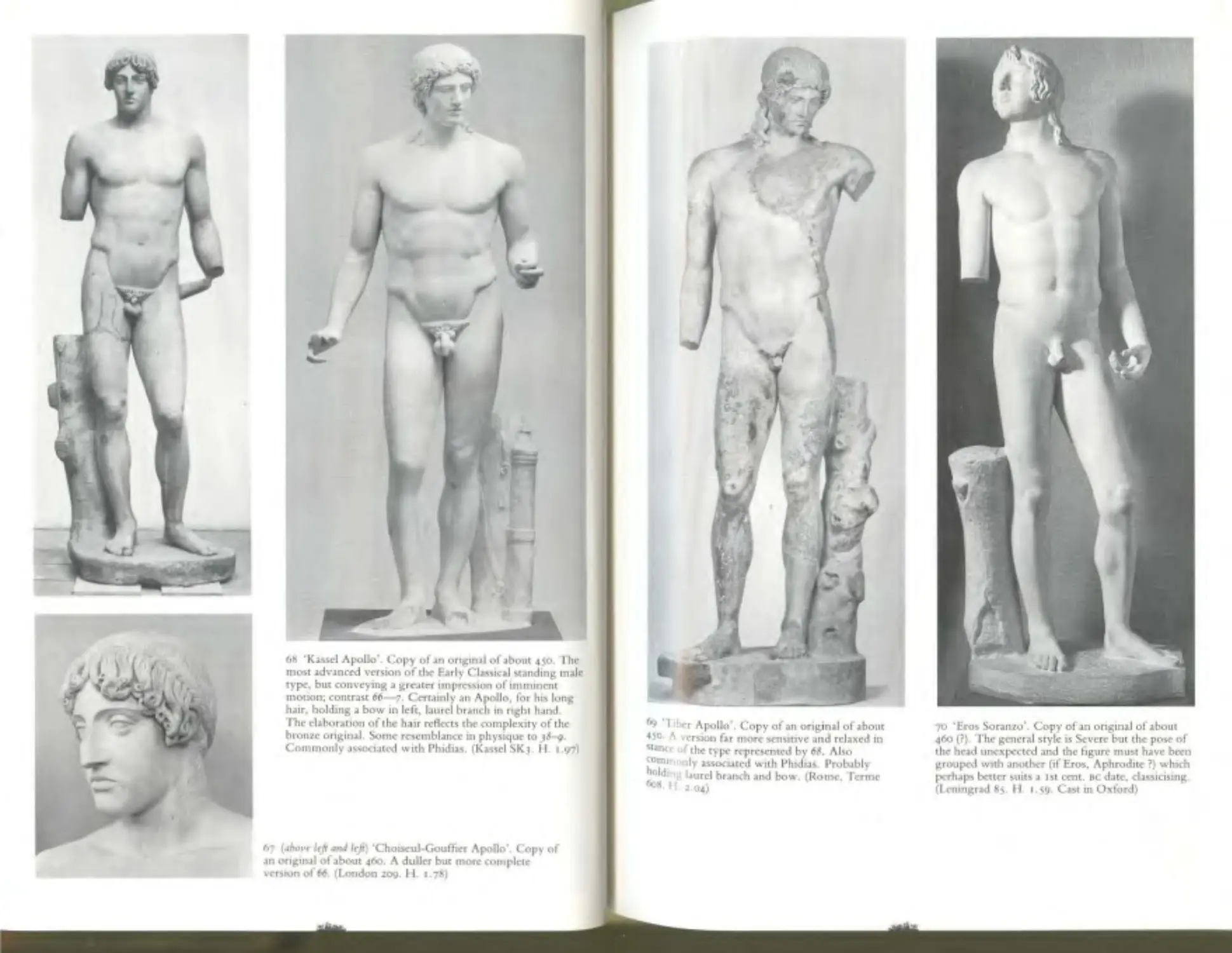
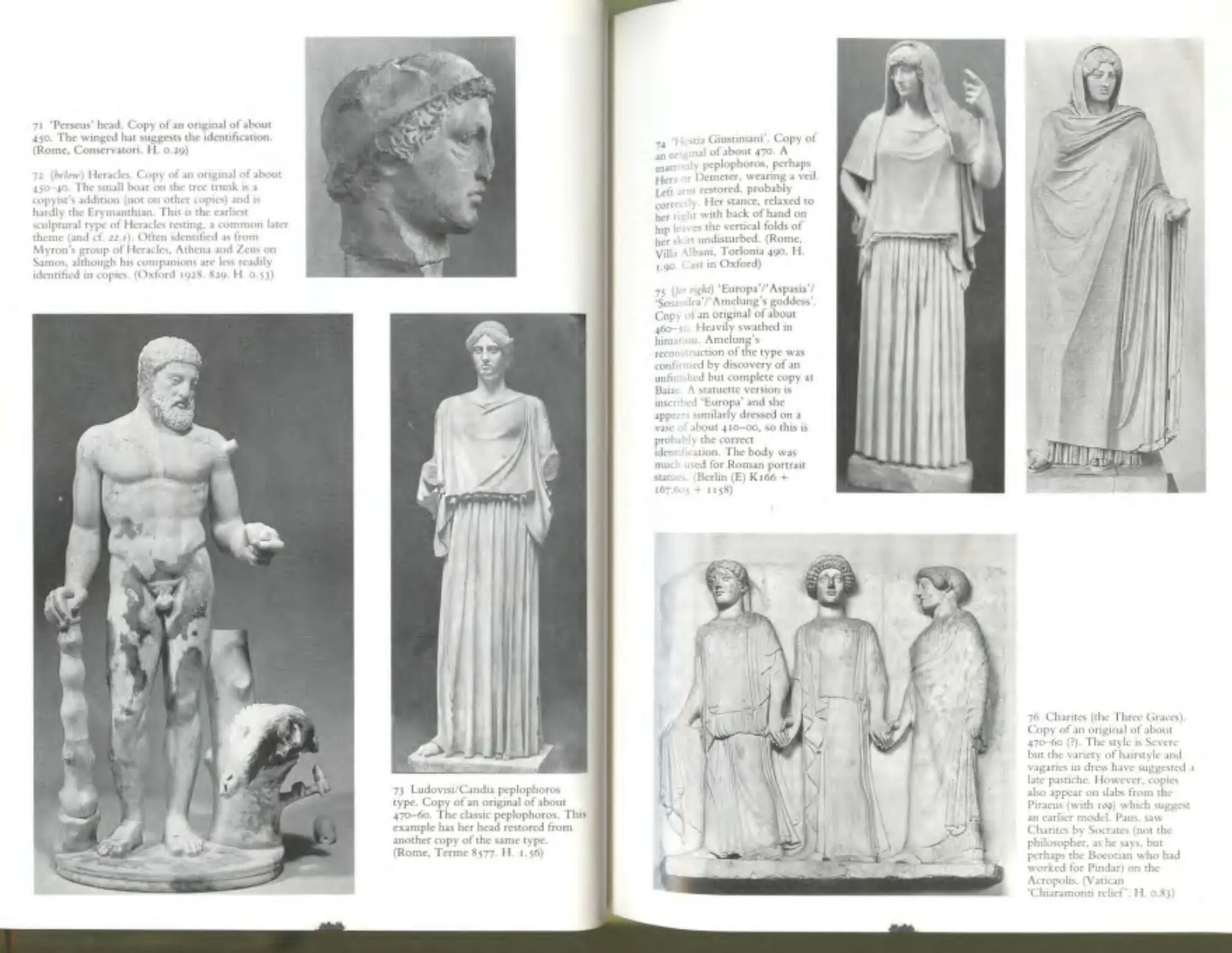
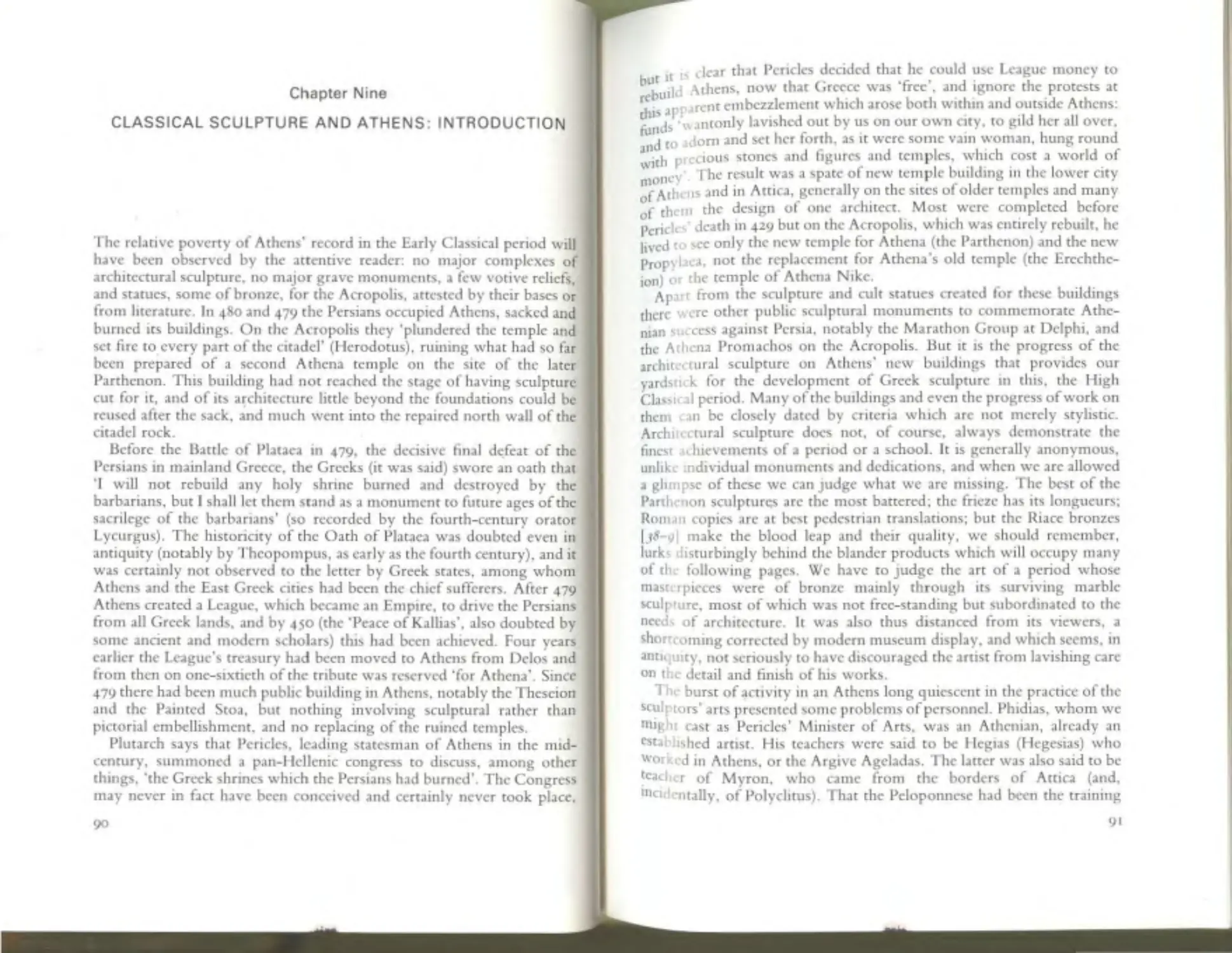
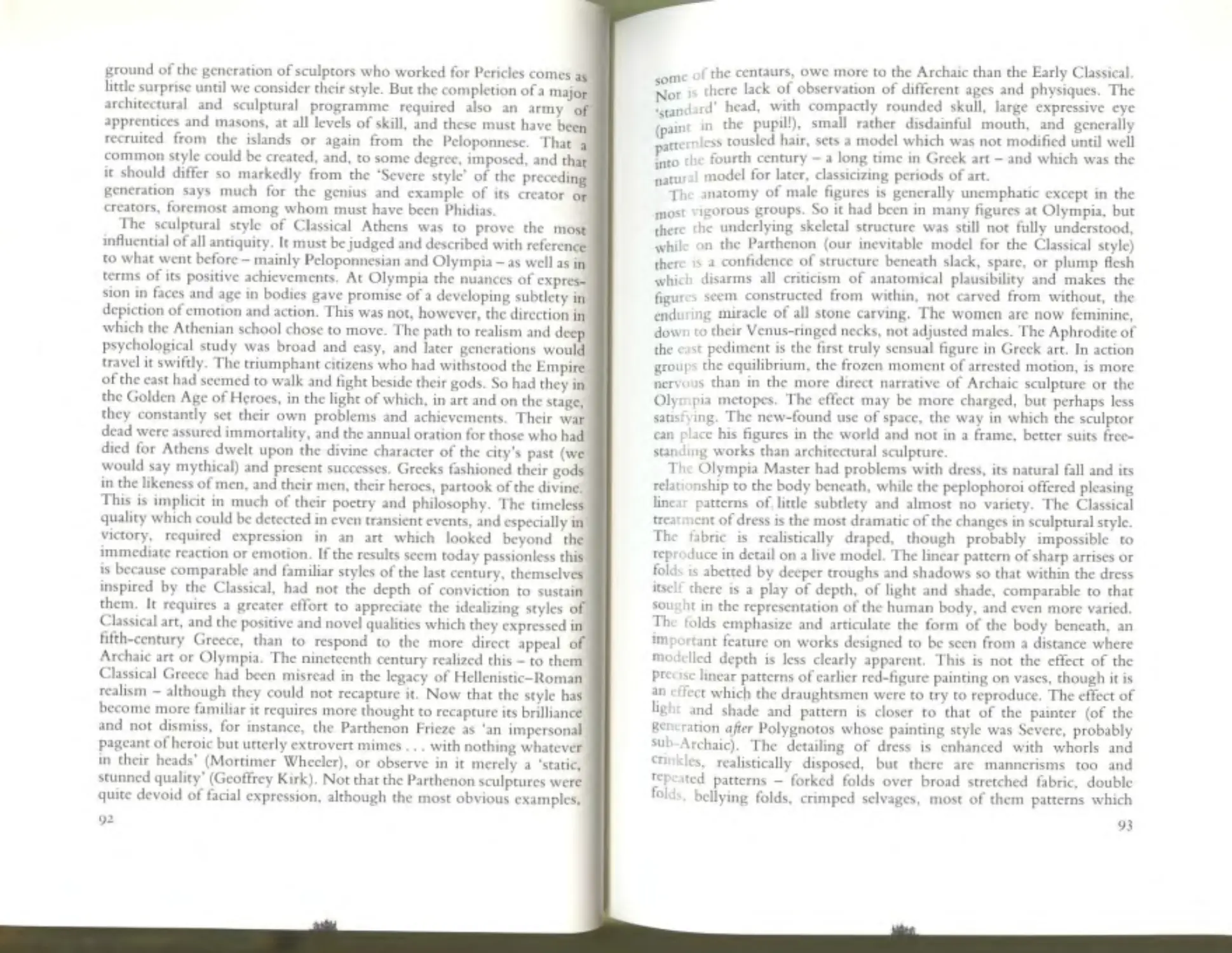
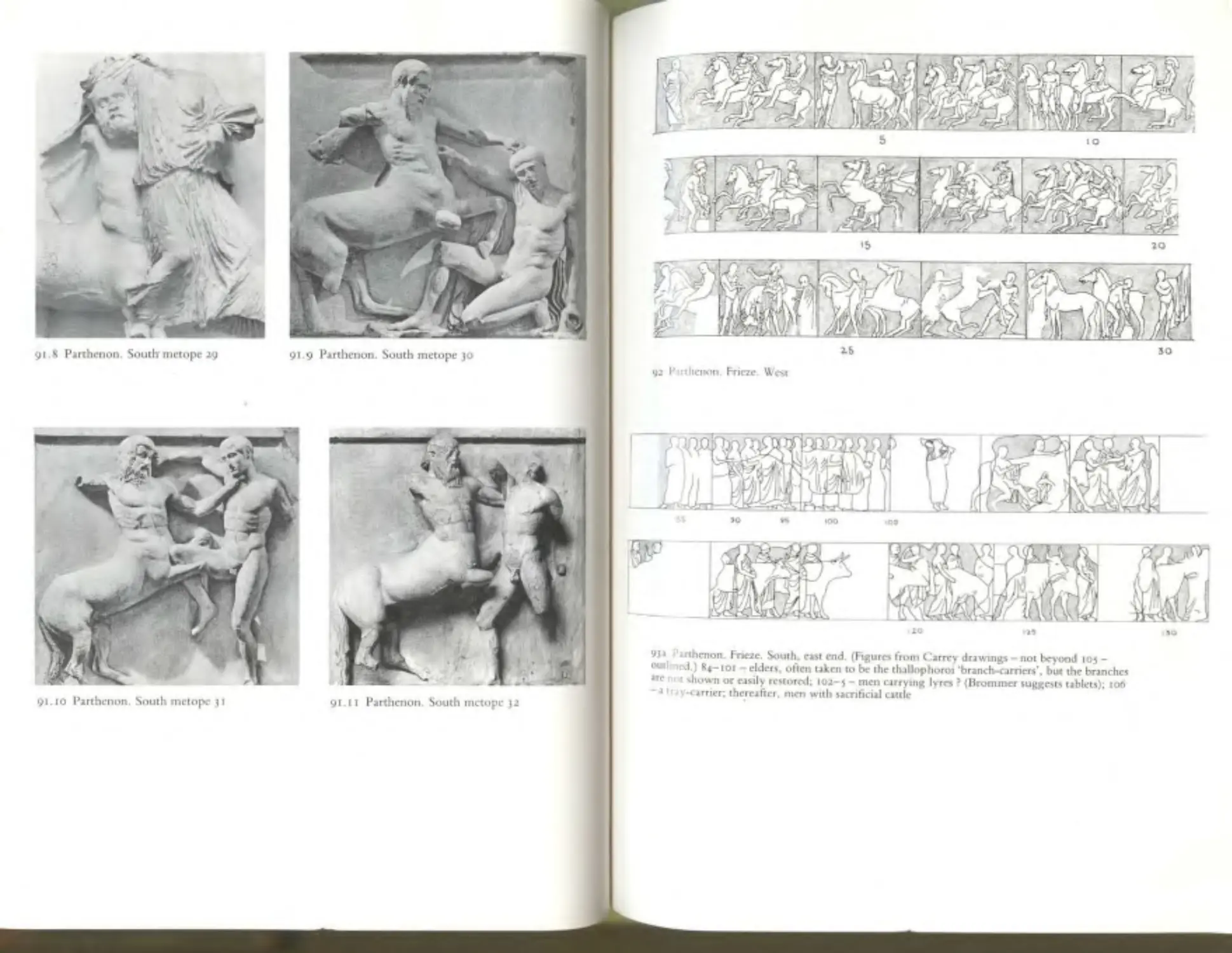
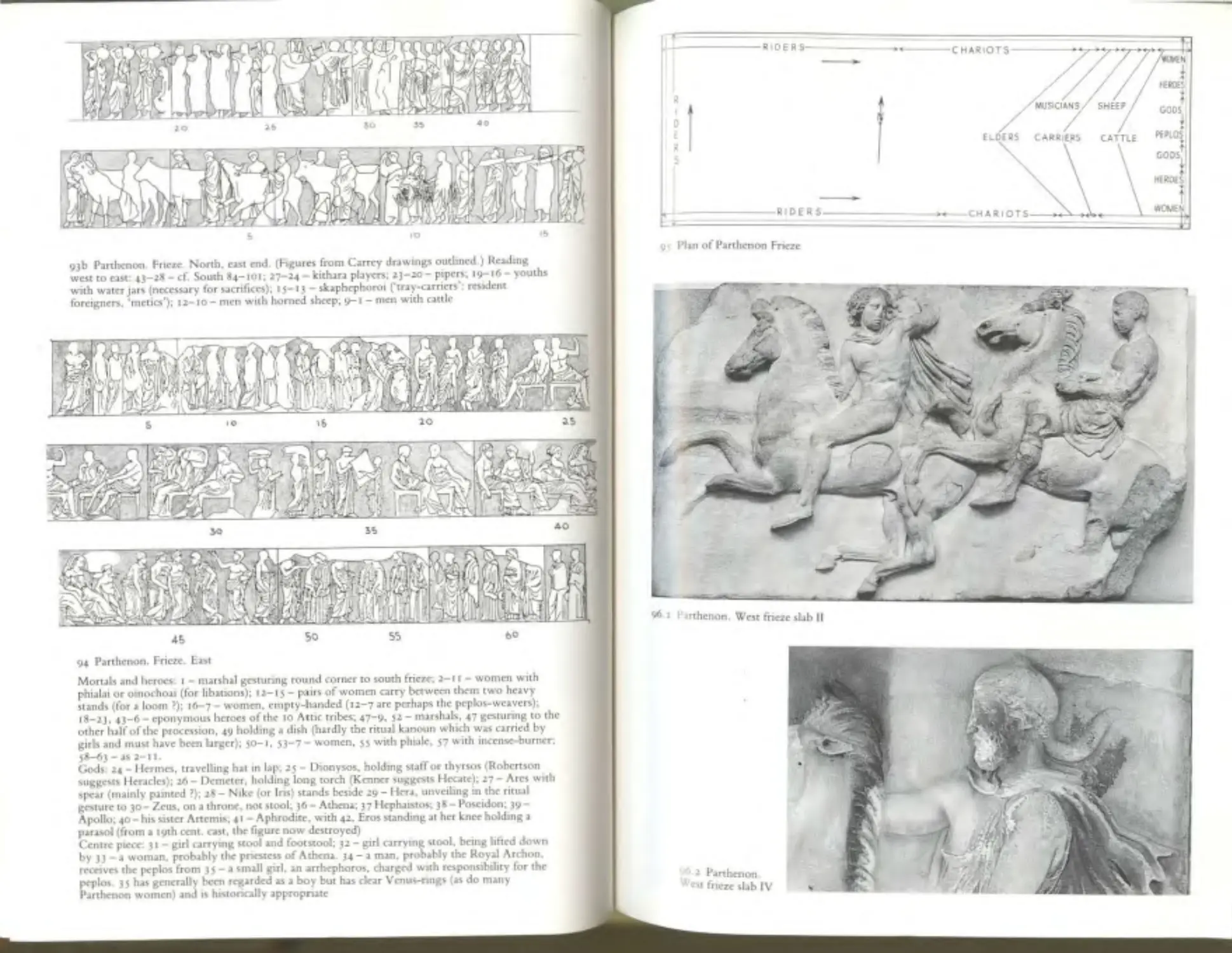
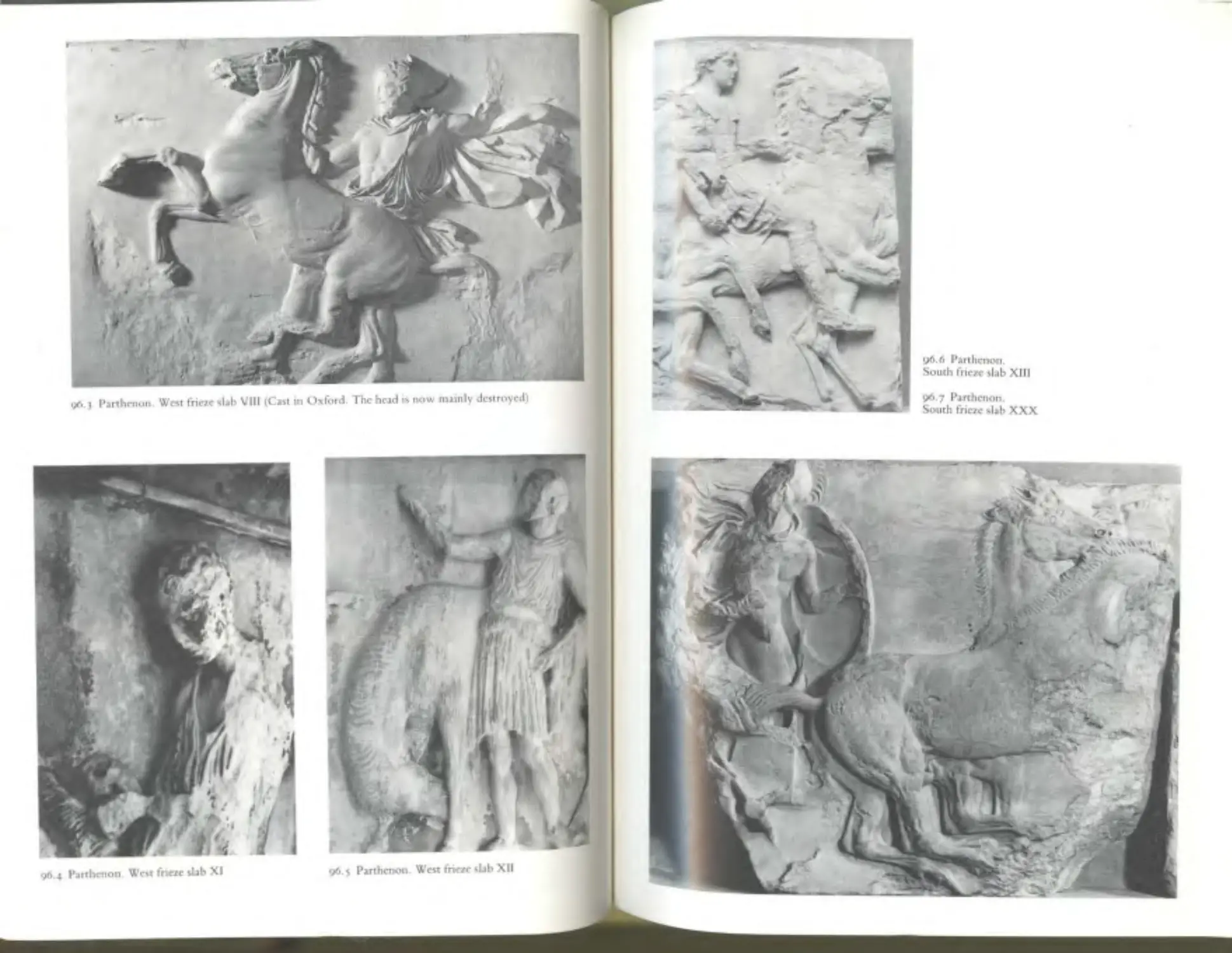
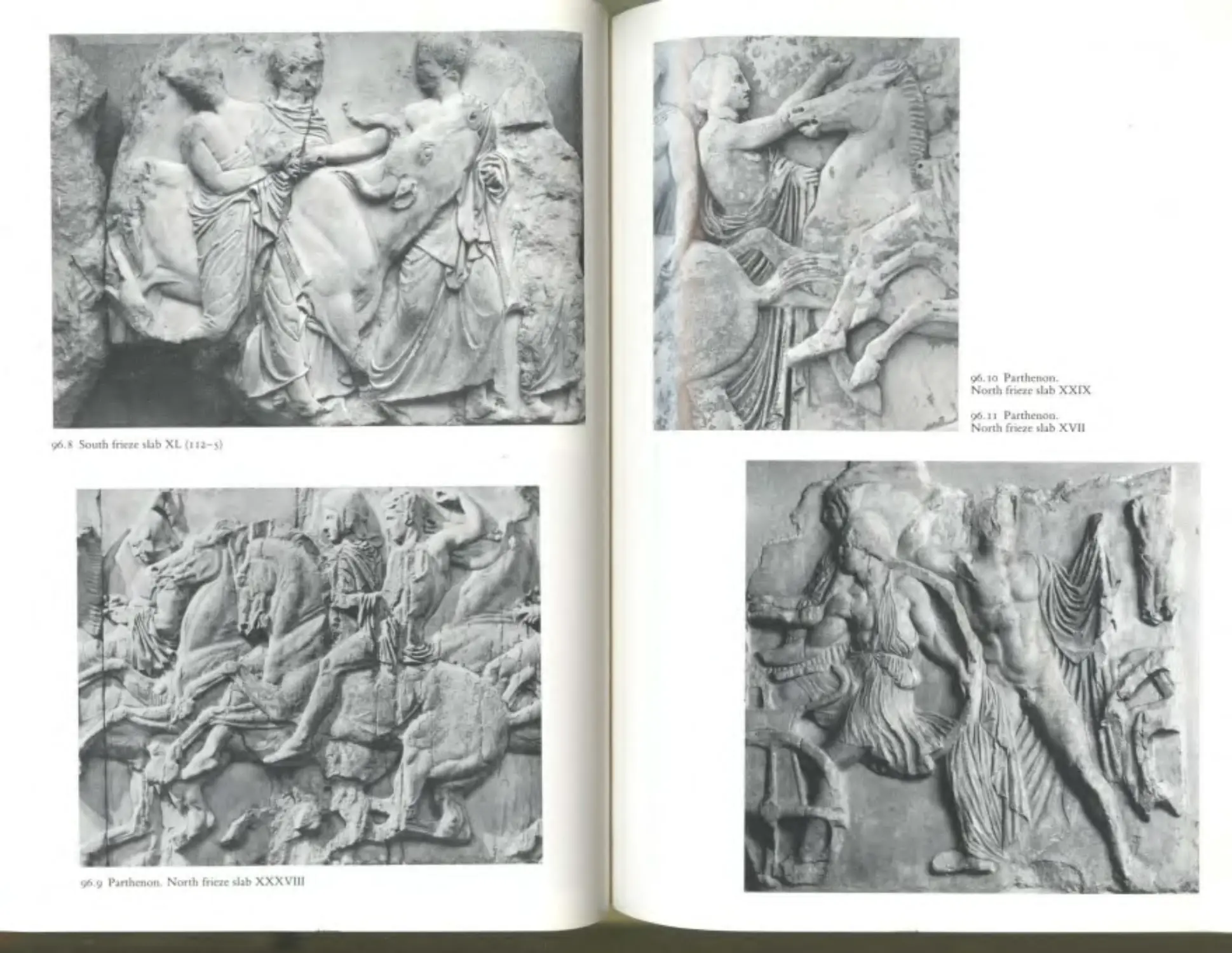

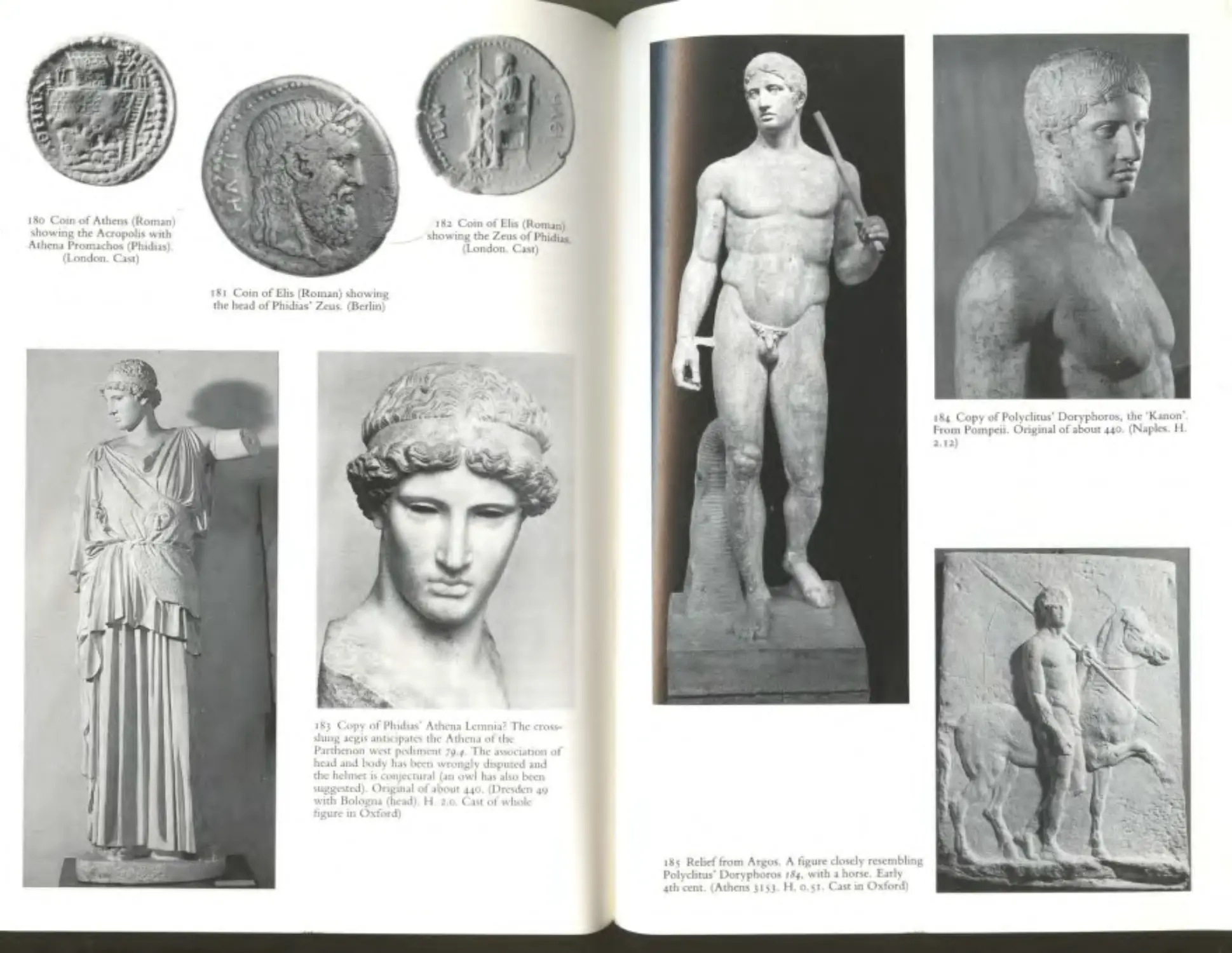
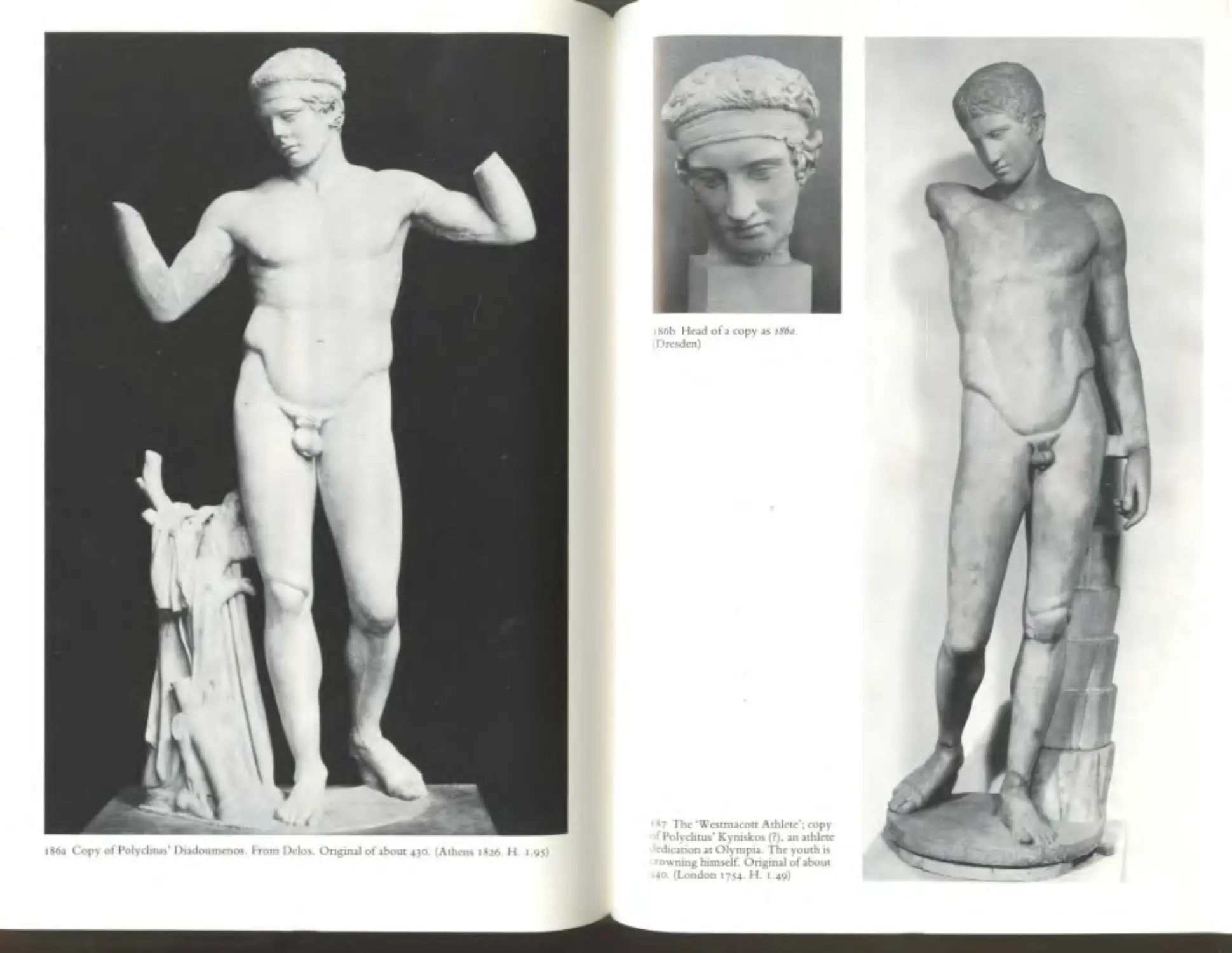
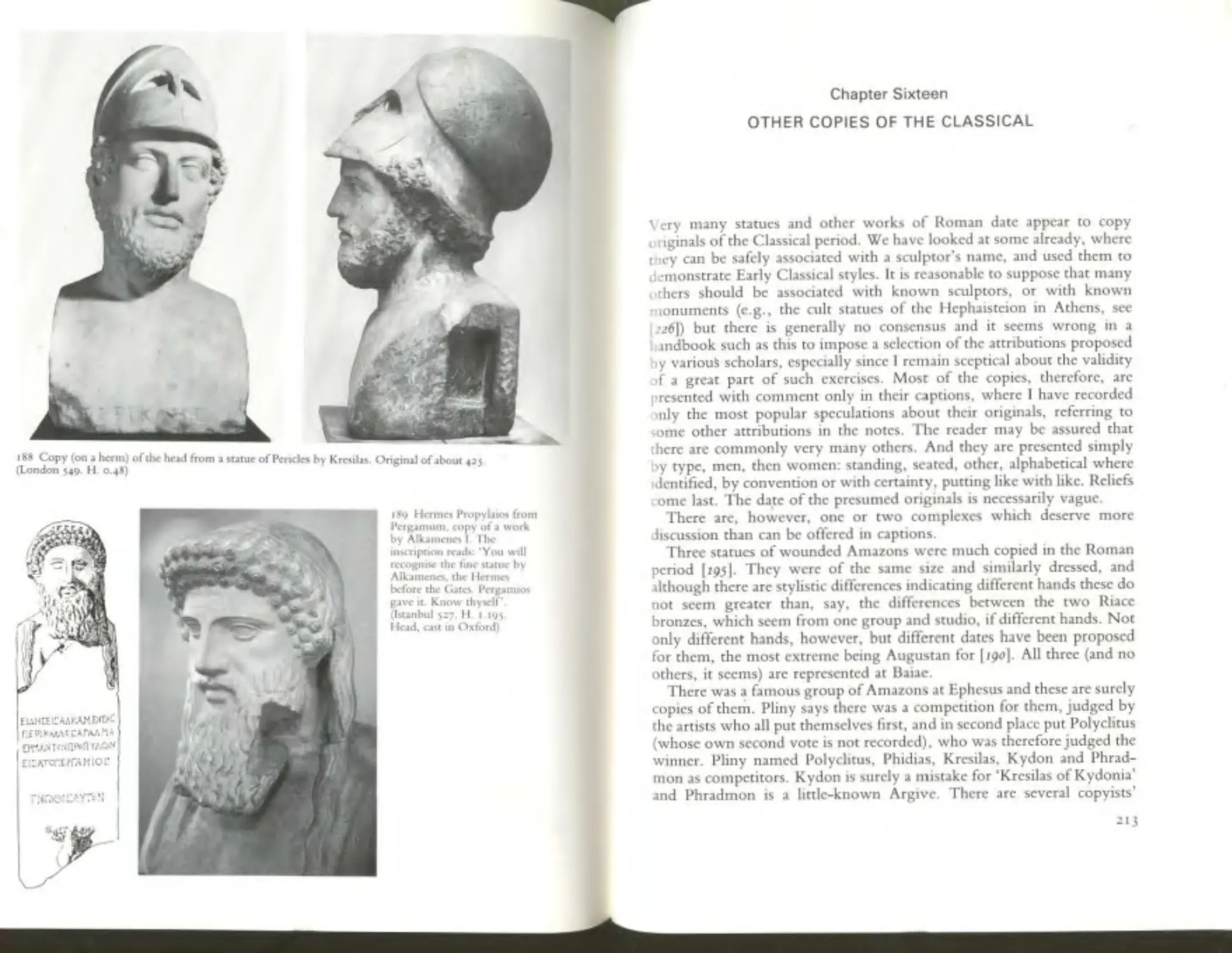
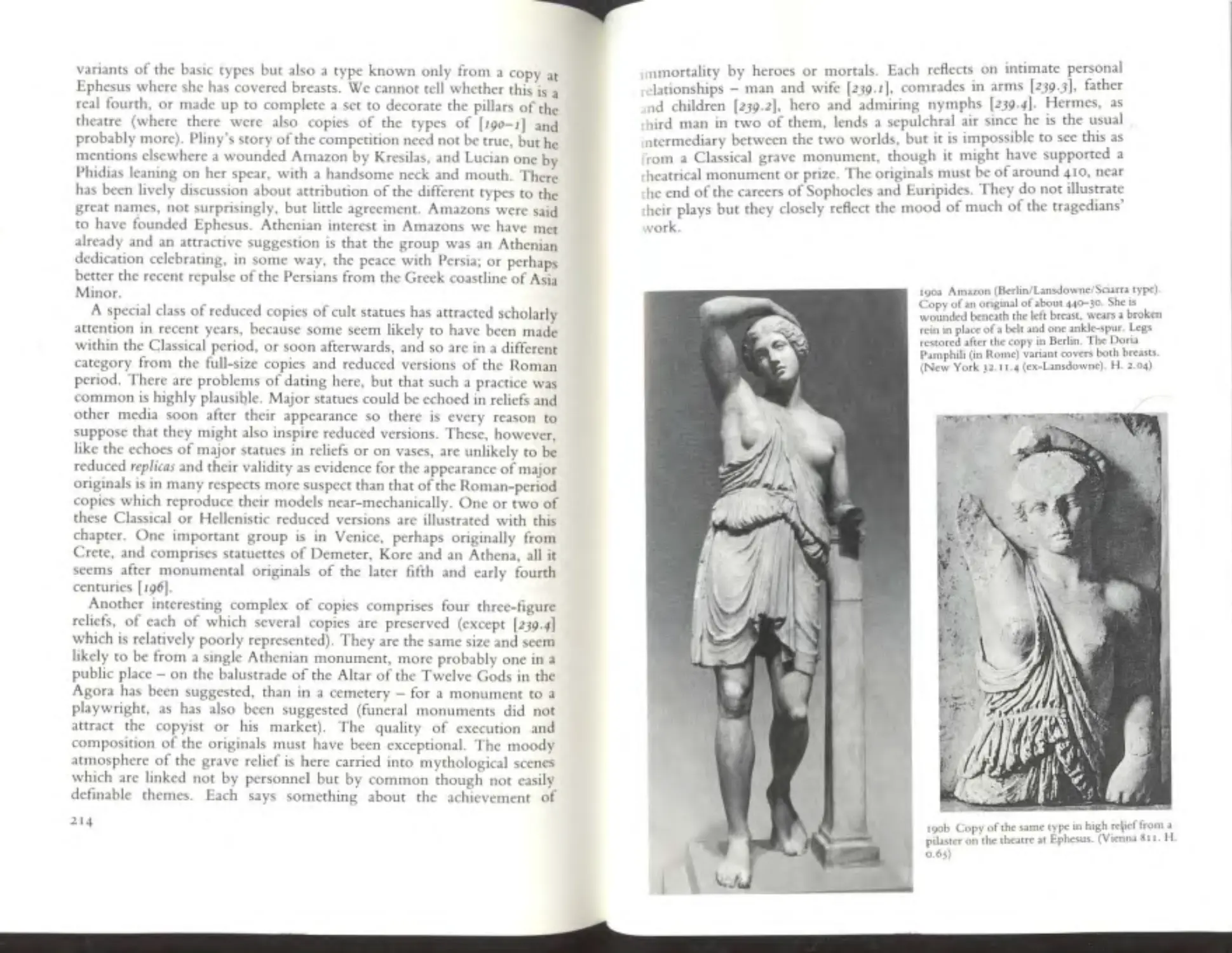
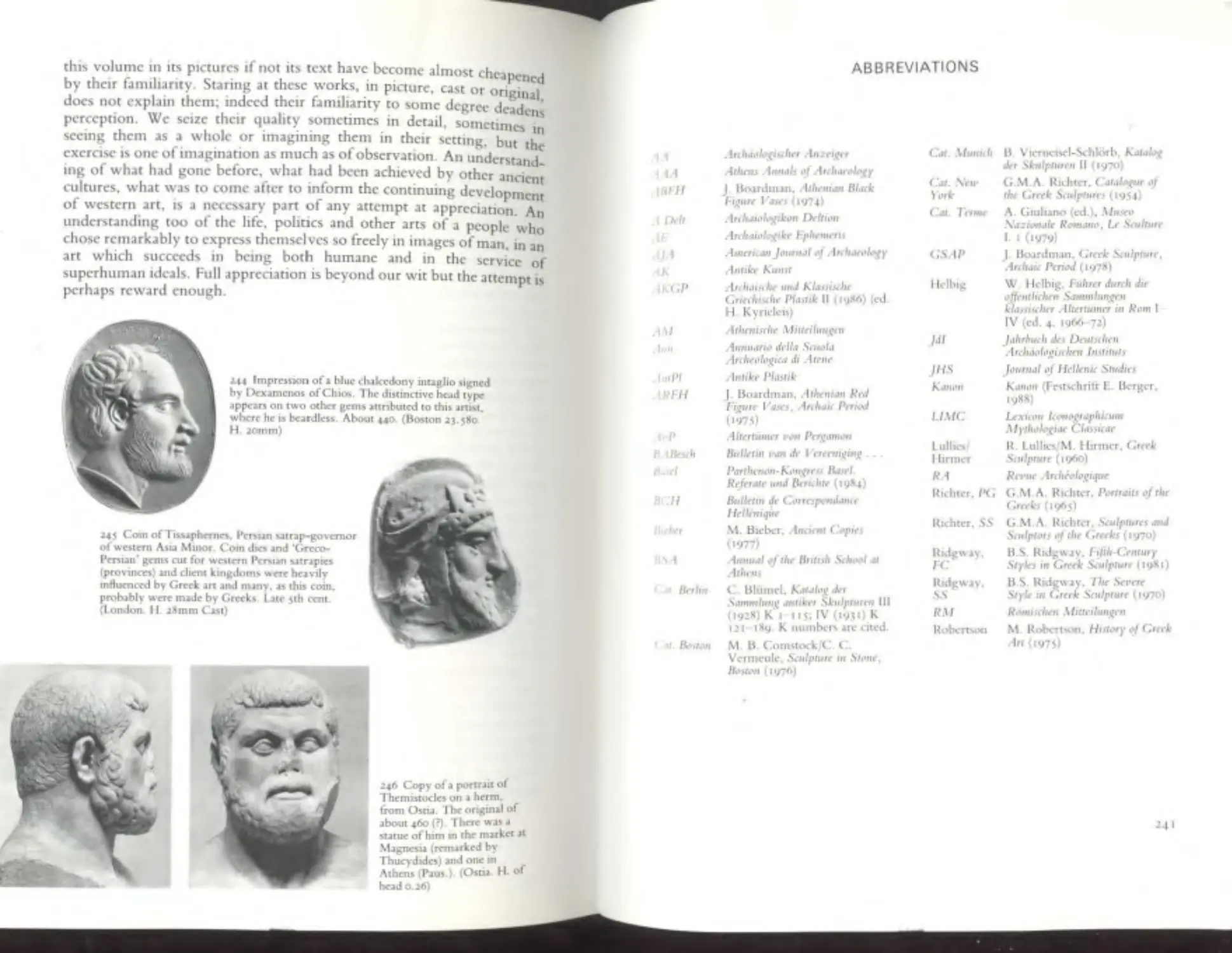
Author: Boardman J.
Tags: art ancient history sculpture ancient greece sculpture art the classical period sculpture handbook thames and hudson
Year: 1985
Similar

Text
Sir John Bo>rdman "
l mroln Profc,,or of Cl.l"Jcal Archaeology .nul An
.l l (.)xford Umvcnny Jnd .1 fellow of the llnu'h Ar.1c.kmy
lie.• \\.1\ A\\lfitam Dm..·nnr of the Rnn~h School at Athens.
then Av~l\t.Ult Kccpn Jl dll· A'hmolcan Mu\CUI11, Oxford.
before becomin g a Rc.-. u .kr 111 Cl.t\\tc:al Arch.u:oloAY m the
Unlvt. 'f\ll). th~n Prote\''iOf. lie h,I\CXCI\':ttcd 111 Crete. Chios
<llld Lahy.1 . I Its other h.uu.lbuoJ...~ .1rc dt:\"(Hnl to ·ltltn1ian Rt·d
f-,_~urr I -d~t·J (volume' on thl· Archaic and the Cia,,tcal).
.-lthnJidll Rltuk F({!urc I ·ll.\f5 .1nd Grn:k .Swlfuurr - Tltt• Archau
Prrhld. He J\ also the author ofCrrrk .- lrtm du= World ofArt
'ene'; cx<.:.wanon pubhouon'; Tlu• Grab Ol•rrsr,Js: Tlte
J>~~rtllnl(l/1 ""d its SmiJ'flm•. (: and several book' on .mncnt
gL'Ill' .1nd finger nng~.
WORLD OF ART
I h1' t:unml~ 'icnco,
prondl'\ tht· WldC4it JVJ1i.1bk
r.1ngc of lllll\tr.ucd hooko;; on art m .t!I H\ .l\pcn~.
I f you would hlo..t• to rt'n'l\"C a compk·tt' l1 \t
of utk\ 111 pnm please ''rue to·
TIIA\11\ -' ' D I ILD\0'\
30 Bloomdnu~ Stn.·ct, London \' <. 1R Jf~P
In tin' Umtcd St.ut·, plc.a'ic wntt· to:
THA\H<i AI\, I) IH U\0'\; I'(
)00 llfth Avt'IHIC, Nt•w York, Ne\\ Vor!... 10110
1196
$ 1.48
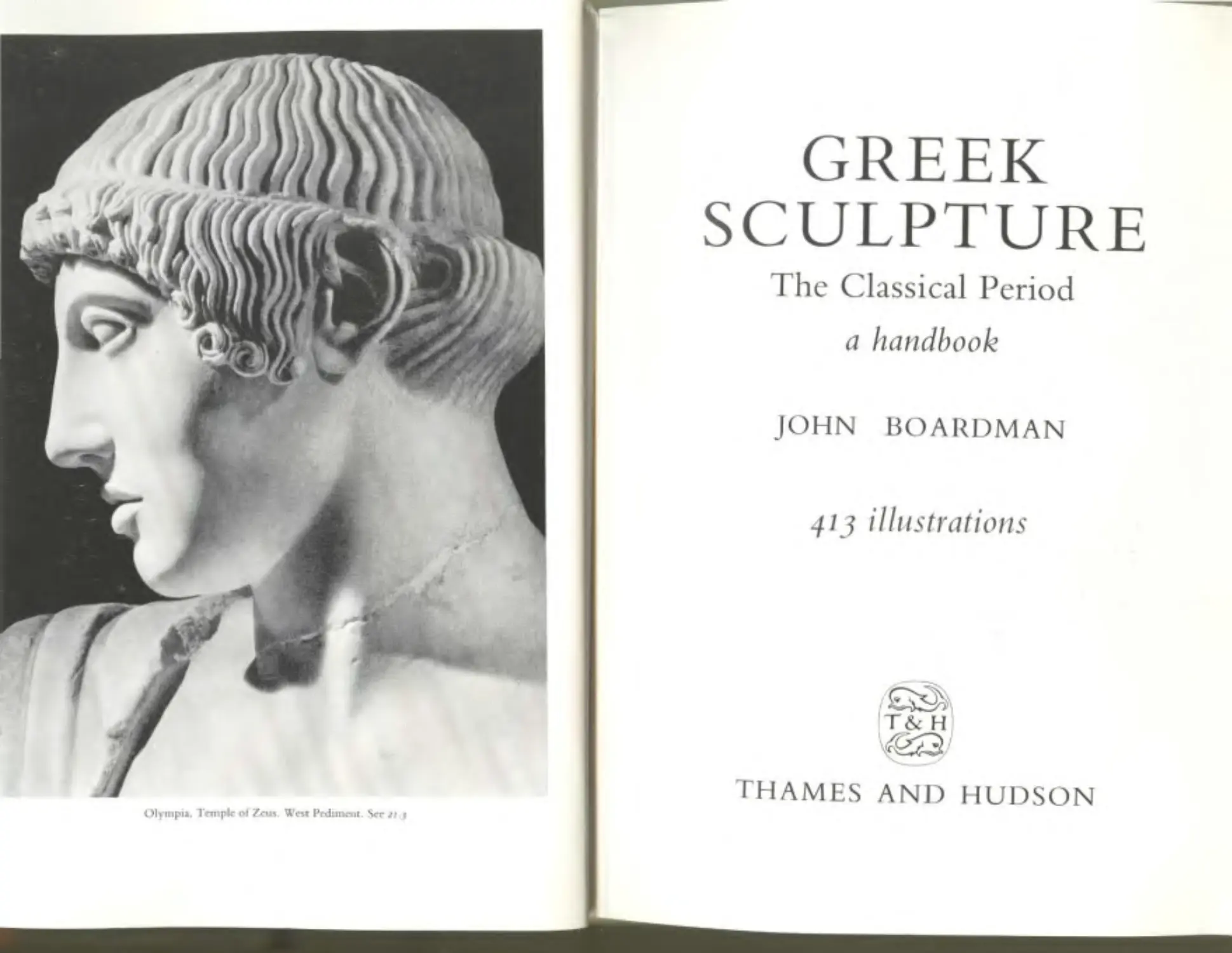
O lymp1a, r tmplc: ofZcus. Wtsl Ptdimc:nL See 1 I .J
GREEK
SCULPTURE
The Classical Period
a handbook
JOHN BOARDMAN
413 illustrations
~
@)
THAMES AND HUDSON
. '1uy ft'P)' ~~.f tlru ltt,1,k iuutd by tlupublidra •h a
p.Jptrb.J,k j, _,,,ilf Jll~lt'" ,,, tlrt n't~dllum tlr.Jt tt ~lr.Jll PWI,
by ll'ay pf1raJ1• , , , ,,,Ju·ru·ut, be- /rut, rn,,M, luml out
11,- otltt·ru.•r.•r or.ulatnl, 14'Uih'UIIIrc puh/r_•ltrr's prwr
wmmt, ;, arry}~''"' ~~ bmdur.l! ,,,- "'''tr M~ratlran tlrac
m rdritlf it r• fiU/IIHJrn/iJ/111 ll'lllliJUI .J mm/.Jr ltlW/rtwu
mcluJm.l! tlu·tt .,.,,,,J, l~t·ru,l! "''l'tHtd ,,, a .cuhJtqumt
puulw_<t>r .
c 19,il5 Tlwmn ,,.J li111IW11 l .ltl, l .tmrlmr
CCirrC'(tnl rdrllott H)() I
Rrt~rmlt'llt"9l
1111 ri(!hU r('\l'11'f'tl. St~ 1''"' 4tln~-~ JlUbliwtitm ttMy l1f
rrpr 11ducnl c~r tmmmilffll w ""Y }''"'''''by"'')' mra~u,
efrcmmir M ml'flratlical, mdwlm.\! J'lmtc'n'J'Y• ruo~dw,l!
or- 1111 y u~/i"'n!lfhllf -~' '',-_".!!<" aud rflrtn•al ~Y-'It'm, wrtlwur
p4-·nui~~i1m 111 "'"'"'.~! .frMII tlu· ruMr<lu ·r
CONTENTS
Preface
TECHNIQUES AND SOURCES
Techniques; Sources: orig inal work s, copies, literature
2 EARLY C LASSICAL SCULPTURE:
INTRODUCTION
EARLY CLASSICAL MEN AND WOMEN: I
4 OLYMPIA: THETEMPLE OFZEUS
EARLY CLASSICAL MEN AND WOMEN: 11
6 EARLY CLASSICAL RELIEF SCULPTURE
Votive and architectural reliefs; Grave reliefs
7 NAMES AND ATTH.Il:3UTIONS
Kritios and Nesiotes; Py thagoras; Kalami s; Myron
8 OTHER COPIES OF TilE EA RLY C LASSICAL
J C LASSICAL SCULPTU RE AND AT! lENS:
INTRODUCTION
10 THE PARTHENON
T h e Pediments; The M etopc s; The Frieze; Akroteria;
Plannin g and execution; Cult statue
Ir OTI IER ATTIC ARCI IITECTURAL SCULPTURE
Dori c T e mples; Io ni c Temples
r~ THEMES IN ATTIC SCULPTURE
' 3 OTHER CLASSICAL SCULPTURE
7
10
20
33
66
79
g6
J68
175
14 OTIIER C LASS ICAL RELIEF SCULPTURE
Attic grave reliefs; N o n-Attic grave reli efs; Votive
reliefs; Record reliefs
15 NAMES AND ATTRIBUTIONS
Phid1as; Po lyclitus; Krcsi la s; Alkamenes; A go rakritos;
Kallim ac h os; Lykios; Strongylion; Paioni os
16 OTIIER COPIES OFTi lE CLASSICAL
17 CONCLUSION
Abbreviations
Notes and 13 ibli ogr a phies
Index of lllu st ration s
Index of Artists
Acknowl ed gments
General Ind ex
203
213
Preface
This volume is a sequel to Greek Sculptu re, The Archaic Period (hereafter
GSAP) publi shed in 1978. The intenti o n had once been to include in it an
account of Greek sc ulpture in the co lo n ies as well as that of the Ea rl y
Classical period, but it has seemed better to deal only with the Greek
homeland, and to em brace all the r emaining fifth century BC, which
includes th e prime period of Cl assica l scu lpture in the commo n ly
accepted use of the term. Within these years Greek sculptors refined their
techniques and confirmed th eir abil ity to cre ate realistic images of the
hum an body, in action or repose, without su rrendering their profound
concern with proportion and design. Later centuries explored r ea li sm
further, and the R o man admiration for all things Greek e nsu red tha t the
idiom remained central to the future development o f Western art . T he
familiarity of the idiom does not make it easier for us to understand o r
appreciate. We do well to remind ourselves that in thi s century and in
Greece, for the first time in the histo r y of man, artists succeeded in
reconciling a strong sense o f form with total r ea li sm, that they both
consciously sought the ideal in figure r epresentati on, and explored the
possibilities of rendering emotion, mood, even the individuality of
portraiture . lt marks a crucial stage which determined that one cu lture at
least in man's hi story was to adopt a w holly new approach to the
function and expression of its VISua l arts.
This was a period of an x iety and excitement throughout the Greek
world. lt saw the threat of conquest by Persia, a democracy- Athens -
cr eating an empire and then losin g it. In Athens A eschylus, Sophocles,
Eu r ipides and Ari st ophanes w r ought the ir versions of Greek myth-
history to counsel and entertain the citizenry. llis to ry, in th e real se nse of
the word, was born, and a philosophy which explored the working of
man's intellect and not o n ly of the world around him. So far as they
could, the visual arts too answered the mood of the day, but their
message is less clearly read than the tex ts of philosophers, histor ians and
poets, and far more difficu lt to comp r ehend.
Our evidence for the fifth century is so different from that for the
Archaic period that part of the first chapter has been devoted to sources.
1t Will help explain why, in one respect, this book is not laid out in quite
7
the manner of most text-books on Greek scul pture. In these ch apters I
have rigorously segregated Roman copi es (presu m ed) of C lassica l
statues, except where their fifth-century ongmals ea~ cc rt a111ly or a~most
certainly be identified. Attempts at such tdenuficauon w tth a parucular
statue arc gene r all y found to depend on the barest m cnuon of a work
whose subject and appar ent fate see m to fit, an d attnbunons to named
scu lptors depend on mainly subjective criteria wh1ch arc themselves
dc n vcd from equall y suspect identifications. Not surpn s111g ly, there IS
virtually n ever agreement over a s in gle piece and the likelihood of
consensus over most ofthem lessens all the time. It is, ofcourse, valuable
to assemble, co mpare and identify the relations hips of copies which
a ppear to be based o n a single original. But it is the deductions fr om such
studies, leadi ng to attributions whi ch arc then use d to demonstrate the
d evelopment and history of Classica l sculpture, that s uddenly ~cmovc
the subject from th e r easonably verifiab le to the purely s pcculauvc and
poten tially mi slea ding . The sc holarly ingenu ity and t1mc s pent on su ch
attribution s tudies (Kopiwforsclumg) seems to grow as the years pass, yet
with diminishing r eturns , and is p erhaps the oddcst phenomenon 111 all
Classical scholarship. Only major new finds bring new hope. It seem s to
me wrong that such guesses should be accorded a status compar ab le with
that of discussion of origina l works, yet in some scu lpture handbook s
co pies and originals arc not even distinguished ex plici tly one from the
other. It is ver y likel y that lost works known only by name arc to be
identified in the many copies made for Roman patrons in Italy, the
Empire and the Greek East, which have su rvived, and lt I S understand-
able that scholars should attempt s uch ide ntifications, bm With such
general lack of agreement it m ay be safer to adm1t, that we_ a~c still
explo rin g the unknowablc, and we 1mpatr a. studen t s apprcc1auon of
o ri ginal works by giving them undue prommencc.. we ~ecd be 111 no
hurry to d1scovcr the whole truth, nor be too d1 sappom tcd 1f 1t eludes us.
lt has been well remarked that the only co py (zzz] which in r ecent yea r s
has been positively identified as a r esult of the find of parts of its o ri g111al
had never been attributed by scholars to its true au th or. I would n ot,
however, go to the further extreme, fashionable in som e quarters, of
seei ng as late pastiches many ge nerally accepted Class1cal o n g 111 a ls and
copies.
.
.
The o riginal scu lpture which has surv1vcd, howeve r , IS seldom the
very best. From Olympia and the P arthenon we hav e what must surely
be the best architectural scu lptures oftheir period, but the very bes t work
was in bronze and the few surviving examples do little m o re than remind
u s how much we miss. There were assuredly great works in m arble, and
some can s till be ad mired, though sel dom complete and always lacking
their original colours. We arc, as it were, trying to appreciate Shakes-
8
peare's genius as a playwnght from A1 You Like It, some sonnets and
Lam b's Tales.
The purpose of th1s volume, as w 1t h GSAP, has been to mtroduce to
the stude nt and genera l r eader what ev1d cncc we have for the appearance
and development of sculpture m the fifth century. A balance had to be
s truck between text, dlu strauon and documentation to do justice to as
much as co uld reasonably be fitted m to the 252 pages of the volumes of
this series. Figure captions therefore carry m format ion which might have
seemed otiose in the text. Measurements ar c in metres; the material IS
marble unl ess other wise stated; dates arc all BC. The photographs are
n u merous and some, perforce, small. They arc supplemen ted by
drawings made for th is book by Marion Cox. Photographs of casts have
been used where conven ient. Casts r ecord appearance acc urately.
without the blemish which often disfigures the orig inal. And in a
collection such as that of the A shmolcan Museum Cast Gallery at Oxford
it is possible to dictate an g le a nd lighting more freely than in most
museums. There are good cast ga ll eri es in Britain, n otably in Oxford and
in Cambridge, and the interested reade r may learn more from them than
from the large plates of an art book. Studio lighting does not always best
suit marble statues. For o ri gi na ls we turn especiall y, outside Greece
itself, to the British Museum, tO the Louvre, Berlin, Muni ch and Rome,
while other museums of Europe an d the United States ar e well suppl ied
with Rom an copies, but on theoe the modern restor er may have taken us
even a stage furt her from the original than had the Roman copyist.
For th1 ~ repnnt (1991) llllliOr <Orrccuom and addmons have been made
to the text md notes, notably to pp. 17 5 and 206, and fig. 134a added on
p.l74·
9
Techniques
Chapt er One
TECHN IQUES A N D SOU RCES
The work of creating a life-size marble statue, from quarry block to a
figure ready for display, is said to require the labour of one man - year.
The material may not in antiquity have seemed particularly precious -
Greece had mountains of fine white marble in Attica and the Islands- but
quarrying it took some skill, and much time and labour. Greek sculptors
had turned from the more easily worked limestones to marble in the
seventh century B c, and by the fifth century most of their work in stone
was in marble except where access to quarries posed problems or the
appetite for the best in materials was not demanding. The major
sculpture of other early cultures was sometimes of even harder material
(granite or porphyry in Egypt), but not commonly white, nor, except
for alabaster which was not often used for large figures, endued with the
potential for translucency of marble. That the most accessible of durable
stones for the Greek workshops had characteristics which lent them-
selves to the realistic imitation of human Acsh may have played no small
part in the direction, speed and success of developments in sculpture of
Greek lands in the Classical period and later.
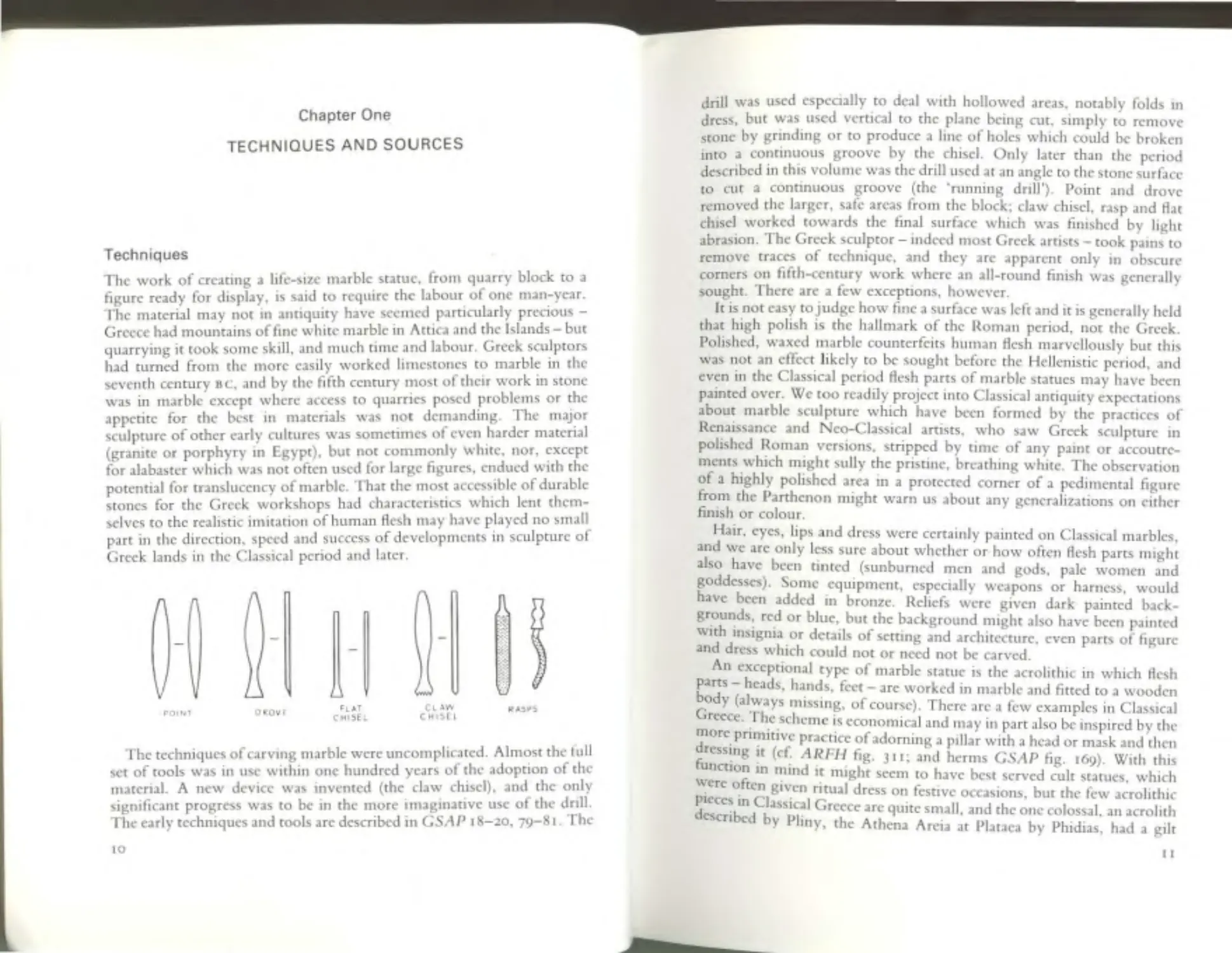
POINT
DR.OvE
FLAT
CHI5fL
CLAW
CHI~EI
RASPS
The techniques of carving marble were uncomplicated. Almost the full
set of tools was in use within one hundred years of the adoption of the
material. A new device was invented (the claw ch1sel), and the only
significant progress was to be in the more unaginative use of the drill.
The early techniques and tools are described in GSAP I 8-20, 79-81. The
10
drill was used especially to deal with hollowed areas, notably folds m
dress, but was used verncal to the plane bemg cut, simply to remove
stone by gnndmg or to produce a line of holes which could be broken
into a continuous groove by the chisel. Only later than the period
described in this volume was the drill used at an angle to the stone surface
to cut a contmuous groove (the 'running drill'). Point and drove
removed the larger, safe areas from the block; claw chisel, rasp and Aat
ch1sel worked towards the fina l surface which was finished by light
abras1on. The Greek sculptor- mdeed most Greek artists- took pains to
remove traces of tcchmquc, and they are apparent only in obscure
corners on fifth-century work where an all-round finish was generally
sought. There are a few exceptions, however.
It is .not easy to )udge how fine a surface was left and it is generally held
that h1gh pohsh IS the hallmark of the Roman period, not the Greek.
Pohshed, waxed ~arble counterfeits human Aesh marvellously but this
was not an effect hkcly to be sought before the Hellenistic period and
even in the Classical period Aesh parts of marble statues may have,becn
pa1nted over. We too readilyproject into Classical antiquity expectations
about marble sculpture which have been formed by the practices of
RenaiSSance and Neo-Classical artists, who saw Greek sculpture in
polished ~oma~ vemons, stnpped by tim e of any paint or accoutre-
ments .wh1ch nught sully the pristine, breathing white. The observation
of a h1ghly pohshed a~ea in a protected corner of a pedimental figure
from the Parthenon m1ght warn us about any generalizations on either
fimsh or colour.
Hai r, eyes, lips and dress were certainly painted on C lassical marbles,
and we are only less sure about whether or how often Aesh parts might
also have been tinted . (sunburned men and gods, pale women and
~oddcsses). Some eqmpment, especially weapons or harness would
ave been added in bronze. Reliefs were given dark painte'd back-
grounds: red or blue, but the background n11ght also have been painted
~~~h mslgma or details of setting and architecture, even parts of figure
dress wh1ch could not or need not be carved.
An exceptiOnal type of marble statue is the acrolithic in which Acsh
parts - heads hand fi
kd·
bd
•
s, eet- arc wor e 111 marble and fitted to a wooden
G
o Y (always missing, of course). There ar c a few examples in Classical
recce. The scheme ·
·
1d
.
.
..
IS econom1ca an may 111 part also be inspired by the
;ore. prmunvc practice ofadorning a pillar with a head or mask and then
f~~~~mg ~t (et: ARFH fig. 3 I I; and hcrms GSAP fig. 169). With this
Were
10
fin 111 1~1111d lt might seem to have best served cult starues which
0 ten g•vcn ritual d e
"
·
'
pieces i Cl .
1
r ss on •esnvc occas1ons, but the few acrolith. ic
n ass1ca Greece are ·
ll dh
1
described b PI
qmte s~a , an t e one eo ossa!, an acrolah
Y my, the Athena Are1a at Plataca by Phidias, had a g ilt
II
wooden body. This is only economical to the extent that it did not
employ ivory for the Aesh parts, as did the great C laSSical chrysclcphan-
tine cult statues, like the Athena Parthcnos. We know somethmg of
smaller chrysclcpha ntine figures ofthe Archaic period (GSAP So, 89, fig.
I27) but in the C la ssical, as we shall sec, we know even less than we do of
the acroliths, but the discovery of the workshop in which Phidias made
the chryselephantine Zcus for the temple at Olympia (sec Chapter 4) has
told us something about their technique. The studio matched the size of
the temple interior (cella) in which the statue was to be placed, and the
work must have been erected there for eventual reassembly in its final
home. It appears that a jigsaw of fired clay moulds was prepared from a
full-size model, on which sheets ofgold could be pressed to their correct
size and shape. It seems, then, that they were not fastened to a fully
carved wooden body, which is what we might have expected, since this
would have rendered the mould intermediaries unnecessary. Moulds
were found for colo ured glass inlays in furniture (the Zeus was
enthroned) and dress, simple ivory tools for working gold and a
goldsmith's hammer. Pausanias' description of the statue mentioned
inlays of other metals, ivory, ebony and stone as well as figurc- pamtmg
on the furillrurc. The Aoor before the statue was a shallow pool of 01l,
and there was a similar one of water in Athens before the Athena in the
Parthenon. Both oil and water played their parts in the preservation of
ivory (to fill pores and maintain humidity) and there were probably
r eAecti ve properties too which were appreciated. In the corner of his
workshop Phidias discarded an Athenian clay mug with 'I belong to
Phidias' written on its base, an unexpected personal memento.
The finest Classical statues were executed in bronze. Techniques of
hollow casting for life-size figures had been perfected by the end of the
Archaic period (CSAP 8I) but we lack scien tific studies of most of the
very few major bronzes surviving and some details of the process still
escape us. Most large figures were cast in parts which were then brazed
together: the Delphi charioteer [34) is in seven pieces- head, upper and
lower torso, arms, feet. The technique was especially necessary for added
spiral locks which could not easily be cast in one piece with a head: e.g .
[12]. It was not impossible, however, to cast the whole figure by the
direct method.
There were two m ethods of cast ing, both, it seems, practised in our
period although not always easily id entified and a lively debate on the
matter continues. For casting by the direct method the figure was
modelled in clay, if necessary on metal armatures. The surface was
finished, with all the desired detail, in hard wax, and the whole then
encased in clay. Core and mantle were held in position by pegs thrust
through them and the wax melted out, to be replaced by molten bronze.
12
The mantle was then broken away and the core, If poss1ble, ch1pped out.
The fimshed work needed scrapmg down and pohshing, bleJmshe&
patched, and there would often be need too for cold work with ch1scl and
graver on the cast surface. The Late Archaic l'~raeus kouros (CSAP fig.
150) was made this way, smce Its armatures and core were found still
within it. It is doubtful whc.rhcr a statue cou ld ea~ily be cast in pieces by
the direct method smce th1s would mean either cutting up the wax-
covered model, which seems wel l- nigh Impossible, or modelling each
section separately, not as a whole, whiCh could hardly either help or
please the artiSt.
The alternanve 'md1rccr' method work\ from the outside m, as It were.
Piece-moulds arc made of the modelled clay figure and lined with wax.
The figure (usually in parts) is then recast and the moulds removed so that
the wax surface can be worked over and added to (details ofhair, ere). The
figure or parts are then coated in a new clay mantle and cast 'circ perduc' in
the usual way. With the direct, there was no possibili t y ofcasting replicas,
nor are any to be found in our period. Identification ofthe indirect method
depends on observation of the inside of the fini~hed bronze, to judge
whether the wax, exactly replaced by the bronze, shows signs of having
been apphed from w1th111. The evidence 1\ ~omet1mes equivocal since, if
the ong111ai figure was carefully finished for threct casting, the wax sheet\
latd upon It m1ght well present neat underside\, observable as the inner
surfaccofthe bronze. Fingerprints or dnps 111 this position are deCISive for
the m direct method, ~moothly jointed sheets are not. The indirect method
seems attested for some Classical bronzes but if piece-moulds were used it
IS remarkable that the joints between the pieces were always so successfully
worked away (compare the network of ridges on the surface of plaster
casts ofClamca l statues, which mark the joms of piece-moulds and arc not
~Iways smoothed away). Small bronzes were cast from solid wax model~.
c1re perdue', but also sometimes from p1cce-moulds.
On the b1ggcrstatues eyes were mlaid With glass or stone· hp; mpplc~
and teeth were dJst111gu1shed from the body by 111lays 111 rud,dy c~pper or
sil ver, wh1ch could also be used for decoration on dress. The body of the
statue would appear bright and shining, 1ts tone depending on the alloy
uscdd, rang111g from red to brassy, which could be controlled. There IS
ev 1 cnce m Jnscriptl·o
c
h
·
I
f
rh
.
.
ns aor t C COntlnLJC( ,lttentJOn 0 statue-cleaners and
po IS crs m the b1g sanctuaries, and although the patina ad1111red today
ma
11
Y also have been appreciated on old bronzes by some Roman
eo ectors 1t wa
ddd
d.
•
s av01 c an removed 111 the Greek penod. ' 1 he
con ltlon 111 wh1ch R
b
£i
.
,
th
oman ronzes were ound, and Plmy s observanon
at, 111 h1s day b
Idb
pd
•
ronzes cou
e created With baumcn led eo rhe
ro ucnon of black bronzes 111 the RcnaJS~ancc and has ensu,red that this
I.J
appearance even for anctent bronzes remams more familiar to us than
that intended by the Greek metal-worker.
The model for a bro n ze was fashioned in clay and wax to the size and
detail of the desired finished statue, which was cast directly on or from it.
The marble sculptor needed guiding to the form he was trying to release
from a block ofstone. We know, fr om unfimshed statues, that the Greek
sculptor worked from all sides ofthe block, so that any detailed drawings
on its outer faces would have been destroyed im mediately, and it is
difficult to believe that they we r e r edrawn on the increasingly irregular
new surfaces as they appeared. I le could have had full-size drawings of
his figure to which he could refer and, for the stmpler, symmetrical
Archaic, this, or drawings on the block and the help of a grid
determining the placing of im portant features, would have sufficed (see
GSAP zo-1). For the more subtly posed figures of the ClaSSical period
such a process certainly would not ha ve sufficed, and we must assume
some sort of model in the round. That the statues were still designed
basically for one vtewpoint would not have much simplified the
problem. The modern sculptor m stone making a Classtcal figure works
from a full-size model made of clay or plaster. Thts figure can be read
into a block of stone by m easu r ements taken from a ftxed grid or frame
and transferred to the block by drilling 111 to the appropriate depth. Some
related process was employed in the copytsts' studto~ from the second
century B c. lt can be mcd aho to enlarge or reduce from the dimemtons of
the model. No such complicated process was in use carltcr bll[ something
similar might have been, measuring off details from a plumb line or a
triangulation of po111ts on the figure, which would have had to be
translated to its near final surface 111 the block by other means. lt has been
suspected for the pedimental sculptures at Olympia, where also, however,
it is likely that very detailed modeb. were not used, or at least not life-size.
s111ce if they had, certain anatomical or drapery errors would have been
avoided. We shall sec that the Cl,1sstcal sculptor was much concerned with
the mathematical, proportional accuracy of his figures, and the only way
of controlling this in marble would have been to work from a full-scale
model: the major bronzes, in whtch these pnnciples of proportion were
normally expressed, presented no such problems since their models were
mechanically reproduced. Whatever the ulttmate material, the Classical
sculptor probably started with a full model in clay . The large Late ArchaiC
bronzes promoted the changes in technique n11d style 111 marble, and there
are no stylistic differences between the media.
The marble statues were ca rved with their feet in one piece w ith a
s hall ow plinth which was then set in a stone base and fastened by lead or
clamps. A bronze statue had tenons cast or attached beneath the feet,
which were slotted into the base block and set with lead.
14
Sources: original works
The development of Greek sculpture in the Archaic period could be
demonstrated wholly 111 terms of surviving original wor ks. Moreover
since there must have been relatively few major works in bronze which
cou ld only exceptionally survive. the attentions of mctal-seek~rs, the
survtving record tS probably a fatrly accurate one of the full range of
quality, subjeCt ~nd style, and what we mtss most is major works in
wood wluch mtght have added something to our understanding
parncularly of the early years.
'
From the fifth century we arc still well supplied with major works in
marble, especially architectural sculpture, but we know that the most
important works, mainly individual dedications in sanctuaries or cult
statues, were in bronze or precious materials. Remarkably few bronzes
have survtved - barely a dozen -and their high qualit y brin gs home how
much poorer the r ecord ts on whtch we must judge the real sculptural
achtevcmcnts of our pcnod. Few of the surviving bronzes arc from
controlled excavations [34, 138); several have been recovered from
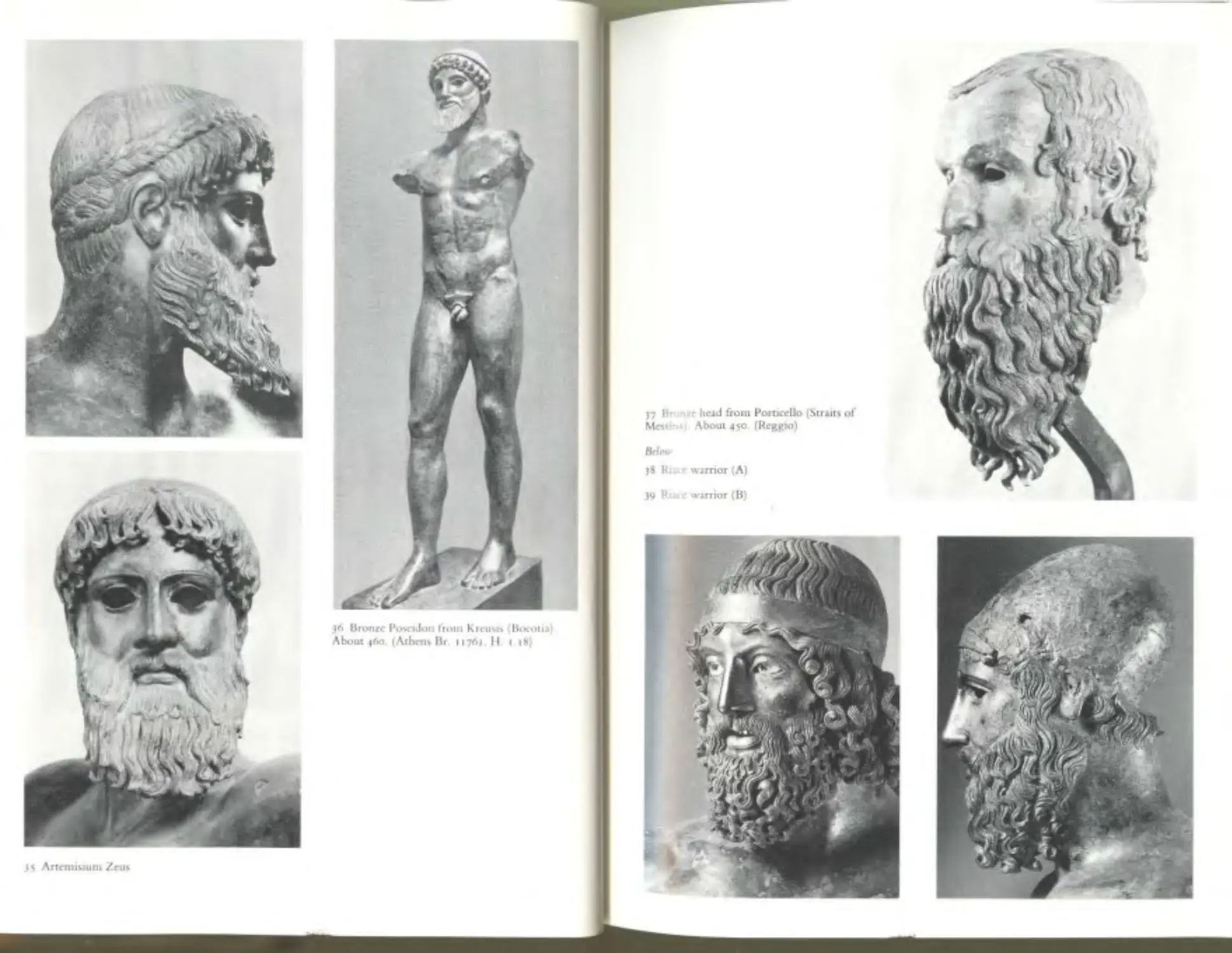
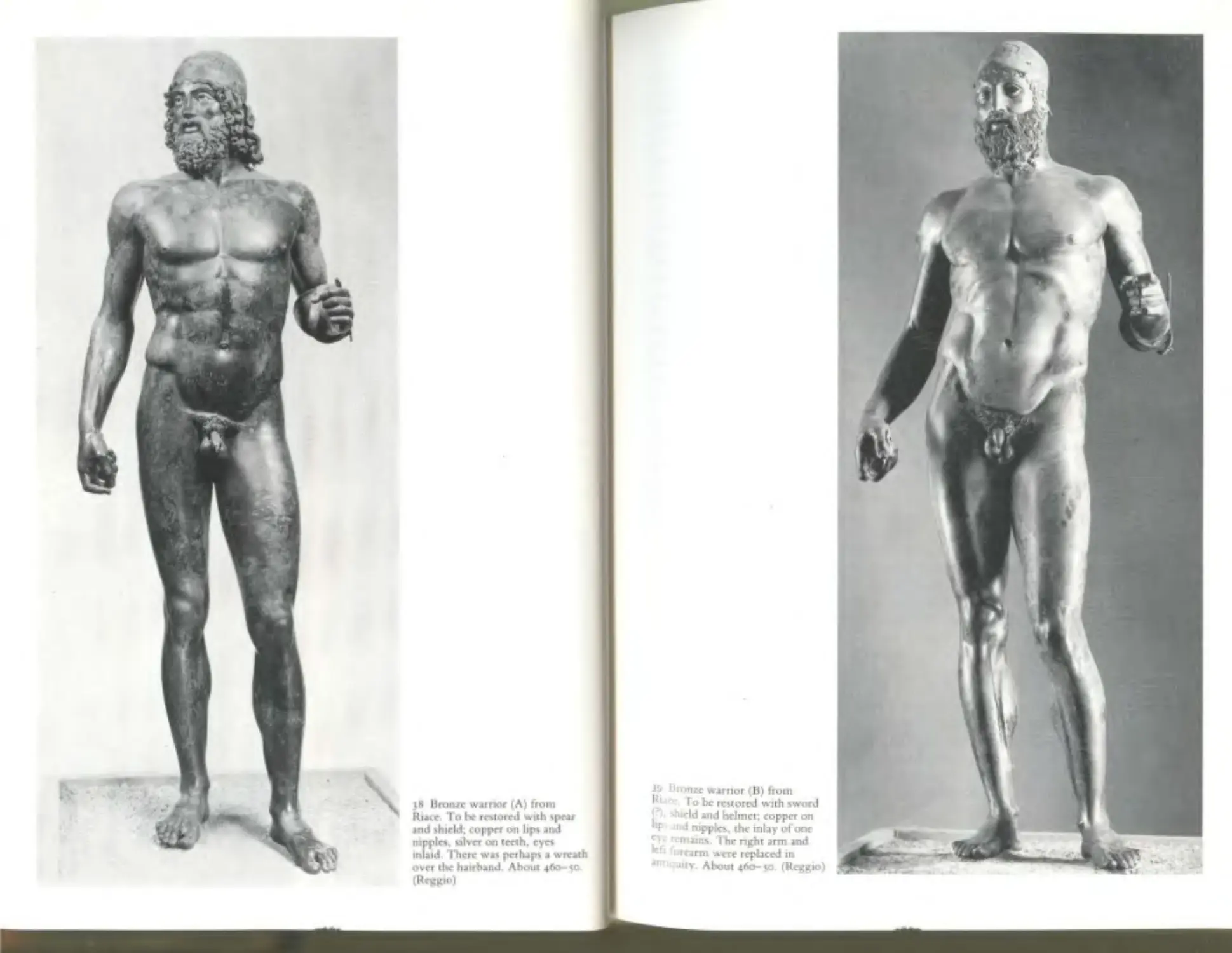
wrecks of .shtp s [35, 37 -9] in which they were being carried in the
Roman penod to new homes, usually in Italy. Ofthose that reached their
new homes none ha s survived: marble fares a little better. The plunder of
Gree~ works of art by the Romans began by the end of the third century
BC Wtth booty from the Greek cities ofSouth It aly, and from the second
ce ntury on Greece too lay open to Roman cupidity. An imposing list of
maJor works by named Greek sculptors which were exhibited in Rome
can be drawn up from the pages of Pliny (1st century A o) and these
represent a small proportion ofthe thousands ofworks plundered. A few
an~nnymous marbles have survived [46, IJJ-4
,
145 , ISJ?).
1
Greece Itself most of the survt vmg origina l marbles arc ar chitcc
tura • and most of these have been excavated over the last two hundred
years, the only m ·
1
.
1
.
dh.
aJor comp ex pen ously rcmammg mainly above
~roun h avmg been that on the Parthenon. There arc few orhcr origin als
rom t c Acropolis wh
01·
bb
ere, as at ympta and Delphi the empty statue
ases car mute tcsti n
h
b
'
down.
1
ony to t e many ronzcs, since stolen or melted
Sources: copies
Another tmportant b
I.
about Cla 1 1
ut perp cxmg (sec Preface) source of information
sstca scu pture is
·
·
A·
to reflect th
anctcnt coptcs. rttsts were naturally inspired
other se
1 e appearance and st yle of major works in other media or at
fifth cen~~s [7h9, 64• 102• 1 85]. lt is suspected that even by the end ofthe
r y t ere was production of reduced versions ofcult statues (sec
15
p. 214) while the pose or details of major works could be mirrored in
figures devised for reliefs or drawn on vases, or adjusted and abbreviated
to decorate jewellery and coins. The concept of an exact rcphca, at the
same or reduced size, did not come easily to the Classical artist, and the
apparent exceptions arc unusual and uncharacteristic. Since the originals
are lost these approximations to, and echoes of, the major works arc
almost impossible t o interpret, and they can never lead us to any
particularly accurate idea of the appearance of their models.
This, however, we arc vouchsafed by copies of a much later date. The
Roman interest in collecting Greek originals led to a brisk trade also in
copies of famous works. These could be in bronze but we know most of
them in marble, which survives more readily, and it is these marbles that
populate most museums outside Greece itself; not that they are lacking in
Greece and the Near East, since the fashion spread rapidly throughout
the Roman Empire, reviving significantly in periods of philhellene
emperors like Hadrian.
The courts and temples of the Hell enistic kings, as at Pcrgamum, had
been adorned with versions of Classical s tatues, but these were genera ll y
free essays in the Classical manner. The industry that se r ved the Roman
patrons produced copies as accurate as techniques and skills permitted.
This might seem the saving of our subject, but there arc problems. First,
the copies arc almost never specifically identified for us by inscription,
and in this respect our best information comes from portrait-busts
mounted as hcrms (like the Greek sacred pillars, GSAP fig. 169) and
inscribed, as [188, 246], but the original was a whole figure, which we
usually lack, and some portrait-berms ca rry demonstrably wrong or
fanciful names.
Secondly, even fewer copies can be cer tainly identified from descrip-
tions ofthem given in ancient authors, where we arc commonly given no
more than a name and a location. Thirdly, the detail and quality of the
original arc considerably impaired by the process of translating a bronzl'
into a marble, quite apart from the irreparable loss of a master's finishing
touch. Marble had not the tensile strength of bronze, hence the struts.
pillars and tree-trunks introduced to strengthen the figures; e.g . [6o, 6z-
J, 66-70, 72, ZZJ, ZZ7-J7l· Pose may be adjusted for the same reason
and Imsunderstanding of the dress or attributes ofthe original could lead
to misleading errors. Technical details may often betray the period it·
which the co pies were made because they differ from the origina
treatment and from that of other periods of copying. Fourthly, heads o
attribute> could be transposed from one type to another, just as many
C lassical type could be used as base for a Roman portrait head. Whet
only one or two apparent copies arc preserved these shortcomings mus '
leave us very uneasy about their value as eviden ce for any C lassica
10
origmal. Where several coptcs agree closely with each other in both size
and detail we may feel more confident that they reflect an original with
some accuracy. Finally, however, it is left to our own judgement
whether the original of such copies was created in the Classical penod,
when, and even by whom. lt IS becoming mcrcasingly clear that the
Roman ;rudios could turn Out Classicizing pastiches which can only be
detected through what we judge to be mtcrnal styli stic anachronisms or
inconsistenCies, or on technical grounds. There ar e many original works
in a plau~tblc C las.si;al style i~1 various media from the first centur y o c,
and the Neo-AttJC studios tn Greece produced relief-decorated vases
and slabs with figures. based on fifth-century origin als, wh1le elegant
ArchaJsmg, swallow-tail folds and the hkc, became increasingly fashion -
able. These are all easy to detect, however. Greek artists workmg in
Italy, like Pasnclcs and Stcphanus, could produce original works in the
Classical style, and it is possible that we could sometimes be misled by
statues and rchcfs from their studtos . lt was sometimes the same or
neighbour studios that were doing the copying of Greek originals, and
the late cr eations and pastiches could themselves be copied.
There are two other miniatunst sources of copies of Classical figures.
Statues of gods or heroes often formed the subject of intaglios for gem-
stones ofthe first century BC and later. Some give finely detailed versions
of heads [IOJJ. most arc roo small or too freely interpreted by the
engraver to be of positive value, and they arc never identified on the
stone. Problems arc posed too by Neo-Classical versions of the later
ctghtecnth and nineteenth centuries which are sometimes very difficult to
detect. And on Greek coinage of the Roman pcnod famous local statues
arc sometimes represented: GSAP figs 125, cf. 126, 185; [180-2, zo
7bj.
fhese have the merit of being easily placed, but a local moncycr was not
bound to favour a local t ype, the scale is minut e and detail mim 111 al.
All these comidcrations have led to my cautious presentation of the
cvtdencc of COp ies, as explained in the Preface.
13
1
romc copies of statues could be made by castmg from the onginal
w1t1ptcccmoId· h
·
d.
hb-
u s m t c 111 trcct .method, but this seems very rarely to
avc ccn p
dMbl
d I .h ractJsc · ar c copiCs were measured off from full-stzc
moes.Ictcch·
·
1
-
8.
1
mque was cerum y practised from the second century
<:, am a Simple
·
hb
pc nod r,
k. r vcrston maY a vc een employed even in the ClassiCal
(s . b or)ma mg fimshed works from life- si7c or even reduced models
.cc a
ovcOL·II.
.
the 0
.
1· )VJOus y, t liS could VIrtually never be done dire. ctly from
ngma statue 111 sa t
k1
from 1
•.
ne uary or mar et p ace, and the copyist worked
Paster castshk th · 1
·
The casts
e ose 111 t 1e teachmg gallencs of our univcrsmes
were made fi
·
1
·
has Zcu•
rom ptece-mou ds taken from the originals. Luc1an
• comment on the h
dd·
the A the
A
P•tc smearc ai!y over a statue of Hermcs in
mangob
I
.
.
ra Y scu ptors prcpanng tt for casting.
A remarkable find m 1952 at Baiae on the Bay of Naples has preserved
scraps of casts from Greek original sculptures. These must have been
used in the copyist s' srudios. They include pieces of a number of famou s
srarues known ro us otherwise only from marble copres (here [4] and
pieces of our [1 87, 190-2, 202, 214 , ZJ41l and give us the opportunity to
draw direct, if sometimes trivial , compansons between copy and
original, su ch as we arc very rarely allowed otherwise (exce ption s -[122,
,
44 ]). They also include casts from o ri ginal Greek s tatues orhcrw1sc
wholly unknown to us although Roman marble copies (for which these
casts had been made) ma y one day be identified !11]. lr seems that the
casts were r einforced by iron or wood arm arures in the legs, with other
parrs of the body and dress stiffened by bone o r straw. They show that
on some figures the copyist had deliberately fleshed our the phys1que of
the original. They reveal too derails of work - how the eyelashes of a
bronze were protected when the mould was made, leaving them lumpy
on the cast (4]. and how hollow folds and undercutting were plugged
before moulding. The m odern caster r ecognizes the techniques re adily
enough.
Sources: literature
No treatise by an ancient sculptor abom his work has survived (e.g .,
Polyclitus' Canon: sec p. 205) and no treatise de.aling specifically wah the
hisrory of sculpture. Conte mporary litcrarure IS ex tremely renccnt, and
it is exceptional to find in Euripides' play l oll a character who 1~
bothering to co mm en t on the sculptural decoration of a temple 111 the set
(supposedly at Delphi). From later periods th.crc is some wealth of
relevant asides- in Cicero (mi d-1 st century BC) 111 a penod when Greek
culture was highly fashionable in R ome; in the works of literary scholars
like Quintilian ( 1sr century A o) who sought. analogres 111 the VIsual arts ·
in the wider ranging entertainments of cssay1srs hkc Lucran (znd cenruq
A o). The geographer Srrabo (died A o 21 or later) could have rold us
more, but seldom borhcrs with more than names. But there arc tW< •
major sources who between them account for most of the usefu l
testimonia we can deploy.
.
.
Pliny the Elder, who died observing the eruption of Vesuv1us 111 A r
79, wrote a Natural History which was in the nature of an encyclopacd1«
drawing on a wide variety of written sources (2,000 he sa1d), 111clud1~f:
the Helleni stic treatises on an criti cism. He lists hi s sources separately "
an index bm the remarks in his main text arc not individually attributed
The most influential source is generally thought to be Xenocrarcs 0 1
Sicyon, a third-cemury writer. Pliny has a long section on bronze statut
(Book 34· 5- -93) discussing material, types and the works ofthe pr111CIP·'
18
arnsrs whom he dates by their floruit ro Olympiads (periods of 4 years) ,
defining srudios and nanung pup1ls. His descriptions of individual statues
arc laconic but occasionally assist in the Identification of copies, and of
more interest arc the critical comments which he takes from his sources
and which tell us w hat Hellenistic scholars thought of the achievemcms
of Classical sculptors. This is not, of course, the same as the view which
would have been taken in the very different world and society for which
the sculprurcs had been created, and we arc vividly aware of the intrusion
of obfuscatory art-historical jargon. The short section on clay modelling
(Book 35· 151-8) and the comparati vely shorr one on marble sculpture
(Book 36.9 -44) arc presented in the same manner.
Pausamas IS our other major source, writing a guide to Greece in the
second ccnrury A D. He too used written sources, bm probably with less
discrimination than Pliny. H e expresses his own view from time ro time
but in his descriptions of sanctuaries and cit ies he is often very much a~
the mercy of what he was told by guides or priests, neither of them
necessarily reliable repos itories of accurate information. Sometimes h e
seems simply to ha ve been careless. Where we can check his statements
or descriptions by the sires or monuments he describes we often find
them faulty. Where we cannot ch eck them our only recourse is ro be
mildly suspiCIOUS at all times. In his descriptions of scenes his interpreta-
tion IS, naturally en ough, that of his own day, and we have ro imagine
what he saw, and attempt to rcmtcrprcr it in the light of the period in
which it was made.
In the follo\~ing chapters I mention, where appropriate, the literary
sources for attnbutwns or descnptlons, by t heir authors' names (Pau s.,
Phny, etc.) but genera lly Without further detail ofthe texts, which can be
found m rhe vanous published compendia.
With so little COIJte
·d
b
·
·
·
.
.
mporary ev1 cncc a out artists surv1vmg except
on ms cnbed bases from which rhc o ri ginal statue has alm ost' always
;,scaped, we arc forced to rely heavily upon sources like Pliny and
r ausamas 1f we wish •o
h'
1
·
1
•
pur names to t mgs or sty es, even rh111gs or
sry es wh1ch we can only observe in what we take to be accurate Roman
cop1cs. But names arc t
h.
·
dd·
rh
no everyt 111g; 111 cc , m the srudy of ancient art,
cy arc next to nothing.
19
Chapter Two
EARLY CLASSICAL SCULPTURE: INTRODUCTION
The physical turmoil of Greek history in the early decades of the fiftl·
century was answered in Greek art by what appea r s to be sure and stead\
progress, and the gradual changes in style encouraged effortlessly, 1
seems, a revolution in the sculptor 's approach t o his craft. This marks
turning point in W est crn art.
In less than a hundred and fifty years the G r eek scu lptor had perfectet.
his technical command of the medium in w hich most of the fi ncs1
Archaic sculpture was executed - white m arble. It is not an easy material
nor, on refl ection , can we judge it an obvious choice for the execution o
images in relief or in the round. We have r eflected on its properties in th <
la st chapter. lt lends itself to clear, sharply defined masses and pattern n <
less than eo subtlety of contour and even, as late r generations were t<
discover, to the expr ession of the soft, the vaguely defined, the sensual
The Archaic sculptor explored its potential in cr eating three-dimension•
patterns which represented the human body. Style evolved slowly, a·
t echnique improved, and the changes, which must have been admittC<
because t he r esults were more satisfying and the function s of the figUJ
we r e thus better served, also led to render ings which were closer eo lift
closer (fo r the whole body at least) than any achieved by other ancic1
cultures. Not that there is anything inherently good about realism in a rt
but o n ce the Greeks discovered how much more it could express than th
conventions, symbols and patterns ofArcha1sm, they made a virtue of 1t
Down to ar ound 500 what realism there was in Greek art, especially 11
the rendering of the naked male, was literally superfi cial. The figur <
con veyed no more than the sum of their parts, fairly accuratcl
delineated and fairly accurately juxtaposed. Soon, though , even th l
triumph of realism could, it was found , be impr oved upon. l t is apparel
from drawin g (on vases) more readily than in sculp ture that the artist w."
beginning to observe his s ubject con sciously, and not simply reprodu <-
ing what he had been taught of the conventions for representing a man,.
a god or an anima l. Closer observation was not confined t o detail, but
was the problem set by the proper rendering of detail on bodies not
attention but at case o r in motion, which led to a closer observation a b 1
of structure, and wah it a g r owing understanding of how a body move·
20
how its weight is carried, how a shaft in pose can affect the placmg of
limbs, corso: head. The sculpto rs of the last of the kouroi, like the
Athenian Anscod1kos of about 510-500 (1], did not need to worry too
much about this. The1r figu r es were evenl y poised, in balance. Figures in
violent acuon, runnm g or fighnng, could be compose d like articul ated
dolls, although there was g rowing awareness of the problems o f
r endenng_ a tWI~t mg figure, smcc so many were still basically conceived
in two d1mens1ons rather than three, including even those cut in the
round eo be set in temple pediments. The so-called 'Kritian boy' from the
Athenian Acropolis [2], probably earher than 480, betrays the new
awareness, we1ght sh1ft ed o n to one leg, the other slack, with hip
lowered and the shoulder and head lightly mclined. Now look ah ead
through this book, at [20.1 , 36, 38-_ 9, 65-9 , 72, 184-6 , 223, 227 -35] to
see how, through the century, th as calm assurance in showing t he
standmg figu r e IS Improved upon. But even the ea rliest of the figur es
abruptly remove us from the world of Archai c rigidity and pattern into
o n e m wluch art takes on the task of representing, even counter feiting
hfe, and not merely cr eatmg tokens of li fe.
Gr eek art in the Iron Age began with little or nothing by way of figure
decoration but wah abstract pattern, eventuall y applied to the construe-
non of man-symbols, whole scenes and even narrative. The formal
demands of pt~re pattern long remained close to the artist 's conscious-
ness, and as nmc pa sse~ were ex pressed in sophisticated theories of
m ensuration and proportion. All this might seem alien t o an a rt which
t~tthc casual observer, seemed in pur suit of the real, but t he demands of
P tern and proporuon we r e more consciously se r ved by the Archaic
arnst than any pos·t · d
·
kI.
d.
1 ave esare to ma e 11s works more lik e the world
aroun him. This remained true even aft er the possibili ties of realism
;e{e /ecogmzcd in the early fifth cen tury, and when a scu lptor
nootyac atus, came to write a book about his art later in the century it wa~
n anatomacal text b k b
.
'
'
beobse d. k
-
00 ut an essay about the 1deal proportions to
more
0
rve 1~ ma ang images of the human body, and based as much or
proport~omat ~manes than on the life class. These tendencies to observe
P
ositive stn ani . tho Jdca h ze rather than pa rticulari ze figures were more
unu•t anaseaeh£<
1··
·
came alnlo
'd
r
or rea IS tiC anatonucal presentation which
st acc1 entall y Th
d·
.
•
realismina t d £<
•
·
cy arc t e n cn c1es wh1ch held back obsessive
until afte r rtl an ' o r 111Sta n ce, life-like rather than idealized portraiture
1cpcnodstd'd · h'b
·
'
showed the
.
. u le 111 t IS ook . F1fth-ccntury sculpture
artast workang t
d
·f:
these appa r e tl
.
owar s a sans act o r y reconciliation of all
n Y contradictor y ai
h.h
.
.
expresses an
1·de 1
.
1
ms - an art w 1c m1rrors hfe that
a 111 1Uman 1m
hk
'
pattern and p
ages, t at ac nowledges the dominance of
r oport1on
The Archaac scul
·,
ptor s patterns were of surface anatomy and dress, his
21
theory of proportion an app r oximation to nature based on a workable
but ar tificial scale of mensuration. I n the Early Classical period, the
subject of this and the next six chapte r s, progr ess, other than in an
understanding of the structu r e of the human body, seems almost muted
In male figures, once the break with Archaism had been made , th(
presentation of relaxed or vigorous figures developed the Archaic theme~
in the new idiom, without going far beyond them. In female figures a
different dress style (the pep los) d ispenses with the patterned finery o f
the Archaic chiton, and allows subtlety of pose to be made more readil )
apparent in the simple break of a line of folds. Of compositional pro g res'
we can judge li t tle, since arch itectural sculpture is still defined by tlu
rigid frame of pediment or metopc, but in drawing we can sec a nC\\
u n derstanding of the use of space. Where the Ar ch aic artist t ended t<·
com p ose almost in t r ospectively, within the fteld offered him, and cvct 1
his free-st andi n g fig u res, lik e Aristodikos, seem esse nti all y self-con
rai ned, the C lassical figures arc both in and oftheir environment, and thr
accommodation of a figure or of figures w ithin a g r oup to their settin ~
and to t heir viewer s is more consciously pl ann ed. The Classica l figur t
may seem t o remove itself f rom us, through a bid to express a human
divine idea l or mood, but it st ill involves the viewe r more intimate!
than the Archaic.
The following chapte r s look at what little is known of the origin
statues of t he Early Classical per iod, including the remarkable arch ite r
tural complex at Olympia, and we shall have to deal with the problem <
the use of copies in our studies - a problem which becomes more acu .
later in the century. Early Classica l is a convenient title for a style whK
is not merely experimental or transitional, as it has also been called, b1
which has a clear character of its own. We do not do it justice by judgn
it simply in terms of t he full Classical which it heralds. Indeed, we sh I
sec that in some respects it has qualities which the Classical lacked <
chose to set as ide. After the Arch aic, sculptu re looks auste r e, and 'Sever· '
is a useful and intelligible ter m which has been appl ied to it and is us• J
here, w h ere convenient.
In the Ea rl y Classical per iod At hen s figures li ttle, for reaso n s whtt 11
w ill become clear, and we have less scu lpture f rom the first half oft 1C
fifth century than we had for the second half of the sixth. The Pcrst. n
invasio n s of Greece at Marathon (in volving only Athen s) in 490 and th • n
in 480/79, dive rted Athens' atten tio n fr om major sculptura l projct s
until the mid-centur y. In other parts of G reece there was either no
building to be done, o r it was deliberately defe r red (a remark that rcv c Is
how much we rely on the survival ofarchitectura l scu lpt ure), and the n ts
a pause in major state enterprises until Athens sets the pace ag a •L
Olympia found the n eed for a new temple, whose sculptures h.
·c
22
fortunately sur vived, and, wah the other national sanctuary at Delphi,
attracted nch offenngs, but thetr survtval rate has been low. With Athens
qu iesce n t, the rest of mamland Greece anxious or exhausted, and East
Greece s till troubled by Pers1a, the pe r iod does not present itself as one of
busy experiment and innovation, but tts achtcvements are real, and its
few mastcrpteccs lose nothmg by comparison with what was to follow.
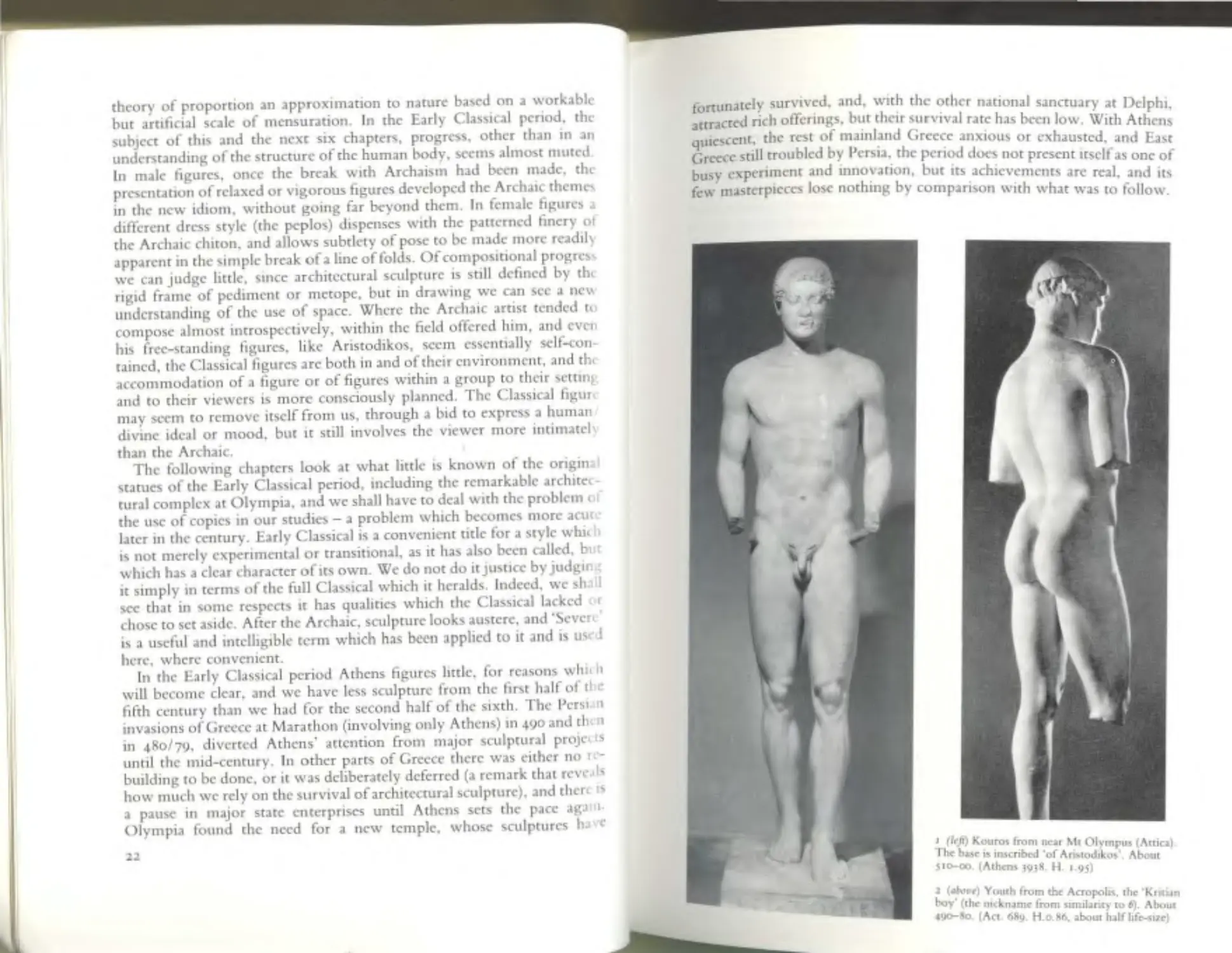
I (ltji) Ko uros from near~~ Olympus (Amc.a).
The base 1.s mscnbed 'ofAruto<hkos· . About
s• o-oo. (Athens 39J8. H. L9S)
1 (a.bov~) Youth from the A cropolis, the 'Krna.an
boy (the mcknamc from s1m1laru y to 6). About
49G-8o. (Act. 689 . H.o.86 , >bout h>lfhfe-S<Zel
Chapter Three
EARLY CLASSICAL MEN AND WOMEN: I
In the Archaic period the two most important sculptu r al types, in which
artists displayed their g r owing comm and in rcp r esentmg plaust.ble
anato m y and dress, edging all the time by a sort of natural selection
towards a m ore realis t ic image (see GSAP 65), were the st andmg nude
man and the dressed woman - the kouros and korc. The same two baste
types remain important in Greek sculpture throu gh the Classtcal penod
and we shall conside r each of them before gomg on t o look at larger
co mplexes, as at Olympia, in which they arc al so to be fo und, and at the
figures in o ther poses.
.
.
.
.
.
We begin perversely, however, by tgnonng.our pnnctple o f relcgaung
copies t o a separat e chapter and by dcscnbmg a g.roup frorr1. a city,
Athens, that we h ave just declared rel a u vely b.arren. 1~ thts. pcnod. The
reason is that t he group is known by scraps of ItS ongmal (m casts), and
that it demonstrates very well many of the problems of the. use of texts
and copies in our stud y. The group is that of the Tyranmctdes.
Statues of the slaye r s of the t yrant I lipparchus (in 514), made by
An t enor, had been set up in the Athenian Agora at the end of t he st~th
century (GSAP 83; or, as some believe, onl y after Ma rathon, 490). 1 he
group was removed by the Persian king x.erxcs in 480, and replaced by
the Athenians w ith anothe r grou p, by Krmos and Nes10tes, d ated 477 / 6
in a later chronicle {the Parian Marble). The sculptors' names appear
again as coll aborato rs on six bases for bronze statues from the Acropolis
The n ature ofthe co ll aboration is n ot clear (a t least, the bases sh ow that tt
was not a m atter of one st atue each): a near-contemporary Atheman red-
figure vase (ARFH fig. 262.2 -3) shows two cr aftsmen workmg on
bronze statu es. The Tyrannicides wer e br onze too.
.
.
T he grou p itsel f ca n be r ecognized painted as a shteld devtce for
Athena on fourth-centu r y vases [7], on co in s [8] and on a marbl e throne
[9) (the scen e on ARFH fig. 199 is about as close as contemporary vase~
painters get to sculptures- hmts at the poses, the quarry added a~d t h.
placing ch anged). I n two d imens ions or low rchef the figures le gs
overlap, not their bodies, sometimes with one in fr ont, somettmes the
other; but in the original side view of the group on~ probably obscured
the other. The young man Harmodios advances with ratsed sword, t<
slash: Anstogeiton str etches out one arm with ban ging cloak, in a
protective gesture and holds his sword-arm back. Both poses arc old
ones but the group gave them a specia l significance in later wo r ks,
especially fo r h eroes, and for the Athenian h ero T hescus (cf . [19, liJj}.
The viewer at the fr ont ofthe group is in the position of the victim.
The interesting suggestion has been made that they might have bee n
back to back. An cient representations ar c not quite decisive o n this point,
for th e r eason given above, and the fragments of the base excavated m
the Agora tell only that there was one base, not two. This is a group with
several major v iewing points- in front, chest-on to each figure, from the
back of each figure with the other then in profi le- a remarkable advance
on the simple frontal arrangement of earlier scu lptural g r oups.
A copy of the group was found in H ad rian's Villa at Tivoli and there
are other copies of heads and torsos [J, 5, 6]. The poses arc no more
ad venturous than some o f th ose on the Aphaca temple at Aegin a (GSAP
fig. 206),. the a ~1atomy less emphatic. The young bead with its tight-
curled batr ts stt ll close t o the l as t of the Archaic k ouroi- its superficial
simil arity to that of the Kritian boy ea rned the latter its sobriquet (here
[z); GSAP fig. 147). The old head is more clearly Ea rl y C lass ical in st yle
but the h atr ts hardly more than incised w ith tiny Aame locks (compare
the more orderl y, earli er Ra yet head, GSAP fig. 139).
The B atae studio, ~hose significa n ce for our understanding of the
Rom an coptes was dtscussed m Chapter 1, h andled a Tyrannicidcs
group, and we have from it part of Aristogciton's head [4] and scr aps of
thehmbs and dress from both figures. Apart from the technica l details
whtch r eveal the co pyist's technique, we ma y ad mire the h ead's finely
strtated , sh ort tufty beard. Not all m arble copies of the h ead t reat the
beard m JU St tht s way- closest is that shown in [5a ]-and it is unlike the
far free r modelling of other, later Severe heads. So, if we are misled
about the date of the first Tyrannicidc g r oup, and it was in fac t erected
after Marathon, the cast might be from this (it had been restored to
Athe~s from Per sia by Antiochus) and represent the work of Antenor.
~~IS tmpasse ts provoked by a poor text (Piiny) and it is aggravated by
A . qualtty of coptes for, tf [5a) is Antcnor's, could the other
n stogctton h eads known in co py and with the more advanced
treatment ofbca d [ b) b fi
1
d
·
.
.
.
br
.
r 5 , e romt1csccon group?Ithmktttscasterto
a~~c~ t hat later copyist s r evised their c u tting o f beards than that Kriti os
.
.
cstotcs made modestly updated rep li cas (how') of Antcnor's
hmts sbtng group (for w hich yet another copy of a head for the ea rli er date
as ecn prop d GSA
'.
'
away fi
hosc -
P fig. 143). Text and coptes lead us steadily
could ro; t cb r ca lity of the Baiae cast, yet only through text and copies
It avc cen r ecogmzed.
Weturnnowtotbk . dk
.
c ourot an orat. 1 hey had been grave-markers
25
and dedications in sanctuaries. With the ftfth century the role of these
types changes. The Late Archaic period had seen that breakthrough m
the realization of how to represent the shift ofbalance in a standmg figure
(ponderation), w ith a sudden approximation to life, aided by dcltberatc
study of life, which made a dramatic break with the pattern-conscious
works of earlier years. Not that pattern and proportion were ever
forgotten, as we shall sec. The new life in the figures lent them a greater
degree of individuality and, although this was apparent somcnmcs m
Archaic sculpture, it became, for a while at least, more truly charactcns-
tic of the Early C la ssical. The new standing youths arc not the
generalized images of a life lost in its prime, but more often memorials to
the success of a living athlete, holding athletic equipment o r a libation
phialc, o r r epresentations of a specific deity, gen erally the young Apollo,
already favoured in the Archaic by an adaptation of the kouros pose to
accommodate the handling of divine attributes- CSAP figs 150, 185.
The change seems the more dramatic through the absence of much
sculptur e of this period in Athens or in Attic cemeteries, but it is
supported by the evidence fr om other sites- Delphi, Olympia, Dclos
and fifth-century cemet e ri es elsewhere in the Greek world, either by the
presence of figures in their new function, or the absence of the old.
The Kritian boy has been for us the Late Archaic paradigm of the new
pose. In the next generation ofsuch figures we have to look generally to
copies for complete, life-size figures, although versions will appear in
architectural sculpture, as [zo.t]. We may start with the heads. The
Kritian boy wore his hair rolled around a fillet [2]. I Lis contemporary,
the Blond Boy, who was in the same pose, has his long hair plaited and
wound around his head and under the front locks (GSAP fig. 148). The
rolled hatr and plait will be hallmarks of the Early Classical, the hatr on
the top of the head being shown in a pattern of shallow grooves .
sometimes grouped in wavy locks, radiating from the crown. A bronze
head from the Acropolis shows the rolled hair [10], but the long back
hair is tucked up and pinned (a krobylos). For the plait look at the copies
or the fragmentary cas t from Baiac which combines plait and roll and t<,
from a fine bronze [11 ]. We do, however, have the head of a major
bronze of these years (or so it seems: some ha ve doubted it). The
Chatsworth head [12] was found in Cyprus with much of its body,
which was immediately destroyed. lt seems likely to have been a kouros-
likc Apollo. The features arc heavy and dull, and were perhaps more
impressive on the whole body. The front locks are knotted in a manner
novel for this period, and the side locks, some missing, cast separat ely.
Whole, life-size figures escape us until a slightly later phase and then
for warrior figures, but the basic pose of torso and legs appears in the
O lympia pediment [zo.t[- flat-footed, the r elaxed leg just forward an d
26
moved away from the rigid, the corresponding tilt of hips and should ers
properly observed, the head inclined. Small bronzes ofthe period repeat
the pose and must resemble the many athlete statues which were the
prime exponents ofthe genre. (13[ h~s an unusual hair style, but the plaa
is there, tts loose ends oddly hangmg before the ears. (14] from near
Argos has the dumpy set of figures commonly associated with the
Argivc school, and ancitipating Polyclitus: cf. [184-5].
The corresponding female type, successor to the Archaic korc, is the
peplophoros, named for her dress , the peplos, which replaces in
popularity the thinner, more voluminous chiton (cf. GSAP 67f. ) . The
chiton will still be worn, of course, even under a peplos [zoo]. as in the
Archaic period (CSAP figs IOJ, 115; for the dress types ibid, 68). The
pcplos is sleeveless, and its overfall from the neck hangs straight to belt
level, or may be longer and belted on some figures, notably Athena, as
(29, 41, 61, 97-101]. lt is of heavier material and so, for the sculptor, it
presents a pattern of strong vertical folds or, in the overfall between the
breasts, catenary curves or interlocking creases.
We arc better provided with origina l marble pcplophoroi than with
their brothers. Some from East Greece and the islands have skirts
patterned with folds which recall the Archaic (15] but most arc more
austere and betray their new, Early Classical stance only in the light
disturbance by one knee of their skirt folds. The subject is ve r y popular
too in small bronzes, especially those made as mirror supports (16] or in
the exceptional incense-burner stand from Delphi [ 17]. Heads arc bland,
the hair centrally parted and combed back, or only lightly gathered
before the ears. lt is commonly bound in a scarf (mirra) or snood (sakkos),
gtvmg the characteristic deep profile view. There are peplophoroi in the
Olympta pcdtment [zo.t] and for copies of Early Classical peplophoroi
and r elat ed figures see (7J, 74 ].
27
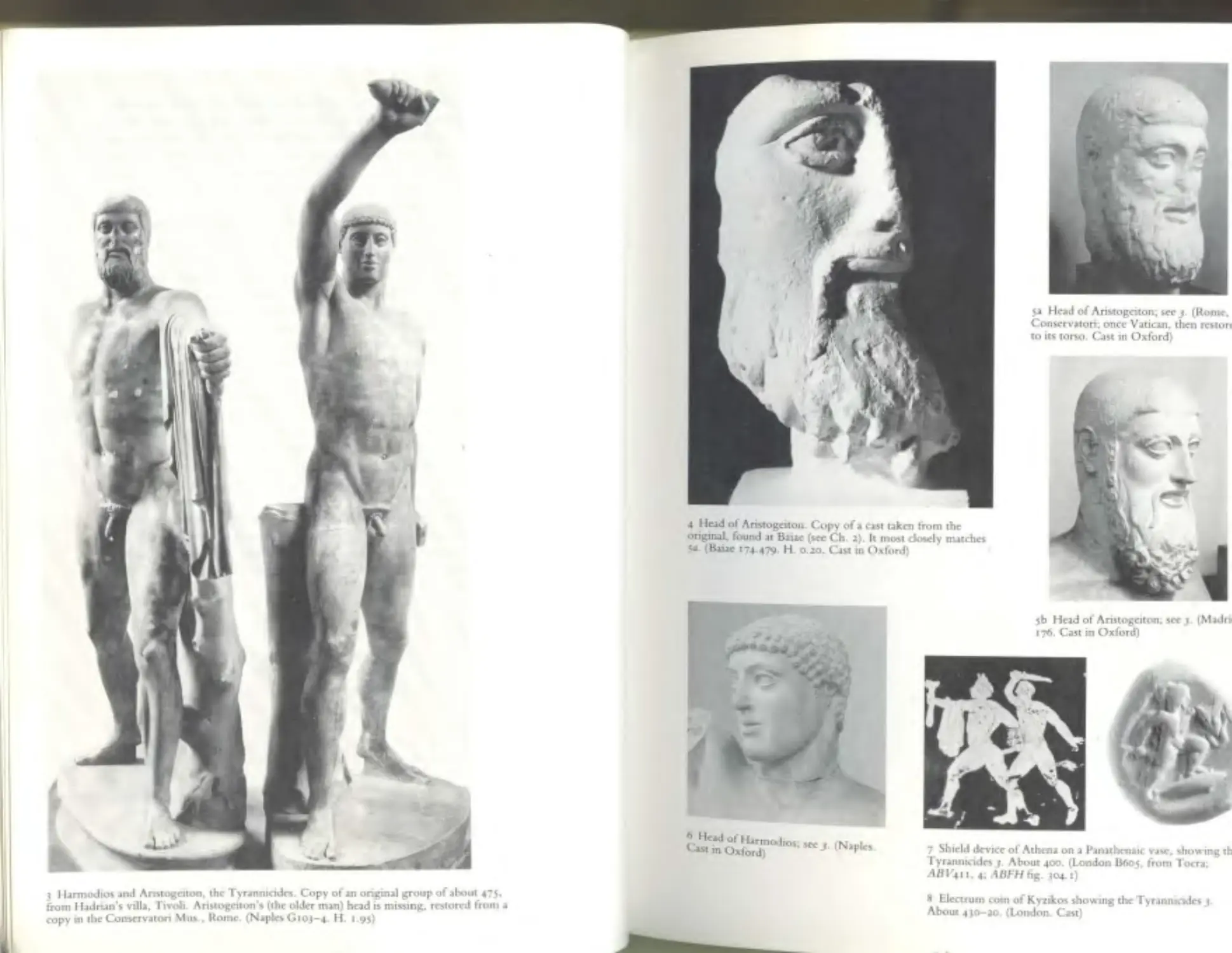
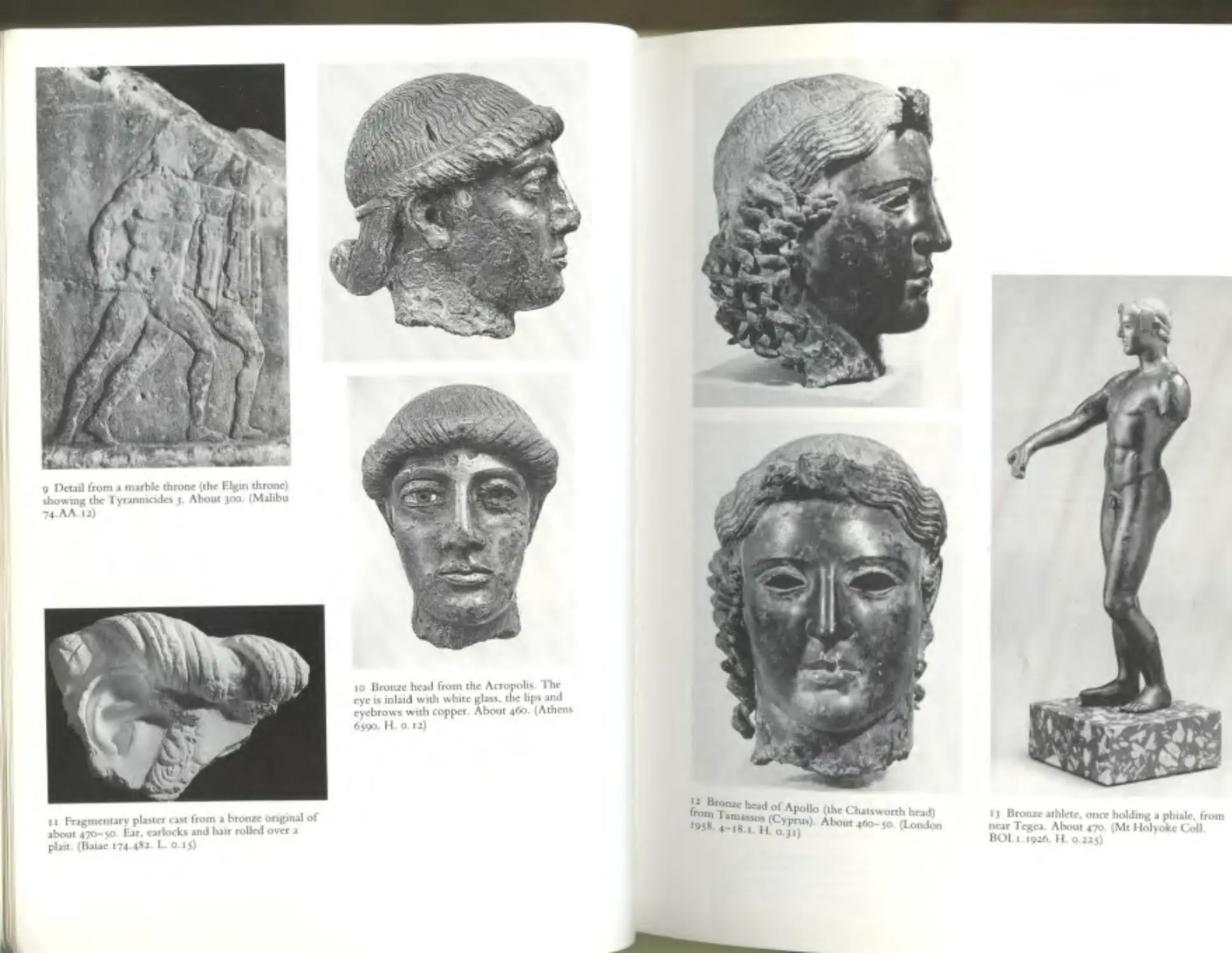
3 Humod1os 01nd Anstogeuon. the TyrOinmcJdes. Copy of an origmal group of1bout -475.
from 1bdrlan's v11la, hvoh. AriSlogeuon's (the older man) head IS nussmg. restored from 1
copy m the Constrvatorl M us ., Rome. (Naples G 103-4· 11 . 1.95)
sa He01d of Aristogciton; sec J. (Rome,
Conservaton; once V01ttcan, then restore
to its torso. Cast in Oxford)
4 _H~ad ofAnSlogenon. Copy ofa c01st uken from the
ongtn.t .l, found 0111 Bata~ (sec Ch. 2). h most closely ma1ches
512. (Ba101e 174 -4 79- H 0 .20. C.tst in Oxford)
•
~ Hc..d of Humochos; sec J (NOiiples
ast m Oxford)
sb He.td of Aristogeuon; see J . (Madru
176. C01st in Oxford)
7 Sh1cld dtvtC<' of Athen.t on 011 P01natheru.1c va<e, \hO"'"'mg th,
l"yunnicides J. Abou1 400. (London ll6o,S. from Tocu;
ABV411, 4; ABFHfig. 304.1)
8 Electrum com of Kyz•kos showmg 1he Tyranmcides J .
About 43o-2o. (London. C•st)
9 Ocloul from a marble throne (the Elgm throne)
showing lhe 1 yranmcides J About JOO. (Mahbu
74 . AA.u)
11 Fragmentary pbster cast from a bronze o rigmal of
about 470-50. Ear, eulocks and ha1r rolled over a
pbn. (Bme 174 482. L . O .lj)
1o Bronze head from the Acropohs. l "he
eye is mlaid wuh white gbss, the lips and
eyebrows w1th copper. About 46o. (Ath en~
6590·H.0.12)
12 Bronze he<J.d fA 11
from T amassos (~ po o {the Ch:uswonh head)
1958 . 4-18.1 11 /j;)us) About 46<>-jo. (London
I J Bronze athlele, once holdmg 1 ph1ale, from
ne>r Tege• . About 470. (Mt Holyokc Coli
BO I. t .1926. H. 0 .225)
'
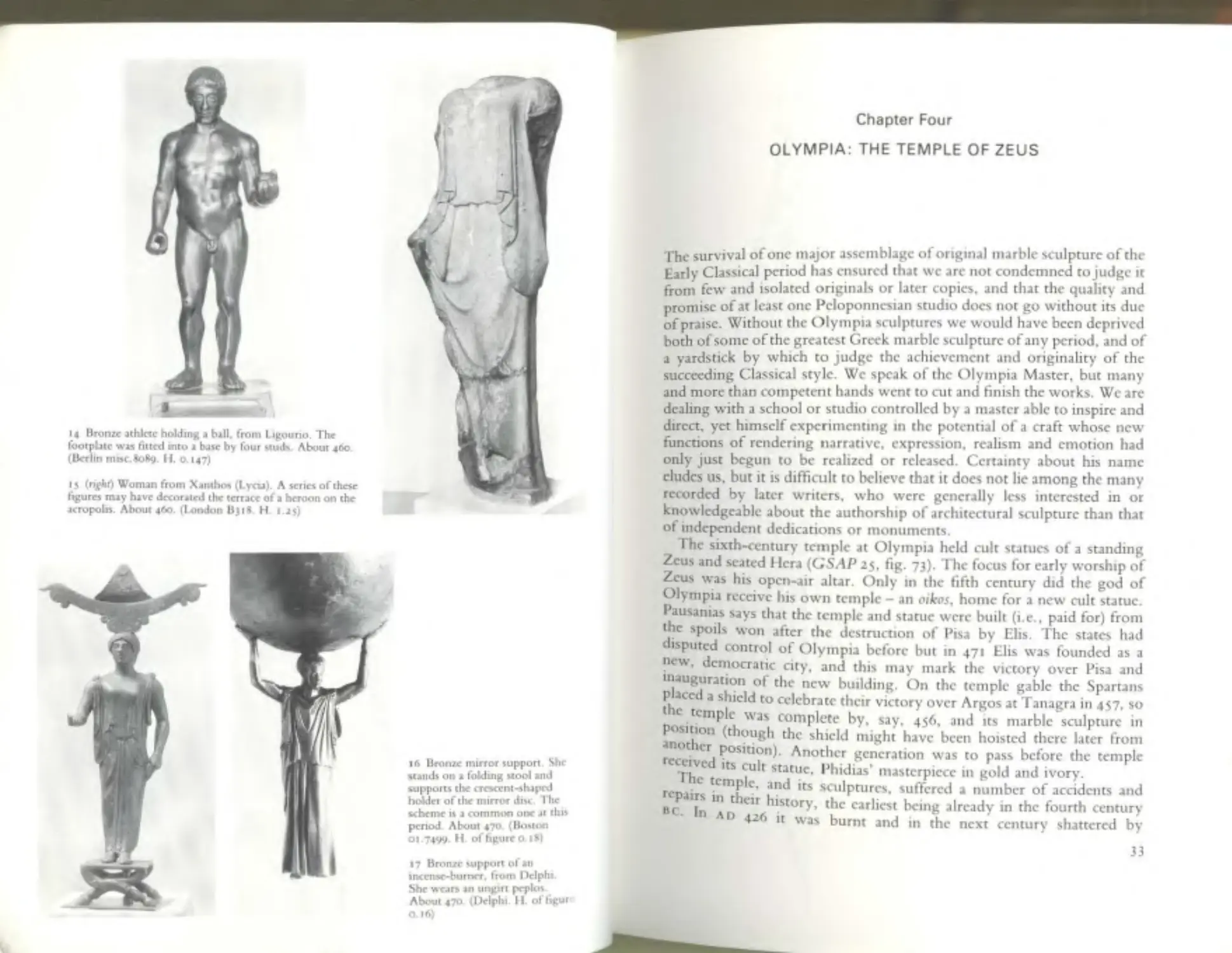
14 Bronu athlete holdmg a ball. from L1gouno. The
footplate w2s fitted m1o a base by four studs. About 46o.
(Berhn m1Sc.8o89 H 0.147)
15 (nght) Woman from Xanthos (Lycla). A scnes ofthese
figures may h:.tvc deconted chc terrace ofa heroon on the
>cropohs. About 46o. (London B318 H J.2S)
16 Bronze m 1rro r support. She
stands on a foldmg stool and
supports the crescent-shaped
holder of the nurror dt)(. fhe
scheme IS a common one at 1h1~
pcnod About 470. (Boston
017499 11 of figure 0.18)
17 Bronze support of an
mcense-burncr, from Delph1 .
She wears an ungtrt pcplo'
About 470. (Delph1 11 offigur ·
0.16)
Chapt er Four
OLYMPIA: THE TEMPLE OF ZEUS
The surv i val of o n e major assemblage of original m arble sculpture o f the
Early Classical period has. c? su r cd that we arc not condemned to judge it
from few and isolated o n gmals or la ter coptcs, and that the quaht y and
promise of at least one Pclopo.n ncsia n studio does not go without itsdue
of prai se. With ou t the Olym pta scu lptures we would h ave been d epnvcd
bothofsome ofthe greatest Greek marblesculptureof any period, and of
a yardstick by which to j udge the achievement and originality o f the
succeeding Classical style. We speak of the O lympia M aster, but many
and more than competent hands went to cut and finish the works. We are
dealing with a school or studio con tro lled by a master able to in spire and
direct, yet himself experimenting in the potential of a craft whose new
fu nctions of rende ring narrative, expression, rea lism and emotio n had
only just begun to be realized or rel eased. Certainty about his n ame
eludes us, but it is difficult to believe that it does not lie among the m any
recorded by later w rite rs, who were generally less interes ted in or
knowledgeable about the authorship of architectu ral sculpture than that
of independent d edications o r monumen ts.
The si xth- ce ntury temple at O lympia held cult statues of a standing
Zeus and seated Hcra (GSAP 25, fi g. 73). The focus fo r early worship of
Zeus was his o pen-air alta r. Only in the fifth century did the god of
O lympia receive hi s own temple - an oikos, home fo r a new cult statue.
Pausanias says that the te mple and statue were built (i.e . , paid fo r) from
the sp01ls won after the destruction of Pi sa by Elis. T he stat es had
dtsputcd control of O lympia before but in 471 Elis was founded as a
new, democratic city, and this may m ark the victory over Pi sa an d
tna uguratwn of the new building. On the tem ple gable the Spa rtans
~laced a shtcld to celebrate their victory over Argos at Tanagra in 457, so
t lC. tem ple was com plete by, say, 456, and its marble sculpture in
posm on (though the shield might have been hoisted there la ter from
anotherpo·· )A h
.
.
SltJon . not er gene ration was to pass before the temple
rc:;:~ved tts cu lt st atue, Ph id ias' m asterpiece in gold an d ivory.
. e temple , and its sculptu res, su ffered a number of accide nts and
rcpatrs 111 their h .
hI"b.I
.
8c1
ts tory, t c ca r test emg a ready m the fourth century
·
n A 0 426 1t was burnt and in the next century shattered by
33
A
l
c
D
B
K
G
11
F0
M
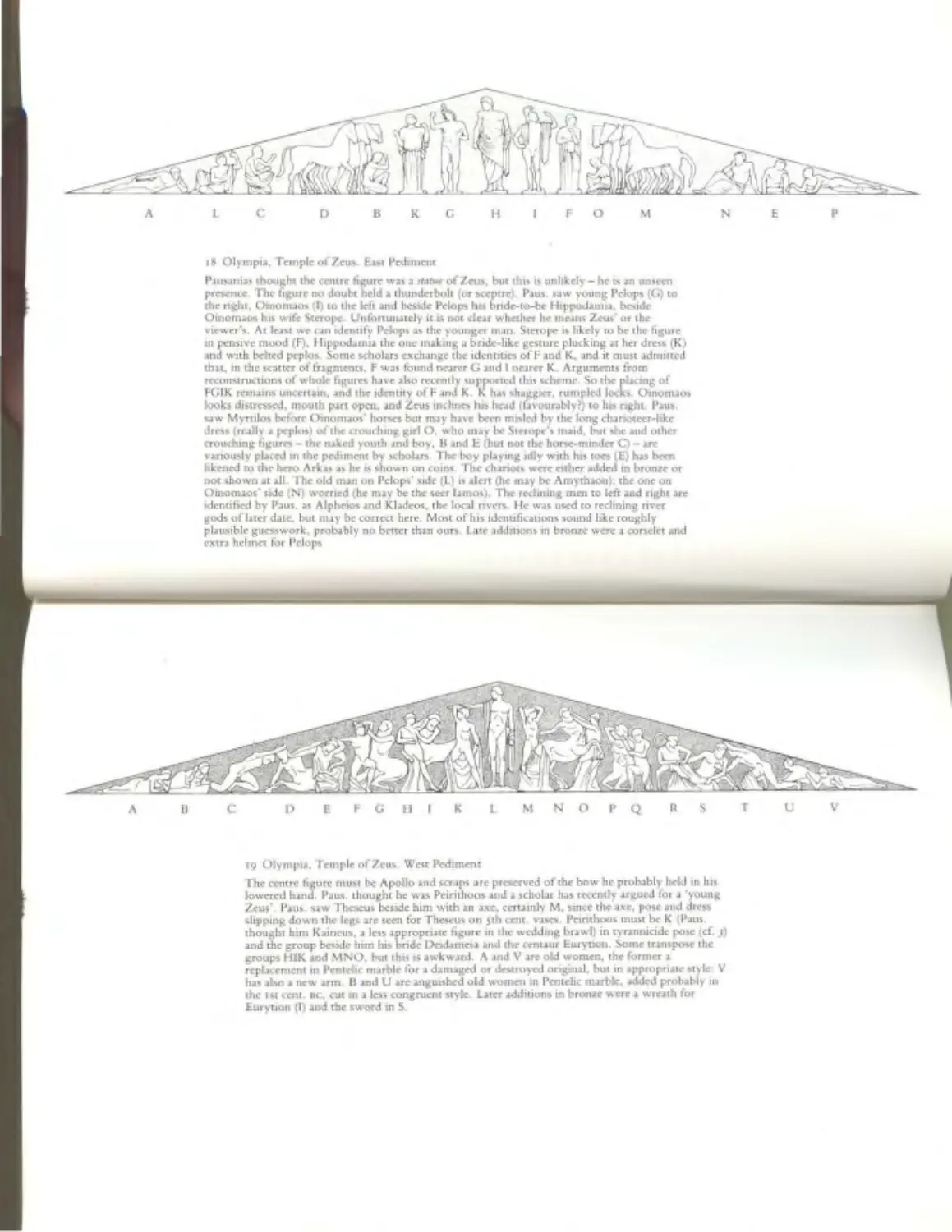
18 Olympia, Temple ofZcus. East Ped1ment
P~usanias thought the centre figure was a statur o f Zeus, but thl\ IS unhkdy - he IS an un\ccn
presence. The f1gure no doubt held a thunder bolt (or sceptre) P;a us. uw young Pdop s (G) to
the nght, Omomaos (I) to the left ;md beside Pdops has bnde-to-bc H 1ppodamia, beside
Omomaos h1s w1fc Sterope. Unfort unately tt is not cll:'n whether he means Zeus' or the
v1ewcr's. At lc;an we can 1dcnufy Pclops as the youn ger man . Sccrope tS likely tO be the figure
m pens1ve mood (F), lllppodami a the one m aking a b ride-like gesture pluckmg at h er drcs'l (K)
an d with beh ed peplos. Some scholars exchange the identuics ofF and K, a nd it must admitted
that, in the scauer offragments. F was found nc.arcr G and I nearer K Arguments from
reconst ruc uons ofwhole figures have also recently supported th1s schem e. So the placmg of
FG IK remams uncerum, ;md t he tdcntity ofF and K. K has shagg1cr, r umpled locks. Omomaos
looks distressed. mouth part open. and Zeus mchncs h1s head (favouubl y?) to his nght. Paus
s.;aw Myrttlos ~fore Omomaos' horses but may havt betn m1slcd by the long chanoteer-likc
d ress (really a peplos) of the crouching g1rl 0. who may bt- Steropc's m.aid, but she and other
crouchmg figures- the naked youth .and boy, 8 and E (bur not the horse-mmder C)- arc
vanously placed m the pedtment by schol.ars. The boy piJymg tdly wnh h1s toes (E) has been
hkcned to the hero Arkas as he 1s shown on coms. The chariou were euher added m bronze or
not shown :1t all. T he o ld man on Pelops' side (L) IS alert (he may be Amyth:~on); the one on
Omomaos' side (N) worrted (he may be t he sur Ja mos). The reclmmg men t o left and nght arc
idenufied by Paus. as Alphc10s and Kladeos, t he local nvers . H e was used to rech nmg nver
gods of later date. but may be correct here. Most oflus tdenllficau ons sound like roughly
p lausible g uesswork, prob ably no be tter than ours. Late addit ions m b ronze were a corselet and
extra helmet for Pelops
N
E
p
AB
CDEFGHIK
LMNOPQ
RS
TU
V
19 Olympia, T emp le ofZeus. West Pediment
The c~n trc fig ure m ust be Apollo and scraps are preser ved ofthe bow he probably held m hts
lowered h and. Paus. t hought h e w as Peinthoos and a scholar has recently arg ued for a 'youn g
Zeus'. Paus. uw Theseus beside him w tth an axe, certainly M , smce the axe, p ose an d dress
shpp mg down the leg~ arc seen for Theseus on .sth cent. vases. Pemthoos must be K (Paus.
thought hun Kameu~. a less app ropriate figure in 1hc wcddmg brawl) in tyrantucide pose (cf. J)
and the group beside htm h1s bride De1dameu, and the cenuur Eurytion. Some transpose the
groups HIK and MNO, buc thts ts awkward A ~nd V are old women, the former a
replacement m Pencchc marble for a danuged or deSlroycd ongmal. but m appropnatc style; V
h1s also a new .urn. Band U arc angutshcd old women in Pcntehc marble. 1dded probably in
the 1St cent IK, C\lt 111 a less congruent style Uter addnions in bronze were a wreath for
Euryt1011 (I) and the sword m S.
earthquake and then, With the r est of the si t e, covered with up eo five
metres of alluv1al sand. Some of the sculptures lay w h erever they had
fa ll en , some were built into the walls of a Byzantmc v11lagc. That so
much su r vived to be recovered by the German excavations of the last
centur y IS little short of miraculous.
Pausamas names the archuect of the temple, a local man called Libon,
and des cribes or rather d1scusses some of the sculpture. The corner
akroteria were cauldrons, the central one a Nike, all gilt. We learn chat
there was a competitiOn for making the ak roceria from the mscnbed base
of the famous N 1kc made by Paionios of Mende soon after 424 (139 ].
Paionios won the compemion and we may gee some idea of the temple
N1kc from the one of his which is presaved, but, from the dates, tt
seems that the akroteria wer e late additions, like Phidias' cult statue.
Of che pediments Pausanias says that the from (ease) one sh ows the
prepara tion for th e chariot race between Pelops and Oinomaos [18, zo j,
which we might not ve ry eas ily have guessed, and names several of the
figures. The west ped iment, with the fi ght of Lapiths and Centa urs, we
could have identified without him. But he goes on to attribute the cast to
Paionios of Mende, which muse be wrong and was perhaps the r esu lt of a
mis-reading of the base of Paionios' Nike; and the west eo Alkamenes
which, 1f co r rect, can hardly refer t o the Alkamcnes whom we know as
Phidia~· pupil. Quite poss1bly two Attic sculptors arc involved: for th1s
problem sec below, p. 206.
rhc Pelops story has a local chariot-racing theme appropnatc for
Olympia and reflects a success over Pisa (ruled by Oinomaos) such as
was the occasiOn for the construction of the temple. In the usual story
Pclops wms by bnbing Oinomaos' charioteer Myrtilos to substitute wax
for metal lynch-pms on h1s chariot, then kills Myrtilos who cu r ses hm1
and h1s house- the doomed succession of Thyestes. Atreus, Agamem-
non, Orest es, so much m the minds of Athens' fifth-century dramatises.
Pindar's anodyne vers1on (of 476, so earl ier than rhe temple) lets Pclops
win by using d1vine horses, the gift ofPoseidon, but though this seems a
touch more sportmg, 1t lacks the tragic threat of Zcus' justice which
pursues w r ongdom g. Instead we ha ve a combination of apposite
narrative With a moral message of divine authority, and the moment
chosen recalls both the oath-taking before the race and the b r oken
prom1se.
The west pediment [19, 21] displays a bustling challenge to and defeat
of hubns, a divine and heroic stand against bestial beh aviour. Pausanias
thought the central figure was Peirithoos, whose marriage it was that the
C cmaurs di sturbed, but t111S must be Apollo, son of Zeus and d1 spenscr
of law and order. The story is se t in Thessaly and though A racad1a coo 1~
ccntaur-countr y , lt could not be imagined elsewhere. The theme is much
used n fifth-century art, often, lt seems , as a comment on Greek
ccc:,ses over the barbanans or over barbanc bchav10ur by fellow
~reek>. but this is hardly the message here. There is still some
u nccrcaun y about the placmg and tdenttty of figures m both pediments,
bnefly disc ussed here m the captions.
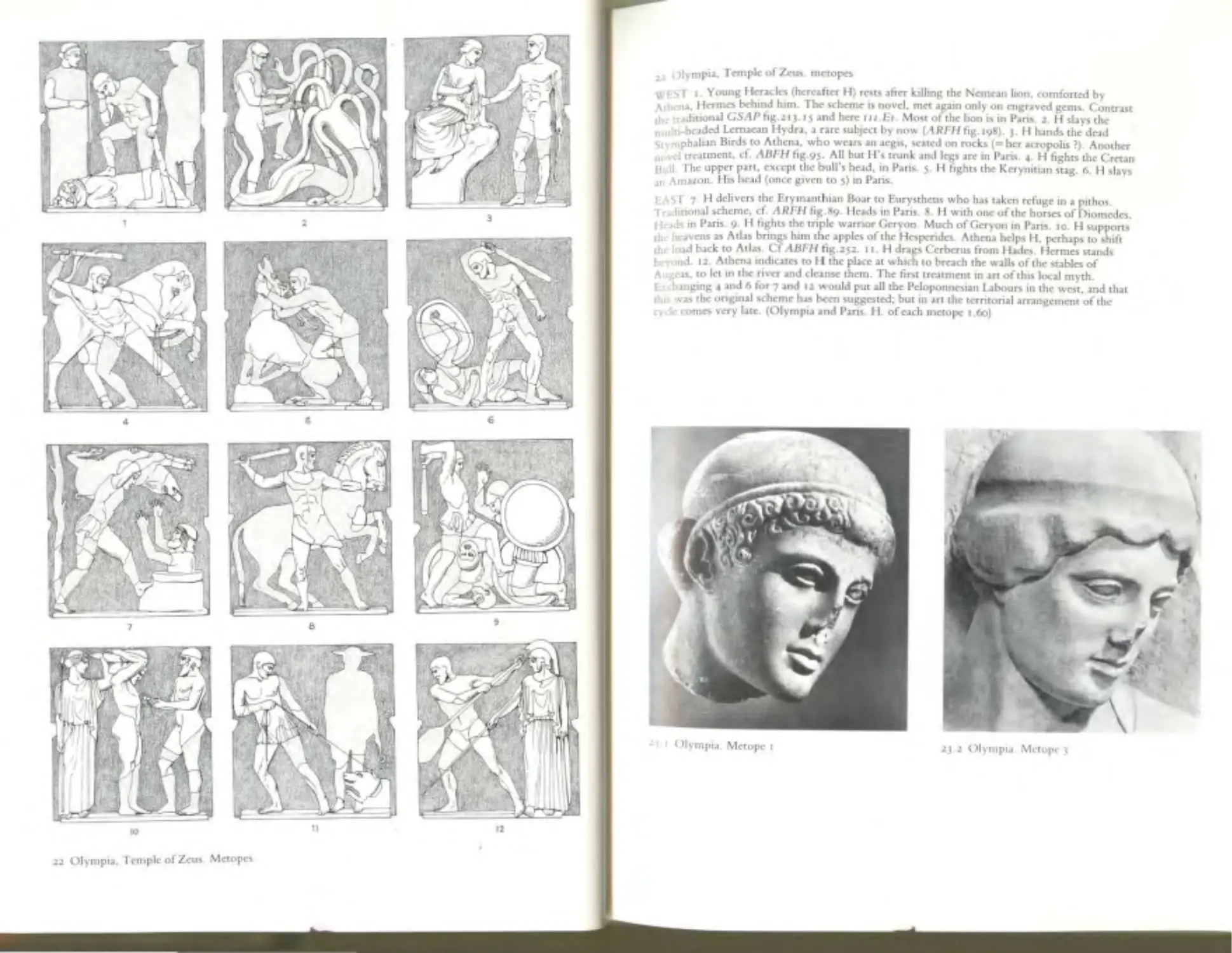
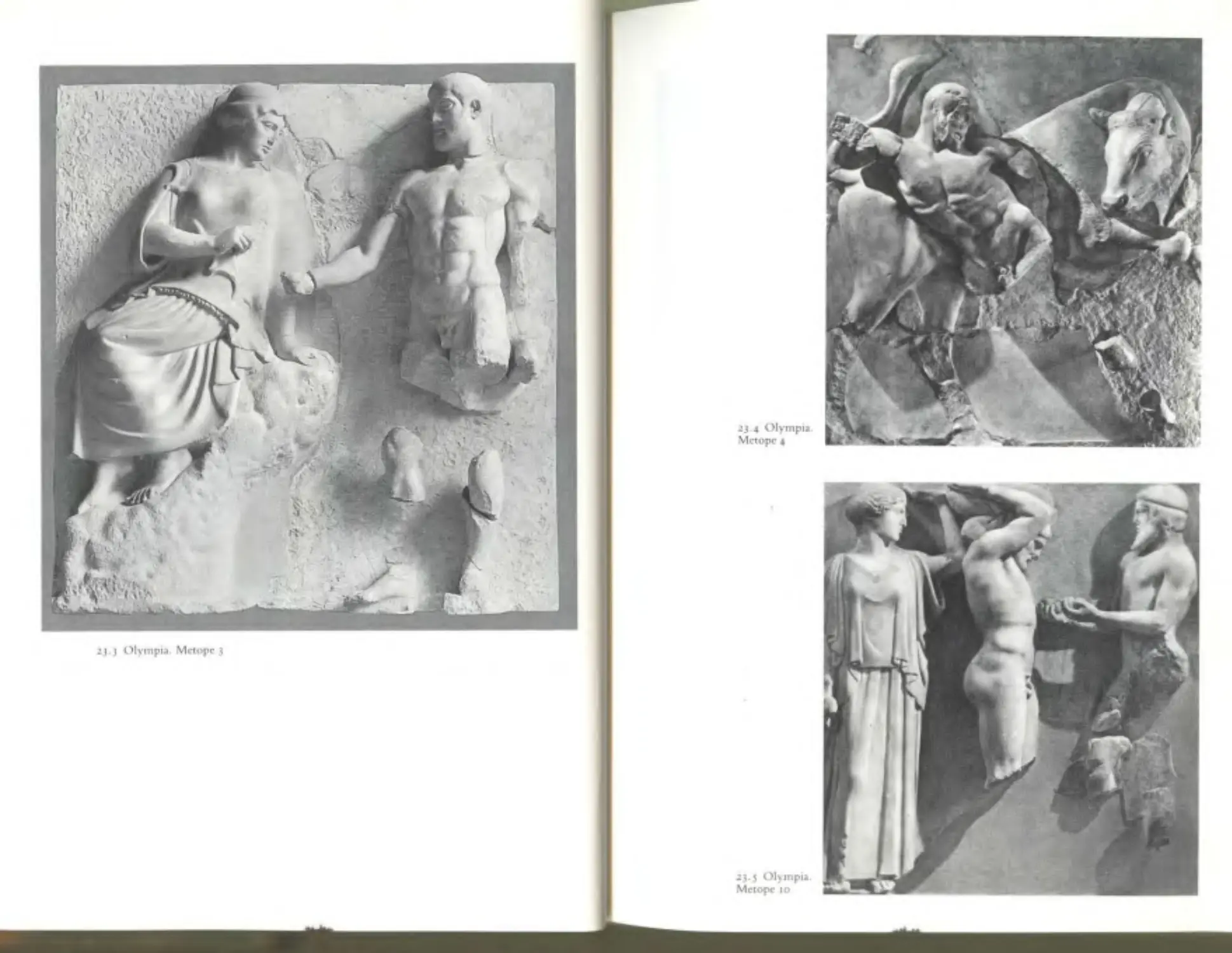
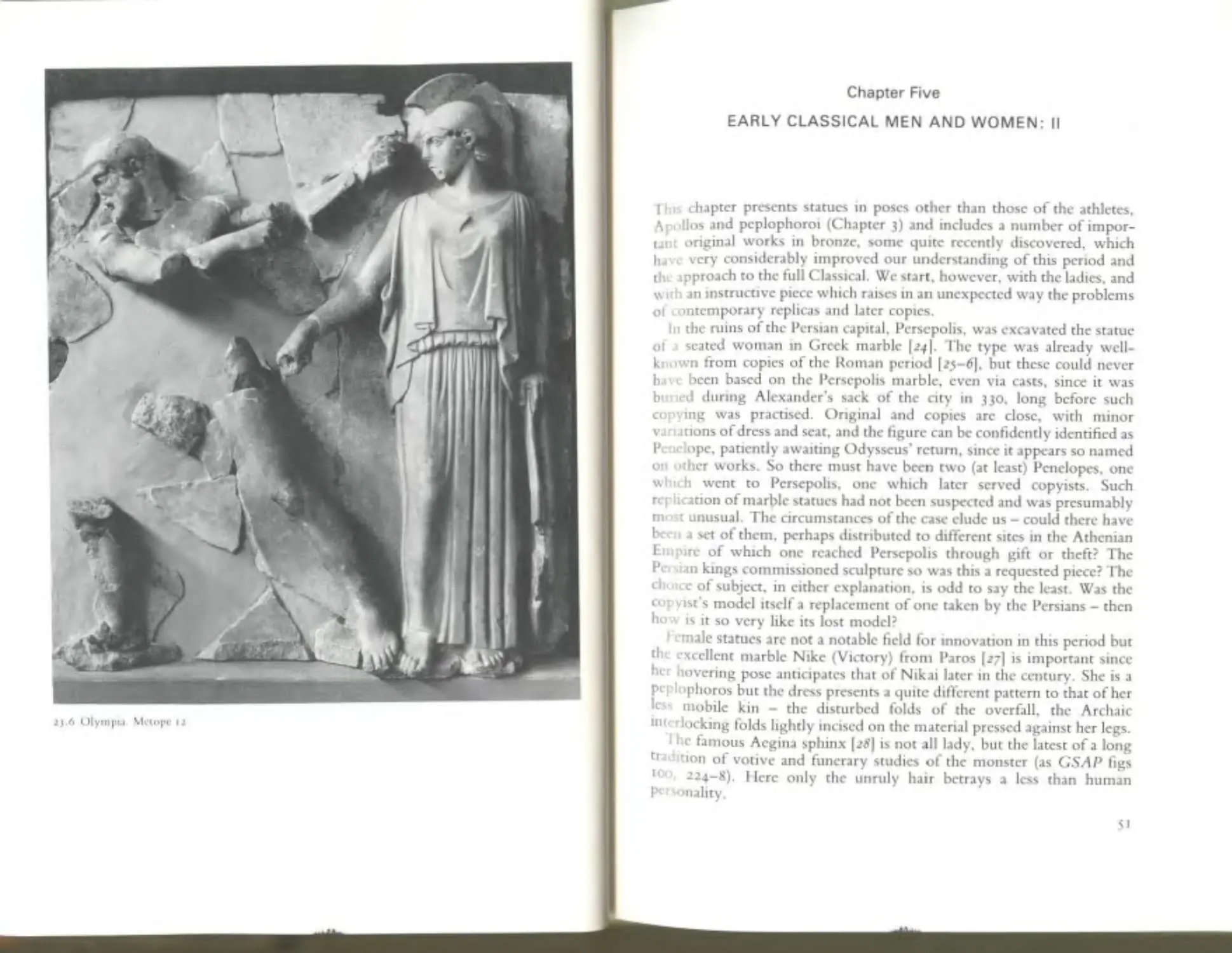
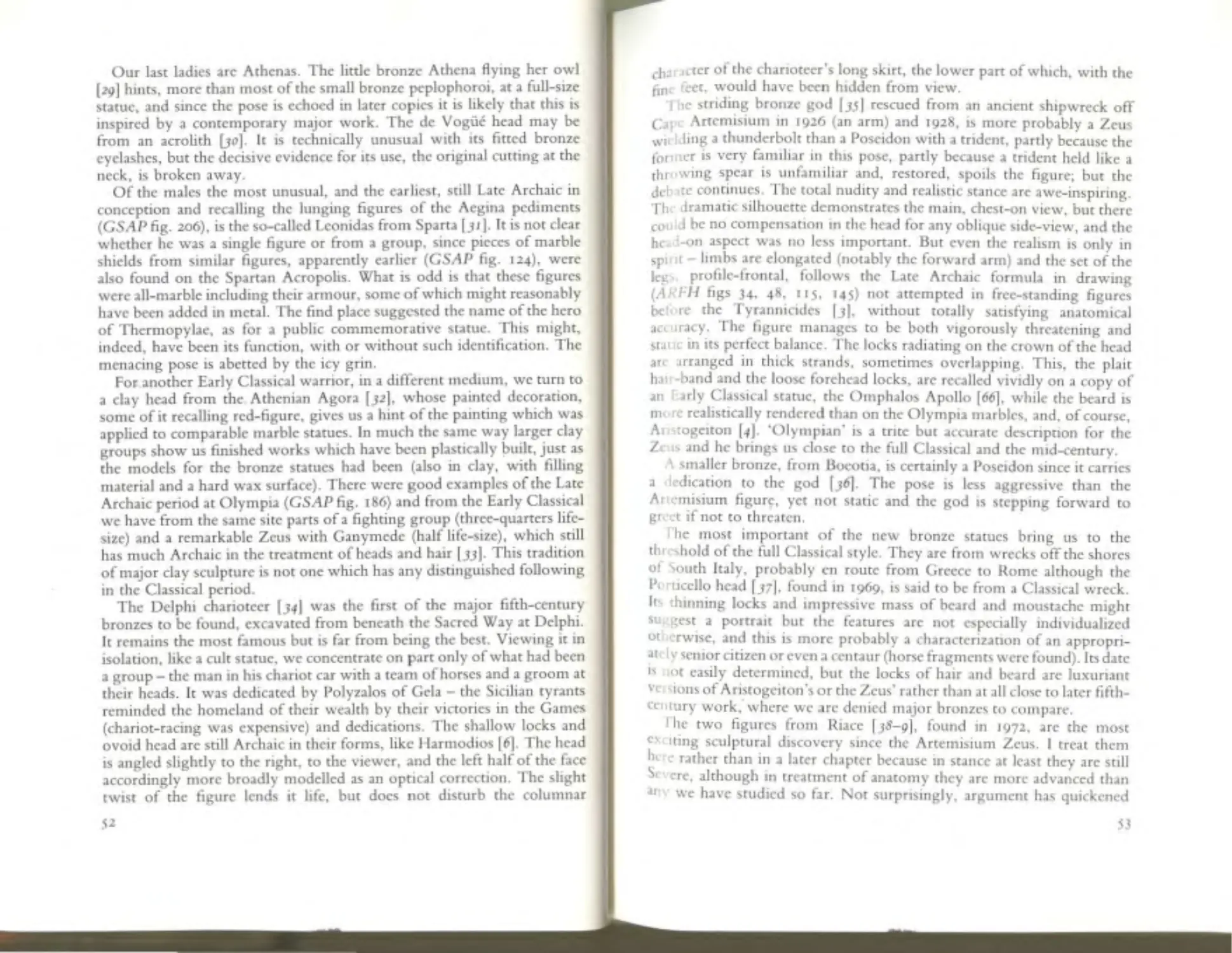
The other sculptural decoranon on the temple IS in twelve metopes
[zz-J), pla ced s1x at each end over the inner porches, the outer mctopes
all round rh e temple being left blank . They dep1ct the labours ofHeracles
an d Jll but o ne are mennoned by Pausanias and arc identifiable, although
some arc sadly fragmentary. Heracles, son of Zeus and founder of the
games, r cqu1res no cxplananon here, and the metopes probably help to
dcternunc the number, although not always the identity, of the
tradmona l twelve labours of later art and myth.
from subject we wrn to composition and style. The pediment figures
are re ~g hly one and half times life-size and the gods at the centre were
about 3 15 metres tall. They arc carved m the round, dowelled on eo the
pediment background, but much o f the backs of most of the figures was
n ot fnished and some were partly ho ll owed, to save weight. Some parts
o fftgmcs were sl ice d off at background lev el , especially the centaurs, and
th e ,t a riot horses were slightl y angled out from the background. The
depth of the pediment floor is nearly one m etre. The material is island
m arble
The co mposition of the cast ped1m e nt [1 8] IS statiC- only knowledge
ofits subj ect allows us to savour the tense mood. Accents are vertical, the
central group in particular, four-square over the m1ddlc intercolumnia-
u on of the temple fac;ade, seem m g almost part of the architecture of the
butldmg, and the symmetry of the other figures barely and sensitively
broken b y the diffenng poses of kncchng or reclining figures, horses at
rest 01 tunung. At the west (19) the fig ht surges away from the centre,
ro:Ju-.~ back on itself in the symmetry of the 2-2-3 groups of figures
wh1 present a zig-zag of vigorous movement, the action somehow
coni 1uous though the groups arc d1screte. llere the challenge ofdepth is
mo• Immediate - at the cast there were only the horse teams, neatly
splJycd 111 the shall ow field. While the fig ures of the fighting groups
natur ll y shrink back from the foreg round, like a fight on a mountain
path, still the girls' bodies arc held or swung across the a nimal bodies of
thetr l ttackcrs )21.4 , 7), and provide th e first (a nd al m ost the last) Greek
pcdanent on wh ich skill of carv in g and com position alone bid success-
fully to break the unres p o n sive shape of the field. Sacrifi ced in the
at t empt are the hindparts of some ce nt au r s (o, G, P), and the sculptor's
failure to make sense of the left leg of youth Q [21.7] might seem,
surpusmgly, to suggest chat there was no very explicit three-dimensional
modd to guide him.
37
In the metopes [zz-Jl there is a command of varied composition in the
roughly square fields which goes far beyond the skills of even so adept a
designer as the artist of the Athenian Treasury at Delphi (GSAP fig.
213). Even where action is directed from or towards a corner ( 11, 12) it
seems complete, and anchored by the standing figures. The horizontal
clement in 1 {Athena's and no doubt Hermes' arms, Heracles' thigh, the
lion) enhance its mood of quiet, almost depression. There IS a compar-
able vertical / oblique rhythm in 3, vigorous crosses (x in 4, + 111 8), the
pyramidal 5· The only relaxation, in the rigid, world-bearing scheme of
10, is in the interests of narrative - Athena's helping hand, Atlas'
nonchalance.
1 and 3 arc novel in their approach to the stor y, as is 12 where there
was, at any rate, no precedent. Athena is seen four t imes, symmetrically
over the whole series- 1 and 3, 10 and 12: always with a spear but in 1
girlish, in 3 a young woman, more dignified in her aegis but still ba re-
h eaded, in 10 mature almost maternal, in 12 t he warr ior goddess. And in
1 the artist catches the mood ofthe fi rst ofsuch a dire series of labours in
the exhaustion o f the young, still beardless hero. H crmcs attends this
inauguration, and, as go-b et ween of hell and earth, t h e draggin g o f
Ccrbcrus on 11.
It is in the treatment of dress that Olympia leads us as directly away
from the Arch aic as earlier sculptors had done in their trea t ment of the
male body. Yet it is idiosyncratic, and the dis t inctively O lympian 111 its
style is not a factor of great importance for subsequent developments in
the representation of the clothed body. It is apparent even in the pcplos
figures- Stcropc and l lippodamia and the metope A then as- whose dress
has a thick, a l most rubbery qua lity quite u n like the crispness of the P aros
Nikc [z7j or t h e blanket-like peploi of oth er figu res. 'Doughy' is the
word often applied- note especially o on the cast [20.5]. E , R and Ton
the west [21.2, 8J -and schola r s have thought thi s an indication of the
plasticall y fo r med clay models which, they suppose, lay behind the
fin ished ma r bles. 13ut this implies a better understanding of the figures in
the round, with thei r dress, than is always demonstrated. T h e pattern o f
t he dress is st ill basica ll y one of line rather than mass, serving (as it had
to) t he frontal v iew, and t h e artist h as still eo learn h ow best it can suggest
t he roundness of body forms beneat h. O n o in the cast pediment [zo.5j
the contour of the fig ure does more than the d rapery to show the pose,
and an oblique view demon strates t h at the artist had no coherent idea o f
how the folds m ight run from leg to leg (and compare c on the cast),
such as eith er observation from life or t he plastic construction of a model
migh t have taught him. l i e has seen that a looped fo ld is effective because
realistic, but he disposes the loops and curlicucs in unreal patterns - on
the west, over the knee ofT, on the girls e and R [21.2, 8[.
38
The real wo r ld is still not, it seems, altogether the Master's model and
n his treatment of human anatomy h e may be ambitious, and often
ucccssful, with the corn position of h1s struggling figures and groups,
but he shows no greater understanding of the human body in acrion t h an
0 his contemporaries. Yet it is in this sphere that he can also display his
onlliance. There arc nuances ofexpression, mainly in faces but also in the
· ndcring of parts of some bodies, wh1ch in earlier sculpture we see as
m plc convention or sometimes accidental, and which the idealizing arts
, fClassical Greece, especially in Athens, were to eschew. The Olympia
Master not only recognized these physical n u ances but accepted the
· h allengc to attempt the re n der ing of them in marble, and succeeded.
I mic enough of this, no doubt, could be appreciated on t h e building, at
•he distance from wh ich the features we r e v iewed, and we can see that
the Mast er's team made allowance in o t he r respects for detail w h ich
·ould not be seen clearly, leaving hair masses on the mcto pes and some
)f the pedimental fig u res uncarvcd, to be rendered simp ly in p aint. In
Jllything other t h an arch itectu ral scu lptur e we might have been a b le yet
more rea dily t o ackn owledge the unique quality of t h is studio 's work.
In t h e mctopcs he catches brilliantly t he differing moo d s in t h e
· x prcssions of the hero- t h e tired youth of 1, pride on 3, pi nched tension
m 10, concentration and a touch of unease on 11, disgust on 12; and the
lfferent ages even of A t h en a (an immortal who had been born full-
·own!). In t h e east pediment Oinomaos seems anxious o r impatient, the
,Jd seer N is dist ressed [zo.4] but resigned while his opposite number L
c ars the wrinkles of a quiet smile [2o.JJ; in the west the ccn taur masks
1a ngc from the near dignified 1 [21.4] to rabid N, or bestial P (21.7). The
voung man Q has heavy boobyish features, wincing with pain [21.6].
< ) nly the gods, h eroes and women seem relatively impassive. Observe
1e progression from the soft young flesh ofe in the east pediment [zo.6],
the firm but not muscular B, the mature heroes and god, the well-kept
uddle age of the seer N [zo.4); or in the west the chubby, barely formed
•dolescent R (21.8]. her trim foot in the clutch of the cen t aur's gnarled
St.
We writ e as though all this was the creation of one man or at least his
1csign . The execution must have been in the hands of many and perhaps
he Master h imself finis h ed some important heads or other areas. There
re minor d ifferences in the rendering of t he la n k and h ook curls in hair
•nd beards, a n d in t he e m phatically lidded or m ore res tra in ed modelling
,f eyes and faces which could betray the different hands. Contrast the
'\then a of metope 3 with those of 1, 1o and 12, which a r e also remarkable
ro r the quality of t he Her acles h eads. it is almost impossible ro believe
h at the master design did not proceed from d rawings t o models, and
•c rhaps even models at life-size despite the inept passage we obse r ved in
39
Qat the wc~t. Unworkcd bo~~es ofsronc left on some head~ and cl~cwhcrc
IZO.} , z 1.6 hc,lth of1 and Q!look very much like the ba>c> fonomc \Ort of
measunng procc'>'>. Comparable bosses have been observed on ;omc ofthe
slightly earlier ~culpturc 111 the round at Persepolis, where we know that
Greek-tramcd ma'>Oll'> were at work. The Classical Creek armt;, 111 all
mcd1a, were at pams ro d1~gU1>C and eliminate all traces of the•r technique,
and 11 ;cems that the Olymp1a studiO, by being the sole exccpnon, may
have left us the vaal clues. And 1f a measuring proce;~ was used we must
1magmc model; pr epared in consider able detail, probably 111 clay.
20.1 Olymp,.. L>St J'<'d. F.G.II.I.K
10.2 Olymp1.1 ·
l::.l>t ped . I
l.O . .\ Ol)mp•.11
E•" p<d l
20.4 Ol\'mp1.1 E.11sl pcd . N
~o. s Oh mp1A E.ll"'l p<-d . 0
lO. tl Oh·mp1.11 E .11s( ped. E
20.7 Olympia
l:.Jst peel P
~· z OI}IIIJU.I ,
Wcs1 p<:d F
.Zl .J Olymp•a Wc!.t ped. L
21 4 Olymp1> We« pcd 11, I
2 1 .5 Olymp1•. Wo;t pcd. M ( I hescus)
21.6 Olymp~a W<St pcd Q
.u 7 Olympia.
est pcd. P. Q
t 8 (1></ow) Olymp1•.
N pcd.R,S.T
.22 Olymp1<1, Temple of z~us Metope\
.U O lympu. T emple ofZcus . mctopcs
wr' r I. Young Hcucles (htrt<lfccr 11) rests aft~r blhng eh~ Ntrntan hon. comfonM. by
A 1cn.J , Hcrmo behmd ham The ~chemc as novel, met ag<1m onl)· on cnguved gems. Contu.st
the tr;aJ1t1on:.1l GSAP fig .2t).JS and here IJI.E1 . Most ofthe hon IS 111 P;ms. 2. H slays the
mutu-hc<1ded Lernae<~n llydr.1, .l rue subject by nov.. (ARFH fig.198). J H hands the dead
Sn 1, phalian Buds to Athcna, who wears an acg1s, sc<~tcd on rocks (• her acropohs ?) . Another
nov ·I treatment, cf. AIJJ; H fig.95 . All but I l's trun_k <~nd legs arc m Puas. 4: H fights the Crct:.1n
Bul lhc upper put, except the hull's head, in Pans. s . 11 fights the Kcrymtt:m stag. 6. 11 slays
an 1\mazon. I hs head (once given to 5) in Puts.
1Ac 1 1· 11 delivers the Erymanduan Boar to Eurystheus who Ius taken refuge in a pithos.
"I r.1d 1tional scheme, cf. ARFH fig.89. I leads m Pans. 8. H wuh one ofthe horses ofDiomcdes.
Head)> 111 Paris. 9 · H fights the mple wurior Gcryon . Much ofGeryon m Paris. 10. H suppons
th hen ens as Atlas bri ngs hun the apples ofthe Hcspcrldes. Athcna helps H. pcrh.aps to shift
the lo.ad b<~ck to Atbs. CfABI;H fig.2p. 11. H drags Cerbcrus from I Jades. Hermes st.ands
bq nd. 12 . Athen~ mdac~tes to 11 the place .at wh1ch to breach the walls ofth~ subles of
A ::-.;~s, to let m the nvcr .;~nd dc~nsc them. The first treatment m art ofth1s local myth.
Exchangmg 4 ~nd 6 for 7 and 1 .2 would put all the Pdoponnesi;m Labours m the west, and that
th -s \~o· as the ongm.al scheme h~~ been suggested; but in art [he terruorial uungemcnt ofthe
cvde comes very late. (Olympia and P.;~ris . H. ofeach metope r.6o)
I Olympu Mctope 1
l).J Olymp1~ Me-cop<- 3
23 _4 Olymp1a.
Mctopc 4
lJ.s 01) mpu .
Mecopc 10
23.6 Ol ymp1.1 Ml ·t o pl' 11.
Chapter Five
EARLY CLASSICAL MEN AND WOMEN : 11
'1 h•' chapter presents statues in poses other than those of the athletes,
Ap •llos and pcplophoroi (Chapte r 3) and includes a number of impor-
ta1· original works 111 bronze, som e qu•te r ecently d1scover ed, wh1c h
h• c ver y consid erabl y improved o ur understanding of this period and
eh • tp proach to the full C lass ica L We sta rt, however, with the ladies, and
w , an instructive piece which raises in an un expected way t he problems
of ·ontemporar y rep li cas an d later copies.
n the rui n s of the P ersia n capital, Perscpoli s, was excavated the sta tue
of 1 sea ted woman in Greek marble [24]. T he type was already well-
kJ 1wn from co pies of t he Ro m an period [25-6], but these could never
h been based on the P er sepolis marble, even via casts, since it was
bt. tcd during Alexander's sack of the city in 330, long before such
COl mg was practised. Original and copies arc close, with m in or
va an ons ofdress and scat , and the figure can be con fidently identified as
Pc ·lope, patiently awaiting Odysscus' r eturn , s in ce it appears so named
01' the r works. So there must ha ve been two (at least) Penelopes, one
w
h went to Persepoli s, one which later served copyists. Such
r e I Cation of marble statues had not been suspected and was presumably
m
unusuaL The circumstances of the case elude us - could there have
bee a set of them, perhaps distributed to different sites in the Athenian
En. •1re of which one reached Persepolis through gift o r theft? The
Pc1 1a n kings commissioned sculpture so was this a requested piece? The
chc ·c of subject, in e ith er expla nati on, is odd to say the least. Was the
co1 1s t 's model itself a r eplacement of o n e taken by the Persians- then
ho IS it so very like its lost model?
I ·male statues arc not a notable field for inn ovation in this p er iod but
th• excell en t marble Nike (Victory) from Par os [27] is important sin ce
hl hovering pose anticipates that of N ikai later in the century. Sh e is a
pc lop horos but the dress prese nts a quite different pattern t o that of h er
le• mobile kin - the d isturbed fo ld s of the overfall, the Archaic
"' rlocking folds li ghtl y in cised on the material pressed again st her legs.
he famous Aegina sphinx [28[ is not all lady, but the latest of a lo n g
tr~ htton of votive and funerary s tudies of the monster (as GSAP figs
10 224-8). H ere only the unruly hair betrays a less than human
pc, :>n ality.
51
Our las t ladies are Athenas. T he li ttle bronze Athena flying her ow l
[z9] hints, more than most oft he small bronze peplophoroi, at a fu ll-size
statue, and since t he pose is ech oed in later copies it is li kely tha t this i s
inspired by a contemp ora r y major wor k. T he de Vogiie head may be
fr o m an acro lith [Jo). It is technically unusual w ith its fi tted bronze
eyelashes, but t he decisive evidence for its use, the o r igin al cutti ng at the
neck, is broken away.
Of the m ales the most unusual, and the ea rliest, still Late Archaic in
concepti on an d recall ing the lunging fi gures of the Aegina pediments
(CSAP fig. 206}, is the so-ca ll ed Leonidas from Sparta [31). lt is not clea r
whether he was a single figure o r from a group, since pieces of marble
shields from similar figures, apparentl y ea rlier (CSA P fig. 124), were
also found o n t he Spartan A cr opolis. What is odd is that these figures
were all- marble including t heir armour, some ofw hich might reasonably
have been added in met al. The find place suggested the name ofthe hero
of Thermopylae, as for a public commemorative statue. This might,
indeed, have been its function, w ith or without such identification. The
menacing pose is abetted by the icy gri n.
For another Early C lassical warrior, in a different medium, we t urn to
a clay head from the. Athenian A gora [J2), whose painted decor atio n ,
some of it recalling red-figure, gives us a hint ofthe painting which was
applied to com pa rable marble statues. In much the same way la rger clay
grou p s show us finished works which h ave been plastically built, just as
the models for the bronze statues had been (a lso in clay, w ith filling
material and a hard wax surface). There were good examples ofthe Late
Archaic period at O lympia (CSAP fig. 186} and fro m the Early Classical
we have from the same site parts ofa fighting group (three-quarters life-
size) and a remarkable Zeus with Gan ym edc (half li fe- size), w hich still
has much Archaic in the treat m ent of heads and hair [JJ). T his tradition
of major clay sculpture is not o ne which has any distinguished foll owing
in the Classical per iod.
The Delphi charioteer [34) was the first of the major fifth- centur y
b r onzes to be found, excavated from beneath the Sacred Way at Del phi.
It remains the most famous but is fa r from being the best. Viewing it in
isolation, like a cult statue, we concentrate on part only of what had been
a group- the man in his chariot car with a team ofhorses and a groom at
their heads. It was dedicated by Polyzalos of Gela - the Sicili an tyrants
reminded the h omel and of their wealth by their v ictories in the Games
(ch ar iot- racing was expe n sive) an d d edications. The sh allow locks and
ovoid head ar e still Archaic in thei r fo rms, like H ar modios [6). The head
is angled slightly to the r ight, to the viewer, and the left half of the face
accordingly mo r e broadly modelled as an optical correction. The slight
twist of rhe figure lends it life, bur does not dtsturb the col umnar
52
charKter of the chanoceer's long skirt, the lower part of which, with the
{inr eet, would have been hidden from v iew.
1C striding bronze god [35) rescued from an anctent shipwreck off
ca1 Artemisium in 1926 (a n ar m) and 1928, IS more probably a Zeus
"''' .dmg a thunderbolt than a Poseidon with a trident, partly because the
for 1c r is very familiar m this pose, partly because a trident held like a
th r · w mg spear is unfamiliar and, restored, spoils the figu r e; but the
del' te contmues. The total nudity and r ealistic stance are awe-inspiri ng.
Tl1 dra m anc silhouette demonstrates the main, chest- on v iew, but there
c01 ·l be no compensation in the head for any oblique side-view, and the
he.
-on aspect was no less important. But even rhe realism is only 111
sp1 t- limbs are elongated (notably the forward arm) and the set of rhe
leg . profile-fr ontal, fo ll ows the La re Archa1c formula in drawing
(A l·H figs 34. 48, 115, 145) not attempted 111 free-standing figures
bet re the Tyrannic1des [JJ, w ithout totally satisfying anatom ical
ace racy. The figure manages to be bo t h vigorously threateni ng and
staJ c 111 Its pe r fect ba lance. The locks radiating on the crown of the head
arc ,1r ranged in thick strands, sometimes overlapping. This, the p lait
ha -ba nd and the loose forehead locks, arc recalled vividly on a copy of
an .a rly C laSSical statue, the Omphalos Apollo [66), while the bea r d is
m• c realistica ll y rendered than on the O lympia ma r bles, and, of course,
A toge iton [4). 'Oiymp1an' is a t rite but accurate description for the
Zc ' and he brings us close to the full Classical and the mid-century.
smaller bronze, from Boeotia, is certainly a Poseidon s ince it carries
a lt" dication to the god [J6J. The pose is less agg r essive than the
Ar ·m1smm figure , yet not static and the god is stepping forwa r d to
gT< t 1f not to threaten.
he mos t important of the new bronze statues bri ng us to the
th 1·s hold of the fu ll Classical style. They arc from wrecks off the shores
of \ouch Italy, probably en route f r om Greece to Rome although the
p, tcello head [37]. found in 1969, is said to be from a Classical wreck.
It · hinning loch and Impressive mass of beard and moustache might
su ~es t a portrait but the features are not especially individualized
Ot rw1se, and this is more probably a charactcrizanon of an appropri-
.n
1
y ~em or CitiZen or even a ccntaur (horse fragments were found). Its date
IS 1ot easily detcnmncd, but the locks of hair and beard arc luxuriant
v, , ions ofA ristogciton's or the Zeus' r at her than at all close to later fifth-
c~' tury work, where we arc denied major bronzes to compare.
I he two figures from Riace [38- 9). found in 1972, are the most
ex, 1nng scu lptural discovery since the A rtemisium Zeus. I treat them
h c: rather than in a later chapter because in stance ar least they arc still
S ·ere, although in treatment of anatomy they arc more advanced than
31 we have stud1ed so far. Not surprisingly, argument has quickened
53
over their date (down to Early Roman), relative date (up to fifty years
between them), identity, home and sculptors. There arc sufficient
similarities in technique, anatomy and sta n ce to believe them contempor-
ary an d possibly from a single group. They could easi ly be from one
studio even if designed by different hands. The main difference between
them lie s in what the sculptors sought eo exp r ess - the arrogant self-
confidence of a young leader: the mature strength and stolidICy, now a
linlc slack and tired tt may be, of an older warri or. The expression, not
merely of the head s but of the set of the whole body, goes far beyond
Olympia, far beyond anything left for us in marble of later in the
century.
The odds against any of the few figures su r viving from wrecks being
identified with figures chosen fo r mention by Pausanias, must be long
indeed, but one theor y of their origin and authorship w hic h is gain in g
ground is worth recording. At D elphi P ausanias saw a g r oup by Phidias
com m emorating Marathon, including Athena, Apollo, Miltiadcs (victor
at Marathon but dead soon afterwards) and Athenian h er oes. lt is
suggested that the Ri acc bronzes arc fr o m this group. Si mil arities t o
copies such as the Tibcr Apoll o, often assoc iated with Phidias, may see m
eo strengthen the d1co r y until we recall on how little such associati o n s are
based. An alternative explanation is that they arc from a g r oup at
Olympia dedicated by the Achaeans and showin g the Greek heroes at
Troy, also described for us by Pausanias and ascri bed eo the Aeg in ctan
sculpto r Onatas. Whatever their original home, and this may never be
determined, they ar c a swnning demonstration of the relative qua lit y of
the best survtving bron zes v is-a-vis the best surviving marbles, and of
the impoverished cxecmion and impact of all later copies of C lassical
works. There is a deliberate air of near theatricality m the young figure,
of near pathos in the o lder. Neither are moods we would nawrally
associate with fifch -cemury sculpture though they arc subtl y played upon
in Classical lite r atu r e. The bronzes teach us chat we might expect as
much of arc. The veil ch at was lifted when the Elgin marbles we r e
presented to the apprai sal o f Western scholars ha s proved eo have left
hidden s t ill the quintessence of Classical art , and thi s, for the most part,
must remain beyo nd o ur imagining.
.l Pc nclope, from Pcrscpoli s. She
'
1rs a chiton with himauon swathed
r •d her legs, a veil over her head
A n1t 46o. (T ch ran. 11. o.8s)
26. Head of Pcnc lope. Copy of an
anginal of about 46o, see 24- . 5.
(Copenhagen, Ny Carlsbcrg 1944)
25 Pendo~. Copy of an ongmal of
41bout 46o, Stt 24 ThiS IS rCSIOred
With the wrong head (see z6); th e chm
should rest upon the right hand
(V•unn 7S4· H. • •s)
27 (tt.fi) Nike, from Paros. She 1!1. posed on uptoc. \c;tnmg
forward, as 1fhovering or alJghung. Cuttmgs for w1ngs at her
b.ck About 470-00. (Paros. H . 1 . 38)
28 Sphmx from Aegina. A vouve monument. T he head is
shghtly turned, not frontal (as ea rlier vouves) o r turned to the
side (as ~arlicr fune rary sphmxes). About 46o. (Acgma H
0.9(1)
29 (ltjr) Bronze Athena wuh owl (t he Elgon Athena). She held
a spear in her left hand, from her right the owl IS rising. She
\..,.ears Conmhian helmet and peplos w1th long, gtrt overfall
Abouq6o-so. (New York so. 11 I H o. Is)
JO Head of Athena (de Vogue head) from Aegona Poss•bly an
acroluh. Bronze eyelashes and bronze deulls ofthe helmet
were anached by the dnlled holes About 46o-so. (Pu1s J 109.
11 ehm to crown o. 20)
J 1 (lt}i o11d below lt}i) 'Lcomd•s'
from the acropohs at Sp~rta . The
eyes were inbid. Pa rt of the left leg
was also fou nd. About 490-80.
(Sparta JJ6s. H . 0.78)
Jl Clay head ofa warrior from the
Agora, Athens. A Thncian h~lmetJS
worn with a Pcgasus dcvtcc m ·red
figure' on the sides. Posstbly from an
akrotenon. About 46o. {Athens,
Agora TJ2Sl· H. o . zt)
33 Cby group ofZcu\ abducung Ganymedc, from Olymp1a. Zcus carncs h1s knobbed
tuvdlmg su ck, Ganymedc a cock (love g1ft). 1t 1s on a strangdy shaped base, but not.
appucnd y, an akrotcnon Colours arc- bluc·black. deep red (llus' cloak). brown (Ganymc-dc-'s
brows and Zc-us' nape ha1r). yellow1sh (bod1cs). Fifth,cmury Greeks woul d not have found
Zeus• abducuon ofGanymcdc t O be h1s cup-boy a degradmg subject for the sanctuuy About
470. (Oiymp~>. 11. 1.10)
34 'Jc-l ph1 chanotc-cr
34 Delph1 chlnotecr. Bronze, from Delph1. The long ch1ton was approved dress for chariOteers
(a w1ndy sport) and the shoulder cords nop the dress billowing. The eyes were mla1d wnh glass
and stone. sllver for the held·band pattern, copper on the hps. He held rems and. presumably, a
goad. Scraps ofthe chanot, horse legs and tail have been found. Ded1ca ted for a vtctory m 478
or 474· An adJacent stgnature ofSoudas of Boeona seems not to belong. The base reads (as
restored) 'Polyzalos, victorious With his horses (chariot) dedtcated me/son ofDemomenes,
whom make prosper, honoured Apollo'; the first hne having once read ·Polyzalos, lord ofGela
dedta.ted (thts) mcmonal . ', whtch was erased, presumably because of his dum to Gcla and
embarrassment over h1s tyranny. (Delphi. H . 1 .80)
1. (Mva~a ITOAU~aAO> ~c r)cAa> avc(~)Exc(v) a(v)noo[ov),
(hu~o> 6c~vo~EVEO> , T)ov ac~', cuovu~· "A~OAA(ov.)
2. [N~xaoa> ~RRo~o~ rr)oAu~aAo> ~·avc~~x(cv),
3' llronze Zeus from the sea at Artemtsium . About46o-so . (Athens Br. ISI6J. H. 2 .09, span
2o)
JS AncmiSium Le-us
36 llronzc Po,nJoulrom krt·u,,.. BonuM)
About 4<\o. (Ath<m llr 11761 11 1 1S)
37 Br nze head fro m Pom cdlo (Strans of
Mcss1n About 450. (Rcggio)
&lou
38 Re> c wamor (A)
39 nu e wanior (l3)
38 Bronze warnor (A) from
Rl;ace. T o be restored wtth spc;ar
a nd sh1cld; copper on hps and
mpplcs. sLiver on teech, eyes
mla1d. There w;a~ perhaps a wreath
over the h;aub;and About 46o-so.
(Regg•o)
39 Bronze warrior (B) from
nu To be restored wah sword
r sh1dd and hdmct; COpper Oil
1
P nd mpples. the ml.1y ofone
eye cnums. T he nght arm and
le forcum ·were replaced m
.ant uny. About 4oo-so . (Rcg g1o)
Chapter Six
EARLY CLASSICAL RELIEF SCU LPTURE
Relief sculpture with figures vi rtu all y in the round, or lightly foreshor-
tened against their background an d overlapping, yet with their main
features brought into forward plane, was an invention of Greek
sculpto r s. The most extr eme forms, w ith figures w h olly in the round,
and barely att ached t o their ground , are to be found in the latest Archaic
(GSAP fig. 2 13) but are mor e adventurous in the Early C la ssical per iod
and sublimely so in C lassical for architectura l sculpture, but the Archaic
p eriod pJcscnted all other s tyles, from barely carved drawing, to subtler
com p ositions successfully cons tru ct ed in a shallow field. In Egypt an d
the Near East relief sculpture could claim to be no more than carved
drawing except where, in E gypt, a background pi ll ar had been left to
help support a standin g figure.
The n on-architectural reliefs o f the Early Classical pe r iod offer no
technical advance on the Archaic although we m ay admire the skills of a
sculptor who, in an extremely shall ow field, succeeds in foresho rtening
hi s anato mically more realistic figures: this h ad been less of a problem
while anatomy was still pattern rather than modelling.
We look first at votive and architectural reli efs, then at the g r ave
reliefs. In both areas the Early Classical record differs from the Archaic
and the full C lassical in sources (minimally Athens) and stereotyped
forms. In both we detect tendencies alread y apparent in the Late Archaic,
towards some b r oader reliefs which can accommodate two or more
figures, and towards an architectural setting for the r eliefs, with side
pi lasters (a ntae) and roof or pediment. But the slim one-figure rel ief is
not forgotten.
Votive and architectural (non-temple) reli efs
Attica offers no r elief gravestones of this p eriod an d few , but interesting
reliefs for other purposes. T h e Sunium boy [40] is a good example of t h e
successful shall ow modelling (on ly 3 cm deep) of a basica ll y unpattcrncd
body. P rofile heads arc naturally de rigr<er<r o n s u ch works. The Athena
from the Acropoli s [41] is hardly mor e deeply modelled but can rely on
the fall of her dress to suggest depth. The boy crowning himself is an
66
.
trospective figure, the Ath en a pensive ifnot mourning: both are distant
m m ood from the Archaic and demonstrate the new dimension o f feeling
Inhicl sculpto r s seck to expr ess through subtler and less emphati c use of
'~nvc •nonal poses and figures. The effect of such figures in the round or
ceh ef 1d at any scale, depends more now on the collusion of the viewer
~han 011 emphatic statement of pose and gesture. Both these reliefs are
voU \'C the boy personal, the Athena possibly civic. A more exp licitly
vouvc relief suggests contact between the mortal dedicator, an artisan,
and t Il goddess [42].
Th. ;os offered relief sculpture in architectural, non-temple settings in
th e A:·cha ic period (GSAP figs 223, 263) and the tradition continues both
for CJI\'-gate decoration, and in other positions in the city [43]. Here the
style see ms retarded Archaic. The banquet relief fr om Thasos [44]
presents a sche m e much used in later years o n graves tones to depict the
rece nt dead as heroes, but this perhaps refers to a h eroized ancestor and
carries no in scri ption to help us (cf. the Late Archaic relief f r om Paros,
GSAP fig . 255, with s imilar schem e). From M elos comes a disc with a
goddess' head, presumably a vot ive [45[.
The Lu dovisi Throne [46] was found in Rome. Features of its subject
matt<'• ca n be paralleled in South Italy, at Locri, and its style has see m ed
to SOIK c Wes te rn , but is not in compatible with a homeland Greek origin.
There •s no good ev id ence for such acco mpli sh ed work in marble reliefin
the w ·st at this date and the stone is Greek. Wherever it was made it is
bette. explained s tylisticall y in terms of homeland Greek sculpture. A
comp; n ion relief, the Boston Throne [4 7], is also from Rome and ha s
apparent iconograph ic links with Locri, but its authentici t y is ques-
tionc. and it should not affect assessment of the Ludovisi piece. I
illu sn <te it because it is well known, but modestly while it is mb judice.
T h, Ludovisi Thr one is a three-sided, hollow (open-backed) relief
whic m ight have edged an altar or pit, but not a throne. The masrer of
this f 'lC reliefloved borh dress and undress- our first fine female nude.
On the fronr the figure to the left wears a peplos, its folds s li ghtl y heavier
th an .hose of h er companion's chiton skirt, whose upper pa rt is crinkled.
The •ke d body of rhe goddess betw een them is crchcd with lines of her
wet r <ment while the cloth held before h er han gs in t h e catenary folds of
a pcpiophoros overfall. At the sides we enjoy the ti g ht cloak wrapped
aro und the woman, the plump cushions, the g irl 's n akedn ess. The arti st
ha s .still much to le a rn of anatomical fo r eshortening in shallow re li ef (the
girl s breast s arc admirable but where is her farther hip?) but he had a
st ron feel ing here for bodies, for d r ess and fo r space-filling co mpo si-
tion. and the relief carries in it the best ofthe Archaic tradition rather
thar tn timations of rh c C la ssical. l t r emain s a welcome enigma.
A other enigma is the Metrological Relief in Oxford [48]. It is so
67
called because the life-size figure appears to be demonstrating a fathom
w ith hi s outstretched arms, yet the footprint cut in the g r oun d above his
right arm is one-seventh of this span and n ot th e canonical one-sixth.
Possibly it demonstrates a combin atio n of m easuring st anda rds (Athen s
tried t o enforce new standards in her e mpire but Greeks were s low to
accept any national st anda rd and clung, none roo acc urately, to local
varieties m weights and lengths). It hardly se r ved as a preci se yardstt ck,
like the Paris metre, and com putations of exact m easurements of detail
taken from it are, though popular, probably misguided. The style looks
East Greek: compare (49) and its grooved contour. T he shape, a trtmmed
pediment, appea r s for two lat er monuments, both with w h at may be
funcrary s ubject s. lt may be appro priate t o a heroon-like grave building.
Grave reliefs
Whatever halted the production of gra vestones in Athens at the
beginnin g of the fifth ce ntury r emained effective until abo ut 4 30. We
turn therefo re to the rest of Greece for the Earl y Classica l record. Archai c
stelai came t o distinguish figures by age, and t he formula of elderly men
with dogs (as GSAP fig. 244) is fl eshed out in the new manner [5o] . East
Greece see m s t o h ave introduced differ entiation by occupation too, so
beside the athlete (57] or knight [59) we find also a lyrist [56] and other
figures app r opriately occupied. Stelai showing women, and of di ffer ent
ages, become more com m on: the beautiful Parian girls [51-z) and more
matronly seat ed figures (53). For these the broader s t ele is needed and
they may acco mmo date subsidiary figures too, of attendants o r a whole
family. These especiall y som eh ow lend an ai r of both heroization and a
more effec tivel y domestic atmosphere. Comparable heroizing of the
male w ill come w ith the banquet reliefs (see on [44]) and the m ales' st elai
roo admit att enda nt figures (57, 58].
The East Greek s t elai arc, in their way, conventional but the Islands arc
innovative with the brilliantly carved studies of young girls (5 1-2], both
probably from Paros, and the big family fr om l karia l5JJ. Thessaly w ill
present novel compositions w ith wom en, presaged in [54J with its
m ys t erious pair. There is a scattered yield from areas of ce ntral Greece
[56-8] w ith 13 ocotia sp ecializing in fine stelai showing kni ghts [59).
Until Atti c production r evit ali zes the gen r e a round 430 the history of
reli ef gravestones in the fifth century is patchy. lt is the traditio n s o f the
Late A rchaic that rem ain dominant, providing ground fo r variety o f
theme or co mposition, and no new tradition is established, apart fro m
the few lo ca l preferences w hi ch have been indicated.
68
40 H·liefofa boy, from temple ofAthen~,
Sun 1m. He ts probably a young ath lete, crownmg
him ·If(a metal wreath fined t O the dnllcd holes),
but e gesture has (less plausibly) been mt crprctcd
as
·real. The temple ha d been destroyed by the
Per- s but thts was found m la ter fill . About 470-
(A•
'" ll44· 11. 0.59)
4 J Rchdof Athena from the Acropohs. She
wears a Connthian hdmct, the fami liar peplos
wnh long , gtrt overall, and le2ns on her speu
contemplating a pillar. The background was
blue. The p1Jiar has been interpreted as l
fimshmg post (tmna) m an exercise ground or
the bounduy ston e (horos) of a sanctuary, but IS
perhaps a liSt of Atheman dead smce her pose
seem s deodcdly sorrowing, lnd this is the
pe:nod m wh1ch annual state burills lnd funen.l
Oro1taons were maugurated. About 470. (Athens
Acr. 695 . 11 . 0.48)
42 Reheffrom the Acropolis. Athenl m
h1mauon and pcplos recei ves a uthe or ofTenng
from ln arusan sclted at his work table. About
48<>-70 . (Athens Acr. ;n. H . 0.575)
43 Rehefs from the Passage des ThC:onc~ on I ha"'O\, an nnporu.m
route from t he agou. 1 ApoUo wnh k1thau bt-mg crowned b y an
attendant and, :n the other s1de o f a mche, three nymphs. 2 . Three
Graces (Charues). J. Hermes and a woman. Accompanymg
mscnptions define sacrificial procedure for Apollo. the Nymphs
and l lermes. Abouc 470- (Louvre. l f. 0.91)
45 D1sc reheffrom Melos. To be
restored either With .a Hower m the
hand r.aued before her (as
Aphrodlle), or Selene (the Moon)
who appears as head-m -chsc m this
penod. About 46o. (A th ens 3990.
H o.J2)
44 U.anqu et reheffrom Thasos. 1\ hero .at sympos1on holds out a phi.ale. 13elow h1s s1de uble, .a
dog; behmd hun his conson sus openmg .an al.ab.astron (perfume bottle); m from .a boy .at the
wme bowl. I lelmet and pclu-shJeld h.ang; .a p.artndge under the cha1r. About 46o. (Istanbul 578.
11 o.6zs)
4l·l
46 I he 'LudoviSIThronc', from Rome (111 the area of the Ga rdens ofSallust where other Greek
st tuc:-s h.ave been recovered). Front- .a goddess 1~ helped from the sea (wet dress, pebbly be.ach)
b two women who prepare to wrap her. Probably the birth of Aphrochtc, but .a chJ!d-bmh h.as
~ ~l suggested, or .a return ofPersephone. For Aphrodue speak the subjects .at the si des,
. apoc.armg to persomfy sacred .and profane elements of her cult .and funcuon: a naked pipes-girl
.at d a young matron placmg mcen~ on .a burner (its cover h.angmg from u; her sand.al-str.aps
" uld h.a\'e been pamtcd on). The pl.am comer pieces would h.ave been covered v..-uh separately
c n ed fimals. About 46o. (Rome, Terme 8po. H . 1 .04)
47 The 'Boston Throne', from Rome. Front- Eros we1ghs (the balance-arm m1ssing) two
small naked men, suspended with hands bound over the scale-pans. The women at either s1de
regist er pleas ure (for the lowered p~n; not the usual sch eme for soul-we1ghmg m G reek art) and
distress. Sides- a young lyrist and an o ld woman with cropped hair, spinning (chi s s1de
trimm.ed back). The style is poorer than that of46. imitative, it ma y be. (Bosto n o8.zos. 11 .
o.!)6. Cast tn Oxford)
48 Metrological relief. The block is complete {except t o the ri ght) and finished below. The
footprint is cut into chc back ground, no t m rehef. The edge of the figure is lightly grooved
where it meets th e backgro und. About 46o. (Oxford L. 1 .73; restored L. 2.05)
49 (, l vcstone from Ntsyros (Dodecanese). A
young .:~~ thlete holdmg a javelm, a d1scus sundmg
upn ht beyond hts left foot. The edge of the figure
" groo,·ed; cf 48. About 46o-50. (lmnbul t t 11
LRJ
so The ' Bo rg1a Stclc', possibly from Asia Mmor
(Sud1s ?) A man and h is dog. He carnes an
aryh•llos on hts left wnst. Cf. CSAP fig. 244
About 470. (N•ples 98. H . 2 .50)
51 The 'Giusuni~nt Stclc', poss1bly from Puos A
g1rl m an ung1rt peplos hfts a neckbcc {?). wh1ch
would have been painted, from a cylmdrical box,
the hd of wh1ch IS on the ground before her. About
46o-so . (Berhn (E) 1482. 11 . 1 43)
52 Gr2vestone from Paros. A g1rl m an ungtrt
pcplos holds two do\'CS. To be restored wnh ~
flor2l faniaJ as 51. About 450. (New York 27.45·
H o.So)
S.l iravestone from l karia, made by Pahon ofPuos, set up by Koiranos and Eur ymeldes,
bro thers ofApollonic. A seated woman wnh t\\'0 boys and three naked children, two of them
b.t" 1cs. {A roughly comparable scene ofth1s date appears on the 'Lcukothea Reher found m
R1 ~e. which has four g1rls, from baby to grown, wuh the woman Its style ts provmc1al, us
o n 111 unceruin.) About 46o. {lkaria H 1 56)
SS GraveStone from Phalanna (fhessaly). Two gtrls, one holdmg an
apple. About 400. (Lmsa I I 1.OJ)
56 (n.~ht) Gravcsconc from Vonusa (A canunia. W Greece'). An
elderly lyre-player. er lJ.S About 400. (At hens 7JS. I I. I .88)
54 Gravestone from Pharsalo~
(fhcssaly). Two gtrls. wc .- .r mg
pcplo1, holdmg Rowers and (left)
a purse, (nght) frutt (?). Some
h:ave thought the nght-h:and
figure was seated. About 47o-
oo. (Pans 701. H. o.s7)
I
S7 Cravestone from Oelph1. A youth scrapes his forearm with a smgtl; chtld attendant; a dog
~t\\ ecn them. Abouq']O-oo . (De lph1. 11 1.)1)
---------=---..'l:.",j'-~'""-::rl
:-... ·f,_ .""i .;t' .;.u ~.·- .J." :-.. ...-
w
sS Guvestone (rom Acgma Man. child and dog.
About 4 50. (Aegm•. H. t.O?)
59 Gravestone rrom near Thebcs Cavalryman
weanng helmet, chlamys, chtton, greaves. The
dress is mannered, ArchaiC. About 48o-70.
(13oston 99.))9. ll . 0 .81)
Chapter Seven
NAM ES AND ATTRIBUTIONS
Kritios and Nesiotes
Sec above, Chapter 3, o n the Tyrannicides and GSAP 84-5, fi g . 147.
Pyth •1g oras
was ~ •rn a Samian but emig r ated to R hegion in So uth Italy, probably at
the sr r t of the fi fth century, with a number of hi s other countrymen.
Some ancient writers make tw o Pythagorases but a signature of the
Sam i. on a dedication at Olympia by a western Greek (A stylos of
Krot<
supports identit y. His namesake, the philosopher-mathema-
ricJ al h ad emigrated to Kroton a generation before, and the younger
man 1 .a y have shared some o f his interest in t h eories of pro p ortion since
his work was credited with r!Jyt!Jmos and symmetria (Diogenes La ertiu s;
cf. OP Polyclicus, below p. 205), but also w ith attention to physical detail
-
sm vs, veins, hair (Pliny). l ie was alleged ly (Paus. ) taught by a
Wes1 ner (Klearchos ofRhegion) but most ofhis works were in Greece,
thou! ll for Westerners or a Libyan. They included athletes' statues, but
also " ~rou p of Europa and the Bull for Tarentum and at Syracuse a lame
ma n Ph1loktetes?) said by Pliny to arouse the sympathy ofthe spect ator.
His tcs for works ran ge from 488 to 448, making him a forerunner and
nva P liny) of Myron.
Kal am is
worked in Athens and was perhaps Athenian. Later namesakes have
con fu,cd the record - a silversmith, and a sculpto r (late fifth century)
who m ade a chryselephantine Asklepios for S icyon and perhap s the
Ap ollo Alexikakos fo r Athens which celebrated release from the plague
In t h, Peloponnesian War (Paus.: 2 medical statues) . So his rich list of
w or m ancient sources may be r ather unrea l. The Early Classical
KaL IS made horsemen for a group ccleb r atmg success at Olympia by
the~ rac usan tyrant Hieron in 468 (set up after his death in 467; Paus. ) .
O n ,. Acropolis was a Sosandra (Saver of Men), which Lu cian much
79
admired, and whi ch is likely to have been the Aphrodite dedtcated by
Kallia s (Paus. and perhaps part of the base surviving), which, if by the
Kallias, would make it Early Classical. H e made a Z eu s Ammon for the
poet Pindar , who died around 440, at Thebes (Paus.) .
Myron
ca me from Eleuthe rai , on the border s of Attica and Boeoria. lie worked
throug h the Early Classical period and perhaps later. Agcladas was said
to have been hts mas ter (Piiny), as was alleged also for other maJOr fifth-
century sculptors (Phidias and Polyclitus) . I l is datable works are of the
450's and 440's. Ancient writers saw him as standing on the threshold of
realism in sculpture, though not expressing emotion. I lis most famous
s tatue was a bronze cow on the Acropolis whi ch could be mistaken as
r eal. His work no doubt appeared primitive in many respects (Piiny
singles our his treatment of hair) bur was respected for its honesty,
vigour and novel poses, such as his runner Ladas, on tiptoe with muscles
taut. !lis Diskobolos (discus t hrower) is easily recognized in copies from
Lucian's description f6of. The head has touch es of the Archaic still, the
hair a cap of s hallowly carved ringlets. Despite the apparent freedom of
pose the figure is cut in one plane , for a single viewpoint, like high relief
without a background. Pliny's mention ofa group with a satyr amazed at
the pipes and Athena can be reconstructed from copies of the separate
figures [6t-J], and reflections of the group in other arts, including a
near-contemporary vase [64]. Again there is originality of pose - the
satyr (Mars yas) starting forward yet hesitating: Arhena 's dis missive
gesture. She is almost girlish, the satyr an intelligent beast. Myron's
ceuvre also included several other animal statues and a colossal group of
Athena , ller aclcs and Zeus (probably the introduction of the hero ro
Olympus) on Samos.
So
6o l ''-'of M yron's 01skobolos, from Rome ( Esqmlme) ' . stoopmg m the pose of one
erep,.
1g to thrO\V, turmng COWU~S the h;md With the diSCUS and gem(y bendmg the other
knt't ',
_re<1dy to nSt" and cast' (luctan). Th1s IS the only copy ~nh the correct head (also
~ow :rom separate copacs). Ongmal of about 4SO. (Rome, I c rme u637I 'D1scobolo
nee t1' 11 1.55)
()o
62a Head ol Athcn.a . )CC: 61. (Dre)den. Coactt 111
Oxford)
61 Restored group of Athena <1nd Mu\y.n by Myron. The godd~li Jud mvc:nted the p1pes but
w.a~ displeased by the <~ppcauncc of her (.act" .as she pl:.tycd and threw them down, to be cl:umcd
by the delighted satyr. A d1thyrarnb-pby on the subJect by Melampp1dcs may have been the
occJ\Jon of the ded1cauon of the group on the Acropohs. O riguul of .1bout 4 so.
flzb ( opy ofMyron''i Athcn;a, sec 61
11 rJT ktun 147. 1r 1 73)
63 Copy of Myron\ MHsyas, sec 61 (Home. latcrJn
BS22\ 11 I 19)
64 Athena and M .trsyas on
an Attic red-figure vase of
abo u t 440. (llcrhn (W) 2418)
Chapter Eight
OTHER COPIES OF THE EARLY CLASSICAL
The problem of the use of copies to demonstrate the development of
style or works of named artists becomes acute only with the succeeding
period (Chapters 15, 16) but we have already found occasion to identify
monuments and the works of known sculptors with their help (the
Tyrannicid es, and in the la st chapter) and we rely very much on them for
an adequate conception of the whole figures of Early Classica l standing
males which, in o riginal, we can judge m ain ly in statuettes o r in
architectura l sculpture. Thus, ofthe few copies pre se nted here, half arc of
the 'Apoll os' [65 - 9]. Some may copy athletes' dedications, o ther s,
especially the lon g-haircd, the god himself. A clear dividing line between
these and the co pi es o f works of the full Classical period cannot be
drawn. I have k ept here the pre- or non-Polyclitan poses (n o r aised heels)
but they include s tatu es whose originals arc, perhaps rightly, classed as
Phidian, even, some say, a copy [69) of the Apollo from hi s famo us
g r oup at Delphi to which the Riacc bronzes [38-9] hav e been attributed.
To the same group Professor Barron now gives the Athcna fl BJ ], lo ng
regarded as Phidias' Lcmnia, which stood in Athens. The associations arc
impressive but still unproven and I have left Lcmnia where she has long
s tood in text-books.
Major figures of peplophoroi are on the whole better known in copies
[73-4 J than onginal s, but the austere style was one eas ily copied and the
famous group of b ronze dancers from H erculancum, in poses which
have more to do with dressing than dancing , arc very probably late
cr eations in the Early Classica l manner.
The r ea d e r w ill observe that these copies a rc named in various ways-
from the collection in which they stand or once stood; o r from their most
popular identificatio n , even if demonstrably unlikel y; o r from a feature
of their setting; or sometimes more than one of these, especially where
several copies exist of the sa me type.
66 'Omphalo> Apollo'. Copy of an ongmal of abouc 46o.
Found m the: thc::nrc of Dionysos at Athens bes1de an
omphalos (not relevant to tt). Much copied (see 6;).
probobly an Apollo. (Achcns 45· 11 . 1 . 76)
65 (abovt ltft a..d ltft) 'Apollo Mamua'. Bronze copy ofan
ongmal ofabout 46o, from Pompen. The figure: IS
probably 10 be rcscorod wuh a lyre. (Naples 831 H 1 sR)
68 'Kassd Apollo'. Copy of an ongmal of about 450. I'he
most advanced version of the Early Classteal standmg male
type, but conveying a gre.lter Impression of unmrncnt
motion; comr:ast 66-7 . Cerumly an Apollo, for his long
ha1r, holding a bow in left. burel branch 111 nght hand.
The elabor ation ofthe hair reflects the complcxrty of t he
bronze original. Some resemblance m physique to 38-9 .
Commonly associated with Phtd1as. (Kassd SKJ. 11 1 97)
67 (about ltfi aud ltfi) 'Chmscui-Goufli<r Apollo' Copy of
an ongmal ofabout 46o. A duller but more complete
vers10n of 66. (London 209. H 1.78)
~ 'T 1t"t Apollo' . Copy of an ongmal of .1bout
450. A version far more sensiuve and relaxed m
su.nct ,f the type represented by 68. Also
cornr1 ~rly ;associated wuh Phidias. Probably
hold1n burcl branch and bow. (Rome, Terme
6oR I 2.04)
70 'Eros Sounzo•. Copy of an anginal of about
46o (?), ~l.he gener al style is Severe but the pose of
the head unexpected :md the figure must have been
grouped wrth Olnother (if Eros, Aphrodite ?) whtch
perhaps ~uer suns a rst cent. BC date, dassrcismg.
(lerungr>d 85. 11. 1 59· Case in Oxford)
71 'Perseus' head_ Copy of an onguul ofabout
450. The wmgcd hat sugg~ts the idenufJcauon.
(Rome, Conservatori. 11 0.19)
- . z (~/(,.,.~ llcr;u.:IC'\ Cop)· t" 'lf Jn onguul ofJbout
. uo 40. I he \m.lll bo.1r on th(" m:c..· trunk 1s J
coppn'~ adthuon (not on othc.. · r t"Oplc.. -. . } .uu.l 1'
h.uJiy th(" ErynunthtJn. I hili 1~ the.. · l'Jrhc..· n
\Culptural type of HcrJdt."\ rc..· ,tm._: . . 1 common l.:~tn
thc-mc (.uul d . .!.1.1 ). Oftc:n ltlc:nutlc:d J\ from
Myron'\ group nf Hc..·radc.."'', AthcnJ Jnt.l Lcm on
~amos. J.lthough lm com_p.mmm .uc. . · l e. . - ~\ rc.ldlly
•denuticJ m coplt'\. (Oxford lyl)o{ . I'll(). 11 0.53)
73 Ludov1S1 / Cand1a p<plophoro\
type. Copy ofan ongmal of about
47o-6o. The cluSic peplophoros. Th.s
example has her head restored from
another copy of the !.ame type.
(Rome, Terme Ss77. 11 1 S6}
....
4 i- esua Giusnmam'. Copy of
;n ongm.1l ofabout 470. A
nutronly pcplophoros. perhaps
Heu ,)f Demeter. weanng a ,·e•l.
Ldi ..rm rescored. probably
correctly Her sunce, relaxed to
her nght w1th back of hand on
h1p e~ the verucal folds of
her rt undisturbed. (Rome,
Vill. lb;mi. Torlom.- . . 490. H .
1-~ o~st m Oxford)
75
•.~lzt) 'Europa'/'Aspasia' /
'So:, . l l ra'/'Amclung's goddess'.
Cop' 1f an original ofabout
46o- Heavily swath ed m
hnnJt 111. Amclung's
reco1 ucuon of the type was
confu •1cd by discovery of an
unfin 1ed but complete copy at
Daiac ·\ ~tatucuc version is
mscr: :J 'Europa' and sh e
appc
:.•milarly dressed on a
\'lSc: about 4 1o-oo, so thlS LS
pro!' l v the correct
1den u <mon. The body was
mu c 1 Jscd for Roman ponrau
sutuc-s . (13erhn (E) K 166 +
167/k S + 1158}
76 Chantes (the rhrec Gr.Kc~).
Copy of an ongmJI of ,1bout
47o--<.o (?). The: <.tylc i<. ~cvnc
hut the.. · ,·;nil't)· l>fh.untyk .md
vo~g.Jnl·~ m drC!I-) ho~n:· )uggc.. · \fnl ,1
IJtc pamchc. However, copll''
Jko appear on slab~ from the'
P1racu<. (\\"Jth 109) whKh <.ugg:c't
.-. . n c.uhcr model Plus. \l\\-
Chantt"i by StKratc..· , (not the
plulmopher. as he ~y~. but
perhap!. the U()('ouan who hJd
worked for Pmdu) on the
Aoopoh~. {Vati<. ·.m
"Cha.-..nrnonu rdu:f' 11. o.SJ)
Chapter Nine
CLASSICAL SCU LPTURE AND ATHENS: INTRODUCTION
The relative poverty o f Athens' record in the Early C lassical period will
have been observed by the attentive reader: no major complexes of
architectural sculpture, no major grave monuments, a few votive reliefs,
and statues, some of bronze, for the Acropolis, attested by their bases or
from literature. In 480 and 479 the Persians occupied Athens, sacked and
burned its buildings. On the Acropolis they 'plunder ed the temple and
set fire to every part of the citadel' (Her odotus), ruining what had so far
been prepared of a second Athena temple on the site of the later
Parthenon. This building had n o t reached the stage o f ha ving sculpture
cut for it, and of its architecture little beyond the foundations could be
reused after the sack, and much went into the repaired n orth wall of the
citadel rock.
Before the Battle of Plataea in 479, the decisive final defeat of the
Persians in mainland Greece, the Greeks (it was said) swor e an oath that
' I will not rebuild any holy shrine burned and destroyed by the
barbarians, but I shall let them stand as a monument to future ages ofthe
sacrile ge of the barbarians' (so recorded by the fourth-century orator
Lycurgus). The hi storicity of the Oath of Plata ea was doubted even in
antiquity (notably by Thcopompus, as earl y as the fourth century), and it
was certainly not observed to the letter by G reek states, a mong whom
Athens and the East Greek cities had been the chief sufferers. After 479
Athens created a League, which became an Empire, to drive the Persians
from all Greek lands, and by 450 (th e 'Peace of Ka llias', also doubted by
some ancient and modern scholars) this had been achieved. Four yea rs
ea rlier the League's treasury had been moved to Athens from Delos an d
from then on one-sixtieth of the tribute was reserved 'for Athena'. Since
479 ther e had been much public building in Athens, notably the Thescion
and the Painted Stoa, but nothing involvin g sculptural rath er than
pictor ial embelli shm ent, and no replacing of the ruined temples.
Plutarch says that Periclcs, leading statesman of Athens in the mid-
century, summoned a pan-llcllcnic congress to discuss, am ong other
things , 'th e Greek s hrines which the Persians had burned '. The Congress
ma y never in fact have been conceived and ce rtainly never took place,
90
· t 1 clear that Pcriclcs decided that he could use League money to
bu~ \, Athens, now that Greece was 'free', and ignore the protests at
r~ u~p rent embezzlement which arose both within and o utside Athens:
~1
sds antonly lavished out by us on our own city, to gild her all over,
u~ to dorn and set h er forth, as it were some vain woman , hung round
3
\h p ·cwu s stones and figures and temples, which cost a world o f
w~ncy The result was a spat e of new temple building in the lower city
!Tlf Ath< 1s and in Attica, gen era ll y on the sit es of older temples and many
0
( tht 11 the design of o n e architect. Most were completed before
~crick death in 429 but on the Acropolis, which was entirely rebuilt, he
hved see only the new temple for Athena {the P a rthenon) and the new
Prop\ .a, not the replacement for Athena's old temple {the Erechthe-
ion ) o :he temple of Athcna Nikc.
Ap; from the scu lpture and cult statues cr ea t ed for these buildings
there ·ere oth er public sculptur al monuments to commemorate Athe-
nian success against Persia, notably the M arathon Group at Delphi, and
the A hcna Promachos o n the Acropolis. But it is the progress of the
architectura l scu l pture o n Athens' new buildings that provides our
yardst k for the development of Greek sculpture in this, the I lig h
Class• .I period. Many ofthe buildings and even the progress o f work on
them .111 be closely dared by criteria which arc not merely stylistic.
Arch 11 ·c tural sculpture does not, of cour se, always demonstrate the
finest 1chievements of a period or a school. It is gener ally anonymous,
unli k• 1n dividual monuments and dedica tions, and when we arc allowed
a gli1 pse of these we can judge what we are missin g. The best of the
Partb non sculptures ar c the most battered; the fri eze h as its longu curs;
Rom an copies are at best pedestrian tran slations; but the Riace bronzes
[38-9[ make the blood lea p and their qua lity, we should remember ,
lurk s tsturbingly behind the blander products which will occupy many
of th following pages. We have to judge the art of a period whose
mast' rpicccs were o f bronze mainly through its surviving m arble
scul p ure, most of which was not free-standing but subordinated to the
ne ed o f architectur e. It was also thus distanced from its viewers, a
shor co ming co rrected by modern museum display, and which seems, in
anttqmty, not seriously to have discouraged the artist from lav ishing care
on tl1c detail an d fini sh of his works.
1 c bur st of activity in an Athens long quiescent in the practice of the
scul)'tors' arts presented some problems of p er sonn el. Phidias , whom we
mi ght cast as Pericles' Minist er o f Arts, was an Athenian, already an
Csta bhshcd artist. I lis teachers were sa id to be H egias (H egesias) w ho
Wor cd in Athens, or the Argive Ageladas. The latter was also sa id to be
tcac ·r of Myron, who came from the borders of Attica (and,
inci< ·ntally, of Polyclttus). That the Peloponnese had been the training
91
ground of the generation of sculptors who worked for Pericles comes as
litrle_ surprise until we consider their style. But the completion ofa major
arclmectural and sculptura l programme required also an army of
apprennces and masons, at all levels of skill, and these must have been
recruited from the islands or again fr om the Peloponnese. That a
common style could be created, an d, to some degree, imposed, and that
it shou~d differ so markedly from the 'Severe style' of the preceding
generanon says much for the genius and example of its cr eator o r
cr eators, foremost among whom must have been Phidias.
The sculptura l style of Classical Athens was to prove the most
influential of all antiquity. It must be judged and described with referen ce
to w h at went before- mainly Peloponnesian an d Olympia- as well as in
terms of its positive achievements. At O lympia the nuances of exp r es -
sion in faces an d age in bodies gave promi se of a developing subrlety in
depict ion ofemotion and acti o n . T his was not, h owever, the direction in
w hich the Athenian school chose to move. T he path to realism and deep
psych olog1ca l study was broad and easy, an d later generations wou ld
travel it swiftly. T he triu m phant citizens who had withst ood the Empire
ofthe cast had seemed to walk and fight beside their gods. So had they in
the Golden Age of H eroes, in the light ofwhich, in art and on the stage,
they constantly set t hei r own problems and achievements. T heir war
dead wer e assured immortality, and t he an nual o r at io n for those who had
died for Athens dwelt up o n the divine ch ar acter of t he city's past (we
would say mythical) an d present successes. Greeks fashioned their gods
in the likeness ofmen, and t heir men, their heroes, partook of the divine.
This is implicit in much of thei r poetry and philosophy. The timeless
quality which could be detected in even transient events, and especially in
victor y, required expression in an art which looked beyond the
immediate r eaction or emotion. If the results seem today passionless this
is because comparable and familiar styles of the last century, themselves
inspi r ed by t he Classical, had not the depth of conv iction t o sustain
t hem. It requi r es a greate r effort to app r ec iate the idealizing styles o f
Classica l art, and t he positive and novel qualities which they exp r essed in
fi fth-century Greece, than to r espond to the mo r e direct appeal of
Archaic art o r O lympia. The nineteenth century rea li zed this - to them
Classical Greece h ad been m isread in t he legacy of Hellenistic-Roman
rea lism - although they could not recapture it. Now that the style has
become more fam ili ar it requires more thought to recapture its brilli ance
and not dism iss, fo r instance, the Pa rthenon Frieze as 'an impersonal
pageant of h eroic but ut terly extrovert m imes .. . with nothing w h atever
in their heads' (M ort imer Wheeler), or obse r ve in it merely a 'static,
stunned quali ty' (Geoffrey Kirk). Not that the Parthenon sculptures were
quite devoid of facial expression, al t hough t he most obvious examples,
92
n e f che cencaurs, owe more to the Archaic than the Early C lassical.
~~r s rhcre lack of observation of diffe r ent ages an d physiques. T he
, ran d .r d ' head, with compactly rounded skull, large exp r essive eye
s atnl 111 the pupil!), small rather disdainful mouth, and generally
(~ttc les s tous led hair, sets a model which was not modified unril well
~to c fourth century - a long time in Greek art - and which was the
1
model for later , classicizing periods of art.
natu ~
T h anatomy of male figu r es is gen erally unemphatic except in the
rno st 1gorous groups. So it had been in many figu r es at Olympia, but
there he underlying skeletal structu r e was still not fully understood,
wh1), o n the Parthenon (our inevitable model for the C lassical style)
there 1s a confidence of structu r e beneath slack, spare, or plu mp fles h
wh 1c disarms all cr iticism of anatom ical plausibility and m akes the
fi gu r• s seem constructed from within, not ca r ved fro m without, the
cndu mg miracle of all stone carving. T he women are now fem inin e,
dow11 to their Vcnus-ringed necks, not adjusted males. T he Aphrodite of
che cJs t pediment is the first t r uly sensual fig u re in Greek art. In action
groups the equilibrium, the frozen moment of arrested motio n, is more
nervL us than in the more direct narrative of Archaic sculpture or the
Olyr pia metopcs. The effect may be more charged , but perh aps less
satist ing. The new-fou n d use of space, the way in which the sculptor
can lace his figures in the worl d and not in a fra m e, better suits free-
stan ' mg works than architectural sculpture.
T' Olympia Master had problems with d r ess, its n atura l fall and its
rel at ·mship to the body beneath, whi le the peplophoroi offered pleasing
line patterns of licd c subrlety and almost no variety. The Classical
trea, 1enr ofdress is the most dramatic of t he changes in sculptural style.
Th e fa bric is realistically d r aped, though probably impossible to
rep r od uce in detail on a live model. The linear pattern of sharp arrises or
fol d I S abetted by deeper troughs and shadows so that within the dress
itscl there is a play of depth, of light and shade, comparable to that
SOL he in the representation of the human bod y, and even more varied.
Th fo lds emphasize and articu late the form of t he body beneath, an
im1 >rtam fea ture on works designed to be seen from a distance where
mo, ·lied depth is less clearly apparent. This is n ot the effect of the
prcc 1se linear patcerns of earlier red-figu re painting on vases, though it is
an -ffcct which the draughtsmen were to try to reproduce. T he effect of
light and sh ade and pattern is closer to that of the pai nter (of the
ger ·ra tion after P olygnotos w h ose painting style was Severe, p robably
sub Archaic). The detailing of dress is enhanced with whorls and
cn 1 les, realis t ically disposed, b ut there ar c mannerisms too and
rep• ated patterns - forked folds over broad stretch ed fabric , double
foJ, bellying folds, cr imped selvages , most of them patterns which
93
derive from ea rlier sculptural practice but rendered in a novel manner
These mannerisms and deviations from the n atural have to be looked for.
however, since they arc, at least at first, discreet. As t h e years pass ~
measure of flamboyance is added and dress can seem to t ake on a li fe of
its own, dependent on its function, and can be used in new ways to
balan ce or dramatically frame a moving figu r e. llcrc we have to
remember what the effects and contrasts of colour might add.
On the Parthenon, dress, however skjlfully composed, may still seem
a carapace to the figure beneath, but there arc already clear intimations of
what is to become charact eristic of the last quarter of the fifth century.
J ust as the bony structure ofthe body could be sensed beneath its marble
skin , so the wa rmth and nakedness offlesh could be sensed beneath dress
which clings so close that 'wet ' o r 'wind-blown' come natura ll y as
epithet s. This is no t simply a matter of nudes w ith added vestiges of
drapery, though it is an esse ntially plastic st y le, built o n understanding of
the un derlyin g body and designed to demonstrate its fo r ms. The dress
would have been a different colour and the play oflightcr or d eeper fo lds
upon it required even m ore subtle d esign . lt is, however, a style which
could lend itself too readily to mere prettiness.
In the subject m att er of C lass ica l scu lpture we might expect an
e nhan ced degree of humanity, h owever divinely in spired, and m any
claim to recognize it. The approach is si mplistic. In their way the kour o i
too were h eroically o r d ivinely human in their concepti on. The
Parthenon Frieze, w hi ch som etimes seems to exercise an unhealth y
dictatorship over our unders t an din g of C lassical art, is an uncharacteris-
tiC monument, an d was the least con spicuous ofthe new sculpture on t h e
Acr opolis. lt is in other methods of heroizing the present that the new
and idealized v iew of the mortal is best exp r essed - already in
commemor ati ve statu es for athletes and public figures, an inter est w hi ch ,
with the help of a new approach to sculptural r ealism, wi ll lead slowly to
tru e p ortraiture; and after the Parthenon in the new series of grave reliefs
in Athens.
Two further points must be made befor e we turn to the monuments
themselves. First, Athens is not Greece. The arch itectural sculpwre of
fifth-century Athen s has surv ived b etter than that of oth er parts o f the
Greek worl d. T h e picture is not altogeth er unjust , because Athens had
more to rebuil d than m ost and had acquired exception al resources fro m
which to undertake the r ebuildin g. But t h e Pel oponncsian schools wer e
s till active, and even though o riginal work was sparse compared with
Attica, we know that P o lyclitu s of Argos was no less influential t h an the
Phidian sch ool, an d that he ex p resse d more co n scious ly and clearly t hat
preoccupation with proportion, that v iew of the human body as a
virtually divine demonstration of mathem atica l prin ciple, which had
94
hara c ·· rized the sculpture of Greece from the days when its
~raug.rtsmen learned the Egyptia n s' ways of laying o ut colossal figures,
d f, ll nd how n aturally they agr eed with th eir own basically ar chi-
a;ctor view of the forms, living o r abstract , that they sought to realize
~11 sto ·· . These principles were no less influential in Athens, we may be
sure.
•1deed their presence or some comparable canon seems the
prerc UISite of any idealizing C la ssical style, but we ar c less conscious of
them and more conscious of the new mood that they were harnessed t o
pron >te.
Se • ndly, the Athens of Pcricles which built the Parthenon and the
rnam temples of Attica was not the Athens which completed the
Pcnc ~a n programme. In 431, two yea r s before Pcricl cs' death, war was
join c with the cities of the Pel oponnese and Athens' e mpire bega n t o
crun Jle. The war dragged on, a succession o f daring successes, crushing
dcfc • s, fam in e and pestilence w ith, fo r a while, annual invasion ofAttica
to devastate her crops. Yet these arc the years of the building of the
Ere chthcion and ofthe temples for Athena Nikc and o n the Ihssos, ofthe
casu .1 l elegance ofthe Nikc balustrade an d th e n ew, almost saucy style of
dress and undress fo r m ortal and divine. In vase-painting the mood o f
esca pt st dayd reaming is stro n g, and the continuin g effort to comp lete the
emb llishment of Athens combined not only no little bravado, but a
deer · r self-confidence that th e brilliance o f Ath en s' past was more
imp••r tant than the setbacks o f the present, and was a guarantee of a
bng tcr future. The Athenians knew they were the best, their city the
grca est, and even when it was no longer true it was an arrogant
pres . mption that most other G r eeks and barbarians acknowledged, and
tha t he monuments of Classica l Athens stood to affirm.
95
Chapter Ten
THE PARTHENON
Work st arted on the Parthen on in 447/ 6 BC. Much of the foundations of
the temple begun after M aratho n (490) and overthrown by the Persia ns
could be reused, b ut they were enlarged because the new temple was to
be differently proporti oned, w ith a br oad eight-column fac;ade and not
the usual six- column . The b uilding, with its cult statue, was dedicated at
the Great Panathcnaea fes tiva l of 43 8 but accoun ts were still being
rendered in 433 / 2, and all the sculpture may not have bee n ready in 438,
indeed the pediment s barely begun. It was d edicated t o Athena Parth-
enos, Athena the Virgin. It did not repla ce the old Athcna t emple
destroyed by the Per sia n s. T his had sh el tered the sacr ed olive-wood
statue o f the goddes~. to w hich the pepIos ro be wa$ brought at the G reat
Panathenaea, an d the image must have been kept in some temporary
structure on the Acropolis until the Erechtheion was built for it. At first
sight the Parthenon see m s a temple without a cult and with no new altar
ro se rve it: more a demonstration of civic pride and a m emorial to
Athens' achievements under the patrona ge of her goddess. To some
degree this must be tr ue but there had possibly once been an intention
that the old statue sh ould also be housed in the new temple, and it may be
that a, or the, pepl os, suitably enlar ged, was offered to the P arthenos,
though hardly draped on her . The unusual character of the building may
help explain the unus ual choice of subj ects for the sculptura l decoration.
which will be discussed in Chapter 12.
Figure scu lpture was placed on the building in the usual positions for a
Doric stru cture - the pediments and the ext e ri or metopes, but it is
unusual in that all the metopes were filled, and that there was also a
continuo us fri eze (a n Ioni c featu re) running at the top ofthe wall within
the colonnade - the level of the sculptured m eto pcs at Olympia. For a
majo r temple this was an altogether exce ptionally o rnate schem e, more
accep table on an Archaic treasury (as CSAP figs 210-12). The temple
w as in effect a treasury , the large r ear chamber being rese r ved for
Athena's wealth.
The state o f survival of the sculpture is explained by the building's
history. Con versio n into a Christian church meant the cons tru ction ofan
apsc at the east. This destroyed the ce ntre of the pediment of w hich the
96
·raps survive. lt then became a mosque and in 1674 'Jacq u cs
barest
fi
d11h
h
drew the pediments, much of the ricze an a t c sour
Carrc .,. These drawings arc a precious source. The other meropes were
111cro · ·
b y already too battered to be worth attentio n and had been
prok ' y treated by Christian hands. Thirteen years later a Turkish
un
111
'
·
•
·
·
•
·
I11 dh
d· magazine 1n the bu1ldm g was 1gmred by a Vcncttan s 1e an t e
power • pa rt of the temple was blown out, sha tterin g parts o f the frieze.
ccn ,
..
.
dd
h
Late r rawings by VISitors record the progrcssrvc loss an . am age tot e
scu Jp1 re - Moros ini smashed the horses of the west pcd nncnt attempt-
move them. The turn of the eighteenth and nine teenth cen turies
ing re.
saw r 1ch scholarl y interest in the building, drawings and the casting of
s se t>ture, and in r8r2 Lord Elgin was able to rescue most ofwhat lay
1
\ 1 th ·round or was eas il y removable fr om the building to the safety of
~ond• 11 , where, in 18 17 it was bought by the British Museum. On t_hc
build ~ there remained some pedimental scraps (n ow repla ced wnh
cop1c, and all but two slabs of the west fri eze. Other fallen pieces arc in
rh e A· ropolis Museu m , mcludmg substantial parts of the fneze, and
mus e• •ns elsewher e h ave oddments, including a good fragment of the
frie ze a metope (s r o) and a pedimental head (84) in Paris. T he
nin etc 11 th-centu r y casts prove how m u ch the sculpture that stayed in
Athe, has suffered, mainly from Athens' industrial climate, an attack
now ·latcdly being answered. The marbles in London, and the cast s
rap1d. s pread through the universities and muse ums o f the west,
dem e •strated to schola r s and artist s what C lassica l G reek sculpture was
really bout. They have bee n m ore influential o n art and attitudes to
anc1 cr Greece in the last century and a half than t hey had been in the
pr cc edmg two and a half mill en nia, and the countr y which has done so
much .o preserve and understand the Greek heritage is an appropriate
scttll' ' m w hich they ca n continue to exercise their benign influence.
Grot, ds for protest have ranged from se ntiment (Byron would have
pre fc Td to let the building and its sculptures ruin natura ll y) to political
cxpc ll: nce.
T o schola r the sculptures present dire problems. The ba ttered frieze
and r ctopes can w ith va r ying degrees ofsuccess be restored and studied,
thou p '1 of the metopcs all bur the majority of those o n the south offer
hardh more than ghosts. Of the pediments there arc few near-corn pletc
figur- and many fragments, new ones bei ng identified a nd joined or
tcnt at•vely placed in the co mpositio n a nnu ally. A notable progra mme o f
res ear ·h in the Basel Cast Gallery has attempted to restore missing parts
bet\\ ·n the casts in li ght plas tic so that it becomes possible to j udge
moro 1ccurarely which figu re or fra gment might fit where, bur the
presc ·e or absen ce of whole figures, even ch ariot gr oups, and the pose
ofth ·e ntral figures , can still be argued. In antiquity the sculptures see m
97
never to have been accurately copied in paint or stone and echoes of the m
can only be identified faintly where the origina ls arc themselves well
enough pr eserved. We shall observe examples of this.
Marble for the temple was quarried on Mount Pentehkos, and the
sculptures were roughly blocked out before removal to be finished on the
Acropolis itself. The columns were still being worked on in 442 / 1 so the
metopes could only have been placed later but were surely being worked
upon before. The frieze might have been in position by 438 but it may
have been worked in situ. The pedimental figures could be hauled into
position at the end, down to 432, when we have the latest record fo r
payment. Within fifteen years t he whole task was accomplished, and t h1s
was not the only sculptural and architectural project being wor ked upon
in Athens and Attica in these years.
Something has been said about the style of the sculptures in the last
chapte r , their subjects arc treated in Chapter 12 an d the figure captions
discuss the restorations and identity of figures. Pausanias, the second -
ce n tury A o traveller, is our only ancient sour ce for the Parthenon
sculptures. l ie ignored the mctopcs and frieze, and described only the
subjects of t he pediments- the d ispute between Poscidon and Athen a fo r
Attica at the west: tile b irth of Athena at the cast - which we might
barely have guessed from the surviving fragments. So we arc left w ith
the record of the stones themselves and what visitors saw and drew.
The Pediments
The cuttings in the floors of each pediment give remarkably li ttle
information about the figures they supported. Rectangular sinkings 111
the outer corners probably supported a lifting device, not sculpture, and
towards the pediment centres are cuttings for iron ba r s to support the
extra wc1ghr of overhanging figures. The sculptures were wo r ked
wholly in the round and fin ished at the back, a demonstration of artistic
integrity or an indication th at they were on display for a w h ile before
installation, or both. Yet some parts, invisible from ground level, were
left unfinis h ed; others, equally invisible, were detailed. Though each
figure must have been planned to fit the pediment, deviation in execution
meant t hat some needed trimming- e.g., West A [79.1]. T he depth of the
pedimen t floor meant that some figures, even those reclining, could be
angled out, and this, with the va ri et y of body angles, even for seated
figures, and the readiness to let figures even overlap the fronta l plane o f
the gable, mitigated the four-square frontali ty which is almost unavoid-
able in a shallower or less well designed pediment. Most of the figures
survived for Carrcy to draw, and substantial pieces of some arc still
extant.
T 1 c composition is crowded and the constraints of the awkward field
vert· as sore a challenge to the designer as they must often be to the
~red• 1CC of the modern viewer. Removed from the pediments the
fig u ·s lo se little by bcingjudgcd independently, and when a sequence is
pres• ved, as with East A-G and. K-0, we can begin to appreciate the
gen i ., of dcstgn and expect that ltttlc of th1 s was lost when the sculpture
wa s ~1cd 16 metres above the ground. But no earlier pediments were so
clu tt· cd.
Wrs 7].
The ·cntrcpiece was a great cross ofthe two gods, At hena and Poscidon,
swccrmg away from each other, yet closed by their glance, their enmity
and 11c direction of their weapons. The rearing chariots behind them
ans\\ r and check the outburst of the duel, and the charioteers and
attenda nt de ities arc also swept to and fro by the motion and conflict.
Bey ond them matters arc calmer and the forceful symmetry of the
ccntr:.l group is not as emphaticall y carried through to the wings. Sea ted,
rech nm g and kneeling figures of bo t h sexes and all ages attend rather
than .va tch the outcome of the struggle. They must be the early kings
and I· roes ofAttica and their families, and iden t ification of individuals is
not >y . They are there because they ought to be, not to convey any
sen s, o f apprehension over the future of their country. Athena had
proP •se d the olive tree, which must have been shown somewhere near
the c ·n trc. Poseidon threatened inundation, and the sea monster which
atte• Is his consort- charioteer Amphitritc recalls this, and answers the
lan d· oo und snake coiled beside B who is surely the Attic king Kek r ops,
oftc h1mself shown with serpent legs in Classical Athens. Snakes are
imp• ·r ant in A t henian pre-history and attend Athcna herself as Prom-
ach o· and Parthenos.
0 mdividual figures the reclini ng A [79.11 invites contrast with the
rivc ~ods ofOlympia. c seems to cower away from the central action to
the r rotcction of her father [79·Z]. Restless, deep-cut and bunched folds
SWir' across he r b r easts and over her right thigh. Of the protagonists
ther< " re substantial pieces only of their torsos [79·4 ], but the upper part
of t he Poseidon (M) seems to have been copied for Tritons on the fac;ade
of the second- century AD Odcion of Agrippa in t he Agora [81 ]. The Iris
(N) I; the most.vigorous of the pediment figures [79.5 ] and the charioteer
(o) beside her is dully executed by compar ison. Carrcy's d r awings and
ongmal fragments show that some of the west pediment figures (B, c, L,
Q, w') were co pied (and others adjusted) at a much reduced scale for a
second- centur y AD pediment at Elcusis devoted to a diffe r ent subject (the
rap e .>f Pcrscphone) [Bz]. A recent suggestion that Zeus' thunderbolt
d1VI< d the quarrelling gods seems supported by a late fifth- century vase
99
~~A
A
BC
BCDEFG11
K
M
N0PQRS"Iu
77 Parthenon Wc\t Pcdmlc:nt. Dr;twm~ <..·omhmmg extant fragments wtth C;urcy's drawmgo:..
After Ucrger. (The: ongmah arc 111 London unlc~s oth<..·rw1sc (otJ.tcd). The figure~ drawn by
C;~rrcy arc left pla111
A rcclinmg hero (or nvcr god. 'lhs\m'; cf tS.A ,P). 0, C King Kckrops and daughter, co1led
snake between them D-F perhaps Kd.. rops' other d.mghtcrs and between them hts mn
Erysichthon G Athcna\ t:h.tnOteer. probably Ntke 11 Hcnncs. I, K the horse,· belly nuy
have been supported by J Tnton. L Athcna (London 1nd part of head in Acr.) . M Pmctdon.
cf. 81. llctween l .tnd M many pbcc an ohvc tree (of whKh there are scr:a~ '" hich nught
belong); or Zcm' thundf.. · rbolt (Stmon). N
" ·angcd Jttendant of Posc1don'~ chanot, prob.1bl)
Ins. 0 Posctdon\ chanotc:er, lm conson Amphnntc: a sea-"Crpent {kc(Os) wtth porcmc ~nout
belo\\ P. Q . R wornan wnh z rhildrcn, probably Orcnhy1a. the Ame pm1ccs\ wtth Kaba~
and Zct~. S. T, U a youth <.m .l wonun'!i. bp .md another woman. V lncclmg male. W
redmmg "vom;m. 'Kcphalm .md Prokrt\' for V .lnd W .1rc 1mplau.siblc. Loc<~l nvcr or fountiiUl
{K-1lhrhoc: dcmb Jrc uaggcstcd {c.:f A. and Olympta cast. act:ordmg (0 Paus.) . Probably all {A-
F. P -W) uc Amc royalty or here,.~\
DEF
G
H
KLM
78 Parthenon. East Pedtment. The Dasel reconstruction (by Berger).
A-C- The Sun (Hehos) 2nd hts chariot- D- rcchnmg on an ammaJ skin; :;almost certainly
Dtonysos. Other candtdates :;are Heracles (2lso :;an Olympi2n 'outstder' but tmpl:;austbly attcndmg
the birth ofthe goddess who antroduced htm there), less probably Ares, and tmposstbly
Theseus (the usual enher tdenuficauon). E . F - seated on boxes, not much hke Eleusmian ctstae
but these may be Demeter and Kore. Otherwise Horai (Seasons). not commonly shown m patrs
or on Olympus. G- perhaps Artcmts. K, L. M - prob:;ably Hestia, and Aphrodl[e in the lap of
her mother Dione. N {Acr.Mus.). 0 - The Moon (Sclcne) or Night (Nyx) and her ch;lriot.
There is also a torso (11} usually taken for I lcphatstos (or Poseidon); pieces of3 peplos figure
(Acr.Mus.) perhaps llera: part ofa lyre (Acr.Mus.) for Apollo.
(Derger's identifications: A-C- llelios; 0- D1onysos; E, F - Korc, Demeter; G- Eile1thyia
(goddess of btrth); Ares (chanot), Ins, J lepha1stos. I Iera, Zeus, Athcn.a, Poscidon, Hcrmes,
Amphitrite (chariot), Apollo; K, L. M- Leto. Artem1s, Aphrodite; N- Nyx)
Vw
N
0
in Pclla Museum. Otherwise few vase scenes only vaguely reflect the
centrepiece. The pediment is the first evidence for this contest and in later
literature we arc told that Zcus intervened, or that it was judged by the
gods or by the early king-heroes of Attica.
EAST [ 78).
Ofthis pediment we know more ofthe wings, far less of the centrepiece.
The latter was more of an epiphany than an action group (compare
Olympia) w tth Athena, fully g rown and armed, standing before her
father Zeus from whose head she ha s sprung. Hcphaistos, starting back
from the extraordinar y birth that h e h ad assisted {striking Zcus with his
axe: cf. the earlier treatment ABFH figs 62, 12). 1, 175, and ARFH fig.
355), would have lent an clement of bustle and action and his torso is
generall y recognized in 11 (where the Bascl restoration secs Poseidon).
Bascl restores Zeus sea ted n ea r -frontal on a rock , his eagle below him
[78). Most have put him on a throne in profile o r three-quarter view,
which is how h e appears in this scene elsewhere. The centrepiece must
have comprised Zcus and Athena with Hcphaistos and probably llcra {to
whom pieces of a stately peplophoros m ay belong), at the very least.
Basel also restores chariot s at either side, which would serve to frame the
centre group (as in the west pediment) but have no narrative function in
this scene, and there are chariots already, in the corne rs. Later a rt does
nothing to help us to a reconstruction. A Roman wcll-h e:~d in Madrid
shows a Zeus, Athcna and Hcphaistos, with a Nike crowning Athcna
and accompanied by the Three Fates [83]. If the main group owes
anything to the Parthenon it is via a fourth-century relief which included
the Fates.
The spectators of this event must be Olympian deities. They react m
very different ways: most, n ot at all. Enough that they arc there and th"
is Olympus. There is no more glorious st atement of the Olympian
family in a rt or literature, even on the Parthenon frieze [94 [, w here_
individuals arc more easily recognized. Since the occasion is the birth ot
Athens' goddess, the city was claiming for herself a ver y spcctal
patronage. In her market place the Twelve Gods had, fo ~ the first time in
Greece, been worshipped as a family at an altar bUtlt m the late s1xth
century. On the Parthenon their service to the city was unique, as we
sh all sec.
Ofthe attendant god s and goddesses the beautiful G sweep s away from
the centre to the protection o f the seated E and r [8o.z ). The dccrcasm~
t ension carries through to o (80. 1), who faces away from the centre to
the corne r , where a rising chariot, the Sun's, leaps from t h e peduncnt
floor. Behind the Moon's (or Night's) chario t , sinking in the o ther
corner, IS another ca lm group {L, M) w ith K edging away from them
102
toW ·ds a m issing figure at he r sid e [8o.J). The carving of the extant
figu • ·s is brilliant and varied. o is the only near-complete figure with a
hea d. a masstvely ~onfident reclining nude. The dress of the peplos-
fig un·s E and F ts dtsposcd m hard, s h arp folds with deep-cut troughs
between to catch the shadow, and the figures arc fi rmly reassuring. G,
also 1:1 p eplos, has her dress similarly cut but the flo w across the leg
accentuates her movement w ith delicacy yet strength, and the movement
is carrtcd up her body to her head, turned back to the centre. Contrast the
chttv n-clad threesome, K, L, M (lo n g understandably miscalled the Three
Fates) w here the himation o~cr the legs (cu t like the pcploi of E-G)
cont rJsts wtth the cnnkly, chnging folds of the dress beneath, which
barcl conceals the forms of the body and s lips away from polished bare
neck md shoulders. Thts looks forward to styles of later in the century.
On t. e n to the taut athletiCISm of Selenc the charioteer {N) and the
st unnmg majesty of her team (o) [80.4, 5[.
Th e Metopes
The r ctopes are 1. 2 metres high, with a broad flat fillet at the top. There
were 2 on north and south, 14 at cast and west; 92 in all (85-91 ]. The
figures upon them a re cut almost in the round, some only lightly
attach ·d to the background {ca rved, of course, in o n e pi ece with it),
wh1 c' 'cems to have been pamted red. Many compositions within the
rcctan ,u lar field are brilliantly compo~cd, but many arc less satisfying
than • <e best of the Archaic or Olympta. Some figures burst from their
fram e and overhanging limbs arc not uncommon, especially in the
vigor s groups of the south mctopes, which arc the better preserved.
Othc seem rather extracts from a frieze, almost casually excerpted. The
Class1 ..1 command of space is poorly served by metopcs, and scarcely
better Ly pcdtments.
T hc,c may be the earliest sculpture carved for the building, and it has
been '"ggestcd that some had been made for an earlier 'Kimonian'
;arthc •o n, neve~ com~lcted (Carpenter). This now seems highly
mprobable. The mterestmg suggestion that some had been cut to be set
over porch, as at Olympia, but never installed o n ce the decision was
take n :o place the fri eze there, seems unlikely to be upheld thoug h it
nught he lp explain some problems of the south mctopes.
'
b All the mctopes at cas t and west arc still on the building, but severel y
atter -·d . Less than one-half of those on the n orth survive in as bad
co~ldltton (and two o f them 'loose'), except for NJ2 at th~ west (88]
~ tch w as spared by the C hristians because the figures resemble an
(a~~~r nation scene. The south mctopes were also spared, but n early h alf
t ·emrc) were shattered by the explosion of 1687 and nearly all the
IOJ
rest arc in Lo ndon (SI is o n the building; SI2 in the Auopoli s ~ useum,
and SIO in Paris). Several heads and fra gm e nts arc dtspcrscd m other
museums. Fortunately, Carrey drew all the south m etopes.
WEST [85-6 ].
w 1 has a ho r seman, the rest duels, alternately on foot and with a rider,
making a simple rhythmic composition. The c~ntesrants. ar e Greeks,
mainl y near-naked 1t see m s, and Amazons, m onental tumcs and hats.
Brommer has pointed o ut that the latter mtght be Pcrstans, s111ce n o clear
indication oftheir sex has survived, but Perstan horse men 111 such duels
arc uncharacteristic for the period, and the honours arc rough_!~ cv~n , as
often in Amazonomachies. The fighting groups o ffe r n o ong111ahty 111
composition and most ca n be matched on earlier Athen ian works.
NORTH (87-8).
At the right (west) three mctopcs show d eities who seem to attend rather
than watch or judge the action o n the other mcropcs. On these some
sce nes arc undeniably of the sack ofTroy, whtch IS hkcly to be the theme
for all , but severa l groups are not readily parallel ed elsewh er e although
the subj ect was a very popular one. Only N32 [88] ca n be JUdged
st yli sticall y. The chiton-clad goddess sea red o n a rock presents an
extra ordin ary pattern ofwavy fo ld s across the centre ofher ~ody and her
left side, not matched on pediment or fri eze, and contrasnn~ w tt h r_hc
comparative severit y of the pcplophoros before her. The latter _s seve nty
is mitigated by the cl oak she holds as a backdrop to her body. S111cc she IS
Athena we may assume that this eye-ca tching style and pose (an d the fact
that this is the first m e tope figure faced by anyo n e approach111g the
Parthenon) is deliberate. T he main series of m etopcs arc framed by a
chariot (N t) and rider (N29), probably Helios and Selenc/ Nyx, as on the
cas t pediment.
EAST (89]
.
The subject is clearly the battle of Gods and G tants, though unorthodox
in it s treatme nt of som e duels, and, in the poor s tate of the mctopcs,
there is room still for discuss io n about identities. Of the four ch ariot
meto pcs E 14 m ay be llelios again and the others ancndant on adjacen t
deities r ather than ca rrying Olympian protagomsts. Thts should le~vc
r oom for 9 O lympians, H craclcs, and ex tras (Nikc, E r os) shanng
m ctopcs with gods, the less active goddesses be in g omitted.
SOUTII [90-1].
M ctopcs l-I2 and 22-32 show ce ntaurs fi ghting Grccksor carryin g o~
their women. s21 may also belong w ith thts sequence, w tth t wo womeh
taking refuge at a cult statue. This ca nnot be other than the fight wit
104
Lap l 15, which occupied the wes t pedime nt a t Olympia (19], but with
so m weapon s as wel l as domestic furniture (water jar s, s pits). lt does
not , acdy conflate the two ph ases ofth e fight- at the feast and a pitched
batl - since the odd shields arc sca nt md1canon o f the latter (they could
ha n been picked up in the house) and the Kaineus episode is missing.
Th e ·tme figures ofThcscus and Peirithoos are no easier to identify her e
thar• !J cy are in many another ce ntauro machy of the fifth century, but
we 1ght look for Thcseus in the tyrannicidal Greek on SJ2 [91 .11 ]. This
can P 1t be some hypotheti cal Anic cc ntauromach y, for w hi ch there is no
orhc evidence. Mctopcs 13-20 have, at fi rst (a nd second) sight, no
cam• on theme or acti on , and have accordin gly offered good scope for
spec ation an d uncertainty, si n ce we know them only fr o m Carrcy's
dra \1 ·1gs and the merest sc raps have survi ved- enough to show that the
dra \\.1gs ca n interpret detail s wrongly. The chariot o n SI 5 recalls the
ch ar Jts in the co rn ers of the cast pediment and in the north mctopes (and
cf. EI ). If these slabs have been rcmaindercd from a different project the
sequence need not be complete and nee d not be in o rder. There is no echo
of subject in the prolific min or arts, as vase-painting, but there is seldom
muc r ICOnographic correspondence between the major and minor arts.
Nevc ·thcless, if the subject was impo rt ant and presumably r ecognizable
(in th or another form) we would expect som e evidence for it in other
art 01 rteraturc, howe ve r differ ently ex pressed .
1 } centau r mctopcs arc the best preserved and show the greatest
origr . lity of com position , in cluding some quite ungainly (s3 I) [91.10],
somt ~nscly poised o r exube rantl y burs tin g from their frames. We miss
mu c of the narrative detail through loss of fragments, especially hea ds,
and],,, of metal accessories. Thus, the h apl ess youth on SI [91.1] has in
fact d.rven home a s pit in the cc ntaur's belly. The range of quality and
style •• execution is considerable. Two ofthe mctopcs w ith women (sro,
29) [9 8) arc ve r y weak. Some ca rving is h es itant and much overworked
-on S• the hair had eventually to be atta ch ed sepa ratel y, in drilled hol es.
Dress ·a n play an important part in some compositi ons: on S27 [91.6) the
slipp g cloak that fr a mes the youth's body (th e cloak would ha ve been
paintt , the body not), and wisps of dress or the ccnraurs' animal skins
flyin g 1nto the blank ba ckground. The weighty eq uine bodies and taut,
al rn osJ archaica lly patterned muscu lature o f the young men heighten the
tens1 o1 no less than the contrast between the comparative calm of the
Greeks' expressions and th e cc ntaur' s grimaces. T hey help to lift th e
moo d of the co nfli ct above that of a drunken wedding brawl to
som ct rng more timeless, a s tru ggle b et ween civilize d and barbarian,
good J'ld evil. lt w as probably fo r this quality that the south m etopcs
Were 1ared by the Christians. But there arc on them too some centaurs
wuh 1 ·a r-O lympian fea tures, and some sor ely tro u bled youths.
105
The Frieze
The frieze ts 16o metres long, continu ous around the cen tral block (cella)
of rhe building [9z-6]. From w ithin the co lonnade rhe vtcw of it tS too
obhquc to make it easi ly imcllig ible, although irs upper part ts cut in
sl ightly htgher r elief. From outside rhc co lonn ade the best vtew, bur
interrupted by t he colu mns, is at least 20 metres from the fneze, and
s in ce the fr ieze ts o nly one metre high this means that httlc dctatl was
r ead il y vtsible, although the indirec t light upon it was probably quae
st rong. From the extant remains, including many fragments, and
drawings, tt ts posstble t o be cerram of m ost ofits figures, except m pa rt~
of the cavalcade an d for som e derails of equipment. lt was rich ly
prov tded wtth metal accessor ie s, now lost , and, of co urse, colour may
have defi n ed object s w hich were n o t carved.
lt depicts a procession runn ing in two streams on rhc long s id es of the
building, st arting at the south-west co rner , not the cen tre-west , bur
culminating at the centre-east , over the m ain door of the t emple [95).
Seventy per cent of its length is devoted to a cavalcade, led by chan ot s. In
from go ministrants ofthe procession and sac rifi cial animals, and on the
cas t they arc m et by g rou ps o f Her oes and Gods, while atthe centre-osr
a small grou p perform an act with a robe. The processiO n ts cl ea rl y a
vers io n of the Panathenai c pr ocession which, at the Great Pan athenaca
every fo ur years, escorted the n ew peplos robe to the Acropoli s fo r
dedication to the statue of Arh ena. We h ave cons ider ed at the start of thts
chapter the place and role of this statue, and in Chapter 12 mus t face the
interpretation of the w h ole frieze in context.
The blocks on whtch the fnezc is carved are ofumform width, ahgnmg
wtth wall blocb ,tlong the n orth and south sides, but rather wider than rhc
norm o n the ca\t. A r the west the ca r ved figures re spect the· b lock dtviswm
and \Cem m thvtdually com posed , almost like metopcs. Perhaps the
placmg, tmmedtately over the Doric columns of the porch, suggested th t'
D oric rhythm rather than Ionic Aow. At the east it t\ ach tcvcd by tht·
ma\\ed vcrttcab o f the more st atic figure~ (5 1 standing plus 12 \eat ed:
against 13 men with 23 horses at the west), though here too the bloc k
divi\tom arc ob\crved without dictating the com p m iti on. E.l\t and west
co ul d well there fore have been carve d on the ground . On north and south.
however, there i' com id erablc over lapping of figu r es between b loc ks.
This does not, ofcour;e, m ean that they could not have been ca rved on the
groun d, but it is equall y possible that they were carved ill sit11 ; although. !
im.1gme, as a la st resort , dictated by the building programme (a nd thts does
not look a rushed job despite th e re m arkably short ti m e in which the
l'a rrhenon was com pleted).
The com posm o ns on the west fri eze blocks arc free, and mgcmous
!06
[9z] Eve n those devoted to pairs of riders [96.1] are var ied in the p ose,
dress o r gesture of each figure. With them arc some superb studies of
yot1 1s, sta nding, t ending their h o r ses, or dressmg l96.5 J. And the horses
ch cl' •selves show their mettle, nowhere better than on one of the central
slab where a bearded man (and ther e is only one other with a beard in
rh e Jvalcade, a lso on the west l9 6.2]) r estr ains the beast, bracing a foot
aga st a rocky outcrop [96.]]. These minor detail s, barely deservin g the
titl e .andscap c', appear here an d there throughout the frieze: som etimes
thev re functional , as here or whe r e youths raise a foot to tie a sandal
(twt. < on the west), and elsewhere they denote som e roughness of
gro 1d, even w here the gods arc scared on the cast. lt has been suggested
(Fe~ that they denote the Panathenaic Way fo r most of t he frieze, and
Oly •1 pus, wher e the god s sit, but it is unlikely that they would d enote
t wo sepa rate a r eas, or even any specific area. Even less probably do the
blod s serv ing the sandal-binders denote the Acrop oli s an d Elcusis
(Har ·ts on). The more open composition of the west fri eze also gives
cxan pies ofth e compositionalusc offlying dress (figu r es 14, 15). Ofthis
th er< w ere some examples on the south m ctopcs, and it will become an
imp"rtant composiri ona l device on later friezes.
w·.h the cava lcad es o n n orth and south we find a sk.ill in the
sug g.-s tion of depth by overlapping fi gures yet w ith the sli ghtest
reccs ton in planes l96.7], given the shallowness ofthe reli ef, such as was
atres1 ·d in the fin er r elief frieze s of the sixth century (cf. GSAP fig.
212. S iphnian Treasury). The rid er s arc bunch ed in ranks, roughly ten
on 1 •rth and south (more clearly though on the south), and in less
corn ·tent hands this would have been a composition either o f total
con t ton or o f wooden repetition. In stead it flows w ith controll ed
free d ·m, wit h the rarest dull passages (o n the north). The view of the
fri ez, o n the building, inte rm ittently between the columns, would ha ve
lent . something of the ch ar acte r of a film-strip. Variety is achieved by
spac• ~ . by the intervention of sta nding marshals [96.10]. by the
diffc m set of human heads (some turned), o f horse heads and legs, and
by th variety ofdress in the riders. On the south each rank is dressed in a
diffc nt manner. This emphasis may well be an indication that the ten
tnbe· •)f democra tic Athens arc represented here, but sin ce all the dress is
Athc tan (even the Thracian details ofthe fur caps [96.9, cf. z, Jl. long
befo r affected by Athenian cavaliers) we n eed n o t bel ieve that there was
a spc ·tal dress associated with each tribe. T his could hardly be the case
whet · tt varied fr om full armour [96.6] for one, to n ea r nakedness for
anoth ·r, and the head-gear from fur hats to sun hats ro nothing. T he
dtffcr ·n r dress is an artistic device furth er to differentiate the ran ks.
Be :>re the horsemen arc four-horse chariots. Ten on the south ca rry
chan , ccr and warrior, each, it see ms, with an att endant before or beside
107
the horses. Some gall op [96. 71. some, at the front, stand or have d rawn
up. Twelve (or eleven ) on the n orth are s imilarly composed but most arc
more active, and show the warrior mounting o r dismountmg from the
moving ch a rio t. The excitement is heighten ed by a marshal (figure 58)
w hose useless cloak serves onl y to set off and frame his s plendid nudity
[96. 11 ]. The exercise, jumping on a nd offa moving ch ariot, was inspire_d
by heroic practice, such as Homeric war fare, and \~as not a reahsttc
military exercise in the fifth century. It was an event m the Panathena1c
Games, and from the frieze and a relicffound in the Agora, seems to have
been a feature also of the Panathenaic procession on that part of the
Panathcnaic Way across the A gora which was relatively fl at, and ca lled
the dromos (race course). llcre too, in the procession, there were h orse-
racing displays. The movement of the riders and chariot s is b rought to an
abrupt halt, on north and south, by a group of standing old men, and
from here on to the corners we sec attendants of the procession and
sacrificial animals. These arc described and detailed in the figure ca ptions
[9Jl
.
On the cast frieze [94], at the front of the temple, the processiOn
continues fro m either corner , with a number of women, who shuffle
forward [96 .15]. With them the procession as such is completed. B efore
them stand a group o f men, t en altogether, who arc gen erall y taken to be
the Eponymous H eroes of the t en tribes of Athens [96.16]. They are at
case, t alkin g to each other, as it were awaiting the arrival of the mam
procession. Behind them a rc twelve major O lympian gods, s ix at each
s id e seated with two attendant deities [96.17, 18]. They arc more
obviously a~va iting the procession but the group is enhan ced by having
o n e figure with his body turned away, and by pa1rs who arc hnked by
pose (23 + 24) or the directions of their heads (29+ 30; 36_+ 37; 38 + 39).
They are on stools, wit h Zcus (30) on a throne. They shghtly overlap.
with the nearest figu res (Zeus and Athcna) being those nearest the centre
ofthe fri eze. Seat ed, but with the ir h ead s to the top ofthe frieze, they are
clearl y and appropriately at a g rea ter scale than the o ther figures on the
frieze. The heroes (18-23; 43-6), are not apprec1ably t aller than other
males, fo r instance the immediately adjacenr marshals (47-9), the first of
whom s ignals across the llerocs and Gods t o the o ther stream of the
procession. (This clearly links t h em a~d is a g rave objeCtiOn to those who
believe each stream of the processiOn to be for a d1ffcrenr sacnflce
[Dcubner, Simon] or even of a diffe rent period [Harriso n]. ) But w1th
most of the oth er figures on the cast fri eze female and d ecidedly shorter.
the H eroes do stand our, and their relaxed, plump poses also make thern
marginally bulkier than the upright marshals, at least on the side where
marshals and lierocs are side by side. The centrepiece, on which the gods
turn their backs (there have been ingenious attempts to suggest that theY
108
arc ·1 fact fa cing the centre!), is a five-figure group [96.19] with no
ex p 1t rel ationship to the gods or the procession. For details and
idcl 1ty of these figures the reader is again referred to the captions, and
for heir function to C hapter 12.
Akroteria
Lar• fl o rals have been restored as akroreria, and substantial fragments
re m •n , but the question has been posed whether figure ak roreria might
als o 'c sought, as on other Attic t emples, completed later.
Pl ann ing and execution
The 1s nothing haph aza rd about the Parthenon. Architecture and
scu l •ue are related more s ubtly than o n any other G reek temple - the
ped111cntal figures are related to the spacing of the colonnades beneath
th en a nd the long- side frieze b locks to the walls they crown. There is
much thematic unity and cross-re ference too, as we shall sec. Even in the
lon g m d involved composition o f the frieze numbers are observed
closcl and not merely ofGods and H eroes. It is impossible to escape th e
cone •s10n that there was an overall plan which dictated the number and
pla w o f all figures. W h ether this also dictated their poses is an o the r
matt< The pediments certainly required a single designer in all details.
On t •' metopes, especially where no special narrative was involved
(most of the south and west), m ore individual freedom might have been
allo w ·d to sculpt o.rs to devise a centauromachy, or a n Amazonomachy
with r without riders. For the frieze gen e ral instructions might have
been \'en about num bers and groupings in parts of the cavalcade or for
the i< <tlty or function of other figures, without precision about their
po~c ut there must have been close supervision of the execution or the
umty (,f composition and mood would not h ave been achi eved.
, Pl utarch said that Phidias was the director and supervisor of the whole
1cnc 111 plan for Athens and Attica. There ca n be no doubt that he was
t he P .cipal designer of the sculpt ural scheme for the Parthenon, and
perha_ for other temples. We cannot say to what degree we may detect
his d, 1g n or hand in individual figures, but it is likely that his
super s1o n ofexecution was closest for t h e pediments. We cannot name
~thcr •naster sculptors in volved, although it is likely that some w h o a re
~ow from other recorded works were employed, with their rea m s:
C yro, perhaps, and younger scul ptors said to be Phidias' pupi ls.
~rrc >o ndcnces in the execution of some figures have been detected by
se ol. b ut not unanimously, and even where quite unusual details of
car vn are observed we are not entitled to regard them as the signature
109
of one artist in the way we do the details of drawings by vase-painters.
The latter arc valuable in determining hands because they arc uncon-
scious, but there is nothing unconscious in the carving of marble, and
mannerisms could readily be copied within a studiO or outside it. It was,
indeed, this juxtaposition of many masons and the pressu r e, almost
fever, of sculptural activity in Athens over a generation that must have
contributed to the ext raordinary unity of style.
Cu lt statu e
We can be certain of Phidias' authorship of the chryselephantine cult
statue of t he Parthcnos. Of the original nothing survived, and even its
fate in late antiqutty is uncertain, though it may have been taken to
Constantinople and there destroyed. It stood in the Parthenon cell a,
fac ing the east door, screened at side and back with super- imposed
colonn ades of Doric columns. Before it was a shallow basin of water,
covering the whole floor area before t he door. This provided a healthil y
humid atmosphere for the ivory and would h ave reflected light from the
doorway. Evidence has recently been offered for windows at eit her side
of the door and light from these would have fi ltered through the
colonnades directly on to the statue.
It was completed in time for the dedication of the temple in 438 since
surplus gold and ivory from it were being sold in the yca(s before and
after. We know its appearance [ 106] from ancient descriptions, from
reduced co pies of it and copies of parts of it in other media and settings
[97-105]. P liny says the s tatue was 26 cubits tall, probably around 11.5
metr es. P ausan ias describes the helmet, with a sphinx at the centre and
griffins in relief at eithe r side; there was an i vory head of Mcdusa on he r
breast (on the aegis, clearly); she held a N ike (victory) about 4 cubits lllgh
and a spear; at her feet a shield and by he r spear a snake; on the base a
relief showing the birth of Pandora. For the last Plin y adds the detail that
twenty gods attend, and he says that the fight of Lapiths and centaurs
appears on (the edge of) the soles of her sandals. For the srueld, sec
below.
Copies indicate that the helmet was triple-crested and that the side
crest- holders were perhaps winged horses. Horse protomes edged the
peak and there were relief griffins on the upturned check-pieces. The
hand supporting the Nikc was suppor ted by a column on one of th e
more det ailed copies [97], but by a tree on some coins, and it has been
argued that originally there need have been no support at all. At som e
stage it seems that the starue was damaged but the degree of repair is not
known (even complete replacement has been suggested) nor w h en.
which or whether a support for the hand was added. She wore a sma ll.
110
blb-t . . c aegis with gorgoneion (Medusa) and a pcplos with long overfall,
ruck • d m to the belt in a manner peculiar to the goddess. The pose ofthe
left is between that of Early Classical figures and the Polyclitan. She
hol d the shield upright at her left side, with the snake coiled within it.
The i'; ike seems to have been shown just alighting on the goddess' hand,
hol d tg a wreath or fillet. It is possible that the figure was copied, or
mor• probably echoed in the golden Nikai dedicated on the Acropolis
sho rtly afterwards, of which copies have been identified . And there arc
copl<, of similar Nikai elsewhere which might derive from these, or the
Ph 1d n. The Nikc's head is more confidently now identified in copies
fou n m the Agora and Rome [105]. For the composition with Pandora
on t base of the statue we have nothing but a few sketchy figures on
[98, 1] and for the ccntauromachy on the sandals nothing at all .
It ' difficult, no, impossible, to assess the effect of such a colossal
figu r the strong verticals ofdress and support, the dazzle of gold caught
in in c'l rect or reflected light, the crisp detail of cast and chased metal, and
the " •) ry flesh; the contras t of ftne narrative detail on sandal s, shield and
base , with the opulent s impli city of t he golden dress. Although the
tech t tque had been anticipated in Archaic Greece the volume and display
of pr• oous materials must have seemed a forthright statement of sheer
wea 11, bestowed in gratitude by the city on its goddess, but not without
thou ht of those other resources for more mundane purposes stored in
the r to m behind her. The point must have been well taken, and the
d1sp1 vs by later colossal chrysclcphantincs perhaps lost a little by
com ranson. The message of a Greek work of art is often a compound of
rcli gt.:>n, myth-narrative, po litics and propaganda, the 'artistic' quality
bein r determined by its successful answer to these functions, and not by
any de monstration of 'art fo r art's sake'. We can only dismiss the
Parth nos as a gaudy and ext r avagant display by a hubristic City Council
1f \H abandon all attempt to judge Classical art on the terms of its
crcat• ·s and sponsors.
T h one part of the statue that can be reconstructed most successfully
IS rh , sh1eld. Abridged versions of its exterior decoration appear on some
cop1 • of the whole statue [98, 99, 107]. but there arc more detailed
cop11 still somewhat abridged, of the shield alone [108], while single
a~d 1rs of figures from it were copied at life-size for reliefs found in a
Plra ( s shipwreck [109]. Pliny says that it showed the battle of the
Atn a:o ns on the exterior, and a gigantomachy inside. Of the latter we
kno\1 nothing, but for two giants painted in one of the shield co pies (the
Stra11 •ford [1o8]). An Attic vase of the late fifth century gives a
glga1 o machy in a manner suitable to a shield, but if it is an accurate
cop ' r om the shield it is unique. The exterior of the shield, which we
can '- · o nstruct in some detail [ uo]. is never copied on vases, or at best
Ill
sometimes echoed in pa r ticular fig ures o r groups. Its figu res were
probably of metal, perhaps gilt sil ver or bron ze, affixed to a backgrou n d
which might also have borne decoration.
The composition is in a circle of figu r es, roughly two deep arou n d a
central gorgoneion, and it sh ows some thirty Greeks and Amazon s. T he
battle is that in which the Amazons were r epulsed fr om Athens by
Theseus, and the disposition ofthe figures, partly dictated by the unusu al
hoop-shaped field , suggests the repulse ofan uphill assault, with separate
duels in the foreground. Some of the Piraeus slabs in clude ar chitectural
and landscape detail in the background. This may have been rendered o n
the shield in two dimensions or ver y low relief, with the high re h ef
figures added, which explains why it does not appear on all copies,
where it would logically have been painted upon the ma r ble. T ht s
presents t he possibility of a reconst ruction, su ch as that by llarr ison
[110[, which gives a detail ed topography for the bat tle. l t may not in fact
have been so de tailed or coherent, but it does seem likely t hat t his was the
general scheme. There arc some variations even between versions ofthe
same fi gures on the Piraeus reliefs, but no more than we m ight expect
from a copyist 's studio, eve n one located so close t o the original. The
style is ' Parthcnonian' and in the pose if not carving of some figu res we
can glimpse something of the power ofa composition w hich , ofall those
on the Parthenon, most excited the attenti o n of copyists and collect o rs.
9-Z Parthenon. West pcd. n. c
~·l P• rtllenon. West ped . H (Cast m Uasd. wuh
Wft.l . "1 1Cnt)
79-4 Parthe no n. West ped. L
So. t Puthcnon. E.lst pcd D
79. S P>rthenon. West ped. N
Ho. z l).1nhenon. East pcd. F . F, G
80.J Parthenon. East pcd K. 1., M
80.4 Pouthcnon. Ea~t pcd N
~o. Ci Puthcnon. [.;t!.t pt.· d _ (}
82.2
81 l 1d ofTnton from znd cent AD. Odc1on an
the ' •u. p r obably copymg 1hc W. pediment
Po,, on. (Athens Agol• S1>14 11 o.s?)
8>
I.C
(Au
hmenul group s from 2nd ccnc. AD temple ac EleUSIS lllSpli"M by w_ pediment figures.
+C(Athens 200. H. 0.41. C.st m Oxford). 2. ef L(Eieum S073· H . o.8s). J . cf. Q'
20t + Eleusis. H o.s8)
83 llclu~f f1gurcs on cyhndrical well-head (putcal). znd cent. AD, probably copymg a 4th ccm.
se ongm•l. Bmh of Athen• with Three F>tcs. (M•dnd 2.691. H . 0.99)
84 'Labordc head' ofa woman. probably from a Parthenon pcdament. Somewhat restored
(nose, hps, ehm). (Pms. H o.4 t)
14
~S p thcnon. West mctopes. Amazons (mounted and on foot) fight Greeks. The fi g ures
.,
0m1 hat res10rcd m the d rawmgs. 6-8 hopelessly worn. The Greeks are (cxpeC[edly) defclt cd
on tl, radcr metopcs. victorious o r undctermmed on the rest. In situ . I I of met opes 1 .20
\6 P.lrthenon. We)t mctopcs 1. 2 (111 \\Ill
87 I' thcnon. North mctopes. Troy. 1-3. 24, 25, 27-32 arc m mu; A and D arc loose
~Aer ' 11us.) . 1. Prob:~bly chariot of Hehos. but sex ofchariot eer not cuum. 2 . Men dtsembark
ron
· r n ofshap; cat her Greeks arriving .at Troy (cf. A) or rcturnmg from Tcnedos before the
Uck Greeks arm, stnngmg a bow at the left. A Man with horse . Tr01los (Dorig: an early
~Jl1l0d lt Troy. cf. 2 and ARFH fig. 232) as unhkely smcc Achtllcs. pulhng ham from his
ors.c-
_
,uld not be on a sepantc metope. D Rescue of Anhn by one ofher gr.;mdsons (cf.
~RI I "R- 172 .2) or l'olyxcn•lcd to S>cnficc •• Achdlcs' tomb (cf. IIRFH fig. 24S-2ieft). 24
/• K and Mc:nclaos wath drawn sword, menace. on 25. Hdcn who takes refuge at a statue
~AI ·na. w u h Aphrodue. Eros standmg on her shoulder, behmd her and pers uading
A t 1 o~ to spare her (cf. ARFH fig. 158). 27. Woman and man . 28. A woman, Anchases,
facn 1
_
and his son esc3pc (rorn Troy. The woman as unexpec~cd and Aeneas usually carncs hts
th t 1d . ARFH fig. 135 top left). 29. Woman nder. wtth fl.ymg cloak, her horse descendmg
Into vcs: perhaps Selene or Nyx. 3o-32 are gods (rhe pro-Trojan arc perhaps no[ to be
~m ·d): 30. 2 gods. Posetdon and llermes, J 1 Zcus and Ins . Jl. Athcna and 1- lcra or
88 Puthenon North mctope 32 (Cast an Oxford)
89 Parthenon. East m etopcs. Gods fi ght Giants. Most identification s o f the gods arc
uncertain an d not all fo llow sch em es met in other arts. Jn situ. 1 . llcrmcs. 2 . Dion yso s
aided byhon and snake. J. Ares (the only god withshield)or HephaiStOS. 4 · Athena with
N 1ke Aymg beSide her. 5 · Chan ot (Amph nnte, consort o f 6 ?). 6. Poseidon wnh rock,
crushmg giant. 7 · Chariot with wmgcd horses on rocky ground (H e ra ?). 8. Zeus ?
pulhng at g tant 's shield. 9 · Heracles w ith honskm defending h 1msdf (the only non-god
fighung the Giants, though vnal to the ISsue, IS the only one apparently havmg d1fficulty;
he IS necessanly next to Zeus). 10. Chanot (probably woman). 1 1 Eros wuh bow and a
god (Apollo ? -ifso 10 or 12 may be Artemts; or Arcs? ifso 10 or 12 may be Aphrodite).
t2. Goddess. 13. H ephaistos w1ddmg fi re brands. 14 . Chanot nsmg from sea (fish bes1de
wheel) wnh male driver, probably lleh os. Cf . ARFH figs. 187 (for 4, 8), t96 (for 4, 6),
280.1 (for 6), 337 .2 and 359 (for 2's hon and snake)
9' Parthen on. South n letopcs. T he drawings confl ate: rcmams (p lam) and Carrcy. On J-
9. I, 23- 4, 26- 8, 3o-2 Lapiths faght centaurs; on 10, 12, 22, 25, 29 centaurs atuck
L th wom en ; 2 t, La pith women take sanctuary at statue ofgoddess. The youths are
d or wear a cloak, two have sh1clds, o n e perhaps a helmet (32); water jars (for the
\lo. e ding feast) appear m 4, 9. 2J. 13-20: Robertson's solutio n sees a theme in volving
[) lalos who was both a d1vmc craftsman and ofthe Atn e royal house: I J. D aidalos'
Sht and son (whom he ktllc:d, then had to flee Athens), 14 Amuc:mc:nt at Daidalos'
gt to Athens: wheel-made poner y. 15, 16. H ehos' chan ot and Datdalos with coUapsmg
lk ~~~an •mpresstve 1denuficarion. 17 . 18. Daidlhc dance: chorus ofstatues {the figures
loc very Archaic) acnvatcd by a mustcian. 19, 20. Women at loom or bed (Carrey's
se ll1s wrong). Si mo n gtves 13 + 14 to the ccntauromach y and secs the Ixion (related to
ce1 •u r s) story in 15-20. Others look fo r stories of Attic kmgs.
(t ~au; 2-9, 26-32 m London; 10 m Paris; 12 in Acr.Mus.; 11, 13-25 drawm gs only)
9 1.1 Parthenon. South mctopc 1
91.4 P.1n henon. South mccope 7· H<.·ad~ Hl
Athe n
<)I 5 Parthenon. South mctopc 26
91.6 Puthcnon . South mctopc 2.7
91.7 P>rthcnon. South metope 28
..
91.8 Parthenon. South mctope 29
91.9 Parthenon. South me tope JO
91. 10 Pa rthen on. South mctopc 3 1
9 1. I 1 Parthenon. South mctopc: J 2
92 P rthenon. F rieze Wc'il
lO
9Ja I .l;rthcnon. fncze. South, east end (Ftgurcs from Curc:y drawmgs- n ot beyond 105 -
outh t~d.) 84-101- elders, o ften taken to be the t hallophoro i 'bnnch-curiers', but the branch es
arc 1t shown or eas1ly restored; 102-s - men carrymg lyres? (Brommer s uggests tablets); 1o6
- at •v -ca rner; thc_rcaftcr, men with sacnficial ca ulc
>O
..
93b Puthcnon. Fnczc. N orth, cast end. (ftgures from Carrcy drawings outhned.) Readmg
west t o ease 43-28- cf. South 84 -101; 27-24 - kithara players; 23-20- pt~rs; 19-16- youths
with w:.uer jars (n ecessary for sacnfices); 15- 13- skaphephoro i ('tray-ear n ers': resident
foreigners, 'metics'); 12-10- men wuh horned s heep; 9-1 - men with cattle
94 P.uthcnon. Fncze. East
Moruls and heroes: 1 - marshal gesturmg round corner t o south frieze; 2-11 - women wtth
phialai or omochoat (for hbauo ns); tl-IS- pairs of women carry between them two heav y
sunds (for a loom?); 16-7 - women, e mpty-handed (12-7 arc perh aps the pep los-wcavers);
t8-2J, 43-6 - eponymous heroes ofthe TO Atuc tribes; 47-9, 52- marshals. 47 gesturan g to the
other h alf ofth e procession, 49 holding a d1sh (lurdly the ritual kanoun whtch was ea r n ed by
g1rls and must have been larger); so- 1, 53-7 - wom en, S5 with ph1ale, 57 wtth incense-burner;
sB-63- as 1-1 1.
Gods: 14 - l l erm es. tnvelhng hat m lap; 25- D1onysos, holdmg sufTor th yrsos (Robert~on
suggests lleracles); 26- Demet er, holdmg long torch (Kenne r suggest s Heca1e); 27- A res w tth
spear (rnamly pamted ?); 28- Ntkc (or Iri s) sunds bcstde 29 - llcra. unvctlmg in the rnual
gesture to 30- Zeus, on a throne, not stOol; 36- Athena; 37 H epha1st os; 38- Poscidon ; J9-
Apollo~ 40-h1s SISt er Anemts; 41- Aphrodite, with 42, Eros standmg at h er knee holdtng a
parasol (from a 19th cent. cast , the figure now destroyed)
Ce-ntre p1ece: 3 1 - gtrl carrymg stool and footstool; 32- girl carrymg stool. bcmg hfted down
by 33- a woman, probably the pnestess of Athena. 34- a man, probably the Royal Archon,
receiv~ the peplos from JS- a small gul, an arrhephoros, charg~ wnh responsab1lny for t he
peplos. 35 has geneull y bttn regarded as a boy but has clea r Venus-rings (as do many
Parthenon women) and ts h1Stoncally appropnate
RIDERS----- - - •
d5
I
+- --RIDERS-- - ---
9S Plan o f Pan henon Frieze
96.1 f .1 rthenon. West frieze slab 11
96 l Parthenon.
\Ve~t fnezc s lab IV
96.3 Parthenon West fnc7C ~bb \1 111 (Ca~tm Oxford. T he head IS now m:unly destroyed)
<)6.4 P1nhcnon. W~t fnez.e sb.b XI
96.5 Panhcnon. West fneze sbb XII
96.6 Parthenon.
South fnczc slab X Ill
96.7 Pa rthenon.
South frieze slab XXX
96.8 Sou<h fneze sbb XL (1 12-5)
96.9 Pmhenon Nonh fneze slab XXXVIII
9(). ro Parth enon.
Nort h fneze slab XXIX
96. 1 1 Panhenon.
Nort h fneze slab X VII
96. 12 Parthenon. North frrete sbb IX
(3 1-2; Vienna. Cast m Oxford)
96. 13 Parthenon . North fri eze
sl ab VIII (27-8; Acr.)
9().14 Parthenon. No rth frieze
slab VI (16-19; Acr )
C)6. r~ Parthenon. East fn czc o;lab V II (49-~6: Louvrct)
<)() . l h P.arthenon. ~st fnezc si;ab VI (44-8; mam ly Aer , no"' tn<tmly battered and dispersed.
E.arl v ·;ast m London)
96.17 (abovt) Parthenon. East frieze sb.b VI (38- 40; Acr. )
9(). 18 (above right) Parthenon. East frieze slab VI (4 1-2; Acr. ;
Eros (42) now mainly destroyed. Early cast m Oxford)
96. 19 Parthenon. East frieze slab V (3 1-5)
97 'Vuvakeion statuette' from Athens. 2nd cent. A D version ofthe Parthenos. H elmet and
crest-t olders are sphinx and pegasi. (A thens 129. H. J .OS with base)
ll.llll sratueue' from Athens. 2nd/3rd cent . AD version of the Parthenos. Summary
base and sh1eld. (Athens 128. H. 0 .42 wuh base)
99 'Pouus sucuette' 2nd cem AU vcrs1on ofthe
Pnthcnos. (Pou r~s. H o.S6)
100 Version of the Parthenos, 2nd cent. AD .
(Boswn 1980. 196. H . 1 .54)
101 1- :llemsuc version ofthe Parthenos,
Wltl •se, from Pcrgamum. The helmet
h;ad 1mgs for three cres1s. The bne
pres ·C'S p~ns of6 out of 10 figurb (the
P.ar 10s had 21) shown m ;a manner 1h~t
d()('<
'' betray euher theu tdentlues or
ilcth
Dcrhn (E). 11 . ofstatue 3- 105; f<Jce
ofb 0. 405 x 1.85. llase, Oxford CaSI
Gall,
101 Gold mcdalhon from Kcrch (S. Russia}, 4th cent. BC. Head of the Panhenos. Crest-holders
arc sphmx and pcgas1, gnflins on· cheekpteccs, deer :utd griffms over helmet peak, owl on left
chcckpicce. (Leningrad 01am 0.072)
103 Rtdpsptr mugho signed by Asp.astos (1st cent. BC) wnh the head ofthe Panhenos. As IDl
but horses over the helmet ~ak (Rome, Terme. H. o .oJ)
104 :kc from Cyrcne, possibly a full-stze copy of
the I\; l(t on the Parthenos' h.and. The .aeg1s, mainly
at ht< ,ack, is surprising. (Philaddph1a L-65 -1. 11 .
1.12}
ros Ilead, possibly a copy ofthe Panhenos' Nike.
Other cop1es {the 'Hertz head') v.:ere once
assoaatcd wuh the: Nike ofPaiomos 'J9 (Athens,
Agor. 5>JS4· If. 0.42)
1o6 Model of the Parthenos wnhm the Parthenon, reconstruction b y N . Lcap cn m TorontO.
Roy.1l Ontan o Museum. About one-tenth full stze
107 Shtdd from 99 with Amazonomachy.
(Diam. 0 .45)
108 (!><low) 'Smngford sh1eld' from
Athens. Jrd cent. AD copy of the
Parthenos shidd with Amazonomachy.
The deu.tl shows par-t of;a gigantomachy
paanted w tthtn the shield. {London 302.
D1<1m o.so)
109 Rehefs from a P1ra eus wreck and m Rome.
2nd cent. AD cop1cs ;u full Site ofexcerpts from the
Panhenos sh1eld. P1eces of 10 such reliefs.
including copies of the monument also represented
on the puteal 83 and t he Chames 76 were recovered
from the wreck. 1 P1racus. 0.92 X LJO. Another
verSIOn m Puaeus lacks the archltectuul settmg. 2 .
Piraeus. 0.92 X 1.3 1. Archer and Amazon. J .
Rome, VIlla Alba111 20. I I . o .6o. Greek struck m
the back, popul.arly called Kapancus o r Erecluheus.
fhe slab w as completed b y an Am:liZon auackmg,
uphill
J09.J
1()9.1
1()().2
10 Heconstrucuon ofthe sh1eld ofthe Partheno~. aft er E. B. Harnson. The ' Phid1as' 1s wp
. ·entre (with swn e), 'Penclcs' nght of centre, below (arm across f.ace). In the g ro up bottom left
t 1s not cleu whether the Amazon IS bemg helped by a Greek (in which case, the friendly
Anuope) or ~tabbcd (Ongmal d1am about 4 S)
Chapter Eleven
OTHER ATTIC ARCHITECTURAL SCULPTURE
The rest of the Periclean plan for rebuilding on the Acropohs, 111 Athens
and Attica resulted in the construction of several other temples, less
ambitious in scale than the Parthenon but no less innovatory in detail.
We start with Doric temples which appear to have been planned,
although not all completed, while the Parthenon was bein~ built, a n d
which seem likely to have been designed by one archttcct; w1th t h ese an
Athenian Doric temple on Dclos; t h en the Io n ic buildings which belong
to the last third of the century.
Do ricTemples
(a) Temple ofllephacstus and Athena, overlooking the Agora. in Athens.
T his is the best preserved of the temples but hapless 111 that lt was long
known by the wrong name (Thescum) and now has its identity aga1 n
threatened (Harrison: for Artcmis Euklcia). Work started on 1t 111 449/8
and the mctopcs, still rather Severe [111]. were carved, and.perhaps a
pedimental centauromachy. Then there was a break and the fnczcs [112-
14] were cut in the 430's or a little later. The second pediment IS of th e
later phase, if the two-girl group (which used to be .taken for. an
akrotcrion) belongs to it [115]. and with it may go a 'Nere1d' akrotenon
[116]. All this in Parian marble. (A second pediment had been restored
from Pentelic marble pieces, but this is generally now disregarded.) The
remains of pediments and akroteria arc very scrappy and attnbunons
disputed. Cult statues were added in 421 /20 and dedicated 111 416/ 15 (sec
[226]).
(b) Temple ofPoscidon at Sunium, on the cape at t h e southern-most np
of Attica; much visited today. P ieces offricze and pediment seem to be of
the 430's [120-1].
(c) Temple of Arcs and Athena, moved into the Agora in the late firs~
ce ntury n c, h aving stood at Acharnae, eleven kilometres n orth ~
Athens. (Th is is almost ce rtainly the correct explananon of 1t s h ist ory .)
Sculptural fragments of Pcntclic marble [11 7-19] attributed to it may be
from other A gora buil dings, including those li sted here. All secrn'
decidedly post-Parthcnonian.
146
(d Temple of Nemesis at Rhamn us, on the cast coast of At tica, five
kil•>metres north of the Marathon Plain. We have part of an akroterion,
en ugh of the cult statue to recognize it in copies, and much of its base
(o• about 425) [122-J).
(e remplc ofDemeter and Korc at Thorikos, on the cast coast of Attica,
ne Laurium. This was incomplete and parts were moved, with its cult
sta ue (of about 420-10) into the Agora in the first century AD.
T h scraps of sculpture from the pediments of the Hephaisteion and
per aps the Temple of Ares tell us nothmg very reliable about the
co1 positions or even subjects. (In these circumstances pieces of ccntaurs
or mazons are a godsend since they give the subject immediately.) And
we k now somet hing of the cult-statues for Nem esis [122] and Demeter.
Me ·e interesting is the dispositi on oft h e fr ieze decoration which three of
the: · buildings share w ith the Partheno n , although none in q u it e the
san1· manner. For the H cphaistcion the friezes arc at each end ofthe cella
(cen t ral block), not along the sides, but at the cast the frieze runs on over
the tislcs to within the outer colonnade. And on the outside of the
bm, hng at this end there arc reliefmetopes across the front and returning
dO\\ n the s ides to the p oint where the frieze, in side, abuts. So, from the
gr01 nd outside, you look up at a sort of sculptural box with all figures
faCJ h out, metopcs outside, a frieze inside. This box-like scheme is
fow l at Sunium but without mctopcs, and with the frieze apparently all
witl n the front porch, one side of it therefore visible only from within
the ·olonnadc, which shows that such a steep angle of view was
role .ltcd, however unsatisfactory it must have been. Arcs too may have
had frieze. 'Experimental' seems quite the word for these schemes,
incl1 Jmg the Parthenon. It is generally assumed that all were inspired by
the rthenon, but the earliest to accommodate them, the Hephaisteion,
app< rs to h ave been designed from the start for its cast frieze to align
With he colonnade and the end of the series of decorated metopes. So
was liS the experiment which led to the Parthenon? The decision must
havl been taken at least as early as that for the Parth enon frieze. The style
of d· Hcphaistcion frieze seems later than the Pa rthenon's, but perhaps
~culp re d slabs need not have been install ed for the experiment to be
Judg, ·d . The placing of the certainly early mctopcs and th e ground plan
'mpl a frieze in this position. Its composition echoes t h e Parthenon,
whct1H:r designed before it or not , with two groups ofgods observing an
appa ·cntly heroic battle [112]. but here faci ng the action groups between
them and with subsidiar y figu res in the wings behind them. O t her scraps
~f f. zc from the Agora are variously attributed to temples. or a
alu, adc; they may never find a secure home. The Sumum fnezc 1s too
147
battered to Judge l1zo]; the figures do not overl ap b locks, as they do on
the Parthenon n o rth and sou th.
Probable akrotc n a, attri but able to one or oth er of the Agora temples,
a r c fema le figures, o ften in motion, and since most of the~ seem the
latest add m ons eo the buildings thei r style h appily explotts the n ew
fashion of clin ging drapery [116, 11 8-19]. The use of such figures,
pe rh aps, came too late fo r consideration of comparable figures for the
Parth e n on, already equipped w ith fine marble an thcm ta. A statue of
Nikc [118], now rcntattvely gtven eo Arcs, h ad previOusly been placed on
the nearby Sroa of Zeu s Basi lcios. This was the oflictal r emlcncc and
office of rhc Arch on Basileus, the magistrate in cha r ge of the rehgtous
affa1rs of Athens. On tts roof Pausanias saw rerracotta groups ofTh cseus
with Sklron and Eos with Ke phalos, pi eces of which have been found.
There ar e scraps of other Doric architectural sculpture in Athens, nor
certainly placed on any of th e temples named here, and a metopc of
Pcnt eli c marble in Ro m e has been t h ought Attic, and associated with
Rhamnu s, though its style looks rather provincial.
13etwcc n 42 5 and 41 7 the Athenian s built a temple for Apo llo on
Delos, marking Athens' purification of the island and in au gu r atio n of a
n ew fesciv.tl. It sheltered seven bronze s tatues fr om what h ad been
probably another Athenian t emple for rhe god, o f the Archatc period.
Akro tcria of Pencelic marble are two-fi g ure groups with Borcas and
Orcithyta at t he east [ 124], Eos and Ke phalos at the west , and girls at the
corners.
Ionic Temples
T h e Erechth etOn o n the Acropolis was the real replacement fo r the old
Arhcna temple destroyed by the Persians. The new temple was
unorthodox in plan, probably because of its multi-functt onal characte r . lt
housed, we assum e, rhe old cult image, bur also served cults of
E rechrhcus and Poscidon, while in o r around it were assembled other
cult places or objects to do with Athen s' earli est history. The blll ldmg
was begun in 4 21 bur most of the work was completed bet~cen 409 and
406. The six Caryatids 1125], the starues of women supportmg the roof
o f the false south porch, may be sli g htly earlier than thts last phase of
work, since they have a str u ctural function (thou gh not a v ttal one for the
main b lock of the building). The frieze 1126], which r an aro und the
outside of the buildmg, is certai nly late . Its fi gu r es were cut in Pentehc
marble and fastened o n to a dark marble (Eie us in ian) backing- an effect
achieved m monolithic reliefs by painting the background. Acco~nts
record the payments for figures on the frieze- the going rate was s tXt\'
drachmas per figure, human or animal, less for chtldren. They ;eem to
148
it p ly that the masons (no k n own scu lptor's names among them) were
g· -en full size models to copy. The Caryattds ar e massive figures as befits
r1 ·tr function, recallmg the la rest of the Parthenon, but with the clinging
d r pery and emphatic set of hips and legs that look forward to the yet
n· u:r styles of t he later century. Of the frieze we have only a mass of
fr ~ mcnt s with very few near-complete figures. Most are women and the
0 ,. figure certai nl y identifiable by po;e or attribute is an Apollo with
01 phalos, which is a Roman replacement l1z6.jj . The subjects of t h e
fr • ze are n ot, it seems, any ordmary narratives, but may have been
dt ·orcd to explainmg the ongms and funcn ons of the many girl-attended
Cl• s of the area.
he small Ionic temple to Ath cna Nike (Athena as Victory) on the
ba 10n ro the south side of the approach to the Propylaea of the
A< ·opolis, was built in the later 420's Its external frieze, almost all
pr• .crvcd though in a poor state except for three slabs in London , has
go • s at the front, battles at back and sides 1127-81. The style is almost
Aa J• Jboya m with areas between the well-spaced figures filled w 1th
S\\ rling dress. This fcamrc had appeared o n t h e Parthenon metopes and
llCI ·it is esta b li shed as a compositional device which will dominate frieze
cot ,positio n for the following ce ntury. T he vigour of the battle scenes is
pa r tcula rl y impresstvc with the long-limbed. sweepmg figures, twistin g
an• turning the ir back; to the viewers, givmg a sen se o f depth which
O\' • ·c o m es the unnaturally man ne r ed compoSition tmposed by any
fm ·c. The t emp le had bronze akrotena, perhaps a Bellerophon with
Cl rnae ra and Nikai; their material is judged from an in scription and the
ba ,, s; their s u bjects from an mscnption not certainly related to this
bu ~mg.
comparable ~pmt to that of the Athena Nike fri ezes, ar a slightly
lat< >tage and expr essed m quteter figures, can be d1sccrncd on the other
fri t ·c associated w1rh the temple of Athena Nike. This was on a
bal•~>tradc around the top of the bastion on whtch the temple stood,
rut. mg along it s south, west and north stdes (here with a short return
bes ie steps up on to rhe temple platform). The subject is fig ures ofNike
(V i rory) e r ecting trophtes or leadmg bulls ro sacnfice, w1th a seared
Arl ·na on each m am stde [129, IJO]. Substantial p ieces of rough ly a third
of t 1c figu r es survtvc and can be fatrly accurately placed. This r eveals the
ha, .is of six masters. each working half of one long SH.Ic (probably e ig ht
fig 11·es each , dtvtdin g the work on one slab, with master A work in g the
ext 1 two slabs by the step;, but the length of the fri eze on the south
ren 1 tns uncertain). The rchcf is not particularly h igh bur the figures ar c
on! ltghtly foreshortened, and as 1t were pressed against the back-
gro nd. The clingmg drapery >tylc IS expressed at its very best h ere,
rev • lmg strong, acnvc, but esscnnally fcmm tnc bodtes, lackmg the soft
149
near-sensuality that the following gen eratio ns were to add, and the better
without it. The carving is probably of the 410's.
In lower Athens, by the river Ilissos, stood another Ionic temple, ve ry
like that of Athena Nike, built and decorated at about the same time
(daring has been lowered some twenty-five years by recent studies).
Pausanias mentions the temple to Artemis Agrotera near the lh ssos, and
rhe Merroon for Demeter in Agrai must have been hereabouts. The
temples's frieze [IJI-Z), placed as on Arhena Nike, is puzzling and does
not assist identification of the building. Sruarr and Revetr drew the
building (since destroyed) in the eighteenth century, but it had alr eady
lost its frieze, of which fragments have been excavated near the site,
enablin g others to be identified in Vienna and B erlin museums. It is
worth noting that there exis t Roman copies of the frieze. Otherwise, late
copying seems largely confined to the subsidiary narrative compositions
of Pcricl can sc ulpture - the Parthenos shield, Rhamnus base.
The sculpture on these buildings, combined with that from the
Parthenon which offers us more in the round or of colossal siz e, presents
a sequen ce through the second half of the fifth century by w hich we
judge the unity and development of the Athenian sculptura l style.
Fortunately there are often apparent cross-references in execution,
composition or motif between works on different buildings, to help
suggest contemporaneity or succession. The development is determined
with some confidence, given that some dares can also be ass igned on
non-stylistic grounds, but not with total confid en ce. A misunderstood
decree about Athcna Nike had caused dating of the llissos sculpture
twenty-five years too early until re cently. Several buildings appear, on
stylistic g r ounds, to have had sculptural additions at quite differcm
periods. The combination of in scriptions about the buildings and
knowledge of Athens' troubled history in rhesc years encou rages
spcculanon about the r eason for delays or suspensio n of work, especially.
for in stance, at the ourbreak of the Peloponnesian War in 432 / 1 and for
years in which Attica was annually invaded. lt all seems to fit pretty well.
bur it is not in the nature of the art, or of sc ulptors' behaviou r , that
stylistic dating can ever be ver y close, and error s of up to twenty years
arc p ossible.
!50
~..
/
~V
~z::::::'O<-::=:!::..~
SOuTH 1·4
Ill f-1 h
2
_
H P ahtsteJon. Metopcs. In Situ. 11. o .6J . EAS'J. L~bours ofllcraclcs. 1 _ H v LJOn
S_
11
-
1~ l olao; v.. llydra. J - 11. v . Sug. 4 -ll delivers Erymantluan boar o~ .Eurysd~eus
R+
911
or~e o Dtomedes. 6 -11 . drags Ccrbcrus from H ades. 7- 11 . v. Amazon.
·
•nd At O er body of herdsman Euryt1on v. Gcryon. to- 11. w 1th apples of Hespcndes
tht old ~ah Compared wuh Ol ymp1a 22 the 1J1rds and Augeas are omitted; 1 15 treated m
Euryt a ~s a1c sc~cme (cf. Atheman Tre~sury, GSAP fig . 2IJ(tS)); 2 .adds lolaos ~nd 8
rt\(!torw·
01
oftc:n, the presentation of th(! apples to Athcna on ro 1s novel (cf. the Birds
r•
ymp1>).
NORJ ~ SOUT
- Wtth c.;k,
H Ad\'Cntures ofThescus . North (from east): 1 - wath sow of Krommyon 2
l- "•nh ~ron. 3- wuh Kerkyon. 4- wuh Penphetes' ~outh (from cast): 1 - wuh Prokrust~ ,
resemb) 1~015,.\ 3h- wuh Muathonun bull 4- wnh Mmouur. The schemes of South 2 4
·
lll.nch~ on(!va:cscman Treasury (GSAP fig. 213 (r, 7) and cf (4, wnh South I); mhers' are
EAST
20
112 lleph~ISlCIOn. East fneu. In SitU. 11 o.Ms.
1-5 - Warnors bmd a p nsoner (J), the bst (S) movmg nght but lookmg back 6-8- Gods
seated on rocks. observing 9--21:6- Athcn01 holdmg spear in right hand(?). dnllcd holes for
attachment of aegts; 7- probably lieu, m view of- 8 - probably Zcus. sceptre m left hand. 9 -
14- Warn ors fight. wuh spears, swords, shield, probably 9, 11 and the fallen 11 ag.1mst 10, IJ,
14. I 5-19- Men fight wnh boulders; the shppmg mantle of 15 is heroic (cf O lymp1a 19Af) and
might be Thcscus, but his weapon is mtssmg; the fallen 18 might be Ius comp::uuon. 20. 2 1 -
1 wo wnnors make ofT right. 22 -24 - Gods seated on rocks, obscrvmg 9-21 · 22 - Posc1don or
l lcph<~tstos, and if the former- 23- Arnphuntc; 24- a god. 25-29- Wunors prcpnc for
battle, z6and 27arc paued. 29 JS stnngmg hts bow The heroic boulder-fight (t.S-t9) seems the
core ofa more con\•cntional battle wuh preparation to the right (25-29) and aetion Still
contemplated but a pnsoncr uken (J, an unusual motif and so presumably sigmf•cant) at left (1 -
.S) . The gods arc on a different plane, perhaps Olympus. but set wuhm the range ofthe acuon,
not to one s1dc as on the S1phnun Treasury (GSAP fig. 212.2'
20
113 llcph:usteton. West fneze. Lapuhs fight Ccnuurs; after the wcddmg, unhke Olympu 19
and, probabJy, the Parthenon south mctopcs 90. Nottcc the centaur (.S) collapsmg on to h1s
back. F?r t he pose of7 (probably with axe) and 11 (tyranntctdal, cf. J) compare t he heroes 3t
Olymp1a 19 K, M. These should then be Thescus and Pemthoos. 8 -10- two centaurs beat the
mvulnc ra blc K ameus utto the ground (cf. ARFH fig. 32.6)
llcpha1stcion. West fnczc (m ~uu)
114 l
114 4
,,
4 Hcphmtc1on. East fneze z (f1g. J). J (6). 4 (14) . 5 (15)
11 4 lcph;ustcion. West fncze. 6 ( 16-7). 7 (7-10)
115 'Ephednsmos' group (Puu.n muble). One gtrl carnes
. another p1ckaback Commonly ascnbed to the
H tphalst eJon, .akrotenon or ~dtmcnt (Athens, Agora
S429. H o.65)
116 Woman (Pntom nu.rble). .akrmcnon commonly
.a scnbcd to the llcphatstcton .and descnbcd .as a 'Ncrcid'.
(A1hcns, Agoro S1S2. H . 1.25)
R1dcr (Pcnlchc marble) of
01 .nown provcmcncc but
c• .unonly ascnbed t o a
pc. uncnt of an Agora temple.
P. of:111 opponent lt other
'l it• (Boswn OJ.75 t. L. 0 .91)
~}~h1\_lkC" (Pemd1c marble) commonly ukcn for an akroten on
fAt h fernple of Ares (once ascnbcd to the Stoa ofZeus).
1'i. Agora S312. H . 1.19)
119 Ncrcid riding a dolphin (Pentelic
marble), commonl y taken for an
akrotcrion of the Temple of Ares.
(A1 h e ns 3397. H. 0.57)
120 (41bovt) Frieze sbbs from the pronaos ofthe
Temple of Pose1don at Sumum. ~I he subJects are
Lapnhs and cenuurs (I-S). mcludmg the ra~ of
the Lap1th women (2, 4) and the battermg of
Kameus (3; cf. JJJ . 8-Jo); a chanot (6);
gtgantomachy (7 ?. 8 Athena); Theseus wllh sow
(9) and Sk~ron. About 430. (Sumum H o.8l5)
121 Seated woman from the pe:dtment of the
Temple ofPoseidon at Sumum (Athens )410.
11. 0.58)
12-'
opy ofthe cu)t statue of
Ne1 t>\is _at Rhamnus, by
Ago Jkruos, identiftcd by
De, 'Illis fro m fragments ofthe
ma 1 )le ongmal. Paus. says the
ma r •le had been brought to
Mar thon by the Persians to make
4 trooh y - an unlikely story. lie
u" Wtth a crown decorat ed
bru h deer and Nibt,_an apple
h~1 1monehand. mtheothera
r. IJ. decorated wn~ negro he.ad.s
t Eth •p1ans'- famthar decon.uon
G~ shape). (Copenhagen, Ny
' ~'g 304a. H . 1.85)
123 Rc:h cf m~p1 red by the base ofNcmes1s o.t Rho.mnus 122 . Rcscorcd (not ably the n g ht
forcum of the nght figure). Pau~ . saw Hclcn brought from N emes1s to Lcda, w1th, amonK
others, famil y figures (T yndarcm, Agamcmnon. Mcnclaos) and local he r oes. On th1s r e hef may
be Tynducus. Menelaos ?, llclen, Led ~. Pteccs of the ongmal b ase have been found. lt h ad
figures on each ofthree S1des, cut in very h1 gh relief (H . o. 50). (Stockholm 1 so. 11 . o. 51)
1 24 Akrotenon from t he Temple of Apollo on Dclos. llo r e<11s <11nd Orenhyu About .po.
(Dclos. H 1.70)
125 C<~r ya ttd from the south porch ofthe
l::rechthcion. Cop1es m Rome 01 nd Hadri01n 's
v1lll at Tivoh show that these figures (6 m all)
h el d phiala1 m their right hands (cf. P arthenon
fnezc 94). Thc1r mncr (in the ardutectur;al
sctung) legs arc flexed. For ArchaiC Cnyauds
sec GSAP figs. 209, 210. The name 'Cary;atld'
IS g1ven by Vi1ruvius, fro m Ka r y;ai in Laconi;a,
where the women d;anccd with baskets o n che1 r
he;ads. H1s further alleg;auons, that the n;amc:
w.ts apphcd to a r chnc:aur;al supports t o
commc:mor;at e Kuya1's wicked defection to the
Persu.ns. IS absurd . The t erm appears first m
the 4th cent. Arch;a1c ~coni;an female supporl·
figure~ ur kno,vn (cf. GSAP 25-6). (London
407. 11 . 2.Jl)
126.2
126.4
h·
_ woman(?) mmg
126. J
I - IWO women; 2- nun and y~u;,g~:e (Apollo 1) holding
6 Ercchlhclon fnczc fragmcniS: -woman wuh cluld; 5- Stole(I I o 49), 1239 (11. 0 .37),
~:om •hronc wuh spluj>X-armr~r(~cr . Mus. 1071 (1 1. 0 .49), I073 ..
omphalos (noman rep ac~m~) .
1075 (11. 0 .)8), 129) (11. 0 .)
m
1 Slab
I be ecn Greeks mcludm g cava ry.
NORTI I fnczc. Datt c tw
127. t Temple of Athcna Ntkc.
m (and other frs.)
P) Battle between Greeks and
12.7 " Temple ofAthcna N•kc. SOUrJ ~~~ez(t;~l~~~~th~::~cd). Note the 'heroic' pose of the
Pcr~;;Ul cavalry and archers m oncnu r
.
rcondfigureonsb.bg.Sb.bsI,f+c,g.o.a
127 3 Temple of A1hena N1ke EAST fneze. The nght slab is lnJSsmg. Oll,mp~>~ gods. A(~'k
idel~tificauons are speculauvc except for Athcna (14) and Zcus {16) wuhba ~gurcd ctw~cn' l t .c
?), Eros {2), t herefore, probably Aphroditc (3). The promment 13 may e oset on. t c ame
11 Hephatstos Nonce the hurrymg figures 4-6 . 22, 24. Slabs a, b, c
u 7 .4 Temple ofAthcna Nikc. WES I fnezc: Uattlc ~tw«n Greeks Sbb\ h. i, k, I.
(Acr. 111 snu; and sbbs g. o, 1. k uc London 424, 413. 421, 4-22 11 0.49)
12 Athena Nikc temple fnezc. sbbs k (1), g (2), a (J)
129 Fncze on the balustrade ofthe Temple ofAthena Nikc, Athens. Selection of restored
blocks. 1-3 - from north side: two N1kai brmg Clttle for sacnfacc; two N 1kai, one holdmg a
greave; two N1bJ dress a trophy wuh a 'Greek' helmet and sludd (?). 4. 5- from west side:
N1kc wuh sh1cld: Athcna and N1ke, holdmg 'Att1c' helmet. 6- from south s1de: Athena and
N1ke. a croph)' between them; the assoc1at1on of 1he two figures on one slab 1s questioned.
(Acr M us. 11 1.40)
IJO.l
IJO.l
J]O.J
130 At hcna Ntke t emp le
balustudc, detatls. 3 shows a
tro phy wtth Persian spotls. T he
sl~vcd coat tS Persian. Arm of;a
Ntk e holdmg a quaver to deck
the troph)'. at t he left. T rophtcs
on the b~lustude are Perstan (as
1his), hoplue (sh1eld, helme1. cf.
JZg.z - .s). appuently naval (a
steering oar). just posstbly they
correspond, on each stde, wuh
t he battles on th e temple fraeze
(the urtam Perstan troph tes are
on the somh)
114
A
B
132 lbssos temple fnczc. Slab D. See 1)1. (llC'rhn
1483a)
131 Fncze slabs from t he Temple by the lltssos SubJects are ob scure. On the rocks below the
'icated thmkers on D appear a bucket, a tted bag (cf. A) and a bundle, as for travellers. D and E
show the rape of wom en , one (on E) from a sanctuary at a ptllar. F ts a very wo rn corner block
with uUer, shm mer figures. (A. F-Athens 1780. 3941; D, C.z, D- Berhn 1483b, c. a; C. r, E-
Vienna 1094. 1093· H 0.47)
Chapter T welve
THEMES IN ATTIC SCULPTURE
An important part of the effect of the architectural sculptu r es ofthe new
Attic temples on the contemporary viewer must have been what we
would call their aesthetic appeal- quality of execution, composition and
style. They exercise an aesthetic appeal al so today, but this has changed
in character since the sculptures were recovered for western eyes, and
cannot have been the same as it was in fifth-century Athens, partly
because we arc not fifth-century Athenians, partly because we cannot sec
them in their original state (freshly carved and coloured) or in their
original setting. Such aesthetic appeal, at any rate, is dependent on
subjective crite ria dictated by the culture in which the viewer lives, his
educatio n and sensitivity. Another clement oftheir appeal, however, was
their conten t. Greeks saw and interpreted their present through their past
-chink of the subjects of Attic drama - and since, objectively, something
can be known about the myths and something can reasonably be
surmised about their use as parables, we have here some hope of
approaching the fifth century's own view of these remarkable works. I
discount, however, speculati on about subsidiary messages that may or
may not be present and arc at any rate not provable. Many have been
proposed for these monuments - subtle topographical or personal
allusions, the glorifi cation of women or the family, multi-dimensional
(time and space) cross-references.
The Attic temple programme was inspired by the historical fact of the
city's recent leadership and military successes against Persia, and we
might reasonably expect som e relevant thematic unity in the choic~ of
subjects both for individual buildings (in part determined by thc1r deity)
and for the whole complex of new buildings, especially if, as our sources
imply, there was some clement of centr al planning. What fo llows IS a
survey ofthe themes of Attic architectural sculpture, closing with spec1al
cons ideration of an unusual monument, the Parthenon frieze, and of the
whole thematic programme of that building. The grounds for ident-
ifying subjects or figures, which are by no means secure in many cases,
arc given in the previous two chapters or the figure captions.
Divine Olympian themes arc unusually prominent. That the Parth-
enon pediments should present the birth of the city goddess and her
168
d< cat of Poscidon for control of the city is only remarkable when
eo •1parcd with the more oblique references on other Greek temples to
th• deity worshipped. The Athcna and Poscidon theme may have been
ea ·n up also at Sunium (pediment) in Poseidon's own temple, with less
en ohasis on defeat; and on the cast friez e of Athena Nike (reception of
A 1c na after the contest). It was a new stor y , first recorded on the
p.
·hcnon. A comparable ta le, of uncertain antiquity, was cold of
T r •c zcn, which was Theseus' birth-place. Theseus had been a prominent
h< J in the earlier years of the young Athenian democracy, but he does
110 dominate the heroic themes of the Parthenon, as we might have
ex c:c ced, and Periclcs may have deliberately played down the role ofthe
he o of his predecessor and rival Kimon (who was almost an alter
Th se•u). The defeat ofThescus' father Poseid on by Athena; the military
im ortance attached to land rather than sea at the time the Parthenon was
bel g planned and the resources of Athens' maritime empire were
be< ) ming centred on the land of Attica: many interconnected motives
co t Id have led to the choice of subjects.
he Olympian family of gods was worshipped first, as such (a literary
ra tl er than religious concept), in Athens from the end of the sixth
ce1 ury. In the minor arts they assembled for a few appropriate
0 1 m pian occasions, often with a heavy literary flavour (as the Homeric
gn 1p on the Archaic Siphnian Treasury, GSAP fig. 212 .2), or to fight
Gi. ts (see below). On the Parthenon they attend Athcna's birth in the
ca s, pediment, they attend the procession on the east frieze, and they
att• 1d the birth of Pandora on the Parthenos base; and on the Achena
N1 , temple they attend Athena on the cast frieze. Where other Greek
cin , s laid claim to hardly more than the patronage ofrheir principal deity
on l)c ir temples, Athens, self-appointed leader of Greece, claims the
att, 1tion of the whole Olympian fam ily for what a r e probably all
At! ·nian occasions: thus, the gods bless and endow a newly- created
Pa 1 dora, the 'all-bestower', as they bless and endow Athens and her
people with qualities in which they too can school Greece. These divine
bir 1s are another recurr ent theme in Attic sculpture. T he birth of
An ·n a had been celebrated in major art befo r e, but not Pandora, nor
Hc 1·n (Rhamnu s base)- hatched by Lcda from the egg laid by Nemesis,
sir e by Zcus. The last story appears eo have been a local one, but 1-lelen
too 1ad g ifts for mankind, dire ones, having provoked the Trojan War
an d taught mortals the inevitability of Zeus' will and Nemesis. A Birth
of richthonios has been suspected on the base of the statues in the
Hc pha istcion (see [240]; he was her foster-chi ld). At Olympia Phidias put
a b1 th of Aphrodite on the base of the Zcus. At a slightly lower and
mo patriotic level the hero-kings of Attica are accommodated on the
We~ pediment, and the eponymous llerocs of the ten tribes (a political
169
confectiOn, Jmt a\ th e Olympia n family was a literary confcc uon) on the
ea;t fneze. The myqerious ce ntral so uth mctop es of the Parth enon mav
also depiCt Athem' early kmg; and heroes.
Of the llldJOr hcrm~s adopted by Attica llcraclcs had been dommant
before the democratic rcfonns of 51 o, and Thcsem thereafter. They
roughly share th e honours on the Hcphaisteion, jU\t as they had on the
Atheman Treasury .u Dclph1 at the begmnmg of the century (GSA P fig.
2 13). Tlm 1s another m ch cauon of the archalZing char actt· r of part of th1s
bUildmg\ decoration. l t 1s as though the myth progra mme for Pcnclcan
Athens had ye t to be cmbli shed . There afte r , llc racles 1s nowhere exc ept
111 gtganto m ach1es. Thcsem has a role to play fightmg Amazons ,IJHI
ccnt aurs (;cc below) though he i; n o t always easily 1dcnt1fi cd , and he
may be on th e llcph.mtcton cast frieze in anoth er ep1sodc (otherw iSe
ignored 111 art) from Attica's early history. lie is ident ifi ed at Sunium (hts
f:1 ther 's tcmpk) at Rham nm (an akrot cnon of Thcsc us with llclcn t\
suggested), a nd on Athena Nikc (a possible introducn o n to O lympus on
the ca;t fn c7c), but perhaps not corre ctly. Only on the roof of the Stoa of
Zcus he is confidentl y identified (at least by Pausa nias) in one of hi s old
duels, wi t h Sk iron. These stories, born with the democracy, w e re mll
popular in At hcm' mutor am. Ski ron was a good choice fo r the pcnod
since the fight happened n ear Megara with whom Athcm had rcccntlv
bee n in bttter conntct.
The n ew fashion for akrotcrial groups r equired strugg ltn g pairs as
subj ects. W e ha ve alluded to Theseus with Skiron o n the Roya l Stoa, and
wtth him there (a nd on the Dclos t e mple) wa~ Eos carr ying off
K ephalos. The latter was, 111 one version, an Attic pnncc ea rned cast by
Eos (D awn). An other Dclos akrotcrion was B oreas (N o rth Wind)
seizi ng Orcithyta; the latter, an Athenian princess: the former worship-
ped by Athenians sm ce hi s help to them in scattermg the Pcrstan fleet at
Athos and Artcm1sium (cf. ARFH 224). The Bcllcrophon and C himaera
perhaps on Athena N ik e arc more difftcult to explain s ince B ell erophon
was a Cor inthtan hero and there was no more hated city in Athens tn
these years than Corinth . Moreover , the building's west friez e has been
t hought to sh ow a Corinthian defeat. But Belle rophon t oo h ad enj oyed
Athena's patro nage, and he slew the Chimaera in Ly cia close t o the scene
of Athen s' ftnal crus hin g defeats of the Persians (at Eurymedon in 467).
Pel em sei7tn g T hetis I S guessed on the temple o f Arcs and would ex plam
the N e rc id~ (Thctis' sis t ers) given to the sa me temple. Their ~trugglc wal
t he proem to the story o f th e Trojan War; their child Achilles. The othe r
single ftgurc akrotcria arc often Nikai, Victories, w hose presence needs no
explanati on: perhaps on Athcna Nikc, Arcs and the H ephai~tcion, as wdl
as their appearance on the P arthen os' and perhaps Promach os' (see below)
han d and th e Athena Nike balmtradc.
170
f he other major and popular the mes are of confli ct (with Giants,
c 1taurs , Amazons) and its a fte rm ath (S ack ofTr oy). The Greek victory
a T roy was a victory over eas terners, and Hcrodorus says that the
p ·s ians traced their conflict with Greece back to it. It had long been a
P' \Jula r subject in Greek art, as in lite r ature, and appeared on the
p thcno n north m etopes (doubtfully also a Hephaisteion pediment).
T c Greek view ofthe Troy story was ambivalent and they res pected the
1 ·ojan s. The destruction of Troy see m s presented as punishment for
" ·ong-doing (the rape o f Helen) wreaked upon those who may have
b' ·n innocent of the crime but who had to s hare in the just punishment.
lt t as been suggested that the only sack of a g reat city in the Persian War,
tl· ,t o f Athens, could have been eq uated with Troy.
!he centauromachy was seen on the P arthenon south mctopes a nd
P t henos' sandals, on the llcphaist cion west frieze and a pediment, and
at Su nium. (A lso on th e Promachos shield, sec below, p. 203.) lt
in ·· o lved Theseus, who may not, however, have been the main r eason
fo 1ts popularity. Its role at Olympia h as been m entioned (pp. 36 -7) . 1t
w .ts an Athenian-aidcd victory, with Thcsc us. At a more general level it
re prese nted a triumph of the civilized over the bestial (the Pers ians , like
all mvaders, had a bad reputatio n) and it happened in North Gree ce
w inch had been generally welcoming to the Persi an invaders.
\ mazons arc easterners and co me to b e dressed lik e Persians in
C l. ssica l art, but th ey enjoyed respect and even wors hip in some Greek
to • ns, and were allegedly founders o f some Eas t Greek cities. Ama-
zo to machics arc seen on the Parthenon west metopcs and Parthenos
sh t Id, a nd perhaps for Ares, Athena Nike and the llcphaisteion. It m ay
ha e been m e invasion of Amazo nland, and perhaps jointly by Theseus
an, Heracles, that appeared on the Athenia n Treas ury at D elphi (GSAP
ft{!. 2 13), an event which co uld have celebrated the Athcnian-aided attack
b} he l o nians on the Persian capital at Sardis in 499 (the Ioni an Revolt).
Bt a new con fl ict was soon in vented to reflect the Persian in v asion of
Att ea at Marathon, in an Amazon invasion r epulsed by Thescus in
Atltc ns itself. Which ftght is being show n in Classical Athens is not
always clear, but it is s urel y th e ftg ht for Athens that appeared on the
Par•henos s hield , and at an y rate, the general m essage is always clear.
he battle of Gods and Giants (o n t he Parthenon cast metopcs, the
Parthcnos shield, perhap s Sunium, and an Athcna Nikc pediment) was
Ion!' ass ociated with Athens and Athena. it seems o ft en , if not always, to
hav been embroidered on the peplos dedica ted to her, and she, w ith her
prot cgc H eracl es, normally ftgured in the ce ntral group beside Zeus,
fro 1 the Archai c period on (cf. GSAP ftg s 199 , 212. 1, 2 15; ABFH 220;
AR H ftg. 187). The special ro le of the O lympian gods in Athenian
scu ture ha s b een rema rked. Their triumph over what could be taken as
171
'powers of dark n ess' would natu r all y appeal quite apart from the special
role ofAthcna. The sto r y ofThcscus' defeat ofPallas and his fift y sons at
Pa ll cnc in Attica might seem a modest local version of the defeat of the
g iants at Pallcnc in North Greece. This lends some colour to t he
identification of Theseus and the Pallantidai in the l lcphaistcion cas t
frieze, where boulders arc used as weapons, as in gigantomach ics.
Other battles, yet farther removed from the Olympian, arc see n on
three friezes ofAthena N ike. That on the south is against easterners (and
no t Amazons, as o n the Pa r t henon metopes). Details suggest that the
battl e of Marathon is intended. On the other friezes the combatants arc
dressed as Greeks. The north may show Plat aca, where the Athenians
defeated the mcdizing B ocotia n s. Mo r ta l battl es arc not normal themes
for Greek temples bu t the Athen ians who had defeated the Pers ians h ad
been hcroizcd by thei r cou nt rymen, and accorded semi-divine stat us.
Twenty years after their success had been alluded to through the
Amazonomachics on the Parthenon, it may well have seemed p roper to
show thorn in the action itself, and few if any who had fought were still
alive. That the west fr ieze could show an Athen ian victo ry over other
Greeks without the connotation of the Persian Wars (which carries
Plataea and the Boeotians) is difficu lt t o believe, although w hil e
embroiled in a new war the Athenian at titude t o the divine qualities of
their war dead was considerably heightened, and the identification o f the
defeat of t he Corinthians at Megara by Myr onides in 458 is attr act ive.
The Pa r thenon frieze is mainly devoted to mor tals too, but not
heroically occupied in fighting enemies who threatened G r eece's liberty,
and so a diffe r ent explanation for the subject has to be sought. That it
depicts a Panathcn aic process io n is as clear as the fact that it is no
o r dina r y procession, since it lacks the citizen body and hoplitc army, an d
instead is dominated by a cavalcade. To say that it is contempor ary o r
generic 1gnorcs these omissions an d many other problems. That it is the
fi r st Panathcnaca is improbable, since this should be attended by
identifiable Attic heroes or ki ngs and n ot an undifferentiated civi li an
body, and the ten tribal l ler oes belong to Athens' recent political hi stor y.
not to it s remote past (when there wer e fo u r tribes). Their prese n ce
suggests something closer in date t o the Parthenon itself.
Man y would ass ign di fferent parts ofthe fr ieze to diffe r ent periods and
pl aces but we look for the unities in Classica l work, and the apparent
progress in the frieze fro m preparation to completion is illusory. I make
no apologies for presenting my own view ofthe fri eze. The reader may
judge how well it suits what is suggested in the rest ofthis chapter.
The unities of time and place are definable: the opening stages of the
Panathcn aic p r ocess ion on the northern outski rt s and within the Agora.
The culminating scene is the handing over by an arrhephoros of the n e\\
172
•c plos to the Royal Archon before the Royal Stoa. The workshop for the
•c plos was 111 the Agora and its deliver y to the Acropoli s (though not to
1c Parthenon at th1s date) was the reason for the procession. Its
roduct1on may also be alluded to 111 the cast frieze, and Athena's gift to
J ndora (on the Parthen os base) was the art of weaving. The Panathcnaic
' a y across the Agora was known as the race-course (the dromos) and on it
'·ere performed the riding and chariot events ill ustrated in the cavalcade.
t the start of the dromos was the Altar of the Twelve Gods and nea r by
robably) the place o~ ~vorship for the tnbal Heroes, who are together
,.
the east fnczc rece 1v111 g the p r ocessiOn. But what is the r e so special
a •out th1s procession that it should be g r ee ted by Gods and H eroes? W hy
o .ly the cavalcade? Can a~1 an swer absolve us from having to accept thi s
u >~que mst ancc of a plac1d mortal event in such a divine setting' T he
s<ilemc o f prese ntation an d reception is one fam ili ar in Greek art for the
P' omotion of a hero (as llcra clcs) to divini t y. T he cavalcade is, in its
"ay, heroic, in that horses in Greek art commonly denote heroes.
l\tlorcovcr, horsy hero-cults in the Agora arc thought to ha ve bee n the
n •son for the cavalry events held there in the processio n. We do not need
t< look far for Athen ians recently pro moted to heroic status- those that
d ·d at Marathon, Athens' firs t stand against Pers ia. And the num ber of
n. les in the cavalcade (excepting only the charioteers w ho are no more
ir po rtan t than the horses) seems exactly o r close to that of t he A theni an
d' ad at Marathon - 192. The fou r -yearly G r eat Pana thenaca had been
et cbratcd less than a month before the battle, so the two were readily
as oc1ated 111 t he mmds of the Athemans. The ch oice of the cavalcade
ra 1er than a rea l pr ocession with citizens and foot soldiers becomes clear
fr , m its h eroic connotations and behaviour. Athens was declaring the
d, m1ty of the men w h o had f:1llen in defence of the city; declaring it
be or~ the god s of Greece and the tribal H eroes of the city; on the
bt 1d111g w h1ch was gratefully dediCated to the city goddess and which
cc 'lmemorated t he final success against her eas tern enemies. 1t was
ac eved on a monument, the frieze, which with genius conveyed the
W 1 ole message m the framework of the depiction of one stage in the
pr• •gress of the sacred process ion, with all its apposit e all usions of
rel1g rous and civic topography. To the fifth-centur y Atheni ans and
VI s tors to their city the statement could not have been clearer.
Hcconsidcr now the whole programme o f the Parthenon sculpture.
Thl' re is a physical declension - the divine in the pediments, heroic in
mt opes, both meeting the mortals in the frieze. At the west, the deli very
of '\thens - to her goddess in the pediment, from the Amazons in the
llll o pcs, in a parable of that mortal success alluded to so subtly in the
fn, ·c . At the east the theme is gods and men . In the pediments the gods
grc· t the newborn city goddess; on the mctopcs they demonstrate their
173
supe nonty over th e earth- b orn giants; on the fneze they greet a m o rtal
proccss10n that ha s won hero1c st atus. On the n orth metopes the greatest
ci ty of myth-h1story IS sacked, but in sce nes of human en counters, not
m ere carnage; o n the south m et opes the bestial•; repulsed. Wnhm st ands
the gold an d 1vory vugm goddess. Her shield and sandals piCk up aga111
the themes of defeated Amazons, giants and centaurs, and on the base
Pando ra, hke an Athena o r Athens, is creat ed by the O lymp•ans to bnng
her g•fts to mankmd: a p01gnant foo tn ote, for she was a dece1ver too.
Athena's own g1ft to her was weav ing, perhaps another allus10n to the
peplos.
T his nexus of myth and parable in ar ch itectural sculpture I S r emark-
able, yet it is only one as pect of a closely interconnected whole, crea ted
by the arn sts, playwnghts and hi st o rians o f Classical Athens 111 a mood,
at first, o f s elf-confiden ce and pride, w hich had to ca rry the cit y through
darker years of defeat and self-ques tioning, when the Greece that she had
sought to lea d and instruct turned against her, and her proud Long Walls
were brought as lo w as Troy's.
IJ-1•' Rc.· comcruc.mm ()f Anuzon om .u: h~ pcdtmt"nl from Temple. - o f AJXlii O\o;t.lllU\, Ro mC'.
ukt."n from (;n: ('l C'. 1 - JkrJclc-,; 2 • Achcn.1; 3~ N1ke; 4 = ThC\CuS I•.HI · About 44G- 4JO Bl
l ltomc C nn ~ r\o·:.cn n)
Chapter Thirteen
OTHER CLASSICAL SCULPTURE
Tl remarkable dearth of architectural sculpture outside Attica may be
pn 1arily a matter of the acc1dent of surv1va l, but the r est of Greece had
no t Athens' need to replace rumed te mples. (The sculptures from the
ten pies at Bassae an d the Argive H era eum fall just beyond the limits set
for this book.) A pedimental gr o up representing the slaying of the
Nwb1ds by Apollo and Artem•s was taken to R ome 111 antiquity, and of
var • ms fi gures attributed to it three match so well in sca le and style that
the association is ce rtain [ IJJ], w hile there are others at a slightly
sm.. lle r scale. it is far less certai n which temple they once adorned -
Bas,ae and the Doric temples in Atti ca h ave b een su ggested but Bassae
has proved to have no pediments, and the s tyle is not noticeably Attic. it
is n •t even certain, though highly probable, that they ca me fro m Gree ce
ratl· ·r than som e Greek city in southern Italy. T he fi gures seem kin to
th o from the Olympia temple, yet dressed as fo r the Parthen o n. The
styI• 1s weak, but flowing, and in the stumbling girl [IJJ.z i we have our
fir s• ·xa mple in scu lpture o f the patheti c appeal of nudity: at Olympia
th e. was an erotic element as well. l:lut the bod y is only superficially
fen 11 ne; the hips and legs could be a boy's.
A other Greek pedimenr taken to Rome h as been r econstru cted
re c< d): (11J4ill opp. page). i t ;bowed an Amazonomachy with Theseus
([1 3 formerly taken for Apollo w1tl1 the Niobids IIJJD and H eracles,
and ·nh Athen a at the centre. The The\cm had been repai r ed in antiquity
wit • ) ronze forelocks (not shown here). i t ha; been suggest ed that it may
ha, l1e en the front peduuent of the Apollo t emple at Ere tri a (cf. CSAP
fig. ~6).
A art. from architectural sculpture Attica has yielded a numb er of
oth, o n g mal pteces, generally votive, of som e m erit. P ausa nias saw a
fOLp of Prokne and l tys o n the Acropolis, d edi cated by Alkamenes .
. he 'lame I S that of a famous scu lptor, and the preserved group [135] is
:•ke l , therefore, to be from his hand, sin ce it would be churlish to ignore
he ·o m ctd en cc st mply because to some the work does not seem
sup r lativc.
r >m the Agora there arc battered pieces of a colossal marble which
We ·ould dea rl y have complete 11J6J. T he dress style is the transparent
175
one of the late century and the rather luscious qual ity of the body w htc h
thts conveys tS en hanced by the al most lazy swirl of the ch tton. T he
figure seems m a pose whtch implies motion. She has been called
Aphrodttc, but whatever her tdentity the ro le of such a figure at thts date
ts not eastly guessed: hardly a cult statue, yet masstve and anonymous for
a dedtcatton, and to whom?
Anothe r puptl of Phidias, Agorakmos, has been assoctated wtth a
statue of Dcmeter from Eleusis [1J7] - on poor er grounds, through
simtlamy tO figures on the Rhamnus base, and agam tO the dis~ansfaction
of experts who find tt madequate.
Another Agora ptccc, earlier, is the half lifc-stzc b r onze head co m -
monly descr ibed as a Ntke [IJB]. T he name was prompted by t he
grooves at neck and hatr-linc which were cut to allow mscrtion ofplates
of st lve r over laid with gold (of which traces were found). Som e such
tec hn ique may have bee n employed for the gold N tka i {reported in 407/6
on the Acropolis) whose precio us m aterial could be removed, melted
down, aQd later replaced, as econom ic necessity demanded, but it is no
lo nger ce rtain that thts was the intention on our bronze. The head was
meant for insertion in a body, not necessarily also of bronze. It is a cooll y
Classtea l piece, of superb quality, the first original bro n ze we h ave ha d
occasion to .tdmirc in tlus part of our st udy.
An unqucmonablc Nike is t he dedication of t he Mcssem ans an d
Naupakttam at Olympia, celebrating su ccess over the Spartans at
Sphaktcna m .p5, and signed by Paionios of Mendc ]139]. The way the
matcrial ts pressed agaimt her body, bari ng one leg and brea\t, anticipate'
the dramatic 'wet' look of the figures later in the century. l r would haw
been the more dramattc tfwe could view ir with the figure's wmgssprcad
and rhc rt·~r ofher dress billowing in deep folds at either side of her body.
This is somcrhmg of a tour de force.
The Boston Lcda j14oj bares her body provocatively and mnoccn tly
embraces the msttltous swan. Many place t hts m the late r fift h century.
antictpatt ng rhe more famthar, rather vu lga r group whtch ts the crea ti on
of the follow m g century. It has also been tcnt anvely asstgncd ro Atuc
temples, 111 pcdtmcnts o r as an ak roterion, bur was probably an
independen t o ffering.
An original male b r onte h ea d also deserves consideration here [14-' ) . It.
has been taken fo r a portrait, but we cannot be roo sure that the tratt~ of
individuahty - the right lips and weak beard on an otherwise normal
idealized Classica l head - arc more than generic in dica t io ns such as we
may look for more readily in superior works, and not in marble,
especia ll y t he architectural ones we h ave been studying, bearing in 111 1n d
thetr message and purpose. The diadem makes him a king, but t his n eed
be no hkcncss. There will be more ro say on portraiture in C h apter 17
We end with marble. One, a hcrm from the many in Athens which
served as wayside sh rines, m arked sacred places or we r e dedicat ed for
public good (K imon gave Athens th r ee to commemor ate his success ar
.,urymcdon; for the Archaic type sec GSAP 87, fig. 169). (142) is a good
~lasstcal example from t he Agor a, a little under life-s ize, and its good
. urface condit ion combined wit h irs damaged featu r es h ave suggested
hat tt was one of rhe herms desecrated by Alcibiades' co m panions on rhe
ve o f the fated expedition to Syracusc in 4 15. And a marble youth
Jcdicared ar R hamnus, cur in an unassuming style of rhe end of rhe
·cntur y r14J].
IJ] I
!JJ.l
~3. r''hob1ds. found m the Gardcm ofSa ll u~ot , nomc. They had been overworked in ;mtiGuity.
Nb· 1t 430. I . Stumbling Niob1d, struck m the back (Rome. 1erme 72274- H . 1. 49) 2. Fleemg
C 10 1d. protecung herself w uh the upturned back--o,•erfall of her pcplos. (Copenhagen, Ny
• r' oerg 398. 11 . 1.42) J Fa llen. wounded N10b1d (Copenhagen. Ny Cnlsbcrg 399. L . 1 .65)
I H I hc..... L'U\ from AmJlOIIOIIl.ll'h\ pcduncm ,fl f-/11. r 17-JI.
A~Hit 4-t()- 430 BC. ~Rome. Con ....·r\'aton 2/()~. 11 t . ~2)
135 Prokne and hys. From the Acropoh~. Sht is
comcmplating the murdtr of her mf:mt son. who nestles
agamst her. About 430-zo. (Acr. Mus. 1J5R. H 1.63)
I Aphrodne', from the Agon. Athens. About 420.
(A '" S188z. 11 1.83)
' 3 (1rbov~ r~gh1) 'Demctcr ' fro m El custs. The belted
ov ,fall ofthe peplos tS as Athcna's, e .g. 41. About 410.
(LI,u,i; 64. H . 1.8o)
138 Bronze head of 'Nike', from the Ago n , Athens, to
be coated wuh gold and salver plates. The prOJCCion on
the crown IS for fas tcnmg a hairp1ece, cast scpar.:.atd y
(pc...h~ps the fbmc-shaped lampad1on). Abom 420.
(Agora UJ 1 H o.zo)
.ME,'Af'l101;jiAIf'lA'• nAKT•0IAl"FCEr'1\I
0 I\VMn I.J"\.1 A E i<ATAt"' A i1 OTJ1.!"\ I"' r '\ E= M 1..'"\.f'f
c 1((,..,,111 ....10 (
"
"'"Gil'l""l .,.... ~,.!- 'OJ"[r.. k
IJ ·~ l)ppos at) N1kc of P~1omos at Olymp1.1 She IS shown
all Hing but still airborne, an clglc wnh sprc;ad wmgs at her
fct. She stood on a tapenng utangub r p1llar some Jom h1gh.
Ab1 11 420. (Olympia 46-8 . l l 1.95). The m scn puon re.1ds:
'T' \1\essenians and N aup.1cu;m s ded1cated th1s to O lym p1an
Zc a tithe from 1hc spoils of war Pa1onios o f M ende m.1dc
th and was victor (in the compeuuon) to m a ke the akroter ia
for 1e Temple'. (Cast m Cambndge)
14c_ I eda with the ~wan The figure ha~ been rcnll .md
lllu •.tted to serve as a fountam. (Uoston 04.14. H . o.MS) About400.
141 Bronze head from Cyrene. d1ademcd l"his has been
tho· ~ht a portrait of Arkesilaos IV ofCyrcne. About 440.
(C) ·ne. H. 0.10)
14.! tlc~d of ~ marble herm from the Agor~. Athem . 1l1e lower
hp IS msened as a separate ptece. probably a rcr;ur by the arust
of • fa ult m the st one. or a mtsuke. About 440. (Agora S2452
Hc,3)
143 Youth from Rhamnus. l i e held perhaps a s.tafr an d a ph1ale.
The 3Se records the d edtcauon by Lvstk letdes About 41o-10.
(lit '" 199. H 0.9S)
.
14)
Chapter Fourteen
OTHER CLASSICAL RELIEF SCULPTURE
The few pieces of temple relief sculpture outside Athens in the second
ha lf of the fifth century need not detain us: the next major complex is the
frieze from B assae, too late for this volume. There is some other
architectura l scul pture, however, and some large o r not readily definable
reliefs w hich deserve atten ti on before we turn to the major categories-
the grave, votive and record reliefs.
Thasos has already offered some unusual relief decoration in the
Archaic (GSAP fi gs 223 , 263) an d Early C lassical pe r iods. Towards the
end of the fifth century more cit y-gate reliefs were cut including a rather
Archaic looking H era with Iris, and Zeus with IIermes from a
co rresponding s lab .
The famous three-figure relief from Elcusis [144! is hardly architec-
t ural but must have been placed in a po siti on of prominence since it was
copied in antiquity, like the three- figu r e reliefs from Athens ([239]:
known o nly from copies). There is much still Severe in its style though
details ofdress arc al ready Parthenonian. The very shallow relief perhaps
g ives it a misl eadingly provincial air. Its role, whatever that may have
been (even a form of cult group for a small shrin e) perhaps dictated its
robust, old-fashion ed appearance. Some find it positively non-Attic in
style.
Another large relief is in Rome [145]. and had been taken to Italy in
antiquity , almost ce rtainly from Attica. It is probably votive but exceeds
considerably in size t he normal Attic votivcs and may have been more
permanently installed in a heroon. Its interest lies in the multi-l evel
composition which we know to have been practised on wall paintings
earlie r in the century. Any landscape effect in sculpture had hitherto been
confined to discreet rocky cxc rcsccnses, rarely more. Add, in the mind's
eye, paint and we have virtually a panel-picture in relief, but no rruc
perspective since the differing scales of the figures probably denote their
rel ati ve importance and not their distance - thi s is obviously true of the
sma ll mo r tal worshipper in the left foreground.
Finally, a handsome Athcna in Base! see m s to Ay lik e the Nikai (from
Zeus' h and?) and her Rat back suggests that s he had been fastened to a
background slab [146]. The inlaid eyes arc un expected in a marble an d it
is difficult to imagine its original setting and context.
182
A ttic grave r e liefs
L 1rly in the century the production of decorated gravestones in Attica
c. - as cd, for whatever reason (GSAP 163) . It re-start s around 430, to the
r rl1e f, no doubt, of the numerous masons whose employment on the
ar hitectural sculpture of the Parthenon and other Attic temples had
al 1ost disappeared. It represents a new concern for the decoration of
tombs o f the private dead to match the concern devoted to the public
dead who had fallen in defence o f their country, and comes at a t ime
w •1c n the outbreak of the Pcloponnesian War must have heightened
A t1e nian sens iti vity in such matte r s. We cannot tell whether an y ban on
dr ·o rated g r avestones was formally lifted, or if the new seri es was
pr• mpted by consideration of employmenr , o r wealth, or sentiment, or
a1 combination of these. In Athens' main cemetery family plots are laid
m and there is an air of deliberate display in the assemblage of
n •numents with their frequent and someti mes lengthy epitaphs . Close
bY imm ediately outside the city walls, state graves for the war dead had
al r<• ady been built in the fifth centu r y and their decoration - fighting
se< nes - will have contributed to the inception of the new privat e
m o numents and eventually co ntributed to their iconography.
In the Early C lassica l period, as we have seen, the tradition of figure-
dt ·o rated gravestones was upheld by other s tudios in Greece, notably in
tl Islands and Ionia. To the Archaic, slim, anthemion- crowned, onc-
fi ure stelai were added broader types accommodating more figures,
es •e cially seated o n es, and arch itectural features cou ld also be added to
fr me the figure or figures, which themselves offe r greate r variet y in age
a1 .I activity. The new Attic series depends on this tradition wholly and as
tl• 1e passes it especially develops the architectural setting fo r stelai. Much
ol th is is apparent al ready in the fifili century but its fullest ex pression
C<> mes in the fourth, and the turn ofthe century has no significance at all
i1 the g rav estone series, though it does in Athenian p olitics, and in
ar h itcctural sculpture we saw that it represented roughly the end of
A.hens' programme of rebuilding.
r o our eyes, the idealized, C lassical style in sculptu re exemplified in
tl Parthenon is well suited to funcrary subjects - a touch of sublime,
o 1e rworldliness combined with heroic calm in the face ofthe unknown
a 1d inevitable, and the absence of violent expression of emotion. The
~· bjcct matter is basically the r epresentation of the dead in life, but now
S• •metimes combined with figures w h ich we naturally regard as living, in
sce nes of what appear tO be farewell, or admiration of the departed, o r
t<~eth erness indicated by the handshake (dexiosis). T he identity of li vin g
a •d dead is not at all clear, however, nor is it always made the clearer by
11 \C riptions. Many of the stock scenes must have come to convey a
183
generic message of departure or loss or family unity without the
necessity of identifying individuals in the relief. Sometimes the scene is
mad e specifically appropriate by the epitaph; sometimes an extra name is
added to com memorate a later burial in the same plot regardless of the
theme on the stone. Full consideration of the subjects ofthe reliefs would
need to embrace the far more numerous fourth-century series. The dead
are not u sually characterized very closely, but shown in cvcryda y dress.
Warriors appear in working dress, under arms, but we do not know
whether this always means that they died in battle. There arc the obvious
indications of age or relationship - the youthful athlete, old man with
stick, spinning woman, wife and husband, mother and child , child with
toy etc., and occasionally an indication of profession.
The pieces ill ustrated (147-58) exemplify the principal types in the first
gen eration of Classical At tic stela i. One of the earliest is of Euphc r os
(1 47], a slim, one-figure slab like the Archaic, t he youth character ized as
an athlete, but the st one is given a pedimental finial w h ich is carved on
the slab rather than standing free. The 'Cat st ele' from Acgina (148]
(fa irly t aken w ith t he Attic) includes a subsidiary figure but is unortho-
dox in showing also what seems to be a stelc with cat (?) atop and in its
patterned upper border. Mnesagora's (149] is another wide stone but
with only a broad lintel above, t o ca r ry a lengthy epitaph. Amphar cte
and Hegeso [ 150-1] typify the broad stcle with its full pedimen t and
antae, giving th e appearance of an entrance or doorway before which the
figures sit o r stand, overlapping the doorposts.
Individual warrior g ravestones are surprisingly few in the later fift h
century, given Athens' wa r like preoccupation. The dead were honoured
communally in the state graves, but Lykeas and Chairedemos [152) had a
memorial for themselves, on Salamis, and there come to be other
examples of warriors commemorated in their fami ly plot though
probably buried in state graves. These were furnished with stclai nam in g
the dead by their tribes and decorated with reliefs of battle scenes. l t is
possible too that some carried major reliefs in an ar chitectural setting.
like the Albani relief (153) which was taken to Rome. This is rhe
Parthenon style trans lated for vigorous action, with the swirl of clinging
d r ess ofthe succeeding generation and some rare landscape derails which ,
at this date, arc gencr all y refe r red to t he influence of new realistic styles
in panel painting.
Towards the en d of the century marble vases carryin g r eliefdecora tion
may also se rve as grave marke r s: either lckythoi or loutr ophoroi, both
shapes familiar in clay and having funerary associations in Athens. The
subjects of the relief often go beyond the repert o r y shown on stclai and
rhe one show n h ere ]154) int r oduces Hermes as Psychopomp os, leader of
soul s, with the dead Myrrhine, who may well be the famous fi r st
184
· riestcss of Athena Nikc. Three members of the fami ly, at a slightly
naller sca le than llcrmes an d M y rrhin c, observe them. Her mes is a
rt orc familiar figure on the clay lekythoi which serve as grave offerings.
1 on-Attic grave relief s
he anthem ion srclai and broader gravestones made in the rest ofGreece
' bile Athens wcnr without, conrinued 111 production after the mid~
, ntury, but seem gradually to become assimilated to the Attic series in
s vie and subject, although there is still room for considerable individu-
• ty.
The distinguished East Greek series of gravestones which runs from
r 1c Late Archaic through the Early Classical falters later in the century
t ough there arc individual pieces of considerable merit and interest. The
f tgmcntary stone from Samos [159) has a supple grace in its su r viving
f ·~ urc of a youth, wh1ch recalls Archaic work in lonia and stands in clear
c• ntras t with the ha rder , more architcct onic styles of Attica and the
P· lopon n csc. T he stra n ge stclc of Krito and Timarista fr om Rhodes [ 16o)
i; shgh tly later and far more atticizing in st yle though not in subject or
shape. From Euboca comes parr of a fi n e, highly Partheno nian slim stelc
\\rh a bearded man [161] w h ose pensive gesture is elsewhere taken to
i1 Iicate the living contemplating the dead.
In Bocotia there arc stclai, mainly from the area ofThcspiae, w h ich arc
c: ved in a fine atticizing style, though some seem earlier than the Attic
se 1es . The horseman is a characteristic motif[16z), while the frontal girl
0 fI6J)IS somewhat Surprising in her co mbination of Caryatid pose and
cl tgi ng drapery.
nThcssalythc quality of the Early Classical is barely maintained on
st •Jl, and subjects move closer to the Attic range, although there arc still
se •tc unusual themes, such as a woman suckling a baby. The youth in
h1 ~un hat 1s a recurrent figure - in a good mid-ce ntury style on (165) but
pr vincialized in the family group on f166]. The Peloponnese offers little
rI( "J.
Votive relief s
Tl.c recor d of Classical votive re li efs is rather monopolized by Attica,
an,! the only non-Attic example chosen fo r illustration here [172] has
bcu1 taken for part of a gravestone, and ne ither it nor other n on-Attic
w e, k reveal an y startling new developments in the composition of such
me 'luments.
I Attica the interest in stone votive reliefs , rather than ones in wood
or '1 some other medium or shape, may have been stimulated in much
the sa m e way as was the n ew series of relief graves tones, smce both start
at about the same time. For votive reliefs the low rectangular shape is
gen erally preferred (but they we r e r egula rl y set on top of pillars) and the
uppe r edge is commonly carved as the edge of a roof or gutter, with
palmette antefixes, and not with the p ediment seen on so many
g ra vesto n es. The fifth centu r y sees the gra du al adoption of schemes
which become st ereotyped in Attica and then in the rest of Greece in the
fourth century and later, but the general scheme ca n be traced back to the
Archaic period. The presence of the dedicat or, sometimes with his
fami ly, and som etimes, it seems, not as an unseen onlook e r but more
closely involved with the di vine, becomes increasingly common. These
m o rtals are sh own at a reduced size, som etim es much reduced, and may
ca rry offerings or lead ani m als for sacrifice. The gods stand or, less o ften,
sit to receive them, and the principal deity may be accompanied by a
conso rt o r o ther gods, perhaps to be thought of as from n eighbouring
shrines . lleroes recline at .banquets (as may Diony sos also [1 70]) and this
sch e me is one which, as the 'Totenmahl' or d eath feast, is adopted as a
motif for gravestones in the fourth century, with the implied heroization
ofthe dead. A growing interest in the local heroes of Athens and Attica
y ield s some intercstiQg and puzzling r eliefs, including mythological
scenes which arc o the rwise not recorded [168]. River deities were
popular recipients, and on their reliefs their senio r r epresentative and sire
o f n y mphs, Achcloos, is often also admitted as a man-headed bull, ei ther
in forepart or m ask [169, cf. 176]. Pan is another co mmon intruder in
votives for the more rus ti c deities. Sometimes g ro ups of gods alone arc
de pi cted (175]. reca llin g O lympian family g roups o n the architectural
sc ulpture of contemporar y Athen s. Not surp ri singly, style and pose
often seem to echo the larger sculpture of the day: sometimes the quality
is as exquisite as its models, sometimes ped es tri an. Some e xceptional
reliefs like rl 7Jl ca rry what must be reg arded as near-co ntemporary
battle sce n es and are directly comparable with the s ubj ects of some
graves tones; and, in this case, co mparable with the big Torlonia relief in
the unusual depiction o fland scape detail. The re had been a lon g tradition
of painted panel votives, and the translation of new pictorial schemes on
to the voti ves came even more naturally than on to the gravestones. The
blank backgrounds of some reliefs, not only votives, may often have
ca rri ed other painted subject s or figures integrated w ith the relief figures.
Record reliefs
Record reliefs appear in Athens on the upper parts of inscribed stclat
recording trea ties and decrees from about 425 on (1 77-9]. They usuallv
show two figures, symbolt zing the parties to a treaty or agr eement- rhus
t86
1 Athenian decree honouring Samians for their s upport ca rries a reliefof
. .,J mos' goddess llera claspin g Athena's hand [177]. Moreover, the reliefs
' 111 be dated to a year, if the inscription survives- in tllis case 405. T hi s
1 ttg ht seem a valuable chronological yardstick for Attic relief scul pture,
• td to a nlino r d egree it becomes so late r , but in a period when stylistic
r ta nge ts slow or subtl e these sma ll figures can tell little. Som etimes they
.,.·em to reflect a major sculptural type, perhaps a cult statue, an d at the
b ·st they can demonstrate a date by which a particular pose o r pattern of
d apery won its way into the sculptor' s repertoire.
;;~~·e hdfrom Elcus1s Demf'tcr, '' ach a sceptre. g1ves ens ofcorn (probablv, they would
h•rn ~ ,;, ~dded m bronze or gold) c.o the }'Oung Tnptolemos, to hcitow on m;mkmd n ehmd
figs
erscphone wnh a torch r nptolcmos 1s only shghtly older on AttiC v~scs (ARFH
fr~o I
•
l89, 309}. About 44o-)o. (Athens 126. H 2 20) rhc deud (ovtrltaf) shows a
r.nte JUry copy 111 New York (14 IJ 0.9)
145 (btlow) Rehcf found m Rome, probably from Att1ca
origmJIIy. A hero w1th horse and dog ts approachedby a
worshipper, beyond a block altar. Above. at euhcr.side,
two dcmes are seated on rocks, and between them ts a
columned shrme m wh1ch we see the lower put of a
figure. probably a cult statue. Perhaps from a hcroon
associated with a maJOr unctuary. AsklepiO) m Athens
has been suggested About 42G-10. (Rome, Torlom;~ 433
H. 0.40)
146 (rl~ht) Athcna. •t he eyes were mb1d, the aeg1s snakes
. and belt ornament added m meul About 420--00. (8asel
B$228. 11. o. SJ)
1-4 Gravestone of Eupheros. from Athens. He wears
h1 lHOn and sandals, comempbung h1s smgll, a basic
p K' c ofathlete cqutpment. Th1s was found near the
gr \ e of21 boy ofabout 15. About 430 (that he w21s a
n e m ofthe plague of43o- .27 IS pure conJecture).
(A o>en•. Ker. P1169. H. '-47)
I.C
'Cat stele' from Aegnu A youth holds a b1rd m
oue hand, r.uses his other towards a Lmtern or
b1r J '="age. A young attendant beside hm1, before a stclc
\\11 a crouching cat(?) upon n. J he youth's head and
dr( "are very 'Parthenoman'. The flame palrncucs at
the top arc an early cx;unple of the type. About 4JO.
(A tt·ns?I).II . 1.04)
141 Gravestone ofMnesagora and N 1kochucs. from
v. 1nAuica. Agirlholdsoutl birdtoababy.1he
ep1 1Ph suggest s that th1s mark ed a cenotaph fo r a
bn her and sister. The age difference 111 the figures
'h1 n, whom we would uke for mother and Child.
· sts that the stclc was not bespoke (or referred to
ay with h1s mother) but chosen for bemg roughly
ne. The baby has the propon1ons (especially the
of a mam-aduh. Abolll 42o-1o. (Athens J84S · H
,,
5
150 Gnvestone of Ampharete. from Athens. A seated woman holds~ bud m her nght h;md, a
baby m her left. The c:puJ.ph mdac.ues that the stde as for 1\mpharete and her grandchald, .but
she seems very young and tha~ may be a mother-and,hald stde adopted for this unusual JOint
memorial. Prune work About 410. (A thens. Ker 11 1.20)
/
'll G, \'cston< fH
fiAhA
from a bo
o egeso, rom t ens . woman, well dr"St"d and coafTed, picks Jewellery
of ;~ho x held for her by a garl (servant ?) wcanng an ungart chuon. fmest 'transparent ' style
" ' 400. (Athrns 3624 H 1.58)
152 Gravestone of Lykeas and Chauedemos, from
Salanus. They carr y shields and shoulder thetr spears
the basic hopli te cq u1pment. About 400. (Ptr:~eus 385.
H. 1.81)
1SJ •Albam relier. A dtsmountcd warrior Strikes
down an other. To the left a hdl (and rtver. rccut Ill
Roman t unes as the horse's tcul ?). About 42o-1o.
(Rome, V!lla Albam 985. 11 . 1 So)
154 Grave lekythos of M yrrhme, who tS at the nght. led by Hermes (cf. ZJ9.J) past three
onlookers. From Athens Abou< 42o-10. (Athens 4485 H 1.38)
JS S Gravestone ofSosias and
Kcphtsodoros, from Athens. The warriors,
wuh ptlos helmets and shields, shake h1nds.
The central warnor 2nd the m2n 2t the left.
m the pncstly loo~ chuon, are presumably
the de:ad. There Js no uchnectuul
claboratton to the stele. About 410. (lkrlm
(E) 1708 . H. 1.05)
156 Gn"·es~onc from Athens. Surpnsmgly, the
older m<an cun es ;m uyb<tllos- athlete equipment.
About 41 0. (Athens 2894 11 1.03)
157 Guvcscone of K1 es1laos and Theano, from
Athens. The woman's gesture wnh her cloak 1s
oft en associated m Greek art wnh bndes, and IS a
gesture of mode)ty or puu;al ve1hn g. About 400.
(Athens 34 72. H 0 .93)
158 Gravestone ofSosmos, from Athens. The
m scnption descnbcs Sosmos ofGortyn (Crete_) as a
ch:~~lko ptcs - copper-s meher, and the d1sc 111 h1s
hand must be an mgot. The upper border ofthe
reliefis carved as the edge of a tded roof. About
400. (Louvre 769. 11 t .o)
I 59 ~ravestonc fro m Sarnos. T he youth w.as facing a seated f1gure,
handmg h er a fille t o r r1bbon from a box. About 420. (Samos, Vathy.
11 . 1.72)
16o Gravestone of Kmo an d Timan sta, from Rhodes. There ts
anoent recunmg around the head ofKrito. The rounded top ofthe
stele IS most unusual. About 410. (Rhodes tJ6J8. H . 2 .0)
161 Gr> vcstone from KaryStos (Euboea). About 44 0. (Berhn (E) 736.
H 1.49)
162 Gravestone from Thespiae ( Bocot1a).
l l orscman. The ped1menul top of the
stele embuces the figure field. About
44<>-J O. (Athens 828. 11. 1 .20)
t6J Gravestone of Polyxena. from
Boeotia. She IS veiled and holds the
figurine of a goddess in her ra1scd hand-
perhaps mdicatmg an unreahzed
ambiuon to be a pnestess, or s1mply a
ploythmg. She seems young to be: •
priestess herself(some res t ore a temple
key m her nght h;md) and the ung1rt
dress suu s • g~rl About 400. (Berhn (E)
IS04. H . t.ll)
164 Guvestone from Thesp1ae
(Boeoua). The st yle and subJ ect arc very
close t o Attic. The stele was reused for
Diodora , and at t hat ume a ch1ld
standing before her and a b1rd she was
holdmg were chiselled away. About 410.
(Athens 818. 11 . 1 . so)
16 5 (,uvestone from Konda
(Th ~aly). Youth holding a hare
ond • boil (or fruu). About 4SO.
(Ath 115741. H. 2.4o)
167 Gravestone fragment from
Megoro. About 4SO. (Berhn (E)
ns. 11. o.43)
166 Gravestone fr o m Phalanna (fhessaJy). Fanuly
group. The man holds a bud out to the child. About
4)0. (Volos 376. H l .lS)
b
168 Vouve rdtef. two-saded , from New Phalerum (Athens). (a) The hero Echclos abducts the
nymph Bu1lc, led by llermcs (b) A god and goddess, the horned river god Keph1Sos, three
nymphs. Oed1catcd by KcphiSodotos About 410. (Athens 1783 11 0.7l)
169 Vouve rehefto t he n ver god Kephtsos. from t he same sanctuary :as 168. Apollo on h1 s
tripod at the left. Before him the small ftgure ofa woman is the dedicator (Xenokr:au~1a) wtth a
child. Before t hem, perh aps, Kephisos. O t her gods :at the larger scale, n ot identified, 01nd :;u the
right a sta tue(?) and the forepart of a man-hea ded bull , the river god Ach cloos. About 4 10.
(Athens 2756. II. o. 57)
I? Vottvc relief. Perhaps
Tn tolemos, Kore/Per~phone and
De: ,_·c er wtth a god; a small
Wo '·npper :ilt the left (but broken
av.
frontal). The subject would
tht IC Attic but the boy ts
'Pol htan' and the work looks
~ Peloponnesian. About 4JD-:10.
fl P<nl..gen, Ny Carlsberg 197.
2)
170 Votive relief to
D ionysos, from the Piracus.
The god is rcclmmg holdmg
a rhyton (horn-pourer wuh
ammal fo rcput) and phtale,
with a girl compamon. At
the left three actors, the
dedicators, holdmg masks
and t:ambourines. Redtnmg
figures are geneully heroes,
but Dionysos (and l l eracles)
m:ay also be shown thus.
About 410. (Athens 1 soo.
H. o.ss)
172 Vouve (?or funerary) reheffrom
M:antine~ (Peloponnese). A woman holdmg
a liver (for d1vmauon) before a palm tree
(for Apollo). D10ttma, pnestess of
Mantme~. in Plato's SymposiUm, comes to
mmd. About 400. (A thens 226. 11 . 1.48)
173 Vot1ve rel1ef from Eleus1s, g1ven by
Pythodoros (a general m 414/3). Bmle
bctwttn cavalry and hophtes on hilly
ground, the scene d1posed m two registers
About .p;o-t o. (Eieus1s 51)
174 Vouve reheffrom Athens. An emts,
seated on rock s, a dog bes1de her, a deer (?)
beyond her. About 410. (Bcrh n (E) 941. H
o.s9)
175 Vouvc rcltcffrom Brauron c~.mnu.lry of Artt'llli\ on tlw caq Attica coast). Zcus SCJted,
Lcto and her duldrcn Apollo .md lplu g:cnc1.1. before Ancrms' th.-mot drawn by deer
nus~mg). About 410. ( Brauron 11 ~o)
176 Votive rchcfto Hermes and the nymphs (three :are shown). The ded1c.1 t0r at the left. To
the nght the forcpm ofAcheloos (cf 169) and above htm Pan seated on rocks (mostly lost).
Abouqoo. (Bcrlm (E) 709A 11 O.J2)
177 Record rehcffrom th e t\cropohs lien and
Achcna, for a decree honourmg Samo~ m 405.
(Acr. I JlJ. W. 0.)6)
178 Record re hcf from l:.lc uSIS. t\thena wu h an
Elcusinian king or hero, w4tchcd by J)emeter and
Pe rscphon c. The decree concerns loc:!.l bridge-
building. 422 / 1. (E ieusis. W . 0 .57)
179 llecord reheffrom Athens. Athena. Ercchthcus 4nd the ohve tree.
The mscnpuon records treasure kept m che Parthenon. 41 0/09. (Louvre
831 H 0.70)
Phidias
Chapter Fifteen
NAMES AND ATTRIBUTIONS
,1g ncd his statue of Zcus at O lympi a as son of the Athen ian Charm ides.
H is role as overseer of Pe ricles' plans for the rebuilding and e mbellish-
me nt of the temples of Attica has been discussed in Chapters 10 and 11.
r his must have occupied much ofhis time, from about 449 to 438, w hen
he Athena Parthenos w as dedicated. He set his stamp on those
sculptures by which we arc obliged to judge the Classical style, and its
· x press ion in architectural and es pecially in cu lt and d edi ca tory stat ues
.e t standards which later gen era tions were to covet and emulate. Yet not,
ntcr es tingly en ough, the immediatel y foll owing gen er ati o n s o f sculp-
ors, who seemed more moved by the work of his contemporary
'olyclitus. B oth were said t o be pupils o f A gcladas.
Hi s ea rliest r ecord ed works arc Ea rl y C lassical in date and probably
· e re so also in style: bronzes comme morating Athens' success against
'crsia. At Delphi was a group paid for from the spoils ofMarathon with
polio, Artcmi s, Attic kings and heroes and the gener al Miltiades (who
1ught at Maratho n but d ied a year later). To thi s group some at tribute
1c Ri ace b r onzes []8-9), which see m from different hands though the
1me studio. Copies which ha ve been associated with the sa me g roup are
r IC Apoll o [1191 and eve n the Athena [1 8JJ. discussed belo w. On the
cropolis was anot her memorial ro M arathon, a colossal bronze Arhena,
p<Jp ularly ca lled the Pro machos though not in a striding, s triking pose
b 1t at ease. lt was erected just within the ga teway (the n ew Pro pylaea
h •d yet to be built). From tiny representations on Ro man coins [180) she
S< ·ms to have been standing, p erhaps with her shield at her side and with
S<•rne thing o n h e r outstretch ed ri ght hand (an owl or Nike)- a prototype
f< r the Par thenos. T he shield was d eco rated with a centauromachy
\\ 1i ch , Pausanias says, was d esign ed by the painter Pa rrha sios and
e .ccuted by the metal worker Mys. If so it was in applique figures added
I< the shi eld later in the century, perhaps in emulation ofthe Parthenos.
"J •ere was also an Athen a (Areia - war-l ike) fo r Athens' all y at
Mara rhon, Plataea, her body of gilt wood, her face, hands and feet of
m rb lc - a reduced-rate version of a chrysclc phantin e figure.
203
Phidias' most famous chrysclephantine cult statue was the Zeus at
Olympia. The discovery ofits workshop (seep. 12) dates it securely after
the Parthcnos. A seated figure, bigger therefore than his Parthenos, it
was an awe-inspiring work, long admired. It 'added something to
received religion' (Quintilian), and was deliberately, we arc told
(Strabo), Ilomcric in concept..- Eausanias describes the figure, holding a
Nikc on his right hand, a sceptre with eagle in his left; the throne
decorated at the top with Graces and Seasons, below with Nikai,
sphinxes with Thcban youths, and the Niobids struck down by Apollo
and Artcmis; on its crossbars, athletes, Amazonomachy (Thescus with
llcraclcs, it was alleged); on the footstool, Theseus' Amazonomachy; on
the base the birth of Aphrodite attended by gods, recalling the Parthenos'
Pandora. Before the statue was a shall ow area of oil (or oily water),
similar to the scheme in the Parthen on. R oman-period co ins ofElis sh ow
the whole figure, t hough of cou r se in no detail, and its wreathed head
[181-2]. lt must have ins pired also many o f the C lassicizing Zcu s h ea d s
of later works.
Groups in Ephcsus may reflect the sphinxes with youths on the throne.
Various r elief friezes of Niobids seem relevant, and a vase of about 400
had such a frieze on the arm-rest of a throne for a Zcus (not rescmbling
the Olympia sta t ue, other wise, h owever). So we know less of the Zcus
than of the Parthcnos.
Phidias made a bronze Athcna for t he Athenian co lo n ists ofLemnos to
dedicate on the Acr opolis (they left Athens in the mid-century). Its
beauty was often remarked and a very late source (H imcrios) allowed t he
sculptor an Athcna whose beauty was preferred to her helmet. The
combination of copies of a head in Bologna and body in Dresden give a
fine, bare-headed Athena, holding her helmet and spear, and may give us
the Lcmnia [l8J]. I give it the benefit of the doubt here, but sec above,
and p. 84.
Not surprisi ngly, scholars have sought to identify copies of many
other wor ks assigned to Ph idias in antiqui t y, some of which, together
with his Amazon, are considered in the next chapter.
He was a man of affa irs as well as t he creator of the Athenian C lassical
style. His work for Pcriclcs g u aranteed his fame, and the combination o f
power and fame created jealousy. We ca nnot be sure w hether any ofthe
stories told against him h ave an y truth in them- that he embezzled gold
(answered by weighing the gold platin g of the Parthcnos, w h ich he had
m ade r emovable) or ivory; that he insinuated his and Pcricles' po rt rai ts
on to the shield; that he stood trial; that he died in prison or was poisoned
or killed by the Elcans. He was certainly ab le t o work in Olympia afte r
Athens. We arc left with t he impression of a man who was something
more than a great artist.
204
se
..
Polyclitus
was of Argos, pupil ofthe Argivc Ageladas. Phidias was assigned to the
same master and there was a natural tendency for later writers to
compare and contrast the two greatest sculptors of the Classical period.
He was at work as soon as Phidias, by 452, but lived longer, if it was he
who made the Hcra for Argos after the temple fire of 422. H e was a
theoretician too, studying what had always been a preoccupation of
Greek sculptors even if not always expressed, the proportions of the
human body- that is, of the standing naked male. He wrote a book on
the subject of the commensurability (symmetria) of parts of the body. The
book was called the Kanon and some appli ed the same ti tl e to a s tat ue
which,_ all egedly, he made to demonstrate his theories. This is readily
recogmzed m the Doryphoros (spear-carrier) known fr om several copies
[184-5 ]. It carnes a stage further the stance of the Earl y Classical males,
t he loose leg tra iling more, w ith the foot t urning and barely resting on
the ground, the straight but limp arm on the side ofthe straight but taut
leg. There is a clear implication of movement forward al though the
figure is in balance. T he figure is broader , thicker-set an d larger-headed
han t he Phidian and it dated more quickly. Polycl itus' theories wer e
mfluential in antiquity but his disciples, it seems, did not always follow
his prescription to the letter.
Another famous work was a Diadoumcnos (youth binding his hai r)
asily recognized in copies [186] both from the action and from the close
-t milarities in anatomy, position of legs and features to those of the
) oryphoros. The hair is more plastica ll y conceived than the
)oryphoros' (both were bronze origina ls) probably because the latter is
J mewhat earli er. Though some extant copies are good there is little
·om which we can judge the attention to anatomical detail which was
ls o singled out by later writer s. From the context in which Plutarch
uotes his rather obscure remark that 'the work is hardest when the clay
on (or at) the nail' it seems that the sculptor was stressing the
tportance to a complete work of attention to the smallest detail.
Many ofhis recorded works were athlete dedications, which may have
t eluded the two works discussed (they both arc over life-s ize), and the
<• iginals ofother copies which look Polyclita n . A slightly built one [187]
h s been tho4ght a copy of his Kyniskos since it seems to match the
P ·c served base at O lympi a of the statue said by Pausanias t o be by
l'·llyclitus. T he origina l was even slimmer, to judge from fragments of
C.tsts of the origin al from Baiac. For his Amazon sec the n ext chapter.
fhcrc was a younger Polycl itus of A rgos, who worked in the early
[, trth century and w h o obscures the issue of the length of the elder's
c. · c cr. A cr ux is the authorsh ip of a group commemoratin g the Spartan
205
M
victory at A1gospotamoi in 404. One of them created a chry;dephantinc
cult st atue of llera for her sanctuary near Argos after 422. Sh e was
seated, holdmg a sceptre and pomegranat e, crowned w 1th figures of the
Grace; and Seasons. See [zoJI. The natural companson would have been
with Ph1d1as' seated Zeus at Olympia, which Quint1han judged m o r e
d1gmfied 1f less decorative.
Kresilas
was a Cretan , fr om Kydonia, but he worked in Athens, a contemporary
of Ph1d1 as. H e made a portrait of the Athenian statesman and gene r al
Periclc;, probably the one seen by Pausanias on the Acropohs, copies of
w h1 ch arc identified on inscrib ed Roman h c n ns (188). lt wa; no doubt
mad e after l'cnclcs' death and sh owed him as a s tanding male warrior
(lik e the Rta ce pair l ;8-91). The head is not a true portrait, and any
individuality of features r efl ects the artist's style rathe r t han the subject's
appearance. lie a lso m ad e a wounded figure, life-lik e in its near
li felessness, perhaps th e bronze Dieitrephcs pierced w it h arrows seen on
the Acrop olis (Pau s.) whe r e a base has bee n found for the dedication ofa
work by Kres il as, by Dieitrcphes' son. lt would have been an unu s ual
comm emorati ve statue, s h owing the father dying m battle. For h1s
Amazo n sec the n ext chapter.
Alkamenes I
Pamama; says that an Alkamenes made the west peduncnt sculpture at
Olymp1a 1191. l'h1s has gen erall y been thought a ml;takc but B arron ha\
suggested that we have two Alkamenes, and attnbutcs to the carhe r the
H ermes Propylaios ('before the gates') otherwise thought an archa1z mg
work of the Classical period. lt is known from berms at Pergamu m l189l
and Ephe>US, which name him as sculptor.
Alkamenes 11
was an Athenian (o r perhaps an Athenian colon i,d from Lcmnos) ,
contemporary and pupil of Ph idias, working at least to the e nd ofthe fifth
century sin ce he made a large relief of Athcn a and llcraclcs for Thcbes
after 404/3. Writers m ention starucs in Athen s: an A phrodite in the
Garden> admired by Lucian fo r her face and hands, a triple llecatc, a sea n:d
Dionysos. a ll ephaistos, perhaps for his temple (lame, but not pmitivcly
deformed, s,1ys C icero). For what may be his Prokne and Uty> ;ec 11151·
206
Agorakritos
of Paro s was anotl~e r pupil of Phidias and all egedly rival of Alkamenes,
com petmg Wtt h htm for an Aphroditc. His unsuccess ful st atue became
the Rhamnu s Nemesis, of which we know some thing from descriptions
original and copy (sec on [1zz]).
'
Kallimachos
nvente d theCorinthian capital and made a remarkable golden l amp fo r
he Ercchrheton, p resumably very late in the fifth centur y. In his work, it
was satd, meticulous atten ti o n to detail was carried to excess . T he fussy
lress of the wmd-blown s t yles oft he late ce ntury would have suited him
md his famous L akonian dancers (P lin y) may well be ech oed in the series
>f popular dancing figures in this very style, kn own from many R o man
· cliefs and other works [z4z, cf. Z4J ].
Lykios
was a son of the sculpto r M yron, known fr om few referen ces in ancient
.v riters and pieces of three bases, in Athens and Olympia. H ere Pausanias
. lw a great g r ou p on a semicircu lar base presenting a Trojan scene with
'"het is and £os supplicating Zeus at the cen tre, while at the corn ers their
hildren Achilles and M em n on prepare t o fight and four other h eroic
ucls proceed between them. T his was an unusually populous gro up fo r
frcc-sta ndmg com p osmon of the 440's o r later; it must have resembled
pedimental group but composed in depth.
Strongylion
t tade an Amazon with beautiful legs, and a handsome boy, w hi ch
" ·oused the cup1dtt y of N_ero and Brutus respectively. On the A cro polis
< Athens he made a. TroJ an horse of bronze w it h Greek heroes lea ning
<' •lt of lt. A descnptton of work such as this, and Lykios' g roup, are a
~ ·1sk _renunder to us of how little we know, how much we have t o
~· •t agme, of some of the m ajor sculptures of C lassical antiquit y . The
1
'olated figur;s kn own to us, mainl y in copies, or the marble deco ration
ft .>m temples can give no h int of the possible compl exity of some
n tonuments.
P •ionios
S. • p. 176 and (1J9]·
207
r8o Com of Athens (Roman)
showmg the Acropohs wnh
A then~ Promachos ( Ph1d aas).
(London Calt)
181 Com of Ehs (llom:m) showing
the head of Phidias' Zeus. (Be rli n)
181. Com of Ehs (Ro man)
sh owmg the Zeus o f Ph1d1as
(London Cast)
1S3 Copy of Ph1d1JS' Ath<.•n a Lcmn1a' Th e crm~
~lung aegis anunp.He\ th<.· Atlu:11.1 nf thl'
Parthenon wc~r pcdam<"nt :9 4 Tht• .1\\(XI.Itwn of
he-a d ;and body h.t~ bec:n wront-tiY th\puted .md
the helmet i\ ronjccruul (an owl ha\ Jho bt't'll
~uggc~tcd) . Onginal of about 440. t D n:,Jt·n 41)
\nth Bologna (head) H .2 .0. Cau of" hole.·
figure m Oxford:
185 Reheffrom Argas. A fi gure closely r cscmbhng
Polyduus' Doryphoros 184, wuh a horse. E .uly
4th cen t. (Athens 31SJ 11 o. St. Cast m Oxford)
184 Copy of Po lyclnus' Doryphoros, the 'Kano n '
From Pompeu. Original of about 440. (Naples. 1I.
2.11)
•
186.a Copy ofPol ychtus'DI.adourncnos. From Delos. Ongm.al of2bout 43 0. (Athens 1826. H 1 . 95)
1!S6b Ilead ofa copy as 186a
l )resden)
\7 The 'Wcstrn2 con Athlete'; copy
f Po lychcus· Kymskos (?). 211 2thletc
JcdJc.atJOn 21 Olymp 12 . The youth tS
rowrung hmrn:lf Ongm2l of.about
qo. (London 1754 11 1 49)
t88 Copy (on a he rm) oflh e head from a s t~ tue of Pcri cles by Kresil.as. Ongmal ofabout 4 2s.
(London 549· H . 0. 48)
E/.l .H CE t: A./1¥.AM E.'l[.~~
f .£'PII<.V..\E-tArAh "1~
I EPM•.'T'~n~nrr.o:<
::::ATCf:l:?f.~I~Jor
189 Herm es Propyb1os from
Pcrg~mum, copy of~ work
b' Allarnene\ I J'h c
u~scnpuon rcad1: 'You wall
n:cogm\C 1he tint~ \Ulllt.: b\
AlkJmene\. th e Ifer me\ ·
bc:fon· tht ." GJtt.~. Png .:umo~
gave at. Know thy\Cif'
(Istanbul 52.7. H 1 .195
Head, G l\1 m Oxford)
Chapter Sixteen
OTHER COPIES OF THE CLASSICAL
\ ery many statues and other works of Ro man date appear to copy
c tginals ofthe Classical period. We ha ve looked at s ome already, where
t•tey ca n be safely associated with a sculptor's nam e, and used them to
de monstrate Early Classica l styles. It is rea sonable to suppose that many
, thcrs should be associated w ith known sc ulptors, or with known
10 numcnts (e.g ., the cult s tatu es of the I-lcphaistcion in Athens , see
Z26]) but there is gener ally no consensu s and it seems wrong in a
I andbook such as this to impose a selecti o n of the attributions proposed
by vario uS scholars, especially sin ce I remain sceptical about the valid ity
)f a great part of such exercises. Most of the copies, therefore, arc
.., resen ted with comment only in their captions, where I have recorded
•) nly the most popular speculati o n s about their originals, r eferrin g t o
o mc other attributions in the notes. The reader may be assured that
here arc commonly very many other s. And they are presented simply
by type, m en, then women: standing, seated, other , alphabetical where
dentified, by convention or with certainty, putting lik e with like. Reliefs
· om e last. The date of the presumed o ri ginal s is necessa ril y vague.
There are, however, one or two com plexes which dese rve more
discussion than ca n be offered in ca ptions.
Three statues of wounded Amazon s w er e much copied in the Rom an
period [195]. They were of th e s ame size and similarly dressed , and
although there are stylistic differences indicating different hands these do
no t seem greater than, say, the differences between the two Riacc
bronzes, which see m from one g r oup and studio, if different hands. Not
o nly different hands, however, but differ ent dates ha ve been proposed
for them, the most extreme being Augustan for [190). All three (and no
o thers, it seems) arc represented at Baiae.
There was~ famous grou p of Amazons at Ephesus and these arc surely
copies ofthem . Pliny says there was a competition for them , judged by
the artists who all put them selves first, and in second pla ce put Polyclitus
(w h ose own secon d vote is not recorded) , who wa s therefor e judged the
winner . Pliny named Polyclitus, Phidias, Krcsil as, Kydon and Phrad-
mon as competitors. Kydon is surely a m istake for 'Krcsila s ofKydonia'
an d Phradmo n is a little-known Argive. The re are several copyist s'
213
variants of the basic types but also a type known only from a copy at
Ephesus where she has covered breasts. We cannot tell whether this is a
real fourth, or made up to complete a set to decorate the pillars of the
theatre (where ther e were also copies of the types of [190-1) an d
probably more). Pliny 's story of the competition need not be true, but he
mentions elsewhere a wounded Amazon by Kresila s, and Lucian one by
Phidias lea ning on her spea r , with a handsome neck and mouth. There
has been lively discussion about attribution of the different types to the
great nam es, not surprisingly, but little agreement. Amazon s were said
to have founded Ephcsus. Athenian interest in Amazons we have met
already and an attractive s uggestion is that the group wa s an Athenian
dedication celebrating, in some way, the peace with Persia; o r perhaps
better the recent repulse of the Persians from the Greek coastl ine of Asia
Minor.
A special class of r educed copies of cu lt statues h as attracted sc h olarly
attention in r ecen t years, beca u se some seem likely to have been m ade
within the Classical period, or soon afterwards, and so arc in a diffe rent
category from the full-size copies an d re duced versions of the Ro m an
period. There arc problems ofdating here, but that such a practice was
co m mon is highly plausiqle. Major statues could be ech oed in reliefs an d
other media soon after their appearance so there is every reason to
suppose that they might also inspire reduced ve r sions. These, h owever,
like the echoes of major statues in reliefs o r o n vases, are unlikely to be
reduced replicas and their val idi t y as evidence for the appearance of major
originals is in many respects more suspect than that ofthe Roma n -period
copies which reproduce their models near-mechanically. One or two of
these Classical or Hellenistic reduced versions arc illustrated with this
chapter. One important group is in Venice, perhaps originally from
Crete, and comprises statuettes of Demeter, Kore and an Athena, all it
seems after monumental originals of the later fift h and early fourth
centuries [ 196) .
Another interesting complex of copies comprises four three-figure
reliefs , of each of which seve r al copies are preserved (except [239 ·41
which is relatively poorly represented). They ar e the same size an d seem
likely to be from a single Athenian monument, more probably one in a
public place - on the balustrade of the Altar of the Twelve Gods in the
Agor a has been suggested, than in a cemetery - fo r a monument to a
playwright, as has also been suggest ed (fu neral monuments did not
attract the copyist or hi s market). T he quality of execution and
composition of the originals must have been exceptional. The moody
atmospher e of the g rave relief is here carried into m y thological sce nes
which are linked not by pe r sonnel but by common though not easily
definable them es. Ea ch says something about the achievement of
214
•
nmortality by her oes or mo r ta ls. Each reflects on intimate per sonal
dationships- man and w ife [239 . 1) , comrades in arms [239·3 ), father
nd children [239.2). hero and admiring nymphs [Z39·4l · Hermcs , as
11ird man in two of them , lends a sepulchral air since he is the usual
ntcrmediary between the two worlds, but it is impossible to sec this as
ro m a Classical grave monument, though it might have supported a
hcatrical monument or prize. The originals must be of around 410, near
he end ofthe careers of Sophocles and Euripides. They do not illustrate
heir plays but they closely reflect the mood of much of the tragedians'
. vork.
1~ Amazon ( B erhn/LansdownciSci:aru type).
Copy of an origuu.l of about 44o-30 . She IS
wounded beneath the left breast, wears a broken
rem m place of a belt and one ank le-spur. Legs
restored after the copy m Berlin. The Doria
Pam phih (i n Rome) variant covers both brc<asts.
(New York 32.11 .4 (ex-Lansdownc). 11 . 2.04)
190b Copy of1he same 1ypc: m lugh re\•cffrom a
p1bster on the theltre 2 t Ephesus. (V1enna8It . I l
0.6~)
191 Amazon (SoSJk les/Capnohne type). Copy of
an original ofab out 44o-)o. She is wounded
beneath the right a r mp1t, bes1de her breast, and
leans lighdy on a spear. Restored- right :urn and
breast, left forearm. legs.) (Vatica n 2272. H. 2.045)
192 Amazon (Matte1 t ype). Copy ofan ongmal of
about 440-JO. Sh e is wounded on the left thigh,
wears a quiver :n her side and one ankle·spur. She
appea rs to be leaning on her spear (which might
make her Phidias') but, unconvincingly, 11 has been
suggested t h;u she is mounting her horse, busy
with her bow, even polin g a boat. The head
reS[ored after 194 and arms restored. (Vau can.
H. 2.11)
193 Amazon head. A copy probably to be
~ssociated with the Mattei type 192, w h1 ch,
however , 1s usually restored wtt h J94· (Petworth.
H. of head 0.28. Cast in Bonn)
194 A mazon hc~d on a bronze herm froll?
.
llercubncum. Sec o n 192. H;arrison associates thJS
cop y with a 'fifth' Amuon type. resembling the
Matte!, and wh1ch she believes Phidian. (Naples
4899 11 o. SJ)
195 Duwmgs of the three m~m Amuon types. as 190-z. restored
196.1
t96 'Gnm~m su.tucucs' from C rete. Classtcal reduced
coptes of monum ental originals ofabout 420 {stx others
ofthe group seem to follow 4th cen t . types). All m>y
represent Ko rc (Pcrsephone). 1 . 'Abbondanza'.
Probably Kore. resemblmg the Kore Albam 110 and
compare zoz for t he hi mation. (Venice to6. H 1. 08). 2
Resembles the Capnohne D emcter zrz. (Vemce 15. H
0.91). J. RecaJls t he Erechtheion D r yatids 11,5. (Vcmcc
t16A.11. 1.t1). 4· (Venice 71. H. 0.88)
"""'
197 'Aphrodite Fiejus'. Copy ofan ongmal ofabout410. T he ongmal probabl y held :m :~~pple
(the pnze fro m th e j udgement of Paris). T he bared breast .:~~nd t he lifted dress (an intim:atJOn of
veilmg met on more modest figu res) make a mce sym bolic contrast for th e god dess oflove. An
ea rl y exp loiu.tion ofclingin g dress for mainly crouc effect. Much copted in the Roman period,
as t he model for t he Venus Gcn etnx (ancest or oft hejuli.an tmpertal famtly) and lat er serving as a
fla ttering basis for ROrt raits of women (sometunes then covermg the left breast). O nce thought
to be from Ffejus~ in fact from neu N aples. (Paris SlS· H . 1.65)
198 'Artc:mts Ariccia'. Copy of an ong mal o f about 440. Posstbly an Artemts- another version
cu nes a qutver and t his type p robably held bow and phtlle. The long peplos overfaH is belted m
the Attic m anner. A ssociated by some wtth the temple of Artemts Euk leta in Ath ens, built to
celebrate Marathon. (Rome, Terme 80941. H . 2.86)
199 At hen a from Pergamum. Copy of.an ongmal ofabout 4- S<>-
)O. An unusual figure, the head wJth muchcs ofthe Severe, the
drt"ss so restless that the figure has been thought H ellemstic
dassJCismg made for the kings ofPcrg.a mum. M ost unusual the
Stnp aegas worn hke a crossed bandolier. T aken by sorne as
Myron's Athena for Samos (see on 71) but surely later Found
dose 10 1<>9 (Bcrhn (E). H. 1 . 87)
200 'Ath ena M edtci'. Copy ofan origmal ofabout 4-4o-- )0. She
wears a chuon beneath pcplos with behed overfall, aegas and cloak
h:mgmg lt the back, once w nh sh1eld and spear. Smce several
other copacs are acrolnhtc it has been thought a cop y ofan origanal
acrolnh (by Phtdus for Plataea; o r by Kolotes for Elts). but has
also been associat ed with Athena Prom.a chos or the Athena o f the
Parthenon eas t pedune nt. Close to t he Parthenon pedunental style
(Pans 3070. H . 2. 45)
201 'Athena AlbJm'. Copy of an on gmo~l oflbout 440. l'o be
n.'\tored w uh \pc.u m right hand. shield (?) on il'ft arm The head
m .ule \cp.uatdy and does not certamly belong. ~he: wear\ a woJf.
hcJd t:ap. the 'cap of HJdes', which •mggcno; to somt" thL· Athen.a
ltonu of Ap;orJkntos set bcs1de Hades (Strabo; or Zeu~ PJm.) :H
Korone1J Dress a nd features are P.uthcnoman (note the humnion
~lvJgc) Home. VIlla Alb;,m 1012. 11 . 1 .1)6)
lOl 'Athena Velletn' Copy ofan anginal ofabout
4lG-JO. Several other cop1es of thts stze. and reduced
copacs. arc k nown . She held spear and phialc (hands are
restored), wears a bnefaegts (most o f 1t hangs behmd
her), snak y belt. hamauon over peplos with long
O\'erfall, Cormthian helmet _Often now taken as the
cult Statue whach stood beside H cphatstos m h1s
temple, and so assoc1.atcd wnh Alkamenes. o therwLSe
wuh Kresllas for the facial resemblance t o his Pcrides
188. (Pans 464 H ).05)
203 'Athena Gmsumam'_ Copy ofan ongmal of about
400. Related to the earhcr zoz with slightly differentl y
d1 sposed h1mauon. Rest o red are sphmx on helmet.
forearms. (Vatican 2223. 11 . 2 .25)
204 'At hena Incc' Cop y ofan origmal ofabout 400.
Loosely mspt red b y the Parthcnos. Restored helmet
sphmx, righ t forea rm and owl. (Liverpool. H . 1.67)
205 'At hcn a Cherchei/Osua'. Cop y ofan origma l
ofabou t 400. Sometimes called I lepha1StC1a lxca. Use
once ukcn for the cuh statue m the llepha1steton.
Here wuh a box contammg the Enchth OniOS snake.
(louvre 847. 11 1 .40)
..!o6 (ri.f!lll) 'Adu:ru llopt• T;~rne1i~-.·· Cop) of .m
ongmal of the bte sth u:nt. I he dJht.lute helmet ''
mspired b' the Puthcno1i Pnh.1p\ dcnvcd from
ZOI. Ul""itorcd UC' the lflll\, .t ll ii iUb Oil the hc.·lmt·t
Jlld ch«kpl«~. \Oillt. ' 1 e~ 11 i 'no lke< ~
lN.1pJt~ 60.!4
H 2.24
!.07 'Hera' head. Copy ofan origmal of about 430. Nose restored. As~ociated by some wnh
">olychtus' chrysclephanune Heu for the Ar~p,•e sancmuy, where the temple was rebUilt bter
han the apparent style ofthiS head; nor dOC'S 11 have the clabor.ue crown descnbed by Paus.
)ome r~cmblance to ne:u-comemporary l lera heads on coms where the figure decouuon on
he cult-statue crown may have b«n simphfied to a floral (b). (London 1792. H . 0.265. Com-
...ondon, cast).
208 'Demeter Cherchd'. Copy of an ongmal ofabout
45~40. A Classiol pcplophoros w1th head ve1l The
r01ther matronly figure suggests that ·oemeter' may be
correct. Parthenonian st yle. Cherchel1s m Algena, a
prohfic source for good cop1es. (Cherchel 11 2. 10)
.209 Woman from Pergamum. Copy ofan ongmal of
1bou t 45~40. P resumabl)· a goddcs~ wuh sccpuc and
ph1a le (?)- Hen(?). From t he Perg;mlllm l1bury, found
close to the Athcna 199. Compare Alk amenes' Prok ne IJj.
(13crlm (E). H . 1.76)
210 Kore ('Sappho') Alba ni. Copy of.:m onguul of about
430. A full -size version of a stawc ofa type !llmllar t o that
inspmng th e Grinum statuette 196. 1 . (Rome, V1 lla Al b;a m
749 11. l.85)
211 Kore Copy of an ongmal of about 45o-40. rhe size
suggests a cult sutuc, so posstbly Kore. Much ofchc dress IS
sull Early Classtc.al but the bunched h1mauon across the front
and pose are not ' Po lychun' stance. (Rome, Mus. Nuovo
Cap. 905 H . 2.26)
212 'C.i!ipaohne Demeter '. Copy of an ongm.i!il of.ill bout 420.
She holds sceptre and phiale. Compare the Gnmam su1ucne
196.2. Restored nght forearm, left arm, lcf1 breast, below
knees. (Rome, Capnolme 642. H . 2 .1 J)
213 Aphroduefrom Smyrna. Copyofan ongmal ofabout
4 ro. Phystquc and dress are Parthcnonian (cf. 8o.J) bm this
could be a much later, classicising fagu rc, though once thought
a Classical ongmal. The turtle o n which she rests her foot may
be a correct rcstoution. Phidtas made a chryselcph:mtme
Aphrodnc Ur:tni.ili wuh h er foot on a turtle for Ehs (Paus.).
(B<rlm (E) 1459 H 1. 58)
q
2 14 'I lera Borgh csc'. Copy ofan ortgmal ofabom 410.
Probably not llera. For the dress cf. the Agora Aphroditc 136.
She holds sceptre and phialc. Rcstored feet and large puts of
dress at fron1. The head and bare shoulders were carved
separately and msened m the torso. The 'Hcra Barbenni' m
the v .. ucan ts a v.anam. There .arc fragments ofa cast ofthe
or~g•nal from B aJa<. (Cop<nhag<n, Ny Carlsbc:rg 473- H .
2. 13)
215 'Aphrodite VaJenum'. Copy o f an origmal of:about 42o-
IO. The head is alien, ar ms and left leg restored. Probably an
Aph ro dite but also taken for Anadne. For the treatment and
comust m dress cf. 214 and the closely related type known as
th e 'Aphrodite Doria'. (Rome, Pal. delle Provincie. 11 . 1 .82)
216 'Aphroditc' ('of Daphne' o r ' leanmg'). Copy of an
ongmal ofabout 4-20. She wears ehnon and h1m.ation, leaning
on a ptllar. The left leg earned .across the front o f the body ts
surpnsmg at thJS apparent date for a female stat ue in the
round Once thought to be the type: ofthe cult statue of the
sanctuary at Daphnc on the Athens-Eicus1s road (from wh1ch
a fragment is preserved) and compared wuh the Puthcnon
ust fn<>e godd«sc:s. Cf. ZIJ. (Napl« G 136. H . 1 .44)
"9 'Aphrodue/Oiymp1as'.
::opy of an ongmal ofabout
~4o-30. For a head preferred
'Y some set: zzo. The
;oddess ts seated wath
musual (except for
\ phrodite, cf. 80 .3)
lOnchalance, on a chau , a
log ben ea t h it (helping
.u pporr i t if the original was
nar blc). A ma rble fragme nt
>n the Acrop olis has been
hought fr om the original.
Nh ich is th en identified as
1\.lkotmenes' Aphrodit c 111 the
:iardens o n the Acropoli s
dopes. Much used as a type
"'or portraitS of Roman
natrons. (Rome, Mus.
rorlonia 77· H. I 16)
117 Aphrodne, armed. Cop y from Epidaurus ofan
ongm<~l ofabout 400. She wears a baldric over her clmgmg
and revealing chnon, whose effect tn baring the body tS
enhanced by the sharp, deep folds of the htm<~tlon hangmg
from her left shoulder. Her right hand would have held
the sword_(Athens 262. H _1.1 S)
218 Old Woman Copy of
01111 origmal of about 430. The
d:.uc ts suggested by the
ueatment of the dress- a
heavy htmauon over a pcplos
for the sroopmg. weak-kneed
figure. Age or mfirmtty seem
indtcated by pose only- bter
penods would have found
opportuntty to dwell on
physical detatls also. l t ha~
been associated wuh the
copy of a head m London
which looks bter . M yt htcal
idcm ifies might be Aithra
(Thcseus' mot her rescued at
Troy, cf. ARf.H fig. 172.2)
or Euryk lcia, Odysseus' old
nurse. Demcm os of Alopeke
(an Atheman suburb demc)
made a sutue of Lysunache.
who had been p nestcss of
At hena for 64 years, for the
Acropohs, but t he apparem
due of the sutue and of
Demctrios' work {4th cent.)
do not ch1me. (Dascl DS102
H. 1 .26)
220 Aphrodne head ('Sappho') from H erculaneum.
Copy ofan origmal ofabout 43o-2o. Assooated wnh
the stated figure ZI9. (Naples 6369. H . 0 . 47)
221 'Unbcmu <iupphant' Copy of an origmal of
about 430 10. A g1rl seated on .1 low base. perhap) .m
. 1har, 111 a pO\C suggcstmg wcanncss rather cl1an gncf.
Vanously tdcnuficd as Alkmcnc. lphtgenCIJ, Pcnclopc,
lo, or on lhnac rcccJvmg Zcm' golden ram, whtch "illlt~
th e pose and the crouc suggestion of the bared breast,
but not the llH)t'H.I and expression. Possibly mdccd a
~uppliant of some mythtcaltdcmit y, dedic:ucd m
gramudc for rcce1vmg sanctuary. Sh e wears only one
sandal (holds the other?) a mot if of u ncertain
symbolism. (Louvre MA 3433)
2 Hckaraion. Near-contemporary
py of an origmal of about 43o-2o.
us IS taken to be .a reduced vcn1on
a maJor group, pos<1bly the l lckate
>tpyrgtdta by Alkamcne< (l'alll.) on
: Acropohs, satd to be the first
ample of the godde<< m triple form
e was rather simstcr, worc~h1ppcd at
>ss-roads, so face< all ways, holdmg
rches. The figures are strongly
..; housmg. The lypc w.n frrqucmJy
pted (Athens. Bnmh School S2 1
O.JJ)
J 'Ares Borghese'. Copy of an
iginal of about 430. To be restored
th shield and spear in left hand,
•ord in right. He wears one ankle-
•g. A rather in trospecti ve stu dy of an
pop ular Olympian, tf correctly
:ntiftcd. Often taken fo r the A res by
kamenes {Paus.) in the tem ple
:im ately installed in the Athenian
~ora. Cf. the pose of 1JJ. The type
1s popular in the Roman pen od for
n rai t statues. (Louvre 866. H . 2 . 12)
224 'D1omedes'. Copy ofan origmal ofabout 44o-30 . Generally restored with the
statuette Palladion, stolen from T roy, in the crook ofh1s left arm, but the identity is not
certam . A poorer , full-length copy in Naples, from Cumae. (M u mch 304. H . 1.02)
5 Dionysos. Copy of an origmal ofabout
o-30. A copy in S.alerno shows that he wore .a
ort thin chiton .and boots He has a fine,
Jdded belt and probably earned thyrsos and
p.(Berlin(E)p6.H . 1.tJ)
6 Hephaistos. Copy of an ongmal of about
<>-to. The head (a) is on a herm. He wears a
orkman's np. Od1cr cop1es g1ve vers1ons of
c whole figure, w eanng short workmg dress
xomis) with the nght shoulder bare, holdmg
m mer and staff, as on the Roman lamp (b).
ommonly identified as the work o f
lkam enes, who made a f Jcpha1stos, perhaps for
e god 's temple in Athen s (see also 202). (a)
atican, Chiaramon ti 1211. H . O.jj . (b) Athens.
:7 'Hcrmes LudOVI\1°. Copy or Jll ongmal of
•out 450 40. He earned a <:adun•m in tilt.•
ook ofha~ lt:Jr .um; tht.· gt.'"urt.' of tht.• nghr
md (restored after other c.:opacs) 1\ bt.•<.lomng.
enufied (Karou\ou) J\ .1 Hcrm<.'\
.ychopompos. lt.·.ul<.·r of \<.HI I\, .tnd Jttnbutt.•d to
monument m A them t(n d1 c mrn f.lllcn at
oronc1a (.f-* 7) for wh1ch J vcr'c cpn.tph h.t\
·en 1denrified. Othcrwa\C known .n f krm<.· \
>g1os. The type ,. _..J\ U\cd for .m Augmun
>rtrau of'Gcrmamnas' n um<. ·. T t.·n nt> :00:6.:q
. I.XJ)
zz8 Dresden Zeus. Copy of an ongmal of about 4S<>-40.
Commonly attributed to Phtdtas and the head thought to
resemble that ofhas Zeus at Olympaa, someumcs to
Agorakmos. Compare the Parthenon fneze heroes g6.16.
Otherwise tdenufied., Hades or Askleptos . (Dresden 68.
H. '-9S)
229 God or hero. Copy of an ongmal of about 440.
Restored holding sword and scabbard, but the ongmal
perhaps with shield (as Riace 38-9) or with club (in n ght
hand, on ground) as Heracles. (Mumch 295. H. 2. 39)
230 D iad oumcnos Farnesc. Copy of an origmal of about
450- 40. T he motifof the Polycl itan Dtadoumcnos 186 m
the older, E:u]y Classical stance. Variously associated
wtth Phidias and Polyclttus. (London jOt. 11 1 48 )
231 Athlete oiling h1m sclf. Copy of an ongmal
of about 45o-4o. H e pours oil into his left hand
The stance approaches the Polyclitan but the
tn1hng heel is low, the head sull quite Severe.
Restored below knees. (Pet worth 9- H. 1.67)
232 ' Diskobolos'. Copy of an original of about
45D-40. The style and pose seem Pol ycl itan. it
has been suggested that th e type should be
res to red holding a sw o rd m the right hand
nthcr th:m a discus m the left, and so possibly a
Thcseus with the token of hiS b1rth , or an
Achilles rcceivmg new :armour . (Vatian 767.
Cast in Ba sel. Origmal restored H . 1. 73)
233 Di sk obolos. Copy of an original of about
41 o. He sta nds wnh discus m lowered left hand.
ready to step forward wnh h iS right foot in the
first move of the throw Rather plump
Polycht an, associated wnh a d1skobolos made
by Polychtus' brother Naukydes (Piiny).
(Rome, Mus. Nuovo Cap . 1865. H. 1 . 30)
"""
>.l 4 Boy athle<c ('NJC~I!sos'). Copy of an
ongmJI of about 410. Much of the wctght 1\
'h1ftcd on to a p1ll,u, the leg\ ue m a Polychtan
(;UnC('. Commonly th oug ht to be from the
\chool of Polycli tu s; th e wcanncs1j of the youth
1\ well conveyed and msptrcd the modern
\Obriquct. (Lo uvre 457- 11 . 1 .07. Cast m
Oxford)
235 Anakrcon Borghese. Copy of an ongmal of
about 4-40. ldenufi ed from an inscribed bust
wuh the he:oad , in Rome (Conse rvatori). The
p()(t, from Teos in !onia , spent part of his lat e
hfe in Athens and died th ere 111 the 48os. He held
a lyre, as performer in a symposion, thu s
vtnua ll y naked and weanng a hatr band. Hts
he11d ts ttlted as if tuntng hi s lyre or pausmg
before s ingin g. (Copenhagen, Ny Carlsberg
49'- H . 1.90)
236 Br onze warnor. Red uced version (ra th er
than acopy) ofafigureofabout43o-20.The
s tan ce is Polyclitan , th e h ead (recalling Riace J9)
not a portr ait, but thi s could rcRecr an Athenian
str:n egos (general) statue, and Krcsilas' Pcnclcs
188 was probably such a figure . (Hartfo rd ,
Wads worth Athenae um t9t7.820. H . 0 .29)
237 Wounded warnor. C opy of an origmal of
about 440-JO. He IS wounded below the nght
armpit, yet his ri ght arm is raised, m ore to stnke
than to suppo rt himselfo n a spear. The pose
;uggcsts a tentative step down and the plinth
;uggcst s a sh ip's prow. A plausible identi fi cation
ts of Pro testlaos, the first ashore and first ktlled
1t Troy. Some see this as Kresilas' 'wounded
man' (Pliny). ( New York 25 . 11 6. H .1.97)
238 Wounded man from B avat , bronze.
Reducedcopy of an ongmal ofabout440. A
m ore freely posed male verston of the wounded
Amazon type 192. H e s upports himself on a
spear , held vcn ically, his right forearm bearing
on hts helmet crest . Oft en 2ssociated with
Kres ilas' 'wounded man ' (Pitny). but also
declared a p2stichc. (Samt-Germain-en-Laye.
H. O.JS)
239 (t,pptnltr) Three-figure rehcfs. Cnpu."\ of origmah of about .po 10. I I. ;~bout 1.2 .0
1 Orplu:m. m Thrac1an dress Olt the nght an d holdmg 01 l yre. ~JY~ goodbye to lm wtfe E.urydtkc:
who t.s bcmg return ed to HJdcs by l lcrmc:... ,u the: left. bt..-c au sc Orphcus. who h ad won her
release. could not forbear to look b.u.:\... Jt her J!> they emerged . l'h c: ~~~~'n bcd name' o~rc '' r o n g.
(Louvre:) . 2. M c-dca. at the left 111 c:.l~tl'Tll d rc'"· we.umg the loosc-~lccvctl Pcr.. i .lH J<ll'kct over her
\houldcr~ and hol dmg :~. casket of pouons. dc,catfully counsel., the two d .•u ghtl·r~ of Pdtas, one
wuh ( J ulllron. one pcnstve wtth sword (re--worked a" a branch. the Kabb.1rd ( Ut away), how
thl')" tmghr ensure tmmoruhty for thc1r flthcr by nmmg ham up J.nd bo•lmg h un . (Ucrh n (E)
9l4i). J . Heracles, Jt left, ts rc-~cumg: Th~·u,, ,l t nght, from H.1des. but lu~ to le:. ve bchmd
I hc..cm' close compamon Pcaruhoo\, between them, who \VJ.S held pn~onl'T .... uh Tht"')(,·m ""hen
they tncd to J.bduct Persephone . Rt .'\torcd from m her cop1cs J.re tht.· lch t(m..·u m of I lcucl~.
hl'Jd of Petrithoos, head J.nd nght hJnd ofThC"SCm . (Rome, TorlomJ., 11 1 .!0). 4 . Herld~
~Jted ~stde two of the H ~pcrtd~. ~hlrt.· ch t.· lr nn- wuh ns gu.udun \tlJkc The fJ.ce of
I kradc\ and the left figure h ere rnttnt.•d from other, fragmemary cop&es. One of Herades'
bboun wa\ to acqutre th e apple-, of the l ll'\fXrt d~. whtch ~rov. tmmortaltty In tht.; . \'ersion
of the .;.tory he pcr,.u adt"S the gu ls to hJnd them eo hun; otherwise he employ' Ada~ (c.f
OlymptJ. u.1o) o r h;~s to fight the makl' (cf. . - IIJJ·'H ti g. 233?). Thl' top 't'f.tllll'nt a lace addm on;
the: ld't fi~llfl' n.· .. tort·d (ROilll', v . ll.1. Alhant 100)
2]9. 1
2)9.2
lJ9·3
2]9 4
40 Birth of Enchthomos. Cop y ofan ongmal of
bout 4 20. The goddess Ge (Earth ) emerges to hand
1e infant to Athena. Wtth other copies ofless mcnt
1is yields a frieze wnh o ther figures of Athenian
1yth-history. Given the popul atuy o fbmh scenes
.: > r the bases ofcult statues, the origuu.I IS
uributed by many to the base ofthe Athena and
:lephaistos statues (nea r-parents of Ericht honios) m
is t emp le, and so associated perhaps Wlth
\lb.mencs. Cf the hmuuon-swathed legs o f the
\thena zoz g1ven to the same group by some.
Vau can , Chiaramonu Jl8j. Restored J I. of
riginal fneze about o. 70)
241 ' Medusa Rondan.ini'. Copy ofan o rigmal of
about 440 ('). The Gorgon Medusa head, for the
first time here shown as a beautiful woman, wtth
wings in her hair and snakes around her face
(co mrast GSAPfigs. 187-8, .2.05.)) . The style 15
Classical or classicisi ng. Ifthe former, 11 might be
associated with an Athena-acg1s on one of the great
statues, o r the centrepiece ofher sh ield, but other
copi es of these he2ds have h er sull semi-grot es que
107, 108, uo;1fthelatter, u might befrom agilt
acgts dedicated on the Acropolis m about .2.00, but
the t ype 15 always treated as head alone, not o n an
aegts. Scholars ofstyle tend n ow to place 11 m 1he
4th cent. (Munich 252. H . 0.39)
242b Dancer . Copy of an ongmal of
about 41 0. (Berlin 1456. J I. 0.95. Cast ul
Oxford)
242a (opppoSilt) A group ofd.mcers,
welnng low crowns lnd sh ort skirtS,
lppuend y l llte sth cent. creauon cop1ed
111 several rehefs. Oflen tdenufied lS
KaiJunachos' 'Lakoman dancers', for
whom the dress may be appropriate
243a (opposHt) A group of maenlds
dlncmg, with Aamboyant gestures lnd
clmgmg dress, apparently. as z4z, a b.te
5th cent _creation cop1ed in .K"veral rehefs;
l lso often associlled wuh Kllhmachos
243b Dancing maenad . Copy of
an o riginal ofabout 400. (Ro me.
Conscrvatori 1094. ( I. 1.43 )
Chapter Seventeen
CONCLUSION
Two gener al p roblems - nudity and portraiture- ca ll for se parate bn ef
discussion h er e before we assess w hat we ca n of the Greek scu lptural
achieve m ent of the fi ft h century.
The modern western wo rld accept s the 'artistic' nude, ma le or fe male
because it has been conditioned to it by the remains o f C lassical antiqutt~
and by the Re n aissa n ce's a nd N eo-C las sica l recreatio n of C lassical
antiquity. lt is respectabl e, can even be ' heroic' - a term misguidedly
sometimes applied to its use in C lassical Greece. In life it is no t acceptable
and we prosecute s treakers or erotic displays, t olerating it on the stage or
screen ifthe story is thought to require it ('art' again). ln Cla ssical Greece
the nude (men o nly) was acceptable in li fe. Athletes at exercise or
competition went naked atid it was possible to fight near-naked. Youths
and even the more mature took no pains to conceal their private parts on
an y festive and no doubt many more o rdinary, public occas io n s, and tn
the nam e o f reli gion rea listic displays of a phallic character were
co mmonplace- at every stree t corner (cf. CSAP fig. 169; ARFH figs
330, 340, 364; and above, p. 177). Foreigners co mmented on this odd
behaviour and the Greeks r ea lized that this was yet another of the
respects in w hich they were different from the 'barbari an'. In Greek art,
therefore, the nude could car r y no s pecial 'a rti sti c' connotatto n, nor
could it exclusively designa te a sp ecial class, su ch as h er o or god. The
problem is a complex one and the view expressed here is not wtdcly
upheld as yet , but it m ust be clear that the fifth- century attitude to the
nude in art and our own must be very different indeed. The male nude
recommended it self to arti sts for the r ea d y accessibility of models, fo r the
tectonic character o f the male (not fema le) body, which lent itself to
studies of pattern and proportion, and fo r it s constant use in depi ction of
m yt h-history. The female nude, befo re the fourth century, is used only
as a religious (fertility) motif (cf. CSAP fi gs 19, 23, 26-7; ABFH fig.
317), for pathetic appeal, or on vases for magic or erotic appeal or for the
life ofthe courtcsan (as ARFH figs 27, 38, 7 1, 122, 176,224-5, p r); not
as an 'a rt for m ' or exploiting the se n sua l character istics of the fe male
body in the way the vigorous ch aract eri stics of the male bod y were
e m phasized. That said, it is also clear that C lassical arti sts dwelt on the
238
,ale nude beyo nd the call of plausible or r eali stic d e pictions of life
,
1cluding life acting as m yth). A vigorous o r beautiful god, h ero or m an
1ght, but n ee d not, b e show n naked. lt depended on the appropri-
JI ·ncss ofthe theme or se tting, sometimes o n the desire to contrast naked
. d clothed , as r152].
The 1dealizing tendency in C lassical sculpture, n o tabl y in Athen s, is
r ·adily abetted by the male nude. lt is a tendency w hich militates against
1 d tvidualizing ch ara cteristics of body o r features. Only when the sca le
t pped decisively towards realism tn art and away fro•~ the id ea li zed
say (never quite forgott en in Greece) co uld r ea l po rtratture be r eadtly
nccivcd or executed. In ea rli er da ys a fi gure, mortal or dtvtne, w as
tc ntified b y his age, dress and attributes, o r by in scription. There arc,
, , wcver , intimatio n s of portraitur e in the fifth ce ntury, and ca ricature
"s certa inly already fa miliar, so that a fig ure could be recogmzed by
e aggera ti o n of ir regular features. The arti st had al so ach ieved some
, 1ccess in delineatin g ethnic differen ces (as ARfH fi gs 23, 126, 336; cf.
s, 377 (dwarfs); 222). In the East Greek world we find characteriza-
t ons, signifi cantly ofthe male head alone, on coin s and gems [244]. and
, metimes, es pec iall y with ethni c charact er istics added as for Pers1an s, an
1 •cntified head which must be a near-portrait (245). Liter at ure m entio n s
f• x traits, but, in the fifth century, at least until nea r its end, only of the
ad, even r ecently dea d . H a rmodios an d Ari stogeiton (3]. Kres ilas'
rides (188) and An ak reon [235[ were no portraits; and they were, as
ua ll y for sculpture in the C lass ical pe ri od, a whole figure, not a head or
1st. But it is also in the East Greek world that we hear of other fifth-
ntury portraits - Themis tocles at M agn esia afte r h e had fl ed from
.h ens. lt is likel y that thi s p art ofthe world took the lead m mtroducmg
•m ething approaching true portraiture, at first perhaps in h ead s tudies
r t hcr than w hole fi gures. An inscribed herm copy of a Them1stocl es
p •r trait , in Ostia [246], h as som e undeniably Severe features, a remark-
a le achievement if they a rc anachronistic (he died in about 460) an d so
ten considered a cop y o f a fi fth-century original. Other fifth-centu r y
cads in which po rtraits have been seen by some sc holars arc (both, be it
ncd, bronze o r iginals) the Porticcllo h ea d [37] and one fro m Cyrenc
41].
In cipient portraiture and the exp r essio n of mood in features; the
!option of the male nude as a major subject fo r fi gure art; the first
r presentation in world art o f human figures which show a full
nd e rs t anding of the body's stru cture; the im position of theories of
roportion on replicas ofthe natural worl d; subtle narrative in the service
cult o r po liti cs o r both; the colossal, in ivory, gold and precious
o nes; the miniature (coins and ge ms deserve a pla ce in this story). T he
Ja ny aspect s of fifth-century scu lpture which have b ee n d emonst r ated in
239
this volum e in its pictures if not its tex t have becom e a lmost cheapen d
by their fam ili arity. Staring at these works, in picture, cast or origin~)
does not explain the m ; in.deed thei r fa miliarity to some degree d eaden ~
perceptton. We setze thetr qualtty sometimes m detatl, sometimes in
seeing them as a w hole o r imagining them in thei r setting, bur the
exercise is one ofimagin ation as much as ofobser va tion. An understand-
ing of what had gone before, w hat had been achieved by other anctetu
cultures, w hat was to come after to info rm the contin uing development
of western art, is a necessary part of any attempt at appreciation. An
understanding coo of the life, politics and other arcs of a people who
chose remarkably to express themselves so fr eely in images of m an, m an
art which succeeds in being both humane and in the service of
s u per huma n ideals. Full appreciatio n is beyond our wit but the attempt is
pe rhaps reward enough.
244 Impression of a blue chalced ony intagho s1gned
by O examcnos of Chios. T he distinct ive hc.ad t ype
ap pears on two other gems lttrib utcd to th1s artist ,
w h ere he 1s beardless. About 440. (Bost on lJ. sSo.
H zomm)
145 Cam ofTISSlphern~. Persun satrap-govcmo r
ofwestern Ana Mmor Com d1cs and 'Grce<r
Perstan' gems cut for western Persi;~n utrapu:s
(provmces) and chent kingdoms were heavtly
mRucnccd by Greek an and many. :as thts com.
probably were made by Gr«ks. Lat e 5t h cent.
(London. 1 1 lSmm C>SI)
246 Copy ofa portrait of
T h emistodes on a herm.
from Ostia. The ongmal of
about 46o (?). There was a
sutuc ofhim m the nurkc1 al
Magnesia (remarked by
Thucyd1dcs) and one m
A1hens (P>us.) . (Osn> H. of
he>d 0.26)
c
tI
Bl 11
I 1).11
/I
/..
/..CP
I/
uf>l
1/H/
p
R lk•llt
ld
11
~I
t Hcrliu
ABBREV IATIONS
. Jrclr.t.Jlt•.~l5clra .ln.:r(\'tr
Atlrcm .lnrr.rlstl_{ . l rtiiMtllt•,\')'
J. I:Jo.utlmJn, . lrht'tllim m.,, k
h.\!urt J'tN'S (1()74)
. Jrcl~tm•/,,_\'rhm J)dthm
Auhmt•l ,•grkr l:'plrnrra/J
.- I P IIaumt Jtlllm,rl ,,_r .lrdJtrr,,J,•gy
.tllltikr J<mw
. l rdrcmdH·wu/ kitJ.\lOtlu·
Crlf'flrl~f/u· PltHtrk 11 (19.~6) (cd
H. Kynclm)
;ltlreni.~clrt .\fltl!'lhm.\!1'11
.lmllldrio dr/111 Snwltt
Ardrn>lo.eica di .tltrm·
: lnti ke Plast1k
J Boardman. ,•hirn~i,m Rl'tl
ni?Zirf I '11-~t'S, . -lrrlrtll( Ptruld
(1Y75)
Alttrruma l'tllf Pag,mwu
Hu/lrtiu 1'•111 dr J'an·m'(_m,\!_
Pt~nlrnhlti-Ktm.ertH H,rtt/.
Rrferdlt' w1d Bahlrtr (19h4)
IJullttm dr Ct.trrnpt1Jid,mu
Jldlmiqut
. \1. B1ebcr, .11nrirut c:,•pir$
19C')
lunu.rf <•/ tlrr IJnwlr s,Jr,,,,, .Jt
. l llrms
C. 131umd. Kt~to~lt•.\! da
s.mrmlll".(! .mtika SJ.:ulf'Wrnr Ill
(19o~) K , ,,s; IV l~<>l•) K
121 U~9- K number, Jrl' otcd
M. 0.COJmlo<"k C <
Vermculc. ,\wlptml' 111 Stmu,
BMttlll (1970)
C.u . .\ru•
\'t•rJ.:
(. ",u. fnmt·
(,.'> 11'
)liS
Km''"'
1.1.\/C
Lullu:'
l hrmn
IH
l~1dncr. PC
Hrdgw.ly ,
re
H1dgw.1y,
........
RII
Hobcrt,on
B. VicrncJsei-SchiOrb. Kaltll,• .\!
tin Skulpwn·n 11 (upo)
G \11 A Rit·htcr. Caltllo.\!u~· t~/
tlrr Gruk Sculpwrn 19,4)
A Gmh.mo (ed.). .\lwt·,,
Xo~~hm,rlr Rtlmduo, Lt.· Smlwrf
I I (1979)
J. Boardman. Cruk Swlptuu,
. l rcl•"ic Pmod (1978)
W. l ldb1g. fu/rru dmdr dit
t•fll·ntiiclrnl Sammlllll,l?l 'l1
kf,rssisdrcr Altnwmer ;, Rmrr I
IV (cd. 4, 1966 72)
)tdrrlmch th·s Deutsfllfl/
, lnluWf<l,~ISCIICII /mllllilS
Jmmwl~?f 1-irl/euic Studies
f\a11oll (re~t~duift E. Ucrgcr.
198S)
Lt•xr'cm r lrmW,{!fdJIItinmr
,\ / ytlhllt• .'!iar Classirat
J( Lullic</M. I hrmcr. Crrek
Smlplllrt (196<>)
Rn•ur Artlu;oltl.~Jqur
C \11.A . RIChter, Pt~rtrJIB ,if tlu·
Cruks 1\)1\5)
G_fv1.A. lhchrcr. Sculpwrt·s ,,d
StullliM~ t~J tht Crt't 'h (1~)70)
B S R1d~way. li/lfi·C• ·IIwry
Styks m Gruk St:ulpwrr (ICJ\1)
B.S. H1d~"ay. Flrt· Sn•at·
S1yl•· 1 11 Grrrk Scull''""" ( 1970)
Rmulsclrru .\fittt'iluugm
M. Robcrtson. HrsWr}' t~{ Grn•k
' lrl (1975)
.:!.p
NOTES AND BI BLIOGRAPHIES
Gl "-LRAL
M_ Rohcn..,on.//r.•tMy,~{(~rrd: 1rt(IIJ7')~•n·,
a good J<.' fOUnt c.lf ~th n.·nrurv ..rulpum.· 111 u ..
contc..'xt wtth thl· rc.·,t ofGn.·t;l .ut, "uh vJiuahk·
not<."\. C . Ptctrc..l. L1 ,,,Jrtun· '''"''f"C' 11 1.1939) ''
nutd.uc. .· d bm vc.:n full. \V. rm .:h\. n,r .\kulpwr
cft·r Grrt·,i lt'll (t()SJ} pn.:'- (. '111\ the.. ·
\c.ulpturc..· h'
type.'' · J\ doe.'\ G ,\!1.A lhdw.:r. Si1tiJ1111rf's 1111d
Sotfpttlrj ,,/tin· Grrrb {1970) '' hc.:rl' thc. · lnn.trv
cndt..·nc.:c.. ·l(n thl· 'c.:ulptur\ '' wdl 'liii11H.\Hic..'c.l li
Hidgw.l\''s t\\'0 lllOIIOgr.lplh (.\.\ .md 1-"(.) ~1\'l'
full. \c.mlc.. ·tJmc.. ·\ Jdlo,vnc.:r.uu. · an:ount' of m.1nv
prohlt·mo;;. G . Ltppo.ld. Du· .~rtnlti.,lflr Pl<~.•tll:
(1950) ''a <:Omprt'lu:n\1\'t.' h.mdhm1l hut out-
d :nrd .wd hem~ rcplan..·d by \V f lu..h\. C.
Hollc..·y. Crtd: llwn::n (1CJX6). \tyk ph.l\l'\ -150
370 F B. I l.umon, Pmkt .•\11 S)'ltnlr (19HH)
wlf.
r or \UhJl'{"{\: K ' \ch cfold. /)u• c:cllff'r.~ll,l!~' ' " dcr
klan. uud ht/1. J ..:ww (JC)St) JIH.I /)H' l'rl.wui_~f
(19HS). and /.1 ,\/C.
for rd.ltcd mnll .1: ILA. l llg:p,uh, Crrt'l .: Faldnll·
M_ .; (ty67); J Bo.tnlm.m . Crak Cmr.f ,urcJ 1-/,_~cr
RiiiJ?S (1970), \V. L.unh, (;rn-k 4Jw/ u,,,,,
Bnm~n (1919)
:"Jotcs Jrc sclcc..n\'t..'. ko~thn~ tht..• rc..-.~<kr to funhn
dlu,tr.ltl(lll or dl\ftl\\1011\ (" uh "lud1 tht..· '' ntc:r
dOt·s not m·ccs~~nl y Jg:ret..•)
I 'J l (') 1'\J JQUl ~A '\II> '>OURC'L\
f"H H'IQl f-'\
Gcnc.. · r,1l ,\lld ~tone.: ~- AdJm. Tlu· Ji .,luu'l"' ,,,
Gruk Smlpruu J')(K,); C Blumd, Cra·k Swlr-
ll'rJ ,, u·~.,rk (1~75); ·nu .\/u~n: ,, II'Nk (t.. · , -t . ('
Rocbnck. 19(•J) V"•lf
ltt<l!(w>v): A \tcw.trt.
US. I '70. twtf. runmn~ dnll; D . IIJ) Ill'\ m
ll'andlu11gm l h. · ,{ l ltHn.lnn-\X't..·,k~mg. 197')
IJ I polt,Jung; r f... - t uthmJnn. Stlllllt mtut.:.w
(19'11) \uppon'
Poimmg: G ltldHt..· r, , Infirm /t,lfy 11)") 10~tL
R.\1 6~. ;ztr: B Hull'"·". C.u Cl.!". (.',•11
Rlwdt /s/,tm/(19""1 .· no. S .
c:olour: P . I~CU{('f\\\<ird, ,,tllll. .:ur r,l/ydmllllif
tier Pl.wik (11J6o): S. K.1rou\ou . . IJ)dr .\ I . 9tf
backgr<,und\.
Marcml: R.E. \Vychcrlcy. US . I ItS• .1491r
1dennfymg PcntdK; J I rd, 1 1 I ;. 7.111 .
rcp;11r~: A. I )wor.lkow.;k.l, Q•Mmt's ill •IIWt'ltl
Gn•nr (ltJ?S); D.R .C. Kt. .• tupt.. ·
111 l'flrtl/c'g)' c!/
.lrclr.. lrh:/,1r1J (l·d _ K ,·mpl·, J CJS .l) sotf
Stone: Jnd wood Jcrolulh: Arlu,;n,l Art..'l.l ln-
PiudiJ~ (P.ltt\.); (' Bhnkt..·nlx·rg. / )~e limhsclr'r
TnuprhhrNuk IC) I'\) ( :!t)ll
gor~on; n.
2.p.
SOLR(T\
Ongmals:J.J . Pollm. · r rluu. A111rr. f>llif ,h5 10x
155tf. Creek SU!Ul'\ m R ome; [. Po~_nlx·m. /
C~~tu·r~~"(l .\f,tJ?" · Cra. 1t)6S (19f)(J) l'qft Grl'l ·l ...
ongm.JI\ m R ome:; M. P .tpe. Cr Kumtwnkt- ,1111
Km·.l!~l"·utr (1975).
Cople'): l3tc.. · bcr. Cop1cs; A.W Llwrt..· nc.·c . Crnk
dtul RotiWII Sculpture (HJ72) 242fT. G ,rl'l'k \t)'ll '\
m Rome: I L Lauccr, Cl~rou. rclPII. 1\.clplrll ,,.,,,
Orr.l! . (1969). Plaster CJst.;: C:. von l lct'\- l ,llld-
wchr, Du: mrtikru Gip~ahtJIH-"i' am IJmac• (HJX,) .
Bronze cast in g ofcop1c.;: C. Mattmrh. A/ 1 S.!.,
totff. Studto~ m Athcm: , 1,\!Md XIV" 1X7f
Lunan, lupp. tm.(!. JJ . ncphch: V M Stm<l...i,
)<1194· 141 ff.
Coim: f . lmhoof-Uiumcr{P G.lrdncr, .\um.
Cl'"""-,,, Pdus. (tbh7: rc:pr. t96-t): L La rrm,,
U·!' n~prt,tluctitms tit-s statuts sm lrs m<llltlmr.t .cr.
(19-fl)). G . l lor\tCr. StdiiWI "'!fCnnmm (ttJ70).
LJtcrar\· Source,: (;_ Utch{Cf, . '-IS ~Uil1111.1rH.''
for c;~Ch ~culpror. J. 0\·crbcck. !),,..mrrkn1
Sdrr~Jiqurllcn (1~68; r~pr 1971) c..ompll'tc.. ·
"<lurc..·c'~ m onginal. 11 Stuart-Jont..'\, Sdnt P.H •
!'•l.l!t'.J .• • Cr. S, . . 1S95) onguu(, .md trJn,, K
Je,-Bio~ke·E. Sdler,, Tht' Elda Pflnr's Clr~. ,,, tht
./fHitlrr t~(:·Jrt (I ~9(}) Ong., tr.Jil). Jllt..f l"lHII111C..' Ilt.
JJ. Po lm. Tllr A rro{Crucc 1100 ll 8C(tyS;)
"'-·lt..·~.:t~d UJII\. , Jnd '1 he ..-lt~tirtll I ·, fll' ''/ Crnl: lrt
(1974). P11u{.mia( Prngum Cl.l''~K~ (tr.m. .. P
Lt..· \·1: 1971).
3 IARLY CLAS'>ICAL MINA'\ID
WOM~'\1·1
rzJ Knu.m boy pcrlups posr-Pcni.m tind. .J
Hurwu, IIJEI93.41tf.
_
.
!.1 91 1\obcmon. tS;f.; J\tdgw.1y. SS 79tl. , got.,
U. ",hcfton, BSA 64, 17Jft'.
rcvcr~mg pi.Kc'; S.
Bnmn~.tk cr. Tltc 'fywllt-SII1)'t·nl ( 1971); M
Weber. J l .J 1983. t()Hf. rop1c'i l.ncr group; J
hcl. A.\.191. r8sff. Elgu l throne- r91; \'Oil l ll"l'' ~
L.md\\dtr. up. ctt. Jl ,u.rc 141 W I I \dmdt·
hJrdt,C. Landwchr. Jdl 101, xsrl
[tol lbdg" •Y · S.\ 41·.1111 \'Oil JIC<'\ -l .utd\\l'hr,
op. ci t. 21: 0. P.1IJ~1.1 liug~r't' dm I' from tlu·
c
)n~m.tl of the <.:opy of .\ \IJtuc of /.t'm .u
Ol~mp1.1..LJ.·I 6. 1>1 [Ill A \V,J<c.JIIS .Is,
JO ri· . (et. os;): I) I Jayn<,. RA 191>S, 10111
· dllllquc: LI.\IC Apullon )fll r I Jl Mttu:n
>~~~.. -nng:er. op. nt. no. S~ . I'41 A . ~t..·u~ch.nu.·r.
1\.at. Br,m:w Baliu 11 no. 6 .
lt filllc-K .htt.. • nbcm, Fruhkl. l't'plt•~ll.l.''"n'
IJ~•J) nngnlJh 'cuplt..'\ m lutl'l \.X; rt..'\'ll'\\,
ltni~\\J\. &mua )b. I\1, 61Mf): no : .lf {15).
,b~ ,,(lj. zSJ f•;J. L.K . Congdon. Ct~ry.uu/
\f1 rrN~ t!{Jucit'"' Crn·u [19l\1) no. ll {16J
1t(, '\Jicmcyc-r, .- - l mJ>llll ;tf. bn.lntn. mc.. ·n .
nmcn. Arhen.1: lt I homa,, ltlllc·lnl•t .llllfiiC"II
• )XI
4 OLYMPIA
J. A,hmolc·N . YJ!oun\, Olyml"'' (1'J67): A"'h-
1nk: • .. lnhitt'(l dntl ."ilulptN (1971) d1'~ I J,
t(lbcri\Oll. 171 1f.. Rulgw.ly, SS ch 2; OlymJII•l
I JNy7) 95tf. ,lnd Jdl 4 . 2M1 frndpl.tlt..'\; \
unlu. llm1 JO/Jl, 7_stf rl'p,llr'>, rl".lrr.lngl'd
".l·t,~pcs: H .V . I k r r mann , <!1>''"\,,.' (HJ7.!)
'ill., 11. 519 n·p.11r\. n. Sl .l h nd.p .KC..'\; M I
1Aund. fast P rc/. OlymJtill (1970), P . (;mn.nu:r.
11 s9. ttr (W. pcd.) .md 01. 8cml11 X zSttr (I
· d); H. G'-'run.lll . IJA/k.\(11 57 . . !O fl (muopn);
H. Jc.:tfre,· in PJ,i/i.u Cil11rln lMt~o( r M.m111,
J-:'):• 1:!Jiff.
ak.rotl'fiJ ~ulptor,. Cullntl·d
\.1\ "'·
I f. V _ llc-rrm.1nn (t..•d.), /)ic· Olymp~tl·
<.; blipwn·ll (19S7).
J\ ho on id. of tigurt..'\ C K.1nl.tr.1, , 1/, 1y65.
6s.rl. Steropl· and I hpJ-X>tbmu: . 1/)c•ll :5.
2tf Jnd Rd .mdJ>~,f. Si_!!"· ~~trlu· 01. Pnl. (197S}
""~un~ Lc..'th; K. Srhdilld 111 Cl.us. 1"1 ""'''· (f.._·,t.
niC1, •y-s •;-:-rl. c. .·. t,t ~ - <hr,·,tppo...; l
\ 'Hlll••I.\I Sj. 16olf.
"-'·l't L • Amyth.um;
, \1 c;.u .... v.-J s.2. J))ff·. nH·r ~()(.~..~
l ARLY C LASSICAL Ml ~ A'JD
'0:\1LI\i: 11
j 61 1\rdgw,n-. ,\S 101IL 11 lhlkr, I I 1')7~.
-ri~; R. rtmchcr.. lA 19'-1 . .ntl. I l dht~. 12J.
t HI. 1)01. l!;-1 Rtd~w.l~-.." i.\1 J61 i.!SJ1hul
~f.. rq. l .z9l TOI r-K.l\tl~nh..~m. op. u t. uu. St.
l• 'l Rtd!(""Y · SS
. J9 . i .PI A.M . W<>mh\.tnl.
U\.1 10, 253f.; R id~w.ly, S.' i .W- l.ll_l Jfnpa~tl
,.
1 171f. lul 01. 8cri.!Jt V IOJtl.; I ulltn:
hrmcr. ph 105,, V . LHJI~ Ch.miOU\, l.',lun.~r
1J55): l~ obc-rt\On, 1 HMf I1.~1 C. K .lflHI'i()\,
IDdt q. 4 tlf; l\rdgw.1y. SS Id .. 1111'
Hnm.m p l.1 qu(· "ah type,\\ Po\Cidon); Roht·n -
lll. 1961; R. \Vitll\cht·, fd/ ~·I· 771r Zcll\ [t6l
11' rxw. 171f. [vi C.J hwmcu & ll Rrd ~w.1 v.
ll,r PMt i{('ltt' SlupwrClk IC)S7) Jnd 111 lf...( ,P
ill l.l~ NI Rtdgway. re z.nft' J.uc; 1),,..
H,rr:-i ,/,, Ri.ur (li,,ll .d'Artc• \uppl. _ l. 11):-1'
(\ LA 1\ L Y CLASSICAL RELIEF
\( ULI' I UIU
Jhdg""'· S,\ 4\lf. [4 •' tl. tO{• [vi. 41> [HI· l .l
14<1. 10. 1; [461. 41ilf.l.11 zl. and 1-C 1>; [4~1. ami
)/,) 71. JO;If. IHI· [ . Hcrgcr. D.H 8,,,/..,
imrrlrd (i9;o) tig' >>1.<71. : - .1 L<•~l•.17 [49]. 40
[.<••1. ;1 J 1411. ;4 [HI· I,;SI [<41· IH <lcuk-
othl-.1, ""'-'\_' on J.1i.JJ). 159 L~6J. G. "\\cununn,
J>rdt/nnt dt'j -~'- ll·~·ilm·licJ~ (19-Vl pi. 17h I.HI.
2<.1 l4tl. zob [4•'1· '' [HI·
(4111· ChJmou,,IJCHSI. 1411f wuh tt..·r nu:
ltobut'~<m. 17'>
'Jd: 11. Kcnm·r. An.:. ()!>I.
lk,,,/_ t q. _p 9tl p- .yd1opompm. pohttcJI; M
\.1cvcr 111 1-nt. JlmuudmdiiiJ (19:o\9; 161tf f.n 11
Cu1.dr cfr fll•hM 190S) J7 (). 116. 16S. (-1.~ C
K.tro.U\0\,/f/ ."J 7 1. C)6ff.: LI.\ IC Aphrodnc I I 1.2.
14() -J nobat~on. . lO)tf.: Cat. Trrlllt' .no. -IS: c.
Grub4.: n. ,\ lmuii.Jb. /Jihl. f. .. 1mst 23. 2 '\tf. rorncr'~
C111 B<•-~·Mil 1W. 30; \V .J . Young; 13. A\hmok,
/lull. IJMit'tl ,\/hi 66. 124 !1~
JIKICllL M.
(;tl.uducn. ,\fn1l. Uucn 1 4. )06 modern. (481
R1dgw.w , J"C 6).
.
K.t -. J oh,tmcn. A uic Crlll't' I?C'ii~{s (195 1) hg' 6
[.<61. 1>2 1!9 1. M• [5tl. 71 14• 1. 7J (54 1· 74
(Lc ukotlt c.1). I I. I t tllcr. /<1 11. Crabrl'ltr/< (1971)
Ott I.<" I· Otl> INI· K6I5JI. K 7 [581. K N 1.<:1. t2
{lt. ·uk()th l'J). L PfuhiiH. MObm\, Du.> O.~tgr
Cr,rbrrlrrfi (1977) HO\ I! [501. q [491·
1.1.11 N i<omolcon . . lsprw (1970) trt·. .md .·)[
11)74. 1Jtf.: C C IJirmom. ZnBcln. P.1p. i:"JIIJ~r
. ! f). 119tf. 1541H.. Hampc. Dir Std,· au.~ J>llimtiiM
(11)~1). 154 51 H . B ICQiltZ. D1r thr~ .... rli:o.liull
Cr.:lrrdtc/> (1<)6;1 K]l>. K4 [591 \V Schrld-
\.,·mdmi. lj,1iot. Gr,Tb·uud ll"tilr-rrlif{S H)(1 no.
\; ( ,, Ut'5lt'll no. 1\
•
7 '\JAMI\ AND AT rRIUUTJON5
HKhtn. \S 15-tff. for 'ourc:c..'\; R1dgwJy. SS c:h.
1>.
Kntto\ ,md "'t..'\IOtl'\: A. RJublt\lhc-k. Dnli-
,,,ttlll~ .--lth . • lcr. (1949) 513tf.
P~ dugor.l\: Ru..lgw.1y. :-;s XJf.
K.I!Jnus:J Di..lri g.jd/ so. IJ~tf.
. tt tributt..'' our
]6~. ,,,$, Ul, . ! .!5, .!2'!)]: \V.M. C:.1ldcr. Cr. Rc1m
Hy... Swd. 1 '· .. !71tf. Athe111.lll: H al~way. SS
S7
M~·ron: Rohntson. 339tf.: Ridgw.ty. SS s;L
Sy; C 1),1 ltrop. 11 gmpflil mir<li/J,,,, (t<JHO); f6ol
Ct~t. '/ 'c ·n111' no. 1.20; ]6zJ B.&. K . ~dlJUt'llhurg.
' ltttl'l '()) 47tr.
H OTI11 I\ COI'JE\OrTlIf EARLY
( LASSICAL
165 l K. Congdon .. 1)•11>7. 71f.; L/.1/C Apollnn
,00.1. Apollo w 166 ·1 Roh<·mon. 1~4f. Rnl~-
way.,"),)' 6t ft .; (;_ H1chtL'r, .1\tlllfl)l { l(j(Kl) no. 197;
U.\IC Apollon \<)<).Apollo .16. (MI Rtd~wJ).
1-C tR~f.; C. Sdumdt, .~ml'l V; 11.\IC Apollon
295. Apollo~t 1~1 C.n. Trrmrno. 1)0; lldbt~
oosJ; L/,\IC Apollou 6oo. Apollo JS 1<•1
lhd,~way. S:; 112. l;1j I klbt~ 1771. I;>I G
II.Jfncr, ."1.-t 1952, }\{)ff .: (, r ud1..,,
-t .rJ 19()7.
.tO";'tf.; Colt. n~~-~ltlll no. I _l(); LI.\IC I kraklc\ 4.1J
16. [al RtdgwJy, S~ 1.1. I klhtg 2.12~. lw.1d
trom 10:\5 (VJ.uc.m); Cm 'frmh 1.2 no. X9. (;4J
Helh•g .1.129; LI.\IC Aphmduc 1.19 1711 I'
()rl.mdmi. C.r/m,;J,· I.IYSO) SXtf; nolx·rt\011,
192f. and J Jt'arbw:\' Ccmn.mJJ zo. af.; L/.\1(..
Aphroduc q~. lump<. ' 1 1;61 llclhtg J\1.
Ru.tgway. ss I qtf.; w rut:h\, Du· I \lrblldtr dt·r
urualt _ Rrllt:/; (1959) wtl.; I \u.·ph.mu..lou-
T!\'Cnou, ,\ 'r,Mrttkll ,1'J79) l]Ml
Plr.tcus;
LI.\IC Ch.1n~ 2.~; 0. P,,),l~IJ, forthnlmm~
H~rnllancum dant:c:r': Rtdgw,ly , SS LHf..
f{obcnson. It)..!f : L I oru. l.e dcm.:alnu Ji
/;r{,l/mw (1959).
TO I Hr I'AR fii ENON
F. Uromrm:r. Tl~t• .")tulptun•.~ cl/ thf Pt~rtlu·ncltl
{1979) 1\ rh· IIHht t"OilVC'IIIl'llt 'ourcc, v.:~th h1s
J~lOnographs m Gcrnun (1CJ6.l 77 , \t'l! below)
tor dt>tJik IJII_
,r/ rc\>ort' 1mporr.mr 11cw lheol"'c~
and dt\Cumon~ .1 >om the hulldmA .111d lh
sculpture••llld for r eport' on the \\'Ork J.t HJ.\cl
\(. 'C I Bcrg(·r Ill .- IK I!) .md IJtc..'r. u..c.:ful reu.. 'nt
,1ccou11t\ .uc: Rubt.'rt'<''lll, ll)1tf; B . A ..hmok~,
. lrclwat .md Sculptor (H}7..!) dt~ -4. s (t.''P· t(lr
tcchmquc); lttdgwa,. 1-C; P~rtltutM. c1111l P.~rtlrr·
'!o" (Greece J.nd llomt.· Suppl.. 11Jl'.~· md. 2Jt[
t~r bUJldm~ .lt.UHIT1b1, R . l. \\ 'yd1aky. SlliUn
l~( Alltrm ( ry7S,; dt .t; 11 Kndl. PtrrdrN·/u·
IJ..mkmw (1979}: (;_p _ \tt.'\'t.'m, Jl_oprri.,_ Suppl. J
\'ICW_\ . J . Hoardm.ln Jml J) rmn. lilt Snllp-
turts t!}tlu· Pt.Jrtllrllt'" (1yS6) Arudn m J....uw11.
Tt:)tlmonu m A M~t.:h.ldn, Drr P.mhnwn
( tX71). T
_Bow1c,D_ lhtllllllt.', 'lhr C'"'fY
Drt~wmg.' ''- ' tht" P Smlpturt• ( 1971 , Cult C.J .
~ lcnn~ron .. lrl~t·tr.l Pt~rthr'"'~ • •ml .ltlu·, , , f >t , Ji a ~
(19.55): D ..1\1 Lt.'WI\, ."- - . riJilcJ (.'f,IH . llr,u·/. c;.l~f.
pcplos tu Panhcuon? for the.: tht.•orv rh:u rhaL'
was J prt.·-Pcnclt.- .m. Kunon1.111 plJn. now gt•ncr-
. l l ly dl'iCOun tt.·d, SC'C ll. \.Jrpc:ntl'r, 'lhf lrdu/cd.~
l!fthe 1'. (1~>70), JTI\\H'rt.•d hy \V B D1m111oor Jr.
/lj..-1 75, 3.Wf. F. Prc..·to;shofcn nlll.Hd J trt.'J\Ur~·.
Brornmttr m Hmd hJJH.h; N. lluumclnunn in
Bmma Frlf.l!· J S1rmd, ( IIJ77) 67tr.
mk of
Phitil.1~; G. DL ''Pn"', P.mhmc,llc'lcl (lCJSl).
P l DI\U'\ 1\
£. Brommcr, Die Skulpturm drr J>.• (.'ll'bcl (ICJ6J):
JJ,url.
\V~\t: I l-larrNm 111 f.\~•1YS /11.11
.lrt l·nt. R.
\Vtttkower. 1967 ) 1tf. Idt.·ntttic'~ 11 A I homp-
'ion. Ilrlptrw I 9, IOJft~. Agor.l Tnton (8• I ,lnd
M. E . Sm1o~ m Tauua ([·est. R. ILlniJX', ICJ:o;o}
l.l')tf. Zcus bolt (Pcll.l \'J'c Crrru oltld 111 • \
{c.. -d . A . Dchvornas. 1987) no. 104 . '\I Y.l):1~1:;~
m B.u .rl keros: W. ru<:hs, BMt'aj 6, 7cJt
PO'C'Jdon; R. Lmdncr. Jdl 9?_ .
JOJtl l lcu,1s
I•~>[. ICM. GalS, .·l)A ~>. HSfi not rtv<r god<;
IK JO. pi. 17 head
E..l~C E.. Bcrgcr. f ·orbf'mnkun.\!m (rC)c;S) .md n,r
~dmr! der A1hma (1974): Dc.. pml\, op. t .U
I In~ and H (noc HcphJIS(O\) put r. of HIHrt.' .
h·re tor Apollo. 1\ladnd putcal [SJI; l. llarn""'
. -tj. - t 71, 27rl~ 1dcnun~s. god.. t.h\~)\Cd ~~~
Jccord.mcc wah pl.tn"\ of \\ Or\hip In Atht·m
and 111 Ft'sl. Brmumrr ( 1977) 15~ff'. L .t\ Tht.·m 1,~
E. Pochnurskl m IJ.uf'l D .l .!o An·,; I Smwn·
. 1 .\f tOO. '7tlf. G .IS Hccatc; A M.mll,,llCii
110, ljltf
Hcra htJd?; A. Dc,:hvorn.h 111
Pr.Jotdllt lmema (Fe':lt. llammann, I CJSl) 41 tr.
Zt.•us; H. Wal(cr rn Sule (Mcm. N Komoleon
1979) 4~~ft~; I. 13 cycr. A.\1 ~9. tz]lf. and 9!:
101tf.
MrTOPI\
F. Hrommcr, IJie .\1e1Clpt'11 ch·s / ). (1()67). (
Pr,t ~c..:hmker, P. Srwfitll (1928) e\p. N Jnd W; f
~ergcr. /)er P. m Base_/; .\lrtopeu ( 1 y~6). Nt.'\\
lrJgmcnt~ A. Manus 111 AKGP 71ff.. h·.~t
1/munr/mmm (19R9) IO<)ft·.. BC I /ttl, 1.17 rt ,fdl
102. 163ff. Wnt: B. We\cnhcrg,, I 1 ItJNJ, .20~~tl:
Amazons.
North. _f . OOng m Hasrl IdL·nuliouun,, md.
pre-SJck \Ccnc'i.
Em: '\>!. rl\·cnos, . - lj.1 h6 . ,,711:
Somh: Hm1mclmann m Strlt"(~upu) 101 tf.:J.
DOn~. .\l~uHrll• .l~. 2.21ff. kmp·hcroc:,, ptllltl-
ul; f . Smwn. )tll 90. 100tf.
haon; f\.1
nobc:rtson ut Smdics 1'1)11 /JI.m(kt'lllfll,\'t 'll (I•F())
7Sif. and 8J;r/ Daed.1lu<: ll We<cnhcrg m/l.I<d
.mdj~l19t\, .s;R: mrendcd U\C over port..hl'\; U
h:hr. Hrpl1t1ist"j 4. 37tf. . Ph.lH.Ir.l .tnd Akc:'u'
noru~' =bad and good Wl\'C 'S .
I Hlf7[
r. .BromrilCT. Du P. / ·ne5 (1~)77); ,\11 Ruht.·rt..Oil·
A Frantz, Tltr P. Frrrzt (1975).
C. KarduJ.. Ali 1()61.1. 61tf. tirsr PanJtht.'IUL'J;
R Holloway. An Bullnm 48, 223tl rc:pi.Jun~
. trdlJIC otl't:-rmg:!l; lloardm.ut 111 h'.(( _ JJrm11ma
(1977) 391f Jnd llas..t Mar.lthon; U. Kron,/)11'
zdm clll. Plryleuheroeu (1975) 102IT and /la.,('/
hl·rocs.•md H cracl<. ·, for c.Ht .zs; P . 1 -chl. 1
n·.,r/wr~iC(IItr/auld 2.f , Ttf.
r<.~ck\ (;ll'ot) ( ;
W<.1ywCll. 111 Basd); E. H .trnson m Gr. Sum. ,mtl
.lr(h. (Es~.1ys M. Thompson. 1979) 7 1tf .m~l
IJa~l'l rock .... ditfacm cpoc.:h'i t(lr N .md ~: ( ( '
Pt.•mberton, AJA So. 1 12tf. gods .md nllt\; IL
Kennt•r. A11 .:-.
05-t Ak,1d. 1 1 s. 27,~tf
g~~"
llcca(C' for cast 26. and Ba _crl: W GJm'r 111 /J,N·l
c
< UOII m Ago.ra; £. ~tmon . .-1.\1 _91. 1171L ;Hld
·~m·,JI3 o(.-lmtcJ (1983) eh. 4 dttlcrcnt s.H.-nhn~..,
'\, Jnd ~- C.a 'il ~tool\ for ab$ent G~ Jnd PJudro,m.
11 ,wc:rcd by J. Boardman m k,m(ltl yll.; l
B<·,chi m AKGP I'JC)If (rdint.'\ \unon'; T
"'!!~. hJfcr. •· L\1 102. T~)rf. : I. M .uk. Hnpt·rhJ .S.\ .
,
9.r. - god>: I.D . Jcnkun. , 1). · 1 X9. 12tll',
chons. not h<..·rot.'\.
'\KROlERIA
lhd~wJ,.. I ·C -•: J. Dmdcr m Frst. Brt!Uimrr
IJ_:i) 1ytf.: A. Dehvorn.l!l 111 B.IH'I ,
\ urNr\ PARTHFM>"t
'\J. Lc1pen. , Jrhrua /',mht·n.tl5. oJ rt'lt'mtrudhiU
971) 1••61; 13tcbcr, tigs .J9S 40X:j. Pra~.JIIS
o,. 1~1f. Jnd BcHd; C.C Vc:rmculc:. /j,lllt)ll
\l'r. --1/t. . pt f. (1ooJ; llo.udm.m. Gym1Jcwum 7~.
sf..
· w;.Hcr; G. Korrc:\ 111 /1d,.d wmdtl\n; L.
L1rrt\Oiltn Eyr ofCrute (Scudic' M lloht.'rtmn.
•I '>) ;Jif. Ntkc hc.td 111•51. Htd~"·')· /·(;
t.tlf.. tHs- Nikc [1o4l: G. llafncr, Swl..tfb. \ .
tf.
'\p hm.x on hdlllc:t: W .f I . ~t.:huthh.udt.
•ntl'l 11 Jtff. (97 1; LI.\ I C Athcn.• 212 JJ,
1incrva LP J.
11 \RTIIFNOS Slllll D
1pcn. op. ot..lnd Bturl; V .M Strod.. J , l'u.w _~ ·
it/s1md P. Scluld (ry67) and Hchrl; I llol,du:r/
">imon..· L\I91, 11~tf; 1-- Hnn'ion, -t)A ~5.
' tr. [JloJ; Stc:plumdou-T ivt.·nou, op. ctt
rat.·u..,:J. rlorcn. HNf1H I, J6fl; A vonl..,,lh,~jtl/
s. t)Otf mtcnor; W. GJucr m Kmh'll .!Stl
1 OTHE R ATIIC ARCHITITl UltAL
' >( Ull'l UltL
I~N·I XI\': J.~. Boc:r.. nlJ,
. ll fu·m .u _r /Jmldm.\'
P cy r~no; btbl. .1nd 'lummJq_· ot Jll bUild-
' .,: A lkhvorn.l\, .l ltHthr Gu·l~·hkulpturm
)7-t , peJimemaJand other; r)~ IOl (u~J. 10
I ~I..16(117I.HIIISI.~\(119I· 117IK \1.1hlcr.
1 I tt,r6. sN from \t.ltl" ~rJ\'t..~. A 'new· A~tU,l
lL'7t..'. ~.13. Harrl\on m .-tkCP le>tJtr.
l kpl1.1mc10n: H . Koch, SwJ ::um Tfli'.HII~Ifl~lfll'f
IJ:\5): C.
_ \1organ, Hr-~prr~c~ Jl, 11011.
('[Opt.''\, fnezcs..md .l2. C)IH pcdunt.'nt\, n1lt
atut.·~: DchvorrtJ), op. ot c.: h 2~ \. von
~~,~.kclbcrg. ,lntPI XV III .z~tl: fnt. '/t. '' ; f·
I IJrn~on. A/A h1, IJ?tf. . .z()-~tl., .p1tf.
ndt
t.ltlll'\ .md fi.lSC..\ hut nor for tht' hu1 l dnt~ .•111d
l lr."if'l'rlcl 57, 3 41 ff. \:olour;J. l)()n g. L1 f ."ri~t't'.''
1' I'H . {1985) E fnctt.' ,1.., Fn·dnhcm v.
f unolpm.
"i llllum: .·1.\ J 66. S7tl~. J.nd 73. XXtL; l kii\'OTTI ,l\,
l p. Ut. c. .:h. 3 .llld .4.\J ~4. 127ff F t·dtt'll, .-1 .\1
10 ..! , J('KJtf
ArL·,: l>clivorriJ.~. op. nt t"h. 4
l(hJmnu': J)chvorri.l,, op. t.U 1SSf: (, l)t.· ,p ! -
Ill\, Symb,,le A.\''1raknh,U (1971) utlt ~Uilll',
Jnd l:'r.~:c'H 1977. 7tf.: I3. Pctrakos. BCJJ 10~.
227tl. and m IKCP R9tf. bai,C.
Delllc:ccr Korc: 1-- . . Harno;.on. llrspent1 lCJ, nlf..
pi ~ll' nalt \l.ltuc:.
Unpi.Kc:d ntl'rope St~fr (supra) ph 126 7
AlhJnl nu.:topc: R1d~\\ o~y. FC JOf.. K \l hd(lkl
111 1-'nt. f1.,l'fmu_r!l'r 19~i) SS~ ·
\to.l of /t.•u': clav akrotc:nJ /lopcrrcJ 6. J"tf.
and w. 110tf
Apolln. ))do'>: lkhvorrias. op. CIL 1N7f.: U .
\Vc\tt.·r . /)u .lkrtllf'~/i.{!urr" {t«.J('pt)): 1-:'xpl. {)riM
XII 1331f.
I n~chthcton· DdivorTJJ\. op. en. I<Jlf: P
Boultcr. A111l'l X 71f. fnczc; R.L Wycherlev,
,\tcmn c~f ltlmh (197X) eh. 5 . Cary.mt.h; H
L.1utn. , l,tPI XVI, L Schnud[, AmP! X lll .md
Rtdv;wJy.t- ·c 105tf. cop1es: U1~her, fi~<. JS 46;
11. Dn·rup. .\lt.Jrbur.~ed i.Pr 1975;6, 1 1tf. mean-
m g. IU I. RMld.tll, ~V,I 17· 11)<)11'.
work men.
Athcn.l N1ke: Pcdun<..•nts DciJvorria\, op. Clt.
1~5 tf.; C. Dc\pllll') , ADdt 2.9. 1tf, h!.st. Hmmrr/4
1/IIIWI (1989) 115 .z .R. Ak r otcria P. Boultn,
/ Jc•,prriu JH, 1JRtf. Balmtradc ll. CarpentL·r/ U.
A'> h mok. Sr. cl{ tht 1\,"ikr Temple I'Mapl'f ( HJ2CJ).
fnt.·zn C. BllJmel.jd/ 6sJ6, 135ft.. : E.ll;lrri'\on,
.- IJA 74. J 17tf. S arrangcmt.·m; 76, 195tl~ N
\Uhy:<..t . 76. J .SJf[ S subjc:c.:t; E. Pc,_nbcnon,
1/1 7.1. 2olf N IUhJeCt ,1nd 76. JOJil F •nd
\V. Mcg.lra. lltcbcr. figs ~7 52. Amhonty for
t<•mpk H \tlaumgly. .~)A X6. J~ tlf. and cff<//
<}6, ,~If lh;,o<: A. Krug.. I111P/ XVIII 71f.; C
I'Kon. \V.A.P Chd<h..UI 100, 2071f. early
A/A)\..!, 4":"ff. New subjcns proj)o,cd for ~cvcul
fr.lt'7CS ~ f-dtcn, Cr. lt'ktomsl •r 1-rrrsr (19~-t~
12 IIIE/\IE\ I'J A ITIC SCUll' I UIU
\e_e llibho~;r.1phy to last dtJptC'r Al\o: T
lloht:ht.· r . Grrrdmdu· Huhlrirnb!lda (1973}; l- .
I hom.1 '. .\ lyt l~t •s uud C~stf!iclur {1976): Bo.trd-
nun m l:'yf t!l Grrar (~wdlt.'' M Uobcrhon.
ly\2.) I tf A IHJZ011').
1 3 OTIIER CLASSICAL ~CULI'TURf
11111 C.11 . frrmruo. 116; lttdgway, t:C qll'.; (,
11.\titcr. bu .- !p,lJio.J\,,p_f m Frt~uJ.:.Jurt (19b1);
Lulh<>.l l hrmcr, pis 17~ 7· 1•14 1 F l a Rt>c<J.
. -IH IIIZ Z ''" 'ddua {1985) and in AKCP) 1ff. f J_J5J ~
Ad.un. Faluuqnr {ty66) Ryfl- . ; 11. Knell...lwfl/
XV II ylf. 1'361 L H.Hmon. /ic;prrl<l >9.J_7 .Jtf;
1.1\1\. Aphrodltc 162. I' . 17JR tdgway. I (. 12J_;
K Sc.hd'old m f~t'lt. R. IJ,>el~riu.~cr (19_c;7) ~6.\tl
111~1 Rtdgw.1y. IC 123f.; H.A.
· 1homp,on,
llclrlltird Stud. Suppl. 1. 183tf.: A_I,'Mct XIV 191.
(1.191 Rtdgw.ty. FC 10Rif.; ·r. Hiihd1~r, )</I S9,
7011'. ; A GuiJkL 1\.J,m. uud kldSll::ur. ,\,kf(/, ., _l·td-
11111.\!f'll (19N1).[14t'l R it.l~w<w. l·C 6!; C,u . !J,,~"'"
t~o. ~~ (qt f lttdg\\J~. J. C: 179f.. R ahtn, PC
ftg,, 4)3_ 5 - I1411 I k~fttriil 4~. 1fqf; 1.1..'',''' Cuidt·
( 19"0) hg. 40.JI4JJ illdgw.tv, I (' 119.
'4 O TII[R C'LA\\ICA L ltL Llll
5C'ULI'T UR[
Ridgw.1y, I C 1X, .lo- .,
Jrc.hth.'c:tur.tl, I h.t'o'
guc..""'l, 134ff. llnthcJ pt- · :) Ut:mc.m .jl/\ n ..\l'ltf
Crete..·. l kr.u:lnJnd bo.1r mt.:torx·; D.l LJ7Jn-
dt\, OJtg,•s .\llh. koli',IIJ.H (ICJ(tt)) pi. q (tight
mctopc): llnrt'rld ~IJ. pi. 71 tmc.·w~x·m l~omc.·) .
I•~~ ~ itJd):"·"· · 1~: qsrt· . L Sduunkr. . lml'/
XII IO]tf.: c,, __ .\~·u· \ ,,,k HO. ]4; 11. Mct7!-tC..'f,
R.t 19(1~. wtl
nm I nprolc. ·nHh: 11 .\IC
D emerer pj. f·~•I lt~<lgw.1y. I(. 1.1M. . L
~c~du. ,· l rHt4S·6. '·1 1ri !146! nal~w,ly, / (." _ l(1(
E. Bcrg;cr. lk ro. ~.!tL R Jhont.t...jt!/ v.,. 4"'tr .
LJ .\ I C Athc:uJ .!SO
A_nu: gr<l ~·t.· r..di~·f, ; D.C KurtL,j. Uo.ardm.tn .
c~:rrk Bunaf..CtWtlm) (1~71) l'h. 6 ,md p.t,,lnt; U
Sdun.tlr7. Cnfdmdlt" <.rtthrdu:f~· (IIJXJ); J 1 rd.
Lt' . \ J_mlptfllfl_,m,qun.tll!tlll/'"'f-~ (ti)6<J); H. \ cup-
p~trt<.h. .~'tdtll.,flt'_(!r:lllllh lltlt f>fll'flt.l!r~ihm al ( 1977):
C_. C_l;urmonr, C. r. R,,, , !Jy... Stud. 1 \. 4y11"
\\J.~fi~H~ o n n ·hd\ K. r loh.m~ru. lirir Grm't'
lll'l~r/s (19.11) w uh fi~, 4 f..<ol. \ 1• .<•1 . , 1149 1.
I) J1.16l. l ) JI.<>I. 17 Jl.l.\1. 'I 11.<71. ~, (1141:
llo h emon. J(\4tf, JI•Hf 1' . 1.11: lhd~w.w. ·re:
r~ 4 t1.. l),t.J•nJ. q~>JqSI. 144 f l •.nl: c .
Claarmo n r, (.rar•t.•h'llf au [pigr,uu (1970) no\.! .!
J 1 ~9l. ,J [1501, 1\ 1• . <81: C<11 / kr/111 K,9l~<<l:
-~.11 '9· 93tl 1'rl.
··
Vase nurh ·r ): B . Slhnultt, ( ·m(mhll. zu 1/m .Jit
.\larmMIC"krtlmr (1970); (;. KuluiJ. .\ / ,,,, ,,[r/.: -
Y!Irw (I9C4) and cf ( lkhl. . I.\I y(•. 161tL ('
Cl.urnu.JIH 111 Swd'"' ,..,, Bl,uukmlr.,(!t'll ( T<r9 )
IOJtf. !15~ ]
.
· on-AuK gr.t\'l' n·hct\:. Kurtt · Bo.trt.lnJJn. op.
Cl!. , ,Jtf: lhdl(\\ JY. /( 1j, I'~··1. 14"f.
~?<'orr.tn; Jo~_unx·n. op. (U t~K ()() l_tlll ): L.
I tuhl. 11 J\1ubtu"i, J),,. ''~'-'-''· C.r.dm·l!r/s 1977)
nm. \4 1•591. 4l• 1' "••1: I' / .mkn. 11-. 9. 1611.
[1591:) ~rei. I I I .l. H•~tl· .md j.7;tf 1••••1: (,,
Rode1m.1ld1. Jdl ,~. JOytl' J •b>l: \'V )dnld-
~cmdou, Htlttlf. c,,,J,. /Hlfl " 'flltrriH'/l ( 11)72);
I .M . h.l~c.·r/T. Ron nt'. Htlftlt, t~ud If Crrtk
/ (l'~'b-'it'llfi ( HJ~7L U llt·tmlx·rg. lm/'1 XII
1 ~ft. _B ?CotJ.lll; 11 Hl t'\,111 17, /)If tlu·.H;I/i$. -ltm
Crabrdl('/.<(19ilj)nos I'II•6.<1.7I•MI. 1, 1. 1 q.
4~ .l lld l3 tC\,l!Hl, HO. 10 \lll ~ illlg; ( , , B.I~ Jl.&kl\,
11.11 77. 197tl. I h rarc: Cu llrrlm K ~ ~ J•67l
Kl 1 I•6JI. K26IJ61!.
.
Vou vt n ·hd\: U. J-l.wsm.um . Gr. ll1·il~rtllr/;
(1960); Ncum.lml. op. ut. (<.h. f1) _q . 67 l1fl8 l. .i«J
11691· 49. 74. 1:cc> l , 1.111"~ <1. 61 1.1 741· 62117_<):
R1dgw.w. I C 11111 1,6,1 91. q1t II7<1. 11;1 .
156 Jl'"JJ; H .\1 llhm~. .\tudhl J '~~ri,, ( t CJ6, ·· :\Jti:
II "l]; L. lkKh1, . l .f .l 47 S, ";tl'. (; \V.1vw~·ll.
l.jl\
ll.\.1 6l, 19ff. chanot rehct\· R 11. rh
~tnngJn\, A.\1 So. ttf: dc.uh~tl·~~r 1 ~lgc.·~
P?ulou. Ct~rpus o.J "luu I ·,llu•r Rrlit·if I llltr~'
C.u. llrrlm K~; 1,-61. Ks 1J1uJ.
··
~7,).
lh·c .·ord rchdo;: Ro he rto;;on, 17.1. 11 ) X'lt'r
4~· ~If.. ""·pis~. 9 1 il'$]; lt. Mc!!l!(' jt\l/
L<""· Sd. Gr. llw . /,;. 11<1\ "41'"9]. 941,_- 11
15 NA M ES A '\I D All RIIIUllON\
RKhtn. SS th.3 for ~urcn
PludJJ\: G. B cc.uu Pr,•Mt·~m J iJi
Prt)mJ~ho)~ R tdgw.l). fC 1t,. ):_A l~'1;'tl.;tJ \\)i
97. ~-tl. Zcus: Robcrt- .on. Jlfltl.; Rldgw I\ ,:(
lfnt._. Bl"c.ttu. op. nr. pi\ 71 l hcJtl-(· .l . ~
Da ./.m5dt'j Ph. ( 19U) ph 1 ·,
7 11.. 1;
. , lt'glc.-.
7h
.
.
'.
~·~•llltllll
. cm r ronc:J. Fml. Va rllwtt ,Jrs /.t'll!i (IC)fl )·
Ucc.-.ntr. op. CH. p), -:'4_ 6 NJObtd\; (" Vn~zl~
P?hl.jd/ 9;. 197tf. N1o bah: G.V . Gen111t /l"/1
' l ... lrll' 59: 101 tf. N10hu.l\; U. ~hd"tou 111 i:y,· ,,;·
<.rnw (Srud1cs M . Hoberho1~. 19H2) 16~tr. ·
Nu~bu.h 011 VJ\c; ... EKhkr. O .H . J altrn'ltdi.. . lO
?stl_ .md 45, .~tf. splnnxc\. I cnllll..l l .mf~·n·
op. <11.: l11ebcr. fig< 395 7; K.J. I l.1rr<W1<k, If,j
S7. Hsff. douht, rc,·ono;;rruuwn .m d ~tknruv
.~tswcrcd by 0 . PJ!Jg:la, •VA IJI, x1tr. ~-~·
I rm zma1w.j b. Staml. 1\uusts. prndm I IJ·~ • 1tr
I..B . llarn,on m K mttm to1 ll. LJ,\1C Mn;l· n· .;
ql.
Poly~·ln us : Robcrt~on, 3~Ntl. H1 d_gwJv. / ·(
~O I If.. D. A rnol~ . J~u· P{llrklrtuilrllj,,~Ct' (qJf HJ):
A. Stcwan~, JHS 9~. 111rf. the.· CJ1wn; 1
l:l~r~er.• . ~K 21. ;.jtf 1 • •~71: 1/.1/C Apoll n n 4I•S
1•~~6); Cat..\rw ) (1rk n o. J~.
K rn1l.1~: R~ehter. PC 102tf. A RJuhu~;c:h c.· k
J)rdu,u~t'm .Ill!. Acr (HJ49) srotf.: t:f. D . Pant.kr '
1t1,1h~. L'mt·rs1uh . kl.u!>. Str.tt(~rukt•plf- (196t))
A.I~Jmt.·nco;; I. 11: Robcrtson. 1~qtf; 1t 1dgw.n ·.
r e 174tf.; \V. II . Sd1urhh.udr. A/k,,,, ,;.,
(197"i:JP llarron. BICS Jl, 19')ff.llcrm< J)
W1lk". )<If bo. rtf.; A H ernurv. II C:H 101.
I l-tl.
.
Agoralrnm: see nn. to CIMJHcr 11 l lth.l mnli'J
KJihmJ.dlo~. d.IIKl'r "i: R 1d gw a v. F(.:
.: 1otl.;
f u dt\, rr,lrlulder 7~tf.; lltl·bc:-r . tig~ 4 95 \07-
Lykto<.: L.H . Jctfery m Stdt• (Mcm. N . Konh~
Icon. II)So) •:; t tf.
~ t rungy hon: A. n auh u<.chc.·l, J )rdrt"at~t•lh Jltlr.
la. (1949) p 4f
I1\ OTIILR COP!~\ Of- I HI CLAS\ICAI
1•9<> .11 M . Wchcr.jdly1, oRt[ .1nd 99. 7jtl. n1
J..: a//1111 IJ ~ff Rtdgw.ty, · lJA ?X. l fL r e 2441
. md l:. lla rn~on in hyt• 4 Crtt'(l' (~ rudlt'' M
n oht:rt"iOI1. 1981) 79tf. dJtc: \V G .H i l" f Ill
I ""u" (h·,r. R . ll.unp<.'. tyXo) .zo11t p urro'l'
.m d wmng: T. Dohrn.jdl l)-t. tt21l fl'\"ll·w ,
ll.tdx·~· fi~\ 1 11: 1. 1.\IC A.n l.l 70ilt'' 602 -; . jiQt'J
( ,,, .\nr• }'orkno. r:o: Bo.udnun.. ! /11 S4,IS II
a
hdt l'9'l llelh 1!( 4Z.l. ll9!J I klh1~ t2fo; \>1
\\'t·bt·r.Jdl 93 - 1 .,51r ht·..ld
>161 R. KJhtl\-j.thn.. ImP/ X I. R1d~''"). I C
J.!IL S. Karou"ou.JH S 92, 6Xff. .md , 1.\/ s~.
,srf.: d. C .u . .\luttuh no. I 'i~ LI.\IC Dt·nll'tt·r
t., ll. {11rl U h1d1' m J-n.r
-'dw•,·•t : n (19~4)
.. 1ML \. K.tromou. , t.\1 ~9. I SI; Uu:ht.:r. fi~'-
24 w: l.I.I IC Aphn><.l ue 22; 4' 1•9-']l klh1!(
I .\ Cl. Cill ICrmt• 1.1 110. IOX, RidgwJy. re:
".pf: Btdx·r . tig:. 3s9f.; LJ.\1(. ' Arrt:nu' I >JJnJ s.
r~l . II'P VII no..u: 11 Bulk m 1-"r•l lr1ttll
lt)2\) O.!tT. ~.uno' group. l.?~ol Rtd g\\.ly, / ·(
lf)lJL G. Dcspml\. ,· lkrt,/1111., ( 19'7\) .:: .ltL J.J.\1(
'\tht'll.l . . ,2 , .\11l11Cf\"J '-H {2t11l 11 dbl)..t 1.!4\: G
l>l· , pmi"i . Symbtlll' (19"1 ) qM[ Ath. ltom .l,
J.\ IC M mcn-a 1.&7- [..!o! l_lbdgwJy. r e t7ftf..
Ibrn,on. , !J·ISt. 150tt;l'f (.'at. •\ lum.ll no.
~; Bu.:ber. f1go;; 551 3: LJ.\IC Ath t·n .t 247.
\ 1mt·n ·a 146. G. \V.1ywdl. 8.\.· 1 66.
_ 476t l.
\rhcn.l ' wHh Conmh1an hd tnct\ P K.tr.ltl.l\-
''""· . 1.\/ 102:. 323tl. cop1n o f Arht'll.l\. !1o. d
lldb1g _. 49; l3tcbt•r. f1g' .S)-t ()(); l./ .\1(.' M mc.'n',J
q . l<o4] Waywell. up. <11.
.17M.; 1.1 .1 / C
~1mcrv.t Lts. [ lojl thi d. 377; ll1c. ·bn. fi~~ .l72 l'\s:
1.1 .\/C Adtl'Jl,'l 2) I 2, Mllll'T\'.1 J49. ,.!,,ftj A.
l'r<Y"· j dl 27. SHtf..md ,s, ,44tl.; 1. 1.1/C
\1nlcn·J q~. j..MJ] R1dgway. I C 23 4: L I .\IC.
I krJ "l. lzo8 1 R1dgwJv, FC 1Rio:j l>tirt~. /•11
so.14tf. .1' K.ll.l lllt\' A p hrodut•; / .J .\1( , Aph.ro-
dne qo. Jzo9) Al'i' VII no. 2.1: Rul!("·"'· I C:
' l>f; 1./ .\ I C Aphrodue q1 IJJ••II I db1~ 1.142.
l1d!'wav.I·C 191f: 1./ .\IC Aph mdnt• 149 lzu I
klo1g 1-)b; L/.I IC lkmr«r ;.~. lz•zl lldb1g
,s-: H1dg;wJv. FC t97L 1.1 .\ I C: Ill-meter ~~
l_tl Clu. Ht·rliu K ~; R1dg''J~. 1-C 217; B1chc..·r.
g' 4.11
- : U .\IC Aphn><.ltll· 174 " · lll~i l
)llllhl'n. C,u ..\)·C no. 1-J"'; c:f C.u . "Jrrmt no.
ltJ; Btdx~r. figo;; 100 7t; 1.1 .\I C l kr.1 1 0~ ll15)
E l11d<t'dd. . -JwPI >. VII j"tf Amdnr: R1d~
\ .ty J-C 11-t .: LI.\IC Aphnkh tt' 1)" DonJ .
.ui~J R rdgw.1y. FC 116: [ H .trn~on. ·1/.-1 ~ 1.
-fort. Alkamenc,, S I hll<r. 11 . .: 19: 12tf. :
B11.:hl'T. fig, 4 3~ 40: l.I .\IC Ar.hrutiUl' 1S~ . t·f.
001 ll.1pluu: .~ 1111'/VIII19rt·. !1:1 E.l:l1rktdd.
11 I/ 76. 9(\tf; L/.\ IC Aphrodm· 14.1 ;. 1"•'1
I{Jdi4"·t Y. I C 230f.: f . Ucr~l'f. If... 11, 6 ... 11"
1 19) Jlelb1g Jl,<J: R 1d~w.w. /C lHtl·. .
A
lkh\"Offl<l\, ,·1 .\ / 93- ltl·.
All .IIIH'Ill'\; I.J .\1(.'
· \phrnd1rc l\19f JuoJ V.Y1 Strm-k.t , /I l l ~2.
11 otf.; d. Cat. ,\lwmll n o. 10; LI.\ / C Ap.hrmhtt'
' ".fu• l R1dgway. I C 112tl..:j Di>n~..Jdl Ho.
I.J.lll. A lkllll'lll ': ~- K .trOU\OU, , 11\: IJ, l 4ff.
1 >.Ht .lt': Btcb<. ·r. fig, 33 ~~ 1.1 .\ IC J).UI.tt' 40; (i.
I >npnm 111 J>mk1. X JJ Syunlr. (II)SX) f15ti'. lo hy
\)t·mnmcnco;;.lz.uJ .. 1 --. ck,rc.•m, .~UIPf IV .!ill . . I
1\ r.tu \, H ck,,,. 1960). l!z.JI J ln.m .. 11111'/ X II
(""Jri.; B hc.·yc.·r-~ch.wc.~nhur~. _ldl .,,, ~1.!tL tf
(,If .\ fumcl1 no. 16; P . Druuc.HJ 111 R .J)''''"'flllfl/1
'~' (l lomm (' Ddnn.t:. llJS.!) I T "It" \(l'J'lll.ll
1.1 .\1(. An·" 2J [.?.q j Cm..\ Jrmi.-1, no. 9; n,dg-
,....w. 1-"C 1tql.. \V H. Schuch hJnh . J·lmP/ I l\tf..
J J)ilng. /Jdl'rt'" . lrdr. q. 15tr: I I.L l lt'l;l-ttt·.
/l.l/ 72 , 21Jtf.; LI.IIC ll10lllcde> I 3S.I!!.II C.11
B.:rlm no. - 4; n1dg'' JY. I·C 1 37 d.to;;~u:11in~: J.
Dung.Jdl So. t- -:-ri Kabml\; L I.\/C Dtonv'o"
S.! . ll16l I kll·ng .!<)J; S. Karou~u . . ·1 .\1 (ltJ'70.
6-;tf. •md R IICJ(}l'l . IJitf.; E . H Jrrt)()n. ..t). l S1,
qMf.. N Ph.u .tkllo;; .. IDdr 21.A, 12.2tf.; 1.1.\IC
llcph.ll\tmfiCJ. ;fl.(u;J H db1g .!J1(,: c,u. "/(·,m·
I..! . no. .2X; _lt1dg\\J)". FC 1161f.; S. K arouwu.
I.\ I -(•. 91 rt. J.''Hhopompo\. fuS) L. Curtlll\,
.Zt·us uml f ltrmt's (1931) .20tf.: (;. Dt·,pmh.
.\rmbt•lt- 1 .otf. cf. Cm .\ltmulr no. 1J.luqJ C"'·
\llm~tllno. 11. I Bcrgcr. AJ..:' 13. S9tf. t\1yron,
".uum: V.M ':ltro<.l a 111 K dtlllll 111 tf. [..qoJ P
L.mker. 1\:/,,_,~ill.:ist. Srat. (1974) Jjll .•md R1dg·
\\,ty. J-C 1~9 d.h!tll"llmg . (.z.Jt JD . Arnold. Dir
1',</ykft·••""hcl••l.~c (I9(•J) 53 . 1l>9f. J!t!l llelh11(
I 17: I Ucrg~r. Quddatti tiwzrsi I I ..wft". l.ln I
I k lb1g 17w: Amold. op. ut. 26.2 f. !2'J4l.\/(,;lll-
"lflll.~p;(,, 1. 11 _stf.; Zankcr, op. ur. 2(): \ . 1-hllcr.
. . 11. .: 19. jStl.: rf. Cat . .\lu11i<li no . 1R J!t.<J
1\tdner. PG 7.stf. [zJ6] E. B1clcfd d , ; 11111'11 .w H
l<t7l Cm. -"''"' \'.,rk no. n :J. rrel. /lull. .\In
,\lu.~. JIJ, 17off'.: E. Lm~lotz, AA 1977. H4 tl tht.•
wound <l ropn ~t\ v.~r1.mt; G. Dt·,pims 111 K alll'tl
~;tr 1z.18l M Webcr .} d/ 91, R9 ft.. J>J9I II. Giil «.
R.\1 jj, IN9tf.. R1dg'"Y· IC ,Q(.tl~: It.A
Thomp~on . H l'.\ ltrritl 21 . 47tl
on .llur; I
l .m~lotLm h·~tg,Thfj. .Str,wb (HJ77) on tomb?;
C.u llalw K 1~o l>t9.>] and cf. lldb1g 10M;
lztQ tl Jtelb1gl 190S ami F . Langlotz.. 1.11 11,
<1 1tf. : J>.t9·~1 Hclb1g 324"· lz~<>l H db1g 304 \
K .uou"-lll . .-l .\1 ()(), -o . ~ 4tf.: [. ll.trri\on..·l/..1
s 1. 211;tf. Ll.\/C hcchrheu, 26 1'4' I C"t
,\ lmwlt ml. -~ [. Bu,chor. .\ltd1u,1 Rtmtl.ttmu
(t<J\S): J.D . lkhon. •· IJA S4 ..17Jff ami I'
C.JIJJ~h.m. U~\.-t -6. 59ft~ l lellc:-mnic; F r:lorcn.
~\wd. .:ur l )'fl dt· .( CMJ,'Iltrl'itm ,l~J':·.,· 4th c.:ent..
H .ur NHl.
. lj.l ~ 1. l62f.
for Athcn.t 111
Hcph.ll\tcam; 1.1 .\tC Corgont'\ Rom. 1~. (N.?l
C111 Halm K 1~4 ~; \V 1-ucho;;. t ·,,,,,,Mrr (ltJW)
tJlfl.: M 1 1\"c .' fH)\,. lE ti)S1.15tf. [l.I .JI r·uc:hs. op.
ut. '7.!fl
17 C O:-JCLUSIO N
ltahtcr. I'C 33L 40 lz~5l· ntf. l< t61: l ttd gw.t y.
r e I?htL ti)Of. J. 1\o.ud mJtl, C rn·k Ct"ms !llld
h rl.l!ff l? m.c$ ( IV?<>) pi. _ . 66 and Hurl..\ft~i!- 11)6(),
S<J i tl. [>4 11 11461 Robcm un . 1H7f.. Itidgw.l}',
.'>S w t.. 1-C 179: A. Lmfcn , 111111'/ VII ~711..
l ld h1g_ .\01<); 11 Cothn/D. Gt:rin ..'\·u 111C/tr,m
19HS. 1.1 tf
AECII'iA, Museum 18, J8
ATHENS, m SUU 66, 88, 91, 96 , 114,
Ill
ATHEJI.:S, Acropohs Museum 511.
41; 6R9, 1; 695, ~~. 1071, ), j,
116; 12]9, 116; IJJ], 177; IJSR,
IJj; -, 96, IJO
AntENS, Agor;a Museum PIJI,
1]8; 5182, 116; S}U, 118; S429,
nJ; s1214, 81, ~1H82, 136;
S2J54, 105; U4j2, lofl; f)2SJ,
J1
ATII ENS, Bnush Schoolzzz
ATH ENS, Kc:nme1k os Museum
'47. 150
A THENS, N.ation.al Museum 45,
66; 126, ~~~; 128, 98; 129, 97;
199, 1.u: 226, 171; 262, z 17;
715, 1~8; 7)5.$6, 74 1 , 16$.818.
164; 828, 162; 1500, 170; 1780,
IJI; 178), 168; 1826, 186; 2756,
169; 2894. lj6;) 15), 18j; 3)44.
40; 3397, 119; )410, Ill , )472,
1$7; 3624, 151; 3R45. 1~9; 19.1X .
I; 3941, IJI; )9<)0, .fj; 44/'1 S. I 54,
6590, 10; Ur 117<' ' · 36; Ur
t~l6 1 ,(~;bmp.z.;:6
llAL\E., Museum 4. 11
BASEL, Anukenmuseum BS202,
118; 85228, 146
BERLI,, Su;nllche Muscen p6,
"" oos. 7l' m•. 1;6; 735.
16;; 736. 161; 92$, 1]9. 941,
lJof, llj8, ?J; 14.S6. lfl; 14j9.
ZIJ; 1482, jl; 148), l)l; 1.504,
163; 1708. Ill; mise. 8089, 14,
Pergamum, 101. 199, 190; v~se
2418, 64. com, 181
Rosros, Museum of fine Arts
99 J39, l9; 0 1 7449. 16; 03 751.
117; 04.14, 140; oS 205, 47;
1980.196, roo; gem, 144
Cuu<.:HE.L, Museum zo8
COPE~IIAG(N, Ny C:ubbcrg
Glyptotek 197, 171; 304a, r zz;
398-9, IJJ; 47], 114, 491, 1jj;
IN DE X OF ILLUSTRATIONS
ltahc numbers refer tO figures
1944, z6; -, 9'
CYRLNL. Mus~um 141
nuos. Museum I l4
l)[LPHI, Museum IJ; 34.57
DRI:.S0£!'1!, A.Hxrunum 6za, r8J,
186g. 118
El LU"li· Mu)t'um 81, lJ], 1]),
178
faANKI URT, St~dt Galenc 6zg
I IARTfORD, w~dsworth Athen·
aeum lJb
I KARIA, Museum JJ
ISTANBUL. Arch _Museum 11, 49;
127. 189; 578, 44
K ASSLL,
Sta atl Kunsts.amm-
lun gcn J, 68
LARI'iA, Museum .55
LE, .. INGRAD, l lermuagc 70; gold,
10'
LONDON, Unush M u seum 8JI8,
lj, 2()9, 67; )02, 108; 4 07, IZJ;
421-4. llJ-8; SOl, ZJO; 549.
188; 1754, 187; 1792, 207;
PuJhcnon. 79, 8o. 91, 96;
19.58 .f ·18, I, ll; COIIlS, 8, 180,
lCt], lofj; V<I~C B6oS, 7
LJVlRPOOL, Pubhc Museums zo4
MADRID. Mus. Arqueolog•co .s.
8)
MALIBU, J . PolUI Geuy ,\11us. 9
Mu~r< H, Glyptot ek 252, 141;
195. 119, J04, llf
MT f lotYOKL, College 13
NAPLFS, Mus N~z•onalc CIOJ- 4 .
), 6; CIJ6, "6, 98, jO; 8) I, 6,;
4899. 194, 0024, •o6; 6369. uo;
-. 184
NFW
YORK,
Metropohun
Museum 14 IJO.g, '44· 2j. ll6,
1)7; 27.45, jl; j l.ll .4 , 190;
SO.III,29
OSI IA, Museum zt6
Oxr-oRo, A~hmolcan Museu m
48. 7'
PARI'i, Louvre 4S7. 134~ 464, zoz;
PI, 197; 701.$~. 769. lj8; 8]1,
179; 847, ZOj; 866. UJ; )070
100;J10l),JO;J4H.UI; ,U 'f,.
S4. 96. '19
'
'
PAROS, Mli$CUnl 17
PATRAS, Museum 99, ID]
PETWORTH, I louse 19), ZJ I
PH tLADElPIIIA, Untvermy Mus
104
PJRArus, Museum '"9· J8J
RECGIO, M us. N.tztonale 37_ 19
RHo n r.s, Museu m t6o
RoME, M us C<~paolmo 641, zu
ROME, Mus. Conscr vaton .and
Mus. Nuovo 905, 1 11 , 1094 ,
143; 1865, 1JJ, 2768, 134. - . l.
71
R.OMF, M us. Latenno 6;
RoME, Mus.Termc008, 69;HS?o,
46; 8577, ;;; 862 4, u;; 72274,
IJJ; 80941, 198; 126371, 6o;
gem, 103
RoME, Mus. Torlon1a 77, 119;
43). 14l' -. 1)9
ROM[, Pal d. Prov_zJj
RoME, Villa A lb.1m 20, 109 J; roo,
z;9; 490. 14. 749. "o; 985, llJ;
10 12, 201
ST. GtR"AJS-[1..;-L AYE, Museum
ZJ8
SAMOS, Museum 159
Sr.o\RH. n6~. 1•
STOCK I-IOLM, NatiOnal ~u'ieum
IZJ
SUNJU.\1, Museum 120
TEHRAN, Museum l,f
TOROSTO,
Royal
Onur to
Museum 106
VATICA...,, Museu ms 7.$4, Zj; 767,
ZJl; 221], lOJ; 2272, '9'·
I 16,
192, zz6, 240
VENICE, M us. Naztonale 196
VtENNA,
KunsthlStorischc'i
Museum81I, 190; 1093-4· 131
Vot os, Museum 166
c
Agd.ad.ts 80, 90, 203, 205
1\ ~orakrnos 176. 207; ru, zor,
u8
-\ lk;unen~ I 36. zo6; r8g
o\lbmcncs 11 175, 2o6 7: 1)5. 201.
.z~. U.f. zz6. 240
"-ntenor 24-.5
\!~p~StOS 10)
1cmetnos 118
)examenos 144
legtas 90
K.1brms 79, So
Ka lhmachos 207; l,fl- J
Klcnchos 79
Kolotc!. lOO
I'hc publisher .and .tuthor .ue
mdcbted to 1he museums .tnd
collecuons n;amed m m.any of the
c .tpuons for pholOguphs ;and
permiSSIOn to u!l.e them Other
1mporunt sources of •llustuuon
h.lve been:
(,erm;an l nsmute. Athen~ 10. 27,
56. s8. 79(2,4). 80.4 . 82.2, 86.
1)1 I, 107. IOC)(1.2),119, 121,1)7.
147, 150, 1.54, 156. 159, 162, 164-
6. 1 6~. 170, q8; Ger man Institute,
Rome 145. 196. 212 , 2 19, 2J9.J ,
.246~ Amenc.an Schpol of Classical
"::tudJcs .at Athen~: Agor a
INDE X OF ARTISTS
luhc number~ refer to figu r e c01puons
Krestbs 2o6, 21J-14 . 239~ 188, 101,
11)6 8
KniiO) 24-s . 79; l, J
Kydon 11 l
l1bon ]6
lyk•os 207
Myron 79, So, 10<), 207; 6o-J. 71 .
199
Mys 203
N>ukydes lJJ
Nes•otes, stt Knuos
Onaus S4
P.;a,oniO\ 36. 176; 10,5, 119
A CKNOWLEDGMENTS
lxcav:.uons ]1, 81. 10~. 114 1-7 .
115, 116, 118. 1)6, IJ8, 142~
frt'nch School. Alhen~ 17, D.asd.
Cut Gallery 79 J, 231; Bonn
Umvcrsuy 193: ChiC~go Ont'nul
l nsututc 24; Ahn.;an j4b, j8a, 42.
46. 57. 7]. 97b. 109 ]. 1]0.4, 143.
t86.a. 119 4. A Frann 2o.s-6,
21 (1, S), lJ 6. C)6. 7; Ihrmer Vrrbg
I, 20(1,7), 21 (2,3,7.H), 23.3. 44-5.
jO, 69, 71, 75-6. Ho.2 -3, 84.
91(2.j,6.~). 96(1, 10, 14 .19). 1) 4.
151-2 , I S?. 100, J71), 191, 194,
197-8 . l02, zo6. 21t, 216. 2ll,
llJ, 226:1. 227; L. Pcrug• n. 38b,
w; folllb~z• 17s; M L.
P~hon JJ
Purhastos 20]
Pasttdes 17
P h1d1.S 12. ]6, 54, 84, 1)0-1, lo<)-
10, 168. 20)-7, ZIJ-1.1; 68,
110, 181-_1, 191, ZOO, 204, ll)•
zz8, 130
Phradmon 211
Polvchtus 21. 94, 20] 6, 213;
184-7, 207, lll , l)D-f
Pol ygnotos 92
Pythagous 79
Socntes ;6
Soud.as ) 4
Steph:mus 17
Strongyh o n 207
Vollenwe1dcr 103; R_ L . \Vtlkms4.
8. 11. Jib, 47. 70, 74· 82.1,
97(J,I8}, 98 . 101.2, 180, 182-J .;II,
1Ss. 201. 207h. 208, 242h . 144-s:
G M YoungJ5;AnsofM.1nkmd
From .. 2 . 20.4. 21 4.2J(2.4 .S). 28-
9. n-••· J6. 4<>-1. 43 3. "· oo.
79(1,5), Ko(1,5). 91(7.9,10),
96(9,17), 114 I, llj, IlB , 124-5,
128.1, IJO.I-2, IJJ, IJj, 1J9<1,
141. 1442, 16J, 169. 181, 21),
243b; Amhor l· 6, 20(2,3), 21.6,
26, 52.623, 67b, 88. 96(2,. -6 . 12-
J), 126, 1)2. 139b, 144b. 155. 161,
167. 174 . 176. 186b. 189b. 190>.
225, 228, 231, 234, 237, 239.2
249
Abbond.1nz;a 196
AcharnJ.e 146
Acheloos 186; •69 . 1;6
Achalles 207; 87
Aegma 25. s1-z. 184; 18, JO, 58,
148
Aeneas 87
Agr.11 149
Aithr;a 87, 118
Albam rehef 184, ljJ
Alcabu.des 177
Alpheaos 18
AmJzon~ 10-1. 1 1 1 u.. 17o- ~. 2 .04.
2CYJ, 21J I~; S.s 6, 10] "'· IJ.I,
H}O 5
Ampha rctc 1 84; 1.50
AmphltrltC 99; n-8, 89 . I 12
Amythaon 18, 20-J
Anacrcon 239; 2J5
Aphrodu e 79, 93. 169, 175-1>.
204. 206-7; 45-6, 70, 78, So J,
87. 8g, 94· 96 IS, Ill. lj6,
ZIJ-14 , zt6-17, 110; Ooria
:zt.s. FreJUS 197; Olympu'S 119,
Urania :Zt); V::~.lcntml 115
Apollo 26, 36, 84, 148-9. 175.
20]-4. 19, li.J, 43· 78. 94·
96 .17, 116, 1]4. 169, 175.
Alex1kakos 79; Cho•~cui
Goufficr 67; K.1ssd 6S. \1\.antua
65. Omph>los 53. 66, ltber ~··
69
Ares 146-~. 17o-1; 78, 89 . 94,
1 18-19; Borghcse ZZJ
Argos 27. 175, .w _s-6, tB.s. 107
Aristo<hkos 2 1-2; 1
Anstogeuon, stt I yunmt~des.
Arbs 18, zo.6
Artemis 175, 203--4; ;8. 8o.z, Sq,
94. 96 . 17, '74 .s; Agrmcn 149;
Anccta 198; L:.ukle1;~ 146, 198
Artemismm 53; J.S
Ask.lep10s 79; 14.5 , zz8
Athcna 27, 38-9, 52, 54, 1>6-7. Ro,
9~-100, 104, ION, 14l1, 149,
t 68-74. 182, 187. 204, lo<>,
214; U-J, 19, _10, 41 1, 61- _1,
n. 19 4· 8_1. 8;-o. 97.. 10_1. •u.
UO, 11], 11(), I H•l, qft, IJ," '}.
199. 140; AlbaIll 101 ~ Arc.'IJ 11.
203~ C h c.·rl·hd,O ,tu.?t,5; (;m,••
lliJIII !()J; IJOlX'(bnH.'W .?cl6;
Inee 104; ltOnl.l10J; l l'lllllll ~ ...
20.- .
l.'~t: Ml"tlln .?M: Ntl..t" c''
250
GENERAL INDEX
hahc numbers refer t o f1gu re c.apuons
IJS. 149 so. lf)4J 11. ass. u;
fO; Puthc:no\ 12, ')6, 110 2.
ISQ. 170 4. :!Oj 4. 9'" JIO, .?o6;
Prom.uho\ 1)1. C)'). 170 I, lOJ,
rSo. ~('l'; Vdk·tn 101
A then~ ptHHm, Acropohs 26. 66,
79. ~0. 9()-1, Ch IQ, Ch.ll .
1o6, 17j--6, 20.) , 206, 1, ID, 41 -
2, 61, 76, IJj, 177. 119, lofl;
Agor.a 17, 24, sa. 99, 100, 108,
Il l. 147-8 . IJJ-7, 214,)1, 81,
llj· 16. 118-19, 1)6, 1)8, 141
Athlctc'i 26-7 . 84, 204-5, 238;
I, _ 14. 40, 49, J7, 147. Jj6,
187, 1 _11
-4
Atl» JS
Awe heroes 1()(), 10R--9. 169-70,
172- J, n. 90 , 94; kings 99·
16<) 70, 172· J, 77
B.uac 18, 2.S··6, 205, 21 J;4. "· 75.
ll~
lhrhcnm Supph;~nt 111
B.w_,;~c 17S. 182
Uellerophon 149, 170
Olond Doy 26
llocou.1 68, 172. t8s: J6. 163; su
Q/so 1 hcbcs, rhcspiac
Borc.1~ .md Orcuhyaa q8. 170;
114
Uorg1.1 ~tde JiO
Boston Throne 67; 47
llrJ.uron J7j
Cure~· 97-9 , 104-5
C.U)oUid\ 14~-9; IZj, 196
Ca~h. pbster 9, 14, 17-18, 97; 4.
11
Cenuurs 36-7 . 39 . 104-5. I lo-
ll. 146. 1]0-1 , 174. 19, 90 -J.
IIJ,110
Ccrbcru\38;lZ n, 1n
Chau ....- orth he;1d 26; 11
Chunacra, ut Ucllerophon
Chnst1ans Cjf)-7, 103, 105
Chry\clcphantme 12. 33. 110-11,
20l-4 · 206
C1ccr o 18. 1 .07
Cl.ty u. 148: Jl-1
Com~ 17, 203-4 .8, r8o-z , Z4)
Colour 11 - 13
Cormth r 70, 172
Cyprm lfl; IJ
(\-·renc 2JCJ; 104. 141
Daid~los 90
D~n~e Z11
De•d~me1a 19, 21 ·f
Delos 148, 170~ 124. 186
Delph1 12. 18, 2J, 17, Jll, 52_
4,
84. 91, 17G-1, 20]; ''· }4. ji
Demeter 147, 149, 176, ::114, 7-f,
78. So 2. 94, '37. l .f .f, 171, 178.
196; c~pnolme 112; Cherchtl
zo8
D1enrcphes 2o6
01odon. 16•
D1omedes 214
D10ne 78, 8o.J
Dionysos 186, 2o6; 78, 80.1, 89 ,
94. 16g, llj
l) iotima 172
Diskobolos 8o; 6o, ZJZ-J
Dress 22, 27, 38, 93-4
Echelos and Uas1le 168
l:.gypt 10, 1>6, 95
Elltltllp;~ 78
Eleusis 99, 107, 176, 182; 82, 137,
144· l7J, 178
Elis JJ, 204; •8•-z. ZIJ
Eos 148, t 70, 207
Lphesus 204, 213-14 , 190
Epidaurus z 17
Erechthe1on 91,95-6. 148-9 . 207~
115-6
Erechtheus 179
Erccru 175
Enchthomos 16c); ZOJ. 140
Eros 104, 47, 87, 89. 94. 96 18.
IZ7; Soranz.o 70
Euboe~ r8j; 161
Eupheros 184, '41
Europ• 79; 75
Euryuon 19. 11 4
FJ.tCS 100, 103; 8J
Gan ymede p; JJ
Giant!.I04,111.16c),171,174.89,
llO
Giusumam !ttcle,SJ
Graces 204, 2o6; 43· 76
ilarmOdJOS, SU JyrJllliiCidl'S
l lecat e zo6; 94· 112
l lcgeso 184; r.sr
Helcn 16<)- 71; 87, 113
!Id)(}) IOl, 10-1,; 78, 87 , ~'1. 90
Jfcph;~l)lt:IOU 146•7, 16c)-72, 21 J,
<
111-16. ~01, ZOj, 140
llcphaistos 100. 2o6; 7S. 8J, 89.
111, rz7, zz6
Ilcra JJ, 100. 182, 187, 205-6; 7f,
78, 8j-8 , 94· 111, 177, 107;
Barbc:nm 114, llorghe~ 114
Heucles 37-9, So. t04, 17o-3,
204. 2o6; ZZ-J. 71, -:"8, 89. 94.
Ill, I J-/ll.l29 !}9
llercubneum dancer'i 84
tlcrrnes 17, 38. 182, 1b4-5, zoO,
21s. 4}· 71. 79·1· 87, 89. 94·
154· 168. 176. 189, lJ9;
I udovas1 ll7
llcrms 16, 177, 2o6, 23~; 141
f lespendc) ZJ9
llesm. 78, 8o.;; Gtusu mam 74
I heron 79
H1ppodanua 38; 18, zo. 1
Lamos 18, 20.4
lku1~ 68; 53
lh\SOS 95· 149- SO; J7, 79 I, IJI-2
lnccnse-humcr 17
loUI
Ins 99, 182; 77-8, 79·5· 87, 94
lxion 90
Kameus 105; 19, 11), 114 7, JZ()
Kapaneus J"9
Kekrop; 99; 77, 79 1
Kcphtsos 168-9
Kcrch 101
Ktmon IOJ, 169, 177
Kbdeos 18, zo 7
Konano'i 54
Kore 147. 214, -a. 8o.z, 144 . 171.
196. 111; Albani 110
Kruo and rimutSll I Ss; J6t,)
Ktcs11los lj]
K ymskos 204
b.borde he<td 84
I ~d.t\ Ro
l.1kom.1n dancers 207; 14.2
lapuhs, su Centaur~
Lec.Ll 176; Jl). 140
Lcmnos 204. lo6
lcnornunt 98
lt'ontdas 52; )I
Lcto 175
Lcukothea rehcf 5)
Locn 67
lun.m rS. 206. 11 i: 6o
Ludovt'il T hrone 67; 46
L} kc:d!t an d Cha1redemos 1~4; IJZ
I ysJklcJdcs 14J
Ly~1mache 118
Macnad'i 243
MantmC:.l 17.2
M01nthon 22. 24 s. 54. 91, 96,
147, 171-J, 20]; Ill, 117, 198
Muhle to---T . 16. C)!i, 14M
Mu~yas Ro; 61, 63 ·<f
Medea ZJ9
Mcdus~ IIQ-11; 1<fl
Megua 170. 17.2: 167
Melo• ~7; 45
Menebos ~7. 111
Metrolog1c..tl rchef67- ~ . 48
MthtJ.dts 103
M.rror suppon 16
MneHgOr.l 1H4. 149
Moon. stt ~elenc
Myrrhute t Rt s; IJ<f
Myrlllos ]6; 18
N.arkav~os lJif
Ncmt''' 147. 207; ll.l
Neo-Atttc.; 17
Ncre1d 146, 170; 116, 119
Ntght, stt, Nyx
NikcJ6,J8,_si,IOO, 104. Tt o-lt,
141\-(), 170, 176. 203 ·4; 17, J7,
89, 94· 104- .S· 118, 121, 117,
119, I JO, I _J8-9
Ntob•<h 17S. 204, 111
NtsyrOSif9
Nt1d1ty 23~-c;
1\:yx 102. 104. r&. 80 .<f, 87
Ody~scm 118
Omonuos 36. 39; 18. zo.t ,1
Ol)mpu 22. S4. 79 . 176. 205,11.
IJ9· 181-2; fcmple of Leu!t
Ch 4. 12. 14. 21>-7, 92-3, 96.
f)'). 10~. tfl?. 171, I?S. 203-4,
2o6-7; t8-1J
Olympaan god\ 100. 104, J()(,,
101\-9, 168-73, 1~6; 89. 117
Orenhp.1. 1tt Uorc.1s : 77
Orpheu; Jl9
Palln lil
Pan 186. t;6
P.uuthcnJ.tJQf>, lot,, 10~. 17.2-J
Panc.JorJ 110, I(MJ. 173 -4, 104
P.UO\]R,5'· 67•N, 17. _H-Z
P.1rthc:non Ch 10, 11 -2, yo- .,,
146·-9, 161'1-74, IMJ; 77- 1 10,
tdJ, ~oo.-r. ZIJ, 116, zz8
P;~tra;; 99. 107
I'Jll\.liiU\ ll, H). JJ, 36- 7, S4. 9R,
110, ,.,R, 204, 18-19, 76. 111
Pctnthoo'> ]6, lOS; 19. 111 . 2)9
Pdcm .-.nd I hem 170
Pdops Jll; 18, 10 1
Pcnclopc.· ~ 1; 14-6 . 111
Pcplophoros 21, 38; J.S-17, 73-4
Pergamum 16; 101, 189, 199, 209
Pericles <)0-2, 95, 169, 204, lo6,
239; J"9, 188, 136
Persephone 46, 144, 171, 178
Perseus 70
PersrJ.n 2J- . S . 40, jl, 90, 104, 14R,
168. 1~]. 20]. 214 • . 2]9; 40,
111, IJO
Ph1lok t etes 79
Pmdn ]6. So; 76
P1r-aeus IJ, 112; 76, 109, •69
P1sa 33. 36
Plaue41 203; baule 172; Oath 90
Plmy 13, 15, 18-19, 110,214
Plutarch 205
Polyxena 163
PolyzJ.los p; 34
Porucello .sJ, 239; )7
PortraitS 16, 176, 204, 206, 2J9;
141, 146
Po~e1don S3. 98-9 , 146, 168-9;
j6. 77 -8. 81, 87. 89 . 9~. 96.17.
Ill. 117
Vro k ne and ltys 17S. 207; lJS. 209
Protes1b os ZJ7
Pythodor os 173
Qumulian 18. 204, 2o6
Rayct head 25
Rhamnus 147. 150. • 69-70, 176-
7, 207~ JZ2~J, 14)
Rhodes 185; 16o
R1~ce ~l-4· 84, 203, 2o6; 38-9
Rome ~. 15-8 . SJ. 14~L 17S. 182,
184, 207; 46--: - . IJJ-.f, l.fj
S.tlamas 184; Jjz
S~mos 79, So. tS5. 187~ JZ, 1$9.
177. 199
~.1ppho 110, zzo
Se.asons 104. lo6; ;8
Selcne 102-4:45, 78, 80.4. 87
Skuon 148. qo: 111, 110
Sosandn 79; 7.S
Sosias tJJ
Sosmos lj8
SpJrlJ JJ, p; J'
Sphmx _s1; z8
~teropc 38; rlj, zo. 1
Strabo t R, 204
~trangford shield 108
Sun, stt l leho~
Sunium66- 7 . 146-7, 16c) 71, 40.
120 -/
fc<.hmquc Ch. 1; cop1cs 8, 25
Jlusos 67. 182; 41 - 4
Thebc• 8o. 204. lo6; 59
Them1s 87
I hem1stocles 239; z46
Th~m .:~. 10~. 112, 14ft. 148.
16c) 7!.. 17~. !.04; '9· 11..~. ;8.
I I I J}. !ZO, IJ-l• IJfO, 118, 1J9
I hcsp1ae 185; 161, 164
Thessaly 185; 54-5. 165-6
Thet1S, su Pelcus; 207
rhonkos .... ,
r1ssaphcrncs Zd
252
Ttvoh 25; J, JZj
l'orlonlJ rchcf r86
I rip(olemos 144, 171
rnton 99. 77. "'
T ..-oy 104, r69-71. 174. 207; 87
Tyr2nnicidcs 24 s. 52-3 . 239;
J-9
Varvakc1on 97
V<t~SCS 24, 99, 100, Ill, 204, J, 64
Vomts:. 56
Westnucon 187
Xantho-; •J
Xenokntc1a r!S9
Xenokr;ues 18
Zeus JJ. )6. 52-), 80, 99, 100.
108, 16c}, 171, 182. 104, 207;
18-19. JJ. Jj, 77-8 . 8), 87 . 8g,
94, I IZ , IZJ, llj, 181-z, 2)8;
Ammon So; Basiletos 148