/
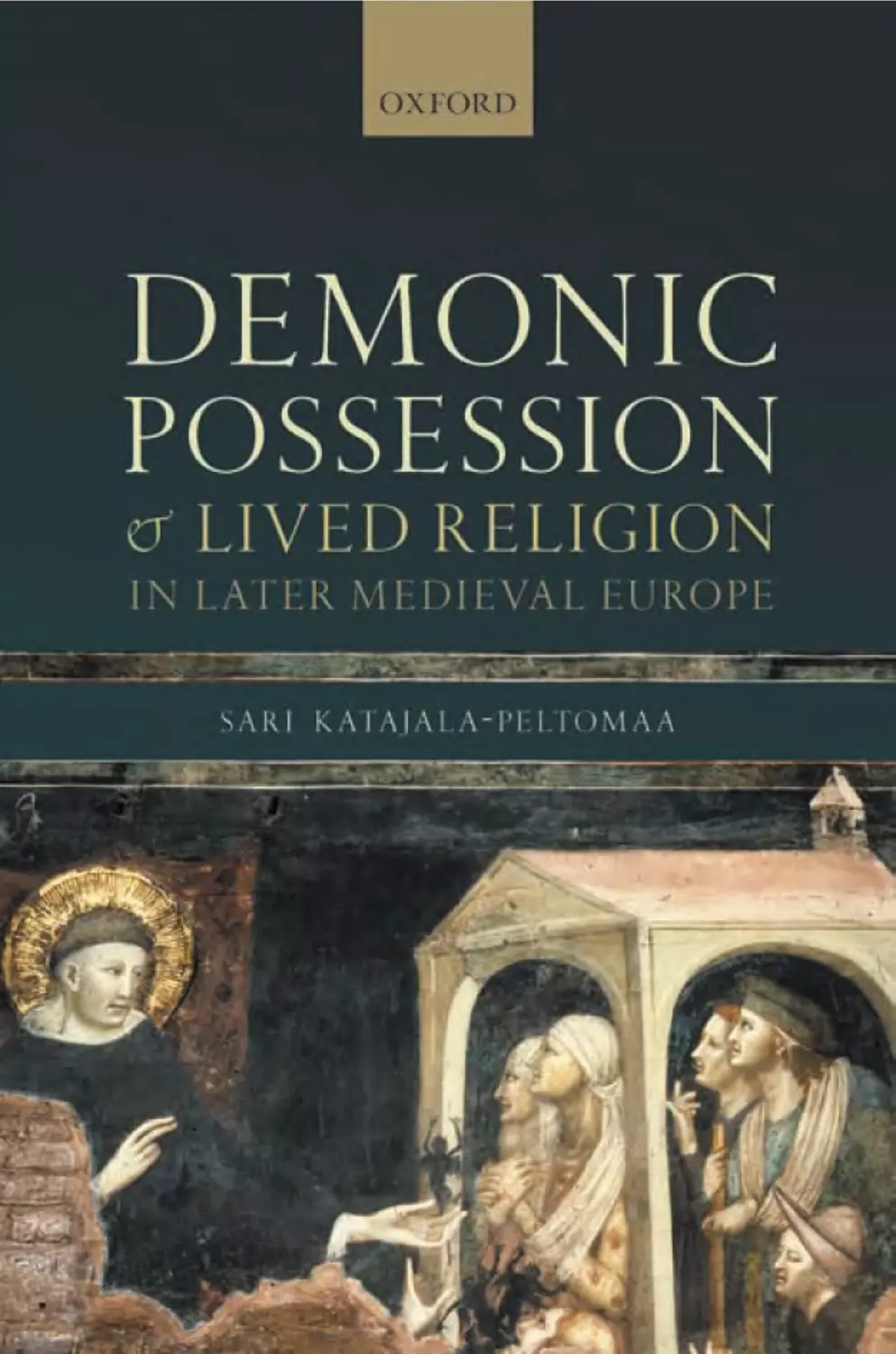



















































































Author: Katajala-Peltomaa Sari
Tags: religion european history middle ages demonology
ISBN: 978–0–19–885046–5
Year: 2020
Text
OX F O R D S T U D I E S I N M E D I EVA L
E U R O P E A N H I ST O RY
General Editors
JOHN H. ARNOLD
PAT R IC K J. G E A RY
and
J O H N WAT T S
Demonic Possession
and Lived Religion in
Later Medieval Europe
S A R I KATAJA L A- P E LT OM A A
1
1
Great Clarendon Street, Oxford, OX2 6DP,
United Kingdom
Oxford University Press is a department of the University of Oxford.
It furthers the University’s objective of excellence in research, scholarship,
and education by publishing worldwide. Oxford is a registered trade mark of
Oxford University Press in the UK and in certain other countries
© Sari Katajala-Peltomaa 2020
The moral rights of the author have been asserted
First Edition published in 2020
Impression: 1
All rights reserved. No part of this publication may be reproduced, stored in
a retrieval system, or transmitted, in any form or by any means, without the
prior permission in writing of Oxford University Press, or as expressly permitted
by law, by licence or under terms agreed with the appropriate reprographics
rights organization. Enquiries concerning reproduction outside the scope of the
above should be sent to the Rights Department, Oxford University Press, at the
address above
You must not circulate this work in any other form
and you must impose this same condition on any acquirer
Published in the United States of America by Oxford University Press
198 Madison Avenue, New York, NY 10016, United States of America
British Library Cataloguing in Publication Data
Data available
Library of Congress Control Number: 2020930616
ISBN 978–0–19–885046–5
DOI: 10.1093/oso/9780198850465.001.0001
Printed and bound in Great Britain by
Clays Ltd, Elcograf S.p.A.
Links to third party websites are provided by Oxford in good faith and
for information only. Oxford disclaims any responsibility for the materials
contained in any third party website referenced in this work.
Preface
The seeds for this project were sown years ago when I was a doctoral student and
first came across miracles involving demonic possession. They caught my attention as intriguing and even amusing anecdotes. My first impression was that the
details, such as the shameful songs and stones thrown, were expressions of quite
straightforward frustration, even infuriation. Soon enough I learned that at stake
were much more than fits of anger; some of these people were likely to have been
severely ill as they had died soon afterward. Into the same category were placed
various kinds of afflictions, some of which seemed mild enough. Furthermore,
the exact same symptoms could have been labelled differently in different collections. Nothing was straightforward, I found out.
The only constant feature that remained was the happy ending all these cases
had; in the end, the saints’ miraculous powers drove away the malign forces and
restored peace and harmony. The inevitable positive outcome (a sine qua non) of
a miracle narration is something I have learned to value after long discussions
with colleagues working with other kinds of judicial material. When it comes to
miracles, whether they were recorded in a canonization process or in a miracle
collection, things may get a bit rough along the way, but in the end all will be fine;
nobody gets burned or otherwise lastingly punished, and even sinners are given
an opportunity to repent. As the reading of the chosen source material essentially
guides the historian’s perceptions of the past, as a form of self-evaluation I ponder
if and how this positive outcome has, at least subconsciously, affected my analysis
of the phenomenon. On occasion, my argumentation differs from other scholars
of the field. I tend to see collaboration where some other scholars see subjugation,
and joint efforts for cure where others argue for joint methods of punishment.
I have always been more interested in the fractures and divergences within
dominant discussions than in arguing for fixed categories or the uniform and
uncomplicated evolution of a phenomenon. This resonates with and is encouraged by the chosen sources, since another invaluable feature of miracle narrations
is their richness. They offer an opportunity to study phenomena and people’s lives
which are rarely found in other kinds of texts and their capacity to provide information will not be easily exhausted. Needless to say, care and skill are needed
when tackling this treasure trove in order to understand what they are really
about, as miracle narrations are so much more than entertaining anecdotes.
I view the increasing popularity of this material with both pleasure and caution.
Due diligence is needed when miracles are used as source material. Therefore,
vi
Preface
I found it important to also include explicit comments on the sources and methodology within the text.
Yet another thing I have learned as this process matured was the multifaceted
nature of the phenomenon of demonic possession; it was connected to so many
things in the culture and society of the Middle Ages that practically anything
could be studied from the perspective of demonic presence. Daily life, gender,
sexuality, identity, disability, spirituality, and politics, for example, stand out in
the narrations. They were all major components in the construction of medieval
culture and are major themes in current historiography. Indeed, I had a hard time
choosing the major themes and structuring the argumentation of this book. The
most important of all options for my approach, however, was religion as lived
practice. It provided the link between the various themes of this book. For the
current volume ‘lived religion’ is both a thematic approach and a methodology.
I thank the external readers for their thoughtful comments and competent guidance on these matters. Thanks to their comments, the richness of the cases and
detailed narrations is hopefully more accessible to readers.
As the process of writing this book has been a long one, the debt of gratitude is
likewise enormous. The History Department in the Faculty of Social Sciences at
Tampere University and especially Trivium (Tampere Centre for Classical,
Medieval, and Early Modern Studies), always with friendly and helpful colleagues,
has been a fruitful place to conduct this research. I want to thank especially Raisa
Maria Toivo, Jenni Kuuliala, and Ville Vuolanto for being my rehearsal audience,
letting me ventilate my thoughts about the project, and commenting on my texts.
I would also like to thank Gábor Klaniczay, Christian Krötzl, Marko Lamberg,
Didier Lett, Marianna Muravyeva, Katariina Mustakallio, Susanna Niiranen,
Letizia Pellegrini, and Laura Ackerman Smoller for collaboration in various subprojects related to this book.
The Academy of Finland has been most generous in funding the research for
the volume in hand. The work for this book started with my Academy of Finland
post-doctoral project Gender and Demonic Possession in Late Medieval Europe
(2011–14); it was continued in affiliation with the Academy of Finland Centre of
Excellence History of Society: Re-Thinking Finland 1400–2000 (2012–17), and finished during the current Academy of Finland Centre of Excellence History of
Experiences (2018–). Both of the centres have been headed by Pertti Haapala.
I thank him for the research time and opportunities these centres have offered me.
I am very grateful to Oxford University Press for accepting my book to be published in the Oxford Studies in Medieval European History series. The experienced and kind staff at Oxford University Press have been most helpful. I am
especially indebted to the series editor-in-chief John Arnold for comments and
encouragement during this process.
It is not easy as a non-native English speaker to write engaging academic prose.
The language of this book has been checked by Bentley Mathias and I am most
Preface
vii
grateful for his competence and endurance. It may well have been that malign
forces exerted their baleful influence on the text I had formulated (as he suspected); nevertheless, and despite his help and that of all the others mentioned
above, all remaining mistakes are my own.
Finally, I want to give my thanks to my nearest and dearest. In a family of two
working parents and two teenagers, proper order has sometimes been lost, behaviour inappropriate, and emotions excessive. Communal negotiations have indeed
been needed to sort out the situation and various methods to exculpate oneself
have been tried. Miracle or not, peace and harmony have always been restored in
our home. I wish to express my love and thanks to Ari, Otto, and Sanni.
A technical note—saints and other otherwise well-known persons are referred
to by the generally used English version of their name throughout the text. For
the witnesses, on the other hand, the version of the name that is found in the
sources (usually in Latin) is used. All transcripts of manuscripts and translations
are mine unless otherwise indicated. The King James version is used for Biblical
quotations.
Contents
1. Introduction: Demons in Daily Life—Lived Religion and
Devotional Strategies1
2. Reasons for Possession: Perilous People, Hazardous Places
28
3. Vulnerable Persons: Corporeality and the Female Life Course
46
4. Community Responses to Demonic Presence
69
5. Constructing the Sacred: Demons, Priests, and Pilgrims
101
6. The Interwoven Fabric of the Sacred and the Political
129
7. The Need for Control: Demonic Sex and the Feminine
150
8. Conclusions: Demonic Devices: Lived Religion as a Methodology
178
Bibliography
Index
185
207
1
Introduction
Demons in Daily Life—Lived Religion and
Devotional Strategies
‘Demons exist, they are many, they are evil and they infest people.’1 This is how
Caesar of Heisterbach defined the nature of malevolent supernatural forces
around 1220. This book follows the lead of Caesar and investigates the ways
demons infested people; it deals with the reasons, symptoms, and means of coping
with the situation; with the very interpretation of demonic presence in daily life.
Demons were part of God’s creation and important actors in medieval cosmology.
The struggle of saints and demons as well as the polar nature of the sacred and the
diabolical were crucial components within medieval culture. Although demons
had a generally acknowledged role in God’s plan, their disruptive nature was evident:
demonic presence was a threat to the salvation of Christians and a disturbance of
proper order in a spiritual and social sense. Demons could entice people to sin or
possess their bodies violently; some desperate or wicked souls even engaged with
them voluntarily.
Demonic possession was a spiritual phenomenon which had visible and detectable physical and mental symptoms as well as social outcomes. Essentially, the
demoniacs were out of their minds. They had fits and convulsions. They could
tremble or lose the ability to use their senses or body parts. They rolled their eyes,
could not stand still, and shrieked mindlessly. They could be violent and verbally
abusive, and some blasphemed God and the saints and showed an abhorrence of
all things sacred. In all, the situation was an affliction, especially for the victim
him- or herself, but it was not only an individual misfortune. Demonic possession
could cause chaos and disorder in the whole community, hence offering a way to
comprehend its social dynamics. Demonic possession was a way to explain often
otherwise inexplicable misfortunes: mental disorder, incomprehensible physical
symptoms, or unacceptable behaviour. There were no unmistakable signs for
demonic presence, so a diagnosis of this sort was always a result of communal
negotiation. Religion, the framework it offered as an institution and set of doctrines,
and particularly its devotional practices opened for the participants a way to
1 ‘De eo quod demones sint, quod multi sint, quod mali sint et quod hominibus infesti.’ Caesar
of Heisterbach, Dialogus Miraculorum, ed. by Joseph Strange (Ridgewood, NJ: The Gregg Press Inc.,
1966 [1851]), V, 1.
Demonic Possession and Lived Religion in Later Medieval Europe. Sari Katajala-Peltomaa, Oxford University Press (2020).
© Sari Katajala-Peltomaa. DOI: 10.1093/oso/9780198850465.001.0001
2
Demonic Possession and Lived Religion
comprehend, explain, and cope with situations of this sort. It gave meaning to
people’s experiences.
Religion is here approached as a lived practice, and ‘lived religion’ is the primary
frame of analysis. Theological ponderings on, for example, the Devil, and elite
teaching on demonic powers as well as political relations in the cult of saints, are
seen as inseparable background elements. The focus is, however, on explaining,
identifying, and solving problems in daily life by means of religion. Lived religion
is understood as a social process, a way to live, interact, and participate in one’s
community. It is formed in and by the core of communal life where ideas and
religious concepts are experienced. Religion-as-lived created a space for action,
enabling independent initiative.2
The book will concentrate on lay people’s participation and experiences.
Religion-as-lived offered a performative space to construct social positions, display
identity, and create communal cohesion. For individuals it was a creative space,
though not wholly subjective but constructed in concert with others. Lived religion was essentially a social phenomenon, built upon learnt practices, shared
meanings, and joint experiences. In this process rituals, symbols, gestures, and
narrations were important in order to make religious experiences comprehensible,
even tangible and present to the senses. Religion-as-lived was not a stable system
but a fluid and multilayered practice. Such a view follows the arguments of
sociologists of modern religion about ‘religion-in-action’ being based on what
people actually do, desire, imagine, touch, and share. Individual experiences
within the sociocultural milieu (here family, community, and cultic community)
form the core element: religion-as-lived is a way to turn values, norms, attitudes,
and narrations into everyday social actions.3 Obviously, a historian of medieval
lived religion needs to make some compromises on the study of individual
experiences, as they are approachable only in a mediated form; nevertheless,
a similar framework and quest guide this work. The aim, however, is not only
to elucidate the elements of lay piety but also to scrutinize the way demonic
possession intersected various levels: personal experiences, social dynamics, and
cultural expectations.
Clearly, social status, gender, and age as well as other variables in a person’s
position affected the way he or she lived his or her religion. Lived religion is not,
however, here considered to be synonymous with the concept of ‘popular
2 On the conceptualizing of lived religion in the medieval context, see also Sari Katajala-Peltomaa
and Raisa Maria Toivo, ‘Religion as Experience,’ in Lived Religion and the Long Reformation in
Northern Europe c. 1300–1700, ed. by Sari Katajala-Peltomaa and Raisa Maria Toivo (Leiden: Brill,
2017), pp. 1–18 and John H. Arnold, ‘Histories and Historiographies of Medieval Christianity,’ in The
Oxford Handbook of Medieval Christianity, ed. by John H. Arnold (Oxford: Oxford University Press,
2014), pp. 23–41.
3 See, for example, Meredith B. McGuire, Contested Meanings and Definitional Boundaries:
Historicizing the Sociology of Religion (Oxford: Oxford University Press, 2008); R. Ruard Ganzevoort and
Srdjan Sremac, eds., Lived Religion and the Politics of (In)Tolerance (Cham: Palgrave Macmillan, 2017).
Introduction
3
religion,’ which was formerly used to denote the religiosity of the common people
or ‘folkloric’ elements in religion. Religiosity or culture is not seen as a top-down
process and there is no intention here of drawing a clear distinction between the
culture of the elites and the lower strata, as was typical among scholars of popular
religion.4 Obviously, there was a difference between the daily experiences of
religion-as-lived and the prescribed religion of institutionally defined beliefs and
practices, and these differences form one part of this study. Furthermore, in the
conceptualizations of this book, lived religion is not a stagnant mind-set that
exists in the background. It is an active, dynamic process, something that is being
done and performed, being lived out in daily life.
Lived religion is a complex concept since a generally approved definition of
religion does not even exist.5 The specific perspective on religion as lived practice
in this book is that of devotional strategies: how people interacted with a saint.
As demonic possession was a spiritual state, the explanation and remedy for the
affliction were found in that sphere as well. Driving out malign spirits had Biblical
prototypes, and even if such miracles were not among the most typical ones, they
can regularly be found in late medieval hagiography. The whole procedure, that is
diagnosing the symptoms, deciding the methods for cure and playing one’s part
in the negotiation with a saint, required careful consideration, deliberate decisions,
and planning for the future. When something was amiss, first the participants:
the victim, family members, and neighbours needed to negotiate a plausible
reason for the affliction. If demons were considered to be behind it, almost the
only possible remedy was to invoke a saint for help. Earthly doctors could not
help with spiritual needs, even if people sometimes had recourse to them, and in
the hagiographic material exorcisms as ceremonies came second to delivery
miracles in the search for a cure. If a saint was to be invoked, participants first
needed to decide which saint, how it was to be done, and who was to take the
initiative if the victim him- or herself was unable to do it. Invocation required
certain rituals, such as a vow: a prayer and a counter-gift to the saint if she or he
helped. This was often accompanied by various signs and symbols of humility and
desperation. Similarly, rituals, such as pilgrimages, were crucial in the manifestation
of gratitude. The whole process required time, money, and effort; invocations were
4 The strong polarity and differences between clerical and lay culture are stressed, for example, by
Jacques le Goff, Pour un autre Moyen Âge. Temps, travail et culture en Occident (Paris: Gallimard,
1977), while continuity rather than disjunction is stressed by several scholars, for example Aron
Gurevich, Medieval Popular Culture: Problems of Belief and Perception (Cambridge: Cambridge
University Press, 1988). On the historiography of popular culture and popular religion, see Gábor
Klaniczay, ‘“Popular Culture” in Medieval Hagiography and in Recent Historiography,’ in Agiografia e
culture popolari: Hagiography and Popular Cultures, ed. by Paolo Golinelli (Bologna: Clueb, 2012), pp.
17–44 and for conceptualizing popular religion Laura A. Smoller, ‘“Popular” Religious Culture(s),’ in
The Oxford Handbook of Medieval Christianity, pp. 340–56.
5 See also Heinz Streib, ‘Introduction,’ in Lived Religion: Conceptual, Empirical and PracticalTheological Approaches—Essays in Honor of Hans-Günter Heimbrock, ed. by Astrid Dinter and Kerstin
Soderblom (Leiden: Brill, 2008), pp. IX–XIII.
4
Demonic Possession and Lived Religion
not light decisions but needed proper consideration and conscious engagement.
They were also a social strategy. This does not mean that interaction with a saint
was used cynically or deviously. Recourse to a saint’s help was a traditional
coping mechanism in daily adversities, but genuine devotion was required for it
to be effective.
The wider historiographical framework for this volume can be deemed to be
that of social history; there is a long and prolific tradition of using canonization
processes and hagiography in the study of social historical questions, such as
family, children, daily life, and devotional practices.6 Demonic presence and
devotional strategies are analysed in the context of social relations, the construction
of identity and alterity, of corporeality and sexuality, and of the sacred. Therefore
other concepts, especially gender, are important for the analysis, as they emerge
from and illuminate the social nature of religion-as-lived.
In medieval imagery, women and demons were linked in many ways: in moralists’
warnings women were the Devil’s gateway, more prone to sin, and feared to
corrupt the whole community by their vices. However, even the elite’s theoretical
gender constructions were multifaceted, unstable, and contradictory.7 Hierarchy
may have been a crucial constituent of medieval culture, but the stereotypical
gender images of didactic rhetoric were met in daily life only in mediated form.
Women were more numerous as victims of demonic possession but did not form
an exclusive category in medieval hagiography. Furthermore, the lay perspective
on the phenomenon offers various explanations for this since it does not insist
only on women’s inherent wickedness. Gender was not a strict binary category;
it operated in complex and diverse ways. Therefore, sensitivity to other social
variables as well as local nuances forms an essential core for the analysis. Gender
is approached as a social and cultural construction, as a matrix where multiple
elements of status intermingle. It is seen as a performance, an active, ongoing
process, during which various aspects of a person’s social status are negotiated
and manifested when he or she reacts to the hopes, expectations, and demands of
6 The field is too extensive to be cited here fully; for the seminal works, see, however, Pierre-André,
Sigal, L’Homme et le miracle dans la France médiévale (xie–xiie siécle) (Paris: Éditions du Cerf, 1985);
Ronald C. Finucane, Miracles and Pilgrims: Popular Beliefs in Medieval England (London: J. M. Dent &
Sons, 1977); Ronald C. Finucane, The Rescue of the Innocents: Endangered Children in Medieval Miracles
(New York: St Martin’s Press, 2000); Michael E. Goodich, Violence and Miracle in the Fourteenth
Century: Private Grief and Public Salvation (Chicago, IL: University of Chicago Press, 1995); Christian
Krötzl, Pilger, Mirakel und Alltag: Formen des Verhaltens im skandinavischen Mittelalter (12.–15.
Jahrhundert) (Helsinki: SHS, 1994) ; and Didier Lett, L’Enfant des miracles: Enfance et société au Moyen
Âge (xiie–xiiie siécle) (Paris: Aubiers, 1997). For the historiography, see also Sari Katajala-Peltomaa,
‘Recent Trends in the Study of Medieval Canonizations,’ History Compass 8:9 (2010): 1083–92.
7 See especially Theresa Tinkle, Gender and Power in Medieval Exegesis (New York: Palgrave
McMillan, 2010). Furthermore, clerical authors used gendered images in multiple, ‘queer’ ways,
depicting positive elements, like God, the Church, and Christianity, as feminine. Caroline Walker
Bynum, Jesus as Mother: Studies in the Spirituality of the High Middle Ages (Berkeley, CA: University of
California Press, 1982). Caroline Walker Bynum, Fragmentation and Redemption: Essays on Gender
and the Human Body in Medieval Religion (New York: Zone Books, 1991).
Introduction
5
the surrounding community.8 Gender, too, was something that was lived out and
experienced in daily life. Demons were used as an explanation in this process,
especially when something went wrong.
On occasion, mental disorder and disability appear as contextual elements
within the analysis of lived religion. Some signs of demonic presence could be
linked to physical impairments, like losing one’s sight, speech, or the ability to use
body parts. For the most part, however, demonic possession was a behavioural
category, and a huge number of victims were mentally disordered. Some victims’
mental capacity was so badly affected that they were disabled in their communities,
meaning they were seen as deviant, removed from their normal positions, and
even marginalized and prohibited from taking independent action.9 Many of the
symptoms of demonic possession and raving madness (furia) or insanity (insania
/amentia/dementia) were similar and the categories to some extent overlapped.
Part of the analysis that follows deals with how and why similar symptoms were
categorized differently in different contexts and for people of different backgrounds.
The intention is not, however, to make a retrospective analysis of the cases, but to
scrutinize the methods of categorization of the period under study.10 Throughout
the book the vocabulary found in the sources is used even if it is not always
consistent (not even within a single case or miracle collection) or it does not
conform to modern ideas of appropriately sensitive language. In some miracle
collections or canonization processes demonic harassment, outright possession,
as well as terms denoting mental or physical illness were used interchangeably,
while in other collections the dividing line was strict. How and why these lines
were or were not drawn is one topic of analysis.
Mental disorder is the general term adopted for this work, as in many cases it
best encapsulates the affliction demons caused and leaves aside the aetiology,
8 For a similar approach, see, for example, the following collections: Carol Braun Pasternack and
Sharon Farmer, eds., Gender and Difference in the Middle Ages (Minneapolis, MN: University of
Minnesota Press, 2003); Lisa Bitel and Felice Lifshitz, eds., Gender and Christianity in Medieval Europe:
New Perspectives (Philadelphia, PA: University of Pennsylvania Press, 2008); Marianna G. Muravyeva and
Raisa Maria Toivo, eds., Gender in Late Medieval and Early Modern Europe (London: Routledge, 2013).
9 In current disability studies, the ‘social model’ differentiates between physical impairment and
its social consequences, i.e. disability; the ‘cultural model’ in turn argues that impairment is also a
culturally constructed term. See Irina Metzler, Disability in Medieval Europe: Thinking about Physical
Impairment during the High Middle Ages, c. 1100–1400 (London: Routledge, 2006); Disability in the
Middle Ages: Reconsiderations and Reverberations, ed. by Joshua R. Eyler (Aldershot: Ashgate, 2010);
Wendy J. Turner, ed., Madness in Medieval Law and Custom (Leiden: Brill, 2010); Wendy J. Turner,
Care and Custody of the Mentally Ill, Incompetent, and Disabled in Medieval England (Turnhout:
Brepols, 2013); and Jenni Kuuliala, Childhood Disability and Social Interaction in the Middle Ages:
Construction of Impairments in Thirteenth- and Fourteenth-Century Canonization Processes (Turnhout:
Brepols, 2016).
10 Many scholars have refuted ‘psychopathological’ explanations. See, however, Carlos Espí Forcén
and Fernando Espí Forcén, ‘Demonic Possessions and Mental Illness: Discussion of Selected Cases in
Late Medieval Hagiographical Literature,’ Early Science in Medicine 19 (2014): 258–79 for diagnosing
psychotic, mood, neurotic, and personality disorders, and epilepsy in cases from thirteenth-century
hagiography. The authors argue that the descriptions in the texts enable a retrospective analysis, but
they deem the exorcismal practices to be literary inventions.
6
Demonic Possession and Lived Religion
which cannot be verified, and does not argue for a certain kind of modern diagnosis,
like mental illness. Mental disorder also leaves ample room for interpretation of
causes and symptoms. One of the points of analysis is whether physical and
mental infirmities were on certain occasions explained by demons or whether it
was a label used to marginalize members of the community already condemned
as deviant.
Religion, both as an institution and lived practice, was a framework structuring
life. Demons were an integral part within it intersecting cultural, communal,
and individual levels. They illuminated general fears, such as the unpredictability
of life and the uncertainty of salvation for the soul, but also gave daily troubles,
such as mental incapacity, inversion of identity, and communal disorder, a
comprehensible causality. Demons within religion-as-lived could be used to signal
sore points and anxieties, but they also offered a coping mechanism; otherwise
inexplicable situations could be explained by demonic presence and ameliorated
by invoking a saint for help. Religion created a performative space, and demonic
presence, as a fluid and multifaceted category within it, enabled participants to
take initiatives in that field.
Demons on the Desktop: Medieval Contexts and
Modern Scholars
On the last day of July in 1319 in Montefalco, Angiorellus Iacopinis, an inhabitant
of that city, stepped in front of the inquisitorial committee and took an oath to tell
the truth about the life and miracles of Clare of Montefalco. He was interrogated
and examined, and stated that he knew the following. He saw in the convent of
the Holy Cross by the sepulchre of Saint Clare two persons oppressed by demons,
namely Bartholillus and Chiaruccia. They suffered a lot since people were conjuring
the demons to expel them, and had people not been holding Bartholillus and
Chiaruccia tightly, and they were hard to hold, they would have dashed their heads
against the walls. They were mocking Saint Clare by calling her by the negative
variant of her name, Chiaruccia (hence making her the namesake of the female
demoniac), and did not want to hear her proper name mentioned. Then the witness
saw the demons leaving their victims and he also saw on the ground a black
scarab, which many of those present said had come out of the mouth of one of
them. He saw the victims quieten down, but they did not yet say they were
liberated as there were many demons in them. And he heard one of the demons
in Bartholillus claim that it had entered his heart by the nail and flesh (per unguem
et carnem), probably meaning it was not swallowed, while the demon had got into
Chiaruccia at a well. Angiorellus did not know more about these incidents, all of
which took place the same year Saint Clare died, but when asked he replied that
Introduction
7
he did not remember the month or day or the people present. Interrogated about
the location, he replied that the events took place in the monastery and in the
church. And all this he told to tell the truth after being interrogated diligently and
on his own.11
This case manifests many typical features of both demonic possession and
delivery miracles, and also illuminates the tangled discussions within modern
scholarship. By the thirteenth century, demons were a well-established element in
Church teaching. They had become a particularly heated topic after the Fourth
Lateran Council in 1215, where the role and position of the Devil were defined and
the new regulation for annual confession of sins was promulgated. This milestone
forms a logical starting point for this research. This was also the time when Caesar
of Heisterbach wrote his Dialogue on Miracles: as he claimed, demons were truly
legion, especially in the writings of learned men.
In learned discussions from the thirteenth to fifteenth centuries, several
different, yet intertwined, discourses on demons can be distinguished. One of them
was sin in general and demons’ role in prompting sin. In the didactic material,
demons were depicted as allegories of sin, enticing Christians to evil. Often they
acted in a corporeal form, meaning they could simulate a person or animal, for
example. Weak Christians succumbed to the demons’ temptations, because of
human nature and the Christian’s frail morality. The Devil had been depicted as
the adversary, as an ever-present enemy, found within early Christian texts and
forever thereafter.12
Exempla, cautionary moral tales of sin and demons, multiplied after the Fourth
Lateran Council. One of their aims was to convince Christians of the spiritual
benefit gained by annual confession. Demoniacs could be and often were seen as
innocent victims, like Bartholillus and Chiaruccia, because despite their almost
blasphemous insults, it was the demons inside who uttered these words, not the
victims themselves. Furthermore, no personal wrongdoing was given as a reason
for their affliction. Consideration of personal culpability is often, however,
found in miracle collections with narratives aiming at didactic ends. In exempla,
personified evil had an obvious role. That material does not, however, directly
reflect lived experience, but rather an ideal model on the one hand, and negative
stereotypes on the other. For the purposes of this book, this material is often used
as a framework against which daily life is reflected.
One of the declarations of the Fourth Lateran Council was the definition of the
role and position of the Devil as a fallen angel, a powerful adversary, though
11 Il processo di canonizzazione di Chiara da Montefalco, ed. by Enrico Menestò (Spoleto: Centro
italiano di Studi sull’alto medioevo, 1991), testis CCXXII, p. 500.
12 Gerard Bartelink, ‘Denominations of the Devil and Demons in the Missale Gothicum,’ in
Demons and the Devil in Ancient and Medieval Christianity, ed. by Nienke Vos and Willemien Otten
(Leiden: Brill, 2011), pp. 195–209.
8
Demonic Possession and Lived Religion
clearly inferior in power to God.13 The incentive for this definition likely lay in
the struggle against the dualist heresy of the so-called Cathars;‘heretical depravity’
was another larger discussion linking the Devil with the religious practices of the
laity, particularly in the thirteenth century. Sects deemed as heretical were often
accused of worshipping the Devil and engaging in horrendous acts and rites. In
their cases, submitting to the Devil’s will was seen as voluntary; many of the more
imaginative rituals the heretics were accused of bear a resemblance to the later
accusations of participation in witches’ Sabbath. Such elements, Devil worship or
even the Devil himself, were not regularly mentioned in the inquisition processes
investigating heresies; much of the interest was instead directed at those supporting the heretics.14 In antiheretical polemics, on the other hand, conscious deviation from the truth of the Church, contesting its position or papal prerogatives,
was branded as the work of the Devil and the leaders of the heretical groups as
Antichrist. Conversely, similar rhetoric was used among these groups against
Catholics and especially against inquisitors and the pope.15 Some saints, like
Anthony of Padua, were famous for using their miracle-working abilities against
heretics. Heresy is present also in Clare of Montefalco’s case, as she was accused of
having followed the free spirit heresy. This theme was regarded as so important
that its repudiation was listed in the articuli, the questions to be asked of witnesses.16
Demons did not, however, feature very prominently in Clare’s position as a
thaumaturge, as the testimony of Angiorellus contains the only post-mortem
delivery miracle to be found in the surviving records.17
13 Con. Lat. IV, cons 1 and cons 21. On the Fourth Lateran council and heresy, see Andrew Roach,
The Devil’s World: Heresy and Society 1100–1300 (Harlow: Pearson, Longman, 2005), pp. 92–6 et passim.
The idea of the Devil as the leader of malign forces and demons as his minions was not coherently
followed in all the medieval texts; I will apply the vocabulary of the source material even if it is sometimes inconsistent.
14 ‘Heresy’ investigated by inquisitorial methods was a complex and wide category, though. There
is an ongoing discussion of the relationship between religious dissent, heresy, and persecution. See, for
example, John H. Arnold, Inquisition and Power: Catharism and the Confessing Subject in Medieval
Languedoc (Philadelphia, PA: University of Pennsylvania Press, 2001); Mark Gregory Pegg, The
Corruption of Angels: The Great Inquisition of 1245–1246 (Princeton, NJ: Princeton University Press,
2001); Malcolm Lambert, Medieval Heresy: Popular Movements from the Gregorian Reform to the
Reformation (Oxford: Blackwell, 2002); R. I. Moore, The Formation of a Persecuting Society: Authority
and Deviance in Western Europe 950–1250 (Oxford: Blackwell, 2007); and Christine Caldwell Ames,
Righteous Persecution: Inquisition, Dominicans, and Christianity in the Middle Ages (Philadelphia, PA:
University of Pennsylvania Press, 2009).
15 Ames, Righteous Persecution, pp. 23–56.
16 Il processo di canonizzazione di Chiara da Montefalco, ‘Articuli interrogatorii,’ questions CII–CLXLVI,
pp. 17–18. See also Beverly Mayne Kienzle and Travis Allen Stevens, ‘Preaching, Heresy, and the
Writing of Female Hagiography,’ in Beyond Catholicism: Heresy, Mysticism, and Apocalypse in Italian
Culture, ed. by Fabrizio De Donn and Simon Gilson (New York: Palgrave McMillan, 2013), pp. 33–54.
17 More than half of the original 486 depositions and one third of the articuli interrogatorii are
missing. Enrico Menestò, ‘Introduzione,’ in Il processo di canonizzazione di Chiara da Montefalco,
pp. XXI–LXIX. There is one other case of demonic possession recorded in the list of questions:
Articulus 222, p. 33: ‘Item quod liberavit dominam Amatam uxorem Petrioli castellani de Castro Bono,
a quatuor demonibus qui tenuerant eam diu obsessam.’ No deposition from the case survives.
Introduction
9
Heresy and particularly the Church’s fight against it are important here for
methodological reasons. Both canonization and inquisition trials were judicially
a form of inquisitio, albeit focusing on different ends of the religious spectrum.
There were, nonetheless, many similarities in their implementation and the laity’s
religious practices were a major element in both. Furthermore, as many scholars
of inquisition processes have focused especially on methodology, in an effort to
filter out the various rhetorical levels of narrations, these studies form a valuable
point of comparison.18 Studies of inquisition processes comment in important
ways on the power relations within the Church and those between the clergy and
laity. They offer, however, a specific perspective on the laity’s devotional practices.
Canonization inquiries, containing as they do a less coercive dialogue, facilitate
the wider thematic approach cultivated in this volume.
Magic and witchcraft formed yet another field of discussion in the Christian
cosmography of evil. Harmful magic, maleficium, was an age-old practice, but
at the end of the Middle Ages witchcraft gained a new characteristic, that of
demonolatry, the intentional worship of and subservience to demons. A number
of early modern theoretical notions concerning demons emerged from medieval
perceptions, and so demonology forms a significant point of reference for the
present volume. Demonological treatises, however, regularly lack the myriad of
lived practices which form the core of the analysis here. The focus of scholars has
been on ‘thinking with demons,’ to follow Stuart Clark’s famous formulation; the
core has been the analysis of texts and language.19 The intention here is, instead,
to read the acts, essentially rituals, as messages reflecting the ways the participants
utilized demons as tools for thinking.
Devil worship has been characterized as peculiar to early modern witchcraft
theory, distinguishing it from other cultures as well as earlier European culture.
Some of its key concepts, such as physical interaction with demons, were present
already in medieval theories and occasionally reflected in miracle narrations as
18 See esp. Caterina Bruschi, The Wandering Heretics of Languedoc (Cambridge: Cambridge
University Press, 2009) and John H. Arnold, Inquisition and Power, even if they hold different views
concerning how well the lived reality and identity of the accused can be elicited from the material. For
comparison of inquisition and canonization processes, see also Gábor Klaniczay, ‘The Inquisition of
Miracles in Medieval Canonization Processes,’ in Miracles in Medieval Canonization Processes.
Structures, Functions, and Methodologies, ed. by Christian Krötzl and Sari Katajala-Peltomaa
(Turnhout: Brepols, 2018), pp. 43–74. See also the seminal work of Natalie Zemon Davis, Fiction in
the Archives: Pardon Tales and their Tellers in Sixteenth-Century France (Stanford, CA: Stanford
University Press, 1987).
19 Stuart Clark, Thinking with Demons: The Idea of Witchcraft in Early Modern Europe (Oxford:
Oxford University Press, 1997); Walter Stephens, Demon Lovers. Witchcraft, Sex, and the Crisis of Belief
(Chicago, IL: University of Chicago Press, 2002). There was also increased interest in defining the
boundaries between proper religious practice and superstition. Michael Bailey (Fearful Spirits,
Reasoned Follies: The Boundaries of Superstition in Late Medieval Europe (Ithaca, NY: Cornell University
Press, 2013)) sees the fifteenth-century as a crucial turning point, while Euan Cameron (Enchanted
Europe. Superstition, Reason, and Religion, 1250–1750 (Oxford: Oxford University Press, 2010)) analyses
the changing definitions of superstition from the late Middle Ages to the Enlightenment. The consistent
trait was the use of such a definition as a method to denounce the religious practices of others.
10
Demonic Possession and Lived Religion
well. Its most extreme form, copulation with demons may be found in sexually
coloured cases in canonization processes, too. Demonological treatises as well
as mass trials, not to mention actual panics, were a later invention, emerging
in the mid-fifteenth century and forming a suitable temporal end-point for the
present volume.
The link between demonic possession and witchcraft was more pronounced in
the early modern era when the possessed were often seen as victims of someone
else’s malevolent bewitchment or as having willingly submitted to the Devil.
Malediction as a reason for possession can also be found in the medieval material,
but it is not a major trend. Other people’s malice was rarely given as an explanation
for medieval demonic possession, while it was a major factor in later witchcraft
accusations. If Devil worship was a crucial component in elite discussions, maleficium stood out in peer accusations.20 Social conflicts were also reflected in cases
of demonic possession and the interesting question arises as to whether they were
a way to act out social tensions, fears, and ill feelings, as was the case with witchcraft accusations. In both cases, spiritual reasoning was offered as an explanation
for social problems, and so witchcraft accusations offer an interesting point of
comparison, even if these phenomena were not directly connected and their
temporal evolution is unclear. However, scholarship on witchcraft accusations tends
to focus on one rather restricted geographical area at a time. Since canonization
processes were shaped by shared regulations and background motivations, hearings
from different parts of Europe are comparable, thus enabling a wider geographical
coverage for this volume.
Before European culture became obsessed with maleficium and demonolatry,
magic had a different set of connotations. For example, necromancy, that is conjuring, adjuring, and commanding spirits, was a learned art requiring ritualistic
skills and a purified moral state. It was mainly practised by clerics. It was not
considered to be a sin, let alone apostasy from Christian faith, like demonolatry.
The thirteenth century can be seen as a turning point in attitudes; these practices
did not vanish but gradually became forbidden and secret rites.21 Nevertheless,
Angiorellus in 1319 still talks about people conjuring the spirits inside Bartholillus
and Chiaruccia. He may have meant exorcism attempts, as terms and practices
were not always clear. Particularly in Italian cases, demons were quite vocal and
20 On social conflicts in witchcraft accusations, see Raisa Maria Toivo, Witchcraft and Gender in
Early Modern Society: Finland and the Wider European Experience (Aldershot: Ashgate, 2008); Alison
Rowlands, ed., Witchcraft and Masculinities in Early Modern Europe (Houndmills: Palgrave
Macmillan, 2009). For developments in the historiography, see also Marko Nenonen and Raisa Maria
Toivo, eds., Writing Witch-Hunt Histories: Challenging the Paradigm (Leiden: Brill, 2014).
21 Richard Kieckhefer, Forbidden Rites: A Necromancer’s Manual of the Fifteenth Century (University
Park, PA: Pennsylvania State University Press, 1998); Clare Fanger, ed., Conjuring Spirits: Texts and
Traditions of Medieval Ritual Magic (University Park, PA: Pennsylvania State University Press, 1998);
and Francis Young, A History of Exorcism in Catholic Christianity (New York: Palgrave McMillan,
2016), p. 75.
Introduction
11
participants tried to make them confess their origin as well as the time and method
of their departure. Conjuring as a term appears occasionally in the cases under
study in this book.
All these phenomena were closely interrelated, and linkages between heresy
and possession were occasionally made in didactic material. For example, Caesar
of Heisterbach analyses the interconnection of heresy and possession; both were
real, but heretics were much more closely associated with the Devil. Thomas of
Cantimpré gave an example of simulated possession where a heretic faked being
possessed to evade inquisitorial interrogations and a potential further consequence:
burning. If he was believed to be possessed, he would likely not be held responsible
for his acts and words. The heretic was carried bound to a church, like a demoniac.
At the church there was, however, a genuine demoniac who, in a fit of insanity,
burned the dissembling heretic. Heresy was punished thus appropriately, but the
real demoniac was freed from the malign spirits after the act.22
Mysticism was another subject of discussion closely linked and partially
overlapping with demonic possession, even if it was from the other end of the
spiritual spectrum. Mystical experiences and especially the position of female
mystics became topics of intense public discussion in the late Middle Ages. As
spiritual phenomena, being possessed by a malign spirit or inspired by a divine
one were, obviously, opposite extremes. However, the manifestations, such as
convulsions, shrieks, and strange words, were often similar and one state was
occasionally mistaken for the other. The discernment of female mystics’ source of
inspiration became a crucial question because they contested the conventional
positions and cultural roles reserved for religious women. A background motivation
for this was, as both Nancy Caciola and Dyan Elliott note, that from the perspective
of the clerical elite, women in general were considered to be on the margins,
the ‘religious other,’ and now they were claiming positions of authority.23 The
22 Thomas of Cantimpré, Bonum universale de apibus quid illustrandis saeculi decimi tertii moribus
conferat, ed. by Elie Berger (Paris: Thorin, 1895), II.57, p. 68. The treatise was written in the mid-thirteenth
century, but the message of this tale was still useful in the second quarter of the next century, when
Jean Gobi wrote his Scala coeli and adapted this tale for his work. Ames, Righteous Persecution, p. 208
with endnotes. For Caesar’s arguments: ‘Quod autem quidam propter quaestum se obsessos simulent,
non nego; quod vero in quibusdam nulla sit fictio, subiecto probabitur exemplo.’ Caesar of Heisterbach,
Dialogus Miraculorum, V, 12 and V, 25: ‘Haec dicta sint de haereticis, qui membra sunt diaboli. Hoc enim
noveris, quod multo intensius suam diabolus exerceat malitiam in haereticis, quam in energuminis.’
23 Nancy Caciola, ‘Mystics, Demoniacs, and the Physiology of Spirit Possession in Medieval
Europe,’ Comparative Studies in Society and History 42:2 (2000): 268–306, here pp. 289–90 and Nancy
Caciola, Discerning Spirits: Divine and Demonic Possession in the Middle Ages (Ithaca, NY: Cornell
University Press, 2003). Dyan Elliott, ‘Physiology of Rapture and Female Spirituality,’ in Medieval
Theology and the Natural Body, ed. by Peter Biller and A. J. Minnis (York: York Medieval Press, 1997),
pp. 141–73; Dyan Elliott, Proving Woman: Female Spirituality and Inquisitional Culture in the Later
Middle Ages (Princeton, NJ: Princeton University Press, 2004); Dyan Elliott, The Bride of Christ Goes
to Hell: Metaphor and Embodiment in the Lives of Pious Women, 200–1500 (Philadelphia, PA:
University of Pennsylvania Press, 2012). See also Moshe Sluhovsky, Believe Not Every Spirit: Possession,
Mysticism, and Discernment in Early Modern Catholicism (Chicago, IL: University of Chicago Press,
2008). On the discernment of spirits in mystics, see also Barbara Newman, ‘Possessed by the Spirit:
12
Demonic Possession and Lived Religion
construction of a universalizing discourse of the ‘feminine’ and the ‘diabolical’
and their interconnection has been the pivotal outcome of these studies. This
volume, however, focuses on the opposite: on revealing the fractures of these
discourses and conceptualizing religion and gender as varied lived practice and
performance in order to reveal nuances within the intersections between religion,
gender, and the demonic.
Divine possession became subjected to stricter control and was viewed with
considerable suspicion in the late Middle Ages. Clare of Montefalco was an
example of a religious woman who had mystical experiences and practised severe
asceticism. She firmly believed and argued that she had Jesus Christ in her heart.
Therefore, the detail that the demonic spirit was in Bartholillus’ heart is striking;
typically, only the divine spirit was thought to enter the heart and Bartholillus’
example may be unique. Clare’s claims were taken quite literally by the sisters of
her convent; after her death they performed an autopsy on her and found the sign
of the crucifix in her heart. Clare may have been protected from wider accusations of heresy and general suspicion of her religious experiences by the protective
walls of the Augustinian convent of Santa Croce, where she lived in clausura.
Even if research in this field has been an enormous inspiration for this work,
these phenomena—female mystics’ inspiration and visions on the one hand and
explanations for the everyday troubles of more ‘ordinary’ Christians on the other—
are not intimately linked. The theological ponderings as to whether, for example,
Clare had genuinely experienced Christ entering her heart, as she claimed, or
whether she was deluded by a demon, as many female mystics were claimed to be,
were of a different nature. Such discussions may have even seemed irrelevant for
people seeking a cure at her shrine: for Bartholillus and Chiaruccia and other
people present at the shrine, Clare was a saint possessing miracle-working powers
and capable of driving out malign spirits. Bartholillus and Chiaruccia, on the
other hand, were not mistaken for mystics; raving madness may have been an
alternative diagnosis for their violent convulsions in the minds of people present.
Their mockery and fear of the saint may well have clarified the classification of the
case as one caused by a supernatural, not natural agency.
The definitions of demonic presence were of a different nature in these cases;
the discernment of visionaries’ inner spirits was, to a large extent, an elite theoretical
discussion, while for the lay demoniacs’ the negotiations took place amid daily life.
Obviously, theological thinking played a role in defining demonic possession, too,
but on a general level the basic quandary was whether the person was mentally or
physically ill, or possessed by a demon. In the case of Bartholillus and Chiaruccia,
Devout Women, Demoniacs, and the Apostolic Life in the Thirteenth Century,’ Speculum 73 (1998):
733–70; Richard Kieckhefer, ‘The Holy and the Unholy: Sainthood, Witchcraft and Magic in Late
Medieval Europe,’ in Christendom and Its Discontents: Exclusion, Persecution, and Rebellion, 1000–1500,
ed. by Scott L. Waugh and Peter D. Diehl (Cambridge: Cambridge University Press, 1996), pp. 310–37;
and Peter Dinzelbacher, Heilige oder Hexen. Schicksale auffälliger Frauen (Düsseldorf: Patmos, 1995).
Introduction
13
there was no speculation about the possibility of divine inspiration, and the
victims did not claim an authoritative spiritual position, as did the mystics.
The phenomenon under scrutiny here could rather be defined, following Stuart
Clark, as a ‘hinterland of possession behaviour,’ meaning the focus is on the way
ordinary men and women accounted for their own various afflictions.24 As Clark
argues, such accounts are not easily accessible, but they do not, however, ‘lie lost
to historical view’ as canonization processes offer a large number of them. Yet,
such cases have not hitherto been analysed in full. The cases under scrutiny here
rarely, if ever, gained wider notoriety; they took place on a communal level. Cases
of demonic possession of this kind were part of social life; they fitted into the
thought patterns of ordinary people as well as those of the learned. Nevertheless,
demonic possession was not a normal feature of life, but rather a clear disruption;
it represented a threat to the social order and gendered norms, and upset the daily
life of a family and even of the whole community. In the social context, demonic
presence could also be used as an explanation in upsetting, threatening, or
unbearable situations when no other means of explanation could be provided.
Demonic possession was linked with all the aforementioned discussions yet
remained a separate field. The unifying features were demonic powers and the
role of the Devil, and Christians’ submissiveness in the face of the supernatural.
Demonic possession as a phenomenon was connected to various contemporary
debates, while the modern analysis of the phenomenon similarly encompasses a
wide array of explanations and conceptualizations. Brian P. Levack, for one, argues
very strongly for demonic possession as a cultural performance that followed a
script encoded in the victims’ religious cultures; it offered them a set of beliefs and
practices that they articulated and acted out, often at the prompting of others.25
On a general level, one can agree: all miraculous recoveries, or at least their interpretations, were cultural performances up to a certain point. However, there were
no indisputable signs of demonic presence, and beliefs and practices varied in
different contexts. While a more regulated cultural script and set of definitions
were developing during these centuries, there was not yet a consistent narrative of
demonic powers or a fixed set of beliefs or practices guiding the lived experiences of
the late medieval laity and the use of demons to explain their daily troubles. Rather,
a plethora of underlying causes, signs, and responses emerged from the social needs
and cultural conditions, thus exposing the complexity of demonic possession.
Moshe Sluhovsky argues that spirit possession was essentially a linguistic
construct that was used to attribute meaning to physical and spiritual phenomena,
and not a stable category. He sees corporeality and embodied experience as the
core of possession and defines it as verbal and physical chaos with indeterminate
24 Clark, Thinking with Demons, p. 391. See also Sluhovsky, Believe Not Every Spirit, p. 33.
25 Brian P. Levack, The Devil Within: Possession and Exorcism in the Christian West (New Haven,
CT: Yale University Press, 2013), pp. 131, 140, and 169.
14
Demonic Possession and Lived Religion
symptoms in the pre-discernment (diagnosis) stage, and with inherent uncertainty
about the aetiology. Analysis of temporal changes in embodied encounters with
the supernatural is a major goal of his study.26
The heterogeneity of the medieval Church, on a general level and not only in
relation to demonic powers, is widely acknowledged. The increasing desire and
striving to control the use of the sacraments, rituals, and lay religiosity as well as
the discernment of spirits should be seen as part of a regulatory and unifying
process. During the Middle Ages, delivery from malign spirits was essentially a
divine grace, a miracle performed by God through a saint’s virtus, hence uncontrollable by humans. Nancy Caciola, for example, sees the decrease in delivery
miracles as a sign of increased clerical control: exorcism ceased to be a mercy
bestowed by God and became instead ceremony presided over by a priest, a liturgical performance manifesting clerical authority and power. Unlike a miracle, a
performance could be regulated. This was a change which served the ideological
needs of the Church. Caciola links this development to the Schism and its aftermath, and to reform movements from below.27
Caciola dates the changes largely to the fifteenth century, while Moshe Sluhovsky
argues their roots can be found in the fourteenth century, with major change
taking place only in the second half of the sixteenth century. Unlike Caciola, he sees
the newly emerging sources, exorcism manuals, compilations, and conjurations
as individual enterprises. In the fifteenth century, there were no officially authorized rituals or rules governing exorcisms, and the early manuals were approved, if
at all, only at a synodal level. The curial regulations were not set down before the
late sixteenth century. However, Sluhovsky, too, sees the changes as regulatory;
the aim was to replace the diverse methods of individual practitioners, be they
priests or lay healers, with one standardized liturgical rite performed by a selected
and trained group of exorcists. He also links these changes to a broader redrawing
of the boundaries between the sacred and the profane and to a campaign to control
the miraculous. Sluhovsky takes the general intention one step further; according
to him, the clericalization of exorcismal practices was meant to reform not only
26 Sluhovsky, Believe Not Every Spirit, pp. 3–6.
27 Caciola, Discerning Spirits, pp. 225–73. See, however, Alain Boureau, who maintains that the
clerical authorities’ intention to clarify the distinction between demonic possession and mental disturbance may have been one reason for the decrease. Alain Boureau, ‘Saints et démons dans les procès
de canonisation du début du xive siècle,’ in Procès de canonisation au Moyen Âge: Aspects juridiques et
religieux/Medieval Canonization Processes—Legal and Religious Aspects, ed. by Gábor Klaniczay
(Rome: École française de Rome, 2004), pp. 199–221. See, however, Sluhovsky, Believe Not Every
Spirit, p. 15, who argues that in the beginning of the early modern era the boundaries between natural
and supernatural causalities and between physiological and psychological symptoms were still
completely porous. Cf. H. C. Erik Midelfort, ‘The Devil and the German People: Reflections on the
Popularity of Demon Possession in Sixteenth-Century Germany,’ in Religion and Culture in the
Renaissance and Reformation, ed. by Steven Ozment (Kirksville, MO: Sixteenth Century Journal
Publishers, 1989), pp. 99–119, esp. pp. 101–2 for the opposite kind of development: expressions of
folly, like the Ship of Fools, were reinterpreted as diabolic from the Reformation era on.
Introduction
15
exorcism but also the clergy itself.28 The perspective of lived religion depicts a
different kind of image of this evolution. It was neither swift nor uniform, but
rather it was sporadic and gradual, and marked by geographical differences.
Despite or because of these changes, demonic possession as a phenomenon
gained in importance in the early modern era; this period has even been characterized as ‘the Golden Age of the Demoniac.’29 In addition to a general demonization
of the world, which was manifested particularly in the witch craze and the emergence of demonology, demonic possession was linked to the religious strife of the
Reformation. Exorcisms, especially in France and Germany, were part of confessional propaganda; they had a pronounced public and political nature.30
Demons in Inquisitorial Logic: Canonization
Processes and Delivery Miracles
Demonic possession is here approached essentially from the point of view of the
victims’ miraculous recoveries. The narrations to be found in the depositions of
canonization processes were later reconstructions of the events, a combination of
the inquisitorial committees’ perspectives and lay participants’ narrated experiences
and memories. In addition to the personal preferences of commissioners, proctors,
and witnesses, shared values and regulations, such as canon law and theological
definitions of the miraculous or of demonic powers, influenced the outcome. These
values and regulations were a mixture of judicial requirements, general Christian
notions, and local culture, as well as personal choices. Given this shared background,
28 Sluhovsky, Believe Not Every Spirit, pp. 61–8. Matteo Duni, for his part, sees the Council of Trent
as a turning point. According to him, ‘The pre-Tridentine Catholic Church was anything but a monolith
speaking with a single voice, but rather a massive heterogeneous institution encompassing many different beliefs and practices.’ Matteo Duni, Under the Devil’s Spell: Witches, Sorcerers, and the Inquisition
in Renaissance Italy (Florence: Syracuse University in Florence, 2007), p. IX. Midelfort dates the
change to the Rituale Romanum of 1614. H. C. Erik Midelfort, ‘Natur und Besessenheit,’ in Hans de
Waardt et al., eds., Dämonische Besessenheit. Zur Interpretation eines kulturhistorischen Phänomens
(Bielefeld: Verlag für Regionalgeschichte, 2005), p. 81. See also Young, A History of Exorcism, pp. 61–131
for ‘crises’ of exorcism during the Middle Ages and changes in the early modern era.
29 On demonization, see, for example, Kathleen Growther, ‘From Seven Sins to Lutheran Devils:
Sin and Social Order in an Age of Confessionalization,’ in La pathologie du pouvoir: vices, crimes et
délits des gouvernants—Antiquité, Moyen Âge, époque modern, ed. by Patrick Gilli (Leiden: Brill, 2016),
pp. 485–524. Mystery plays depicting the possessed, and thus familiarizing a wider audience with the
phenomenon, came into being at the beginning of the sixteenth century. Andreea Marculescu,
‘Mystery Plays Re-Loaded: Performing Demonic Possession in the Histoires véritables,’ in French
Renaissance and Baroque Drama: Text, Performance, Theory, ed. by Michael Meere (Newark, DE:
University of Delaware Press, 2015), pp. 1–21.
30 On exorcisms as confessional propaganda, see Levack, The Devil Within, pp. 85–100. On public
exorcisms as political manifestations of conflict between Catholics and Protestants, see Sarah Ferber,
Demonic Possession and Exorcism in Early Modern France (London: Routledge, 2004). Sluhovsky
(Believe Not Every Spirit) argues strongly for de-dramatizing early modern exorcisms and sees them as
part and parcel of daily life, even if scholars have mainly focused on the most dramatic cases. On
German cases, see Midelfort, ‘The Devil and the German People.’
16
Demonic Possession and Lived Religion
the processes from various parts of Europe are comparable. Nevertheless, each
process formed a context of its own, as the practicalities of the hearings, questionnaires, cases under scrutiny, and inclinations of the inquisitorial committees
varied. Furthermore, various local practices, discourses, and definitions linked
to the cultural and geographical context are important as contributing elements to
the analysis of lived religion; sensitivity to these nuances is a major methodological
goal of this work.
Canonization processes—inquiries into the life, merits, and miracles of a
candidate to the altars—were judicial inquiries following the regulations of canon
law. They were opened by the pope. Papal commissioners and local proctors
formed the inquisitorial committees carrying out the interrogations and had a
crucial role in selecting the cases to be investigated and witnesses to be interrogated. Usually, the local proctor compiled the detailed questions about life and
miracles (articuli) to be asked of witnesses, and the Interrogatorium of the commissioners validated their testimony.31 There were variations in the processes,
though. The list of questions was not always attached to the final records and the
number and nature of articuli varied greatly between processes.
Canon law gave the overall guidelines for the selection of witnesses. As a rule,
witnesses were to be reliable; mentally ill or witnesses of infamia were forbidden
to testify. Furthermore, gender, age of majority, wealth, reputation, and the quality
of their knowledge were all selection criteria for witnesses.32 Therefore, to be
summoned as a witness in a canonization hearing implied good social status. All
these are interesting features, considering that former demoniacs sometimes
testified themselves about their afflictions and subsequent cures. Witnesses were
brought to the hearing by a general call, a citatio generalis, or they were personally
summoned by the proctors. Witnesses needed to be accepted by the commissioners
and swear an oath to tell the truth. Since canonization processes were a form of
31 The crucial canon law regulations were Audivimus and Venerabilii, which were attached to the
Liber Extra of Pope Gregory IX (pope 1227–41) in 1234, and Testes legitimos, found for the first time
in the canonization process of Saint Elizabeth of Hungary in 1232. Audivimus declared canonization
to be a papal prerogative, Venerabilii called for separated questioning of witnesses and due diligence in
the act of interrogation, while Testes legitimos, also known as Interrogatorium, provided a standard set
of control questions to ascertain the validity of the answers which the witnesses gave to the questions
(articuli) formulated by the proctors on the vita and miracula of the saint. See Sari Katajala-Peltomaa
and Christian Krötzl, ‘Approaching Twelfth to Fifteenth Century Miracles,’ in Miracles in Medieval
Canonization Processes: Structures, Functions, and Methodologies (Turnhout: Brepols, 2018), pp. 1–39;
Thomas Wetzstein, Heilige vor Gericht. Das Kanonisationsverfahren im europäischen Mittelalter (Köln:
Böhlau, 2004), pp. 538–9; Roberto Paciocco, Canonizzazioni e culto dei santi nella christianitas
(1198–1302) (Assisi: Edizioni Porziuncola, 2006), p. 58.
32 The status and prerequisites as well as the incapacity of witnesses in general were discussed in
several parts of the Decretals of Gratian and of Gregory IX. On the canon law regulations dealing with
the selection of the witnesses in canonization hearings, see Christian Krötzl, ‘Prokuratoren, Notare
und Dolmetscher: Zu Gestaltung und Ablauf der Zeugeneinvernahmen bei spätmittelalterlichen
Kanonisationsprozessen,’ Hagiographica 5 (1998): 119–40; Christian Krötzl, ‘Kanonisationsprozess,
Sozialgeschichte und Kanonisches Recht im Spätmittelalter,’ in Nordic Perspectives on Medieval Canon
Law, ed. by Mia Korpiola (Helsinki: Matthias Calonius Society, 1999), pp. 19–39.
Introduction
17
inquisitio, the fama publica of the investigated incident, and also of individual
miracles, was a prerequisite, even if it was not always scrupulously observed.
Official notaries in a hearing, there being regularly three of them (often with a
university degree), recorded the testimonies in formam publicam. Notaries were
nominated by the commissioners and assisted them at the hearings, in which part
of the questioning could be done by the notaries. They may also have been
responsible for some standardization of the depositions according to certain
patterns while writing them down. Not everything the witnesses said was written
down, and what was recorded may have been moulded to better suit the needs of
the inquisitorial committee. Depositions may also have been shortened and
systematized, and the great majority of them were translated from the vernacular
into Latin.33
Inquisitorial logic in canonization processes, the technique of eliciting the
truth about spiritual matters, saintly powers, genuine miracles, and demonic powers,
was elaborated gradually, and regulations were not always followed diligently.
Sometimes, especially during the first half of the thirteenth century, the findings
of hearings were rejected, or the pope ordered hearings to be repeated because of
their legal inadequacy: the witnesses had not been interrogated one by one, or their
testimonies had not been written down verbatim. The increase in judicial adequacy
was not a steady process, though, but varied from one hearing to another.34
The questions of the inquisitorial committee reflected their expectations and
dictated to a major degree the matters that were brought up and on which the
witnesses were interrogated. The questions posed emphasized certain elements
33 On the practicalities of canonization hearings, see André Vauchez, La Sainteté en Occident aux
derniers siècles du Moyen Âge: D’après les procès de canonisation et les documents hagiographiques
(Rome: École Française de Rome, 1988), pp. 39–67; Roberto Paciocco, Canonizzazioni e culto dei
santi; Otfried Krafft, Papsturkunde und Heiligsprechung: Die päpstlichen Kanonisationen vom
Mittelalter bis zur Reformation. Ein Handbuch (Köln: Böhlau, 2005). On the role of notaries, see Krötzl,
‘Prokuratoren, Notare und Dolmetscher.’ On possible moulding done by the notaries, see Didier Lett,
Un procès de canonisation au Moyen Âge: Essai d’histoire sociale. Nicolas de Tolentino, 1325 (Paris:
Presses universitaires de France, 2008), p. 265. For contrasting views concerning the work of notaries
in the courts of Renaissance Rome, see Thomas Vance Cohen and Elizabeth Storr Cohen, Words and
Deeds in Renaissance Rome: Trials before the Papal Magistrates (Toronto: University of Toronto, 1993),
p. 5, who note that ‘The industry of the faithful notary does indeed afford us a very accurate transcription
of words said [. . .] but the truth behind those words is another matter.’ See also Wetzstein, Heilige vor
Gericht, pp. 250–9.
34 Pope Gregory XI criticized the inquisitorial committee in the canonization process of Charles of
Blois (1371) for failing to make clear in the records whether the witnesses were interrogated in detail
following a certain questionnaire or only in a general manner. A list of questions was drawn up or at
least recorded only afterwards. Bathélémy Pocquet du Haut-Jussé, ‘La “Sainteté” de Charles de Blois,’
Revue des Questions Historiques 54 (July 1926): 108–15 ; André Vauchez, ‘Canonisation et politique au
xive siècle: Documents inédits des Archives du Vatican relatifs au procès de canonisation de Charles
de Blois, duc de Bretagne († 1364),’ in Miscellanea in onore di Monsignor Martino Giusti, prefetto
dell’Archivio Segreto Vaticano II (Vatican City: Archivio Vaticano, 1978), pp. 381–404. For the ‘partially
forgotten practice of canonization’ in the mid-fifteenth century, see Letizia Pellegrini, ‘Testifying to
Miracles: A Report on the Canonization Process of Bernardin of Siena,’ in Miracles in Medieval
Canonization Processes, pp. 105–27.
18
Demonic Possession and Lived Religion
deemed essential for a delivery to be labelled as miraculous, for an event to be
conceptualized as demonic presence, and for behaviour to be understood as caused
by an invading malign spirit. Details of lesser importance were not investigated or
recorded. Only carefully selected cases and witnesses were investigated, and the
very act of interrogation shaped the content of the depositions further.35 The lay
witnesses were expected to put their personal experiences and memories of
demonic powers and subsequent miraculous deliveries into a narrative form that
corresponded to the expectations of the inquisitorial committee, even if they were
usually allowed, in addition to answering fixed questions, to give a free narrative
of the events. The canonization records thus contain written Latinized highlights
of oral vernacular narrations. The final records were the result of collaboration
between lay witnesses and the inquisitorial committee, an amalgam of memories
of actual past events and the demands of the miracle genre. Depositions were the
result of communal memories of the occurrence as well as of personal choices in
the use of rhetoric. Therefore, they do not always form a coherent narrative of the
event. In the best possible circumstances, several witnesses were interrogated on
the matter, and they could hold different perspectives and even contradict each
other. Optimal cases reveal fractures in the consistency, enabling a glimpse of the
process of diagnosing and labelling; that is, the way lay people were thinking,
acting, and performing with demons in their lived religion.
By now it is clear to scholars that canonization processes, even if full of
anecdotal details of daily experience, do not simply replicate authentic lay voices.
Equally clear is that the actual incident, ‘what really happened’ when someone
was thought to be possessed by a demon, cannot be accessed. All the aforementioned
factors—the nature of the hagiographic genre, the questionnaire of the inquisitorial
committee, the memories and oral narrations of the past event as well as the act
of interrogation—shaped the content of the depositions. When studying lived
religion and the laity’s devotional strategies in the face of a demonic presence, this
does not pose an insurmountable methodological problem. Obviously, one needs
to be aware all of these ‘filters’ in the depositions. However, religion-as-lived, as it
is understood here, includes norms and values as well as performances and their
narrative forms. It is the multilayered practice of religion, the whole interpretation
process encapsulated in the depositions of canonization processes, that is under
scrutiny here. Thus, the methodological nexus emerges from the conceptualization
of lived religion. The quest for both empirical research and conceptualization is
crucial in this study and combining them is one of its contributions to the field;
lived religion is not only a theoretical framework for the analysis but also a
35 On the selection of cases and preferences of the commissioners in the hearing of Thomas
Cantilupe, see Sari Katajala-Peltomaa, Gender, Miracles, and Daily Life: The Evidence of FourteenthCentury Canonization Processes (Turnhout: Brepols, 2009), pp. 23–8 et passim; in the hearing of Nicholas
of Tolentino, Lett, Un procès de canonisation.
Introduction
19
methodological tool; a way to read the sources. These methodological features will
be reflected throughout the volume.
Usually, but not always, cases of spirit possession and demonic harassment
were accepted among the miracles to be scrutinized. Furthermore, lay witnesses
were willing and able to describe their personal thoughts on and experiences
of such phenomena. As for the canonization processes, the number of cases and
quantity of details varied considerably from one process to another. The main
corpus presented in the following was chosen for its qualitative value. Indeed, on
occasion the most fruitful cases are those that were not, at least not directly,
attributed to demonic presence regardless of fitting symptoms, since assessment
of the methods of interpretation and categorization is crucial for understanding
the phenomenon.
Two such processes where no undisputable cases of demonic possession can be
found, namely those of Thomas Cantilupe36 (ad 1307) and Louis of Toulouse37
(ad 1308), are of crucial importance for the current analysis. Both of these processes were judicially rigorous, and the records were coherently organized: the
witnesses to the life and miracles were separated from each other, all the witnesses
to one miracle were interrogated one after another, and the depositions for each
miracle were recorded together. In the Cantilupe process, the oath the witnesses
took, the questionnaire forming the basis of the questions they were asked, and
their summoning were clearly recorded; this process met the requirements of
canon law so well that it is even claimed to have served as a model for later hearings. Among the forty or so miracles investigated in the hearing, only one case is
noteworthy here. It was eventually categorized as raving madness, but some of the
witnesses proposed demonic possession as the diagnosis. Because of that, the witnesses were asked of their means of classification. Since there were altogether
eleven depositions to the case, many of them consisting of several folios, this case
36 Thomas Cantilupe (1218–82) was the Bishop of Hereford; he belonged to the high nobility of
English society. He was educated in canon law and theology. His career as bishop was rather turbulent
as he quarrelled with his archbishop, John Beckham. Miracles at his grave started five years after his
death; Thomas’ successor, Richard Swinfield, was the cult’s main promoter. The canonization hearing
was held in London and in Hereford, near the Welsh border. The commissioners were William
Durand, Bishop of Mende, Ralph Baldock, Bishop of London, and William de Testa, a papal tax
collector. They were learned in canon law and papal administration. On the practicalities of this hearing,
see Katajala-Peltomaa, Gender, Miracles and Daily Life, pp. 23–70. For an introduction to the careers
of the commissioners, see Bartlett, The Hanged Man: A Story of Miracle, Memory, and Colonialism in
the Middle Ages (Princeton, NJ: Princeton University Press, 2004), pp. 16–21, for their lives after the
hearing, see pp. 126–38. Thomas was canonized in 1320. His canonization process is preserved in
the manuscript in the Vatican Library, BAV MS Vat. Lat. 4015.
37 Louis of Toulouse (1274–97) was of royal lineage through the Capetian house of Anjou and was the
Archbishop of Lyon and later the Bishop of Toulouse. The inquiry into his life and miracles was carried
out in Marseilles in 1308 and he was canonized in 1317. Commissioners of the hearing were Guy de
Neuville, Bishop of Saintes and Raymond, Bishop of Lectoure. Analecta Franciscana sive chronica aliaque
varia documenta, Tomus VII. Processus canonizationis et legendae variae Sancti Ludovici O. F. M. Episcopi
Tolosani, ed. by Collegio S. Bonaventura (Florence: Collegium S. Bonaventurae, 1951).
20
Demonic Possession and Lived Religion
enables a detailed analysis of communal negotiations on the diagnosis and treatment
of potential demoniacs.
Louis’ process was not of similar striking judicial thoroughness: the papal formulary Interrogatorium was not followed, or at least the questions and answers were
not recorded in full for each witness. More than seventy miracles were recorded
under the heading of Attestaciones super miraculis, but none of them was labelled
as deliverance from demonic possession. This process’ value for the current analysis
arises similarly from the contradictory opinions recorded in the dossiers: there
are miracles where the witnesses proposed that it was a case of demonic possession
but the inquisitorial committee categorized it differently. Judicial rigour may have
been a reason for the categorization, but the cases, nevertheless, enable an analysis
of various perspectives on the phenomenon.
As to judicial scrupulousness, the hearing of Charles of Blois38 (ad 1371) can
be regarded in part as belonging to this same group. The records were divided into
two sections: the depositions concerning the life and those concerning the miracles.
The witnesses took an oath, the miracles were listed under separate headings, and
the majority of the depositions in one case were recorded together. At least some
of the questions pertaining to the Interrogatorium were asked of witnesses, but
articuli were not apparently set beforehand. Pope Gregory XI criticized the
inquisitorial committee for failing to make clear in the records whether the witnesses were interrogated in detail following a certain questionnaire or only in a
general manner. Only afterwards did the inquisitorial committee compile, or at
least record, a list of questions.39 According to a later relatio, a shortened version
of the hearing, there were thirty-six post-mortem miracles and three of them
were listed under the heading ‘miracula de demoniacis reductis ad sanitatem.’40
38 Charles (d. 1364) was the Duke of Brittany; he fought for the Valois family in the Hundred Years’
War. He was already famous during his lifetime for his ascetic lifestyle and piety. After his death in the
Battle of Auray, he became a symbol of French resistance. Since his cult manifested patriotic pride, it
was encouraged by the French. Conversely, the English and other political adversaries tried to prevent
it from spreading. On Charles’ cult and on the use of hagiography as war propaganda during the
Hundred Years’ War, see Goodich, Violence and Miracle, pp. 121–46.
39 The commissioners of the process were a bishop and two Benedictine abbots, Bishop Louis de
Thézard from Bayeux, Gérard du Puy, Abbot of Marmoutiers close to Tours (later a cardinal), and the
Abbot of Saint-Aubin of Angers, Jean de La Berchère. The hearing was carried out in Angers and it is
preserved in Vatican library, BAV MS Vat. Lat. 4025 and Vatican archives ASV Camera apostolica, MS
Collect. 434A. On the papal bull, see also Pocquet du Haut-Jussé, ‘La “saintété” de Charles de Blois,’
and Vauchez, ‘Canonisation et politique au xive siècle.’ Laura Ackerman Smoller suggests that the lack
of articuli interrogatorii may have been a regional tradition as they are also missing in other Breton
hearings, namely that of Yves of Tréguier (1330) and Vincent Ferrer (1453). Laura Ackerman Smoller,
The Saint and the Chopped-Up Baby: The Cult of Vincent Ferrer in Medieval and Early Modern Europe
(Ithaca, NY: Cornell University Press, 2014), pp. 68–70.
40 The shortened version of the hearing with a list of questions is in Vatican City, ASV Camera
Apostolica, MS Collect. 434, on the miracles ff. 86v–120r. According to André Vauchez, ASV Collect.
434 is later than manuscript ASV Collect. 434A, thus it was potentially written after the bull of
Gregorius IX. Vauchez, ‘Canonisation et politique au XIVe siècle,’ p. 389.
Introduction
21
Clearly, a different kind of approach can be found in the canonization process
of Birgitta of Sweden41 (ad 1374–80). A major part of the interrogation was
carried out by the local clergy in Sweden.42 Instead of being divided into parts
concerning the life and miracles of the candidate, Birgitta’s process consisted of three
parts, Acta, Attestaciones, and Summarium. Acta includes practical information
about the process and miracles recorded by local clergy in Sweden as well as letters
written by the Bishop of Linköping and the Archbishop of Lund, which also
contain miracles. The cases registered by local clergy did not always meet the
requirements of canon law: witnesses were not apparently interrogated separately,
a pre-set questionnaire did not guide the interrogation, and depositions were not
recorded verbatim or one by one but in the form of a synthesis. The less strict
judicial framework enabled an interpretation that better suited the needs of the
inquisitorial committee, for example by labelling cases as demonic possession.
The depositions of witnesses interrogated in Italy were recorded in Attestaciones.43
At least twelve different cases of demonic presence can be identified in the miracles
recorded in Sweden, and fifteen cases, partly overlapping with the Swedish ones,
in the depositions.44 There are also short references to delivered demoniacs in
both parts, but the total is around twenty-five cases. In addition to the high number,
the significance of this process is also reflected in the detailed nature of the cases.
41 Birgitta of Sweden (1303–73) was a member of a Swedish noble family. She is one of the most
well-known and most controversial medieval saints. The scholarship on Saint Birgitta is vast, but her
miracles have aroused less interest. See, however, Anders Fröjmark, Mirakler och helgonkult. Linköpings
biskopsdöme under senmedeltiden (Uppsala: Uppsala Universitet, 1992); Janken Myrdal och Göran
Bäärnhielm, eds., Kvinnor, barn & fester i medeltida mirakelberättelser (Skara: Skaraborgs länsmuseum,
1994); Krötzl, Pilger, Mirakel, und Alltag; and Cordelia Heβ, Heilige machen im spätmittelalterlichen
Ostseeraum. Die Kanonisationsprozesse von Birgitta von Schweden, Nikolaus von Linköping und Dorothea
von Montau (Berlin: Akademie Verlag, 2008), pp. 99–204. On the practicalities of Birgitta’s canonization,
see Tore Nyberg, ‘The Canonization Process of St. Birgitta of Sweden,’ in Procès de canonisation au
Moyen Âge, pp. 67–85.
42 The Nordic perspective on the phenomenon is also attested by other canonization processes and
miracle collections from the area from the fifteenth century. Processus canonizacionis beati Nicolai
Lincopensis, ed. by Tryggve Lundén (Stockholm: Bonniers, 1963); ‘Vita s. Brynolphi Episc. Scarensis
cum processu eius canonizationis,’ Scriptores rerum Svecicarum medii aevii, Vol. 3: 2, ed. by Claudius
Annerstedt (Uppsala: Zeipel et Palmblad, 1876); Processus seu negocium canonizacionis B. Katerine de
Vadstenis, ed. by Isak Collijn (Uppsala: Almqvist & Wiksells, 1942–6); Miracula defixionis domini. En
mirakelsamling från Stockholms dominikankloster efter Kh 27 i Linköpings stifts- och landsbibliotek
utgiven med inledning, översättning och register, ed. by Tryggve Lundén (Göteborg: Elanders, 1950).
43 Acta et processus canonizacionis beate Birgitte, ed. by Isak Collijn (Uppsala: Svenska fornskriftsällskapet, 1924–31). The commissioners in Birgitta’s hearing were four cardinals: Thomas de Frignano, a
Franciscan friar and former general of the order, Johannes de Amelia, former Archbishop of Corfu,
Agapitus de Columna, former Bishop of Lisbon, and Gentilis de Sangro. Summarium is an abbreviation
of the process made at the papal curia. Acta contains two major collections of Swedish miracles: the
Relacio Upsaliensis, which was completed on 2 May 1375, and the Commissio Lincopensis, completed
on 9 December 1376. Heβ, Heilige machen, pp. 111–12.
44 Delivered demoniacs are also mentioned in the articuli both concerning Birgitta’s life and
posthumous miracles. ‘Item quod meritis et oracionibus sanctis dicte domine Brigide omnipotens
Deus liberauit miraculose multos demoniacos a diuersis generibus demoniorum obsessos,’ Acta et
processus canonizacionis beate Birgitte, p. 23 and ‘Item quod Deus post mortem eius liberauit plures
demoniacos et expulit demonia ab eis meritis et oracionibus beate Brigide,’ p. 26.
22
Demonic Possession and Lived Religion
Many of them were vivid narrations and depositions to these cases were long.
Furthermore, different versions of the same cases were recorded in the local hearings, the letters of the Swedish bishops, and eventually in the depositions, which
reflects the importance attached to these miracles.
Geographically, thematically, and judicially, a third group is formed by Italian
canonization processes. In addition to the records of Clare of Montefalco, referred
to above, those of Nicholas of Tolentino45 (ad 1325), Ambrose of Massa46 (ad
1240–1), and John Buoni47 (ad 1251–4) are also analysed. A trend common to all
of them is the liberal categorization of demonic possession. No indisputable proof
of demonic presence was required; physical symptoms alone could sometimes
suffice for categorization, and the victims themselves were often active in testifying.
The mixing of categories can be seen, for example, in the relatio of Nicholas’
process. Among the 301 miracles listed in this shortened version of the hearing,
thirteen were categorized under the heading De demoniacis invasacis seu evanitis
et adrabiacis liberatis. Nine of them were demonic possessions.48
The Italian canonization processes were not carried out by meticulously following
the requirements of canon law. During the thirteenth century, the pope criticized
such processes or ordered them to be supplemented. The later ones, those of Clare
and Nicholas, were not structured into different parts, witnesses to the same
miracle were not interrogated together, and their testimonies can be found separated
from each other in the final dossier. Furthermore, occasionally there is only one
witness to a case, like Angiorellus, even if this did not accord with the regulations of
canon law. The striving for judicial rigour may have been the reason for the absence
45 Nicholas of Tolentino (1245–1305) was an Augustinian friar of humble origin, born after his
parents’ invocation to his namesake, Nicholas of Bari. He was a familiar figure in Tolentino and had
gained fame for his sanctity during his own lifetime. His canonization process was carried out in
Tolentino and in several nearby towns of the Marches of Ancona. The commissioners were Federico,
Bishop of Senigallia, and Tommaso di Cesena. The third commissioner, Ugolino, Abbot of Saint
Peter’s in Perugia, declined the duty because of his other commitments and the unpleasant weather.
Thomas di Fermo, lector of the Augustinian friars of Tolentino, acted as consultant, proctor, agent,
promoter, and messenger. The official recognition of Nicholas’ sainthood took place in 1446 more
than a century after the inquiry. Il processo per la canonizzazione di S. Nicola da Tolentino, ed. by
Nicola Occhioni (Rome: Padri Agostiniani Tolentino, École française de Rome, 1984).
46 Ambrose of Massa (d. 1240) was a Franciscan friar known for his humility and asceticism. His
canonization process was carried out in Orvieto. The implementation of the hearing was criticized by
Pope Innocent IV for the quality of the depositions and the process had to be reopened in 1250.
Ambrose was never canonized. André Vauchez, La sainteté en Occident, pp. 61–2, 80, 84, 392, 394.
‘Processus canonizationis B. Ambrosii Massani,’ AASS, Nov. IV, pp. 571–606.
47 John Buoni (Giovanni Bono) (d. 1249) was an Italian hermit known for his asceticism; he was
the founder of the congregation of the ‘Zamboniti.’ The implementation of the canonization hearing
was criticized by Pope Innocent IV and a supplementary hearing into his faith was ordered in 1253.
John was never canonized. Vauchez, La sainteté en Occident, pp. 61–3. Donald S. Prudlo (Certain
Sainthood: Canonization and the Origins of Papal Infallibility in the Medieval Church (Ithaca, NY:
Cornell University Press, 2015), pp. 139–40) argues that this process reveals the new papal emphasis
on religious orthodoxy. Even if John’s fight against heretics and his love for the Eucharist were emphasized in the first process, this was apparently not enough. ‘Processus apostolici B. Joannis Boni,’ AASS,
Oct. IX, pp. 768–885 and ‘Vita B. Joanne Bono,’ AASS, Oct. IX, pp. 748–68.
48 Vatican City, BAV MS Vat. Lat. 4027, ff. 27r–29r.
Introduction
23
of cases of demonic possession in the official canonization process of Bernardino
of Siena (1445, 1447, 1449), as in the aforementioned processes of Thomas
Cantilupe and Louis of Toulouse. While registering the cases for the official
canonization processes, a huge number of miracles were also recorded alongside
the official dossier. In these less official miracle collections, seven cases of demonic
possession, reflecting many typical Italian features, were recorded. Cases of
demonic possession may have become problematic from the judicial point of view,
but these cases testify to the participants’ continuing need to define certain
disorders as caused by demons as well as to persistent cultural traits relating to
this phenomenon.49
As Birgitta’s hearing shows and Italian material corroborates, the distinction
between official canonization processes on the one hand and local hearings and
miracle registers collected at a shrine on the other was not always marked. Therefore,
miracle collections of lesser judicial rigour are also incorporated into the analysis
to create a larger corpus of suitable cases. Collections with a special quantitative
and qualitative focus on demonic presence are those of Zita of Lucca50 (ad 1278),
Ambrose of Siena51 (ad 1287), and Gerard Gagnoli52 (ad 1344–7). They were all
local enterprises: Zita’s miracles were registered by a notary and testimonies were
given in front of a group of witnesses; Ambrose’s hearing was ordered by the
Bishop of Siena; and Gerard’s collection was compiled by a fellow friar in Pisa.
49 According to Letizia Pellegrini, the reason for omitting certain types of miracles from the official
dossier and focusing on cases from only certain geographical areas may have been the organizers’
insecurity about the judicial requirements and their intention to secure a quick, positive outcome.
Letizia Pellegrini, ‘Testifying to Miracles,’ pp. 105–27. For a transcription of the possession cases, see
pp. 124–5.
50 Zita (1212–72) was of humble origin; she was born near Lucca, and spent her life as a servant of
the prominent Fatinelli family, who later controlled her cult. She was canonized in 1748. ‘Miracula S.
Zitae Notario Fatinello coram testibus excepta,’ AASS April. III, pp. 510–27. There are thirteen cases of
demonic possession in her registers.
51 Ambrose Sansedoni (d. 1287) was a Dominican friar, a Paris-educated preacher and diplomat of
the noble Sansedoni family. He negotiated a reconciliation between the pope and Siena, his hometown,
as well as between the Holy Roman Empire and the papacy. Odile Redon, ‘Le bienhereux qui aimait
les femmes. Ambrogio Sensedoni (1220–87),’ in La famille, les femmes et le quotidien (XIVe–XVIIIe
siècle). Textes offerts à Christiane Klapich-Zuber, ed. by Isabelle Chabot, Jérôme Hayez, and Didier Lett
(Paris: Publications de la Sorbonne, 2006), pp. 239–50. The hearing to collect his miracles was ordered
by the Bishop of Siena soon after his death. Requests for opening an official canonization hearing were
presented to the pope in the 1280s and 1290s by the Dominicans and the commune of Siena. Allegedly,
the requests failed because Ambrose’s family belonged to the Ghibelline faction. Vauchez, La sainteté
en Occident, pp. 82, 96. Michael Goodich, ‘A Profile of Thirteenth-Century Sainthood,’ reprinted in
Michael Goodich, Lives and Miracles of the Saints: Studies in Medieval Latin Hagiography (Aldershot:
Ashgate Variorum, 2004), pp. 429–37. ‘Summarium virtutum et miracula B. Ambrosii Sansedonii,’
AASS, Mart. III, pp. 210–41 and ‘Vita B. Ambrosii Sansedonii,’ AASS, Mart. III, pp. 181–201: sixteen
deliveries from demonic possession were listed under the heading De manifeste vexatis a dæmone per
B. Ambrosium liberates.
52 Gerard Cagnoli was a Franciscan friar in Pisa and in the 1340s, a fellow friar, Bartolomeus
Albizi, compiled a collection of his miracles. ‘Il trattato dei miracoli del B. Gerardo Gagnoli, O.Min.
(1267–1342) di Fra Bartolomeo Albizi, O.Min († 1351),’ ed. by Filippo Rotolo. Miscellanea Francescana
LXVI (1966), pp. 128–92. The chapter De liberatione a persecutoribus et potestate diaboli consists of
twenty-four cases.
24
Demonic Possession and Lived Religion
Zita’s registers were organized by date, and the two others according to miracle
type, with cases being recorded chronologically under each heading.
In addition to this main corpus, other canonization processes from this era are
consulted for comparative purposes in order to gain a fuller comprehension of
the characteristics of this source material and the methodological questions it
raises. Furthermore, the investigation into demonic presence and miraculous
deliveries as evidence for sanctity continued on the curial level after the hearing
in partibus. An analysis of abbreviations of the canonization records (relatio or
summarium) reveals the judicial perspective of learned clergymen on the possession
phenomenon itself and on lived religion at large. This material is also scrutinized
on suitable occasions, but a curial examination is not preserved for each consulted process.53
Miracle collections with more didactic aims and clearly didactic material, that
is exempla collections, are also analysed. Obviously, the ‘pre-text filters’ as well as the
whole process of interpretation are different in this material; their deconstruction,
that is the separation of different layers of source material, is one methodological
tool for this examination. The lived experiences of the laity as they were expressed
in the depositions of canonization processes are contrasted and compared with
the more didactic material. The practical method utilized is the close reading of
the rhetorical devices of the material and careful contextualization of each case
and collection from cross-cultural and comparative perspectives. Rather than
trying to find one all-encompassing idea of demonic presence, emphasis is here
placed on a more nuanced analysis of various interpretations. The intention is not
only to draw attention to the elements typical of the whole hagiographic genre,
but also to contextualize the cases and ascertain the various motivations behind
each case or collection. Geographically the book covers Western Europe and in
particular compares Northern and Southern perceptions and customs, as suitable
cases are especially numerous in Italian and Swedish material. The comparative
perspective produces a fuller comprehension of demonic possession within lived
religion and a more nuanced understanding of geographical and cultural differences
relating to this phenomenon.
Structure of the Volume
The case recorded in the canonization process of Clare of Montefalco illuminates
many typical features of both medieval cases of demonic possession and the themes
to be explored in this book. First it shows that during the Middle Ages, demonic
possession was a phenomenon ordinary enough for lay people to recognize and
53 See also Ronald Finucane, Contested Canonizations: The Last Medieval Saints, 1482–1523
(Washington, DC: The Catholic University of America Press, 2011).
Introduction
25
accept it as a diagnosis. At the same time, it was an extraordinary occurrence which
attracted much attention, as Angiorellus testified. He described a combination of
physical and mental symptoms as well as various possible reasons for possession.
The victims were badly afflicted, not their normal selves, and their actions did not
fit conventional modes of behaviour, in the opinion of people present. The diagnosis
and treatments were a collective effort. As the victims were cured at the shrine of
Clare, their deliveries also contributed to the construction of the sacred: to the
sanctity of this local intercessor, to the sacredness of her relics, and to the general
concept of the sacred as a constitutive element of the cosmology. A pilgrimage,
especially in politically fractured Italy, was always also a politically charged act.
Similarly, by venerating a certain saint, people were taking part in theological
discussions; in Clare’s case this meant refuting the accusations that her beliefs
were heretical.
The ensuing chapters follow the logic and chronology of the phenomenon of
demonic possession: first the causality behind possession is discussed; then communal responses to demonic presence are analysed; finally, the wider societal and
cultural discussions the cases of demonic possession contributed to are dealt with.
The first chapter seeks to establish whether a general pattern behind falling prey
to demons can be found. Answers are sought by analysing the interconnection of
religious and social reasoning found in the depositions. The rather down-to-earth
and concrete explanations given by the laity, for example that possession came about
by eating or drinking the demon, are contrasted and compared with the examples
given in the didactic material, where questions about sin and punishment arise. As
clear regional patterns governing lay perceptions can be detected, the comparison
between Southern and Northern cases is of crucial importance in this chapter.
A punishing saint and malediction were acknowledged as underlining causalities
for possession in all layers of society. They did not feature among the most typical
explanations, though. Even if anyone could by their own actions render themselves
under the influence of demons, certain people, by their very nature, were considered
to be more vulnerable to demonic assaults. Demonic possession was not exclusively
a feminine phenomenon, but women formed the majority of the victims. The
second chapter explores the intersection of gender, demonic possession, and lived
religion and focuses on the female body as the site for cultural and social anxieties.
It takes up the stages of change in women’s lives, in particular puberty, marriage, and
childbirth, to ascertain whether women’s physiology was given as an explanation
for their preponderance among victims, and whether more general cultural
anxieties attached to these corporeal functions and signposts in women’s life
course were reflected in cases of demonic possession.
As the examples in the first two chapters show, and as will be argued throughout
the volume, a clear causality could not be established. Furthermore, deciding what
diagnosis to attach to various conditions was no simple matter. By its very nature,
demonic possession was a shared construction requiring collective negotiation.
26
Demonic Possession and Lived Religion
In addition to the categorization of symptoms, communal collaboration and
shared negotiations were crucial when coping with the affliction. The third chapter
is dedicated to how communities responded to and treated victims. How and why
the lines between demonic possession and mental illness were drawn is its central
concern. The analysis of concrete responses, like searching for earthly doctors’
help instead of or before invoking a saint, is supplemented by examining the emotional responses to the tribulation. The social significance of demonic possession
is highlighted in discussions about the toleration of deviant behaviour, the
marginalization of victims, and the potential for their reintegration. The interaction
between the demonic and the sacred was a fundamental element in these cases.
Therefore, making a contribution to the construction of the sacred was a major
response on individual, communal, and cultural levels, as will be demonstrated in
the fourth chapter. Sacred is here understood as something transient and fluid, in
constant need of reaffirmation; it was not a fixed or permanent category. Demoniacs
took part in this process of reiteration, for example, by engaging in a dialogue with
the possessing spirit and naming either the tormentor or the heavenly intercessor
predestined to drive it out. The acts of demons, as well as priests, were important
in this process, but the ritual participation of the laity was likewise essential; by
pilgrimages, rituals at the shrine, and bodily signs and sensory elements, they
contributed to these negotiations, thus affirming the sacredness of the shrine, the
sanctity of the local intercessor, and the defeat of the malign powers.
The third major theme is formed by the more general societal and cultural
discussions of which the cases of demonic possession formed a part. In a social
sense demonic possession was an affliction for the whole community, causing
chaos and disorder. The communal nature of the phenomenon is further underlined by the need for collaboration in re-establishing peace and harmony.
Therefore, cases were intimately linked with other communal issues and could
also contain politically charged messages. Demons, and their words, could be
used in the sociopolitical milieu as a conscious rhetorical tool for propagandistic
purposes. Both the clergy and laity could engage in this. By linking the tormenting
spirits with the political adversaries of a region or group, demonic possession
became a device for creating collective identity and forming the boundaries of a
cultic community, as is shown in the fifth chapter. Here, the comparative analysis
between Southern and Northern material becomes prominent again. The sixth
chapter returns to the analysis of gender, this time from the perspective of the
interconnection between female sexuality and the demonic. Corporeal penetration
was part of becoming possessed, and therefore the phenomenon had sexual
connotations. Examples in the canonization processes do not only repeat the clerical
view of female promiscuity but also testify to wider sociocultural concerns, such
as the need for proper order, for proper ritual practice, and for the enhancement
of social hierarchies. Demonic sex could also be used as a tool: it was an element
Introduction
27
in propagating the sanctity of a saint and in expressing issues that caused cultural
anxiety, like the uncontrollability of inner spirituality.
The main argument developed throughout is that demonic possession was a
social phenomenon which should be understood with regard to the community
and culture. Each set of sources formed its own specific context, in which demonic
presence was derived from different motivations, reasonings, and methods of
categorization. Rituals, gestures, emotions, and sensory elements in constructing
demonic presence reveal negotiations over authority and agency. With the lived
religion approach it is, however, possible to question the hierarchy between the
‘learned’ and ‘popular’ within religion; it also enables the avoidance of a strict
polarity between individual and collective religious participation. Cases of demonic
possession reveal how the personal affected the communal, and vice versa, and
how they were eventually transformed into discourses and institutions of the
Church; that is, definitions of the miraculous and the diabolical. All this, in turn,
calls for a critical evaluation of the concept of ‘medieval Europe’ and refutes the
way in which it can still be used to denote a single, coherent unity.
2
Reasons for Possession
Perilous People, Hazardous Places
Demonic possession was a social construction, a process requiring collective
negotiation. It was a spiritual state which had physical and social symptoms and
outcomes. Demonic presence exposed the boundaries of normalcy, the limits of
human power, and the hierarchies within the supernatural. In the social context,
demoniacs had stepped beyond the bounds of proper conduct and manifested
various anomalies in their bodies and actions. The alterity of a demoniac was a
behavioural, spiritual, and physical deviance; demonic possession defined proper
social order, health, and spiritual purity by being their antithesis.1
Demons could lurk everywhere, and Christians could be possessed simply
because demons had superior powers compared to them and because demons
were inherently evil. The victims were taken over by a malevolent spirit that was
more powerful than them. Among the theologians and a large medieval corpus of
learned pondering that focused on the acts and powers of demons, there was a
general consensus that God had permitted the acts of demons, and they could
work only by his permission; the disputed detail was whether God had given
malign spirits a general licence to test Christians or special permission to vex
certain persons.2
Typically, the possessed in canonization processes were not seen as responsible
for their actions during the affliction; quite often they were regarded as innocent
victims of malevolent supernatural forces.3 This contrasts with both didactic
1 Collective and personal identity, and alterity as an inalienable element of identity formation, are
socially produced and not static constituents; rather, they are characterized by fluidity of boundary
maintenance. Deviance is defined differently in each society. On structural and/or cultural approaches
to alterity, see, for example, Gerd Baumann, ‘Grammars of Identity/Alterity: A Structural Approach,’
in Grammars of Identity/Alterity: A Structural Approach, ed. by Gerd Baumann and Andre Gingrich
(New York: Berghahn Books, 2004), pp. 18–50 and Silke Horstkotte and Esther Peeren, eds., The Shock
of the Other: Situating Alterities (Amsterdam: Rodopi, 2007). See also John H. Arnold, Belief and
Unbelief in Medieval Europe (London: Hodder Education, 2005), pp. 118–24.
2 On discussions of the Devil’s powers in medieval theology, folklore, and literature, see Jeffrey
Burton Russel, Lucifer: The Devil in the Middle Ages (Ithaca, NY: Cornell University Press, 1984),
p. 206 et passim.
3 Cf., however, Florence Chave-Mahir, L’exorcisme des possédés dans l’Église d’Occident (Xe–XIVe
siècle) (Turnhout: Brepols, 2011), pp. 16, 198 et passim, who quotes cases where sin was a prerequisite for
possession; see pp. 38–47 for interconnection of medicial and religious explanations. Linking of illnesses
and impairments with sins was rare and the connection, especially in depositions of canonization
Demonic Possession and Lived Religion in Later Medieval Europe. Sari Katajala-Peltomaa, Oxford University Press (2020).
© Sari Katajala-Peltomaa. DOI: 10.1093/oso/9780198850465.001.0001
Reasons for Possession
29
material, such as exempla, where sinners were duly punished and often by demons,
and with witchcraft accusations, where the blame was put on someone else, the
victim him- or herself being regarded innocent. To analyse how demonic possession
crossed between various levels—those of individual experiences, social dynamics,
and cultural expectations—it is crucial first to analyse the causality behind the
condition. In this chapter, the focus will be on reasons given for falling prey to
demons; if and how certain behaviour, acts, and places were dangerous and
threatening in this respect. Personal culpability was more readily found as an
explanation for possession in didactic material, yet it was not given as an automatic
causality. Questions of guilt do not stand out in the depositions and often no causes
for possession were offered. The comparison of urban Northern Italy and rural
Scandinavia, the extreme poles of late medieval Europe in many respects, is
crucial for the analysis in this chapter as many cases suitable for closer analysis
were recorded in these areas. As the examples from canonization processes show,
a generally accepted pattern of causality did not exist since local traditions as well
as cultural and environmental differences played a role in explaining the reasons
for demonic threat.
Someone to Blame?
Being possessed by a malign spirit was a tragedy which could leave a taint, even a
stigma. The interconnection of demonic harassment or possession and personal
culpability was a complex matter, though, since such experiences could also be
seen as evidence of a virtuous, even saintly life. ‘The Lord trieth the righteous’
(Psalm 11:5); the Biblical exemplar of a righteous man being plagued by demons
was Job. In early Christian tradition, the desert fathers were a specific target of
demonic harassment. Even if demons continued to harass saints during the
Middle Ages, the approach changed; demonic harassment was no longer a crucial
manifestation of saintly life. In the miracles recorded in canonization processes,
demonic harassment or possession was not a test of virtue and lay members of
society formed the large majority of victims. The innocence or at least inculpability
of the possessed was a constant, yet much-discussed, trait. This is exemplified by
the early thirteenth-century author, Caesar of Heisterbach. In his treatise for
Cistercian novices, Dialogue on Miracles (Dialogus Miraculorum), he stated that a
processes, vague. See also Naama Cohen-Hanegbi, Caring for the Living Soul: Emotions, Medicine and
Penance in the Late Medieval Mediterranean (Leiden: Brill, 2017), pp. 144–5, 196–9 and Kuuliala,
Childhood Disability and Social Interaction, pp. 82–105. On Biblical examples, see Johannes Dillinger,
‘Beelzebulstreitigkeiten. Besessenheit in der Bibeln,’ in Dämonische Besessenheit, pp. 37–62.
30
Demonic Possession and Lived Religion
malign spirit could not enter Christians’ souls and hearts, but only their bodies;
they were dwelling amidst the filth in the entrails.4
Personal characteristics could make some persons weaker and more vulnerable
to demonic harassment. Theologians in late antiquity claimed that excessive joy,
sorrow, or love opened the minds of people for demons to gain lodgement.
Intemperance was an important element in this process.5 Many emotions, such as
envy and hatred, were also considered sins. Modesty and self-control were cultural ideals, and maintaining behavioural and cultural boundaries was of crucial
importance. Rupturing them could also crack open the mind and body of the
offender for demons. Transgressing against Christian values can be found as an
explanation for late medieval demonic possession, particularly in didactic
miracle collections; some of the possessed were punished specifically for their
sins. A similar approach can also be found in the legal context for the mentally ill;
most likely it emerged from ecclesiastical sources.6
In the late Middle Ages, the debate concerning demonic powers intensified,
leading to a growth in demonology, the emergence of witchcraft trials, and the birth
of witch panics. In the early modern era, the possessed were more often seen as
having willingly submitted to the Devil, or, if they were innocent themselves, they
were seen as victims of another person’s malediction or bewitchment. Furthermore,
finding something or somebody to blame for personal misfortune was a crucial
element in witchcraft accusations.7 Occasionally, similar reasoning can be found
in medieval cases of demonic possession: they can involve innocent victims and
somebody else’s blameworthy actions.
A case in point is Cristina; a two-year-old infant who was suddenly and without
warning possessed by a demon while lying in her cradle. We learn of the case
from a letter of the Bishop of Linköping, who was an eager promoter of Birgitta’s
canonization; the letter was attached to the canonization records. According to
him, Cristina was severely infected, her stomach swollen, her whole body stiff,
and her back arched. Other signs of demonic presence are not given and it
4 ‘Non potest esse diabolus in anima humana. [. . .] Cum diabolus dicitur esse in hominem, non
intelligendum est de anima, sed de corpore, quia in concavitatibus eius et in visceribus ubi stercora
continentur, et ipse esse potest.’ Caesar of Heisterbach, Dialogus Miraculorum, V, 15. Cf. Turner, Care
and Custody of the Mentally Ill, pp. 23–4 for Anglo-Saxon examples.
5 Henry Ansgar Kelly, The Devil, Demonology and Witchcraft: The Development of Christian Beliefs
in Evil Spirits (New York: Doubleday, 1968), p. 35. See also Cohen-Hanegbi, Caring for the Living Soul,
p. 108 for medical considerations of excessive emotions leading to mental disorders, like folly.
6 Turner, Care and Custody, pp. 28–9. Her analysis is based on legal material from medieval England;
according to her, this two-sided approach had a wider influence on the treatment of the mentally
incapacitated. Medical and religious discourses were in many ways connected, especially through
emotions, also when discussing mental problems. See Cohen-Hanegbi, Caring for the Living Soul.
7 On explanatory theories in witchcraft historiography with critical discussion, see Toivo, Witchcraft
and Gender in Early Modern Society. On blaming others for being possessed, see also Philip Almond,
Possession and Exorcism in Early Modern England: Contemporary Texts and Their Cultural Contexts
(Cambridge: Cambridge University Press, 2004), pp. 43–52; 71–82. For changes in the historiography,
see also Nenonen and Toivo, eds., Writing Witch-Hunt Histories.
Reasons for Possession
31
remains unknown how the definition was made. Cristina’s parents, frightened by
the great pain she was in, decided to make a vow on her behalf to Saint Birgitta
and accordingly send an oblation to the shrine. After the invocation, the girl
became better; the pain was relieved but the child was not completely cured, and
yet the parents did not fulfil their promise. After seven weeks, the pain started to
increase again and the mother vowed to carry her daughter to the shrine in her arms.
Once again the pain eased, but the mother did not bother to fulfil her promise for
another seven weeks, as the Bishop of Linköping estimated.8
The case fits quite unproblematically into the pattern of a punishment miracle:
the unfulfilled promise caused a relapse in the girl. Saints were eager to punish
forgetful petitioners in this manner. This type of miracle had emerged already in
the hagiography of late antiquity. The punishment miracle was not only a literary
topos, but so well grounded in the culture that even lay witnesses could fit their
personal experiences within this frame.9 This case does, however, contain clear
didactic elements in addition to the emphasis on the saint’s ability to avenge
disrespect. In Christian symbolism the number seven symbolizes virginity,10 thus
this detail may have been a way for the Bishop of Linköping to further emphasize
the innocence of the infant Cristina and put the blame on her parents. The twists
and turns of the case took place in intervals of seven weeks; the parents had this
period of grace to act piously, and only then did Birgitta enact her punishment.
Even if the parents were not to blame for the original affliction, their inadequate
reverence worsened the situation, making this an affliction for the whole family.
As Cristina was baptized but only two years old, she was, according to the majority
of medieval theories, free from original sin and still unable to sin herself. The case
emphasizes the responsibility of parents and especially the need to respect heavenly
intercessors: it was a grave sin to leave the vow unfulfilled.11 Smaller parental
mistakes could also have similar outcomes; an outburst of anger could have been
enough. It is uncertain whether the father watching his daughter eagerly drinking
milk and reprimanding her by saying that the child would drink a devil into her
8 Acta et processus canonizacionis beate Birgitte, pp. 176–7. For a similar case, a child being
punished for her parents’ disbelief in the sanctity of Charles of Blois, see BAV Vat. Lat. 4025, ff. 121r–128r.
For further analysis of the case, see Sari Katajala-Peltomaa, ‘Narrative Strategies in the Depositions:
Gender, Family and Devotion,’ in Miracles in Medieval Canonization Processes, pp. 227–56.
9 On punishment miracles, see Gábor Klaniczay, ‘Miracoli di punizione e maleficia,’ in Miracoli.
Dai segni alla storia, ed. by Sofia Boesch Gajano and Marilena Modica (Rome: Viella, 2000), pp. 109–36
and Paolo Golinelli, Il medioevo degli increduli. Miscredenti, beffatori, anticlericali (Milan: Mursia, 2009),
pp. 67–73 and 90–3.
10 Gurevich, Medieval Popular Culture, p. 22.
11 The Latin word votum includes a prayer to and invocation of a saint as well as the promise made
to the saint. The petitioner was obliged to the saint once invoked. See also Laura Ackerman Smoller,
‘Miracle, Memory, and Meaning in the Canonization of Vincent Ferrer, 1453–1454,’ Speculum 73
(1998): 429–54, esp. p. 430. If one failed to fulfil the vow, one was obliged to seek absolution from the
sin from the papal see. On this kind of supplication in a papal penitentiary, Kirsi Salonen, The
Penitentiary as a Well of Grace in the Late Middle Ages: The Example of the Province of Uppsala 1448–1527
(Helsinki: Academia Scientiarum Fennica, 2001), pp. 153–6.
32
Demonic Possession and Lived Religion
belly in that manner would have been considered guilty of malediction. According
to Caesar of Heisterbach, a child was, nonetheless, possessed on such an occasion.12
This was not only a warning not to mention the Devil, for mentioning him equalled
calling out for him, but the case also reflects parental anxiety. In a society of high
child mortality, children’s lives were fragile, and fear for the survival of a child
may have been constantly on parents’ minds.13 Fathers and mothers had great
power over their children’s life and fate and could risk their offspring’s salvation
by their own actions. The power of parents and their responsibilities may have
been frightening, not only for the children, but also for the parents themselves.
After all, the sins of the parents could be visited upon their children (Ex. 20:5).
Blaming parents for demonic possession may have been a reflection of such fears.
Caesar’s tale was an exemplum, a short tale containing a simple moral lesson.
Exempla were typically used in preaching to catch the attention of the audience,
to educate, and to entertain. Depositions in canonization processes were recorded
for other purposes, but a similar reasoning can be found: for example, an angry
mother lost her temper with her daughter when the girl responded to her in an
inappropriate manner. The mother cursed her daughter, who became possessed,
but was later cured at the shrine of Saint Ambrose of Siena.14 The power of the
spoken word was strong; words made things happen. Thus it followed that a promise
given to a saint was binding, that it was disgraceful and disreputable to give a
malediction to one’s own child, and that it was thus particularly perilous to call
out the Devil; anyone doing such things could be blamed for the possession.15
Malediction as a reason for possession is not regularly found in the depositions
or more didactic hagiographic material, even if very mild incentives seem to have
been enough to render a person a victim of demonic assaults. A quarrel in a queue
12 ‘Die quadam cum lac manducaret pater eius iratus dixit: diabolum comedas in ventrem tuum.
Mox puellula sensit eius ingressum et usque at maturam aetatem ab illo vexata.’ Caesar of Heisterbach,
Dialogus Miraculorum, V, 26; see also V, 11 for an example of an angry husband snapping at his wife:
‘Go to the Devil—Vade diabolo,’ and this happened. For the Devil in a glass of milk, see Thomas of
Pavia (de Papia), Dialogus de gestis sanctorum fratrum minorum, ed. by Ferdinandus M. Delorme O.F.
M. (Quaracchi—Florence: Collegium S. Bonaventurae, 1923), pp. 246–7.
13 According to some estimates, infant mortality varied between 30 and 50 per cent in the Middle
Ages; see Barabara Hanawalt, ‘Medievalists and the Study of Childhood,’ Speculum 77 (2002): 440–60.
14 ‘Summarium virtutum et miracula B. Ambrosii Sansedonii,’ p. 237.
15 For other examples of parental malediction, see Lett, L’enfant des miracles, pp. 68–9. See also
‘Enquête pour la canonisation de saint Yves (èdifie à Tréguer en l’an 1350),’ in Monuments originaux de
l’histoire de Saint Yves, ed. by A. J. D de la Borderie, R. F. Perquis, and D. Temper (Saint Brieuc:
L. Prud’homme, 1887), testis CXC–CXCV, pp. 257–62 for a mother cursing her nineteen-year-old son
and a malediction leading to a demonic possession. The case is further analysed from the point of
view of authority and its social significance, of defaming and malediction and their judicial reliability,
in Alain Boureau, Satan hérétique. Histoire de la démologie (1280–1330) (Paris: Odile Jacob, 2004), pp.
159–61; as the combat between God and the Devil in Goodich, Violence and Miracle, pp. 78–9; and as
a reflection of problems in the socialization process of a child in Sari Katajala-Peltomaa, ‘Socialization
Gone Astray? Children and Demonic Possession in the Later Middle Ages,’ in Dark Side of Childhood
in Late Antiquity and the Middle Ages, ed. by Katariina Mustakallio and Christian Laes (Oxford:
Oxbow, 2011), pp. 95–112. On binding words in invocations, see Gábor Klaniczay, ‘The Inquisition of
Miracles in Medieval Canonization Processes,’ in Miracles in Medieval Canonization Processes, pp. 43–73.
Reasons for Possession
33
at a well and an offensive remark, ‘drink the water, and a thousand demons will
enter your body,’16 may have sufficed. In this respect medieval cases of demonic
possession are in clear contrast to the later witchcraft trials. Other people’s malice
was not a major motivation or explanation for demonic possession. Fear of envy
and malice, though, have often been seen as incentives for witchcraft accusations.
Cultural and communal tensions and quarrels are reflected in cases of demonic
possession as well, but the logic in hagiographic material was different. Finding
someone responsible for the negative incidents was essential in witchcraft accusations, as they were fundamentally a way to act out social tensions, fears, and ill
feelings.17 Finding someone to blame for the misfortune was not the main aim in
delivery miracles; rather, it was to give proof of the protective powers of heavenly
intercessors. On some occasions, these two features were, however, combined.
A peculiar moral failure including self-cursing can be found in the canonization process of Nicholas of Linköping, Sweden, in 1417. Johannes Karoli, a parish
priest from Skäninge, Sweden, was once sitting at a table in his house with three
of his chaplains. He started to blaspheme the saints and especially Nicholas of
Linköping, saying:
By the death of Jesus Christ I do not care about Gangulph, Nicholas, Peter, Paul,
or Andreas. I do not want their fellowship or company: I lent Nicholas a lot of
money when I was in his service and I never received it back and I do not wish
for it, either. I have many times made and fulfilled a vow to him to regain my
health but I have always ended up frustrated. Let it be up to the Devil, then, what
is going to happen to me in the future.
He was miserably afflicted and fell to the ground in anguish. After a while, he got
up stammering that he saw a multitude of big black dogs around him. Johannes
was violent and started to curse people around him. The chaplains were terrified
and made a humble vow to Saint Nicholas. Immediately, Johannes stopped and woke
up as though from a dream.18 While the canonization records do not clearly label
Johannes Karoli as a demoniac, he manifested the typical symptoms of demonic
possession by blaspheming saints and insulting his fellows. Furthermore, in the
16 ‘Bibe de aqua, quod intrent mille demones corpus tuum.’ ‘Processus canonizationis B. Ambrosii
Massani,’ pp. 594–5.
17 Toivo, Witchcraft and Gender; see also Annabel Gregory, ‘Witchcraft, Politics and “Good
Neighbourhood” in Early Seventeenth-Century Rye,’ Past and Present 133 (1991): 31–66.
18 ‘Per mortem Ihesu Cristi, ego non curo de Gangulpho neque de Nicolao neque de Petro siue
Paolo uel Andrea nec de eorum consorcio seu societate me de cetero intromittam, ego enim magnam
pecuniam mutuam domino Nicolao quondam episcopo Lincopensi per tempus et tempora quibus sibi
seruiuj quam numquam rehabui nec me rehabiturum vnquam spero. Pluries eciam sibi feci votum et
factum compleui pro sanitate mea recuperanda, sed semper optata circa eum et alios fueram spe
frustratus. Curet ergo inquit infortunium dyaboli quid aut quale mihi futuri euenerit.’ Processus
canonizacionis beati Nicolai Lincopensis, pp. 362–4.
34
Demonic Possession and Lived Religion
medieval imagination black animals, especially dogs, and even black inanimate
objects were typical material forms of demons, since blackness, sin, death, and
damnation were linked together.19
Johannes Karoli refers to his frustration in his relationship with Nicholas while
the latter was still alive as well as to the failure of Nicholas’ thaumaturgical powers.
For Johannes Karoli, Nicholas of Linköping was a saint, but an ineffective patron;
he, like other saints, was unable or unwilling to help him. His displeasure was
based on his personal experience, not on a general distrust of saintly powers.
Johannes invoked the Devil by saying his name and submitting to him. Hence the
possession or the harassment was an appropriate punishment. It was rather a lenient
one, however, since the affliction was short-term; he recovered soon, thanks to
the invocation made by his apparently more steadfast-in-faith fellow clergymen.
Johannes Karoli had truly brought a misfortune upon himself; from this
perspective, he deserved his fate. Demons could declare sentence of just punishment, even for lesser misdemeanours; in such cases, the ones to suffer from
demonic assaults were usually the transgressors themselves. Such examples are,
however, rarely found in the depositions, as they seem to belong to the realm of
collections with strong didactic overtones.20 In the Vitae fratrum, an account of
the lives of early Dominicans, for example, a friar was possessed when he had
without licence eaten meat reserved for sick friars. The demon explained that he
had entered the friar for a reason: the friar had broken the rules of the Dominicans.
As this was a miracula in vita, Saint Dominic exorcized the malign spirit by saying, ‘by the authority of God, I absolve him and in the name of Jesus Christ I
command you to exit and stop vexing him.’ By rescuing him, Saint Dominic also
underlined the friar’s sin. Recounted in the same collection was also the fate of
another friar, who was also possessed after drinking wine without proper permission and without the sign of the cross (sine licencia et sine signo crucis). The
demon argued that he was tormenting the friar for his actions since he deserved it
(vexo eum quia meruit).21 An educative aspect is emphasized in these cases; the
demons knew of the hidden sins and could punish transgressions. The narrations
19 Joan Young Gregg, Devils, Women and Jews: Reflections of the Other in Medieval Sermon Stories
(New York: State University of New York Press, 1997), p. 33. Demons were depicted as black and
referred to as ‘Ethiopians’ already in the earliest hagiography and Christian exempla.
20 For example, Birgitta’s miracles registered by the Swedish clergy contain several examples of
such cases. See Acta et processus canonizacionis beate Birgitte, pp. 110, 112 (three cases), 113, 115, 124,
127; also 176–7. The most vivid example of demons carrying out the punishment for disrespecting
Birgitta may be that of Hans Smek, which is analysed in detail in Chapter 6. Cf. ‘Summarium virtutum
et miracula B. Ambrosii Sansedonii,’ p. 236.
21 ‘Dixit autem dyabolus: Intravi in eum quia meruit: nam carnis infirmorum occulte et sine licentia
comedebat contra ordinacionem constitucionum tuarum. Tunc beatus Dominicus ait: ego auctoritate
Dei absolvo eum a peccato quod fecit. Tibi autem, demon praecipio in nomine Domini Jhesu Christi:
ut exeas ab eo et a modo non vexes eum. Statimque liberatus est.’ Gerardus de Fracheto O.P., Vitae
fratrum Ordinis Praedicatorum, necnon Chronica ordinis ab anno MCCIII usque ad MCCLIV, ed. by
Benedictus Maria Reichert O.P. (Rome: Institutum Historicum Fratrum Praedicatorum, 1897), pp. 81,
198–9. Vitae fratrum was compiled in the 1250s and constructed from the material collected by the order
Reasons for Possession
35
did not only present moral condemnation. The more important message was the
construction of hierarchy—the illicit use of wine or meat was not the main
transgression; rather, it was the disrespect for the rules of the Dominicans. The
rhetoric of this didactic compilation underlines the capacity of Saint Dominic to
act in the name of God and drive out malign spirits, like Jesus did.
From a theological perspective all Christians could deserve demonic harassment;
demons worked only with God’s permission and every Christian was, at least
potentially, a sinner. Obviously, personal sin and guilt were used in didactic material
to divert people from the path of sin, but the causality behind demonic possession
in these cases underlined other messages, like propagating the power of a saint,
hierarchy within an order, or the clergy’s position.
The testimonies of lay witnesses show that they acknowledged that certain
moral transgressions could render people more vulnerable to demonic attacks.
This is reflected particularly in punishment miracles, since saints could command
demons to carry out the chastisement. Sin, punishment, and malediction were
not, however, recurrent themes in the depositions concerning demonic possession.
The question of the victims’ culpability was not a major concern; inquisitorial
committees did not consider the victim’s (or somebody else’s) culpability or the
moral causality behind the possession as evidence for a miracle, and so they did
not pose questions of this sort. The witnesses did not offer moral ponderings as
background motivation, either. On occasion, witnesses were willing to offer an
explanation for the chain of events, though. Then their intention was not to blame
someone for the misfortune but rather to exculpate themselves by underlining the
haphazard logic behind the phenomenon: an ill-fated foodstuff or beverage could
have been enough.
Dangerous Food, Risky Beverages
One did not necessarily need to consume the wrong kind food or beverage, like
the aforementioned Dominicans, to become possessed, since the sole act of eating
and drinking could be dangerous. These acts opened the body’s boundaries, and a
demon could then get inside; this was a rather common mechanism in becoming
possessed. A well-known example of this rationale was given by Gregory the Great
and later re-told by Jacques de Vitry: a hungry nun devoured a lettuce without
making the sign of the cross and happened to swallow a demon simultaneously.
Once exorcized, the demon complained of being held responsible; he explained
that the reason for the possession was that the nun had not crossed herself before
of General Chapters. Simon Tugwell, ‘L’évolution des Vitae fratrum. Résumé des conclusions provisoires,’
in L’ordre des Prêcheurs et son histoire en France méridionale (Toulouse: Privat, 2001), pp. 415–18.
36
Demonic Possession and Lived Religion
eating. All the demon did was sit on the lettuce.22 In her case, the reason seemed
to have been insufficient ritual practice,23 not disrespect for regulations or the sin
of gluttony.
The narration of the hungry nun encapsulates many recurrent trends: demonic
possession was a very concrete phenomenon; the demon literally got inside the
body and exited in the delivery. Similar ideas of trespassing corporeal or household
boundaries can be found in later magical practices. In the process of bewitchment,
the misfortune was something concrete, yet symbolic, brought inside the person
or household.24 From this perspective, the cases of demonic possession and
bewitchment follow a similar logic: the evil was an outer force, not inherent in the
victim, and hence it could be got rid of as well.
Sometimes it was not only the act of eating or drinking but also the substance
that was harmful. Water, for example, was potentially dangerous as it could
hide malign creatures.25 In the Christian faith, water was typically seen as a positive
ingredient because of its healing and benedictional abilities. Holy water was
important for several rituals, as it was used in purifying souls and spaces. It was
an essential element in the sacrament of baptism, which literally washed away the
original sin of Christians. Water in the form of tears was a sign of contrition for
evil deeds: ‘Blessed are they that mourn, for they shall be comforted’ (Matt. 5:4).26
Water from a shrine was one of the most typical secondary relics. Despite its
apotropaic abilities, water was an ambiguous element and could also be poisonous
and carry evil elements. Tertullian, for one, recommended the exorcism of the
baptismal water and vessel before their use, since unclean spirits settle upon water.27
These theological ideas seem to have been confirmed in lived experience. In
the mid-thirteenth century in Mantua, Benghipace was outside the city and drank
22 ‘Que est culpa mea, quid feci, quare me compellis? Ego super lactucam sedebam et ipsam non
signavit et ideo cum lactuca me comedit.’ Jacques de Vitry, Exempla or illustrative stories from the sermones
vulgares, ed. by Thomas Frederick Crane (London: Folk-lore society, David Nutt, 1890), CXXX, p. 59.
23 For protective rituals, gestures, and items, like uses of crosses, the sign of the cross, and holy
water in everyday rituals and discussion concerning their superstitious nature, see Michael D. Bailey,
Fearful Spirits, Reasoned Follies: The Boundaries of Superstition in Late Medieval Europe (Ithaca, NY:
Cornell University Press, 2013), pp. 175–9.
24 On a general level, for transgression of boundaries leading to pollution and ‘matter in a wrong
place,’ Mary Douglas, Purity and Danger: An Analysis of the Concepts of Pollution and Taboo (London:
Routledge, 1984 [1966]).
25 See ‘Miracula beati Laurentii Dubliciensis archiepiscopi,’ Paris, Bibliothèque Sainte-Geneviève,
MS 1367, f. 113v, for a woman who miraculously recovered from poisoning: on a hot day she swallowed
a spider with water.
26 The gift of tears could be seen as a virtue or as charisma. See Piroska Nagy, Le don des larmes au
Moyen Âge. Un instrument spirituel en quête d’institution (Ve–XIIe siècle) (Paris: Albin Michel, 2000),
pp. 22–4. On water in blessings, Derek A. Rivard, Blessing the World: Ritual and Lay Piety in Medieval
Religion (Washington, DC: The Catholic University of America Press, 2009). Many wells and springs
were connected with saints and their cults, like Fontetecta, outside Arrezzo. Franco Mormando, The
Preacher’s Demons: Bernardino of Siena and the Social Underworld of Early Renaissance Italy (Chicago,
IL: The University of Chicago Press, 1999), pp. 100–2. On healing wells, see also Birgitte Caulier, L’eau
et le sacré: les cultes thérapeutiques autour des fontaines en France (Paris: Beauchesne, 1990).
27 On spiritually polluted waters, see Rivard, Blessing the World, pp. 227–8.
Reasons for Possession
37
from a well. Immediately, she felt sad and burdened, nearly out of her mind. She
returned home confused, as she described the situation. The registrars and other
witnesses to the case were clear on the matter: Satan had entered into her while
she drank the well water.28 A similar case was that of Guerula, who was invaded
by a demon on her way to a well in Mantua.29 Both of them recovered after the
intercession of John Buoni. In Siena, Joanna was seized by a demon while fetching
water, and as a consequence she sat by the well laughing and spitting in the faces
of passers-by. The personal and social disturbance was quietened after an invocation
to Ambrose of Siena.30 Yet another example was recorded in the Life of Saint Francis:
a man called Petrus drank from a spring while he was on a pilgrimage to Puglia
and consumed demons with the water.31
These cases reflect general fears not only of spiritual pollution but also of
physical poisoning. Concerns about murky, smelly, and unhealthy water were
expressed already in the early Middle Ages, and the connection between poor
water and poor health was known. Murky and smelly water was understood to cause
health problems and it was occasionally seen as a divine punishment.32 Medieval
medical treatises could condemn drinking water since it enticed phantasms and
caused inebriation; according to humoral theory, water and other ‘wet’ substances
were linked with the arousal of the senses and provocation to excess. The safety
and purity of water was a crucial concern for medieval people, evidence of which
can also be seen in the accusations of poisoning wells. Such claims are known
from different periods and they were often prompted by social criteria of otherness and purity.33
Demons swallowed with water are met in Italian hagiography, and this is not
mere coincidence. Issues concerning the quantity and quality of drinking water
were crucial for community survival; in Italian cities rapid urban growth put
28 ‘Processus apostolici B. Joannis Boni,’ pp. 882–3; ‘Vita B. Joanne Bono,’ p. 767.
29 ‘Processus apostolici B. Joannis Boni,’ pp. 778–9.
30 ‘Vita B. Ambrosii Sansedonii,’ p. 199.
31 Thomas of Celano, ‘Vita prima sancti Francisci,’ in Legendae S. Francisci Assisiensis saeculis XIII
et XIV conscriptae ad codicum fidem recensitae a patribus collegii, ed. by Collegium S. Bonaventurae
(Quaracchi-Firenze: Collegium S. Bonaventurae, 1926–41), pp. 5–115, here p. 108.
32 Patricia Skinner, Health and Medicine in Early Medieval Southern Italy (Leiden: Brill, 1998),
p. 30; Nancy Siraisi, Medieval and Early Renaissance Medicine: An Introduction to Knowledge and Practice
(Chicago, IL: University of Chicago Press, 1990), pp. 117, 137 and Nancy Siraisi, History, Medicine,
and the Traditions of Renaissance Learning (Ann Arbor, MI: University of Michigan Press, 2007), pp. 95,
168–9, 184–7. For unclean water as a punishment for relic theft, see Paolo Squatriti, Water and Society
in Early Medieval Italy, 400–1000 (Cambridge: Cambridge University Press, 1998), pp. 36–8. On disputes
concerning pure water between health-concerned friars and townsfolk in Southern Europe, see Angela
Montfort, Health, Sickness, Medicine and the Friars in the Thirteenth and Fourteenth Centuries (Aldershot:
Ashgate, 1988), pp. 47–51.
33 Squatriti, Water and Society, pp. 39–40. Often Jews and lepers were groups facing such accusations.
Michael R. McVaugh, Medicine before the Plague: Practitioners and Their Patients in the Crown of
Aragon 1285–1345 (Cambridge: Cambridge University Press, 2002), pp. 220–2; Jon Arrizabalaga,
‘Facing the Black Death: Perceptions and Reactions of University Medical Practitioners,’ in Practical
Medicine from Salerno to the Black Death, ed. by Luis García-Ballester et al. (Cambridge: Cambridge
University Press, 1994), pp. 237–88.
38
Demonic Possession and Lived Religion
pressure on the traditional means of water supply and this led to social tensions.
Many wealthier households had their own cistern or well in their yard for security
reasons, and there were also many common wells shared by a small number of
households. In Italy, the use of water accentuated social hierarchies and made
social relations more complex. Disputes over the right to use water could lead to
conflict over, for instance, who had the right to use the water from a well, or who
was obliged to fund its maintenance.34 All these elements made water as such and
wells in particular potential media for social tensions, which may have been
reflected in seeing such places as spiritually contaminating and interpreting
misbehaviour as demonic possession.
The demons dwelling in drinking water underline the links between and even
inseparable nature of the corporeal, the spiritual, and the social. Cases connected
with water supply demonstrate how the participants explained social tensions by
religious means: not all social conflicts were explained by demons, but demonic
presence was linked with the social. Demons in drinking water were an essentially Italian urban phenomenon, showing the way local conflicts were embodied
in demoniacs. They made socially shared values and fears visible and tangible.
Offering a concrete causality for the upheaval could also make the underlying
multifaceted social disputes remediable.
Not only water as a substance but also the wells themselves could be considered
dangerous. They were openings in the ground descending from the surface to
hidden and mysterious depths; they were liminal spaces between the inhabited
community and the depths of the earth and potentially inhabited by demons and
malevolent creatures. Borders between populated areas and nature were the dwelling places of malevolent spirits, and moving from one sphere to another, crossing
the very threshold, could have been dangerous and a cause of spiritual peril.35
Dangers of the Wilderness
Urban space gave a specific flavour to many Italian cases of demonic possession.
However, medieval authors considered the Devil’s powers to be more prevalent
in rural areas: caves, distant forests, springs, and rivers were places haunted by
demons.36 In addition to remote, uninhabited, and unfamiliar places, borders
34 Squatriti, Water and Society, pp. 23–7. See also Roberta Magnusson and Paolo Squatriti, ‘The
Technologies of Water in Medieval Italy,’ in Working with Water in Medieval Europe. Technology and
Resource-Use, ed. by Paolo Squatriti (Leiden: Brill, 2000), pp. 217–65, esp. pp. 241–4.
35 For wells as a residence for demons, see Acta et processus canonizacionis beate Birgitte, p. 142. ‘Ad
processum de vita et miraculis B. Petri de Luxemburgo,’ in AASS, Jul. I, pp. 525–607, here cap. CLXX,
p. 506. On liminal places, Caciola, Discerning Spirits, p. 50.
36 Michael Goodich, ‘Battling the Devil in Rural Europe: Late Medieval Miracle Collections,’ in La
christianisation des campagnes. Actes du colloque de C.I.H.E.C. (25–27 août 1994), tome I, ed. by
J.-P. Massaut and M.-E. Henneau (Turnhout: Brepols, 1996), pp. 139–52.
Reasons for Possession
39
between populated areas and nature—that is, land, water, and forests on the
outskirts of cities—were potential places for possession. Often rivers marked the
limits of a city, delineating the border between nature and culture. The liminality
of rivers is of ancient origin. They were the dwelling places of gods and spirits, which
made these places powerful and potentially dangerous. Bridges in particular were
sacred, liminal places, as they connected two spheres. This could be understood
concretely, as a border between different regions and ownership, or metaphorically,
between this world and that of spirits and gods.37
Nancy Caciola argues that possessions in a liminal space reflect an idea in folk
belief: innocent victims were possessed by chance just for being too close to
malevolent spirits that were not necessarily or clearly of demonic origin but linked
to nature.38 This argument is examined in detail later to find out whether it reveals
a wider lay perception of demonic powers. Many Italian cases seem to corroborate
it. The dangerous liminality of a river bank is emphasized, for example, in a miracle
of Saint Giles from the 1260s. A girl from Perugia was in the habit of going to the
Tiber, sitting by the river, and walking along it. Once, after spending an hour
there, a horrible disease (infirmitas quaedam horrenda multum) gripped her: she
fell to the ground and pulled her mouth inside out. She saw demons and tried to
throw herself into water and fire. She also had the most telling signs of demonic
possession: the abhorrence of sacred things, and she did not let herself be signed
by the cross. The malady struck her seven or even ten times a day.39 The innocence of the girl in relation to the affliction is underlined: no mention of sinful
behaviour was recorded and her habit of strolling by the river was offered as an
explanation. This case seems to fit nicely into the aforementioned pattern: an
innocent victim fell prey to demons on the outskirts of an inhabited area, close to
untamed wilderness.
At the end of the fourteenth century, Nicholaus Rike, a famulus of a nobleman
in Sweden, was riding at Eastertime with King Albert’s knights close to Uppsala
when he fell into a wild river. This was no ordinary accident, though. He was
dragged by the Devil (raptus est a diabolo) into the depths. He was both possessed
and physically captured. The reason for this was not the liminal space of a river
bank, but the liminal status of his soul: Nicholaus Rike had not made his confession
for two years. Therefore, it was suspected (cui ergo dubium) that the Devil tried to
37 The sacredness of bridges, and particularly of those building them, is seen in the vocabulary of
priests. The highest priest in Ancient Rome was the greatest builder of bridges, the pontifex maximus
(pontem facere), a title later used for the popes. Peter Dinzelbacher, ‘Il ponte come luogo sacro nella
realtà e nell’immaginario,’ in Luoghi sacri e spazi della santità, ed. by Sofia Boesch Gajano and Lucetta
Scaraffia (Turin: Rosenberg & Sellier, 1990), pp. 51–60.
38 Caciola, Discerning Spirits, p. 50.
39 ‘De signis & miraculis, quæ Dominus ostendit per B. Fratrem Ægidium,’AASS, April III, pp. 243–77,
here p. 244. Saint Giles (Aegidius) of Assisi/Perugia was one of the first disciples of Saint Francis. The
miracles were recorded in the 1260s. See also ‘De Sancta Clara Virgine. Vita auctore anonymo coævo,’
in AASS Aug II, pp. 754–68, here p. 766 for another similar case including affliction at a river bank.
40
Demonic Possession and Lived Religion
drown him to carry off his soul to hell.40 Nicholaus Rike was interrogated the
following June when he visited Vadstena. Nevertheless, this is one the cases in
Birgitta’s process which was subject to heavy interpretation by the local clergy.
Their intention was not to argue for the spiritual perils lurking in the wilderness
but to make manifest the proper order of things: the laity should respect the
Church’s regulations, like confessing one’s sins yearly, since malevolent spirits
could harass them anywhere. The importance of annual confession is further
underlined by the timing of the incident: Easter was the typical time for the laity
to attend church and receive the Eucharist; confession was a prerequisite for it.
Freely running water and other liminal spaces were not, however, regular
features in possession cases: possessions in the wilderness were rare and the location
was not offered as an explanation. This holds true also for the Nordic hagiographic
material, even if uninhabited areas formed a frequent venue for other types of
miracles. The cases including forests show that wilderness was not considered
to pose a spiritual threat. For example, cases of children lost in the woods are
prominent in Nordic hagiographic material, while such cases are mainly absent in
the canonization processes from Central or Southern Europe.41 In these cases, the
dangers inherent are always, however, the wild beasts, not the malevolent supernatural creatures that potentially dwell in the forests; these cases are not linked
with demonic possession. For example, when seven-year-old Helena got lost in the
woods near modern-day Pedersöre, Finland in 1375 or thereabouts, the situation
was perilous. According to the records of Birgitta’s miracles, she was in a dense
forest with the wildest beasts, like bears, wolves, and various kinds of snakes.42
Those who were lost and miraculously found in the Nordic material were always
children, and large forests posed a real threat for them. The extent and danger of
uninhabited forests was not only a way to follow the demands of the hagiographic
genre and underline the desperate situation before the arrival of divine aid, but it
also reflected the actual situation in Northern Europe.
Forest threat was not only encapsulated in getting lost there, as madness could
also strike in the woods, as is exemplified in an early fifteenth-century case of
Johannes. He went mad while hunting for a bear and was completely out of his
mind (alienatus de sensu). The Dominican author, the compiler of the miracle
40 ‘Hic homo duobus annis ante preteritis non confessus peccata sua nec accepit corpus Domini,
cui ergo dubium, quod diaboli malicia pretenderat suffocato corpore animam eius in inferno sepelire.’
Acta et processus canonizacionis beate Birgitte, p. 141. Cf. ‘Enquête pour la canonisation de saint Yves,’
testis CIII–CV, pp. 172–3 for Yvo, a youth of eighteen years who became suddenly furiosus et demens
after swimming in a river. No demons are mentioned.
41 For Northern examples, see Acta et processus canonizacionis beate Birgitte, pp. 138–9; Processus
seu negocium canonizacionis B. Katerine de Vadstenis, pp. 86, 87, and 110; Miracula defixionis domini,
pp. 12 and 74.
42 ‘intravit heremum densissiman . . . cum ferocissimis bestijs videlicet vrsis, lupis diversique generis
serpentibus,’ Acta et processus canonizacionis beate Birgitte, pp. 138–9. See also ‘silvas invias, que ibi
maxime sunt.’ Miracula defixionis Domini, p. 12.
Reasons for Possession
41
collection Defixio Domini in Stockholm,43 did not offer demons as a reason for
Johannes’ affliction despite many suitable elements: appropriate symptoms, a
location within a dense forest, and the significant role of the bear in many local
pre-Christian belief systems.44 For the compiler, the case was only a sudden attack
of illness.
Johannes was a peasant from Uppland, Sweden, where a group of peasants set
off to hunt a bear which had been harassing their cattle. This was an all-too-typical
situation in the North where bears, wolves, and forest re-growth over fields
threatened human habitation and survival. Forest was an ever-present threat but
also offered the possibility of occasional refuge from social control.45 The idea of
supernatural elements within forests was well established in traditional Nordic
cultures and beliefs: as in many other parts of Europe, forests and water were
residences of spirits and gods.46 For example, the ‘Finnish Reformer’ Mikael Agricola
lamented in the mid-sixteenth century that Finns still embraced pagan habits. He
listed the pagan gods they still worshipped; the list included Tapio and Ahti, the
gods of forest and water, respectively.47 The supernatural dimension of forests
was particularly emphasized in Orthodox premodern Karelia, an area nowadays
covering parts of Eastern Finland and North-Western Russia. It was believed
that a forest’s supernatural powers, väki, could invade the human body, causing
43 Defixio Domini was a sculpture or a statue of the Deposition of Christ at the Dominican convent
in Stockholm. Miracles were collected at the convent between 1408 and 1424. Tryggve Lundén, ‘Om
defixio Domini eller Heliga Lösen i Stockholm,’ in Miracula defixionis domini, pp. V–XVIII. There was
only one case of demonic possession in this collection. Miracula defixionis Domini, p. 16; for cases of
mente capta, demencie, amencie, and furioso, see pp. 24, 32, 44, 48, 70; for Johannes’ case, p. 20. Cases
are short without many identifying details.
44 For pre-Christian traditions in the North, see particularly Catharina Raudvere and Peter Schjødt,
eds., More than Mythology: Narratives, Ritual Practices, and Regional Distribution in Pre-Christian
Scandinavian Religions (Lund: Nordic Academic Press, 2012). For a comparison between Finno-Ugric
and Scandinavian traditions, see Thomas A. DuBois, ‘Diet and Deities: Contrastive Livelihoods and
Animal Symbolism in Nordic Pre-Christian Religions,’ in More than Mythology, pp. 65–96; for bears,
pp. 86–90. On the cult of the bear in Finnish and Sami folklore, see Matti Sarmela, ‘Karhu ihmisen
ympäristössä,’ in Kolme on kovaa sanaa. Kirjoituksia kansanperinteestä, ed. by Pekka Laaksonen and
Sirkka-Liisa Mettomäki (Helsinki: Finnish Literature Society, 1991), pp. 209–50.
45 See Acta et processus canonizacionis beate Birgitte, p. 126 for a robber dwelling in a forest and
worshipping the Devil.
46 In pre-Christian Finno-Ugric tradition borders within nature, natural features such as lakes, rivers,
and hills often marked the border of ownership; such places were considered sacred in its dangerous,
polluting, sinister meaning; hence, transgressing them could be dangerous and needed to be accomplished with proper rituals. Veikko Anttonen, Ihmisen ja maan rajat. ‘Pyhä’ kulttuurisena kategoriana
(Helsinki: Finnish Literature Society, 1996).
47 For an analysis of Agricola’s list, see Veikko Anttonen, ‘Literary Representation of Oral Religion,’
in More than Mythology, pp. 185–223; for an English translation of Agricola’s text, pp. 186–7. Anttonen
also discusses potential earlier exemplars for Agricola’s text, the Swedish Själinna Tröst from the
mid-fourteenth century being one of them. See also Raisa Maria Toivo, Faith and Magic in Early
Modern Finland (Houndmills: Palgrave Macmillan, 2016) for claims of pre-Christian practices in
post-Reformation Finland.
42
Demonic Possession and Lived Religion
illnesses.48 Children and animals could get lost there: they could be magically
covered by forest so that searchers could not see them, nor could the children
escape. The forest-cover, metsänpeitto, was hence another magical dimension,
which could be broken only by certain rituals.49 Potentially, then, threats posed
by forests could have been easily linked with demons and demonic activity, as in
the Italian examples. This kind of causality is not, however, given as an explanation
in Nordic hagiography, even if cases of demonic possession, harassment, and
presence were many. Malevolent spirits mainly lurked within inhabited areas and
the dangers of the wilderness were of natural, not supernatural, origin. In Nordic
canonization processes, natural landscapes or entrances thereto did not reflect
the idea of liminality or spiritual danger.
The geographical context, climate, and level of urbanization obviously had
an immense and concrete effect on what kind of devotional practices people
embraced in their daily lives and how they performed them; that is, on the way
people lived their religion within their communities. Religion-as-lived was highly
imbued with local traditions and culture. Some features may have originated before
the Christian era and were later modified to suit new interpretations. In the
Mediterranean world there was a long-term tradition of a spiritual threat posed
by trees; sleeping in their shadows at noon was considered to be hazardous
because of the spirits, whether dryads or nereids. Especially in Greek folklore this
idea of ancient origin has persisted into modern times.50
Traces of these ideas can plausibly be detected in a miracle performed by Saint
Francis of Assisi. Thomas of Celano, one of the first companions of Saint Francis
and author of his vita, described how Bartholomeus of Narni was paralysed while
he was sleeping in the shadow of a tree. It was no ordinary illness, though, but
brought upon him by diabolica correptione.51 One meaning of correptio is attack
or seizure; it was used also when falling suddenly ill. The Devil could cause
illnesses by possessing or vexing the victim, but also by disturbing the humoral
complexion. Religious and medicinal explanations were complementary in
48 These beliefs are reflected in nineteenth-century oral tradition, but are considered to present
premodern concepts of the supernatural. See Laura Stark, ‘Gender, Sexuality, and the Supranormal:
Finnish Oral-Traditional Sources,’ in More than Mythology, pp. 153–83. On sacrificial trees, see Toivo,
Faith and Magic, pp. 128–134.
49 Laura Stark, Peasants, Pilgrims, and Sacred Promises: Ritual and the Supernatural in Orthodox
Karelian Folk Religion (Helsinki: Finnish Literature Society, 2002), pp. 66–7.
50 See, for example, John Cuthbert Lawson, Modern Greek Folklore and Ancient Greek Religion: A
Study in Survivals (Cambridge: Cambridge University Press, 2011 [1910]), pp. 153–4.
51 Thomas of Celano, ‘Vita prima Sancti Francisci,’ p. 107. Thomas of Celano wrote the first vita
(‘Vita prima sancti Francisci’) soon after the death of Francis in 1220, this work probably being
connected to his canonization in 1228, and a second version (‘Vita secunda S. Francisci’) in the 1240s.
Later, at the beginning of the 1250s, he compiled a collection of miracles (‘Tractatus de miraculis’)
of Francis.
Reasons for Possession
43
diagnosing infirmities and seeking a cure.52 Thomas of Celano did not explain
further what he meant by diabolica correptione and no typical signs of possession
are mentioned in this case. The foot and knee of Bartholomeus of Narni were
affected. In Vita Prima there is a description of how the foot became sore and
withered; the later versions of the case only mention that it was lost (toto tibia
perdidit atque pedem). In Italian hagiography demonic possession was occasionally
manifested only in a physical illness, like paralysis.53 Nor is the Devil mentioned
in all the versions of the case, but the shadow of a tree, whether unspecified or
umbra nucis, a nut tree, is a persistent feature in various versions of the case.54
Another example of the liminality or spiritual threat posed by trees is an
unnamed man whose recovery at the shrine of Saint Nicholas in Tolentino was
witnessed by Venantius Benitegni. Venantius told how five years earlier, around
1320, he saw how a man from Montefalcone (in the area of Ascoli Piceno) was
taken to the shrine tied up on horseback. One day, he had been sleeping in the
shadow of a nut tree and was taken or tempted by a demon, hence he could be
considered an innocent victim, having become possessed only by being too close to
a spirits’ dwelling place. The possessed man was not out of his mind, raving, or
aggressive, quite the contrary; he lay paralysed and dumb, unable to move his
limbs or talk.55 The case has close similarities with that of Bartholomeus; the
place, timing, and symptoms, as well as the inability to use one’s limbs, correspond.
The shadow, umbra, was associated with the Devil and infernal spirits already in
the early Middle Ages; trees were a known place of residence of spirits in ancient
tradition, and later they, and particularly nut trees, became known as the dwelling
52 On demons causing an imbalance of humours, see Joseph Ziegler, Medicine and Religion,
c. 1300: The Case of Arnau de Vilanova (Oxford: Oxford University Press, 1998), pp. 8, 173–5. On
corruption as a cause for mental disorder in hagiography, see Lee Ann Craig, ‘The Spirit of Madness:
Uncertainty, Diagnosis and the Restoration of Sanity in the Miracles of Henry VI,’ Journal of Medieval
Religious Cultures 39:1 (2013): 60–93. On demons and medical theories, see Catherine Rider, ‘Demons
and Mental Disorder in Late Medieval Medicine,’ in Mental (Dis)Order in Later Medieval Europe, ed.
by Sari Katajala-Peltomaa and Susanna Niiranen (Leiden: Brill, 2014), pp. 47–69. On the interconnection between spiritual and medicinal remedies, see Lea T. Olsan, ‘Charms and Prayers in Medieval
Medical Theory and Practice,’ Social History of Medicine 16:3 (2003): 343–66 and Catherine Rider,
‘Medical Magic and the Church in Thirteenth-Century England,’ Social History of Medicine 24:1
(2011): 92–107.
53 ‘Le livre des miracles,’ ed. by Jacques Dalarun, in Jacques Dalarun, La Sainte et la cité. Micheline
de Pesaro († 1356) tertiaire franciscaine (Rome: École française de Rome, 1992), pp. 175–220, here
pp. 214–15. For another example of a paralysed arm as one of the symptoms of demonic possession,
see ‘Vita sanctae Hedwigis,’ ed. by Alexander Semkowich, in Monumenta poloniae historica IV, ed. by
W. Kertzynski (Lwow: Nakł. Akademii Umiejętności, 1884), pp. 615–16.
54 Thomas of Celano, ‘Vita Prima,’ p. 107 and ‘Tractatus de miraculis,’ in Legendae S. Francisci
Assisiensis, pp. 271–330, p. 323. See also the anonymous ‘Legenda Choralis umbra,’ in Legendae S.
Francisci Assisiensis, pp. 543–54, here p. 550.
55 Venantius Benitegni is the only witness to the case and he did not know the victim. Il processo
per la canonizzazione di S. Nicola da Tolentino, testis LXXXVIII, p. 260. ‘una die ad dormiendum sub
arbore quadam unius nucis extiterat a demone percussus seu tentatus ita et taliter quod ipse testis vidit
eundem hominem perdidisse loquelam et ceterea membra ita quod brachia altiare nec tangere poterat.’
44
Demonic Possession and Lived Religion
places of demons. In the early witchcraft trials of the 1420s in Umbria, a walnut
tree in Benevento near Naples was revealed to be the central meeting place of
Italian witches.56
The role of untamed nature and the perils within it was different in these
societies: in the North, in Sweden and Finland, dense forests were part of everyday
experience. Forests were important in providing a livelihood, but also unpredictable and threatening. Cases reflecting the fears and hardship caused by nature,
particularly getting lost in the woods, are numerous in the Northern hagiographic
material, but spiritual threats are not associated with these cases. Forests possessed supernatural powers that could be harmful; their liminality as space, in the
spiritual sense, is not, however, made tangible in hagiographic material. Indeed,
the liminality of wilderness, the dangerousness of border areas in between nature
and inhabited areas, is more readily found in the Italian material. The bad-luck
theory proposed by Nancy Caciola seems to hold true within the Italian context,
but should not be generalized. The spiritual dangers of the wilderness were
perceived differently in transalpine Europe: malevolent spirits linked to nature did
not possess innocent victims everywhere.
Conclusions
As association with demons was the fate of all unrepentant sinners, the linkage
between sin and malign spirits was constant in didactic material. Demonic possession was not, however, an inevitable outcome of sin, nor were all demoniacs
possessed for their moral failings. On occasion, personal sins were given as a cause
for demonic harassment, but moralists also acknowledged that all Christians,
even the pious and devout, were vulnerable to demonic assaults. In the didactic
material, the causality between personal sin and possession was connected to
other messages, like propagating the powers of a saint, reinforcing hierarchy
within an order, or enhancing the clergy’s position.
Sin and punishment were not part of possession narrations in lay depositions.
Finding someone or something to blame was not a concern and in the majority of
the depositions no clear causality was provided. Apparently, it was not a requisite
for the witnesses to comprehend the situation. Religion offered a general means
to explain what had happened: the misfortune was brought about by the inherent
evilness and powers of demons. The unpredictable nature of the phenomenon
was accepted by inquisitorial committees as well, since questions relating to the
56 Gerard Bartelink, ‘Denominations of the Devil and Demons in the Missale Gothicum,’ pp. 193–210,
esp. pp. 200–1. Duni, Under the Devil’s Spell, p. 29. The walnut tree was a small detail in the testimony
of the accused witch as the officials’ interest lay in the Sabbath; this is one of the earliest recorded cases
of its type.
Reasons for Possession
45
origin of an affliction or personal guilt were not posed. Moral deviance was not
considered to be the underlying cause; the sole exception was perhaps doubting
or belittling a saint, which could lead to a just punishment carried out by demons.
Much more often, however, the angry saint acted out his or her punishment by
other means than commanding demons to harass the guilty person.
Regional differences between Northern and Southern cases of possession are
clear. The spiritual dangers of both the wilderness and urban spaces are much
more emphasized as background reasons in the densely populated urban areas of
Northern and Central Italy than in the rural North. Both geographical areas have
a long tradition of supernatural forces inhabiting water and forests. These beliefs
in arboreal and aquatic spirits were reflected only in Italian cases of possession,
corroborating the idea of innocent victims becoming possessed just because of
too close association with the dwelling place of spirits. In the rural North, forests
were tangibly present in daily life, much more so than for people in the Italian
urban communities. This quotidian environmental difference and how people
experienced it seems to determine whether forests signified potential spiritual
liminality and feature as a cause for possession. In Nordic hagiography, only
physical threats lurked in the forests and spiritual dangers were not associated
with the wilderness.
In addition to cultural traits, social tensions within the urban sphere also
contributed to the way the underlying causality of possession was understood in
Italian hagiography. Rapid urban growth and the shortage of resources, such as
pure drinking water, caused anxieties that could be revealed and explained by
demonic presence. Offering a down-to-earth and concrete causality behind
possession, like a demon accidentally swallowed with water from a well, could also
make the underlying social relations more comprehensible and unravelling the
tensions feasible.
For victims themselves, the accidental nature of possession, an ill-fated foodstuff
or beverage, or an unlucky place, may have been a method to exculpate oneself
and alleviate the deviance caused by the disturbing symptoms. Proposing such a
simple and concrete cause reflects the way religion was entwined with daily life.
It may also have been a strategy to cope with the inversion of identity the possession caused—a way to overcome the alterity. Therefore, the main reason for
labelling a case as demonic possession may have been the need to explain the
otherwise unexplainable.
3
Vulnerable Persons
Corporeality and the Female Life Course
Some spaces, deeds, and gestures were perilous, enabling demons to gain power
over their victims. In addition, some people were more prone to demonic assaults
than others. Many scholars see demonic possession as a particularly feminine
phenomenon.1 In late medieval miracle narrations, women formed the majority
of victims, even if not an exclusive category. General ideas and theories about
both women’s physiology and morality facilitated their labelling as demoniacs.
Demonic possession was a very concrete corporeal phenomenon. The demon
literally penetrated the body of his victim and entered through its openings.
Women’s bodies were more porous, enabling the entrance of foreign entities more
easily.2 At the same time, many normal functions of the female body, such as
menstruation, pregnancy, and childbirth, were considered impure. As these functions also made the female body more ‘open,’ their anatomy as well as the demands
of the society, above all procreation, rendered women more vulnerable to demons.
The gendered cultural expectations also paved the way for women’s preponderance among demoniacs. Women’s morality was held to be fragile; in learned
theories femininity, sexuality, and sin were closely interrelated. The urge to repudiate
earthly pleasures and see sexuality as threatening to the salvation of one’s soul was
inherited from patristic writings, where renunciation of the flesh and praise of
ascetic ideals were prominent. For early Christian authors, carnality was the main
cause of sinfulness, as temptation arose from the flesh. And women, in turn, were
in dualistic gender models often associated with the flesh, while men were associated
with reason.3 However, medieval gender theories were varied and inconsistent,
and gender was seen as a multifaceted, not binary, system. Furthermore, medieval
approaches to the body were neither simple nor straightforward: dualism between
1 Caciola, Discerning Spirits, p. 40 and Sarah Ferber, ‘Possession and the Sexes,’ in Witchcraft and
Masculinities in Early Modern Europe, ed. by Alison Rowlands (Houndmills: Palgrave McMillan,
2009), pp. 214–38. Cf. Chave-Mahir, L’exorcisme des possédés, pp. 253–4, who argues for the feminization of the phenomenon from the twelfth century on.
2 Elliott, ‘The Physiology of Rapture and Female Spirituality,’ pp. 141–73, and Elliott, Fallen Bodies:
Pollution, Sexuality, and Demonology in the Middle Ages (Philadelphia, PA: University of Pennsylvania
Press, 1999), pp. 37–45. See also Caciola, ‘Mystics, Demoniacs, and the Physiology of Spirit Possession
in Medieval Europe,’ pp. 289–90.
3 On Jerome’s and Origen’s comments, see Tinkle, Gender and Power in Medieval Exegesis, p. 23.
Peter Brown, The Body and Society: Men, Women, and Sexual Renunciation in Early Christianity (New
York: Columbia University Press, 1988), pp. 174, 188, and 376.
Demonic Possession and Lived Religion in Later Medieval Europe. Sari Katajala-Peltomaa, Oxford University Press (2020).
© Sari Katajala-Peltomaa. DOI: 10.1093/oso/9780198850465.001.0001
Vulnerable Persons
47
mind and body has been reassessed, as bodies were also ample vessels for the
practice of penitence, abstinence, and asceticism. The body enabled encounters
with both God and the Devil; the body itself could be a means to both salvation
and damnation. Furthermore, the body was the site where religion was experienced
and the body affected the way religion was felt and practised, making gender, corporeality, and sexuality crucial in explaining demonic presence.4
The intention here is not to identify a single universal discourse of the Church
linking the feminine and the diabolical. Gender is seen as a process, changing as
the individual matures and her or his social position changes. Therefore, this
chapter’s structure follows the female life course focusing on corporeality’s links
with demonic presence. Menstruation, (the loss of) virginity, marriage, pregnancy,
and giving birth were closely linked with religiously imbued changes in social
position which caused anxiety. As regards female corporeality and the demonic,
the clerical and lay perspectives held nuanced differences. This chapter argues
that on occasion general cultural unease about corporeality, and female sexuality
in particular, was reflected in depositions: personal and social anxieties concerning
the signposts of physical growth and social maturing were turned into the language
of the demonic and resolved by resort to supernatural aid. The paucity of cases
implies, however, that the link between female corporeality and sexuality and the
demonic was not inevitably made in the minds of laity testifying in canonization
processes; demons were not regularly needed in these processes. Instead, their
role was to give voice to fears and uncertainties when something went wrong in
these precarious situations.
Diabolical Virgins
Demonic possession was not an age-related phenomenon by its very nature;
infants in the cradle, youths, and young maidens as well as mature adults of both
4 The interconnection between gender, body, and religious practices has attracted keen interest
among medievalists during the last decades and the scholarship in this field is far too extensive to be
cited here in full. Especially in literary criticism, one could speak about a ‘corporeal turn.’ The studies
of Caroline Walker Bynum have been seminal in the analysis of gendered aspects of bodily practices
and the body as a positive element in medieval religiosity. See, for example, Holy Feast and Holy Fast:
The Religious Significance of Food to Medieval Women (Berkeley, CA: University of California Press,
1987); Fragmentation and Redemption; and The Resurrection of the Body in Western Christianity,
200–1336 (New York: Columbia University Press, 1995). See also her Christian Materiality: An Essay on
Religion in the Late Medieval West (New York: Zone Books, 2011), pp. 31–3 for a caveat against taking
the body as a synonym for a person or individual. See Suzannah Biernoff, Sight and Embodiment in the
Middle Ages (Houndmills: Palgrave Macmillan, 2002), pp. 23–37 for a critique of the idea that patristic
and medieval authors had a dualistic model of the body as a psychosomatic unity and potential site for
redemption, and of the flesh as the sinful body encompassing carnal desires. See also Joanna de Groot
and Sue Morgan, ‘Introduction: Beyond the “Religious Turn”? Past, Present and Future Perspectives in
Gender History,’ in Sex, Gender and the Sacred: Reconfiguring Religion in Gender History, ed. by Joanna
de Groot and Sue Morgan (Oxford: John Wiley & Sons, 2014), pp. 1–29.
48
Demonic Possession and Lived Religion
sexes could fall victim to malign spirits. The exact ages of the victims are not
regularly given in the depositions in canonization processes, but it seems that very
old people are not commonly found among the possessed. It was claimed that
some victims had suffered from demonic possession for years, even for decades,
and some of them had, apparently, (nearly) adult children; so they were at least
mature adults by the time of the case being registered. However, maidens and
young wives seem to have fallen prey to demons more often. The age distribution
likely reflects the general imagery of older women being not victims of demons
but rather their servants or allies.5
Physical maturing may have played a role in the interpretation of symptoms.
According to Moshe Sluhovsky, most of the possessed laywomen in early modern
France were at about the age when they menstruated for the first time, got married,
and/or lost their virginity, which were all major changes in their lives. He states
that demonic possession was a way to project sexual anxieties in a culture where
sexuality was linked with impurity and where it was otherwise hard, if not
impossible, to give voice to such anxieties. ‘[P]ossessed women [. . .] highlighted
the Christian mistrust of the body in general and of the female body in particular.’6
Thus, physical maturing linked with religiously imbued changes in social position
and especially their connection to sexuality seems to have been the major cause of
possession in that context.
Sexual and physical changes appear as an implicit causality in canonization
processes, too. For example, the thirteenth-century case of Ponce seems to link
bodily changes and religious transgression to mental disorder and potential demonic
assault. The affliction and delivery of Ponce is recorded in the compilation of
William of Saint-Pathus, which is based on the now lost canonization proceedings of Louis IX held at St Denis in 1282–3.7 Ponce was a girl of ten years, thus
prepubescent and not yet of marriageable age. According to canon law, twelve
was the age of consent for marriage for girls and many medical treatises gave
5 Susan K. Silver (‘Demonic Possession and Poetic Exorcism in Early Modern France,’ Neophilologus
89 (2005): 23–39) argues that in general in early modern imagery younger women were deemed to be
easy prey for demons, while older women were their servants, i.e. witches. Demoniacs’ young bodies
were the Devil’s hiding place and victims, while older women were the Devil’s collaborators as witches
and their physically repugnant bodies were the very manifestation of Satan’s power.
6 Moshe Sluhovsky, ‘A Divine Apparition or Demonic Possession? Female Agency and Church
Authority in Demonic Possession in Sixteenth-Century France,’ The Sixteenth Century Journal 27:4
(1996): 1039–55, esp. pp. 1051–2.
7 William of Saint-Pathus was a Franciscan friar and closely connected to the royal family, as he
was the confessor of Louis’ widow and their daughter. Roughly twenty years after the hearing he compiled his work Vie et miracles de Saint Louis which was based on the documents of the canonization
inquiry. He probably wrote in Latin, but the only surviving version is a later French translation.
M. Cecilia Gaposchkin, Kingship, Sanctity, and Crusade in the Later Middle Ages (Ithaca, NY: Cornell
University Press, 2006), pp. 37–9.
Vulnerable Persons
49
twelve as the age of menarche.8 However, a changing body and nascent sexuality
may have been the cause of the problems and ensuing tumult.9
The episode began between Easter and Pentecost. Ponce was possessed or went
mad while playing outside with other girls and finding a rag covered with blood.
Her friends advised her to throw it away, but she insisted that it was the blood of
Jesus, and, despite being forbidden to do so by her mother, she took the rag to the
local church and left it at the cemetery. The same day she went out of her mind,
speaking foolish words that were not worth listening to. She claimed that she was
not the daughter of her mother and father, but was of royal lineage. Not only did
she deride her own domestic background in words, but she also tore her clothes
and damaged things in the house of her family. In the church, Ponce wanted to sit
with the priests and sing. She claimed authority within the church and broke the
bounds of proper behaviour in other ways as well: she extinguished candles and
threw them to the ground. For her restlessness, she was tied up.10
Her father visited saints and shrines for a cure but in vain. Finally, three years
later, Ponce was cured at the shrine of Saint Louis in the church of St Denis. However,
her behaviour and social position remained somewhat unusual. After her torment,
as a girl of thirteen years, she was so pious that she did not eat meat on Wednesdays
and fasted on Fridays, while on Saturdays she ate only bread and water; in addition,
she frequented the church and masses and did not want to hear anything about
getting married.
Sharon Farmer, in her study analysing the lived experiences of the poor in
medieval France, sees this case as an example of a mental crisis hitting a girl
coming of age but refusing to accept her future role as a wife. In her view, the case
represents clerical views on the sexuality of lower-class women, and she sees
the rag as a symbol of sexuality and oncoming menarche. In Farmer’s analysis, the
case represents the lived reality as well as clerical views, while Sylvia Huot, in her
investigation of madness in medieval French literature, takes a different approach:
she reads the case of Ponce as a literary construction and sees Ponce as a constructed protagonist used by the compiler of the miracle collection to serve other
ends and messages. According to her, William of Saint-Pathus was using the figure
of Ponce to construct a portrait of madness as a confusion of identity, a failure to
8 Kim Philips, Medieval Maidens: Young Women and Gender in England, 1270–1540 (Manchester:
Manchester University Press, 2003), pp. 25–8; Kathryn Ann Taglia, ‘Marriage’s Original Purpose and
First Good: Placing Children within the Medieval Church’s Views on Marriage,’ in Essays on Medieval
Childhood. Responses to Recent Debates, ed. by Joel T. Rosenthal (Donington: Shaun Tyas, 2007),
pp. 151–73, here pp. 155–8.
9 For these kinds of interpretations of the case, see Sharon Farmer, Surviving Poverty in Medieval
Paris: Gender, Ideology, and the Daily Lives of the Poor (Ithaca, NY: Cornell University Press, 2005),
pp. 132–3 and Sylvia Huot, Madness in Medieval French Literature: Identities Found and Lost (Oxford:
Oxford University Press, 2003), pp. 23–6. Cf. Lett, L’enfant des miracles, pp. 240–1.
10 Les Miracles de Saint Louis, pp. 94–6.
50
Demonic Possession and Lived Religion
respect the categories of difference. Sylvia Huot argues that Ponce ‘rejects the
basis of her socially constructed identity,’ and she reads the case in a religious
context as an obsession with the Eucharist.
As noted, this case is not based on direct testimonies, even though William of
Saint-Pathus used the now lost canonization records as the basis for his compilation.
Arguably, he was quite faithful to his original source when compiling the
miracle section and may have transcribed large portions verbatim. The various
depositions were, however, conflated so that each miracle forms a single, distinct
narration.11 The case of Ponce was apparently mainly based on the father’s
deposition, so it is his point of view that comes forth. Ponce is not labelled a
demoniac as such, her condition being referred to as an illness (maladie), nor is there
any mention of possessing spirits, even though her father mentions delivery from
and future protection against evil (or harm), Die le defendist de mal. Puberty and
nascent sexuality may have been behind the case, as the later refusal to marry
suggests; her actions may have been prompted by sexual anxieties and fears of
impurity as well as the future responsibilities of a mother and wife. However, Ponce
does not fit unproblematically into the pattern described by Sluhovsky; she was
younger than the usual age of menarche and her rebellion was not directed solely
against future sexual responsibilities.
In the end we are left with a bloody rag in our hands. Did it symbolize impending
menarche and inherent impurity, or rather Eucharistic fervour, as Ponce’s later
religious enthusiasm may suggest? Be that as it may, an equal part of the narration
consisted of the social consequences: her derision of her family and lineage and
the material losses due to her destructive behaviour. Indeed, Ponce’s behaviour
can also be analysed in the context of family relations and the socialization processes of a child. The problems started when Ponce did not obey maternal authority,
but carried the rag to the church contrary to her mother’s command. Even though
Ponce claimed that she was protesting against her social position on a more general
level, the actual deeds were done against her own family.
In cases of child demoniacs, symptoms of possession could reflect problems in
the socialization process. When something went wrong within family relations,
demons could have been a convenient or occasionally the only possible explanation for the symptoms. On these occasions the values of the surrounding society
and cultural norms, like respecting one’s parents and social status, were not fully
internalized.12 Labelling a case as demonic possession offered a way to single out
a guilty party without putting the blame, or at least not all of it, on the victim.
11 Gaposchkin, Kingship, Sanctity, and Crusade, p. 39 and Farmer, Surviving Poverty, pp. 7–9.
12 On socialization theories, see, for example, Gerald Handel, Childhood Socialization (New
Brunswick, NJ: Transaction, 2006); Allison James and Adrian James, Constructing Childhood: Theory,
Policy and Social Practice (Houndmills: Palgrave Macmillan, 2004); Allison James, Chris Jenks, and
Alan Prout, Theorizing Childhood (Cambridge: Polity, 2001). On childhood socialization in the Middle
Ages and demonic possession as a signal of problems in this process, see Katajala-Peltomaa, ‘Socialization
Gone Astray?,’ pp. 95–112, and Katajala-Peltomaa, ‘Diabolical Rage? Children, Violence, and Demonic
Possession in the Late Middle Ages,’ Journal of Family History 41:3 (2016): 236–54.
Vulnerable Persons
51
Demons could have been a scapegoat for deviant behaviour. Demonic possession
was an inversion of identity and the victims were not truly themselves; an outside
force was responsible for their behaviour. Blaming a supernatural force for the
incident was no less stigmatizing, but it could have been exculpating. Demoniacs
were typically seen as innocent victims: they could not control their deeds or speech
and were not responsible for the things the invading spirit made them do. A similar
logic can be found in the legal context as well, where blaming the Devil may have
been a method of exoneration, not a reflection of superstition or incoherence in
the legal system.13
Obviously, internalizing society’s norms and values was not unproblematic or
straightforward; there were inconsistencies and contradictions in medieval culture,
particularly when it came to women’s reproductive powers. The physical changes
and signs, like menstruation, may have been considered impure, but they were
constituents of fertility. Procreation, in turn, was crucial for family and community
survival. More than failure in the socialization process, Ponce’s case seems to reflect
its (unintentional) success within her family, as her actions seem to have been
brought about by her father’s acts and wishes. At the end of the narration Guiarz,
the father, explained how he had suffered badly from avarice (couvoitise). He had
always wanted to be something else; he felt that his social position was not good
enough, his house was small, and he had always wanted to be rich. While at the
tomb of Saint Louis, he prayed that the saint would free him from such desires.
Guiarz, too, was liberated at the shrine, just like Ponce. Thus, even though Ponce’s
actions created a serious problem within the household and they did not fit within
the accustomed modes of behaviour, rather than simply rebelling against her
family, she may have actually internalized the wishes and values of her father and
found a personal and gender-specific way to express similar wishes. This was not
just a matter of the physical changes bringing womanhood and sexual anxieties;
the maturing process as a whole was involved; that is, the requirements of adult
life within one’s social and economic status.
However, women’s and even young girls’ deviant behaviour may have been
more readily linked with sexual motivations, even if the link was not automatic.
Guillelmina, whom we encounter in the canonization process of Saint Louis of
Toulouse in 1308, was also a young girl of nine or ten years, yet indecency played
a role in her condition and it was apparently one of the reasons why she was considered to be a demoniac. She said dishonest and filthy words which she was not
accustomed to use; she exposed her body, tore her face and clothes with her nails,
13 Sara M. Butler, ‘Representing the Middle Ages: The Insanity Defence in Medieval England,’ in
The Treatment of Disabled Persons in Medieval Europe: Examining Disability in the Historical, Legal,
Literary, Medical, and Religious Discourses of the Middle Ages, ed. by Wendy J. Turner and Tory
Vandeventer Pearman (Lewiston, NY: The Edwin Mellen Press, 2010), pp. 117–33, here pp. 123–4, for
mentions of the Devil in suicide cases in English court records of the thirteenth and fourteenth centuries.
See also Claude Gauvard, De grace especial: Crime, État et société en France à la fin du Moyen Âge, 2 vols.
(Paris: Publications de la Sorbonne, 1991), p. 441.
52
Demonic Possession and Lived Religion
and needed to be tied down so as not to harm herself or others. She put earth and
other filthy things in her mouth. Guillelmina was clearly out of her mind, but it
remains unknown if the dishonest and filthy words included blaspheming God or
saints.14 According to the depositions, which were recorded some ten years after
the incident, Guillelmina took off her clothes and exposed herself. She was a child
of nine years and thus not yet a maiden to be seen in sexual terms. Nevertheless, her
self-exposure was described as imprudent by her mother and Guillelmus de
Grassa, another witness to the case. Even if the case was not labelled as demonic
possession in the records, the witnesses were not so certain. Her father stated
that she became mad or possessed (amens seu demoniata), and the same twofold
categorization was also used in other depositions: Guillelmus de Grassa explained
that he saw the girl as mad or enraged (rabiatam sive furiosam), but people thought
that she was mad or possessed (credebant gentes quod esset amens seu demoniata).
Guillelmina herself repeats this uncertainty in her deposition, as well.15
The tearing of one’s clothes was a typical symptom for demoniacs, for both men
and women alike. However, it does not seem to have had moral undertones if the
victim was a man. In Guillelmina’s case, indecent exposure seems to have been
important even if she also manifested other symptoms; three out of the five witnesses
mention this detail although she was only a child. Only Guillelmina’s father and
Guillelmina herself leave it out of their narrations. This may have been done out
of shame, but Guillelmina also claims that, because of her young age, she did
not remember the affliction. Nakedness, even of a young girl, was such a strong
violation of social norms that it was well remembered even some ten years later at
the time of the interrogation. In medieval culture, the bounds of proper conduct
were stricter for women and even for young girls than for males and, therefore,
transgressing them may have been seen as more severe. Parents may have been
less tolerant of aggressive behaviour in their daughters than in their sons. The
youthful rebelliousness of boys was often thought of and seen as leading to external
violence and social disorder, but docility was an important part of idealized
femininity.16 Thus, aggression and violence were bigger norm violations for girls
14 ‘aliena verba et turpia et inhonesta.’ Processus canonizationis et legendae variae Sancti Ludovici,
cap. CLV, 214; ‘dicebat verba turpia et inhonesta,’ cap. CLIX, p. 216. There are five witnesses to the
case: Guillelmina herself, her father, her mother, and two neighbours, cap. CLV–CLIX, pp. 214–16.
This miracle took place soon after the death of Saint Louis in 1297, which is noteworthy since Louis
did not have close connections to the Marseilles area before he was buried there and he was not seen
as a thaumaturge immediately after his death even if miracles at the tomb soon began. For the political
context of the cult, see Vauchez, La Sainteté en occident, pp. 265–72.
15 Processus canonizationis et legendae variae Sancti Ludovici, cap. CLIX, p. 216. This shared hesitation
was repeated in the shortened version of the hearing as well: ‘quod posessa a demone credebatur,’
Vatican City, BAV MS Ottobonianus latinus 2516 F 39-43 vita et miracula s Ludovici ep TolosaniOttob.
Lat. 2516, f. 42r.
16 Ruth Mazo Karras argues violence was a fundamental measure of man: chivalric honour was
defended by violence and it was an element of knightly training; university students and young craft
workers were also repeatedly in conflict with their environment because of their violent actions. Ruth
Mazo Karras, From Boys to Men: Formations of Masculinity in Late Medieval Europe (Philadelphia, PA:
University of Pennsylvania Press, 2003), esp. pp. 21, 77, and 128. For statistics of youth misbehaviour
Vulnerable Persons
53
than for boys and so posed a bigger threat to the social order. Violence and
aggression as well as exposal and nakedness, as in the case of Guillelmina, broke
many cultural and social values ascribed to femininity, and even expectations of
physical appearance and the essential nature of young girls.
The narration of Ponce’s tribulation was, at least to some extent, the creation of
William of Saint-Pathus, while Guillelmina’s case is based on depositions given by
the participants. They both share, however, the idea that the affliction was a liminal,
curable state. The reason for it was not the inherently evil character of these girls
or general female moral fragility. Rather, both of them were described as fulfilling
society’s expectations of their social roles and behaviour before the affliction.
For example, Guillelmus de Grassa argued that before the infirmity (infirmitas)
Guillelmina was always of good temper, rational, and peaceful, as was appropriate
for her age.17 Ponce, for her part, was described as having been sane and healthy,
discreet, and sensible.18 These descriptions reveal that the bounds of proper
conduct were most likely rather strict for young girls, even though, admittedly,
biting, eating mud, and throwing candles to the ground in a church, symptoms
described for these girls, would have been major transgressions for any member
of society. However, these details simultaneously testify that young girls were not
regularly an anxiety point for their communities: girls of that age, that is around
ten years old, were expected to be even-tempered, discreet, and placid. When this
was so, they seem to have been a source of comfort, potentially even of joy, for
their communities.
Nascent sexuality, menarche, and other signs of puberty caused anxiety and
afflictions that were on occasion interpreted as demonic possession. This was not,
however, a major explanatory category. The paucity of cases implies that the link
between female corporeality, sexuality, and the demonic was not inevitable in the
minds of laity testifying in canonization processes; demons were not normally
needed to voice anxieties or to explain problems in this field.
Growing up was not only a physical phenomenon, like menarche, but it was
linked with certain social changes, too. Marriage was for girls the most important
passage to adulthood. Consent and also consummation were constituents of a
marriage. Paying the marital debt was an essential element of married life, and
bringing offspring into the world was considered the major future responsibility
of a bride. Therefore, anxieties over sexuality, social changes, and future responsibilities were present on entering into wedlock. In hagiographic material, apparent
and crime in medieval societies, Deborah Youngs, The Life-Cycle in Western Europe (Manchester:
Manchester University Press, 2006), pp. 103–6. Cf. Philips, Medieval Maidens for idealized femininity.
17 ‘dixit quod antequam sibi contigeret illa infirmitas, ipsa filia erat et fuerat semper disposita et
alias bene sensata et pacifica secundum etatem suam.’ Processus canonizationis et legendae variae
Sancti Ludovici, cap. CLIX, p. 216.
18 ‘Et fu puis touzjours saine et hetiee et discrete en paroles et en fez et ordeneresse de soi et en bon
estat.’ Les Miracles de Saint Louis, p. 96.
54
Demonic Possession and Lived Religion
sexual anxieties among brides or brides-to-be leading to demonic possession can
occasionally be found; those afflicted during or before weddings are always the
brides, as demons do not seem to have preyed on grooms on such occasions.
Wedding Troubles: The Bride That Hopped Over
the Table and Disappeared
For the medieval laity, marriage was a passage in life; it was a prerequisite for
adult life for men and women alike. For women, marriage changed not only their
social but also their moral status. The clerical authorities were eager to stress the
importance of marital status in both the moral and social context: paying the marital
debt bound wives to sexuality and rendered them morally inferior to virgins and
widows. Furthermore, in the records kept by the clerics, women were typically
categorized by their marital status and by the men of their family: unmarried
women were identified as their father’s daughters and married matrons as their
husband’s wives. This classification was a political act with value-laden choices
emphasizing the dependent role of women.19 Marriage had, however, an effect on
masculine identity as well, since it brought men both wealth and responsibility
simultaneously. The husband was the head of the household and he usually had
the privilege of and responsibility for taking care of his wife’s property. Thus being
married and having a family of one’s own, a wife and children who were dependent
on the head of the household, was an important signifier of the esteem attached to
adult manhood. ‘Husbandry,’ being a husband and a manager of a household, was
an essential element of masculine identity.20
Marriage was an important social bond but in the medieval world it was also a
sacrament, a God-ordained holy procedure. It affected the future husband and wife
as well as their families for the rest of their lives. Medieval culture put a high value
on marriage and sexuality; illicit sexual activities, such as adultery and fornication,
were liable to sanctions in both secular and canon law. Sexuality was a delicate
matter: many activities were seen as moral transgressions, and women’s sexuality
was very often seen as a threat, both to their own salvation, but also and more
19 Farmer, Surviving Poverty, p. 40. Because of this categorization, ‘single woman’ was a very complex
category in medieval sources. Often, unmarried women practising an independent business were, for
example, in the tax sources classified under a male head of household. Cordelia Beattie, Medieval
Single Women: The Politics of Social Classification in Late Medieval England (Oxford: Oxford University
Press, 2007).
20 On marriage and masculine identity, see Susan Mosher Stuard, ‘Burdens of Matrimony: Husbanding
and Gender in Medieval Italy,’ in Medieval Masculinities: Regarding Men in the Middle Ages, ed. by
Clare A. Lees (Minneapolis, MN: University of Minnesota Press, 1994), pp. 61–71; Derek G. Neal, The
Masculine Self in Late Medieval England (Chicago, IL: University of Chicago Press, 2008), pp. 57–71.
Cf. Alexandra Shepard, Meanings of Manhood in Early Modern England (Oxford: Oxford University
Press, 2003), on ‘manhood’ as an ‘estate’: a positive category of status and form of privilege. It was
based on age, being an adult in between youth and old age, and on householding and social status, i.e.
being a married head of household with respectable social status and behavioural characteristics.
Vulnerable Persons
55
importantly to others as well. The female body was linked with uncontrollability,
and unorganized sexuality was a seed of social unrest, even chaos.
Liminality, a space in between, was also an integral feature of wedding and
marriage rituals: social and religious status was soon to change and, for those
marrying for the first time, childhood or youth was left behind. Liminality was a
prerequisite for someone to leave their former status and acquire a new one. The
wedding feast marked these changes and it was a time of waiting before the consummation of the marriage. However, liminal spaces, places, and positions, when
one was not yet either here or there, could turn out to be dangerous. These perils
and anxieties were occasionally interpreted as being caused by malign spirits, and
demons were considered to be a threat to the sexual life and prosperity of the couple.
This threat was of major concern to the medieval clergy and laity and was discussed
in several treatises. The theme is present in the Bible: a cautionary example of
demonic menace was the wedding of Sarah and Tobias in the book of Tobit, which
was included in the Vulgate. A demon in love with Sarah had killed seven of her
grooms before the wedding night and consummation of the marriage. Tobias was
counselled by an angel not to consummate the marriage during the first night, but
to pray with his bride for three nights. The demon was expelled by burning a fish
heart and liver at the bridal chamber’s door (Tobit 7:1–13; 8:2–3).21
The book of Tobit is not, however, the only medieval evidence of the liminal
nature of the wedding and its interconnection with malevolent forces. In the fourteenth century the Benedictio thalami (prayer over a bedchamber) was in growing
use. Its purpose was to drive away evil from the bridal chamber.22 Maleficium,
harmful magic, was often considered to be behind malfunctions such as impotence or barrenness, reflecting the importance of fertility for both lay society and
elite theories.23 The story of the wedding night of Sarah and Tobias may manifest
the general fears relating to the consummation of marriage and to changes in the
course of life. It may also tell about the anxiety felt by grooms, since they were the
ones harassed and eventually killed by the demon, a jealous former lover. However,
the evidence of canonization processes suggests that a considerable amount of
tension was felt by the brides, or at least they could reveal this tension in ways
21 The number seven can be seen as denoting completeness. Sarah was completely under the
influence of a demon and unable to act. Yet, in the end she had seven sons with Tobias: they were perfectly
fruitful. The sevenfold misfortune was overcome by the sevenfold happiness. The book of Tobit is one
of the Apocrypha, a collection of books rejected from their canon by the Jews but accepted by some of
the Christian patristic authors. Ever since the fourth century ce, commentaries have been written on
Tobit; the manuscript tradition is complex and the Vulgate, Hebrew, and Greek versions differ from
each other to a remarkable extent. Stuart Weeks, Simon Gathercole, and Loren Stuckenbruck, eds.,
The Book of Tobit: Texts from the Principal Ancient and Medieval Traditions (Berlin: De Gruyter, 2004);
Benedikt Otzen, Tobit and Judith (London: The Sheffield Academic Press, 2002), pp. 60–6.
22 Geoffrey David Miller, Marriage in the Book of Tobit (Berlin: De Gruyter, 2011), pp. 38, 50, 140.
23 Stephens, Demon Lovers, pp. 241–322. The idea that impotence could be caused by maleficium
was not new; it was known in antiquity and dealt with in medieval treatises on canon law, theology,
and medicine. The shift in focus took place from 1400 on, when witches were often blamed for it. See
Catherine Rider, Magic and Impotence in the Middle Ages (Oxford: Oxford University Press, 2006).
56
Demonic Possession and Lived Religion
which pointed to demonic presence, which then could be ameliorated by means
of a miracle. For example, in Sweden at the beginning of the fifteenth century,
Gunvor, the newly wed wife of Gunnarus, went mad at her wedding feast. The
bride was talking with other people during the meal, and sitting peacefully at
the table, when all of a sudden she got up, rushed out of the house, and ran in the
meadows and forest like a wild animal. The father and the groom had to fetch her
and bring her back with her hands tied. Demonic influence is not mentioned;
the girl was defined as raving mad, furiosa, and mentally incapable (laboravit
in amentia).24
In medieval Europe, weddings were important social occasions manifesting the
wealth of the families of the newly wed. Medieval Sweden was no exception; an
abundance of food and drink was an essential element in such festivities. Sumptuary
legislation tried to restrict luxurious elements, such as the length of the festivities,
number of guests, and food offered.25 Not much is known of this particular feast;
Gunnarus, the groom, is described as providus vir, potentially implying wealth,
but the groom and bride were nevertheless described as tenants (coloni) of a dean.26
For an unknown reason, the feast took place in the house of Turgillus, the dean of
the chapter of Skara cathedral. It is not explained why he hosted the wedding feast,
but the setting implies a close connection between the landlord and his tenants.
In all likelihood, in the local context, this was a significant occasion, hence the
bigger the scandal.
The incident took place apparently on the first day of the wedding banquet, as
the groom explained that the incident took place before the intercourse that
followed (ante carnalem inter eos copulam subsecutam). Consummation was a
crucial element of valid marriage; it was a requirement of canon law and considered
essential by the laity. In medieval Sweden, bedding, the ritual of leading the bride
to the bed and the couple being publicly bedded together after the wedding
banquet, was a legal constituent of a valid marriage.27 The detail of the timing
of the intercourse may have been the groom’s way to exculpate himself: there was
nothing illicit going on. Furthermore, at this point the marriage was not yet valid
and the behaviour of Gunvor was not his responsibility. Unfortunately, the records
of the case, the canonization process of Brynolf of Skara from 1417, are brief, and
the only witnesses were Gunnarus, the groom, and Turgillus, the dean. Therefore,
it is impossible to analyse further the reasons for the affliction. It is certain, though,
24 ‘Vita s. Brynolphi Episc. Scarensis cum processu eius canonizationis,’ pp. 143, 168–9.
25 See Mia Korpiola, Between Betrothal and Bedding: Marriage Formation in Sweden 1200–1600
(Leiden: Brill, 2009), pp. 53–60.
26 In medieval Sweden, tenant and freehold farms did not differ in size to any great extent. Almost
half of the land was owned by freeholding farmers. Janken Myrdal, ‘Farming and Feudalism 1000–1700,’
in Agrarian History of Sweden: From 4000 BC to AD 2000, ed. by Janken Myrdal and Mats Morell (Lund:
Nordic Academic Press, 2011), pp. 72–117.
27 Consummation was not mentioned in the Swedish matrimonial laws, while bedding (which
only implies consummation) was. Korpiola, Between Betrothal and Bedding, pp. 60–5.
Vulnerable Persons
57
that Gunvor’s acts were transgressive; the issue was not only one of proper conduct
but even of human identity; she was described as roaming around the fields and
forests almost like an untamed animal (quasi indomita bestia). Gunvor was cured at
the shrine of Brynolf, former Bishop of Skara; she was taken there weak and mad
but she returned sane and unscathed. A liminal social state may have made her
more vulnerable, but not all frenzies were of demonic origin.
There is another temporally and geographically close case revealing wedding
anxiety: Cristina was possessed already in her childhood but became fiercely possessed just after her wedding. For her childhood tribulations, her parents received
some of the blame; their resort to healers using magical arts (incantator/incantatrix)
made her condition worse. In contrast to the case of Gunvor, the tribulations of
Cristina form a lengthy narration in Birgitta’s dossier. Since the descriptions of
demonic assaults are so vivid and detailed, with demons harassing her in the forms
of a horse, wolf, dog, snake, and an envious twelve-year-old boy, it is likely they
are based on her own memories.28 As to the later events, personal experiences or
Cristina’s descriptions are not as evident. The local clergy gave testimony covering
the whole course of events recorded in Birgitta’s canonization dossier, but neither
Cristina’s testimony nor that of her husband were recorded.29
According to the narration, in the third day after the wedding Cristina fell to
the ground, became stiff, and pressed her legs together so tightly that no one
could open them. The reason for her affliction was not given, but the timing just
after the wedding as well as the pressing of the legs together imply that the reasons
were linked with sexuality and manifested her fear of future responsibilities. The
timing could have been a deliberate rhetorical choice: the practice of the three
chaste nights spent in prayer before consummating the marriage was known also
in medieval Sweden and was presented as a model for pious couples.30 The clerical
construction of the event may imply that three chaste night had passed and it
was time to engage in a carnal relationship and consummate the marriage, or that
this practice was not followed and therefore the demon gained power over the
newly wed wife.31 The husband was, however, described as legitimate (maritus
28 See Anders Fröjmark, ‘Demons in Miracula,’ in Medieval Spirituality in Scandinavia and Europe:
A Collection of Essays in Honour of Tore Nyberg, ed. by Lars Bisgaard et al. (Odense: Odense University
Press, 2001), pp. 275–84.
29 The case was registered in the local hearing conducted by the Vadstena clergy and attached to
the letter of the Bishop of Linköping. Acta et processus canonizacionis beate Birgitte, pp. 120–3, 175–6.
30 These aspects were treated in an anonymous Birgittine manuscript from Vadstena, entitled De
septem sacramentis. However, it was likely written around 1400, thus after the recording of this incident.
Carl-Gustaf Andrén, ed., De septem sacramentis: En sakramentsutläggning från Vadstena kloster ca
1400 (Lund: Gleerups, 1963).
31 The recording in a local hearing is also full of didactic formulations, for example Acta et processus
canonizacionis beate Birgitte, p. 121: ‘o insensata peccatorum obstinata duricia, ut a malis resipiscas
intelligere, quanta malicia puniat animam, in quam secundum scelerum suorum enormitatem plene
preualet, cum tanto furore affligit corpus in cuius anima dominium forte non possidet.’ For other
cases including number symbolism, see the case of the infant Cristina in Chapter 2, where the innocent
virgin daughter suffered for seven weeks twice for the negligence of her parents. Bishop Nils
58
Demonic Possession and Lived Religion
legittimus). This may have been a reference to the consummation of the marriage
but it may also have been a way to emphasize his acceptable status; nothing illicit
was going on in the marriage, contrary to the previous choices of Cristina’s parents.
Cristina’s symptoms got worse; she was unable to move by herself and she
nearly lost her sight; she could only see the Devil and a small circle around him.
Eventually, after a laborious pilgrimage and the demon’s forceful resistance, she
was taken to the shrine of Birgitta, where she was cured. Leigh Ann Craig sees
Cristina’s case as a performance with her self-representation showing remarkable
agency, and all the participants played identity roles which helped the demoniac
to play her role. The tightly pressed-together knees signified opposition to her
husband and her marriage: she was not a potential sexual partner because of her
inability to part her legs.32 Clearly, nor was she an efficient manager of household
duties in the way that was expected of wives.
The ‘role playing’ of demoniacs accords with the recent findings of Brian Levack,
who strongly argues that all demoniacs followed scripts that were encoded in their
religious cultures.33 Since the recorded narration is a clerical interpretation of
Cristina’s situation and symptoms, it is their construction of the performance of a
demoniac that emerges from the source material, not Cristina’s self-representation
or experiences. Neither is the evaluation of the congregation available to us since
only local clergy testified; the lay participants were not interrogated. In addition
to the nature of the performance, its inner logic may also have been the reverse of
what Craig has suggested: the inability to pay the marital debt was a major transgression for a newly wed wife in the eyes of both the laity and clergy, a transgression
that called for an explanation, and demonic presence offered one. Therefore, Cristina
did not press her legs together and refuse to pay the marital debt because she was
a demoniac, but as she was unable to fulfil the expected social roles, demonic
possession offered a means to explain her incomprehensible behaviour and the
unbearable situation.
Licit sexuality was monogamous and expressed within wedlock for procreative
purposes, yet it could still cause anxieties, as the previous cases demonstrate. The
emotional stress was much more intense in cases of illicit and especially forced sex.
This is manifest in a case recorded in the canonization process of Charles of Blois,
where an allegedly raped woman labelled as a demoniac was cured at his shrine in
Guingamp. She had, after aimless wandering, arrived at the shrine and was cured.
Not much was known of her tribulations; according to the sole witness, frater
Paganus, she was raped by powerful men and afterwards, because of the assault
Hermansson also claimed that this other Cristina was cured on the seventh day at the shrine, Acta et
processus canonizacionis beate Birgitte, pp. 176–7.
32 Leigh Ann Craig, Wandering Women and Holy Matrons: Women as Pilgrims in the Later Middle
Ages (Leiden: Brill, 2009), pp. 203–18.
33 Levack, The Devil Within.
Vulnerable Persons
59
and the fear that her husband would hate her for it, she lost her mind and became
demens ac demoniata.34 Forced sex acts are not regularly found in canonization
processes, but violence and protection miracles are quite numerous in this process,
which was carried out in Angers in 1371. This area was ravaged by the Hundred
Years’ War and violence was endemic: in many miracles Charles protects his
supporters and punishes political adversaries.35 The case of the unnamed women is,
however, the only one explained by demons. Her symptoms, namely the aimless
wandering, further underlined the presence of malign spirits since such behaviour was a disruption of proper order and especially night-time wandering was
potentially threatening for it could be seen as an inversion of Christian values.36
In modern terminology this woman’s condition would likely be defined as posttraumatic stress disorder. Medieval people were not, obviously, familiar with
such terms, but it was understood that violence and forced sex caused severe
anxiety; thus the physical violence and sexual shame made her vulnerable to
demonic assaults, too. To turn this experience into the language of the
demonic, that is, to explain the symptoms by demonic presence, was a means
for a victim to voice her distress and the community to comprehend and help
to ameliorate them.37
Sexuality and procreative responsibilities were not the only elements to cause
worry for brides-to-be. These duties were generally quite similar in different parts
of Europe, but the local context may have added an extra layer to the anxiety. The
marriage market in later medieval and early modern Italy has been described as
particularly frantic and characterized by dowry inflation. Scholars have different
interpretations of the phenomenon. One line of argument claims that it inevitably
weakened the position of women, since marriage was treated as an exchange
between men of different lineages. For economic reasons, it was impossible for
34 ‘quod ipsa existens coniugata rapta fuerat per aliquos de magna sotietate. Super quo in tantum
turbata fuit et etiam metu ne maritus suus propter haec ipsam odio iieret quod ipsa demens et demoniata
fuit effecta.’ BAV Vat. Lat. 4025, f. 124r. See also Levack, The Devil Within, p. 178 for a similar case of a
servant girl becoming possessed after being raped and Elliott, Proving Woman, p. 251 for a victim of
incestuous rape. For a pregnant woman with vagationis errore, see the miracle collection of Laurence,
Archbishop of Dublin. Paris, Bibliothéque Sainte-Geneviève MS 1367, ff. 131r–131v. See also Actes
anciens et documents concernant le Bienhereux Urban V Pape, ed. by Joseph M. H. Albanès and Ulysse
Chevalier (Paris and Marseilles: Picard & Ruat, 1897), 67, p. 468.
35 Christopher Allmand, The Hundred Years War: England and France at War, c.1300–c.1450
(Cambridge: Cambridge University Press, 1989; rev. edn 2001), pp. 12–26; Anne Curry, The Hundred
Years War (Houndmills: Palgrave Macmillan, 2003), pp. 5–27. On the political and administrative
history of Brittany, see Patrick Galliou and Michael Jones, The Bretons (Oxford: Blackwell, 1991), esp.
pp. 217–47. On protection miracles, see BAV Vat. Lat. 4025, ff. 102v, 103r, 103v, 106r–v, 124r–v; on
punishing political adversaries or people doubting his sanctity, see ff. 127v–128r.
36 Boureau, Satan hérétique, p. 183.
37 See also Sarah Ferber, ‘The Abuse of History? Identity Politics, Disordered Identity and the
“Really Real” in French Cases of Demonic Possession,’ in Women, Identities and Communities in Early
Modern Europe, ed. by Stephanie Tarbin and Susan Broomhall (Aldershot: Ashgate, 2008), pp. 29–41
for possibilities and challenges in retrospective diagnosis; dissociative symptoms could have been
provoked by sexual abuse and trauma and later turned into the language of the demonic.
60
Demonic Possession and Lived Religion
families to marry off all of their daughters and many ended up in a convent
against their will. The other strand of reasoning points out that more expensive
dowries increased the wealth of women, since the dowries became their personal
property after the death of their husbands. The ones to suffer negative economic
consequences were not only daughters but sons as well; families were required to
pay huge dowries for their daughters and be prepared to pay back the dowries of
their daughters-in-law in the event of the death of a married son. Therefore, sons
may also have been unable to marry because of the economic obligations of their
natal families.38
These fears are sometimes reflected in the canonization processes as well.
Deformity or illness as a reason to abandon marriage plans was not unknown,
and such fears can be found even for young girls in order to explain the desperate
situation before the cure. On some occasions, it was feared that the onset of a new
disease would jeopardize ongoing marriage negotiations.39 Demonic possession
was, obviously, one degree worse: an ugly but healthy wife may not have been the
most desirable choice in the marriage market, but a demon inside a family member put the whole household at risk. A potential example of nuptial anxiety and
family fears was recorded in Rome in the middle of the fifteenth century in the
canonization process of Saint Frances:40 Stephanotia, virgo nuptilis, betrothed to a
38 Christiane Klapisch-Zuber, La maison et le nom: Stratégies et rituels dans l’Italie de la Renaissance
(Paris: Editions de l’École des hautes études en sciences sociales, 1990), pp. 185–213 and 249–61;
Anthony Molho, Marriage Alliance in Late Medieval Florence (Cambridge, MA: Harvard University
Press, 1994). For a contrasting view, see Stanley Chojnacki, Women and Men in Renaissance Venice:
Twelve Essays on Patrician Society (Baltimore, MD: Johns Hopkins University Press, 2000), esp. pp. 198–9,
for the historiography of the field, pp. 1–24 and Trevor Dean and K. J. P. Lowe, eds., Marriage in Italy
1300–1650 (Cambridge: Cambridge University Press, 1998), pp. 1–21. Girls with mental or physical
disabilities could not be and were not just dumped in a convent, though. Entrance required a dowry as
well, but for sick or disabled novices an additional stipend was needed to cover their extra needs in
addition to a dowry. Sharon T. Strocchia, Nuns and Nunneries in Renaissance Florence (Baltimore,
MD: Johns Hopkins University Press, 2009), p. 95.
39 ‘Quod medici volunt incidere in guttore filiam meam Ceccham: remanebit ibi cicatrix ita quod
erit vituperata.’ Il processo per la canonizzazione di S. Nicola da Tolentino, testis XVI, p. 126; ‘…filia sua [. . .]
supervenit ei gangule et inflatio magna bene. [. . .] Et finaliter cum eam maritasset, crevit grossities
sicut unum ovum. Unde ipsa, multum plorans <et> dolens ne vir eam vilificaret et nollet eam recipere
in uxorem, quia nondum eam trasduxerat.’ Il processo di canonizzazione di Chiara da Montefalco,
testis CXCIX, p. 480.
40 Saint Frances; Francesca Bussa dei Ponziani, later known as Santa Francesca Romana (1384–1440),
was an Italian noblewoman. She was born into the Bussa family and married into the rich and influential Ponziani family. She was also a Benedictine oblate and known for her mysticism during her lifetime.
On Frances’ life, see Alessandra Bartolomei Romagnoli, Santa Francesca Romana. Edizione critica dei
trattati latini di Giovanni Mattiotti (Vatican City: Libreria Editrice Vaticana, 1994), pp. 59–138. The
canonization hearing was very Rome-centred and it was opened only five months after her death in
1440, resumed in 1443 and 1451, and some additional testimonies were collected in 1453. There were
altogether 238 witnesses (two thirds of them were women) and several of them were interrogated
multiple times in different processes. The records are edited by Placido Lugano, I processi inediti per
Francesca Bussa dei Ponziani (Santa Francesca Romana) 1440–1453 (Vatican City: Biblioteca Apostolica
Vaticana, 1945); neither they nor the hearings seem to have been very rigorously organized, which
may have been one of the reasons why Frances was not canonized until 1608. For the practicalities of
the process, see Bartolomei Romagnoli, Santa Francesca Romana, pp. 141–7; Arnold Esch, ‘I processi
medioevali per la canonizzazione di Santa Francesca Romana (1440–1451),’ in La canonizzazione di
Vulnerable Persons
61
Roman youth called Blaxius, was infected with a horrible disease. Some people
said that she was affacturata, of feeble mind or enchanted, but her betrothed
and others claimed she was obsessed with malign spirits. He called the plans off
and did not want to have anything to do with her. The doctors could not help
Stephanotia, but Frances visited and comforted her. Eventually, Stephanotia
recovered, her betrothed married her, and, by the time of the hearing more than
thirteen years later, they had a son or sons.41
In a tightly concentrated group of people in the upper levels of Roman society
where the witnesses to the process of Saint Frances came from,42 a marriage problem of this sort likely aroused considerable interest. Surprisingly, Rita Covelli, a
companion of Frances as a Benedictine oblate,43 is the only witness to the case. By
the time of the hearing Stephanotia and Blaxius lived in love and harmony. This
may have been another proof of a miracle, but at the same time it helped to erase
the event from the collective memory. In all likelihood, the betrothed couple or
their family members did not want to recall the desperation of the situation,
which had jeopardized their marriage plans before Frances’ intervention.
Nervousness before crucial life changes is a normal part of human life, not
bound to a certain era, age, or gender. In the Middle Ages, much social, economic,
and emotional tension was involved in entering into wedlock. The precariousness
of the situation and potential spiritual dangers were widely acknowledged in
medieval culture. The normality of nervousness, up to a certain point at least,
may be the reason why wedding troubles are rare in hagiographic material; usually they were not manifested or resolved in a way that could be described as
miraculous.44 When something went clearly wrong, when the expectations of the
surrounding community were not met and the bounds of permissible behaviour
Santa Francesca Romana. Santità, cultura e istituzioni a Roma tra medioevo ed età moderna. Atti del
Convegno internazionale Roma, 19–21 novembre 2009, ed. by Alessandra Bartolomei Romagnoli and
Giorgio Picasso (Florence: Edizioni del Galluzzo, 2013), pp. 39–51.
41 I processi inediti per Francesca Bussa dei Ponziani, p. 169.
42 Arnold Esch, ‘Die Zeugenaussagen im Heiligsprechungsverfahren für S. Francesca Romana als
Quelle zur Sozialgeschichte Roms im frühen Quattrocento,’ Quellen und Forschungen aus italienischen
Archiven und Bibliotheken 53 (1973): 93–151. Interestingly, the members of the Ponziani family did
not testify in the hearings and showed little interest in the potential sanctity of their kinswoman. Anna
Esposito, ‘Tor de’Specchi e la società romana tra quattro e cinquecento,’ in La canonizzazione di Santa
Francesca Romana, pp. 303–16.
43 Frances had established an institution for oblates in Tor de’Specchi; it is described as typically
Roman, but simultaneously participating in the late medieval European-wide feminine religious
movement. Nevertheless, its position is seen as nearly unique; the institution remained autonomous
and oblates were not bound by clausura but made a promise of chastity, poverty, and obedience. Mario
Sensi, ‘Tor de’Specchi e il movimento religioso femminile nel quattrocento,’ in La canonizzazione di
Santa Francesca Romana, pp. 259–301.
44 See, however, Actes anciens et documents concernant le Bienhereux Urban V Pape, 95, pp. 185–6;
this particular miracle was, however, the recovery of the mother of the groom. She was severely ill
and was expected to die. It was suspected that she would not survive until the wedding. Because of
the invocation made by the groom, the mother recovered and could attend the feast, as the groom
had pleaded.
62
Demonic Possession and Lived Religion
were conspicuously broken, demonic presence offered an explanation. On these
occasions interaction with a heavenly intercessor provided a method to cope with
the problem.
Porous Bodies
Pregnancy and giving birth were on the top of a list of the religiously and socially
laden corporeal functions of the female body; they were physically painful, dangerous, and morally tainting, but nonetheless socially expected for the majority of
laywomen. In exegetical tradition childbearing was seen as a means for women’s
salvation, although such claims simultaneously further underlined the idea of
women’s inescapable carnality. In the social context, fertility was a sign of prosperity and of being a good Christian; after all, the couple was fulfilling God’s
command to multiply, and manifestly not practising the hidden sins of contraception or unnatural sex acts. Progeny was the justification of sex and marriage in
the first place.45
Menstruation, pregnancy, and giving birth rendered women’s porous bodies
even more ‘open’ than normal; the bodily effluvia broke the body boundaries, and
these states were considered to be particularly liminal and impure. These conditions
left the woman more vulnerable to outside forces, and in particular to supernatural
ones.46 Bodily effluvia, especially menstrual blood, were also polluting, rendering
women vulnerable to other sorts of pollution such as spirit possession. In some
medical treatises, these ideas were even pushed as far as considering menstruating
female bodies to be poisonous for men.47 On a conceptual level, the linkage
between pregnancy and demonic possession was apparent; they were corporeal
states in which a female body housed a strange being. This idea was particularly
emphasized by Cathars, who equated pregnant women with demoniacs. According
to their set of beliefs, this world was created by the lesser, evil God, hence anything
that contributed to its continuation was polluting. Therefore, Cathars could exclude
45 On the legitimatization of sex and begetting progeny, see Taglia, ‘Marriage’s Original Purpose
and First Good,’ pp. 151–73.
46 Open body schema, the idea that bodies had weak boundaries against the outside world and
could be penetrated and influenced by outside (supernatural) powers, is usually applied to traditional
societies and a magical worldview. See, for example, Stark, Peasants, Pilgrims, and Sacred Promises,
pp. 99–101. Mary Douglas sees body boundaries as corresponding to social boundaries, and so bodily
pollution is a symbolic expression of the threat to the social order posed by undesirable contacts.
Douglas, Purity and Danger. On medical discussions of the mouth of the womb opening up to receive
semen, Joan Cadden, Meanings of Sex Difference in the Middle Ages: Medicine, Science, and Culture
(Cambridge: Cambridge University Press, 1993), p. 92.
47 On the poisonousness of menses, see Danielle Jacquart and Claude Thomasset, Sexuality and
Medicine in the Middle Ages (Princeton, NJ: Princeton University Press, 1988), pp. 74–6. On debates
about purity and pollution in Christ’s incarnation, see Alexandra Cuffel, Gendering Disgust in
Medieval Religious Polemic (Notre Dame, IN: University of Notre Dame Press, 2007), pp. 124–31.
Vulnerable Persons
63
a pregnant woman from their rites, even from the deathbed consolamentum, and
direct claims of pregnant women carrying a devil in their belly can be found in
the depositions of inquisition trials from the thirteenth century.48 Nancy Caciola
argues for this connection in Catholic material, too; she gives examples of the
swelling of the stomach of the possessed women, and of rare occasions when the
possessing spirit exited through the vagina, like a foetus.49
It remains unknown whether the laity associated demonic possession with
pregnancy; even male bodies or infants could display swellings as symptoms, and
demons were thought to dwell literally within the entrails, as Caesar of Heisterbach
claimed and many examples of swallowed demons exemplify.50 A swelling could
also be explained as an imbalance of bodily fluids. Humoral theory offers one
potential justification for the preponderance of female demoniacs. It taught that
male and female complexion were different. Since women were composed of wet
and cold properties, their natural complexion made them potential phlegmatics,
a complexion deemed particularly unspiritual. Yet, the wetness of their complexion
made them prone to mutability and a desire for novelty. These physiological
components made women all the more credulous about otherworldly experiences.51
The womb was defined as cold and moist, and moisture was the source of
women’s reproductive powers, but it also linked them more closely to decay.52
48 Peter Biller, ‘Cathars and Material Women,’ in Medieval Theology and the Natural Body, pp. 61–107,
esp. pp. 99–101. While the majority of scholars have seen Catharism as a distinct sect or Church with
distinctive dogmas, organization, and hierarchy, currently the boundaries between Cathar followers
and members of the Catholic Church are often seen as blurred. See, for example, Arnold, Inquisition
and Power, p. 163 et passim. For other recent contributions, see Bruschi, The Wandering Heretics of
Languedoc and Caterina Bruschi and Peter Biller, eds., Texts and the Repression of Medieval Heresy
(York: York Medieval Press, 2003). Mark Gregory Pegg (The Corruption of Angels: The Great Inquisition
of 1245–1246 (Princeton, NJ: Princeton University Press, 2001)) argues, however, for the unorganized
nature of the Cathar sect and does not see it as a distinct Church.
49 Caciola, Discerning Spirits, p. 218.
50 On cases with a swelling stomach as a sign of demonic possession, see ‘Summarium virtutum et
miracula B. Ambrosii Sansedonii,’ p. 235. On the symptoms of a ten-year-old possessed boy: ‘Huius
stomacus aliquociens intantum intumuit, quod supra pectus usque ad mentum se videbatur erigere,
ac si magnum quid corporeum curreret in visceribus eius.’ Acta et processus canonizacionis beate
Birgitte, p. 142; on the symptoms of a two-year-old girl: ‘pedes et totum corpus quasi in circulum retro
ad dorsum girabantur pectusque et venter vehementer inflabant et tumuerunt,’ p. 176; see also p. 130.
According to Anders Fröjmark (‘Demons in the miracula,’ p. 277), the swellings may have been an
attempt to describe convulsions. Caesar of Heisterbach, Dialogus Miraculorum, V, 15.
51 According to scholastic medicine, the complexion of the human body was defined by elementary qualities (hot, dry, cold, and moist). The humoral pathology considered four bodily fluids (blood,
yellow bile, phlegm, and black bile) as active agents affecting complexion and health. On complexion
in scholastic medicine, see Timo Joutsivuo, ‘How to Get a Melancholy Marquess to Sleep? Melancholy
in Scholastic Medicine,’ in Mental (Dis)Order, pp. 21–46. On humoral theory, sexual differences, and
gender order, see Miri Rubin, ‘The Person of the Form: Medieval Challenges to the Bodily Order,’ in
Framing Medieval Bodies, ed. by Sarah Kay and Miri Rubin (Manchester: Manchester University Press,
1994), pp. 100–22; Cadden, Meanings of Sex Difference, pp. 183–8; and Elliott, Proving Woman,
pp. 206–7.
52 Cuffel, Gendering Disgust, p. 27. Claude Thomasset, ‘The Nature of Woman,’ in A History of
Women in the West, vol. II. Silences of the Middle Ages, ed. by Christiane Klapisch-Züber (Cambridge,
MA: The Belknap Press of Harvard University Press, 1994), pp. 43–69, esp. p. 62.
64
Demonic Possession and Lived Religion
Fertility was a pivotal concern because it secured the survival of family, community,
and the whole society, but women’s uncontrollable procreative powers caused
anxiety, some of which was expressed by using demons.
Various examples of demonic possession and even clear references to a
pregnancy-like state can be found in Birgitta’s process. The aforementioned Cristina
suffered from a swelling as a manifestation of demonic presence. According to the
narration constructed by the local clergy, women touching the tormented
demoniac reported that they sensed something moving inside her entrails, as if she
was close to giving birth.53 These women did not, however, testify. A further case
in point is the deposition of dominus Petrus Olavi, who was a subprior of the
Cistercian monastery of Alvastra. He had been a confessor to Birgitta and had
written down her revelations during her visionary years in Sweden. He was particularly active in testifying to the exorcizing powers of Birgitta: there are thirteen
cases in his deposition that could be labelled as possession or harassment by
demons.54 Moreover, many of them were of a sexual nature. For example, an
unnamed woman was tormented by an incubus, a demon in a male form. As a
consequence, the woman’s stomach swelled as if she was close to giving birth,
but soon, however, it would shrink, looking like there was nothing inside.55
Thus her body, invaded by an unclean spirit, mimicked horrifyingly the mystical
pregnancy which Birgitta herself, like many other female mystics of the era, was
privileged with.56 This woman was tormented because of her infidelity and sexual
incontinence, if we are to believe Petrus. Birgitta was informed of the reason in a
vision by Christ himself. Her punishment was a logical consequence of her
misdemeanour, then. However, the woman was cured after the fervent prayers of
Birgitta and other amici Dei, the confession of sins, and her participation in the
Eucharist. In this case pregnancy, demonic possession, and impurity were all clearly
linked. Rather than the actual thinking and practices of the laity, this instance of
possession reflects the learned theories of the era and reveals the liminal state
expectant mothers were thought to occupy.
Given the mixed and contradictory cultural tradition as well as the physical
dangers of childbirth, pregnancy was an anxiety-laden state, and supernatural aid
and explanations were probably essential. Many things could go wrong in the
delivery and in the post-partum period; on such occasions there may have been a
need to find someone or something to blame, and these anxieties could have been
cloaked in religious garb. Giving birth was also a social event. The space itself,
53 ‘et testificate sunt mulieres eam tangentes se sentire aliquid corporeum ita moveri in visceribus
eius, ac si foret vicina partui.’ Acta et processus canonizacionis beate Birgitte, p. 122.
54 Acta et processus canonizacionis beate Birgitte, pp. 472–562.
55 ‘quod quedam femina a demonio incubo frequenter vexabatur, propter quam vexacionem eius
venter sic intumescebat, quod quasi in breui tempore partus appropinquaret. Ad tempus vero venter
eius desrescebat intantum, quod sibi in ventre nichil habere videbatur.’ Acta et processus canonizacionis
beate Birgitte, p. 541.
56 See Elliott, Bride of Christ, pp. 225–7.
Vulnerable Persons
65
the birth chamber, was private and entrance restricted to the closest and most
appreciated female friends, neighbours, and relatives, but a certain amount of
publicity was required to ensure the legitimacy of the offspring and later verify his
or her coming of age.57 Lyndal Roper has found that in early modern Germany
many of the witchcraft accusations were made by newly delivered mothers. Being
invited to the birth chamber was an important affirmation of one’s position within
the community and being left out was considered an insult. Roper argues that the
guilt of a birthing mother could have been later projected onto an excluded
woman in the form of witchcraft accusations.58
It seems that demonic presence did not offer a similar outlet for fear in hagiographic material: the birthing chamber does not appear as a scene for demonic
possession, and expectant and parturient mothers are very rare in such cases.59
One of the rare exceptions is Palmeria, who appears in the canonization process
of Ambrose of Massa in the early 1240s. Palmeria was pregnant and gave birth to
a stillborn boy. Only after giving birth did the symptoms of possession begin: she
hit her husband, shouted, and could not listen to the words of the Holy Gospel.60
Pregnancy was not given as the reason for her affliction. However, her condition,
the opened body boundaries, may have rendered her more vulnerable, even
though the reason for her affliction was spiritual: she was a victim of a malediction.
She was possessed at a well in a churchyard in Viterbo. A woman who wanted to
drink before her had told her that she would drink thousands of demons in the
water, and so she apparently did. The malediction, and not the pregnancy, was the
essential element in this case: it was cited in other versions of this miracle in other
compilations, not only in the deposition of Palmeria.61
Blasius, her husband, was the other witness to the case, and he agreed with his
wife about the malediction. However, he implied that there may have been other
reasons for the affliction, too. First of all, Palmeria had gone to the consecration
of a church against his will. Blasius’ aim seems to have been first and foremost to
exculpate himself from responsibility for this tragedy. After all, it was his duty as a
husband to protect his wife from physical and especially from moral dangers.
Possibly, pregnancy added to the weight ofthese responsibilities. The need for
57 Gail McMurray Gibson, ‘Scene and Obscene: Seeing and Performing Late Medieval Childbirth,’
Journal of Medieval and Early Modern Studies 29 (1999): 7–24 and John Bedell, ‘Memory and Proof of
Age in England 1272–1327,’ Past and Present 162 (1999): 3–27.
58 Lyndal Roper, Oedipus and the Devil (Oxford: Oxford University Press, 1998).
59 The paucity of cases should be contextualized with other miracles including problems in conception, giving birth, and the post-partum period. All these types are rare; the proportion of these miracles
was 3.3 per cent in the later Middle Ages. Vauchez, La Sainteté en Occident, p. 547. See also Sigal,
L’homme et le miracle, pp. 165–266 for earlier cases.
60 ‘Processus canonizationis B. Ambrosii Massani,’ pp. 594–5. See Chave-Mahir, L’exorcism des
possédes, p. 255 for other cases connecting malediction and eating or drinking.
61 Thomas of Pavia, Dialogus de gestis sanctorum fratrum minorum, pp. 157–8.
66
Demonic Possession and Lived Religion
extra protection for pregnant women was widely acknowledged.62 According to
Blasius, the woman giving the malediction was a prostitute, a meretrix. Blasius
was not, however, accusing his wife of moral transgression even if she did not
obey his commands. According to his deposition, Palmeria had made the sign of
the cross before sipping the water.63 Thus, her actions at the churchyard were not
blameworthy, and she was an innocent victim.
Pregnancy made women vulnerable to many kinds of hazards, be they physical,
social, or spiritual. This may have been connected with impurity and even with
the demonic, as the deposition of Petrus Olavi shows. When the participants
testified, the rationale seems to have been different. As far as the depositions in
canonization processes allow us to deduce, it was not the impurity of the expectant mothers that enabled demons to gain power over them. Both Blasius and
Palmeria seem to have gone to considerable lengths to prove their innocence.
Attending a consecration of a church should be, if anything, beneficial to one’s
soul. Furthermore, who could be blamed for a sip of water, especially if the sign of
the cross was made over it? Finally, pregnancy seems to have protected Palmeria
as the symptoms began only after the stillbirth. The guilt was projected onto
outsiders; first onto a sinful other woman and then onto demons. For Palmeria
and Blasius, demonic presence was not caused by impurity, but rather it offered
an outlet when something went wrong in a precarious situation. The misfortune
of losing a newborn baby was all too common in medieval society; blaming
demons for the signs of distress and sorrow and invoking a saint for help was a
coping mechanism, a method to overcome heartbreak, to compensate for one’s
vulnerability in the face of tragedy.
Women’s linkages with the diabolical did not cease once their childbearing
years were over; quite the contrary. An old woman, vetula, was readily used in
moral and vernacular texts during the Middle Ages as an archetype of a notorious
sinner.64 Vetulae were typically depicted as wily and witty, as acting as go-betweens
between illicit lovers or between demons and sinners, or they could entice
Christians to other kinds of sins.65 Condemnation of and contempt for older
62 Lett, L’enfant des miracles, pp. 252–4. See also Jacques de Vitry, Exempla et sermones vulgares,
p. 95. ‘alii astantes dubitarent quod per dolore et angustia perderet partum suum.’ BAV Vat. Lat. 4015,
f. 126r; ‘Et est sciendum quod dicta Alicia apparebat [. . .] ut dixerunt gravida et adeo partu propinqua
quod ad precencia dominorum Episcoporum predictorum venire comode non potuisset.’ BAV Vat.
Lat. 4015, f. 53v.
63 ‘Processus canonizationis B. Ambrosii Massani,’ p. 595.
64 On the origins of the concept of the vetula and its use in moral and vernacular treatises, see
Gretchen Mieszkowski, ‘Old Age and Medieval Misogyny: The Old Woman,’ in Old Age in the Middle
Ages and the Renaissance: Interdisciplinary Approaches to a Neglected Topic, ed. by Albrecht Classen
(München: Walter de Gruyter, 2012), pp. 299–319 and Karen Pratt, ‘De vetula: The Figure of the Old
Woman in Medieval French Literature,’ in Old Age in the Middle Ages, pp. 321–42. On the vetula in
pseudo-Ovidian poetry, see Sarah Miller, Medieval Monstrosity and the Female Body (London:
Routledge, 2010), pp. 9–52.
65 Etienne de Bourbon, Anecdotes historiques, légendes et apologues tirés du recueil inédit d’Etienne de
Bourbon dominicain du 13e siècle, ed. by A. Lecoy del a Marche (Paris: Librairie Renouard, 1877), p. 245.
Vulnerable Persons
67
women were not just moral phenomena but could also be found in medical
discourses and in ideas about corporeality. Old women, especially poor ones, could
be dangerous and poisonous since the toxic fluids no longer exited their bodies
with their menses. Despite the menopausal changes, their bodies were nonetheless
associated with inappropriate openness: the firm and attractive body of a virgin with
ordered and closed orifices had transformed into a loose, leaky, and unattractive
body, one that was, moreover, characterized by aggressive talkativeness. Female
corporeality was unstable because of the reproductive life course; the female body,
crystallized in the figure of the vetula, transgressed categories, manifested noncompliance to norms, and signified decay. The old and menopausal woman was
demonized, and the figure of the vetula also served as a prototype for witches.66
Conclusions
Despite being a spiritual state, demonic possession was also a very concrete
physical phenomenon. In addition, it was markedly a feminine phenomenon.
Sexuality and corporeality were interconnected with demonic possession, even if
women’s bodies or physical changes in them were not openly blamed for demonic
presence in the depositions. Ideas about female corporeality encapsulating sinful
sexuality and impurity were articulated in the depositions and narrations of the
clergy. They could be expressed in notions connecting demonic presence to pregnancy, thus revealing a close and concrete connection between the feminine and
the diabolical. However, this line of reasoning is set forth only by clerics of high
rank. Good examples can be found in the narration of the Bishop of Linköping
and in the deposition of Petrus Olavi, a subprior.
Ideas about impurity were occasionally reflected in lay depositions as well, as
the indecency of Guillelmina’s symptoms testify. It seems, however, that female
corporeality was not inevitably linked with the demonic in daily negotiations, and
changes in the female body were not seen as an underlying cause for possession.
The body itself, also the body of a demoniac, had other connotations than impurity.
Bodily powers and capacities were necessary for work, securing a livelihood, and
the continuation of the family. In the struggles of daily life, health and the ability
to work, and not just sexuality or the threat to salvation, were concepts readily
associated with the body. They also affected the way both gender and demonic
presence were understood. Demonic possession endangered these positive and
66 Jacquart and Thomasset, Sexuality and Medicine, pp. 75–6. Miller, Medieval Monstrosity and the
Female Body, pp. 3, 143–4. The idea of the vetula is reflected in the canonization processes, as well;
according to a chaplain called Petrus, an unnamed old woman, vetula, gave Dulcia poison, which led
to her affliction. ‘Requisitus quo hoc accidit ei dixit quod maritus dicte Dulcie et eius garcia hoc fieri
procuraverunt per instrucionem cuiusdam vetule.’ Vatican City, BAV MS Vat. Lat. 4019, f. 76r.
68
Demonic Possession and Lived Religion
necessary features of corporeality and replaced them with illness and incapacity,
hence endangering the coping strategies of the family and individual.
It was the physical and social dangers inherent in marriage and procreation
that were conveyed by the lay participants, any moral blemish seeming to hold
little or no interest for them. In such precarious situations, arguing for demonic
presence could offer an escape, a mechanism to express sexually related anxieties
and fears that could not have been aired otherwise. More than merely offering a
language to voice anxieties related to the body and sexuality, as Moshe Sluhovsky
envisages, cases of demonic possession may have also offered a way to cope with
the situation. Being pregnant and giving birth were liminal situations involving
various hazards; supernatural powers may have been blamed for unexpected
tribulations, but they also offered a coping mechanism. Demons harassed women
at their most vulnerable, but heavenly intercession also offered a way out of
the situation.
Obviously, the lay and clerical spheres were not opposed to or even detached
from each other. Canonization processes themselves formed a nexus of ideas from
different backgrounds, as personal experiences and communal interpretations had
to be moulded into a form acceptable to and understandable by the inquisitorial
committee. Despite this shared ground, there seem to have been differing
perspectives when demonic presence in the female body was considered. For the
clergy, it was more readily both a sign of and reason for impurity; for the lay
participants, it was the fear of vulnerability rather than of impurity that was
expressed by the language of the demonic.
4
Community Responses to
Demonic Presence
Demonic possession exposed the boundaries of normalcy by deviating from it.
Possession was a social phenomenon, a shared construction requiring collective
negotiation; the diagnosis was neither simple nor straightforward, and treatment
and searching for a cure were joint enterprises. Demonic possession was essentially a behavioural category: demoniacs had stepped beyond the bounds of
proper conduct and manifested various anomalies in their actions. On a personal
level this led to an inversion of identity, but demonic presence also jeopardized
communal peace and harmony. This chapter will show that communities responded
to demonic threats with very concrete measures: by searching for a diagnosis and
cure and by finding ways to treat the deviant during the affliction. Diagnosing
different symptoms and categorizing various conditions were not simple tasks
because the possessed were mentally incapacitated, and distinguishing between
demonic possession and other forms of mental disorders was complicated, since
many of the symptoms were similar and the categories partly overlapping. The
claim that there was a generally accepted cultural concept of demonic possession
is examined in this chapter, which finds that the depositions to canonization
processes point rather to more nuanced, fragmented, and multifaceted negotiation
of this phenomenon by the communities involved.
The production and manifestation of emotions illuminate the community’s
reaction to the deviant individual as well as the approach to the phenomenon in
general. An emotional outpouring may be seen as an expected response to demonic
possession. After all, a family member or a neighbour was taken over by a
malevolent supernatural creature which tormented his victims and made them
act disruptively, thus shaking the balance of the whole community. Furthermore,
miracle narrations are structured as emotive scripts: they proceed from one emotion to another. Therefore, it is somewhat surprising that the typical emotional
elements characteristic of the hagiographic genre are not emphasized in cases of
mental disorder. Reading against the grain does, however, reveal other emotional
responses which the demonic presence provoked among community members.
Another major issue the community needed to handle was also the question of
treatment. As Chapters 2 and 3 have shown, demoniacs were typically seen as
innocent victims. They may have fallen prey to demons solely because of bad luck
or personal vulnerability, and so they did not, under normal circumstances, deserve
Demonic Possession and Lived Religion in Later Medieval Europe. Sari Katajala-Peltomaa, Oxford University Press (2020).
© Sari Katajala-Peltomaa. DOI: 10.1093/oso/9780198850465.001.0001
70
Demonic Possession and Lived Religion
to be punished. They were, however, often aggressive and could not take care
of themselves, causing irritation or even anger. Demonic possession does not,
however, seem to be a categorization used to marginalize members of the community who had already been deemed deviant. As the long-lasting symptoms and
joint efforts for cure show, the victims were tolerated and finally integrated back
into society.
Amens Seu Demoniata: The Difficulty of Diagnosis
‘The spirit or demon gains control of the victim’s senses, action and speech, and
behaves in ways which are universally recognized as symptomatic of possession,
suggesting that such behaviour may be learned,’ Michael Goodich argued.1 In his
recent book, Brian P. Levack follows a similar logic: according to him, an unwritten
cultural script guided the performance of the demoniacs. All demoniacs of all
eras, ‘whether ill or not, whether duplicitous or not, were following theatrical
scripts that were encoded in their religious cultures.’2 The aim of this chapter is to
scrutinize these claims critically. On a general level, it is possible to agree with
them: all miraculous recoveries were cultural performances up to a certain point.
Examples of actual previous miraculous incidents as well as literary models guided
the performance and the later narrations of events and symptoms. However, to
apply the idea of a cultural script in cases of demonic possession would inevitably
mean that there were indisputable signs telling of demonic presence in a victim.
As we have already seen, the reasons, if they were given, were many and interpreted
in various ways. Furthermore, there is an even greater degree of variety in the
symptoms: there were some largely accepted signs that can be found in many
cases. However, the same or similar symptoms could be categorized differently in
different contexts: exactly the same symptoms could lead to different classifications.
Not even the most telling signs, like blaspheming God or saints, or abhorrence
of sacred places or objects, led directly to a communal diagnosis of demonic
possession. There was ample room for various interpretations, of symptoms,
background reasons, and curative rituals as well as of descriptions of events. The
explanations emerging from depositions form a polyphonic choir, not one single,
well-arranged script.
1 Goodich, ‘Battling the Devil in Rural Europe,’ p. 145.
2 Levack, The Devil Within, pp. 140 ff. Similarly, Michael de Certeau uses the theatre metaphor for
the events and participants in Loudun. Michael de Certeau, The Possession at Loudun, trans. by
Michael B. Smith (Chicago, IL: Chicago University Press, 2000). Cf. Richard Raiswell and Peter
Dendle, ‘Demon Possession in Anglo-Saxon and Early Modern England: Continuity and Evolution in
a Social Context,’ Journal of British Studies 47 (2008): 738–67, here p. 739: ‘possession cannot be
construed as a physical manifestation of a particular strand of biblicism, nor can it be treated as a
static ontological category with a fixed and stable meaning.’
Community Responses to Demonic Presence
71
The approach to demonic presence seems to have varied from one context to
another, from one hearing to another, and there were several actors involved in each
interrogation. On occasion, witnesses proposed a different kind of categorization
for a case from what the commissioners were willing to accept, as some commissioners required extra proof for accepting demons as a cause for an affliction. This
was not always the case, however, and sometimes the inquisitorial committee,
whether appointed by the pope or formed on the local level, seem to have chosen
demons as an explanation even if the witnesses were proposing a different kind of
categorization. Clarifying questions could have been posed to sort out whether
the case was a genuine miracle, ‘natural’ cure, or possibly a result of superstitious
or magical rites, but to ascertain demonic presence by additional questions was
not the norm; in the majority of cases, the methods of categorizing afflictions are
not exemplified or inquired into.
Often, the witnesses, and at least some of the members of inquisitorial committees, were not certain of the categorization and diagnosis. The symptoms of
demonic possession overlapped with those of raving madness, for example, and
sometimes they commingled with purely physical symptoms, too. The confusion
is understandable, since many of the symptoms were seen as behavioural anomalies,
and raving madness was also a behavioural category. There were no means for
neurological analysis and symptoms were considered more important in diagnosis
than aetiology. The main difference was that the cases of demonic possession
were categorized, explained, and solved solely by religious concepts, methods, and
rituals. It seems that none of the variable symptoms was conclusive; the diagnosis
was always a result of communal negotiation and potential interpretations were
many. The dividing lines between various states were not explicit.
A case in point is Philippucia, the wife of Vannucius Iohannis. She suffered
from an illness that had mainly physical symptoms: it made her tremble. She was
described by witnesses at the canonization hearing of Nicholas of Tolentino (ad
1325) to be like a trembling demoniac (quasi demoniaca cum maximo tremore).3
This description was apparently accepted without further ado by the inquisitorial
committee; no clarifying questions were posed or extra proof required, which was
quite typical for Italian hagiographic material. A strict diagnosis of the condition
was not a major concern for Cardinal William Godin, either. He was a curialist in
charge of compiling the abbreviation of the canonization process after inquisitio
in partibus. In this relatio, cases of demonic possession and raving madness,
including the aforementioned Philippucia, were listed under the same heading.4
3 Il processo per la canonizzazione di S. Nicola da Tolentino, testis CCLXIII–CCLXIV, pp. 541–2.
4 ‘de demoniacis invasacis seu evanitis et adrabicis liberatis,’ BAV Vat. Lat. 4025, f. 27r. The relatio
was composed soon after the actual hearing, as it was presented to Pope John XXII in 1328. See also
Domenico Gentili, ‘Introduzione,’ in Il processo per la canonizzazione di S. Nicola da Tolentino,
pp. IX–XXVII, esp. p. XVI.
72
Demonic Possession and Lived Religion
Philippucia’s own opinion is missing, though; as she did not testify herself, we do
not know how she understood her condition.
The dividing line in diagnosing did not follow clerical and lay status. Obviously,
the clergy’s theological education and general knowledge of religious matters
yielded wider perspectives and more profound ways for them to analyse spiritual
phenomena, and potentially medical ones, as well. Inquisitorial committees did
not, however, form a uniform group. In some canonization processes, demonic
possession seems to have been the interpretation chosen by the inquisitorial
committee, not by the witnesses.5 For example, in the canonization process of
Charles of Blois, carried out in Angers in 1371, a case was labelled as a demonic
possession by the inquisitorial committee contrary to the witnesses’ claims.
Guillamecta was a girl of three years when she had a sudden night-time seizure
during which she was frightened, delusional, and aggressive. Her parents described
her as being out of her mind, but no direct mentions of demons can be found.6
However, the inquisitorial committee had titled the case de demoniaca liberata.
This categorization is further emphasized in the relatio, the abbreviation of the
records. The case is grouped with deliveries from malign spirits, and the description of the event explained that Guillamecta became suddenly possessed (subito
demoniata fuit), even if this is not what her parents claimed.7
Guillamecta’s behaviour, her violence and aggression towards her parents,
fitted well into the general patterns of demonic possession. However, it goes
without saying that a three-year-old girl could not yet have internalized the values
of the surrounding society in such a manner that she would have been able to
knowingly perform the role of a demoniac. Judging by their depositions, the
parents were conscious of many theological elements in the field of the cult of saints.
Petrus, the father, was, for example, worried about his wife’s veneration of an
uncanonized saint and cautioned her not to call Charles a saint in public.8
5 For Nordic examples, where raving madness does not seem to have been a separate condition and
the interrogators did not require solid proof for demonic presence, see Processus canonizacionis beati
Nicolai Lincopensis, pp. 294, 366; Acta et processus canonizacionis beate Birgitte, pp. 110, 138; ‘Vita s.
Brynolphi Episc. Scarensis cum processu eius canonizationis,’ p. 169.
6 According to Petrus, the father, she was ‘furore arrepta et subita facta fuit furiosa.’ BAV Vat. Lat.
4025, f. 99r; Mathea, the mother, also underlined the abruptness of the event: ‘ad instar furore insurgebat
adversus maritum suum,’ f. 99v.
7 Depositions for this case and the title are BAV Vat. Lat. 4025, ff. 121r–128r. The relatio is preserved
in one manuscript ASV Collect. 434; for this case, see ff. 110r–110v. According to Vauchez,
‘Canonisation et politique au XIVe siècle,’ p. 389, ASV Collect. 434A, containing the records of the
canonization hearing of Charles of Blois, is a copy of BAV Vat. Lat. 4025: relatio in ASV Collect. 434
would be based on ASV Collect. 434A. This case is particularly interesting also for the contrasting
rhetoric of the parents as well as the way their negotiation over authority and devotion can be found in
the depositions. For further analysis of these elements in this case, see Katajala-Peltomaa, ‘Narrative
Strategies in the Depositions.’
8 ‘dictaque uxor sua dicit se credere ipsum esse sanctum, et ipsum vocabat sanctum Carolum, testis
iste dictam suam uxorem, Matheam nomine, increpavit, dicendo predicte uxori sue ista verba, Mathea
vos potestis habere devocionem apud ipsum dominum Carolum, et eumdem orare in secreto. Sed
Community Responses to Demonic Presence
73
Mathea, the mother, was fully aware that saints themselves did not perform
miracles, but God’s power worked through them; therefore, she was also willing
and able to utter a rather elegant prayer to Saint Charles to plead for Christ and
the Virgin Mary to let their mercy flow down upon her daughter.9 Given this
background and their social positions, civis and his wife in an episcopal city, they
would have, quite plausibly, been aware of the general signs and symptoms of
demonic possession as they were formulated by the clergy. Both, however,
declined to put their experience of the affliction of their daughter within this
framework. They, and particularly Mathea, used another topos instead, that of the
punishment miracle; in her interpretation Petrus did not just warn her about
showing public devotion to Charles, he actually argued against Charles’ sanctity.
She used the narrative frame of a saint punishing an unbeliever to give meaning
to and explain their experiences and their daughter’s affliction.
A peculiar and exceptional case was recorded in the canonization process of
Thomas Cantilupe (ad 1307). The recovery of Editha is an ambiguous case, with
witnesses giving contradictory testimonies and also appearing to hold different
views from the inquisitorial committee. Another exceptional feature is the
meticulousness with which this case was recorded, which facilitates an analysis
of the methods of categorization and processes of labelling. Near the end of the
thirteenth century, two decades before the hearing, Editha, the wife of Robertus,
an ironmonger, went mad. The seizure hit her one night during Lent, but witnesses
were uncertain whether she was raving mad or possessed by a demon. They used
the word furiosa when describing Editha’s violent behaviour and screaming.
Editha did not eat or drink anything for several days but screamed constantly and
mindlessly; she was so aggressive that she needed to be tied down.10
In Roman law furiosus was the term for a raging, passionate, or unsettled person;
it could indicate low or limited capacity for reason and/or lack of bodily control.
Furiosi were often violent, but could have lucid intervals. In medieval English
court records, furiosus was in use for describing mental incapacity; it denoted
someone lacking control, but the condition was not regarded as congenital.11
These elements may have been part of the categorization of Editha’s case, too.
caveatis ne ipsum in publico vocetis sanctum Carolum, donec canonizatus fuit, quia per hec possemus
multum dampnisicari, et per officialis reprehendi, et forsan non est sanctus, nec credere debemus
quod sit sanctus quosquod per ecclesiam fuit approbatus.’ BAV Vat. Lat. 4025, f. 99r.
9 Mathea invoked Saint Charles twice: ‘ut misericordiam suam supra dictam filiam infunderet
dignanter,’ and ‘Sancte Carole si verum sit quod sitis sanctus in paradiso et quod meritis vestris
intercedens dominus Jhesus Cristus pro vobis dignacio sit aliquam operari, pro dei misericordiam
impetratis sanitatem pro filia mea apud dominum Jhesum Cristum et beatam virginem mariam vel
quod ipsa filia mea in brevi moriatur et eam vobis voveo.’ BAV Vat. Lat. 4025, f. 99v.
10 There were eleven witnesses in the case; the depositions are in BAV Vat. Lat. 4015, ff. 211r–219v.
11 Turner, Care and Custody, pp. 17–19, 36–8, and 78–80.
74
Demonic Possession and Lived Religion
Among the questions posed was one about the timing, duration, and potential
intervals of the symptoms. Others did not know, but her husband stated that
Editha did not have dilucida intervalla.12
Gilbertus, the official of Hereford cathedral and later proctor of the Cantilupe
process, assumed that possession was the reason for Editha’s fury. He uses both
words arepticia, rapt, and furia, fury, when describing her. Arripere, to tear away
someone from their right senses, was also used for the actions of unclean spirits
in the Vulgate (Luke 8:29).13 Editha’s husband Robertus also thought that she was
possessed by a spirit, but he admitted that he had not seen her doing anything,
such as changing places or other unnatural things, by the power of malevolent
spirits. One of the questions about demons raised by Thomas Aquinas was whether
they had the power to move bodies from one place to another. The inquisitorial
committee posed this additional clarifying question; they did not accept uncritically
the claims of supernatural forces as an explanation.14
Robertus also gave quite a down-to-earth explanation for Editha’s condition:
she became afflicted during Lent when she had eaten very little, but had drunk a
lot, so he argued that Editha was drunk when she went mad.15 The other witnesses
were asked if they could name a particular cause for the affliction, but most could
not provide an explanation. In addition to their inability to give a clear reason for
the affliction, the witnesses were not certain of its classification, either. They
did not know whether Editha was possessed or raving mad, implying that the
categorization was not clear and fixed in cases like this. Apparently, it was not of
great importance for the lay witnesses since the categorization did not come up
spontaneously. The commissioners, on the other hand, deemed the categorization
important and they wanted to draw the defining line. Once the first witness, vicarius
Gilbertus, had claimed that Editha was arepticia, the other witnesses, who were of lay
status, were interrogated on the matter to clarify the situation.16 The commissioners
12 The answer of Robertus Coke: ‘Item requisitus si dicta mulier erat arepticia sive demoniaca dixit
se nescire nec ex qua causa paciebatur furorem. Item requisitus per quantum tempus ante dictum
miraculum fuerat furiosa et si habebat dilucida intervalla. Respondit se nescire vel ut supra deposuit.’
BAV Vat. Lat. 4015, f. 214r. This question was not explicitly recorded in the deposition of Robertus,
Editha’s husband. It may have been an additional question which was not written down in the records,
or a detail which came up spontaneously: ‘in dicto tempore fuit continue furiosa, nec habuit dilucida
intervalla,’ f. 215r.
13 ‘sed credit quod esset arepticia.’ BAV Vat. Lat. 4015, f. 212v. He also uses the word furia. For
arrepticus, see Young, A History of Exorcism, p. 21.
14 ‘credit quod fuit arepticia sed tamen non vidit quod portaretur nec mutaretur de loco ad locum nec
quod fecerit aliquem actum ex potencia malignorum spirituum.’ BAV Vat. Lat. 4015, f. 215v, also f. 215r.
On Aquinas, see Stephens, Demon Lovers, p. 292.
15 ‘. . . dicta furia accidit sibi ut estimat quia parum comedebat et multum bibebat [. . .] et erat valde
ebria.’ BAV Vat. Lat. 4015, f. 215r.
16 ‘Item requisitus si dicta mulier erat arepticia sive demoniaca dixit se nescire nec ex qua causa
paciebatur furorem.’ BAV Vat. Lat. 4015, f. 214r; ‘nescit tamen quanto tempore sibi duravit furia
supradicta, nec ex qua causa in eam inciderit nec si habebat dilucida intervalla nec ita si erat arepticia,’
f. 217v. Others assumed that Editha was not possessed ‘nec erat arepticia sed frenetica,’ f. 216v also
f. 218v and f. 219r.
Community Responses to Demonic Presence
75
did not get a straight answer from the majority of the witnesses, but in the records,
the case was titled as Editha furiosa. Thus, the definition made by the inquisitorial
committee was clear. The reason for this was undoubtedly the ambiguity of the signs
and the inability of the witnesses to provide any clear evidence of demonic presence.
The Cantilupe process was carried out with exceptional judicial rigour and the
commissioners seem to have followed the logic that became officially established
only in the Rituale Romanum in 1614: natural and supernatural explanations were
mutually exclusive, and cases should be categorized as supernatural only if they
were so in an obvious way.17
The fact that Editha died the following summer, a few months after the incident,
as well as her condition after the cure, may have further clarified the situation.
Many of the witnesses stated that after the cure Editha was of healthy mind (sana
mente), but physically she did not recover: she remained weak (debilis), and
needed to be carried or supported by others since she could not walk by herself.18
Such physical symptoms undoubtedly reinforced the validity of the physical, not
spiritual, explanations. Reliable proof, or the lack thereof, seems to have been
the major motivation for the inquisitorial committee’s classification. Editha’s case
is exceptional, since witnesses were asked for exact categorizations. For them,
background reasons or exact categorizations were not crucial; symptoms, and
particularly their social consequences, mattered most.19
Vacillation on the part of witnesses between various categories can also be found
in the canonization process of Louis of Toulouse (ad 1308), where we encounter
four cases suitable for close analysis: Beatrix, the aforementioned Guillelmina,
Bartholomeus, and Raymundus. There are three depositions concerning Beatrix’s
affliction; Beatrix herself was not interrogated since by the time of the interrogation
she was already dead. She was the wife of Leo de Vestia of the city of Nice, and
around the year 1300 she lost her mind. Apparently, she was afraid her mother
had died on a pilgrimage to Rome and she went mad because of confusion and
grief, as her husband explained. However, other witnesses to the case offered a
different kind of explanation. They argued that one morning, Leo de Vestia was at
the market buying meat and when he got home he frightened his wife. Beatrix
17 Midelfort, ‘Natur und Besessenheit,’ p. 81. The case of Editha was not analysed in the summarium
of the process (Paris, BN MS Lat. 5373A, ff. 66r–69v) or listed among the miracles in the canonization
bull of Thomas Cantilupe. The reason is likely the discrepancy of depositions. Vauchez, La Sainteté en
Occident, pp. 569–80.
18 ‘quia erat debilis et non poterat ire [. . .] in dicta debilitate nequiens ire nisi coadiuvaretur et
suportaretur ab aliis, dixit dicta uxor sua in sana mente et sine furia in debilitate tamen et infirma
usque ad festum ad vincula sancti petri vel circa et tunc obiit.’ BAV Vat. Lat. 4015, f. 216r.
19 In the registers of the miracles of Thomas Cantilupe collected at his shrine before the official
canonization hearing and copied at the end of the manuscript containing the canonization dossier,
there were no cases of demonic possession, either. The mentally disordered people were labelled as
demens, freneticus, or furiosus. The case of Editha was summarized in the following manner: ‘Item
mulier quaedam Editha nomine de Wynconensis ab uno anno et amplius furiosa per suffragium viri
dei ad ipsius tumulum rectum sensum celitus est adepta.’ BAV Vat. Lat. 4015, f. 255v.
76
Demonic Possession and Lived Religion
said: ‘Did you come here to kill me with that knife?,’ and then she lost her mind.
Even if depicting a completely different image of familial relations, both witnesses
use fear as an explanation for Beatrix’s affliction.20
Witnesses thought Beatrix suffered from a mental illness. They defined her
as mad, amens or out of her mind, dessenata; and her situation as insanity,
insania, madness, amencia, demencia, or fury, furor, apparently using these terms
synonymously. It remains unknown how and if they could have categorized the
differences between these states, since they did not explicate them, nor were they
asked to specify them. Despite the traditional and telling symptoms, Beatrix was
not categorized as a demoniac. Her head shook and shivered and her eyes rolled;
she ran aimlessly here and there. She was violent up to the point that she tried to
hurt people present, including herself, with knives, wooden logs, or stones; to
prevent this she needed to be tied down. She also caused other kinds of social
nuisance amongst her neighbours by using filthy and dishonest words and being
coarse and insulting. Most incriminating, however, was that she also blasphemed
saints, the Virgin Mary, and God. Aggression, violence, and being out of one’s
mind were typical symptoms not only of demonic possession but also of raving
madness. The difference between demonic possession and raving madness in
canonization processes was often blasphemy and the abhorrence of sacred objects;
they were usually treated as quite definite signs. Not all demoniacs manifested
them, but they are not typically found among the symptoms of the mad.21
Even if Beatrix possessed some of the most telling signs of demonic presence,
she was not labelled as a demoniac. One potential explanation may have been the
categorization preferences of the inquisitorial committee. The case of Beatrix, as
well as three other similar cases, was labelled as ‘of those who are raving mad and
out of their minds’ (de furiosis et alientis a sensu),22 even if demonic possession is
suggested as an explanation in other cases, as will shortly be seen. In addition to the
preferences of the inquisitorial committee, the choices, ideas, and interpretations
of the witnesses facilitated the categorization. One potential explanation for Beatrix’s
condition may have been her character. Beatrix was described as a particularly
well-behaved wife and member of society. Before her affliction she was described
as being ‘good and discrete, staying with her husband in her house like a good
woman; living honestly and peacefully and being approved by her neighbours for
her goodness.’ Afterwards, her conduct was once again mature and discreet (cum
maturitate et discrecione agebat), according to her husband.23 This affliction was a
20 The witnesses in this case were Leo de Vestia, Solia, the wife of Petrus Alexandrini, and Petrus
Alexandrini; the depositions are in Processus canonizationis et legendae variae Sancti Ludovici, cap.
CLXIII–CLXV, pp. 218–21.
21 Cf. Craig, ‘Spirit of Madness,’ p. 83 for blaspheming not being an element linked with humoral
imbalance, but a clear indication of demonic presence within the body.
22 Processus canonizationis et legendae variae Sancti Ludovici, p. 214.
23 ‘dixit quod ipsa vidit dictam Beatricem bonam iuvenem et discretam et stantem cum viro suo et
in domo sua sicut bonam mulierem et pacifice et honeste viventem et quod faciebat se diligi propter
Community Responses to Demonic Presence
77
temporary state, which actually emphasized her honest and good conduct in
ordinary situations.
Demoniacs displayed a want of docility and meekness, which were key elements
in idealized femininity. They were the antithesis of the ideal ‘good wife’: instead of
being obedient, prudent, and devout, they were insolent and irresponsible. They
were not moderate but given to excess and even violent. Instead of praying to the
saints and God, they blasphemed them and occasionally invoked demons.24
It seems, however, that the witnesses were consciously fitting Beatrix’s ‘before’ and
‘after’ conduct into an ideal image of a good wife.25 Unruliness often featured in
moralists’ warnings and was seen as inherently linked with femininity. In Beatrix’s
case, the affliction and ensuing chaos were not seen as part of her innermost
qualities. Gender alone does not seem to have constituted a cause of possession.
One line of argument links demonic possession more readily with more
marginal members of society.26 This may have protected Beatrix from such labels.
According to the testimony of Petrus Alexandrini, Beatrix was appreciated by the
whole neighbourhood. He continued by stressing the coincidental nature of
the incident, arguing that God allows humans in this world to be flagellated, hence
this misfortune happened to Beatrix.27 This kind of reasoning would have fitted
well as an explanation of spirit possession, too. Beatrix’s near-impeccable behaviour
might have been an explanation for why she was not considered to be a person
whom demons were likely to prey upon. Petrus Alexandrini even claimed that the
whole vicinity was compassionate and saddened by her fate for her previous
bonitatem suam ab omnibus vicinis et notis suis.’ Processus canonizationis et legendae variae Sancti
Ludovici, cap. CLXIIII, p. 219.
24 For example, an unnamed women demoniac cured by the Saint Pope Urban V circled around
the village and the forest day and night; she destroyed everything she could get her hands on and
blasphemed God and saints. ‘Item, quod quedam mulier . . . fuit et erat demoniata, detenta ac vexata a
demone per tres annos circuens et discurrens hinc et inde per loca et nemora, nocteque die non
habens requiem, destruebat quecumque tenere poterat, Deum et sanctos blasphemabat, demones
invocabat et semper erat in pena et anxietate.’ The canonization hearing was carried out in Avignon
between 1382 and 1390. Actes anciens et documents concernant le Bienhereux Urban V Pape, 67, p. 468.
In her case, blaspheming and invoking demons were undoubtedly the conclusive signs as she is the
only demoniac in this dossier. Other people out of their minds were described as mente captus or
furiosus, even if they (men and one woman) had many telling symptoms as well, like losing their
senses and memories, violence, running aimlessly here and there, and having perplexing visions, 53,
p. 158; 179, p. 246; 184, pp. 249–50; 196, p. 258.
25 On idealized femininity, see Philips, Medieval Maidens. On Sarah as a pious role model for wives, see
Silvana Vecchio, ‘The Good Wife,’ in A History of Women in the West, pp. 106–13. For a more thorough
analysis of this case from the perspective of gender ideals, see Sari Katajala-Peltomaa, ‘A Good Wife?
Gender and Demonic Possession,’ in Gender in Late Medieval and Early Modern Europe, pp. 73–88.
26 Mary Keller, The Hammer and the Flute: Women, Power and the Spirit Possession (Baltimore,
MD: The Johns Hopkins University Press, 2002); Clark, Thinking with Demons, pp. 398–400 for
anthropological perspectives on the marginality of the possessed.
27 ‘Et sicut Deus permittit in hoc mundo homines flagellari, subito supervenit dicte Beatrici iste
casus quod facta fuit amens et dessenata,’ Processus canonizationis et legendae variae Sancti Ludovici,
cap. CLXV, p. 220.
78
Demonic Possession and Lived Religion
goodness’ sake.28 However, since even small children could fall victim to demonic
possession, personal virtue did not offer full protection against malign spirits.
Guillelmina, the ten-year-old daughter of Iohannes Olier and Splendosa from
Marseilles, who we met in Chapter 3, as well as Bartholomeus, a boy of fourteen
years, were afflicted. They suffered from similar symptoms: they ate dirt and
stones, tore their faces and clothes, attacked people approaching them, and bit their
parents. The major difference between them was that Guillelmina was described
as having indecently exposed her body and people thought she was possessed by
a demon, but Bartholomeus was only described as extra sensum, as Alaracia, a
neighbour, and many others thought.29
Indeed, similar or identical symptoms could be categorized differently. The
preferences of the inquisitorial committee were likely decisive in classifying the
cases in the dossiers, but not even the clerical elite performing as commissioners
held uniform opinions concerning the phenomenon. Witnesses may have interpreted a case differently from the inquisitorial committee, and they, too, were
sometimes undecided about the diagnosis. If a ‘script’ for demonic possession
existed, it was filled with ambiguities and had many lacunae. The picture is further
complicated by the fact that sometimes earthly doctors’ advice was sought for the
demoniacs, even if they could do little for spiritual conditions.
Earthly Medicine for Other-Worldly Afflictions
The fourth case belonging to the same group in the canonization process of Louis
of Toulouse was Raymundus Oliverii, a young cleric, and an intelligent and
educated man (intelligens et litteratus). He was also from a prosperous family as
he was described as being the son of a rich man. Raymundus went out of his mind
because of the frustration of losing a clerical position, as he explained in his
deposition. He described how he was confused in his head up to the point where he
went mad (fuit turbatus in capite suo ita quod in furiam fuit conversus). Raymundus
described his position and cure with medical terms, explaining how his brain
regained order after a vow to Saint Louis.30
28 ‘tota vicina dolebat et compaciebatur ei propter bonitatem quam habuerat ante.’ Processus
canonizationis et legendae variae Sancti Ludovici, cap. CLXV, p. 220. Her character seems to have been
an important detail as it was repeated in the shortened version of the hearing as well, ‘quod cum prius
esset inter alias vicinas mulieres notabiliter devota prudens et honesta,’ BAV Ottob. Lat. 2516, f. 42r.
29 There are three depositions to this case: Processus canonizationis et legendae variae Sancti Ludovici,
cap. CLX–CLXII, pp. 216–17.
30 ‘Et ex tunc inmediate invenit ipse qui loquitur suum cerebrum ordinatum et se in statu pacifico
et quieto et se a predicto furore omnino curatum.’ Processus canonizationis et legendae variae Sancti
Ludovici, cap. CLCVI, p. 222. Mixed vocabulary of emotions and cerebral conditions was repeated in
the shortened version of the hearing: ‘ex quodam turbacionem animum quam passa fuit tamquam que
incurrit cerebri passionem.’ BAV Ottob. Lat. 2516, f. 42r. See also Actes anciens et documents concernant
le Bienhereux Urban V Pape, 74–5, pp. 168–70 for similar medical vocabulary applied to Angelinus
Community Responses to Demonic Presence
79
Raymundus did not use a more sophisticated analysis of his cerebral condition,
but medical theories of the era divided the brain into three regions governing
human activity, knowledge, and memory. In Raymundus’ case a medical diagnosis
might have stated that he had problems in the anterior portion associated with
action: the consequence was rage, loss of self-control, and unrestrained behaviour. According to medical treatises, such patients often had other symptoms, like
fever or discoloured urine, and the underlying reason was the imbalance of
humours.31 Only behavioural symptoms are mentioned in Raymundus’ case and
references to humoral theory are very rare in depositions to canonization processes
in general. The two witnesses, Raymundus himself and Bertrandus Mostolli, a
priest from the same city of Carpentorata, used only medical terms in describing
the condition. According to Bertrandus Mostolli, Raymundus was out of his mind
and raving mad and later cured, not delivered from spirits. Yet both witnesses,
Raymundus himself and Bertrandus, admitted that because of his symptoms
people commonly believed that Raymundus was possessed by a demon, as they
told him after his recovery. Bertrandus explained that this interpretation was
based on the actions of Raymundus: his indecent words, signs, and bad deeds, like
blaspheming God and saints; resisting his father and mother; throwing stones,
bricks, sticks, and other things at people approaching him; and ripping off his
clothes.32 Following the hierarchy proposed by Bertrandus, the worst and most
incriminating feature was disrespect towards the cosmological hierarchy. On a
social level, opposing one’s parents was worse, and apparently more easily seen as
being caused by demons than disruption and violence on a communal level. Least
aggravating, but a symptom nonetheless, was self-harming.
Despite this collective diagnosis, Raymundus’ parents consulted doctors and
followed their advice and changed his diet. Even if medical specialists were used
increasingly as expert witnesses in canonization processes, these doctors were not
interrogated in Raymundus’ case, and they are not even mentioned by name. On
a general level, the use of doctors seems to have been quite typical among the
devotees of Saint Louis as their help is often mentioned in the depositions.33 The
medical diagnosis was not important for the inquisitorial committee. Rather, their
intention was to find out all necessary details to verify whether the cure could
have been natural or an instance of genuine divine grace. The need for this kind
of categorization is exemplified in the additional question posed to some of the
Galhardi’s aching head after having escaped from a fire: ‘fuit in valde gravissimo statu de capite suo,
propter ardorem ignis et fumum qui iam intraverant infra cerebrum [. . .] et quod iam credebat quod
fuisset capud suum apostematum ab infra.’
31 Turner, Care and Custody, pp. 66–73.
32 Processus canonizationis et legendae variae Sancti Ludovici, cap. CLXVII, pp. 222–3.
33 See, for example, Processus canonizationis et legendae variae Sancti Ludovici, cap. CI, p. 174; cap.
CVII, p. 179; cap. CXIX, p. 188; cap. CXXV, p. 193; cap. CXXXIV, p. 199; cap. CXXXVI, p. 200: ‘haberet
octo medicos, sicut dixit, peritos et meliores de dicta civitate.’
80
Demonic Possession and Lived Religion
witnesses in other cases; they were asked whether figmentum, meaning fraud or
even (magical) image, or medical appliances were used in the cure.34 All such
means could also be used for demonic possession or to prevent demonic assaults.
The interconnection of various healing methods can also be seen in St John’s wort,
the Latin name for which was fuga daemonum. Antispasmodic herbs were used
to cure diseases with spasms, such as epilepsy and frenzy, and occasionally
even possession.35
Interest in natural cures in new contexts, like canonization inquiries, has led
scholars to argue for the medicalization of medieval society, meaning a rise in both
interest in and knowledge of the field of medicine.36 Furthermore, physicians and
medical doctors, medici,37 emerge as witnesses in canonization processes from
the thirteenth century on, first in Italy and in the Mediterranean area. The opinions
of university-trained physicians were more easily obtained in the urban centres of
southern Europe.38 The intention of expert witnesses was to separate a natural
cure from a supernatural one. Trained physicians were particularly qualified to do
this since they had expertise in the field. The use of earthly medicaments would
have lessened the value of the cure as a manifestation of divine grace, but emphasized the value of medicinal practitioners’ expertise. However, as Didier Lett has
recently pointed out, in miracle narrations the work, comments, and testimonies
of physicians do not only reflect the respect given to the newly emerging science
of medicine. The intention was to promote and testify to the powers of the saints
in question. One of the key messages was that a heavenly remedy was more
powerful than any earthly medicament. Therefore, the doctors’ role was not only
to make a diagnosis of the case in their depositions, it was also to fail: to testify
34 Processus canonizationis et legendae variae Sancti Ludovici, cap. LXXXX, p. 164; cap. XCI, p. 165;
cap. CIV, p. 177; cap. CVI, p. 179; cap. CVIII, p. 180; cap. CXIV, p. 206: ‘Interrogata utrum ope vel
ingenio vel artificio aliquot vel figmento scit vel credit se esse curatam de morbo predicto.’
35 Sluhovsky, Believe Not Every Spirit, p. 43. Muriel Laharie, La folie au Moyen Âge XIe–XIIIe siècles
(Paris: Le Léopard d’Or, 1991), p. 210. Fasting was often recommended for demoniacs and occasionally
it was a prerequisite for successful exorcism. Adolph Franz, Die Kirchlichen Benediktionen in
Mittelalter, vol. II (Freiburg im Breisgau: Herder, 1909), pp. 562–4 and Chave-Mahir, L’exorcisme des
possédés, pp. 113–15.
36 Louise Elizabeth Wilson, ‘Conceptions of the Miraculous: Natural Philosophy and Medical
Knowledge in the Thirteenth-Century Miracula of St Edmund of Abingdon,’ in Contextualizing Miracles
in the Christian West, 1100–1500: New Historical Approaches, ed. by Matthew M. Mesley and
Louise E. Wilson (Oxford: The Society for the Study of Medieval Languages and Literature, 2014),
pp. 99–216; Iona McCleery. ‘“Christ More Powerful than Galen”? The Relationship between Medicine
and Miracles,’ in Contextualizing Miracles, pp. 127–54. See, however, Duni, Under the Devil’s Spell, p. 37
for the argument that one of the aims of the Catholic Reformation was to encourage the laity to resort
to ‘ecclesiastically sponsored remedies’ for their needs. Obviously, the main target was unofficial healers
and magical aid, but the Catholic Church did not intend to give up easily its curative prerogatives.
37 Medicus was used for officially recognized healers, like physicians or surgeons. Doctor is a typical
translation, but the physicians with a university degree were the only ones actually qualified as doctors.
Katherine Park, ‘Medicine and Magic: The Healing Arts,’ in Gender and Society in Renaissance Italy,
ed. by Judith C. Brown and Robert C. Davis (London and New York: Longman, 1998), pp. 129–49.
38 Joseph Ziegler, ‘Practitioners and Saints: Medical Men in Canonization Processes in the Thirteenth
to Fifteenth Centuries,’ Social History of Medicine 12:2 (1999): 191–225.
Community Responses to Demonic Presence
81
that they could not help the patient, that they were powerless in the face of the
disease. The failure of earthly medicine served to underline the power of the
divine.39 Especially in cases of demonic possession, inquisitorial logic prevailed
over the medical analysis: the diagnosis was based on behavioural symptoms and
categorization was always a result of communal negotiations.
All the aforementioned cases from the canonization process of Louis of
Toulouse contained the majority of the most typical signs of demonic possession,
most noticeably violence, insulting, and blaspheming, but the categorization
followed a different logic in these cases. It seems that the general grouping of
these cases was done by the inquisitorial committee; the cases were labelled as
recoveries from insanity, while the lay witnesses seem to have been willing to blame
demons for at least some of these afflictions. With the general medicalization of
medieval culture, the need to separate raving madness and other fits of insanity
from demonic possession was increasing and fury became more clearly a medical
condition. One reason was the clerical authorities’ intention to clarify the distinction between demonic possession and mental disorder, as was exemplified in the
case of Editha. Obviously, the emergence of medical knowledge was not the only
reason, but the changes were linked with increased inquisitorial precision and
changes within the Church and the field of religiosity. Simultaneously, the number
of possession cases decreased in the canonization records in general and Alain
Boureau states that possession cases cannot be found in canonization processes
under strict clerical control.40 On the level of lived experience, however, the
distinction between illnesses and demonic possession or demonic influence
remained obscure. This is shown in the famous, or notorious, cases of early
modern exorcists curing various illnesses.41
The role of doctors was particularly ambiguous in cases of demonic possession.
Since the victims suffered from a spiritual affliction, earthly medicine and its
experts could do little for them. However, since the diagnosis was not always
clear, in some cases the use of doctors was mentioned. These details, in turn,
further emphasize the difficulty of diagnosis and contradict the ideas of universally
39 Didier Lett, ‘Judicium medicine and judicium sanctitatis: Medical Doctors in the Canonization
Process of Nicholas of Tolentino (1325)—Experts Subject to Inquisitorial Logic,’ in Church and Belief
in the Middle Ages. Popes, Saints and Crusaders, ed. by Kirsi Salonen and Sari Katajala-Peltomaa
(Amsterdam: Amsterdam University Press, 2016), pp. 153–70. See, however, Nicole Archambeau,
‘Miracle Mediators as Healing Practitioners: The Knowledge and Practice of Healing with Relics,’
Social History of Medicine (2017): 1–22, https://doi.org/10.1093/shm/hkw132, who argues that
distinguishing between medicine and miracle is anachronistic in the medieval context and miracle
mediators were part of a spectrum of available healers.
40 Vauchez, La sainteté en Occident, pp. 547–8. Boureau, ‘Saints et démons dans les procès de
canonisation,’ pp. 203–9, 199–221.
41 Giovanni Levi, Inheriting Power: The Story of an Exorcist (Chicago, IL: University of Chicago
Press, 1988) and H. C. Erik Midelfort, Exorcism and Enlightenment: Johann Joseph Gassner and the
Demons of Eighteenth-Century Germany (New Haven, CT: Yale University Press, 2005). Cf. Caciola,
Discerning Spirits, p. 236, who argues that deliveries from spirit possession did not decrease as such,
but became liturgical performances carried out by the clergy.
82
Demonic Possession and Lived Religion
recognized symptoms or a consensus about the phenomenon. For example, a boy
called Jacobinus from thirteenth-century Perugia was afflicted; he tried to throw
himself in desperation into a fire; occasionally he fell down on the ground and bit
stones until his teeth cracked; he scratched his head and body so that he bled. He
was more than just physically sick so he seemed to be possessed. He wanted to
have medical aid but could not find anyone who knew how to help him. After his
father’s invocation of Saint Clare of Assisi, he was cured.42
Paradoxically, the multiplicity of doctors may have to some extent served to
increase the number of cases labelled as demonic possession in the Italian material. An example from the canonization process of Laurent of Subiaco43 in 1244
may illuminate this paradox. A boy called Franciscus was afflicted, having typical
signs of spirit possession: he was crying day and night, and blasphemed his parents
and even God. Johannes, Franciscus’ grandfather, thought that he suffered from a
severe infirmity. The general opinion, however, was that he was a demoniacus,
rather than infirm. The father, dominus Ugolinus, explained that because of the
crying, the community could hardly suffer the boy. This communal commotion
may have been the reason for suspecting spirit possession and not merely an
ordinary disease.44 The parents had, nevertheless, brought a local doctor to see
the boy. According to him, Franciscus had worms in his stomach and as a cure he
wanted to cut the boy open to let them out. At this point, Franciscus started to shout:
‘Take me to Saint Laurent.’ The parents agreed and he was cured.45 Small wonder
that the patient as well as his parents thought that to embark on a pilgrimage was
a safer attempt to cure the boy than to cut open his stomach. To have worms in
the stomach was a severe condition. The doctor may well have been sincere in his
diagnosis, but it also offered him at least some potential to make a contribution.
A doctor was of little help in spiritual matters and to have pronounced a diagnosis
of possession would have rendered his services futile.46
42 ‘Vita s. Clare,’ p. 765.
43 Laurent (Laurencius Loricatus) (d. 1242/3) was of humble origin; he was a soldier and after having
killed a man he became an ascetic in Subiaco. He held a fame of sanctity already during his lifetime;
there are fifty-eight miracles in the canonization process, and nearly two thirds of them took place in
vita. Vauchez, La sainteté en Occident, pp. 226, 587, 601. The canonization process was held in 1244
and is in one rather poorly preserved rotulus-type manuscript. Vatican City, ASV Archivum Arcis,
Arm. XVIII, 3328.
44 ‘gravem infirmitatem pateretur et fere die noctuque clamaret et aliquando matri patri malediceret
et contra deum etiam murmuraret ita quod amplius demoniacus putaretur.’ ASV Arm. XVIII, 3328, f. 4r.
Also ‘is et alii plures demoniacus crederent.’
45 ASV Arm. XVIII, 3328, f. 4r.
46 See ‘Il trattato dei miracoli del B. Gerardo Gagnoli,’ p. 135 for another case of worms tormenting
a patient and causing a nearly fatal condition. Cf. also the canonization process of Catherine of Sweden
for vomited worms and snakes of various colours and other horrendous creatures after poisoning:
‘euomuit materialem horribilem ad instar globi, in qua materia, ut asseruit, apparuerunt bene viginti
capita.’ Processus seu negocium canonizacionis B. Katerine de Vadstenis, p. 78.
Community Responses to Demonic Presence
83
A peculiar mixture of a saint as medicus and the need for earthly medicinal
expertise can be found in the collection of miracles of Gerard Cagnoli.47 A certain
Yppolytus, a youth of twenty years, suffered from a swelling of the knee. On the
fifth day he had a doctor visit him and operate on the leg. He was told the leg
would be difficult to cure by nature or by art, since the cause of the illness was the
accursed ones (quia dictum est sibi quod erat de maledictis).48 The narration leaves
the aetiology a little uncertain; it could have been a malediction that caused the
affliction, but more likely Fra Bartolomeus meant demons.
In any case, the knee needed to be operated on. Other medicinal means were
not thought to be effective, but a surgical operation would apparently have sufficed, even if the cause was thought to be spiritual. A surgical operation was not a
light decision, though; the dangers were evident, the pain intense, and the results
uncertain. Even in the best possible scenario an ugly and possibly painful scar
would remain: all these reasons can be found in depositions as a reason to avoid
surgery and turn to the help of a saint instead.49 The fear is expressed in the case
of Yppolytus, too. While he waited for the doctor to come, friends and relatives
surrounded him and consoled him. He had invoked blessed Gerard beforehand
and continued to invoke him while waiting. Then he heard a voice: ‘Here come
the doctors’ (ecce medici veniunt). When he lifted his eyes, he saw Gerard and
understood it was his voice; the saint disappeared but Yppolytus was miraculously
comforted. The surprising element in this case is that the saint did not cure the
patient in a vision, which is a recurrent theme in hagiographic material. Rather,
Saint Gerard comforted Yppolytus and acted as a local anaesthetic: because of his
intervention the patient did not feel any pain, even if the doctors’ cure was to
burn and cut the leg. They cured the incurable leg and Yppolytus made a total
recovery within three days.50
This case is a curious example of the mingling of a traditional hagiographic
topos, the saint as a medicus, and the medicalization of society. In this case, a
doctor’s help, even of the harshest kind, was considered to be a prerequisite and
the most effective means for a cure. The value attached to earthly medication
and doctors’ expertise is even more obvious here, since the reason for the affliction
was spiritual and the condition was thought to be incurable. This case, as well as
that of Raymundus, contradicts the idea that physical and spiritual diagnoses, not
to mention earthly and divine healing, were mutually exclusive. This does not
47 Gerard Cagnoli was a Franciscan friar in Pisa and in the 1340s a fellow friar, Bartolomeus Albizi,
compiled a collection of his miracles.
48 ‘Il trattato dei miracoli del B. Gerardo Gagnoli,’ p. 137: ‘mittit pro medico ut incidatur, quia
dictum est sibi quod erat de maledictis, unde difficile erat per naturam et artem ulterius posse curari.’
49 See, for example, Il processo per la canonizzazione di S. Nicola da Tolentino, testis XVI, p. 126;
testis LXXXIV, p. 238, and testis C, p. 288.
50 ‘Accedentibus ergo medicis et illud insanabile malum curantibus per adustionem et incisuram,
iste, meritis, Sancti Gerardi, nihil omnino sensit doloris et in tribus diebus fuit penitus liberatus.’
‘Il trattato dei miracoli del B. Gerardo Gagnoli,’ p. 137.
84
Demonic Possession and Lived Religion
seem to hold true, not even in cases of demonic influence. Rather, what stands
out here is the rather pragmatic approach to potential cures. David Gentilcore has
also noted the similarity of possession and physical illnesses in vocabulary and
means of cure; exorcistic formulae were used to conjure the physical disease out
of the body in the early modern era. Disease, like demons, could be an active
force attacking unexpectedly and then defeated. The reasons for and outcome of
this process could remain inexplicable.51
Both Michael Goodich and Moshe Sluhovsky argue that physicians of the body
were the first choice and only after their failure were other curative attempts tried,
be they exorcism or invocation of a saint.52 Hagiographic material is not necessarily the most reliable source when considering the sequence of curative efforts,
as only the cases labelled as miraculous were recorded, hence divine aid was in
this material always the last (and often the only) resort. Most likely, not all
consultations with doctors were recorded, and those that were served first and
foremost the needs of the genre: the doctors’ failure increased the success of
the saint. Hagiographic material does offer, however, a valuable insight into the
intermingling of religion and medicine both in explaining and solving afflictions.
As the cases of Yppolytus, Raymundus, who was cured by Saint Louis of Toulouse,
and Franciscus, who was cured by Saint Laurent of Subiaco, show, patients could
try various methods to obtain a cure at the same time and an undisputed aetiology
or clear hierarchy of healing methods was not necessary. Furthermore, even if an
earthly doctor was the first choice, saints were not necessarily rendered redundant. Their task was to offer spiritual comfort and operate in the field in which the
emerging medicinal science was still helpless: killing pain.53
The same means of cure seem to have been available and tried for demoniacs as
well as for other patients with mental disorders, which in turn testifies to the
tolerance of the community and to non-marginalizing practices. Furthermore, the
use of doctors does not support the arguments for universally recognized symptoms or a script followed by demoniacs. Rather, the negotiations, the pondering
of various options, and the experimentation with several available cures point to
mixed categories and the pragmatism of the participants. The different categorization of similar or even identical symptoms indicates the same. Only the most
meticulous inquisitorial committees required clear and distinct categorization
based on proof given by eye-witnesses between demonic possession and other
51 David Gentilcore, Healers and Healing in Early Modern Italy (Manchester: Manchester University
Press, 1998), p. 182.
52 Sluhovsky, Believe Not Every Spirit, p. 15; Goodich, ‘Battling the Devil in Rural Europe,’ p. 142.
See, especially, McCleery ‘Christ More Powerful than Galen?,’ p. 128 for a plea for a more nuanced
analysis of the role of religion and medicine in hagiographic sources.
53 In the field of religion pain and patient suffering were seen as meritorious, but medieval medicine
did the best it could to relieve them; see Ester Cohen, The Modulated Scream: Pain in Late Medieval
Culture (Chicago, IL: Chicago University Press, 2010), pp. 87–112.
Community Responses to Demonic Presence
85
forms of mental disorder. Others, both clergy and laity, acknowledged that the
diabolical logic could remain hidden and signs of demonic presence indeterminate.
Anger, Fear, Disgust: Emotional Responses
Miracle narrations are, by their very nature, emotive scripts: the chain of events
proceeds from one emotional level to the next. Emotions were part of the proper
ritual and part of the proper narration; these elements are often underlined in
the depositions. Obviously, the demands of the hagiographic genre affected the
way the affective elements were conceptualized, remembered, and recorded. The
inquisitorial committee’s questionnaire affected the details that come up, but
narrations of previous miraculous cures may have shaped the way people gave
meaning to their experiences.54
Genre, questionnaire, and the act of interrogation had an effect on the way
emotive elements appear in the depositions. Initially, at the accident scene or by
the sickbed, the need for divine aid was expressed by despair, anguish, and grief.
Inner emotions could be expressed verbally, but desperation was typically conveyed in a ritualized manner by tears, the tearing of clothes and hair, and beating
of the chest. Especially in cases of a sudden accident to a child or an accident in a
public sphere with many spectators, ritualistic expressions of grief are recorded in
the depositions.55 Maternal grief for an accidentally killed child was typically
displayed in this manner. Such ritual expressions manifested not only personal
emotions but also social expectations. In the next stages, during the invocation and
thanksgiving for the miracle, emotions were more readily expressed only in deeds
and gestures.56 A humble bearing was an essential element in both invoking a
saint and in thanking for the miracle. Invocation rituals included the display of
54 Smoller, ‘Miracle, Memory, and Meaning,’ pp. 429–54 and Jussi Hanska, ‘The Hanging of William
Cragh: Anatomy of a Miracle,’ Journal of Medieval History 27 (2001): 121–38.
55 ‘. . . et matrem ipsius puelle et multos astantes plangere et flere circa eam commotis visceribus
paternis dolens nimium planxit et flevit et quod dictus testis audiverat quod deus operaretur multa
miracula pro dicto domino Thoma flexis ibidem genibus cum multis lacrimis et cum magna compuctione et devocione rogavit dictum sanctam Thomam . . . et omnes alii astantes qui poterant esse circa
quadraginta inter mares et mulieres flexis genibus cum lacrimis rogaverunt pro resuscitatione dicte
puelle.’ BAV Vat. Lat. 4015, f. 125r; ‘. . . et cum per dolore corruisset ad terram et esset quasi extra
mentem suam posita,’ ff. 202r–202v. ‘. . . dicta domina Blonda uxor eius incepit fortiter plorare et
excapillare et pannos et maxillas delacerare,’ Il processo per la canonizzazione di S. Nicola da Tolentino,
testis CXVII, p. 280; ‘. . . incepit fortiter plorare, stridere et sibi pannos et maxillas exquartare et delacerare,’ testis CIII, p. 292. See also Anne Bailey, ‘Lamentation Motifs in Medieval Hagiography,’ in Sex,
Gender and the Sacred, pp. 135–49 for ‘lamentation’ as a gendered cultural pattern in miracle stories.
56 ‘. . . genuflexa invocavit et rogavit omnes astantes ut invocarent auxilium beati Nicholai,’ Il
processo per la canonizzazione di S. Nicola da Tolentino, testis CIII, p. 292. On common kneeling,
‘. . . omnis astantes flexis genibus cum lacrimis et devote rogabant dictum sanctum Thomam.’ BAV Vat.
Lat. 4015, f. 145r. ‘. . . alii qui tunc fuerunt presentes tam masculi quam femine flectentes nuda genua
ad terram et elevantes oculos et manus ad celum devote cum lacrimis rogaverunt deum.’ BAV Vat. Lat.
4015, f. 139v; also f. 128r and f. 138r.
86
Demonic Possession and Lived Religion
humility, and it was also expressed in many votive offerings: barefoot pilgrimages,
fasting, and other penitential and ascetic acts offered to the saint.57 After the grace
was bestowed, joy, gratitude, and enhanced devotion were expected elements, a
sign of a genuine miracle being the increase of devotion among the participants.58
Emotions were thus crucial for the comprehension and experience of divine grace.
Emotions in a miracle process were not passive states but demanded a committed
performance from the participants. Producing them marked the crossing over
from one state to the next in the process of becoming a beneficiary of (or a witness
to) a miracle.
Affective elements were not restricted to the interaction with a heavenly
intercessor; rather they were typical in all late medieval religiosity.59 Senses,
emotions, and imagination were crucial in spiritual experiences, and affective
language was used in the various genres of devotional literature.60 Given the
significance of emotions in the religious culture of the era in general and in
miracle narrations in particular, it is a little surprising, and noteworthy, to find that
they are not emphasized elements in cases of mental disorder, at any stage of the
‘miracle process.’ Ritualistic expressions of emotions, like grief and sorrow or joy
and gratitude, were not depicted in detail, unlike in many other types of miracle.
Hidden in between the lines, however, less explicit emotional responses that fell
outside the expectations of the genre can be found: anger, fear, and disgust were
emotions demoniacs provoked in the surrounding communities because of their
disruptive behaviour. Despite the commotion, people were, nevertheless, occasionally able to see behind the symptoms. The pain caused by the invading spirit
57 On the expression of emotions at the scene of a miracle and their interconnection with gender
expectations, see Katajala-Peltomaa, Gender, Miracles and Daily Life, pp. 75–96; on votive offerings,
pp. 161–230.
58 For example, the questionnaire used in the Cantilupe process included the standard question
about whether the witnesses became more devout after the miracle. They regularly replied yes, giving
examples of more frequent prayers, pilgrimages, fasting, and attendance at masses. For example, the
response of Alicia after the cure of her paralysed leg: ‘Interrogata in quo est ipsa ratione dicti miraculi
facta devocior. Respondit quod dicit in mane cum surgit Credo in Deum et quinques orationem
domenicam et Ave Maria quod ante dictam curationem non faciebat. Ieiunat insuper sextis feriis
et vivit de labore suo.’ BAV Vat. Lat. 4015, f. 68r.
59 Affective rhetoric emerged first in the writings of the Cistercians in the twelfth century and then
spread to other orders as well as among the laity, and it can be seen as a prominent element in all literary
genres from the thirteenth century on. The seminal author in the field is Bynum, Jesus as Mother. The
scholarship on affective religiosity and feminine spirituality has been extensive in recent decades; see,
for example, Tinkle, Gender and Power in Medieval Exegesis; Sarah McNamer, Affective Meditation
and the Invention of Medieval Compassion (Philadelphia, PA: University of Pennsylvania Press, 2010);
Erika Lauren Lindgren, Sensual Encounters: Monastic Women and Spirituality in Medieval Germany
(New York: Columbia University Press, 2009); and Jennifer Bryan, Looking Inward: Devotional
Reading and the Private Self in Late Medieval England (Philadelphia, PA: University of Pennsylvania
Press, 2008).
60 Spiritual understanding and the articulation of devotion were rooted in the identification with
Christ in his humanity. Rosalynn Voaden, God’s Words, Women’s Voices: The Discernment of Spirits in
the Writing of Late-Medieval Women Visionaries (York: York University Press, 1999), p. 13. Tinkle,
Gender and Power in Medieval Exegesis, p. 79. See also Eliana Corbari, Vernacular Theology: Dominican
Sermons and Audience in Late Medieval Italy (Berlin: Walter de Gruyter, 2013), pp. 164–5.
Community Responses to Demonic Presence
87
to the victim also gave rise to sympathy in onlookers; compassion and pity were
thus not unknown.
As noted above, alienation, even a sort of animalization expressed in aggression, is a recurrent feature in depositions about both the raving mad and the
demoniac. In addition to hitting people and throwing things, biting seems to have
been characteristic for demoniacs. Obviously, it may have been the last resort in
self-defence for a frightened, possibly physically sick, and/or mentally disordered,
tied-up person. But this violence, as well as well eating mud and stones, may also
have been a method to underline the situation, to position these people outside
the realms not only of proper conduct but also of human behaviour altogether,
and liken them to brute animals. Linking someone with animal-like behaviour
meant simultaneously linking them with dirt and impurity,61 which was particularly
apparent in the urge to devour filth. For example, her neighbours testified how
during her affliction, the aforementioned Guillelmina put into her mouth mud,
earth, and everything dirty she could gain access to.62 Even if clear expressions of
disgust are missing in the records, mention of animal-like behaviour implies
revulsion may have been one way for the community to react. At its most extreme
manifestation, demonic presence could break the boundaries of humanity
altogether. Florence Chave-Mahir, in her study of high medieval exorcism practices,
equates possession with a mask. At its most extreme, the transformed appearance
created the utmost alterity, identifying the possessed with monsters; the demoniacs
were no longer images of God but animal-like, savage, and diabolic.63
Some of the violations were, nevertheless, of a lesser degree. Surprising strength
was often linked with both demoniacs and the raving mad, but most of all with
possessed women. For example, according to the testimonies, domina Helena de
Pille was hardly restrained by twelve persons,64 Ventura by four,65 and many other
demoniacs by ‘several people.’66 Men who were out of their mind often acted
violently, but uncontrollably aggressive men were more often seen as raving
61 Cuffel, Gendering Disgust. See also Raiswell and Dendle, ‘Demon Possession in Anglo-Saxon and
Early Modern England,’ p. 754, who argue that some symptoms may have been exaggerated to serve
didactic or propagandistic ends; they needed, however, to fit into the general discourse of possession.
62 Processus canonizationis et legendae variae Sancti Ludovici, cap. CLVIII–CLIX, pp. 215–16. Cf.
Caesar of Heisterbach, Dialogus Miraculorum, III, 8 for eating worms as a sign of insanity.
63 On animalization and deformation, see Chave-Mahir, L’exorcisme des possédés, pp. 186–94. In
medieval iconography, the Devil was also often depicted as a savage beast. However, furiosi could also
be linked with beasts since they lacked reason; this is more apparent in the judicial context, where
rational capacity may have played a role in culpability; see Turner, Care and Custody, p. 113. For a
possessed nun barking like a dog, see Thomas of Cantimpré, Bonum universale de apibus, II.57, p. 66.
64 ‘Summarium virtutum et miracula B. Ambrosii Sansedonii,’ p. 234.
65 ‘Processus canonizationis B. Ambrosii Massani,’ p. 575.
66 Vatican City, BAV MS Vat. Lat. 1218, f. 203r; ‘fighyola de anni XVI chiamata Pascharella che fo
grandemente invexata dal dyabolo spiritata che alcuna volta eranto molti homini et non la possiano
tenere.’ Vatican City, BAV MS Vat. Lat. 7639, f. 189v, see also f. 163v. See also ‘Processus apostolici
B. Joannis Boni,’ p. 883.
88
Demonic Possession and Lived Religion
mad.67 For example, Cicchus, the son of domina Fina, was gravely afflicted and
violent, trying to bite anyone who got too close. He needed to be tied down, but
he was defined as being raving mad (adrabiacus), not possessed.68 The uncontrollable ferocity and strength of a demoniac may have been a narrative element in the
didactic miracle narrations: an element intended to stress the malice of demons
and the desperation of the situation. The ‘unnaturalness’ of the symptoms may have
been the reason for resorting to a supernatural cause as an explanation.69 Since it
was a biological fact that men, in general, had more physical strength, even
uncontrollable aggression on their part did not necessarily call for supernatural
explanations. Even if uninhibitedly violent men caused acute physical danger to
those close to them, on an ideological level aggressive female demoniacs may
have posed a more serious threat to the peace and harmony of the community;
uncontrollable aggression placed women more readily beyond the bounds of
gendered ideals, potentially linking them with impurity and demons.
Aggression may have been to some extent accepted as an element of masculine
identity, but uncontrollable ferocity was not. Restraint and self-control were
elements aspired to particularly by people of higher status and particularly by
men, while emotional outbursts and irrationality were, in dualist gender models,
linked with femininity. For men, rationality was a goal they aspired to, and being
clearly distinct from irrational animals was an important element in the masculinity of learned men above all.70 The difference between status expectations and
actual behaviour was strongly emphasized in the aforementioned case of
Raymundus. He was an educated young man from a wealthy family, yet he was lying
on the hard ground in a yard, tied up like a dog. He used to chew things that were
thrown to him.71 This disparity between ideals and reality may have been one of the
67 For example, Antonius Tronto saw demons trying to seize him, yet he was described as ‘demens
et rabidus.’ He could hardly be held down by four men. ‘Ad processum de vita et miraculis B. Petri de
Luxemburgo,’ CLXX, p. 506. Utterly violent men were, however, sometimes defined as demoniacs.
‘Demoniacus quidam erat qui tanta furia vexabatur ut vix funibus posset teneri sed veniente furia
omnia discerpebat.’ ‘Vita ac legenda beati Ioachimi Senensis ordinis Servorum Sanctae Mariae
Virginis,’ Analecta bollandiana XIII (1894): 383–97, here p. 389; also ‘Processus pro canonizatione
S. Rosæ,’ AASS Sept II, pp. 442–74, here p. 450.
68 ‘et mordebat etiam omnibus personis sibi appropinquantibus,’ Il processo per la canonizzazione di
S. Nicola da Tolentino, testis CXXIX, p. 336.
69 On the breaking of expected identity categories, see Alexandra Cuffel, ‘The Matter of Others:
Menstrual Blood and Uncontrolled Semen in Thirteenth-Century Kabbalists’ Polemic against
Christinans, “Bad” Jews and Muslims,’ in Negotiating Community and Difference in Medieval Europe:
Gender, Power, Patronage and Authority in Latin Christendom, ed. by Katherine Allen Smith and Scott
Wells (Leiden: Brill, 2009), pp. 249–84. On gender transgressions as impurity, see Cuffel, Gendering
Disgust. Cf., however, ‘Enquête pour la canonisation de saint Yves,’ testis CXIII, pp. 180–1, for a young
woman of twenty-two years acting violently and attacking her mother, but being diagnosed as demens
et furiosa, not possessed.
70 On this aspect of masculine identity, see Karras, From Boys to Men, pp. 66–108.
71 ‘et ipse testis frequenter visitabat eum et inveniebat eum in sua furia et iacentem in palea,
quamquam alias esset filius divitis hominis, nec in hyeme quantumcumque gravi habebat aliud ad
iacendum, nisi quod quandoque iactabatur sibi unus cotus et illum eciam cum manibus et dentibus
disserpebat, ut dixit.’ Processus canonizationis et legendae variae Sancti Ludovici, cap. CLXVII, p. 223.
Community Responses to Demonic Presence
89
reasons for the widespread gossip and discussion; people considering him possessed
rather than raving mad, even though a higher social background and male gender
may, on a general level, have provided protection against such labels.72
The diagnosis between various conditions does not seem to have been the
decisive element for the choice of care methods, but rather the symptoms. The
intention may have been to punish deviant behaviour and even intentionally
cause pain; sometimes demoniacs were whipped to make the demons’ dwelling
place as uncomfortable as possible,73 but such examples are rare. The mother of
Guillelmina, for example, explained that she hit her daughter with a thick stick to
correct her behaviour.74 In a sense, Splendosa, the mother, was not unreasonably
violent and her aggression was not necessarily an emotional response. The use of
physical force was a legitimate part of hierarchal relationships, such as between
parents and children. It was a mark of privileged status in the social order.
Correcting the behaviour of one’s children, even by physical force, was not only
parents’ right; it was their responsibility. Splendosa only acted within the range of
her maternal duties, even if she beat a girl of nine years.
The situation of Raymundus was even more miserable: he was bound in iron
chains by his thumbs, arms, and feet; these chains were attached to a pole which
was set firmly in the ground in the yard of his house.75 It is specifically stated that
the chains were of iron. Drawing attention to the misery of Raymundus may have
been a narrative strategy on the part of Bertrandus Mostolli. He probably wanted
to show starkly the desperate situation before the cure in order to authenticate the
miraculous experience; only God could ameliorate the situation by turning the
animal-like savage back into a rational and well-behaved young man. The use of
iron chains is suggestive of the threat the victim was thought to pose, but this
information was not regularly provided in the records; the examples are very rare,
but iron chains seem to have been used only for men.76 In the daily negotiations
of care and cure, symptoms weighed more than diagnosis: the care any demoniac
received was likely of a rough kind, but ferocious men, whether raving mad or
possessed by a demon, were treated especially severely to prevent greater harm.
Binding was a typical method of taking care of both men and women out of
their minds, regardless of the reason for the mental disturbance. Even if bystanders’
72 See also Keller, The Hammer and the Flute and Clark, Thinking with Demons, pp. 398–400. See,
however, Levack, The Devil Within, p. 181, who claims that early modern demoniac men were typically
from the higher social strata and/or well educated.
73 Finucane, Miracles and Pilgrims, p. 108.
74 Processus canonizationis et legendae variae Sancti Ludovici, cap. CLV–CLIX, pp. 214–16. See also
Processus canonizacionis beati Nicolai Lincopensis, p. 366 for an adult possessed man who was guarded
by people with sticks to prevent him from hurting himself and others.
75 Processus canonizationis et legendae variae Sancti Ludovici, cap. CLXVI, p. 221.
76 ‘et in compedibus ferreis pedum erat cathena in medio ligata.’ Processus canonizationis et legendae
variae Sancti Ludovici, cap. CLXVI, p. 221. BAV Vat. Lat. 4019, f. 79r: ‘vincula ferrea quibus ligatus
fuit,’ ASV Arm. XVIII, 3328, f. 7r: ‘a suis consanguneis funibus ligatus ad ferreis.’
90
Demonic Possession and Lived Religion
fear may have played a role in this reaction, prevention was given as the justification
for tying up: to prevent the mad and the possessed from harming themselves or
others.77 Such measures may also have been a practical matter; the victims’
behaviour was uncontrollable; they were out of their minds and nobody could
guard them constantly. There were few other options available for treating a
violent person who posed a threat to their own well-being or that of family and
friends. Other sources support these conclusions. Wendy J. Turner, in her study
of the care and custody of the mentally ill in medieval England, argues that such
persons were not abandoned, but abuse in their care was not uncommon. Family
and relatives seem to have been the active parties in the supervision and guidance. The situation seems to have been similar in Tuscany where the family’s role
was decisive in the care of the mentally disordered, the quality of the care depending on the wealth of the family. Medieval England even had institutionalized
mental health care, but in Tuscany such institutions were organized only during
the early modern era.78
Violent and uncontrollable behaviour caused fear and anxiety in the surrounding
society, and demonic presence could add an extra layer to the tribulation: a
malign spirit was thought to dwell inside a family member or a neighbour. Its
presence could contaminate others with impurity since it was believed that
demons could exit their victims at will, and possibly enter another host nearby.79
It is therefore surprising how rarely fear is made explicit in the depositions.
Obviously, it is possible that fear was such an unavoidable and natural element in
these cases that there was no need to mention it explicitly. It was not, however, an
element that validated the affliction or recovery, and consequently it did not
verify the miracle or its performer, therefore questions concerning it, or other
emotions, were not added to the questionnaire. For the inquisitorial committee, it
may have been irrelevant as it did not prove the case to be a genuine miracle. For
the participants, the emotional responses may have been unpremeditated, spontaneous responses to a threatening situation, but since they were re-evoked in a
narrative form much later, they must have had wider significance.
Concerning fear as a community response, the aforementioned recovery of
Editha is highly relevant. Emma had known Editha from her childhood, and by
the time of the incident she was a woman in her thirties. Twenty years later, at the
77 For references to this custom in English court cases dealing with insane people, see Turner, Care
and Custody, p. 134; see also Alexandra Pfau, ‘Crimes of Passion: Emotion and Madness in French
Remission Letters,’ in Madness in Medieval Law and Custom, p. 106.
78 Turner, Care and Custody. For Tuscany, see Elizabeth W. Mellyn, Mad Tuscans and Their Families:
A History of Mental Disorder in Early Modern Italy (Philadelphia, PA: University of Pennsylvania
Press, 2014). Cf. Jenni Kuuliala ‘Nobility, Community and Physical Impairment in Later Medieval
Canonization Processes,’ in Infirmity in Antiquity and the Middle Ages: Social and Cultural Approaches
to Health, Weakness and Care, ed. by Christian Krötzl, Katariina Mustakallio, and Jenni Kuuliala
(Aldershot: Ashgate, 2015), pp. 67–82.
79 Finucane, Miracles and Pilgrims, pp. 108–9.
Community Responses to Demonic Presence
91
interrogation, she described Editha as furiosa, not possessed. Regardless of the
long acquaintanceship with Editha and the absence of malign spirits in her
reasoning, she had been terrified by Editha’s behaviour. She told how she saw
Editha in her madness, tied up and lying by the pulpit (pulpitum) in Hereford
Cathedral. Emma was listening to the mass and sitting close to her. She had a
front-row seat for Editha’s cure; she saw how the bonds around Editha’s hands
were miraculously loosened up, an important detail in the miracle, and heard
Editha explaining that Saint Thomas had appeared to her, curing her. Emma was
frightened since she thought Editha was only saying these things because of her
insanity. She expected Editha to attack her and run off: she had never been so
terrified in her life before or after, she explained. She returned to her house and
did not see Editha after that, nor did she care to see her, because of her terror.80
Her fright was based on a very concrete element; seeing a madwoman without
bonds, even if she was an old friend. Supernatural reasons, and fear of malign
spirits or their actions, were not an indispensable prerequisite for such a reaction.
Suffering and physical pain were inherent in the narrations of demonic possession. Discomfort and physical suffering caused by the care methods are sometimes
mentioned, and occasionally the exorcizing powers of the saints caused pain in
the demon, expressed via the demoniac. More typically, pain was linked with the
actions of the demon within the victim: the very phenomenon of possession was
understood in forceful and violent terms, since demons invaded the body of their
victim in a ferocious way. Victims were vexed, afflicted, or molested by demons.81
The vocabulary, for instance obsessio or raptus/rapta, that was used to describe the
phenomenon underlined its violent nature; obsessio implied besieging, trapping,
or imprisoning, and rapere was also a word for rape.82 Quite often terms like
harassing, vexing, or possessing were used interchangeably, and a clear categorical
difference between them cannot be deduced from the chosen corpus.83
80 ‘reputans dictam Editham ex furore delirando proferre dicta verba et timens quod in eam irrueret
concito gradu aufugiens fere descendendo per gradus per quos ascendebatur ad pulpitum precipitavit
se ipsam quia numquam fuerat prius ita perterrita nec ex tunc fuit et recessit ad domum suam nec ex
tunc vidit nec curavit videre eam per terrore predicto.’ BAV Vat. Lat 4015, f. 218v.
81 ‘crudeliter afflicta,’ Acta et processus canonizacionis beate Birgitte, p. 118; see also pp. 121, 124,
130; ‘fuit semper continue diu noctuque gravata & vexata,’ ‘Miracula S. Zitae a Notario Fatinello
coram testibus excepta,’ p. 518; ‘miserabiliter fuit vexata,’ ‘Ad processum de vita et miraculis B. Petri de
Luxemburgo,’ p. 506; ‘vidit et interfuit quando torquebatur et affligebatur ab ispo demone,’ ‘Processus
apostolici B. Joannis Boni,’ pp. 778–9 and p. 780: ‘A daemone graviter molestabatur.’
82 Elliott, ‘The Physiology of Rapture and Female Spirituality,’ p. 161.
83 The choice of exact vocabulary varied from one collection to another rather than from one case
to another. For example, in the collection of miracles of Saint Zita vexing is equivalent to possession,
not mere demonic harassment. Pasquese described her situation: ‘quando vexabatur, habebat in
corpore undecim daemones.’ ‘Miracula S. Zitae Notario Fatinello coram testibus excepta,’ p. 514.
Correspondingly, Genovese Faber testified in the case of Laetitia in the same collection, saying the
whole neighbourhood said Laetitia was vexed by demons and she saw her several times vexed and
possessed. ‘sic dicebatur per totam viciniam, quod vexabatur a daemonibus. Et dixit quod ipse multotiens
videbat eam . . . plurimum vexatam et indaemoniatam,’ p. 527. See also Actes anciens et documents
concernant le Bienhereux Urban V Pape, 67, p. 468: ‘erat demoniata, detenta ac vexata a demone per
tres annos,’ Also Acta et processus canonizacionis beate Birgitte, pp. 118, 141–2, 273.
92
Demonic Possession and Lived Religion
Suffering, both of the demon and the demoniac, emphasized the sanctity of the
shrine and holiness of the patron,84 which will be analysed in further detail in
Chapter 5. Physical pain is also given as a telling symptom of demonic possession
in the early modern era,85 but medieval hagiographic material depicts a somewhat different image of the phenomenon. The miserable condition of the victim is
noted, but physical pain as such is not regularly mentioned in the depositions, let
alone stressed. Such elements are rarely found even in cases when the victims
testify themselves after their recovery.86 It seems to be the case, however, that
direct reflections of personal pain, whether mental of physical, do not stand out
as a crucial element in depositions of any kind of miracle. Pain was often included
in the depositions, but not emphasized.87 It did not necessarily play any role in
evidence testifying to the miraculous powers of the saint in question. Probably,
aches and even pain were such ordinary parts of daily life that they did not in
themselves arouse interest or form important evidence for a miracle; hence such
elements were omitted or recorded only sporadically in canonization processes.
On the other hand, pain is an inner sensation; it is hard to prove convincingly its
existence for anybody else, especially after the tribulation.88 The difficulty of
describing physical pain and the lack of appropriate vocabulary may have been
yet another reason for its neglect.
The status, age, and gender of the victim likely had an effect on the bystanders’
emotional responses. For example, Petrus Johannis from Linköping diocese in
Sweden was possessed at the beginning of the fifteenth century; he tried to throw
himself into water and fire. His condition did not, apparently, arouse much
sympathy. Rather, he was guarded by people with sticks and whips and tied up.
The reason for this was that he was a robust adult man and extremely violent: he
had tried to kill his wife and mother and had nearly broken the arm of a matron,
84 Ester Cohen, ‘Sacred, Secular, and Impure: The Contextuality of Sensations,’ in Sacred and Secular
in Medieval and Early Modern Cultures: New Essays, ed. by Lawrence Besserman (New York: Palgrave
Macmillan, 2006), pp. 123–33, esp. p. 126.
85 Levack, The Devil Within, pp. 6–8. See also Blumenfeld-Kosinski, The Strange Case of Ermine de
Reims, for mental and physical tribulations caused by demons. Even if these tribulations form a major
part of Ermine’s religious experiences, the sensations of pain are not specified in the text describing
her life.
86 ‘erat adeo fracta et concussa præ nimia fatigatione, quod vix poterat se aliquo modo erigere
propter ossium dolorem quem sentiebat.’ ‘Processus apostolici B. Joannis Boni,’ p. 876 and ‘Licet
multum doleret sibi ossa et caro,’ pp. 882–3. Cf. ‘In sanatione sensit magnam rabiem & dolorem,’
‘Miracula B. Henrici Baucenensis,’ AASS Jun. II, pp. 376–91, here p. 385.
87 Kuuliala, Childhood Disability and Social Integration, pp. 60–3, 264–73. See also Cohen, The
Modulated Scream, pp. 32–42.
88 The difficulty, if not impossibility, of verbally expressing physical pain, one’s own or others,’ even
in the modern world is one of the main arguments of Elaine Scarry, The Body in Pain: The Making and
Unmaking of the World (Oxford: Oxford University Press, 1988). For the lack of emotions in autobiographical texts concerning disability, Bianca Frohne, ‘Performing Dis/ability? Constructions of
“Infirmity” in Late Medieval and Early Modern Life Writing,’ in Infirmity in Antiquity and the Middle
Ages, pp. 51–66.
Community Responses to Demonic Presence
93
who escaped only after a local cleric managed to set her free.89 However, when an
unnamed girl in Perugia became afflicted on the bank of the river Tiber, she
suffered from demonic invasion, fell to the ground, and tried to throw herself into
water and fire. People who saw her were moved by great compassion (compassione
maxima movebantur) because of her misery.90 Obviously, both victims violated
communal expectations in their conduct, but the results were different. Petrus
Johannis was marginalized, but the unnamed daughter of domina Clara remained
a focus of attention; she was ill for more than a year and doctors were consulted
for her recovery, but in vain. She was cured after her mother made a vow to Saint
Giles of Assisi.
As demoniacs came from all walks of life and manifested variable symptoms,
the responses to their afflictions also varied. The most typical emotional responses
pertinent to the genre, and which served to structure the miracle narration, were
not emphasized in these cases. Nevertheless, emotional responses were a way for
the community to react. On a communal level, emotions, such as anger and disgust, may have been collectively produced and intensified. Emotional responses
served in helping people to get a grip on the situation, facilitated the diagnosis,
and justified the occasionally harsh methods of care. They signified and produced
alterity by marking out both the disruptive behaviour and the deviant individual.
However, the victims were not only seen as a disruptive presence: references to
compassion indicate an ability to feel empathy for them. Thus demoniacs were
not inevitably ostracized. Even if emotional responses do not stand out in the
depositions, they were important for the comprehension of demonic possession
in that they increased communal coherence and underscored proper order.
Marginalization and Integration
Demoniacs jeopardized many of the principal values of their communities, such
as social peace and harmony. Possession was a matter not only of personal alienation but also of disruption of the social order. Social control included bodily
control and demoniacs with their atrocious symptoms displayed a lack of it. The
social consequences, such as turmoil and discord, stand out in the descriptions of
symptoms. Quite often demoniacs were depicted as a nuisance, causing irritation
in the neighbourhood. This kind of approach can be found, for example, in the
case of Bonaventura in the canonization process of John Buoni. One of her
symptoms was, as she recounted, that she could not enter a church or confess
89 Processus canonizacionis beati Nicolai Lincopensis, p. 366.
90 ‘Non solum noti, sed et ignoti . . . videndo at audiendo puellam compassione maxima movebatur.
Nam in terram cadebat et os retrosum tenebat et diabolum se videre dicebat et in aquam et in ignem
se projicere cupiebat.’ ‘De signis & miraculis, quæ Dominus ostendit per B. Fratrem Ægidium,’ p. 245.
94
Demonic Possession and Lived Religion
her sins. This was not a clear enough indication for the commissioners, though.
They explicitly asked how she knew she was possessed by a demon and was not
suffering from just an ordinary infirmity. She explained the reason was the attitude
of others; people often asked her: what is this you are doing, why do you say these
things? And people were very afraid of her, she added. Bonaventura’s memories
were muddled, so she was not well aware of all her symptoms, or of when her
torment had started. Her symptoms were public knowledge and visible and p
eople
called her demoniaca.91
The canonization process of John Buoni was carried out in the 1250s. As is
typical of Italian hagiography, it contains a number of vivid cases of demonic
possession. Contrary to many other Italian canonization processes or less official
miracle collections, the commissioners did not accept the categorization of a case
as a demonic possession at face value. The witnesses were regularly asked the
same question as Bonaventura: how did you know it was a possession? Repeatedly,
a similar answer was given: because the victim had all the signs of a demoniac.92
Many of the witnesses continued that the possessed could not enter a church or hear
the word of God. It remains unknown whether these are the above-mentioned
typical signs, or extra proof in the case. It is also possible that ‘hearing the word of
God’ was linked to attempted exorcism rituals. The commissioners did not further
investigate these claims or categorizations.
These cases would appear to confirm Brian P. Levack’s argument: in this context,
there seems to have been a certain well-known pattern for demonic possession.
The participants knew, recognized, and accepted collectively general signs. This
cannot be more widely applied to other situations, though. As the majority of
aforementioned cases demonstrate, there was no broad consensus about the signs
of possession; rather they were disputed and uncertain. Symptoms and especially
their interpretation were context-bound and demonic powers were comprehended and used as an explanatory element in lived experiences in various ways.
Furthermore, in a judicial hearing, ‘all the signs of a demoniac’ were not enough
by themselves for a solid categorization. The depositions offer yet another verifying
detail: common opinion confirmed the diagnosis.93 Communal negotiations were
important in the judicial context, since the fama publica of an event or a person
was a prerequisite for inquisitio-type hearings; it was also socially acceptable as
evidence, since it was something that everybody knew about.94
91 ‘Processus apostolici B. Joannis Boni,’ p. 876.
92 ‘Quod habebat omnia signa demoniacae.’ ‘videbat in eam omnia demoniaca signa.’ ‘Processus
apostolici B. Joannis Boni,’ p. 767 and p. 883.
93 ‘et quod publica vox et fama est et fuit quod de hoc quod dicta Benghipace ita erat arrepta a
demonio’; ‘et quia de hoc publica vox et fama fuit inter gentes et est hodie’; ‘immo gentes appelabant
eam demoniacam,’ ‘Processus apostolici B. Joannis Boni,’ p. 883 and p. 876.
94 On public fame in constructing sainthood, see Christian Krötzl, ‘Fama sanctitatis. Die Akten der
spätmittelalterlichen Kanonisationsprozesse als Quelle zu Kommunikation und Informationsvermittlung
in der mittelalterlichen Gesellschaft,’ in Procès de canonisation, pp. 223–43. See also Thelma S. Fenster
Community Responses to Demonic Presence
95
Meliorinus was Bonaventura’s neighbour during the affliction, but at the time
of the interrogation they were married, which constituted a clear sign of her
integration back into society. Meliorinus stated that the demon made Bonaventura
say many crude words (rusticitates) about God and the saints. Furthermore, the
demon prohibited her from entering church and confessing her sins. According
to Meliorinus, Bonaventura was amazing and terrifying to look at while she was
having seizures (miraculosa et terribilis res erat ad videndum). More than fear or
amazement, suffering and compassion emerge from Meliorinus’ statement; he
saw Bonaventura suffering and he suffered with her.95
Foolish and abusive words could make an occurrence particularly public, as
insults could easily lead to other sorts of communal provocation and conflict,
inciting further disorder. Slanders and insults were often recorded as being uttered
by women demoniacs.96 Neighbourliness, that is maintenance of solidarity and
reduction of discord, was an essential value in tight-knit communities. The ideal
good neighbourhood was characterized by peacefulness, avoidance of strife, and
encouragement of amity. Annabel Gregory, in her study of witchcraft accusations
in seventeenth-century Rye, argues that failing to be ‘a good neighbour,’ by quarrelling and stirring up trouble among neighbours, could bring about accusations
of witchcraft, since they were one means of expressing emotions and acting in
such conflicts.97 It is worth considering whether labelling a person’s behaviour as
being caused by demons was a similar kind of conflict resolution method. Was
the intention to suppress and punish undesirable conduct?
The case of Bellanoma offers a point of departure for examining these issues. In
Mantua, Italy, on 1 August 1251 she stepped in front of an inquisitorial committee
and testified to her affliction and subsequent delivery. Eight years earlier, Bellanoma
explained, she was vexed by impure spirits. A few months before the interrogation,
after the feast of the Ascension, she was taken by her neighbours by force, as she
added, to the shrine of John Buoni, where she was cured. Both men and women
from the neighbourhood were behind this forced pilgrimage.98 An invocation is
not mentioned in the depositions; the pilgrimage and being present at the shrine
were enough for the cure and for giving sound evidence of the miracle in the
hearing. Since the neighbours had taken the initiative, and had done so apparently
against the wishes of the victim herself, Bellanoma’s symptoms must have been
and Daniel Lord Smail, eds., Fama: The Politics of Talk and Reputation in Medieval Europe (Ithaca, NY:
Cornell University Press, 2003).
95 ‘Processus apostolici B. Joannis Boni,’ p. 876.
96 Il processo per la canonizzazione di S. Nicola da Tolentino, testis CCII, p. 445; testis CVIII, p. 303.
‘Processus pro canonizatione S. Rosæ,’ p. 450.
97 Gregory, ‘Witchcraft, Politics and “Good Neighbourhood”,’ pp. 31–66. Cf. Toivo, Witchcraft and
Gender, p. 126 et passim.
98 The witnesses to the case are Bellanoma herself and two women neighbours. ‘Processus apostolici
B. Joannis Boni,’ pp. 799–800.
96
Demonic Possession and Lived Religion
disturbing for the daily life of the community. However, when compared to many
other cases, her symptoms seem to have been rather mild. She had seizures when
she heard people speaking about God. Francia, a woman neighbour, testified that
she had often seen Bellanoma twist and turn when God was mentioned. Francia
used to sign Bellanoma in the name of the Father, Son, Holy Ghost, and John Buoni.
This did not improve her condition, though—quite the contrary: Bellanoma tried
to assault her neighbour after such benedictions.
In Bellanoma’s case some of the co-pilgrims, namely domina Francia and
domina Giselberta, testified with her. Francia had only detected the signs of possession three years earlier, while Giselberta had known that something was amiss
only for a year, since she had not lived in the quarter longer than that. Apparently,
Bellanoma’s symptoms were not so disturbing that they had attracted attention
sooner, since she herself argued that the possession had lasted for eight years.
Three years is, however, a long time to put up with a disturbing neighbour, but no
earlier measures to improve the situation were mentioned in the depositions. All
the witnesses admitted that Bellanoma was taken to the shrine by force. Invocation
rituals and forced pilgrimages may have been a way to strengthen or restore the
community’s hierarchies, but they were not necessarily an immediate response to
undesirable behaviour. Demonic possession was sometimes a rather sudden,
unexpected, and unexplainable trauma, which was also resolved swiftly, but there
are a large number of cases that were very different. Years or even decades of
possession before an attempted (recorded) cure were not an anomaly, particularly
in Italian cases. For example, Laetitia, wife of Angiorelli, had been vexed for thirty
years, Migliore thirteen, Richa eleven, and Madonnina thirty-three.99
Long-lasting symptoms argue for a rather tolerant approach on the part of the
community. Indeed, the intervention of the community must have been preceded
by a considerable amount of negotiation about what was wrong, how to put the
situation right, where to search for a cure, which saint to turn to, and who should
take the initiative. The diagnosis of possession was always a result of communal
discussion. When a cure was sought collectively, the method was also the result of
communal decision-making. Interestingly, after causing so much trouble, shouting,
cursing, and aggression, the demoniacs were nonetheless tolerated in their
communities, as the length of some of the afflictions testifies. Victims were not
99 ‘Miracula S. Zitae a Notario Fatinello coram testibus excepta,’ Apr. II, pp. 518–27. For other
examples, see ‘Summarium virtutum et miracula B. Ambrosii Sansedonii,’ pp. 211–41, e.g. a certain
Helena who had been possessed for fourteen years; domina de Pilla twelve, and several unnamed
women for five or more years. ‘Miracula B. Henrici Baucenensis,’ p. 385 for Berta testifying that she
had been possessed for nine years and the register of miracles of Michele Pesaro, where Maria testified
that she had been possessed for twelve years. ‘Le livre des miracles,’ pp. 214–17. ‘Processus pro canonizatione S. Rosæ,’ p. 450, for Antonius Sclavus having been possessed for nine years. ‘Apographum
processus informationis circa vitam, mortem, translationem et miracula B. Odonis,’ Analecta Bollandiana
1 (1882): 323–54, here pp. 330–1; for the cure of Maria after eighteen years of possession. See also
Pellegrini, ‘Testifying to Miracles,’ p. 124 for Iacoba’s and Colia’s recoveries after an intervention of
Saint Bernardino of Siena after thirty and eighteen years of possession, respectively.
Community Responses to Demonic Presence
97
abandoned by their families or left alone in their misery with their demons. Quite
often remedies for their infirmity were sought collectively; a typical procedure
was that family, friends, and neighbours took the demoniac to the shrine of a
local intercessor. This could be done forcibly, as in the case of Bellanoma, but not
all these performances were violent or coercive. In addition to, or even instead of,
being a form of subjugation and enforcement of communal hierarchies, they may
have been a form of communal caregiving. This was obviously a harsh kind of
care, but it may also have been the only kind available. Pilgrimages required a
considerable amount of time and effort from the participants. Rather than
a punishment, a joint pilgrimage was a collective investment made for the harmony
of the community. This points in the same direction as the long-lasting symptoms
of many, particularly Italian, demoniacs. Cases of demonic possession were not
only narratives of enforced hierarchies and subjugation, but also of toleration
and integration.
Once the decision to take Bellanoma to the shrine of John Buoni was made,
she was not left there alone. Bellanoma recovered in the evening when she
vomited the impure spirits out of her body. The aforementioned Francia stayed
the night at the shrine with Bellanoma and in the morning they attended mass
together. Bellanoma also received the Eucharist, a symbol of her integration back
into society as a full member. In many cases demonic possession was a way to
explain the otherwise unexplainable and put the blame outside the person herself.
As the reason for the turmoil was not the person him- or herself but an outer
force, it was also possible to regain harmony within the household and community
once the symptoms stopped.100 It was not necessary to get rid of the person, but
rather the disturbing malign force by successful invocation. The logic is not far
from that found in judicial problem-solving in remission letters, where the crime
was depicted as a singular occurrence and the criminal as being otherwise of
good reputation. As Alexandra Pfau examines, ‘the speech act of the remission
proclaimed that it erased the crime and restored the criminal to his or her “good
reputation” ’ in both the judicial and social sense of the word, and simultaneously
restored order and harmony in the community.101 In court cases the Devil or
demons were rarely blamed or used as an explanation in attempts at exculpation.102
100 See also Sluhovsky, Believe Not Every Spirit, p. 28 and Cam. Grey, ‘Demoniacs, Dissident, and
Disempowerment in the Late Roman West,’ Journal of Early Christian Studies 13:1 (2005): 39–69, here
p. 58.
101 See Pfau, ‘Crimes of Passion,’ pp. 104–5 for this logic in French remission letters. The insane
were often, with some reservations, seen as not being responsible for the crimes they may have committed. Turner, Care and Custody, pp. 129–32.
102 According to Claude Gauvard (De grace especial, p. 441), in letters of remission in medieval
France the Devil was mentioned mainly if it was impossible to blame the victim for the crime, like in
thefts, abortions, and cases of blasphemy. Only in 2 per cent of homicide cases was this kind of rhetoric
used. Sara M. Butler, after studying eyre rolls and coroner’s rolls from thirteenth- and fourteenthcentury England, has come to the conclusion that the Devil was blamed only in 0.8 per cent of insanity
cases. Butler, ‘Representing the Middle Ages,’ pp. 122–3.
98
Demonic Possession and Lived Religion
Social tension was a result of demonic possession, but it is hard to say at which
point in the disturbance a collective diagnosis was made. The evidence does not
support the idea that previous personal conflict was a motivation for accusing
someone of being a demoniac, as happened in witchcraft accusations. For the
participants, seeking a cure and ending the discordant behaviour seems to
have been the main goal. However, as the interrogations were carried out after the
affliction was over, the nature of canonization processes has undoubtedly affected
the rather lenient tone in describing the cases. At the moment of interrogation,
the victims were no longer demoniacs. The affliction and the cure were seen in
retrospect. This time gap could have been only a couple of hours, as in the case of
Migliorata, who recovered at the shrine of Saint Zita during the very day the case
was recorded, or a couple of months as in the cases of Bellanoma and Bonaventura.
Sometimes the possession and subsequent miraculous recovery took place years
or even decades before the interrogation, as in Editha’s case.
Demonic possession was clearly a marginal state, but it was not a form of
permanent exclusion. Little is known about the victims after their tribulations,
but the little that is known indicates a potential for reintegration. Guillelmina, a
maiden of nineteen years, was respectable enough to be interrogated in a hearing
herself. Bellanoma did not only testify herself but also got married after her
tribulation. Similarly, the actions of domina Clara, the mother of the unnamed
possessed girl in Perugia by the river Tiber, point in the same direction. In her
vow, domina Clara gave a promise of a rather typical counter-gift: she promised to
take her daughter to the shrine with a candle and circle the shrine with a line of
wax. In Italy, it was a particularly feminine duty to take care of children, and
invoking a saint for their recovery was one means of discharging that obligation.
Furthermore, after a miracle daughters, more often than sons, were taken to a
shrine as a sign of gratitude. A joint pilgrimage was, in addition to being a
devotional act, also a method of socializing children for their future roles. For girls,
this meant preparing them for their future nurturing role.103 Apparently, spirit
possession was not a reason to abandon these future hopes and responsibilities,
which in turn demonstrates that this girl was not permanently marginalized
because of her affliction.
Conclusions
The Church’s teachings and theological thinking about demonic powers were a
universalizing discourse, but in addition, local culture and tradition as well as
103 Sari Katajala-Peltomaa, ‘Learning by Doing: Pilgrimages as a Means of Socialisation in the Late
Middle Ages,’ in Agents and Objects: Children in Pre-Modern Europe, ed. by Katariina Mustakallio and
Jussi Hanska (Rome: Institutum Romanum Finlandiae, 2015), pp. 133–46.
Community Responses to Demonic Presence
99
individual statements and the conceptions of both commissioners and witnesses
formed the amalgam of the canonization records. Various practices, discourses,
and definitions are present in this material despite its shared background in
theology and canon law. Therefore, a single discourse or one all-encompassing
definition of demonic powers cannot be deduced from this material. Rather, the
evidence indicates that there did not even exist a dividing line between demonic
possession and raving madness or other forms of insanity. The symptoms of
possession and methods of categorization varied. Each canonization process and
collection of miracles formed a context of its own, a context within which the
motivation, reasoning, and methods of categorization were shaped.
Demonic possession was not an automatic label used for all deviant behaviour.
One part of the community’s response was the shared negotiations about the
condition. The pragmatism of the communal response is highlighted by the way
the laity could also try earthly medicine and doctors, even if a spiritual reason for
the affliction seemed plausible. The mixed categories are also reflected in the
attitudes of the inquisitorial committees. In Italian material, whether an official
canonization process, local hearing, or register collected at a shrine, there were
many cases of demonic possession, and their categorization was rather liberal, no
indisputable evidence being required to categorize a case as possession. On some
occasions, as in the hearing of Charles of Blois, the decision to label a case as
demonic possession seems to have been made by the inquisitorial committee.
At the other end of the spectrum are hearings under strict clerical control,
particularly the Cantilupe process, where cases were scrutinized with care and witnesses’ suggestions of demonic presence were not accepted without further proof.
Obedience towards earthly but particularly towards heavenly hierarchies was
an essential element of proper conduct and social order. The behaviour of
demoniacs both manifested and disrupted them. The social consequences,
general disorder, noise, inappropriate conduct, and aggression seem to have
alarmed the community most. Emotional responses not only underlined the
alterity of the possessed but also showed a potential for empathy. They, as well as
the long duration of an affliction and joint efforts to find a cure, testify to the
community’s tolerance.
Family members and neighbours had few choices but to put up with the deviant and infirm individual despite the trouble she or he may have caused. In the
community’s social dynamics, demonic possession was not a way to act out previous personal conflict; to marginalize or drive a competitor or a foe out of the
community. Being possessed was a marginal state and memories of demoniacs’
conduct lived on in the community, otherwise the witnesses would not have been
able to testify in the case. It seems, however, that it was not a permanent stigma;
the demoniacs’ alterity was of a temporary kind and could be resolved. Reintegration
into society was possible. At the time of the interrogation and recording of the
case, they were no longer demoniacs, but miraculés, beneficiaries of divine grace.
100
Demonic Possession and Lived Religion
These moments of disruption reveal, however, the frames of proper order and
of social and spiritual hierarchies. On the communal level, the marking out of
deviance and the negotiating of its meaning served as a method to generate
coherence and produce proper order. Demoniacs reinforced the understanding of
‘us’ as God-fearing, devout, and prudent Christians by manifesting its unwanted
and deviant alternative. As miracles are by their very nature narratives of hope and
redemption, demoniacs ultimately embodied the divine grace, peace, and harmony
bestowed upon the community and not demonic malice, chaos, and disorder.
5
Constructing the Sacred
Demons, Priests, and Pilgrims
A major response on both communal and personal levels to demonic possession
was obviously the search for a cure which would drive out the malign force and
restore normality. As possession was a spiritual state, the remedy also needed to
be spiritual. To resolve the situation, the participants needed to plead with a saint
for help, promise a counter-gift, and embark on a pilgrimage to the saint’s shrine.
By doing this, the participants were simultaneously affirming the sanctity of a
local patron and the sacredness of the shrine; they were contributing to the construction of the sacred. This was not just a by-product but one of the major aims
of the participants. The sacred and the diabolical, God and the Devil, were binary
forces but, for that reason, they were inherently intertwined. The opposition of
good and evil manifested itself concretely in demoniacs, who were both agents
and objects in this interaction.
As Chapters 2–4 have demonstrated, demonic presence was confirmed and
created by communal negotiation; the same holds true for the sacred. The sacred,
as a physical place, socially constructed space, or concept, was not stable or fixed
but required (re-)construction and repeated negotiation. This was a multifaceted
process involving behavioural expectations as well as sensory and emotional
experiences and responses.1 The different signs, gestures, and rituals of the various participants were essential in reinforcing the sacredness of a space and even
a prerequisite for its construction; the sacred was not only a product of elite
domination.2
1 On opposite elements (and their instability) in constructing the sacred, Tobias Döring,
‘Introduction,’ in Performances of the Sacred in Late Medieval and Early Modern England, ed. by
Susanne Rupp and Tobias Döring (Amsterdam: Rodopi, 2006), pp. 7–11. On the evolution of the concept ‘sacred’ in Western tradition, see Lawrence Besserman, ‘Introduction: Sacred and Secular in
Medieval and Early Modern Cultures: Issues and Approaches,’ in Sacred and Secular in Medieval and
Early Modern Culture, ed. by Lawrence Besserman (New York: Palgrave Macmillan, 2006), pp. 1–15;
Dawn Marie Hayes, Body and Sacred Place in Medieval Europe, 1100–1389 (New York: Routledge,
2003); for definition of sacred space, see pp. 2–24; for profane uses of sacred space, pp. 53–70. On fluidity and porous boundaries between sacred and secular, Sarah Hamilton and Andrew Spicer,
‘Defining the Holy: Delineation of Sacred Space,’ in Defining the Holy: Sacred Space in Medieval and
Early Modern Europe, ed. by Sarah Hamilton and Andrew Spicer (Aldershot: Ashgate, 2005), pp. 1–26.
2 On various meanings and uses of the sacred, see Döring, ‘Introduction;’ Will Coster and Andrew
Spicer, eds., Sacred Space in Early Modern Europe (Cambridge: Cambridge University Press, 2005);
Lawrence Besserman, ed., Sacred and Secular in Medieval and Early Modern Culture; Paul Trio and
Marjan De Smet, eds., The Use and Abuse of Sacred Places in Late Medieval Towns (Leuven: Leuven
Demonic Possession and Lived Religion in Later Medieval Europe. Sari Katajala-Peltomaa, Oxford University Press (2020).
© Sari Katajala-Peltomaa. DOI: 10.1093/oso/9780198850465.001.0001
102
Demonic Possession and Lived Religion
All the participating groups, namely demons, their victims, co-pilgrims, and
the clergy, were needed in constructing and validating the interaction between
the diabolical and the sacred and its positive outcome: the re-creation of the
sacred and affirmation of cosmological hierarchy. In this nexus, the speech of
demons was pivotal: it identified the active agents, the tormenting spirits, as well
as the intercessor begetting liberation. It was important on a general cultural
level: while manifesting the powers of malign spirits, the speaking demons also
affirmed the superior powers of saints and God. In the chosen corpus, demonic
speech is more prominent in didactic miracle collections. The victims and other
lay participants could also claim an active role in the identifying process by naming the tormentors. It was a method to render the situation more comprehensible
and an attempt to control it, and hence an important community response to
the situation. The comparison between lay and clerical perspectives forms an
important part of this chapter since demonic speech and names reveal a cleavage
between their modes of thought.
In the construction of the sacred, ritual participation was essential. It was a
constitutive element in all miracles, and deliveries from demonic possession were
no exception. Various rituals performed at the sacred space empowered the local
clergy, but ritual participation also enabled pilgrims and sometimes even the
demoniacs to take the initiative and take charge of the chain of events. Rituals
were a form of symbolic communication and important for social dynamics as
pilgrimages were joint efforts. Clergy and the co-pilgrims often controlled the
curative methods. The victims themselves were typically out of their minds and
incapacitated by the care-giving methods, such as tying up. The demoniacs could,
nonetheless, claim agency in the process by stressing their bodily signs and gestures at the delivery. Even sensory elements at the exit of the spirit created and
affirmed the power of the sacred.
Speaking the Devil: Speaking the Saint
Shouting, insulting, cursing, and blaspheming were among the daily troubles the
demoniacs caused in their communities. This alarmed the community and facilitated the diagnosis. Such symptoms are only mentioned in passing; they are not
exemplified in the form of direct quotations or systematically scrutinized by the
inquisitorial committee. Not all demonic speech was silenced in the records,
University Press, 2006); and Mara de Silva, ed., The Sacralization of Space and Behavior in the Early
Modern World: Studies and Sources (Aldershot: Ashgate, 2015). Cf. Gábor Klaniczay (Uses of
Supernatural Powers: The Transformation of Popular Religion in Medieval and Early Modern Europe
(Princeton, NJ: Princeton University Press, 1990), p. 46), for arguments of religion providing the
sacral-ritual means to regulate life; this, in turn, was the main tool of control, strengthening the hierarchic position of the clergy and preserving its exclusive authority over lay society.
Constructing the Sacred
103
though. On some occasions, the words uttered by the demon via the demoniac
were evidently a crucial element in the narration; they could form firm evidence
for the miracle.
For example, a certain Helena de Pille in Siena was possessed by a demon and
the affliction lasted for fourteen years. She was eventually cured at the shrine of
Saint Ambrose of Siena in 1287. During the first seven years her torments were
not visible to others, but during the last seven her vexation was obvious to everybody: Helena tore her clothes, scratched her face, and pulled her hair. She could
hardly be held still by twelve persons. This case was recorded in a register at the
shrine and confirmed by witnesses; many dignified ladies testified to Helena’s
possession and recovery. A significant detail, the words of the demoniac, helped
in the categorization. When interrogated about the source of the infirmity, the
demon inside Helena replied that he was one of Lucifer’s angels that had been
driven out of heaven. The malign spirit was further interrogated as to his intentions: for how long was he going to invade the poor woman? The demon did not
respond, but his victim raised three fingers. Three years? was the next question.
No, was the reply. Three weeks? No. Three days? Yes. The third day the demon
started to shout, yelling: ‘I can’t remain here any longer since Saint Ambrose is
driving me out.’ The demoniac was rushed to the shrine of Saint Ambrose, where
she was cured.3
Similarly, a demon inside a young girl, the daughter of Rolandus de Reza,
claimed that Raymondinus ought to expel him. The bystanders needed to verify
the remedy and asked where this Raymondinus was. The saint meant by the
demon was Raymond of Piacenza (Raymundus Palmarii), and the girl was taken
to his shrine and cured. The journey was not easy, however, since the demoniac
exhausted her co-pilgrims, and the demon inside continued his offences, crying,
‘Raymondinus, may you have bad fortune.’ But once at the shrine the affliction
stopped immediately because of the intercession of the said Raymond.4 The utterances of the demon were a curious mix of certainty about the saint’s powers of
exorcism and the malice of the demon in the form of an insult. ‘Raymundinus’
was a diminutive version of the saint’s name. In another similar case, the demoniacs
called out for Saint Clare of Montefalco, mocking her as ‘Chiaruccia, Chiaruccia,’5
3 ‘haec omnia predicta vera esse plures fide dignae dominae iuraverunt.’ ‘Summarium virtutum et
miracula B. Ambrosii Sansedonii,’ p. 236.
4 ‘filia quondam Rolandi de Reza [. . .] Quæ cum vexaretur, sicut confessa est ipsa puella, dixit
dæmon, se non inde egressurum, nisi per Raymondinum, sic dicens: Raymondinus me debet expellere, Raymondinus me debet expellere. Interrogatus dæmon, ubi esset iste Raymondinus; respondit:
Placentiæ. Quo cum dæmoniaca duceretur prædicta, ipse dæmon eam vexando, ductores plurimum
turbavit in via, ipsos valde fatigando, & sic etiam sæpe dicendo: Raymondine, malam fortunam
habeas!’ ‘Miracula Sancti Raymundi Palmarii confessoris,’ in AASS, Iul. VI, pp. 658–63, here pp. 658–9.
5 Il processo di canonizzazione di Chiara da Montefalco, testis CCXXIII, p. 500. Also ‘Summarium
virtutum et miracula B. Ambrosii Sansedonii,’ p. 237: ‘Tunc ille cœpit clamare: Ambrosine,
Ambrosine,’ and ‘Ambrosi, Ambrosi, quid mihi facturus es?,’ ‘Vita de B. Ambrosii Sansedonii,’ p. 199.
104
Demonic Possession and Lived Religion
which was clearly a pejorative variant of the name Chiara. The demeaning
nicknames were a verbal form of combat: by belittling these saints, their position,
and their power, the demons were simultaneously asserting that Raymond and
Clare were saints with the power to expel them.
Demons could also engage in more sophisticated verbal battles. Since demons
had once been angels and were spiritual creatures, they were superior to men in
power and understanding. They had greater knowledge of religious matters, along
with gifts of prophesy, clairvoyance, and speaking in tongues. A calm, rational,
and knowledgeable demoniac who made prophecies was a widespread topos in
didactic literature.6 In didactic exempla, demoniacs could even preach the word
of God, since it was a greater sin to do bad when one knew the right path than to
sin solely out of ignorance. Furthermore, there is a topos found in educational
material where a demon reveals via the demoniac the hidden sins of bystanders.
Such cases multiplied at the beginning of thirteenth century in the wake of the
Fourth Lateran Council. The intention was to promote the newly regulated
annual confession of sins. The core message of these exempla was that demons
knew of all the bad deeds of Christians, but the confession of sins washed them
away. After confession, the demons were ignorant of any sins committed; the
former sinner was now good and pure.7 Demons were an active tool in the propaganda of moralists; they could prophesy, preach, and be asked about spiritual
matters, and people listened to their words, even, apparently, trusting the words
of the ‘Father of lies.’8 Didactic material stressed the importance of the interconnection between the two extremes of spiritual forces and the significance of
demonic speech in the affirmation of the power of the sacraments.
Preaching demoniacs were not only a literary theme but also known historical
figures. According to Barbara Newman, possession could have been knowingly used
by women to gain respect and wider opportunities in the field of religion. Nancy
Caciola, on the other hand, argues that these women considered themselves to be
possessed by the spirit of God. Demonic possession was an interpretation made
by the community, which saw the religious practices of these women in a negative
light.9 These women considered themselves inspired by and occupied by the
divine spirit, but they were increasingly suspected of being possessed by malign
spirits. Obviously, the inspiration of the divine spirit and demonic possession
6 The knowledge of secret things was a sign of demonic possession. ‘Cœpit autem quædam secreta
loqui, quæ scire non poterat homo simplex.’ ‘Summarium virtutum et miracula B. Ambrosii
Sansedonii,’ p. 237.
7 ‘Quid enim mali locutus sum de filia tua. Bona est et munda; nihil de ea mali vel novi vel dixi.’
Caesar of Heisterbach, Dialogus Miraculorum, III, 6. The whole disstinctio tertia, ‘De confessione,’ is
filled with similar cases of demons revealing the sins and confessions rescuing the Christians from
spiritual damnation or social shame.
8 John 8:44; see also Caesar of Heisterbach, Dialogus Miraculorum, III, 6.
9 Newman, ‘Possessed by the Spirit,’ pp. 753–62; Caciola, ‘Mystics, Demoniacs, and the Physiology
of Spirit Possession,’ pp. 268–306.
Constructing the Sacred
105
were not interchangeable or corresponding phenomena—quite the opposite—yet
the signs and symptoms of a demoniac and of an ecstatic mystic, such as convulsions, visions, and cries, could have been confusingly similar. The discernment of
spirits became an increasingly heated topic at the end of the Middle Ages.10
These learned speculations about female mystics’ source of inspiration were,
however, remote from the daily troubles the demoniacs caused in their communities, but perception of demonic presence and its connection to the sacred were
fundamental for the laity, too.
Demonic speech with its connection to superior knowledge was a recurrent
theme in later medieval culture. Demons were, for example, a regular feature in
medieval drama. In this context, the voice of the demoniac disrupted proper
order by what was said and how it was said, as Andreea Marculescu notes; demoniacs did not possess a stable identity, and thus could not articulate interpretable
speech. When the words were recorded in a miracle narration, it was the speech
of the demon, not the ‘voice’ of the demoniac, that was discernible. In a sense the
voice of the demoniac was not deliberately meaningful; on occasion it had
become animal-like howling, while the meaningful vox distincta belonged to the
demon inside.11 Unlike the possessed in drama, what the demons said via the
possessed in a miracle narration did not disrupt proper order, but rather confirmed it by demonstrating the exorcizing powers of saints. Unlike the demoniacs, the malign spirit had a fixed identity, and his words were understandable and
sometimes important in constructing divine grace in a miracle narration.
The literary models of preaching demons had an effect on how demonic
possession was negotiated in daily life. They were not only an element in moral
teaching, but also an element in the construction and evaluation of sainthood.
Communication and a form of negotiation with the invading spirit is much
emphasized in some, mainly Italian, miracle collections. The demonic utterances
could have been provocations, as in the case of Chiaruccia, but the invading spirit
was sometimes deliberately questioned in order to identify him. On occasion,
questioning the possessing spirit was an important constituent of the interaction
between the diabolical and the sacred. It also enabled the clergy to enhance
their position in the ritual of delivery. In hagiographic material, exorcism was a
divine grace working through relics, the clergy having only an intermediary role,
10 Major contributions in this field are Caciola, Discerning Spirits; Dyan Elliott, Proving Woman;
Elliott, The Bride of Christ; Dinzelbacher, Heilige oder Hexen; and Kieckhefer, ‘The Holy and the
Unholy,’ pp. 310–37, who also argues (p. 318) that the ambivalence of society could be internalized
and the doubt regarding the nature of the inspiration could have been real in the minds of the people
in question.
11 For demoniacs’ ‘voice’ and demons’ speech in late medieval drama, see Andreea Marculescu,
‘The Voice of the Possessed in Late Medieval French Theater,’ in Voice and Voicelessness in the Middle
Ages, ed. by Irit Kleiman (New York: Palgrave Macmillan, 2015), pp. 139–52. See also Sarah Kay, ‘The
Soundscape of Troubadour Lyric, or, How Human Is Song?,’ ‘Sound Matters,’ ed. by Susan Boynton,
Sarah Kay, Alison Cornish, and Andrew Albin, Speculum 91:4 (2016): 998–1039, esp. pp. 1005–6.
106
Demonic Possession and Lived Religion
but sometimes this role was presented as crucial. Adjurations of the spirit and
the sprinkling of holy water were among the rituals performed by the clergy;12
hagiographic material does not depict any official exorcism rituals. The malign
spirits were interrogated; indeed, they were even asked to tell the signs manifesting
delivery, and these were later verified in the narration, as is exemplified in the
aforementioned case of Helena de Pille.
The questioning of the invading spirit may have been part of the curative
rituals or attempts to cure, even if it does not feature regularly in the depositions.
In the canonization process of John Buoni, Brother Jacobus, a lay member of
Augustinian hermits, recounts the case of Guerula, who was possessed at a well.
She was taken to a church, where the priest came and asked her: ‘Who should
drive you out?’ (Quis debet te expellere); the demon responded: ‘John Buoni.’13 In
this respect, considerable authority was given to the demons and, in so doing, to
the demoniacs. After all, they were, albeit involuntary, mouthpieces of these
supernatural forces. Questioning the invading sprit was linked to learned magic,
to the idea of conjuring spirits and commanding demons via ritual magic.14
In the thirteenth century, conjuring could still be considered a learned art. The
approach changed profoundly, however. By the fourteenth century it was no
longer only a skill acquired by learning, but a moral misdemeanour of the worst
kind, entailing the worship of demons.15
Speaking demons in hagiographic material were one of the building blocks
validating the sanctity of a local intercessor which, in turn, contributed to the
construction of the sacred. The demons’ role was, for example, to tell how long
the affliction was going to last and more importantly to name the saint who had
the power to cast the demons out. At the beginning of the fourteenth century,
again in Siena, a certain Christinella was cured of demonic possession by
Johannes of Siena, a friar of the order of the Servants of Mary. Soon after the
death of Johannes, the friars were preaching about the first miracle he had performed post-mortem when this demoniac was brought to the monastery. When
Christinella heard the narration of the first miracle she, or once again the demon
inside her, started to shout: ‘Oh, now has come the time of my departure and the
12 ‘Post adiurationes plures & aquæ benedictæ aspersionem, petitum fuit a dæmone, si recessurus
erat in breui.’ ‘Summarium virtutum et miracula B. Ambrosii Sansedonii,’ p. 237.
13 ‘Processus apostolici B. Joannis Boni,’ pp. 778–79, for another case, see p. 883. Also ‘Pietro del
Morrone debet me liberare,’ Die Akten des Kanonisationsprozesses in dem Kodex zu Sulmona.
Monumenta Coalestiana Quellen zur Geschichte des Papstes coelestin V, ed. by Fraz Xaver Seppelt
(Paderborn: F. Schöningh, 1921), pp. 248–9.
14 On learned magic, see for example Kieckhefer, Forbidden Rites and Fanger, ed., Conjuring Spirits.
15 David Collins, ‘Necromancers and Saints from Simon Magus to Albertus Magnus: The Medieval
Background to a Fifteenth-Century Problem,’ in Identity and Alterity in Hagiography and the Cult of
Saints, ed. by Ana Marinković and Trpimir Vedriš (Zagreb: Hagiotheca, 2010), pp. 219–33. For warning examples of learned magic and failed rituals, see Caesar of Heisterbach, Dialogus Miraculorum,
V, 2–4. See, however, ‘Processus apostolici B. Joannis Boni,’ p. 883 for a layman conjuring a demon
with the help of a book, likely a manual.
Constructing the Sacred
107
liberation of Christinella.’ A lot of people were present at the scene, but not
apparently to listen to the sermon, since the author explained that this demoniac
was very famous. The friars conjured the spirit and asked why it had not left his
victim earlier through the exorcizing powers of other saints. The demon replied:
‘because God has reserved this miracle for this particular saint, since that is how
it pleases him to distribute the divine wisdom.’ The author adds that this astonished many—not the message as such, but its form, since the woman herself was
simple and idiota, yet she spoke perfect Latin.16
An actual dialogue, an interrogation of the invading spirit, is recorded in the
miracle collection of Ambrose of Siena. Curiously enough, the demon immediately asked for the possessed girl’s relative, Dinus de Rosia, who conducted
the interrogation and was instructed by the demon to take the girl to the shrine
of Saint Ambrose, otherwise the demon’s associates would come and kill her.
Prompted further, the demon explained that he was sent there by his Lord to
defend the girl against other demons, and the girl did not deserve such a death.
The demon could not, however, stay longer than that day, so they should embark
on the pilgrimage quickly.17
The case comes close to the topos of diabolica bonitas; the demon doing good
deeds and even protecting Christians. In exempla, benevolent demons could even
protect Christians from more vicious demons. In addition, they could serve as the
faithful servant of a knight, convey a knight to Jerusalem, or prevent people from
eating stolen calves, as is narrated in the exempla of Caesar of Heisterbach. The
origin of such figures might well lie in folklore, as Aron Gurevich suggests.18
Benevolent demons probably originated in the local social context, in the needs
and imagination of the laity, but such cases were nonetheless accepted by learned
men. A benevolent demon is a contradiction in terms and these figures have conflicting functions; they both relativize and strengthen the opposition of good and
evil. The strengthening of binary oppositions is evident in the aforementioned
16 This compilation of miracles was recorded at the beginning of the fourteenth century; it was
based on a register kept at the shrine with occasional exact dates and places but no direct testimonies.
‘Vita ac Legenda Beati Ioachimi Senensis,’ p. 392. Also ‘Licet ipse esset idiota, tamen sic Latine loquebatur,’ ‘Processus pro canonizatione S. Rosæ,’ pp. 449–50; also Caesar of Heisterbach, Dialogus
Miraculorum, V, 13. See also Robert Bartlett, Why Can the Dead Do Such Great Things? Saints and
Worshippers from the Martyrs to the Reformation (Princeton, NJ: Princeton University Press, 2013),
pp. 389–90 for demons’ linguistic skills.
17 ‘Dinus quidam de Rosia narrauit, quod cognata sua, nomine Ceccha, obsessa fuit a malignis per
istum modum . . . Inter alia autem dixit: Mittatis pro Dino, scilicet supradicto, & dicatis ei, quod statim
ducat Christianam Senas ad S. Ambrosium, qui liberabit eam: sin autem, habeo socios, qui occident
eam. Veniens autem Dinus, dixit ei: Quid facis tu hic? qui respondit: Missus sum a Domino meo, vt
defendam istam a socijs meis, quia non est digna tali morte: sed non possum hic esse vltra istam diem:
& ideo cito ducas eam ad S. Ambrosium, antequam hinc discedam. Cui Dinus dixit: Quis est Dominus
tuus? Qui eum nominare nolebat. Sed Dinus subiunxit: Nonne est Dominus tuus, Dominus Iesus
Christus? Qui respondit: Sic.’ ‘Summarium virtutum et miracula B. Ambrosii Sansedonii,’ p. 237.
18 Gurevich, Medieval Popular Culture, p. 191. For other examples of this topos, see Caesar of
Heisterbach, Dialogus Miraculorum, V, 36–8.
108
Demonic Possession and Lived Religion
case of the well-meaning possessing spirit. The dialogue between the demon and
Dinus de Rosia continued. When the spirit had explained his presence by the
bidding of his Lord, Dinus inquired who this Lord was. The spirit did not want to
answer, but was forced to admit that it was Jesus Christ, confirming the fact that
demons were subject to God and acted only on his command.
From a theological perspective, the role of the possession miracles was to
manifest the eternal struggle of good and evil, and the victory of the divine
powers. They helped to create and maintain the proper order of the world and
demonstrate God’s grace; in addition, they were a way to emphasize the holy
powers of a heavenly patron.19 This power could also be expressed in aggressive
or even violent forms and the struggle could be concrete. The overpowering
position of the saint could have been constructed by questioning the demons
with torture and then expelling them in exorcisms.20 For example, a demon asked
Odo of Navarre why he was vexing him.21 Likewise, the demons expelled by Rose
of Viterbo exclaimed: ‘Woe to us, we are going to the abyss’ (Væ nobis, eamus ad
profundum).22
When composing miracle collections, the clergy had an opportunity and even
a responsibility to interweave didactic elements, like the hierarchy of cosmo
logical powers, with the narrative. For them, the interaction between the sacred
and the diabolical, which they saw as combat, was a necessary and welcome
feature as it also signified the defeat of malign forces. This was crystallized in the
collection of Ambrose of Siena in a comment written in between the miracles:
‘The more we study the work of malign sprits, the more we learn of their wickedness, and the more the saints’ piety makes the confrontation with them evident.’23
In miracle narrations, the words of a demoniac had a certain rhetorical and even
theological significance. ‘What have we to do with thee, thou Jesus of Nazareth?
Art thou come to destroy us? I know thee who thou art, the Holy One of God’
(Mark 1:24).24 This is what a demon inside a possessed man cried out to Christ in
Capernaum, confirming the divinity and powers of Christ.
The saints were, after the Apostles, the successors of Christ and the holy ones
of God. They, too, had the power to drive out malign spirits. The medieval
19 See also Caciola, Discerning Spirits, p. 235.
20 Cohen, ‘Sacred, Secular, and Impure,’ p. 126.
21 ‘Senex cur me affligis?’ ‘Apographum processus informationis circa vitam, mortem, translationem et miracula B. Odonis,’ p. 337.
22 ‘Processus pro canonizatione S. Rosæ,’ pp. 449–50.
23 ‘Quanto plura malignorum daemonum facta scrutamur, tanto plures eorum nequitiae innotescunt, et tanto magis sanctorum pietas eis obsistentium elucescit.’ ‘Summarium virtutum et miracula
B. Ambrosii Sansedonii,’ p. 237.
24 Christ redeemed the sins of Christians, but he did not only patiently suffer for mankind; in
theological rhetoric, particularly among the Dominicans, he was also described as bringing judgement to the world and persecution with it. In Dominican rhetoric, the persecuting Christ was targeted
particularly against heretics, yet anyone turning away from Him and His truth and community could
be considered an enemy of God. Ames, Righteous Persecution.
Constructing the Sacred
109
demoniacs were in that sense the successors of the Biblical prototypes: their role,
like that of the demons in the Bible, was to reveal by word and deed the power of
God. Therefore, the words predicting the identity of the exorcizing saint or the
timing of the delivery were important details which had to be written down
meticulously. The defeat and suffering of the demons was a further assurance of
divine power and protection. Speaking demons seem to have been particularly
important for the clergy in the process of negotiating and affirming the powers of
the sacred, and the most loquacious demons are more readily found in didactic
miracle collections. The demons and demoniacs were less vocal in canonization
processes; they were not, however, entirely mute.25 When their voice is heard, its
aim was the same as in the didactic miracle collections: to take control of the
situation. The powers of the sacred were part of this process, but instead of focusing
on the eternal truths of supernatural forces, the intention was to comprehend and
solve the current situation in daily life.
A Named Thing Is a Tamed Thing?
Identifying the invading spirit was one way for the participants to respond to
possession, to give meaning to events, to comprehend and control them. Revealing
the name of the enemy made the battle concrete and the malign spirit’s defeat
more significant. Naming the demon was also a contribution to the sacred, a way
to flag the supreme powers of the divine. Naming was a general cultural trait, as
the Devil, God’s evil adversary, went under many names already in the Bible.
Many of these were derived from Judeo-Christian-Gnostic traditions, like Lucifer
or Belial. Names of foreign gods were also associated with the Devil, and many
demons acquired names from local folklore or pre-Christian religions. Some of
them were absurd or humorous, and probably their purpose was to ward off the
fear the evil caused, or to render the fear more tolerable.26 The names of witches’
animal-like demons, familiars, also originated from folklore. Some were folk
spirits or hero names, not to mention animal or people’s names; some names were
linked with magic, and some were even named after saints.27
25 See also Gail Ashton, The Generation of Identity in Late Medieval Hagiography: Speaking the Saint
(London: Routledge, 2000) for two voices in the hagiographic material: the authoritative male one and
the voice of the female saint in the ‘fissures’ of the text. The title of this section is borrowed from her
formulation.
26 On the Devil’s nicknames in folklore, see Russel, Lucifer, pp. 62–91, 97; cf. Gurevich, Medieval
Popular Culture, p. 193, who argues that the purpose of demons’ humorous characteristics in didactic
narrations was not to lessen fear, but to make it more tolerable.
27 Familiars were helpers perpetrating bad deeds for the witch, but also feeding themselves from
her body. Diane Purkiss, The Witch in History: Early Modern and Twentieth-Century Representations
(London: Routledge, 1996), pp. 135–40.
110
Demonic Possession and Lived Religion
Examples of naming practices were many, as the Devil and his minions were
not considered to be just faceless, unidentified, malign powers, but rather personified, named, individualized entities. Aron Gurevich has observed that the
nature of medieval Christianity was one of latent Manicheanism, meaning an
inherent, even if hidden, dualism.28 Both official theology and lived experiences
confirmed the bipolar nature of the world through the concrete and personified
presence of good and evil forces. Demons were physically present and active
agents; they spoke and could be interacted with. In hagiography, the forces of evil
are not, however, furnished with as much individuality as the other end of the
spectrum, the saints. The demons are rarely personified and named in possession
cases. This seems to be in clear contrast to both learned magic, where certain
demons are invoked and conjured by their names, and witchcraft cases, where the
demonic familiars of a witch are often named.
Naming was a way to comprehend demonic powers for lay and clerical participants, but their views about spirit possession were not always unanimous. The
differing responses to such a condition are clearly detectable in cases where the
possessing spirit was not thought to be of demonic origin but rather the spirit of a
local dead person. There seem to be clear local traits in the phenomenon of naming, as such cases can be found mainly in Italian hagiographic material. The belief
in possession by the dead had deep roots in the Mediterranean area. Polytheistic
beliefs from late antiquity may provide some explanation for it. The idea that
the spirit stayed close to the corpse, especially immediately after death, and above
all in cases of bad deaths, was widespread. The idea that the dead could possess
the living was also accepted. Origen (ob. c. 254) even claimed, agreeing with
some non-Christian authors and following a path set out by Plato, that bad souls
became demons after death while waiting for Christ’s second coming and their
salvation.29
The restless souls of evil and vile people were called lemures or larvae; they
were thought to roam from place to place molesting those who led wicked lives.
This ancient non-Christian notion was also mentioned, and condemned, by
Augustine in his City of God, where he firmly asserted the idea that the spirits of
the dead, their ghosts or shades, could not invade the bodies of the living. The
precursors of this belief did not only come from polytheistic religions, as Judaism
also accepted the idea that the living could communicate with the dead. The idea
that apparitions of the dead could be neutral changed, and in the later Middle
Ages such apparitions were often linked or mixed with demons appearing in the
form of a dead person. The belief that the dead, particularly those who had suffered a bad death, could come back and invade a person’s body was obviously
.
28 Gurevich, Medieval Popular Culture, p. 185.
29 Ronald Finucane, Ghosts: Appearances of the Dead and Cultural Transformation (New York:
Prometheus Books, 1996), pp. 7–9, 30, 33–4.
Constructing the Sacred
111
unorthodox, and was rejected by medieval and Renaissance theologians. According
to theological doctrines, the dead had already passed on to the afterlife, to purgatory, but according to some beliefs possibly also directly to heaven or hell, and
they did not dwell among humans anymore. However, as the repeated condemnations testify, these doctrinal constructions were often ignored by lay Christians;
belief in spirit possession by the dead was strong.30
In the miracle collection of Gerard Cagnoli there are accounts of a boy called
Bonaiunta, possessed by a recently deceased local person, of a youth possessed
by Nerone, a deceased neighbour, of another boy called Bartholomeus possessed
by a deceased priest from Lucca, of Franciscus, a prison guard possessed by
Iohannes, a man killed the very same day, and of a girl named Duccia, possessed
by her late mother. This list of possessing spirits is quite unusual; typically the
possessing spirits were recently deceased, notorious, and feared local people, as
will be exemplified in Chapter 6. Only the case of Franciscus fits this pattern,
although the identity of the possessing spirit Iohannes remains unclear. It is not
known whether he was a former resident of the prison Franciscus was guarding,
and sentenced to death, or if he was a victim of one of the felons in this prison.
The others, at least the neighbour and especially the mother, were close or even
beloved.31
Nancy Mandeville Caciola has recently shown that belief in ghost possession,
the return of the dead in spiritual form, was an enduring element, particularly in
the Italian peninsula. This belief had already been refuted by early Christian theologians, yet such interpretations were still pervasive in the late Middle Ages. Lay
people believed in possession by dead spirits, not only by demons, and occasionally
they deemed these spirits to be of a benevolent nature. Sometimes people were
not completely possessed by these well-meaning or neutral spirits, but rather
worked as mediums for them; these mouthpieces could become the centre of a
kind of spiritualistic cult. When the words of the possessing spirit were recorded,
they often demanded prayers and masses for the soul of the possessing ghost.32
30 Nancy Mandeville Caciola, Afterlives: The Return of the Dead in the Middle Ages (Ithaca, NY:
Cornell University Press, 2016); Armando Maggi, Satan’s Rhetoric: A Study of Renaissance Demonology
(Chicago, IL: The University of Chicago Press, 2001), p. 201; lemures were also mentioned by King
James VI and I in his demonological treatise. Johan Weyer in his treatise from the end of the sixteenth
century also mentions lemures as ghosts of the dead in ancient tradition. Johann Weyer, ‘De praestigiis
daemonum,’ in Witches, Devils, and Doctors in the Renaissance, ed. by George Mora (New York: Center
for Medieval and Early Renaissance Studies, 1991), p. 16. Cf., however, Sluhovsky, Believe Not Every
Spirit, pp. 20–1 for examples of early modern Catholic theologians accepting the idea of disembodied
souls wandering the earth and possessing people. On the relationship between the dead and the living
on a more general level, see Jean-Claude Schmitt, Les revenants. Les vivants et les morts dans la société
médiévale (Paris: Éditions Gallimard, 1994).
31 ‘Il trattato dei miracoli del B. Gerardo Gagnoli,’ pp. 145–9.
32 Debates between clergy and laity on the nature of the possessing spirit were recorded in Italy up
to the fifteenth century, Caciola, Afterlives, pp. 302–30; for spirit mediums in Southern France,
pp. 259–301. On early modern Venetian examples of possession with a ‘good’ but not divine spirit, see
Sluhovsky, Believe Not Every Spirit, p. 21.
112
Demonic Possession and Lived Religion
This undoubtedly suited the needs of both lay and clerical participants of the
negotiation. Such a spirit possession may have been a sign of prolonged and
intense bereavement for the deceased, and a means to re-establish and enforce the
proper order of the community, particularly after an unexpected bad death. For
the clergy, it may have worked as a propagandistic tool proclaiming the need
for penitence and prayers for the dead, and so reinforcing their position as
intermediaries.
Examples of this sort cannot be found in hagiographic material. There, the
cases were always categorized as liberations from demonic possession. Furthermore,
only the prophesying of the date and details of recovery were recorded, not other
words uttered by the spirit medium. If the invading spirit spoke words of hidden
wisdom through their mouthpieces, or spoke of the faith of the soul after death,
or if they had some unfinished business in this world, as was typical in the spiritualistic cults studied by Caciola, these elements were not recorded. Claims made
by victims about the possessing entity were not always accepted; Fra Bartolomeus,
the compiler of miracles of Blessed Gerard, makes it explicit that these cases did
not involve possession by a ghost. According to him, Bonaiunta was fooled by a
demon, and in other aforementioned cases it was expressly stated that the possessing demon lied to his victim.33 The victims were not blamed for unorthodox
beliefs or practices; they had simply been led astray by demonic tricks. Fra
Bartolomeus’ disbelief or scepticism was not directed against the idea of demonic
powers or activity, quite the contrary: for him they were genuine cases of demonic
possession.
In the process of naming, a distinction between demons and other potential
possessing spirits could be made: Antonius Sclavus was possessed by seven spirits
that could be distinguished from each other by demon names (quos nominatim
distinguebat per nomina dæmonum).34 This case is from the mid-fifteenth-century
canonization process of Saint Rose of Viterbo. The demons were not named in the
deposition as happened in the earlier cases, implying that these kinds of details
were granted descriptive, but not explanatory, value as in earlier cases. The judicial requirements could have been stricter in this case than in the collection of
Gerard Cagnoli, as this testimony was recorded in an official canonization
hearing. Nevertheless, the torments and testimony of Antonius Sclavus, by the
time of interrogation a Franciscan friar with the adopted name Andreas, tell of
33 ‘Il trattato dei miracoli del B. Gerardo Gagnoli,’ pp. 145–9. The miracle collection of Ambrose of
Siena contains a similar reference to demonic deception: Sapientia was possessed after her mother’s
cursing; she started to shout and say this and that is tormenting me, naming some dead people
because of demonic deception. ‘coepit clamare & dicere, talis & talis me cruciant, aliquos defunctos
secundum deceptionem dæmonis nominando.’ ‘Summarium virtutum et miracula de B. Ambrosii
Sansedonii,’ p. 237.
34 ‘Processus pro canonizatione S. Rosæ,’ pp. 449–50.
Constructing the Sacred
113
the continuing mode of thought: demons were not just anonymous malign forces,
they could speak for and of themselves, and their names could be known.
The person who revealed the name of the possessing spirit was the victim, as
he or she was the only one who could possess such information. However, the
name must have been discussed, and accepted, by the surrounding community
as well, and finally, it was also approved by the inquisitorial committee or by
the compiler of the collection, since it was recorded. To provide the name of the
demon may have been the demoniac’s way to take an active role in the process so
as not to be only a hapless victim. The naming of demons also served to construct
the subordination of evil forces to good in the supernatural hierarchies. As Moshe
Sluhovsky argues in his analysis of early modern exorcism rites, the naming of a
demon helped to uncover its hidden nature, reveal its secrets, and drive it out.
The naming in exorcism rituals would accelerate the delivery and remind the
spirits, the possessed, and the bystanders that demons were destined for eternal
damnation.35 The name, like a demon’s physical form in delivery, made the
situation more comprehensible and even controllable; it was a crucial aspect in
the interaction with the diabolical and the sacred. Naming the spirit was a way to
strip away its powers; it was part of the process of taming the evil force.
Rituals at the Shrine
The sacred was concretized at the shrine of a saint. The shrine was an actual place
and the holy powers of a saint were materialized in his or her relics. The sacred
space around the shrine was not, however, a fixed category but rather in a flux, a
social process in progress. As Patrick Geary notes, the relics of a saint do not in
themselves possess value. They only reflect as much meaning as they are given by
a particular community.36 Therefore, the sacredness of a shrine was not stable
but in need of constant reaffirmation. The liturgy and other clergy-ordained
ceremonies were crucial in this process but not entirely dominant. Lay pilgrims’
participation was needed, too.
In addition to the contribution made to the concept of the sacred on a general
cultural level, pilgrimages were important on a personal level, too, as they enabled
an initiative in the field of religion. The journey itself offered a performative
space. The pilgrims could walk with their hands tied, barefoot, or flagellating
themselves. Once at the shrine, the petitioners prayed in the vicinity of the relics.
Those waiting for a cure could lie down close to or even climb upon the shrine;
they could put an infected body part inside the shrine, since many of the tombs
35 Sluhovsky, Believe Not Every Spirit, pp. 65–6.
36 Patrick Geary, Furta Sacra: Thefts of Relics in the Central Middle Ages (Princeton, NJ: Princeton
University Press, 1978), pp. 5 et passim.
114
Demonic Possession and Lived Religion
had an opening; or they could encircle it with a line of wax. Examples of the
rituals are numerous in the depositions of canonization processes, yet, obviously,
they varied from one cultural area to the next.37 However, the sacred space was
hierarchic, and submissive waiting, patience, and even a certain passivity seem to
have been the most typical features of the performance of pilgrims seeking a cure
at a shrine. Petitioners humbly waited for grace to be bestowed upon them, which
underlined the hierarchy between the petitioner and the heavenly intercessor and
highlighted the powers of the relics.
An instance of particularly active participation, up to a point where it comes
close to control of the sacred sphere, can be found in the recovery of Ceptus
Sperançe in the canonization process of Clare of Montefalco. Ceptus was a boy of
ten or twelve years unable to walk because of his paralysed and bent legs, but he
was cured on Clare’s tomb. His mother made a vow to Saint Clare, took her son to
the church, and put him on the sepulchre, where he was cured.38 Ceptus himself
is rather brief in his deposition about the actual healing process, but another
witness, Andriolus Benvengnatis, is more informative. According to him, Ceptus
was lying on the sepulchre with his hands joined in prayer, waiting for his cure.
Then his legs started to straighten little by little. Ceptus was crying loudly since
the change caused him much pain.39 Another eye-witness, Petrus Andree,
described how after Ceptus had lain on the shrine for a while, a rumour started in
the church that one leg had straightened miraculously. People in the church
inspected him and they put Ceptus back above the shrine to wait for his other leg
to be healed, too. People prayed and invoked Saint Clare to perform another
miracle. This happened and Ceptus’ other leg was also straightened. From then
on he could walk, though with a limp, after being completely paralysed.40 It is the
congregation’s activity rather than Ceptus’ own actions that the depositions
underscore. Obviously, Ceptus was just a boy, but sometimes children of his age
37 On practices at the shrine, see Katajala-Peltomaa, Gender, Miracles and Daily Life, pp. 136–60; on
geographical differences, Katajala-Peltomaa, ‘Devotional Strategies in Everyday Life: Laity’s
Interaction with Saints in the North in the Fourteenth and Fifteenth Centuries,’ in Lived Religion and
the Long Reformation, pp. 21–45. On pilgrimages as performative space, see Jill Dubisch, In a Different
Space: Pilgrimage, Gender and Politics at a Greek Island Shrine (Princeton, NJ: Princeton University
Press, 1995). See also Hayes, Body and Sacred Place in Medieval Europe, pp. 2–24; Hamilton and
Spicer, ‘Defining the Holy: Delineation of Sacred Space,’ pp. 1–26.
38 Il processo di canonizzazione di Chiara da Montefalco, testis LXVIII, pp. 348–9. On the interconnection, interchangeability, and intermingling of various curative methods, see Amalia Galdi, ‘Guarire
nel medioevo tra taumaturgia dei santi, saperi medici e pratiche magiche,’ in Agiografia e culture popolari, pp. 93–112 and Alessandra Foscati, ‘Tra scienza, religione e magia: incantamenta e riti terapeutici
nei testi agiografici e nei testi di medicina del Medioevo,’ in Agiografia e culture popolari, pp. 113–28.
39 Il processo di canonizzazione di Chiara da Montefalco, testis CCXXIX, p. 504.
40 Il processo di canonizzazione di Chiara da Montefalco, testis LIII, pp. 307–8. Descriptions of
symptoms of illness as well as signs of cure varied from one witness to another. For a more detailed
analysis of Ceptus’ illness, see Jenni Kuuliala, Childhood Disability and Social Integration, pp. 131–6;
263–5.
Constructing the Sacred
115
were active in their own curative rites. Not only his age but likely also his condition
made him passive.
Similarly, being out of one’s mind may explain the rather passive roles of the
beneficiaries in many of the cases of demonic possession. Typically, just lying at
the shrine is described as a curative ritual in several cases.41 There is a striking
difference compared to the exorcism practices of the early modern era. By that
time, exorcisms were often spectacular rituals, and a member of the clergy the
starring actor in them, as both Caciola and Sluhovsky confirm. Michael Goodich,
however, sets the time limit earlier. He claims that exorcisms had already become
a ritualized drama in the late Middle Ages. ‘As in other cultures, the exorcism
ceremony revealed in these sources [i.e. hagiography] indicates that both the victim
and the audience participate in a ritualized drama in which certain cultural signs
and messages are being conveyed which are as clear to the participants as speech
itself.’42 Ritual and drama are not underlined in the majority of the cases under
scrutiny here, however. It seems that the role of ceremony in the cure of a demoniac
may be overemphasized in this argument. Once the demoniac had reached
the shrine, the depositions in canonization processes do not reveal much of the role
of the audience. For the most part, delivery of a malign spirit was a divine grace;
the deliveries may have been dramatic and ritualized but such elements did not
form the core of the depositions. The drama of delivery was likely very important
for the fame of the saint as a thaumaturge and the shrine as a healing centre.
Indeed, it seems that the dramatic turning points may well have been more
important for the local clergy, as they feature in local hearings and didactic miracle
collections. For the local clergy, the dramatic elements offered room to manoeuvre,
an option to claim an intermediary role in the construction of the sacred.
In miracle narrations the clergy’s role can be compared to that of another
professional group, namely doctors. The hagiographic genre required that an
earthly remedy should not be as effective as a divine one, and a doctor’s role, at
least in the fourteenth-century canonization processes, was to give an expert
opinion on the severity of an affliction and on the inadequacy of secular medicine
to treat it.43 Exorcism was undoubtedly a discourse of clerical authority and
power,44 but the delivery miracles supported these claims only in part. In miracle
narrations, priests performing exorcisms were subordinate to the saint’s exorcizing
powers. In some miracle collections, they were, however, skilfully constructing
their role as an intermediary between the malign spirits and their victims on the
41 ‘Fecerunt eam iacere tota una nocte in ecclesia Sancti Augustiniani de Tholentino ante tumulum
supradictum,’ Il processo per la canonizzazione di S. Nicola da Tolentino, testis XX, p. 136.
42 Goodich, ‘Battling the Devil in Rural Europe,’ p. 141. See also Raiswell and Dendle, ‘Demon
Possession in Anglo-Saxon and Early Modern England,’ p. 756.
43 Lett, ‘Judicium medicine and judicium sanctitatis,’ pp. 153–70.
44 See Young, A History of Exorcism, p. 67.
116
Demonic Possession and Lived Religion
one hand, and between the petitioners and the heavenly intercessor on the other,
even if they did not perform the exorcisms as such.
A case in point is the collection of the miracles of Gerard Cagnoli from the
1340s. The compiler of the collection, Bartolomeus Albizi of Pisa, was a Franciscan
friar, like the saintly candidate. Before recording these cases, Fra Bartolomeus had
already written a life of the Blessed Gerard. The compilation is a collection of miracles recorded at the image of Gerard situated in the church of the Franciscan
friars in Pisa. The preserved text is not the original notes taken after each miracle
since it is organized according to the type of miracle; there are altogether ten
headings or chapters. The cases are recorded in chronological order under each
heading. Under the heading ‘Liberations from torments and powers of the Devil’
(De liberatione a persecutoribus et potestate diaboli), the third heading of the
collection, there are a total of twenty-four cases, a remarkable number. From the
quantitative point of view, Fra Bartolomeus’ work seems to be a typical Italian
miracle collection. At the beginning of this third chapter, Bartolomeus mentioned
that during the first five years after the death of Gerard more than forty souls were
liberated from the torments of demons.45
As the heading suggests, Bartolomeus does not seem to have made a clear
distinction between demonic harassment and outright possession. He describes
the situation often as invasion but also as molestation and anxiety.46 Furthermore,
not much attention in his formulations is given to the signs; they are not exemplified,
nor is further proof concerning them required. It remains unknown how big a
role Bartolomeus had in diagnosing the cases and whether the victims themselves
agreed with his categorizations. As he plays a crucial role in the rituals, too, it is
largely his perspective on the cases that the records reveal.
All the deliveries took place by the image in the friary, and Bartolomeus
discussed the case with the participants at the church. A considerable part of the
narration was given over to the curative rites, particularly the use of relics in
delivery. The victims came or were taken to the image of Saint Gerard, where
typically passages from the Gospel of John were read and the victim was signed
with the relics of the saint.47 Prayers were so common a practice in the process
of recovery that Bartolomeus does not elaborate, but only refers to customary
prayers (dicto orationibus consuetis). What is explicit in the cases, however, is the
active performative role of Bartolomeus himself: according to the compilation, he
is often the person needed at the scene; he signs the victims with the relics and
45 ‘Il trattato dei miracoli del B. Gerardo Gagnoli,’ p. 144; two extra cases were recorded before this
heading: the aforementioned Yppolytus and a girl named Francisca, pp. 137, 142.
46 ‘fuisset a dyabolo molestatus’; ‘fuisset iam a dyabolo . . . anxiatus’; ‘arripitur a dyabolo’; ‘oppressa a
dyabolo’; ‘a dyabolo fortiter anxiata’; ‘a diabolo invasa.’ ‘Il trattato dei miracoli del B. Gerardo Gagnoli,’
pp. 144–53.
47 The Gospel of John was thought to hold many magical qualities; protection against demonic
attacks was one of them. Finucane, Ghosts, p. 64.
Constructing the Sacred
117
makes them confess their sins. For example, when a thirteen-year-old girl named
Pina was possessed, the possessing spirit made it clear on several occasions that
it would exit only if the girl was signed with the relics of the blessed Gerard.
Bartolomeus was preaching in another church when the girl was taken to the
image of Saint Gerard. The spirit repeated that only the relics of Gerard would
drive him out and, furthermore, only the one experienced friar could successfully
sign the demoniac. Apparently, the bystanders believed the demon, since
Bartolomeus was immediately called for: ‘Help us quickly, since we are waiting
[for you] with a severely molested girl in front of Saint Gerard.’ After finishing his
preaching, Bartolomeus went to the girl, read the Gospel of John and the usual
prayers, signed her with the relics, and immediately the accursed one disappeared
completely, after which Bartolomeus made Pina confess her sins.48
When a certain Franciscus was taken to Saint Gerard, it was again Bartolomeus
who was fetched to the scene. A communal prayer was said and Bartolomeus
signed him with the relics. Franciscus improved immediately and regained his sight,
but not speech. Bartolomeus urged Franciscus to make his confession by signs,
but this did not work out in the hoped-for way. Bartolomeus needed to resort to
more effective means. He prepared a cedula with relics and carried blessed water
along with the arm of the saint to the victim. The relics were placed upon him and
‘water of the saint’ was given to him to drink. Only then did the tongue of
Franciscus loosen; he was able to make his confession and was at peace.49
The meaning of cedula in this context is a little uncertain. Typically, cedula was
a small leaf of paper, a slip, or a note, while the related word cedulone was usually
used for judicial documents in church administration; they were a means of
making official announcements. Cedulones were meant to be attached to a church
door or put up in some other public place. The word cedula was also used for
textual amulets.50 But how the notes were connected to the relics or what their
use was after the cure remains unknown. Moreover, it is not known what was
48 ‘Nisi signer cum reliquiis Sancti Gerardi, non exibo. Et cum quareret fratrem consuetum signare,
Fratrem scilicet Bartholomeum domini Albisi . . . Statim ergo unum venit per illuc me . . . et ibi publice
mihi dixit: Expedite cito, quia expectamini pro una puella fortiter molestata coram Sancto Gerardo. At
ego [..] dicto Evangelio cum orationibus consuetis, ipsam cum Sancti Gerardi reliquiis consignavi. Et
ecce immediate ille maledictus totam discerpens. [..] Et feci eam confiteri devote et, cedulam cum reliquiis ponens super eam.’ ‘Il trattato dei miracoli del B. Gerardo Gagnoli,’ p. 148.
49 ‘Cum ergo, facta oratione communi, ipsum signassem cum reliquiis Sancti statim sensum visus
est reparasse, sed non verbum et loquelam in ore. Et ideo feci eum confiteri per signa, ut peccatorum
amonitio aperiret verbum in ore. Et dum nihil proficerem, ivi et paravi sibi cedulam cum reliquiis
Sancti, et portavi de aqua benedicta cum brachio Sancti, et impositis super eum reliquiis, dedi sibi
bibere de aqua Sancti. Et subito solute lingua.’ ‘Il trattato dei miracoli del B. Gerardo Gagnoli,’
pp. 148–9.
50 For example, declarations of papal courts could be published by cedulones. Per Ingesman, ‘A
Criminal Trial at the Court of the Chamber Auditor: An Analysis of a Registrum from 1515–1516 in
the Danish National Archives,’ in Popes, Saints, and Crusades, pp. 85–114; Don C. Skemer, Binding
Words: Textual Amulets in the Middle Ages (University Park, PA: The Pennsylvania State University
Press, 2006), p. 13.
118
Demonic Possession and Lived Religion
written on them, but likely they were not meant to be official documents. They
might have contained prayers, verses from the Bible, or parts of exorcism formulae,
but the contents were not described. It is possible that they were a part of the
rituals intended to conjure the spirits or exorcize them, and contained words or
symbols that could subject the demons to the exorcist’s power; at this time necromancy, conjuring spirits, and exorcism were not clearly distinct performances.51
In its original meaning, the word exorcizo meant to swear an oath, and it was close
in meaning to coniuro, to take an oath. Coniuro, however, had magical connotations
like its modern English equivalent, conjure; it also meant combining together
by an oath. The quasi-magical nature of exorcisms had been acknowledged in
antiquity and continued to be so throughout the Middle Ages. Similarly, the difference between adiuro, to command, and exorcizo was not clear; adjurations
were often used in the context of healing and in some exorcism rituals as well.52
It is highly possible that Fra Bartolomeus considered their content to be so
self-evident for his main audience, most likely the other Franciscan friars, that
further explanations were not required in the text. As there are no mentions of
adjuration rituals, these cedulae may have been secondary relics; Bartolomeus
may have rubbed the original relics with the paper, and some of the curative and
protective powers of the saint were transferred to the paper. The name of Gerard
could also have been written on the cedula, the saint’s name reflecting his power
and offering extra protection. Hagiotherapy, which could consist of charms,
prayers, and religious texts or words as a healing method, can be found in remedy
collections, particularly in Southern Europe. Saints’ names written on parchment
were used as textual amulets and recommended for curative purposes outside
learned circles.53 Obviously, this mode of thought also held superstitious connotations and can hardly be separated from the word magic, showing how medicine,
religion, and magic were intertwined and not clearly distinguishable from each
other in the field of healing.
The use of a cedula is mentioned only in this collection. The references can be
found in many of the cases of demonic possession, but not in other types of
recoveries, hence it was clearly linked with protection from personified evil. This
is also emphasized in the terminology: some of the victims were defended or
fortified by it (munitam Sancti cedulam). Special mention was made of the need
51 It is possible that the text was the opening verses of the Gospel of John, as Bartolomeus uses it in
other instances as well. Gospel’s hymn-like prologue was considered apotropaic and was frequently
used in textual amulets to ward off demons. Skemer, Binding Words, pp. 87–8. The approach to necromancy and conjuring spirits was changing; during this period it was no longer seen as a learned art,
but the changes were not systematic and straightforward. Duni, Under the Devil’s Spell, p. 46. See also
Young, A History of Exorcism, p. 75.
52 For etymology and magical connotations, Young, The History of Exorcism, pp. 18–19, 39–40.
53 On recommendations for this kind of practice in Southern European remedy collections, see
Niiranen, ‘Mental Disorder in Remedy Collections,’ in Mental (Dis)Order, pp. 170–2.
Constructing the Sacred
119
to prepare the cedula (paravi sibi cedulam cum reliquiis).54 Its preparation was
part of the ritual process of recovery and in the narrations Bartolomeus seems to
consider himself nearly equal in importance to Saint Gerard. Bartolomeus did
not perform official exorcisms in these recoveries, yet his role was crucial and
apparently recognized as such by the participants. The image of the saint or relics
was not enough. It was specifically Bartolomeus, the mediator between the
victims and the heavenly intercessor, who was fetched to the scene, and he had
the responsibility for the correct observance of the ritual process; even the malign
spirits acknowledged his ability in this field. Following the lead of the demons in
Capernaum, the ones in Pisa bore witness not only to the holy powers of Saint
Gerard but also to those of Fra Bartolomeus.
The cases recorded by Bartolomeus manifest clerical authority and power, but
their core message is still divine grace working through the relics of the saint.
However, another important message in the collection seems to be the need for
control: the laity should not be too independent in its interaction with the divine
and with Church rituals. Furthermore, laymen were also liable to misunderstand
demonic forces, as disagreement over the identity of the possessing spirits
showed. Interaction between the sacred and the diabolical had to be mediated,
structured, controlled, and in particular interpreted by a more experienced party.
In this case that party does not seem to have been the clergy in general, or even
the Franciscan friars, but the compiler of the collection, Fra Bartolomeus.
Moshe Sluhovsky dates the beginning of the clericalization of exorcismal practices to the fourteenth century, but he sees them as mainly individual enterprises
before the second half of the sixteenth century. The compilation of Fra Bartolomeus
seems to provide an early example of this process. The authorized Roman Rite in
1614 and curial regulations later in the century were a hierarchal regulatory effort
to replace the diverse methods of individual practitioners, priests, and lay healers
with one standardized liturgical rite performed by a specially selected and trained
group of exorcists.55 The miracles of Gerard Cagnoli provide a different view of
this process: it did not only work top-down, but seems to have had a shared basis.
Even if the saint was still the main force behind the deliveries, Fra Bartolomeus
was a vital factor in making them happen; this was acknowledged by the
witnesses as well as by the demons. It seems that in this context the power of the
relics was not enough on its own. The laity seeking help acknowledged the position
of Bartolomeus as a ritual specialist since it was he who ensured that the relics
functioned effectively.56 Unlike the victims and witnesses, Bartolomeus was able
to read the right texts, to say the right prayers, and to perform the correct rituals.
54 ‘Il trattato dei miracoli del B. Gerardo Gagnoli,’ p. 148.
55 Sluhovsky, Believe Not Every Spirit, pp. 61–8.
56 In a sense Bartolomeus was also a ‘miracle mediator,’ to use the term coined by Nicole
Archambeau, ‘Miracle Mediators as Healing Practitioners.’ In her examples laywomen with healing
expertise could have worked as intermediaries using relics in the healing process; Bartolomeus’
120
Demonic Possession and Lived Religion
He helped the victims to make better use of all the facilities the sacred space offered,
as he had access to the relics. The assisting friar had gained a recognized position
in the construction not only of the fame of this saint, but also of the sacred itself.
The crucial element in many deliveries in cases of demonic possession was
the sacred space itself. Regularly, the final cure took place at a shrine. From late
antiquity on, relics manifested their powers by driving out malign spirits. In
late medieval hagiography, the sacred sphere still played an important role in the
recovery of demoniacs, even if ‘distance miracles’ had become the most typical
category. Scholars have debated the evolution, dating, and rationale for the increase
in distance miracles in the late Middle Ages. For some, it is a question of cultural
changes on a European level, while others argue for local, cultic explanations.
Christian Krötzl, for example, argues that the increase in the number of distance
miracles testifies to the emergence of a new, more individual approach to saints.
André Vauchez, however, explains the change by the increase of cultic images.
Ronald Finucane has shown in the case of Thomas Cantilupe that the division
between shrine miracles and distance miracles is essentially a question of the
maturation of the cult; at first the pilgrims came from the vicinity of the shrine
and made the journey to the sacred space to seek a cure. The further the cult
spread, the further the pilgrims came from; thus they waited for the cure at home
and made the pilgrimage only afterwards as a display of gratitude.57
In deliveries from malign spirits, the vow was often made at a distance, but the
final liberation took place at the shrine. The demoniac’s ability to act was crucial
for the location: a partial recovery or at least a lucid interval was a prerequisite for
independent invocation by the victim. When the demoniac was an object of curative rites, in other words out of his/her mind and taken on a pilgrimage by others, the
cure in its entirety typically took place at the shrine. In these cases, part of the ritual
was often the difficult journey to the shrine and the demon’s resistance on entering the sacred place. Resistance and forced pilgrimages appear in the depositions
as well, but usually only in passing and not as a crucial element.
Leigh Ann Craig has observed that women outnumbered men in forced
pilgrimages, when people sine sensu were taken by force to the shrine against
their will.58 Care is needed, however, when undertaking a statistical analysis of
expertise was in the field of religion but the skilful use of relics, especially in cases of demonic possession, was part of the curative process.
57 Christian Krötzl, ‘Miracles au tombeau—miracles à distance: approches typologiques,’ in Miracle
et Karama. Hagiographies médiévales comparées 2, ed. by Denise Aigle (Turnhout: Brepols, 2000),
pp. 557–76; Vauchez, La Sainteté en Occident, p. 537; and Ronald C. Finucane, ‘Pilgrimages in Daily
Life: Aspects of Medieval Communication Reflected in the Newly Established Cult of Thomas
Cantilupe (d. 1282), Its Dissemination and Effects upon Outlying Hereford Villagers,’ in Wallfahrt und
Alltag in Mittelalter und früher Neuzeit, ed. by Gerhard Jaritz and Barbara Schuh (Vienna: Verlag der
Österreichischen Akademie der Wissenschaften, 1992), pp. 165–217.
58 Craig, Wandering Women, pp. 187–219.
Constructing the Sacred
121
the methods of cure since, as has already been shown, not only the symptoms but
also the extent and accuracy of details varied from case to case, and particularly
from one collection or process to another. The same details were not considered
relevant in each collection. Nevertheless, it seems that more importance was
attached to the use of force when women demoniacs were involved than when
men were. A case in point is dopna Antonella, the wife of Cola. She had suffered
from spirit possession for more than a year when her husband decided to take
her to Naples, to the shrine of James of Marches. According to the records, she
shouted at the people accompanying her that they would never have the power
to take her there.59 The response of her pilgrim companions was that God, the
Virgin Mary, and James had more power than she did. On an ideological level, it
was obviously not a fight between the group and the demoniac, but a battle of
cosmological forces, the outcome of which was obviously positive: Antonella felt
better during the journey, talked calmly, and made her confession at the shrine.
Typically, the tied-up victims were carried to a shrine and they just lay there;
they did not take any initiative in the interaction rituals with the divine. The
victims of possession were at the centre of the action but rather than being active
agents, they were merely an object in the rituals. Their object-like status is
particularly emphasized in the aforementioned case of Cristina, a young bride
afflicted already in her childhood and stricken by a fierce possession after her
wedding. She was not tied up, as one of her symptoms was her tightly clenched
legs; it was as if they were nailed together with iron nails. She was unable to move
her limbs and had difficulties in speaking, seeing, and sensing. Cristina was a
passive object yet simultaneously the focus of much interest: when she was taken
by cart to the shrine, many of the inhabitants of Vadstena and surrounding areas
came to see her. Apparently, they came to the scene in anticipation of entertainment,
‘a good supernatural battle with much gnashing of teeth,’ as Nancy Caciola sees
public exorcisms.60 In this case, they were not disappointed. The demon resisted
entrance to the shrine; he made her heavier and heavier for her husband and the
man assisting him to carry inside the chapel. Once inside, the demon tried to
drag her out so that her husband needed to grip her head to hold her inside; at
least, that is how the local clergy constructed the performance. Cristina’s case is
found in a letter written by the Bishop of Linköping and recorded in a local hearing
of Birgitta’s miracles; no direct depositions about the case were taken.
Once at the shrine, all who knew how to sing (congregatis omnibus in loco
cantare scientibus) gathered around her during the next day and sang hymns and
antiphons to expel the malign spirit. Finally, after a week at the shrine, a relic of
59 ‘Et voy non havete may tanta forza che mece fazate andare.’ BAV Vat. Lat. 1218, ff. 247v–248r. Cf.
‘mulier extraneta vexata malo spirito clamans non ducatis me,’ Die Akten des Kanonisationsprozesses,
p. 230.
60 Caciola, Discerning Spirits, p. 235.
122
Demonic Possession and Lived Religion
Birgitta’s head was placed on her head and a silver cross was tied around her neck,
a cross that Birgitta herself had placed on the Holy Sepulchre in Jerusalem. After
that, her recovery proceeded stepwise: first she regained her speech, then sense
of smell, and finally sight. She was able to move only after the former confessor of
Birgitta came to her. She was depicted as a target of demonic malice and then of
curative rites: she was taken to the shrine, the demon tormented her visibly, and
then she was the focus of various rituals. In the narration, the importance of
the local clergy’s ritual participation, the singing and placing of relics upon her,
is emphasized, not Cristina’s own agency. She did participate in the rituals of
thanksgiving after the cure, but they only underline her inability to participate
independently. She offered an oblation to the shrine and returned home. She was,
however, possessed anew. The clerics recording the case surmised that she did not
show enough gratitude, and owing to her ingratitude was afflicted again.61 Rather
than an agent, Cristina was an intermediary in the construction of the sacred;
her continuing and renewed tribulation affirmed both the malice of demons
and the superior powers of the relics of Birgitta. At the same time, the narration
reinforced the authority of the local clergy in handling the relics and controlling
the sacred space.
Through ritual participation various groups had a constitutive role in the
interaction between the sacred and the diabolical. The clergy held, obviously,
privileges in this as they had access to relics and other facilities of the sacred
space, as is shown both in the collection of Fra Bartolomeus and in the case of
Cristina. Yet, lay participation was needed as well, since pilgrims were a prerequisite
for a pilgrimage site. The affirmation of sainthood was similarly a process, as it,
too, was a socially constructed category: a saint was essentially a saint for others
and by others, as Pierre Delooz has put it.62 Without devotees, there was no cult.
In the process of affirming the sanctity of relics, demoniacs and the expelled
malign spirits had a specific role, one based on the prevailing general Christian
tradition and theology. The exorcism miracles at a shrine both signified the sacred
and created it. In the social experience of the participants, pilgrims, and recovered
demoniacs, the sacred itself was the active agent recreating order.63
Signs of Delivery
The expulsion of the malign spirits and the signs of recovery were the core of a
miraculous delivery; therefore they were also often recorded accurately. Signs of
61 Acta et processus canonizacionis beate Birgitte, pp. 121–3, 175–6.
62 Pierre Delooz, ‘Towards a Sociological Study of Canonized Sainthood in the Catholic Church,’ in
Saints and Their Cults: Studies in Religious Sociology, Folklore and History, ed. by Stephen Wilson
(Cambridge: Cambridge University Press, 1983), pp. 194–9, 208.
63 See also Döring, ‘Introduction,’ pp. 11–12. On the importance of the participants’ behaviour in
this process, see Hamilton and Spicer, ‘Defining the Holy: Delineation of Sacred Space,’ pp. 3–4, 16.
Constructing the Sacred
123
delivery were crucial for all the participants: the inquisitorial committee, the local
community, as well as the family and the victim him- or herself. The inquisitorial
committee wanted to ascertain whether a miracle had taken place, even if explicit
questions about the delivery were rarely posed. Members of the community were
keen to known that the nuisance and disorder were over; they were often willing
to accept the cure once the disturbing symptoms had stopped. For them, a
regained clear state of mind was enough evidence of a miraculous recovery. It may
have been important for the victim him- or herself to manifest some clear signs,
though. It would have demonstrated to others his or her recovered state and new
position as a former demoniac, as well as facilitated reintegration into society.
An example of explicit interest shown by commissioners can be found in the
canonization process of Ambrose of Massa: Palmeria was asked if she felt anything
when the demons left her. She replied that she was so alienated by the demons
that she did not feel their departure.64 When the aforementioned Benghipace was
cured at the shrine of John Buoni, she felt something coming up into her throat and
out of her mouth.65 A typical symptom of delivery mentioned by eye-witnesses
was vomiting, often of black blood or other black matter. It was considered a sign
that demons had been present and concrete proof of successful delivery. This kind
of evidence was asked for and given especially in Italian material.66 It may have
indicated in particular the physical nature of the possession: the malign spirit was
a tangible element in the body and stayed within the digestive system. Hence, its
exit was also concrete, but it was quite often expressed non-verbally by the signs
and gestures of the demoniac while entering or staying at the core of the sacred
sphere, at the shrine of a saint.
The importance of the demon being disgorged is clearly visible in a case
recorded in the canonization process of Saint Frances in the middle of the fifteenth
century in Rome. A foreigner, a Hungarian according to the testimonies, was
possessed by a demon and taken to the shrine of Saint Frances. When close to the
shrine, he vomited three coals and was cured. Bystanders were astonished at
64 ‘Interrogata si persensit quando fugati sunt demones, respondit quod ita erat alienate mente
quod <non> persensit. Interrogata quis erat present, quando fugati sunt demones, respondit quod
non recordatur propter alienationem mentis.’ ‘Processus canonizationis B. Ambrosii Massani,’ p. 595.
65 ‘Processus apostolici B. Joannis Boni,’ pp. 882–3.
66 ‘Purgata est [. . .] cum multo clamore et ululantes et sanguinis vomitu,’ ‘Miracula Sancti
Raymundi Palmarii confessoris,’ pp. 661–2; ‘evomendo sanguinem nigrum,’ ‘Apographum processus
informationis circa vitam, mortem, translationem et miracula B. Odonis,’ p. 337 and p. 340: ‘pluries et
turpiter vomendo sanata fuit et liberata a pluribus demoniis sicut ipsa dicebat ’; ‘vidit unum scardabonem nigrum in terra, qui dicebatur exivisse de hore eorum,’ Il processo di canonizzazione di Chiara da
Montefalco, testis CCXXIII, p. 500; ‘expuebat sputum nigerrimum et carbones, recte indicans quod
erat quia nemo dat quod non habet,’ ‘Acta B. Francisci Fabrianensi,’ AASS, April III, pp. 984–91, here
p. 998; ‘vomendo quasi carbones,’ Die Akten des Kanonisationsprozesses, p. 249, see also p. 235; ‘cecidit
in terram quasi mortuus, vomendo & expuendo certum quid nigrum, quod multum clare & aperte
videri non potuit, quid esset propter multitudinem ibidem astantium; quod postea disparuit.’
‘Processus pro canonizatione S. Rosæ,’ pp. 449–50.
124
Demonic Possession and Lived Religion
the miracle, and the coal detail was mentioned by all the witnesses.67 In cases
from the thirteenth to fifteenth centuries, this element was considered a genuine
sign of demonic possession and subsequent delivery; in other words, concrete
evidence of a miracle. When such vomiting featured in the testimonies, their
authenticity was not questioned. Later, however, the approach of at least some
learned men changed: Johannes Weyer, a sixteenth-century physician and demonologist, claimed that these vomited items were not demons, nor had they ever
been inside the stomach. They may have been devilish delusions, but not what the
onlookers thought. Demons may have enticed the possessed to feign such a deed,
but these items as such were not of demonic origin.68
Examples from literature and visual arts support the idea of delivery from a
demonic possession as a physical phenomenon. A black creature or object exiting
from the mouth of a victim is an indicative feature in imagery of demonic possession, the earliest examples being known from the end of the sixth century.69
Probably, the images affected the way the participants conceptualized possession
and, particularly, delivery: for them it was a concrete phenomenon. The exiting
black creature is often depicted as an imp-like figure, while in miracle narrations
and depositions the exiting object is often amorphous, but concrete and regularly
black. The black, burned, and coal-like appearance of demons was explained by
Caesar of Heisterbach as an indication of their position and residence: they had
just come from hell’s fire.70
When there were no concrete black objects or creatures to be vomited,
narrations could also mention more unearthly creatures as a sign of delivery. For
example, in the miracles of Ambrose of Siena an unnamed girl, once the tormenting
spirit had left her, called to her kinsman, Bonnannus de Ficeclo, and said, ‘Don’t
you see the blackest of things?’ (nonne videtis nigerrimum?), claiming that the
demon had visibly left her body.71 Referring to a black figure may have been a
verbal replication of images of a black imp exiting the victim as a sign of delivery.
It may also have played a part in the process of making sense of the event, and
even a way to claim an autonomous position in them: the physical form made
the Devil more comprehensible, even controllable to some extent. Demoniacs
67 I processi inediti per Francesca Bussa di Ponziani, pp. 122–4.
68 Johann Weyer, ‘De praestigiis daemonum,’ pp. 286–91.
69 Sophie Lunn-Rockliffe, ‘Visualizing the Demonic: The Gadarene Exorcisms in Early Christian
Art and Literature,’ in The Devil in Society in Premodern Europe, ed. by Richard Raiswell and Peter
Dendle (Toronto: Centre for Reformation and Renaissance Studies, 2012), pp. 439–57. The first written depictions of demons visibly leaving the possessed are from the same era. In late antiquity demons
were, however, typically invisible and manifested their presence only through speech.
70 Caesar of Heisterbach, Dialogus Miraculorum, V, cap. 5. See also Gregg, Devils, Women and
Jews, p. 33.
71 ‘Summarium virtutum et miracula B. Ambrosii Sansedonii,’ p. 236. See also ‘vidi vere diabolum
in vilissima forma per fenestram egredientem.’ Acta et processus canonizacionis beate Birgitte, p. 540.
Constructing the Sacred
125
themselves rarely had an active role in the actual curative rituals, as was noted
above. By bodily signs they could, however, claim agency in their own deliveries.
Correspondingly, when Francisca was cured, a monstrous four-legged black
creature exited her and fled. The demons were expelled after the invocation of
Rose of Viterbo, who appeared in a vision and reassured the victim: ‘Do not be
afraid. You have been liberated and cured’ (Noli timere, quia liberata & sana facta es).
The witnesses to this case were neighbours as well as a few friars. No evidence was
given as to whether they had personally seen the horrendous black creature
themselves. Bonnannus de Ficeclo apparently did not see ‘the blackest of things’
himself, either. Compared to the horned, hoofed, and double- or triple-faced
images in churches, the verbal depictions of exiting demons were quite plain.
Perhaps the participants lacked either the words or need for a fuller description.
For the victim and bystanders, only the exit of the cause of affliction in a form
recognizable as demonic was needed. This was enough for the inquisitorial
committee as well. Francisca’s case is exceptional; it is the most detailed example
to be found in a sworn deposition.
The exit of the demon was not always violent or painful, even if the hagio
graphic model of delivery miracle anticipates the tormenting of malign spirits
by the holy power of the relics. For example, a ten-year-old girl was liberated
after five years of possession by sneezing. In the miracle collection of Ambrose of
Siena, the sneeze was accepted as a sign of delivery, undoubtedly because the
invading spirit had proclaimed it as the sign in advance.72 However, even milder
signs were counted as indications of delivery. One demon announced via the
mouth of a possessed girl that when she sighed, flatum faciet, he would withdraw.
Yet another malign spirit was questioned about the signs of delivery, and the
possessed girl replied that once she ‘syncopates’ (syncopizavero) at the shrine, she
will be delivered. The meaning of syncopizare is probably to faint; it is also used
on other occasions to describe feeling pain.73 The demoniacs were rarely able to
testify verbally to their suffering; it was visible only in bodily manifestations.
Their bodily gestures communicated the otherwise ‘unspeakable’ elements of
their experiences.
72 ‘Et hoc, inquit, erit signum, quia tunc hæc sternutabit.’ ‘Summarium virtutum et miracula
B. Ambrosii Sansedonii,’ p. 237. See also ‘emissa spuma ore suo,’ ‘Processus apostolici B. Joannis Boni,’
p. 799; ‘Ad processum de vita et miraculis B. Petri de Luxemburgo,’ CLXXII, p. 576 for a demon exiting
as black smoke with a horrible smell.
73 ‘Sed iterum interrogauit eum: Quod signum erit recessus vestri? Qui respondit: Quando flatum
Christiana faciet, recedemus. Cum igitur ad sepulcrum beati huius Patris esset adducta, in flatu, vt
prædictum fuerat, omnes ab ea maligni spiritus recesserunt.’ ‘Summarium virtutum et miracula
B. Ambrosii Sansedonii,’ p. 237; ‘Deinde petiuerunt a dæmone: Quod signum habemus de excessu
tuo? qui sub persona puellæ respondit: Cum peruenero ad sepulcrum Sancti & syncopizauero, liberata
ero,’ p. 237. Other examples of syncopizare in this collection as a symptom of pain in different kinds of
miracles are: ‘Ex dolore autem pressuræ syncopizauit,’ p. 225; ‘subito passus dolorem cordis cecidit in
terram & syncopizauit,’ p. 227; ‘post multos stridores & dæmonis reclamationes syncopizauit,’ p. 236.
126
Demonic Possession and Lived Religion
Outgoing air, whether smoke, sigh, or sneeze, was obviously a suitable medium
for a spiritual creature to move in. Some intellectuals of the era claimed that even
if demons could assume a body or any corporeal form they wished, their bodies
were made of air.74 The claim that a malign spirit could exit via breath accords
with this idea. However, at the same time a sigh or a breath is, if not concrete as
such, at least observable. It was a substance leaving the body, and it could be perceived and testified to by others. These cases reflect the learned theories about
demonic nature, offer sound evidence for the delivery, and resonate in particular
with the laity’s down-to-earth attitude that evil was something external but
concrete. A malign spirit’s entrance into the body could be explained by physical
facts, like swallowed demons, but its exit was also often discernible.
Other, non-physical yet tangible signs of exit can be found as well. The six
lamps that were extinguished when a demoniac was delivered at the shrine of
Odo of Navarra reflect a similar state of mind: the exiting of the malign spirit was
concrete enough to be discernible. The witness mentioning this detail was a cleric,
Raynaldus Bonihomini. This detail was likely significant for him because of his
background and education.75 In the theological context, the extinguishing of
the lights also bore symbolic significance, since light was associated with many
positive elements in Christian tradition, such as purity, righteousness, and wisdom.
Christ was the light of the world (John 8:12) and God himself the father of lights
(James 1:17). The eternal opposites of God and salvation were obviously the Devil
and damnation, and this was also expressed in the Bible by using light as a metaphor: the evil-doers hate the light (John 3:20), and the lamp of the wicked shall be
put out (Proverbs 13:9). Thus, the extinguishing of the lights at the shrine of Odo
of Navarra not only manifested concrete proof of the exiting spirit, it also testified
to the spirit’s inherent wickedness.
The aforementioned details, like vomiting and breaths of air, testify to how
demonic possession was understood in concrete terms: something evil and alien
entered into a person and in the recovery it left. Didactic narrations seem to have
emphasized the more dramatic turning points in the recovery. In these narrations,
the torment of the demon was crucial in signifying the sacred and affirming its
power. For those suffering from malign spirits, the victim and his or her nearest,
smaller, more practical things, like sensory elements, were enough to affirm the
delivery and holy powers of the relics. Both grand and small gestures, however,
74 Thomas Aquinas’ perspective was the strictest, as he argued that demons, like angels, were pure
spirit with no bodies at all. On Aquinas’ and other theories, see Young, A History of Exorcism,
pp. 72–3.
75 ‘Addidit quod in liberatione extincte fuere sex lampades coram sepulchre,’ ‘Apographum processus informationis circa vitam, mortem, translationem et miracula B. Odonis,’ p. 339. The other
witnesses did not mention the lights, pp. 330, 334, 340. The hearing was held in Abbruzzi in 1240. See
also Gerardus de Fracheto, ‘Vitae fratrum,’ pp. 198–9: ‘In ingressu autem ecclesiae exsufflans extinxit
omnes lampades uno flatu’ and ‘Vita ac Legenda Beati Ioachimi Senensis,’ p. 392 for lamps broken into
pieces ‘lampadem confringum’ at the exit of a demon.
Constructing the Sacred
127
testified to the saint’s exorcizing powers; they were a method to get a grip on the
situation, to explain what had happened, and to restore proper order. For the
victims, they were personal responses to the affliction and attempts at integration
back into society, a way to demonstrate that the torment was over. Bodily gestures
could communicate spiritual matters. Sensory elements were, like rituals, a way
for the laity to participate and claim agency in the negotiations over the sacred.
Small as these details may have been, they were, nonetheless, significant for the
participants and a clerically approved interpretation of their performance and of
the course of events.
Conclusions
The sacred, both as a concept and a space, was an essential element in religious
beliefs and practices; its mental and social aspects were significant constituents of
the medieval worldview. In the miraculous deliveries from demonic possession,
the binary forces, the sacred and the diabolical, were interacting. They were
inseparably linked, and even necessary for each other’s existence. By their speech
and tribulations, the demons contributed to the construction of the sacred. Their
defeat manifested the power of a local intercessor.
The shrine of a saint was a liminal space; the barriers between the visible and
hidden worlds were temporarily weakened and a human being could momentarily
cross the borders. The sacred space made the connection between Christians and
the divine comprehensible and concrete. In addition to attendance at the shrine,
rituals were needed. Communication between the sacred and profane spheres, a
relationship with the divine, could be attained through various bodily practices,
gestures, and symbols. Laymen and -women were not simply bystanders and
onlookers: by embarking on various kinds of pilgrimages, offering different votive
oblations, and performing thanksgiving rituals after a miracle, the participants of
a delivery miracle took part in the formation of the sacred. They took part in the
sacralization process.76 Religious spaces did not only provide the setting within
which rituals took place. They also contributed in important ways to the very
meaning of these rituals; they manifested the power of God and the saints; the
power of clerics, orders, or monasteries housing the shrine; and finally they
enabled the empowerment of a group of pilgrims or an individual. This empowerment might have been spiritual, when the divine was experienced at the shrine, or
social when the experiences, tribulations, and cures reinforced or recreated personal or collective identities.
76 On the interconnection of space and behaviour, see also Jennifer Mara De Silva, ‘ “Piously Made”:
Sacred Space and the Transformation of Behavior,’ in The Sacralization of Space and Behavior,
pp. 1–33.
128
Demonic Possession and Lived Religion
On the didactic level, the demons and their utterances, the combat with them,
and their subsequent defeat were an established theme of the hagiographic genre.
The witnesses in canonization hearings seem to have focused more on the
demoniacs than on the malign spirits. The cure was accepted once the disturbing
behaviour stopped; no grand drama was required as proof of delivery. However,
often some concrete signs were readily apparent: vomiting, expelling black matter,
smoke, even sneezing, or a breath. Hearing, seeing, and smelling them rendered
the demons more concrete, and hence potentially more controllable. Sensory
elements were part of the process, giving meaning to both the affliction and
subsequent cure. Naming the invading spirit followed a similar logic of rendering
the situation more comprehensible and controllable, even if the practice of naming
reveals a clear fracture between clerical and lay conceptualization of the matter:
for the laity, not all invading spirits were of demonic origin.
The interaction between the sacred and the diabolical was a crucial part of the
lived religion of the participants. Community responses were also meant to affirm
the sanctity of the local intercessor and sacredness of his or her shrine. These
negotiations intersected with individual, communal, and general cultural spheres.
Taking part in them offered an individual a way to give meaning to his or her
affliction, an option of finding a cure, and a possibility to reintegrate into the
community. On the communal level, they enabled the danger to peace and harmony to be identified and confirmed the protection given by a heavenly patron.
The unifying element that cut across individual, communal, and general Christian
levels was the search for affirmation of God’s continuing grace towards Christians.
6
The Interwoven Fabric of the
Sacred and the Political
Even when the causality behind the tribulation had been established and the
condition categorized as well as the method for cure decided upon and searched
out, demonic possession was not yet over. Chapter 5 demonstrated that demonic
presence contributed also to the construction of the sacred. This seems to have
been a common goal of all the participants: the demoniacs, co-pilgrims, and the
clergy. As religion was so tightly interwoven with other elements in the society
and culture of the later Middle Ages, demonic possession also contributed to
other discussions: the interaction between the sacred and the diabolical extended
to the political. Opponents could be demonized by naming the demons with
names associated with a community’s adversaries, and demons could also be used
as a conscious rhetorical device in sacralization processes. Demonic presence
played a part in constructing collective identity and enhancing a community’s
coherence; it reflected political alliances.
Obviously, the practices varied from one geographical area to the next.
Therefore, this chapter focuses on case studies to illuminate the overlapping of the
sacred and the political, and suitable cases can be found in collections where the
categorization of demonic possession was quite liberal. First, the focus is placed
on named demons in Italian material, specifically in the register of Saint Zita and
the canonization process of Nicholas of Tolentino, and on the demonization
process of an enemy. This kind of negotiation was a joint effort of both lay and
clerical participants and a method to create a cultic community. Next, scrutiny is
turned on the North, since the propagation of the saintly powers of Birgitta was
done by using demonic presence as a rhetorical tool. To illuminate these processes, the local recording practices and methods are analysed: demonic presence
and punishment miracles were deliberate choices; politically laden acts to affirm
the position of Birgitta in both heavenly and earthly hierarchies. Such cases
were also a way to create collective identity and enhance a sense of self, as in the
Southern examples, but the active participants in the Northern context were the
local clergy. A joint feature for both contexts was the intertwining of the sacred,
the demonic, and the political.
Demonic Possession and Lived Religion in Later Medieval Europe. Sari Katajala-Peltomaa, Oxford University Press (2020).
© Sari Katajala-Peltomaa. DOI: 10.1093/oso/9780198850465.001.0001
130
Demonic Possession and Lived Religion
Defining the Boundaries of a Cultic Community
On 5 May 1278 in Lucca, Monacha, the wife of Bonamici, originally from the
nearby community of Sirico Garfagnana, stepped in front of notaries at the shrine of
Saint Zita and claimed that she had miraculously recovered from spirit possession by the intercession of the said saint; the possession had lasted for five years.1
There is hardly anything that is particularly exceptional about this, since cases of
demonic possession were numerous in Italian hagiography. Demons seem to have
made a special point of harassing the devotees of Saint Zita, however, since there
were altogether thirteen such cases in this register. The sufferings of Italian demoniacs were often of long duration, so Monacha’s five years of torment were not
exceptional, either. Furthermore, victims themselves, like Monacha, can regularly
be found testifying in their own cases. Another typically Italian feature is that it
was unclear whether Monacha was possessed by demons or by the spirits of
two apparently mortal men.2 In her account, Monacha was burdened and vexed
by two demons, but then she went on to explain the situation, introducing the
spirits, it may be said, to the inquisitorial committee: one was named Nappoleone
and the other Soldanus, who was from Sirico, her place of origin, as she added. In
this respect Monacha’s case was yet again rather typical: in five out of thirteen
cases in the registers of Saint Zita, the demoniac could name her tormentors, and
the names indicate their human, rather than demonic, origin.
A noteworthy feature in this register is the locating of these spirits: the demons
or tormenting spirits are not only named, but also their place of origin is given.
The very same day as the aforementioned Monacha, Bonuccia from Calavorna,
originally from Viliana Garfagnana but then living in Pisa, testified that she was
tormented by two demons named as Uguiccione de Calavorna and Lupardus di
Laddamare.3 Five days later Jacobina from the village of Corellia Garfagnana was
taken to the shrine, where she recovered. She had been tormented by one demon,
who had identified himself as Sanna de Corellia. Migliore, from the village of
Montale in the Pistoia region, was tormented by 24 other demons; how she managed
to count them is not known. She had been delivered from twenty-three of them
earlier, but the last one, named Gentiano de Corsica (most likely Corsena, another
1 ‘ipsa a quinque annis citra semper fuit gravata & vexata a duobus dæmonibus. Unus quorum
nominatus Nappoleone, & alius Soldanus, qui fuerat de suprad. loco Sirico.’ ‘Miracula de S. Zitae
Notario Fatinello coram testibus excepta,’ p. 519.
2 Another collection with an abundance of cases of this kind is that of Gerard Cagnoli, which was
discussed in Chapter 5. In addition, the register of miracles of Henry of Bolzano from Treviso may
also be mentioned in support of this claim. Among Henry’s miracles only one case of demonic possession
was recorded, but this sole case was apparently a spirit possession involving a human spirit: a woman
named Berta said that she had been vexed by a demon called Symothe for nine years. ‘Berta [. . .] a IX
annis circiter vexata a daemone cujus nomen Symothe.’ ‘Miracula B. Henrici Baucenensis,’ p. 385.
3 ‘fuit semper continue diu noctuque gravata & vexata a duobus dæmonibus, unus quorum dixit se
nominari Uguiccionem de Calavorna, & alius dixit nominari Lupardum di Laddamare.’ ‘Miracula de
S. Zitae Notario Fatinello coram testibus excepta,’ p. 518.
The Interwoven Fabric of the Sacred and the Political
131
village in the Garfagnana valley), exited her only at the shrine of Saint Zita on
13 May. Corsena was also the place of residence of Maria, who became possessed by a demon named Pintello de Controne, Controne being a small village in
the region.4
To this list, we may also add Palmeria from Sasciana in the Pisa region. She
was possessed by twenty-three demons, and cured by the exorcizing powers of
Saint Zita. This case is particularly revealing of local attitudes, since Palmeria
was apparently specifically asked about the names of these possessing spirits. This
sort of question is not mentioned in any other hagiographic material consulted
for this research. Palmeria could not provide a firm answer, though. Apparently,
she was not surprised or confused by such a question, for she explained that
when they were tormenting her she could easily name them, but at that moment
she did not remember the names.5 Both the question and the answer suggest that
knowing the tormenting spirit, or rather spirits, since they seldom worked alone,
was not atypical and such information could be expected by the local inquisitorial
committee.
The names and spirits mentioned above cannot be identified. Likely they were
local malefactors who had led wicked lives, caused disorder, and died bad, violent
deaths.6 No explanation for the possession is given. None of the aforementioned
cases mention any personal links between the victim and the possessing spirit,
except that they were both of local origin. No definition of the nature of the
tormentors, whether they were ghosts, demons, or a mixture of both, is given in
the register. The people suffering from ghost possession or the tormenting spirits
were not from Lucca, the city housing the relics of Saint Zita, but from the
surrounding small communities. The Lucchesian demoniacs in this register were
possessed only by demons; no names of possessing spirits were mentioned. Most
likely, the place of origin, both of the demoniacs as well as the possessing spirits,
is of key importance, since they came from communities over which Lucca had
recently gained hegemony or was still trying to do so. The motivations for the
naming process involved more than just explaining the affliction, since these
cases contain political messages. By naming, and hence defaming, these spirits,
the participants heightened the power of the heavenly intercessor driving out
these malign forces and drew the boundaries of a cultic community around
themselves.
By cultic community is here meant the group of people invoking Saint Zita
for help, making pilgrimages to her shrine, and hence identifying themselves as
4 ‘Miracula de S. Zitae Notario Fatinello coram testibus excepta,’ pp. 520–3.
5 ‘quos dixit, quod bene sciebat nominare quando vexabatur; & modo dixit, quod non recordabatur
de eorum nominibus.’ ‘Miracula de S. Zitae Notario Fatinello coram testibus excepta,’ p. 520.
6 Nancy Caciola, ‘Spirits Seeking Bodies: Death, Possession and Communal Memory in the Middle
Ages,’ in The Place of the Dead. Death and Remembrance in Late Medieval and Early Modern Europe,
ed. by Bruce Gordon and Peter Marshall (Cambridge: Cambridge University Press, 2000), pp. 66–86.
132
Demonic Possession and Lived Religion
her devotees. These were people who considered Saint Zita to be their heavenly
patron. A cultic community was essentially a devotional and social entity, partly
overlapping with geographical and political communities. Many of the pilgrims
came from Lucca or communities close by, while many rival cities had their own
patrons and their residents would not have turned to Zita for help. A concrete
example of how participation in collective devotional practices may have been
virtually obligatory and this duty internalized can be found in the canonization
process of Nicholas of Tolentino. Domina Iohanna was asked by her neighbours
to embark on a pilgrimage to the shrine of Saint Nicholas as it was his feast day.
She was not planning to do that since she was not ill, as she explained. Immediately
her entire left side was stricken with pain and it was not relieved until Iohanna
agreed to participate in a joint pilgrimage and reached Tolentino.7 The collectively
performed journey to a local intercessor’s shrine was confirmation of belonging
to a certain community both in a devotional and social sense; the spheres overlapped and their construction was mutually reinforcing.
Italy was a hotspot in terms of hagiographical writing, but also in terms of
politics. Northern Italy was full of more or less independent urban centres, large
and small, which were competing with each other in the fields of commerce, politics,
and power relations. Frequently this competition led to open warfare. Strife was
by no means lessened by the presence of two of medieval Europe’s most important
powers: the papacy and the Holy Roman Empire. Zita herself was not, however, a
particularly political figure, nor was she connected to the power struggles that
took place during her lifetime. She was born evidently in 1212 near Lucca, and
spent her life as a servant of the prominent Fatinelli family, who, after her death in
1272, controlled her cult. Despite the support of a prominent family and the considerable number of miracles in her register, she was canonized only in 1748.8
However, in their afterlives, saints often became emblems of patriotic pride
and regional identity, and tools in political propaganda. Hagiography as a rhetorical
construction served various needs, one of them being ideological. Hagiography
and the practices involved in the cults of saints were closely connected with power
relations, and imbued with what can only be termed political messages.9 Hence, a
7 Il processo per la canonizzazione di S. Nicola da Tolentino, testis CLIX, p. 383.
8 Zita paved the way for other servant saints of the later Middle Ages. She was born and lived in
Lucca but her cult found its way to late Medieval England, too. Sebastian Sutcliffe, ‘The Cult of St.
Sitha in England: An Introduction,’ Nottingham Medieval Studies 37 (1993): 83–9 and Caroline
Barron, ‘The Travelling Saint: Zita of Lucca and England,’ in Freedom of Movement in the Middle Ages,
ed. by Peregrine Horden (Donington: Shaun Tyas, 2007), pp. 186–202.
9 Felice Lifshitz, for example, argues that boundaries between medieval hagiography and historiography are artificial. Felice Lifshitz, ‘Beyond Positivism and Genre: “Hagiographical” Texts as Historical
Narrative,’ Viator 25 (1994): 96–113. On the interconnection of politics and saints’ cults in Italian
city-states, see Diana Webb, Patrons and Defenders: The Saints in the Italian City-States (London:
I.B. Tauris, 1996). For civic cults, see Gary Dickinson, ‘The 115 Cults of the Saints in Later Medieval
and Renaissance Perugia: A Demographic Overview of a Civic Pantheon,’ Society for Renaissance
Studies 12 (1998): 6–25, reprinted in G. Dickinson, Religious Enthusiasm in the Medieval West:
The Interwoven Fabric of the Sacred and the Political
133
humble servant could become a powerful political symbol for her hometown.
This town, Lucca, was a prosperous mercantile centre in Tuscany and successful
in the cloth trade. The area, like the rest of Italy, was torn apart by power struggles.
Pisa, the location of the miracles of Gerard Cagnoli recorded some sixty years
later, was Lucca’s closest rival.
During the twelfth century Lucca had slowly extended its lordship over the
smaller communities in the nearby Garfagnana valley. The latter half of the thirteenth century marked the increasing hegemony of Lucca in this area; no rival
political forces were permitted to survive, and the local aristocracy faded away.10
Given this context, these demoniacs and their recoveries thanks to the powers of
Saint Zita can be read in the context of local domination: it would seem that the
spirits had been opponents of Lucchesian control of the Garfagnana valley. Saint
Zita of Lucca expelled the otherworldly malefactors from the surrounding communities, but only if the victims, people from the same communities, submitted
themselves to her mercy, humbly invoked her help, and offered an oblation as a
sign of gratitude. The registers show that the small villages surrounding Lucca
were infested with impure spirits, while the power centre, in the fields of both religion and politics, was endowed with righteous power. These cases strengthened
Lucchesian dominion over the surrounding communities in the spiritual field, too.
Another example demonstrating the political content in these kinds of cases
comes from the canonization process of Nicholas of Tolentino. Nicholas, too, was
of humble origin, an Augustinian friar who died in 1305. He himself was well
known for his humility and his ascetic way of life. However, his cult and the way
his canonization process was carried out was intimately linked with political
strivings on a wider stage and with the local power struggles. Tolentino, the place
of residence for Nicholas and centre of his cult, had approximately 1,500 inhabitants at this time. It was thus a city of rather modest size when compared to its
neighbours in Marches of Ancona. Nevertheless, Tolentino had an active role in
local politics, where conflict and even warfare were endemic.11
Central and Northern Italy was divided into political factions which have
traditionally been labelled as guelfi and ghibellini, those supporting the Pope and
the Emperor, respectively. Cities in Marches of Ancona, as well as in other parts of
Central and Northern Italy, changed sides in this struggle swiftly and frequently. Tolentino was part of the imperial party for a while in the middle of the
Revivals, Crusades, Saints (Aldershot: Ashgate, 2000). See also Marinković and Vedriš, eds., Identity
and Alterity for the interconnection of politics and the cult of saints.
10 Chris Wickham, The Mountains and the City: The Tuscan Apennines in the Early Middle Ages
(Oxford: Clarendon Press, 1988), p. 250 et passim.
11 Dante Cecchi, ‘Tolentino al tempo di San Nicola,’ in San Nicola, Tolentino, le Marche. Contributi
e ricerche sul Processo (a. 1325) per la Canonizzazione di San Nicola da Tolentino. Convegno internazionale di studi. Tolentino 4.–7. Settembre 1985 (Tolentino: Tipolito A. Pezzotti, 1987), pp. 129–57.
134
Demonic Possession and Lived Religion
thirteenth century, but returned to the Guelph camp in 1264. Arguably, the
opening of the canonization process of Saint Nicholas in 1325 was a favour the
pope granted as a reward to a reliable ally. Furthermore, privileged members of
these communities used this opportunity to highlight and strengthen their
position. Their political adversaries were not interrogated in this hearing, whereas
members of elite families in Guelph cities formed the majority of the witnesses in
the canonization dossiers. They were given space and time to evoke their miraculous experiences and memories of this heavenly intercessor.12
In three miracles, namely those of Philippucia, Salimbena de Visso, and Zola,
named spirits can be found.13 They are better documented than the brief statements in the miracle register of Saint Zita, and we are able to compare diverse
opinions given by several different witnesses. Philippucia was a nun in the
Cistercian monastery of Santa Lucia in SanGinesio. She herself admitted to being
sick, yet she did not mention demons. The other nuns were, however, certain of
the diagnosis. The most important factor aiding the categorization may have been
her invocation of the Devil, Johannes de Esculo, and Raynaldus Burumforte
(Raynaldo de Brunforte).14 Philippucia was not actually possessed by the said
Raynaldo or Johannes, but called forth the Devil to help her since Johannes and
Raynaldo were attacking her. Three out of five witnesses to the case mention by
name the tormenting spirits;15 it was an important and memorable detail.
Salimbena de Visso was tormented by Scambio Raynaldo, Vecte Salvo de Podio
Vallis, Nicoleta de Paterno, and two others whose names the four witnesses did
not remember. Three of them mentioned, however, the above names. According
to the witnesses, these men had been robbers and bad men of evil reputation and
life. They were burned for their deeds. Only Friar Franciscus de Nursia did not
provide any names; apparently, he did not know Salimbena or her case closely. He
happened to be at the shrine at the same time, and witnessed how Salimbena was
shouting out names all through the night before her cure.16
12 On the political situation in Marches of Ancona at the time of the hearing, see Pier Luigi
Falaschi, ‘Società e istituzioni nella Marcha attraverso il processo di canonizzazione di San Nicola da
Tolentino (1325),’ in San Nicola, Tolentino, le Marche, pp. 97–126. On the dominance of elite families
from Guelph cities as well as on the political importance of the canonization process of Nicholas, see
Lett, Un procès de canonisation au Moyen Âge and Didier Lett, ‘La parole des humbles comme
resource. L’utilisation de la procedure inquisitoire par les postulateurs de la cause dans la procès de
canonisation de Nicolas de Tolentino (1325),’ in Agiografia e culture popolari, pp. 233–40.
13 As these cases have been previously analysed by Didier Lett (Un procès de canonization,
pp. 117–22) in the local political context and Nancy Caciola (Afterlives, pp. 315–30) in the context of
returning dead, I will recount them only briefly and focus on lived religion in the process of constructing the sacred and the political.
14 The identity of Johannes de Esculo remains unknown; Iohannes de Esculo of Marchesian origin
is mentioned as a chief official, podestà, in Florence in 1333. Bocaccio in The Decameron accused the
Florencian rectors of Marchesian origin, who were numerous, of avarice and vile behaviour. Bernardo
Carfagna, Il lambello il monte e il leone. Storia e araldica della città di Ascoli e della Marchia meridionale
tra medioevo e fine dell’ancien regime (Ascoli Piceno: Librati, 2004), pp. 278, 283.
15 Il processo per la canonizzazione di S. Nicola da Tolentino, testis XX–XXII and CXXIII–CXXVI.
16 Il processo per la canonizzazione di S. Nicola da Tolentino, testis CCII, CCIX–CCXI.
The Interwoven Fabric of the Sacred and the Political
135
Zola was the only witness to her own case, and she told the commissioners that
she was tempted and tormented by two spirits, named Lardo and Traverso. Unlike
the participants in Saint Zita’s miracles, Zola reported that she knew these men;
they had been bad men who had done many evil things in their lives, for which
they were burned. The trial had not apparently been official, as according to Zola it
took place without sentence or confession. The sight of these burnt men haunted
her: she saw them in her mind’s eye, and heard them shouting at her: ‘We observe
anyone walking on the streets!’17 In a sense, then, it was not only Zola but also the
whole community that was under attack by these otherworldly tormentors.
The identity of the malign spirits tormenting Zola and Salimbena cannot be
verified. Clearly, they were local malefactors and criminals who had met violent
deaths. The fact that they were also identified by their place of residence is of
significance. Zola came from the village of Camero (nowadays Cammoro), like
the tormenting spirits. The closest cities to this village are Foligno and Spoleto,
both important Ghibelline strongholds, as was Fabriano, the closest town to
Paterno, the place of origin of Nicoleta, one of the spirits tormenting Salimbena.
Podio Vallis is likely Piedivallis, a small mountain village in Umbria. Thus, many
of the spirits were more or less directly linked with the political adversaries of the
Guelph city of Tolentino.
In Philippucia’s case, the tormenting spirits were of noble background. Best
attested are the doings of Raynaldo de Brunforte; he had been lord of Brunforte
castle, was a known Ghibelline, and waged war against SanGinesio at the end of
the thirteenth century. Raynaldo was notorious for violence and robberies. The
violence caused by the Brunforte family as well as their political choices, i.e. support
for the Ghibellines, was surely enough to demonize him in a context dictated by
elite Guelph families such as the canonization process of Nicholas of Tolentino.
Johannes de Esculo remains unknown, but most likely he was a companion of
Raynaldo. Sister Andrea Iohannis called him a tyrant. This could mean a government lacking legitimacy, a ruler who failed to respect communal institutions,
but in a context favourable to the Guelphs it could also mean somebody with
Ghibelline connections.18 Esculo, nowadays Ascoli Piceno, the place of residence
of the aforesaid Johannes, switched between the Guelphs and Ghibellines, and
was ravaged by warfare during this era; its controversial position was exacerbated
by a heretical movement.19
17 ‘Videbatur eidem testi ipsos combustos semper in aspectu oculorum videre, et dicere ei: “Nos
videmus quicumque transeunt per stratas” .’ Il processo per la canonizzazione di S. Nicola da Tolentino,
testis CVIII, p. 303.
18 ‘fuerant tiranni in terris et commiserant multa mala tempore eorum vite.’ Il processo per la canonizzazione di S. Nicola da Tolentino, testis CXXVI, p. 330. Lett, Un procès de canonisation, pp. 112–14.
Tyrannus was also a word used for the Devil in early medieval texts. Bartelink, ‘Denominations of the
Devil and demons in the Missale Gothicum,’ pp. 207–8.
19 Lett, Un procès de canonisation, pp. 118–20. The leader of this heretical, penitential group was
Domenico Savi, known as Meco del Sacco. The first inquisition trial against him was held in 1324.
136
Demonic Possession and Lived Religion
From the other side of the conflict, the actions of these ‘bad men’ were
bviously seen as legitimate during a state of war. Furthermore, violence was part
o
of an approved manifestation of hierarchical position; in particular, chivalric
honour could be defended by violence. In medieval thinking, violence was good
or bad depending on who was using it against whom and for what purpose.20
Contrary to traditional views, it has recently been suggested that medieval societies
were in fact not remarkably more violent than modern ones; rather, they were
violent in different ways. One of the differences is the visibility of righteous
violence: it was not shunned or hidden, but displayed.21 Visibility is clearly demonstrated in Zola’s case, as she had memories of the burnings. The righteousness
of the actions was questionable, though, if the men were burned without sentence
or confession. Visibility is also evident in Philippucia’s case, as she gave voice to
the frightening collective memories of Raynaldo’s aggression during her affliction. These memories seem to have been long-lasting, as Raynaldo de Brunforte
had died in 1282 in Pisa. They had been newly refreshed, though, since the
descendants of Raynaldo continued to maraud in the area at the beginning of the
fourteenth century.22
Pier Luigi Falaschi argues that the cause of these possessions was personal
sensitivity: tragic deaths continued to distress the minds of these fragile women.23
It is questionable how fragile a person must be if they are upset by witnessing a
burning at stake or some other form of extreme violence, but on a personal level
continued distress seems plausible. On a communal level, the cases can also be
interpreted differently. If we follow the argument of Jean-Claude Schmitt, the
dead do not have any other existence than the one the living imagine for them;24
the societal structures and functions as well as local culture enabled, facilitated,
and even expected the notorious dead to take this kind of role. Through the
exorcizing powers of the saint, the victim put the restless spirit to final rest.25 In
addition to this kind of spiritual role, the cases of demonic possession and delivery
miracles also enabled the expression of social and political messages; the possessed
had an important role in integrating the community. The need for communal
cohesion is underlined in both Nicholas’ process and Zita’s registers, since these
Antonio De Santis, Ascoli nel Trecento, vol. I (1300–1350) (Ascoli Piceno: Collana di Pubblicazioni
Storiche Ascolane, 1999), pp. 244–5.
20 The idea that violence was part of medieval culture and mentality derives, for example, from the
seminal work of March Bloch, Feudal Society, trans. by L. A. Manyon (London: Taylor & Francis
e-Library, 2003). On various uses and meanings of violence in the medieval governance, see
Warren C. Brown, Violence in Medieval Europe (London: Taylor & Francis, 2014), esp. pp. 25–7.
21 On the visibility of righteous violence, see Brown, Violence in Medieval Europe, pp. 97–9 et
passim.
22 Lett, Un procès de canonisation, pp. 118–20.
23 Falaschi, ‘Società e istituzioni nella Marcha,’ p. 123.
24 Schmitt, Les revenants, pp. 13–16; on apparitions in general, see passim.
25 Caciola, ‘Spirits Seeking Bodies,’ pp. 66–86.
The Interwoven Fabric of the Sacred and the Political
137
localities had been, and still were, suffering from political strife which fragmented
the communities.
Didier Lett has made a thoroughgoing study of the cult and canonization
process of Nicholas of Tolentino, and his interpretation of Philippucia’s case is
that the nuns suffering the vexations caused by these malign people and spirits
represented the Guelph city defending the Church.26 These cases can, however,
also be read from the perspective of lived religion and within the context of creating
a cultic community. The delivery reintegrated the victims into the community,
but it was not solely an act of individual integration, for in addition, the victims
connected their communities with the local power centre by acknowledging the
domination of this centre.
The intercession of Zita drove away malign powers from surrounding communities, thus manifesting the supreme position of Lucca. Correspondingly, in the
case of Saint Nicholas, Philippucia did not represent the Guelph city or defence of
the Church as such, but by her delivery from Ghibelline ghosts manifested the
wish of the monastery of Saint Lucia to be integrated within the community of
devotees of Saint Nicholas. The nuns, therefore, were submitting themselves to
the mercy of a patron representing the Church and the Guelph party. The protective
power of Saint Nicholas over the whole community is also manifest in the case of
Zola. The malign spirits which claimed their control and supremacy over the
area, giving them the potential to observe all traffic in the streets, were replaced
by the powers of Nicholas. By placing themselves and their communities under
the protection of Saint Zita or Saint Nicholas, the victims were drawing protective
boundaries around themselves and their communities. Apparently, this was a
need which arose from the local communities themselves, and not a rhetorical
construction of the clerical elite. Therefore, these cases illuminate the performative space religion offered to solve problems of various levels.
Miraculous deliveries from malign spirits were always a result of negotiation:
the protagonist as well as her or his family and relatives had first to decide what
kind of affliction was involved. This is particularly important in cases of demonic
possession, since there were no unmistakable signs. In Philippucia’s case the
categorization seems to have been done by the other nuns, since Philippucia did
not mention demons herself. The brief statements in the registers of Saint Zita
suggest that demonic possession was a label used and accepted also by the protagonists themselves. After defining the affliction, it was essential to decide what
kind of remedy, an earthly doctor or heavenly intercession, was to be sought. And
obviously, it was important to carefully ponder which particular saint should be
entreated to intercede. After the cure, the incident may have been interpreted in a
certain way in the community to better suit its other needs, not to mention the
26 Lett, Un procès de canonisation, pp. 118–20.
138
Demonic Possession and Lived Religion
way the expectations of the inquisitorial committee may have shaped the final
records, like asking specifically for the names of the tormenting spirits, as in the
case of Palmeria.
These incidents reflect the political significance of saints’ cults in general and
the influence cases of demonic possession had in the field of religion. If religion
created room to manoeuvre, demons were a device within it. Such cases and
pilgrimages as a part of curative rituals contained political messages: these women,
for all these victims were women, and their communities were choosing sides in
political conflicts. These cases should be seen as manifestations of support for
the local political elite linked with these saints. They were not only individual
performances, for they also show how women could take initiative in the fields of
religion and politics. Invocations of these saints and pilgrimage to their shrines
were political statements, and to be selected as a witness to a hearing, especially in
Nicholas’ case, was an affirmation of this allegiance.
Constructing Authority: The Case of Birgitta of Sweden
Driving out malign spirits was a ‘stress test’ for a saint’s power, the ultimate proof
of his or her holiness. However, this tool was used with caution, and outside
Italian hagiography, cases of demonic possession are not abundant. There is one
exception, though, which is so remarkable that it merits closer analysis: a considerable number of cases of demonic possession and descriptions of other kinds of
demonic presence can be found in the canonization process of Birgitta, particularly in the cases recorded in Sweden. This is no mere coincidence, or a reflection
of general Nordic beliefs, but rather a conscious choice on the part of the local
clergy, a propagandistic tool in constructing Birgitta’s sanctity. The political needs
and available means in the Northern context were obviously different from those
in the Italian peninsula, but cases of demonic possession were nevertheless utilized for conveying political messages in both areas.
Cordelia Heβ has shown that the image of Birgitta constructed in the canonization process was one of a saint fighting against demons and urging Christians to
confess their sins.27 This is demonstrated by the demonic activity recorded in the
process and, in addition, by the quantity of punishment miracles. Both of them
are notable characteristics of Birgitta’s process.28 Moreover, these two types are
quite often linked: the demons punish in various ways disrespectful people for
belittling Birgitta’s powers or for denigrating her. A case in point, illuminating
many typical features of this process, is Hans Smek, or Smekor, a knight of
27 Heβ, Heilige machen, pp. 201–4.
28 See, for example, Acta et processus canonizacionis beate Birgitte, pp. 110, 112 (three cases); 113;
115; 127; also pp. 176–7; cf. p. 558.
The Interwoven Fabric of the Sacred and the Political
139
German origin serving the King of Sweden, Albert of Mecklenburg. Hans became
possessed after reviling Saint Birgitta in 1374, when her relics were being carried
back to Sweden from Rome. The case was apparently notorious, as it was
mentioned by several witnesses, and recorded in various parts of the process.
In many variants of the case, Hans mocked the relics, saying: ‘What do I have to
do with this old hag (vetula) and her remains?’ After that he became so crazed
that he not only saw a multitude of demons, but also fled to a forest, took off his
clothes, kneeled in front of a tree, and whipped himself severely. Later he rode to
a church, closed the doors, and flagellated his body and head with sticks and
whips, shouting at his friends: ‘You accursed robbers and oppressors (tyranni),
you have spoken just as badly of that blessed domina Birgitta, as I have, you are
just as deserving of malediction and the company of demons as I am.’ When he
regained his senses, he promised to make a pilgrimage. First, he intended to make
a journey to Aachen, but then he was severely re-afflicted. Only after understanding
that he needed to pay tribute to the very same relics he had reviled did he get
better. With the utmost humility, he approached Vadstena Abbey and the relics of
Saint Birgitta, and then he was cured.29
The case of Hans Smek was closely linked to the political context. Constant
power struggles between the king and leading aristocratic families were a
distinctive feature of the political situation in Sweden during the fourteenth and
fifteenth centuries. Birgitta, as a member of nobility, took part in these struggles.
Birgitta had been close to Albert’s predecessor, King Magnus Eriksson, from his
childhood on and had influence at the king’s court. Birgitta held a controversial
position since neither her influence on the King’s policy nor her sanctity after her
death were unanimously accepted.30 The multiplicity of punishment miracles in
her process implies that it was not only Hans Smek who saw her as something
other than a heavenly patron.
King Magnus had a bad reputation among his contemporaries. This may have
been partly due to his tendency to listen to flatterers, and Birgitta, for example,
often warned him against them and criticized some of his other actions as well.
The King’s nickname was smek, the same name as that of the German knight, and
one which evidently had negative connotations. Probably it means credulous,
someone who flatters, or listens to flatterers. It has even been suggested that it
29 ‘ “Quid michi de illa vetula et reliquiis suis?” [. . .] “Vos maledicti latrones et tyranni, ita male
locusti estis de illa domina beata Brigida sicut et ego et ita digni estis malediccione et demonum societate sicut et ego”.’ This case was recorded in the local collection, Acta et processus canonizacionis beate
Birgitte, pp. 109–10 (quotation) and in the first recording of miracles, pp. 147–8 (quotation) and listed
among the articuli formed by procurator Ludovicus Alphonsis (p. 26). It can also be found in the
depositions of Magnus Petri, Katharina (daughter of Birgitta), Petri Iohannis, Iohannis Petri, and
Petrus Olavi (quotation) (pp. 280, 340, 464, 470, 557).
30 On Birgitta’s and the royal couple’s relations, see Päivi Salmesvuori, Power and Sainthood: The
Case of Birgitta of Sweden (New York: Palgrave Macmillan, 2014), pp. 145–58 and pp. 115–18 for the
relationship between Birgitta and her political adversaries.
140
Demonic Possession and Lived Religion
meant a sodomite, but more likely it did not have such sexual overtones, despite
its apparent negativity.31 If the name bore an intentional implication, it was not
likely a reference to the former king but rather to the contemporary political situation. The reign of Albert of Mecklenburg (1364–89) added an ethnic dimension
to the ongoing political strife: during this time German nobles played an important
role in the Swedish realm and the Swedish aristocracy considered its privileges
threatened by them.
The word tyrannus had different connotations from those in the context of the
Guelph and Ghibelline wars in Italy, but it suggested bad and illegitimate government in the North as well. This detail was mentioned in the local hearing recorded
by Vadstena clergy, in the deposition of Petrus Olavi, and in the letter written by
Nicholas Hermansson, the Bishop of Linköping. Nicholas was a fervent supporter
of the cult of Saint Birgitta and an active participant in Swedish politics. He was
elected Bishop of Linköping after two of his predecessors had been exiled and
killed, respectively. Nicholas was not on good terms with King Albert: he was
elected to the office despite the resistance of the king, and he had to stage a reconciliation with Albert before being allowed to take up his office, even though he
had been appointed to it by Pope Gregory XI in 1375.32
Vadstena was an important religious, intellectual, and political centre in
medieval Sweden. The abbey had received land from the royal couple, Magnus
Eriksson and his queen, Blanche, even before Birgitta left for Rome. This, in addition
to other donations, eventually made it a rich monastic centre. The abbey served
several times as a meeting place for the state council and political negotiations,
and the turbulent state of affairs gave it an opportunity to gain authority in the
political arena. An abbess was the head of the double monastery but one of the
priest brothers acted as a general confessor.33 Preaching, also to the lay audience,
was a crucial part of the Birgittine monastic idea. At the turn of the fifteenth
century, the priest brothers were also quite ready to give political advice in their
sermons, arguing for their important intermediary position in Swedish power
relations and in governing the land. Neither did the brothers shy away from using
31 Olle Ferm, ‘King Magnus and His Nickname “Smek” ,’ in Saint Birgitta, Syon and Vadstena:
Papers from a Symposium in Stockholm 4–6 October 2007, ed. by Claes Gejrot, Sara Risberg, and Mia
Åkestam (Stockholm: The Royal Academy of Letters, History and Antiquities, 2010), pp. 227–30.
32 Nicholas’ conflicts with the political elite did not end there. The chaplains of his chapter, at the
canonization interrogation, saw Nicholas as a successful fighter for the rights of the Church, and saw
this as an element of his sainthood. Tryggve Lundén, ‘Inledning,’ in Processus canonizacionis beati
Nicolai Lincopensis, pp, 7–29, here pp. 13–26; Herman Schück, Ecclesia lincopensis. Studier om
linköpingskyrkan under medeltiden och Gustav Vasa (Stockholm: Almqvist & Wiksell, 1959), pp. 86–8.
33 The first nuns and monks apparently arrived at Vadstena immediately after the donation in the
1340s; Birgitta’s order (Ordo Sanctissimi Salvatoris) was approved in 1370 by Pope Urban V. On political
relations, see Tore Nyberg, ed., Birgittinsk festgåva: studier om Heliga Birgitta och Birgittinorden
(Uppsala: Svenska kyrkohistoriska föreningen, 1991).
The Interwoven Fabric of the Sacred and the Political
141
their position of authority in commenting on power relations in the abbey’s
memorial book.34
In the 1370s, during the collecting and recording of Birgitta’s miracles, the
position of Vadstena was not yet established or secure since the abbey was not
dedicated until 1384. It seems, however, that the Vadstena brothers already had
an agenda to gain prestige in the field of politics. To describe a noble entourage as
latrones and tyranni may be understood as an accusation of robbing Vadstena or
competing in economic wealth and privileges with the abbey and trying to
suppress its position and influence. This opinion is also reflected in the Vadstena
Abbey memorial book, where German nobles of the time were depicted as birds
of prey and tyrannizing the country.35
The clerics in charge of recording the miracles, Gudmarus Frederici, Johannes
Giurderi, and Katilmundus, were all brothers of Vadstena Abbey. Gudmarus had
been Birgitta’s chaplain, followed her on her pilgrimage to the Holy Land, and
took part in the expedition which brought Birgitta’s relics back to Sweden.
Johannes Giurderi (Präst) was a well-known preacher, likened to Chrysostom. He
revised the earliest known version of Birgitta’s Revelaciones.36 They were appointed
by Bishop Nicholas Hermansson and were clearly highly qualified for the assignment, being men of authority and experience. They were not, however, disinterested participants in the matter of canonization. Their strategy was, obviously,
to emphasize the sanctity of Birgitta, but also to emphasize the importance of
Vadstena Abbey and its priest brothers by demonizing their adversaries. Birgitta
was more powerful than demons and sinful persons in particular, but her powers
were also superior to opponents within the social hierarchies.37
34 On brothers’ preaching agenda, Roger Andersson and Stephan Borgehammar, ‘The Preaching of
the Birgittine Friars at Vadstena Abbey,’ Revue Mabillon 8:69 (1997): 209–36. In their sermons, the
brothers were even constructing the supremacy of an ideal priest. On the political activity through
their sermons, see Louise Berglund, Guds stat och maktens villkor. Pollitiska ideal i Vadstena kloster, ca
1370–1470 (Uppsala: Uppsala Universitets bibliotek, 2003); on the political agenda in the Vadstena
diary, Claes Gejrot, ‘Diarium Vadstenense: A Late Medieval Memorial Book and Political Chronicle,’
in Past and Present in Medieval Chronicles, ed. by Mari Isoaho (Helsinki: Helsinki Collegium for
Advanced Studies, 2015), pp. 131–47. See also Roger Andersson, De birgittinska ordenprästerna som
traditionsförmedlare och folkfostrare (Stockholm: Runica et Mediævalia, 2001).
35 ‘Tunc aves rapaces preoccupaverunt cacumina moncium. Nam Theutunici tyrannizaverunt in
terra multis annis.’ Diarium Vadstenenese: The Memorial Book of Vadstena Abbey—A Critical Edition
with an Introduction, ed. by Claes Gejrot (Stockholm: Almqvist & Wiksell, 1988), p. 117. The note for
year 1365 was added at a later date. After the period of German dominion, the Danes were depicted in
a similar negative light.
36 Berglund, Guds stat och maktens villkor, pp. 69–71, 85 and Andersson, De birgittinska ordenprästerna, pp. 195–6.
37 This theme is reflected in Birgitta’s Revelaciones, in the way she faces ridicule from her political
opponents yet in the end, obviously, proves them wrong. Salmesvuori, Power and Sainthood, pp. 115–18.
See also Laura Ackerman Smoller, ‘Dominicans and Demons: Possession, Temptation, and Reform
in the Cult of Vincent Ferrer,’ Speculum 93:4 (2018): 1010–47, who argues that demonic presence
in Vincent Ferrer’s miracles responded, among other things, to the Dominicans’ rivalry with the
Franciscan order.
142
Demonic Possession and Lived Religion
Other details in the Smek case reinforced the politically laden message: since
this German knight was in Sweden and insulted a Swedish saint, he needed to
make good his offences within the same realm; no other pilgrimage would suffice.
Hence, only the pilgrimage to Vadstena and humiliation in front of Birgitta’s relics
atoned for Hans Smek’s offence. In the local clergy’s interpretation, Smek’s delivery
from malign spirits required self-abasement not only in front of Birgitta’s relics
but also in front of the Vadstena clergy. This was all the more important since the
timing of Smek’s offence and subsequent delivery, during the return of Birgitta’s
relics to Sweden, was not only an event raising much interest and attracting a
large audience but also a ground-breaking moment for Vadstena Abbey’s position
as a sacred space.
The use of demonic presence was a politically laden choice serving many
ends.38 In the narration constructed by the Vadstena clergy, the sacred and the
diabolical were in close interaction with each other; this interaction, however,
seems to have taken place largely in the field of politics. Both the quantity and
quality of cases of demonic possession and punishment miracles in Birgitta’s process support the idea of the demonization of an enemy. The recording practices,
then, reveal how demonic presence was carefully constructed. Like the named
possessing spirits in the Italian material, the recording practices, especially direct
quotations, conveyed political messages in the North.
Generally, in canonization processes, only the most important details in validating a miracle or its performer were recorded in direct quotations; they are not a
frequent feature or found in every deposition. In Birgitta’s process, direct quotations of past speech acts were rarely included except in cases of demonic possession. It was not the invocations, but rather the words of the possessed or the
possessing demons, that were considered to be of such significance that they were
recorded as direct quotations: they served as a proof of the miracle. For example,
in the case of Petrus Gedde a crucial detail was the dog-shaped demon appearing
and touching the possessed boy. This ten-year-old boy had lain outside the
Vadstena chapel for a week when the demon appeared, saying to his invading
associate: ‘Come out, dear friend, otherwise we will soon suffer a great scandal,’
undoubtedly referring to Birgitta’s powers of exorcism, as the boy was lying by the
abbey gate. After these words, a huge snake exited through the boy’s mouth,
transmogrified into a goat, and leapt into the monastery’s well.39 The Archbishop
38 Miraculous deliveries from malign spirits were also used in sermons after Birgitta’s canonization;
for example, in a sermon collection from the diocese of Linköping from the first half of the fifteenth
century. Uppsala, UB C 75, ff. 124v–131v.
39 ‘Exi hinc, socie carissime, alioquin in brevi maximum scandalum paciemur.’ This case was also
recorded in the additional hearing organized by the Bishop of Linköping. Acta et processus canonizacionis beate Birgitte, pp. 141–2. The listed witnesses were local clergy and a nobleman ‘cum multis alijs
personis fidedignis.’ See also Stanko Andrić, The Miracles of St. John Capistran (Budapest: CEU Press,
2000), p. 214 for an Italian example of a demon exiting through the mouth in the form of a long, black
worm in a fifteenth-century miracle narration about John Capistran.
The Interwoven Fabric of the Sacred and the Political
143
of Uppsala was in Vadstena at that time, and he asked eye-witnesses to recount
their experiences. Present also were many other members of the clergy, who
apparently confirmed the account; the names of the witnesses were not provided,
though. The detail of the demon’s exit appears quite fantastic, but it nonetheless
accorded with Thomas Aquinas’ thoughts about demonic powers; even humans
could be turned into animals, but by imaginary appearance rather than in reality.40
To validate a miracle and its performer, a vision of a saint was an important
detail; therefore, the words of an appearing saint were often recorded in the mode
of a direct quotation.41 Such examples can be found in Birgitta’s process, too.
Obviously, not all the witnesses were willing or able to recall the exact words of a
saint seen in a vision years, even decades, after the actual incident, but since
such words were often mentioned in the interrogation and recorded, it testifies to
their importance for both the witnesses and for the inquisitorial committee.
Another regular feature to be recorded as a direct quotation was the invocation,
even if recording practices varied. The words by which the saint was invoked
were of judicial significance as a question concerning them was listed in the
Interrogatorium.42 Obviously, the invocations, being prayers uttered in a moment
of distress, were manifestations of personal devotion, but direct quotations of
invocations also validated the miracle: the intercessor in question was invoked
and not any other saint, and she or he was invoked by legitimate means without
using magic or superstitious means. Despite the need for fidelity to what was
actually said, invocations in the form of first-person speeches could have been a
result of the standardization of depositions.43
A few examples of invocations recorded as direct quotations can also be found
in Birgitta’s miracles, yet they, for the most part, lack the aforementioned elements
of personal piety, intimacy, and devotion.44 Longer invocations, in turn, bear
clear traces of hagiographic reformulations. The wording of these invocations was
likely modified when the Vadstena clerics put the oral testimonies into written
form. These invocations were not often testified to by the petitioner him- or
40 In this matter Aquinas drew from Augustine, but reformulated his ideas. Stephens, Demon
Lovers, p. 292.
41 The words of the saint appearing in a vision were often quoted verbatim in later abbreviated
versions of the case that were based on the canonization inquiry. See Goodich, Lives and Miracles of
the Saints, pp. 177–87. On visions and apparitions and direct quotations in depositions, see KatajalaPeltomaa, Gender, Miracles and Daily Life, pp. 267–70.
42 ‘Quomodo sciunt . . . ad cuius invocationem et quibus verbis interpositis’; for transliteration of
this ruling, see Katajala-Peltomaa and Krötzl, ‘Approaching Twelfth- to Fifteenth-Century Miracles,’
pp. 18–19.
43 On notarial standardization of invocations, see ‘Pars tertia’ in Actes anciens et documents concernant le Bienhereux Urban V Pape, pp. 334–65. For copying earlier examples in quotations of emotional
first-person speeches in the hagiographic genre, Kathleen Ashley and Pamela Sheingorn, Writing
Faith: Text, Sign, and History in the Miracles of Saint Foy (Chicago, IL and London: The University of
Chicago Press, 1999), p. 95.
44 For example, when Torborgh from Oslo fell through ice into cold water, she cried: ‘O Sancta
Brigida, salva me!,’ Acta et processus canonizacionis beate Birgitte, p. 133.
144
Demonic Possession and Lived Religion
herself and they seem to have been didactic expressions of Birgitta’s saintly
qualities.45 Personal devotion to a saint or previous successful invocations, which
are typical rhetorical choices in other parts of Europe, cannot be found. In sum,
the relationship with Birgitta seems to have been constructed differently than the
petitioner–intercessor relationship in Southern canonization processes. Recorded
details of her miracles emphasize hierarchy, both between Birgitta and her devotees,
and between Birgitta and the demons. The details of personal devotion and
experience were subservient to another message: the clergy’s control in validating
the sanctity of the candidate.46
The need for control can also be seen in an undated episcopal letter from the
beginning of the fifteenth century. It urged the clerics to take charge of the cult of
an otherwise unknown saint called Jöns. The clerics should take care of the votive
offerings, gather proofs for canonization, and not let the laity interfere. The writer
claimed that without the clergy’s control, the laity would end up risking their
souls owing to their superstitious practices. Such a cult should be forbidden, since
it would endanger proper order and the Church’s privileges.47
Another pertinent case which used demons as a propagandistic device in
constructing Birgitta’s sanctity is the deposition of Petrus Olavi, Birgitta’s former
confessor. His deposition is extraordinarily long and contains the strikingly
high number of thirteen cases that could be labelled as possession or harassment
by demons.48 Petrus Olavi possessed first-hand information of the candidate’s
life and merits. The importance of his testimony was further heightened since
Magister Matthias, another confessor and theological advisor of Birgitta, could
not be interrogated at the hearings as he had died in 1350. Obviously, Petrus Olavi
was not a disinterested witness. Since he had supported Birgitta and accepted her
words and visions as genuine, his own authority and position, or at least his own
credibility and reputation, depended heavily on Birgitta’s success as a visionary
45 On hagiographic reformulations in the canonization processes of Saint Elizabet and Saint
Margaret; see Gábor Klaniczay, ‘Speaking about Miracles: Oral Testimony and Written Record in
Medieval Canonization Trials,’ in The Development of Literate Mentalities in East Central Europe, ed.
by Anna Adamska and Marco Mostert (Turnhout: Brepols, 2004), pp. 365–95. For an example in
Birgitta’s process, ‘cernens mulier se liberis exorbatam spemque consolatiuam viduitatis sue perijsse
dolorosis singultibus dominam Brigidam jnvocabat, ut illa venerabilis vidua, que triginta annis et eo
amplius diu ante mortem mariti illo consenciente castitatem seruare vouerat et laudabiliter vixerat et
celesti sponso iam inseparabiliter coniuncta vere creditur, desolate et misere vidue succurrere dignaretur, vouens se cum paruulis ad Wastenam peregre profecturam.’ Acta et processus canonizacionis
beate Birgitte, p. 125.
46 I have analysed the invocation practices in Katajala-Peltomaa, ‘Devotional Strategies in Everyday
Life,’ pp. 21–45 and argued that not only the preferences of the inquisitorial committees, but also the
social and geographical context—wealthy urban Italy with short distances versus the rural and
economically more undeveloped North with remarkably long distances to shrines—explain the differences between Southern and Northern cases.
47 The letter was written by an unidentified bishop to Bishop Knut Bosson of Linköping after 1407
and possibly after 1411. It is cited by Beata Losman, Norden och reformkonsilierna 1408–1449
(Göteborg: Elanders, 1970), p. 59.
48 Acta et processus canonizacionis beate Birgitte, pp. 472–562.
The Interwoven Fabric of the Sacred and the Political
145
and later as a saint. Female mystics usually needed a male supporter, a confessor
or cleric, to encourage them and validate their words and visions; without masculine
authority to back up their experiences such women were vulnerable to accusations
of delusion, possession, heresy, and, at a later date, witchcraft.49
The message Petrus Olavi wished to convey via demoniacs was put forth in the
clearest way by a male demoniac in a miracula in vita. The possessed, Johannes
Styrbjörnsson (Storberni),50 was a nobleman and a judge (dominus et justiciarius).
According to Petrus Olavi, when Birgitta and Johannes met, the possessed man
said: ‘O how dissimilar is your spirit in you from mine in me, but when it pleases
yours, I will recover completely.’51 The discernment of Birgitta’s spirit was made
clear: she was possessed by the divine spirit and was the opposite of anyone possessed by a malign spirit. The need for discernment of spirits was a persistent trait
in approaches to mystics in late medieval culture; a verification of this kind was
valued in constructing Birgitta’s sanctity. As if the direct quotation of the words of
the possessing demon was not convincing enough, the scribes wrote in the margin
of the deposition, ‘note how the Devil confirms the good spirit in Birgitta.’52
Cases of demonic possession were a conscious choice in this process. The
Vadstena clergy in particular as well as Petrus Olavi and Nicholas Hermansson
were eager to promote an image of Birgitta as the complete moral opposite of the
demoniacs, and particularly of the impure spirits inside them: Johannes may have
been a judge, but he did, nonetheless, merit his torments by his actions, as the
malign spirit proclaimed. Birgitta was also completely different from other women:
she was virtuous, had a divine spirit inside her, and had visions of Christ, while
other women struggled with their desires and were visited, vexed, and tempted by
demons, as will be shown in Chapter 7. What is interesting in this respect, though, is
the fact that demonic possession in Birgitta’s process was by no means a feminine
phenomenon; quite the contrary. Several scholars see demonic possession as an
essentially feminine phenomenon, as was noted above, but in Birgitta’s dossier
49 Dyan Elliott (Proving Woman, p. 93) links this kind of relationship with marriage, owing to its
intimacy and heterosexual hierarchy, while Päivi Salmesvuori (Power and Sainthood, pp. 66–70)
argues for a more independent role for Birgitta in her relationship with Petrus Olavi. See also
Blumenfeld-Kosinski, The Strange Case of Ermine de Reims, and Hollywood, ed., Gendered Voices.
50 Johannes was lagman, a noble superior judge, like Birgitta’s father and husband. The lagman’s
district was usually a province, in Johannes’ case Östergötland. He was obliged to organize assizes
annually in all the hundreds in the district. Johannes is identifiable in other contemporary documents
as well. In documents dated from the 1330s and 1340s Johannes Storberni sold and donated land and
other possessions. SDHK-nr: 3813, 4549, and 4555. The meeting between Birgitta and Johannes is
dated to 1361. On the concept of lagman, see Mia Korpiola, ‘The Deathbed Marriage of Karl Knutsson
Bonde: Legitimization by Subsequent Marriage, Property and Family Strategies in Late Medieval
Sweden,’ The Legal History Review 80:1–2 (2012): 129–55.
51 ‘O quam dissimiles sunt spiritus tuus in te et spiritus meus in me, sed quando placuerit eidem
spirtui, qui est in te, salvabor perfecte quia ipse me propter infidelitatem et occulta demerita ea
tradidit in manum crudelis exactoris.’ Acta et processus canonizacionis beate Birgitte, p. 537.
52 ‘Nota quomodo dyabolus confiteretur spiritum bonum in domina Brigida inhabitantem.’ Acta et
processus canonizacionis beate Birgitte, p. 537.
146
Demonic Possession and Lived Religion
around 40 per cent of the victims of demonic harassment were men.53 Even
men of good social standing, like the aforementioned Hans Smek and Johannes,
could be possessed. Gender or social standing did not protect those who
besmirched Birgitta’s honour, or those who were doubtful of her sanctity. The
distinctive social marker in these cases was clerical status; the victims were lay
members of society, while the men witnessing in these cases were regularly
local clerics.
The strategy of using demons was not only limited to those who had personally
known Birgitta. Promoting the cult of Birgitta by using cases of demonic presence
is exemplified in miracles reported by Gregorius, a priest from Kil, a parish in the
area of Närke. He testified to three different miracles in a local hearing ordered by
Nicholas of Linköping. Interestingly, all three are cases of demonic possession:
Cristina, wife of the campanarius, (bell ringer) of Kil church, was possessed for
sixteen years; Katherina was possessed after leading dances, chorea, during Lent;
and Ingeburg, servant of the said Gregorius, was possessed for a month.54 The
symptoms of these demoniacs were not especially revealing, the labelling of these
cases as demonic possession seems to have been done in a rather free fashion, and
no exact proof for demonic presence was offered or required. The driving force
behind the categorization was a deliberate choice and conscious interpretation
made by Gregorius; to blame demons for these afflictions suited the expectations
of the Vadstena interrogators and Gregorius’ own interests as well. Not only did
such cases affirm the sanctity of Birgitta; they also enhanced the clergy’s position
as intermediaries and created a collective identity for them.
In Birgitta’s process, the abundance of demons as well as the quantity and quality
of punishment miracles were a conscious rhetorical choice for propagandistic
purposes. They may have been a particularly serviceable tool since they seem to
have also resonated with Nordic ideas of sanctity on a more general level. This is
seen in the case of Gudmundus in the Finnish miracle collection of St Henrik.55
53 One can count approximately twenty-five cases of demonic presence (some only being referred
to in short remarks without further detail), with ten having male protagonists. A qualitative analysis
supports this gender ratio, as one of the best attested cases is that of Hans Smek.
54 Acta et processus canonizacionis beate Birgitte, pp. 118, 124, 130. The edition of the process does
not follow the order of recording faithfully. Gregorius’ testimony is scattered in various places, even if
he most likely testified only once and recounted all the cases at the same time. Anders Fröjmark suggests that in the first phase, the cases of the local hearing were recorded in a book of miracles in
Vadstena, and only a revised version of them ended up in the edition, as the changed order of miracles
indicates. Anders Fröjmark, ‘Telling the Miracle: The Meeting between Pilgrim and Scribe as Reflected
in Swedish Miracle Collections,’ in Miracles in Medieval Canonization Processes, pp. 131–55.
55 St Henrik was supposedly the first Bishop of Turku, taking part in the so-called first crusade to
Christianize the south-western parts of Finland. This expedition was led by the Swedish king, Erik,
and it is dated to the middle of the twelfth century. Nowadays, it is clear that there were Christians in
Finland before that time, and the so-called crusade was most likely launched for mundane purposes;
to secure taxation privileges and to manifest power. This collection may have been based on a shrine
register, but we lack many of the historical details of its composition. The legend includes eleven miracles;
it was first compiled at the end of the thirteenth century and revised during the fifteenth century. See
Tuomas Heikkilä, Pyhän Henrikin legenda (Helsinki: Finnish Literature Soceity, 2005).
The Interwoven Fabric of the Sacred and the Political
147
Gudmundus was a servant of the Bishop of Turku, and the incident took place
when he was in Västergötland, Sweden, as a guest of a parish priest. During
dinner Gudmundus suggested a toast to Saint Henrik. His host held, however, a
different view concerning this former bishop’s sanctity, and he laughed at this
suggestion and said: ‘If he is a saint, let him get angry with me, if he can’ (irascatur
mihi si potest).56 Later that night the said priest was afflicted: his stomach swelled
up and he was in pain. He repented his offensive words, understanding that he
had thus faced the anger of the saint. He made a vow to Saint Henrik to always
fast on the vigil of his feast day and he was cured. The narration fits well with the
general concept of a miraculous punishment: doubting and belittling words were
punished with suitable means. In this case the chastisement was not carried out
by demons and the blaspheming led to a more lenient punishment, to corporeal
pain. The message the swelling conveyed was nonetheless clear: St Henrik was
willing and able to punish anyone who traduced his saintly status.
The words of the Västergötland priest seem almost like a challenge to the saint.
If he is a real saint, he is able to punish and discipline, like an earthly ruler. In
medieval hierarchies, higher status enabled the use of righteous violence against
subordinates. Violence was not seen only in negative terms as using power to
inflict harm on the bodies, health, or even life of another; it could also be a tool of
right and justice, a weapon for the protection of the poor and helpless, and even
God’s way of aiding the faithful. The ability to use physical force was a mark of
privileged or noble status; it was a legitimate part of hierarchal relationships,
similar to the social order between parents and children, or to the cosmological
order between human and supernatural forces, be the latter malign or benign.57
Typically, saints in Northern Europe were of elite origin: bishops, kings, or
other members of the nobility.58 The attributes and abilities of the saints’ earthly
existence seem to have been valid in celestial hierarchies, as well. The ability to
chastise and govern was clearly a sign of elevated social position, but it seems
to have been a rather typical feature in constructing Northern sanctity, too. To
follow the logic of the aforementioned priest, the ability to get angry with one’s
subjects was a sign of genuine sanctity, just as it was a sign of sovereignty in earthly
hierarchies. In this case, the hierarchy between the petitioner and the heavenly
56 Legenda Sancti Henrici, ed. by Tuomas Heikkilä, in Tuomas Heikkilä, Pyhän Henrikin legenda,
pp. 398–419, here p. 418.
57 Brown, Violence in Medieval Europe, esp. pp. 25–7. See also Jonas Liliequist,Violence, ‘Honour
and Manliness in Early Modern Northern Sweden,’ in Crime and Control in Europe from the Past to the
Present, ed. by Mirkka Lappalainen and Pekka Hirvonen (Helsinki: Hakapaino, 1999), pp. 174–207.
58 André Vauchez and Robert Brentano draw attention to the different types of sainthood, especially those of Mediterranean culture, and those of Central and Northern Europe. They state that a
typical saint in Mediterranean Europe was an ascetic of humble origin. In Central and Northern
Europe, on the other hand, the saints were more often of high social status, and held high offices in the
Church, the saintly bishop being a typical figure of northern sainthood. On typologies, see Vauchez,
La Sainteté en Occident, pp. 163–256, and Robert Brentano, Two Churches: England and Italy in the
Thirteenth Century (Berkeley, CA: University of California Press, 1988), pp. 174–237.
148
Demonic Possession and Lived Religion
intercessor was established in the end. The sufferer pleaded for mercy, and as a
consequence of his deviant actions humbled himself: fasting requires at least a
modicum of humility, and perpetual commemoration of the feast day tied the
offender to the cult as a devotee.
In Birgitta’s miracles, saintly abilities were taken one step further: demons were
used as a building brick of sanctity as well as of collective identity by the Swedish
clergy, and particularly by the circle around the Vadstena Abbey. The clerics were
fighting on God’s side against malign powers, demons, and unfaithful and insolent
Christians. Enhancing the position of Vadstena Abbey and strengthening collective
identity seem to have been motivating factors in such cases. Using demons as a
rhetorical tool, the Vadstena clergy were creating and establishing an image of
Birgitta as a thaumaturge and her shrine as a healing centre. Simultaneously, they
were enhancing their position as intermediaries between the laity and the heavenly
intercessor as well as between sinners and demons and, furthermore, enhancing
their role as advisors in political matters. The multiplicity of cases of demonic
possession was not an expression of the ‘not-fully-Christianized-culture’ of a
backward land distant from the major centres of learning;59 nor was it an element
of lay witnesses’ conceptualizations. Indeed, so little attention was given to the lay
participants’ perspective that it is not possible to draw definite conclusions about
whether demons and demonic presence were a way to give meaning and explain
life in their view as well. Rather, demons were, in this context, a method for the
local clergy to control access to the sacred and participate in the field of politics.
Conclusions
The diabolical had many functions within the miraculous; it could explain personal tribulations and communal chaos. The need for negotiation in establishing
demonic presence also enabled other meanings, for instance politically laden
messages, to be embedded in such cases. The demonizing of political opponents or
certain locations reflected wider societal debates. A rather liberal mode of interpreting demonic presence seems to have been a unifying element between
Northern and Southern cases, and thus it follows that politically laden messages can
be found especially in these contexts. There are differences, though; distinguishing
59 Goodich, ‘Battling the Devil in Rural Europe,’ p. 139. Finnish church historians in particular
have often argued that late Christianization left Finland a quasi-pagan land in the Middle Ages, where
heathen beliefs persisted under a thin Christian veneer. On the Christianization of Sweden, Anders
Fröjmark, ‘La christianisation de la Suède (XIe–XIVe siècles): aspects méthodologiques de la reserche
actuelle,’ in La christianisation des campagnes. Actes du colloque de C.I.H.E.C. (25–27 août 1994), tome
I, ed. by J.-P. Massaut and M.-E.Henneau (Turnhout: Brepols, 1996), pp. 95–102; for Finland, see Simo
Heininen and Markku Heikkilä, Suomen kirkkohistoria (Helsinki: Edita, 1990), p. 27 and Kauko
Pirinen, Suomen kirkon historia I. Keskiaika ja uskonpuhdistuksen aika (Helsinki: WSOY, 1991),
pp. 255–7.
The Interwoven Fabric of the Sacred and the Political
149
elements seem to have been the factors used to identify those demonized as well
as the social status of the active agents.
In the Italian context, the place of origin of the named tormentors stands out as
a crucial element. The demonic spirits came from communities close to the
spiritual power centre, which was the community housing the shrine. Naming
the tormentors seems to have been a way to single out the enemies of these
communities. This process was linked to geographical boundaries. The rationale
was similar whether the question was one of local struggles for hegemony or of
strife between the Guelphs and the Ghibellines. Furthermore, the signifying
element for the active agents was their place of residence, not their social status.
Both the clergy and laity of these locations could participate and collaborate in
the demonizing process; it was not a top-down process.
The logic seems to have worked differently in the Northern Birgittine context.
The dividing line was formed by the status of the participants: it was the clergy
who established the interconnection between the sacred and the diabolical. At the
same time, they were affirming Birgitta’s position in both celestial and secular
hierarchies and their own intermediary position in spiritual and social processes
that constructed authority. Lay participation was shunned: typically no lay
depositions concerning demonic possession were taken, no lay invocations were
recorded meticulously, and on a general level, the laity’s devotional practices, for
example when manifesting gratitude after a miracle, were not emphasized. The
demonic was a clerical tool.
The unifying element for both contexts was, however, an identity-building
process. Demons served as a means of demonstrating personal or communal
subordination to a heavenly intercessor and power-holders associated with the
local patron. Cases of demonic possession were a way to draw the boundaries of a
cultic community. In the Italian cases, the victims and their nearest and dearest
were active in this process, and incorporated themselves and their communities
within the protected group. In the North, the active agent was the local clergy;
they accepted the lay victims within the cultic community, but only after the latter
had amended their ways. Simultaneously, the local clerics were forming, both in a
spiritual and political sense, a privileged position for themselves within these protective boundaries. In both contexts, demonic presence reveals, however, the
intertwined nature of the sacred and the political.
7
The Need for Control
Demonic Sex and the Feminine
Sexuality is a cultural construction embedded in the customs, practices, and
beliefs of an era. Medieval categorizations of sexuality included the division
between acceptable and unacceptable behaviour and ‘natural’ and ‘unnatural’
forms of sex. Hierarchy was also an indispensable element in them; sexuality was
seen as a transitive act in terms of hierarchy between active and passive partners.
Sex was something someone did to somebody else, as has been argued by Ruth
Mazo Karras.1 Demons were active agents, more powerful than humans, and they
could appear in a physical form. They certainly ‘did something’ physical actively to
(usually) passive Christians, and some of their deeds were molestation of a sexual
nature.
Sexuality was a complex and gender-specific matter: women were considered
to be more lustful than men yet passive in sexual relations. Temptations arising
from the flesh were especially associated with femininity, and sexuality in itself
could be a threat to the salvation of a person’s soul. These ideas of ancient
origin acquired a special emphasis in late medieval discussions of spirituality. For
example, Nancy Caciola, in her study of the discernment of the spirits in female
mystics, argues for the demonization of the feminine in later medieval culture.
According to her, ‘the feminine becomes a marker not of sex but of demonic
uncleanness and sin.’ Most recently, Dyan Elliott has also argued that female
mystics were increasingly linked to interaction with the Devil. In the minds of
observers, the mystics’ interaction with the spiritual world included potential
interaction with evil spirits, too. Elliott sees an interrelation between the cultural
changes involved in the rise of mysticism, interest in demons, and the birth of
witchcraft theories. She argues for a continuum; female mystics’ visions of mystical
marriage with Christ contributed to the idea of women having intercourse with
1 Ruth Mazo Karras, Sexuality in Medieval Europe: Doing unto Others (New York: Routledge, 2005).
On medieval categorizations of sexuality, see also Sharon Farmer, ‘Introduction,’ in Gender and
Difference in the Middle Ages, pp. XIV–XV and Karma Locherie, Peggy McCracken, and
James A. Schultz, ‘Introduction,’ in Constructing Medieval Sexuality, ed. by Karma Locherie, Peggy
McCracken, and James A. Schultz (Minneapolis, MN: University of Minnesota Press, 1997), pp. IX–XVIII.
For discussion on the differences and similarities between medieval and modern sexuality, see Sarah
Salih, ‘When Is a Bosom Not a Bosom? Problems with ‘Erotic Mysticism,’ in Medieval Virginities, ed.
by Anke Bernau, Ruth Evans, and Sarah Salih (Toronto: University of Toronto Press, 2003), pp. 14–32.
Demonic Possession and Lived Religion in Later Medieval Europe. Sari Katajala-Peltomaa, Oxford University Press (2020).
© Sari Katajala-Peltomaa. DOI: 10.1093/oso/9780198850465.001.0001
The Need for Control
151
spiritual creatures; in other words, witches copulating with the Devil.2 Similar
themes, namely proper ritual practice, nascent demonology, and witchcraft
accusations, provide the frames of the discussion that follows in this chapter.
Chapter 6 showed how cases of demonic possession could be utilized to express
political messages and support political alliances. This chapter follows a similar
lead and scrutinizes the way sexual relations with demons contributed to more
general discussions. The interconnection of female sexuality with the demonic
was a means to convey aims other than just gender hierarchy or misogyny. The
need for proper order, propagation of the sanctity of a saint, and fears that female
spirituality could not be controlled were simultaneously expressed. The analysis
will start from didactic material, where the presence of demons was abundant.
Special attention is focused on exempla in which there is dancing. Dancing was
seen as a sensual and indecent activity which could have demonic undertones. It
was, nevertheless, an important ritual and a regular part of lay festivities. Accounts
on dancing underline gender and other social hierarchies, but they also stress the
need for proper ritual practice to prevent chaos and disorder. Exempla with dancing serve as a prelude to the analysis of demonic copulation as they both reflect
similar fears. Cases of demons harassing and molesting the unwilling were also a
device in the construction of the sanctity of a saint. In a few depositions, women
claimed to have willingly invited demons to come to them and into their bodies,
implying sexual intercourse. For the victims, demons were a rhetorical resource
revealing inner conflict, but cases of demonic presence with sexual undertones
also reflect the social dynamics of a community and reveal the fears which the
ultimate uncontrollability of inner spirituality caused. The divergence between lay
and clerical views comes forth: sexual explanations, either as a cause or a consequence of possession, cannot be found in lay depositions.
Dance, Demons, and Proper Ritual Practice
Since women’s corporeality and the temptation their bodies provoked were linked
with their fragile morality, these features often intermingled in moralists’ logic. A
particularly clear path, including bodily practices and sensual incitement leading
to sexual promiscuity, seems to have been dances, choreae. They were a regular
part of communal festivities but, in didactic material, dancing was considered to
be a Devil’s gateway and closely associated with feminine vices. Festivities and
dances were dangerous because of their close link to sensuality and the physical
proximity between men and women that they involved; dancing enabled illicit
physical contact, and the circling and turning around made people’s heads spin
2 Caciola, Discerning Spirits, pp. 172, 254, 309; Elliott, The Bride of Christ, pp. 241–65. See also
Stephens, Demon Lovers.
152
Demonic Possession and Lived Religion
and movement made the cheeks rosy, thus making even unpleasant-looking women
appear attractive. According to the moral teaching of the time, the movement in
itself was lewd; its intention was only to arouse lust.3
Dancing was, however, a ritualistic activity pertinent to religious practices.
Sometimes, from early Christian times on, dances were also performed by the
clergy as part of liturgical festivities. As a ritual, dancing could be an outlet for
emotions and anxieties, or it could serve to create or uphold them. The shared
bodily performance increased its intensive, compelling nature for the participants,
incorporating spirituality, corporeality, and communality in the experience. The
gestures and movements were a manner of communication: it was crucial who
danced, how, when, and in what company. By way of symbolic communication,
dancing also had the ability to reinforce or challenge existing hierarchies and
strengthen or demean control. In didactic treatises of the late Middle Ages, dances
were sometimes associated with illicit religious practices, and excessive lay dancing
could be linked to possession or witchcraft. Dancing was increasingly seen as a
transgression, a challenge to clerical authority signifying and producing alterity.4
Dancing in churches and churchyards in particular was criticized by the clergy,
but Nancy Mandeville Caciola suggests that for the laity ring dancing, particularly in cemeteries, was a widespread custom symbolizing death and renewal and
hence was closely associated with funerary and fertility rites. Kélina Gotman sees
the early references to ‘choreomania’ as a battle for power between lay dancers
and the ecclesiastical elite.5 For the laity, then, the question was also about control; the aim could have been to secure the community’s survival and maintain
harmony with otherworldly beings. Dancing was also a regular part of many
secular festivities, which aimed at enhancing stability, social ties, and hierarchy.6
3 Etienne de Bourbon, Anecdotes historiques, p. 217. Casagrande, ‘The Protected Woman,’ p. 85,
and Katherine Ludwig Jansen, The Making of the Magdalen: Preaching and Popular Devotion in the
Later Middle Ages (Princeton, NJ: Princeton University Press, 2002), p. 159.
4 Kélina Gotman, Choreomania: Dance and Disorder (Oxford: Oxford University Press, 2018),
pp. 56–66; Denis Collins and Jennifer Nevile, ‘Music and Dance,’ in A Cultural History of the Emotions
in the Late-Medieval, Reformation, and Renaissance Age, vol. 3, ed. by Andrew Lynch and Susan
Broomhall (London: Bloomsbury Academic, 2019), pp. 49–67; Alessandro Arcangeli, L’altro che
danza. Il villano, il selvaggio, la strega nell’immaginario della prima età moderna (Milan: Edizioni
Unicopli, 2018); Paul Spencer, ‘Introduction,’ in Society and the Dance, ed. by Paul Spencer
(Cambridge: Cambridge University Press, 1985), pp. 1–46. On various feasts from late antiquity to the
post-Reformation era including liturgical and semi-liturgical dance performed by the clergy, see Max
Harris, Sacred Folly: A New History of the Feast of Fools (Ithaca, NY: Cornell University Press, 2011).
Cf. Russel, Witchcraft in the Middle Ages, pp. 58–9, 61, 74–5, 96, 185 on dancing as a remnant of
pre-Christian tradition and prelude to witchcraft.
5 Caciola, Afterlives, pp. 249–51. Gotman, Choreomania: Dance and Disorder, p. 61. She argues for
the fear of uncontrollability and instability as the essence of ‘choreomania,’ disruptively moving bodies
into and within the public space, in nineteenth- and twentieth-century scholarly interpretations.
6 Collins and Nevile, ‘Music and Dance,’ pp. 49–67. Elizabeth A. R. Brown and Nancy Freeman
Regalado, ‘La Grant Feste: Philip the Fair’s Celebration of the Knighting of His Sons in Paris at
Pentecost of 1313,’ in City and Spectacle in Medieval Europe, ed. by Barbara A. Hanawalt and
Kathryn L. Reyerson (Minneapolis, MN: University of Minnesota Press, 1994), pp. 56–86, esp. p. 71
and MariAnna Jentzen, Symbolic Expression in Renaissance Florence: The Observances of Saint John the
Baptist (Göteborg: University of Göteborg, 1992), pp. 197–211.
The Need for Control
153
Conflict over proper ritual practice is clearly discernible in a case recounted by
Etienne de Bourbon. He told of a certain girl who, on feast days when others went
to hear sermons, danced and sang and invited other friends to the gathering. She
sang so loudly that the preaching nearby was disturbed and she refused to amend
her ways. This took place several times and finally she was taken by the Devil. She
was severely punished; her body was covered with pustules so that she looked
infected and corrupted. Her friends took her to various shrines but in vain. Only
after she visited the friars whose preaching she had disturbed, and they prayed for
help, was she delivered from the possession. Her infirmity did not, however, cease
until she had made a full confession of her sins. She was found not to be in any
mortal sin but was advised of the gravity of her misdemeanour: it was a grave sin
to inhibit the word of God from being preached. Once she realized this, humbly
confessed her sins with tears, and promised never again to lead a chorea or
impede the word of God, she was cured.7
Her moral deviance was twofold. The dancing girl enticed others to sin and
endangered their salvation and, evidently more importantly, she challenged the
proper hierarchy by opposing a preaching friar. Her skin revealed her moral
status: she was covered with ulcers, just as her soul was covered with moral pus.
The demonic possession was linked with her refusal to accept hierarchal relations:
she was delivered when the friars forgave her transgression. Yet the physical
illness, the abscesses, were cured only after she had recovered from the moral
infirmity by confessing her sins. Thus, the demonic possession as a punishment
did not originate from the sensual aspect of dancing but rather from her refusal
to accept the authority of the friars and from her challenge to proper religious
practice. However, on other occasions Etienne de Bourbon clearly stated that
demonic possession or obsession was a result of the sin of dancing: God gave
permission to demons to vex dancers because of the sinfulness of the act.8
Dancing was seen as a symbol of disorganization and chaos and was linked
with demonic activity. This is stressed also by Caesar of Heisterbach: an indignant
vetula was punished by death within three days from leading a chorea after a
preacher had forbidden her to do so. According to Caesar, the occasion was an
annual feast, the day of Apostles Peter and Paul, which was celebrated by music
and dancing. The preacher, however, having the licence and authority to preach,
approached the crowd, reminded them that such a frivolity would render them to
the Devil, and started to preach. Some of the dancers stopped to listen to him,
while others were reluctant to quit their dancing. Worst of them was an old
woman, stupid and proud as Caesar put it, who continued to sing and dance
7 Etienne de Bourbon, Anecdotes historiques, p. 101.
8 ‘Item vexat homines, Deo ei permittente, propter peccatum chorearum.’ Etienne de Bourbon,
Anecdotes historiques, p. 217.
154
Demonic Possession and Lived Religion
around the priest.9 The contesting of clerical authority was even more marked
than in the case of Etienne de Bourbon, and so was the punishment. After the
sudden death of the sinner, the moral lesson was clear: resisting clerical authority
led to damnation.
Examples of dancing which point in the same direction can also be found in
canonization processes. Katherina, a widow from Örebro, Sweden, was possessed
after she led a chorea during Lent. She had broken the regulations proposed by
the clergy by not observing abstinence during Lent and she even took a leading
role in the deviant behaviour. The wording, immodest dances (choreas minus
honestas), was undoubtedly chosen by the two priests testifying in the case and
the Vadstena clerics recording it.10 These details served to underline the moral
message of such disobedience.
From the clerical perspective, the crucial feature in these cases was hierarchy:
the ability of the clergy to stay in charge and to prohibit transgressions. The lay
practices were here projected as opposing forces to clerical hierarchy, and proper
ritual practice was at stake in them. This is encapsulated in an exemplum concerning Christmas-time festivities. People leading a chorea were disturbing the
holy mass in vigilia natale domini and did not obey the orders of the priest. As a
result, a drought hit the area as the priest had prophesied; it did not rain for a
whole year and a famine occurred.11 Only the intervention of the Archbishop
ameliorated the situation: he absolved the people of their sins and reconciled
them in front of the altar. The need for communal participation, under the
control of the clergy, was likewise affirmed. The leaders of the chorea, a woman
and two men, were examined, but the whole congregation had to spend three
nights at the church.
Here, as in the exempla of Caesar, the proper way to celebrate the feast was a
crucial question. Caesar depicted the priest disrupting the traditional way of
celebration: singing and dancing were a communal tradition on the feast of Peter
and Paul (29 June). This day belonged to a series of midsummer festivities and fell
close to St John the Baptist’s Day (24 June). These festivities were notable for
fertility rituals, which often included dancing.12 Ultimately, the question in these
cases was not one of women’s corporeality or promiscuity but of authority and
control: who was to decide and define proper ritual and proper religious practice.
9 Caesar of Heisterbach, Dialogus Miraculorum, IV, 11; see also X, 10, for a woman afflicted anew
by demonic possession after she disobeyed a cleric who commanded her to stay at a shrine for thirty
days after her recovery. On dancing on feasts of the liturgical year, see also Constant J. Mews and
Carol J. Williams, ‘Music and Dance,’ in A Cultural History of the Emotions in the Medieval Age, vol. 2,
ed. by Juanita Feros Ruys and Clare Monagle (London: Bloomsbury Academic, 2019), pp. 49–63.
10 Acta et processus canonizacionis beate Birgitte, p. 124. See also ‘Summarium virtutum et miracula
B. Ambrosii Sansedonii,’ p. 236 for a girl becoming possessed while dancing at a wedding.
11 ‘toto anno pluviam non cecidit super eos ut fames ut siti ut vestimenta eorum sint atterita.’
Uppsala UB C 218, f. 168v. See also Gotman, Choreomania: Dance and Disorder, p. 61, for another
medieval exemplum of dancers brawling in a churchyard during Christmas and being cursed by the
bishop to dance the whole year as a punishment.
12 See Jentzen, Symbolic Expressions and Gotman, Choreomania: Dance and Disorder, pp. 60–3.
The Need for Control
155
Disobedience towards clerical authorities was demonized; abhorrence of feminine
sensuality and corporeality was an instrument to achieve this goal.
At its worst, dancing could turn out to be a mockery of Christian values and
practices. Jacques de Vitry, for example, claimed that dancers, particularly the
woman leading a chorea, were like a cow with a bell: the sound informed the
Devil of their whereabouts. Later, in Scala Coeli John Gobi summarized the dangers of dancing: it was pleasing to the Devil and an insult to God; it was a sign of
vanity and the beginning of damnation.13 In a mid-fifteenth-century text, the
singing and dancing in festivities was even referred to as psalterium diaboli:
‘When Christ on the cross stretched his arms only with pain, you do it in the
dances just out of vanity; he bent his head on the cross, you hold yours high; he
was unable to move on the cross, while you sway your body around in circles; he
prayed, you insult.’14
From this mockery of Christ’s passion, the leap to diabolical rituals at a witches’
Sabbath does not seem very far: both depicted a horrid inversion of the desired
proper order. Dancers did not verbally summon demons, but, according to clerical authorities, bodily gestures communicated an association with them.
Furthermore, by improper ritual practice, the dancers deliberately positioned
themselves as opponents of the clergy; that is, against the righteous and on the
side of malign forces. The body, especially the female body, served as a site of religious and cultural values, therefore it could also reinforce or challenge them.
Chaos and disorganization as well as proper order and harmony, and dancing
female in their making, were, however, in the eye of the beholder. That the symbolic message of these rituals was targeted at the divine and at the social was common to both clerical and lay perspectives, but whether proper ritual practice was
meant to first and foremost ensure correct hierarchal relations or the fecundity of
the community was a matter of dispute.
Involuntary Sex Acts and the Construction of Sanctity
Demons were spiritual creatures and did not have a temporal body or a fixed
sexual identity. Nevertheless, they could appear in a tangible form and also have
13 Jacques de Vitry, Exempla, CCCXIV, p. 131. See also Etienne de Bourbon, Anecdotes historiques,
pp. 461–2, 398–9; cap. 270, 226; Thomas of Cantimpré, Bonum universale de apibus, pp. 54–55, and
Caesar of Heisterbach, Dialogus Miraculorum, IV, 11. Physicians could, however, recommend dancing
and music for the maintenance of health. See, for example, Joutsivuo, ‘How to Get a Melancholy
Marquess to Sleep?,’ pp. 21–46 and Iona McCleery, ‘Wine, Women and Song? Diet and Regimen for
Royal Well-Being (King Duarte of Portugal, 1433–8),’ in Mental (Dis)Order, pp. 177–96. On John
Gobi, Jean-Claude Schmitt, Le corps, les rites, les rêves, le temps. Essais d’anthropologie médiévale (Paris:
Gallimard, 2001), pp. 156–7.
14 UB C 218, f. 203r; see also f. 168v: ‘corearum cantus est diaboli psalterium.’ In his sermon to
virgins also Jacques de Vitry connected women’s songs and dances to diabolical rituals. He saw such
acts as mimicking religious ceremonies, and depicts the woman leading a chorus as a chaplain of the
Devil. Cited in Casagrande, ‘The Protected Woman,’ p. 85.
156
Demonic Possession and Lived Religion
physical contact of a sexual nature with Christians. In the medieval didactic material,
incubi, demons in a male form, were thought to harass unwilling women; sex with
demons could be linked with personal sin, but not usually with maleficium or a
pact with the Devil. This changed only later. Heinrich Kramer, the author of
Malleus Maleficarum, for example, admitted that he did not know whether maleficae
of earlier times copulated with demons as did the witches of his day. He was aware
that earlier authors usually considered that incubi molested unwilling women.15
Both men and women could fall prey to demons in human form. However, in
canonization processes and local inquiries, the examples, even implicit ones, of
actual copulation with demons were rare and involved only women, even though
in didactic material succubi, demons in a female form, could also harass men.
In the inquiry into the miracles of Robert, the former Archbishop of
Canterbury, carried out in 1319, an adulteress was punished by possession, which
took place in the form of a rape.16 The case was based on an interrogation, and
the witness to the case was a certain Jacobus de Burne, a servant of the late
Archbishop. The deposition was given in front of a panel of friars, monks, and
other clerics. A public notary, Thomas Befiles, recorded the deposition in formam
publicam. Nevertheless, the tone of this case is closer to a didactic exemplum than
to a deposition in a judicial hearing. The protagonist, for example, remains
unnamed; she is only quaedam mulier.
This miraculum in vita took place in Essex when the Archbishop was visiting
London. The said woman was accused of adultery and called in front of a clerical
tribunal. Apparently, there was a general fama for her adultery, but she declined
to confess her guilt and deliberately perjured herself, or so Jacobus de Burne
claimed. The following night, when she was lying naked in her bed, she saw how
the roof of her house opened and an animal descended onto her bed and entered
her stomach violently (quoddam animal in lectum suum descendit, et in ventrem
ipsius mulieris veraciter intravit). The scene, the bed and her nakedness, further
underlined sinfulness and depicted an image of copulation, even if unwilling,
with a malign spirit.17
This malign creature tried to lift the woman up into the air, but she made the
sign of the cross. Because of the benediction the evil spirit put her down, but
remained inside her in her stomach. During the following week she felt the sensation of a horrible stench inside her; she could not taste food and the stench made
15 Stephens, Demon Lovers, p. 46. See Caesar of Heisterbach, Dialogus Miraculorum, III, 7, 8, and 9
for incubi. Women in these cases were seduced, corrupted, and later terrified of their deeds, but were
not forced into demonic sex.
16 ‘Inquisitio de miraculis Roberti archiepiscopus Canturensis,’ pp. 489–90; see also pp. 487–8 for
other cases of women labelled as furiosa.
17 Nakedness, particularly in private invocations, could also signify the humility of the petitioner,
but such details can be found in men’s depositions only. ‘ipse nudus lectum exiens genuflexit se in
terram et reconmendavit se <et> devovit humiliter et instanter Deo et Beate Clare de Montefalco,’ Il
processo di canonizzazione di Chiara da Montefalco, testis LX, p. 318.
The Need for Control
157
her want to die rather than endure it any longer. Therefore, she once again
approached the revered Archbishop of Canterbury and confessed her previous
sin in front of the clergy and a large group of laity. It seems that when first summoned in front of the ecclesiastical tribunal she was expected to do public penance for her misdemeanour, but she refused to admit her guilt. Public confessions
were, even after the Fourth Lateran Council, used as a means of discipline in
fornication cases. Non-solemn public penance was imposed by priests, and this
may have been the intention in the first place. Solemn penance was the prerogative
of a bishop, and once this woman had failed in her first attempt to make good her
misdemeanour, a more severe chastisement was due. Both solemn and non-solemn
public penance included the public confession of sins and, typically, public penitential acts such as a penitential pilgrimage. They were used as punishment for
people of ill-repute; solemn penance was for those laymen who had scandalized
the entire town.18
Public humiliation was an essential element of solemn penance; in this case it
was only partly put into effect by clerical officials in a public confession of sins.
Supernatural forces carried out the humiliation; the horrible stench, being linked
with pollution, was obviously a sign of impurity caused by sin and an unclean
spirit.19 Sensory elements were significant in constructing the sacred and diabolical;
a sweet smell was a typical sign of a person’s sanctity and a foul stink marked
demonic presence.
The possessed woman’s position was also made visible to others since she was
taken to the Archbishop in a cart, which had a particularly powerful implication
of public display. Travelling by cart could have been a sign of resistance or of an
incapacity to walk, as in cases of raving mad or paralysed people. Such a mode of
conveyance implied a state of public notoriety and shame as well, since it was also
used in the punishment of criminals.20 It is quite obvious that the witness and the
notary recording the case acknowledged this element and utilized it to further
underline the moral message of the incident, since no special reason for this
means of transport was given; this woman was not out of her mind, physically
incapacitated, or tied up. The cart emphasized her deviant behaviour, marginal
position, and humiliation. Humiliation as well as collective disgust and moral
impurity were made very concrete in the narration; they were made manifest by
seeing her travel, hearing her confession, and sensing the horrible stench. These
details emphasized the public nature of the event and the part played by concrete
sensory elements in constructing and solving the case. Simultaneously, they
18 Public confessions and penance were inflicted on sinners from all layers of society.
Mary C. Mansfield, The Humiliation of Sinners, Public Penance in Thirteenth-Century France (Ithaca,
NY: Cornell University Press, 1995), pp. 21, 113, 116, 117.
19 Stench linked with impurity reflecting religious otherness was a typical element of religious
polemic among Christians, Pagans, Jews, and Muslims from late antiquity on. Cuffel, Gendering Disgust.
20 Craig, Wandering Women, pp. 198–9.
158
Demonic Possession and Lived Religion
reinforced the hierarchical position of the clergy. The community’s collective
consideration of cause or categorization, not to mention the victim’s perspective,
were left unrecorded.
According to Jacobus de Burne, the Archbishop absolved the woman after her
public confession and gave her and her lover penance. The benevolence and generosity of the Archbishop was given great weight: he further asked the crowd present to pray for the penitent woman. After this, the woman returned to her home
and the demon left her. The annulling of her sins was done by contrition, confession, and absolution given by the Archbishop. The purifying was also emphasized
by tears and crying. Typically, crying and tears were linked with contrition and
confession, and in this context crying held a positive value, also for men. To cry
because of one’s sins was a sign of contrition for evil deeds and considered to
purify the soul. The positive connotations originated from the Sermon on the
Mount and were also reflected in the depositions of the laity; tears were an
element of proper ritual while invoking a saint.21
Typically, however, tears were linked with the penitent sinner, but in this
particular case ‘with tears’ (cum effusione lachrymarum) refers to the absolution
given by the Archbishop. This is not the only such case in the records; quite the
contrary. Friar Johannes testified that Robert used to celebrate the mass as if he
was physically in front of God; his sincere devotion and effusion of tears was so
great that the linen cloth at the altar became damp.22 In Robert’s case, then, the
gratia lacrymarum was not only devotional weeping as contrition for (one’s own
or others’) sins. It was a virtue as such, for, in addition to being a sign of contrition,
tears could also be considered a divine grace. His gift of tears was clearly a mystical
phenomenon and understood as a charisma.23 The tears of Robert of Canterbury
were the miracle-working power in this case; they purified the sins of the fornicator
and cleansed the stench of pollution. They seem to be the only manifestation of
the virtus of Robert of Canterbury in this particular case: he was not the one who
sent the demon as a punishment for moral wrongdoing. He did not even miraculously cure the afflicted woman. Robert of Canterbury acted only as a medium
through which divine justice worked. Nevertheless, he was clearly presented as
being the opposite of the sinner he was absolving.
In this case sexual sins were punished appropriately by a sexual act. Tellingly,
the one to fall prey to demonic assaults and further pollution was the woman and
not her lover. She is the one to carry the weight of communal disgust in the form
of a putrid stench and personal shame by public display of her position. This
reflects clerical ideas about women’s promiscuity; they were seen as responsible
21 Jansen, The Making of the Magdalen, p. 209. For tears in invocation rituals, see Katajala-Peltomaa,
Gender, Miracles and Daily Life, pp. 87–9.
22 ‘Inquisitio de miraculis Roberti archiepiscopus Canturensis,’ p. 488.
23 See also Nagy, Le dons des larmes, pp. 22–4.
The Need for Control
159
also for the lust they aroused in others, and lust and the demonic, in turn, were
closely connected. In the early modern era, accusations of witchcraft could be
directly linked with previous moral transgressions; both men and women with a
reputation for sexual misbehaviour were more readily labelled as witches.
Sometimes fornication was the main moral offence clearly linked with witchcraft
accusations, but the significance of previous illicit sex acts varied from one area to
another.24 However, the moral lesson in this case was not only the danger of illicit
sexuality but yet again the consequences of resisting clerical authority. This
woman was not possessed solely for her adultery; the demon attacked her only
after she failed to confess her well-known sin in front of a church tribunal and
committed perjury, thus undermining the Church’s authority.
Sexually harassing demons were particularly active among people resorting to
the aid of Saint Birgitta, at least if we are to trust Petrus Olavi, since many cases
can be found in his deposition. He claimed that several women were vexed by
uncontrollable lust or forced by an incubus to have sexual relations. The number
of such cases is quite extraordinary in his deposition and in this process in general, since copulation with demons, whether willing or as a form of punishment
as in the previous case, is strikingly rare in canonization processes. One of the
victims was a servant of Birgitta, who was forced to separate from her husband by a
priest because of an unacceptably close degree of kinship. She was bitter (amaritata)
about the annulment of her marriage and vexed by lust. Birgitta tried to console
her by reading the Dialogues of Gregory the Great, and she made others pray for
her, too. These measures worked, since the people present saw how a black demon
exited from between her breasts. This spiritus fornicationis exited with a horrible
stench, making its impurity clear. The exit route from between the breasts further
emphasized the carnal nature of the relationship. Afterwards the servant found
peace and was even horrified to hear mentioned or see her ex-husband; the
illicit yearning had turned into an aversion because of the intervention of Saint
Birgitta.25
24 Oscar Di Simplicio, ‘Giandomenico Fei, the Only Male Witch: A Tuscan or an Italian Anomaly?,’
in Witchcraft and Masculinities, pp. 121–48. Robin Briggs (‘Male Witches in the Duchy of Lorraine,’ in
Witchcraft and Masculinities, pp. 31–51, esp. p. 33) gives examples of sexually misbehaving men in
sixteenth- and seventeenth-century Lorraine but argues for the rarity of such cases, while Rita Voltmer
(‘Witch-Finders, Witch-Hunters or Kings of the Sabbath? The Prominent Role of Men in the Mass
Persecutions of the Rhine-Meuse Area (Sixteenth-Seventeenth Centuries),’ in Witchcraft and
Masculinities, pp. 74–99, esp. p. 88) sees such behaviour as a typical reason for accusations in the
Rhine-Meuse area. Jonathan Durant (‘Why Some Men and Not Others? The Male Witches of
Eichstätt,’ in Witchcraft and Masculinities, pp. 100–20, esp. pp. 109–10) argues that crimes like fornication made both men and women vulnerable to further accusations of witchcraft, but other disagreements and an argumentative character seem to have been more significant. On accusations against
men, see William de Blécourt, ‘The Werewolf, the Witch, and the Warlock: Aspects of Gender in the
Early Modern Period,’ in Witchcraft and Masculinities, pp. 191–213.
25 Acta et processus canonizacionis beate Birgitte, p. 535.
160
Demonic Possession and Lived Religion
According to Petrus Olavi, another woman, unnamed like the aforementioned
servant, was harassed by a demon, had sex with an incubus, and a son was born of
this relationship. Demons as spiritual creatures did not have carnal bodies or
weaknesses that arose from the flesh, such as lust. Intellectuals of the era generally
agreed that demons could assume a human body or any corporeal form they
wished. Generally it was thought that this body was made of air, but it was real
and tangible enough to copulate with humans. This is also what Petrus Olavi
argued.26 Medieval theologians disputed whether humans could procreate with
such non-corporeal creatures. Some authors, like the early Bible commentators,
saw the ‘Sons of God’ in Genesis (Gen 6:2–4) as the offspring of angels and mortal
women. Then there was the famous legend of Robert the Devil, told by Etienne de
Bourbon. Robert was a son of Satan born into the Norman ducal family thanks to
his mother’s pleas. God did not respond to her prayers to have a son and she
turned to the Devil instead, and so Robert was born.27 Caesar of Heisterbach
argued that the Huns and also Merlin were born out of intercourse between
women and demons, but went on to explain that demons collected the semen
that was spilled contra naturam and used it for fertilization.28 At the end of the
thirteenth century Thomas Aquinas and others following his lead argued that
only human semen could fertilize a woman; a demon could transform itself first
into a succubus and have sex in female form with a man; after that he could use
this semen in an incubus’ form.29
As a prior of the Cistercian monastery in Alvastra, Petrus Olavi was likely
aware of some of these generally accepted ideas about the nature of demons, but
he nonetheless argued for the idea that demons were able to procreate with
humans. According to him, the demon assumed a body from the air to exercise
his malice with the aforementioned woman. A boy was born from the semen of
both father (i.e. the demon) and the mother. Petrus Olavi did not follow the
Aristotelian idea of conception, in which women were unable to produce seed and
the mother only offered matter (via menstrual blood) to the foetus, the form (via
26 ‘nam diabolus, quia spiritus est, assumit sibi corpus de aere,’ Acta et processus canonizacionis
beate Birgitte, p. 542.
27 Etienne de Bourbon recorded the earliest known version, but the story was repeatedly told in
various vernacular versions in the later Middle Ages. Etienne de Bourbon, Anecdotes historiques, pp.
145–6. Another similar story in medieval romance was Sir Gowther, a son of an incubus. After a massive number of bad deeds he repented, did penance, and was eventually venerated as a saint after his
death. Barbara Newman, Medieval Crossover: Reading the Secular against the Sacred (Notre Dame, IN:
University of Notre Dame Press, 2013), pp. 49–51. Claims of demonic descent were used by elite
families to gain prestige, Jacques Berlioz, ‘Pouvoirs et contrôle de la croyance: la question de la procréation démoniaque chez Guillaume d’Auvergne (vers 1180–1249),’ Razo. Cahiers du Centre d’études
médiévales de Nice 9 (1989): 5–27.
28 Caesar of Heisterbach, Dialogus Miraculorum, III, 12. See also Jenni Kuuliala, ‘Sons of Demons?
Children’s Impairment and Belief in Changelings in Medieval Europe (c. 1150–1400),’ in The Dark
Side of Childhood, pp. 79–93, esp. 83.
29 On these theories, see, for example, Stephens, Demon Lovers, pp. 64–5 and 70–3; Elliott, The
Bride of Christ, pp. 238–41; Bailey, Fearful Spirits, pp. 62–3.
The Need for Control
161
semen) coming from the father. Petrus seems to have agreed with the Galenian
idea of two seeds, one male and one female, being necessary for conception.30
Nevertheless, the Devil had more influence on the boy since he was not properly
baptized, but baptized by ignorant old women (vetulae) in the name of the Trinity
(per verba Trinitatis).31 He undoubtedly meant a baptism carried out by women
attending the birth. Legitimate as such baptisms were, they nevertheless caused
suspicion and even anxiety among the clergy, as was also reflected in Petrus
Olavi’s statement. Baptism was a sacrament and it was perturbing to leave it in the
hands of the laity and laywomen in particular.
Daily life with the demon-boy was evidently harsh; the mother used to quieten
her then three-year-old son by sprinkling cold water upon him, since nothing else
helped with his restlessness. Cold water, especially being submerged in it, was a
recommended cure in medieval exorcism manuals and it was still practised during
the early modern era as well.32 The reason for the boy’s condition, which was that
his mother had been having sex with a demon for a long time and was hence
being justly punished, was revealed to Birgitta in a vision. The situation improved
after Birgitta advised the said woman to do as Christ had informed her: the boy
was properly baptized and the mother made her confession. She pleaded for the
mercy of the Virgin Mary and Christ. Afterwards the Devil did not torment her
anymore and the boy was cured.
According to Magister Petrus Olavi, Birgitta’s dealings with incubi and
molested women did not end here, nor were they only a specialty of the Swedish
realm. The most widely cited case of Birgitta’s exorcizing powers during her
lifetime was the recovery of Picziolella. There are four depositions in this case; in
addition to Petrus, also Alfonso, former Bishop of Jaén, dominus Nicholaus, the
Count of Nola in Campagna, and Magnus Petri, a priest from the Linköping
diocese testified.33 Like Petrus, Alfonso had been close to Birgitta; he helped her
to get papal approval for the rule of her monastic order and revised Birgitta’s
30 Cadden, The Meanings of Sex Difference, pp. 24–34.
31 ‘nam diabolus, quia spiritus es, assumit sibi corpus de aere, in quo lasciuiens ostendit se visibilem
exercendo cum illa femina quasi luxuriose maliciam et nequiciam suam. Et licet puer de semine patris
et matris est natus, maximam tamen diabolus potestatem in ipso habet, quia baptismate vero renatus
non est, sed eo modo baptizatus est, quo mulieres ignorantes per verba Trinitatis baptizare solent.’
Acta et processus canonizacionis beate Birgitte, p. 542. In the margin it was noted ‘quia per mulierem
vetulam et non rite baptizatus fuit.’
32 Caciola, Discerning Spirits, p. 51. On submerging as a cure for demoniacs in early modern
Scotland, see Joyce Miller, ‘Towing the Loon: Diagnosis and Use of Shock Treatment for Mental
Illnesses in Early Modern Scotland,’ in Dämonische Besessenheit, pp. 127–43. On submerging in a well
as a healing ritual for other ailments, see Mormando, The Preacher’s Demons, pp. 100–2. According to
Bernardino of Siena, these rituals had superstitious or pagan connotations, and he had this well
demolished and a chapel for the Virgin Mary built in its place.
33 Acta et processus canonizacionis beate Birgitte, pp. 234, 273, 388, 538. This case was also listed in
the articuli, the list of questions concerning the life and miracles of Birgitta, pp. 23–4. Domina
Francisca Papazura was also interrogated about the matter but she replied briefly using hearsay. Acta
et processus canonizacionis beate Birgitte, p. 455.
162
Demonic Possession and Lived Religion
Revelaciones for publication. Both Petrus and Alfonso promoted the fame of
Birgitta’s sanctity.34
Picziolella was an elderly widow and a vassal of the said Nicholaus. She was of
good repute, and according to Nicholaus, not in any way attractive. Regardless of
her age, good reputation, and physical appearance in the eyes of mortal men, a
demon harassed her nearly every night. Alfonso even claimed that she had carnal
intercourse with the demon.35 Picziolella did her best to avoid it: she closed the
door more firmly, asked women neighbours to spend the night with her, confessed
her sins, and took the Eucharist, all in vain. In desperation Picziolella resorted to
magical incantations, and a priest inserted in her hair a magical item (breve caracteribus figuratum), which likely referred to a textual amulet to ward off evil. Breve
was brief text of letter size, appearance, and format. Caracteres were amulet charms
containing verbal incantations or signs, symbols, or letters which were used in a
magical way. Cartas caracteribus could also refer to learned magic, to special signs
that were thought to possess the power to conjure demons and to force them to obey.
Instructions for textual amulets could be found in secular texts, such as herbals
and remedy collections, but often the people who made these notes were priests,
as they knew Latin. However, the magical efficacy of textual amulets depended
more on the power of the words than on clerical authority or involvement.36
After the textual amulet, the demonical visits were reduced but not stopped.
Only after Picziolella’s visit to Saint Birgitta was she liberated. Immediately,
Birgitta uncovered the magical items, took them away, and made Picziolella confess all her sins. Nicholaus and dominus Petri Olavi argued that Picziolella
resorted to magic only as a last resort, while dominus Alfonso implied that she
had done this already in her youth. Thus, she may have been partly to blame herself. Church sacramentals were a generally approved method to ward off demonic
harassment, and Christians should have been ready to suffer any affliction rather
than resort to magic.37 Interestingly, here the one practising the magic, even if a
protective form, was a priest. If we are to believe her former confessors and the
people who had written her life and revised her Revelaciones, Birgitta was purer
than the rest of her gender, but it seems that she was also more pious and orthodox than at least some clerics.
It was no coincidence that the magical items were placed in Picziolella’s
hair; the interconnection of long hair, femininity, and illicit sexuality was clear
34 Salmesvuori, Power and Sainthood, pp. 14–15.
35 Acta et processus canonizacionis beate Birgitte, p. 388.
36 In the margin was noted ‘Nota hic de illis qui breue et cartas caracteribus scriptas portant in
collo quam supersticiosum sit.’ Acta et processus canonizacionis beate Birgitte, p. 538. The practice was
not clearly labelled as magical. On textual amulets, Skemer, Binding Words, pp. 13–18, 169–71, 183.
Clerical amulet preparation was common in late medieval Italy. Often these ‘magical slips’ were made
of a special type of parchment, which was prepared by following a complicated set of procedures and
rituals. Duni, Under the Devil’s Spell, pp. 56–7.
37 Bailey, Fearful Spirits, p. 210.
The Need for Control
163
in medieval thought. Long, loose hair was thought to entice men to lust, and
the precious ornaments which women used to adorn their hair drew much
criticism for being a display of vanity. Some late medieval preachers even
claimed that combs and hair pins were diabolical inventions. If not downright
diabolical, combs were intimate, erotic objects used in beautification, and linked
with sexuality.38 While many authors thought that demons did not have flesh and
so were not driven by sexual desire to women, William of Auvergne, writing in
the thirteenth century, claimed that the beauty of women’s hair provoked lust in
incubi. The fifteenth-century demonologist Johannes Nider claimed that demons
were attracted by long and copious hair, since vainglory was inherent in its care
and ornamentation.39 Thus, women’s hair could be the motivation for demonic
sex, not to mention the sin of lust between humans. In addition to sexuality,
uncovered, long, and loose hair, so typical in visual depictions of female demoniacs,
was also a symbol of chaos and uncontrollability. The need to tame them was also
manifest in the miracle collection of Johannes of Siena in the case of Christinella,
who appeared in Chapter 5; the demon inside her demanded that her hair should
be shaved, otherwise he would have the power to enter into her again (alioquin in
ipsam habeo potestatem reintrandi).40 In this context, the shaved head could be
seen as a sign of voluntary humility offered to the saint,41 but shaving someone’s
head was also a form of punishment, for example for sexual offences. In
Christinella’s case it illuminated the submission to the powers of Johannes of
Siena and to the authority of the friars compiling this collection of miracles.
In Petrus Olavi’s deposition, many women were tormented by spiritus fornicationis. The victims could have been deliberate sinners or unwilling victims of
impure, lustful thoughts. These sinful women were described as deserving their
punishment and labelled with the most pejorative terms, such as incantatrix or
meretrix.42 By this choice of rhetoric, Petrus Olavi was linking the use of magic
and religious impurity to sexual impurity. His deposition had many elements in
common with exempla, and depicted Birgitta as the complete opposite of the
prevailing stereotype of the feminine. Birgitta was not only constructed as a saint,
but as a female saint. The role of women possessed by demons was to further
underline the specific position of Birgitta in her gender: chastity was essential for
38 On female hair as a symbol of temptation and penance, see Jansen, The Making of the Magdalen,
pp. 130–4 and 157–8. On combs as erotic objects, Diane Wolfthal, ‘The Sexuality of the Medieval
Comb,’ in Thresholds of Medieval Visual Culture: Liminal Spaces, ed. by Elina Gertsman and Jill
Stevenson (Woodbridge: The Boydell Press, 2012), pp. 176–94.
39 On William of Auvergne, see Berlioz, ‘Pouvoirs et contrôle de la croyance,’ pp. 5–27 and Elliott,
Bride of Christ, p. 238.
40 ‘Vita ac Legenda Beati Ioachimi Senensis,’ p. 392.
41 For cutting one’s hair as a voluntary act of penitence and gratitude, see the case in Il processo per
la canonizzazione di S. Nicola da Tolentino, testis XVI, p. 123 where a mother offered the clothes as
well as the plaits of a recovered girl soon to be of marriageable age to the shrine of Saint Nicholas of
Tolentino.
42 Acta et processus canonizacionis beate Birgitte, pp. 513 and 540.
164
Demonic Possession and Lived Religion
her position, which was contrasted with the lustful female victims of demons.
Obviously, Birgitta was a wife and a mother, but chastity was not only a physical
category, as conduct was a crucial element in its construction: physical virginity
did not ensure virtue and spiritual chastity was more important than its bodily
analogue. Chastity was also a hierarchical construction.43 Petrus Olavi clearly
claimed authority in recognizing chastity and its constituent elements as well as
their opposite. Tellingly, all these cases were miracula in vita, and thus it was not
the virtus of the relics but Birgitta as a person that drove away the malign forces.
Petrus Olavi was ‘thinking with demons,’ to follow Stuart Clark’s formulation,
when constructing the image of Birgitta as a saint. Another old associate of
Birgitta, Alfonso of Jaén, followed a similar course but in a more restrained manner; the case of Picziolella is the only one with sexually harassing demons in his
deposition.
The medieval laity acknowledged that moral transgression could lie behind
demonic possession, but they did not favour sexual explanations either as a
reason for possession or as its outcome. Demonic sex does not feature in the
depositions of lay witnesses. Evidently, local clergy were more willing to associate
demonic possession with sex, and this could lead even to open disputes about
copulation with demons, as in the hearings of Robert of Canterbury or Birgitta.
Demonic copulation emphasized the need for obedience and strengthened social
hierarchies, particularly between the laity and clergy, and between the saint and
his or her devotees.
‘Come, Devil, Come, and Enter My Body’
Voluntary sex between witches and the Devil became a topic of more frequent
discussion in demonological treatises during and after the fifteenth century; the
theory of the incubus was one of its roots. This theory may have originated in
Scholastic thought and it became significant in the twelfth century. Later copulation became a crucial element in the construction of the stereotypical image of a
witch and a common element in forced witchcraft confessions. Copulation with
the Devil was a ritualistic act and an essential element of a pact with the Devil or
its equivalent.44
43 Virginity and chastity were not necessarily identical; Kathleen Coyne Kelly, Performing Virginity
and Testing Chastity in the Middle Ages (London: Routledge, 2000), pp. 3–7; see also Ruth Evans, Sarah
Salih, and Anke Bernau, eds., Medieval Virginities and John Arnold, ‘The Labour of Continence:
Masculinity and Clerical Virginity,’ in Medieval Virginities, pp. 102–18; Karras, ‘Thomas Aquinas’s
Chastity Belt: Clerical Masculinity in Medieval Europe,’ in Gender and Christianity in Medieval
Europe, pp. 52–67.
44 Stephens, Demon Lovers, pp. 54, 101, 144–6, 237. On the theory of the incubus, Russel, Lucifer,
p. 183. Dyan Elliott, ‘Pollution, Illusion, and Masculine Disarray: Nocturnal Emissions and the
Sexuality of the Clergy,’ in Constructing Medieval Sexuality, pp. 1–23, here p. 14.
The Need for Control
165
While early students of witchcraft considered the theorists’ fixation with
demonic copulation to be a reflection of Christianity’s hostility towards sex, from
the 1970s on, the emphasis of interpretation has shifted to Christianity’s hostility
towards women. Walter Stephens, however, argues that the verification of other
aspects of Christian truths was the main motivation. The copulation of women with
demons would prove the reality of their bodily interaction and simultaneously
verify Catholic dogmas, confirm the value of the sacraments, and hence support
faith. Religious vindication, not prurience or misogyny, was the main motivator
in his view.45 This points in the same direction as the previous examples of dancing
and involuntary sex with demons; at stake in these cases was also proper order
and societal hierarchies.
Proper order, a sense of self, and giving voice to victims’ and the community’s
anxieties were also present in depositions with sexual undertones. This is apparent
in the case of the Cistercian convent of Santa Lucia in SanGinesio, central Italy,
where three nuns became possessed at the beginning of the fourteenth century.
Group possessions of nuns became notorious in the post-Reformation era; the
best attested case is surely that of Loudon in the early seventeenth century.46
In SanGinesio, seven depositions given by sisters of the convent were recorded in
the canonization process of Nicholas of Tolentino. The situation must have been
rather peculiar for quite some time: Sister Philippucia, the first victim, claimed
that she was possessed for five years. After Philippucia’s recovery, Sister Anthonia
became afflicted. She was cured after approximately one year of possession. The
third possessed nun was Estephanucia, but her case is mentioned briefly without
any details of timing or duration.47
These demoniacs demonstrated rather typical symptoms: they rolled their
eyes and twisted their mouths, lost their memories, and were out of their minds.
According to the other nuns, they were vexata, tentata, or occupata by demons.
However, there were other not so typical symptoms as well. Philippucia also
45 Lately, the image of witchcraft as a women’s holocaust has been repudiated and a more nuanced
analysis of gendered features has been achieved. On the historiography, see Nenonen and Toivo, eds.,
Writing Witch-Hunt Histories and Stephens, Demon Lovers, pp. 3–11. Stephens also links the emergence of witchcraft theory and Protestantism: they were both manifestations of the same crisis of
confidence in the efficacy of the sacraments. Cf., however, Bailey, Fearful Spirits, p. 222 et passim, who
does not see such a straightforward interrelation in ideas about superstition. According to him, to
argue for steadily growing concern over superstition during the fifteenth century is an oversimplification of a differentiated and complicated process.
46 On this and other mass possession cases in female religious congregations, see Moshe Sluhovsky,
‘The Devil in the Convent,’ The American Historical Review 107:5 (2002): pp. 1378–411, esp. pp. 1379–90;
de Certeau, The Possession at Loudun.
47 Il processo per la canonizzazione di S. Nicola da Tolentino, testis XX–XXII and CXXIII–CXXVI.
The cause of these afflictions has been attributed to a hallucinogenic substance as well as to diverse
forms of schizophrenia. Michael Goodich, ‘Sexuality, Family, and the Supernatural in the Fourteenth
Century,’ Journal of the History of Sexuality 4:4 (1994): 493–515, here p. 513 and Giulio Marinozzi, ‘Le
malattie nel processo di canonizzazione di San Nicola da Tolentino,’ in San Nicola, Tolentino, le
Marche, pp. 339–50, esp. pp. 344–5.
166
Demonic Possession and Lived Religion
walked on her hands and stood an egg on a wall; by the power of the Devil she
was able to do things in an unnatural way, as the other sisters claimed. To turn the
natural course of events into its inversion was typical of later witchcraft narrations. Stuart Clark argues that in a culture relying extensively on a system of dual
classification, disorder was portrayed by inversion; a culture highly sensitive to
contrary opposition was equally sensitive to the inversion of proper order.48 Thus,
walking on one’s hands and making an egg stand were not inconsequential details
in the depositions but rather manifestations of disorder symbolizing Philippucia’s
state. They were significant proofs of demonic presence: Philippucia had Belial or
another demon inside her body (ipse Bellial vel alter demon esset in corpore ipsius
sororis Philippuccie).
Even if the other sisters described the condition of the possessed as vexation or
temptation, Alain Boureau claims that some kind of demonic pact can be seen in
this case because of the calling up of the Devil.49 According to the testifying nuns,
Philippucia called for many demons or all the demons in hell, and particularly
Belial. She directly invited him to come to her: ‘Oh Devil, come, come to me!’
(O Bellial, veni, veni ad me).50 Belial was a Biblical name for the Devil; he was the
prince of darkness, and contrasted to Christ, the light of the world. ‘Sons of Belial’
denoted sinners or possessed, who could be regarded as having a pact with the
Devil, since Christ did not have any pact with Belial.51 Stories of making a pact
with the Devil were not only an element of early modern demonology but were
rather typical during the Middle Ages. The earliest written evidence of a pact with
the Devil is the story of Theophilus from late antiquity. According to Thomas
Aquinas, a pact with the Devil could be made tacitly and even unintentionally by
an illicit ritual; verbal consent, not to mention signing it by copulation, was not a
prerequisite. However, calling out for demons would make the pact explicit; it
could be seen as an intent to make a formal contractual agreement.52
48 Clark, Thinking with Demons, pp. 69–70 et passim.
49 Boureau, Satan hérétique, pp. 180–7.
50 Il processo per la canonizzazione di S. Nicola da Tolentino, testis XXI, p. 140. Calling out to Belial
is mentioned by all the witnesses save Philippucia herself.
51 ‘And what concord hath Christ with Belial? or what part hath he that believeth with an infidel?’
(II Cor. 6:15). Later witchcraft theorists also claimed that the ability to see the demon was a result of a
pact, since for others demons remained invisible. Stephens, Demon Lovers, p. 105.
52 The earliest versions of the story of Theophilus were apparently written in Greek and translated
into Latin in the ninth century; in the high Middle Ages vernacular versions were in circulation.
Boureau, Satan hérétique, pp. 94–100. On other medieval examples and uses of the pact to demonize
minorities like Jews, heretics, and Muslims, see Russel, Lucifer, pp. 82–6. The evolution of ideas was
not straightforward and in the mid-fifteenth-century case of Perrinus Hervei the distinction between
possession and madness was not clear despite the fact that he had invoked demons. The case is cited in
Laura Ackerman Smoller, ‘A Case of Demonic Possession in Fifteenth-Century Brittany: Perrine
Hervé and the Nascent Cult of Vincent Ferrer,’ in Voices from the Bench: The Narratives of Lesser Folk
in Medieval Trials, ed. by Michael Goodich (Houndmills: Palgrave Macmillan, 2006), pp. 149–76. See
also Smoller, The Chopped-Up Baby, pp. 31–3.
The Need for Control
167
Lyndal Roper, in her study of the German witch craze, sees intercourse with a
demon as sealing a pact, it being a constituent of the submissive relationship of
the accused witches with the Devil. She links the pact to marriage: intercourse
was a way to consummate marriage and to form a permanent bond of servitude
between the witch and the Devil. Intercourse as a way to form a pact may have
been more comprehensible for the accused women than signing a contract.53
Similarly, the Scottish elite understood the demonic pact as being akin to marriage,
which affected the importance of sexual intercourse in forming it. The majority of
the accused were women, but some men also confessed to having sex with the
queen of fairies. On the other hand, confessions of copulation with demons are
few and far between in England, probably because torture was illegal.54
In didactic material and in art, the pact became a prominent theme from the
thirteenth century on. Alain Boureau sees the end of the thirteenth century as a
crucial turning point, while early witchcraft theorists as well as other modern
scholars date the change of ideas to around the year 1400. In the thirteenth
century, the most probable protagonists for forming a pact with the Devil were
the necromancers, learned elite men. By its practitioners, necromancy was considered to be a learned art that often required ritual purity and always expertise.
Witchcraft as such was not yet a major concern for the Church since many
thirteenth- and fourteenth-century authors linked the pact with heresy.55 During
the fourteenth century, some Church officials still thought that a pact with the
Devil was not necessarily a permanent one but could be renewed: faith and sacraments could be renounced time and again yet one could return to them with no
lasting ill effects. Later, the nature of the pact changed; the participants were no
longer considered (nearly) equal, but humans involved in such relations were
obliged to do homage to the Devil, which led to ideas about Satanic worship and
witchcraft. Simultaneously, the explicit signing of a pact, a written contract,
changed into implicit symbols and rituals; a pact was not necessarily a conscious
and deliberate submission.56
53 Lyndal Roper, Witch Craze: Terror and Fantasy in Baroque Germany (New Haven, CT: Yale
University Press, 2004), pp. 82–103.
54 Julian Goodare, ‘Men and the Witch-Hunt in Scotland,’ in Witchcraft and Masculinities,
pp. 149–70, esp. 160–1. Stephens, Demon Lovers, pp. 102–6.
55 Boureau, Satan hérétique, on social, political, and religious ideas about pacts, pp. 93–123. On the
interconnection of witchcraft and heresy, Kelly, The Devil, Demonology and Witchcraft, p. 58.
Cameron, Enchanted Europe, pp. 102, 106–10. Stephens, Demon Lovers, pp. 53, 177; on the case of
Dame Alice Kyteler with claims of repeated pacts, pp. 264–6. On necromantic rites, see also
Kieckhefer, Forbidden Rites, and for the dating of the change, Young, A History of Exorcism, pp. 66–7.
56 See also Smoller, ‘Dominicans and Demons,’ for a miracle of Vincent Ferrer from the mid-fifteenth century which involved a written pact with the Devil but not apparently diabolical witchcraft.
Written pacts were still used in the early modern era and practices depended heavily on the social
status of the participants. Russel, Witchcraft in the Middle Ages, pp. 144–6, 185–6, 204–8; Russel,
Lucifer, pp. 82–3, 299–300.
168
Demonic Possession and Lived Religion
It is doubtful whether the participants thought that Philippucia had formed a
demonic pact. Alain Boureau, however, argues that these cases from SanGinesio
are profoundly different from cases of demonic possession in which members of
the laity testified. True enough, more than usual attention is paid to describing
the unnatural deeds of these demoniacs. The convent residents may have been
better educated in such matters. Therefore, they may have had a keen eye for the
details of these deeds and been able to construct their narration by using them.
Nevertheless, the difference compared to lay education may have not been very
great, since the nuns testifying in the case cannot be claimed to have been well
educated, as their shortcomings in the use of Latin demonstrated. For three of
them, the questions posed by the inquisitorial committee needed to be translated
into Italian (vulgariter et distincte lecto et exposito). Such references to the use of
the vernacular were rare in Nicholas’ process. Didier Lett argues that even if this
formula was not used for the majority of witnesses, it does not mean that all
the others spoke Latin; even if the list of questions was written down in Latin,
they may have been read out in a vernacularized mode of pronunciation.57
Nevertheless, the need to explain the use of vernacular may imply an inferior
understanding of Latin when compared to other witnesses. Thus, the level of
education of these nuns remains unknown; it is possible that they were not aware
of learned theological definitions such as the ideas about a demonic pact presented by Thomas Aquinas and others.
The social turmoil caused by Philippucia’s, Anthonia’s, and Estephanucia’s conduct and the moral condemnation of their deeds are manifest in the depositions.
In addition to other symptoms, these nuns also sang indecent songs and said
shameful things to other nuns, acting like whores.58 The level of toleration of cursing
and sexually coloured speech, which verba obprobriosa/meretriculosa imply, was
obviously lower in a monastic context than in a secular one. A meretrix could
mean a prostitute, a woman merchandising her sexuality, but also any woman of
loose morals; the term carried a lot of judgemental weight.59 To use it to describe
a fellow sister of the same convent was a very strong accusation, revealing in
particular a flagrant violation of regulations and modes of behaviour by these
nuns. The exact content of these deplorable words is not recorded, but they added
another linkage to illicit sexuality in these cases.
57 Lett, Un procès de canonisation, pp. 266–7.
58 In the case of Sister Philippucia: ‘dicebat ipsa soror Philippucia dictis monialibus verba vituperosa
et meretriculosa ad bonas et honestas mulieres et religiosas non spectantia,’ Il processo per la canonizzazione di S. Nicola da Tolentino, testis XXII, pp. 141–2; Sister Anthonia: ‘cantabat cantillenas ad
moniales non spectantes, verba vituperosa et obprobriosa dicebat,’ testis XXI, p. 136; Sister
Estephanucia: ‘non faciebat nisi cacchinari, et iacebat aliquando esset mortua, clamabat demones sepe
sepius,’ testis CXXIII, p. 325.
59 Ruth Mazo Karras, Common Women: Prostitution and Sexuality in Medieval England (Oxford:
Oxford University Press, 1996), p. 11; Leah Lydia Otis, Prostitution in Medieval Society: The History of
an Urban Institution in Languedoc (Chicago, IL: The University of Chicago Press, 1985), pp. 72–3.
The Need for Control
169
The utterance of Philippucia directly calling the Devil to come to her similarly
included sexual connotations, since spirit possession was comprehended as concrete penetration. According to Dyan Elliott, raptures can be analysed in sexual
terms: an overpowering male spirit took hold of a fainting and passive female.
Spiritual raptures manifested a heterosexual dynamic, even sexual violence, in
her view.60 Demons were also typically seen as masculine and more powerful
than Christians. Raptus/rapta could mean both rape and spiritual rapture, and it
was also occasionally used for demonic possession in depositions in canonization
processes. The proscribed sexual overtones are all the more noteworthy since
Philippucia was a nun, a bride of Christ. Demonic possession always created
alterity, but in this case it jeopardized chastity, the very basis of the social identity,
not only of the victim herself, but also of the whole community.
Chastity was a constructed state that needed recognition; it was a distinct
sexual orientation. Chastity was not a lack of desire but a way to redirect it to
matters of the spirit. The erotic could overlap with the spiritual but was, nonetheless,
distinguished from the carnal, as Ruth Mazo Karras argues.61 Dyan Elliott provides a model of female mysticism where the image of the mystic as a sponsa
Christi and the mystical marriage with Christ emerged slowly and then led to the
idea of witches copulating with demons. Nuptial images in the lives of celibate
women were used already in late antiquity, but the idea of the sponsa Christi and
images of mystical marriage surfaced first in Northern Europe and were utilized
in Italy during the fourteenth century. By the end of the Middle Ages, marriage to
Christ was not only a literary theme but a whole set of rituals on a girl’s path to
becoming a nun. These rituals closely resembled actual wedding ceremonies up
to the point where they can both be considered as related versions of the same act:
both celebrated the giving of a woman to a man.62
This argument is pushed further by Sarah McNamer. She does not see the
consecration rituals as mimicking wedding ceremonies, but argues that they actually signified making a marriage contract with legal efficacy. In her view, the idea
of being married to Christ gave religious women greater incentive to cultivate
compassion for the suffering of Christ. Their marriage could not be consummated
in this world but had to wait until the hereafter. Therefore, an important part of
proving marital fidelity was showing maritalis affectio; that is, pain on account of
Christ’s suffering. This could prove that the virgin or nun was worthy of the
60 Elliott, ‘The Physiology of Rapture,’ p. 161.
61 Karras, ‘Thomas Aquina’s Chastity Belt,’ and Karras, Sexuality in Medieval Europe, pp. 56–7.
62 Elliott, Bride of Christ, pp. 177–219; Kate Lowe, ‘Secular Brides and Convent Brides: Wedding
Ceremonies in Italy during the Renaissance and Counter-Reformation,’ in Marriage in Italy 1300–1650,
ed. by Trevor Dean and K. J. P. Lowe (Cambridge: Cambridge University Press, 1998), pp. 41–65,
particularly p. 44. Kate Lowe stresses the subordination of women in both instances: a woman was
subordinated either to her husband and his and her families’ interests or to the Church; neither sort of
bride was consulted as to her own wishes.
170
Demonic Possession and Lived Religion
arriage and its rewards in heaven.63 In this explanatory frame, Philippucia was
m
not only violating her vow of chastity but also committing a kind of adultery by
inviting the Devil to come to her.
Philippucia herself did not mention calling the Devil or use sexually coloured
textual imagery in her deposition; she claimed that she saw endless walls, a nimals,
and crude people day and night so that she was constantly being deceived and
driven to terror.64 By figuras hominum diversorum et turpissimorum Philippucia
may have referred only to the fact that she saw notorious local malefactors attacking
her, as was shown in Chapter 6. Nevertheless, turpis can also mean indecent or
lewd. Therefore, it is possible that she, too, saw sexual images as did Ermine of
Reims, who was regularly visited by demons trying to have sex with her, inducing
in her visions of love-making couples or handsome men.65 Speaking out aloud of her
visions or temptations may have been the reason why Philippucia was considered
to have acted or spoken indecently. However, her visions of sex acts may also
have been violent and terrifying. According to the depositions of other nuns,
Philippucia called for the Devil to help her since Johannes de Esculo and
Raynaldo de Burumforte, notorious local malefactors with reputations for violence, were attacking her. During her seizures Philippucia may have been afraid
of these men and of rape, and not fantasizing about having sex with demons. By
naming these tormentors, Philippucia and other nuns formed a category of
spiritual impurity which connected demonic sex with political adversaries.
References to sex with the Devil are implicit in Philippucia’s case, but as she
voluntarily called out to the Devil, her case could be seen as containing elements
of a diabolic pact. However, Philippucia was clearly not considered to have
renounced Christianity as she was chosen to testify.66 If Philippucia was thought
63 McNamer, Affective Meditation, pp. 34–40. Cf., however, Martha Newman, ‘Crucified by the
Virtues: Monks, Lay Brothers, and Women in Thirteenth-Century Cistercian Saints’ Lives,’ in Gender
and Difference in the Middle Ages, pp. 182–209 for Cistercian monks depicting themselves with
feminine images, and also their soul as Christ’s bride.
64 ‘Item dixit quod ipsa testis existens in dicto monasterio patiebatur hanc infirmitatem, scilicet
quod ipsa erat invanita ita fortiter quod volvebat oculos subtus desuper, turcebat os, trepudiabat et
multas iniurias et vituperosas monialibus dicti monasterii dicebat et visiones multe sibi apparebant,
quandoque videbatur sibi apparere et videre mures infinitos et figuras hominum diversorum et turpissimorum et animalium quamplurimum die noctuque ita et taliter et tam sepius quod ipsa ad vanitates
et terrores inducebatur continue.’ Il processo per la canonizzazione di S. Nicola da Tolentino, testis XX,
p. 137. See also Actes anciens et documents concernant le Bienhereux Urban V Pape, 196, p. 258 for
Guilhelmes de Niveriis, who lost his memory, ran here and there day and night, and saw various
visions ‘imaginationes diversas fantasticas semper habebat in capite.’ He was, nevertheless, seen as
freneticus and furiosus.
65 Ermine was a widow aspiring to a religious life; she had many mystical experiences and visions
involving both saints and demons. Contemporaries were uncertain about her symptoms and did not
know whether she was ill, possessed by a demon, or possessed by the divine spirit. See BlumenfeldKosinski, The Strange Case of Ermine de Reims and Elliott, Bride of Christ, pp. 229–31.
66 Philippucia was summoned on 14 August with other nuns from the convent. Il processo per la
canonizzazione di S. Nicola da Tolentino, citationes testium, p. 41. Evidently, Anthonia was neither
summoned nor interrogated, since her name does not appear in the list of witnesses with the other
nuns and her deposition cannot be found.
The Need for Control
171
to have deliberately engaged with the Devil, it is unlikely she would have been
given the opportunity to testify herself. Unlike the later witchcraft trials, where
the testimony and confession of the witch herself was of the utmost importance, the
canonization processes, as inquiries into sanctity, worked the other way round: to
be summoned as a witness and be given the opportunity to testify to one’s
personal miraculous experiences was typically a sign of privileged status. Even if
people of bad reputation, infamia, were, according to canon law, allowed to testify in
their own cases,67 such persons do not appear often as witnesses in canonization
processes. If the saintly candidates did not withdraw their intercession from such
people, then the inquisitorial committees sifted them out of the records.68
The privileged position of the witnesses is particularly emphasized in Nicholas’
process, where the local elite dominated the hearing; they were chosen to tell
about their miraculous experiences to the commissioners and give testimony
about the life of Nicholas.69 The hierarchy of witnesses was established not only
by the summons to testify but also by the nature of the questions: details of the
protagonist’s life were considered to be of crucial importance, for miracles alone
were not enough when evaluating sainthood.70 Therefore the organizers usually
required witnesses of the candidate’s vita to be men of good social and/or religious status and Nicholas’ process was no exception. Only one woman was asked
all the articuli, the questions about the life and merits of Saint Nicholas.71 The
nuns of Santa Lucia were, however, asked about the first article, which concerned
the fame of the life and miracles of Nicholas. It was not regularly asked of all the
women testifying in the hearing, regardless of their personal relationship with
Nicholas.72 This marked these nuns as trustworthy and reliable witnesses. Thus,
despite her former position as a demoniac, by the time of the hearing, Philippucia
was a sufficiently respectable member of her community to be able to give reliable
information about a religious matter of high importance.
67 CIC I C. 2 q. 4 c. 2; for later regulations concerning witnesses’ reputation X 2.20, CIC II, col.
315–40.
68 See, however, BAV Vat. Lat. 4015, ff. 220r–222r for the case of a well-known local malefactor
testifying about his own miraculous resurrection.
69 On the quantitative and qualitative value of the depositions of the male elite in particular, see
Lett, ‘La parole des humbles,’ pp. 233–41.
70 André Vauchez argues that by the beginning of the fourteenth century miracles served only to
confirm the validity of a person’s sainthood, which was based on other criteria. Vauchez, La sainteté en
Occident, p. 581. On the validation of miracles, see, however, Wetzstein, Heilige vor Gericht, pp. 246,
280. Cf. Finucane, Contested Canonizations, pp. 15–24.
71 Il processo per la canonizzazione di S. Nicola da Tolentino, testis CCLXXX, pp. 573–7. On the
content of these questions, see Il processo per la canonizzazione di S. Nicola da Tolentino, articuli,
pp. 16–21.
72 Some women like domina Iacobucia (Il processo per la canonizzazione di S. Nicola da Tolentino,
testis LXXXIII), Philippa (testis XCIII), Ceccha Ugolini (testis XCIV), and domina Nina (testis XCV)
were interrogated about the first question. However, many other women were not interrogated even
about this article dealing with his reputation and miracles, even if they had long known Nicholas. See,
for example, testis CCLXXII, CCXXXVI, CCXXXVIII, CCXXXIII, CCXXXVIII, and CCLXIX.
See also Lett, ‘La parole des humbles,’ pp. 233–40.
172
Demonic Possession and Lived Religion
Philippucia’s narration emphasized her seizure as an infirmity or confusion
(infirmitas seu stupefactio). She admitted the majority of the symptoms described
by others except acquaintance with demons.73 Philippucia’s narrative strategy
was, in addition to emphasizing the experience of infirmity, to argue firmly for
the manifestation of her devotion. She claimed, and other witnesses corroborated
her statement, that she had made, and made good, a promise to embark barefoot
with hands tied on an ascetic pilgrimage to the shrine of Nicholas. She also
separately mentioned that she had requested permission for her pilgrimage both
from the mother house of her convent and from her abbess.74 In this way, she
was emphasizing the restoration of hierarchy, the proper order of things, and her
personal recognition and acceptance of them.
Pilgrimages were the most typical counter-gifts promised to Saint Nicholas.
They were a concrete sign of gratitude and devotion; at the same time, they were a
way to emphasize the successful invocation and grace gained. All pilgrimages
were public deeds and visible manifestations, but by ascetic practices, such as
walking barefoot and with hands tied, like Philippucia, the journey was made
very public, a spectacle. Voluntary humility was also an essential element when
constructing oneself as a pious Christian and devotee of a saint, since humility
was the virtuous counterpart of the capital sin of pride and an important step on
the path away from sin towards salvation. Bare feet also enhanced devotion as
they enabled fuller contact with the sacred sphere; they were regularly mentioned
as a manifestation of devotion in pilgrimages. Tied hands, on the other hand, were
a rare a sign of humility and gratitude; examples can only be found in Nicholas’
process. The journey performed with hands tied may have been a symbolic way to
proclaim, among other things, that the pilgrim was bound by an obligation: she
had received divine grace and was obliged to pay tribute to Saint Nicholas. Only
after the promise was fulfilled were petitioners such as Philippucia free from the
responsibility to offer a counter-gift to Saint Nicholas, a counter-gift that she
herself had symbolically become.75
Obviously, an ascetic mode of travel also signified penitence; such pilgrimages
did not, however, signify any special sense of shame or sinfulness, as they were
73 See also Smoller, The Chopped-Up Baby, p. 110, who interprets similar conflicting testimonies in
a case of demonic possession as the acting out of personal rivalry.
74 ‘promittens, si liberaretur a dicta infirmitate seu stupefactione, accedere Tholentinum ad archam
dicti beati Nicolay ligatis manibus et discalciata pedibus . . . obtempta licentia ab abbate monasterii
Claravallis de Clente ordinis cisterciensium et ab abbatissa dicti monasterii Sancte Lucie, accessit, ut
se vovit, ad archam Sancti Nicolay predictam discalciata et manibus ligata et fuit de predictis liberata.’
Il processo per la canonizzazione di S. Nicola da Tolentino, testis XX, p. 137.
75 Personal penitential practices, such as fasting or ascetic pilgrimages, were regularly favoured
among petitioners in the Italian material. They were also particularly favoured by women. See
Katajala-Peltomaa, Gender, Miracles and Daily Life, pp. 184–7. The symbolic nature of the offering is
underlined by the fact that sometimes the one taken to the shrine with hands tied was not the petitioner him- or herself but the one for whom Nicholas’ help was needed. Il processo per la canonizzazione di S. Nicola da Tolentino, testis CIV; p. 296; testis CXIII, p. 309.
The Need for Control
173
rather typical in this hearing and promised in various situations. Furthermore, in
Nicholas’ process they were particularly favoured by women, who were prosperous
town dwellers and who claimed to be firmly devoted to Saint Nicholas. Many of
them promised to visit his shrine in an ascetic mode annually.76 Therefore, rather
than being manifestations of former disgrace, these signs of humility were an
acknowledged and approved way to emphasize one’s devotion to the local intercessor. The core message of a pilgrimage was obviously targeted towards the
divine, but simultaneously they contained social messages. Since they were public
performances, they were evaluated by the surrounding community. Through her
humility, Philippucia was drawing attention to the grace she was the beneficiary
of and to her own position as miraculée. While giving their testimonies, the
witnesses were not only providing proof of theological aspects, like demonic
influence, but at the same time giving meaning to their past experiences and
emphasizing certain elements in their personal status and identity. To give an
image of oneself as a devout Christian was also to claim authority for one’s words,
and thus to appear as a trustworthy witness.77 Philippucia succeeded in reclaiming
her position as a pious nun, thus restoring and confirming the peace and harmony
of the community.
The potential for demonic sex may reflect a combination of inner conflict and
social dynamics; that is, the demands of a devotional and chaste life for women
and the options for expressing anxieties over such a life in an understandable
manner. This is also shown in the case of Jaqueline, a forty-year-old nun at Saint
Germain des Prez in Paris. After a severe fever she became possessed, but
recovered through the intercession of Saint Louis IX. The French version of the
narration is likely based on the testimony of Jaqueline herself as well as on the
testimonies of other nuns from the same convent. According to the narration,
Jaqueline did not want to adore God but the Devil, whom she served. ‘He is
my God, I have him with me and have given my body and soul to him and he
guards me.’78 Her outburst indicates that surrendering her body and soul was a
deliberate decision; it also includes worship and a closeness that could be defined
76 For repeated promises of ascetic pilgrimages, see for example the depositions of Bertina (Il processo per la canonizzazione di S. Nicola da Tolentino, testis CLII, pp. 366–71) and Iacobucia (testis CIII,
pp. 293–4). Bertina was described by her husband Zappa as a devotissima of Nicholas (testis XL, p. 172).
In Nicholas’ records altogether eighteen cases of women making a vow of an ascetic pilgrimage can be
found; the corresponding number for men is eight. Women also favoured pilgrimages made barefoot
and with hands tied; often their promises included both of them. For a detailed analysis of these practices in Nicholas’ process, see Katajala-Peltomaa, Gender, Miracles and Daily Life, pp. 181–2 with
footnotes.
77 On rhetorical strategies in judicial testimonies, see Davis, Fiction in the Archives and Toivo,
Witchcraft and Gender, pp. 77–110.
78 ‘Je ne le veil pas aourer, ainz veil aourer le deable a qui je serf, qui est mon dieu et que j’ai
avecques moi, a qui je sui donne en cors et en ame et qui me garde!’ Les Miracles de Saint Louis, ed. by
B. Percival (Paris: H. Champion: 1931), p. 91.
174
Demonic Possession and Lived Religion
as intimacy. A pact is not explicitly mentioned, nor is any direct invocation, but
the message is unmistakeable.
Apparently, Jaqueline had taken penance too far; she had mortified her flesh
with severe fasting and acts of penance, as the other nuns described the preceding
situation. Sylvia Huot, in her study of madness in medieval French literature, sees
Jaqueline as a disruptive presence reflecting self-loathing and self-destruction;
religious motivation was an essential element in her situation. She also reads the
case and its resolution as a reflection of gendered hierarchy: ‘Diagnosed by a male
confessor, cured by a male saint, the madwoman readily signifies the excesses of
the will and the frailties of the flesh that must be disciplined and controlled by the
male power structure of the church.’79
Evidently, Jaqueline’s religious fervour and commitment went too far. From
this perspective, her case seems to fit into the pattern set out by Dyan Elliott:
Jaqueline’s relationship with the Devil resembled a mystical marriage gone wrong;
she had given herself entirely to her master and the union was tight and intimate.
Her experience might well not have been very far from those of women mystics.
Mystics’ visions of their interaction with the divine spirit and the sensual, even
erotic aspects in them did not always utilize bridal imagery, nor did they always
take place in the garden of delights. They also encompassed darker elements,
including sexual violence and despair. As Karma Locherie has commented, an
experience of mystical sex was not necessarily that of courtship, as it could be
frightening, violating, and debilitating,80 thus coming quite close to the situation
of Philippucia and Jaqueline.
The very life in a convent may offer an explanation for these experiences.
Barbara Newman, for example, argues that feelings of despair, unshakeable guilt,
temptations to blasphemy, and terrifying visions were connected to sexual frustration and to resentment of religious life.81 Elements of affective religiosity, such
as its emphasis on the suffering of Christ, may have increased the emotional and
psychological stress. The sexual frustration of nuns behind the symptoms of
demonic possession was aired as an explanation already in the early modern era.82
Sylvia Huot argues that after a person’s position was found intolerable or unmanageable, the performance which had maintained that identity was abandoned.83
These nuns obviously displayed a failure in their performance as pious brides of
Christ: by their indecent songs, gesticulating, and particularly by calling for the
79 Huot, Madness in Medieval French Literature, pp. 27–9.
80 Karma Locherie, ‘Mystical Acts, Queer Tendencies,’ in Constructing Medieval Sexuality,
pp. 180–200.
81 Newman ‘Possessed by the Spirit,’ p. 740; Walter Stephens (Demon Lovers, p. 347) argues that
possession could have brought repressed sexuality to the surface and displayed it publicly in cases of
possessed nuns.
82 Johann Weyer, ‘De praestigiis daemonum,’ p. 311. See also Sluhovsky, ‘The Devil in the Convent,’
pp. 1396–400. For further examples, see Levack, The Devil Within, pp. 175–9.
83 Huot, Madness in Medieval French Literature, p. 180.
The Need for Control
175
Devil and claiming servitude to him, they manifested the very antithesis of their
calling and hence revealed anxieties hidden in the cultural pattern of chastity.
The symptoms of Jaqueline and the Cistercian nuns in SanGinesio may reveal
internal conflict, but the issue was not only these nuns’ inner experiences but also
their relationship with the whole community. What is important here, and clearly
different from later witchcraft accusations, is the liminality; their fall from virtue
was not a permanent one, as the selection of Philippucia as a witness shows.
Similarly, the rhetoric underlines the exceptional nature of Jaqueline’s affliction:
convulsions, blasphemies, and insults were not part of her normal conduct since
she was basically virtuous, wise, and good.84 Another difference is the way these
women took the initiative. Quite often witches having sex with the Devil were
depicted as passive, as seduced by demons, or as forming a hierarchical relation
by submitting themselves to the Devil. In witchcraft confessions a wooing demon
was first described as an ideal lover. The witch may have understood that something was amiss, perhaps because the body of the lover was cold and his feet hard,
but failed to identify the suitor properly.85 Philippucia or Jaqueline were not
fooled: Philippucia was active in inviting Belial to her and Jaqueline claimed that
she herself had given her body to the Devil. Even more active initiatives to form a
sexual relationship with the Devil can be found in didactic hagiographic material.
Thomas of Pavia in his compilation of the gesta of Franciscan friars tells the story
of Munelis, who was molested by her brother. Out of shame for this incestuous
copulation she entered a town square and in the middle of the night called the
Devil: ‘Come, Devil, come, and enter my body, since I want to be liberated from
the hands of my brother.’86 Like Philippucia, she was calling to the Devil for help
when she had been molested by malevolent forces and no other help was at hand.
In Munelis’ case, too, the sexual relationship remains mostly implicit; after her
invocation, she saw two small figures, which resembled Moors, approaching her,
then she fainted from fear. According to Thomas of Pavia, the motivation was to
avoid greater harm or else arose from desperation. The compiler claimed that the
narration was based on Munelis’ testimony, but it seems that the case was only
loosely connected to actual events. According to the narration, Munelis was
fiercely possessed and was taken by her relatives to several shrines, but in vain.
Finally, she was cured in Corneto, at the shrine of Benevenuto of Eugubio.
Neither Munelis, Philippucia, nor Jaqueline were seduced and deceived by
demons; these women were not passive prey, nor were they depicted as inherently
84 ‘Bonne femme et sage et honeste et religeuse.’ Les Miracles de Saint Louis, p. 93.
85 Lyndal Roper, analysing court trials in sixteenth-century Germany, argues that torture or the
threat of it was used in getting confessions. In part, the confessions accorded with demonological
theories, as copulation with the Devil was an essential element in them. In part, however, they contained elements from local culture and fairly tales. Roper, Witch Craze, pp. 82–7.
86 ‘Veni, diabole, veni, et intra corpus meum, ut liberari valeam de manibus fratris mei.’ Thomas of
Pavia: Dialogus de gestis sanctorum fratrum minorum, pp. 96–7. See also Levack, The Devil Within,
p. 178 for a possessed girl who claimed she had given herself to the Devil after being raped.
176
Demonic Possession and Lived Religion
and irreversibly evil, as might well have happened during the witch craze, when
fears and fantasies about female sexuality took a turn to the sinister and copulation
with the Devil became a ritualistic act with an irreversible outcome. Demonic
sex was a deliberate strategy offering them an opportunity to cope with their
situations, to give voice to their tribulations, as in the case of the newly delivered
Palmeria or the raped woman at the shrine of Charles of Blois. Demonic sex
required inward aggression, but in intolerable situations the victim’s own body
was the target most readily (or solely) available for disruptive behaviour, for
manifesting anger. On a communal level these female bodies served as a corporeal
site of cultural values, their affliction offering a channel through which communal
anxieties could be expressed. Philippucia and Jaqueline were valued as pious
brides of Christ, but at some point piety and religious fervour could turn into its
opposite, into whore-like behaviour which shamed the whole convent. On a
general cultural level, these cases convey the fear that inner spirituality was not
fully observable by others and that female spirituality could not be controlled by
the authorities.
Conclusions
Demonic possession was a physical phenomenon that on occasion had sexual
connotations. In the didactic material, demonic presence was often linked to
women’s promiscuity. Ultimately, the question in these cases was not one of
women’s carnality or immorality, but of hierarchy: who was to decide and define
proper ritual and proper religious practice. Disobedience towards clerical authorities was demonized; demonic sex and feminine lust served to propagate proper
order, proper ritual practice, the position of the clergy, and the sanctity of a saint.
The female body and its linkages to sexuality and ritual practices needed to be
tamed and brought under male, clerical control, but misogyny was only a tool in
this process. The deposition of Petrus Olavi is a case in point here. He claimed
authority in recognizing the chastity and sanctity of Birgitta by using pejorative
language about the female victims of demons, thus constructing a clear opposition
between Birgitta and other women.
It is noteworthy that lay depositions did not include elements of demonic sex.
For the laity, copulation with demons was not a necessary or even typical element
in possession narrations, and sexually rapacious incubi were not part of their
recollections or rhetoric. In lay depositions, demonic presence was formed by
other means than sexual liaisons. The body, also and especially the sexual female
body, had also positive connotations, as bodily powers and capacities were
necessary for fertility and the continuation of the family. For the laity, corporeality
was essential for their temporal survival. It involved health, the ability to work,
The Need for Control
177
and reproduction. In addition, bodily practices like dancing during festivities
or embarking on a pilgrimage to a sacred space were for them central parts
of religion-as-lived. For the laity, corporeality could never be just a threat to
salvation.
For the victims themselves, to turn their experiences into the language of the
demonic may have been the only way to give voice to and act out tribulations in a
comprehensible manner. On a communal level, such cases seem to express general fears concerning female spirituality: in the end it was not fully controllable
and the most pious enterprises could turn into the complete opposite. To interpret
this kind of performance as copulation with demons suggests that chastity was a
cultural sore point. Correspondingly, the shared interpretations testify to the
limited options women had to express aggression and anger in a culturally
acceptable way. Demonic sex was not, however, considered to be a renunciation
of Christianity; it was not a sign of a permanent pact. The demoniacs could, after
a miraculous intervention, return to their former position and even become
respected members of their community once more.
The clerical and lay spheres formed an unbroken continuum rather than a
binary opposition. As far as copulation with demons is concerned, however, the
spheres seem to be more distinct than in other types of miracles or even in other
cases of demonic possession. For the laity, combining devotional strategies and
gender construction with ‘thinking with demons,’ that is identifying, explaining,
and solving problems in daily life by demonic activity, led to another kind of
outcome than among the clergy, who seem to have been more willing to link the
feminine with the demonic and to use female sexuality as a device in this process.
The properly ordered and contained body was an ideal for both the laity and the
clergy, but as far as female sexuality was concerned, it meant different things and
had different outcomes. The unifying elements were, nonetheless, the corporeal
experiences upon which religion-as-lived was built; the performative space religion
created was made real for the individual and for the community by embodied
signs and practices. Demons were a fluid rhetorical resource in explaining
conflicts on personal, communal, and general cultural levels.
8
Conclusions
Demonic Devices: Lived Religion
as a Methodology
This exploration set out to find the meanings of demonic presence in daily life.
The chosen context is the experience of the miraculous, specifically the deliveries
from malign sprits brought about by the intervention of saints. Interactions with
both heavenly intercessors and malign spirits were at the core of the analysis and
religion as lived practice formed the analytical frame. Under scrutiny was the
whole process of interpretation to be found in the depositions of canonization
hearings. This includes the cultural perceptions, the requirements of the hagiographic genre and canon law, as well as the practices, rituals, and narrations of the
participants. For this kind of scrutiny, the essential background element was the
nature of the supernatural forces involved, the existence of malign spirits and
heavenly intercessors and their continuous activity in the world, and their contribution to the lives of Christians. The omnipresence of the supernatural was
fundamental in medieval culture. A miracle, ‘an occurrence that ran against the
accustomed way of nature and caused wonder,’1 was a quintessential element
linked to spiritual creatures. A miracle was a divine grace brought about by
the power of God for the merits of a saint, and often by his or her relics, but
supernatural occurrences could also be performed per malos.2 Learned conceptualizations of cosmology were fertilized by the genre of hagiographic texts, most
importantly the vita et miracula, that flourished from early Christianity on. The
laity and especially the clergy were familiar with the typical elements in a miracle
narration and so the genre affected the way real-life experiences were understood
and interpreted. Depositions in a canonization process were consciously or
unconsciously shaped by earlier examples, both textual and real-life.
Canonization processes were judicial hearings and their records were not
merely didactic compilations. This means that behind the textual level and written narrations, there was an actual event, an incident that was interpreted by the
1 Caesar of Heisterbach, Dialogus Miraculorum, X, 1.
2 Miracles as a ratification of sainthood remained problematic all through the Middle Ages. They
were crucial in defining sanctity but could not be the only criteria, since other supernatural forces
could also make them happen. Finucane, Contested Canonizations, pp. 15–25. See also Wetzstein,
Heilige vor Gericht, pp. 246, 280.
Demonic Possession and Lived Religion in Later Medieval Europe. Sari Katajala-Peltomaa, Oxford University Press (2020).
© Sari Katajala-Peltomaa. DOI: 10.1093/oso/9780198850465.001.0001
Conclusions
179
participants to fit into the pattern of the miraculous. Oral versions of an occurrence,
a demonic presence and subsequent delivery, circulated in the community; they
were collective interpretations of the past and an attempt to give meaning to the
experience. They were simultaneously local and universal, being embedded in the
practices of the area and reflecting regional devotional customs, but participating
in the wider Christian discourses of the miraculous and the diabolical. Without
local fame, the inquisitorial committee would not have been able to know about
the incident and the officials would not have investigated the case, since, if the
regulations of canon law were observed, all the cases needed to have public prominence, fama publica, to be investigated in an inquisitio-type hearing. The local
interpretations of the demonic and the miraculous needed, however, to fit into
the generally accepted cultural patterns.
Not all the experiences of the demonic were resolved by miraculous means
and only a fraction of them were ever recorded. Nor were all cases accepted for
scrutiny or all witnesses interrogated. A certain kind of pre-evaluation of the
credibility of the case and the reliability of witnesses took place before the
actual hearing. Therefore, narrations found in the records went through various
stages of selection and reshaping before being written down. Demons could act
as an element of validation if the inquisitorial committee favoured this kind of
explanation. They could have also been a reason to reject a case, or at least interpret it differently. A third possibility was that the demons were not the crucial
feature which needed to be substantiated or which verified a case as a genuine
miracle. Mixing the terminology of demonic possession with that of other mental
disorders was not uncommon, indicating that the difference in the experience
was not self-evident: both demons and illnesses could be active, inexplicable
forces but a saint had the power to overcome them. It seems that a clear dividing
line between natural and spiritual causes, or an all-encompassing cultural script
of demonic presence, did not exist. Rather, the dividing line was blurred and
categorization was formed differently in each context.
At the actual interrogation, the questionnaire of the inquisitorial committee to
a considerable extent guided the whole recording process. Nevertheless, the
collective ways to interpret the affliction—the local oral narrations of the event as
well as personal choices in rhetoric—were present in the depositions, too. The
final level of the miracle process was the narrative one: the participants emphasized certain elements of the events. By shared narrations, they formed a coherent
and logical sequence of the past events and simultaneously controlled and organized the present. Therefore, the experience of demonic presence being dealt with
here is a multi-layered process of interpretation, the end result of which was the
recorded deposition illuminating how norms and values as well as symbols, signs,
performances, and their narrative forms were all part of religion-as-lived.
Thoughts and ideas about demons were expressed in daily life and they intersected individual, communal, and cultural levels.
180
Demonic Possession and Lived Religion
Religion offered room to manoeuvre and furnished participants with the
opportunity to take initiatives. Demonic presence was a fluid and multifaceted
category, and the necessity of shared interpretations in comprehending it stands
out. The content and result of these negotiations varied, and quite how, why, and
who used demons as a device were derived from local needs and defined differently in each set of sources. As a feature of lived religion, three major themes
relating to demonic presence emerged: identity and alterity, gender and corporeality, and the construction of the sacred. All of them were integral parts of
learned discussions, but they also reflected daily needs and fears, incorporating
both individual experiences and communal interpretations. They occurred in all
the chosen material, be it didactic literature, a local register of miracles, or an
official judicial hearing for canonization.
From the perspective of identity creation, demoniacs served as a counter-image
of proper order, hence reinforcing it. Demoniacs represented ‘the Other’ in various
ways; their condition was a behavioural, spiritual, and physical deviance revealing
the bounds of normalcy. There was not, however, one single discourse governing
the alterity of demoniacs. Not even the clergy formed a uniform group in this
regard. In the didactic material, demonic possession was readily used to signal
personal culpability after committing a sin and particularly after contesting
hierarchies and disobeying clerical authorities. The commissioners of official
hearings, for their part, were not too concerned to find a spiritual causality behind
possession. Their intention was to find firm proof of the affliction and subsequent
miraculous recovery. The most judicially rigorous of them were even quite reluctant to accept demons as an explanation without concrete evidence.
Generally, both clergy and laity understood that signs of demonic presence
might remain indeterminate. It seems that for the lay participants the main reason for labelling a case as demonic possession may have been the need to explain
the otherwise unexplainable, and potentially exculpate oneself. Part of rendering
the experience more comprehensible and at least partially controllable was to
propose a simple and concrete cause for the possession, like an accidentally
swallowed demon. Such explanations may also have been a strategy to overcome
alterity and restore proper order.
Lost mental and bodily control were signifiers of demonic possession and the
alterity of a demoniac was encapsulated in the symptoms. The possessed were a
disruptive presence in their communities who challenged proper order, hence the
depositions tended to concentrate on the social disruption. General disorder, like
damaging property and roaming around the village day and night, noise, cries,
and blasphemous and insulting words, as well as aggression towards oneself or
the others, was the most alarming. Rather than furnishing a justification for punishing this kind of behaviour, demons provided a means to explain it, but not all
turmoil or afflictions were of demonic origin. The whole process, diagnosing
demonic presence, treating the deviant individual, and coping with communal
Conclusions
181
chaos as well as deciding upon the devotional strategies to overcome the affliction,
points towards the pragmatism of the participants. For them, it was sensible to try
various means of cure and attempt to minimize the damage by taking preventive
care measures. Malevolent supernatural forces may have been ubiquitous, as their
active presence in daily life indicates, but demonic possession was not a haphazard
definition, but rather a deliberate choice based on collective reflection.
Regardless of the disharmony demonic presence caused, it simultaneously
created consensus and enhanced collaboration, as the search for a cure was often
a joint effort. Joint pilgrimages may be taken as an expression of toleration and
even of forgiveness. The expelled demons and restoration of peace and harmony
were affirmations of the heavenly patron’s powers and God’s grace towards
the community. Ultimately, demonic presence strengthened collective identity.
Therefore, accounts of demonic possession and subsequent miraculous cures
were also narrations of the empowerment of a group of pilgrims or a recovered
individual. The empowerment might have been spiritual when experiencing the
divine at the shrine. It was also social: the tribulations and subsequent recoveries
reinforced or recreated personal or collective identities and the coherence of a
community.
The performative space religion created was made real for oneself and for
others by embodied practices. The body was not only a biological entity but also a
cultural construction encompassing customs, practices, and beliefs of the era.
Religion-as-lived was built upon corporeal experiences and a disorderly body was
a core element of demonic possession. Demoniacs’ bodies were read when being
diagnosed, and narrations of these ‘readings’ were offered in the depositions. The
‘language’ of bodily practices and rituals may have been the only means to communicate thoughts and experiences of demonic presence. It seems that this kind
of symbolic communication was more readily utilized and turned into acceptable
depositions in the Southern parts of Christianity, especially in Italian urban areas.
In Italian hagiography, both canonization processes and registers collected at a
shrine, ritual responses to demonic possession, and mental or even physical
disorders were more freely constructed than in the rest of Europe. In the
Swedish material, for example, demonic presence does not seem to have been an
independent interpretation of the laity; constraints set by the clergy determined
the outcome. The alterity of the demoniac served the clergy’s rhetorical purposes,
not the needs or understanding of the lay participants.
Demonic possession was partially a gendered phenomenon and female corporeality was on occasion given as a reason for possession. Gendered aspects in
possession and especially demonic presence in the female body reveal, however, a
divergence between lay and clerical perceptions. In clerical rhetoric, the feminine
and especially the female body could be linked with the diabolical: it was threatening, an inversion of normalcy merging with monstrosity. Its most threatening
capacity was not necessarily the sinful flesh, but its very essence as being outside
182
Demonic Possession and Lived Religion
male clerical control, thus having the potential for disorder and a capacity to
contest hierarchy. These fears were revealed, for example, in the discussions of
proper ritual practices. Arguing for demonic presence was part of a struggle on
the part of the clergy to secure their own position and authority; it was targeted
against the disorganization and chaos encapsulated in the female body. The interconnection of sexuality, femininity, and the diabolical was particularly visible
when there were indications of copulation with demons. The clergy could have
incorporated such narrative features to broadcast messages about social hierarchies
and the sanctity of a local intercessor, but these cases, rare as they may have been,
also testify to cultural anxieties. They reveal the suspicion felt towards inner
spirituality, especially in cases of pious women. Inner spirituality was an intimate
thing; it was ultimately out of others’ control. When taken to extremes, spirituality
could turn out to be its complete opposite: a mockery of piety and virtue.
Despite its physical and corporeal nature, demonic possession did not necessarily carry sexual implications. For the laity, the demoniac’s body also represented
disorder, but from their perspective, it was more a question of incapacity, of uselessness in meeting the requirements of making a livelihood and maintaining a
family, than one of sin. The female body was ubiquitous and necessary for reproduction and the continuity of family and society; in daily negotiations it was not
inevitably linked with the demonic. Life course and gendered expectations may,
however, explain why women outnumber men as victims of demons. Women
were more readily connected with the demonic in the minds of clerics, and lay
participants may also have considered inverted gender attributes, like the inexplicable strength of a female demoniac, threatening. Furthermore, women’s life
course included more precarious changes. These liminal positions, such as
menarche, marriage, pregnancy, and giving birth, caused problems; demonic presence could offer an outlet for fears and distress when something went wrong during
these changes. Given that docility and meekness were components of idealized
femininity, there were not many generally accepted opportunities for women to
voice anger or aggression, and the ‘language of the demonic’ may have provided
the only option for it. For the clergy, female corporeality was more readily both a
sign of and a reason for impurity; for lay participants it was the fear of vulnerability rather than of impurity that was reflected in cases of demonic presence.
A clear distinction between the views of the clergy and laity about demonic
presence cannot be deduced, and these spheres should not be seen as opposed
to each other. Yet, there were differences between them, and they were most pronounced in relation to female sexuality or the hierarchical position of the clergy.
Clericalization and nascent demonology in the early modern era may have
pushed the divergence further: exorcisms became clerically ordained ceremonies
and copulation with demons was equated with apostasy. For the laity, the demons
may have continued to serve needs similar to those of earlier centuries, as the
continuing existence of cases of demonic possession in miracle collections of less
judicial rigour testifies.
Conclusions
183
The corporeal experiences upon which religion-as-lived was built were a unifying
element cutting across various cultural and social spheres. The performative
space religion created was made real for the individual and for the community by
sensory elements, embodied signs, and bodily practices. The bodies of demoniacs
were necessary for the interaction between the sacred and the diabolical. They
became a battleground for supernatural forces, and their bodies and bodily functions, like vomiting, sneezing, or just sighing, manifested the exit of the malign
spirit and triumph of the divine powers. The physical signs and sensory elements,
sight, hear, or smell, certified the recovery and the victim’s position as a former
demoniac. These very mundane corporeal functions confirmed the sanctity of the
local intercessor and the sacredness of the shrine. Demoniacs’ gestures, symbols,
and rituals became part of the sacralization process since the sacred and the
diabolical were inseparably linked, and even necessary for each other’s existence.
The interaction between them was a crucial part of ‘living out’ religion.
The diabolical had many functions within the miraculous. Demonic possession was not only an emblem of powerlessness. It and the rituals associated with it
were a way to manifest personal and communal subordination to a certain heavenly intercessor, an intercessor who was connected to the power struggles and
political hierarchies of the area. Such cases also contained messages of lay, even
women’s, participation in the field of politics. They manifested political alliances
and drew the boundaries of a cultic community and encircled oneself and one’s
community within that protective, divinely sanctioned sphere. The demonizing of
political opponents, be they communes or individuals, reflects wider societal
conflicts. Even if political relations and the means to handle them varied greatly
within late medieval Europe, a unifying element seems to have been the function
of demons in an identity-building processes. Demonic presence was used in constructing both the sacred and the political.
The tribulations of a demoniac, her or his bodily gestures, and the joint ritual
response were details of significance expressed corporeally. The re-narration of
their message at the interrogation (this time in verbal form) further emphasized
the communal nature of the affliction and the interconnection of the sacred
and the political, and the role of the diabolical in their making. In analysing the
messages of these symbols and gestures, lived religion as a methodology offers a
way to comprehend and to rethink the community’s multifaceted interaction.
Geographical differences offer a lens through which to focus on understanding
the limits of the Church’s universalizing discourse; in addition, these differences
challenge strict categorizations concerning gender, the demonic, and even medieval Europe as a single, coherent unity. Possession cases display the way lay people
used demons (and not vice versa) in identifying and dealing with uncertainties in
their lives; demons were a device to explain and solve problems on a personal
level, but they also offered a way to participate in communal negotiations, and
enabled a contribution to the construction of society and culture.
Bibliography
Manuscripts
Paris
Bibliothèque Nationale (BN)
MS Lat. 5373A
Bibliothèque Sainte-Geneviève
MS 1367
Rome/Vatican City
Archivio Segreto Vaticano (ASV)
Archivum Arcis
MS Arm. XVIII, 3328
Camera apostolica
MS Collect. 434
MS Collect. 434A
Biblioteca Apostolica Vaticana (BAV)
Ottobonianus Latinus 2516
Vaticanus Latinus
MS 1218
MS 4015
MS 4019
MS 4025
MS 4027
MS 7639
Uppsala
Universitet biblioteket (UB)
C 75
C 218
Printed Sources
Acta Sanctorum quotquot toto orbe coluntur vel a Catholicis Scriptoribus celebrantur, ed. by
Société des Bollandistes, vols. 1–68 (AASS) (Brussels and Antwerp: Société des
Bollandistes, 1863–87) cited via Acta Sanctorum Full-Text Database (Cambridge:
Chadwyck-Healey, 2000).
‘Acta B. Francisci Fabrianensi,’ April III, pp. 984–91.
‘Ad Processum de vita et Miraculis B. Petri de Luxemburgo,’ Jul. I, pp. 525–607.
‘De Sancta Clara Virgine. Vita auctore anonymo coævo,’ Aug. II, pp. 754–68.
‘De signis & miraculis, quæ Dominus ostendit per B. Fratrem Ægidium,’ April III, pp. 243–7.
186
Bibliography
‘Miracula B. Henrici Baucenensis,’ Jun. II, pp. 376–91.
‘Miracula S. Zitae a Notario Fatinello coram testibus excepta,’ April III, pp. 510–27.
‘Miracula Sancti Raymundi Palmarii confessoris,’ Jul. VI, pp. 658–63.
‘Processus apostolici B. Joannis Boni,’ Oct. IX, pp. 768–886.
‘Processus canonizationis B. Ambrosii Massani,’ Nov. IV, pp. 571–606.
‘Processus pro Canonizatione S. Rosæ,’ Sept. II, pp. 442–74.
‘Summarium virtutum et miracula B. Ambrosii Sansedonii,’ Mart. III, pp. 211–41.
‘Vita B. Ambrosii Sansedonii,’ Mart. III, pp. 181–201.
‘Vita B. Joanne Bono,’ Oct. IX, pp. 748–68.
Acta et processus canonizacionis beate Birgitte, ed. by Isak Collijn (Uppsala: Svenska fornskriftsällskapet, 1924–31).
Actes anciens et documents concernant le bienheureux Urbain V pape, ed. by Joseph
Hyacinthe Albanès et Ulysse Chevalier (Paris: Picard, 1897).
Analecta Franciscana sive chronica aliaque varia documenta, Tomus VII. Processus
Canonizationis et Legendae variae Sancti Ludovici O. F. M. Episcopi Tolosani, ed. by
Collegio S. Bonaventura (Florence, Italy: Ad Claras Aquas, 1951).
‘Apographum processus informationis circa vitam, mortem, translationem et miracula
B. Odonis,’ Analecta Bollandiana 1 (1882): 324–54.
Caesar of Heisterbach, Dialogus Miraculorum, ed. by Joseph Strange (Ridgewood, NJ: The
Gregg Press Inc., 1966 [1851]).
Corpus Iuris Canonici editio Lipsiensis Secunda post Aemilii Ludovici Richteri curas ad librorum manu scriptorum et editionis Romanae fidem recognouit et adnotatione critica, vol. 1,
Decretum Magistri Gratiani, ed. by Emil Friedberg (Leipzig: Tauchnitz, 1879) (= CIC I).
Corpus Iuris Canonici editio Lipsiensis Secunda post Aemilii Ludovici Richteri curas ad librorum manu scriptorum et editionis Romanae fidem recognouit et adnotatione critica, vol II,
Decretalium Collectiones, ed. by Emil Friedberg (Leipzig: Tauchnitz, 1881) (= CIC II).
De septem sacramentis: En sakramentsutläggning från Vadstena kloster ca 1400, ed. by CarlGustaf Andrén (Lund: Gleerups, 1963).
Diarium Vadstenenese. The Memorial Book of Vadstena Abbey: A Critical Edition with an
Introduction, ed. by Claes Gejrot (Stockholm: Almqvist & Wiksell, 1988).
Die Akten des Kanonisationsprozesses in dem Kodex zu Sulmona. Monumenta Coalestiana
Quellen zur Geschichte des Papstes Coelestin V, ed. by Franz Xaver Seppelt (Paderborn:
F. Schöningh, 1921).
‘Enquête pour la canonisation de saint Yves (èdifie à Tréguer en l’an 1350),’ in Monuments
originaux de l’histoire de Saint Yves, ed. by A. J. D. de la Borderie, R. F. Perquis, and
D. Temper (Saint Brieuc, France: L. Prud’homme, 1887).
Etienne de Bourbon, Anecdotes historiques, légendes et apologues tirés du recueil inédit
d’Etienne de Bourbon dominicain du 13e siècle, ed. by A. Lecoy del a Marche (Paris:
Librairie Renouard, 1877).
Gerardus de Fracheto O.P., Vitae fratrum Ordinis Praedicatorum, necnon Chronica ordinis
ab anno MCCIII usque ad MCCLIV, ed. by Benedictus Maria Reichert O.P. (Rome:
Institutum Historicum Fratrum Praedicatorum, 1897).
I processi inediti per Francesca Bussa di Ponziani (S. Francesca Romana) 1450–1453, ed. by
Placido Lugano (Rome: Biblioteca Apostolica Vaticana, 1945).
Il processo di canonizzazione di Chiara da Montefalco, ed. by Enrico Menestò (Spoleto:
Centro italiano di Studi sull’alto medioevo, 1991).
‘Il trattato dei miracoli del B. Gerardo Gagnoli, O.Min. (1267–1342) di Fra Bartolomeo
Albizi, O.Min († 1351),’ ed. by Filippo Rotolo, Miscellanea Francescana LXVI (1966):
128–92.
Bibliography
187
‘Inquisitio de miraculis Roberti archiepiscopus Canturensis,’ in Concilia Magnae Britanniae
et Hiberniae, A Synodo Verolamiensi A.D. CCCXLVI ad Londinensem A.D. [MDCCXVII].
Accedunt constitutiones et alia ad historiam Ecclesiae Anglicanae spectantia, vol. 2., ed. by
A David Wilkins (London: R. Gosling, F. Gyles & T. Woodward, 1737), pp. 486–90.
Jacques de Vitry, Exempla or Illustrative Stories from the Sermones Vulgares, ed. by Thomas
Frederick Crane (London: Folk-lore society, David Nutt, 1890).
Johann Weyer, ‘De praestigiis daemonum,’ in Witches, Devils, and Doctors in the
Renaissance, ed. by George Mora (New York: Center for Medieval and Early Renaissance
Studies 1991), pp. 286–91.
Kors, Alan and Peters, Edward, eds. and trans., ‘Prosecutions at Trier,’ in Witchcraft in
Europe, 400–1700: A Documentary History (Philadelphia, PA: University of Pennsylvania
Press, 2001), pp. 308–17.
‘Legenda Choralis umbra,’ in Legendae S. Francisci Assisiensis saeculis XIII et XIV conscriptae ad codicum fidem recensitae a patribus collegii, ed. by Collegium S. Bonaventura
(Quaracchi-Firenze: Collegium S. Bonaventura, 1926–41), pp. 543–54.
Legenda Sancti Henrici, ed. by Tuomas Heikkilä, in Tuomas Heikkilä, Pyhän Henrikin
legenda (Helsinki: Finnish Literature Society, 2005), pp. 398–419.
‘Le livre des miracles,’ ed. by Jacques Dalarun, in Jacques Dalarun, La Sainte et la cité.
Michele de Pesaro († 1356) tertiaire franciscaine (Rome: École française de Rome, 1992),
pp. 175–220.
Miracula defixionis domini. En mirakelsamling från Stockholms dominikankloster efter Kh
27 i Linköpings stifts- och landsbibliotek utgiven med inledning, översättning och register,
ed. by Tryggve Lundén (Göteborg: Elanders, 1950).
Processus canonizacionis beati Nicolai Lincopensis, ed. by Tryggve Lundén (Stockholm:
Bonniers, 1963).
Processus seu Negocium Canonizacionis Katerine de Vadstenis, ed. by Isak Collijn (Uppsala:
Almqvist & Wiksells, 1942–6).
Santa Francesca Romana. Edizione critica dei trattati latini di Giovanni Mattiotti, ed. by
Alessandra Bartolomei Romagnoli (Vatican City: Libreria Editrice Vaticana, 1994).
Svenskt Diplomatariums huvudkartotek (SDHK), https://sok.riksarkivet.se/sdhk:
Document numbers 3813, 4549, and 4555.
Thomas of Celano, ‘Tractatus de miraculis,’ in Legendae S. Francisci Assisiensis saeculis XIII
et XIV conscriptae ad codicum fidem recensitae a patribus collegii, ed. by Collegium
S. Bonaventura (Quaracchi-Firenze: Collegium S. Bonaventura, 1926–41), pp. 271–330.
Thomas of Celano, ‘Vita prima sancti Francisci,’ in Legendae S. Francisci Assisiensis saeculis
XIII et XIV conscriptae ad codicum fidem recensitae a patribus collegii, ed. by Collegium S.
Bonaventura (Quaracchi-Firenze: Collegium S. Bonaventura, 1926–41), pp. 5–115.
Thomas of Pavia (de Papia), Dialogus de gestis sanctorum fratrum minorum, ed. by
Ferdinandus M. Delorme O.F.M. Bibliotheca Franciscana ascetica medii aevi 5
(Quaracchi-Florence: Collegium S. Bonaventurae, 1923).
Thomas of Cantimpré, Bonum universale de apibus quid illustrandis saeculi decimi tertii
moribus conferat, ed. by Elie Berger (Paris: Thorin, 1895).
‘Vita ac legenda beati Ioachimi Senensis ordinis Servorum Sanctae Mariae Virginis,’
Analecta bollandiana XIII (1894): 383–97.
‘Vita sanctae Hedwigis,’ ed. by Alexander Semkowich, in Monumenta poloniae historica IV,
ed. by W. Kertzynski (Lwow: Nakł. Akademii Umiejętności, 1884), pp. 501–642.
‘Vita s. Brynolphi Episc. Scarensis cum processu eius canonizationis,’ in Scriptores rerum
Svecicarum medii aevii 3:2, ed. by Claudius Annerstedt (Uppsala: Zeipel et Palmblad,
1876), pp. 138–85.
188
Bibliography
Literature
Almond, Philip, Possession and Exorcism in Early Modern England: Contemporary Texts
and Their Cultural Contexts (Cambridge: Cambridge University Press, 2004).
Ames, Christine Caldwell, Righteous Persecution: Inquisition, Dominicans, and Christianity
in the Middle Ages (Philadelphia, PA: University of Pennsylvania Press, 2009).
Andersson, Roger, De birgittinska ordenprästerna som traditionsförmedlare och folkfostrare
(Stockholm: Runica et Mediævalia, 2001).
Andersson, Roger and Borgehammar, Stephan, ‘The Preaching of the Birgittine Friars at
Vadstena Abbey,’ Revue Mabillon 8:69 (1997): 209–36.
Andrić, Stanko, The Miracles of St. John Capistran (Budapest: CEU Press, 2000).
Anttonen, Veikko, ‘Literary Representation of Oral Religion,’ in More Than Mythology:
Narratives, Ritual Practices and Regional Distribution in Pre-Christian Scandinavian
Religions, ed. by Catharina Raudvere and Peter Schjødt (Lund: Nordic Academic Press,
2012), pp. 185–223.
Anttonen, Veikko, Ihmisen ja maan rajat. ’Pyhä’ kulttuurisena kategoriana (Helsinki:
Finnish Literature Society, 1996).
Archambeau, Nicole, ‘Miracle Mediators as Healing Practitioners: The Knowledge and
Practice of Healing with Relics,’ Social History of Medicine (2017), https://doi.
org/10.1093/shm/hkw132: 1–22.
Arnold, John, Inquisition and Power: Catharism and the Confessing Subject in Medieval
Languedoc (Philadelphia, PA: University of Pennsylvania Press, 2001).
Arnold, John H., ‘The Labour of Continence: Masculinity and Clerical Virginity,’ in
Medieval Virginities, ed. by Anke Bernau, Ruth Evans, and Sarah Salih (Toronto:
University of Toronto Press, 2003), pp. 102–18.
Arnold, John H., Belief and Unbelief in Medieval Europe (London: Hodder Education,
2005).
Arnold, John H., ‘Histories and Historiographies of Medieval Christianity,’ in The Oxford
Handbook of Medieval Christianity, ed. by John H. Arnold (Oxford: Oxford University
Press, 2014), pp. 23–41.
Arrizabalaga, Jon, ‘Facing the Black Death: Perceptions and Reactions of University
Medical Practitioners,’ in Practical Medicine from Salerno to the Black Death, ed. by Luis
Garcia-Ballester, Roger French, Jon Arrizabalaga, and Andrew Cunningham
(Cambridge: Cambridge University Press 1994), pp. 237–88.
Ashley, Kathleen and Sheingorn, Pamela, Writing Faith, Text, Sign, and History in the
Miracles of Sainte Foy (Chicago, IL: University of Chicago Press, 1999).
Ashton, Gail, The Generation of Identity in Late Medieval Hagiography: Speaking the Saint
(London: Routledge, 2000).
Bailey, Anne, ‘Lamentation Motifs in Medieval Hagiography,’ in Sex, Gender and the
Sacred: Reconfiguring Religion in Gender History, ed. by Joanna de Groot and Sue
Morgan (Oxford: John Wiley & Sons, 2014), pp. 135–49.
Bailey, Michael D., Fearful Spirits, Reasoned Follies. The Boundaries of Superstition in Late
Medieval Europe (Ithaca, NY: Cornell University Press, 2013).
Barron, Caroline, ‘The Travelling Saint: Zita of Lucca and England,’ in Freedom of
Movement in the Middle Ages, ed. by Peregrine Horden (Donington: Shaun Tyas, 2007),
pp. 186–202.
Bartelink, Gerard, ‘Denominations of the Devil and Demons in the Missale Gothicum,’ in
Demons and the Devil in Ancient and Medieval Christianity, ed. by Nienke Vos and
Willemien Otten (Leiden: Brill, 2011), pp. 195–209.
Bibliography
189
Bartlett, Robert, The Hanged Man. A Story of Miracle, Memory, and Colonialism in the
Middle Ages (Princeton, NJ: Princeton University Press, 2004).
Bartlett, Robert, Why Can the Dead Do Such Great Things? Saints and Worshippers from the
Martyrs to the Reformation (Princeton, NJ: Princeton University Press, 2013).
Baumann, Gerd, ‘Grammars of Identity/Alterity: A Structural Approach,’ in Grammars of
Identity/Alterity: A Structural Approach, ed. by Gerd Baumann and Andre Gingrich
(New York: The Berghahn Books, 2004).
Beattie, Cordelia, Medieval Single Women: The Politics of Social Classification in Late
Medieval England (Oxford: Oxford University Press, 2007).
Bedell, John, ‘Memory and Proof of Age in England 1272–1327,’ Past and Present 162
(1999): 3–27.
Berglund, Louise, Guds stat och maktens villkor. Politiska ideal i Vadstena kloster ca
1370–1470 (Uppsala: Uppsala Universitet, 2003).
Besserman, Lawrence, ed., Sacred and Secular in Medieval and Early Modern Culture
(New York: Palgrave Macmillan, 2006).
Besserman, Lawrence, ‘Introduction: Sacred and Secular in Medieval and Early Modern
Cultures: Issues and Approaches,’ in Sacred and Secular in Medieval and Early Modern
Culture, ed. by Lawrence Besserman (New York: Palgrave Macmillan, 2006), pp. 1–15.
Biernoff, Suzannah, Sight and Embodiment in the Middle Ages (Houndmills: Palgrave
Macmillan, 2002).
Biller, Peter, ‘Cathars and Material Women,’ in Medieval Theology and the Natural Body, ed.
by Peter Biller and A. J. Minis (York: York Medieval Press, 1997), pp. 61–107.
Bitel, Lisa and Lifshitz, Felice, eds., Gender and Christianity in Medieval Europe: New
Perspectives (Philadelphia, PA: University of Pennsylvania Press, 2008).
Blécourt, William, de, ‘The Werewolf, the Witch, and the Warlock: Aspects of Gender in
the Early Modern Period,’ in Witchcraft and Masculinities in Early Modern Europe, ed.
by Alison Rowlands (Houndmills: Palgrave Macmillan, 2009), pp. 191–213.
Bloch, March, Feudal Society, trans. by L. A. Manyon (London: Taylor & Francis e-Library,
2003).
Blumenfeld-Kosinski, Renate, The Strange Case of Ermine de Reims: A Medieval Woman
Between Demons and Saints (Philadelphia, PA: University of Pennsylvania Press, 2015).
Boureau, Alain, Satan hérétique. Histoire de la démonologie dans l’Occident médiévale
(1280–1330) (Paris: Odile Jacob, 2003).
Boureau, Alain, ‘Saints et démons dans les procès de canonisation du début du xive siècle,’
in Procés de canonisation au Moyen Âge: Aspects juridiques et religieux/Medieval
Canonization Processes: Legal and Religious Aspects, ed. by Gábor Klaniczay (Rome:
École française de Rome, 2004), pp. 199–221.
Boynton, Susan, Kay, Sarah, Cornish, Alison, and Albin, Andrew, eds., ‘Sound Matters,’
Speculum 91:4 (2016): 998–1039.
Brentano, Robert, Two Churches: England and Italy in the Thirteenth Century (Berkeley,
CA: University of California Press, 1988).
Briggs, Robin, ‘Male Witches in the Duchy of Lorraine,’ in Witchcraft and Masculinities in
Early Modern Europe, ed. by Alison Rowlands (Houndmills: Palgrave Macmillan, 2009),
pp. 31–51.
Brown, Elizabeth A. R. and Freeman Regalado, Nancy, ‘La Grant Feste: Philip the Fair’s
Celebration of the Knighting of His Sons in Paris at Pentecost of 1313,’ in City and
Spectacle in Medieval Europe, ed. by Barbara A. Hanawalt and Kathryn L. Reyerson
(Minneapolis, MN: University of Minnesota Press, 1994), pp. 56–86.
Brown, Warren C., Violence in Medieval Europe (London: Taylor and Francis, 2014).
190
Bibliography
Bruschi, Caterina, The Wandering Heretics of Languedoc (Cambridge: Cambridge
University Press, 2009).
Bruschi, Caterina and Biller, Peter, eds., Texts and the Repression of Medieval Heresy (York:
York Medieval Press, 2003).
Bryan, Jennifer, Looking Inward: Devotional Reading and the Private Self in Late Medieval
England (Philadelphia, PA: University of Pennsylvania Press, 2008).
Butler, Sara M, ‘Representing the Middle Ages: The Insanity Defence in Medieval England,’
in The Treatment of Disabled Persons in Medieval Europe: Examining Disability in the
Historical, Legal, Literary, Medical, and Religious Discourses of the Middle Ages, ed. by
Wendy J. Turner and Tory Vandeventer Pearman (Lewiston, NY: The Edwin Mellen
Press, 2010).
Bynum, Caroline Walker, Jesus as Mother: Studies in the Spirituality of the High Middle Ages
(Berkeley, CA: University of California Press, 1982).
Bynum, Caroline Walker, Holy Feast and Holy Fast: The Religious Significance of Food to
Medieval Women (Berkeley, CA: University of California Press, 1987).
Bynum, Caroline Walker, Fragmentation and Redemption: Essays on Gender and the
Human Body in Medieval Religion (New York: Zone Books, 1991).
Bynum, Caroline Walker, The Resurrection of the Body in Western Christianity, 200–1336
(New York: Columbia University Press, 1995).
Bynum, Caroline Walker, Christian Materiality: An Essay on Religion in Late Medieval West
(New York: Zone Books, 2011).
Caciola, Nancy, ‘Mystics, Demoniacs, and the Physiology of Spirit Possession in Medieval
Europe,’ Comparative Studies in Society and History 42:2 (2000): 268–306.
Caciola, Nancy, ‘Spirits Seeking Bodies: Death, Possession and Communal Memory in the
Middle Ages,’ in The Place of the Dead: Death and Remembrance in Late Medieval and
Early Modern Europe, ed. by Bruce Gordon and Peter Marshall (Cambridge: Cambridge
University Press, 2000), pp. 66–86.
Caciola, Nancy, Discerning Spirits: Divine and Demonic Possession in the Middle Ages
(Ithaca, NY: Cornell University Press, 2003).
Caciola, Nancy Mandeville, Afterlives: The Return of the Dead in the Middle Ages (Ithaca,
NY: Cornell University Press, 2016).
Cadden, Joan, Meanings of Sex Difference in the Middle Ages: Medicine, Science, and Culture
(Cambridge: Cambridge University Press, 1993).
Cameron, Euan, Enchanted Europe: Superstition, Reason, and Religion, 1250–1750 (Oxford:
Oxford University Press, 2010).
Carfagna, Bernardo, Il lambello, il monte e il leone. Storia e araldica della città di Ascoli e della
Marchia meridionale tra medioevo e fine dell’ancien regime (Ascoli Piceno: Librati, 2004).
Casagrande, Carla, ‘Protected Woman,’ in History of Women, vol. II: Silences of the Middle
Ages, ed. by Christiane Klapich-Zuber (Cambridge, MA: The Belknap Press of Harvard
University Press, 1994), pp. 70–104.
Caulier, Birgitte, L’eau et le sacré: les cultes thérapeutiques autour des fontaines en France
(Paris: Beauchesne, 1990).
Cecchi, Dante, ‘Tolentino al tempo di San Nicola,’ in San Nicola, Tolentino, le Marche.
Contributi e ricerche sul Processo (a. 1325) per la Canonizzazione di San Nicola da
Tolentino. Convegno internazionale di studi. Tolentino 4.–7. Settembre 1985 (Tolentino:
Tipolito A. Pezzotti, 1987), pp. 129–57.
Certeau, Michael de, The Possession at Loudun, trans. by Michael B. Smith (Chicago, IL:
Chicago University Press, 2000).
Chave-Mahir, Florence, L’exorcisme des possédés dans l’Église d’Occident (Xe–XIVe siècle)
(Turnhout: Brepols, 2011).
Bibliography
191
Chojnacki, Stanley, Women and Men in Renaissance Venice: Twelve Essays on Patrician
Society (Baltimore, MD: Johns Hopkins University Press, 2000).
Clark, Stuart, Thinking with Demons: The Idea of Witchcraft in Early Modern Europe
(Oxford: Oxford University Press, 1997).
Cohen, Ester, ‘Sacred, Secular, and Impure: The Contextuality of Sensations,’ in Sacred and
Secular in Medieval and Early Modern Cultures: New Essays, ed. by Lawrence Besserman
(New York: Palgrave Macmillan, 2006), pp. 123–33.
Cohen, Thomas Vance and Storr Cohen, Elizabeth, Words and Deeds in Renaissance Rome:
Trials Before the Papal Magistrates (Toronto: University of Toronto, 1993).
Cohen-Hanegbi, Naama, Caring for the Living Soul: Emotions, Medicine and Penance in the
Late Medieval Mediterranean (Leiden: Brill, 2017).
Collins, David, ‘Necromancers and Saints from Simon Magus to Albertus Magnus: The
Medieval Background to a Fifteenth-Century Problem,’ in Identity and Alterity in
Hagiography and the Cult of Saints, ed. by Ana Marinković and Trpimir Vedriš (Zagreb:
Hagiotheca, 2010), pp. 219–33.
Corbari, Eliana, Vernacular Theology: Dominican Sermons and Audience in Late Medieval
Italy (Berlin and Boston, MA: Walter de Gruyter, 2013).
Coster, Will and Spicer, Andrew, eds., Sacred Space in Early Modern Europe (Cambridge:
Cambridge University Press, 2005).
Craig, Leigh Ann, Wandering Women and Holy Matrons: Women as Pilgrims in the Later
Middle Ages (Leiden: Brill, 2009).
Craig, Leigh Ann, ‘The Spirit of Madness: Uncertainty, Diagnosis and the Restoration of
Sanity in the Miracles of Henry VI,’ Journal of Medieval Religious Cultures 39:1 (2013):
60–93.
Cuffel, Alexandra, Gendering Disgust in Medieval Religious Polemic (Notre Dame, IN:
University of Notre Dame Press, 2007).
Cuffel, Alexandra, ‘The Matter of Others: Menstrual Blood and Uncontrolled Semen in
Thirteenth-Century Kabbalists’ Polemic against Christians, “Bad” Jews and Muslims,’ in
Negotiating Community and Difference in Medieval Europe: Gender, Power, Patronage
and Authority in Latin Christendom, ed. by Katherine Allen Smith and Scott Wells
(Leiden: Brill, 2009), pp. 249–84.
Cuthbert Lawson, John, Modern Greek Folklore and Ancient Greek Religion: A Study in
Survivals (Cambridge: Cambridge University Press 2011 [1910]).
Dalarun, Jacques, La Sainte et la cite. Michele de Pesaro († 1356) tertiaire franciscaine
(Rome: École française de Rome, 1992).
Davis, Natalie Zemon, Fiction in the Archives: Pardon Tales and Their Tellers in SixteenthCentury France (Stanford, CA: Stanford University Press, 1987).
De Santis, Antonio, Ascoli nel Trecento, vol. I (1300–1350) (Ascoli Piceno: Collana di
Pubblicazioni Storiche Ascolane, 1999).
Dean, Trevor and Lowe, K. J. P., eds., Marriage in Italy 1300–1650 (Cambridge: Cambridge
University Press, 1998).
Delooz, Pierre, ‘Towards a Sociological Study of Canonized Sainthood in the
Catholic Church,’ in Saints and Their Cults: Studies in Religious Sociology, Folklore
and History, ed. by Stephen Wilson (Cambridge: Cambridge University Press, 1983),
pp. 189–216.
Di Simplicio, Oscar, ‘Giandomenico Fei, the Only Male Witch: A Tuscan or an Italian
Anomaly?,’ in Witchcraft and Masculinities in Early Modern Europe, ed. by Alison
Rowlands (Houndmills: Palgrave Macmillan, 2009), pp. 31–51.
Dickinson, Gary, ‘The 115 Cults of the Saints in Later Medieval and Renaissance Perugia:
A Demographic Overview of a Civic Pantheon,’ Society for Renaissance Studies
192
Bibliography
12 (1998): 6–25, reprinted in G. Dickinson, Religious Enthusiasm in the Medieval West:
Revivals, Crusades, Saints (Aldershot: Ashgate, 2000).
Dillinger, Johannes, ‘Beelzebulstreitigkeiten. Besessenheit in der Bibeln,’ in Dämonische
Besessenheit. Zur Interpretation eines kulturhistorischen Phänomens, ed. by Hans de
Waardt, Michael Schmidt, H. C. Erik Midelfort, Sönke Lorenz, and Dieter r. Bauer
(Bielefeld: Verlag für Regionalgeschichte, 2005).
Dinzelbacher, Peter, ‘Il ponte come luogo sacro nella realtà e nell’immaginario,’ in Luoghi
sacri e spazi della santità, ed. by Sofia Boesch Gajano and Lucetta Scaraffia (Turin:
Rosenberg & Sellier, 1990), pp. 51–60.
Dinzelbacher, Peter, Heilige oder Hexen. Schicksale auffälliger Frauen (Düsseldorf:
Patmos, 1995).
Döring, Tobias, ‘Introduction,’ in Performances of the Sacred in Late Medieval and Early
Modern England, ed. by Susanne Rupp and Tobias Döring (Amsterdam: Rodopi, 2006),
pp. 7–11.
Douglas, Mary, Purity and Danger: An Analysis of the Concepts of Pollution and Taboo
(London: Routledge, 1984 [1966]).
Dubisch, Jill, In a Different Place: Pilgrimage, Gender and Politics at a Greek Island Shrine
(Princeton, NJ: Princeton University Press, 1995).
DuBois, Thomas A., ‘Diet and Deities: Contrastive Livelihoods and Animal Symbolism in
Nordic Pre-Christian Religions,’ in More Than Mythology: Narratives, Ritual Practices,
and Regional Distribution in Pre-Christian Scandinavian Religions, ed. by Catharina
Raudvere and Peter Schjødt (Lund: Nordic Academic Press, 2012), pp. 65–96.
Duni, Matteo, Under the Devil’s Spell: Witches, Sorcerers, and the Inquisition in Renaissance
Italy (Florence: Syracuse University in Florence, 2007).
Durant, Jonathan, ‘Why Some Men and Not Others? The Male Witches of Eichstätt,’ in
Witchcraft and Masculinities in Early Modern Europe, ed. by Alison Rowlands
(Houndmills: Palgrave Macmillan, 2009), pp. 100–20.
Elliott, Dyan, ‘Pollution, Illusion, and Masculine Disarray: Nocturnal Emissions and the
Sexuality of the Clergy,’ in Constructing Medieval Sexuality, ed. by Karma Locherie,
Peggy McCracken, and James A. Schultz (Minneapolis, MN: University of Minnesota
Press, 1997), pp. 1–23.
Elliott, Dyan, ‘The Physiology of Rapture and Female Spirituality,’ in Medieval Theology
and the Natural Body, ed. by Peter Biller and A. J. Minnis (Bury St Edmunds: York
Medieval Press, 1997).
Elliott, Dyan, Fallen Bodies: Pollution, Sexuality, and Demonology in the Middle Ages
(Philadelphia, PA: University of Pennsylvania Press, 1999).
Elliott, Dyan, Proving Woman: Female Spirituality and Inquisitional Culture in the Later
Middle Ages (Princeton, NJ: Princeton University Press, 2004).
Elliott, Dyan, ‘Tertullian, the Angelic Life, and the Bride of Christ,’ in Gender and
Christianity in Medieval Europe: New Perspectives, ed. by Lisa M. Bitel and Felice Lifshitz
(Philadelphia, PA: University of Pennsylvania Press, 2008).
Elliott, Dyan, Bride of Christ Goes to Hell: Metaphor and Embodiment in the Lives of Pious
Women, 200–1500 (Philadelphia, PA: University of Pennsylvania Press, 2012).
Esch, Arnold, ‘Die Zeugenaussagen im Heiligsprechungsverfahren für S. Francesca
Romana als Quelle zur Sozialgeschichte Roms im frühen Quattrocento,’ Quellen und
Forschungen aus italienischen Archiven und Bibliotheken 53 (1973): 93–151.
Esch, Arnold, ‘I processi medioevali per la canonizzazione di Santa Francesca Romana
(1440–1451),’ in La canonizzazione di Santa Francesca Romana. Santità, cultura e
istituzioni a Roma tra medioevo ed età moderna. Atti del Convegno internazionale Roma,
Bibliography
193
19–21 novembre 2009, ed. by Alessandra Bartolomei Romagnoli and Giorgio Picasso
(Florence: Edizioni del Galluzzo, 2013), pp. 39–51.
Esposito, Anna, ‘Tor de’Specchi e la società romana tra quattro e cinquecento,’ in La
canonizzazione di Santa Francesca Romana. Santità, cultura e istituzioni a Roma tra
medioevo ed età moderna. Atti del Convegno internazionale Roma, 19–21 novembre
2009, ed. by Alessandra Bartolomei Romagnoli and Giorgio Picasso (Florence: Edizioni
del Galluzzo, 2013), pp. 303–16.
Evans, Ruth, Salih, Sarah and Bernau, Anke, eds., Medieval Virginities (Toronto: University
of Toronto Press, 2003).
Eyler, Joshua R., ed., Disability in the Middle Ages: Reconsiderations and Reverberations
(Aldershot: Ashgate, 2010).
Falaschi, Pier Luigi, ‘Società e istituzioni nella Marcha attraverso il processo di canonizzazione di San Nicola da Tolentino (1325),’ in San Nicola, Tolentino, le Marche.
Contributi e ricerche sul Processo (a. 1325) per la Canonizzazione di San Nicola da
Tolentino. Convegno internazionale di studi. Tolentino 4.–7. Settembre 1985 (Tolentino:
Tipolito A. Pezzotti, 1987), pp. 97–126.
Fanger, Clare, ed., Conjuring Spirits: Texts and Traditions of Medieval Ritual Magic
(University Park, PA: Pennsylvania State University Press, 1998).
Farmer, Sharon A., Surviving Poverty in Medieval Paris: Gender, Ideology, and the Daily
Lives of the Poor (Ithaca, NY: Cornell University Press, 2005).
Farmer, Sharon, ‘Introduction,’ in Gender and Difference in the Middle Ages, ed. by Sharon
Farmer and Carol Braun Pasternack (Minneapolis, MN: University of Minnesota Press,
2003), pp. IX–XXVII.
Fenster, Thelma S. and Smail, Daniel Lord, eds., Fama: The Politics of Talk and Reputation
in Medieval Europe (Ithaca, NY: Cornell University Press, 2003).
Ferber, Sarah, Demonic Possession and Exorcism in Early Modern France (London:
Routledge, 2004).
Ferber, Sarah, ‘The Abuse of History? Identity Politics, Disordered Identity and the “Really
Real” in French Cases of Demonic Possession,’ in Women, Identities and Communities in
Early Modern Europe, ed. by Stephanie Tarbin and Susan Broomhall (Aldershot:
Ashgate, 2008), pp. 29–41.
Ferber, Sarah, ‘Possession and the Sexes,’ in Witchcraft and Masculinities in Early
Modern Europe, ed. by Alison Rowlands (Houndmills: Palgrave Macmillan, 2009),
pp. 214–38.
Ferm, Olle, ‘King Magnus and his Nickname “Smek” ,’ in Saint Birgitta, Syon and Vadstena.
Papers from a Symposium in Stockholm 4–6 October 2007, ed. by Claes Gejrot, Sara
Risberg and Mia Åkestam (Stockholm: The Royal Academy of Letters, History and
Antiquities, 2010), pp. 13–26.
Finucane, Ronald, ‘Pilgrimages in Daily Life: Aspects of Medieval Communication
Reflected in the Newly Established Cult of Thomas Cantilupe (d. 1282), Its
Dissemination and Effects upon Outlying Hereford Villagers,’ in Wallfahrt und Alltag in
Mittelalter und früher Neuzeit, ed. by Gerhard Jaritz and Barbara Schuh (Vienna: Verlag
der Österreichischen Akademie der Wissenschaften, 1992), pp. 165–217.
Finucane, Ronald, Miracles and Pilgrims: Popular Beliefs in Medieval England (New York:
St. Martin’s Press, 1995 [1977]).
Finucane, Ronald, Ghosts: Appearances of the Dead and Cultural Transformation
(New York: Prometheus Books, 1996).
Finucane, Ronald, The Rescue of the Innocents: Endangered Children in Medieval Miracles
(New York: St Martin’s Press, 2000).
194
Bibliography
Finucane, Ronald, Contested Canonizations: The Last Medieval Saints 1482–1523
(Washington, DC: The Catholic University of America Press, 2011).
Forcén, Carlos Espí and Forcén, Fernando Espí, ‘Demonic Possessions and Mental Illness:
Discussion of Selected Cases in Late Medieval Hagiographical Literature,’ Early Science
in Medicine 19 (2014): 258–79.
Foscati, Alessandra, ‘Tra scienza, religione e magia: incantamenta e riti terapeutici nei testi
agiografici e nei testi di medicina del Medioevo,’ in Agiografia e culture popolari—
Hagiography and Popular Cultures. In ricordo di Pietro Boglioni, ed. by Paolo Golinelli
(Bologna: CLUEB, 2012), pp. 113–28.
Franz, Adolf, Die Kirchlichen Benediktionen in Mittelalter, vol. II (Freiburg im Breisgau:
Herder, 1909).
Frohne, Bianca, ‘Performing Dis/ability? Constructions of “Infirmity” in Late Medieval
and Early Modern Life Writing,’ in Infirmity in Antiquity and the Middle Ages: Social and
Cultural Approaches to Health, Weakness, and Care, ed. by Christian Krötzl, Katariina
Mustakallio, and Jenni Kuuliala (Aldershot: Ashgate, 2015), pp. 51–66.
Fröjmark, Anders, Mirakler och Helgonkult. Linköpings biskopsdöme under senmedeltiden
(Uppsala: Uppsala universitet, 1992).
Fröjmark, Anders, ‘La christianisation de la Suède (XIe–XIVe siècles): aspects
méthodologiques de la reserche actuelle,’ in La christianisation des campagnes. Actes du
colloque de C.I.H.E.C. (25–27 août 1994), tome I, ed. by J.-P. Massaut and M.-E.Henneau
(Turnhout: Brepols, 1996), pp. 95–102.
Fröjmark, Anders, ‘Demons in the miracula,’ in Medieval Spirituality in Scandinavia and
Europe: A Collection of Essays in Honour of Tore Nyberg, ed. by Lars Bisgaard, Carsten
Selch Jensen, Kurt Villads Jensen, and John Lind (Odense: Odense University Press,
2001), pp. 275–84.
Fröjmark, Anders, ‘Telling the Miracle: The Meeting between Pilgrim and Scribe as
Reflected in Swedish Miracle Collections,’ in Miracles in Medieval Canonization
Processes: Structures, Functions, and Methodologies, ed. by Christian Krötzl and Sari
Katajala-Peltomaa (Turnhout: Brepols, 2018), pp. 131–55.
Galdi, Amalia, ‘Guarire nel medioevo tra taumaturgia dei santi, saperi medici e pratiche
magiche,’ in Agiografia e culture popolari—Hagiography and Popular Cultures. In ricordo
di Pietro Boglioni, ed. by Paolo Golinelli (Bologna: CLUEB, 2012), pp. 93–112.
Ganzevoort, R. Ruard and Sremac, Srdjan, eds., Lived Religion and the Politics of (In)
Tolerance (Cham: Palgrave Macmillan, 2017).
Gaposchkin, M. Cecilia, Kingship, Sanctity, and Crusade in the Later Middle Ages (Ithaca,
NY: Cornell University Press, 2006).
Gauvard, Claude, De grace especial: Crime, État et société en France à la fin du Moyen Âge, 2
vols. (Paris: Publications de la Sorbonne, 1991).
Geary, Patrick, Furta Sacra: Thefts of Relics in the Central Middle Ages (Princeton, NJ:
Princeton University Press, 1978).
Gejrot, Claes, ‘Diarium Vadstenense: A Late Medieval Memorial Book and Political
Chronicle,’ in Past and Present in Medieval Chronicles, ed. by Mari Isoaho (Helsinki:
Helsinki Collegium for Advanced Studies, 2015), pp. 131–47.
Gentilcore, David, Healers and Healing in Early Modern Italy (Manchester: Manchester
University Press, 1998).
Gentili, Domenico, ‘Introduzione,’ in Il Processo per la Canonizzazione di S. Nicola da
Tolentino, ed. by Nicola Occhioni O.S.A. (Rome: Padri Agotiniani di Tolentino and
École française de Rome, 1984), pp. IX–XXVII.
Gibson, Gail McMurray, ‘Scene and Obscene: Seeing and Performing Late Medieval
Childbirth,’ Journal of Medieval and Early Modern Studies 29 (Winter 1999): 7–24.
Bibliography
195
Golinelli, Paolo, Il medioevo degli increduli. Miscredenti, beffatori, anticlericali (Milan:
Mursia, 2009).
Goodare, Julian, ‘Men and the Witch-Hunt in Scotland,’ in Witchcraft and Masculinities in
Early Modern Europe, ed. by Alison Rowlands (Houndmills: Palgrave Macmillan, 2009),
pp. 149–70.
Goodich, Michael, ‘Sexuality, Family, and the Supernatural in the Fourteenth Century,’
Journal of the History of Sexuality 4:4 (1994): 493–515.
Goodich, Michael, Violence and Miracle in the Fourteenth Century: Private Grief and Public
Salvation (Chicago, IL: University of Chicago Press, 1995).
Goodich, Michael, ‘Battling the Devil in Rural Europe: Late Medieval Miracle Collections,’
in La christianisation des campagnes. Actes du colloque de C.I.H.E.C. (25–27 août
1994), tome I, ed. by J.-P. Massaut and M.-E. Henneau (Turnhout: Brepols, 1996),
pp. 139–52.
Goodich, Michael, Lives and Miracles of the Saints: Studies in Medieval Latin Hagiography
(Aldershot: Ashgate, 2004).
Gotman, Kélina, Choreomania. Dance and Disorder (Oxford: Oxford University Press, 2018).
Gregg, Joan Young, Devils, Women and Jews: Reflections of the Other in Medieval Sermon
Stories (New York: State University of New York Press, 1997).
Gregory, Annabel, ‘Witchcraft, Politics and “Good Neighbourhood” in Early SeventeenthCentury Rye,’ Past and Present 133 (1991): 31–66.
Grey, Cam., ‘Demoniacs, Dissident, and Disempowerment in the Late Roman West,’
Journal of Early Christian Studies 13:1 (2005): 39–69.
Groot, Joanna de and Morgan, Sue, ‘Introduction: Beyond the “Religious Turn”? Past,
Present and Future Perspectives in Gender History,’ in Sex, Gender and the Sacred:
Reconfiguring Religion in Gender History, ed. by Joanna de Groot and Sue Morgan
(Oxford: John Wiley & Sons, 2014), pp. 1–29.
Growther, Kathleen, ‘From Seven Sins to Lutheran Devils: Sin and Social Order in an Age
of Confessionalization,’ in La pathologie du pouvoir: vices, crimes et délits des gouvernants: Antiquité, Moyen Âge, époque moderne, ed. by Patrick Gilli (Leiden: Brill, 2016),
pp. 485–524.
Gurevich, Aron, Medieval Popular Culture: Problems of Belief and Perception (Cambridge:
Cambridge University Press, 1988).
Hamilton, Sarah and Spicer, Andrew, ‘Defining the Holy: Delineation of Sacred Space,’ in
Defining the Holy: Sacred Space in Medieval and Early Modern Europe, ed. by Sarah
Hamilton and Andrew Spicer (Aldershot: Ashgate, 2005).
Hanawalt, Barbara, ‘Medievalists and the Study of Childhood,’ Speculum 77 (2002): 440–60.
Handel, Gerald, Childhood Socialization (New Brunswick, NJ: Transaction, 2006).
Hanska, Jussi, ‘The Hanging of William Cragh: Anatomy of a Miracle,’ Journal of Medieval
History 27 (2001): 121–38.
Harris, Max, Sacred Folly: A New History of the Feast of Fools (Ithaca, NY: Cornell
University Press, 2011).
Hayes, Dawn Marie, Body and Sacred Place in Medieval Europe, 1100–1389 (New York:
Routledge, 2003).
Heikkilä, Tuomas, Pyhän Henrikin legenda (Helsinki: Finnish Literature Society, 2005).
Heininen, Simo and Heikkilä, Markku, Suomen kirkkohistoria (Helsinki: Edita, 1990).
Heβ, Cordelia, Heilige machen im spätmittelalterlichen Ostseeraum. Die Kanonisationsprozesse
von Birgitta von Schweden, Nikolaus von Linköping und Dorothea von Montau (Berlin:
Akademie Verlag, 2008).
Hollywood, Amy, ed., Gendered Voices: Medieval Saints and Their Interpreters (Philadelphia,
PA: University of Pennsylvania Press, 1999).
196
Bibliography
Horstkotte, Silke and Peeren, Esther, eds., The Shock of the Other: Situating Alterities
(Amsterdam: Rodopi, 2007).
Huot, Sylvia, Madness in Medieval French Literature: Identities Found and Lost (Oxford:
Oxford University Press, 2003).
Ingesman, Per, ‘A Criminal Trial at the Court of the Chamber Auditor: An Analysis of a
Registrum from 1515–1516 in the Danish National Archives,’ in Popes, Saints, and
Crusades: Approaches to Church and Belief in the Middle Ages, ed. by Kirsi Salonen and
Sari Katajala-Peltomaa (Amsterdam: Amsterdam University Press, 2016), pp. 85–114.
Jacquart, Danielle and Thomasset, Claude, Sexuality and Medicine in the Middle Ages,
trans. by Matthew Adamson (Princeton, NJ: Princeton University Press, 1988).
James, Allison and James, Adrian, Constructing Childhood: Theory, Policy and Social
Practice (Houndmills: Palgrave Macmillan, 2004).
James, Allison, Jenks, Chris and Prout, Alan, Theorizing Childhood (Cambridge: Polity, 2001).
Jansen, Katherine Ludwig, The Making of the Magdalen: Preaching and Popular Devotion in
the Later Middle Ages (Princeton, NJ: Princeton University Press, 2002).
Joutsivuo, Timo, ‘How to Get a Melancholy Marquess to Sleep? Melancholy in Scholastic
Medicine,’ in Mental (Dis)Order in Later Medieval Europe, ed. by Sari Katajala-Peltomaa
and Susanna Niiranen (Leiden: Brill, 2014), pp. 21–46.
Karras, Ruth Mazo, Common Women: Prostitution and Sexuality in Medieval England
(Oxford: Oxford University Press, 1996).
Karras, Ruth Mazo, From Boys to Men: Formations of Masculinity in Late Medieval Europe
(Philadelphia, PA: University of Pennsylvania Press, 2003).
Karras, Ruth Mazo, Sexuality in Medieval Europe: Doing unto Others (New York: Routledge,
2005).
Karras, Ruth Mazo, ‘Thomas Aquinas’s Chastity Belt: Clerical Masculinity in Medieval Europe,’
in Gender and Christianity in Medieval Europe. New Perspectives, ed. by Lisa M. Bitel and
Felice Lifshitz (Philadelphia, PA: University of Pennsylvania Press, 2008), pp. 52–67.
Katajala-Peltomaa, Sari, Gender, Miracles, and Daily Life: The Evidence of FourteenthCentury Canonization Processes (Turnhout: Brepols, 2009).
Katajala-Peltomaa, Sari, ‘Recent Trends in the Study of Medieval Canonizations,’ History
Compass 8:9 (2010): 1083–92.
Katajala-Peltomaa, Sari, ‘Socialization Gone Astray? Children and Demonic Possession in
Later Middle Ages,’ in Dark Side of Childhood in Late Antiquity and the Middle Ages, ed.
by Katariina Mustakallio and Christian Laes (Oxford: Oxbow, 2011), pp. 95–112.
Katajala-Peltomaa, Sari, ‘A Good Wife? Gender and Demonic Possession,’ in Gender in
Late Medieval and Early Modern Europe, ed. by Marianna Muravyeva and Raisa Maria
Toivo (New York: Routledge, 2013), pp. 73–88.
Katajala-Peltomaa, Sari, ‘Diabolical Rage? Children, Violence, and Demonic Possession in
the Late Middle Ages,’ Journal of Family History 41:3 (2016): 236–54.
Katajala-Peltomaa, Sari, ‘Devotional Strategies in Everyday Life: Laity’s Interaction with
Saints in the North in the Fourteenth and Fifteenth Centuries,’ in Lived Religion and the
Long Reformation in Northern Europe c. 1300–1700, ed. by Sari Katajala-Peltomaa and
Raisa Maria Toivo (Leiden: Brill, 2017), pp. 21–45.
Katajala-Peltomaa, Sari, ‘Narrative Strategies in the Depositions: Gender, Family and
Devotion,’ in Miracles in Medieval Canonization Processes: Structures, Functions, and
Methodologies, ed. by Christian Krötzl and Sari Katajala-Peltomaa (Turnhout: Brepols,
2018), pp. 227–56.
Katajala-Peltomaa, Sari and Krötzl, Christian, ‘Approaching Twelfth to Fifteenth Century
Miracles,’ in Miracles in Medieval Canonization Processes: Structures, Functions, and
Methodologies (Turnhout: Brepols, 2018), pp. 1–39.
Bibliography
197
Katajala-Peltomaa, Sari and Toivo, Raisa Maria, ‘Religion as Experience,’ in Lived Religion
and Long Reformation in Northern Europe c. 1300–1700, ed. by Sari Katajala-Peltomaa
and Raisa Maria Toivo (Leiden: Brill, 2017), pp. 1–18.
Kay, Sarah, ‘The Soundscape of Troubadour Lyric, or, How Human Is Song?,’ Susan
Boynton, Sarah Kay, Alison Cornish, and Andrew Albin, eds., ‘Sound Matters,’ Speculum
91:4 (2016): 998–1039.
Keller, Mary, Hammer and the Flute: Women, Power and the Spirit Possession (Baltimore,
MD: The Johns Hopkins University Press, 2002).
Kelly, Henry Ansgar, The Devil, Demonology and Witchcraft: The Development of Christian
Beliefs in Evil Spirits (New York: Doubleday, 1968).
Kelly, Kathleen Coyne, Performing Virginity and Testing Chastity in the Middle Ages
(London: Routledge, 2000).
Kieckhefer, Richard, ‘The Holy and the Unholy: Sainthood, Witchcraft and Magic in Late
Medieval Europe,’ in Christendom and Its Discontents: Exclusion, Persecution, and
Rebellion, 1000–1500, ed. by Scott L. Waugh and Peter D. Diehl (Cambridge: Cambridge
University Press, 1996), pp. 310–37.
Kieckhefer, Richard, Forbidden Rites: A Necromancer’s Manual of the Fifteenth Century
(University Park, PA: Pennsylvania State University Press, 1997).
Kienzle, Beverly Mayne and Stevens, Travis Allen, ‘Preaching, Heresy, and the Writing of
Female Hagiography,’ in Beyond Catholicism: Heresy, Mysticism, and Apocalypse in
Italian Culture, ed. by Fabrizio De Donn and Simon Gilson (New York: Palgrave
Macmillan, 2013), pp. 33–54.
Klaniczay, Gábor, Uses of Supernatural Powers: The Transformation of Popular Religion in
Medieval and Early-Modern Europe (Princeton, NJ: Princeton University Press, 1990).
Klaniczay, Gábor, ‘Miracoli di punizione e maleficia,’ in Miracoli. Dai segni alla storia, ed.
by Sofia Boesch Gajanao and Marilena Modica (Rome: Viella, 2000), pp. 109–36.
Klaniczay, Gábor, ‘Speaking about Miracles: Oral Testimony and Written Record in
Medieval Canonization Trials,’ in The Development of Literate Mentalities in East
Central Europe, ed. by Anna Adamska and Marco Mostert (Turnhout: Brepols, 2004),
pp. 365–95.
Klaniczay, Gábor, ‘ “Popular Culture” in Medieval Hagiography and in Recent Historiography,’
in Agiografia e culture popolari—Hagiography and Popular Cultures. In ricordo di Pietro
Boglioni, ed. by Paolo Golinelli (Bologna: Clueb, 2012), pp. 17–44.
Klaniczay, Gábor, ‘The Inquisition of Miracles in Medieval Canonization Processes,’ in
Miracles in Medieval Canonization Processes: Structures, Functions, and Methodologies,
ed. by Christian Krötzl and Sari Katajala-Peltomaa (Turnhout: Brepols, 2018), pp. 43–74.
Klapsich-Zuber, Christine, La maison et le nom: Stratégies et rituels dans l’Italie de la
Renaissance (Paris: Editions de l’École des hautes études en sciences sociales, 1990).
Korpiola, Mia, ‘The Deathbed Marriage of Karl Knutsson Bonde: Legitimization by
Subsequent Marriage, Property and Family Strategies in Late Medieval Sweden,’ The
Legal History Review 80:1–2 (2012): 129–55.
Korpiola, Mia, Between Betrothal and Bedding: Marriage Formation in Sweden 1200–1600
(Leiden: Brill, 2009).
Krafft, Otfried, Papsturkunde und Heiligsprechung: Die päpstlichen Kanonisationen vom
Mittelalter bis zur Reformation. Ein Handbuch (Köln: Böhlau, 2005).
Krötzl, Christian, Pilger, Mirakel und Alltag: Formen des Verhaltens im skandinavischen
Mittelalter (12.–15. Jahrhundert) (Helsinki: SHS, 1994).
Krötzl, Christian, ‘Prokuratoren, Notare und Dolmetscher: Zu Gestaltung und Ablauf der
Zeugeneinvernahmen bei spätmittelalterlichen Kanonisationsprozessen,’ Hagiographica
5 (1998): 119–40.
198
Bibliography
Krötzl, Christian, ‘Kanonisationsprozess, Sozialgeschichte und Kanonisches Recht im
Spätmittelalter,’ in Nordic Perspectives on Medieval Canon Law, ed. by Mia Korpiola
(Helsinki: Matthias Calonius Society, 1999), pp. 19–39.
Krötzl, Christian, ‘Fama sanctitatis. Die Akten der spätmittelalterlichen Kanonisationsprozesse
als Quelle zu Kommunikation und Informationsvermittlung in der mittelalterlichen
Gesellschaft,’ in Procés de canonisation au Moyen Âge: Aspects juridiques et religieux/
Medieval Canonization Processes: Legal and Religious Aspects, ed. by Gábor Klaniczay
(Rome: École française de Rome, 2004), pp. 223–43.
Krötzl, Christian, ‘Miracles au tombeau—miracles à distance: approches typologiques,’ in
Miracle et Karama. Hagiographies médiévales comparées 2, ed. by Denise Aigle
(Turnhout: Brepols, 2000), pp. 557–76.
Kuuliala, Jenni, ‘Sons of Demons? Children’s Impairment and Belief in Changelings in
Medieval Europe (c. 1150–1400),’ in The Dark Side of Childhood in Late Antiquity and
The Middle Ages, ed. by Katariina Mustakallio and Christian Laes (Oxford: Oxbow,
2011), pp. 79–93.
Kuuliala, Jenni, ‘Nobility, Community and Physical Impairment in Later Medieval
Canonization Processes,’ in Infirmity in Antiquity and the Middle Ages: Social and
Cultural Approaches to Health, Weakness and Care, ed. by Christian Krötzl, Katariina
Mustakallio, and Jenni Kuuliala (Aldershot: Ashgate, 2015), pp. 67–82.
Kuuliala, Jenni, Childhood Disability and Social Interaction in the Middle Ages: Construction
of Impairments in Thirteenth- and Fourteenth-Century Canonization Processes
(Turnhout: Brepols, 2016).
Laharie, Muriel, La folie au Moyen Âge XIe–XIIIe siècles (Paris: Le Léopard d’Or, 1991).
Lambert, Malcolm, Medieval Heresy: Popular Movements from the Gregorian Reform to the
Reformation (Oxford: Blackwell, 2002).
Le Goff, Jacques, Pour un autre Moyen Âge. Temps, travail et culture en Occident (Paris:
Gallimard, 1977).
Lett, Didier, L’Enfant des miracles: Enfance et société au Moyen Âge (xiie–xiiie siècle) (Paris:
Aubiers, 1997).
Lett, Didier, Un procès de canonisation au Moyen Âge: Essai d’histoire sociale. Nicolas de
Tolentino, 1325 (Paris: Presses universitaires de France, 2008).
Lett, Didier, ‘La parole des humbles comme ressource. L’utilisation de la procédure inquisitoire par les postulateurs de la cause dans la procès de canonisation de Nicolas de
Tolentino (1325),’ in Agiografia e culture popolari—Hagiography and Popular Cultures.
In ricordo di Pietro Boglioni, ed. by Paolo Golinelli (Bologna: Clueb, 2012), pp. 233–40.
Lett, Didier, ‘Judicium Medicine and Judicium Sanctitatis—Medical Doctors in the
Canonization Process of Nicolas of Tolentino (1325): Experts Subject to the Inquisitorial
Logic,’ in Popes, Saints, and Crusades: Approaches to Church and Belief in the Middle
Ages, ed. by Kirsi Salonen and Sari Katajala-Peltomaa (Amsterdam: Amsterdam
University Press, 2016), pp. 153–70.
Levack, Brian, The Devil Within: Possession and Exorcism in the Christian West (New
Haven, CT: Yale University Press, 2013).
Levi, Giovanni, Inheriting Power: The Story of an Exorcist (Chicago, IL: University of
Chicago Press, 1988).
Lifshitz, Felice, ‘Beyond Positivism and Genre: “Hagiographical” Texts as Historical
Narrative,’ Viator 25 (1994): pp. 96–113.
Liliequist, Jonas, ‘Violence, Honour and Manliness in Early Modern Northern Sweden,’ in
Crime and Control in Europe from the Past to the Present, ed. by Mirkka Lappalainen and
Pekka Hirvonen (Helsinki: Hakapaino, 1999), pp. 174–207.
Bibliography
199
Lindgren, Erika Lauren, Sensual Encounters: Monastic Women and Spirituality in Medieval
Germany (New York: Columbia University Press, 2009).
Locherie, Karma, ‘Mystical Acts, Queer Tendencies,’ in Constructing Medieval Sexuality,
ed. by Karma Locherie, Peggy McCracken, and James A. Schultz (Minneapolis, MN:
University of Minnesota Press, 1997), pp. 180–200.
Locherie, Karma, McCracken, Peggy and Schultz, James A., ‘Introduction,’ in Constructing
Medieval Sexuality, ed. by Karma Locherie, McCracken, Peggy, and Schultz, James A.
(Minneapolis, MN: University of Minnesota Press, 1997), pp. IX–XVIII.
Losman, Beata, Norden och reformkonsilierna 1408–1449 (Göteborg: Elanders, 1970).
Lowe, Kate, ‘Secular Brides and Convent Brides: Wedding Ceremonies in Italy during the
Renaissance and Counter-Reformation,’ in Marriage in Italy 1300–1650, ed. by Trevor
Dean and K. J. P. Lowe (Cambridge: Cambridge University Press, 1998), pp. 41–65.
Lundén, Tryggve, ‘Om defixio Domini eller Heliga Lösen i Stockholm,’ in Miracula defixionis domini. En mirakelsamling från Stockholms dominikankloster efter Kh 27 i
Linköpings stifts- och landsbibliotek utgiven med inledning, översättning och register, ed.
by Tryggve Lundén (Göteborg: Elanders, 1950), pp. V–XVIII.
Lundén, Tryggve, ‘Inledning,’ in Processus canonizacionis beati Nicolai Lincopensis, ed. by
Tryggve Lundén (Stockholm: Bonniers, 1963), pp. 7–31.
Maggi, Armando, Satan’s Rhetoric: A Study of Renaissance Demonology (Chicago, IL: The
University of Chicago Press, 2001).
Magnusson, Roberta and Squatriti, Paolo, ‘The Technologies of Water in Medieval Italy,’ in
Working with Water in Medieval Europe. Technology and Resource-Use, ed. by Paolo
Squatriti (Leiden: Brill, 2000), pp. 217–65.
Mansfield, Mary C., The Humiliation of Sinners, Public Penance in Thirteenth-Century
France (Ithaca, NY: Cornell University Press, 1995).
Mara DeSilva, Jennifer, ‘ “Piously Made”: Sacred Space and the Transformation of
Behaviour,’ in The Sacralization of Space and Behaviour, ed. by Jennifer Mara DeSilva
(Aldershot: Ashgate, 2015), pp. 1–33.
Mara DeSilva, Jennifer, ed., The Sacralization of Space and Behavior in the Early Modern
World (Aldershot: Ashgate, 2015).
Marculescu, Andreea, ‘Mystery Plays Re-Loaded: Performing Demonic Possession in the
Histoires véritables,’ in French Renaissance and Baroque Drama: Text, Performance,
Theory, ed. by Michael Meere (Newark, DE: University of Delaware Press, 2015),
pp. 1–21.
Marculescu, Andreea, ‘The Voice of the Possessed in Late Medieval French Theater,’ in
Voice and Voicelessness in the Middle Ages, ed. by Irit Kleiman (New York: Palgrave
Macmillan, 2015), pp. 139–52.
Marinković, Ana and Vedriš, Trpimir, eds., Identity and Alterity in Hagiography and the
Cult of Saints Identity and Alterity in Hagiography and the Cult of Saints (Zagreb:
Hagiotheca, 2010).
McCleery, Iona, ‘ “Christ More Powerful than Galen”? The Relationship between Medicine
and Miracles,’ in Contextualizing Miracles in the Christian West, 1100–1500: New
Historical Approaches, ed. by Matthew M. Mesley and Louise E. Wilson (Oxford: The
Society for the Study of Medieval Languages and Literature, 2014), pp. 127–54.
McCleery, Iona, ‘Wine, Women and Song? Diet and Regimen for Royal Well-Being (King
Duarte of Portugal, 1433–1438),’ in Mental (Dis)Order in Later Medieval Europe, ed. by
Sari Katajala-Peltomaa and Susanna Niiranen (Leiden: Brill, 2014), pp. 177–96.
McGuire, Meredith B., Contested Meanings and Definitional Boundaries: Historicizing the
Sociology of Religion (Oxford: Oxford University Press, 2008).
200
Bibliography
McNamer, Sarah, Affective Meditation and the Invention of Medieval Compassion
(Philadelphia, PA: University of Pennsylvania Press, 2010).
McVaugh, Michael R., Medicine before the Plague: Practitioners and Their Patients in the
Crown of Aragon 1285–1345 (Cambridge: Cambridge University Press, 2002).
Mellyn, Elizabeth W., Mad Tuscans and Their Families: A History of Mental Disorder in
Early Modern Italy (Philadelphia, PA: University of Pennsylvania Press, 2014).
Menestò, Enrico, ‘Introduzione,’ in Il processo di canonizzazione di Chiara da Montefalco,
ed. by Enrico Menestò (Spoleto: Centro italiano di Studi sull’alto medioevo, 1991),
pp. XXI–LXIX.
Metzler, Irina, Disability in Medieval Europe: Thinking about Physical Impairment during
the High Middle Ages, c. 1100–1400 (London: Routledge, 2006).
Midelfort, H. C. Erik, ‘The Devil and the German People: Reflections on the Popularity of
Demon Possession in Sixteenth-Century Germany,’ in Religion and Culture in the
Renaissance and Reformation, ed. by Steven Ozment (Kirksville, MO: Sixteenth Century
Journal Publishers, 1989), pp. 99–119.
Midelfort, H. C. Erik, Exorcism and Enlightenment: Johann Joseph Gassner and the Demons
of Eighteenth-Century Germany (New Haven, CT: Yale University Press, 2005).
Midelfort, H. C. Erik, ‘Natur und Besessenheit,’ in Dämonische Besessenheit. Zur
Interpretation eines kulturhistorischen Phänomens, ed. by Hans de Waardt, Michael
Schmidt, H.C. Erik Midelfort, Sönke Lorenz, and Dieter R. Bauer (Bielefeld: Verlag für
Regionalgeschichte, 2005), pp. 73–88.
Mieszkowski, Gretchen, ‘Old Age and Medieval Misogyny: The Old Woman,’ in Old Age in
the Middle Ages and the Renaissance: Interdisciplinary Approaches to a Neglected Topic,
ed. by Albrecht Classen (München: Walter de Gruyter, 2012), pp. 299–319.
Miller, Geoffrey David, Marriage in the Book of Tobit (Berlin: De Gruyter, 2011).
Miller, Joyce, ‘Towing the Loon: Diagnosis and Use of Shock Treatment for Mental Illnesses
in Early Modern Scotland,’ ed. by Hans de Waardt, Michael Schmidt, H. C. Erik
Midelfort, Sönke Lorenz, and Dieter R. Bauer (Bielefeld: Verlag für Regionalgeschichte,
2005), pp. 127–43.
Miller, Sarah, Medieval Monstrosity and the Female Body (London: Routledge, 2010).
Molho, Anthony, Marriage Alliance in Late Medieval Florence (Cambridge, MA: Harvard
University Press, 1994).
Montfort, Angela, Health, Sickness, Medicine and the Friars in the Thirteenth and Fourteenth
Centuries (Aldershot: Ashgate, 1988).
Moore, R. I., The Formation of a Persecuting Society: Authority and Deviance in Western
Europe 950–1250 (Oxford: Blackwell, 2007).
Mormando, Franco, The Preacher’s Demons: Bernardino of Siena and the Social
Underworld of Early Renaissance Italy (Chicago, IL: The University of Chicago Press,
1999).
Muravyeva, Marianna G. and Toivo, Raisa Maria, eds., Gender in Late Medieval and Early
Modern Europe (London: Routledge, 2013).
Murray, Jacqueline, ‘One Flesh, Two Sexes, Three Genders?,’ in Gender and Christianity in
Medieval Europe: New Perspectives, ed. by Lisa M. Bitel and Felice Lifshitz (Philadelphia,
PA: University of Pennsylvania Press, 2008), pp. 34–51.
Myrdal, Janken and Bäärnhielm, Göran, eds., Kvinnor, barn och fester i medeltida mirakelberättelser (Skara: Skaraborgs länsmuseum, 1994).
Myrdal, Janken, ‘Farming and Feudalism 1000–1700,’ in Agrarian History of Sweden: From
4000 BC to AD 2000, ed. by Janken Myrdal and Mats Morell (Lund: Nordic Academic
Press, 2011), pp. 72–117.
Bibliography
201
Nagy, Piroska, Le don des larmes au Moyen Âge. Un instrument spirituel en quête
d’institution (Ve–XIIe siècle) (Paris: Albin Michel, 2000).
Neal, Derek G., The Masculine Self in Late Medieval England (Chicago, IL: University of
Chicago Press, 2008).
Nenonen, Marko and Toivo, Raisa Maria, eds., Writing Witch Hunt Histories (Leiden: Brill,
2013).
Newman, Barbara, ‘Possessed by the Spirit: Devout Women, Demoniacs, and the Apostolic
Life in the Thirteenth Century,’ Speculum 73 (1998): 733–70.
Newman, Barbara, Medieval Crossover: Reading the Secular against the Sacred (Notre
Dame, IN: University of Notre Dame Press, 2013).
Newman, Martha, ‘Crucified by the Virtues: Monks, Lay Brothers, and Women in
Thirteenth-Century Cistercian Saints’ Lives,’ in Gender and Difference in the Middle
Ages, ed. by Sharon Farmer and Carol Braun Pasternack (Minneapolis, MN: University
of Minnesota Press, 2003), pp. 182–209.
Niiranen, Susanna, ‘Mental Disorders in Remedy Collection: A Comparison of Occitan
and Swedish Material,’ in Mental (Dis)Order in Later Medieval Europe, ed. by Sari
Katajala-Peltomaa and Susanna Niiranen (Leiden: Brill, 2014), pp. 151–76.
Nyberg, Tore, Birgittinsk festgåva: studier om Heliga Birgitta och Birgittinorden (Uppsala:
Svenska kyrkohistoriska föreningen, 1991).
Nyberg, Tore, ‘The Canonization Process of St. Birgitta of Sweden,’ in Procès de canonisation au Moyen Âge—Medieval Canonisation Processes, ed. by Gábor Klaniczay (Rome:
École française de Rome, 2004), pp. 67–85.
Olsan, Lea T., ‘Charms and Prayers in Medieval Medical Theory and Practice,’ Social
History of Medicine 16:3 (2003): 343–66.
Otis, Leah Lydia, Prostitution in Medieval Society: The History of an Urban Institution in
Languedoc (Chicago, IL: The University of Chicago Press, 1985).
Otzen, Benedikt, Tobit and Judith (London: The Sheffield Academic Press, 2002).
Paciocco, Roberto, Canonizzazioni e culto dei santi nella christianitas (1198–1302) (Assisi:
Edizioni Porziuncola, 2006).
Park, Katherine, ‘Medicine and Magic: The Healing Arts,’ in Gender and Society in
Renaissance Italy, ed. by Judith C. Brown and Robert C. Davis (London: Longman,
1998), pp. 129–49.
Pasternack, Carol Braun and Farmer, Sharon, eds., Gender and Difference in the Middle
Ages (Minneapolis, MN: University of Minnesota Press, 2003).
Pegg, Mark Gregory, The Corruption of Angels: The Great Inquisition of 1245–1246
(Princeton, NJ: Princeton University Press, 2001).
Pellegrini, Letizia, ‘Testifying to Miracles: A Report on the Canonization Process of
Bernardin of Siena,’ in Miracles in Canonization Processes: Structures, Functions and
Methodologies, ed. by Christian Krötzl and Sari Katajala-Peltomaa (Turnhout: Brepols,
2018), pp. 105–27.
Pfau, Alexandra, ‘Crimes of Passion: Emotion and Madness in French Remission Letters,’
in Madness in Medieval Law and Custom, ed. by Wendy J. Turner (Leiden: Brill, 2010),
pp. 97–122.
Philips, Kim, Medieval Maidens: Young Women and Gender in England, 1270–1540
(Manchester: Manchester University Press, 2003).
Pirinen, Kauko, Suomen kirkon historia I. Keskiaika ja uskonpuhdistuksen aika (Helsinki:
WSOY, 1991).
Pocquet du Haut-Jussé, Bathélémy, ‘La “Sainteté” de Charles de Blois,’ Revue des Questions
Historiques 54 (July 1926): 108–15.
202
Bibliography
Pratt, Karen, ‘De vetula: Figure of the Old Woman in Medieval French Literature,’ in Old
Age in the Middle Ages and the Renaissance: Interdisciplinary Approaches to a Neglected
Topic, ed. by Albrecht Classen (München: Walter de Gruyter, 2012), pp. 321–42.
Prudlo, John S., Certain Sainthood: Canonization and the Origins of Papal Infallibility in the
Medieval Church (Ithaca, NY: Cornell University Press, 2015).
Purkiss, Diane, The Witch in History: Early Modern and Twentieth-Century Representations
(London: Routledge, 1996).
Raiswell, Richard and Dendle, Peter, ‘Demon Possession in Anglo-Saxon and Early
Modern England: Continuity and Evolution in a Social Context,’ Journal of British
Studies 47 (October 2008): 738–67.
Raudvere, Catharina and Schjødt, Jens Peter, eds., More Than Mythology: Narratives, Ritual
Practices and Regional Distribution in Pre-Christian Scandinavian Religions (Lund:
Nordic Academic Press, 2012).
Redon, Odile, ‘Le bienhereux qui aimait les femmes. Ambrogio Sensedoni (1220–1287),’ in
La famille, les femmes et le quotidien (XIVe–XVIIIe siècle). Textes offerts à Christiane
Klapich-Zuber, ed. by Isabelle Chabot, Jérôme Hayez, and Didier Lett (Paris: Publications
de la Sorbonne, 2006), pp. 239–50.
Rider, Catherine, Magic and Impotence in the Middle Ages (Oxford: Oxford University
Press, 2006).
Rider, Catherine, ‘Medical Magic and the Church in Thirteenth-Century England,’ Social
History of Medicine 24:1 (2011): 92–107.
Rider, Catherine, ‘Demons and Metal Disorder in Late Medieval Medicine,’ in Mental
(Dis)Order in Later Medieval Europe, ed. by Sari Katajala-Peltomaa and Susanna
Niiranen (Leiden: Brill, 2014), pp. 47–69.
Rivard, Derek A., Blessing the World: Ritual and Lay Piety in Medieval Religion (Washington,
DC: The Catholic University of America Press, 2009).
Roach, Andrew, The Devil’s World: Heresy and Society 1100–1300 (Harlow: Pearson,
Longman, 2005).
Roper, Lyndal, Oedipus and the Devil (Oxford: Oxford University Press, 1998).
Roper, Lyndal, Witch Craze: Terror and Fantasy in Baroque Germany (New Haven, CT:
Yale University Press, 2004).
Rowlands, Alison, ed., Witchcraft and Masculinities in Early Modern Europe (Houndmills:
Palgrave Macmillan, 2009).
Rubin, Miri, ‘The Person of the Form: Medieval Challenges to the Bodily Order,’ in
Framing Medieval Bodies, ed. by Sarah Kay and Miri Rubin (Manchester: Manchester
University Press, 1994), pp. 100–22.
Russel, Jeffrey Burton, Witchcraft in the Middle Ages (Ithaca, NY: Cornell University Press,
1972).
Russel, Jeffrey Burton, Lucifer: The Devil in the Middle Ages (Ithaca, NY: Cornell University
Press, 1984).
Salih, Sarah, ‘When Is a Bosom Not a Bosom? Problems with “Erotic Mysticism”,’ in
Medieval Virginities, ed. by Anke Bernau, Ruth Evans, and Sarah Salih (Cardiff:
University of Wales Press, 2003), pp. 14–32.
Salmesvuori, Päivi, Power and Sainthood: The Case of Birgitta of Sweden (New York:
Palgrave Macmillan, 2014).
Salonen, Kirsi, The Penitentiary as a Well of Grace in the Late Middle Ages: The Example of
the Province of Uppsala 1448–1527 (Helsinki: Academia Scientiarum Fennica, 2001).
Sarmela, Matti, ‘Karhu ihmisen ympäristössä,’ in Kolme on kovaa sanaa. Kirjoituksia
kansanperinteestä, ed. by Pekka Laaksonen and Sirkka-Liisa Mettomäki (Helsinki:
Finnish Literature Society, 1991), pp. 209–50.
Bibliography
203
Scarry, Elaine, The Body in Pain: The Making and Unmaking of the World (Oxford: Oxford
University Press, 1988).
Schmitt, Jean-Claude, Les revenants. Les vivants et les morts dans la société médiévale (Paris:
Gallimard, 1994).
Schmitt, Jean-Claude, Le corps, Les rites, les rêves, le temps. Essais d’anthropologie médiévale
(Paris: Gallimard, 2001).
Schück, Herman, Ecclesia lincopensis. Studier om linköpingskyrkan under medeltiden och
Gustav Vasa (Stockholm: Almqvist & Wiksell, 1959).
Sensi, Mario, ‘Nobildonne di casa Trinci e Marsciano, due famiglie comitali umbre, devote
di San Nicola da Tolentino,’ in San Nicola, Tolentino, le Marche. Contributi e ricerche sul
Processo (a. 1325) per la Canonizzazione di San Nicola da Tolentino. Convengo
Internazionale di Studi. Tolentino, 4.–7. Settembre 1985 (Tolentino: Tipolito A. Pezzotti,
1987), pp. 365–70.
Sensi, Mario, ‘Tor de’Specchi e il movimento religioso femminile nel quattrocento,’ in La
canonizzazione di Santa Francesca Romana. Santità, cultura e istituzioni a Roma tra
medioevo ed età moderna. Atti del Convegno internazionale Roma, 19–21 novembre
2009, ed. by Alessandra Bartolomei Romagnoli and Giorgio Picasso (Florence: Edizioni
del Galluzzo, 2013), pp. 259–301.
Shepard, Alexandra, Meanings of Manhood in Early Modern England (Oxford: Oxford
University Press, 2003).
Sigal, Pierre-André, L’Homme et le miracle dans la France médiévale (xie–xiie siecle) (Paris:
Éditions du Cerf, 1985).
Silver, Susan K., ‘Demonic Possession and Poetic Exorcism in Early Modern France,’
Neophilologus 89 (2005): 23–39.
Siraisi, Nancy, Medieval and Early Renaissance Medicine: An Introduction to Knowledge and
Practice (Chicago, IL: University of Chicago Press, 1990).
Siraisi, Nancy, History, Medicine, and the Traditions of Renaissance Learning (Ann Arbor,
MI: University of Michigan Press, 2007).
Skemer, Don C., Binding Words: Textual Amulets in the Middle Ages (University Park, PA:
The Pennsylvania State University Press, 2006).
Skinner, Patricia, Health and Medicine in Early Medieval Southern Italy (Leiden: Brill,
1998).
Sluhovsky, Moshe, ‘A Divine Apparition or Demonic Possession? Female Agency and
Church Authority in Demonic Possession in Sixteenth-Century France,’ The Sixteenth
Century Journal 27:4 (1996): 1039–55.
Sluhovsky, Moshe, ‘The Devil in the Convent,’ The American Historical Review 107:5
(2002): 1378–411.
Sluhovsky, Moshe, Believe Not Every Spirit: Possession, Mysticism, and Discernment in Early
Modern Catholicism (Chicago, IL: University of Chicago Press, 2008).
Smoller, Laura Ackerman, ‘Miracle, Memory, and Meaning in the Canonization of Vincent
Ferrer, 1453–1454,’ Speculum 73 (1998): 429–54.
Smoller, Laura Ackerman, ‘ “Popular” Religious Culture(s),’ in The Oxford Handbook of
Medieval Christianity, ed. by John H. Arnold (Oxford: Oxford University Press, 2014),
pp. 340–56.
Smoller, Laura Ackerman, The Saint and the Chopped-Up Baby: The Cult of Vincent Ferrer
in Medieval and Early Modern Europe (Ithaca, NY: Cornell University Press, 2014).
Smoller, Laura Ackerman, ‘Dominicans and Demons: Possession, Temptation, and Reform
in the Cult of Vincent Ferrer,’ Speculum 93:4 (2018): 1010–47.
Spencer, Paul, ‘Introduction,’ in Society and the Dance, ed. by Paul Spencer (Cambridge:
Cambridge University Press, 1985), pp. 1–46.
204
Bibliography
Squatriti, Paolo, Water and Society in Early Medieval Italy, 400–1000 (Cambridge:
Cambridge University Press, 1998).
Stark, Laura, Peasants, Pilgrims, and Sacred Promises. Ritual and the Supernatural in
Orthodox Karelian Folk Religion (Helsinki: Finnish Literature Society, 2002).
Stark, Laura, ‘Gender, Sexuality, and the Supranormal. Finnish Oral-Traditional Sources,’
in More than Mythology: Narratives, Ritual Practices and Regional Distribution in PreChristian Scandinavian Religions, ed. by Catharina Raudvere and Peter Schjødt (Lund:
Nordic Academic Press, 2012), pp. 153–83.
Stephens, Walter, Demon Lovers: Witchcraft, Sex, and the Crisis of Belief (Chicago, IL:
University of Chicago Press, 2002).
Streib, Heinz, ‘Introduction,’ in Lived Religion—Conceptual, Empirical and PracticalTheological Approaches: Essays in Honor of Hans-Günter Heimbrock, ed. by Astrid Dinter
and Kerstin Soderblom (Leiden: Brill, 2008).
Strocchia, Sharon T., Nuns and Nunneries in Renaissance Florence (Baltimore, MD: Johns
Hopkins University Press, 2009).
Stuard, Susan Mosher, ‘Burdens of Matrimony: Husbanding and Gender in Medieval Italy,’
in Medieval Masculinities: Regarding Men in the Middle Ages, ed. by Clare A. Lees
(Minneapolis, MN: University of Minnesota Press, 1994), pp. 61–71.
Sutcliffe, Sebastian, ‘The Cult of St. Sitha in England: An Introduction,’ Nottingham
Medieval Studies 37 (1993): 83–9.
Taglia, Kathryn Ann, ‘Marriage’s Original Purpose and First Good: Placing Children
within Medieval Church’s Views on Marriage,’ in Essays on Medieval Childhood:
Responses to Recent Debates, ed. by Joel T. Rosenthal (Donington: Shaun Tyas, 2007),
pp. 151–73.
Thomasset, Claude, ‘The Nature of Woman,’ in The History of Women, vol. II: Silences of the
Middle Ages, ed. by Christiane Klapisch-Züber (Cambridge, MA: The Belknap Press of
Harvard University Press, 1994), pp. 43–69.
Tinkle, Theresa, Gender and Power in Medieval Exegesis (New York: Palgrave Macmillan,
2010).
Toivo, Raisa Maria, Witchcraft and Gender in Early Modern Society: Finland and the Wider
European Experience (Aldershot: Ashgate, 2008).
Toivo, Raisa Maria, Faith and Magic in Early Modern Finland (Houndmills: Palgrave
Macmillan, 2016).
Trio, Paul and De Smet, Marjan, eds., The Use and Abuse of Sacred Places in Late Medieval
Towns (Leuven: Leuven University Press, 2006).
Tugwell, Simon, ‘L’évolution des Vitae fratrum. Résumé des conclusions provisoires,’ in L’ordre
des Prêcheurs et son histoire en France méridionale (Toulouse: Privat, 2001), pp. 415–18.
Turner, Wendy J., ed., Madness in Medieval Law and Custom (Leiden: Brill, 2010).
Turner, Wendy J., Care and Custody of the Mentally Ill, Incompetent, and Disabled in
Medieval England (Turnhout: Brepols, 2013).
Vauchez, André, ‘Canonisation et politique au xive siècle: Documents inédits des Archives
du Vatican relatifs au procès de canonisation de Charles de Blois, duc de Bretagne
(† 1364),’ in Miscellanea in onore di Monsignor Martino Giusti, prefetto dell’Archivio
Segreto Vaticano II (Vatican City: Archivio Vaticano, 1978), pp. 381–404.
Vauchez, André, La sainteté en Occident aux derniers siècles du Moyen Âge. D’après les
procès de canonisation et les documents hagiographiques (Rome: École Française de
Rome, 1988 [1981]).
Vecchio, Silvana, ‘The Good Wife,’ in A History of Women in the West. II. Silences of the
Middle Ages, ed. by Christiane Klapisch-Züber (Cambridge, MA: Belknap Press of
Harvard University Press, 1994), pp. 106–13.
Bibliography
205
Voaden, Rosalynn, God’s Words, Women’s Voices: The Discernment of Spirits in the Writing
of Late-Medieval Women Visionaries (York: York University Press, 1999).
Voltmer, Rita, ‘Witch-Finders, Witch-Hunters or Kings of the Sabbath? The Prominent
Role of Men in the Mass Persecutions of the Rhine-Meuse Area (Sixteenth-Seventeenth
Centuries),’ in Witchcraft and Masculinities in Early Modern Europe, ed. by Alison
Rowlands (Houndmills: Palgrave Macmillan, 2009), pp. 74–99.
Webb, Diana, Patrons and Defenders: The Saints in the Italian City-States (London:
I.B. Tauris, 1996).
Weeks, Stuart, Gathercole, Simon and Stuckenbruck, Loren, eds., The Book of Tobit: Texts
from the Principal Ancient and Medieval Traditions (Berlin: De Gruyter, 2004).
Wetzstein, Thomas, Heilige vor Gericht: Das Kanonisationsverfahren im europäischen
Spätmittelalter (Köln: Böhlau, 2004).
Wickham, Chris, The Mountains and the City: The Tuscan Apennines in the Early Middle
Ages (Oxford: Clarendon Press, 1988).
Wilson, Louis Elizabeth, ‘Conceptions of the Miraculous: Natural Philosophy and Medical
Knowledge in the Thirteenth-Century Miracula of St Edmund of Abingdon,’ in
Contextualizing Miracles in the Christian West, 1100–1500: New Historical Approaches,
ed. by Matthew M. Mesley and Louise E. Wilson (Oxford: The Society for the Study of
Medieval Languages and Literature, 2014), pp. 99–126.
Wolfthal, Diane, ‘The Sexuality of the Medieval Comb,’ in Thresholds of Medieval Visual
Culture: Liminal Spaces, ed. by Elina Gertsman and Jill Stevenson (Woodbridge: The
Boydell Press, 2012), pp. 176–94.
Young, Francis, A History of Exorcism in Catholic Christianity (New York: Palgrave
Macmillan, 2016).
Youngs, Deborah, The Life-Cycle in Western Europe (Manchester: Manchester University
Press, 2006).
Ziegler, Joseph, Medicine and Religion, c. 1300: The Case of Arnau de Vilanova (Oxford:
Oxford University Press, 1998).
Ziegler, Joseph, ‘Practitioners and Saints: Medical Men in Canonization Processes in the
Thirteenth to Fifteenth Centuries,’ Social History of Medicine 12:2 (1999): 191–225.
Index
Aachen 139
Ahti, Finnish god of water 41–2
Adjuration 6–7, 105–6, 117–18
Andrea Iohannis, sister, witness 135
Alaracia, witness 78
Albert of Mecklenburg, King of Sweden 39–40,
138–40
Alfonso, Bishop of Jaén, witness 161–4
Andriolus Benvengnatis, witness 114
Angers 20n.39, 59, 72
Angiorellus Iacopinis, witness 6–7, 10–11,
22–5
Anthonia, sister, miraculé 165, 168,
170n.66
Antonella, wife of Cola, miraculé 120–1
Antonius Sclavus (Andreas), miraculé 112
Articuli (in a canonization hearing) 7–8, 16, 20,
21n.44, 139n.29, 161n.33, 171
Augustine 110–11
Augustinian(s) 12, 22n.45, 106, 133
Bartholillus, miraculé 6–7, 10–13
Bartolomeus, compiler of Gerard Gagnoli’s
miracle collection 23n.52, 83, 112,
116–20, 122
Bartholomeus of Narni, miraculé 42–3
Bartholomeus, miraculé 75–6, 78
Beatrix, miraculé 75–8
Bellanoma, miraculé 95–8
Belial 109, 165–6, 175
Benevento 43
Benghipace, miraculé 37, 123
Bertrandus Mostolli, witness 79, 89–90
Blanche, Queen of Sweden 140–1
Blasius, witness 65–6
Blasphemy, blaspheming 1–2, 7, 33, 51–2,
70, 76–7, 77n.24, 79, 81–2, 98n.102, 102–3,
146–7, 174–5, 180–1
Bonaventura, miraculé 93–5, 98
Bonnannus de Ficeclo, witness 124–5
Bonuccia, miraculé 130–1
Book of Tobit 55–6
Boureau, Alain, historian 81, 166–8
Caciola, Nancy (Mandeville), historian 11–12,
14–15, 39, 44, 62–3, 104–5, 111–12, 115,
121, 150–2
Canonization processes
as source material 9, 15–24
historiography of 4
Capernaum 108, 118–19
Caesar of Heisterbach 1, 7, 11, 29–32, 63–4,
107–8, 124, 153–5, 160
Carpentorata 79
Cathars 7–8, 62–3
Ceptus Sperançe, miraculé 114
Chave-Mahir, Florence, historian 87
Chiaruccia, miraculé 6–7, 10–13, 105–6
Childbirth 25, 46–7, 62–7, 160–1, 182
Christinella, miraculé 106–7, 163
Chrysostom 141
Cicchus, miraculé 87–8
City of God 110–11
Clara, witness 92–3, 98
Clark, Stuart, historian 9, 12–13, 163–6
Commissioners 15–19, 19nn.36–37, 20n.39,
21n.43, 22n.45, 71, 74–5, 78, 93–4, 99, 123,
135, 171, 180
Confession of sins 7, 39–40, 64, 104, 117, 120–1,
135–6, 153, 156–8, 161
Conjuration 6–7, 10–11, 14–15, 83–4, 106–7,
109–10, 117–18, 162
Craig, Leigh Ann, historian 58–9, 120–1
Cristina, infant, miraculé 30–2
Cristina, newly-wed wife, miraculé 57–9, 64,
121–2
Cristina, wife of campanarius, miraculé 146
Cultic community 2, 26–7, 129–38, 149, 183
Dancing, dances 146, 151–5, 165, 176
Delooz, Pierre, historian 122
Demons
and malediction 10, 25, 30–3, 35, 65–6,
82n.44, 83, 139
and pregnancy 46–7, 62–8, 182
as spirits of water or forest 36–44
copulation with 9–10, 150–1, 155–6, 159–76
208
Index
Demons (cont.)
invocation of 34, 77, 101, 134, 166, 173, 175
manifesting sexual anxieties 9–10, 26–7,
46–50, 53–5, 57–9, 64, 67–8, 150
named 102, 109–13, 129–31, 134–5, 137–8,
142, 149
political enemies as 26–7, 129
representing physical changes of
female body 48–51, 53–4, 67–8
swallowed 6–7, 25, 35–8, 63–4, 125–6, 180
talking 34–5, 36n.22, 102–9
Demonolatry 9–11
Dinus de Rosia, witness 107–8
Dominican(s) 23n.51, 34–6, 41, 108n.24,
141n.37, 144
Editha, miraculé 73–5, 81–2, 91, 98
Elliott, Dyan, historian 11–12, 150–1, 168–9, 174
Emma, witness 91
Emotion(s)
as causes for possession 30, 59, 75–6, 174
as responses to demonic presence 25–7, 69,
85–93, 99, 101
within miracle process 69, 85–7, 89–90
England 90, 166–7
Esculo (Ascoli Piceno) 135
Essex 156
Estephanucia, sister, miraculé 165, 168
Eucharist 22n.47, 39–40, 49–50, 64, 97–8, 162
Exemplum/exempla 7, 24, 28–9, 32, 104, 107–8,
151, 154–5, 163–4
Exorcism
manual 14–15, 106n.15, 161
ritual 3–4, 14–15, 37, 80n.35, 81, 84, 94,
105–6, 106n.15, 113, 115, 117–22, 182
Fabriano 135
Falaschi, Pier Luigi, historian 136
Farmer, Sharon, historian 49–50
Fatinelli family 132
Finland 40–2, 44, 146–7, 148n.59
Foligno 135
Forest 38–45, 55–7, 77n.24, 139
Fourth Lateran Council 7–8, 104, 156–7
France 15, 48–50, 98n.102
Francia, witness 95–8
Francisca, miraculé 125
Franciscan(s) 21n.43, 22n.46, 23n.52, 39n.39,
48n.7, 83n.47, 112, 116, 118–19, 141n.37, 175
Franciscus (boy), miraculé 82, 84
Franciscus, miraculé 111, 117
Franciscus de Nursia, witness 134
Garfagnana valley 130–1, 133
Geary, Patrick, historian 113
Gentilcore, David, historian 83–4
Germany 15, 64–5, 175n.85
Ghibelline(s) 23n.51, 133–5, 137, 140, 149
Gilbertus, proctor of the Cantilupe process,
witness 74–5
Giselberta, witness 96
Goodich, Michael, historian 70, 84, 115
Gregorius, priest, witness 146
Gregory IX, pope 20, 140
Gregory the Great, pope 35–6, 159
Gregory, Annabel, historian 95
Gudmarus Frederici 141
Gudmundus, witness 146–7
Guelph(s) 133–5, 137, 140, 149
Guerula, miraculé 37, 106
Guiarz, witness 51
Guillamecta, miraculé 72–3
Guillelmina, miraculé 51–3, 67–8, 75–6, 78, 87,
89, 98
Guillelmus de Grassa, witness 51–3
Guingamp 59
Gunnarus, witness 55–7
Gunvor, miraculé 55–7
Gurevich, Aron, historian 107–10
Hans Smek, miraculé 138–40, 142, 145–6
Helena de Pille, miraculé 103, 105–6
Helena from Finland, miraculé 40
Hell 39–40, 110–11, 124, 166
Hereford 19n.36, 74, 91
Heresy 7–9, 11–12, 19–20, 135, 144–5, 167
Heβ Cordelia, historian 138–9
Holy Roman Empire 132
Huot, Sylvia, literary critic 49–50, 174
Incubus 64, 155–6, 159–64, 176
Ingeburg, miraculé 146
Inquisitorial committee 6–7, 15–24, 35, 44, 68,
71–81, 84–5, 90, 95–6, 99, 102–3, 113,
122–3, 125, 130–1, 137–8, 143, 167–8,
170–1, 178–9
Interrogatorium 16, 20, 143
Invocation 3–4, 6, 25–6, 30–1, 31n.11, 34, 37,
66–7, 73n.9, 81–6, 95–6, 98, 114, 120, 125,
131–3, 138, 142–4, 149, 158, 172
Iohanna, domina, miraculé 131–2
Iohannes Olier, witness 51–2, 78
Italy 10–11, 21–5, 38–9, 41–5, 60, 71–2, 80–2,
94–9, 105–6, 111–12, 116, 123, 129–38, 140,
149, 165–9, 181
Jacobina, miraculé 130–1
Jacobinus, miraculé 81–2
Jacobus, brother, witness 106
Jacobus de Burne, witness 156, 158
Index
Jacques de Vitry 35–6, 155
Jaqueline, nun, miraculé 173–6
Jerusalem 107–8, 121–2
Joanna, miraculé 37
Johannes, miraculé 41–2
Johannes, witness 82
Johannes (friar), witness 158
Johannes de Esculo, malefactor 134–5, 170
Johannes Giurderi (Präst), Vadstena brother 141
Johannes Karoli, miraculé 33–5
Johannes Nider, demonologist 163
Johannes Styrbjörnsson (Storberni),
miraculé 145–6
Johannes Weyer, demonologist 123–4
John Gobi 155
Karelia 41–2
Karras, Ruth Mazo, historian 150, 169
Katherina, widow from Örebro, miraculé 154
Katilmundus 141
Krötzl, Christian, historian 120
Laetitia, miraculé 96
Leo de Vestia, witness 75–6
Lett, Didier, historian 80–1, 137, 167–8
Levack, Brian P., historian 13, 58–9, 70, 94–5
Linköping 142n.38, 161–2
Locherie, Karma, literary critic 174
London 19n.36, 156
Loudon 165
Lucca 23–4, 111, 130–8
Lucifer 103, 109
Madonnina, miraculé 96
Magnus Eriksson, King of Sweden 139–41
Magnus Petri, priest, witness 161–2
Malediction 10, 25, 30–3, 35, 65–6, 83,
138–9
Mantua 37, 95–6
Marches of Ancona 22n.45, 133–4
Marculescu, Andreea, literary critic 105
Maria, miraculé 130–1
Matthias, magister, Birgitta’s confessor
144–5
Marriage 25, 47–9, 53–62, 68, 145n.49, 150–1,
159, 166–7, 169–70, 174, 182
Marseilles 19n.37, 52n.14, 78
McNamer, Sarah, literary critic
Medical doctor 25–6, 60–1, 78–85, 92–3, 99,
115, 137–8
Menstruation/menarche 46–51, 53–4, 62–3,
160–1, 182
Merlin 160
Migliorata, miraculé 98
Migliore, miraculé 96, 130–1
209
Mikael Agricola 41–2
Monacha, miraculé 130–1
Montefalco 6–7
Munelis, miraculé 175–6
Mysticism, mystic 11–13, 60n.40, 64, 104–5,
144–5, 150–1, 158, 169, 170n.65, 174
Naples 43, 120–1
Necromancy 10–11, 117–18, 167
Newman, Barbara, literary critic 104–5, 174
Nice 75–6
Nicholas Hermansson, Bishop of Linköping
21–2, 30–1, 33–4, 57n.29, 67, 121, 140–1,
145–6
Nicholaus, Count of Nola, witness 161–2
Nicholaus Rike, miraculé 39–40
Närke 146
Origen 110
Pact, diabolical 155–6, 164, 166–8, 170–1,
173, 177
Paganus, frater, witness 59
Palmeria, miraculé 65–6, 123, 175–6
Palmeria of Sasciana, miraculé 131, 137–8
Paris 173
Pedersöre 40
Perugia 81–2, 92–3, 98
Pfau, Alexandra, historian 97–8
Picziolella, widow, miraculé 161–4
Pisa 23–4, 116, 118–19, 130–3, 136
Pistoia 130–1
Plato 110
Petrus, miraculé 37
Petrus, witness/miraculé 72–3
Petrus Alexandrini, witness 77–8
Petrus Andree, witness 114
Petrus Johannis, miraculé 92–3
Petrus Gedde, miraculé 142–3
Petrus Olavi, witness (confessor of Birgitta) 64,
66–7, 140, 144–6, 159–64, 176
Philippuccia, nun in monastery of Santa Lucia,
miraculé 134–8, 165–76
Philippucia, wife of Vannucius Iohannis,
miraculé 71–2
Pilgrimage 3–4, 24–6, 37, 58, 75–6, 82, 85–6,
95–8, 101–4, 107, 113–22, 127, 129, 131–2,
138–9, 141–2, 156–7, 171–3, 176, 181
Pina, miraculé 116–17
Ponce, miraculé 48–51, 53
Proctor 15–17, 22n.45, 74
Pregnancy 46–7, 62–8, 182
Punishment miracle 31, 34–5, 44, 72–3, 129,
138–9, 142, 146–7, 153
Puglia 37
210
Index
Raymundus Oliverii, miraculé 75–6, 78–80,
83–4, 88–90
Raynaldus Bonihomini, witness 126
Raynaldus Burumforte (Raynaldo de
Brunforte) 134–6, 170
Relatio 20, 21n.43, 22, 24, 71–2
Revelaciones (Birgitta’s) 141, 161–2
Richa, miraculé 96–7
Rita Covelli, witness 61
Rituale Romanum 15n.28, 74–5, 119–20
Robert the Devil 160
Robertus, miraculé 73–5
Rolandus de Reza, witness 103–4
Rome 60–1, 75–6, 123–4, 138–41
Roper, Lyndal, historian 64–5, 166–7
Russia 41–2
Rye 95
Saints
Ambrose of Massa 22, 65, 123
Ambrose of Siena 23–4, 32, 37, 103, 107–8,
124–5
Anthony of Padua 7–8
Benevenuto of Eugubio 175
Bernardino of Siena 22–3, 96n.99, 161n.32
Birgitta of Sweden 21–2, 30–1, 39–40, 57–8,
64, 121–2, 129, 138–49, 159–64, 176
Brynolf of Skara 57
Catherine of Sweden 82n.46
Charles of Blois 17n.34, 20, 59, 72–3, 99
Clare of Assisi 81–2
Clare of Montefalco 6–8, 12, 22–5, 103–4, 114
Dominic 34–5
Frances (Francesca Romana) 60–1, 123–4
Francis 42–3
Giles of Assisi 92–3
Gerard Gagnoli 23–4, 83, 111–12, 116–20,
132–3
Henrik of Finland 146–7
James of Marches 120–1
Johannes of Siena 106–7, 163
John Buoni 22, 37, 93–8, 106, 123
Jöns 144
Laurent of Subiaco 82, 84
Louis IX 48–9, 173
Louis of Toulouse 19–20, 51–2, 75–6, 78–81
Nicholas of Linköping 33–4, 165–6
Nicholas of Tolentino 22, 43, 71–2, 129,
131–8, 167–73
Odo of Navarre 108, 126
Raymond of Piacenza (Raymundus
Palmarii) 103–4
Robert of Canterbury 156–8, 164
Rose of Viterbo 108, 112, 125
Thomas Cantilupe 19–20, 22–3, 73, 120
Virgin Mary 72–3, 76, 120–1, 161
Zita of Lucca 23–4, 91n.83, 98, 129–38
Salimbena de Visso, miraculé 134–5
SanGinesio 134–5, 165, 167–8, 175
Scala coeli 11n.22, 155
Schism 14
Schmitt, Jean–Claude, historian 136
Sensory elements in proving demonic presence/
a miracle 26–7, 101–2, 126–8, 157–8, 183
Sight 5, 58, 91, 117, 121–2, 127–8, 157–8, 183
Hear 6–7, 83, 91, 94, 105–9, 127–8, 135,
157–9, 183
Smell 121–2, 125n.72, 127–8, 157–8, 183
Shrine (as a sacred space) 12, 24–6, 30–2, 36–7,
43, 49, 51, 56–9, 92, 95–8, 101, 103–4, 107,
113–28, 130–2, 134, 138, 148–9, 153, 171–3,
175, 181, 183
Siena 23–4, 37, 103, 106–7
Sin 1, 4–5, 7, 10–11, 25, 28–37, 39–40, 44, 46–7,
62, 64–7, 104, 108n.24, 138–9, 141, 150–1,
153–9, 163–4, 166, 172, 180, 182
Skara 56–7
Skäninge 33
Sluhovsky, Moshe, historian 13–15, 48, 50, 68,
84, 113, 115, 119–20
Splendosa, witness 51–2, 78, 89
Spoleto 135
Stephanotia, miraculé 60–1
St Denis 48–9
Stockholm 41
Succubus 155–6, 160
Sweden 21–2, 33, 39–42, 44, 55–8, 64, 92–3,
138–42, 146–7, 154
Tapio, Finnish god of forest 41–2
Thomas Aquinas 74, 126n.74, 142–3, 160, 166–8
Thomas Befiles, notary 156
Tertullian 36–7
Textual amulet 117–18, 162
Theophilus 166
Thomas of Celano 42–3
Thomas of Pavia 175
Tolentino 22, 131–5
Turku 146–7
Turner, Wendy J., historian 90
Tuscany 90, 132–3
Ugolinus, witness 82
Umbria 43, 135
Uppland 41–2
Uppsala 39–40
Vadstena Abbey 40, 121, 138–46, 148, 154
Vauchez, André, historian 120
Venantius Benitegni, witness 43
Index
Ventura, miraculé 87–8
Vetula 66–7, 138–9, 153–4, 160–1
Vitae fratrum 34–5
Viterbo 65
Västergötland 146–7
Water
as beverage 33, 36n.25, 37–8, 45, 67
in rituals 36–7, 105–6, 117, 161
sources of 37–45, 92–3
William Godin, cardinal 71–2
211
William of Auvergne 163
William of Saint–Pathus 48–50, 53
Witchcraft 9–10, 36, 66–7, 109, 145, 150–2,
155–6, 164–5, 167, 169
accusations, trials 28–30, 33, 43, 64–5, 95, 98,
110, 158–9, 164–6, 170–1, 175
witch craze, panic 15, 30, 166–7, 175–6
Sabbath 7–8, 155
Yppolytus, miraculé 83–4
Örebro 154